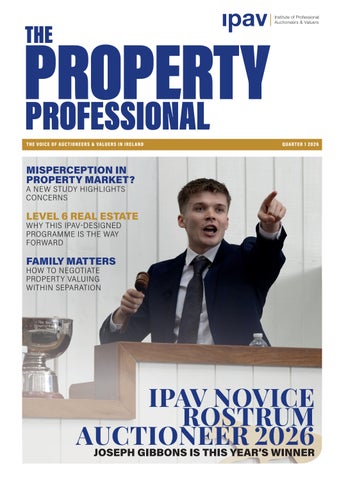
MISPERCEPTION IN PROPERTY MARKET? A NEW STUDY HIGHLIGHTS CONCERNS
LEVEL 6 REAL ESTATE WHY THIS IPAV-DESIGNED PROGRAMME IS THE WAY FORWARD
FAMILY MATTERS HOW TO NEGOTIATE PROPERTY VALUING WITHIN SEPARATION
If you are buying a security service your provider must be licensed by the PSA even if their primary business is not security.
Electricians, Property & Facilities Management Companies, and others providing security services must be licensed.
Using unlicensed providers puts your business at risk as you could:
•Face Prosecution
•Invalidate your insurance cover
•Compromise the safety of your staff and customers
To ensure that your security provider is licensed with the PSA visit www.psa-gov.ie
Dear Member,
From a national housing policy perspective, the first quarter of 2026 is seeing some seismic changes with first, the signing into law by President Catherine Connolly of the Residential Tenancies (Miscellaneous Provisions) Bill 2026 on the 24th of February to underpin the new rent rules e ective from March 1st, and the new Critical Infrastructure Bill announced by Minister Jack Chambers.
With the tight deadline for implementation of the former, along with the complexity of now having four separate rent codes to operate, it seems inevitable that agents will be faced with a yet deeper administrative burden.
It is disappointing that the legislation is, in certain respects, even more onerous than that originally announced.
Already agents are reporting some di iculties with the RTB rent register, particularly around comparables, but it’s early days yet, we’ll have to wait to see how the new system transpires.
Minister of State for Local Government and Planning, John Cummins TD indicated that modular homes in back gardens or ‘granny flats’ would be exempt from the new rules. He confirmed that the changes do not require primary legislation but rather would be introduced by way of regulation, which is awaited.
On infrastructure, Minister for Public Expenditure, Infrastructure, Public Service Reform and Digitalisation, Jack Chambers TD secured Government approval on the 3rd of March for the General Scheme of the Critical Infrastructure Bill.
This legislation is intended to create a fast-track channel through existing processes for designated critical infrastructure where projects go to the top of the queue for assessment by decision making bodies. It will enable the Government, with Dáil approval, to designate specific infrastructure projects or programmes considered critical. All State bodies involved in the approval process must prioritise their elements, and they will be required to cooperate and coordinate with each other.
This is a first and badly needed initiative, which we all hope will cut through the turgid bureaucracy that has impeded housing development. Clearly it will take some time before we see meaningful results.
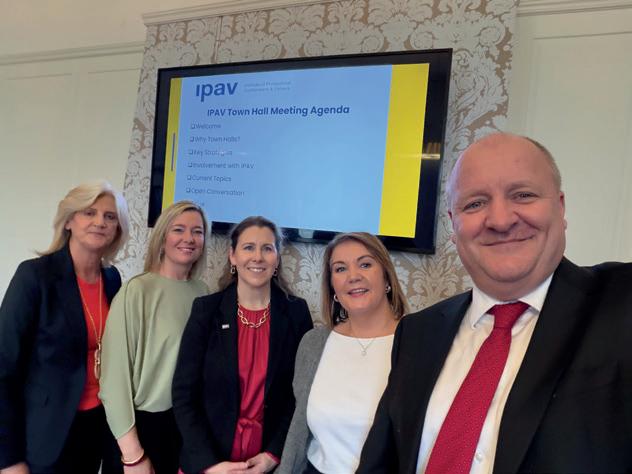
Finally, I want to say what a pleasure it was to meet so many of you during our series of our Town Hall meetings throughout the country in February. Your input is very much appreciated.
Genevieve McGuirk CEO
HOT TOPIC:
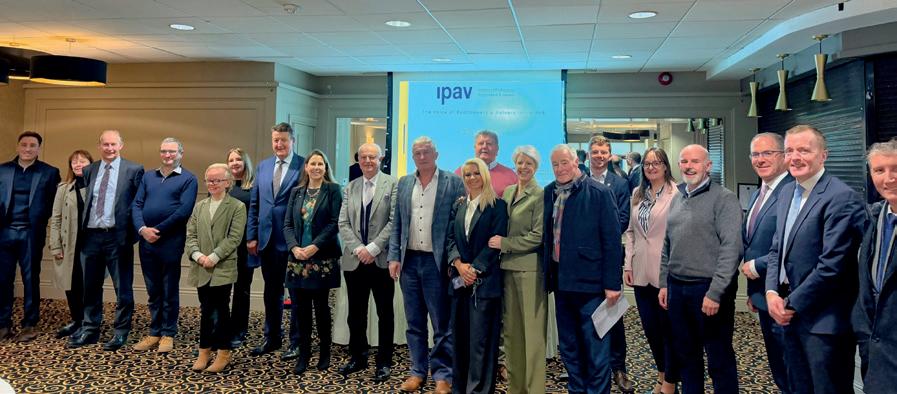
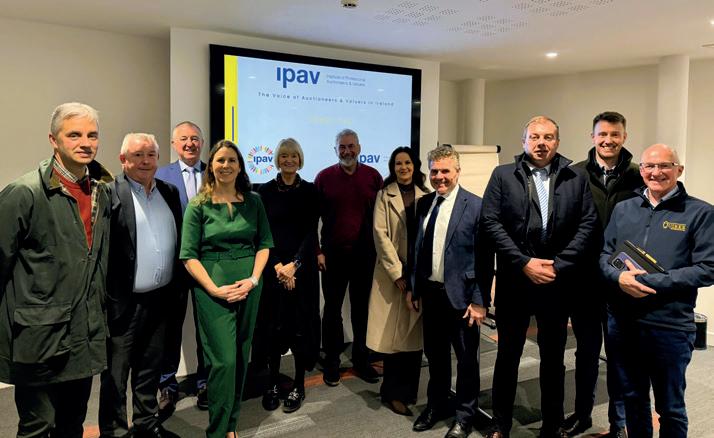
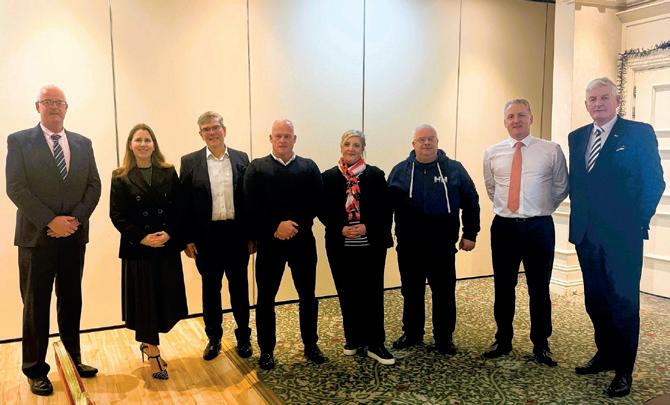
VALUABLE INSIGHT FROM IPAV TOWN HALL MEETINGS
CEO Genevieve McGuirk shares what we learned from the meetings held all around the country.
Practical support and meaningful engagement were among the themes members identified as being at the top of their priorities at the series of Town Hall meetings I hosted, along with Board members, during February. The level of engagement at each location – Kilkenny, Dublin, Limerick, Cork, Leitrim, Galway and Westmeath – was extremely encouraging.
It was clear that members value the opportunity to share their knowledge and experiences and are keen to contribute ideas, which were insightful and constructive. That is essential. From my perspective and that of the Board, such discussions provide the energy and intelligence that are critical to informing policy. The feedback received will play an important role in shaping our priorities over the coming months.
At each meeting I outlined IPAV’s strategic direction under our four core pillars: Membership, Education, Industry Influence, and Innovation & Technology. These form the framework for our work and ensure that IPAV continues to evolve in line with members’ needs.
On Membership, we’re strongest when members are involved, whether through committees, mentoring, the YPN (Young Professionals Network) or simply sharing local insights.
In Education, we discussed the expansion of our training offerings, including short courses delivered both regionally and online.
Education remains central to maintaining standards and supporting career progression at every stage.
Under Industry Influence, I provided updates on my engagement with key stakeholders and policymakers, as well as IPAV’s advocacy work on issues impacting members.
And within Innovation & Technology we explored the growing impact of AI, technology upskilling, industry research, and ongoing improvements to our digital presence, all essential as the profession continues to evolve.
I updated members on the Sellers Legal Pack and the new rental legislation, both of which generated significant discussion.
The open conversation segment of our meetings was particularly valuable. Members raised concerns around the portrayal of agents in the recent ESRI report, frustrations with property portals, the practical implications of rental legislation, delays in RTB dispute resolution and valuation fees, among other matters.
What was especially positive was how members not only highlighted challenges but also proposed constructive ideas on how IPAV can support them further. This type of engagement is vital, it ensures we remain grounded in the realities of practice across the country.
As CEO, I want every member to know that the IPAV team is accessible, responsive and committed to supporting you. A central theme throughout our meetings was that IPAV is Here to Help. With over 1,500 members nationwide, we benefit from a vast range of experience and expertise. By working collaboratively, we can continue to strengthen the profession and ensure that your voice is heard at every level.
I would like to sincerely thank all who attended and contributed. The discussions were open, honest and constructive, and they reaffirmed the value of meeting face-to-face. I very much look forward to ongoing engagement.
Limerick
Kilkenny
Dublin
Athlone
Cork
Leitrim
Galway
Whether you are looking to buy, sell or you are happily staying put, be inspired by Property & Home magazine in Saturday’s Irish Examiner.
• We bring you through the keyhole of a range of properties on the market each week, from rural retreats to urban sophistication.
• Our Home section opens the door to the latest, must-have interiors trends, from sublime sofas to cosy cushions.
• Garden lovers can dig deep with expert advice.
Plus antiques and fine art with a diary of upcoming events not to be missed.
To advertise in Property & Home magazine email propertyads@examiner.ie
Home
Reach your audience with The Irish Times Group:
Diary Dates & Registration
19th March
Choose Your Brew: Transatlantic Trends & Opportunities
Online Event with Austin Board of REALTORS® & IPAV
IPAV’s Residential Property Price Barometer: House Price Increases
Tame in Latter Half of 2025
Reporting on IPAV’s Residential Property Price Barometer, the final six months of 2025 saw a notable slowing in the rate of increase in residential property prices, easing to 2.87% from 5.05% in the first half of the year, bringing the overall annual figure for the year to 7.92%.
IPAV Annual Business Conference & Black-Tie Gala Dinner
Galway Bay Hotel – 15th May 2026
IPAV’s annual business conference, proudly sponsored by MyHome, will take place at the Galway Bay Hotel. The conference will address key developments across the property sector and feature a strong line-up of speakers, including incoming President Kay McGuire, Maria Walsh MEP, Joanne Geary, David Howard, Carol Tallon and conference MC Ronan Lardner of Galway FM. Members are encouraged to book tickets early and secure accommodation at the Galway Bay Hotel. The day will conclude with IPAV’s BlackTie Gala Dinner, offering members and guests an opportunity to connect in a relaxed setting and celebrate the profession together. Conference: 2pm – 5pm - 3 TEGOVA CPD Hours - €45.00 per person
Gala Dinner: 7pm until late - Drinks Reception, 3 course gala dinner & entertainment - €110.00 per person. See Diary Dates for Ticket links both conference &/or gala dinner.
Accommodation must be booked directly with The Galway Bay Hotel on 091 520520 or reservations@galwaybayhotel.com, quoting IPAV. Exclusive rates available to IPAV members of €183 B&B (single) or €194 B&B (twin/double) on 15th May.
Keen competition from a range of sources – farming and non-farming, along with constrained supply saw further increases in land and lease prices during 2025, according to the latest Farm Report from IPAV.
Applications Open – Level 6 Higher Certificate in Business in Real Estate, Valuations, Sales and Management
Applications are now open for this Level 6 programme, delivered jointly by IPAV and TU Dublin Tallaght. The two-year, parttime course combines blended online learning, and onsite Saturday classes on the Tallaght campus. Graduates achieve the minimum educational qualification required by the PSRA for licensing across categories A, B,C & D.
Further details are provided in Paul Campbell’s article in this edition. For enquiries, contact jennifer@ipav.ie.
Education
WHY TU DUBLIN’S LEVEL 6 REAL ESTATE PROGRAMME IS THE SMART CHOICE FOR FUTURE FOCUSED STUDENTS
CIPAV Education Director Paul Campbell MSc FCIOB MRICS MSCSI
MIPAV (HON) breaks down the value in the Higher Certificate in Business in Real Estate (Valuation, Sale and Management)
hoosing a college programme isn’t just about picking a subject – it’s about choosing the kind of future you want. If you’re someone who’s curious about how cities and towns grow, how businesses thrive, and how people live, work, and invest, then real estate is a field full of opportunity. And there’s no better place in Ireland to begin that journey than TU Dublin.
The level 6 programme has been running at TU Dublin Tallaght since 2013, was designed by IPAV and is validated by the university at level 6 (120 ECTS) on the National Framework of Qualifications. It is approved by the Property Services Regulatory Authority (PSRA) for licensing purposes and graduates are entitled to get all four Property Services Providers licenses. This means that upon completion, graduates can apply for a licence to practise as:
• An Auctioneer
An Estate Agent
A Letting Agent
• A Property Management Agent
In a regulated profession where credibility and compliance are essential, studying on a recognised programme gives you a significant competitive advantage.
It is a challenging part-time course that takes place on Saturdays over two years (4 semesters). The programme is delivered by a mixture of online and on-campus lectures which take place at the Tallaght campus of TU Dublin. One significant advantage of this hybrid method of delivery is that students get to know their fellow classmates and build networks which are vital for those aspiring to work in the property business.
The programme is designed to equip
students with the necessary knowledge and skills required for the property profession. Graduates have demonstrated that they have a high level of competence with a deep knowledge of the factors affecting the industry.
Real estate is one of the most dynamic industries in the world. It blends business, economics, law, sustainability, technology, and human behaviour. TU Dublin’s Level 6 Real Estate programme is designed to give students a strong foundation across all of these areas, preparing them for careers that are both meaningful and financially rewarding.
Graduates go on to work in:
• Property valuation
• Asset and portfolio management
• Property development Planning and sustainability
• Commercial and residential agency
• Investment and finance
One of the standout strengths of the programme is its deep connection to the
real estate profession. Lecturers aren’t just academics – they’re practitioners, consultants, and industry leaders who bring real world insight into every module. Students learn from people who understand the market as it is today, not as it was ten years ago. This means you’re not just studying theory – you’re learning how to think, analyse, and make decisions like a professional from day one.
On completion, graduates have an opportunity to progress to honours degree programme in TU Dublin.
Ireland’s property sector continues to grow and diversify. From housing and sustainability challenges to major commercial developments and investment opportunities, the industry needs graduates who can think critically, act ethically, and innovate. If you’re someone who wants a career that’s dynamic, people focused, and full of potential, TU Dublin’s Level 6 Real Estate programme is a powerful place to start.
Shift to vendor funded marketing.
Work smarter and grow faster with Daft.ie, empowering you to make vendor-funded advertising work for your business.
New Study Shows High Level of Misperception in Property Market
FThe ESRI recently published a report entitled Buying and Selling Property in Ireland: Behavioural Evidence on Bidding Systems, Stressors and Market Comprehension. Genevieve McGuirk, IPAV Chief Executive reviews the findings
unded by the Competition and Consumer Protection Commission (CCPC), several of its findings will come as no surprise to agents. Indeed, IPAV shares many of the concerns raised and has been seeking to address them for some considerable time.
MISCONCEPTIONS
The research highlights a high level of misunderstanding around property sales. It found “knowledge of rights and responsibilities is low, with widespread misconceptions about legal obligations and protections.” And that fewer than one in three know that buyers can withdraw before contracts are signed and can reclaim a deposit paid.
In a simulated property bidding exercise involving 800 participants, two-thirds of ‘buyers’ reported experiencing at least one “transactional stressor.” And half of all ‘sellers’ had experienced at least one stressor.
Small wonder here for agents. Many buyers don’t appreciate that auctioneers are working on behalf of the seller, not the buyer, and that they’re obliged to get the best price the market has to offer for the seller.
CONVEYANCING DELAYS
The most common issues emerging for both groups in the study were conveyancing delays and unexpected costs for buyers. In our own study, 84% of IPAV members had sales fall through due to conveyancing delays, and it found that up to a third of properties that go on the market are not saleable because of a lack of clarity or ambiguity typically involving such things as title or rights of way. These issues frustrate and cost aspiring buyers dearly. This is the raison d’être behind our fostering of the Seller’s Legal Pack for Property Buyers Bill 2021.
Indeed, the ESRI points out that the CCPC in a 2025 report recommended implementation of legislation to prevent properties going on the market without details such as tax, probate and deeds being available. The ESRI also highlighted previous CCPC recommendations to improve the buying process, including legislation covering pre-sale information and a new conveyancing profession to reduce delays.
Quite apart from consumer harm, agents, being on the frontline, often unfairly and
undeservedly suffer reputational damage arising from these now well documented but unresolved issues not of their making.
STRESSORS
On the issue of stress in property buying, in a commentary piece on the ESRI study The Irish Times suggested that “the Republic is, relatively speaking, pretty far down the road to nanny statehood,” saying it (the study) would seem to imply that this paternalism should now be extended to making house buying less stressful. “Opponents of the nanny state will no doubt be reaching for the blood pressure tablets at the thought of the further infantilisation of citizens by the Government,” it continued. Quite the point.
The commentary recognises that buying a property, certainly a home, can be daunting. That is more so in a market where the availability of homes is scarce and competition for each property is intense. After all, it is the biggest financial outlay most individuals and families are likely to make in their lives. And yes, there is lots of information available to consumers which can be overwhelming. There are also issues of education, experience and expertise.
The commentary recognises that buying a property, certainly a home, can be daunting. That is more so in a market where the availability of homes is scarce and competition for each property is intense.
These are critical to delivering value but are not in abundance at the point where many buy or sell.
The ESRI study found a preference for seller-led condition surveys with most participants viewing the current buyer-led system as less fair. “Changing to a seller-led survey means that people would know the state of a property before they engaged in bidding,” it says.
BUYER’S AGENT
While some buyers engage their own agents, it’s rare among home buyers in Ireland. But there is every reason to think that may be changing. In many countries the use of a Buyer’s Agent to take buyers through the sale process, give an understanding of the market and help with purchasing, is the norm. With the increasing complexity and sophistication of the Irish property market, including the increasing diversity and internationalisation of buyers, IPAV believes there is every reason
to think there is an unmet market need for such professional services. Hence, IPAV is running a course to address this in the third week of March. Topics will include regulation, buyer finance, marketing and preparing clients to become buyer-ready.
The ESRI experiment found while participants expressed a preference for open and transparent platforms, that open bidding systems, including estate agent and online platforms, led participants to bid significantly more than in the sealed bid and in control conditions. However, the ESRI does acknowledge there are limitations to the research, that real-world behaviour could differ. The important factor of location was omitted “to make the task equal for all participants.” There is also the fact that bidding normally happens over a period of days, even weeks. As agents appreciate, this gives the purchaser a chance to think about their offer and about the suitability of the property. In the ESRI study, controlled
bidders were family members/friends, people who would tend to err on the side of caution due to the nature of the relationship.
The issue of ghost bids also arose in the ESRI study, with 14% of buyers believing they were subject to such bids, despite it being illegal. One in three not yet in the market expected to encounter them. Only one in five knew that agents can legally continue to market a property after it goes ‘sale agreed’.
The Irish Times highlighted Property Services Regulatory Authority (PSRA) figures showing that of the 24 complaints received by the authority about bidding in 2024 – the last year for which it has published figures – only one made allegations relating to ghost bidding.
Given the low level of knowledge of rights, responsibilities and legalities, together with misconceptions among participants, policy makers need to be careful that they are not prompted to devise new policies based on such rather than on the realities and practicalities of the market.
Bringing Transparency to Ireland’s Property Markets
Buying or selling a home in Ireland can be an emotional and often frustrating experience. For years, the private treaty bidding process has relied heavily on phone calls, emails, and trust, leaving buyers uncertain, agents stretched for time, and sellers wondering whether they’ve truly achieved the best price. Homebidding.com is changing that. Designed specifically for the Irish property market, Homebidding.com digitises the private treaty bidding process, transforming it into a transparent, real-time experience for everyone involved. The platform allows estate agents to display their properties through a simple online portal, while approved buyers can place bids securely and track activity as it happens.
For buyers, the difference is immediate. Instead of relying on periodic updates or waiting for callbacks, they can see real-time bid movements and know exactly where they
stand. This transparency removes doubt and builds trust, making the process fairer and more engaging. Buyers love the clarity and confidence that comes with live updates.
For estate agents, the platform is a powerful time-saver. Managing bids manually can be labour-intensive, particularly during competitive sales. Homebidding. com streamlines communication, reduces repetitive calls and emails, and keeps all bidding activity organised in one secure place. Agents maintain full control, and only verified and approved buyers can participate, ensuring professionalism and compliance throughout.
Sellers benefit from greater transparency and stronger competition. With clear visibility of bidding activity, momentum builds naturally, helping to maximise sale outcomes while reassuring vendors that the process is fair and accountable.
Importantly, Homebidding.com is not complicated software requiring lengthy onboarding. It is built to be simple, intuitive, and practical for everyday agency use. The goal is straightforward: make private treaty sales more transparent, more efficient, and more trusted.
As the Irish property market continues to evolve, digital solutions are becoming essential rather than optional. Homebidding. com positions forward-thinking agents at the forefront of that change, offering a modern experience that today’s buyers expect.
Estate agents can explore the platform with a free trial and see first-hand how it can enhance their sales process.
Homebidding.com, bringing clarity, confidence, and efficiency to private treaty sales in Ireland.
John Fogarty, Founder Homebidding.com
Talking Heads Myth Busters
We spoke to two IPAV members to get their opinions on this issue’s question…
If you could correct one common myth about estate agents, what would it be – and what’s the reality?
Karen O’Driscoll, MIPAV
KM Property, Dublin 3
“One of the most common myths about estate agents is that we’re all the same – that the job simply involves putting up a sign and opening doors for viewings. It’s an easy assumption to make from the outside, but it couldn’t be further from the truth. Selling a home is rarely just a transaction. It is one of the biggest financial decisions most people will ever make, and often one of the most emotional. Behind every sale there are families making life changes, people navigating uncertainty, and significant sums of money at stake. An experienced estate agent’s role goes far beyond unlocking a front door. Good agents provide guidance, strategy and reassurance at every stage of the process. From accurate pricing and effective marketing to managing viewings, negotiating offers and keeping a sale on track when complications arise, the job requires expertise, judgement and constant communication. It also isn’t about the colour of the logo on the “For Sale” board outside your home. Branding might catch the eye, but it’s the individual agent behind the board who truly makes the difference. What really matters is who is looking after you – someone who understands the market, advocates for your best interests, and helps guide you through one of the most important financial and emotional decisions you will ever make.”
Alan McKenna, MIPAV
REA Halnon McKenna, Galway & Dublin
“One common misconception about estate agents I have found is the lack of value regarding their time and expertise when dealing with people. We receive a fee for getting a deal done, but the art of that deal truly goes unseen. Over my career I have dealt with tens of thousands of people from applicant tenants, tenants, landlords, owners management companies, managing agents, insurance providers, contractors, bidders, buyers, vendors, solicitors, engineers along with a host of government oversight from RTB, Threshold, Property Services Regulator and Pensions Authority to name a few. A good agent has the ability to see a path through the quagmire of the conflicting interests, changes in legislation, fluctuating economic circumstances to find a positive result for their client. My wife lovingly refers to me as a “professional door opener”, but the true meaning of this is somewhat lost in the humour. As agents, we open the door, not just to houses, but movement, growth, conflict resolution, investment and retirement through the services of asset management, tenant selection and sales negotiation. Agents take two parties on opposing sides, mix in a bit of law and regulation and look to find the best solution for their client. I consistently hear the question of “why has the agent done… [fill in the blank]”. This misconception is due to only thinking about the transaction from one perspective, a good agent must think about the solution from all perspectives which ultimately leaves our actions misunderstood to the majority.”
Meet the Member Adrianna Hegarty
We spoke to Adrianna Hegarty, founder of Hegarty Properties, to find out more about her varied career, which has seen her selling property both in Ireland and internationally.
How did you get started in the industry? I grew up on a farm in Monaghan, and when Gunne auctioneers opened an o ice locally just after I left school, I went to work with them. I loved the buzz of it straight away. There was a cattle mart every Wednesday, and I would be out early with the auctioneer trying to write down cattle numbers. It was fast-paced and full of energy. Coming from a farming and cattle-dealing background, it felt very natural to me. When Gunne’s later opened an o ice in Ballsbridge, I was keen to move to Dublin. I worked there for five years before deciding to sit the exams to qualify as an auctioneer. After that, I moved on to Sherry FitzGerald and other firms, where I gained broad experience before eventually specialising in pubs and hotels. I later met my husband, whose work took us abroad. We lived in Cyprus for a time, and one day while out cycling I passed a large developer’s o ice and decided to call in. I was in a tracksuit and had not planned it at all, but I went straight into an interview and was o ered a role selling property to English-speaking buyers. They turned out to be the largest developers on the island. We then moved to the US, where I obtained my real estate licence in both California and Chicago. After returning to Dublin, I did consultancy work before moving back to Ireland in 2000. I founded Hegarty Properties in 2006, and this year marks our twentieth year in business.
Can you talk me through the di erent aspects of your role now? My role centres on working closely with people who are considering selling their homes: from valuations and initial meetings through to preparing the property for sale. Sellers today meet several agents before choosing who to work with, so service and trust are critical.
I o er a very hands-on, end-to-end service: advising on presentation, staging, and positioning, and connecting clients with the right professionals; from solicitors to tax and financial advisors. I believe in surrounding clients with the best people, because that is how you achieve the strongest outcomes and ensure deals progress smoothly.
What have been some of the highlights of your career? One standout moment came just after the property boom. A neighbour passed away and left instructions in his will that I was to auction his large coastal farm. At that point, I had not actually conducted an auction myself, but I understood the
ABOVE: Adrianna Hegarty, Owner and Director of Hegarty Properties, with daughter Niamh Hegarty, Business Development Specialist. BELOW: Adrianna Hegarty with Darina Allen of Ballymaloe Cookery School. Credit: Diane Cusack
protocol inside out. I practised relentlessly because I knew it would be a public and highly scrutinised event. I ran the auction with Anne, who has worked with me for over 20 years, and we were very aware that two women running a farm auction would attract attention. No farm in Munster had ever been auctioned by a woman before. The auction was electric. It went exceptionally well, achieved a strong result, and proved to be a defining moment for both my confidence and the business.
What are some of the challenges that you find in your business, and in the industry at the moment? One ongoing challenge is the slowness of the Irish conveyancing system. Even when sales are fully prepared, once a property goes sale agreed we become dependent on third parties. On a personal level, the recession was the most di icult period of my career. I did not take a wage for two years and had to let all sta go except Anne. We downsized to a small o ice o the main street. The sale of that farm was pivotal, it kept the business going and allowed us to re-establish ourselves in a prime location. My resilience comes from my upbringing. I lost my mother at 17 and my father at 25. When my father passed, the farm was left to my brothers, which was simply how things were done at the time. I remember saying to myself that I was on my own and needed to make my own way. Those experiences shaped my drive and determination.
What excites you at the moment about the industry and the job that you are doing? I still love the thrill of securing a sale and delivering a great result for clients – that has not changed. What is also exciting is working alongside my daughter, who joined the business about five years ago. She has completely transformed how we market property, introducing Instagram, TikTok and a much stronger digital presence. She has brought the business to a new level, and it has been incredibly rewarding to build that together.
“NEVER BET THE FAMILY FARM”
Mike Brady on the topic of farms and debt.
Farmers differ widely in their attitudes to risk and borrowing, particularly when it comes to leveraging the family farm as security for loans. The central financial question remains the same across all farm types: how much bank debt is prudent, and how much is too much? Decisions around borrowing are shaped by economic conditions, bank competition, cultural attitudes toward debt, policy environments, and individual risk tolerance. From working with farm businesses my experience is that most borrowers fall into five broad categories…
1
No Bank Debt – Zero Risk Tolerance. Farmers with no bank debt view borrowing as inherently dangerous. Often older or highly conservative operators, they prioritise independence, liquidity, and peace of mind. Many have lived through periods of high interest rates or farm downturns and may have seen neighbours lose land due to financial pressure. In Ireland especially, the cultural memory of land loss remains strong. These farmers prefer slow, organic growth and accept lower returns in exchange for certainty. While highly resilient in downturns, they may miss opportunities to improve efficiency or scale.
2Low Bank Debt – Borrows Only Where Necessary. Low-debt farmers treat borrowing as a tool of last resort. They may use short-term loans for machinery, livestock, or working capital, but aim to clear borrowings quickly. Their approach is cautious but practical, rather than ideological. This category is common among family farms dealing with volatile commodity prices. They usually maintain solid bank relationships while keeping leverage modest. The trade-off is reduced exposure to risk, but also slower expansion.
3
Moderate Bank Debt – Strategic Borrower. Strategic borrowers use debt deliberately to strengthen profitability, efficiency, or succession outcomes. Investments typically
include land improvement, buildings, infrastructure, or technology, with clear return expectations. These farmers rely on budgeting, benchmarking, and professional advice. They monitor repayment capacity through cashflow analysis and stress testing. Banks are viewed as financial partners. This balanced approach often produces steady, sustainable progress when supported by good management.
4
High Bank Debt – Growth Driven. Highly leveraged farmers are usually ambitious and expansion-focused. They use debt to grow quickly and capture scale efficiencies. Borrowing is seen as a motivator that sharpens performance and decision-making. When markets are strong and interest rates stable, returns can be excellent. However, this model is sensitive to price swings, weather shocks, and rate increases. Pressure can escalate rapidly in a downturn, and management discipline becomes critical.
5
Unsustainable Bank Debt – No Clear Plan. The most dangerous category is where debt accumulates without a realistic repayment strategy. Expansion may be driven by ego, fear of missing out, or speculative land expectations rather than financial fundamentals. This pattern often appears during periods of cheap credit and rising asset values. When conditions reverse, these businesses face restructuring or forced sales. The core problem is not borrowing itself, but lack of planning, discipline, and contingency thinking.
Farmers also differ in whether they borrow for on-farm investment –such as land, buildings, or machinery – or off-farm diversification. Onfarm investment can improve productive capacity but ties repayment directly to volatile agricultural markets. Off-farm investments may diversify income but introduce new risks and complexity.
There is no single correct level of borrowing for every farmer or farm business. The most resilient businesses align debt levels with management ability, realistic cashflow, market conditions, and personal tolerance for risk. Careful planning and disciplined use of credit remain central to long-term farm stability.
If you fail to plan, you plan to fail.
Mike Brady
Mike Brady is an Agricultural Consultant and Managing Director at Brady Group
IPAV Young Professionals Network THE JOURNEY TO THE ROSTRUM
Fergal Troy MIPAV, YPN Chairperson, gives us a Peek Inside the IPAV Novice Rostrum Auctioneer event
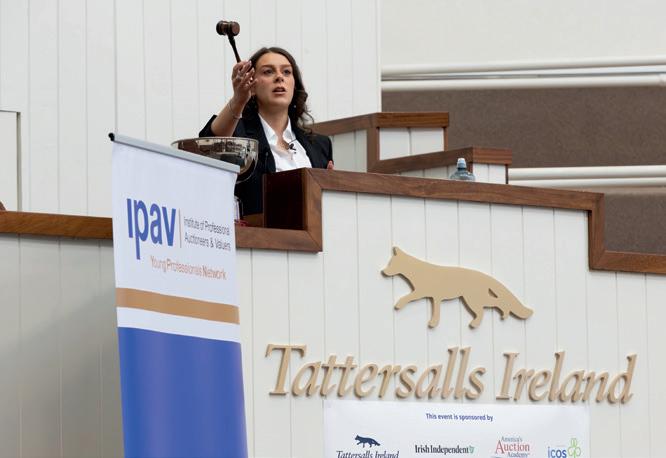
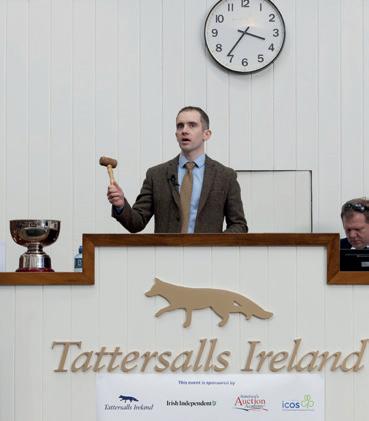
In the auction world increasingly shaped by online platforms and digital bidding, there is still nothing quite like the atmosphere of a live auction. The pace, the tension, the split-second decisions and, above all, the voice of the auctioneer holding the room. That tradition is very much alive in Ireland, and nowhere is it being championed more visibly than at the IPAV Novice Rostrum Auctioneer event in Tattersalls Ireland.
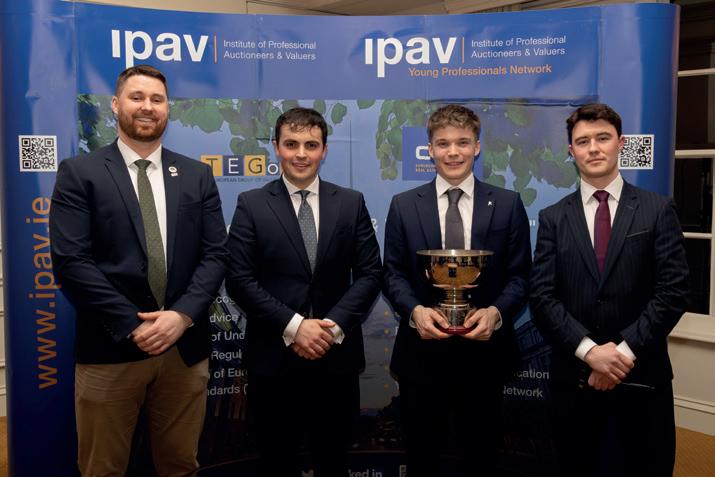
Now in its seventh year, the competition recently saw seven novice auctioneers take to the rostrum to compete for an exceptional prize, intensive auctioneering training with Mike Jones and his team at America’s Auction Academy in Dallas, Texas, along with the prestigious Ron Duff Memorial Bowl.
The four judges Colm Farrell, Alastair Pim, Michael Farrelly and Lisa Keenan faced no easy task in selecting a winner from such a high standard of performance.
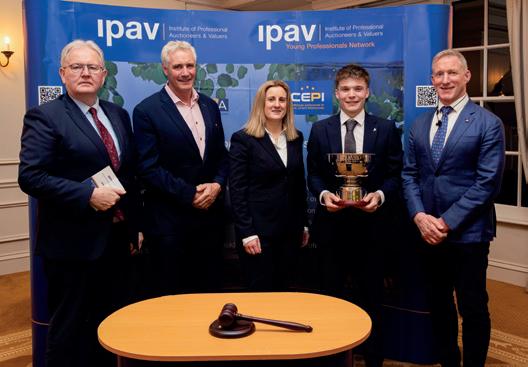
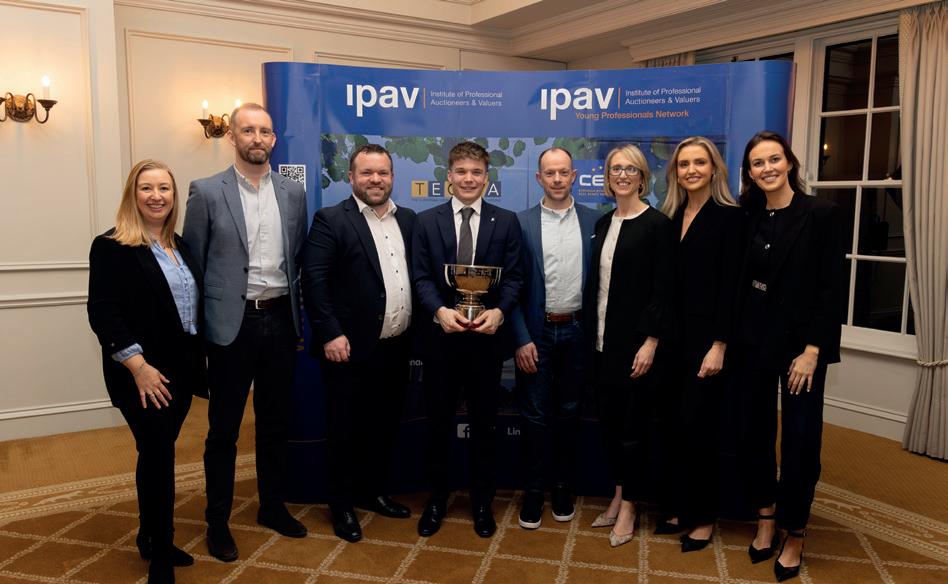
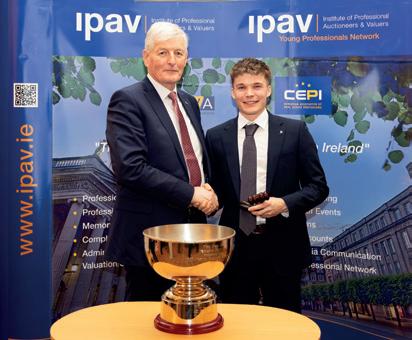
The eventual winner was Joseph Gibbons, a native of Ballinasloe, Co. Galway, a very worthy winner who was up against very stiff competition which saw a wide variety of rostrum selling styles. Joe completed the Auctioneering and Property Management Apprenticeship in 2024 and obtained his PSRA licence in early 2025.
The competition offers novice auctioneers a rare opportunity to step onto one of the most respected auction stages in the country. Open to those who have conducted fewer than five auctions and who hold any category of PSRA licence, the initiative is specifically designed to identify and support emerging talent at an early stage in their careers. Tattersalls Ireland is a
venue synonymous with world-class sales and exacting standards, and for many competitors it marks their first experience selling from such a prestigious rostrum. With that opportunity comes a natural mix of excitement, nerves and determination. The event pushes participants well beyond their comfort zones and it is precisely in that space that the most meaningful professional growth occurs.
There is no substitute for the reality of a live rostrum. You can practise in an office. You can refine your chant. But until you face a room, manage your breathing and feel that first bid come back at you, you have not truly tested yourself. The Novice Rostrum Auctioneer event does precisely that. It places emerging professionals just outside their comfort zone, not to catch them out, but to bring them on.
Participants quickly realise that auctioneering is as much about presence as it is about pace. Reading the room, encouraging hesitant bidders, keeping control while maintaining energy, these are skills developed through experience. Under the lights at Tattersalls, confidence grows in real time. By the time they step down from the rostrum, competitors carry themselves differently. The experience makes a lasting
impression, strengthening both confidence and professional presence long after the day itself.
At a time when online auctions are an essential and growing part of the industry, the event also sends an important message. Digital platforms have expanded reach and efficiency, and they are here to stay.
But the live auction remains the public face of the profession. It demonstrates transparency, authority and trust. The future auctioneer must be comfortable operating in both spaces, equally at ease online and commanding a room in person.
Perhaps just as important is the sense of encouragement the event creates. Novice practitioners see their peers take to a renowned stage and perform with professionalism and composure. It is motivating. It raises standards. It gives students and trainees something concrete to aspire to.
Ultimately, the IPAV Novice Rostrum Auctioneer event at Tattersalls Ireland is about more than competition. It is about keeping the craft vibrant, building self-belief in the next generation and ensuring that the unmistakable call of the rostrum auctioneer continues to echo across Ireland’s auction rooms for years to come.
Novice Rostrum Auctioneer Winner; Joseph Gibbons
WHEN GOOD NEIGHBOURS GO BAD
WTommy Barker, Property Journalist, Irish Examiner, says we should bless good neighbours and curse the bad ones –there’s little to undermine the sanctuary of anyone’s home as powerful as a cranky, dirty, dangerous, noisy, noxious or vexatious neighbour.
e’ve all heard the stories: Lelandeii trees gone and skywards, crowding out the sky; scrap cars; crying infants; barking dogs; barking mad and bonkers couples; roosters at dawn and debris at sundown.
When relationships sour between neighbours, things between them can quickly escalate.
Neighbours and landowners go to war, dig down deep into the trenches. They go to the courts, as happens widely, providing fodder from mainstream news media to local tittle-tattle, from rural farms (always good for a boundary issue) to affluent
Dundrum in Dublin, where one historic high profile case saw multiples spent on legal costs than the land/boundary in question was ever worth.
We won’t even go into divisive planning applications here, intrusive aspirations and breaches of regulations thereof… ten a penny, to start off with, then sadly tens of thousands of euros to wrap up, defending the sanctity of ‘home turf’.
Better to pull back, put the head down, retreat into one’s shell?
Easier said than done when the dander is up, or when a sense of security and safe space is at stake and, betimes, when other neighbours take sides, when councils and legal counsel and enforcement letters start to fly.
A colleague has just had a new neighbour rock up next to her, in her suburban city semi-d, originally built by the local council where she’d bought her home a decade or so ago.
Since then, the other half of the pairing sold very recently as a fixer-upper, and from the moment the new neighbours moved in there’s been friction, which quickly escalated into near-naked – yet initially unnecessary – hostility.
We’re talking small boulders placed outside the new arrival’s house to restrict parking, debris caused by renovations left strewn about, blocked drains, broken toys and rubbish bags strewn, dirty glares and glances… seemingly low-key, but insidious to one’s sense of home and safety.
It prompted recall of a line from US poet Robert Frost’s poem: ‘Mending Wall’ in which he says:
“Before I built a wall I’d ask to know What I was walling in or walling out, And to whom I was like to give offense.” Frost (no judgment on the chilly chiming with his surname) twice recites the line “Good fences good neighbours make.”
GOOD FENCES?
With icy battle lines already drawn between the neighbours, up went one single panel of a 180cm fence deemed necessary to screen out any and all visual mayhem, and occasional, direct eye-to-eye contact from one front door to the next front door.
It wasn’t particularly aesthetic, but it wasn’t a Trump-style border wall either: it was €80 worth bought from the nearby garden centre.
Phew. It didn’t make for good neighbours, or any thawing of the frosty relationship.
It resulted in an enforcement letter from the city council noting fences above 120 cm in front of a house/front building line need planning permission.
C’mon? 120 cm? That’s about four feet high, marginally above the farcical ‘Stonehenge’ stones used in the legendary ‘This is Spinal Tap’ documentary by the late US movie director Rob Reiner. Really, they’re about as useful as assembling a squadron of garden gnomes to do guard duty on this woman’s turf protection front.
AGENCY
The sorry squalor of neighbourly ill-will prompted a review of how this new, warring arrival had unwittingly fetched up on this woman’s threshold.
When hearing she was about to get new neighbours, she’d lightly asked the selling agent what her new neighbours-to-be were like?
“She seems nice”, was the tempered, moderated reply. No mention of ‘he’.
Turns out the same office had also sold for this buyer elsewhere in the city and had a fraught relationship with ‘the man of the house,’ who was now flexing muscles in his new abode, man-spreading over notional boundary lines.
After a bit of journo digging, it turns out that the man of the house-next-door also had a track record of agitation and litigation in the UK, elsewhere in Ireland and now, escalating, as per pattern on my hapless colleague’s literal doorstep: the neighbour from hell, in person.
No two ways: she’s going to have to sell, and move elsewhere.
He’s ‘inside her head’; arbitration or legal remedies seem a waste of time and money. He’s landed, and successfully stirring it again, for whatever reason.
Now, here’s the quandary…
This under small-scale siege woman wondered how someone could sell a house to anyone already known to be problematic, someone “tricky,” as was later admitted, leaving her to live with the consequences on the other side of the semi-d’s party wall.
As she’s preparing to uproot and sell, she needs her own selling agent. And what then, if and when the intending buyers of her own besieged ‘sanctuary’ innocently ask why the owner is selling, and what’s the neighbourhood like?
Tough call? It’s not like there’s a boundary issue, or a planning issue, a services issue that her selling agent would be duty, morally or professionally bound to respond to honestly. It’s literally up close, and personal.
Ideally, as in a perfect world, they’ll find the perfect match for this close, side-by-side next sale pairing, where 120cm high fences fall short of their ‘good neighbour’s’ job role.
Hopefully, they’ll line up a buyer who’s another, um, eh, “tricky.”
WHEN IS AN APARTMENT NOT AN APARTMENT?
Donal Buckley writes about why housing development incentives are missing a trick with duplexes...
When is an apartment not an apartment? That is the question that arises following the Government discrimination against duplex apartment developments, in its recent menu of incentives to encourage new housing development. In doing so it may be discriminating against housing that is quicker to deliver and more compatible than multi-storey apartments in existing neighbourhoods around the country.
I make this point after seeing what the Revenue calls the “enhanced deduction” tax incentives, which are available only for multi-storey apartment blocks containing 10 or more units.
The Government announcement said that the “enhanced corporation tax deduction (will be allowed) for certain costs incurred on the construction of apartment developments, and for the conversion of non-residential buildings into apartments, worth up to €6,250 per apartment.”
Effectively, the enhanced deduction means that a developer or builder can claim 125 per cent of key costs incurred in building the apartments and this is claimed against the corporation tax that would be paid from the profits from selling the apartments. This is subject to a cap of €50,000 per apartment.
From the home buyer perspective, one of the advantages of the scheme is that the
builder/developer must sell the apartments and not retain them for letting themselves in order to realise their profit and the tax incentive. However, they can also have the option of selling to a PRS or affordable housing body landlord. Furthermore, such multi storey apartment blocks also qualify for the reduced VAT rate, which has been reduced from 13.5% to 9%.
However, neither of these tax incentives is available for developments of either duplex units, the single storey units under a duplex, co-living type developments or student accommodation.
In this respect the Government is missing a trick when it comes to speedy delivery of new homes. One of the key advantages of duplex apartment developments is that they can be brought to the market more quickly than multi-story developments. This is because as low rise projects they are less likely to attract as many or as intense the level of objections as do multi-storey, with their neighbours being concerned at the possibility of being overlooked and overshadowed with the loss of sunlight if not daylight.
Such objections can cause expensive delays, which can go all the way to judicial reviews in the expensive high courts. With high interest rates, the longer the delays the more expense the cost of financing a development.
Architect John Dobbin has shown with some of his designs that the top level of a duplex can be designed to divert views away from neighbouring houses. Consequently, by designing-out overlooking, the planning consultants can persuade planning authorities that overlooking is not a significant issue. This in turn can avoid what has proven extremely costly and protracted for developers – the bête noir of judicial reviews.
Furthermore, Dobbin says that duplexes “are more in keeping with existing patterns of development across the country, as well as being more familiar and desirable in the Irish market, being own-door, with really good gardens and terraces, as opposed to balconies.”
For developers addressing the owner occupier market this type of design is also more economical, as for instance it
eliminates the cost of elevators. This is just one example of how they can be brought more speedily to the market and this in turn can mean further savings on financing costs.
In addition, from the point of view of home buyers the absence of elevators and fewer common areas can reduce service charges compared to apartment blocks.
Duplex developments also help to address the increasing demand from Ireland’s aging population for opportunities for downsizing from three and four bedroom houses to more easily accessible own door ground floor apartments with one or two bedrooms. This would allow the over 60’s to live in mixed aged communities as well as in homes which are more suited to their needs.
In one of Dobbin’s projects in Ranelagh, Dublin 6, the two-bedroom two level duplexes extend to 110.29 square metres and sit on top. Underneath at ground level, the
pair of one-bedroom flats extend to about 54 square metres and the other to 58 square metres. They achieved a density of 98.5 units per hectare.
I suppose it is understandable that the Government would feel that the more economically viable duplexes do not need the two key incentives which are available for multi-storey, as the latter can be more expensive to build. An SCSI survey last year showed that the average cost of constructing a two-bedroom apartment ranges from €480,000 in suburban medium-rise schemes to €650,000 in an urban development.
Likewise with conversion of commercial buildings to apartments.
However at a time when supply is failing to keep up with demand and the Government is falling short of housing targets, surely the speedier supply option offered by duplexes should also qualify for incentives.
RECENT DISCRIMINATION FINES AGAINST PROPERTY SERVICES PROVIDERS
Kira M Byrne, Barrister at Law, references recent cases in order to expand upon
the issue…
Since the grounds on which discrimination is prohibited expanded in 2015, some recent decisions of the Workplace Relations Commission (‘WRC’) will be of interest to Property Services Providers.
The Equal Status Acts 2000-2018 protect individuals from discrimination in the provision of goods, services, education and accommodation, promote equality and ensure that everyone has equal access to services and opportunities, regardless of their background or personal characteristics.
The grounds on which discrimination is outlawed by the Equal Status Acts are as follows: gender, civil status, family status, sexual orientation, religion, age, disability, race (including race, colour, nationality or ethnic or national origins), Traveller community and housing assistance ground (only in the provision of accommodation).
The Acts also prohibit discrimination against a person simply by association with another person, acting as a witness on behalf of that other person, giving evidence on their behalf, legally opposing an act which is unlawful under the Acts, or who has given notice of an intention to take any such actions.
Section 4(6) of the Acts define “provider of a service” as:
(a) the person disposing of goods,
(b) the person responsible for providing a service,
(c) the person disposing of any estate or interest in premises, or
(d) the person responsible for the provision of accommodation or any related services or amenities
Section 6(1) of the Acts prohibit the disposal of premises and provision of accommodation, providing that a person shall not discriminate in…
(a) disposing of any estate or interest in premises,
(b) terminating any tenancy or other interest in premises, or
(c) providing accommodation or any services or amenities related to accommodation or ceasing to provide accommodation or any such services or amenities.
Reviewing some recent decisions helps providers to avoid discrimination, and ultimately, financial penalty.
In December 2025, a case against an Agent for refusing to sign the complainant’s application for the Housing Assistance Payment (HAP) led to an award of €7,500 and costs against the Agent Respondent. The AO wrote to the Respondent and advised that the case can proceed against the Respondent as Agent.
Vicarious Liability protects an agent from being sued for acts done while providing services for his Principal. Indemnity is their protection. To invoke an indemnity, the Agent must sue their Principal to recover their loss of €7,500 and costs.
The AO was satisfied that once request
was made to a Landlord to complete a HAP application form, they are required to take steps to comply with the request. The Respondent Agent accepted that he was responsible for carrying out the Landlord’s instruction. According to the AO, when the complainant applied for HAP, the Respondent was a “provider of a service” according to the Acts.
Neither party attended the hearing. Oral evidence gives parties an opportunity to prove that there is no discrimination on their part which the AO must determine. It is vital to attend any hearing.
To protect agents, they should notify their insurers and receive appropriate legal advice. Ultimately, as the Landlord refused to engage, the Agent Respondent was unfairly exposed.
In comparison, a decision in December 2025 involved an employee who submitted a complaint of discrimination on the grounds of race against both the Employer and Recruitment Agency in relation to a job competition. Although the discrimination was ‘unintentional’, the employee was awarded €13,000 under the Employment Equality Act 1998-2015. It was accepted by the Employer and the Complainant that the Employer set the criteria and was the potential employer for the purposes of this Act.
The Recruitment Agency’s role was limited to administering the Employer’s recruitment campaign, similar to the position of property services provider. The Agency administered the campaign fairly and applied the criteria
set by the Employer. When the Complainant failed to meet the criteria he was not offered the job. The underlying rationale for the eligibility criteria, which he did not meet, were set by the Agency’s client, the Employer.
It is crucial that if allegations of discrimination are made against a provider, their instructing client, a Landlord, usually, should be joined as a Respondent to the complaint at the earliest opportunity.
A fine of €7,000 was awarded against a provider in 2024 where the duration and level of engagement in the relationship seems to
have reflected in the level of fine. The ongoing requirement by Landlords to furnish up to date contact addresses for themselves and indeed, a potential requirement for electronic signature for the purpose of the HAP form could provide some protection if secured for the Agent at the outset.
In 2023, a fine of €1,500 was set against a property management company for the property owner’s failure to have the necessary paperwork in place to allow HAP tenants to rent the property. The managing director of the company confirmed that they were informed
prior to the letting that the landlord was not able to meet the criteria in order to proceed with a letting for a HAP applicant. They informed the Landlord about their requirement to submit a tax clearance certificate. The landlord was unable to fulfil that requirement and so rendered herself ineligible to rent to a HAP applicant.
The property management company apologised to the complainant for their inability to consider his application, but it was not their decision. Once the complainant has established a prima facie case of discrimination, the burden then moves to the respondent, the property management company, to demonstrate that their decision to refuse him a tenancy was unrelated to his HAP status. It was insufficient simply to submit that it was they, the letting agency, but the landlord who refused a prospective tenant in receipt of HAP assistance.
Why Flood Risk and EVS 2025 Now Shape Market Value The Evolving Role of ESG in Valuation:
EBy Tony Wallace BSc. (Hons), MSc., FHEA, MIPAV, REV, Lead Valuer, IPAV
nvironmental, Social and Governance (ESG) considerations have shifted from peripheral topics to core determinants of Market Value across European property markets. The publication of EVS 2025 and accelerating climate-related regulation mean that valuers must integrate sustainability, energy performance and climate-exposure directly into their methodologies. This is not an optional enhancement to good practice – ignoring ESG or flood-risk is now considered a valuation error.
Why ESG Factors Now Materially Influence Market Value
EU climate legislation – most notably the Energy Performance of Buildings Directive 2024/1275 – has introduced mandatory renovation pathways for the worst-performing buildings by 2030, 2033 and 2035 (EVS 2025, EVS 6). These legal obligations create unavoidable major costs, which EVS 6 requires valuers to reflect within Market Value. In parallel, the Capital Requirements Regulation and EBA guidelines embed ESG risk into bank supervision, driving lenders to adjust pricing, LTV ratios and covenants according to climate-exposure and EPC/BER grade. Energy performance is therefore now inseparable from liquidity, yield selection and longterm marketability.
Flood-Risk Assessment as Core Due Diligence
Flooding represents one of the most material environmental risks influencing value, and EVIP 8 (Flooding and the Valuation of Property) highlights its longterm implications for pricing, financing
and insurability (EVS 2025, EVIP 8).
The OPW’s Floodinfo.ie platform –encompassing CFRAM, PFRA and flood zones A, B and C – provides the authoritative basis for Irish flood-risk assessment.
Valuers are now expected to: Identify property location with precision (Eircode or coordinates)
• Analyse CFRAM AEP layers (10%, 1%, 0.1%)
Confirm Flood Zone classifications and access routes
• Assess implications for insurance availability, premiums and lender behaviour
Given insurers’ increasing reliance on flood mapping, exposure can lead to significantly
higher premiums or outright insurance refusal – directly affecting Market Value and future marketability.
Valuation Implications of Climate Exposure, Insurance and Lender Behaviour
Properties with poor BER ratings or high flood exposure face compounded risks: rising retrofit obligations, reduced lender appetite, and higher operational/insurance costs. EVS 6 requires valuers to use a residual approach where statutory energyupgrade triggers apply, deducting renovation costs and associated professional fees, VAT and finance. Flood-risk similarly impacts yield selection, discount rates and CAPEX allowances for mitigation works.
Practical Steps for Valuers Under EVS 6 and EVIP 8
To align with EVS 2025, valuers should incorporate the following into every report:
• Document ESG-related legal obligations and statutory trigger points (sale, lease, major renovation)
• Record BER data, baseline energy characteristics and required upgrade trajectories
• Undertake a structured floodrisk assessment referencing CFRAM, PFRA and Flood Zones A–C with mapping extracts
• Quantify mandatory renovation costs, using recognised cost benchmarks and residual methodologies
• Report transparently (EVS 5), explicitly stating assumptions, uncertainty, and ESGrelated impacts on yields, liquidity and market evidence
• Complete the EVS reality-check, ensuring the valuation aligns with buyer behaviour and market trends
Valuation Masterclasss
Why An Accurate Property Valuation Matters in Separation
WSeparation can cause any number of issues, which is why it’s key to make sure valuation is undertaken properly. Auctioneer and Valuer Ella Dunphy FIPAV REV talks us through the importance of procedure during Family Law Valuation…
ith property values continuing to fluctuate across Ireland, separating couples are increasingly finding that the family home has become the most contested asset in matrimonial proceedings. Essentially, emotions run high, and the dispute becomes financial.
Firstly, it is mandatory that the wording of the Valuation Report clarifies independence while also confirming that you act on behalf of a specific party (if you do).
Like all other valuations you must include the following: Instruction Details, Comprehensive Property Description, Legal Status to include pending issues with Planning/Retention, marketable title, vacant possession, Basis of Valuation, Market Value as at Date of Valuation while clearly suggesting that the valuation should be revisited bi-annually to reflect market change. Comparable(s) should be included and adjustments made where appropriate to reflect the di erences in condition/size/location.
In addition, you must include the following:
Instruction
State clearly that the Report is prepared in accordance with accepted Professional Valuation Standards and the name of the party you act for must be stated clearly while also including the following additional headings:
Limitation
State that the purpose is ‘Matrimonial Separation Proceedings’ only and must
not be relied upon for lending or financial purposes without prior consent. Include that the property is valued on the assumption that it is free from undisclosed defects.
Conflict of Interest
Valuer has no conflict of interest with the property, Valuer’s opinion is independent, impartial and unbiased based solely on professional expertise.
Fees & Court Attendance
In the interest of transparency, you should clearly state the following: Fee for Valuation Report, Fee for supplementary Reports, Fee for Court Attendance to defend your Report including travel time/outlay, Fee for
remaining on Stand-by attendance, or as directed by the Court.
Finally, before signing o , it is mandatory that the following is included:
Statement of Truth
I declare that I have made clear which facts and matters referred to in this Report are within my own knowledge and which are not. The opinions I have expressed represent my true and complete professional opinion. Although instructed by one (spouse) party it is my understanding that it is my overriding duty, if called to give evidence is to the Court.
International Women’s Day 2026
Give To Gain
IPAV marked International Women’s Day 2026 with an online event celebrating this year’s theme, Give To Gain. Thank you to the many members who joined us. Guest speaker Jean Evans presented From Invisible to Influential: Networking as a Career Asset, alongside contributions from IPAV CEO Genevieve McGuirk and Senior Vice President Kay McGuire.
CONNECT EVENTS
Highlights of the IPAV calendar
Business Post National Property Awards
InterContinental Hotel, Dublin 4 5th March 2026
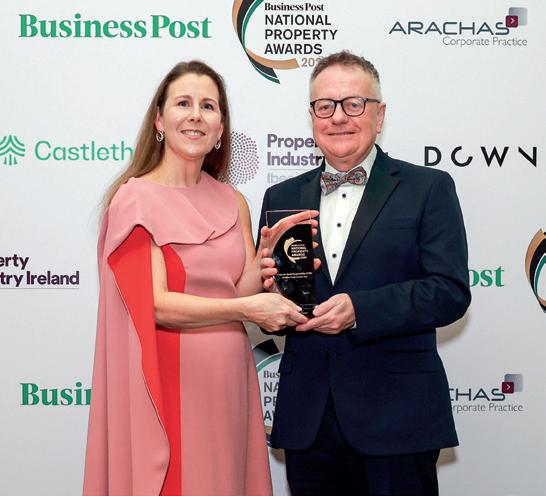
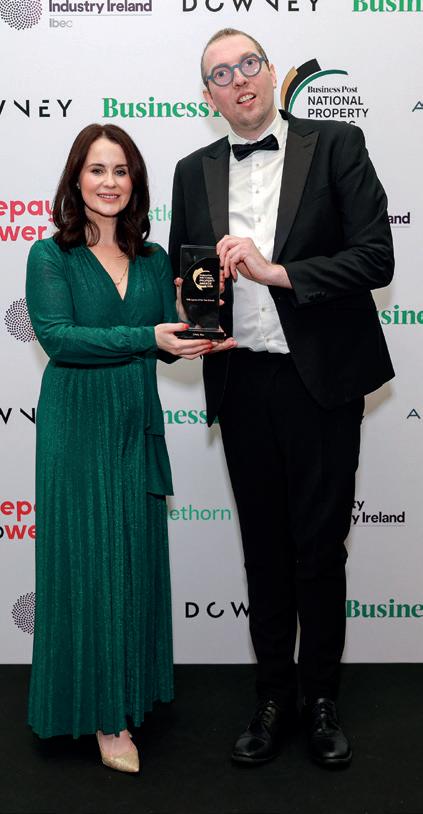
Congratulations to all individuals and organisations across the property sector who were shortlisted at the recent Business Post National Property Awards, and to the winners recognised on the night, including IPAV members Andrew Rhatigan, Rhatigan Real Estate - Buyer’s Agent of the Year; Donald MacDonald, Hooke & MacDonald - Irish Agency of the Year, Large Agency; Maria Clifford, Liberty Blue - Irish Agency of the Year, Small Agency. The event brought together professionals from across the industry to celebrate achievements across the sector, and we extend our congratulations to everyone involved.
ABOVE: Donald MacDonald MIPAV with Hooke & MacDonald Team, awarded Irish Agency of the Year, Large Agency
ABOVE: Genevieve McGuirk with REA Team and Future Leader Winner Elliott Potterton.
LEFT: Maria Clifford MIPAV & John Darcy, Liberty Blue, awarded Irish Agency of the Year, Small Agency.
BELOW: Andrew Rhatigan MIPAV, awarded Buyer’s Agent of the Year.
ABOVE: Genevieve McGuirk presenting with award for Corporate Social Responsibility Initiative Project of the Year, awarded to Tuath Housing Association for Building Brighter Futures
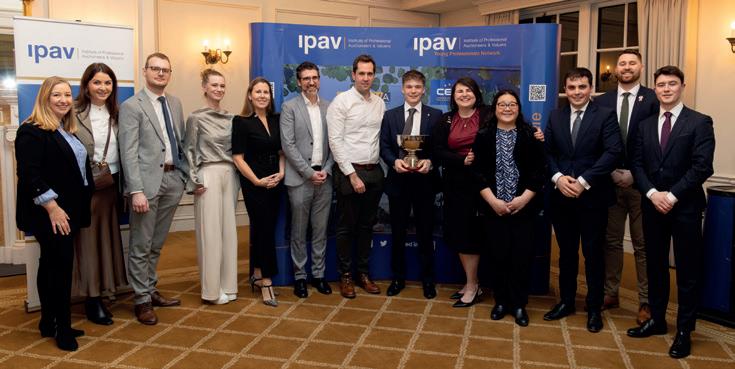
ABOVE: Ciara Lally. RIGHT: Sean Murphy. BELOW: Rostrum Contestants, Judges, Former Winners and YPN Committee Members.
ABOVE: Contestants (l-r) Joseph Gibbons, Daragh Walsh, Sean Murphy, Padraig Beglin, Catherine Mannion Cooney, (l-r front) Elliott Potterton, Ciara Lally. RIGHT: Fintan McGill & Joseph Gibbons.
IPAV Novice Rostrum Auctioneer Competition
Tattersalls Ireland, Co. Meath 6th March 2026
Congratulations to all contestants who took part in this year’s IPAV Novice Rostrum Auctioneer Competition, showcasing impressive confidence and skill on the rostrum. Contestants included Catherine Mannion Cooney, Padraig Beglin, Sean Murphy and Ciara Lally. Well done to our finalists Daragh Walsh, Elliott Potterton and Joseph Gibbons, with Joseph Gibbons taking the overall title. The competition once again highlighted the strong talent within the profession. Sincere thanks to IPAV’s Young Professionals Network for organising the event, and to the IPAV team, members, guests and sponsors whose support helped make it a great occasion.
RIGHT: Ciara Lally, Sean Murphy, Padraig Begley, Joseph Gibbons, Daragh Walsh, Elliott Potterton, Catherine Mannion Cooney.
RIGHT: 2026 Novice Rostrum Auctioneer Contestants and Judges. BELOW: Michael Farrelly, Colm Farrell, Lisa Keenan, Joseph Gibbons & Alastair Pim.
ABOVE: Padraig Beglin. BELOW: Joseph Gibbons and family.
LEFT: Niamh Giffney, Paul Cahill, Kevin O’Dwyer (cry), Joseph Gibbons, Fergus Morris, Gillian Morris, Jessica Farrelly & Sarah Smith.
ABOVE: Previous Winners, Kevin Hassett, Darren Hession, Sean McRedmond with 2026 winner Joseph Gibbons. LEFT: Catherine Mannion Cooney. BELOW: Daragh Walsh
ABOVE: Daragh Walsh, Joseph Gibbons, Elliott Potterton. BELOW: Niamh Giffney, Marie Farrell, Jakub Polanski, Valerie Mogerley, Genevieve McGuirk, Eoghan Murray, Fergal Troy, Joseph Gibbons, Ramona Ruskuls, Esther Lee, Darren Hession, Kevin Hassett, Sean McRedmond
THE BIG DEBATE:
How are you staying informed and marketing property in a digital-first world?
The way in which we market and indeed sell properties is changing at a rapid rate. In an ever-evolving world of new technologies, information services and social media trends, we asked IPAV members, how you’re adapting and changing. The results are illuminating…
Which of the following sources do you use to stay informed about property industry news?
Can you see yourself changing your current sales process in the future? For example, changing or moving away from standard sales platform(s), or using social media such as TikTok as your main platform for selling?
What you said…
If yes or possibly, what changes would you consider?
“I've already left Daft and moved more to social media – I've seen my sales double in that time. I still maintain an online national presence with MyHome, as I feel that vendors still want that.”
Kenneth Campbell, Dungloe, Co. Donegal
“Marketing trends change so we would have to adapt with the times.”
Mark Mulholland, Property Partners Mulholland
“TikTok advertising is generational – I can't imagine "currently" anyone buying a property based on a TikTok advert alone. If the advert is viewed on TikTok it is more than likely linked to an ad on Daft, MyHome or the individual estate agent’s home account for verification, further detail and or to organise a viewing.”
Theo Florent, Prestige Property Consultants Limited
“All generations and users need to be considered when advertising. It is good to avail of new technologies, however older
generations still need to be catered for, so some traditional methods of advertising are still required.”
Anonymous
“Already using online platform for prospective purchasers to register and make offers for a number of years. Considering how to develop this type of engagement further and extend it through the sale process to sale completion. Don’t feel that social media gets the right level of meaningful engagement with prospective purchasers and often just echo chambers of agents following each other.”
Anonymous
What you said…
What are you noticing about the quality and reliability of property information online, and how is that shaping conversations and decisions around buying or selling?
“Third party social media platforms, as in "influencer" platforms by non-qualified or licensed people, are promoting a negativity towards property professionals and the industry with the public in general unaware of the extent of regulation involved. Elsewhere, I am finding the use of social media to promote individual sale properties has increased significantly with "mini films” almost now becoming the new norm on each property! This can make it difficult for smaller agents with limited resources to compete.”
Karen Fitzpatrick, REA Brophy Farrell Naas and Newbridge
“Most of my buyers see the properties that I’ve listed on TikTok before viewing them on Daft.ie or Myhome.ie. Social media platforms are essentially the modern version of the traditional signboard outside a property due to the ease of sharing property information. Many potential vendors become aware of my company from TikTok and Instagram. I find it excellent for creating awareness of my business along with showcasing properties. Although many people think that TikTok is specifically for a younger demographic, a large proportion of older people view TikTok but do not post. For example, when I look into the insights of my page, I can see identify ages of viewer and there is a large percentage of the age of my target buyers and potential vendors as well as a younger viewing audience.”
Àine McLoughlin, AML Property Services, Cork
“Poor – all one sided and media not reflective on the current sales market. The mainstream media and social media platforms are not providing a real insight to the property market. One recent article in relation to the bidding process said that people want more transparency and in particular online bidding platforms. Bottom line, the platforms are allowing people bid on numerous properties without anyone knowing this and therefore driving up prices significantly. So bidders are inflating prices themselves. However, agents are constantly at fault, [it’s a] one sided view.” John Hamill, Hamill Estate Agents
“Many feeling that the market is overheated. No trust for online bidding.”
Janet Carroll
“Photoshop has to be curtailed. There’s a lot of kickback from customers stating that the photos are so different to reality”
Mary Henry Auctioneering and Property Services, Lecturer, GRETB Athenry
“Most agents don't bother putting the management company and management fees on their brochure details when advertising – we always do.”
Celine Geraghty, Sherry FitzGerald Geraghty
“Both buyers and sellers are influenced by online information such as Daft.ie reports, MyHome reports and Facebook or Instagram posts. This can create unrealistic price expectations. We as auctioneers then have to manage these expectations around pricing and particularly listing prices. For me, direct agent communication remains the most reliable source.”
Carol Kelly, CK Auctioneers
“The quality and reliability of property information online is becoming more influential than ever but also more uneven, and that’s directly shaping how buyers and sellers think, act, and negotiate. Result: buyers often walk in feeling highly informed but sometimes misinformed.”
Magda Szmidt-Ruson, MM Properties
7-DAY
Estate Agent Wellness Challenge
Lisa Kearney creates small, practical resets for a profession that never really switches off
We all know that the property industry requires you to be available in and out of traditional working hours – there’s always an email to answer, a call to take or a meeting to arrange. But we also know that it’s important to prioritise our own wellness, and to look after our mental and physical health.
Which is why we’ve created the Wellness Challenge. If you want to introduce little changes that will help you in your day-to-day life, this challenge will give you some pointers and give you some inspiration.
These steps are simple and (hopefully) easy to apply to your regular routine, and while the first challenge runs for seven days, you can pick and choose wherever you’d like to start. And hopefully, some of these new habits will stick around when the challenge is complete…
We’re always happy to hear from you so please contact the team valerie@ipav.ie
Day 1 –
Unplug (Briefly)
Put your phone on silent for one hour in the evening. While this can make anyone with a client-centric role nervous, a short pause can make a noticeable di erence. If you find it a little challenging, start with a shorter time, or put your phone into another room to remove the distraction. It’s amazing how often we pick up the phone to scroll without realising.
Day 2
Move With Intention
Fit in a 20–30 minute walk – a task that is much easier now that the evenings are getting lighter. Consider it time to reset, not another task to complete, and remember, sometimes the best ideas come to us when we’re distracted from our work.
Day 3
Take a Proper Break
Eat one meal away from your desk, without emails or calls. When things are busy, it’s easy to just eat a sandwich in front of the screen, but you’ll feel much more refreshed and energised if you step away and eat elsewhere. Even a short, uninterrupted break counts.
Day 4
Prioritise Rest
Go to bed 30 minutes earlier than usual. The work will still be there in the morning.
Day 5
Create Order
Tidy your desk, car, or o ice. A clearer space often brings a clearer head. If that feels daunting, start small – aim to clear out just one drawer in your desk. Often, you’ll find that the biggest challenge is getting started, and once you’re on a roll you’ll want to get even more organised.
Day 6
Set a Boundary
Delay or decline one non-urgent call or request. Professional boundaries support long-term performance.
Day 7
Reflect and Reset
Take five quiet minutes to consider: What drained your energy this week? What helped? You could think about this on a walk, if you want to combine two challenges into one!
Wellness doesn’t require major change. In a fast-paced, client-facing role, small, consistent resets can make a meaningful di erence. Aim to carry one positive habit forward into next week, and see how good it makes you feel.