

![]()


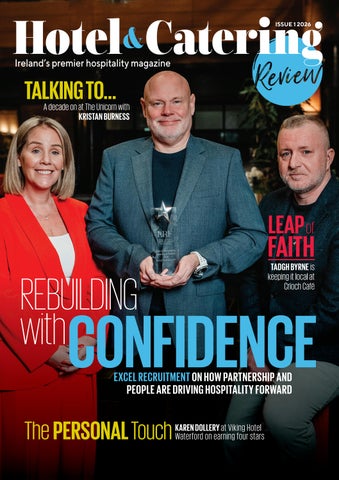
A decade on at The Unicorn with KRISTAN BURNESS


TADGH BYRNE is keeping it local at Críoch Café


EXCEL RECRUITMENT ON HOW PARTNERSHIP AND PEOPLE ARE DRIVING HOSPITALITY FORWARD


KAREN DOLLERY at Viking Hotel Waterford on earning four stars


Aaron Mansworth has been recognised for his contribution to the hospitality industry
Kristan Burness on how business at The Unicorn has changed in a decade
Karen Dollery at The Viking Hotel chats about the property’s new four stars
SUSTAINABILITY
Tadgh Byrne on keeping it local at Críoch Catering and Críoch Café
2026 OPENINGS
A look at the hotels and restaurants opening this year


“You can genuinely feel hospitality coming back to life. Every month, we’re seeing new hotels open their doors, new restaurant concepts launching and fresh investment across the sector. After a di icult period, there’s now a real sense of

Shane McLave, Managing Director, Excel Recruitment


Hospitality businesses are feeling the strain of increasing costs
HOW I SEE IT
Tim Daly on making the most of every ingredient


Editor: Denise Maguire
Creative Director: Jane Matthews
Art Director: Lenny Rooney
Stock Photography: iStock
Infographics: www.flaticon.com
Production: Claire Kiernan
Sales Director: Trish Murphy
Managing Director: Gerry Tynan
Chairman: Diarmaid Lennon
Published by:
Ashville Media,
Unit 55 Park West Road, Park West Industrial Estate, Dublin 12, D12 X9F9. Tel: (01) 432 2200
ISSN: 0332-4400
All rights reserved. Every care has been taken to ensure that the information contained in this magazine is accurate. The publishers cannot, however, accept responsibility for errors or omissions. Reproduction by any means in whole or in part without the permission of the publisher is prohibited. © Ashville Media Group 2026. All discounts, promotions and competitions contained in this magazine are run independently of Hotel & Catering Review. The promoter/ advertiser is responsible for honouring the prize.

Editor: Denise Maguire
Email:
denise.maguire@ashvillemediagroup.com
Welcome to issue 1 of Hotel & Catering Review 2026
After a few tumultuous years, the hospitality industry is finally showing signs of recovery. That’s according to Excel Recruitment, our cover feature for the first issue of the year. Although pressures remain such as the introduction of auto-enrolment, higher wage bills and PRSI increases, the focus has shifted from survival to stability. Several new hospitality businesses are scheduled to open this year (go to page 24 for our ‘Opening in 2026’ feature), reflecting an industry focused on steady, sustainable growth. You can, says Excel Recruitment MD Shane McLave, almost feel hospitality coming back to life. “After a difficult period, there’s now a real sense of momentum and ambition returning.” For more on Excel’s take on the future of the industry, turn to page 16.
Also in this issue, we chat with Karen Dollery at Viking Hotel Waterford. Towards the end of 2025, the property announced its new four star status. A major refurbishment and a genuine commitment to customer service has earned the property its new classification, says Karen. On page 14, restaurateur Kristan Burness talks about how business has changed at The Unicorn in the past decade. Expectations have evolved; customers are more adventurous but they also want more from a dining experience. Elsewhere in this issue, we talk to Tadgh Byrne about taking on the café in the Mermaid Arts Centre in Bray. The aim, says Tadgh, is to create a place where people can come together to enjoy healthy, sustainable food and memorable experiences.
In late 2025, Aaron Mansworth received a special recognition award from the Cork branch of the Irish Hotels Federation. The Managing Director of Trigon Hotels was honoured for his exceptional contribution to the hospitality industry, with judges describing him as someone who “has an uncanny ability to steady any ship, no matter the weather.” For more on Aaron's award, turn to page 12.
As always, there’s plenty to enjoy in this issue. If you have any thoughts or opinions on this month’s content, please do drop us a line.
Denise Maguire

Learn to use Artificial Intelligence in your business and everyday life with AI micro-qualifications — short, targeted, subsidised courses delivering the skills you need.
BOOST SKILLS, BOOST BUSINESS skillstoadvance.ie


Giulia Rondini, Food & Beverage Supervisor at Dooley’s Hotel, Waterford was named the 2025 Irish Hotels Federation (IHF) South East Branch ‘Employee of the Year’ at the Christmas Gathering and Employee of the Year Awards. Giulia has worked at Dooley’s for over two and a half years and is currently completing a full-time International Management course at SETU (South East Technological University). Colleagues say Giulia’s commitment plays a vital role in making every guest’s experience memorable and seamless. On the night, ‘Special Merit Awards’ were presented to Linzie Jadoo (Riverside Park Hotel), Natasha Maguire (Talbot Hotel Carlow) and Alice Cahill (Majestic Hotel Tramore). There were also two ‘Highly Commended Awards’ for Ela Morat (Kilkenny River Court Hotel) and Marie O’Flaherty (The Hoban Hotel, Kilkenny).


The g Hotel in Galway city has announced a new name for its spa, now known as The SPA at the g. As part of the name-change, the new spa has introduced Ground Wellbeing as its new spa partner. The hotel says the evolution of The SPA at the g and its partnership with Ground Wellbeing reflects a growing shift in how people are approaching wellness. Guests are increasingly seeking natural products, slower rituals and spaces that offer a genuine sense of escape. Designed around light, water and warmth, The SPA at the g is intentionally cocooning, inviting guests to pause, exhale and reset. General Manager Bastien Peyraud said: “The evolution of The Spa at the g and our partnership with Ground Wellbeing reflects a growing desire for more natural, holistic wellness experiences and spaces that allow the mind and senses to truly rest. Our spa is intentionally cocooning and softly lit, designed to slow the nervous system and restore balance. Ground’s plant-based, ritual-led treatments align seamlessly with this philosophy, while the spa itself has become a meaningful place for guests to reconnect with themselves and with each other.”


In January, ‘Tour de Fred’ showcased Mount Congreve, taking a look at the estate’s sustainable approach to growing and cooking, led by Head Chef Jean-Baptiste Dubois. The TV series, which airs on ITV, follows maître d Fred Sirieix as he cycles around Ireland’s South-East, taking in the attractions the region has to offer. One of his first stops was Mount Congreve, where he experienced The Stables Café’s new “350m Estate to Plate” menu, focused on ingredients grown, harvested or foraged within 350m of the café. The show featured JB and Fred cooking in Oak Gate Lodge, one of Mount Congreve’s newly restored historic gate lodges. Once derelict, the lodge has been restored to retain its historic character and is now part of the wider Forest Accommodation collection at Mount Congreve. Sara Dolan, CEO of Mount Congreve, said: “We are thrilled to feature in 'Tour de Fred'. Its last series attracted over two million viewers across Britain. We are delighted to be part of the second series, sharing the beauty and rich history of Mount Congreve Gardens with such a wide audience.”


Europe’s event-driven tourism sector maintained strong momentum in 2025, with overall tourism spend rising by +7% year-on-year. That growth reflects sustained demand for live experiences and the considerable economic value they generate for local communities, according to a study by Mabrian and Data Appeal. The study draws on data from 12 European countries and shows that expos were up 4.5% in 2025 in Ireland. The data also reveals four distinct scenarios for the growth of event-related tourism spending in Europe. The first includes countries where spending rises across almost all event categories, while the second covers destinations where tourism spending around sports matches and exhibitions is increasing strongly despite declines in other categories, as seen in Ireland, Austria, Greece and the Netherlands. Across the 12 European countries studied for the report, nearly nine in 10 events held in 2025 were music concerts, professional conferences and sports matches. Concerts are particularly prominent in Ireland, Germany and France. “As events continue to grow across Europe, their true value lies in the wealth they create for local communities and their capacity to help redistribute tourism activity across territories and seasons. That is why destination event management should be closely aligned with the destination’s development and sustainability strategy,” says Carlos Cendra, Chief Marketing and Communications Officer at Mabrian.


Subsidised upskilling programmes from the Irish Hotels Federation Skillnet is supporting the growth of businesses in the hospitality industry.


Patrick Kickham-Lennon, Hotel Manager at Seafield Hotel & Spa Resort in Co Wexford, completed a Level 7 Certificate in Applied HR Management through the Skillnet, an achievement that has directly strengthened the resort’s ability to attract and retain staff. “The benefits arising out of the training for us were transformational. Our staff turnover rate now stands at 11.01% against an industry average of over 30%. The three-month retention rate of new starters within our business is now at over 97%, which is extraordinary. Since engaging in the training with the IHF Skillnet, I have progressed from Deputy General Manager here at the resort to Hotel Manager,” said Patrick. Irish Hotels Federation Skillnet Network Manager, Dervla O’Neill, said: “We really focus on three things; one is looking at the tailored needs for immediate gaps within the industry. We also look into the future, what are the ever-evolving needs going to be for the industry and really creating a framework for career progression for all team members within hotels and all hotel departments.”
Courses available through Skillnet Business Networks include the Hospitality Leadership ESF+ Micro-Credential (Level 9), run by Restaurant & Hospitality Skillnet, designed to provide clear benefits to both businesses and employees, including stronger strategic leadership, improved financial accountability and enhanced team engagement. The Leadership Excellence in the Travel Industry programme focuses on improving leadership skills for travel industry professionals with modules such as Leadership and Team Growth, Digital Transformation and Sustainability in the Travel Industry.


Diageo has announced that it’s increasing the price of its draught products by a further seven cent per pint (ex VAT), effective from 2nd February. The Vintners’ Federation of Ireland (VFI) has strongly criticised the move, warning that it will pile yet more pressure on pubs already struggling to survive.
Drink costs are the single biggest cost facing publicans and this latest increase comes at a time when margins are already being eroded by rising labour costs, high energy prices and ongoing inflation across all areas of the business. For many pubs, there is simply no capacity left to absorb further supplier increases.

Pat Crotty, CEO of the VFI, said: “Publicans are being hit from all sides, but drink costs are the biggest burden they face. This latest price increase from Diageo will put even more pressure on pubs that are already operating on extremely tight margins. Many will be left with no option but to pass this on to customers, which helps nobody.”
He continued: “Our members understand that suppliers also face rising costs, but there comes a point when pubs simply cannot keep carrying these increases alone. Pubs are at the heart of local communities and suppliers depend on them for their route to market. We expect suppliers, including Diageo, to recognise that reality and to support VFI members rather than repeatedly adding to their cost base.”
The VFI warned that repeated supplier price increases are contributing to rural pub closures, where pubs are already under severe pressure from declining footfall and rising operating costs.
“This isn’t just about the price of a pint,” said the VFI CEO. “It’s about the long-term viability of pubs across the country. Community pubs are being pushed to the brink and continued increases in drink prices only accelerate that trend.


“Publicans cannot continue to absorb these hits year after year. If suppliers value the role pubs play in Irish life, now is the time to show it through meaningful support. Without action, more pubs will close and once they’re gone, they’re gone for good.”


Former Munster, Ireland and British and Irish Lions rugby captain Peter O’Mahony has launched Active Brewing Company, a Cork-based non-alcoholic beer venture, cofounded with Pat Falvey of Blarney Brewing Company. The company’s initial releases will include two 0.0% beers – a non-alcoholic lager and a non-alcoholic pale ale – both developed with a focus on flavour and drinkability rather than functionality alone.


Speaking ahead of the launch, O'Mahony said: “As an athlete, I spent years looking for non-alcoholic options. From a sporting point of view, you become very aware of how important recovery and balance are and a lot of people are thinking the same way now. Over time, it became clear there was a gap for something that worked alongside an active lifestyle, rather than against it.” Later in 2026, Active Brewing Company plans to introduce a range of functional non-alcoholic beers, beginning with a product called Recover, designed for postactivity consumption. It will be the first of three functional beers the company intends to bring to market before the end of the year.


For the fourth consecutive year, The Boatyard Distillery has secured its place among the world’s top spirits brands, earning multiple rankings in the Drinks International Brands Report 2026. It’s the only spirits brand made on the island of Ireland to feature in the Bartenders’ Choice category, Bestselling Gin List, Top Trending Gin Category and the Top Trending Vodka category. Described as the “unicorn of the gin world” in the report, Boatyard Double Gin is distilled using organic botanicals and a doublecontact juniper method, resulting in a smooth,
juniper-forward profile. “To be recognised for a fourth consecutive year – and to return to the Bartenders’ Choice list – is so meaningful for our team. Everything we do is built around the bar world. Bartenders need to trust a brand, enjoy working with it and feel confident recommending it. Seeing Boatyard Double Gin and Boatyard Vodka performing strongly across bestselling categories tells us that our focus on quality and authenticity continues to resonate globally,” said Declan McGurk, Managing Director at The Boatyard Distillery.


Ballina Distillery has released its first two expressions – a double distilled, double wood and a triple distilled, triple wood, launched at The Palace Bar in Dublin. The distillery double and triple distils using 100% Irish malted barley, while fermentation is stretched out up to seven days. This gives the spirit its unique body and fruit forward profile.
www.ballinawhiskey.com

For the fourth consecutive year, Heineken Ireland’s Gender Pay Gap Report for 2025 shows a near-zero gender pay gap. The report also shows the company has made significant progress around overall female representation at management levels, increasing from 29% to 49% since 2023. www.heinekenireland.ie
The latest releases, news and all things drinks-related

The Boatyard Distillery has partnered with Intrepid Spirits to get its spirits into more glasses across Ireland. Intrepid will handle Boatyard’s distribution north and south, meaning Boatyard Double Gin, Sloe Boat Gin, and the rest of the range will be easier to find in great cocktail bars, pubs, restaurants, hotels, and off licences across Ireland.
www.boatyarddistillery.com
To celebrate one year in operation, Changing Times Brewery has launched ‘Bleedin Red Ale’, a smooth, malty ale with rich caramel and toffee sweetness, balanced by a subtle touch of earthy hops. The finish is clean and mildly roasted, with a lingering bitterness.

Changing Times believes it will sell 3,000 kegs of the new product by the end of 2027.
www.changingtimesbrewery.com


I have had some tremendous mentors over the years to get to where I am today

AARON MANSWORTH has been recognised for his contribution to the hospitality industry
In late 2025, the Managing Director of Trigon Hotels received a special recognition award from the Cork branch of the Irish Hotels Federation for his exceptional contribution to the hospitality industry. The Special Recognition Award is bestowed on someone from the hotel sector who lifts others up and embodies the very best of Irish hospitality. The judges described Aaron as someone who “leads by doing, who listens before speaking, who encourages others to grow and who has an uncanny ability to steady any ship, no matter the weather.”
A native of Cobh, Co Cork, Aaron’s passion for hospitality was ignited in his family’s bar, where he gained early insight


into the importance of service, community and customer care. He graduated from Shannon College of Hotel Management and began a career that would span two decades, honing his management skills at Jury’s Hotel Group before gaining international experience in Lausanne, Switzerland. His career continued during a summer placement at Marlfield House in Wexford, followed by roles in New York at properties including Waldorf Astoria and The Carlyle Hotel.
Back in Ireland, he took on a series of senior leadership roles, including General Manager at Crover House in Cavan. He later served as Director of Operations at the Heritage Resort in Killenard and held a dual role as Group General Manager of the Cork International Hotel and the Parknasilla Resort in Kerry.
As Managing Director of Trigon Hotels, he leads a team across The Metropole Hotel and Cork International Hotel. He is, he says, deeply focused on fostering a strong organisational culture, driving innovation and ensuring that Trigon remains synonymous with warm Irish hospitality and best-in-class service.
Speaking about the award, Aaron said: “I am blown away by this award and I would really like to thank the Cork branch of the Irish Hotels Federation for honouring me in such a way. I’d also like to thank all the members for their support and friendship and for making every day in the Cork hospitality sector so rewarding. I have had some tremendous mentors over the years to get to where I am today and it is humbling to know that I am now considered as someone who leads by integrity in the industry.”


CAN TASTE
Exceptional dining begins with exceptional tools. Brodericks and Victorinox deliver unmatched reliability and precision to the kitchens that set Ireland’s standards.


The restaurateur on rising customer expectations and how business at The Unicorn has changed in a decade

HOW IS BUSINESS AT THE UNICORN DIFFERENT FROM 10 YEARS AGO?
Business is going well and The Unicorn continues to be a lively, social meeting place in the heart of the city. While the industry has changed significantly over the past decade, the core spirit of the restaurant has stayed the same. Ten years ago, it was very much about being a local hub and today that sense of community and atmosphere is still central. What’s different now is that it feels more energetic – people are meeting friends, enjoying both business and leisurely lunches, heading in before theatre shows or starting their night out here and often finishing the night here or at No5, our sister bar, too! Customers are also more informed, more adventurous with food and more conscious about quality and experience, something we’ve embraced while retaining the positive, welcoming energy that The Unicorn has always been known for.
HOW HAS YOUR CONCEPT FOR THE RESTAURANT CHANGED?
The concept has evolved naturally over time. While we’ve always focused on comfort, atmosphere and

honest food, we’ve expanded and refined the menu to reflect changing tastes and more social styles of dining. We’ve introduced new elements such as fresh pasta dishes and seasonal additions, allowing us to be more creative while still staying true to what our customers love. The pre-theatre menu has become an important part of that, offering great value, quality food in a relaxed, upbeat setting for people heading into the city for the evening. It’s about progression rather than reinvention, keeping things familiar, but always improving.
WHAT ARE THE MAIN CHALLENGES YOU’RE FACING?
The main challenges are rising costs across every aspect of running a restaurant, from produce and energy to suppliers and operations. It requires constant attention and careful planning but with experience and strong systems in place, we’ve been able to manage those pressures while continuing to deliver quality food and a vibrant social experience for our customers. We’re also operating in a much more competitive environment.
Customer expectations are higher than ever, not just in terms of food, but atmosphere and overall experience. That means continually investing in quality, consistency and service, particularly during busy pre-theatre and evening periods.
IS IT HARD TO GET STAFF?
We’re very fortunate to have a loyal core team who know the business well and play a huge role in creating the friendly, energetic atmosphere at The Unicorn. While recruitment can be more challenging than it once was, having experienced, committed staff gives us real stability.
HOW DID YOU GET STARTED IN THE INDUSTRY?
I started my training in the UK, where I’m originally from and at 18 moved to London, working in various restaurants, including some Michelin starred establishments, that helped build my experience in the culinary world. I also spent some time in Tuscany learning from some of the best at Scuderia di ALMA, under the
direction of Gualtiero Marchesi before moving to Ireland to work with Conrad Gallagher in the opening of Peacock Alley. Ever since then it’s been the ride of a lifetime.
WHAT DO YOU LIKE ABOUT THE INDUSTRY?
It’s the people. Meeting customers, seeing groups come together and knowing the restaurant plays a role in people’s social lives is incredibly rewarding. There’s also a creative side, developing menus, responding to trends and keeping things fresh. The industry is demanding, but it’s never boring.
DO YOU HAVE A FAVOURITE DISH ON THE MENU?
Gotta be the Filetto di Manzo, the mix of a beautifully cut dry-aged John Quinn steak and our mushroom pancetta, amarone jus is just unbeatable.
WHAT’S YOUR FAVOURITE RESTAURANT IN DUBLIN (APART FROM YOUR OWN)?
Maybe Gigi’s!

We’re very fortunate to have a loyal core team who know the business well and play a huge role in creating the friendly, energetic atmosphere at The Unicorn


The hospitality sector is rebuilding with confidence as partnership and people drive sector momentum
Excel Recruitment has once again been recognised at the Employment and Recruitment Federation (ERF) Awards, receiving the Best in Practice: Catering, Events & Hospitality title for the second consecutive year. This recognition reflects a consistent approach to supporting the hospitality sector, built on long-standing partnerships with clients and the ongoing commitment of temporary staff, candidates and employees across the business. In a people-driven industry, the award serves as a reminder that sustainable success is shaped through collaboration as much as performance.


That sense of shared progress is echoed across the wider hospitality sector as Ireland enters 2026 with renewed confidence and momentum.


You can
genuinely feel hospitality coming back to life. Every
month, we’re
seeing new hotels open their doors, new restaurant concepts launching and fresh investment across the sector. After a difficult period,
there’s now a real sense of momentum and ambition
returning
After several challenging years marked by rising costs and operational uncertainty, the mood across hospitality, particularly in Dublin, has shifted noticeably. While pressures remain, including wage inflation, PRSI increases and the introduction of pension auto-enrolment, the prevailing outlook is increasingly focused on long-term stability rather than short-term survival.
Rather than a single breakout year, the sector’s recovery is taking the shape of steady, sustainable progress. New hotels are opening, restaurant concepts are launching, and investors continue to back Dublin as a destination for both domestic and international visitors.
This renewed confidence is perhaps most evident in the calibre of recent and upcoming hospitality openings across the capital. Hotels such as The Hoxton Dublin, The Moxy East Point and The Leinster have added momentum to the accommodation market, while several thousand additional rooms are currently under construction or in planning.
On the food and beverage side, the arrival of The Ivy Asia stands out as a particularly strong signal of confidence. As a globally recognised, experience-led dining brand, its decision to open in Dublin reflects belief in the city’s premium dining market and the continued appetite for high-quality hospitality experiences. Other launches, including Bar Pez and a growing number of wine-led and concept-driven venues, further reinforce the sense that operators are investing with intention rather than caution. Collectively, these developments point to a market that is recalibrating – prioritising quality, experience and long-term sustainability.
Shane McLave, Managing Director of Excel Recruitment, notes a clear shift in sentiment across the sector. “You can genuinely feel hospitality coming back to life. Every month, we’re seeing new hotels open their doors, new restaurant concepts launching and fresh investment across the sector. After a difficult period, there’s now a real sense of momentum and ambition returning.”
This activity is being supported by stronger booking patterns, recovering tourism numbers and the gradual return of conferences, events and corporate travel – all of which play a vital role in supporting year-round demand.

Cost pressures remain a reality for hospitality employers. Minimum wage increases, higher PRSI contributions and the rollout of pension auto-enrolment are expected to increase labour costs for minimum-wage roles by approximately 6% in 2026.
However, many operators are responding strategically. Rather than limiting growth, businesses are investing in smarter workforce planning, operational efficiencies and technology. Digital check-ins, mobile ordering and automated inventory systems are helping to reduce administrative burdens while preserving the personal service that defines Irish hospitality.
The hospitality workforce itself is also changing. Recent labour market research shows that more than 80% of hospitality employees now view the sector as a viable long-term career – a significant improvement compared to previous years.
Employers are responding by placing greater emphasis on predictable scheduling, work-life balance, training and progression pathways. Accommodation supports and structured upskilling initiatives are becoming increasingly common, particularly among new and expanding operators.
Temporary and flexible staffing models continue to play a crucial role, especially for newly opened hotels and venues managing phased launches, seasonal peaks and event-driven demand. This flexibility allows businesses to scale efficiently while maintaining service standards.
As a specialist hospitality recruitment partner, Excel Recruitment continues to work closely with hotels, restaurants and event venues nationwide as they navigate this next phase of growth.
From building full teams for new openings to supplying temporary chefs, front-of-house staff and event personnel, the focus remains on providing flexible staffing solutions that respond to real operational needs. This approach has become increasingly important as businesses adapt to a more dynamic and cost-conscious operating environment.
In 2024, Excel also launched the Irish Bar Academy, a hands-on training initiative designed to equip both new entrants and experienced staff with practical, job-ready bar skills. The programme reflects a broader belief that long-term sustainability in
The industry is under pressure from rising costs, but we’re also seeing genuine recovery. Businesses that invest in their people, improve working conditions and embrace operational efficiencies are well positioned for long-term success
hospitality depends on continued investment in people and professional development.
While challenges remain, the direction of travel for Irish hospitality is increasingly positive. Guests are returning, investment is continuing and operators are hiring again. High-profile openings, combined with a renewed focus on people, partnerships and operational efficiency, provide tangible evidence of confidence in the sector’s future.
As McLave concludes: “The industry is under pressure from rising costs, but we’re also seeing genuine recovery. Businesses that invest in their people, improve working conditions and embrace operational efficiencies are well positioned for long-term success.” With renewed energy, evolving workforce models and strong collaboration across the industry, Irish hospitality is not just recovering - it is rebuilding with confidence.


We have a fantastic team here, some of whom have been with us for several years. They have made it their business to get to know our customers and I think it’s the combination of our refurbishment and that personal touch that earned us the new classification
The Viking Hotel General Manager on acquiring four stars and the importance of striking a balance
AT THE END OF 2025, Viking Hotel Waterford announced its newly acquired four star status. The classification is on the back of a major investment that saw all 98 bedrooms refurbished and an upgrade to conference rooms. Owned by the Kelly family and managed by PREM Hospitality, the hotel’s new four star status can also be attributed to its service culture, says General Manager Karen Dollery. “The hotel has come such a long way. Earning the 4 star classification is a great acknowledgement of all the hard work that goes on behind the scenes. We have a fantastic team here, some of whom have been with us for several years. They have made it their business to get to know our customers. I think it’s that personal touch, along with the renovations, that helped us attain the new classification.”
The new rating will enhance the attractiveness of the property on the global market, says Karen. “Businesses on the GDS quite often only search for four-star hotels so straight away, we have access to a wider market. We’re hopeful that we’ll be able to attract more of that type of business. We’re at a different level now, one that matches a higher set of criteria set by businesses.”
The late Hugh Wallace designed the refurbished bedrooms, along with the ground floor areas back in 2018. “We have worked with Douglas Wallace for a few years now and they have been fantastic. Hugh himself worked very closely with us and was a great advocate for the hotel. A few years back, he transformed the ground floor lobby, bar and restaurant, which made a huge difference to the hotel. We feel very privileged to have spent that time with him.” Bedrooms were completely stripped back; work was extensive, says Karen. “Everything in the bedrooms was upgraded, from the electrics to the furniture and furnishings. The rooms now have USB ports, an iron and ironing board, a tea and coffee station, interactive TV and full-length black-out curtains. Much of that is standard in a lot of hotels but for us, they further enhance the offering.” Bathrooms were also
refurbished and now feature walk-in rainfall showers and Prija bathroom amenities.
The refurbishment has already brought new business to the hotel, which is located just outside the city, close to the Waterford Greenway. Local events like Winterval, the city’s annual Christmas festival, are great for business. “It brought people out and about over the Christmas period. We’re on the outskirts of the city, so we’re ideal for people that want to enjoy the hustle and bustle of the city but have the peace of the countryside. There’s always a huge amount going on across the county.”
Recruitment and retention can be challenging, but Viking Hotel Waterford is working with a steering group at South East Technological University (SETU) to tackle the issue. “It’s a programme that’s very much in its infancy, but I think it will prove beneficial. The aim is to bring back the basics of training in hospitality and enhance service to guests. The industry has changed so much over the years and in a lot of ways, it has changed for the better. We now recognise that we must work harder to get the balance right for staff and that’s part of the programme too. A lot of stakeholders from across the city are involved – it’s very positive.” The team also work closely with PREM Hospitality around recruitment. “They have a fantastic ethos which attracts staff. We probably have more staff than we should have but I think that reflects the emphasis on culture. It’s all about ensuring everybody gets the best possible work/life balance.”
Balancing the guest’s search for value with rising operational costs is a challenge for all hospitality businesses across the country. Government-imposed costs like higher minimum wage, mandatory sick pay and auto-enrolment have created an almost impossible trading environment. “We try and keep costs down on everything from food, paper, computers, but we’re also aware that the company selling that paper or the farmer selling the milk and butter has the same struggles as us. We strive to give the customer value, but it’s so hard.”


Old school hospitality was a great industry to be part of but it’s not sustainable anymore, says Karen. “Table service at breakfast and lunch for our model of hotel isn’t an option anymore. It’s just too expensive, but we still provide table service for dinner, tour groups and other occasions. It’s important to strike a balance between what’s affordable and what’s realistic to develop a successful business. We have a great operation here – it’s knowing how to make the most of what we have that’s key.”
Up next is more refurbishment, but the less visible kind. “This year, we’ll be carrying out maintenance work including improvements to back of house, to the boiler house and the addition of a water tank. A lot of that work goes unseen but it’s about maintaining what we have so we can continue to offer our guests a great service.”
We’re on the outskirts of the city, so we’re ideal for people that want to enjoy the hustle and bustle of the city but have the peace of the countryside


Trying to maintain a balance is a challenge, but I have to remind myself that this is a transition period

The Wicklow chef is keeping it local at Críoch Catering and Críoch Café

CRÍOCH Catering’s Tadgh Byrne switched things up last year when he took over the café at the Mermaid Arts Centre in Bray. “It had got to the stage where the catering business was running itself. We had been operating for over five years and business was good. The opportunity to take on a second venue came up, I was familiar with the café and it felt like a natural progression.” The ethos at Críoch Café is to promote local produce, provide high quality food and be the friendliest place in town. Home-made everything is the aim – the team make their own sauces, salad dressings and baked produce. Ultimately, Tadgh wants to create a food hub, a place where people can come together to enjoy healthy, sustainable and ethical food, along with memorable experiences.
Providing sustainable, joyful food is what Críoch Catering has been doing since 2019. Before setting up the business, Tadgh held roles at the Cake Café, Two Pups Coffee, Powerscourt Hotel, Druids Glen Golf Resort and various other properties. “I was a chef, a barista, a restaurant manager and a jack of all trades but master of none. Thankfully, I was able to tie it all together as a business owner and use all those skills when I set up Críoch Catering.”
When Covid hit in 2020, the focus was on staying afloat. Agency work, predominantly in hospitals, kept the business going. “That was really the only show in town at the time and I was lucky to get it. After Covid, it was all about building up a client list, piece by piece. When you’re in the kitchen, you don’t have time to be out hustling for business. Networking events helped and any opportunity I got, I took.” Tadgh viewed every job as a showcase for his work. “A good example was early on with Greystones Sailing Club. The fee was low but I was assured I’d get lots of work out of it. My first instinct was to turn it down; I didn’t want to work for free or devalue what I was doing. But I went for it and it worked out. Sometimes you have to take a leap of faith.”
That leap paid off. Last year, Críoch Catering came out on top in the “Provenance Menu of the Year” category at the Gold Medal Catering Awards. “Local” and “sustainability” aren’t just buzzwords in Tadgh’s kitchens; they’re at the heart of the two businesses. In 2024, he collaborated with Dublin filmmaker, Max Barry, on a documentary exploring how Ireland will eat in 2050. Sustainability, technology and food security were some of the topics up for discussion. He’s also involved with Wicklow Naturally, the official food and drink network for the county. “I’m passionate
about promoting Wicklow and its produce. It’s something I get to do at Mermaid and through the catering side of the business.”
Juggling the two businesses is tough, says Tadgh. “Trying to maintain a balance is a challenge but I have to remind myself that this is a transition period. Stress is inevitable. It took me five years to get the catering side of things up and running so it’ll probably take a few years to get the café to where I want it to be. I’ve learned a lot with Críoch Catering so I can deal with some of the issues at the café almost before they crop up.” Recruitment is one of those issues. “I put a lot of energy into hiring and doing in-depth interviews to make sure potential employees are the right fit. Developing people and checking in with them is also so important. It helps to keep things running smoothly.”
Although the café is moving in the right direction, taking on a second business isn’t for the faint-hearted. For now, the catering business is propping up the new café. “We’re getting there slowly. Costs just keep going up and up, there’s no respite. The only thing I’ve been able to do is take a pay cut myself. If you want to make money in this industry, your only option is to keep working harder and harder. In the long run and as I get older, I don’t know how sustainable that approach is but for now, that’s what I have to do.” Costs
have continued to rise over the past three years. Chocolate, in particular, has increased significantly. “Chocolate prices are crazy! With coffee, we’re lucky in that our supplier has enough stock for the next year so he hasn’t put his prices up. When it comes to the menu, I won’t compromise on quality so that means we have to absorb the extra cost. I still get my free-range eggs from the local farmer and the best quality yoghurt I can source. That was the ethos from the start and not something I’m willing to negotiate on.”
For now, the focus is on growing both sides of the business. “I have to just keep going until the VAT rate finally returns to 9% in the summer. That will take some of the pressure off. I think there’s great potential here, especially for Críoch Catering. It could be like one of the big Irish catering companies, providing a high quality offering to some of the big multinationals. I love the hospitality industry but realistically, I’ve probably got another 10 years in me. Who knows, maybe then I’ll be bought out and I can finally have a rest!”


When it comes to the menu, I won’t compromise on quality so that means we have to absorb the extra cost


Chef Cúán Greene’s much talked-about venue is slated to open in Abbeyleix this summer. Set on 4.2 acres just outside Abbeyleix town, Ómós is a 16-bedroom guesthouse and 40-seat restaurant and the first hospitality venture for the ex Noma and Geranium chef. Cúán’s aim is to serve inventive but grounded, producer-driven food with an emphasis on taste and sustainability. “Ómós is, in a way, the sum of my experiences so far,” he says. “Celebrating what we find here now and the connections made through food while working and travelling away. Ómós is what I’m bringing home.”
Bookings are open from this spring at The Grace Westport Estate, a five-star hotel replacing Hotel Westport. The property, owned by the Hughes family, sits within the 430-acre Westport Estate which is set to become a top tourist destination in the West of Ireland. The focus at the 129-bedroom hotel is on slow luxury, “offering a deeply authentic experience for every guest, inspired by the unique history of Westport Estate and the spirit of the Wild Atlantic Way,” said General Manager Ciaran Reidy, former GM at The Johnstown Estate.


We take a look at some of the restaurants and hotels due to open their doors in 2026


Mark Moriarty Studio will open at Wilton Park later this year. The studio and test kitchen will be used by the chef for recipe development, television and podcast production, photography shoots and events, as well as a restaurant space with weekly restaurant nights. The aim, says Mark, is to create a flexible space that can be adapted to showcase food in different ways.
Marking Galway’s first new fivestar hotel in over two decades, The Hawthorn by Galway Bay is due to open early this year. Connacht Hospitality Group has invested €60 million into the new property which will combine a hotel, golf course and wellness spa on the edge of Galway Bay. The 114-bedroom hotel is also the realisation of a long-held vision first imagined by Christy O’Connor Jnr. Christy designed the original Galway Bay Golf Course in 1993, foreseeing the site as a destination that would unite great golf and great hospitality. Now, 30 years later and 10 years after Christy’s passing, that vision is being brought to life by the Connacht Hospitality Group. Irish hotelier John Keating has taken up the role of General Manager, while Dean Montgomery has joined as Director of Golf. “For us, it’s much more than a hotel. It’s the fulfilment of a vision that began with Christy O’Connor Jnr and his belief in this extraordinary place. We’re proud to continue that legacy, creating a destination that brings the warmth and authenticity of Galway hospitality together with the standards of a world-class luxury hotel. Every detail, from the design to the service, reflects our ambition to create something truly exceptional for Ireland’s west coast,” said Group CEO Peter Fitzgerald.


DONAGH DAVERN
Hospitality businesses are feeling the strain of ever-increasing operational costs, writes


We have witnessed many busy restaurants closing down as the cost of servicing the business is simply too high and they cannot make a profit despite their success in attracting patronage

Cost control has never been so important in the hospitality sector. Since the pandemic, inflation has been a huge worry for hospitality professionals in Ireland, peaking in 2022 at 7.8%, before falling to 6.3% in 2023 and falling below 2% by mid-2024. Multiple factors combined to produce this surge in inflation including the war in Ukraine, supply-chain disruptions caused by the pandemic and the inflated cost of energy. The sector is still experiencing the residual effects of these pressures, resulting in elevated prices for consumers. Notably, we have witnessed many busy restaurants closing down as the cost of servicing the business is simply too high and they cannot make a profit despite their success in attracting patronage.
Labour is the hospitality industry’s largest cost area and higher wage costs normally push up inflation. Governmentimposed costs in this area such as a higher minimum wage, increased statutory paid sick leave and pension auto-enrolment contributions, along with increased PRSI contributions,
have significantly pushed up costs for businesses. As the cost of living increased, so too did the hospitality employee’s expectations for wage adjustments, with wage rates rising to 39% and even more of the business’ turnover, increasing from just 32% in 2022. Improved utilisation of technology, including AI-driven labour forecasting, has helped to curtail costs in this area, as has the increased introduction of flexible working and the optimisation of each role in the business, including the use of cross-training.
Energy costs, already a major cost driver for the hospitality sector, were further exacerbated by the war in Ukraine and related supply constraints. Hospitality businesses are particularly high consumers of utilities such as gas, electricity and water. When the cost of energy rises, it affects just about everything else. Large buildings, 24/7 operations and energy-heavy amenities such as kitchens, spas and leisure facilities, compound this exposure. Operators have sought to mitigate these pressures through solar panel installations, water saving technologies, LED retrofits and using smart controls to reduce peak time usage and maximise off-peak consumption.
increase in the price of

increase in the price of


Further waste reduction initiatives have been introduced in areas such as hotel kitchens and these often run in tandem with the search for improved sustainability in an organisation. Suppliers are constantly being reevaluated and independent hotels are joining purchasing groups to leverage volume-based discounts.


Input costs for areas such as food, beverage and services such as maintenance have also increased, making it difficult for hospitality businesses to maintain their service standards. Staples such as butter, cheese and meat are markedly more expensive. According to the Restaurants Association of Ireland (RAI), the cost of ingredients like fruit and vegetables have seen a nearly 50% increase, while beef has increased in price by 96%, leading to this menu option being removed from many dining offerings. Chocolate – a key ingredient for many desserts – has risen by 157%!
Linen rental for bedrooms, restaurants and banqueting has increased due to higher operational costs and general inflation. This saw year-on-year increases of 30% in 2022, according to the Irish


Hotels Federation (IHF). Maintenance and repair services have also become more expensive due to elevated economy-wide labour costs.
The cost of insurance has been another upward cost pressure, largely driven by the high cost of claims. According to the IHF, there was a 24% increase in insurance premiums between 2020 and 2022 and 84% of their 1000 member hotels are concerned about the impact of insurance costs on their business.
To add to the inflation problem, consumers tend to spend less when inflation is high and this has a knock-on effect on luxury goods, with consumers curtailing unnecessary spending on areas such as hotel stays, restaurant meals and other leisure activities.
While the decrease in VAT on most food and non-alcoholic drink sales from 13.5% to 9% from 1st July 2026 is welcomed, businesses must wait until mid-2026 to reap this benefit and many hoteliers were shocked to find out that in the same budget where this tax reduction was given, the VAT on room hire was earmarked to increase. From 1st January 2026, the hire of rooms in hotels or guesthouses for non-accommodation purposes such as meetings, conferences or events, will be subject to VAT at the standard rate of 23%, up from 13.5% previously. Crowe Ireland warns that for a hotel that generates €500,000 in meeting room hire, this change will mean a €40,000 hit to its bottom line if this increased tax rate cannot be passed on to the consumer.
increase in the price of


Relentless increases in operational costs are putting a severe strain on hospitality businesses and the industry is struggling to implement strategies to make savings in these areas. Labour cost, in particular, sees many businesses under severe pressure as they try to control spiralling costs attributed to wage inflation, skills shortages and government-mandated measures. There is no doubt that when it comes to the hospitality sector, profit margins are tightening, leading to growing unease and increasing pessimism across the industry.
Dr Donagh Davern FIHI is a lecturer in Hospitality Management at Munster Technological University and a former hotel General Manager


The Head Chef at The Kingsley in Cork on making the most of every ingredient
IEvery choice, from how we prepare an ingredient to what ends up on the plate, is part of telling the story of the meal. That story is something I want guests to experience every time they dine at The Kingsley
grew up in West Cork surrounded by good, fresh ingredients. That early experience taught me to value food at its best and to appreciate the effort that goes into producing it. At The Kingsley, I try to bring that same approach to every dish. Hotel dining is more than putting food on a plate; it’s about giving guests an experience that tastes thoughtful and genuine, while showing care for every ingredient.
We work with what is fresh and in season. When a vegetable is at its peak or a cut of meat is particularly good, we shape dishes around it. Sometimes that means adjusting a dish slightly to make the most of the ingredients. It keeps the menu vibrant and allows us to offer food that feels natural rather than forced. Making the most of every ingredient is something I take seriously. In a busy kitchen, it’s easy for parts of vegetables or other produce to go unused, but we turn them into stocks, sauces or daily specials.

It’s practical, but it also encourages creativity. Some of our most popular dishes have come from experimenting with ingredients that might otherwise have been overlooked.
Sustainability isn’t about limiting choice or flavour. It’s about sourcing thoughtfully and using ingredients carefully. We taste everything as we cook and adjust dishes to highlight the ingredient’s quality. That way, every plate that leaves the kitchen is as good as it can be. Guests enjoy the food and we know we’ve respected the work behind every element of the dish.
Working this way is a privilege. Being able to make considered decisions in the kitchen, reduce waste and focus on quality makes cooking rewarding. Every choice, from how we prepare an ingredient to what ends up on the plate, is part of telling the story of the meal. That story is something I want guests to experience every time they dine at The Kingsley.
Ultimately, sustainability in hotel dining is about balance. It’s about serving food people enjoy while thinking carefully about where it comes from and how it’s used. When it’s done well, it’s meaningful and full of flavour. That’s the experience I aim to provide every day in my kitchen.


• 330ml is the perfect
• 45% of consumers seek


• 6/10 consumers would pay higher for a glass


