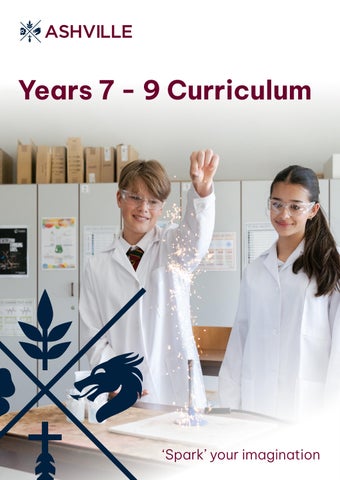
Years 7 - 9 Curriculum
‘Spark’ your imagination
Ashville’s academically ambitious and inspiring curriculum in Years 7, 8 and 9 is designed to foster a genuine love of learning and curiosity about the world we live in. As an independent school we are able to go beyond the national curriculum and ensure our pupils have the knowledge and skills that equip them both for future academic challenges, and for success in life after Sixth Form. In a world changed radically by information technology, and now artificial intelligence, it is vital that Ashvillians have the domain specific knowledge and the wider skills they will need to flourish. There are many super-curricular opportunities to explore academic subjects further. Guest speaker sessions, entry to competitions and learning outside of the classroom with trips, form part of life in Senior School. Our Future Ready Programme in Years 7, 8 and 9 includes career spotlights, workshops, and enterprise activities, and contributes hugely to pupils achieving the skills required to navigate our fast-changing world. We believe education should involve inspiration, learning through personal contact and nurturing relationships within a supportive community. Teachers teach best those they know. Even more importantly, pupils learn best from those who know them. The small class sizes, culture and overall scale of Ashville make this possible. All our teachers are passionate about their subject areas and have developed a knowledge rich experience for our pupils which is tailored to spark interest, enthusiasm, and perhaps a lifelong relationship with a broad and diverse range of topics.
The Ashville curriculum incorporates core academic skills including revisiting and revision to develop fluency in the knowledge and skills we teach. All pupils will have the opportunity to demonstrate their learning in half termly milestone assessments which build resilience and the expertise needed to succeed. As parents, you will receive an update on your child’s academic progress and approach to learning every half term. Every term you will have the opportunity either to meet your child’s teachers at Parents Evening or have more detailed written feedback, so you have an holistic overview as your child progresses through the school. Recognising, supporting, and celebrating excellence is at the heart of our mission at Ashville. Our Scholarship Programme looks to identify pupils joining Year 7 who have excellent potential academically or in music, art drama and sport. Academic scholars are identified using our entrance examinations and receive additional challenge and support through our co-curricular programme, events and the Scholars’ Dinner. Music, Art, Drama or Sport scholarships are awarded based on practical assessments. Scholarships are reopened as pupils move from Year 9 into Year 10 and are awarded based on pupils’ performance in end of year examinations, lessons, or performances.
YEAR 7 - 9 CURRICULUM GUIDE 2026 - 2027
A Diverse Curriculum With the best A Level results in Harrogate again for 2025, Ashville is proud to offer a breadth of subjects in Years 7, 8 and 9 to lay the foundation for a successful academic journey.
Art and Design
German
Classical Civilisation and Latin
History
Computer Science
Maths
Design Technology
Music
Drama
Physical Education
English
PSHE
French
Religious Studies
Food and Nutrition
Science
Geography
Spanish
Core Subjects ENGLISH We aim to showcase to pupils the diversity and breadth of literature not only from England but a range of cultures and time periods, combined with opportunities for them to develop their own creative and journalistic writing skills. Each unit studied revolves around a theme, with one main text supplemented by satellite texts of various genres and forms. We begin in Year 7 with thematic units which expose pupils to a wide range of world literatures, including our Monsters topic which spans texts from Beowulf to Harry Potter. Our newly revitalised Childhood Through Time unit allows pupils the chance to study literature from a range of time periods and cultures, whilst the year ends with study of Afghanistan with the novel The Breadwinner. Year 8 look at genres including the Gothic, Dystopia and Comedy, preparing for future study whilst exploring classic texts such as Dracula and modern interpretations of the genre such as The Hunger Games. Year 9 look at modern texts such as Animal Farm and The Crucible in addition to study of a Shakespeare play, and develop persuasive and creative writing skills in response to topics such as Power and Conflict, using as their inspiration satellite texts such as poetry of the First World War and the speeches of Winston Churchill and Barack Obama. Outside of the classroom we put on a variety of activities which enhance pupils’ knowledge of the texts they study and the world of literature more widely. Recent opportunities have included guest lectures from academics, theatre trips and a writing retreat.
MATHEMATICS “Mathematics is the most beautiful and most powerful creation of the human spirit.” - Stefan Banach Mathematics at Ashville is about lighting the fire of learning, making the subject both exciting and relevant and to develop in pupils a thirst and hunger for knowledge. We develop pupils’ fluency in mathematical techniques and their perseverance, so they have the confidence and motivation to solve challenging problems. Pupils are guided to present their ideas in a logical, systematic, and accurate manner and to explain these to others. The Mathematics curriculum at Year 7 to 9 has been carefully sequenced to build knowledge and skills over time and to allow pupils to see connections between different parts of the subject. Each of the main strands of the subject (number, algebra, shape and space, and data handling) are developed and other topics are introduced that are not in the National Curriculum. These include the mathematics behind satellite navigation, financial awareness, basic economics, and the media’s use of misleading statistics. Mathematics, after all, is crucial for pupils to confidently take their place in the world. Beyond the classroom pupils have the opportunity to take part in House competitions and national maths challenges, run by UK Mathematics Trust. STEM days include ‘the chance to make money in the stock market’ challenge and finding the subject across the College through a maths adventure.
YEAR 7 - 9 CURRICULUM GUIDE 2026 - 2027
SCIENCE “Somewhere, something incredible is waiting to be known.” – Carl Sagan At Ashville, Science is all about curiosity, discovery, and understanding the world around us. Our aim is to nurture young scientists who ask questions, think critically, and develop the practical skills to explore answers.The curriculum builds knowledge progressively across Key Stage 3, developing practical skills, analytical thinking, and the ability to communicate scientific ideas clearly. Pupils are encouraged to apply scientific reasoning to real-world problems, fostering a lifelong curiosity about how things work. In Year 7, pupils explore everything from cells and inheritance to separating mixtures, energy, and forces. They carry out experiments using microscopes, test hypotheses, and observe chemical reactions first-hand. In Year 8, pupils continue to develop their scientific skills across biology, chemistry, and physics. They investigate ecosystems, plant biology, and human respiration in biology; explore chemical reactions, conservation of mass, and pollutants in chemistry; and study waves, electricity, magnetism, and pressure in physics. Practical work includes experiments, environmental sampling, and investigations that bring theory to life. Beyond the classroom, Science at Ashville is hands-on and exciting. Pupils take part in House Science competitions, British Science Week challenges, talks from visiting scientists, and Practical Science Club, encouraging independent projects and real-world connections. At Ashville, Science is not just a subject, it is an adventure waiting to be explored.
Other Subjects ART AND DESIGN At Ashville, we view Art and Design as a journey of discovery and a means for every pupil to express their ideas, emotions, and unique identities. Through art, craft, and design, pupils explore their surroundings, learn to think both creatively and critically, and understand how art influences our history and shapes our future. Our curriculum fosters imaginative risk-taking and problem-solving skills, helping pupils build confidence, resilience, and a sense of personal accomplishment. Art at Ashville goes beyond creating beautiful works; it’s about gaining insight into ourselves and our place in an ever-evolving world. From the outset, pupils are introduced to the four essential strands that guide our teaching: generating ideas, making creations, evaluating and reflecting, and developing knowledge and understanding. These principles shape our projects and ensure that every pupil becomes both a skilled creator and an insightful thinker. In Year 7, pupils engage in a variety of exciting projects — from abstract mark-making inspired by Kandinsky to Cubist ceramic portraits and nature-themed lino prints. In Year 8, they delve into bold styles, sculpting forms influenced by Henry Moore, experimenting with printmaking techniques like Jasper Johns, and painting vibrant Yorkshire scenes in the style of the Fauvists. By Year 9, pupils are prepared to enhance their technical skills while exploring personal meaning through portraiture, printmaking, and sculpture. They study artists and cultures worldwide — from the precision of tonal portrait drawing to the storytelling essence of Native American totem poles. Each project builds confidence and independence as pupils develop their own artistic voices. Whether they aspire to careers in creative industries or simply want to express themselves more freely, Art and Design at Ashville ignites curiosity, celebrates individuality, and empowers each pupil to view the world with creativity and purpose.
YEAR 7 - 9 CURRICULUM GUIDE 2026 - 2027
CLASSICS The study of Classics, and Classical languages such as Greek and Latin, offer huge opportunities to develop cultural literacy and, with it, a greater understanding of who we are, what we think we know and where we came from. The foundations of western civilisation were laid by Greeks and Italians who wrote, created, thought, fought and destroyed like few others in history. By comparing and contrasting our world with theirs, our aim is to sow seeds of curiosity and investigation that will grow beyond the classroom and throughout the lives of our pupils. Our curriculum typically begins in Year 8 with the study of Latin, followed by Classical Civilisation and Latin in Year 9. We are fortunate to be able to offer both subjects through GCSE and A Levels. We begin Year 8 in Pompeii, at the foot of Mount Vesuvius, studying a real family and their lives in the shadow of a dormant volcano. The tragedy that struck the communities of southern Italy in the late summer of AD 79 has left us with an incredible opportunity to study the lives of ordinary, and notso-ordinary, men and women in the ancient world. We have always aimed to teach languages in the context of the cultures in which they existed and, in Pompeii and Herculaneum, we have the perfect opportunity to do so. In recent years, the department has led large groups of Ashvillians to Pompeii and the Bay of Naples, Rome and mainland Greece whilst, on these shores, we have explored the British Museum and Hadrian’s Wall. Exploring such sites in person offers an opportunity to understand the people that once walked the same streets that is second to none. However the Head of Department, whose own adventures on a reconstructed ancient Athenian trireme fired his love of the subject as a teenager, is a great believer in bringing the ancient world to the classroom when the alternative is not always available. Every year during ‘Sensory Week’, Year 7-9 pupils are given an audio-visual tour of Rome, complete with sights, sounds and even authentic smells. Pupils are tasked with breaking codes that challenge Oxbridge and NASA applicants alike whilst, in summer, the classroom is turned into a pottery workshop. In short, the study of Classical Civilisation and Latin truly expands pupils’ minds and broadens their horizons.
COMPUTER SCIENCE Welcome to an exciting journey into the world of Computing at Ashville, where creativity meets logic and imagination drives innovation. From designing and creating your first game to programming and exploring the power of AI, our curriculum enables pupils to think critically, solve problems, and shape the digital world. The Computing curriculum at Ashville provides a comprehensive and progressive programme of study, encompassing a wide range of topics and skills. From introducing pupils to Microbits as they transition from Key Stage 2 into Year 7, to developing proficiency in Python programming, digital animation, Cybersecurity, and Artificial Intelligence, the curriculum is designed to equip pupils with the knowledge and capabilities essential for success in an increasingly digital world. The future belongs to those who create, not just consume technology.
DESIGN AND TECHNOLOGY Design and Technology at Ashville is all about imagination, innovation and making ideas come to life! From the first project in Year 7, pupils discover how design shapes the world around us — from architecture and engineering to everyday products. Through exciting, hands-on projects, pupils explore topics such as structures, forces, materials, sustainability, and manufacturing technology. They also gain valuable experience in computeraided design (CAD), combining creativity with modern technology to produce professional designs. In our fully equipped workshop, pupils develop practical skills using a wide range of equipment — from hand tools and woodworking machinery to laser cutting, soldering and brazing. Designing and making help pupils become creative thinkers, problem solvers and planners — skills that are essential in engineering, architecture, design, and many other careers. The project-based curriculum in Years 7 to 9 gives plenty of opportunities to make, test and refine your ideas, building a strong foundation for future study at GCSE and beyond where further opportunities await such as welding and wood turning. There are also exciting competitions and clubs to get involved in, including the House DT Challenge and the Rotary Club Technology Tournament. And for those who love to make, our ever-popular Giant Pencil Club is the perfect creative escape! Design and Technology is more than just a subject — it’s where imagination meets innovation, and where the designers and engineers of tomorrow begin their journey.
YEAR 7 - 9 CURRICULUM GUIDE 2026 - 2027
DRAMA Drama is ‘‘Learning through imagined experience’’ - Jonothan Neelands In our purpose built, professional standard studio, we take our KS3 pupils on that imagined, experiential journey where they explore their creativity in a safe, supportive space and in close collaboration with their peers. The primary aim of Drama at Ashville is to promote confidence and participation - creating articulate public speakers, strong team players, and emotionally intelligent individuals who are confident in expressing their creative ideas. Knowledge within Drama is at the very heart of the curriculum – it would be very easy to let the pupils simply create plays every week, but this would teach them a very narrow skillset and not foster any form of development within the subject, therefore we nurture all of the above qualities through shared study of a wide range of different theatrical practices; from Tableaux and Freeze Frames in Year 7 to Stage Combat in Year 9 via Brecht and Political Theatre in Year 8. In Drama lessons within the studio and the wider offering of regular school shows and performance opportunities, anything is possible ... we firmly believe ‘‘if your ideas are constantly risk assessed by your brain, then your heart never truly beats’’
FOOD AND NUTRITION Our Food and Nutrition curriculum is designed to inspire curiosity, creativity, and confidence in the kitchen. We aim to develop pupils to not only understand the science behind food but also appreciate its cultural, ethical, and environmental significance. In Years 7 to 9, pupils explore a range of exciting practical dishes, giving them the knowledge and skills to feed themselves and others a healthy, affordable diet later in life. Along the way, they build essential skills such as knife techniques, safe handling of raw and cooked foods, and accurate measuring and combining of ingredients. Lessons link practical cooking with key scientific and nutritional concepts, for example the role of carbohydrates, fat and protein, health problems linked to a poor diet and how to prevent them, as well as food sustainability and provenance. This combination of creativity, science, and real-world thinking equips pupils with the knowledge and confidence to make informed food choices and enjoy cooking as a lifelong skill. Beyond the classroom, pupils can join our Food for Fun Club, where they experiment with recipes, share ideas, and celebrate the joy of cooking in a relaxed, supportive environment.
GEOGRAPHY We aim to stimulate in our pupils, a curiosity and a sense of wonder about places and people at all levels, from the personal to the global. We have extremely high expectations of all of the pupils we teach and aim to encourage their questioning, critical thinking and reflection upon issues that affect their lives, now and in the future. The department strives to inspire pupils to become global citizens, who advocate for change, by exploring their own place in the world and their values and responsibilities to other people, to the environment and to the sustainability of the planet. We endeavour to foster a lifelong love of geography through varied activities both inside and outside the classroom and prepare well-rounded, resilient pupils equipped with both geographical and transferable skills ready for the world after Ashville, both as members of society and in whatever career path they choose to follow. Our curriculum investigates a broad range of geographical topics that draw upon physical and human geographical themes. Including the more traditional locational geography supporting pupils knowledge of the world and where places are, to ‘new’ geography investigating the opportunities and challenges of electric cars. Throughout Years 7 to 9 they cover topics such as weather and climate, food, sustainability, Heathrow airport expansion, tectonics and volcanoes, diversification, ecosystems and much more. There is no truer phrase than ‘Geography takes you places!’ and at Ashville this is an important part of the Geography Department’s ethos. Every pupil in every year experiences Geography in the field with trips to waste recycling centres to investigate sustainability; Nidderdale to investigate Diversification; and Grassington and Stump Cross Caverns to investigate Limestone at Key Stage 3. All of these are wonderful experiences and often a highlight of the school year. All encourage learning outside the classroom and appreciation for the world we live in as well as lead to the anticipation of the Key Stage 4 and 5 trip to Iceland!
HISTORY Our aim is clear to develop ‘Ashville Historians’ that focus on the History of ‘All People in All Roles’. We have worked hard to build a diverse curriculum which engages pupils and also challenges them, using the work of academic historians throughout their study of the subject. Our curriculum builds chronologically through each year. Year 7 focuses on the wider world with pupils studying the Silk Roads and civilisations, reaching its peak in Baghdad and Mali across the Medieval World. Year 8 moves through major changes across Europe, whether the shattering impact of the Reformation or the destruction of the Transatlantic Slave Trade. Our Year 9 content focuses on the 20th century and social and political changes that continue to impact us to this day. Beyond the classroom there is the chance to get involved in House competitions, join the History Society, and even enter essay competitions. The department is also committed to exploring History in different contexts, whether by visiting the Imperial War Museum in Manchester, or the First World War Battlefields in Europe.
YEAR 7 - 9 CURRICULUM GUIDE 2026 - 2027
MODERN FOREIGN LANGUAGES “If you talk to a man in a language he understands, that goes to his head. If you talk to him in his own language, that goes to his heart.” – Nelson Mandela At Ashville, pupils in Years 7 to 9 enjoy an exciting and enriching journey in Modern Foreign Languages (MFL), studying French, Spanish, and German. The curriculum focuses on developing core language skills—listening, speaking, reading, and writing—while fostering a deep understanding and appreciation of global cultures. Lessons are dynamic and interactive, with a strong emphasis on real-life communication and cultural exploration. In Spanish, pupils delve into topics such as animals in the Spanish-speaking world, carnivals in Cádiz, life in La Habana, Cuba, education rights in Guatemala, Hispanic music, and traditional recipes. In French, they explore schools in French-speaking Africa, Francophone sports, national celebrations, French markets and cuisine, and the unique beauty of Corsica. In German, pupils learn about traditional customs, the German-speaking world, careers involving German, German food and recipes, and famous German brands. Pupils also take part in a wide range of House and National competitions, including the spelling bee, translation bee, poetry and short story writing contests, and even a songwriting competition— encouraging creativity, confidence, and a love for languages. Beyond the classroom, Ashville also offers exciting international trips to Nice, Granada, and Munich, giving pupils the opportunity to immerse themselves in the language and culture they study. Enrichment opportunities also include language clubs such as the UK Linguistics Olympiad, and a variety of cultural events, including film and food evenings and theatre workshops—all designed to deepen engagement and bring languages to life. MFL at Ashville in Years 7 to 9 offers a vibrant, globally minded education that opens doors, broadens horizons, and inspires a lifelong passion for languages.
MUSIC We have developed a curriculum that looks at the advancement of musical styles throughout the ages and incorporates modern technology to support learning styles. This technology enhances performances and compositions with the use of GarageBand on iPads, and industry standard software of Sibelius and Logic on the Mac computers. Music is an art, and it takes a while to master, so our curriculum steadily incorporates different skills throughout the three years, and returns to previous knowledge in order to consolidate learning and enhance within different areas of study. Year 7 pupils focus on ‘Rhythm and the Elements of Music’, performing the film scores of ‘John Williams’, understanding ‘Scalic Melodies’ and learning instrument families through ‘The Young Persons Guide to the Orchestra’. During Year 8 pupils continue to cover performing, composing, music appraising and developing their creative software skills. Areas of study include ‘Understanding Odd Time Signatures’, ‘Classical Forms’, ‘Video Game Music – Level 1’, ‘Rock and Roll’ and ‘Ground Bass’. In the final year of Music at Key Stage 3, pupils keep developing their skills whilst enhancing their software competency. The areas of study during Year 9 are ‘The Blues’, ‘Video Game Music – Level 2’, ‘Latin American Music’, ‘Walking on the Moon’ and ‘Moby’. Once again, pupils will be expected to use technology to compose with, create foley sound effects for the silent movie activity within the Video Game Music – Level 2 assessment.
YEAR 7 - 9 CURRICULUM GUIDE 2026 - 2027
PHYSICAL EDUCATION Pupils across Senior School have access to excellent sport facilities and opportunities with specialist teaching staff and expert coaches. We support pupils who excel and compete at county and national level as well as delivering a curriculum embodying sport for all. Our PE curriculum provision is designed to inspire every pupil to participate in and excel at competitive sport. Most pupils can play sport each day if they wish to through the curriculum and co-curricular opportunities. Games lessons offer structured opportunities to develop skills across a range of core sports including rugby, football, hockey, netball, and cricket. These sessions are delivered by our highly qualified Heads of Sport, whose expertise ensures that pupils receive highquality coaching in an environment that promotes both enjoyment and progression. Our curriculum is designed to physically educate pupils, equipping them with the skills, knowledge, and confidence to lead active, healthy lives. Distinct from our games programme, PE lessons focus on individual development and do not include traditional team sports. Instead, pupils explore a diverse range of activities that promote personal fitness, skill acquisition, and lifelong participation in physical activity. Our outstanding and continually evolving sports facilities provide the perfect setting for pupils to train and compete. We encourage all pupils to represent the College in both midweek and weekend fixtures against other leading schools in the region. Regular games lessons play a vital role in preparing our teams and fostering a strong sense of school pride and teamwork. From Year 9 onwards, pupils benefit from increased choice in their games curriculum, allowing them to tailor their experience to suit their interests and goals. Options include basketball, strength and conditioning, and fitness-focused activities ensuring that every pupil can find a pathway that motivates and challenges them.
RELIGIOUS STUDIES Religious Studies is an exciting and thought-provoking journey that goes far beyond learning about different faiths. Our aim is to develop open-minded, deep-thinking young people who are curious about the world around them. Through the study of religion, ethics, and philosophy, pupils are encouraged to ask big questions, challenge ideas, and explore a range of worldviews. We explore the six major world religions — Christianity, Judaism, Islam, Hinduism, Buddhism, and Sikhism — delving into their core beliefs and practices. Pupils examine how these religions shape the way people understand life, morality, and the human condition. Beyond this, pupils study fascinating thematic topics in ethics and philosophy. In ethics, they engage with real-world moral dilemmas such as medical ethics, crime and punishment, and debates around the sanctity of life. They explore ethical theories from leading thinkers and critically evaluate how these ideas help us make moral decisions. In philosophy, pupils tackle big questions about evil, suffering, and whether God exists, learning how to build and challenge arguments with confidence. Our lessons are vibrant and engaging, with plenty of opportunities for discussion, debate, and reflection. By the end of Year 9, pupils will not only have a strong understanding of global religions and key philosophical ideas, but also the skills to think deeply, argue respectfully, and understand the complex world they live in.
FUTURE READY Introduced in September 2022, the Future Ready Programme aims to provide every pupil with the opportunities and experiences that will help them develop the skills and knowledge they need to thrive in the global workplace of the future. Ashville has a reputation for academic excellence. However, the world ahead for our pupils will not be based on academic performance alone. Employers seek employees who will add value in the role, work well with others, be flexible, use their initiative and be resilient. These transferable skills are increasingly important, if not essential. Future Ready addresses this need but perhaps more importantly provides a vocabulary and understanding that enables our pupils to recognise and articulate their strengths, build their personal confidence and optimise their skills and interests to build a successful, fulfilled future. A key element of the programme is the development of transferable skills. With reference to the World Economic Forum’s Future of Jobs Report (2020 and 2023), we can analyse the key skills required by employers. We are able to teach and track these skills by the use of the SkillsBuilder Universal Framework. Because this breaks each key skill down into teachable steps, we can use it with all pupils, from Reception to Sixth Form.
YEAR 7 - 9 CURRICULUM GUIDE 2026 - 2027
Green Lane, Harrogate, North Yorkshire HG2 9JP www.ashville.co.uk +44 (0)1423 566 358