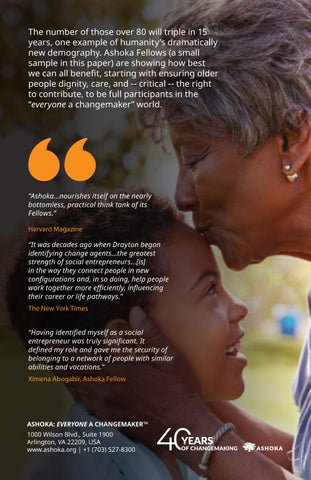
The number of those over 80 will triple in 15 years, one example of humanityâs dramatically new demography. Ashoka Fellows (a small sample in this paper) are showing how best we can all benefit, starting with ensuring older people dignity, care, and -- critical -- the right to contribute, to be full participants in the âeveryone a changemakerâ world.
âAshokaâŠnourishes itself on the nearly bottomless, practical think tank of its Fellows.â
Harvard Magazine
âIt was decades ago when Drayton began identifying change agentsâŠthe greatest strength of social entrepreneursâŠ[is] in the way they connect people in new configurations and, in so doing, help people work together more efficiently, influencing their career or life pathways.â
The New York Times
âHaving identified myself as a social entrepreneur was truly significant. It defined my role and gave me the security of belonging to a network of people with similar abilities and vocations.â
Ximena Abogabir, Ashoka Fellow
A SPECIAL POWER FOR LONGEVITY
In just one century, a remarkable transformation in modern demographics has taken place. The average personâs life expectancy has nearly doubled.
For the first time there are more people aged 64 years-old than children younger than five, and the number of individuals aged 80 years and older will triple by 2050. This Big Shift means that every society is at a turning point, challenging the way humanity has organized itself for millennia. Longer lives wonât just add years to the end of life. It will transform all stages of life.
This new reality demands a new decision-making architecture that will create the necessary preconditions for lifelong giving and therefore healthy ageing and intergenerational mutualism. Prevailing views of aging still discount that when we age purposefully, we accumulate rich experiences and
build insights and wisdom. This momentum moves us forward through our life and equips us to move our communities forward. Todayâs New Longevity requires us to explore many important questions:
What new opportunities arise from living in the most age-diverse society in human history? How do we reverse age segregation and address the loneliness epidemic affecting all generations? How can we lead purposeful, healthy lives as we grow older?
Ashokaâs role is to identify and help build the new architectures (policy, laws, economic incentives, ways of organizing, measurements, and culture norms) and mindsets required for society to thrive at this historic turning point. Building on the innovations of hundreds of top social entrepreneurs in the longevity field, we see three big opportunities for building a better future for all.
1. Health, happiness, and longevity at all ages depends on having and exercising the most fundamental of all rights, the right to give. That means that older people (and all of us) must be able to choose to work at a job, a good job. That is certainly not the case now, causing huge health and other damages. Societyâs new decision-making architecture must signal to the economy to favor using people, not their only substitutes, natural resources (e.g., materials, energy, pollution).
2. In many segments of society, we systematically separate people by age, so people of different ages have less and less contact. This creates social isolation
and encourages ageism. The COVID-19 pandemic highlighted the repercussions of extended isolation. The social costs incurred by segregating our elders from younger generations are no different. New Longevity means promoting social connectedness and purpose for healthy longevity.
What are the architectural changes required here? We all must expect and help older people to be powerful givers, a framework reversal. This also requires society to create tens of millions of new jobs and to learn how to meld the comparative strengths of elders into teams. There are also rich opportunities to build a new class of jobs connecting older nonfamily adults (and others) to young people as allies (e.g., helping young people launch ventures and with learning (2-way).
3. Caregiving is key. It includes helping people of all ages grow as well as helping when they are ill or dying. The best caregiving entails everyone helping everyone be the most powerful giver they can be. Caregivers and the care economy do not get the care and support they need. Contributing here is either not paid or underpaid. Huge changes in framework, pricing, organization, and culture are needed. Caregivers who give a good life through the power of giving/changemaking may well move into a higher professional level.
In todayâs world, where everyone is increasingly interconnected and
change accelerates ever more rapidly, we need everyone to embrace the power of longevity. Older people have knowledge and experiences that should make them powerful contributors, if given the opportunity. The most beneficial course of action is to stop pushing older people aside and instead embrace them on an equal footing with every other disadvantaged group â and all of us â as lifelong givers and changemakers.
The following stories showcases some of the hundreds of Ashoka Fellows who are pushing the Longevity field forward. Their ideas are different but fit together as part of the New Longevity movement reshaping society.
In todayâs world, where everyone is increasingly interconnected and change accelerates ever more rapidly, we need everyone to embrace the power of longevity. Older people generally have experience, knowledge, perspective, savvy, and calm - which, in fact, makes them wonderful contributors. But society must (1) replace disempowering ageism; (2) actively, systematically help older people build their changemaking/ giving superpower; and (3) ensure that there are jobs and that older people are embraced on an equal footing with every other disadvantaged group â and all of us â as lifelong givers and partners.
Over the last decade, Ashoka has learned a powerful approach to dealing with major challenges like that of new longevity briefly outlined above. It begins with its famously rigorous open-source global search for the most important Big new ideas for the good in every field as long as the idea is the work of a sig-
nificant leading social entrepreneur. When a significant number of such Big ideas/social entrepreneurs appear in an area, Ashoka knows that an important need is ripe. Once the need is clear, it is easy to define the purpose. And then the common pattern that best serves this purpose that cuts across all the diversity of the entrepreneursâ/Ashoka Fellowsâ work.
By this time, Ashoka forms a âPurpose Teamâ here for âNew Longevity.â Because the half-life of any solution or pattern is shrinking as the rate of change accelerates, this team must focus hard on the decision-making architecture for the field that will most effectively serve the purpose. This involves finding the right mix of tools: Law/ regulation, economics/incentives, organization, culture, framework change, and tech.
Then itâs clear what must change, and the Purpose Team shifts gears to work with Ashoka Fellows and its growing family of mega âjujitsuâ partners to make the change take hold quickly and globally.
The following pages showcase a small sample of the hundreds of Ashoka Fellows who are pushing the Longevity field forward. Their ideas are different but fit together as part of the New Longevity movement reshaping society.
âLabora Tech is an end-to-end HR technology that helps include workers of all ages at scale, by delivering large-scale recruitment drives for companies based on peopleâs soft and hard skills, matching people to jobs based on these skills, and providing the training, reskilling and mentoring environment to help people thrive in new roles.â
peer-to-peer guides to instruct elderly customers on using the online banking application. After just three months, these branches increased their customersâ digital engagement by over 80 percent, compared to other branches without this senior advantage.
Labora is also pioneering pathways in the IT field. They start by asking large tech companies, âWhat do we miss if everyone on a team is under 30? How could an intergenerational tech team make better products?â
Anne Basting transforms the perception of aging from a period associated with tragedy and loss into one characterized by growth, possibility, and well-being. At the core of her work is an insight she arrived at nearly a decade ago during a breakthrough at a group session in a memory care facility. In simple terms, her insight is to let go of memory and embrace imagination..
As we age, staying socially connected is a crucial part of well-being. But this can be harder for people with living with cognitive challenges like dementia. TimeSlips encourages care partners to move away from the reliance on shared memories as a way to connect, shifting instead toward opening the moment to improvisation and imagination. âCreative engagementâ is a force so powerful that it can break isolation, reconfigure relationships, and unleash joy â even for people who had lost hope of connection.
The inspiration struck her while she wThe inspiration struck her while she was working at a memory care facility for people with dementia. After
weeks of trying unsuccessfully to tap into their memories, one day she brought in a photo of the Marlboro man and invited them to create their own story. âWhatâs his name?â she asked. Someone responded âFred,â and a magical 45-minute story about Fred unfolded. Even people who had been nonresponsive joined in.
âFear and stigma wrap themselves so tightly around an experience that affects 47 million people across the world [dementia]. [âŠ] Science is pushing for treatments, dreaming of cures, but loosening that grip of stigma and fear could ease the pain of so many people right now.â
â Anne Basting, as told to
Singing, tears, and laughter followed, and shocked staff gathered around. Witnessing this transformation, Anne realized she had to expand this activity beyond a weekly one-hour session. She wondered, âWhy canât every day be like this? How do you infuse creativity into an entire care system?â
After a decade of research, Anne has evolved this improvisational storytelling into an evidence-based approach to engagement and relationship-building among people with memory loss, their loved ones, and caregivers, all through the medium of creativity.
These simple yet effective techniques can be learned by anyone, from volunteers and direct care workers to family caregivers and nurses. They serve as the connective
âglueâ for fostering dynamic intergenerational relationships.
Using a worldwide network of trained facilitators, she is expanding this solution to revolutionize care for those with memory loss globally. One interaction at a time, people trained in the TimeSlips approach are changing the focus of care systems from behavior management, toward bringing people into mutually meaningful relationships.
âIn overseas nursing homes that have implemented the TimeSlips programme, it was observed that there were more frequent staff-resident and social interaction[s], and social engagement⊠Staff who participated in the programme also had more positive views of the residents with dementia.â
TimeSlips offers tools and resources to facilitate meaningful connections. For example, TimeSlips shares a list of âBeautiful Questionsâ like âWhat is something you could teach another person?â and âWhat is the most beautiful sound in the world?â
Just as it reshapes communication, imagination also guides everyone in caregiving situations to uncover strength rather than dwell on loss. Bonds of love, trust, and dignity can be built and sustained through shared creativity, with creative products offering a sense of meaning and purpose. Facilitating creative expression and connection is a fundamental skill direly needed by individual caregivers and care systems.
Now that her approach has spread across 49 U.S. states and into 24 countries, Anne is focusing on infusing meaning-making into health systems. By doing so, we can transform nursing homes from places that few people desire to visit or reside in, into integral parts of cultural communities, serving as venues for art exhibitions, live theater, and cultural exchange. We can transform meal delivery systems into systems that invite meaning-making and expression.
BONDING THROUGH BICYCLES
Ashoka Fellow Ole Kassow
Ole Kassow started Cycling Without Age in 2013 to take elderly nursing home residents, who tend to be socially excluded, back into the streets and allows them to be part of ongoing urban life. As the elderly passengers and younger cyclists co-create new experiences on trishaws, Cycling Without Age showcases the joy of intergenerational exchange to society. Alongside fostering intergenerational connections, Oleâs initiative contributes to the physical and mental well-being of both pilots and riders, offering nursing homes a platform to encourage health and mobility.
Since the first ride, Oleâs idea has sparked a global movement spanning 52 countries. Three thousand chapters have been created around the world, pedaled by over 35,000 citizen âpilotsâ. Over 540,000 passengers and pilots have benefited so far. In 2021, the eldest passenger was 110 years old.
â[Cycling Without Age] is transforming the lives of seniors, one bike ride at a time. [âŠ] The organization aims to foster community and promote sustainable development by pairing seniors with volunteer âpilotsâ for bike rides through their neighborhoods.â
âFrom Santa Barbara to Scotland, strangers are becoming friends by going on bike rides together. They get paired up by Cycling Without Age, an organization that helps seniors go for bike rides, even if they canât pedal themselves.â
PLANNING FOR 100
Ashoka Fellow
Ximena Abogabir
If you knew youâd live to be 100, what would you do differently? How would you spend those years?
Ximena discovered that 65 percent of Chileans aspire to work beyond retirement age, not only for financial reasons but also to find purpose and connections. Her programs and digital platforms enable seniors to assess their skills and requirements and present them to employers interested in benefiting from the senior advantage.
TravesĂa 100, also known as âJourney to 100,â encourages us to ponder this significant question. Not everyone will reach 100, but the key is to develop a concrete plan for security, personal growth, and happiness beyond the age of 60. The organization enables people 60+ who want to stay active, build new networks, pursue projects with purpose, promote intergenerational entrepreneurship, and leave the world better than they found it.
People aged 60 and older today are more active and educated than their predecessors, and Ximenaâs organization is a necessary intervention, as older people in Latin America are a largely untapped resource. The majority aspire to supplement their income and contribute meaningfully, going beyond traditional volunteer activities.
TravesĂa 100 was created by older people, for older people who felt underrepresented in societyâs prevailing narrative. This community is generating, supporting, and influencing societyâs recognition of seniors who decide to reinvent themselves and pursue projects with renewed passion and purpose.
âReinventing yourself until the last moment of your life, as a possibility, is marvelous.â
- Ximena Abogabir
TravesĂa 100 offers courses and workshops to people over the age of 50 to foster lifelong learning. These strategically cover six dimensions of self-development: intellectual, emotional, spiritual, physical, relational, and self-sufficiency.
Age positivity is becoming more prevalent in Chile. In a 2022 study of
seniors in Chile, 86 percent of those surveyed had a more positive than negative view â a higher number compared to a similar study that was conducted in 2009.
Thousands of people have approached TravesĂa100 to acquire the knowledge and tools to prepare for longevity. Together, they are leading a movement to reshape societyâs perception of people aged 60 and older and to promote continuous learning across all stages of life.
âA more optimistic view of the future exists among older people in Chile, according to a study carried out by Criteria in collaboration with TravesĂa 100. They reported feeling less alone and more motivated to break their common routines.â (Translated)
THE POWER OF GRANDMOTHERS
Ashoka Fellow Dixon Chibanda
Dixon Chibanda, a Zimbabwean psychiatrist and public health expert, has devised an innovative solution to address the mental health challenge affecting all generations. Through his organization Friendship Bench, grandmothers become frontline healthcare workers who provide free mental health counseling in their communities. Why grandmothers? They are trusted keepers of local wisdom and knowledge with the same cultural background as their clients, which lowers the barrier to seeking help.
Friendship Bench has grown from 14 grandmothers to over 2,000. To date, nearly 280,000 clients have been seen on the benches, with a 78 percent reduction in depression and suicide ideation among people referred to Friendship Bench. Six countries have joined Dixonâs movement of grandmothers to reshape perceptions not only about mental health but also about aging.
âWithout the Friendship Bench, Zimbabweans would have virtually no mental health care, except for those who can afford the few private doctors.â