Co-Director, Art and Design: Katya Charapova & Aidy Renzhen Zhang
Assistant Directors, Art and Design: Allison Cheam-Zhan & Alice Qian
Web Designer and Social Media Manager: Emma Kao
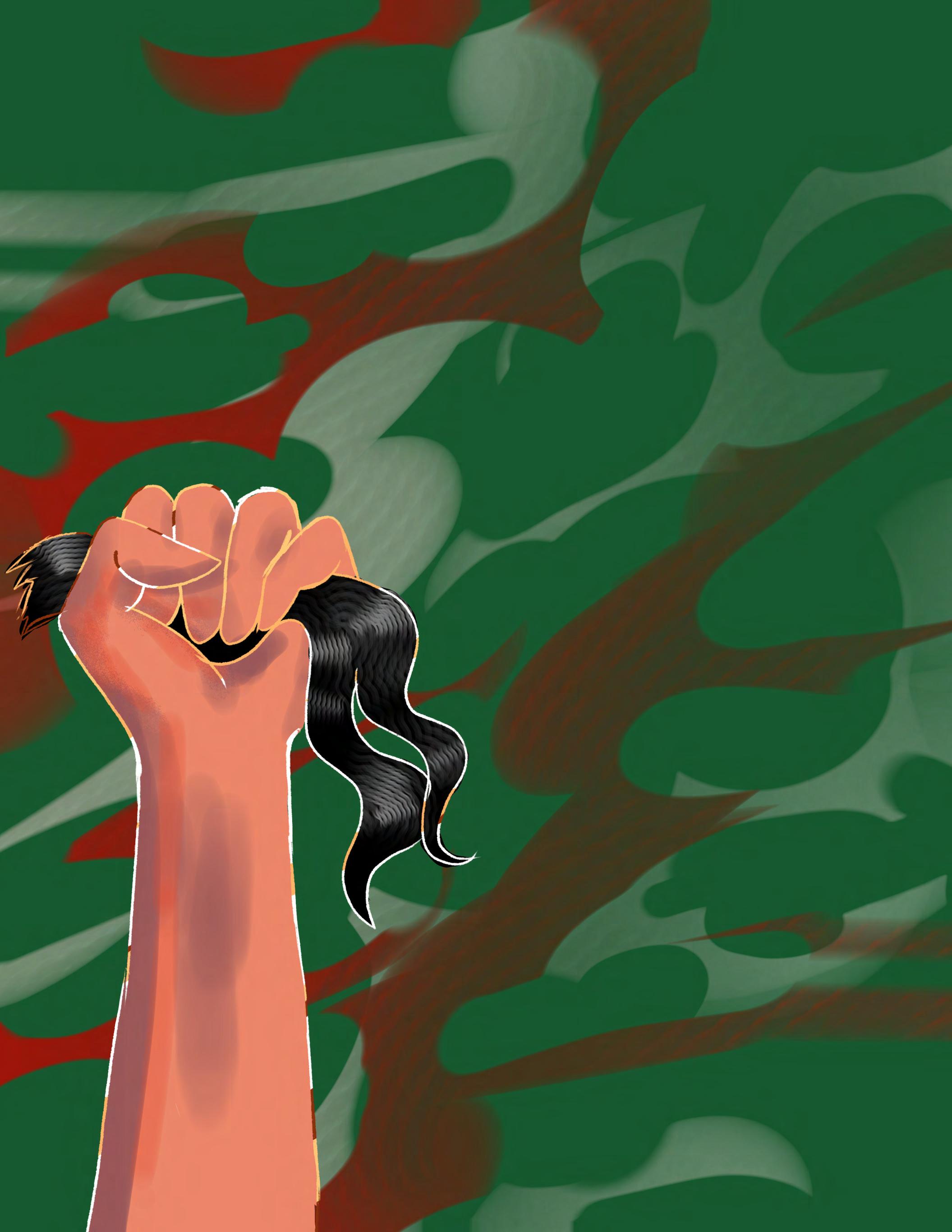
Consumer Culture and Fast Fashion: A Symbiotic Relationship
by: Jamie Trusler Art by: Linya Feng
Fast fashion is a rapidly growing economic and sociological phenomenon influencing global consumer behavior. In my life, fast fashion became quick, easy, and convenient — a cheaper alternative to designer brands and accessible to most people in this country. Therefore, I didn’t consider my clothing consumption a big deal. That was until I learned that the total greenhouse gas emissions from textile production currently stand at 1.2 billion tonnes annually — more than those of all international flights and maritime shipping combined (Pandey). That surprising figure should have been the end where we realize the harm and change our habits.
We are all guilty of this at some point — whether it be emissions from driving a car or using plastic straws, we ignore consequences not out of necessity, but out of comfort. This has resulted in fast fashion continuing to grow despite its adverse environmental and human rights effects.
Initially, I was introduced to fashion by my brother, a few years older than me, and what he wore greatly influenced how I wanted to dress. I was drawn to fast fashion because of its accessibility. Trends I had seen on social media were now available at an affordable price with fast shipping and various colors. Self-expression is a right, yet people are often faced with obstacles, usually economic, that prevent them from doing so. Brands like H&M, Uniqlo, and Zara offer affordable pricing while frequently changing collections to stay consistent with new styles, appealing to such an audience.
But affordability comes at a price. My perspective shifted away from fast fashion when I started learning about the issues it created. I tried my best to cut down my spending, but still, for every item I bought, there was a sense of guilt — a guilt ironically buried under more clothes. Looking at how I was consuming fashion made me realize that even though I loved it, I ethically shouldn’t.
Our impulse to buy garments because we see others have them, and our fear of missing out, leads to rampant consumerism — meaning more clothing waste and more lowquality garments flooding thrift stores.
It was hard at first, but given all the issues that came with fast fashion, I was beginning to shift to something better as an alternative. Now, I find it much more rewarding to find a hidden gem in the thrift store or bargain for a reasonable price at a vintage shop.
Re-wearing clothes pushes creativity, allowing us to tell new stories with old garments. Thrift shops offer hidden gems, for those willing to search with patience. Online platforms like Depop allow people to buy and sell clothes, keeping garments circulating rather than discarded.
Secondhand shopping has helped me transition into better habits — not perfect, but better. Rather than producing new clothes constantly, a cycle of buying, using, donating, and reusing keeps the story alive without always starting from scratch.
Lastly, repairing and making clothes is a powerful act — learning to sew, mend, and alter allows us to break away from endless consumption and write our own narrative.
It turns the consumer into a creator.
While these alternatives offer hope, fast fashion isn't over. As someone guilty of feeding into that industry, I understand its appeal and no real change will happen until corporations and governments take large-scale action. In the time being, it is our job to recycle these garments to give them a second meaning.
KISA BIR YOL HIKAYESI
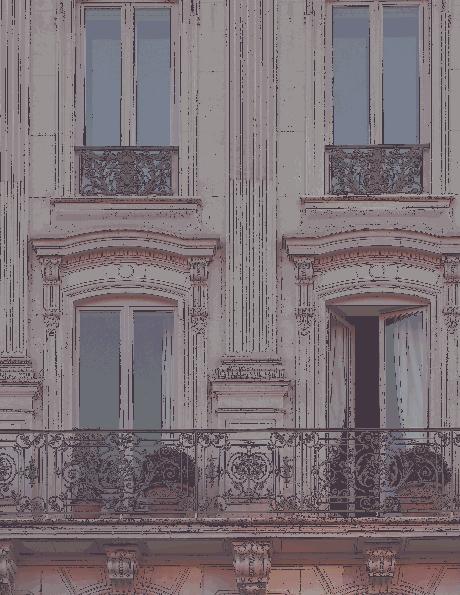
To: 546 Rue de Temple, Paris, France
From: That guy on the 14th floor
Hey Pheebe’s,
You’re probably wondering how I got your address, knowing how elusive you can be. Funny story actually—I promise I didn’t intentionally track you down. But I’m glad to hear you finally made it to Paris.
Remember those endless hours we spent debating how Paris should be pronounced? You insisted it had to be in that perfect French accent or else it was downright disrespectful to the Parisians. I would just say it the way I did to get under your skin. You made it so easy.
So, how is the City of Light treating you? Does it live up to those impossible expectations you had? Have you wandered through the cobblestone streets or lost yourself in the art at Louvre? I really do hope you’ve found that sense of freedom you always talked about.
Speaking of memories, I found this picture of you holding Bailey as a puppy. I remember this Sunday so well. You were out in the garden when I arrived at the building. I wish you could have seen your face when you saw me with Bailey, you instantly lit up and came running over. I hadn’t even thought about a
I know things with us were always complicated, but does it ever cross your mind, Pheebe’s? That unexplainable connection we had? Or am I really just that guy from the 14th floor who you’d only turn to for comfort when the world felt heavy? I can bet no one out there knows you like I do. And you could say the same for me too.
I’m not sure where life has taken you, but it wouldn’t be fair for me to keep this to myself. I’ve recently come to realize that even though we’ve been apart, and although we never really ‘were’, the connection we had was something special. I need you to know that a day doesn’t go by that I’m not filled with regret I didn’t fight for you to stay. I’m sorry Pheebe’s. If I could do it all over again, I’d make sure it ends with us.
I f this letter reaches you at a good time, you might consider m eeting me for coffee. I am visiting Paris in a week’s time a nd would love to catch up with an old friend. Time and p lace, Pheebe’s. Y ou name it. I’m there.
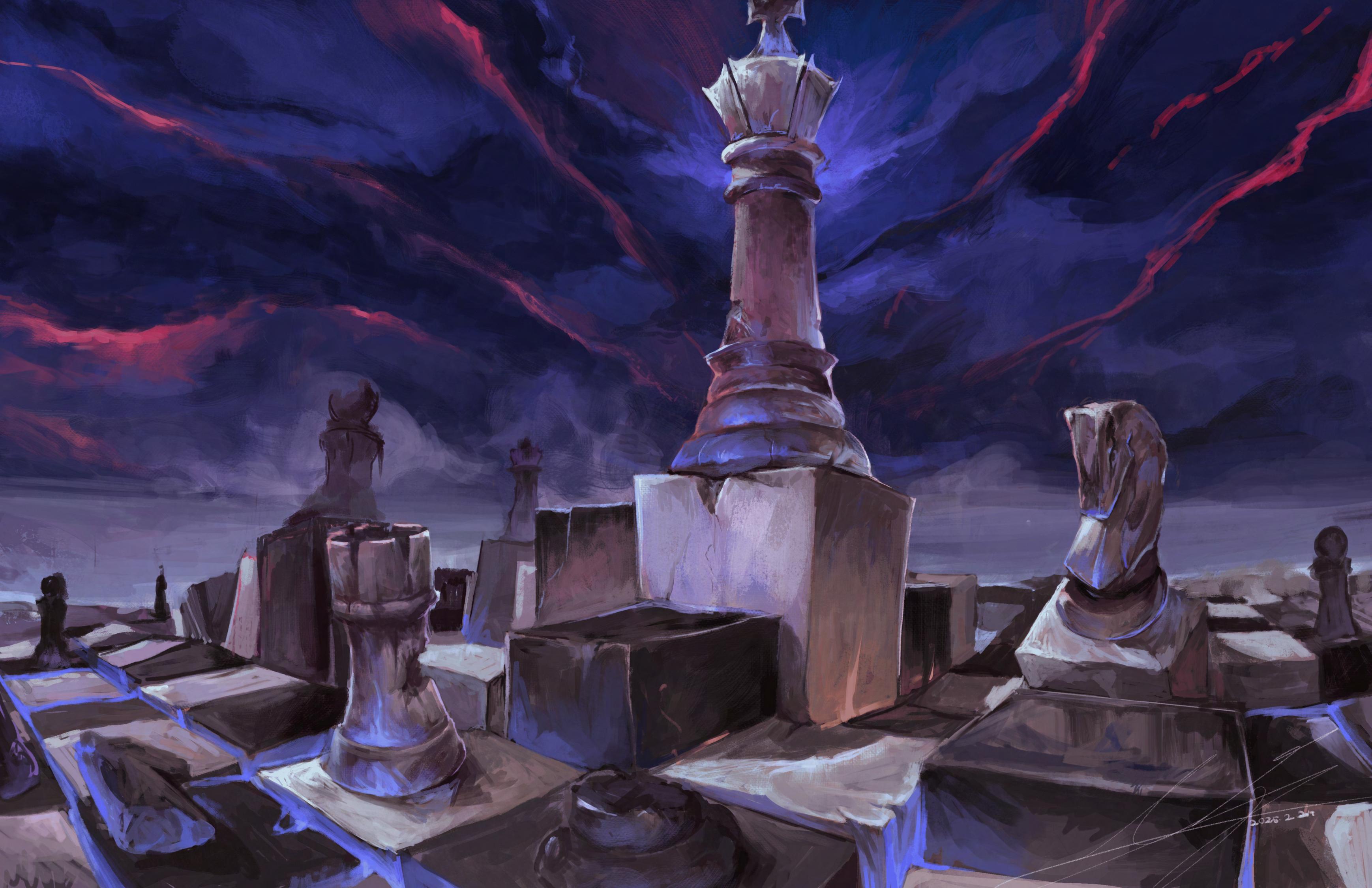
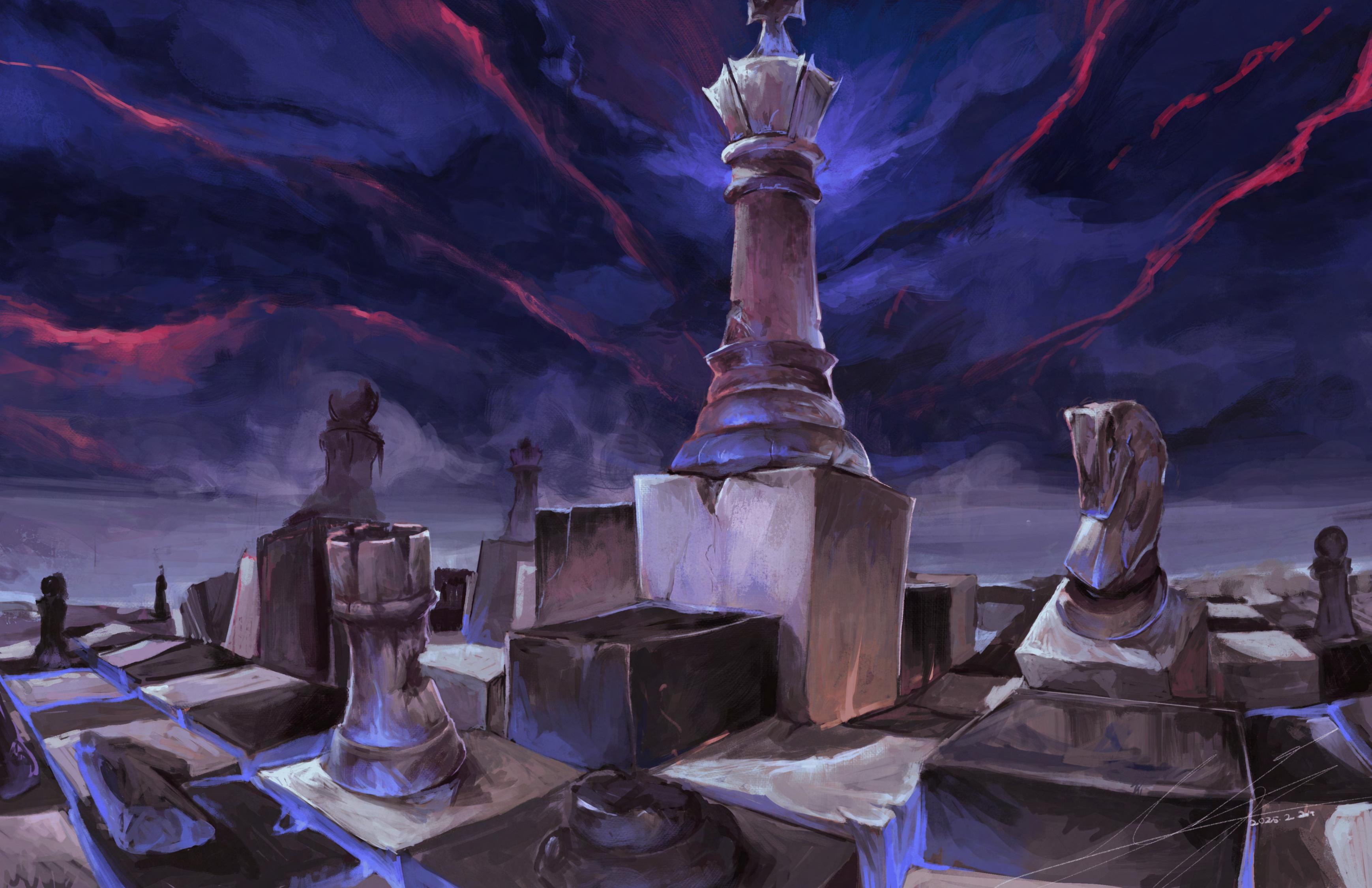
Lunatics’ Crown
Story by: Helen Li Art by: Emily Wei
The morning is quiet, the sunlight gentle. The silence broken only by the quiet chirping of sparrows.
“Caw! Caw! C-” The crow’s cry cuts off as the shot strikes true. Making but a soft thump when it hits the ground.
Taking her eyes off the dead creature, the sniper huffs in annoyance. She whips around quickly to the tap on her shoulder. Large eyes stare up at her from under the barrel. Large, innocent eyes that hide so much malice. She lowers her rifle.
“Black Rook. What do you want?”
“Rebekka, don’t be so mean!~ Can’t I visit my favourite Council member just because?”
Rebekka searches his apple-green eyes and— there. That flash of sadistic glee. The cloyingly sweet smell of apples, bright and rotten. The orchard, overgrown, spilling into every crack and fissure of this city. The sound of bell-like laughter, gone with the first flashes of flames.
“No. I don’t believe you are capable of such camaraderie,“ she replies after a long pause, before starting to wipe the muzzle of her gun carefully.
Clyde’s gaze flickers to her nimble fingers, “You’re harsh today,” the boy comments.
I’m bored today, ” Rebekka corrects, ignoring the feeling of unease that has plagued her for months.
“The ringing of the castle bell interrupts their exchange. A young page runs toward the pair, coming to a stop in front of the Knight.
“Your Honors, ” he nods once at Rebekka, then Clyde, “His Majesty summons you both to the Great Hall for a meeting of the Council. He also asks that you both be there at no later than 10 after. But I got distracted, and five minutes have already passed..” At this, the page looks ashamed.
Clyde looks close to throwing a tantrum, and Rebekka knows that that’s never a good thing. At his best, the Rook barely holds a faux-sweet facade. And at his worst? Well, he wasn’t chosen to be the Kingdom’s youngest Rook for his looks.
The Rook takes the hint. “Right, then he’ll have our corpses be pulled apart by horses, and grill our obliques into fine cuts of steak!”
The page looks rightfully aghast, his mouth opening and closing several times before he seems to remember his place, and leaves silently. When he disappeared, the pair burst into laughter.
“Oh, I just want to bottle that up!” The expression on Clyde’s face is one of childish delight.
Rebekka sighs inwardly with relief. Threat averted. She lets out a chuckle. “Jokes aside, we should hurry. Arthur doesn’t call impromptu meetings if it’s not urgent.” ***
The massive doors of the Great Hall swing open with a deep groan. Clyde marvels at the architectural miracle: a hall of soaring arches and gleaming marble floors, the epitome of opulence. Sunlight streams through tall windows, casting long shadows, stretching across the checkered floor like forgotten memories. At the far end, on a tile of dark stone, sits the throne—an imposing seat of ebony and gold, staking its claim on Hall and its current occupants.
But it isn’t the throne that commands any space with its presence alone. It was the man who built the seat. Clyde scans the room, and finds his liege on the Queen’s throne, the Queen standing behind him. No matter, one cannot look at their King through an average man’s mindset.
Arthur’s crown sat a little crookedly on his head. Nevertheless, no one in the entire Kingdom dares question his word. Its citizens know the King is a hurricane of destruction, and just how lucky they are to be in the eye of it.
“At last, my delightful colleagues,” The King smiles from his throne, yet his eyes hold nothing but a pool of cold, stagnant water, “Rook, Knight, you are both late.”
“And we are oh-so-sorry. Aren’t we, Rebekka?” Clyde clings to the knight beside him, putting on the most dazzling smile he could summon, “Arthur, Sebastian, you’re not going to be mad, are you?
“Fool,” Hisses a voice from his left. A mousy girl of around 16, wearing the livery of a Pawn, glares daggers at him. “Useless eye candy who can’t even address Their Majesties properly.” He glares back with equal venom, and the Pawn flinches. Suits her right.
“That’s quite enough. Sebastian is fine, Clyde.” If the King is a hurricane, then the Queen must be spring rain. Beautiful and warm at first glance, with a chill that slowly seeps in, until one finds themselves completely paralysed.
“We have bigger matters to discuss.” Arthur injects, “Namely, the reason I called this meeting. Today, an incident was reported in the Western Region. A-”
The doors fling open again with a loud Bang! Two figures in identical red robes run in, both panting for breath. The King raises an eyebrow.
“Apologies, Your Majesty. I had gotten lost in the amphitheatre.” The first figure brushes his ash brown hair from his face, revealing confused sage green eyes underneath.
“That I do believe. And your excuse, Bishop Keith?” The second figure straightens, his face a near-identical replica of the first one.
“I had-pant-gotten lost too.” Unconvinced silence.
“In the arms of some clueless woman?”
“Shut it, Rebekka. You were probably late because you were shooting at squirrels!”
“Quiet.” Arthur massages his temples, vexed, “Have a seat, all four of you.” Everett attempts to sit on the floor before his twin pulls him up and over to his seat.
“As I was saying, we received a report of a gruesome incident in the Square this morning. A madman decided to set himself on fire. Now, I’m all for a bit of entertainment on a dull day, but it was his words that raised concern.”
Sebastian speaks up, “Our soldiers did not hear much, but it appears as though the man was saying some very… unsavory things about the Council. Specifically, the King.”
“I have heard rumours too, even in the upper circles. The privileged bastards complain that the taxes are too high and that the Council is too arrogant, for many of us are not originally of noble blood.” Picking up and inspecting a gold coin from a nearby stash, Keith chimes in. His twin nods in agreement.
It is then that Clyde decides to add his bad news to the pile. “Unfortunately, I don’t think that the commoners like us very much either. Today marks the third time I’ve been denied entry to a pub because I’m the Rook. The people are unsatisfied. They say you, Arthur, are a cruel and corrupt leader.”
“Oh, cretinous midgets.” The Bishop hands him a snifter of brandy, and Arthur swirls the drink as he shakes his head, “That’s the way this man-eat-man world works; a food chain. And if you’re not at the top of it, well…the strong eat the weak, and the rest is history.”
“If it does not offend you, my Liege, ” Clyde pipes up again, “Would you ever try to change that hierarchy?”
Boisterous laughing echoes through the chamber as the King doubles over in amusement. Even the Queen lets out a genuine chuckle.
“Oh, Clyde, sometimes I forget how young you truly are.” He remarks, not unkindly.
“No, Rook. Not while I’m still on top of it.” Arthur checks his pocket watch, “It seems Sebastian and I are due at the Court very soon. In the meantime, I advise you all to watch out and report any further incidents. If a point needs to be made, do not hesitate to use what’s in your arsenal.” He winks.
“The gyres of change are turning, it won’t be pretty. Prepare for the worst.” The Queen adds.
The great doors open once again, and the Council scatters to the wind that tastes like impending danger.
Shouting. Noise. Rifles. Figures shrouded in white. Fire. The gallows. Closer, closer, falli-
Everett wakes up, heaving for breath, from the third nightmare he’s had this week. Instinctively, he turns and reaches for his glass of water as a bullet whizzes by his ear and strikes the headboard behind him.
“Take that, Bishops! You hypocrites!” A man’s voice, hoarse with use, screams from the street.
“Womanizer! Schizophrenic! Lunatics!” Another shot shatters the window completely.
It’s real. It’s happening. He can’t breathe. He can’t-
“Everett! Ev?” His twin is shaking him. Another burst of pain in his skull. “Everett, we need to leave. Right now!”
Keith pulls his shaking twin up. The latch, rusty with disuse, creaks loudly when he tugs forcefully. The hidden door swings open.
“Wait.” Everett fights his way through his muddled thoughts, “We can’t be wearing these robes. We’d be recognised immediately, and then we'd be as good as dead.”
“You’re right.”
“Here. Put this on.” From the closet, Keith pulls out two black cloaks covered in dust. Everett throws the trapdoor wide open and beckons his twin, who seems to be tinkering with something.
“Just a second…”
“Keith, please! The Council needs us! The King needs us!”
“Got it,” Everett turns around just as Keith throws something small and burning out of the window. A boom that shakes the house behind them. Keith grins triumphantly.
“Take that, low-lifes!”
“You didn’t…” For a moment, Everett can’t tell whether he is sympathizing with the now-dead rebels, worrying about the King's safety, or distressed over his twin's sanity. They were not wrong. He is a lunatic.
Not that Everett is much better himself, split between glimpses into the desolate future and the just as wretched present. To everyone else, the Bishops are simply eccentric, but only they know that they are volatile. Ticking bombs-ready to blow up every single person in their vicinity.
A tug draws him back to reality.
“Now let’s go.”
With a single destination in mind, the Bishops run through the streets.
Tonight, the City is all but devoid of light. The flags of various resistance groups, once so different, now fly side by side in a great coalition of mutual hatred and hunger. Fires tear through every part of the Capital, infinite and unstoppable. Turning the Kingdom into something neither of them recognised.
The Palace is dead silent, but the gates were intact. It seems the rebels have not fought their way through yet. Letting go of the breath he didn’t realise he was holding, Keith slumps against the palace wall. Good.
The usual chatter is missing from the long, elaborate walkways. The lights have been turned off, the castle afraid of drawing attention to its teetering dynasty. The doors to The Great Hall are open, silently summoning the wary pair.
Inside, still as statues are the Council. Or at least, what’s left of the Council. This time, there is no excited chatter, sarcastic quips, or glaring contests. Clyde cradles what looks like a bullet wound, and Rebekka holds her right arm a little too stiffly. The Twins drop into their seats without incident, and the King breaks the silence from his throne.
“I will assume that everyone who could make it is here. And that you know what has just occurred and roused you from your slumber.”
“A rebellion.” Though most of them know it to be true, Rebekka conceptualizing the fact still sends a ripple across the room. A moment later, the Council breaks into noise, each report more dire than the last.
“I saw them storming Count Atwater’s house on my way here.”
“They have burnt down the Church, the Gardens, and many smaller courts.”
“A great portion of the Army has revolted and joined the rebels!”
Sighing, the Queen summarises, “Most of the Court was caught off guard. We were caught off guard.”
“Impossible! From the information I’d gathered in the Court, none of the rebel movements in the Kingdom have the weapon supply or influence to stage a coup like this!”
“Not to mention their constant infighting. Those groups can barely stand each other, much less come together.”
“Someone else is working behind the scenes. Multiple people, I reckon.”
“No sh*t, Sherlock. The question is, how did they manage to fly under our radar?”
“We got sloppy, ”Arthur concludes, “deluded by this false sense of comfort, of safety. So enamoured by this golden sand we didn’t notice how it was slipping through our fingers,” he rises. His cape unfurls behind him, a tendril of darkness blacker than the inky night. “But a King’s work is never done, it seems.”
“Moving as a unit will draw attention. We must split up-” It looks like Sebastian, meticulous as always, is already plotting their next step.
An enthusiastic voice interrupts, “Can’t we just kill our way through those fools?”
“And then, Rook?” He questions back calmly, not the least bit offended by Clyde’s challenge, “We’ll kill all 20 million of the Revolt, not to mention their strongest fighters and magic users?”
“When we’re done, there won’t be enough citizens left.” Arthur laughs, “But I do agree with our Queen.”
Keith feels the Council’s attention-a heavy thing-on their King, as he walks to the stained window, a Stygian silhouette against the fires in the distance. With the screech of a beast on its deathbed, the Palace gates topple under the battering ram.
“I will see all of you in 6 years, or in Hell.”
Keith thinks he heard a sigh of relief from his King as the glass shatters and he lets himself fall. But it may just as well be the howling wind.
“Showoff.”
The cold night air eats easily through Sebastian’s ornamental cloak. A draft blows by and he stills, allowing his cloak to flap in the wind. He recalls a distant time when he wanted to be a lone figure between heaven and earth, where a swing of his blade severs grudges and attachments alike. But he also longed for power, and so another path was made for him.
“Off with his head! Off with all their heads, the King and his damned Council!” It seems he has arrived at one of the many rebel bases.
“They starved us, they took our children, they killed our compatriots. But we will bear it no more! The blood of our brothers paves the way forward, and we must go on, or their sacrifice will be for naught!”
A boy, no older than 16, waves a white flag. The Ivory Revolt. The crescent in the middle smiles at the former Queen, the gods mocking him for his failure. It was not a banner of hope, but of erasure. They seek to wipe away everything he had built, everything he had failed to protect. The flame burned in the centre; a promise rather than a symbol.
The impassioned speech is met with a chorus of approval. The cloaked figure scoffs quietly, but he knows his power is no match for the fire.
“Long live the Rebellion!” Words echo through torch-lit streets, unwavering, resolute, fearless. Waning splendor giving way to new order.
Sebastian starts when a ragged-looking man blocks his way. “Young man, I see the fire in your eyes. Join the Rebellion. Be a part of a new age. ”
“I’m sorry, there is somewhere else I have to be.” He swallows his pride in its whole-there is no other choice.
“*ss-kissing loyalist.” The man spits. And Sebastian reminds himself of his current position, hurrying away before the rebel can get a closer look at his face.
During the earlier, better days of the Council, the people lovingly nicknamed him “The Iris of Montclair”. Beautiful, delicate. But all he sees is a horrible, wilted thing, mind slowly crumbling away the way his body had long before. He hears it every second; the Ferryman’s voice, gravelly and ancient, muttering in a language long lost to the living, calling him back to where he belongs. Perhaps he was never sane, perhaps they were all lunatics, since the very beginning.
Lost in his thoughts, Sebastian runs nearly into a poster of his face. $750,000, ‘Dead or Alive’. He shakes his head. Funny to assume that’s all it takes. A second later, the poster is gone, as if it had never been there.
A rock hits him in the back, he turns to find a silhouette crouched on the roof and can’t help but smile when the Knight attempts a wink. A rebel near the bonfire crumples to the ground.
Not one weak link, he muses, they were all equally unhinged.
The flag flaps in the wind as the sun peeks over the horizon, casting a warm glow on the land. But the heat is a luxury for the living, one that cannot thaw the River Styx flowing through his veins. Sebastian takes one last, long look at it, before turning and disappearing into the shadows. ***
6 years later
The morning is quiet, the sunlight piteous. Arthur pushes aside dense foliage and steps into a sunny clearing. A rustle behind him. Arthur’s sword slices the leaf in half before he realises it. He shakes his head in exasperation.
“Disposition of kings.”
He takes a huge breath of fresh air, a relic of a time long gone. In the distance, the new church bell rings the hour 12. A tattered white flag still hangs over the entryway, the stone plaque indicating this worn-out settlement as Headquarters of the “Ivory Revolt”. Well, former Headquarters. Arthur thinks, kicking the rack of rusty swords over and startling a crow from its perch.
“Perfect day to conspire against the state.”
He knocks out of an almost mocking sort of politeness. Dead silence, as expected. With a firm shove, he makes his way through the door, only to be stopped by a cold sensation on his neck. The assailant backs off as soon as he makes out the former King’s face. Though Sebastian only nodded, his relief was apparent to Arthur.
He surveys the dilapidated base. Queen, Knight, Rook, both Bishops, a few Pawns, each one capable of killing hundreds. Yet in this place that should be filled with hate and the cries of wronged souls, is the safest he has felt in years. Even Clyde’s unsettling smile comes off as oddly comforting.
He smiles. 11 years of power, 6 years of bitterness, an eternity of struggle. As white bleeds into black, he knows that the game will go on.
In the silence of my red house. Her shadows lingering, As if
I could smell her almond pie Cooking in the oven just one more time.
I still want to see her dance In her favorite silky dress, Feel the warmth of her hand When she grabs both of mine. Our matching wedding bands, e ones that she designed.
I hope I never reach acceptance, Never lose the sense of her presence, Never stop hoping it’s her steps approaching the door. Wishing for another chance to go back to before.
Grasping onto all that is le , If I never wash those sheets that smell like her, Maybe I get to pretend for a little longer. Never let those memories blur.
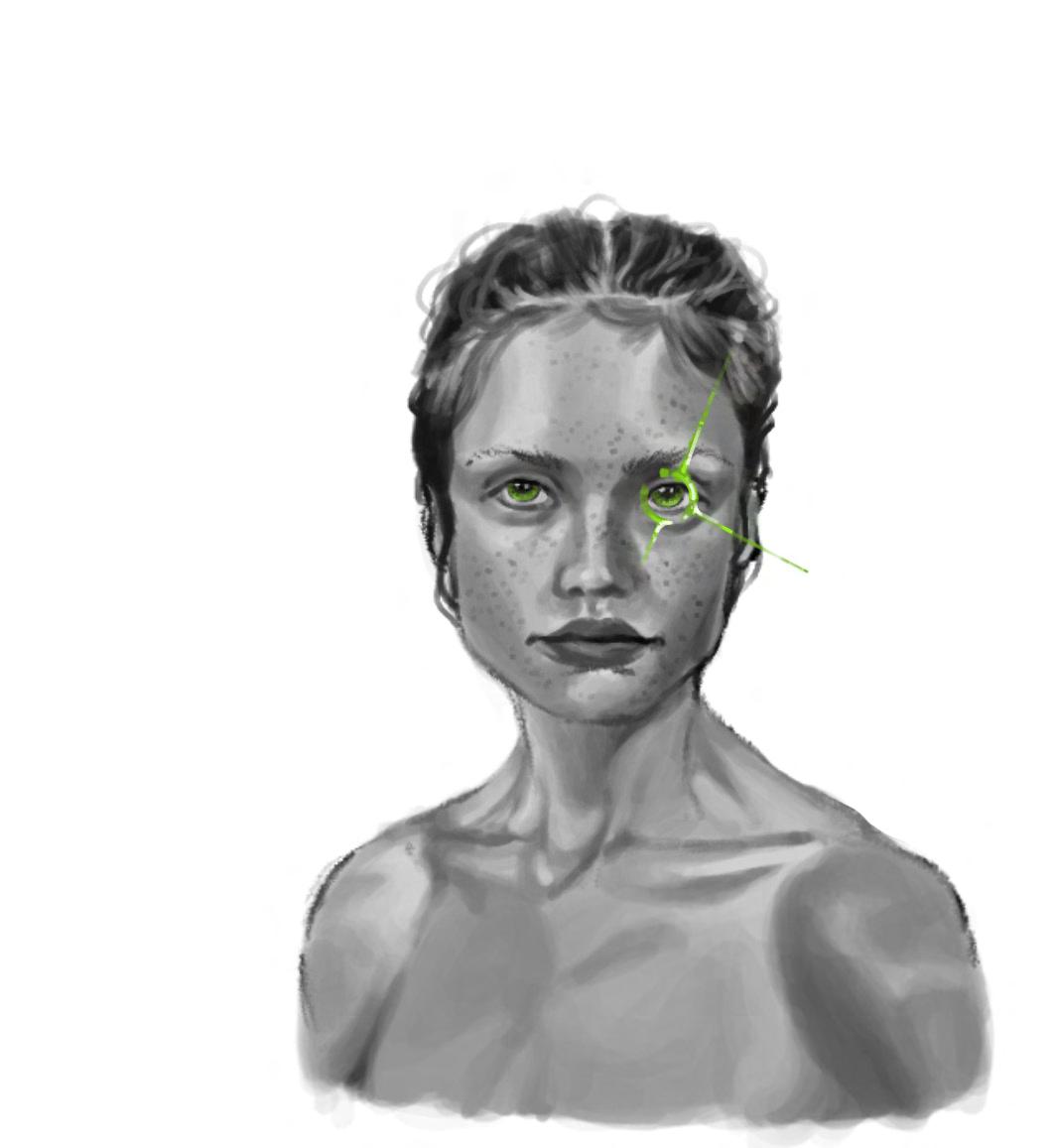
My favourite color was green, e color of her eyes. Her favourite color is red, the color I despise. But I would only wear red, so long as her eyes were green.
I no longer wear red, And she no longer looks at me with those green eyes.
1. My Clematis
e picture-perfect family I wanted was a reality, You would smile bright for every photo, Always by my side.
But now you’ve gone solo, And that image quickly died.
3.
How can we laugh and sing
In one moment
To a screaming match the next?
5.
You never do what I say, Turning your head at every suggestion I give. You always talk so much, So why can’t you listen for half that time?!
7.
I’ve told you everything I can, You’ve drained me of everything I have.
I don’t know
How to help Anymore.
2. Romance, Op.24, No.9 in D- at Major
I don’t know you anymore. You don’t listen. And you repel Every ounce of care I construct.
4. Cure
It’s brutal and vicious, Why is it so di cult for you to listen?!
I’ve repeated myself countless times, I’ve handed solutions into your hands.
Just follow me, And everything will be okay.
6. Partner in Crime
I’m crying and screaming at your feet, As you turn away in ignorance. Where did I go wrong?
8. Adoration
I feel like I don’t know you anymore. e more you say, the more you speak, e less you are me.
Where did I go wrong?
1. Song Without Words, op. 102, no. 4
the silence su ocates me. but i’m too scared to talk. every time i speak, your response is angry.
2. i am angry too, there is a re burning within. sometimes the ames lick at my mouth, and my words scald you. the re dies.
3. i want to scream, to yell, i am not you! i want to beg you to listen, hear me.
5. Adoration
i know you are sorry, i am sorry too, for pushing you away. but i cannot nd it in my heart to forgive you, because i am not you.
4. Nocturne No.20 in C-sharp Minor, op. Posth.
i want to tell you so much, but every time you played devil’s advocate, every time you lied, every time you screamed. it makes me scared so scared that words do not come out.
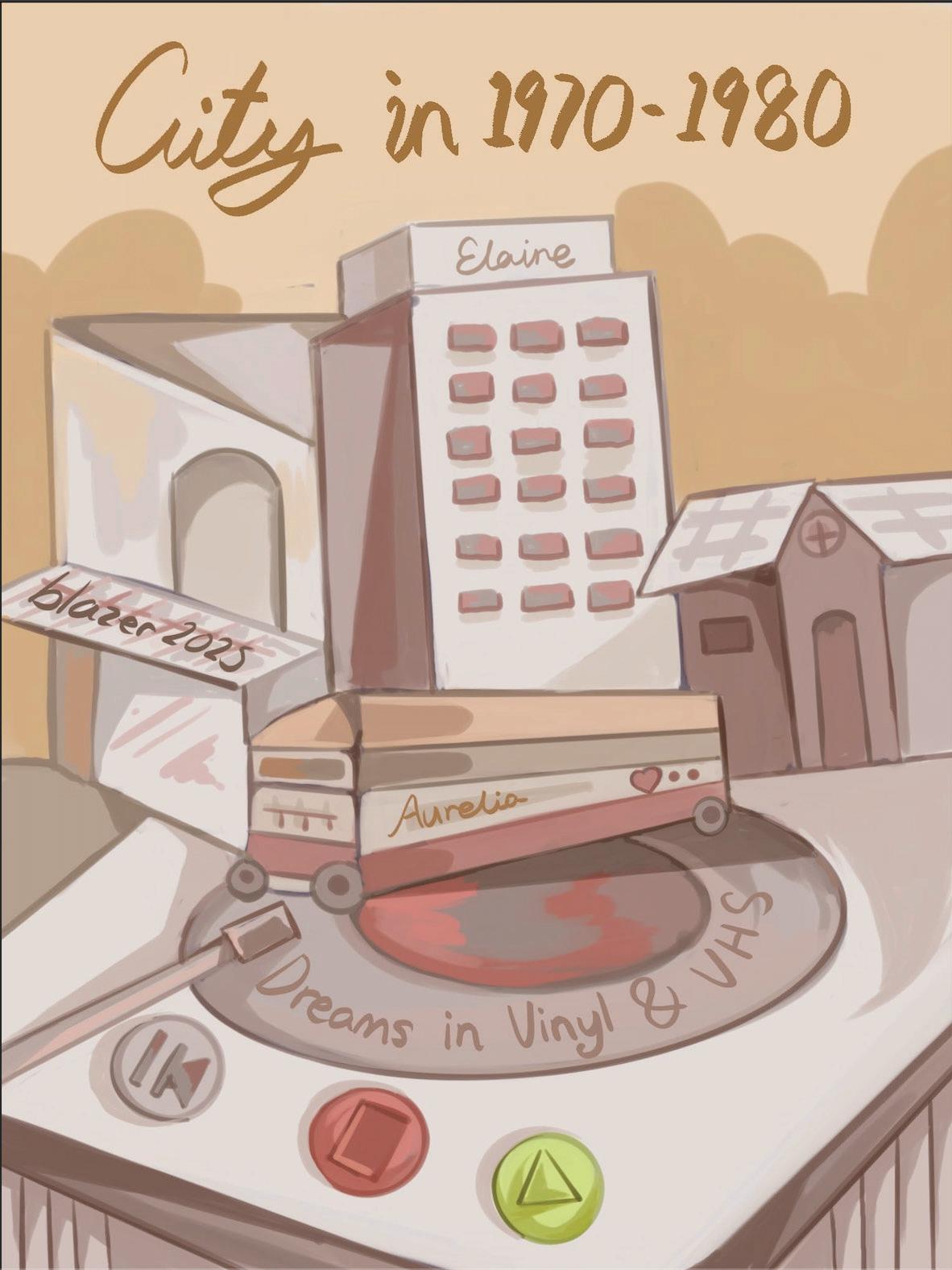
Dre ams in Vinyl & VHS
Echoes of vintage rhythm and neon-lit nights; a nostalgic 70s & 80s playlist.
e day always seems to begin in stillness. Early morning in northern Ontario, and the world around is quiet, peaceful. e canoes rest by the shoreline, their polished wood and chipped green paint blending into the earthy tones of moss and stone, as if they truly belong here. Out by the water, the trees stand tall and proud, their re ections stretching across the lake. ere’s a serenity in these moments - even with the early bustle of folks packing up camp - a deep sense of connection to the land, one that seemingly feels as old as the rivers themselves. As the morning light dances on the still water, I always seem to nd myself drawn into the landscape, and all thanks to a single vessel that seems to transcend time: the canoe.
In the northern forests and lakes of Ontario, the canoe isn’t just a lowly vessel. It’s a bridge. A bridge that connects past to present, cultures to each other, people to land. A piece of history that has carried explorers, traders, and Indigenous peoples alike through hardships and across distances for centuries. When European settlers rst arrived, drawn to the vast wilderness of Canada, they encountered not a blank slate, but a complex world unfamiliar to them, mapped by rivers and lakes, a place that Indigenous communities had long understood, cultivated, and protected. eir land was connected by water, and the birchbark canoe was their means of transport. It was only through the knowledge and generosity of Indigenous guides that fur traders and voyageurs learned to navigate these waterways, and the way of the canoe. In that way, the canoe became the lifeblood of the fur trade, linking distant isolated trading posts and opening up the Canadian interior. It became the only way for these settlers to make their way through the rugged land.
!e fur trade boomed, and with it came waves of transformation. e canoe became not just a vessel but a vehicle of change, carrying goods, ideas, and new dynamics into Indigenous communities. Along with trade goods like metal tools, woven cloth, and weapons, it brought alcohol, disease, and the values of a society that saw land and resources as commodities to be exploited rather than cherished and protected. e e ects of these exchanges were complex and o en devastating. Alcohol particularly, became a tool of manipulation and control. Traders would o en use it as a bargaining tool, creating dependencies that shi ed the balance of power in trade negotiations, leaving many Indigenous communities vulnerable to exploitation.
e competition between the English and the French, two empires ghting for control over fur and land, intensi ed these pressures. Both sides sought to ally with di erent tribes, forcing Indigenous communities to take sides in con icts that were not truly their own. e economic engine of the fur trade upended many traditions, strained countless relationships, and forced many Indigenous families into dependency on European goods that they were not accustomed to. It was a one-sided exchange that le deep, lasting scars that persist to this day.
is past summer, standing on the shore of Lake Attawapiskat a er hours of paddling upwind, I was reminded of this legacy. I met people whose families had lived on this land for generations, who spoke to me not with bitterness, but with resilience. Going into the summer, I’d read about Attawapiskat’s “Boil Water Advisory” - an advisory that had been in place for almost three decades. But reading about it was one thing; talking with people who live with it every day was another. I listened to their stories of how this land and water sustained them, how they worked to preserve it against forces that threatened to destroy it.
ey talked about their struggle to protect the land surrounding them from industrial developments that would strip it of its life, their e orts to preserve a legacy for future generations. And when they learned that I’d been paddling for weeks to reach them, they o en smiled and spoke with reverence for the canoe itself - a symbol of times past, but also a connection to nature itself and tradition.
For those of us lucky enough to experience it, canoeing through northern Ontario is a reminder of our place in the natural world. is is a beautiful, awe-inspiring landscape, but it’s also unforgiving.
ick forests, sudden and unrepentant thunderstorms, kilometres of portages - these test the strength of even the most seasoned paddlers. Over six weeks, I felt the rhythm of this place, the quiet endurance it demands, all the while truly experiencing all the ups and downs that it has to o er - from paddling next to swimming moose to sheltering under our canoes as hale pelted down, lightning struck and a twister rampaged in what has to be the biggest storm I have ever seen-. Out there, my thoughts o en dri ed to the voyageurs who came before methose men who paddled these waters carrying trade goods over hundreds of miles, enduring trials that few of us today would even imagine - and the Indigenous people that came before them, stretching back into time immemorial.
As I travelled, I came across reminders of the past, of a world so di erent from our own. Today, the Indigenous people who welcomed me face new challenges, many of which are tied to the very changes brought by the canoe and the fur trade. e scars of colonization, of the residential schools, of alcohol dependency, still linger in these communities. e legacies of those days are visible in the poverty, the lack of infrastructure, and the systemic neglect that they have encountered. And yet, what struck me most was the resilience that I saw. Despite everything, the canoe seems to remain a powerful symbol, a bridge to the past that connects them to their cultural roots, which cannot be taken away from them. It’s a constant reminder of the ingenuity and strength that carried them through time and of the endurance and resilience that continues to carry them forward nowadays.
Re ecting on my journey, I nd myself reminded of how these waterways, these narrow corridors of rivers and lakes, have shaped not just the history of Canada, but my own understanding of interconnectedness. Northern Ontario isn’t just a place to explore; it serves to o er a testament to the resilience and to the memory of those who paddled there long before I ever did, even if their name are not remembered. Canoeing through this wilderness is a way of accessing the past, of honouring legacies that are both fragile and enduring. e rhythm of the paddle o ers a space for re ection, a rare chance to experience the peace and purpose that comes from feeling connected to something truly bigger than oneself.
As I pushed o from the shore one last time, the canoe gliding forward with its quiet grace, I looked back and watched the ripples fade behind me, leaving only the stillness of a quiet day. Ahead, the horizon seemed to open wide and full of promise, an invitation to journey deeper. And in that moment, I was reminded that the journey isn’t just about reaching a destination, it’s about understanding the path we take to get there, the people who guide us, in uence us and accompany us, and the places that shape us. For me, northern Ontario - and the humble canoe - will always be an integral part of that journey. And for that, I am deeply, indescribably grateful.
By: Booth
The Wanderer
by Kalyan Jande
Art/Layout - Austin Maidoh
Tall and windywillows hung over a dirt path, their leaves and
branches intertwined like laces in an intricate tapestry of brown and green; forging a tunnel in the forest.The path was narrow, shifting and turning in a vibrant maze of endless and ominous homogeneity. Around me, distant, sharp echoes bounced on the forest oor and thick trees as if trying to cut through the dense foliage. These sounds carried through the forest held history, emotions, and feelings, though I could only understand a diluted and misinterpreted version of their former selves.The willows were bountiful. Occasionally, light drops of rain weaved and scattered across the branches toward the forest oor. I found a bucket to collect the water.
I kept this bucketwith me, but as time passed, rough patches of brown and orange lurched through the material in a chaotic dance of colors. Bright red fruits hung along the trees, standing out in the green and brown void.The fruits were small, each containing a hard inner seed.The forest always produced just enough; I was never left hungry or full. However, the fruits were nite, and once picked, they never grew back.As a result, like a dog on a leash being dragged by the neck, I followed the path.
Written By: Alisa Sari Art and Layout By: Katya Charapova
Guess what?
What?
e polaroid dried,
It’s a blur,
Faces pressed close to the lens,
Joy is glinting on the re ection, It’s the rst item, e list is long, e book is thick, We’ll nish it. smells sweet, Are you done? Yes.
and Change
2. On Violin: Concerto No. 2 in G minor “Summer” - Vivaldi
Magnum or Creamsicle?
Magnum is sweeter, It’s her favorite, I’ll eat it faster, Whoever nishes rst wins, e sun pushes, e chocolate melts,
Hurry - the rst layer is o , e raspberry bursts, e vanilla wraps the last, It drips onto my book, I wipe it o with laugh, e streak it leaves behind
3.On Violin: Violin Concerto No. 1 in G Minor - Bruch
e slide warned her, e red and yellow paint blinked, e clouds took a deep breath, e sky sneezed,
Rain started pouring, One more time,
One more slide and we’ll be done, She slid and cried, e mud streaked her pretty pink shorts, She smiled, cackling and wide,
Are you done? Yes.
4.On Violin: Violin Sonata
I’m coming back next year, I told her, I’ll bring the book next time too, It’s called; e 50 Races, A bucket list to mark our friendship, An agenda for the summer, A delineation of memories.
6. On Cello: LemuriaAssad
Her hand is freezing, She reaches for the popsicle, e frost present, e items plenty, She wants to lose weight this summer. Ready to go home? Yes.
5. On Piano: Das Wohltemperirte CaliverBach
e car slows, e sun is blazing, Light blinds, I hear the so sound of her cello, It’s been three years, Didn’t she play the violin? I forgot to bring the book, She forgot to ask.
7. On Cello: Versprechen - Agocs
e slide is gone, Or mostly gone, e rust smells, e play-structure is tilting, It doesn’t look safe, I ask if she wants to go back up to it, She says no, Her jeans would dirty, Ready to go home? Yes. We part.
8. On Piano: Kinderszenen (“Scenes from Childhood”) - Schumman
Will you be here next year?
Yes.
But she won’t be, Not really,
She’ll kind of look the same, She’ll kind of talk the same, But her laugh will have a different echo,
Her smile will so en, Because the memories slush,
e smells mu e, e stains empty, e rush pitters-and-patters, e polaroid colors mellow, yellow, cello, Cello?
I used to know someone who played the cello.
Hum bhi shahi the
Written by: Shrivali Gupta
Layout by: Jenna Farsakh
The Words I Could Not Script
As I step inside the theatre, I take note of how quiet it is, too quiet. It feels like it is holding its breath, waiting for something to happen. I have always thought that about the space. It has a consciousness of its own; a way of sensing when the moment is right. But tonight, it is di erent. e silence feels heavy as if the room has witnessed too much.
e weight of the lights above, the hum of the dimmed house lights, it all feels like the silence before the beginning of a production. It does not matter what has happened. e play, my play, is not over yet.
I glance down at my penned notes, but the lines begin to blur as my eyes begin to water. e scene is in my veins. I have lived it a thousand times; in rehearsals, a er hours, in the time when I can not sleep and the memories ush through me. e actors are impatiently waiting for me to say something, anything, but for a moment, I am lost in the scene. I do not know whether I am speaking as the director or as the kid who lived through it.
“Alright, let’s run it from Matthew’s line,” I choke out. e actors nod whilst adjusting their positions. e scene begins again, and I catch myself stumbling out of the present, and falling back into the moment the actors are reenacting. is play has become my life. It has in ltrated my being.
I sit at the table, my hands resting on the cool surface. My character, well, me, stares into the emptiness of the mirror in front of him, just like I do when I’m not looking at the world. ere’s a dinner laid out before me, but it’s more symbolic than anything else. e wine bottle is half-full, but it might as well be empty.
My wife, or the actress playing her, sits to my le . Her face looks the same as it did the day I met her all those years ago. She’s beautiful, but her beauty feels overshadowed by sorrow now–her face; something worn and tattered by time. Our daughter, the young actress, sits across from me. Her eyes are wide with sadness, and I can hear the unspoken words without having them said to me. ey divide us, like the years of silence I have spent not understanding what I was supposed to do. What any of us were supposed to do.
“I have had enough. Joseph, what do you want from us?” she says, shaking with quiet rage. I do not need to hear her lines. I already know them. ey in ltrate every aspect of my being.
I hesitate, the air around me thick with the words I can never manage to choke out. e ones that have been lodged in my throat for years. In the script, I am supposed to reach for her hand, o er some act of connection, some desperate attempt to bridge the gap that has grown to separate us. But I can not. No matter how o en my mind goes to war with my body, I can not o er any form of recognition.
I look around at the actors, waiting for my direction, but the line between this performance and my life has been blurred. I can not tell where the character ends and I begin. I can not remember if I am supposed to be directing them or plead them for something that does not exist anymore.
I am een again. My mother is impatiently standing in the kitchen, her voice sharp with frustration, telling me to eat my dinner. But I can not. I can not swallow the food because all I can think about is my father. He is not eating dinner with us tonight. He is never with us any night. And on the nights he stumbles home, he is loaded with anger and liquor. My mother, underneath her heavily lined eyes and layered concealer, has the same pained expression that I failed to decipher until now.
e table was not just where we ate. It was where we all came together, or at least, where we should have all come together. No one spoke. No one reached out to the other. We all sat in silence at the table while we quietly chewed my mother’s food. All of us were so close, yet, so distant. Never on the same wavelength. Never shared the same thought. But always at the same table, that is, when my father was home.
I look up at the stage again, where I am met with at least a dozen looking at me with puzzled expressions. It is almost as if they feel the weight of the memories I am recollecting and are carrying that burden as well. I can not understand whether or not they recognize that the scene is not just words photocopied on paper. I wonder if they understand that they are reading the lines I could not ever utter. ey are playing my parts, in a way I have never been able to play myself. e father who was hardly present, the husband who was never enough, the man who was notorious for his
empty promises.
“Joseph, please,” my wife says, her voice breaking, but there is something erce in it now, a strength I did not see when we were married. “Do not walk away from this.”
I look at her. I should be saying something, anything. I should be reaching for her hand, telling her that I’m sorry, that I did not know how to love her the way she needed. But I do not. My character, the one I am playing, stands up, leaving the dinner behind. It is not just a meal—it is everything we have lost. Everything I’ve lost.
I stagger toward the door.
“I thought…” I begin, but my voice catches, just as it always does. “I thought if I could just make you understand…”
But it is too late for that. e door opens, and my character steps out. My wife’s voice calls a er me, but I do not turn back. e world I have destroyed is behind me. And I know, somehow, it has always been behind me.
I am standing at the doorway of our home. She is looking at me, her face wet with tears, and she says the words I knew were coming, the words I should have stopped, but could not.
“I cannot do this anymore, Joseph. I cannot keep doing this.”
I do not say anything in return. I do not even try to reach for her. I just stand there, as silent as I have always been. And I don’t know why I cannot move, why I can not x it, why the words get stuck in my throat. I was always waiting for something. Waiting for the right moment to change, for the right words to come, for the right time to nally try. But time does not wait, does it?
e actors are still frozen. e stage is silent now, and I can feel it—the shi , the emptiness that lls the room. I have been directing this play for so long, trying to make it perfect, trying to write a life that makes sense. But life does not work that way. e script is not mine to control. e actors leave their marks, and the rest just happens.
“Can we take a break?” I ask though it feels like an apology. An admission that I am not sure how to keep going. I rub my eyes, trying to clear the fog in my mind.
e actors step o stage, and I am alone. e lights dim slightly, but I do not move. I just sit there, letting the silence surround me. e weight of everything I have done, everything I have not done, presses on my chest, but it does not crush me. Not anymore.
I look out at the empty theatre, the rows of chairs that are meant for someone else, someone I can not reach. And I know something now that I did not before: I have been living the same scene over and over, hoping for a di erent ending. But this is it. is is where it ends. Not with redemption, but with acceptance. With the understanding that sometimes, there is no resolution.
I stand up slowly. e lights icker back on, and I know it is time. e play is nished, and so is the act of pretending. I walk o stage, but I do not look back. e curtain has fallen, and I have nally come to terms with what is le .
Some glitch, some static sparked the thought that is would be our last laugh
Our last act before we collapsed into Polite reminders sent with seasonal cues.
I kept those photos for sentiment
Because they caught the nal frame
Before the main cast parted ways.
en, I met her.
I didn’t love, nor like her at rst. Loud. Disorganized.
But I couldn’t seem to blame her. She smiled like nothing could be shattered. She carried an innocence that nothing could deter.
I couldn’t bear for her to see empty seats around me, Places even happiness herself didn’t want to be.
So I did the next best thing.
I took pictures of her.
I took pictures of her laughs, how she oated into groups.
I took pictures of unknowing people, of birds and, of the weather, thinking
If I captured enough of happiness I could be friends with her too.
I’ll review the pixels that form moments I only watched, Imagine all I could have said, all I could have done, but Every scenario I did not pursue
Rolled down a track
Curled up into a ball and away it ew Into the shadows and never coming back.
I hope one day to be in a picture.
Written by Delilah Hao
Layout by Ives Seow
e ird ing
Written by Ives Seow
Page
Layout by Ives Seow
With her skin taut over her skull like cling wrap, her mouth hung open in remembrance of her last breath, and all colour washed out from her complexion, my grandmother looked the same as she always did: Dead.
Call this my hypothesis, my very logical rationalization: Born the last of three to her youngest daughter, I never had much of a relationship with my grandmother. I was lost in the sea of faces that were her dozen grandkids, to the point that by the time I came around, I was delegated to being “Mei”, a nickname that all her granddaughters shared, as my name was too much for her decaying brain to remember. I was also born at the tail-end of her prime of grandmothering, when a bad fall in the early 2010s le her with a permanent limp. With her body went her ability to exercise her brain, and with that, also went her active brain function. So unlike my siblings whose grandmother brought them to school and back and even chased them during bouts of mischief, my grandmother swayed idly in her rocking chair, her spirit free as wind while her mind dipped into hazy mumbles
is, coupled with our language barrier and the fact that we lived in di erent countries, meant that we never had much of a bond between us. Apart from mindless greetings and smiles here and there, we never communicated much. It was like she blended into the wallpaper and I was le to trace my ngers along the ancient room walls, looking for her.
It was the day of the funeral, and my father was telling me to greet my grandmother. He held a rough hand to my back and made me face her.
“Pó Pó.” I forced out, half afraid that she would respond. I had nothing to fear, because she continued to lay in her casket, still as ever.
My sister and I decided to video call my brother, who was in British Columbia at the time, and a er some shu ing around, angled the phone screen around for him to face our grandmother in an awkward, eCreation-Of-Adam-esque pose.
“Greet Pó Pó.” I parroted my father’s words from before with hopes of making my brother as uncomfortable as I was. With my grandmother’s sunken face so clearly in view, I felt something that was not quite sorrow, not quite indi erence, but something else entirely swelling in my heart. My heart pounding, I doubled down. “Greet her. Daddy made me greet her. You have to greet Pó Pó now. Say hi. Hi, Pó Pó. ”
My cousins were laughing, so I wanted to laugh too.
In one of my cousin’s grasps was an old photo of my grandmother, when she was 60 and still had all her dark hair. It was much nicer to look at than her body, so I shook o the piercing uneasiness I felt on the side where the casket was and tried to sink into every droplet of nostalgia my cousins shook o .
It was something dumb and entirely inappropriate, like whether we had my grandmother or grandfather to thank for our family’s good-looking members. My sister and I followed the conversation with rapt attention, jerking our heads from side to side as our cousins quipped at each other. We even got my mother into it too, though she was less enthused about it than us. Daughter of the deceased, and all.
It was so deceptively light-hearted that it took me a few moments too long to realize when the moment was over. As the sudden despair of the situation caught up to me, a ash of panic shot through me and I caught myself oundering for someone to turn to. I turned to my cousin, who had been the most joyful, and saw her eyes glazing over the photograph again.
She and her sisters were my grandmother’s rst batch of grandchildren, so unlike me, the woman in the photo actually mattered to her. It was a vestige of someone dear, someone drowned and lost to the uncertain static of an aged mind, and soon, life’s end. Looking in that photograph was probably unlocking decades of dusted memories that she had no idea what to do with, so joking became the best course of action. All of a sudden, I felt shame well up in me as I had been indulging in her precious escapism that I did not deserve to touch.
I knew for sure that the bubble was broken when one of my cousins got up to leave the room and I felt the piercing stare of my grandmother’s casket on my back again.
My other cousins were getting up either to call their families back in Singapore or assist their mothers. My sister remained opposite to me, unsure what to do either, and so just looked to me for that easy comfort my cousins provided that I could not give her.
Awkward, that third feeling was. I avoided her gaze and traced the melodic wooden patterns of the table. I didn’t want to think about how foreign that woman in the photo looked to me.
To my surprise, I found that not even my uncle, who was the one arranging the funeral, had any idea for how the funeral should proceed over the next few days. Any bit of relief I felt for that fact was immediately crushed by ringing anxiety because now, I had no way to prepare for the future. I knew that logically, everybody would be as unprepared as I was. However, an annoyingly realistic part of me reasoned that when push came to shove, I would drown when everybody else knew how to swim.
See, I knew that when the real grieving came, everyone would gure it out better than I would. ey would be more meaningful, more soulful and more ‘real’. ey would slot perfectly into roles predetermined for them and dance around me in an intricate dance of despair, while I fumbled around with my cards, unsure of what was right to do or say.
Not quite aching, but not quite silent, that strange third feeling rippled through all scarce memories of my grandmother. I knew that it had intangible sorrow at its core, but so diluted in its di usion, I could not tell numbness from healing, and longing from vague disappointment.
I had not lost much that day. I didn’t have much of someone to lose in the rst place. In place of a vortex of despair, I had this pulsing absence of grief that upset wounds that I never had.
is bodiless mourning confused me, and I did not know what to do. While a miasma of grief shrouded my family, I was idle in a glass cage, ddling with my strange, third thing. I was not quite pounding at the glass to be let out, but I did wonder what it was like to have a grandmother solid to mourn.
I could handle looking at the body by the cloth burial. e wrongness of seeing a dead body had worn o eventually, and I started to recognize my grandmother in that empty shell. I even became bold enough to speak to her like I did growing up. Hi, Pó Pó. As always, she never replied.
I did not realise it at the time, but I would dog-ear that memory to revisit from time to time. I would turn it over, around, upside down, and inside out, all to drink in the memory of the last time I would really see my grandmother. Because, on the feet of her co n was that photograph of her when she was 60, with all her dark hair. To everyone else, it represented their grandmother and would for as long as they remembered her. But to me, it was nobody. A familiar stranger, her vague likeness to MY grandmother reminded me that I fell short of really knowing her, and that is what I would have to mourn instead. e grandmother that I had was a cluster of mind-addled pieces, and brittle bones. She saw right through me on most days, but smiled anyways, like she had just met someone pleasant. And she called out in an empty house for her children, never understanding when my uncle explained to her that they were all grown up now because she had been a mother alone almost all of her life and could not fathom being anything else, as if it was an intrinsic part of her. My grandmother might have been a shadow of someone else’s grandma, but she was mine, and our lack of a bond made us something special, something nobody else would understand, but something nonetheless.
e funeral director was laying the cloths onto her body now. It enshrouded her body bit by bit. It looked like she was disappearing. My grandmother was disappearing.
Bye Bye, Pó Pó.
I might have known at the time that I would mourn my grandmother alone, and that upset me more than I realised it would.
I knew that I did not t in with that tearful crowd. I had barely known my grandmother, and I had no deep memories to cycle through when reminiscing about her. But I wanted to join in with their emotions. It felt like a connection to her, somehow. So when the funeral director laid the last cloth onto her body, and closed the casket shut, I wept openly along with everybody else. Cradling that secret third thing close to my chest, I hoped that for even a moment, it could measure up to the sorrow of anyone who mattered to my grandmother.
ISABELLA
Written by: Apple Cai
Art and Layout by: Katya Charapova
Characters:
In his 80s, lives in the Chartwell Retirement Home, no kids, cranky, his wife IRIS passed away in a car wreck 20 years ago, 17 years old, goes by the name IZZY, has none of the volunteer hours she needs to graduate, forced by her mom to volunteer at Chartwell
GRACE
In her 30s, FRANK’s nurse, has had enough of FRANK, his third assigned nurse
FRANK
INT. DAY 1. IN THE MIDDLE OF APRIL. FRANK’S ROOM IN THE CHARTWELL RETIREMENT HOME. DAY.
FRANK is sitting in his wheelchair by the window. There is minimal furniture in his room, only a big rocking chair and a queen-sized bed to his room. The drab wallpaper and drapes bring out a stale smell in the room, that anyone notices -
side table is empty except for a picture frame of IRIS, right underneath a hanged-up oil painting of a park landscape. GRACE opens FRANK’s room’s door.
GRACE
And this is FRANK. Say hi, FRANK!
FRANK
(his back facing GRACE) Just go away.
IZZY
(sarcastically while glancing around the room)
Someone seems excited. How long do I have to stay here again?
GRACE
Just an hour today, but your mom said you need a total of 40 hours to graduate.
GRACE rolls her eyes and gestures dismissively towards FRANK.
GRACE
You will probably need to be here with him every day for the rest of the school year. Good luck…
GRACE leaves the room, and FRANK turns his head around. IZZY and FRANK are silently looking at each other from across the room. IZZY with her hand on her hip, chews her gum and slowly blows a bubble until it pops.
FRANK
(laughs under his breath and coughs) Did you get attacked on your way here? Why are half your jeans missing? They look like they’re from a dumpster sale.
IZZY my legs that I use to walk with. Of course you wouldn’t know.
FRANK
INT. DAY 8. END OF APRIL. FRANK’S ROOM IN THE CHARTWELL RETIREMENT HOME. DAY.
IZZY is helping FRANK get settled into his bed right before her shift is over. She sees his bedside table and notices the picture of IRIS.
IZZY
Hm she’s pretty. Those pearl ear rings are so chic.
FRANK snatches the photo.
FRANK (with attitude)
Gimme that. You know nothing about fashion, you know nothing about me, and you know nothing about her.
IZZY puts her hands up in surrender.
IZZY
Jeez, sorry. Didn’t know it was a sensitive topic.
EXT. DAY 17. BEGINNING OF MAY. ROUNDABOUT
DRIVEWAY AT THE FRONT OF THE CHARTWELL RETIREMENT HOME. DAY.
mom, she gets out of the car and slams the door. Her mom rolls the passenger seat’s window down and yells at IZZY, inaudible.
IZZY (leans forward and argues) But all I do is paint! Why the fuck would I go into business when I couldn’t care less about money and numbers! EUGH!
IZZY starts to walk away, her mom continues yelling back from inside the car through the passenger seat’s window, inaudible. IZZY quickly turns around and faces her mom.
IZZY (dismissively)
Whatever I don’t care. Insult me all you want, but I’m going into Art.
INT. DAY 17. BEGINNING OF MAY. FRANK’S ROOM IN THE CHARTWELL RETIREMENT HOME. DAY.
FRANK is sitting in his wheelchair by the window overlooking the driveway entrance of the retirement home. IZZY walks into his room shortly after her argument with her mom. She puts her bag down by the door of FRANK’s room.
FRANK She doesn’t know what she’s talking about.
IZZY (looks up at FRANK) What? Who?
FRANK (turns around in his wheel chair) Your mom. She doesn’t know what she’s talking about.
IZZY
What do you know about that?
FRANK You should go into Art.
IZZY (scrunches her face) You don’t know anything about art.
FRANK I didn’t.
FRANK points at his photo on his bedside table.
FRANK But she did.
IZZY (surprised and gasps) I had no idea she was a painter!What was her name?
FRANK (slightly smiling) IRIS.
INT. DAY 25. MIDDLE OF MAY. FRANK’S ROOM IN THE CHARTWELL RETIREMENT HOME. DAY.
IZZY rolls FRANK into his room onishing up changing FRANK’s bedsheets. She reaches over to the other end of the bed to get some bonks her head on the mattress. IZZY and FRANK exchange a look but stay silent while holding back laughter. GRACE stands up, pats pretending nothing happened. As soon as GRACE closes the door, IZZY and FRANK burst into laughter.
IZZY (giggling) Oh my god that was brutal!
FRANK (laughing) Nurse GRACE? More like Nurse ungraceful!
IZZY
All her grace was put in her name!
FRANK and IZZY laugh some more, and they settle down.
IZZY (sighs)
Do they ever let you out of this place or are you basically a prisoner?
FRANK (smiles) Sometimes.
EXT. DAY 32. NEAR END OF MAY. PARK NEXT TO THE CHARTWELL RETIREMENT HOME. DAY.
IZZY takes FRANK out for a roll in the afternoon. There are birds chirping, the sun is out shining, and there are no clouds in the sky. They move alongside a pond with baby ducks and a mom duck.
FRANK
IRIS always came here when she wanted to paint. I picked this retirement because of it. I hoped it would help me be closer to her.
IZZY (looks at Frank) Do you still miss her a lot?
FRANK Only when I feel lonely.
IZZY
At least you have someone to miss.
IZZY rolls FRANK next to a bench overlooking the pond, and she sits on the bench next to him.
FRANK
Have you decided on your major yet?
IZZY
I probably don’t have a choice. If I did Art, no one in my family would support me.
FRANK I’d support you.
IZZY turns her head to FRANK and smiles.
INT. DAY 40. END OF MAY. FRANK’S ROOM IN THE CHARTWELL RETIREMENT HOME. DAY.
GRACE is smiling and hugging IZZY goodbye.
GRACE
I can’t believe it’s already your last day!
IZZYcially graduate next month.
FRANK (jokingly) Finally. I don’t have to deal with you anymore.
IZZY
Aww Frank, you know you’ll miss me.
IZZY pulls out a box from her backpack wrapped neatly. She hands it to FRANK with excitement on
children’s painting kit for ages 6+.
IZZY (sarcastically) This might be a little challenging for you, but you gotta start somewhere!
FRANK (jokingly)
Who knows, maybe I’ll see you in class.
EXT. DAY 70. END OF JUNE. ROUNDABOUT DRIVEWAY AT THE FRONT OF THE CHARTWELL RETIREMENT HOME. DAY.
IZZY gets out of her friend’s car in her graduation gown. She has her decorated graduation cap in her hand, her hair and make-up professionally done.
IZZY
Guys don’t worry I’ll be right there. I won’t make us late I promise!
IZZY closes the door to the car and heads towards the entrance in her heels.
EXT. DAY 70. END OF JULY. OUTSIDE OF FRANK’S ROOM AT THE CHARTWELL RETIREMENT HOME. DAY.
IZZY is holding an acceptance letter from Ontario College of Art and Design.