Happy New Year and greetings, Members and Friends,
It is safe to say that 2026 will be remembered as an exceptionally harsh winter. Here in the Detroit area, we have already experienced the worst that winter can offer: extreme cold, repeated cycles of snowfall and melt which means surface ice everywhere, and several minor ice rain events. Last week while traveling to Michigan’s west coast I had my first experience with ice fog and the resultant unpleasant white-knuckle driving. All of this by mid-January which is more harsh weather than we typically encounter in many years. Reports suggest much of the country is in the same situation. We are indeed in deep winter, and there is no better time for reflection and planning for the year ahead.
When I first joined the ASCA Board just months before the COVID shutdown, I was frustrated—if not discouraged—by the limited volunteer opportunities within the organization. I distinctly recall asking, “How do I
become involved in ASCA?” and not receiving a clear answer. At that time, apart from Board service, there were few volunteer roles and no open or transparent process. That has changed dramatically, and ASCA is far stronger because of it.
During one of my early Board meetings, I shared my view that one hundred percent of this organization’s purpose is to serve its members. Member input on how best to do that is critical. Meaningful participation by members in the purpose, focus, and work of ASCA is essential to a healthy professional organization. I am therefore particularly pleased and proud that ASCA now has more than a dozen volunteer committees, supported by over one hundred volunteers and expertly assisted by staff from Stringfellow Management Group. I encourage you to explore ASCA’s committees and their missions. They are working for you.
One of these committees is poised to be especially active. The Marketing Committee was formed several years ago but initially lacked a clear charge, direction, or funding. At that time, ASCA was emerging from COVID, had recently hired a new management company, and was operating under an outdated strategic plan and with no marketing plan in place. I am thrilled
Continued on Page 2
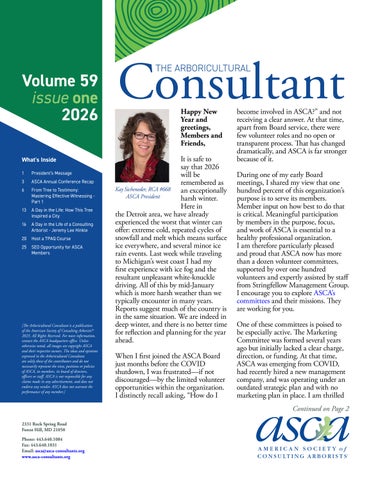
Kay Sicheneder, RCA #668 ASCA President
2025 BOARD OF DIRECTORS
President
Kay Sicheneder, RCA #668, Attica, MI
President-Elect
Nick Martin, RCA #552, Algonquin, IL
Immediate Past President
Ron Matranga, RCA #488, Spring Valley, CA
Secretary/Treasurer
Christian Hughes, RCA #493, Atlanta, GA
Directors:
Monika Buczko, RCA #785, Warminster, PA
Debra DeMarco, RCA #672, South Miami, FL
Aaron Dickinson, RCA #664, Apple Valley, MN
Kyle Offerdahl, RCA #714, Portland, OR
Richard 'Ricky' Peterika, RCA #641, Tampa, FL
STAFF
Executive Director
Kristen Philips, MBA, CAE
Associate Director
Lisa Blair, QAS
Credentialing Programming Manager
Amy Giesy, QAS
Director of Meetings
Diane Schafer, CMP, DES
Director of Marketing and Communications
Amie Goscinski
CFO & Director of Finance
Mary Skudzinskas, CPA
NEWSLETTER
The Arboricultural Consultant is published four times a year by ASCA. Articles and news items are encouraged and must be submitted six weeks prior to publication.
Editorial Committee Chair
Kat Cummings, RCA #781
Editorial Review Committee
Julie Collins, RCA #811
Lisa Smith, RCA #464
Craig Southwell, RCA #592
Steve Lane
Jaclyn Salts
Guy Meilleur
Board Liaison: Ron Matranga, RCA #448
The
"Members of the
to report that ASCA’s foundation is now solid. We are well positioned to address a concern shared by many of you: increasing public awareness of what consulting arborists do, and of ASCA and the RCA credential.
With a marketing plan under development and funds now budgeted to support marketing efforts, the Marketing Committee is ready to get to work. I look forward to seeing what they take on first. This is an excellent time for members to weigh in on how marketing efforts should be focused to best benefit you and your businesses. Please take the time to complete the upcoming member survey being developed by the Membership Committee. We truly do listen.
In 2026, ASCA will also be examining artificial intelligence and its impact on consulting, consultants, and our organization. Like many emerging technologies, AI presents both opportunities and challenges. Those of you who have participated in the Exchange this winter have already seen the concerns being raised. ASCA’s Board and Stringfellow Management Group are responding, with dedicated discussion planned for our March Board meeting. We will hear from the Consulting Academy Committee regarding implications for report grading, and the Program
Planning Committee is actively seeking AI-related topics and speakers relevant to consulting arboriculture. Please watch for upcoming educational offerings focused on the responsible use and management of AI.
In the meantime, warmest winter wishes to you and to the entire ASCA community.
Kay Sicheneder, RCA #668
ASCA President 2026
following antitrust statement has been approved by the president and board of directors of the American Society of Consulting Arborists.
PS: This letter was enhanced through the use of ChatGPT.
ASCA 2025 Annual Conference Wrap-Up
ASCA members, arboricultural professionals and industry partners gathered in beautiful San Antonio, Texas for the 2025 ASCA Annual Conference! Our program offered pre- and post-conference workshops, as well as networking with attendees, sponsors and exhibitors. Our main conference speakers educated attendees on a wide variety of topics and we had engaging Q&A sessions after each session.
We hope to see you later this year at the 2026 Annual Conference in Long Beach, CA!
"Love this conference!"
"Great lineup of speakers that are relevant to our work and the future of consulting"
"Provided reinvigoration for our industry and an excitement to look into some new processes and tools during the coming slow season/winter"
ASCA 2025 Annual Conference Awards Recap
2025 Honorary Life Member
Joe McNeil, RCA #299
Joe McNeil, RCA #299 has been a dedicated ASCA member since 1989, an impressive 36 years, and throughout that time he has consistently helped to elevate the standards, credibility, and professionalism of the field. As chair of the Standards of Professional Practice committee from 1995 to 2000, he played a pivotal role in advancing the industry’s ethical and professional framework, serving not only in that leadership position but also as the co-author of the Standards of Professional Practice, a cornerstone document that continues to guide consultants today. Joe’s service extended to the ASCA Board of Directors from 2003 to 2005, and his influence is further reflected in the many insightful articles he has contributed to The Arboricultural Consultant. Within the ASCA Exchange community, Joe can always be counted on to respond and share his experienced perspective. “Joe has taught us leadership by demonstrating respect with authority in every discussion. Joe’s catchphrase ‘it all depends’ is the hallmark of an experienced consultant who uses judgement, context, and flexibility to form a professional opinion.” These words reflect not only his expertise, but the thoughtful, principled way he has shaped the professional culture within ASCA.
2025 President's Award
Philip van Wassenaer, RCA #678
Each year, the ASCA President’s Award is presented, at the discretion of the current President, to a member who has meaningfully advanced the President’s agenda and supported the Society’s key initiatives. The award recognizes collaboration, leadership, and a commitment to strengthening ASCA’s mission. While many leaders have helped carry the organization forward in recent years, this year one individual’s contributions stood out clearly. Philip van Wassenaer, RCA #678 has served on the Board of Directors from 2020–2025 and played a key role in the Program Planning Committee and the establishment of the CTLA’s improved publication process. He has proactively reached out with ideas for conference speakers and programming and has also shared his expertise by presenting at ASCA conferences and pre-conferences. Philip’s pursuit of excellence sets a high standard that elevates the entire organization.
From Tree to Testimony: Mastering
Effective Witnessing - Part 1
By Monika D. Buczko, RCA #785, BCMA, CTSP
The Role of the Expert Witness in Arboriculture
Expert witnessing is a critical aspect of professional practice within arboriculture, particularly for consulting arborists who provide technical opinions in legal or dispute resolution settings. While not every case proceeds to court—whether before a judge or a jury—every consulting arborist should operate under the assumption that their work may ultimately be scrutinized in a legal forum. This mindset ensures the highest standards of accuracy, objectivity, and professionalism from the outset.
Once a report has been submitted, it becomes a matter of record; revising conclusions or altering opinions after the fact is rarely possible and can severely undermine credibility. Therefore, each report must be meticulously prepared, thoroughly supported by evidence, and written with the clarity and precision necessary for potential legal examination.
The insights presented here draw from my own experience as an expert witness, combined with lessons learned from colleagues in the field. Together, they underscore the importance of diligence, transparency, and professional integrity when representing arboricultural expertise in a legal context.
The Curriculum Vitae: Establishing Credibility in Testimony
Every expert testimony begins with a review of the expert’s curriculum vitae (CV)—and this is the moment to confidently demonstrate your qualifications. Attorneys and opposing counsel may scrutinize every aspect of your education, certifications, and professional experience to establish your credibility before the court. This is not the time for modesty; it is the time to clearly and accurately present the depth and breadth of your expertise.
An expert witness must be thoroughly familiar with every credential listed on their CV—understanding the requirements for each certification, how it was obtained, and what is required to maintain it. Keeping your CV current is essential. Even a seemingly minor oversight—such as failing to include a “last revised” date—can undermine confidence in the accuracy of your information. Many arboricultural professionals accumulate numerous credentials over the years: certifications, licenses, publications, committee roles, or board memberships. Because legal proceedings can take years to reach trial, a CV that reflects current qualifications and membership status can make a substantial difference in establishing credibility.
Dates matter. Memberships may lapse, certifications may require renewal, and organizations occasionally change names or governing bodies. Experts should review their CVs at least twice a year, and certainly before any deposition, trial, or when providing materials to clients or attorneys.
Equally important is accuracy. Exaggerating or misrepresenting credentials can have serious consequences. Any inconsistency discovered during testimony can not only damage an expert’s professional reputation but may also result in exclusion from the case. Precision, transparency, and integrity in your CV are non-negotiable components of professional credibility.
From Tree to Testimony: Mastering Effective Witnessing - Part 1 continued
The Importance of Timelines and Budgets in Expert Casework
When accepting an expert witness assignment, timelines are one of the most critical factors to consider. A wellprepared and defensible opinion requires sufficient time for thorough research, site investigation, analysis, and report preparation. Without an appropriate schedule, even the most qualified expert risks compromising the quality and credibility of their work.
From experience, I have learned that one of the very first questions to ask an attorney is, “What is the deadline for the report? ” This single question often determines whether or not a case can be responsibly accepted. On several occasions, after initial discussions and agreeing on terms, I discovered that the attorney needed a complete review of materials, site inspection, and final report within a matter of days—sometimes by the end of the same week. In one instance, I did accept a case on a Monday required completion by Friday. Although that case was ultimately successful for the retaining attorney, such outcomes are the exception, not the rule.
Developing a realistic project timeline is essential. Each phase—document review, site visit, data analysis, and report writing—takes time and concentration. Compressing these steps increases the likelihood of omissions, calculation errors (especially in appraisal cases), or incomplete documentation from the field. Working late into the night for days on end is a recipe for fatigue and mistakes, not professional excellence.
A disciplined approach to scheduling not only protects the expert’s credibility but also ensures that the opinions rendered are well-founded, accurate, and defensible under scrutiny. It is always better to decline a case due to unrealistic time constraints than to risk delivering a substandard report.
The Urgency of Timely Site Inspections
Once an expert has been retained, scheduling the site inspection should be an immediate priority. Experience has taught me that conducting the inspection as early as possible is often critical to the success of the case. In many instances, consulting arborists are brought in months—or even years—after an incident has occurred, which can make evidence collection challenging. However, in some cases, the incident may have taken place only a week or two prior to the attorney’s call. Regardless of timing, I always emphasize to retaining counsel the importance of arranging the site visit without delay.
Trees and landscapes are dynamic, living systems that change rapidly due to weather, human activity, or natural processes. Waiting too long can result in the loss of crucial evidence. On several occasions, I’ve completed a site inspection just in time—only to learn that the tree in question was removed the very next day, along with all associated debris. Had the inspection been delayed, valuable physical evidence would have been lost.
Failing to properly document the site—through detailed photographs, videos, and field notes—is a serious professional oversight. I have reviewed reports in which experts relied solely on satellite imagery, with no on-site documentation, leaving major gaps in the evidence record. Aerial images can be useful supplements, but they are no substitute for firsthand observation and comprehensive photographic documentation of the site, the trees, and the surrounding conditions.
Prompt, thorough site inspections not only preserve the integrity of the evidence but also strengthen the expert’s credibility and the defensibility of their opinions in court.
The Importance of Comprehensive Record Review
After being retained, one of the next essential steps is to request all records and documents relevant to the case. A detailed conversation with the attorney at this stage is crucial. It helps ensure they understand what types of documents and evidence an expert needs to properly evaluate the matter—such as photographs, correspondence, maintenance records, site plans, prior reports, or depositions. Attorneys may not always realize which materials are relevant from an arboricultural or technical standpoint, so clear communication is key.
I always advise requesting all documents the attorney is permitted to share. Even if some materials appear tangential, they may contain small but significant details that influence your conclusions. Reviewing every available document is part of due diligence. It is not uncommon to spend hours reading through a deposition transcript or inspection record only to uncover one single fact that proves pivotal to your analysis and ultimate opinion. Conversely, overlooking a piece of information can result in unnecessary challenges during testimony or raise doubts about the completeness of your report.
Every document reviewed should be listed in your report—typically in a section titled “Documents and Materials Reviewed.” This record serves as both a professional courtesy and a safeguard. If, during testimony, you are questioned about a document that was not provided or reviewed, you can confidently refer to your report to clarify that it was not among the materials you received.
Meticulous documentation and transparent record-keeping not only strengthen your credibility as an expert witness but also demonstrate the thoroughness and integrity of your professional process.
Understanding the Language of Expert Opinions
As expert witnesses, we provide opinions and conclusions grounded in our findings, research, education, and professional experience. However, it’s important to acknowledge that absolute certainty is rarely possible. Many experts use the phrase “ in my opinion, within a reasonable degree of professional certainty ” when expressing their conclusions. Yet, in speaking with colleagues, I’ve discovered that not everyone fully understands what this phrase actually means—something that can become painfully evident under cross-examination.
Before including such language in a report or testimony, ensure you understand it completely. The phrase “within a reasonable degree of professional certainty ” essentially means that the expert believes their opinion is more likely correct than not—that is, it reflects a probability of accuracy greater than 50%. It acknowledges that while an opinion is based on sound professional reasoning, it may still rely on incomplete data, retrospective observations, or information provided by others.
Experts should also be careful in their choice of words. Avoid using absolute terms such as all, none, always, or never, as they imply a level of certainty that is rarely achievable in complex arboricultural cases. Overstatements can quickly undermine credibility if opposing counsel exposes even one exception. It is entirely acceptable to acknowledge uncertainty—so long as it is clearly stated and properly qualified in your report. If any assumptions or speculative elements are present in your analysis, identify them transparently. This level of honesty enhances, rather than diminishes, your professional integrity.
Equally important is avoiding the misuse of legal terminology in expert reports. Using legal phrases or drawing legal conclusions can be interpreted as offering legal advice—something outside the expert’s role and qualifications. While arborists may gain familiarity with legal language through experience, it is best to express opinions using clear, technical, and non-legal terms. This approach not only keeps the report within the bounds of professional expertise but also makes it more accessible and defensible in court.
From Tree to Testimony: Mastering Effective Witnessing - Part 1 continued
Maintaining Integrity and Ownership of Your Report
One of the most common—and potentially serious—mistakes an expert can make occurs when a draft report is shared with the retaining attorney for review and feedback. While it is entirely appropriate for an attorney to check for factual accuracy, consistency with case documents, or clarity of presentation, experts must be extremely cautious about allowing any edits that alter the substance of their findings or opinions.
Attorneys are advocates for their clients and naturally want to present the strongest possible case. However, even a single word change suggested by counsel can subtly—but significantly—shift the meaning of an expert’s opinion. An expert’s credibility depends on independence and objectivity. Once that independence is compromised, the integrity of the entire report—and the expert’s reputation—can come into question.
Experts must remember: we do not win cases. I’ve heard many arborists proudly say how many cases they’ve “won,” but that mindset misunderstands our professional role. Expert witnesses are not advocates; we are impartial providers of technical analysis and opinion. We don’t receive trophies or prizes when a case is successful—our “reward” is in upholding the integrity of our profession and the accuracy of our work.
If an attorney suggests changes to your report, discuss those suggestions openly. They may stem from a misunderstanding or from their desire for clarification rather than alteration. However, never allow an attorney—or anyone else—to directly edit or rewrite your report. Any legitimate revisions should be made by you, documented, and issued as a formal addendum if necessary. All draft versions should be retained and dated to maintain transparency and protect against future disputes over authorship or content.
Ultimately, your report is your professional work product. It reflects your expertise, ethics, and credibility. Protect it accordingly.
When
the Evidence Isn’t Enough
At times, an expert may find that there is simply insufficient data to form a reliable opinion or conclusion. This situation can be uncomfortable, especially when there is pressure—explicit or implied—to produce a report regardless. In such cases, experts must resist the temptation to fill in gaps with speculation or vague statements, and they must never “embellish” findings to satisfy a client or attorney.
Honesty and transparency are non-negotiable. My personal practice is to contact the retaining attorney before drafting any report—but only after I have thoroughly reviewed all provided documents, conducted the site inspection, and completed any necessary research. At that point, I clearly explain my findings and the basis for them. If the available information is too limited to support a defensible opinion, I state so directly and allow the attorney to decide whether they wish to pay me to uncover more information and proceed with a formal report.
There have been several instances where my preliminary findings did not support the retaining attorney’s client’s position, and as a result, no report was written. That is perfectly acceptable—and, in fact, the mark of professional integrity. Our role as expert witnesses is not to advocate for a particular outcome, but to investigate, analyze, and report the facts as they exist. Sometimes that means the evidence simply does not lead to the conclusion the client hopes for—and that is part of doing the job ethically and correctly.
Professionalism When Addressing Opposing Experts
Another common mistake made by expert witnesses—sometimes at the urging of attorneys—is criticizing or discrediting the opposing expert in an unprofessional manner. I have been asked on occasion to include in my report statements about how “wrong” or “poorly written” the opposing expert’s opinions are. This is never appropriate. An expert’s role is to present their own analysis objectively, not to attack another professional’s credibility.
From Tree to Testimony: Mastering Effective Witnessing - Part 1 continued
It is entirely acceptable—and sometimes necessary—to state that you disagree with another expert’s findings or conclusions. However, any disagreement must be supported by verifiable data, sound reasoning, and relevant professional experience. The proper approach is to explain why you reached a different conclusion, not to demean or disparage the other expert. For example, a respectful and defensible phrasing would be: “In my opinion, I disagree with the conclusions presented by [opposing expert], based on my education, experience, and analysis of the available evidence.” And then proceed to elaborate on why.
This phrasing maintains professionalism while clearly distinguishing your viewpoint. Remember that a strong opinion does not automatically make the opposing expert “wrong.” They may have formed their conclusions from different data, timing, or experience. The goal is not to prove them incompetent, but to present your opinion confidently and ethically, grounded in your own expertise.
Professional respect, even in disagreement, enhances your credibility in the eyes of the court and reinforces your reputation as an impartial, reliable expert.
Communication: The Foundation of a Successful Assignment
Clear and consistent communication with the retaining attorney is one of the most critical aspects of any expert witness assignment. Before beginning work, make sure you fully understand the key issues in the case and confirm that your scope of work aligns with those issues. This step is directly tied to the availability of sufficient time and information to produce a complete and defensible report.
I have reviewed reports—and even encountered a few cases firsthand—where opposing experts failed to address the central issue of the dispute. Such oversights can lead to flawed assumptions, inaccurate conclusions, and reports that ultimately serve little or no purpose in litigation. If any aspect of a case is unclear, do not hesitate to speak directly with the attorney. A short, focused conversation early in the process is far more efficient than spending hours or days developing a report that does not meet the attorney’s needs or address the core questions of the case.
Missing key concerns not only weakens your professional credibility but can also lead to frustration for the retaining attorney—and, in some cases, jeopardize payment for your work product. Maintaining open lines of communication ensures that both expert and attorney are working toward the same objectives, resulting in a more accurate, relevant, and professionally defensible opinion.
Own Your Work: Avoid Passive Voice
As we learn in ASCA Academy training, using passive voice in reports can create imprecision and ambiguity— and in the courtroom, ambiguity can quickly lead to unnecessary questioning and potential discrediting of your expertise. When describing your work, always clearly state your actions. For example: if you conducted a site inspection, say that you conducted it; if you collected samples, state that you collected them.
Passive constructions—such as “samples were taken” or “the site was inspected”—can inadvertently imply that someone else performed the work, or that you are concealing information. Both interpretations can undermine the credibility of your report. Remember, the report is your professional product, reflecting your investigation, research, and analysis. Clearly stating your role and actions demonstrates accountability, ownership, and the integrity of your findings.
From Tree to Testimony: Mastering Effective Witnessing - Part 1 continued
Trial Preparation: Organization and Mastery of Your Report
Before attending a trial, always consult with your retaining attorney about what materials you should bring. In some cases, you may be instructed to bring nothing; in others, you may be asked to bring everything— including site visit notes, research documentation, invoices, and other supporting materials. I recommend preparing a well-organized binder with clearly labeled tabs separating each type of document. Organization not only makes a positive impression but also demonstrates transparency and professionalism.
Equally important is knowing your report inside and out. Take sufficient time before trial to thoroughly review and internalize your findings. I have encountered a variety of scenarios: in one case, I testified without having my report in front of me, in another, I testified in a state that does not require reports at all. Regardless of the circumstances, preparation is key.
During questioning, take your time to listen, understand, and organize your response before answering. It is perfectly acceptable to pause for a second or two to gather your thoughts. Never answer a question you do not understand—ask for clarification or request that it be rephrased. Avoid providing unnecessary elaboration, as it can invite additional questions and increase the risk of exposing gaps in your knowledge.
Finally, avoid shuffling through your report while being questioned. Doing so can appear unprofessional and give the impression that you did not write the report yourself. Confidence, clarity, and careful preparation are the hallmarks of an effective expert witness.
Conclusion: Learning and Growing as an Expert Witness
Expert witnessing can be both fascinating and challenging. It requires diligence, attention to detail, and a commitment to ethical practice. While no one is perfect and minor mistakes are inevitable, major errors can have serious consequences, potentially jeopardizing an expert’s credibility and career.
As in all areas of life, learning from your own mistakes is essential, but in the world of expert witnessing, learning from the mistakes of others can be even more valuable. Observing and understanding the pitfalls experienced by colleagues allows new and seasoned experts alike to refine their approach, strengthen their reports, and maintain the integrity and professionalism that the role demands.
By combining careful preparation, ethical rigor, and ongoing learning, arborists can provide accurate, defensible opinions while upholding the highest standards of the profession.
A Day in the Life: How This Tree Inspired a City
By Robert Booty, RCA #487
Recently I had the privilege of completing a project I started in 2013.
Back then the City of Palo Alto, located in California; asked if I would be interested in performing a noninvasive long term (10yrs.) health study on their iconic tree, "The El Palo Alto Redwood."
My knowledge about this tree at the time was limited. I soon found out that this tree is the #2 landmark for the state of California, and the City of Palo Alto was named after this tree, so it was very special. What a privilege it has been for me to work with the city and their tree over these years.
From the beginning, as I began the testing, I started video documenting our activities. My hope was that in time a documentary could be put together using my on-site footage of this very special project and tree. To keep the project non-invasive we used Ground Penetrating Radar to image the trunk. We also used that same technology to document the location of the tree roots down a 30ft. concrete retaining wall.
We used a series of drone studies to monitor the health of the tree canopy over the years. In 2023 this project came to an end. The task of completing the documentary was a long challenge, it is 50 minuets long. I donated my time and resources for this project including the development of this video. Enjoy.
Link: How this tree inspired a city | El Palo Alto (Documentary)
ASCA Lands’ End Store
As an exclusive benefit to ASCA members only, ASCA has partnered with Lands’ End so members can now purchase clothing with the ASCA logo. This partnership includes the entire Lands’ End inventory for both men and women, in all sizes and colors, and offering an array of options for logo placement.
Examples:
How to Order:
• Visit the ASCA Lands’ End storefront (ASCA Members - Please contact ASCA for the store password)
• Choose the category of clothing that you prefer
• Once you click on the item you are interested in, select the size you would like
• APPLY THE ASCA LOGO and select the logo location
• Add the item(s) to your bag
• Check out or continue shopping
WE’RE FOR EVERY TREE. WE’RE FOR EVERY TREE.
A Day in the Life of a Consulting Arborist
By Jeremy Lee Hinkle, RCA #812, ISA Certified Arborist
Consulting arboriculture is where science, planning, and professional judgment converge. After more than 20 years in municipal parks and urban forestry operations, I now balance public-sector service with private consulting through my firm, Lee Green Consulting LLC, supporting projects throughout South Florida. Each day reinforces the importance of objective, defensible arboricultural guidance in increasingly complex urban environments.
Unlike production work, consulting requires long-term thinking. My role often involves evaluating how trees interact with development before issues arise—rather than responding after damage has occurred. A typical day may include conducting tree inventories and risk assessments, reviewing civil and architectural plans, identifying conflicts with tree protection zones, and developing mitigation or relocation strategies that align with ANSI A300 standards and local municipal codes.
Much of my work centers on communication. Consulting arborists frequently serve as translators between arboriculture and the broader project team. Architects, engineers, contractors, and municipal reviewers all approach projects from different perspectives, and part of my responsibility is to present tree-related recommendations in a way that is clear, practical, and defensible. The goal is not only to preserve viable trees, but also to help projects move forward efficiently while reducing long-term risk and liability.
Launching and growing a consulting practice while maintaining a municipal career has required structure, discipline, and strong professional ethics. Clear boundaries, consistent documentation, and conservative recommendations have been essential. One of the most valuable lessons I’ve learned is that credibility is built over time—through accuracy, transparency, and a willingness to recommend removal when preservation is not feasible.
Technology has become an indispensable part of my consulting workflow. Digital data collection, GIS overlays, cloudbased photo documentation, and standardized report templates allow for greater efficiency and consistency. These tools don’t replace professional judgment, but they free up time for analysis, planning, and collaboration—where a consulting arborist adds the most value.
Consulting arboriculture plays a critical role in modern urban development. Trees exist within legal, structural, environmental, and social systems, and consulting arborists help navigate those intersections. Whether working on a single residential property or a large-scale development, my objective remains the same: provide sound, objective guidance that protects both the urban forest and the interests of the client.
Author Bio
Jeremy Lee Hinkle, RCA #812 is an ISA Certified Arborist, ASCA Registered Consulting Arborist, and TRAQ/TPAQ Qualified professional with over 20 years of experience in municipal parks operations and urban forestry. He is the principal consultant at Lee Green Consulting LLC, providing arborist reports, risk assessments, and development support across South Florida.
Welcome New Members
Samuel Cannon
sam.cannon.arborist@gmail.com Redlands, CA
Julia Cribbs jtroxell@savatree.com Lakewood, CO
Wister Dorta wdorta@arborjet.com Los Angeles, CA
Barbara Fair bfair@ncsu.edu Raleigh, NC
Peter Meleady
pmeleadyp@gmail.com East Norwich, NY
Timothy O’Connor portlandarborconsulting@gmail.com Portland, OR
Daniel Savoie
daniel@nedpatchettconsulting.com
Craig Schultz VPLDesignCA@gmail.com Fair Oaks, CA
New RCAs
Joshua Zinn, RCA #907
Jeff Harvey, RCA #908
Brandon Elrod, Ph. D., RCA #909
Thea Lemberger, RCA #910
William Gambone Sr., RCA #911
RCA Embosser and Stamp — Distinguish Yourself
The Registered Consulting Arborist® (RCA)* status represents ASCA's premier level of membership. Official RCA stamps and embossers are available for purchase—use these items to distinguish your work products.
*You must be an RCA to order RCA products.
Submit Your CEUs!
To maintain your ASCA Membership, you must obtain 30 approved CEUs every two years. The last renewal cycle concluded on September 30, 2024. The new CEU renewal cycle is October 1, 2024 - September 30, 2026. While you are no longer required to upload all of your CEUs to your member portal (unless you are audited), the easiest way to keep track of your CEUs is to enter them into your member profile as you earn them.
Once you have 30 approved CEUs for the current renewal period, additional credits are not required.
Submitting CEUs online is easy:
1. Log in to the ASCA website
2. Click “Manage Profile.”
3. A t the top of the page, click the “Enter Your CEUs Now” icon.
4. Click on ‘Add Entry’ to add your CEUs.
*Be sure you select the correct CEU renewal cycle to apply your credits!
**Do not enter an expiration date!
View step-by-step directions here
Hear What Others are Saying!
Tre e and Plant Appraisal Qualification®
Hosting a TPAQ course is a win-win: more attendees in your area have a place to obtain industry-validated tree and plant appraisal education, and ASCA provides your organization with all of the tools to make it possible.
ASCA will provide all the necessary course materials, including the approved education curriculum and slides, workbooks for attendees, exams, etc. and the host will provide the classroom space, meals for students, an ASCA approved instructor and per-attendee licensing fee. The full list of host ad ASCA responsibilities can be found here.
About the TPAQ program:
The TPAQ curriculum is an introductory training course that will train green industry professionals in the theory and application of current tree and plant appraisal approaches, methods, and techniques to develop and implement an appraisal assignment. The course is for green industry professionals who wish to learn about tree, plant and landscape appraisal.
Who is eligible to attend, and/or earn the TPAQ Certificate?
Effective immediately, anyone can pay for and attend the TPAQ education sessions. However, eligibility requirements are still required for those who wish to sit for the exam and receive the TPAQ certificate. Opening the training to all allows as many people as possible to receive industry-validated appraisal education. Requiring those who wish to hold the TPAQ certificate to meet eligibility requirements ensures that the TPAQ certificate remains a high-level credential. For more details on eligibility requirements and the TPAQ certificate, please visit our website.
If your organization would like to host a TPAQ workshop, contact Amy Giesy, QAS, Credentialing Programming Manager, at agiesy@asca-consultants.org.
Upcoming Courses:
North Carolina Urban Forestry Council
March 19-20, 2026
JC Raulston Arboretum
Raleigh, NC 27606
Western ISA Chapter
March 25-26, 2026
Clubhouse at Woodcreek Roseville, CA 95747
Morris Arboretum
March 30-31, 2026
Morris Arboretum & Gardens Welcome Center
Philadelphia, PA 19118
La Cantera Resort & Spa - San Antonio, Texas 2025 AN N U AL C ONF E RE N C E
2025 Annual Conference Recordings Are Now Available!
ASCA Annual Conference 2025 session recordings are now available for purchase and instant download. Sessions available for purchase are the general sessions from Monday (12/8) to Wednesday (12/10)*.
*Does not include pre- or post-conference workshops
Classified ads are a great way to find new employees or announce business opportunities. Payment must accompany copy. Send your classified ads to the ASCA office by email.
Up to 200 Words $50
Each additional 100 words thereafter $25
Design Services
ASCA offers in-house design services to help you with your ad design needs. Please call ASCA at (443) 640-1084 for rates. Any ads submitted that do not meet the proper size requirements will be reset, and production charges will be incurred at advertiser’s expense.
Publisher Indemnities
Publisher reserves the right to mark “advertisement” on copy that readers might confuse with editorial content, and to refuse copy that offends good taste or takes unfair competitive advantage.
Mechanical Requirements
• Files must be sent via email.
• Acceptable formats are hi-res JPEG and PDF.
General Information
• Advertising rates are effective October 1 through September 30 of the following year.
• Payment is due with signed contract and by final closing date for each issue.
• Signed contract must accompany ad.
• No refunds will be given on advertising payments. If ASCA membership is not renewed, member ad rates will revert to non-member rates.
• When change of copy is not received by final closing date, publisher reserves right to print ad from previous issue.
Reserve Your Advertising Space Today!
2331 Rock Spring Road Forest Hill MD 21050
T(443)640-1084 F (443) 640-1031
Advertising Opportunities with ASCA
Looking for other advertising opportunities?
Ad Sizes, Rates and Closing Dates
Co-Sponsoring Opportunities
Co-sponsors receive year-round visibility with ASCA’s engaged professional audience, including discounted conference and Academy registrations for members, a complimentary tabletop exhibit at the Annual Conference, and a full-color ad in The Consultant. Additional recognition includes logo placement on the conference and Academy websites, inclusion in promotional emails and social media, and listings for your organization’s upcoming events, maximizing exposure before, during, and after the conference. Contact ASCA Headquarters at asca@asca-consultants.org for more information.
1/2 Vertical 3.5 x 10" $95$335$170$590
1/4 Page 3.5 x 4.5" $80$290$140$500
Promote Your Event
Classified Ads
Classified ads are a great way to find new employees or announce business opportunities. Payment must accompany copy. Send your classified ads to the ASCA office by email.
Number of Words
Up to 200 Words
Each additional 100 words thereafter
Increase your visibility by featuring your event on our Events Calendar and in the ASCA Insider (sent to all ASCA members quarterly) for just $199. Reach a targeted audience of industry professionals, drive engagement, and showcase your event alongside trusted resources and opportunities, all with a simple, affordable listing. Contact ASCA Headquarters at asca@asca-consultants.org for more information.
Exhibiting
Design Services
ASCA offers in-house design services to help you with your ad design needs. Please call ASCA at (443) 640-1084 for rates. Any ads submitted that do not meet the proper size requirements will be reset, and production charges will be incurred at advertiser’s expense.
Yet across the country they’re stressed by climate shifts, pests, and neglect. Many problems are treatable if action is taken early. Find diagnostic tools and expert advice you can share with your customers at TreesNeedYou.com
Mechanical Requirements
• Files must be sent via email.
Together we can
• Acceptable formats are hi-res JPEG and PDF.
re-root
the future of oaks.
General Information
• Advertising rates are effective October 1 through September 30 of the following year.
• Payment is due with signed contract and by final closing date for each issue.
• Signed contract must accompany ad.
The ASCA Annual Conference is held each December and is the Society's exclusive opportunity to exhibit directly to our members. Find upcoming conferences and exhibitor details through our Calendar of Events
• No refunds will be given on advertising payments. If ASCA membership is not renewed, member ad rates will revert to non-member rates.
• When change of copy is not received by final closing date, publisher reserves right to print ad from previous issue.
Publisher Indemnities
Publisher reserves the right to mark “advertisement” on copy that readers might confuse with editorial content, and to refuse copy that offends good taste or takes unfair competitive advantage.
Oaks play a vital role in
ecosystem they inhabit, including our urban forests.
SCAN TO LEARN MORE
SEO Opportunity for ASCA Members
By Chris Whitman, Member of ASCA Marketing Committee
Hopefully you have heard by now that ASCA is making some big changes in the way it supports and promotes its membership. One recent and impactful change has been to improve the way clients find us through Search Engine Optimization (SEO) of ASCA's own webpage. You may ask, what is SEO? SEO is the process of improving the quality and quantity of website traffic to a website or a web page from search engines.
For those who may not be aware of the importance of SEO and building a web presence, take a look at some of these statistics:
1.) 61% of B2B marketers stated that SEO and organic traffic generate more leads than any other marketing initiative.
2.) 75% of people never scroll past the first page of search engines results.
3.) 70% of online marketers say that SEO is better than PPC (Pay-Per-Click Advertising) for generating sales.
source: www.hubspot.com/state-of-marketing
As a result of these improvements, not only will you directly benefit from more traffic to the "Find a Consulting Arborist" web page, but ASCA has also negotiated and secured a deeply discounted member set-up rate from our SEO provider to deliver this same, critical, marketing assistance to
your consulting practice website and/or listing. You now have a direct opportunity to piggyback on ASCA's significant presence to promote your business while customizing your own SEO to fit your specific geographic and service market needs. ASCA's SEO Provider has extended an offer to all members for discounted SEO services tailored just to your needs.
Email ASCA@asca-consultants.org for more information. Use "SEO Offer" in your subject line.
“ASCA has also negotiated and secured a deeply discounted member set-up rate from our SEO provider to deliver this same, critical, marketing assistance to your consulting practice website and/or listing.”
This is also an ideal time to update and personalize your ASCA Profile Information.
Follow these easy steps:
- Go to asca-consultants.org
- Sign into your account
- Click "Profile Home"
- Scroll down to Professional Information and click "edit"
Here, you can customize your profile even further by selecting the services that you provide, such as appraisals, expert witness, etc. as well as selecting the various states in which you do business.
Be sure to take advantage of this offer and make your membership work for you. As author H.
Jackson Brown put it, "Nothing is more expensive than a missed opportunity."
Are You a Registered Consulting Arborist?
Show off your great accomplishment with the RCA Electronic Stamp!
The RCA electronic stamp is a digital image customized for you! You can use this as part of your email signature, on professional documents, on social media, business cards, and on your website. Using your RCA digital stamp will differentiate yourself and showcase your valuable credential.