The Last of Us: A Call to Action for Edmonton’s Urban Forest
By Steve Lane, BCMA

While teaching a TRAQ course in Edmonton, Alberta this past Spring, I became aware of something that as a selfdescribed “blackbelt tree geek,” made me paradoxically very excited, as well as extraordinarily concerned. Portions of Alberta and British Columbia, Edmonton in particular, are one of the last places on the North American continent that Dutch elm disease has not infiltrated. The reasons for this are many, and beyond the scope of this short article, but the fact remains, these areas were unaffected by the disease.
This fungal infection, spread by beetles and through root grafts, had nearly wiped out American and Red (slippery) elms from the Urban Forests of my Illinois childhood in the 1980s. It was as if I stepped onto the scene of an unreleased “Back to the Future” sequel; an alternate reality where DED had never happened. Students were explaining that nurseries were still growing and selling cultivars of American elms I had never heard of, and these sentries of the Urban Forest were absolutely everywhere. Strange things were indeed afoot in this magical place.
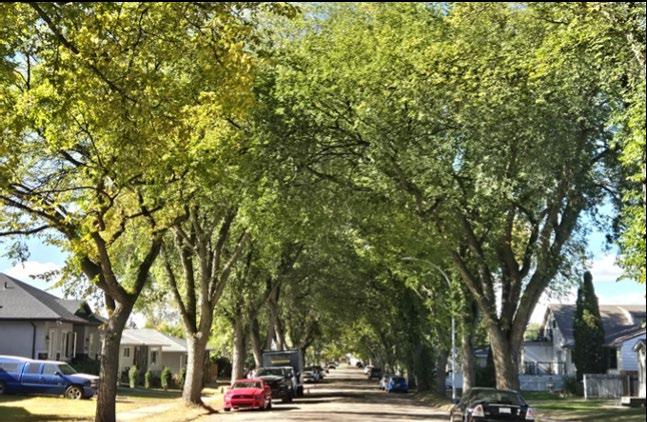
After class each day, I wandered out into the streets with my camera, capturing image after image of a landscape long vanished from the Midwest. The “Elm Cathedral,” once a common sight but now largely absent from our landscapes, was still present in its full glory here. Row after row of these vase-shaped, highly phototropic trees arched overhead to create a majestic vaulted green ceiling as inspiring as the Sistine Chapel. Well, at least to a blackbelt tree geek, anyways. And ash trees as far as the eye could see! In the Midwest, nearly 95% of our ash population has been lost over the past 15 years. Today, spotting one of these onceubiquitous workhorses of the urban forest is rare, where once they numbered in the millions.
If you want to see a living museum of what urban forests looked like in the 1970s and 1980s, head to Edmonton. Walking the streets feels like stepping back in time forty years. Urban forestry tourism, perhaps? You heard it here first. But there is a more somber storyline emerging in E-Town. For not only was Dutch elm disease detected in the region last spring (See This Link), but emerald ash borer has also been discovered relatively close by in Winnipeg, and its arrival in the next few years is nearly certain. Two devastating pests and pathogens-normally separated by decades in time for most of us-are poised to hit Edmonton at nearly the exact same time. For any Urban Forester, this is an unfathomably bad situation.
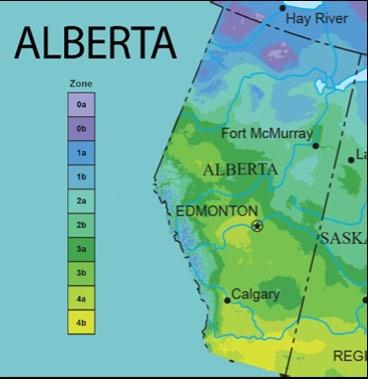
To make matters worse (wait, it gets worse?), because Edmonton lies at about 53° N latitude, just 7 degrees below the arctic circle in Canadian Plant Hardiness Zone 4 (fairly similar to the same USDA Hardiness Zone), their planting palette is extremely limited. According to my students, and backed up by the Edmonton Tree Map, the Urban Forest is approximately 40% ash and elm. But 40% of what? How many trees does Edmonton have? It gets worse. How about 465,000 publicly owned trees, all inventoried and mapped (Map Link Here). Among the largest Urban Forests in North America.

Now imagine being faced with losing 190,000 of those trees in public spaces within the next decade. To make matters worse (wait, it gets worse?), the region’s brutally cold winter temperatures, the list of tree species hardy enough to serve as replacements is shockingly small. The price tag, however, will be shockingly high. If you were having a bad Urban Forestry day before reading this, I hope this brings you some solace that your situation, almost by definition, cannot be this intimidating.
I wrote this article for two reasons. First, as I mentioned earlier: If you’re a tree geek-and its likely you are if you’re still reading-and want to step back in time, visit Edmonton. It’s a vibrant city with great people and a spectacularly rare Urban Forest. But more importantly, my purpose is to draw attention to an impending challenge which will demand substantial resources, innovative thinking, and untamed ingenuity to tackle. If you are looking to make a difference in the world in our chosen profession, Edmonton might be a great place to contribute your time and skills. Consider reaching out to some folks on the ground there and inquiring if you can be part of the solution. Whether through treatment, removal, planning work, nursery growing, or any step in between, there is opportunity to help guide the city’s transition from one massive urban forest to a very different vision of what it will become in the years ahead.
I taught another TRAQ course in Edmonton this past week, took even more pictures, and was inspired to write this. As I pulled into the hotel parking lot after the drive from Edmonton to Calgary, I saw the sun setting over a parking lot populated with young ash and elm trees, a sight I have not seen for a long time. It reminded me that like the sun, the Urban Forest cycles as well. As the sun begins to set on this historic and storied tree population, it will also rise anew in the years to come, as has happened many times before in our Urban Forests. It reminds me that Urban Forestry takes all of us, and this is but one bittersweet chapter in that very long book, and a shining opportunity to write your efforts into the pages of its perpetual history.