Selecting Stress-Tolerant Trees for Urban Landscapes. From Traditional Choice Lists to Physiological and Scientific Testing. By Dr. Glynn Percival, Bartlett Tree Research Laboratories
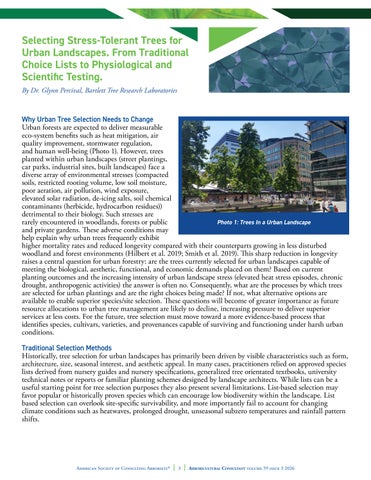
Why Urban Tree Selection Needs to Change Urban forests are expected to deliver measurable eco-system benefits such as heat mitigation, air quality improvement, stormwater regulation, and human well-being (Photo 1). However, trees planted within urban landscapes (street plantings, car parks, industrial sites, built landscapes) face a diverse array of environmental stresses (compacted soils, restricted rooting volume, low soil moisture, poor aeration, air pollution, wind exposure, elevated solar radiation, de-icing salts, soil chemical contaminants (herbicide, hydrocarbon residues)) detrimental to their biology. Such stresses are rarely encountered in woodlands, forests or public Photo 1: Trees In a Urban Landscape and private gardens. These adverse conditions may help explain why urban trees frequently exhibit higher mortality rates and reduced longevity compared with their counterparts growing in less disturbed woodland and forest environments (Hilbert et al. 2019; Smith et al. 2019). This sharp reduction in longevity raises a central question for urban forestry: are the trees currently selected for urban landscapes capable of meeting the biological, aesthetic, functional, and economic demands placed on them? Based on current planting outcomes and the increasing intensity of urban landscape stress (elevated heat stress episodes, chronic drought, anthropogenic activities) the answer is often no. Consequently, what are the processes by which trees are selected for urban plantings and are the right choices being made? If not, what alternative options are available to enable superior species/site selection. These questions will become of greater importance as future resource allocations to urban tree management are likely to decline, increasing pressure to deliver superior services at less costs. For the future, tree selection must move toward a more evidence-based process that identifies species, cultivars, varieties, and provenances capable of surviving and functioning under harsh urban conditions. Traditional Selection Methods Historically, tree selection for urban landscapes has primarily been driven by visible characteristics such as form, architecture, size, seasonal interest, and aesthetic appeal. In many cases, practitioners relied on approved species lists derived from nursery guides and nursery specifications, generalized tree orientated textbooks, university technical notes or reports or familiar planting schemes designed by landscape architects. While lists can be a useful starting point for tree selection purposes they also present several limitations. List-based selection may favor popular or historically proven species which can encourage low biodiversity within the landscape. List based selection can overlook site-specific survivability, and more importantly fail to account for changing climate conditions such as heatwaves, prolonged drought, unseasonal subzero temperatures and rainfall pattern shifts.
American Society of Consulting Arborists®
3
Arboricultural Consultant volume 59 issue 3 2026
Selecting Stress-Tolerant Trees for Urban Landscapes continued
Another common approach is to select trees based on what appears to grow well locally, especially those in harsh urban landscape conditions (Photo 2). This method has value because it reduces the likelihood of choosing species with an obvious climatic mismatch. However, it can also narrow the range of taxa considered for planting. Species that have not historically been planted in a region may be overlooked even if they are equally suitable, or better suited, to the conditions of a specific urban site. Local observation can also fail to capture important differences in microclimate, drainage, soil compaction, pollution exposure, and rooting conditions across a city. A tree that performs well in one urban setting may fail in another because the site stresses are subtly but significantly different. Consequently, practitioners still often disagree on species responses to specific stressors, and few species are perceived as tolerant across the full suite of urban constraints (Carol-Aristizabal et al. 2023). Provenance: Matching Genetic Origin to Urban Stress In forestry, provenance selection has long been used to identify seed sources or genetic populations adapted to specific environmental conditions with timber production as the primary focus. Provenance selection for urban landscapes, however, remains Photo 2: Tree Growing comparatively underdeveloped. Provenance trials have repeatedly demonstrated that In harsh Landscape populations of the same species can differ substantially in growth rate, phenology, drought tolerance, cold hardiness, and susceptibility to pests and diseases. These differences reflect local adaptation to the climatic and edaphic conditions under which populations evolved and suggest that successful urban tree selection should consider not only species identity but also genetic origin. Trees growing naturally or successfully in coastal regions exposed to salt spray and high winds, for example, may provide valuable genetic material for urban sites where salinity and exposure are major constraints. Similarly, trees originating from climates or soils comparable to a target planting site may be better able to establish, tolerate local stressors, and reduce transplant shock. Research on tree adaptation has shown that locally adapted or environmentally matched provenances often display superior survival and physiological performance compared with poorly matched seed sources. Such differences can be especially important in urban landscapes where trees must cope with multiple stressors simultaneously. Provenance selection can also support climate adaptation. The concept of assisted migration or climate-adjusted provenancing has gained increasing attention in forestry and restoration ecology, as it seeks to match planting stock to current environmental conditions and projected future climates (Aitken and Bemmels 2016). Studies of species such as Quercus, Pinus, Eucalyptus, and Pseudotsuga have demonstrated that populations originating from warmer and drier regions often possess traits associated with improved drought tolerance, including greater hydraulic safety, higher water-use efficiency, and more conservative growth strategies (Prober et al 2015; SáenzRomero et al 2021). Incorporating these provenances into urban planting programs may help improve resilience to future heatwaves and water scarcity (Williams and Dumroese 2013). However, provenance selection must be used carefully. Commercial plant distribution frequently moves trees far from their place of origin, and the assumption that a poorly matched tree will eventually acclimate to unsuitable conditions is rarely supported by evidence. Provenances adapted to warmer climates may exhibit reduced cold tolerance, while locally sourced material may become maladapted under rapidly changing climate conditions. Consequently, provenance choice requires balancing current adaptation with future climatic suitability (Bucharova 2017). By integrating provenance selection into urban forestry practice, managers can move beyond species-level recommendations and make informed decisions about the genetic material most likely to thrive under current and future urban conditions.
American Society of Consulting Arborists®
4
Arboricultural Consultant volume 59 issue 3 2026
Selecting Stress-Tolerant Trees for Urban Landscapes continued
Expanding the Urban Tree Palette One of the simplest ways to improve urban forest resilience is to broaden the range of species, cultivars and varieties used in planting programs. Despite the immense diversity of trees world-wide, only a limited number of species dominate our urban spaces. In many cities, planting palettes remain concentrated around a relatively small group of familiar species. For example, the average community in the United States relies on just six species for the majority (61.5%) of its street and park trees (Ma et al 2020). Likewise, a Tree Vitalize Study conducted in 2023 across 63 U.S. cities analyzed over 5 million trees. The study found a low diversity in many cities, with some dominated by a handful of species. For example, Worcester, MA had an effective species number of 6.43, London planetree (Platanus × acerifolia) was the most common species overall (4.2% of all trees) and the median diversity across cities was equivalent to circa 35 species, showing heavy reliance on a few species. The issue of low urban tree diversity is not confined to any one country. Globally, research has found that a single, dominant species typically makes up 20% of a given city’s tree population (Kendal et al 2014) increasing vulnerability of urban forests to pests, diseases, and climatic change. The aim is not to plant unusual trees for novelty alone. Alternative species should be evaluated against clearly defined stress criteria, including heat, drought, salt and pollution tolerance, rooting constraints, pest and disease resistance, and capacity to deliver ecosystem services under stress. Expanding the species pool through systematic evaluation of underused taxa can improve genetic diversity, reduce ecological risk, and strengthen long-term canopy stability. Systematic reviews show for example that urban tree performance during extreme heat varies with tree traits, site context, and climate zone (Percival 2023). In addition, because multiple stressors co-occur, the most important selection question is not simply ‘Which species tolerate drought?’ but ‘Which species maintains function and recovers under combinations of heat, drought, and additional site constraints typical of the urban landscape’? Such questions reinforce the need for several complementary predictors of tree performance and selection (Alonzo et al. 2025; Jang and Leung 2022). As a way forward ecological selection frameworks incorporate species functional traits linked to environmental tolerances to improve matching of tree biology and site conditions. Trait-based approaches, such as those described by Núñez-Flórez et al. (2019), emphasize the use of functional diversity metrics such as leaf morphology, hydraulic traits, and growth strategies to optimize ecosystem service delivery and resilience in urban forests. Similarly, Niinemets and Valladares (2006) highlight the importance of understanding multistress tolerance syndromes (e.g., trade-offs between shade, drought, and waterlogging tolerance), which are critical in heterogeneous urban environments. Advances in data integration further enhance this process. The application of “big data” approaches, as demonstrated by Watkins et al. (2020), enables the synthesis of climatic, geographic, and phenotypic datasets to improve ecotype matching and identify provenances better suited to future urban conditions. Likewise, urban microclimate modeling, such as that developed by Morakinyo et al. (2020), supports the concept of “right tree, right place” by quantifying spatial variability in heat exposure and guiding species selection for maximum thermal mitigation. Arboreta and Botanical Gardens as Living Laboratories for Tree Selection Arboreta and botanical gardens provides an important resource for improving urban tree selection because they contain diverse collections of species, cultivars, and varieties that may not be widely represented in commercial or municipal planting palettes. These collections allow researchers and practitioners to evaluate a broad range of genetic material under comparable environmental conditions, creating opportunities to identify trees that are better suited to future urban climates. Furthermore, arboreta often maintain well-documented accessions and mature specimens, enabling researchers to investigate variation in growth, phenology, stress tolerance, and survival across a wide range of taxa under field conditions. Hirons et al. (2021) emphasized that arboreta and botanic gardens contain taxonomically and functionally diverse collections that make them exceptional resources for evidence-based urban tree selection and diversification strategies. As well as relying on observational assessments of tree performance, arboreta can support controlled physiological screening programs. By comparing how different taxa respond to stress under standardized American Society of Consulting Arborists®
5
Arboricultural Consultant volume 59 issue 3 2026
Selecting Stress-Tolerant Trees for Urban Landscapes continued
conditions, researchers can identify candidates with superior tolerance traits before recommending them for wider urban use. A notable example is the study by Hirons et al. (2021), who evaluated the water potential at leaf turgor loss point, a key indicator of drought tolerance, across 96 species growing in seven botanic collections in Europe and North America. Their results revealed substantial variation in drought tolerance both among species and among closely related cultivars, demonstrating that trait-based screening can provide objective criteria for species selection rather than relying on anecdotal performance records alone. The study concluded that arboreta and botanical gardens play a vital role in identifying resilient tree species for future urban environments if they are managed as scientific resources rather than solely as visitor attractions. Recent studies on urban tree drought tolerance further demonstrate the value of physiological and traitbased assessments. Wang et al. (2023) examined five tree species commonly used in northern China's urban forests and found that resistance to drought-induced xylem embolism was a strong predictor of survival under prolonged water stress. Species with greater hydraulic safety exhibited lower mortality rates and improved drought performance, suggesting that hydraulic traits can provide valuable indicators of urban tree resilience. The authors argued that understanding these physiological mechanisms can directly inform urban species screening, planting-site selection, and long-term green infrastructure planning. Recent perspectives on the role of arboreta in climate change research further support this approach. Petrík et al. (2025) describe arboreta as "living laboratories" that enable investigation of species-specific responses to drought, heat, and other climate stressors outside their natural climatic ranges. Because arboreta and botanical gardens bring together a high diversity of mature trees growing under common environmental conditions, they provide unique opportunities for interspecific comparisons and long-term monitoring of acclimation processes. Such collections can therefore help researchers identify physiological traits linked to climate resilience and improve predictions of species performance under future environmental conditions supporting more diverse, adaptable, and evidence-based urban forests capable of withstanding the increasing challenges posed by climate change. Case Study: Screening Malus for Heat Tolerance The Bartlett Tree Research Laboratory and Arboretum have over 2000 individual tree species and four of the largest private collections of oak, magnolia, apple and holly in the world (Photo 3). Such a diversity of trees offers a large germplasm to identify tree species which are currently under-utilised in the urban landscape or not planted at all. For this reason, research by the author has been evaluating the heat tolerance of apple trees (Malus domestica Borkh.). These species, traditionally cultivated in temperate regions, are increasingly considered for urban planting due to their aesthetic value, cultural significance, and potential for multifunctional Photo 3: Bartlett Tree Research Laboratory and Arboretum landscapes. However, apples are highly sensitive to supraoptimal temperatures, which can disrupt photosynthesis, accelerate oxidative stress, reduce leaf chlorophyll content and impair fruit quality. As climate change increases the frequency and intensity of heatwaves, combined with the urban heat island effect that can elevate temperatures by 4–9 °C above surrounding rural areas, identifying heat-tolerant urban tree taxa has become increasingly important for sustaining canopy cover and the ecosystem services that trees provide.
American Society of Consulting Arborists®
6
Arboricultural Consultant volume 59 issue 3 2026
Selecting Stress-Tolerant Trees for Urban Landscapes continued
To evaluate heat tolerance, 35 Malus species, cultivars, and varieties were selected from the Bartlett Tree Research Laboratory Arboretum (Photo 4). Fully developed leaves were collected in May and August and exposed to controlled heat stress (Photo 5). Preliminary testing across a temperature gradient of 40–50 °C identified 45 °C for one hour as the most effective screening temperature because it provided the greatest separation among genotypes with differing thermal tolerances. Heat injury was quantified using chlorophyll fluorescence, specifically the Fv/Fm ratio, which measures the maximum quantum efficiency of photosystem II and is widely regarded as one of the most sensitive indicators of plant stress. Electrolyte leakage was also assessed as a complementary measure of cellular membrane damage, allowing physiological injury to be evaluated at both photosynthetic and cellular levels (Photograph 6). Strong correlations between the two measurements confirmed their usefulness as rapid screening tools for identifying heat-tolerant genotypes.
Photo 4: Malus Collection at BTRL
Photo 5 Evaluating Leaf Disks to Heat Stress
Photo 6: Electrolyte Leakage Assay
The results (Table 1 on page 8) showed substantial genotypic variation in heat tolerance. M. sargentii, M. ‘Prairifire’, M. baccata ‘Jackii’, M. ‘Royal Fountain Huber’, and M. ‘Donald Wyman’ consistently exhibited lower reductions in Fv/Fm indicating reduced damage to photosystem II under heat stress (Photo 7). In contrast, M. ‘Indian Magic’, M. ‘Coral Burst’, M. sargentii ‘Roseglow’, M. baccata var. mandshurica, and M. ‘Sugar Tyme’ showed severe declines in photosynthetic efficiency, identifying them as particularly sensitive to heat stress (Photo 8). Importantly, the relative ranking of tolerant and sensitive genotypes remained largely consistent between spring and summer foliage, suggesting that heat tolerance is an inherent characteristic of the genotype rather than simply a seasonal response. In practical terms, the more tolerant genotypes offer stronger potential for urban landscapes prone to heat stress episodes. Their ability to maintain photosynthetic function and membrane integrity under extreme temperatures suggests a greater likelihood of surviving future urban climates while continuing to deliver ecosystem services. The study also demonstrates the value of arboreta as living laboratories for climate-adaptive tree selection. By screening diverse collections using physiological traits rather than relying solely on visual observations or anecdotal experience, researchers can identify resilient planting material before widespread deployment. This case study illustrates how physiological screening can improve tree selection by revealing meaningful variation among taxa that might otherwise be treated as broadly similar, ultimately supporting the development of more diverse, resilient, and climate-ready urban forests.
Photo 7: Heat Tolerant Malus Genotype American Society of Consulting Arborists®
Photo 8: Heat Sensitive Malus Genotype 7
Arboricultural Consultant volume 59 issue 3 2026
Selecting Stress-Tolerant Trees for Urban Landscapes continued
Table 1. Percent reduction (-) in Fv/Fm compared to zero values i.e. before heat stress was imposed. Species are ranked in order of tolerance based on percent reductions in Fv/Fm as a measure of damage to the leaf photosynthetic system. Malus Species
May
September
Sargentii
46.3
32.9
Praire Fire
53.5
31.4
Baccata jackii
46.9
39.0
Cardnals Robb Keefie
46.7
39.3
Royal Fountain Huber
56.5
29.4
Donald Wyman Schmidtt
49.3
42.6
Winter Gold Schmidtt
50.3
42.0
Centurion Genzan
48.2
47.9
Weeping Candied
68.1
37.5
Orange Crush
63.9
42.7
Orientalis
62.9
44.1
New Centinnial
52.7
54.9
Moonglow
57.1
55.0
Red Jewel
53.4
61.2
Snowdrops
57.3
57.4
Adams
61.3
55.4
Radiant Schmidt
55.0
69.7
Liset Schmidt
70.1
54.9
Sparkling Sprite
70.6
67.8
Transitoria Royal Raindrops
59.9
78.8
Donald Wyman
61.1
79.4
Zumi Calcofera
75.9
68.0
Bob White
65.4
82.1
Ralph Shay
78.8
68.9
Snow Drift
52.9
95.3
Emerald Spire
62.7
88.4
Strawberry Parfait
91.9
82.7
Indian Magic
92.5
84.3
Sugar Tyme 'Sutzam'
97.8
80.7
Coral Burst
95.2
84.2
Dolgo
84.7
94.9
Sargentii Roseglow
87.5
92.1
Woven Gold
91.5
88.2
Baccata Mandshurka
89.1
93.2
Mary Potter Schmidt
98.3
88.8
All values mean of 50 leaves per tree.
American Society of Consulting Arborists®
8
Arboricultural Consultant volume 59 issue 3 2026
Selecting Stress-Tolerant Trees for Urban Landscapes continued
Integrating Scientific Tools into Selection Criteria Urban tree selection increasingly needs to combine field experience with measurable indicators of stress tolerance. Technologies such as chlorophyll fluorescence, gas exchange measurement, thermal imaging, electrolyte leakage analysis, and spectral sensing can provide rapid, non-destructive evidence of physiological stress and recovery. Chlorophyll fluorescence has become particularly valuable because it can detect disruption of photosystem II before visible symptoms appear. It has been widely used to assess heat tolerance in forest and urban trees, with reductions in the Fv/Fm ratio providing a sensitive indicator of damage to photosynthetic machinery. Gas exchange measurements provide another powerful assessment tool by quantifying photosynthetic rate, stomatal conductance, transpiration, and water-use efficiency. These measurements have been used extensively to evaluate species responses to drought and heat stress. Gillner et al. (2017), for example, compared urban tree species growing under hot and dry conditions and found contrasting physiological strategies, with some species maintaining gas exchange during drought while others adopted conservative water-saving mechanisms. Such differences help explain variation in long-term survival and performance under urban stress conditions. Likewise, thermal imaging has emerged as a promising screening technique because canopy temperature often reflects tree water status and stomatal regulation. Elevated leaf temperatures can indicate impaired transpiration and declining physiological performance before visible symptoms of stress develop, allowing earlier management intervention and more informed species selection. Trait-based approaches can further improve selection by linking tree biology directly to site conditions. Relevant traits include leaf morphology, wood density, hydraulic behavior, rooting characteristics, growth strategy and shade tolerance. One of the best-established examples is leaf turgor loss point, which has been proposed as a practical trait for urban tree selection because it provides a direct measure of drought tolerance. Sjöman, Hirons, and Bassuk (2018) demonstrated that turgor loss point can be used to improve confidence in species selection for challenging urban sites and argued that it offers a physiologically meaningful alternative to subjective drought-tolerance rankings. Similarly, Hirons et al. (2021) used turgor loss point measurements across 96 species in arboreta and botanic garden collections to identify major differences in drought tolerance among urban tree candidates, demonstrating the value of large-scale physiological screening. Hydraulic traits provide another important screening framework. Wang et al. (2023) showed that resistance to drought-induced xylem embolism was strongly associated with survival under prolonged drought stress among common urban tree species. Species with more negative P50 values and larger hydraulic safety margins experienced lower mortality, suggesting that hydraulic measurements can serve as predictive indicators of urban tree resilience. Because hydraulic failure represents a major mechanism of drought-induced tree mortality, these traits are increasingly being integrated into climate-adaptation strategies for urban forestry. Additional evidence comes from the extreme 2019–2020 drought and heatwave in Sydney, Australia. Marchin et al. (2022) found that plant functional traits, including wood density, leaf characteristics, drought strategy, and turgor loss point, explained crown dieback, mortality, and recovery patterns more effectively than climatic origin alone. Their results suggest that physiological and trait-based screening can provide urban foresters with predictive tools for identifying species capable of maintaining function under future climate conditions. Collectively, these studies demonstrate that integrating physiological measurements, hydraulic assessments, thermal imaging, and functional trait analysis into species evaluation can move urban forestry from reactive tree selection toward an evidence-based framework for developing resilient urban forests. However, urban trees rarely experience individual stressors in isolation. Consequently, the most useful question is not simply whether a species tolerates drought or heat alone, but whether it can maintain physiological function when exposed to combinations of heat, drought, restricted rooting volume, compacted soils, pollution, and salinity. As a step forward recent screening frameworks combined multiple physiological indicators rather than relying on a single measurement (Percival 2026). American Society of Consulting Arborists®
9
Arboricultural Consultant volume 59 issue 3 2026
Selecting Stress-Tolerant Trees for Urban Landscapes continued
Stress Metabolites and the Next Generation of Selection Tools Metabolomics refers to the systematic identification and quantification of all small-molecule metabolites including primary compounds (e.g., sugars, amino acids, organic acids) and specialized or secondary metabolites (e.g., phenolics, terpenoids, osmolytes, antioxidants) within biological tissue, organ, or organism (Kumar et al. 2025). Secondary metabolites are defined as specialized chemicals that help plants interact with their environment and improve survival under real-world conditions by participating in signaling, membrane stabilization, and ROS homeostasis. In essence secondary metabolites are the biochemical foundation of urban tree resilience (Cui et al 2024; Palazón et al 2025; Sana et al 2025). A recent arboreal review synthesizes evidence that long-lived trees rely on secondary metabolites to maintain high resistance to diverse abiotic stressors and highlights their importance in multiple long-lived tree lineages (Cui et al. 2024). Further reviews focused on forest trees similarly emphasize secondary metabolites as components of stress resistance and as targets for mechanistic research to identify forests suitable for future climatic extremes (Yu et al. 2023). Consequently, metabolomics potentially offers a useful tool for characterizing physiological responses to abiotic stressors frequently encountered in urban landscapes that in turn could be used to identify “metabolic biomarkers” associated with stress tolerance and so further aid in tree selection processes for urban landscapes. In support of this, metabolomics has emerged as a powerful tool for identifying stress-tolerant genotypes in globally important agricultural crops such as rice, wheat, and cereals, where metabolomic profiling has been used to characterize biochemical responses to heat, drought, and cold, enabling the identification of key metabolites associated with crop tolerance and yield stability. Recent reviews highlight stress-resilient crop genotypes consistently exhibit distinct metabolic signatures, including elevated levels of osmoprotectants (e.g., proline and soluble sugars) and antioxidants (e.g., phenolics and flavonoids) while advances in metabolomics have allowed for the identification of quantitative metabolic biomarkers that can be used to predict crop performance under adverse abiotic stress and help support breeding programs through metabolite-assisted selection. Similar approaches are increasingly being applied to woody plants and forest species. Metabolomic analysis has revealed that drought-tolerant trees frequently exhibit greater accumulation of osmoprotectants, antioxidants, and stress-related secondary compounds than sensitive species. Mangrove trees for example are adapted to survive in waterlogged saline conditions due to containing high concentrations of osmoprotectants such as glycine betaine, proline and mannitol within root systems that counteract the osmotic gradient caused by saline water (Photo 9). In addition, research has shown that metabolite profiles can distinguish between species that rely on different drought and heat response strategies, improving understanding of how trees maintain physiological function under extreme heat and drought episodes. Because metabolic responses integrate the effects of multiple stressors, they may provide a more comprehensive assessment of resilience than measurements focused on a single physiological process.
Photo 9: Mangrove Growing in Saline Conditions
Urban forestry has not yet fully translated these approaches into routine tree selection, but metabolite biomarkers could become a valuable complement to field observation and physiological screening. While chlorophyll fluorescence, gas exchange measurements, hydraulic traits, and leaf turgor loss point quantify the outcomes of stress, metabolomics offers insights into the biochemical mechanisms driving those responses. Future screening frameworks may therefore combine physiological indicators with metabolite profiling to identify resilient species, cultivars, and provenances before widespread deployment.
American Society of Consulting Arborists®
10
Arboricultural Consultant volume 59 issue 3 2026
Selecting Stress-Tolerant Trees for Urban Landscapes continued
As analytical costs continue to decline and high-throughput technologies become more accessible (Photo 10), metabolomics has the potential to become a powerful tool for climate-adaptive urban forestry. Identifying biochemical markers associated with tolerance to heat, drought, salinity, pollution, and other urban stressors could enable faster and more predictive tree selection, helping urban forest managers move beyond performance-based assessments towards a mechanistic understanding of resilience. Ultimately, integrating metabolomic data with physiological, trait-based, and provenance-focused approaches may represent the next generation of evidence-based urban tree selection. Toward An Integrated Decision Matrix Future tree selection for urban landscapes should integrate multiple layers of evidence. A practical decision matrix can help practitioners compare candidate trees against the site stresses and management objectives most likely to determine long-term performance.
Photo 10: High Performance Liquid Chromotography For Metabolomics Analysis
Selection criterion
Purpose in urban tree selection
Site stress profile
Identify dominant constraints such as heat, drought, compaction, salinity, pollution, restricted rooting volume, and poor drainage.
Climate and microclimate fit
Match trees to regional climate, local urban heat exposure, solar radiation, wind, and street-canyon effects.
Provenance
Consider genetic source and environmental origin to improve adaptive fit and reduce establishment risk.
Functional traits
Link tree biology to likely performance through traits such as leaf morphology, hydraulic behavior, growth strategy, and multi-stress tolerance.
Physiological screening
Use measurable indicators such as chlorophyll fluorescence, gas exchange, thermal imaging, or spectral sensing to evaluate stress response.
Diversity contribution
Reduce dependence on a narrow group of species and improve resilience against pests, disease, and climate extremes.
Pest and disease resilience
Assess vulnerability to known and emerging pests and pathogens before municipal-scale planting.
Metabolite biomarkers
Use biochemical signatures, where available, to identify stress tolerance mechanisms and support selection decisions.
American Society of Consulting Arborists®
11
Arboricultural Consultant volume 59 issue 3 2026
Selecting Stress-Tolerant Trees for Urban Landscapes continued
Photo 11 demonstrates how species selection can strongly influence tree performance in restrictive urban planting environments characterized by limited rooting volume and water availability. Under the same site conditions, the ash (Fraxinus angustifolia 'Raywood') exhibits a substantially healthy, full canopy, whereas the cherry (Prunus avium.), shows reduced vigor and canopy decline. Such observations reinforce the need for robust evaluation and selection programmes that provide practitioners with reliable information to match tree taxa to site conditions, thereby improving establishment success, reducing maintenance requirements, and enhancing long-term urban forest resilience.
Photo 11. Marked Contrast In Tree Health Between Two Tree Species
Conclusion Urban trees are expected to deliver cooling, shade, air-quality improvement, stormwater regulation, carbon sequestration, biodiversity value, and human well-being benefits under increasingly difficult landscape and climatic conditions. At the same time, urban sites expose trees to intense and interacting stressors that can sharply reduce survival and performance. Improving urban tree selection now requires a broader and more rigorous approach. Traditional selection lists and local experience remain useful, but they should be complemented by provenance selection, broader species evaluation, functional trait analysis, physiological screening, microclimate assessment, and emerging metabolomic tools. By combining ecological knowledge with measurable stress-tolerance criteria, urban forestry professionals can build more diverse, resilient, and future-ready urban forests capable of sustaining ecosystem services in an increasingly unpredictable global climate.
References
Aitken, S. N., & Bemmels, J. B. (2016). Time to get moving: Assisted gene flow of forest trees. Evolutionary Applications, 9(1), 271–290. Alonzo, M., Ibsen, P. C., & Locke, D. H. (2025). Urban Trees and Cooling: A Review of the Recent Literature (2018– 2024). Arboriculture & Urban Forestry, 51. https://doi.org/10.48044/jauf.2025.023 Bucharova, A. (2017). Assisted migration within species range ignores biotic interactions and lacks evidence. Restoration Ecology, 25(1), 14–18. Carol-Aristizabal, M., Dupras, J., Messier, C., & Sousa-Silva, R. (2024). Which Tree Species Best Withstand Urban Stressors? Ask the Experts. Arboriculture & Urban Forestry, 50(1), 57–75. https://doi.org/10.48044/jauf.2023.026 Cui J, Li X, Lu Z, Jin B. 2024. Plant secondary metabolites involved in the stress tolerance of long-lived trees. Tree Physiology. 44: Gillner, S., Korn, S., Hofmann, M., & Roloff, A. (2017). Contrasting strategies for tree species to cope with heat and dry conditions at urban sites. Urban Ecosystems, 20, 853–865. https://doi.org/10.1007/s11252-016-0636-z Guadagno, C. R., Ewers, B. E., Speckman, H. N., Aston, T. L., Huhn, B. J., DeVore, S. B., Ladwig, J. T., Strawn, R. N., & Weinig, C. (2017). Dead or alive? Using membrane failure and chlorophyll fluorescence to predict plant mortality from drought. Plant Physiology, 175(1), 223–234. Hilbert, D.R., Roman, L.A., Koeser, A.K., Vogt, J., & van Doorn, N.S. 2019. Urban Tree Mortality: A Literature Review. Arboriculture & Urban Forestry 45(5): 167–200. Hirons, A. D., Watkins, J. H. R., Baxter, T. J., Miesbauer, J. W., Male-Muñoz, A., Martin, K. W. E., Bassuk, N. L., & Sjöman, H. (2021). Using botanic gardens and arboreta to help identify urban trees for the future. Plants, People, Planet, 3(2), 182–193. https://doi.org/10.1002/ppp3.10162
American Society of Consulting Arborists®
12
Arboricultural Consultant volume 59 issue 3 2026
Selecting Stress-Tolerant Trees for Urban Landscapes continued
Jang J, Leung DWM. 2022. The morpho-physio-biochemical attributes of urban trees for resilience in regional ecosystems in cities: A mini-review. Urban Science. 6(2):37. https://doi.org/10.3390/urbansci6020037. Kendal, D., Dobbs, C., & Lohr, V. I. (2014). Global patterns of diversity in the urban forest: Is there evidence to support the 10/20/30 rule? Urban Forestry & Urban Greening, 13, 411–417. Kumar N, Bharat JS, Kumar A, Jaitak V. 2025. Recent advancement in mass based plant metabolomics: techniques, tools, and analytical approaches. Phytochemistry Reviews. 24:4013-4050. https://doi.org/10.1007/s11101-024-10028-y. Ma, B., Hauer, R. J., Wei, H., Koeser, A. K., Peterson, W., Simons, K., Timilsina, N., Werner, L. P., & Xu, C. (2020). An assessment of street tree diversity: Findings and implications in the United States. Urban Forestry & Urban Greening, 52, 126826. https://doi.org/10.1016/j.ufug.2020.126826 Marchin, R. M., Esperon-Rodriguez, M., Tjoelker, M. G., & Ellsworth, D. S. (2022). Crown dieback and mortality of urban trees linked to heatwaves during extreme drought. Science of the Total Environment, 850, 157915. https://doi. org/10.1016/j.scitotenv.2022.157915 Mejía, G. A., et al. (2024). Study examining drought tolerance and biodiversity patterns across urban forests in six U.S. cities. Frontiers in Ecology and the Environment. Mitchell, D., Schönbeck, L., Shah, S., & Santiago, L. S. (2025). Leaf drought and heat tolerance are integrated across three temperate biome types. Scientific Reports, 15, 95623. Morakinyo, T. E., Ouyang, W., Lau, K. K.-L., Ren, C., & Ng, E. (2020). Right tree, right place (urban canyon): Tree species selection approach for optimum urban heat mitigation—development and evaluation. Science of the Total Environment, 719, 137461. https://doi.org/10.1016/j.scitotenv.2020.137461 Morales-Quintana, L., Waite, J. M., Kalcsits, L., Torres, C. A., & Ramos, P. (2020). Sun injury on apple fruit: Physiological, biochemical and molecular advances, and future challenges. Scientia Horticulturae, 260, 108866. Niinemets Ü, Valladares F. 2006. Tolerance to shade, drought, and waterlogging of temperate Northern Hemisphere trees and shrubs. Ecological Monographs. 76:521–547. https://doi.org/10.1890/0012-9615(2006)076[0521:TTSDAW]2.0 .CO;2. Núñez-Flórez, R., Pérez-Gómez, U., & Fernández-Méndez, F. (2019). Functional diversity criteria for selecting urban trees.” Urban Forestry & Urban Greening, 38, 251–266. DOI: 10.1016/j.ufug.2019.01.005. Palazón J, Alcalde MA. 2025. Secondary metabolites in plants. Plants. 14:2146. https://doi.org/10.3390/plants14142146. Panigrahy, M., Paikaray, K. P., Bhusan, L. P., & Dash, S. (2025). Tolerance mechanisms and management strategies to combat heat stress in fruit crops. Applied Fruit Science, 67, 265. Percival, G. C. (2004). Evaluation of physiological stress in trees using chlorophyll fluorescence. Journal of Arboriculture, 30, 1–8. Percival, G. C. (2023). Heat tolerance of urban trees – A review. Urban Forestry & Urban Greening, 84, 128021. https://doi.org/10.1016/j.ufug.2023.128021 Percival, G. C. (2026). Genotypic variation in foliar heat tolerance among 35 Malus genotypes: Implications for urban tree selection under climate change. International Journal of Plant Biology, 17, 52. https://doi.org/10.3390/ijpb17070052 Petrík, P., Sliacka Konôpková, A., Plichta, R., Severd, K., & Petek-Petrik, A. (2025). Arboreta as key contributors to understanding climate acclimation and interspecific variability of trees. Canadian Journal of Botany. https://doi. org/10.1139/cjb-2025-0087 Prober, S. M., Byrne, M., McLean, E. H., Steane, D. A., Potts, B. M., Vaillancourt, R. E., & Stock, W. D. (2015). Climateadjusted provenancing: A strategy for climate-resilient ecological restoration. Frontiers in Ecology and Evolution, 3, 65. Sáenz-Romero, C., O’Neill, G., Aitken, S. N., & Lindig-Cisneros, R. (2021). Assisted migration field tests in forest trees: Lessons for climate change adaptation. Forests, 12(1), 49. Sana SA, Aftab T, Naeem M, Jha PK, Vara Prasad PV. 2025. Production of secondary metabolites under challenging environments: understanding functions and mechanisms of signalling molecules. Frontiers in Plant Science. 16:1569014. https://doi.org/10.3389/fpls.2025.1569014. Sjöman, H., Hirons, A. D., & Bassuk, N. L. (2018). Improving confidence in tree species selection for challenging urban sites: A role for leaf turgor loss. Urban Ecosystems, 21, 1171–1188. Smith, I.A., Dearborn, V.K., & Hutyra, L.R. 2019. Live fast, die young: Accelerated growth, mortality, and turnover in street trees. PLOS ONE 14:e0215846.
American Society of Consulting Arborists®
13
Arboricultural Consultant volume 59 issue 3 2026
Selecting Stress-Tolerant Trees for Urban Landscapes continued
Su, Y., Hao, Y., Cao, X., Wang, L., Xu, Z., Zhang, F., Ma, Z., Wang, X., Li, J., Fan, T., et al. (2026). Dissecting the genetic basis of climatic adaptation in wild relatives (Malus baccata) for climate-resilient apple breeding. Journal of Integrative Plant Biology. Wang, Y., Liao, T., Guo, L., Liu, G., & Xi, B. (2023). Hydraulics facilitate urban forest establishment by informing tree dynamics under drought. Forests, 14(12), 2415. https://doi.org/10.3390/f14122415 Watkins, J.H.R. Cameron, R.W.F., Sjöman, H., & Hitchmough, J.D. 2020. Using big data to improve ecotype matching for Magnolias in urban forestry. Urban Forestry & Urban Greening, 48, 126580. Williams, M. I., & Dumroese, R. K. (2013). Preparing for climate change: Forestry and assisted migration. Journal of Forestry, 111(4), 287–297. Yu N, Shi S, Yao T, Sun H-X. 2023. Editorial: Specialized metabolites and stress resistance of forest trees. Frontiers in Plant Science. 14:1211750. https://doi.org/10.3389/fpls.2023.1211750. Zhang, C., An, N., Jia, P., Zhang, W., Liang, J., Zhou, H., Zhang, D., Ma, J., Zhao, C., Han, M., et al. (2022). MdNup62 interactions with MdHSFs involved in flowering and heat-stress tolerance in apple. BMC Plant Biology, 22, 317.
Leading in the Community of Practice
We are proud to support ASCA and our team members who have demonstrated commitment to upholding its high standards.
Steve Geist, RCA #340, ASCA Past President
Sherry Fabricant, MLA, RCA #809, SUFC Committee Chair
Ron Matranga, RCA #488, ASCA Past President
Sibyl Weise, RCA #817
Dezirae Ayala, ASCA Member, Academy Graduate
Evan Anderson, RCA #853
Aron Landsaw, ASCA Member
Stacy Borden, RCA #519 Matt Weibel, RCA #534 Kay Sicheneder, RCA #668, ASCA President
Tom Miles, RCA #868
Chris Forman, ASCA Member
Daniel Bunner, RCA #879
Julia Cribbs, 2025 ASCA Academy Graduate
Vic Foerster, ASCA Member
Josh Wagner, ASCA Member
www.savatree.com
American Society of Consulting Arborists®
14
Arboricultural Consultant volume 59 issue 3 2026