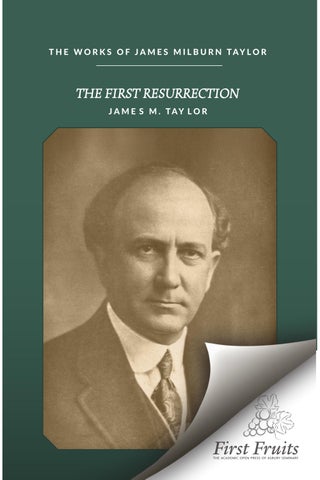
T H E W O R K S O F J A M E S M I L B U R N TAY L O R
THE FIRST RESURRECTION J A M E S M . TAY L O R
THE FIRST RESURRECTION
By
Evangelist James M. Taylor Author of “The Second Coming of Christ and Some Reasons Why I Think It Is Near.”
First Fruits Press Wilmore, KY c2025
ISBN: 9781648173714 The first resurrection James M. Taylor First Fruits Press, ©2025
Digital version at http://place.asburyseminary.edu/firstfruitsheritagematerial/5/ First Fruits Press is a digital imprint of the Asbury Theological Seminary, B.L. Fisher Library. Asbury Theological Seminary is the legal owner of the material previously published by the Pentecostal Publishing Co. and reserves the right to release new editions of this material as well as new material produced by Asbury Theological Seminary. Its publications are available for noncommercial and educational uses, such as research, teaching and private study. First Fruits Press has licensed the digital version of this work under the Creative Commons Attribution Noncommercial 3.0 United States License. To view a copy of this license, visit http://creativecommons.org/licenses/by-nc/3.0/us/.
For all other uses, contact: First Fruits Press B.L. Fisher Library Asbury Theological Seminary 204 N. Lexington Ave. Wilmore, KY 40390 http://place.asburyseminary.edu/firstfruits
Taylor, James M. (James Milburn), 1873The first resurrection [electronic resource]/ by James M. Taylor. – Wilmore, Kentucky: First Fruits Press, ©2025. Reprint. Previously published: Louisville, KY : Pentecostal Publishing Company, ©1919. pages; cm: digital. (electronic) ISBN: 9781648173714 (paperback) ISBN: 9781648173721 (uPDF) ISBN: 9781648173738 (Mobi) OCLC: 1564433048 1. Resurrection--Biblical teaching. I. Title.
BT871.T38 2025eb Cover design by Amanda Kessinger
First Fruits Press The Academic Open Press of Asbury Theological Seminary 204 N. Lexington Ave., Wilmore, KY 40390 859-858-2236 first.fruits@asburyseminary.edu asbury.to/firstfruits
THE FIRST RESURRECTION
-BY-
JAMES M. TAYLOR, Evanaellal
Author of "The Second Comingof Christ and SomeReasonsWhyI Thinkk Is Near."
PUBIJSHIDBY
PENTECOSTAL PUBLISHING CO., (Incorporated.) LOUISVILLE, KY., 1919,
Copyright, 1919. BY JAMES M. TAYLOR.
LectureIL The First Resurrection.
THE Fm.sT RESURRECTION. "If in this life only we have hope in Christ, we are of all men most miserable. But now is Christ risen from the dead, and become the first fruits of them that slept. For since by man came death, by man came also the resurrection of the dead. For as in Adam all died, even so in Christ shall all be made alive. But every man in his own order: Christ the first fruits; afterwards they that are Christ's at his coming. Then cometh the end, when he shall have delivered up the kingdom to God, even the Father; when he shall have put down all rule and all authority and power. For he must reign, till he hath put all authority under his feet. The last enemy that shall be destroyed is death. "But some man will say, How are the dead raised up? and with what body do they come? thou fool, that which thou sowest is not quickened, except it die: and that which thou sowest, thou sowest not that body that shall be, but bare grain, it may chance of wheat, or of some other grain: but God giveth it a body as it hath pleased him, and to every seed his own body. "And so it is written, The first man Adam was made a living soul; the last man Adam 15
6
THE FIRST RESURRECTION.
was made a quickening spirit. Howbeit that was not first which is spiritual, but that which is natural; and afterward that which is spiritual. The first man-Adam is of the earth, earthy: the second man is the Lord from heaven. As is the earthy, such also are they that are earthy: and as is the heavenly, such also are they that are heavenly. And as we have borne the image of the earthy, we shall also bear the image of the heavenly. "Now this I say, brethren, that FLESH AND BLOOD CANNOT INHERIT THE KINGDOM OF GOD; NEITHER DOTH CORRUPTION INHERIT INCORRUPTION. Behold, I show you a mYStery; we shall not all sleep, but we shall all be changed, in a moment, in the twinkling of an eye, at the last trump: for the trump shall sound, and the dead shall be raised incorruptible, and we shall be changed. For this corruptible must put on incorruption, and this mortal must put on immortality." 1 Cor. 15 :19-53.
LECTURE II. THE FIRST RESURRECTION.
"Blessed and holy is he that hath part in the first resurrection : on such tM second death hath no power, but tMy shall be priests of God and of Christ, and shall reign with him a thousand years.''-Rev. 20:6.
1. The Fact of two Resurrectwns. We read in the rituals, prayer book&and
catechisms of both Protestantism and Catholicism of The General Resurrectwn. But there is no such expression or teaching in the Scriptures. But there is a most emphatic and clear teaching of a "First Resurrection," and of the resurrection of "the rest of the dead," or "all the dead, small and great." There is coming a time when there will not be a dead body in all the earth or sea, but when "All shall hear his voice and come forth." But just as distinctly as we are taught of two judgments, of two comings of Christ, two covenants, two works of grace, two classes of people on earth and two states and regions wherein these dwell in eternity, -just so does it teach that in the resurrection it shall be "every man in his own order," or troup, as it is in the original. Christ 7
8
THE FIRST RESURRECTION.
indicates this when He says, "Marvel not at this, for the hour is coming, in which all that are in the graves shall hear his voice, and shall come forth, they that have done good, unto the resurrection of life; and they that have done evil unto the resurrection of damnation." (John 5:28, 29.) But Paul most clearly announces it in this fifteenth chapter of his first letter to the Corinthians, when he says, "For as in Adam all die, even so in Christ shall all be made alive. But every man in his own order (troup). Christ the first fruits; afterwards they that are Christ's at His coming. Then (cometh) the end, when he shall have put down all rule and authority and power." Still holding clearly to this thought he testifies to the Philippians, "But what things were gain to me, those I count loss for Christ . . . . that I may win Christ, and be found in him, not having mine own righteousness, which is of the law, but that which is through the faith OF Christ, the righteousness which is of God by faith; that I may know him and the power of hi., resurrection, and the fellowship of his suffering, being made conformable unto hia death; if by any means I might attain unto the resurrection, which is out from among the dead." (Seek the Greek). The little word ek is used here, which in the Greek al-
THE FIRST RESURRECTION.
9
ways means "out from among.'' Again in his letter to the Hebrews, the eleventh chapter, where he tells of that long line of Old 'Testament saints who "subdued kingdoms, wrought righteousness, obtained promises, stopped the mouths of lions, quenched the violence of fire . . . . women received their dead raised to life again; others were tortured, not accepting deliverance; that they might obtain a better resurrection." But John, in this twentieth ahapter of Revelation sets out this truth in the boldest of language; and that cannot be misunderstood; for he says, "And I saw thrones, and they sat upon them, and judgment was given unto them; and I saw the souls of them that were beheaded for the witness of Jesus, and for the word of God, and which had not worshipped the beast, neither his image, neither had received his mark upon their foreheads, or in their hands: and they lived and 1·eigned with Christ a thousand years. But the rest of the dead lived 1wt again until the thousand years were fulfilled. This is the first resurrection. Blessed and holy is he that hath part in the first resurrection: on such the second death hath no power, but they shall be priests of God and of Christ, and shall reign with him a thousand years.'' (20:4-6).
10
THE FIRST RESURRECTION.
II. When the First Resurrection Will Occur. Paul, in this chapter from which we read, 1 Corinthians, says, "But every man in his own tr-oup: Christ the first fruits; afterwards they that are Christ's at his coming." In 1 Thess. 4 :14 he says, "For if we believe that Jesus died and rose again, even so them also which sleep in Jesus will God bring with him. "For this we say unto you by the word of the Lord, that we which are alive and remain unto the coming of the Lord shall not prevent, (or go before) them which are asleep. For the Lord himself shall descend from heaven with a shout, with the voice of the archangel, and with the trump of God: and the dead in Christ shall rise first." This is but a little more explicit statement of the same thing to which he refers in our lesson. 1 Cor. 15 :51-53. But John does not leave any room for doubt as to the fact of this first resurrection, nor as to when it will occur, for after revealing to us the power and coming of our Lord in the nineteenth chapter, he relates in the twentieth chapter how that those who, not being prepared to ascend with the living saints at the time of the rapture, but having some degree of faith, end finding themselves, like the foolish vir-
THE FIRST RESURRECTION.
11
gins, with "lamps going out,"-nevertheless stood true and steadfastly refusing to receive the mark of the beast, or to worship him, and,like the Old Testament saints,would not accept deliverance, "that they might obtain a better resurrection,"-held on to what faith they had, and learning obedience through the things which they suffered, were ''beheaded for the witness of Jesus, and for the word of God,'' he says, "They lived and reigned with Christ a thousand years." (These are what are known as "The tribulation saints," who not having been sanctified, purified and tried at the time of Christ's coming into the air, to receive His bride, the church, and therefore not partakers of the rapture, but dying a martyr's death during those tribulations that follow the rapture, now share in His glory. For, "If we suffer with him, we shall also be glorified together.") Then he says, "But the rest of the dead lived not until the thousand years were fin. ished. This is the first resurrection." This is really the most distinctive feature of a "resurrection,'' here, at this time; for the others,-those "who sleep in Jesus" appear more in the figure of-"will God bring with him,'' and as Paul puts it before the Colossians, "When Christ, who is our life, shall appear, then shall ye also appear with
12
THE FIRST RESURRECTION.
him in glory." It is more of an "awearing with him," to those who have "fallen asleep in Him,"-but to these tribulation saints who have missed the rapture and the marriage supper, it is a real resurrection like that of which we read of the Old Testament saints in Matt. 27 :52, "And the graves were opened; and many of the bodies of the saints arose, and came out of the graves after his resurrection, and appeared upon many." But John does not leave us there, in his purpose to reveal to us the fact of the two resurrections and the time to e1apse between them, but goes on to say, "And when the thousand years are expired, Satan shall be loosed out of his prison," etc., and after describing how he succeeds in his plan to deceive the nations, and of their following him as the sands of the sea--he reveals to us his final destruction and the world conflagration --spoken of by Peter, also, and with it the end of this old world in its fiery baptism and the eternal perdition of the ungodly. Then he announces most clearly the final resurrection and judgment thus: "And I saw a great white throne, and him that sat on it, from whose face the earth and the heaven fled away; and there was found no place for them. And I saw the dead, small and great, stand before God; (in the other judgment,
THE FIRST RESURRECTION.
13
the living stood before the judgment seat of Christ), and the books were opened: and another book was opened, which is the book of life: and the dead were judged out of those things which were written in the books, according to their work$." This is a resurrection to Judgment. In the other resurrection it is not to Judgment, but only to REIGN,-all those that have a part in the "first resurrection." The judgment there, is of the living, and not as to their works, but as to what they did with Jesus, i.e. "that knew not God, and obeyed not the gospel,"-these were punished with everlasting destruction from the presence of the Lord for their rejection and disobedience of Christ. (See Matt. 25 :31-46 and 2 Thess. 1 :4-10). However, even in the final judgment, the ultimate settlement as to their eternal reward or doom is based on the same thing-for "Whosoever was not found written in the book of life was cast into the lake of fire." Ill. Who Have Part in The First Resurrection. My text says that they are the "Blessed and holy." Now we have studied this expression, and have sought to know just what the Scriptures mean when it uses the word
14
THE FIRST RESURRECTION.
"blessed." One commentator says th&t ''blessed means the justified, and holy, means the sanctified." This seems to be the conclusion of all who have made a study of these words. Paul tells u.sin this fifteenth chapter of 1st Corinthians, that Christ was "the first fruits of them that slept." And in Colossian 1 :18, he tells us that he was "the firstborn from the dead." Note, then, that Christ was born twice. He was conceived by the Holy Ghost and born of the Virgin Mary and became "the first born among many brethren." The Second Adam. Then he was "quickened," and "raised up from the dead," and became "the firstborn from the dead." That is, He was the first of all the human race to have this sort of resurrection. Just as He was the first to be conceived by the Holy Ghost, and born without carnality, a holy baby, so He was the first to be "born," by the Spirit, from the dead, and His mortality put on immortality. Other resurrections there had been, as Lazarus, and others,-but these had all come forth to live as they had before, by the life of the blood, and to die again. But he is "alive forever more." Why is this? Paul tells us. Because "F'lesh and blood cannot inherit the kingdom of God; neither doth corruptwn inherit incorruption." Yet we are "heirs of God, and
THE FIRST RESURRECTION.
16
joint-heirs with Christ." (Rom. 8:17 and Gal. 4:7). But Christ has no blood. He was crucified. And when you drive nails through, or otherwise pierce the hands and feet, and hang up the body, the blood runs out. Thus were the veins and arteries of Christ emptied of the blood. Then a Roman soldier thrust a spear upwards into his heart and pierced the heart and allowed the last drop of his blood to flow out. Thus He went into His grave without His blood, and He came out of His grave also, without His blood. For He said to Thomal!, "Reach hither thy finger and behold my hands; and reach hither thy hand, and thrust it into my side." But again He said to them, "Handle me, and see; for a spirit hath not flesh and bones, as ye see me have." Then Paul tells us that "We are members of his body, of his flesh, and of his bones." Nowhere is He referred to as having "flesh and bl-Ood,''after His resurrection, but only flesh and bones. His blood He left in the sands of Calvary. This was His human generation. "Who shall declare his generation, for he was cut off out of the land of the living." (Isa. 63:8). Yet He was to have a generation, a "seed," for, "When thou shalt make his soul an offering for sin, he shall see his seed, he shall prolong his days." (Isa.
16
THE FIRST RESURRECTION.
53:10). And, "Behold I and the children which God hath given me. ForaBmuch then as the children are partakers of flesh and blood, he also himself likewise took part of the same." (Heb. 2:14, 15). So he was to have "children," a generation. For he was the "last Adam." "The Lord from heaven;" and, "as we have borne the image of the earthy, we shall also bear the image of the heavenly." "For whom he did foreknow, he also did predestinate to be conformed to the image of his Son, that he might be the first born among many brethren." (Rom. 8:29). Then there are to be "many brethren" of this second Adam, with the "image of the heavenly." "For it became him, for whom are all things, and by whom are all things, in bringing many sons into gwry, to make the captain of their salvation perfect through sufferings. For both he that sanctifieth and they who are sanctified are all of one: for which cause he is not ashamed to call them brethren." (Heb. 2:10, 11). Yet, "Flesk and bwod cannot inherit the kingdom of God: neither doth corruption (i. e., carnality, See 2 Pet. 1 :4) inherit incorruption." Then this second Adam and his generation must have a life other than the blood, and they must be "sanctified" in order to be "all
THE FIRST RESURRECTION.
17
of one," for "he that sanctifieth and they who are sanctified are all of one," (Heb. 2 :11) and to be "partakers of the divine nature, having escaped the corruption that is in the world through lust," i. e., carnality. Nor must His body "see corruption," i. e.., dissolution. ''Because thou wilt not leave my soul in hell, neither wilt thou suffer thine holy one to see corruption." (Acts 2 :27 or Ps. 16:10). So without having known sin,--or the corruption of the soul from the lust of the first Adam,-carnality-in his life; and without having known the corruption of his body from "him who had the power of death," in his death, he came forth to live, not by the life of the blood, but by "the power of an endless life." His body and soul, his flesh, bones, mind, affections, will, and entire personality and being, alive by the Eternal Spirit of God; ''a quickening Spirit" in all his nature. The divine human and the human divine,-God and man made one, and the wlwle man redeemed or delivered from the "old man" and atoned with God in the "new man," "the Lord from heaven," the first born among many brethren, and the captain of the salvation of "many sons" to be brought into glory. Thus "being made perfect, he became the
18
THE FIRST RESURRECTION.
author of eternal salvation unto all them that obey him." And this He is able to do because by having in body and soul, as well as in spirit become divine, and "quickened," he is able and does return in the person of the "Other Comforter," the Holy Ghost, to them that are born of the Spirit, and, as He clothed his own spirit with "the form of sinful flesh," then deified and glorified that flesh, He is now able to impart to his "many brethren" His further or divine h,uman na,. ture, and clothe, in us, His Spirit, which He imparted to us in our birth from above; and, by the Holy Ghost enables us to "become partakers of the divine nature" which He received by being "the first born from the dead," as He was the first born into the world of many brethren of "His seed," who Is the second Adam. Therefore as "the God of peace" olk:e more, he is able to sanctify us wholly, entirely, ''body, soul and spirit," and preserve us "blameless unto the coming of the Lord," (I Thess. 5 :23) at which time we shall "receive the adoption of sons; to wit, the redemption of our body." ( Gal. 4 :5, Rom. 8 :23). Then, we too, shall have "put on incorruption," and because we are "members of ms body, of his flesh, and of his bones," shall also enter into the glory which he obtained for him-
THE FIRST RESURRECTION.
19
self and for us by shedding his blood and giving up his human, or Adamic generation. Then, if asleep in him, we will come "with him in glory," and if "alive and remain shall be caught up together with them" that come with him. "In a moment, in the twinkling of an eye, and so shall we ever be with the Lord." For, "when he shall appear we shall be like him, for we shall see him as he is." For "as he is (now) so are we in this world," who are "kept by the power of God through faith unto (the) salvation (that is) ready to be revealed in the last time," or age. "Wherefore gird up the loins of your mind, and hope to the end of the grace that is to be brought unto you at the revelation of Jesus Christ." (1 John 3, and 1 Pet. 1). This, then, is the proof that only the "blessed and holy," or justified and sanctified, have part in the first resurrection. Because "flesh and blood cannot inherit the kingdom of God," i. e., inherit the kingship. "But they shall be priests of God and of Chri~t, and SHALL REIGN WITH HIM A THOUSAND YEARS." Therefore, "He hath appointed a day in which he will judge the world in righteousness by that MAN whom he hath ordained; whereof he hath given assurance unto all men, (or proof of what is in our inheritance in him) in that he hath raised him from the dead."
20
THE FIRST RESURRECTION.
This is the great "mark of the prize of the high calling of God in Christ Jesus," to which Paul "presses forward," when he writes to the Ephesians, "In whom also after that ye believed, ye were sealed with that Holy Spirit of promise, which is the EARNEST of our inheritance until the redemption of the fYUT· chased possession, (i. e., the body) unto the praise of his glory." And to Titus, "He saved us by the washing of regeneration, and renewing of the Holy Ghost; which he shed on us abundantly through Jesus Christ our Lord; that being justified by his grace, we should (by the Holy Ghost) be made heirs according to the hope of eternal life." And to the Romans, "Therefore being justified by faith, we have peace with GOD through, our Lord Jesus Christ: by whom ALSO we have access by faith into this grace wherein we stand, and rejoice in hope of the glory of God." For, he writes to the Thessalonians, "God hath from the beginning chosen you to salvation through sanctification of the Spirit and belief of the truth: whereunto he called you by our gospel, to the obtaining of the glory of the Lord Jesus Ckrist." IV. Where Were The Dead Before Christ Aro,,e? If Christ was the first fruits of them that slept, and the first born from the dead, where
THE FIRST RESURRECTION.
21
were all the dead until that time? Jesus Himself testifies to Nicodemus that "No man hath ascended up to heaven, but he that came down from heaven, even the Son of man which is in heaven." (John 3 :13). Then where were they? The theologians tell us that they were in "The intermediate state." But where was this? A soul is a being, a medium, and it must have a p1.aceand a medium in which to dwell. They could not go to heaven, because "they were not made perfect." Were not holy in all their being,-as men, and "without holiness NO MAN shall see the Lord." They could not dwell in the air, for this is the abode of the devil and his angels until Christ shall come and cast him, first down to ee.rth,-where he will remain during the tribulations and then he must go into "the bottomless pit," for a thousand years. They could not dwell in the second heaven, the astronomical heaven, for there is not the proper medium for the abode of a soul, ether being only navigable by s'])i,rits having an element of deity not yet theirs. There was but one other place, and this had been fitted for disembodied souls from the foundations of the earth-namely, "in the bowels of the earth." This the Scriptures are very plain and explicit upon. You know that when Saul solicited the Witch of
22
THE FIRST RESURRECTION.
Endor to "Bring me up Samuel," that when she saw Samuel she shrieked, and cried out "I saw gods ascending out o.f the earth." And Samuel said to Saul, "Why hast thou disquieted me, to bring me up." (1 Sam. 28). Jesus prophesied to His disciples refore His death, "For as Jonah was three days and three nights in the whale's belly ; so shall the Son of man be three days and three nights in the hea.-t of the earth." (Matt. 12 :40). Luke quotes David as seeing, "b&fore the resurrection of Christ, that his soul was not left in hell, neither his flesh did see corruption." (Acts 2:31). And Paul tells us in Ephesians 4th chapter, "Now he that ascended, what is it but that he also descended into the lower parts of the earth¥" The old versions of the Apostle's creed have the clause, "He descended into hell." In the English version both Gehenna and Ha,d,es are translated "hell." In the Revised Version Gehenna only is translated "hell," hades being transferred, as we have no synonymous word for that in English. The Hebrew word is Sheol, and both this and the Greek word hades, mean "the invisible world." The place of the wicked is ealled Tarmrus, and for the righteous Elysium. In the story of Lazarus both he and the rich man went to hades, the former to Abraham's bosom, or
THE FIRST RESURRECTION.
23
Paradise, and Dives to burning Tartarus. This intermediate state, where abode them "that slept" before Jesus came, was referred to by Jesus as the "prison,'' and he said that he had come to "set at liberty the captives," etc. And Peter tells us that it was for this that he "descended into the lower parts of the earth,'' saying of Christ that he "being put to death in the flesh, but quickened by the Spirit; by which also he went and preached unto the spirits in prison." Again, "For this cause was the gospel preached also to them that are dead, that they might be judged according to men in the flesh, but live according to God in the spirit." ( 1 Pet. 3:18, 19 and 4:6). This was what Jesus had reference to when He said, "The hour is coming, and now is, when the dead shall hear the voice of the Son of God: and they that hear shall live." (Jno. 6 :26). And to Martha, "He that believeth in me, though he were dead, yet shall he live." And this is just what did happen when Jesus rose from the dead, :for Matthew tells us that "The graves were opened, and many of the BODIES of the saints which slept arose, and came out of the graves AFTER HIS resurrection, and went into the holy city, and aPpeared unto many." Thus fulfilling the prophecy of Isaiah 26 :19, "Thy dead men
24
THE FIRST RESURRECTION.
shall live, together with My dead body shall they rise." Paul corroborates this in the fourth chapter of Ephesians when he says.quoting from the 24th Psalm, "Wherefore he saith, when he ascended up on high, he led captivity captive, and gave gifts unto men." "The Greek and Roman poets and philosophers (who had descended from the house of Noah) all corroborated Luke in the location of both the good and the bad in the lower world, the latter in the fire of Tartaru.s and the former in Elysium, which means a place of unming!ed bliss."-(Godbey). The "great gulf fixed" of which Abraham spoke to the rich man, was simply that same "state" that existed with, or in which existed, t'he three Hebrew children in the fiery furnace, wherein they walked and from which they emerged without "even the smell of fire upon their garments" because the Son of God walked with them. So these who slept "in Him," were like these, in paradise, while the others find that of a truth, "Our God (outside of Christ) is a consuming fire." V. Where Are They Now? But we are interested now to know as to "Where are the dead", who die in the Lord, or have died in the Lord, since Christ," the first /rttits," rose from the dead? And, too, who of the dead, who died before He arose,
THE FIRST RESURRECTION.
25
had part in that deliverance, as well as who or what class of dead escape entering into this "intermediate st.ate," since it has been invaded and some at least delivered from it by Christ, who has risen, "triumphant over death, and hell and the grave.'' Our text would indicate the answer. But we will look into it further and see if we can find a definite answer, both in the Scripture and from the logical conclusion therefrom. In the first place the Scriptures t:ell us that these who rflse with him were "the bodies of the SAINTS." Now a saint is one who lives up to the PROVISIONS of the gospel in his or her dispensation-the dispensation in which they live. A saint in the Old Testament dispensation was one who was justified by faith and beheld, though "afar off," the promises of His coming to sanctify them, and "embraced them," though they "received not the promise: God having provided some better thing for US, that they without us should not me made perfect,"-yet holding their faith steadfast unto the end, and in spite of the fact that many were "tortured, not accepting deliverance; that they might obtain a better resurrection.'' (Heb. 11). A saint in this dispensation is one who is not only justified, but sanctified, i. e., "made perfect," and embracing the promises, however
26
THE FIRST RESURRECTION.
afar off, of His coming again to glorify us. And a saint in the next, or millennial dispensation, will be one who, having been justified and sanctified in this dispensation, has become glorified, and enjoys final salvation, and presses on with Christ, the head of the Church, and of the body, to a glorious entrance into the "new heavens and new earth, wherein dwelleth righteousness," in which even the "Son also himself shall be subject unto him that put all things under him, that God may be all in all." Then what Christ said to Martha is in full accord with this,-that only those who "died in faith, not having received the promises," had part in that company of a "multitude of captives," whom he "led captive," when he, after descending into the lower parts of the earth, "ascended up on high." For he said to her, "He that believeth IN me, though he were dead, yet shaU he live." Dr. Godbey in a remarkable paragraph in his commentary on Eph. 4 :8-10 says: "When our Savior expired on the cross his human soul descended into hell (Acts 2 :31) ; the herald of his own vic,tory achieved on Mount Calvary having triumphed over pandemonium" (where he went in pressing the gates of hell, and "tasting death, i. e., damnation,-for every man") "he crosses the chasm (Luke 16 :26), lmpas-
THE FIRST RESURRECTION.
27
sable to all finite beings, enters the intermediate paradise, called Abraham's bosom, meets the thief according to promise (Luke 28 :43), and all the Old Testament saints there tl'Uiting the ver-ifi,catwn of the Abrahamic e<roenant by the suffering of Christ;
on the third morning, ABOLISHING THE INTERMEDIATE PARADISE" (for all those who henceforth "live and believeth in him," and who enter that covenant in this life, and by "which will we are sanctified by the offering of the body of Jesus Christ once for all," thus making this "New Testament of force," and the way into the holiest of all made manifest. See Heb. 9 :8, 16 and 10 :10) "leads them all up, receives his body out of the sepulcher, all the mighty hosts of the Old Testament saints accompanying him during his forty days on the earth, invisible because disembodied," (though able to manifest themselves as he did-Matt. 27 :52) "and ascend with him into heaven from Mount Olivet; constituting his triumphal procession, as seen by the prophetic eye of David (Psalms 24), they enter the glorified City of God amid the shouts of angels, archangels and redeemed spirits. 'Christ, the first-fruits of them that slept,' must lead the way into heaven, throwing wide the pearly gates for every disembodied saint in all coming ages
28
THE FIRST RESURRECTION.
to sweep in with a shout." And from that time the sanctified, "the blessed and hcly," do not "sleep with their fathers," but "depart to be with Christ," "who died for us, that whether we wake or whether we sleep, we should live together with him." ( 1 Thess. 6 :10). For the sa.nctified are "crucified with him, that the body of sin might be destroyed," and "If we be dead with Christ, we believe that we shall also live with him." (Rom. 6 :6-8). "For ye are dead, and your life is hid with Christ in God. When Christ, who is our life, shall appear, then shall ye also appear with him in glory." (Col. 3:3). "For our citizenship is in heaven; from whence also we look for the Savior, the Lord Jesus Christ: who shall change this body of our humiliation, that it may be fashioned like unto his glorious body, according to the working whereby he is able to subdue all things unto himself." (Phil. 3:20, R. V.) "For we know that if our earthly house of this tabernacle were dissolved, we have a building of God, an house not made with hands, eternal in the heavens. For in this we groan, earnestly desiring to be clothed upon with our lwuse which is from heaven: if so be that being clothed we shall not be found naked. For we that are In this tabernacle do groan, not for that we would be
THE FIRST RESURRECTION.
29
unclothed, (i. e., fall asleep) but clothed upon (as pr. Phil. 3 :20) that mortality might be swallowed up of life. Now he that hath wrought us for the selfsame thing, is God, who also hath given unto us the earnest of the Spirit, (i. e., for this we are sealed with the Holy Spirit of promise, as pr. Eph. 1 :13, 14). Therefore we are always confident, knowing that, whilst we are 11t home in the body, we are absent from the Lord: we are confident, I say, and willing rather to be absent from the body, and to be present with the Lord." (2 Cor. 5: 1-8).
These are some of Paul's abundant testimonies on this matter. Then Peter takes the stand and though suggesting that Paul writes some things "hard to be understood," does not seem to think this subject any part of those things, for he writes freely and triumphantly of them in both his epistles, saying, "Blessed be the God and Father of our Lord Jesus Christ, which according to his abundant mercy hath begotten us again unto a lively hope by the resurrection of Jesus Chri.~tfrom the dead, to an inheritance incorruptible, (for corruption shall not inherit incorruption) and undefiled, ( Christ's body was never defiled-it was the temple of God-neither by "corruption," i. e., carnali-
30
THE FIRST RESURRECTION.
ty, nor by indulgence in any sin or "lusts of the flesh,") and that fadeth not away," (i. e., does not grow old, for Christ came to the fulness of the stature of "the perfect man," and without decline by age, entered into immortality and eternal youth) "reserved in heaven for pou who are kept by the power of God through faith unto (the) salvation (which is) ready to be revealed in the last time." (i. e., final salvation, or glorification, v. 13) (1 Pet. 1:3-5). And in his second epistle he gives them a clear statement of the state of grace necessary to enter "abundantly" into "the everlasting kingdom of our Lord and Savior Jesus Christ;" and of the way into that experience. Then says, "Wherefore I will not be negligent to put you always in remembrance of these things. Yea I think it meet, as long as I am in THIS tabernacle, to stir you up by putting you in remembrance; knowing that shortly I must put off this my tabernacle, even as the Lord Jesus Christ hath shown me ... For we have not followed cunning devised fables, when we made known unto you the power and coming of our Lord Jesus Christ, but were eye witnesses of his majesty," i. e., of his kingship, which we are to share as "joint heirs with him." Then John, in his vision on the Isle of Patmos, carries on the revelation as to
THE FIRST RESURRECTION.
31
where these "holy dead" are, since the day that Christ arose from the dead and "ascended up on high, leading a multitude of captives captive," and in Rev. 4, we read how he saw the throne of God on which Christ sat "at the right hand of God exalted," (Acts 2 :33) and with him "four and twenty elders sitting, clothed in white raiment; and they had on their heads crowns of gold," and who ''fell down before him that sat on the throne, and worshipped him," saying (6:9, 10) "Thou art worthy .. for thou wast slain, and hast redeemed us to God by thy blood out of every kindred, and tongue, and people, and nation; (they were representatives of that multitude he was about to see) and hast made us unto our God kings and priests; and we SHALL, (not are, yet) rei,gn on the earth." Then ( 7 :9 .... ) "After this I beheld, and, lo, a great multitude, which no man could number, of all nations, and kindreds, and people, and tongues, stood before the throne, and before the Lamb, clothed with white robes, and palms in their hands . . . . And one of the elders answered, and said unto me, What are these which are arrayed in white robes? and whence came they? And I said unto him, Sir, thou knowest. And he said to me, These are they which came out of great tribulations, and
32
THE FIRST RESURRECTION.
have washed their robes, and made them white in the blood of the Lamb. Therefore are they before the throne of God, and serve him day and night in his temple: and he that sitteth on the throne shall dwell among them. They shall hunger no more, neither thirst any more; neither shall the sun light on them, nar any heat. ('On such the second death hath no power.') For the Lamb which is in the muut of the throne shall feed them, and shall lead them unto living fountains of waters; and GOD shall wipe away all tears from their eyes." Then in the 19th chapter he sees this same great multitude getting ready for their marriage to the Lamb, and then, afterwards, their descent with him to "reign on the earth." So like a "voice of mighty thunderings," he hears this multitude saying, "The Lord omnipotent reigneth. Let us be glad and rejoice, and give honor to him; for the marriage of the Lamb is come, and his wife hath made herself ready. And to her was granted that she should be arrayed in fine linen, cleam,and ivhit6: for the fine linen is the righteousness of the saints:· Then when John would fall down and worship this,-"One of the elders," he said to him, "See thou do it not: I am. thy fellow seri,ant, and of thy brethren that have the testimony of Jesus: worship
THE FIRST RESURRECTION.
33
God: /01· the testim-0ny of Jesus is the spirit of rrrophecy." (i. e., he was one of the prophets). This answers us as to, Where are the dead, that die in the Lord 1 They are no less with him whether they "wake or whether they sleep." And if we live and walk in him here, we live and worship in him yonder, and come back and live and reign with him on the earth, when he comes. GLORY!! This, then, brings us to the consideration of the final matter of interest concerning these "Blessed and holy," namely VI. What Are Their Future Rewards? For our text does not leave us thus "gazing up into heaven," like the disciples on the plains of Galilee. But like the an~Is of hope that came to dispel their otherwise inevitable gloom when once Jesus had been "received out of their sight," with the message of "the blessed hope" that "This same Jesus shall so come in like manner as ye have seen him go into heaven." So our text does not leave us with a hope in this life only, but as there is no perfection without progression, no glory without conquest, no God without creation, and no love without sacrifice,-so there is no sonship of God without kingship with Jesus and triumph with him in his victory over every enemy and sharing with him
84
THE FIRST RESURRECTION.
in all the glory. "For if we suffer with him we shall also reign with him." So it is now that we come in our study of this "purchased possession" to the real reason for 01tr ner,essity and Ckrist' s purpose in working out through his own body the provision for our sanctification. For, be it known, that had it not been for the redemption of our bodie.~and the perfection of the wkole man,-the completion of a second Adam and "his seed" of "many brethren" to live and reign here on eartk, achieving to and accomplishing in a hdgker glory what the first Adam failed in and lost forever,-there could have been no reason for him to take "part of the same" flesh, and to suffer "without the gates to sanctify the people with his own blood." Christ could have remained in heaven where he was effectual throughout the entire Old Testament dispensation in redeeming men from the guilt of sin, and justifying them by faith, and enabling them to, like Enoch, "walk with God;" and never have had to have a body prepared for him, had it not been that "flesh and blood cannot inherit the kingdom of God; neither doth corruption inherit incorruption." It was "his SOUL" which he offered for sin, and it was in his disembodied spirit (See 1 Pet. 8 :18, 19) that he passed the gates of hell and "tasted death
THE FIRST RESURRECTION.
35
for every man,"--even the damnation that rested upon the race. This he could have accomplished actually in spirit, as he did in -will "before the foundations of the earth;" if not at the same time, then at the J udgment, in view of all the race, and justified the judgment of God in condemning all who "despised Moses' law" to be damned, as well as to "die without mercy." But the redemption by the blood and the suffering "without the gates" were to "sanctify the people with his own blood;" and the will of God, the New Testament, wherein was held our sanctification and redemption, and consequently our inheritance in light, could not be "of force" until "after the death of the testator." (Heb. 9:15-17). "Wherefore when he cometh into the world, he saith, Sacrifices and offerings thou wouldest not, but a BODY hast thou prepared me." For, "Lo, I come to do thy will, 0 God. By which will we are sanctified through the offering of the BODY of Jesus Christ once for all." (Heb. 10 :9, 10). We know that it was because God held in His eternal purpose, and had wrought it in and out in His own will and that of His dear Son, the redemption of our bodies, "before the foundation of the world," that He ever justified any man. "For whom he did foreknow, he also did predestinate to be con-
36
THE FIRST RESURRECTION.
formed to the image of his Son, that he might be the firirt; born among many brethren. Moreover whom he did predestinate, them he also called: and whom he called, them he also justified: and whom he justified, them he also glorified." (Rom. 8:29, 30). So then had He not had in that will our complete redemption, from all sin, and all of sin's consequences, and the completion of His glory in us and our glory in Him, He would never have allowed the human race to pass the gates of Eden, but to have perished in the fall; and as by the deeds of the law no flesh is justified, so "without the shedding of blood there is no remission of sins," and if it had not been that Chri5t's blood was to flow to sanctify us, no faith in the promises "afar off" would have been possible or given, and no justification would have been possible, and God, as well as man, would have been a failure in the combat and conflict with sin, the flesh and the devil. Then, though death sanctifies not, but only removes both the necessity and the possibility of it, for those who die unsanctified,had it not been for the redemption of our bodies "to the praise of his glory," there need have been no shedding of Christ's blood,-no preparing for Him of a body, and no taking part of the same flesh and blood.
THE FIRST RESURRECTION.
37
But becausehe is the "last Adam," to recover and accomplish what the first Adam lost and failed in,-to lime and reign on this earth,sit on the throne of David and fulfill the promise to Abraham and snatch the dominion of earth, sea and sky from the "Prince of this world,"-that old serpent the devil, and putting all enemies under hls feet, reign until even death is put under, and all mortality is swallowed up in immortality,-he suffered without the gates that we should not only be "blessed," but "holy," and,because He is holy, and because He is to reign, we should also reign with Him. For if we are "Children, then heirs; heirs of God and joint heirs with Jesus Christ; if so be that we suffer with hlm, that we may be also glorified together." (Rom. 8:17). Then if we were only destined to remain, as John saw that innumerable company, disembodied Bpirits, before the throne of God in heaven, to henceforth sing ourselves away into everlasting bliss; spirits in a spiritual world, in the presence of a spirit God, and surrounded by "ministering spirits," then sanctification by the crucifixion of the "old man" with him, "that the body of sin might be destroyed,'' is unnecessary. For in justification we are regenerated, and receive "the spirit of Ch:rist,''and Christ is God. Then we have a
38
THE FIRST RESURRECTION.
perfect s-piritwil nature, and if this, alone, is our destination, then the justified can and will share all that is in the will of God, and the plan of redemption. But if this mortality is to put on immortality, and we are to live and reign on this earth, then we will have to be sanctified, and become partakers of "his body, of his flesh and of his bones," "in whom alone dwelleth immortality." For flesh and blood cannot inherit the kingdom of God. 'l'hen there are rewards for "the blessed and holy,"-for those that have "suffered with him," "who have come up through great tribulations, and have washed their robes and made them white through the blood of the Lamb," that are shared by no fJthers. What are they? First. "On such the second death hath no power."
In Rev. 2 :11, we read that "He that overcometh shall not be hurt of the second death." And in the 20th chapter, 14th verse we read, "And death and hell (that is the entire intermediate place) were ca.stinto the lake of fire. This is the second death." That is, when "the heavens shall pass away with a great noise, and the elements shall melt with a fervent heat, the earth also and the works that are therein shall be burned
THE FIRST RESURRECTION.
39
up.'' (2 Pet. 3 :10). When the great white throne is exposed by the "consuming fire" of him that sitteth thereon, "from whose face the earth and heaven fled away; and there was found no place for them.'' (Rev. 20:11). Then it is that "ALL that are in the graves shall hear his voice, and shall come forth," when "the small and great stand before God." Then it will be that "the dead" are once more alive. Now they tell us that death is separntion. Physical death is the separation of the soul from the body, and spiritual death is the separation of the soul from God. That is why "the soul that sinneth it shall die," for, Pope tells us, "Sin is the voluntary separation of the soul from God.'' Hence Paul says, "When the J.awcame, sin revived and I died.'' That is, he was separated from God by his actual sins. He tells the Thessalonians that those on whom Jesus comes to talce vengeance-"them that !mow not God, and that obey not the goS']Jel. . . shall be punished with everlasting destruction from the presence of the Lord," i. e., everlasting separation, for Jesus says, "these shall go aWOI/} into everlasting punishment." Then these who have come forth to "the resurrection of damnation" must die, i. e., be separated the second tim.e, and, this time, forever, "from the presence of the Lord." For he
40
THE FIRST RESURRECTION.
hath "power to destroy both soul and body in hell." "This is the second death." But there are some, many, we believe iieru many, who come forth in that final resurrection, who do not go away into everlasting punishment, but whose names are found written in the book of life, as per Rev. 20: 15. Yet on whom the second death does have sc,ae power. Why? Because during all their "sleep in the dust" they have been separated from the presence of God and the blood-washed throng in a similar manner as when they were alive. Then, while in the body, because they were in "carnal" flesh, (and to be carnally-minded is death," i. e., separated from God-See Rom. 8:6-11) and now,-after they have left the body,-because they were not partakers of "his resurrection,"-they had not been "crucified with him," therefore had not been "raised up together" with him, and knew not "the power of his resurrection," here,-and were not, therefore, "members of his body, of his flesh, and of his bones," and as a consequence had no "tabernacle, not made with hands, eternal in the heavens," and when they put off this earthly tabernacle, they were "found naked" and as disembodied souls they must wait until the time of the "new heavens and a new earth, wherein dwelleth righteousness," and
THE FIRST RESURRECTION.
41
wherein all who dwell have passed through the fire of God's eternal holiness, and have been "salted with fire," and their works tried by fire, (1 Cor. 3 :13-15) and THIS BODY, this earthly body, HAS BEEN DESTROYED, because it was dust, and "corrupt," because sin was in their "members," and "the body of sin" had not been destroyed by crucifixion with Christ, and they had never been partakers of Christ's body, which is alive without the blood, and because "flesh and blood cannot inherit the kingdom of God, neither doth corruption inherit incorruption," they were deprived of the privilege of living and reigning with him here, and from being "like him," here or hereafter,-but must have a body, now, such "as it hath pleased him." (1 Cor. 15:37). And as "One star differeth from another star in glory, so also is the resurrection of the dead." Just so will they, and all who have not part in the first resurrection, differ from those who do, in both glory and in body. Then on sueh the second death hath power, for it has held them in their graves during the thousand years,-and many for the thousands of years before the millennial reign of Christ; it has robbed them of the glorious privilege of reigning with him, and it has destroyed their mortal bodies and left them
42
THE FIRST RESURRECTION.
naked souls, to be clothed with some other kind of a body, throughout eternity; and, therefore, from having their own body "fashioned like unto his glorious body," and "being like him," and see "him as he is." In other words, they have missed immortality to their mortality, and they have missed "eternal life" for their humanity, and the glorious privilege of their once sinful and first Adamic nature being swallowed up in the nature of him, the last Adam, that "knew no sin," and with him, entering the eternities and the eternal holiness and powers of an endless, (neither beginning nor ending)life of God. 0 what a loss! And O what a gain for the "blessed and holy," and that have "part in the first resurrection: for on such the second death hath NO power," but they share with Him ALL these, for they are "SONS of God," and if so, "heirs of God, and JOINT heirs with Jesus Christ." Second. "They shall be -prie8ts of God a.nd of Christ, and shall reign with him a tlwusand years. But we have not yet seen the greatest of all their rewards for having suffered with Him, and for having privileged to have a part in the first resurrection. It is here that we come to the realization and reward of all the "purchased possession" and of all the
THE FIRST RESURRECTION.
43
meaning of Christ's incarnation, temptation, suffering, death and resurrection in the body which was prepared him for the purpose, and for which, alone, ''he took part of the same," i. e., "That we might receive the adoption of sons." It was that he might become of "the seed of Abraham," of the tribe of Judah and the house of David, and fulfill God's covenant with Abraham that in his seed should "all the natioDB of the earth be blessed," to Judah that the scepter should not depart from him "until Shiloh (rest) come," and to David that he should never lack a seed "to sit upon the throne of the house of Israel," and to the Levite that they should never "want a man before me to offer burnt offerings, and to do sacrifice continually." To Jerusalem that the days would come when it would be said to her, "The king of Israel, even the l,ord, is in the midst of thee: thou shalt not see evil any more," and to Israel that they should be "no more two nations, neither shall they be divided into two kingdoms any more at all," but that they should "dwell in the land that I have given unto Jacob my servant .. even they, and their children, and their chlldren's children FOREVER; and my servant David shall be their prince FOREVER." Even "The Lord Our Righteo1UJness," who "shall be king over all the earth."
44
THE FIRST RESURRECTION.
To His disciples, "Ye are they which have continued with me in my temptations. And I appoint unt.o you a kingdom, as my Father hath appointed unto me; that ye may eat and drink at my table in my kingdom, and sit on thrones judging the twelve tribes of Israel," and in answer t.o his own pleading that "Not for these alone, but for them also which shall believe on me through their word; that they all may be one." "For both he that sanctifieth and they that are sanctified are all of one: for which cause he is not ashamed t.o call them brethren." (Heb. 2 :11). "For by one offering he hath perfected forever them that are sanctified." (Heb. 10:14). And because we are "Heirs of God, and joint heirs with Jesus Christ," we are t.o share with Him His glory, and with Him, "Be priests of God and of Christ, and shall reign WITH HIM a thousand years." 0 glorious and rapturous thought! "Kings and priests." What does that mean? It means that "when the Son of man shall come in his glory, and all the holy angels with him then shall he sit upon the throne of his glory; and before him shall be gathered all nations." When the twelve Apostles shall also "sit upon twelve thrones, judging the twelve tribes of Israel," then we, who have been brought "with him in glory,"
THE FIRST RESURRECTION.
45
or have been "caught up together with them to meet the Lord in the air," shall also "reign with him," some with "authority over ten cities," and some with "authority over five cities," for a thousand years. It means that they will still the winds, stop the waves, turn water into wine, make a basket of lunch, too small to feed a boy, to feed a multitude. That we shall walk on the water; appear, the doors being shut, eat fish and honey, allow men to handle us and see that "A spirit hath not flesh and bones as ye see me have," yet disappear and within the same hour sit at some one else's table a thousand miles away. Walk in the midst of a fiery furnace, stop the mouths of lions, fill the nets with fisheBand drive sickness before us as darkness is driven before light. See the hearts of men as Christ saw the heart of Nicodemus, and as Peter saw the heart of Ananias. Smite the secret sinner as Christ smote the barren fig tree and Peter the life of Sapphira. In short, it means all of the meaning of that promise of what ''The Spirit saith to the churches," in Rev. 2:26, 27, and addressed to this same oompany of "blessed and holy,"-"He that overcometh, and keepeth my works unto the end, to him will I give power over the nations; and he shall rule them with a rod of iron; as the vessels of a
46
THE FIRST RESURRECTION.
potter shall they be broken to shivers: even as I RECEIVE of MY Father." It means that, as "priests of God, and of Christ," that they too shall forgive sins, as He did while here, before His death and resurrection, and breathe upon them, and say, "Receive ye the Holy Ghost," as He did AFI'ER His resurrection, and lay hands upon them who have believed, as the apostles and disciples did, after His going away and sending to them the Other Comforter, that they may be filled with the Holy Ghost. It means that everywhere, without the "antitype" of John's baptism to go before, they will "bap. tize you with the Holy Ghost and fire," and without an altar for the penitent or intereessory of the "priest," speak peace to the penitent sinner and purity and power upon the child of God. That then will they not need bells to call the people t.opray and to worship on "the Lord's day," for the very "bells of the horses," shall ring from morning till night, through the byways and hedges, the glorious message of "Holiness unto the Lord, and the pots i.n the Lord's house shall be like the bowls before the altar. Yea, every pot in Jerusalem and in Judea, shall be holiness unto the Lord of hosts;'' and the "Day of the Lord" shall be a thousand years, and a thousand years shall be the Lord's day.
THE FIRST RESURRECTION.
47
It means that they who minister the word, will be as He who "in the beginning was the Word," and as after His resurrection "when he had spoken these things, while they beheld him, he was taken up out of their sight," so shall they teach all nations, and receive the heathen for their inheritance and behold a nation born in a day. Then, freed from the affections and passions and the appe.. tites of the blood, untouched by the temptations of wine or wealth or physical want, they who "neither marry, nor are given in marriage, but are as the angels of God in heaven," shall lead their flocks,-whose lives "shall be as the life of a tree," -beside still waters and through green pastures, and bring them to the "unity of the faith, and of the knowledge of the Son of God, unto a perfect man, unto the measure of the stature of the fulness of Christ," with no fear that after having "preached to others," they themselves should be a castaway, but becanse, "Flesh and blood cannot inherit the kingdom of God; neither doth corruption inherit incorruption," "THEY shall be priests of God, and of Christ, and shall reign with him a thousand years."
J
ames Milburn Taylor was born July 27, 1873 in Blount County in Eastern Tennessee. In 1887, at a camp-meeting, Taylor experienced salvation and became involved in the Methodist Episcopal Church, South. In January of 1895 he had his sanctification experience and became a part of the Holiness Movement as an active evangelist. He preached throughout Tennessee and Kentucky through the early 1900s, while making Knoxville, Tennessee his main center of operations. He became associated with William Godbey and other Holiness figures, publishing a number of booklets independently for his ministry. Many of these were published by H.C. Morrison’s Pentecostal Publishing Company. In the early 1900s Taylor was involved with the Interdenominational Missionary Prayer League and the Holiness Union of the South, which helped sponsor Taylor on an evangelistic tour of the West Indies in 1906 and 1907. This included St. Thomas, St. Croix, Dominica, Antigua, Barbados, the British Guianas, and Surinam among other islands, making him one of the pioneer missionaries of the English-speaking Caribbean. In 1912, Taylor, along with S. W. Edwards of the Holiness Union of the South did an evangelistic tour of Guatemala, El Salvador, Honduras, and Panama. This was one of the earliest Holiness missions to Central America. From January to June of 1914, Taylor did an evangelistic tour of South America including Panama, Colombia, Ecuador, Peru, Bolivia, and Chile. By 1917, Taylor had become the Secretary of Missions of the Methodist Episcopal Church Board of Foreign Missions and made missionary tours to Mexico and Asia, including Japan, Korea, China, India, Malaysia, Burma, and the Philippines. In 1921 Taylor became president of Taylor University, a position which he held for six months until he left under a scandal. Taylor then went on the Chautauqua circuit speaking about his many travels, at least till 1926, before finally disappearing from the pages of history.