
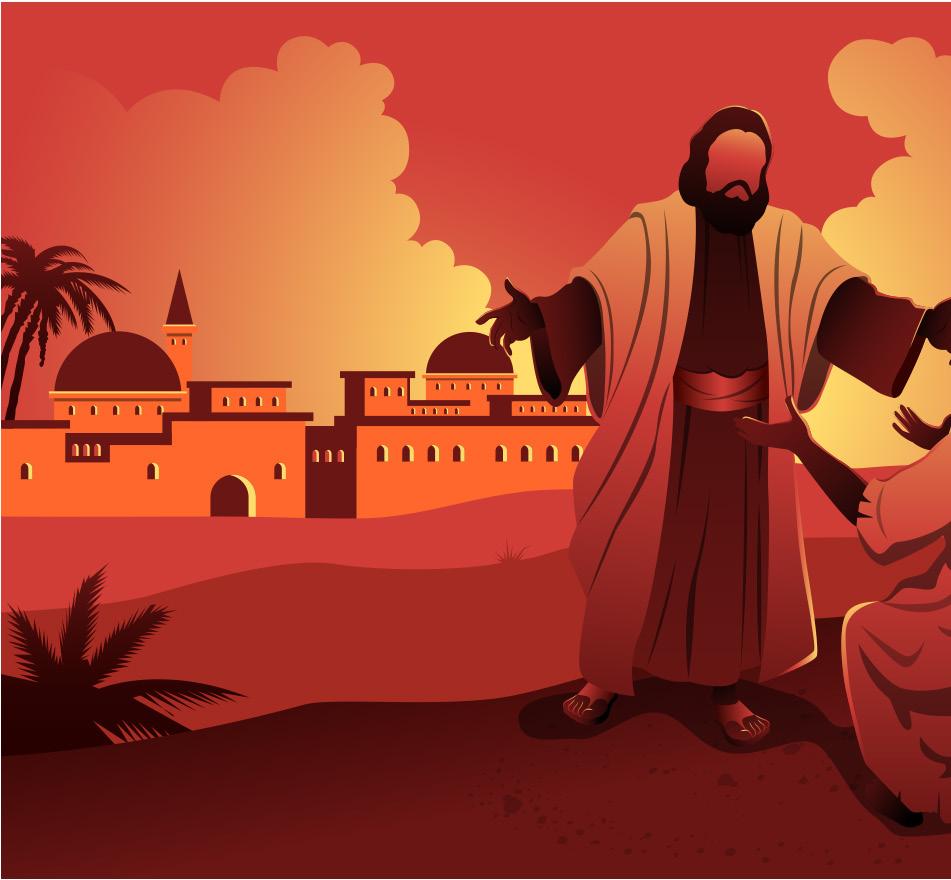
CARTOONS THAT ARE NO LAUGHING MATTER: STORIES
JESUS TOLD
DARIUS SALTER






DARIUS SALTER
BY Darius L. Salter
ISBN: 9781648174025
Cartoons that are no laughing matter: stories Jesus told Darius L. Salter
First Fruits Press, ©2026
Digital version at http://place.asburyseminary.edu/firstfruitsheritagematerial/5/
First Fruits Press is a digital imprint of the Asbury Theological Seminary, B.L. Fisher Library. Asbury Theological Seminary is the legal owner of the material previously published by the Pentecostal Publishing Co. and reserves the right to release new editions of this material as well as new material produced by Asbury Theological Seminary. Its publications are available for noncommercial and educational uses, such as research, teaching and private study. First Fruits Press has licensed the digital version of this work under the Creative Commons Attribution Noncommercial 3.0 United States License. To view a copy of this license, visit http://creativecommons.org/licenses/by-nc/3.0/us/.
For all other uses, contact:
First Fruits Press
B.L. Fisher Library
Asbury Theological Seminary
204 N. Lexington Ave. Wilmore, KY 40390
http://place.asburyseminary.edu/firstfruits
Salter, Darius, 1947-
Cartoons that are no laughing matter: stories Jesus told [electronic resource]/ by Darius L. Salter – Wilmore, Kentucky : First Fruits Press, ©2026.
1 online resource154 pages; port.) : digital
ISBN: 9781648174025 (uPDF)
ISBN: 9781648174032 (Mobi)
OCLC: 1579012872
1, Jesus Christ Parables Sermons. 2 Jesus Christ Parables Criticism, interpretation, etc. 3. Sermons, American I. Title.
BT375.2.S347 2026eb 251/.6
Cover design by Amanda Kessinger

First Fruits Press
Te Academic Open Press of Asbury Teological Seminary 204 N. Lexington Ave., Wilmore, KY 40390 859-858-2236
frst.fruits@asburyseminary.edu asbury.to/frstfruits
All the good in my life is a result of being in uenced by persons who identi$ed themselves with the Wesleyan Holiness Movement. I am profoundly indebted to these individuals , many paragons of righteousness. I attended four educational institutions identi$ed with the Wesleyan Holiness Movement. A!er those four schools, I did a Ph. D. at Drew University in Madison, New Jersey, a Methodist school whose $rst two presidents, John McClintock and Randolph Sinks Foster, were exponents of entire sancti$cation as a second work of grace. I even did a dissertation titled “ "e Holiness "eology of "omas Upham.” Upham experienced entire sancti$cation under the tutelage of Pheobe Palmer, the latter rightly deserving the sobriquet: “ "e Mother of the Holiness Movement.” I believe I read her complete corpus, some dozen books.
I am presently a member of the Church of the Nazarene. Its existence is due to a sincere e%ort to bring diverse holiness churches and associations under one canopy, resulting in the holiness movement’s largest denomination. Other smaller groups but no less vital denominations include "e Free Methodist Church, "e Wesleyan Church, and "e Salvation Army. From 1979 to 1986, I served as the executive director of the Christian Holiness Association, an umbrella for seventeen holiness denominations, and $!y educational institutions. "e organization had no legislative power but was a theological gathering for those who believe the doctrine of holiness to be important to their identity.
At the 125th anniversary of the Christian Holiness Association founded in 1867, I brought the historical address.
| Darius L. Salter
Little did anyone know that this would be the last celebrated anniversary, because in 2003, the Christian Holiness Association went out of existence, closed its doors because there was moribund interest in the theology of John Wesley’s “ "e grand depositum for which God seems to have raised us up.”
In 1995, Keith Drury, a scholar from the Wesleyan Church, presented a paper at the annual meeting of the Christian Holiness Partnership, (a changed name from the Association) entitled “ "e Holiness Movement is Dead.” In 1999, Richard Taylor, whom I designate as the patron saint of the Holiness Movement, followed up Drury’s address with an article in God’s Revivalist, “Why the Holiness Movement Died.” In 2015, Harold Raser, church historian at Nazarene "eological Seminary, presented a lecture series titled “An Autopsy on the Holiness Movement.” As far as I know, no one has questioned or challenged his analysis. Had Raser’s lectures been presented a mere twenty$ve years earlier, he would have been considered a traitor to both Nazarene "eological Seminary and its denomination, still believing holiness was its reason to be. My conclusion was that if the above perspectives were only partially true, the death of an institution which has survived for 136 years, demanded more extensive treatment.
Added to all of the above, is that Mark Quanstrom wrote for his Ph. D. dissertation at Saint Louis University, a Jesuit school, “ "e Doctrine of Entire Sancti$cation in the Church of the Nazarene: From Extravagant Hope to Limited Expectations.” "e Church of the Nazarene published the dissertation as A Century of Holiness !eology, but le! out Quanstrom’s sub-title and eliminated several of his dire assessments, such as both traditionalists and revisionists had “e%ectively emasculated the
9 doctrine of entire sancti$cation at least as it had been understood at the beginning of the century.”
In 2019 First Fruits Press, the academic imprint of Asbury "eological Seminary published my book, !e Demise of the American Holiness Movement: A Biblical, Historical, !eological, and Cultural Exploration. I observed that much of the preaching on holiness from the early days of the National Camp Meeting Association for the Promotion of Holiness had been topical, deductive, and propositional. Abundant proof texting was done from the Epistles. "ere was little of Biblical context and almost none of the sermons which I examined were inductiveexpositional. Most Holiness sermons began with a proposition and argued that point, rarely staying primarily with the text that was read, and normally utilizing a plethora of other biblical citations.
I also noted that in most Holiness preaching, there was little examination of the life of Christ. "e New Testament scholar, N. T. Wright has written that “ I would go so far as to suggest that whenever the Church forgets who Jesus actually was, idolatry and ideology lie close at hand.” Agreeing with Wright I wrote, “ "e Holiness Movement by not staying in humble contrition before the incarnated Christ as described in Scripture, a Christ who challenged almost all normal patterns of human behavior, may have been le! with an ideology, de$ned by a formula rather than a person.”
"e primary means by which Jesus challenged these normal patterns of behavior was by using narrative, (something else that holiness preachers in the past rarely did) stories that we refer to as parables. Webster de$nes a parable as “a short, allegorical story designed to illustrate and teach some truth, religion, principle, or moral lesson.” "e pre$x para
| Darius L. Salter means alongside of, and thus Jesus o!en began a parable, “ "e Kingdom of God is like….” "e story ampli$ed or ran along side of the truth that Jesus was communicating. Jesus was a master communicator, and I am convinced no stories ever told by anyone surpassed the genius Jesus displayed in these parables. "ey are o!en counter-intuitive and hyperbolic. I am not the $rst person to note that the stories Jesus told are exaggerated for the purpose of “in case you missed the point.”
As did the Old Testament prophets, Jesus majored in metaphorical shock. Parable scholar Klyne Snodgrass in his book, Stories with Intent: A Comprehensive Guide to the Parables of Jesus writes, “Because of hyperbole and elements of surprise or improbability, parables o!en are pseudo-realistic and have elements that shock.” Hyperbole taken from the Greek literally means to go beyond or over. "e point made by the parable is more than just gotten across; it is thrown far enough to leave no doubt, what one might call overkill. Biblical scholar A. N. Wilder references hyperbole in Jesus’ parables by writing, “Jesus’ speech had the character not of instruction and idea, but of compelling imagination, of spell, of mythical shock and transformation.” New Testament Professor Donald Hagner speaks of “deliberate hyperbole on the story of the person who sold everything to purchase one pearl.” One scholar even refers to Jesus’ parables as “burlesque, “ which Webster de$nes as “any ludicrous parody or grotesque caricature.”
Cartoons make use of caricatures, exaggerated features. A caricature is a picture or description, ludicrously exaggerating the peculiarities or defects of a person or thing. "e more peculiarities a person has, the easier he can be cartooned. "us, Donald Trump is a cartoonist’s delight, his coi%ured hair and his hanging over the ponch tie make him easily identi$able.
Barach Obama was readily cartooned because of his large ears and African hair contrasted to his mulatto skin. Jimmy Carter because of his high cheekbones, thick lips, and toothy grin made him immediately recognizable in a cartoon. Joe Biden is more of a challenge because he lacks abnormalities that are easily magni$ed.
"e section of newspapers devoted to cartoons was at one time referred to as the “comic strips” or the “funnies,” and they, at times, stimulate a laugh or at least a smile. But o!en cartoons have been serious business. "omas Nast has been characterized as the father of the political cartoon. Nast sought out corruption, lampooned scandal, antagonized individuals, and targeted anyone who o%ended him. More than anyone else, Nast brought down the corrupt William Tweed and his Tammany Hall gang in New York City. Tweed, notorious for bribery and kickbacks, was exposed by Nast who more than anyone else sent him to prison where he died. Tweed was an easy target, exceedingly overweight with a huge gut, balding head, a prominent nose, a thick beard, and always dressed in an expensive three-piece suit. In one cartoon, Tweed stands alone, his “fantastically-bulging belly over his legs, his diamond pin gleaming where his heart ought to be, and his head replaced by a bag of money.” Tweed exasperated, “Stop the damn pictures.” "omas Nast almost single-handedly brought down the most corrupt and notorious political machine in the United States.
But not all of Nast’s cartoons were negative. Nast was a Republican and apotheosized Ulysses Grant. In one cartoon, Nast depicted an angelic creature pinning a metal on Grant’s chest. In another cartoon just before the election of 1868, Nast depicted Grant as “Prometheus Bound.” What Nast was suggesting was just let Grant loose, elect him President, and
everything would be made right. Certainly exaggerated, but nonetheless, a political candidate was fortunate to have Nast on his side.
As Robert L. Short argues in the Gospel according to Peanuts, there is a comic side to the Christian story. “In the history of western literature, there is possibly a no more popular subject for comedy than the complete blindness of love by the lover who insists on making a fool of himself simply because his passions have the upper hand over his reason.” Yes, we are an ugly bunch. “Peanuts” allows us to laugh at our own insecurities, foibles, and in some ways the futility of existence. Charlie Brown has never been able to kick the football because Lucy is always pulling it out from under him. When Lucy says to Charlie Brown that we learn more from losing than winning he responds, “ "at makes me the smartest person in the world!!” Charles Shultz had a de$nitive agenda in his cartoons, believing that “If you do not say anything in a cartoon, you might as well not draw it at all.” Short concludes, “ "us, Peanuts . . .can play a vital part in the life of the Church…by being a wonderfully imaginative parable of and for our lives.”
Jesus’ cartoons are, at times, easy to interpret, and at other times di&cult. Some of them are straight forward, and others seem to go in multiple directions. Some of the parables have an easily identi$able, and prominent point. Others have multiple meanings, what scholars refer to as multivalent. All of Jesus’ parables are told in context and are initiated by a question or a problem needing to be addressed. At times, the context is easy to identify, and in other instances the reader is le! wondering if he or she has been befuddled by an idiomatic saying, or an ancient primitive practice that is totally foreign to a 21st Century American.
"e cartoons of Jesus o!en reveal his disdain for selfrighteousness and the vanity of riches contrasted to the poor and humble. He is especially hard on those who justify themselves at the expense of honest and candid introspection. "us, the stories told by Jesus were o!en a head-on clash with the Pharisees, the dominant religious party of Judaism. Jesus’ cartoons are reckless, pulling no punches. And for anyone who truly listens will lead to the personal revelation “Oh, my goodness, that is me.” "ey are told for their shock value, battering rams, knocking down false walls of security. Sally McFague writes, “A parable is in this analysis an assault on the conventional way of thinking. It is an assault on the social, economic, and mythic structures people hold for their own comfort and security.”
I am suggesting in this brief book, that if Jesus was walking on earth in the 21st century, his parables would be at odds with the American Evangelical Church as much as they were with the Pharisees. If we take Jesus seriously, he is a troubling person. Materialism, racism, exceptionalism, nationalism, inequity, the lack of self-denial, self-serving agendas, all come under Jesus’ condemnation. In brief, why are the parables so important? It is in these stories that we $nd the theology of reversal more than any other place in the Bible. "e heart of the Gospel incarnates the ultimate reversal, God became man and died for us. "is is a di&cult navigation for people who live in the richest nation on earth. Parables are about grace, the exact opposite of meritocracy, a philosophy of life that de$nes Americans. If carefully considered and heeded, the parables of Jesus are transformative, and if honestly applied will make a practical di%erence in my life and the lives of others.
Biblical scholar Walter Brueggemann depicts prophets as those who identi$ed with the marginalized rather than the “royal
consciousness,” who had wealth and political power. "ough I have not discovered Brueggeman making this point, I think Jesus utilized the “prophetical imagination” more e%ectively and poetically than did any Old Testament prophet. Jesus was not a friend of insiders. His spoken word would eventually become the acted word, a cruel cross ultimately identifying him as an outsider. He had been an outsider all along, his words and actions a witness against him.
I indict my own heritage from the perspective of a life time of observing it and participating in it. I believe that there is a high possibility that we have not done any lesser job in patterning our preaching, teaching, and institutional life on Jesus’ Kingdom than have all other churches and denominations. I one time heard Jerry Falwell, Sr. preaching that the Pharisees were the liberals and Jesus was the conservative. Such hermeneutic fallacy is what all of us dish out when we impose our political agendas and inherited doctrines on the text. All of us have problems with objectivity which would allow us, by sustained inquiry with the help of the Holy Spirit, to rightly divide the word of truth. What a di&cult task, a task ever more needed in a world of the exponential and inexorable multiplication of false information.
I have chosen ten parables somewhat arbitrarily on which to expound. I do not believe that I have chosen them because they were easy to understand as opposed to others more di&cult. For each parable, I identify the exaggeration which Jesus exempli$ed, and at the end of the sermon, critique my homily and interpretation of the text. "e reader will be the $nal evaluator as to whether I have done an adequate job.
“For the kingdom of heaven is like a landowner who went out early in the morning to hire workers for his vineyard. He agreed to pay them a denarius for the day and sent them into his vineyard. About nine in the morning he went out and saw others standing in the marketplace doing nothing. He told them, ‘You also go and work in my vineyard, and I will pay you whatever is right.’ So they went. He went out again about noon and about three in the a"ernoon and did the same thing. About ve in the a"ernoon he went out and found still others standing around. He asked them, Why have you been standing here all day long doing nothing?’ Because no one has hired us,’ they answered. He said to them, ‘You also go and work in my vineyard.’ When evening came, the owner of the vineyard said to his foreman, ‘Call the workers and pay them their wages, beginning with the last ones hired and going on to the rst.’ !e workers who were hired about ve in the a"ernoon came and each received a denarius. So when those came who were hired rst, they expected to receive more. But each one of them also received a denarius. When they received it, they began to grumble against the landowner. !ese who were hired last worked only one hour,’ they said, ‘and you have made them equal to us who have borne the burden of the work and the heat of the day.’ But he answered one of them, ‘I am not being unfair to you, friend. Didn’t you agree to work for a denarius? Take your pay and go. I want to give the one who was hired last the same as I gave you. Don’t I have the right to do what I want with my own money? Or are you envious because I am generous?’ So the last will be rst, and the rst will be last.”
16 | Darius L. Salter
Exaggeration: No story that Jesus told represents the upside-down kingdom of God more than does this one. "e caricature is in bold relief when everyone is paid the same for unequal contributions and in the reverse order of being hired. "is vineyard owner could have not been more politically and economically incorrect. "e workers who had labored throughout the day could have not been more stunned. "e story puts Jesus at odds with all meritocratic systems. "ere are no “smartest boys in the room” in this story. Most of us would rather live in the rat race of competition, a hierarchy of money, power, and possessions, than the security of grace, the equity of a God who regards all persons of equal value. "is story is paradoxical in that there is no salvation by works, yet everyone is required to work, to make a contribution to the kingdom of God.
Sermon: My boss didn’t know what he was doing. He went to the town square this morning and came back with only three workers and we have enough work for twenty-$ve. Some say we have the biggest vineyard in the world. Others have noted it covers the whole Earth. "ere are trellises that need to be repaired and vines that need to be cut back. Compost needs to be spread. Weeds and crab grasses all need to be pulled out. Grapes need to be picked and washed and taken to the wine press. And of course, we need people to stomp the grapes and extract the juice, My boss has been doing this forever, but when it comes to hiring, still doesn’t know how or what to do.
"ree hours later, he discovered we were not making enough progress. I could have told him so. He headed back down to the marketplace. Surely this time he would bring about twenty more, because we could sure use them. But to my
Rubbing Grace in Your Face 17 surprise, he returned with only three more. I told you he did not know what he was doing.
About noon we should have been half done, but we were no where near that. And it was hot with not a cloud in the sky and no breeze stirring. No shade whatsoever to give relief from this back-breaking work. As the foreman, I actually felt sorry for these day laborers because if they don’t work they don’t eat. And as I suspected, if we are going to do what we need to today, the owner of the vineyard, will have to fetch more workers. So he took o% again. Surely this time he will bring back enough $eld hands so that we can get these grapes picked before sundown. But that wasn’t the case. Again he returned only with a couple of workers.
By about three in the a!ernoon, it was su%ocatingly hot, so hot that the workers were soaking wet with sweat, the water dripping out of their pants tails and standing in their shoes. "ere was still a lot of work to be done. Again my boss headed out to the marketplace to hire more laborers. "is was a great waste of time. It was about one-half an hour each way and this was the fourth trip. Four hours on the road when he could have hired everyone he needed that morning. Oh well, it is his time and money. He can do what he wants, but obviously, he should have taken a few courses in management because he knows nothing about e&ciency. If fact, I don’t even think he has a college degree. Again, he returned with only three more workers.
And then he did something I have never seen anyone do before and I have worked for a lot of people. An hour before quitting time, he headed back into town. "is time returning with about 10 people. About as many as he had hired all day.
18 | Darius L. Salter
With 25 people we pretty much wrapped everything up in about one half an hour.
At 6 p.m. the boss said, “Go ahead and pay them.” He then pulled me aside, “Give each of them a denarius.” “But sir, some of these people have worked all day, they are so tired they can hardly walk. "e ones who just got here have hardly broken a sweat.“ "ere was something else wrong with his understanding of labor and wages. My boss knew little regarding “when” to hire or “how many” to hire, and in my perspective, and more critically, he knew nothing about “whom” to hire. Some of these people did not know a grape from a $g. Others were so old they could hardly move. Another guy could not pick more than one grape per hour. He seemed to be encased in cement. Others seemed to have been born to harvest grapes "ey were naturals. "ey were so fast you could hardly see their hands move. Every $!een minutes they were dumping a bushel of grapes into the wagon to be taken to the presses. Hadn’t my boss been watching? Didn’t he know that he was unfair? Production matters. Some of these people could work circles around the others!
And then he gave me the strangest instructions of all, “ Pay them inversely as to when they were hired. Call each of them forward and make sure each one sees what the other is making.” “ But sir, you are going to get a lot of complaints. When this gets out, no one is going to work for you again. You are going to be taken to small claims court. Have you ever heard of something called a union? "is injustice will probably catch the attention of the National Labor Relations Board. "e boss was adamant; pay them all the same. So that is what I did. "e $rst people I paid all had a smile on their face. "ey had never worked for someone so generous, and the people who were
Rubbing Grace in Your Face 19 standing behind them were smiling as well. If that person had been paid a denarius, think what I am going to earn!
But as I dropped a denarius into everyone’s hand the smiles turned to grimaces, and the grimaces turned to anger, and the anger turned to complaining. One of the original hires stated what was plainly true. “We have worked all day, and these last guys you hired got the same as us.”
It was then that I learned that the $rst hires were the only individuals who were told exactly what they were going to get. "e boss must have seen this coming. His response: “I am not being unfair to you, friend. Didn’t you agree to work for a denarius? Take your pay and go. I want to give the one who was hired last the same as I gave you. Don’t I have the right to do what I want with my own money, or are you envious because I am generous?”
Yet, it still didn’t seem right to me. "ese $rst hires had gotten up at four in the morning just to make sure they were at the marketplace for what ever business owner showed up. Also, they had been the most conscientious workers. It seemed like some kind of hiring criteria needed to be put in place. An aptitude test, manual dexterity test, background checks, maybe some letters of recommendation. Zip recruiter could have made this hiring process more e&cient. I bet if we had used algorithms for these hires, there would have been a lot less complaining, but again e&ciency didn’t seem to matter to my boss.
I later learned that some of these people had been standing around all day, not being able to get a job. Maybe they did not make themselves known or they didn’t know the application process. For some reason, they and my boss didn’t intersect.
20 | Darius L. Salter
And when I think about the individuals whom the owner of the vineyard hired, there didn’t seem to be any common denominator, no singular pro$le for vineyard workers. Some were dull, others quick-witted, some small, some big, some young, some old , some fast, some slow, some prepared, others not prepared. Some of these people seemed to be born to pick grapes. And others needed to be told when and what to do. What I came to realize is that it may have taken more will-power to hang around the marketplace all day, with the expectation of earning only one-twel!h of a denarius or not being hired at all.
I’ll give my boss credit for one thing, he was an equal opportunity employer! Maybe I have not rightly understood him. He did know whom to hire and where to put them. He could intuit the skills and aptitude of every single individual, and put them right where they needed to be. "e jobs required for maintaining and harvesting a vineyard are complex and varied. He had jobs for everyone, no matter race, nationality, aptitudes, abilities, education, or backgrounds. It didn’t matter to him. He hired anybody and everybody who was available. Just show up and I’ve got something for you to do, whether you are eight or eighty, nine or ninety, I confess, as an American, that is especially di&cult for me to understand. I believe people should be paid according to their ability, according to their worth, according to their e%ort.
You see the truth is, I am not a kingdom person. I am an American. And in America you get what you deserve. Education matters. Networking is extremely important. Get online. Advertise yourself. Make sure you are on Linked In. "e early bird gets the worm! A stitch in time saves nine! Early to bed, early to rise, makes a man healthy, wealthy, and wise. Take some self-improvement courses. Go back and read Dale
Rubbing Grace in Your Face 21 Carnegie’s: How to Win Friends and In uence People. Reread Norman Vincent Peale’s !e Power of Positive !inking. Find your daily inspiration from Guidepost. Set some numerical goals. You see, the American church doesn’t live in the land of the cruciform kingdom. We live in the land of meritocracy. "e church is a corporation, run like a corporation. Numbers, statistics, production, advertising, are all important. Attract as many people as you can, however you can. Get someone in your church before another church gets them. "e competition is $erce and o!en carnal.
AT&T, Microso!, IBM, and Meta don’t have a corner on Meritocracy. So-called Christian institutions are better at it than just about anybody else, Christian seminaries are aming examples of meritocratic politics. I taught in them for 24 years. Prove your worth. Every time you go to the bathroom put it on your vita. Impress people. Image is everything. Report books written, conferences attended, papers presented. Legitimate yourself, prove yourself, see if you can get yourself in “Who’s Who” in the Midwest, “Who’s Who” in Education, “Who’s Who” is Kansas City, “Who’s Who” is Nazarendom, “Who’s Who” in the Church?, “Who’s Who” in my Sunday School Class? You’ll need all of this to apply for tenure. Tenure means you have a guaranteed job for life. Only adultery or murder can get you $red. Linear security for the rest of your life. Look how many times my name appears on Google!
"e story that Jesus told is about grace. Exaggerated to the extent that we can entitle this, “Rubbing Grace in your Face.” It was and is a stunning reversal of the ways in which the world and the church operate. "e claim “I deserve” does not exist in kingdom vocabulary.
22 | Darius L. Salter
As in all of Jesus’ stories, this one was told in context. "is story was told to his disciples, the spiritual of the spiritual, the elite of the elite, the 12 apostles, and the elite of the 12 were Peter, James, and John. Jesus gave them the inside story, “I’m going to be cruci$ed.” "e mother of James and John thought to herself, this is the last time that I can make sure that my boys are well taken care of. “Jesus, make sure before you kick the bucket, James is appointed Attorney General and John is Secretary of State.” Jesus responds, “You don’t know what you are asking,” translated, “How could you be that incredibly stupid.”
Matthew tells us, that the other disciples were indignant; indignant means strong disapproval. Freud believed that righteous indignation was 2% righteous, 48% indignant, and 50% jealousy. He had a point. Jesus ends the parable of the vineyard and the request of James’ and John’s mother in the same way: “so the last will be $rst and the $rst will be last.” 20:16. “Not so with you. Instead, whoever wants to become great among you must be your servant,” 20:26.
"is text is foreign to us because we live and work in a society where people are paid by the week or the month and we know little of hand-to-mouth existence on a daily basis. I was in Cox’s Bazaar, Bangladesh, on the Bay of Bengal, Located there is the largest refuge camp in the world: one million people. I was staying in the 2nd or 3rd oor of a hotel. Looking out the window I saw a group of men working on the $rst oor of a new building. "ey were pouring concrete for the ground oor. "e concrete was coming from a concrete truck about 50 feet away.
"e easiest way to have poured the cement would have been to move the truck close enough so that it could have been poured directly into the area or square where the cement was needed. "ere is now a cement pouring process where a
Rubbing Grace in Your Face 23 chute with a corkscrew can transport the concrete for twenty$ve yards. But let’s say we do not have that device. "en the more primitive process would be to wheel-barrel it, but none of these technologies existed for the construction process I was observing. "e concrete was being carried in pans on the top of their heads.
To invent or to utilize a more advanced technology would be to upset the economic balance which would be to displace a dozen or so men carrying the cement on their heads. Parenthetically, this is called creative destruction, and one of the reasons that nations are poor, is that they do not allow technology to displace century-old methodologies. I can’t imagine that a person who has carried 500 pans of cement on his head through the heat of the day would be paid the same who has carried $ve pans. "at is the human side of this story which Jesus told. "e God side is” I’m going to make sure that everyone is taken care of, no matter how little they have done, no matter how unimportant they may seem.” I’m going to make sure that this person has enough money to stop by the market on the way home to buy the essentials for dinner and even some le! over for breakfast the next day.
Hardly anyone to whom I’m speaking or reading this, remembers "e Great Depression. You would have to be in your ninety’s. "e Great Depression occurred primarily in the 1930s, but all of us who were baby-boomers, had parents who lived during "e Great Depression. It le! an indelible scar, a memory to never be erased. People who lived through the Great Depression viewed life di%erently than their children and especially their grandchildren. "ey remember not having enough money to buy a postage stamp and perhaps not even enough money to buy something to eat. "ere are endless debates
24 | Darius L. Salter
as to whether F. D. R’s "New Deal" actually helped, or whether it was World War II that brought us out of the Depression. During the war everyone was needed to work from the soldiers who hit the beaches in Normandy from the most massive array of ships that the world had ever seen, to Rosie the Riveter who worked in Wilmington, North Carolina. I recently read from a scholar whose statistical analysis argued that because of "e New Deal, there were more people employed with an increased per capita income which occurred before World War II.
"e genius of F. D. R’s plan was that the government would not give money away but that it would create jobs for people to earn money: the Works Progress Administration, the Civilian Conservation Corps, the Farm Security Administration, the National Industrial Recovery Act, and the Tennessee Valley Authority. In 1937, the Works Progress Administration built a gym in the little community of Atlantic, North Carolina, where I would one day grow up. Today, it is still standing and in use, and has the best oor that was ever put in a gymnasium. Oak strips laid on 2 x 12 inch joists allowing for some give and take, some bounce, and is less damaging to the knees. I know. I spent seven days, six hours per day in that gym. I was a gym rat.
F. D. R. who served longer that any other president in the United States, is third only to George Washington and Abraham Lincoln in admiration. My mother said she cried when he died. I suspect many others did as well.
When H. W. Brands one of our $nest historians, wrote his biography of F. D R., he titled it, Traitor to His Class: !e Privileged Life and Radical Presidency of Franklin Delano Roosevelt. "e Delano’s on his mother’s side were wealthy. He married his cousin Eleanor Roosevelt, who was a niece of "eodore Roosevelt. Roosevelt was from the rich, but he befriended the
Rubbing Grace in Your Face 25 poor. He knew something about su%ering through being a polio victim and for the entirety of his presidency, could not stand up without mechanical help.
I am suggesting that Jesus was a traitor, a traitor to the economic order, a traitor to conventional wisdom, a traitor to those who think they deserve more because of pedigree, educational status, background, e%ort, cleverness, business acumen, and the list goes on and on. No nation on the face of the earth surpasses the United States as the land of meritocracy. Jesus was a traitor, most of all to the Church, if we can equate the religious community, the hierarchy of rabbis, lawyers, scribes, and the Jewish priesthood with the Church. One might call it competitive holiness. I deserve to go to Heaven more than you do.
Work is a precious gi!. Every person within the sound of my voice has the opportunity to work for God. You may get credit, you may not . You may have a high paying job, you may not, you may have a prestigious job, you may not, you may get your picture in Holiness Today, or you may not. You may be named Alumnus of the Year or you may not. You may pastor a small church or a large church. You may be given the lifetime achievement award at General Assembly or you may ask yourself, does anyone even know I exist? A Christian college chose as its Alumnus of the Century a very successful businessman. Over the span of a century, the school had graduated hundreds of preachers. Some of them no doubt dug out $!een churches and lived in parsonages so dra!y the wind blew the napkins o% the table, if they had any napkins. But who cares. Not this holiness institution.
Religion is dangerous business. It is o!en a camou age for self-aggrandizement, ego-de$ciency, power-plays, and
26 | Darius L. Salter
self-serving agendas. Pay comes in many di%erent forms: applause, recognition, exaltation, winning the numbers game, and de$ning success as achievement. In accomplishment, it is di&cult to de$ne the line that separates holy ambition to ful$ll my potential in Jesus Christ, and the recognition that the carnal mind craves. Equal pay for unequal contribution can be a bitter pill to swallow. Even more bitter is unequal pay for equal contribution. I did not get the credit I deserve.
It has been said that John Wesley’s “Covenant Service” was his most unique contribution to Christian liturgy. It was read every watchnight service in both British Methodism and American Methodism. It has been used in the Church of the Nazarene. Part of it reads:
Commit yourselves to Christ as his servants. Give yourselves to him, that you may belong to him. Christ has many services to be done. Some are more easy and honorable, others are more di&cult and disgraceful. Some are suitable to our inclinations and interests, others are contrary to both. In some we may please Christ and please ourselves. But then there are other works where we cannot please Christ except by denying ourselves. It is necessary, therefore, that we consider what it means to be a servant of Christ.
Let us, therefore, go to Christ, and pray:
Lord, make me what you will. I put myself fully into your hands: put me to do your su%ering, let me be employed for you, or laid aside for you;
Rubbing Grace in Your Face 27 let me be full, let me be empty, let me have all things, let me have nothing. I freely and with a willing heart give it all to your pleasure and disposal.
Christ will be the Savior of none but his servants. He is the source of all salvation to those who obey. Christ will have no servants except by consent; Christ will not accept anything except full consent to all that he requires.
Christ will be all in all, or he will be nothing. Con$rm this by a holy covenant.
I have attempted to think back over the vineyard laborers that I have observed over my years of ministry. I go back almost one half a century when I pastored First Friends Church in Canton, Ohio. I was in way over my head. Attending that church were Bing and Marie Sisler. Marie had been raised a Roman Catholic. Somewhere along the way, she had a transforming experience with Christ. She was one of the vineyard workers that God hired in the middle of the day. I held a Bible study in her home and she couldn’t $nd the Gospel of John without me giving her the page number.
Marie had a speci$c job in God’s vineyard. She was an Avon salesperson. Marie believed in her product. She wore about 1/8th inch of make up on her face. She was about as broad as she was tall. She wore so much lipstick that I am sure that when she smiled the corners of her lipstick touched her ear lobes. “Avon Calling” was not her real call. Oh, I am sure she sold plenty of Avon, but selling Avon was a subversive activity. She was an undercover agent. She was in God’s C.I.A. And whenever she had the opportunity to turn the subject to Jesus, she did that on the cul-de-sacs of her neighborhood. A cul-de-
28 | Darius L. Salter
sac is a dead end street. And there is no better place to share Jesus than on a dead end street.
On one of those dead end streets, she found the Ritzert family. "e Ritzert family was a train wreck with every problem imaginable. And in a long, complicated process, the family was saved, healed, and put back together. "e oldest son, Frank, had a brain aneurysm and almost died. If fact, part of his brain permanently shut down. But in spite of having only a partially operable brain, he became a rocket scientist for NASA, the essence of genius. He is the founder, director, and board chairman of “For His Glory,” that has reached out and touched people around the world all because of a little lady who knocked on his door selling Avon, when he was 12 years old.
Critique: "e foreman is mentioned only once in this story, and I have chosen him as a third party, attempting to get inside his mind as he observes and comments on the process of this day. I am not con$dent that this is the best way to go about communicating this story, which is so radically di%erent from conventional wisdom. Indeed, this story represents the foolishness of the Gospel. "e profundity of kingdom theology almost sounds farcical. It is so far fetched, that I am challenged to communicate a life-motif so diametrically opposed to the normative way of conducting everyday a%airs in which all of us are involved. Hopefully, I have represented the redemptive matrix which is at the heart of all of Jesus’ stories and particularly this one. Everyone, no matter who they are, can be a kingdom employee. "ere is only one question on the application form: Are you available?
Luke 16: 19-31
!ere was a rich man who was dressed in purple and ne linen and lived in luxury every day. At his gate was laid a beggar named Lazarus, covered with sores and longing to eat what fell from the rich man’s table. Even the dogs came and licked his sores. !e time came when the beggar died and the angels carried him to Abraham’s side. !e rich man also died and was buried. In Hades, where he was in torment, he looked up and saw Abraham far away, with Lazarus by his side. So he called to him, “Father Abraham, have pity on me and send Lazarus to dip the tip of his nger in water and cool my tongue, because I am in agony in this re. But Abraham replied, “Son, remember that in your lifetime you received your good things, while Lazarus received bad things, but now he is comforted here and you are in agony. And besides all this, between us and you a great chasm has been set in place, so that those who want to go from here to you cannot, nor can anyone cross over from there to us.” He answered, "!en I beg you, father, send Lazarus to my family, for I have ve brothers. Let him warn them, so that they will not also come to this place of torment." Abraham replied, "!ey have Moses and the Prophets; let them listen to them.’" “No, father Abraham," he said, "but if someone from the dead goes to them, they will repent." He said to him, "if they do not listen to Moses and the Prophets, they will not be convinced even if someone rises from the dead."
Exaggeration: "e sel$shness of the rich man is unparalleled. He was so cold-hearted that he would not allow his servants to throw a crumb over the wall, much less extend charity that would have inconvenienced him. "e rich man, in
30 | Darius L. Salter
this story, is possibly the most easily cartooned in all of Jesus’ narratives. He is completely self-absorbed, a stereotypical narcissist. Jesus depicted the rich man’s stinginess at its most extreme manifestation. "e rich man had no ability to empathize with someone else’s problem. Seemingly, he would have let Lazarus starve rather than order his servant to throw crumbs over the gate.
Sermon: "is has been one of the most abused texts in all of Scripture. It is not about Heaven or Hell. "is is the Jewish understanding of reward and punishment, especially Lazarus being favored by Abraham. Jesus had already told the Jewish leaders, “Say not that we have Abraham as our father.” Ok, you want Abraham, you can have him. But the person favored by Abraham is not you, but the one you believe has been cursed by God. "is story is the heart of the gospel that emphasizes “reversal.” No, it is not about Hell. It is worse than that; It is about those of us, which is pretty much everyone who is reading this or listening to this, who fare sumptuously every day. It is about Americans.
No black and white picture will do. We need color to depict a person who is dressed in “purple and $ne linen.” Surely, he is overweight, because he feasted “sumptuously every day.” "e Greek word for sumptuously (the word used in the King James) lampartes is used only this one time in the New Testament. "us, the exaggeration is de$ned by the singularity of this man’s calloused disregard for the needs of others and the daily practice of living within a “me $rst” life motif. "e Jewish rabbis said that if a person was subservient to his wife, his body was covered with sores and he was dependent on another for his food, he had no life. We know two of these to be true, and if this man’s wife dropped him o% to panhandle, all three were true.
Trading Places 31
With this story, Jesus makes a full-frontal assault on a prosperity gospel. "e prosperity gospel was not invented by 20th century charismatics. According to Jewish theology, the rich man was blessed by God and the poor man was cursed. You could not and would not be in his condition without having sinned. For the Pharisees there was no comprehension of systemic evil, that there may have been circumstances beyond Lazarus’ control. We do not have any background information for either of these people. Was Lazarus born with a skin disease? Was he born into poverty? Did he know of any possibility of gaining job skills?
We see this every day as the cardboard sign which is an art form, “Will work for food;” “Stranded, need to get home;” “Please help a veteran.” Is it a scam? I’m sure I have given to people that I should’ve given to, and I’m just as sure that I’ve been scammed by others that I shouldn’t have given to. As I say to my wife, the only thing I know about this person, is that he is worse o% than I.
Neither do we know anything about the background of the rich man. Did he inherit his money? Was he a venture capitalist, who sold a start-up at the age of thirty, so he would never have to work a day in his life? Well, no, because no such possibilities existed. He could have been a shrewd businessman with a keen eye for commodity futures.
"is is the only time a name is given to one of the characters in a Jesus story. Lazarus, is the Greek transliteration of the Old Testament Eliezer “ "e Lord helps.” But there wasn’t much evidence that he was getting help from God, much less from the isolated rich man who practiced see-no-needy-person and help-no-needy-person. No scholar makes any connections between this Lazarus and the Lazarus, who was the brother of
Mary and Martha whom Jesus raised from the dead. Lazarus was simply a common name.
How long Lazarus was brought to the gate, we do not know. Every day? Certainly, long enough for the rich man to know something about Lazarus’ condition, and long enough for Lazarus to realize that he was in a hopeless situation, and to think to himself, “Perhaps I should choose another location to panhandle. Maybe I need to go down to Country Club Plaza and park myself in front of Barnes and Noble.”
"is story bares no relationship to Christian Eschatology; there is nothing in this story that sheds light on those verses I have so o!en quoted at a grave site: 1 Corinthians 15: 51,52 “Listen, I tell you a mystery: We will not all sleep, but we will all be changed – in a ash, in the twinkling of an eye, at the last trumpet. For the trumpet will sound, the dead will be raised imperishable, and we will be changed.” And another, 1 "essalonians 4:16 “For the Lord himself will come down from heaven, with a loud command, with the voice of the archangel and with the trumpet call of God, and the dead in Christ will rise $rst.” Instead, we have a Jewish understanding of eschatology.
Both men died, which is the lot for all of us. "e rich man was given a funeral, which was a proper closure on life. We don’t know what was done with Lazarus’ body. Perhaps, he was rolled over into a mass grave or buried in a pauper’s $eld without a headstone or a proper ceremony celebrating his life. Either way, the site of his grave has been lost. "e two men suddenly $nd themselves in vastly contrasting circumstances. "e contrast is startling, and would’ve been even more shocking to Jesus’ auditors, than it is to us!
Trading Places 33 "e poor man is in the most exalted position possible. He is so exalted that he is in Abraham’s lap! He is favored above everyone! "is is not a place in which Christians in the twenty $rst century would covet! As far as we know, Lazarus has done nothing to deserve this exaltation, other than being poor.
"e rich man, who has lived in a thermostat-controlled life, $nds himself in circumstances beyond his control. He is in Hades- a place of torture, agony, and $re. As far as we know, he has no inner awareness of why he is there. "is revelation awaits the appraisal of Abraham. “Far away,” he sees Abraham and Lazarus, “So he called to him, ‘Father Abraham, have pity on me and send Lazarus to dip the tip of his $nger in water and cool my tongue, because I am in agony in this $re’” (Luke 16:24).
According to Abraham, there is a chasm between them. We get the word chasm directly from the Greek word chasm, which is the only time the word is used in the New Testament. According to Abraham, it cannot be crossed, it is irrevocable.
Suddenly, the rich man has a concern for others, in particular, his four brothers. He requests “that someone return from the dead to warn them so that they will not also come to this place of torment.” In other words, let them have an apparition, as did Ebenezer Scrooge; something that would radically change their perspective on life! Abraham responded, that they already had su&cient reason and information to live out a life of concern for others. "ey have “Moses and the prophets.”
As we know, there is plenty in the Old Testament about not oppressing one’s laborers, about not fully harvesting one’s crops so that there would be su&cient grain for the poor to glean
34 | Darius L. Salter from the sides of the $eld. God imposed a system of checks and balances in order to maintain an egalitarian society. A seventh day was to be taken o%; a seventh year was to be taken o%, and the consecutive years of forty-nine and $!y were to be years of rest and freedom from labor. At this point, all debts were to be forgiven and all land held in hock, was to be returned to the original owners. Usury or money loaned to another at interest was forbidden. "ere’s no evidence that the Jews ever honored "e Year of Jubilee. Greed was more desirable than equality. "at same condition exists for us in the American system, which honors and even bows down to the rich. Perhaps those that just paid two and a half million dollars for a suite at the Super Bowl, also gave an equal amount to charity. But it is di&cult to justify such an expenditure with any amount of charity.
All wealth is built on the back of oppression. Whether I am looking at the Gilded Age where a man lost $!y pounds in three months working in Carnegie’s Steel Plant or I am talking to someone who works for an American company who outsources labor for $3 per hour in India, Indonesia, or South Africa. Hardly do I ever buy anything at Walmart that I don’t participate in systemic poverty. Listen to the words of Amos to Israel. “ "ey trample on the heads of the poor as on the dust of the ground and deny justice to the oppressed.” (Amos 2:7).
I have visited a sweatshop in Bangladesh, ironically owned by a Christian. Seven hundred workers, mostly women, work under immense pressure, making men’s pants and shorts, and almost all of the overseers are men. For the $rst forty hours, the women make only $!y cents an hour. For an additional thirty hours, they make one dollar per hour. "us, for seventy hours of work, they are paid $!y dollars. "ose $!y dollars, goes no further there, than it does in the United States. If they protested,
Trading Places 35 unionized, or walked o% the job, one hundred people would be standing in line to take their place. It costs forty cents to make a pair of shorts, which sells for forty dollars in the untied States. "at is a one hundred times mark up! An administrator for a missionary organization in the United States, believes the owner of this sweatshop to be very important to their outreach in Bangladesh. When I referenced the sweatshop situation to this administrator, I received a very defensive answer in both tone and comment. Why would I even question such a practice?
What lifestyle the factory owner lives, I don’t know. I do know that he sent his two sons to the United States for an education. If one is born in the United States, s/he has won the lottery. I also know that there is some truth to the observation that all you need to know about a person’s $nancial status is their zip code.
"e application of this text is lost, if one misses the two major symbols in this story, the gate and the chasm. ("is observation is not original with me.) I was raised in a holiness home. "e holiness code was very strict in our family; we did not have a television. My sisters dressed like they’d just fallen out of a covered wagon. My mother got saved and took her wedding rings o% and quit wearing make-up. "e $rst district superintendent than visited our church, (I could tell you his name) drove a black Cadillac and told a racist joke from the pulpit. Everybody laughed; this was the segregated south.
We were a lower middle-class family with the emphasis on lower. Middle class is not de$ned by the amount of money or possessions someone has; it is the aspiration that one’s children will go further in life than the parents have gone. "is further is normally de$ned by educational achievements, money made, honors gathered, and possessions accumulated.
It is also de$ned by enabling your children to build gates, gates that will separate them from the poor, the uneducated, the marginalized and the have-nots. "is self-defeating axiom of Christianity is designated as redemptive li!. It is that, which John Wesley prophesied and Max Weber described in his classic: !e Protestant Work Ethic and the Spirit of Capitalism. Wesley feared not that Methodism would go out of existence, but that Methodists would grow rich, become a dead sect, and lose the power of God.
However, this text, and my sermon on it, is not a diatribe against capitalism. I just did a book on "e Gilded Age, which highlighted the Carnegies, Vanderbilts, and Rockefellers, one of the most intriguing eras in our history, the story of the great industrialists. To give you an indication of their wealth, John D. Rockefeller was by far the richest man to ever live in the United States. Bill Gates, at his peak, was worth 1/450th of the gross national product of the United States, but Rockefeller was worth 1/65th of the gross national product!
"e bad news about this text, is that it has been grotesquely misrepresented as a sermon on a “Christian’s” understanding of hell; whatever that interpretation might be. "us, thousands of people in our tradition, have lined altars attempting to escape hell by $nding some emotional relief, but basically leaving unchanged concerning lifestyle and their perspective on the have-nots of this world. In the world’s eyes, especially for those who live in Europe, there isn’t much to recommend Christianity as it is practiced in the United States. Almost all churches are socio-economically de$ned. Other than possibly tithing, Christians spend their money about the same as nonChristians. But in fairness, the Church has provided the energy and momentum for many of the critical and social movements
Trading Places 37 in history: abolition, inner city missions, feeding the hungry, and reaching out to persons and nations which are destitute.
One of the greatest men who ever lived was Albert Schwitzer - theologian, philosopher, organist, musicologist, historian, humanitarian, and physician. I know of no one in all the historical reading I have done, as gi!ed and as sacri$cial as Schwitzer. He and his wife spent much of their lives in French Equatorial Africa, now Gabon. He mastered both the piano and the organ and became the foremost interpreter of Johann Sebastian Bach as well as Richard Wagner. He did a Ph. D. on the religious philosophy of Kant. He obtained an M. D. from the University of Strasburg.
In 1913, Schwitzer and his wife went to French Equatorial Africa to establish a hospital in a chicken hut. During the $rst nine months there, he saw 2,000 patients. A!er four years, he was so sick and emaciated, that he returned to France. He was later to found a leprosorium in Gadarene. He wrote eighteen books, most of them large volumes. Such radical service and scholarship is beyond our comprehension.
Note that this story begins with Jesus talking to the Pharisees: (Luke: 16: 14–15) "e Pharisees, who loved money, heard all this and were sneering at Jesus. He said to them, “You are the ones who justify yourselves in the eyes of others, but God knows your hearts. What people value highly is detestable in God’s sight.”
Note also that this story is followed up with the Pharisee and the tax collector who appear at the temple together. "e Pharisee stood by himself and prayed: “God, I thank you that I am not like other people—robbers, evildoers, adulterers—or
38 | Darius L. Salter even like this tax collector. I fast twice a week and give a tenth of all I get” (Luke 18: 11-12).
"e optimum phrase of justifying ones self is “I am not like that.” I want to say to myself that I am not like the rich man. "e truth of the matter is, I am like that. I eat better than most people, I wear nicer clothes than most people, I live in a nicer house than most people, I drive a nicer car than most people, I don’t have a simple answer. I want to say to both Jesus and Paul that you did not have a wife to keep happy and you never had to pay tuition for your children.
"ere are racial gates, political gates, nationalistic gates, socio-economic gates, and relational gates. "ere are gates in families where people don’t speak to one another because of inherited property or something that was said, or something that happened in childhood. It is quite likely for anyone reading this or listening to this, there is a gate between you and someone else. "at gate needs to be torn down. "e sad thing about a gate is that it will eventually become a chasm, an eternal separation and there is no Hell like separation.
If you want to walk where Jesus walked, don’t go to Israel, go to India. "ere you will $nd the same dress, the same villages, the same poverty, and the same world view in which Jesus incarnationally ministered. "e little church is crowded, with the people sitting on the oor. "ey have walked for miles to attend this service. It is hot, and I am profusely sweating. "e pastor is ragged and bare-footed. His sacri$cial life puts me to shame. I need to go to the bathroom and he takes me inside his house. "e walls are made of cardboard.
I returned back home and raised $6,000 to build a church. By the gratitude from the recipients, you would have thought I
Trading Places 39 had raised $93,000,000 and built something along the order of Adam Hamilton’s Church of the Resurrection. "e pastor said he had had a vision that someone from America would build a church for his congregation. I am something of a sceptic, but maybe so.
None of us will do anything comparable to Albert Schwitzer and probably will not even have the opportunity to go to India. But every time we go to True Light, Polo, Missouri; Shelter KC, pastor Jennee’s church at the Seminary, we open a gate. "ese are ministries in which the church I attend are involved)
In 1780, Elizabeth Gurney was born into a wealthy Quaker home in Norwich, England. In 1800 she married Joseph Fry and thus goes down in history as Elizabeth Fry, or Betsy Fry. A Quaker riding preacher named William Savery stayed in the Gurney home. She was converted and recorded. “He spoke to my condition. How well he hit the state that I was in. I thank God he sent a glimmer of light into my soul. “
It was Elizabeth Fry who went to the hell hole above ground called Newgate Prison. Some of the most appalling prison conditions in the history of the world. It was there that they hung boys for stealing a loaf of bread. When John and Charles Wesley had ministered at Newgate while they were students at Oxford, they wrote their father Samuel complaining that their fellow students had made fun of them. Samuel responded by quoting from Ecclesiastes 7: 6 “ "e laughter of fools is as the crackling of briars under a pot.”
Women and children were housed at Newgate, sleeping on straw scattered on cold, stone oors. Fry was responsible for presenting legislature to the House of Commons that would
40 | Darius L. Salter
eventually separate male and female prisoners. It was Fry who initiated legislation that would send prisoners condemned to death to Australia so they could start a new life. Fry even spent nights in prison so she could empathize with the plight of prisoners, especially women. She founded shelters for the homeless throughout London. From 2001 to 2016, her picture was on England’s $ve-pound note. In 2016, her picture was replaced by a less worthy person, Winston Churchill, but I guess if it takes Churchill to displace you, you will probably be remembered.
She sits at a small table in a cold concrete room with 100 women on tiered benches, sitting before her. "ey were the dregs of society, clothes torn and $lthy, hair matted, faces grimy. She reads from Isaiah 53: “He was wounded for our transgressions, bruised for our iniquities, the chastisement were upon him and by his stripes we are healed.” A tear trickled down a face, a heart was warmed, a life was transformed, even hundreds of lives were transformed, and one woman not without help from others, transformed the prison system of England. If anyone was a gate opener, it was Elizabeth Fry.
Critique: "is is a revisionist interpretation of this text. It is not sermon about Heaven and Hell. It is a story that calls for tearing down gates, both economic and relational. It is a text that demands action: open a gate. Hopefully, it will help open a gate that lies between the rich and those less fortunate, whether it be someone in the inner city or on the other side of the world. And for most of us, there is a gate between us and someone with whom we have “fallen out.” I need to make sure I have done my part to see that the gate is torn down or at least opened.
Matt:18:21-35
!en Peter came to Jesus and asked, “Lord how many times shall I forgive my brother or sister who sins against me? Up to seven times?” Jesus answered, “I tell you, not seven times, but seventy-seven times.” “ !erefore, the kingdom of heaven is like a king who wanted to settle accounts with his servant. As he began the settlement, a man who owed him ten thousand bags of gold was brought to him. Since he was not able to pay, the master ordered that he and his wife and his children and all that he had be sold to repay the debt. “At this the servant fell on his knees before him. ‘Be patient with me," ‘ he begged, ‘and I will pay back everything.’ !e servant’s master took pity on him, canceled the debt and let him go. But when the servant went out, he found one of his fellow servants who owed him a hundred silver coins. He grabbed him and began to choke him. ‘Pay back what you owe me!’ he demanded. His fellow servant fell to his knees and begged him, ‘Be patient with me, and I will pay it back.’ But he refused. Instead, he went o and had the man thrown into prison until he could pay the debt. When the other servants saw what had happened, they were outraged and went and told their master everything that had happened. !en the master called the servant in. ‘You wicked servant,’ he said, ‘I canceled all that debt of yours because you begged me to. Shouldn’t you have had mercy on your fellow servant,’ just as I had on you?’ In anger his master handed him over to the jailers to be tortured, until he should pay back all he owed. “ !is is how my heavenly Father will treat each of you unless you forgive your brother or sister from your heart.”
| Darius L. Salter
Exaggeration: "e exaggeration of this story is ludicrous! One man was forgiven ten thousand talents, or $26,268,000,000, but wouldn’t forgive someone else one hundred denarii, or $16,000. ("e Greek has talents rather than bags.) It would require one hundred days of labor to pay o% the smaller sum. But it would take one hundred sixty-four thousand years to rid one’s self of a debt of ten thousand talents of gold! "e unforgiving servant owed one thousand forty-six times the sum that was owed to him! Or as another scholar estimated, the one hundred denarii could be carried in one’s pocket. But it would require 8,600 carriers and a line formed by them, with each person one yard apart, stretching for $ve miles! Whether these $gures are accurate, is not the point. "e point that Jesus desires to make, is that the di%erence between the two debts is staggering or incomparable.
Even more ludicrous is this man’s unmerciful approach to someone who owed him a paltry sum. Even before the ingrate speaks to the debtor, much less o%ers him a payment plan, and even much less forgives him, he grabs him in a chokehold thus the only plan he o%ers is cough it up - debt reduction!
Sermon: Jacob was in debt, massive debt! Much of this was caused by his low self esteem and the need to impress others at the expense of his integrity. He lived in a house he couldn’t a%ord; drove a Rolls Royce and owned a yacht he couldn’t a%ord; he took exotic trips he couldn’t a%ord, and was America’s $nest example of living above one’s means. He paid o% credit cards with other credit cards, and his credit rating had an eight hundred number, but that eight hundred number was the area code for the many lenders attempting to reach him. He was constantly creating schemes and making unwise investments that always seemed to go belly-up. He bought stock
Ingratitude at its Worst: A Short Memory 43 on margin, believing it would go up. "e bank called the next morning, because the stock was now less than the amount he’d borrowed. He attempted to short sell stock, hoping that the price would go down, but instead, it went up. He invested in telephone booths, and then came the cellphone! He invested in abandoned goldmines that were supposed to be rich in ore, but they only served up mud and water.
His mortgage lender had now sent him an eviction notice, meaning his wife and children would soon be homeless and would have to $nd a shelter for women and children. With his credit cards maxed out, he couldn’t buy food at the grocery store, much less buy a meal at a restaurant.
"e IRS began hounding him, as he hadn’t paid his taxes in ten years; they were going to repossess everything he had. In fact, he’d pulled so many $nancial shenanigans that he was looking at prison. "e television program: American Greed, was going to do a documentary on him. He had run out of options! "e only thing le! was to $le for bankruptcy. Jacob’s $nances were a%ecting the entire economic order! News of this $nancial disgrace came to Jerome Powell, the U. S. Treasury w/ Federal Reserve. She sent an o&cial letter by special delivery, informing him in no uncertain terms that he’d have to meet her at ten o’clock on Wednesday of next week!
Obviously, this meeting was all Jacob could think about. Several times a night he woke up wet with sweat. Everyone he’d swindled would show up in dreams, a constant nightmare! Life had become one living burning hell! Jacob’s very existence was now in shambles at his feet. He hired a bankruptcy lawyer as he was going to lose his cars, yacht, house, furniture, and even the clothes o% of his back. He came to a decision; It’s better to be embarrassed before one person than to be shamed before the
44 | Darius L. Salter entire world. He then had to make another critical decision for his meeting with Powell; would it be better to wear his threethousand-dollar Armani suit, or go to Goodwill and buy a thread bare and out-of style-suit? He consulted Alexa, but she didn’t have an answer, because this was an unprecedented case.
At the appointed time, Jacob appeared in Janet Yellen’s o&ce and pleaded for mercy, looked as contrite as possible, and informed Ms. Yellen that he would pay back everything he owed if she’d just give him time. She told him that it would be impossible, because it would take several lives to liquidate his debt, and plainly told him, “I’ve never met anyone as extravagant and as wasteful as you! I’ll tell you what I’m going to do. I’m going to forgive your debt, wipe the slate clean and restore your credit score to eight hundred, which will get the creditors o% your back.” Sam responded, “Say that again!” “Yes, you heard correctly, you are completely forgiven, with a possibility of a brand-new start!” He'd never heard anything like it! For there is no relief like forgiveness.
Jacob was so light-hearted and light-footed, that he skipped the elevator and ran down the stairs. For the $rst time in his life, he didn’t have a parking ticket attached to his windshield, as he remembered the thousands of dollars he owed in parking $nes. He raced home to tell the family that they would keep the home and less expensive cars, but sell the yacht and the Rolls Royce. "ere was no feeling like being debt free! It was too good to be true!
Jacob ran a company with multiple employees. So numerous that he didn’t even know some of their names. When he went to work one day, he saw one of his workers who’d borrowed ahead on his salary. Jacob who’d just been forgiven an unfathomable amount of debt, cornered this employee and
Ingratitude at its Worst: A Short Memory 45 began to choke him. "is was as ludicrous as Jesus could make it! In this comedic scene, Jacob said something like, “I’m going to send someone around to break your kneecaps if you don’t pay me what you owe me, in the next month. I’m going to take you to small claims court and have you evicted from your home!”
"is employee, just as Jacob had done, fell on his knees and begged for mercy. As you’re well aware, mercy isn’t getting what we deserve, grace is getting what we don’t deserve. No pleading, no begging, no humiliation was su&cient. "e employee promised to pay o% his debt within the next six months, which was entirely within the realm of possibility. Six months of debt is far more manageable then one-hundred and sixtyfour thousand years of debt. But the sinner, who’d just received tons of mercy, was unwilling to extend an ounce of mercy to his employee! In fact, Sam $red him on the spot! So now, it was even more di&cult to repay his loan! Fellow employees were so upset, they became whistle blowers. "ey contacted Powell saying, “You remember the person whom you forgave a massive amount of debt? He had a short memory, no comprehension on how to pay it forward.” "ey’d never seen someone so cruel!
Now, let’s go directly to the text. At this point God steps into the story. He becomes angry and gives an order for Jacob to be handed over to jailers so he can be tortured until he pays what he owes. Jesus uses the Greek word, basatitaous for tortured. "is is the only time this form of the verb is used in the New Testament, but its cognates appear mostly in the Book of the Revelation with a connotation of eternal torment.
"is story, told by Jesus, was in response to a question Peter asked. Aren’t we glad we have Peter, who repeatedly wandered into verbal traps, and stuck his foot in his mouth so many times, that all you had to do was to put ketchup on his
46 | Darius L. Salter shoelaces and he would have his $rst meal of the day! “How o!en should I forgive a brother or sister who sins against me? Seven times?” “No," Jesus responded. "Seventy-seven times.” Most scholars see this not as an exact number, because who of us would keep a chart on the wall, putting forgiven tally marks by someone’s name until there were seventy-seven marks, and then say okay, I can now take revenge on this person. "is would be as ludicrous as Jacob choking his employee!
"is could very well be the most universal of Jesus’ stories. No one escapes the application! Everyone who is within the sound of my voice has had problems with forgiveness. Someone said that Jesus came to destroy the formulaic God. "ere is certainly truth to this observation. "ere is no quid pro quo in this relationship with God. Paying my tithe doesn’t mean I’m going to win the lottery. Forgiveness is the most formulaic of Jesus’ requirements. It is the absolute of the holy life! If I’m going to be forgiven for my sins and injustices, which are many, I will have to forgive others! "e soteriological application here is clear; I will have to live in a state of forgiveness, in order to be forgiven.
"e greatest power that the Church has on earth, is not the power to perform miracles, it is not signs and wonders, it is the power to forgive others. Listen to the text here carefully. “In anger his master handed him over to the jailers to be tortured, until he should pay back all he owed. "is is how my heavenly Father will treat each of you unless you forgive your brother or sister from your heart.” When Jesus appeared before his disciples the $rst time a!er his resurrection, as the account is given in John 20: 21-23, He said “Peace be with you! As the Father has sent me, I am sending you.’ And with that he breathed on them and said, ‘Receive the Holy Spirt. If you forgive anyone’s
Ingratitude at its Worst: A Short Memory 47 sins, their sins are forgiven; if you do not forgive them, they are not forgiven.’” Protestants have always been skittish about absolution, but the Church has been called to that very task! All of us have heard about the girl in the church who becomes pregnant, and is shunned, if not excommunicated. It was this hypocrisy that Nathaniel Hawthorne pounced on, when he wrote his book entitled: !e Scarlet Letter. Hester Prynne was required to wear the scarlet letter ‘A’ attached to her dress. Of course, the culprit was the Puritan pastor himself!
My interpretation of this text, is that if the Church does not forgive this young person, the will not be forgiven. It would be impossible! We are Christ’s body on earth, called to mediate forgiveness! Since the voice of the people is interpreted as the voice of God, true or not, there is no other place to $nd true forgiveness! And, unfortunately, in an institution that should exhibit the grace of forgiveness, it is o!en in the Church where forgiveness is least found. "e forgiveness of sins is the primary responsibility of Christ’s body on earth.
I’m fascinated by the Gilded Age: the Cornelius Vanderbilts, the John D. Rockefellers, and the Andrew Carnegies. When J.P. Morgan bought Carnegie’s steel plants for four hundred and $!y million dollars, Morgan stated, “You are now the richest man in the country.” He used his wealth to build libraries throughout the Untied States, with many still in existence to this very day. Henry Clay Frick was one of the primary reasons for Carnegie’s wealth. Frick developed a method to produce coke, which was distilled coal, that burns many times hotter than raw mined coal. Hence, the development of Bessemer furnaces that produced steel with a much higher tensile strength than iron.
In eighteen ninety-two, one of America’s famous strikes took place in Carnegie’s Homestead plant, just outside of
48 | Darius L. Salter
Pittsburg, Pennsylvania. Frick hired three hundred Pinkerton detectives to put down the strike, which ended up killing six of the strikers. While all of this was going on, Carnegie was in his baronial castle in Scotland. Carnegie implied, that he would’ve handled the situation much di%erently, meaning, he would’ve avoided the mayhem, thus placing the guilt on Frick.
"e two men became bitter enemies. When Carnegie built his mansion in New York City, Frick said he would build a mansion that would make Carnegie’s mansion look like a hovel. He proceeded to do just that, and the Frick house, now the Frick Museum in New York City, covers an entire block. As the two men lay dying in New York, Carnegie began to be aware that he needed to be reconciled to Frick. "us, he sent a note by a courier asking for forgiveness and reconciliation. As the messenger stood in Frick’s presence, the dying man scribbled a note to Carnegie. "e courier returned it to Carnegie. Frick had written; “See you in hell, because that is where we are both going.”
When I stand before a camp meeting, I doubt that I’m looking at many people who’ve committed murder or even committed straight out adultery. But unfortunately, there is no doubt a lot of unforgiving people, because forgiveness really means that I have to forgive someone, when there is no earthly reason to forgive him. "ere is that person in my life who has sinned against me and my family, and every single day it a%ects me. We are called to forgiveness, not to forgetfulness, because when we try to forget something, there is even a greater likelihood that we won’t forget. Forgiveness can only apply to that very event or person that I cannot forget.
On October the second, two thousand and six, Charles Carl Roberts IV entered an Amish school, near Nickel Mines,
Ingratitude at its Worst: A Short Memory 49 Pennsylvania. He killed $ve school girls, and seriously wounded $ve others. Roberts had le! a note, that God had taken the life of his twin daughters, who died twenty minutes a!er birth. With the police storming the small schoolhouse, Roberts shot the ten girls, and then killed himself.
What happened next astounded, if not completely shocked the world. Within hours, the Amish community, including the parents of the ten children, reached out to Roberts’ wife and three children to not only o%er forgiveness, but also brought gi!s. One Amish lady told the media, “We have to forgive in order for God to forgive us.” When Roberts was buried on a Saturday morning, half of the people who attended the funeral were Amish.
Several weeks a!er the funeral, the Roberts family, and many of the Amish, including those who’d lost their children, met in the $rehouse. "ey went around the room sharing and crying together. Amish families gave money, owers, and food to the Roberts. "e Amish explained to the hundreds of media personnel who’d descended upon the Nickel Mines community, that “forgiveness is simply the Christian thing to do.” "ey had to constantly explain that forgiveness was not some kind of group decision, but “it’s simply who we are.”
"e movie Places in the Heart has the most theological ending to a movie I have ever seen. "e story takes place during the Depression in Waxahachie, Texas, approximately thirty miles south of Dallas. "e movie opens with Sally Fields’ husband (the town’s sheri% ) being killed by a black, drunken kid, who is immediately lynched. Sally Fields discovers that her forty-acre cotton farm is about to be repossessed by the bank. She hires Mose, (played by Danny Glover) a black $eld-hand, who helps her harvest the cotton. During the process, Mose is
50 | Darius L. Salter attacked by the Ku Klux Klan and beaten within an inch of his life. "e Klan members are identi$ed by a blind boarder played by John Malkovich. A side story develops during all of this by an adulterer played by Ed Harris.
"e movie ends with everyone in the story taking communion together as the pastor reads from I Corinthians 13. "e slain sheri% has been restored to life and receives communion from the black boy who killed him. "e Ku Klux Klan members share communion with John Malkovich and Danny Glover, whom they had beaten to a pulp. Ed Harris holds the hand of his wife to whom he had been unfaithful as they pass the cup and bread. With each passing of the elements, the “Peace of Christ be with you,” is invoked.
Let’s go back to the text again: Matthew 18:23.
"erefore, the kingdom of heaven is like a king who wanted to settle accounts with his servants. As he began the settlement, a man who owed him ten thousand bags of gold was brought to them. Since he was not able to pay, the master ordered that he and his wife and his children and all that he had be sold to repay the debt.
Are there people in my life with whom I need to settle an account? A phone call I could make? A person I need to see? “Well, preacher, you don’t understand what that person did to me!” No, I don’t. But I do know that forgiveness can only be forgiveness when there is no plausible reason to forgive that person.
Critique:
"ere is no good analogy within our governmental system for a king – the best I could do was Janet Yellen, Secretary of the Treasury. I did the math on the 10,000 talents which revealed
Ingratitude at its Worst: A Short Memory 51 them being worth an amazing sum of money. I researched other scholarship and was impressed by the line that would be formed by carrying ten thousand talents of gold. My prayer is that this sermon will enable forgiveness and reconciliation, and thus healing. "e soteriological application is clear. I only have to extend a few ounces of forgiveness in order for God to grant me an ocean of forgiveness.
the Good Samaritan
On one occasion an expert in the law stood up to test Jesus. “Teacher,” he asked, “what must I do to inherit eternal life?” "What is written in the Law?” he replied. “How do you read it?” He answered, “Love the Lord your God with all your heart and with all your soul and with all your strength and with all your mind’ and, ‘Love your neighbor as yourself." You have answered correctly,” Jesus replied. “Do this and you will live.” But he wanted to justify himself, so he asked Jesus, “And who is my neighbor?” In reply Jesus said: “A man was going down from Jerusalem to Jericho, when he was attacked by robbers. !ey stripped him of his clothes, beat him and went away, leaving him half dead. A priest happened to be going down the same road, and when he saw the man, he passed by on the other side. So too, a Levite, when he came to the place and saw him, passed by on the other side. But a Samaritan, as he traveled, came where the man was; and when he saw him, he took pity on him. He went to him and bandaged his wounds, pouring on oil and wine. !en he put the man on his own donkey, brought him to an inn and took care of him. !e next day he took out two denarii and gave them to the innkeeper. ‘Look a"er him,’ he said, ‘and when I return, I will reimburse you for any extra expense you may have.’ Which of these three do you think was a neighbor to the man who fell into the hands of robbers?” !e expert in the law replied, “ !e one who had mercy on him.” Jesus told him, “Go and do likewise.”
Exaggeration: "e callousness and disregard by religious people to the dire crisis of someone else cannot be surpassed. If we drew a picture of the religious elite, as they by-passed this person on the road to Jericho, they would be wearing blinders,
54 | Darius L. Salter maybe even holding their noses. "e vultures had already begun to circle. No story that Jesus ever told was more condemning than this one. "e Samaritans were the weaklings le! behind by the Assyrians in their overthrow of Samaria in 721 B.C. "ey had intermarried with the surrounding people and thus, were thought to be half-breeds. Jews treated Samaritans with contempt and disdain. But the Samaritans were not entirely innocent. During Jesus’ lifetime they had trashed the temple and killed over 30 Galileans out of pure hatred. "ere was plenty of animosity and prejudice to go around.
Sermon:
It was a hot day in Kansas City. Kansas City HOT in the middle of the summer. I was driving up highway 71 towards the Seminary. A person was walking, and I stopped to pick him up. "Where are you going?" “California” he said. You do not walk from Kansas City to California. I took him to the bus station in downtown Kansas City and bought him a ticket. I don’t speci$cally remember giving him any money, but I probably did because he had to eat.
I know of a family that stopped to help someone broken down by the side of the road. "ey ended up taking her home. She had a drug problem and for six months going through withdrawal and dealing through every issue imaginable, she slept on their living room sofa. She became a Christian. "is experience was so stressful and draining on this family that whenever they would see someone broken down or walking along the side of the road, the children pleaded, “Mom, please don’t stop.”
Everyone who is within the sound of my voice or reading this is thinking, “When is the last time I stopped to help
someone. What about the times I did not stop?” But that is not what this story is about. Jesus simply uses this occasion, real or imagined, to address something else. In the chapter just before this parable the disciples are ready to call down $re from heaven on a Samaritan village because the inhabitants did not treat them right. "ey did not roll out the red carpet. Why should they? Jews despised Samaritans. Jesus fully knew that the village was not going to welcome them. If that was so, why did he send his disciples ahead to prepare for his arrival? Maybe he wanted his disciples to be on the receiving end of prejudice instead of the giving end.
"e parable that Jesus told was instigated ty two questions: an expert in the Jewish law asked, “What must I do to inherit eternal life?” As Jesus so o!en did, he answered with a question. “What is your understanding?” In essence the man answered. “Love God and love your neighbor.” Jesus said, “Go ahead, do exactly that!” "e lawyer knew a lot but he did not know enough to shut up. He continued, “Who is my neighbor?” "is question would reveal the true problem, his racism According to Luke, he wished to justify himself. "is is not the only time that Luke uses this term concerning the spiritual leaders of Judaism. Justify means to make one’s self look righteous, at least more righteous than others.
We don’t have a lot of information concerning the person who has gone down in every day vernacular as the “Good Samaritan.” In fact, there is probably no other term used more frequently from Scripture even by the secular world than the Good Samaritan. It is used by people who don’t even know from where the term comes.
It will demand imagination in attempting to identify and describe Sam the Good Samaritan. Everything I say in the
56 | Darius L. Salter next ten minutes needs to be preceded with the word "perhaps.” Sam grew up in the Samaritan village of Nablus. "e family was poor, barely eking out a living, but lived comfortably. Sam’s dad cleaned out the market stalls late in the evening a!er the daily market had closed down. He was a conscientious person, making sure all the blood was cleaned up from the butcher’s stall, all the $bers were swept from the woolen stall, and all the dung shoveled out from the animal stalls. "e work took about 8 hours, from about 6 in the evening until about 2 in the morning. "ere was so much business on Friday that o!en the cleaning took all night. Sam would o!en help his dad.
When Sam was about 5 or 6 years old, his dad decided to move the family to Jerusalem. He knew he would have to endure the prejudice and the scorn of the Jews. But he also knew he would make more money doing the work the Jews did not want to do. Living in Jerusalem meant more money, better living conditions, perhaps a better education for his son, Sam, as well as the rest of his children.
But Sam su%ered the most. He was ostracized, cursed, spit on, kicked in the shins, and called every name that the kids could think of. When Sam complained to his dad, his dad told him that any retaliation would jeopardize the family’s income. So Sam just repressed the venom and the mistreatment spewed out on him.
Sam was quite precocious, and especially good with math. He saved his money and when he was about 18, he suggested to his dad that they buy one of the market stalls. Over the next couple of years they bought several. Sam $gured something else out. He could buy linen, wool, produce, clothing, as well as other commodities throughout Samaria much cheaper than they could be bought in Jerusalem and sell them at a pro$t
Good
57 because the Jews were unwilling to be seen in Samaria even if it meant more money. "us, Sam was not only able to buy a home for himself in Jerusalem, but also a winter home in Jericho. Jericho was some 3,500 feet below Jerusalem, and when it was 30 degrees in Jerusalem, it was 70 in Jericho. Jericho had become a resort town. Herod the Great had a winter palace there and you’ll remember that the wealthy tax collector, Zacchaeus lived in Jericho.
Our family lived in Canton, Ohio, during the blizzard of 1978, and in March we took our $rst and only trip to Jerusalem. We ew into Amman, Jordan, and took basically the same route that Israel had taken 3,000 years ago. We crossed the Jordan River at Jericho. It was an oasis, a pleasant relief from the cloudy, snow-covered Canton, Ohio.
But as you are aware, the 17 miles from Jerusalem to Jericho was a treacherous journey. "e cli%s, crevices, and caves made it a robber’s paradise, ideal for thieves. "us, on one of his winter trips, Sam came upon a man who was barely alive. He had been robbed of his money, stripped of his clothes, and beaten almost to death.
To really rub it in, that is hit the lawyer over the head with a baseball bat with “prejudice” written on it, Jesus stated that a priest came by, and not only did he not stop, he passed by on the other side of the road. "e same was said of a high ranking helper in the temple. I’m not sure if any of these people could tell whether this man was dead or alive. For these Jews, the holiness ethic of not touching a corpse was more important than restoring this man to life if there was any life le!.
"e truth about Sam was that in all the years he had been despised, rejected, made fun of, and called every derogatory
58 | Darius L. Salter name that could be conjured, he became a very sensitive person. He empathized with the plight of others. We are not told that the person who was way-laid was a Jew. We are not told his color, race, nationality, religion, or anything else. It really didn’t make any di%erence. Sam was going to help whomever, whenever, wherever, however. He stopped, and being a seasoned traveler, more than likely had a saddlebag full of supplies, which such an incident would have necessitated. He gave the man something to drink from his canteen, put healing oil on his wounds and followed that up with bandages made of strips of cloth. Sam was a traveling apothecary.
A!er reviving the man, Sam loaded him on his donkey, and walked along perhaps several miles, perhaps the rest of the way to Jericho. Fast forwarding to the 21st century, Sam le! an open-ended credit card. “Let him stay as long as he desires. Put whatever he needs on my card. I’ll pick the card up when I return to Jerusalem.” One more time Jesus allowed someone to paint himself into a corner. Love can only be authenticated by doing. "is story as someone else has said, exposes any religion that has a mania for creeds and an anemia for deeds.
How do we apply this story? Well, we don’t if we are unwilling to consider areas that none of us want to honestly face, much less be involved in. "ese people we want to stay away from, those people who are not a part of our cultural niche, these people who do not attend our church. Whatever you think about homosexuality, as long as you are not participating in hate crimes, I respect your position. My position is that I am not going to perform the marriage of homosexuals or attend the wedding of homosexuals. But what I think a!er that, I do not really know. I do know that God loves homosexuals as much as he loves me.
When I was teaching, I showed a $lm “ "e Art of Dying.” One of the scenes depicted a Buddhist who was a lay person lighting a cigarette for a person dying of AIDS. He did that as well as took care of other physical needs of this person. He put me to shame.
My wife taught for 3 principals, all who were powerhungry females and all who $red her. As a music teacher at one of the schools, she taught 51 classes per week. At a charter school she spent the hot summer months setting up a library in a non-air conditioned sanctuary of an abandoned Catholic church. When school started the acoustics were so bad that she couldn’t understand the students and the students couldn’t understand her. "e principal $red her from an unredeemable situation. In another instance, she was $red when she removed a student’s leg from the desk in front of her and ran afoul with a power couple in the district.
"e only good principal she had, was a straight out gay man, who marched in gay parades in San Francisco. She worked with him for seven years, I regret that I pulled her out of that job to take a pastorate in Richardson, Texas.
About $ve years ago, we had a cold spell come through Kansas City. Cold enough to kill any homeless persons spending the night outside. "e pastor of a Unity Church spear-headed setting up a shelter in Bartle Hall, our convention center in downtown Kansas City. "ere was enough room allocated to house about 275 persons. "e news of it made !e Kansas City Star, but when I called the o&ce of our church, I found no one who knew anything about it.
I went to the shelter to help three or four times. My daughter, Heidi, went at least once. One of the nights I commandeered
60 | Darius L. Salter the thermometer gun. A person’s body temperature is supposed to be 98.6. "e thermometer that I was using only went as low as 90 degrees. When I put it on the forehead of some of the people whom we admitted, the thermometer would not register because their body temperature was below 90.
I talked with Randy, pastor of the Unity Church who had instigated this ministry. He said, “We are a little more progressive than others,” and I could have said, “And a little more unorthodox.” By his mannerisms, physical makeup and speech, I am con$dent he was homosexual, but I may have been stereotyping him. Neither did Rock Hudson appear to be homosexual.
I attend church with Bob, a person like myself who was raised in the strictest of holiness homes. No television and all of the women with no makeup and hair up in a bun. Bob loves to $sh, and he has a next-door-neighbor, a forty-yearold woman who also goes $shing. "e woman con$ded in him that she was having marital problems with her wife. "e two women went through a divorce with Bob and his wife providing encouragement and guidance to his $shing friend, o!en having her over for dinner. She now attends First Church of the Nazarene, coming to both worship and Sunday School. I am proud and grateful that she is accepted with unconditional positive regard. Her sexual orientation is in God’s hands, not ours.
As to racism, I know of no greater man than John Perkins, whom I heard speak over a half century ago and who is still living today. In his autobiography, Let Justice Roll Down, he recalled being raised in Mississippi. As a teenager, he worked all a!ernoon in the hot sun for a white man for which he was paid 15 cents. His ultimate ambition was to leave Mississippi, a
Sam the Good Samaritan 61 state that has the worse racial history of any place in America. He moved to California, obtained a respectable job, bought a large house, and lived with a beautiful wife and children. But something was missing. A!er he gave his life to Christ, God told him to return to Mississippi. Both he and his wife resisted the call. But the call weighed so heavily on him, that he became both sick and paralyzed to the extent he could not get out of bed. One night his wife knelt down by his side and said, “John I am willing to go.” "ey le! California, and returned to Mississippi.
One night Perkins found himself in a Mississippi jail on trumped up charges. He was beaten almost to death, and when one of the white men jabbed a fork down his throat, he passed out. God called John Perkins to a life of forgiveness and love. He founded the Voice of Calvary Ministries, ministering to blacks through communal farming, vacation Bible schools, education, medical facilities, and wherever else he could $nd needs. He is one of the true heroes of the Christian faith in America. Rev. Perkins, a renowned Mississippi civil rights champion of racial reconciliation, died on March 6, 2026.
Jack Twyman and Maurice Stokes were basketball teammates for the NBA Cincinnati Royals. During the 19591960 season, Twyman and Wilt Chamberlain became the $rst two players in NBA history to average over 30 points per game. During his three seasons in the NBA, 1955 - 1958, Maurice Stokes grabbed more rebounds than any other player, 3,492, standing at only 6’7’’. Tragically, his career was cut short by a fall to the oor, resulting in a head injury in the last game of the 1957 - 1958 season. For 12 years, Stokes was a quadriplegic, eventually dying April 6, 1970.
Twyman became Stokes’ legal guardian, going to see him each day, paying his bills, $ling workman’s compensation claims,
62 | Darius L. Salter and raising money through charity and exhibition basketball games. Twyman communicated by going through the alphabet, letter by letter, until Stokes, who was mentally-alert, blinked in recognition. Slowly the process spelled out words. Twyman said of Stokes, “To see the way he conducted himself – I just stood in awe of him. It got bad, and when I would be havin’ a bad day myself, I would go to see Maurice, to say, I wanted to get pumped up, and he never failed to pump me up.” I forgot to mention that Twyman was white, and Stokes was black. What kind of in uence did the Stokes -Twyman relationship have?
A!er reading sportswriter Cli% Keene’s story on Stokes in !e Boston Globe, a Massachusetts family sent Twyman a check for $500, noting that this was their Christmas money. In a note accompanying the check, the father of the family wrote that they believed Stokes needed the money more than they needed gi!s. Another family from Cincinnati did not exchange Christmas gi!s for three years, sending the money that would have gone toward gi!s to Maurice instead. A Wisconsin man sent Stokes $ve dollars along with a note: “I recently faced a number of setbacks myself, by being able to make a small contribution actually encourages me because it reminds me that there are such people as Maurice and Jack Twyman in the world.”
In 1997, John Lambert and Andy Boschma bowled together in a Ypsilanti, Michigan, bowling league. "at was their only contact and the only avenue (lane) by which they knew each other. "e 64 -year-old Lambert, a retired employee of the University of Michigan Hospital, for three years had been on a waiting list for a kidney transplant. Boschma, a 33 -yearold accountant donated one of his kidneys. Boschma said, “I wouldn’t hesitate to do it all over again.” "is story is strange enough in that the sacri$cial gi! was engendered by only a
casual acquaintance; even more unbelievable is that Boschma is white and Lambert is African American.
I was raised in the segregated South. One black lived in our community. He worked at Clayton Fulcher’s $sh house. I am sure he was never invited to church and never entered a house in our community. I remember the theatre signs “whites only,” “colored only.” Likewise, with water fountains and toilets. My parents, good Christian people, were racists. It is ingrained in all of us.
"e holiness schools I attended were racist. For 7 years, I planned and oversaw the convention of "e Christian Holiness Association, the representative and ideological gathering for seventeen holiness denominations. "ere was never a black person present except for a Salvation Army delegate.
"ere has always been a nativist movement in the United States. Nativism is anti-immigration fueled by xenophobia, fear of the other. "is past summer, I went down below the border of Mexico to see if I could help. "ere is always something I can do to help. "ere I met Pauline who is from Amsterdam, one of the most ungodly cities on the face of the earth. She had a desire to help people even though she was not a Christian. But when Pauline started doing humanitarian work, she encountered other Christians, and became a Christian. It is sterile, hot, trashy, dirty, and smelly south of the border. "e wind is always blowing debris everywhere. "ere Pauline, with the help of others, has built a migrant shelter to house two hundred people. Pauline is one of the most inspirational persons I have ever been around.
We have a new wave of prejudice and hatred, gripping our nation and the rest of the world. Antisemitism, anti-
64 | Darius L. Salter
Palestinian, anti-Russian, anti-Ukrainian, anti-Mexican, and anti-everybody else that we consider a threat to our stability, security, and material welfare. If I saw Vladamir Putin, as much as I hate the man, beside the road, beaten and robbed, I would be required to stop and help him. No parable that Jesus ever told is more universal than the Good Samaritan.
I am not real con$dent that my imaginary depiction of Sam’s spiritual and psychological development is valid. Some of my conservative listeners will not only be skeptical but will be uncomfortable in utilizing this text for a commentary on homosexuality. As I explained to one pastor what I was going to preach, he decided that it would not be best that I come to his church because my sermon would not be well received. His church happens to be in North Carolina, my home state. I am preaching this while the LGBQT movement is splitting churches and roiling through denominations. Perhaps I am rushing into an area where angels fear to tread.
“Again, it will be like a man going on a journey, who called his servants and entrusted his wealth to them. To one he gave ve bags of gold, to another two bags, and to another one bag, each according to his ability. !en he went on his journey. !e man who had received ve bags of gold went at once and put his money to work and gained ve bags more. So also, the one with two bags of gold gained two more. But the man who had received one bag went o , dug a hole in the ground and hid his master’s money. A"er a long time the master of those servants returned and settled accounts with them. !e man who had received ve bags of gold brought the other ve. ‘Master,’ he said, ‘you entrusted me with ve bags of gold. See, I have gained ve more.’ His master replied, ‘Well done, good and faithful servant! You have been faithful with a few things; I will put you in charge of many things. Come and share your master’s happiness.’ !e man with two bags of gold also came. ‘Master,’ he said, ‘you entrusted me with two bags of gold; see, I have gained two more.’ “His master replied, ‘Well done, good and faithful servant! You have been faithful with a few things. I will put you in charge of many things. Come and share your master’s happiness!’ !en the man who had received one bag of gold came. ‘Master,’ he said, ‘I knew that you are a hard man, harvesting where you have not sown and gathering where you have not scattered seed. So I was afraid and went out and hid your gold in the ground. See, here is what belongs to you.’ His master replied, ‘ You wicked, lazy servant! So you knew that I harvest where I have not scattered seed? Well then, you should have put my money on deposit with the bankers, so that when I returned I would have received it
66 | Darius L. Salter back with interest. So take the bag of gold from him and give it to the one who has ten bags. For whoever has will be given more, and they will have an abundance. Whoever does not have, even what they have will be taken from them. And throw that worthless servant outside, into the darkness, where there will be weeping and gnashing of teeth.
Exaggeration: "ese were exceedingly large amounts of money entrusted to these servants. ("e Greek uses the word talents rather than bags.) It seems unrealistic, that the $rst two exactly doubled their money. But a parable is not a newspaper article needing to get the details correct. "e point is, that two of the three were rewarded by believing that if they in good faith to the best of their ability, invested what the master had entrusted to them, both he and they would be rewarded. "e shock comes when the third, who has been the most careful with his investment, yet took no risk because of fear, receives the harshest of condemnations, “You wicked, lazy servant…. "row that worthless servant outside into the darkness where there will be weeping and gnashing of teeth.” "ere seems to be a huge disconnect between this man’s conscientiousness and God’s assessment.
Sermon: Sometime around the year 2000, I held a retirement fund that I had accumulated at the $rst seminary where I taught. I did not roll it over into my retirement at Nazarene "eological Seminary. My $rst retirement fund was invested at 8%. It is my understanding that it would have continued at 8% for the entirety of its existence. At that particular time, the stock market was doing quite well, and I observed people who were making somewhere between 12 and 15 percent per year. So I took my money that was at the $xed sum of 8% and placed it in a mutual fund. In 2001, there took place something
Deed Above Creed 67 that was called the dot.com bubble burst. Tech stocks were over in ated, and companies such as world.com and also the energy company Enron went completely out of business. "us, within the span of six months, I saw my retirement account cut exactly in half. All of this is to say, if you want to know something about investments, do not ask me. I can teach you how to lose money big time.
Obviously, the text we just read is about investments. All of us understand that there are investments other than money. And so there is little doubt that the talents of gold which are le! to these servants or stewards may be purely symbolic. "ere was a wealthy man who was taking a trip and did not want to be bothered or worried about managing his money. "us, according to this story he le! $ve talents to one steward, two talents to another, and one talent to another. Now these were exceedingly large sums of money. One scholarly source tells me that one talent was worth 20 years of labor. A scale of weights and measures in the back of my Bible says that a talent weighs 75 lbs. "e price of gold is presently $2,189.00 per ounce. At that price, the $rst person would have been le! $13,134,000 to invest.
"e text says that a!er a long time this wealthy person returned and demanded accountability from his three stewards. "e $ve-talent guy said “I doubled my investment.” His boss said, “Great!” And then those words we hear quoted at funerals so o!en, “Well done, good and faithful servant, you have been ruler over a few things, now I will make you ruler over many things. Enter into the joy of the Lord.” "e person who was given two talents, had also doubled his investment, and he heard the same words from his master. “Well, done good and faithful servant – you have been faithful in a few things, I will make you ruler
68 | Darius L. Salter over many things. Enter into the joy of the Lord.” But the third person, the one who had been given one talent, had an entirely di%erent story than the $rst two money managers. He had buried his talent. Now in case you think that that is so preposterous, I have a friend with whom I went to school, who was in some kind of building project for his church. A parishioner brought him $10,000 he had put in a bag and buried in the ground. Listen to the explanation which the man who had buried his talent gave to the person who owned the money. “I knew you to be a hard man.” "e word in the Greek is sclerosis. A sclerosis of the arteries is a hardening of the arteries. He then said, “You reap where you have not sown and you gather where you have not scattered. What is the di%erence between those two statements?” Nothing! Not too long ago, I was sending something to a publisher, and I said, “italicize this statement.” Why italicize it? I want it to stand out. "ose people who penned the Bible had no way of italicizing a sentence. "ey didn’t even have exclamation points for emphasis. "us, for emphasis, they simply repeated something. Take for instance, Judges 11:34, the story of Jeptha. "e text says concerning his daughter, “She was his only child.” "en it says “Beside her, he had neither son or daughter.” What is the di%erence between these two statements? Nothing. "e repetition implies “Let’s make something very clear here”. In other words, this steward believed his master to be doubly unfair. "e steward makes a confession, “I feared you.” "e Greek word is phobethus, and from that word we get the word phobia, which normally means an irrational fear. Some people have claustrophobia, a fear of tight or small places. Other people have agoraphobia, a fear of open spaces. "is person had an irrational fear of God.
When I pastored a Quaker church, I had two students sitting in my o&ce. I well remember one of them saying
something like, “She was taught to fear and tremble before God, and I was taught to run and jump in his lap.”
Personally, I was raised in what is called “Mack truck religion.” It you did not give your life to God by the last night of the revival, you were going to go out and be hit by a Mack truck. I cannot help but notice the many billboards that I see along the interstate, as to the need for repentance and $nding God. I have no way to assess their e%ectiveness. "ere is one that especially catches my attention. “Repent, or regret it forever!”
I married above myself. I married the head agbearer in the University of Kentucky Marching Wildcat Band. I do not know what I said to Brenda to get her marry me, but I do remember one thing I did not say. “Marry me or regret it forever.” I’m sure there have been moments in our nearly 52 years of marriage, she may have regretted marrying me. Life has o!en been stressful.
So at the heart of this text there is a truth that we need to comprehend. Fear destroys a%ection and freedom. Allow me to repeat that. Fear destroys a%ection and freedom. G. K. Chesterton said, “ "e most important thing about a person is their concept of God." "ere is a very popular preacher in the United States who I am con$dent does much good. He states, “ "e most important thing about you is your concept of yourself.” He is wrong. "e goal of preaching is to get God “right,” to see life from God’s perspective. "at is wisdom. What does God think regarding my investments, my entertainment values, how I spend my time, how I spend my money, how I go about making decisions? "e questions are almost endless.
My interpretation of Scripture is-what you can not disprove, I can say. "is person may have been a good Nazarene.
70 | Darius L. Salter
He may have kept the Ten Commandments. He may have been faithful to every rule in the church manual. He was in church every time the doors were opened. I think he was pretty much like the Pharisee who went to the temple and prayed, “Lord, I am not like other men, and certainly not like this tax collector over here. I fast twice a week, I tithe all my money.” But you see, this man was never going to take a chance. He was going to play it safe. He was not going to take any risks. He was not going to jeopardize his life or any of his possessions. His life was de$ned by cold calculation. If we want to use contemporary language, one might say he lived by algorithms. He knew nothing about Brennan Manning’s “ruthless” trust. Life was a mathematical formula. "ere is one sure way that I am not going to lose my master’s money.
"e response from the master was shocking. To this good man the master said, “You wicked, slothful servant!” "is is almost incomprehensible, but such seemingly over-reactions from God o!en occur. God denies Moses entrance into the Promised Land because he struck the rock twice. Jesus cursed the $g tree that wasn’t even supposed to be bearing $gs. "e master then said to the man, “Why didn’t you put my money to the bankers?” "is man was paralyzed by fear. He was not going to take a risk.
For some $!y years, I have read $ve chapters of Scripture daily. "ere are times that I should have read less and re ected more. While I believe all Scripture is inspired, I do not believe it is equaling inspiring. Frankly, wading through Numbers and Chronicles can be quite boring. "is year, I $nished reading through the Bible in July. "is means that I have read the gospel of Matthew at least $!y times, but I never saw this previously. Right a!er Jesus tells a story about investments, he gives an
investment portfolio. It is a portion of Scripture with which we are very familiar. Many of us can quote most of it. "e Son of Man sits on his throne and separates the sheep from the goats. He has one criterion, though it is broken up into parts, but it is essentially one. “I was hungry and you fed me. I was thirsty and you gave me drink. I was a stranger and you took me in. I was naked and you clothed me. I was sick and you took care of me. I was in prison, and you visited me." "en the litany was repeated back to him, and many of you can quote it. “Lord, when did we see you hungry? When did we see you thirsty? When did we see you as a stranger.? When did we see you naked? When did we see you in prison?" Most of us can quote what Jesus said. “ "at you have done it to one of the least of these, you have done it to me.”
"ere are three characteristics of my personality. Number one, I am focused. Number two, I am focused, and I’ll bet you can guess the third. "e problem with being focused is that you operate with blinders on. "at is what a race horse wears, so he won’t get distracted. I was staying in a hotel. I believe it was in Omsk, Siberia, and I sent three shirts out to be laundered. Only two of them were returned. I complained to the desk. "ey said if you give us the receipt for the shirt, we will refund your money. I was stupid enough to believe her. "is was a white, Brooks Brothers button-down-collar dress shirt, retailing at $79.99, and I paid $10 a piece for 5 of them. I still have one of them today.
"e only Brooks Brothers store, at least within feasible driving distance is in the very exclusive Kansas City area called "e Country Club Plaza. Between our house and the Plaza is Nazarene "eological Seminary. I needed to stop there. When I returned to my car at the Seminary, there was an enormous
72 | Darius L. Salter storm brewing. As I crossed the overpass to get back onto 71 Highway, there was a homeless woman with a grocery cart holding all of her earthly belongings. "is enormous storm looked like it could be brewing a tornado, which o!en happens in Kansas City. But I needed to get to "e Country Plaza for a very trivial, meaningless purpose. I did not stop, and that haunts me.
Most of us are aware that the majority of homeless people have mental problems. I can rationalize my neglect, the woman would not have gotten into my car, even if I had stopped. What was she going to do with all of her earthly possessions? But nonetheless, my sel$shness precluded o%ering her any help. When I arrived at the Brooks Brothers store, there was a driving rain. I got soaking wet and never got my money back. It serves me right.
About 1995 before the day of email, I received a note in my box at the Seminary. It was not addressed to me. It was simply a note that went to all faculty, sta%, and perhaps students. if had one question, for me a life-changing question. Would I be willing to visit someone in prison? I remember someone saying something about that 2,000 years ago. To make a much longer story short, for 22 years I visited James Kenneth Betts, also known as “Bear.” He was in a maximum security prison with a life sentence. I was later to learn he had murdered two people. I $rst visited him in Cameron, Missouri, which was a one and one half hours drive, then in Je%erson City, which was a two and one half hours drive.
I don’t know what it is about people who are employed in a prison. I don’t know if there is a manual somewhere stating, “Act like a robot, and treat everyone else like a robot.” Never smile. Never be friendly. When I enter that prison, I am no longer
Dr. Salter, nor Rev. Salter. I may be shuttled o% to a room and sit there for an hour, waiting for Bear to show up. My wife has accompanied me many times, all four of my daughters visited him, one of my sons-in-law visited him. We were his contact with the outside world. If fact, we were so important to Bear, that he sometimes would have a panic attack and was not able to see us. His favorite visit was food day, and he always ordered the same thing, a double-bacon cheeseburger and onion rings. You do not get real meat in prison.
We don’t fully comprehend why people make bad choices in life. I have come to the understanding that I am a so!determinist. I am not a Calvinistic determinist. I don’t believe in double pre-destination. I am not a Freudian determinist. I don’t believe in the Oedipus complex, or that there is an event in my past that will determine my destiny. What do I mean by so!-determinism? Nothing happens in a vacuum. When you begin to trace something backwards, life normally makes sense. Bear did not know who his dad was. His mother died when he was twelve-years-old. He took to the streets which meant drugs and alcohol. He got married and had one daughter. She died at seventeen months old, because the utility company cut the heat o% in the apartment.
Each time I visited, we read Scripture and prayed. Gradually Bear came to the realization that he could forgive himself and Christ had forgiven him. I made him a promise that he would not be buried in a pauper’s grave or the prison cemetery. So when he died four years ago, my daughter and I paid $1,200 for his cremation. "ree years later, my wife and I made a two and one-half hours drive one way, to retrieve his ashes. We have made the decision to bury him beside us in the small community cemetery where I grew up.
74 | Darius L. Salter
"ere are several textual and theological observations we need to make. We can make two mistakes regarding this portion of Scripture. First of all, we can turn it into a checklist, so it becomes legalistic. I have visited in hospitals, I have visited in nursing homes, I have helped a homeless person, etc. "is becomes a Gospel of works. I don’t believe this is God’s intention at all. An equal mistake would be to ignore it. Yes, what we believe is important, but far more important is what we believe enough to do. "e Kingdom of God is the kingdom of action. It means giving, going, and doing. "is is something di%erent for all of us.
Let’s go back to our original text. God gave one person $ve talents, another two talents, and a third person one. What was the criterion for the amounts given? In verse $!een we are plainly told each according to one’s ability. "e word used here is dunamis, from which we get the word power. God does not assign tasks in a cookie cutter pattern. In terms of investments, probably none of us are Warren Bu%ets, but we are all called to stewardship, and we will be called to account for the abilities, the resources, the opportunities that have been unique to us.
"e question is, have I ever put myself at risk for God? Have I ever done anything that daily puts me on my knees saying to God, “I’m going to completely fail if you do not help me.” Have I ever given until it hurts? Or am I simply playing it safe for the sake of my own holiness and getting to Heaven? Obedience to God will take care of both holiness and Heaven. Again I want to emphasize I owe everything that is good in my life to the Wesleyan Holiness Movement. But unfortunately we never heard this text preached on. We heard about what not to do in order to be Christian, but we didn’t hear much about what one was supposed to do.
Deed Above Creed 75
"is sermon does not end as I want it to, but it ends with what I believe is true for the text. In verse 32, we are told “All the nations will appear before the Son of Man.” "e word for nations is ethne. It is from that word we get ethnicity. I am fully aware that if I had been born in Saudi Arabia, I would probably be a Muslim. If I had been born in India, there is a high likelihood I would be a Hindu. If I had been born in Tibet, I would probably be a Buddhist. Had I been born in Israel, I would probably be Jewish. I suspect there is probably Christic grace in all of these religions, and all of us will be judged according to the light and opportunities that have been a%orded us.
I am addicted to print. I am an introvert with an extrovert façade. I read and I read and I read. I read at times when I should be doing something else. In fact, I hardly do anything that I don’t have a haunting feeling that I should be doing something else. But I do believe, at times, God guides my reading. At least every two weeks, I need a Barnes and Noble $x. I picked up a 50 % o% book titled Vortex. I was attracted to it because it was about Bangladesh. Bangladesh, other than a city state such as Singapore or Monaco, is the most densely populated nation on the face of the earth, 179 million people in a country the size of Wisconsin. On the Bay of Bengal, Cox’s Bazaar, exists the largest refuge camp in the world. One million people. I have been there. Vortex is about the deadliest typhoon to have ever taken place in the world, 500,000 persons killed in 1970 in the Bay of Bengal. It was also at that time that war broke out between West and East Pakistan. In that war, 3 million people were killed. Two hundred $!y thousand women were raped and murdered. East Pakistan became Bangladesh and West Pakistan is simply Pakistan today.
76 | Darius L. Salter
"e two most prominent people in the book Vortex are Jon and Candy Rhode, who formed the organization H. E. L. P. "ey picked up bloated bodies on the beach. "ey dug holes to bury the corpses. "e stench was unbearable. "en they found themselves caught in a war between the Punjabis in West Pakistan and the Bengalis in East Pakistan. Jon Rhode, a medical doctor, starred down the barrel of a gun, because he was hiding eighteen Bengalis in an apartment, who without his blu&ng, would have been murdered. He rescued them. Jon and Candy Rhode spent their lives ministering in Bangladesh, as well as other places for humanitarian causes. Why? I do not know. Outside of being a Christian, and I always say I am a Christian but not a very good one, I do not think I would have visited James Kenneth Betts, neither would I have been in that refuge camp. But in Vortex, I can $nd nothing referenced to religious belief. "us, I ordered a 350-page memoir by Candy Rhode, Catalyst. Again, I could $nd no religious connotation. "e only rationale I could $nd was Candy confessing “we were from privileged and social, economic positions,” i.e., they were going to play and pay that background forward as far as possible. She wrote on November 23, 1970:
Silence. No crows cackled, no cows rumbled, no palm leaves rustled. It was as if all life had been snu%ed out. Reeling from the oppressive odor, Jon, Viquar and Mahmoud force their way to shore through a surface oating with decaying esh. "e dead bob around in the water, or are strewn on the shore, washed up by the tide to bloat and rot in the sun. It is a scene they will never forget.
I do think what we believe is important, that we believe in the deity of Christ, the authority of Scripture, salvation by faith in Christ but without deed, it will be an empty creed. It
Deed Above Creed 77 really seems harsh of God, “ "en they will go away into eternal punishment.” But that is what the text says.
We cannot work our way into the Kingdom, but we cannot be in the Kingdom without working. "us, I can end by giving you the hottest stock tip you will ever hear. Invest in the Kingdom of God. You will never go wrong. You will come away with far more than you gave.
Critique: I’m not sure that I needed to communicate the practice of this truth in my own life. I tried to mitigate my self-righteousness with a story that demonstrated my total disregard for someone else’s crisis. I and my auditors are le! with a question as to the relationship between right belief and right practice, between orthodoxy and orthopraxy. I do not have full con$dence that my acts of altruism are because of the explicit commands of Christ as found in Matthew 25. Motivation is always di&cult to assess. But I am quite sure that outside of professing to be a Christian and hearing Jesus’ words echo through my consciousness, I would have not visited James Kenneth Betts nor would I have been at that refuge camp at Cox’s Bazaar, Bangladesh. It may trouble some of my listeners that I have ended this with a story about a couple who seem not even to believe in God. It troubles me.
Didn’t Get the Dress Code Memo
Matthew 22: 1 – 14
Jesus spoke to them again in parables, saying: “ !e kingdom of heaven is like a king who prepared a wedding banquet for his son. He sent his servants to those who had been invited to the banquet to tell them to come, but they refused to come. !en he sent more servants and said, “Tell those who have been invited that I have prepared my dinner: My oxen and fattened cattle have been butchered, and everything is ready. Come to the wedding banquet." But they paid no attention and went o —one to his eld, another to his business. !e rest seized his servants, mistreated them and killed them. !e king was enraged. He sent his army and destroyed those murderers and burned their city. !en he said to his servants, "!e wedding banquet is ready, but those I invited did not deserve to come. So go to the street corners and invite to the banquet anyone you nd." So the servants went out into the streets and gathered all the people they could nd, the bad as well as the good, and the wedding hall was lled with guests. But when the king came in to see the guests, he noticed a man there who was not wearing wedding clothes. He asked, "How did you get in here without wedding clothes, friend?" !e man was speechless. !en the king told the attendants, "Tie him hand and foot, and throw him outside, into the darkness, where there will be weeping and gnashing of teeth." For many are invited, but few are chosen.
Exaggeration: "e exaggerations are easily identi$able in this story. "e rejections were complete. No one originally invited to the wedding showed up. "e invitees not only rejected the mayor’s invitations, but killed the Fed-Ex delivery men. No doubt, there is a historical context of the prominent Jews rejecting both the Prophets and Messiah they foretold. Note
80 | Darius L. Salter
that when the second group of invitations were mailed, they were sent to both the good and bad, with little to no regard for moral quali$cations. Is it possible that a religious person could have missed the most important invitation ever sent? What is even more shocking, is the condemnation of someone who did not get the dress code memo.
Sermon: "e wedding of the mayor’s daughter was set for June 15th, prime time! He was the mayor of “Where Everyone Wants to Live, USA.” Obviously, it would be the event of the year and everyone who was someone would be there: the merchants, school principal and superintendent, city administrators, the wealthy, athletic stars, and anyone who had contributed to the mayor’s campaign.
A fulltime wedding coordinator was hired. "e wedding would take place at the “Where Everyone Wants to Live Country Club.” "e rental fee for the country club, not counting the meals, was $!y thousand dollars. "e mayor hired a sta% just to prepare and send out invitations six months ahead of time. "ey were very impressive, the $nest linen paper, gold-tinted engraving in old English, “ "e Mayor and his wife requests your presence at the wedding of their daughter, all American girl, graduate of Harvard, Summa cum laude, employed by the smartest geeks in the room, to the all-American boy, also a graduate of Harvard, captain of the lacrosse team, already elected as a state representative for “Where Everyone Wants to Live.”
Obviously, there would be no expense too great for the apple of this father’s eye. "e food had been ordered, prime rib and the $nest wine for everyone. "is was not a Nazarene wedding, that is Church of the Nazarene. "e expenses for the food would be so great that the caterer couldn’t give a $nal price, but he was sure it would be over one hundred thousand dollars! "e mayor hired an orchestra to play throughout the night;
Didn’t Get the Dress Code Memo 81 thus, another hundred thousand dollars added to the bill. Both bride and groom would have twenty attendants, and since June was prime wedding time, the tuxes for the men were reserved in January from Men’s Warehouse for a thousand dollars apiece! "e men would be dressed all in black, bow tie, cummerbund, studded black buttons, butter y collar, and shiny black shoes. As for the bride’s attendants, the dresses were all alike and perfectly $tted at ten thousand dollars apiece.
And the bride’s dress would be the most beautiful ever made. She ew to Paris just to have it $tted. It would be made of the $nest material; pure satin, loaded with diamonds all over, and a veil that was $!y feet long! Of course, this was another one hundred thousand dollars! Place mats for the tables were prepared with the guest’s names engraved on them; relatives from all over the United States and beyond, would be in attendance. "e mayor was making sure that this was the most beautiful and sumptuous wedding that anyone had ever attended.
On January 1st, way ahead of time, a reserve the date invitation was sent out. And on April 15th, the actual invitations were put in the mail with a please RSVP card. "e mayor and his wife were sure everyone would attend. No one would turn down the event of the ages.
"e RSVPs began to trickle in. "e mayor and his wife were in for the shock of their lives; one person said he regretted this was his UNO night! Another regret said this was their BINGO night! Another said they always played pickleball on Saturdays; and one of the church ladies said she couldn’t miss “ "e Bachelor.” Another said he had a fantasy football meeting with his friends by way of zoom and wouldn’t be able to attend. Another said she needed to attend the birthday party of her $!h cousin! Another prognosticated that she would be attending a funeral. Obviously, this raised the question of a planned murder! "e excuses were just that, excuses. As they kept coming in, the
82 | Darius L. Salter
mayor got angrier and angrier. He couldn’t sleep at night. As the rejections kept coming in, he could hardly believe it, and in anger he spit on them; understandably so, he had never been insulted like this! It was embarrassing; everyone said no! Everyone! "ere was not one single positive reply.
Wait, wait! We have the wrong script! "is isn’t the mayor’s daughter, this was the King’s son, the crown prince who would one day become the King himself. "is wasn’t an invitation; it was a command and there was no other option but to say “yes.” To say no was to lose your citizenship in the kingdom! To reject the king’s command to be present at his son’s wedding, was to forfeit being a part of a chosen people, a royal priesthood, a holy nation, God’s special possession, that you may declare the praises of him who called you out of darkness into his wonderful light (I Peter 2:9).
But the king had a solution. You see, in the seventytwo-degree year around climate in “Where Everyone Wants to Live,” there were hundreds of homeless, and what to do with them was a constant debate in the city council. It was also a destination for immigrants, illegal immigrants who were given the jobs to clean hotel rooms, the lowest paying jobs in America. Latinos and Mexicans, who lived on the outside of the town, did all the manual labor for roofs, masonry, painting, and concrete $nishing in “Where Everyone Wants to Live.” "ere were migrants working the $elds around “Where Everyone Wants to Live” so that produce could be bought dirt cheap. "ey were the nobody’s of the town. "e King sent his servants and emissaries (do we dare use the word evangelist here,) “to invite everyone you see, both good and bad.” It doesn’t make any di%erence what they’ve done or who they are, invite them. No one is to be excluded no matter what they wear or smell like, there is nothing about them that would render them un$t or excluded. "at is exactly what the servants did! Every seat
Didn’t
at the wedding was full. "e food that had been prepared was sent, the orchestra played, the attenders danced, the laughter was raucous and everyone was having a great time! "ey had never eaten at a table with white linen and expensive chinaware. "ey’d never tasted food and wine so good. "e vintage was “eternity;” it had been aging forever.
All of a sudden there was a major disruption! Someone hadn’t gotten the dress code memo. I didn’t even know there was a dress code! "e king terri$ed this guest with a question, “how did you get in here without a wedding garment?” "e man was speechless! "e king commanded his servants, “cast him out into the streets where there is utter darkness, where there will be weeping and gnashing of teeth.”
It seems to me that God, if this king is supposed to be God, overreacts. Other examples include denying Moses’s entrance into Canaan just because he struck the rock a couple of times to bring water out of it. Stripping Saul of the kingdom just because he wouldn’t wait for Samuel to o%er a sacri$ce. Cursing a $g tree just because it wouldn’t bear fruit, and it wasn’t even the season to bear fruit! Being cast into utter darkness because one isn’t dressed properly is very serious business! Maybe it would bene$t us to try and identify what we should and shouldn’t wear for the event of the ages. Just what is it, that someone should wear to the marriage supper of the Lamb? What should I not wear? Let’s do our best to identify an appropriate dress code.
Most of us can quote Ephesians 2:8,9 “For by grace you have been saved through faith, and that not of yourselves; it is the gi! of God, not of works lest anyone should boast.” In spite of the head knowledge that salvation is by grace alone, most of us live within a balance scale mentality. As one book has it, “this is a weapon of math destruction.” We somehow think God is going to use algorithms to admit us into the kingdom. One cartoon shows Steve Jobs appearing before Peter at the gates of
| Darius L. Salter
heaven. As Peter checks for Steve Jobs name in the book of life, Jobs says “I have an app for that.” But as he $nds out, there isn’t an app for getting into the kingdom. God isn’t into algorithms. "ink about works righteousness. Here is Darius Salter, he did 500 bad deeds and 501 good deeds, he is in! But one more bad deed, and one less good deed would have ipped the scale, and there aren’t any good deed mulligans!
As someone once said, Jesus came to destroy the formulaic God. "e essence of the book of Job is found in the wrong theology of his friends who are convinced that Job is su%ering because he must have sinned; but they were at-out wrong. Geo%rey Wainwright, in his book Doxology, argues that the law of worship is the law of belief. In other words, our theology is not learned from reading systematic theology, it is absorbed over the years of going to church, attending youth camps, vacation bible schools, etc. My seven-year-old granddaughter, Adalynn, is the cutest human begin on the face of the earth. She has large aqua blue eyes and large freckles. A!er attending Vacation Bible School at First Church of the Nazarene one evening, I asked her what she’d learned. She said, “I learned about Jonah.” I said, “Well what did you learn about Jonah?” “He got swallowed by a whale. And then the whale spit him out on the beach, and then he went to Virginia.” I think a case could be made for going to Virginia. Isn’t that the state that encompasses most of Washington D.C.? Wouldn’t some sack cloth and ashes be appropriate for Biden, Trump, our Congressmen, and Supreme Court?
"e most oratorical sermon I’ve ever heard was preached by a man that some think was the greatest preacher the Church of the Nazarene has ever produced. "e title of the sermon: “ "ere Must Be a Heaven Somewhere,” replete with seven points, alliterated with the letter R: heaven will be real, heaven will be ready, etc. It is the only sermon I’ve ever read to a congregation. "ey cried and I cried, but right in the middle of the sermon,
Didn’t
he had a heresy! He stated that his tithe was a down payment on Heaven. "ere isn’t a down payment on Heaven. But this quid pro quo theology is so very di&cult to escape. I used to cut grass for spending money. If my lawn mower didn’t start, I hadn’t read my Bible or prayed long enough. If my transmission goes out, maybe I should’ve given more money to a cause that’s been nagging at me.
I was raised in a very legalistic home and church with many rules, what I’ve come to call a cultic compliance. Works righteousness is a damnable garment! It is a system of a meritocracy in diametric opposition to the kingdom of God, and yet it is so di&cult to escape!
Another wrong garment is denominationalism. "e hubris of belonging to a particular group is especially dangerous, and frankly, some people call the Church of the Nazarene tribal, and the accusation is not without merit. Someone said that the Nazarenes don’t have a family tree, they have a family wreath. Fourth generation Nazarenes sometimes forget that God doesn’t have grandchildren.
I used to tell my students, if you go by a Pentecostal, Baptist, Catholic, Presbyterian church, know that someone in that church is more holy than you are. Isn’t it easy to criticize Southern Baptists or Pentecostals because they don’t believe or act like we do. I once asked a Baptist if he thought he had to be a Baptist to get to heaven? He said “No, but why take a chance?” Laughable, but more serious than he would admit.
It was a freewill Baptist Church that had the $rst real spiritual in uence on our family. Our next-door neighbor, Norwood Talton, came over to our house, got on his knees beside our couch and prayed for our family who didn’t attend church. On a Sunday night, as a seven-year-old, I went forward and gave my life to Christ. I do not believe that salvation, being
86 | Darius L. Salter
born again, consists of one experience, but of many experiences. Most people raised in the church, cannot identify when they were “saved.” Salvation does not consist of one crisis experience but of many points on the order of salvation.
As we speak, the Church of the Nazarene is in rapid decline in the United States. All denominational leaders need to know that God is always doing a new thing, and we can’t rest on the laurels of the past because God will pass us by. It was wrong for us to reject Pentecostals and Pentecostalism. I’ve never spoken in tongues, but I’m open to it, whether it would jeopardize my standing in the Church or not. I’m not sure what the relationship is between the gi! of tongues in Acts 2, and 1 Corinthians 14.
When I was twenty years old, I found myself $red from a job, working in Michigan for a block mason. I now believe it was of God. I had no place to go, so I called my second cousin in Toledo, Ohio, and ask if I could stay with them. Jean and Vincent Joseph Donofrio and their four children, lived in a tiny house, and for six weeks I stayed with them and observed the most beautiful family I’d ever seen. Vincent Joseph Donofrio, Jr. was not simply a Roman Catholic, he was touched by the charismatic renewal of the 1970s and 1980s, was baptized by the Holy Spirit, and spoke in tongues. Hearing him describe the experience reminded me of Dwight L. Moody’s baptism of the Holy Spirit while in New York City begging for money to rebuild his burned-out Chicago hometown. He had to ask God to “stay his hand.” Just this past summer, I spoke the last words over Vincent Donofrio’s grave, one of the best men I ever knew.
I was part of the Asbury College Revival in 1970. "ere was a similar awakening this past February, with news that went around the world. Sitting in the DFW airport, I read about it on the front page of !e New York Times. In 1970, we had one service that went none stop for eight days and nights. Asbury
Didn’t
College, now Asbury University, has experienced awakenings such as this throughout its history, but why Asbury? A Chicago reporter called President Dennis Kinlaw, and asked “Isn’t this something that the people of Wilmor got together and worked up?” Kinlaw, always with the right response said, “ "ere are always people in Wilmore trying to do that, but it seems like God walked into Hughes Auditorium on Tuesday morning and hasn’t le! yet.” It seems to me like there was something very sovereign about God interrupting the academic schedule of Asbury on these two occasions. Could it be that God has favored an institution that hasn’t a&liated with any denomination, so that other denominations and churches would be open to a genuine move of God? Any school would be fortunate to have God doing their PR. He is good at public relations, and it’s worth far more than any denominational label. I used to preach with a black preacher named Sam Dalton who said, “if we go up our labels will fall o%, and if we go down our labels will burn o%.”
In 2007, I le! seminary to pastor a church north of Dallas, Texas. It was a hard learning experience with steep tuition. For some, my priorities were misplaced. I was not interested in writing the name of the Church of the Nazarene on anything that I did. My modus operandi was, “If someone is doing it better than we are, let’s side up with them.” "us, we sent one hundred people to Dallas Life Foundation, a $ve hundred bed facility for the homeless, run and supported mostly by Baptists. Let’s help Chris Simmons, a black pastor, who has redeemed four blocks of the worst area of Dallas, that was de$ned by violence, prostitutes, liquor stores, and the homeless. Let’s help them clean rooms, provide food and clothing, and paint and hang drywall. It was there, that I think I saw the most incarnational symbol I’d ever seen. In order to rehab a building for AIDS patients, buckets of glass shards from whiskey and beer bottles had to be raked up. "ese broken pieces of glass were placed in a see
88 | Darius L. Salter through cross about 4 feet by 6 feet, and attached to the side of the building.
Let’s start an international church, mainly led by Cameroonians, but within the space of a year, it was visited by eighteen di%erent nationalities. "ey met on Sunday night in our facility. Forgive me if this is self-serving, but none of this sat well with the capitol N Nazarenes. If a Christian can be legitimately proud, I guess I can be proud that on my last Sunday in that church, twenty homeless people sat up front. "ey were so stupid, that they thought when I got through preaching, they were to stand and clap. "us, making the rest of the congregation stand and clap with them, even those who wanted to see me gone.
My last de$nitive wrong wedding garment, which I’ll call to your attention, is the weird curious strain of Christian nationalism which we are now experiencing. It is a contradiction in terms. We aren’t a Christian nation, and we never will be. Our Puritan forefathers, William Bradford, John Winthrop, Richard Mather, Increase Mather, and John Cotton, came to America for religious freedom, but would not grant freedom of religious conscience to anyone else who disagreed with their beliefs. "ey hung nineteen “witches” because of mass hysteria, hung Quakers in Boston’s square, ran Anne Hutchison into the wilderness, and killed thousands of Native Americans in King Phillip’s war. Roger Williams, one of the greatest Christians who ever lived, ed Salem in the middle of the night, walking in snow for days, until he reached a place that he named Providence, Rhode Island. He did not agree with the theocratic government of the Puritans, neither did he approve of their treatment of the Native Americans.
Before he became President, Andrew Jackson drove out thousands of Seminole and Cherokee Indians from Florida and Georgia with almost one third of them dying on the infamous
Didn’t Get the Dress Code Memo 89 Trail of Tears as they made their way southwest to a dry gulch which would later become the state of Oklahoma. According to Howard Zinn in A People’s History, we broke four-thousand treaties with Native Americans. Whether the $gure is accurate or not, that was certainly the trend. We were the Indian givers, not the Indians. Whenever the United States, corporations, and individuals discovered gold, silver, gas, oil, or whatever else was deemed valuable, Native Americans were driven o% their deeded land to an evermore impoverished area.
In 1844, a newspaper editor named John O’Sullivan, coined a very unfortunate term, manifest destiny, which basically allowed us to take whatever land we wanted. Under James K. Polk, our President in 1844-1848, the U.S. Army conquered Mexico and carved from it, New Mexico, Arizona, Nevada, Utah, and California. He also negotiated with the British agreeing to the 49th parallel as the boundary between the U. S. and Canada. "is further added Oregon, Washington, parts of Colorado, Wyoming, and Montana, which is basically the contour of the United States today. "e cloak of Manifest Destiny meant that we would take the Philippine Islands from the Filipinos, torturing and killing thousands of them. Our then President William McKinley said that he was on his knees and seemed to have a direct revelation of God to take the Philippines. Might makes right has been the ruling motif of the United States.
We say we are a Christian nation. In 2022, all of the countries in the European union, only slightly larger than the U. S. by about one-fourth, 430 million to about 330 million, had 68,800 deaths from drug overdoses. We had 500,800 from drug overdoses, or about 10 times as many. "ere are 22 times as many deaths from guns in the U. S. than there are in the European union. We have by far more persons in prison than any other country on the face of the earth, over 2 million. As
90 | Darius L. Salter of this week I learned of a Presidential candidate advertising a “God bless the USA Bible. “ "e last thing we need is to read the Bible through a nationalistic lens.
If you don ’t think I am grateful to be in America, you are wrong. I have been in some of the worst places in the world, with Sudan; Kyrgyzstan; Calcutta, India; Dhaka, Bangladesh; and Mongolia, the latter which leads the world in suicides per capita. I can see why.
When I am in Arrowhead Stadium, and we sing !e Star-spangled Banner, and 4 jets y over our heads at the exact moment, even though the crowd does say “Chiefs” instead of “Brave,” I get a lump in my throat and tears do come to my eyes.
If all of these garments are improper attire, what is the one clothing that is acceptable at the marriage super of the Lamb? As I shared, some of my doubts and fears with a spiritual director with whom I met weekly, he reminded me of the words of this hymn:
My faith has found a resting place Not in device or creed I trust the everlasting one His wounds for me shall plead I need no other argument I need no other plea It is enough that Jesus died And that he died for me.
Right before Jesus told this story, he said to the Pharisees, “I tell you tax collectors and prostitutes enter the Kingdom of God before you.” As one preacher says, wherever you see the word Pharisee, just write your name in. I owe everything that I am and every good that has come to my life to the WesleyanHoliness Movement, but I have come to realize that o!en individuals in the Holiness Movement thought they could be good enough to go to heaven.
I went to Reno, Nevada to preach a revival, speaking in a house church to about 20-25 persons at the most. "is particular
Didn’t Get the Dress Code Memo 91 trip seemed to have been initiated by God since my mileage plus points were the exact number of points I needed for the trip. "is was not some round number like 500, it was more like 437.
When you ask anyone in Reno what they have done for a living, the answer is almost universally the same: “ I was in the gaming business.” "is means that they oversaw blackjack, poker games, or spinning the roulette wheel. I have never played the lottery, never dropped a coin into a slot machine. I won’t even eat in a casino. I am far more judgmental than I should be when I am standing behind someone at Quik Trip buying beer, cigarettes and lottery tickets.
At this house church on Sunday morning, 76-year-old Hank came forward, and for the $rst time in his life, confessed his sins, and gave his life to Christ. Not long before this, he had married the secretary of the “Bunny Ranch” (legalized prostitution in Nevada), and at his and her wedding were 13 prostitutes. I could preach many revivals and camp meetings without anything like that happening! One simple reason is that those kinds of people don’t come to our churches and camp meetings. Hank was among the second list of invitees who made a reservation for the Marriage Supper of the Lamb.
Critique: Attempting to parallel a contemporary American wedding to the wedding of a crown prince that took place 2,000 years ago is di&cult. I tried to make the excuses as comedic and imsy as possible. Most of our occupations in light of eternity seem quite trivial. "e down side of the sermon is the amount of speculation that needs to be done in order to identify the wrong wedding garment. I do believe that I identi$ed the correct dress for acceptance into the Kingdom, both now and at the $nal judgement, salvation through Christ alone. Wesleyans as myself have o!en put more faith in imparted righteousness than imputed righteousness. Both are important. But as I have
grown older, I have placed more con$dence in the latter than the former.
Someone in the crowd said to him, “teacher, tell my brother to divide the inheritance with me." Jesus replied, “Man, who appointed me a judge or an arbiter between you?” And he said to them, “Watch out. Be on your guard against all kinds of greed. Life does not consist in an abundance of possessions.” And he told them this parable: "the ground of a certain rich man yielded an abundance of harvest. And he thought to himself, 'What should I do? I have no place to store my crops.' !en this is what he said, 'I will tear down my barns, and build bigger ones, and there I will store my surplus grain.' And I will say to myself, 'You have plenty of grain, laid up for many years. Take life easy. Eat, drink, and be merry.' But God said to him, “You fool. !is very night your life will be demanded from you. !en who will get what you have prepared for yourself?' !is is how it will be for whoever stores up things for themselves, but is not rich towards God.”
Exaggeration: "is man was hard-working, businesssavvy, a good citizen, and a leader in the community. To call him a fool seems to be overly harsh. Again, we $nd a huge gap between Kingdom values and American values. In the American scheme of things, the man deserved to retire and had the means to retire comfortably. Big Ben had realized the American Dream through hard work, thri!iness, and conscientiousness. He may have even been a leader in his local church. "ere was nothing in the preaching he heard which questioned the American Dream. But if I understand Jesus correctly, the American dream can send me to Hell. "at is not aninterpretationofJesus’teachings,whichwillenhancechurch growth. "at’s the reason I have never heard it.
Sermon: Did you hear? Big Ben the barn builder died last night of a massive heart attack, age 53. So sad, I mean, I don’t understand it. Just last night at the annual meeting of the farm co-op, he was named for the tenth year straight, “Farmer of the Year.” And just announced his retirement. Big Ben’s thumb could not have been any greener if you had painted it green. It was said that Big Ben could grow wheat in the middle of an airport runway. When it came to grain futures and corn futures, Warren Bu%et had nothing on him. When everybody else’s farm needed rain, there was a sha! of rain that came right down on his farm. And when it came fall, time to get the crops in and harvesting dry weather, it was raining on everyone else’s farm and nothing but dryness on Big Ben’s farm. It just seemed like he had the magical touch.
All the agricultural schools all around wanted to use his farm as an experimental station, as a laboratory. Agricultural students were lined up to intern at his farm for a semester.
"ere was nothing like those barns. "ose barns were massive. "e joists were cra!ed of solid oak, twelve by twelve inches. And the side of one of those barns advertised, “Red Pouch Chewing Tobacco.” Now only in Kentucky, in eastern Kentucky would you understand that. And so Big Ben worked sixteen-hour days. He gave it all he had. But there was a slight problem. You see, you just don’t get a lot of exercise riding around in an air conditioned John Deere tractor. And so he gained a lot of weight. He would go to bed at night and even though he had been blessed and blessed, he still thought about his farm. He couldn’t get the farm o% his mind. He thought about it. He worried about it. “Well what am I going to do with my grain? Am I going to be able to get it to market on time? What am I going to do with this larger-than-normal harvest this year? No problem. I’ll tear down my barns and build bigger ones. I’ll sell
enough wheat that I’ll never have to work again.” But all of Big Ben’s plans and anxieties were in vain. He died.
"ere were the most people at Big Ben’s funeral I have ever seen. Everybody that was somebody was there. Big Ben had attended church. He had attended the church founded by Benjamin Franklin, the church of meritocracy, the American Church. "e pastor got up and said all kinds of nice things about Big Ben. He was a pillar in the community. He was a great guy, he worked hard. He even tithed. "ere was a massive array of owers. "ere was the most beautiful spray of owers on his copper casket, the $nest you could buy. And right in the middle of that spray was a miniature John Deere tractor.
When the pastor $nished preaching, he grabbed his Bible and stepped in front of the middle of the casket. "e funeral director walked up the aisle, closed that casket and he screwed it tight. "e pall bearers walked up the aisle and rolled the casket to the front door of the church. "ey grabbed the sides of the casket, three of them on each side. "ey loaded it into the hearse as the pastor stood at the back of the hearse with Bible in hand. "ere must have been a mile long of cars in that funeral procession. "ey drove out to the cemetery where everybody who was somebody has been laid to rest. And then as the pastor walked in front of the casket, they walk over to where there was a green canopy. Of course, previously a hole had been dug. "ey put the casket over the grave, held by boards from side to side. As the pastor stood at the grave, he pronounced those words that I have pronounced so many times and will most likely be pronounced over us: “Earth to earth, dust to dust, ashes to ashes, in the sure hope of the resurrection of the dead and the life everlasting.”
"e crowd dispersed. "ey went back to the church for an amazing fried chicken dinner. "ere were about two hundred people in the fellowship hall of the church. "ey did
not talk much about Big Ben. "ey talked about the high school football team that was already 6-0, and they would surely win the state championship. And then of course their minds went to Kentucky basketball. Again another great recruiting year, but John Calipari was going to mess it up one more time. And while the fellowship was going on, two guys were at the cemetery. "ey lowered the casket into the vault, put the top of the vault on it. Sealed the vault. Covered it up with dirt, leaving a neat mound. "ree days later, the funeral home retrieved their green canopy. About six months later there would be a huge granite headstone placed there. "e epitaph reads, “Big Ben - "e Barn Builder.” Born May 1, 1970, Died October 27, 2023.
And then this text gives us the shock of our lives. God said, “You fool." Nobody else in the New Testament does God call a fool. Nobody else. In fact, God does something that he tells us not to do. Christ himself said, “Whoever calls someone a fool is in danger of hell $re.” God says, “You fool.” How could this man have been a fool? To answer this question will take a bit of speculation but not without the support of this text.
"e $rst one is so obvious: Big Ben forgot to get on his knees and thank God. Who is it that made the crops to grow? Who is it who made the universe? Who is it that gave Big Ben the strength to get out of bed? C. S. Lewis said the problem with atheism is not knowing whom to thank. Am I as thankful as I should be? No. But I’m going to suggest two or three things that help me to be thankful. I read a daily newspaper. I assume all newspapers are slanted, all television is slanted, everything is slanted. But the truth of the matter is, there are thousands of people dead and homeless in Morocco because of an earthquake. "ere are thousands of people dead and homeless in Libya, as two dams broke in Libya. I purchased a newspaper at Quik Trip the other day, and I said to the counter clerk, “Do you ever
read the newspaper?” He said, “No.” “Do you know the things happening in Libya?” “No.”
On the day that my daughter typed this, I read an article in !e New York Times about women who work in the sugar cane $elds of Maha Rashtra, India. "ey work twelve-hour days for $5 per day to supply sugar for a Coke or Pepsi. I drink that sugar. One out of $ve of those women have had a hysterectomy because they cannot a%ord to miss work during their monthly period. Many of them were married at age fourteen in an arranged wedding. "ese women seem entrapped in a slave system because they are always borrowing ahead on their salary. About one million workers migrate from $eld to $eld, earning approximately $1,800 annually per couple. "is is backbreaking work, carrying sugar cane on their heads, compressing the discs in their necks. "ey o!en get up at 4:00 a.m. and work until midnight. Most of them live in portable tents. Obviously, this is not an Iowa farm, harvested with a John Deere tractor.
Travel has o!en reminded me of the disparities and the inequities around the world. Seemingly, everywhere I go is more impoverished than where I live: India, Bangladesh, Moldovia, Mongolia, Kyrgyzstan, Nigeria, Liberia, and Malawi. Practically everyone in the world has less than we do.
Another aspect of life that helps me to be grateful is reading history. I have read much early American Methodism history and did something I never dreamed I would do. I wrote the $rst comprehensive chronological biography on Francis Asbury. He $nds himself in a 10 x 12-foot cabin. My bathroom is bigger than that. On the inside of the cabin are six adults and as many children, one who he says is all motion. And even the dogs are inside. I do not know how he got a wink of sleep. But he arose the next morning at 4:30, le! at 5:30 to ride. Decade a!er decade. Four and a half decades. Up and down the colonies and across the Alleghenies. It was said that if the weather was bad, it
| Darius L. Salter
was $t only for dogs and Methodist preachers. Preachers under Asbury were supposed to be paid sixty-four dollars a year, but they hardly ever got that. "eir clothes were thread bare and for the entirety of a winter, all they had to eat was squirrel meat. "ey had not seen one vegetable. "ey ate only what they could kill with a gun.
"e second reason that this man was called a fool is that he presumed on tomorrow. He planned his future without consulting God and, as far as we know, anyone. But we have no promise of tomorrow. Every time my wife and I are out on a trip, we join hands and pray, “God we do not take travel for granted.” I am con$dent I have driven over a million miles. I have traveled all my life. I have been a traveling preacher all my life. For seven years I had a job which required constant travel. We lived on the west coast and o!en drove to the east coast. Just drive, drive, and drive. Constantly, we hear about a tractor trailer out of control, crossing the median and killing a whole family. "ey could do nothing to avoid it, nothing whatsoever about it. "is man says to himself, “You have plenty for tomorrow.” He presumed on tomorrow. But we have no promise of tomorrow.
On the Paseo, about a mile from the Seminary, there was a widow with seven children. I took students to the most roach- infested house they had ever seen. Even the international students had never seen anything like it. I took my daughter Heather with me to clean up the house. "ere is an intersection that took me six months to $gure out; Swope Boulevard, Meyer Boulevard, and 63rd Street all come together at the most complex intersection in Kansas City. I am driving a Ford Focus, the smallest car that Ford makes. It was a tin can powered by a rubber band. "ere are two stop lights about 150 feet apart. I stopped at the $rst one but ran a red light on the second one because I was looking for a hardware store. "ough it was my fault, there was man in a Buick driving faster than he should.
My car was knocked $!y feet. I must have been unconscious for about 10 to 15 minutes; the next thing I heard were sirens; the ambulances were coming. I had a massive bruise where I had hit my seat belt. "e Buick hit us on the passenger side and two feet di%erence would have killed my daughter instantly.
"e third reason that this man was a fool, he was obsessed with possessions. "e parable begins with Jesus saying, “Life does not consist in the abundance of things.” Big Ben found his security in having “plenty.” Having-ness was the main theme of his life.
"is parable begins with Jesus saying, “Life does not consist in the abundance of things.” We are a “things” society. If you live in a one thousand square feet house, you will $ll that up. If you live in a two thousand square feet house, you will $ll that up. "ree thousand, you will $ll that up. Four thousand, you will $ll it up. Timothy Wu in his book, !e Attention Merchants, says there is a giant $ber optic cable going through our brain and every second it gives us 11 billion messages. How he con$gures those algorithms, I do not know. My wife does not think that I can process one in a minute. All these messages are bombarding us with buy, buy, buy. And we are buying. Credit card debt is at an all time high in the United States.
When my youngest daughter Ashley was getting married, I should have put up a sign out by the highway, “Salter House "is Way,” for all Amazon trucks. "ey are going to hire approximately 50,000 extra workers for this Christmas. Because we just cannot get enough stu%. We just can’t get enough things. We can’t not buy enough. "e easiest thing you will ever do is collect “stu%.” And this does not apply just to the rich. "is is the poor as well. And if you have been raised with nothing, you’re even more likely to buy stu%. "e rich man said to himself, “You have plenty of stu%, plenty of goods.” Possessions de$ned him.
| Darius L. Salter
But I do not think any of these reasons compare to the last. For the following, more than any other factor, Big Ben was called a fool. "is man was just now ready to contribute with his life. To help somebody else, and this is where the text goes from preaching to meddling, but Jesus is very good at that. Who said that you could retire and go to Florida? Who said that you could retire and go to Arizona? Did you pray about that? Is that what God wants you to do? "e latest rage in our community is pickle ball. I had a friend to asked me, “ Do you play pickle ball?” I said, “ "e next step would be bingo and that’s an argument for euthanasia.” In fact, Florida is a very scary place to me, watching people sit around with nothing to do and playing shu'eboard or some other game designed for immobile people.
Stanley Tam wrote a book, God Owns My Business. He went to an attorney and said "I want to incorporate my business under the name of God." And the attorney said, “You want to do what?” He wouldn’t do it. He went to another attorney, and said, “I want to incorporate my business under the name of God.” How do you do that? Speci$cally, 51 percent of Stanley’s business, "e United States Plastic Corporation, was owned by God. He started out with thirty-seven dollars, which got down to twenty-three cents. He recalled, “I took $ve cents of that and bought a hamburger and that le! me seventeen cents for a gallon of gas. ("ose were the days.) His dad told him to never pick up a hitch hiker, but he picked up a hitch hiker. I knew I was going to run out of gas before I got home. "is hitch hiker had money in his pocket, so he put gas in Stanley’s tank and they both arrived at their destination.
What did Stanley Tam do? Tam discovered how to remove silver nitrate from the $lm processing of Eastman Kodak. He said four people had tried it before him and had failed. If he had known that four people had failed previously, he would have never tried it, but he discovered how to do it. So today in Lima,
Ohio, you will see a business that has a large lighted sign: “Christ is the answer.” Stanley Tam ultimately produced 17, 000 di%erent articles made out of plastic. He was a multimillionaire. "is past April of this year, I picked up !e Ambassador magazine from Asbury University where I attended. At one time, Mr. Tam was on its board, and he had just died at 107 years old. He retired at 92 years old, but he really did not retire. He kept giving millions of dollars away. He is the largest giver to what used to be the Oriental Mission Society, OMS, now One Mission Society. He gave and gave and gave. Why do I tell you this? I already said that any of us can go out into eternity tomorrow, but there is a correlation between purpose and longevity of life. "is is not an exact correlation, but there is a correlation between having purpose, living for other people and the length of life.
"ere is something we miss in the English text that is in the Greek. Big Ben states, “I’ll say to myself, self, you have plenty of good things.” A conversation with one’s self is called a soliloquy. "e Greek word for self is “Psuke,” which we carry over to English as “Psyche” from where we get the word “psychology.” In the Greek God doesn’t say, “this night your life will be required of you.” No, he says, “your soul, your psuke will be required of you.” Your soul will be required of you and you will be condemned with your sel$sh self for the rest of your life. Prisoners have always said the worst thing that can happen is isolation. God said you will be condemned to live with your psuke, with yourself.
I guess if somebody were to ask me, “Why are you a Wesleyan, a Nazarene?” "e Church of the Nazarene is a holiness denomination. I would say, “Because of its radical optimism of grace. Like the Methodist convert said back in the 19th century, “I didn’t know that God would forgive so many sins, in so short a time.” So it was two years ago, one week a!er Easter, that two of those radical optimists showed up at First Church of the
Nazarene. "ey shared about this place that seemingly had been forgotten by God. It was aptly named Hideaway Lakes. It was a resort that had gone broke. Living there were people who were escaping from the law, making meth, dope addicts, all who had made poor choices in life. Most of the houses did not have water and some of them did not have heat or electricity.
Two weeks later was my birthday, April 30th, and it has fallen on that day every single year. I said to my wife, “Let’s go and visit this place in Polo, Missouri.” "e pastor met us at a small trailer that served for worship, storing supplies, pantry-ing food, and other items that could be given away in the neighborhood. He showed us around the community. On several Sundays, my daughter Heather and I went there to worship. I remembered eighteen persons being crowded into that tiny trailer for a worship service.
Some of us developed a plan, that we would build a multipurpose building for worship, storage, and for the various ministries that were needed in the community. For several months, three men, Jim Watkins, Ross DeWitte, and myself went there, all of us 75-years-old. It is di&cult to $nd someone with less mechanical aptitude than I have. "ere’s not much I am capable of doing but I found myself cutting boards used for stakes, towing them in with six inch screws to two-by-eights that would go between the stakes and the form that would hold the concrete. I spent one a!ernoon tying rebar. I used a drill as large as a jackhammer, drilling holes into the concrete for bolts that could be attached to the pieces of corrugated steel. None of us had ever seen a building like this and we were so inept we raised only three of the twenty pieces the $rst day. As we continued to work, more people joined us. I think because I was so incapable, people were amazed that I was even there. I was standing on a sca%olding, screwing nuts on bolts that were dropped down to hold the corrugated steel together. I was so out of place that my
Ben "e
picture on the sca%olding went viral throughout the church and someone called me the “poster boy” for the project.
We dedicated the building on Sunday a!ernoon, the third Sunday in April, 2023. "e place over owed, with approximately one hundred people. It was a great worship service. I had the opportunity to tell how the building had originated and was $nally completed. It was one of the great privileges of my life. Understand that many of the people of this community do not have electricity and running water. "is past summer was blazingly hot in Kansas City, several days being over one hundred degrees. "us, the people of the community could just sit in the air-conditioned sanctuary for as long as they wanted, escaping the heat. "is multipurpose building is a refuge of safety for people who have been ravaged by the ill fortunes of life.
"e bottom line for all of this is that none of us know how much longer we will live. But that is not important. "e only thing that matters is how long we have to live with purpose. And the only purpose worth living for, is to make someone else’s life more meaningful than it already is. Sadly, Big Ben had more resources at his disposal than he had ever had, but he was only going to expend them on himself. Take your ease, eat, drink and be merry. God said, “You fool.”
I am inviting you to pray with me: Lord, what do you want me to do with the rest of my life? "at prayer is more important than ever. I do not have time to make mistakes because I don’t have much time le!. At 77, I do not have much to o%er, but in a sense, I have more to o%er than ever, more time, more resources, more relationships, more avenues by which to give and to go and to pray. None of us want to hear the words of Christ, “You fool. You could have done something for the redemption of the world, but you didn’t.”
I ride by that old farm today. "e barns are now dilapidated, about to crumble. "e land has been taken over by nature, totally grown up with weeds and brush. Ben’s two sons did not care anything about farming. One of them became a so!ware engineer, and the other got a job on the Chicago stock exchange. Big Ben the Barn Builder has been mostly forgotten, as all of us will be. But according to the promise in this text, instead of being rich in things, we can be rich towards God. "at is the only legacy worth having.
CRITIQUE: I enjoyed placing Big Ben within a contemporary setting. "e downside of this sermon is that speculation was required to identify the reasons this farmer was called a fool. Nonetheless, I believe my reasons to be theologically and biblically sound. By telling the story of building the church in Polo, Missouri, I may have inserted too much of myself into the narrative. I tried to tell it self-deprecatingly so that it did not come across as self-aggrandizement. I believe the text to be especially applicable to the $rst wave of baby boomers, who have more resources than any age group in America. I am one of them. Hopefully, I su&ciently placed myself under the text so that it spoke to me to the extent that I could adequately and authentically communicate it to others. I also addressed the elephant on the table, death. I do not think I have ever heard someone describe a funeral in a sermon. If so, it is hidden away in my unconscious.
Le Out
Luke 15:11-31
Jesus continued: “ !ere was a man who had two sons. !e younger one said to his father, ‘Father, give me my share of the estate.’ So he divided his property between them. Not long a"er that, the younger son got together all he had, set o for a distant country and there squandered his wealth in wild living. A"er he had spent everything, there was a severe famine in that whole country; and he began to be in need. So he went and hired himself out to a citizen of that country, who sent him to his elds to feed pigs. He longed to ll his stomach with the pods that the pigs were eating, but no one gave him anything. When he came to his senses, he said, ‘How many of my father’s hired servants have food to spare, and here I am starving to death! I will set out and go back to my father and say to him: Father; I have sinned against heaven and against you. I am no long worthy to be called your son; make me like one of your hired servants.’ So he got up and went to his Father. But while he was still a long way o , his father saw him and was lled with compassion for him; he ran to his son, threw his arms around him and kissed him. !e son said to him, ‘Father, I have sinned against heaven and against you. I am no longer worthy to be called your son.’ But the father said to his servants, Quick! Bring the best robe and put it on him. Put a ring on his nger and sandals on his feet. Bring the fattened calf and kill it. Let’s have a feast and celebrate. For this son of mine was dead and is alive again; he was lost and is found.’ So they began to celebrate. Meanwhile, the older son was in the eld. When he came near the house, he heard music and dancing. So he called one of the servants and asked him what was going on. ‘Your brother has come,’ he replied ‘and your father has killed the fattened calf because he has him back safe and sound.’ !e older brother became angry and refused to go in. So his father went out
106 | Darius L. Salter and pleaded with him. But he answered his father,’ Look! All these years I’ve been slaving for you and never disobeyed your orders. Yet you never gave me even a young goat so I could celebrate with my friends. But when this son of yours who has squandered your property with prostitutes comes home, you kill the fattened calf for him!’ “My son,’ the father said, ‘you are always with me, and everything I have is yours. But we had to celebrate and be glad, because this brother of yours was dead and is alive again; he was lost and is found."
Exaggeration: "is story is Jesus’ masterpiece. "e younger brother returned, a party was thrown, and the oldest, faithful son was not even informed, much less invited. He was le! out in the $eld to wilt behind a plow, repeatedly going one hundred yards in one direction and one hundred yards in the opposite direction. "is is a classic example of being taken for granted. "e younger brother had never done anything worthwhile, and the older brother had done all the work. What was he, chopped liver? "ere were plenty of reasons to ask, “Does anyone even know that I exist?” It was the height of injustice or it seemed so to him.
Sermon: "e Prodigal Son is regarded as the essence of the Gospel more than any other parable Jesus told. Strangely, the word prodigal is not found in the story. Prodigal means wasteful and recklessly extravagant. "e younger of the two sons was certainly that. Some prefer to interpret the 15th Chapter of Luke as three parables: "e Lost Sheep, "e Lost Coin, and "e Lost Son. I admit that any of these stories can stand alone. I prefer to interpret the $rst two as introductory analogies to the real story, the lost and redeemed son, the forgotten and insulted brother.
Imagine that you are a wealthy farmer living between the ocean and the Cascade Mountains in the State of Oregon. "us, you enjoy perfect weather for farming. "e gentle rain, liquid
sunshine, keeps the soil moist for most of the year. You farm the most fertile ground in the United States. "e strawberries are the size of golf balls. "e broccoli is so abundant you invite friends in Portland to come and get all they want. "e corn is 12 feet high, and the ears the size of footballs. You have spent the last 40 years working 16 hours per day. Hard work. You have been able to purchase the surrounding farms as the neighbors headed o% to tech jobs in northern California.
You have two sons, Ed and Ned, about a couple of years apart; Ed is the older and Ned the younger. You never have to worry about Ed, always conscientious and responsible. You never have to ask him if his chores are done, has he $nished his homework? He makes straight A’s, is captain of the football team, reads his Bible everyday, and he never complains.
It is a di%erent story with Ned. He complains about everything. Any task you give him is half-way done. You simply cannot depend on him. He has potential written all over him, but his report card evidences, for want of a better term, pure laziness. He hangs with the wrong people, comes in late at night with beer on his breath. He has accumulated multiple tickets for speeding and was recently tagged with a DUI. Because of Ned’s irresponsibility, the insurance shot up. "e father worried about Ned, but he never gave a second thought about Ed. How could two kids, living in the same house, raised by the same parents, be so di%erent?
"en the shock of the story. When Ned was 18, he asked for his half of the inheritance, but he wasn’t even due any of the inheritance. "is particular culture practiced the right of primogeniture. Everything went to the oldest son. "e father was land rich but cash poor. He would have to liquidate much of his farm to come up with one million dollars, which equaled about half of what he was worth. He would also have to sell stock in a bear market without being able to wait for it to
108 | Darius L. Salter recover. To simply turn over half of what you are worth to a son that had never exhibited an ounce of trustworthiness was pure foolishness, but that is exactly what the father did. "ere is no indication in the story that the father consulted his wife, older son, or anyone else.
Ed, the oldest son wasn’t stupid or naïve. “What is the old man doing? Doesn’t he know that Ned is going to run through this money like water through a strainer, except the strainer is not going to show much restraint.” Ed grew resentful, but did not say anything.
As soon as the father dumped one million dollars into Ned’s account, Ned bought a one-hundred thousand dollar Corvette and headed to Las Vegas. He rented a $200 per night hotel room, ate at the $nest restaurants, and spent a whole lot a of money playing blackjack in the casinos and dropping money into the slot machines. It is amazing how much money Ned could lose in one night, and within about 6 months he did not have one dime to his name.
But then the real problem developed. "is was in 2007, and the bottom dropped out of the stock market; by 2009, it lost 3/4s of its value. It went from $30,000 to $6,500. Casinos closed, restaurants shut down, tourists stayed away, sin city jobs were hard to $nd. Ned was homeless, evicted from his hotel room. He found himself sleeping under overpasses and ri ing through dumpsters trying to $nd something to eat. All of this time, Ned had never called home, never emailed, or made any other contact with the family.
"e son Ed noticed a personality change in his father. He was no longer jovial. He seemed distracted and selfabsorbed. In fact, this captain of integrity and industry wasn’t even interested in the farm anymore. He spent most of his time sitting on the front porch, looking down the long road
which approached the house. All he could think about was his son Ned. Where is my dear boy? "e slivers of hope quickly melted into disillusionment. He longed for a letter, a phone call, or anything that would indicate Ned’s whereabouts. So many times he jumped up but only to be disappointed by the UPS man, the Amazon driver, and the Fed Ex courier. All of his hope was centered in Ned. But all of his expectations were a mirage on the horizon of life.
In the meantime, Ned was about to starve to death. His clothes were worn, he had not had a bath or a hot meal for weeks. Dare he go home? Was he willing to humble himself with the words, “I was wrong, I’m sorry, and I don’t deserve to be a part of the family?” Would he throw himself on the good graces of his father? He prepared a speech. “Just give me something to eat and I will sleep in the barn. You do not have to pay me anything, just my basic necessities: food, clothing, and shelter.”
It's about 1,000 miles between Las Vegas and Portland, Oregon, so Ned started out. He walked part of the time, sometimes catching a farm truck, and other times being picked up by a semi driver. He was ultimately dropped o% about 3 miles from the house. He could walk the rest of the way. In the distance, about 1,000 feet from the house, he saw his dad sitting on the front porch, "e father jumped up, cupped his hands above his eyes, and squinted through the sunlight. Could it be? Could it really be? It looked like Ned, though a much smaller version because he had lost about 25 lbs. He walked like Ned.
"e father could hardly make out Ned’s face, because he had not shaved in 6 weeks. But within one hundred yards, the length of a football $eld, the father was sure it was Ned. "e father, who had not run 25 feet in the last 10 years, sprinted toward his son, faster than Tyreek Hill can eat up ground. When he was 50 feet away, the father was laughing and crying at the same time. It was the most joyous time the father had ever
110 | Darius L. Salter experienced. "e father kissed Ned, embraced him, held him at arms length to look at him. All that he had hoped, dreamed, and prayed for had come true.
Ned started in on his speech of contrition, repentance and humility. But the father wasn’t even listening. He hollered to one of his farm employees, “Go to Jack Stack and buy every burnt end and rack of ribs they’ve got. Get a tailor out here, and $t him in a suit with the $nest material possible. You know that DJ Rob McHenry? Get him out here with all of his equipment, and ask him to play every rock-n-roll song in his repertoire. Go $nd a masseur to give my boy a massage. We are going to have a party like this town has never seen.”
At this point the story derails, it makes no sense at all. Where is Ed? His is out on the back 40, on the John Deere tractor. "e farm would have gone to pot if it hadn’t been for him. On this particular day, the air conditioning would not work, and he had to open the windows. "e dust was so thick that it would have choked a horse. A couple of times that day, Ed had to shake out the air $lter, as the tractor started coughing and missing. "e potato rolls around his neck were as deep as the furrows on the ground. He had plowed a good 50 acres. He started at 6 a.m. and it was now 6 p.m. Time to go in. He headed home like he had done so many times before, day a!er day, week a!er week, and year a!er year.
"e tractor barn was about 100 yards from the house. So a!er parking the tractor, he grabbled his lunch pail and empty thermos bottle, but about 100 feet from the house he stopped in his tracks. He had never seen so many cars in the yard. "e windows were open, and Del Shannon’s “Little Runaway,” Credence Clear Water Revival’s “Rolling Down the River,” and James Brown’s “I Feel Good” were so loud, that it seemed the ground was vibrating. "e music could be heard one mile away. Ed asked the $rst person he saw, “What is going on?” "e
answer, “Your younger brother is back and I have never seen your dad so happy. He is dancing like every one else. No sign of arthritic joints or bad knees.”
Ed was speechless. He just stood there. "e father just before he threw back another sparerib, noticed Ed standing outside. Un-oh. I’ve got a problem. He rushed out the door and ran towards Ed with same vigor he had exempli$ed earlier in the day. "e father threw his arms around Ed with the exclamation, “Your brother was dead, but now is alive. He was lost; now he is found.” “Wait a minute. You forgot all about me. You did not send someone out to get me. You never even gave me a birthday party at McDonald’s with my friends.” "e resentment which Ed had held in over the past year spewed out in torrents of jealousy and loathing. “You are going to spend even more money on this human being who is little more than wasted space.”
Nobody could have told this as well or better than Jesus. He has given his older brother every right to be mad, bitter, resentful, and angry. He was forgotten about. He wasn’t even told that his brother had returned home and a party was going on. Completely le! out. Yes, he was the Pharisee, keeping all the rules and regulations. He had the Torah memorized. He had kept every minutia of the Mishnah, the oral law. He had never li!ed a $nger on the Sabbath. A curse word never came out of his mouth. If you had a community full of these people, you would have a perfect world. "e Pharisees didn’t listen to rocn-roll. "ey didn’t even smoke, drink, or chew, or run around with people who do.
"e oldest brother has been unfairly maligned, especially by American evangelical preachers. He had every legitimate reason to be angry. In reality, he is you and I. "ose of us who have paid the bills, showed up for workday at the church, tithe, and when the budget ran short, kicked in another $1,000. We built the church, served on the board, taught Sunday school,
112 | Darius L. Salter sang in the choir, and even once in a while, invited the neighbor to Christmas and Easter services. In other words, we are the shareholders. We own the Church or do we? Is it easy to forget that it is God’s church?
What really ticked o% the older brother is when Ned was invited to other churches to give his life story. “Mine was a wasted life, given to wine, women, and song. Yes, I did the drug bit, found myself homeless, and now I have given my life to Jesus. He has changed everything.” "is 30 minute testimony was given at the Fellowship of Christian Athletes and youth camps, and earned him about $1,000 per talk. What really got to Ed, was when the Billy Graham Association bought the $lm rights to Ned’s “Mine was a hell-bent life, and now I am headed to Heaven.” "is earned him $500,000. "en he wrote a memoir that became a best seller. Sin, sex, and drugs sell. Nobody is going to buy the $lm rights to my story, and I have written a memoir, which probably hasn’t sold over 200 copies.
If you want to ru'e feathers, let a young person get saved, and start rolling around new ideas. Let them drag in homeless people, people who smell like cigarettes and booze. Stop having evening service and instead, put a at-bed truck outside, and put every musical group you can $nd, for a festival of “everybody matters” – rock, country and western, black choirs, rhythm and blues, jazz, and a pet parrot that can sing “Jesus loves me.” "e truth is that unless we do this, the people in the neighborhood don’t even know we exist.
Before long, this newly redeemed trophy with all these ideas is going to take my seat on the church board. We were getting along just $ne until all this disruption. People are coming to church who don’t even know how to act in church. "ey talk out loud, laugh boisterously, and look like they are having fun. And the music will blast you through the wall. Why don’t they go over to the “every one is welcome church.”
"ey have the black walls, strobe lights, the fog dispensers, and the pastor has tattoos, wears a ragged t-shirt and looks like he slept on the street last night.
Notice what the father says, “My son, you are always with me and everything I have is yours.” “Even though life is so everlastingly daily,” as Dorothy Sayer said, I have to admit that life has been far richer than I would have ever imagined it to be. But God never stands still. He is always breaking up the routine. For those of us who sort of like the routine, the recklessness of a God who rains grace on the just and unjust can be quite upsetting.
As the black preacher, Bishop Noah Moore said, “ "e younger son was having a heavenly time going to hell, and the older son was having a hellish time going to Heaven.” He closed the sermon with this line. “ "e text doesn’t tell us that the son came into the house, but it doesn’t tell us that the father came back in either.”
In Manchester, England, I visited Manchester Cathedral. A large picture history book of Manchester Cathedral had as its title, “Like a Mighty Tortoise.” You know, God is still patient with tortoises, and that may be where most of us $t. Just don’t get in the way of some new convert who wants to run a little faster and is a little more excited about the redeeming grace of Christ than those of us who have been around for a while.
In 1958, a young Assembly of God minister was pastoring a church in Philipsburg, Pennsylvania. While watching television which he normally did for 2 hours per night, the thought came to him, this is an enormous waste of time. I could be spending this time in prayer. Why don’t I sell this television? He put God on a short leash. “God, if you want me to sell this television, let someone call me within 30 minutes a!er the ad in
114 | Darius L. Salter the newspaper comes out.” At the 29 minute mark, the phone rang, and the television was sold.
During his prayer time one night, he picked up a copy of Life magazine. On the inside was the picture and story of seven Hispanic boys who were on trial for killing a 15-year-old polio victim named Michael Farmer. God said to this pastor, “Go to New York and see these boys.” It seemed like pure foolishness. He knew nothing about New York City and what could he do to help seven boys on trial for a murder? On a cold February night when only about a dozen people were present for prayer meeting, he shared his impression with these church members. "ey took up a $75.00 o%ering. "e next day with his youth director, he was o% to New York City. "e courtroom was at 100 Court Street in lower Manhattan. Upon arriving at the building, he discovered that there were only 42 seats for visitors. He and his youth director were numbers 41 and 42. When he attempted to see the judge, he was apprehended and basically thrown out of the courthouse. "e next day, the picture of the stupid looking preacher with his Bible was splattered across every newspaper in New York and the surrounding area.
God told him to go back to New York. Hadn’t he made enough of a fool out of himself? He again met his church and though they were highly skeptical, took up another o%ering and this time only $70. Making his way to the courthouse, he was told by a courtroom o&cial if he obtained the signature of each parent of every boy, he would be allowed to see the defendants. "e only boy identi$ed in the Life magazine article was Louis Alvarez. When he looked in the New York phone book, there were over 200 Alvarez’s. He changed a $5 bill into dimes and stood in a phone booth calling one Alvarez a!er another, asking anyone who answered if s/he was related to the Louis Alvarez who was on trial for his life. A!er spending forty dimes, he realized that this e%ort was futile. So he and his youth minister
Le! Out 115 got back in his car and started driving. He still did not know how to navigate Manhattan and found himself making endless trips around Central Park, with no idea where he was going. He took a random side street which led into Spanish Harlem, a rough neighborhood consisting mostly of tenement buildings. He parked his car.
"e pastor met a kid named Angelo. He asked the boy, “Do you know where Louis Alvarez lives?” "e boy just looked at him like he was dumbfounded. A!er several moments of silent bewilderment, the kid answered, “You are parked right in front of his house.” Within two hours, Angelo enabled the pastor to $nd the parents of all seven of the boys for whom he obtained permission to see their sons. But this preacher never met with these seven defendants because a chaplain blocked his path with some lame excuse that the intrusion would be confusing to them.
"is preacher’s grandfather had been a circuit rider for the Assemblies of God. He was a person of little education and immense wisdom. His evangelistic methods had been unpredictable. He thought his son’s church to be sedate, a little too sophisticated for Pentecostals. During the service he demanded them to get up and march around their church, singing hymns to the tops of their voices. He was indeed eccentric but one really revered by his grandson. "is old preacher told his grandson. “You are never going to see those boys. God has something bigger for you.”
Indeed, it was something bigger. For four months in March, April, May, and June of 1958, David Wilkerson drove to New York every week and spent all night walking the streets talking with gang members, drug pushers, prostitutes, and young children involved in the worse perversions imaginable. Teen Challenge has rescued more prodigals from drugs, and alcohol than any other ministry in history. While preaching to
116 | Darius L. Salter
the gang members of the Mau Maus, he encountered a young man named Nicki Cruz, who slapped Wilkerson across the face. Wilkerson returned nothing but love, and Nicki Cruz became his most famous convert. "us a book was written and a subsequent movie produced in 1970, !e Cross and the Switchblade.
Well, what ultimately happened to Ed and Ned? Obviously Ned obtained a new perspective on life. He came to the realization that he had wronged both his father and his brother. He made plenty of money and founded a start up called Abundant Grace, and he wrote several best sellers about how God can get your life in order. He had a talk show on television where he interviewed celebrity Christians and companies were willing to pay big bucks for advertising slots. He paid the one million dollars back to his father.
"e father, knowing the $nancial success of Ned, eventually did leave everything to Ed. Ed sold the farm which was now worth about 5 million dollars. But Ed didn’t sit on his money. He became a small time philanthropist. "e Dow that had dipped to 6,500 was now at the 40,000 mark. No longer tied down to the farm, he took mission trips to refuge camps along the Ugandan border, visited cities such as Calcutta, India, and Dhaka, Bangladesh. He did a lot of thinking and praying about the immigration crisis south of the border in Mexico, and assisted several organizations in building shelters. He discovered like all of us need to, that there are thousands of places on planet Earth that represent deep black holes of human needs. He $nally understood the statement of his Father, “Son, all that I have is yours.” "e last days of Ed’s life, even with his nagging aches and pains, were the most joyful of his existence. "ere is no greater ful$llment than using God’s resources to make someone else’s life better.
One more observation about the house in which Ed and Ned were raised. It had the largest front door on it that I have ever seen.
Critique: "is story is so superbly told that it is di&cult to do justice to it. It stands alone without enhancement or further illustration. "e David Wilkerson story could have been le! out. I could think of no one who has rescued more prodigals than Wilkerson. I think that I have done a good job in redeeming the older son who has been super$cially treated and unfairly condemned by almost every preacher I have ever heard interpret this text. God has not forgotten us, but at times it certainly seems that way! Jesus intentionally legitimated all of the older son’s resentment and bitterness. Clearly the older son needed redemption as much as the younger son. Most of the people to whom I will preach this will be “older sons.”
Jesus told his disciples: “ !ere was a rich man whose manager was accused of wasting his possessions. So he called him in and asked him, ‘What is this I hear about you? Give an account of your management, because you cannot be manager any longer.’ !e manager said to himself, ‘What shall I do now? My master is taking away my job. I’m not strong enough to dig, and I’m ashamed to beg – I know what I’ll do so that, when I lose my job here, people will welcome me into their houses.’ So he called in each one of his master’s debtors. He asked the rst, ‘How much do you owe my master?’ 'Nine hundred gallons of olive oil," he replied. “’ !e manager told him, ‘Take your bill, sit down quickly, and make it four hundred and "y.’ “ !en he asked the second, ‘And how much do you owe?’ “’A thousand bushels of wheat,’ he replied. “He told him, 'Take your bill and make it eight hundred.’ !e master commended the dishonest manager because he had acted shrewdly. For the people of this world are more shrewd in dealing with their own kind than are the people of the light. I tell you, use worldly wealth to gain friends for yourselves, so that when it is gone, you will be welcomed into eternal dwellings. Whoever can be trusted with very little can also be trusted with much, and whoever is dishonest with very little will also be dishonest with much. So if you have not been trustworthy in handling worldly wealth, who will trust you with true riches? And if you have not been trustworthy with someone else’s property, who will give you property of your own? No one can serve two masters. Either you will hate the one and love the other, or you will be devoted to the one and despise the other. You cannot serve both God and money.”
120 | Darius L. Salter
!e Pharisees, who loved money, heard all this and were sneering at Jesus. He said to them, “You are the ones who justify yourselves in the eyes of others, but God knows your hearts. What people value highly is detestable in God’s sight."
Exaggeration: "is is the most di&cult of Jesus’ parables, because it has little to do with spirituality. It seems to be a morality tale, with little to no Pneumatological and Christological application. "is story is about a man who’s motivated not by God, but by a desire to make sure that he will not have to do physical labor or be reduced to begging. "e exaggeration, caricature takes place at the point of rashness with which the person acts and the further commendation by the CEO learning that because of this man’s lethargy or dishonesty or incompetence, he has lost a whole lot of money. It follows the story of the prodigal son, which is the very essence of the Gospel, and at least on the surface, this story seems to have little to do with the Gospel or salvation history.
Sermon: An investment banker had many people working for him. He was very wealthy, and the people under him were making him rich; he was a Warren Bu%et kind of guy. His mind worked like a calculator. Bu%et, who by the way doesn’t claim to be a Christian, has been the most talented investor of the twenty $rst century. If you’d invested one thousand dollars in Berkshire Hathaway, in 1964, it would be worth 11.5 million dollars today. It has increased approximately 20 % per year for the last 50 years.
"e CEO in the pericope, evidently made careful examination of the $nancial reports for employees each month. He could’ve been head of Vanguard, Ameriprise, Ameritrade, Charles Schwab, or a thousand other $rms who guarantee peace of mind if you invest with them. But one of his $nancial
"e Shrewd Manager 121 planners was not only losing money, but possibly cooking the books. Upon being called into corporate headquarters, the CEO confronted him. “What is this I hear about you?” he asked; “You’re wasting my money!” Interestingly, the Greek word for waste, is the same word in Luke 15:13, concerning the prodigal son who squandered the family wealth by wild and loose living.
Fast-forwarding this story two-thousand years, the head of the investment $rm said, “You’re padding your expense account; taking trips to Aruba and the Maldives on the company’s time and money! You are $red, plus, I’m going to take you to court, and when I get through with you, you’ll be down to your underwear! Get out of my o&ce, you scoundrel, and the security guards will show you o% the property.”
"e employee is stunned, but he isn’t helpless. “Is there anything I can do? I could get a manual labor job, but I’ve never put blisters on my lily white hands a day in my life. I could stand on the corner of Stateline and I-435 with a cardboard sign ‘I’m trying to get to Saint Louis, to see my dying wife who’s in the hospital, and I’ve no money for gas’.” Upon further thought, the man decides that he wouldn’t be able to stand the humiliation that either of these choices would incur.
"us, the man makes a cold and calculated decision. I’m going to cut my losses. He approaches a money borrower, who owes him $900.00 with the o%er: “You’re behind on your payments, so I’m going to cut you a deal, pay four hundred $!y dollars and the debt is settled.” "is person, tired of paying exorbitant amounts of interest on the loan, acts on the deal of a lifetime. "e failed money manager approaches a second person who owes one thousand dollars, and o%ers a settlement for eight hundred dollars. "e reason for the requested amounts, is in no way clear to the reader other than the failed $nancial manager
122 | Darius L. Salter
must have had some intuitive or $nancial insight, because he was keeping close watch on their investments. He then returns to the CEO with the settlement sums of four hundred $!y dollars and eight hundred dollars. "e CEO has lost $650.00, yet to our surprise, this man is commended for his shrewdness. What are we to make of this?
Our best understanding is o%ered by Jesus himself; the man acted when faced with a problem which would have become known as a catch 22, cursed if you do and cursed if you don’t. "e best of these two options is normally “do.” Take the risk. I hesitate on turning this into a morality tale, which has nothing to do with reliance on God, and I’m not into motivational self-help books, and I don’t need freedom from inertia. I’m an extremely proactive person, which at times, has gotten me into big trouble. On a summer day in Portland, Oregon yellowjackets were nesting in some low-lying fur shrubs gracing our front yard, and one stung Tabitha on the lip. "is was before the days of Google, so I decided it was war between me and the yellowjackets. I would exterminate these suckers, placing a rag on the end of a stick, soaking it with gasoline, and setting it on $re. I would then reach into the hedge with my blowtorch, and incinerate these brutal invaders.
I did not know, however, that these low-lying shrubs are highly combustible; they are $lled with turpentine. Many people don’t understand summers in the Northwest; when the heat goes up, the humidity goes down, o!en to around thirty percent. "ese shrubs burst into ames. For about $!een minutes, we had some excitement on our street. "e hedge was right under the varnished beams of our front porch. I could have easily burned our house down. "e $re consumed about thirty feet of the shrubs that formed a semicircle around our front
"e Shrewd Manager 123 yard. I was now the laughingstock of the neighborhood, and my boss, the president of the seminary, looked at me laughing, and thinking it was the dumbest thing he'd ever seen.
But gratefully, other times, I’ve made the right decisions. "ere are other things I can do about India, the Ukraine, the migrant crisis at the border, the largest refuge camp in the world on the border of Bangladesh and Myanmar at Cox’s Bazaar. "ere is something I can do about Polo, Missouri and True Light Church of the Nazarene, Pastor Jenee and her mission and church at TLC. ("ese are ministries run by my church Kansas City First Church of the Nazarene.) "e fact of the matter is, almost all of us will never make the winning basket in a big game, write a Pulitzer Prize winning book or scale Mount Everest, but we can do the thing we aught to do; write a note, visit a nursing home, make a phone call, or welcome a new family in the neighborhood.
"en comes the most problematic verse in this narrative: "I tell you, use worldly wealth to gain friends for yourself, so that when it’s gone you can be welcomed into eternal dwellings" Luke 16:9. I can get no scholarly help on this verse. It is ba'ing! "is may be some idiomatic saying that translated better for that culture than it does ours today. But I do know that wealth comes in all kinds of forms: expertise, education, money, charisma, competence, or just plain conscientiousness. Perhaps the worst thing that can be said about a person is that he wasted his options and didn’t live up to his potential.
On January 15, 2009, US Airways ight 1539 took o% at 3:25pm from La Guardia Airport, bound for Charlotte North Carolina. Pilot Chesley ‘Sully’ Sullenberger, former air force pilot, at twenty-eight hundred feet, hit a ock of geese. Several geese passed through the turbine engines, which immediately
amed out and lost all power. Sullenberger had about thirty seconds to make a decision; either turn back to La Guardia in New York City, or try landing on the New Jersey side of the Hudson River, at Teterboro Airport. He quickly calculated that both landings were impossible, so he decided to land the plane in the Hudson River. He did just that, and the lives of all one hundred and $!y-three people on board were saved. Sullenberger became an instant celebrity around the world. A member of the National Transportation Safety Board, called it the “safest ditching of a plane in the history of aviation!”
Clint Eastwood made a movie about the event, but the movie is only one small portion of Sullenberger’s autobiography: My Highest Duty. "e book is about Sullenberger’s life and his devotion to aviation history, the mechanical operation of a plane, and the necessary preparation for any individual ight. "e totality of his life was devoted to the knowledge of planes and the vocation of ying. In other words, Sullenberger knew more about that plane than anyone else.
"e curious aspect of the whole event, is that Sullenberger said nothing about prayer, belief in God, or of anything else spiritual. His preparation for that particular ight and every other ight, provided certitude that he could safely land that plane on water. In an interview with AARP magazine, Sullenberger told the interviewer that “one way of looking at this, is that for forty-two years I’ve been making small regular deposits in the bank of experience, education and training. On January 15th, the balance was su&cient so that I could make a very large withdrawal.” It does make sense that this celebrity would be welcomed in any person’s home.
"en Jesus follows up with verse 10: “Whoever can be trusted with little, can be trusted with much.” What do we need
"e Shrewd Manager 125 as a nation? What do we need as a Church? What do we need as individuals? We need people we can trust. Is he faithful, can you assign him a job and not have to look over his shoulders? Maybe the best thing you can say about a person is that you can trust them. Wouldn’t it be nice to have a United States President we can trust? Someone who is more concerned about our welfare than his own. We all need friends we can trust and will be faithful in little and much.
One of the most inspiring autobiographies is the life of Booker T. Washington: Up from Slavery. He did not know the exact year of his birth, 1858 or 1859; he lived on a Virginia plantation in an 18x14 foot cabin with a dirt oor and slept on a rug. He did not know who his dad was, probably some white man. He knew nothing but work. So, when the Civil War ended slavery, the family moved to West Virginia. He as a child worked in a coal mine. He heard about a Mrs. Viola Ru%ner who needed a paid servant to work in her home, but every single person she’d hired, lasted only two or three weeks, because she could not be pleased. He recalled, “I decided, however, that I would rather try Mrs. Ru%ner’s house than remain in the coal-mine, and so my mother applied to her for the vacant position. I was hired at a salary of $5 per month. I had heard so much about Mrs. Ru%ner’s severity that I was almost afraid to see her, and trembled when I went into her presence. I had not lived with her many weeks, however, before I began to understand her. I soon began to learn that, $rst of all, she wanted everything kept clean about her, that she wanted things done promptly and systematically, and that at the bottom of everything she wanted absolute honesty and frankness. Nothing must be sloven or slipshod; every door, every fence, must be kept in repair.” Washington considered the eighteen months he worked for Mrs. Ru%ner, to be the most valuable education he’d ever received.
"e boy heard about a new vocational school for blacks, Hampton Institute in Virginia. In 1872, as a fourteen-year-old, he embarked on a $ve-hundred-mile journey walking most of the way, but at times hitching a ride on a railroad car or a wagon headed east. When he reached Richmond Virginia, he found no one sympathetic to his plight, and slept under a raised boarded sidewalk, listening to the pounding of feet.
By the time Washington reached Hampton Institute, he had $!y cents in his pocket. "e boy $lthy and stinking, having not had a bath or change of clothes for weeks, stood before the Head Mistress. She told him to sit down, and he watched as she admitted several students while saying nothing to him. A!er sitting there for hours, she then told him that the adjacent recitation room needed sweeping, and she gave him a broom so he could begin. He recalled, “I swept the recitation room three times. "en I got a dusting-cloth and I dusted it four times. All the woodwork around the walls, every bench, table, and desk, I went over four times with my dusting-cloth. Besides, every piece of furniture had been moved and every closet and corner in the room had been thoroughly cleaned. I had the feeling that in a large measure my future depended upon the impression I made upon the teacher in the cleaning of that room. When I was through, I reported to the head teacher. She was a ‘Yankee’ woman who knew just where to look for dirt. She went into the room and inspected the oor and closets; then she took her handkerchief and rubbed it on the woodwork about the walls, and over the table and benches. When she was unable to $nd one bit of dirt on the oor, or a particle of dust on any of the furniture, she quietly remarked, ‘I guess you will do to enter this institution.'
In verse 13, Jesus takes a hard right. “No one can serve two masters. Either you will hate the one and love the other, or you will be devoted to the one and despise the other. You cannot serve both God and money.” "is seems like a contradiction, in that up until now, we’ve been talking about faithfulness with money, but this verse gives us an opportunity to clear up an exegetical problem that is o!en made from the pulpit. Agape love is not unique to God. "e word used in this verse for love is agapeo. In fact, when John tells us to love not the world neither the things in the world, he uses the word agapeo. Agapeo, as used in Scripture, indicates our highest devotion or commitment. What is clear from the text, is that a person cannot be a faithful Christian and totally devote themselves entirely to the making of money. We can also conclude that charity with money to God’s work, whether it be the needs of others or other Kingdom enterprises is a must for a professing Christian. Money can never stop with us. We are simply courier of what God has entrusted to us. It could be that our relationship to money, de$nes our relationship to God more than any other aspect of our lives.
I hate every commercial that comes on television. Many of them I don’t even understand. I don’t know if I am becoming more Christian in my value system or I am simply old. I hate commercials that tell me that I will be happy if I drive the right car, and have the right insurance plan. It seems that in my growing up days there were three $!een-second commercials at every commercial break. Now there are one dozen and they run for four minutes and $!een seconds. I especially hate the ones that attempt to make me believe that if I have the right retirement plan, I will have everlasting happiness.
But the secular world doesn’t have a corner on this lie. I am part of the pension plan provided by the denomination
128 | Darius L. Salter to which I belong. "e department sends out a periodical. One particular issue informed me that if an individual put in X amount of dollars/month, he would have a grand sum of X amount of dollars when s/he retired, but this “Christian,” exhortation failed to tell me why I would want this grand sum. Would it be better to put less dollars in my retirement plan and send more dollars to missions?
One of the more fascinating $gures in the Book of the Revelation is in Chapters 17 & 18, the whore of Babylon, who was destroyed. "e merchants of the earth weep because no one buys their cargo anymore. In the United States, we talk about depression and recession as if they are endless cycles, and we will always come out of them. "ere will come a day, and this is prophecy, maybe not in my day or your lifetime, but there will be complete failure of the economic system of the United States, if not the whole world. I told my $nancial planner that I desire to die penniless.
Verse 8 is especially problematic; the master commended the money manager because he had acted dishonestly and shrewdly. Obviously, there are di%erent translations for both dishonest and shrewdly. "e King James has unjust and wisely; the RSV has dishonest and prudence. Phillips has rascally and careful. "e New English Bible says dishonest and astutely. "e NIV has dishonest and shrewdly.
I favor the word shrewd, a word I myself have used in describing someone. Webster de$nes shrewd as discerning and perceptive. "is money manager was exactly that. Maybe he knew the maximum amount he could get from each of these debtors. But the real problem comes when Jesus commends someone for being dishonest. But possibly we have an answer from the life of Jesus himself. Did he ever deceive anyone?
Well, yes. When Jesus told the woman at the well to go get her husband, he knew full well that she had no husband. When he asked the disciples who had $shed all night if they had caught anything, he knew full well that they had caught nothing. "ink about him strolling along with two disciples on the road to Emmaus without telling them who he was. "e text tells us they were kept from recognizing him to the extent they asked, “Are you the only one visiting Jerusalem who did not hear these things?” In other words, are you singularly stupid?
Truth is dynamic and never static. Truth is the ability to say, what is important for both the eternal and temporal welfare of the person, to be as wise as serpents and as harmless as doves. Wisdom may be the most precious of commodities, the ability to see as God sees. Annie Dillard wrote in Pilgrim at Tinker Creek, “Seeing is the pearl of great price. If I thought he could help me to $nd it and keep it, I would stagger across a thousand deserts a!er any lunatic at all.” So o!en I have not seen nor spoken as I should.
"ere are two petitions that I make during my prayer time each day. Isaiah 40:31, “but those who hope in the Lord will renew their strength. "ey will soar on wings like eagles; they will run and not grow weary, they will walk and not be faint,” and James 1:5, “If any of you lacks wisdom, you should ask God, who gives generously to all without $nding fault, and it will be given to you."
One of the most practical verses in this story is 16:8b. “For the people of this world, are more shrewd in dealing with their own kind than the people of light. God places no premium on ignorance. If God wants to change the world, he uses people that are widely read: Luther, Calvin, and Wesley. And God chose a man to have the greatest in uence on the western world than
anyone else, he chose Paul, who sat at the feet of Gamaliel. May I suggest that part of our problem today in the United States is that we have ceased to read. Newspapers in the United States are going out of business at the rate of 125 per year. I read !e New York Times everyday (except Saturday). I read op ed pieces, especially David Brooks and "omas Friedman. I do not watch television other than catching it at the gym when I am using the elliptical or treadmill or watching a sports event. But rarely then do I sit down and watch a complete game. I do not own a smart phone and cannot operate a computer. We in America have been given the precious freedom of information and the opportunity for sustained inquiry but do little to take advantage of it.
Ultimately, this story is about grace. I do not know why these two persons were behind in their payments. "ey were given the opportunity for a fresh start by a perceptive individual who said I am going to cut my losses and give others the opportunity to do the same. I am going to do the best I can with an imperfect situation. I am going to choose the least of two evils.
One of the problems with holiness theology is that we have di&culty admitting to, and dealing with, our imperfections. "e doctrine of Christian Perfection is a very unfortunate term. We may be able to contextualize it so it makes sense to us, but the world can’t. Two of the de$nitions for perfect in Webster are “excellent or complete, beyond practical or theoretical improvement,” and, “Entirely without any aws, defects or short-comings.” "ese are the normative understandings of perfection, to which none of us will ever measure up.
I recently wrote a 250 page memoir. Two of the endorsements read, “brutally honest” and “painfully honest.” My
life has been marred by sin and imperfections. "ank God for abundant grace. Jesus cut my losses when he died on Calvary.
Critique: One scholar states, “ "is parable is notoriously di&cult. So di&cult that hardly anyone suspects it would come from the early church…."is is a parable where one must $ll in the blanks, therefore, psychologizing is easier here than anywhere. "e parable suggests numerous connections, nuances, and possibilities - most of them dead ends.” I don’t think that I ended up on a dead end, but I have a lot of doubts about the blanks which I have $lled in. "e text is so confusing, that I have spent much time outside of it, especially with the Sullenberger and Washington illustrations. But I am bound by Biblical honesty to include this story as one of my ten parables. "ere is not an even ow in this story; thus I am le! with a sermon that is quite disjointed.
"At that time the kingdom of heaven will be like ten virgins who took their lamps Five of them were foolish and ve were wise. !e foolish ones took their lamps but did not take any oil with them. !e wise ones, however, took oil in jars along with their lamps. !e bridegroom was a long time in coming; and they all became drowsy and fell asleep. At midnight the cry rang out: ‘Here’s the bridegroom! Come out to meet him!’ !en all the virgins woke up and trimmed their lamps. !e foolish ones said to the wise, ‘Give us some of your oil; our lamps are going out.’ ‘No,’ they replied, there may not be enough for both us and you. Instead, go to those who sell oil and buy some for yourselves." But while they were on their way to buy the oil, the bridegroom arrived. !e virgins who were ready went in with him to the wedding banquet. And the door was shut. Later the others also came. ‘Lord, Lord,’ they said, ‘open the door for us!’ But he replied, ‘Truly I tell you, I don’t know you.’ !erefore keep watch, because you do not know the day or the hour.”
Note that all ten of these virgins became drowsy and fell asleep. If this is the event of Christs' return, it seems to be that the anticipation at the excitement would have been overwhelming. It is a caricature, that none of them would have been awake. "ere is also a very sel$sh, individualistic spirituality. None of the wise virgins would share from their oil reserve. Is this where OPEC had its beginning? "e wise virgins seemed to be both stingy and misguided in telling their friends purchasing oil at this time of night would be a plausible solution. And if the foolish virgins had su&cient oil to make it to the banquet, why shut them out? Again, as in so many of these stories, there
|Darius L. Salter seems to be an over-re-action, “Truly I tell you I don’t know you.”
Sermon: We don’t know exactly what a Jewish wedding was like. "is passage of Scripture in many ways is mystifying. We ask of the text; how can we have a wedding if we don’t know when and where said wedding will take place? In fact, we don’t even have a bride identi$ed in this wedding. Are the virgins in the story, the bride, or are they the bride’s attendants?
We do know that a wedding within the Jewish culture was an elaborate a%air, most likely lasting seven days. You’ll remember the $rst wedding Jesus attended in Cana of Galilee, Jesus arrived on the third day of the event. Seemingly, there were elaborate parades through the streets with torches, lanterns, music, and oil lamps. All of the virgins in this story were asleep when it was announced that the bridegroom is coming. Is the bridegroom coming to where they physically are or a place they would meet? Most scholars agree that the wedding would’ve taken place at the bridegroom’s house. "e text tells us that immediately upon being awakened, the virgins trimmed the wicks in their lamps. Every lamp has a wick, which connects the two O’s: oxygen and oil. I don’t know much about wicks in lamps, but I do know a lot about wicks.
"e four years that we spent living in New Jersey to do a Ph. D. were so hard on my wife, that I still have guilt feelings that wash over me. We bought a house from a blind widow, who had a thousand cats, more or less. In the $rst winter in New Jersey, our furnace went out and we didn’t have the money to buy a new one. Popular at the time, were kerosene heaters, which had round wicks in them. Periodically, the wicks had to be trimmed, meaning the burnt part of the wick had to be cut o%. If this wasn’t done exactly right, the kerosene heater gave o% all kinds of smoke and fumes. I once didn’t give it proper attention, and thus we had soot-tags all over the ceiling. It sort
"e Over-Expectant and the Under-Expectant 135 of symbolized the totality of the brutal experience of doing a Ph.D.
"is story of the $ve wise and $ve foolish virgins is surrounded by a group of other stories that aren’t so much about eschatology, i.e., end times than they are about the return of a master or owner and the $nal reckoning or accountability concerning the property or money entrusted to tenants or servants. In chapter twenty-one, we have a vineyard owner returning to check on his tenants; just a!er the story of the ten virgins, another wealthy person returning to check on the money that he le! to his servants or employees.
What I $nd most intriguing about the $ve virgins who’d run out of oil, is that they were called morai. From that word, we get the word moron. Webster de$nes moron as a person notably stupid or lacking judgement; or a person of mental retardation; of limited intelligence, or lacking in wisdom. Of course, we no longer use the phrase mentally retarded, as opposed to mentally handicapped or mentally disabled, the latter politically correct; but Jesus wasn’t into political correctness.
It seems to me, that the $ve foolish or moronic virgins are those who didn’t have an extra supply of oil. "us they expected the soon return of the bridegroom. "e $ve wise virgins are the ones who thought possibly the bridegroom could delay his return, thus having the extra supply of oil. So when the announcement of the bridegroom is heard, the foolish virgins ask the wise virgins for some of their oil. "e response is: “If we give you some of ours, we won’t have any le! for ourselves. "is doesn’t seem like a Christian response, and I’m sure there aren’t any Quik Trips or 24-hour Wal-Marts open. "us, we have a seemingly to us non-Christian response of Go into town and buy some,” which was an impossibility. Just how the foolish virgins made their way to the bridegroom’s house, we do not know, other than perhaps following the wise virgins who
136 |Darius L. Salter had su&cient oil to light the way. Again, we $nd a seemingly unmerciful God, who seems overly harsh by not allowing the foolish virgins in, and saying: “assuredly I say to you, I do not know you.” "e ultimate truth of this story in spite of the gaps in our knowledge is clear: “Watch therefore, for you know neither the day or the hour in which the Son of Man is coming.”
It's important for us to understand the word watch. We have two basic understandings of watch. "e $rst is to watch like an owl and do nothing, but that’s not the meaning of this word. "e word watch, here, carries a connotation of being vigilant, working and being prepared for anything and being alert. It seems to me, that if this is in fact a story about the return of Christ, and what we refer to as the rapture or the $nal consummation of time, there are almost two diametrically opposed responses. And, unfortunately, throughout the centuries, both of these responses have made the Church look like a bunch of morons. In spite of Jesus saying, that “no one knows the day or the hour” found in 24:6, throughout the history of the Church, apocalypticism has been a spectator sport, we just cannot get enough sensationalism. What we mean by apocalypticism, is that there have always been dates and predictions for the return of Christ, and that all of them have been wrong! In spite of Jesus saying no one knows the day or hour, and hundreds if not thousands of predictions for the return of Christ , it does not deter would be prognosticators of predicting a date. We are particularly cued into political, national, even climatic events such as global warming as signs of the end times.
In 24:8, Jesus says “there’ll be famines, pestilences and earthquakes in various places.” "e problem is that we’ve always had earthquakes and famines. Allow me to remind you of a few. In the year 1348, the bubonic plague killed between seventy$ve to two hundred million people. In 1556, an earthquake far
"e Over-Expectant and the Under-Expectant 137 larger than anything we’ve experienced, killed eight hundred and thirty thousand people in the Shaan Xi Province of China.
During the thirty-years war 1618-1648 which involved almost every country in Europe, but mainly between Spain and France, four to twelve million people died. At the height of the war 1636 Martin Rinkhart, a German pastor preached an astounding $!een funerals a day. In that year, he wrote a table blessing for his children, which became a hymn found in our present Nazarene hymnal: Praise and Worship. “Now thank we all our God, with hearts and hands and voices. Who wonderous things hath done, in whom this world rejoices. Who from our mother’s arms, hath lead us on our way. With countless gi!s of love, that still is ours today.” In terms of war, nothing compares to WWII when forty to sixty million people died.
Famine is almost a constant on planet Earth. During the Irish Potato famine, one million people died and sadder yet, out of the hundreds of thousands that migrated to the United States, one fourth of them died on the voyage. One who did survive was Patrick Kennedy who had a son, Patrick Joseph Kennedy, better known as PJ Kennedy, who later became the mayor of New York City. He had a son name Joe Kennedy, who had a son John Fitzgerald Kennedy, President of the United States.
In all of the above are the beginning of birth pains, as Jesus said, this is a very long protracted labor! It may have been for this reason, that when Martin Luther was asked what he would do if he knew Christ would return tomorrow, he said “I would go out and plant a tree.” But again, let me remind you that in spite of Jesus saying that no man knows the day or the hour, but only His father in Heaven, that hasn’t deterred people from treating the Bible as an almanac.
In 1782, William Miller was born in Pitts$eld, Massachusetts. His route to becoming a Christian a took a very
138 |Darius L. Salter circumlocutionary journey. He $rst became a deist, essentially an agnostic but a!er having a bomb go o% about three feet in front of him during the War of 1812, in which several comrades were killed and his own life spared, he decided that there must be a God immanently involved in his life. He returned to his Baptist faith and seriously studied the Bible. Like so many before and a!er him, he began to do apocalyptic mathematics from the book of Daniel, and somehow predicted that Christ would return between March 1st, 1843 and March 31st, 1844. His optimum month was October 1843. He was modest enough to not set an exact date. Nonetheless, people didn’t work their farms, quit their jobs, and sat on a hill waiting for Christ to return. Of course, the Second Coming didn’t take place. Many le! the faith, but others said there was a spiritual return not visible to the human eye. According to Wikipedia, there are 17 million 7th day Adventists in the world today. "ey’ve done a lot of good building hospitals as well as other humanitarian endeavors, but no longer talk about the second coming.
In 1909, Cyrus Ingerson Sco$eld, published the Sco$eld Bible. Sco$eld placed within his Bible elaborate notes which supported dispensationalism and the return of Christ. Dispensationalism means that there are seven dispensations a thousand years each between the creation of the world and the return of Christ for which there is zero biblical support. "is system is normally predicated on the belief that there are four thousand years between creation and the birth of Christ.
For premillennialists, adding another two thousand years since the birth of Christ, we are now on the precipice of the tribulation followed by a millennium of peace. "is is far too confusing for us to unravel here, other than to note that this has been a money maker for Sco$eld and those who followed a!er him! "e Sco$eld Bible today, has sold an astounding twelve million copies! Much of this was made possible by a man
"e Over-Expectant and the Under-Expectant 139 named John Nelson Darby, who was very in uential in the life of Dwight L. Moody. As great as Moody was, his message became skewed by preaching dispensationalism in his North$eld Bible Conferences and later scholasticized by Moody Bible Institute in Chicago, Illinois.
Jumping ahead to the 1970s, Hal Lindsey wrote a book entitled !e Late Great Planet Earth. It was about the rapture and the end of the world as we know it. "is sold an astounding 28 million copies! As I walked down the mall with ten-year-old Ashley in tow, she spied a book rack sitting outside a store, and ran toward it saying “Oh boy, the Le" Behind series!” "e only thing le! behind in the seven iterations of this series was the Bible. I thought it strange that with glee, she picked a book up about the Rapture and thumbed through it. In other words, the idea of the Rapture, because it was converted into foolishness, had become completely impotent. And her response was far di%erent than mine who as a ten-year-old, when preachers would make our hair stand up on the back of our heads warning about the return of Christ! I would actually sit in the congregation looking to see where the preacher was going to open his Bible, and I certainly didn’t want him to open it to the Book of the Revelation, because I would most certainly be apocalyptically blown away! Tim LaHaye’s Le" Behind Series has sold an astounding 65 million copies!
Of course, the further this thing went, the more moronic it got! According to Timothy Weber’s book entitled Living in the Shadow of the Second Coming, !e Late Great Planet Earth began showing up in grocery stores, drugstores and other places, right along side Westerns, organic gardening, UFOs, celebrities, and other books for shallow populus thinking. Nothing could top the truly bazaar predictions and recommendations of James McKeever, who in 1978 wrote a book stating that Christians would go through the Tribulation and, thus, needed to prepare
140 |Darius L. Salter for it by building a house that is partially underground, using a particular generator that will run on either a 110-volt or 220volt system. One should stockpile both fuel and food and go into subsistence living. A person would need to own a gun in case some people might want to steal their food, “and you might need to kill them.” Of course, if you were really serious, you would build a bomb shelter!
In 1988, the World Bible Society published 2.2 million copies of a book entitled 88 Reasons Why the Rapture Could be Between September 11 and September 13, 1988. Some quit their jobs! My understanding is that many churches were $lled on the Sunday that was encompassed by these dates, and my response is somewhat sarcastic: I bet that blessed the heart of God. Of course the joke is, that a book was published the next year, 89 Reasons Why Christ Will Return in ’89, the last reason is that he did not return in ’88. What is plain to me, is that if a person needs to change one’s behavior because they’re expecting the return of Christ, they aren’t living within Christ’s exhortation which precedes this parable; “Watch therefore, for you neither know the day nor the hour in which the Son of man is coming.”
"e doctrine of the Rapture has done irreparable harm to the Church. When I was twenty-nine years old, I found myself pastoring a college church of about $ve hundred people on Sunday morning. Yes, I was in way over my head. But as selfserving as I was and still am today, I tried to take advantage of it. If anyone came through to speak at the college or at the yearly meeting which took place in Canton, Ohio where I pastored, I tried to spend time with them. One person’s brain I de$nitely wanted to pick, was Paul Rees. Paul was the son of Seth Rees, one of the founders of the Church of the Nazarene and very active in the Pasadena community where he pastored. His son Paul was known as the dean of holiness preachers. "ese were the days where you could take someone to the airport, walk them
"e Over-Expectant and the Under-Expectant 141 to the gate, and visit with them until they boarded their ight. So, while sitting with him for 45 minutes, I asked him every question I could think of, and I distinctly remember asking if he had any regrets, and his answer surprised me. “Yes, I regret not doing a Ph.D. When I was coming up, there was so much preaching about the second coming, that I didn’t have time for advanced education, and I needed to ‘get out there and preach.’”
I may need to remind you that all our forefathers, the early founders of the Holiness Movement were not pre-millennialists preaching the Rapture, but were post-millennialists preaching the redemption and improvement of the world in which we live. John Wesley was a post millennialist, who at the age of 83 could be found wading around in ankle deep snow begging money for the poor. He stated, “I must do this if I believe the gospel and that this is the standard by which God will judge us on that last day.”
Charles G. Finney, who also has to be counted as part of the Holiness Movement, but not in its direct lineage, said nothing about the Rapture, but was a thorough-going post millennialist believing the people of God by their sheer work would usher in the reign of God upon the earth. One of his converts, who has mostly been forgotten by the church, "eodore Weld did more for the cause of abolitionism, than even William Lloyd Garrison. He married one of the Grimke Quaker sisters who were ardent abolitionists.
Phoebe Palmer, mother of the Holiness Movement, was a fervent post millennialist and founder of the Five Points Mission in New York City, as well as many other philanthropic enterprises. Timothy Smith, the most accomplished historian in the Church of the Nazarene, explained how revivalism led to social reform, and I $nd almost no work written on nineteenth century church history that doesn’t quote his Revivalism and
Social Reform. None of these ardent reformers traced by Smith, including the Tappan Brothers, said anything about the Rapture.
"ere are many who believe that this escapist theology has distracted from and mitigated our need to change the world in which we live. "e National Camp Meeting Association for the Promotion of Holiness, that began in 1867, is the parent of the Church of the Nazarene. "e founders John Inskip and William McDonald believed that an emphasis on eschatology would distract from the emphasis on heart holiness, and they were correct. But gradually, the sensationalism of apocalyptic images and predictions would displace the holiness message and would convert the Church of the Nazarene into generic evangelical fundamentalists.
How we became pre-millennial fundamentalists is beyond the scope of this sermon. It is safe to say, that for the average Nazarene, he or she cannot distinguish the di%erence between holiness theology and fundamentalism. All of the above I call “over-expectancy.” If we are not morons, it sure makes us look like them!
"e opposite of this is under-expectancy, stated by Jesus in Matt. 24: 37-38, “As it was in the days of Noah, so shall it be in the coming of the son of man. "ey were eating and drinking, marrying and giving in marriage, and on Facebook, on Facebook, on Facebook. "ey were eating, drinking, marrying and giving in marriage, and going to Walmart, going to Walmart, going to Walmart. "ey were eating and drinking, marrying and giving in marriage, and watching the Chiefs, watching the Chiefs, and watching the Chiefs. "ey were eating and drinking, marrying and giving in marriage, and shopping online, shopping online, and shopping online. Well, what is wrong with that? Nothing! It is not a matter of stealing, lying, murdering, or committing adultery. Evil is much more subtle than that. Distract, distract, and distract.
"e Over-Expectant and the Under-Expectant 143
Being ready for the second coming is a matter of how my life is indexed. "ere are constants for the holy life that are unchanging: reading the Word, praying, fellowshipping with believers, spending time in solitude, helping others live a better life. How much time can I give to Facebook, scroll on my smart phone, watch television, lust for things I don’t need, and still maintain a relationship with God and others that are part of the divine plan for living in the Kingdom? It is fair to say that if I have to radically change my life, because I expect the Lord to return next week, there is something wrong with my religion. If I fear the second coming, there is something wrong with my religion. If I am totally unaware that life as we know it is going to end by natural death, our own self-destruction, or the coming reign of God, there is something wrong with my religion. I am called to live the same way whether the Lord is going to return today or one thousand years from now.
Rapture theology which is essentially escapist theology has desensitized us to the contours of culture that are pulling us away from the kingdom of God and sliding us down the slippery slope of American values. "e following describes a Texas camp meeting in 1897, seemingly by a secular newspaper: Whatever may be said of the beliefs of the Holiness people or of their relations to other worship, the simplicity of their nature, their profound belief in the actual presence of the Spirit of God in their midst, the intensity of their piety, and it may be safely said the integrity of their lives, make them a pleasing study and the hours spent with them are pro$table ones. To escape from the arid doubts and sneers and materialism of daily life and sit among a people who whether in reality or imagination walk and talk with God, is, as if one, lost in an arid desert, should suddenly $nd himself on the banks of a great river, amid the umbrageous shade of laughing trees and the aroma of singing owers.
"e exercise of the $rst day or two are devoted to prayers for the appearance of the Holy Spirit…."ere is hardly a moment
L. Salter
when from the quivering voice of holy women, grizzly good men and even children, the throne of God is not dynamited with burning and $ery supplications, all of one tenor and one purpose, that of the coming of the Holy Ghost. It seems as if heaven could not stand the bombardment. “ "e kingdom of heaven su%ereth violence and the violent take it by force.” "e Holy Ghost does come or seems to come. "ere is no doubt of the presence of an a'atus, weird, powerful and overwhelming. It comes as the sound of a mighty rushing wind…."e presence lasts for days in a mad, spiritual, but always beautiful revel and one so full of bliss and rapture and inexpressible glory that, if it be God, one day with God is worth a thousand years of mundane life.
All of the above, was wrapped in a particular and well-de$ned cultural package. Note the words “simplicity,” “intensity,” “burning,” “$ery,” “bombardment,” “weird,” “mad,” and “spiritual.” None of these people were on their cell phones, none had a TV hooked up to a generator, and the camp ground did not have Wi-Fi so that everyone could catch up with their friends on Facebook. "ey were there, fully there, with no golf clubs, no Rook cards, no volleyball sand pit, and no ice cream social in the air-conditioned dining hall. How hot was it at that summer camp meeting location in Texas? "e lives of these camp meeting attenders were indexed in entirely di%erent ways than a society riding on a laser beam through modernity with little thought of eternity. Holy people cannot be separated from holy convocations, sacred spaces, and spiritual practices. We, in holiness denominations such as the Church of the Nazarene, believe we can continue to maintain a holiness lifestyle while our sacred space and time are eroded by the world’s technology, the world’s entertainment, and the world’s priorities. It cannot be done. In a sense, to be holy in today’s world demands a more radical commitment than that of our holiness forefathers. In a world of cyberspace, never did the ancient language of the “Prince of the power of the air," make more sense.
"e Over-Expectant and the Under-Expectant 145
James Davison Hunter argues in his American Evangelicalism: Conservative Religion in the Quandary of Modernity that conservative churches cannot withstand the forces of culture shaping us into a more civil, domesticated and attractive option for rapid strain-free religious consumption. "e last line in his book is the best double entendre which I have ever read and the best closing line of a book. “If the day does come" (as the Evangelical believes it will), when “the skies open and the Son of Man comes in the clouds of heaven with great power and glory to gather his elect from the four winds” (cf. Matthew 24:30-31), more than one skeptic may be caught muttering under his breath: “Well, I’ll be damned!”
Critique: I am not sure that this story told by Jesus has anything to do with what we have referred to as the Rapture or the second coming. I seem to be guilty of that for which I have condemned others, imposing rapture theology on the text. But since it has mostly been treated in that fashion, I thought it to be an opportunity to address critical issues of eschatology. Lord, forgive me, if I am being overly judgmental, but too many “Christians” are on a cruise trip to Heaven without acknowledging there are critical problems to be addressed in a hurting and at times, I must confess, a seemingly God-forsaken world. I need to be representing Christ rather than standing around waiting for Him to return. "ere seems to me to be something really ridiculous about the idea that God is going to transport the richest people in the world, those who live in the so-called “Bible belt,” to an even more perfect paradise. Many of us who claim to be Christian may be one day completely disillusioned. We certainly don’t want to hear Christ say, “I never knew you.”
Now rather than living in the minutia of these stories, doing exegesis, noting disjunctors and parallels, making connections, and speculating when declarations and deeds are not as clear as we would like them to be, it is time to step back. Are there patterns, interpretations, themes, which Jesus wantsustounderstandinordertobetransformedandbebetter representativesofHiminthe21stcentury? Inspiteoflivingina culturefarremovedfrom$rstcentury Palestine,aretheretruths andpracticesthatcanbeplayedforward?Isthereatimelessness in these parables that leap over 2,000 years of history and even moreimportantlycanbeimplementedinaworldoftechnology thatboastsofarti$cialintelligenceandsoontobeinterplanetary travel. Let’slookatthesestoriesasiftheyweremountainranges in the distance with peaks that stand out, accessible to the least of us who know little about mountain climbing. "e following are the peaks I have observed.
"e highest peak is grace. Grace that is undeserved, unearned,andunmerited. Graceo!enseemstogotothewrong person: the prodigal son and the laborer who has contributed little to the total enterprise. In one instance we have a man who has contributed little to the betterment of society, yet Lazarus ends up in what seems to be eternal bliss. If Jesus gave out a “kingdom person of the year” award and his or her picture appeared on the front of Time magazine, it would be someone wedonotknowandapersonofwhomhardlyanyonehasheard.
"enextpeakisveryclosetothe$rstandalmostashigh. Jesus is very hard on people who claim to be holy, especially holiness which eventuates into self-righteousness. Repeatedly this means a head-on collision with the Pharisees, whom I
148 | Darius L. Salter
believe can be favorably compared to American Evangelicalism. Christ is clear: it is better to claim little and do much than claim much and do little. It is not di&cult to help someone or give money away. It is far more di&cult to do or give without anyone knowing about it. "e only position acceptable to God is contrition and humility. "e overall conclusion from studying these parables is that what ever I do, I simply don’t measure up. "e parables are calls to radical discipleship, unknown to most Americans. "ey are more applicable to people who live in northern Nigeria and other parts of the world where people die for their Christian faith.
"e third peak is so close to the second peak that I can jump between the two. "e American kingdom of meritocracy is far di%erent than God’s Kingdom of grace. "is third peak represents a slippery slope of distractions. "e gravitational pull of culture makes ascent very di&cult. Much of what I do and even more critically think about, rob me of the wisdom and willingness required for Kingdom living: athletics, accumulation of possessions, entertainment in which there is little that is redemptive, the frenzy of buying that does nothing but feed my own grati$cation, technology that is supposed to make us more e&cient but instead consumes time rather than saves it. I personally do not see any way to ensure being the body of Christ on earth rather than being deliberately countercultural. A professing “American Christian” if that designation can be redeemed from being an oxymoron, should be able to state how he or she is combating the invasion of modernity that is no friend to grace.
"e fourth peak surprises me. It is hidden away and for someone like myself who has made a living from both pulpit and lectern claiming there are absolute truths, I have run into a mountain that seems to be a steep wall. I used to tell my students that outside of the word of homoousios, (one essence), we have
Trading Places Conclusion 149 no business being here, i.e., a Christian seminary. It took about 300 years for the church to $gure out just who Christ was. At the Council of Nicaea in 325 AD, the word homoousios was championed by Athenasias, whom I designate as the resident theologian of Christianity. Led by Athanasias, the Church came to the conclusion that Christ was God, and that He was coequal, co-eternal, and co-substantial with the Father. "is view triumphed at the Council of Constantinople in 381 AD. It is the orthodox understanding of the Trinity today.
In these stories told by Jesus, it seems to be far more important to act like Christ was God than to believe that Christ was God. "us, Christians are called to live in the paradox of doing for others as a means of grace rather a merit for grace. "is is critical for Americans who are the richest people on the earth, and have the means of going and doing. My investment portfolio is not a checklist but nonetheless, on a daily basis I need to hear the words of Christ, “In that you have done it unto the least of these, you have done it to me.” "us, I believe that deed stands above creed in the Kingdom of God.
I need to daily sit on the $nal peak that I bring to your attention. It is extremely di&cult to not be blown o% this peak by storms created by other people, many of them close to us, perhaps in the Church or blood-relatives. "e act of forgiveness can be found in everyone of these parables, or rather we should say, a necessity to forgive by the older brother, who had labored and worked all day, the money manager who had been forgiven a huge debt, but yet could not $nd it in his heart to forgive a far lesser one. "e greatest temptation in life is responding in kind. "ere is no religious experience that will remove this temptation. It will demand grace-empowering will to say I forgive you. "is is the most formulaic quid pro quo found in the Gospel of Christ. God is the ultimate optometrist, and on
150 | Darius L. Salter many occasions, He has told me, “ "ere is a plank in your eye.” It is di&cult to remove it and keep it removed.
I have never climbed a peak. I have driven up Pike’s Peak where the air is thin, and the view is magni$cent. At 77-years old, I am not out to set a record of climbing Mount Everest for someone my age. As I o!en say, “My adventure threshold is met when I get out of bed." "is best news I found in all of these stories is there is a peak I can climb, as elementary, parochial and provincial as it may be. I don’t have to go to the Himalayas to $nd it. It may be in my neighborhood, in my church, or around one of my counselor daughter’s schools.
I have two daughters who are school counselors. One Christmas, I told one of them to choose $ve needy families to whom we could give money. We went to the houses of all $ve families. Certainly not much, but I am reminded of the simple words:
Little is much when God is in it.
Labor not for wealth or fame. "ere’s a crown and you can win it. When you go in Jesus’ name.
I realize all of us have di%erent peaks to climb and I have been given opportunities that are geographically removed from normal spheres of existence. Not long ago I sat at a table with several men including Earl. He had taken a paroled prisoner into his home. When the parole o&cer contacted him and asked him why he would provide a residence for this prisoner in that he was not blood-related, Earl simply answered, “Because I am a Christian.”
None of us know anyone who fully incarnates these stories of Jesus, but most of us know someone who is an exemplary model of who and what a Christian should be. Allow me to introduce you to Harold Hefner who attends my church, Kansas
Trading Places Conclusion 151 City First Church of the Nazarene. When he was an Asbury College student, he lost his le! arm in a car accident. "ough it only hung by the skin, surgeons managed to save it, only a shorter version. Each Christmas Harold rings a bell for the Salvation Army, standing with a kettle in front of Target, WalMart, or wherever. Over the last 30 years, Harold has raised approximately $1,000,000 and has persevered in spite of a series of back surgeries. For six days per week, some forty 12 hour days beginning before "anksgiving and ending a!er New Years, Harold stands on cold concrete taking only bathroom breaks. I know something of Harold’s sacri$ce. As an Asbury College student, I rang bells for the Salvation Army one Christmas in Pittsburgh, and one Christmas in Washington, DC, but I rang two hours on and two hours o%, and could hardly stand the soreness in my back and shoulders. I was 21 years old, and Harold is 80, having endured recent neck surgery from deteriorating discs. "is past Christmas, 2018, Harold raised $28,000. He has raised as much as $50,000 during one Christmas season.
"is past Christmas I did two, four-hour stints as a bell ringer. Harold dwarfs me as well as a whole lot of other people to whom I have referred in this book. "e stories told by Jesus challenge all of us. By the power of the Holy Spirit and by God’s mercy, may these imparted values however imperfectly we apply them, allow us to hear “Well done good and faithful servant.”
Em. Porum excepud amusam que exerum adiate sumque auta sin expliquid quia duciet ere eum velis eaquasita apiet laboribus, nestium quis et faciam vent faceperferis etur aliquiat.
Cid quassint volesent peribus temoluptate de doluptatio. Aborrorro in non et utaspic tatem. Itatectur, ipsum expersp elesecture aniscimagnam sequi aut animaxim volore et enis ut laborum expel minctus expel iureium fugitibus volent omniet, estioris eos ium num et experit endeliq uatur, non comnis id quia sinum.
Umqui offc tem rest pror rem simincient et, optur re lam nimus nusamuscia comnihilique andant volore dolorer cillupt atibers pienest aruntias eius aut duciis dolori res de volupid.Aliqui sant vitis alit, que sequibust, tendionsed qui nus aut faccupisquis moloreris dolorit reperiatem dolupic aturitiost, sim etum ipsundam, omnia
Darius Salter is the author of eight books including a comprehensive biography of Francis Asbury, the founder of American Methodism. He taught in seminary for 24 years, and has preached on six continents and in over 30 states. As well as being a freelance writer, he presently serves as Chairman of the Board for New Fields Ministries. He coached his four daughters in fast-pitch softball, all who played on the collegiate level. Darius resides with his wife Brenda in Lake Winnebago, Missouri. Dr. Salter pastored for twelve years, and for seven years served as the Executive Director of the Christian Holiness Association.