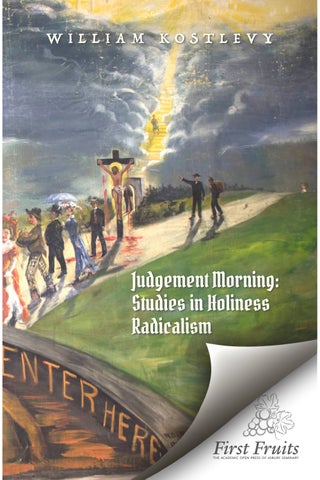
Judgement Morning: Studies in Holiness Radicalism
William Kostlevy
First Fruits Press Wilmore, Kentucky c2025
ISBN: 9781648173448 Judgement morning : studies in holiness radicalism William Kastlevy First Fruits Press, ©2025
Digital version at http://place.asburyseminary.edu/academicbooks/44/ First Fruits Press is a digital imprint of the Asbury Theological Seminary, B.L. Fisher Library. Asbury Theological Seminary is the legal owner of the material previously published by the Pentecostal Publishing Co. and reserves the right to release new editions of this material as well as new material produced by Asbury Theological Seminary. Its publications are available for noncommercial and educational uses, such as research, teaching and private study. First Fruits Press has licensed the digital version of this work under the Creative Commons Attribution Noncommercial 3.0 United States License. To view a copy of this license, visit http://creativecommons.org/licenses/by-nc/3.0/us/.
For all other uses, contact: First Fruits Press B.L. Fisher Library Asbury Theological Seminary 204 N. Lexington Ave. Wilmore, KY 40390 http://place.asburyseminary.edu/firstfruits
Kostlevy, William, 1952Judgement morning : studies in holiness radicalism [electronic resource]/ William Kastlevy –Wilmore, Kentucky : First Fruits Press, ©2025. 1 online resource (329 pages : port.) : digital. ISBN: 9781648173448 (epub) ISBN: 9781648173400 (Mobi) OCLC: 1549663558 1. Holiness Movement--History. 2. Methodism--History. 3. Methodists--Biography. I. Title.
BX7990.H6 K67 2025eb Cover design by Amanda Kessinger
287.6
First Fruits Press The Academic Open Press of Asbury Theological Seminary 204 N. Lexington Ave., Wilmore, KY 40390 859-858-2236 first.fruits@asburyseminary.edu asbury.to/firstfruits
Table of Contents Foreword: Jennifer Woodru! Tait------------------------ 5 Preface: Barry L. Callen------------------------------------9 Introduction---- ------------------------------------------13 Chapter 1: From Urban Parlors to the Ryman Auditorium------------------------------------------------19 Chapter 2: Moving Beyond Phoebe Palmer--------------35 Chapter 3: Conquerors a"er All-------------------------- 49 Chapter 4: Pluralistic Expressions of Holiness Radicalism in the Progressive Era------------------------63 Chapter 5: From Fringe to Center------------------------85 Part 2: American Holiness Radicalisms: Biographical Studies Chapter 6: Charles G. Finney and the Forging of the Midwestern Evangelical Mind---------------------------149 Chapter 7: Luther Lee and Methodist Abolitionism----169 Chapter 8: Benjamin Titus Roberts and the Social Vision of Early Free Methodism------------------189 Chapter 9: The Price of Discipleship---------------------211 Chapter 10: Dr. Tenney, the Free Methodist Church, and the Twentieth Century Wesley Revival-------------241 Chapter 11: Illusions of Perfectionism-------------------261
Part 3: The Cultural Impact of Holiness Radicalism Chapter 12: Lodging a Complaint-----------------------277 Chapter 13 Perfecting Mennonites----------------------303
Foreword It was the spring of 1997—Thursday evening, April 17, 1997, to be exact. I was enrolled in a course at Asbury Theological Seminary on the history and thought of the Holiness movement, taught by Professor J. Steven O’Malley. On this particular evening, though, we had a guest lecturer coming in to talk about radical holiness groups: William Kostlevy. I knew Bill, since he was the supervisor of my student job in the archives of the B. L. Fisher Library, and I knew that he was never not interesting. I wondered what he would say. I imagine that Bill must have said something else that evening – I can’t imagine him starting o! his entire lecture with this statement – but what I remember about the lecture, as clearly as if it was yesterday, is Bill leaning across the halfsized podium perched on a metal institutional table at the front of the room, pointing at us in the best tradition of theatrical preachers everywhere, and saying “If all you want is a secondrate Christian experience, you’ll get it.” Bill’s commitment to exploring holiness radicalism, with both academic rigor and pastoral concern, has been the lodestar of his entire career as a scholar, and it weaves through and unites the essays in this collection. Nearly thirty years ago in the mid-1990s, when I was working for Bill at the B. L. Fisher Library, it was still considered academically groundbreaking to note that nineteenth-century holiness folks had possessed a social conscience and not merely a desire for social control. (This was despite the publication of Donald Dayton’s Discovering an Evangelical Heritage almost twenty years before that, and Timothy Smith’s Revivalism and Social 5
6
| Foreword
Reform almost twenty years before that. Both authors appear frequently in the pages that follow.) Or at least you could possibly get away with making such statements about more respectable holiness people. Phoebe Palmer, say. Or some Nazarenes. Respectable historians wouldn’t make such statements about the Metropolitan Church Association, where Christians seeking something more than respectable middle-class faith regularly “ran the pews,” excoriated holiness moderates through muckraking journalism, and lived communally with the “Lord’s poor” (see Chapter 9). You didn’t even know there was a Metropolitan Church Association. Bill Kostlevy’s entertaining book Holy Jumpers (2010) put the MCA on the scholarly map. But – and this is crucial – Bill did not, unlike previous generations of historians who were enamored of Frederick Jackson Turner’s “frontier thesis” and educated in elite institutions and desirous of guild respect, mock holiness radicals. (Bill went to an elite institution for his Ph.D., Notre Dame, where he promptly talked them into letting him write about people who ran on top of pews.)1 Along with Donald Dayton, Bill was not afraid of holding respectable Christians to account about whether or not they preached the gospel to the poor. The $rst academic article I am aware of Bill ever having published applied liberation theology to the history of the Free Methodist Church.2 What fascinated Bill about 1 In 2014, while making a presentation at the Wesleyan Theological Society, Bill once uttered the statement “We need to get rid of the myth that Georgia Harkness was the $rst woman to teach theology. Eve taught theology, whether Adam liked it or not. Part of this centers on the de$nition of theology. Do you have to go to the University of Chicago to get it? Does it only happen when Presbyterians start to do it?” 2 Kostlevy, William C., “Benjamin Titus Roberts and the ‘Preferential Option for the Poor' in the Early Free Methodist Church,” in Anthony L.
Foreword
radical holiness folks, as you will be able to tell from these essays, was that they wanted a $rst-rate Christian experience, and they didn’t care how silly they looked getting it. Caring about looking silly might get in the way of preaching Jesus and serving the least of these—and who would be silly enough to do that? Will you read in the pages that follow about people who were quirky and did goofy things, and hear Bill’s gentle laughter in his prose? For sure, yes. (Bill is one of the funniest academics I have ever met. You have to imagine him reading these papers with an absolute deadpan delivery that rivals the straight man in a Monty Python skit.) Will you see Bill applying critique where critique is due, presenting holiness radical leaders and historians as real people, not plaster saints? Absolutely. But will you ever lose sight of what these people were about? I think not. While I was working for Bill, he was writing the dissertation that became Holy Jumpers. Periodically, he would visit the backwoods of Tennessee to interview what he called his “Burning Bush people” - Lillian Harvey, niece-in-law of Edwin L. Harvey, founder of the MCA (again, see Chapter 9); her daughter and son-in-law Trudy and Barry; and her grandson. Her grandson was named for his now-deceased grandfather, Edwin F. Harvey, nephew and namesake of the more famous Edwin L. Harvey. That grandson’s name was Edwin Tait, and he went to Duke for his doctoral work, where I met him. We have been married for 21 years and Bill preached at our wedding—Bill referred in the sermon to our marriage as the joining of the magisterial and radical wings of the holiness movement (my grandfather was the third
Dunnavant, ed. Poverty and Ecclesiology: Nineteenth-Century Evangelicals in the Light of Liberation Theology (Liturgical Press, 1992), pp. 51-67.
7
8
| Foreword
president of ATS.) Thus, I have had a closer-up window than I ever dreamed I would in 1996 to the legacy of the quirky, sold-out, uncompromising commitment to have a $rst-rate Christian experience which is described in this book. A"er you have read this book, so will you. Jennifer Woodru! Tait Senior editor, Christian History magazine; affiliate faculty, Asbury Theological Seminary; priest, St. John’s Episcopal Church, Corbin, KY
Foreword
Foreword My decades of editing the Wesleyan Theological Journal brought me into contact with many Wesleyan and Holiness scholars and their wide-ranging subjects and perspectives. Many readers now will bene$t from $nding in one place a quite comprehensive historiography of the American and British holiness movements, and even a hint of its broader international and non-Wesleyan dimensions. The Holiness Movement began sometime in the nineteenth century, dates argued, and there is debate about if it’s now dead, and if so when and why it died. This Movement was and likely still is a complex and diverse one of Christian protest, renewal, and dramatic idealism. Dr. Kostlevy is a wise guide to it all. He has had an ongoing relationship with the B. L. Fisher Library and Asbury Theological Seminary since 1988, enough time for his unusual expertise to gather extensive knowledge and mature in perspective on the growing body of scholarship related to the Holiness Movement. His contention is that the best way to understand any movement is to look not only at its center but also among its most “radical” fringes. It’s all here in this new book. Fittingly, this fresh research summation is published as a series of thirteen essays by First Fruits Press, an imprint of the B. L. Fisher Library of Asbury Theological Seminary with which Kostlevy has had a long relationship. These essays &ow with keen insights and are deep with detail. The initial inspiration for Kostlevy’s own scholarly quest rests largely with Donald W. Dayton who launched his research on Charles
9
10
| Foreword
G. Finney and Luther Lee in courses taught by Dayton at Northern Baptist Theological Seminary forty-$ve years ago. Dayton’s account of the Holiness Movement re&ected his growing disillusionment as a young activist who had cut his political and scholarly teeth on the civil rights, anti-war, and women’s movements in America. Fittingly, Dayton’s central characters were Wesleyan Methodists such as Orange Scott and Luther Lee, and Free Methodists such as B. T. Roberts who had played little or no role in the traditional centrist interpretation of the Movement as a reform e!ort before and following the Civil War. There now have been other and contrasting interpretations, the main ones named and traced by Kostlevy in relation to each other and the shi"ing themes prominent in various eras and geographic sections of the United States. He notes the Movement’s penchant to equate its teaching with John Wesley, primitive Christianity, and especially Scripture. He shows us an optimistic postmillennialism being reduced to a chastened premillennialism, and then the scholarship in the wake of World War II seeking to disassociate the Movement from religious fanaticism. He samples the Movement’s relation to Pentecostalism and Evangelicalism, a subject of ongoing and passionate debate. Kostlevy introduces us to a wide range of Movement people, some critics of the growing a'uence of respectable northern Methodism, some antebellum perfectionistic radicals, some focused on the deeper life of sancti$cation, while others were anticipating a fundamentally altered social order. "Great Judgment Morning" was a popular holiness song picturing a coming great reversal in the Messianic kingdom when the wrongs in&icted on the marginalized would be
Foreword
11
overturned in a “new heaven and a new earth.” Thus, Kostlevy’s book’s title, Judgment Morning. On occasion, Kostlevy goes into considerable detail about a prominent individual like Luther Lee and his pivotal theology. The conclusion drawn is that a key theme of this theology makes Lee, and the Holiness Movement in general, worthy of note today. The theme of Lee is that the $gure of Jehovah as human liberator stands in stark contrast to the “god” of passive obedience to the status quo. “This gives Lee’s theology a vitality which calls forth emulation today as it did in the nineteenth- century.”
Branches of the Holiness Movement of Christian faith are shown showering critical light on the abolition of slavery, women’s rights, holiness communalism, socialism, millennialism, paci$sm, a preference for the poor, and more. It spread its idealisms and reforms across the North and South of the United States, in Keswick, England, and elsewhere as David Bundy has demonstrated. The Movement’s fundamental impulse was to “let go and let God.” The Movement had many faces and no uniform cultural expression. At times it inspired ridicule and caricature, especially the eschatologically oriented Holy Rollers, Holy Jumpers, the Burning Bush and Pillar of Fire. Each of these is helpfully identi$ed in context and not caricatured. All of this dramatic renewal activity was mostly yesterday. Today something new has emerged because of the signi$cant work of Timothy L. Smith, William Warren Sweet, Merrill E. Gaddis, Charles E. Jones, Mary Alice Tenney, E. Stanley Jones, Donald W. Dayton, David Bundy, and others, now including this careful gathering in one convenient place of multiple memories and perspectives by William
12
| Foreword
Kostlevy. The emerging new is that knowledge of and even appreciation for the Holiness Movement has begun to enter the mainstream of Christian scholarship. The Movement is no longer easily dismissed as merely yesterday’s frantic way to provide solace for those outside the cultural mainstream of church and society. Its colorful threads are being recognized as essential to the total fabric of contemporary church and cultural history. One point made by Kostlevy shouldn’t be missed. “In an age when the heirs of Holiness churches too o"en are noted as defenders of traditional gender roles, bourgeois family life, private property, and xenophobic nationalism, it is best to remember that radical Holiness folks were rightly accused of disrupting conventional family life, believed that women in ministry was a sign of the age of the Spirit, and o"en argued that the soon-appearing Jesus would engage in a radical redistribution of property.” Holiness Christians weren’t and shouldn’t now be reduced to mindless protectors of the social status quo. Whatever your particular interest in the many themes and personalities and even extremes of the Holiness Movement of the nineteenth and twentieth centuries (and twenty-$rst?), this present work of Kostlevy is the right place to $nd your beginning, and likely it also will point to where you should go next for even more detail. Barry L. Callen, Dean and Professor of Christian Studies Emeritus, Anderson University
Introduction Judgment Morning: Essays in Holiness Radicalism makes three arguments. First, despite real di!erences, there remains a distinct continuity between the distinct nineteenth century revivalism of Charles G. Finney, Luther Lee, and B. T. Roberts and the vision of such largely twentieth-century $gures as E. Stanley Jones, Mary Alice Tenney, and Donald W. Dayton. Secondly, despite the many real cultural peculiarities of the American Holiness Movement, it cannot be understood in isolation from the central themes in American or, for that matter world history. Not only was it a product and creator of the Antebellum reform and perfectionist agitation surrounding slavery, woman’s place in society, and the war against liquor, it reinvented itself in the twentieth century as a force closely associated with the prohibition of liquor sales, the worldwide missionary movement, Progressive Era reform, and the emergence of Pentecostalism, Fundamentalism, and Evangelicalism. Thirdly, the marginalization of the Holiness Movement in the standard historical surveys of the twentieth century has had long-range consequences for not only an understanding of the Holiness Movement itself, but for a nuanced consideration of the history of American Christianity. This is why the three historiographical essays in part one of this work are, at least to the author, a central element in an unfolding story. The title, Judgment Morning is taken from a gospel song, "Great Judgment Morning," written by B. H. Shadduck and popularized by L. L. Pickett and Charles Tillman, editors of some of the most widely circulated gospel song books of early twentieth century. Drawing on Matthew 25:31-46 and 13
14
| William Kostlevy
Revelation 21:1-4, Great Judgment Morning looks forward to the great reversal of fortunes in the Messianic kingdom when the wrongs in&icted on the poor and marginal will be overturned and the mighty humbled in a “new heaven and a new earth.” “Think of a period of history,” Asbury Theological Seminary founder Henry Clay Morrison wrote, “when London will have no slums…Chicago no corrupt police force…when New York with its vast population of mixed multitudes from all nations, will come to realize and rejoice in a consciousness of the fatherhood of God and the brotherhood of man, through the redeeming power of Christ.” 1 These essays re&ect a forty-year pre-occupation with the American Holiness Movement and are, I suspect, as much an e!ort to understand myself as the historical phenomenon under study. The inspiration and undoubtedly the blame for what follows rests with Donald W. Dayton who initiated my research on Charles G. Finney and Luther Lee in courses at Northern Baptist Theological Seminary during the academic year of 1980. It was Don who encouraged me to submit my essay on Luther Lee to Methodist History. Without the aid of my wife Gari-Anne Patzwald, the following essays would be, I fear, far less coherent and may have never seen the light of day. Apart from the $rst chapter these essays have been previously published. While some editing and updating has been done, most remain largely as originally published. Naturally, some modest duplication does occur. When needed, permission for republication has been received and will be noted in the articles themselves. Fittingly this is
1 H. C. Morrison, The Optimism of Pre-Millennialism (Louisville: Pentecostal publishing Company, 1927), 132.
Introduction
being published by First Fruits Press, an imprint of the B. L. Fisher Library of Asbury Theological Seminary. In one role or another, I have had an official ongoing relationship with the B. L. Fisher Library and Asbury Theological Seminary since 1988. I am especially indebted to Robert A. Danielson for making the publication of this work possible.
15
Part 1 Interpreting the American Holiness Experience
Chapter 1 From Urban Parlors to the Ryman Auditorium: The Transformation of the Holiness Movement during the Long Progressive Era1 Introduction Among the many errant interpretative schemes that the late Church of the Nazarene historian Timothy L. Smith spent a career refuting was the notion that evangelicalism or revivalism and the related Holiness Movement were akin to bu!alo, a species vanishing along with the American frontier. Writing in the 1950s, Smith challenged the prevailing consensus that had been brilliantly argued by the founder of modern church history, University of Chicago professor William Warren Sweet. In Sweet’s view evangelicalism, or revivalism (his preferred term), while an important cultural shaper of American society was now largely found in isolated communities on the rural fringes of American society. For Sweet, by the 1940s, its principal proponents were found among largely rural denominations such as the Pentecostal Holiness Church, the Assemblies of God, the Pilgrim Holiness Church, and among assorted Dunkers. In response to Sweet’s Revivalism in America, Smith identi$ed revivalism as “urban, evangelical and interdenominational.” It had been founded a"er all by an Oxford educated urban Anglican. For Smith, this fact alone highlighted the myopia of scholars on both sides of the Atlantic who continue to use the term “American 1 This paper was $rst presented at the Wesleyan Theological Society meeting in 2017. The term “Long Progressive Era” is used by Rebecca Edwards, New Spirits: Americans in the Gilded Age, 1865-1905 (New York: Oxford University Press, 2007). For me a more logical break down would be roughly 1870-1920. 19
20
| William Kostlevy
revivalism” when describing such a clearly international movement of enlightened bene$cence.2 While containing more than an element of truth Smith’s template has always been problematic. As evidenced by the questionable heuristic device he created in his still very valuable history of the formative years of the Church of Nazarene. Proposing that the Church of the Nazarene was the product of two distinctive traditions, one urban eastern and presumable enlightened, and one rural Midwestern and Southern, Smith located Church of the Nazarene founders in both urban parlors and at Point Pilot, Texas. He affirmed the gi"s of both traditions and even allowed for the fact that the movement that &ourished in urban centers was not necessarily always sane. He had a"er all read the Chicago-based Burning Bush. Smith’s model did provide an explanation for how an interdenominational movement that was founded and &ourished in the parlors of wealthy urban Methodist women had become a movement popularly associated with the rural regions of the Midwest and South. In this paper, I intend to propose an alternative model that I believe more accurately describes the transformation of the Holiness Movement in the United States in the seventy years following the Civil War. To accomplish this heroic feat, I will look at two distinct and seemingly unrelated occurrences. The $rst is the 1867 National Camp Meeting for the Promotion of Holiness at Manheim, Pennsylvania, an event that largely ministered to wealthy urbanites in scenic
2 William Warren Sweet, Revivalism in America (New York: Charles Scribner’s, 1944), 172-173. For Smith see the 1980 edition with an a"erword by the author. Timothy L. Smith, Revivalism and Social Reform: American Protestantism on the Eve of the Civil War (Baltimore: Johns Hopkins University Press, 1980, 255.
The Ryman Auditorium 21
Lancaster County, Pennsylvania. The other is a song that was promoted and made popular by country music legends Roy Acu!, Hank Williams, Sr., and George Jones, "the Great Judgement Morning." The Transformation of the Post-Bellum Holiness Movement
In July of 1867 between twenty and twenty-five thousand urban eastern Christians many of them Methodists, descended on the tiny Lancaster County, Pennsylvania community of Manheim for the Second National Holiness Association Camp Meeting. The organizing genius, Alfred Cookman, had spent his boyhood in Lancaster County and had served as pastor of the nearby Harrisburg Methodist Episcopal Church on his way to subsequent pastorates in Pittsburgh, Wilmington, and New York City. He was at the time pastor of one of the nation’s largest Methodist churches in Newark, NJ. The local arrangements committee included Methodist layman and $nancer William K. Bender, and prominent Lancaster attorney and later Prohibition Party presidential nominee James Black, and the speakers included perhaps the most notable clergymen in the United States, Bishop Matthew Simpson who had only two years earlier served as the officiant at the funeral of Abraham Lincoln. In attempting to identify the camp meeting’s impact on Lancaster County’s numerous Pennsylvania Dutch, I was surprised to learn that except for complaints about noise, the", Sunday trains, and mud, Pennsylvania Dutch seemed largely una!ected by the event. The real and signi$cant impact of the Holiness Movement upon Mennonites and Brethren would not occur for another twenty-$ve years and was less
22
| William Kostlevy
felt in the Pennsylvania heartland than in Ohio, Indiana, and especially Kansas.3 In fact, in many ways a more intriguing question wasn’t the immediate impact of this event or other National Holiness Association (NHA) sponsored camp meetings, it was how does one explain the transformation of an elite Northeastern movement (o"en, and this needs to be emphasized, led by women) into a lower middle-class movement of Midwesterners and Southerners?4 In e!ect in the lifetime of many of the folks who had gathered at Manheim, the Holiness Movement would be radically altered. Its leaders while still o"en Methodist, no longer commanded pulpits in great urban churches, and venerable periodicals like the Guide to Holiness and the Christian Standard had been replaced by God’s Revivalist, the Pentecostal Herald to say nothing of the Burning Bush. Even in urban centers the movement had very di!erent actors operating outside establishment churches. While Tuesday meetings for the promotion of holiness continued in many urban parlors the real dynamic had shi"ed to the numerous rescue missions &ourishing in American cities. In fact, the single term Holiness Movement, if ever accurate, was largely no longer valid, as distinctive factions, o"en indistinguishable to outsiders, fought for control of a diverse, complex, and multipronged phenomenon.
3 See William Kostlevy, “The Holiness Movement, the Manheim Camp Meeting, and C. H. Balsbaugh: Christian Perfection in Pennsylvania Dutch Country,” Brethren Life and Thought 48 (Winter and Spring 2003), 91109. 4 On the importance of gender in all the debates surrounding holiness, see the work of Priscilla Pope-Levison including her important Building the Old-Time Religion: Women Evangelists in the Progressive Era (New York: New York University Press, 2013).
The Ryman Auditorium 23
Several academic studies, unfortunately only dealing with one group, the Salvation Army and ignoring the Army’s relationship with the broader holiness and evangelical currents have signi$cantly modi$ed the understanding of at least one holiness body. These studies, characterized by more attention to gender, social class, and urban environment than theology, have been supplemented by studies of early Pentecostalism that focus on the movement’s plebian roots, especially in the American South. While space considerations do not allow me to review the relevant literature, I would like to focus on how the changing class alignment and geographical location of holiness Christians during the so-called Gilded Age and Progressive period turned a movement that had been led by urban elite coastal Methodists (Some might say that the terms elite and Methodists do not belong in the same sentence.) into a largely Midwestern and Southern movement of plain folk.5 The changes in geographical and social composition of the movement were accompanied by cultural and
5 Among the most important studies of the Salvation Army are Diane Winston, Red-Hot and Righteous: The Urban Religion of the Salvation Army (Cambridge, MA: Harvard University Press, 1999), Lillian Taiz, Hallelujah Lads and Lasses: The Remaking of the Salvation Army in America 1880-1930 (Chapel Hill, NC: University of North Carolina Press, 1999; 2001), Pamela J. Walker, Pulling the Devil’s Kingdom Down: The Salvation Army in Victorian Britain (Berkeley: University of California Press, 2001. The studies of Taiz and Walker identify the Salvation Army as a working-class movement critical of capitalism. As Walker writes “The Salvation Army was as authentic, complicated, and mediated an expression of working-class belief and desire as any other movement of working-class people.” (p. 67). On the plebian roots of Pentecostalism that R. G. Robins draws from students of southern religion such as Dickson Bruce and David Harrell see R G Robins, A. J. Tomlinson: Plainfolk Modernist (New York: Oxford University Press, 2004). An earlier version of a similar thesis can be found in Robert M. Anderson, Vision of the Disinherited: The Making of American Pentecostalism (New York: Oxford University Press, 1979).
24
| William Kostlevy
theological shi"s. Coinciding and reinforcing such mass popular movements as Populism, the temperance crusade, American imperialism with the accompanying worldwide Christian mission movements and the not unrelated spread of consumer culture, Holiness Christians ingeniously challenged, embraced and even on occasion fought these o"en contradictory impulses. Not unusual was the Metropolitan Church Association which managed to simultaneously reject private property while engaging in the mass merchandizing of religious art calendars, wall mementos and assorted other religious kitsch.6 The Radical Holiness Movement
In Holy Jumpers: Evangelicals and Radicals in Progressive Era America (2010) I highlight one important aspect of the radical changes in the Holiness Movement of the last decade of the nineteenth century, the division between radicals and traditionalists.7 Traditionalists or moderates scrambling to stem the radical tide issued a call for a general meeting of holiness advocates in Chicago for May of 1901. Far from crushing the radicals' affirmation of premillennial eschatology, faith healing, etc., the assembly affirmed the radical agenda, in the process virtually silencing moderate voices. My book focused on the origins and evolution of the Metropolitan Church Association (MCA) a key player in the radicals Chicago victory and highlighted the MCA’s role in the emergence of Pentecostalism, an important product of radical holiness 6 One of the best accounts of the link between consumerism and evangelical expressions of Christianity is found in William Leach’s discussion of the role played by John Wanamaker. See William Leach, Land of Desire: Merchants, Power and the Rise of a New American Culture (New York: Vintage books, 1993). A key chapter is “Holiness or Commercial Hospitality,” 115-121. 7 William Kostlevy, Holy Jumpers: Evangelicals and Radicals in Progressive Era America (New York: Oxford University Press, 2010).
The Ryman Auditorium 25
currents. Le" undeveloped in my account was the subsequent rise of a new more moderate holiness faction that coalesced into the Pilgrim Holiness Church and the Pentecostal Church of the Nazarene. By 1901 even the dynamic continuing holiness presence in the Methodist Episcopal Church and in the Methodist Episcopal Church (South) had been profoundly radicalized. In the following chapter I will brie&y explore these continuing radical currents as expressed in the popular gospel song "Judgement Morning" written by B. H. Shadduck and promoted by MEC South evangelist, songwriter, bookseller and publisher L. L. Pickett.8 In Holy Jumpers, I used the term “radical holiness movement” to a refer to network of folks associated with Martin Wells Knapp and God’s Revivalist.9 The Metropolitan Church Association, the Pillar of Fire and many of the holiness $gures involved in the origins of Pentecostalism were products of this network. But following David Bundy I have come to believe that Knapp and the God's Bible School tradition were in fact part of a larger transnational “Radical Holiness” phenomenon. As de$ned by Bundy, Radical Holiness describes “the development of Wesleyan-Holiness 8 This point was made by Timothy L. Smith in Called unto Holiness: The Story of the Nazarenes; The Formative Years (Kansas City: Nazarene Publishing House, 1962), 128-129. From the beginning the Pilgrims, with close ties to Cincinnati’s God’s Bible School, were more radical requiring a commitment to premillennial eschatology. The Nazarene faction included several $gures with strong postmillennial beliefs including the former Congregationalist A. M. Hills and the Nazarene Manual did not commit Nazarenes to premillennialism. The extent of the radical triumph is re&ected by the fact that A. M. Hills’ standard theological text had two competing chapters on eschatology one written by Hills favoring postmillennialism the other by J. B. Chapman favoring the more popular premillennial position. 9 On Knapp see the fuller discussion in Wallace Thornton Jr., When the Fire fell: Martin Wells Knapp’s Vision of Pentecost and the Beginnings of God’s Bible School (Lexington, KY: Emeth Press, 2014).
26
| William Kostlevy
ideas within groups and contexts that were other than Methodist during the nineteenth and twentieth centuries.” It includes Methodist groups that embraced novel doctrines alien to Methodism such as premillennialism, faith healing, and modi$ed Methodist expressions of Christian perfection.10 Further Bundy’s paradigm stands in continuity with the work of Donald W. Dayton and integrates his insights into a social and cultural context.11 Among the many merits of Bundy’s proposal is that it moves Holiness Movement historiographical debate beyond the tired discussions of its relationship to eighteenth century Wesleyanism. It also acknowledges something many Wesleyans have been slow to admit, that the late nineteenth and early twentieth century Holiness Movement was not merely a Wesleyan phenomenon. Further, Bundy’s interpretation reinforces Mark Noll’s contention that Holiness, Fundamentalist and modernist expressions of Christianity represented “a disruption of Protestant theology.” In e!ect, Noll argues modernism and Fundamentalism had common habits of mind and both proposed innovative
10 See David Bundy, “Barclay F. Buxton, A. Paget Wilkes, and the Japan Evangelistic Band: Origins, Networks and Theology of a Radical Holiness Mission,” Journal of World Christianity and the Fourfold Gospel 3 (2017), 41-64. As Bundy notes in another important essay, strategies employed by Knapp such as the organization of prayer leagues with a distinctive vocabulary were used in Great Britain earlier than in Cincinnati. See David Bundy, “Radical Holiness Becomes a World Christian Movement: The In&uence of Isabella Sarah Leonard in Great Britain, Australia, and Singapore, 1881-1892,” in William Kostlevy and Wallace Thornton, eds., The Radical Holiness Movement in the Christian Tradition: A Festschri" for Larry D. Smith (Lexington, KY: Emeth Press, 2016), 64. 11 Donald W. Dayton, Theological Roots of Pentecostalism (Grand Rapids: Francis Asbury Press, 1987). Also, see the work of Dayton’s critic Laurence W. Wood, The Meaning of Pentecost: Rediscovering John Fletcher as John Wesley’s Vindicator and Designated Successor (Lanham, MD: Scarecrow Press, 2002).
The Ryman Auditorium 27
rescue operations to save a clearly sick patient. They both shared a suspicion of metaphor and a common rationalistic literalism, and they faulted each other for inadequately defending the Christian faith in the modern era.12
In Holy Jumpers, I point out that the Holiness adherents most concerned with creeping liberalism were the stodgy conservatives in leadership positions of the National Holiness Association like Daniel Steele and G. W. Wilson. On the other hand, the emerging leaders who would carry the day in Chicago were radical holiness folks more troubled by backward looking creedal orthodoxy than modernist theological currents that were only found in such culturally irrelevant institutions as elite urban churches, universities, and a few theological seminaries.13 Wesleyan scholars of the post-WWII era, with the embers of the 1920s Fundamentalist controversy still warm, had their own reasons to reject the caricatures of Holiness folks as “holy rollers.” Usually highlighting Methodist bishops who affirmed Christian perfection, o"en without noting that many of these bishops were less than enthusiastic about the National Holiness Association, these scholars identi$ed respectable urban Methodist like Steele and Phoebe Palmer as the movement’s founders. Downplaying the role of the radicals who had become the real leaders of the Holiness Movement a"er 1901 they o"en ignored the actual founders of the institutions they served. It was these radicals who were key $gures in the explosive growth of Christianity in
12 Mark A. Noll, A History of Christianity in the United States and Canada (Grand Rapids: William B. Eerdmans, 1992), 373-389). This question is discussed in Steven Dale Cooley, “The Possibilities of Grace: Poetic Discourse and Re&ection in the Methodist/Holiness Revivalism.” Ph. D. dissertation, University of Chicago, 1991. 13 Kostlevy, Holy Jumpers, 25.
28
| William Kostlevy
Asia and Africa, and in the creation of what I like to call not the (American century) or the (Christian century) but the Holiness Pentecostal century.14 The radicals' self-understanding di!ered markedly from that of both the traditional leadership of the National holiness Association and the later concerns of Wesleyan leaders in the mid-twentieth century. The “gi" of the Holy Ghost made and kept the church orthodox,” holiness radicals insisted. “The most theologically sound person,” Hulda Rees preached, “is a thoroughly sancti$ed one.” For Rees and others, the real problem was less the liberalism of elites than a worldly conformed church built not upon Christ but human traditions and creeds. By 1906 most radical Holiness folks would have agreed with evangelist W. B. Godbey that the “great Constantinian apostasy” had placed the emperor on a throne rightly occupied by the Holy Ghost, substituting a human creed for the New Testament.15 Generally committed to the notion of the Constantinian fall of the church, holiness radicals stood in the long tradition of spirit-oriented o"en perfectionistic restorationist movements such as Montanism that have repeatedly troubled or perhaps more accurately reinvigorated Christian waters. As radical pietist historian Gottfried Arnold (16661714) insisted, authentic Christianity had been preserved
14 See Smith, Called unto Holiness, 19, and Melvin E. Dieter, The Holiness Revival of the Nineteenth Century (Lanham, MD: Scarecrow Press, 1996), 107. 15 Martin Wells Knapp, Lightning Bolts from Pentecostal Skies: or, The Devices of the Devil Unmasked (Cincinnati: Office of the Revivalist, 1898), 189. Byron Rees, ed. Hulda Rees the Pentecostal Prophetess (Philadelphia: Christian Standard, nd), 77-78 and W. B. Godbey, Church-Bride-Kingdom (Cincinnati, God’s Revivalist Office, 1905), 58-60. This publication is included in D. William Faupel, ed., Six Tracts by W. B. Godbey (New York: Garland Publishing Co., 1985).
The Ryman Auditorium 29
not by “the proud and secure church or prelate, professor, and priest but by the despised dissenter.” As with other perfectionist radicals throughout Christian history, holiness radicals asked hard questions about such basic institutions as the ownership of private property, the legitimacy of conventional gender relationships including even marriage, and the appropriateness of Christians engaging in warfare. As the French historian Paul Hazzard noted long ago, “the age of perfect love” was rarely an age that celebrated Nicaea or Chalcedon, it is more likely to be an age that glori$ed what people in power have o"en call heresy.16
In an age when the heirs of holiness churches are too o"en noted defenders of traditional gender roles, bourgeois family life, private property, and xenophobic nationalism, it is best to remember that radical Holiness folks were not incorrectly accused of disrupting conventional family life, believed that women in ministry was a sign of the age of the Spirit, and o"en argued that the soon appearing Jesus would engage in a radical redistribution of property. In Holy Jumpers I deal extensively with only one of the several Holiness Movement related communal societies that &ourished in the early twentieth century. The MCA took controversial stands on not only the property question, but they opposed military service and urged converts to reject patriarchy when it came into con&ict with converts' desire to give up all and enter the MCA. And even holiness folks who affirmed the legitimacy of the ownership of private property generally 16 The $rst quotation is from Donald F. Durnbaugh, The Believer’s Church: The History and Character of Radical Protestantism (New York: Macmillan, 1968), 11. Paul Hazzard (1878-1944) a noted French historian $rst made these observations in 1935. My last quotation is from Paul Hazzard, The Crisis of the European Mind 1680-1715 (New York: New York Review of Books, 2013), 418.
30
| William Kostlevy
argued for a version of Henry George’s radical single tax on unoccupied or rented property. As a Movement, notorious for encouraging converts to subvert patriarch male headship, it is particularly ironic that James Dobson, founder of Focus on the Family grew up in a holiness home. But then Dobson’s own passionate defense of elements of traditional patriarchy may owe something to de$ciencies he believed to be inherent in the Holiness Movement.17 One of the most important southern centers of radical holiness Christianity was in Wilmore, Kentucky. Conveniently located on a stop on the Southern Railroad, Wilmore would attract sancti$ed Northerners &eeing winter and other holiness folks desiring a Christian environment with excellent train connections. Easily accessible to Louisville, Cincinnati, and the world, Wilmore’s most noted early twentieth century residents, Ludie Day and L. L. Pickett operated a publishing empire in nearby Louisville. L. L. Pickett was deeply ambivalent about the sweeping economic and cultural changes transforming American Society during the $rst two decades of the twentieth century. Enthusiastically embracing a premillennial eschatology, Pickett longed for the imminent return of Jesus who would reorder the society in a manner consistent with the failed vision of the Populist Movement and William Jennings Bryan. In this millennial state, the real
17 On radical holiness and the disruption of conventional family life see Kostlevy, Holy Jumpers, 100, on radical holiness and communalism see ibid., 107-110, 193-196. It should be noted that throughout Christian history perfectionist movements have frequently challenged conventional marriage arrangements including arranging marriages, wives leaving husbands, advocacy of celibacy, the practice of spiritual affinity among Free Methodists, anti-ordinance debates, and the murder of Franz Creffield. On Creffield see, Jim Phillips and Rosemary Gartner, Murdering Holiness: The Titles of Franz Creffield and George Mitchell (Vancouver: University of British Columbia Press, 2003).
The Ryman Auditorium 31
produces of wealth ordinary farmers and workers, would live the life of “peace and plenty” as promised by the ancient Hebrews prophets.18 Great Judgement Morning Nothing captures this vision more poignantly than the gospel song "Great Judgement Morning" that L. L. Pickett found in an 1892 issue of the Salvation Army periodical The War Cry. Written by colorful Salvation Army officer and later Methodist minister B. H. Shadduck the song has appeared in over 60 hymnals and songbooks and its tune was copyrighted by both Charlie Tillman in 1893 and L. L. Pickett in 1894. A favorite solo of gospel music entrepreneur Homer Rodeheaver, it was $rst performed at the Grand Ole Opry in 1941 by Roy Acu!. Other performers have included Hank Williams, Sr., and George Jones. The suggested popular tune, following a favorite device of the Salvation Army was to “Brooklyn Fire,” a song written about an 1876 $re that killed more than 278 people in a Brooklyn theater. No one promoted the song with greater enthusiasm than L. L. Pickett. Not only did Pickett sing the song, but it appeared in his songbooks and at least in one of his other books as an illustration of proper Biblical teaching. For Pickett, the song drawing on both Revelation 20 and Matthew 25 moves holiness experience beyond a pure heart to a new world where the pauper had his debts canceled, the widow and orphan found love and security. In this inverted kingdom, the rich were poor, and the gambler, liquor dealer and self-serving anti-prohibition politicians were together in hell. 19 18 Kostlevy, Holy Jumpers, 14-16. 19 On the "Great Judgement" Morning see Wayne W. Daniel, “How a Salvation Army Hymn Became a Gospel Standard: The Story of Great Judgement Morning,” in Charles K. Wolfe and James E. Akenson, editors (Lexington, KY:
32
| William Kostlevy
Full disclosure requires me to report that Pickett was once the Prohibition Party vice-Presidential candidate. Neither Revelation 20 nor Matthew 25 $gured prominently at Manheim. The hymn celebrating the holiness vision of those gathered at Manheim was "Beulah Land". In it, the “savior walks with me” and leads me to “heaven’s borderland.” As Burning Bush writers would say, no cash was transferred, no economic statuses were altered. "Great Judgement Morning" is di!erent. The promises of Isaiah and Micah to say nothing of the dreams of American Populists, the visions of women in WCTU chapters around the world are realized. It is a"er all an embodied and corporate holiness that touches life and not merely the heart.20
Appendix The Great Judgement Morning 1. I dreamed that the great judgment morning Had dawned, and the trumpet had blown; I dreamed that the nations had gathered To judgment before the white throne; From the throne came a bright, shining angel, And he stood on the land and the sea, And he swore with his hand raised to Heaven, University of Kentucky Press, 2001), 134-146. See also L. L. Pickett, Bible Fruit: Being a Series of Bible Readings (Louisville, KY: Pickett Publishing Co., 1899), 125. 20 Before noting that the promise of Micah 4:1-4 would be ful$lled, H. C. Morrison noted, “think of a period of history when London will have no slums…Chicago no corrupt police force…when New York with its vast population of mixed multitudes from all nations, will come to realize and rejoice in a consciousness of the fatherhood of God and the brotherhood of man, through the redeeming power of Christ.” From H. C. Morrison, The Optimism of a Pre-millennialist (Louisville: Pentecostal Publishing Company, 1927), 132.
That time was no longer to be.
The Ryman Auditorium 33
Refrain: And, oh, what a weeping and wailing, As the lost were told of their fate; They cried for the rocks and the mountains, They prayed, but their prayer was too late. 2. The rich man was there, but his money Had melted and vanished away; A pauper he stood in the judgment, His debts were too heavy to pay; The great man was there, but his greatness, When death came, was left far behind! The angel that opened the records, Not a trace of his greatness could find. 3. The widow was there with the or phans, God heard and remembered their cries; No sorrow in heaven forever, God wiped all the tears from their eyes; The gambler was there and the drunkard, And the man that had sold them the drink, With the people who gave him the license, Together in hell they did sink. The moral man came to the judgment, But self-righteous rags would not do; The men who had crucified Jesus Had passed off as moral men, too; The soul that had put off salvation, “Not tonight; I’ll get saved by and by, No time now to think of religion!”
Chapter 2 Moving Beyond Phoebe Palmer: Holiness Movement Research Challenges and Opportunities in the 21st Century Introduction Outside the central Missouri community of Fayette, home of Central Methodist College, in January 1958 few took note of the death of a recently retired history professor named Merrill E. Gaddis. Although the local press did note that the much beloved history professor's 1929 University of Chicago Ph.D. dissertation, "Christian Perfection in America," was reported to be the single most requested University of Chicago Ph.D. dissertation. As might be expected, it did not report that perhaps the chief reason why Gaddis's thesis was so widely circulated was the sheer number of young scholars vigorously attacking its basic premises.1 Informed by the reigning American historiography of Frederick Jackson Turner and Charles A. Beard, Gaddis argued that the holiness impulse in North American Christianity was a product of the American and, presumably, Canadian frontiers which, a"er the demise of the frontier, had found its last refuge among the culturally dispossessed in isolated rural areas and urban ghettos. Fittingly, Gaddis devoted most of his attention to the numerous Holiness and Pentecostal bodies that had come into existence since the 1880s. In e!ect, largely ignoring the thriving Holiness communities and institutions in the Methodist Episcopal Church (MEC) and the Methodist Episcopal Church, South. Although he noted 1 This essay is a slightly modi$ed version of a paper presented at a meeting of the Canadian Methodist Historical Society in Toronto in 1999. The information on Gaddis is from the Fayette (Missouri) Advocate 21 January 1958. 35
36
| William Kostlevy
that holiness bodies were experiencing rapid growth--there were, a"er all a lot of dispossessed people in 1929--, these people, Gaddis believed, were merely $ghting a rear-guard action of little long-term consequence. Remarkably, from the perspective of holiness Movement research today, Phoebe Palmer was mentioned in passing once by Gaddis. Nearly one hundred years later, she is honored, and not infrequently vili$ed, as the mother of the entire Holiness enterprise. The story of how one of the most widely read and in&uential authors of the 19th century descended into obscurity and was miraculously resurrected is itself a research opportunity of the 21st century. In fairness, Gaddis had good reason to ignore Palmer. As a wealthy urban Methodist closely tied to the leadership of the MEC, she was a poor candidate for leadership in Gaddis' movement of the dispossessed. Holiness Historiography, 1929-1974 Although it would be quite some time before Phoebe Palmer would become the embodiment of the "Holiness Movement," the roots for revisions of Gaddis' thesis were being laid even as Gaddis' thesis was shaping the work of William Warren Sweet and such popular works as Elmer T. Clark's widely read The Smaller Sects in America (3rd, ed. 1965), in the research seminars of Harvard professor, Arthur M. Schlesinger, Sr. While sympathetic to the social and cultural dimensions evident in the works of Turner and his students, Schlesinger’s disciples, such as Alice Felt Tyler and Whitney R. Cross, insisted that religious elements in historical disputes had to be understood, at least in part, on their own terms. As Tyler wrote in 1944 in her widely read survey of antebellum reform, Freedom’s Ferment "the American reformer was the
Moving Beyond Phoebe Palmer
product of evangelical religion and frontier democracy."2 S Shortly before Gaddis' death, Abingdon Press published a revised Harvard Ph. D. dissertation by a young holiness pastor and Schlesinger student which seemingly repudiated Gaddis' work at every point. Although only indirectly a study of the Holiness Movement, Timothy L. Smith's Revivalism and Social Reform (1957) argued that revivalism and the perfectionist currents of the 1840s and 1850s were rooted not on the frontier, or even in mature agrarian regions, but in the nation's cities, and not among esoteric cults, such as the Shakers or the Oneida community, but among members of the nation's major Protestant denominations. Interestingly, especially for the 1950s, one for the central actors in Smith's account, Phoebe Palmer was a virtually unknown Methodist lay woman.3 If it was Smith who helped rediscover Palmer, it was Charles E. Jones who most fully explained her signi$cance to the Holiness Movement. In his 1968 University of Wisconsin Ph.D. dissertation, published as Perfectionist Persuasion: The Holiness Movement in American Methodism (1974), Jones argued that it was Palmer's "altar theology" that taught that entire sancti$cation was available immediately to any Christians who would entirely consecrate themselves to God. As Jones noted, this shorter way to holiness, as enshrined in Palmer's The Way of Holiness (1843), allowed people to claim 2 Alice Felt Tyler, Freedom's Ferment: Phases of American Social History from the Colonial Period to the Outbreak of the Civil War (Minneapolis: University of Minnesota Press, 1944), 2-3. On Cross, see Judith Wellman, "In Retrospect: Crossing Over Cross: Whitney Cross's Burned-Over District as Social History," Reviews in American History 16 (March 1989): 159-174. 3 On Smith, see William Kostlevy, "Remembering Wesleyan Scholar Timothy L. Smith," Wesleyan/Holiness Studies Center Bulletin 5 (Winter 1997) 4.
37
38
| William Kostlevy
an experience that they might not have experienced. Although Palmer's holiness teaching remained far more controversial than many students of the Holiness Movement are willing to acknowledge, it did provide a mechanism that allowed people a degree of certainty in the normally subjective realm of personal religious experience.4 As a body, the scholarship on the Holiness Movement, written in the wake of World War II sought to disassociate the holiness tradition from any kind of religious fanaticism, as seen in the Oneida community or even some of the holiness radicals who had played key roles in the early 20th century Holiness Movement. In perhaps the most creative solution to the problem, Timothy L. Smith, in his history of the formation of the Church of the Nazarene, proposed that the Church of the Nazarene was really the product of two movements. One, although conservative in theology, was progressive in social vision and rooted in the cosmopolitan urban revivals of the 19th century. The other, which was largely located in rural communities in the Midwest and South, was given to puritanical legalism, and excessively demonstrative worship, and was susceptible to Calvinistic Fundamentalism. Ironically, Smith's primary example of reactionary rural fanaticism was in Chicago and led by the very person (F. M. Messenger) who became in 1919 the $rst chair of the recently established uni$ed board of the Church of the Nazarene. Likewise, the popular evangelists and folk heroes of the Nazarene Movement, such as Bud Robinson 4 On Jones' work, see Steven D. Cooley, "The Wesleyan Paradigm and the Kaleidoscope Within: The Scholarship of Charles Edwin Jones," Wesleyan/ Holiness Studies Center Bulletin 4 (Winter 1996): 1, 3-5. Also, see the signi$cant bibliographic works produced by Jones. They are listed in Cooley’s article.
Moving Beyond Phoebe Palmer
and U. E. Harding played little role in Smith's narrative.5
39
The Holiness Movement in the Light of the 1960s Holiness Movement research was permanently altered by the cultural changes of the 1960s. Nowhere was this more evident than in the twenty year debate between Timothy Smith and Donald W. Dayton. On the surface Dayton's activist and journalistic account of 19th century evangelical social engagement, Discovering an Evangelical Heritage (1976), resembled Smith's Revivalism and Social Reform. However, it did, in fact, re&ect the radically di!erent milieu of the time of its creation--the late 1960s. While Smith's work honored the dominant cultural vision of America's liberal establishment, Dayton's account re&ected the growing disillusionment of a young activist who had cut his political teeth on the civil rights, the anti-war and the woman's movements. Fittingly, Dayton's central characters were Wesleyan Methodists, such as Orange Scott and Luther Lee, and Free Methodists, such as B. T. Roberts, who had played little or no role in Smith's centrist construction of antebellum reform. If Smith found Dayton's reconstruction of antebellum reform inadequate, he was irate with the younger scholar's suggestion that the origins of Pentecostalism lay the Holiness Movement's articulation of the experience of entire sancti$cation. As a Church of the Nazarene scholar, Smith viewed Phoebe Palmer, the Holiness Movement and, implicitly, the Church of the Nazarene, as faithful heirs of John Wesley. In Dayton's imaginative version of the story, Palmer's use of Pentecostal language in describing the experience of spirit baptism made her the missing link in the evolution of the Holiness Movement into Pentecostalism. Although in recent years many holiness scholars seem to
5 Timothy L. Smith, Called Unto Holiness: The Story of the Nazarenes: The Formative Years (Kansas City: Beacon Hill Press, 1962.
40
| William Kostlevy
have found great comfort in Dayton's story of declension, by and large Smith's generation, which had spent a lifetime disconnecting the all too prevalent scholarly convention of linking the Holiness Movement with Pentecostalism, were not appreciative of Dayton's newfound sancti$ed siblings. In fairness, many Pentecostals who had accomplished the somewhat remarkable feat of making themselves heirs to John Calvin shared this desire to separate themselves from what they considered Holiness Movement inspired legalism.6 In fact, although some of his elders dismissed Dayton as a troublemaker with a radical agenda, he had repeatedly insisted that the Holiness Movement was a socially signi$cant, if at times eccentric, tradition of Christian ethical re&ection that like other marginalized Christian groups deserved the right to be heard.7 Although Smith had discovered Palmer and Charles E. Jones had $rst articulated her signi$cance, it was Donald W. Dayton who, exploiting the desire of the women's movement to locate neglected women ultimately bears responsibility for birthing the bigger than life Palmer legend. As the legend has taken shape, Palmer has in turn become a feminist, a social reformer, "arguably the most in&uential woman theologian in Christian history," less favorably a theological innovator who was responsible for Pentecostalism and even worse, for modern prosperity theology. As with most legends, it is hard for the real Phoebe Palmer to compete with the legend. Regarding the $rst two claims, Palmer was a social conservative whose indi!erence
6 Laurence W. Wood, "Pentecostal Sancti$cation in John Wesley and Early Methodism," Wesleyan Theological Journal 34 (Spring 1999), 28-29. 7 Donald W. Dayton, "The Holiness Churches: A Signi$cant Ethical Heritage," Christian Century (1975) and Donald W. Dayton, "Yet Another Layer of the Onion, Or Opening the Ecumenical Door to Let the Ri!ra! In," Ecumenical Review 40 (January 1988), 87-110.
Moving Beyond Phoebe Palmer
to slavery troubled many of her supporters even as her support for women's rights seems to have largely consisted in a defense of her own right to preach. As for her innovative altar theology, it remained controversial during her lifetime. In fact, its wide-scale rejection is one of the primary reasons her writings passed out of favor in the early 20th century.8 Although the central issues raised by the 1960s and the work of Donald W. Dayton, continues to shape research into the Holiness Movement, ample evidence exists that research into the Holiness Movement is entering the mainstream of North American scholarship. For the $rst time, surveys of the history of Methodism and North American Christianity contain substantial treatments of the Holiness Movement, and anthologies of the writings of the shapers of North American culture even contain holiness texts. Now for the $rst time, signi$cant monographs are being published on holiness themes. Especially noteworthy have been several studies that accent regional dimensions within the Holiness Movement, which include Larry Brasher's important biographical study of Alabama native and national holiness evangelist, J. L. Brasher and Braine Turley's important study of the Georgia Holiness Association. While running the risk of making the Holiness Movement into an expression of Southern religion, these studies, when read with the works of Timothy L. Smith and Charles E. Jones, who both were keenly aware of the regional variations within the Holiness Movement, provide important documentation on the Holiness Movement's amazing power for cultural adaptation.9 8 On Dayton's role in promoting and linking feminism and the holiness impulse, see Kostlevy, "Historiography of the Holiness Movement," 26-27. 9 Larry Brasher, The Sanctified South: John Lakin Brasher and the Holiness Movement (Urbana: University of Illinois Press, 1994) and Braine
41
42
| William Kostlevy
Closely related have been studies that show that the Holiness Movement was an important creator and employer of key elements of popular culture. Scholars, such as Colleen McDannell, Diane Winston, and Glenn Uminowicz, have convincingly demonstrated that not only did the Holiness Movement, once dismissed as a movement that at best provided solace for those outside the cultural mainstream, readily employed new forms of popular culture to spread the Holiness message, and played a key role in the creation of popular art forms, it even played a key role in the emergence of Victorian leisure culture. In part, such studies re&ect the democratization of academic life and the celebration of popular folk cultures. Ironically, while Timothy L. Smith had sought to demonstrate the importance of antebellum perfectionism by showing that even antebellum Boston Unitarians found it convincing, Donald Dayton chose to tell the story of Holiness in&uences in the life of cultural icon James Dean.10
Turley, A Wheel Within a Wheel: Southern Methodism and the Georgia Holiness Association (Macon: Mercer University Press, 1999), and David B. Davis, Antebellum American Culture and Interpretative Anthology (Philadelphia: Pennsylvania University Press, 1997). Especially important is Randall J. Stephens, The Fire Spreads: Holiness and Pentecostalism in the American South (Cambridge, MA: Harvard University Press, 2008. 10 Glenn Uminowicz, "Recreation in Christian America: Ocean Grove and Asbury Park New Jersey, " in Kathryn Grover, ed., Hard at Play: Leisure in America, 1860-1940 (Amherst, MA: University of Massachusetts Press, 1992), Colleen McDannell, Material Christianity: Religion and Popular Culture in America (New Haven: Yale University Press, 1995), Diane Winston, RedHot Righteousness: The Urban Religion of the Salvation Army (Cambridge, MA: Harvard University Press, 1999). Donald W. Dayton, “James Dean, Popular Culture and Popular Religion,” in Christian T. Collins Winn, ed., From the Margins: A Celebration of the Theological Work of Donald W. Dayton (Eugene, OR: Pickwick Publications, 2007), 227-247. Even such radical holiness groups as the Metropolitan Church Association (MCA) which rejected private property played an important role in shaping popular American culture through the mass production and circulation of the Scripture text calendar. On the MCA,
Research Challenges
Moving Beyond Phoebe Palmer
43
Despite a promising beginning there remain many unanswered questions. Among the most intriguing questions in Holiness Movement research is when did the Holiness Movement begin? Did it begin in 1835 when Sarah Langford convened the Tuesday Meeting for the Promotion of Holiness? Or did it begin in 1839, with the founding of the Guide to Holiness? Or do the origins date to the 1867 founding of the National Holiness Association (NHA)? Or, should the story begin, as Timothy L. Smith implied, with John Wesley's assumption of leadership of the evangelical awakening at Bristol in 1739? Is there, in fact, only one Holiness Movement? Or as Allen Guelzo has argued, "are there two roads to holiness." Is Oberlin Perfectionism thinly disguised Wesleyanism or is it more properly understood as an expression of Jonathan Edwards’ New Divinity theology? What, a"er all is the relationship between the perfectionist currents of the 1830s, the Guide to Holiness and the subsequent founding of the NHA?11 Equally intriguing are questions surrounding the evolution of holiness teaching. Building on the observations of Charles E. Jones, I am convinced that in the late 19th century, the early Methodist dominated Holiness Movement was largely superseded, even among Methodists, by a new far more radical movement. Centered at God's Bible School in Cincinnati and committed to the four-fold gospel, this new movement was responsible for the devotional writings of Oswald Chambers and Lettie Burd Cowman, the OMS and see William Kostlevy, Holy Jumpers: Evangelicals and Radicals in Progressive Era America (New York: Oxford University Press, 2010). 11 "Are There Two Roads to Holiness?" Wesleyan/Holiness Studies Center Bulletin 6 (Spring 1998), 1-3.
44
| William Kostlevy
the speci$c elements of the Holiness Movement that evolved into Pentecostalism. The radical holiness impulse far from a revival of the old-time religion is, in fact, best understood as a new departure in Christian history. Regardless of the excessive attention paid to Palmer, women's studies remain one of the most fruitful, and despite 20 years of research, one of the most promising areas of research. As anyone who has read 19th and early 20th century Holiness literature can attest, gender issues are woven into the fabric of virtually every debate. No scholar has seriously explored the accounts of personal religious experience that $ll holiness periodicals. Largely written by women, these accounts detail the story of an experienced-based religion that so many church leaders, who were not exclusively male, found unsettling. Although some parts of the story are easily identi$ed, such as support for women's su!rage and women's ordination, others, especially from the perspective of the late 20th century are less obvious. These include the extent to which gender issues shaped the Holiness Movement's involvement in the great ethno-religious debates over sexual morality, temperance legislation and secret societies. In fact, we will only recover the holiness variation of "Evangelical women's culture," to use Barbara Epstein's term, as we gain a better understanding of how holiness men and women formed alliances throughout a time when gender segregation was the norm. The work of Mark C. Carnes on male fraternal orders and Gail Bederman on the creation of "manliness" are especially worthy of close attention. In the light of such studies, how can we explain the partnerships that characterized so many holiness marriages in an era that viewed women as occupying a separate sphere
Moving Beyond Phoebe Palmer
45
of activity?12 While the sexual experimentation of John Humphrey Noyes's Oneida community is well known, real work needs to be done on the Holiness Movement's sexual attitudes and practices. Although rightly viewed as a socially conservative movement, why did such practices as "spiritual affinity," the changing of marriage partners, disrupt even the excessively puritanical Free Methodists in Western Pennsylvania? What were the actual teachings of Robert P. Smith that resulted in his being banned from the early Keswick conventions? Other holiness folks, perhaps in&uenced by the "social purity" wing of the WCTU, taught marital purity, that is, sexual abstinence within marriage. This teaching, although a minority position, was taught among holiness radicals into the 1940s and still is found in some circles associated with the Inter Church Holiness Convention. Historically, sexual experimentation seems to go hand in hand with "spiritual guidance," an emphasis upon direct divine leading that disrupted not only the Canadian Holiness Association, but the Church of God (Holiness) and Holiness radicals in early 20th- century Oregon. Since no one knows when the Holiness Movement began, it should hardly surprise us that debate exists about its death. Evangelicals and Pentecostals see the holiness persuasion, shorn of its fanaticism and legalism, as living on in their perspective movements, while one frequently $nds members of holiness denominations busily attempting to rediscover their Anglican roots. In fact, the turn of the twentieth century holiness faith that led thousands of people to reject, among other things, private property needs
12 Mark C. Carnes, Secret Ritual and Manhood in Victorian America (New Haven: Yale University Press, 1989) and Gail Bederman, Manliness and Civilization: A Cultural History of Gender and Race in the United States, 18801917 (Chicago: University of Chicago Press, 1995).
46
| William Kostlevy
more than a little adjustment to serve the social needs of its contemporary adherents. Despite the fact that a century later Phoebe Palmer would be prominently displayed on the promotional literature of the Wheaton College Graduate School, a &urry of popularly written anti-perfectionist writings by North American evangelical authors, such as Michael Horton, John McArthur, Charles Swindoll and Hal Lindsay, a Pentecostalism which has largely abandoned the teaching that speaking in tongues is the initial evidence of the "baptism of the Holy Spirit," and a reading public devouring the writings of Hannah Whitall Smith, Lettie Burd Cowman and Oswald Chambers, the pronouncement of the demise of the Holiness Movement seems premature. In North America, we do not have any real idea of the extent of the continuing holiness impulse in Methodism or the United Church of Canada. For example, E. Stanley Jones—that sancti$ed Asbury College graduate—can easily be claimed as an heir to the holiness revival and, or the Social Gospel movement. Accounts of the history of the Holiness Movement that reduce it to the story of the holiness denominations formed between 1880-1910 are guilty of, what I call, "the Nazarene fallacy," that is the belief that all "real" holiness people le" established denominations for sancti$ed havens. The facts speak otherwise. In the United States, Methodist holiness educational institutions— Asbury University, Taylor University, John Fletcher College, and Chicago Evangelistic Institute—that trained a high percentage of the $rst generation of women to enter the Methodist clergy have &ourished throughout the 20th century. Also in the United States, we do not fully understand the relationship between evangelical currents in the United Methodist Church and their holiness antecedents. Nor
Moving Beyond Phoebe Palmer
are we aware of the extent to which even small holiness denominations live on in the life of the larger church. A"er making the acquaintance of Reginald Go!, a son of the Canadian Gospel Worker's Church, and longtime Methodist pastor and evangelist in the Western United States, one quickly understands that the death of an institution is a far di!erent than the death of a movement. To repeat, we do not really know the exact relationship between the holiness tradition and the Charismatic and evangelical reform movements in establishment churches. To for degree does the Holiness Movement live on in the spectacular ministry of that stepson of a Canadian holiness evangelist Benny Hinn? Finally, I would like to encourage people to explore the lives of the army of signi$cant, but little known, $gures who’s “aspirations were valid in terms of their own experience” who as E. P. Thompson reminds us “need to be rescued from the condescension of posterity.” Among my favorites are Albert Sims (1851-1935), a signi$cant Free Methodist and evangelical leader in Canada given to the denunciation of card playing, dancing, who wrote of apocalyptic literature including one of my favorite tracts 666 the NRA and Red Russia. 1500 people attended his funeral which was held in Oswald Smith’s People’s Tabernacle in Toronto. We do not have a scholarly biography of Iva Durham Vennard, founder of Chicago Evangelistic Institute, who remains one of the most neglected 20th century leaders in Methodism. Then we have L. J. King, the great Canadian prophet of holiness and anti-Catholicism. King had a storied career organizing holiness churches for the Reformed Baptists and later the
47
48
| William Kostlevy
Church of God (holiness), inciting mob violence and disappearing into the sunset.13 In conclusion, we should never forget that materials that document popular folk movements, such as the Holiness Movement Church, are far less likely to be preserved than those that tell the stories of elites. As scholars increasingly realize, these stories are far from inconsequential. I did my Ph. D dissertation on the Metropolitan Church Association. One of the primary reasons was that I feared that the story of one of the most remarkable communal societies would be lost if I did not work to preserve its memory. Like Merrill Gaddis before me, I have learned that there is incredible interest in this story. In fact, my unpublished dissertation has sold signi$cantly more copies than there are members of the Metropolitan Church Association.
13 E. P. Thompson, The Making of the English Working Class (NY: Random House, 1963), 12-13.
Chapter 3 Conquerors after All: Keswick as a Misunderstood Tradition Few Christian traditions receive less respect than the o"en mispronounced (The “w” is silent) Keswick tradition. To Reformed critics, it is a theologically vacuous betrayal of the gospel of justi$cation by faith. As one critic wrote in ridicule of the title of Keswick’s most widely read book “Why does justi$cation seem so incomplete a blessing, so inadequate to making Christians feel ‘happy?’” This same author insisted that Keswick was petty works righteous, in e!ect the evangelical equivalent of mind cure and Christian Science.1 For noted historian George Marsden, who has written the single most widely distributed historical interpretive essay on the Keswick tradition, it, “In contrast to earlier holiness movements in America [Keswick] …seems to have lacked almost entirely a social message.”2 It is especially ironic that the spirituality that stands behind many of Evangelicalism’s most venerated 1 This article $rst appeared in Reflections: A Publication of the Missionary Church Historical Society Vol. 13-14, 2011-2012. The book referred to is Douglas Frank, Less Than Conquerors: How Evangelicals Entered the Twentieth Century (Grand Rapids: William B. Eerdmans, 1986), 158, 156. 2 George M. Marsden, Fundamentalism and American Culture, 2nd edition (New York: Oxford University Press, 2006), 96. A thorough list of Keswick writings can be found in Charles Edwin Jones, The Keswick Movement: A Comprehensive Bibliography (Lanham, MD: Scarecrow Press, 2007). Besides the other material cited in this paper, I would encourage those looking for background material to consult Melvin E. Dieter, The Holiness Revival of the Nineteenth Century (Lanham, MD: Scarecrow Press, 1996). I have included material from William Kostlevy, ed., The Historical Dictionary of the Holiness Movement (Lanham, MD: Scarecrow Press, 2009) in my essay. 49
50
| William Kostlevy
educational institutions including Wheaton College, Moody Bible Institute, Biola University and Dallas Theological Seminary remains so little understood and virtually never defended. While largely ignored by many academics, classic Keswick texts remain in print and are the staple of Protestant devotional literature. Further, and this fact is seldom given the weight it deserves, Keswick is not merely an expression of Evangelical spirituality. Its principal authors including Catherine Marshall, author of Beyond Ourselves, are popular $gures well beyond the Evangelical ghetto. Yet until the 1970s when Holiness Movement scholars such as Donald W. Dayton, David Bundy and Melvin E. Dieter pointed out that an understanding of Keswick spirituality was essential in any understanding of American Evangelicalism no one outside of Evangelicalism seemed to be aware of Keswick’s existence.3 What is Keswick? Keswick refers to a speci$c teaching on entire sancti$cation or, as its proponents prefer, “the Higher Christian life”; to an annual convention held at Keswick, England; and to related conventions held around the world. Its origins lie in a series of “higher life meetings” held by Robert P. and Hannah W. Smith and W. E. Boardman in 1873 and 1874. In 1874, the Smiths and Boardman were invited to hold a higher life meeting at the Broadlands, the estate of W. Cowper-Temple, later Lord Mount Temple. This led to similar 1875 meetings at Oxford and Brighton. This resulted in an invitation by the Anglican curate at Keswick, T. D. Herford-Battersby, for the Smiths to hold a similar
3 The desire to reject one’s own history is certainly not a distinctly Keswick addiction. It remains common among virtually every religious subculture of which I am aware.
Conquerors a"er All
51
meeting at Keswick. Just before the meetings, rumors of sexual indiscretion on the part of Robert P. Smith resulted in others assuming the Smiths’ roles as leaders of the meetings.
A"er Smith’s so-called “fall,” the meetings came under the control of Anglican and Reformed evangelicals who sought to articulate a doctrine of full salvation that was free of American and Methodist style perfectionism. In its classic form, Keswick teaching holds that the sinful nature is not extinguished or eradicated, but “counteracted” by a second distinct religious experience following salvation, the "baptism of the Holy Spirit." As with other aspects of Evangelicalism, its genius is best exempli$ed by the simple slogans it inspired, such as “Let go and let God” or in the hymns it inspired, such “Trust and Obey.” Its most notable American exponent was Charles G. Trumbull, editor of the in&uential Philadelphia based Sunday School Times, taught that a simple two-part exercise could lead Christians into a life of victory over the power of sin. First one surrendered or turned over one’s life to Christ and secondly one claimed by faith that God will give one victory over sin. This momentby-moment victory is dependent on our remaining focused upon Christ.4 Introduced into North America by D. L. Moody, who skillfully distanced himself from Methodism’s more radical features, Keswick teaching was o"en wedded to premillennial eschatology and faith healing as well, creating the socalled four-fold gospel of Jesus as savior, sancti$er, healer, and coming king. The merging of these streams was o"en contested and never complete. Before the early twentieth century, apart from a few isolated Reformed critics, Keswick 4 Frank, Less than Conquerors, 116-120.
52
| William Kostlevy
spirituality won broad evangelical acceptance. This, in part, was a result of Keswick’s practice of minimizing ecclesiastical di!erences in the “promotion of practical holiness” even as its multidenominational attendees affirmed the motto “all one in Christ Jesus.” The $rst signs dissension occurred 1891 when D. L. Moody invited popular British Baptist F. B. Meyer to speak at his widely attended North$eld Conferences 1891. A"er critics of Keswick spirituality attempted to ban his presentation, Meyer sought to reassure prominent Reformed oriented evangelicals of the doctrinal orthodoxy of Keswick by leading a campaign, in David Bundy’s telling phrase, “to eradicate” perfectionistic elements from Keswick teaching.5 As Wesleyan teaching came under attack, many Wesleyans responded in kind. In fairness, others like Asbury Theological Seminary Founder Henry Clay Morrison insisted that the debate was merely semantic. For them, the terms, Higher Christian life, the deeper Christian life, the victorious life, or the surrendered life were merely other terms for an experience known among Wesleyans as the baptism of the Spirit, entire sancti$cation, perfect love, or Christian perfection. Keswick in Relation to Wesleyanism, Oberlin Perfectionism and the Christian and Missionary Alliance In e!ect Meyer’s primary goal was to separate the doctrine and experience of holiness taught among more
5 The $rst quotations are from David Bundy’s pioneering bibliographic essay on Keswick. It should be noted that Bundy’s essay (through the interpretative lens of Donald W. Dayton) lies behind Marsden’s discussion of Keswick in Fundamentalism and American Culture. See David B. Bundy, Keswick; a Bibliographic Introduction (Wilmore, KY: B. L. Fisher Library, 1975), 9. The second Bundy reference is from David Bundy, "Visions of Apostolic Mission: Scandinavian Pentecostal Mission to 1935" (Ph. D. dissertation Uppsala University, 2009), 499.
Conquerors a"er All
53
Reformed Anglicans and Baptists, like Meyer himself, from the holiness experience promoted among Methodists and American evangelicals such as the famous evangelist Charles G. Finney. Given the role played by Americans of a decidedly Wesleyan and Finneyite persuasion in the actual origins of the Higher Life movement in England this was no small task.
As a result, an understanding of Keswick experience and teachings begins with an exposition of classic Wesleyan views of full salvation. For Wesley and his followers, salvation was a twofold process. It began in justi$cation and was completed in a second distinctive experience commonly known among early Methodists as Christian perfection or, in the term John Wesley preferred, perfect love. Among the other expressions that were used for the same experience were full salvation, the second blessing, the rest of faith, the baptism of the Holy Spirit, entire sancti$cation, and the higher Christian life. In the thought of John Wesley, perfect love implied the consistent intent to love God and neighbor. During the nineteenth century, it was primarily understood experientially and defended in periodicals and books that were primarily compilations of holiness testimonies and biographies. In addition to being understood as an experience, it was also understood as a way of life. Advocates of holiness as a way of life, or ethical system tended to prefer the term entire sancti$cation, emphasizing the entirety of the experience. This was especially evident in the portions of the Holiness Movement that were rooted in the areas of New England migration such as Upstate New York, the Western Reserve of Ohio, Michigan, and portions of Illinois, Wisconsin, and Iowa. It saw its clearest expression among members of the Wesleyan Methodist Church, Free
54
| William Kostlevy
Methodist Church, and Salvation Army, and among Oberlin perfectionists. It was this group that was the most committed to wide ranging social reform in areas of temperance, race relations and o"en advocated such advanced reforms as women’s rights. Oberlin perfectionists, such as Charles G. Finney, who were not troubled with a Wesleyan linage, were critical of the emotionalism and lack of ethical vigor that they detected in Wesleyanism. Wesleyans, in turn, tended to view Oberlin perfectionism as tending toward legalism and making no distinction between the perfection of Jesus, and angels, and that possible among living human beings.6 Presbyterian minister William E. Boardman, author of the widely circulated Higher Christian Life (1858), has o"en been identi$ed as the key $gure on both sides of the Atlantic in making Wesleyan experience palatable among Anglican and Reformed evangelicals. For Boardman the “Higher Christian life” follows conversion and is attainable by all Christians. Insisting that the debates between Finney and Wesleyans about the language and even the nature of the holiness experience was unproductive, Boardman emphasized that Christian experience was about someone, Christ. As Boardman saw it, sancti$cation, or union with Christ, was “the beginning and not the end” of a fully Christian experience.7 One of the people most in&uenced by Boardman’s book and Boardman’s subsequent career as a promoter of faith healing was A. B. Simpson, founder of the Christian and
6 Especially helpful in this regard is Bernie A. Van De Walle, The Heart of the Gospel: A. B. Simpson, the Fourfold Gospel, and Late Nineteenth-Century Evangelical Theology (Eugene, OR: Pickwick Publications, 2009), 61-111. 7 Ibid., 74.
Conquerors a"er All
55
Missionary Alliance. A person of vital interest to members of the Missionary Church, Simpson was in fact a founder of the Missionary Church Association that emerged from the German wing of Simpson's non-denominational movement to promote deeper Christian spirituality and world-wide mission. Simpson’s articulation of the four-fold gospel of Jesus as savior, sancti$er, healer, and coming King would profoundly shape Wesleyan, Pentecostal, and evangelical Christianity. In fact, Alliance literature was consumed by all branches of evangelicalism, even as the Alliance’s nondenominational status allowed a degree of doctrinal latitude unusual among Evangelicals.
Avoiding Wesleyan claims that the sinful nature was eradicated, Simpson insisted that his teaching should not be confused with the subdued perfectionism of the Keswick conventions. In fact, Simpson gravitated to the language of Boardman. In 1899, Simpson in distancing his views from both Wesley and Keswick insisted that regarding personal holiness the Alliance position was best referred to as “the Christ life rather than the sancti$ed life.” In fact, for Simpson neither of the terms "suppression" or "eradication" adequately captured the dynamic of the sancti$cation experience. “Sancti$cation” Simpson wrote in his most important text of the holiness experience, “brings the soul into harmony with God and the laws its own being.” In e!ect, Simpson’s understanding of the sancti$ed life does not place it between Wesley and Keswick as he claimed but goes beyond both. While Simpson invited many Keswick $gures into his pulpit, they seldom returned the favor. Unlike many scholars, they knew Keswick when they saw it and they didn’t see it in the teachings of Simpson. In other words, the merger of Mennonites in&uenced by the Holiness Movement and
56
| William Kostlevy
Mennonites in&uenced by Simpson and the Christian and Missionary Alliance was a natural merger at least in terms of soteriology.8 Keswick Not Only for Dispensationalists In fairness to Keswick spirituality, the usual narrative story of Keswick reduces Keswick’s impact on conservative evangelicals. It is generally aimed at explaining the origins of the bland evangelicalism of such twentieth century $gures, as Billy Graham and Campus Crusade for Christ founder Bill Bright. This narrative greatly reduces the ironies, complexities, and contradictions in what was in fact a &uid and diverse spirituality. Nowhere are the contradictions more evident than in the life of one of its greatest proponents John A. Wanamaker. This department store magnet and one of the principal founders of consumer driven capitalism was also among Keswick’s principle institutional creators. In fact, Wanamaker’s $rst career began in 1858 when he opened Bethany Mission Sunday School in Philadelphia. It was only later that he founded the dry goods store that would evolve into the famous Philadelphia department store that would bear his name. By the 1890s Bethany Sunday School was the largest Sunday school in the world and was affiliated with Philadelphia’s Bethany Presbyterian Church. Bethany’s two pastors A. T. Pierson and J. Wilbur Chapman were not only two of the foremost proponents of Keswick spirituality but leading practitioners of the so-called institutional churches. Institutional churches, o"en considered as part of the
8 Ibid, 101and Samuel J. Stoesz, “The Doctrine of Sancti$cation in the thought of A. B. Simpson,” 101 in David F. Hartzfeld and Charles Nienkirchen, eds. The Birth of a Vision: Essays on the Ministry and Thought of Albert B. Simpson (Camp Hill, PA” Christian Publications, 1986).
Conquerors a"er All
57
social gospel movement, fed the hungry, operated schools for adults, provided job training, o!ered sports venues, and fought addiction. In e!ect, as one scholar has noted, Wanamaker was a “liberal evangelist” whose nondogmatic piety emphasized service instead of the old narrowly de$ned orthodoxy. For Wanamaker the common Keswick expression “power for service” could be as readily applied to the marketing of commodities in his department store as the evangelization of foreign or even domestic heathen.9
If Keswick spirituality served the needs of middle-class Christian men active in Kiwanis clubs and other fraternal business organizations, it always contained elements within it that could transcend the cultural needs of the petty bourgeois. Illustrations are legion, including Hannah Whitall Smith, author of the most widely read Keswick text, Christian Secret of a Happy Life. Not only was Smith forgiven for her theological heresies, such as universalism, but she remained active in such political movements as e!orts to improve the treatment of Native Americans and temperance and in the $ght for women’s rights. Two other very di!erent twentieth century Christian leaders who promoted Keswick style spirituality without generally frequenting Keswick conventions or embracing all the elements of the four-fold gospel were Church of the Brethren educator Albert Cassell Wieand and Methodist missionary statesmen E. Stanley Jones. Wieand, the founder and longtime president of Bethany Biblical Seminary, gave the concluding address delivered at the Church of the 9 William Leach, Land of Desire: Merchants, Power, and the Rise of a New American Culture (New York: Vintage Books, 1993, 194-202, 116. See especially Leach’s discussion of “Holiness or Commercial Hospitality,” 115122.
58
| William Kostlevy
Brethren’s 1908 bicentennial celebration. Aptly entitled “the Higher Spiritual Life of the Church,” the address squarely located the Church of the Brethren in the broadly de$ned Evangelical mainstream of North American Protestants. “The consecrated person, the spirit-$lled person, the higher spiritual life person,” Wieand insisted, “trusts God for everything.” “Just two things in the higher spiritual life, – TRUST and OBEY; surrender and faith, surrender of all,” were required of Christians. Interestingly for a message concluding the denomination’s bicentennial, it initially seemed to defend no known distinctively Brethren doctrine or practice. Yet as he moved toward his conclusion, the tone changed, and the message took on a decidedly Brethren &avor. It was no longer a message that could be delivered at any Protestant revival meeting.10 For Wieand Keswick spirituality was suddenly unhooked from millennialism and refocused on one of the distinctive core Church of the Brethren belief, paci$sm. “We have,” Wieand, boldly stated a “spiritual life of a higher grade.” “In the Revolutionary War, in the Civil War…our Brethren have taken a stand…no matter what they must su!er, believing that God would deliver them.” Having located nonresistance at the center of the Brethren experience, Wieand now provided a subtle but distinctly Keswick pointed critique of the emotionalism that o"en accompanied evangelical revivals. “We do not get excited…but I tell you, the test of the higher spiritual life is how much sacri$ce are you willing to make, and how $rmly are you willing to stand by the right when it costs something to stand by the right?” Turning
10 A. C. Wieand, “The Higher Spiritual Life of the Church,” in Two Centuries of the Church of the Brethren, or the Beginning of the Brotherhood: Bicentennial Addresses at the Annual Conference, Held at Des Moines, Iowa, June 3-11, 1908 (Elgin, IL: Brethren Publishing House, 1908), 176.
Conquerors a"er All
59
away from emotional responses to evangelistic preaching as the hallmark of authentic Christianity, Wieand asserted that faithfulness in opposition to war was a better indicator of spiritual maturity. In e!ect, he insisted that “the practical demonstration of love and character is what tells whether or not someone is spiritual minded.” “Brethren,” the Bethany founder concluded, “I believe that our church is the most spiritual church in the world today.”11
If Wieand could turn Keswick spirituality into a defense of paci$sm, E. Stanley Jones would unite it with elements of socialism and a passion for peace and justice. Honored in a 1938 Time Magazine article as the greatest missionary of our time, Jones was converted in 1899 and experienced a deeper work of grace in 1902 a"er reading Hannah Whitall Smith’s Christian’s Secret of a Happy Life. A"er graduating from Asbury College in 1906, Jones served as a Methodist missionary to India. Not content with defending the certainties of his western evangelical faith, Jones became convinced that the living Christ transcended national and cultural boundaries. In his best-seller, The Christ of the Indian Road (1925), which made him an international celebrity, he articulated his vision of a Christ-centered nonWestern Christian faith. Equally important for Jones’s mature articulation of the Christian faith was a 1934 visit to Moscow. Keenly aware of the attractiveness of Marxism to intellectuals in the Depression-ridden decade of the 1930s, Jones was deeply moved by Russian social and economic experiments aimed at improving the lives of peasants. Convinced that the West had much to learn from these experiments, Jones 11 Ibid, 194-195.
60
| William Kostlevy
nevertheless believed that Christ’s teaching in the Sermon on the Mount and the biblical image of the Kingdom of God o!ered a superior model of social regeneration. In Christ’s Alternative to Communism (1935), The Choice before Us (1937), and Is the Kingdom of God Realism? (1940), Jones outlined his vision of a non-capitalist egalitarian social order. On furlough in the United States during the early 1940s, Jones directly confronted America’s history of racial discrimination. In his 1944 book, The Christ of the American Road, he urged African Americans to employ Gandhian style civil disobedience to achieve a racially integrated society. A friend of Gandhi, Jones wrote Mahatma Gandhi: An Interpretation (1948) following the Indian leader’s assassination. In his classic latter Keswick oriented work, Victory through Surrender (1966), Jones taught that “We never live until we have gone to our own funeral.” Without using the word Keswick, Jones defended its’ telltale phrase, “Let go and let God.” As Jones noted, in self-surrender to Christ an individual realized his or her true potential.12 In conclusion, Keswick spirituality is more than an “inverted subculture.” It like Christianity had many faces and no uniform cultural expression. Its sustained consumer driven capitalism and critics of capitalism. It could be formulated into the four-fold gospel. Or it could sustain the distinct denominational heritage of the Church of the Brethren, or into the ecumenism and radicalism of an E. Stanley Jones. As an historical expression of the romantic impulse of late Victorianism, it was o"en moralistic and tied to peculiar European and American expressions of Christianity. Still the very fact that Keswick devotional literature remains in
12 E. Stanley Jones, Victory through Surrender (Nashville: Abingdon Press, 1966.
Conquerors a"er All
61
print and continues to be read in its original languages and in translation suggests a hidden power worthy of respect and serious study. The failure to adequately understand Keswick spirituality remains a prime reason why Evangelicalism itself remains so misunderstood.13
13 D. W. Bebbington, Evangelicalism in Modern Britain: A History from the 1730s to the 1980s (London: Unwin Hyman, 1989), 180.
62
| William Kostlevy
Chapter 4 Pluralistic Expressions of Holiness Radicalism in the Progressive Era “There is a gospel of happiness, and I know that if I ever get religion, I want to get their particular brand” novelist Jack London wrote a"er attending services of the Metropolitan Church Association (MCA) in Boston in 1905. As a socialist with considerable contempt for established religion, London was an unusually sympathetic observer of one of the most controversial religious bodies of the early twentieth century. Noting the joy on the faces of the “poorly clad” converts, London, as a literary $gure, had particularly high praise for MCA evangelists’ “common-sense” remarks and “biting metaphors,” and seemed especially delighted with the depiction of Boston churches as “steepled clubhouses.” The MCA, as one of the most controversial religious bodies of Progressive era America, rarely received such praise from outsiders. It was nevertheless insightful. As a $gure whose life experiences and struggles duplicated those of the young working-class men and especially women who sought meaning and relief in holiness radicalism, London understood the power and the attraction of expressions of radicalism in either religious or non-religious forms.1 London’s enthusiasm for the MCA or holiness radicalism has not been shared by holiness denominational leaders or historians nurtured in the American Holiness 1 A version of this paper appears as an introduction to my book Holy Jumpers: Evangelicals and Radical in Progressive Era America (New York: Oxford University Press, 2010). Jack London, “Holy Jumpers Conduct Their Services,” Boston American, 19 December 1905. 63
64
| William Kostlevy
Movement. Depicting expressions of holiness communalism as an aberration and having a particular aversion to the single most pervasive popular stereotype of holiness Christianity, the image of the Holy Roller, they have insisted that the holiness faithful were traditional orthodox evangelicals $ghting the inroads of secularism and especially theological liberalism. For historians, such as the distinguished and thoughtful Timothy L. Smith, the image of the holly roller, rooted in art, literature, and the cinema and not incidentally in the standard academic historical overviews of American religion, led to ridicule and caricature.2 As Smith and others were aware, holly rollers were universally assumed to be religious expressions of the poor, o"en rural, and always socially marginalized. They were objects of pity, psychological study and, in the case of the Joad family in John Steinbeck’s classic Grapes of Wrath, enlightened New Deal social programs. “Seeing little chance for better times in this life,” University of Chicago historian William Warren Sweet observed during the heart of the Great Depression, “[they] look to the future where injustices and poverty shall be no more.”3
2 Timothy L. Smith, Called Unto Holiness: The Story of the Nazarenes: The Formative Years (Kansas City: Nazarene Publishing House, 1962). On the nineteenth century background see, Melvin E. Dieter, The Holiness Revival of the Nineteenth Century (Lanham, MD: Scarecrow Press, 1996). For the best discussion of Holiness Movement culture and spirituality see Charles Edwin Jones, Perfectionist Persuasion: The Holiness Movement and American Methodism, 1867-1936 (Metuchen, NJ: Scarecrow Press, 1974). 3 William Warren Sweet, The Story of Religion in America (New York: Harper Brothers, 1950), 422. For an insightful discussion of the image of holy rollers among academics see Sean McCloud, Divine Hierarchies: Class in American Religion and Religious Studies (Chapel Hill: University of North Carolina Press, 2007), 9-101.
Pluralistic Expressions of Holiness Radicalism 65
In popular culture the image of the Holy Roller is brilliantly exploited in perhaps the single most popular American labor song, Joe Hill’s Wobbly classic “Preacher and the Slave.” Hill’s lyrics are remarkable on several fronts. Not only does he use and popularize the o" repeated phrase “pie in the sky” to describe, at least for him and other radicals, the misplaced hopes of naive Christians, he also demonstrates a sophisticated knowledge of the distinct landscape of early twentieth-century American popular religion. Unlike many later students of American religious culture, Hill understands that the “Starvation Army,” read “Salvation Army,” is not to be confused with similar groups, such as those committed to faith healing. Not inappropriately he takes a special jab at the groups identi$ed as the “Holy Rollers and Jumpers.” “Holy Jumpers,” as Jack London and others familiar with American popular culture would have known, is a speci$c reference to the MCA, also known by the name of their periodical the Burning Bush. Interestingly, and $ttingly for a Wobbly, Hill notes that “jumpers” shout “give your money to Jesus” however no attack is made on the “holy jumper’s” most notorious practices, the rejection of owning private property. Hill does, however, accurately parody their commitment to faith healing.4 Hill and the other composers of songs found in the Industrial Workers of the World’s (IWW) Little Red Song Book not only exploited the tunes and images of popular 4 For a general introduction to the Metropolitan Church Association see William Kostlevy, “The Burning Bush Movement: A Wisconsin Religious Utopian Community,” Wisconsin Magazine of History 83 (Summer 2000): 227257. A second group of “Jumpers” closely associated with the MCA was the Pillar of Fire, see Susie C. Stanley, “Alma White: The Politics of Dissent,” in Portraits of a Generation: Early Pentecostal Leaders by James R. Go!, Jr. and Grant Wacker, eds. (Fayetteville: University of Arkansas Press, 2002), 71-83. On the Wobblies, see, Melvyn Dubofsky, We Shall Be All: A History of the Industrial Workers of the World (Chicago: Quadrangle Books, 1969).
66
| William Kostlevy
evangelical and holiness hymnody, but they also demonstrated considerable knowledge of Holiness Movement culture and groups, especially the Salvation Army. It should be emphasized that this knowledge was not theoretical or drawn from books but from direct contact. They were competitors, $ghting a battle of wits on street corners, in saloons, and on soapboxes in Long Beach, San Pedro, Seattle, and even in-migrant labor camps. It goes without saying that IWW songwriters distorted the message of their Holy Roller competition. For the promised perfection of the sancti$ed, like that of the Wobblies, is not in the sky a"er death but on a renewed earth among those currently alive.5 Wobblies had reasons to parody the Holy Rollers. The IWW recruitment strategies, street meetings, the highly publicized arrests, the attacks upon similar but less radical groups, such as trade unions or socialist political parties, the well written tract or the cheaply printed book, the use of visual imagery and, above all else, rousing songs written to popular tunes had been perfected by their holiness competition. Even worse, the holy jumpers were not waiting for the great general strike to usher in the worker’s future utopia. They were initiating utopias across North America in cities such as Waukesha, Wisconsin, Denver, Colorado, Zarephath, New Jersey and Bullard, Texas. Instead of looking to Marx, they, as eschatologically oriented Christians had been doing for nearly two millennia, were looking to Jesus’ teachings and the practice of the $rst Christians as recorded in the second chapter of the book Acts for examples of communal sharing and the rejection of private property.
5 This point is made with reference to the Salvation Army in Dubofsky, We Shall Be All.
Pluralistic Expressions of Holiness Radicalism 67
The Radical Millenarian Tradition
The Wobblies and holy jumpers were common heirs to a radical millenarian impulse usually found among sectarian religious renewal movements throughout the history of Christianity. As even sympathetic students of the Wobblies, such as Franklin Rosemont, acknowledge, the IWW stood in “the heaven-on-earth-now tradition of radical Protestant sects.” Rosemont’s observations rest on the substantial scholarly outpouring of such noted recent historians of the le" as Eric Hobsbawm, Christopher Hill, and E. P. Thompson. Historian Oscar Arnal, drawing particularly on Hobsbawm’s insights noted in the late 1970s that “ideologically the Wobblies re&ect that radical dualism essential to all forms of millenarianism. There is that profound and total rejection of the present evil world, and a passionate longing for another better world.”6 In truth, militant holy jumpers and Wobblies shared a common anticlericalism. Clergy deserved suspicion, ridicule, and exposé because they so o"en served as agents of the wealthy and the ruling class. Wobblies called the prophet Amos the $rst “working class soap boxer” while Jesus was a “hobo carpenter 6 Franklin Rosemont, Joe Hill: The IWW and the Making of a Revolutionary Working Class Counterculture (Chicago: Charles H. Kerr, 2003), 309, and Oscar Arnal, “New Society within the Shell of the Old: Millenarianism of the Wobblies,” Studies in Religion 8 (1979), 69. Not all historians of the le" share Hobsbawm’s willingness to endow early twentieth-century religious millenarians with the capacity for revolutionary action. For Christopher Hill religious millenarianism died with the failure of revolutionary movements during the seventeenth-century English Civil War. In the fertile mind of E. P. Thompson, the radical millenarian tradition survived among antinomian perfectionists as late as the early nineteenth century. It is one of the points of this paper, drawing on a growing body of literature, to argue that Hill and Thompson and others who share their perspective unfairly and arbitrarily privilege religious radicals of the past while marginalizing more recent expressions of the same currents. See Christopher Hill, The English Bible and the Seventeenth Century Revolution (New York: Penguin Press, 1993), 36.
68
| William Kostlevy
from Nazareth.” Further, both movements were decidedly modern and innovative in their strategy and tactics. Both won the right to speak freely in public spaces by overcoming o"en violent and even brutal repression. Both used similar tactics and strategies, including highly skilled mission organizers to circulate songbooks, literature, membership cards. Finally, Wobblies and holy jumpers used a variety of common media: pamphlets, testimony, poetry, plays, creeds, and novels.7 Wobblies and Holiness radicals believed in the redemptive power of martyrdom. As Arnal notes, Wobblies believed su!ering and death “would insure a more rapid dawning of the golden age.” It was a belief that they shared with working-class and lower middle-class folks who &ocked to the standards of both the Wobblies and radical holiness churches in the two decades before the First World War.8 In e!ect, the le" wing of the Holiness Movement was radical for the same reason that historians have long treated its precursors, the antebellum perfectionists, as radicals. It anticipated a fundamental altered social order. If it is appropriate to include the writings of Charles G. Finney and John Humphrey Noyes in radical anthologies, it is certainly $tting that early twentieth-century perfectionists be extended the same courtesy. In both eras the most consistent radicals
7 Arnal, “A New Society,” 73. I $nd Donald E. Winters, Jr.’s study of the Wobblies that unfortunately tries to suggest that they are in some sense linked with the moderate liberalism of the Social Gospel unconvincing. See his The Soul of the Wobblies: The I.W.W., Religion and American Culture in the Progressive Era, 1905-1917 (Westport, CT: Greenwood Press, 1985). 8 Arnal, “A New Society,” 73. I $nd Donald E. Winters, Jr.’s study of the Wobblies that unfortunately tries to suggest that they are in some sense linked with the moderate liberalism of the Social Gospel unconvincing. See his The Soul of the Wobblies: The I.W.W., Religion and American Culture in the Progressive Era, 1905-1917 (Westport, CT: Greenwood Press, 1985).
Pluralistic Expressions of Holiness Radicalism 69
were those who rejected private property and not infrequently conventional family structures.9 Shades of Holiness Radicalism As a complex and diverse movement of Christian renewal, the Holiness Movement was never a single entity. On its right it was made up of denominational loyalists who di!ered little from other middle-class Methodists, Baptists, Presbyterians, Episcopalians, and Congregationalists. As Merrill Gaddis noted in his pioneering 1929 University of Chicago doctoral dissertation, the most rapidly growing holiness denominations were rapidly assimilating into mainstream American culture. In e!ect, he observed that in many quarters it was difficult to distinguish members of the Church of the Nazarene from those of middle-class Methodist congregations.10 It is my contention that the best way to understand any movement is to look not at its center or right but among its most consistent, some would say, radical fringes. It is among these “outsiders” to use the term $rst coined by R. Laurence Moore, where the future is being created by cultural innovators who remain untied to traditional ideas and practices. This is certainly not an exclusively American or modern phenomenon. It has been true of Christian renewal movements such as the desert fathers, Spiritual Franciscans, Anabaptists, English Civil War dissenters, and renewal movements such 9 Timothy P. McCarthy and John C. McMillian, eds. A Radical Reader: A Documentary History of the American Radical Tradition (New York: New Press, 2003). See also Laurence R. Veysey, ed., The Perfectionists: Radical Social Thought in the North, 1815-1860 (New York: John Wiley, 1973), and John L. Thomas, “Romantic Reform in America,” American Quarterly 17 (1965): 656681. 10 Merrill E. Gaddis, “Christian Perfectionism in America,” (Ph. D diss., University of Chicago, 1929).
70
| William Kostlevy
as the abolitionist and civil rights movements of the last two centuries. It is in such movements that one $nds the clearest expression of the nonresistant logic of the Jesus of the gospels and an insistence that the economic sharing described in Acts 2:44-45 as “having all things in common” remains normative for faithful Christians. As it will become clear, far from being merely reactive, holiness radical groups including the Free Methodist Church, The Salvation Army, non-communal Southern Methodist holiness radicals and the Holy Jumpers of the MCA were innovative, resourceful visionaries who sought a radical reordering of economic, social, and political institutions.11 The Burning Bush Movement and Holiness Communal Radicalism During the three decades that preceded the First World War, holiness Christians organized at least a dozen communal societies. Hardly unique, these were merely a few of the intentional communities that &ourished from Maine to California. In an environment where “the central purpose of life was getting and enjoying new and abundant material goods,” communitarians proposed a radical restructuring of life where the bene$ts of the modern world would be shared by all.12
11 R. Laurence Moore, Religious Outsiders and the Making of Americans (New York: Oxford University Press, 1986). 12 Material on many of the Holiness Movement communal societies including the very interesting early Women's Commonwealth of Belton, Texas, Salvation Army farm colonies, Frank Sandford’s Shiloh community in Maine, Zion, Illinois, and others can be found in Robert S. Fogarty, All Things New: American Communes and Utopian Movements, 1860-1914 (Chicago: University of Chicago Press, 1990). Also see, Donald E. Pitzer, ed. America’s Communal Utopias (Chapel Hill, University of North Carolina Press, 1997). The most complete work on the Salvation Army farm colonies is Clark C. Spence, The Salvation Army Farm Colonies (Tucson: University of Arizona Press, 1985). The
Pluralistic Expressions of Holiness Radicalism 71
Holiness communalism was the natural expression of the full working out of the logic of the Holiness Movement. As the greatest of the radical antebellum perfectionists John Humphrey Noyes observed in 1870 the immediate response to the pouring out of “the Spirit of truth” at Pentecost was the introduction of community property. What had $rst occurred at Pentecost, Noyes argued, had been replicated by antebellum perfectionists, including his mentor Charles G. Finney. It was to be expected, Noyes asserted, that communalism would &ourish in the very areas swept by religious perfectionism and millennial fervor. And it was to be expected, he insisted, that “revivalists” and “socialists” would despise each other. They were, he believed, competitors who refused to acknowledge that each would fail without the insights of the other. Socialism without “the regeneration of the heart” and revivalism without the regeneration of society led to the same dead end.13 The most important expression of early twentiethcentury holiness communalism, in part because of its duration, was the Metropolitan Church Association, (MCA) also known as the Burning Bush Movement. Ironically the creation of two successful businessmen, E. L. Harvey (1865-1926) and Duke M. Farson (1863-1929), the MCA was organized as a conventional Methodist congregation on Chicago’s near north side during the 1890s. By the mid-1890s it had been swept into the Holiness Movement and it separated from Methodism, incorporating as the MCA in 1899. By 1901, the church adopted the $rst of the three controversial teachings quotation from Porter comes from Glen Porter, “Industrialization and the Rise of Big Business,” in The Glided Age: Essays on the Origin of Modern America, Charles N. Calhoun, ed. (Wilmington, DE: Scholar Resources, 1996), 2. 13 John Humphrey Noyes, History of American Socialisms (Philadelphia: J. B. Lippincott, 1870; repr., New York: Dover Publications, 1966), 25-27.
72
| William Kostlevy
that would distinguish it from more moderate holiness groups, holy jumping. Caricatured with colorful cartoons of jumping worshipers in newspapers as far away as London and o"en banned or expelled from rented churches and halls, the Holy Jumpers had become a common, if o"en despised, staple of everyday life by 1902. If MCA worship embarrassed respectable church goers, the group’s notorious publication, the Burning Bush, infuriated them. First published in 1902, the paper quickly adopted the common features of muckraking journalism and, some would say, “yellow journalism,” of the big city dailies. Using full front-page cartoons that ridiculed more moderate holiness and other popular religious $gures, the Burning Bush rapidly became notorious for its brand of journalism, which was as much entertainment as serious analysis. Thirdly the MCA embraced the teaching that following the example of the $rst Christians, truly sancti$ed Christians would live communally without personal property. Expecting the imminent return of Jesus, converts sold their possessions and relocated to Waukesha, Wisconsin where they received Bible training and in turn were sent out to evangelize as far away as India, Great Britain, and Africa. By 1912 over 500 people had crowd into its Waukesha complex and the MCA had established a second community at Bullard in the fruit growing regions in East Texas. As the anarchists of the Holiness Movement, the MCA its style, strategies, and militancy, were remarkably like the radical fringe of the progressive era labor movement, the Wobblies. Both created anger and fear far beyond what might be warranted by a small membership base. Wobblies, like the MCA, reserved their greatest fury for moderates
Pluralistic Expressions of Holiness Radicalism 73
and advocates of change through the ballot box. According to these radicals, naive reformers believed that real change would occur through conventional politics and cooperation with enlightened middle-class moderates. As a result, both groups sought to disrupt the current order through humor, ridicule, direct confrontation, and in the case of Wobblies, sabotage and, perhaps, violence. As true millenarians, both groups were assured that the inevitable course of history was on their side. The MCA did at least have an answer for an observation of General William Booth, that “the religious cant which rids itself of all the importunity of su!ering humanity by drawing unnegotiable bills payable on the other side of the grave is not more impracticable than socialistic claptrap which postpones redress of human su!erings until a"er the general overturn.” The MCA’s millennium had commenced in the very real community in Wisconsin.14 Free Methodist Church Most holiness Christian groups remained attached to private property, but many, perhaps most, saw themselves as enlightened progressive reformers who were comfortable with the moderate evangelicalism of the early social gospel movement. Among the most interesting is the Free Methodist Church. An important link between antebellum radicalism and the social radicalism of the Progressive Era, the church’s founders B. T. and Ellen Stowe Roberts had been abolitionists, feminists, and critics of the growing a'uence of respectable northern Methodism. B. T. Roberts was a founder of the Farmer’s Alliance, a precursor of Populism. Free Methodists were rigorous champions of Spartan simplicity in church 14 The Booth quotation is from Aaron Ignatius Abell, The Urban Impact on American Protestantism, 1865-1900 (Cambridge, MA: Harvard University Press, 1943), 119.
74
| William Kostlevy
architecture, worship, and dress. They did not use instrumental music until the mid-twentieth century while men considered the necktie, that badge of male social respectability, super&uous adornment.15 Proudly embracing the label “radical,” Free Methodists believed that they were a progressive movement tied to the future millennial state that would feature full equality for women, an end to racial discrimination, the establishment of the eight-hour workday, and the elimination of the liquor traffic. For many Free Methodists this meant full support of the political party that had $rst called for the enfranchisement of women, the Prohibition Party.16 The central issue in the founding of the Free Methodist Church was the practice of $nancing churches, including the construction of new churches, through the rental of pews. Roberts referred to such churches as “stock churches.” As he wrote in 1872, “a system that looks at $nding a good market, at a high price for pews is not of Christ.” “Jesus,” Roberts noted, invited all “to come and eat without money and without price.” As he wrote in 1865, the apostolic model depicted in the second chapter of Acts was “having all things in common.”17 Unlike the more radical communal groups, the Free Methodist Church refused to make the surrender of property a membership requirement. Roberts, following Jesus, did insist that the poor merited special concern and treatment.
15 Howard A. Snyder, Populist Saints: The Life of B. T. and Ellen Stowe Roberts (Grand Rapids: Eerdmans, 2005) and chapter 8 in this volume “A Preference for the Poor: Benjamin Titus Roberts and the Social Vision of the Early Free Methodist Church. 16 See William Kostlevy, “Culture, Class and Gender in the Progressive Era: The Social Thought of the Free Methodist Church in the Age of Gladden, Strong and Rauschenbusch,” in Perspectives on the Social Gospel, Christopher H. Evans, ed. (Lewiston, NY, Edwin Mellen Press, 1999), 157-182. 17 Earnest Christian, June 1872, 190 and February 1865, 60.
Pluralistic Expressions of Holiness Radicalism 75
This was expressed directly in the movement’s foundational document, the Free Methodist Discipline. The Discipline de$ned the movement’s mission as two-fold: “to maintain the Bible standard of Christianity and to preach the gospel to the poor.” As the Discipline noted, it was Jesus himself who had designated the poor as special recipients of the gospel and had provided the gospel rationale. “Who must be particularly cared for? Jesus settles this question. ‘The blind receive their sight, and the lame walk, the lepers are cleansed, and the deaf hear, the dead are raised up,’ and, as if all this would be insufficient to satisfy John of the validity of his claims, he adds, ‘and the poor have the gospel preached them.”18 During the early Progressive Era, many Free Methodists, such as pastor and educator C. M. Damon, continued to anticipate a new order “possible under some form of Christian socialism.” As Damon wrote in his autobiography, he fully expected the “sweat system” oppressing labor to be abolished, women to be “elevated educated and enfranchised,” and African Americans, Native Americans and Chinese to be given full equality with other Americans. As late as 1916, the Ohio Annual Conference of the Free Methodist Church attacked monopoly capitalism for dictating the prices of food, clothing, and shelter; forcing labor to desecrate the Sabbath; and employing modern war to cheat poor nations out of their wealth. However, unlike early Free Methodists, members now were urged to temporarily accept such injustices while looking for the return of Jesus who would put the oppressors in their place.19 18 Quoted in Kostlevy, “Benjamin Titus Roberts and the ‘Preferential Option for the Poor,’ 51. 19 Charles M. Damon, Sketches and Incidents, or Reminiscences of Interest in the Life of the Author (Chicago: Free Methodist Publishing House, 1900), 249, 307-308 and Annual Minutes, Free Methodist Church, 1916, 322.
76
| William Kostlevy
The Salvation Army
In Socialism: Utopian and Scientific, Frederick Engels wrote that the Salvation Army “revives the propaganda of early Christianity, appeals to the poor as the elect, $ghts capitalism in a religious way, and thus fosters an element of early Christian class antagonism.” Engels’s view, while not generally accepted by Salvationists, has been supported in recent historical interpretations of the Salvation Army. In these studies, by Lillian Taiz and Pamela Walker, the Army is depicted as a religious expression of urban working-class culture. Accepting at face value the Army’s own carefully constructed image of itself as a unique movement, these studies fail to acknowledge the degree to which the class composition and social ministries of the Army are found in many other holiness bodies. In fact, the very emphasis on serving and living among the poor is the central characteristic of the Holiness Movement a"er the Civil War. As a result, the Salvation Army is in many ways the quintessential expression of the Holiness Movement between the Civil War and rise of premillennial eschatology in the late 1890s.20 The Salvation Army was the creation of William and Catherine Booth, British Wesleyans who had grown tired of the denominational restrictions and lack of &exibility in conventional British Wesleyanism. Both had also been deeply in&uenced by Holiness Movement matriarch Phoebe Palmer and American perfectionist revivalist Charles G. Finney. Initially organized as the Christian Mission, the movement
20 Frederick Coutts, Bread for My Neighbour: An Appreciation of the Social Influence of William Booth (London: Hodder and Stoughton, 1978), 11. Pamela J. Walker, Pulling the Devil’s Kingdom Down: The Salvation Army in Victorian Britain (Berkeley: University of California Press, 2001), and Lillian Taiz, Hallelujah Lads and Lasses: Remaking the Salvation Army in America (Chapel Hill: University of North Carolina Press, 2001).
Pluralistic Expressions of Holiness Radicalism 77
the Booths founded became the “Salvation Army” in 1878 complete with military ranks, uniforms, and vocabulary. Its mission, as Donald W. Dayton has argued, “was a protest against ‘respectable churches’ whose life was cut o! from the masses. Its dominant concern was to follow Christ, who, though he was rich, yet for our sakes became poor, that we, through his poverty, might become rich, and who has le" us an example that we should follow in his steps.”21 The studies of Walker and Taiz, while in the tradition of Eric Hobsbawm and E. P. Thompson, have moved beyond the materialist reductionism of traditional Marxism. Both see the Salvation Army as an expression of urban working-class culture, which has much to teach us about the nature of that culture, its religious beliefs, and its gendered constructions. The Salvation Army, Walker notes, insisted that the one criterion for religious office was holiness and holiness was available to all regardless of gender, wealth, or education. One of the many virtues of both studies is that they help explain the violent resistance the Army experienced during its $rst two decades. In fact, during one twelve-month period in 1889, 699 Salvationists were assaulted, 56 Army buildings were stoned, and 86 Salvations were imprisoned.22 Despite later critics within and outside the Salvation Army who argue that it was a thoroughly middle-class Victorian operation, an actual study of the people who joined the Army, o"en young women, suggests a very di!erent picture. As Taiz’s careful study demonstrates, the early Salvation Army was made 21 Dayton, Discovering an Evangelical Heritage, 116. 22 Walker, Pulling The Devil’s Kingdom Down, 130, and Donald W. Dayton, “Good News to the Poor: The Methodist Experience a"er Wesley,” in A Portion for the Poor: Good News to the Poor in the Wesleyan Tradition, M. Douglas Meeks ed. (Nashville: Kingswood Books, 1995), 88.
78
| William Kostlevy
up of a greater percentage of people who had been employed as laborers than the population at large. Many came from the criminal underclass. One early Army corps, the Salvationist name for a church, reported that forty-seven of its forty-eight soldiers, the term for member, had prison records. “Whoever joins the Salvation Army,” the New York Times, editorialized in 1892, “bids good-bye to respectability as much as if he went upon the stage of a variety show.” As Walker notes the testimonies of $rst-generation Salvationists assume a common countercultural perspective. In fact, the very ease with which the Army adopted elements of working-class culture; copied elements of vaudeville shows and employed popular music tunes; preached in public houses theaters; and on street corners illustrates its ability to conform to working-class cultural norms. Especially controversial was the preaching of women. As one Army critic bitterly complained, “Can you imagine the Blessed Virgin Mary heading a procession with a tambourine?”23 One of the more fascinating questions is whether there was a relationship between the Salvation Army and the growth of it and the labor movement in Great Britain. The answer is complex and certainly not answerable here. It should be noted that Frank Smith, an important early Army leader and perhaps the primary architect of Booth’s most famous social plan, the Darkest England scheme, was one of the principal founders of the British Labor Party. “The General,” Taiz writes, “rejected laissez-faire political economy…and called its advocates ‘antiChristian economists.’” Booth, in fact, did pay close attention to the emergence of socialism and affirmed elements of socialism. As Dayton notes, Booth dismissed certain socialist
23 Dayton, Discovering an Evangelical Heritage, 117, Taiz, Hallelujah Lads and Lasses, 50-52, 15 and, Walker, Pulling the Devil’s Kingdom Down, 215.
Pluralistic Expressions of Holiness Radicalism 79
notions, such as the postponement of meaningful reform until a"er the proletarian revolution. In Booth mind socialists shared the pessimism of certain premillennial Christians who ‘postpone all redress of human su!ering until the general overturn.’” 24 Early students of the social gospel correctly identi$ed the Salvation Army as an important expression of social Christianity. The failure of these studies was that they viewed the Salvation Army as a singular entity and not merely as a single expression of the larger Holiness Movement. Despite its unique style and skillful self-promotion, its ministry of social amelioration di!ered little from that of the Free Methodist Church. Both were expressions of the social impulse within Progressive Era American Christianity.25 Southern Methodist Holiness Radicalism Commonly stereotyped as being particularly at home in Appalachia or the rural south, the Holiness Movement only penetrated the heart of the old Confederacy during the last two decades of the nineteenth century.26 As it spread and adapted to Southern cultural mores, the once largely northern Holiness 24 Taiz, Hallelujah Lads and Lasses, 107, and Dayton, Discovering an Evangelical Heritage, 118. The Darkest England program was a social reform campaigned- initiated by the Salvation Army and named for a bestselling book attributed to William Booth and published in 1890. The program included feeding, clothing, and housing the very poor, employment bureaus for unemployed and more radically, the resettlement of urban poor in rural agricultural communities. 25 A contemporary example of the viewing of the Salvation Army as an expression of social Christianity is Josiah Strong, Religious Movement for Social Betterment (New York: Baker and Taylor, 1900), 120-132; an example early scholarly tendencies to see the Salvation Army as part of the social gospel is Abell, The Urban Impact of American Protestantism. 26 Randall J. Stephens, The Fire Spreads: Holiness and Pentecostalism in the American South (Cambridge, MA: Harvard University Press, 2008).
80
| William Kostlevy
Movement experienced considerable modi$cation. One of the $rst casualties was the optimism that had characterized both Free Methodist and Salvation Army holiness agitation in the North and West. The common postmillennial belief that expected progressive social improvement culminating in the return of Jesus at the end of the millennium gave way to a new chastened premillennialism. Spreading north, the new chiliastic millennialism had come to dominate the Holiness Movement in all sections of the country by the turn of the twentieth century.27 Many students of the holiness experience have associated this millennial shi" with the abandonment of the early enlightened reform emphasis of the Holiness Movement. This common sense reading unfortunately misses much of the subtlety and continued social engagement of the generation of Southerners who embraced holiness Christianity in the late nineteenth century. It did re&ect a general rejection of the jingoistic optimism of many northern clergy, including holiness adherents who had interpreted the Civil War victory of the North as a gateway to a new millennium. It should further be noted that the plummeting of farm prices in the late 1880s, the devastating depression of the early 1890s, and the crushing defeat of William Jennings Bryan and Populism in the 1896 presidential election signaled a repudiation of the evangelical-based moral economy that the Great Commoner represented. As Southerners and Bryan supporters, holiness Christians in the South had few reasons for optimism outside of an emotionally satisfying faith and scriptural promises that
27 On the rise of premillennialism in the Holiness Movement, see Donald W. Dayton, The Theological Roots of Pentecostalism, (Grand Rapids: Zondervan Press, 1987), 143-171; D. William Faupel, The Everlasting Gospel; The Significance of Eschatology in the Development of Pentecostal Thought (Sheffield, Eng.: Sheffield Academic Press, 1996), 77-114.
Pluralistic Expressions of Holiness Radicalism 81
Jesus was about to arrive to set things right. As one of the $rst Free Methodists to embrace premillennialism wrote in 1900, the great producers of wealth were the victims of a legal system that expropriated “the great proportion of wealth, produced solely by labor… into the co!ers of the favored few.”28 The spirit of the English Civil War millenarians comes to life in the words of one of the earliest and most persistent southern holiness premillennialists, L. L. Pickett. A Texas native who lived in North Carolina and Kentucky, Pickett anticipated a literal reversal of the fortunes of the working poor. “Jesus,” Pickett wrote, “who denied himself and became poor and humble…for the salvation of men will judge the covetousness and sel$shness which hoards while others hunger, bloats while others beg, and fattens while others starve.” As Pickett argued in 1903, the Second Advent was not about “pie in the sky in the by and by.” It was about a “renewed earth” where “the humble-hearth poor of the earth shall be possessors of the kingdom, the glory, the honor and wealth of the earth.” Pickett’s views were shared by his friend and associate, the in&uential holiness editor Henry Clay Morrison. Will God Set Up His Kingdom on Earth? Morrison asks this question in one of his widely read books. Answering “yes,” Morrison noted that under God’s reign “the earth will not be owned and 28 The rise of premillennialism as a cause for the decline Progressive Era social views is argued in Dayton, Discovering an Evangelical Heritage, 121135. An example of northern Holiness triumphalism is found in Jesse T. Peck, History of the Great Republic, Considered from a Christian Standpoint (New York: Broughton and Wayman, 1868). The quotation is from A. Sims, Behold the Bridegroom Cometh; or Some Remarkable and Incontrovertible Signs Which Herald the Near Approach of the Son of Man (Kingston, ON: by the author, 1900), 107. My point that premillennialism is not tied to “ideological despair” is made by Grant Wacker in “The Holy Spirit and the Spirit of the Age in American Protestantism, 1880-1910,” Journal of American History 72 (June 1985), 58.
82
| William Kostlevy
dominated by a few people of vast wealth but will be amicably divided up among the people and they will possess it in peace and plenty.”29 In Pickett’s eschatological reconstruction the future promised the faithful was an actual future on earth where “the humble-hearted poor of the earth shall be possessors of the kingdom, glory, the honor and wealth of nations.” Further, as Bryan Democrats, Pickett, Morrison, and many others believed that faithful Christians would support progressive farmer and worker friendly policies. Still for them the “blessed hope” was not in moderate social programs that would temporarily make life better for workers and farmers. It was in a “renewed earth” where the promised agrarian paradise described by the great Hebrew prophets as living without fear “under one’s own vine and $g tree” would become a literal reality. The enduring legacy of southern Methodist holiness radicalism was expressed in the ministry and witness of E. Stanley Jones. A convert of Morrison and a product of holiness education, Jones became a noted missionary in India, bestselling author, and friend of Mahatma Gandhi. In 1942, while promoting his controversial book The Christ of the American Road, Jones spoke at the Ebenezer Baptist Church in Atlanta where he $rst introduced the senor pastor’s thirteen-year-old son Martin Luther King, Jr. to the idea that Gandhi’s strategy for achieving Indian independence through
29 L. L. Pickett, The Blessed Hope of His Glorious Appearing (Louisville: Pickett Publishing Company, 1901), 37-38; L. L. Pickett, The Renewed Earth, or the Coming Reign of Jesus Christ (Louisville, Pickett Publishing Company, 1903), 30-31 and H. C. Morrison, Will God Set Up a Visible Kingdom? (Louisville: Pentecostal Publishing Company, 1934), 75-76. The point concerning “the moral and salvic meaning of the Lord’s return” for many in Progressive Era Protestants was $rst made in Grant Wacker, “The Holy Spirit and the Spirit of the Age, 57.
Pluralistic Expressions of Holiness Radicalism 83
nonviolent civil disobedience had a special relevance for African Americans. As a paci$st sympathetic to socialism and the American labor movement, Jones was frequently used as an illustration of the naiveté of conventional Protestant liberalism by the famous Christian social theorist Reinhold Niebuhr. As Niebuhr rightly noted, the root of Jones’ “liberalism” was in a view of human nature that broke with the pessimism of traditional Protestant anthropology. In Jones, the holiness radicalism of Pickett and Morrison had moved from the world of William Jennings Bryan to that of Martin Luther King, Jr.30
30 William Kostlevy, “The Illusions of Perfectionism: E. Stanley Jones and Reinhold Niebuhr,” Wesleyan Theological Journal 42 (Fall 2007): 182-191.
84
| William Kostlevy
Chapter 5 From Fringe to Center: Historians Interpret the American Holiness Movement 1 Introduction On August 29, 1912 traffic was virtually halted as thousands packed the streets, and an estimated 10,000 Salvation Army soldiers followed the body of Salvation Army co-founder William Booth through the streets of London to his grave next to Salvation Army co-founder Catherine Booth. In the distinctive vocabulary of the movement he had co-founded, Booth’s “promotion to glory” was front page news throughout the British Empire and around the world. Booth had not always been the recipient of such outpourings of admiration. Three decades earlier mobs had assaulted Salvationists, authorities had frequently harassed and even arrested both male and female Salvationists, and intellectuals, including T. H. Huxley, had publicly denounced the Booths as autocratic religious fanatics. But by 1890, at the time of the death of Catherine Booth, attitudes were already moderating. Reform-oriented journalist and Catherine Booth biographer W. T. Stead was among the most notable representatives of the changing public reception of the Army and the increased respect for its work among the poor. The public admiration of the Salvation Army has generally been shared by journalists, church leaders and even 1 The author is indebted to the support received from 2021 Wesley Summer Seminary at Asbury Theological Seminary and especially its convener Kenneth J. Collins. This paper $rst appeared in Methodist Review. See William Kostlevy, “From Fringe to Center: Historians Interpret the American Holiness Movement.” Methodist Review 14 (2022): 1-48. 85
86
| William Kostlevy
scholars. Rarely identi$ed correctly in its actual historical context, the Salvation Army was merely one expression of a much larger international religious impulse, the Holiness Movement. As the Salvation Army gained respect through highly publicized campaigns aimed at eradicating the great social evils of the Progressive Era including prostitution, alcoholism, hunger, and poverty, other Holiness bodies that were $ghting the very same social evils were commonly dismissed as quaint remnants of a bygone era.2 In actuality the Holiness impulse in world Christianity was one of the largest and most dynamic religious currents in the early twentieth century. With close ties to Methodism and roots in eighteenth century pietism, the desire for a holy life had impacted virtually all of Protestantism and had been promoted, with subtle modi$cations, by such prominent evangelists as Charles G. Finney and Dwight L. Moody. In the years following the American Civil War, the National Association for the Promotion of Holiness had attracted as many as twenty-$ve thousand largely middle-class Protestants to its well-publicized camp meetings. But if William Booth had achieved international acclaim and grudging respect, the same could not be said for the Holiness Christians who while $ghting the same battles were increasingly caught up in more controversial $ghts that were dividing Protestant
2 Most readers of this book will not need an introduction to the Holiness Movement, but for those who do please see the appropriate entries in William Kostlevy, ed., Historical Dictionary of the Holiness Movement, 3rd edition (Lanham, MD: Scarecrow Press, 2024). Typical of the tendency to see the Salvation Army as an expression of enlightened social reform is Aaron Ignatius Abell, The Urban Impact American Protestantism, 1865-1900 (Cambridge, MA: Harvard University Press, 1943). Abell draws on the similar interpretation found in the work of social gospel pioneer Josiah Strong. See Josiah Strong, Religious Movements of Social Betterment (New York: Baker and Taylor, 1900), 120-132.
From Fringe to Center
87
denominations such as the Methodist Episcopal Church and the Methodist Episcopal Church, South. As William Warren Sweet, the founder of the academic study of American religious history saw it; the Salvation Army was part of the religious response to the central cultural developments of the modern world, urbanization, and industrialization. On the other hand, the larger Holiness Movement was a chapter in a di!erent story, the decline of rural America. In the century following the Great War, historians have struggled to come to terms with these two images.3 This paper is an account of that historiographical debate. The First Historians The earliest historians of the Holiness Movement were participants who viewed the movement as either a continuation of the traditional Methodist teaching of Christian perfection, or as an attempt to revive neglected teaching of John Wesley. As participants they emphasized continuity with the past, even as they frequently introduced original interpretative methods, and, as the century progressed, novel terminology.4 As a result by the late nineteenth century the debate over Christian perfection was largely a dispute concerning experiential and doctrinal continuity. Holiness advocates in Methodism argued that their understanding of the experience of full salvation coincided with the teachings and experiences of primitive Wesleyanism while their critics dismissed them as fanatical innovators who were turning Methodism in both its Northern and Southern expressions into a single-issue 3 William Warren Sweet, The Story of Religion in America (New York: Harper and Row, 1950). 4 On the modi$cation of terminology in nineteenth century Methodism, see Thomas A. Langford, Practical Divinity: Theology in the Wesleyan Tradition (Nashville: Abingdon Press, 1983), 131-146.
88
| William Kostlevy
church. Similar disputes were occurring among Friends, Mennonites, Dunkers, United Brethren, and the Evangelical Association. There were related attacks upon the growing Higher Life traditions among Presbyterians, Baptists, and Congregationalists.5 However questions concerning the Movement’s continuity with Wesley and historic Methodism were the most contested issues among scholars. Until recently the official histories of virtually all denominations active in the Holiness Movement argued that their churches were the direct doctrinal successors to “pure” Wesleyanism. 6 5 The most important Methodist critiques of the Holiness Movement are J. M. Boland, The Problem of Methodism: Being a Review of the Residue Theory of Regeneration and the Second Change Theory of Sanctification; and the Philosophy of Christian Perfection (Nashville: Publishing House of the M. E. Church, South, 1888); and James Mudge, Growth in Holiness toward Perfection, or Progressive Sanctification (New York: Hunt and Eaton, 1895). On the dispute in the Evangelical Association, see Ralph Kendall, The History of the Doctrine of Christian Perfection in the Evangelical Association (Menasha, WI: Collegiate Press, 1922). Important Presbyterian critiques are Henry Broadman, The Higher Life Doctrine of Sanctification, Tried by the Word of God (Philadelphia: Presbyterian Board of Publication, 1877)-J. B. Shearer, Modern Mysticism; or, the Covenants of the Spirit, Their Scope and Limitations (Richmond, VA: Presbyterian Committee of Publication, 1905), and most importantly, Benjamin Breckinridge War$eld, Perfectionism, 2 vols. (New York: Oxford University Press, 1931). A Baptist critique is found in E. H. Johnson, The Highest Life: A Story of the Short Comings and Goal (New York: A. C. Armstrong and Son, 1901). The Holiness Movement’s impact upon Friends is discussed in Thomas D. Hamm, The Transformation of American Quakerism: Orthodox Friends, 1865-1918 (Indianapolis: University of Indiana Press, 1986). Hamm’s highly critical treatment is balanced by Carole Dale Spencer, Holiness: The Soul of Quakerism: An Historical Analysis of the Theology of Holiness in the Quaker Tradition (Eugene, OR: Wipf and Stock, 2000). Also of value Arthur O. Roberts, “The Concept of Perfection in the History of the Quaker Movement,” (B.D. Thesis, Nazarene Theological Seminary, 1951. 6 For example, see Leslie Ray Marston, From Age to Age a Living Witness: A Historical Interpretation of Free Methodism’s First Century (Winona Lake, IN: Light and Life Press, 1960); Timothy L. Smith, Called unto Holiness: The Story of the Nazarenes; The Formative Years (Kansas City: Nazarene Publishing House, 1962); and Ira F. McLeister and Roy S. Nicholson, Conscience and Commitment:
From Fringe to Center
89
Other participants interpreted the Holiness Movement in the light of the social and economic changes that were radically altering American society. As early as the 1850s, the Genesee Conference of the Methodist Episcopal Church su!ered a serious schism that led to the formation of the Free Methodist Church. The central issues were Methodism’s compromises with slavery and fraternal orders, and the church’s growing a'uence. Free Methodists even dismissed the ascetical Phoebe Palmer and the emerging National Holiness Association (NHA), as perpetuators of a fashion conscious “sweet Jesus,” seemingly indi!erent to such grave social ills as worldly attire, secret societies, and racial prejudice.7 In the years following the Civil War, Holiness Movement leaders turned increasingly to social and economic explanations for the growing moral degeneracy, a plight that they believed only could be stemmed by a revival of primitive Methodism. In Days of Power in the Forest Temple, George Hughes, $rst secretary of the NHA, suggested that the NHA was a direct response to the debilitating e!ects of the Civil War and the growing materialism in American Methodism. As Hughes made clear, one must not overemphasize the di!erence between social explanations for the origins of the Holiness Movement and the common view that the Holiness Movement was simply a manifestation of pure Wesleyanism. In fact, most Holiness proponents believed that the social disintegration of the western world could be stopped only by a revival of pure Wesleyanism.8 A History of the Wesleyan Methodist Church of North America, 4th ed., ed. Lee M. Haines, Jr., and Melvin E. Dieter (Marion, IN: Wesley Press, 1976). 7 See the article by John T. Johnson, Earnest Christian January 1871. 8 George Hughes, Days of Power in the Forest Temple: A Review of the Wonderful Work of God at Fourteen National Camp-Meetings from 1867-1872 (Boston: John Bent and Co., 1873). One of the most important examples of
90
| William Kostlevy
The Sweet/Gaddis Paradigm
Critical study of the of the Holiness Movement was inaugurated during the 1920s at the University of Chicago by William Warren Sweet and his student Merrill E. Gaddis. Gaddis’s 1929 Ph.D. dissertation, “Christian Perfection in America,” established parameters for research on the Holiness Movement. Drawing on the categories of his mentor, Gaddis proposed that the frontier character of early Methodism led to a gradual de-emphasis upon Christian perfection on the American frontier as Methodist circuit riders concentrated on the evangelization of the unconverted. This decline was challenged in the 1830s among Methodists, as well at Oberlin College, and by antinomian perfectionists such as John Humphrey Noyes at Oneida community. For Gaddis (and later Donald W. Dayton) antebellum perfectionism was the Holiness Movement’s golden age. While recognizing the tenacity of the Holiness Movement in the post-Civil War period, Gaddis, like his mentor Sweet, tended to dismiss its adherents as remnants of a declining rural Methodism who, by the 1920s, had largely le" Methodism for an array of Holiness sects. The real signi$cance of Gaddis’s work is that it accentuates the image of Holiness Christians as “holy rollers,” and provides the basic background for the widely circulated writings of Sweet and the many scholars dependent upon his interpretation of the place of the Holiness Movement in American society.9 holiness social analysis is Mary Alice Tenney, Blueprint for a Christian World: An Analysis of the Wesleyan Way (Winona Lake, IN: Light and Life Press, 1953). 9 Merrill E. Gaddis, “Christian Perfection in America” (Ph.D. diss., University of Chicago, 1929). At the time of Gaddis’ death in 1958, his dissertation had the highest circulation of any dissertation written at the University of Chicago, perhaps an indication that the interest in the Holiness Movement might have greater staying power than Sweet or Gaddis believed.
From Fringe to Center
The New Social History of the 1930s
91
During the 1930s and 1940s, even as Sweet’s interpretive framework reigned supreme; three developments were subtly setting the stage for the full-scale revisionism that would occur during the 1950s. Among the most important was a sudden surge in scholarly interest in John Wesley, and more importantly Wesley’s controversial teaching on Christian perfection.10 Secondly, growing disillusionment with positivistic, especially economic, historical interpretations created renewed interest in and respect for religious history. Although the best-known expression of this new idealism was the reinterpretation of Puritanism by Perry Miller, the most relevant for research into the Holiness Movement was Gilbert H. Barnes’s Anti-Slavery Impulse, 1830-1844 (1933). Barnes, who interestingly was a professor of economics at Ohio Wesleyan University, dismissed materialistic explanations for the behavior of abolitionists and pointedly argued that the real motivation of abolitionists was the revivalism of Charles G. Finney, and especially Finney’s forgotten doctrine of “disinterested benevolence.” For Barnes, Western New York replaced New England as the center of abolitionist agitation and Finney convert Theodore Weld replaced the fanatical William Lloyd Garrison as the pivotal character in the whole drama. Interestingly Barnes makes no mention of Oberlin perfectionism and while he is aware of the importance of Gaddis’s work also in&uenced Elmer T. Clark’s widely circulated book The Smaller Sects in America, 3rd ed. (Nashville: Abingdon Press, 1965). 10 Among the most important works are George C. Cell, The Rediscovery of John Wesley (New York: Henry Holt and Company, 1935), Maximin Piette, John Wesley and the Evolution of Protestantism (New York: Sheed & Ward, 1937), and J. Wesley Bready, England Before and A"er Wesley: The Evangelical Revival and Social Reform (London: Hodder and Stoughton, n.d.).
92
| William Kostlevy
Methodist abolitionists in New England and even quotes Timothy Merritt, who is considered by some to be the father of the Holiness Movement, in the end makes no e!ort to link perfectionism with the sudden surge in social reform that occurred in the 1830s.11 Thirdly, Sweet’s understanding was being challenged by the new social history of professor, Arthur M. Schlesinger. Schlesinger’s in&uence is evident in three Ph.D. dissertations that would fundamentally alter the historiography of antebellum reform and, more to the point, research in the history of the Holiness Movement. Employing techniques pioneered by Schlesinger, Alice Felt Tyler’s University of Minnesota thesis provided the $rst serious attempt to write a general history of antebellum reform. Her Freedom’s Ferment (1944) united the emphases of Gilbert Barnes and Frederick Jackson Turner. “The American reformer,” Tyler concluded “was a product of evangelical religion and frontier democracy.” She argued that the desire to create perfect human institutions was crucial for the formation of new movements during the antebellum period. Strangely, her discussion of Christian perfection was limited to Noyes’s Oneida community.12 Two dissertations directed by Schlesinger would have greater impact on research into the Holiness Movement. Whitney R. Cross’s The Burned Over-District (1950) drew upon several important works by other scholars. Among these
11 Barnes’s work was based on the recently discovered papers of Weld and his equally prominent wife Sarah Grimke Weld. It draws too strong of a distinction between Garrisonians and other abolitionists. In 1839, Garrison himself announced that his views about holiness were the same as Oberlin president Asa Mahan. See Liberator, December 1839. 12 Alice Felt Tyler, Freedom’s Ferment: Phases of American Social History from the Colonial Period to the Outbreak of the Civil War (Minneapolis: University of Minnesota Press, 1944), 2-3.
From Fringe to Center
93
was David M. Ludlum’s Social Ferment in Vermont (1939), a work that demonstrated that many features of religious radicalism that would occur in the “Burned Over District,” such as revivalism, anti-masonry, and temperance had occurred earlier in Vermont. Equally important was Robert S. Fletcher’s two volume history of Oberlin College before the Civil War. Fletcher’s work united the themes of revivalism and reform while placing Oberlin perfectionism at the center of the college’s reform legacy. In Fletcher’s mind the decline of reform at Oberlin coincided with the gradual de-emphasizing of Christian perfection that followed the departure of President Asa Mahan in 1850.13 Despite widespread interest in antebellum reform, during the 1940s, most scholars were content to dismiss it as a quaint product of frontier revivalism and Jacksonian democracy. The purpose of Cross’s research was the demolition of this stereotype. As Judith Wellman has demonstrated, Cross synthesized three distinct historical methodologies: the regional centered historical geography of Frederick Jackson Turner, mitigated to Cross by Frederick Merk; the intellectual approach of Perry Miller with its emphasis on religious causality; and Schlesinger’s brand of social history with its emphasis on the history of society apart from politics.14 Cross’s study of the social and economic character of upstate New York in the early nineteenth century was intended
13 Whitney R. Cross, The Burned-Over District: The Social and Intellectual History of Enthusiastic Religion in Western New York, 1791-1850 (Ithaca, NY: Cornell University Press, 1950); David M. Ludlum, Social Ferment in Vermont, 1791-1850 (New York: Columbia University Press, 1939); Robert S. Fletcher, A History of Oberlin College: From Its Foundation to the Civil War (Oberlin, OH: Oberlin College, 1943). 14 Judith Wellman, “In Retrospect: Crossing Over Cross: Whitney Cross’s Burned-Over District as Social History” Reviews in American History 16 (March 1989):159-174.
94
| William Kostlevy
to demonstrate that the region, which witnessed such intense religious and reform movements as Mormonism, Millerism, and the women’s rights movement, was not a frontier society populated by ignorant settlers. It was, Cross argued, an economically mature agrarian region with widespread literacy. Within this social structure, Cross wrote an intellectual history of the rise and decline of what he termed “ultraism,” focusing on such leaders as Charles G. Finney, Joseph Smith, John Humphrey Noyes and William Miller, and movements, such as anti-masonry, temperance, anti-slavery, and moral reform. Perfectionism emerged as a crucial ingredient of ultraism while Cross described Charles G. Finney and John Humphrey Noyes as “the two seminal minds of the burnedover district.” Cross concluded his work with the suggestion that the formation of the Free Methodist Church in 1860 represented a continuation of the spirit of ultraism which was declining elsewhere in western New York.15 Timothy L. Smith The second thesis directed by Schlesinger that has profoundly shaped research on the Holiness Movement was Timothy L. Smith’s Revivalism and Social Reform (1957). A remarkable document, Revivalism and Social Reform transcended several current interpretive models including the popular psychologically rooted social control interpretation. Building upon Cross, but dissenting from some of his observations, Smith argued that revivalism, and the perfectionist currents of the 1840s and 1850s, were embedded not in agrarian regions, but in the nation’s cities, and not among members of esoteric cults, but among members of the nation’s major denominations. Boldly inverting William Warren Sweet’s 15 Cross, Burned-Over District, 354.
From Fringe to Center
95
categories, Smith’s perfectionists were far more comfortable in Unitarian Boston than at a frontier camp meeting. Instead of depicting holiness Christianity as a passing product of the frontier, Smith suggested that urban perfectionism lay behind the emergence of such modern religious developments as lay leadership, interdenominational cooperation, the primacy of ethics over dogma in American Christianity, and the democratization of Calvinism. Contradicting Schlesinger graduate student Henry F. May, Smith even suggested that the social gospel was a product not of postbellum Unitarian liberalism, but in evangelical perfectionism. Fittingly, Smith ended his introduction by thanking his father and mother, “holiness preachers and friends of reform at whose knees I learned to appreciate both Christian faith and social reform.”16 As one critic later observed, Revivalism and Social Reform was as much an historic document of evangelicalism as it was a scholarly study of the subject. Few scholars have appreciated the subtleties of Smith’s analysis. He does not suggest that any revival produces reform. Reform, at least during the antebellum period, is the product of a Wesleyanism that shuns the fanaticism of Oneida and the Augustinian pessimism of classic Calvinism. In e!ect Smith is placing his own heritage, the history of the Church of the Nazarene, the heirs of Oberlin and Wesleyan perfectionism, at the center of the nation’s own story of enlightened progressive reform. Not surprisingly, many evangelicals of a reformed persuasion 16 Timothy L. Smith, Revivalism and Reform: American Protestantism on the Eve of the Civil War (Nashville, Abingdon Press, 1957), 10. Smith’s suggestion that the roots of the social gospel movement lay in evangelical perfectionists was challenged by William McLoughlin. McLoughlin’s discussion seems to ignore Smith’s actual writing on the subject. See McLoughlin, Revivals, Awakenings, and Reform: An Essay on Religion and Social Change in America, 1607-1977 (Chicago: University of Chicago Press, 1978), 142-143.
96
| William Kostlevy
and scholars less sympathetic to perfectionism have never accepted this analysis.17 Despite the positive reception of Revivalism and Social Reform, Smith’s second book-length work, a history of the early Church of the Nazarene, has received little attention from scholars. Although funded and published by the Church of the Nazarene, it was far more than the usual $liopietistic denominational chronicle. It was a well written and tightly constructed interpretative essay that began where Revivalism and Social Reform ended, the urban revival of 1858. Familiar themes dominate. Although Smith recognized the important contributions of rural Nazarenes, the church is depicted as an urban institution founded in New England. Dismissing social theories that suggest that Holiness denominations are churches of the exploited masses, Smith argued that the Church of the Nazarene was a continuation of orthodox Evangelical revivalism which since the 1840s had been saturated with Wesleyan themes. Drawing on his earlier research, Smith proposed that early Nazarenes were “a part of the progressive movement in religion” that paralleled the social gospel movement. This social vision, Smith proposed, had become clouded because of the disillusion with moral reform that followed World War I, and the spread of premillennial dispensationalism, and Calvinistic Fundamentalism among Holiness Movement participants.18 In his writings Smith rejected the common sociological view that the Holiness Movement was a movement of the
17 Leonard I. Sweet, "The Evangelical Tradition in America," in The Evangelical Tradition in America, ed. Leonard I. Sweet (Macon, GA: Mercer University Press, 1984), 34. 18 Timothy L. Smith, Called Unto Holiness: The Story of the Nazarenes: The Formative Years (Kansas City: Nazarene Publishing House, 1962), 200.
From Fringe to Center
97
poor and marginal. This venerable interpretive model which drew on the work of William Warren Sweet had received classic expression in both H. Richard Niebuhr’s Social Sources of Denominationalism (1929) and Liston Pope’s Mill Hands and Preachers (1942). It had been reasserted, with special reference to the Church of the Nazarene, by Walter G. Muelder in 1945 and again by Charles S. Braden in 1948. A matter of faith among many scholars, the religion of the dispossessed theory continues to $nd some support among scholars of the Holiness Movement.19
19 See H. Richard Niebuhr, Social Source of Denominationalism (New York: Henry Holt, 1929); and Liston Pope, Millhands and Preachers: A Study of Gastonia (New Haven, CT: Yale University Press, 1942); Walter G. Muelder, “From Rural Sect to Church: Rural Pentecostal Sects and the Church of the Nazarene,” Christendom 10 Autumn 1945): 450-462. Muelder’s work draws on Harold Reed, “The Growth of a Contemporary Sect-type Institution as Re&ected in the Development of the Church of the Nazarene,” (Ph.D. diss., University of Southern California, 1943). In 1980 Timothy Smith concluded that “culture, not class” was the actual glue that lay behind evangelical commitments. See his a"erword to his 1980 reprint of his classic work, Timothy L. Smith, Revivalism and Social Reform: American Protestantism on the Eve of the Civil War (Baltimore: Johns Hopkins University Press, 1980), 249. See also an important study of early Pentecostalism, Robert Mapes Anderson, Vision of the Disinherited: The Making of American Pentecostalism (New York: Oxford University Press, 1979). For a critique of the theory see Briane Turley, “A Wheel within a Wheel: Southern Methodism and the Georgia Holiness Association,” Georgia Historical Quarterly 75 (Summer 1991): 295-320. The social deprivation theory receives support in Ronald R. Emptage, “The laymen’s Holiness Association of America: The Development of a Wesleyan Fundamentalist Sect,” (Ph.D. diss., Michigan State University, 1991) and, in relation to the Salvation Army, in Lillian Taiz, Hallelujah Lads and Lasses: Remaking the Salvation Army in America (Chapel Hill: University of North Carolina Press, 2001). My own view of the Holiness Movement as a lower middle-class denomination is found in “Culture, Class and Prudentials: The Social Thought of the Free Methodist Church during the Age of Gladden, Strong and Rauschenbusch, in Perspectives on the Social Gospel: Papers from the Inaugural Social Gospel Conference at Colgate Rochester Divinity School, ed. by Christopher Evans (Lewiston, NY: Mellen Press, 1999).
98
| William Kostlevy
Social and Culture Factors Shape Holiness Historiography The substitution of religious causality for economic interpretive models which had been gaining momentum since the 1930s came of age during the 1960s in the work of Lee Benson. In The Concept of Jacksonian Democracy: New York a Case Study (1961), building on the work of Whitney Cross, Benson pioneered the use of quantitative data to argue that religious di!erences were the deciding factor in explaining political di!erences in antebellum New York State. In his detailed study of New York voting behavior, Benson was not particularly concerned with religious perfectionism, but in his discussion of the Liberty Party, he did con$rm Cross’s observation that political abolition was largely the product of perfectionist groups, including Oberlin perfectionists, Wesleyan Methodists, Free Will Baptists, and kindred groups. Benson demonstrated that what he called “ethnocultural in&uences” had signi$cant political rami$cations. Three decades later historians Douglas Strong and Paul Goodman, using more conventional historical methods would make many of the same points. As Goodman skillfully argued, religious perfectionists, especially Wesleyan Methodists such as Orange Scott, were key $gures in the spread of the notion of racial equality in New England, Upstate New York, and the Great Lakes region in the three decades before the Civil War.20 The emphasis on religious causality of the ethnocultural
20 Lee Benson, The Concept of Jacksonian Democracy: New York as a Case Study (Princeton, NJ: Princeton University Press, 1961). For a discussion of Benson see, Daniel Feller, “Lee Benson and The Concept of Jacksonian Democracy,” Reviews in American History 20 (December 1992): 591-601. Paul Goodman, Of One Blood: Abolitionists and the Origins of Racial Equality (Berkeley: University of California Press, 1998) and the rich nuanced discussion in Douglas M. Strong, Perfectionist Politics: Abolitionists and Religious Tensions of American Democracy (Syracuse: Syracuse University Press, 1999).
From Fringe to Center
99
historians was very di!erent from that of historians who viewed evangelical religion simply as a means of overt social control. Scholars including John Bodo, Charles Cole, Charles Foster, and Cli!ord Griffin, writing primarily during the 1950s, argued that the purpose of clerically dominated reform societies was to make people behave. Dismissing Charles G. Finney as a reactionary, Griffin, in a widely circulated survey of antebellum reform, concluded, “These reformers wished to reshape the morality of the masses so that middle-class morality might prevail.” 21 Following the example of British labor historian E. P. Thompson, such interpretations took on a decidedly Marxist complexion. Most relevant for research on the Holiness Movement has been Paul Johnson’s widely read and heralded study of Charles G. Finney’s Rochester revival of 1831. “Evangelism,” Johnson concludes, “was a middle-class solution to problems of class, legitimacy, and order generated in the early stages of manufacturing. Revivals provided entrepreneurs with a means of imposing new standards of work discipline and personal comportment upon the men who worked for them and thus functioned as a powerful social control.”22 From its inception Johnson’s interpretation has been controversial. In 1979, sociologist John L. Hammond o!ered an alternative perspective on the social meaning of revivals. In a study on revivalism’s impact on voting in New York and
21 C. S. Griffin, The Ferment of Reform (New York: Thomas Y. Crowell, 1967). For a devastating critique of the social control thesis, see Lois Banner, “Religious Benevolence as Social Control: A Critique of an Interpretation,” Journal of American History 60 (June 1973): 23-41. 22 Paul E. Johnson, A Shopkeepers Millennium: Society and Revivals in Rochester, New York, 1815-1837 (New York: Hill and Wang, 1978), 138. For a critique of Johnson’s interpretation, see Nathan O. Hatch, The Democratization of American Christianity (New Haven, CT: Yale University Press, 1991), 225226.
100
| William Kostlevy
Ohio, Hammond argued that revivalists had little interest in harmony for their own sake. They were instead committed to creating agreement on speci$c issues, most notably that slavery was contrary to the word of God. Hammond’s detailed study of abolitionist voting led him to conclude that electoral support for abolition was strongest in communities where revivalism &ourished. Unlike Cross and Strong, Johnson and Hammond tended to ignore, the perfectionist phase of Finney’s ministry. Unfortunately, they seemed more intent on creating a normative uniform picture of antebellum revivalism, albeit with considerable causative power.23 The explicitly Marxist assumptions of Paul Johnson were directly attacked in Curtis D. Johnson’s study of antebellum evangelical Protestantism in predominately rural Cortland County, New York. In his Islands of Holiness (1989), Johnson reached the hardly surprising conclusion that revivalism &ourished in rural areas that had few proletarians to discipline. Dismissing social control theorists of Marxist and non-Marxist persuasions, Curtis Johnson concluded that in Cortland County, the wealthy opposed revivals and sought to undermine the coercive power of evangelicalism. “Ideology,” he concluded, “played a greater role in promoting rural revivalism, than did broad based economic and demographic factors.” Despite his work’s title, his discussion of perfectionism, or ultraism, is limited to perfectionism’s disruptive character. As perfectionist agitation spread in the 1830s and 1840s, it accelerated the disintegration of the last remnants of Cortland County’s corporate churches while the “new” modern churches which emerged conformed to
23 John L. Hammond, The Politics of Benevolence: Revival Religion and American Voting Behavior (Norwood, NJ: Ablex Publishing Company, 1979).
From Fringe to Center
101
an emerging dominant commercial voluntary ethic. Again, perfectionism was ignored, and subtle, but signi$cant, variant currents within antebellum culture are subsumed under the imprecise rubric of “Evangelical Christianity.”24 An important and still little appreciated work is Victor B. Howard’s Religion and the Radical Republican Movement, 1860-1870 (1990). In a work which has important implications for all nineteenth-century studies of American Christianity, Howard argues that a coalition of radical Christians from an array of smaller denominations, such as the Free Methodist Church, Wesleyan Methodist Connection, Free Will Baptist Church, and United Brethren, in coalition with select Presbyterians, Congregationalists and even Unitarians and Universalists played a signi$cant role in molding and supporting radical reconstruction. This radical coalition was deeply committed to abolition and the enfranchisement of exslaves. Howard leaves unanswered the tantalizing question of the role of perfectionism in the radical movement.25 1960s Inspired Interpretations Even as social, political, and religious historians vigorously debated the social control hypothesis, several historians in&uenced by the social turmoil of the 1960s with its own perfectionist coloring and social experimentation, began placing perfectionism, especially in its “evangelical” variants at the center of American religious history. In two notable articles that appeared in 1965, John L. Thomas, drawing on the work 24 Curtis D. Johnson, Islands of Holiness: Rural Religion in Upstate New York, 1790-1860 (Ithaca, NY: Cornell University Press, 1989), 167. 25 Victor B. Howard, Religion and the Radical Movement, 1860-1870 (Lexington, KY: University of Kentucky Press, 1990). Among the works that propose a similar coalition is Donald W. Dayton, Discovering an Evangelical Heritage (New York: Harper and Row, 1976).
102
| William Kostlevy
of scholars using the social control hypothesis, contended that the essentially conservative leaders of the Second Great Awakening created the so-called “benevolent empire” to foster a society of perfect individuals. In such a society sin was de$ned as sel$shness while societal wrongs became the collective sins of the unregenerate individual. The solution to both corporate and individual unrighteousness was the perfected person. As a result, perfectionism and the reform movements spawned by it were anti-institutional and anarchic. In their most radical form, Thomas argued, perfectionist aspirations led to communitarian experimentation. The collapse of the communitarian movement was, Thomas concluded, the direct result of antebellum perfectionism. Following Thomas, Lewis Perry interpreted Garrisonian abolitionism as a form of anarchy, rooted in religious perfectionism that led Garrisonians to challenge not only politically supported slavery, but slavery in the church, government, family, and even in reform societies.26 While Perry was careful to distance the social upheavals of the 1960s from antebellum Garrisonianism, other scholars were less cautious. Laurence Veysey, a student of the American
26 John L. Thomas, “Romantic Reform in America,” American Quarterly Review 17 (1965): 656-681 and “Antislavery and Utopia,” in The Antislavery Vanguard, ed. by Martin Duberman (Princeton, NJ: Princeton University Press, 1965), 240-269; Lewis Perry, Radical Abolition: Anarchy and the Government of God in Antislavery Thought (Ithaca, NY: Cornell University Press, 1973). An earlier important book that recognized the signi$cance of perfectionism in understanding William Lloyd Garrison and abolitionism generally was Aileen Kraditor, Means and Ends in American Abolitionism: Garrison and His Critics on Strategy and Tactics (New York: Pantheon Books, 1969). This is also the point of the important biography of John Humphrey Noyes that emphasizes the link between Oberlin perfectionism, Methodist perfectionism, and Noyes. See, Robert David Thomas, The Man Who Would Be Perfect: John Humphrey Noyes and the Utopian Impulse (Philadelphia: University of Pennsylvania Press, 1977).
From Fringe to Center
103
communal experience, edited a widely used anthology of antebellum perfectionist thought that unapologetically concluded that “Jesus freaks, followers of Asian mysticism, and new le" radicals” were heirs of a common culture, and implicitly descendants of antebellum perfectionism. Veysey did view the religious phase of perfectionism as a passing fad that was in rapid eclipse even during the antebellum period. Methodism plays no role in Veysey’s account, and even the perfectionism of Finney and John Humphrey Noyes is treated as the cultural relic of a bygone era.27 Despite the polite acknowledgement of the signi$cance of Timothy L. Smith’s Revivalism and Social Reform, most scholars outside the Evangelical ghetto continued to dismiss Wesleyan and Oberlin perfectionism as products of a rural reactionary pietism. No scholar was less attuned to Smith’s thesis than Brown University professor William E. McLoughlin. Writing at the height of Billy Graham’s popularity, McLoughlin, who frankly seemed to read the message of Billy Graham into the ministry of Charles G. Finney, ultimately dismissed Finney as a pietistic bigot who subordinated social reform to personal evangelism.28 McLoughlin’s work lies behind the important
27 Laurence Veysey, ed., The Perfectionists: Radical Social Thought in the North 1815-1860 (New York: John Wiley and Sons, 1973). 28 William G. McLoughlin, Modern Revivalism: From Charles Grandison Finney to Billy Graham (New York: Ronald Press, 1959). McLoughlin underestimated Finney’s commitment to reform. More nuanced views can be found in William Kostlevy, “Charles G. Finney and the Making of the Midwestern Evangelical Mind.” In The Sower and the Seer: Perspectives on the Intellectual History of the American Midwest. Edited by Jon Lauck and Joe Hogan. Madison: University of Wisconsin Press, 2021, Timothy L. Smith, “Holiness and Radicalism in Nineteenth Century America,” in Sanctification and Liberation: Liberation Theologies in the Light of the Wesleyan Tradition (Nashville: Abingdon Press, 1981), 129; and J. Brent Morris, Oberlin Hotbed of Abolitionism: College, Community, and the Fight for Freedom and Equality in Antebellum America (Chapel Hill, NC: University of North Carolina Press, 2018).
104
| William Kostlevy
interpretation of Richard M. Hofstadter. Writing against the backdrop of McCarthyism and the American le"’s disillusion with the Communist alternative, Hofstadter chronicled the nation’s tragic failure to develop an intellectually responsible alternative to totalitarianism. In Anti-Intellectualism in American Life, Hofstadter graphically portrayed an American heartland “$lled with people who are fundamentalist in religion, nativist in politics, isolationist in foreign policy and conservative in economics.” Lurking behind this rural bigotry lay America’s premier evangelist Charles G. Finney. Hofstadter was careful to acknowledge that Finney was a remarkable man with not a few notable qualities. Nevertheless, Finney’s blistering attacks upon Calvinism, Princeton Theological Seminary, and clerical education itself were, in the wake of the rehabilitation of Puritanism by Perry Miller and others, easily interpreted as an expression of anti-intellectualism. The image of Finney and American evangelism, which emerges from Hofstadter’s work, bears little resemblance to Timothy L. Smith’s urbane prophets of enlightened social reform.29 In an o!-hand remark, Hofstadter referred to Finney’s relative obscurity. In fact, although only two critical scholarly biographies of Finney have been published, virtually all his writings remain in print or can be found in online databases. Evangelists continue to mold their ministries a"er his widely circulated Lectures on Religion (1835). and Evangelical laity remain in prayer that a new revival will sweep the nation resulting in a social order in conformity with their understanding of Scripture. By 1942, when the Evangelicals celebrated the sesquicentennial of Finney’s birth, a surprising number of M.A. theses and Ph.D. dissertations on Finney
29 Richard Hofstadter, Anti-Intellectualism in American Life (New York: Alfred A. Knopf, 1962), 42.
From Fringe to Center
105
had already been written. By the 1960s, the early trickle of Finney research had become a torrent. In 1989, Garth Rosell and Richard A. G. Dupuis, in their critical edition of Finney’s memoirs, listed over seventy theses on Finney, Oberlin and perfectionist motifs. Unfortunately, many of the best dissertations on Finney remain unpublished.30 An exception to the reluctance of scholars outside the evangelical subculture to study Oberlin perfectionism was the work of University of Bu!alo philosopher Edward H. Madden. While Hofstadter bemoaned the absence of a responsible American conservativism, Madden suggested that at least before 1859 two major philosophical traditions competed for the allegiance of Americans: academic orthodoxy and Transcendentalism. The leaders of academic orthodoxy were minister college presidents such as Francis Wayland of Brown University, and Asa Mahan and James H. Fairchild, both of Oberlin College. Madden noted that academic orthodoxy and Transcendentalism had many similarities such as support for freedom of the will. What intrigued Madden was the question of why Trinitarian Oberlin led the crusade against slavery instead of Unitarian Harvard or Calvinistic Princeton. Drawing on Robert Fletcher, Madden concluded that it was the intensity of Asa Mahan’s commitment to Christian perfection 30 The three most important biographies of Finney are George Frederick Wright, Charles Grandison Finney (Boston: Houghton Mi'in, 1891) Keith J, Hardman, Charles Grandison Finney, 1792-1875: Revivalist and Reformer (Syracuse, NY: Syracuse University Press, 1987), and Charles Hambrick-Stowe, Charles G. Finney, and the American Spirit (Grand Rapids: Eerdmans, 1996). Although now dated, the most complete Finney bibliography is in Charles G. Finney, The Memoirs of Charles G. Finney: The Completely Restored Text, ed. Garth M. Rosell and Richard A. G. Dupuis (Grand Rapids: Zondervan, 1989). Given Finney’s fame as America’s greatest evangelist, the vast amount of anti-Finney popular evangelical literature is noteworthy. For background see, Kostlevy, “Charles G. Finney.”
106
| William Kostlevy
that explained the radical character of early Oberlin.31 It is hardly surprising that Madden’s work inspired several scholars to pursue Ph.D. degrees at the State University of New York at Bu!alo during the 1960s and 1970s. These scholars were, in e!ect, the second wave of students reared in the Holiness tradition to probe the roots of their own religious tradition. As early as 1949, Clarence E. Cowen, a prominent minister in the Midwestern based Church of God (Holiness), wrote the $rst critical history of a Holiness denomination as his Ph.D. dissertation at the University of Missouri. Cowen’s work emphasized his denomination’s roots in Methodism and its ties to the broader Holiness Movement. A work of even greater importance was Maury E. Redford’s Rise of the Church of the Nazarene (1948). Redford, who had written a master’s thesis on the history of the Church of the Nazarene in the South, based his work heavily on primary sources. His work supplied the essential narrative structure for Timothy L. Smith’s more detailed history.32 Holiness Scholars Tell Their Own Story Strictly historical works were the exception to the rule for young scholars nurtured in the Holiness tradition. The renewed interest in John Wesley and heightened interest in Wesley’s controversial perfectionist teachings led scholars to pursue the theological and Biblical implications of traditional
31 Edward H. Madden, Civil Disobedience and Moral Law in Nineteenth Century American Philosophy (Seattle: University of Washington Press, 1968), 47 and his “Holiness Thought and the Moral Image of Man Asbury Theological Journal 43 (Fall 1988): 45-62. See also the important work he co-authored with his student James Hamilton, Freedom and Grace: The Life of Asa Mahan (Metuchen, NJ: Scarecrow Press, 1982). 32 Clarence E. Cowen, A History of the Church of God (Holiness) (Overland Park, KS: Herald and Banner, 1949) and Maury E. Redford, The Rise of the Church of the Nazarene (Kansas City: Nazarene Publishing House, 1948).
From Fringe to Center
107
holiness teaching. Free Methodist scholar George A. Turner, in a Harvard University dissertation, argued for a direct continuity in the message of holiness as taught by Scripture, Wesley and the Holiness Movement. Turner’s emphasis on continuity was challenged by John L. Peters, a minister in the Church of the Nazarene, whose Yale dissertation was published in 1956 as Christian Perfection in American Methodism. Peters emphasized the doctrinal modi$cations and theological controversies that accompanied the teaching of Christian perfection among American Methodists. Still widely cited, Peters’s work, while dated, remains a helpful introduction to the extensive body of literature produced by the Holiness controversy in Methodism. Closely related to Timothy L. Smith’s Revivalism and Social Reform, it was implicitly more critical of the Holiness tradition. Not surprisingly, Peters would have a short career as a teacher and minister in the Church of the Nazarene, eventually becoming a Methodist minister who founded the humanitarian relief agency World Neighbors.33 One of the few works to emphasize the continued presence of Holiness currents within the Methodist Church was Delbert R. Rose’s biographical study of National Holiness Association president Joseph H. Smith. Completed as a 33 George Allen Turner, The More Excellent Way: The Scriptural Basis for the Wesleyan Message (Winona Lake, IN: Light and Life Press, 1952). More subtle and primarily oriented to historic Methodist formal theological discussions was the work of Claude Thompson, but Thompson also sought to defend Holiness Movement interpretations of Wesley and Methodism. Ironically, he would end his career as a professor at Emory University a"er Asbury Theological Seminary $red him for alleged heresy. See, Claude A. Thompson, “The Witness of American Methodism to the Historical Doctrine of Christian Perfection,” (Ph.D. diss., Drew University, 1949) and John L. Peters, Christian Perfection in American Methodism (New York: Abingdon Press, 1956).
108
| William Kostlevy
Ph.D. dissertation at the University of Iowa, Rose’s study highlighted the continued vitality of Holiness revivalism in mid twentieth century America with its &ourishing network of camp meetings, colleges, independent mission agencies and authorized evangelists.34 Surprisingly, little substantial scholarship on the history of the Holiness Movement appeared during the 1960s. Holiness scholars ignored history as they pursued degrees in theology and Biblical studies. This increased emphasis on scholarship led to the formation of the Wesleyan Theological Society (WTS) in 1966. Although initially preoccupied with theological concerns, the WTS has increasingly provided a forum for dialogue among serious scholars of the Movement’s history.35 The seismic social and cultural changes that engulfed post World War II America were unsettling to all conservative Protestants. As Holiness churches began to support the ministries of Billy Graham, Youth for Christ, and the Fellowship of Christian Athletes, many began easing long standing opposition to jewelry, especially wedding rings, and popular forms of entertainment such as professional sports,
34 Delbert R. Rose, A Theology of Christian Experience: Interpreting the Historic Wesleyan Message (Wilmore, KY: Seminary Press, 1958), republished as Vital Holiness: A Theology of Christian Experience: Interpreting the Historic Wesleyan Message (Minneapolis: Bethany House, 1975). There is also a third edition published by Schmul Publishing Company in 2000. 35 Related to the founding of the WTS was the publication of three volumes edited by NHA president Kenneth Geiger in the 1960s that documented the status of holiness thought on Biblical, theological, psychological, and ethical issues. The one short chapter dealing with history was George E. Failing, “Developments in Holiness Theology a"er Wesley,” in Insights into Holiness: Discussions of Holiness by Fi"een Leading Scholars of the Wesleyan Persuasion, ed. by Kenneth Geiger (Kansas City: Beacon Hill Press, 1963). On the WTS, see Barry Callen and Steven Hoskins, eds. Wesleyan Theological Society: The Fi"ieth Anniversary Volume (Lexington, KY: Emeth Press, 2015).
From Fringe to Center
109
and even movies. Such changes did not go unchallenged. During the 1950s and 1960s, individuals, congregations, and in some cases whole conferences began exiting from the Church of the Nazarene, Wesleyan Methodist Church, Free Methodist Church, and the Church of God (Anderson). Although unable to unite, many of these congregations and small denominations were held together in an informal fellowship known as the Interchurch Holiness Convention (IHC). Founded in 1952, the IHC was led for its $rst four decades by former Wesleyan Methodist pastor Harold E. Schmul. With a convention in Dayton, Ohio that annually drew around ten thousand loyalists, the IHC was the hub of a dynamic movement that included camp meetings, Bible schools, small denominations and independent congregations that promoted a common non-conformist, at least to the outside world, lifestyle. Schmul founded a substantial publishing operation that primarily reprinted Methodist and Holiness Movement classics including by Fletcher and John Wesley. Leslie D. Wilcox, a professor at God’s Bible School in Cincinnati, published an extensive introduction to the literature of the Holiness Movement in 1965. Insiders o"en referred to themselves as the “Conservative Holiness Movement.” This, in e!ect, made the Church of the Nazarene or Wesleyan Church into the “liberal Holiness Movement.” The more helpful term “radical Holiness Movement” o"en proved o!ensive to insiders who saw themselves naturally as the true conservatives. None of the terms completely captured the movement’s unique mix that affirmed much that was traditionally Wesleyan while adding the movement’s own unique lifestyle and ecclesiastical concerns. For a very helpful introduction to the IHC and its culture, see Wallace Thornton’s
110
| William Kostlevy
important, Radical Righteousness (1998).36 The Wilmore School and Charles Edwin Jones The social and cultural changes of the 1960s profoundly altered the ways American historians viewed not only ethnic, but religious, minorities. Young scholars increasingly began to understand the holiness experience, not as a continuation of urban Eastern mainstream Protestantism, as Timothy L. Smith had argued, but as an expression of indigenous American religious radicalism with ties not to Protestant orthodoxy but to Pentecostalism and the largely unheralded Keswick Movement, sometimes referred to as the Higher Life Movement. This new paradigm was $rst articulated in a presentation by Asbury Theological Seminary professor, Donald W. Dayton at the 1971 meeting of the American Theological Library Association. Dayton’s bibliographic introduction to the literature of the Holiness Movement, together with bibliographic monographs by his Asbury library colleagues D. William Faupel on Pentecostalism and David Bundy on the Keswick Movement proposed an alternative paradigm for understanding not only the Holiness Movement
36 Leslie D. Wilcox, Be Ye Holy: A Study of the Teaching of Scripture Relative to Entire Sanctification, with A Sketch of the History of the Holiness Movement (Cincinnati: God’s Bible School and Missionary Training Home, 1965) and Wallace Thornton, Radical Righteousness: Personal Ethics and the Development of the Holiness Movement (Salem, OH: Schmul Publishing Company, 1998). Also see William Snider, “David P. Denton: Evangelist for Truth,” in William Kostlevy and Wallace Thornton, Jr., eds. The Radical Holiness Movement in the Christian Tradition: A Festschri" for Larry D. Smith (Lexington, KY: Emeth Press, 2016), 123-134 and Wallace Thornton, Jr., “Reckoning with Babylon: G. T. Bustin and Radical Holiness Interaction with Catholicism,” in Kostlevy and Thornton, eds., The Radical Holiness Movement, 149-166. While o"en operating independent of the IHC network, Edward F. and Lillian Harvey of the British based Message of Victory were also subject of an important biographical sketch in this volume, see Edwin Woodru! Tait, “Born in the Fire,” in Kostlevy and Thornton, eds., The Radical Holiness Movement, 135-148.
From Fringe to Center
111
but larger segments of American Evangelicalism and even American society. Ironically drawing on the writings of evangelical perfectionism’s great nemesis, Princetonian B. B. War$eld, Dayton maintained that the Higher Life currents of the late nineteenth century were the products of a fusion of the Methodist doctrine of Christian perfection and the new measures revivalism of Charles G. Finney. It is this potent combination; Dayton argued, that lies behind the surge of social reform activity in Antebellum America.37 As the Movement’s doctrine was modi$ed by a new pneumatology, and the emergence of premillennialism, it created a theological revolution that resulted in both Pentecostalism and the Keswick, or Higher Life Movement. A version of this emphasis, but with reservations about Dayton’s pneumatological reconstruction, can be found in Melvin E. Dieter’s Holiness Revival of the Nineteenth Century (1980). Dieter’s narrative roots the Holiness Movement in pietism, historic Methodism and highlights its spread beyond Methodism and its impact on European Higher Life traditions.38 147.
37 This point is also made in Thomas, The Man Who Would Be Perfect,
38 See Dayton’s preface to David Bundy, The Higher Christian Life: A Bibliographic Overview (New York: Garland Publishing, 1985) and Donald W. Dayton, Theological Roots of Pentecostalism (Metuchen, NJ: Scarecrow Press, 1987) and Donald W. Dayton, “Yet Another Layer of the Onion, or Opening the Ecumenical Door to Let the Ri!ra! In,” Ecumenical Review 40 (1988): 87110. For a collection of Dayton’s writings with commentary, see Christian T. Collins Winn, ed., From the Margins: A Celebration of the Theological Work of Donald W. Dayton (Eugene: Pickwick Publications, 2007). Dayton’s emphasis on discontinuity between Wesley and the Holiness Movement deeply o!ended Timothy L. Smith who and beginning in the late 1970s attacked the thesis on several occasions without mentioning Dayton’s name. For an example, see, Timothy L. Smith, “A Historical and Contemporary Appraisal of Wesleyan Theology,” in Charles W. Carter, ed., A Contemporary Wesleyan Theology, vol. 1 (Grand Rapids: Francis Asbury Press, 1983), 101. See also, Timothy L. Smith,
112
| William Kostlevy
Coinciding with the Wilmore School is the work of Charles Edwin Jones. The pioneer bibliographer of the Holiness Movement and Pentecostalism, Jones’s seminal Perfectionist Persuasion provides a social and intellectual history of the Holiness Movement from the founding of the NHA into the 1930s. Jones skillfully maps the nineteenth century perfectionist’s crusade transition from a movement dominated by pastors of large East coast Methodist churches who o"en spent their summers in the nation’s emerging seaside resorts to a movement centered in a Midwest network of camp meetings, rescue missions, and newly formed denominations. Jones accompanies these rural folks as they migrate, o"en together, to the nation’s urban centers. Trained at the University of Wisconsin by distinguished intellectual historian Merle Curti, Jones’s work has an especially rich understanding of the Movement’s use of metaphors, such as Beulah land, and has special sensitivity to its rich hymnology.39
“Charles Finney’s Synthesis of Wesleyan and Covenant Theology,” Wesleyan Theological Journal 13 (Spring 1978): 92-113. Other critiques of Dayton views are found in the work of Laurence W. Wood, see his The Meaning of Pentecost in Early Methodism: Rediscovering John Fletcher as John Wesley’s Designated Successor and Vindicator (Lanham, MD: Scarecrow Press, 2002. Also, Melvin E. Dieter, The Holiness Revival of the Nineteenth Century (Metuchen, NJ: Scarecrow Press, 1980); for the Holiness Movement relation to Pentecostalism see Melvin E. Dieter, “Wesleyan-Holiness Aspects Pentecostal Origins, as Mediated through the Nineteenth-Century Holiness Revival,” in Aspects of Pentecostal-Charismatic Origins, ed. by Vinson Synan (Plain$eld, NJ: Logos International, 1975), 55-80. 39 Charles Edwin Jones, Perfectionist Persuasion: The Holiness Movement and American Methodism, 1867-1936 (Metuchen, NJ: Scarecrow Press, 1974). See also Jones’ “Disinherited or Rural? A Historical Study in Urban-Holiness Religion,” Missouri Historical Review 66 (April 1972): 395412, “The Railroad to Heaven,” North Dakota Quarterly (Autumn 1972):69-76, and “Miss Mallory’s Children: The Oklahoma Orphanage and the Founding of Bethany,” Chronicles of Oklahoma 71 (Winter 1993-94): 392-421. A sensitive work that builds on Jones’ understanding of holiness language and rhetoric is Steven D. Cooley, “The Pressure of Reality and the Sound of Holiness:
From Fringe to Center
113
The civil rights and women’s movements of the 1960s and early 1970s invigorated Holiness Movement studies as young scholars celebrated the movement’s historic ties to abolition and feminism. Timothy L. Smith had made many of these points earlier, but Donald W. Dayton’s Discovering an Evangelical Heritage with provocative chapter titles, such as “The Evangelical Roots of Feminism,” le" little to the imagination. As champions of racial minorities, women and the poor, Holiness Christians seemed on the right side of history a"er all despite the protests of many of their elders. Inspired by Dayton, Nancy Hardesty’s, Women Called to Witness (1984) celebrated this largely forgotten tradition. Phoebe Palmer, virtually unknown in 1950, was now celebrated by many scholars as the founder of the entire Holiness enterprise, even if scholars like Dayton believed her Pentecostal pneumatology had undermined the reform impulse itself.40 Developments in Methodist/Holiness Poetic, 1870-1950,” Methodist History 59 (April 2021): 162-180. 40 Dayton, Discovering an Evangelical Heritage and Nancy Hardesty, Women Called to Witness: Evangelical Feminism in Nineteenth America (Nashville: Abingdon Press, 1984) and the important pioneer essay, Lucille Sider Dayton, and Donald W. Dayton, “Your Daughters Shall Prophesy: Feminism in the Holiness Movement,” Methodist History 14 (1976): 67-92. On Palmer see, Ernest Wall, “I Command Unto You Phoebe,” Religion and Life 26 (Summer 1957), 396-408; Ivan Howard, “Wesley vs. Palmer: An Extended Controversy,” Wesleyan Theological Journal 6 (Spring 1971)31-40, Anne C. Loveland, “Domesticity and Religion in the Antebellum Period: The Career of Phoebe Palmer,” The Historian 39 (May 1977): 455-471; Dale H. Simmons, “Storm Clouds over Beulah,” Methodist History 30 (October 1991): 31-41, Charles Edwin Jones, “The Posthumous Pilgrimage of Phoebe Palmer,” Methodist History 35 (July 1997): 203-213, and Samuel Avery-Quinn, “Perfectionist Pu!ery: Reading Phoebe Palmer for an Etiquette of Sancti$cation,” Methodist History 58 (July 2020): 231-246; for more intensive biographical studies, see Charles Edward White, The Beauty of Holiness: Phoebe Palmer as Theologian, Revivalist, Feminist and Humanitarian (Grand Rapids: Francis Asbury Press, 1986) and Harold E. Raser, Phoebe Palmer: Her Life and Thought (Lewiston, NY: Mellen Press, 1987). For a selection of Palmer’s writings, see Thomas C. Oden, ed., Phoebe Palmer: Selective Writings (New York: Paulist Press, 1988).
114
| William Kostlevy
Serious research on African American Holiness currents has taken longer to develop. Since many, but not all, Black Holiness bodies embraced elements of Pentecostalism including speaking in tongues, there has been a natural tendency to treat African American holiness Christianity as an expression of Pentecostalism. Nonetheless, since several African American bodies including such important bridge denominations as the United Holy Church, have never accepted the teaching that speaking in tongues is the “initial evidence of the baptism of the Holy Spirit,” many African American Pentecostal Christians are logically just as Holiness as they are Pentecostal. The most important predominately African American Holiness denomination, the Church of Christ (Holiness), emerged from the ministry of the eminent hymn writer and evangelist Charles Price Jones. Jones is the subject of a biography by McCormick Theological Seminary professor and student of Pentecostalism, David Daniels III. The United Holy Church with roots in the ministries of noted faith healing advocate Charles Cullis and the Christian and Missionary Alliance has been the subject of an important study by Duke University professor William Turner. The most comprehensive general survey of African American Pentecostalism, Estrelda Alexander’s Black Fire: One Hundred Years of African American Pentecostalism (2018), fully integrates the story of the Holiness Movement into a general history of Black Pentecostalism.41
41 Bibliographical material is found in Charles Edwin Jones, Black Holiness: A Guide to the Study Black Participation in the Wesleyan Perfectionist and Glossolacic Pentecostal Movements (Metuchen, NJ: Scarecrow Press, 1987), Sherry Sherrod Dupree, African-American Holiness Pentecostal Movement: An Annotated Bibliography (New York: Garland, 1995); and William Kostlevy, Holiness Manuscripts: A Guide to Sources Documenting the Wesleyan Holiness Movement in the United States and Canada (Metuchen, NJ: Scarecrow Press, 1994). On Charles Price Jones and the Church of Christ (Holiness), see David
From Fringe to Center
115
All studies of women in the Holiness Movement are dependent on the pioneering work of Donald W. Dayton. Moving Holiness Movement studies beyond the role of Phoebe Palmer, Dayton’s work and paradigm inspired the important work of Susie Stanley. Stanley is the author of a biography of the controversial feminist bishop Alma White, the founder of the Pillar of Fire Church, champion of the Equal Rights Amendment and 1920s supporter of the Ku Klux Klan. Her work provides a glimpse into the complex, con&icted, and confusing nature of the Holiness Movement. Beginning with Phoebe and Walter Palmer, William and Mary Boardman, B. T. and Lois Roberts, Catherine and William Booth, Martha and John Inskip, E. E. and Julia Arnold Shelhamer, and many others, Holiness Movement ministries were o"en family partnerships. This aspect remains little studied or emphasized, but insight can be found in Lawrence Breeze’s study of the Inskips and in Leonard Sweet’s examination of the distinct, but supportive roles of Charles G. Finney’s three wives. By the early twentieth century literally hundreds of Holiness women were serving as pastors, evangelists, and educators, to say nothing of missionaries. Women in the Holiness Movement David Daniels, “The Cultural Renewal of Slave Religion: Charles Price Jones and the Emergence of the Holiness Movement in Mississippi,” (Ph.D. diss., Union Theological Seminary, 1992) and Dale T. Irwin, “Charles Price Jones: the Image of Holiness,” in James R. Go!, Jr. and Grant Wacker, eds., Portraits of a Generation: Early Pentecostal Leaders (Fayetteville, AR: University of Arkansas Press, 2002), 37-50. On the United Holy Church, see William C. Turner, The United Holy Church in America: A Study in Black Holiness-Pentecostalism (Piscataway, NJ: Gorgias Press, 2006). Estrelda Alexander, Black Fire: One Hundred Years of African American Pentecostalism (Downers Grove, IL: IVP Academic, 2018). The close ties between the Holiness Movement and the African American Pentecostal experience are highlighted in Estrelda Alexander, ed., Black Fire Reader: A Documentary Resource on African American Pentecostalism (Eugene, OR: Cascade Books, 2013). Also important is Cheryl J. Sanders, Saints in Exile: The Holiness-Pentecostal Experience in African American Religion and Culture (New York: Oxford University Press, 1996).
116
| William Kostlevy
are at the center of the important studies of Priscilla PopeLevison. On this topic, the most studied group remains the Salvation Army. However, Maxine Haines’ remarkable study of women pastors and church leaders in the Wesleyan Methodist and Pilgrim Holiness Churches identi$ed as many as two thousand pastors and included detailed entries on over one thousand women serving in leadership roles.42 Biographical studies of men in the Holiness Movement re&ect scholars’ fascination with the Movement’s link to antebellum social reform. Oberlin president Asa Mahan,
42 Susie Cunningham Stanley, Feminist Pillar of Fire: The Life of Alma White (Cleveland: Pilgrim Press, 1993) and her Women Preachers Autobiographies and the Sanctified Self (Knoxville: University of Tennessee Press, 2002). Leonard Sweet, The Minister’s Wife: Her Role in Nineteenth Century Evangelicalism (Philadelphia: Temple University Press, 1983). See also, Howard A. Snyder, Populists Saints: B. T. and Ellen Roberts and the First Free Methodists (Grand Rapids: Eerdmans, 2006). On Catherine Booth, see Roger J. Green, Catherine Booth: A Biography of the Cofounder of the Salvation Army (Grand Rapids, MI: Baker Books, 1996). Several important studies have appeared in Methodist History. They include Earl Kent Brown, “Isabella Thoburn,” Methodist History 22 (July 1984); and Lawrence Breeze, “The Inskips: Union in Holiness,” Methodist History 13 (July 1975): 25-45 and Priscilla Pope-Levison, “Methodist Interracial Cooperation in the Progressive Era: Amanda Berry Smith and Emma Ray,” Methodist History 49 (January 2011): 68-85. Priscilla Pope Levison, Turn the Pulpit Loose: Twentieth Century Women Evangelists (New York: Palgrave McMillan, 2004), her Building the Old Time Religion: Women Evangelists in Progressive Era America (New York, New York University Press, 2013). Also see Priscilla Pope-Levison, “Pentecost in the Churches: Women in the Pentecostal League of Prayer,” Wesley and Methodist Studies 10 (Number 1 2018), 46-65, and her essay, “Single Vision, Separate Spheres: Iva Durham Vennard and the Methodist Episcopal Church,” in Kostlevy and Thornton, The Radical Holiness Movement, 97-110. On the Shelhamers, see, Gari-Anne Patzwald, “Planning and Prevailing for the Children: E. E. and Julia Arnold Shelhamer on Children and Parenting,” in Kostlevy and Thornton, eds., The Radical Holiness Movement, 85-96. Maxine Haines, Celebrate Our Daughters: 150 Years of Women in Wesleyan Ministry (Indianapolis: Wesleyan Publishing House, 2004). For the biography of an important early woman leader in the Church of the Nazarene, see Stanley R. Ingersol, “Burden of Dissent: Mary Lee Cagle and the Southern Holiness Movement,” (Ph.D. diss., Duke University, 1989).
From Fringe to Center
117
virtually unheralded until resurrected by Edward Madden, has been the subject of several important studies, as has his successor as president of Oberlin College Charles G. Finney. Other antebellum reformers who have received biographical attention are Wesleyan Methodist founders Orange Scott, La Roy Sunderlund, Luther Lee, and Free Methodist founder B. T. Roberts.43 Several signi$cant biographies have been written of postbellum holiness $gures. These include Delbert Rose’s study of NHA president Joseph H. Smith, the important collective biographical study of the $rst three presidents of the NHA by the late Kenneth O. Brown, and Larry Brasher’s study of his grandfather the legendary evangelist J. L. Brasher. Students of Salvation Army history have written biographies of the founders and studies of the thought of important $gures including Samuel Logan Brengle. Other 43 On Mahan, see Madden and Hamilton, Freedom and Grace; and Barbara Zikmund, “Asa Mahan and Oberlin Perfectionism,” (Ph.D. diss., Duke University,1969); and more recently, Christopher P. Momany, For Each and All: The Moral Witness of Asa Mahan (Nashville: Wesley’s Foundry Books, 2018), and Among the many studies of Finney, see Charles Hambrick-Stowe, Charles G. Finney, and William Kostlevy, “Charles G. Finney and the Making of the Midwestern Evangelical Mind,” in The Sower and the Seer: Perspectives on the Intellectual History of the American Midwest, Jon Lauck and Joe Hogan (Madison, WI: Wisconsin Historical Society Press, 2021). On the Wesleyan Methodist founders, see Donald G. Mathews, “Orange Scott: The Methodist Evangelist as Revolutionary,” in The Antislavery Vanguard: New Essays on the Abolitionists, ed. Martin Duberman (Princeton, NJ: Princeton University Press, 1965), 77-101; Edward D. Jervey, “La Roy Sunderlund: Zion’s Watchman,” Methodist History 6 (April 1968):16-32; William Kostlevy, “Luther Lee and the Methodist Abolitionism,” Methodist History 20 (January 1982): 90-103 and Paul L. Kaufman, Logical Luther Lee and the Methodist War against Slavery (Lanham, MD: Scarecrow Press, 2000); William Kostlevy, “Benjamin Titus Roberts and the ‘Preferential Option for the Poor’ in the Early Free Methodist Church,” in Poverty and Ecclesiology: Nineteenth Century Evangelicals in the Light of Liberation Theology, ed. Anthony Dunnavant (Collegeville, MN: Liturgical Press, 1992).
118
| William Kostlevy
important studies have been made of Henry Clay Morrison and Church of the Nazarene founder Phineas F. Bresee, early Nazarene theologian A. M. Hills, and missions pioneer Hiram F Reynolds. Pentecostal scholars have published critical biographical studies of a several evangelists who crossed the Pentecostal/ Holiness divide including of Charles Parham, A. J. Tomlinson, and William Seymour.44 The Holiness Movement’s core institutions: camp meetings, missions, denominations, colleges, rescue homes, and periodicals remain understudied. The best introduction to the camp meeting culture remains Charles E. Jones’ Perfectionist Persuasion and several articles by Steven Cooley. Kenneth O. Brown’s Holy Ground: The Camp Meeting Family Tree (1997) provides an encyclopedic introduction to the literally thousands of camp meetings, that once &ourished in
44 Rose, Vital Holiness, Kenneth O. Brown, Inskip, McDonald, Fowler: Wholly and Forever Thine: Early Leadership in the National Camp Meeting Association (Hazelton, PA: Holiness Archives, 1999), Larry Brasher, The Sanctified South: John Lakin Brasher and the Holiness Movement (Champaign, IL: University of Illinois Press, 1994). On the Salvation Army, see, R. David Rightmire, Sanctified Sanctity: The Life and Teachings of Samuel Logan Brengle (Alexandria, VA: Crestwood Books, 2003). On Morrison, see Percival A. Wesche, Henry Clay Morrison: Crusader Saint (Wilmore: KY: Asbury Seminary, 1963); Douglas M. Strong, “Henry Clay Morrison and the Transformation of the Holiness Movement within Methodism,” Wesleyan Theological Journal 40 (Fall 2005): 142-156. Important biographies of Church of the Nazarene leaders include, Carl Bangs, Phineas F. Bresee: His Life in Methodism, the Holiness Movement and the Church of the Nazarene (Kansas City: Beacon Hill Press, 1995); L. Paul Gresham, Waves against Gibraltar: A Memoir of A. M. Hills, 1848-1935 (Bethany, OK: Southern Nazarene University Press, 1992); and Mary Shea, In Need of Your Prayers and Patience: The Life and Ministry of Hiram F. Reynolds and the Founding of the Church of the Nazarene (Eugene, OR: Wipf and Stock, 2015). Important biographies of Holiness and Pentecostal $gures including E. L. Harvey, Alma White appear in Go!, Jr., and Wacker, eds., Portraits of a Generation. Also see James R. Go! Jr., Fields White unto the Harvest: Charles F. Parham and the Missionary Origins of Pentecostalism (Fayetteville, AR: University of Arkansas Press, 1988); and R. G. Robins, A. J. Tomlinson: Plain Folk Modernist (New York: Oxford University Press, 2004),
From Fringe to Center
119
the United States. Little work has been done on the international reach of what many believe is a uniquely American institution. Other signi$cant studies have been made of individual camp meetings including the Roxbury Holiness Camp Meeting, an important Brethren in Christ camp meeting, the annual Anderson Camp Meeting in the Church of God (Anderson) and my own study of the NHA camp meeting at Manheim, Pennsylvania. The dual nature of the postbellum camp meeting as an institution of religious revival and Victorian leisure has been discussed by Charles A. Parker, Ellen Weiss, Randal Palmer, and Glenn Uminowicz and in Samuel AveryQuinn’s delightful exploration of the intersection of holiness piety and urban planning.45 45 Jones, Perfectionist Persuasion, 16-46; and Charles A. Blanchard, “A Study of the Modern Camp Meeting” (M.A. thesis, Louisville Presbyterian Theological Seminary, 1962). Steven D. Cooley, “Mana and the Manual: Sacramental and Instrumental Constructions of the Victorian Methodist Camp Meeting during the Mid-Nineteenth Century Religion in American Culture 6 (Summer 1996), 131-159 and “Applying the Vagueness of Language: Poetic Strategies and Camp Meeting Piety in Mid-Nineteenth Century America,” Church History 63 (December 1994): 570-586. On the Roxbury camp meeting, see E. Morris Sider, Holiness unto the Lord: The Story of the Roxbury Camp Meeting (Nappanee, IN: Evangel Press, 1985), and John B. Hawbaker, “Preaching Holiness at the Roxbury Holiness Camp,” Brethren and Christ History and Life 10 (April 1987): 3-47. Richard L. Willowby, Family Reunion: A Century of the Camp Meetings (Anderson, IN: Warner Press, 1986). Important studies of the camp meeting published in Methodist History include Charles E. Parker, Camp Meeting on the Frontier and the Methodist Religious Resort in the East before 1900,” Methodist History 18 (April 1980): 179-192; Randal H. Balmer, “From Frontier to Victorian Institution: The Camp Meeting in Ocean Grove, New Jersey,” Methodist History 25 (April 1987)194-200; and E. Dale Dunlap, “Tuesday Meetings, Camp Meetings and Cabinet Meetings: A Perspective on the Holiness Movement in the Methodist Church in the United States in the Nineteenth Century,” Methodist History 13 (April 1975): 85-106. On the architecture of the camp meeting, see Ellen Weiss, City in the Woods: The Life and Design of an American Camp Meeting on Martha’s Vineyard (New York: Oxford University Press, 1987). On the relationship of camp meetings to leisure see, Glenn Uminowicz, “Recreation in Christian America: Ocean Grove and Asbury Park, New Jersey, 1869-1914, in Kathryn Grover, ed., Hard at Play:
120
| William Kostlevy
Following Timothy L. Smith’s landmark history of the formative years of the Church of the Nazarene, students of the Holiness Movement have written several outstanding denominational histories. Especially noteworthy were Vinson Synan’s account of the origins of the Pentecostal Holiness Church, and John W. V. Smith’s depiction of the Church of God (Anderson) as a restorationist and Holiness response to the social confusion of the Gilded Age. The most ambitious recent comprehensive history of a Holiness denomination is the multi-authored history of the Church of the Nazarene, Our Watchword and Song: A Centennial History of the Church of the Nazarene (2010). This work emphasizes not only the American roots but the global reach of the Church of the Nazarene.46 In Past and Prospect: The Promise of Nazarene History Stan Ingersol, an author of Our Watchword and Song, o!ers one of the few re&ections on the historical cra" by an historian of the Holiness Movement. Drawing on the
Leisure in America, 1840-1940 (Amherst, MA: University of Massachusetts Press, 1992), 8-38 and Samuel Avery-Quinn, Cities of Zion: The Holiness Movement and Methodist Camp Meeting Towns in America (Lanham, MD: Lexington, 2019). 46 James Cameron, Eastern Nazarene College: The First Fi"y Years, 1900-1950 (Kansas City: Beacon Hill Press, 1968). The second volume published for the college’s centennial adds little to the study of the Holiness Movement. See, James R. Cameron, The Spirit Makes the Difference: The History of Eastern Nazarene College, Part II, 1950-2000 (Wolston, MA: ENC Press, 2000). R. Stan Ingersol, Floyd Cunningham, Harold Raser, D. P. Whitelaw, Our Watchword and Song: The Centennial History of the Church of the Nazarene (Kansas City: Beacon Hill Press, 2009). Vinson Synan, The Old Time Power: A History of the Pentecostal Holiness Church (Franklin Springs, GA: Advocate Press, 1973) and John W. V. Smith, The Quest for Holiness and Unity: A Centennial History of the Church of God (Anderson) (Anderson, IN: Warner Press, 1980). See also, Kenneth Brown and P. Lewis Brevard, From Out of the Past: History of the Churches of Christ in Christian Union (Circleville, OH: Circle Press, 1980)
From Fringe to Center
121
model $rst proposed by Church of the Brethren historian Donald F. Durnbaugh, Ingersol argues that the Church of the Nazarene is a believer’s church in the Methodist tradition. As interpreted by Ingersol, Nazarenes owe a debt to pietism and are committed to an intentional reform-oriented ecclesiology. While early Nazarenes tolerated di!ering modes of baptism and understandings of eschatology, they had little tolerance for an undisciplined life. Careful about their personal lives, Nazarenes insisted that the community structures of the new churches they created were to be more &exible than the ecclesial structure of the church that many early Nazarenes had le", the Methodist Episcopal Church. Other subjects covered in Past and Prospect include the challenge of Fundamentalism for Nazarene identity, the church’s long-standing commitment to service, and its increased internationalization.47 In the last two decades, historical interpretations of holiness missions have experienced signi$cant development. Among the most important work was Jay R. Case’s pioneering study of the role of radical Holiness missionary impulses in the birth of Pentecostalism. This insight is supported by Luther Oconer’s groundbreaking study the spread of Methodism in the Philippines which also highlights the key role played by Holiness evangelists. Also noteworthy are the outstanding works of Floyd T. Cunningham and David Bundy. In Visions of Apostolic Mission (2009), a work that demonstrates the close ties among holiness, and Higher Life Movements, and Pentecostalism, Bundy argues that “Pentecostalism,” and by implication the Holiness Movement, “cannot be merely understood as a North American export.” While, perhaps surprising to many, Bundy’s work highlights the diversity 47 Stan Ingersol, Past and Prospect: The Promise of Nazarene History (Eugene, OR: Wipf & Stock, 2014).
122
| William Kostlevy
and complexity of early Holiness and later Scandinavian Pentecostal theology, ecclesiology, and practice. Studies of urban rescue missions and homes for unwed mothers need greater attention by scholars. Wallace Thornton, Jr.’s detailed study of Martin Wells Knapp and the founding of God’s Bible School has special importance for students of Holiness Movement educational theory, missions, and doctrinal development.48 Interpretations of Holiness theology, including the brilliant speculative work of Paul Bassett, remain in their infancy and o"en seem more concerned with correcting the Movement’s perceived de$ciencies than understanding its internal logic. While preliminary introductions to the thought of Church of the Nazarene theologian, Mildred Bangs Wynkoop and Free Methodist scholar Mary Alice Tenney hint at the rich possibilities of such research. Finally, the Holiness Movement’s response to the teaching of evolution has been chronicled by Ronald L. Numbers.49
48 Jay R. Case, “And Ever the Twain Shall Meet: the Holiness Missionary Movement and the Birth of Pentecostalism,” Religion and American Culture 16 (Summer 2006), 125-159; and Luther Jeremiah Oconer, SpiritFilled Protestantism: Holiness-Pentecostal Revivals and the Making of Filipino Methodist Identity (Eugene OR : Pickwick Press, 2017); Floyd T. Cunningham, Holiness Abroad: Nazarene Missions in Asia (Lanham, MD: Scarecrow Press, 2003; and David Bundy, Visions of Apostolic Mission: Scandinavian Pentecostal Mission to 1935 (Uppsala: Uppsala Universitet, 2009), 491. See also the important work of Meesaeng Lee Choi, The Rise of the Korean Holiness Church (Lanham, MD: Scarecrow Press, 2008. Among Bundy’s most important works are, “Bishop William Taylor and Methodist Mission: A Study in Nineteenth Century Social History” Methodist History 27, 28 (April, October 1989)197210, 3-21. Very helpful for understanding the background of Holiness Missions is Wallace Thornton Jr’s When the Fire Fell. 49 On Holiness thought several provocative essays of Paul Bassett are especially noteworthy, see his “A Study in Theology of the Early Holiness Movement,” Methodist History 13 (April 1975):61-84; “Culture and Concupiscence: The Changing De$nition of Sanctity in the Wesleyan/Holiness Movement,” Wesleyan Theological Journal 28 (Spring-Fall 1993): 59-127; and
From Fringe to Center
123
As a popular movement which readily transcended denominational boundaries, the holiness Movement has been a divisive presence across the religious landscape. Among the many groups a!ected were German immigrant pietist friendly denominations, including the United Brethren, Evangelical Association, Dunkers, and even Mennonites. Seriously scholarly research of the holiness controversies in these bodies was initiated in the 1920s by Ralph Kendall Schwab. Schwab who suggested that the spread of the Methodist doctrine of Christian perfection among members of the Evangelical Association was due to Jacob Albright’s indebtedness to Wesley and Methodism, later reinvigorated by the disruptive character of the NHA. In a 1969 Methodist History article, J. Wesley Corbin accentuated the role of Phoebe Palmer in creating an expectation of an instantaneous experience instead of a gradual process in the holiness debates among the “The Theological Identity of the North American Holiness Movement,” in The Variety of Evangelicalism, ed. Donald W. Dayton and Robert K. Johnson (Knoxville: University of Tennessee Press, 1991). On Wynkoop, see Johan Tredoux, Mildred Bangs Wynkoop: Her Life and Thought (Kansas City: Foundry Press, 2017) and Diane Leclerc, “Mildred Bangs Wynkoop: Bridging the Credibility Gap,” in Henry Knight III, ed., From Aldersgate to Azusa Street: Wesleyan, Holiness and Pentecostal Visions (Eugene, OR: Pickwick Press, 2010), On Tenney, see William Kostlevy, “Dr. Tenney, the Free Methodist Church and the Wesley Revival,” in Kostlevy and Thornton, The Radical Holiness Movement, 111-122. Among the attempts to understand doctrinal development see, Mark R. Quanstrom, A Century of Holiness: The Doctrine of Entire Sanctification in the Church of the Nazarene, 1905-2004 (Kansas City: Beacon Hill Press, 2004) and an important study of sacramental understanding in the Salvation Army, R. David Rightmire, The Sacramental Journey of the Salvation Army: A Study in Holiness Foundations (Alexandria, VA: Crestwood Books, 2016). While rich in personal insight, I $nd the provocative interpretation of the Holiness Movement by Darius Salter not completely convincing. See, Darius L. Salter, The Demise of the Holiness Movement: A Historical, Theological Biblical, and Cultural Exporation (Wilmore, KY: First Fruits Press, 2020. For Number’s work, see his “Creation, Evolution and Holy Ghost Religion: Holiness and Pentecostal Responses to Darwinism.” Religion and American Culture 2 (Summer 1992): 127-158.
124
| William Kostlevy
Evangelical Association faithful. The Holiness Movement’s impact on Mennonites resulted in two denominations, the Brethren in Christ and the Missionary Church along with considerable debate within larger Mennonite bodies. Similar, if less divisive debates, occurred among Dunkers, known as the Church of the Brethren a"er 1908. The work of Thomas Hamm has emphasized the impact of the Holiness Movement among Friends. The Holiness Movement’s relation to Roman Catholicism received documentation in Jay Dolan’s study of Catholic revivalism and in John Farina’s study of Isaac Hecker, founder of the Paulist Order. More work is needed on the Holiness Movement’s widespread reading of Catholic devotional literature.50
50 Ralph Kendall Schwab, The History of the Doctrine of Christian Perfection in the Evangelical Association (Menasha, WI: George Banta Publishing Co., 1922); J. Wesley Corbin, “Christian Perfection and the Evangelical Association through 1875,” Methodist History 7 (January 1969): 28-44; and Daryl M. Elliott, “Entire Sancti$cation and the Church of the United Brethren in Christ to 1860,” Methodist History 24 (July 1987): 203-221. On the Brethren in Christ experience, see Carlton O. Wittlinger, “Advance of Wesleyan Holiness Among the Brethren in Christ since 1900,” Mennonite Quarterly Review 50 (January 1976): 21-36 and Morris E. Sider, Nine Portraits: Brethren in Christ Biographical Sketches (Nappanee IN: Evangel Press, 1978). On Mennonites, see the literature cited in William Kostlevy, “Perfecting Mennonites: The Holiness Movement’s Impact on American Mennonites with Special Reference to Kansas,” Brethren in Christ History and Life 34 (August 2011): 213-236. On Quakers see, Thomas Hamm, The Transformation of American Quakerism: Orthodox Friends, 1800-1907) (Bloomington: University of Indiana Press, 1988), John Oliver, “J. Walter Malone: The American Friend and an Evangelical Friends Social Agenda,” Quaker History 80 (Fall 1991): 63-81; and Carole D. Spencer, Holiness: The Soul of Quakerism: A Historical Analysis of the Theology of Holiness in the Quaker Tradition (Eugene, OR: Wipf and Stock, 2007). On the Holiness impulse among Roman Catholics see, Jay P. Dolan, Catholic Revivalism: The American Experience, 1830-1900 (Notre Dame, IN: University of Notre Dame Press, 1978); and John Farina, ed., Isaac T. Hecker, The Diary: Romantic Religion in Ante-Bellum America (New York: Paulist Press, 1988).
From Fringe to Center
125
The Post-Sweet Interpretation of the Holiness Movement As the $rst scholarly interpreter of the Holiness Movement, William Warren Sweet laid the foundation for subsequent academic evaluations of the Movement. For Sweet, the Holiness Movement was largely situated among rural folks whose “materials blessings were meager.” The doubling of Church of the Nazarene membership during the 1930s was quite naturally explained as largely a product of the Great Depression. In e!ect, Sweet set the stage for the interpretations of Winthrop Hudson, Sidney Ahlstrom, and Mark Noll. For Hudson, an eminent interpreter of the denominational structure of American Christianity, the Holiness Movement, along with such kindred movements as Pentecostalism and dispensationalism, including the Jehovah’s Witnesses, were all expressions of “disa!ected Protestantism.” Drawing on the recent work of both Timothy L. Smith and John L. Peters, Hudson emphasized the Movement’s ties to Methodism and the likeminded perfectionism of Oberlin. But, unlike Smith, Hudson, in the spirit of Sweet, stressed the Movement’s promotion of puritanical lifestyles and its disruption not only of Methodism, but of other denominations as well.51 Sidney Ahlstrom’s magisterial, A Religious History of the American People (1972) followed Sweet’s general paradigm. The Holiness Movement in Ahlstrom words was part of “Dissent and Reaction in Protestantism.” Following Hudson, he contended that dispensationalists and Pentecostals were also part of this unfortunate fraternity. Ahlstrom did enrich the list 51 William Warren Sweet, The Story of Religion in America (New York: Harper and Brothers, 1950), 352-353. Winthrop S. Hudson, Religion in America: An Historical Account of the Development of American Religious Life, 2nd ed. (New York: Charles Scribner’s, 1973), 341-350.
126
| William Kostlevy
of reactionary Protestants to include early Fundamentalists, the Churches of Christ and backward looking Princetonians including B. B. War$eld. As Timothy Smith never tired of reminding folks, AhIstrom’s New England Puritan friendly oriented history even denied a signi$cant role to Ahlstrom’s own immigrant Swedish Lutheran ancestors. For Ahlstrom, the $rst phase of religious perfectionism, the revivals of Finney and the spread of ultraism in the antebellum North led not to social reform, but to fanaticism, division, disgust, and a sense of betrayal. Its second phase, the post-Civil War Holiness Movement, bore similar disappointing fruit.52 The lingering impact of Sweet’s reading $ltered through the lenses of Hudson and especially Ahlstrom can even be observed in Mark Noll’s justly praised, A History of Christianity in the United States and Canada (1992). Under the subheading of “The Disruption of Protestantism,” Noll treats the Holiness Movement together with Modernism and Fundamentalism as forces that divided and threatened Protestant unity. Pentecostalism was treated as a new departure. But if scholars, including David Bundy, Donald W. Dayton, and William Kostlevy are correct, the new departure is already present in the transition from a moderate Holiness Movement to a radical Holiness Movement.53
52 Sidney E. Ahlstrom, A Religious History of the American People (New Haven: Yale University Press, 1972), 459-461, 477, 805-824. On several occasion, I heard Smith, one of the founders of the Immigrant History Research Center at the University Minnesota, express his dissatisfaction with Ahlstrom’s widely accepted reading of American religious history. 53 Mark A. Noll, A History of Christianity in the United States and Canada (Grand Rapids: Eerdmans, 1992), 363-389 and in the second (2019) edition, 341-352. Noll’s study does include a fairer assessment of Charles Finney than is found in Ahlstrom and highlights the role of Phoebe Palmer in antebellum American Christianity. Following Sweet, Robert Handy’s history of American Christianity deals with the holiness Movement, along with Pentecostals, Jehovah’s Witnesses, and Seventh Day Adventists, but under the
From Fringe to Center
127
Much more consciously pluralistic is the 2013 history of American Christianity by social gospel historian Christopher H. Evans. In the spirit of William Warren Sweet, the work is Methodist oriented with chapters on Methodism, experiential religion, and antebellum perfectionism. In Evans’s telling of the story, the postbellum Holiness Movement is important as the precursor of Pentecostalism. In the spirit of Sweet, Ahlstrom, and Noll, the Holiness Movement is discussed in a chapter on dispensationalism and the origins of Fundamentalism. Like Noll, Evans generally segregates African American expressions of Protestantism from the general narrative. Given the common experiential orientation, history, perfectionist coloring, and centering of the discussion around active Holiness Movement evangelists such as Julia Foote and Amanda Berry Smith, one might suspect that the holiness story is a shared experience regardless of race. This unfortunate, but understandable, segregation of American religious history along racial lines distorts the entire story of American Christianity. Evans does rightly highlight the role of Methodism in the African American experience, especially emphasizing the importance of African Methodist Episcopal Church founder Richard Allen.54 In a remarkable act of ecumenical charity, Timothy L. Smith was asked to write the chapter on the Holiness less judgmental title, “Evangelical Dissenters.” See Robert T. Handy, A History of the Churches in the United States and Canada (New York: Oxford University Press, 1976), 294-299. Among Holiness bodies only the Salvation Army is mentioned by Jerald C. Brauer in his Protestantism in America: A Narrative History (Philadelphia: Westminster Press, 1966). 54 Christopher H. Evans, Histories of American Christianity: An Interpretation (Waco, TX: Baylor University Press, 2013). The work of J. Gordon Melton is especially suggestive for the possibilities of a racially inclusive history. See his, A Will to Choose: The Origins of African American Methodism (Lanham, MD: Rowman and Little$eld, 2007).
128
| William Kostlevy
Movement, or “Holiness Crusade,” in the $rst post-Sweet authorized history of American Methodism, the three volume History of American Methodism (1964), edited by Emory Stevens Buckle. Drawing heavily on his earlier work on antebellum reform, Smith emphasized the Movement's roots in Methodism, its spread among northern urban Protestants, the support it received from Methodist bishops, the role of Oberlin College, and a"er the Civil War, its continuation outside Methodism as the Higher Life tradition. He noted the Movement's relationship to other antebellum intellectual currents as a kind of “evangelical transcendentalism.” He saw the post-bellum NHA, including leaders like Alfred Cookman, John Inskip and William McDonald, as a continuation of this “wise” denominationally friendly nonsectarian holiness tradition. Smith ignored the earlier Free Methodist separation and failed to discuss the lack of enthusiasm for the NHA by many of the same bishops who Smith, insisted supported holiness teaching. Further, Smith attacked Church of God (holiness) founder John P. Brooks for writing a virtual comeouter textbook, The Divine Church (1885). Smith placed the blame for the holiness separations of the era on fanatical sectarianism and the growing unease of many Methodists who were led by a coalition of liberal theologians including the Personalist Borden Parker Bowne and his protégés anti-holiness urban pastors trained at places like Boston University. Acknowledging that most of the old Holiness faithful died as they had lived as members of the Methodist Episcopal Church in its Northern and Southern expressions, Smith concluded that the thousands of new converts won for Christianity by the Holiness Movement in New York and other Northeastern cities were simply no longer welcome in increasingly upscale Methodist churches. In the end, the
From Fringe to Center
129
holiness $re passed to emerging denominations such as the Christian and Missionary Alliance and especially the Church of the Nazarene. It was these groups that continued to nurture Methodism’s traditional quest for holiness of heart and life.55 The 1968 merger of the Methodist Church with the Evangelical and United Brethren required a new denominational history. The new United Methodist history written by Garret Seminary professor Frederick A. Norwood marked a return to the categories and analysis of Sweet. While citing Smith and John L. Peters, Norwood’s history discussed the Holiness Movement in a chapter entitled “Sectarian Movements,” that in a nod to Smith began with antebellum perfectionism, continued to the Wesleyan Methodist and Free Methodist schisms and the organization of the NHA, and concluded as the twentieth century began “midst an orgy of sectarian diversi$cation.” It culminated in Pentecostalism, a movement that Norwood thankfully determined had no clear ties to Methodism. In 1974, he concluded that interest in the Holiness Movement was “the prerogative of historical theologians and a rather small coterie of revivalist or fundamentalist laymen.”56 55 Timothy L. Smith, “The Holiness Crusade,” in The History of American Methodism, vol. 2 ed. Emory Stevens Buckle (New York: Abingdon Press, 1964): 608-627. Special mention should be made of Charles W. Ferguson, Organizing to Beat the Devil: Methodists and the Making of America (Garden City, NY: Doubleday, 1971). A popular author and former editor for Reader’s Digest, Ferguson was the son of a Methodist minister with theological training of his own. As the title suggests, Ferguson was writing for a popular audience. “The holiness craze” was given prominent play in the book. But, as his use of Smith demonstrated, he knew his subject well and concluded his chapter on the Holiness Movement with the contention that the hope of perfection “stretched the aspirations of quite ordinary men and women to inde$nite heights.” 56 Frederick A. Norwood, The Story of American Methodism (Nashville: Abingdon Press, 1975), 292-301.
130
| William Kostlevy
The Work of Kenneth Rowe, Russell Richey, and Jean Miller Schmidt By 1983, as Methodism approached its American bicentennial, change was in the air. In the introduction to a collection of papers calling for the rethinking of Methodist history, Drew University professor Russell E. Richey noted that the landscape of Methodist studies was being altered by new models, and the inclusion of once marginalized groups, and he urged new approaches to the study of “several Methodisms.” The remarkable gathering of primarily younger scholars at Drew University included many just beginning their academic careers. Owning more to the social changings of the 1960s than the models of William Warren Sweet, these scholars turned especially to the experiences of women and African Americans. In an opening paper, Kenneth Rowe suggested that with declining United Methodist membership, the age of triumphalist Methodist history, including the early frontier oriented nonurban and culturally insensitive work of Sweet was history. Holiness themes were present in several the papers including Diane Lobody’s study of the spiritual writings of Catherine Garrettson and Jean Miller Schmidt’s bold assertion that even the interpretive paradigm of her University of Chicago mentor Martin Marty failed to adequately account for the Methodist experience in America. Marty’s two-party formula divided American Protestants into two antagonistic camps: one of folks who emphasized a public oriented outward looking faith and the other an inward directed piety. Citing Donald Dayton’s work as an illustration, Schmidt argued that this model could not account for Methodism’s twin emphases on purity of heart and life and coincidentally lives given to supporting a myriad of reform movements including most famously abolition and temperance. Charles Edwin Jones,
From Fringe to Center
131
author of the single most important recent interpretation of the Holiness Movement, argued that the real late nineteenth century Holiness Movement frustration with denominational Methodism was its lack of evangelistic $re and its unwillingness to serve the needs of the many country folks &ocking to cities such as Louisville and Los Angeles.57 During the next three decades the trio of Richey, Rowe and Schmidt would fundamentally alter the telling of the Methodist story culminating in a new two volume history of American Methodism (2010). More broadly constructed and conscious of the German roots of many American United Methodist congregations, the new history began with pietism instead of the American setting. Highlighting racial as well as ethnic diversity, it celebrated the role of women as pivotal actors in the American Methodist experience giving Phoebe Palmer a prominent role in the entire Methodist story. Unlike Norwood who had cited the works of holiness scholars, while ignoring their conclusions, Richey, Rowe, and Schmidt included elements of the work of scholars including Timothy Smith, Melvin Dieter, Charles Jones, and Donald Dayton, 57 Russell E. Richey, “Introduction,” in Russell E. Richey and Kenneth E. Rowe, eds. Rethinking Methodist History: A Bicentennial Historical Consultation (Nashville: Kingswood Books, 1985), 1. Also in the same work, see Kenneth E. Rowe, “Counting the Converts: Progress Reports as Church History,” 11-17 and Charles Edwin Jones, “The Holiness Complaint in Late Victorian Methodism,” 59-64. Many of these essays, along with other important additional works from the period, including an edited version of Diane H. Lobody’s paper are found in Russell E. Richey, Kenneth E. Rowe, Jean Miller Schmidt eds. Perspectives on American Methodism: Interpretative Essays (Nashville: Kingswood Books, 1993), See Lobody’s “That Language May be Given Me: Women’s Experience in Early Methodism,” 127-144. Also, in this work see, Jean Miller Schmidt, “Reexamining the Public/Private Split: Reforming the Continent and Spreading Scriptural Holiness,” 228-247; and Donald W. Dayton, “From Christian Perfection to the Baptism of the Holy Ghost,” 289-297. Rowe, in particular, did much to promote the interpretations and professional careers of Donald W. Dayton and Charles E. Jones.
132
| William Kostlevy
in their analysis. The pejorative conclusion of Norwood’s discussion of the Holiness Movement was replaced by an ecumenical nod acknowledging that denominations, such as the Salvation Army, the Church of the Nazarene, the Pilgrim Holiness Church, and the Christian and Missionary Alliance, were in fact part of the larger Methodist family.58 Historiographical Debates among Pentecostal, and Evangelical Scholars
Holiness,
As $tting for a sibling rivalry, the Holiness Movement’s relation to Pentecostalism and Evangelicalism has been subject to passionate debate. In the case of Pentecostalism, this examination of a contested heritage has been rooted in an intense fratricidal antagonism rooted the movements’ shared history. The NHA and related bodies rejected glossolalia,
58 Russell E. Richey, Kenneth E. Rowe and Jean Miller Schmidt, The Methodist Experience in America, Vol 1 (Nashville: Abingdon Press, 2010), 129133, 299-301, 329-33. The discussion of social Christianity might have been enriched by an acknowledgement that many of the social concerns of certain Methodist liberals were also those of Holiness Movement groups. As Timothy L. Smith had insisted, the Pentecostal Church of the Nazarene from its foundation had been deeply involved in the lives of the poor. Also worthy of note is work on the Holiness Movement and Canadian Methodism, see especially Marilyn Fardig Whiteley, “Sailing for the Shore: The Canadian Holiness Tradition,” in G. A. Rawlyk, ed., Aspects of the Canadian Evangelical Experience (Montreal: McGill-Queens University Press, 1997), 257-270. Less satisfactory is the discussion in the important history of Canadian Methodism. Neil Semple, The Lord’s Dominion: A History of Canadian Methodism (Montreal: McGill-Queen’s University Press, 1996). The founder of the Holiness Movement Church Ralph C. Horner has been the subject of several studies, See Laurence Croswell and Mark Croswell, Li" Up a Standard: The Life and Legacy of Ralph C. Horner, (Brockville, ON: by the authors, 2012). Also see the discussion of the Holiness Movement in several of the essays in Jason E. Vickers, ed., The Cambridge Companion to American Methodism (New York: Cambridge University Press, 2013). The older emphasis on the Holiness Movement as a divisive force coupled with an understanding of its signi$cance for the future of Christianity is found in Douglas M. Strong, “American Methodism in the Nineteenth Century: Expansion and Fragmentation,” Vickers, Cambridge Companion to Methodism, 63-93.
From Fringe to Center
133
speaking in unknown tongues, and rejected the common Pentecostal understanding that glossolalia was the initial evidence of the Baptism of the Holy Ghost. The fracturing of relationships was especially true in the Southeast where groups with ties to the NHA organized the Pentecostal Holiness Church and the Church of God (Cleveland). Ironically, the Holiness Movement’s desire to disassociate itself from Pentecostalism has been reciprocated by Pentecostal scholars who reject the notion that their own Pentecostal traditions have direct ties to Methodism and the Holiness Movement. Responding to Vinson Synan’s assertion that “the historical and doctrine lineage of American Pentecostalism is to be found in the Wesleyan tradition,” scholars most o"en with Assemblies of God ties have rooted their own branch of Pentecostalism in restorationism and what they insist is Reformed oriented Keswick, or Higher Life, spirituality.59 As William Menzies and Edith Blumhofer have argued, this “reformed” Pentecostalism emerged out of the ministry of former Presbyterian minister A. B. Simpson. Turning to the “$nished work” teaching of William Durham, a view that rejected entire sancti$cation as a second work de$nite religious experience, Blumhofer located “reformed” Pentecostalism in the theological formulation of Simpson and the closely related Keswick tradition. For Blumhofer, the Assemblies of God denomination was best seen as a product of restorationism, premillennialism, and the faith healing movement. She did acknowledge that many Pentecostals had roots in Methodism and that the Holiness Movement’s emphasis on the Baptism of the Holy Spirit had been mediated to “reformed” Pentecostals through reformed sources including Oberlin perfectionists and Higher Life Presbyterians. Fitting for the biographer of 59 Synan, The Holiness-Pentecostal Movement in America, 8.
134
| William Kostlevy
Fanny Crosby, Blumhofer illustrated her work with the rich hymnody of Methodism and the Holiness Movement. With her primary critic Donald W. Dayton, she highlighted the mediating role played by A. B. Simpson and the Christian and Missionary Alliance in the emergence of Pentecostalism. For Blumhofer, “the Christian and Missionary Alliance nurtured a spirituality that made participants responsive to Pentecostal teaching.” Dayton did not disagree with this analysis, but as he forcibly argued, a real Presbyterian, B. B. War$eld, knew the score and understood where the blame lay. The gradual theological transition e!ecting changes in eschatology (from postmillennialism to premillennialism), and pneumatology (from Christ centered to Spirit centered), set the stage for the glossolacic explosion of 1906 and the later interpretation of the phenomenon as the initial evidence of the Baptism of the Holy Ghost. Blumhofer, in turn, emphasized the Christ centered piety of Simpson. Despite Simpson’s language, Dayton saw the Alliance as more centered on pneumatology than Christology. These changes, Dayton argued had been present in the Holiness Movement beginning with at least Phoebe Palmer. 60
60 William W. Menzies, “The Non-Wesleyan Origins of the Pentecostal Movement, in Aspects of Pentecostal-Charismatic Origins, 81-98, and Edith L. Blumhofer, Restoring the Faith: The Assemblies of God, Pentecostalism and American Culture (Urbana, IL: University of Illinois Press, 1993), 103. The rich hymnology of early Pentecostalism is highlighted in Edith L. Blumhofer, The Assemblies of God: A Chapter in the Story of American Pentecostalism 2 vols. (Spring$eld, MO: Gospel Publishing House, 1989). Also, on the restorationist roots of Pentecostalism, see Grant Wacker, “Playing for Keeps: The Primitivist Impulse in Early Pentecostalism,” in The American Quest for the Primitive Church, ed., Richard T. Hughes (Chicago: University of Chicago Press, 1988), 196-219 and Dayton, Theological Roots, 175-176. Dayton’s mature re&ections on the question are found in “Donald W. Dayton, “Methodism and Pentecostalism, in William J. Abraham and James E. Kirby, eds., The Oxford Handbook to Methodist Studies (Oxford: Oxford University Press, 2009), 171187.
From Fringe to Center
135
Given the Holiness Movement’s penchant to equate its teaching with Wesley, primitive Christianity, and Scripture, it is hardly surprising that Dayton’s views generated controversy. But, as more recent historians of Pentecostalism have demonstrated, Dayton’s interpretation has largely prevailed. This is especially true in Grant Wacker’s poetic and nuanced Heaven Below (2006). Neither a chronological nor a conventional history, Wacker’s work is an impressionistic analysis of the Movement’s $rst quarter century that uses holiness and Pentecostal $gures indiscriminately to illustrate key points regardless of their personal ideological commitments. In his handling of the subject, Revivalism, the Methodist &avored Holiness Movement, Oberlin, the Higher Life tradition, and the Keswick Movement form a vast network of interrelated and o"en competing bodies.61 The same is true of R. G. Robins, Pentecostalism in America (2010). A student of Wacker and author of a landmark study of Church of God (Cleveland) founder A. J. Tomlinson, Robins’ account commences with the Holiness Movement as impacted by dispensationalism and faith healing. In a work that is especially sensitive to social and cultural issues, his “radical holiness” network &ourishes on the margins in early twentieth century American society. Randall Stephens’s study of the spread of the Holiness Movement and Pentecostalism into the American South also roots the Holiness Movement in 61 Grant Wacker, Heaven Below: Early Pentecostalism and American Culture (Cambridge: Harvard University Press, 2006), and Wacker’s “Travail of a Broken Family: Evangelical Responses to Pentecostalism in America 1906-1916,” Journal of Ecclesiastical History 47 (July 1996) 505-528. Randall S. Stephens : Holiness and Pentecostalism in the American South (Cambridge: Harvard University Press, 2008), and Arlene Sanchez Walsh, Pentecostals in America (New York: Columbia University Press, 2018). Also see, Stephens “The Holiness/Pentecostal/Charismatic Extension of Wesleyan Tradition,” in Randy L. Maddox and Jason E. Vickers,
136
| William Kostlevy
Methodism as mediated by the antebellum Northern Holiness $gures especially Phoebe Palmer. This position is shared by Arlene Sanchez Walsh in her, Pentecostals in America (2018), a work that has a decided Wesleyan orientation. The work of Henry Knight III demonstrates that an understanding of the Holiness Movement is essential for any interpretation of Pentecostalism.62 Even as holiness scholars were divided concerning the Movement’s relation to Pentecostalism, they have exhibited remarkable unanimity in their understanding of the roots of twentieth century Evangelicalism. As a group, they locate the source of Evangelicalism in nineteenth century revivalism, especially as that revivalism was tainted with Arminian and perfectionist themes. For Timothy Smith Evangelicalism was best understood as a “kaleidoscope.” It is a shi"ing coalition, energized by new spiritual movements, and the regrouping of old alliances. Holiness scholars saw the work of Reformed evangelical scholars George Marsden, and
62 R. G. Robins, Pentecostalism in America (Santa Barbara, CA: Praeger, 2010), Randall J. Stephens, The Fire Spreads , The Cambridge Companion to John Wesley (New York: Cambridge University Press, 2010), 262-281. Among the others works that emphasize the holiness roots of Pentecostalism is James Go!, Jr. and Grant Wacker, eds., Portraits of a Generation: Early Pentecostal Leaders (Fayetteville, AR: University of Arkansas Press, 2002). This work includes sketches of several transition $gures who never embraced Pentecostalism including Burning Bush founder E. L. Harvey, Pillar of Fire founder Alma White and Church of God (Holiness) USA founder C. P. Jones. See, Henry Knight III, Anticipating Heaven Below: Optimism of Grace from Wesley to Pentecostalism (Eugene, OR: Cascade Books, 2014). The connections between Methodist, holiness and Pentecostal $gures are highlighted in many of the essays in Knight, ed., From Aldersgate to Azusa Street. Special mention should be made of the work of D. William Faupel. With deep roots in Pentecostalism, broad knowledge of the Holiness Movement and an unusually deep understanding of the logic of both movements, his work provides real insight into the entire debate. See, D. William Faupel, The Everlasting Gospel: The Significance of Eschatology in the Development of Pentecostal Thought (Sheffield: Sheffield Academic Press, 1996
From Fringe to Center
137
to a lesser degree, Mark Noll and Joel Carpenter, a Smith student nevertheless, as reducing the dynamic center of Evangelicalism to its Fundamentalist faction. Although careful not to equate Evangelicalism with Fundamentalism, these neo-Fundamentalist scholars insisted that the roots of the post-WW II evangelical coalition were in the Princetonian theological tradition of Charles Hodge and B. B. War$eld. In this model the center of Evangelicalism was found among conservative Presbyterians and Baptists $ghting the inroads of modernism.63 Donald Dayton, sharply criticized neo-Fundamentalist scholars’ attempts to place Princeton Theological Seminary and the modernist controversies in the Presbyterian Church at the center of the story. Drawing on the observations of B. B. War$eld, Dayton argued that Presbyterian orthodoxy successively attacked as thinly disguised Methodism, Charles G. Finney, the Keswick Movement, A. J. Gordon, the founder of Gordon College, and most other recognized leaders of what became Evangelical institutions. Dayton saw neoFundamentalist attempts to create an orthodox Presbyterian pedigree for Evangelicalism as not an accurate description of an historical reality, but rather as a prescription to heal the Movement’s many de$ciencies. Not surprisingly, Dayton contended that this has resulted in the misidenti$cation of key $gures in the new post World War II Evangelical coalition. 63 Timothy L. Smith, “The Evangelical Kaleidoscope and the Call for Christian Unity,” Christian Scholars Review 15 (1986): 125-140. On the Reformed evangelical perspective, see George M. Marsden, Reforming Fundamentalism: Fuller Seminary and the New Evangelicalism (Grand Rapids: Eerdmans, 1987). The work of Mark Noll has gradually evolved. For his mature understanding that sees evangelicalism as emerging out of pietism, Wesleyanism and the Edwardsian tradition, see Mark A. Noll, The Rise of Evangelicalism: The Age of Edwards, Whitefield and the Wesleys (Downers Grove, IL: Intervarsity Press, 2003).
138
| William Kostlevy
For Dayton A. B. Simpson emerged as a central transitional $gure in the entire debate. The important work of Dayton’s student Bernie Van de Walle provides ample documentation that Simpson and the Christian and Missionary Alliance stood outside the pale of Princeton orthodoxy.64 For Dayton, the classic illustration of the failure of the neo-Fundamentalist interpretative model was George Marsden’s history of Fuller Theological Seminary, Reforming Fundamentalism (1987). In fairness to Marsden, Dayton o"en failed to acknowledge that Marsden’s classic Fundamentalism in American Culture (1980) had insisted that Fundamentalism could not be properly understood without acknowledging Keswick spirituality and implicitly holiness piety. Drawing on the work of David Bundy, Marsden had seen Keswick as one of the four principal streams that had created 1920s Fundamentalism. But for Dayton and Timothy Smith, this acknowledgment was not enough. They saw the hyper-orthodoxy of Charles Hodge and B. B. War$eld as a detour. Classic Evangelicalism was
64 On Keswick, see David Bundy, Keswick: A Bibliographic Guide to the Higher Life Movements (Wilmore, KY: B. L. Fisher Library, 1975) and David Bundy, Keswick and the Experience of Evangelical Piety,” in Edith Blumhofer and Randall Balmer ed., Modern Christian Revivals (Champaign, IL: University of Illinois Press, 1993). Bundy’s interpretation lies behind the important discussion of George M. Marsden, Fundamentalism and American Culture: The Shaping of Twentieth Century Evangelicalism, 1870-1925 (New York: Oxford University Press, 1980), 93-101. See also William Kostlevy, “Conquerors A"er All--Keswick a Misunderstood Tradition,” Reflections: A Publication of the Missionary Church Historical Society 13-14 (2011-2012), 6572, and David Bebbington, Evangelicalism in Modern Britain: A History from the 1730s to the 1980s (London: Unwin, 1989), 151-180. For an illustration of the attempt to identify evangelical problems with its holiness and dispensationalist past see Mark A. Noll, The Scandal of the Evangelical Mind (Grand Rapids: Eerdmans, 1994). Bernie Van de Walle, The Heart of the Gospel: A. B. Simpson, the Fourfold Gospel and Late Nineteenth Century Evangelical Theology (Eugene, OR: Pickwick Press, 2009).
From Fringe to Center
139
conversionist and experiential. Its key $gure were evangelists and lay Christians, and its primary literature was comprised of widely-read devotional classics, o"en written by women, that in many cases continued to be read, o"en in translation throughout the world. As Dayton insisted, women like Phoebe Palmer, Hannah Whitall Smith, Catherine Booth, Lettie Cowman, and more recently Catherine Marshall were central actors in the entire drama. As someone who had cut his theological teeth on Soren Kierkegaard and Karl Barth, he understood intuitively why such authors and the piety they lived and breathed troubled the classically trained Princeton divines.65
By the early twenty-$rst century, the interpretation of Timothy Smith and Donald Dayton had achieved a scholarly consensus. Nothing illustrates this more than Mark A. Noll’s The Rise of Evangelicalism: The Age of Edwards, Whitefield and the Wesleys (2003). Instead of giving Evangelicalism an exclusively Reformed pedigree, Noll locates the antecedents of modern Evangelicalism in German pietism mediated to the Anglo-American world by the great eighteenth-century evangelical giants, Edwards, White$eld, and the Wesley brothers. In this telling of the story, Methodism is situated, not on the periphery, but at the center of the evangelical story. A similar perspective pervades the work of Douglas Sweeny. In his brief, but remarkably inclusive, history of Evangelicalism, The American Evangelical Story (2005), Sweeney makes the same points, and even gives a Wesleyan friendly slant to the Dayton/Marsden debate itself. More remarkably, in a 65 This is also the essential view of Denver Theological Seminary professor Bruce Shelley. See his “Sources of Pietistic Fundamentalism,” Fides et Historia 5 (Spring 1973). Dayton’s views are found with responses from Marsden and others in the Christian Scholars Review 23 (1993). It is republished with re&ections in Collins Winn, From the Margins, 255-287.
140
| William Kostlevy
festschri" honoring George Marsden no less, Joel Carpenter is quoted affirming Dayton’s conclusions for what he insightfully called “the Smith/Dayton interpretation.” 66 Explaining Holiness Radicalism The last quarter of the nineteenth century has been justly called, “a critical period in American religion.” Industrialization, urbanization, radical changes in the ethnic and religious makeup of the American people, and the emergence and rapid growth of decidedly innovative religious subcultures provided opportunities for inventive entrepreneurs to meet seemingly insurmountable challenges. In 1992 in his History of Christianity in the United States and Canada, Mark Noll suggested that modernism, Fundamentalism, the Holiness Movement, and Pentecostalism were to be understood as responses to these seismic cultural shi"s. In retrospect, Noll concluded that it was surprisingly Pentecostals, not modernists, or Fundamentalists that had ultimately carried the day. In Noll’s account, modernists and Fundamentalists employed the same empirical weapons: reason and history in a losing battle to shape the future of Christianity in their failed e!orts to retain control of key religious institutions. Pentecostals, in turn, carried the day by a direct appeal to the religious experiences of ordinary women and men. What Noll failed to fully acknowledge was that Pentecostalism and the Holiness
66 See Mark A. Noll, The Rise of Evangelicalism: The Age of Edwards, Whitefield and the Wesleys: (Downers Grove, IL: InterVarsity, 2003), Douglas A. Sweeney, The American Evangelical Story (Grand Rapids: Baker Academic, 2005). For the Smith/Dayton thesis, see Barry Hankins, “Marsden and Modern Fundamentalism,” in Darren Dochuk, Thomas A. Kidd and Kurt Peterson, eds., American Evangelicalism: George Marsden and the State of American Religious History (Notre Dame: University of Notre Dame Press, 2014). For an important critique of Evangelicalism, see Kenneth J. Collins, Power, Politics and the Fragmentation of Evangelicalism (Downers Grove: IVP Academic, 2012).
From Fringe to Center
141
Movement made the same claims to the same authorities. As Grant Wacker had argued they were part of a “broken family.” In the thought of David Bundy and William Kostlevy, this new departure had occurred in multiple locations long before a distinct Pentecostalism had emerged in the wake of the Azusa Street Revival of 1906.67
In contrast to the post Sweet generation of holiness interpreters such as Delbert Rose, Timothy L. Smith, Melvin E. Dieter, and Charles Edwin Jones who had interpreted holiness experience as a continuation of the faith of Wesley, Finney, and the nineteenth-century Holiness Movement, Bundy and Kostlevy emphasized both the Movement’s complex and con&icted links to Methodism, the Keswick Movement, popular expressions of Evangelicalism, and even Fundamentalism. While the earlier generation of scholars had o"en been called “Holy Rollers” as children and consciously wrote in defense of a falsely maligned people, Bundy and Kostlevy who were nurtured in the 1960s, had few qualms about celebrating a movement that they frankly acknowledged o"en stood on the fringes of respectable society. There were reasons that many respectable Victorians had found holiness radicalism to be o!ensive. Still both generations of scholars did believe that in the words of Donald Dayton the Holiness Movement was “a signi$cant ethical tradition.” More than advocates of cultural withdrawal, the Holiness Movement had been an innovative cultural force that was an active creator of the modern world.68
67 Arthur M. Schlesinger, A Critical Period in American Religion (Philadelphia: Fortress Press, 1967). Noll, History of Christianity, 350. 68 Donald W. Dayton, “Holiness Churches: A Signi$cant Ethical Tradition,” Christian Century, 26 February 1975, 197-201. The Holiness and Pentecostal tradition’s role in shaping such important elements of culture as music and even literature remains understudied, but see Randall Stephens, The
142
| William Kostlevy
Bundy and Kostlevy highlighted the signi$cant changes and radicalization of holiness currents in the late nineteenth-century. While respectful of the work of their immediate predecessors, they believed that it was inaccurate to reduce what was a complex multidimensional, international phenomenon into a single North America Methodist centric narrative. For William Kostlevy, the real story of the late nineteenth-century Holiness Movement was not its continuity with traditional Methodism, but its radical alteration of traditional theological paradigms and ecclesial structures as the Movement or Movements rapidly embraced a non-Methodist restorationist ecclesiology, an innovative premillennial eschatology, controversial journalistic practices, and, in the case of the real radicals’ communal ownership of private property. The central actors in this transformed movement were colorful self-acknowledged eccentrics who o"en had been written out of the standard denominational histories. In the tradition of holy eccentrics such as Lorenzo Dow, $gures like W. B. Godbey, Bud Robinson, Andy Dolbow, Aimee Semple McPherson, or the even more controversial Alma White were the real, if unacknowledged, creators of Mark Noll’s “new departure” in Christianity.69
Devil’s Music: How Christians Inspired, Condemned and Embraced Rock ‘n’ Roll (Cambridge, MA: Harvard University Press, 2018). 69 William Kostlevy, Holy Jumpers: Evangelicals and Radicals in Progressive Era America (New York: Oxford University Press, 2010). Radical holiness has been de$ned as “the development of Wesleyan-Holiness ideas within groups and contexts that were other than Methodist during the 19th and 20th centuries. It does include Methodist groups that embraced novel doctrines alien to Methodism such as premillennialism, faith healing, and modi$ed Methodist expressions of Christian perfection.” See William Kostlevy, “Radical Holiness Mission Theory in the Church of the Brethren Experience,” Journal of World Christianity 8 (Number 1 2018), 76. For the larger perspective, see, David D. Bundy, “Introduction,” Journal of World Christianity 8 (Number 1,
From Fringe to Center
143
In 2013, historian Molly Worthen would not inappropriately interpret second generation leaders of the Church of the Nazarene such as H. Orton Wiley as “apostles of reason.” To be honest, such a title would have been unintelligible if applied to Wiley’s mentor Seth C. Rees. Even Timothy Smith’s, otherwise $ne history of the Church of the Nazarene, largely ignored the popular folk evangelist, Bud Robinson. Other scholars, including Melvin Dieter focused on the less controversial nineteenth-century and simply avoided the embarrassing early twentieth-century fratricidal Holiness Movement con&icts. For Dieter knew all too well that even the folks who stayed in the old churches, or created new ones, such as the Pilgrim Holiness Church, endorsed the central features of holiness radicalism. Contra Smith and others, these Holiness radicals were not conservative defenders of orthodoxy, but theological innovators who ridiculed traditional orthodox formulations of the faith as the failed ideology of an irrelevant church. While certain late nineteenth century NHA leaders had fought the inroads of liberalism at places like Boston University, the emerging leaders including Martin Wells Knapp, W. B. Godbey, L. L. Pickett, and Seth C. Rees, had other battles to $ght. Some like editor, evangelist, and Asbury Theological Seminary founder H. C. Morrison would by the 1920s join his friend William Jennings Bryan in the Fundamentalist crusade. But in 1900 this lay far in the future.70
September 2015): 1-3. This perspective informs the work of Wallace Thornton Jr. see When the Fire Fell. Nathan O. Hatch made a similar observation about what he called “the recurring populist impulse in American Christianity. See Nathan O. Hatch, The Democratization of American Christianity (New Haven: Yale University Press, 1989), 210-219. 70 Molly Worthen, Apostles of Reason: Evangelicalism and the Crisis of Authority (New York: Oxford University Press, 2013).
144
| William Kostlevy
The most thorough articulation of the radical holiness thesis has come from historian David Bundy. Employing the mapping techniques pioneered by French cultural historians, Bundy established the complex international relationships among Holiness proponents in widely disparate parts of the world. As Bundy argued, o"en forgotten or little-known $gures were central in the creation of the international networks. While Kostlevy had emphasized Cincinnati’s God’s Bible School, Bundy noted that the nomenclature and many of the practices of God’s Bible School had earlier precedents. For example, Isabella Sarah Leonard, an American-born international evangelist who operated primarily in Australia, Singapore and Great Britain had created a Prayer League as early as 1885. Knapp’s Prayer League would eventually evolve into a denomination, the Pilgrim Holiness Church, but his vision was neither American nor Methodist.71 To optimistic progressives in the early twentieth century, who con$dentially looked forward to ful$lling the promise of a truly Christian century, holiness Christianity was a relic of the nation’s agrarian past. But over a century later, the face of global Christianity appeared radically altered. In e!ect, the Christian century would be more accurately described as the “Holiness Pentecostal century.” In fact, instead of retreating from modernity, Holiness Christians embraced their own vision of a coming order that affirmed the dignity of ordinary women and men, not only in North America, but in a variety of cultural contexts. As Luther
71 David Bundy and Masaya Fujii, “Barclay Buxton, Japanese Christians, and Japanese Evangelistic Band,” Journal of World Christianity 8 (Number 1): 48-74; David Bundy, “Radical Holiness Becomes a World Christian Movement: The In&uence of Isabella Sarah Leonard in Great Britain, Australia, and Singapore,” in Kostlevy and Thornton, The Radical Christian Movement, 53-68.
From Fringe to Center
145
Oconer demonstrated regarding the Fillipinos, what was happening in early twentieth century in Wilmore, Kentucky had done as much, if not more, to determine the future of Christianity as had the work of so-called progressives at the University of Chicago.72 Conclusion
In a world where quanti$cation has been given undo signi$cance, the celebration of the numerical global growth of holiness and Pentecostal expressions of Christianity can easily be turned into a triumphalist narrative that obscures as much as it reveals about the actual importance of the Holiness Movement. Statistics alone, of course, do not tell the whole story, nor do they adequately measure the signi$cance of any historical phenomenon. It is worthy of note that even as international memberships of holiness denominations began dwar$ng their North American counterparts, even excluding Pentecostal churches, and actual membership in holiness bodies exceeded twelve million members, a prominent Wesleyan Church leader announced the Holiness Movement’s death. And despite this surging global growth, a prominent movement leader expended over four hundred pages in a detailed interpretative account of the demise of the Holiness Movement.73 Further, with no leaders of the stature of William Booth, few North American members claiming the distinctive experience of the Movement, and 72 On the Holiness Movement’s embracing modernity, see Kostlevy, Holy Jumpers and especially David Bundy, “Religion for Modernity, Martin Wells and the Radical Holiness and the Radical Holiness Network of the American Progressive Era,” World Christianity and the Fourfold Gospel 1 (September 2015), 43-79 and Oconer, Spirit Filled Protestantism. 73 Darius L. Salter, The Demise of the Holiness Movement: A Historical, Theological, Biblical and Cultural Exploration (Wilmore, KY: First Fruits Press, 2020).
146
| William Kostlevy
concerted e!orts to correct the Movement’s perceived theological errors, it has been nearly impossible to celebrate, or even understand, the surging Holiness Movement growth in Asia and Africa. But, even conceding the tradition's seeming disarray, few today would accept Frederick Norwood’s condescending dismissal of nineteenth-century holiness agitation. Methodism, a"er all, did have something to do with Pentecostalism and the “Fundamentalist laymen” and seemingly esoterically inclined historical theologians who studied it were following one of the most important developments in the history of global Christianity itself.
Part 2: American Holiness Radicalisms: Biographical Studies
Chapter 6 Charles G. Finney and the Forging of the Midwestern Evangelical Mind Introduction In 1835, Charles Grandison Finney the country’s most famous evangelist accepted a position as professor of Theology at Oberlin College. Over the next three and one-half decades he would shape the coeducational and interracial Ohio school into an important molder of Midwestern cultural and religious identity. The evangelical Christianity nurtured at Oberlin for good or ill would profoundly shape the Midwest and ultimately the world through such key evangelical institutions, past and present, as the Woman’s Christian Temperance Union, Christianity Today magazine, and Wheaton College. All are strategically located in the metropolitan Chicago area. The Midwestern urban landscape remains dominated by church spires, with small independent or denominationally based evangelical colleges dotting its outlying areas. As America’s “real Bible belt,” the headquarters of the nation’s largest holiness and Pentecostal denominations are in Kansas City, Indianapolis, and Spring$eld, Missouri. Here the legacy of evangelicalism has long been felt in the gradually waning of laws curtailing business activities on Sunday, especially bans on liquor sales. To outsiders the subtle theological and cultural distinctions that separate what are competing factions of evangelicals o"en appear trivial, but to insiders divisions based on ethnic background, doctrine, worship, Christian experience and even di!ering views on appropriate dress and diet are matters of spiritual life and death. This essay will provide a brief 149
150
| William Kostlevy
introduction to the ways Oberlin College theology professor and president Charles Grandison Finney helped create and shape various strands of Midwestern evangelicalism and more surprisingly his impact upon the emerging Progressivism of early twentieth century America.1
Charles G. Finney has o"en been depicted as the crowning $gure in an distinctive narrative, the civilizing and saving of not merely the Midwest but America itself. In this epic American story of fervid eastern jeremiads, earnest circuit riders, praying mothers and daughters heroic itinerants unite to turn the not completely misnamed “valley of moral death” into a region of piety, sobriety, and righteousness. For the devotees of Finney, this narrative was closely tied to the establishment of Oberlin Collegiate Institute (Oberlin College a"er 1850), one of the Midwest most distinctive and important institutions. For many the stakes were high. As Henry B. Stanton wrote to Finney in 1835: The harvest of the great valley is rotting and perishing for the lack of laboring men. The impenitent West is rushing to death, unresisted and almost unwarned. The whole valley is over-run with antinomianism, 1 This paper $rst appeared in the Sower and Seer: Perspectives on the Intellectual History of the American Midwest ed. by Joseph Hogan, Jon K. Lauck, Paul Murphy, Andrew Seal, and Gleaves Whitney (Madison, WI: Wisconsin Historical Society Press, 2021), 51-68. On evangelical diversity, see Molly Worthen, Apostles of Reason: The Crisis of Authority in American Evangelicalism (New York: Oxford University Press, 2014). The role of the Midwest in the spread of temperance agitation in the United States is emphasized in Barbara Leslie Epstein, The Politics of Domesticity: Women, Evangelism and Temperance in Nineteenth Century America (Middletown, CT: Wesleyan University Press, 1981), 119-146. Evangelical denominations with Headquarters in Indianapolis are the Pentecostal Assemblies of the World, the Free Methodist, and Wesleyan Churches; Kansas City is the historic home of the Church of the Nazarene; the Assemblies of God denominational headquarters are in Spring$eld, MO. For an excellent de$nition of the historic roots of evangelicalism, see Mark A. Noll, The Rise of Evangelicalism: The Age of Edwards, Whitefield and the Wesleys (Downers Grove, IL: InterVarsity Press, 2003).
Charles G. Finney
151
Campbellism, Universalism and in$delity—while Catholicism is fast overtaking possession of all strong holds [sic] and is insidiously warming itself into the con$dence of the people undermining the very foundations of pure religion.2
Scholars have o"en given the evangelical religion that matured in the Midwest during the decades a"er 1830 a mythic power and uniformity not sustained by the evidence. From the beginning, evangelical identity was o"en formed as part of what historian Winthrop Hudson called the “Methodist age of American Christianity.” But as early as the 1820s the sometimesPresbyterian Andrew Jackson built a formidable and for a time dominant Midwestern political coalition around southern migrants, Irish and German immigrants, and other critics of moralizing evangelicals. An entire theological tradition dedicated to celebrating anti-evangelistic practice, whose importance has been probably over emphasized by scholars who share its prejudices, centered around the tiny south central Pennsylvania hamlet of Mercersburg and the fact that Peoria, Illinois was home to America’s most famous professional agnostic Robert Ingersoll suggests that the epigram “will it play in Peoria” speaks volumes about the sectional prejudices and ignorance of coastal Americans. But if Ingersoll had never affirmed the evangelical faith of his radical abolitionist father his aggressive zeal and proselyting suggests that he was an heir to the evangelical spirit if not the evangelical faith. While acknowledging that antebellum evangelicalism was neither ubiquitous nor uncontested, it remained a signi$cant cultural force whose historic impact extended beyond the creation of self-acknowledged evangelical institutions. As a precursor to two of the twentieth centuries most creative, if moralistic movements, Progressivism and Fundamentalism Finney’s 2 Robert Fletcher, A History of Oberlin College from Its Foundations through the Civil War (Oberlin, OH: Oberlin College, 1943), 87, 174.
152
| William Kostlevy
impact continues to be felt by many completely oblivious to the existence of the Oberlin divine.3
Finney: Burned-Over District Roots Born in Connecticut and raised in central New York, Charles Finney had a promising career in law that was cut short by a dramatic conversion in the fall of 1821. Either refusing the o!er of an education or being rejected by Princeton Theological Seminary Finney began studying for the ministry under the tutelage of a local Presbyterian minister. Stepping into the dynamic and democratizing culture of American Christianity, Finney’s style characterized by dramatic directed appeals, use of colloquial speech and a willingness to borrow the highly successful practices of the nation’s fastest growing denomination, Methodism, proved not only highly successful but controversial.4 Throughout Finney’s long ministerial career, he continually fought against forms of religious determinism that allowed individuals to escape direct responsibility for their own actions. While eventually the determinism of traditional Calvinism would prove to be his greatest nemesis, his earliest serious challenge and perhaps temptation came from the rapidly expanding Universalist movement. As Finney 3 On the Methodist Age, see Winthrop S. Hudson, “The Methodist Age in America,” 1-15. On the strong anti-evangelical religious impulses Methodist History 12 (1974), of the antebellum period see, James D. Bratt, “Religious Anti-Revivalism in Antebellum,” Journal of the Early Republic 24 (Spring 2004), 65-106. On Finney as a source of the social gospel tradition see the classic study of Timothy L. Smith, Revivalism and Reform: American Protestantism on the Eve of the Civil War (Baltimore: Johns Hopkins University Press, 1980), 235. 4 Nathan O. Hatch, Democratization of American Christianity (New Haven: Yale University Press, 1989). Finney has received unusually negative treatment by scholars. The fairest biography is Charles E. Hambrink-Stowe, Charles G. Finney and the Spirit of American Evangelicalism (Grand Rapids: William B. Eerdmans, 1996).
Charles G. Finney
153
remembered years later, “When I tried to be a Universalist, and … went to their meetings and heard their arguments” that given his goodness “God must” forgive all. “I saw at a glance that one might better infer from the goodness of God that He would forgive none than that He would forgive all.” For if God was a “Being of in$nite wisdom and love,” God’s law would be just and would require obedience and if disregarded would destroy not only order but justice. Finney did concede one key argument to Universalists. He believed that Universalists who drew on Scripture along with the determinist logic of popular Calvinism had successfully established one key point: Christ’s atoning death was for all not merely the so-called elect. As historian E. Brooks Holi$eld has noted, Finney “criticized Universalists because their doctrine removed a motive for obedience.” In e!ect, for Finney, God had given people blessed with common sense and intelligence, a determinative role in deciding their spiritual destinies. Finney’s revivals and writings played no small role in the triumph of free will evangelicalism.5 Much has been made of Finney’s most notable evangelistic success, his Rochester, New York revival of 1830-31. According to Paul Johnson, the revival was a way of imposing new standards of discipline in the workplace. In the widely read 5 Finney discussed his attraction for and rejection of Universalism in “The Rich Man and Lazarus,” Oberlin Evangelist 9 November 1853. On his rejection of the logic of Universalism see, Charles G. Finney, Sermons on Gospel Themes (Chicago: Fleming H. Revell, 1876), 236-237 and for a similar point, Charles G. Finney, Lectures on Systematic Theology Embracing Lectures on Moral Government (Oberlin, OH: James M. Fitch, 1846), 477. For an astute observation on Finney from a Universalist perspective, see Ann Lee Bressler, Universalism in America, 1770-1880 (New York: Oxford University Press, 2001), 38. The Holi$eld quotation is from E. Brooks Holi$eld, Theology in America: Christian Thought from the Age of the Puritans to the Civil War (New Haven: Yale University Press, 2003), 364.
154
| William Kostlevy
work of Mary Ryan, Finney emerges as a primary catalyst for the formation of the distinctive domestic and family values of the emerging middle class. Both interpretations have become $xtures of many standard historical texts amply, if selectively, illustrated by Finney’s own writings. Enthusiastic over a surprising number of prominent male converts at the Rochester revival, Finney also celebrated the role of young women as the initiators of the revival. Little interested in the religious aspects of the revival, Johnson and Ryan failed to account for the power of the revival outside the con$nes of the marketplace and middle-class domestic sphere. A more satisfactory interpretation is that of historian Curtis D. Johnson. As with Ryan, Curtis Johnson’s telling of the story highlights the role played by evangelical women, but for him, evangelicalism itself takes center stage. It is the drama of personal salvation not class formation or domestic bliss that motivated the women and men of Rochester. This is veri$ed by Finney who, while inviting the noted temperance lecturer and later famed abolitionist, Theodore Weld to promote the dry cause among the revival’s converts, insisted that reforms such as temperance were a secondary matter that &owed naturally from a renewed inner nature. Thus, even temperance, a central concern of both the Rochester revival and evangelical women, was for Finney a penultimate, not the ultimate concern. Here Finney illustrated one of his most notable characteristics: he was less an innovator than a popularizer. Although Finney was hardly the $rst to unite temperance with evangelism, his support in retrospect does seem crucial in turning an existing but not normative practice into a common inheritance of evangelicals on both sides of the Atlantic.6
6 Paul E. Johnson, Shopkeepers Millennium: Society and Revivals in Rochester, New York, 1815-1837 (New York: Hill and Wang, 2004); Mary P. Ryan, Cradle of the Middle Class: The Family in Oneida County, New York, 1790-1865
Charles G. Finney
155
In part funded by the famed philanthropists and activists Arthur and Lewis Tappan, Finney served as a pastor in New York City from 1832-1837. Skillfully exploiting the emerging print media to spread his message, Finney’s supporters founded the widely circulated New York Evangelist, edited by the noted journalist and reformer Joshua Leavitt. When Leavitt signi$cantly reduced readership by promoting abolitionism during a Finney absence, Finney restored the periodical to $nancial health by publishing a series of lectures on revivalism later published as Lectures on Revivals of Religion (1835). Lectures on Revivals of Religion emerged not only as the standard guide for how to conduct a revival, but also as a window into the logic of one the most in&uential nineteenthcentury Americans. Consistent with his crusade against Universalism and intent on breaking the back of the logic of a traditional Calvinism that insisted that revivals were the result of supernatural intervention not human action, Finney insisted that salvation was within the reach of all and that sin, far from being inevitable, was the product of human choice. In e!ect, Finney’s logic freed women and men not only to respond freely to God’s grace but also to reject sin or sel$shness and in the language of the followers of the great eighteenth(London: Cambridge University Press, 1981); and Curtis D. Johnson, Islands of Holiness: Rural Religion in Upstate New York, 1790-1865 (Ithaca, NY: Cornell University Press, 1989). On the link between conversion and temperance and abolition, see Gilbert H. Barnes, The Anti-Slavery Impulse, 1830-1844 (New York: American Historical Association, 1933),162, 275. On Finney as a repackager of standard Evangelical practices, see Robert W. Caldwell, III, Theologies of the American Revivalists: From Whitefield to Finney (Downers Grove, IL: InterVarsity Press, 2017), 106. These points were $rst made by Richard Carwardine, “The Second Great Awakening in the Urban Centers: An Examination of Methodism and the New Measures,” Journal of American History 59 (September 1972), 327-340. See also Richard Carwardine, TransAtlantic Revivalism: Popular Evangelicalism in Britain and America, 1790-1865 (Westport, CT: Greenwood Press, 1978).
156
| William Kostlevy
century preacher and scholar Jonathan Edwards embrace what Edwards called a “disinterested love” of humanity. In other words, salvation was not merely the forgiveness of sin but a call to personal righteousness and to ethical activism. As historians have long noted, Finney’s burned over district in New York, the Western Reserve of Ohio, the so-called third New England of Lower Michigan became the center of a wide range of social reform movements including the abolition of slavery, temperance, women’s rights, health and diet reform, and even a center for sexual experimentation.7 Finney and Oberlin Perfectionism In 1835, Finney accepted the position of professor of theology at Oberlin College where he served as the pastor of one of the largest Congregational churches in the United States from 1837 to 1872. He also served as president of the college (1851–1866). As a coeducational and interracial institution, Oberlin was from its founding controversial. Despite this some have suggested that Finney’s commitment to social reform, especially the abolition of slavery, was less than wholehearted.
7 For the critical edition of Lectures on Revivals of Religion with a helpful, if anti-Finney introduction, see Charles G. Finney, Lectures on Revivals of Religion, edited by William G. McLoughlin (Cambridge, MA: Belknap Press of Harvard University, 1960. Also see, Garth M. Rosell, “Lectures on Revivals of Religion by Charles G. Finney,” Journal of Presbyterian History 66 (Winter 1988), 235-240. The term “Burned-Over District,” greatly popularized by historian Whitney Cross seems to come from Finney’s memoirs. See Charles G. Finney, The Memoirs of Charles G. Finney: The Completely Restored Text, edited by Garth M. Rosell and Richard A. G. Dupuis (Grand Rapids: Academie Books, 1989), 78-79. One of the fairest and most fascinating discussions of Finney is in Whitney R. Cross, The Burned-Over District: The Social and Intellectual History of Enthusiastic Religion in Western New York (Ithaca, NY: Cornell University Press, 1950), 3, 151-169.On the role of New England migrants in the creation of the reform culture in Antebellum America, see Lois Kimball Mathews, The Expansion of New England: The Spread of New England Settlement and Institutions to the Mississippi River, 1625-1865 (Boston: Houghton and Mi'in, 1909.
Charles G. Finney
157
In part this was a result of Finney’s understandable opposition to students’ abandoning college to become full-time antislavery lecturers. Further, for Finney, the ultimate solution to all problems, whether personal or social, was a change in human motivation. In Finney’s logic, it was to turn the hearts of sinners from sel$shness to disinterested benevolence or love. In e!ect, the ultimate reform movement for Finney never ceased being evangelism. As Finney’s actual record on slavery demonstrates, his views went far beyond those held by most in the antebellum North. He was one of the founders and later president of the Ohio Anti-Slavery Society and over a decade before the concept was popularized by Theodore Parker, Finney insisted that “no human legislation can annul or set aside” God’s higher law. In 1846, at the height of the clamor for war with Mexico, Finney argued that an unjust war in support of a sel$sh institution, such as slavery, was sin. “If war has been unjustly waged, if slavery or anything else exists that involves injustice and oppression or sin in any form,” Finney asserted, “it cannot be sin to abandon it.” For Finney no enactment, human or Divine, can legalize sel$shness and make it right, under any conceivable circumstances.”8
Although Finney is rightly recognized as the father of American revivalism, at Oberlin he emerged as a gi"ed teacher and theologian. Skillfully integrating such popular emphases of the theological heritage of Jonathan Edwards, as freedom of the will, disinterested benevolence, the moral government 8 For an excellent discussion of Finney’s use of the higher law argument, see Charles C. Cole, Jr., The Social Ideas of the Northern Evangelists, 1826-1860 (New York: Columbia University Press, 1954), 209-211. The quotation is from Finney, Lectures on Systematic Theology, 444-446. A balanced discussion of Finney’s views and actions on reform are founded in J. Brent Morris, Oberlin, Hotbed of Abolition: College, Community and the Fight for Freedom and Equality (Chapel Hill: University of North Carolina Press, 2014), 21-23, 91-99.
158
| William Kostlevy
of God, and a modi$ed Wesleyan understanding of Christian perfection, Finney’s eclectic theology, although remaining controversial, became a potent shaper of Midwestern evangelical culture. Even Finney’s critics, such as Princeton University’s Charles Hodge and B. B. War$eld, acknowledged the power of his logic and the importance of his thought. To War$eld, Finney’s theology was, in his memorable phrase, “the instinctive thought of the natural man.” Hodge, in fact, thought Finney’s Lectures on Systematic Theology to be “the best refutation that can be given of the popular theology current in many parts of the country.” War$eld noted that in Finney’s system the individual, not God, played the decisive role and divine power was limited to moral persuasion. A century a"er Finney’s death the very name of evangelist Billy Graham’s periodical Decision Magazine continued to remind Reformed theological purists that popular evangelicalism with its emphasis on a personal decision for Jesus remained tied to the logic of one of conventional Calvinism’s greatest nemeses. Interestingly the views of Finney’s Princeton critics would dog him even a"er death. To this day many evangelicals $nd his theology dangerous and even such non-evangelical critics as historian Richard Hofstadter have found his thought too pragmatic and ultimately a typical expression of American anti-intellectualism.9
9 On the relationship of Finney’s thought to the heritage of Edwards, see G. Frederick Wright, Charles Grandison Finney (Boston: Houghton and Mi'in, 1891), 177-264. Especially helpful is Allen C. Guelzo, “Oberlin Perfectionism and Its Edwardsian Origins, 1835-1870,” in Stephen J. Stein, ed., Jonathan Edward’s Writings: Texts, Context, Interpretation (Bloomington: Indiana University Press, 1996), 159-174. For Hodges views on Finney’s theology, Charles Hodge, Essays and Reviews (New York: Robert Carter and Brothers, 1856), 245-284. The $rst quotation from War$eld is from Benjamin Breckinridge War$eld, Perfectionism, vol. 2 (New York: Oxford University Press, 1931), 18. See also pages 173-176 for the additional quotation. There is a vast anti-Finney literature in popular Evangelicalism. Two examples are
Charles G. Finney
159
At Oberlin, where most of the student body and even town were acknowledged to be active Christians, Finney made his primary goal not the conversion of sinners but the perfection of believers. As someone who in 1835 had suggested that the long-awaited Christian millennium might, with proper Christian due diligence, arrive in America within three years, Finney quickly moved from the salvation of the Midwest to its perfection. Fittingly, he rejected traditional Augustinian and classical Protestant understandings of the inevitability of human sinfulness. As Finney saw it, the classic Protestant doctrine of justi$cation by faith alone encouraged ethical indi!erence. “Finney,” the Midwestern historian William Warren Sweet wrote, “made salvation the beginning of religious experience in contrast to the older revivalism which made it the end.” In e!ect, “conversion was not an escape from life, but rather the beginning of new interest in life and in the building of God’s Kingdom.” As he had looked to the thriving Baptists and Methodists for clues for successful evangelism, he now turned to the writings of Methodist luminaries John Wesley and John Fletcher for keys to a fuller Michael S. Horton, The Christian Faith: A Systematic Theology (Grand Rapids, MI: Zondervan, 2011), 627-628 and Iain H. Murray, Revival and Revivalism: The Making and Marring of American Evangelicalism, 1770-1858 (Carlisle, PA: Banner of Truth, 1994), 225-298. Finney’s greatest academic defenders have been Wesleyans. Especially see Smith, Revivalism and Social Reform, 103-113; William Warren Sweet, Revivalism in America (New York: Charles Scribner’s, 1944); and especially important for my own interpretation, Donald W. Dayton, Discovering an Evangelical Heritage (New York: Harper and Row, 1976), 15-24. Hofstadter is very dependent on William McLoughlin’s critique of Finney and McLoughlin in turn leans heavily on the Princetonians Hodge and War$eld. It should be noted that McLoughlin’s interpretation of Finney occurred during the height of Billy Graham’s success in the 1950s and 1960s and in places seems to interpret Finney in the light of Graham. Hofstadter’s somewhat nuanced interpretation of Finney is found in his Pulitzer Prize winning, Richard Hofstadter, Anti-Intellectualism in American Life (New York: Alfred A. Knopf, 1964), 91-95, 113.
160
| William Kostlevy
Christian life. The resulting doctrine, Oberlin perfectionism, rapidly became as notorious among Finney’s critics as the abolition of slavery and the admission of African American and women students.10 Promoted by Finney, College president Asa Mahan and such key faculty members as John Morgan and Henry Cowles, entire sancti$cation, or Christian perfection consisted in the consecration of one’s entire being to God. As Finney insisted, all acts must be performed in a spirit of entire devotion to God. As might be expected, such an emphasis on duty and law instead of grace, while stimulating moral idealism and social action, led to repeated charges of legalism. Consistent with other aspects of Finney’s theology, the theological heritage of Jonathan Edwards and the New England tradition he had inspired lay behind the perfectionist agitation at Oberlin. As Allen Guelzo has persuasively argued, “Finney’s demand for a holiness that would be visible and public rather than private and sentimental” found natural expression in Oberlin’s insistence that Christians refrain from the commission of all known sin including slavery and intemperance.11 Rapidly moving beyond Oberlin’s Congregational constituency, Finney’s thought found a ready audience among 10 Finney, Lectures on Revivals, 306. For Finney’s view of Augustine, see Finney, Lectures on Systematic Theology, 477. On Finney’s critique of classic Protestant soteriology, see Wright, Charles Grandison Finney, 247. A helpful introduction to Finney and Oberlin perfectionism is Timothy L. Smith, “Holiness Radicalism in Nineteenth Century America,” in Theodore Runyon, ed., Sanctification and Liberation: Liberation Theologies in the Light of the Wesleyan Tradition (Nashville, TN: Abingdon Press, 1981), 116-141 and for its relationship with Methodism, see Donald W. Dayton, Theological Roots of Pentecostalism (Grand Rapids: Francis Asbury Press, 1987), 64-70, 100-102. The Sweet quotation is from William Warren Sweet, The American Churches: An Interpretation (New York: Abingdon-Cokesbury, 1947), 126-127. 11 Guelzo, “Oberlin Perfectionism,”170.
Charles G. Finney
161
other radical evangelicals including antislavery Methodists, United Brethren in Christ, Wesleyan Methodists, Free Methodists, and Free Will Baptists. In England, Finney’s thought played no small role in the emergence of the Salvation Army. This perfectionist agitation would result in the establishment of such core Midwestern evangelical colleges as Wesleyan Methodist inspired Wheaton and Adrian colleges and Hillsdale College, a closely aligned Free Will Baptist college. Other Midwestern institutions that bore the stamp of Oberlin and promoted its inclusive interracial and coeducational vision were Congregational colleges, including Knox in Illinois; Grinnell and Tabor in Iowa; Olivet in Michigan; Carleton in Minnesota; Beloit and Ripon in Wisconsin; Washburn in Kansas; and such nonCongregational Oberlin inspired schools as Park in Missouri, Wilberforce in Ohio; and Berea in Kentucky. Unlike the East and South, Oberlin’s commitment to coeducation dominated the Midwestern landscape where coeducational colleges, not single sex schools became the norm. The journalist, Civil War historian and Oberlin graduate Bruce Catton would draw much of his inspiration from his experiences growing up in one of the most distinctive Oberlin in&uenced Midwestern communities, Benzonia, Michigan. As Catton remembered, Benzonia had two distinct Oberlin inspired characteristics-discontent with the world as it was and a conviction “that faith without works is of small account.” Still dominated by a New England style Congregational church, Benzonia is located near the aptly named county seat town of Beulah, Michigan. Both were modeled a"er Oberlin and founded by one-time Oberlin student and Congregational minister Charles E. Bailey. The name “Beulah” was drawn from the book of Isaiah as read in the light of John Bunyan’s Pilgrim’s Progress. For perfectionist
162
| William Kostlevy
Christians “Beulah” described the spiritual perfection possible for Christians in the here and now.12 A"er retiring as president of Oberlin College, Finney, oddly in the minds of many of his supporters, turned his attention to $ghting resurgent oath bound secret societies, especially the Masonic Order and less controversially writing his memoirs. Initially serialized in the widely read periodical Independent, Finney’s writing on Masonry bears all the marks of his mature thought. Placing issues of race and gender at the heart of his critique of Masonic lodges, Finney reminded his readers that Masons excluded women, old men, deformed men and African Americans from their lodges “God accepts nothing,” Finney argued, “that does not proceed from the supreme love of Him and equal love for fellow-men… that is all mankind.” While the aging Finney largely withdrew from the organized anti-masonic campaign, his writings played no small role in the establishment of the National Christian Association, an organization opposed to secret societies and headed by Wheaton College president Jonathan Blanchard and largely supported by old abolitionists and radical evangelicals. Fervent supporters of the Finney legacy, these radical evangelicals would keep his writings in print and eventually
12 The use of the term “radical” with reference to the groups discussed in this paragraph comes from Victor B. Howard, Religion and the Radical Republican Movement, 1860-1879 (Lexington: University of Kentucky Press, 1990); these groups are also discussed in the context of Finney in Dayton, Discovering an Evangelical Heritage. On the role of Finney in the formation of the Salvation Army, see Norman H. Murdoch, Origins of the Salvation Army (Knoxville: University of Tennessee Press, 1994), 5-16. For a list of educational institutions inspired by Oberlin, see Fletcher, A History of Oberlin College, vol. 2, 904. On Catton, see Bruce Catton, Waiting for the Morning Train: An American Boyhood (Detroit: Wayne State University Press, 1987), 22. For the use of the word “Beulah” in perfectionist religious circles see, Charles Edwin Jones, Perfectionist Persuasion: The Holiness Movement and American Methodism, 1867-1936 (Metuchen, NJ: Scarecrow Press, 1974), 152-153.
Charles G. Finney
163
their descendants would play a signi$cant role during the 1940s in the establishment of the National Association of Evangelicals.13
Finney’s anti-Masonic activity serves to illustrate many of the challenges the older Midwestern evangelicalism faced in the years following the Civil War when the rapid growth of fraternal orders signaled signi$cant cultural shi"s, especially among men. Finney’s thought found few real echoes in the emerging Romantic inspired celebration of ritual, new or invented; suspicion of reason; an emphasis on gradual change as opposed to instantaneous conversions; and the historicism focused on organic change over long centuries. In American Christianity, Romantic currents found expression in the anticonversionist gradualism of Finney’s friend but rival Horace Bushnell, the Oxford Movement in England and the related growth of high church Anglicanism, and the revitalization of confessionalism among American Lutherans. Trained in Germany and drawing their inspiration from German Idealism, younger scholars found little of value in the older Enlightenment inspired ahistorical rationalism of Finney and other evangelicals rooted in the tradition of Scottish commonsense realism.14 13 C. G. Finney, The Character, Claims, and Practical Workings of Freemasonry (Cincinnati: Western Tract and Book Society, 1869), 186-187, 211-212.For a fuller discussion of Finney and Masonry, especially related to issues of gender, see, William Kostlevy, “The Social Vision of the Holiness Movement,” in The Holiness Manifesto, ed. by Kevin W. Mannoia and Don Thorson (Grand Rapids: William B. Eerdmans, 2008), 92-109. Also see, Mark C. Carnes, Secret Ritual and Manhood in Victorian America (New Haven: Yale University Press, 1989). 14 On the invention of tradition and its relationship to growing high church sentiments in Anglicanism see Eric Hobsbawm and Terence Ranger eds., The Invention of Tradition (Cambridge: Cambridge University Press, 1983), 1-15, 131. On the spread of romanticism among American Protestants, see Sidney E. Ahlstrom, A Religious History of the American People (New
164
| William Kostlevy
Decidedly a product of early nineteenth century America, Finney remained a primitivist who, in the spirit of his contemporary Alexander Campbell, desired to return to the spirit if not the reality of $rst century Christianity. Fittingly he continued to be deeply suspicious of all historical accretions to the Christian faith, even those inspired by the Protestant Reformation. “None but an omniscient mind,” Finney wrote in 1851, “can continue to maintain a precise identity of views and opinions. Finite minds, unless they are asleep or stulti$ed by prejudice, must advance in knowledge. The discovery of new truth will modify all views.” In this spirit and much to the horror of his Princeton Theological Seminary critics Finney insisted that it was “ridiculous” for anyone in the nineteenth century “to recognize as a standard of the church” a document so clearly tied to ancient and unpro$table quarrels as the Westminster Confession. As knowledge in other branches of science changed because of new evidence, “Christian consistency implied continued investigation and change of views and practice corresponding with increasing knowledge.” Lastly, Finney, consistent with the heritage of Jonathan Edwards, remained a pragmatic ethical activist who emphasized both a disciplined personal life and anticipated a radically altered social order. By uniting the abolition of slavery, temperance, dress and even diet reforms with evangelical religion, Finney was a primary shaper of a Midwestern culture that prioritized behavior both corporate and personal over a faith that emphasized the forgiveness for sins with the promise of a life of bliss in Heaven a"er death.15
Haven, CT: Yale University Press, 1972), 583-632. On Lutheranism, see Abdel Ross Wentz, Pioneer in Christianity Samuel Simon Schmucker, (Philadelphia: Fortress Press, 1999), 169-194. 15 Charles G. Finney, Lectures on Systematic Theology Embracing the Moral Government (London: William Tegg, 1851), x. This openness to new truth meant that Oberlin, unlike its rival Princeton, was far more willing to
Finney’s Legacy
Charles G. Finney
165
Finney’s preoccupation with obedience was sharply criticized by his most astute critic, B. B War$eld. Always on the outlook for signs of creeping theological liberalism, War$eld insisted that both Finney’s language and intent closely resembled that of the liberal moralism of German theologian Albrecht Ritschl. To War$eld and his numerous Calvinistic heirs Finney’s theology led not only to a shallow moralism that focused on “prohibitions on all sorts of observable behavior, such as drinking, smoking, dancing, Sabbath-breaking, card playing, and theater attendance,” but more dangerously a super$cial moralistic theological liberalism. In other words, if anti-Masonic activity found resonance in such Midwestern institutions as Wheaton College and a cluster of related small denominations, Oberlin College and much of the Congregational Finney constituency would adopt the seemingly di!erent moralism of the emerging social gospel movement and its slightly more secular expression progressivism. As historian John Barnard noted, “The ease with which progressive commitment evolved at Oberlin bears witness to the affinity between evangelicalism and progressivism.” The point further illustrated by Oberlin’s Henry Churchill King who, like Finney before him, emphasized the ethical as a primary category in theology, and like Finney saw “benevolence or love as an act of the will.” King, an important if now largely forgotten $gure in the Social Gospel Movement, was echoing the very words used by War$eld to illustrate his central concern that Oberlin’s theology was a mere system of “teleological ethics.” If War$eld had been looking for contemporary illustrations,
embrace new $ndings in science including Darwin’s theory of evolution which was defended by Finney’s biographer and Oberlin professor G. Frederick Wright. See Ronald L. Numbers, “George Frederick Wright: From Christian Darwinist to Fundamentalist,” Isis 79 (December 1988): 624-645.
166
| William Kostlevy
he could have turned to the role played by Oberlin graduate John R. Commons in Wisconsin and national progressivism. The author of a key early social gospel text, Commons’ Institutional Economics sought morally informed solutions to labor strife. While Commons would abandon evangelicalism, he remained faithful to prohibition the favorite social cause of his mother also an Oberlin graduate.16 Midwest Progressivism itself played a decisive role in the early twentieth-century crusades against liquor and prostitution. O"en inextricably tied to debates about gender, these campaigns drew deeply on the Finney legacy. These issues were especially prominent among holiness bodies. Finney’s thought and social engagement played an especially prominent role in the Salvation Army. With deep roots in the American Midwest, the Army’s international war on prostitution and celebration of women’s agency united the perfectionism of Methodism and Oberlin. If other holiness bodies proved less adept at publicity and fund raising, they were no less zealous in $ghting the liquor lobby, prostitution, and in feeding the hungry. Through Oberlin graduate and evangelist A. M. Hills, Finney’s thought would also play a key role in the theology
16 On the importance of Ritschl in War$eld’s thought see Fred G. Zaspel, The Theology of B. B. Warfield: A Systematic Survey (Wheaton, IL: Crossway, 2010). The $rst quotation is from George M. Marsden, The Evangelical Mind and the New School Presbyterian Experience: A Case Study of Thought and Theology in Nineteenth-Century Experience (New Haven: Yale University Press, 1970), 239-240. War$eld, Perfectionism vol. 2, 195, 200. On the relationship of Oberlin's evangelical tradition to progressivism see John Bernard , From Evangelicalism to Progressivism at Oberlin College (Columbus: Ohio State University Press, 1969), 126 and Donald M. Love, Henry Churchill King of Oberlin (New Haven: Yale University Press, 1956), 170. John R. Commons, Myself: The Autobiography of John R. Commons (Madison: University of Wisconsin Press, 1963), 8-22. Also, Robert M. Crunden, Ministers of Reform: The Progressives’ Achievement in American Civilization, 1889-1920 (Urbana, IL: University of Illinois Press, 1984), 6-8.
Charles G. Finney
167
of the largest American Holiness denomination, the Church of the Nazarene. In the early twentieth-century the dynamic but theologically unstable Holiness Movement would divide over the questions of ecstatic experience, especially the practice of speaking in unknown tongues. Since World War II, Pentecostalism, a result if this division in the Holiness Movement would emerge as the world’s fastest growing Christian tradition impacting not only Protestantism but Catholicism as well. In the Midwest Finney’s legacy would easily meld with the pietism of Swedish, Finnish, Danish and especially Norwegian immigrants. Common even among Scandinavian Lutherans, pietist impulses were intensi$ed by immigrants’ intent on creating their own non-Lutheran sectarian institutions including such important evangelical colleges as North Park in Chicago, Trinity in Deer$eld, Illinois, and Bethel in Minnesota. This immigrant moralism o"en &owed into political action as in the case of William T. Evjue, founder of Madison based Capital Times, whose lifelong struggle against Wisconsin’s brewing industry and illicit gaming was matched by his crusades against the Ku Klux Klan, public corruption and, late in life, the Vietnam War. In Wisconsin, but elsewhere in the Midwest as well, immigrant pietism easily merged with the older Finney inspired moralism of radical evangelicalism. George McGovern, an ordained Methodist minister, whose father had founded six Wesleyan Methodist churches in South Dakota would inform a surprised Wheaton College audience that only poverty had kept him from enrolling in Billy Graham’s alma mater. The legacy of Finney that found expression in both early and even mid-twentieth century Fundamentalism and Progressivism is hard to recognize today among either self-acknowledged evangelicals or Progressives. Finney, and to be honest most
168
| William Kostlevy
early twentieth century evangelicals and Progressives, would be ba'ed by the public disregard for Sabbath rest, $scal dependence on legalized gambling, and removal of restrictions on liquor sales. As for his modern evangelical critics, Finney would dismiss their theology as the logical result of a defeatist determinism that relocates full salvation to a future existence the other side of death.17
17 On the wide array of immediate post-Finney evangelical social engagements see Norris Magnuson, Salvation in the Slums: Evangelical Social Work, 1865-1920 (Metuchen, NJ: Scarecrow Press, 1977). The Salvation Army engaged in dramatic anti-prostitution campaigns in Europe, North America and most notably Japan. The Army’s North American work is discussed in Diane Winston, Red-Hot and Righteous: The Urban Religion of the Salvation Army (Cambridge, MA: Harvard University Press, 1999), 156-160. On Finney’s role in the development of Pentecostalism see Donald W. Dayton, Theological Roots of Pentecostalism (Grand Rapids: Francis Asbury Press, 1987), 66-72, 100101, 155-167. In Minnesota, where immigrant pietism easily merged with the older Finney inspired evangelicalism, see Steven J. Keillor, Shaping Minnesota’s Identity: 150 Years of State History (Lakeville, MN: Pogo Press, 2008), 195-204.
Chapter 7 Luther Lee and Methodist Abolitionism Introduction The relationship between the evangelical revivals associated with legendary revivalists such as Charles G. Finney and the emergence of antislavery sentiment has long been the subject of considerable debate. Finney himself, was one of the $rst to argue that revivalism directly in&uenced Northern abolitionist sentiment. In his memoirs, he depicted the militant Southern defense of the "peculiar institution" as coming in direct response to the success of Northern revivalists. As Finney observed, “slaveholders were much alarmed and exasperated by the constantly growing opposition to their institution throughout all the regions of the North where revival in&uences had been felt. They took up arms to defend and perpetuate the abomination, and it was abolished.”1 Beginning in the 1930s, Finney's view has received con$rmation by scholars using several distinct methodologies. In 1933, economist Gilbert H. Barnes argued that abolitionist sentiment emerged in the wake of Finney's revivals in Western New York. In 1966, historian Anne C. Loveland, employing the methodology of intellectual history, posited the thesis that the rise of the demand for "immediate emancipation" was the result "of a new view of reform, the product of religious developments of the early eighteenth and nineteenth centuries.” The centrality of revivalism in the emergence of abolitionism was restated a decade later by sociologist John L. Hammond.
1 This chapter $rst appeared in Methodist History January 1982 and has been revised for this publication. The quotation is from Charles G. Finney, Memoirs of the Rev. Charles G. Finney (New York, A. S. Barnes, 1876), 293. 169
170
| William Kostlevy
Hammond employed sophisticated quantitative methodology and argued from the statistical analysis of voting records that the centers of revival activity, particularly in Western New York and the Western Reserve areas of Ohio, correspond to the centers of abolitionist sentiment. For Hammond, the signi$cance of revivalism lay not in its religious manifestations, but in the ethical content of revivalism. This trans-disciplinary interpretative consensus has placed the theological and exegetical questions at the forefront in any attempt to understand the sources of antebellum abolitionism; thus, the theological presuppositions of the abolitionists take on an importance that has o"en been overlooked. Because Luther Lee was one of the few signi$cant evangelical abolitionists of the period to formalize a systematic theology, he warrants particular attention in any examination of the religious roots of abolitionism. 2 Luther Lee was no inconsequential $gure in the popularization of abolitionism in America. He served as an agent for the New York Antislavery Society and was among the organizers of the Liberty Party. Later, he was one of the leaders of a group of Methodists whose antislavery views con&icted with the sentiments of the Methodist Episcopal Church, causing them to withdraw and form the Wesleyan Methodist Connection. His Elements of Theology (1856) has been described as the "determinative systematic theology of
2 Gilbert H. Barnes, The Anti-Slavery Impulse, 1830-1844 (New York: American historical Association, 1933); Anne C. Loveland, “Evangelicalism and Immediate Emancipation in Anti-Slavery Thought,” Journal of Southern History 32 (May 1966), 174; John L. Hammond, The Politics of Benevolence: Revival Religion and American Voting Behavior (Norwood, NJ: Apex Press, 1979). A work that highlights the role of evangelical abolitionists is Paul Goodman, Of One Blood: Abolitionism and the Origins of Racial Equality (Berkley: University of California Press, 1998).
the Wesleyan Methodists."
3
Luther Lee and Methodist
171
Roots of Lee’s Theology The theology of Luther Lee did not emerge from a vacuum; it re&ected the unique social and religious climate of antebellum America. That climate was characterized by buoyant optimism. A variety of reform movements competed for the a!ections of the people. The dominant religious movement of the period was the Second Great Awakening. This, the second great &owering of evangelical revivalism, represented a distinct shi" in both revivalist techniques and theology. It was a theology which found perhaps its most consistent and complete expression in the circles of the fastest growing "and most fervent evangelical denomination of the period," Methodism. Many of the most popular features of "new school" theology had been standard features of Methodism both in England and in America for several generations. “The individualistic, democratic, and optimistic emphases” of Wesley's Arminian faith bore a striking resemblance to the new theological currents of the Second Great Awakening. In fact, the con&uence of Methodism with the New Haven theology of Yale professor Nathaniel William Taylor (1786-1858) and the popular western revivalism associated with Finney was the most distinctive theological development of the period. It was an age not incorrectly identi$ed as the age of Methodism.4 3 See Donald W. Dayton's introduction in Luther Lee, Five Sermons and a Tract (Chicago: Holrad House, 1975), 10. 4 The standard account of the reform movements of the time remains Alice Felt Tyler, Freedom's Ferment (Minneapolis: University of Minnesota Press, 1944), also helpful, Whitney Cross, The Burned Over District: The History of Enthusiastic Religion in Upstate New York, 1790-1860 (Ithaca :NY: Cornell University Press, 1950). The quotation is from Richard Carwardine, Transatlantic Revivalism: Popular Evangelicalism in Britain and America, 17901865 (Westport, CT: Greenwood Press, 1979), 10. On the Methodist age, see
172
| William Kostlevy
Taylor, in formulating a reasonable revival theology that would prosper in the optimistic and "democratic" spirit of Jacksonian America, subtly abandoned many of the objectionable features of classical Calvinism. He de$ned man as “a moral agent; capable of moral character and of moral action $tted to do the will, to accomplish the designs of God thus, to live and act in eternal fellowship with God, in doing good.” As a result, the doctrine of original sin was modi$ed so that "sin was only in the sinning and hence, original only in the sense that it was universal.” At the heart of Taylor's theology was his doctrine of moral government. God was the moral governor of the universe and His government, if not perverted, “would secure the great and true end of such a government, even the highest conceivable well-being of its subjects.” Man, as a "moral agent" created in the image of the Creator, possessed a free will, and was capable of the “production of well-being, even the highest well-being.” But man was also free “to neglect to act” in the best interest of God and humanity. To be inactive in such a sel$sh manner re&ected man's propensity for evil or, as Taylor de$ned it, sin. Sin, for Taylor, consisted of the choice of individual wellbeing over the universal good of humanity. The duty of the revivalist was to make it clear that man, of his own free will, could renounce sel$shness and pledge himself to obedience to God and hence universal benevolence. It was a theology that linked evangelism with social reform.5
Winthrop S. Hudson, “The Methodist Age, Methodist History 12 (April 1974): 3-15. 5 On Taylor’s view of original sin, see Sidney Ahlstrom, A Religious History of the American People (New Haven: Yale University Press, 420. The quotations from Taylor are found in Nathaniel William Taylor, Lectures on the Moral Government of God, Vol. 2 (New York: Clark, Austin and Smith, 1859), 3 and Taylor, Lectures on the Moral Government, vol. 1, 2-10.
Luther Lee and Methodist
173
The theology of Taylor was not exclusively the fare of academicians. It was shared by many of the major revivalists of the early nineteenth century including Lyman Beecher and Charles G. Finney. Finney's theology particularly rejected individualism maintaining a sophisticated understanding of the social dimension of the human experience. As Finney wrote, “Saints supremely value the highest good of being, they will, and must, take a deep interest in whatever is promotive of that end. Hence, their spirit is necessarily that of the reformer. To the universal reformation of the world they stand committed.”6 Lee’s Career It was out of this theological context of antebellum evangelical Methodist revivalism that Luther Lee emerged. He was born into an impoverished upstate New York family in 1800. In 1819, Lee reaffirmed the faith of his deceased Methodist parents. Although nearly illiterate at the time of his conversion, over the next decade Lee moved toward the Methodist ministry. At the New York Methodist annual conference in 1831, Lee was given his elder's orders. His natural leadership ability and vigorous intellect quickly established him as a leader in the New York Conference of the Methodist Episcopal Church. His initial notoriety came both from his success as a revivalist and from his able defense of Methodism against Calvinist, Unitarian, and especially Universalist detractors. It was through disputations with these detractors that Lee earned the epithet “Logical Lee.”7 6 Charles G. Finney, Finney’s Systematic Theology, edited by J. H. Fairchild (Minneapolis: Bethany Fellowship, 1976), 248. 7 For basic biographical information on Lee, see Paul L. Kaufman, ‘Logical’ Luther Lee and the Methodist War Against Slavery (Lanham, MD: Scarecrow Press, 2000).
174
| William Kostlevy
Like many converts to abolitionism Lee, experienced a sudden and dramatic conversion. On December 3, 1837, in the wake of the assassination of abolitionist editor Elijah P. Lovejoy, Lee in his Sunday evening sermon, announced his conversion to abolitionism. Over the next six years, Lee increasingly became involved in the growing slavery controversy in both American society and particularly within the Methodist Episcopal Church. In his autobiography, Lee identi$ed the direction of his antislavery activity as twofold “to save my country from the disgrace and guilt of slavery, and the church from its pollution and rottenness.” He observed, “I started out with love for the church which impelled me to seek her purity by the removal of slavery from her communion.” Lee's commitment to a pure church was given expression in 1843 when he joined other Methodist abolitionists in the formation of the Wesleyan Methodist Connection. Lee was given ample opportunities to demonstrate his leadership ability in the new denomination. He served as president of three of the $rst six general conferences and as editor of the Connection’s official publication, the True Wesleyan (18431852). In 1852, he accepted a pastorate of the denomination’s large Syracuse, New York congregation. In Syracuse, he remained active in the abolitionist movement, particularly through involvement in the Underground Railroad. In 1856, he completed his denominationally sponsored theological text. The work went through twelve printings before the end of the nineteenth century. He served as professor of theology at the struggling Leoni College (Michigan) in 1856 and accepted the professorship of theology at Adrian College in 1864. In 1867, with the conclusion of the Civil War and the issue of slavery settled in the Methodist Episcopal Church, Lee rejoined that church. He served as a Methodist pastor for ten years and,
Luther Lee and Methodist
a"er a period of retirement died in 1889.
8
175
Lee’s Theology In the preface to his Elements of Theology, Lee identi$ed his theological stance as “neither a high Calvinist, nor a Pelagian, nor even what some may call a low Arminian, but he [the author] advocates what he believes to be a true medium ground, where true gospel salvation is found at the point of union between divine and human agency.” Even a cursory reading of Lee indicates that he stood $rmly within the con$nes of the evangelical revivalism of Taylor and Finney. The doctrine of “moral government,” the key to the theologies of Taylor and Finney, was crucial for Lee's theological construction. God was the moral governor of the universe. People were moral beings, possessing intelligence, a will, and a conscience. At the same time, in consistently Methodist fashion and in direct opposition to Taylor, Lee viewed humanity as inherently corrupt. Humanity was not merely corrupt in their volition or will; but according to Lee, they were in a “fallen state, full of wickedness, estranged from God, possessing unholy a!ections and passions.” To Lee regeneration consisted of a renewal of humanity’s fallen nature “by the power of the Holy Spirit received through faith in Jesus Christ, whereby the regenerate are delivered from the power of sin which reigns over all unregenerate so that they love God, and through grace serve him with the a!ections of the heart.” But in Wesleyan fashion, regeneration remained distinct from the highest possible Christian life entire sancti$cation. Entire sancti$cation for Lee was the freeing of the Christian from the 8 Luther Lee, The Autobiography of the Rev. Luther Lee, D.D. (New York: Phillips and Hunt, 1882). On Methodism and slavery, see Donald G. Mathews, Slavery and Methodism: A Chapter in American Morality, 1790-1840 (Princeton: Princeton University Press, 1965).
176
| William Kostlevy
power of sin; its fruits were “to love God with all our hearts, and to walk in his holy commandments blameless.” 9 Although Lee went much further than Taylor or Finney in his view of the nature and extent of human depravity, he stood squarely within the evangelical revivalist consensus regarding humanity’s accountability before God. As he insisted, Scripture taught that since humanity had sufficient moral and mental attributes people were accountable to God’s moral government. For Lee, the elements essential for moral obligation were the ability to know, conscience or moral sense, knowledge of human states or conditions, memory, and, $nally free will. The most controversial ingredient, and the most signi$cant for the formulation of Christian social thought, was his doctrine of free will. At the heart of Lee’s extended defense of free will was his belief that if people were powerless or controlled by the strongest motive, they were not accountable for their actions. “It is clear,” he wrote, “that a man’s will must be free, or it must be governed by the law of necessity, in some way derived from the Creator. If the latter is true…man is not and cannot be a sinner.”10 It was out of this juxtaposition of Lee’s theology of moral government with its emphases on the choice between right and wrong and human free will that his critique of slavery emerged. “When we contemplate man as a moral being,” Lee wrote, “we conceive of him as possessed of volition or freedom of the will, intelligence to guide it, a conscience which renders him susceptible to impressions of right and wrong; we conceive of him as an accountable being, subject to moral law, and of
9 Luther Lee, Elements in Theology or an Exposition of the Divine Origin, Doctrines, Morals, and Institutions of Christianity (Syracuse, NY: Wesleyan Publishing House, 1873), iv, 8, 121, 194, 211. 10 Ibid., 336, 337-338.
Luther Lee and Methodist
177
a just retribution, and consequently a subject of hopes, fears, connected with the relation which the present life sustains to future destiny.” For Lee the moral law of God imposed speci$c obligations on humanity. To stand in the way of these obligations, even in obedience to secular law, was sin. It was in this observation that Lee’s theology of the higher law took root. This doctrine was most clearly expressed in a sermon Lee preached on the death of Charles Turner Torrey. Torrey, a pioneer in the work of the Underground Railroad had died in a Baltimore prison a"er being convicted and sentenced to six years at hard labor for helping a slave family escape. Preaching from the text of Acts 23:29, “Whom I perceived to be accused of questions of their law, but to have nothing laid to his charge worthy of death or bonds,” Lee declared, “The law of Christ is to be obeyed whatever human laws may exist to the contrary, and whatever consequences nay attend to obedience.” Lee noted that the experiences of the prophets (Daniel) and the apostles (Peter) veri$ed this position. But Lee went on to contend that Torrey was condemned and punished for carrying out acts speci$ed in the Scriptures: feeding the hungry, clothing the naked, giving drink to the thirsty, taking in strangers, and visiting those imprisoned. (Matt. 25:34-45). To punish Torrey was a simple act of human law setting aside the eternal demands of God’s moral law and therefore a violation, in Lee’s eyes, of God’s law. For Lee, God’s law was less calculated to assure social stability but obedience to a divine mandate that placed human institutions and laws under the scrutiny of transcendent moral percepts which in e!ect threatened the social structures of much of American society.11 11 Ibid, 58, Lee Five Sermons, 48, 50-52.
178
| William Kostlevy
Lee’s Abolitionist Theology
Lee initiated his theological attack upon slavery at the point where, in his mind, human law usurped moral obligations clearly mandated in Scripture. “The duty of all intelligent beings,” he insisted was “to use all means within their reach to acquire a knowledge of God and his will.” This principle, upon which the Bible societies of the nineteenth century &ourished, implied knowledge of the Bible. (Luke 16:29; John 5:39, Acts 17:11). But slaves were denied the right to acquire property and money, to learn to read, and to acquire the Scriptures. Furthermore, the Bible required Christians to assemble to worship God (Heb. 10:75), but slavery denied free assembly of Christian slaves. In e!ect Lee argued that to allow slaves their simple right of obeying the gospel and giving them the “Scriptures to read according to their own consciences,” and allowing them to select their own ministers “would come so near the abolition of slavery as to leave but little to be done.”12 Even more fundamental, to Lee, than slavery’s denial of speci$c Biblical mandates was its revocation of humanity’s relationship with God and the obligations inherent in that relationship. Lee contrasted the absolute claim of God, “thou shalt love the Lord thy God with all thy heart, and with all thy soul, and with all thy mind and with all thy strength” with the absolute claim of the master over slave as expressed in Southern civil law. Lee’s doctrine of free will was clear as he argued. To be under obligation to obey God, there must exist 12 For Lee writings against slavery see, Luther Lee, Slavery Examined in the Light of the Bible (Syracuse NY: Wesleyan Methodist Book Room, 1855). This work is reprinted in, Lee, Elements of Theology, 431-479. The $rst quotation is from Luther Lee, Wesleyan Manual (Syracuse, NY: Wesleyan Methodist Book Room, 1862), 71. The last quotation is from Lee, Slavery Examined, 11.
Luther Lee and Methodist
179
the right and power of devoting our lives to God, for there can be no obligation where there is not both right and power to respond to that obligation. But the slave, who is the property of man, has not and cannot have the power of devoting his life to God, because his life is not at his own disposal, according to the dictates of his own understanding of right: he cannot do what God requires but must do what men require, and wicked men too, who fear not God and regard not his law.”13
Lee’s critique of slavery was also dependent on his understanding of humanity. For him, following Genesis 1:27, people were created in the image of God. By this Lee meant that they were created in “a moral likeness to God consisting in righteousness and true holiness.” But slavery attempted to blot the divine image of God from the human soul. This was done by denying slaves an education and making them “beasts of burden or instruments of menial toil.” Meanwhile, Lee charged slavery with degradation of humanity by denying people their rightful dominion over creation which, in fact, placed humans among brutes. “All the rights and authority which God gave the $rst man,” Lee asserted, “belong equally to all men.” “God ‘hath made of one blood all nations of men for to dwell on the face of the earth’… the blood of all men— white, red, and black—&owed undistinguished in the veins of a common father…and hence the right of possession and control belongs to all men, without distinction of color or nationality.”14 The relationship between abolitionists and the African American community remains a contested aspect of antebellum historiography. Naturally suspicious of abolitionist motivation, historians have o"en depicted antislavery partisans as more 13 Lee, Slavery Examined, 5. 14 Lee, Elements of Theology, 58, Lee, Autobiography, 204, 211.
180
| William Kostlevy
interested in free labor than racial justice, and given the pervasiveness of racism in American history, it would be hard to imagine that evangelical abolitionists were not tinged with some racial animosity. Nevertheless, Lee’s insistence upon a common origin for the human family argued forcefully for the common antiracism of Lee and other Wesleyan Methodists. As Paul Goodman has argued, the very notion of racial equality emerged among an inter-racial coalition of Biblically oriented evangelicals including Wesleyan Methodists. L. C. Matlack, an early Wesleyan, expressed the views of many when he wrote, “The contemptible meanness that characterizes our slaveholding country, in prejudice against color which generally prevails, and which is making us a byword among the nations of the earth exciting on their part an ill-concealed disgust for everything American.” For Wesleyans and other evangelicals committed to global evangelism and racial justice, color was less a mark of distinction than whether one was an obedient disciple of Jesus.15 Lee’s strong beliefs concerning God’s moral government were apparent in his contention that slavery subverted human social relationships and institutions. Lee attacked slavery for undermining marriage and the family. It was impossible, Lee charged, for a slave to belong to his or her mate and, at the same time, be the property of a third party. Further the right of property caused a strain in relationships between slave couples for the simple reason that constant uncertainty weakened long-term commitments. Slavery, Lee charged took “away the power of the wife to preserve her own purity, and this was true married and unmarried females. The female that is made an
15 Paul Goodman, Of One Blood: Abolitionism and the origins of Racial Equality (Berkeley, CA: University of California Press, 1998). Matlack’s quotation appears in the True Wesleyan Feb. 18, 1843.
Luther Lee and Methodist
181
article of property, cannot call her purity her own; it may be taken from her at the pleasure of her owner.” On precisely the same grounds, Lee argued destroyed the relationship between children and parents. In both cases, slavery was wrong because it made human beings, with all the virtues and responsibilities of individuals with free will, into property. This aspect of Lee’s abolitionist theology is evident in his de$nition of American slavery as “the system that reduces man to a chattel, and buys and sells him, and subjects him to the liabilities of other property, claiming the same right of property in the o!spring by virtue of the right previously asserted to the parent.” A Biblically Rooted Theology
The theology of Lee was a Biblical theology. Even more than Finney and Taylor, who proceeded to build their theologies on the doctrine of the moral government of God, Lee began with the Bible. Book one of this Elements of Theology was an extended discussion of the inspiration of the Scriptures. In the preface of his book, Slavery Examined in the Light of the Bible, Lee affirmed his absolute faith in the Bible. “With all honest believers in the Christian religion, the Scriptures are the ‘higher law,’ the only authoritative standard of right and wrong, and with them a successful appeal to the Bible is conclusive.” For Lee, the Bible condemned slavery on several counts. It condemned American slavery as “man stealing.” In the words of Scriptures, “He that stealeth a man and selleth him or if he be found, in his hand, shall be put to death.” (Ex. 21:16). It was clear to Lee that “as there was no title at $rst, they being stolen, it follows that there can be no title now, and that they are stolen persons still, unless it can be shown when, under what circumstances, and upon what principles the title
182
| William Kostlevy
originated.”16
Secondly, the Bible condemned slavery in its rejection of human trafficking. (Deut. 14:7). “If a man be found stealing any of his brethren…maketh merchandise of him…then that thief shall die.” Thirdly, Lee argued that the Bible prohibited slavery under the title of involuntary servitude. (Deut. 23:1516). Finally, the Scriptures precluded slavery by condemning the practice of requiring work without wages. In the words of Jeremiah 22:13-15, “Woe unto him…that uses his neighbor’s service without wages.”17 At the core of the Biblical critique of slavery, for Lee, was the Bible’s censure of all oppression. In rhetoric that sounds surprisingly contemporary, Lee boldly proclaimed that the activities of God in history as a liberator, such as in the book of Exodus, applied to nineteenth century American society. In fact, Lee warned his readers that God “condemns oppression and oppressors; he commands his people to relieve the oppressed, he threatens oppressors with terrible punishment, and has already expended more thunder, and more…wrath on the heads of oppressors than all other sinner. For him, the Bible called for active participation on behalf of the oppressed through aiding escaped slaves. “Thou shalt not deliver unto his master the servant which has escaped from his master,” Lee insisted quoting Deut. 33:15-16. Further one was obligated to provide refuge to the escaped slave as well. Unlike some abolitionists, Lee did believe that in some cases violence might be justi$able. In the wake of John Brown’s capture and execution for attempting to arm slaves, Lee jumped to his defense insisting that opposition to oppression might lead some to “to defend human liberty, vi et armies—by force of 16 Lee, Slavery Examined, 1, 27. 17 Lee, Wesleyan Manual, 74-78.
arms.”
18
Luther Lee and Methodist
183
In antebellum America, evangelical religion was more than a mere personal creed. It served as one of the pillars of American society. In such a climate, the Bible was a weapon to be wielded by all sides in any dispute. Lee was keenly aware that any successful crusade against slavery would $rst have to defuse the Biblical defense of the “peculiar institution.” In fact, Lee concluded, “it is necessary then to drive slavery from the Bible, expel it from the pulpit and chase it from the altars of religion and it will $nd little quarter in the world.” Lee’s extended critique of slavery was one of his real contributions to the abolitionist movement. In it, Lee dealt, in detail, with both the Old and New Testament defenses of slavery. It was an impressive accomplishment for a man without formal education. It indicated not only familiarity with Biblical language, but considerable reading in contemporary historical sources.19 The Hebrew Scripture's basis for slavery was built around three key arguments. First, advocates for slavery applied the curse of Canaan in Genesis 9:25-26 to descendants of Africa. Secondly, the example of Abraham and the patriarchs was used to legitimize slavery. And $nally, the regulations regarding servitude in the Mosaic law were seen as a divine sanction for slavery. Drawing from contemporary historical scholarship, Lee charged that the Biblical Canaan did not refer to descendants of Africa, but, in fact, to Canaanites who were the founders of Phoenicia, and subsequently much of the civilization of the ancient Near East. Even more importantly, Lee noted that the present slave owners were not descendants 18 Lee, Slavery Examined, 41, Lee, Elements of Theology, 433, and Lee, Five Sermons, 107. 19 Lee, Slavery Examined, 49.
184
| William Kostlevy
of Shem (the person in the Biblical narrative granted the services of Canaan); and thus, even if it could be shown that America’s African American slaves were descendants of Canaan, they could not be held by their present masters. Even more, Lee concluded that the curse against Canaan did not apply because, as he wrote, “it is not American slavery nor anything like it that the posterity of Canaan was subjected to by a curse pronounced upon a hapless father. The curse was political subjection, political servitude, not chattel slavery.” (Joshua 9:3-27; II Samuel 16:1-6).20 Likewise, Lee dismissed the contention that the practice of patriarchal slaveholding could be applied to legitimize American slave holding. He argued that the word “slave” was used with reference to all classes of laborers and not exclusively with chattel property. Also, Lee contended that the great responsibility given by Abraham to his servants indicated that they could not have been held against their will and hence could not have been mere property (Gen. 24:1-5; 14:10, 53). Finally, Lee argued if patriarchal behavior was to be normative, and used as a justi$cation for American slaveholding, it must also be normative in other areas of human behavior. But, Lee observed, Abraham had used duplicity (Gen 12:13; 20:12) and had had concubines, hardly an acceptable behavior for emulation for Victorian minded evangelicals.21 In conclusion, Lee dealt with the arguments which based slavery on Mosaic precedents. Here Lee e!ectively argued that slavery could not be justi$ed because the Law of Moses included provisions de$ning its character and limitations. Slavery, Lee believed, was not new at the time of Moses and Moses wished not to sanction an existing evil but provide for 20 Lee, Slavery Examined 47-105, 52-59, 58. 21 Lee, Slavery Examined, 59-68.
Luther Lee and Methodist
185
its restraint and modi$cation. “It [the Mosaic Law] appears," “Lee observed, “to have been introduced for the exclusive protection and bene$t of the servile classes, and not for the bene$t of masters. American slavery will have to be greatly modi$ed before even as much as this can be said in its favor.”22
Lee’s critique of the New Testament justi$cation for slavery was built primarily around an analysis of the Greek words translated as “slave” in the English Bible and his interpretation of Pauline teachings concerning obedience to one’s calling. Lee identi$ed three Greek words that could be translated as “slave.” The $rst, “andrapodon,” came from the words "aneer" (man) and "pous" (foot) and was exclusively used to signify a slave and nothing else. The second, “arguronetos,” was derived from “arguros” (silver) and “oneomai” (buy) and identi$ed someone purchased with silver. It obviously applied to chattel slavery. But since either term appeared in the New Testament, Lee was quick to point out that any mention of slaves in the New Testament should not lead one to assume that chattel slavery was meant by the designation. The Greek word translated "slave" in the New Testament was “doulos.” “Doulos” appeared, Lee noted, over one hundred twenty times in the New Testament. It could be used to mean either a chattel slave or a free person serving under another individual. It was used to refer to Christians who were servants of God (Acts 2:13), apostles and preachers who proclaimed the word of God, servants of God or Jesus (Romans 11). Further, Lee argued that it was of great importance that “andrapodistees,” generally translated “slaveholder,” did not appear in the Scriptures.23 Lee was particularly concerned with the use slaveholders made of certain Pauline passages which they interpreted as 22 Lee, Slavery Examined, 60. 23 Lee, Slavery Examined, 108-113.
186
| William Kostlevy
sanction of the institution of slavery. (I Cor. 7:20; Eph. 6:5-9; Col. 3:22-25; I Tim. 6:1-2). Lee’s critiques followed the same course with each passage. First, he observed that the use of the word “doulos” could not prove that Paul had made chattel slavery in mind since it was applied in the Scriptures to all followers of Jesus and hired laborers as well. Secondly, Lee argued that Paul specially mentioned in I Cor. 7:20-22, “if thou mayest made free, use it rather. For he that is called in the Lord, being a servant, is the Lord’s freeman; likewise, he that is called, being free, is Christ’s servant.” For Lee, whose entire critique of slavery was based upon his doctrine of free will, this clearly indicated that even if a form of slavery like the American variety were meant in the passage, it was the duty of the slave to claim his/her liberty whenever the opportunity presented itself. “This makes the apostles assert,” Lee declared, “that a converted slave is a slave of man, and God’s free man at the same time. This is impossible, for, if the obligations of slavery are mortally binding on the slave, he cannot be free to serve God.”24 Thirdly, Lee maintained that Paul’s speci$c mandate in Gal. 3:28, “there is neither Jew nor Greek, there is neither bond nor free…” implied a partnership that would set aside any law that could possibly make one Christian the slave of another. This general Pauline principle received classic expression in the book of Philemon when Onesimus was placed on equal terms with his owner who Lee saw as his employer. This was based primarily on Lee’s translation of “koinonos” (“Partners” in the authorized version) which indicated that slavery disrupted the equality of believers in Christ. As Lee wrote, “in every case in which the word is used, it implies equality in a sense which renders it impossible to conceive of a slaveholder 24 Lee, Slavery Examined, 125.
Luther Lee and Methodist
187
and his chattel slave as partners, yet this the relationship which Paul marked out for Philemon and Onesimus.” For Lee, Paul not only did not justify slavery but gave clear evidence that chattel slavery violated the equal fellowship of believers.25
In the $nal analysis, Lee viewed Christianity as a liberating force in human history. For him, the new birth in Christ called believers to active obedience to God including active confrontation to known sin. The Christian was to play an active role in all manner of reform activities including the abolition of slavery, temperance reform, and women’s rights. The explicit Biblical mandates to proclaim liberty to the captives was as integral a part of the evangelical abolitionists’ faith as the gathering of the saints for worship and the evangelical outreach to the unsaved. For Lee and others, Jesus was not merely savior—a fact they attested at every opportunity—but an ethical norm. “It is a strange position which affirms that He who came preaching deliverance to the captives, and an opening of prison-doors to them that are bound,” Lee wrote, “made provisions in his system of government for leaving one portion of his people in absolute poverty, and slaves of others.”26 The extent to which Lee’s abolitionist views were dependent upon popular appeals to secular authorities is difficult to determine, particularly since most antebellum era Americans were unlikely to draw $ne distinctions between religious and political allegiances. However, Lee was, in a fundamental sense classically Methodist. His entire social 25 Lee, Slavery Examined, 176. 26 Lee, Slavery Examined, 107. For the similar views of Charles G. Finney, see Dayton, Discovering an Evangelical Heritage, 15-24. Two of Lee’s sermons on women’s rights can be found in Lee, Five Sermons and a Tract.
188
| William Kostlevy
critique, which was heavily dependent upon the perfectionist theological currents of antebellum America, rested on the assumption that God had been revealed through Scripture to people who were, in turn, called upon to act on the bases of these revelations, immediately abandoning sin and choosing righteousness.27 To the modern reader, conditioned by the theories of a less optimistic age, Lee’s view that there is generally an obvious choice between right and wrong which may be acted upon, may appear incredibly naïve; and his insistence that political freedom is a precondition to carry out the mandates of the gospel open to question. Nevertheless, Lee’s theology is appealing in its limitation, for it reveals a God whose activity in human history is not dependent upon the accuracy of one’s theology, but upon the justice of their course of action. The $gure of Jehovah as human liberator which emerges in stark contrast to the god of passive obedience to the status quo gives Lee’s theology a vitality which calls forth emulation today as it did in the nineteenth- century.
27 This point is made by Douglas Strong. See, Douglas M. Strong, Perfectionist Politics: Abolitionism and the Religious Tensions in American Democracy (Syracuse: Syracuse University Press, 1999).
Chapter 8 A Preference for the Poor: Benjamin Titus Roberts and the Social Vision of Early Free Methodism Introduction They [Free Methodists] believe their mission is twofold—to maintain the Bible standard of Christianity, and to preach the gospel to the poor…. The provisions of the gospel are for all. The “glad tidings” must be proclaimed to evert individual of the human race. But for whose bene$t are special e!orts to be put forth? Who must be particularly cared for? Jesus settles the question. The blind receive their sight, and the lame walk, the lepers are cleansed, and the deaf hear, the dead are raised up,” and, as if all this would be insufficient to satisfy John of the validity of his claims, he adds, “and the poor have the gospel preached to them.1
Long before liberation theology burst upon the international scene in the late 1960s, Free Methodist founder B. T. Roberts had identi$ed the fundamental sign of a faithful church as ministry with and for the economically marginalized. Rooted deeply in the perfectionist agitation of antebellum America, Roberts’ variation on the theme of the preferential option for the poor di!ered from late twentieth century expressions of liberation theology. Nevertheless, certain similarities cannot, and should not, be ignored. Obscured 1 This essay has been modi$ed from an essay by a similar title in Poverty and Ecclesiology: Nineteenth Century Evangelicals in the Light of Liberation Theology ed. by Anthony Dunnavant (Collegeville, MN: Liturgical Press, 1992), 51-67. The initial quotation is from the Doctrines and Discipline of the Free Methodist Church (Chicago: Free Methodist Publishing House, 1903). 189
190
| William Kostlevy
by the all-too-common tendency to caricature Roberts and similar $gures moralistic and politically withdrawn, early Free Methodists embraced an understanding of active social engagement that has too frequently been ignored not only by their spiritual heirs but students of evangelicalism as well.2 Few can question the evangelical credentials of the Free Methodist Church. It was a founding denomination of the National Association of Evangelicals (NAE); Free Methodist bishop Leslie R. Marston served as the NAE’s second president; Free Methodist Clyde Taylor represented the NAE on Capitol Hill. In addition, Free Methodists have had a continual history of social re&ection and political engagement. In the twentieth century Greenville College Professor Mary Alice Tenney, her Greenville College colleague and later Wheaton College professor S. Richey Kamm, and her students George Allen Turner and Gilbert James would champion such causes as racial justice and ministry among the poor. Among the favorite venues of Free Methodist social action was through the Prohibition Party that nominated two Free Methodists, C. Hoyt Watson, and E. Harold Munn for president of the United States. Frequently misunderstood, the Prohibition Party, far from being a party of social reaction, championed such enlightened programs as women’s su!rage, equal rights for minorities, pro-labor, and anti-war legislation, causes Free Methodists enthusiastically championed women’s su!rage, equal rights for minorities, pro-labor, and anti-war
2 The standard biography on Roberts is Howard A. Snyder, Populists Saints: B. T. and Ellen Roberts and the Free Methodists (Grand Rapids: William B. Eerdmans, 2006). Roberts’ ministry was hardly unique. Other important similar activist visions were found among Wesleyan Methodists, Free Will Baptists, and Congregationalists associated with Oberlin College and Wheaton College. See especially Donald W. Dayton, Discovering an Evangelical Heritage (New York: Harper and Row, 1976).
legislation.3
A Preference for the Poor
191
Historical Roots The Free Methodist Church was a product of the perfectionist agitation that swept the so-called “burned-over district” of Western New York during the second quarter of the nineteenth-century. Its immediate cause was the 1858 expulsion of popular pastor B. T. Roberts from the Genesee Conference of the Methodist Episcopal Church. Roberts had alienated himself from the conference hierarchy through his leadership of the so-called “Nazarite” faction in the Genesee Conference. As products of burned-over district radicalism, Nazarites opposed slavery, secret societies and attacked perceived doctrinal innovations within Methodism. Especially troubling to Nazarites were recent modi$cations in the Discipline of the Methodist Episcopal Church. In 1852, the Church’s General Conference changed Methodism’s longstanding rule that its churches be built “plain and with free seating” by adding the words “wherever practical,” while the churches 1856 General Conference removed the Discipline’s law forbidding the reception of members until they laid o! “super&uous adornments.” Such modi$cations in the Discipline's explain, in part, the Nazarite contention that Methodism was abandoning one of the central concerns of John Wesley, namely, the centrality of the mission to the poor in the life of the church.4
3 Roger C. Storms, Partisan Prophets: History of the Prohibition Party (Denver: National Prohibition Foundation, 1972). 4 On the burned-over district see, Whitney R. Cross, The Burn-Over District: A Social and Intellectual History of Enthusiastic Religion in Western New York, 1800-1850 (Ithaca, NY: Cornell University Press, 1950). On the changes in the Methodist Discipline, see Howard A. Snyder, Populist Saints and for a contemporary account see, Elias Bowen, History of the Origins of the Free Methodist Church (Rochester, NY: Free Methodist Publishing House, 1871), 245-247.
192
| William Kostlevy
Although scholars continue to debate whether Wesley’s ministry was bene$cial, especially to the British working class, Free Methodists have consistently viewed Wesley’s ministry among the poor as de$nitive and providing a model for their own ameliorative ministries among the disposed. As recent scholars of early Methodism have insisted, this preference for validating a ministry on its e!ect on “the least of these,” was not a unique view of Roberts or early Free Methodists. Nevertheless, Free Methodists were unusuall in providing simple economic explanations for the modi$cations in the Methodist Discipline—Methodism had grown “strong” and “wealthy.”5 While the Methodist practice of $nancing churches through the renting of pews played a substantial role in the controversies surrounding the founding of the Free Methodist Church, the actual event that precipitated Roberts’ expulsion from the Genesee Conference was the dissemination of an article written by Roberts entitled, “New School Methodism.” In it, Roberts decried what he believed to be the doctrinal and ethical compromises within the Genesee Conference. The failure of the General Conference of the Methodist Episcopal Church to reconsider Roberts’s exclusion from the Conference led to the founding of the Free Methodist Church. The Free Methodist Church cannot be understood apart from its geographical, cultural, and social origins in Western New York’s so-called burned-over district. The church experienced steady, if unspectacular, growth during the
5 On the debates about Wesley, Methodism, and the poor, see Theodore W. Jennings, Jr., Good News to the Poor: John Wesley’s Evangelical Economics (Nashville: Abingdon Press, 1990). Also see the important biography of Wesley by B. T. Roberts’ biographer Howard Snyder, The Radical Wesley (Downers Grove, IL: Inter-Varsity Press, 1979).
A Preference for the Poor
193
nineteenth century with 22,000 members in 1890, increasing to 35,000 by 1916. For an intensely evangelistic denomination, closely linked to the burgeoning holiness revival, such $gures appear modest. A close review of the geographical distribution of church members provides at least a partial explanation for its modest growth. From its inception Free Methodism remained tied to the areas of New England migration. In 1890, two-thirds of Free Methodists resided in the Yankee dominated areas of Western New York, the Western Reserve of Ohio, and the portions of Michigan, Illinois, Kansas, and Southern Wisconsin. The Yankee preponderance in the Church becomes even more pronounced if one includes Free Methodists from other areas populated with Yankee migrants such as Western Pennsylvania, Northern Indiana, Iowa, and Minnesota. Such $gures of course don’t tell the entire story. Free Methodists played a signi$cant role in the growth of the Holiness Movement in South Carolina, Texas, Oklahoma, and the Paci$c Northwest. In the South, the Free Methodist Church’s rigid adherence to the cultural mores of the burnedover district undermined evangelistic outreach. In such areas, the Church’s strict requirements concerning dress, Sabbath observance, disapproval of instrumental music in worship, and opposition to racially segregated worship were hardly conducive to rapid growth. As the Texas Annual Conference reported in 1912, “our enemies outside the church and some of our own people frequently assert that Free Methodism is a northern institution.” When early Free Methodists referred to themselves as “pilgrims,” they were not only alluding to John Bunyan’s Pilgrim’s Progress, but they were also talking about their biological roots in Puritan New England.6
6 On membership statistics, followed by the Annual Meetings: Proceedings of the Annual Conferences of the Free Methodist Church, 1912, 344. On membership statistics
194
| William Kostlevy
A Church of and for the Poor
From its inception in 1860, the Free Methodist Church saw its mission as two-fold, “to maintain the Bible standard of Christianity and to preach the gospel to the poor.” As a Methodist pastor, Roberts was troubled by the Methodist Episcopal Church’s lack of concern for the poor. The very name of the church “Free Methodist,” signi$ed his determination to establish a church without aristocratic class distinctions. Rental of pews and other “modern” pecuniary expedients for promoting and $nancing the church such as festivals, lotteries, fairs, and donation parties were prohibited largely because they catered to tastes of wealthy parishioners with discretionary incomes while those without such incomes inevitably felt excluded from the life of the church.7 The extent to which the Free Methodist Church actually became a church of the poor is difficult to determine. The common, and once near universal assumption among students of American Church history that Free Methodist and other holiness denominations represented a religion of marginal and economically dispossessed was at best based on impressionistic evidence. But the Free Methodist Church was, in large part, a denomination of “laboring people.” My own research suggests that Free Methodists were generally lower middle-class property owners, although poor people did make up a sizable part of the total church membership. Among the poor in most Free Methodist congregations, one could frequently include the pastor. The 1906 religious census indicated that Free Methodist pastors with an annual salary of $370.00 per year were, along with the pastors of some African American denominations, and salvation Army officers, the 250.
7 See Earnest Christian, January 1860, 15. Snyder, Populist Saints, 249-
lowest paid clergy in America.8
A Preference for the Poor
195
Regardless of the actual $nancial standing of most members, Free Methodists remained suspicious of concentrated wealth well into the twentieth century. “Capitalism… having secured its hold on nearly all the great industries of the land,” the Ohio Annual Conference reported in 1916, “dictates the price of food, clothing, and material for shelter and warmth. It forces labor to desecrate the Sabbath…. It has cheated poor nations out of their wealth and when they defend themselves it calls loudly for the dogs of war to advance its interests.” Given this vision, it was hardly surprising that Free Methodist pastor C. M. Damon looked forward to a new social order “possible under some form of Christian socialism.” In this millennial state, the “sweat system” oppressing labor would be abolished. Women would be “elevated, educated and enfranchised,” while African Americans, Indians, and Chinese would no longer be subject to White racial prejudices.9 The Social Vision of B T Roberts These early twentieth-century Free Methodist critiques of capitalism are grounded in Roberts own belief that Methodism’s social and economic compromises with wealth and increasing conformity to the burgeoning capitalism of the post-Civil War era lay behind such $nancial expedients as pew rental. “The world is not growing old,” Roberts wrote in 1865, “it is growing rich…. In this country many are rich and many more are striving to be. For the salvation of these prosperous classes, the e!orts of these religious denominations 8 Annual Meetings, 1903, 32 and Bureau of the Census, Religious Bodies, 1906 Vol 1 (Washington: Government Printing Office, 96. 9 Annual Meetings, 1916, 322 and Charles M. Damon, Sketches and Incidents, or Reminisces of Interest in the Life of the Author (Chicago: Free Methodist Publishing House, 1900), 249, 307-308.
196
| William Kostlevy
are generally directed. Church edi$ces are built as expensively as the means and credit at command will allow…. Pecuniary considerations control the right to occupancy of a seat. Money commands the pews, and the pews too o"en control the pulpit.” Even earlier, in 1861, Roberts argued that “it required the close-$sted sel$sh spirit of a commercial age, under the in&uence of accumulated corruptions of sixteen centuries, to introduce the custom of selling seats in the house of God.”10 Roberts referred to churches that rented pews as “stock churches." “Men take stock in them as they do in a bank or railroad; they dedicate the house of God, and then sell the right to worship him to the highest bidder! Many a church edi$ce,” Roberts continued, “can be found into which a poor person scarcely ventures to enter…. Were Christ and the apostles to appear as of old, they would hardly $nd a welcome in many aristocratic churches—for they were classed among the poor. Never, until of late, were men so ‘covetous’ that they made the right to hear the gospel an article of traffic.” Or as he wrote in 1872, “A system that looks at $nding a good market, at a high price for pews is not of Christ. It has no warrant in the gospel. It cannot summon a single precept of the New Testament to its support…. To the banquet Jesus has provided all are invited to come and eat without money or without price.” 11 Roberts was especially troubled by the increased wealth and related conspicuous consumption engendered by the Civil War. As the previous quotations demonstrate, he was particularly critical of those who argued that churches needed to be more attractive “to re$ne public taste” and maintain 10 Earnest Christian, February 1865, 60 and Earnest Christian, January 1861, 17-18. 11 Earnest Christian, March 1863, 72 and Earnest Christian, June 1872, 190.
A Preference for the Poor
197
the loyalty of wealthy members. Fittingly Roberts wrote, “Suppose the rich do leave you. They le" the Savior when he was on earth.” In fact, Roberts maintained that elaborate and expensive churches required a rich clientele. The calamity confronting Methodism, Roberts insisted, was rooted in American Christianity’s subservience to wealth. This crisis, Roberts argued, could have been averted had Methodism remained faithful to its understanding of the corrupting in&uence of mammon. As Roberts quoted from the discarded disciplines of the Methodist Episcopal Church, “the corrupting in&uence of wealth is not con$ned to the Methodist Church but extends to all denominations when any church cannot get along without rich men farewell to gospel purity.”12 Roberts consistently warned his followers that prosperity posed the supreme test of religious commitment. “There is no class of society,” Roberts warned in 1879, “in such imminent danger of eternal damnation as the rich. If any of them are saved, it will be like Lot coming out of Sodom—the exception, not the rule.” Contradicting American Gilded Age prosperity theology, Roberts asserted that Jesus did not allow his disciples to accumulate wealth. As Roberts wrote in 1865, the master in plain words forbids his disciples to amass wealth, to lay it up—not in the heart, for thieves cannot break into that, but on earth, in any form, in any place beneath the skies. He forbids them from storing up money which they will not want—from adding farm to farm, and house to house, and bond to bond, and store to store, and ship to ship. Anything that passes for treasure among men of the world, we are forbidden to lay up. What can be plainer? Yet do not the mass of professing Christians act as though Jesus, instead 12 Earnest Christian, March 1867, 158-159.
198
| William Kostlevy
of forbidding it, had commanded us to lay up treasures on earth?13
Drawing primarily on Lukan texts, Roberts observed that in the New Testament only two rich men became disciples of Jesus—Zacchaeus and Joseph of Arimathea. In both cases, he argued these followers of Jesus, and for that manner anyone wishing to follow Jesus in Nineteenth century America, relinquished their wealth. “For we read that when the spirit was poured out upon the disciples at Pentecost,” Roberts wrote, “all that believed were together, and had all things in common, and sold their possessions and goods, and imparted to all, as everyman had need. This is the way rich men took to get saved in the days when conditions of salvation were clearly understood.”14 Roberts did believe that a few rich people might possibly be saved if they meet two speci$c gospel conditions: restitution where wrongs had occurred such as defrauding workers, and secondly entire consecration of one’s property to God. “If, in his providence, he [God] places property at your disposal, you can retain it for your own use no more than will furnish an income sufficient to enable you, and those dependent on you, to live in a comfortable plain, Christian manner.” While not rejecting capitalism, the founder of Free Methodism, much like John Wesley, saw only one possibility for the possessors of great wealth. They were to use their property “not for selfaggrandizement” but for the common good.15 Unlike the rich who followed Christ rarely, “the poor as a class,” Roberts maintained, “heard him gladly.” The gospel Roberts insisted, would invariably expose the pride 13 Earnest Christian, January 1870, 30-31 and February 1865, 60-62. 14 Earnest Christian, February 1865, 60. 15 Earnest Christian, February 1865, 62-63.
A Preference for the Poor
199
of the rich, the re$ned, and the educated, for “there was a portion of divine truth which wealthy members, as a class, would not receive.” But Roberts noted that “in the poor, pride the mother of all sin was, has not been so strongly developed, not so deeply rooted…. They are not so prone to feel that they can themselves prescribe the terms on which they will be Christian. They are more willing to endure hardships as good solders of Jesus.”16 The poor were not only more receptive to the gospel. It was this class that produced the most productive Christians. People notorious for their sins, such as John Bunyan, an illiterate profane tinker “may result in greater good to the cause of God, than with the church uniting with kings, nobles, senators, and judges. “Constantine,” Roberts concluded “embracing Christianity injured it more than all his predecessors had done by persecution.” Yet Roberts asserted the entire American religious enterprise was committed to placating the wealthy in their sins.17 For Roberts and early Free Methodists, the single most pressing reason for making the mission to the poor the highest denominational priority was its hermeneutical role in the teachings of the Lukan Jesus. As Roberts argued, when John the Baptist required if Jesus was the Messiah, the savior answered that the blind see, the lame walk, the deaf hear, the dead are raised, and the poor have the gospel preached to them. In e!ect, Jesus’ ministry among the poor was a miracle on a par with cleansing lepers and raising the dead. For Roberts, this was the gospel’s greatest miracle, greater than raising the dead, because it broke down barriers that separated economic and social classes. “Those who see the gospel eradicating pride 16 Earnest Christian, March 1864, 71. 17 Earnest Christian, March 1864, 70-71.
200
| William Kostlevy
from the hearts of men, and blending all classes in one holy loving brotherhood,” Roberts argued, “need no argument to prove it divine; … while all argument is lost upon those who see in it only a system of religious aristocracy, catering to fostering a spirit of pride and exclusiveness.” These are the Scriptural reasons Free Methodists insisted that partiality be given to the poor in the preaching of the gospel.18 Predating liberation theology’s o"en stated objective that sentimentalism had no place in the ministry to the poor, early Free Methodists asserted that solidarity with the poor, living among the poor, and sharing in the su!ering of the poor were essential ingredients for a faithful gospel ministry. “A Christian,” Roberts wrote, “goes among the poor—not with a condescending air of a patron—but with the feeling of a brother…. In the Christian congregation the rich and poor meet together on terms of equality, and no preference is given to a man on account of his riches, or his gay or costly apparel.”19 Roberts and the movement he led were suspicious of those who emphasized creedal orthodoxy while making behavior norms matters of secondary importance. In the more recent parlance of liberation theology, it is this concern with orthopraxy, or orthodox practice that most closely resembles the concerns of Roberts and other early Free Methodists. As liberationist Gustavo Gutierrez wrote in 1973, “Jesus calls himself the truth, but also describes himself as the way and the life. His actions and words, his practice, show us the course to follow. The Lord proclaims a truth that must be put into practice; that is why words are regarded as so important throughout the New Testament.” The same concerns are evident in Robert’s insistence that the Bible teaching about “union with Christ” 18 Earnest Christian, March 1864, 70. 19 Earnest Christian, March 1871, 160.
A Preference for the Poor
201
was not only salvi$c but also ethically binding. This is why he argued that no belief in a creed nor adherence to forms could make one a follower of Jesus. Instead, a Christian is one who obeys Jesus’ teachings and shares His sympathies. “The spirit of Christ,” Roberts maintained, “was one of sympathy with the poor. His associates were from that class. He gave it the crowning proof of his messiahship that the poor have the gospel preached to them. A Christian feels this way. He goes among the poor.”20 In another example of Robert’s use of orthopraxy to de$ne traditional theological concepts, he used the image of kenosis, or Christ’s condescension in becoming human, as described in 2 Corinthians 8:9. Christ, Roberts held, was emptied not merely of his divine status, but material wealth as well. Further, the purpose of Paul’s teaching, for Roberts, was not to create an abstract theological category but to encourage Christian benevolence. Jesus was never merely one’s savior. He was the ethical norm for all Christians.21 The Cultural Radicalism of Early Free Methodism Invariably churches of the poor, whether Pentecostal, holiness, Anabaptist, Baptist, or other have been derided as legalist, puritanical and excessively focused on external rules by their more a'uent culturally compromised ecclesiastical competitors. No group had more passionate prudential standards than early Free Methodist is who opposed wedding rings, neck ties, feathers on bonnets, and colorful dresses. Free Methodist standards of dress and behavior were considered extreme, or radical, even among socially conservative folks in other Wesleyan denominations. Instead of being troubled by
20 Gustavo Gutierrez, A Theology of Liberation: History, Politics, Salvation (Maryknoll, NY: Orbis Books, 1973), 301-302; Earnest Christian, March 1871, 160. 21 Earnest Christian, March 1871, 160.
202
| William Kostlevy
such charges, Roberts and other early Free Methodists glori$ed in being labeled radicals. “The Bible is a radical book,” Roberts wrote in one of his most widely circulated editorials. “It never proposes half-way measures. The word radical comes from radix—root—and the Bible always goes to the root of the matter. Look at its treatment of sin. It never tolerates it for a moment…. To serve God moderately,” Roberts concluded, “is to serve the devil fully.”22 Free Methodists viewed their social conservativism, or radicalism, as central to their social witness. In fact, the most notable feature of Free Methodist social teaching was the church’s refusal to accept as legitimate any dualism between puritanical personal behavior and expressions of public policy that commonly existed in many Christian ethical formulations. A survey of Free Methodist Annual Conference reports reveals a Church equally concerned with the evils of intemperance, ostentatious dress, economic monopoly, and racial injustice. This is hardly surprising. As a church deeply involved in the lives of the poor, but with limited access to the seats of power, Free Methodists tended to focus less on systemic solutions to economic problems faced by the poor than to lifestyle changes that the poor could initiate themselves. This meant, for example, that Free Methodists, including Roberts, viewed prohibition of the sale of liquor not as a private concern, but as a measure that would greatly improve the lives of the poor. As Free Methodist reformer Olin M. Owen wrote in 1892, “We have protection for monopolies and salonists in short, protection for the rich, but where is 22 Some examples of the churches of the poor and marginalized and cultural conservativism are found in Anthony L. Dunnavant, editor, Poverty and Ecclesiology: Nineteenth Century Evangelicals in the Light of Liberation Theology (Collegeville, MN: Liturgical Press, 1992). The Roberts quotation is from Earnest Christian, February 1867, 37-39.
A Preference for the Poor
203
the protection for the poor?” Similarly, the Church saw its rules against “putting on gold and costly apparel,” not as personal matters but as having profound social and economic relevance to the poor. “Domineering, dogmatic, extravagant and senseless fashion,” the Ohio Annual Conference steamed in 1916, “outraging beauty, impoverishing the pocketbook, inviting lust, destroying health, and wasting time…. God’s judgement endorses following the settled useful customs of dress for the sake of economy and convenience.”23
Closely involved in the lives of the poor, Roberts's and other Free Methodists saw the poor not as an abstract class but as actual people whose fate rested, at least partially, in the Church’s actions. Therefore, direct action to meet immediate human needs was not optional. It was, in fact, mandatory. It was a position shared by other holiness bodies. The Holiness Movement Church, which merged with the Free Methodist Church in 1959, even codi$ed the Church’s responsibility to the poor in its discipline, observing “that they [members of the Church] allow none to su!er hunger in the community in which they live.” Like Free Methodists, the Holiness Movement Church opposition to extravagance in dress was rooted in similar concern for the poor. “We should not on any account,” the church noted in its discipline,” spend what the Lord has put into our hands, as stewards to be for his glory, on expensive apparel, when thousands are su!ering for food and raiment and millions are perishing for the word of life.”24 Roberts's, and the Free Methodist Church, taught that the transformation of lifestyle, in conformity to the word 23 Olin M. Owen, Rum, Rags, and Religion, or Darkest America and the Way Out (Bu!alo: A. W. Hall, 1893), 35 Annual Meetings, 1916, 322. 24 The Doctrine and Discipline of the Holiness Movement, or Church (Ottawa, ON: Holiness Movement Publishing House, 1907), 21, 30.
204
| William Kostlevy
of God, was the $rst step toward the empowerment of the poor and the marginalized. Given such views, even the most innocent violation of the Church’s detailed code of personal behavior could be viewed as an alarming expression of antinomianism, or lawlessness. As a result, the private acts of church members were laden with social implications. For example, a church which used “oyster suppers,” a popular form of entertainment for young people in the upper-middleclass Methodist and other churches, to raise funds, or simply as a social entertainment, was making a statement about the focus of its ministry. It was, in e!ect, separating itself from its prime vocation of serving those unable to buy admittance, the poor. It was in the process of separating itself from Jesus who had come to level all class distinctions. For a small denomination the actual extent of direct Free Methodist involvement in the lives of the poor was quite impressive. Even though the Free Methodist Church remained a predominately rural and small-town denomination well into the twentieth century, the Church operated a string of urban rescue missions in cities such as New York, Pittsburgh, Kansas City, Omaha, Oklahoma City, Seattle, Chicago, and Atlanta. While never neglecting the spiritual wellbeing of the recipients of their services, their very location among the poor forced mission workers, o"en young women, into the role of advocates for the poor and needy. Not atypical was the career of Jane Dunning, a Free Methodist laywoman from Binghamton, New York, who operated a mission among African Americans in New York City during the 1860s and 1870s. Dunning and her associates fed, bathed, and attempted to solve the immediate everyday problems of people living in poverty. Dunning’s ministry was duplicated in many settings. For example, Chicago’s Olive Branch Mission continues
A Preference for the Poor
205
to feed and shelter the homeless as Chicago’s oldest rescue mission. Like the Salvation Army, Free Methodists established a network of homes for unwed mothers while attacking the double standard in sexual ethics which o"en forced women into prostitution while treating male promiscuity as a misdemeanor. Earlier Free Methodist women had served as teachers among freed slaves in the South following the Civil War. Other Free Methodists served in missions sponsored by other denominations including the management of the famed Water Street Mission in New York City. It was not uncommon for even a small Free Methodist congregation to sponsor rescue missions or homes for orphans or unwed mothers, hold street meetings, or at least visit and circulate literature among the poor.25 Roberts on Race, Gender, and Economic Justice If preference was to be given to the poor in the ministry of the church, it hardly meant that Roberts was not interested in other important debates concerning social justice taking place in mid-to-late nineteenth-century America. On race, Roberts was deeply committed to the abolition of slavery and the granting of full civil rights to African Americans. He was particularly fond of recounting the fact that the $rst Free Methodist Church organized in St. Louis, Missouri, was interracial and did not allow slave owners to be church members. In later years, Free Methodists, following Roberts, opposed the exclusion of Chinese immigrants from the United States and championed the rights of Japanese Americans in the West.26 25 On Dunning, see Jane Dinning, Brands from the Burning: An Account of a Work Among the Sick and Destitute in Connection with Providence Mission, New York (Chicago: T. B. Arnold, 1896. Wilson T. Hogue, History of the Free Methodism Church of North America, 2 vols. (Chicago: Free Methodist Publishing House, 1915). 26 Snyder, Populist Saints, 33-36, 481-488.
206
| William Kostlevy
Likewise, Roberts strongly supported the burgeoning women’s rights movement. He was deeply committed to women’s su!rage and the ordination of women to the ministry. Roberts’ views were controversial even in his own church. At the Church’s General Conference of 1890, he introduced a resolution to permit the ordination of women. In response to its rejection, Roberts wrote his last book, Ordaining Women. “The gospel of Jesus Christ,” Roberts concluded, “knows no distinction of race, condition, or sex; therefore, no person evidently called of God to gospel ministry, and duly quali$ed for it, should be refused ordination on account of race, condition, or sex.”27 Roberts’s commitment to racial and sexual equality was rivalled by his interest in the plight of farmers during the long period of de&ation following the Civil War. In an 1872 address at the Monroe County, New York Fair, Roberts argued that “stringent laws against trusts and combinations” be enacted to protect ordinary farmers from organized agricultural monopolies. Roberts also supported the creation of non-oath bound farmer societies. He was sympathetic to many of the political goals of the Populist Movement, although Roberts explicitly rejected the elements of secret societies found in some expressions of populism such as the Southern Alliance which he attributed to Southern racial prejudice.28
Roberts was especially critical of the de&ationary monetary policies of the post-bellum era. In correspondence with Greenback Party presidential candidate Peter Cooper, Roberts expressed his support for that party’s policy of 27 B. T. Roberts, Ordaining Women (Rochester, NY: Earnest Christian Publishing Co, 1891), 159. See also Snyder, Populist Saints, 722-726. 28 Earnest Christian, November 1872, 163 and Free Methodist, 8 April 1891. See also the discussion in Snyder, Populist Saints, 744-788.
A Preference for the Poor
207
regulated currency expansion through the printing of paper money. For similar reasons Roberts supported a favorite Populist position, the unlimited coinage of silver. His criticisms of national monetary policies resulted in the publication of a book in 1886, First Lessons on Money. In it, Roberts observed that his long association with “common people from New England to California, and from Dakota to Texas” had given him an opportunity “to witness the distress which the bad management of our $nances had produced.” Roberts concluded that the country needed an elastic currency and the enactment of laws that “make it difficult to amass vast fortunes” that remained in the hands of an aristocracy of wealth. Roberts also urged political action. “The people,” he insisted, needed to “see that that their representatives in Congress pass laws in their interests, and not in favor of the money class and rich corporations.” While hardly a socialist and a clear supporter of private ownership of property, Roberts did believe that concentrated wealth posed a danger to the community, and to the souls of those who possessed it. To safeguard the community, Roberts suggested that money be regulated. As he made abundantly clear, religious life could not be separated from economic and social analysis. It was the task of the church to speak for those being dispossessed by mammon.29 Conclusion “Pure religion,” Roberts wrote in 1883, “does not consist in withdrawing from the world, but in keeping oneself unspotted from the world.” Students of American 29 B. T. Roberts, First Lessons on Money (Rochester: Roberts, 1886), iii, 158-160. See Also Clarence Howard Zahniser, Earnest Christian: Life and Works of Benjamin Titus Roberts (Rochester: B. T. By the Author, 1957), 283-284 and Snyder, Populist Saints, 717-722.
208
| William Kostlevy
evangelicalism have long asked the question. Why did the activism of mid-nineteenth century Evangelicalism wane? Why the “great reversal?” Why did religious bodies committed to Civil Rights for African Americans and even women’s rights spawn progeny who founded organizations such as Focus on the Family? Others have simply concluded that despite the conclusions of scholars, such as Timothy L. Smith and Donald W. Dayton, evangelicals have always been reactionaries. For many scholars the actions of abolitionists and reformers such as Luther Lee and B. T. Roberts were isolated incidents not part of the central narrative of American religious history. Historians such as Smith and Dayton and the scholars in&uenced by them may be well-meaning, but, in fact, are simply engaged in historical fabrication. Others, including Dayton himself, have tended to place the burden on changing eschatological views. “We want this church,” Roberts argued in 1890, “to promote the Kingdom of God.” This, in e!ect, was not only the view of Roberts and early Free Methodists but such contemporaries as evangelist Charles Finney and the Salvation Army. In other words, as evangelicals embraced premillennialism, they abandoned ministries of amelioration for the poor and other e!orts to reform the world. But of course, the cultural conservatives of the last two generations, if they think of eschatology at all, share the same millennial framework as Roberts and Finney. They too are focused on this world. And their desire to return to the gendered ideals of the 1950s bear little resemblance to views of the premillennial radicals who during the decades a"er 1890 began to assumed prominence in the Free Methodist Church and completely transformed the eschatological views of other evangelically inclined Wesleyan bodies. These folks, including L. L. Pickett and Asbury Seminary founder
A Preference for the Poor
209
Henry Clay Morrison looked to the returning Savior to
redistribute property and usher in a radically altered social order. Others, including Timothy L. Smith, have seen the related fundamentalist leavening of holiness-oriented Christians as introducing an alien pessimism that reduces human possibilities to liberation outside of this vail of tears. In conclusion, Roberts and early Free Methodism campaigned for a world that bears little resemblance to our own. Far from blessing the status-quo, they sought for the actual unfolding of the long-awaited millennial state promised by the Hebrew prophets whose ideals found ful$llment in the teachings of Jesus and the coming of the Spirit of God at Pentecost. Having reduced Christianity to forgiveness for human frailties and the blessing of certain middle-class ideals the radical perfectionistic vision of Roberts seems at best utopian and at worst legalistic. But we, and our world, are poorer for our reduced expectations.
Chapter 9 The Price of Discipleship: E. L. Harvey and the Communal Holiness Vision “There is a religion of happiness, and I know that if I ever get religion I want to get their particular brand,” wrote novelist Jack London a"er attending religious services conducted by the Metropolitan Church Association (MCA) in 1905 in Boston. As a socialist with considerable contempt for established religion, London was an unusually sympathetic observer of one of the most controversial religious bodies of the early twentieth century. He was also one of the most observant. Noting the joy on the faces of the “poorly clad” converts, London praised the MCA evangelist’s “commonsense” remarks, and “biting metaphors,” and seemed especially to delight in the evangelist’s depiction of Boston’s churches as “steepled clubhouses.”1 For the Burning Bush Movement, as the MCA was popularly known because of its controversial periodical, the Burning Bush, such praise by outsiders was rare. Nevertheless, London understood the unusual power of the attraction of holiness radicalism to thousands of young women and men during the $rst two decades of the twentieth century. Willingly surrendering personal property and family ties, young holiness radicals cast their lots with dozens of holinessrelated communal societies that &ourished in the early twentieth century. Only a few of these societies, such as Frank Sandford’s community at Shiloh, Maine and John Alexander Dowie’s community at Zion, Illinois, have attracted the 1 Boston American, 19 December 1903. This essay $rst appeared in Portraits of a Generation: Early Pentecostal Leaders, ed. by James R. Go! and Grant Wacker (Fayetteville, AR: University of Arkansas Press, 2002).
211
212
| William Kostlevy
attention of scholars. And, even in these cases, scholars have tended to view them more as exotic cults than as expressions of mass social protest. Although hardly conventional, the Burning Bush community in Waukesha, Wisconsin was one of the largest and most durable communes in American history.2 2As Holiness and Pentecostal groups have sought acceptance in the wider culture, the crucial roles played by such communities as Zion, Shiloh, Zarephath and the MCA have disappeared from collective memory. On the Assemblies of God leaders with ties to Zion, see Edith Blumhofer, The Assemblies of God: A Chapter in American Pentecostalism, Volume 1 to 1941 (Spring$eld, MO: Gospel Publishing House, 1989), 113-116. A. J. Tomlinson, founder of what became the Church of God (Cleveland) and brie&y, before his conversion, a Populist political candidate, under the in&uence of Sandford, organized a Bible School, orphanage and community in Culbertson, North Carolina. Although mentioning the Metropolitan Church Association and the Pillar of Fire in his exceptional history of the Church of the Nazarene, Called Unto Holiness: the Story of the Nazarenes: the Formative Years, (Kansas City: Nazarene Publishing House, 1962). Timothy L. Smith does not give any indication of the role they played in the lives of such important Nazarene leaders as W. E. Shepard, Bud Robinson, F. M. Messenger, and A. F. Ingler. Interestingly, in the literature on antebellum perfectionism, communal societies are frequently treated as the logical result of perfectionism. See John L. Thomas, "Romantic Reform in America," American Quarterly 17 (Winter 1965):656-681. In spite of the growing literature on communal societies, evangelical communal groups remain signi$cantly under-documented. Among the Holiness Movement linked groups operating during this period only two--Oneida, which became a private corporation in 1871, and the Women's Commonwealth of Belton, Texas—have been fully integrated into the literature on communal societies. Other well-known societies include Frank Sandford's community at Shiloh Maine and Alexander Dowie's short-lived community at Zion, Illinois. The Salvation Army operated three farm colonies, the most notable in Amity, Colorado, for those deemed sincere in their desire to escape urban property. A similar community, especially serving reformed alcholoics, was founded near Los Angeles by Holiness and Pentecostal sympathizer, Finis Yoakum. Alma White's Pillar of Fire founded several communities, most notably in Westminster, Colorado and Zarephath, New Jersey. Although never teaching that all members should give up their personal property, the Church of God (Anderson) operated over forty "communal type" urban missionary training homes from the 1890s to the 1920s. Churches of Christ in Christian Union minister Henry Clay Leeth, a"er reading the Burning Bush, founded a group that rejected private property in Washington Court House, Ohio in 1917. Material on the Women's Commonwealth, Salvation Army farm colonies, Shiloh and other communal groups of the period can be found in Robert S. Fogarty, All Things New: American Communes and Utopian Societies, 1860-1914 (Chicago: University of Chicago Press, 1990). The most complete work on the Salvation Army farm colonies is Clark C. Spence, The Salvation Army Farm Colonies (Tucson: University of Arizona Press, 1985). On the Church of God's
Burning Bush Roots
The Price of Discipleship
213
The principal founders of the Burning Bush movement were the husband-and-wife team of Edwin L. and Gertrude Ford Harvey, and wealthy Chicago bond salesman Marmaduke Mendenhall (Duke) Farson. Although all three were members of the a'uent Western Avenue Methodist Episcopal Church, the three came from quite dissimilar homes. Farson, the son of a deceased Methodist minister, and Harvey were reared in modest circumstances, while Gertrude Ford was a daughter of one of the church’s wealthiest families. Converted in his youth, Harvey became a class leader, secretary for Chicago's sixty-six Methodist youth organizations, and the natural leader of a group of devout young people committed to evangelistic outreach. His interest in evangelism came naturally. His father, Daniel Harvey, a deliveryman in Chicago, had supplemented his income each summer through the sale of household products to downstate farm families and, in the process, had spent as much time dispensing evangelical Christianity as selling his wares. A member of the church’s social elite, Gertrude Ford's youth was spent in, as she remembered, “the usual round of strawberry suppers and ice cream socials.” Despite communal experience, see John W. V. Smith, The Quest for Holiness and Unity: A Centennial History of the Church of God (Anderson, Indiana) (Anderson: IN: Warner Press, 1980), 230-244 and especially helpful on the Gospel Trumpet community at Anderson, Indiana is Harold L. Phillips, Miracle of Survival (Anderson, IN: Warner Press, 1979), 147-153. On Frank Sandford's in&uential Shiloh community see the "official" interpretation in Frank S. Murray, The Sublimity of Faith: The Life and Work of Frank W. Sandford (Amherst, NH: The Kingdom Press, 1981) and the highly critical work of Shirley Nelson, Fair Clear and Terrible: The Story of Shiloh, Maine. (Latham, NY: British American Publishing Company, 1989). On Finis E. Yoakum, see Robert V. Hine, California's Utopian Colonies (Berkeley: University of California Press, 1981), 153-154. On the House of Prayer, the Churches in Christ in Christian Union communal group, see Kenneth Brown and P. Lewis Brevard, From Out of the Past: History of the Churches of Christ in Christian Union (Circleville, OH: Circle Press, 1980).
214
| William Kostlevy
her family’s deep roots in Methodism (her mother had even attended the prestigious Johns Street Methodist Church in New York City) Ford remained unconverted and like, most of the members of the Western Avenue Church, indi!erent to the spiritual needs of Chicago’s poor. This would all change when she fell in love with Edwin Harvey.3 In 1884, shortly a"er his conversion while attending the Des Plaines (Illinois) Camp Meeting, Duke Farson joined Harvey’s youth-centered evangelistic team. In 1887, Farson married Annie Butcher, a musician, while, in 1890, Harvey and Gertrude Ford were married. Shortly a"er the Harveys' marriage, Edwin Harvey and Duke Farson purchased property on Chicago's near South side and built a little red church which was deeded to the Rock River Conference of the Methodist Episcopal Church. Duke Farson was listed in the conference yearbook as pastor of the church and Edwin L. Harvey served as Sunday school superintendent. In the spring of 1894, even as the devastating depression of 1893 paralyzed Chicago and the bloody Pullman Strike e!ectively tarnished the metropolises skillfully constructed Columbian Exposition "White City" image, Harvey acquired property for a second church on the city's Northwest side.4 It was located over $ve miles from the nearest Methodist Church. The congregation, known as the Metropolitan Methodist Mission (MMM), opened in July 1894 in a four-story brick building constructed at a cost of about $50,000. Again, Farson was the pastor and Harvey, Sunday school superintendent. Initially
3 Marian Madison, "Career of a Methodist," Burning Bush, 13 June 1950; Mrs. E. L. Harvey, “A Page of my Experience: A Personal Testimony,” Burning Bush, 24 June 1909; and Mariam Madison, “A Page from the Annuals of Faith,” Burning Bush, 2 January 1941. 4 See William Cronon, Nature’s Metropolis: Chicago and the West (New York: W. W. Norton, 1991), 340-369.
The Price of Discipleship
215
the mission closely resembled the social settlement model pioneered by Jane Addams at Hull House and included such activities as cooking and sewing classes for mothers and young girls. The culmination of the mission's $rst year was a spectacular tent revival that le" a permanent mark upon the Metropolitan Methodist Mission. "Five hundred were at the altar in four weeks," Gertrude Harvey remembered in 1920.5 Evangelistic e!orts and visitation among the sick and needy replaced such mundane and temporal activities as the teaching of cooking and sewing. Especially noteworthy was the mission's Sunday school, which, in only a year's time under the direction of Harvey, reached an average attendance of $ve hundred children. Drawing primarily the children of Norwegian, Swedish, and German immigrant families, Harvey, always an entrepreneur, hired a bus and a"er Sunday school at the Western Avenue Methodist Church took as many teachers as were willing to serve as teachers at the MMM. While many of the parents of the Sunday school students were attending non-English speaking churches, Harvey, who had cards printed by the thousands promising prizes and entertainment, managed a Sunday school that used the methods of tabloid journalism and dime novels to present an evangelical message to children who were hardly welcome in Chicago's largely suburban Methodist churches. As Duke Farson’s son Bernard remembered years later, the “children” were a tough lot, and Ed [Harvey] sometimes said it needed two teachers for one pupil." Within two years, Sunday school attendance was averaging over eight hundred pupils. Adult church membership was more modest; meeting before the Sunday school in an anteroom, the worship service 1920.
5 Mrs. Edwin L. Harvey, "Our Work from Its Beginning," Burning Bush, 3 June
216
| William Kostlevy
attendance averaged about 150.6
Notwithstanding the unconventional character of the MMM, by the summer of 1897 Harvey and Farson were rapidly establishing reputations as leaders of Methodism in the greater Chicago area. In recognition of his business acumen and service to Methodism, Harvey was chosen as secretary of the Des Plaines Camp Grounds while Farson became one of the most important $nancial contributors to Methodist missions and a frequent speaker in Chicago area Methodist churches.7 In spite of the success of their ministry and the deep piety of the two men, the MMM remained aloof from the most potent religious renewal movement of the late nineteenth century--the Methodist-dominated Holiness Movement. Nevertheless, Harvey longed for a deeper religious experience.8 Becoming Entirely Sanctified Deeply agitated over the lack of depth of his religious experience, Harvey invited popular and controversial holiness evangelist Beverly Carradine to conduct meetings at the Metropolitan Methodist Mission in November 1897. An ordained minister in the Methodist Episcopal Church, South, Carradine was noted for his public attacks upon the dress, lifestyles, and social activities of wealthy urban 6 Bernard Farson, "Autobiographical Letters." Metropolitan Church Association Collection, B. L. Fisher Library, Asbury Theological Seminary, Wilmore, Ky. 7 On Farson's role in Chicago Methodism, see "Chicago and Vicinity," Northwest Christian Advocate, 11 August 1897. 8 Central to the Holiness Movement was Methodism’s historic belief that all Christians needed a second religious experience of puri$cation and empowerment following conversion commonly called “Christian perfection” or “entire sancti$cation.” Among helpful works on the Holiness Movement are Charles E. Jones, Perfectionist Persuasion: The Holiness Movement and American Methodism (Metuchen, NJ: Scarecrow Press, 1974) and Melvin Easterday Dieter, The Holiness Revival of the Nineteenth Century, revised edition (Lanham, MD: Scarecrow Press, 1996).
Methodists.
9
The Price of Discipleship
217
For Edwin L. Harvey, the struggle for entire sancti$cation was both intense and fraught with numerous apologies, restitutions, and repeated trips to the altar. Finally, early on the morning of November 28, 1897, he received the second blessing. The cost, in the terminology formulated two generations earlier by Methodist laywoman Phoebe Palmer, was high. He placed everything, including his wealth, on the altar. In doing so, Harvey moved radically beyond Palmer's metaphorical understanding of entire consecration. For the young entrepreneur, entire consecration entailed a literal surrender of worldly possessions.10 The extent of his understanding was clearly expressed in a 1909 account of the experience. Brethren, it is not necessary to write the date down in your Bible, because the Lord says He will put the sancti$cation right in your heart and then you will not forget it. He will brand you the same as a farmer brands his cattle. A farmer takes the animal, throws it in, ties his feet together and burns his initials right into him. That animal will not forget it, and 9 Although history has been cruel remembering him primarily as the forebear of a family of prominent actors, Carradine (1848-1931) was one of the most popular and controversial Methodist leaders of the late nineteenth century. Born in Mississippi, he was licensed to the ministry of the Methodist Episcopal Church, South in 1874 and assigned to an isolated rural circuit. Despite humble beginnings, Carradine rose to prominence establishing a reputation as a powerful preacher and social reformer. His attacks upon the highly pro$table Louisiana lottery led to the lottery's demise and earned him a national reputation. By 1890 he had become pastor of a large congregation in St. Louis, where he angered wealthy parishioners and denominational leaders with his attacks on the dress, lifestyles, and social activities of upper-class urban Methodists. In 1893, to the relief of the Methodist hierarchy, Carradine entered a full-time evangelistic ministry. See Beverly Carradine, Graphic Scenes (Cincinnati: God's Revivalist, 1911) and Martin Wells Knapp, Pentecostal Preachers (Salem, OH: Convention Bookstore, nd), 10-14. 10 On Harvey's struggle to experience entire sancti$cation, see Farson, "Autobiographical Letters."
218
| William Kostlevy
it will not wash o!. That is the way God put the blessing of sancti$cation into my heart; but He had to throw me and tie my front and hind legs, as it were, and put the iron on to burn the mark in. It was several years ago on the twenty-eighth of November, that Jesus did it, and it has stayed there until this hour....Before I was sancti$ed I used to give the Lord $ve per cent of my income and then ten per cent and then $"y per cent, but before I could get sancti$ed I put everything on the altar, and the Bible says in Exodus that everything that touches the altar is holy. Be sure that you put everything on the altar before you profess to have this experience.11 In the fall of 1897, he was unaware that the doctrine of forsaking all, or giving up all, would lead to the sale of his home, his leaving of the Methodist Church, and his teaching that all Christians should, following the second chapter of Acts, willingly surrender their personal possessions. The most notable feature of Harvey’s early ministry was his insistence that authentic Christian witness included physical demonstrations. Although shouting, crying, laughing, running and other physical manifestations had characterized Methodism and the Holiness Movement over the previous century, Harvey insisted that “pentecostal jumping” itself was a sign that a person was entirely sancti$ed. As Jack London noted, Burning Bush worship united devotional exercises, vaudeville, and elements of African American minstrel shows. It seemed to London a right mix of comedy, religion, and exercise. Like the elite in church and society, London understood that MCA worship was inherently subversive to the social order. Its very insistence that all, regardless of education, race, gender, or social standing must surrender the
11 Edwin L. Harvey, Sermons on Bible Characters (Waukesha, WI: Metropolitan Church Association, 1909), 186. See also Harvey's description of his experience in "God Answering By Fire, or the Great Chicago Revival."
The Price of Discipleship
219
appearance of outward control to the subjective experience of Holy Spirit baptism was radically egalitarian. Given such a reality, it was perhaps inevitable that the movement’s most insistent and thoughtful champions of demonstrative worship were its most educated members.12
Separating from Methodism in the fall of 1900, the Metropolitan Holiness Church entered 1901 intent on fanning the &ames of revival. In March, a scheduled tenday evangelistic campaign turned Chicago upside down. Attracting front page coverage in Chicago newspapers, the revival resulted in an estimated 2200 conversions. Deeply impressed with Harvey’s ministry, Cincinnati publisher Martin Wells Knapp suggested that the Chicago church was, in fact, the normative pentecostal church described in the second chapter of the book of Acts. In December, Harvey, now billed as the “Chicago White$eld,” was the star attraction in a ten-day evangelistic campaign in Boston. Drawing front page coverage in Boston newspapers, Harvey, Quaker evangelist and Knapp associate Seth C. Rees, and the team of evangelists from the Chicago revival took Boston by storm. Speaking to an estimated crowd of 7000 people, Harvey suggested that the modern theologically trained minister and those deceived by the latter’s ministry were destined for hell.13 12 London, “Holy Jumpers Conduct Their Service.” The most spirited defenses of demonstrations were by Henry L. Harvey and F. Louis Mitchel. See especially Henry L. Harvey, “A Reasonable Faith,” Burning Bush, 16 November 1916, 2. On the interracial character of jumping, see the MCA’s systematic defense of its worship. G. W. Henry, History of the Jumpers, or Shouting Genuine and Spurious: A History of the Outward Demonstrations of the Spirit (Waukesha, WI: Metropolitan Church Association, 1909). 13 On the Chicago and Boston revivals, see William Kostlevy, Holy Jumpers: Evangelicals and Radicals in Progressive Era America (New York: Oxford University Press, 2010), 63-87.
220
| William Kostlevy
Building on the movement’s remarkable evangelistic success in May of 1902, the MCA launched a periodical, the Burning Bush. Noted for its muckraking format which featured front page cartoons attacking opponents and popular religious $gures, the Burning Bush became the most notorious holiness publication of the era. In turn, the MCA became so identi$ed with the periodical that it became known as “the Burning Bush Movement.” Imitating the success of the developers of mass circulation periodicals, such as S. S. McClure and Frank Munsey, Harvey and Farson almost inadvertently discovered a nearly insatiable market for stories concerning ecclesiastical scandal, self-aggrandizement, and compromise. The ease with which the MCA adopted journalistic exposé, the chief weapon of Progressive reform, may surprise those who continue to understand evangelicalism and the Holiness Movement primarily as expressions of a cultural retreat from modernity. However, as heirs, with the muckrakers, to a common Protestant cultural legacy, the MCA believed, as did Progressive Era journalists, that while exposé was an end in itself, it would naturally lead to repentance and conversion. As the Burning Bush editorialized in 1904, "if exposing sin is `opposing everybody' then they [the MCA] are guilty and we are glad they are. Let the truth be told if every holiness(?) movement must die as a consequence."14
14 The point that muckraking journalism had its roots in nineteenth-century evangelicalism is made in Richard Hofstadter, The Age of Reform: From Bryan to F. D. R. (New York: Alfred A. Knopf, 1955), 186-214. On the religious roots of the muckrakers and other Progressive Era reformers and on the muckrakers’ tendency to see exposé as an end in itself, see Robert M. Crunden, Ministers of Reform: The Progressives' Achievement in American Civilization (Urbana, IL: University of Illinois Press, 1984), 165. The very term "muckraker," from Bunyan's Pilgrim's Progress, re&ects the moralistic and evangelical world of the muckrakers and their readers. The quotation is from, "Is Exposing Sin Wrong?" Burning Bush, 22 December 1904, 7.
The Price of Discipleship
221
Despite the Burning Bush's initial promise to expose sin, the periodical only gradually adopted a full-&edged muckraking format. With its $rst named attack on a holiness ministry, Cincinnati’s God's Bible School, in September 1902, the Burning Bush began a steady dri" toward a tabloid design which included such standard muckraking features as the printing of private correspondence, the naming of names and the use of cartoons. In October 1902, even as the popular muckraking magazine McClure's was publishing Ida Tarbell's exposé of Standard Oil, the Bush commissioned its $rst cartoon critical of American Christianity, an attack which depicted worshipers departing a simple church structure for ornate steepled churches designated Methodist, Baptist, and Presbyterian.15 On January 29th, 1903, the Bush, employing a professional cartoonist, whom critics claimed was unsaved, began its most notorious feature--full front-page cartoons caricaturing prominent evangelical leaders, especially holiness evangelists. Among the prominent $gures lampooned in "the Church Situation" were Seth C. Rees and John D. Rockefeller, whose sin lay in his refusal to give up his wealth. For individuals immersed in Holiness Movement personalities and ideas, the cartoons made written text redundant.16 The cartoons caused an immediate sensation. Like the disclosures of the crimes and human foibles of political and social elites in the muckraking journals, their genius rested in part on exploiting the celebrity status of the subjects under scrutiny, a status many holiness evangelists had masterfully cultivated in an age when Protestant
15 Burning Bush, 4 December 1902, 2. 16 See "Who Are the Real Come-Outers," Burning Bush, 30 October 1902, 1 and "The Church Situation," Burning Bush, 29 January 1903, 1,4.
222
| William Kostlevy
evangelists such as D. L. Moody and Sam Jones were major cultural $gures.17 For their part, the leaders of the MCA never denied that the source of the inspiration for their cartoons was the secular press. However, they also insisted that Old Testament prophets such as Ezekiel and Jeremiah employed similar pictorial images. Further, they argued that the ideas behind their cartoons were not the inventions of clever minds but were given by God to Farson, or Harvey. Their $nal step was merely to engage individuals with appropriate skills to translate "God's" messages into Burning Bush cartoons.18 Rejecting Private Ownership of Property The MCA fateful transition from a radical, but still conventional, evangelical denomination to a utopian religious community began at the Church’s 1902 camp meeting held at scenic Bu!alo Rock, near Ottawa, Illinois. The ten-day encampment featured the preaching of Harvey, Farson, popular holiness evangelist and founder of the Pillar of Fire Church Alma White and, most notably Burning Bush editor W. E. Shepard. Typical of such camp meetings, excitement increased as the meeting moved toward its conclusion. During an early Saturday morning service, Gertrude Harvey publicly announced that she would sell her spacious Chicago home and give the proceeds to support the ministry of the MCA. Deeply moved, others followed suit. Among the property deeded to the MCA were several
17 On Holiness evangelists as cultural $gures, see Bud Robinson, Pitchers of Cream (Louisville: Pentecostal Publishing Company, 1906). 18 On the use of cartoons, see "The Thirtieth Anniversary of the Birth of the Burning Bush and Its Mission Through the Years," Burning Bush 26 May 1932, 8-9. The discussion of the source of the cartoons is from E. L. Harvey, "Herod and Pilate Unity," Burning Bush 8 September 1904, 7.
The Price of Discipleship
223
homes and a farm. In all, over $100,000 worth of property was surrendered to the trustees of the MCA.
Returning to Chicago, the Harvey’s sold their home and even their business. The proceeds were poured into the expanding ministry of the MCA which now included the periodical, an orphanage, a home for unwed mothers, a Bible school and missionary training home, and several churches in Northern Illinois. The individuals le" without homes moved into the recently established Bible school. Although still not completely committed to the notion that private property was sinful, an intentional community began taking shape in Chicago.19 The MCA's rejection of the ownership of private property was not instantaneous. Moving gradually beyond the position that possessions could be idols that might threaten one's sancti$cation experience, the Bible school did not fully implement the "apostolic" practice of "having all things in common" until 1904. By August 1904, the Burning Bush was insisting that "while people who do not have the Holy Spirit may give those who do give all." By November of that year, E. L. and Gertrude Harvey had gone on record as saying that God, in these last days, was calling out a people willing to lay "down their money and their reputations and their lives." Although forced to admit that the actual surrender of one's wealth might not be an immediate possibility, especially given the greatly overcrowded Bible school, the Burning Bush began to insist that those remaining in temporary management of God's possessions must give
19 On the Bu!alo Rock camp meeting, see W. E. Shepard, “Bloom$eld, Iowa,” Nazarene Messenger, 25 September 1902, 7.
224
| William Kostlevy
all above immediate living expenses to the ministry of the Lord.20 Although the task of moving from a rapidly growing evangelical denomination of $ve hundred adult members scattered over six states and three continents to a centralized utopian religious community appeared daunting, the MCA was remarkably well-equipped for such a transition. The growing theoretical commitment to communal living was aided by a pressing need to relieve overcrowding at the Bible school and an equally desperate need to expand the overtaxed printing plant in Chicago. Further, unlike many budding communal groups, the MCA possessed considerable capital because of the sale of Harvey's hotels. Further, the strong sales of the Burning Bush, the movement's popular songbooks, and the recently established line of scripture calendars provided not only additional revenue but employment for individuals and families willing to "forsake all" and move to a denominational center which, unlike Chicago, provided adequate space for the movement's present and future needs.21 The Role of F. M. Messenger Last, but certainly not least, the MCA possessed the considerable managerial experience and skills of former New England textile mill superintendent F. M. Messenger. As the general manager of a textile mill in North Grosvenor,
20 The $rst mention that the Bible School was operating on "apostolic lines" is in the Burning Bush, 23 June 1904. Other important early articles in the Bush are Mrs. E. L. Harvey, "Faith Line," 28 July 1904, 3; E. L. Harvey, "Real Cruci$xion," 6 October 1904, 5; "Bring in the Tithes," 6 October 1906, 9. 21 Membership statistics are in Department of Commerce and Labor. Bureau of the Census. Religious Census: 1906, part 2 (Washington, Government Printing Office, 1910), 281-282. On the overcrowded conditions, see F. M. Messenger, "Waukesha," Burning Bush, 16 November 1905, 7.
The Price of Discipleship
225
Connecticut, Messenger had supervised 1800 workers. Although largely unknown today, Messenger was one of the most gi"ed leaders of the turn of the century Holiness Movement. Initially a nominal member of a Baptist church, Messenger became a member of a company-sponsored Methodist Episcopal Church in the early 1880s. Although remembering himself as a "rank backslider," addicted to tobacco and unedifying conversation, upon assuming management of the mill, Messenger immediately embarked upon a campaign to rid the company town of liquor, violence, and sexual immorality. By the turn of the century, he had turned North Grosvenor into a remarkable anomaly-an industrial town without liquor, pools halls, or even a drug store. Losing con$dence in Methodism, Messenger organized an independent holiness congregation in North Grosvenor in 1899. Emerging as one of the most militant holiness champions in New England, he made what proved to be an unfortunate decision to invite the MCA to conduct evangelistic meetings in North Grosvenor and, as a result, was terminated as plant superintendent in 1903.22 Despite other o!ers for employment in the textile industry and, as Mrs. Messenger remembered, a decided hostility to the MCA doctrine of surrendering one's possessions, the Messengers chose to sell their property and begin life in the increasingly crowded MCA community in Chicago. F. M. Messenger immediately assumed a prominent role. Rapidly emerging as the de facto editor of the Burning Bush and principal daily director of operations
22 On Messenger’s experience as a mill superintendent see “F. M. Messenger,” Burning Bush, 6 June 1903, 4 and F. M. Messenger, Catacombs of Worldly Success, or History of Coarsellor Dell (Waukesha, WI: Metropolitan Church Association, 1910), 34, 78-89. Correspondence concerning Messenger's discharge by the Grosvenor-Dale Company is published in F. M. Messenger, "Sowing to the Flesh," Burning Bush, 15 December 1904, 11.
226
| William Kostlevy
for the MCA, he became the primary architect of the MCA's implementation of a full-scale utopian community.23 Realizing as early as the summer of 1904 that expansion in the city of Chicago was impractical, the church, operating under Messenger's shrewd leadership, began laying plans to move the MCA headquarters, Bible school and Burning Bush to the location of the church camp and orphanage at Bu!alo Rock, Illinois. Forced to acknowledge that over one million dollars would be needed to establish an adequate facility at Bu!alo Rock, Messenger decided to sell the Bu!alo Rock property. In the fall of 1905, he engineered the purchase of a large, abandoned resort hotel, the Fountain Spring House, in Waukesha, Wisconsin.24 Waukesha Located nineteen miles west of Milwaukee, Waukesha was a city of 7000 people, easily accessible on inter-urban trolley lines. Known as "the Saratoga of the West," Waukesha had famous mineral springs that made the city a favorite vacation site in the years following the Civil War. The Fountain Spring House, which was the city's most famous resort, had opened its doors in 1874. Following a $re, a reconstructed and enlarged hotel of stone and brick had been opened in 1879. The four-story structure was 450 feet from north to south. Its 450 rooms could accommodate 850 guests; its dining hall could comfortably seat 500. Located
23 On the Messenger family's decision to give up their personal property, see Mrs. F. M. Messenger, "Since Giving Up All For Jesus," Burning Bush, 7 September 1905, 5. 24 The MCA's plan to move to Bu!alo Rock is discussed in Mrs. E. L. Harvey, "Our Near Exodus," Burning Bush, 1 June 1905, 8-9 and "Our New Home," Burning Bush, 8 June 1905. The announcement of the move to Waukesha is in "Our New Location," Burning Bush, 7 September 1905, 10. Also see “Is the Band Coming?” Waukesha Freeman, 21 December 1905, 1.
The Price of Discipleship
227
on a 150-acre tract of land, the grounds included a golf course, stable, racetrack, bathhouse, arti$cial lake stocked with trout and one of Waukesha's famous springs. A"er intense negotiations, the property, which had been valued at $400,000, was purchased for $80,000.25
During the winter of 1905-1906, following a deeply moving farewell convention at the Metropolitan Holiness Church in Chicago, the MCA began to transfer its varied ministries to its new home. Among the $rst to arrive were the orphans who occupied a section of the Fountain Spring House with ample space for playgrounds. In the weeks that followed, the dining room was transformed into a church while rooms previously dedicated to instruction in dancing became classrooms for the Bible school. Finally, in March 1906, the editorial offices of the Burning Bush and the printing plant relocated to their new home in Wisconsin. The move signaled a fundamental shi" in the ministry of the MCA. Going beyond conventional ecclesiastical understanding, the MCA was no longer content with urging Christians to organize independent congregations. Faithful Christians, following the apostolic precedents established in Acts 2, were urged to sell their possessions, and join the rest of God's people at the Fountain Spring House. Although continuing the church's tradition of aggressive evangelism, including the operation of urban missions and the dispatching of evangelistic teams wherever requested, the MCA had ceased to be a conventional Protestant denomination.26
25 The resort is described in a four-page pamphlet, Marian L. Madison, "The Fountain Spring House," 1961. Details of the negotiations are in "Cities Which Thou Buildest Not," Burning Bush, 7 September 1905, 8-11. 26 Madison, "Fountain Spring House."
228
| William Kostlevy
Los Angeles and the Emergence of Pentecostalism
As might be expected, not all those involved in the ministry of the MCA were willing to accept the full implications of Burning Bush communalism. Among the early losses to the movement were gospel songwriters F. M. Lehman and A. K. Ingler and eventually Pillar of Fire founder Alma White. Especially noteworthy for the subsequent history of the MCA was the loss of nearly all the members of the MCA’s Los Angeles mission to Pentecostalism during the Azusa Street Revival in 1906. The Burning Bush movement's ill-fated assault on sin and holiness moderation in Southern California had begun with high expectations in the spring of 1904. The MCA plan, which included the establishment of a mission and a Bible School under the direction of W. E. Shepard, seemed well chosen and destined for success. As an experienced leader of the Holiness Movement in California, Shepard, a former assistant pastor of Phineas Bresee's Los Angeles based Church of the Nazarene, had an intimate knowledge of both the city of Los Angeles and the California Holiness Movement. In true Burning Bush style, Shepard began an immediate campaign to expose Nazarene compromises with secret societies and divorce and remarriage. However, the results of the MCA's e!orts were disappointing. Not only was no Bible school established, but Shepard was forced to report that only a few people were being reached. In July, despite good attendance, a carefully planned series of tent meetings in the heart of the city, directed by Alma White and Shepard produced similar disappointing results. Nevertheless, the MCA remained determined to succeed in Southern California.
The Price of Discipleship
229
In December, Harvey dispatched two of his most successful evangelists to Los Angeles, A. G., and Lillian Garr. The Garrs seemed ideally suited to the ministerial challenges of Southern California. As leaders of the MCA’s extended and successful ministry in Danville, Virginia--where they had created enormous con&ict and publicity with an all-out war on tobacco, the basic staple of the local economy--they had demonstrated mastery of the Burning Bush strategy of direct confrontation. As in Virginia, the Garrs chose to concentrate on a social problem that, although national in scope, was particularly prevalent in California--divorce. At issue was the Church of the Nazarene's practice of allowing the remarriage of the so-called innocent party in a divorce. Initially, the response seemed gratifying. Herbert Bu!um, a young Nazarene minister who had vigorously opposed MCA preaching, was one of the $rst converts. "Rev. A. G. Garr from Danville, Va., is in Los Angeles $ring brimstone," the Burning Bush enthusiastically reported, "We are praying God to demolish completely this old Nazarene factory of divorce and remarriage or capture it for the saints."27
Despite the Garrs initial success, the mission failed to attract the notoriety the Garrs and the MCA so prized. In April, Shepard resigned as leader and le" the MCA. In early June Garr locked the doors of the mission and led his remaining followers to an independent mission in a renovated church on Azusa Street where Garr spoke in tongues on June 14th, 1906. With the closing of the Los Angeles mission, the 27 On the success of A. G. and Lillian Garr, see "Los Angeles Again: Another Nazarene Converted," Burning Bush, 15 December 1905, 6. Garr defended his, and the MCA's, style of confrontation in A. G. Garr, "The Honey Question," Burning Bush, 25 February 1904, 7. Also indicative of the Garrs' style was Lillian Anderson Garr's revelation that her own father, T. H. B. Anderson, a regular writer for Henry Clay Morrison's Pentecostal Herald, was an habitual user of tobacco.
230
| William Kostlevy
Burning Bush movement's Los Angeles campaign had come to an unexpected conclusion.28 Convinced that the tongues in which they had spoken were Indian and Chinese dialects, A. G. and Lillian Garr immediately laid plans for a trip to the Burning Bush Mission in India by the seemingly circuitous route of Chicago and Danville, Virginia. Writing ahead to Danville, Garr requested that the furniture in the MCA mission be con$scated for his use. The Garrs met brie&y and from all accounts half-heartedly, with the Harveys in Chicago, in a failed attempt to draw the MCA leaders into Pentecostalism. "From the close study of the man and his experience," the Burning Bush wrote concerning A. G. Garr, "we are forced to inform our readers that, instead of having an advanced experience and more power as he thinks, the light has le" the eye, the $re is gone, and we can see clearly that he has lost the Holy Ghost." Unsuccessful at winning converts among the MCA remnant in Chicago, the Garrs departed for Danville. Here the results were more gratifying, as Garr reported that "nearly all the members of the old Burning Bush band" had been "reclaimed, sancti$ed and $lled with the Holy Ghost." However, one month later, in an insightful and less optimistic report, Garr expressed disappointment at the "feebleness of the so-called sancti$ed," rejoicing in his and Lillian's deliverance from "sectarianism." The primary meaning of Pentecost for A. G. and Lillian Garr, even in
28 In my research on A. G. and Lillian Garr, I was greatly aided by their son, A. G. Garr, Jr. Also on Garr, see William A. Ward, The Trailblazer: The History of Dr. A. G. Garr and Garr Tabernacle (Charlotte: by the author, n.d.). Concerning the origins of Pentecostalism, see Robert Mapes Anderson, Vision of the Disinherited: The Making of American Pentecostalism (New York: Oxford University Press, 1979), 66-68. Vinson Synan, The Holiness-Pentecostal Tradition: Charsmatic Movement in the Twentieth Century (Grand Rapids: William B. Eerdmans, 1997) and D. William Faupel, The Everlasting Gospel: The Significance of Eschatology in the Development of Pentecostal Thought (Sheffield, England: Sheffield Academic Press, 1996).
The Price of Discipleship
231
the fall of 1906, was not the gi" of a missionary language; it was freedom from ecclesiastical hierarchy.29 Less successful was the Garrs' attempt to spread the Pentecostal message among the members of the Burning Bush Mission in India. Surprised to $nd that they were unable to converse with the natives, the Garrs simply rede$ned the meaning of "tongues" as a heavenly language signifying that one had received the "Baptism of the Holy Ghost." They then spread the Pentecostal message among students at Pandita Ramabai's School and among other missionaries in India and China. The Burning Bush mission in India remained una!ected. 30
The real signi$cance of Harvey’s and the Burning Bush Movement's encounter with Pentecostalism may be the impact the MCA had on the Pentecostal Movement rather than vice versa. It is not inconceivable that refugees from the Burning Bush Movement played a decisive role in the igniting of Pentecostalism. Especially pivotal was the defection of Garr and its remaining members to the Azusa Street Mission. All evidence suggests that Garr's contingent arrived at Azusa Street at a point when the early enthusiasm generated in the wake of the San Francisco earthquake had 29 On the meeting in Chicago, see "The Third Blessing," Burning Bush, 19 July 1906, 1-2 and in the same issue, "A. G. Garr," 2. The Garrs' own reports of their experiences in Danville are in, "Good News from Danville, VA," Apostolic Faith, September 1906, 4 and, interestingly, his less optimistic report in "Pentecost in Danville, VA," Apostolic Faith, October 1906, 2. The MCA continued to have a presence in the Danville, Virginia area. In 1911, E. L. and Gertrude Harvey reported that despite the damage that Garr had done, the "tongues delusion" was dying out in Danville. See Mr. and Mrs. Harvey, "The Virginia Campaign," Burning Bush, 23 February 1911, 8-9. 30 Although it did not seem to deter them, the Garrs' failure to speak in native languages seems to have destroyed any chance they might have had to win Burning Bush missionaries to their cause. A much-repeated story in the MCA, it continues to be sighted as a prime reason for the movement's rejection of Pentecostalism. On the India perspective, I am especially indebted to Alice Whipple, a long-time MCA missionary in India. Also, F. M. Messenger, "Garr in India," Burning Bush, 18 July 1907, 6.
232
| William Kostlevy
subsided, that real expansion of the Azusa Street revival seems to have occurred a"er Garr's experience of speaking in tongues. Further, other elements of the revival, such as demonstrative worship, its interracial character, and its formulation of the $vefold gospel bear the unmistakable imprint of the Burning Bush movement, especially as emphasized in the MCA’s remaining members ill-fated California campaign. In part, this conclusion is based on the MCA's response to the Azusa Street revival. It rejected not Pentecostal experience, but the Pentecostal interpretation of the theological implications of glossolalia. Unlike many others who responded to the Azusa Street Revival, the MCA did not object to its interracial character or to the physical manifestations accompanying the services. A"er all, both were regular features of Burning Bush worship. Insisting that the Burning Bush Movement affirmed the Acts of the Apostles and First and Second Corinthians, the Harveys argued that according to Scripture "tongues are an evidence of the baptism." They could not be considered "the" evidence. It is especially noteworthy that the MCA position on divorce and remarriage, the particular emphasis of the MCA Los Angeles revival, became a prominent feature of the Azusa Street Revival. In part, this was probably coincidental. William J. Seymour, the African American leader of the revival, shared the MCA's roots in Holiness radicalism. Having attended God's Bible School and having stayed in Denver at Alma White's Pentecostal Union on his way to California, he was a part of the radical network. Seymour's emphasis on the divorce question and on restitution, both special emphases of the Burning Bush movement but not of the God’s Bible School tradition, suggest that the doctrinal
The Price of Discipleship
233
roots of the Azusa Street Revival are in the MCA’s California campaign. In fact, the message propagated by Seymour was, with exception of his teaching concerning the gi" of tongues as the evidence of the Baptism of the Holy Ghost and his greater emphasis on racial equality, identical with MCA teaching. Incidentally, one $nds similarities in the $rst Pentecostal group to break with Seymour during the Azusa Street Revival, Florence L. Crawford's Apostolic Faith Church of Portland, Oregon. The doctrinal emphases of Crawford’s movement, in its formative period, are virtually identical to Burning Bush teachings in 1906. Especially interesting is the fact that both Seymour and Crawford gave prominence to restitution. This doctrine was among the most prominent features in one of the century's earliest Pentecosts, the MCA sponsored-Chicago revival of 1901. Regardless of the appeal of its other doctrines, as the twentieth century would demonstrate, the MCA's most prominent doctrinal distinctive, "forsaking all for Jesus," would $nd only lukewarm support in the burgeoning Pentecostal Movement. Although both Movements turned to the book of Acts, Pentecostalism would take its cue from Acts 2:4, the Burning Bush Movement from Acts 2:44-45.31
The MCA’s war on Pentecostalism was just beginning in the fall of 1907. During the following decade, the "tongues movement" would be excoriated mercilessly in the pages of 31 "The Third Blessing," 4. On the slow start to the Azusa Street Revival, see Anderson, Vision of the Disinherited, 66-68. Typical of the MCA position on race is a brief quotation criticizing the Methodist Episcopal Church's racial attitudes. "Thank God, we do not draw the line on color, but on sin and unGodliness." Burning Bush, 21 February 1907. On Seymour's preoccupation with the divorce and remarriage issues, see W. J. Seymour, "The Marriage Tie," Apostolic Faith, September 1907, 3. On the teachings of the Apostolic Faith Church, Portland, Oregon, see A Historical Account of the Apostolic Faith: A Trinitarian-Fundamentalist Evangelistic Organization (Portland, OR: Apostolic Faith Church, 1965), 48-50.
234
| William Kostlevy
the Burning Bush. Fittingly, as muckraking era journalists, the editors of the periodical wasted little time in beginning a full-scale investigation of Pentecostalism and its principal adherents. In January of 1907, the Burning Bush published the $rst of several devastating exposes on the new religious phenomenon. Drawing on extensive investigations in Los Angeles, Topeka, and Zion City, Illinois, where MCA leaders interviewed Charles Parham, the early leader of the Apostolic Faith movement, the MCA, noting with considerable glee a dispute between Seymour and Parham, charged the latter with doctrinal irregularities and ethical lapses. Among the heresies identi$ed were Parham's belief in the annihilation of the wicked, opposition to demonstrative worship and support for tithing. The ethical lapses appear to have been of a $nancial nature. Taking special pleasure in Parham's attacks on the Azusa Street Revival and in his descriptions of the emotional excesses of former MCA member Glenn A. Cook, the Burning Bush noted that Parham's actions and words bore an uncanny resemblance to those of the "fanatical" prophet from Maine, Frank Sandford.32 Other exposés followed. Especially signi$cant for the history of Pentecostalism was a September 1907 issue of the Burning Bush that reprinted a Zion Herald account of the arrest of Parham on a charge of sodomy. Reaching a di!erent audience than the Zion Herald account, the
32 On Parham, see James R. Go!, Jr., Fields White Unto the Harvest: Charles F. Parham and the Missionary Origins of Pentecostalism (Fayetteville: University of Arkansas Press, 1988). The MCA's $rst extended attack on Pentecostalism is in the Burning Bush, 24 January 1907, 4-8. The story of Glenn A. Cook is one of particular interest. Cook handled $nances and correspondence at Azusa Street. Eventually taking the Pentecostal message to Indianapolis, he would become a leader in the "Oneness" Pentecostal Movement which emerged in 1914. Although difficult to trace, his history with the MCA was especially stormy. A convicted arsonist, Cook was converted during the Chicago revival of 1901. He served the MCA as a printer and wrote several articles for the Burning Bush.
The Price of Discipleship
235
Burning Bush story, which was published during the crucial period when the Holiness Movement was coming to terms with Pentecostalism, was certainly a factor in the Holiness Movement's rejection of the new religious experience. During the next several years, the Burning Bush vigorously opposed any signs of Holiness Movement compromises with Pentecostalism, especially holiness periodicals carrying reports of avowed Pentecostals or of Pentecostals speaking at holiness camp meetings. In fact, as years passed and other holiness periodicals joined the attack, the Burning Bush Movement took special pride in its early and vigorous war with against before Pentecostalism. Le" unreported was the saga of the Los Angeles mission--the Burning Bush movement's own contribution to the origins of Pentecostalism.33 In addition to its attacks on Pentecostalism, the Burning Bush continued its emphasis on “forsaking all.” Harvey never tired of insisting that “capitalists were responsible in a measure for the privations, the su!erings and even the death of many poor.” As he asserted, “we preach every rich man into hell, just where Jesus preached him.” “Jesus said the rich man could hardly get into heaven,” the Burning Bush
33 F. M. Messenger, "Counterfeit Gi" of Tongues," Burning Bush, 19 September 1907, 5-7. In the years that followed, the MCA lost few people to Pentecostalism. Interestingly, R. L. Erickson, one of the Burning Bush movement's most successful evangelists, did embrace Pentecostalism. Erickson's story was, however, one of tragedy. Shortly a"er the death of his wife in 1908, he was expelled from the MCA for sexual indiscretion. Eventually joining the Pentecostal Movement, he served brie&y as a pastor in Chicago. In 1914, special speakers at his church included such old friends from his MCA days as A. G. Garr and Kent White. See "Tongues Inconsistency," Burning Bush, 2 July 1914. In 1944, he died in Charlotte, North Carolina. His daughter Hanna, the second wife of A. G. Garr, would serve as the pastor of the Garr Memorial Tabernacle from 1944-1976. A son, Clarence Erickson served as a pastor in Indianapolis and Chicago. Like his father and sister, he was a noted faith healer.
236
| William Kostlevy
editorialized in 1906 concluding that “we believe his only way is to sell out and go in poor.”34 Communal Theology of the Burning Bush Movement The communal theology of Harvey and the Burning Bush Movement did not remain static. Initially employing the language and logic of consecration and surrender, Harvey wrote of sancti$cation in 1904, "you think [holiness] is the nicest thing in the world, --and it is, but it costs everything you have and that is what you do not know." Gradually, however, the language and logic of consecration was supplemented by other reasons for Christians to sell all and join the faith community in Waukesha. As early as December 1904, Harvey was insisting that in the normative church, as described in Acts 2:44-45, Christians were to surrender all worldly possessions. Further, employing the humanitarian approach, Harvey insisted that "any man having wealth, who loved his neighbor as himself, would soon get rid of his property, endeavoring to relieve the needs around him." Other voices, in typical holiness fashion, asserted that the MCA teaching on possessions faithfully represented the teachings of John Wesley. In defense of Wesley Burning Bush songwriter F. M. Lehman turned to Jesus' demand that anyone wishing to be a disciple must "forsake all" (Luke 14:33).35
34 E. L. Harvey, “Save Your Life: Lose Your Life,” Burning Bush, 17 August 1911, 2-3, and E. L. Harvey, “The Price of Discipleship,” Burning Bush, 15 December 1910, 2-3. The $nal quotation is from “Our Front Page,” Burning Bush, 3 May 1906, 4. 35 E. L. Harvey, "Real Cruci$xion," Burning Bush, 6 October 1904, 5; “The Property Question," Burning Bush, 15 December 1904, 6-7. Lehman $rst used Luke 14:33 as a defense of the MCA in "The Tithing System," Burning Bush, 13 April 1905. It was more fully developed in Lehman, "The Property Question," 6-7 and, in the same issue see, "Wesley on Riches," 5-6.
The Price of Discipleship
237
As the Lukan text assumed primacy in the defense of their distinctive doctrine, the MCA began to subordinate the logic of consecration to the teaching of scripture while increasingly turning to the example of Jesus as the basis for the church's position. As Jesus had voluntarily given up his special status in heaven, becoming homeless in the process, his followers, the MCA insisted, would do the same. As MCA leader Charles Hollingsworth argued in 1909, "Giving all is but a natural consequence of getting a glimpse of Jesus." 36 Increasingly, Harvey and Burning Bush writers turned to the substantial body of New Testament teaching that denounced wealth, those who possessed it, and the illusion of security it provided. Among the favorite Scriptural defenses of their position were the Sermon on the Mount (Matthew 5), the Parable of the Rich Fool (Luke 12:13-21), the Story of the Rich Young Ruler (Luke 18:18-30) and appropriate attacks upon wealth and the wealthy in I Timothy, James, and I John. In marked contrast to the more established denominations and signi$cant elements in the National Holiness Association, the MCA insisted that no rich person could be saved and further radicalized their contention by de$ning riches as anything more than the necessities and conveniences of life. Although acknowledging that on rare occasions one might meet a rich person who was generous, the Bush insisted that "you will $nd they never have salvation." With biting sarcasm, an editorial, aptly entitled “Millionaires Praise the Lord," reminded readers that the only rich person Jesus depicted in eternity was unfortunately lodged in hell (Luke 16:19-31). "Rich Methodists are going to $nd, when it is too late, that there is a dire and fearful punishment that
36 See especially the sermon on 2 Corinthians 8:9 in E. L. Harvey, "His Poverty Is Our Riches," Burning Bush, 8 July 1909, 2-3. Charles T. Hollingsworth, "Giving All," Burning Bush, 9 December 1909, 9.
238
| William Kostlevy
lasts throughout eternity," the editorial concluded. Although insisting that the ministry of the Burning Bush Movement was not to the rich, the Burning Bush did note that Jesus had a message for them: Rich people could not "enter the kingdom of Heaven any more than a camel can go through the eye of a needle." The rich did have an option. They could, following such scripture passages as Matthew 19:29, Luke 14:33 and Luke 19:8-9, give up their wealth and join "the Lord's poor" in Waukesha.37 Conclusion In 1913 when an ill faded attempt to establish a second community in Bullard, Texas, increased MCA indebtedness, the MCA’s $nancial basis began to erode. By 1925, the combination of community indebtedness and Harvey’s now chronic poor health had forced the founder to resign as MCA president. On January 22, 1926, E. L. Harvey died. Although ostensibly a tribute to his ministry in Chicago, Waukesha and elsewhere, the founder’s funeral in the Fountain Spring House and burial in Waukesha’s Prairie Home Cemetery provided community members with an opportunity to justify publicly their own affirmation of holiness radicalism and their decision to cast their lot with the mission of God's "peculiar people" in Waukesha. Although most of those in attendance were MCA faithful, much of the attention of the congregation was directed toward two visitors. One was the stately F. M. Messenger, now board chairman of the Church
37 In contrast to the Burning Bush, the Northwest Christian Advocate, the publication of the Methodist Episcopal Church in the Midwest, insisted that the rich could make important contributions to the church. On March 6, 1901, the paper even featured J. P. Morgan on its cover. A list of the Scripture texts the MCA used to defend their position is in, Charles T. Hollingsworth, "Forsaking All--A Bible Doctrine," Burning Bush, 29 January 1920, 9, 15. On what constitutes a rich person, see E. L. Harvey, "The Price of Discipleship," Burning Bush, 15 January 1910, 2-3. The $rst quotation is from, "Rich People," Burning Bush, 21 August 1919, 4-5.
The Price of Discipleship
239
of the Nazarene. Messenger had unceremoniously le" the MCA in 1913 in a dispute over the production and sale of gospel art calendar's, and while initially penniless, had established a publishing company that would make him a millionaire by the time of his death in 1931. The other was an African American from Chicago who Harvey had visited years earlier in the Cook County jail. Although the latter had been on trial for murder, Harvey had become convinced of the man's innocence and was instrumental in his acquittal. Years later, Harvey's nephew, Edwin F. Harvey, remembered the "broken-hearted Negro, stretched out full length beside the coffin, sobbing out his heart." As Harvey recalled, the man so"ly repeated, "no one ever loved me like that man." As my interviews with former community members suggest, the a!ection for Harvey expressed by the African American mourner was not unique. Sixty-$ve years later most fondly remembered their years in Waukesha.38 In North America, the Metropolitan Church Association has experienced a steady decline in membership since the 1920s. The 1936 U.S. census of religious bodies reported that in the previous decade the MCA had closed seven missions and lost over 150 members. Other indications of the church's waning in&uence in North America included a rapid decline in attendance at the annual camp meeting. The crowds which had exceeded 3,000 people at the time of Harvey’s death had fallen to a mere six hundred worshipers
38 Edwin L. Harvey's sentiments were expressed in "Deeper Truths for Christians," Message of Victory, January-March 1980, 1. The memories of Messenger and the African American at the funeral were recounted by Kenneth Kendall, interview by author, Tape recording, Milwaukee, Wisconsin, August 1991. Other people who mentioned the story included Henry Harvey, Lillian Harvey, and Arthur Bray. In my interviews, individuals repeatedly criticized the communal philosophy of the MCA while remembering their years in Waukesha as the best in their lives. The announcement of Harvey's death appears in "Rev. Edwin L. Harvey, Deceased," Burning Bush, 4 February 1926, 4.
240
| William Kostlevy
by 1940. Abandoning demonstrative worship in the early 1940s, the MCA became increasingly difficult to distinguish from other holiness groups.
In 1956, the MCA signi$cantly reduced in membership and no longer able to maintain its aging facility in Waukesha, sold the Fountain Spring House. Relocating to West Dundee, Illinois, the group continued to market books, religious art, and gi" products and interestingly, gospel art calendar's published by the heirs of F. M. Messenger. In 1961, the MCA reported 443 members in $"een North American churches.39 In the 1970s, the Burning Bush Movement sold the West Dundee property and acquired an old resort hotel in Lake Geneva, Wisconsin where it established a home for retired missionaries and continued to publish a less controversial Burning Bush. In 2014, the MCA discontinued its North American operations. By this time, the holiness radicalism of E. L. Harvey was a distant memory.
39 Frank S. Mead, Handbook of Denominations in the United States, 2nd ed., (New York: Abingdon Press, 1961), 105.
Chapter 10 Dr. Tenney, the Free Methodist Church, and the Twentieth Century Wesley Revival1 Introduction Mary Alice Tenney, “Dr. Tenney” to her students at Greenville College and “Mae Alice Tenney” to family and closest friends, has not received the attention warranted by her remarkable career as an educator and interpreter of John Wesley and early Methodism. Her most important scholarly work Blueprint for a Christian World: an Analysis of the Wesleyan Way (1953) is seldom cited. Drawing on the early Wesley revival writings of George Cro" Cell, Maximin Piette and Umphrey Lee, Tenney’s work anticipates the bold and o"en overstated claims of Wesley’s theological depth and sophistication. Although in fairness to the founder of Methodism, the acuity of Wesley’s intellect does seem considerably enhanced when read side by side with popular late nineteenth and early twentieth century holiness literature; but then Wesley, unlike the real founder of the Church of the Nazarene, Bud Robinson, never dedicated a book to something as useful as a Jersey cow. Mary Alice Tenney was raised in an Iowa Congregational home with a deep respect for the ethical rigors of radical Free Methodism. Her father, a successful farmer and businessman, served on the Greenville College Board of Trustees. Like many Free Methodists, her family had deep roots in the radical spiritual heritage of Charles
1 This essay $rst appeared in The Radical Holiness Movement in the Christian Tradition: A Festschri" for Larry D. Smith ed. William Kostlevy and Wallace Thornton, Jr. (Lexington, KY: Emeth Press, 2016), 111-122.
241
242
| William Kostlevy
G. Finney and Oberlin College. She was educated at Drake University, Greenville (Illinois) College (1914), the University of Southern California (M.A., 1919), the University of Minnesota, and the University of Wisconsin (Ph.D., 1939). She served on the faculties of Los Angeles Paci$c College (1915–1917), The University of Illinois, and Greenville College (1921–1955), where she was chair of the Division of Language, Literature and Fine Arts (1930–1955). She was a role model for two generations of young Free Methodist women who admired her independence of spirit, love of learning and passion to enlarge the outlooks of her students. In 1948, her grateful students funded a sabbatical in England that resulted in her book Blueprint for a Christian World, which she abridged and revised for lay audiences as Living in Two Worlds (1958) later she produced an important, and an important series of biographically based devotional talks given to the Women’s Missionary Society of the Free Methodist Church during the Free Methodist centennial of 1960 and published as Adventures in Christian Love (1964). Although it is largely unknown today, Tenney was an important catalyst for the recovery of the evangelical social vision. Following E. Stanley Jones and her own family’s roots in the ethically activist perfectionism of Charles G. Finney, Tenney insisted that the essence of a vital Christianity was a life of radical discipleship lived in conformity with the ethical teachings of Jesus. Fittingly, she was suspicious of what she believed was the excessive emotionalism and lack of ethical vigor in much holiness teaching. Interpreting Wesley Today Tenney’s insistence that Wesleyans seek renewal through a recovery of Wesley and the spirituality of early
Dr. Tenney, the Free Methodist Church
243
Methodism seems remarkably commonplace, but this was hardly the situation in the 1930s and 1940s. While assuming direct continuity with Wesley, few had read widely or deeply in the writings of the founder of Methodism. As a body, Free Methodists tended to view themselves as the true heirs of Wesley. Fittingly the Free Methodist Church (FMC) course of study required that ministers, including lay preachers, read Wesley’s Plain Account of Christian Perfection, some of Wesley’s sermons, and editions of his writings supporting Christian perfection highly edited by Holiness Movement leaders J. A. Wood and William McDonald.
While Wesley was continually included in the required readings for the FMC course of study, he was read less by groups that emerged directly out of the nineteenth-century Holiness Movement, such as the Church of the Nazarene and the Pilgrim Holiness Church. In its earliest Manuals, the course of study of the Church of the Nazarene did not include any Wesley writings. Beginning in 1907 selected Wesley sermons were included for the $rst time, later to be supplemented with Wood’s holiness oriented Perfect Love. In 1928 Wesley was dropped from the reading list, but eventually restored in 1952. The Pilgrim Holiness Church did require that course of study students read A Plain Account of Christian Perfection, but did not require students to read any of Wesley’s sermons. The Methodist Episcopal Church and the Methodist Episcopal Church, South did keep editions of Wesley’s sermons in print and for a time in the nineteenth century sold the fourteen-volume edition of Wesley readings edited by Thomas Jackson.2 2 I am drawing on material from William Kostlevy, “Wesley in the Holiness Movement,” Historical Dictionary of the Holiness Movement, (Lanham, MD: Scarecrow Press, 2009), 312-313. See also Floyd Cunningham, ed. Our Watchword and Song: The Centennial History of the Church of the Nazarene (Kansas City: Beacon Hill Press,
244
| William Kostlevy
Tenney's interest in Wesley was a product of a revival of interest in Wesley that was, in part, inspired by the international situation of the 1930s when many found comfort in the pervasive popular view that while Wesley’s ideas were unexceptional, his social signi$cance was extraordinary. Having brought discipline to the unruly early proletariat, Wesley had saved England from the unfortunate fate of a revolution like the French Revolution. For many in the deeply divided depression decade of the 1930s, the threat of communists suggested that unless a similar evangelical revival occurred another revolution would usher in an age of communist totalitarianism. For others, especially young, secularized radicals, and communist academics with little interest in saving bourgeois democracy, Methodism presented a specter of a di!erent kind--the threat of counter revolution. In part because so many of them had been raised in dissenting Protestant or, like the distinguished Marxist historian E. P. Thompson, Methodist homes, the evangelical threat took on a highly personal character. Depending on the time periods of their research and areas of expertise, these scholars, however, did privilege radical religious groups with special agency. While some had a few words of praise for Wesleyan splinter groups, most shared the assumptions of E. P. Thompson whose sarcastic chapter “The Transforming Power of the Cross,” in The Making of the English Working Class attempted to answer the question of how Methodism accomplished the remarkable if diabolical, feat of being both the religion of the oppressed and the oppressor.3
2009), 492-498, and Mark Quanstrom, A Century of Holiness Theology: The Doctrine of Entire Sanctification in the Church of the Nazarene, 1905-2004 (Kansas City: Beacon Hill Press, 2004), 203-209. 3 There is a vast literature on Thompson. An important summary is found in Alan D. Gilbert, “Religion and Political Stability in Early Industrial England,” in The Industrial Revolution and British Society,” Patrick O’Brien and Roland Quinault
Dr. Tenney, the Free Methodist Church
245
If they paid attention at all to the growing holiness and Pentecostal denominations of the depression era, to say nothing of the continued vitality of holiness strains in the Methodist Church, scholars saw these as expressions of the rapidly declining and largely rural movement of the dispossessed. All missed the $rst signs of a remarkable renaissance of Wesleyan studies that would transform not only the holiness people themselves but turn Methodist and Wesleyan studies into a virtual growth industry as well. Among the most important was the decision of the Nazarene Publishing House in cooperation with Zondervan to reissue the Jackson edition of Wesley’s works in the 1950s.4 Tenney and the Free Methodist Interpretation of Wesley
While not wanting to overstate Tenney’s role in the Wesley renaissance, her leadership in the FMC and mentorship of Free Methodist youth, especially women, makes her a not inconsequential $gure in the midcentury revival of Wesley studies. Today remembered mostly as a classroom teacher and advocate of radical discipleship, Tenney, unlike many Free Methodists, was raised in a decidedly upper middle-class family who owned a cabin on Minnesota’s Lake Pokegama where she o"en spent her summers swimming and $shing, and where she also indulged her passions for golf and tennis. When ill health forced her temporarily to leave Greenville’s faculty in 1925, she recovered in part by vacationing in
(Cambridge: Cambridge University Press, 1993), 79-99. See also David Hempton, Religion and Political Culture in Britain and Ireland: From Glorious Revolution to the Decline of the Empire (Cambridge: Cambridge University Press, 1996), 25-27. 4 See also Albert C. Outler, ed., John Wesley (New York: Oxford University Press, 1964). Outler’s edition of Wesley writings, which has remained in print continuously since its publication, and the reprint editions of Wesley’s writings by evangelical publishers like Moody and Baker also played a key role in the revival of interest in Wesley.
246
| William Kostlevy
Florida and spent the summer of 1927 touring Europe with her sister and her brother in-law, noted University of Illinois Defoe scholar A. W. Secord (1891-1957). Beginning in the fall of 1927 she worked in upper Midwest sales for the Emile Vaughan Company, an upscale New York dressmaker. Her health restored, Tenney return to Greenville College in the fall of 1930, serving as head of the English department until her retirement in 1955.5 She did take leave in 1936 and again in 1938 to work on her doctorate at the University of Wisconsin. She received her Ph.D. in 1939. Her dissertation, “Early Methodist Autobiography, 1739-1791,” argued that “Wesley…took over the argument used in support of reason and used it to press the claims of intuition.” As Tenney insisted, it was Wesley’s “e!ective interpretation of faith that most impressed romantics” such as Blake, Wordsworth, and Coleridge. And even as Wesley rejected the “unorthodox sentimentalism of perfectionism,” he affirmed the possibilities of a life lived more fully in tune with primitive Christianity.6 Perhaps $ttingly for a dissertation, her thesis re&ected the in&uence of her mentor Helen C. White, the $rst women to be named a full professor in the College of Arts and Letters at the University of Wisconsin, who was noted for both her vast knowledge of English Literature and her devout Roman Catholicism. Noted for the attention she devoted to her students, White modeled both the religious devotion and sensitivity to her students that would characterize Tenney
5 L. Marie Jett, “Prof. Mae A. Tenney,” Papyrus 12 May 1932, 4. See also biographical $les for Mae A. Tenney Greenville College Archives. 6 Mary Alice Tenney, “Early Methodist Autobiography, 1739-1791: A Study in the Literature of the Inner Life.” (Ph. D. diss., University of Wisconsin, 1939), 5. On these themes see Richard E. Brantley, Locke, Wesley, and the Method of English Romanticism (Gainesville, FL: University of Florida Press, 1984), 129-132.
Dr. Tenney, the Free Methodist Church
247
as well. If some looked to Methodist experience and the Wesley precedent to save the world from fascist or communist totalitarianism, others sought a more modest liberation. Among Free Methodist leaders, including Tenney, concerns about Holiness Movement experiential excesses and lifestyle compromises had a long history. For Tenney and many other Free Methodists with deep roots in the burned-over district radicalism of the New England Diaspora, “vital Christianity … was [primarily] an all-inclusive way of life.”7 Ironically for a movement that had once been described as containing “the wildest people history has ever known,” Free Methodism had never felt completely at home in the larger Holiness Movement.8 Even Free Methodist founders B. T. Roberts and Ellen Stowe Roberts, who were lifelong associates of Holiness Movement matron Phoebe Palmer, were deeply troubled by the “pride and worldly conformity” they encountered in National Holiness Association circles. This was natural for a people who had never been completely comfortable outside the regions of Yankee cultural ascendancy. As late as 1916 and even a"er years of extensive mission work in the South and West, the vast majority of American Free Methodists resided in the so-called “Second New England” in Upstate New York, the Third New England in Michigan, the Western Reserve of Ohio, and Yankee dominated areas of Northern 7 Mary Alice Tenney, Blueprint for a Christian World: An Analysis of the Wesleyan Way (Winona Lake, IN: Light and Life Press, 1953), 281. On the Burned-Over District see Whitney R. Cross, The Burned-Over District: The Social and Intellectual History of Enthusiastic Religion in Western New York, 1800-1860 (Ithaca, NY: Cornell University Press, 1950). 8 On the Free Methodists as the wildest people in history see Frederick A. Norwood, The Story of Methodism (Nashville: Abingdon Press, 1974), 297 and on Roberts and Palmer see Howard A. Snyder, Populist Saints: B. T. and Ellen Stowe Roberts and the First Free Methodists (Grand Rapids: William B. Eerdmans Publishing Co., 2006), 596.
248
| William Kostlevy
Illinois, Southwestern Wisconsin, and portions of Kansas. Growing up among transplanted New Englanders in Iowa, Tenney shared this cultural heritage, a heritage reinforced by her education at Greenville College, also a Yankee Island in the southern sea that is South Central Illinois.9 For Tenney, one of the most troubling institutional expressions of the Holiness Movement was Cincinnati’s God’s Bible School (GBS). In class she warned students about the school’s cult like character and hinted that the entire Holiness Movement, while containing much of value, was unlike the FMC, in that it lacked roots in authentic Methodism. Theologically she remained suspicious of not only the experiential emphasis of GBS but its doctrinal teaching as well. Like other Free Methodist leaders, she was unenthusiastic about the last two elements of the school’s much emphasized four-fold gospel of Jesus as savior, sancti$er, healer, and coming king. In fact, Tenney’s warnings concerning GBS may very well have had a very speci$c target, popular Free Methodist evangelist E. E. Shelhamer who lived at GBS from the early 1930s to the mid-1940s and whose ministry was o"en beyond the borders of the FMC. As she wrote with GBS and other Holiness Movement ministries in mind, “Many have made a speci$c religious experience the end, even emphasizing its emotional content.”10
9 On the regional basis of Free Methodism see William Kostlevy, “Culture, Class and Gender in the Progressive Era: The Social Thought of the Free Methodist Church during the Age of Gladden, Strong and Rauschenbusch,” in Perspectives on the Social Gospel: Papers from the Inaugural Social Gospel Conference at Colgate Rochester Divinity School, Christopher H. Evans (Lewiston, NY: Edwin Mellen Press, 1999), 160. 10 The last quotation is from Tenney, Blueprint, 116. This paragraph is based on conversations with my mother, Dorothy Stuve Kostlevy, a student of Tenney at both the University of Wisconsin and later at Greenville College. On the four-fold gospel see William C. Kostlevy, Holy Jumpers: Evangelicals and Radicals in Progressive Era America (New York: Oxford University Press, 2010), 20-22.
Dr. Tenney, the Free Methodist Church
249
While some Free Methodists, such as popular radio preacher Myron Boyd who served two terms as president of the National Holiness Association, continued to be active in the larger interdenominational Holiness Movement, most Free Methodist leaders remained aloof. Even Canadianborn evangelist and later bishop Charles Fairbairn, who acknowledged reading GBS’s magazine God’s Revivalist and who had sought spiritual advice as a young Methodist minister from GBS patron W. B. Godbey, completely withdrew from the Revivalist network a"er joining the FMC in the 1920s.11
Tenney’s interpretation of Wesley both shaped and re&ected the views of the two most important mid-twentieth century Free Methodist leaders, bishops J. Paul Taylor and Leslie Marston. Suspicious of popular fundamentalism, Taylor insisted that, “A spiritually defunct fundamentalism could never cope with an intellectually scintillating modernism.” Taylor located Free Methodist identity in the heritage of the Protestant and English Reformations, the writings and experiences of the Wesley brothers, and the writings of early Methodists such as John Fletcher and Adam Clarke. “The love of Christ,” Taylor asserted “was the full head of steam that drove the wheels of spiritual commerce in early Wesleyanism.”12
11 Charles V. Fairbairn, I Call to Remembrance (Winona Lake, IN: Light and Life Press, 1960). Fairbairn actually spells the name of George B. Kulp, an important GBS $gure with a “C” in his biography suggesting how far from the GBS circle he had become by the late 1950s. Fairbairn and FMC bishop Leslie Marston were both involved in the April 1940 and 1941 ministers’ conferences at Greenville College that did include $gures from the larger Holiness Movement such as Harry E. Jessop, Paul S. Rees and Peter Wiseman. See The Wesleyan Message Bearing Fruit: Addresses Delivered at the 13th and14th Sessions of the Ministers’ Conference, Greenville College, April 19401941 (Winona Lake, IN: Light and Life Press, 1942.) 12 J. Paul Taylor, The Music of Pentecost (Winona Lake, IN: Light and Life Press, 1951), 92, 111; and J. Paul Taylor, A Goodly Heritage (Winona Lake, IN: Light and Life Press, 1960), 70.
250
| William Kostlevy
The single most important $gure in shaping twentieth century Free Methodist identity was Bishop Leslie R. Marston. Although condescendingly dismissed along with other evangelical leaders by historian William McLoughlin, “as the social elite of the marginal middle class,” Marston had received a Ph.D. in psychology from the University of Iowa and served on the White House Conference on Child Health and Protection. Marston was only thirty-three years old when he was named president of his alma mater Greenville College in 1927. In 1935 he became a Free Methodist bishop. From 1947 to 1964 he was senior bishop of the church. In 1956 he was asked to write the denomination’s centennial history. Presented not inappropriately as an historical interpretation of Free Methodism’s $rst century, a third of the work is devoted to Wesley and early Methodism. The FMC is not actually organized until page 250. In a work clearly dependent on Mary Alice Tenney’s Blueprint for a Christian World and drawing heavily, if selectively, on the recently published work by Timothy L. Smith, Revivalism and Social Reform Marston presents the FMC as faithful heirs of Wesley. In fact, Marston goes out of his way to emphasize the failure of Phoebe Palmer and the larger Holiness Movement to confront racial injustice. Intent on defending the Free Methodist Church from the charges of being sectarian, Marston highlights Free Methodist membership in the World Methodist Council and the National Association of Evangelicals while making only one reference to FMC in the National Holiness Association. In support of Free Methodist ecumenical involvement, he even identi$es ecumenical precedence in the ministry of John Wesley.13
13 The McLoughlin quotation is from William C. McLoughlin, Jr., Modern Revivalism: Charles Grandison Finney to Billy Graham (New York: Ronald Press, 1959), 475. Leslie R. Marston, From Age to Age a Living Witness: A Historical Interpretation of
Dr. Tenney, the Free Methodist Church
251
One of the great disappointments in Marston’s life was the failure of the FMC to establish its own theological seminary, although in his centennial history Marston does put the best face possible on the Church’s decision to support a foundation for Free Methodist students on the campus of Asbury Theological Seminary. Always alert to the corrupting in&uences of Southern Methodism, even in its holiness expression, Marston tried without success to convince Free Methodists on Asbury’s faculty to make the personal $nancial sacri$ces that teaching at a denominational seminary would require. For their part, Free Methodist faculty members who had experience working for notoriously low salaries in schools such as Wessington Springs College on the South Dakota prairie had no desire to return to servitude in righteous but poverty-stricken academic institutions. Marston’s unfortunate involvement in a divisive theological debate at Asbury owes much to his concern that authentic Methodism, especially Free Methodism, was poorly served by Southern Methodism’s cultural, experiential, and ethical de$ciencies.14 Tenney’s Vision and the Point of Christianity
For Marston and other Free Methodist leaders, the centennial mission of the FMC was the recovery of the experience and teaching of original Methodism. This vision was built upon the edi$ce constructed by Mary Alice Tenney. Free Methodism’s First Century (Winona Lake, IN: Light and Life Press, 1960). Marston’s use of Timothy L. Smith’s Revivalism and Social Reform in Mid-Nineteenth Century America (Nashville: Abingdon Press, 1957), 129-134, 211-212 is especially telling. Marston rejects Smith’s view that Free Methodists were mistaken when arguing that holiness teaching and experience were under attack in New York’s Genesee Conference but highlights Smith’s criticism of Phoebe Palmer for her indi!erence to the plight of slaves. 14 See Kenneth Cain Kinghorn, The Story of Asbury Theological Seminary (Lexington, KY: Emeth Press, 2010), 161-187.
252
| William Kostlevy
For Tenney early Methodism was not merely a phenomenon of the eighteenth century, it was a return to the faith of early Christianity itself. As she wrote in her remarkable, if brief, spiritual classic Living in Two Worlds: How a Christian Does It, “They [Methodists] were convinced that the radicalism of the New Testament was essential to true Christian living.” Fittingly for her interpretation, and with roots going back to Free Methodism’s New England heritage, Tenney insisted that the larger point of Christianity transcended personal religious experience. It was the “glorious vision of a Christian world.”15 This in fact had been the point of the August 24, 1744, message that resulted in Wesley’s not being invited back to speak at the Church of St. Mary the Virgin in Oxford. It is here, and not at Aldersgate or with the organization of the Holy Club or with the advent of Wesley’s outdoor preaching, that Tenney begins her interpretation of the Wesleyan way. As Tenney notes, Wesley’s message was similar in content and point to his controversial 1741 Oxford sermon “The Almost Christian” that had charged his audience, which included church dignitaries, university officials and students, as being only “half-Christian.” In e!ect, behind Wesley’s bold statements was an assumption that many of his contemporaries, especially church leaders, found to be the “most dubious” of his many irregularities “that God may be known as a living reality by every man, whatever his social status. The eighteenth century,” Tenney noted, “had no liking for supernaturalism, free emotional expression or social leveling.”16 15 Ibid. 16 Tenney, Blueprint, 15-16.
Dr. Tenney, the Free Methodist Church
253
In 1744 Wesley was back and asking a very basic question. “Why a"er all these centuries was the world still so unchristian?” Why, asked Wesley, had Christianity failed to ful$ll the promises of the great Hebrew prophets that war would cease, and righteousness, justice, and mercy prevail? As Tenney notes, Wesley probably would have escaped censure if he had stopped his message with this largely rhetorical question, but he proceeded to indict Oxford itself and its magistrates, university leaders, instructors, and even its students for failing to model Scriptural Christianity. Wesley, Tenney insisted, was placing blame for the failings of eighteenth-century Christianity, “its humanistic theology… its moral compromises and its tolerance of social injustice” on English Christians themselves.17 Tenney, far more than her Free Methodist colleagues’ bishops Taylor and Marston, saw Wesley’s restoration of authentic Christianity as going far beyond the failed attempts of the Protestant Reformation itself. As Tenney noted, Wesley rejected the reformers “restriction of perfection to perfection of faith.” For Wesley “no branch of Protestantism had as yet explored the full implications of the Christian ethic.” In fact, Tenney was convinced that a false emphasis upon conversion, especially a conversion experience, failed to grasp Wesley’s real point that conversion was “the gate to a rich country of Christian experience, and further the manner of entrance might vary considerably with di!erent individuals.” Wesley, Tenney believed, united doctrine and experience for a very speci$c purpose, the creation of “a
17 Ibid., 18-22. Background material on Wesley’s Oxford sermon is found in Albert Outler, ed. The Works of John Wesley, Volume 1, Sermons 1-33 (Nashville: Abingdon Press, 1984), 109-116.
254
| William Kostlevy
living fellowship with God, which will produce Christian character and express itself in Christian living.”18 The point of authentic Methodism or real Christianity went far beyond conversion. It called for a distinctive way of life. Jesus’ Sermon on the Mount was not an impossible command but “a precious promise.” Tenney identi$ed this “far reaching promise of the gospel” as the actuality of perfect love or Christian perfection. Christian perfection was the end or goal of the Christian enterprise. It was the point of Christianity itself. “Perfect love,” she wrote, “is not static…nor is it primarily a religious experience. It is essentially a way of behaving.” Tenney is hardly unique in this insistence. Behind Tenney one always senses the hovering presence not of Wesley but of her contemporary E. Stanley Jones. Christianity is not an experience; it is “the way.” But Tenney is, of course, echoing Wesley, Edwards and especially Charles G. Finney as well when arguing that contrary to much popular preaching, Christianity is, a"er all, proved or disproved by the behavior of so-called Christians. As Allen Guelzo has argued, it was not in Wesley’s ideas but in Finney’s “demand for a holiness which would be visible and public rather than privatized and sentimental” that $nds expression in later Holiness Movement social teaching and emphasis. But Tenney would have been less sure than Guelzo that the Holiness Movement was a conveyer of an authentic Christian social engagement. “Vital Christianity,” Tenney concluded “is far more than a mystical experience, far more than devotion to a historic institution, far more than creedal
18 Ibid, 108, 97.
Dr. Tenney, the Free Methodist Church
255
correctness. It is a distinctive, all-inclusive way of life which has been shaped by dominant principles.”19
In the years immediately following her 1955 retirement Tenney devoted much of her time to promoting her vision of the nature of authentic Christianity to lay audiences, especially among Free Methodists. In her truly neglected spiritual classic Living in Two Worlds she argued that Wesley’s much neglected “General Rules” provided a model “for ways and means of living in two worlds while one worked at the task of Christianizing the present order.” Intent on defending the heritage of Free Methodism, Tenney wrote, “The only mention many people ever make of the principles of their denominations is accompanied by an apology.” During a period of record church attendance and mass evangelism, Tenney reminded her readers that “for half a century the secularized church has sought for numbers, not Christians.” “We have invidious terms,” Tenney noted “which we apply contemptuously to e!orts made by converts to become disciples: Fanatical, Puritan, and Pietistic.” And with the mass revivalism of Billy Graham in mind she reminded Free Methodists that Wesley had never preached a sermon devoted to personal evangelism. “Evangelism,” for Wesley she noted “was implicit not explicit.”20 19 Ibid, 108, 119. Also see Allen C. Guelzo, “Oberlin Perfectionism and Its Edwardsian Origins, 1835-1870,” in Jonathan Edwards’s Writings: Text, Context, Interpretation ed. by Stephen J. Stein (Bloomington, IN: Indiana University Press, 1996), 170. The similar views of Donald W. Dayton are also subtle and nuanced. See Donald W. Dayton “The Holiness Churches: A Signi$cant Ethical Tradition, Christian Century 26 February 1975, 197-201 and his discussion in Donald W. Dayton, Theological Roots of Pentecostalism (Grand Rapids: Francis Asbury Press, 1987), 160-167. The last quotations are from Tenney, Blueprint, 281. 20 Tenney, Living in Two Worlds, 56, 92, 72-73. On the relationship of Edwards and Wesley see William Kostlevy, “Not Concerning the Heart but the Life: Jonathan Edwards’s Treatise and John Wesley’s Plain Account,” Christian History Issue 116 2015, 36-37.
256
| William Kostlevy
For Tenney, popular evangelism and compromised established Christianity had failed to make real disciples out of so-called Christians for a simple reason. As Tenney noted, “Can any Christian be a light to the world if he is unwilling to live permanently by principles and disciplines outlined in the Sermon on the Mount?” For Tenney, the key to the success of Methodism was the willingness of its members to accept discipline. If modern Christians hoped to have the same success they needed to embrace a similar life of radical nonconformity to the world. Along with this emphasis on personal discipleship, Tenney insisted, as had Wesley, that Christianity was a social religion. For Tenney this social dimension could be recovered by a renewed emphasis on the traditional Methodist class meeting.21
But even here her emphasis remained deeply rooted in the personal ethical rigorist heritage of the FMC or perhaps better in the transplanted Puritanical culture of the New England immigrants. This is no place more evident than in many of the points of emphasis in her magnum opus, The Blueprint for a Christian World. In a work with a title that bears telltale signs of such popular New England immigrant social causes as the formal attempt to have the Constitution of the United States amended to officially acknowledge Christ as a formative in&uence in American society, Tenney, unlike modern students of Wesley, devotes an entire chapter to the Methodist response to dancing and pays special attention to the Methodist role in the revival of Sabbath observance that accompanied the rise of evangelicalism in British society. In fact, many of Tenney’s 21 Mary Alice Tenney, “The Origin and History of the Methodist Class Meeting,” in Samuel Emerick, Spiritual Renewal for Methodism: A Discussion of the Early Methodist Class Meeting and the Values Inherent in Personal Groups Today (Nashville: Methodist Evangelistic Materials, 1958), 11-19.
Dr. Tenney, the Free Methodist Church
257
later writings focus on the corrupting in&uence of the cinema and television upon popular culture, and even more pointedly, the Christian church. At one point Tenney even suggests that the presence of slavery in “Christian England” during Wesley’s lifetime was the result of the same kinds of Christian cultural compromises that allowed Hollywood to &ourish in a not so Christian America. How many Christians, Tenney noted, have confessed “the guilt of church members for supporting pagan institutions” that have created a culture where materialism takes precedence over spiritual and moral values even at the expense of gullible young people without a sense of values like the recently deceased Marilyn Monroe? “All religious movements which have been virile and e!ective,” Tenney wrote, “have examined their environing culture and assumed responsibility for change.” In a world where some evangelicals were attempting to engage new and evolving cultural mediums themselves, Tenney found certain mediums beyond redemption. Personal vices such as drinking, smoking, Sabbath desecration and indulging the senses in forbidden cinema were central to her Christian social vision. In her conclusion Tenney noted, “even more than we fear the in$ltration of communism should we fear the inner rot which has destroyed institutions and civilizations when Christians become insensitive to the in$ltration of paganism.” But this is probably the natural conclusion for a tradition that taught that Christian perfection was not a subjective religious experience but a way of behaving.22
It is hard not to conclude that part of the failure of Tenney and other Free Methodists, such as her student and 22 For a discussion of the Christian Amendment Movement see Foster Gaines, Moral Reconstruction: Christian Lobbyists and the Federal Reconstruction of Morality, 1865-1920 (Chapel Hill, NC: University of North Carolina Press, 2002). Mary Alice Tenney, “The Disappearance of Moral Sensitivity,” Light and Life 30 April 1963, 6-7
258
| William Kostlevy
disciple George A. Turner, another son of Yankee immigrants from New York’s Burned Over District, to have the same e!ect as Donald W. Dayton, who they anticipate in many ways, was their failure to transcend the prudential culture of Free Methodism. Dayton’s timely tract, Discovering an Evangelical Heritage, focuses on social causes that seem amazingly contemporary and ingeniously dismisses puritanical proclivities of evangelicalism in his introduction. Sadly, Tenney would live to see the day when Greenville College students would openly enter the Greenville movie theater through the front door. However, it should also be noted that another of Tenney’s students Gilbert James, a GBS alumnus no less, would be honored in the dedication of the $rst edition of Discovering an Evangelical Heritage.23 In a certain sense Tenney may have anticipated some of the problematic implications of proposing a blueprint for a world unaware of its Yankee inspired city on a hill destiny. For the same Tenney, who found the prudential rules of the FMC liberating also wrote “Why does separation from the world o"en become more important than witnessing to the world.” Fittingly, in her last book, Adventures in Christian Love, a series of sketches primarily of Free Methodist women, Tenney argues that love and not obedience “is the core of Christianity.” In a work enriched by the perspective
23 A typical Free Methodist example of uniting the problems of racism and person behavior is George A. Turner “holiness and Social Tensions,” in Kenneth E. Geiger compiler, The Word and the Doctrine: Studies in Contemporary WesleyanArminian Theology (Kansas City: Beacon Hill press, 1965), 413-421. Dayton, Discovering an Evangelical Heritage should probably be read with Wallace Thornton, Radical Righteousness: Personal Ethics and the Development of the Holiness Movement (Salem, OH: Schmul Publishing Company, 1998) with highlights the role of lifestyle issues in Methodism and the holiness traditions. Interestingly E. Stanley Jones whose roots are in the Southern Holiness tradition and not the cultural peculiarities of Free Methodism avoided the reduction of Christianity to a few personal vices.
Dr. Tenney, the Free Methodist Church
259
of Timothy L. Smith’s Revivalism and Social Reform, Tenney did continue to insist that the “earnest Christianity” of Free Methodist founders B. T. and Ellen Stowe Roberts was intended in part “to interpenetrate the national culture with Christian principles.” Nevertheless, Tenney even here continued to insist that “evil individuals” rather than “evil institutions” were “the cause of a bad world” and faith in the “power of God, not educational or cultural betterment” was the hope of the world. In a work written for and highlighting Free Methodist women Tenney holds back few punches. As she observes, Free Methodism had failed to embrace the egalitarian vision of its founders. Noting that the FMC’s real objection to the Pentecost Bands, a Christian renewal movement birthed by the FMC but not under church authority, was the role of women evangelists in the bands. As Tenney argued a church that refused to erase the limitations of “country, race, color or sex” was a hopelessly compromised institution unable to face the challenges of the mid-twentieth century. In e!ect Tenney, a child of the egalitarian vision of B. T. and Ellen Stowe Roberts, was anticipating the social vision and egalitarianism of Gilbert James and Donald W. Dayton.24
24 Mary Alice Tenney, “Widening Your Witness,” Light and Life 30 June 1963, 5. Mary Alice Tenney, Adventures in Christian Love (Winona Lake, IN: Light and Life Press, 1964), 8, 18-19, 123-126.
260
| William Kostlevy
Chapter 11 The Illusions of Perfectionism: E. Stanley Jones in the Eyes of Reinhold Niebuhr Tertullian said, “the soul is naturally Christian.” Reinhold Niebuhr said: the soul is naturally pagan…. I vote with Tertullian. The paganism introduced into human nature is an intrusion— not natural but brought in by humanity’s free will. God created humanity in his own image. Humanity has de$led that image by sin. But it isn’t natural.1
An Introduction to the Jones Niebuhr Debate It is a delightful irony For Reinhold Niebuhr, the quintessential naive liberal was that iconic holiness devotional writer, and Asbury College’s most distinguished graduate, E. Stantly Jones was a frequent guest. In fact, the sparring of Niebuhr and Jone's concerning the normative role of Jesus in Christian ethical re&ection and the appropriateness of war as a tool for the modern state is a fascinating tale from a time rapidly receding from our collective consciousness. The intensity of Niebuhr’s feud with Jones and the extent of his fear that Jones’ brand of perfectionistic Christianity represented a danger to responsible Christian social action is told with stark clarity in a carming aside in volume one of Arthur Schlesinger, Jr.s autobiography. As Schlesinger tells the story, in the middle of denouncing Jones’ paci$sm “he [Niebuhr] stopped in midstream and said, ‘but who am I to pass judgment on Stanley Jones? He’s one of the greatest saints 1 This essay $rst appeared in the Wesleyan Theological Journal 42 (Fall 2007), 182-191. The $rst quotation is from E. Stanley Jones, A Song of Ascent: A Spiritual Biography (Nashville: Abingdon Press, 1968), 172-173.
261
262
| William Kostlevy
of our time."2
Niebuhr does make clear on several occasions that his feud with Jones is far more than a feud with liberalism (Niebuhr himself is a liberal a"er all); it is the contemporary expression of “responsible” Christianity’s age-old internal struggle against “utopian” Christianity, also known as "perfectionism". As he writes in The Nature and Destiny of Man, citing George Fox as a prime example “in more extreme sects…. the legitimate majesty of government is not apprehended.” “Usually,” Niebuhr continues, citing E. Stanley Jones as his prime example, “the failure to appreciate the necessity of government is derived from perfectionist illusions.” As Niebuhr elaborates, such “anarchistic social theories are explicitly sancti$cationist in their theories of redemption.” Further (accurately I would contend) he places Jones in the company of such English Civil War “anticipators” of Marxism as the Levelers and Diggers. In this paper, I argue Jones is, in fact, best identi$ed as a holiness radical, albeit perhaps a holiness radical of a higher order. In fairness to Niebuhr, Jones was reluctant to identify too closely with a tradition that was easily dismissed by the very American brahmins that o"en-sought spiritual solace at his, at least to the initiated, thinly disguised “holly roller” revivals.3 Before looking at the Niebuhr-Jones feud, it is important to understand the depth of the hostility to public expressions of holiness worship among intellectual and cultural elites during the 1930s and 1940s. Writing in one of the most widely
2 Arthur M. Schlesinger, Jr., A Life in the Twentieth Century: Innocent Beginning, 1917-1950 (Boston: Houghton Mi'in, 2000), 513. 3 Reinhold Niebuhr, The Nature and Destiny of Man, Vol. I: Human Destiny (New York: Charles Scribner’s Sons, 1943), 279-280. The late Church of the Brethren scholar Dale W. Brown recalled his astonishment as a teenager when the respected Jones ended a meeting in Wichita, KS by inviting all seeking the Baptism of the Holy Spirit to come forward. This was not exactly the introduction to Gandhi style nonviolence Brown was expecting
The Illusions of Perfectionism 263
used collateral reading texts for classes taught in American religious history, H. Richard Niebuhr dismissed the Salvation Army as one of the last representatives of the “naïve religious movements” of the nineteenth century. Other interpreters of American religious culture were more direct. John Steuart Curry, a struggling New York based magazine illustrator became an international sensation with his "Baptism in Kansas" a depiction described by one critic “as a gorgeous piece of satire” of the “religious fanaticism of the hinterland.” Meanwhile Sinclair Lewis who had relocated to Kansas City, an ideal location ,it seems, for research on his highly publicized novel exposing American religious fanaticism, Elmer Gantry (the Da Vinci Code of the 1920s). It should be noted that the novel, which was a best seller of the 1920s, was lionized far more by critics of American evangelicalism than by students of American literature who found it predictable, boring, and stereotypical.4 The popular attitudes of principal purveyors of American culture are nicely described again by Arthur Schlesinger, Jr. in his autobiography. In 1940, the younger Schlesinger bravely ventured into the wilds east of the Hudson River. At Coeur d’Alene, Idaho, Schlesinger witnessed his $rst “evangelical camp meeting.” As he wrote his parents, “he had rarely seen so disgusting a scene.” Individuals were moaning, in trances or “hysterical weeping, shouting ‘Jesus, come to me.’” Least we accuse Schlesinger of only a basis against American expressions of religious devotion, it should be noted that as a sixteen-year-old he had been equally o!ended by sights and ecstasies of Benares’ pilgrims 4 H. Richard Niebuhr, The Social Sources of Denominationalism (New York: Henry Holt, 1929), 75. On Curry and Lewis see, Robert Smith Bader, Hayseeds, Moralizers and Methodists: The Twentieth Century Image of Kansas (Lawrence, KS: University Press of Kansas, 1988), 41-71.
264
| William Kostlevy
bathing in the Ganges. Schlesinger did report a real sense of shame for his prejudices concerning Hindu expressions of faith. As the narrative makes clear his feelings about the religious expressions of Idahoans evoked no similar sense of shame.5
Traveling with Schlesinger was his Harvard friend and mentor the noted author of western historical narratives and founder of the History Book Club, Bernard DeVoto. Raised in Utah, the son of a marriage between a lapsed Catholic father and a lapsed Mormon mother, Devoto had &ed his native state as a college sophomore $nding sanctuary in Cambridge, Massachusetts. In East St. Louis, Illinois Devoto recalled being passed by a truck “advertising a Nazarene revival and telling us that we must repent for the day of God’s vengeance was at hand.”6 In both narratives of the same trip, the traveling companions situate these stories in the context of the global struggle against fascism. In both the camp meeting in Idaho and the Nazarene revival in East St. Louis holiness religion serves as an opiate for the social marginalized. In fact, both Schlesinger and Devoto pointedly suggest that such expressions of faith are dangerous distractions from the sacred national mission of the United States, the defeat of Hitler (and for Schlesinger a"er 1945 5 Schlesinger, A Life in the Twentieth Century, 101, 235. Schlesinger does not indicate the denominational affiliation of the camp meeting. Given its location, my sense is that it was likely a Church of the Nazarene meeting. Glenn Griffith, the IdahoOregon District Superintendent at the time, o"en told the story that he had never spent a night in jail until he was entirely sancti$ed. The charges were, of course, disturbing the peace. William McLoughlin in Modern Revivalism: Charles Grandison Finney to Billy Graham (New York: Ronald Press, 1959), 475, derisively refers to such holiness $gures as Steven Paine, Paul Rees, and Leslie Marston, as the “social and intellectual elite of the marginal middle class.” 6 Bernard DeVoto, The Western Paradox: A Conservation Reader, edited by Douglas Brinkley and Patricia Limerick with a foreword by Arthur S. Schlesinger, Jr. (New Haven: Yale University Press, 2000), 183.
The Illusions of Perfectionism 265
the USSR). In this sacred battle holiness people were a pathetic side show. The perfectionism of E. Stanley Jones, on the other hand, was not a side show. It was a utopian social vision with a clear strategy suggesting alternatives to both fascism and communism. It was not pie in the sky eschatological fantasy. It was far worse. It proposed living in history in light of the teachings and values of Jesus. For a generation committed to the rehabilitation of Augustine and the Puritan fathers, E. Stanley Jones posed a threat and an alternative. To understand the source and character of that threat requires an exploration into the lost social milieu of the turn of the century holiness revival of his mentors, especially in this paper L. L. Pickett and Henry Clay Morrison. E. Stanley Jones: A Brief Biographical Sketch A native of Maryland, Jones was converted in 1899 and mentored by a converted alcoholic and Methodist class leader Robert J. Batemen. Under Methodist auspices he experienced entire sancti$cation in 1902. Desiring to preach like the famed Holiness evangelist Henry Clay Morrison, he enrolled at Asbury College. Later in life Jones would express ambivalence about both the adequacy of his training at Asbury and implicitly the narrowness of the Southern White Holiness world view. An academic career that begins with an entire course devoted to Butler’s Analogy (It seems that even in 1902 holiness folks found great solace in the thought of dead White male eighteenth century Anglicans) did not seem ideally suited for someone whose primary intent as a student was to master the oratorical techniques required to become a $rst-rate Holiness evangelist. Still Jones, as he insisted years later, believed that he had been “providentially” guided to Asbury. The two emphases of Asbury that would
266
| William Kostlevy
remain with him were passions for an authentic warmhearted Christian experience and transnational evangelism. As Jones insightfully notes “Asbury was not held together by a cantankerous conservatism, witch hunting for heresy…. [but] a common experience of the fullness of the Holy Ghost.” It was at Asbury, among “those rougher and more emotional Kentuckians,” that the future evangelist had the inner fetters of his sense of intellectual superiority burned away in an intense spiritual experience that he likened to Pentecost. “I was free—free from the herd and its superiorities and inferiorities,” he remembered.7 In brief, following graduation from Asbury, Jones served as a missionary pastor in Lucknow, India (19071911). In 1915 he experienced a physical and emotional breakdown. Convinced that he had not been called to defend the Western evangelical faith he had inherited, Jones now merely introduced Indians to a Christ who both transcended national and cultural boundaries yet paradoxically sought incarnation within these very cultures. His 1925 book The Christ of the Indian Road, which became an international best seller, expresses his mature Christological re&ections. Continuing his intentional e!ort to root Christianity in indigenous social institutions, Jones created the $rst Christian ashram, modeled a"er Hindu spiritual retreats in 1930. Fascinated by the popularity of Marxism among intellectual and within the colonial independence
7 On Jones, see David Bundy, “The Kingdom of God in the Theology of E. Stanley Jones,” Wesleyan Theological Journal 23 (1988), 58-80. See also Douglas M. Strong, They Walked in the Spirit: Personal Faith and Social Action in America (Louisville: Westminster John Knox Press), 77-89. The actual biographical material is drawn from my entry for Jones in the Historical Dictionary of the Holiness Movement (Lanham, MD: Scarecrow Press, 2001), 146-147, edited by William C. Kostlevy, GariAnne Patzwald. The quotations are from Jones, Song of Ascent, 67, 71.
The Illusions of Perfectionism 267
movements, Jones visited Russia in 1934. Convinced that the West had much to learn from Marxism, Jones nevertheless believed that Christ’s teachings particularly in the Sermon on the Mount and in the Biblical materials articulating the present and coming Kingdom of God provided a superior model of social regeneration. In Christ’s Alternative to Communism (1935), The Choice before Us (1937) and Is the Kingdom of God Realism? (1940), Jones outlined his vision for a non-capitalist egalitarian social order. On furlough in the United States in the early 1940s, Jones directly confronted America’s history of racial segregation. In his 1944 book, The Christ of the American Road, Jones urged African Americans to employ Gandhi style civil disobedience to achieve equality in American society. A friend of Gandhi, Jones wrote Mahatma Gandhi: An Interpretation following the Indian leader’s assassination. An immensely popular author and perhaps the most popular evangelist of the late 1930s and 1940s, Jones never lacked high pro$le critics. These critics included a virtual popular front of such unlikely allies as principal neo-orthodox $gures, evangelicals, and some holiness evangelists such as John Paul whose own personal contribution to the interracial movement had been a failed attempt to segregate the Taylor University dining hall during the 1920s. He was, in fact, dismissed as a naïve liberal by writers as diverse as Walter Horton, Niebuhr, Keswick author Robert C. McQuilkin and Paul. Even my copy of The Christ of the Indian Road which was once owned by the late great Mennonite theologian John C. Wenger (and Westminster Seminary graduate it should be noted) contains the disclaimer, “read with discrimination.”
268
| William Kostlevy
The Chiliasm of Hope or Why Niebuhr Understood Jones and Most Wesleyans Do Not
The Jones-Niebuhr feud, as close as I can tell, was initiated by E. Stanley Jones himself in his account of his 1934 trip to the USSR, Christ’s Alternative to Communism. As Jones wrote When Dr. Reinhold Niebuhr says that the new day cannot be accomplished accept by force—and by force he must mean military force—he de$nitely throws away the Christian weapons and the takes the Marxian…. When the Crusaders waded through blood to capture the holy city of Jerusalem from the Moslems, they found that Christ was not there. He had been lost in the very weapons used.8
Niebuhr’s response was both curt and direct. Writing several months later, he dismissed the book as “the most perfect swan song of liberal politics.” The very suggestion that the “Lord’s Year of Jubilee may be nearer than we suppose” was another example of the “sentimental hopes” of a perfectly irrelevant “liberal Christian.” In 1937, Jones responded “Niebuhr is right;” when he says that, The con&ict between Christianity and Communism is a contest between a religion with an inadequate political strategy, and a social idealism which falsely raises a political strategy to the heights of a religion. But we do not admit that no adequate political strategy is at hand…. Give us the method of Democracy with no reservation as to its full application, and the Kingdom-ofGod motive behind it and the program of the Kingdom of God on earth before it and we can remake the earth.9
As Niebuhr suggested, Jones's clearly believed that the 8 E. Stanley Jones, Christ’s Alternative to Communism (New York: Abingdon Press, 1935), 177. 9 Reinhold Niebuhr, An Interpretation of Christian Ethics (New York: Harper Brothers, 1935), 162. E. Stanley Jones, The Choice Before Us (New York: Abingdon Press, 1937), 134.
The Illusions of Perfectionism 269
Kingdom of God was intended to be a literal reality occurring on earth among those now living. As the writings of Jones’ Asbury mentors make clear, chiliastic ruminations were the common currency of the early twentieth-century movement. However, the radicalism of early twentieth-century holiness millennialism has far more in common with Medieval, Reformation era and English Civil War social radicals than mid and late twentieth century popular apocalyptic writers. To understand that continuity one needs to return to the actual views of Henry Clay Morrison and L. L. Pickett (whose home Jones lived in while a student at Asbury College). Interestingly while both had embraced premillennialism, they remained deeply committed to key elements of the populism of William Jennings Bryan. In 1901 Pickett wrote, “He who denied Himself and became poor and homeless…for the salvation of men will judge the covetousness and sel$shness which hoards while others hunger, bloats while others beg, and fattens while others starve.” As Southern Democrats inspired by the populism commonly associated with William Jennings Bryan, they were hardly given in E. P. Thompson’s telling phrase to the “chiliasm of despair.” In fact, during the $rst year that Jones lived in the Pickett house in Wilmore, L. L. Pickett was working on a manuscript published in 1903 as The Renewed Earth or the Coming Reign of Jesus Christ. In it, Pickett insists that during the coming millennial reign, the “poor of the earth shall be the possessors of the kingdom, the glory, the honor and wealth of nations.”10 The intensity of Pickett’s radicalism is evident in his
10 On the radicalism of Bryan, see Michael Kazin, A Godly Hero: The Life of William Jennings Bryan (New York: Alfred A. Knopf, 2006). L. L. Pickett, The Blessed Hope of His Glorious Appearing (Louisville: Pickett Publishing Company, 1901), 37-38 and Pickett’s, The Renewal of the Earth or the Coming Reign of Jesus Christ (Louisville: Pickett Publishing Company, 1903), 30-31.
270
| William Kostlevy
1902 visit to explore the Metropolitan Holiness Church (later MCA)) in Chicago. One of the dozens of Holiness Movement's related communal societies that &ourished in the early twentieth century, the MCA taught that the truly sancti$ed following Acts 2 would live communally. Interestingly Pickett rejected the MCA for its "censorious spirit” and its insistence that faithful Christians would come out of denominational churches not the MCA’s rejection of private property. Pickett himself believed that one of Jesus’ $rst millennial acts would the redistribution of property. As he had observed in 1896, people with “two houses, needless horses or extra farms” had a natural distaste for and an appropriate fear of the approaching Second Advent of the Nazarene. Pickett’s associate Henry Clay Morrison would reaffirm these views in the 1930s. As Morrison wrote, people with “massive cathedrals …palaces for residences…large salaries for ministering in so" speech to worldly or wealthy congregations” have little enthusiasm for the return of Jesus “the worker.” Scholars’ familiar with indigenous American radical movements of the late nineteenth-century will recognize that the reference to “extra farms” would have been a familiar theme to supporters of radical egalitarian Henry George (1833-1897).11 A Kentucky native and an enthusiastic backer of Populist and later Democratic presidential candidate William Jennings Bryan, Morrison looks forward to the returning Messiah who would give the poor land, destroy concentrated wealth, and bring universal peace. “For a number of years,” Morrison wrote, “the country has been largely dominated by and, many of its citizens of the poor laboring classes have
11 L. L. Pickett, Our Lord Cometh (Louisville: Pickett Publishing Company, 1896), 52-56, The Morrison quotation is from, H. C. Morrison, Will God Set Up a Visible Kingdom on Earth? (Louisville: Pentecostal Publishing Co., 1934), 106-107. The phrase “Jesus the Worker” comes from Salvation Army hero Samuel Logan Brengle.
The Illusions of Perfectionism 271
been enslaved, by a heartless capitalism.” As Morrison argued, the Old Testament prophesies of Micah and Isaiah suggested otherwise. God promised a literal liberation for the poor now living to be inaugurated soon by Jesus. True to this heritage of holiness radicalism that looked to Jesus for liberation, E. Stanley Jones found much that was familiar in the promises of communism.12
Nine decades a"er it was written, Christ’s Alternative to Communism is still a very interesting read. “We expect Christianity,” Jones wrote, “to outlast Communism because it has a deeper and a more meaningful universe and a $rmer ground for believing in man.” As Jones insisted, “materialism in the end will lack dynamic.” Christianity, he believed o!ered humanity a goal, the Kingdom of God on earth—a Kingdom without poverty, classes, and sickness inaugurated by the Lord’s Jubilee and empowered not by human e!ort but the Spirit of God.13 As the noted evangelist makes clear in The Choice Before Us, the choice among Fascism, communism and Christianity presents Christianity with a real opportunity. As Jones’ argued, Christianity actual has elements of a real social program. A program announced at the beginning of Jesus’ ministry in his “Nazareth Manifesto.” It is a manifesto that includes “good news to the poor,” release to the captives, freedom to the disinherited, setting at liberty the morally and spiritually disinherited, proclaiming the Lord’s Year of Jubilee, and all this empowered by the “Spirit of the Lord.” Further (and of course this is Niebuhr’s real objection to Jones’s perfectionism), the methods to bring about the Kingdom must be consistent with the Spirit of Christ. In other words, Christians could not use 12 Morrison, Will God Set Up, 135-136.
13 Jones, Christ’s Alternative to Communism, 194.
272
| William Kostlevy
force including war. The reconstruction of economic, social, and political elements requires means consistent with the intended end.14 How would the Kingdom come? It would come, the mature Jones argued, by “gradualism” and “apocalypticism.” The coming of the Kingdom is both like the leaven that gradually works throughout the loaf and the thief who comes suddenly in the night. “While gradualism gives us our task,” Jones insisted, “the apocalyptic gives us our hope.” In Is the Kingdom of God Realism?” a direct response to the skepticism of Niebuhr and other so-called Christian realists, Jones admitted that “the idea of liberalism has been smashed on a million battle$elds.” “There was a time” Jones admitted, “when I was afraid of the apocalyptic side of the coming kingdom. I now see my mistake.” It had been the mistake of liberalism that it urged Christians to “build the kingdom.” People are told “to see, to enter, to receive” the kingdom not to create it. It is merely accepting God’s reign and God’s values. As he argued “the Kingdom of God is our nature—our real nature, the way we are made to work.”15 Conclusion In fairness the new apocalyptic vision that emerges from the thought of the mature Jones has dropped certain elements from the older chiliasm of Pickett and Morrison. It eschews speculative eschatology and assumes a certain degree of human agency. Nevertheless, Jones shares a common hope 14 Jones, The Choice Before Us, 36-41. It should be noted that John Howard Yoder indicates that his famous contention in the in&uential Politics of Jesus that Jesus was proclaiming a year of Jubilee was proposed by Jones in Christ’s Alternative to Communism. See John Howard, The Politics of Jesus (Grand Rapids: William B. Eerdmans, 1972), 36. 15 E. Stanley Jones, Is the Kingdom of God Realism?” (New York: Abingdon Press, 1940), 61-62
The Illusions of Perfectionism 273
with the old premillennial optimism of his Asbury mentors. The promises of the Old Testament prophets and actual teachings of Jesus are more than ideals. They are relevant truths for the living. As Jones wrote in one of his devotional books, “some theological students asked a prominent Christian [Niebuhr] why he had abandoned his former position against war for one of moral approval. In reply he unfolded a map of Europe, pointed to it and said, ‘that map is my reason.’ He got his morals from a map…he looked to the Nazis instead of the Nazarene…. The Christian begins with Christ and works from Him out to problems.”16
16 E. Stanley Jones, The Way (New York: Abingdon Press, 1946), 323.
274
| William Kostlevy
Part Three The Cultural Impact of Holiness Radicalism
Chapter 12 Lodging a Complaint: Radical Evangelicalism and Gender in Late Nineteenth Century Evangelicalism Introduction It is a $tting testimony to the work of scholars such as Timothy L. Smith and Donald W. Dayton that the signi$cant role played by evangelicals in the history of antebellum reform has become common knowledge among students of American culture and religious history. In his landmark, Discovering an Evangelical Heritage, a work which in part helped to de$ne and deepen the self-understanding of a generation of evangelicals, Dayton convincingly demonstrated that for nineteenthcentury evangelicals, rooted in Methodistic perfectionist currents, "Christian" mission included such important cultural mandates as the abolition of slavery and the empowerment of women and the poor. Dayton, understandably, de$ned the cultural mission of nineteenth-century evangelicals in terms that had immediate relevance to evangelicals shaped by the social crisis of the 1960s. Le" unexplained in Dayton's work, which incidentally made no claims to be exhaustive, were a constellation of related social issues which, taken as a whole, de$ned the moral universe for a signi$cant segment within the Evangelical tradition.1 1 This essay is slightly revised from an essay that appeared in The Holiness Manifesto ed. by Kevin W. Mannoia and Don Thorsen (Grand Rapids: William B. Eerdmans, 2008), 92-109. Donald W. Dayton, Discovering an Evangelical Heritage (New York: Harper & Row, 1976). See Dayton's postscript in the reissued edition by Hendrickson Press, Discovering an Evangelical Heritage (Peabody, MA: Hendrickson Press, 1988). Timothy L. Smith, Revivalism and Social Reform in Mid-Nineteenth Century America (New York: Abingdon Press, 1957). 277
278
| William Kostlevy
Primarily comprising Free Methodists, Wesleyan Methodists, United Brethren, and certain Presbyterians and Congregationalists who interpreted the world through the moral lens of Oberlin, Ohio, and especially through its most famous resident, evangelist Charles G. Finney, this body of socalled "radical evangelicals" insisted that in the mission of the church, revivals of religion and societal transformation, were two indivisible parts of the same gospel.2
Highly critical of the sentimentality of many popular evangelical $gures, radical evangelicalism vigorously sought to purify church and state from such egregious sins as slaveholding, and in the years following the Civil War, racial prejudice, sabbath desecration, complicity with the liquor traffic, and toleration of secret societies.3 Of these issues, the radical evangelical crusade against secret societies presents the modern reader with particular difficulties. Dismissed by a generation of scholars as either a typical expression of rural evangelical paranoia or a manifestation of "new" right extremism, the crusade nevertheless played a determinative role in the formation of the Free Methodist Church, the fragmentation of the Wesleyan Methodist Church following the Civil War, and the subsequent division of the United Brethren in Christ Church. Initiated by the venerable father 2 The term "radical evangelical" is a creation of the author, but is partially dependent on Victor B. Howard, Religion and the Radical Republican Movement, 1860-1870 (Lexington, KY: University Press of Kentucky, 1990), and draws on discussions with David Bundy. As a loose coalition, the composition of the radical coalition varied over time. Among the useful lists of denominations, see the list in, "Coercion or Conscience" Christian Cynosure 9 April 1874, and in E. Ronayne, Ronayne's Reminiscences: A History of His Life and Renunciation of Romanism and Freemasonry (Chicago: Free Methodist Publishing House, 1900), 424. 3 For a typical radical evangelical critique of a popular $gure see, John T. James, Free Methodist, 12 January 1871.
Lodging a Complaint
279
of modern revivalism, Charles G. Finney, and led for a quarter century by ardent reformer and Wheaton College president Jonathan Blanchard, as late as the 1940s, the campaign was a crucial element in the mission of a diverse assortment of evangelicals who came together to form the National Association of Evangelicals.4 In spite of its obvious centrality to the Wesleyan/Holiness experience, anti-secrecy has received little attention from students of the Holiness Movement . This is certainly not surprising. Lacking either the popular appeal of abolitionism and the women's movement or the Biblical basis of Sunday observance and presenting no clear health or social relevance such as temperance did, anti-masonry does not seem to provide us with a useable past. Yet, following a suggestion by Robert Darnton that it is precisely where the past is most opaque that we o"en $nd the key to the meaning of an alien cultural system, --, and the world of nineteenth century Free Methodists and Wesleyan Methodists is as foreign to their direct heirs as it is to any other segment of North American society-- I will explore the cultural mission of radical evangelicalism as it interacts with one of the most explosive dimensions of nineteenth-century North American 4 A classic expression of what might be termed the "paranoid" interpretation of American evangelicalism, is Seymour Martin Lipset and Earl Raab, The Politics of Unreason: Right-Wing Extremism in America, 17901977 (Chicago: University of Chicago Press, 1978). Drawing on the writings of Richard Hofstadter, this work treats the subjects of this essay as part of a continuous stream of political extremism threatening the foundations of American society. In a discussion of the "moralistic Protestant creed" of the National Christian Association, Lipset and Raab conveniently ignore the organization's support for the civil rights of African Americans, Asians, and women while quoting features of the platform of the American Party that con$rm the author's prejudices. Although paranoia is certainly present in the National Christian Association, it is unfair to reduce the broad reform commitment of the NCA to such an ambiguous phenomenon.
280
| William Kostlevy
culture, women's changing roles.5 The Masonic Threat Although the origins of modern secret societies remain shrouded in mystery, Freemasonry, the forerunner, and model for most secret societies, is generally believed to have been started in London during the early eighteenth century. With indirect roots in a medieval English guild of stonemasons, Masons included celebrated clergyman, professional men, and scientists ideologically tied to such Enlightenment concepts as deism, and to such related ideas as a natural morality and divine revelation apart from scripture. Transported to New England late in the eighteenth century, Freemasonry frequently functioned as a vehicle of religious and political dissent, particularly for men who found in its elaborate rituals, code of ethics, convivial brotherhood, claims of universality, and oath-bound secrecy an attractive alternative to established Congregationalism's austere Calvinist orthodoxy. During the early nineteenth century, with the spread of Masonry and the rapid growth of Evangelical Christianity, especially among women, with its emphasis upon heartfelt piety, moral responsibility, and corporate discipline pointed almost inevitably toward a con&ict between two fundamentally contradictory value systems.6 Such a con&ict erupted following the apparent abduction and murder, presumably by Masons, of William Morgan, a Batavia, New York Mason who threaten to make public elements of the Masonic secret ritual. Even though a body was never found, and evidence 5 Robert Darnton, The Great Cat Massacre and Other Episodes in French Cultural History (New York: Basic Books, 1984), 5.
6 The most useful work dealing with evangelical success among women is Curtis D. Johnson, Islands of Holiness: Rural Religion in Upstate New York, 1790-1860. (Ithaca, NY: Cornell University Press, 1988), 53-66.
Lodging a Complaint
281
was circumstantial, the controversy was exacerbated by the acquittal of four Masons by a jury which included Masons before court officials who were also Masons. Concerns raised by the publicity surrounding the Morgan incident caused lodge membership to plummet.
Primarily limited to the North, especially New England, and areas with signi$cant migrants from New England such as Western New York, parts of Pennsylvania, Northern Ohio and Michigan, anti-masonry was "a church-oriented protest against the Masons, a fraternal body believed to be undemocratic, anti-American, elitist, anti-female, a substitute religion," and subversive to the American legal system.7 Forming themselves into a political party, antimasons gained immediate political success in New York, Vermont, and Pennsylvania. They passed a series of prescriptive laws limiting the order's rights in Vermont, Massachusetts, and Rhode Island. Most signi$cantly, a generation of young political leaders, such as Thurlow Weed and William H. Seward in New York, Thaddeus Stevens in Pennsylvania, and William Slade in Vermont, emerged from anti-masonic forays to play key roles in subsequent American political history.8 Many such as ex-Mason Charles G. Finney believed the order had been dealt a mortal blow by the antebellum anti-masonry movement. However, such hopes proved to be 7 A useful general outline of the history of freemasonry is found in Lynn Dumenil, Freemasonry and American Culture, 1880-1930 (Princeton, NJ: Princeton University Press, 1984). The quotation is from William Preston Vaughn, "An Overview of Pre- and Post-Civil War Antimasonry." Historian 49 (August 1987): 495. 8 On the social signi$cance of the antebellum anti-masonic crusade, see Paul Goodman, Towards a Christian Republic: Antimasonry and the Great Transition in New England, 1826-1836 (New York: Oxford University Press, 1988), 53.
282
| William Kostlevy
premature, as by the 1850s a Masonic revival was underway. In 1865, membership exceeded its pre-Morgan $gures, and continued to grow rapidly for the remainder of the century. In 1897, a writer in the North American Review estimated that every $"h, or perhaps eighth, man belonged to one of the country's seventy thousand fraternal lodges. This $gure did not include the millions more who belonged to other organizations that included features of fraternal orders such as the Grand Army of the Republic, the Knights of Labor, the Good Templars, the Grange, and mutual insurance companies. Comprised primarily of white middle class Protestant men or skilled workers--the high cost of initiation fees, annual dues, travel, uniforms, and ritualistic paraphernalia excluded most ordinary farmers and workers secret societies, historian Mark C. Carnes has argued, provided Victorian era men with solace, and meaning independent of the female-dominated evangelical religiosity of the late nineteenth-century. Consequently, the radical evangelical crusade against secret societies can be viewed as part of a gender-driven struggle to shape the spiritual direction of American society in the late nineteenth century. To understand that struggle, one needs to explore brie&y both the masculine ideology of the lodge, and the female dominance, or at least the perceived dominance, of evangelical Christianity. It is only within this context that radical evangelicalism's crusade for an egalitarian, interracial social order that enshrined the values of the temperance movement, the evangelical Sabbath as a day of rest, and the acknowledgment of Christ's authority over civil law can be properly understood.9
9 Mark C. Carnes, Secret Ritual and Manhood in Victorian America (New Haven, CT: Yale University Press, 1989), 1, 4.
The Post Civil War Phase
Lodging a Complaint
283
Rooted in the profound social changes introduced by the expansion of the market economy such as urbanization and the increased sexual segregation of work, women assumed increased control of the domestic sphere. Freed from the needs to engage in economic production, middle class women increasingly saw child rearing as a uniquely feminine vocation. Although legally inferior to men, women gained status as the moral guardians of the young. And increasing, as the century progressed, courts recognized the preeminence of women in the child rearing process. As Carnes notes, even the popular pseudoscience of phrenology attributed to women special gi"s of "love of home."10 Unfortunately, at least in the eyes of many men, women failed to limit their nurturing role to the home. As the primary workforce of the great benevolent empire that shaped American social life before and a"er the Civil War, at least in the North, women sought to extend the morality of the domestic sphere throughout society. Believing in the universality of middle class evangelical social values, evangelical women, and their male allies, established a series of social institutions, the most notable being the Sunday school, while actively supporting the feminization of the teaching profession which was viewed as a natural extension of women's nurturing roles. Firmly committed to the doctrine of female moral superiority, many evangelicals, both male and female sought to expand women's roles, and rights, as a means toward the establishment of an evangelical cultural hegemony which enshrined such values 10 The signi$cance of the expansion of women's moral sphere is discussed in Barbara Leslie Epstein,(The Politics of Domesticity: Women, Evangelism, and Temperance, in Nineteenth Century Evangelicalism( (Middleton, CT: Wesleyan University Press, 1981). Carnes, Secret Ritual, 111.
284
| William Kostlevy
as temperance, a single standard of sexual purity for men and women, and respect for the Lord's Day. Historians have only recently come to appreciate the extent to which middle class men, the foot soldiers in the great capitalist market revolution of the nineteenth century, resisted the feminization of Protestantism. They did so in three ways: exiting female-dominated churches, coopting evangelical denominations, most notably the Methodist Episcopal Church, and creating an exclusively male fraternal religion in the form of Freemasonry and other similar organizations. Frequently noted in the nineteenth century, men's declining participation in Protestantism was understood almost exclusively in terms of gender. In the words of British minister Dwight Pentecost, "women naturally gravitate to the prayer-meeting and men ... to the penitentiary." One writer insisted that men who viewed religion as "weak and womanish" had been deceived, by women presumably, into believing that restrictions against drinking, smoking, or the theater were essential ingredients of the Christian faith. This same writer also observed that the men who were not in the penitentiary were at "the Odd Fellows Hall, or at the grange, or club house... interested in every conceivable organization except the church of the Lord Jesus Christ."11 Gender and the Anti-Masonic Struggle It was evident to all that growth of fraternal orders coincided with the male exodus from Protestant churches. Contemporaries were not reticent in noting the relationship. "The secret club-rooms of Boston which outnumber the churches three to one," Alice Stone Blackwell observed, "need to have the light turned on, that all may see the real character
11 Quoted in Henry Allen Bridgman, "Have We a Religion for Men?" Andover Review 12 (April 1890):388-396.
Lodging a Complaint
285
of these counterfeit religions that are keeping men from Christ." One of the most frequently observed sins of "lodge religion" was its deleterious e!ect on men's religious activities, equally troubling was the omission of Christ from virtually all lodge rituals.12 This omission, which occurred at a time when Protestant worship was increasingly Christ-centered, was rooted in the rationalism of the Enlightenment and justi$ed on the grounds that lodge religion had a universal character that exceeded the bounds of Christianity, a claim made ironic by the fact that virtually all lodge members were white, male Protestants. At the same time, the rituals of the new women's auxiliaries such as the Eastern Star and the Rebekah’s, male creations to allay women's opposition to fraternal orders, included references to Christ and urged women to follow his example. Apparently while the self-sacri$cial model of Christ was an unworthy, and certainly unmanly, model for men, it was appropriate, even normative, for women. Not surprisingly, fraternal orders vigorously endorsed gender-speci$c roles for men and women. As Carnes has noted, the literature of fraternal orders extolled the "old fashioned mother" who discharged her innately female tasks 12 The quote from Alice Stone Blackwell appears in E. E. Flagg, "New England," Christian Cynosure 3 December 1891. Charles Blanchard, son of antisecrecy leader Jonathan Blanchard, observed that a few of the denominations which opposed secret societies, such as Reformed Presbyterians, Christian Reformed, German Baptists, and Swedish Methodists seemed to have more involvement of men in the life of the church. See his Modern Secret Societies (Chicago, National Christian Association, 1915), 276. Two of the many articles in the Christian Cynosure which link the lodge to male religious indi!erence are Alex. Thompson, "Where Are the Men?" Christian Cynosure 3 March 1892, and E. E. Flagg, "New England Letter" Christian Cynosure 30 June 1892. An interesting article that ties Masonic lodges to the decline of religious practices among Jews is Tony Fels, "Religious Assimilation in a Fraternal Organization: Jews and Freemasonry in Gilded-Age San Francisco," American Jewish History 74 (June 1985):369-403.
286
| William Kostlevy
exclusively within the domestic sphere while eschewing any desires to enter the male world of politics, business, or of course the lodge.13 Recognizing the immense popularity and power of evangelical faith, fraternal orders were usually content to affirm the compatibility of the faith of the lodge with that of the churches, albeit claiming that the religious teachings of the lodge were universal as opposed to evangelicalism's particularity. Although usually circumspect in their criticisms of evangelicalism, one Masonic editor did suggest in 1872 that since churches were attended mostly by women, women should possess a greater voice in their a!airs. A"er all, the author noted, men had their own Masonic religion.14 Among the key players in fraternal orders' co-opting of evangelicalism were the large numbers of Protestant ministers and leading laymen active in lodges. Lodges' recognition of the importance of ministers was re&ected in the practice of not charging them initiation fees or annual dues. Ministers, in turn, frequently served as lodge chaplains, wrote fraternal rituals, and, when necessary, took leading roles in the suppression of congregational and denominational outbreaks of anti-masonry. By the end of the century signi$cant numbers of Episcopal, Methodist, and Baptist clergy belonged to fraternal orders.15 Interestingly, the least anti-masonic evangelical denomination in the North was also the largest, the Methodists Episcopal Church. In America, Methodism's reticence in confronting Masonry dated from the Morgan era, when the church was notably absent from the anti-masonic movement. Even before the Civil War, Methodists such as B. T. Roberts, the founder of the anti-masonic Free Methodist Church, 13 Carnes, Secret Ritual, 79-90. 14 Ibid., 61. 15 Ibid, 74. See also Dumenil, Freemasonry in American Culture, 54.
Lodging a Complaint
287
insisted that the growing doctrinal latitude in the Methodist Episcopal Church was rooted in the explicit universalism of masonic religion. By the 1870s, Methodism had suppressed anti-masonic outbreaks in Western New York, Michigan, and Indiana. Critics of Methodism suggested that the denomination's reticence in opposing slavery, moral compromises with wealth, and the desire for respectability were in part the result of the co-opting of the church by worldly Masons.16
These critics were also not unaware that the popularity of the Methodist Church parallels the popularity of the lodge. Anti-secrecy publications detailed Methodism's silence and it’s all too frequent cooperation with fraternal rites. Noting Methodism's toleration of a Masonic cornerstone laying ceremony at Methodist-related Evanston Female College, the Christian Cynosure, the major anti-secrecy publication of the postwar era, noted that it was certainly ironic that an order that excluded women would be allowed such privileges. "But masonry is popular," the writer observed, "and is not the M. E. Church par excellence the popular church of the day." Not all radical evangelical women were willing to tolerate such compromises. In 1880, a Methodist woman from Iowa wrote the Christian Cynosure that all faithful women should follow her lead by severing all ties with Methodism, since the church included such a large proportion of male members who were Freemasons. As Carnes implies, radical evangelicals did not worship the same commercial spirit as the petty bourgeoisie 16 On Roberts' views, see B. T. Roberts, Why Another Sect: Containing a Review of Articles by Bishop Simpson and Others on the Free Methodist Church (Rochester, NY; Earnest Christian Publishing House, 1879; repr., New York: Garland Publishing Co. 1984), 44-63. In 1892 the Christian Cynosure estimated that twenty percent of the pastors in the Methodist Episcopal Church were masons. These statistics are veri$ed by a masonic survey of clergy who were masons in New York. See Dumenil, Freemasonry in American Culture, 54.
288
| William Kostlevy
populating Methodism and the rapidly increasingly fraternal orders.17 The Role of Charles G. Finney An understanding of the social vision of radical evangelicalism begins with the iconic father of the so-called Second Great Awakening, Charles Grandison Finney, a $gure of mythic proportions. It is understandable that one's view of Finney frequently determines one's attitude toward evangelicalism. Deeply committed to the conversion of sinners and the spiritual renewal of Christians, Finney had a social vision which continues to elicit vigorous debate. Astonishingly, it is still assumed, albeit frequently by scholars whose only introduction to the extensive corpus of primary materials documenting Finney's ministry is Lectures on Revivals of Religion, that shortly a"er his arrival at Oberlin in 1835 he retreated from whatever narrow social vision he had. This view rests largely on the assumption that the conversion of individual sinners, although useful as a mechanism of social control, is fundamentally incompatible with systemic social reform, and, more substantially, that Finney's attempt to discourage Theodore Weld from the recruitment of Oberlin students as antislavery lecturers was rooted in a rejection of reform. In fact, as Timothy Smith and Donald W. Dayton have demonstrated, Finney's commitment to reform continued
17 Christian Cynosure 11 July 1871. Sarah Smith, "A Woman's Plea" Christian Cynosure 30 May 1880. See also Christian Cynosure, 4 October 1870; 14 January 1892; 21 March 1871. See Carnes, Secret Ritual, 31-32. On fraternal ties to the introduction of the market economy, see Goodman, Towards a Christian Republic, 34-53. On the early Methodist responses to secret societies, see William Henry Brackney, "Religious Antimasonry: The Genesis of a Political Party" (Ph.D. diss., Temple University, 1976), 133-137. One example of Methodism's handling of anti-masonic agitation is found in Lucia Cook, Sunbeams Among the Mysteries: Ten Unanswered Arguments: Free Masonry Speechless (Elkhart, IN: by the author, 1871).
Lodging a Complaint
289
unabated. The fact that some at Oberlin exceeded Finney in their commitment to an egalitarian social vision says little about the extent or character of Finney's own commitment to reform.
From the beginning of his ministry, Finney emerged as a powerful spokesman for the expansion of women's roles. Employed as a missionary by the Oneida Female Missionary Society, his early evangelistic success was made possible by the existing network of women's missionary societies, and aid, and prayer groups. Finney insisted that women be allowed to pray and speak before so-called "promiscuous" audiences (i.e., audiences of men and women). By far the most controversial of the so-called new measures that have long been associated with his name, women’s mere act of public prayer, represented a signi$cant expansion of their roles. Closely allied with evangelical women, Finney's ministry was frequently resisted by men who resented the time-consuming church meetings, visitations, and the confrontational style of Finneyite revivalism, such as the anxious bench and praying for sinners by name. In one notable, but hardly unique instance, a man reported that Finney had destroyed the tranquility of his home by stuffing his wife with tracts, alarming her fears, $lling her days with meetings, and convincing her that she was "unevenly yoked."18 It is within the context of Finney's life-long commitment to the evangelical women's culture and the expansion of women's roles that his highly publicized, but little understood, crusade against Masonry needs to be interpreted. O"en le" unsaid, especially by scholars who have little interest in Finney 18 Quoted in Paul Johnson, A Shopkeeper's Millennium: Society and Revivals in Rochester, New York, 1815-1837 (New York: Hill and Wang, 1978), 108.
290
| William Kostlevy
a"er 1835, is the assumption that his anti-masonic foray in the late 1860s is the reactionary rambling of an aged and disillusioned revivalist.
Initially serialized in the widely circulated evangelical periodical, the Independent, Finney's writings on masonry are remarkably consistent with his mature theological re&ections from the 1840s.19 Rooted in the doctrine of "disinterested benevolence", that is God's requirement of supreme and impartial love of God and neighbor, i.e. humankind, Finney argued that masonry required partial benevolence, or benevolence toward a clique of young able-bodied white men. Insisting that issues of race and gender were crucial in understanding the inadequacy of Masonic benevolence, Finney reminded his readers that lodge benevolence excluded women, old men, deformed men, and African Americans. Quoting at length from an article in the American Freemason which indicated that African Americans were un$t members of lodges because of "their depressed social condition, and general want of intelligence," Finney suggested that the partial benevolence of the lodge betrayed the oppressed and violated Christian morality. As he wrote, "God accepts nothing that does not proceed from supreme love of Him and equal love for fellow-men... that is all mankind." "Whatever does not proceed 19 See especially George Candee, "The Relationship of Masonry to the KKK" Christian Cynosure 29 November 1877, and , also Taylor, "Seeking the Kingdon," 530-531. For the remainder of the century radical evangelicals supported e!orts to educate African Americans, urged boycotts of businesses which continued to discrminate against freedmen, and imbarked on a program of southern evangelization. For example see, "Southern Mission Fund," Christian Cynosure 30 July 1887. Radical evangelicals were serious about their opposition to racism. In an anti-secrecy novel, Elizabeth E. Flagg noted that fraternal orders such as the Odd Fellows barred Chinese, Polynesians, Indians, any mix bloods, anyone of African descent, and all women. See E. E. Flagg, Between Two Opinions, or the Question of the Hour (Chicago: National Christian Association, 1885), 13.
Lodging a Complaint
291
from love and faith is sin," Finney argued, “but Masonry teaches no such morality.... The motive urged by Masons is, to honor each other.... They are pledged not to violate the chastity of a brother Mason's wife, sister, daughter, or mother; but they are not pledged by Masonry... to abstain from such conduct with any female.... Nothing short of universal benevolence is acceptable to God." 20
Finney was in the twilight of his career as a reformer and revivalist when he published his expose of Freemasonry. But his views were shared by a large segment of the Northern evangelical community. In October 1867, eighty-seven delegates, representing ten denominations, met in Aurora, Illinois to organize the National Christian Association (NCA). The primary national body opposed to secret societies, the NCA selected Jonathan Blanchard, president of Wheaton College, as its president. Deeply committed to the antisecrecy movement, Blanchard was a dedicated reformer and con$rmed champion of evangelical women's culture and the expansion of women's roles. Gender and the National Christian Association From its inception, the NCA was dominated by such radical evangelical denominations as the United Presbyterian Church, Reformed Presbyterian Church, Wesleyan Methodist Church, Free Methodist Church, United Brethren Church, and assorted radical Congregationalists and Baptists. Perfectionist in temperament and doctrine, radical evangelicals advocated 20 Charles G. Finney, The Character, Claims, and Practical Workings of Freemasonry (Chicago: Ezra A. Cook, 1893), 187, 211-212. The immediate cause of Finney's writings was the organization of a masonic lodge in Oberlin in 1867 and subsequent applications of several masons to join First Church in Oberlin where Finney was pastor. See William E. Bigglestone, Oberlin: From War to Jubilee, 1866-1883 (Oberlin, OH: Grady Publishing Co., 1983), 47-52.
292
| William Kostlevy
strict discipline and the expulsion of sinners who used intoxicants, (including in many cases tobacco), owned slaves, or belonged to oath-bound secret societies. Committed to societal perfection, as they understood it, they believed that a perfect society existed where human laws were in harmony with divine laws, and where God's law was the law of the land. Not given to vague generalities, the platform of the American Party, the political arm of the NCA, called for full equality for African Americans, through the vigorous enforcement of the 13th, 14th, and 15th amendments, justice for Native Americans, the banning of economic monopolies, prohibition of the sale of intoxicants, the use of the Bible in the public schools, the enactment of the so-called Christian amendment, a popular evangelical proposal that would have added an amendment to the US constitution recognizing the United States as a Christian nation, and revocation of lodge charters. Given such a platform, it is hardly surprising that the American Party was a dismal failure at the polls. By 1892 one embittered NCA constituent, a"er noting that the so-called Christian nations were the most dangerous nations in the world, and that the United States government oppressed its native population, supported the liquor traffic, assisted economic monopolies, and was as warlike as Turks and Zulus, suggested that to place the name of God on the constitution of such a people was like taking the name of the Lord in vain. Interestingly, this author having abandoned his faith in political action and the Christian Amendment movement, looked forward in expectation to a kingdom of righteousness inaugurated by the premillennial advent of the Savior himself.21
21 On the NCA, see Richard S. Taylor, "Seeking the Kingdom: A Study in the Career of Jonathan Blanchard, 1811-1892" (Ph.D. diss., Northern Illinois University, 1977), 504-573, and Robert Wayne Smith, "A Study of the Speaking in the Anti-Secrecy Movement, 1868-1882, With Special Reference to the
Lodging a Complaint
293
Proud of the label "radicals", the old abolitionists, who were the primary constituency of the NCA, were $rmly committed to the creation of a bi-racial and egalitarian social order. As the Committee on Secret Societies and Temperance of the Wisconsin Conference of the Wesleyan Methodist Church observed in an 1870 report that linked the Ku Klux Klan and masons with the denial of civil rights to African Americans, "our committee believes that the only normal relation of man to man is fraternal equality. Hence all central governments, or organisms, whether social, civil, or ecclesiastical, which put few in the place of power, and many in dependence and subjection, are violent transgressors of the spirit and precepts of holy religion." In fact, the intensity of their rhetorical attacks on Masonry becomes more intelligible when one understands that radical evangelicals believed that a Masonic conspiracy lay behind the Southern rebellion. Fearful of the consequences, radical evangelicals believed that the positive results of the war which followed, the liberation of African Americans, was in the process of being betrayed by a second Masonic-inspired conspiracy under the direction of the Klan.22
National Christian Association" (Ph.D. diss., State University of Iowa, 1956), 27-30. On the NCA platform, see Christian Cynosure, 9 July 1874, and 8 July 1880. The last quotation is from J. W. Wood, "What Constitutes a Christian Nation?" Christian Cynosure, 14 July 1892. 22 See especially George Candee, "The Relation of Masonry to the KKK" Christian Cynosure 29 November 1877, and, also Taylor, "Seeking the Kingdom," 530-531. For the remainder of the century, radical evangelicals supported e!orts to educate African Americans, urged boycotts of businesses which continued to discriminate against freedmen, and embarked on a program of southern evangelization. For example, see "Southern Mission Fund" Christian Cynosure 30 July 1887. Radical evangelicals were serious about their opposition to racism. In an anti-secrecy novel, Elizabeth E. Flagg noted that fraternal orders such as the Odd Fellows barred Chinese, Polynesians, Indians, any mixed bloods, anyone of African descent, and all women. See E. E. Flagg, Between Two Opinions, or the Question of the Hour (Chicago: National Christian Association, 1885), 13.
294
| William Kostlevy
The radical evangelicals' opposition to fraternal orders was deeply rooted in gender-related issues. Firmly convinced of the moral superiority of women, radical evangelicals saw a direct link among the lodge, liquor shop, gambling den and brothel. Replete with horror stories of male moral failure resulting from lodge involvement, radical evangelicals rejected the concept of a separate women's sphere while urging men to follow the pure examples of their wives, mothers, and sisters. Using ridicule, and mock initiation ceremonies, NCA lecturers, who frequently endured assaults and the disruptions of vigilantes, particularly relished such passages as the provision from the ritual of Blue Lodge Masonry, in which the one being initiated promised not to be at the initiation of a "woman, an old man in dotage, a young man in nonage, an atheist, a madman or fool." As Charles Blanchard noted, the classi$cation of women with atheists and idiots would be repulsive, if it were not so ridiculous. In a similar manner, one anti-masonic writer responding to a Masonic argument that admitting women to all male lodges would destroy the purity of the lodge, wryly noted that if such were the case, fraternal orders had an obligation to aid in the moral elevation of womankind. As such humor makes explicit, radical evangelicals believed the economic, social, political, and religious separation of men and women had an especially deleterious e!ect upon men. For men this was not a popular position in the late nineteenth century.23
Although di!erences did exist among the NCA's constituency concerning women's roles in church and society, 23 See Charles A. Blanchard, Modern Secret Societies (Chicago: National Christian Association, 1915), 107-113. F. E. T., "Woman's In&uence on Secret Lodges," Christian Cynosure 28 September 1871, and "Tenth Anniversary of the NCA" Christian Cynosure 1 November 1877, and "Why Can't a Woman Be a Mason" Christian Cynosure 13 December 1870.
Lodging a Complaint
295
an observation that should not detract from the fact that radical evangelicals among Free Methodists, United Brethren, Friends, and Wesleyan Methodists were some of the earliest and most persistent supporters of women's rights, the group fervently believed that the expansion of women's social in&uence would "drive drunkenness out of politics" and usher in an age of economic prosperity and social righteousness. Noting that "the rum party" provided the chief opposition to women's su!rage, New England anti-secrecy leader Elizabeth E. Flagg suggested that besides closing saloons, women's votes would result in a literary renaissance and the destruction of the Democratic Party. Her evidence included the reigns of the Queens Elizabeth and Victoria and, especially signi$cant, the overwhelming Republican composition of Wellesley, while sadly, considerable support for the Democratic Party existed at Harvard.24 "What fruit do we $nd the sheepskins-aproned fraternity bring forth," one women wrote in 1877, "let every neighborhood of the lodge testify. Let every criminal court testify. Let the poor, the blind, the lame, and women testify. It seems to be that Freemasonry assumes to build up caste contrary to the Bible."25 Among the many male leaders of the NCA who supported women's su!rage were B. T. Roberts, 24 E. E. Flagg, "New England Letter" Christian Cynosure 12 May 1892. One of the most persistent NCA tactics was to attempt to tie secret orders to the economic interests of the liquor industry. For an example, see E. E. Flagg, Masonry vs. Prohibition (Chicago: Christian Cynosure, nd). 25 The quote is from "Unhappy Marriages," Christian Cynosure 16 September 1880. On lodges and militarism, see "What One Women Sees," Christian Cynosure 7 July 1892 which quotes an article by Hannah Bailey, superintendent of tghe Department of Peace and Arbitration of the WCTU. The signi$cance of Nailey is discussed in Ian Tyrrell, Woman's World, Womans Empire: The Womans Christian Temperance Union in International Perspective, 1889-1930 (Chapel Hill, NC: University of North Carolina Press, 1991), 170190. See also P. M. K., A Woman's Protest," Christian Cynosure 9 October 1879, and Mrs. E. S. Sutphen, "A Sister's Prayer" Christian Cynosure 23 October 1879.
296
| William Kostlevy
United Brethren Bishop Milton Wright, and Jonathan Blanchard, while in 1874 the NCA endorsed women's su!rage in principle. Speci$cally rejecting the notion of women's sphere, women served as delegates to NCA conventions, as members of committees, and as convention speakers.26 Strong, although not completely conclusive, evidence suggests that the majority of the NCA's constituency were women.27 From the inception of the crusade against secret societies, radical evangelical women urged their sisters to educate themselves concerning the dangers of fraternal orders and actively to oppose such orders. Women were urged to refuse to marry lodge members and to warn sons and husbands about the perils of lodge membership. The reasons women members gave for opposing secret orders appear like those given by men. Primary among them were the deleterious e!ects of lodges upon men's piety, the su!erings caused to families of lodge members by husbands and son’s absences, and the $nancial hardships resulting from money spent on lodge regalia, travel, and dues. Some suggested that the rapid increase in the divorce rate was directly tied to the growth of fraternal orders. One writer, not given to subtlety noted that the foolish woman who supported her masonic husband "must not be surprised to $nd that her bosom companion sometimes turned aside from the lodges of male secret societies to visit those female secret societies." Other women saw fraternal orders as detrimental to democracy and its ceremonies as breeding grounds for militarism.
26 "Woman's Christian Association of Chicago" Christian Cynosure 10 June 1880. Carnes, Secret Ritual, 80. See also Smith, "A Study of the Speaking in the Anti-Secrecy Movement," 91-97. 27 Carnes, Secret Ritual, 80. See also Smith, "A Study of the Speaking in the Anti-Secrecy Movement," 91-97.
Lodging a Complaint
297
In Chicago, the center of the NCA, the Woman's Christian Association of Chicago operated a dispensary, sta!ed by six lady physicians, an employment bureau for women, and a boarding house. The organization reported that in three years nearly two thousand visits to homes of the poor had been made in the greater Chicago area. The visitors surveyed needs while distributing medicine, food, and clothing.28 Although no NCA women served as lecture's or $eld agents, women were very active as writers and played an especially important role in building coalitions with other reform groups, to most notably the Woman’s Christian Temperance Union (WCTU). The NCA endorsed WCTU president Francis A. Willard and her so-called "do everything policy," a plan by which the WCTU refused to concentrate exclusively on temperance and pushed a wide ranging social agenda including sexual purity, total abstinence from liquor and tobacco, opposition to Sabbath desecration, support for the arbitration of all international disputes, and the enfranchisement of women of all nations.29 Willard who was a long-time family friend of the Blanchard's, initially encouraged the NCA to be a participant in the annual WCTU-sponsored reform conference which met at a Methodist camp near Chicago. A monument to the social vision of evangelical women, the motto of the Lake Blu! Convocation, was "a free platform--only bigotry, intolerance, and discourtesy excluded." One NCA participant praised Lake Bu! as a place were "the most radical reforms and advanced sentiments on all reform questions are uttered from its platform."30 28 "Woman's Christian Association of Chicago" Christian Cynosure 10 June 1880. 29 See "WCTU Woman's Pledge" Christian Cynosure 3 December 1891. 30 M. A. Gault, "Lake Blu! Convocation" Christian Cynosure 14 July 1887.
298
| William Kostlevy
As in any reform movement con&ict was inevitable. Willard's vision, the creation of a great reform coalition including labor, agriculture, and all temperance organizations, even encompassing groups committed to secrecy such as the Knights of Labor and the Good Templars was strongly resisted by the NCA and their radical evangelical colleagues. The con&ict which existed beneath the surface for some time $nally exploded at Lake Blu! in 1887 when Francis Willard, a"er several months of open NCA criticism of the WCTU, unceremoniously dropped from the program a public NCA forum on secret societies while adding a presentation by the Knights of Labor. Coming only months a"er Willard had addressed a conference of the Good Templars which celebrated the reuniting of the American and international branches of this order which had divided in 1876 because Americans barred African Americans from membership, the action represented a serious blow to the many members of the WCTU who believed secrecy was an important tool in an ongoing campaign silence women’s voice. Later in the year, E. E. Flagg wrote to Mary Blanchard that the women's su!rage club in Wellesley Massachusetts was controlled by Masons who were even responsible for nominating candidates for the local school board. Other concerns were more immediate. Warning women that involvement with secret labor orders could lead to wine suppers and late-night treks to saloons, Anna E. Stoddard wrote, "Did it ever occur to you, my dear sisters of the W.C.T.U., that young men and middle-aged have been, and are being drawn into associations whose practices are of such a character as to tend to draw them from paths of sobriety and rectitude?"31
31 See "Good Templars Reunion" Christian Cynosure 9 June 1887 and the discussion in the Christian Cynosure in July 1887. See E. E. Flagg to Mary Bent Blanchard, 23 December 1887, Jonathan Blanchard Papers, Wheaton
Lodging a Complaint
299
By the mid-1880s few women were taking such warnings seriously, and the rapid growth of all secret orders including women's orders, suggests that Willard's course was certainly pragmatic. But in fairness to radical evangelicals, the acceptance of secrecy by the WCTU, during a period when secrecy was not infrequently used for racial and economic advantage, did represent a retreat from the vision of an open inter-racial egalitarian social order. The Writings of Anti-Masonic Women One of the most notable contributions of women to the postbellum anti-secrecy crusade was the antisecrecy novel. Written exclusively by women, this literary genre expressed the anxieties and fears of radical evangelical women confronting the secret foe. In such novels, the prayers of faithful evangelical women overcome the indi!erence of masonic grandfathers, husbands, sons, and boyfriends. In A Woman's Victory, or The Query of the Lodgeville Church, the fasting and prayer of a faithful wife drives her indi!erent Masonic husband to read anti-Masonic literature. Realizing that the lodge, which happened to meet above a saloon, is the reason the community fails to experience revival, the husband invites an anti-Masonic lecturer. A struggle ensues, and an anti-masonic church is organized. Revival immediately occurs and the family's two worldly daughters are converted. The lodge is closed which in turn results in the saloon being forced out of business followed by the local billiard hall. In the novel, evangelicalism, anti-secrecy, and evangelical women's culture are vindicated against the moral and spiritual indi!erence of the lodge.32
College Archives, and Anna E. Stoddard, The Foe in Hiding (Chicago: Christian Cynosure, nd), 2. 32 Jennie L. Hardie, A Woman's Victory, or The Query of the Lodgeville Church (Chicago: National Christian Association, 1884).
300
| William Kostlevy
The most important anti-secrecy novelist was Elizabeth E. Flagg. Associated with Wellesley College, and active in the WCTU in New England, Flagg was a tireless reformer committed to temperance, women's su!rage, the rights Indians and Chinese, the rights of labor, and the defense of the Sabbath. In her most important anti-secrecy novel, Between Two Opinions or, The Question of the Hour (1885), Flagg tells the story of a young American worker, Nelson Newell, a victim of an alcoholic father, and his beautiful $ancée, Martha Benson. The novel is dominated by the themes of ethno-cultural con&ict. The protagonists include: Martin Treworthy, an associate of John Brown and veteran of the Civil War who is described as "a dash of Yankee, the Puritan, and backswoodman"; Stephen Howland, a lawyer, prohibitionist leader, and faithful son of New England; Martha, a radical Presbyterian who is active in the WCTU; Mrs. McGowan, a radical Scotch-Irish Presbyterian covenanter; and Peter Snyder, a converted Irish rum dealer who emerges at the end of the novel leading a Salvation Army contingent. The antagonists include Felix Bassett, a dishonest Odd Fellow; Gerrish, an Irish dynamiter and conspirator; and Schumacher, a German socialist.33 Throughout the novel, it is impossible to separate the themes of gender and cultural con&ict. Consistent with radical evangelicalism's vision of an egalitarian social order in which men and women share the same reform agenda, the notion of a separate woman's sphere is dismissed. "I don't care what people say about ‘woman's sphere,’" Stephen Howland's mother exclaims, “it is always right where God puts her." "Women followed Jesus to the cross," one heroine notes, "I think I could
33 E. E. Flagg, Between Two Opinions or, The Question of the Hour (Chicago: National Christian Association, 1885), v, 91-99, 120, 144.
Lodging a Complaint
301
fellow him to the polls."34 Such sentiments were shared by many radical evangelical women. For them, women's su!rage was laden with salvi$c and even eschatological power. It was assumed that morally superior and empowered women, with their male allies, would create a social order which enshrined the values of temperance and social purity. Rooted in the notion that women everywhere shared the same interests and moral perspective, Flagg's novel bitterly assailed secretive and exclusive lodges as places bere" of women's in&uence. As a result, women, such as Flagg, saw secrecy, especially male secrecy, as an attempt to deny God's desire for American society which was a society in which culture &ourished and women and children were free from abusive men. It is easy to dismiss the moralistic and paternalistic, or perhaps more correctly maternalistic, social vision of radical evangelicalism. A product of Victorian sentimentalism, its prudish, especially pre-Freudian, character makes the social vision of radical evangelicalism easy to dismiss as excessively legalistic and rooted in religious intolerance. However, such caricatures fail to appreciate the legitimacy of radical evangelicalism's gender-based critique of nineteenthcentury fraternal orders. Interestingly, the demise of radical evangelicalism in the twentieth century seems to have coincided with the decline of a gender-based critique of secret orders. As other theological traditions increasingly shaped the NCA and related bodies, women's issues ceased to de$ne the anti-secrecy crusade and even such stalwart radical evangelical denominations as the Wesleyan Methodist and Free Methodist Churches, became shaped by theological traditions which
34 Ibid., 109.
had little understanding of the egalitarian roots of an earlier Finneyite social vision.35
35 In the twentieth century, the NCA was increasingly dominated by the Christian Reformed Church, while continuing to have ties to Wheaton College and the Wesleyan Methodist Church. During this period gender seems to have played little role in evangelical critiques of secret fraternal orders.
Chapter 13 Perfecting Mennonites: The Holiness Movement’s Impact on American Mennonites with Special Reference to Kansas In terms of theological and ethical substance, the Anabaptists of the sixteenth century are not really the major spiritual ancestors of Goshen College alumni. It could be e!ectively argued that modern American Mennonites have about them more that has been derived from John Wesley or Dwight L. Moody than from Conrad Grebel, Pilgram Marpeck, or Menno.1
Introduction: Wesley, Moody, and the Making of Twentieth Century Mennonites In the summer of 1912, American poet Vachel Lindsay entered the American heartland to preach “the gospel of beauty” to the culturally deprived masses of the Great Plains. Near Hesston, Kansas, Lindsay lived and worked harvesting wheat on the farm of John G. Longnecker. As Lindsay noted, all was not well among these simple plain folk, “The Holiness movement, the doctrine of the Second Blessing …. has 1 A version of this paper was given as the spring Kyle Lecture at Tabor College on March 31, 2011. I would like to acknowledge my indebtedness to Charles Edwin Jones for his aid in providing bibliographic assistance and in some cases actual source material for this paper. The paper was later published in Brethren in Christ History and Life 34 (August 2011), 213-236. The $rst quotation is from John Howard Yoder, “The Hermeneutics of the Anabaptists,” Mennonite Quarterly Review 41 (October 1967): 291-292. A similar observation was made by Carlton Wittlinger during a conference at Messiah College in 1974. As Wittlinger noted in a conference dedicated to an exploration of Anabaptism and the Wesleyan tradition, North American based denominations, such as the Brethren in Christ, received their soteriology from neither sixteenth century Anabaptism nor the eighteenth century founder of Methodism but from the American Holiness Movement. I am less con$dent than Wittlinger that we can escape our history and return to the purity of an earlier Anabaptism or Wesleyanism. A Wesleyan Anabaptist Dialogue on the Nature of the Christian Life, supplement to the Evangelical Visitor, February 1976, 28. 303
304
| William Kostlevy
attacked the Mennonites also. Those who dispute for this new ism of sancti$cation leave o! their neckties as a sign. Those that retain their neckties, satis$ed with what Menno Simons taught, have a hard time remaining calm. The temptation to argue is almost more than the &esh can bear.”2 In fact, argument led to division. On May 25, 1913, the East Emmett Church was organized by, among others, John G. Longnecker in whose home the traveling poet had stayed. Among the approximately $"y members who withdrew from the nearby Pennsylvania Mennonite Church to organize the East Emmet Church were two of the Pennsylvania congregation’s senior ministers, J. M. R. Weaver, and D. D. Zook. As the seceding members noted in a spirited protest preserved at the Mennonite Historical Library, “ministers from the eastern conference” associated with the recently established Hesston Academy were attempting to correct a teaching that had been common among Kansas Mennonites for over twenty years. One minister in particular, the dissenters noted, “claimed to be called by God to correct erroneous teaching referring to entire sancti$cation as taught by us.” Especially troubling to the dissidents was this same minister’s position that the experience of the Christian church in Acts 2 was not for the present age and “that a person does not de$nitely know he has received the Baptism of the Spirit.”3 The spread of ideas and religious experiences associated with the American Holiness Movement had troubled some Eastern Mennonite leaders for a generation. At issue was an
2 Vachel Lindsay, Adventures While Preaching the Gospel of Beauty (New York: Macmillan Company, 1921), 91. 3 “The Facts in a Nutshell" as understood by us in regard to the Separation of the Pennsylvania Congregation, Trousdale, Kansas. A copy is located at the Mennonite Historical Library, Goshen, Indiana. In this and some other sources the Emmett in East Emmett church is spelled with only one t.
Perfecting Mennonites
305
understanding of the experience of the Baptism of the Holy Spirit commonly referred to by many Wesleyans as “entire sancti$cation.” This expression was used by many in the Holiness Movement to describe a religious experience that completes the process of salvation begun in conversion. Among the other expressions that were used for the experience of entire sancti$cation were “Christian perfection,” “full salvation,” “perfect love,” “the second blessing,” “the rest of faith,” “the baptism of the Holy Spirit,” and “the higher Christian life.” As taught by John Wesley, “perfect love,” a term he preferred to “entire sancti$cation” or “Christian perfection,” implied the consistent intent to love God and neighbor. During the nineteenth century, it was primarily understood experientially and defended in periodicals and books that were primarily compilations of holiness testimonies and biographies. Its most notable proponent was the Methodist lay evangelist Phoebe Palmer, a popular writer, preacher and, for a time, editor of the Movement’s premier periodical, the Guide to Holiness. In addition to being understood as an experience, holiness was also understood as a way of life. This was especially evident in the portions of the Holiness Movement that were rooted in the areas of New England migration such as Upstate New York, the Western Reserve of Ohio, Michigan, and portions of Illinois, Wisconsin, Iowa, and Kansas. Holiness as a way of life best characterizes the experience among holiness adherents in the Wesleyan Methodist Church, Free Methodist Church, and Salvation Army and among perfectionists associated with the famed evangelist and Oberlin College president Charles G. Finney.4 4 On the Holiness Movement see Charles Edwin Jones, Perfectionist Persuasion: The Holiness Movement and American Methodism, 1867-1936 (Metuchen, NJ: Scarecrow Press, 1974): and Melvin E. Dieter, The Holiness Revival of the Nineteenth Century (Lanham, MD: Scarecrow Press, 1996).
306
| William Kostlevy
The controversial teaching that the baptism of the Holy Spirit was a distinct experience from conversion had received the endorsement of the Kansas Nebraska Conference of the Mennonite Church meeting at the Catlin Church, near Peabody, Kansas in 1899. As the Holiness Movement radicalized and embraced new and controversial teachings, such as divine healing without the use of physicians in the $rst few years of the twentieth century, e!ective bishops, and church leaders, such as D. D Zook and the young George R. Brunk had maintained congregational unity even a"er the deaths of several young Mennonite Holiness radicals who had refused medical treatment. In 1906, the Pennsylvania congregation experienced its greatest revival as over seventy people experienced conversion or sancti$cation under the preaching of popular young Mennonite evangelist J. E.Hartzler. As the organizers of the East Emmett Church indicated, not everyone in the East had been pleased by the actions of the Kansas Nebraska Conference; and, in fact, one strong critic, Daniel Kau!man, was as close as Missouri. In the process of consolidating power as the most important leader of the movement to purge the Mennonite Church of liberalism Kau!man had been ably assisted by the recently appointed instructor of Bible at Hesston College, J. B. Smith. It was Smith who had informed Zook and other holiness leaders in the Pennsylvania congregation that he was on a special divinely sanctioned mission to correct their theological errors. The arrival of Smith, coinciding with the 1910 move of George R. Brunk to Virginia, provided an opening for critics of holiness teaching. In 1912, the Kansas Nebraska Conference warned conference members about involvement with “holiness associations” that did “not subscribe to all [Mennonite] … doctrines” and fostered “discord and divisions in the church.”
Perfecting Mennonites
307
Equally troubling, at least to Zook, was a conference statement that rejected the normative character of a second religious experience following conversion and affirmed that at best Christians could only hope for “completeness in holiness at His coming.” 5
In e!ect, the dispute was not between recent Wesleyan formulations and historic Anabaptist understandings of salvation, but between two recently formulated doctrinal positions. As Zook noted at the time, the holiness teaching of Smith was close to the Keswick interpretation commonly associated with that of D. L. Moody and nascent American fundamentalism. In its classic form, Keswick teaching holds that the sinful nature is not extinguished or eradicated, but “counteracted” by later distinct religious experiences following salvation. These experiences are frequently referred as the baptism(s) or $llings of the Holy Spirit. Introduced into North America by D. L. Moody, Keswick teaching was quickly wedded to premillennial eschatology and o"en to faith healing as well, creating the so-called four-fold gospel of Jesus as savior, sancti$er, healer, and coming king. The relation between Keswick and holiness teaching on full salvation remains complex. Although some Holiness Movement $gures vigorously attacked Keswick teaching, others insisted that both groups of teachers were merely using di!erent terminology to describe the mystery of the “baptism of the Holy Spirit.” Less de$nite than Wesleyan holiness teaching on full salvation, Keswick teaching has come under increasing attack, somewhat unfairly, for its lack of social vision and its tendency to encourage, at least in the eyes of its critics, spiritual
5 Emma King Risser, History of the Pennsylvania Mennonite Church in Kansas (Hesston, Pennsylvania Mennonite Church, 1958), 78. Joseph S. Miller, Beyond the Mystic Border: a 100 Years of the Whitestone Mennonite Church (Hesston, KS: Whitestone Mennonite Church, 1985), 65.
308
| William Kostlevy
complacency.6
Sources of Holiness Influence on American Mennonites Controversy over holiness experience among Kansas Mennonites did not begin or end near Hesston. In fact, beginning in the early 1890s a steady stream of Mennonites had gradually moved into denominations more friendlily to Holiness experience, such as the Pilgrim Holiness Church, the Church of the Nazarene, and the Methodist Church. In the 1930s, Leroy Thayer, pastor of the Eureka Gardens Mennonite Church in Wichita and at least one family of church members joined the Church of the Nazarene a"er some members complained about Thayer’s holiness preaching. Furthermore, the 1950s history of the Pennsylvania church by longtime member Emma King Risser is highly sympathetic to Zook who, at least according to Risser, unlike his critics, knew Christianity experientially and not as an untried theory.7 Among the most intriguing questions is why holiness teaching so deeply impacted Kansas Mennonites. And secondly, what were the sources of holiness teaching among Mennonites? In answering the second and easier question scholars generally have identi$ed three sources. These include Kansas, Brethren in Christ who played an important role in the migration of Pennsylvania Mennonites to Kansas. It would 6 This discussion of Keswick is an edited version of my article on Keswick in William Kostlevy, Historical Dictionary of the Holiness Movement, 2 ed. (Lanham, MD: Scarecrow Press, 2009), 171-173; see also David Bundy, “Keswick and the Experience of Evangelical Piety,” 118-144 in Edith L. Blumho!er and Randall Balmer, Modern Christian Revivalism (Urbana, IL: University of Illinois Press, 1993), and George M. Marsden, Fundamentalism and American Culture, 2ed. (New York: Oxford University Press, 2006). 7 Paul Erb, South Central Frontiers: A History of the South Central Mennonite Conference (Scottdale, PA: Herald Press, 1974), 210-211. Risser, History of the Pennsylvania Church, 25.
Perfecting Mennonites
309
be these same Kansas, members of the Brethren in Christ Church who would play the decisive role in the introduction of holiness experience and teaching to the entire Brethren in Christ denomination.
The strongest case for Brethren in Christ in&uence is the clear evidence that D. D. Zook experienced entire sancti$cation as a result of a Brethren in Christ conducted street meeting in Newton, Kansas which almost certainly occurred in the early 1890s. However, even before Zook’s sancti$cation experience his longtime associate and fellow pastor J. M. R. Weaver had written an article supporting Wesleyan style holiness teaching and John S. Co!man, a key $gure in Zook’s conversion experience, had been promoting Wesleyan style teaching for over a decade. I will demonstrate that Wesleyan ideas had been debated among Mennonites for a decade and were being promoted among Mennonites long before Zook experienced “the baptism of the Holy Ghost.” What is clear is that many Mennonites including those in Kansas had embraced Wesleyan views even before Wesleyan views had become $rmly established among Brethren in Christ in Kansas.8 The two other sources for the spread of holiness ideas among Kansas Mennonites are the Faith Missionary Association of Tabor, Iowa, and the Fire Baptized Holiness Association. One of the latter movement’s leaders, Benjamin Hardin Irwin, would become an important $gure in the early Pentecostal Movement. While all clearly played a role in spreading and consolidating holiness teaching, a close reading 8 Lawrence Wayne Sears, “A History of the Origin and Growth of the Church of the Nazarene in Kansas” (MA Thesis, Kansas State University, Pittsburg, Kansas), 39 and Gladys White Zook, Stories from the Life and Christian Experience of D. D. Zook (Manhattan, KS: Neva White, 1991), 17-18.
310
| William Kostlevy
of Mennonite periodicals suggests that Kansas Mennonites and other Mennonites, especially a safe distance from the conservative eastern homeland, had long &irted with decidedly Wesleyan views of heart holiness and needed no foreign body to corrupt them.9 The debate over neckties does raise an interesting fourth option, the Free Methodist Church. One of the few holiness bodies to take a decided stand against worldliness and pointless bodily adornment, Free Methodists had long opposed neckties. The Herald of Truth, the Mennonite periodical founded by John F. Funk, following the common practice of the era frequently reprinted articles from Free Methodist publications, such as the Free Methodist and the Earnest Christian. Interestingly most dealt with the common interests of discipleship, humility, the evils of Free Masonry, and simple dress. Few dealt with the denomination’s holiness teaching. It is however generally conceded that it was the faithful but waning Free Methodist witness against the wearing of neckties that played an important role in keeping Mennonite men hopelessly out of style until the 1950s. As the story goes, sometime early in the twentieth century Kansas native George Brunk I, while attending a Free Methodist sponsored camp meeting in central Kansas, was deeply a!ected by the fervor and simplicity of Free Methodists. As Brunk saw it, clearly worldliness was creeping into his own beloved Mennonite fellowship, and no one should practice greater gospel 9 Miller, Beyond the Mystic Border, 54-56. Carlton O. Wittlinger, “The Impact of Wesleyan Holiness on the Brethren in Christ,” Mennonite Quarterly Review 49 (October 1975) 259-283; and Charles Edwin Jones, “Co-incidence of Piety and Conviction: The Brethren in Christ and the Hephzibah Faith Missionary Association,” Brethren in Christ History and Life 32 (December 2009) 421-435.
Perfecting Mennonites
311
simplicity than Mennonites. In response Brunk passionately led the movement that would result in keeping Mennonite men in plain coats for at least another generation. As Vachel Lindsay noted in 1912 the struggle against neckties in central Kansas was hardly a decided issue. However, by the end of the decade both factions in the Kansas holiness dispute would be tie free. By 1919, a recent Hesston College faculty heir, the young nephew of the anti-holiness president of Hesston D. H. Bender, Harold S. Bender, conformed to plain attire. Harold S. Bender had gotten by without a plain coat in his $rst year at Hesston but by year two he was either forced to or willing to conform. In Bender’s case conformity paid high dividends. Within the next two decades he would emerge as his generation’s most powerful Mennonite Church leader.10
John S. Coffman and the Spread of Wesleyan Teaching among Mennonites The two principal $gures responsible for the introduction of holiness experience and teaching among the Mennonites were the denomination’s two greatest evangelists, Daniel Brenneman, and John S. Co!man. The key institutions that spread holiness teaching were revival or evangelistic meetings among Mennonites and Mennonite church periodicals. It should be noted further that lay people, especially laywomen, played key roles in the spread of holiness and related experiences. In 1857 Daniel Brenneman (1834-1919) was chosen by lot as a minister in the Mennonite Church in Fair$eld County, 10 Miller, Beyond the Mystic Border, 56; J. C. Wenger, Faithfully Geo. R.: The Life and Thought of George R. Brunk I (1871-1938) (Harrisonburg, VA: The Sword and Trumpet, 1978), 59-60; and John E. Sharp, A School on the Prairie: A Centennial History of Hesston College (Telford, PA: Cascade Publishing House, 2009), 149-150.
312
| William Kostlevy
OH. Experiencing conversion in a spiritual intense manner common among Methodists, Brenneman was a frequent contributor to John F. Funk’s unofficial but widely read periodical, Herald of Truth. Brenneman’s ties to the publication strengthened a"er he relocated to Northern Indiana in 1864. The &avor of Brenneman’s Wesleyan style is captured in an 1864 Herald of Truth article. “God has taught us… that eternal life and salvation are not to be obtained by merely observing outward forms and ceremonies, and that nothing short of a changed heart and a renewed mind will secure unto us the home of future blessedness.” 11 Some scholars have argued that it was Brenneman and the more politically astute Funk who conducted the $rst protracted revival meeting among Mennonites in 1872. In 1874, Brenneman was expelled from the Mennonite Church for, among other things, allowing women to speak in public meetings. Brenneman’s followers would eventually form the Mennonite Brethren in Christ Church, now the Missionary Church. This denomination was committed to Wesleyan style holiness teaching as early as 1878. Interestingly none of the many articles written by Brenneman for the Herald of Truth during its $rst decade deal with holiness themes.12 My reading of the sources places the credit or blame for the adaptation of holiness teaching by Mennonites with the most important nineteenth-century Mennonite evangelist John S. Co!man (1848-1899). A native of Virginia, Co!man, who had &ed to Pennsylvania to avoid conscription into the Confederate Army, would be among the most outspoken 11 Daniel Brenneman, “The True Obedience of the Gospel,” Herald of Truth, December 1864, 77. 12 Theron F. Schlabach, Peace, Faith, Nation: Mennonites and Amish in Nineteenth Century America (Scottdale, PA: Herald Press, 1988), 113-114.
Perfecting Mennonites
313
advocates for nonresistance among Mennonites during his lifetime. A"er his 1869 marriage he worked as a tenant farmer and served as a schoolteacher before acquiring a small farm of his own. Called to the ministry in 1875, Co!man preached frequently to Mennonite congregations and conducted widely praised singing schools. More comfortable speaking English than German, Co!man, unlike the more controversial Brenneman, introduced full-&edged revivalism among Mennonites and frequently spoke in Presbyterian, Methodist or other churches. In 1879, Co!man moved to Elkhart, Indiana, accepting a position on the Herald of Truth sta!. An eternal optimist, Co!man believed that the greatest threat to Mennonites, especially in isolated communities on the American frontier, was irreligion not the beliefs of other Christians. In such communities he urged Mennonites “to go where you hear the gospel preached.” By the early twentieth century many of the most important Mennonite leaders, including Daniel Kau!man, George R. Brunk I and J. E. Hartzler had either been converted in services conducted by Co!man or been deeply in&uenced by him. 13
Beginning in the late 1870s, articles promoting Wesleyan style holiness teaching began to appear in the Herald of Truth, initially in the form of reprints from non-Mennonite writers, such as the Quaker Asahel H. Hussey, Free Will Baptist theologian Miles Grant and former Oberlin College president Asa Mahan. However it was with the arrival of Co!man in Elkhart, Indiana that Wesleyan Holiness ideas $rst found a Mennonite voice. The tone and content of articles written by Co!man such as “The Gi" of the Holy Ghost” was cautious and highly experiential in its emphasis. In an unsigned March 13 The quotation is from Risser, History of the Pennsylvania Mennonite Church, 1958), 72.
314
| William Kostlevy
1880 article entitled “Holiness” the Herald of Truth, simply observes, “Salvation means being saved from sin.” Again, the article avoided such controversial issues as the relation between conversion and heart purity and the timing of such experiences.14 Slightly stronger is an article written by John M. Brenneman, brother of Daniel, who consciously emphasized the progressive nature of sancti$cation. Nevertheless, the point is unmistakable: sancti$cation was a distinct experience wrought by “Father, Son, through or by the Holy Spirit, and by virtue of the atonement made by the blood of Jesus.” In response to Brenneman’s article, a Herald of Truth reader, John O. Smith, shared his own sancti$cation experience with the periodical’s readers. As Mennonites began to share testimonies of experiences of heart holiness other elements of the holiness revival appeared. In 1883, Anna J. Yoder an invalid shared the story of how preacher J. Yoder had written to famed holiness healing evangelist Charles Cullis seeking advice and prayer. In response Anna, claiming healing, walked unassisted for the $rst time in $ve years.15 Even as testimonies to heart purity continued to appear in the Herald of Truth, signs of opposition began to appear. In September 1883, an article taken from the Friends Review suggested that sancti$cation was a process and not 14 Asahel H. Hussey, “Holiness or Christian Perfection,” Herald of Truth, April 1878; Miles Grant, “Christian Perfection,” Herald of Truth, August 1878; Asa Mahan, “’Fellowship of the Spirit,” Herald of Truth, October 1878 and John S. Co!man, “The Gi" of the Holy Ghost,” Herald of Truth October 1879, 185-186. The quotation is from “Holiness,” Herald of Truth, April 1880, 43. 15 J. M. Brenneman, “Sancti$cation,” Herald of Truth, June 1880, 101-103; J. O. Smith, “Sancti$cation,” Herald of Truth, March 1881, 40-41; Anna J. Yoder, “Trusting God’s Promises to Heal the Sick,” Herald of Truth, 15 July 1883, 215.
Perfecting Mennonites
315
an instant experience. In October 1883, John F. Funk entered the fray. Funk attacked holiness teachers who taught entire sancti$cation as a second work of grace. “There is a di!erence between conversion and sancti$cation,” Funk wrote. “Conversion is instantaneous, and sancti$cation is progressive, and continuous.” Despite Funk’s article, moderately oriented holiness writings continued to appear in the Herald of Truth. Among the stream of writers reprinted from other periodicals were popular devotional writer Hannah Whitall Smith, and Methodist holiness leaders S. P. Jacobs, G. D. Watson, and Daniel Steele. Typifying the growing holiness sentiment among Mennonites was an article by Anna J. Yoder who wrote, “How slow we are to understand that Jesus came to heal our bodily diseases as well as our sick souls.”16
Honest di!erences did continue to divide Mennonites. Many, such as Canadian I. H. Moyer, sought to steer a middle course. A"er criticizing extremists on both sides of the issue, Moyer quoted the opinion of an aged brother. “If we repent of our sins, come out of darkness unto light, and were born again, as our Savior said to Nicodemus, and live up to Christ’s Sermon on the Mount… we are sancti$ed.”17 Few seemed satis$ed with Moyer’s common sense and, it should be noted, more traditional Mennonite approach. Especially troubling to many Mennonites were the extremes of holiness worship. As early as 1885, in an article that $rst 16 Hannah Whitall Smith, “Christian Secret of a Happy Life,” Herald of Truth, 1 June 1884, 202; “Proving Our Growth in Christ,” Herald of Truth, 15 January 1885, 20; S. P. Jacobs, “Spiritual Growth,” Herald of Truth, 15 March 1885, 91; G. D. Watson, “A Deeper Death,” Herald of Truth, 1 December 1883; Daniel Steele, “Victory over Temptation,” Herald of Truth, 1 October 1884; Anna J. Yoder, “The Lord Our Healer,” Herald of Truth, 15 April 1885. 17 I. H. Moyer, “Sancti$cation,” Herald of Truth, 15 February 1888, 51-52.
316
| William Kostlevy
appeared in theologically sophisticated Orrville Crescent, A. M. Geiger attacked “the notion of entire instantaneous sancti$cation” as being without Biblical support and, even worse, occurring with such bodily exercises as “jerking and swooning.” Undeterred Co!man continued his moderate Wesleyan style holiness preaching. In a sermon delivered in Elkhart in April 1886 and reprinted on the front page of the Herald of Truth, Co!man, employed one of the Holiness Movement’s favorite scripture texts Hebrews 4:9: “There remaineth therefore a rest to the people of God.” “Before we can go into Canaan of that higher rest,” Co!man concluded, “there must be death to carnality.” In employing the terminology of the Baptist holiness evangelist A. B. Earle, Co!man both made his point about the time and sequence of the higher Christian life and avoided more extreme holiness vocabulary.18 Others, including Co!man’s fellow editor at the Herald of Truth A. B. Kolb, di!ered. In one of the strongest articles on the subject, Kolb argued that to imply that God’s work of salvation needed improvement by a further act impugned God’s work itself. As Kolb wrote, “This is really sacrilegious— just as if what God performs upon the heart by the Holy Spirit actual and unmodi$ed sancti$cation—was to be superseded by a term fabricated by misguided religious fanaticism, calling it entire.” Joining Kolb was his Nappanee, Indiana neighbor David Burkholder. Responding to a sample issue of the Guide to Holiness that he had received in the mail, Burkholder accused the Holiness Movement and the numerous camp meetings, protracted meetings, and so-called holiness meetings that accompanied it of promoting “nervous excitement by religious 18 A. M. Geiger, “Sancti$cation and Perfect Holiness,” Herald of Truth, 1 May 1885, 135; J. S. Co!man, “Sermon,” Herald of Truth, 15 April 1886, 115. On A. B. Earle’s terminology, see Melvin E. Dieter, Holiness Revival of the Nineteenth Century, 50.
Perfecting Mennonites
317
fanatics” and leading to “religious intoxication.” “The second work a"er conversion,” Burkholder concluded, “is a human invention found nowhere in the Bible.”19
In response, Co!man pulled few punches. “Holy,” Co!man wrote, “means ‘free from sin.’ Free is entirely free, not partly free, or partly holy, but entirely holy sancti$ed.” Co!man noted that many in fact had experienced instantaneous sancti$cation. Conceding that no scriptures taught a distinctive second work of grace, Co!man argued that faithful Christians were likely to have many special blessings. To Co!man what mattered was that there was a separate work in which the “old man is cruci$ed, and sin can no longer reign in these mortal bodies.” Even before Co!man’s wholehearted defense of heart holiness, a less sophisticated article by Hesston’s own J. M. R. Weaver appeared in the Herald of Truth. What was unique about Weaver’s defense of holiness experience was his use of Mennonite sources, including writings of Menno Simons and a Mennonite Confession. As Weaver quoted from the Confession, “If you thus continue in the new birth your carnal and sinful nature will be brought to death.” “Let us not rest in the wilderness of life,” Weaver concluded, “but march under the banner of Jesus, and by the help of the spirit, into the promised land.”20 The “promised land” for Weaver and many other Mennonites, especially in Kansas, was the experience of heart holiness introduced through the baptism of the Holy Spirit. 19 A. B. Kolb, “Remarks,” Herald of Truth, 1 January 1888, 4; David Burkholder, “Entire and Instantaneous Sancti$cation and a Second Work,” Herald of Truth, 1July 1891, 194-195 20 David Burkholder, “Entire and Instantaneous Sancti$cation, 193195; John S. Co!man, “Entire and Instantaneous Sancti$cation and a Second Work: A Review,” Herald of Truth, 1 August 1891, 225-226.; J.M.R.W., “The Higher Life,” Herald of Truth,” 15 February 1891, 49-50.
318
| William Kostlevy
Even before the Herald of Truth published its $rst frankly holiness article by a prominent Brethren in Christ holiness advocate, holiness teaching had permeated Kansas Mennonite congregations. It is hardly surprising that when the Hephzibah Faith Missionary Association opened its training school in Iowa, the sister and brother in-law of Pennsylvania Mennonite Church leader Tillman Erb enrolled. In his important 1999 University of Notre Dame doctoral dissertation, Nate Yoder subtitles his section dedicated to George R. Brunk, “Bishop to Holiness Mennonites.” As Yoder notes, Brunk’s diary indicates that he was reading holiness literature produced by important holiness publisher Martin Wells Knapp while his Spring Valley congregation used the widely popular holiness hymnal Pentecostal Hymns. In 1899, the very year that John S. Co!man died, the Kansas Nebraska Conference passed a resolution urging Mennonites to seek the baptism of the Holy Ghost. It is not a coincidence that it was only a"er Brunk departed for Virginia that the statement was reversed. As the debate surrounding the Pennsylvania congregation raged Brunk, now in Virginia, wrote an elevenpage politically sensitive letter to Hesston College president D. H. Bender. In it Brunk suggested that J. B. Smith had clearly overreacted to an issue that time and common sense would have resolved. “We have more deadism in the church than we have fanaticism,” Brunk wrote. “Of the two evils the former is the most deadly.” As Brunk had insisted in the earlier holiness controversy at Spring Valley, people who believed that the Mennonite Church is a church of God, work for her growth, submit to her government and accept her confession should be allowed, and perhaps even encouraged, to attend holiness meetings conducted by such faithful Christians as members of the Brethren in Christ or Free Methodist Churches. On the
Perfecting Mennonites
319
other hand, Brunk had denounced Benjamin Hardin Irwin of the Fire Baptized Holiness Association who he believed was guilty of fanaticism and who, more importantly, undermined church order.21 Mennonite Impact on the Holiness Movement: Tentative Observations
The Mennonite in&uence on the Holiness Movement came in two forms, doctrinal impact, and a steady stream of converts who played signi$cant roles as both congregational and denominational leaders. It is hardly surprising given John S. Co!man experience in the Civil War and his role as the most prominent proponent critic of militarism and supporter of traditional Mennonite antiwar views during the late nineteenth century that those in&uenced by holiness teaching would embrace his views on war. In the twentieth century both the Fire Baptized Holiness Association and the Hephzibah Faith Missionary Association would encourage their members not to participate in war even though George Weavers, the founder of the Hephzibah Faith Missionary Association had served as a Union solder during the Civil War. It should be noted that Holiness churches with historic ties to the Society of Friends, such as the Pilgrim Holiness Church, Emmanuel Association, the Immanuel Association, and the Grace Tabernacle Church, have shared similar views. In central Kansas where the holiness ethos was profoundly impacted by not only Mennonites but Friends as well, Free Methodist related Central College under the administration of Charles Stoll (1919-1939) actively encouraged its students to explore alternatives to militarism. 21 Nate Emerson Yoder, “Mennonite Fundamentalism: Shaping an Identity for an American Context,” Ph.D. diss., University of Notre Dame, 1999, 125-142; Miller, Beyond the Mystic Border, 66.
320
| William Kostlevy
The writings of nineteenth-century Quaker paci$st Jonathan Dymond were required reading. Ironically, Stoll had lectured in the training school for war workers at camp Travis in Texas in 1918-1919. The greatest Mennonite contributions to the Holiness Movement were individuals and families of Mennonites who joined distinctly holiness churches such as the Church of the Nazarene, Pilgrim Holiness Church, and Free Methodist Church. It should also be emphasized that many holiness friendly Mennonites ended up as members of the denomination founded by the direct heirs of Wesley, the Methodist Episcopal Church, and its succeeding bodies the Methodist Church, and a"er 1968 the United Methodist Church. These included several of the children of D. D. Zook and Harris Beck. Beck, who, according to Paul Erb, “was a!ected by the holiness fervor” felt called to the ministry. For Mennonites it was a decision of the faith community and the casting of lots that ultimately veri$ed God’s own choice that determined leadership. The idea of following one’s own subjective sense of calling was unacceptable. In Beck’s case it was made worse by the fact that he desired formal education. A"er joining the Methodist Church and receiving some theological training, Beck served the Methodist Church with distinction.22 In central Kansas both the Free Methodist Church and the Church of the Nazarene signi$cantly bene$ted from ethnic Mennonites’ embracing holiness teaching. As Lawrence Sears has demonstrated, the Newton Church of the Nazarene was primarily founded by ex-Mennonites, such as Mrs. E. W. Swim who had been converted at revival meetings at the Pennsylvania Mennonite Church. Initially an independent congregation it 22 Erb, South Central Frontiers, 92, 229.
Perfecting Mennonites
321
would eventually join the Church of the Nazarene. In nearby North Newton, Mennonites played an important role in the organization of the Golden Plains Free Methodist Church. Members of D. D. Zook’s East Emmett congregation eventually joined this congregation. In Hutchinson, home of a Holiness college that would eventually merge with Peniel College, now Southern Nazarene University, several ethnic Mennonite families played a key role in the organization of the Church of the Nazarene. Among the most notable was the family of E. J. King (1863-1959) whose grandson Willis Snowbarger became an important Church of the Nazarene educator and prominent denominational leader.23
Among the many individual Mennonites who played a decisive role in the rapid growth of the Holiness Movement in North America during the $rst $ve decades of the twentieth century two central Kansans were especially notable, Weaver Hess and A. H. Kau!man. Weaver Hess (1890-1975) was the son of the founder of Hesston, Kansas, Abraham Hess. He was named for one of his pastors J. M. R. Weaver, and nurtured and converted during services at the Pennsylvania Mennonite Church. While serving as a young holiness minister at Holiness People’s Mission in Phoenix, Arizona he encountered the Church of the Nazarene, which granted him a ministerial license in 1914. He became a prominent Church of the Nazarene pastor in California, Washington, and Oregon, 23 Sears, “A History of the Origin,” 38-40, Mary K. Snowbarger, “Autobiography,” typescript, a copy was provided to the author by Charles Edwin Jones. See also Charles Edwin Jones, The Wesleyan Holiness Movement: A Comprehensive Guide, vol. 2. (Lanham, MD: Scarecrow Press, 2005), 1573. The observation that members of the East Emmett Church joined the Golden Plains Free Methodist Church is from former Pennsylvania Mennonite Church member and my Tabor College faculty colleague Frank Brenneman.
322
| William Kostlevy
only retiring at the age of 79 in 1969.24 The odyssey of A. H. Kau!man (1852-1929) tells a di!erent story. A native of Pennsylvania who relocated to Peabody, Kansas in 1885, Kau!man was a regular contributor to the Herald of Truth and an advocate of such reforms as Sunday schools and revival meetings within the Mennonite Church. He was chosen as the $rst Sunday school superintendent at the Catlin Mennonite Church, near Peabody in March of 1888. The failure of the congregation to ordain Kau!man resulted in his decision to leave the church during the early 1890s. In 1887, Kau!man had been chosen as a candidate along with long-time member J. L. Winey for ordination. The lot fell to Winey. In response several years later, Kau!man had a friend re-baptize and ordain him to the ministry. Serving initially under the sponsorship of the Mennonite Brethren in Christ, Kau!man held tent meetings near the Catlin Church. Affirming more radical holiness teaching, in 1898 Kau!man relocated to Port Huron, Michigan where he became affiliated with Martin Wells Knapp’s Apostolic Holiness Union, later the Pilgrim Holiness Church. Here he embraced such controversial teachings as marital purity, or only engaging in sexual relations within marriage with the intent of procreation. Eventually Kau!man rejected these views, becoming especially critical of the practice of many in the Holiness Movement of being dependent on subjective impressions. Becoming an authority on religious fanaticism, Kau!man wrote a widely read book on that subject. Like many others, escaping fanaticism in 1914 he joined the Church of the Nazarene. His son Alvin Horst Kau!man served as a Church of the Nazarene pastor and 24 Risser, History of the Pennsylvania Mennonite Church, 58. Hess’s obituary appears in the Herald of Holiness, 13 August 1975, 29.
missionary.
25
Perfecting Mennonites
323
The Nature and Meaning of the Mennonite Holiness Experience As several scholars have implied, the victory of Keswick style holiness views in the Kansas Nebraska Conference and at Hesston College was part of the spread of proto fundamentalism among American Mennonites. In Virginia, Brunk began to direct his followers toward more clearly Keswick understandings of the experience of salvation, while never publicly repudiating his early holiness views.26 Along with J. B. Smith, Daniel Kau!man played in decisive role in this process. Only a year a"er the separation in the Pennsylvania Church, the Mennonites Church’s General Conference issued an important work edited by Kau!man, Bible Doctrine: A Treatise on the Great Doctrines of the Bible. The work included sections written by J. P. Smith on Scripture and J. E. Hartzler on the Plan of Salvation. Hartzler did acknowledge that the 25 Erb, South Central Frontiers, 185, 188, Everek Richard Storms, History of the United Missionary Church (Elkhart, IN: Bethel Publishing Company, 1958), 129, “Rev. Abram H. Kau!man,” Herald of Holiness, 27 March 1929, 15, and A. H. Kau!man, Fanaticism Explained; Symptoms, Cause, and Care (Grand Rapids. A. H. Kau!man, 1904). 26 One of Brunk’s sons, Lawrence, would later embrace Wesleyan style holiness. Lawrence who was born a"er the family relocated from Kansas to Virginia was introduced to the experience of the “Baptism of the Holy Spirit” as taught by the Holiness Movement in Knoxville, Tennessee. He reports never hearing his father preach on the subject. I would like to thank Tom Ellis, Lawrence Brunk’s son in-law, for sharing this information with me. Professor Ellis teaches at Allegheny Wesleyan College in Salem, OH. When Eastern Mennonite College was organized in 1917 J. B. Smith was named president. George Brunk’s mature views are probably re&ected in an article published in his Sword and Trumpet in 1932 and republished in the same periodical in 1954. In it I. E. Burkhart from Hesston, Kansas, it should be noted, rejected as false the traditional Wesleyan understanding of sancti$cation, and supported the classic Keswick view. See I. E. Burkhart, “The Sinless Life,” Sword and Trumpet, July 1932, 9-10.
324
| William Kostlevy
experiences of some Christians coincided with Wesleyan views, but these experiences, Bible Doctrine argued, should not be considered normative. However, in suggesting that personal experience had any role in doctrinal formulation, Hartzler’s view remained far closer to the views of John S. Co!man than to fellow writers, such as J. B. Smith. By 1914, Hartzler was well on the way to the theological liberalism that would play a role in his dismissal as president of Goshen College in 1918. In the 1929 version of Kau!man’s work, published under the title Doctrines of the Bible, Hartzler’s proposal that many experienced saving grace in two distinct stages was deleted. By the 1920s personal religious experience was no longer an acceptable authority in the Mennonite church. In fact, Hartzler was no longer named as a contributor to Doctrines of the Bible. While the $rst edition noted that the theological sources consulted by the authors ranged widely from classic pietistic texts, like Johann Arndt’s True Christianity, and theological texts ranging from the conservative Princetonian Charles H. Hodge, to the frankly liberal William Newton Clarke and Charles Adams Brown, to American Fundamentalist leader R. A. Torrey’s What the Bible Teaches, the 1929 edition only referenced such standard fundamentalist texts as those by Torrey and Moody Bible Institute instructor William Evans.27 As American Mennonites moved to the right, roles for women in the church became more rigid. As with the larger
27 Daniel Kau!man, ed. Bible Doctrine: A Treatise on the Great Doctrines of the Bible Pertaining to God, Angels, Satan, the Church, and the Salvation, Duties and Destiny of Man (Scottdale, PA: Mennonite Publishing House, 1914), 270 and Daniel Kau!man, ed. Doctrines of the Bible: A Brief Discussion of the Teachings of God’s Word (Scottdale. PA: Mennonite Publishing House, 1929). On J. B. Smith as an early Mennonite Fundamentalist leader see, C. Norman Kraus, “American Mennonites and the Bible,” Mennonite Quarterly Review 41(October 1967): 309-330.
Perfecting Mennonites
325
Holiness Movement, women were among the chief advocates of holiness experiences among the Mennonites. Writers such as Anna J. Yoder, Ellen Plank, Elizabeth Garber, and other unidenti$ed sisters defended the experience of heart holiness while male opponents of full salvation frequently attacked the practice of allowing women to preach. When D. D. Zook was no longer able to lead the East Emmett Church, Naomi Brenneman, who had le" the Pennsylvania Church with her parents in 1913, served as pastor. She had been trained at the Hephzibah Faith Missionary Training School. Years later Brenneman would insist that women at the East Emmett Church played no greater role than women in the Pennsylvania congregation such as Emma King [Risser]. One wonders if Risser, with her spirited defense of D. D. Zook and holiness experience, would have agreed.28
In the history of Christianity experiential religious traditions have tended to give women a larger role in the life of the church. There is not a little truth in Ronald Knox’s assertion that “the history of enthusiasm is largely a history of female emancipation.” This observation has been validated in the early church; among so-called heretic groups like Montanists, spiritual Franciscans, pietists, Quakers, early Methodists, the Holiness Movement, and everywhere where religious experience authenticated the voices of women and others denied power in traditional institutional structures.29 In a world where few seem to experience a $rst work of grace, a second seems inconceivable. One small glimpse into that world is provided by looking at the funeral of 28 Ellen Plank, “Union with Christ,” Herald of Truth, 15 January 1888, 22, and Miller, Beyond the Mystic Border, 73. 29 Ronald A. Knox, Enthusiasm: A Chapter in the History of Religion (Oxford: Clarendon Press, 1950), 30.
326
| William Kostlevy
a man who all seemed to think was a saint. On Monday, February 16, 1948, the Pennsylvania Mennonite Church served as the venue for D. D. Zook’s funeral. The longtime pastor of the Pennsylvania congregation and friend of Zook, Earl Buckwalter officiated with the assistance H. A. Kuhns, pastor of Asbury Methodist Church in Wichita, and a mixed quartet from Free Methodist related Central College in nearby McPherson, Kansas had charge of the music. The service celebrated Zook’s, and by implication the Holiness Movement’s, implicit ecumenicalism not its more troubling divisiveness. For Buckwalter, Zook’s joy and simple honesty were among his most notable characteristics. For Kuhns, clearly a holiness Methodist, it was “that wonderful experience of Pentecost …. that has no boundaries of organization—no lines of denomination; it reaches out to the uttermost pasts of the earth.” Others remembered Zook as Emma King Risser did for his “sympathetic understanding of the human heart …. Many went to him with a burdened heart but le" with a song; many went in darkness but le" with light…. Of course there were exceptions. Not all appreciated … his ministry. But for those who were helped there lingers deep and lasting appreciation for the one who led them into the glorious liberty of the children of God.” 30 Why did plain people in Kansas such as Mennonites and Brethren in Christ embrace holiness teaching? David Hempton, a student of early Methodism, has argued that renewal movements grow most rapidly on the fringes and “among cultural outsiders” of the British Empire, in odd places like Cornwall, Wales, Northern Ireland, Canada and the American frontier. Renewal movements thrive on religious
30 Zook, Stories from the Life and Christian Experience of D. D. Zook, 31-32 and Risser, History of the Pennsylvania Mennonite Church, 25.
Perfecting Mennonites
327
excitement and among people who feel marginalized. In places where social customs are more &uid, leadership is open to enterprising and o"en self-educated young people. In such regions categories of race, class, and especially gender are less $xed. Boundaries were more easily crossed.31
A second factor is the immigration process itself. In 1976 the late Church of the Nazarene historian Timothy L. Smith argued that immigration intensi$ed both the ethical and experiential aspects of religious experience. For Smith, immigration was a theologizing experience. In a new land under new conditions, people strove to build new communities upon foundations that were familiar yet new. As Smith noted, historians have long been puzzled by what has been called “immigrant Puritanism,” that is the practice of immigrants to prescript behavior that may have been acceptable in their home country. On the frontier or periphery, the experiential and behavioral aspects of religion take precedence over theological re&ection. As Smith noted, the very tendency of Europeans to complain about the moralistic or more favorably ethical preoccupation of American religion provides a clue. In America ethical behavior took precedence over theological re&ection because immigrant communities needed “both rule and the reformation of rules, both law and the prophets.”32 A more particular answer to the question of why some Mennonites embraced holiness teaching has been proposed by Theron F. Schlabach. As Schlabach has observed, it was not uncommon for critics and even some supporters of late nineteenth century Mennonite urban missions to express 31 David Hempton, Methodism: Empire of the Spirit (New Haven, CT: Yale University Press, 2005), 31, 41. 32 Timothy L. Smith, “Religion and Ethnicity in America,” American Historical Review 83 (December 1978): 1174-1176.
328
| William Kostlevy
concern that some young Mennonites were “dri"ing into Methodism.” As Schlabach noted “The Methodism charge was shrewd, for when Mennonites’ ethical piety combined with … revivalism it did produce something close to Methodist-style holiness.” In fact, the commonalities between Mennonites and the holiness tradition include embracing lifestyles at odds with the dominant culture, service to those in need, and, like all pietistic groups, a far greater emphasis on how one lives than on what one thinks. As students of early Methodism have long emphasized, the genius of Methodism did not lie in its doctrine, which Wesley always said was merely the teaching of the Church of England, or its much-celebrated polity. It was in the transformed lives that followed in the wake of Methodist preaching. In an early defense of the Evangelical revival to his brother Samuel, John Wesley wrote, "I have seen...very many persons changed in a moment from the spirit of horror, fear, and despair to the spirit of hope, joy, peace, and from sinful desires to a pure desire of doing the will of God." For Wesley the acid test was not an emotional conversion experience but a pure life. "The question is not," Wesley wrote in 1747, "concerning the heart, but the life."33 Mennonites historically have agreed with the sentiment of the founder of Methodism.
33 Theron F. Schlabach, Gospel Versus Gospel: Mission and the Mennonite Church, 1863-1944 (Scottdale, PA: Herald Press, 1980), 61; and John Lawson, “The People Called Methodists: Our Discipline,” in A History of the Methodist Church in Great Britain, vol. 1, ed. by Rupert Davies and Gordon Rupp (London: Epworth Press, 1965), 183.
Index African American Holiness 114-116, 128, 182-189, 212-214, 245, 296 Ahlstrom, Sidney 126-127 Alexandra, Estreldra 115 Anti-Masonry 164-165, 283-307 Barnes, Gilbert 91-92, 157, 173 Bassett, Paul 123 Benson, Lee 98-99 Blanchard, Jonathan 285, 297, 301 Blumhofer, Edith 134-135 Boardman, William E. 50, 54, 116 Booth, Catherine 77-79, 85, 116, 140 Booth, William 73, 77-79, 85-86, 116, 147 Brasher, J. L. 41-42, 118 Brasher, Larry 41-42, 118 Brenneman, Daniel 318, 320 Brengle, Samuel Logan 118 Brooks, John P. 129 Brethren 21 Brethren in Christ 124-125, 315-316, 333 Brown, Kenneth O. 118-119 Brunk, George 312-313, 317, 320, 324-325 Bundy, David 25-26, 50, 52, 111, 122, 127, 139, 142-143, 145146, 272
Carradine, Beverly 222-223 Case, Jay R. 122 Catton, Bruce 164 Chambers, Oswald 44, 46 Christian and Missionary Alliance 54-56, 129, 135, 139 Church of God (Holiness) 45 Church of the Nazarene 20, 24,46,96-97,107-110, 121-122, 125, 129, 169, 218, 249, 314, 326-329 Clark, Elmer T. 36 Co!man, John S. 315, 318-320, 322-323, 325 Cook, Glenn 240 Cookman, Alfred 21, 129 Cooley, Steven 119 Cowen, Clarence 106-107 Cowman Lettie Burd 44,46, 140 Crawford, Florence 239 Cross, Whitney 37, 93-94, 98, 176 Cullis, Charles 115, 321 Cunningham, Floyd 122 Damon, C. M. 75 Daniels, David III 115 Dayton, Donald W. 26, 39-42, 50, 52, 77, 79-81,111-114, 116, 127, 131-132, 135-136, 138143, 214-215, 264-265, 283, 294
Dieter, Melvin E. 50, 112, 132, 142-144 Engels, Frederick 76 Evans, Christopher 127-128 Evjue, William T. 170 Farson, Duke 71, 219-222, 226, 228, Finney, Charles G. 53-54, 68, 71, 86, 77, 92-93, 99-100, 103105, 111, 116-118, 126, 151171, 173, 177, 179-181, 215, 248, 260, 284, 287, 292-297 Foote, Julia 128 Fourfold Gospel 43 Free Methodist Church 47, 53, 73-76, 89, 94, 109-110, 130, 163, 195-216, 247-265, 284285, 292, 297, 300, 307, 312, 316-317, 326-327, 332 Gaddis, Merrill 35-36, 48, 69, 90-91 Garr, A. G. 235-237 Garr, Lillian 235-237 Gender 37, 39-46, 112-113, 211-213, 283-307 Godbey, W. B. 28, 143-144, 255 God’s Bible School 43, 110, 122, 145, 226, 254-255 Go!, Reginald 47 “The Great Judgement Morning 20, 30-33 Guelzo, Allen, 43, 163, 260-261 Hamm, Thomas 124-125 Hammond, John L. 100, 174 Harding, U. E. 39
Harvey E. L. 71, 217-246 Harvey Gertrude Ford 219-221, 228-229 Hempton, David 333 Hill, Joe 65-66 Hills, A. M. 25, 118, 169 Hodge, Charles 160 Hofstadter, Richard E. 104-105, 226, 285 Howard, Victor 101-102, 164 Hudson, Winthrop 126, 153, 175 Hughes, George 89 Industrial Workers of the World 65-68 Ingersol, R. Stan 121 Inskip, John 116 Inskip Martha 116 Inter Church Holiness Convention 45, 109-110 Johnson, Curtis 100-101, 156 Johnson, Paul 99-100, 156 Jones, Charles E. 37, 40-41, 43, 111-115, 119, 131-132, 142, 164, 309 Jones, Charles Price 115 Jones, E. Stanley 46, 57-61, 83, 248, 260, 267-279 Kau!man, A. H. 328-329 Keswick Movement 45, 49-61, 111, 134, 136-139, 313-314 King, L. J. 47
Knapp, Martin Wells 25,122, 144-145, 225, 329 Kostlevy, William 127,142-146 Lee, Luther 39, 117, 173-193, 214 Leonard, Isabella Sarah 145 London, Jack 63, 65, 224 Madden, Edward H. 105, 117 Maham, Asa 106, 117, 320 Manheim, Pennsylvania 21 Marsden George 49, 138-141 Marshall, Catherine 50, 140 Marston, Leslie 196, 255-258 McDonald, William 129, 249 McGivern, George 170 McLoughlin, William E. 104, 256 Mennonites 21, 88,124, 309-335 Messenger, F. M. 38, 231-232, 244-245, 261 Metropolitan Church Association 23,25, 29, 48, 63-66, 70-73, 217-246, 276 Meyer, F. B. 51-52 Morrison, Henry Clay 31, 52, 82-83, 118, 145, 215, 271, 276277, 279 National Holiness Association 21, 43 Niebuhr, Reinhold 83, 267-275, 279 Noll, Mark 26, 127-128, 138-143 Norwood, Frederick 130, 131-132, 147
Noyes, John Humphrey 45, 68, 71, 93, 103 Oberlin College 53-54, 93, 96, 104-107, 117, 126, 134-136, 151-168, 284, 312, 320 Oconer, Luther 146 Palmer, Phoebe 27, 35-41, 46, 77, 89, 124, 137, 140, 223, 257, 311 Parham, Charles 240-241 Pentecostalism 45,114, 133-137, 169, 234-241 Peters, John L. 107-108, 126, 130 Pickett, L. 25, 30, 82-83, 144, 215, 271, 275-276, 279 Pickett, Ludie Day 30-31 Pilgrim Holiness Church 19,24,116, 144-145, 249, 314, 326329 Pillar of Fire 25,116, 218 Pope, Liston 97 Pope-Levison, Priscilia 116 Populism 30-3, 275-277 Premillennialism 80-83 Prohibition Party 21,31,74, 196 Radical Holiness 25, 141-145 Redford, Maury 107 Rees, Hulda 27-28 Rees, Seth C. 144, 225, 227 Rescue Mission 211-212 Richey, Russell 130-133
Risser, Emma King 315, 332-333 Roberts, B. T. 39, 74-75, 116-117, 195-216, 253, 265, 292, 301 Roberts, Ellen Stowe 74, 116, 253, 265 Robins, R. G. 137-138 Robinson, Bud 39, 143 Rose, Delbert 108, 117, 142 Rosell, Garth 105 Rowe, Kenneth 130-133 Salvation Army 22-23, 30, 53,65, 70, 76-80, 85-87, 118, 169, 218, 312 Schlabach, Theron 334-335 Schlesinger, Arthur Sr. 36, 92-95 Schlesinger, Arthur, Jr. 269-271 Schmidt, June Miller 130-133 Schmul Harold E. 109-110 Seymour, William 118, 238-239 Shadduck, B. H. 24, 30 Shelhamer, E. E. 116 Shepard, W. E. 228, 234-235 Shelhamer, Julia 116 Simpson, A. B. 54-56, 134-135, 139 Simpson, Matthew 21 Sims, Albert 47, 81 Smith, Amanda Berry 128
Smith, Frank 79 Smith, Hannah Whitall 46, 50, 57, 59, 321 Smith, J. B. 313, 325, 330 Smith, Joseph H. 108, 118 Smith, Robert P. 45, 50-51 Smith, Timothy L. 19-20, 37-42, 64, 95-97, 103, 107-108, 111, 120, 125-129, 137, 214-215, 256, 265, 283, 294, 333-334 Society of Friends 88,124-125, 300, 326 Steele, Daniel 27, 321 Stephens, Randall 80, 136-137 Strong, Douglas M. 98-100 Sweet, William Warren 19, 36, 64, 87-88, 90-97, 125-126, 131, 162 Sweeney, Douglas 140-141 Synan, Vinson 134 Taiz, Lillian 76-79 Taylor J. Paul 255-256 Taylor, William Nathaniel 175-177, 179-181 Tenney, Mary Alice 123, 196, 247-265 Thomas, John L. 102-103 Thompson, Claude 107 Thompson, E. P. 47, 77, 99, 250, 275 Thornton, Wallace Jr. 110, 122 Tillman, Charlie 30
Turner, Frederick Jackson 35, 92-93 Turner, George A. 107, 196, 264-265 Tyler, Alice Felt 37, 92-93, 175 Venner, Iva Durham 47 Wacker, Grant 136 Walker, Pamela 76-79 Wannamaker, John A. 56-57 War$eld, B. B. 126, 139, 160, 167-168 Weaver, J. M. R. 310, 315, 323-324, 328 Wesley, John 39, 43, 53, 55, 205, 242, 249-263, 311, 335 Wesleyan Methodists 53, 98-101, 109-110, 116, 130, 146, 163, 175-193, 284-285, 297-298, 300, 307, 312 Wesleyan Theological Society 108-109 White, Alma 116, 119, 143, 228, 234-235, 239 Wieand, Albert Cassell 57-59 Wiley, H. Orton 144 Wilcox, Leslie 110 Wilmore School 111-112 Wilson, G. W. 27 Winston, Diane 42 Worthem, Molly 144 Wynkoop, Mildred Bangs 123 Yoder, John H. 278, 309
Yoder, Nate Emerson 324-325 Zook, D. D. 310, 312, 315, 327, 331-333