THE GOSPEL ACCORDING TO ST. LUKE.
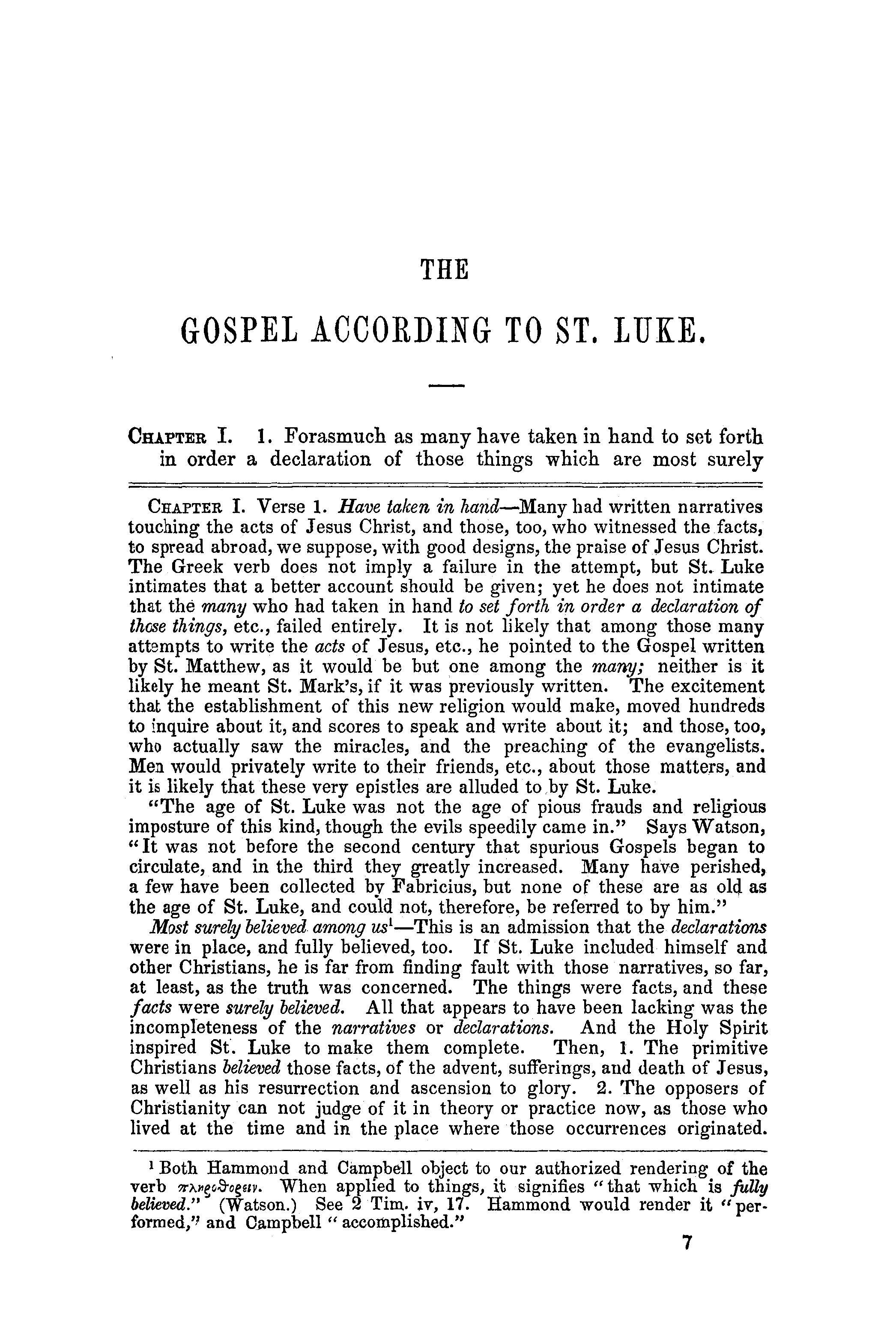
CHAPTER I. 1. Forasmuch as many have taken in hand to set forth in order a declaration of those things which are most surely
CHAPTER I. Verse 1. Have taken in hand-Many had written narratives touching the acts of Jesus Christ, and those, too, who witnessed the facts, to spread abroad, we suppose, with good designs, the praise of Jesus Christ. The Greek verb does not imply a failure in the attempt, but St. Luke intimates that a better account should be given; yet he does not intimate that the many who had taken in hand to set forth in order a declaration of those things, etc., failed entirely. It is not likely that among those many attempts to write the acts of Jesus, etc., he pointed to the Gospel written by St. Matthew, as it would be but one among the many; neither is it likely he meant St. Mark's, if it was previously written. The excitement that the establishment of this new religion would make, moved hundreds to inquire about it, and scores to speak and write about it; and those, too, who actually saw the miracles, and the preaching of the evangelists. Men would privately write to their friends, etc., about those matters, and it is likely that these very epistles are alluded to by St. Luke.
"The age of St. Luke was not the age of pious frauds and religious imposture of this kind, though the evils speedily came in." Says Watson, "It was not before the second century that spurious Gospels began to circulate, and in the third they greatly increased. Many have perished, a few have been collected bv Fabricius, but none of these are as old as the age of St. Luke, and could not, therefore, be referred to by him."
Most surely believed among usl-This is an admission that the declarations were in place, and fully believed, too. If St. Luke included himself and other Christians, he is far from finding fault with those narratives, so far, at least, as the truth was concerned. The things were facts, and these facts were surely believed. All that appears tohave been lacking was the incompleteness of the narraiioes 01' declarations. And the Holy Spirit inspired st. Luke to make them complete. Then, 1. The primitive Christians believed those facts, of the advent, sufferings, and death of Jesus, as well as his resurrection and ascension to glory. 2. 'I'he opposers of Christianity can not judge of it in theory or practice now, as those who lived at the time and in the place where those occurrences originated.
1 Both Hammond and Campbell object to our authorized rendering of the verb ?Z'AI1e.o'&ogm. When applied to things, it signifies" that which is fully believed."" (Watson.) See 2 Tim. iv, 17. Hammond would render it "performed," and CAmpbell accomplished."
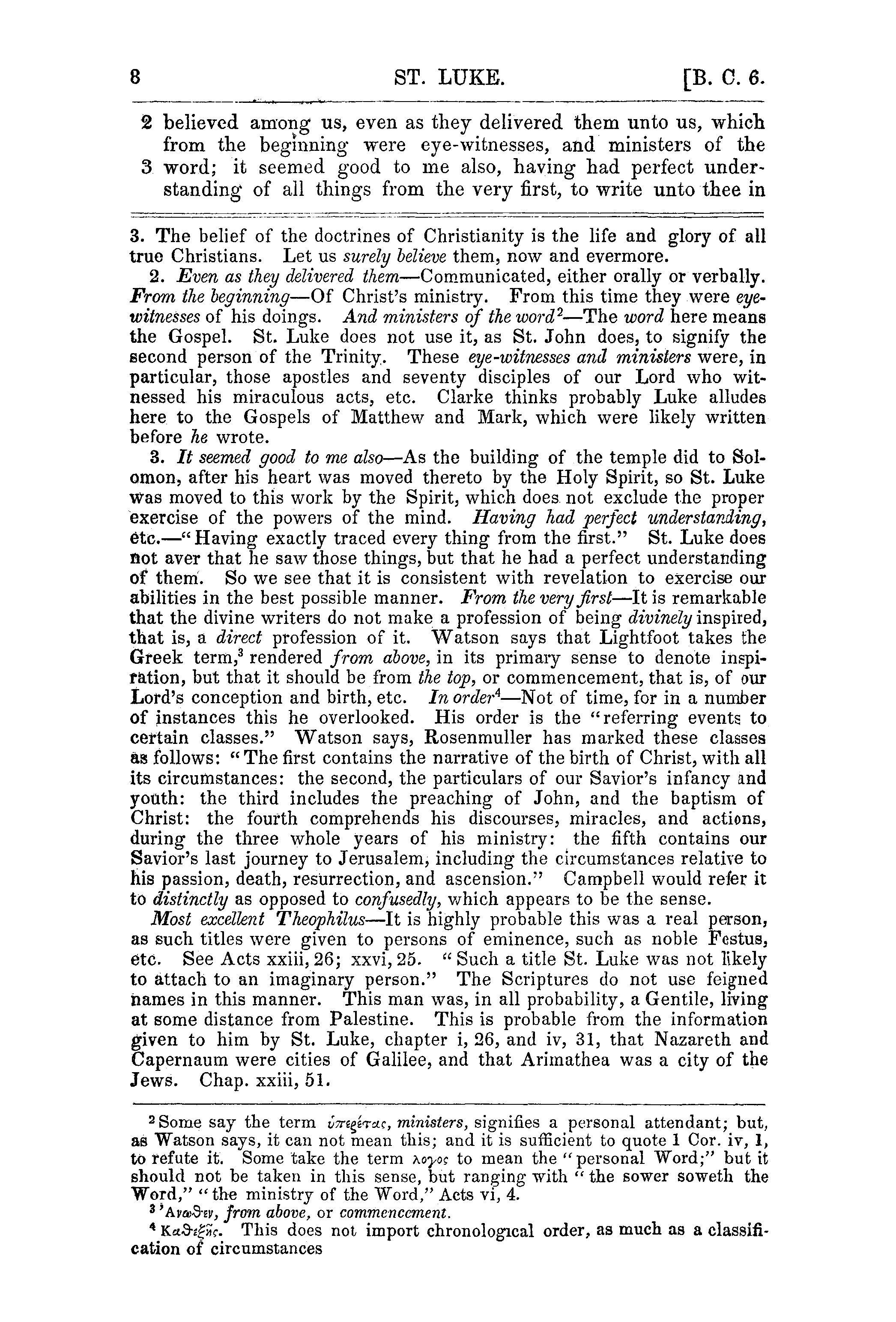
2 believed among us, even as they delivered them unto us, which from the beginning were eye-witnesses, and ministers of the :3 word; it seemed good to me also, having had perfect understanding of all things from the very first, to write unto thee in
3. The belief of the doctrines of Christianity is the life and glory of all true Christians. Let us surely believe them, now and evermore.
2. Even as they delivered them-Communicated, either orally or verbally. From the beginning-Of Christ's ministry. From this time they were eyewitnesses of his doings. And ministers of the word2-The word here means the Gospel. St. Luke does not use it, as St. John does, to signify the second person of the Trinity. These eye-witnesses and ministers were, in particular, those apostles and seventy disciples of our Lord who witnessed his miraculous acts, etc. Clarke thinks probably Luke alludes here to the Gospels of Matthew and Mark, which were likely written before he wrote.
3. It seemed good to me also-As the building of the temple did to Solomon, after his heart was moved thereto by the Holy Spirit, so St. Luke Was moved to this work by the Spirit, which does not exclude the propel' exercise of the powers of the mind. Having had perfect understanding, etc.-" Having exactly traced every thing from the first." St. Luke does not aver that he saw those things, but that he had a perfect understanding of them. So we see that it is consistent with revelation to exercise our abilities in the best possible manner. From the very first-It is remarkable that the divine writers do not make a profession of being divinely inspired, that is, a direct profession of it. Watson says that Lightfoot takes the Greek term," rendered from above, in its primary sense to denote inspiration, but that it should be from the top, or commencement, that is, of our Lord's conception and birth, etc. In order4-N ot of time, for in a number of instances this he overlooked. His order is the "referring events to certain classes." Watson says, Rosenmuller has marked these classes 8,3 follows: "The first contains the narrative of the birth of Christ, with all its circumstances: the second, the particulars of our Savior's infancy and youth: the third includes the preaching of John, and the baptism of Christ: the fourth comprehends his discourses, miracles, and actions, during the three whole years of his ministry: the fifth contains our Savior's last journey to Jerusalem, including the circumstances relative to his passion, death, resurrection, and ascension." Campbell would refer it to distinctly as opposed to confusedly, which appears to be the sense.
Most excellent Theophilus-It is highly probable this was a real person, as such titles were given to persons of eminence, such us noble Festus, etc. See Acts xxiii, 26; xxvi, 25. Such a title St. Luke was not likely to attach to an imaginary person." The Scriptures do not use feigned names in this manner. This man was, in all probability, a Gentile, living at some distance from Palestine. This is probable from the information given to him by St. Luke, chapter i, 26, and iv, 31, that Nazareth and Capernaum were cities of Galilee, and that Arimathea was a city of the Jews. Chap. xxiii, 51.
2 Some say the term umghclc, ministers, signifies a personal attendant; but, as Watson says, it can not mean this; and it is sufficient to quote 1 Cor. iv, I, to refute it. Some take the term Aof'0� to mean the" personal Word;" but it should not be taken in this sense, but ranging with" the sower soweth the Word," "the ministry of the Word," Acts vi, 4.
3' AVW'&EV, from above, or commencement.
4 Kcl.&I�»" This does not import chronological order. as much as a classification of circumstances
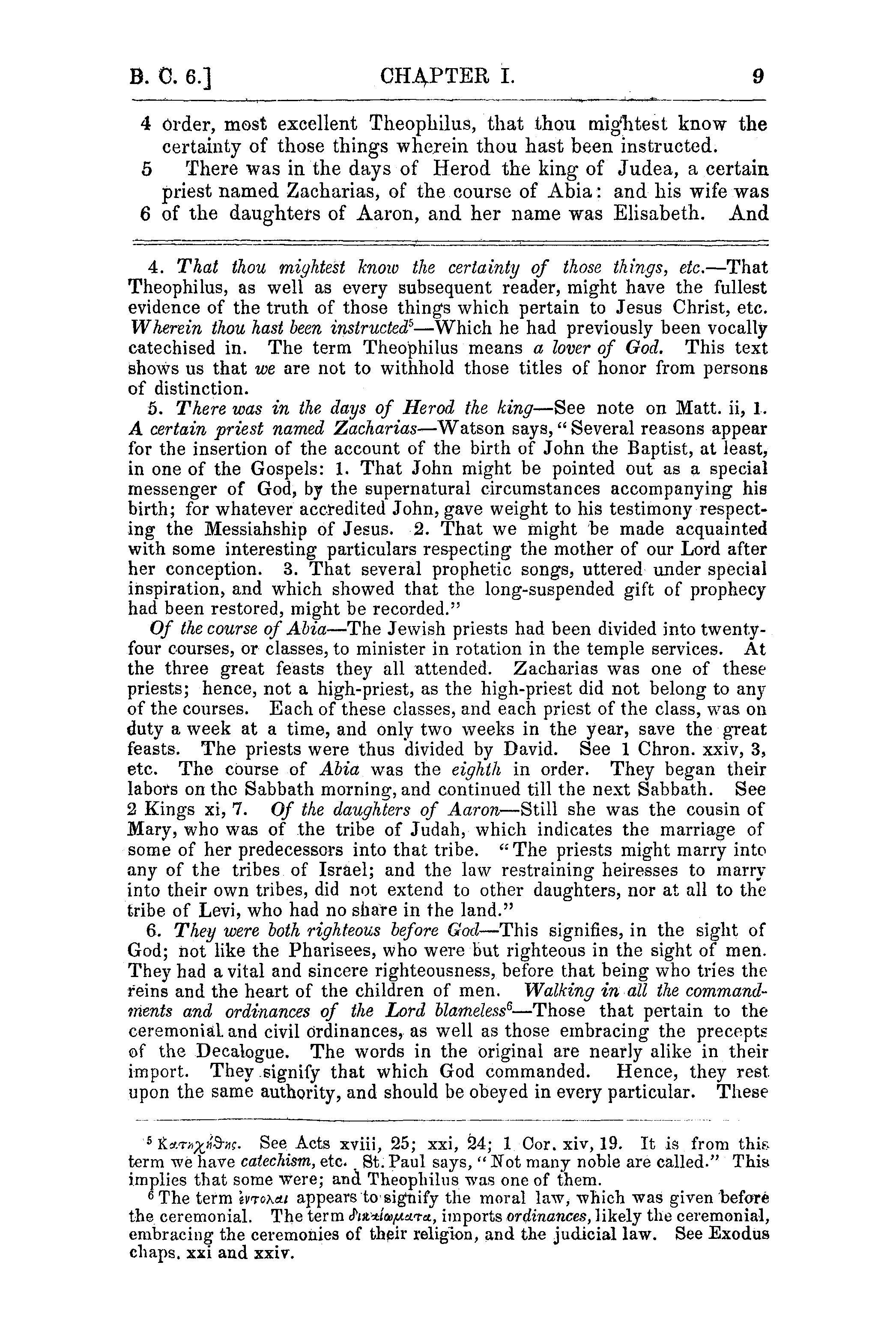
4 order, most excellent Theophilus,· that thou mig'htest know the certainty of those things w herein thou hast been instructed.
5 'I'here was in the days of Herod the king of Judea, a certain priest named Zacharias, of the. course of Abia: and his wife was 6 of the daughters of Aaron, and her name was Elisabeth. And
4. That thou mightest know the certainty of those things, etc.-That Theophilus, as well as every subsequent reader, might have the fullest evidence of the truth of those things which pertain to Jesus Christ, etc. Wherein thou hast been instructed5-Which he had previously been vocally catechised in. The term 'I'heophilus means a lover of God. This text shows us that we are not to withhold those titles of honor from persons of distinction.
5. There was in the days of Herod the king-See note on Matt. ii, 1. A certain priest named Zacharias-Watson says, Several reasons appear for the insertion of the account of the birth of John the Baptist, at least, in one of the Gospels: 1. That John might be pointed out as a special messenger of God, by the supernatural circumstances accompanying his birth; for whatever accredited John, gave weight to his testimony respecting the Messiahship of Jesus. 2. That we might 'be made acquainted with some interesting particulars respecting the mother of our Lord after her conception. 3. That several prophetic songs, uttered under special inspiration, and which showed that the long-suspended gift of prophecy had been restored, might be recorded."
Of the course of Abia-The Jewish priests had been divided into twentyfour courses, or classes, to minister in rotation in the temple services. At the three great feasts they all attended. Zacharias was one of these priests; hence, not a high-priest, as the high-priest did not belong to any of the courses. Each of these classes, and each priest of the class, was on duty a week at a time, and only two weeks in the year, save the great feasts. The priests were thus divided by David. See 1 Chron. xxiv, 3, etc. The course of Abia was the eighth in order. They began their labors on the Sabbath morning, and continued till the next Sabbath. See 2 Kings xi,7. Of the daughters of Aaron-Still she was the cousin of Mary, who was of the tribe of Judah, which indicates the marriage of some of her predecessors into that tribe. "The priests might marry into any of the tribes. of Israel; and the law restraining heiresses to marry into their own tribes, did not extend to other daughters, nor at all to the tribe of Levi, who had no share in the land."
6. They were both righteous before God-This signifies, in the sight of God; hot like the Pharisees, who were but righteous in the sight of men. They had a vital and sincere righteousness, before that being who tries the reins and the heart of the children of men. Walking in all the commandmenis and ordinances of the Lord blameless6-Those that pertain to the ceremonial. and civil ordinances, as well as those embracing the precepts €If the Decalogue. The words in the original are nearly alike in their import. They signify that which God commanded. Hence, they rest. upon the same authority, and should be obeyed in every particular. These
5 KCI.'T,,;t,1;&/1�. See Acts xviii, 25; xxi, 24; 1 Oar. xiv, 19. It is from this term we have catechism, etc. St, Paul says, "N ot many noble are called." This implies that some were; and 'I'heophilus was one of them.
6 The term �V'TOMI appears 'to-signify the moral law, which was given 'before the ceremonial. The term J>llt�t(AJt-td!ra, imports ordinances, likely the ceremonial, embracing the ceremonies of thelr religion, and the judicial law. See Exodus chaps. xxi and xxiv.
they were both righteous before God, walking in all the com7 mandments and ordina.nces of the Lord blameless. And they had no child, because that Elisabeth was barren; and they both 8 were now well stricken in years. And it came to pass, that, while he executed the priest's office before God in the order of 9 his course, according to the custom of the priest's office, his lot was to burn incense when he went into the temple of the Lord. 10 And the whole multitude of the people were praying without, at persons walked in them. This expresses a "habit of obedience." Blameless-That is, without fault. Why is it that so many of modern Christians vindicate the sheer impossibility of obeying the commandments of Godt Why, in the face of the reasonableness of these precepts, and the examples given in the holy Scriptures, do men try to make God a hard mastervin commanding to observe that which is out of the compass of man's power]
Certainly this leads to "more ungodliness," and very likely will be the ruin of thousands. Reader, had Zachariah and Elisabeth as much religious light as you have! They were blameless. Are you!
7. Well stricken in years-This verse is explanatory. We are inclined to think that the birth of John was not miraculous, but supernatural. According to the law of our physical being, age and sterility are in connection. "In either case, it supposes a special interposition of God," as John was born out of the ordinary course of nature. His case is exactly similar to that of Isaac. See Gen. xi, 30; xvii, 17.
8. Before God-Under the special eye of Jehovah, in his temple. The Jews regarded the temple God's dwelling-place. In the first temple there was a cloud called the Shekinah, the visible sign of God's presence. God's presence was still in the latter Jewish temple, though not in any visible form.
9. Hislot was to burn incense-Jewish writers inform us that the priests of each course cast lots to see who should do this or that part of the service-who should cleanse .the altar, or slay the beasts for sacrifice, sprinkle the blood, cleanse the lamps, or burn incense, etc. This last named was esteemed highly honorable.
Incense is a species of white resin and aromatic obtained from trees in Arabia. An incision is made in the tree, and the gum oozes out. When burning it had a very pleasant smell. The priests burned it morning and evening. Exodus xxx, 7.
10. The Whole multitude of the people-On ordinary occasions, it is said, the congregations were but small; but on this occasion there was a multitude. From this it is supposed that this was one of the Jewish feast days, which called out the people generally, or that it was the Sabbath. The account given by Maimonides, in Watson, appears not of much moment. At the time of incense-The golden altar of incense was within the sanctuary, or temple proper. At the time of burning incense, the people stood without the place where the golden altar was, in the court of the Israelites. Notice was given by the sound of a little bell; then the people without the first vail, each one silently offered up a prayer; though we know of no command for this prayer, still, it was in pious connection with the burning of incense. May there not be an allusion to this in Rev. viii, 1-31 After the incense was burned, the priest returned and pronounced the benediction. See the description given of this in Ecc. i, 19-21. The offering of incense was typical of the intercession of our great High-Priest. Our prayers through him only have access to God. "This was the foundation," says Mr. Wesley, "of that elegant figure by which prayer is in Scripture so often compared to incense."
1 t the time of incense. And there appeared unto him an angel of the Lord, standing on the right side of the altar of incense. 12 And when Zacharias saw him, he was troubled, and fear fell 13 upon him. But the angel said unto him, Fear not, Zacharias; for thy prayer is heard; and thy wife Elisabeth shall bear thee a 14 son, and thou shalt call his name John. And thou shalt have 15 joy and gladness, and many shall rejoice at his birth. For he shall be great in the sight of the Lord, and shall drink neither wine nor strong drink; and he shall be filled with the Holy
11. On the right side of the altar of incense-Heathens thought this a good token; but all such notions are vain. On the right side of the 'altar, an angel appeared. This was unusual and wonderful, as for four hundred years the Jewish people were deprived of angelic visits and the spirit of prophecy. But now, after so long a time, the Star of Bethlehem is about to come, and angels are to be the first to herald his advent. This one is the first precursor. Welcome, celestial herald, prepare .the way of thy great Original! Reader, remember that the hour of public prayer is here graciously sanctioned! Let us learn never to neglect prayer.
12. He was troubled, etc.-Says Mr. Wesley, in his note on this place, Although he was accustomed to converse with God, yet we see that he was thrown. into a great consternation at the appearance of this angelic messenger, nature not being able to sustain the sight. Is it not, then, an instance of the goodness as well as of the wisdom of God, that the services, which these heavenly spirits render us, are generally Invisible'l" This dread may be "resolved into our strong sense of sinfulness and guilt."
13. Thy prayer is heard-His prayer for children, which he had long desired, was now about to be answered. It does not mean that now, in his old days, he thus prayed; but that he formerly prayed for them. No prospect appeared to the Jew more gloomy than to die without offspring; for, thereby, their name would perish. This was the reason given in the law why one should marry his brother's wife. Deut, xxv, 5. Thou shalt call his name Joltn-" John signifies, the grace or favor of Jehovah." This name was not disgraced by the Baptist, for he lived and died in the favor of God. Wesley says, "And so Zachariah's former prayers for a child, which he, as the representative of the people, was probably offering at this very time, for the appearing of the Messiah, were remarkably answered in the birth of his forerunner." A manifestation of the grace or mercy of God, in the person of John the Baptist, appears to have been anticipated in the next verse, and thou shalt have joy and gladness, etc.
14. At his birth-This does not refer as much to his birth, in a literal sense, as in his pious conduct, in being the herald of Jesus Christ.
15. He shall be great in the sight of the Lord-Mark, it is not said that he was to be great in the sight or estimation of man, but God. The terms express real greatness. It is true, he was endued with great talents, and he made a good use of them in the discharge of his duties. Watson says, "John was a great character: his office was great-the greatest ever assigned to mere mortal, for he was the herald of the world's divine Redeemer." Neither wine nor strong drinF-" That is, neither wine, nor
7 The term q"tH.�Pt1, Mr. G. Campbell renders, any fermented liquor. Our rendering is, st10ng drink The former we prefer, as it appears that all drinks that would produce drunkenness were forbidden the N azarite and the officiating priest, and alcohol was unknown at this time. The art of distillation was an invention of an Arabian of the ninth or tenth century.
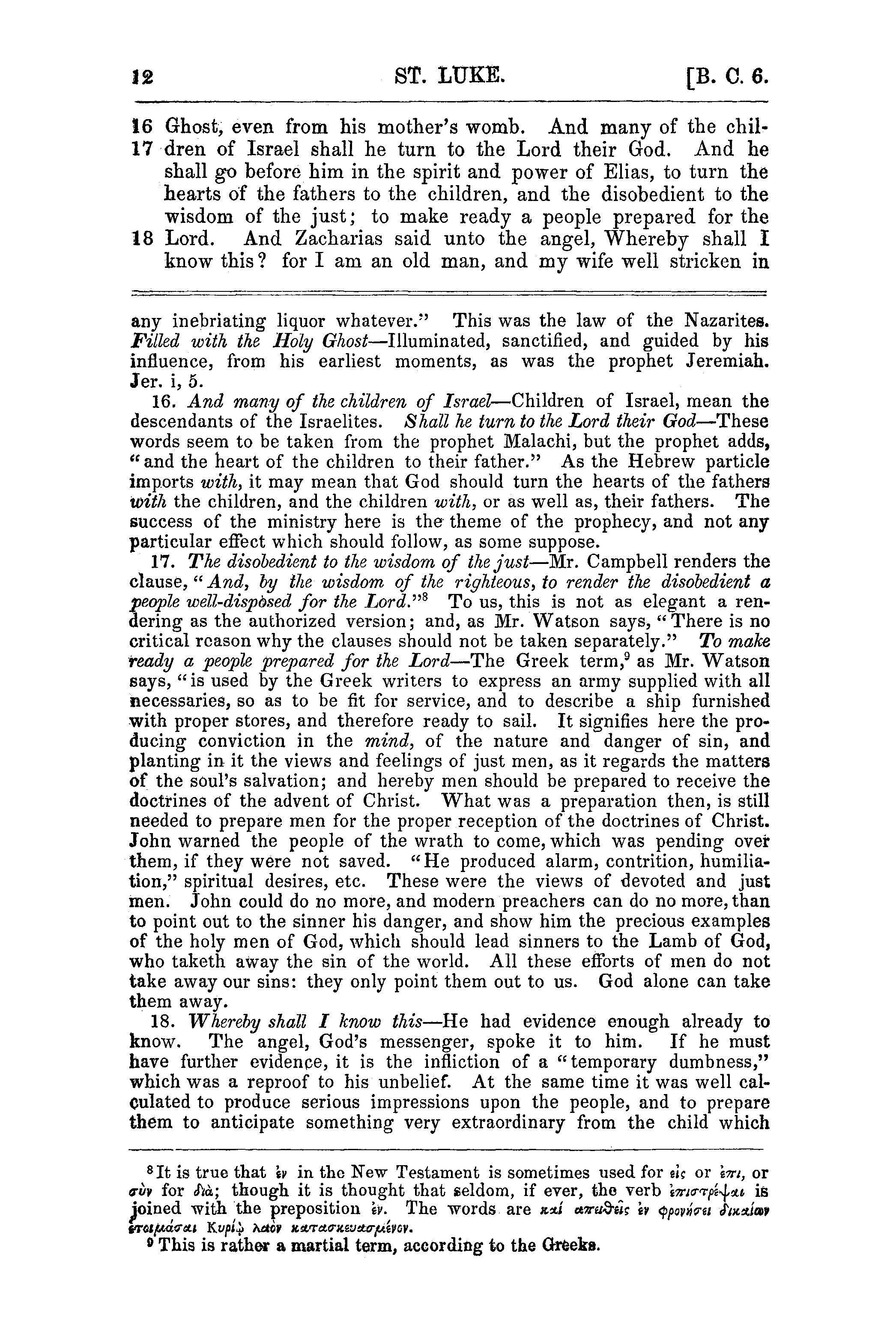
16 Ghost, even from his mother's womb. And many of the chil17 dren of Israel shall he turn to the Lord their God. And he shall go before him in the spirit and power of Elias, to turn the hearts of the fathers to the children, and the disobedient to the wisdom of the just; to make ready a people prepared for the 18 Lord. And Zacharias said unto the angel, Whereby shall I know this? for I am an old man, and my wife well stricken in
any inebriating liquor whatever." This was the law of the Nazarites, Filled with the Holy Ghost-Illuminated, sanctified, and guided by his influence, from his earliest moments, as was the prophet Jeremiah. Jer. i, 5.
16. And many of the children of Israel-Children of Israel, mean the descendants of the Israelites. Shall he turn to the Lord their God-These words seem to be taken from the prophet Malachi, but the prophet adds, "and the heart of the children to their father." As the Hebrew particle imports with, it may mean that God should turn the hearts of the fathers with the children, and the children with, or as well as, their fathers. The success of the ministry here is the theme of the prophecy, and not any particular effect which should follow, as some suppose.
17. The disobedient to the wisdom of thefust-Mr. Campbell renders the clause, "And, by the wisdom of the righteous, to render the disobedient a people well-disposed for the Lord."s To us, this is not as elegant a rendering as the authorized version; and, as Mr. Watson says," There is no critical reason why the clauses should not be taken separately." To make ready a people prepared for the Lord-The Greek term," as Mr. Watson says, "is used by the Greek writers to express an army supplied with all necessaries, so as to be fit for service, and to describe a ship furnished with proper stores, and therefore ready to sail. It signifies here the producing conviction in the mind, of the nature and danger of sin, and planting in it the views and feelings of just men, as it regards the matters of the soul's salvation; and hereby men should be prepared to receive the doctrines of the advent of Christ. What was a preparation then, is still needed to prepare men for the proper reception of the doctrines of Christ. John warned the people of the wrath to come, which was pending over them, if they were not saved. "He produced alarm, contrition, humiliation," spiritual desires, etc. These were the views of devoted and just men. John could do no more, and modern preachers can do no more, than to point out to the sinner his danger, and show him the precious examples of the holy men of God, which should lead sinners to the Lamb of God, who taketh away the sin of the world. All these efforts of men do not take away our sins: they only point them out to us. God alone can take them away.
18. Whereby shall I know this-He had evidence enough already to know. The angel, God's messenger, spoke it to him. If he must have further evidence, it is the infliction of a "temporary dumbness," which was a reproof to his unbelief. At the same time it was well calculated to produce serious impressions upon the people, and to prepare them to anticipate something very extraordinary from the child which
sIt is true that �v in the New Testament is sometimes used for ei� or �71'1, or fTUV for Jla; though it is thought that seldom, if ever, the verb i71'l(J"rr�+�' is joine� with ,the -preposition �V'I The words. are Jt� ce?ru.&u� tV <ppav';�el J'11t.:t.ifll' l'Ta'fMi(J"fL' Kup'';' Mtov "!Lrr(t(J"iW.HIC(T�evay.
II This is rather a martial term, according to the Greeks.
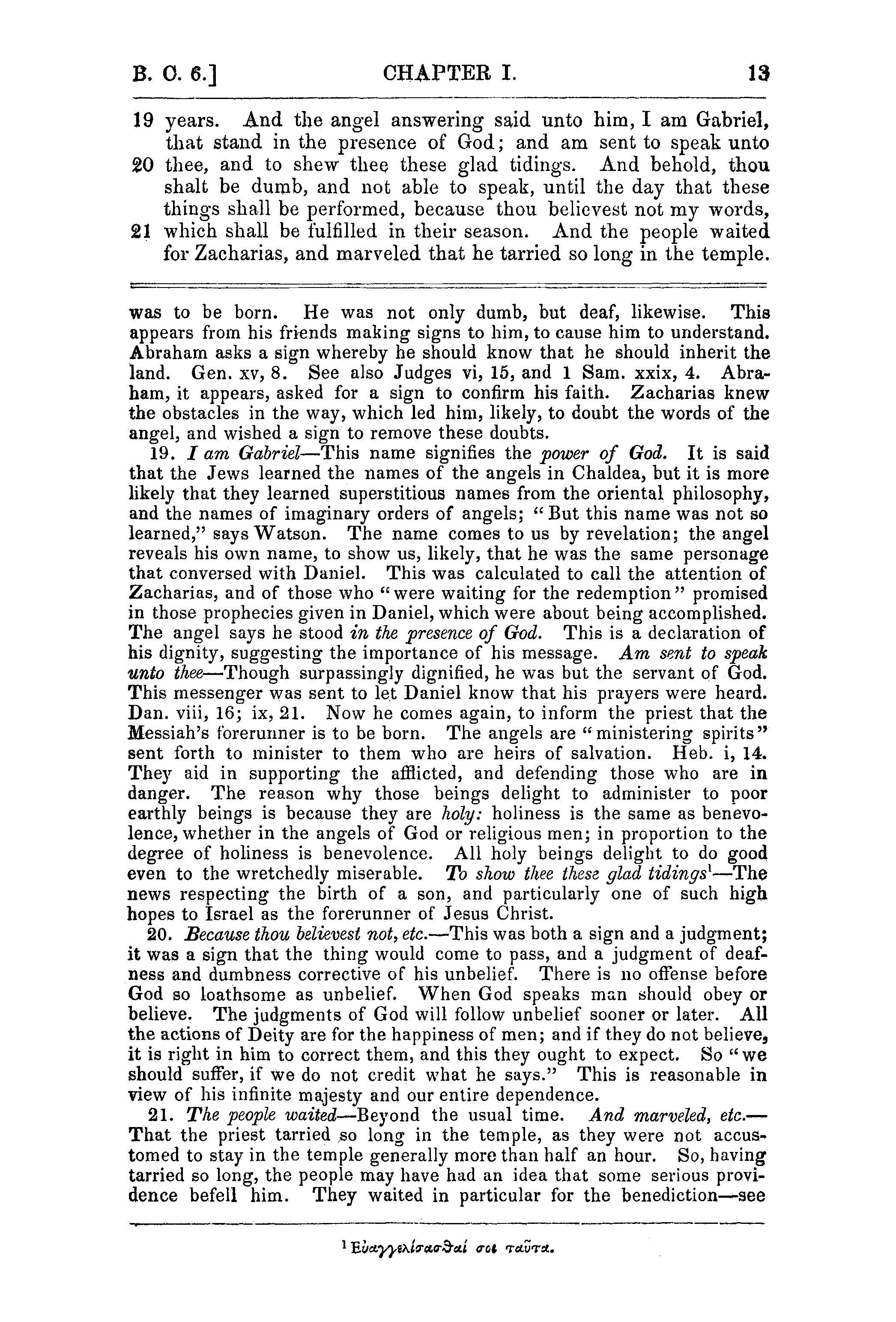
19 years. And the angel answering said unto him, I am Gabriel, that stand in the presence of God; and am sent to speak unto 20 thee, and to shew thee these glad tidings. And behold, thou shalt be dumb, and not able to speak, until the day that these things shall be performed, because thou belie vest not my words, 21 which shall be fulfilled in their season. And the people waited for Zacharias, and marveled that he tarried so long in the temple.
was to be born. He was not only dumb, but deaf, likewise. This appears from his friends making signs to him, to cause him to understand, Abraham asks a sign whereby he should know that he should inherit the land. Gen. xv, 8. See also Judges vi, 15, and 1 Sam. xxix, 4. Abraham, it appears, asked for a sign to confirm his faith. Zacharias knew the obstacles in the way, which led him, likely, to doubt the words of the angel, and wished a sign to remove these doubts.
19. I am Gabriel-This name signifies the power of God. It is said that the Jews learned the names of the angels in Chaldea, but it is more likely that they learned superstitious names from the oriental philosophy, and the names of imaginary orders of angels; "But this name was not so learned," says Watson. The name comes to us by revelation; the angel reveals his own name, to show us, likely, that he was the same personage that conversed with Daniel. This was calculated to call the attention of Zacharias, and of those who" were waiting for the redemption" promised in those prophecies given in Daniel, which were about being accomplished. The angel says he stood in the presence of God. This is a declaration of his dignity, suggesting the importance of his message. Am sent to speak unto thee-Though surpassingly dignified, he was but the servant of God. This messenger was sent to let Daniel know that his prayers were heard. Dan. viii, 16; ix,21. Now he comes again, to inform the priest that the Messiah's forerunner is to be born. The angels are" ministering spirits" sent forth to minister to them who are heirs of salvation. Reb. i, 14. They aid in supporting the affiicted, and defending those who are in danger. The reason why those beings delight to administer to poor earthly beings is because they are holy: holiness is the same as benevolence, whether in the angels of God or religious men; in proportion to the degree of holiness is benevolence. All holy beings delight to do good even to the wretchedly miserable. To show thee these glad tidings I-The news respecting the birth of a son, and particularly one of such high hopes to Israel as the forerunner of Jesus Christ.
20. Because thou believest not, etc.-This was both a sign and a judgment; it was a sign that the thing would come to pass, and a judgment of deafness and dumbness corrective of his unbelief. There is no offense before God so loathsome as unbelief. When God speaks man should obey or believe. The judgments of God will follow unbelief sooner or later. All the actions of Deity are for the happiness of men; and if they do not believe, it is right in him to correct them, and this they ought to expect. So" we should suffer, if we do not credit what he says." This is reasonable in view of his infinite majesty and our entire dependence.
21. The people waited-Beyond the usual time. And marveled, etc.That the priest tarried ,so long in the temple, as they were not accustomed to stay in the temple generally more than half an hour. So, having tarried so long, the people may have had an idea that some serious providence befell him. They waited in particular for the benediction-see
22 And when he came out, he could not speak unto them: and they perceived that he had seen a vision in the temple; for he 23 beckoned unto them, and remained speechless. And it came to pass, that as SOon as the days of his ministration were accom24 plished, he departed to his own house. And after those days his 25 wife Elisabeth conceived, and hid herself five months, saying, Thus hath the Lord dealt with me in the days wherein he looked on 26 me, to take away my reproach among men. And in the sixth month the angel Gabriel was sent from God unto a city of Gal-
Num. vi, 23-26-but seeing that the officiating priest could not dismiss them, being dumb,2 they concluded that he had seen a vision.
22. He beckoned unto them-He was dumb, he could not speak to them. The word" signifies he nodded the head. By this manner he informed them of what he had seen.
23. Days of his ministration were accomplished4-The week in which he officiated, during this time, he was not permitted to leave the precincts of the temple. He did not make an excuse of his dumbness, and immediately return home; no, he staid till his season of service was ended. Though he was dumb, he still could burn incense. Let ministers of the Gospel learn a lesson from this, and never make a frivolous excuse afford an opportunity to leave the work of God. "It is the duty of ministers of religion to remain at their work till they are entirely unfitted for it, and unable to serve God in their profession."
24. Hid herself-We think, with Dr. Bloomfield, that the word is best rendered," She kept herself retired," to devote her mind to sacred contemplation, and likely avoid any thing that might occur to injure her in that condition, and to evade general observation, particularly in view of her advanced age.
25. To take away my reproach among men-To be without children was a great reproach among the Jews, as God had promised them fruitfulness. Psalm cxiii, 9; cxxviii, 3; Isaiah iv, 1; xliv, 3, 4; I Sam. i, 6.
26. Gabriel was sent from God unto a city of Galilee named NazarethGod was the originator of the whole matter. Gabriel, though likely one of his greatest servants, was but the herald at God's command. A city of Galilee, etc.-This was the name of the province or country, Nazareth the name of the town. Both were contemptible in the eyes of the people. This province had been long overrun with the Gentiles, and had become of very low repute. The proverb was, "Out of Galilee ariseth no prophet;" and Nathaniel asks," Can any good thing come out of Nazareth1" although he himself was a Galilean. So, even the Galileans themselves, contrary to the general manner, despised their own country in this respect. Nazareth was a most unrighteous and despicable town, This was fully confirmed by their stubborn and almost universal rejection and contempt of Christ." It pleased the Lord to stoop to the lowest country, and the lowest village, to raise proud man to favor and happiness. It may be well to give here a fuller account of this Galilee, in the days of our Lord, than we have given in Matthew iii, 13, and iv, 16. At this time the country of Judea embraced five provinces, three of which lay on the western side of the river Jordan and the Dead Sea, one to the east of
;! 2:1r.>7l':;;V, dumb or speechless. See chap. xviii, 39, and xix, 40.
3 Beckoned, 'H d'l,mufllv. Here only in the New Testament.
4 Awroup}itJ., from Asi'T'o" public, and �P}�V, work, awl signifies public service," civil, military, or religious." The officiating priest, during his week of service, had no intercourse with his wife, says Oampbell and others.
27 ilee, named Nazareth, to a virgin espoused to a man whose name was Joseph, of the house of David; and the virgin's name 28 was Mary. And the angel came in unto her, and said, Hail, thou that art highly favored, the Lord is with thee: blessed art thou 29 among women. And when she saw him, she was troubled at
these waters, and one on the extreme south of Judea, called IDUMEA. This, it is said, was annexed to Palestine by the Romans. The western provinces were GALILEE, in the north, comprising the territory formerly claimed by the tribe of Asher, Naphtali, Zebulon, Issachar, and part of Dan; SAMARIA, lying between Galilee and Judea, and embracing the allotment of half of Manasseh and the entire of Ephraim; JUDEA, in the south, inclosing within its bounds the inheritance of Simeon, Dan, Benjamin, and the tribe of Judah. The eastern province was called PEREA, including the territories of half the tribe of Manasseh, and of the tribes of Gad and Reuben.
Nazareth was situated in the allotment of Zebulon, about midway between the Lake of Gennesareth, on the east, and the Mediterranean. Sea, on the west, about six miles south-west of Cana, and about the same distance north-west of Mount Tabor. The city stands partly in a valley and partly on the side of a rocky hill, facing the south-east, It is one of the best villages in Palestine; the houses are generally built of stone, one story high. In 1827. the population was estimated at two thousand persons, mostly Christians. Its present name is Nassara,
27. To a virgin, of the house of David-A lineal descendant of David. Espoused to a man whose name was Joseph-Espoused, promised in marriage. It appears that Joseph was of the royal line. Matt. i, 16. See notes on Matthew i, 18-25. "St. Matthew records the subsequent appearance of the angel to Joseph; St. Luke the previous annunciation to Mary."
28. Hail, thou art highly favored-The term hail is by Sutcliffe rendered rejoice. Mr. G. Campbell renders it favorite of heaven; but Messrs. Bloomfield and Watson think our version preferable.' The Lord is with thee6Rather, the Lord be with thee. This was the salutation adopted by the early Christians. Blessed art thou among women-As the mother of the "incarnate Messiah." In Judges v, 24, we read, "Blessed above women shall Jael be." Bishop Pearce says, "If there was any reason why the angel chose to say among women rather than above women, may it not have been that our opinion of the Virgin Mary may not be raised too high!" Campbell renders the Greek term "The happiest of women," and makes it out an ajJi1-mation and not a salutation; but it is rather too far-fetched. God never intended to make the Virgin Mary an intercessor, or an object of worship, in any sense. Nevertheless, this poor virgin of Nazareth received more illustrious honors than any daughter of Adam, as being the mother of the Savior. The Papists pray to her thus: "By thy pious intervention wash away our sins, that so, being redeemed by thee, we may be able to ascend to the seat of everlasting glory, where thou abidest with thy Son forever." To us this appears blasphemous; it is robbing God of his glory, and the Savior of his redeeming honors." The Scriptures affirm that there is but one" Mediator between God and men: the man Christ Jesus." 1 Tim. ii, 5.
29. Troubled at his saying-At the grandeur of the angel, and because
s The term xalp� lt�Xt:lpvr(A)p.�vn, is best expressed by Hail, highly favored.
6 It is remarkable that Elisabeth is the same as Elisheba, the wife of Aaron, and Mary the same as Miriam, the sister of Aaron.
1 See collect. in Hor. ad usum Sarum. Paris, 1520. "We fly to thy patronage, 0 holy mother of God! despise not our petitions in our necessities, but
his saying, and cast in her mind what manner of salutation 30 this should be. And the angel said unto her, Fear not, 31 Mary; for thou hast found favor with God. And behold, thou shalt conceive in thy womb, and bring forth a son, and 32 shalt call his name Jesus. He shall be great, and shall be called the Son of the Highest; and the Lord God shall give
she understood not the purport of his message. Cast in her mind-Reasoned touching the meaning of the angel's address. What manner of salutation-How little we know beforehand what may befall us, and how we may be raised to unexpected honors; or, on the other hand, fall into ignominy, distress, or death! 0, for a continual reliance on God!
31. Call his name Jesus-See note on Matthew i, 2l.
32. He shall be great, etc.-Not in a civil or worldly sense, but" great in power and authority, in glory and fame, in office and administration, in his spiritual and mediatorial dominion." Jesus Christ is the infinitely august one of the universe-I. Because of the union of the divine and human natures-Son of the most high God. 2. From his personal acts. 3. From the greatness of his works, and the sovereignty of his character. 4. From the eternity of his government and kingdom. "The gates of hell" shall not prevail against it.
Shall be called the Son of the Highest8-" In a more eminent sense than any, either man or angel, can he be so called." (Wesley.) Jesus was condemned for professing to be the Son of God; for this the Jewish council" imputed blasphemy to him, and therefore judged him worthy of death. He was demonstrated to be the" Son of God with power," by his resurrection from the dead. By this title he has been known, revered, and worshiped in his Church, as the Son of God, in a sense in which no creature can be-the Son of God in his higher and divine nature-' God of God, light of light, begotten, not made, of one substance with the Father.' This is the sense in which he has been called the Son of God, in his Church, in all ages; and it is supported by his own infallible testimony at his trial, and by the constant testimony of his inspired apostles." (Watson.)
The throne of his father David-David was a type of Christ, and his universal dominion" from sea to sea, and from the river [Euphrates] to the ends of the earth," was a type of the dominion of Jesus Christ. Jesus was the successor of David, and hence called his Son; but he was the root as well as the offspring of David, and he was David's Lord as well as Son. Says Watson, "It is that spiritual dominion exercised over the wills and affections of men, by moral influence, by which they subject themselves to his laws and authority; and it is that exercise of external government over the world, vested in our Lord as Mediator, by which, both by mercies and judgments, by the ordering of its changes, the succession of its empires, the distribution of human power, the punishment of perse cutors, the destruction of enemies, the determination of the times, places, and influence of knowledge and inventions, of arts, commerce, and the intercourse of the different parts of the world, his great designs as to the moral recovery of all nations, and the universal establishment of the empire of his truth, in all its righteous and peaceful influences, shall be
deliver us from all dangers, 0 ever-glorious and blessed Virgin!" (Ohristian's Guide, P: 29, Phil., approved by Rt. Rev. Dr. Kenrick.)
8 Son of the Highest, or" the Son of the living God." The Highest, "u-t'!;"OIT, is sometimes joined with e':r:, but often stands alone as a title of God." It is used by the Seventy for the Hebrew term, importing "Holy One, or Most High."
33 unto him the throne of his father David. And he shall reign over the house of Jacob forever; and of his kingdom there
34 shall be no end. Then said Mary unto the angel, How shall
35 this be, seeing I know not a man? And the angel answered and said unto her, The Holy Ghost shall corne upon thee, and the power of the Highest shall overshadow thee: therefore, also, that holy thing which shall be born of thee, shall be called
effected." As to power, the dominion of Christ shall be universal; as to grace, Christ shall reign over all, 'from the river to the ends of the earth.'"
33. And he shall reign over the house of Jacob-In the language of Zechariah, "The Lord shall be King over all the earth; in that day shall there be one Lord and his name one;" all kings and rulers shall bow to his scepter, and own him Lord of all, in the spiritual sense. See Luke xvii, 20, 21; John xviii, 36. Of his kingdom there shall be no end-He shall reign triumphantly over his people till the end of time, till the moment he shall offer up his kingdom to the Father; then he shall assume the character of eternal judge, and reign the God of the universe forever and ever. If so, how important to have an interest in his kingdom!
35. The Holy Ghost shall come upon thee, etc.-The reader's particular attention is invited to the following remarks:
Let us inquire in what sense Jesus is the Son of God.
1. Strictly speaking, he is not the son of the eternal Father, touching his human nature, as in this respect he was" conceived by the Holy Ghost," and not by the Father.
The power of the Highest, in the second clause, means something different from the former-the Holy Ghost, or a slight modification of sense in its particular application to the virgin mother, and possibly to suggest the unipn of the Divine nature with the human. Such an act of the Holy Ghost is confirmatory of his Godhead, and expresses,
II. "The impersonating of the divine Word," as the personal act of the Son himself, in "concurrence with the Father and the Holy Ghost."
This act might be termed, the power of the Highest, that should overshadoui' Mary. Thence, its meaning is somewhat different from the former clause, and with Watson we think this is at least one reason why Jesus was called the Son of God. Some will have the miraculous conception alone to be the reason of the title" Son of God;" but this title is, "throughout the remainder of the New Testament, put upon higher and distinct ground."
III. The title Son of God means more than that of jWessialt as a distinctive title of his Godhead.
The title Messiah applies to Christ in the proper Biblical sense, as a term expressive of both his natures. Daniel calls him "Messiah the prince," chap. ix, 25; and in the following verse, that" Messiah shall be cut off', but not for himself," pointing directly to the vicarious character of his death. Again: Andrew said to Peter-John i, 41-"We have found the Messias, which is, being interpreted, the Christ." Jesus himself acknowledged that he was the Messias, to the Samaritan woman. John iv, 25, 26.
Again: the Jews did not put the same stress of divinity to the term Messiah as that of Son of God; but it may be said, this is their error; if so, why did not the Savior correct it, as the Jews put the sense of
9 Overshadow, from hi".lGla(etv, "1. To overshadow; 2. To surround; 3. To defend, or assist; 4. As here, to exert a power or influence in." See 2 Cor. xii, 9.
eternal divinity to this appellation, and this in a more emphatic sense than to the term Messiah? In Ps. ii, 12, the command to "kiss the Son, lest he be angry," etc., was understood by the Jews as a distinctive name of the Messiah. Christ gives himself this name: "No man knoweth the Son but the Father," Matt. xi,27. Simon Peter confesseth that Jesus was" the Christ, the Son of the living God," Matt. xvi, 16. Christ applauds this confession, and says, that" flesh and blood hath not revealed it unto thee, but my Father which is in heaven." Now, if the term Son means his human nature, the virgin mother of our Lord might have revealed it to him, or almost any body else of that day; but" flesh and blood," or human skill, could not reveal it. Indeed, his human nature needed no revelation; but his divine nature did, and no less a personage than the Father could reveal it; hence, the appellation Son of God applies to his divine nature.
Again: it was for confessing himself, before the Jewish Sanhedrim, to be the Son of God, that that body condemned him to death on a charge of blasphemy. See note on Matt. xxvi, 63, 64. If the appellation had, with the Jewish rulers, no less meaning than one equal with the Father, in all his attributes, it is obvious that with them the term Son of God applied to the divine nature of Jesus Christ. Jesus is never," either by himself or others, called the Son of God, with reference to his conception." (Watson.) Nathaniel had no knowledge of his miraculous conception, but he calls him" the Son of God," in John i, 49. Jesus allowed him so to understand his character. Moreover, in John i, 18, it is said, "No man hath seen God at any time: the only-begotten Son, which is in the bosom of the Father, he hath declared him." The term, says Watson, only begotten, entirely shuts out the notion that he became the Son of God by his. miraculous conception," since in his creation in the virgin he is not the only begotten, for all the angels were created, and the first human pair.
The words of the angel in this text would have comparatively little sense, to apply them to the miraculous conception. The angel had a higher mission, and a greater reason for the name Son of God, than this, if we consider the two acts mentioned in the text: first, the Holy Ghost producing the HOLY THING; secondly, the power of the Highest-in verse 76 Christ is called the Highest-or the eternal Word uniting with the holy thing, and hereby the word became flesh. This was an act entirely different from the production of the body of Christ. "It follows," says Watson, "that that should be a holy thing which should be born of Mary, as being produced immedia.tely by the Holy Ghost; and it followed that this holy thing should be called the Son of God, and became the appellation of the undivided Christ, but wholly by virtue of the hypostatical union."
Again: if it could be proved that the term Son of God, in the text under consideration, only means the miraculous conception, it could not weaken the argument which proves Christ to be the Son of God, according to his divine nature, because this rests upon distinct passages, perfectly sufficient in number and weight to prove it, beyond successful contradiction.
No one doubts that the Messiah is the Son of God. Still, wherefore is he so called! The answer is, because he is really what he is called-the Son of God. "And was he not o.fficially called what naturally he was not? otherwise we have words adapted to convey an erroneous" sense. Holy thing, though in the neuter gender, is very properly applied to the unborn human nature of Christ. Our Lord in no degree partook of the "natural pollution of the fallen race," hence, not included in the condemnation of Adam's descendants because not "born of the flesh." He
was" made of a woman," not of man. He was allied to the human race, not by natural generation, but by the mysterious assumption of our nature by the Holy Ghost. Judgment" did not pass upon him to "condemnation;" hence, he needed no" justification of life;" therefore his sufferings were voluntary, and vicarious, and infinitely pure. He could" offer himself without spot to God."
First. It is objected to the above sense of the term Son of God, by the learned and pious Dr. Clarke and some others, that" if Christ be the Son of God, as to his divine nature, then he can not be eternal; for Son implies father," etc. See Clarke's comment on Luke i, 35. To say the least about tQtS reasoning, it is only an analogy derived from created nature, and certainly from this fact, if nothing else, must fail when applied to the mode of the Divine existence. It is a mystery which angels desire to look into-" God manifested in the flesh;" hence, which no man can explain, and which no pious, prudent man will attempt. God has revealed the fact, and it is enough for us to receive and believe it without explaining it. Reason has its province, but can not go safely beyond it. And such reason as above, is perfectly futile on such a subject, because this mystery of godliness is only manifest to God, and being a mystery, it is not revealed, of course.
t< Dark with excess of light his skirts appear; Yet dazzle heaven, that brightest seraphim Approach not, but with both wings vail their eyes."
Secondly. It is objected, "If Christ be the Son of God as to his divine nature, then the Father is, of necessity, prior, consequently superior, to him." The answer to the preceding objection will apply to this. This objection is based upon the priority of Father to Son. The reason will hold good, so far as created nature goes; but what has it to do, or what can it do, beyond this! Just nothing at all. If it please God to reveal in his word a peculiar relation of existence, that never had a beginning, and can never have an end, by a natural relation existing in the family of human beings, and, likely, having its archetype in Deity, can there be any valid reason against it1 One thing is plain, that the Scriptures do teach a priority of personage in the persons of the Godhead. Instance, it is not said that the Son sent the Father, or that the Holy Ghost sent the Son, but the reverse. This much must be admitted. Now, to express this priority and filial relation is the point. What terms can express it better than father and son1 None. Will any assume to say that no such priority and relation exist! It is likely no Biblical scholar will. Then, why not express this eternal relation by the terms father and son 1 Does not the mirror reflect when made1 Is not the reflection simultaneous with its existence! Then, can there not be an eternal and simultaneous relationship between the first and second adorable persons in the Trinity! And should there not be order in expressing this relation, as the Father to send the Son, and the Son to send the Spirit] Most certainly.
Thirdly. "If the divine nature be begotten, then it must be in time." We answer, no, it need not. According to this, the term only begotten, in its application, has little or no sense, if it be applied to Christ in this respect; for, as remarked above, if it means no more than created, it might as well apply to angels in heaven, or devils in hell, or Adam, or Eve, as to Jesus Christ. Hence, in this respect, it has no specific sen-se. And, certainly, this would wrest the Scriptural sense of this most emphatic appellation, in its application to Christ. Then, it is probable that it applies to the divine and eternal nature of Jesus Christ, and is the strongest term, or name, given to designate the divine nature of Christ, in
the Bible. If it means a miraculous conception, it means too little; for those who deny the Divine sonship destroy that relation which exists in the Godhead, and which is denominated paternity, filiation, and procession. The Scriptures reveal these relations, and they are an argument for the oneness, unity, and indivisibility of the persons of the Trinity. That Jesus had two distinct natures, all believe who are orthodox in the faith; that" our Lord, which was of the seed of David, according to the flesh, and declared to be the Son of God with power, according to the spirit of holiness, by the resurrection from the dead," Rom. i, 3, 4; that is, declared to be the Son of God, exhibited to be what he always was, by the act of resurrection. By his human nature he is the seed of David, by his divine nature he is' the Son of God. The Father declares him superior to angels, who were created beings, saying, "Thou art my Son; this day have I begotten thee;" Reb. i, 5; therefore, he is the express image of the Father's person. In what respect could his humanity, be it ever so great, be the express image of God, the Father! God is a Spirit, and humanity is but humanity. In respect to his sonship and image of the Father, the apostle quotes the Psalmist, and applies the prediction to Jesus, Christ," But to the Son he saith, Thy throne, 0 God, is forever and ever!" etc.
The merely assuming human nature gives no idea of the relationship of the persons in the Trinity, as this was an act of Jesus himself by the Holy Spirit. "Forasmuch as children are partakers of flesh and blood, he also took part of the same." As" his own act, it could never place him in the relation of son to the Father." If the above argument be tenable, then the term only begotten must apply to the deity of Christ; if so, it can not apply to his human nature at all, as some do apply it, or to both his divine and human nature, as others apply it; for this can not be the sense in which the Scriptures apply the term only begotten. Two only-begotten beings, would be absurd. Jesus has life in himself, as the Father has life in himself. In this respect they are identical; but, admitting this, where is the idea of personality or relationship? Then, if there be no paternity or filial union, we are led to tritheism; and the denial of the Divine sonship favors it. But the idea of two independent beings is destroyed by the Scriptures. Christ says, "I live by the Father," John v, 57; and," As the Father hath life in himself, so hath he given to the Son to have life in himself," John v, 26. In what sense can this apply to the mere humanity of Christ! And certainly it destroys the idea of two separate beings.
That Jesus Christ, in sonship relation to the Father, is one with him, and that this relation is the reason why the Father is said to send the Son, and both the paternity and filiation, appear to be essential to the Deity, hence, natural and eternal. Add to this the completeness of the divine and human natures in the person of Jesus Christ: this is the key which unlocks the treasures of the sacred Scriptures, and opens to man a living way to eternal salvation. 'To use the beautiful language of the Nicene creed, he is "the only-begotten Son of God, begotten of his Father before all worlds, God of God, light of light, very God of very God, begotten, not made, �ing of one substance with the Father." "Early in the year of 1818 Mr. Watson," says Rev. Thomas Jackson, in his life of that great man, page 174," published one of his most important theological works, an elaborate dissertation on the Divine and eternal sonship of Christ, etc." Dr. A. Clarke's Commentary was in course of publication, in answer to which his work was intended.
"The conference very properly resolved to admit into its body no man who denied the Divine and eternal sonship of Christ." (Ibid., page 184.) Watson's pamphlet was followed, vindicating the same doctrine, by
36 the Son of God. And behold, thy cousin Elisabeth, she hath also conceived a son in her old age; and this is the sixth month
37 with her who was called barren: for with God nothing shall be
38 impossible. And Mary said, Behold the handmaid of the Lord, be it unto me according to thy word. And the angel departed
39 from her. And Mary arose in those days, and went into the
40 hill country with haste, into a city of Judah, and entered into the
41 house of Zacharias, and saluted Elisabeth. And it came to pass, that when Elisabeth heard the salutation of Mary, the babe leaped in her womb: and Elisabeth was filled with the
42 Holy Ghost. And she spake out with a loud voice, and said, Blessed art thou among women, and blessed is the fruit of thy
43 womb. And whence is this to me, that the mother of my Lord
44 should come to me? For 10, as soon as the voice of thy salutation sounded in mine ears, the babe leaped in my womb for
45 joy. And blessed is she that believed: for there shall be a performance of those things which were told her from the Lord.
publications of Rev. Messrs. Moore, Hare, and Martin. "Dr. Clarke's theory is now generally discarded in the Wesleyan body." (Ibid.) Dr. Clarke offered no reply to Watson's pamphlet; he only repeated his former arguments, taking no notice of Watson's work. One of the Doctor's friends wrote against him, but he changed the ground of the argument.
38. Behold the handmaid of the Lord-This was an expression usually made, expressing" submission and obedience." To be the handmaid of the Lord, means a readiness to obey the commands of the Savior.
39. And Mary arose-This means, to start on a journey. The hill country-This was the hilly region near to Jerusalem. City of JudahThis place is not known. Probably it was Jerusalem, or Hebron, or Juttah. It was likely a Levitical town, and the residence of Zacharias; hence, more likely Hebron than Jerusalem. From Hebron to Nazareth was nearly one hundred miles. Mary starts on this journey with haste. The object may have been to ascertain the fact announced to her touching her cousin Elisabeth, and thereby ratify the words of the angel to herself.
40. Saluted Elisabeth-Expressed joy with the customary salutations.
41. And Elisabeth was filled with the Holy Ghost-It was by the influence of this Divine personage that she hailed Mary as the mother of the Redeemer. As the annunciation of the angel to Mary was a secret with herself, hence Elisabeth understood it by the Holy Ghost only.
42-45. In these verses we have this succinct and important speech of Elisabeth, the aged matron, and wife of priest Zacharias. She recognizes the honor paid her by the visit of her kinswoman, Mary, the mother of our Lord. Blessed is she that believed-The meaning is, blessed is Mary in believing, though humanly improbable, what the angel said unto her touching the birth of the Messiah.
From this speech of Elisabeth we perceive, 1. That the spirit of prophecy, after a series of years, had visited the Jewish family. 2. That the Holy Ghost is the source of information, of comfort, and joy, to the family of mankind. 3. That the Messiah should be the joy and salvation of man. 4. Mary's relation to the Savior should be her peculiar blessing and remarkable honor. 5. If the mother of Jesus received her blessing on the account of Jesus, the latter, and not the former, should receive religious homage. Men should expect to be blessed and honored by
46, 47 And Mary said, My soul doth magnify the Lord, and my 48 spirit hath rejoiced in God my Savior. For he hath regarded the low estate of his handmaiden: for behold, from henceforth
49 all generations shall call me blessed. For he that is mighty 5q hath done to roe great things; and holy is his name. And his mercy is on them that fear him, from generation to generation.
51 He hath shewed strength with his arm; he hath scattered the
52 proud in the imagination of their hearts. He hath put down the mighty from their seats, and exalted them of low degree.
53 He hath filled the hungry with good things, and the rich he 54 hath sent empty away. He hath holpen his servant Israel, in
receiving Christ into their hearts, as he is their only hope of present and future salvation.
One of the greatest errors of the Roman Catholic Church is offering worship to the Virgin Mary. God has forbidden this. Ex. xxxiv, 14; xx, 4, 5; Deut. vi, 13, 14; Isa. xlv, 20. How absurd to offer religious homage to a finite human being! Can such be present in every place to receive it? If not, so far as the conscious reception of such worship is concerned, you might as well offer it to a rock, or mountain; but, infinitely worse, it robs God of his due reverence and praise, of which he is jealous: he will not give it to another; such idolatry incurs his curse, and dooms the soul to hell.
46-55. These verses contain the beautiful and fervent speech or song of Mary. Notice the following: 1. The felicity or rapture of her soul. My soul doth magnify the Lord, verse 47-When the soul is divinely happy, it is natural to utter praises. This speech resembles Hannah's, the mother of Samuel. He hath regarded, etc., verses 48, 49-This shows us, 2. The reasons oj her raptures-The doings of God. He hath reqarded=-Done to me great things. In my low estate-Poor and undistinguished. But now, generations shall call me blessed-This is prophetically expressed. 3. The expressed majesty of her thoughts, and grandeur of her hopes.
50. And his mercy is on them that fear him,from generation" to gener� ation-She expresses the mercy of God in the gift of the Messiah, not to a few, but to all that fear him, from age to age, flowing, like a mighty river, unwasted and unwasting. At the same time,
51. He hath scattered the proud in the imagination of their hearts-Dr. Campbell renders it, "Dispelleth the vain imaginations of the proud." The proud Jews held 'vain anticipations respecting the Savior's advent, that he should come in great grandeur and civic pomp. In this respect, God was pleased to turn their wisdom into folly, and their imaginary greatness into contempt. The moral of this was to hide pride from man, and to give him a model of pure humility. Christ appeared among the humble and the poor. No wonder that the "poor have the Gospel preached to them."
52. He hath put down the mighty from their seats-In their imaginations, thoughts, and estates. Exalted them of low degree-The families of Joseph and Mary, who were comparatively poor people, and their immediate relatives, in all likelihood. Doing- thus, God has" filled the hungry with good things," while the haughtily rich" he hath sent empty away."
54. He hath holpen: his servant Israel-" The Messiah was promised before Israel existed, as a people," and he was designed .for the universal benefit of the nations. Christ was to be an Israelite, and, in the first
55 remembrance of his mercy; as he spake to our fathers, to
56 Abraham, and to his seed, forever. And Mary abode with her
57 about three months, and returned to her own house. Now Elisabeth's full time came that she should be delivered; and
58 she brought forth a son. And her neighbors and her cousins heard how the Lord had shewed great mercy upon her; and they
59 rejoiced with her. And it came to pass, that on the eighth day they came to circumcise the child; and they called him Zach-
60 arias, after the name of his father. And his mother answered 61 and said, Not so; but he shall be called John. And they said unto her, There is none of thy kindred that is called by this
62 name. And they made signs to his father, how he would have
63..ll.im called. And he asked for a writing table, and wrote, say-
place, to offer them the benefit of his mission. This was in the sense of holpen, to raise up, to support. The idea is, to take hold of one enfeebled, to raise him up, etc. "Our redemption is thus effected, by the reaching down of the arm of the Divine mercy to raise us up from sin, misery, and ruin, and to exalt us to a state of knowledge, holiness, and joy." 'In remembrance of his mercy-His long-delayed, but promised mercy-Gen. iii, 15-but which was accomplished in "the fullness of time."
55. As he spoke to our fathers, etc.-Abraham and others. This should have been connected with the preceding verse.
56. And returned to her own house-At this time Mary was advanced in the same way with Elisabeth; and about this time she was suspected by Joseph, to whom she had been only betrothed, or promised. He purposed to put her away privately, etc. See note on Matthew i, 19.
59. And they called him Zacharias-This child had been circumcised on the eighth day, and generally among the Jews the child was named when it was circumcised. If circumcision had been essential to infant salvation, it is likely it would not have been delayed till the eighth day. It is generally supposed that baptism is used instead of circumcision, as a mark of God's covenant, and sign and seal of the washing of regeneration. Tit. iii, 5. It should not be neglected on the part of parents toward their children; nevertheless, it is not essential to infant salvation. The child under consideration was named after its father, as generally the first-born male among the Jews was, as some suppose.
60. And his mother said, Not so; but he shall be called John2-This was the name which the angel gave him, verse 13. Likely Zacharias, by writing, informed Elisabeth to give it to him. John signifies the grace or mercy of Jehovah, and should be" written .Jehochanan, or Yehochanan."
63. And he asked for a writing table3-These tables, as it is said, were made of pine, and covered with wax, on which the ancients usually wrote with an iron pen, or stile. This was before the invention of paper. Sometimes the writing table was made entirely of lead. And they marveled all-They all wondered at the name John being given to him. They did not anticipate that both the name and mission of John imported the mercy or favor of God to mankind. The latter clause of this verse should be joined with the following verse.
2 The name Zacharias imports H the memory or memorial of Yehovah," or J ehovah; Elisabeth, the" Sabbath, or rest of my strong God." See Dr. Adam Clarke in loco.
3 llm:tlLlJ'IQV, a tablet. The Anglo-Saxon version may be rendered, "a wax board, or cloth." The term is only found here in the New Testament.
6·1 ing, His name is John. And they marveled all. And his mouth was opened immediately, and his tongue loosed, and he 65 spake, and praised God. And fear came on all that dwelt round about them: and all these sayings were noised abroad through66 out all the hill-country of Judea. And all they that heard them, laid them up in their hearts, saying, What manner of child shan this be! And the hand of the Lord was with him.
64. His mouth opened immediately, and his tongue loosed-Loosed is not in the original. Campbell renders it, Then were opened his mouth and his tongue. He was then able to speak. After all, it is more likely the amazement of those present was at the sudden change which came over Zacharias, than at the name given to the child. It is likely they thought Zacharias was afflicted with some species of paralytic attack; and they marveled when he, being deaf and dumb, spoke. This calamity befell him for one act of unbelief; and this was not without its corrective effect. And he spoke, and praised God-For the birth of the child and the restoration of speech. Lord grant us his grace to escape the snares of unbelief! Its snare caused nine months' dumbness to Zacharias.
65. Fear came upon all that dwelt round about them4-The term fear denotes religious reverence; and the birth of John, in connection with the return of Zacharias's speech, filled them with fear- the fear of the Lord. See Acts ix, 31; Rom. iii, 18; xiii,7; 1 Peter i, 17; ii, 18; iii,2. The inhabitants of Hebron, and the country around, appear to have been an open-hearted, generous people. They were apt to learn of God, and became suddenly affected with the occurrences of the family of Zacharias. The people of the country are generally more affected with divine things, more easily than those of cities. And all these sayings5 were noised abroad-The term may be rendered things, instead of sayings. These matters, of recent occurrence in this family, flew throughout all the hill� country of Judea.
Hebron lies a few miles south of Bethlehem. It is situated in a valley, but agreeably diversified with rocky hills, forests of oak and fir vineyards, and olive gardens-the valley of Eshcol, or cluster of grapes, so called because the spies gathered clusters here, and brought them back to Moses. Num. xiii, 24, 25. In the vale of Hebron, so called, Jacob dwelt when he sent Joseph to seek his brethren. Gen. xxxvii, 14. Hebron" signifies the city of Arba, who was a great man among the Anakims. Joshua xiv, 15. It was one of the oldest cities of Palestine. In the neighborhood of this town, Abraham abode after he parted with LotGen. xiii, 18-and bought a field with a cave, in which he buried his dead. Gen. xxiii. When the Hebrews invaded Palestine, Hebron was the residence of a king-Joshua xii, IO-named Hoham, who combined with four other Canaanitish kings against Israel, but was defeated and destroyed by Joshua. Joshua x, The city after this was assigned to Caleb-Joshua xiv-agreeable to a promise given by Moses. N urn. xiii and xiv. Afterward it was a city of refuge, and given to the priests. Joshua xx and xxi. After David succeeded Saul, he made this city his residence. At the present day Hebron is a flourishing town called El-Khalil. The Empress Helena built a splendid church here over the graves of the patriarchs, which is now used as a mosque.
4 Some maintain that John was born in J uttah, a city of the mountains of Judah, five miles south of Hebron.
5 The term gn�4 here, as in verse 37, has the sense of things, or transactions
6 Hebron was originally called Kirjath-arba.
67 And his father Zacharias was filled with the Holy Ghost, and 68 prophesied, saying, Blessed be the Lord God of Israel; for he 69 hath visited and redeemed his people, and hath raised up an 70 horn of salvation for us, in the house of his servant David: as he spake by the mouth of his holy prophets, which have been 71 since the world began: that we should be saved from our ene-
67. Zacharias prophesied-Wesley says he speaks of John only incidentally, and of' Christ chiefly of things which were immediately to follow. Not only did he prophesy in the sense of religious teaching, as the term is sometimes taken, but in this song he predicts certain events, in the strictest sense of prophesying, touching the future destiny of his own son and the son of Mary, the Savior.
68. Blessed be the Lord God of Israel-This modern prophet gives the reason of this devout acclamation. For he hath visited and redeemed his people-This is the reason. 1. God has visited his people. He speaks prophetically of what God would certainly do. God's will in the spirit of prophecy must be distinctly impressed on the mind of the prophet, a sort of oneness of view. The Almighty had already favored his people, and the world, with the advent of John; but only a brief interval, when he comes himself into the world, with the object, emphatically, 2. To redeem it from the thralldom of sin.
Jehovah, the God of Israel, as the words import, becomes our Savior, by receiving real soul and body, that he might live and die for us, etc.: to pay the redemption price for us to the Divine justice, and deliver us from sin and death.
69. An horn of salvation for us in the house of David-Instead of horn of salvation, Campbell renders it, a Prince for our deliverance, saying that the authorized rendering is" too obscure, and too little suited to our mode of speaking, to be fit for admission into modern languages."
The horn is a symbol of strength, and was taken from the strength of animals being in their horns. Instance, the rhinoceros and unicorn, each having a single horn of great strength. The sacred writers, while speaking of great strength, use the term horn: Joseph's strength, or horns, are like the horns of unicorns." Deut. xxxiii, 17. See Psalm cxlviii, 14; Dan. vii, 8; viii, 21. Horn of salvation is equivalent to great Savior. The expression is taken from Psalm xviii, 2. On each of the four corners of the altar was placed a horn, from which it is likely the figure is immediately taken. Any person might flee to it for safety, when in danger, and was safe. 1 Kings i, 50; ii,38. Jesus is, therefore, called the horn of salvation, as the almighty and eternal rock of safety.
In the house of his servant David-From this it appears that Zacharias meant Christ, and not his son John, as the latter was of the house of Levi, and not of David.
70. As he spoke lYy the mouth of his holy prophets-God spoke by or through the prophets. Which have been since the world began-The literal rendering is, from the age. The Jews divided time into two ages-from the creation to the advent of the Messiah; from this till the end of time. Whitby renders it, from the beginning of ages-Gen. iii, 15-where the first promise of a Savior is presented. This appears to suit the sense best. All the prophets allude to Christ; he is the soul and subject of the whole Bible. The most striking of the predictions are, Gen. iii, 15; xlix, 10; Deut. xviii, 15; Isaiah ix, 6, 7; liii.
71. Saved from our enemies and from the hand of all that hate us-Our enemies are those usurpers, Satan and his angels, and sin in every shape and sense. The figure is taken from the manumission of a people from
72 mies, and from the hand of all that hate us; to perform the mercy promised to our fathers, and to remember his holy cove73, 74 nant; the oath which he sware to our father Abraham, that he would grant unto us, that. we, being delivered out of the 75 hand of our enemies, might serve him without fear, in holiness 76 and righteousness before him, all the days of our life. And thou, child, shalt be called the prophet of the Highest, for thou
tyranny and bondage of civic power. Compare this with verse 74. The Messiah came to save us from all spiritual bondage. From the hand, etc.The power and cruelty of our enemies.
72. To perform the mercy-More literally, "to make mercy with our fathers;" to declare his kindness to our fathers. Mercy shown to the children is kindness to the parents. The woman of Canaan cried, "Lord, help me." To heal her daughter tormented with a devil, was to help the mother. Matt. xv, 22. His holy covenant-A covenant is an agreement entered into between two parties; but such is not the sense here, as this can never take place between God and man, as the former has the absolute right to make laws for the latter. The inequality of these parties destroys the literal sense of covenant. It rather means God's proposed and designed overtures of mercy to mankind, as the latter is not at liberty to decline the proposals of God but at man's own hazard. The word covenant, in the Bible, means sometimes a command, sometimes a promise, and sometimes a regular law, as the" covenant of the day and night." In this verse it means the covenant made to Abraham.
73. The oath, etc.-This is recorded in Gen. xxii, 16, 17. God swore by himself because he could swear by no greater-Heb. vi, 13, 14-that he should bless Abraham and his posterity, which was to be fulfilled by the advent of Christ; and not only the posterity of the patriarch should be blessed, but" all nations." This embraces both Jews and Gentiles, 01' all the inhabitants of the world, in all ages, times, and places. All are saved unconditionally in Ghrist, save sentient, actual transgressors; these must repent and believe in Christ where he is revealed-and where he is not, they must abstain from idolatry, and believe in the seif-existent, shown by the works of creation and providence, and the light of the Holy Spirit in their conscience, (see Rom. i, 20; ii, 14, 15)-if they do secure eternal life, which all may if they will.
74. Might serve him-Obey, love, and worship him in spirit and in truth. Without the atonement the service of God would be absolutely impossible, because of man's fall and sinful character. Without fearThe slavish fear of death, and future judgment in particular, yet it implies the fear of our enemies, of whatsoever character they may be.
75. In holiness, etc.-In the face of this text, and others of like import, wherefore do ministers and men say that no man can be holy and righteous before God1 As certainly as Christ has purchased the means, by the power and the agency of the Holy Spirit, we may be holy before God, and all this pending on faith in Christ alone, and apart from all beings and all things. All the days of our life-Not occasionally, while engaged in the means of grace, but" all the day long," and all the days of our life, and all this before God under his eye.
76. Prophet of the Higkesf-Jesus Christ is the Highest. This term
7 There is something peculiar in the idea that when idolaters speak of God, they put the idea of above to him; as a God above all gods. Cyrus styles him Ii eooO", "the God," Ezra i, 3; Rahab, the harlot, "the God of heaven above."
77 shalt go before the face of the Lord to prepare his ways; to give knowledge of salvation unto his people, by the remission of 78 their sins; through the tender mercy of our God; whereby the 79 dayspring from on high hath visited us, to give light to them that sit in darkness and in the shadow of death, to guide our
agrees with the word Lord, and both apply to Christ. Zacharias turns for a moment from speaking of the Messiah, to speak of his son John; that he should be the prophet, as well as the forerunner of Jesus. See note on Matt. xi, 10. John prophetically announced the immediate coming of Christ, as well as discoursed on his glorious character, as the Savior of mankind. Jesus, in this verse, is called the Highest and the Lord. Compare this with the 35th verse of this chapter. Thou shalt go before the face of the Lord, to prepare his way-The way of the HIGHEST and LORD. That is, the way of the eternal God, and very man, in distinct characteristics, but only one 11lIediator.
77. To give knowledge of salvation, etc.-This text appears to apply to John's mission, and not to the Savior, as some, at first sight, would apply it. John, as the herald of J es:p·s, gave the knowledge of the 'advancement of Christ, that he was at hand. John taught, moreover, the spiritual character of the mission of Jesus, and the forgiveness of sins. Not that the advent of Jesus would deliver the Jews from under the Roman yoke, and restore the Jewish hierarchy. One of the fundamental principles of John's doctrines is found in John iii, 36: "He that believeth on the Son hath everlasting life: and he that believeth not the Son shall not see life; but the wrath of God abideth on him." By the remission of their sinsRemission means pardon, or forgiveness. The Divine law being fully satisfied by the atonement of Christ, and a new way op-ened for the justification of "many offenses," man, rational and conscious man, may receive this justification, or pardon, by believing in Jesus Christ. This doctriIfe John the Baptist taught.
78. Whereby the dayspring,S etc.-Dayspring means the morning light, or morning sun. From on high-From heaven, from God; as the Gospel light comes from God, as its source. It comes by his mercy. Compare this text with Isa. xl, 1, 2, and Rev. xxii, 16. Rev. G. Campbell renders this expression, "Who hath caused a light to spring from on high;" and, as Watson says, Wetstein objects to the Greek term rendered, from on high, because the sun, when he rises, is in the horizon, etc.; but we suppose he forgot that the light of the sun is reflected by the clouds, or sky, and thrown upon the earth, even at early sunrise. There is beauty in the meaning of the term dayspring. It means Jesus; though he had not yet come to our earth, yet he was at hand. John, as the dawn of morn, had come, the fearless herald of Jesus; but the latter, as the Sun of righteousness, with healing in his wings, is on his flight to our sin-stricken earth. Alleluia! Let heaven and earth rejoice!
79. To give light, etc.-The figure is still prolonged. See note on Matt. iv, 16. Them that sit in darkness-Watson says, "To sit, is It Hebrew mode of expression for to be. The shadow of death, not only expresses the deepest darkness, but imminent danger; and both express helpless ignorance and misery, and a state of hopeless exposure to
Josh. ii, 11. See Darius, Ezra vi, 9, 10; Artaxerxes, Ezra vii, 21-23; Nebuchadnezzar, Dan. iv, 37; Hiram, 2 Ohron, ii, 12.
8 The term dV!I.'TOAn signifies sunrise, but comprehends all from dawn to the burst of day. The term is beautifully rendered by our translators, dayspring. The e�u+Gu�, rendered, on high, or, as it :nlay be, "heaven," or from heaven.
80 feet into the way of peace. And the child grew, and waxed strong in spirit, and was in the deserts till the day of his shewing unto Israel.
eternal death." To guide our feet into the way of peace-The figures in this text are taken from travelers overtaken by darkness, wherein they sit till morning light appears: by which the moral condition of man is represented as that of darkness and the" shadow of death," till the" Sun of righteousness" shone on his path, and lit it up, through the mazes of darkness, to the abodes of the sanctified in eternal bliss. Wakefield, a Socinian, applies the words of this verse to John the Baptist, and not to our Lord; thus placing a mere man on a. level with God, or the dayspring from on high. This absurdity was superinduced by a misconception of the import of the 77th verse.
80. And the child grew, etc.-John grew up in his father's house. And waxed stronq in spirit-In mind, in understanding and resolution, and, doubtless, in the knowledge of God's plan of saving a lost world, through the instrumentality of his well-instructed parents. And was in the deserts-In the hill-country of Judea. Likely it was his practice to frequent lonely places for meditation, or, when arrived at manhood, he withdrew from society altogether, living in the desert upon locusts and wild honey, and clothed in the most rural manner. Till the day of his shewing unto Israel-As their instructor, greater than any former prophet, the great herald of Jesus Christ. At the time of his ministration to the Jews, he was, likely, about thirty years of age, the time when the priests were admitted to office. The burden of his preaching was, "The kingdom of heaven is at hand;" repent, and be baptized. It appears that these pious families of Joseph and Zacharias had very little, if any, communion, after the birth of John. It is likely that the aged parents of John died before he entered on his ministry; and, as his dwelling was in the wilderness, no acquaintance was personally formed between him and our Lord, as the latter was subject to his parents, living in a distant part of the country. Therefore, when John was engaging in his ministry, he knew not, personally, our Lord, though he was preaching of him; but he received the assurance that he should be acquainted with him, or made known to him, by the Holy Spirit. John i, 33. John's office was to baptize with water, and Jesus with the Holy Ghost and with fire. Matt. iii, 11.
The speech, or song, of Zacharias commences with the 68th verse and closes with the 75th verse, so far as it regards our Lord; but continues, as it respects John, to embrace verses 76 and 77, and two verses more, the 78th and 79th, which still apply to Christ; so his speech embraces eleven verses in all.
From the 68th to the 75th verses, we make the following remarks:
I God hath visited and redeemed his people. By Jesus Christ, his Son, and the horn of salvation in the house of David, of his lineage; hence, Jesus, and not John, is certainly meant, as the latter was of the house of Levi.
II. Through this Redeemer, we, and all, are redeemed from the curse of the law, and forgiveness offered to offenders, on repentance, and faith in Jesus. Being redeemed, we shall be saved from our enemies. 1." Sin shall not have dominion over us, or exist in us." 2. The advent of Jesus is the performance of God's covenanted mercies, made to Abraham, Isaac, and Jacob.
III. Through the abundant goodness and tender mercies of God to us, we are privileged to enjoy and praise him. 1. To serve him without fear.
CHAPTER II. 1. And it came to pass in those days, that there went out a decree from Csesar Augustus, that all the world 2 should be taxed. (And this taxing was first made when eyre-
2. The manner of this service-in holiness and righteousness. 3. Its duration-all the days of our life, before him.
The 78th and 79th verses reveal about the same sentiment, figuratively. Notice, 1. A manifestation of God's tender mercy-in the visitation of the Sun of righteousness. 2. God's object in giving Jesus, his Son-to give light to them that sit in darkness. 3. To guide erring man, by this light, in the way of peace, and to eternal peace.
CHAPTER II. In this chapter we have several important particulars: the decree of Cassar, the nativity of Christ, the apparition of the angels to the shepherds, the acts of the latter, the circumcision of Christ, the purification of the virgin mother, the prophecies of Simon and Anna, the progressive growth of Jesus, and his intercourse with the doctors in the temple.
1. In those days-Some short time after the birth of John, and immediately before the birth of Christ. All the world9-The habitable earth, but often applicable to the Roman empire; but here, only the land of Judea. A decree from Cesar A ugustus-" This was Caius Cassar Octavianus Augustus, who was proclaimed emperor of Rome in the twentyninth year before our Lord, and died A. D. 14." (Clarke.) The reason of this decree, or law, appears to have been this: Augustus had been offended with Herod, according to Lardner and Watson; so the emperor proceeded to treat the king and the Jews as his subjects, and imposed upon them a poll-tax. And, it is said that about this time an oath of fidelity to Cassar was exacted from the whole Jewish people, as appears from Josephus. This, as well as the return of "persons, ages, and property, was made upon oath." All showed that the scepter was departing from Judah. Upon this tax enrollment, Julian, the apostate, averred that Jesus was, by virtue of it, a subject of Cassar. This infidel unwittingly ratified the ancient prophecy that the departure of the scepter from Judah, and the birth of Christ, should be coincident occurrences. Should be taxed-The word imports, "to be enrolled with reference to being taxed," as the taxing did not take place for some years afterward. Herod, according to Josephus, found means to rectify the matter of difference with Augustus;' so it appears that after the enrollment the taxing was delayed. The enrollment proves Herod's subjection to the power of Rome, and the loss of the scepter.
2. And this taxing was first made when Oyrenius was governor of Syria-This text has perplexed commentators, as this Cyrenius, or, as he has been called, Quirinus, did not govern Syria for about eleven years after the birth of our Lord. It is better to render this verse as Campbell, "This first register took effect when Cyrenius was president of Syria." Watson prefers this to Archbishop Newcomb and Lardner'S, "This WaS the first enrollment of Cyrenius, afterward governor of Syria." The first enrollment was made in Herod's day, but was not carried, out till after the banishment of his son Archelaus, when Judea was annexed to Syria, and
9 IIao-.:tv 'THV oiltou,t<€vnY, the habitable earth. Some think that Augustus had three enrollments during his reign, and that this mentioned by St. Luke was the middle one, in the consulship of C. Marcius Censorinus, and C. Asinius Gallus, about three years before the birth of Christ, before it passed over the empire into Judea. This is the opinion of Prideaux, Wall, and Archbishop Newcomb, and others; still, it is not clear of doubt.
I By Nicholas of Damascus, who succeeded in reconciling the emperor.
3 nius was governor of Syria.) And all went to be taxed, every 4 one into his own city. And Joseph also went up from Galilee, out of the city of Nazareth, into Judea, unto the city of David, which is called Bethlehem, (because he was of tho house and
fully converted into a Roman province. Paley thinks that the terrnjirst, in the text, shows that St. Luke referred to two censuses. This is probable, and it is likely that this Cyrenius made the first before he was governor, and the other afterward, The first agrees to the time of the birth of Christ.? St. Matthew says, Christ was born in the days, or reign of Herod. Chap. ii, 1. At this time Quintilius Varus was president of Syria, according to Josephus. Centius Saturninus preceded him. Rome had only, at the advent of Christ, her second emperor, this Ceesar Augustus. He was nephew to Julius Cassar, and assumed the royal name of Cresar. Augustus was a personal distinction, Czesar a royal name: afterward both terms were used to denote the reigning emperor. Acts xxv, 21.
3. Everyone into his own city-To be taxed, or, rather, to have their age and property registered. Among the Syrians, males from fourteen years of age, and females from twelve, till their sixty-fifth year, were subject to a poll-tax, by the Roman law. "The city which formerly belonged to their family." (Grotius.) The term may apply to one's neighborhood, as" Galilee, Nazareth, Judea." This was putting the community to considerable disadvantage, thus to leave their homes and go some distance to be registered. This enrollment is said to have been instituted by Servius Tullius, the sixth king of Rome. See Dionysius Halicarnassus, by Dr. Clarke. It required labor and expense to enroll all Syria; for, at this time, this province was large. It was then likely bounded by the Euphrates on the east, the Mediterranean on the west, Palestine on the south, and probably Cilicia on the north. N ow Palestine is part of Syria.
4. Joseph also went up from Galilee, unto the city of David, whick is called Bethlehem-There was a Bethlehem in the country allotted to the tribe of Zebulon. Josh. xix, 15. The Bethlehem called the city of David, is distinguished from the last-named by a qualifying term, such as "Bethlehem Ephratah," Micah v, 2, "Bethlehem-judah," Ruth i, 1, and "Bethlehem of Judea," Matt. ii, 1. It is situated on a steep hill, about six miles south-east from Jerusalem. The soil around is fertile, planted with fig-trees, olive, and the vine. The valley around it is small, answering to its situation, being in "the hill-country of Judea." This small valley has many hallowed associations connected with it. Here the patriarch Jacob buried his beloved Rachel, and marked her grave with a pillar. Gen. xxxv, 19, 20. It was this place, where the transactions related in the book of Ruth took place. Among the hills of Bethlehem David guarded his father's flock, and lisped many of the beautiful psalms recorded in the Bible. 1 Sam. xvi, 11. Here is the" well of Bethlehem, which is by the gate," the water of which David longed for, when his "mighty men" fought through the garrison of the Philistines, and brought him water thereof. There is a convent here built over the reputed city of the nativity of Jesus. Late travelers describe it as containing about fifteen hundred inhabitants.
2 Justin Martyr, in his first apology, addresses the emperor and senate, and alludes to the birth of Christ in these words: "You may assure yourself, [of the birth of Christ,] from the census made in the time of Cyrenius, your first procurator in Judea."
5 lineage of David,) to be taxed with Mary his espoused wife, 6 being great with child. And so it was, that while they were there, the days were accomplished that she should be delivered. 7 And she brought forth her first-born son, and wrapped him in swaddling-clothes, and laid him in a m.anger; because there was 8 no room for them in the inn. And there were in the same country shepherds abiding in the field, keeping watch over their
5. To be taxea with Mary his espoused wife-There appears to have been no outward reason for Mary to attend at Bethlehem, unless she was an heiress, which is very likely, though her patrimony might be very small; hence, she was obliged to attend, and have herself enrolled. It is not likely, as some suppose, that she was divinely moved to go, to fulfill the prophecy. Micah v, 2. We are not in favor of the idea of a Divine effort to fulfill prophecies. It is suggested that Jesus was enrolled likewise at this time. See Calmet and Watson's Dictionary, under the word Cyrenius.
7. First-born son-The" obvious meaning of the Bible is that she had other children." First-born is to be taken in its common sense. Swaddling-clothes-The infant Hebrews were washed in water, rubbed in salt, and" swathed," or wrapped in swaddling-clothes; that is, not clothes made up, but blankets, or sheets, confining the limbs. Ezek. xvi, 4. There was nothing uncommon in this treatment of the infant Savior. Laid him in a manger3-With us, the manger is where provender for cattle or horses is placed; but here it may mean the barn, or stable, where creatures are kept. The Fathers and tradition make it a cave in the rock, which Watson thinks might be the case, as a sort of natural stable for both men and beasts, as such are common in the east. There was no room in the inn. This was the reason why the Virgin Mary was not better accommodated, and not sheer poverty, as some have thought. In a caravansary it is common for the whole caravan of camels, horses, and people, to lodge in the same place. The animals of Syria are of a very gentle character. No room in the inn-The inn of Bethlehem was, on this. occasion of enrollment, crowded, before the arrival of Joseph and Mary. The idea of the place called manger here, being some particular cave, and not the common stable of a well-known inn, is strengthened by the words of the angel to the shepherds, that they should find the babe wrapped in swaddling-clothes, and lying, etc. "Now, of mangers, if they were used at all for cattle, there must have been many at Bethlehem; but, as there was there but one inn, there would likely be but one stable connected with it; and so it would easily be found, There was also but one babe in this inhospitable place of accommodation, and that was Christ, the Lord!" (Watson.)
8. The same country-The vicinity of Bethlehem. Shepherds abiding
3" Hair clothes;" the term &aTVI1 importing the place where the child was laid, 'Was where its mother was accommodated. Whitby says," As Mary wrapped the child, etc., herself, it is thought she had not the usual afflictions of childbed." The. manger proper was a "hair cloth bag," as some suppose; though we are inclined, with Homer and Herodotus, to think that it was in the form of our crib. See Isa. xxxix, 9, and Job xxxix, 9. Rosenmuller, Wetstein, Middleton, and Kuinoel, and others, understand &aTVIl to mean some place of lodging, though less convenient than X.tl-Trlll.up.a, or inn. Bloomfield thinks that a cave is not the idea, but a covered shed. The Tn is thought to be an interpolation. It is not found in many manuscripts and early editions.
9 flock by night. And 10, the angel of the Lord came upon them, and the glory of the Lord shone round about them; and they 10 were sore afraid. And the angel said unto them, Fear not: for behold, I bring you good tidings of great joy, which shall be to 11 all people. For unto you is born this day, in the city of David, 12 a Savior, which is Ohrist the Lord. And this shall be a sign unto you; Ye shall find the babe wrapped in swaddling-clothes, 13 lying in a manger. And suddenly there was with the angel a 14 multitude of the heavenly host praising God, and saying, Glory to God in the highest, and on earth peace, good will toward
in the field, etc.-Not to the opulent Jews convened at Bethlehem, or to the officers of Cassar, or the Sanhedrim at Jerusalem, were these glad tidings announced; but to the poor shepherds who were guarding the flocks at night. The Jews sent, usually, their flocks to the mountains or desert parts in the summer months, and called them home about the latter part of October when the cold commences. Bloomfield thinks these shepherds were citizens of Bethlehem. If the cold season in Judea commenced about the first of November, the probability is, that the birth of Christ was before the twenty-fifth of December, or our Christmas, as then it would have been too cold to guard flocks over night. Be this as it might, the time is not known. Different learned men have placed it in every month of the year. Keeping watclt-Literally, "tending their flock by turns through the night-watches." They may have had booths, or huts, for the shelter of those not on watch.
9. The glory of the Lord shone round about them4-At the appearance of the angel. His appearance and the light of the cloud of the Divine Shechinah was simultaneous. They were sore afraid-It was in the night and in the desert, and the glory was transcendent. These were the causes of their fear.
10. Behold, I bring you good tidings of great joy, etc.-The shining splendor was but the introduction to the subject-matter; the good news was the leading object, and subject of joy. Again, these tidings were for all people. 1. The introduction of these glad tidings. The shining glory. 2. The tidings predicted and anticipated, but now fulfilled. 3. The deliverance these tidings bestow from the dominion, guilt, and power of sin.
13. And suddenly there was with the angel, etc.-Not one angel only, but a multitude of the heavenly host break the" silence of night by a song of celestial praise." This doxology should be divided into three members instead of two.
14. Glory to God in the h·ighest5-1. Praise to God, in view of his perfections and manifest love to man. 2. Peace on earth-This is the first great result of the Gospel: the reconciliation of God to man, and man to God. 3. Good will toward men-The effect of this reconciliation. Dian under wrath is thus placed in friendship by Jesus toward God.
On verses 8-14, inclusive, we append the following remarks: The glory of the Lord; the advent of angels; the theme of their songs Jesus has come. This was great, new, and good; and this, too, to all people.
I. THE TIDINGS CONTAINED IN THIS ANGELIC MESSAGE. 1. The birth of Jesus; 2. The design of his advent; 3. The way of salvation is effected and exhibited by Christ's advent.
4 The term �'P/S"avGt' means to come suddenly, a burning splendor. See 1 Cor. xv, 41; Luke ix, 31; Acts xxii, 11.
5 Campbell renders it, the highest heaven.
15 men. And it came to pass, as the angels were gone away from them into heaven, the shepherds said one to another, Let us now go even unto Bethlehem, and see this thing which is come to 16 pass, which the Lord hath made known unto us. And they came with haste, and found Mary and Joseph, and the babe 17 lying in a manger. And when they had seen it, they made known abroad the saying which was told them concerning this 18 child. And all they that heard it, wondered at those things 19 which were told them by the shepherds. But Mary kept all 20 these things, and pondered them in her heart. And the shep-
II. THE TIDINGS ARE MATTER OF GREAT JOY TO ALL PEOPLE. 1. The advent of Christ was the hope and joy of the primitive Church. Isaiah xxv, 9; John viii, 56. How much greater now when fully revealed! 2. The real joy of believers centered in Christ in the days of his incarnation. Believers in Jerusalem, in Samaria, and other places, rejoiced in him. 3. This salvation in Jesus made all believing hearts rejoice in the midst of their sorrows. It should make our hearts rejoice in every state and condition in this life.
III. INQUIRE HOW THESE TIDINGS BECOME A MATTER OF REJOICING TO MANKIND. 1. It is true they do not produce joy in all persons, neither did they on the occasion of the advent. Some think these tidings not worth hearing; others hear, but take no interest in them. 2. If these tidings produce real joy, they must be believed and practiced. 3. The hearty reception of them implies repentance and faith; repentance implies a sense of our ruined state. This leads us to obey, from the heart, the Gospel, and meekly receive its truth in the spirit of love. Readers, have you received the Gospel!
15, 16. Unto Bethlehem-The city of David, where the angel had told them they should find the Savior. The shepherds appear to have been piously inclined. St. Matthew does not mention this occurrence. These were the first to find Jesus. The next visitors were the Magi mentioned by St. Matthew. The shepherds forsook all to seek the Savior. So should we. But we need not go to Bethlehem; for, thank God! he is every-where present, and may be found by every believing heart. Those that find him by faith may retain him forever; and he will never forsake them.
17. When they had seen it-They were satisfied, or confirmed mor.e fully, of what the angel told them, though this they did not appear to doubt, nor had they any reason to doubt. They made known abroad t�e saying concerning this child-These were the first preachers of the actual advent of Jesus Christ. One of the first duties of those converted to God, is to proclaim a present, powerful, and actual Savior. Every convert should tell his feelings, on proper occasions, to his relatives and friends.
19. Mary kept these things, and pondered them in her heart-Wesley renders it," Comparing them together in her heart." That the angels were heavenly messengers, the surrounding and shining glory indicated; and that their message was true, the finding of the babe by the shepherds shows. At these things, all that heard uxmdered; but Mary kept and pondered, or compared them with what the angel previously told her. She eyed the finger of God in every occurrence; but likely she did not fully understand the religious import of them at this time. The things Mary kept were the sayings of the shepherds, which she must have heard.
20. The shepherds returned, etc.-To their flocks. Glorifying God, etc.-
herds returned, glorifying and praising God for all the things 21 that they had heard and seen, as it was told unto them. And when eight days were accomplished for the circumcising of the child, his name was called Jesus, which was so named of the 22 angel before he was conceived in the womb. And when the days of her purification according to the law of Moses were accomplished, they brought him to Jerusalem, to present him to
23 the Lord; (as it is written in the law of the Lord, Every male 24 that openeth the womb shall be called holy to the Lord;) and to offer a sacrifice according to that which is said in the law of the 25 Lord, A pair of turtle-doves, or two young pigeons. And behold, there was a man in Jerusalem, whose name was Simeon; and the same man was just and devout, waiting for the consola26 tion of Israel: and the Holy Ghost was upon him. And it was
In a public manner. This shows they believed the testimony of the angel, as well as their belief in the" babe of Bethlehem," though they likely had no correct understanding of the spirituality of his mission.
21. When eight days were accomplished.F etc.-See Luke i, 59. The day of the accomplishment of an event by the Jews is numbered as a day. Jesus was made under the law; hence he was circumcised as a descendant of Abraham, and by this rite was legally constituted a member of the Jewish Church.
With what ease and grandeur the prophecy of Micah, which designated the birthplace of the Messiah, was fulfilled, though in opposition to human probability; for it is likely that Mary expected to be confined in Nazareth; but God made the heathen, Cassar Augustus, an instrument to fulfill his designs.
22. Days of her purijication,1 etc.-By the Mosaic law, a woman was declared ceremoniously unclean after childbirth: for a male child forty days, and for a female eighty. Lev. xii, 2-5. During this period she could not attend public worship. The modern Jews have abolished the distinction of time between the birth of son and daughter.
To present him to the Lord, etc.-The law of Moses required that every first-born male, of man and beast, be devoted to God. Exodus xiii, 2. They are hereby accounted holy; that is, set apart for his service. Afterward this order was changed: the Lord made choice of the tribe of Levi to serve in the priesthood, and in other duties, instead of the first-born of each family. Num. iii, 12. Still, they keep up the dedication of the firstborn, but could be redeemed by the payment of five shekels, or about two dollars and a half of American currency. This money was appropriated to the use of the priesthood. Num. xviii, 15, 16. Jesus was redeemed by the payment of this money. This law is still observed by the Jews.
24. A pair of turtle-doves, 01' two young pigeons-Those who were able were required to bring a lamb. Mary'S offering indicates her poverty. This presentation in the temple shows that it was previous to the bestowment of the presents of the Magi, which appear to have been divinely prepared for the expense of their flight-flight into Egypt.
25,26. Whose name was Simeon, etc.-Likely there were many of this
6 The term &tJ'T�V is used by the best editors, etc., instead of 'TO mllov.
7 Manusljfipts and versions differ much touching the pronoun in this place This rite was ,Performed by the sprinkling of blood, betokenins- the atonement of Jesus Ohrfst, at the same time setting forth the natural Impurity of the quman soul.
revealed unto him by the Holy Ghost, that he should not see 27 death, before he had seen the Lord's Christ. And he came by the Spirit into the temple; and when the parents brought in the 28 child Jesus, to do for him after the custom of the law, then 29 took he him up in his arms, and blessed God, and said, Lord, now lettest thou thy servant depart in peace, according to thy 30, 31 word: for mine eyes have seen thy salvation, which thou
name in Jerusalem, but piety distinguished this man above others. Some learned men think him a son of Hillel, "one of the most celebrated doctors and philosophers which had ever appeared in the Jewish nation, since the time of Moses." By others, Simeon is thought to have been the president of the grand Sanhedrim. The same was just and devou&-This imports righteousness of conduct toward men, and piety toward God. His devotion was not, therefore, that of the formal Pharisee, but was the result of reverential affections to the Divine Majesty, a sentiment composed of awe and love, blended with and controlling each other."
He waited for the consolation of Israel9-In our opinion, the term consolation should commence with a capital, as it is the name used here for the Messiah. In one sense, the Jewish nation waited for the Messiah, and in another, and more spiritual sense, Simeon, and other pious persons, waited for him, personally desiring to be blessed by him, and made partakers of his kingdom; while the great body of the Jews waited fretfully for a deliverer to rid them from the Roman yoke. The Holy Ghost was upon him-Not only ordinarily to bless him, but inspiring him to prophesy, though this Spirit of prophecy had ceased from the days of Malachi till about the time of the advent of Christ. It was revealed unto him by the Holy Ghost, that he should not see death, etc-u-See, taste, or experience death. Till he had seen the Lord's Christ-Better rendering, Jehovah's Anointed, or the Lord's Anointed. "In that time, Jehovah's Messiah shall be for joy andglory," Isaiah iv, 2.
27. By the Spirit, etc.-By the" incitement of the Holy Ghost," at the time of Christ's presentation in the temple.
29. Lord, now lettest thou thy servant depart in peacel-Enter the eternal world, having now a full assurance of the world's salvation by God in Christ. 'I'[iis devoted saint then saw his King and Savior; which many "righteous men had desired to see and were not able." The moment he saw him he took him in his arms, and rapturously blessed God. According to thy word-God always keeps his word and fulfills his promises. None were ever disappointed who trusted in him. Glory be to his holy name!
30. Thy salvation-Jesus is called salvation. Gen. xlix, 18; Isaiah xlix, 6.
31. Before the face of all people-It is likely salvation here is represented as a feast, which God has prepared in Jesus Christ for all people. "In this mountain shall the Lord of hosts make unto all people a feast of fat things." Isaiah xxv, 6.
8 t.tuetto� )Get, EfJAa.�n,. The first term imports one upright toward men; the last, observant of duty toward God. Acts x, 22. 'E(J}\a.�ii, is only found in the New Testament here, and in Acts ii, 5; viii,2.
9 Ila.pdU}\I1IJ"IV, "by metonomy of abstract for concrete, 71'ttpaUAwrov, the Consoler." (Bloomfield.) "The Jews swore by it: So let me see the Consolation, if such a thing be not so, or so." (Dr. Olarke.)
I' A7I'o}\6u,-6.7I'o"ArlUV, to let loose, or to loose. Let loose from earth to fiy to heaven.
3.2 hast prepared before the face of all people; a light to lighten 33 the Gentiles, and the glory of thy people Israel. And Joseph and his mother marveled at those things which were spoken of 34 him. And Simeon blessed them, and said unto Mary his mother, Behold, this child is set for the fall and rising again of many in 35 Israel; and for a sign which shall be spoken against; (yea, a sword shall pierce through thy own soul;) that the thoughts of
32. A light to lighten the Gentiles-This accords with Isaiah xlix, and ix, 6, 7; Psa. xcviii, 3; Mal. iv,2. The Gentiles are represented as sitting in darkness, ignorance, and death. As the natural sun dispels darkness, so Jesus, the Sun of righteousness, has arisen in his native splendor, giving life and salvation to the darkened nations of the earth. "The first offer of salvation was made to the Jews. John iv, 22; Luke xxiv, 27. Jesus was born among the Jews, and among them had been the prophecies respecting him, and his first ministry was among them;" But, it is the glory of the Gentile world, that Jesus is our light, and life, too. Then, 1. We may all die like Simeon. 2. If we would depart in peace, we must believe and live like Simeon.
34. Simeon blessed them-Joseph and Mary. Behold, this child is set for the fall and rising again,2 etc.-Jesus was set, by God's infinite wisdom, that none but the humble and penitent could be finally benefited by his glorious mission, and that the unbelieving and the proud should have their condemnation increased by it, through their own fault and folly, and not by any act of predestination on the part of God. Many in Israel, and among the Gentiles, rejecting the humiliation and spirituality of Christ's mission, fell, and are falling, under the condemnation of rejecting and crucifying afresh the Lord Jesus Christ. Rising again-Does not signify, as it rather appears to, the being reclaimed from a backslidden state, but, rather, "a rising up, without the idea of reiteration." True faith in Christ applies the virtue of the atonement to the fallen heart, and hereby raises man into the image of God. Every man either falls by unbelief, or rises by faith in Christ, over sin here, and to eternal life hereafter. Watson does not agree to the idea of a" stone of stumbling and rock of offense," in its application to Christ, in this place. It appears rather foreign to the sense of the terms rise and fall. Not to rise, is to sink: 110t to receive the mercy of God, is to reject it; and to reject .it, is to fall under his condemnation. For a sign which shall be spoken against-That it means a mark, to shoot at, is fanciful. The Deity and doctrines of Christ are his sign, as held out in the Bible. Mohammedans, infidels, and all unbelievers, speak against this sign.
35. A sword shall pierce, etc.-Mary received the keenest agony of feeling in hearing her Son contradicted by sinners, and, particularly, when he received the greatest indignities upon the cross, when crowned with thorns, his hands and feet pierced with nails, and his side with a spear. All these were inexpressible, and overwhelming, to a mother's heart, like a sword piercing through the soul. That the thoughti of many hearts may be r�vealed-This has reference to speaking against Christ-of
2' AV<l>.:tO"IV "often signifies a rising up." The term again is not in the text. See Isa, viii, 14; Matt. xxi, 44; Rom. ix, 32,33. il'T:O"lv. Matt. vii, 27. Not elsewhere in the New Testament rendered the fall. The first term is in Matt. xxii, 23-28; Rom. vi, 5; 2 Tim. ii, 18; Rev. xx, 5,6.
a The thoughts, tJ.:tMI"O"�ot. See Mark vii, 21. Both Watson and Leigh say it �mplies reasonings, disputings, etc. 'A7rolt.:tt.II'1'&:;;o-ty, may be revealed. Matt. xVl,17.
36 many hearts may be revealed. And there was one Anna, a prophetess, the daughter of Phanuel, of the tribe of Aser: she was of a great age, and had lived with an husband seven years
37 from her virginity; and she was a widow of about fourscore and four years, which departed not from the temple, but served God
38 with fastings and prayers night and day. And she coming in that instant, gave thanks likewise unto the Lord, and spake of
39 him to all them that looked for redemption in Jerusalem. And when they had performed all things according to the law of the Lord, they returned into Galilee, to their own city Nazareth.
40 And the child grew, and waxed strong in spirit, filled with wis-
rejecting. him, etc. The original term signifies the thoughts in action, "in a state of disputing, reasoning, and forming different conclusions." Not any code of law or morals has ever called forth the energies of the human heart of all classes, as the Gospel of Jesus Christ. The unbelieving have persecuted Jesus and his Gospel. His humility and spirituality have excited their hatred. On the other hand, the purified zeal of Jesus and his humble followers, has additionally stirred up the mire of their foulness. The habitual hatred of a fallen world has been directed, in all ages and places, against the humble followers of Jesus. How strange, that the Gospel, which pours light and imparts salvation, should be opposed!
36-38. These verses contain a narrative of Anna, the daughter of a man of the tribe of Aser or Asher. 4.nna, a prophetess-Anna is the same in meaning as Hannah, meaning grace, or graciousness. Asher dwelt in the northern part of the land of Canaan, a small tract of land on the coast of the Mediterranean. Josh. xix, 24-29. She prophesied, either by receiving the spirit of prophecy at this time, or, "like Simeon, she was an instance of its restoration to the Jewish Church." She departed not from the temple-That is, its stated meetings. An expression like" dwelling in the courts of the Lord's house forever."! To this, fasting and prayer, day and night. A widow of about fourscore and four years-That is, she was eighty-four years old, reckoning, not from her widowhood, but from her birth. She had lived with her husband seven years-from her marriage till his death.
38. Gave thanks5-She joined Simeon, or immediately followed him, at the time, in praising God. And spoke of him, etc.-Preached to them that looked for redemption in Jerusalem, or Israel, as the word may be rendered. By redemption is meant the true spiritual redemption, as opposed to the Jewish idea of a temporal redemption. So it appears that there were some sincere seekers of Jesus in this wicked city, or among the unbelieving Jews. A remnant yet was left; but, between this period and the death of our Lord, they had strangely and awfully backslidden, as a community in general. Jesus was the true light, yet they became darker and darker.
40. And the chili! grew, etc.---.,John, likewise," grew, and waxed strong in spirit;" but it is added that Jesus was filled with wisdom, and the grace of God was upon him-Campbell applies this to the grace of his form, and Wet stein before him; but thi.s is about nothing at all. It
4 Aaron and his sons were commanded" not to go out of the door of the tabernacle," Lev. x, 7; that is, during the stated season of their ministry therein.
5' AV&fAJ/A-oAO')Ielrro. The classical rendering is," returned thanks," but better rendered, "returned 'praises to the Lord." Ps. lxxix, 13. This word is rare: it is only found-here III the New Testament.
41 dom; and the grace of God was upon him. Now his parents went to Jerusalem every year at the feast of the passover.
42 And when he was twelve years old, they went up to Jerusalem
43 after the custom of the feast. And when they had fulfilled the days, as they returned, the child Jesus tarried behind in Jerusa-
44 lem; and Joseph and his mother knew not of it. But they, supposing him to have been in the company, went a day's journey; and they sought him among their kinsfolk and acquaint-
45 ance. And when they found him not, they turned back again
46 to Jerusalem, seeking him. And it came to pass, that after three days they found him in the temple, sitting in the midst of
47 the doctors, both hearing them, and asking them questions. And all that heard him were astonished at his understanding and
means, "the special favor of God," bestowed by the Father on this new condition of his beloved Son. It can not be proved that Jesus appeared extraordinarily in his human person. Occasionally the glory of his character shone forth; as when he drove the traders out of the temrle, etc. The Holy Ghost filled his human soul with wisdom and grace, as his humanity could bear it; and all this wisdom and grace was of the fullness of his unoriginated and omnipotent Divinity.
42. Twelve years old-At the three Jewish feasts, the passover, the pentecost, and that of the tabernacles, the male Jews were required to attend at each yearly. The women only attended at the feast of the passover. Mary, going up at those regular feasts, shows her piety. The male children were not reckoned fully under the law till twelve years of age; but the Jews began to accustom their children to religious ordinances at a much earlier period.' "They made them fast at as early an age as they could bear it, till, at twelve years, they could fast a whole day; and they took their young children with them to the synagogues, 'that they might be ready in the commandments.'" (Watson.) Verses 41-52, contain all that the Holy Ghost revealed touching the childhood and youth of our adorable Savior.
43, 44. Had fulfilled the days-Of the passover, eight in all. One day they killed the paschal lamb: the seven following, the feast of unleavened bread was held. Ex. xii, 15; Lev. xxiii, 5, 6. Jesus tarried behind-He staid after his parents had started homeward. Supposing him to have been in the company-On going and returning from those festivals, the people generally went in companies, called caravans.
46,47. After three days they found him-The first they spent on their journey homeward, the second in returning to the temple, the third they found him. In the temple--Not in what was calJed the holy, or most holy place, but, likely, in the room called Gazith, where fhe Sanhedrim sat, which consisted of seventy-two members. Besides, there were two lesser councils; one of twenty-three judges, which sat in the gate of the court of Israel; another, which sat in the gate of the court of the Gentiles. "The doctors of this time at Jerusalem were of great celebrity. There was Hillel and Shammai; one the president, the other the vicepresident of the Sanhedrim." These two men divided the Sanhedrim on
6 XQgl� eeov, etc. "Raphel., Wetstein, Campbell, and Wakefield, take these words, by an idiom connected with the oblique cases of eEO(', to denote greatness, or excellence;" but this is not the sense here. Xa�l(' e.av, except where it refers to the gift oj the Holy Spirit, means the favor of God to men, III the New Testament.
7 At a little over thirteen, they were reckoned" children of the covenant."
48 answers. And when they saw him, they were amazed: and his mother said unto him, Son, why hast thou thus dealt with us?
49 behold, thy father and I have sought thee sorrowing. And he said unto them, How is it that ye sought me? wist ye not that
50 I must be about my Father's business? And they understood
51 not the saying which he spake unto them. And he went down with them, and came to Nazareth, and was subject unto them:
52 but his mother kept all these sayings in her heart. And Jesus increased in wisdom and stature, and in favor with God and man.
the subject of divorce. Asking them questions-Lightfoot shows that it was customary at these courts to propose and ask questions concerning the law. On such occasions these courts were open, and, generally, a full audience attended. The Sanhedrim sat in a semi-circle, and before them sat the disciples of the wise men. Anyone might ask questions for the object of information. Our Lord asked questions, and answered questions. All that heard him were astonished at his understanding and answers-His understanding of the law, etc., as well as his answers to their questions. The common notion of his disputing with the doctors is unwarranted.
48. They were amazed, etc.-Wherefore1 Because he was among the doctors, and his answers and questions were so wise and good. The parents, and not the audience: were amazed. Thy father and I-Joseph was only his legal, or reputed father.
49, 50. How is it that ye sought me-Had his mother known his true character as the Son of the eternal God, she would not have been thus anxious or fearful about him, either for his safety or his actions. My Father's business-Some render this, "courts of my Father." This is Campbell's rendering; and it agrees, as Watson quotes, with the Syriac version." But Mary kept all these sayings in her heart-At this time Mary did not know the import of such sayings as well as she did afterward. By watching the course of events, which, likely, she did with more interest than most other persons, she became well instructed in the object and mission of Jesus. See her address at the wedding of Cana, touching the wine. It was about eighteen years after this, when Jesus fully entered on the office of teacher. They understood not the sayingStrange, that after the mission of angels, the preaching of the shepherds, etc., they were in darkness respecting the great business of Christ-that he should be the Savior of the world!
51. Went down with them-He was voluntarily in subjection to them. And came to Nazareth-Some time after this-a few days. For a description of this place, see Matt. ii, 23. Here the Savior probably followed the business of his reputed father-that of a carpenter. To this business, some think the expression was subject to them refers. It is peculiar that a chasm is found in the history of Christ, commencing about this time, of eighteen years; and, also, that even his remote relatives, John the Baptist, at least, were personally unacquainted with him.
52. Jesus increased in wisdom and statu�e, etc.-This verse is the only history of him we have, for I about eighteen years. It avers that his
8 The sentence is elliptical: "'Ev 'Ta'j� Tau '71'a.'TpO� p.au." An example is found in Esther vii, 9; Septuagint. This rendering is defended by Grotius and Pearce, and is the reading of the later Per sic and Armenian versions." Out" translators have supposed the ellipsis to be supplied with 71'p�'Yp.a'J"l, and properly render it, about my Father's business." (Wat.son.) To us this is Mt so. clear. My" Father's house:' appears the better rendering.
knowledge was proportionable to his stature. In favor with God and man-All who knew him showing the greatest affection to him, in and about Nazareth. Mark, this was before he preached against their vices, or exposed their sins; as afterward, in this very city, they sought to murder him. W oltzogenius, and others, argue, because Christ increased in wisdom, he was not God; but such should consider that Jesus Christ was a .real human being, of soul and body: therefore, as such, he certainly could increase in wisdom, that his human soul could be increased by the impartation of the light and power, etc., of his Godhead.
REMARKS -The following sentiments need no refutation, as they are absurd in themselves:
Lord Herbert, of Cherbury, who wrote in the latter part of the seventeenth century, is called the best and greatest of modern Deistical philosophers. He taught that we must repent of our sins, and that God will pardon them. He declared in favor of Christianity, but considers all pretensions to revelation as folly and unreasonable, and contemptuously rejects its capital doctrines! See note on Matt. x, 42, seq.
Hobbes was partly cotemporary with Herbert. He affirms that the Scriptures are the voice of God, and yet they have no authority but what they derive from the prince, or the civil power; and, that honor, worship, prayer, and praise, are due to God, and yet, that all religion is ridiculous! See Matt. xii, seq.
Mr. Blunt lived, likewise, during the latter part of the seventeenth century. He held that there was an infinite and eternal God, and yet insinuates that the world was eternal, and that the worship we owe to God consists in prayer to him, and praise; but yet objects to prayer as a duty. He speaks of rewards and punishments hereafter, but says," The soul of man is probably material, and, of course, mortal!" See Matt. xiv, seq.
The Earl of Shaftesbury lived toward the end of the seventeenth and beginning of the eighteenth century. He affirms that nothing is more fatal to virtue than an "uncertain belief" of future rewards and punishments. He hoped the Select Sermons of Dr. Whichcot would induce the enemies of Christianity to like it better; but he represents salvation as a ridiculous thing, and insinuates that Christ was influenced by designs of ambition! See Matt. xiv, seq.
Mr. Collins, also, wrote in the early part of the eighteenth century, and published a number of objections against revelation. With him, man was a mere machine, the soul material and mortal. He held that the prophets were fortune-tellers, and discoverers of lost goods, that Christ and his apostles built on the predictions of fortune-tellers, and that Christianity stands wholly on a false foundation; yet he speaks respectfully of Christianity and of the Epicureans! See at the end of the fourth chapter.
Mr. Woolston was cotemporary with Collins, who, under pretense of vindicating the allegorical sense of Scripture, endeavors to destroy the Gospel narrative. He says infidelity has no place in his heart; that he is the farthest from engaging in the cause of infidelity; that he writes for the honor of Jesus, and in defense of Christianity; but yet he avers that the Gospels are full of incredibilities, impossibilities, and absurditiesthat they resemble Gulliverian tales!
With the two preceding writers Drs. Tindal and Morgan were cotemporary. Tindal declares that Christianity, stripped of additions, etc., is a most holy religion; and yet, that the Scriptures are obscure, and fit only to perplex men, and that the two great parts of them are contradictory, and that the precepts of Christianity are loose, and are generally false and pernicious! Morgan asserts that God may communicate his will by
CHAPTER III. 1. Now in the fifteenth year of the reign of Tiberius Ceesar, Pontius Pilate being governor of Judea, and Herod being tetrarch of Galilee, and his brother Philip tetrarch of Iturea and of the region of Trachonitis, and Lysanias the 2 tetrarch of Abilene, Annas and Caiaphas being the high-priests, the word of God came unto John the son of Zacharias in the
immediate inspiration, and yet, that it can never be proved that he has thus communicated his will! See Leland and Horne. Matt. xiv, seq.
Mr. Chubb has published many tracts. In some he has assumed the garb of Christianity; yet, it appears, he intended to betray it. He hoped to share the favor of God, in some future world, with the virtuous, but said that God does not interpose in the affairs of this world; that prayer may be useful, but thinks it is, yea, must be, displeasing to God; that Christ is probably divine, but only as Sadoc, and others; and that all religions are alike.
CHAPTER III. 1. Now in the fifteenth year-It was but the thirteenth of his being sole emperor. He had been two years joint emperor with Augustus Ceesar. St. Luke reckons from his commencement, till the time when he wrote this narrative. See Lardner's Credibility, vol. 1. Tiberius Ccesar-He succeeded Augustus in the empire, and began his sole reign, August 19, A. D. 14, and reigned twenty-three years, a most infamous man. He was succeeded by Caius Caligula, whom the former appointed his successor, that he might be a" serpent" to the Romans. Pontius Pilate9-It will be recollected that Herod the Great left his kingdom to his three sons-Matt. ii, 22-to Archelaus, Judea. Pilate reigned nine years; but, for his crimes, he was banished into Vienna, and Judea was made a Roman province, and placed under Roman governors, or procurators, and was tributary to Rome. This Pontius Pilate was the fifth governor, and had been in Judea but a short time. Herod being tetrarch of Galilee-This was Herod Antipas, son of Herod the Great, who had left him Galilee. A tetrarch-One who presided over the fourth part of a province; but it had become a general term, meaning the presiident over any part of the province. This Herod Antipas imprisoned and murdered John the Baptist, and to him Christ was sent by Pontius Pilate. Iturea-So called, from Jetur, son of Ishmael. Gen. xxv, 15; 1 Chron. i, 31. It lay on the east side of Jordan. Regions of TrachonitisThese were on the east side of Jordan, and extended northward to the district of Damascus. Philip obtained this district, on condition that he would expel the robbing banditti. Lysanias the tetrarch of AbileneAbila was its chief city, from which the province obtained the name. It was situated north-west of Damascus, adjacent to Galilee. Lysanias was tetrarch till the emperor Claudius took it from him, A. D. 42, and gave it to Agrippa.
2. Annas and Caiaphas being high-priests-Watson says, "Annas was made high-priest and deposed by the Romans. Three of his sons were put into that office in succession, and then his son-in-law Caiaphas, who continued high-priest throughout the administration of Pilate." Annas had still the title of high-priest. He was a man of great influence among the Jews. As the Jews had only one high-priest at a time, commentators have various conjectures touching the two mentioned here. See Josephus, who calls them Ananus and Josephus Caiaphas. The
9 He continued in office about ten years. It is supposed that he was exiled to Vienna, in Gaul, where he ended his life by suicide.
3 wilderness. And he came into all the country about Jordan, preaching the baptism of repentance, for the remission of sins; 4 as it is written in the book of the words of Esaias the prophet, saying, The voice of one crying in the wilderness, Prepare ye 5 the way of the Lord, make his paths straight. Every valley shall be filled, and every mountain and hill shall be brought low; and the crooked shall be made straight, and the rough
6 ways shall be made smooth; and all flesh shall see the salvation 7 of God. Then said he to the multitude that came forth to be baptized of him, 0 generation of vipers, who hath warned you 8 to flee from the wrath to come? Bring forth therefore fruits worthy of repentance, and begin not to say within yourselves, We have Abraham to our father: for I say unto you, That God 9 is able of these stones to raise up children unto Abraham. And now also the ax is laid unto the root of the trees: every tree therefore which bringeth not forth good fruit, is hewn down, and 10 cast into the fire. And the people asked him, saying, What 11 shall we do then? He answereth and saith unto them, He that hath two. coats, let him impart to him that hath none; and he 12 that hath meat, let him do likewise. Then came also publicans to be baptized, and said unto him, Master, what shall we do?
13 And he said unto them, Exact no more than that which is ap14 pointed you. And the soldiers likewise demanded of him, saying, And what shall we do? And he said unto them, Do violence to no man, neither accuse any falsely, and be content
same author gives a catalogue of twenty-eight Jewish high-priests. Book 20, chapter viii.
3-9. On the baptism of John, see Matt. iii.
10. What shall we do then-To avert this ruin. John told them to bring forth fruits meet for repentance. They ask him how this should be done. These, probably, were the most penitent portion of the audience.
11. He that hath two coats, let him impart to him that hath none-John here preaches true benevolence. "It is remarkable that one of the first demands of religion is to do good." (Barnes.) Strange as it is, to do good is the preparatory lesson of religion.
12. Also publicans Master, what shall we do-See note on Matt. v, 47. These publicans were understood to be oppressive in their exactments. John does not say that their business was unlawfnl, or that they should abstain from it. They manifested some concern about their souls. Likely this had been effected by the ministry of John.
13. Exact no more than that which is appointed you-Than that excise or toll appointed by the authorities, or the government. As if he said, This shall be your fruits for repentance: deal justly.
14. The soldiers likewise-These were likely the soldiers of Herod, as there is no evidence that the Roman soldiers attended his baptism. Do violence to no man�It may be rendered, put no man in fear. Do not extort money by scaring the people by your threats of unjust accusation. Be content with your wages1-Or allowance.
1 The word O+(A)VIOV, is from o+ov, meat. The word originally meant support, but finally came to denote pay.
15 with your wages. And as the people were in expectation, and all men mused. in their hearts of John, whether he were the 16 Christ, 01" not; John answered, saying unto them all, I indeed baptize you. with water; but one mightier than I cometh, the latchet of whose shoes I am not worthy to unloose: he shall 17 baptize you with the Holy Ghost, and with fire: whose fan is in his hand, and he will thoroughly purge his floor, and will gather the wheat into his garner; but the chaff he will burn with fire 18 unquenchable. And many other things in his exhortation 19 preached he unto the people. But Herod the tetrarch, being reproved by him for Herodias his brother Philip's wife, and for
15. The people were in expectation-Or in suspense. The people looked out for some great personage, and, as John, introduced a new sort of worship, they, likely, were waiting for new developments, and whether he might not be the promised Messiah. Mused in their hearts-Reasoned, or debated in their minds to this effect. Acts xxviii, 6. To find out this matter satisfactorily, they sent priests from Jerusalem to ask him, "Who art thou]" St. Luke omits this circumstance, but gives the disclaimer of John, and his testimony to the greatness of the character of Christ. 16, 17. John answered-It appears common in the Scriptures to say that a person" answered," when no person questioned, at the commencement of a discourse. I indeed baptize you with water-With water only. Matthew adds, "unto repentance;" that is, upon this being the condition. See remarks on baptism, Matt. iii, 6. One mightier than I cometh-Jesus Christ. The latchet of whose shoes I am not worthy to unloose-Instead of shoes, it is, literally, sandals, made of hide or thin wood, and fastened to the soles of the feet, to preserve them from stones, and thorns, etc. The Savior testifies of John, that, of those born of women, none had been greater. Then, this man, the greatest of men, was not worthy to unloose the Savior's sandals! To loose and bind on sandals, was the business of the lowest servants. On entering a house or temple they were taken off, etc. The above words convey an idea of the greatest humility. He shall baptize you with the Holy Ghost, and with fire-To be baptized with the Holy Ghost, is to receive from him the evidence of pardon, and renewing grace, and Divine comfort. See Tit. iii, 5, 6. To be baptized with fire, embraces the baptism of the Spirit, and the idea of refining power, of an "illuminating, purifying, and most energetic character." Fire was a sign of the baptism of the Holy Ghost, as on the day of Pentecost, but was not designed to be so perpetually. Whose fan is in his hand, etc.-This is highly-figurative language. The images are taken from the eastern manner of thrashing grain, and of separating it from the chaff. Likely, to such an instrument the prophet alludes. Isa. xlv, 15. To purge the floor, was to winnow it-to separate the wheat from the chaff. He shall burn up the chaff-The thrashing-floor was generally in the field. The chaff and stubbles were, ordinarily, burned. The floor represents the world; the wheat, the pious; the chaff, the wicked; the fan, the instrument used in the separation of the wheat from the chaff. The burning of the chaff symbolizes the interminable sufferings of the wicked.
18. Many other things preached he unto the people-We have but a brief sketch of the sermons-now so called-and of the preaching of John the Baptist: His sermons, as we gather from this text, were of the exhortatory kind; as in his exhortation,preached he,etc.-They were not of that systematic, philosophic sort, too often used in these days of modern refinement. 19, 20. Herod the tetrarch, being reproved, etc.-See note on Matt. xiv
20 all the evils which Herod had done, added yet this above all, 21 that he shut up John in prison. Now when all the people were baptized, it came to pass, that Jesus also being baptized, and 22 praying, the heaven was opened, and the Holy Ghost descended in a bodily shape like a dove upon bim, and a voice came from heaven, which said, Thou art my beloved Son; in thee I am well 23 pleased. And Jesus himself began to be about thirty years of age, being (as was supposed) the son of Joseph, which was the
3, 4. St. Luke adds, not only for marrying Herodias, his brother Philip's wife, but for all the evils which he had done. It is not likely these reproofs were wholly lost, or impenitently resented, till his favorite lust was reproved. The incestuous marriage was touched. That he shut him up in prison-This was injustice against John, and a crime against God. But one sin leads to another, and ofttimes that of deeper turpitude; so of Herod. 1. John reproved him by divine authority; he sinned in repelling the reproof. 2. Sinners who ward off the reproofs of God's servants generally are given over to greater hardness of heart, and wickedness of life. 3. Few of this character ever obtain mercy; not because there is no mercy for them, but because they thrive in transgression, and refuse to use the means to obtain mercy. Herod first became enraged against the reproof; then he cast the prophet of God into prison; then he murdered him.
21. Jesus also being baptized-The baptism of the people was a public matter, but likely the baptism of Jesus was private-a matter between John and himself. On the baptism of Jesus, see Matthew iii, 13-17.
22. This and the foregoing verses are explained in Matthew iii. Here we add, that so far as the Savior's baptism was concerned, it bears very little, if any, allusion to the meaning of Christian baptism. It was not a direct token of Christian profession, neither was it a specific sign of grace or the favor of God, in the ordinary sense; for Jesus was the Lord of grace, spotlessly holy. "In him was no sin;" therefore, it did not signify the justification or regeneration of his soul, nor point out Church fellowship, in the Jewish or Christian sense. The baptism of Jesus, his praying, the heavens opening, the Holy Ghost descending, the 'Voice from heaven, proclaiming, Thou art my beloved Son, etc., all, in our view, were only the divine occurrences, which made up the form and sum of his ordination and commission, to preach deliverance to the captives, etc., as well as the fulfillment of legal righteousness; and even this righteousness may apply to his public mission. According to the J ewish custom, priests at the age of thirty commenced their public ministrations.
23. Jesus himself began to be about thirty years of age2-0ur Lord about the time of his baptism was about completing his thirtieth year. (As was supposed) the son of Joseph-The account of his miraculous conception had not been generally known; so the public took him to be Joseph's son-J oseph and Mary keeping the miraculous character of his birth to themselves. And it is likely it was kept from the disciples themselves; "so that they, as well as others, supposed him to be the son of Joseph." (Watson.) Mary kept this matter in her heart till after Christ's resurrection, we suppose under Divine direction.
24-38. On the seeming difference between St. Matthew and St. Luke's
2 A�rra> �v 0 'IIIr:r�> &pI<.Qp.evo;. These words have perplexed both ancient and modern commentators; but the plain sense appears to be, Jesus was beginning to be about thirty: years;" that is, he had nearly completed his thirtieth year. See Bloomfield.
24 son of Heli, which was the son of Matthat, which was the son of Levi, which was the son of Melchi, which was the son of
25 Janna, which was the son of Joseph, which was the son of Mattathias, which was the son of Amos, which was the son of Naum,
26 which was the son of Esli, which was the son of Nagge, which was the son of Maath, which was the son of Mattathias, which was the son of Semei, which was the son of Joseph, which was
27 the son of Juda, which was the son of Joanna, which was the son of Rhesa, which was the son of Zorobabel, which was the
28 son of Salathiel, which was the son of Neri, which was the son of Melchi, which was the son of Addi, which was the son of Cosam, which was the son of Elmodam, which was the son of
29 Er, which was the son of Jose, which was the son of Eliezer, which was the son of Jorim, which was the son of Matthat,
account of the genealogies of our Lord, see Dr. Hale's and Dr. A. Clarke's" Further Oonsiderations," at the close of this chapter, and notes at the end of Bishop Newcomb's harmony.
24. Son of Matthat, Levi, Melchi, Janna, Joseph-St. Matthew gives the parentage of Christ from Abraham to Joseph, the supposed father of Christ. He speaks of sons properly. St. Luke descends from the Savior to God, and speaks of sons-in-law as well as of sons, properly so called. Joseph, son of Heli-That is, Joseph the son-in-law of Heli, and Jesus, but the supposed son of Joseph. Matthew wrote for the Jews, Luke for the benefit of the Gentiles; the one enumerates from Abraham to Christ, the other from Christ to God, thus going far past Abraham. The Hebrews, when the family ended with a daughter, named her husband instead of herself; and the Greek word here, as Bishop Pearce shows, will bear this sense."
25. To the foregoing seven this verse adds Mattathi, Amos, Naum, Esli, and Nagge--Campbell follows the Hebrew idiom, our version the Greek, in spellfug their names-Mattathias, Nahum, and N aggai, etc.--which is preferable. St. Luke does not say begotten, etc, but the putative as well as natural sonship; not generations, hut line of descent.
26. Maath, Mattathias, Semei, Joseph, and Juda-These make seventeen.
27. Joanna, Rhesa, Zorobabel, Salathiel, Neri-To follow the Hebrew orthography, as found in the Old Testament, it is Reza and Zerubabel.
28,29. Melchi, Addi, Cosam, Elmodam, Er, Jose, Eliezer, Jorim, Matthat, Levi-We find no difference in the orthography of these names. In verse 27, Salathiel, instead of being the son of Neri, was but his son-inlaw. His own father was Jechonias-l Chron. iii, 17; Matt. i, 12-and Joseph's father was Jacob. Matt. i, 16. In the case of Joseph and Salathiel, Matthew gives their immediate fathers, but St. Luke only their fathers-in-law. "This remark alone is sufficient to remove every difficulty," says a learned writer.
In this same verse, we find that Zorobabel was the parent, though remote, of both Joseph and Mary; "Joseph from Abiud, his eldest sonMatt. i, 13-and Mary by Rhesa:" Then mark: both Matthew and Luke present the Savior to descend from Salathiel and Zorobabel. See Matt. i, 12. We wish to remark here, that that ranting and foul writer, Thomas Paine, in his" Age of Reason," part 2, p. 125, says that Matthew gives a genealogy by name from David to Christ, and makes twenty-eight genera-
3 It is VOP.I<;StJ"3-aJ, or the word in the text answering to it, is hDf'!'<;s'TO, may be defined as above.
30 which was the son of Levi, which was the son of Simeon, which was the son of Juda, which was the son of Joseph, which was
31 the son of Jonan, which was the son of Eliakim, which was the son of Melea, which was the son of Menan, which was the son of Mattatha, which was the son of Nathan, which was the son of
32 David, which was the son of Jesse, which was the son of Obed, which was the son of Booz, which was the son of Salmon, which
33 was the son of N aasson, which was the son of Aminadab, which was the son of Aram, which was the son of Esrom, which was
34 the son of Phares, which was the son of Juda, which was the son of Jacob, which was the son of Isaac, which was the son of Abraham, which was the son of Thara, which was the son of
35 Nachor, which was the son of Saruch, which was the son of Ragau, which was the son of Phalec, which was the son of He-
36 ber, which was the son of Sala, which was the son of Oainan,
tions. And" the book of Luke gives also a genealogy by name, from Christ through Joseph, the husband of Mary, down to David, and makes there to be forty-three generations; beside which, there are only the two names of David and Joseph that are alike in the two lists."
In respect to the genealogy by St. Matthew, it is a glaring falsehood to affirm that he makes only twenty-eight generations, while he positively affirms that all the generations from Abraham to Christ are forty-two. See Matt. i, 17. "From Abraham to David are fourteen generations; and from David until the carrying away from Babylon are fourteen gen·erations; and from the carrying away into Babylon unto Christ are fourteen generations." Now, if three times fourteen make not forty-two, we can not add numbers.
Again: he says, Luke gives a genealogy of Christ, through Joseph to David, and makes forty-three generations." Christ should not be counted; then we have exactly forty-two, according to Mr. Paine's own calculation. But the truth is, he misrepresents St. Matthew, and he miscalculated St. Luke's statements. Each one takes a different direction in making out the genealogy of Christ. Matthew commences with Abraham, and comes up to Christ through the immediate line of Joseph, the husband of Mary; Luke follows only mediately the line of Joseph, embracing two sons-inlaw, as we have seen above, if not more, and thence passes down to Adam, who was the son of God by creation, and not lineage. Paine says, "There are only the two names of David and Joseph that are alike in the two lists." This is a positive untruth; for Salathiel and Zorobabel, mentioned by Matthew-i, 12-are exactly the same persons, and the same names mentioned in Luke iii, 27. So, this man who boasts of the power of reason, and charges these evangelists with lying, and the Bible itself to be but a badly-constructed fable," is, in truth, the barefaced liar himself, and the enemy of "all righteousness," whether living, dying, or dead.
30, 31. Simeon, Juda, Joseph, Jonan, Eliakim, Melia, Menan, Mattatha, Nathan, David-It is remarkable, that five names are found in every verse of this catalogue save the first and last. The difference of the spelling is in Judah, Meleah, Mainan.
32, 33. Jesse, Obed, Boos, Salmon, Naasson, Aminadab, Aram, Esrom, Phares, Juda-The names differently speIt are, Boaz, N ashon, Ram, Hezron, Judah.
34, 35. Jacob, Isaac, Abraham, Thora, Nachor, Saruch, Ragau, Phalec, Heber, Sala-Differently spelt, 'I'erah, Nahor, Sarug, Peleg, Eber, Salah.
36, 37. Cainan, Arphaxcd, Shem, Noe, Lamech, Mathusala, Enoch, Jared,
which was the son of Arphaxad, which was the son of Sem,
37 which was the son of Noe, which was the son of Lamech, which was the son of Mathusala, which was the son of Enoch, which was the son of Jared, which was the son of Maleleel, which was
38 the son of Cainan, which was the son of Enos, which was the son of Seth, which was the son of Adam, which was the son of God.
CHAPTER IV. 1. And Jesus being full of the Holy Ghost, returned from Jordan, and was led by the Spirit into the wilder2 ness, being forty days tempted of the devil. And in those days he did eat nothing: and when they were ended, he afterward 3 hungered. And the devil said unto him, If thou be the Son of 4 God, command this stone that it be made bread. And Jesus answered him, saying, It is written, That man shall not live by 5 bread alone, but by every word of God. And the devil, taking him up into an high mountain, shewed unto him all the kingdoms 6 of the world in a moment of time. And the devil said unto him, All this power will I give thee, and the glory of them: for that 7 is delivered unto me, and to whomsoever I will, I give it. If 8 thou therefore wilt worship me, all shall be thine. And Jesus answered and said unto him, Get thee behind me, Satan: for it is written, Thou shalt worship the Lord thy God, and him 9 only shalt thou serve. And he brought him to Jerusalem, and set him on a pinnacle of the temple, and said unto him, If thou 10 be the Son of God, cast thyself down from hence. For it is written, He shall give his angels charge over thee, to keep thee: 11 and in their hands they shall bear thee up, lest at any time thou 12 dash thy foot against a stone. And Jesus answering, said unto 13 him, It is said, Thou shalt not tempt the Lord thy God. And
Maleleel, Oainan-Spelt after the Hebrew, Arphaxad, Mathuselah, MehalaleeI. The Oainan of the thirty-sixth verse is only found in the Septuagint version. Some think Oainam. was his surname, as if written Salacainan, or son of Heber, the son of Salacainan, the son of Arphaxad. The separate name of Oainan, son of Arphaxad, is not in the list of the Hebrew Scriptures. Gen. x, 24; xi, 12; 1 Chron. i, 18-24.
38. Adam, which was the son of God-By being in the image of God, and created by him. This shows that St. Luke does not follow pedigree rigidly according to natural generation. St. Luke gives us fourteen names more, down to Abraham, than St. Matthew; two or more of them may only make one generation, as Luke does not give generations but lineage.
CHAPTER IV. 1-14. On the temptation of Christ. See notes on Matt. iv, 1-11.
2. Being forty days tempted, etc.-During forty days he was tried in various ways by the devil. The Spirit for this purpose led the Savior to the wilderness; so it is likely the Savior was tempted during all this time, though it seems St. Matthew and St. Luke place the three temptations at the end of these days; but these presuppose other temptations. Hence, these evangelists perfectly agree. St. Luke varies the order of the three particular temptations from St. Matthew; but nothing depends on this.
13. Departed for a season-From this it appears our Lord was after-
when the devil had ended all the temptation, he departed from him for a season.
14 And Jesus returned in the power of the Spirit into Galilee: and there went out a fame of him through all the region round 15 about. And he taught in their synagogues, being glorified of all.
16 And he came to Nazareth, where he had been brought up: and, as his custom was, he went into the synagogue on the Sab17 bath day, and stood up for to read. And there was delivered unto him the book of the prophet Esaias. And when he had
ward subject to Satanic temptations. It also appears, from John xiv, 30, that Satan tempted him particularly about the time of his agony in Gethsemane; the particulars we are not told. It furthermore appears that the devil stirred up the Pharisees and Sadducees to entangle him," and the priests and rulers to oppose him; but he triumphantly withstood all temptations. Christ was our substitute, and as we were subject to temptation, so was he. God has promised, us to make a way for our escape from temptation, and will not suffer us to be tempted above what we are able to bear. 1 Cor. x, 13. Therefore, let us not quail before the tempter, for God will be our deliverer.
15. Glorified of all-Praised by all the people.
16. As his custom was, he went into the synagogue on the Sabbath dayAs Jesus attended public worship on this holy day, we should follow his example, and never .absent ourselves from worshiping God in his temple, unless providentially hindered. On synagogues, see Matt. iv,23. And stood up for to read-To read the lesson pointed out for that day. Any person of the Jews, on receiving permission from the ruler of the synagogue, might read. A reader may not read till the chief of the congregation bids him read."? It was customary to stand while reading the law and prophets. "The Jews say seven persons read, a priest, a Levite, and five Israelites." The Savior attended these places, though neither the doctrine nor practice was as pure as it should be. Let us learn a lesson from this; though there may be some things not entirely as perfect and as pure as we might desire, still we should attend, as it is of vast importance that the worship of God be maintained. Nevertheless, if the fundamental doctrines of the Gospel be not preached, but the contrary, it is better not to attend such places.
17. There was -delioered unto him-By the ruler of the synagogue, the keeper of the sacred books. These were kept in an ark, or chest, near the pulpit. The book-The volume, or single prophecy of Isaiah. The books were kept separate. When he had opened the book-More literally, when he had unrolled the book." Among the ancients books were written on parchments, or vellum; that is, skins of beasts, and were rolled together by two sticks at each end. Different forms were in use, but this was the most common. When they were about to read, they unrolled the. manuscript as far as the place they wished to find. There appears to have been no variation in reading the lessons of the law, but of the prophets. The reader might read the whole or part of the lesson, or any part of the
4 Maimonides, by Watson.
5' Avct"'T6�d.�, unrolled it, on rising up to read. The Jews generally sat while they commented on the Scripture; but when they read either the law or the prophets they invariably stood up. See Dr. Clarke. The Greek word is only found here in the New Testament.
18 opened the book, he found the place where it was written, The Spirit of the Lord is upon me, because he hath anointed me to preach the gospel to the poor; he hath sent me to heal the broken-hearted, to preach deliverance to the captives, and recovering of sight to the blind, to set at liberty them that are 19, 20 bruised, to preach the acceptable year of the Lord. And he closed the book, and he gave it again to the minister, and sat down. And the eyes of all them that were in the synagogue prophets. Here our Lord made his own selection, and only read a few verses.
18. The Spirit of the Lord is upon me-This is from Isaiah xlix, 1. It applied to Christ himself. Doubtless the congregation were anxious to know what use he would make of this passage. Our Lord immediately adds to it verse 7 of chapter xlii. The allusion is to the proclaiming of the year of jubilee, the proclaiming of liberty, etc., by the trumpet. See Lev. xxv, 9, etc. The application of this Scripture to our Lord, shows that the releasement of debts, of bondmen and women, of lands, etc., were typical in their design. The best Jewish expositors apply the above Scripture to the Messiah.
He hath anointed6-Set apart. To preach the GospeU Proclaim glad tidings-In the religious or spiritual sense, unlike any thing the world ever heard or saw before. He works by the" grace of healing, deliverance, and illumination; which, by an admirable virtue, causes them to pass from sickness to health, from slavery to liberty, from darkness to light." (Clarke.) To the poor-" In the Hebrew it is the meek; but St. Luke follows the seventy. The words, however, come from the same root; and spiritual poverty, or humility of mind, is intended." (Watson.) It has the literal sense, likewise; for the Gospel is emphatically glad tidings to the poor. The broken heart-The contritely penitent, who are seeking pardoning mercy. Deliverance to the captives, and recovering of sight to the blind_Watson says, "Instead of recovery of sight to the blind, which is the reading of the seventy, the Hebrew is, and freedom to those bound in prison, which is but a repetition of the preceding clause." This is emphatic, expressing the sense doubly, pointing out the wretched state of their thralldom. Jesus, the great deliverer, by casting out demons, delivered the subject from the immediate power of Satan; and by a word, opened the eyes of the literally blind. To set at liberty them that are bruised-This hightens the miserable condition of the prisoners bruised and in pits, etc. This clause is not in the present copies of the Hebrew or Septuagint; but the same words occur in the seventy. Isaiah lviii, 6. Some think St. Paul was animated by the same thought, when he exclaims, "Behold, now is the accepted time; behold, now is the day of salvation." 2 Cor. iv, 2.
19. To preach the acceptable year of the Lord-The time appointed by God, and to him most agreeable and joyous. It is the glory and joy of God to save mankind. For this he sent his beloved Son to die for them. 0, glorious king! 0, gracious Father, what love is this!
20. And the eyes of all them were fastened on him-To hear the explanation he would give of these words.
e 'Ex,p17g, not so much anointed as inaugurated into office by unction, as were kings, prophets, and priests.
7 The common reading is tUt:t)lyJAl?srr3-d-l, but Dr. Bloomfield prefers sua.»u..,(J't%!T&t.t.I, R8 used by many manuscripts, and" able editors, from Matthrei to Scholz."
21 were fastened on him. And he began to say unto them, This 22 day is this Scripture fulfilled in your ears. And all bare him witness, and wondered at the gracious words which proceeded out of his mouth. And they said, Is not this Joseph's son?
23 And he said unto them, Ye will surely say unto me this proverb, Physician, heal thyself: whatsoever we have heard done in Ca-
24 pernaum, do also here in thy country. And he said, Verily I
25 say unto you, No prophet is accepted in his own country. But I tell you of a truth, many widows were in Israel in the days of
21. This day is this Scripture fulfilled. in your ears-Christ was the anointed herald to preach glad tidings to the poor, etc. So this Scripture was fulfilled in him as such that very day, but now still more gloriously, and still with increasing glory, till the grand jubilee or consummation of the Gospel triumphs shall fill this earth, and till the songs of the redeemed shall echo forth from all portions of our earth, like the shouts of celestial ones amid the groves of paradise! We have only a brief sketch of the Savior's speech in this place. It was graceful and powerful, and was not without its effect.
22. And all bare him witness-They willingly admitted his claims to the Messiahship. And wondered at the gracious words8 which proceeded out of his mouth-At the wisdom, elegance, and convincing character of his comment on the words of the prophet. And they said, Is not this Joseph's son. ?.-This speech "produced great though not saving effect," says Watson. The Savior spoke with much power and clearness; but soon this people's mind took a change, and they began to inquire touching his parentage. Is he not the son of Joseph! Without the science of the schools, how is this! They were at first surprised at him. Instead of having, for this very thing, their belief strengthened in Jesus, as the Messiah "mighty in deed and word," they were overcome with an evil heart of unbelief. This was about the turning point with this people of N azareth. "Christ's subsequent address to them appears inexplicably harsh, and quite different from his usual manner." They made up their minds to reject Christ, under the influence of worldly prejudice; and Jesus, on his part, gives them up to that awful" judicial abandonment," which he inflicts upon all willful rejecters of his truth. Reader, take heed how you hear the word of God. It is strange that none of the evangelists give us an account of this sermon! Wesley, remarking on the character of our Lord's preaching, says, "A person of spiritual discernment may find in all the discourses of our Lord a peculiar sweetness, gravity, and becomingness, such as is not to be found in the same degree, even in those of the apostles."
23. Physician, heal thyself, etc.--Or, heal those in your own town of Nazareth: as if they had said, You have wrought miracles in Capernaum, and why not work here, at home, in the first instance! Physicians would naturally heal themselves first. Whatsoever we have heard done in Capernaum, do also here in thy country-The Savior resided at Capernaum after he had commenced his public ministry, and there he raised the daughter of J aims from death, and healed the man with a withered hand, the woman with the issue of blood, and effected other great miracles. These they had heard of, which shows that this visit the Savior paid them at Nazareth was at a later period of his public ministry.
24. No prophet is accepted, etc.-See Matthew xiii, 55-57, and the notes.
25. In the days of Elias, etc.-For the particulars of this narrative, see 8 'E7I" 'TO;, }..0'i'�J' 'Til' X}�p''TO�, doctrines of grace.
Elias, when the heaven was shut up three years and six months, 26 when great famine was throughout all the land: but unto none of them was Elias sent, save unto Sarepta, a. city of Sidon, unto 27 a woman that was a widow. And many lepers were in Israel in the time of Eliseus the prophet : and none of them was cleansed, .28 saving N aaman the Syrian. And all they in the synagogue, .29 when they heard these things, were filled with wrath, and rose up, and thrust him out of the city, and led him unto the brow
1 Kings xvii, 1-9. They had two rainy seasons in Judea," the first and the latter rains. The first fell in October, the latter in April." Even in these seasons there was no rain; and this continued for three years and a ,half, which caused a great famine.
26. Unto none of them [widows] was Elias sent, save unto Sarepta-By Divine direction, he was sent to Sarepta, a city of Sidon. This was one of the oldest cities of Phenicia, and, most likely, received its name from Sidon, the eldest son of Canaan. Gen. x, 16. The Sidonians, or Zidonians, were heathens, not Israelites. The territory of Asher included Zidon. In Judges x, 12, they are mentioned among the nations by whom Israel was oppressed. Afterward, there seems to have been peace between them. Sidon appears to have been older than Tyre. Of old, the term Sidon appears to have been applied to all Phenicia. Tyre and Sidon were governed by their own princes. Jer. xxvii, 3; and xxv,22. In Ezek. xxviii, 21-24, there were awful threats denounced against the people of Sidon, which were fulfilled in the capture and destruction of the place by Artaxerxes Ochus, king of Persia, three hundred and fifty years before Christ. Elias, or Elijah, was sent to the Sidonian widow, though there were many widows in Israel.
27. Many lepers were in Israel in the time of Eliseus, etc.-Eliseus signifies Elisha, being the Greek manner of spelling this name. And none of them were cleansed, saving Naaman the Syrian-N aaman, being a Syrian, was not a leper of Israel. This verse has the same sense as the one preceding. The argument of the Savior runs thus: As the Israelites neither expected nor believed in God effecting peculiarly great things for them, he passed them by, for their unbelief. The Gentiles, the Sidonian widow, and the Syrian soldier, God favored and blessed; but of the Nazarenes, for their unbelief, Christ had not wrought many mighty works, while those who believed on Christ in Capernaum were greatly blessed.
28. Filled with wrath, etc.-Mankind, in general, are always of like passions. Selfishness has always distinguished them. The reason of their wrath, or anger, was, likely, the following: 1. They saw that the instances quoted by the Savior applied to them; that the Savior manifested himself less to them, though they were his own neighbors, than to those of Capernaum, 2. That the Gentiles, according to the two instances quoted, were more highly favored than his own people, the seed of Abraham. 3. That Jesus thought more of other people than he did of them. From their conduct, we may here infer, first, that the popular applause of man is of little value. At the twenty-second verse, they all bare him witness. Secondly, that the slightest circumstance turns professed friendship to hatred. Thirdly, that men are unreasonable, and unwilling to hear the truth and profit by it.
29. The brow of the hill-Mr. Maundrell says, this is still called the mountain of precipitation. It is southward of Nazareth about two miles. The hill is about fifty feet in hight. Some travelers contend for a location nearer Nazareth. Cast him down-Their wrath burned into a flame.
of the hill, (whereon their city was built,) that they might cast
30 him down headlong. But he, passing through the midst of
31 them, went his way, and came down to Capernaum, a city of
32 Galilee, and taught them 011 the Sabbath days. And they were astonished at his doctrine; for his word was with power.
33 And in the synagogue there was a man which had a spirit of'
34 an unclean devil; and he cried out with a loud voice, saying, Let us alone; what have we to do with thee, thou Jesus of Nazareth? art thou come to destroy us? I know thee, who thou
35 art, the holy One of God. And Jesus rebuked him, saying, Hold thy peace, and come out of him. And when the devil had thrown him in the midst, he came out of him, and hurt him not.
36 And they were all amazed, and spake among themselves, saying, What word is this! for with authority and power he commandeth
37 the unclean spirits, and they come out. And the fame of him went out into every place of the country round about.
38 And he arose out of the synagogue, and entered into Simon's house. And Simon's wife's mother was taken with a great
39 fever; and they besought him for her. And he stood over her, and rebuked the fever; and it left her: and immediately she arose and ministered unto them.
40 Now when the sun was setting, all they that had any sick with divers diseases, brought them unto him: and he laid his
"This was the effect of a popular tumult." They had no legal right to take life. They were at church in the synagogue. They had come to worship God; but they went about to murder the Lord of life and glory. 0, the vileness of the human heartt?
30. Passing through the midst of them, etc.-A similar case is recorded in John viii, 59. There is something strange and beautiful in this escape of the Savior. Their object was to destroy him; but he escaped in a peaceful manner, without either violence or conflict. It is likely that Jesus, by a word, or a look, quelled their violence, and stilled their evil and murderous passions, and, in the mean time, passed through them.
3!. Came down to Capernaum-It is likely, from this time, the Savior made this his place of residence.
32. His word was with powerl-This was repeatedly acknowledged by his hearers. See note on Matt. vii, 28, 29. His words carried superior dignity and authority with them. Thousands in the synagogue of Galilee felt this power, who heard him with reverence and attention.
33. A spirit of an unclean devil�The term demon was used in both" a good and a bad sense, before and after the time of the evangelists." The word unclean, likely, was added by St. Luke to express the character of this spirit. Dr. Clarke says," It is worthy of remark that the inspired writers never use the word demon in a good sense." See note on Mark i, 23, etc.
33-38. See Mark i, 23, etc. Simon's wife'S mother-See note on Matt. viii, 14, 15.
40. When the sun was setting, etc.2-When the Sabbath had ended; as
9 See a peculiar narrative, given by Dr. A. Clarke on this verse, touching a missionary and an infuriated mob.
1 'Ev £�Orlfl'let, with authority.
:I AuV'v'TQ� en nhf5u, when the sun had set: "the present for the past."
41 hands on everyone of them, and healed them. And devils also came out of many, crying out, and saying, Thou art Christ the Son of God. And he, rebuking them, suffered them not to
42 speak: for they knew that he was Christ. And when it was day, he departed, and went into a desert place; and the people sought him, and came unto him, and stayed him, that he should
43 not depart from them. And he said unto them, I must preach the kingdom of God to other cities also, for therefore am. I sent.
44 And he preached in the synagogues of Galilee.
CHAPTER V. 1. And it came to pass, that as the people pressed upon
before this it would have been unlawful to have brought their sick to be healed, according to their notions of the Jewish Sabbath. See note on Matt. viii, 16.
42. And came unto him and stayed him-It appears that many in Galilee were eager for the Savior to tarry among them, as is seen from the conclusion of this chapter and the first of the next. That he should not depart from them-These people, or a part of the Galileans, had tasted the good things of the spirit of Christ, and they wished to cleave to him.
43. I must preach the kingdom of God to other cities also-After all the religious impressions of these people of Galilee, the" leaven of the Pharisees" came in like a destroying tempest, and swept their prospects away. "One sinner destroyeth much good." If man were not a moral agent, the Savior might, by the intervention of his power, have blasted all their artifice and opposition. Instead of this, he leaves the human heart surrounded with a competency of light and grace to make proof of its stewardship. The effect of the Baptist's and our Savior's early ministry, by the sophism and hungry malice of the scribes and Pharisees, was marred. Nevertheless, great numbers were, by the ministry of John and the Savior, and the early teachings of the apostles, prepared for, and gathered into the Christian Church, at and after the Pentecost.
REMARKs.-Lord Bolingbroke declared that power and wisdom are the only attributes of God which can be discovered by mankind, but, again, affirms that God is gracious and benevolent; yet he censures divines for ascribing these perfections to God. He says that divines are deserving of censure for saying that God made man to be happy here, and that the end of the human state is happiness; that there is, undeniably, something in our constitution beyond the known properties of matter, and yet that the soul is material and mortal, and that to say that the soul is immaterial is the same thing as to say that two and two are five. To such crudities and bare-faced absurdities, logic need not be applied to refute them. See chap. vi, seq.
Mr. David Hume flourished during the latter part of the eighteenth century. His acuteness of observation, and elegance of style, secured for his writings a large circulation. He asserts that there is no perceptible connection between cause and effect; that there are no solid arguments to prove the existence of a God; that experience can furnish no argument concerning matters of fact, and can give rise to no inference or conclusion; and yet, that experience is our only guide in matters of fact, and the existence of objects; that motives are causes acting necessarily on the will; that man is a mere machine; that matter and motion may be regarded as the cause of thought; that it is unreasonable to believe God to be wise and good; and, that rewards and punishments c�.)l�fi� beyond our experience. See at the conclusion of the sixth chaMt[.x..,'� t.-
CHAPTER V. 1. The people pressed upon him-They crol}��d
him to hear the word of God, he stood by the lake of Gennes2 aret, and saw two ships standing by the lake: but the fishermen 3 were gone out of them, and were washing their nets. And he entered into one of the ships, which was Simon's, and prayed him that he would thrust out a little from the land. And he sat 4 down, and taught the people out of the ship. Now when he had left speaking, he said unto Simon, Launch out into the deep, and 5 let down your nets for a draught. And Simon answering, said unto him, Master, we have toiled all the night, and have taken nothing; nevertheless, at thy word I will let down the net.
6 And when they had this done, they inclosed a great multitude 7 of fishes: and their net brake. And they beckoned unto their partners, which were in the other ship, that they should come
him, both to see and hear him. These were the common people. The malicious scribes and Pharisees zealously opposed him. He stood by the lake of Gennesaret-Called, also, the sea of Galilee, and the sea of Tiberias. This was the place of the early toils of our Redeemer. Here he performed some of his first and most amazing miracles. See Mark i, 3S.
2. Two ships, etc.3-The fishers had left them, and were washing their nets. One of these boats belonged to Simon and Andrew, the other to James and John, sons of Zebedee, who are called" partners with Simon." Our Lord addressed the crowd from Simon's boat. Standing by the lakeAnchored at, or drawn up upon the beach, or shore.
3. And he sat down and taught the people out of the ship-The Jews expounded the Scriptures sitting. Compare this with Matt. v, 1. The reason, likely, why the Savior entered a boat, and put out a little from the land, was that this place was a small bay or cove, and the people stood around in a circular form. There stood the Redeemer of the world, proclaiming his own Gospel from the calm surface of the water, to the attentive multitude waiting on the shore. What a scene!
4. He said unto Simon, Launch out into the deep-This was at the end of the sermon. And let down your nets for a draught-Simon and his boat had been at the service of the Lord: now he will serve the fisherman; but the fisher is weary and almost faithless. We have toiled all the night, and have taken nothing-The fish did not abound in that part of the sea, or had kept themselves in their haunts. "Simon's letting down the net was an act of faith:" not stimulated by a prospect of catching fish, as is suggested in the words above and those that follow:
5. Nevertheless, at thy word I will let down the net-At the word of Jesus, whom Simon calls Master,4 he let down the net, likely, in the same place where they had toiled all the night previous.
6. Their net brake5-About to break, it was so laden with fish. If the net had actually broken, as the English word appears to suppose, the fish would have escaped.
7. They beckoned unto their partners-As they were at some distance
3 Ships-7rMJa.-were, according to Josephus, but fishing boats. He calls them O"r..acpl1, and reckons that there were about two hundred and thirty of them upon the lake.
4 Master, from E7rIO"rra.rr<t, master, or teacher, or one set over any persons or business. TIle word the other evangelists use is J'tJ'aO"KctMO", Rabbi. ·The word used by St. Luke here, and by him only, is here used for the first time in the New 'I'estament,
s Break: J>IEfP6"vrJ'l'o, "was breaking," had begun to break.
and help them. And they came, and filled. both the ships, so that 8 they began to sink. When Simon Peter saw it, he fell down at Jesus' knees, saying, Depart from me; for I am a sinful man, 0 9 Lord. For he was astonished, and all that were with him, at o the draught of the fishes which they had taken: and so was also James and John, the sons of Zebedee, which were partners with Simon. And Jesus said unto Simon, Fear not: from henceforth
11 thou shalt catch men. And when they had brought their ships to land, they forsook all, and followed him.
12 And it came to pass, when he was in a certain city, behold, a man full of leprosy: who seeing Jesus, fell on his face, and besought him, saying, Lord, if thou wilt, thou canst make me 13 clean. And he put forth his hand and touched him, saying, I will: Be thou clean. And immediately the leprosy departed 14 from him. And he charged him to tell no man: but go, and shew thyself to the priest, and offer for thy cleansing, according 15 as Moses commanded, for a testimony unto them. But so much the more went there a fame abroad of him: and great multitudes came together to hear and to be healed by him of their infirmities.
16 And he withdrew himself into the wilderness, and prayed.
17 And it came to pass on a certain day, as he was teaching, that there were Pharisees and doctors of the law sitting by, which were come out of every town of Galilee, and Judea, and Jerusalem: and the power of the Lord was present to heal them.
from them. That they should come and help them-These were their partners, James and John. See verse 10.
B. When Simon Peter saw it-The multitude of fishes-the success of letting down the net. He fell down at Jesus' knees-This was a common posture for supplication. He appeared to have a great and clear idea of the divinity of Christ: some like that of Isaiah, when he saw the glory of the Lord in the temple, and exclaimed, "Woe is me! for I am undone; for I am a man of unclean lips." A realization of the divine Being, in vision or thought, brings man's sinful character to mind, and makes him feel unacquainted in his presence, before the soul is renewed by the Holy Ghost, through the atonement of Christ. Faith in the atonement is the only condition of our salvation. It receives and retains Christ in the heart. 0, for the Divine light and presence!
10. Catch men-Several writers say that both the Hebrew and Greek writers use terms taken from hunting and fishing to signify the influence exerted by some people on others. To catch men, signifies to lead them to repentance and belief in Christ. The expression signifies that Peter should be a minister of the Gospel, etc.
11. Forsook all-Their boats and nets, and every thing else. Jesus only asks that ministers should leave secular employment, and depend on him, through the Church, for a subsistence. A real minister of the Gospel should love Jesus more than gold or silver, or any thing else. This is the reason, wherefore, he exhorts us to forsake all and follow him. It is a proof of our sincerity and love for Jesus, when we thus forsake all and follow him.
12-16. See Matthew viii, 2-4.
17. And the power of the Lord was present to heal them-Not the Phar-
18 And behold, men brought in a bed a man which was taken with a palsy: and they sought means to bring him in, and to lay
19 him before him. And when they could not find by what way they might bring him in, because of the multitude, they went upon the house-top, and let him down through the tiling with his
20 couch, into the midst before Jesus. And when he saw their
21 faith, he said unto him, Man, thy sins are forgiven thee. And the scribes and the Pharisees began to reason, saying, Who is this which speaketh blasphemies? Who can forgive sins but
22 God alone? But when Jesus perceived their thoughts, he answering, said unto them, What reason ye in your hearts?
23 whether is easier, to say, Thy sins be forgiven thee; or to say,
24 Rise up and walk? But that ye may know that the Son of man hath power upon earth to forgive sins, (he said unto the sick of the palsy,) I say unto thee, Arise, and take up thy couch, and
25 go unto thine house. And immediately he rose up before them, and took up that whereon he lay, and departed to his own house,
26 glorifying God. And they were all amazed, and they glorified God, and were filled with fear, saying, We have seen strange things to-day.
27 And after these things he went forth, and saw a publican named Levi, sitting at the receipt of custom: and he said unto
28 him, Follow me. And he left all, rose up, and followed him.
isees and doctors, who were the worst species of calumniators, but the sick persons of Capernaum, where he was at this time according to St. Mark. The power of the Lord signifies the power of Christ. The evangelists evidently regarded the miraculous power of Christ as inherent in himself, which is the grand distinction between him and the most highly endowed of his servants." (Watson.) Present to heal-His power was exercised in healing their sick persons. This was a wonderful assembly! There were more of the Savior's enemies present at this meeting, than likely had ever been before. The Pharisees and doctors had come out of every town in Galilee, Judea, and Jerusalem.
18-25. A man taken with the palsy-See the notes on Matthew ix, 2, etc.; Mark ii, 4, etc.
26. And were filled with fear-With the dread of the Divine majesty. We have seen strange tMngs6_" Incredible things." Dr. Campbell thinks our rendering rather feeble. The term is not elsewhere in the New Testament, nor is it found in the seventy. The remark refers to all the miracles, but principally, perhaps, to the healing of the paralytic. "Th� miracles are, 1. The remission of the poor man's sins; 2. The discernment of the secret thoughts of the scribes; 3. The restoration of the paralytic in an instant to perfect soundness." (Clarke.)
27. Saw a publican named Levi-See notes on Matthew ix, 9; Mark ii, 14.
28. And he left alf-" His office and every thing connected with it. He who wishes to preach Christ must have no earthly entanglement. If he have, his whole labor will be marred by it." (Clarke.) The ministry of the present day, in this respect, is awfully deficient. There is not that
6 rrag(.(Jo�a.v, "beyond one's expectation," wonderful. Cicero renders the Greek word by adrabilia.
7 Ktl/Ta."/'71'i»P, completely abandoning his office."
29 And Levi made him a great feast in his own house; and there was a great company of publicans, and of others that sat down
30 with them. But their scribes and Pharisees murmured against his disciples, saying, Why do ye eat and drink with publicans
31 and sinners? And Jesus answering, said unto them, 'l'hey that
32 are whole need not a physician; but they that are sick. I came not to call the righteous, but sinners to repentance.
33 And they said unto him, Why do the disciples of John fast often, and make prayers, and likewise the disciples of the Phari-
34 sees; but thine eat and drink? And he said unto them, Can ye make the children of the bride-chamber fast while the bride-
35 groom is with them? But the days will come, when the bridegroom shall be taken away from them, and then shall they fast in those days.
36 And he spake also a parable unto them : No man putteth a piece of a new garment upon an old: if otherwise, then both the new maketh a rent, and the piece that was taken out of the new,
37 agreeth not with the old. And no man putteth new wine into old bottles; else the new wine will burst the bottles, and be
38 spilled.' and the bottles shall perish. But new wine must be put
complete giving up to Ghrist and his cause, that the character of the work demands.
29. And Levi made a great jeases-Had he been poor he could not have done this. It is probable he was a man of influence and wealth; and it is not likely that he was a servant of the government, as that he was an undertaker of the toll, when he might put one in his place and leave at will. Matthew is here called Levi by St. Luke. In the Gospel by St. Matthew-ix, lO-nothing is said of a feast, only that the Savior" sat at meat," etc. This shows that the evangelists were not inclined to say any thing in favor of themselves. At this great feast the guests were numerous; they had been invited to be entertained by the instruction of the Savior. This was a peculiar feast. Great feasts have been made on the acquisition of wealth and honor. "This was the first, and perhaps the only one, ever designedly made in celebration of the renunciation of both, and which expressed the joy of the host, at the prospect of becoming the poor disciple of Him who had not' where to lay his head.' (Watson.) How great and powerful is the love of God, shed abroad in the corruptible and fallen hearts of men! It is so restraining, and purifying, and strengthening! "0 love divine, how sweet thou art!"
30-35. Scribes and Pharisees murmured against his disciples-See the circumstances of this entertainment in Matt. ix, 10-17; Mark ii, 15-22.
36. Then both the new makes a rent�" The two last clauses of the verse must be read in a reversed order to make the sense conspicuous. If otherwise, the piece that is taken out of the new agreeth not with the old, [and, what is worse,] the new maketh a rent." (Watson.) Inversion of the order of words may he tolerated with care, when the language is a translation, and not the original.
37. New wine into new bottles-See note on Matt. ix, 17.
8" The feast, J';�hV, according to the Hebrew, was of that kind which only people of some wealth could give."
39 into new bottles, and both are preserved. No man also having drunk old wine, straightway desireth new: for he saith, The old is better.
CiIAPTER VI. 1. And it came to pass on the second Sabbath after the first, that he went through the cornfields; and his disciples plucked the ears of corn, and did eat, rubbing them in their 2 hands. And certain of the Pharisees said unto them, Why do 3 ye that which is not lawful to do on the Sabbath days? And Jesus answering them, said, Have ye not read so much as this, what David did, when himself was an hungered, and they which 4 were with him; how he w.ent into the house of God, and did take and eat the shew-bread, and gave also to them that were with him, which is not lawful to eat but for the priests alone?
I) And he said unto them, That the Son of man is Lord also of 6 the Sabbath. And it came to pass also on another Sabbath, that he entered into the synagogue, and taught: and there was a 7 man whose right hand was withered: and the scribes and Pharisees watched him, whether he would heal on the Sabbath day; 8 that they might find an accusation against him. But he knew their thoughts, and said to the man which had the withered hand, Rise up, and stand forth in the midst. And he arose, and 9 stood forth. Then said Jesus unto them, I will ask you one thing; Is it lawful on the Sabbath days to do good, or to do evil ?
39. No man having drunk oZd wine, etc.9_" The superiority of old to new wine, forms the basis of various proverbs and allusions among ancient writers." Our Lord means that it is difficult to change old habits, and that his disciples must be changed gradually to austerities, fasting, etc.
CHAPTER VI. I-II. See this passage explained in Matthew xii, 1-13.
1. Second Sabbath after the first-Campbell renders it, On the Sabbath called second-prime. I The word occurs no where else in any writing, and it is very difficult to interpret it. Theophylact, by Watson, explains the Sabbath in question, as the first of the seven Sabbaths between the passover and the pentecost. "This is supported by the season of the year; for when our Lord went through the cornfields, the corn was standing ripe, or nearly so." See on Matthew xii, 1, etc.
2. Which is not lawful-See on Matthew xii, 2-8.
3,4, What David did-See on Mark ii, 26, 27.
6. A man whose hand was withered-See on Matthew xii, 9-14.
7. That they might find an accusation against him-" This is an example of what grammarians call the genitive of object, as Acts iv, 9." (Bloomfield.) They maliciously watched him, as the word imports, that they might find something whereby to accuse him.
8. But he knew their thoughts-Their evil designs. Evil designs usually precede evil words and actions. Job xlii, 2. Probably their particular
9" A harsh, unfeeling method of preaching the promises of the Gospel, and a smiling manner of producing the terrors oj the Lord, are equally reprehensible." (Dr. A. Clarke, in loco.)
1 f).W'repo7rp":''r(A)--a number of ancient and modern commentators agree that it imports the first Sabbath after the second day of unleavened bread, when the weave-sheaf was offered, from which, and not from the first day of the passover, the fifty days were reckoned to the pentecost. See Bloomfield. "The vulga1' Latin renders the word secondoprimum."
10 to save life, or to destroy it? And looking round about upon them all, he said unto the man, Stretch forth thy hand. And 11 he did so: and his hand was restored whole as the other. And they were filled with madness; and communed one with another 12 what they might do to Jesus. And it came to pass in those days, that he went out into a mountain to pray, and continued all night in prayer to God.
13 And when it was day, he called unto him his disciples: and 14 of them he chose twelve, whom also he named apostles; Simon (whom he also named Peter) and Andrew his brother, James 15 and John, Philip and Bartholomew, Matthew and Thomas, James
object in watching him, was to "proceed against him judicially, and arraign him before the council of twenty-three, as a Sabbath-breaker." See Matthew xii, 14.
11. Were filled with madness-" Pride, obstinacy, and interest, combined together, are capable of any thing." The ground of their malice, 1. Because he had shown his power to work miracles; 2. Because he manifested his power contrary to what they thought was right; 3. The effect of working the miracles would show that he was from God, and was right, while they were wrong in their views of the Sabbath; 4. Christ worked without their aid or approbation. This mortified their pride and excited their madness. "Men are often enraged because men do good in a way which they do not approve of." Communed one with another-Laid a plan, or in order to lay a plan.
12. He went into a mountain to pray2-0ur Lord spent the night in the open air, in meditation and prayer to God. To insure solitude, he chose the mountain; and he chose the night because of the numerous labors of the day. "It is not improbable that our Lord spent this night in prayer, preparatory to the solemn business of choosing the twelve apostles, which he did the next day." (Watson.) If, for reasons best known to himself, this King of saints, and Lord of life, spent a whole night in holy meditation and prayer, should not poor, fallen creatures, whom God has presented the offer of salvation, pray l And if they will not pray, when prayer faithfully offered is a condition of receiving, should they receive!
13. And of them he chose twelve-See notes on Matthew x, 1, etc.
15. Called zealots-Or the zealous, as the words may be rendered. " As the Syriac word Canaanite, used in the parallel place in Matthew, is susceptible of the same interpretation with the Greek word used here, which may be understood either as an epithet or as a surname; and as it was not uncommon writing Greek, to translate the original names by a word of the same import-thus Cephas is translated Peter, Thomas Didymus, Tabitha Dorcas-it is very probable that this has happened in the present case. It is the more so, as there was about that time a party in Palestine, who distinguished themselves by the title Zelotai, who degenerated," etc. (Campbell.)
2 Campbell renders the Greek tV 'Til 7rPQ�eulGr. trou eiOU, "In an oratory." The proseuclue, or place of prayer, something distinct from the synagogue; but it is likely it, or another name for it, Wetstein, Doddridge, and Campbell call praseucha, or oratory. From this Bloomfield and Watson dissent. The former urge that 7rPOIT£'UX} 'TO'U eiQU, in the sense of prayer to God, is averse from the simplicity of Scriptural expression, and subversive of analogy. Bloomfield and others think not. Campbell's remarks, as to the analogy part, are unfounded, as Bishop Middleton and Bloomfield show. See Matthew xxi, 22; Acts i, 14; 1 Cor. vii, 5; Compo Matt. xiv, 23.
16 the son of Alpheus, and Simon called Zelotes, and Judas the brother of James, and Judas Iscariot, which also was the traitor.
17 And he came down with them, and stood in the plain; and the company of his disciples, and a great multitude of people out of all Judea and Jerusalem, and from the sea-coast of Tyre and Sidon, which came to hear him, and to be healed of their
18 diseases; and they that were vexed with unclean spirits: and 19 they were healed. And the whole multitude sought to touch him; for there went virtue out of him, and healed them all.
20 And he lifted up his eyes on his disciples, and said, Blessed 21 be ye poor; for yours is the kingdom of God. Blessed are ye that hunger now: for ye shall be filled. Blessed are ye that weep 22 now: for ye shall laugh. Blessed are ye when men shall hate you, and when they shall separate you from their company, and shall reproach you, and cast out your name as evil, for the Son 23 of man's sake. Rejoice ye in that day, and leap for joy: for behold, your reward is great in heaven: for in the like manner 24 did their fathers unto the prophets. But woe unto you that are
17. And stood in the plain-Bloomfield makes this discourse, addressed to the multitude, to be "sub:;tantially" the same as that mentioned by St. Matthew, who says that it was delivered from the mountain. This is: very doubtful, as the" sermon on the mount was not delivered after the choosing of the twelve apostles, but after the calling of the four at the sea of Tiberias; and St. Luke has united with passages from the sermon on the mount several others, which were not delivered at that time, but on various occasions. Notwithstanding that, by both evangelists, Christ is represented as having returned to Capernaum, after having delivered it, it can not be the same discourse preached on the same occasion." (Watson.) St. Luke has no where given us at full length, but gives a brief account of the same sermon, as having been spoken by the Savior on a very different occasion. See Luke xii, 22, etc.
18. Vexed with unclean spirits3-Ordinary troubles vex men, as sickness, and irksome business. But it is worthy of remark, that the evangelists never use the term but in connection with demoniacal possessions. See Acts v, 16. The sick, here, and the demoniacs, are distinguished.
22. When they shall separate you4-Excommunicate you. Cast you out of the synagogue. And cast out your name as evil, etc.-" Reject with scorn and ignominy."!
20-49. See this passage in substance explained in Matthew, 6th, 6th, and 7th chapters.
23. Did unto the prophets-See 1 Kings xviii, 4; xix, 20; 2 Chron. xxiv, 21; xxxvi, 16; Neh. ix, 26.
24-26. These verses have been omitted by St. Matthew. "There being but four beatitudes, mentioned by St. Matthew-chapter v-and not one of these being delivered in the same words which are here used, it is
.3 For 1;?l'0, Dlany manuscripts have d7ro. Ci As to manuscript authority. it is of little weight in words so perpetually confounded as d.7ro and U7rO." (Bloomfield. )
4 'O'Tlt.V �opJO"CtJO"lV zi,u�shall excommunicate you.
s 'Ex�aACtJO"I 'lZ"ovnpov. Some say these mean, banish. Kuinoel and Camp bell support, to defame, as the sense.
25 rich! for ye have received your consolation. Woe unto you that are full! for ye shall hunger. Woe unto you that laugh now!
26 for ye shall mourn and weep. Woe unto you, when all men shall speak well of you! for so did their fathers to the false prophets.
27 But I say unto you which hear, Love your enemies, do good to
28 them which hate you, bless them that curse you, and pray for them
29 which despitefully use you. And unto him that smiteth thee on the one cheek, offer also the other; and him that taketh a way
30 thy cloak, forbid not to take thy coat also. Give to every man that asketh of thee; and of him that taketh away thy goods,
31 ask them not again. And as ye would that men should do to
32 you, do ye also to them likewise. For if ye love them which love you, what thank have ye? for sinners also love those that
33 love them. And if ye do good to them which do good to you,
34 what thank have ye? for sinners also do even the same. And if ye lend to them of whom ye hope to receive, what thank have ye? for sinners also lend to sinners, to receive as much again.
35 But love ye your enemies, and do good, and lend, hoping for nothing again; and your reward shall be great, and ye shall be the children of the Highest: for he is kind unto the unthankful
certain this must be another sermon than that on the mount, and spoken to other auditors." (Whitby.) Woe unto you that are rich-After the example of this world, vain and proud therein.
25. Woe unto you that are full--Satisfied with your earthly wealth, and trusting in it.
26. When all men shall speak well of you-They that believe in, and practice, the doctrines of Christ, will believe and act differently from the world: hence, the men of this fallen world will oppose them. Hence, the approbation of the world shows that our spirit and practice agree with the world, and are averse to Christ. The world" loved its own." So did their fathers to the false prophets-Because they prophesied smooth things. With the world such can only be popular.
27. Love your enemies-See note on Matt. v,44. No fallen man could invent this precept, as it would so perfectly contradict his nature; "and less, perhaps, than any other, a Jew, by whom hatred of some descriptions of enemies was supposed to be a principle of duty." (Watson.)
29-38. See notes on Matt. v. A few remarks here may be necessary.
32. What thank have ye6-What reward have ye1 "From the 27th to the 30th verse, our blessed Lord gives us directions how to treat our enemies. 1. Wish them well. 2. Do them good. 3. Speak as well of them as possible. 4. Be an instrument of procuring them good from others: use your influence in their behalf. 5. Suffer patiently from them contempt and ill treatment. 6. Give up your goods rather than lose your meekness and charity toward them." ((;larke.)
34. If ye lend to them of whom ye hope to receive-Receive interest for the loan, or principal of money, or otherwise. Hoping for nothing again-This does not include the sum lent," for that would destroy the difference between lending and giving;"
6 (t Xapf� here includes /A;a-&o�, reward. What praiseworthy act do you perform, and what reward shall you receive?"
36 and to the evil. Be ye therefore merciful, as your Father also is
37 merciful. Judge not, and ye shall not be judged: condemn not, and ye shall not be condemned: forgive, and ye shall be for-
38 given: give, and it shall be given unto you; good measure, pressed down, and shaken together, and running over, shall men give into your bosom. For with the same measure that ye mete
39 withal, it shall be measured to you again. And he spake a parable unto them; Can the blind lead the blind? shall they not
40 both fall into the ditch? The disciple is not above his master:
41 but everyone that is perfect, shall be as his master. And why beholdest thou the mote that is in thy brother's eye, but per-
42 ceivest not the beam that is in thine own eye? Either how canst thou say to thy brother, Brother, let me pull out the mote
36. Be ye therefore merciful, etc.1-" In the parallel in Matthew, it is, 'perfect;' and by both we are taught that our perfection consists in love." (Watson.) To be merciful, implies pity to the miserable, and benignity to all. True love to man only springs from unfeigned love to God. To love God" supremely and habitually, with all the powers of the soul, is Christian perfection in its root and fruit."
37. Judge not-See note on Matt. vii, 1. It is God's prerogative to judge, and not man's. Condemn not-Others, rashly; rather, aggravate not their faults. Forgive-In order to receive forgiveness, we must forgive, as well as for the religious propriety of the act itself.
38. Give, etc.-Why should we do otherwise, when eternal rectitude promises to give back in return 1 Weare not merely to give with an interested view, or for mere generosity, but for the sake of our Savior. In our social and civil relations, we will have to bear with, and forgive one another. Shall men give into your bosom8-The ancients generally wore long robes, and ofttimes they carried light matters in these robes, or the outer robe. The word occurs in the best Greek writers. Good measure, etc.-Equal measure: still better, pressed down, or shaken together. Some articles become more abundant by being pressed together, others by being shaken together. Running over-All these terms indicate" a liberal return, whether of good for good, or evil for evil."
39. Can the blind lead the blind-This appears to have been a proverb, signifying that one can not teach what he does not know himself. How careful should ministers be to know, experimentally, the religion of Jesus, before attempting to teach others! If ignorant of the things of God, it islikely they will endanger their own souls, and they, and those led, fall, finally, into the ditch of irretrievable perdition. See Matt. xv, 14.
40. The disciple is not above his master-In the sense of attainmentsin having spiritual eyes to see the way and escape the ditch. Again: or what may befall the master, or teacher, will, likely, befall the learner. Everyone that is perfect9-Shall be perfected as his master, as some render it. Matt. x, 24. The disciple shall walk in the doctrines.of his master, do, and suffer with him. This teaches that we are to feel, think, will, and act like Christ, in the Christian sense.
41, 42. See Matt. vii, 3, 5.
7 OilC.'TIPftOVEC, from O'IC.'TOG, commiseration.
8 KO}l.7TOV, or lap.
9 Ka.'T}1p'TI(],��voc. The term in this text means to be perfect in any thing. See Matt. xxi, 16; 2 Cor. xiii, 9-11; Reb. xiii, 21; 1 Pet. v,10. Watson renders the word lUt'Tttp'T'�S", compact, or knit together, completely to instruct.
that is in thine eye, when thou thyself beholdest not the beam that is in thine own eye? Thou hypocrite, cast out first the beam out of thine own eye, and then shalt thou see clearly to
43 pull out the mote that is in thy brother's eye. For a good tree bringeth not forth corrupt fruit; neither doth a corrupt tree
44 bring forth good fruit. For every tree is known by his own fruit: for of thorns men do not gather figs, nor of a bramble-
45 bush ga.ther they grapes. A good man out of the good treasure of his heart, bringeth forth that which is good; and an evil man out of the evil treasure of his heart, bringeth forth that which is evil: for of the abundance of the heart his mouth speaketh.
46 And why call ye me Lord, Lord, and do not the things which
47 I say? Whosoever cometh to me, and heareth my sayings, and
48 doeth them, I will shew you to whom he is like. He is like a man which built an house, and digged deep, and laid the foundation on a rock: and when the flood arose, the stream beat vehemently upon that house, and could not shake it: for it was
49 founded upon a rock. But he that heareth and doeth not, is like a man that without a foundation built an house upon the earth, against which the stream did beat vehemently, and immediately it fell, and the ruin of that house was great.
43, 44. See Matt. vii, 16-18.
45. This verse is not found in our Lord's sermon on the mount, but in Matt. xii, 35.
46-49. See Matt. vii, 21-27. There appears to be no necessity of observations on the preceding verses, as they are treated of in Matthew.
REMARKs.-A few words on the morals of the following infidels:
At the conclusion of the fourth chapter we gave a brief account of the principles of Bolingbroke and Hume. While these men were propagating their principles in England, Voltaire, Diderot, D' Alembert, and Frederick II, of Prussia, and others, had confederated for the purpose of annihilating the Christian religion. The printed volumes are voluminous; so it is not so easy to gather their sentiments from them, as it is from their private correspondence, which has been published, and in which is shown their total disregard of truth. They ascribe every effect to fate or fortune. They deny the existence of a soul distinct from the body-no resurrection-no future state. All of them are unanimous in rejecting the Divine testimony, and in renouncing the God of the Bible.
Herbert advocated lust and anger. He said that men were no more to be blamed for them, than for the thirst occasioned by the dropsy, etc.
Hobbes vindicated that every man has a right to all things, and may lawfully get them, if he can! See Matt. xii, seq.
Bolingbroke intimates that adultery is no violation of the law of nature, and that there is no wrong, except. in the highest lewdness. See chapter iv, seq.
In D. Hume's "Correspondence with Several Distinguished Persons," London, 1820, quarto, he vindicates adultery, and says that it "must be practiced, if men would obtain all the advantages of life!" These, and other brutal, and worse than brutal sentiments, this apostle of infidelity held. See chapter iv, seq.
Gibbon was one of the most decent of modern infidels; but his adulation of wealth, and contempt of the poor, and devotedness to self-gratification, distinguish him.
CHAFTER VII. 1. Now when he had ended all his sayings in the 2 audience of the people, he entered into Capernaum. And a certain centurion's servant, who was dear unto him, was sick, 3 and ready to die. And when he heard of Jesus, he sent unto him the elders of the Jews, beseeching him that he would come
Voltaire and Helvetius advocated the gratification of the sensual appetites, even the most unlawful!
Rousseau was a "thief, a liar, and a debauched profligate, according to his own printed' Confessions.'" Feelings were the standard of his morality. "I have only to consult myself," said he, "concerning what I do. All I feel to be right, is right," etc.
Mr. Collins, though he had no belief in Christianity, yet, to qualify himself for civil office, partook of the eucharist, or supper of our Lord; and" Shaftesbury, and others, were guilty of the same base hypocrisy."
The morals of Rochester and Warton need no comment.
Blount solicited his sister-in-law to marry him, and, being refused, shot himself.
Tindal was originally a Protestant, then turned Papist, then, again, a Protestant, to suit the times; but he was always infamous for vice, and always lacked honesty of principle. He is said to have died with this prayer on his mouth: "If there be a God, I desire that he may have mercy on me."
Hobbes wrote his Leviathan to serve the purpose of Charles the First. Morgan had no regard for the truth. He falsified the Scriptures, and hypocritically professed himself a Christian in the very writings in which he labors to destroy Christianity.
D' Alembert lied for Voltaire, in saying that the latter was not the author of the Philosophical Dictionary. D'Alembert, in his answer to him, said that he had told the lie. Voltaire's motto, as well as that of his party-" Ecrasez l'injlame!" "Crush the wretch!" meaning Jesus Christwas burning on their lips, while some of them were receiving the host of the Church of Rome. Voltaire was a shameless adulterer. He lived in the total lack of principle. "His impudent audacity, his filthy sensuality, his persecuting envy, his base adulation, his unwearied treachery, his tyranny, his cruelty, his profligacy, and his hypocrisy, will render him forever the scorn, as his unbounded powers will the wonder, of mankind."
(Horne's Introduction, vol. i, page 26.)
The above remarks, taken in connection with preceding items, found, principally in St. Matthew's Gospel, chapters x, xii, and xiv, with the preceding chapters of St. Luke, give, in brief, the doctrine, and, generally, the morals, of twenty-one infidels, the greatest men in talent of the infidel hosts of their day. It is shocking to the human heart, as fallen as it is, to examine those men in principle and practice. It is surpassingly strange that such men could have followers, or abettors, in view of their principles, practices, and death. But, thank God! such men, such principles, such practices, and such deaths, are few, and still being fewer. The word of the Lord is running and being glorified.
CHAPTER VII. 1-10. See Matt. viii, 5-13.
1. In the audience of the people-When he had finished his discourse in their hearing.
2. A certain centurion's servant-Some have. supposed this account of the centurion's servant to be different from the account given in Matt. viii. But the agreement of the particulars shows it to be the same miracle. St. Luke brings in particulars "without respect to the order of their occurrence." See note, on Matt. viti, 5, etc. Luke introduces the
4 and heal his servant. And when they came to Jesus, they besought him instantly, saying, That he was worthy for whom
additional circumstance of the elders of the Jews interceding with Christ on his behalf. In Matthew the centurion is said to come; but it was only by proxy. This was consistent with the Jewish custom. James and John spoke by their mother. Mark x, 35; Matt. xx, 20. Abigail answers the messengers of David, as if he were present himself. 1 Sam. xxv, 40, 4l.
4. That he was worthy, etc.-They did not mean that he deserved the favor, but was a worthy, or benevolent man, and a worshiper of the true God, or, a lover of the nation which held the doctrines of the true God, as the Jews; hence, an object of regard, on this account. This is an exception to the general character of the Jews toward a Gentile; on the other hand, of this Roman toward the Jews.
"It is impossible to peruse the instructions of Christ, without remarking the tone of authority which pervades them. This was the characteristic by which his hearers, on several occasions, appear to have been chiefly impressed; and to this, therefore, we think it natural to advert. Of his personal appearance, and general address, we are left in ignorance; nor is it neeessary, that, in order to form an idea of his teaching, we should be able to imagine them. For this purpose, we have only to suppose, what is surely allowable, that they were in no way unfriendly to useful effect; and that, whatever the theme which engaged his tongue, his voice, and words, and gestures, accorded with it, being true to nature, and to the eloquence of his human feeling. And, hence, the authority with which he spoke was not of one unvaried character, but was marked and modified by the nature of his subject." (Dr. I. Harris.)
I. Jesus spoke with the" authority of goodness."
" Come unto me, all ye that labor, and are heavy laden, and I will give you rest;" "If any man thirst, let him come unto me, and drink;" "Him that cometh unto me, I will in no wise cast out." "How, like a cloud of goodness, did he crown the honored mount, and shower his benedictions with a copiousness which showed that it was at once his pleasure and prerogative to bless!"
II. "There were occasions when he spoke with the authority of greatness."
Says he, "He that hath ears to hear, let him hear." "Jonah was one of the most exalted names of which the Israelites could boast. His voice, like a blast from the trump of God, had pealed through the streets of Nineveh, and had made all its palaces tremble." But, Behold, a greater, says Jesus, than Jonah is here. And while standing amid the splendid memorials of his greatness, he exclaims, "Behold, a greater than Solomon is here!" "Ye call me Master, and Lord, and ye say well, for so I am: one is your Master, even Christ." "Thus, taking possession of the sacred dominion of conscience in his own name, he erected a throne, whose supremacy it is treason to question, and blasphemy to attempt to usurp."
He wreathed prophetic light for a crown of glory for his own head. "He himself was almost the invariable point from which he started, the theme on which he enlarged, or the center to which he returned."
III. Another peculiarity of our Lord's teaching was solemnity.
"As I live, saith the Lord." Here is the awfulness of "an infinite oath," answering to the expression so often used by Jesus, Verily, verily, I say unto you. See the solemn woes he emphatically announced on the assem b lage of Jewish doctors, scribes, and lawyers, and Pharisees, "the very' elements and essence of the nation's guilt."
5 he should do this: for he loveth our nation, and he hath built us a 6 synagogue. Then Jesus went with them. And when he was now not far from the house, the centurion sent friends to him, saying - unto him, Lord, trouble not thyself: for I am not worthy that 7 thou shouldest enter under my roof; wherefore neither thought I myself worthy to come unto thee; but say in a word, and my 8 servant shall be healed. For I also am a man set under authority, having under me soldiers, and I say unto one, Go, and he goeth ; and to another, Come, and he cometh; and to my 9 servant, Do this, and he doeth it. When Jesus heard these things, he marveled at him, and turned him about and said unto the people that followed him, I say unto you, I have not 10 found so great faith, no, not in Israel. And they that were sent, returning to the house, found the servant whole that had been sick.
11 And it came to pass the day after, that he went into a city called N ain: and many of his disciples went with him, and 12 much people. Now when he came nigh to the gate of the city, behold, there was a dead man carried out, the only son of his mother, and she was a widow: and much people of the city was 13 with her. And when the Lord saw her, he had compassion on
IV. His authority is, moreover, exhibited in his legislative and judicial character.
"The Son of man is Lord, even of the Sabbath day;" "Whatsoever things the Father doeth, those things the Son also doeth, in like manner." His legislative authority is also shown in his commission to his disciples: "Go into all the world, and preach the Gospel to every creature." Thus he proclaimed himself the legislator of a new religion-in many particulars, at least, new. How great and glorious is his character!
5. He hath built us a synagogue-At his own expense.
10. Found the servant whole-In the first instance, God gives us grace to use the means; and in the use of the means, we may expect the salvation of our souls. This centurion evinces faith, prayer, and humility; and through these the almighty power of God wrought this miraculous cure. " Nothing can contribute to the reception of his grace, but what is the fruit of grace itself." Let us not resist the operation of this grace.
11. A city of Nain-This city was in Galilee, about two miles south of Mount Tabor, not far from Capernaum. It is now a small village, inhabited by Jews, Mohammedans, and Christians.
12. The gate of the city-Such cities as were surrounded by a wall, for defense from enemies, had gates at convenient distances from each other. They were not allowed to bury their dead within the walls of the cities, except kings and distinguished persons. 1 Sam. xxviii, 3; 2 Kings xxi, 18. Burying-grounds should be at a distance from cities and villages, for the sake of health, and other purposes. The only son of his mother, and she was a widow-The Savior was just entering the gate when the corpse was being carried out. There is no such thing, in reality, as chance; but there are unexpected occurrences with man, not, with God. He knows all things, as well before as after they come to pass. The circumstances of this widow and son drew out, on the occasion, much people of the city. This made the miracle very public. It was, in itself, very notable.
13. He had compassion on her, and said unto her, Weep not-Widow-
14 her, and said unto her, Weep not. And he came and touched the bier: and they that bare him stood still. And he said, 15 Young man, I say unto thee, Arise. And he that was dead sat up, and began to speak: and he delivered him to his mother.
16 And there came a fear on all: and they glorified God, saying, That a great prophet is risen up among us; and, That God hath
17 visited his people. And this rumor of him went forth through-
18 out all Judea, and throughout all the region round about. And the disciples of John shewed him of all these things.
19 And John, calling unto him two of his disciples, sent them to Jesus, saying, Art thou he that should come? or look we for 20 another? When the men were come unto him, they said, John Baptist hath sent us unto thee, saying, Art thou he that should 21 come? or look we for another? And in that same hour he cured many of their infirmities and plagues, and of evil spirits: 22 and unto many that were blind he gave sight. Then Jesus answering, said unto them, Go your way, and tell John what things ye have seen and heard; how that the blind see, the lame walk, the lepers are cleansed, the deaf hear, the dead are raised, 23 to the poor the Gospel is preached. And blessed is he, whosoever shall not be offended in me.
hood, orphanage, and affliction, have always had the attention and sympathy of the adorable Jesus. Watson says, "The whole manner of the miracle is overwhelming." See the circumstances of the family; then,
I. WHAT DEATH IS. 1. It is, in itself, mediately caused by transgression. 2. It is calamitous.
II. WHAT THE SAVIOR DID ON THIS OCCASION. 1. He lays his hand upon the bier-the funeral couch on which the dead was carried forth without coffin. 2. He utters words, attended by almighty power. "I say unto thee, Arise!" the dead sat up, and began to speak.
III. THE EFFECT. 1. Fear came upon all. 2. They glorijied God, etc.
18. And the disciples of John-See the notes on Matt. xi, 2-12. While the disciples of John were with him, he cured many of plagues, etc. This gives force to the expression, Go your way, and tell John what things ye have seen and heard, etc.
19-23. Sent them to Jesus, etc.-On these words we may base the following proposition, namely:
JEsus CHRIST IS THE TRUE MESSIAH. 1. He was the true God, in whom "dwelleth an the fullness of the Godhead bodily." Col. ii, 9. The true God became flesh and dwelt among us. As a perfectly-human being, he was, probably, a subject of Cassar Augustus, or Caius Csesar Octavianus Augustus, who was made emperor of Rome in the twentyninth year before our Lord. Julian, the apostate, rejected him as the Savior, because he was born a subject of Cresar; though Judea was not a Roman province till about eleven years after the birth of Christ, yet it is likely that he sustained a tributary relation to the empire. Herod the Great was king of the Jews at his birth, and Quintilius Varus was president of Syria. The scepter departing from Judah, etc., does not mean, as T. H. Horne says, full authority, but" peculiar authority and dignities." At Christ's birth the Jews had partial dignities, not full judicial authority. John xviii,31. 2. Jesus was the predicted Savior. Daniel ix, 24-27. Nearly all ancient nations reckoned three hundred and sixty days in the year; each day in these seventy weeks answers to a year-four hundred
24 And when the messengers of John were departed, he began to speak unto the people concerning John, What went ye out into the wilderness for to see? A reed shaken with the wind?
25 But what went ye out for to see? A man clothed in soft raiment? Behold, they which are gorgeously appareled, and live �6 delicately, are in kings' courts. But what went ye out for to see? A prophet? Yea, I say unto you, and much more than
27 a prophet. This is he, of whom it is written, Behold, I send my messenger before thy face, which shall prepare thy way before 28 thee. For I say unto you, Among those that are born of women, there is not a greater prophet than John the Baptist: but he that 29 is least in the kingdom of God, is greater than he. And all the people that heard him, and the publicans, justified God, being
and ninety years-commencing at the edict of Artaxerxes to Nehemiah to rebuild Jerusalem. N eh. ii, 1. See a learned calculation on these years in Bishop Lowth's Com. on Daniel ix, 24-27. The prophets foretold that Jesus should make the glory of the" latter" temple" greater than of the former;" and Christ, the "messenger of the covenant," should "suddenly come to his temple." Hag. ii, 6-9; Mal. iii, 1. Hence, we ask the Jew, if Christ be yet to come, how could he fill the second temple with his glory1 3. The prophets specifically predicted the advent of Christ. (1.) The tribe, Judah. Gen. xlix, 10. (2.) The place, Bethlehem Judea, Bethlehem Ephratah. Micah v, 2. Christ was to be born of a virgin. Isaiah ix, 14. Then if he was yet to come, as the Jews say, they could neither find the tribe nor house of David. 4. The predictions touching the death of Christ are very specific. The piercing of his hands and feet. Psalm xxii, 16. The casting lots for his vesture. Ps. xxii, 18. See Matthew xxvii, 57; John xix, 23. The last draught of vinegar and gall. Psalm lxix, 21. 5. Predictions touching his resurrection. Psalm xvi, 10; Acts ii, 27. 6. The prophets foretold the works of Christ. The abolition of the Jewish economy, and the introduction of a new covenant. Jeremiah xxxi, 31-34; Heb. viii, 6-13. 7. The prophets foretold his triumphant ascension. Psalm xxiv, 7-10. 8. The works of Christ declare his Messiahship. See the text, and Matthew xi, 3-5. 9. The power of religion in the hearts of believers declares his Messiahship.
29. All the. people that heard him, and the publicans, Justified God, being baptized with the baptism of John-It appears that this multitude had received the baptism of John; from this it is evident that a great part of the people of Galilee had received John's baptism. The publicans are again mentioned. It seems that John's ministry had been well received by this class of the Jews, though by them held in serious contempt because of their business.
Justijied God-This may not be taken in the sense of praising God, as Grotius and Besa make it. See Watson on this verse. It rather expresses the sentiment of belief in the authority of John's mission, in the face of the Pharisees, who rejected it, and the acknowledgment of the divine One who appointed it. This verse and the following may be considered as the words of St. Luke.
30. But the Pharisees and lawyers rejected, etc. I-Or" frustrated the will of God." The rendering of our translators in the margin is preferable:
I The terms ITI1V !6oU'hI1V, instead of counsel, may be rendered purpose of God; the fl, f!1u1'OU;, here interpreted" against themselves;" but though this is the sense supported by Scripture and classical authority, it is better to render it, in regard to themselves. (Whitby, Campbell, and Bloomfield.)
30 baptized with the baptism of John. But the Pharisees and lawyers rejected the counsel of God against 'themselves, being not baptized of him.
31 And the Lord said, Whereunto then shall I liken the men of
32 this generation? and to what are they like? They are like unto children sitting in the market-place, and calling one to another, and saying , We have piped unto you, and ye have not danced;
33 we have mourned to you, and ye have not wept. For John the Baptist came neither eating bread, nor drinking wine; and ye
34 say, He hath a devil. The Son of man is come eating and drinking; and ye say, Behold a gluttonous man, and a wine-
35 bibber, a friend of publicans and sinners! But Wisdom is justified of all her children.
36 And one of the Pharisees desired him that he would eat with him. And he went into the Pharisee's house, and sat down to
37 meat. And behold, a woman in the city, which was a sinner,
they rejected within themselves the counsel of God. In their very hearts they rejected it, as well as most publicly, which is implied. The purpose, or counsel of God was to bring men, by the ministry of John, to receive Christ and his salvation; but it is fearfully true that the counsels of God may be rejected.
31-35. Whereunto shall I liken, etc.-See notes on Matt. xi, 16. And the Lord said-This clause is omitted by the best critics, and also by nearly all the best manuscripts.
36-49. One of the Pharisees, Simon-Verse 40. It may be taken for granted, that the two first evangelists and the last, in relating the anointing of our Lord, refer to the one and the same event-Matthew xxvi, 7; Mark xiv, 8; John xii, 3-but the question whether St. Luke narrated the same is not clear. In favor of it, First. The name Simon is the same in both Matthew and Luke. Second. The unlikelihood that twice our Lord should be honored in this manner. Third. That on each occasion some raised objections, some took offense. To this it may be answered, First. That the name Simon was a very common name among the Jews, to receive much stress in favor of the above theory. Second. That to anoint the head, though rarer than of the feet, yet was not without precedent among even the G.entiles. Plutarch states that on a peculiar occasion, sweet wine and sweet-smelling essences were used for this purpose.
It will be admitted that Mary, the sister of Lazarus, and this woman which is called a sinner, should both have wiped the feet of our Lord with the hail' of their heads. Luke vii, 38; John xii, 3. All this was an expression of reverence and love. The hair is the glory of the woman-1 Corinthians xi, 15-while, on the contrary, the feet are the lowest members of the body. In this instance, the highest was used in servitude to the humblest members. In the sister of Lazarus, it was intense gratitude for favors received. In this woman which was a sinner, it was deep humility and penitency, presuming not to touch but his feet only, kissing them with her lips, and wiping them with the hair of her head. The third argument may be answered thus: though the two events have in common an offense given, yet beyond this there is nothing similar. In the one case, it is the giver of the feast who is offended, and Judas. The Pharisee, the giver of the feast, likely thought if Jesus was a prophet he should know the character of this woman; and knowing, he would not suffer his dignity to be troubled or stained by such a person.
It is obvious that Mary, the sister of Lazarus, of whom Jesus said, She
when she knew that Jesus sat at meat in the Pharisee's house,
38 brought an alabaster box of ointment, and stood at his feet behind him weeping, and began to wash his feet with tears, and did wipe them with the hairs of her head, and kissed his feet,
39 and anointed them with the ointment. Now when the Pharisee which had bidden him, saw it, he spake within himself, saying, This man, if he were a prophet, would have known who, and what manner of woman this is that toucheth him: for she is a
40 sinner. And Jesus answering, said unto him, Simon, I have somewhat to say unto thee. And he said, Master, say on.
41 There was a certain creditor, which had two debtors: the one 42 owed five hundred pence, and the other fifty. And when they had nothing to pay, he frankly forgave them both. Tell me,
43 therefore, which of them will love him most? Simon answered and said, I suppose that he, to whom he forgave most. And he
hath chosen that good part which should not be taken from her, could not be termed a sinner; neither is it presumptive that Simon, who invited Lazarus, would thus think so contemptibly of his sister. Lazarus was present at the time. John xii, 2. The facts are so plain in the case, the wonder is that there should be any difference of opinion in so plain a matter. The Greek Fathers," says Tr.ench, "distinguish these women; the Latin do not."
The custom of having the sandals taken off by the waiters, before meals, was common in the east. This would render the service of the woman easy and natural. Our Lord being invited to the Pharisee's house, sat down to meat. It may appear strange that a woman, unbidden, would come in and do as she did to the Savior; but their custom was vastly different from ours. And, moreover, this woman's business was of the utmost importance; it greatly affected her mind. Under such a state of excitement, she would do what at another time she would not. Her iustificatioti and regeneration were worthy of all labor and praise. Had she approached Simon, he most probably would have told her, "Stand by thyself, for I am holier than thou." His religion never passed the" surface of ceremonial pollution." Holiness with him would stand in the purification of the flesh. Often were the Jewish Rabbis extolled for keeping at a distance the lepers, by flinging stones at them. See Trench on the Parables, p. 235.
The Jewish opinion was, that a true prophet could discern spirits; and Simon likely thought that Jesus, if a true prophet-Isaiah xi, 3, 4-could discern the character of this woman. 1. He tacitly charged Jesus with lacking prophetic discernment, hence not a true prophet; 2. With unholiness, in permitting an unholy woman to anoint him. But, in the face of those inward inquiries, our Lord showed him that he was truly a discerner of spirits, whether the Jewish idea touching their prophets were true or false; and immediately attacks his tainted heart. Says the Savior, Simon, I have somewhat to say unto you. Simon answers, Master, say on. This was respectful. With this the parable is introduced.
There was a certain creditor which had two debtors, etc.-Here God is the creditor; men the debtors; the amount is stated. This does not vary so much as the unmerciful servant. Matthew xviii. Our Lord says, 7HZ me, therefore, which of them will love kim most. Simon answers, I suppose that he to whom he forgave most. Here is a difficulty. Can sins multiplied, as it here seems, bring us nearer to God, if forgiven at am Can it be that the more sin the more love l The whole is clear if we consider
44 said unto him, Thou hast rightly judged. And he turned to the woman, and said unto Simon, Seest thou this woman? I entered into thine house, thou gavest me no water for my feet: but she hath washed my feet with tears, and wiped them with
45 the hairs of her head. Thou gavest me no kiss: but this woman,
46 since the time I came in, hath not ceased to kiss my feet. Mine head with oil thou didst not anoint: but this woman hath
47 anointed my feet with ointment. Wherefore, I say unto thee, Her sins, which are many, are forgiven; for she loved much:
48 but to whom little is forgiven, the same loveth little. And he
49 said unto her, Thy sins are forgiven. And they that sat at meat with him, began to say within themselves, Who is this that for-
50 giveth sins also? And he said to the woman, Thy faith hath saved thee; go in peace.
the debt, "not as an objective, but a subjective debt." A sense of sin rather than outward transgression. Often they who have least outward sins, or what the world calls sin, have the deepest sense of sin; and, on the contrary, those who have most outward sin have the least sense of sin. Little forgiven may signify a lack of the exceeding sinfulness of sin in the understanding, and only a cold respect for Christ, as this Pharisee had. Both Augustine and Trench mention the supposed difficulty in the application of this parable. It will be seen that Simon did not give the Savior the accustomed honors of others. 1. He did not give him water for his feet, a kiss, or oil. Here was a graceful reproof given to Simon for his apparent neglect of courtesy toward the Savior. Simon is an example of one that loved little, had but a. feeble sense of sin, or the need of a Redeemer. Her sins, which are many, are forgiven; for she loved muchThis. means, as some think, her sins are forgiven, because she loved much.2 The evidence is not strong enough for this conclusion, as the absolving words are not given here, but in the next verse. Romish writers are wont to make a sort of charity the condition of forgiveness, instead of being justified by faith. According to verse fifty, love does not precede faith, but vital faith, love. Jesus says to her, "Thy faith hath saved thee." Faith implies a sense of the lost condition of the soul apart from the love of God, shed abroad in the human heart. It is preposterous either to think or say that our love to God is the condition of forgiveness. God, by his prophet, says the heart is desperately wicked, and deceitful above aU things: hence, how can this wicked heart have love for God in its ruined state! The faith of this woman applied the blood of Christ to her heart, to remit her sins and regenerate her heart, thus making it true that "where sin abounded grace did much more abound." Let us notice the following particulars, namely:
1. ALL MEN ARE DEBTORS TO GOD.
1. For life, health, reason, time, redemption, the gift of the Holy Spirit, and Gospel blessings.
II. ALL MEN ARE DEBTORS TO GOD ACCORDING TO TALENTS AND PRIVILEGES BESTOWED.
1. Some have one talent, others two, others five, etc.-Some' have much wealth, others but little; some health and prosperity, others sickness and
2 Some say h, is here for /io, and appeal to John viii; 44, and 1 John iii, 14; hut these passages yield no proof that the word can be thus interchangeably used. Sec Trench, p. 239.
CHAPTER VIII. 1. And it came to pass afterward, that he went throughout every city and village, preaching and shewing the glad tidings of the kingdom of God: and the twelve were with 2 him, and certain women, which had been healed of evil spirits and infirmities, Mary called Magdalene, out of whom went seven 3 devils, and Joanna the wife of Chuza, Herod's steward, and Susanna, and many others, which ministered unto him of their substance.
adversity; some differ in the degrees of sin, hence some owe fifty pence, others five hundred.
III. ALL MEN ARE INCOMPETENT TO PAY THEIR DEBTS TOWARD GOD.
1. The "best and worst" have nothing to pay. All are sinful, all are sinners.
IV. THE HOPE OF MORAL DEBTORS IS ONLY IN JESUS CHRIST.
1. Jehovah has proclaimed himself a God of mercy. Exodus xxxiv, 6, etc. His greatest mercy has been exhibited in the gift of Christ. John iii, 16. Faith realizes this mercy.
V. THE MAN WHO HAS MOST FORGIVEN WILL LOVE MOST.
1. Not that great sins, if ever forgiven, will bring us near to Godj but the greater the sin the deeper the conviction or sense of the Divine love. See above. Instance Simon and this woman; Saul of Tarsus, the persecutor and chief of sinners; Bunyan, the blasphemer; John Newton, the infidel profligate. Reader, have you felt your guilt before Jehovah 1 Do you see and believe yourself insolvent in God's sight! If so, have recourse to Jesus Christ; he will save you if you believe on his name.
CHAPTER VIII. 1. Every city and village-Of Galilee. Preaching and showing the glad tidings of the kingdom of God-The whole plan of salvation is of God; he is its author.
2. A certain woman-Mary, called Magdalene--Likely so called from Magdala, the place of her residence. It was south of Capernaum, on the sea of Galilee. Out of whom went seven devils-The word seven, among' the Jews, was a sort of complete number, meaning many. By the power of Christ many demons were thrust out of her; therefore, some have thought her a very base woman; but this is no direct evidence, as many who were possessed with demons were no more abandoned than others. She loved the Savior much; she was at his crucifixion-John xix, 25-and she' attended his burial-Mark xv, 47-and was one of those who prepared spices, etc., to embalm him-Mark xvi, I-and she was the first to whom the Savior appeared after his resurrection. Mark xvi, 9. It is pretty certain that this Mary was a person of considerable note in her country. She is mentioned with Joanna, wife of Herod's steward, Susanna, and others, who ministered to Christ of their substance. From this it is not likely that she was a worse sinner than others. That demo niacal possessions" argued any specific depravity does not appear," says R. Watson.
3. Wife of Herod's s'eward-Herod Antipas, who reigned in Galilee at this time, and was son of Herod the Great. The steward was one who managed the domestic affairs. Which ministered unto him of their substancB-They all had, likely, been healed by our Lord of evil spirits and infirmities, etc.; and it is probable the Savior and these pious women were on their journey going to the passover. This teaches that those in particular whose hearts were healed, were ever willing to administer to the wants of the Savior. Christians should, by a regular plan, support the cause of God.
4 And when much people were gathered together, and were 5 come to him out of every city, he spake by a parable: a sower went out to sow his seed: and as he sowed, some fell by the wayside; and it was trodden down, and the fowls 6 of the air devoured it. And some fell upon a rock; and as soon as it was sprung up, it withered away, because it lacked 7 moisture. And some fell among thorns; and the thorns sprang 8 up with it, and choked it. And other fell on good ground, and sprang up, and bare fruit an hundred fold. And when he had said these things, he cried, He that hath ears to hear, 9 let him hear. And his disciples asked him, saying, What 10 might this parable be? And he said, Unto you it is given to know the mysteries of the kingdom of God: but to others in parables; that seeing they might not see, and hearing they 11 might not understand. Now the parable is this: The seed is 12 the word of God. Those by the wayside, are they that hear; then cometh the devil, and taketh away the word out of their 13 hearts, lest they should believe and be saved. They on the rock are they, which, when they hear, receive the word with joy; and these have no root, which for a while believe, and in time 14 of temptation fall away. And that which fell among thorns are they, which, when they have heard, go forth, and are choked with cares, and riches, and pleasures of this life, and bring 15 no fruit to perfection. But that on the good ground are they, which in an honest and good heart, having' heard the word, keep it, and bring forth fruit with patience.
4-15. See this parable explained in Matthew xiii, 1-23. 10. Unto you it is given to know the mysteries of the kingdom of Go&The precious things of the Gospel dispensation. But to others in parables-See Isa. vi, 9. That seeing they might not see, and hearing they might not understand-These words, given by St. Luke, as also by St. Mark, ere but an abbreviation of what St. Matthew has given. This last-named person quotes from Isaiah vi, 9; thus: "By hearing ye shall hear, and shall not understand; and seeing ye shall see, and shall not perceive." Matt. xiii, 14. The terms, shall not, etc., may be with as much propriety rendered, will not understand, etc. This perfectly agrees with Matt. xiii, 13; "Because they seeing, see not, and hearing, hear not," etc. The reason is also given: "For this people's heart is waxed gross," etc. Uheir immoral and grossly-wicked state was their voluntary condition; hence, the fault was with themselves. The great body of the Jewish Church was exactly in this condition in the days of the Savior, as many of the Jews were in the days of the prophet Isaiah. St. Matthew goes on to say, "Lest at any time they should see with their eyes, and hear with their ears, and should understand with their heart, and should be converted, and I should heal them." The effect of their not seeing, hearing, and being converted, etc., was not intended by them; yet it was the natural result of their wicked practice; and it may be ascribed to them, as the prophet Hosea saith=-viii, 4: "Of their silver and gold have they made them idols, that they might be cut off;" and the prophet Micah-vi, 16: "For the statutes of Omri are kept, and all the works of the house of Ahab, and ye walk in their counsels, that I should make thee a desolation." See Isa. lxiii, 17. "Why hast thou caused us to err from thy
16 No man, when he hath lighted a candle, covereth it with a vessel, or putteth it under a bed; but setteth it on a candlestick,
17 that they which enter in may see the light. For nothing is secret, that shall not be made manifest; neither any thing hid, 18 that shan not be known, and come abroad. Take heed therefore how ye hear: for whosoever hath, to him shall be given; and whosoever hath not, from him shall be taken even that which he seemeth to have.
19 Then came to him his mother and his brethren, and could not 20 come at him for the press. And it was told him by certain, which said, Thy mother and thy brethren stand without, desiring 21 to see thee. And he answered and said unto them, My mother and my brethren are these which hear the word of God, and do it.
22 Now it came to pass on a certain day, that he went into a ship with his disciples: and he said unto them, Let us go over unto
23 the other side of the lake. And they launched forth. But as they sailed, he fell asleep: and there came down a storm of wind on the lake; and they were filled with water, and were in
24 jeopardy. And they came to him, and awoke him, saying, Master, Master, we perish. Then he arose, and rebuked the wind, and the raging of the water: and they ceased, and there was a
25 calm. And he said unto them, Where is your faith? And they being afraid, wondered, saying one to another, What manner of man is this! for he commandeth even the winds and water, and they obey him.
26 And they arrived at the country of the Gadarenes, which is
ways!" Or, as the Septuagint may be rendered, "Why hast thou hardened our hearts, that we should not fear thee!" Let us, therefore, remember, that, to explain what St. Luke says here, we are to have recourse to the main discourse given by St. Matthew. Furthermore, let us never forget, that God intends to convert men by the hearing of his word. 16-18. See Mark iv, 21-25. 19-21. See Matt. xii, 46-50.
19. His mother and his brethren-" Joseph not being mentioned, renders it probable that he had died before our Lord entered upon his public ministry. In Mark vi, 3, the family is enumerated; but no mention is made of Joseph." (Watson.) At the crucifixion of our Lord, his mother is mentioned; but Joseph was likely dead. His brethren-These were, likely, sons of Joseph, by a former wife. See Watson.
22. He went into a ship-See notes on Matt. viii, 23-27.
26. Country of the Gadarenes-In addition to what St. Matthew, in chapter viii, 28, etc., says, and what St. Mark says in chapter v, I, etc., St. Luke adds, They besought him that he would not command them to go out into the deep-The abysst=-that part of hades where the wicked are reserved to the judgment day. Still, Satan and his angels have liberty till that day to go about the earth, seeking whom they may" devour." To man, this is a mystery; but it is enough to know that Jesus holds the keys of death and hell, or, the grave and hades.
3 Ei� 'l"IIV dfiluO'O'ov-the place of wicked spirits of angels and men-perdition. See Professor Stuart's essays on the words Sheol and hades, and Dr. Bloomfield on the thirty-first verse of this chapter.
27 over against Galilee. And. when he went forth to land, there met him out of the city a certain man, which had devils long time, and ware no clothes, neither abode in any house, but in the
28 tombs. When he saw Jesus, he cried out, and fell down before him, and with a loud voice said, What have I to do with thee, Jesus, thou Son of God most high? I beseech thee torment me
29 not. (For he had commanded the unclean spirit to come out of the man. For oftentimes it had caught him: and he was kept bound with chains, and in fetters, and he brake the bands, and
30 was driven of the devil into the wilderness.) And Jesus asked him, saying, What is thy name? And he said, Legion: because
31 many devils were entered into him. And they besought him
32 that he would not command them to go out into the deep. And there was there an herd of many swine feeding on the mountain: and they besought him that he would suffer them to enter
33 into them. And he suffered them. Then went the devils out of the man, and entered into the swine: and the herd ran violently down a steep place into the lake, and were choked.
34 When they that fed them saw what was done, they fled, and
35 went and told it in the city and in the country. Then they went out to see what was done; and came to Jesus, and found the man out of whom the devils were departed, sitting at the feet of Jesus, clothed, and in his right mind: and they were afraid.
36 They also which saw it, told them by what means he that was possessed of the devils was healed.
37 Then the whole multitude of the country of the Gadarenes round about, besought him to depart from them: for they were taken with great fear. And he went up into the ship, and
38 returned back again. Now the man out of whom the devils were departed, besought him that he might be with him. But
39 Jesus sent him away, saying, Return to thine own house, and show how great things God hath done unto thee. And he went his way and published throughout the whole city, how great
40 things Jesus had done unto him. And it came to pass, that, when Jesus was returned, the people gladly received him: for they were all waiting for him.
22-39. These verses are explained in Matt. viii, 33, 34, and Mark v, 1-20.
40-56. For explanation see Matt. ix, 18-26, and Mark v, 21-43.
REMARKs.-The immortality of the human soul is clearly taught in the fifty-fifth verse; namely, "And her spirit came again." She was really dead: her body was present with them: her soul was absent, but it returned to the body. This shows that the spirit was distinct from the body, an invisible, as well as a distinct principle, or substance. This verse serves as a beautiful basis to erect the doctrine of the soul's immortality upon"A truth very necessary," says Dr. Dodd, "to be asserted, in those days, when it was denied by many;" and we may add, that the immortality of the soul should ever be preached, in this, and every other age, not only to meet infidelity, but to give consolation to the Christian. See 1 Kings xvii, 21, 22.
The ministers of Christ should copy the Savior's example of "assiduity
41 And behold, there came a man named Jairus, and he was a ruler of the synagogue: and' he fell down at Jesus' feet, and
42 besought him that he would come into his house: for he had one only daughter, about twelve years of age, and she lay a dying. But as he went, the people thronged him.
43 And a woman having an issue of blood twelve years, which had spent all her living upon physicians, neither could be healed
44 of any, came behind him and touched the border of his garment:
45 and immediately her issue of blood stanched. And Jesus said, Who touched me? When all denied, Peter, and they that were with him, said, Master, the multitude throng thee, and press
46 thee, and sayest thou, Who touched me? And Jesus said, Somebody hath touched me: for I perceive that virtue is gone
47 out of me. And when the woman saw that she was not hid, she came trembling, and falling down before him, she declared unto him before all the people for what cause she had touched
48 him, and how she was healed immediately. And he said unto her, Daughter, be of good comfort: thy faith hath made thee whole; go in peace.
49 While he yet spake, there cometh one from the ruler of the synagogue's house, saying to him, Thy daughter is dead: trouble
50 not the Master. But when Jesus heard it, he answered him, saying, Fear not: believe only, and she shall be made whole.
51 And when he came into the house, he suffered no man to go in, save Peter, and James, and John, and the father and the mother
52 of the maiden. And all wept and bewailed her: but he said,
53 Weep not: she is not dead, but sleepeth. And they laughed
54 him to scorn, knowing that she was dead. And he put them all out, and took her by the hand, and called, saying, Maid, arise.
55 And her spirit came again, and she arose straightway: and he
56 commanded to give her meat. And her parents were astonished: but he charged them that they should tell no man what was done.
CHAPTER IX. 1. Then he called his twelve disciples together, and gave them power and authority over all devils, and to cure 2 diseases. .And he sent them to preach the kingdom of God, 3 and to heal the sick. And he said unto them, Take nothing for your journey, neither staves, nor scrip, neither bread, neither 4 money; neither have two coats apiece. And whatsoever house 5 ye enter into, there abide, and thence depart. And whosoever will not receive you, when ye go out of that city, shake off
and earnestness," in "preaching the glad tidings of the kingdom of God," and in submitting to every hardship or degradation in outward circumstances. Both preacher and people should love, and delight to do the will of God. Every hearer of the word should examine well his heart, that he may be the better prepared to make good use of it.
CHAPTER IX. 1-6. Then he called his twelve disciples�See notes on Matt. x, 7-9. Herod the tetrarch-See notes on Matt. xiv, 1, etc., and Mark vi,20-44.
6 the very dust from your feet for a testimony against them. And they departed, and went through the towns, preaching the Gospel, and healing every-where.
'1 Now Herod the tetrarch heard of all that was done by him: and he was perplexed, because that it was said of some, that John 8 was risen from the dead; and of some, that Elias had appeared; and of others, that one of the old prophets was risen again.
9 And Herod said, John have I beheaded; but who is this of whom I hear such things? And he desired to see him.
10 And the apostles, when they were returned, told him all that they had done. And he took them, and went aside privately 11 into a desert place, belonging to the city called Bethsaida. And the people, when they knew it, followed him: and he received them, and spake unto them of the kingdom of God, and healed 12 them that had need of healing. And when the day began to wear away, then came the twelve, and said unto him, Send the multitude away, that they may go into the towns and country round about, and lodge, and get victuals: for we are here in a 13 desert place. But he said unto them, Give ye them to eat. And they said, We have no more but five loaves and two fishes; 14 except we should go and buy meat for all this people. (For they were about five thousand men.) And he said to his disci15 ples, Make them sit down by fifties in a company. And they 16 did so, and made them all sit down. Then he took the five loaves, and the two fishes, and looking up to heaven, he blessed them, and brake, and gave to the disciples to set before the 17 multitude. And they did eat, and were all filled: and there was taken up of fragments that remained to them twelve baskets.
18 And it came to pass, as he was alone praying, his disciples were with him; and he asked them, saying, Whom say the 19 people that I am? They answering, said, John the Baptist; but some say, Elias; and others say, that one of the old proph20 ets is risen again. He said unto them, But whom say ye that I
11. And he received them-The Savior always received the people with marked kindness. Matthew says, "He was moved with compassion toward them." Mark adds, as a reason why, that "they were as sheep having no shepherd." 13-17. Give ye them to eat-On this miracle, see Matt. xiv, 15-22, and Mark vi, 35. St. John informs us that this miracle was wrought when the" passover was nigh." The people were crowding thither through Capernaum, and followed him in very great numbers into the desert. According to Josephus, in the report made to Nero, on one of these Jewish festivals, the multitude was said to have been upward of two millions and a half. "The officer who made the calculation reckoned ten persons to each passover Jamb." 18-26. See Matt. xvi, 13-27; Markviii,27-38. 20. The Christ of God4-The anointed of God. See Matt. xvi, 16.
4 Ghrist of God. "The Coptic and Persic read, Tlwu art Christ, God." CA. Clarke's Oommentary.) "The 0 is omitted in many good manuscripts, and is
21 am? Peter answering, said, The Christ of God. And he straitly charged them, and commanded them to tell no man that
22 thing, saying, The Son of man must suffer many things, and be rejected of the elders, and chief priests, and scribes, and be slain, and be raised the third day.
23 And he said to them all, If any man will come after me, let him deny himself, and take up his cross daily, and follow me.
24 For whosoever will save his life, shall lose it: but whosoever
25 will lose his life for my sake, the same shall save it. For what is a man advantaged, if he gain the whole world, and lose him-
26 self, or be cast away? For whosoever shall be ashamed of me, and of my words, of him shall the Son of man be ashamed, when he shall come in his own glory, and in his Father's, and
27 of the holy angels. But I tell you of a truth, there be some standing here which shall not taste of death till they see the kingdom of God.
28 And it came to pass, about an eight days after these sayings, he took Peter, and John, and James, and went up into a mount-
29 ain to pray. And as he prayed, the fashion of his countenance
30 was altered, and his raiment was white and glistering. And behold, there talked with him two men, which were Moses and
31 Elias: who appeared in glory, and spake of his decease which
32 he should accomplish at Jerusalem. But Peter and they that were with him were heavy with sleep: and when they were awake, they saw his glory, and the two men that stood with him.
33 And it came to pass, as they departed from him, Peter said unto Jesus, Master, it is good for us to be here: and let us make three tabernacles; one for thee, and one for Moses, and one for
34 Elias: not knowing what he said. While he thus spake, there came a cloud, and overshadowed them: and they feared as they
35 entered into the cloud. And there came a voice out of the cloud,
36 saying, This is my beloved Son: hear him. And when the voice was past, Jesus was found alone. And they kept it close,
28-36. An account of the transfiguration is found in Matt. xviii, 1-13, and Mark ix, 2-13-by three evangelists.
31. Moses and Elias: who appeared in glory, and spoke of his de· cease5-A departure into another state of being. The expression, "without shedding of blood there is no remission," was familiar to both Moses and Elijah, and they, doubtless, knew its typical application to Christ; that he was about to fulfill all predicted symbols, and, once for all, to satisfy Divine justice, and open up a new, and, at the same time, a living way to endless life, through his blood. That these men came from glory to prepare the Savior for the great sacrifice, has no foundation in Scripture or common sense.
32. And when they were awake-They had been heavy with sleep. The word here signifies that now they were thoroughly awake.
canceled by Matthrei and Scholz." (Dr. Bloomfield.) See Granville Sharp, Esq., on Luke ix, finis, in Clarke's Commentary.
5 Decease-i;oJ>a,-literally, going out. The term is used by classic writers for going out to war. The idea here is too foreign. The Hellenists used the word exitus for death; and the Latins, excesSU8.
and told no man in those days any of those things which they had seen.
37 And it came to pass, that on the next day, when they were
38 come down from the hill, much people met him. And behold, a man of the company cried out, saying, Master, I beseech
39 thee look upon my son: for he is mine only child. And 10, a spirit taketh him, and he suddenly crieth out; and it teareth him that he foameth again, and bruising him, hardly departeth from
40 him. And I besought thy disciples to cast him out, and they
41 could not. And Jesus answering, said, 0 faithless and perverse generation, how long shall I be with you, and suffer you?
42 Bring thy son hither. And as he was yet a coming, the devil threw him down, and tare him. And Jesus rebuked the unclean spirit, and healed the child, and delivered him again to his father.
43 And they were all amazed at the mighty power of God. But while they wondered everyone at all things which Jesus did,
44 he said unto his disciples, Let these sayings sink down into your ears: for the Son of man shall be delivered into the hands of
45 men. But they understood not this saying, and it was hid from them, that they perceived it not: and they feared to ask him of that saying.
46 Then there arose a reasoning among them, which of them
47 should be greatest. And Jesus perceiving the thought of their
48 heart, took a child, and set him by him, and said unto them, Whosoever shall receive this child in my name, receiveth me; and whosoever shall receive me, receiveth him that sent me: for he that is least among you all, the same shall be great.
49 And John answered and said, Master, we saw one casting out devils in thy name; and we forbade him, because he followeth
50 not with us. And Jesus said unto him, Forbid him not: for he that is not against us, is for us.
51 And it came to pass, when the time was come that he should
38. A man of the company cried out, etc.-See notes on Matt. xvii, 14, 15, and Mark ix, 11.
44,45. Let these sayings sink down into your ears-This was an emphatic and solemn warning. But they understood not this saying-It is likely they did not mistake the import of his words, though they did the true sense of them. They may have received his word as a species of parable. We have the key to the great mystery of our Lord's humiliations, which, at that time, they had not." (Watson.) "They understood the words of Christ, but were at a loss how to reconcile them with their preconceived opinions, that the Messiah should live forever, or with the great things they expected from him."
46-50. See Matt. xviii, 1-5; Mark ix, 33-38.
51. W hen the time was come that he should be received Up6_The word
6 It is probable that the word d.v&AI1-t" signifies, the ascension of the Savior to glory, as the verb is used in this sense in several places. The word rJ"rJ/A-" 1I'Al1g0UQ"&otl, is, generally, but not always, used for the completion of a period, "but sometimes, as here, the commencement of it, as in Gen. xxv, 24-Sev-
be received up, he steadfastly set his face to go to Jerusalem, 52 and sent messengers before his face: and they went and entered 53 into a village of the Samaritans, to make ready for him. And they did not receive him, because his face was as though he 54 would go to Jerusalem. And when his disciples James and John saw this, they said, Lord, wilt thou that we command fire to come 55 down from heaven, and consume them, even as Elias did? But he turned, and rebuked them, and said, Ye know not what
here does not signify his elevation on the cross, or his being crucified, or his going up to Jerusalem, for this end, as the last idea is expressed immediately after. It means, his being received up to God. "Now, that period had arrived for the commencement of a series of transactions which was to terminate in Christ's being received up into his glory." (Watson.) His more specific actions and discourses ended with his death, resurrection, and ascension to heaven. He steadfastly set his face to go to Jerusalem-He firmly determined. It is a Hebrew phrase, denoting strong purpose. This" shows that our Lord was not, by virtue of his being divine, exempted from the most serious anxieties and painful anticipations respecting his approaching sufferings." (Watson.) By his omniscience he clearly saw his future sufferings; and the anticipation of them called forth his earnest prayer for a whole night at a time.
52-56. Sent messengers before his face-To this Samaritan village, which was on the way from Galilee to Jerusalem. The Samaritans hated the Jews: they had an opposition temple on Mount Gerizim, to that in Jerusalem. Likely they were provoked at the multitude that, at those Jewish festivals, flocked to Jerusalem. Josephus states that the Samaritans sometimes endeavored to hinder their progress. His face was as though he would go to Jerusalem-Not that, supposing him to be in a hurry to go on, he would not stop with them, but, from the direction he was taking, that he was going up to celebrate the passover.
James and John said, Lord, wilt thou that we command fire to come down from heaven, to consume them, as Elias did?-The circumstances of Elijah were these: somewhere about this same place, the ancient prophet was on Divine duty, and the wicked king Ahaziah, sent to apprehend the" Lord's prophet." This king, court, and nation, were idolatrous, and deserved a severe reprimand. They were under the fearful legal dispensation. See the particulars in 2 Kings i, 9-14, where fire from heaven destroyed two captains with each his fifty men-one hundred and two in all.
The Samaritans were schismatics and heretics. The Savior said of them, "Ye worship ye know not what: we know what we worship; for salvation is of the Jews." They were a sort of mixed heathens; they feared Jehovah, and served other gods. 2 Kings xvii, 34. That we command fire-If it come, let it come; if not, let them go unpunished: they deserve it as much as the soldiers of Ahaziah. The disciples did not pray for permission to burn this village themselves; but they sought for permission to let God burn it. Roman Catholics will not be particular to have fire from heaven to burn Protestants, whom they style heretics; but they will burn them themselves! and this, too, in the Gospel dispensation!
55. Ye know not what manner of spirit ye are of-It is likely they had a wrong spirit-more Jewish hatred than Christian zeal, or love for their Master's honor; more national prejudice and personal resentment than
enty." Bishop Pearce, by Clarke, on this text, is not very plausible. Watson, Whitby, Bloomfield, etc., understand the first term as abcve explained. The noun-the latter term-is not elsewhere found in the New Testament.
56 manner of spirit ye are of. For the Son of man is not come to destroy men's lives, but to save them. And they went to another village.
57 And it came to pass, that as they went in tPA way, a certain man said unto him, Lord, I will follow thee whithersoever thou 58 goest. And Jesus said unto him, Foxes have holes, and birds of the air have nests; but the Son of man hath not where to lay
59 his head. And he said unto another, Follow me. But he said,
60 Lord, suffer me first to go and bury my father. Jesus said unto him, Let the dead bury their dead: but go thou and preach the 61 kingdom of God. And another also said, Lord, I will follow thee: but let me first go bid them farewell which are at home at 62 my house. And Jesus said unto him, No man having put his hand to the plow, and looking back, is fit for the kingdom of God.
CHAPTER X. 1. After these things, the Lord appointed other seventy
love of their neighbors. "The genius of the Gospel is also essentially different from that of the law. In the latter, civil government was blended with religion, and God acted as judge; but under the Gospel we stand only in spiritual relations, ami the time of judgment is deferred to one day, to be executed by that one man, whom God hath appointed." (Watson.)
56. For the Son of man is not come to destroy men's lives, but to save them-This clause is rejected by Griesbach and some others; but without reason. See Watson and Bloomfield.
57-60. See Matt. viii, 19-22.
62. No man having put his hand to the plow-" We have here an admonition couched under a figure derived from the plowman, who must keep his eyes intent on his work, and not permit them to be turned away to any other object, otherwise his labor will be fruitless." It is requisite that every human soul be not only almost, but altogether, followers of Christ. The Christian must not look off the cross: the duties it enjoins, as well as the blessings it offers, are his. Ministers are literally and emphatically addressed in the text. "The allusion teaches that all worldly regards turn the attention of ministers from their proper work, on which they ought to be intently fixed, as a good plowman on the direction of the plow and the course of his furrow." Is not fit' for the kingdom of God-Not fit to preach it; not fit to enjoy it. The phrase kinqdoni of God means the Gospel era} with its privileges and blessings. What a warning these words are to ministers of the Gospel! Let such lay them to heart."
CHAPTER X. 1. Other seventy also9-Seventy other disciples. The labors of the Savior were principally confined to Galilee; but he was about
7Eu.&s'TO�. Ex eu et '&S'TO" A rare word, not elsewhere in the New Testament.
8 In verse 12-lod.qe and get victuals. 'I'ho first word, XaJrotAr.)n,JITL. See chap. xix, 7; Gen. xxiv, 23; Josh. ii, l. The latter word, m'(1'I'TI(Jp.oY, here only in the New Testament. Verse IS-alone praying, alone, ex Gr. xa'Tp,ovtJ.�. See Mark iV,10; not elsewhere in the New Testament. Verse 19-one of the old prophetssome prophet of the ancients." Verse 25-be cast away. Znp,I':''&el¢. See Matt. xxi, 26. Verse 35-hear him. This is the first and great command of the Eternal: it is the Gospel mandate. Verse 43-mighty power; rrn p.e}otAeio'l'n'Tl. Acts xix, 27; 2 Peter i, 16: only here in the New Testament.
9It is rendered better, according to Dr. A. Olarke, etc.: "Seventy others, not other seventy," as this would rather intimate that he had appointed seventy before this time. "Several manuscripts and versions have seventy-two." (Clarke.) "But their authority is weak." (Bloomfield.)
also, and sent them two and two before his face into every city, 2 and place, whither he himself would come. Therefore said he unto them, The harvest truly is great, but the laborers are few � pray ye therefore the Lord of the harvest, that he would send :3 forth laborers into his harvest. Go your ways: behold, I send 4 you forth as lambs among wolves. Carry neither purse, nor 5 scrip, nor shoes: and salute no man by the way. And into whatsoever house ye enter, first say, Peace be to this house.
B And if the son of peace be there, your peace shall rest upon it: 7 if not, it shall turn to you again. And in the same house remain, eating and drinking such things as they give: for the laborer is worthy of his hire. Go not from house to house.
S And into whatsoever city ye enter, and they receive you, eat 9 such things as are set before you. And heal the sick that are therein, and say unto them, The kingdom of God is come nigh 10 unto you. But into whatsoever city ye enter, and they receive you not.ego your ways out into the streets of the same, and say, 11 Even the very dust of your city which cleaveth on us, we do wipe off against you: notwithstanding, be ye sure of this, that 12 the kingdom of God is come nigh unto you. But I say unto you, That it shall be more tolerable in that day for Sodom than for 13 that city. Woe unto thee, Chorazin! woe unto thee, Bethsaida: for if the mighty works had been done in Tyre and Sidon, which have been done in you, they had a great while ago repented, sit-
to visit other parts of Judea; but, before he went, he thus appoints seventy men, endued with the power to proclaim his name, and accredit it by miraculous works. These men were divided into two and two; thus making thirty-five pair. They soon made a visit throughout all that country. Some of the fathers conclude that there were seventy-two disciples sent, answering, according to the notion of some, that the Sanhedrim was composed of seventy-two members; and that the evangelist calls them seventy, as a complete number. This is doubtful. Three, seven, twelve, and seventy are common numbers in the Scriptures. Moses appointed seventy elders to assist him in the government. Exodus xviii, 19; xxiv,I-9. 'I'heseseventy, thus divided, were to teach some of the plain principles of the Messiah's kingdom. They were calculated to comfort and aid each other. And two of them being together, in the mouth of two witnesses every word might be established. "St. Luke alone mentions this mission of the seventy; and ancient tradition affirms that he was one of them." (Watson.) The office of those seventy was temporary.
2. The harvest truly is great-In Judea as well as Galilee. See notes on Matt. ix, 37.
3, 4. Go your ways, etc.-The same direction he had given the twelve. See notes on Matt. x.
6. Son of peace-In Jewish style, a person having a good or bad quality, is called the son of it. If the man of the house desire peace, let your expression of peace meet this desire. Your peace shall rest upon the houseThe family. The peace God gives you, he will give them-the members of the family. If not, it shall return to you again-See Ps. xxxv, 13, where the sentiment is the same. The prayerful salutation shall not be effectual The peace offered to the house shall return to you. 7-12. See Matt. x, 11-15.
14 ting in sackcloth and ashes. But it shall be more tolerable for 15 Tyre and Sidon at the judgment, than for you. And thou, Capernaum, which art exalted to heaven, shalt be thrust down 16 to hell. He that heareth you, heareth me; and he that despiseth you, despiseth me; and he that despiseth me, despiseth him that sent me.
17 And the seventy returned again with joy, saying, Lord, even 18 the devils are subject unto us through thy name. And he said 19 unto them, I beheld Satan as lightning fall from heaven. Behold, I give unto you power to tread on serpents and scorpions, and over all the power of the enemy: and nothing shall by any 20 means hurt you. Notwithstanding, in this rejoice not, that the spirits are subject unto you; but rather rejoice, because your names are written in heaven.
21 In that hour Jesus rejoiced in spirit, and said, I thank thee, 0
13-16. See Matt. xi, 21-24.
17. The devils are subject unto us-We have been able to cast them out, through thy name.
18. I beheld Satan, etc.-On hearing their report, the Savior thus addresses them; not because he had not known the result of their mission by his omniscience, but because he really knew it, and plainly tells them so. In prophetic language, to fall from heaven, is to fall from a state of power and authority, as Nebuchadnezzar. Isaiah xiv, 12. Pompey is said to " have fallen from the stars." So the heathen used the same mode of expression. Reader, just see what Jesus Christ effected by his comparatively new and feeble disciples: to throw the devil himself down from his exalted throne.
19. I give unto you power-To overcome the most powerful enemies of God and man, even the prince of devils; as well as power to tread on serpents and scorpions; not literally, but figuratively, the vilest of the human brood; men and women associated with the devil, in deeds of death and cruelty. And nothing shall by any means hurt you-Ofttimes the victorious in battle are wounded. But not so of this struggle. 0, how morally grand and glorious is this warfare! Reader, do you believe it1 then act accordingly. Enter this warfare: Christ will be your captain; and if you obey, you will come off victoriously and unhurt. St. Peter inculcates the same principle: "And who is he that shall harm you, if ye be followers of that which is good!"
20. Because your names are written in heaven-Talent is a source of rejoicing, as it is the gift of God; influence and honor is a source of rejoicing; but the chief joy is, that our names are written in heaven. It is thought that the names of the citizens of some cities and states were written in a book or register; and that here an allusion is made to this custom-collate Ps. lxix, 28; Exo. xxxii, 32; Deut. ix, 14; Rev. iii, 5thus showing that theirs was a high and holy citizenship of heaven itself, through the mercy of God. All this is owing to regeneration of heart, and sanctification of the spirit, and not for any inherent merit in man, or any extraordinary talent in man. Our Lord bid the seventy rejoice, not because they were endowed with miraculous powers, which were no certain evidences of grace, either of its reality or of its degree." (Watson.) I� is true, the most splendid gifts are nothing in comparison with real piety.
21, 22. All things are delivered to me of my Father, etc.-" Many ancient
Father, Lord of heaven and earth, that thou hast hid these things from the wise and prudent, and hast revealed them unto 22 babes: even so, Father; for so it seemed good in thy sight. All things are delivered to me of my Father: and no man knoweth who the Son is, but the Father; and who the Father is, but the Son, and he to whom the Son will reveal him.
23 And he turned him unto his disciples, and said privately, 24 Blessed are the eyes which see the things that ye see. For I tell you, that many prophets and kings have desired to see those things which ye see, and have not seen them; and to hear those things which ye hear, and have not heard them.
25 And behold, a certain lawyer stood up, and tempted him,
copies add: And turning to his disciples, he said." (Ibid.) The same sentiment is found in Matt. xi, 25, 27; when his twelve disciples, likely, had returned to report their progress. In the 21st verse, it is said: In that hour Jesus rejoiced in spirit, etc:' "It is not often," says Watson, that we read of his manifesting such emotions of joy; and nothing but considerations of the mightiest character can be supposed to have produced a manifestation of them visible to all the seventy who were with him, the twelve apostles, and, probably, many other disciples. In fact, the true Christian ministry is the most wonderful institution ever introduced among mankind: it is that which gives a new life to the soul; creates a new order of feelings; awakens men out of the sleep of sin; leads them in penitence and prayer to God; produces such a trust in Christ as is followed by peace of conscience, and the supporting assurance of the friendship of God; inspires man with a moral power which he has not by nature; exerts a sanctifying influence upon his affections; raises him into the condition of a spiritual man, and completes its high office by presenting the souls which it has trained under its godly discipline, purged from every spot of sin, and meet to be partakers of the inheritance of the saints in light."
24. Many prophets and kings have desired-Prophets and inspired kings, as Moses, David, Josiah, and others. St. Peter says, "They searched what, or what manner of time, the spirit of Christ which was in them did signify, when it testified beforehand the sufferings of the Christ, and the glory that should follow." Though distant and obscure, nevertheless, most interesting visions of the future, which they wished with intense desire to understand. See Matt. xiii, 16, 17. Those things which ye hear, etc.-So the prophets and kings desired to hear the very things the disciples then heard. 'Vherefore was it not meet for the former to hear what the latter heard! It was forbidden in God's plan of revelation. The distant sun of revelation to the prophets, etc., had but only risen in the horizon; while to the apostles it had been up some distinct distance, and was still' advancing toward its meridian splendor. And with jubilating joy, and heart-felt rapture, the Sun of righteousness is moving on with increased power to this moment; and we see the streaming light, but anticipate still greater. 0, for the universal sunshine of religious knowledge!
25. A certain lawyer2-0ne professedly well-skilled in the laws of Moses. Stood up and tempted him-Feigned a desire to be instructed by
+In spirit-" The Oam., and five others, prefix dJ-t!ll. The Vulgate, both the Syriac, the Coptic Armenian, Ethiopic, and Saxon read so." (Campbell.)
2 The lawyers, 'OfUH.OI," were interpreters of the Mosaic law.
26 saying, Master, what shall I do to inherit eternal life? He said
27 unto him, What is written in the law? how readest thou? And he answering said, Thou shalt love the Lord thy God with all thy heart, and with all thy soul, and with all thy strength, and with
28 all thy mind; and thy neighbor as thyself. And he said unto him, Thou hast answered right: this do, and thou shalt live:
29 But he, willing to justify himself, said unto Jesus, And who is
30 my neighbor? And Jesus answering, said, A certain man went down from Jerusalem to Jericho, and fell among thieves, which stripped him of his raiment, and wounded him, and departed,
31 leaving him half dead. And by chance there came down a certain priest that way; and when he saw him, he passed by on him, but he did this to entangle him, by leading the Savior to contradict himself in explaining the law. See notes on Matt. xxiv, 35.
27,28. This do, and thou shalt live-This is the sentiment of both the Old and New Testament. Those who think that life by the law was impracticable, must have indistinct ideas of the law of Moses, whether commentators or preachers. "When our Lord commended the answer, he showed that this was the way to life opened by the Mosaic institute. And when he repeats, This do, and thou shalt live, he shows that this also is the way to eternal life, under his own dispensation. Under the law of Moses, the forgiveness of sin was provided for by sacrifice, and so under the Gospel. The Holy Spirit was also formerly promised to those who sought the gift to renew their nature. 'Thy Spirit,' says David, 'is good: lead me into the land of uprightness.'" And still," Faith leads to pardon; a sense of forgiving mercy produces love; love is the great principle of true obedience, and when supreme and universal, produces the willing consecration of our entire service to God," (Watson,) and to our neighbors. This fulfills the law in the first and second table. Hence the precept, "This do, and thou shalt live." "All this is necessary to eternal life; and, if so, all this is possible, by the grace of God." The same condition of life, under the law of Moses, is the very same as under the Gospel-faith in Christ, tangibly presented, by sacrifices under the law, and spiritually under the Gospel.
29. 'lb justify himself, etc.-Either that he had kept the law, or to show the plausibility of his question. That part of the law," Thou shalt love thy neighbor as thyself"-this lawyer asks touching it, "And who is my neighbor!" With the Jews, none were neighbors but Jews. The Gentiles were reckoned dogs, the Samaritans not any better, and the proselyte not much better. The Jewish people indulged in an exclusive spirit, which Tacitus and Juvenal, and other heathen-writers, severely reprove. This question of the lawyer shows that this matter had been debated in the Jewish schools. To settle this point, our Lord produces the following beautiful parable:
30-37. The places mentioned here are Jerusalem and Jericho. This latter place was situated about fifteen miles from the former, north-east of it, and about eight west of the river Jordan. See notes on Matt. xx, 29.
31. By chance3-By occurrence of time and circumstances. Strictly speakin�, there is no such thing as chance in the universe. In the days
3 By chance-i-sior« ITU}xvp'd.v-by occurrence: "the coincidence of time and circumstance." (Dr. A. Olarke.) See Deut. xxii, 6; 1 Sam. vi, 9; 2 Sam. i, 6; Eccl. ix, 11; Luke x, 31; 1 Cor. xv, 37. These are all the places I find, in our version, where the term chance is used. We wish it had been rendered occurrence. Our translation" is full of gross improprieties." (Wesley.)
32 the other side. And likewise a Levite, when he was at the place, came and looked on him, and passed by on the other side.
33 But a certain Samaritan, as he journeyed, came where he was:
34 and when he saw him, he had compassion. on him, and went to him, and bound up his wounds, pouring in oil and wine, and sat him on his own beast, and brought him to an inn, and took care
35 of him. And on the morrow, when he departed, he took out two pence, and gave them to the host, and said unto him, Take care of him: and whatsoever thou spendest more, when I come
of the Savior, Jericho was a large and important city. Here was the royal palace, where Herod died. It was, particularly, a city of priests, who usually went up to Jerusalem to attend the temple service, at the time of their regular courses. "A part of the road was wild, and rocky, and notoriously infested with robbers." But a certain Samaritan, etc.-
This is the point of the comparison. The man left by the road-side was a Jew: the priest and Levite, who passed by so unfeelingly, were bound by the law of God to have helped their distressed brother; but they did not: hence, they violated the precept," Thou shalt love thy neighbor as thyself;" but the poor Samaritan, so much hated by the Jews, and who, in turn, by education, habit, and association, was opposed to them-at the sight of distress his prejudices fled, and he fulfilled the law of love by acts of benevolence. When he saw him, he had compassion upon him, and bound up his wounds, pouring in oil and wine-" Both were used as medicaments by the ancient surgeons." So he continues his acts of beneficence. Let us farther notice,
I. A BARE PROFESSION OF PIETY IS NO PROOF OF IT.
This is shown in the character of those two Jewish travelers. 1. A certain priest, as he passed, beheld a brother Jew wounded on the way side; but the sight of a mangled fellow-being does not affect his heart. On he goes: he neither stops nor speaks to him. Next came, 2. ALevite, another of the sacred profession, when he came near, just looked on him, and so passed on. 3. The profession of these men was deceptive, and therefore worse than ordinarily sinful.
II. EXHIBITIONS OF LOVE ARE SOMETIMES FOUND WHERE WE LEAST EXPECT TO FIND THEM.
As in the case of this Samaritan. Between the sufferer and him existed strong prejudices, and the suffering Jew had much less reason to expect relief from the Samaritan, than he had from the priest and Levite. But, 1. His eyes affected his heart. "When he saw him, he had compassion." Verse 33. 2. His feet made haste to him. Under feeling of mercy, he ran to the aid of the sufferer. 3. His hands ministered to him. "He bound up his wounds;" he poured in the oil and wine, to heal and allay his pain; "he set him on his own beast;" he gave money, to pay his fare at the inn; and gave bail for future charges. Thus he sacrificed self and prejudice at the altar of mercy.
III. THE CONCLUSION TO WHICH THE LAWYER WAS FORCED.
He said, "He that showed mercy on him." 1. The spirit and practice of this Samaritan are worthy of imitation. 2. The law of love will prompt us to be charitable. 3. Nothing less than love to God will move man to a uniform practice of beneficence.
IV THE APPLICATION OF THE SUBJECT.
Christ said to the lawyer, "Go thou and do likewise." 1. What Jesus said to this lawyer, he enjoins on all. In despite of education, habit, and prejudice, we are solemnly bound to be beneficent to all, especially to all
36 again, I will repay thee. Which now of these three, thinkest
37 thou, was neighbor unto him that fell among the thieves? And he said, He that shewed mercy on him. Then said Jesus unto him, Go, and do thou likewise.
38 Now it came to pass, as they went, that he entered into a certain village: and a certain woman, named Martha, received
39 him into her house. And she had a sister called Mary, which
40 also sat at Jesus' feet, and heard his word. But Martha was cumbered about much serving, and came to him, and said, Lord, dost thou not care that my sister hath left me to serve alone?
41 bid her therefore that she help me. And Jesus answered, and said unto her, Martha, Martha, thou art careful, and troubled sufferers. 2. The fallacy of that religion which is devoid of compassion. 3. Professors of religion may live awfully deluded.
38. A certain village: and a certain woman-This village was Bethany. See John xi, 1. It was on the eastern declivity of the Mount of Olives. Martha received him kindly: she was properly the mistress of the house. Possibly she was a widow, and her brother and Mary lived with her. That she was a widow, Grotius conjectures, or supposes.
39. Which also sat at Jesus' feet, etc.-These words mean that she was a diligent hearer of the Savior's instructions; and so was Martha. These sisters likely followed him to various places, and heard his words, and saw his miracles. On this occasion, our Lord's visit was particularly improved by Mary. Mary was a common name among the Jews. It is the same as Miriam, the sister of Moses.
40. But Martha was cumbered, etc.3-Drawn aside, to have the meal properly furnished in honor of her Lord. And this, in design, was praiseworthy. But we can not say so much of her indirect, and rather hasty address to the Savior: Lord, dost thou not care that my sister hath left me to serve alone? etc.-The words would intimate a slight blame on the Savior; yet they, nevertheless, show a loving familiarity toward him, as her beloved guest. "She had, probably, servants, to whom she might have committed these affairs, and the humility and moderation of our blessed Redeemer would have taken up with what had been less exactly prepared; especially, as she had so valuable and signal an opportunity of improving her mind in Divine knowledge." (Dodd.)
41. Thou art careful, and troubled: about many things-" A state inconsistent with self-possession, the spirit of prayer, and delight in God. It does not appear that our Lord condemns the many things about which Martha cared, but her caring unnecessarily, and in too great a degree about them. Those who fancy that he enjoins one dish, instead of many, debase the passage entirely; for it is certain that our Lord often partook of public dinners, after the mode of the country, without objection. Beside, if by the one needful thing is meant one dish, what can be understood by Mary having chosen that good part, which should not be taken away from her! By the good part, our Lord must, in an fair interpretation, mean the same as the one thing which he had declared to be needful, or the connection of the sentence is lost." (Watson.) Mar'!l_ hath chosen the good part-" To save her soul." (Wesley.) Dodd and Barnes agree to this. "Not one dish only to eat of, as Theophylact, and
11 Cumbl'red--11'ipllT?1'a(Q}-signifies, to draw round, or aside.
4 The word 'l'l)p�a(_t}wu art troubled-may be rendered, thou distractest thyself. Tl)p�a(�v comes from 'l'I)P�I1, equivalent to a stir.
42 about many things: but one thing is needful; and Mary hath chosen that good part, which shall not be taken away from her.
CHAPTER XI. 1. And it came to pass, that as he was praying in a certain place, when he ceased, one of his disciples said unto him, Lord, teach us to pray, as John also taught his disciples.
many of t.he fathers, descant here, but the better part, which Mary made it her chief care to labor after." (Whitby.) Scott and Bloomfield are of the same opinion."
We learn from the above narrative the following particulars: 1. That the cares of this life are dangerous, even though they are commendable. 2. It is of more vital importance to attend to the Savior's instructions, than the affairs of this world. 3. There are particular times when it is more emphatically proper to attend to the business of the soul, than worldly occupation; and ofttimes the latter should be suspended for this purpose. 4. If religious duties be omitted at the proper seasons, it is likely they always will be. Had Mary neglected then to hear Jesus, the same lessons she might never have heard. 5. Religion is the one thing needful, emphatically and truly; to obtain which, like Mary, let us wait on the Savior, by faithful and fervent prayer. Faith in the great atonement is every thing to man-faith now, and faith constantly, and faith till death. "Be thou faithful unto death, and I will give thee a crown of life."
CHAPTER XI. 1. As he was praying-Luke is particular to notice our Savior's prayers. At his baptism-chap. iii, 21-in the wilderness-chap. v, 16-before the appointment of the apostles, he continued all night in prayer-chap. vi, 12-he prayed alone-chap. ix, 18; his transfiguration, also, took place when he went up to pray-chap. ix, 28, 29. Teach us to pray,6
5 One thing is needful. "There can be no doubt, that, by EVO�, in which, in reality, there is no ellipsis, is meant, as is commonly understood, the care of the soul, contrasted with that of the body." (Bloomfleld.)
6 Archdeacon Manning, and others, try to maintain that the apostles wrote what is called "The Apostles' Creed;" but this is successfully contradicted by the learned Mr. Goode. The following is found in Divine Rule," vol. i, page 96, and is quoted by Dr. G. Peck, in his" Divine Rule of Faith and Practice," page 207, namely:
"1. That no precise form of words was left by the apostles, as the Christian creed.
"2. That there was no such definite summary of the chief articles of belief given by the apostles to the Christian Church as the creed, and that what is called 'The .A.postIes' Creed,' is merely the ancient creed of the Church of Rome, and is no more entitled to the name than any other of the ancient creeds.
"3. That what is called' The Apostles' Creed,' gradually attained its present form, and that two, at least, of the articles it now contains, were not inserted in it before the fourth century.
"4. That the creeds of the primitive Church were derived originally from the holy Scriptures; and therefore,
"5. That none of the ancient creeds can be considered as an apostolical production."
The learned Du PIN, and Roman Catholic historian, who was born in Normandy, in 1637, and who died in 1719, confirms the above proposition. He does not affirm so much as Mr. Goode, but" clearly proves that the form of 'Words did not originate with the apostles." (Dr. Peck.) In debates, etc., some of the Romish priests deny Du Pin as proper authority, etc. This arose from his honesty and moderation. His papers were seized because' he corresponded with Wake, Archbishop of Canterbury. Bossuet and De Harley persecuted him.
2 And he said unto them, When ye pray, say, Our Father which art in heaven, Hallowed be thy name. Thy kingdom come. Thy 3 will be done, as in heaven, so in earth. Give us day by day our 4 daily bread. And forgive us our sins; for we also forgive everyone that is indebted to us. And lead us not into tempta5 tion; but deliver us from evil. And he said unto them, Which of you shall have a friend, and shall go unto him at midnight, 6 and say unto him, Friend, lend me three loaves: for a friend of mine in his journey is come to me, and I have nothing to set 7 before him? And he from within shall answer and say, Trouble me not: the door is now shut, and my children are with me in 8 bed; I can not rise and give thee. I say unto you, Though he will not rise and give him, because he is his friend, yet because of his importunity he will rise and give him as many as he 9 needeth. And I say unto you, Ask, and it shall be given you; seek, and ye shall find; knock, and it shall be opened unto you.
10 For everyone that asketh, receiveth; and he that seeketh, find11 eth; and to him that knocketh, it shall be opened. If a son shall ask bread of any of you that is a father, will he give him a stone? or if he ask a fish, will he for a fish give him a serpent?
etc.-The Jewish doctors taught their disciples to pray, likely, as a sign of their relation to them. Probably John the Baptist did the same. And, in this sense, likely, the disciples of the Savior wished to be taught. Accordingly, he repeats the same form he had given them on the Mount, in that notable sermon; but here he appends a commentary on some of its expressions. Teach us to pray, etc.-I. God can only teach man to pray. 2. We can not pray acceptably, unless Christ teach us. Churches and councils can not teach us. 3. It is proper to think, beforehand) what we are to say at the throne of grace, and not to come with a carnal rush to address the Most High.
5, 6. Which of you shall have a friend, etc.-Our Lord, by this parable, encourages importunity in prayer. "His form of prayer contains not many petitions, but they are most comprehensive and important," says Watson. It is true that God knows what we want; but it is true, likewise, that man ought to know what he needs, and feel it, too; and prayer is calculated to give him a feeling sense of what he needs; therefore, he should pray, and continue to knock, till the door is opened. At midnight-Journeys in Asia are often taken in the night, because of the heat of the day. The arrival of a friend, therefore, was of no very unusual occurrence. Lend me three loaves-In the east, the loaf was, generally, but a cake; so the three would be little enough, for one man, for one meal.
7. My children are with me in bed-Likely on mattresses, in the same room. Lest he should awake the children, was his reason why he should not give him the loaves. This part of the parable does not apply to God.
8,9. Because of his importunity, etc.-" The Latin Vulgate here adds, 'if he shall continue knocking.' Though this is not in the Greek, yet it is indispensable that it should be understood, in order to the sense. Knocking once would not denote importunity." (Barnes.) Importunity is incessant solicitation. The blessing may be delayed, not denied. 9-12. See this explained in Matt. vii, 7-11. A scorpion-This is a creature with eight eyes, eight feet, and a long, jointed tail, ending in a sting. It is found in tropical climates, and seldom exceeds four inches in
12, 13 or if he shall ask an egg, will he offer him a scorpion? If ye then, being evil, know how to give good gifts unto your children: how much more shall your heavenly Father give the Holy Spirit to them that ask him?
14 And he was casting out a devil, and it was dumb. And it came to pass when the devil was gone out, the dumb spake; and
15 the people wondered. But some of them said, He casteth out 16 devils through Beelzebub, the chief of the devils. And others
17 tempting him, sought of him a sign from heaven. But he, knowing their thoughts, said unto them, Every kingdom divided against itself, is brought to desolation; and a house divided 18 against a house, falleth. If Satan also be divided against himself, how shall his kingdom stand? because ye say that I cast 19 out devils through Beelzebub. And if I by Beelzebub cast out devils, by whom do your sons cast them out? therefore shall they
20 be your judges. But if I with the finger of God cast out devils,
21 no doubt the kingdom of God is come upon you. When a strong
22 man armed keepeth his palace, his goods are in peace: but when a stronger than he shall come upon him, and overcome him, he taketh from him all his armor wherein he trusted, and divideth
23 his spoils. He that is not with me is against me: and he that
24 gathereth not with me scattereth. When the unclean spirit is gone out of a man, he walketh through dry places, seeking rest:
length, and its sting is exceedingly poisonous, sometimes fatal to life. When coiled up, it resembles an egg.
13. Give the Holy Spirit-In Matthew it is, "give good things." Among those good things is the gift of the Holy Spirit; and everyone who prays importunately shall receive the Holy Spirit. "His gracious influence upon the mind must, therefore, be intended to enlighten, to invigorate, to quicken, to comfort us." (Watson.) 0, for the spirit of importunate prayer!
14, 15. It was dumb-The casting out of devils, or, rather, demons, was the chiefest of our Lord's miracles. "It was the astonishment of the people at the casting out of devils by our Lord, which rendered them so favorably disposed to his doctrine." (Ibid.) The people generally were ready to hail our Lord as the Messiah, when the scribes and Pharisees at the same time malignantly spread the aspersion, that he cast out devils by Beelzebub, the chief of the devils; and that they were, therefore," lying wonders." See Matt. xii, 22-32.
21,22. When a strong man armed, etc.-These words show that Christ was hostile to, and stronger than, Satan, instead of being in league with him; for then" his goods would have been in peace."
Come upon and overcome him-This is a military expression. "Tg come upon, is to attack; overcome, is to conquer; next, to take his armor from him, and finally to spoil his goods, or, as it is here, divide his spoil. The ancient manner of treating conquered enemies is set forth in verse 22; all tending to show that there could be no 'concord between Christ and Belial.'" It conveys, mainly, the idea that Christ was the conqueror, and hence stronger than Satan, as in the case above, where he cast out the demon who made the man dumb. Verse 14.
23. He that is not with me, etc.-See Matt. xii, 28-30.
24. When the unclean spirit, etc.-See notes on Matt. xii, 43-45.
and finding none, he saith, I will return unto my house whence
25 I came out. And when he cometh, he findeth it swept and
26 garnished. Then goeth he, and taketh to him seven other spirits more wicked than himself; and they enter in, and dwell there: and the last state of that man is worse than the first.
27 And It came to pass, as he spake these things, a certain woman of the company lifted up her voice, and said unto him, Blessed is the womb that bare thee, and the paps which thou hast sucked.
28 But he said, Yea, rather blessed are they that hear the word of God and keep it.
29 And when the people were gathered thick together, he began to say, This is an evil generation: they seek a sign; and there shall no sign be given it, but the sign of Jonas the prophet.
30 For as Jonas was a sign unto the Ninevites, so shall also the Son
31 of man be to this generation. The queen of the south shall rise up in the judgment with the men of this generation, and condemn them: for she came from the utmost parts of the earth, to hear the wisdom of Solomon; and behold, a greater than 8010-
32 mon is here. The men of Nineveh shall rise up in the judgment with this generation, and shall condemn it: for they repented at the preaching of Jonas; and behold, a greater than Jonas is
33 here. No man when he hath lighted a candle, putteth it in a secret place, neither under a bushel, but on a candlestick, that
27,28. Yea, rather blessed-The mother of Jesus had been blessed by the spirit of prophecy, and here Christ affirms it; but states a superior blessedness to hers, that of "hearing and keeping the word of God." This is the greatest and best of all honors. Reader, never forget that man's greatest dignity is found in keeping the commandments of God.
29-32. See Matt. xii, 38-42.
33-36. These verses are in Matthew, but in a different connection. See Matt. v, 15; vi, 22,23.
33. No man when he hath lighted a candle, etc.-These words are beautifully adapted to the foregoing discourse. It will be remembered, that the Savior had been demanded for a greater sign of his divine commission than he had yet given. In answer to the interrogatory, he says: No man when he hath lighted a candle, putteth. it in a secret place/ neither under a bushel, but on a candlestick, that they which come in may see the light. So he had performed his works before the whole world; but as only the sound eye transmits the outward light within, and as the evil eye, or the eye outwardly diseased, intercepts the light, and leaves the body full of darkness, so the doctrine and miracles of Christ, the" true light," were intercepted by the diseased or evil eye of the Jewish people, especially the scribes and Pharisees. Hence the solemn caution appended in the 35th verse: Take heed, therefore, that the light which is in thee be not darkness. Nothing can be more obvious or more striking than this figure. "The comparison is of the understanding, under the emblem of the chamber of vision behind the eye, to a room lighted by a bright lamp. If, then, says our Lord, thy
7 Secret place-s-" a dark hole or corner in which articles are stowed away." (Bloomfield.) "Though nothing more than the body has been mentioned, yet the soul is evidently the object which our Savior has in view i and to this, probably, by a tacit inference, the application is to be made." (Bishop Middleton.)
34 they which come in may see the light. The light of the body is the eye: therefore when thine eye is single, thy whole body also, is full of light; but when thine eye is evil, thy body also is full
35 of darkness. Take heed therefore, that the light which is in
36 thee be not darkness. If thy whole body therefore be full of light, having no part dark, the whole shall be full of light; as when the bright shining of a candle doth give thee light.
37 And as he spake, a certain Pharisee besought him to dine
38 with him: and he went in and sat down to meat. And when the Pharisee saw it, he marveled that he had not first washed
39 before dinner. And the Lord said unto him, Now do ye Pharisees make clean the outside of the cup and the platter; but your
40 inward part is full of ravening and wickedness. Ye fools; did not he that made that which is without, make that which is
whole body be '&(l)'T£IVc.v, illuminated, by the transmission of the rays of light through a sound eye, having no part ,nwmvov, dark, then the whole shall be fully and effectually enlightened." Some talk about tautology in these verses; but there is, in reality, none of this in them.
37. And as he spake-While he was addressing the people. A certain Pharisee-He, with others, was reproved by the discourse of Jesus; and, likely, invited him, in order to have a better opportunity to confute the Savior in private. Some think this Pharisee wished to show the Savior a. kindness, being influenced by the speech of Jesus. This may be correct; but there is some doubt about it. To dine8 with him-The Jews ate usually but twice in the day. John has them to eat the first meal at ten or eleven O'clock, and the latter about six or seven in the afternoon. See Clarke's Com. We would, in preference, agree with Horne, that the Jews rose early, and breakfasted about the dawn of the morning, and dined about eleven, and supped at five.
38. He marveled that he had not first washed-See note on Mark vii, 4. He meant the washing of the hands up to the elbow, according to the Jewish custom. As this was a superstitious rite, our Lord did not sanction it by his example. The Pharisee marveled, as this ceremony was associated with superior sanctity. Men have always been prone to outward ceremonies.
39. Now do ye Pharisees make clean, etc.-The term now, here, means for the present time. They made clean the cup and the platter, or dish. Your inward part is full of ravening, etc.-This means full of plunder and robbery. See Matthew xxiii, 25. They lived by dishonesty and extortion. Even in this Pharisee's house, the Savior charges on him and them the most horrible of crimes. These charges were based on the Savior's love for their souls' salvation.
40. Ye fools-Professed doctors of the law, yet foolish without true reo ligious discernment. Did not he that made that which is without, etc.9_ This signifies, "Did not he that made the outward man, the body, also make the inward man, the soul! They were scrupulously careful of the body as a religious act, out of respect to God, its Maker, and their relation to him as creatures; and they, therefore, stood condemned by that very
8 Dine-The word iip[(I},(lIf, or dplo"'TiIV, means the first meal of the day. See Mark vii, 4.
9 The 'TO �;':'.&ev is better understood of the body, and 'TO l;",':''&ev of the mind. See Watson.
41 within also? But rather give alms of such things as ye have;
42 and behold, all things are clean unto you. But woe unto you, Pharisees! for ye tithe mint, and rue, and all manner of herbs, and pass over judgment and the love of God: these ought ye to 43 have done, and not to leave the other undone. Woe unto you, Pharisees! for ye love the uppermost seats in the synagogues,
44 and greetings in the markets. Woe unto you, scribes and Pharisees, hypocrites! for ye are as graves which appear not, and the men that walk over them are not aware of them.
45 Then answered one of the lawyers, and said unto him, Master, 46 thus saying, thou reproach est us also. And he said, 'Voe unto you also, ye lawyers! for ye lade men with burdens grievous to be borne, and ye yourselves touch not the burdens with one of
47 your fingers. Woe unto you! for ye build the sepulchers of the
48 prophets, and your fathers killed them. Truly ye bear witness,
act, for neglecting the purification of the soul, which was equally God's workmanship, and the higher and nobler part of man's nature." (Watson.) Every true act of man must begin at his heart.
41. But rather give alms of such things as ye have-According to your ability. "This agrees with the Syriac version, and is confirmed by the reason of the case; for he who gives acceptable alms must not only give what is his own, not spoil and robbery, but he must give in proportion as God hath prospered him." God holds men accountable for their treasures. And behold, all things are clean unto you-The Jews use a Hebrew word denoting to be clean for giving alms; and both the Arabic and Syriac has also this sense; and it is, probably, on this twofold meaning the Savior's remark is grounded; not for alms-giving only, but a proper discharge of every other duty, originating from a right state of the heart toward God and man-thus bringing forth" good things out of its good treasure." In this "Christ shows them a more excellent way of purifying their hands than unnecessarily and superstitiously laving them with water." Thus, then, to give alms with a proper spirit, is a sign of cleanness or purity of spirit.
42. Ye tithe mint, and rue, etc.-Matthew says, "Mint, anise, and cummin:" the meaning is the same. See Matt. xxiii, 23. Compare 1 Sam. xv,22; Hos. vi, 6; Mich. vi, 8; Matt. ix, 13.
43. Ye love the uppermost seats-They all attempted to be rulers in the synagogues. See Matt. xxiii, 5-7.
44. As graves that appea1' not-The metaphor in Matt. xxiii, 27, is different. It is there taken from the external ornaments of their sepulchers, contrasted with their corrupted hearts. Both similitudes are striking, but distinct, conveying a different sense. "The former contrasts the rottenness within with the beautiful appearance without; the other refers to the manner in which the Pharisees succeeded in hiding their real character: so that, as men coming unawares upon an unapparent grave were, according to Jewish notions, defiled, those who, not being acquainted with the real wickedness of the Pharisees, were drawn into an acquaintance with them, which speedily seduced and corrupted them." See Matt. xxiii, 27.
45. Lawyers-There may have been some difference between the laseyers and the scribes; but, officially, they were about the same-of" the same class."
46. Lade men with burdens-See Matt. xxiii, 4. 47-51. See Matt. xxiii, 29-36.
that ye allow the deeds of your fathers: for they indeed killed 49 them, and ye build their sepulchers. Therefore also said the wisdom of God, I will send them prophets and apostles, and
50 some of them they shall slay and persecute: that the blood of all the prophets, which was shed from the foundation of the 51 world, may be required of this generation; from the blood of Abel unto the blood of Zacharias, which perished between the altar and the temple: verily I say unto you, It shall be required 52 of this generation. Woe unto you, lawyers! for ye have taken away the key of knowledge: ye entered not in yourselves, and 53 them that were entering in ye hindered. And as he said these things unto them, the scribes and the Pharisees began to urge him vehemently, and to provoke him to speak of many things; 54 laying wait for him, and seeking to catch something out of his mouth, that they might accuse him.
49. Said the wisdom of God -In the parallel in Matthew, the Savior speaks in his own person. He must here style himself the wisdom of God, or it is a periphrase for the wise God. Either is a direct assumption of eternal divinity. See 1 Cor. i, 24.
52. The key of knowledge-The doctors of the law had a key given them, at their ordination, which, afterward, they wore as a sign of their office. So, emblematically, they professed to open the true meaning of the law and the prophets. Instead of doing this, they took away the key of knowledge, and, hereby, kept shut, instead of opening the true knowledge of God, and, thus, entered not themselves into the kingdom of heaven, and hindered those that would; and this is their standing sin to this day. They obscured, and hid by their" traditions and false interpretations, those Scriptures which relate to the Messiah, and the light which those prophecies of the Old Testament afford to conduct men to it." (Whitby.)
53. To urge kim vekemently2-By railing language, and furious objections. 7b provoke kim, etc.3-This was their object: to crowd questions upon him, without giving him a moment to meditate, that he might be thrown into a hurry, to say therein something wrong, that they might accuse him. The Pharisee, who invited the Savior, had, also, invited many of those of his sect to dine with him, likewise, in order, most likely, that they might have a better opportunity to insnare him, by their cunning and unfairness.
54. Laying wait for kim-Campbell renders it, "Laying snares for him." Says Dr. A. Clarke, "A minister of the Gospel of God should, above all men, be continent of his tongue. His enemies, in certain cases, will crowd question upon question, in order so to puzzle and confound him that he may speak unadvisedly with his lips, and thus prejudice the truth he was laboring to promote and defend." Ministers should never forget that" the wrath of man worketh not the righteousness of God." The advice of one of the ancients is, 'I Stand thou firm as a
1 There is more reason to think, with the generality of modern commentators, that Ii ITO'&,a, 'T'� is abstract for concrete, for ., eeo� 0 1T0<1>0�. Compare Acts viii, 10; Matt. x, 16, 23, 34; supra x, 3; John xvi,2; Acts vii, 51; Heb. xi, 35. (Bloomfield.)
2 Began to urge vehemently-J'eJv(l)� EVs.:tUV-" began to be furious," or very violent.
3 The word &lI'OIT'T'O�a,'T'l�eJ.V signifies, to speak rashly. To this Dr. A. Clarke, Wetstein, and Kypke agree.
CHAPTER XII. 1. In the mean time, when there were gathered together an innumerable multitude of people, insomuch that they trode one upon another, he began to say unto his disci-
beaten anvil; for it is the part of a good soldier to be flayed alive, and yet to conquer." Let us hold the integrity of truth, faith, and prayer.
REMARKS ON THE PARABLE OF THE FltlEND AT MIDNIGHT.-5-8 verses.
There is the same argument found in this parable as is found in the parable of the unjust judge-one from the worse to the better," with this difference, that here the narrow-heartedness and selfishness of the man is set against the liberality of God, while there it is his unrighteousness which is tacitly contrasted with the righteousness of God. The conclusion is, if selfish man can be won by prayer and importunity to give, and unjust man to do right, how much more certainly shall the bountiful Lord bestow, and the righteous Lord do justice!" (Trench.) Prayer does not overcome God's reluctance: it rather takes hold of his great willingness to bless us. Between the unjust judge, and this churlish neighbor, and God, there is this difference: that God's is, at most, but a seeming neglect to impart the Holy Spirit. It is hardly this, as he affirms he is willing, and waiting to be gracious. These men had. a real reluctance to hear and to give. Under this seeming reluctance did Jesus present himself to the Syrophenician woman. Matt. xv, 21. But this was not because he was reluctant to answer her, but to call out her faith, and to prove a greater blessing to her. In like manner the" great covenant angel" contended with Jacob till the day broke; but, finally, he suffered Jacob to overcome him. This victory evinced the magnitude of the blessing; "for as a prince thou hast power with God and with men, and hast prevailed." Gen. xxxii.. 28. The parable which is before us is familiar, and has its meaning on its surface; though St. Augustine, and Pede, and others, have drawn some fine allegories from it. But such interpretations we do not admire.
The man who urges the request, urges it, not for himself, but for his friend: like the manner Abraham entreats God. Gen. xviii, 23-33. The strong word of the petitioner,-avttiJ'EI<t-some render shamelessness, which urges, and extorts the gift. Augustine, by Trench, says, "That he who would not at first so much as send one of his house, himself now rises, and supplies all the wants of his friend." Apparently, when God gives tardily, he commends his gifts, he does not deny them. "Things long desired are more sweet in their reception."
Again: God sometimes retains his gifts till we" desire great things greatly. Faith, and humility, and patience, are all called into exercise by this temporary denial of a request. It is then seen who will pray always, and not faint, and who will prove but as the leopard, which, if it does not attain its prey at the first spring, turns sullenly back, and can not be induced to repeat the attempt." Notice the three repetitions with which the parable is concluded: "Ask, and it shall be given you; seek, and ye shall find; knock, and it shall be opened unto you." To seek is more than to ask, and to knock than to seek; and thus, in this ascending scale of earnestness, an exhortation is given, not merely to pray, but to increasing urgency in prayer, even till the suppliant carry away the blessing which he requires, and when God is only waiting for the due time to arrive that he may give him." All this but proves the application of the words, "The kingdom of heaven suffereth violence, and the violent take it by force." 0, for the spirit of importunate prayer!
CHAPTER XII. 1. In the mean time-While he was discoursing with the scribes and Pharisees, as is mentioned in the conclusion of the foregoing
ples first of all, Beware ye of the leaven of the Pharisees, which 2 is hypocrisy. For there is nothing covered, that shall not be 3 revealed; neither hid, that shan not be known. Therefore, whatsoever ye have spoken in darkness, shall be heard in the light; and that which ye have spoken in the ear in closets, shall 4 be proclaimed upon the house-tops. And I say unto you, my friends, Be not afraid of them that kill the body, and after thai,
5 have no more that they can do. But I will forewarn you whom ye shall fear: Fear him, which after he hath killed, hath power
6 to cast into hell; yea, I say unto you, Fear him. Are not five sparrows sold for two farthings, and not one of them is forgotten
7 before God? But even the very hairs of your head are all numbered. Fear not therefore: ye are of more value than many
8 sparrows. Also I say unto you, Whosoever shall confess me before men, him shall the Son of man also confess before the an
g gels of God. But he that denieth me before men, shall be denied
chapter. An innumerable multitude-The original word is myriads. It signifies, a great multitude of people. When the Savior was most severe in reproving sin, the greater the multitudes that followed him. First of all, he addresses his disciples, saying, Beware ye of the leaven of the Pharisees, which is hypocrisy-On the idea of leaven, see Matt. xvi, 6. On hypocrisy, see Matt. vii, 5. Hypocrisy is a sort of leaven. 1. It may exist without detection: in flour it is only known by its effects. 2. It is insinuating: it soon pervades the whole lump. 3. It puffs up, swells the mind with pride and vanity. The religion of Christ is pure, spiritual, without guise or vanity.
"On other occasions, our Lord had cautioned his disciples against the leaven of the Pharisees and Sadducees, generally: here, against the leaven of the Pharisees, in particular, which he declares to be hypocrisy. What is covered shall be revealed "-shall be unmasked before the judgment fires. See Matt. x, 27.
2-9. Nothing covered-See note on Matt. x, 26-32.
6. Two fal'things4-Five sparrows sold for two farthings-one cent and one-fifth each. This was a small matter; but not one of them is forgotten before God-Matthew-x, 29-says, "One of them shall not fall on the ground without your Father." How minute the providence! how grand the thought! Says Watson, "Could the perfection of government be mote strongly expressed! Could a stronger ground of confidence in God be laid, to encourage the trust of those who are of more value than many sparrows."
7. But even the very hairs of your head are numbered-See note on Matt. x, 30.
8, 9. Confess me before men-See note on Matt. x, 32; to which may be added the following particulars: "1. Public union with his Church, so that we bear his name. 2. Regular participation of the Lord's supper, by which' we show forth his death till he come;' that is, not only declare the historical fact, but confess our trust in it as the grand sacrifice for sin.
3. Regular attendance, when able, upon public worship, especially upon the Christian Sabbath, which is' the Lord's day,' the day on which his praises are celebrated by the Church universal, and his Gospel proclaimed in their assemblies. 4. Submitting to reproach, loss, and suffering, when
4 The aa-craflOV, or farthing, was one-tenth of a denarius, or Roman penny, a brass coin, equal to three cents of our currency.
10 before the angels of God. And whosoever shall speak a word against the Son of man, it shall be forgiven him: but unto him that blasphemeth against the Holy Ghost, it shall not be for-
11 given. And when they bring you unto the synagogues, and unto magistrates, and powers, take ye no thought how or what 12 thing ye shall answer, or what ye shall say: fur the Holy Ghost shall teach you in the same hour what ye ought to say.
13 And one of the company said unto him, Master, speak to my 14 brother, that he divide the inheritance with me. And he said unto him, Man, who made me a judge, or a divider over you?
we might avoid them by complying with something contrary to the will of Christ, or ceasing to do what he has enjoined. This is to confess Christ before men, because it is a most unequivocal declaration that we prefer obeying him with cheerful affection, to any immediate interest of our own. 5. To confess Christ, is to show, without affectation or constraint, by the spirit and character of our social conversation and habitual conduct, that we have a constant respect to his glory and the laws of religion, that we delight in them, that we have given up ourselves to their influence, and that we walk as in the presence of our Master."
Again: on the other hand, to deny Christ must include, "1. Open apostasy from his religion; or, 2. The neglect of all those things by which Christ is confessed, as public worship, and receiving the sacrament of the Lord's supper; or, 3. A denying him' in works,' that is, throwing off his authority in our conversation and conduct, so as not to be habitually controlled by it; or, 4. A cowardly desertion of duty to avoid reproach, loss, or suffering; for then we deny Christ by acting as though we belonged to another master; or, 5. Hearing his truth and religion defamed, in guilty silence. All such persons would give worlds, indeed, to be acknowledged to be Christ's disciples in that great day of final decision to which he refers; but they shall be denied and rejected." What an awful thought!
11. Magistrates and powers-The first word signifies, rulers, and the second, persons in authority. See Matt. x, 19.
13. One of the company said, Speak to my brother, that he divide the inheritance with me-This man was not entirely, most likely, influenced by covetousness; though, if he had a just claim, the law would secure it. Among the Jews, the older brother had two shares, or, twice as much as any other of the children. See Deut. xxi, 17.
14. Man, who made me a judge, or a dividers over you?-This shows that our Lord's kingdom was not of this world. Kings, anciently, were the judges in matters of dispute: hence, had Christ been an earthly king, he, most hkely, should have judged between those brothers. "From this instance we are not to infer that Christians are to decline to be umpires, or arbitrators, to prevent suits at law." The point is, our Lord was asked to do, by virtue of his being a prophet, what belonged to the regular judicial office; but all such civil authority he disclaimed: hence, he was neither judge nor divider of secular things.
5 The Savior has used two terms here, "judge, J'LX.Q.7'r!:, and f!¥!IJ''nr, divider, the one meaning a publicly-appointed judge, as one of the council of three, the other, the person appointed by them with full powers to make the partition." (Watson.) The same sense is maintained by Valcknaer, quoted by Dr. Bloomfield.
15 And he said unto them, Take heed, and beware of covetousness: for a man's life consisteth not in the abundance of the 16 things which he possesseth. And he spake a parable unto them, saying, The ground of a certain rich man brought forth 17 plentifully: and he thought within himself, saying, What shall 18 I do, because I have no room where to bestow my fruits? And he said, This will I do: I will pull down my barns, and build greater; and there will I bestow all my fruits and my goods.
19 And I will say to my soul, Soul, thou hast much goods laid up for many years; take thine ease, eat, drink, and be merry.
20 But God said unto him, Thou fool, this night thy soul shall be required of thee: then whose shall those things be which thou
15. Take heed, and beuiare of covetousness,6 etc.-Thousands of the Jewish people acknowledged Jesus a prophet, and many of them, the Messiah himself; and, likely, this very man, who inopportunely appealed to the Savior for redress in his temporal affair. Jesus, the Savior of men's souls, the only possible Savior, is more emphatically appealed to, to save their property, the sordid and absorbing trifles of this sin-stained earth! On this, Christ bases the exhortation against covetousness. The word denotes" an excessive desire of increasing one's substance, and it is the scope of the subsequent parable." Dr. South says, "There are many more whom riches have made covetous, than covetousness made rich."
16-21. The ground-Bloomfield renders it, the farm; others, the land. This man is represented as already wealthy, and his ground, or land, still bearing plentifully.
17. He thought within himself-This shows his character: he is full of plans, and the increase of wealth fills him with anxiety, without thankful. ness to God, the giver, or a single desire to prepare for eternity.
19. And I will say to my soul-This soul is his god, and his wealth the offering. The nature of the service is selfishness, the unexpected end. is final and irretrievable pain.
20. God said unto him-God, the real author of existence, and every "good and perfect gift:" he speaks unexpectedly, but authoritatively, to this secular wretch. Thou fool/ this night thy soul shall be req'llired of thee.-" Life is lent us that we may apply it to the great purposes for which it is dispensed; but at death the loan is demanded back, and the soul is summoned to answer for the use made of it." Then whose shaU those things be? etc.-These riches were to pass to others, when his soul was called hence. Thus stripped of the world, and not being rich in holiness, and no treasure laid up for himself, what must become of him! Alas! naught but anguish and pain await him, and that forever! The true antithesis is in the twenty-first verse.
For a few remarks on this parable, in addition to the above, notice, I. 1. The object of this life should be to prepare for a future. Earthly losses are the remedy for covetousness: they are, ofttimes, providential monitors. Increasing in earthly goods provokes covetousness, not I' as water to quench, but as fuel to augment the fire." See Eccl. v, 13.
1.1 nA£DV£�la, excessive desire. See Bloomfield, and a sermon on this text by Dr. South, vol. iv.
7 Thou jool-dt:ppov-this night thy soul, given to such low gratifications, shall be required of thee. Literally, do they require thy soul. These words were not addressed to this man audibly, but by a silent decree. See Provo i, 26. Compare Job xx, 22; Ps.lii, 7; Jer. xvii, 11.
21 hast provided? So is he that layeth up treasure for himself, and is not rich toward God.
"What shall I d01" says the man in the text. Likely St. Basil gives this expression a wrong turn, by showing that this man was troubled, and at his" wit's end," not knowing how to apply his riches. It appears to be the reverse of this. Earthly treasures can not satisfy the immortal mind: they are too trifling in their nature. We are rational and accountable beings; therefore, we should not calculate with ourselves, as this rich man with his soul. All our earthly blessings come from God; then we should not look on them as the product of our own exertion, as this man did. My goods, and my fruits: he did not account himself as the steward of God. He was a decent Epicurean: "Soul, take thine ease, eat, drink, and be merry." His plan of felicity was no higher than to satisfy the lust of his flesh. All this, "for many years:" the way every worldlyminded man calculates, till God speaks. 2. We ought to estimate things, not according to their present but eternal value. This man estimated them according to their present value. Vitringa calls this" rich fool," the Nabal of the New Testament. "As his name is, so is he: Nabal is his name, and folly is with him." 1 Sam. xxv, 25. This rich man has not thus estimated things: he estimated earthly riches higher than heavenly things: he reckoned on riches as the only portion of his soul. 3. He disregarded the providence of God. The divine government with him was out of the question. This is unreasonable, as his life was lent him by God. The Christian stands ready to commit his spirit to God: the sensualist does not; he has" enfleshed his soul, and embodied it, and made it earthy; has prepared to render its divulsion from the body most hard." Wherefore, it is said to be required of him. The Jewish doctors taught that the angel Gabriel drew gently out, with a kiss, the souls of the righteous.
II. HIS UNEXPECTED AND RUINOUS END.
1. He is interrupted by the voice of God. Not by his audible voice, but by the working of his silent providence. In this he is awfully disappointed. "He heapeth up riches, and knoweth not who shall gather them." See Eccl. ii, 26; Ps. xlix, 6-20; Job xxvii, 16, 17. "So is he that layeth up treasure for himself, and is not rich toward God." Again: the Scripture ever considers the heart as that which constitutes a man truly rich or poor. He that has no love of God, no large spiritual affections, no share in the unsearchable riches of Christ, no sympathies with his brethren, is, in fact," wretched, and miserable, and poor, and blind, and naked;" and he may expect to be interrupted by the voice of Providence, in time, and blasted, to all eternity, from the glory of God. Yea, 2. All his plans are blasted in a moment. There is no such thing as chance in the universe. This is inconsistent with every just idea of a providence. The Lord holds the destiny of all things in his hand. 3. The final ruin of his soul. He did not believe in Christ: he did not, consequently, love. Therefore, "whosoever believeth not, shall be damned." By neglecting his soul's salvation, and, hereby, dishonoring God, he merited the" wages of sin," which" is death." Let us consider that no plan should be made by us but that which will embrace eternal consequences.
III. SOME INFERENCES DRAWN FROM THIS PARABLE.
1. That some wicked men are signally permitted to grow rich on the earth. Hence, riches are no mark of God's approbation. 2. That riches bring with them many evils, and an increasing load of cares and toils. The latter is self-evident: the former is proved by the ruin of this wealthy man. 3. Riches steal away the affections from God, and atheize our
22 And he said unto his disciples, Therefore I say unto you, Take no thought for your life, what ye shall eat; neither for the body,
23 what ye shall put on. The life is more than meat, and the body
24 is more than raiment. Consider the ravens: for they neither sow nor reap: which neither have storehouse, nor barn; and God feedeth them. How much more are ye better than the
25 fowls? And which of you with taking thought can add to his
26 stature one cubit? If ye then be not able to do that thing
2.7 which is least, why take ye thought for the rest? Consider the lilies how they grow: they toil not, they spin not; and yet I say unto you, that Solomon in all his glory was not arrayed like one
28 of these. If then God so clothe the grass, which is to-day in the field, and to-morrow is cast into the oven; how much more
29 will he clothe you, 0 ye of little faith? And seek ye not what ye shall eat, or what ye shall drink, neither be ye of doubtful mind.
30 For all these things do the nations of the world seek after: and your Father knoweth that ye have need of these things.
31 But rather seek ye the kingdom of God, and all these things
32 shall be added unto you. Fear not, little flock; for it is your
33 Father's good pleasure to give you the kingdom. Sell that ye
nature. This is their ostensible bearing. They rob us of our souls, and, hence, make us fools.
22-31. See this passage explained in Matt. vi, 25-33. The remarks that follow are additional.
29. Neither be of a doubtful mind8-Weare to have a steadfast faith, in the providence of God, so as to believe that he watches over, and takes care of us; therefore, not to perplex ourselves about the future. Bulkely, quoted by Watson, has a beautiful illustration: "In Statius, it is the character of his friend Pollius, that he had such a superiority to fortune, and all outward things, that his last day would not find him in suspense and perturbation of mind about any thing of this sort, but ready to go."
32. Fear not, little flock9-Our Lord sets himself forth, at times, as a shepherd, and his followers as sheep. It is another figure setting forth the duty and privilege of reliance on Christ for necessary sustenance, in time and in eternity. Little flock may allude to the fewness, or paucity, of the number of his followers, in comparison to the millions of the unbelievers then in this world; and still, comparatively, the true followers of Christ are few, are a "little flock," to this day; though Holden and Ripley apply the words to mean an affectionate epithet, as my dear, or beloved flock, which is, probably, the true meaning, as it appears to accord with the following words and the spirit of the exhortation. For it is your Father's good pleasure to give you the kin_qdom-It may be rendered, Your Father" hath thought good" to give you the kingdom-the comforts' of religion in the Church on earth, and the glory of God in the Church triumphant.
33. Sell that ye have, and give alms-If this applies to the general body of Christ's disciples, "it must be taken comparatively. Sell of what. you
8 Doubtful mind. The word P.E'Tf.tA1ptC;e�&tLl "signifies to raise into the air, as clouds, or birds, driven uncertainly by the wind, or, upon the waves of the sea, as ships tossed thereon "-those fluctuations of mind produced by doubt and uncertainty.
9 "Little flock 'I...,..a H double diminutive." namely, Vt1'y little, 01', little I.ittlt flock.
have, and give alms: provide yourselves bags which wax not old, a treasure in the heavens that faileth not, where no thief
34 approaoheth, neither moth corrupteth. For where your treasure '35 is, there will your heart be also. Let your loins be girded about, 36 and your lights burning; and ye yourselves like unto men that wait for their lord, when he will return from the wedding; that, when he cometh and knocketh, they may open unto him imme-
37 diately.
Blessed are those servants, whom the lord when he cometh shall find watching: verily I say unto you, that he shall gird himself, and make them to sit down to meat, and will come
have-a due and liberal portion of it; and be not like the rich man just mentioned, whose care was to hoard up all his fruits, and to provide for his own indulgence" only. This appears to be the sense. The disciples then present thus understood him; "for the women who ministered to him of their substance do not appear to have sold their property; and, though for a time after the resurrection the Church at Jerusalem had all things in common, what the rest parted with was not so much to give alms, in the proper sense, as to provide a common stock, in which all participated in a season of danger and persecution. Nor was this introduced into any other of the Christian Churches; which shows that it rested upon some peculiarity, and was not of general obligation, if, indeed, even at Jerusalem, it was ever binding, or more than a spontaneous act. Farther, in the writings of the apostles to the Churches, we perceive the distinction of rich and poor spoken of as permanent, and duties enjoined upon each." (Watson.) Bags which wax not old-Purses which will be sure to hold the treasures put into them. A treasure in the heavens which faileth not"Either by loss or exhaustion," where thieves approach not, and moth corrnpteth not.
34. For where your treasure, etc.-See Matt. vi, 21.
35. Let your loins be girded about-An allusion is here made to the long-robed inhabitants of the east before they engage in active employment. "The custom, however, extends to the west, as appears from many passages of the classical writers. Compare Eph. vi, 14; 1 Pet. i, 3." (Bloomfield.) Our Lord addresses his disciples, as well as those immediately about him. They are commanded to be girded, that is, in perfect readiness for religious service. And your light burning-An allusion is here made to the marriage ceremony. The lord, or bridegroom, is supposed to have gone to conduct the bride home: hence, the servants are left at home, in the house, that they might have every thing in readiness, lights burning, etc. This and the more extended parable in Matt. xxv, 1-13, are the same in substance. " The whole teaches us to live in readiness for death, and for judgment, and to acquire and cultivate those habits which will prepare us to enter at once upon the higher and nobler services of our blessed Master in another state of being." The term wedding, in verse 36, is from a term importing any kind of an entertainment.
37. Blessed are those servants-Happy are they. Whom the lord when he cometh shall find watching-To receive their lord. That he shall gird himself, etc.--" This is one of the most extraordinary promises of the New Testament. The blessedness of Christ's servants is represented, not merely by their serving Christ in a heavenly state, but his serving them." It was customary, sometimes, on the arrival of distinguished guests, for the master or mistress to do them the office of the common servant. When our Lord was entertained at the house of Martha, she, the hostess,
38 forth and serve them. And if he shall come in the second watch, or come in the third watch, and find them so, blessed are
39 those servants. And this know, that if the good man of the house had known what hour the thief would come, he would have watched, and not have suffered his house to be broken
40 through. Be ye therefore ready also: for the Son of man cometh at an hour when ye think not.
41 Then Peter said unto him, Lord, speakest thou this parable
42 unto us, or even to all? And the Lord said, Who then is that faithful and wise steward, whom his lord shall make ruler over his household, to give them their portion of meat in due season?
43 Blessed is that servant, whom his lord when he cometh shall find
44 so doing. Of a truth I say unto you, that he will make him
45 ruler over all that he hath. But and if that servant say in his heart, My lord delayeth his coming; and shall begin to beat the men-servants, and maidens, and to eat and drink, and to be
46 drunken; the lord of that servant will come in a day when he looketh not for him, and at an hour when he is not aware, and will cut him in sunder, and will appoint him his portion with the
served him; and when he dined at the house of Simon, the leper, in the village of Bethany, it is said that" Martha served." The promise means that our Savior would do more than treat those in heaven only as good servants, but as chosen guests, to whom he would show" peculiar love and honor." As Jesus here shows his tender mercies to his humblest followers, whom the world would disdain, likewise will he in heaven, to their uninterrupted felicity, his glory and joy! 0, wonderful conde-scension!
38. And if he shall come in the second watch-This was nine o'clock in the evening, each watch being three hours long. The third watch was twelve o'clock. The duty of watchfulness was impressed on the disciples from the uncertainty of his coming. Let us always remember that our Lord will call us to an account, and that this account will be awfully solemn. While· he tarries, let us not forget the warning to be vigilant. See note on Matt. xiv, 25. 39-46. See Matt. xxiv, 42-51.
41. Lord, speakest thou this parable unto us, or even to all?--It was the frequent custom of our Lord to address his disciples in the presence of the multitude; yet, on some occasions he addressed the multitude directly. Peter's question was not answered directly by the Savior; but he immediately proceeds with another parable, entirely addressed to them, and to all ministers. We infer from this that the former, though addressed to all, has a special reference to ministers of the Gospel. Compare Mark xiii, 37, with Matt. xxiv, 45-51.
42. That faithful and wise stewardt-In Matthew he is called by the general term of servant. Here he is designated a steward; that is, of household matters.
46. Will appoint him his portion with the unbelievers2-This will be the wages of his violence and drunkenness.
47, 48. And that servant which knew his lord's will, etc.-These two
) Steward-oi"ovcp.or-a steward. See note on Matt. xxiv, 45-51.
2 Unbelievers-rather should P.fTtJ. T::r 1i7Z'Q'''''V be rendered, with the faithless. Persons totally unworthy of trust."
47 unbelievers. And that servant which knew his lord's will, and prepared not himself, neither did according to his will, shall be
48 beaten with many stripes. But he that knew not, and did commit things worthy of stripes, shall be beaten with few stripes. For unto whomsoever much is given, of him shall be much required: and to whom men have committed much, of him they will ask the more.
49 I am come to send fire on the earth, and what will I, if it be 50 already kindled? But I have a baptism to be baptized with; 51 and how am I straitened till it be accomplished! Suppose ye that I am come to give peace on earth? I tell you, Nay; but
verses are the application of the instructions given in the preceding verses. He assures them, though the Divine government be merciful, nevertheless, it is also just. And that servant knowing his Master's will, but leaving it undone, or violating his commands," shall be beaten with many stripes." Talents bestowed, and the degree of light imparted, shall be the balances by which to measure the degree of turpitude to sin to all men. The idea of two sorts of servants is here embraced; the steward immediat.ely instructed by his lord, and the minor servants instructed by him more indirectly. He that knew not-This must be taken comparatively: he that knew not so well as the other. The principles taught appear to be,
I. WE ARE TAUGHT THE JUSTNESS OF THE DIVINE GOVERNMENT IN ADMINISTERING THE PENALTY PROPORTIONATE TO THE DEGREE OF GUILT. 1. In inflicting many stripes, God does not act arbitrarily. For where the offense is less, the punishment is milder.
II. WHERE GOD BESTOWS MUCH, HE REQUIRES A PROPORTIONATE RETURN. 1. This is a principle in the Divine government we should always bear in mind. The final punishment of the impenitent will accord with their talent and light. 2. Every new privilege and blessing brings us under new obligations.
49, 50. I am come to send fire on the earth-Commentators differ touching what this fire is. The greater part of them make it, the fire of contention, because of the effect of Divine truth on the minds of many: that while some embrace the truth, many will oppose it. And what will I, if it be already kindZed?3-CampbeU renders it," What would I, but that it were kindled." Our Savior expresses a strong desire, as Watson understands it. In view of this strong desire, expressed in these two verses taken in connection, the most favorable rendering is, that the Savior fervently desired the baptism of the Holy Ghost upon mankind; hut, before this should possibly be, he himself should be baptized with the fire of Divine justice. "Here our Lord explains the whole case. The fire could not be fully kindled upon earth, till he had gone through the baptism of his sufferings; in other words, he must accomplish a sacrificial death, in order to give light and life to the world." The above seems to us the most probable meaning."
51. Suppose ye that I am come to send peace on the earth?-" Here an entirely-different subject is introduced." Yet it originates in the former. "I am indeed come to send fire upon earth, the illuminating, purifying influences of heavenly truth; but suppose ye that I am come only to send
3 Watson renders it, a I am come to send fire on the earth, and what will I. II ;'d"iI &.vnq>.:.h, but that it were already kindled." " Wesley and Watson are the only commentators we have or this sentiment.
52 rather division: for from henceforth there shall be five in one
53 house divided, three against two, and two against three. The father shall be divided against the son, and the son against the father; the mother against the daughter, and the daughter against the mother; the mother-in-law against her daughter-inlaw, and the daughter-in-law against her mother-in-law.
54 And he said also to the people, When ye see a cloud rise out of the west, straightway ye say, There cometh a shower; and
55 so it is. And when ye see the south wind blow, ye say, There
56 will be heat; and it cometh to pass. Ye hypocrites, ye can discern the face of the sky, and of the earth ; but how is it, that ye
57 do not discern this time? Yea, and why even of yourselves judge ye not what is right?
58 When thou goest with thine adversary to the magistrate, as thou art in the way, give diligence that thou mayest be delivered from him; lest he hale thee to the judge, and the judge deliver
59 thee to the officer, and the officer cast thee into prison. I tell thee, thou shalt not depart thence, till thou hast paid the very last mite.
blessings, that peace only will be the result! I tell you, nay; but, through the perverseness of men, and in opposition to my intention, and in despite of my authority and doctrine, rather division." (Ibid.)
54-57. See notes on Matt. xvi, 2, 3.
55. When Eye see] the south wind blow-Our translators, with more propriety, might have said, eye feel] the south wind blow, etc. To the south and south-west of Judea lay Arabia, Egypt, and Ethiopia: all were hot regions; hence the air coming from those places was warm. The Jews were great observers of the weather; had they been half as good observers of the predictions touching the Messiah, they might, with unerring certainty, have received their Lord and Master. Man is naturally apt to recognize natural things, but inapt to understand spiritual things.
58,59. See notes on Matt. v, 25, 2fi.
58. When thou goest with thine adversary, etc.-The figures and illusions here are explained in Matthew; but here they are differently applied. So the Savior used the same explanatory examples to illustrate different morals. 0, great and stupendous Preacher, instruct our hearts and minds in every good word and work!
REMARKs.-As many infidel writers have, from political or secular influences, obtruded themselves not only on the public, but have received considerable approbation from the mass of mankind, in various parts of the world, we intend to do them justice; yet to recognize them as the enemies of truth. In effecting this, we only purpose to exhibit their principles and morals, in view of the precepts of Divine revelation. From the commencement of Matthew to the conclusion of the twelfth chapter of Luke, we have briefly reviewed some of the principles of eighteen in fidel authors. The next on our notes is Mr. Rochester, and next in turn to him is Mr. Wharton; but we think, their sentiments and morals being of a kindredship to those already presented to the reader, it is scarcely worth while to present either here. All these men were opposers of Divine revelation. This opposition was more owing to the vile passions of their hearts than the lack of proper evidence of such. Admitting that those skeptics were men of talent and some research, still they were willfully ignorant of the contents of the Bible. We see this in the vulgar
CHAPTER XIII. 1. There were present at that season some that told him of the Galileans, whose blood Pilate had mingled with 2 their sacrifices. And Jesus answering, said unto them, Suppose ye that these Galileans were sinners above all the Galileans, attacks of Paine and the insidious efforts of Gibbon. See a refutation of the latter, by Bishop Watson, namely, "A Reply to Gibbon," etc., published by the American Tract Society.
Infidels of all ages and all classes have striven to disprove a Divine revelation, and that this was absolutely necessary to recover mankind out of corruption and degradation. There appears to be only two methods by which an extraordinary discovery of the will of God may be made to man," says T. H. Horne: "1. An immediate revelation, by inspiration or otherwise, to every individual of the human race; or, else, 2. A commission, accompanied with indisputable credentials, bestowed on some to convince others that they were actually delegated by God, in order to instruct them in those things which he has revealed.
"(1.) But it can not be requisite that the Almighty should immediately inspire, or make a direct revelation to every particular person in the world; for either he must so powerfully influence the minds and affections of men, as to take away their choice and freedom of acting-which would be to offer violence to human nature-or else men would, for the most part, have continued ill their evil courses and practices, and have denied God in their lives; though their understandings were ever so clearly and fully convinced of his will and commandments, as well as of his eternal power and Godhead.
"But even if God were willing to vouchsafe some immediate revelation of himself to vicious and immoral persons, how can we be assured that they would be converted} Would they not rather find out some pretense to persuade themselves that it was no real revelation, but the effect of natural agents; or of melancholy, and a disturbed imagination! They might, perhaps, be terrified for the present; but there is every reason to apprehend, from the known infirmity and depravity of mankind, that such persons would soon stifle their terrors with their accustomed arguments for Atheism and infidelity.
"(2.) The other way by which the divine will can be revealed to mankind is that which the Scriptures affirm to have actually been employed; namely, the qualifying of certain persons to declare that will to others, by infallible signs and evidences that they are authorized and commissioned by God."
CHAPTER XIII. 1-3. There were present-At the time mentioned in the verses concluding the previous chapter. Some that told him of the Galileans-The matter told was, likely, of recent occurrence. The object of telling the Savior might be a desire to get the Savior to express his opinion of Pilate's conduct, or, what may be a little more probable, to confirm, as the reporter thought, the doctrine of the Savior to timely repentance, etc. They thought, probably, the Galileans were extraordinary sinners, and that Providence permitted them thus to suffer. The Galileans resided in the province of Galilee, which was under the jurisdiction of Herod Antipas, son of Herod the Great. Whose blood Pilate mingled with their sacrijices-This was extraordinary. It is not mentioned by Josephus; so the reason for this bloodshed can not be arrived at. Philo describes Pilate as a severe and cruel governor: he would ofttimes hasten to revenge indiscriminately, when there was any approach to tumult. Turbulencies often took place in Jerusalem at those Jewish feasts. This slaughter must have taken place within the precincts of the temple, as the blood of the slain mingled with the blood of the animals sacrificed. This agrees with the quarrel between Herod and Pilate.
3 because they suffered such things? I tell you, Nay; but except 4 ye repent, ye shall all likewise perish. Or those eighteen, upon whom the tower in Siloam fell, and slew them, think ye that they 5 were sinners above all men that dwelt in Jerusalem? I tell you, Nay; but, except ye repent, ye shall all likewise perish.
6 He spake also this parable: A certain man had a fig-tree planted in his vineyard; and he came and sought fruit thereon,
7 and found none. Then said he unto the dresser of his vineyard, Behold, these three years I come seeking fruit on this fig-tree, and find none: cut it down; why cumbereth it the ground?
B And he answering, said unto him, Lord, let it alone this year 9 also, till I shall dig about it, and dung it: and if it bear fruit, 10 well: and if not, then after that thou shalt cut it down. And he was teaching in one of the synagogues on the Sabbath.
The Jews thought that great calamities marked the sufferers as objects of God's displeasure; therefore, very great sinners. The Savior corrects this error, not by denying that the sufferers were sinners, but that they were no greater sinners than the inhabitants of Jerusalem; hence, that such sufferings are not to be estimated as the" comparative measure of moral guilt." On this he grounds the solemn warning, Except ye repent, ye shall likewise perisli? This was a prediction, and literally fulfilled about fortytwo years afterward, at the destruction of Jerusalem, where many impenitent Jews fell in a similar manner. The temple was itself the seat of war, and drenched with blood. At a previous time, Archelaus put to death three hundred Galileans, while in the temple offering up sacrifice.
4. Or those eighteen upon whom the tower in Siloam fell-This tower was on the wall of the city, near the fountain of Siloam. This occurrence, also, is recorded no where else. The Savior denies this occurrence, too, as a retributive act in God; that they were not sinners or debtors, as is rendered in the margin, above all men that dwelt in Jerusalem; and solemnly warns them, saying, Except ye repent, ye shall all likewise perish: as if he had said, as unexpectedly and as providentially as these eighteen perished. 6-10. He spoke also this parable-See Matt. xiii, 3. It concerns the long-suffering and the severity of God. " The vineyard here must be the world, and not, as in the parable of the Wicked Husbandmen, the kingdom of God; in the midst of the world the Jewish people were set and appointed, that Uley should bear much fruit; that they should bring much glory to God. Deut. iv, 6." (Trench.) Though this parable was directly pointed at the Jews, still it has a universal application. The Jews either brought forth no fruit, or bitter fruit. Isa. v, 2-7; Jer. xv. "And if our version is to stand-Hos. x, 1 "-(Ibid,) in the whole Scriptures, men are compared to trees and their works to the fruit. See Bengel on Matt. vii, 16. Compare Ps. i, 3; Jer. xvii, 8; John xv, 2-5; Rom. vii, 4. Notice: I. THE FAVORABLE POSITION IN WHICH THIS TREE WAS PLACED. 1. In a vineyard: not waste land; not by the wayside. This shows the highlyfavored condition of the Jews for many generations. See Isa. v, 1, etc. The Christian Church is still in a more highly-favored and exalted state.
2. By this is implied the conversion of the soul and union with the Ohurch. 3. The favorable condition of this fig-tree is representative of Divine grace and the agency of the Holy Spirit. Grace is needed daily to help, and the Spirit to uphold us.
5 Literally-�"'lI!.rJ·u.,(-in like manner perish. This is more appropriate than likewise, as it is used laxly ali a synonym for" as well."
11 And behold, there was a woman which had a spirit of infirmity eighteen years, and was bowed together, and could in no wise
II. THE RATIONAL EXPECTATION OF THE PROPRIETOR. He came seeking fruit-verse 6-from the Jews. It was required of them, because of their exalted privileges. Similarly does God expect fruit from every member of the Christian Church, from their still greater privileges and blessings of the Gospel economy. 1. Every Christian is expected to yield the fruits of the Spirit. Gal. v, 22, etc. 2. We are to speak his praise with our Ups-From the abundance of the heart the mouth speaketh. 3. We are to bring forth the fruits of righteousness-We are to live to be useful; to have good works for necessary uses: "That they do good-that they be rich in good works, ready to distribute, willing to communicate." 1 Tim. vi, 18.
III. THE COMMAND OF THE OWNER TO cur THE TREE DOWN. 1. This was not a command given in haste-He had already. waited three years, but no fruit yet; year after year seeking, but still no fruit. 2. The reason assigned for to cut the tree down-" Why cumbereth it the ground!" 6 The tree was worse than useless; it cumbered the ground. The sinner is pernicious to others. 3. The forbearance of God can be exhausted-See the doom of Jerusalem, and of many backsliders, sinners, and apostates: Herod, Pilate, Judas, and a host of others. The signal is given, the ax laid, before the tree is cut. What goodness in God is this!
IV. THE REQUEST OF THE DRESSER OF THE VINEYARD. By the intercession of Christ only is time granted to the sinner. 1. One year's suspensiot: of the sentence-A sort of reprieve. This pleader and dresser is Christ. Job xxxiii, 23; Heb. vii, 25. 2. Special attention oJfe1'ed-" I will dig about it, and manure it." Verse 8. He would seek the cause of its unfruitfulness. 3. The reasonableness of cutting it down, if, finally, it did not bear fruit-" Then thou shalt cut it down;" or, then thine order shall be obeyed in having it cut down, In the mean time," if it bear fruit, well:" well for it, and well for all. Application: 1. Let us examine our past and present religious condition. 2. Let the formalist and lukewarm take timely warning, and flee to Christ. 3. At the judgment there will be a just reckoning of the deeds done in our bodies. "Mercy has its limit; mediation its boundary; and persevering unfruitfulness" will cut the tree down.
n. A spirit of infirmity7-This demon produced this bodily infirmity. Verse 16. At the virtuous touch of our Lord, she was made straiqht; and, iltanding upright, she glorified God. This cure was wrought in a Jewish synagogue, where the Savior was teaching. So we see, though this woman was thus greatly afflicted, and by this lingering disease she was bent down toward the earth, still we find she had crawled to the place of worship, and here met the Savior, and obtained the blessing she doubtless had long sought. Let us imitate her example, and always be found in our place to meet with and worship God. Let no trivial consideration prevent us. The greater the cross, the greater the blessing.
6Cumbereth, etc.-This word is not happily selected. "It first appears in Tindal's translation." "It fails to give us the lC.!t.'TrXnel, of the original. The word lC.!t'fap),£Jv is a favorite one with St. Paul, occurring no less than twenty-six times i.n his Epistles, and only here besides in the New Testament." (Trench.) The Genevan Bible renders the original words, "Keepeth it also the ground barren." New Testament, by William Tindale, Baqster's edition.
7 The term m<rJ{J-!t. dg.s-SV61V!t, is not a Hebrew idiom for the disease, as she had been bent down by the disease.
12 lift up herself. And when Jesus saw her, he called her to him, and said unto her, Woman, thou art loosed from thine infirmity.
13 And he laid his hands on her: and immediately she was made 14 straight, and glorified God. And the ruler of the synagogue answered with indignation, because that Jesus had healed on the Sabbath day, and said unto the people, There are six days in which men ought to work: in them therefore come and be 15 healed, and not on the Sabbath day. The Lord then answered him, and said, Thou hypocrite, doth not each one of you on the Sabbath loose his ox or his ass from the stall, and lead him 16 away to watering? And ought not this woman, being a daughter of Abraham, whom Satan hath bound, 10, these eighteen
12, 13. The Savior saw her; and called and said unto her, Woman, th(}'/J, art loosed from thine infirmity. Wonderful address, and wonderful work! This is one of the most peculiar cures found in the New Testament. 1. It does not appear that she addressed him, unless in her thoughts; yet she had come to the right place to seek address. How well fulfilled is the prophecy of Joel-iii, 10-" Let the weak say, I am strong." 2. When the Savior speaks, Satanic influence must give way, Mark xvi, 18, 3. When the Savior touches, then the cure is effected. See Matt. viii, 3, In the eighth chapter of Matthew we see the Savior touch the diseased, and immediately they are made whole. This example gave rise to the practice of the diseased, etc., who came and touched him, believing in their hearts in him, at the same time. God works by means: these means are easy and plain; miraculous effects attended them. This woman was made straight, and glorified God.!
14. The ruler of the synagogue answered 1vith indignation, etc.-What was it to read the Scriptures in the synagogue! Was it not to do good! What was it to heal this woman! Was it not an act of goodness! Certainly. How, then, could this factious ruler object to it, as there was no labor about it! This objection of this blinded Pharisee is the most baseless I have thus far found in the New Testament Scripture. From the conduct of this ruler, we learn, 1. That men professionally religious are often opposed to doing good because it is not done in their way 2. The envy of such men is exercised both against the well-doer and those receiving the benefit. 3. Envy and hatred are exercised by the formalist and sinner toward those who are most zealous in doing good. 4. The opposition of evil men ofttimes has a delusive tendency, appearing to have a great regard for religion. In the mean time, they oppose revivals of religion, Bible societies, and Sabbath schools, etc. The apostle says, "'ro do good, and to communicate, forget not;" but these opposers forget that to do good is any part of their duty.
15. Thou hypoct"ite9-This is a very appropriate retort. This man condemned the Savior for what he did to his beast. He would water his ass or ox, for their good; but he condemned the Savior for healing a poor and afllicted woman on the Sabbath!
16. A daughter of Abraham-This woman was a Jewess; this ruler
8 See a beautiful sketch on verses 10-17 of this chapter in Clarke's Com.
9 Hypocrite, uV/'OH.PVl"rL. In the Com. Gr. this word is read in the singular; but in many manuscripts, in the Com. and other early editions, in the Vulgate, Coptic Armenian, and Arabic versions, the word is in the plural. The following words in this verse show that the answer of our Lord was not abstractedly applied to the ruler, but others of like mind. See Campbell and Mills.
t 7 years, be loosed from this bond on the Sabbath day? And 1';'hen he had said these things, all his adversaries were ashamed: and all the people rejoiced for all the glorious things that were done by him.
18 Then said he, Unto what is the kingdom of God like? and 19 whereunto shall I resemble it? It is like a grain of mustardseed, which a man took, and cast into his garden, and it grew, and waxed a great tree; and the fowls of the air lodged in the 20 branches of it. And again he said, Whereunto shall I liken the 21 kingdom of God? It is like leaven, which a woman took and hid in three measures of meal, till the whole was leavened.
22 And he went through the cities and villages, teaching, and jour23 neying toward Jerusalem. Then said one unto him, Lord, are there few that be saved? And he said unto them,
was a Jew, and professed great love for his brethren; but his envious and wicked heart had no feeling of love toward this Jewish sister. He should have rejoiced that she was loosed from her infirmity. Whom Satan hath bound-By binding her, we are to understand, inflicting this disease upon her. That God permits Satan, as well as wicked men, to inflict diseases or injuries upon us, need not be doubted. "Saul," after the departure of the good spirit, fell in to demoniacal possessions, and had" perturbations from demons," or, as the Scripture speaks," by an evil spirit from the Lord." 1 Sam. xvi, 14-23. Satan was the cause of all that Job suffered, both in substance and in his body. Job ii, 7. "It is more improbable that God would suffer Satan to inflict pain, than that he would suffer a wicked man to do it." He that holds the bottle to his neighbor's mouth, and makes a drunkard of him, or wounds him, so as to cripple him, does as much to injure him as Satan did to this woman.
17. All his adversaries were ashamed--The ruler of the synagogue, and those, like him, in error. And all the people rejoiced for all the glorious things that were done by him. 1. The rulers of the Jews were the principal opposers the Savior had. The common people heard him gladly. 2. Many of the common mass of the people, and most of them poor, gladly embraced the Savior's doctrine. This shows that, comparatively, poverty and humility of condition are more favorable to religion than their opposites.
is, 19.. The kingdom of God, etc.--The Gospel dispensation. "It is like a grain of mustard seed." See note on Matt. xiii, 1, where the sense of a parable is given, and verse 31, touching the nature of the kingdom of God, as explained by a mustard seed. See at the sequel of this chapter, for the explanation of some figures of speech.
21. It is like leaven, etc ...,-See note on Matt. xiii, 33.
22. Cities and villages, journeying toward Jerusalem--These were cities and villages, chiefly of Galilee, and those lying between Galilee and Jerusalem. Teaching, etc.-Though our Lord was on a journey, yet he followed his appropriate and great work, to enlighten and save mankind. Christian ministers should never conceal their character when traveling; and they should cease not to teach men the path to endless life. Let us all learn by the Savior's example.
23. Are there few that be saved?-This was a question of "impertinence or curiosity," which did not receive a direct answer from the Savior, but rather an exhortation, showing, at. the same time, that but few of the Jews would be saved.
24 Strive to enter in at the strait gate: for many, I say unto you, 25 will seek to enter in, and shall not be able. When once the Master of the house is risen up, and hath shut to the door, and ye begin to stand without, and to knock at the door, saying, Lord, Lord, open unto us; and he shall answer and say unto 26 you, I know you not whence ye are: then shall ye begin to say, We have eaten and drunk in thy presence, and thou hast taught
24. Strive1 to enter in at the strait gate, etc.-Not�ce, the Jews had two sorts of gates at the entrance of their ways: one kind were sixteen cubits in breadth, the other, only four. An allusion to these may be here made. Many inappropriate. questions have been asked about religion.
I. DEFINE OUR LORD's MEANING OF THE STRAIT GATE. 1. It signifies pure religion. See verse 25. (1.) Religion implies wisdom in the mind. (2.) Sincerity in the heart. (3.) Sacrifice in our life. "They that are Christ's have crucified the flesh," etc. 2. The character of this principle. (1.) It is salutary in its tendency. (2.) It is pure in its principles.
II. THE DUTY INCULCATED. 1. The reason of the exhortative command. (I.) The fall of our nature. Ps. H, 5; Col. ii, 13 ; John iii, 26; Rom. v, 12; Eph. ii, 3. 2. Our main hinderance. This is sin. In par. ticular, (1.) It is unbelief. (2.) The influence of this world in maxim and example. (3.) Temptations of Satan.
III. THE SAD CONDITION OF THOSE WHO ONLY WISH, OR ,WRONGLY SEEK. To miss of salvation results not from God's act, but man's. 1. Many wish to be converted, but never are. They do not faithfully use the means, or trust properly in Christ. Others strive in vain, as the mother who casts her child to the crocodile, or the man who throws himself under the wheels of Juggernaut, etc. Some think the striving here alludes to the Grecian games. See Barnes's notes. 2. Not to agonize to enter, when grace is given, is offensive to God. (1.) It implies unbelief in God. (2.) Abuse of grace. 3. Not to enter, is to forfeit eternal life. It is to anguish in eternal punishment. Inference: 1. This text teaches the necessity of personal exertion. 2. It is a solemn warning to sinners. 3. To those striving to enter, it is a consolation.
25. When once the Master, etc.-The allusion is from the manner of the shopkeeper, who is willing to admit his friends at proper hours, but after those hours are ended, or at midnight, it would be improper to enter: the house would be shut. So there is a proper time to seek an entrance into the kingdom of God; but after the proper season is ended, it will be too late. Sinner, delay not thy return to God.
26. We have eaten, etc.-See Matt. vii, 22, 23. To eat with one, used to be evidence of friendship. So may men assert that they were memo bers of his Church, and had some tokens of his friendship to them. We have eaten and drunk in thy presence-As one friend does with another. And thou hast taught in our streets-As if they claimed kindred to Christ because he taught among them. On what a slender thread some repose for eternal life! We way learn from this text the following particulars: "1. That religion is the first and most important matter to be attended to."
2. There is danger of trusting to speculative theories in religious matters, and of the soul's being lost among the many attractions to call off the mind from the glory of God. Let us remember that soon death will close the door of. mercy against every impenitent sinner. Let
1 Strive-.l"ov;�elT&£-agonize to enter. This term has only one in the English language equal in force to it, namely, anguish.
27 in our streets. But he shall say, I tell you, I know you not whence ye are; depart from me, all ye workers of iniquity.
28 There shall be weeping and gnashing of teeth, when ye shall see Abraham, and Isaac, and Jacob, and all the prophets, in the 29 kingdom of God, and you yourselves thrust out. And they shall come from the east, and from the west, and from the north, and from the south, and shall sit down in the kingdom of God.
30 And behold there are last, which shall be first; and there are first, which shall be last.
31 The same day there came certain of the Pharisees, saying unto him, Get thee out, and depart hence; for Herod will kill 32 thee. And he said unto them, Go ye and tell that fox, Behold, I cast out devils, and I do cures to-day and to-morrow, and the
us seek now, while the door is open. See notes on Matt. vii, 22, 23, and xxv, 10, 11-41.
27. Depart from me, etc.-See notes on Matt. vii, 23.
28-30. See Matt. viii, 11, 12.
29. They shall come, etc.-The Gentiles, to God, from the east and the west, and from the north, and from the south; but in the mean time the Jews shall reject him.
30. There are last, which shall be first-Many Gentiles who ate last called, shall come to God first; and many Jews, who were first called, H shall have no reward." See note on Matt. xix, 30.
31. Herod will kill thee2-" Herod is minded to kill thee." (Wesley.) Likely they gave him this caution out of good will. It is not certain where the Savior was when this was spoken. Lactantius says, this was the Herod that instigated the Jewish rulers to put Christ to death, fearing himself should be expelled from the kingdom, and the Savior might reign in his stead.
32. Tell that fox-With propriety might he be so called, being both cunning and cowardly; worse than this, he lived in constant incest with his sister-in-law. Mark vi, 17. Fox, among the Jews, was the emblem of a ruler, who, by plotting and under-handed working, aggrandized himself with civil spoils. Wesley says, "Let us carefully distinguish between those things wherein Christ is our pattern, and those which were peculiar to his office. His extraordinary office justified him in using that severity of language, when speaking of wicked princes and corrupt teachers, to which we have no call, and by which we should only bring scandal on religion, and ruin on ourselves, while we irritated, rather than convinced or reformed those whom we so indecently rebuked." This is a very prudent remark. Let ministers of the Gospel take heed to it. Behold, I cast out devils, etc.-This is stupendously grand. "With what majesty does he speak to his enemies!-with what tenderness to his friends!" The third day I am perfected3-Barnes's explanation here is not very appropriate. Whitby's and Clarke's are preferable, importing the completion of his sacrifice. "The word signifies," says Whitby, "I am consecrated to my priestly office, by dying as a sacrifice for the sins of the world." For the confirmation of this sense, see Heb. ii, 10; ix, 10. After all, we are only to understand the term as being, after three days,
2 "Herod intendeth to kill thee." (Oampbell.) The term will is but the sign of the future. The evangelist intended to say that Herod purposed to kIll him.
s Perjected-'I"fAf,ou,uctl-finished, or accomplished.
33 third day I shall be perfected. Nevertheless I must walk to-day and to-morrow, and the day following: for it can not be that a
34 prophet perish out of Jerusalem. 0 Jerusalem, Jerusalem, which killest the prophets, and stonest them that are sent unto thee; how often would I have gathered thy children together, as a hen doth gather her brood under her wings, and ye would
35 not! Behold, your house is left unto you desolate. And verily I say unto you, Ye shall not see me, until the time come when ye shall say, Blessed is he that cometh in the name of the �ord.
ready to die for the sin of the world. See verse 33. It can not be that a prophet perish out of Jerusalem-He knew he was to be charged and condemned on the charge of blasphemy; and the Sanhedrim only could try him on this charge.
34. 0 Jerusalem, Jerusalem-See the note on Matt. xxiii, 3'7-39. Our Savior, knowing all about the place and circumstances of his death, did not fear Herod. This is plain from the notice he sent him. We learn, from the words of our Savior, that it is our duty to go on and discharge every injunction, and observe every duty, not for a moment hesitating to commit our interests and lives into the hands of God.
35. YOU?' house-The Jewish temple: as if he had said, I will never visit it, or dwell in it forever. See 2 Chron. xxxvi, 17, and the note on Matt. xxiii, 21-38. Some think our Lord meant the whole commonwealth of the Jews. This was, with the Savior. a very solemn season, and to the Jewish people a dreadful one. Their abandonment commenced, emphatically, from this time.
REMARKS.-FIGURES OF SPEECH,-We call the reader's attention to a brief explanation of some figures of speech, as used, in particular, by the Divine writers. See sequel of the two following chapters.
1. There are figures of words, and figures of thought. The former are termed tropes, as," the rock of Israel." The latter suppose words to be used in the literal sense, and the figure to consist in the turn of thought, as apostrophes or comparisons. The distinction is of no great utility. Figurative language presents a species of picture to the mind, which pleases as well as instructs. To mistake the one for the other, will lead into error. The Jews understood the Savior literally when he said, "Destroy this temple, and in three days I will raise it up." They applied it to the temple which had been forty and six years in building, when he spoke of the" tern p Ie of his body." So far as the Scriptures are concerned, when the literal sense of words involves an improper sense, the figurative ought to be used. As, J er. i, 18: "I have made thee a defensed city, and an iron pillar and brazen wall, against the whole land." Or, as in Ps. xviii, 2, where God is termed a' rock, a fortress, a deliverer, a buckler, a horn of salvation, and a high tower. And, as in Matt. vii, 8: "Let the dead bury their dead." Likewise, in John vi, 53: "Except ye eat the flesh of the Son of man, and drink his blood, ye have no life in you." The Christian Church took this in the figurative sense, and it was not till the ninth century, when the idea was in any sense generalin the Romish Church. The first writer who maintained the doctrine Was Pasehasius Radbertus, in the ninth century. The first public announcement of it was at the Lacteran Council, in the year 1215; but the term" transubstantiation" was not known till the thirteenth century, when it was invented by Stephen, bishop of Autun. See Mosheim's Ecclesiastical History, and Horne's Introduction, etc.
2. In tropes one particular thing is brought to view. The sense is gell>' erally shown by the context in which it occurs. Light and darkness
CHAPTER XIV. 1. And it came to pass, as he went into the house of one of the chief Pharisees to eat bread on the Sabbath day, 2 that they watched him. And behold, there was a certain man
denote happiness and misery, and, also, knowledge and ignorance. Luke i, 78, 79; Acts xxvi,18; Rom. i, 21; Eph. iv, 18; 1 Pet. ii,9. "The sense of a figurative expression is often known from the sacred writer's own explanation of it." The Hebrew prophets often represent Jehovah as holding a cup to the lips of men to drink it to the dregs. See Nahum iii,l1; Heb. ii, 16; Ps. lxxv, 8; Jer. xxv, 15-27; Ezek. xxiii, 33, 34; Isa. li, 17-23. Such metaphors generally indicate affliction.
3. A metonomy is a trope in which is substituted one appellation for another, as the cause for the effect, the effect for the cause, etc. There are metonomies of the cause, of the effect, the subject, and of the adjunct. (1.) The person, whose acts are put for the thing done: as Christ is put for his doctrine. Rom. xvi, 9. (2.) The Holy Ghost is put for his effects. 2 Cor. iii, 6: "Who hath made us able ministers of the new covenant, not of the letter, but of the spirit," etc. The letter is the law, which, apart from the atonement, can not give life, because of the corruption of our nature: therefore, it killeth. By the spirit, is meant the doctrine of the Gospel, which derives its power from the Spirit, and prepares man for eternal life. See John vi,63; Rom. viii, 2. (3.) The Spirit is put for his operations. Ezek. xxxvi, 26, 27; Eph. iv, 23; Rom. xii, 2. The Spirit is put for the gifts of the Spirit. Num. xi, 17-25; Dan. v, 12. (4.) Ancestors are put for their posterity. Rom. ix,5; Acts iii, 25; Gal. iii, 14-16. Here the seed of Abraham is put for Christ. In Ezek. xxxiv, 23, David is put for the Messiah. (5.) The writer is put for the book, and the author for the work. Moses and the prophets signify the Mosaic and prophetical writings. In the same way, mouth, lips, and tongue, are put for speech. Deut. xvii, 6; Matt. xviii, 16. On the contrary, (6.) The effect is put for the cause. God is called salvation. Ex. xv, 2. Christ is made unto us wisdom, namely, the author of it.
CHAPTER XIV. 1. It came to pass-This oft-repeated expression signifies, it occurred. One of the chief Pharisees4-A ruling Pharisee. All such rulers were not Pharisees." See John viii,48. Likely this man was a member of the Sanhedrim, and, therefore, a man of reputation. To eat bread on the Sabbath day-According to statements adduced by Lightfoot and \lVetseus, the Jews were more apt to make feasts on the Sabbath than on any other day. It may be asked, Why did the Savior call at this house, on this day1 1. He was traveling, and had no home of his own; and it was no more improper to enter this house than any other. And it will be recollected, if he traveled on the Sabbath, it was as he went about doing good. 2. He entered into this house to do them good; and, as many of them were gathered together, it was a good opportunity to do them good. Can not we do the same on the Sabbath! If we can go [ust as he did, we can. If not, it would be wrong. They watched him-With an evil eye, to accuse and condemn him.
2. 'There was a certain man 'before him which had the dropsy5-This is a distressing disease, and is produced by a collection of water in various parts of the system, commonly incurable. It is not known how this dropsical man got here. Likely this insidious Pharisee brought him hither, to prove the Savior, expecting he would heal him on the Sabbath day, and, therefore, accuse him. -
4 Chief Pharisee. The term dpxoY'l"e, denotes a per�on in authority, as ruler or' magistrate. (Grotius, Ham., Whitby, Pearce, Oampbell.)
5 Dropsical, from �J'g011"K.O�, from �J'{A)p, water, and .!.+, the countenance, S
3 before him which had the dropsy. And Jesus answering, apake unto the lawyers and Pharisees, saying, Is it lawful to heal on
4 the Sabbath day? And they held their peace. And he took
5 him, and healed him, and let him go: and answered them, saying, Which of you shall have an ass or an ox fallen into a pit, and will not straightway pun him out on the Sabbath day?
6 And they could not answer him again to these things.
7 And he put forth a parable to those which were bidden, when he marked how they chose out the chief rooms; saying unto
8 them, When thou art bidden of any man to a wedding, sit not down in the highest room, lest a more honorable man than thou
9 be bidden of him; and he that bade thee and him come and say to thee, Give this man place; and thou begin with shame to take
10 the lowest room. But when thou art bidden, go and sit down in the lowest room; that when he that bade thee cometh, he may say unto. thee, Friend, go up higher: then shalt thou have WOf-
3. And Jesus answering-To answer, used not to mean any more than to commence or begin a subject. Here it means that he answered their thoughts. Is it lawful to heal on the Sabbath day?-These cunning lawyers and Pharisees did not say it was not.
4. And they held their peace-The law did not forbid it. N ow was the moment for them to make objection, and not after the man was healed. A'lid he took him, and healed him, and let him go.,...--How beneficent and magnanimous was this! The Savior here first silences his enemies, then he wrought the cure.
5,6. See Matt. xii, 11, and xiii, 15.6
7. They chose out the chief rooms, etc.-Not, literally, rooms; but the chief places. From this verse we see that the guests had been bidden, and, likely, the Savior, with others. The term parable here means but a. discourse, or address. "When custom and law have settled places in pub. lie assemblies, a man who is obliged to attend may take the place which belongs to him, without injury to himself or to others: when nothing of this nature is settled, the law of humility, and the love of order, are the only judges of what is proper. To take the highest places. when it is not our due, is public vanity: obstinately to refuse it when offered, is another instance of the same vice, though private and concealed." See Clarke. 8, 9. Art bidden to a wedding, etc.-These were, generally, feasts, or banquets. A more honorable man-Whether more so by age, mental acquirements, or office. By this we see that the Savior did not disdain the courtesies of this life, or that they were beneath his notice; though it is likely his main intention was to reprove the ostentation of the ambitious Pharisees, and to teach all men to be kind and tender-hearted toward each other. Compare Matt. xxii, 21; Rom. xiii, 7; 1 Pet. ii, 17.
10. The lowest rooms-The humblest places. Then shalt tlun: have honor, etc.-As Whitby says," This will, ordinarily, be the result of thy humility; and, though it ought not to be our chief design in any virtuous action, yet, hence, it follows that this may be one motive to the perform-
6 If his ox or his ass-ox. ovo�. The Syriac interpreters read vm, son, instead of ovo�, ass, and so have some of the Fathers; nevertheless, it is far-fetched. In the Old Testament the expression occurs frequently-in Ex. xx; Dent. v, Our Lord used the a fortiori argument with the Jews. See chap. xiii, 15,16; xv, 2, 3, 4, 8, 9; "Matt. xii, 11, 12.
11 ship in the presence of them that sit at meat with thee. For whosoever exalteth himself shall be abased, and he that humbleth himself shall be exalted.
12 Then said he also to him that bade him, When thou makest a dinner or a supper, call not thy friends, nor thy brethren, neither thy kinsmen, nor thy rich neighbors; lest they also bid thee
13 again, and a recompense be made thee. But when thou makest
14 a feast, call the poor, the maimed, the lame, the blind; and thou shalt be blessed: for they can not recompense thee: for thou shalt be recompensed at the resurrection of the just.
15 And when one of them that sat at meat with him heard these things, he said unto him, Blessed is he that shall eat bread in
16 the kingdom of God. Then said he unto him, A certain man
17 made a great supper, and bade many: and sent his servant at
ance of such action. Phil. iv, 8." Thou shalt have worship, etc.-Have honor, in the presence of them that sit at meat with thee.
II. Whosoever etcalteth, etc.-It is the disposition of men to try to bring down those who exalt themselves. And, as God hates pride, he will resist such. 1 Pet. v, 5. Let us guard this point well: it is hateful to both God and man.
12. When thou makest a dinner or a supper/ lest they also bid' thee again, and a recompense be made thee-Mark, lest a recompense be made thee. What does the world care about this! or, even the Church! Who regards the Savior's words, as set forth here? Who fears receiving a recompense? The way to heaven is still narrow.
14. For thou shalt be recompensed at the resurrection of the Just-I. This is the due time of recompense. 2. By a proper application of the things of this world, we can lay up treasures for ourselves in the world to come. "The Pharisees believed in a resurrection of the just; but imagined that there would be two resurrections, the first to take place at the coming of the Messiah, who would thus establish an earthly kingdom, to which the Pharisee here evidently alludes. See Grotius and Pearce." (Bloomfield.)
15. Blessed is he who shall eat breadS in the kingdom of God9-It is likely this parable, or discourse, was intended to represent the kingdom of Christ on earth. This was said by one of them that sat at meat with him, and it agrees with the Jewish idea of a secular kingdom; or, this one may may have been the only one at this feast who really entertained the spiritual meaning of our Lord's parable; but we are inclined to think this person only expressed the Jewish idea that. the Jews only should partake of these blessings. This notion the Savior corrects in the following parable, while he addressed himself to this person.
16-24. This parable and the one" recorded at Matt. xxii, 2, are entirely different; spoken upon different occasions, and with-partially-different aims." (Trench.)
7 The Jews connected the chief idea of happiness with a "sumptuous entertain ment "
8 Eat bread, or q>a'}'�'ral &e'l'OV. "Who shall feast." (Campbell.) We prefer the latter rendering, as the idea of only eating bread does 'hardly convey the meaning of the Greek terms: the bread may be scanty and unsatisfactory; the idea of afeast is better. It is rendered dinner.
9 Kingdom, etc. It is rendered, reign of Christ, as it gives the sense distinctly; 'The words are, tV 'rou /da.rrlMJd..
supper-time, to say to them that were bidden, Come, for all 18 things are now ready. And they all with one consent began to make excuse. The first said unto him, I have bought a piece of ground, and I must needs go and see it: I pray thee have me 19 excused. And another said, I have bought five yoke of oxen, 20 and I go to prove them: I pray thee have me excused. And another said, I have married a wife: and therefore I can not 21 come. So that servant came, and shewed his Lord these things. Then the master of the house being angry, said to his servant, Go out quickly into the streets and lanes of the city, and bring in hither the poor, and the maimed, and the halt, and the blind. 22 And the servant said, Lord, it is done as thou hast commanded, 23 and yet there is room. And the Lord said unto the servant, Go out into the highways and hedges, and compel them to come in, 24 that my house may be filled. For I say unto you, that none of those men which were bidden, shall taste of my supper.
I. THE DAY OF CHRIST WAS THE FULLNESS OF TIME WHEN ALL TIIINGS ARE NOW READY. 1. At this time a general invitation is given to Jews and Gentiles. 2. The persons by whom the invitation was sent-his servants. The Lord Jesus himself invites, as well as his apostles and their successors forever, or so long as time endures.
II. THE REJECTION OF THE INVITATION. 1." The unanimity of their refusal." All began to make excuse. How fearfully is this illustrated in the rejection of the Savior by the Jewish people: "He came unto his own!" etc.; "Who hath believed our report!" etc. 2. The reasons which they assigned. (1.) The lust of the eye was the impediment of the first. Verse 18. "How hardly shall they who have riches enter into the kingdom of heaven!" (2.) The inspection of newly-purchased property: "I have bought five yoke of oxen, and must go and prove them." Diligence in secular matters is commendable. The apostolic direction is to be "diligent in business, fervent in spirit, serving the Lord." But in this insta:nce the whole soul is completely absorbed; so that he had not a minute to attend the great supper of his Lord. (3.)" Domestic duties were assigned by a third." His excuse was, "I have married a wife, and, therefore, can not come." Admitting that a man should honor and love his wife; but she is not to have the throne of his heart. We must love Christ supremely, and comparatively hate; or love less, all other beings and all other things. Notice:
III. THE SUBSEQUENT INVITATIONS. "Then the master of the house said, Go out quickly into the streets and lanes of the city," etc. Verse 21. 1. This invitation was of a general character-" To the streets," etc. No longer t.o particular persons, but to all. This suggests the general glad tidings of the Gospel to Jew and Gentile, bond and free, one and all. Jesus Christ, "by the grace of God, tasted death for every man." Bring in hither the poor, and the maimed, and the halt, and the blind-" In these words there would seem a distinct reminiscence of the precept which Christ just before had given to him at whose table he-was sitting: Oall thou the poor, etc. He calls the spiritually sick the spiritually needy; while the rich, in their own virtues, in their own merits, at once exclude themselves and are excluded by him, he calls those poor to sit down at his table;" showing that God had prepared a Church for Gentiles as well as Jews. 2. 'I'he third invitation is still more general and powerful: Go out into the highways and hedges, and compel them to come in-
25 And there went great multitudes with him: and he turned, and 26 said unto them, If any man come to me, and hate not his father, and mother, and wife, and children, and brethren, and sisters, yea, 27 and his own life also, he can not be my disciple. And whosoever doth not bear his cross, and come after me, can not be my dis28 ciple. For which of you intending to build a tower, sitteth not down first, and counteth the cost, whether he have sufficient to
"With all the violence of love, and the force of God's word." (Wesley.) It signifies moral compulsion, and nothing more. "If they 'compel,' it must be as did the angels, who, when Lot lingered, laid hold upon his hand and brought him forth, and set him without the city of destruction." Gen. xix, 16. 3. The final exclusion from the feast�This is expressed in the householder's own words: For I say unto you, that none of those men that were bidden, shall taste of my supper. This shows that no after earnestness in claiming admission shall profit them now. Provo i, 28; Matt. xxv, 11, 12. Compare 1 Cor. i, 26-29. Exclusion from the feast implies everlasting destruction from the presence of the Lord and the glory of his power." Some inferences from the foregoing discourse: 1. The Gospel provides abundantly for the spiritual wants of mankind. 2. The invitations of the Gospel are to all conditions of mankind. 3. None but self-excluders are refused to partake of the Gospel feast. 4. It is the duty and interest of all immediately, and cheerfully, to come to this great feast of salvation.' It will be seen that all those first bidden who sought excuses, were not guilty of direct misdemeanor, of no direct violation of the Divine law. This is the point of this parable. Then of how much sorer punishment shall those receive who blaspheme the name of Christ, and live in daily violation of nearly every precept of the sacred decalogue! Therefore, let us never forget that a neglect of duty alone will exclude us from heaven, and shut us up in hell.
25. And there went great multitudes with him-See Matt. x, 37, 38.
26. And hate not-The term hate in this place means to love less. It is absurd, in the literal sense, to. hate our parents; it would be contrary to the fifth commandment, and other portions of the Scripture-Eph. vi, 1-3; Col. iii, 20-but we are to love them less than our Savior; and we are to obey him rather than our parents. This is the common meaning of the word hate in the Old Testament: instance, Mal. i, 23; Gen. xxix, 30, 31; Deut. xxi, 15-17. It was" among the Hebrews an idiomatic expression for loving less." Yea, and his own life also-This is rendered by Campbell: Nay, and himself too; and appears a little preferable. See his note. The phrase hating his life is rather ambiguous, and often used by those who destroy themselves. Ordinarily, to hate one's self is impossible; therefore, it is not in the literal rendering we are to look for the true meaning.
28. Intending to build a tower-Such was either places of defense or observation, built high and strong. See Matt. xxi, 33. Counteth the cost-Calculates how much it will require to build it; thus showing, that, to be a disciple of Christ, cost something; that there are difficulties in the
I The term in verse 18, namely, r.,}cf.:ta".:t, is rendered by most recent commentators, 1 intend to buy: but this can not be admitted. It is better rendered, I have been in treaty for, which accounts for goin.g and seeing the land. So of the oxen. The most specious excuse was for marrying a wife: even soldiers had, usually, a furlough for a year. But they were only excuses, as they themselves admitted: I pray thee have me excused.
�9 finish it? Lest haply after he hath laid the foundation, and is
30 not able to finish it, all that behold it begin to mock him, saying,
31 This man began.to build, and was not able to finish. Or what king going to make war against another king, sitteth not down first, and consulteth whether he be able with ten thousand to
32 meet him that cometh against him with twenty thousand? Or else, while the other is yet a great way off, he sendeth an aID"
33 bassage, and desireth conditions of peace. So likewise, whosoever he be of you that forsaketh not all that he hath, he can not be my disciple.
34 Salt is good: but if the salt have lost his savor, wherewith
3.5 shall it be seasoned? It is neither fit for the land, nor yet for the dunghill; but men cast it out. He that hath ears to hear, let him hear.
way, which must be overcome by grace, resolution, and labor. "He that will be a disciple of Christ shall require no less than the mighty power of God to support him; as both hell and earth will unite to destroy him."
28-33. These verses should be taken together.
33. Whosoever he be of you that forsakeik not all that he hath, he can not be my disciple-" It would be foolish to urge the letter of this precept strictly, and maintain that a man can not be Christ's disciple unless he throws all his goods into the sea, for none more truly renounceth all that he hath than the man who preserves himself ready every moment to do so, and follows his business free and disentangled. Such a person will cheerfully part with life, and every thing dear in life, when called thereto. It was in this sense that the apostles understood their Master; for, though they are said to have forsaken all, and followed him, they still retained the property of their goods, as is evident from the mention of John's house, into which he took our Lord's mother after the crucifixion, and from Peter and the other disciples following their old trade of fishing, with their own boat and nets, after their Master's resurrection. Nevertheless, though the apostles thus retained the dominion and use of their property r they had truly forsaken all, in the highest sense of their Master's precept, being ready, at his call, to leave their families, occupations, and possessions, as often and as long as he thought fit to employ them in the work of the Gospel." (Dodd.) 1. Every follower oj Chritt must look with deliberation at the obstacles in the way, and prepare himself to meet them, by acting with prudence and forethought. He is not to begin to build without calculating whether he can finish the building. 2. Religion should be undertaken with sobriety of thought and uniformity of action. Verse 31. 3. We ought to expect difficulties in embracing and maintaining religion. It will cost us the mortification of our sins and a life of self-denial. 4. If we will not leave all things, and suffer all things which may oppose us in being Christians, we can not be the disciples of Christ. We must persevere through trials and temptations, and be willing at all times to bear the cross, to meet contempt, and face poverty and pain, and, through all, still to foUQW Christ, remembering he has promised us his aid to do so. 34, 35. See Matt. v, 13; and Mark ix, 49, 50. Salt is good-This, says Whitby, "evidently connects with the discourse preceding; thus: the Gospel I require you to adhere to, is, that salt with which every oblation that is acceptable to God must be seasoned. Mark ix, 48, 49. The preachers of it are the salt of the earth. Matt. v, 13. As, then, salt, when it hath lost its savor, becomes good for nothing, but to be cast out
into the dunghill; so the Christian professor, who lives not according to the prescriptions of the Gospel, can do no good to himself or others, and if he fall from it can hardly be recovered, if he apostatize. Heb. vi, 6; x, 27. When Mr. Le Clerc and others object against this comparison, or similitude, that salt can not lose its savor, they consider not that in the boiling up of the saline particles of which salt is made, there is left a caput mortuum which is insipid." The Savior closes this discourse with the oft-repeated, but emphatic words, He that hath ears to hear, let him hear-See Matt. xi, 15.1
REMARKS.-FIGURES, ETC.--A METAPHOR is a trope by which a word is diverted from its proper signification to another meaning. Metaphors are more employed in all writings than any other species of figures. "They enrich the mind at the same time with two ideas-the truth and the similitude. Instance:' I will make mine arrows drunk with blood, and my sword with devouring flesh.' Deut. xxxii, 42. Hese the first metaphor is taken from intemperate drinking, to intimate the effusion of blood; the second, from the voracious appetite of a hungry beast. Both metaphors show the impossibility of escaping the wrath of God. Again: 'Thou understandest my thoughts afar off.' Ps. cxxxix, 2. In this expression, the metaphor is taken 'from the prospect of a distant object;' but Jehovah knows our thoughts before they spring up in our souls. The foundation of metaphors consists in a likeness, or similitude, between the thing from which the metaphor is drawn, and that to which it is applied. When this resemblance is exhibited in one or in a few expressions, it is termed a single metaphor." (Horne.) When there is a continued assemblage of metaphors, they are termed allegory. When the metaphor is couched in a brief sentence, and obscure, it is termed a riddle. If it be contained in a short sentence only, it is called a proverb. "When the resemblance is far-fetched, as, 'to see the voice '-Rev. 1-12-it is called a catachresis." (Ibid.)
The source of sacred metaphors may be classed under four heads; namely, natural, artificial, sacred, and historical.
The works of nature form the first and most copious-light and darkness. Ps, lxxxiv, 11. Springs, rivers, rains, or showers, form a variety of pleasing images. Isa. xli, 18, and xxxv, 1,6,7. Immoderate rains, hail, floods, inundations, and torrents, denote judgments. Isa, vii, 8; Ezek. xxxviii, 22. Anthropopathy is a sort of metaphor by which things belonging to man are applied to God, and the prosopopceia, or personification, namely, the change of things to persons. Both these figures are nearly allied to metaphors, if not really so. See Horne, vol. i, page 362.
Anthropopathies, such as, the eye is used to represent God's perfect knowledge of all things. Job xxxiv, 21; Ps. xi, 4; Heb. iv, 13. By arm we are to understand God's power and strength. Ex. xv, 16; the same of his right hand. Ex. xv, 6; Ps. cxviii, 15, 16. This work is expressed by his fingers�Ex. viii, 19; Ps. viii, 3; and his compassion by his bowels-Isa. lxiii, 15; Jer. xxxi, 20; Luke i, 70.
I In the twelfth verse we have the words bid thee again, from d.v'1'lu"AhfAJTI, here only in the New Testament, ex 6.V'1'l et lLcl"AEfAJ, invitio. A recompense, vV'T'<?nJ'opa-Rom. xi, 9-not elsewhere in the New Testament. In verse 14 we have, for they can not recompense thee. Recompense is from a.u'l"a?l'CJ'wv�l. from dV'l"l, ti.?rO, and JIJ',1,P.l. Verse 18: began to make excuse, from 7l'!{p:t.j'1'�IT&'tI. Verse 19: excused, from 7l'ctpH'1'ilP.iPW. Act� xxv, ll; 1 Tim. iv,7; v, 11; ii, 23; Tit. iii, 10; Reb xii, 19, 25. The word is from 71'ap,;t and cth�owll. Verse 23: compel, etc., from tlVct,),lLaO'Gv. Matt. xiv, 22; Mark vi, 45; Acts xxvi, 11; xxviii, 19; 2 Cor. xii, 11; Gal. ii, 3, 14; vi, 12. Verse 28: counteth, etc., from +i1q;�" calculus, or calculate. See Rev. xiii, 18; Dot elsewhere in the New Testament. Verse 33: jorsaketh, ete., from d?rO'1'aO'O't'1'::tJ. See note on chapter ix, 61.
CHAPTER XV. 1. Then drew near unto him an the publicans and 2 sinners for to hear him. And the Pharisees and scribes murmured, saying, This man receiveth sinners, and eateth with them.
3, 4 And he spake this parable unto them, saying, What man of you having an hundred sheep, if he lose one of them, doth not lea ve the ninety and nine in the wilderness, and go after that 5 which is lost, till he find it? And when he hath found it, he 6 layeth it on his shoulders, rejoicing. And when he cometh home, he calleth together his friends and neighbors, saying unto them, Rejoice with me; for I have found my sheep which was 7 lost. I say unto you, that likewise joy shall be in heaven over one sinner that repenteth, more than over ninety and nine just persons which need no repentance.
When human affections are attributed to God, there must not be any imperfections implied: as, it is said that God repented. This does not imply any change of mind in Him, "with whom there is no variableness, or shadow of turning."
Of prosopopceia there are two kinds: one, when actions and character are attributed to inanimate objects-Ps. lxxxv, 10; the other, "when a probable, but fictitious speech is assigned to a real character." See Judges v, 28-30. See at the sequel of the following chapter, and the preceding chapter-sequel.
CHAPTER XV. 1. Publicans and sinners-Tax-gatherers and heathens.
2. This man receioetli sinners-This was the murmuring phraseology of the Pharisees and scribes. In vindication of the Savior's practice, namely, receiving sinners, he gave the following beautiful parables: the Lost Sheep, the Piece of Silver, and the narrative of the" Two Sons." The reader will bear this in mind in reading this chapter and the notes' on it.
4. Wilderness-With the Jews, all uncultivated ground was called � wilderness, such as commons, etc. And go after that which is lost-To let sinners alone in their sin is not godlike: he goes after them by his Spirit; he labors for their recovery. We should do likewise, in despite of Pharisees and worldly-wise men.
5. He layeth it on his shoulders-A lost sheep will not drive well: hence, it must be borne.
6. Rejoice with me-Joy loves to communicate itself. I have found my sheep which was lost-Some think the sheep can never be lost. This is a strange doctrine. At any rate, this sheep had been lost; and without effort it never would have been found.
7. Likewise Joy shall be in heaven-The image is here taken from the manner of men; and what is here said must be understood as agreeing, in an accommodated sense, with the nature of angels. Men are more vehemently desirous of obtaining what they look upon as lost, than they are with goods long enjoyed. The figure expresses a beautiful incentive to seek the lost sinner in defiance of opposition. Over one sinner that repenteth5-That reformeth from his habitual crimes, and leads a new life. Just persons which need no repentance=-S» such reformation from such criminal acts. Some" are not so profligate, and can not repent of sins they have never committed. There are many who have been brought
s By P.ETd.Voia is meant, not only sorrow for sin, but a thorough reformation from every sinful act.
up in a sober and regular course of life, attending the ordinances of God, and being true and just in all their dealings. These must materially differ from the heathens mentioned verse 1, because they believe in God," etc. (Clarke.) These needed no repentance in comparison to the publicans and sinners mentioned above. Our Lord here is not to be understood as supposing a case which never was, as all men have sinned and come short of the glory of God; and even those brought by grace into the love of God have need of repentance, like Hezekiah, "for the pride of his heart," or Peter, for denying his Lord. See also the case of Cornelius. Acts x. The sinner mentioned here is the gross, open, notorious sinner; the one who needed no repentance is the" comparatively just, outwardly blameless." (Wesley.)
Notice, on the parable of the lost sheep:
I. THE SINFUL INCLINATION OF THE HUMAN HEART TO WANDER FROM GOD. This is represented by the lost sheep, straying away from the fold. The prophet forcibly expresses it, "All we like sheep have gone astray; we have turned everyone to his own way." Isa. liii, 6. All the prophets, apostles, and the Savior, express the same sentiment touching the depravity of the human heart. 1. Mankind have left the family of JwZiness, or holy beings. God made man holy and in communion with holy angels, but by sin he lost his birthright, and became an outcast, exposed to final ruin. 2. Men by sin throw off God's authority and law. They act as traitors and rebels toward him, They even despise his offers of mercy. 3. The sinner has no redeeming quality in himself to return to God. The farther he goes, the farther he wishes to go. The tendency of sin is to drown him in irretrievable perdition.
II. THE LOVE OF GOD IS EXERCISED TO RESCUE THE SINNER FROM HIS RUINED CONDITION. "For when we were without strength, in due time Christ died for the ungodly." Rom. v, 6. 1. Jesus came to seek the lost. He left heaven; he laid aside his glory, and took our nature upon him to save us.
"He saw us ruined by the fall, And loved us notwithstanding all."
"Who gave himself a ransom for all, to be testified in due time." 1 Tim. ii, 6; Tit. ii, 14. Again:" This is a faithful saying, and worthy of all acceptation, that Jesus Christ came into the world to save sinners, of whom I am chief." 1 Tim. i, 15. 2. If, after justification, we wander from him, by sin, if we use faithfully the means, he will restore us. Says the prophet, "He restoreth my soul." 3. Christ will have mercy on the worst prQ/ligate, on the condition of faithful repentance. From conformity to the spirit of this world, from the paths of injustice, from the paths of sinful pleasure. III. THE HAPPY RESULTS OF RECEIVING ATONING LOVE. "And when he found it, he layeth it on his shoulders, rejoicing." 1. The salvation of sinners was one element of " the Joy set before him." In the atonement he made for them. 2. Angels rejoice at the restoration of the uianderer. 3. The restored one himself rejoices. "I will praise thee." All the faithful with the returning sinner rejoice. See Matt. xviii, 12-14. The primary application of this parable applies to the Pharisees and scribes. They deemed themselves righteous, but refused the righteousness of faith; hence, were only comparatively righteous, or legally so, while they shut the door of faith against themselves. This parable had a peculiar fitness for the spiritual rulers of the Jews. They, too, were shepherds, charged under this very title. See Ezek. xxxiv; Zach. xi, 16. They were under-shepherds. Isa. xl, 11; Jer. xxxi, 10; Ezek. xxxvii, 24; Zach. xiii,7; Psa. xxiii, 1; and lxx, 1. Yet now were they reproving Christ for what they ought to have done.
S Either what woman havingten pieces of silver, if she lose one piece, doth not light a candle, and sweep the house, and seek 9 diligently till she find it? And when she hath found it, she calleth her friends and her neighbors together, saying, Rejoice with 10 me; for I have found the piece which I had lost. Likewise, I say unto you, There is joy in the presence of the angels of God OV@l' one sinner that repenteth.
11, 12 And he said, A certain man had two sons: and the younger of them said to his father, Father, give me the portion of goods 13 that falleth to me. And he divided unto them his living. And not many days after, the younger son gathered all together, and took his journey into a far country, and there wasted his sub14 stance with riotous living. And when he had spent all, there arose a mighty famine in that land; and he began to be in want.
15 And he went and joined himself to a citizen of that country; and 16 he sent him into his fields to feed swine. And he would fain have filled his belly with the husks that the swine did eat; and 17 no man gave unto him. And when he came to himself, he said; How many hired servants of my father's have bread enough and 18 to spare, and I perish with hunger! I will arise and go to my
8-10. What woman having ten pieces of silver, etc.-The lighting of the candle suggests that either it was night, or the Jews had but little light by the windows. Some think the houses of the lower classes, in ancient times, were like those of Herculaneum and Pompeii, which had no windows, but a sort of loop-holes, like our common barns. (See Bloornfield.j By the candle is suggested the means to be used in order to make a successful search. Such words must not be mystified in parables especially. The ten pieces of silver are ten drachmas, in the original, each fourteen cents. The preceding parable shows the direct ministry of Christ; this, the ministry of the woman. This shows that our Lord works by human agencies. Herein the parables differ, but the result is the same. She calletli her friends and neighbors together, saying, rejoice with me, etc.--This, taken morally, shows how the friends of Jesus should rejoice on the sinner's return to God. Likewise, I say unto you, there is foy in the presence oj the angels of God over one sinner that repenteth-The words of St. Bernard may be rendered, "The tears of penitence are the wing of angels." Their conversion, as Luther says, "causes te deum among the heavenly host." Now we are about to approach the most elaborate parable in the Scrtptures, and containing a wide circle of particulars and doctrines-the parable of the prodigal son.
11-32. A certain man had two sons, etc.-This parable some apply to the Jews and Gentiles; the younger son to the latter, the oldest to the former. The primary object of the parable was in defense of the Savior's receiving sinners, etc. Its secondary application, is to make the two sons represent publicans and sinners, whether of the Jews or Gentiles; and not the oldest son, the Jewish people, and the younger, the Gentiles; as this interpretation would not suit the primary design of the parable itself. The publicans were not Gentiles; they were generally of Jewish birth; hence, abstractedly, neither Jews nor Gentiles. Zaccheus was" a son of Abraham;" Levi, likely, was so too. 1. "This parable was spoken to justify his reception; not of Gentiles, but of Jews." 2." That the mystery of the Gentiles, as fellow-heirs with the Jews in the covenant of promise, was not unfolded till a later period." This parable, then, is applicable to
father, and will say unto him, Father, I have sinned against J 9 Heaven, and before thee, and am no more worthy to be called '20 thy son: make me as one of thy hired servants. And he arose, and came to his father. But when he was yet a great way off, his father saw him, and had compassion, and ran, and fell on his
21 neck, and kissed him. And the son said unto him, Father, I have sinned against Heaven, and in thy sight, and am no more worthy
22 to be called thy son. But the father said to his servants, Bring forth the best robe, and put it on him; and put a ring on his
23 hand, and shoes on his feet: and bring hither the fatted calf,
24 and kill it; and let us eat, and be merry: for this my son was dead, and is alive again; he was lost, and is found. And they
25 beg-an to be merry. Now his elder son was in the field: and as he came and drew nigh to the house, he heard music and dancing.
26 And he called one of the servants and asked what these things
27 meant. And he said unto him, Thy brother is come; and thy father hath killed the fatted calf, because he hath received him
28 safe and sound. And he was angry, and would not go in; there-
29 fore came his father out, and entreated him. And he answering,
the Jews; hut not abstractedly; it finds a fulfillment, though not primarily, in the relation in which both Jew and Gentile stood to God. Neither Jewish nor Roman law gave the father the arbitrary disposal of his own property; it was entailed on the children after his death: the first born received a double portion. But such portion was sometimes distributed to their chi-ldren by indulgent parents in their lifetime-see Dr. Bloomfield's Recens Synopsis-with a reservation of parental support. This prodigal SOIl converted his portion into money, as is probable. The father divided unto them his living. It would have profited very little to have retained him at home against his will. The younger son must be " lord of himself-that heritage of woe." He went into a far country. It may be, his supplies lasted for some time, but he soon wasted his substance with f·iotousliving-he began to be in want. He begins to perish with hunger. He had consumed his property with harlots, the worst beings on earth. In the symbolical language of Scripture, fornication is the standing image of idolatry. In view of the famine and loss of property, he went and /oined himself to a citizen of that country. "He hoped to repair his broken for tune by his help." Here was a "fall within a fall." With all his misery, he was not a citizen, but a stranger of that land. This citizen sends this foreigner into his fields to feed swine. How vile this employ:ment in the eye of a Jew! Hunger comes; hewouldfain6 havefilled [himself] with the husks7 the swine did eat, and no man gave unto him. Notice the following:
1. THE PRIMARY Sl'ATE OF THIS YOUTHFUL PRODIGAL. 1. At home with his beloved father, under the smiles of paternal affection; like Adam in
.15 In the 16th verse, i7re&fI,.«iI, desired: several translators give the term this sense; bu t, as Dr. Bloomfield says, it "is far from being satisfactory." Dr. Oampbell in vain urges that im.&u�el "can not signify desire ungratified." Bloomfield says, "It certainly dues signify it." Here is where doctors differ. Our authorized rendering is good enough.
1 These JI.�p'l!n!'L "are not the husks or pods of some other fruit, but themselves the fruit of the carob tree." They are abundant in Calabria; they are 'Sold lo-w, and make the bread of the poorer people. They are found in Spain, Afdea, and in the Levant. See Poole's SYDOPS1S, in loco.
said to his father, Lo, these many years do I serve thee, neither transgressed I at any time thy commandment; and yet thou never 30 gavest me a kid, that I might make merry with my friends: but as soon as this thy son was come, which hath devoured thy 31 living with harlots, thou hast killed for him the fatted calf. And he said unto him, Son, thou art ever with me; and all that I have 32 is thine. It was meet that we should make merry, and be glad: for this thy brother was dead, and is alive again; and was lost, and is found.
pristine bliss-" The earth his domain; angels his companions." All that mind could desire, or man could wish, were his. 2. So long as father and home were cherished, he could have no desires to wander away. Like the soul of our great first parents, or a spirit evangelically changed, filled with peace and holiness, it desires none but Jesus, till it gives way to the service of sin and Satan; then, but not till then, it desires to wander from God its Father, and Jesus its Savior.
II. HIS CRIMINAL PROCEDURE. 1. He claims presumptuously a division of property. Had the elder son laid claim to his portion, it would not have appeared so bad, though bad enough; as neither of these lacked for any thing. This younger son, like the fallen angels, threw off God's restraints, though in themselves conducive to the welfare of his subjects. He desired to act for himself; he forsook God. Selfishness is a characteristic of the sinner. 2. He wandered from his father's house. (1.) He commences his waywardness gradually. As our first parents gazed on the forbidden tree, so does this youth look at the illusions of folly, and listen to the tale of the seducer; then he concludes to eat the fruit of sin. (2.) He increases his pace in the road of ruin. He chooses wicked associates, he mocks at sin, and follows the path to an early grave and an endless hell.
III. NOTICE HIS INCREASING WRETCHEDNESS. Though he has forsaken God, yet the latter has not entirely abandoned him. He hedges up his way with thorns, that he m.ay not find his paths. Hos. ii, 6. He makes the cup of sin bitter to him, that he may forsake it. How varied are God's providential mercies toward sinners! 1. He spent all. Sin is expensive. Let the drunkard, the gambler, and pleasure-taker tell the narrative. Morally,. all good from his heart is clean gone; famine ensues-a death in sin. Adam and Eve, by tasting the fruit of the forbidden tree, were expelled from all the trees-from all the luxury of Eden. In this sad condition he is. 2. He voluntarily enters the sad employment of feeding swine. Satan's vassals are engaged in a soul-debasing employment destroying themselves and marring others-swine-feeding and starvation. "It is a hard and bitter thing to sin against the Lord."
IV. THE ORIGIN AND NATURE OF HIS RECOVERY. 1. A.ffliction was lhe apparent means of it. It led him to think of his condition, and to think of home. How many hired servants, etc., and I perish with hunger. Ofttimes, by the afflictive judgments of God, the prodigal is brought to his father's house. 2. Another means of his recovery was reflection. When he came to himself, he said, how many hired servants of my father'S have bread enough and to spare, and I perish with hunger! 3. His resolution. I will arise and go to my father. Good resolutions carried out inspire energy, and secure success. Nevertheless, every such purpose implies the operation of the Holy Spirit going before, and aiding us to resolve to do better. Trench says, the primitive Pelagians used this Scripture to show that we can of ourselves return to God when we please. This, too, is the doctrine of modern Unitarians; but this is clearly refuted by Scripture testimony. The Savior
CftAPTER XVI. 1. And he said also unto his disciples, There was a certain rich man which had a steward; and the same was accused
says, "No man can come to me, except the Father which hath sent me draw him." John v, 44. 4. The pl'odigal's confession. I have sinned against Heaven, and before thee. Like David, he exclaims, "Against thee, and thee only, have I sinned." The sin emphatically was against God. This is the language of faith, sincerity, and humility. It was carried out in his actions; he came immediately homeward.
V. THE FATHER MANIFESTS HIS LOVE TOWARD HIM. In view of the depth of this man's pollution, arid his increasingly-degrading practices, what a wonderful condescension in the father to receive him at all! Nevertheless, he receives him with the greatest compassion. When he was yet a great way qff, his father saw him, and had compassion, and ran, and fell on his neck, and kissed him. What gracious compassion! Where is such elsewhere recorded! 1. The father saw him. The eyes of God are over all his subjects, as bad as they may be. Jesus died for them, and the Father will have mercy on the returning prodigal. 2. The father ran to meet him. Just so does God call and follow the returning sinner. " Come unto me all ye ends of the earth," etc. The father does not withdraw himself, or coolly tarry till he proves his son's obedience. "When we consider it as referring to the love and condescension of our almighty Father, it must certainly diffuse the highest consolation through our souls." (Dodd.) 3. The hearty reception the father gave him. His rags were changed for the best robe-" beauty for ashes, the oil of joy for mourning, the garment of praise for the spirit of heaviness." Isa, lxi, 3; see Psa. xxx, 11. The ring of acceptance is put on his hand; he is shod with the Gospel of peace: to crown all, a feast is prepared for him. The Gospel is compared to a feast. Isa. xxv, 6,7; Matt. xx, 1-4. The provision is abundant, the rejoicing great. The conduct of the elder son rightly sets forth the base spirit of the opposing Pharisees and scribes. In them, as in this older son, appears the odiousness of self-righteousness. Says he, Neither have I transgressed at any time. Yet, this thy brother was dead, and is alive again; and was lost, and is found. To this there is a great opposition in verse 30. This thy son, says the elder brother. See what ill-nature is found in this; what selfishness! By this parable it appears the Savior intended to show, "had the Pharisees been as eminently good as they pretended to be, yet it would have been very unworthy their character to take offense at the kind treatment which any sincere penitent might receive. Thus does he here, and in many parallel texts, condemn their conduct on their own principles." (Dodd.) The elder son refused to go in and partake in the festival. How applicable to the Jews, who reject the great Gospel feast, while Gentile sinners flock to the banquet of mercy!
But when the fullness of the Jews is come, how wiil the Gentiles do! Will they act the part of the elder brother or not! It is very probable, that those of the Gentiles converted to God, will welcome the returning Jews to the Gospel feast. As the God of mercy does not rebuke a wretch who had made, by choice, his home among harlots and the swine, none need doubt his mercy. Come, sinner, to the Gospel feast. Come now; Jesus waits to be merciful!
CRAfTER XVI. 1. There was a certain rich man which had a steward, etc.-" On the scope of this parable the commentators widely differ." It ii3 generally admitted to have an affinity to the foregoing ones in the preceding chapter.
2 unto him that he had wasted his goods. And he called' him, ana said unto him, How is it that 1 hear this of thee 1- Give an account of thy stewardship: for thou mayest be no longer stew
S ard. Then the steward said within himself, What shall I do? for my lord taketh away from me the stewardship: I can not dig �
4 to beg I am ashamed. I am resolved what to do, that when. I am put out of the stewardship, they may receive me into their
5 houses. So he called everyone of his lord's debtors unto him and said unto the first, How much owest thou unto my lordf"
6 And he said, An hundred measures of oil. And he said unto him,
7 Take thy bill, and sit down quickly, and write fifty. Then said he to another, And how much owest thou? And he said, An hundred measures of wheat. And he said unto him, Take thy.
8 bill, and write four-score. And the lord commended the unjust steward, because he had done wisely: for the children of this, world are in their generation wiser than the children of light.
9 And I say unto you, Make to yourselves friends of the mammon
2. Give an account of thy stewardship; for thou mayest be no lpn,qer stew· ard-Unless he gave a satisfactory account, as some render it. This text. has no direct reference to the account we will have to give at the day of judgment. The moral appears to be, that we live carefully and faithfully touching the good things of this life; not as lords of God's heritage, but as faithful stewards.
3. I can not dig-" I have not strength to work as a day-laborer." Dig. ging-a part is put for the whole.
4. They may receive me into their houses___;His lord's debtors may receive him. In view of this, he, acting as steward yet, cuts down their indebtedness, in order to make provision for himself, when put out of the steward. ship. This was doing wisely for himself.
5, 6. Sit down quickly, and write8 fifty-This was cheating his lord out of one-half; this certainly was injustice. The steward cared more about himself than he did about truth or honesty; one lie requires another to guard it. The measure was the bath, containing, according to the margin, nine gallons and three quarts.
7. An hundred measures of wheat Write four-score-The kor, or homer, according to Dr. Arbuthnot, contains eight bushels.
8. The lord9 commended the unjust steward-Not for his honesty, but for his policy. His policy was wise toward himself, though he was wretchedly dishonest toward his lord. For the children of this world are in their generation wiser than the children of light-The Jews designated the Gentiles children of this. world. Generation may mean manner of life. See Gen. vi, 9; and xxxvii, 2. Ohildren of light-Christians. This worldly. minded steward showed more wisdom in providing for his body, than Christians do in making provisions for their immortal souls.
9. Make to yourselves friends of the mammon of unrighteousness,1 etc.-
8 In the 6th verse, 'ga.P/A-"- signified bond or engagement, as commentators are generally agreed. These ntAp/A-tA/Ta. were both bonds and contracts.
9 In verse 8, the term x.uglo� means the master of the steward.
1 On the whole of the 9th verse, there is great diversity of interpretation. The best commentators take clJ"X.Ia. in the sense of deceitful, unstable riches. Among the man)' expositions given of d'e;c'!V'Tetl, Le Bas and Scott would make the poor relieved by us our receivers into heaven. We are inclined to think, with Dr. A. Clarke, that it is a Hebraism-" Ye may be received" by God himself.
of unrighteousness; that when ye fail, they may receive you into to everlasting habitations. He that is faithful in that which is least, is faithful also in much; and he that is unjust in the least, is un
J] just also in much. If therefore ye have not been. faithful in the unrighteous mammon, who will commit to your trust the true 12 riches? And if ye have not been faithful in that which is another man's, who shall give you that which is your own?
Mammon of unrighteousness-Our Lord does not mean unrighteous or illgotten gain; nothing would be more foreign to our Lord's integrity than to suppose he would have his Gospel supported by such gain, when common justice required, so far as possible, a restitution. The term only means uncertain, and comparatively false riches, as in the 11th verse; such is contrasted to the true riches. Make to yourselves friends-Make your earthly riches befriend you in aiding your religious progress, by helping the poor, and forwarding onward the Gospel of our Lord. The term friends must be taken in this sense here, as it is but the filling up of the parable. The whole scope of this parable is to teach a prudent forethought-to calculate for the future, live in reference for eternity. Notice the following thoughts; namely:
I. OUR WHOLE LIFE SHOULD BE CHIEFLY TAKEN UP IN PREPARING FOR ETERNITY. "As the racer on the go ai, as the mariner on his port, as the laborer on the end of the day, as the traveler on his home, daily remember you are on your way to eternity." 1. We are to labor for a preparation for death. This is done by laying a good foundation on Jesus Christ, the chief corner-stone. We should lay up daily treasure in heaven. This is done by obtaining a conformity to God's will by faithful prayer and Christian watchfulness. 3. By every laudable way aiding the Gospel onward to the poor a.nd destitute parts of the earth.
II. To ACT WISELY, WE MUST ACT WITH FORESIGHT. I. We need con
tinually the grace of God, and the agency of the Holy Spirit. We are inclined to gross things naturally; in spiritual matters we need divine light. As heaven is not within human sight, we need a guide to lead us thither. 2. If the worldly-wise make immense sacrifices for the perishable things of this life, should not the Christian for eternal riches] The object of the Christian is infinitely grand-to overcome his foe and gain heaven. Their self-denial and earnest efforts can not be too great. 3. If sinners be watcliful to obtain earthly riches, how much more so the Christian to obtain endless glory1 If the former watch and strive, doubly so should the latter. All in this present life is uncertain, and our period of probation is very limited. On the. other hand, the momentous nature of the future, eternal things-endless joys, or eternal misery All rational beings should prefer eternal to temporary things. Look at the future-prepare for the future. The solemn sanctions of Jehovah enjoin this consideration on us. "0 that they were wise; that they understood this; that they would consider their latter end!"
10. He that is faithful in that which is least, is faithfUl also in muchHe that is faithful in lesser riches, or earthly riches, "is also faithful in things of a higher nature." And he that is unjust in the least, [riches,] is unjust also in much, or spiritual riches.
11. Who will commit to your care the true riches?-" By implication, no one." God will not; no one else can. The true riches-Religiously rich toward God; the riches of the spirit, in Christ, extending to eternal life.
12. That which is another man's-The worldly treasure which belongs to God and not to man. The word man is not in the original. Who
13 No servant can serve two masters : for either he will hate the one, and love the other; or else he will hold to the one, and despise 14 the other. Ye can not serve God and mammon. And the Pharisees also, who were covetous, heard all these things, and they 15 derided him. And he said unto them, Ye are they which justify yourselves before men; but God knoweth your hearts: for that which is highly esteemed among men, is abomination in the sight
16 of God. The Jaw and the prophets were until John: since that time the kingdom of God is preached, and every man presseth 17 into it. And it is easier for heaven and earth to pass, than one 18 tittle of the law to fail. Whosoever putteth away his wife, and marrieth another, committeth adultery; and whosoever marrieth her that is put away from her husband, committeth adultery.
19 There was a certain. rich man, which was clothed in purple
shall give you that which is your own?-The enduring bliss of heaven, denominated ours, as purchased by the precious blood of Christ. Infants absolutely shall inherit it ; adults inherit it on a continual exercise of vital faith in Christ. On God's part it is absolutely secured. We can only be excluded from it by voluntary disobedience.
13. See Matt. vi, 24.
14, 15. They derided him-The wickedness of their hearts blinded their minds, and prompted their derision. In answer the Savior says: Ye are they which justify yourseZves before men-Attempt to appear just in outward acts. That which is highly esteemed among men, [evil men,] is abomination in the sight of God-The term rendered abominable is applied, in the Old Testament, to idols, which the Lord abhorred.
16. Every man presseth into it-The term every is to be taken here indefinitely; it signified multitudes. See Matt. xi, 12-14. For verse 17 see Matt. v, 18.
18. Oommitteth adultery-This text in this connection is not of easy solution. Some commentators pass it by, only referring to. Matt. v,32; others think irs connection is not so good as in Matthew; others do not notice it at all. Of twelve different commentaries, we find nothing to the point, as we think, save what Mr. J. Wesley says; namely, "But ye do, particularly in this notorious instance." The Savior impresses on these Pharisees, that the law and the prophets, till John's day, were the only rule of the pious. Since John, the kingdom of God, or the Gospel, ill preached: as if he said, "But the preaching of this kingdom does not abolish the law; but ye Pharisees abolish it, by putting away your wives, or divorcing them for trivial offenses; and hereby you violate the law, and, doing so, commit adultery." These verses, in this peculiar connection, have a great reproving point in them to those stubborn Pharisees.
19-31. The parable of the rich man and Lazarus.
19. There was a certain rich man2-Likely a rich Pharisee, if this narrative be a real history, but this is exceedingly doubtful; yet, whether a parable or a real history, it answers exactly the same purpose. 1. The Savior taught-verses 11, 12-that whoever did not use their property in the right way, could not enter heaven. 2. In connection with this, he shows, by this parable, among other things, the duty of men to show kindness to the poor.
:I The best commentators consider this a parable. A similar parable is found, as We are told, in the Babylonian Gemara.
20 and fine linen, and fared sumptuously every day: and there was a certain beggar named Lazarus, which was laid at his gate, full 21 of sores, and desiring to be fed with the crumbs which fell from the rich man's table: moreover, the dogs came and licked 22 his sores. And it came to pass, that the beggar died, and was carried by the angels into Abraham's bosom. 'I'he rich man also 23 died, and was buried: and in hell he lifted up his eyes, being in torments, and seeth Abraham afar off, and Lazarus in his 24 bosom. And he cried, and said, Father Abraham, have mercy on me, and send Lazarus, that he may dip the tip of his finger in water, and cool my tongue: for I am tormented in this flame.
20. There was a certain beggar named Lazarus3-The name of the rich man is not given, lest he might be injured thereby; or lest suspicion might rest injuriously on some person. We should be very careful not to injure any person, even by the truth itself, save for the public benefit. And charity should prompt us to always credit virtue, and make the best of good examples.
21. Desirinq' to be fed with the crumbs-The offals of the table. The dogs came and licked his sores-This was very touching-the very dogs were compassionately affected toward him. Here is a very striking contrast-the poor man and the rich man; the one buried in the afflictions of poverty, the other swimming in affluence! Purple and fine linen was his common apparel."
22. The beggar died, and was carried by angels into Abraham's bosomOur Savior speaks in accordance to the Jewish opinion; namely, that angels carry the pious home to heaven. Angels are ministers to the heirs of salvation. Heb. i, 14. If they minister to the saints on the journey to death, why not in death, and home to glory1 The rich man also died, and was buried-Poor Lazarus had no burial honors paid him, but this rich man had, likely, a pompous display. These men were vastly different in life, and death, and in eternity.
23. In hell he lifted up his eyes-Hell is from the word hades, the place of departed spirits; here especially is the place of wicked spirits. "1. It is far off from the place of the righteous." 2. It is a place of torment. 3. Those places are separated by a great gulf. 4. The sufferings are great. 5. There is no escape therefrom after death for the wicked.
24. Have mercy upon me-A departed saint can not deliver from the flames of torment, neither can any other being; hence his invocation was useless. SEnd Lazarus, etc.-Lazarus could not be sent on such an errand. This rich man now would be glad if Lazarus would befriend him. I am tormented in this jlame-I am anguished-my tongue is burning. Send Lazarus to dip the tip of his finger in water and cool it-1'he favor asked is small, but it is not granted.
3 A certain beggar-beggar is not in the original; the rendering may be, poor man. The word Lazarus is of Hebrew origin, signif'ying needy .; The word 7r1:J-U{A(I}V signifies desiring, and not, as Campbell and a few others have rendered it, who was glad, or fain. It is strongly probable that the desire of the poor man was fulfilled. By dogs licking his sores, is not meant an alleviation of his sufferings, but, as Doddridge thinks, to show his sufferings. In the 26th verse £V:J-EV, instead of £V'TEU:J-EV, is found in many MSS., and is adopted by a number of the best editors. See Bloomfield.
5 The true sea-purple was rare, but· a few drops of the dye are found in each fish.
25 But Abraham said, Son, remember that thou in thy lifetimereceivedst thy good things, and likewise Lazarus evil things: but
26 now he is comforted, and thou art tormented. And besides all this, between us and you there is a great gulf fixed: so that they which would pass from hence to you, can not; neither can
27 they pass to us, that would come from thence. Then he said, I pray thee therefore, father, that thou wouldest send him to my
28 father's house: for I have five brethren; that he may testify
29 unto them, lest they also come into this place of torment. Abraham saith unto him, They have Moses and the prophets; let
30 them hear them. And he said, Nay, father Abraham; but if
31 one went unto them from the dead, they will repent. And he said unto him, If they hear not Moses and the prophets, neither will they be persuaded, though one rose from the dead.
25. Thy good things-Earthly blessings. Lazarus evil things -Poverty, pain, and sorrows.
26. A great gulf-A mighty chasm between the two places. FixedBy the will and po\ver of Jehovah, to intercept intercommunication.
27, 28. Five brethren-Some think this number is preserved to retain verisimilitude in the narrative. May testify unto them-Strange he did not ask to go himself. He knew he would not be permitted; that his doom was fixed.
29. They have Moses and the prophets-They have the Pentateuch and all the books of the prophets-all the Old Testament Scriptures. In having these, they have the witness and warnings of God himself, which is greater than that of a saint or an angel from the other world. He that rejects this testimony, "makes God a liar." If, additionally, God would send an apparitien, such could not afford a more solid ground for conviction, etc., than Moses and the prophets. How appropriate are the words of Christ: "What is a man profited, if he gain the whole world, and lose his own soul!"
30, 31. Nay, father Abraham-No, they will not hear Moses and the prophets. As if he said, They have heard so long already without profit." This shows that both this man and his five brethren were Jews, or are represented as such. They will repent-A wiser and better than he affirms to the contrary. Neither will they be persuaded, though one rose from the dead.6
The following we rest on the foregoing parable. Ameng all the rebukes given to the Pharisees and the scribes, the sin of luxurious living is not charged en them, though living without an inward righteousness is. Some, as Moshiem, feeling this difficulty, apply this parable to the Sadducees, but it is not likely that it was applied to. them at all, as it is not probable they were present at this time. It is obvious, however, that the Pharisees were covetous gatherers of wealth, if they were not its extravagant expenders. Covetousness is connected with unbelief in God and in Christ, which is the sin especially condemned by the parable. The sin of the rich man was unbelief. This was the malady of his heart. It is most important," says Trench, "to keep in mind that this--the rebuke of unbelief-is the aim and central thought of the parable."? Riches primarily was not the direct cause of
6" Where a strong, Inveterate love of sin has made any doctrine or proposition wholly unsuitable to. the heart, no. argument or demonstration, no, nor miracle, will bring the heart cordially to close with it." (South's Sermons.)
7 Bishops Atterbury, Sherlock, and Dr. A. Clarke, and Massillon, have ser-
CHAPTER XVII. 1. Then said he unto the disciples, It is impossible but that offenses will come: but woe unto him through whom they 2 come! It were better for him that a millstone were hanged about his neck, and he cast into the sea, than that he should offend one of these little ones.
3 'fake heed to yourselves: If thy brother trespass against thee, 4 rebuke him; and if he repent, forgive him. And if he trespass against thee seven times in a day, and seven times in a day turn again to thee, saying, I repent: thou shalt forgive him.
this man's abandonment, neither poverty the direct cause of Lazarus's salvation. The latter had faith; this received the power of the atonement, which saved him, amid his poverty and afflictions of body. Neither poverty nor riches can save the soul. We notice, on this parable:
I. THE SOUL IS AN UNDYING PRINCIPLE, DISTINCT FROM THE BODY, AND IT DOES NOT SLEEP TILL THE RESURRECTION, AS SOME VAINLY IMAGINE. Instance: 1. The soul of Lazarus survived his body. By angelic ministration he was conveyed in triumph to glory.
II. APART FROM ACTUAL TRANSGRESSION, AN ABUSE OF EARTHLY TREASURES, BY LUXURIOUS LIVING, CONNECTED WITH UNBELIEF, WILL SEND THE SOUL TO PERDITION. 1. The life and demise of the rich man is proof of this. He had riches and earthly glory; amid all, the fatal dart of death cuts him off in his glory. How uncertain are earthly things!
III. THERE IS A PLACE OF PERDITION FOR TRANSGRESSORS, AND UNGODLY MEN, OF INDESCRIBABLE AND ENDLESS TORMENT. The gulf is fixed by God himself. 1. The SUfferings of this rich man is proof of this.
IV. THE WARNINGS OF GOD ARE PERFECTLY SUFFICIENT TO RETARD FROM PERDITION, AND HE WILL GIVE US NO MORE WARNING THAN WHAT WE HAVE, namely: 1. We have not only Moses and the prophets, but the apostles, the Holy Spirit, and Christ himself. If these will not be sufficient, all the spirit-world would be insufficient.
V. NEITH:J!;R RICHES NOR POVERTY, ABSTRACTLY, CAN CONDEMN, OR SAVE US, IF NOT CONNECTED WITH UNBELIEF. Poverty is a cross, and 80 are riches. Neither the one nor the other is favorable to piety. Covetousness is the result of both, but especially of riches. It is likely that but few rich men or women will be carried into Abraham's bosom. 1. Unbelief gives rise to covetousness, and the latter sears the conscience ana blinds the understanding.
INFERENCE: 1. Piety is often found in connection with poverty. 2. Death is the common lot of all, both rich and poor. 3. We should improve our talents, both of soul, and grace, and estate." 4. How important is true piety, both in this life and in death! May we all prepare for death!
CHAPTER XVII. 1,2. It is impossible but that offenses will come-Dr. Bloomfield plausibly renders it: It 1,S impossible for offenses not to come.
See Matt. xviii, 6-7.
3, 4. Trespass against thee-See Matt. xviii, 15-22. Rebuke him-Go
mons on this parable-the last named has an impressive Lent sermon on itand St. Augustine has a sermon on it. (Ser. 41.) We may here remark, that for ote, in verse 25, "very many MSS., Versions, and Father, and Edd., have �i, which is edited by Matt. and Scholz Propriety must [here] decide," that the former word is properly used. Some have Lazarus from the Greek 1I.a.�<teo�, abridged from 'EAel?«,eo" once called by Tertullian, Eleazer." See TrenCh in the note. Olshausen gives 1I.(l�<I�O� the sense of rl�o�&wro�. Trench says Euthymius mentions that some called the rich man Nimeusis, and pretend to show the ruins of his house at Jerusalem.
5 And the apostles said unto the Lord, Increase our faith. And 6. the Lord said, If ye had faith as a grain of mustard-seed, ye might say unto this sycamine-tree, Be thou plucked up by the root, and be thou planted in the sea; and it should obey you. 7 But which of you having a servant plowing, or feeding cattle, will say unto him by and by, when he is come from the field, Go 8 and sit down to meat? And will not rather say unto him, Make ready wherewith I may sup, and gird thyself, and serve me, till I have eaten and drunken; and afterward thou shalt 9 eat and drink? Doth he thank that servant, because he did 10 the things that were commanded him? I trow not. So likewise ye, when ye shall have done all those things which are commanded you, say," We are unprofitable servants: we have done that which was our duty to do.
and tell him his fault, that he may confess his error, and have the difficulty settled forever. Forqiue him-This is not only right, but it is here a positive command. Let none forget it.
5. Lord, increase our faith-The term apostles, as mentioned in this verse, applies only to the twelve disciples first called. The word is only mentioned six or seven times in the four Gospels. 1. From the abo'1J6 petition we �arn that our Lord had power to increase their faith. 2. As the author and finisher of faith-Heb. xii, 2-we should rely on Jesus to aid us in believing. Without him we can do nothing; but by him we can do all things. 3. We need an increase of faith to forgive transgressors; it is the most difficult of Christian duties
6. Say unto this sycamine-treeS it should obey you-Likely an allusion is here made to the miraculous faith which the disciples received to confirm. their mission, and to overcome difficulties, or discharge difficult duties.
7. When he is come from the field, go and sit down to meat-That is, immediately. There is a proper order in things; the servant is to wait on the master, in the first place, then eat, himself, in the second place. Sn our Lord's disciples should wait on our Lord's wish and will; then they shall be privileged to eat, or place themselves at the table, as some render it.
8. Afterward thou shalt eat and drink-After the master is served. The disciples are warned against impatience. In verse 9, the term, I trow not, might be rendered, I think not, because of its being out of order, according to the usage of men.
10, Say, We are u'hprojitable servants-Unto God. We can not benefit him, or lay him under obligations to us. It is right to do all he commands, though some doubt whether they can do all he commands. Certainly this is implied in this text: We have done that which was our duty to do. Doubtless, if we act, think, and speak aright, by his grace and agency of his Spirit, we can do all this. Says the Savior, "If ye love me, ye will keep my commandments." Mr. Barnes quotes Heb. viii, 12, to show that Jehovah will, in the millennium, "remember iniquity no more." But is there iniquity in the servant that does those things commanded him! Certainly not. The same writer quotes Rom. iii, 23:
8" The .fi.CU8 8ycl1JI1UJru8 of the Linnreus, a tree whose leaves resemble those of the mulberry, and its fruits that of the fig-tree. It is found in Egypt and Palestine." Jerome, translates it mulberry-tree, so does the Latin Vulgate and the Syriac versions, says Mr. Barnes and others.
For all have sinned, and come short of the glory of God." To argue our unprofitableness from this text is strange; at least, in this connection. See his notes on Luke xvii, 10. There is a difference between profit and merit; the words, as well as the sense, are distinct. The terms reward and merit? will assort in sense. God made Adam in his love, and manifested love to him after his creation to the day of his fall. J mmediately after his fall, God manifests mercy to him and his progeny, in Christ prospectively. So everyone of the Adamic family were born redeemed subjects. In this relation, adult mankind are subjects of rewards 01' punishments, merit or demerit, as their actions may be. When we speak of servants of men, we associate no merciful relation existing between master and servant, as there is between God and men. God has promised to reward virtue and punish vice. Good actions have a gracious merit promised them. If not in law, we have a merit promised to the faithful in Christ. Instance:" Rejoice and be exceeding glad; for great is your reward! in heaven," Matt. v, 12, 46; "Otherwise, ve have no reward of vour Father which is in heaven," Matt. vi, 1, 2, 5, 16; "A prophet's reward," Matt. x, 41; "Your reward shall be great," Mark ix, 41; Luke vi, 23, 35. 'I'he apostle says, "Every man shall receive his own reward, according to his own labor." 1 Cor. iii, 8, 14. Says St. John, "Look to yourselves, that we love not those things which we have wrought, but that we receive a full reward." 2 John viii. It is called" the reward of the inheritance, for ye serve the Lord Christ." Col. iii, 24. Again:" The laborer is worthy of his reward." 1 Tim. v, 18. In the Epistle to the Hebrews it is styled, "A just recompense of reuiard;" ii,2. Again:" Cast not away, therefore, your confidence, which hath great recompense of reward." x, 35. Much more might be quoted on this point; let these texts suffice. Certainly, good works springing from faith, which works by love in Christ, are rewardable; hence, meritorious in connection with Christ.
The above doctrine does not countenance the abominable doctrine of Papists; namely, works of supererogation, or the merit of abstract works. It is known that the Romanists discard repentence toward God and faith in Christ, to be the condition of human salvation. Their system is entirely different from this. They trust in the merit of works without faith. Their system, or doctrine, is not taught in the Scriptures.
Finally: that the works of evangelical faith are rewardable, there can be no doubt; yet, though these works are rewardable, nevertheless, they can bring God no real profit; yet relatively they are profitable to the Churchto mankind. This is a faithful saying I will that thou affirm constantly, that they which have believed in God might be careful to maintain good works. These things are good and profitable unto men." Tit. iii, 8. Then, those things good and profitable to men, are well pleasing to God. That old cant, that we can do no good, is not true. God gives
9 The Greek term P.11J":::r(l)�, in Matt. v, 12, signifies, according to Groves, hire, wages, salary, reward, recompense, remuneration, etc. Dr. Bloomfield says on the term p.11J"3-",;-Matt. V, 12: "It must signify a reward assigned of mere grace." What he means by" mere grace," is likely grace alone. What is grace, in the abstract? It is that which is bestowed on moral agents. It is the grace of God bestowed on the agent, and used by him, that makes the action rewardable. Then it is the agent which is rewarded, in the proper use of grace and not" mere grace." See Rom. iv, 4.
I Reward, n. "Recompense, or equivalent return for good done, for kindness, for services," etc. (Web. Die.) "The term merit, n., according to the same author, means, "desert, goodness or excellence which entitles one to honor or reward," etc. It is from Latin, "'11I£ritum, from meroo, to earn or deserve." The words appear synonym�)Us in sense.
11 And it came to pass, as he went to Jerusalem, that he passed 12 through the midst of Samaria and Galilee. And as he entered into a certain village, there met him ten men that were lepers, 13 which stood afar otf: and they lifted up their voices, and said, 14 Jesus, Master, have mercy on us. And when he saw them, he said unto them, Go shew yourselves unto the priests, And it 15 came to pass, that, as they went, they were cleansed. And one of them, when he saw that he was healed, turned back, and with 16 a loud voice glorified God, and fell down on his face at his feet, 17 giving him thanks: and he was a Samaritan. And Jesus answering, said, Were there not ten cleansed? but where are the nine?
grace to sinners to repent and believe: to do this is doing good. Believers in Christ, in the use of the means, can do much good. If it be said, " Without Christ we can do no good," this is anticipating an impossible ease. Instance: if Christ died, or tasted death for every man, as the Scriptures substantiate, every man has an interest in Christ. If the Holy Spirit reproves the" world of sin, righteousness, and judgment," the world has the agency of the Spirit. To anticipate one single human being without Christ and the Spirit, is, in logic, begging the question; it is a dark way of thinking and speaking. Be sure, we are all perfectly depending on Christ for life and salvation, for every good and perfect gi ft in this life; and he is our only hope for the life to come. Believe in him-love him.
11. He passed through the midst of Samaria and Galilee-Dr. G. Campbell renders it, "Through the confines of Samaria and Galilee." The confines of the country are only meant. His course was not direct.'
12. As he entered a certain village, there met him ten men that were lepersLepers were not permitted to enter a village or city. Lev. xiii, 46; Num. v, 2, 3. See note on Matt. viii, 1. Stood afar off-As required by Jaw.
13. And they lifted up their voices-They all cried out, they were all afflicted. Jesus, Master, have mercy on us�How pointed and sententious were their words!
14. He said unto them-His answer was immediate. He was ever ready to relieve the distressed. 0, how precious! Go show yourselves unto the priests-See Lev. xiii, 2, etc., xiv, 2, etc. This was a test of their faith in Christ; it was believing and obeying. As they went, they were cleansed-Ie In the spirit of implicit faith, they were cleansed He who will not believe till he receives what he calls a reason for it, is never likely to get his soul saved." CA. Clarke.) The best reason is, God commands it.
15, 16. One of them-InBtead of conforming to the letter of the law,he returns to express his thanks to his adorable benefactor. It is, however, probable, after he had, with a loud voice and a thankful heart, glorified God, that he went to the priest, etc., according to the law. He was a SamaritanThe Savior did not send this man to the Samaritan temple. This showed the Savior's preference to the Jewish priest. See Matt. x, 5. It is likely the other nine were Jews, whom we should expect, before a Samaritan, to adore the Savior.
17. Where are the nine?-They are on their way to the priest. Whether
2"'T'hus he seems to have passed the Jordan at Scythopolis-where there was a bridge-and to have descended along the bank on the Persean side," till he crossed the river opposite J ericho,
18 There are not found that returned to give glory to God, save 19 this stranger. And he said unto him, Arise, go thy way: thy faith hath made thee whole.
they are thankful to Christ for their being healed, is not mentioned. What a striking illustration do we find ill the nine lepers, of the conduct of many professed Christians! Where are the nine?-Where are they l "They give no thanks; they offer no praise to God." How many are raised from the very brink of the grave, and so soon as they are in good health again, go to sinful employments, or pleasures, and forsake God! But this is not all-when Jesus healed these lepers of leprosy, he healed their soul of sin. If we examine the cures wrought by the Savior, we shall find this was the case, in every instance; if not expressed, it is implied.
18. There are not found that returned to give glory to God, save thi« stranger-We append the following:
I. LEPROSY, LIKE SIN, IS INCURABLE BY HUMAN INSTRUMENTALITY. 1. Leprosy affects the blood and juices of the human system: similarly sin affects every part of the soul. It mars the rational powers, it darkens the understanding, and sears the conscience; in a word, it perverts the whole mind. 2. Sin, like leprosy, is incurable, save by the Lord himself. All the schools of philosophy, or the force of education, has utterly failed to purify the heart of the moral defilement. As the leper was an outcast from society, so is the sinner from the fold of God-from the society of the pure and happy.
II. THE APPLICATION OF THE LEPERS TO CHRIST, AND SUBSEQUENT strcCESS. 1. Their earnest supplication: Have mercy on us, etc. This was impressive and fervent-expressed under a sense of degradation and misery. 2. Notice the unanimity of their prayer. They are all diseased, all needy-they all pray, Jesus, Master. have mercy on us. They knew Jesus when they saw him, and, likely, had ofttimes heard of his miracles, etc.
III. NOTICE THE CURE EFFECTED. 1. It was in obedience to his will, It was not what may be called an instantaneous cure. He told them to show themselves to the priests. Immediately they proceeded in observance of the command. Lepers already healed were only to show themselves to the priest; so they must have expected to be cured on their way thither. 2. The Savior's object in sending them to the priests: (1.) That he might pronounce them healed, so they might return to their friends, etc. (2.) To give testimony to the Messiahship of Christ-as a cure resulting from the power of the Son of God.
IV. THE ADORATION OF THE ONE, AND THE I ATITUDE OF THE OTHERS. 1. W hen the poor Samaritan was healed, turned back, and glorified God with a loud voice, he was neither ashamed nor afraid to raise his voice: unlike some, who whisper or mumble out their prayers and praises, if they ever have the latter, as if Heaven would condemn one for speaking above his breath, especially on religious matters. The Samaritan's adoration was humble and sincere: He fell on his face at his feet, giving him thanks. 2. The ingratitUde of the nine: "Were there not ten cleansed 1 but where are the nine!" These nine proba.bly were Jews. They were certainly cleansed; they likewise saw the Samaritan return to glorify Jesus; their Jewish prejudices, or something else, hindered them; they were ungrateful. Ingratitude is a common malady; it is an unholy incubus.
INFERENCES: 1. From this text we perceive the willingness of Christ to relieve the distressed. 2. Those healed should confess and adore Jesus Christ as their God and king. 3. None are saved without faith. Thy faith hath saved thee-verse 19. May the reader have faith in Jesus! Faith is not only the condition of justification, but of our future salvation.
20 And when he was demanded of the Pharisees, when the king dom of God should come, he answered them and said, The king�
21 dam of God cometh not with observation: neither shall they say, Lo here! or, Lo there! for behold, the kingdom of God is
22 within you. And he said unto the disciples, The days will come; when ye shall desire to see one of the days of the Son of man,
23 and ye shall not see it. And they shall say to you, See here!
24 or, See there! go not after them, nor follow them. For as the lightning that lighteneth out of the one part under heaven, shin. eth unto the other part under heaven; so shall also the Son
25 of man be in his day. But first .must he suffer many things,
26 and be rejected of this generation. And as it was in the days of
27 N oe, so shall it be also in the days of the Son of man. They did eat, they drank, they married wives, they were given in marriage, until the day that Noe entered into the ark, and the flood
28 came, and destroyed them all. Likewise also as it was in the days of Lot: they did eat, they drank, they bought, they
29 sold, they planted, they builded; but the same day that Lot went out of Sodom, it rained fire and brimstone from heaven,
30 and destroyed them all: even thus shall it be in the day when
20. When he was demanded of the Pharisees, when the kingdom of God should come-They probably asked him this in contempt. Kingdom of God, means the reign of God, or of the Messiah. The Pharisees expected it with parade and pomp. Christ's answer is, Not with observationNot with that secular splendor which attracts observation, Clarke renders the Greek terms, scrupulous observation.
21. Lo here! or, Lo there!-The reign of the Messiah is not of a local character; neither that which has a glittering attraction. The kinqdom of God is within you-Commentators give this two meanings: 1. In the heart and mind. 2. This new dispensation is among you. Most critics are in favor of the latter explanation. The former yields a good sense--Rom. xiv, 17-but is not favorable to the context.
22. He said unto his disciples-They, instead of the Pharisees, are addressed. One of the days of the Son of man-The future afflictions will be so great, that you will desire to see one of the days of the Son of man. He would leave soon, and in their troubles they would wish to see him, to defend and comfort them.
23,24. Go not after them-See Matt. xxiv, 23-27.
25. See Mark viii, 31.
26, 27. See Matt. xxiv, 37-39. Compare 1 Pet. iii, 20.
28":"30. They did eat, etc.-As if no catastrophe was to happen. See Gen. xix, 23-25. It rained-It may be rendered, he rained. Fire and brimstone3-He did not, we suppose, create them, but used the natural elements, for the destruction of Sodom and Gomorrah, Admah and Zebo-. irn. Deut. xxix,23. These were four great cities on the plains where the Dead Sea now is, in the south-east of Palestine, and into which the Jordan flows. Some think these cities were overthrown by volcanic eruptions. As destruction came suddenly on those cities, so shall it come
3" ITup denotes lightning; and such is the signification of .s-�IOV; that is, divine fire;" (Bloomfield.) As lightning has a sulphurous smell, it is used for sulphur or brimstone. See Rev. xiv, 10; xix, 20.
31 the Son of man is revealed. In that day, he which shall be upon the house-top, and his stuff in the house, let him not come down to take it away: and he that is in the field, let him likewise not
32 return back. Remember Lot's wife. Whosoever shall seek to
33 save his life, shall lose it; and whosoever shall lose his life, shall
34 preserve it. I tell you, in that night there shall be two men in one bed; the one shall be taken, and the other shall be left.
35 Two women shall be grinding together; the one shall be taken,
36 and the other left. Two men shall be in the field; the one shall
37 be taken, and the other left. And they answered and said unto him, Where, Lord? And he said unto them, Wheresoever the body is, thither will the eagles be gathered together.
CHAPTER XVIII. 1. And he spake a parable unto them to this end,
when the Son of man is revealed from heaven, through the instrumentality of the Romans, to scourge the unbelieving Jews. The awful calamity which befell the Jews, at the destruction of Jerusalem, figuratively serves to warn all men of sinful habits to prepare for death and judgment. See Jude, verse 7.
31. See Matt. xxiv, 17, 18.
32. Remember Lot's wife4--See Gen. xix, 26. Secular anxiety has a standing reproof in Lot's wife. The disciples were directed, when they saw the calamity coming upon the Jews, to flee to the mountains-Matt. xxiv, 16-and to be in haste. For verse 33, see Matt. x, 39.
34-36. For the explanation see Matt. xxiv, 40, 41.
37. Wheresoever the body is-The body of guilt-the Jewish people. Jerusalem was the most wicked place of all Judea. Thither will the eagles be gathered together-This is a fine, but highly-wrought figure. It is not Iikely that our Savior was understood then, "but he was afterward; and therefore this partakes of the nature of a prophecy, to be understood completely only by the event, and when fulfilled." (Bloomfield.) The eaqles, likely, were the Romans metaphorically speaking. Naturalists suppose the real eagle refuses to feed on dead carcasses, but it slays for itself; so did the Romans-they gorged themselves with Jewish trophies. We learn another lesson, too, that, in the providence of God, he suffers one nation, if nothing else will do, to scourge another, which has ripened itself in sin. This he may do, with as much consistency as by pestilence, or any other way. May we take warning!
CHAPTER XVIII. 1. He spoke a parable unto them5-In the New Testament the parables are variously used, and so is the word itself. Likely in Luke iv, 23, where the G�ek word is rendered proverb, it means an adage.; in Matt. xv, 15, for a matter darkly or figuratively expressed; in Reb. ix, 9, etc., for a type; in Luke xiv, 7, etc., for particular instruction; in
4« Whether Lot's wife was literally turned to alillar of salt, or .figuratively so, by being suffocated, and the corpse indurate by the salsuginous vapor, the warning is equally forcible against the sin of disbelieving these awful predictions, and against the love of the world, or other carnal dispositions." (Dr: Bloomfield.) She was expressly forbidden not to look back, at the warning of the angels. She appeared to doubt the truth of their message; and she manifested unbelief, disobedience, and ingratitude. For these she became a monument of God's displeasure.
5Dr. G. Campbell renders it, "He also showed them, by a parable, that they ought to persist in prayer." This is well rendered.
2 that men ought always to pray, and not to faint; saying, There was in a city a judge, which feared not God, neither regarded 8 man. And there was a widow in that city; and she came unto 4 him, saying, Avenge me of mine adversary. And he would not for a while; but afterward he said within himself, Though Lfear 5 not God, nor regard man, yet, because this widow troubleth me, I will avenge her, lest by her continual coming she weary me. 6, 7 And the Lord said, Hear what the unjust judge saith. And shall not God avenge his own elect, which cry day and night
Matt. xxiv, 32, for a similitude, or comparison. See note on Matt., ch. xiii-sequel. "It is the first excellence of a parable to turn upon an image well known and applicable to the subject, the meaning of which is clear and definite; for this circumstance will give it perspicuity, which is essential to every species of allegory." Men ought always to pray, and not to faint-We must not neglect regular and stated seasons for prayer. Again: we ought always to be in a praying frame of mind, and to so watch as to make the best of providential occurrences-of sickness, accidents, etc. The following parable is to explain and set forth the utility of importunate prayer.
2. A fudge, which feared not God, neither regarded man-The law that governed judges recognized the justice and purity of God; but this wretch had no reverence for God; hence, he could have no real regard for man. These two things go together."
3. A widow-Judges were bound by law to show attention to widows. Jer. xxiii, 3. They were more liable to oppression, from their defenseless condition. Avenge me6-Do me justice; my opposer oppresses me. It does not denote, Do me vengeance, or give me revenge against him. Adversary means one opposed in law. It is likely, here, this adversary oppressed her.
4, 5. He would not for a while-Likely a long time. His disregard for justice was the occasion of his delay. This widow troubleth me-By her earnest expostulations for justice. Justices in the east had great power; the parties set before them their grievances, and they concluded about the case as they pleased; and much depended on the rectitude or caprice of the judge. Says this disgrace to justice, I will avenge her, lest by her continual coming she weary me-This was his only reason. His motive to do justice was sheer selfishness. She weary7 me-The word weary signifies any vexatious trouble.
6. Hear, etc.-Receive instruction by the conduct of this unjust judge.
7. Shall not God avenge his own elect?-Do justice to, and punish their adversaries. Elect may, in the first place, apply to the disciples; and, secondly, to all true believers-all born of God. See 2 Thess. ii, 13; Rom. viii, 29, 30; Eph. i, 4-6; Gal. iii, 26. Which Cl'Y night and day,etc.-· Earnestly and continually unto him. Though he bear long with them-«
G "Do me justice on mine adversary." (Carnpbell.) This is a preferable rendering of the Greek terms. Good judges were to fear God. Deut. i, IS, 17. 7 lVeary me-The word U7I'ltJ7I'Ia(€IV, is properly a pugilistic term. "It signifies, 1. To bruise under the eye; 2. To bruise generally; 3. It figuratively denotes to stun anyone, by dinning in his ears; and, consequently, to weary him." (Bloornf.) St. Basil says prayer should be the salt to salt every thing besides. Chrysostorn has two remarkable sermons on this parable. He calls prayer the medicine, the foundation of the spiritual building, etc. We are aware that some have questioned whether the author above named wrote these sermons. Origen says the whole life of a Christian should be "one great connected prayer," as P.1!tP.E),tl-M q-r.mx_op.ivil 7rg:"""X_I1, may be understood.
8 unto him, though he bear long with them? I tell you that he will avenge them speedily. Nevertheless when the Son of man 9 cometh, shall he find faith on the earth? And he spake this parable unto certain which trusted in themselves that they were 10 righteous, and despised others: Two men went up into the tern11 ple to pray; the one a Pharisee, and the other a publican. 'I'he Pharisee stood and prayed thus with himself, God, I thank thee that I am not as other men are, extortioners, unjust, adulterers,
The wicked adversaries. This shows us the patience and long-suffering of God. When the faithful pray, if the answer does not come immediately, it ought to inspire patience; nevertheless, the importunate and faithful prayer will be heard, and answered in due time.
8. 1 tell you that he will avenge them speedily-It may be asked, How shall we reconcile the expressions, bear long with them, and will avenge them speedily? It is generally thought that the avenging was to be upon the Jewish nation, which, in particular, was the continual adversary of the Christian. The Lord bore long with the Jews, but when he did come to vindicate his justice and deliver his people, he came speedily and unexpectedly. The fear only to be anticipated, is the falling away, or becoming weary in the cause of God. Nevertheless, or no matter what may take place, when the Son of man cometh, shall he find faith on the earth-This, certainly, is encouraging, that amid God's avenging judgments, still the judge himself should find faith on the earth. The term earth, here, is to be taken restrictively for the land of Judea, as, literally, this only was to receive the Divine retribution; and this temporally. Still this temporal destruction involved an endless misery. Those adults who fell in the siege of Jerusalem, and died in their sins, should have the wages of sin.
Notice, in connection with the preceding parable:
I. As THE UNJUST JUDGE REWARDED IMPORTUNATE SUPPLICATION, HOW MUCH MORE SO WILL GOD, THE RIGHTEOUS JUDGE! Therefore, men ought always to pray, and not tofaint.
II. OUR MANIFOLD ENEMIES AND OUR WEAKNESS SHOULD PROMPT US TO CONTINUAL SUPPLICATION FOR DELIVERANCE AT THE HAND OF GOD. The Lord will bless us, and vindicate our cause. "Ask, and ye shall receive.
III. THOUGH THE LORD SUFFERS LONG TOWARD OUR ADVERSARIES, YET HE WILL AVENGE SPEEDILY. Therefore, let us not faint in the day of temptation.
ApPLICATION: continue in fervent supplication.
9. He spake this parable-The preceding was to show the benefits of persevering prayer; the following is to guard against self-confidence and presumption. Unto certain which trusted in themselves, etc.-The term is better rendered,concernzng certain; namely, Pharisees. Self-righteousness produces, always, contempt toward others; it is in itself abominable; it is one of the foulest offspring of sin. Isa. lxv, 5. True religion is true humility.
10. Two men into the temple-The court where prayer was offered. Matt. xxi, 12. A Pharisee-s-See note, Matt. iii, 7. Publican-Note, Matt. v, 46.
11. God, I thank thee-Thanksgiving among the Jews was reckoned a part of prayer. That 1 am not as other men-Not so bad; hence, better. And likely he was better than many human wretches; so far, at least, as external conduct was concerned. Many, who profess to be Christians are not half so good.
12 or even as this publican. I fast twice in the week, I give tithes 13 of all that I possess. And the publican, standing afar off, would not lift up so much as his eyes unto heaven, but smote upon his 14 breast, saying, God be merciful to me a sinner. I tell you, this man went down to his house justified rather than the other: for everyone that exalteth himself shall be abased; and he that
12. I fast twice in the week8-It is said those days were Monday and Thursday; the one held sacred from Moses ascending Mount Sinia, and the other when he returned with the ten commandments. I give tithes of all that I possess-The Pharisees, over and above what the law required, paid tithe of their garden herbs. Matt. xxiii, 23. A tithe is the tenth part. Lev. xxvii, 32.
13. The publican, standing afar otf--From the temple. Publicans sometimes were Jews, sometimes Gentiles. Would not lift up so much as his eyes-The sense of his guilt was so great. Looking another in the face is a mark of confidence and sincerity. Smote upon his breast-This was symbolical of great anguish. The cause of the publican's anguish was a sense of his own sinfulness; the self-confidence of the Pharisee was the result of self-righteousness. The latter sought sanctity and safety in his own correct actions; the former, in the mercy of God.
14. I tell you9-This decides the question of the justification of these men. Justified than the other-Rather is not in the text. Justified sig. nifies approved, or counted just in the sight of God, in view of law. For everyone that exaltetli himself shall be abased-Lifteth himself up. Abased, cast down. The Pharisee exalteth himself, but in God's sight he was abased. The publican humbled himself, but God exalted him. Grotius observes, "At Rostock, where he was overtaken with a mortal illness, on his way to Sweden, he was attended on his death-bed by a Lutheran clergyman named Quistorp. When this last reminded him, with the fidelity due to a dying man, on the one side, of all his sins known and unknown, and on the other; not of his merits and reputation, which filled the world, but only of the grace of God in Christ Jesus, as of the one way of salvation, and of the publican who had known how to lay hold of that way, Grotius replied, 'I am that publican,' and so expired. Quistorp has given the account in a letter to Calovius, the old antagonist of Grotius." See Trench.
To expose the evil of self-confidence, and to warn us of its consequences, was the object of the foregoing parable. Will the reader notice' the following:
I. THE CHARACTER OF THE PHARISEE. 1. He made a public profession of religion. He belonged to the strictest religious sect, who surpassed the law in many prayers, fasts, alms-giving, etc. 2. The character of hiS worship. It was not humble and spiritual. His prayer was even abrupt: God, I thank thee; as if Jehovah was not much greater than himself. He strongly credits himself: I am not as other men, extortioners, unjust, etc. Nevertheless, the Pharisees were rapacious and unjust, "devouring widows'
8 By law they were only required to fast once a year. Lev. xvi, 29; Num. nix, 7.
9 It is strange how Augustine and Vitringa, and some others, explain and apply the parables of our Lord, sometimes, to objects the most fpreign. 'Vi· tringa would have this parable of the Pharisee and the publican, to set forth the rejection of the Jews and the acceptance of the Gentiles. It is obviousthat this parable was spoken to reprove" certain which trusted in themselves," etc. Verse 9.
15 humbleth himself shall be exalted. And they brought unto him also infants, that he would touch them: but when his disciples
16 saw it, they rebuked them. But Jesus called them unto him, and said, Suffer little children to come unto me, and forbid them not:
17 for of such is the kingdom of God. Verily I say unto you, Whosoever shall not receive the kingdom of God as a little child,
18 shall in no wise enter therein. And a certain ruler asked him, saying, Good Master, what shall I do to inherit eternal life?
19 And Jesus said unto him, Why call est thou me good? none is
20 good, save one, that is God. Thou knowest the commandments, Do not commit adultery, Do not kill, Do not steal, Do not bear
21 false witness, Honor thy father and thy mother. And he said,
22 All these have I kept from my youth up. Now when Jesus heard these things, he said unto him, Yet lackest thou one thing: sell all that thou hast, and distribute unto the poor, and thou
23 shalt have treasure in heaven: and come, follow me. And when
24 he heard this, he was very sorrowful: for he was very rich. And when Jesus saw that he was very sorrowful, he said, How hardly
25 shall they that have riches enter into the kingdom of God! For it is easier for a eamel to go through a needle's eye, than for a
26 rich man to enter into the kingdom of God. And they that heard
houses," and omitting the weightier matter of the law-" judgment, mercy, and faith." Matt. xxiii, 13-28. He invidiously compared himself with the poor publican. Why not with the rule of faith! The substance of his worship was delusion and self-deception.
II. THE MORAL CONDITION OF THE PUBLICAN. 1. He had not the comforts of religion; yet he had a deep sense of his condition as a sinner in the sight of God. "Standing afar off," even from the temple, he "would not lift up so much as his eyes unto heaven." 2. Amid the keenness of conviction he sought mercy of God alone. He acknowledged himself a sinner: "God be merciful to me a sinner." Without confession of sin, repentance, and faith, there is no forgiveness.
III. THE LORD .SPURNS PRIDE AND PARADE, BUT ACCEPTS A BROKEN AND CONTRITE HEART. 1. The self-complacency and arrogance of the Pharisee was rejected. As Jesus is meek and lowly in heart, all his true followers are like him. 2. The publican humbled himself and obtained mercy-was justified.
INFERENCES: 1. Man is both natively sinful and an actual sinner. 2. He needs mercy: "Sin must be pardoned or punished." 3. Mercy is only obtained by faith in Christ. 4. The abominable character of selfrighteousness. 15-17. Also infants-See note on Matt. xix, 13-15; and Mark x, 13-16. St. Mark is the only one of the three who says Christ took" them up in his arms," etc.
18-24. A certain ruler, etc.-See these verses explained in Matt. xix, 16-23.
25. It is easier for a camel,! etc.-The learned tell us that four or five manuscripts read, a cable; but this is "to,o far fetched" to avail much. See Matt. xix, 24.
1 Four MSS. have R.�p.IMV, a cable. There is but-the difference of one letter in both wordS-R.�£(IIMYl a camel.
27 it, said, Who then can be saved? And he said, The things which
28 are impossible with men, are possible with God. Then Peter
29 said, Lo, we have left all, and followed thee. And he said unto them, Verily I say unto you, There is no man that hath left house, or parents, or brethren, or wife, or children, for the king-
30 dom of God's sake, who shall not receive manifold more in this present time, and in the world to come life everlasting.
31 Then he took unto him the twelve, and said unto them" Behold, we go up to Jerusalem, and all things that are written by the prophets concerning the Son of man shall be accomplished.
32 For he shall be delivered unto the Gentiles, and shall be mocked,
33 and spitefully entreated, and spitted on; and they shall scourge him, and put him to death: and the third day he shall rise again.
34 And they understood none of these things: and this saying was hid from them, neither knew they the things which were spoken.
35 And it came to pass, that as he was come nigh unto Jericho,
36 a certain blind man sat by the way-side begging; and hearing
37 the multitude pass by, he asked what it meant. And they told
38 him, that Jesus of Nazareth passeth by. And he cried, saying,
39 Jesus, thou son of David, have mercy on me. And they which went before rebuked him, that he should hold his peace: but he cried so much the more, Thou son of David, have mercy on me.
40 And Jesus stood and commanded him to be brought unto him:
41 and when he was come near, he asked him, saying, What wilt thou that I shall do unto thee? And he said, Lord, that I may
42 receive my sight. And Jesus said unto him, Receive thy sight:
43 thy faith hath saved thee. And immediately he received his sight, and followed him, glorifying God: and all the people, when they saw it, gave praise unto God.
28. We have left all-See Matt. Iv, 20; and xix, 27, etc.
31-33. See Matt. xx, 17-19; Mark x, 32.
33. And the third day he shall rise again-In fulfillment of those things written by the prophets. Hosea-vi,2-says: "In the third day he will raise us up, and we shall live in his sight."? He will raise [him] up, as the Hebrew term may be rendered. This applies to the resurrection o� Christ; and the expression, "We shall live in his sight," applies to the resurrection of the saints. It is likely that St. Paul refers to the same Scripture in connection with Ps. ii,7; xvi, 10; Isa, liii, 10. See 1 Cor. �V, 4. Let us, therefore, live, so that we may meet at God's right hand in the judgment.
34. Understood none of these things- Such were their prejudices, or darkness of understanding.
35-43. See Matt. xx, 29-34.
35. A certain blind man-This was Bartimeus-Mark x, 46-and another with him. Matt. xx, 30. Matthew alone mentions two. Mark and Luke mention one; they do not say there were not others.
43. AU the people, when they saw it, gave praise unto God-St. Luke alone makes this remark. The healing, miraculously, the body, and the conversion of the soul, inspire sensations of gratitude and praise in the
2 Dr. A. Clarke renders Hos, vi, 2, H In the third day he will raise lliM up, and we shall live before him."
CHAPTER XIX. 1. And Jesus entered and passed through Jericho.
2 And behold. there was a man named Zaccheus, which was the 3 chief among the publicans, and he was rich. And he sought to see Jesus who he was; and could not for the press, because he 4 was little of stature. And he ran before, and climbed up into a 5 sycamore-tree to see him; for he was to pass that way. And when Jesus came to the place, he looked up. and saw him, and said unto him, Zaccheus, make haste, and come down: for to-day 6 I must abide at thy house. And he made haste, and came down, 7 and received him joyfully.' And when they saw it, they all murmured, saying, That he was gone to be guest with a man that is 8 a sinner. And Zaccheus stood, and said unto the Lord; Behold, Lord, the half of my goods I give to the poor; and if I have taken any thing from any man by false accusation, I restore him
hearts of Christians; and even, to a certain extent, in the hearts of unprejudiced sinners. There is something grand and inspiring in praising God. "Praise the Lord, all ye his hosts; praise the Lord, 0, my soul!"
CHAPTER XIX. 1. Passed through Jericho-It may be rendered, Was passing through, etc. The house of Zaccheus was in Jericho.
2. A man named Zaccheus-This name is Hebrew, and it is generally thought he was a Jew. The publicans were not all foreigners, or Gentiles; but as publicans were hated by the Jews, they were reckoned as bad as Gentiles. Chief among the publicans-The tax-gatherers; those who received taxes and remitted them to the Roman government.
3. He sought to see Jesus who he was-" Rather, what sort of person." " It would seem, also, that in this case, mere curiosity led to his conversion and that of his family." (Barnes.) Hence, we see that Christ made use of every sensation of the human heart to lead men to God, to procure their salvation. Little of stature-Not tall.
4. Climbed up into a sycamore-tree- Look at him! a chief among others! see his efforts! up he gets, and there he gazes! Rather a strange move for a rich man-a national officer.
5. Zaccheus, make haste, and come down, etc.-This familiar address, likely, startled Zaccheus; he did not expect it. So far as time is concerned, hundreds are blessed without expecting to be. Likely his heart felt the power of the Savior's words; he immediately obeyed. 0, reader, obey the invitations of Christ! He is ever near thee; he passes by. Christ does not disdain the mansions of the rich, or the cabins of the poor.
6. Received him joyfully-This should be the case with every sinner-to receive the word of God and Christ joyfully.
7. They all murmured-Complained, that he would seek entertainment with a sinner. They forgot that the Messiah came to save that which was lost.
8. Behold, Lord; the half of my goods I give to the poor-I. The Jewish law required the fifth part to be given to the poor, of the income. Instead of the one-fifth, he promises to give the one-half. If I have wronged any man, I restore him four-fold-The law required one-fifth, in the case of theft-Num. v, 7-to be added to the principal, or sum taken. If a living animal were found in the hands of the thief, the latter was to pay double. Exod. xxii, 4. The same law demanded four-fold, if the thief kill or sell the living animal. Exod. xxii, 1. But this law was only applicable, touching the stealing of living animals, and could not, probably, be applicable to Zaccheus. 1. Zaccheus showed his sincerity and faith, by his purpose to give to the poor; 2. By making remuneration to those whom he may
9 four-fold. And Jesus said unto him, This day is salvation come 10 to this house, forasmuch as he also is a son of Abraham. For the Son of man is come to seek and to save that which was lost. l l And as they heard these things, he added and spake a parable, because he was nigh to Jerusalem, and because they thought that 12 the kingdom of God should immediately appear. He said therefore, A certain nobleman went into a far country to receive for
have injured. Remuneration, in all cases, should be made, where the matter is possible; at least, the principal and interest should be given back. The Jews were not allowed to take interest of their brethren. Lev. xxv, 35, 36.
9. Salvation is come to this house-This does not mean that the family were justified. Anciently the head of the family directed and controlled the whole household. See the centurion, Acts x, 2; and Lydia, Acts xvi, 14, 15; the jailer, verses 33,34; Crispus, the ruler of the synagogue, Acts xviii,8; and the nobleman, John iv, 46-53. Notice:
I. THE CHARACTER OF ZACCHEUS. 1. He was chief among th-e publicans. 2. He was rich. This was rare among the publicans.
II. THE OCCASION OF HIS ACQUAINTANCE WITH CHRIST. 1. His curiosity led him to make an effort to see Jesus. The Savior was humbly walking along; not soliciting attention by parade, etc.
III. THE SAVIOR'S CONDUCT TOWARD ZACCHEUS. 1. He invites him down from the tree, and proposes to tarry with him. Christ calls him by name. This shows his omniscience, as it is probable that he had never seen Zaccheus before. So he called N athaniel-J ohn i, 48-while he was not personally acquainted with him. 2. The Savior brought salvation to his house. Here was a sudden change in Zaccheus, and in the condition of his house.
IV. THE GREAT CHANGE EFFECTED IN ZACCHEUS. Sometimes great changes come suddenly, as with this man. God can work, and none can hinder; he is, therefore, deserving of the greatest reverence. 1. From worldly-mindedness he is brought to a spirit of true benevolence: The half oj my goods I give to the poor. True religion produces true beneficence. 2. He willingly proposes to make remuneration. Remuneration was right. God hates robbery for burnt-offerings. We must do jwstly, then love mercy.
ApPLICATION: 1. Christ accepts of him: This day is salvation come to this house, etc. 2. Have we the fruits of genuine conversion! Are we beneficent!
11. He spoke a parable-This resembles the parable of the talents in Matt. xxv, 14-28. Yet, it is not the same. That of the talents was spoken after he entered Jerusalem; this, while he was on the way. This parable was given to teach the need of patience, and of an active Christian life, during the absence of our Lord. The kingdom of God should immediately appear-According to their secular idea of it. It is likely that they expected Jesus to receive the royal crown on their arrival at Jerusalem. This appears suggested in this verse.
12. A certain nobleman3 [a descendant of a king] went into a far country-Out of Judea, according to their manner of expression. Judea had
3 Another idea may be preferable to the one given; that is, the nobleman goes to receive the proper investiture of that kingdom, and after a while he returns to reign over it us King. Theophylact says, the Son of man returned to his heavenly state, to reign over all. Heb. ii, 7, 8. But, may it not be said, he went to be solemnly invested with his earthly dominion, and at the fullness of time, to receive universal homage?
13 himself a kingdom, and to return. And he called his ten servants, and delivered them ten pounds, and said unto them, 14 Occupy till I come. But his citizens hated him, and sent a message after him, saying, We will not have this man to reign over 15 us. And it came to pass, that when he was returned, having received the kingdom, then he commanded these servants to be called unto him, to whom he had given the money, that he might
16 know how much every man had gained by trading. Then came 17 the first, saying, Lord, thy pound hath gained ten pounds. And he said unto him, Well, thou good servant: because thou hast been faithful in a very little, have thou authority over ten cities.
18 And the second came, saying, Lord, thy pound hath gained five 19 pounds. And he said likewise to him, Be thou also over five 20 cities. And another came, saying, Lord, behold here is thy 21 pound, which I have kept laid up in a napkin: for I feared thee, because thou art an austere man: thou takest up that thou 22 layedst not down, and reapest that thou didst not sow. And he
been conquered by Pompey, about sixty years before Christ-though it was governed by Jews, who held the government under Roman authority.
13. He called his ten servants-Nothing special is intended by the numbel' ten. In general, the servants may mean his disciples, or followers, endowed with talents, and accountable for the improvement of them on the return of our Lord. Ten pounds-The word rendered pounds, is the Hebrew minah, or mineh.4 Occupy till I come-The word occupy particularly means to improve; namely, employ the talents in business till I return.
14. His citizens [over whom he was seeking to rule] sent a message after him-Similar to what the Jews themselves had done. When Archelaus went to Rome, in view to be confirmed in the government, over the heritage which Herod the Great had left him, the Jews sent fifty messengers to defeat his object; but they did not succeed. Augustus confirmed -his title to that part of Judea left him by his father. The Savior appears to apply this part of the parable to the Jews, as the rejecters of himself. John i, 11. So of all sinners: they reject their Lord, and, if possible, would dethrone him, and abrogate his government. 15-19. See notes on Matt. xv, 19-21. This may not literally be fulfilled in heaven; but, undoubtedly, our reward in heaven will be in proportion to our faithfulness in improving our talents here upon earth.
20. Thy pound laid up in a napkin--Preserved with the greatest care; the only difficulty, it was not improved. This condemns him. Not to do good, will draw down the wrath of God upon us. Many keep, but do not use, the talents of their Lord.
21. An austere man-The word is applied to sour fruit. How natural it is for those who only keep the talents of God, to harshly condemn him! Thou takest up that thou layedst not down-Exact of others what he did not give. This is the sinner's idea of God, at least at the time of his condemnation. See Matt. xxv, 24.
22. Out of thine own mouth-According to his own statement. If he knew, as he says, his Master was rigid, why did he not, beforehand, make
4 The minch, here rendered pound, is twelve ounces and a half; which, according to five shillings, or $1.10, the ounce, is three pounds two shillings and sixpence, or $13.75. Barnes says, the Hebrew minah was equal to about $25.09; but we put its value according to the margin of our authorized version.
saith unto him, Out of thine own mouth will I judge thee, thou wicked servant. Thou knewest that I was an austere man, taking up that I laid .not down, and reaping that I did not sow:
23 wherefore then gavest not thou my money into the bank, that at
24 my coming I.,.might have required mine own with usury? And he said unto them that stood by, Take from him the pound, and
25 give it to him that hath ten pounds. (And they said unto him,
26 Lord, he hath ten pounds.) For I say unto you, That unto everyone which hath, shall be given; and from him that hath
27 not, even that he hath shall be taken away from him. But those mine enemies, which would not that I should reign over them, bring hither, and slay them before me.
28 And when he had thus spoken, he went before, ascending up
29 to Jerusalem. And it came to pass, when he was come nigh to Bethphage and Bethany, at the mount called the mount of Olives,
30 he sent two of his disciples, saying, Go ye into the village over against you; in the which at your entering ye shall find a colt tied, whereon yet never man sat: loose him, and bring him
31 hither. And if any man ask you, Why do ye loose him? thus
32 shall ye say unto him, Because the Lord hath need of him. And they that were sent went their way, and found even as he had
33 said unto them. And as they were loosing the colt, the owners
34 thereof said unto them, Why loose ye the colt? And they said,
35 The Lord hath need of him. And they brought him to Jesus: and they cast their garments upon the colt, and they set Jesus
36 thereon. And as he went, they spread their clothes in the way.
37 And when he was come nigh, even now at the descent of the mount of Olives, the whole multitude of the disciples began to rejoice and praise God with a loud voice, for all the mighty works
38 that they had seen; saying, Blessed be the King that cometh in the name of the Lord: Peace in heaven, and glory in the highest.
the talent bring interest 1 God demands only what is right; if so, let every one be prepared to give an account on the day appointed to judge the world. This is every man's duty; it is every man's privilege.
23. Into the bank-The Savior's conclusion is unanswerable. The mattel' might have been easily attended to.
24. Take from him the pound-This was a righteous decision. Give it to him that hath ten pounds-Why not share it with the one whose pound had gained five pounds? The answer may be, this man only had done half so well as the one who had made ten pounds. Let the best improver have the most for the general good; let the most in righteousness be made. Those who do the most for God's glory, and the happiness of man, shall be trusted the most, and rewarded the most. Let us not forget this.
25. They said unto him, He hath ten pounds-Why give him any more l The answer is given in the following verses. Thus. shall the men Who possess true goodness be rewarded; having in their own eyes always appeared as nothing, they shall be raised, by the approbation of God." (Dodd.) On the other hand, the enemies of Jesus shall be punished with exemplary justice, severe in proportion to the degree of their guilt.
26,27. For I say-The nobleman, in the parable, makes a declaration of the 'manner of distributing the rewards of his kingdom, and the punishment of his foes.
39 And some of the Pharisees from among the multitude said unto 40 him, Master, rebuke thy disciples. And he answered and said unto them, I tell you, that if these should hold their peace, the stones would immediately cry out.
41 And when he was come near, he beheld the city, and wept over 42 it, saying, If thou hadst known, even thou, at least in this thy day, the things which belong unto thy peace! but now they are
43 hid from thine eyes. For the days shall come upon thee, that thine enemies shall cast a trench about thee, and compass 44 thee round, and keep thee in on every side, and shall lay thee even with the ground, and thy children within thee: and they
28-39.5 See notes on Matt. xxi, 1-16.
40. The stones would cry out-This is a very notable approval of the raptures of the disciples and others, on this occasion. The expression, likely, is not to be understood literally, but rather proverbially. The people were celebrating the coming of the Messiah. Jesus shows, that it ought to be received with joy; and thus vindicates it. If their joy partook somewhat of earthly matters, and by the Savior himself defended in their joyous exclamations, who ought to forbid the more religious followers of Jesus the privilege of expressing their happy sensations in any place1
41. Wept over it-Amid the hosannas of his disciples and the surrounding crowd, who rent the air with their shouts of joy. Behold a King surrounded with admiring and happy friends, yet in tears. Strange! But he foresees the destruction of Jerusalem; and, after all those shouts of glory, the hour is at hand, when many, likely, in the same crowd-Matt. xxiii, 18-23-shall cry out, Orucify him! and he be nailed to the Roman cross as a vile impostor and rebel! Merciful heavens, what is man!
42. But now they are hid from thine eyes-This teaches, that both time to repent and mercy to seal forgiveness may fail. Let the violaters of God's law take heed. 0, sinner, beware, lest your doom be sealed. as those Jewish people, while yet you live on the earth!
43. Thine enemies-The Romans were enemies to the Jews, and the Jews were enemies to God; they killed his prophets; they mocked at the Savior. Cast a trench about thee-In the days of James, King of England, a trench did not mean a ditch or pit, as it means now, but earth thrown up to defend a camp. This is the meaning of the original. Titus built a trench, or wall, around the whole city; it was nearly five miles in length, having on it thirteen castles, or towers, all completed in ten days. Thus, according to the prophecy, the inhabitants of Jerusalem were laid even with the ground, etc.
44. They shall not leave in thee one stone upon another6-Titus caused a plow to tear up the place where the temple stood. See Matt. xxiv. The
5 Bethphage, verse 29, in the days of the Savior, was a small village, on the eastern declivity of Mount Olives, a little nearer Jerusalem than Bethany. Its name signifies the house oj .figs. According to Dr. Robinson, this village does not now exist. 'The Mount of Olives is on the east of Jerusalem, separated only by the narrow valley of Jehoshaphat. It has three summits: the middle is the highest, about 2,556 feet above. the sea, and 416 above the valley just mentioned.
6 They shall not leave in thee one stone upon another-Says Mr. Hardy: "I have seen the Parthenon at Athens, the Coliseum at Rome; and there are temples still standing even at Thebes; here, rage has done its worst; and there is no present edifice over which the Jews can weep, and say, 'Our fathers reared these walls.'
shall not leave in thee one stone upon another: because thou
45 knewest not the time of thy visitation. And he went into the temple, and began to cast out them that sold therein, and them
46 that bought, saying unto them, It is written, My house is
47 the house of prayer, but ye have made it a den of thieves. And he taught daily in the temple. But the chief priests, and the
48 scribes, and the chief of the people sought to destroy him, and could not find what they might do: for all the people were very attentive to hear him.
CHAPTER XX. 1. And it came to pass, that on one of those days, as he taught the people in the temple, and preached the Gospel, the chief priests and the scribes came upon him, with the elders,
2 and spake unto him, saying, Tell us, by what authority doest thou
3 these things? or who is he that gave thee this authority? And he answered and said unto them, I will also ask you one thing; and
4 answer me : the baptism of John, was it from heaven, or of men?
5 And they reasoned with themselves, saying, If we shall say,
6 From heaven; he will say, Why then believed ye him not? But and if we say, Of men; all the people will stone us: for they be per-
7 suaded that John was a prophet. And they answered, that they
8 could not tell whence it was. And Jesus said unto them,
Savior gives the true cause of this: Because thou kneioest not the time of thy visitation. The Jews would not know, or believe it, or prepare for it, or accept Christ, when he visited them; they rejected him; they put him to death.
45, 46. See Matt. xxi, 12, 13.
47. Daily in the temple-Particularly for five or six days before his crucifixion. Sought to destroy him-Poor wretches!
48. Could not find what they might do-They were in a bad condition. These were the chief priests, scribes, and chief of the people. They wished to murder him; but being afraid of the people, they dare not attempt it. For all the people were very attentive to hear him-More literally, they hanged on him, or around him, to hear him, and manifested 'an unwillingness to leave him.
Sin drew down the wrath of the Almighty upon the Jewish people. Unbelief in Jesus was their principal sin. They rejected Christ, and despised the Gospel; and hereby became the victims of sufferings and death; and still worse, thereby exposed themselves to endless death. Every impenitent sinner may expect, without repentance, to abide under the wrath of God; but Christ offers mercy and forgiveness. Come to him, and live forever.
CHAPTER XX. 1. One of those days7-0ne of the four or five days before his crucifixion. See this passage explained in Matt. xxi, 23-27, from verse 1 to the 9th of this chapter.
7 Verse 1. With the elders-Tyndale renders it, seniors, 2. t< A question." Oranmer's Ed. of 1539, and the Genevan version of 1557, render it, "One thinge." 5. Reasoned, etc.-The Genevan, and the Bishops' fol., 1575, render, t< Reasoned." 6. For they be persuaded, etc.-Tyndale's version of 1526, at Hamburg, renders, t< For they suerly believed that Jhon was a prophett." 9. And let it out to husbandmen-Gran., Gen., and the Bishops' render it, "Husbandmen;" Tyndale, "Fermers." 11. And entreated him shamefully-Tyndale, "Foule entreated him;" Gran. Bps., render as our version. 13. 'l'hey will reverence, etc."Stand in awe of him." (Gran.) 37. t< Bramble bush!' (Bps.)
9 Neither tel1 I you by what authority I do these things. Then began he to speak to the people this parable: A certain man planted a vineyard, and let it forth to husbandmen, and went into a far coun-
10 try for a long time. And at the season he sent a servant to the husbandmen, that they should give him of the fruit of the vineyard:
11 but the husbandmen beat him, and sent him away empty. And again he sent another servant: and they beat him also, and en-
12 treated him shamefully, and sent him away empty. And again he
13 sent a third: and they wounded him also, and cast him out. Then said the lord of the vineyard, What shall I do? I will send my beloved son: it may be they will reverence him when they see him.
14 But when the husbandmen saw him, they reasoned among themselves, saying, This is the heir: come, let us kill him, that the
15 inheritance may be ours. So they cast him out of the vineyard, and killed him. What therefore shall the lord of the vineyard
16 do unto them? He shall come and destroy these husbandmen, and shall give the vineyard to others. And when they heard it,
17 they said, God forbid. And he beheld them, and said, What is this then that is written, The stone which the builders rejected,
18 the same is become the head of the corner? Whosoever shall fall upon that stone, shall be broken: but on whomsoever it shall fall, it will grind him to powder.
19 And the chief priests and the scribes the same hour sought to lay bands on him ; and they feared the people: for they perceived
20 that he had spoken this parable against them. And they watched him, and sent forth spies, which should feign themselves just men,
9-19. See this parable explained in Matt. xxi, 33-46. 20-38. See this explained in Matt. xxii, 15-33; and Mark xii, 13-27. For verse 39, see Mark xii, 32. 40-44. See Matt. xxii, 41-46. 45-47. See Matt. xxiii, 1-12.
The following may be termed additional remarks:
6. All the people wilt stone us-The priests themselves had taught the people this violence; when they could not legally convict their opponents, they excited the populace to stone them, as in the case of Stephen. To stone was the manner of the Jews' capital punishment; but the criminal must first be legally condemned. However, it appears that, from Ex. viii, 23, some sort of tumultuous vengeance was in use before the law, though this was not confined to the Jews, according to Homer and Thucydides.
11. Entreated him shamefully-For the corresponding sense of (,_tr,p.dcrctVtr2�, see John viii, 49; Acts v, 41; Rom. i, 24; ii,23; James ii, 6.
12. They wounded him, etc.-The original of wounded is a peculiar word, and, save in Acts xix, 16, is not elsewhere found in the New Testament. The priests and scribes appear not as yet to feel the force of this parable.
16. He shall come and destroy these husbandmen-The priests and scribes allowed that the husbandmen deserved to be dreadfully scourged; but when they found our Lord applied it to them, and condemned them according to their own decision, they said, God forbid. How easy it is to condemn others; but, alas! how hard is it to condemn ourselves!
20. Sent forth spies-E}'xct&e'Twr, I sit in ambush; one stationed in secret to watch the conduct of another. This word is found in the Septuagint, but not elsewhere in the New Testament.
that they might take hold of his words} that so they might deliver
21 him unto the power and. authority of the governor. And they asked him, saying, Master, we know that thou sayest and teachest rightly, neither acceptest thou the person of any, but teachest
22 the way of God truly: is it lawful for us to give tribute unto
�3 Cesar, or no? But he perceived their craftiness, and said
24 unto them, Why tempt ye me? Shew me a penny. Whose image and superscription hath it? They answered and said,
25 Cesar's. And he said unto them, Render therefore unto Cesar the things which be Cesar's, and unto God the things which be
26 God's. And they could not take hold of his words before the people: and they marveled at his answer, and held their peaee.
27 Then came to him certain of the Sadducees (which deny that
28 there is any resurrection) and they asked him, saying, Master, Moses wrote unto us, If any man's brother die, having a wife, and he die without children, that his brother should take his wife,
29 and raise up seed unto his brother. There were therefore seven brethren: and the first took a wife, and died without children.
30, 31 And the second took her to wife, and he died childless. And the third took her; and in like manner the seven also: and they
32 left no children, and died. Last of all the woman died also.
33 Therefore in the resurrection, whose wife of them is she? for
34 seven had her to wife. And Jesus answering, said unto them, The children of this world marry, and are given in marriage:
35 but they which shall be accounted worthy to obtain that world, and the resurrection from the dead, neither marry, nor are given
36 in marriage: neither can they die any more: for they are equal unto the angels; and are the children of God, being the children
37 of the resurrection. Now that the dead are raised, even Moses shewed at the bush, when he calleth the Lord the God of Abra-
38 ham, and the God of Isaac, and the God of Jacob. For he is not a God of the dead, but of the living: for all live under him.
39 'I'hen certain of the scribes answering, said, Master, thou hast
36. Neither can they die any more-What a blissful state to the righteous; but how awful to the wicked! For they are equal unto the angels" Since '(1"a.}}!M� is formed after the model of j(1"('&!o>, it should be rendered not equal to the angels, but like unto the angels." (Bloomfield.) This refers to the bodies of the saints in particular. Deliverance from the cause of death will place us beyond the power of death, and more than bestow on us the life forfeited by death. The resurrection of our bodies will make us like angels; but the resurrection of the bodies of the wicked will make them like devils.
38. For all live unto him-Because" he is not the God of the dead, but of the living." Commentators differ on this text. Some take the sense, that those dead, as regards us, are alive as regards God. Others, and we suppose the more correct, as Kype and Campbell, who understand the gaf as "not causal but illative." For example: "He is not a God of the dead, but of the living; for all [who are alive] live unto him," as death can not terminate our connection with him; but though dead to us, they are alive with God in heaven, so far as the soul is concerned, and God will raise the dead body in beauty and triumph at the proper time.
40 well said. And after that, they durst not ask him any question
41 at all. And he said unto them, How say they that Christ is
42 David's son? And David himself saith in the book of Psalms,
43 The Lord said unto my Lord, Sit thou on my right hand, till I
44 make thine enemies thy footstool. David therefore calleth him Lord, how is he then his son?
45 Then in the audience of all the people, .he said unto his disci-
46 ples, Beware of the scribes, which desire to walk in long robes, and love greetings in the markets, and the highest seats in the
47 synagogues, and the chief rooms at feasts; which devour widows' houses, and for a shew make long prayers: the same shall receive greater damnation.
CHAPTER XXI. 1. And he looked up and saw the rich men cast2 ing their gifts into the treasury. And he saw also a certain poor 3 widow, casting in thither two mites. And he said, Of a truth I say unto you, that this. poor widow hath cast in more than they 4 all. For all these have of their abundance cast in unto the offer-
40. They durst not ask him, etc.-That is, the scribes durst not, "for fear of being again confounded."
43. Thy footstool-More" literally, the footstool of thy feet." This means the perfect submission, in the coercive sense, of the wicked, whether of men or devils, or both, to the Almighty's sovereignty, under his wrath forever. This shall be the doom of all the despisers of Christ, whether they be Jews or Gentiles, apart from repentance and faith in Christ.
47. For a show make long prayers8-As before directed, see Matt. xxiii, 14. Hypocrisy is hateful in every sense. May the reader be delivered from every error, and be preserved blameless unto eternal life!
CHAPTER XXI. 1-4. See Mark xii, 41-44.
2. A certain widow.9
8 For a show, etc.-" And that under a color of long praying." So it is rendered by Coverdale, Thomas Matthew's fol., 1549, Gen., and the Bps. See J. P. Dabney's" Essential Variations of Coverdale's, T. Matthew's," etc.
9 A widow" miserably poor," which is the sense of mYI;t�(tv. Verse 4. OJ their abundance-" Of their superfluyte." (Tyndale.) All thaI she had-" All the substance that she hadde." (Tynd.) "Living." (Gen.,Bps.) Verse 5. Adorned with goodly stones- and gifts-" Goodly stones and jewels." (Tynd.) H Consecrate things," (Gen.) "Gifts." (Bps.) Verse 6. One Sloneupooanothfr-" Stone upon stone." (Tynd.) Cranmer's and Bps. like our authorized version. Verse 8. Many shall come in my name, saying, I am Christ-" Saying of themselves I am he." (Tynd.) "That they are Christ." (Gran.) "I am Christ." (Gen.� Bps ) Verse 11. And great earthquakes shall be in divers places=-" Shall he in all quarters, and honger and pestilence," etc. (Tynd.) "Certaine places." (T. Matth.) "Allplaces." (Gran.) "Diversplaces." (Gen.,Bps.) Ver.IS. And this shall turn to you for a testimony-" And this shall chaunehe you flor a testimonial}." (Tynd.) Verse 14. Settle it, therefore, in your hearts-" lett ill sticke, theref0re, faste in youre hertes." (Tynd.) "Be at a sure point, therefece, in your hearts, not to study before." (Gov., Orom., Bps.) "Lay it up, therefore, in. your hearts, that ye premeditate not." (Gen.) Verse 16. Shall be betrayed Fwth by parents and brethren, etc.-" Shall be betrayed of youre fathers and mothers." (Tynd.) Parents." (Gen., Bps.) Verse 18. Shall not a hair oj your head pI'J7ish-" Shall not one heel' of your heeds perissh." (Tynd. ver.) In your patience, etc.-" With your patience." (Tynd.) "Holde fast your souls with yatienoo." (COv. ) Verse 26. ]len's hearts failing them-" Mennes hertes shal fayle them," (TyJUi.} "Men shall pine away." (Gov.)
ings of God: but she of her penury hath cast in all the living that she had.
5 And as some spake of the temple, how it was adorned with
6 goodly stones, and gifts, he said, As for these things which ye behold, the days will come, in the which there shall not be left
7 one stone upon another, that shall not be thrown down. And they asked him, saying, Master, but when shall these things be? and what sign will there be when these things shall come to pass?
8 And he said, Take heed that ye be not deceived: for many shall come in my name, saying, I am Christ; and the time draweth
9 near: go ye not therefore after them. But when ye shall hear of wars, and commotions, be not terrified: for these things must first
10 come to pass; but the end is not by and by. Then said he unto them, Nation shall rise against nation, and kingdom against
11 kingdom: and great earthquakes shall be in divers places, and famines, and pestilences: and fearful sights, and great signs
12 shall there be from heaven. But before all these they shall lay their hands on you, and persecute you, delivering you up to the synagogues, and into prisons, being brought before kings and
13 rulers for my name's sake. And it shall turn to you for a testi-
14 mony. Settle it therefore in your hearts, not to meditate before
15 what ye shall answer. For I will give you a mouth and wisdom, which all your adversaries shall not be able to gainsay nor resist.
16 And ye shall be betrayed both by parents, and brethren, and kinsfolks, and friends; and some of you shall they cause to
17 be put to death. And ye shall be hated of all men for my 18 name's sake. But there shall not an hair of your head perish.
19, 20 In your patience possess ye your souls. And when ye shall see Jerusalem compassed with armies, then know that the deso21 lation thereof is nigh. Then let them which are in Judea flee to the mountains; and let them which are in the midst of it depart
5. Goodly stones-Beautiful, long, square stones. And gy"'ts-The word literally signifies something consecrated to sacred use. The word here and anathema are from the same root, d.Vt'L'l'I;J'Ip-t, to set apart; yet the meaning of the words is directly opposite. Heathens gave some spoils of war to adorn their idol temples. May not the Jews have suspended something similar! "J osephus mentions a golden vine with which Herod the Great had adorned the columns of the temple." See also 2 Maccabees v, 16; and ix, 16.
6. See Matt. xxiv, 2.
7-36. For the account of the destruction of Jerusalem see Matt. xxiv; Yet we will notice a few expressions here which are not named by St. Matthew.
15. A mouth-Ready utterance, eloquent speech, which should so baffle the enemy, or. adversaries, that they could not gainsay.
18; There shall not a hair of your head perish-This was inspiring great encouragement. It was strikingly fulfilled in delivering the Christians from the calamities of the destruction of Jerusalem. They fled to Pella, a city on the east of Jordan.
19. In your patience-Rather,perse'Oering constancy, possess ye your souls, preserve them.
out; and let not them that are in the countries enter thereinto.
22 For these be the days of vengeance, that all things which are
23 written may be fulfilled. But woe unto them that are with child, and to them that give suck in those days! for there shall be great
24 distress in the land, and wrath upon this people. And they shall fall by the edge of the sword, and shall be led away captive into all nations: and Jerusalem shall be trodden down of the Gentiles, until the times of the Gentiles be fulfilled.
25 And there shall be signs in the sun, and in the moon, and in the stars; and upon the earth distress of nations, with perplex-
26 ity; the sea and the waves roaring; men's hearts failing them for fear, and for looking after those things which are coming
27 on the earth: for the powers of heaven shall be shaken. And then shall they see the Son of man coming in a cloud, with power
28 and great glory. And when these things begin to come to pass, then look up, and lift up your heads: for your redemption draw-
29 eth nigh. And he spake to them a parable: Behold the fig-tree,
30 and all the trees; when they now shoot forth, ye see and know
31 of your owns elves that summer is now nigh at hand. So likewise ye, when ye see these things come to pass, know ye that the
32 kingdom of God is nigh at hand. Verily I say unto you, This
22. All things which are written may be fulfilled-The prophets had written of the destruction of wicked Jerusalem. It had been destroyed, and the people carried away to Babylon. They returned, and repeated their crimes. Their ruin was again predicted. See Dan. ix, 26, 27. The prince that shall come shall destroy the city and the sanctuary.
24. Shall fall, etc.-One million, one hundred thousand perished in the siege at Jerusalem. Shall be led away captive-U pward of ninety thousand were led into captivity. See notes on Matt. xxiv. Shall be trodden down by the Gentzles-Shall be oppressively subject to the Gentiles, as captives taken in war. The bondage of Jerusalem has been of long duration: first by the Romans, then by the Saracens, and it is now under the yoke of the Turks. It is therefore represented as a captive, whose neck is trodden by the feet of conquerors. Until the times of the Gentiles be fuljilled-It 1ikely means, that the Gentiles should reign over this great city and country so long as God, in his providence, shall permit, for a corrective judgment upon the sinful Jews, to express his abhorrence of sin. N evertheless, Jerusalem shall be the home of the Christian, whether Jew or Gen tile. Antichristian dominion shall come to an end here, and Jerusalem be the praise of the whole earth.
25. Upon the earth distress of nations-Distress, anxiety of mind. The term earth may here be rendered land; the country in particular of Judea. With perplexity-Perplexity on account of such national distress. The sea and waves roaring-This is to be taken figuratively, meaning the unprecedented affliction of the Jewish nation, starvation, distress, by day and night, fire, sword, pain and death, occasioned by the immense Roman armies.
26. Your redemption draweth nigh-The same thought is expressed in the 31st verse. The kingdom of God is nigh at hand-The destruction of Jerusalem should precede the establishment of the Gospel era. The latter was about being established.
32. This generation shall not pass away till all be fulfilled-See Matt. xxiv,
33 generation shall not pass away, till all be fulfilled. Heaven and earth shall pass away: but my words shall not pass away.
34 And take heed to yourselves, lest at any time your hearts be overcharged with surfeiting and drunkenness, and cares of this
35 life, and so that day come upon you unawares. For as a snare shall it come on all them that dwell on the face of the whole
36 earth. 'Watch ye therefore, and pray always, that ye may be accounted worthy to escape all these things that shall come to
37 pass, and to stand before the Son of man. And in the day-time he was teaching in the temple; and at night he went out, and
38 abode in the mount that is called the mount of Olives. And all the people came early in the morning to him in the temple for to hear him.
CHAPTER XXII. 1. Now the feast of unleavened bread drew 2 nigh, which is called the Passover. And the chief priests and scribes sought how they might kill him: for they feared the people.
3 'Then entered Satan into Judas surnamed Iscariot, being of the 4 number of the twelve. And he went his way, and communed with the chief priests and captains, how he might betray him 5 unto them. And they were glad, and covenanted to give him 6 money. And he promised, and sought opportunity to betray him unto them in the absence of the multitude.
34; Mark xiii, 30. The destruction of the Jews, and the ushering in of the Gospel. As previously directed; see Matt. xxiv.
CHAPTER XXII. 1, 2. The feast of unleavened bread I-See Exod. xxiii, 14; Lev. xxiii, 2-40; and see notes on Matt. xxvi, 2. They feared the people-It appears, for the dread occasioned by the people, that the latter must have received the Savior, as the promised Messiah.
3. Then entered Satan into Judas-Not that he, as a created being, entered into the body of Judas, but brought him under his influence, and led him to betray Jesus. Satan inflamed Judas with the passion of ava· rice. A minister of the Gospel, who is a lover of money, is constantly betraying the interests of Christ." (Dr. A. Clarke.) What Satan could not effect, by the abominable priests, and Pharisees, and scribes, he accomplished by Judas.
4-6. Chief priests and captains-It appears, among the priests who were engaged at the temple there were guards selected; and over these were officers appointed. Both are mentioned by Josephus. See Matt. xxvii, 65. Dr. Lightfoot supposes these were captains, placed over the watches, as the priests, in three places, kept guard in the temple. In the absence of the multitude-It was hazardous to take Jesus in the presence of the pea-
1" Swete bread drue nye." (Tynd.) Verse 4. Chief priests and captains-URye prestes and officers." (Tynd.) "High officers." (Gov.) "Oaptains." (Gen., Bps.) In Gov. it is added, Without allY rumor." Verse 11. Where is the quest· chamber, where I may eat the passover-" Where I shall eate myne ester Iambe wyth my disciples." (Tynd.) Verse 12. Upper room furnished-" A great parloure paved." (Tynd.) "Hie chamber trimmed." (Gen.) "Upper chamber prepared." (Bps.) Verse 15. With desire I have desired-s-" I have inwardly desyred to eate this ester lambe with you." (Tynd.) "I have heartily de· sired." (Cov., Gen.) 'The words brake it, Coverdale omits.
7 Then came the day of unleavened bread, when the passover 8 must be killed. And he sent Peter and John, saying, Go and 9 prepare us the passover, that we may eat. And they said unto 10 him, Where wilt thou that we prepare? And he said unto them, Behold, when ye are entered into the city, there shall a man meet you, bearing- a pitcher of water; follow him into the house I 1 where he entereth in. And ye shall say unto the good man of the house, The Master saith unto thee, Where is the guest-cham-
12 ber, where I shall eat the passover with my disciples? And he shall shew you a larg-e upper room furnished: there make ready.
13 And they went and found 'as he had said unto them: and they
14 made ready the passover. And when the hour was come, he
15 sat down, and the twelve apostles with him. And he said unto them, With desire I have desired to eat this passover with you
16 before I suffer. For I say unto you, I will not any more eat
17 thereof, until it be fulfilled in the kingdom of God. And he took the cup, and gave thanks, and said, Take this, and divide
18 it among yourselves. For I say unto you, I will not drink of the fruit of the vine, until the kingdom of God shall come.
19 And he took bread, and gave thanks, and brake it, and gave unto them, saying, This is my body which is given for you: 20 this do in remembrance of me. Likewise also the cup after supper, saying, This cup is the new testament in my blood, which is shed for you.
21 But behold, the hand of him that betrayeth me is with me on 22 the table. And truly the Son of man goeth as it was determined: 23 but woe unto that man by whom he is betrayed! And they began to inquire themselves, which of them it was that should do this thing.
24 And there was also a strife among them, which of them should 25 be accounted the greatest. And he said unto them, The kings
ple, as they might have rescued him; but Judas knew of a place where he could be found alone, and, hence, with the aid of a few men, secure and capture him.
7-13. See notes on Matt. xxvi, 17-19; and Mark xiv, 12-16.
14. ·When the hour was come-Of eating the paschal lamb, which was evening. See Matt, xxvi, 20.
15. With desire I have desired-This is a Hebrew form of expression, which means, I have greatly desired. Our Lord ardently longed for the hour to offer up himself, to redeem a lost world. This passov.er was celebrated in view of his death.
16. Until it be fulfilled-See Matt. xxvi, 29.
17. And he took the cup, and gave thanks-This was not the sacramental cup, for that was taken after supper-see verse 20-it was a cup, usually taken at the passover supper. After the paschal supper, he introduced the eucharistic supper, or ceremony, to be of perpetual commemoration, and to forever supersede the passover ceremony. 19,20. See notes on Matt, xxvi, 26-29.
21-23. See notes on Matt. xxvi,21-25.
24. A strife-Debate. Which of them should, be the greatest-The disciples, as well as their Jewish brethren, had expected the Messiah to be a
of the Gentiles exercise lordship over them; and they that exer-
26 cise authority upon them are called benefactors. But ye shall not be so: but he that is greatest among you, let him be as the
27 younger; and he that is chief, as he that doth serve. For whether is greater, he that sitteth at meat, or he that serveth? is not he that sitteth at meat? but I am among you as he that
28 serveth. Ye are they which have continued with me in my
29 temptations. And I appoint unto you a kingdom, as my Father
30 hath appointed unto me; that ye may eat and drink at my table in my kingdom, and sit on thrones, judging the twelve tribes of Israel.
31 And the Lord said, Simon, Simon, behold, Satan hath desired
32 to have you, that he may sift you as wheat: but I have prayed for thee, that thy faith fail not: and when thou art converted,
33 strengthen thy brethren. And he said unto him, Lord, I am
34 ready to go with thee, both into prison, and to death. And he
great temporal ruler, having ministers of state, etc. And of such rulers, they contended which of them should be the chief. They had similar contention. See Matt. xviii, 1. These contentions were much out of place at any time; but especially just now on the eve of their Lord's agony and death. 0, Lord, what is man, that thou art mindful of him! Even the disciples of the meek and lowly Jesus are prompted by the base feeling of ambition. See Mark ix, 33, etc.; and Luke ix, 46, etc. Likely the contentions mentioned in Matt. xx, 20, and Mark x, 35, are the same as Luke records.
26. Let him be as the younger-Dr. Lightfoot thinks, and some others, that Peter was the oldest of the apostles, and that this strife was between him and the sons of Zebedee-James and John. These three should have been the most holy, as most distinguished by the Savior; but, instead of this, it is likely they contended the most, or they were the only ones that contended.
30. Sit on thrones-See Matt. xix, 28.
31. Satan hath desired you-Sometimes God suffers Satan to tempt us, in order to try us, that he may be glorified, in the eyes of others, by our stability. Instance Job-i, 7-12. May sift you as wheat-Like grain agitated in a sieve. How oft are the minds of Christians thus agitated! yet, possibly, not so furiously as was Peter.
32. I have prayed for thee-How compassionate was this! yet still the dire result came to pass-Peter was overcome. That thy faith fail not-'Entirely. This appears to be the sense." When thou art convertedRecovered from this great offense. So we see that, after justification, men may fall, as Peter; but, if they do, theymust be recovered, or lost forever. 'I'hat they may be recovered, is too obvious to be doubted. Strengthen thy brethren-Confirm and establish them by your own experience, etc. The two epistles of St. Peter, and his whole future conduct, show, that he did strengthen his brethren.
33, 34. See Matt. xxvi, 33-35.
2 This agrees with Wesley and Clarke, and expositors generally. The word, mhU7nl, from ell., out, and ha'lJ"(», I fail," utterly fail. The term im'i'rp!+I:1.� is the neuter for reciprocal. The sense is, "Having recovered thyself," or when thou art returned, then strengthen thy brethren. This is a clear proof of Christ'S omniscience: he foresaw Peter's temptation. It was a prediction too. The Genevan version has winnow instead of sift.
said, I tell thee, Peter, the cock shall not crow this day, before
35 that thou shalt thrice deny that thou knowest me. And he said unto them, When I sent you without purse, and scrip, and shoes,
36 lacked ye any thing? And they said, Nothing. Then said he unto them, But now, he that hath a purse, let him take it, and likewise his scrip: and he that hath no sword, let him sell
37 his garment, and buy one. For I say unto you, that this that is written must yet be accomplished in me, And he was reckoned among the transgressors: for the things concerning me have an
38 end. And they said, Lord, behold, here are two swords. And he said unto them, It is enough.
39 And he came out, and went, as he was wont, to the mount of
40 Olives; and his disciples also followed him. And when he was at the place, he said unto them, Pray that ye enter not into
41 temptation. And he was withdrawn from them about a stone's
42 cast, and kneeled down, and prayed, saying, Father, if thou be willing, remove this cup from me: nevertheless, not my will,
43 but thine, be done. And there appeared an angel unto him from
44 heaven, strengthening him. And being in an agony, he prayed more earnestly: and his sweat was as it were great drops of
35. When I sent you without purse-See notes on Matt. x, 9, 10. Lacked ye any thing?-He appears, by referring to this, to convince them that his words were true, and their past experience should inspire them with confidence in him.
36. He that hath no sword, let him buy one-Commentators say the word sword, here, is oddly out of place. See Bishop Pearson and Dr. Clarke. In verse 38, the Savior says two swords are enough. If he meant swords for defense, or warfare, two could not be enough; but, as he only meant to convey the idea of a troublous time at hand, therefore, for the disciples to watch and pray the more, and thus to be on their guard, it appears perfectly consistent. That this is the sense, appears from his reprehending Peter, after the latter had cut off the ear of Malchus. Matt. xxvi, 52; John xviii, 10.
37. For the things concerning me have an end-Are about to end with my death, which is at hand, but the sufferings which you will endure are only about to commence.
38. It is enough-Dr. Clarke confesses he does not understand the matter about the swords. Schoettgen and Lightfoot have said much on the subject. Some render machairan a knife, to provide fuel on journeys, etc. The words are not, they are enough, but" it is enough." Likely he meant, enough had been said, as he was, at this moment, about entering on his awful agony.
39-46. See notes on Matt. xxvi, 30-46; Mark xiv, 26-42.
43. Strengthening him-His human nature, to help him to sustain the burden that was upon his soul. It has been said, if he were God as well as man, should not his Godhead sustain him, without the ministration of an angel! With equal propriety, might it not be said, on the same ground, as the beloved delegate of the Father, Why did not the Father sustain him, even reckoning with the Unitarian, or Arian! The man Christ Jesus was the sufferer, and there was no impropriety in receiving angelic ministration.
44. 171 an agOny he prayed, etc.-Distress should prompt us to pray more
45 blood falling down to the ground. And when he rose up from prayer, and was come to his disciples, he found them sle.ping
46 for sorrow, and said unto them, Why sleep ye? rise and pray, lest ye enter into temptation.
47 And while he yet spake, behold a multitude, and he that was called Judas, one of the twelve, went before them, and drew
48 near unto Jesus to kiss him. But Jesus said unto him, Judas,
49 betrayest thou the Son of man with a kiss? When they which were about him, saw what would follow, they said unto him, Lord, shall we smite with the sword?
50 And one of them smote the servant of the high priest, and
51 cut off his right ear. And Jesus answered and said, Suffer ye
52 thus far. And he touched his ear, and healed him. Then Jesus said unto the chief priests, and captains of the temple, and the elders which were come to him, Be ye come out as against a
53 thief, with swords and staves? When I was daily with you in the temple, ye stretched forth no hands against me: but this is your hour, and the power of darkness.
54 Then took they him, and led him, and brought him into the
55 high priest's house. And Peter followed afar off. And when they had kindled a fire in the midst of the hall, and were set
56 down together, Peter sat down among them. But a certain maid beheld him as he sat by the fire, and earnestly looked upon him,
57 and said, This man was also with him. And he denied him, say·
58 ing, Woman, I know him not. And after a little while, another saw him, and said, Thou art also of them. And Peter said,
earnestly. See Heb. v, 7. As it were great drops of blood3-See note on Matt. xxvi, 38-44.
45-53. See these verses explained in Matt. xxvi, 48-56.
48. Betrayest thou the Son of man with a kiss?-Judas, dost thou violate thy sacred obligations to thy Master, to deliver him to death! Betrayest thou the Son of man, base wretch! Betrayest thou him with a kiss! Thus adding deceit to the crime of treason. These words must have pierced the very heart of Judas.
50. Cut off his right ear-See Matt. xxvi, 51. 54-62. See Matt. xxvi, 57-75.
They took him-The chief priests and captains of the temple. The
3 'E"eve'1'o rf'e G irf'poo, <turroll �g'ej !JpOP.f?;cl a,P.IX/TO" And his sweat was as it were great drops of blood. It is not positively said, that his sweat was blood; still it is probable it was. Where the sweat is really blood is not so very rare. Aristo· tIe says, Hist. Animal., lib. 3, cap. 19, 'M'1l rrtve, irf'POOCTGtV alp.wr"{'J'1f iJ'p::,TGt; and again, De Part. An. lib. 3, cap. 15, M'11 rrwtv iJ'p:':r<t1 cruvef?;11 aip.::tT..{,J'EI 7fiplrrToop.tt.rrt dla.IUt.x.I;i4Y. Contingere interdum, poros ex multo aut fervido spiritu adeo dilatari, ut etiam exeat sanguis per eos, fiatque sudor sanguineus. (Galen.) See Dr. Clarke. Bishop Pearce from Thuanus, (De 'I'hou.) speaks of an Italian being so distressed with the fear of death, that his body was covered with a bloody sweat. (Clarke'S Com. in loco.) Again: see Lucan., Phars. 9, 809-14, cited in Dr. Bloomfield's Ree. Syn. Verse 44. And his sweat, etc.-" And hys sweate was lyke droppes of blood." (Tynd.) Verse 55. When they had kindled, etc.-" A fyre in the myddes of the palys." (Tynd. ) Verse 56. A certain maid-i-" And won off the wenches," etc (Tynd.) Earnestly looked upon him-" Set good eyes upon him." (Tynd.) "IJooked upon him." (Gran.) "Having well looked upon him." (Gen.) "Earnestly looked upon biro." (Bps.)
59 Man, I know him not. And about the space of one hour after, another confidently affirmed, saying, Of a truth this fellow was
60 also with him; for he is a Galilean. And Peter said, Man, I know not what thou sayest. And immediately, while he yet
61 spake, the cock crew. And the Lord turned, and looked upon Peter. And Peter remembered the word of the Lord, how he had said unto him, Before the cock crow, thou shalt. deny me
62 thrice. And Peter went out and wept bitterly.
63 And the men that held Jesus, mocked him, and smote him.
64 And when they had blind-folded him, they struck him on the face, and asked him, saying, Prophesy, who is it that smote thee?
65 And many other things blasphemously spake they again:t him.
66 And as soon as it was day, the elders of the people, and the chief priests, and the scribes came together, and led him into
67 their council, saying, Art thou the Christ? tell us. And he
68 said unto them, If I tell you, ye will not believe. And if I also
69 ask you, ye will not answer me, nor let me go. Hereafter shall the SOIl of man sit on the right hand of the power of God.
70 Then said they all, Art thou then the Son of God? And he
71 said unto them, Ye say that I am. And they said, What need we any further witness? for we ourselves have heard of his own mouth.
CHAPTER XXIII. 1. And the whole multitude of them arose, and 2 led him un� Pilate. And they began to accuse him, saying, We found this fellow perverting the nation, and forbidding to give tribute to Cesar, saying, that he himself is Christ, a King.
latter, it is likely, were not Roman soldiers, as some suppose, for they had no hand in taking him. They were, as Drs. Lightfoot and Whitby maintain, "captains of the several watches of the temple." The Jews say, the priests kept watch in three places of the temple, and the Levites in twenty-one, and each watch had a chief.
61-71. See notes on Matt. xxvi, 57-68.
CHAPTER XXIII. 1. The whole multitude-Chief priests, elders, scribes. and captains of the temple, and their servants; and likely others hired for the occasion. See Matt. xxvii, 1,2. Led him unto Pilate about the break of day. See chapter xxii, 66.
2. This feUow--The term fellow is not in the original; it implies contempt, which most likely they felt toward Christ. The Greek might be rendered, "We found this one" perverting the nation4-This was a barefaced falsehood. Forbidding to give tribute to Cesar-This was a most glaring untruth, as the opposite of this our Savior taught. See Matt. xxii,
4 t.Ut(f'l'PecpOV'l'ct, signified exciting rebellion, or revolution. Verse 8. Exceeding glad-" Merveliously gladde." (Tynd.) 9. He answered him nothing-" Not won worde." (Tynd.) "Nothing." (Gran., Gen., Bps.) 10." Straitly." (Tynd.) "Vehemently." (Gen.) "At variance." (Tynd.) "Enemies one to another." (Gen.) "At variance between themselves." (Bps.) 22. "What harme hath he done?" (Tynd.) Evyll." (T. Matt., Gmn., Gen., Bps.) 23. "Lay still upon him." (Gov.) Voice-HVoyces." (Cron., Matt., Gen., Bps.) 26. "Commying out of the felde." (Tynd.) 29." For marke the dayes will come." (Tynd.) 32." There were two evyll doers ledde with hym to be slayne." (Tynd.) 40. "Nether fearest thou God because thou arte in the same damnacion." (Tynd.)
3 And Pilate asked him, saying, Art thou the King of the Jews? 4 And he answered him and said, Thou sayest it. 'I'hen said Pilate to the chief priests, and to the people, I find no fault in 5 this man. And they were the more fierce, saying, He stirreth up the people, teaching throughout all Jewry, beginning from 6 Galilee to this place. When Pilate heard of Galilee, he asked 7 whether the man were a Galilean. And as soon as he knew that he belonged unto Herod's jurisdiction, he sent him to Herod, who himself was also at Jerusalem at that time.
S And when Herod saw Jesus, he was exceeding glad: for he was desirous to see him of a long season, because he had heard many things of him; and he hoped to have seen some miracle 9 done by him. 'I'hen he questioned with him in many words; 10 but he answered him nothing. And the chief priests and scribes 11 stood and vehemently accused him. And Herod with his men
21. Pilate knew it was false, and accordingly he paid no attention to it. He knew, likewise, that the Jews were prejudiced toward him. The name Oeser was common to the Roman emperors, as Pharaoh to the Egyptian kings. 'I'iberias was now the Roman emperor.
3. See Matt. xxvii, 11.
4. I find no fault in this man-Then why did he not dismiss him entirely! The Savior had declared to Pilate, his judge on this occasion, that his kingdom was not of this ioorld; likely this happened in a private examination. See John xviii, 33.
5. Stirretli up the people-Already had Pilate acquitted the Savior as being the opposer of Cesar; now they press the question, that he was guilty of creating tumult among the people, throughout all Jewry, [all Judea,] from Galilee to this place-Jerusalem.
7. Herod's Jurisdiction-Herod Antipas, the son of Herod the Great, who had put John the Baptist to death. Christ's native city-Nazarethwas here, where the Savior lived till he was thirty years of age; so was Capernaum, where he made his home for the last four years of his life. These cities were in Lower Galilee, where Herod Antipas was tetrarch. It was likely Pilate was glad of the opportunity of dismissing him, and of reconciling Herod, by sending the Savior to him. If Pilate, by the Roman law, could not judge the alleged offense, Herod could not very well have deemed it an overture on the part of Pilate. This would give no reason of the novel friendship made on the occasion; but the facts are those, as observed by Grotius: "It was the regular practice of the Roman law to remove the prisoner to the governor of the province or district to which he belonged; though governors had the right of trying all offenses within their own province." Hence, Pilate had the right of trying Jesus without sending him to Herod, as the latter was only a minor ruler. Herein lay the deference showed to Herod, which was the reason of the friendship.
10. Vehemently accused him-Envy has no hypocritical cover; nearly every other wicked passion has. This is a blessing: for though it seeks to hide itself, it is so vile, that it lacks prudence to do so; hence, it discovers itself, as in these chief priests. "Corrupt priests and teachers are generally the most implacable enemies of Christ and his truth," and the least to be trusted of any other class of men.
11. Herod with his men of war5--Likely, his body-guard. At this time,
5 The word 'rTp�7EuP.:J.(TlV, satellites-body-guards. See Acts xxiii, 10. Likely; more than these Pilate would Dot have allowed him to bring.
of war set him at naught, and mocked him, and arrayed him in a gorgeous robe, and sent him again to Pilate.
12 And the same day Pilate and Herod were made friends together; for before they were at enmity between themselves.
13 And Pilate, when he had called together the chief priests, and 14 the rulers, and the people, said unto them, Ye have brought this man unto me, as one that perverteth the people: and behold, I, having examined him before you, have found no fault in
15 this man, touching those things whereof ye accuse him; no, nor yet Herod: for I sent you to him; and 10, nothing worthy
16 of death is done unto him: I will therefore chastise him, and 17 release him. (For of necessity he must release one unto them
18 at the feast.] And they cried out all at once, saying, Away
19 with this man, and release unto us Barabbas: (who, for a certain sedition made in the city, and for murder, was cast into
20 prison.) Pilate therefore, willing to release Jesus, spake again
21 to them. But they cried, saying, Crucify him, crucify him.
22 And he said unto them the third time, Why, what evil hath he done? I have found no cause of death in him; I will therefore
23 chastise him, and let him go. And they were instant with loud voices, requiring that he might be crucified: and the voices of
24 them and of the. chief priests prevailed. And Pilate gave sen-
25 tence that it should be as they required. And he released unto
he was from home, and now at Jerusalem, having his men of war with him. A gorgeous robe6-The Roman nobility wore purple robes; but the robe they put on the Savior was used generally by Jewish kings: the object was to mock him. Pilate sent him to Herod, as a token of marked civility. Herod returned him, with the same token. This resulted in their reconciliation, and the good-will of evil courtiers.
12. Were made friends together-It is unknown what was the cause of their quarrel. It is supposed that it was Pilate's slaying the Galileans in Jerusalem. See Luke xiii, 1,2. The enemies of religion are united in opposing it. Ps. lxxxiii. Wicked persons may make a sort of friendship, but they, nevertheless, can not love one another. The Ammonites and Moabites were enemies; but they united against Israel. See Acts iv, 37. The sinner is an enemy to God and man.
15. Nothing worthy of death is done unto him7-It should be, is committed by him. There could be no better evidence of his innocency.
16. I will therefore chastise him-Whip or scourge him. This was usually done before capital punishment, to increase the suffering of the one condemned. 1. This shows the injustice of our Lord's condemnation. 2. The malice of the Jews. 3. The lack of firmness and justice in Pilate. He was, under such convictions, nearly as bad as Judas.
17. See on Matt. xxvii, 15. 18-23. See on Matt. xxvii, 20-23. 23-25. See Matt. xxvii, 26.
6 The words EO-&Wl"!L A��7fP1V, likely here mean a white robe, as such were worn occasionally by Jewish nobility.
7 ne7l'p11'�ev,;v �urrli): it is of the same sense as ollJ'ev 7I'!7l'Pd.)(." aUTO" he hath done nothing. Many examples of such are found in the best Greek writers; ail quoted by Raphel and others.
them him that for sedition and murder was cast into prison, whom they had desired; but he delivered Jesus to their will.
26 And as they led him away, they laid hold upon one Simon a Cyrenian, coming out of the country, and on him they laid the cross, that he might bear it after Jesus.
27 And there followed him a great company of people, and of
28 women, which also bewailed and lamented him. But Jesus turning unto them, said, Daughters of Jerusalem, weep not for
29 me, but weep for yourselves, and for your children. For be-hold, the days are coming, in the which they shall say, Blessed are the barren, and the wombs that never bare, and the paps
30 which never gave suck. Then shall they begin to say to the
31 mountains, Fall on us; and to the hills, Cover us. For if they do these things in a green tree, what shall be done in the dry?
32 And there were also two others, malefactors, led with him to be
33 put to death. And when they were come to the place which is
26. See on Matt. xxvii, 32. Bewailed and lamented him.8
28. Weep for yourselves-This refers to the calamities about to tome in the destruction of their city by the Romans.
30. Mountains, fall on us-Figuratively, great calamities and judgments. The same figure is used in Rev. vi, 16, 17, respecting the wicked in the day of judgment.
3!. If they do these in a green tree, etc.-In one of truth and purity; worthy of preservation, from the goodness of its fruit. If sirch things of severity is done to such a tree, what may we expect to be done to the worthless dry tree? Our Lord refers, figuratively, in a proverbial manner, to the gathering cloud of tribulations, which," in forty years afterward, came upon the Jewish people. The Hebrews were accustomed, figura-, tively, to call the righteous green trees, and the wicked dry ones. See Ps, i, iii; Ezek. xx, 47. Some apply this text to the punishment of the wicked in a future world. Thus applied, it means that the sutfering$ of the Savior, compared with those of the wicked, were as the burning of a green tree to one that is dry. "A green tree is not easily burned. A dry one is,"
32. Two other malefactors9-See Matt. xxvii, 38.
33. The place which is called Calvary-Matt. calls this place "Gol. gotha," from the Hebrew golgoleth, a skull; Calvary, or Oalvaria.1 They crucified him-The punishment of the cross was inflicted by the ancient Hindoos." Likewise by the Syrians, Egyptians, Persians, Africans, and Greeks, as well as the Romans.
8 tEX07r'Tov'To-Beat their breasts, in token of deep sorrow.
9 E'T�po, J'uo x'.t.xoun.ot, should be rendered two others, malefactors; otherwise it might seem that Jesus was one of them: xotltWP'I'CI means not robbers, but rebels. or I"insurgents. Calvi capitis area, the place of bare skulls." Likely this place had some reo semblance to the Gemonia: Scala: at Rome. See Dr. A.. Olarke on Matt. xxvii, 33. St. Luke uses the word Oranion.
2 See" Halhead's Oode of Gentoo Laws." The Ohinese still use this moue of capital punishment; but instead of nailing, they tie to the cross. Some think the two thieves were tied to the cross; however, this is uncertain. It is so supposed from the expression in verse 39, namely, which were hangedj' th3$ is, hanged to the cross by cords.
called Calvary, there they crucified him, and the malefactors; one on the right hand, and the other on the left.
34 Then said Jesus, Father, forgive them: for they know not what
35 they do. And they parted his raiment, and cast lots. And the people stood beholding. And the rulers also with them derided him, saying, He saved others; let him save himself, if he be
36 Christ, the chosen of God. And the soldiers also mocked him,
37 coming to him, and offering him vinegar, and saying, If thou be
3S the King of the Jews, save thyself. And a superscription also was written over him, in letters of Greek, and Latin, and Hebrew, THIS IS THE KING OF THE JEWS.
39 And one of the malefactors, which were hanged, railed on
40 him, saying, If thou be Ohrist, save thyself and us. But the other answering, rebuked him, saying, Dost not thou fear God,
41 seeing thou art in the same condemnation? And we indeed justly; for we receive the due reward of our deeds: but this
42 man hath done nothing amiss. And he said unto Jesus, Lord,
34. They know not what they do-" If ignorance do not excuse a crime, it, at least, diminishes the atrocity of it." Still, these Jewish rulers knew that they were about to murder an innocent man. The prayer of the Savior was the fulfillment of a prophecy. He made intercession for the transgressors." Isa. Iii, 12. It is not so certain, whether the Savior referred to the Jews or the Romans. The latter were ignorant of the character of Jesus; the former knew he was innocent of the charges brought against him, but still they, in fact, were ignorant touching his real character, as the true Messiah and the Son of God. If otherwise, it is not likely they would have put "the Lord of glory" to death. This prayer teaches us: 1. The duty of praying for our enemies. 2. The power and loveliness of the Christian religion. 3. That the greatest sinners, by repentance and faith, may obtain mercy. These blinded beings of the Jewish people, thus ignorant, were subjects of mercy. See 1 Cor. ii, 8. Nevertheless, where men have sufficient evidence of truth, they are guilty for not embracing it.
35-39. See Matt. xxvii, 41-44.
39. One of the malefactors railed on him-His heart was wrong, and his language bitter. Save thyself and us-Not from sin, but from the cross. This man did not seek salvation, but a temporary deliverance. Many, like him, while sick, and in danger of dying, seek for a recovery; and if they do recover, oftentimes fall into worse sins.
40. Rebuked him-These men were very different in spirit. To the railing thief Jesus gives no answer; but the penitent thief immediately rebukes the railer, and as immediately addresses the Savior on his own behalf. To the malefactor he said, Dost thou not fear God? etc.-As if he had said, Why rail on Jesus, as the Jews and Romans, seeing you are in the same condemnation, of dying on the cross! Bishop Pearce supposes these were not robbers; but this is only a supposition. Josephus says they were; and they themselves confess they were: or, at least, We receive the reward of our deeds. Likely, they were Jews, who thought, as the Romans oppressed them for taxation, they might retaliate by robbing them, or attempting to do so, and hereby create insurrection.
41. But this man �ath done nothing amiss-The very thief himself acquits the Savior; and both Romans and Jews knew they were putting him unjustly to death.
42, 43. Lord, remember me, etc.-Intercede for me. Dr. A. Clarke says:
43 remember me when thou comest into thy kingdom. And Jesus said unto him, Verily I say unto thee, To-day shalt thou be with
This man appears to have been the first who believed in the intercession 'Of Christ." In the very presence of Jesus, one believed, the other dis believed. When thou comest into tl�y kingdom-It is probable the religious views of this penitent malefactor were but partially correct, though he believed, and was sincere. Christ had been preaching a kingdom-the reign of Christ in the Gospel Church. Whether this man meant this, or the future abode of Christ, is not certain; likely, the latter. Notice the following:
I. It is likely this thief had been praying in prison. An objection is brought against this; namely, that both the thieves upbraided him at first, on the cross, according to Matt. xxvii, 24. It is well observed by Whitby, that this expression of St. Matthew's agrees with the general method of the evangelists, to ascribe that to many which agrees only to one of them. For example, when it is said to be written in the prophets, it means only one of them, as in Mark i, 2; Mal. iii, 1; John vi, 45; Isa, liv, 13; Acts xiii,40; Hab. i, 5. Again: the soldiers brought him vinegar. Luke xxiii, 36; John xix, 29. One only did so. Matt. xxvii, 48; Mark xv, 36. The disciples had indignation. Matt. xxvi, 8. Some of them only. See Mark xiv, 4. One of them. John xii,4. So in Mark xvi, 5, and Matt. xxviii, 2, one angel only is mentioned; but in Luke xxiiv, 4, and John xr, 12, mention is made of two. The same conclusion applies to the thieves upbraiding Jesus. Luke positively says, but one upbraided him.
II. This is probably the first time this thief had a full and free offer of sal. vation. If so, he had violated none of the precepts of this kingdom; hence, was less guilty than many of the unbelieving Jews. Yet, he was guilty of many crimes, though not of an unbelieving denial of Christ. Now, in this fearful crisis, he throws his soul on Christ, believes, and is saved.
III. The faith of this thief surpassed that of Christ's disciples. Now, Christ was on the cross, apparently forsaken by Heaven and earth. When he was taken in Gethsemane, his disciples fled from him, even Peter, who had promised to die, rather than forsake him. Hence, iIJ faith, the penitent of the cross surpassed the apostles.
Again: he feared God, and acknowledged the justness of his punishment-condemned himself, repented of his sins, believed in Jesus, and was more solicitous of the salvation of his soul, than a present deliverance from the death of the cross. So that the glory which he did to Christ, by his faith and piety upon the cross, seems such as the whole series of a pious life in other men can barely parallel." (Whitby.) 1. Let no one presume to think, that because this thief was saved in death, so another may be, as none can die under similar circumstances. 2. Let none despair who believes in Jesus, whether in active life, or the hour of death, for" whosoever believeth shall be saved." 3. Let no man presume, by deferring his soul's salvation, on the mercies of God. 4. To true penitency and vital faith, even in the hour of death, God, in Christ, will grant salvation. Let none despair.
To-day shalt thou be with me in paradise3-In the heaven of the holy and
3 The word 7rtLptlJel(j�, means neither the Essenes nor Mohammedan fable of sensual deliqhie, but the Jewish idea; that is, the happy abode in hades, where the happy spirits of the dead are received after death, and herein retained till the resurrection of their bodies: after this they are received into the eternal abode ?f God. See Joel (Sept.) ii, 3; Isa. u, 3; Ezek. xxviii, 13; 2 Cor. xii, 4; Re1. 11.7.
44 me in paradise. And it was about the sixth hour, and there
45 was a darkness over all the earth until the ninth hour. And the sun was darkened, and the vail of the temple was rent in the midst.
46 And when Jesus had cried with a loud voice, he said, Father, into thy hands I commend my spirit: and having said thus, he
47 gave up the ghost. Now when the centurion saw what was done, he glorified God, saying, Certainly this was a righteous
48 man. And all the people that came together to that sight, beholding the things which were done, smote their breasts and
49 returned. And all his acquaintance, and the women that followed him from Galilee, stood afar off, beholding these things.
50 And behold, there was a man named Joseph, a counselor:
51 and he was a good man, and a just: (the same had not consented to the counsel and deed of them:) he was of Arimathea, a city of the Jews; who also himself waited for the kingdom of
52 God. This man went unto Pilate, and begged the body of
53 Jesus. And he took it down, and wrapped it in linen, and laid it in a sepulcher that was hewn in stone, wherein never man
54 before was laid. And that day was the preparation, and the
55 Sabbath drew on. And the women also, which came with him from Galilee, followed after, and beheld the sepulcher, and how
56 his body was laid. And they returned, and prepared spices and ointments; and rested the Sabbath day, according to the commandment.
CHAPTER XXIV. 1. Now upon the first day of the week, very early in the morning, they came unto the sepulcher, bringing the spices 2 which they had prepared, and certain others with them. And 3 they found the stone rolled away from the sepulcher. And they 4 entered in, and found not the body of the Lord Jesus. And it came to pass, as they were much perplexed thereabout, behold, 5 two men stood by them in shining garments. And as they were afraid, and bowed down their faces to the earth, they said unto 6 them, Why seek ye the living among the dead? He is not here, but is risen. Remember how he spake unto you when he was
departed spirits. Christ says nothing touching the character of the place; but the word or name conyeys the idea of sweet blessedness. Phil. i, 23. 44-46.4 See Matt. xxvii, 45-50; John xix, 38. 47-49. See Matt. xxvii, 52-55.
48. All the people-Except the Jewish officers, high' priests, etc. 50-56. See Matt. xxvii, 51-61; Mark xv, 42-47.
51. Had not consented to the counsel, etc.-Literally, to lay down together--to act with them. There is no need to suppose an ellipsis of x,ll<paV, as most philologists do.
CRAPTER XXIV. 1-12. See notes on Matt. xxviii, 1-11.
4 In verse 46, Jesus had cried with a loud voice-H With a greate voyce." (Tynd.) "Loude." (Gran., Gen., Bps.) 50. Joseph, a couneelor=-" A senatour." (Tynd.) "Captain." (Cov.) "Counsellour." (T. Matt., Gran., Gen., Bps.) 54. Was the preparation-" Saboth even." (Tynd.)
7 yet in Galilee, saying, The Son of man must be delivered into the hands of sinful men, and be crucified, and the third day rise .8, 9 again. And they remembered his words, and returned from the sepulcher, and told all these things unto the eleven, and to J 0 all the rest. It was Mary Magdalene, and Joanna, and Mary the mother of James, and other women that were with them, which II told these things unto the apostles. And their words seemed to 12 them as idle tales, and they believed them not. Then arose Peter, and ran unto the sepulcher, and stooping down, he beheld the linen clothes laid by themselves, and departed, wondering in himself at that which was come to pass.
13 And behold, two of them went that same day to a village called Emmaus, which was from Jerusalem about threescore fur14 longs. And they talked together of all these things which had 15 happened. And it came to pass, that, while they communed together, and reasoned, Jesus himself drew near, and went 16 with them. But their eyes were holden, that they should not
13. Behold two of them-This interesting account is entirely omitted by Sts. Matthew and John, and is but partially mentioned by St. Mark. One of these two was Cleopas. Verse 18. Some suppose the other was St. Peter. Seeverse 35; 1 Cor. xv,5. Others suppose it was St. Luke, but from modesty he forbears to mention his own name. Dr. Lightfoot shows that Cleopas was the same as Alpheus, who was the father of the apostle James. Matt. x, 3. Emmaus-There were two places of this name; afterward one of them was called Nicopolis, and it was near the Sea of Galilee. It is now called Nikopi, on a river formerly called Nessus, now Karasu. This river divides Macedonia from Thrace. It was from this place the epistle to Titus was written. See Tit. iii, 12. The one here meant was but seventy stadia, or threescore furlongs-seven or eight miles-from Jerusalem, on the west of it. Josephus assigns the same distance to this village from Jerusalem, as the evangelist does.
15. Communed together and reasoned-Whether Christ was really the true Messiah or not, and about the resurrection. Jesus himself drew near-The disciples were properly employed; they wished to know the truth. Jesus comes to establish them in the truth. All who seek for the truth to walk therein, Christ will enlighten and strengthen.
16. Their eyes were holden5-1t is said-Mark xvi, 12-that the Savior
b" But �H.P't.'TOUV'fO, when coupled with tIMVOIX/JM!T<LV just after, seems to be too strong a term to permit us to suppose aught less than Divine agency, on either the body or the mind, or both." (Dr. Bloomfield.) "The Lord opened the eyes of Baalam to see the angel," N urn. xxii, 31; "And the Lord opened the eyes of the young man to see chariots of fire," 2 Kings vi, 17. He likewise opened the eyes of the host of the King of Syria-verse 20-which was withheld from seeing. In all these cases, an extraordinary power was exerted In this, it is to us probable, that Christ withlteld their eyes from seeing him, and then removing the impediment, opened their eyes so they knew him. Verse 1. 1I0B the morowe after the Saboth." (Tyrid.) "They cam unto the toumbe, and brought the odoures whych they had prepared." (Ibd.) Certain others with them-" Other wemen," etc. (Ibd.) 9." To all other." (Ibd.) "The remnaunt." (Cran., T. Matt., Gen., Bps.) 10." Mary Jacoby." (Tynd.) "Ma· rie .the mother of. James." (Gen.) 11. "Fayned thynges." (Tyn�.) "Fables." (Cov.) 27. "Which were written of him." (Tynd.) "Which were written of himself." (Gen BDS.) 30." And blessed vt." (Trud.)
17 know him. And he said unto them, What manner of communications are these that ye have one to another, as ye walk, 18 and are sad? And the one of them, whose name was Oleopas, answering, said unto him, Art thou only a stranger in Jerusalem, and hast not known the things which are come to pass there in 19 these days? And he said unto them, What things? And they said unto him, Concerning Jesus of Nazareth, which was a prophet mighty in deed and word before God, and all the people: 20 and how the chief priests and our rulers delivered him to be con21 demned to death, and have crucified him. But we trusted that it had been he which should have redeemed Israel: and besides all this, to-day is the third day since these things were done. 22 Yea, and certain women also of our company made us aston23 ished, which were early at the sepulcher. And when they found not his body, they came, saying, that they had also seen a vision 24 of angels, which said that he was alive. And certain of them which were with us, went to the sepulcher, and found it even so 25 as the women had said: but him they saw not. Then he said unto them, 0 fools, and slow of heart to believe all that the
appeared to them in another form, and that nothing supernatural occurred on this occasion. To this we can not subscribe, though the generality of expositors agree to it. "As there is a marked economy in all the preternatural operations of the Deity, it is not for us to pronounce how far that agency might be exerted, and how far the natural causes might contribute to the effect in question. Be that as it may, the words ought to be rendered, 'their eyes were hindered, that they did not see him.''' And here we must leave the matter.
17. What manner of communications are these?-This was asked to give them occasion to begin the discourse, for he knew their hearts and minds already.
18. Art thou only a stranger? etc.-One who had come to reside for the time in Jerusalem. Art thou not acquainted in a matter of such no� toriety l
19. A prophet-It appears" they did not now call him the Messiah, for his death had led them to doubt that." Mighty in deed-In healing the sick and raising the dead. In deed, not only, but in word-in teaching. Before God, and all the people-God owned him, and the people received him.
20. See chapter xxiii, 1.
21-24. These verses give us an artless and pathetic narrative of facts. Cleopas gives the state of his own heart in the verses. Dr. A. Clarke says, "The narrative is not at all in Luke's sty le; but as it is probable he was the other disciple who was present, and heard the words of Cleopas, he gave them in that simple, natural, artless manner in which they were spoken. Had the account been forged, those simple, natural touches would not have appeared." To-day is tlu: thi1'd day, etc.-Jesus had foretold them he should rise on the third day; by what had already happened they likely expected some amazing occurrence to come to pass.
25. 0 fools-This word is a term of reproach. See Matt. v, 22. Though the Greek words are different, in Matthew it implies contempt;
U Gave thanks." (COY., Gen.) 45. H Then openned he theirwyttes." (Tynd.) It Understanding." (Gen.) 53." Praysinge and laudinge." (Trod.)
�6 prophets have spoken! Ought not Christ to have suffered these 21 things, and to enter into his glory? And beginning at Moses, and all the prophets, he expounded unto them in all the Scrip28 tures the things concerning himself. And they drew nigh unto the village whither they went: and he made as though he would 29 have gone further. But they constrained him, saying, Abide with us: for it is toward evening, and the day is far spent. And 30 he went in to tarry with them. And it came to pass, as he sat
here it denotes weakness or thoughtlessness, slow of heart to believe, etc.; dull in learning the truth, through preconceived notions. All the prophets have spoken-Respecting the true character and sufferings of the Messiah, the object of his advent, etc. The word in Matt. is <LVOwrOI, not /-<4JPOIMl'llp�; is a term of reproach. See Matt. vii, 26; xxiii, 17, 19-it is only used in these places.
26. Ought not Ohristt etc.-According to the prophets, was it not nee essary that he should thus suffer! Their leading thought was about a temporal prince; hence, in this way miscalculating, they were slow to understand. This verse should be understood as an affirmation-a-that Christ ought thus to suffer, as predicted of him.
27. Beginning at Moses, etc.-He expounded all the symbols and prophecies respecting his sufferings and death, etc. Some render these words, "And commencing his discourse, or replying to them, he expounded from Moses and the prophets," etc. Concerning himself-Concerning Christ, or the Messiah, who had so recently suffered. It is likely he spoke of himself as a third person, or as another person. Had he applied these things to himself, they should have known him. Prof. Ripley has a good thought on verse 16, which we will give here: "God was deSIgning to impart to their minds some new views of his word, and this could be best done by not letting them at once know who their companion was." Dr. Clarke may well say, "What a pity this discourse had not been pre· served! No wonder their hearts burned within them while hearing such a sermon from such a preacher!" Thank God, the same effects follow the genuine ministry of the Gospel of Christ. 0 that our hearts may still burn in hearing and reading the word of God!
28. He made as though he would have gone further-Likely he should, had they not pressed him to tarry with them. Up till this time, and after, they had no knowledge of him as their risen Savior. These two brethren were in the same condition as the other disciples, for he had not as yet appeared to them, save to Peter; the evidence of sense was withheld. There appears a good reason for this. Had Christ appeared to these two disciples, or those at Jerusalem, wonder and astonishment would have filled their minds, and have taken the place of reason, and, after the excitement subsided, left them in doubt. The plain reason, then, why the discovery was not. made sooner, is, that their understandings might be first convinced upon the strength of reason and argument, while their minds were yet free from any impression by the event itself, and the irresistible force of Christ's authority." This, to us, seems the reason why their eyes were holden.
29. They constrained' him, saying, Abide with us-They constrained him by their entreaties, etc.
30. Hetook bread, etc.-While reclining at table, at supper. And blessed
6 Constrained him-rr<Lg�,e"a(]'�vrro. Lot" constrained" the angels to lodge with him, Gen. xix, 3; so J aeob constrained Esau to accept his presents. Gen. :;xiii, 11. See Judges xix, 7; 2 Kings ii, 17; Matt. xi, 12; Luke xiv, 16.
at meat with them, he took bread, and blessed it, and brake, and 31 gave to them. And their eyes were opened, and they knew him: 32 and he vanished out of their sight. And they said one to another, Did not our heart burn within us while he talked with us 33 by the way, and while he opened to us the Scriptures? And they rose up the same hour, and returned to Jerusalem, and found the eleven gathered together, and them that were with 34 them, saying, The Lord is risen indeed, and hath appeared to
it, and brake, etc.-In the preceding note we see that Coverdale and the Genevan version is, gave thanks. The Romanists maintain here the Savior administered the sacrament with bread alone. To maintain any such matter is perfectly trifling. If they call this celebrating the sacrament, so must they likewise in feeding the four and the five thousand. Matt. xiv, 19. Will they say that our Lord celebrated the sacrament without noticing it 1 It was the blessing and breaking of the bread which attracted these disciples' attention. By this time they may have discovered the prints in his hands, but more likely it was his manner of presiding at the table, as his usual custom, the blessing, etc., of the bread, and the removal of that which had holden their eyes.
3!. He vanished out of their sight-The moment they knew him, he departed. In the margin of some Bibles the words are well rendered: He ceased to be seen of them. However, the original signifies, became invisible to; or they may be rendered, withdrawing himself from them. Dr. A. Clarke and Barnes incline to this last rendering. The same thought is found in John viii, 59; where he "hid himself passing through," when the Jews were about to stone him, though the words here appear to have a stronger sense. On the whole, the best commentators give the sense, a withdrawal suddenly or abruptly-not vanishing as a specter.
32. Did not our heart burn within us?-" His word was in our heart as a burning fire," Jer. xx, 9; "Our hearts waxed hot within us, and while we were musing, the fire burned," Psa. xxxix, 3. 1. It was now only, throughout the whole ministry of Christ, that these disciples really believed in and understood the sufferings of the Messiah. 2. The true minister should understand the Gospel in its theory and power. We need real, and not fancied explanation of Scripture. Men know less of the Gospel, in reality, than almost any thing else. 3. This was the most effectual conviction the Savior had wrought on any of the disciples. He expounded the Scriptures to their reason and understanding, with such light and power, that they at once believed. To us it appears a demonstration of his resurrection. He opened to us the Scriptures-s-t. Showing that all which had happened was in accordance to the Scriptures. 2. He then scattered all their doubts by showing himself to them.
33. The same hour-Though late in the evening, and contrary to their calculations, as they had intended to tarry for the night. Found the eleven gathered, etc.-This shows. that those two who went to Emmaus were not apostles-not of the eleven.
34. The Lord is risen indeed-The Savior appeared to Peter the same day which he appeared to the disciples on the way to Emmaus; whether before, or after, is not certain. The faith of the remaining ten disciples must have been greatly increased by the report of the two disciples, and the apostle Peter. See 1 Cor. xv, 5. St. Mark-xvi, 12, I3-says: "They went and told it; but neither believed they them." St. Luke affirms, or shows that the greater part of them did believe, but some did not. It was the part which did not that Mark refers to; so there is no discrepancy
35 Simon. And they told what things were done in the way, and how he was known of them in breaking of bread.
36 And as they thus spake, Jesus himself stood in the midst of
37 them, and saith unto them, Peace be unto you. But they were terrified and affrighted, and supposed that they had seen a spirit.
38 And he said unto them, Why are ye troubled? and why do
39 thoughts arise in your hearts? Behold my hands and my feet, that it is I myself: handle me, and see; for a spirit hath not
40 flesh and bones, as ye see me have. And when he had thus
41 spoken, he shewed them his hands and his feet. And while they yet believed not for joy, and wondered, he said unto them, Have
42 ye here any meat? And they gave him a piece of a broiled fish,
43 and of an honeycomb. And he took it, and did eat before
44 them. And he �aid unto them, These are the words which I spake unto you, while I was yet with you, that all things must be fulfilled which were written in the law of Moses, and in the
45 prophets, and in the psalms, concerning me. Then opened he
between the evangelists. Whitby and Clarke apply the words, the Lord ts risen, to the eleven, at the coming of the two disciples,
35. And they, etc.-The two disciples from Emmaus.
36, 37. Jesus stood in the midst of them�This was when the apostles were assembled, and closed the door for fear of the Jews. John xx, 19. It was this fact, as well as his sudden and unexpected appearance, which alarmed the disciples. Peace be to you-This was a Hebrew form of salutation, wishing peace and prosperity. Gen. xliii, 23. And supposed that they had seen a spirit-If spirits could not be seen, and if they were in an error in thus supposing, why did not our Lord correct this error! But instead of this, it appears he actually established them in this opinion. Says he, A spirit hath not flesh and bones, as ye see me have.
39. Handle me, and see-They saw his body; they heard him speak; they handled him; they saw him eat; they had the most indubitable evidence of his resurrection.
41. They believed not for joy-Their rapture was so great that, for some time, their minds had no power to receive the evidence of sense which they had. -
42, 43. Honeycomb-Honey was abundant in Palestine. The disciples gave him of what they had for themselves; not to satisfy hunger, but to convince them that he had actually arose from the dead.
44. The law, the prophets, the psalms-The law contained the five books of Moses. The prophets were by the Jews divided into the former and latter. 1. The law included Genesis, Exodus, Leviticus, Numbers, and Deuteronomy. 2. The prophets included Joshua, Judges, first and second Samuel, the two books of Kings-these were called the former prophets; Isaiah, Jeremiah, Ezekiel, Hosea, Joel, Amos, Obadiah, Jonah, Micah, Nahum, Habakkuk, Zephaniah, Haggai, Zechariah, and Malachi, were called the latter. The Hagiographa, or holy writings, included the Psalms, Proverbs, Job, Canticles, Ruth, Lamentations, Ecclesiastes, Esther, Daniel, Ezra, Nehemiah, and the two books of Chronicles. See Dr. A. Clarke. The things, in particular, concerning Christ's advent, doctrines, miracles, death, and resurrection-particularly his resurrection-was the subject under consideration. A most striking prediction of it is in Psa. xvi, 9-11; which compare with Acts ii, 24-32; and xiii, 35-37.
45. Opened he their understanding-" By giving· them now some first-
their understanding, that they might understand the Scriptures,
46 and said unto them, Thus it is written, and thus it behooved
47 Christ to suffer, and to rise from the dead the third day: and that repentance and remission of sins should be preached in his
48 name among all nations, beginning at Jerusalem. And ye are witnesses of these things.
49 And behold, I send the promise of my Father upon you: but tarry ye in the city of Jerusalem, until ye be endued with power from on high.
50 And he led them out as far as to Bethany: and he lifted up
fruits of that spirit of prophecy which fell more plentifully on them at the day of Pentecost." (Whitby.) "Here we may learn, 1. That facts or truths will yet remove the mysteries that we now see in religion. 2. That our prejudices, and our preconceived opinions, are one cause of our seeing so many mysteries in the Bible 3. That God only can open the mind SO as fully to comprehend the Scriptures." (Barnes.) "Even the very plain word of God is a dead letter to those who are not enlightened by the grace of Christ; and why l Because his word speaks of spiritual and heavenly things; and the carnal mind of man can not discern them." (Clarke.) 0 for a desire to read, and for light to know the Scriptures!
47. Repentance-See Matt. iii, 1. And remission of sins-The taking away of sin. Should be preached in his name-As the Savior who suffered for us, died, and arose again. See Acts xxvii, 30. Among all nations-To every man. Then no man, or people, or nation, could be reprobate, from all eternity. If so, it would only be a solemn farce to preach repentance, in the name of Jesus, to a reprobated people. The universality of the teachings given in this precious text, very illy accords with the contracted and preconceived opinions of some people. And it appears to us strangely vain, to preach up the universal application of the Gospel of Christ, while believing that a definite number can only be saved.
48. Ye are witnesses of these things-They witnessed that Christ lived, died, rose again, and that he opened their understanding, by the inspiration of his Spirit. And being thus prepared, they were to proclaim those glad tidings to all nations, so far as they could. The successors of the apostles have the same prerogatives, and the same duties to perform. "As far as a man," says Dr. Clarke, "steadily and affectionately proclaims these doctrines, so far God will bless his labor to the salvation of those who hear him. But no man can, with any propriety, bear witness of that grace that saves the soul whose own soul is not saved by that grace."
49. I send the promise of my Father upon you:-The Father promised to bless them through his Son. See Matt. x, 19; John xiv, 16; xvii, 26. Likely he referred to the promises made in the days of Joel-ii, 28, 29; Acts ii, 16-21. Endued with power from on high-I. The Holy Ghost to purify their hearts. 2. To accompany their preaching to the hearers' hearts. 3. To work miracles, at proper times, to establish their mission. As the mission of Christ and his apostles has been fully established, the successors of the evangelists, or ministers of the Gospel, can now look for no such miraculous power. Those who do, show both their ignorance and presumption. Still, every true minister should expect the comforting, strengthening, and purifying power of the Holy Spirit.
50. He led them out as far as Bethany-We are told in Acts=-i, 12that, after our Lord's ascension, the disciples" returned from Mount Olivet, distant from Jerusalem a Sabbath day's journey," but now the town of Bethany was about fifteen furlongs from Jerusalem-John xi, IS-just
51 his hands, and blessed them. And it came to pass, while he blessed them, he was parted from them, and carried up into 52 heaven. And they worshiped him, and returned to Jerusalem
53 with great joy: and were continually in the temple, praising and blessing God. Amen.
double a Sabbath day's journey. Josephus says Olivet was five furlongs from the city, which was about seven furlongs and a half. These accounts are all true, yet there appears a seeming discrepancy. In explanation: 1. The Mount of Olives lay five furlongs from Jerusalem. 2. The town of Bethany was fifteen furlongs from the city, and the Savior led the disciples out as far as Bethany, which seems to be more than five furlongs.
3. Returning from Bethany they traveled but a Sabbath day's journey. Dr. Lightfoot, quoted by Dr. Clarke, says, "That the first space from the city was Bethphage, which I have cleared elsewhere from Talmudic authors; the evangelists themselves also confirming it. That part of that mount was known by that name to the length of about a Sabbath day's journey, till it came to that part which is called Bethany. For there was a Bethany, a tract of the mount, and the town of Bethany. The town was distant from the city about fifteen furlongs; that is, about two miles, or a double Sabbath day's journey: but the first border of this tract, which also bore the name of Bethany, was distant but one mile, or a single day's journey." When Josephus says Mount Olivet was but five furlongs from the city, he means the first border of it; but St. Luke must mean the place where Christ ascended, where Olivet begins, as distinguished from Bethphage. This reconciles all the accounts given. See Mark xvi, 19. Bethany was on the eastern declivity of the Mount of Olives. It was the abode of Martha, Mary, and Lazarus. Our Savior appeared to love the place, and from hence he departed to the bosom of the Father.'
51. Whil� he blessed them, he was parted from them, and carried up into heaven-How sweet and beautiful! There stand the disciples in the presence of the sweet and solemn grandeur of Jesus, while Jesus himself is about to leave them. Strange and precious moment! Ah, how will they part! Jesus, 0 precious name! He raises his hands, and blesses them. Sweet farewell! As he blessed them, he was parted from them-He goes, he goes, triumphantly, carried up into heaven. 52, 53. They worshiped him-It is admitted that the term worship does not always signify Divine homage, yet here it certainly does. 1. The disciples worshiped Jesus, while in body he was absent from them, after he was carried up into heaven. 2. The nature of this worship. It was spiritual, faithful, and happy. 3. If the apostles thus worshiped Jesus, so should we. Jesus is God.
7 Bethany is now a poor village of about twenty families, on the south-eastern declivity of the Mount of Olives, in a little valley, and about two miles from Jerusalem. See Synopsis of the harmony of the Gospels.
THE GOSPEL .ACCORDING TO ST. JOHN.
CHAPTER I. 1. In the beginning was the Word, and the Word was
CHAPTER 1. 1-18. This is a very important section of the Christian Scriptures. Our remarks on this and the other portions of this Gospel, as we design them, will be to regard clearness of thought, and brevity of manner. Moreover, we intend avoiding display of learning, and useless criticism, and, in the name of the Holy Spirit, to give the sense, regardless of Oreeds and Confessions, keeping in our view the glory of God, the well-being of man, and our individual responsibility at the judgmentd�.
1. In' the beginning, etc.-Of all the Gospels, this may be considered as the most important. No where in the sacred books have we the character of the Redeemer so perfectly exhibited; and in no book of the Bible are the doctrines of Christianity so clearly set forth as in this Gospel given by John. As the book of Revelation appears a supplement to the prophecies, so this book appears a supplement to the three preceding Gospels.
Beginning-Of creation, before any thing was made; not in the beginning of the Gospel. The sense of the term is found in Gen. i, 1; and Provo viii, 23. The" Socinian gloss" would render the term, that Christ was in the beginning of his Gospel; this would apply as well to Judas as to Christ, as he was alive when the Savior began to preach. It is a tautology unworthy of Christian dignity; it is a senseless, baseless conclusion. Christ was before creation; hence, he is not a created being.
In the beginning was the Word I_It is obvious that John's aim was, not to write the history of our Lord, but to present his true character, and introduce some of the most "remarkable parts of his personal history." He,
1 The fl. dp:x,'ii corresponds with Gen. i, 1, and refers to the same period. The article is lacking, as otherwise it would confine the point of duration too definitely. To say 0 A0l'0� �v 0 eii:.�, would assert the idea of two beings, while only a distinguishing epithet is necessary. The Father, Son, and Spirit make but one Being, though three persons. They err who maintain that Christ is two persons, divine and human. True, he is "very God, and very man," but only one person. Ancient philosophers, when speaking of the Ao}o�, spoke of it as a being, or principle; in the words of Philo, the most ancient of all beings," as 7l'PEO"�U"'(J)TO�. So of the Targumists, who say the AQi'0�' or Word, made the world. "Let it be, and it was;" "I was set up from everlasting, from the beginning, or ever the earth was," Provo viii, 23; "Whose goings forth from of old, from everlasting," Micah v, 2. Or, as it may be rendered, from" the days of eternity." See Psa.lv, 19; Heb. i, 12. The term Mi'0�' as a pure verbal noun, from the root A�}'_I speak-in the middle form means speech; ill the sense of the text under consideration, eeo. A6i'0�' God revealed, or, in the more active sense, revelation oj God. Neither knoweth any man the Father, save the Son, and he to whomsoever the Son will reveal him." Matt. xi, 27. Hence, the Son is the Word, or medium of communicating the Father. See John x, 15. As JesU8� and Christ, and Immanuel were left untranslated, so should the term AQ,o�J as it is a proper appellation of the Savior.
2 with God, and the Word was God. The same was in the begin3 ning with God. All things were made by him; and without 4 him was not any thing made that was made. In him was life;
therefore, commences with the real character of the Savior himself; that he existed before the beginning of creation of the universe; and that he was the creator of all things; and he was made man, and dwelt among us. The name this evangelist gives our Lord, is in greater harmony with the period in which he represents the Savior-in the beginning-and thus corresponds with the eternity of his character. The evangelist, likely, had the first of Genesis in his mind in commencing this Gospel: he does not borrow" this mode of speech from the writing of Plato," as some say, but, rather, Plato, Pythagoras, Zeno, and others, borrowed it while they traveled among the Jews. Of this there is but little doubt.
The Word was with God-God was inseparably united with the Logos, and the Logos with God eternally. The expression means, more emphatically, that he was with God, in the sense of love and felicity. The words by himself are, With the glory which I had with thee before the world was. These words prove his eternal divinity beyond the shadow of a doubt. See John iii, 13.
And the Word was God-It may be rendered, God was the Logos. 'To say only that the Word was with God, greedy skepticism might conclude he was a different being from God; but the evangelist rivets the sense so definitely by the terms, the Word was God, that there is no escaping the conclusion, that the Word is one with the Father, coequal and coeternaI, etc. That this Word was, and is, and ever shall be a distinct personality, is clearly proved by the assertion, And the word was made flesh, and dwelt among us. Ver. 14. See our note on Luke i, 35.
2. The same-The Logos, who was before creation, and with God, and was God. Was in the beginning with God-The evangelist has not said, in the first verse, that the Word was with God before, or in the beginning; but, in verse 2, he affirms this, namely, that his union, his glorious union, existed with the Father in the beginning, and, hence, not commenced in time, but eternity, or, rather, that it never had a beginning, but always was. Then it follows that this union is of nature or essence, and not of office, as Socinians aver.
3. All things were made by him2-In the first and second verses the character of Christ is set forth before the creation of any being or thing; in the fourth and fifth verses, the moral state of man while in a state of purity; and subsequently his fallen, corruptible condition. Were madeRather, were by him, or created by him. In the Old Testament, the works of creation prove the Creator of them to be the true God. See Ps. xcvi, 5; Jer. x, 11-16; Heb. iii, 4. So the expression, all things were made byhim, etc., proves the sentiment of the first verse-the Word was God.
4. In him was life-The source of life. And the life was the light oj men-The source of the light of men. Life sometimes means natural life, sometimes spiritual, and sometimes eternal life. The idea of creation is kept up here: God breathed into man the breath of life. Gen. ii, 7. The Son has life in himself, John v, 36; that is, the source of life. "He giv.
2 This destroys the Pagan idea of the eternity of matter. A variety of modifications this notion has undergone. Some have settled down in what is called, demiurgic creation in the process of celestial emanation. The term ?l'�v'l"ct-all-applies not to the chaotic whole, but of particularity-every thing. The verb ,/,lvoP.d.£ refers not to creation, hut the bringing into being, not beginning to be, as some render it. The iv rlpXJi shows the immediate reality of the fact.
(, and the life was the light of men. And the light shineth in darkness; and the darkness comprehended it not.
6, 7 There was a man sent from God, whose name was John. The same came for a witness, to bear witness of the Light, that 8 all men through him might believe. He was not that Light, but 9 was sent to bear witness of that Light. That was the true Light,
eth life unto the world," John vi, 33; "I am the resurrection and the life," John xi, 25; "This is the true God and eternal life," 1 John v, 20. See 1 John i,2; v, 11; Acts iii, 15; Col. iii,4. Light gives us knowledge of what is around us, etc. So" whatsoever doth make manifest is light." Eph. v, 13; Isa. viii, 20; ix,2. The Messiah was predicted as the light of the Church. Isa. ix, 2. See Matt. iv, 15, 16; and compare with this Isa. lx, 1; and John viii, 12. Christ is here set forth as the fountain of knowledge and happiness.
5. The light shineth in darkness-All darkness of a moral character has been caused by sin; but Christ, the true light, shinetk, to disperse and destroy it. We are entreated to walk in the light-l John i,7; to abide in the light-l John ii, 10. Christ is the light of the world. John viii, 12; ix, 5; xii, 46. Everyone is entreated to walk in the light.
And the darkness comprehended it not-Comprehend now means to understand; but this is not the sense of the original; it signifies, anticipate, receive, or admit: the darkness admitted not the rays of the Sun of righteousness.
6-9. A man sent from God-John the Baptist. See Matt. iii, 1-4. God sends all true ministers, though some go without being sent by him; Whose name was John-Not the expected Messiah, but only his forerunner. Some persons supposed that John was the Messiah. Luke iii, 15. The evangelist here shows that John was not the Christ, or Logos, but only a witness, to bear witness of the Light; to give testimony of him; to report him at hand; to lead the people, by repentance, to him. The object was, that all men, through him, might believe" See Acts xix, 4. Nevertheless, at this time John had no personal acquaintance with Jesus. This is an additional evidence that John was a prophet, as the people reckoned him. Matt. xxi, 26. Through him-Through John, as the Messiah's herald, or minister, who was sent to lead the people to believe in Jesus. That was the true Light4-Not John, but Christ. A false light would lead to danger and to death; but the true guides to peace and safety. Which ligkteth every man, etc.-By pointing out good and evil to the mind; a divine light given to the conscience of all men, by Christ, the Light of
3" See here the design of the Baptist's testimony, not only that some few elect, but that all men might believe ill Christ." (Whitby in loco.)
4 Here is a simile instituted between natural and moral light. The (jlGo'Ti� is put in contradistinction to 11:;'(1". KC!I,j (l"lGO'1"iC! <t.U'TO au lI.<t'TfA<i,gev-The meaning of this clause depends on lG�'Tf.AIX,g.. Its sense must not contradict verses 10, 11 Most expositors give it the sense of eagerly taking hold of, or seizing. Vel'. 1. "And God was thatt worde." (Tynd.) "That word was God." (T. Matt., Gen.) 7." To bare witnes of the light." (Tynd.) "Was sent," is added by Cran., Gen., Bishops. "That was a true light." (Tynd.) 12." In that they beleved on his name." (Tynd.) "Which worde was." (Tynd.) 15." For he was or ever I." (COY.) "Is preferred before me, for he was before me.' (Gen., Bps.) 16." Favour for favour." (Tynd.) "Grace for grace." (T Matt., Cran., Gen., Bps.) 17. "Favour and verite." (Tynd.) "Which was before me." (Tynd.) "Is preferred before me." (Cran., Gen., Bps.) 3S. II Art thou at lodging." (Cov.) 41. "Announted." (Tynd.) 47. "Beholde a right hisrahelite." (Tynd.)
10 which lighteth every man that cometh into the world. He was in the world, and the world was made by him, and the world 11 knew him not. He came unto his own, and his own received him 12 not. But as many as received him, to them gave he power to become the sons of God, even to them that believe on his name:
the world. This light, properly, can not be called religion; but would lead to religion, if it were cherished in the soul.
10. He was in the world-.;...From its creation to the present, and ever shall be. He appeared as the messenger of the Jehovah to the patriarchs and prophets. This expression of the text, probably, does not refer to his pre-existent state, but to his incarnation, that he dwelt among men. And the world was made by him-Not mankind only, but all things. See ver. 3. And the world knew him not-This refers to the rational world; and, according to verse 13, as being Creator, Christ merits the faithful service of every rational being; but, particularly, we are to look at the foregoing reasons equally as much. 1. The world was made by him; therefore, it should have acknowledged him. The term knew signifies acknowledge, or receive. 2. The world should have received him, because of the miracles he wrought and the instructions he gave it. 3. It is most wretched that a world which he made, would not approve and love him. It is true that the Jewish teachers knew that Jesus was a teacher sent from God: from the character of his preaching and miracles they could hardly otherwise conclude; and still the Jews did not know or believe that he was the Messiah. Jesus said on the cross, "Father, forgive them: for they know not what they do." Luke xxiii, 34. The same sentiment is expressed by St. Paul-l Cor. ii, 8: "Which none of the princes of this world knew: for had they known it, they would not have crucified the Lord of glory." The darkness comprehended it no�-verse 5. Still, they might have known the" Lord of glory;" and because they would not, they lie under the sin of having murdered him.
11. He came unto his own5-Christ makes the first advances to fallen men; but when he came, his own received him not; and, with but few exceptions, he leaves them in mournful despair of their salvation. Matt. xxiii, 37, 38. In this rejection of Jesus, we see that it is not the abundance of mercies which incline men to seek God, though they should lead us to repentance. All men are natively wicked; and it is only the "preventing" and influencing grace of the Spirit which leads men to repentance. The rejection of Jesus is a plain proof of the wickedness of man.
12. To as many as received him-Believed on him. Gave he power6-Or he gave them the power and privilege to become the sons of God, through his atonement. Then" if children, heirs of God, and joint-heirs with Christ." Rom. viii, 17. Here we have, 1. Adoption; 2. A resemblance of nature; 3. An heirship-unfading wealth. To them that believe on his name-Adoption and its blessing rest on faith, or a belief in Christ. In
5 Tct lJ'ta-His own family, country, the Jewish people-not the world at -large-at least, in the above text, as it agrees with, "He was not sent [in the first place] but unto the lost sheep of the house of Israel." Matt. xv, 24. His own family-tJ'tol-the subjects or inmates of 'ra 1J',a. II!l,oa, in the first instance, signifies near; but, in this place, denotes an unwillingness to receive the Savior in close fellowship.
6 Etw(J'ia means the honor and privilege, by virtue of himself, to deliver from sin, and all useless Jewish ceremonies. This account of Christ's maltreatment, is rather to be taken by way of contrasting him to mankind, or the Jews, showing the abundance of his greatness and goodness.
13 which were born, not of blood, nor of the will of the flesh, 14 nor of the will of man, but of God. And the Word was made flesh, and dwelt among us, (and we beheld his glory, the glory as of the only begotten of the Father,) full of grace and truth.
his name, is but another way of expression for in him. John ii, 23; iii, 18; and 1 John v, 13.
13. Which were born-Re-created. See John iii, 3-8. Not of blood7Not of parentage, or illustrious ancestry, such as Abraham. See Matt. iii, 9. Nor of the bloody rite of circumcision. See Rom. ii, 28. Nor of the will of the flesh-The capricious disposition thereof. Nor the will of man--Any effort he can put forth on our behalf, ean not avail in making a true son of God. The idea may be expressed thus: the power of Christ enables us to become sons of God; and such were re-created, not by human power or means, but by God himself-not by virtue of ancestry or affinity, or the connection of human descent.
14. And the Word was made .flesh--It may be rendered, and the Logos was made man. However, the term is usually rendered .flesh. "All flesh had corrupted their ways," etc. Gen. vi, 12. Again:" I will not fear what flesh can do unto me." Psa. lvi, 4. In these, and a number of other places, the word may be rendered man. Here the second person of the Trinity became man, and this Logos was God. Verse 1. His incarnation agrees, not only with the context, but with a number of other Scriptures. "A body hast thou prepared for me." Heb. x, 5, and ii, 14; 1 John iv, 2; 1 Tim. iii, 16; Phil. ii, 6; 2 Cor. viii, 9; Luke i,35. It is true that a man is made of a body and a soul, yet it requires these to make the man one man, one person; so it required the Logos, and a real humanity, to constitute the Mediator. And dwelt among us8_" Dwelt as in a tabernacle or tent." This is the primary idea, yet it is not to be associated with the Shechinali who dwelt in the Jewish tabernacle; this is too far-fetched. It suggests an "intercommunity of all the functions of human life, as showed that he was really and truly a man." (Bloomfield.) We beheld his glory-We, his disciples; particularly at his transfiguration. The glory as of the only begotten9 of the Father-Assorting with the dignity of one absolutely begotten of the Father.
Considerable criticism has been expended on the words only begotten of the Father. If they apply only. according to some, to the human nature of our Lord, they mean about as much as if they applied to Adam; but this evidently casts off the relation which the terms only begotten express.
7 The terms, OUll. e; alfulrr(t)v, are rendered, by some, not of bloods. 1. The term (J"t1P�, means, generally, in the New Testament, the carnal mind, or corrupt human nature. Here it gives the sense, "caprice, to ;JeAr.p.d,," or the caprice of inclination eeAnp.(J,frO� lacks the article; so does t1ip.a.rr(t)v, showing any action of the will in general. It is indifferent whether !}emi;JlIlTaV is rendered, begotten, or born.
a The idea is, to lodge in a (J"ltIlV';.
9 On the eternal Sonship of Christ, see our note on the ptoof-text-Luke i, 35-of the contrary doctrine, as some estimate it; likewise, Rev. R. Watson's remarks on the same text. Movo}evlIlT '7rapa. certainly intimates more emphatically the Divine generation of the Son from the Father, than the simple genitive. It must be recollected, that Jesus is represented as a Son with respect to God the Father, and not with respect to the Holy Ghost; which, if Dr. A. Clarke's notion on verse 14 of this chapter be correct, the expression, only begotten, must refer. If so, Jesus can not be the only begotten of the Father, but of the Holy Ghost, which is untenable and dangerous.
15 John bare witness of him, and cried, saying, This was he -of whom I spake, He that cometh after me, is preferred before me; for
It is natural to suppose some existing relation before the incarnation of the Son of God. The term Logos itself shows it. If the opposers of this view admit a relation existing amolll5 the persons of the Trinity in eternity, it follows that this relation, to become a subject of revelation to man, must have some name, and that, too, in accordance with the nature of this relation. Logos is a term expressive of relation. It follows, likewise, that either this relation became extinct at the incarnation, or it continues. If the latter, in which way is it expressed-is it by the term Logos, or only begotten, or by both 1 It may be admitted, by both, as each is a name of the character of the Messiah, and shows his relation to the Father. The term Father, likewise, represents a relation in the sense of a personage, as he who sent his Son into the world, etc. If the terms only begotten mean the human nature, in what sense will we receive the following: The only-begotten Son, which is in the bosom of the Fatheri-« verse 18-conveying the idea of inherent omnipotence. The Logos was in the bosom of the Father, yet the Logos was made flesh, and dwelt among us-verse 14. Can it be that the terms only begotten mean but the miraculous conception of the Savior-his human nature! Is it this which.occupies the bosom of the Father1-is it this which expresses his relationship to the Father! The Logos expresses the divine nature of Christ, and the" only-begotten Son" expresses the same idea; and, as the former expresses his divine relation, so does the latter.'
15. John bare witness of him-That is, John the Baptist. He that cometh after me-See this explained in Matt. iii, 3. Is preferred before me-This expression may be taken for either" time or of dignity." It appears, however, our translators prefer the sense of honor, or dignity, to precedence; that is, though John was six months older than Jesus, yet the
1 The following is a brief analysis of verse 14:
1. T'he appellation here given to the Savior-Logos, or Word.
1. It personally applies to Ohrist. The Wora implies wisdom, or speech. Ohrist is the infinite wisdom of God, "the brightness of his g]f.ry, and the express image of his person." This gives his teaching an absolute infallibility.
2. The Logos refers, likewise, to the office of Ohrist, as the revealer of truth and grace.
II. The incarnation of Ohrist-" The Word was made flesh."
1. This implies deep humiliation. He" emptied himself" of declaratrre glory to redeem UI'>, etc.
2. In receiving humanity, he became our high priest. "There is a correspondence between the feelings of Ohrist's humanity, and the compassion of his Godhead." In receiving humanity, he established his own reign as Savior and King.
3 The assumption of humanity, especially, was to redeem mankind from the stroke of Divine justice and from sin.
III. His incarnation was a development of his truth and glory. "We beheld his glory," etc. See verse 17.
1. This was supreme glory-" The glory as of the only begotten of the Father;" "God of God, Light of Light, very God of very God; begotten, not made, being of one substance with the Father." (Nicene Creed.)
2. This glory is full of "grace and truth," favor and precept, the taw mingled with love
.3. Christ practically manifested mercy and truth.
"His Godhead with the manhood Joined, For every soul atonement made.'
16 he was before me. And of his fullness have all we received, and 17 grace for grace. For the law was given by Moses, but grace and 18 truth came by Jesus Christ. No man hath seen God at any time; the only begotten Son, which is in the bosom of the Father, he hath declared him.
19 And this is the record of John, when the Jews sent priests and 20 Levites from Jerusalem, to ask him, Who art thou? And he confessed, and denied not; but confessed, I am not the Ohrist.
21 And they asked him, What then? Art thou Elias? And he saith, I am not. Art thou that prophet? And he answered,
latter always existed, agreeing with the words, for he was before me. We incline to think that preferred expresses dignity, and not time; for if only time, the expressions are tautological.
16. Of his fullness-In verse 14 it is said that Christ is full of grace and truth. Of this fullness the disciple received. Grace for graceAbundance of grace or favor. This is a well-known idiom of the Greek language. The words may be rendered, even grace for grace. It is said-Rom. xii, 17: "Recompense to no man evil for evil." "See that none render evil for evil." 1 Thess. v, 15. See 1 Peter iii, 9. Greek writers use the same idiom. The like is found in the Hebrew of Gen. xiv, 10; the singular is twice repeated to express the plural.
17. The law was given, etc.-Because the law, etc. The nomos, here, is put in opposition of meaning to charis and aletheia. The former, the law, means the system of Moses, which, though glorious, was without grace; namely, the light of the Gospel, and incomparable to it. "The law worketh wrath "-Rom. iv, 15-" and burdened with rites "-Acts xv, lO-and was but preparatory to it. Grace and truth. came by Jesus Christ-In a more emphatic sense than by Moses. All our mercies came by Christ, and all believers in him receive his fullness-justification, regeneration, and sanctification. See remarks on the word grace, at the sequel of this chapter.
18. No man hath seen God at any lime2-Moses heard his voice, and saw his glory. The term may refer to the know ledge of God. Christ only could have a proper knowledge of him. Bosom of the Father-This denotes intimate union, and thorough knowledge; and such a one only could reveal the Jehovah, or declare his counsels to men. We see here the sense John gives to the words, Only-begotten is in the bosom of the Father. See verse 14. If Jesus only can reveal the Father, we can only obtain a saving knowledge of God through his Son.
19. This is the record-Oral testimony, as John's testimony, was given without being written; yet his record, or testimony, was very great-so great that" all men mused in their hearts of John, whether he were the Christ, or not." Luke iii, 15.
20. I am not the Christ-The previous words is a very strong negative, expressed according to the Jewish idiom. Though, for the present time, John might have passed for the Messiah, yet he frankly confessed he was not. This shows his integrity, and that he was not an impostor.
21. Art thou Elias?-These priests and Levites deemed themselves the guardians of the Mosaic religion, or ceremonies; hence, they wished to know his character as a teacher. He was a regular priest of the house
2We would render the Greek as follows:' ObJ'EI� 7l'IA>7rO'T�no one ever-ElIJp1tJLe eEov-has seen God-a ,uQVQI'!VI1� Tjo�-the only-begotten Son-o �v-the one being--£l, 'rov lC.0II.71'0V 'TOU Ila'Tpo.-in the bosom of the Father-flC.Elm f��I'�(I'amhe has revealed him.
22 No. Then said they unto him, Who art thou? that we may give an answer to them that sent us. What sayest thou of thy23 self? He said, I am the voice of one crying in the wilderness, Make straight the way of the Lord, as said the prophet Esaias. 24, 25 And they which were sent were of the Pharisees. And they asked him, and said unto him, Why baptizest thou then, if thou 26 be not that Christ, nor Elias, neither that prophet? John answered them, saying, I baptize with water: but there standeth 27 one among you, whom ye know not: he it is, who coming after me, is preferred before me, whose shoe's latchet I am not worthy 28 to unloose. These things were done in Bethabara beyond Jordan, where John was baptizing.
of Aaron already. Art thou that prophet?3-0r, a prophet. This can not mean Elijah, as it would involve a trifling repetition. Rather, the promised prophet.
22. That we may give an answe1',4 etc.-Whether you are a prophet or not. Likely they had been sent by the Sanhedrim, to find out the true character of John.
23. I am the voice of one crying in the wilderness, etc.-See Matt. iii, 3. What Isaiah says-iv,3-applies to John, which was the amount of his answer to these Pharisees.
25. Why baptizest thou then?-In John's time, the Jews received no Gentile into the Jewish Church without baptism and circumcision. And it is said that such baptism was administered in the presence of the Sanhedrim, or three magistrates. The Jews did not baptize their own children or adults; neither did they baptize the offspring of proselytes, as they considered all such already in the covenant of Abraham. Then, as John the Baptist baptized Sadducees, etc., without paying any attention to the. rite of circumcision, as well as baptized hundreds of the Jews themselves, they ask him wherefore he did so, unless he were a superior personagea prophet, or Elijah, or the Messiah1
26. I baptize,S etc � but there standeth one among you-Or, as it may be rendered, In the midst of you stands, etc. Christ was now not only in the midst of them, but of full age, consecrated by water and anointed by the Holy Ghost, and recognized by the Father as his beloved Son; and he had, a few days before this time, commenced his public ministry. The Savior was not present when John said these words, as is supposed by verse 29, though he was in the midst of the Jewish people.
27. Whose shoe's latchet-The string by which the sandal was fastened to his foot. 'This was remarkable humility, in considering John's greatness and honor. This should teach us to lay all we have at the feet of Jesus, and confess our unworthiness. See Luke iii, 16. Is preferred before me6- Whether preferred refers to character or time, is indifferent.
28. Bethabara beyond Jordan-Dr. Bloomfield reads Bethany, Bethania,
3 El �U 0 71'p(,q;':vril�-" Art thou the prophet?" The scribes taught that Elijah was to precede the advent of the Messiah-see Matthew xvii, lO-as they literally construed Mal. iv, 5.
4 T(;;� ?l'e,u+�(J'lv np.a,. These words may be rendered, "To those having sent us."
5 The order of the construction of the Greek words are, 0 'Iallxvvl1, dl'rsltpl&n a.U'To'i� Ae)'I'.tJV-" This John answered them, saying," etc.
6 The words 0> '£,u?l'po(J'Sev ,uQU ),�'Y�vev, we are told, are wanting" in a number of MSS. This is of but very little moment. It may be some left them out because they are found in verses fifteen and thirty.
!9 The next day John seeth Jesus coming unto him, and saith, Behold the Lamb of God, which taketh away the sin of the 30 world! This is he of whom I said, After me cometh a man 31 which is preferred before me; for he was before me. And I knew him not: but that he should be made manifest to Israel, 32 therefore am I come baptizing with water. And John bare record, saying, I saw the Spirit descending from heaven like a 33 dove, and it abode upon him. And I knew him not: but he that sent me to baptize with water, the same said unto me, Upon
which, in the judgment of the best critics, is the correct reading. Bethabara is supposed, by Mr. Lucke, to be Bethbara on the Jordan, the place where Gideon called the Israelites to take the waters before the destruction of the Midianites. Judges vii, 24. There was a Bethany about two miles from Jerusalem, and another place of the same name on the east side of the river Jordan, in the territory of Reuben. Beyond Jordan generally signifies east of Jordan.
29. The next day-The day after the Pharisees questioned John. John seeth Jesus-" This was after the baptism of Jesus." Behold the Lamb of God7--This expression implies the idea of a sacrifice, not like the Jewish, which could not take away sin-Heb. x, 14-but God's own Lamb was soon to be offered to take away the sin of the world. "The. continual morning and evening sacrifice of a lamb, under the Jewish law, was intended to point out the continual efficacy of the blood of atonement; for even at the throne of God, Jesus Christ is ever represented as a lamb newly slain." Rev. v, 6. This is a great subject; witness the" claims and relations of Christ: 1. With regard to himself. 2. With reference to the nature and terms of his religion. 3. In view.of human condition. 4. Human character. 5. In view of reasons and incentives connected with action-the doctrine of motive and encouragement." Here we have one of the greatest themes that either angels or men can contemplate. "The journal of creation, the volumes of Providence, the records of redemption, all unfold the dignity of his person, not less than the wonders of his love." "He is all in all;" "Wonderful counselor, the mighty God, the everlasting Father, the Prince of Peace." Isa. ix, 6. The Lamb of God.
31. And I knew him not-John the Baptist had no personal knowledge of Jesus. Likely he had not seen him, though he bare witness of himsee verse 15-up till the time of his baptism. John spent thirty years in the hilly country of Hebron, and our Savior lived in privacy and obscurity in Nazareth, in the remote border of Galilee; but, certainly, the one was not ignorant of the other. They knew each other full well, as regards character and office. John obtained this knowledge of Jesus as Messiah, by Divine revelation, and Jesus knew all men, and, of course, John. The latter had an indubitable sign to distinguish the true Messiah; namely, the descent of the Holy Ghost in a symbolic figure. That sign he saw, which assured him he was Jesus. That h� should be made manifest to IsraelTo this people, in the first place, he WaS sent. I am come baptizing with water-If this was not the sole, it was the chief object of John's mission.
32. I saw the Spirit, etc.-What an indubitable sign!
33. He that sent me, etc.-God sent him. His mission was divine; he received it by "immediate, unequivocal inspiration." Every minister, to
7 'J/s 0 dp.vo� 'l'otJ, 6sou-" Behold the Lamb of the God." 0 aipwv 'T�v &'P.ct.p-rld.' 'l'OU H.o-rp.QU-" The one taking away the sin of the world."
whom thou shalt see the Spirit descending and remaining on
34 him, the same is he which baptizeth with the Holy Ghost. .And I saw and bare record, that this is the Son of God.
35 Again the next day after, John stood, and two of his dis-
36 ciples : and looking upon Jesus as he walked, he saith, Be-
37 hold the Lamb of God! And the two disciples heard him
38 speak, and they followed Jesus. Then Jesus turned, and saw them following, and saith unto them, What seek ye? They said unto him, Rabbi, (which is to say, 'being interpreted,
39 Master,) where dwellest thou? He saith unto them, Come and see. They came and saw where he dwelt, and abode with him
40 that day: for it was about the tenth hour. One of the two which heard John speak, and followed him, was Andrew, Simon 41 Peter's brother. He first findeth his own brother Simon, and
discharge his mission properly, must have constant communion with God; otherwise he will betray the cause.
35-37. The next day after-Two days after the mission of the prlests and Levites, and one day after that which John bore such indubitabletestimony that Jesus was the Son of God. The writer of this Gospel goes on to show, from the testimony of the Baptist, that Jesus was the Mes· siah, which was the strongest evidence in the case. Two of his disciplesAndrew, and likely John, the writer of this Gospel. Heard him speak-. Saying, Behold the Lamb of God. These disciples appeared to understand him thus: Our master, the Baptist, is only a forerunner to point out the true Messiah, and here he is: the office of John is ended; we will follow Jesus. So they did, from that moment. To this John had no objections; he knew his place and business better.
3S. Jesus turned and saith unto them-They had not courage, as yet, to speak to Jesus; he speaks to them. What seek ye?-The Savior knew all about them, but, condescendingly, he makes the inquiry to give them an opportunity to make known their desires. Notice: 1. Everyone is a seeker of something. 2. He seeks in some place-in some society. 3. He seeks good or bad objects. 4. The character of what we seek will form the character of our hearts, whether good or evil. What seek ye1Sin with its curse, or virtue with its felicity? Rabbi, where dwelled thou?-The evangelist interprets the term Rabbi. This shows that he intended his Gospel, not for the Jews only, but for the Gentiles. These disciples wished to learn of Jesus, and, to have a more private opportunity for this than by the way-side, they wished to know where he lodged.
39. Come and see-The present is always the proper season to learn, to know, to understand. The Savior did not put them off till a future time. Jesus loves to receive all who seek now. "Remember now thy Creator." They came and saw where he dwelt-Where he tarried for the present time; likely at some friend's house. His usual abode was at Nazareth. The tenth hour-It appears the Jews had no idea of hours till after the Babylonian captivity. It is first noticed 'by Daniel. The Jews had twelve hours in their day. John xi,9. They commenced their day at sunrise, and ended it at sunset, as all the east still do. Both their days and hours are much longer at one season than at another. "At the summer solstice the sun rises with them [in Syria] at five of our. time, and sets about seven; at the winter solstice it rises about seven, and sets about five." The Romans divide the time as we do. It is likely the tenth hour, in the text, was about two hours before sunset.
41. Findeth his own brother Simon-He first sought his own brother.
saith unto him, We have found the Messias; which is, being
42 interpreted, the Christ. And he brought him to Jesus. And when Jesus beheld him, he said, Thou art Simon the son of Jona: thou shalt be called Cephas; which is, by interpretation, a stone.
43 The day following Jesus would go forth into Galilee, and find-
44 eth Philip, and saith unto him, Follow me. Now Philip was
45 of Bethsaida, the city of Andrew and Peter. Philip findeth Nathanael, and saith unto him, We have found him of whom Moses in the law, and the prophets, did write, Jesus of Naza-
46 reth, the son of Joseph. And Nathanael said unto him, Can there any good thing come out of Nazareth? Philip saith unto
47 him, Come and see. Jesus saw Nathanael coming to him, and saith of him, Behold an Israelite indeed, in whom is no guile!
Religion does not hinder the flow of our natural sympathies; it purifies, but does not abrogate them. We have found the Messias-This term means the same as the Greek word Christ, anointed. See Matt. i, 16. This occurrence suggests another idea; namely, that religion prompts its subject to seek the salvation of others. It does not wait till it be sought out, but it seeks for them, that aU may come to Christ and be saved.
42. Thou art Simon, son of Jona-J esus speaks familiarly of both the father and the son, as if he had been personally acquainted with them. Cephas a stone-Or, it may be rendered, Peter. See note on Matt. xvi, IS, 19.
43. Into Galilee-He was now in Judea. Findeth Philip-He was a native of Bethsaida in Galilee. This is the one, as supposed by some, who wished to bury his father before he followed Christ. See Matt. viii, 21, 22. He is not Philip, the deacon, mentioned in Acts vi, 5. Follow me-See note on Matt. iv, lS:_22. It here signifies, be convinced and believe that I am the Messiah. Matthew states when they were called to the apostleship; John states when they first became acquainted with Jesus. Each one speaks of a different occurrence.
45. Moses in the law-In the Penteteuch, the Jews called it the law. See Gen. xlix, 10; Deut. xviii, 15, IS; and the prophets, Isa. liii, 9; vi, 7; Jer. xxiii, 5, 6; Dan. ix, 24-27. Jesus of Nazareth-As his native place, according to the general reckoning.
46. Nathanael-He is supposed to be Bartholomew. "1. That the evangelists who mention Bartholomew, say nothing of Nathanael; and that St. John, who speaks of Nathanael, says nothing of Bartholomew. 2. No notice is- taken any where of Bartholomew's vocation." It. is not a proper name, but signifies, son of Ptolemy. Philip saith unto him, Come and see-Prejudice and passion blind the mind. This was the very best way to answer Nathanael, Come and see for yourself. Sometimes it is much better to produce tangible evidence, than to enter into a profitless argumentation. "If men can be persuaded to come to Jesus, all their petty and foolish objections against religion will vanish;" and experimental evidence will be perfectly sufficient.
47. Behold an Israelite indeed8-In the moral or religious sense. 1111 whom is no guile-Guile was a characteristic of the Jews of our Lord's day. "To find a man living in the midst of so much corruption, walking
8 Literally it reads, He, Jesus, saw this Nathanael coming to him, and saW, oj him-'Ita &r.II'&:, 'IrTpltlt1>.l-rlli, h � tOM, ail" �CI"TJ-" Behold an Israelite, in Whom fraud not is !"
48 Nathanael saith unto him, Whence knowest thou me? Jesus answered and said unto him, Before that Philip called thee, 49 when thou wast under the fig-tree, I saw thee. Nathanael answered and saith unto him, Rabbi, thou art the Son of God; 50 thou art the King of Israel. Jesus answered and said unto him, Because I said unto thee, I saw thee under the fig-tree, belierest 51 thou? thou shalt see greater things than these. And he saith
in uprightness before his Maker, was a subject worth the attention of God himself." (Clarke.) He does not say that Nathanael was not a sinner, but that he was guileless, without deceit, fraud, or hypocrisy. If Nathanael was such a one without the light and the revealed blessings of the Gospel, how much more accountable are men now, who have the full light thereon Can Jesus say of us, who have many more privileges than this man had, Ye are without guile? On examination, it is likely that many of us would fall far short of the moral integrity of this Israelite. For the sense of true Israelite, see Rom. ix, 6.
48. Whence knowest thou mel-He does not appear to know that Jesus was omniscient, and, hence, knew what was in the heart of man. He supposed he was a stranger to our Lord. His heart answered to the truth of what Jesus said. He wishes now to know how he knew him. The Savior answers, Before that Philip called thee. See verse 45. When thou wast under the fig-tree9-What happened there is not given. It is likely Nathanael was in the habit of praying in secret under a certain fig-tree. Most commentators think that Nathanael was converted by the Savior's miraculous power on his heart; but it is better to conclude, with Mr. Dodd, that it was his" prayer of faith," when under the fig-tree, whichprepared his heart to merit the character which Jesus gave him. "It is remarkable. that the woman of Samaria draws the same inference with Nathanael, from a similar circumstance-see chapter iv, 29-which plainly intimates that they supposed that the Messiah would be endowed with the most perfect know ledge, and have the gift of prophecy in the highest degree." (Dodd's Bible in loco.)
49. Son of God, King of Israel-These are very strong terms-"a confession both of the person and office of. Christ." Every unprejudiced person can at once see that Nathanael applied those terms to our Lord ill. the highest sense of supreme divinity, without alluding to his humanity. Jesus, in the sense of his personality, had been a stranger to Nathanael. Now, by the light of grace, and the promptings of the Spirit, he cries out, Son of God, etc. The title, King of Israel, was that by which the Messiah was to be known. See chapter xix, 19. The evangelist hereby adduces another evidence that Jesus was the Christ. "A case, therefore, where Jesus searched the heart, and where his knowledge of the heart convinced a pious Jew that he was the Christ." See Matt. xiv, 33.
50. Because I said, I saw thee-Likely, where no human eye could see him, which required omniscience, which is peculiar to God alone, and perfectly sufficient to establish his supreme divinity, and to justify the faith of Nathanael. Nevertheless, thou shalt see greater things than theseGreater proofs, if possible, of the eternal power and Godhead of Jesus.
51. Verily, verily-In the Greek, Amen, amen, and signifies truly, or certainly, from a verb to confirm, and is often used in Gospel. Ye shall see heaven open, etc.-You shall witness it. There is some obscurity about the proper understanding of this expression. Heaven opened, etc.--Some,
9 The thirty-eighth verse of this chapter is divided, in the Greek Testament, into two. So the forty-eighth is the forty-ninth of the Greek text.
unto him, Verily, verily, I say unto Y011, Hereafter ye shall see heaven open, and the angels of God ascending and descending upon the Son of man.
as Whitby, Barnes, and others, think that there is an allusion to Jacob's ladder. Gen. xxviii, 12, 13. But this is not giving the sense of the passage. Wesley construes it, "Y e shall hereafter see me come in my glory, and all the angels of God with me." An allusion may be made here to the greater testimony which shall be given to Jesus in his kingly reign of the Gospel dispensation, by the angels of God. Son of man-This appellation Jesus nearly always gave himself. It is very humble. "While the Savior was on earth, it would seem that others did not use this term when speaking of him." (Ripley.) In Acts-vii, 56-after the Savior's ascension, he is..called the Son of man by Stephen.
REMARKs.-The term grace is beautifully exemplified by Rev. J. M. J arneson, presiding elder of the Chilicothe district:
"1. The original XapJ>-charis-is used in the Testament about one hundred and fifty times in its various forms, and is rendered by our translators as follows: Favor, Luke i,30; ii,52; Acts ii, 47; vii, 10,46; xxv,3. It is generally supposed that this is the meaning of our word grace; but it is evident that our translators did not so understand the original, or they would have used the word favor, and not grace, in translating the above on all the passages where it is so rendered. It is rendered' thank' in ten places, and once in the margin, 1 Cor. x, 30. I shall not note all the places: see Luke vi, 32, 33, 34; Romans vi, 17. It is once rendered' thankworthy,' 1 Peter ii, 19. It is twice rendered 'pleasure,' Acts xxiv, 27; xxv,9. It is once rendered' liberality,' 1 Cor. xvi, 3. Once' acceptable,' 1 Peter ii, 20. Once 'Joy,' Phile. 7. Once' reJoiced,' 3 John 3. Once' benefit,' 2 Cor. l, 15. And once' gift,' 2 Cor. viii, 4. In all the other places it is rendered 'grace.'
"II. The word grace is used about one hundred and twenty-three times in our translations, and, as I think, with a variety of meanings; and the shades are so delicate that it is difficult to fix upon them in some cases. Those that follow, may, perhaps, assist some of your readers in the better fixing its meaning. I shall not note all the passages, except where there are but few in the same sense. It signifies the Divine approbation and blessing, Luke ii, 40: 'The grace of God was upon him.' It signifies spiritual excellence, John i, 1.4, 16, 17; Romans v, 17. Divine influence, Acts iv, 33; xviii, 27; Gal. i, 15; Reb. x, 27; xiii, 9. Divine assistance, 2 Cor. xii, 9; Eph. iv, 7; 2 Tim. ii, 1; Reb. iv, 16; xii, 28; James iv, 6; 1 Peter v, 5. Divine favor, Romans iii, 24; iv, 4, 16; Gal. i, 6; Reb. xii, 15. Divine benevolence and clemency, Rom. v, 15, 20, 21; vi, 14, 15, and other passages. Divine blessing, Romans i, 7; xvi, 20, 24; 1 Cor. i, 3, 4; xvi, 23, and other passages. Authority by virtue of office, Romans i,5; xii, 3, 6; 1 Cor. iii, 10; Gal. ii, 9; Eph. iii, 2, 7. Divine protection, Acts xiv, 26; xv, 14. The merit of Christ, Acts xv, 11. Spirituality, Col. iii, 16; 2 Peter iii, 18. Spirit of liberality, 2 Cor. viii, 1,6,7,9. In the nineteenth verse it signifies a gift. Benefit, Eph. iv, 29; Col. iv, 6. Religious purpose, Acts xiii, 43; Religious state, Romans v, 2. God's economy, Gal. ii, 21; v, 4; Jude 4. Agreeable, interesting, and instructive, Luke iv, 22. It is used once to signify the work of God at Antioch, Acts xi, 23.
"These may not be thought by others to be strictly correct in every instance, and others may discover different shades of meaning; but if they will aid at all in the elucidation of the Scriptures, I shall have gained the object for which I write."
CHAPTER II. 1. And the third day there was a marriage in Can a � of Galilee; and the mother of Jesus was there. And both 3 Jesus was called, and his disciples, to the marriage. And when they wanted wine, the mother of Jesus saith unto him, They 4 have no wine. Jesus saith unto her, Woman, what have I to do 5 with thee? mine hour is not yet come. His mother saith unto 6 the servants, Whatsoever he saith unto you, do it. And there were set there six water-pots of stone, after the manner of the
CHAPTER II. 1. And the third dayl-Dr. Robinson supposes the third day to refer back to John i, 44. The two' preceding days were sufficient for the journey to Canaan, a distance of, perhaps, fifty miles. Oana oj Galilee-According to Dr. Robinson, this is not the Cana seen by most travelers, five miles north-east of Nazareth, but Kana el J elil, about seven miles north of Nazareth. It is now a ruined, desolated place. Fire and sword have laid waste the peaceful village where the Son of God wrought his first miracle, at a wedding-party. Some, as Barnes, call it Refer Kenna. It was called Cana of Galilee, to distinguish it from another Cana in the territory of Ephraim. Josh. xvii, 9.
2. Both Jesus and his disciples called to the marriage-Likely'this was the first Christian marriage that was ever in the world, as well as the first miracle Christ wrought. At this time the disciples were only fourPeter, Andrew, Philip, and Nathanael. These were not apostlesyet; nevertheless, they were believers in his Messiahship, and learners, or dis. ciples. The mother of Jesus, the first Christian mother, was here also. Those to be joined in marriage, likely, were believers in Jesus, or they would not have had such guests. This was a precious wedding, the rarest in the world. Likely the blessed Virgin was related to this family.
3. They have no wine-This gives the presumption that she had some idea of the wonderful power of Christ. Why did she say this, if she did not expect our Lord to furnish wine in a miraculous manner! The marriage feast among the Jews continued seven or eight days; the wine pro. cured, likely, was exhausted before the marriage itself took place.
4. Woman2-The same term he applied to Mary Magdalene after his resurrection. Chapter xx, 16. It is not a term of reproof, but of a solemn address. What have I to do with thee?3-1f their wine be out, why should it affect us] These words do not, as some suppose, carry with them a "strong reprehension." Mine hom' is not yet come4-" The right time for doing what you suggest, is not yet come." The time, likely, was when the wine was all exhausted, that the miracle might be the more obvious and powerful.
6. Six water-pots of stone-Water-vats, for domestic use, which suited for the purifying or washings of the Jews, according to the law. See Luke xi, 39. The number of the pots was generally in proportion to the number of the guests. Oontaining two or three firkins apiece-ArbuthMt and Bishop Cumberland suppose the Syrian metretes is meant, each ot which contains about seven pints. Nothing definite can be produced, and it is unimportant.
1 Some make the third day refer to the third day after the marriage feast. Whitby says from Simon's coming to Christ; Barnes from the Savior's conversation with Nathanael, which agrees with Robinson.
2 The term J,uvat, literally, is, 0 woman.
3 Ti f,uO' "otl U"OI, I'uv(tl-"What [is this] to thee and me?"
4 Verse 5. HHis mother sayde vnto the ministers." (Tynd.) "Servaunts!) (Gen.)
purifying of the Jews, containing two or three firkins apiece. 7 Jesus saith unto them, Fill the water-pots with water. And 8 they filled them up to the brim. And he saith unto them, Draw out now, and bear unto the governor of the feast. And they 9 bare it. When the ruler of the feast had tasted the water that was made wine, and knew not whence it was, (but the servants which drew the water knew,) the governor of the feast called 10 the bridegroom, and saith unto him, Every man at the beginning doth set forth good wine; and when men have well drunk, then that which is worse: but thou hast kept the good wine until 11 now. This beginning of miracles did Jesus in Cana of Galilee, and manifested forth his glory; and his disciples believed on him.
7. With water-By the servants at the feast; these would know whether wine or water had been put into the firkins. To the brim-Flowing full, that no wine could be put in to delude in any sense. And these vessels Were not the vessels that had contained the wine, neither were they used for such.
8. Draw out now-After the water was put in, the command to draw out was given. The miracle was instantaneous. The governor of the feast-Who directed the manner of the feast, etc.
9. Had tasted the water that was made wine-Dr. Clarke thinks it was made wine "as it was drawn out, and not otherwise," as an extra quantity does not appear to have been made. 1. The Jewish wine was the juice of the grape, and preferable when fresh. 2. This company were all pious; or, at least, the most of them. Jesus himself was there. It can not be suggested in truth, that there was any insobriety at this feast. It was a sweet, solemn, holy occasion, sanctified by the approving presence of Jesus.
10. When men have welt drunk5-The word does not mean that these guests were intoxicated, but had used a considerable quantity. However, the words of this verse are those of the governor, and not of Jesus. The former expressed the general custom of men, in like condition with himself, who would use the precaution expressed in this text. Not only is it customary as it respects drink, but food, also.
II. This beginning of miracles-It is true, this miracle was comparatively private, but not so much so as to justify the idea that Jesus did not intend by it a public effect. According to some the expression, My hour is not yet come.,-verse 4-that is, to commence my public miracles at Jerusalem--appears a little too far-fetched. It is, however, certain that this was the first of our Savior's miracles. 'I'he power to work miracles is styled his glory, as some suppose, but this is doubtful; Christ's glory consisted in being both God and Mediator. Manifested forth his glory-This miracle evidenced his glory only; it showed his power and dignity as becoming the true Messiah. His disciples believed on him-The five 01' six who had commenced following him. They were satisfied that he was the Messiah. They had believed this already. See chapter i, 35-51. Now they see a display of his almighty power; hence, their faith becomes established. The miracle was well-timed.
5 The word P.!;;;U(l';;;';;;(l'1 may denote inebriation, but not necessarily. The rendering is good, well drunk; yet Tyndale renders it," When men be dronke," etc. The Genevan and the Bishops' Bible render it, When the ghestes have well drunk."
12 After this he went down to Capernaum, he, and his mother, and his brethren, and his disciples; and they continued there not many days.
13 And the Jews' .pa5sover was at hand, and Jesus went up to 14 Jerusalem, and found in the temple those that sold oxen, and 15 sheep, and doves, and the changers of money, sitting: and when
12. He went to Capernaum-From Cana he went to this place; Both these places were in Galilee. The former place, in the days of the Savior, was a small village. It is now-in 1851-not only small, but a wretched place, with a few miserable huts. The hills in the distance are gray and sterile. The ruins of an old church are here, said to have been built by the Empress Helena, on the spot where the nuptial feast was celebrated; and here is seen a stone vessel, said to be one of those used on that occasion. This is mere legend, without proof. Capernaum was a city in the territory of Zebulon in Galilee, about seventy miles north of Jerusalem. It was of low moral character, yet famous on account of being the residence of Jesus till he entered on his public ministry. Matt. i, 23; Luke ii,51. It has about seven thousand inhabitants-not so many Mohammedans as superstitious professors of Christianity. The Roman Catholics have here what they call the "Church of the Annunciation." It must have improved since 1823. See Matt. iv, 13. Not many daysBecause the passover was at hand, and they intended to be present.
13. The Jews' passover-See Matt. xxvi, 2-17. Every male Jew was required to attend at this feast. Jesus, in obedience to the Jewish law, was on his way to it. This was the first passover he attended, after he entered on his public ministry. It is thought he attended three others: one recorded by Luke-vi, I-which makes the second; the third is mentioned in John vi, 4; the fourth, John xi,55. From this, it is supposed, our Lord's ministry continued three years and a half, which is thought to agree with the prophecy of Oaniel-ix, 27.
14. Found in the temple those that sold oxen, etc.-For sacrifices. Ohangers of money-Moses-Deut. xiv, 24, 25-permitted the Israelites, who lived at a distance from Jerusalem, to sell a certain offering, and take the price of it up to Jerusalem, and here buy what they desired, and eat it or drink it before the Lord. This privilege soon fell into the abuse of the temple, as a market was kept in the very court of the Gentiles for this, and the purpose of changing money. Those at the capital gave the current money of Judea for the foreign. On this they took a premium; and an undue process of such matters ran into avarice, and hereby profaned the temple, answering to the words of the Savior, "Ye have made it a den of thieves." See Matt. xxi, 1� Mr. Mann, Dr. Priestly, and Bp. Pearce, contend that our Savior cleansed the temple only once, and this at the last passover. Dr. Lardner, Bp. Hurd, Bp. Newcome, and others, contend he cleansed it twice. See Dr. A. Clarke in loco. It strikes llS there need be no question about this matter. It is a harsh explanation to say, that John "anticipated" the cleansing of the temple three years. There can be no reasonable doubt but the Savior cleansed the temple twice; first, on the commencement of his public ministry, as here given by John, and him only, and again at the close of our Lord's ministration, as given by the three other evangelists. As Newcome says, "The vindication of God's house from profanation, was the first and the last care of our Lord; and it is probable he began and finished his public ministry by this significant act."
15, 16. Made a scourge of small cords-This was the first time, officially, the Savior entered the temple; and here is a tremendous reversion of
he had made a scourge of small cords, he drove them all out of the temple, and the sheep, and the oxen; and poured out the changers' money, and overthrew the tables; and said unto them that sold doves, Take these things hence.: make not my Father's house an house of merchandise. And his disciples remembered that it was written, The zeal of thine house hath eaten me up.
'I'hen answered the Jews, and said unto him, What sign shewest thou unto us, seeing that thou doest these things? Jesus answered and said unto them, Destroy this temple, and in three
tel's. The power of his Godhead, and the grandeur of his mission, 'e triumphantly exhibited. He drove them all out of the temple-Every ier of cattle, etc and the changers of money-every man of them, it and small. It is useless to say the scourge was made to drive the .le and sheep out only. Christ drove the owners out in the first place, then the innocent cattle; he drove the bankers out, then upset or rthrew their tables," Take these things hencel-A few men, likely of poorer class, had a few doves, very necessary for offerings. He does drive these out, but says to them, Take these things hence. He gives reason: Make not my Father's house a house of merchandise. The idea naking the temple a place of theft, is not here suggested, but it is at next cleansing. See Matt. xxi, 12; Mark xi, 15; Luke xix, 45. Mr. ,sley renders verse 15 thus: "And having made a scourge of rushes, he re out all in the temple, both the sheep and the oxen," etc. We grant ; this conveys a different meaning than that given above. Nevertheour authorized version we think is the better rendering, though Wess agrees with Tyndale. It is probable that the scourge was only emnatical of his authority, etc. It is not likely that he applied it to their sons, or even to the cattle.
7. It is written--In Psa. lxix, 9. The zeal of thine house, etc.-A burnsensation, as Gray, by Bloomfield, words it; those which" inly gnaw heart." The expression is better rendered, Zeal for thine house. :h eaten me up-From its ardor or intensity. The happiness of man, 19 only in connection with the Gospel of God, or the house of God; the glory of God perfectly absorbed the Savior. This is a masterly mple for every minister--not in the sectarian, but religious sense. Is are precious, heaven is to be obtained, and hell is to be shunned. thousands are going down the broad road to perdition.
S. What sign, etc.-As he was reforming with the authority of a ohet, they ask him for his authority; at least, for a sign of it. �eeing thou doest these things-Rather, By what title or authority thou doest se things." "They wished to know by what miracle he had shown, or Id show, his right to do those things." As Wesley says, "So they iired a miracle to confirm a miracle."
9. Destroy this temple-Likely pointing the same moment to his body,
Dr. Bloomfield says that the best commentators, ancient and modern, are srally agreed that this occurrence is different from that recorded in Matt. 12.
Josephus informs us that the number of victims on the occasion of Jewish ts were immense, sometimes amounting to 2,500,000. "It is certain, from rabbinical writers, that an immense traffic was carried on in cattle," A iter part of the profits accrued to the priests. The "eplA-!t/TI7'1"a.� are the same t�AAuBI7'T:t)-Matthew xxi, 12-and denote changers of small coin. See imfield, KePIA-:t'T17'Tu,,-small coin, from ItSpfAl--H for the most ancient coins," ible of being cut or divided.
20 days I will raise it up. Then said the Jews, Forty and six years was this temple in building, and, wilt thou rear it up in three 21,22 days? But he spake of the temple of his body. When therefore he was risen from the dead,· his disciples remembered that he had said this unto them: and they believed the Scripture, and the word which Jesus had said.
23 Now when hewas in Jerusalem at the passover, in the feastday, many believed in his name, when they saw the 'miracles 24 which he did. But Jesus did not commit himself unto-them,
"the temple and habitation of his Godhead." We are informed, in verse 21, that by temple he meant his body. The imperative here has a permissive sense; that is, you may destroy my body. "Our Lord means to say-by way of answer to their question-that his resurrection from the dead will be the especial sign by which his Divine mission shall be declared."
20. Forty and six years was this temple in buildinl-According to Josephus, this, the second temple of the Jews, was commenced to be repaired by Herod the Great in the eighteenth year of his reign. The main building was finished in nine years and a half; yet additional repairs were carried on for a number of years afterward. Herod began the work sixteen years before Christ. N ow this is the thirtieth year of our Lord, which make exactly forty-six years. Wilt thou rear it up in three days?-They misunderstood the Savior. This was all they could evidence against him on his trial-see Matt. xxvi, 61; Mark xiv,28-and they reproached him with it while on the cross. Matt. xxvii, 40. Many err from not understanding the Scriptures. They looked upon his answer as ridiculously vain, and likely concluded he had no authority to do what he had done in the temple.
21. Of the temple of his body9-Body implies soul too-the temple of his humanity. St. Paul speaks of the body of a Christian as being the temple of the Holy Ghost.
22. They believed the Scripture, etc.-The Old Testament Scriptures, which spoke of Christ's resurrection. Likely they referred to Psalm xvi, 10, which accords with Acts ii, 31, 32.
23. At the passoverl in the feast-day-The term day here is out of place, as this Jewish feast continued eight days. Miracles which he did-These are not recorded. From this passage, and iv, 45, and vi, 2, it is plain that many of the miracles and doings of Christ are not recorded by the sacred writers.
24. Did not commit himselj2-His omniscience was the reason of this.
8 Herod formed this temple on the basis of Zorobabel's. It was still called the second temple, or Zorobabel's, even by Josephus.
9 Rather, the temple, his body." In the most holy place of Solomon's temple his God had dwelt, but now in a human body.
1 "When he was at Jerusalem, at ester, in the feaste." (Tyud.)
2 Tyndale renders it, "But Jesus put nott hym silfe in their hondes." Christ is the theme of the writers of the Gospels. "N othing ever has been done," says Oecil, " or will be done to purpose, but so far as He is held forth with simplicity. All the lines must center in him, I feel this is my own esperience, and, therefore, I govern my ministry by it; but then this is to be do-ne according to the analogy of faith-not ignorantly, absurdly, and falsely. Ohrist cheers the prospects; God descending and dwelling in him, is a truth so infinitely grand that it must absorb all others." Rather, the Godhead of Christ himself dwelling in humanity is the glory of his mediatorship and the object of universal adoration.
25 because he knew all men, and needed not that any should testify of man: for he knew what was in man.
CHAPTER III. 1. There was a man of the Pharisees named Nico-
Had he not known them he should have been exposed to their malice. The term commit is the same as the word of the twenty-third verse rendered believed. It signifies to put confidence in. Jesus did not put confidence in them; hence, he did not leave himself in their hands, particularly as the proper time of his crucifixion was not yet. The reason, as above stated, is plainly given in the following words: He knew all [men.] How well this sentiment agrees with the Savior's words, "No man taketh my life from me; I lay it down of myself!"
25. For he knew what was in man-None but God has this knowledge. Here is omniscience, an attribute only peculiar to the Almighty. Jesus Christ is omniscient-he knew all men; therefore, he is what the Scriptures style him, "Who is over all, God blessed forever." Rom. ix, 5. To search the heart is the prerogative of God only. Jer. xvii, 10. Hence, Jesus could not be deceived by any. He knows deceivers, and false professors, and every penitent seeker, and faithful servant, and loving follower, in any condition, and every place, in all the dominions of God. How consoling to the faithful, but dreadful to the wicked!
Will the reader bear in mind the object of the writer of this book! It is to set forth the Logos in his proper character, as God blessed forever; and this God was made flesh, and dwelt among us. This leads the evan gelist to show what he did, what he suffered, and what he furnished for mankind-the salvation of soul and body.
CHAPTER III. 1. A man of the Pharisees-For the sense of Pharisee, see note on Matt. iii, 7. Nicodemus, a ruler of the Jews-One of their Sanhedrim, or great council of their nation. He is the same who is mentioned as the advocate of Christ against the unjust allegation of the Jews-chapter vii, 50-and, secondly, he is mentioned as one of them which came to embalm his body. The evangelist designed, as one object, at least, to prove that Jesus was the very God, and the true Messiah. In testimony of his official character, he here adduces the evidence of one of the greatest of their rulers.
The question, what was the real motive of Nicodemus in seeking an interview with Jesus! can not distinctly be answered, as the evangelist does not say. It is likely most of what our Lord said is recorded, but it is not so probable that what Nicodemus said is thus given. Some ascribe to him diffidence, integrity, candor, and timidity; others paint him in colors of pride and dissimulation. The course between those opposing views is more likely the true one. He was, in some measure, we suppose, proud, though candid, yet diffident. It is said, by some rabbinical writers, he was very wealthy and very benevolent; and there is nothing said against his popularity. To change his religion, or that of his Jewish brethren, could but little affect him in these particulars. Still, he may have had some fears touching his popularity among them, especially if he embraced the religion of Christ openly and boldly, which it appears he never did; yet he respected it, and in a measure was a follower of Christ, though unconverted, in the evangelical.sense; devout, as Cornelius before his conversion. See Acts x. He seeks now a private interview with Jesus, such as a calm, timid, selfish man would seek; he fears to give offense, and wishes to retain his popularity. On the other hand, it appears our Lord calculated to humble his pride of "rank, wealth, and talents." Nicodemus commences his discourse "with a sort of half-proud, half-flattering COD;1pliment, •.. that Jesus was at least a teacher sent from God." Bishop
2 demus, a ruler of the Jews: the same came to Jesus by night, and said unto him, Rabbi, we know that thou art a teacher come from God: for no man can do these miracles that thou doest, 3 except God be with him. Jesus answered and said unto him, Verily, verily, I say unto thee, Except a man be born again, he 4 can not see the kingdom of God. Nicodemus saith unto him, How can a man be born when he is old? can he enter the sec5 ond time into his mother's womb, and be born? Jesus answered, Verily, verily, I say unto thee, Except a man be born of water, and of the Spirit, he can not enter into the kingdom of God.
Heber has a discourse on the character of Nicodemus, which is worth reading.
2. No man can do these miracles that thou doest, except God be 'With himrThis was a fine conclusion which Nicodemus made, and all the Jewish authorities had the same evidence, which should have led them to the very same conclusion. This shows that this ruler was ready to hear and to be instructed by the Savior. The miracles alluded to by John, refer to those in particular which Christ wrought in the temple. He had not, up to tbis date, wrought many miracles, nor done many wonderful works, but sufficient to give demonstrative evidence of his mission and character.
3-5. Verily, verily-Showing the certainty and importance of what he was about to say. Except a man be born again, etc.-The word translated again, signifies from above, yet the ancient versions set it forth as meaning aqain; and it was in this sense that Nicodemus understood it, as we learn from verse 4. Notice the following particulars:
1. The necessity of being born from above. This is obvious when we consider the nature of man. All are fallen and carnal. l. The carnal mind is enmity against God. 2. We are in a state of ignorance touching the things of God: "The natural man receiveth not the things of the Spirit of God; neither can he know them." 1 Cor. ii, 14. 3. Add to this, he is stubborn; he will not receive them. 4. By nature we are dead in trespasses and in sin. See Gen. vi, 5; Psa. xiv, 2, 3; Ii, 5; Rom. i,29-32; iii, 10-20; viii, 9. In view of these things, the new creation is absolutely necessary.
II. Its nature. 1. It is not a physical change; neither is it a change of our mental powers. 2. Nor yet a relative change; that is, from heathenish to Christian doctrines, though this is good in itself. 3. It is a change of heart. Water baptism is not regeneration. If so, why are not our children changed, when baptized! and why was not Simon Magus, who, after baptism, was yet" in the gall of bitterness, and the bonds of iniquity1" It may be asked, what is meant by the water and the Spirit! These words do not set forth two agents in the renewing of the soul into the image of God; they are to be understood as a Hebrew form of expression, meaning as much as, with the Holy Ghost and with fire; which words John the Baptist applies to the baptism of Christ, in contradistinction to his baptism of water. It is worthy of remark here, that Jesus has nothing to do with water as an agent in this renewing process, as this is the work of the Holy Spirit, and an inward work. This we suppose all will admit, as it is the theme of the Savior here, and the only theme, and the work of the Holy Spirit alone. If the regeneration of the human heart is wrought by the agency of water and the Spirit, then the lack of water baptism would leave the heart unrenewed, and thus make baptism essential to this new creation, which is absurd, and is opposed to the Scripture. According to that venerable Baptist minister, Robert Hall, it
6 That which is born of the flesh, is flesh; and that which is born
can not be proved that the disciples of our Lord ever received Christian baptism; then, on the supposition that water must accompany the Spirit in regenerating the n.eart, the apostles of our Lord never were born again. But this is not all: we find, in Acts x, 44-48, that those unregenerated persons in the house of Cornelius, under the sermon of St. Peter, believed, and received the Holy Ghost, without baptism, till afterward; hence, water, in their case, was not necessary. And we will say, farther, that it is not necessary in renewing the soul, in the image of God, in any case in all the Scriptures.
Let it be kept in mind, too, that our Savior is not conversing with Nicodemus touching full-grown and sanctified Christians; it is of the new birth, and of this only, as is plain from the inquiry of Nicodemus in verse 4. After all, it may be asked, Does not the 5th verse clearly distinguish between the agents of water and the Spirit! namely, Except a man be born of water and of the Spirit, he can not enter into the kingdom of God. As it is stated above, it is a Hebraic form of expression, answering to fire and the Holy Ghost. Who would argue, from this, that God, in renewing the heart, used, invariably, literal fire l or that fire, in the literalsense, is a necessary accompaniment of his work on the heart! None would thus conclude. Wherefore, then, conclude that the element water must accompany it1 Can not enter, etc.-God's spiritual Church, on earth or in heaven above, as, in the spiritual sense, both make one family. Eph. iii, 15.
Finally, on this point: without going too far to rest the origin or rise of the idea of water, in the connection in which the Savior uses it here, may it not have taken its origin from what the Savior knew would occur at his death; that then he should not only shed his blood, but that the water, which was as necessary to his physical being, should be shed also l "One of the soldiers with a spear pierced his side, and forthwith came thereout blood and water." John xix, 34. This agrees with the mysterious words found inlJ ohn v, 6: "This is he that came by water and blood, even Jesus Christ; not by water only, but by water and blood." This last quotation may be inapplicable to the thought under consideration; still, we think that even it applies to the testimony he bore to the predictions of the prophets by the shedding water and blood upon the Roman cross; but especially they witness the reality of his Messiahship as the Redeemer of a fallen world.!
III. The effect of this supernatural change. In this spiritual birth, the passions of the human heart are all changed. He loved God supremely, and his neighbor as himself. He loves himself in the right way, and this "self-love is perfectly compatible, and is even identified with loving God with all his heart." (Dr. Bond.) He feels" love, joy, and peace;" hence follow, in his after life, "long-suffering, gentleness, goodness, faith, meekness, and temperance."
IV. The necessity of this change. Without which, no adult can enter into the kingdom of God. It is necessary for our peace and comfort in this present life, and. for the life that is to come.
6. That which is born of the flesh, is flesh-Flesh here means the fallen
3 The idea of some strong expounders of 1 John V, 6, is, that by the term wale.,. here is meant the cleansing efficacy of the Holy Spirit, and the term blood points out rather the effect of Christ's death than his death itself-such as" pl'are with God," etc.: in brief, the blessings of the atonement and agency of tho �:pirit.
7 of the Spirit, is spirit. Marvel not that I said unto thee, Ye 8 must be born again. The wind bloweth where it listeth, and thou hearest the sound thereof, but canst not tell whence it cometh, and whither it goeth: so is everyone that is born of the 9 Spirit. Nicodemus answered and said unto him, How can these 10 things be? Jesus answered and said unto him, Art thou a
and carnal mind. As the parents are corrupt, so will their offspring be. Gen. v, 3; Job xiv, 4. That which is born of the Spirit, is spirit-Is spiritual-like the Spirit, holy, pure, etc. The unholy, then, can not be born of the Spirit of God; their state of heart and works deny this. On the other hand, those who do the will of God evidence that they are children of the Holy Spirit-heirs of God, and joint-heirs with Jesus Christ.
7. Ye must be born again4-Born of the Holy Spirit through the atonement of Christ. This is absolutely necessary in order to enter Christ's spiritual kingdom, and to live with him forever in heaven.
8. The wind bloioeth, etc.-Nicodemus stumbled in properly understanding the meaning of being born again. How it could be, etc., Jesus shows him that there are many familiar matters which we could not know: for instance, the blowing of the wind, though familiar to all, yet who can tell whence it cometh, and whither it goeth? Its existence is only known by its effects. We can neither see it, nor tell where it comes from. So is every one that is born of the Spirit-Without any exception. The Holy Spirit produces changes in the heart, while the subject is perfectly ignorant of the manner in which these are produced; but that they are produced, is plainly known by the effect. Wicked men become holy, the thoughtless serious, the vicious and abandoned become religious. On this text we may rest the following remarks: 1. That the proper evidence of regeneration is the effects that follow. 2. If we discharge our duty, God's power will change the most obdurate heart. 3. As the wind blows sometimes the zephyr, and at other times the hurricane, so the operations of the Spirit are manifold. Sometimes the sinner is sweetly drawn to the cross; at other times he tremblingly falls prostrate by the power of the truth, and agonizes in the profoundest sorrow. See Eccl. xi, 5.
9. How can these things bel-He was still unwilling to admit the doctrine, unless he understood it. Here is a teacher of Israel confounded at one of the plainest doctrines of the Scripture, because he could not understand how it could be. 1. Here we see that the same difficulties in nature exist which exist in matters of religion, yet men admit the former and discard the latter. This is sheer inconsistency. 2. That men of high rank are as apt to stumble at the doctrines of Christianity, as the most humble in life. 3. This is one reason why such reject the truths of the Gospel, though it be irrational and unwise.
10. Knowest not these thingsO-The renewing and purifying power of the
4 That this is a spiritual birth, apart from water baptism, is confirmed by' Professor H. J. Ripley, in his Notes on the Four Gospels. Mr. Ripley is Professor in the Newton Theological Institution, and a Baptist minister. Says be, The whole phrase, Born of water and of the Spirit, may signify a spiritual birth effected by a Divine agent, just as the phrase, Born of blood and of the jle$h, signifies natural birth. The change in the heart toward God is .effected by the Holy Spirit." See his note on verse 5.
5 '0 J'tJ'cf�"tL]\o,-A master or teacher-" one of those who say of their baptized proselytes, they are as new-born babes, and of wisdom, that it comes from above," and [yet] knowest not these things. Tyndale renders I'm,,'&» av�' "'baren aneue" "From above." (Oran., Bps.) "Again." (Gen.) This like wise is the rendering of verse 7.
11 master of Israel, and knowest not these things? Verily, verily, I say unto thee, We speak that we do know, and testify that we 12 have seen; and ye receive not our witness. If I have told you earthly things, and ye believe not, how shall ye believe if I tell
Holy Spirit on the heart. He should have known this-doctrine, for it was clearly taught in the Jewish Scriptures-Psa. li, 10: "Create in me a clean heart, 0 God; and renew a right spirit within me." Ezek. xi, 19; xxxvi,26. No man can understand the Bible fully, unless he is a humble Christian; and the easiest way to comprehend the truths of religion is, to give the heart to God." Divine wisdom is the greatest and best, and differs as far from the wisdom of this world, as heaven does from hell. There is neither affinity nor comparison about them.
11. We speak that we do know-What myself and disciples know; not in theory only, but experimentally and practically." Ye receive not our witness-Nicodemus granted that our Lord was a teacher come from God. It was deemed great temerity among the Jews to differ from their teach. ers, or depart from their authority; but this very thing Nicodemus appears to do, when he received not the witness given by Christ. This also applies to all the Jewish teachers of that day. It is wonderful how men reject the Christian religion, though attested by the strongest evidence, and though it is constantly producing the greatest moral changes every day. Not to receive the religion of Christ, is proof strong enough that we reject it.
12. If I have told you, etc.-Christ told him of the effects of the Spirit which had occurred on earth, and were visible. How shall ye believe if I tell you of heavenly things?-If you do not believe the plainest doctrine of my teaching, how will you believe those higher doctrines pertaining to the government of God, or the more profound mysteries of the redemption of the world'! "God manifested in the flesh," etc. Observe, 1. The greatness of the doctrines of Christ.ianity, how various and profound! 2. Our obscurity of mind, and corruption of heart, hinder us from conceiving the plainest doctrines of Christ. 3. There is before our minds a great immensity of truths, the wonders of his government, and the majesty of his glorious character, which will be our study forever. In this life, the greatest, as well as the least of us, are in our infantile state.
6 That polished infidel, Rousseau, has given a splendid eulogy upon Ohrist and the Bible. He says, "I confess to you farther that the majesty of the Scriptures strikes me with admiration, as the purity of the Gospel hath its influence on my heart. Peruse the works of our philosophers. With their pomp of diction, how mean, how contemptible are they, compared with the Scriptures! Is it possible that a book, at once so simple and so sublime, should be the work of man? Is it possible that the sacred personage, whose history it contains, should be himself a mere man? Do we find that he assumed the air of an enthusiast or ambitious sectary? What sweetness, what purity of manners! What an affecting gracefulness in his delivery! what sublimity in his maxims! what profound wisdom in his discourses! what presence of mind! what subtilty, what truth in his replies! how great the command over his passions! Where is the man, where is the philosopher, who could so live and die, without weakness and without ostentation? Shall we suppose the evangelical history to be a mere fiction? Indeed, my friend, it bears not the marks of fiction. On the contrary, the history of Socrates, which nobody presumes to doubt, is not so well attested as that of Jesus Ohrist. The Jewish authors were incapable of the diction and strangers to the morality contained in the Gospel, the marks of whose truth are so striking and invincible that the inventor would be a more astonishing character than the hero." (Vol. v, pp. 215-218.)
13 you of heavenly things? And no man hath ascended up to heaven, but he that came down from heaven, even the Son of man which is in heaven.
14 And as Moses lifted up the serpent in the wilderness, even so 15 must the Son of man be lifted up: that whosoever believeth in him should not perish, but have eternal life.
16 For God so loved the world, that he gave his only begotten Son, that whosoever believeth in him, should not perish, but
13. No man hath ascended into heaven-Enoch and Elijah were translated and received into heaven. Now, the heaven that received them must be different from where the Father dwells, or this expression of this text must be taken figuratively to represent the mysteries of the kingdom of God, or, which appears more tenable to us, the Savior meant to say that no man hath ascended and returned to instruct us on earth touching the condition of the heavenly world, but Jesus himself, who actually fills the universe with his presence and glory, so that even while he was on earth, his undoubted nature was in heaven too, as there can be no locality to his Godhead; so that, in the words of this text, it may be said, He that came down from heaven, even the Son of man which [at the same time] is in heaven. Therefore, Christ only can properly instruct us touching the things of God. This is the true ground of our humility and reverence.
14. As Moses lifted up the serpent-This text may be rendered thus, And as .ft'Ioses raised the serpent in the wilderness, so also is it necessary for the Son of man [the] man to be raised up. As the raising of the former was necessary, so was the latter, but still more absolutely necessary. Lifted up,? or raised, signifies the crucifixion of Jesus, for the salvation of all men; as the brazen serpent was raised on a pole-Num. xxi, 9-for the bodily salvation of the Hebrews. This Scripture was used by our Lord in reference to his death, as will appear from chapter viii, 28, and chapter xii, 32-34. Jesus convej ed to Nicodemus the idea of his death, whether the latter understood him or not, which was calculated to give a new turn to the discourse, and to the heart of the hearer. His death was to recover us from sin and death. As the Israelite was to look faithfully to the serpent raised on the pole for a cure, so are all adult mankind, who hear the glad tidings of the Gospel, to believe on Jesus for salvation. Again: if the Jew would not look to the brazen serpent, he could not be saved; so sinners, bitten by the old serpent, will not be saved, unless they believe.
15. That whosoever believeth on him-Whether rich or poor, great or small. Should not perish8-Die in their sins; hence, be driven from God forever. But have everlasting life-Of soul and body. 1. In Jesus is this salvation only. Acts iv, 12. 2. That it is full and free for all who believe. 3. That it is easy of access. Those bitten by the poisonous serpents, might easily look up to the brazen serpent; so will the dying sinner; he may easily believe in Christ and be saved. But if such refuse, they necessarily must die in their sins; and their punishment is in keeping with God's love, as well as his justice.
16. For God so loved the world--That all adult offenders who come to him through Christ, with believing hearts, shall be saved, as well as all infants, who, through Christ, have an unconditional salvation. So in God's love, provisions are made for the whole world of mankind. "God hates'
7 The word I)fw!1'e may be rendered raised on high.
8 Tyndale renders it, That noo man which believeth in hym perisshe, but have eternall Iyfe."
17 have everlasting life. For God sent not his Son into the world to condemn the world, but that the world through him might be saved.
18 He that believeth on him, is not condemned: but he that believeth not, is condemned already, because he hath not believed
wickedness, but desires the happiness of those who are sinful." A parent may love his child, but dislike and disapprobate his conduct. "When we approve the conduct of another, this is the love of complacency; when we desire simply their happiness, this is the love of benevolence." 1. As all the world was in sin, and exposed to the wrath of God, Jesus died to redeem all. 2. As man had no claims on Deity, the gift offered was truly beneficent. "He tasted death for every man." Heb. ii, 9. He" died for all." 2 Cor. v, 15. "He is the propitiation for the sins of the whole world." 1 John ii, 2. His only-begotten Son-See note on John i, 14. This is the greatest expression of Divine love conceivable. It shows the profoundest depth of God's love-an inexpressible and an eternal depth. Thus our Lord informs Nicodemus, that those inestimable blessings came thus freely by the immense love of the Father. The same Greek words conclude this and the preceding verse."
17. God sent not his Son to condemn the world-The Lord is often described in the Old Testament as the avenger of evils; and some might suppose that Christ came to execute justice, and not to show mercy; hence the propriety of announcing the object of his mission. That the world through him might be saved-Not condemned, but saved. The salvation of the world, then, was the object of Christ's mission. If Christ only died for the elect, as some maintain, then he did not die for all mankindfor, 0 ;C.07p.o�, the world. If this be true, the words of the text contradict the fact; bu t such a conclusion is manifestly absurd, and is derogatory to the honor and glory of God.
18. Is not condemned-If, then, not condemned, he is justified, and has peace with God. Ro�v, 1. He that believeth not-Whatever his profession or privileges may be. Is condemned already-By both conscience and law; by conscience, for the abuse of light; by law, for the abuse of truth, where the Gospel is preached. The reason in particular is given;
9 'AAA' �X� t{f)nv et_;':'vlav-May have eternal life. This should be the rendering terminating both verses. According to that arch Arian, W oltzogenrus quoted by Whitby, this Son of God could not be God, etc. In answer, it may be said, he could not be God the Father, but he could be" God of God," by the union of the Divine and human nature. Then he says, God must have suffered on the cross. This may be answered, that he who suffered was God, yet he suffered not as God. His divinity, or rather Godhead, gave dignity and efficacy to his sufferings. He objects, again, thus: "As God, or the Father, shows the highest love to men in sending his Son to die for them, he could not be angry with them; and, hence, he could not require an atonement to be made to him for them. Christ, then, did not die to reconcile God to men." A sentiment exactly parallel to this is found in Job xliii, 7, where his three friends exposed themselves to God's" anger," because they did not speak the things that were" right." Therefore, offer" for yourselves a burnt-offering lest I deal with you after your folly." Thus, on this condition, they would still have his love, otherwise they would not; namely, had they not offered the sacrifice and received the prayer of Job. Again: God required the Israelites to offer animals in sacrifices, to appease his displeasure against them for their sins; and on receiving such offerings, he renewed his love to them, and it was love itself which devised the means of his reconciliation to them. The conclusion, then, is, that God's love to sinner perfectly accords with his displeasure against them for their sins. So the argument of the above-named Arian has DO force.
19 in the name of the only begotten Son of God. And this is the condemnation, that light is come into the world, and men loved 20 darkness rather than light, because their deeds were evil. For everyone that doeth evil hateth the light, neither cometh to the
namely, Because he hath not believed in the only-begotten Son of God-When evidence sufficient has been given of his character and office: in other words, of the plan of salvation.
19. This is the condemnation-The cause of men's punishment. That light is come into the world":'-The Greek term for world is to be taken in the common acceptation. Jesus is the light of the whole world. Men loved darkness rather than light-In preference to light. The term conveys the idea of choice and the power to choose. Because their deeds were evil-This is the reason of their preference; but their deeds or works presuppose a depraved state of moral constitution. Their hearts were evil; so their deeds flowed from evil hearts of unbelief. 1. Men possessed evil hearts. 2. These evil hearts produced evil deeds. 3. These voluntary and actual transgressions produced condemnation--the condemnation or punishment of God himself, as the Governor of the universe.
20. Doeth evil-��uAo�--evil-is likely, as Clarke supposes, to be from the Hebrew phalas, signifying to "cover ourself in dust or ashes." See Parkhurst, under cIl�UAo�. Haleili the light-Moral darkness is the sanctuary of sin and sinners. Both sin and sinners skulk from the light of the cross. The impenitent sinner hates the Gospel because it condemns his conduct, and its light would illuminate his conscience, and this would add to his troubles. His deeds should be reproved--The original word signifies discovered or detected. Light exhibits the deformities of sin. The word iM'}'X,r.l embraces the idea of condemnation also. Therefore, light not only discovers sin, but condemns it. On the two preceding verses let it be remarked,
L THE CHARACTER OF THAT LIGHT WHICH IS COME INTO THE WORLD.
1. It is the Son of God, as represented by the Gospel. Christ is denominated, "The Light of the world;" again, "The true Light;" "The Day. star;" "Sun of righteousness," etc. This" light was now come into the world." 2. This light is necessary. We can know nothing truly of evangelical religion but what we learn through Christ. Without Christ we are ignorant of ourselves, of God, and of the way to heaven. 3. This great light shows all things up in their true colors. The malignity of sin, the justice of God, his mercy, etc.
II. THE REASONS WHY MEN REJECT THIS LIGHT. Every reason, or rather cause, why men reject the Savior is false. Sin is the parent of falsehood. 1. Ghrist provides a full and free salvation for mankind. Whence should they reject this! There can be no true cause for it. It originates in the native wickedness of their hearts and in their actual transgressions. 2. The demands of Jesus are not unreasonable. He died to redeem 'us; he arose from the grave to justify our resurrection; he ascended on high that we might live with him forever. He only requires our homage and our happiness. He says to each one of us, "Do thyself no harm." Then whence should we reject him 1 The true reason is found in the vileness of the human heart. 3. This light is in opposition to our rebellious hearts. Christ reproves our pride, and demands our sincere worship. These are the grounds of the rejection of Christ. Sinners love darkness rather than light, for the reason" their deeds are evil."
III. THE GUILT AND THE DANGER OF REJECTING THE LIGHT. 1. The reo fusal of Ghrist aggravates our guilt. The death of Christ is the" most stupendous effort of Divine goodness." The refusers of the benefits of
21 light, lest his deeds should be reproved. But he that doeth truth, cometh to the light, that his deeds may be made manifest, that they are wrought in God.
22 After these things came Jesus and his disciples into the land of Judea; and there he tarried with them, and baptized.
23 And John also was baptizing in ...:Enon, near to Salim, because there was much water there: and they came, and were baptized.
24 For John was not yet cast into prison.
Gospel salvation are more guilty than Sodom and Gomorrah. The Jews were more guilty than those Sodomites; but the despisers of the once crucified Savior are still more guilty than the Jews of our Lord's day. Then how heart-condemning and aggravated are those in this Gospel day who refuse salvation through Christ! 2. Those who hate both the medium and the means of salvation may expect condemnation. That there were and are such we need not doubt. The open and indirect enemies of Christ may be known by their deeds. They oppose and disown him. Some cry, "Prophesy unto us smooth things; prophesy deceits," etc. They not only live in the "deceivableness of unrighteousness," but desire to be deceived. 3. The rejecters of Christ God will condemn. All lovers of darkness, the rejecters of Christ, shall sutler the penalties which await the wicked. Sinner, turn, 0 turn from darkness to light; wherefore should you die! Ye who love the light, walk in the light, and may the blessings of Heaven attend you!
21. He that doeth the truth-Truth is opposed to falsehood and error. 1. The faithful man doeth the truth. 2. He comes to the light and walks in it. 3. He lives so that his deeds may be seen to be wrought in God, by the power of God. Our works are then good, and will bear the test of God's word, when the will of God is the rule of them and the glory of God the end of them-when they are done in his strength and for his sake." This was the conclusion of our Savior's conversation with Nicodemus. It appears it made a strong and lasting impression on his mind. See chapter vii, 50, 51, and xix, 39. We should faitlifully hear and honestly apply the words of truth to our own hearts.
22. Came into the land of Judea-The preceding conversation with Nicodemus was in Jerusalem, and this city was the capital of Judea. All that is meant is, that our Lord left the city and went into the country. The same distinction is mentioned in Acts i, 8, and x, 39. And baptizedHis disciples baptized. "Jesus himself baptized not, but his disciples." Chapter iv, 2.
23. In lEnon-This place was near to Salim. "Much water was here; more literally, "many waters." Its exact location is not known; yet Eusebius places it eight Roman miles south of Scythopolis, or Bethshean, and fifty-three north-east of Jerusalem. Because there was much water there-Those who came from a distance, needed much water for their horses or camels, and for cooking purposes, as well as for the purposes of baptizing. A camp of soldiers would need such a place; particularly in a country where water was scarce, in a hilly region, such as this.
24. For John was not yet cast into prison-This shows that John's imprisonment was not till some time after our Lord commenced his ministry. John still toiled on in his work, even after our Lord had commenced his. This shows that the true minister has work enough, and should toil on till the day of his death. There will be rest enough for the body in the grave, and the soul has a great work to do before its entrance into the eternal world.
25 Then there arose a question between some of John's disciples 26 and the Jews, about purifying., And they came unto John, and said unto him, Rabbi, he that was with thee beyond Jordan, to whom thou bearest witness, behold, the same baptizeth, and all 27 men come to him. John answered and said, A man can receive 28 nothing, except it be given him from heaven. Ye yourselves bear me witness, that I said, I am not the Christ, but that I am 29 sent before him. He that hath the bride, is the bridegroom: but the friend of the bridegroom, which standeth and heareth him, rejoiceth greatly, because of the bridegroom's voice: this my 30 joy therefore is fulfilled. He must increase, but I must decrease.
25. A question about purifying-A controversy. Instead of· the reading, And the Jews, Dr. G. Campbell and several other critics read, With a Jew-such as Grotius, Hammond, and Wetstein. Purifying here means baptisms. The object of debate appeared to be why those baptized with John's baptism needed any other. If this was the cause of the dis.' pute, it is likely that our Lord's disciples had rebaptized one who had received John's baptism. The reference made by Mr. Benson, in proof of this, to Acts xix, 4, 5, is not sufficient for this supposition, in our opinion, in this place.
26. Came unto John-That he might give a correct understanding of the matter. All men come to him-They appeared to fear that the influence of their master-that is, John-was declining. This appeared to be the difficulty with them. Let us guard against the spirit of sectarianism. " Let Jesus be exalted, let men turn to him," let the name be what it may. A bigoted attachment to a certain denomination is not the spirit of the Gospel.
27. John answered, etc.-John gave them a very fine answer in perfect keeping with the innocency and dignity of his character. He came Dot to form an ecclesiastical party, but to herald the advent of Jesus. A man can rece iee nothing, except it be given him from heaven-Or, as it may be rendered, "A man can receive nothing from heaven, unless it be given him." As if John had said, "My power is from God; he is the source of it; Jesus is the source of it. My power to do good is subservient to Jesus; hence, my power from him must not be used in opposition to him."
28. I am not the Christ, I am sent before him-His forerunner to prepare his way only, not t.o raise a sect of distinct followers.
29. He that hath the bride, etc.-Is certainly the bridegroom. The Church is the bride; Jesus is the bridegroom. The friend of the bridegroom-John was the friend of Christ. Standeth, etc.-To wait his will, as a servant would do his master's. Rejoiceth _greatly-As being thus honored. This my joy therefore is fulfilled-As this is my only mission, it is my only joy. It is joy sufficient; I ask no more.
30. He must increase, but I must decrease-In the majesty and glory of his mission, his doctrines will spread throughout the earth; the nations shall be his inheritance, and the uttermost parts of the earth shall be his possessions. John was not only a preacher of repentance, but he was a great prophet. This text is, in itself, a prediction: I must decrease. "As Jesus has corne, my mission as forerunner will soon close; so I have no party purposes to serve." John evinces true greatness of mind, true humility, and true love for his Master. The condition of every true evangelist is honorable, and should be joyful. His position is near the Son of God. He pleads for perishing souls under the cross of his Master. In this he should rejoice greatly. On the phrase, He must increase, notice:
I. THE INCREASE AND GLORY OF CHRIST'S KINGDOM. 1. Christ's media·
3 t He that cometh from ahove is above all: he that is of the earth is earthly, and speaketh of the earth: he that cometh from heaven 32 is above all. And what he hath seen and heard, that he testi33 fieth; and no man receiveth his testimony. He that hath retorial kingdom is here meant. As God over all, Jesus is King of kings, etc.; but as the Redeemer of man, he is peculiarly the King of mankind, the Light of this world. He will destroy the man of sin, the work of the devil, and fill the earth with his glory. Hab. ii, 14. 2. To effectuate his mission he will call and inspire men to proclaim his truth at all hazards by sea and land. His arrows will be sharp in the hearts of his enemies, etc.
II. THE PARTICULAR TIME OF THE GLORY OF HIS KINGDOM. 1. In the latter day, or Gospel dispensation. In the apostolic day every sermon made conquests to the Messiah's kingdom, till the vast Roman empire resounded with his praise. 2. In still later days shall his kingdom flourish more abundantly. Daniel ii, 34, prefigures it by the stone cut out without hands which demolished opposers, and" became a great mountain, and filled the whole earth." Soon may we expect the kingdoms of this world to become the kingdom of Christ. Rev. xi, 15. When the blindness of the Jews shall be removed and the fullness of the Gentiles shall come in. Rom. xi, 8-10, 26. Now is the day-star rising upon the nations. What means those Bible and missionary societies and other benevolent institutions!
III. THE CAUSE IN PARTICULAR OF CHRIST'S INCREASE. 1. His own immutability and benevolence of character. Jesus Christ, the same yesterday, and to-day, and forever." Heb. xiii, 8. Again," Who gave himself for our sins." Gal. i, 4. 2. The trinity of persons in the Godhead are engaged in the salvation of man. It is impossible to hinder the advancement of Christ's kingdom. He must increase. Awful will be the condition of those who will not contribute to the increase of Christ's reign, dominion, and glory. Amos vi, 1-6; 2 Thess. i, 6-10.
31. He that cometh from above-Jesus cometh from above. Is above allInfinitely stupendous and incalculably great-the name which is above every name. Phil. ii, 7-11. On the other hand, He that is of the earth, is earthly-His foundation is in the dust, though he be a prophet as John himself. Jesus only is from heaven; hence, in nature and office, he is above all, infinitely superior to all.
32, 33. No man receiuetb his testimony-From verse thirty-one, including thirty-six, is deemed, by some commentators, to be the words of the evangelist, and not of the Baptist; yet it is better to conclude, with most ancient and modern expositors, that these words were spoken by John the Baptist. There are no reasons why he should not have added them; and there are reasons why he should, to show more conclusively that the precedence should, by all means, be given to Jesus, and not to him. No man, etc., is not to be applied, as Mr. Barnes supposes, to few men receiving the doctrines of Christ. This application of the words breaks the thread of the discourse, and does not appear to be the primary meaning.' Neither are we satisfied with applying the words above to the testimony of John, that no man could fill his place, touching the peculiarity of his mission. See Clarke and Kype on this text. The meaning appears to be this John had just been contrasting the relative claims, of Jesus and himself; now he continues the contrast between a heavenly and an earthly teacher. Of the 'heavenly, as our adorable Lord, no man receiveth his testimony, or qualifications of a teacher; for no man can. Jesus only has received his own peculiar testimony, and, in receiving it, hath set to his seal8 that God
1 The term q'1pdr'�uy came to mean confirm, See Eph. i, 13; 2 Cor. i, 22.
'34 ceived his testimony, hath set to his seal that God is true. For he whom God hath sent, speaketh the words of God: for God
35 giveth not the Spirit by measure unto him. The Father loveth
36 the Son and hath given all things into his hand. He that believeth on the Son hath everlasting life: and he that believeth not the Son, shall not see life; but the wrath of God abideth on him.
is true. Sealing was and is used to attest the authenticity of a writing, and thence to vouch or attest. Jesus is the test of God's love to man and the seal of his promise-all showing that God is true. Then to have faith in Jesus is to have faith in God, and thus John magnifies the Lord Jesus Christ above all in heaven and on earth.
34. For God giveth not the Spirit by measure unto him-As necessarily all others receive the blessings of the Spirit; but our Lord receives the Spirit infinitely-hence in a sense higher than angels or men.
36. He that believeth, etc.-I. THAT WHICH WE ARE TO UNDERSTAND BY BELIEVING ON THE SON. 1. A clear understanding of the theory of salsacion. 2. A vital faith in Jesus apart from.all else.
II. THE REWARD PROMISED. Everlasting life. 1. This- presupposes the life of God in the soul in this life. 2. Endless felicity at God's right hand. 0, the rapture and bliss, always flowing and ever increasing! "Glory, honor, immortality, eternal life!"
III. THE CONDITION OF THE UNBELIEVER. 1. He is the servant of sin in this life. He has his sinful pleasures; but he has piercing afflictions. There is no peace to the wicked. 2. Sinners have evidence to believe, and grace to aid them. The abuse of these will forfeit salvation and secure endless death.
IV. THE CONSEQUENCE OF UNBELIEF. Shall not see life-Enjoy life, or immortality. 1. The forfeiture of heaven; a farewell to glory, to sainted relative spirits, to the society of angels, and all the ransomed and happy ones, and to God. 2. Endlessly to taste the wrath of God. The wrath of God abideth on him. This will be the severest ingredient of the torments of the damned. 0, sinner, flee from that course of conduct which secures pain here, and endless banishment from God, and the" wrath of the Lamb." There is great propriety, honesty, and dignity in this speech of the Baptist. He was a noble spirit. 0, that our conduct may be like his!
REMARKS ON THE MODE OF CHRISTIAN BAPTISM.2
I. rrHE NATURE OF JOHN'S BAPTISM.
1. It is said that John the Baptist baptized only by immersion. "John baptized in Jordan; therefore, he baptized by immersion." If he baptized by immersion, because he baptized in Jordan, every subject he immersed, he immersed himself; namely, his own person, which is absurd. Again: John baptized "in Elim, near Salim," because there was much water there; therefore, he immersed. This is loose reasoning. The multitudes who came to his baptism, needed much water for beasts and cooking purposes. The Greek termS-71'OAAa vJ'i:I/Nt-much water, is rendered-2 Sam. xxii, 17many waters, and-in Psa. xviii, 16, and xciii, 4-a place of many streams. From the best collation of historic facts, John's public ministry continued only about ten months. He had been baptizing about six months before our Lord's baptism. Taking ten months in all, stormy days must be eseluded, and Sabbaths, as, on such days, it was unlawful for him to baptize,
2 See Remarks on Infant Baptism .00 Matt. xxviii, 20.
according to the Jewish order of keeping the Sabbath. Here would be forty Sabbaths excluded, as the Jewish month was lunar, or four weeks. Without any deduction, the number of days in ten months would be two hundred and eighty. He must have preached some two or three weeks to establish his mission. Say fourteen days, with the forty Sabbaths taken from two hundred and eighty, leave two hundred and twenty-six days for actual service, in which he could exercise the functions of his ministry.
2. The work he effected in this time. If he immersed the people, he could not have stood in water three feet deep, only about six hours each day. Then the whole number of hours of active service would be one thousand, three hundred and sixty-two, But what was the work he had to d01 It was great. His mission was to the whole Jewish family, and not a particular sect of them. A nd they generally received him well; he was their own priest. And even the Phajjsees and Sadducees submitted to his baptism. "Then went out to him Jerusalem, and all Judea, and all the region round about Jordan, and were baptized of him in Jordan, confessing their sins." Matt. iii, 5, 6. The population has been reckoned, at that time, to be six millions. Say that even only one half of them were baptized, which would be three millions, which is a very moderate calculation. Then he must have baptized two thousand, two hundred and two persons each hour, or a little more than thirty-six persons each minute. He baptized all himself, as he only had the commission of Christ's forerunner, and had no authority to commission his disciples to preach and baptize. The terms inr dv'Tov, by him, can not mean others. These facts in the case make it utterly impossible for John to have immersed those vast multitudes at all in the time of his brief mission. Likely the first idea of baptism was received from Moses, who" took the blood of calves, and of goats, with water and scarlet wool, and hyssop, and sprinkled both the book and all the people." See Exo. xxiv, 8; Lev. xiv, 16; and Heb. ix, 19. John's baptism, it will be remembered, was under the law of Moses. Christ himself was born under it, and lived, in a sense, under it. Again: John's baptism did not require faith in the Holy Trinity, but in the Messiah to come. So far as the mode is concerned, there is no evidence that he immersed the people, but rather sprinkled them.
3. Notice the baptism of our Savior. It was not of the nature of John's baptism, but in itself peculiar-a fulfillment of the law. John's baptism taught repentance, and a belief in the Messiah to come. Acts xix,4. If the Savior received it, repentance and a belief in a Messiah to come were enjoined; but an absolutely holy being as he was, could not. repent, etc. Hence, he could not receive, consistently, this baptism. Again: Christ's baptism was not Christian baptism, either, as this was not properly instituted till after the resurrection of the Savior. And it is likely that neither the Savior nor his disciples ever received Christian baptism. As such was performed in the name of the Father, Son, and Holy Ghost, it would be absurd to suppose that Christ was baptized in his own name. And there is no record that his disciples were baptized after his resurrection. Baptism is both a pledge and sign of salvation-a pledge and a sign of the blessings of the Abrahamic covenant, and Church fellowship. Jesus was thirty years of age when baptized. It could not betoken cleansing, in any sense, in relation to him. We hear it said, by immersionists to young converts, to imitate the Savior-go down into the water, etc. This is an ignorant assumption; it assumes that Christ himself received Christian baptism, which he did not, which the Rev. Robert Hall himself admits. On thus appealing to the unlearned disciples, immersionists have made more converts than by any other single appeal.
Christ's baptism is never in Scripture held up as an example of our baptism. If immersicnists must imitate Christ's baptism, why do they
baptize anyone before the age of thirty years! We have tried to show that ,the Savior's baptism was not of the nature of John's, or Christian baptism.
U. SOME REMARKS ON THE TERMS BAPTO AND BAPTIZO. B�?l'T1I does not mean, always, to immerse, by any means; but that this is one meaning of the word, is true enough. Mr. Carson has written in favor of immersion, and he says that bapto and baptizo mean to immerse; yet stronger authorities than he give these words different meanings. Hedericus defines bapto: (1.) Mergo, immergo; (2.) Tingo, intingo; (3.) Lavo, etc.; immerse, to plunge, to dye, to wash, etc.
Scapula defines it: Mergo, immergo, Item tingo, inficere, imbuere, Item lavo: to immerse, to plunge; also, to stain, dye, color; also, to wash.
Coulon: Mergo, tingo, abluo: to immerse, to dye, to cleanse.
Ursinus: To dip, to dye, to wash, to wet, moisten, sprlnkle=-abluo a&< pergo.
Schrevellius: Mergo, intingo, lavo, haurio, etc.: to dip, to dye, to wash. to draw water.
Groves: To dip, plunge, immerse, to wash, to wet, moisten, sprinkle, to steep, imbue, to dye, etc.
Donegan: To dip, to plunge into water, to submerge, to wash, to dye. to color, etc.
These are pretty uniform in giving the definition of bapto.
Robinson on baptizo: "To immerse, to sink; for example, spoken of ships, galleys, etc. In the New Testament, to wash, to cleanse by wash. ing, to wash one's self, to bathe, perform ablution," etc.
Schrevellius defines it: "Baptizo, merge, abluo, lava: to baptize, to im. merse, to wash."
Parkhurst explains it: "To immerse in, or wash with water, in token of purification."
Suidas defines baptizo-madefacio, lavo, abluo, purgo, mundo-not only to plunge and immerse, but to wet, wash, cleanse, purify, etc.
Wahl defines it: First, to wash, perform ablution, cleanse; secondly, to immerse, etc.
Greenfield defines it: "To immerse, immerge, submerge, sink; and, iB the New Testament, to wash, perform ablution, cleanse; to immerse."
Robinson, Bretschneider, and Wahl give its meaning in the New 'I'esta« ment, in the first place, to wash, to cleanse. Each of the above lexicographers, both ancient and modern, declare that the word baptizo does not, abstractedly, mean to immerse, but that it means to wash, to cleanse; and this is all we contend for, which is plainly shown by the above authors.
2. Let us notice some Scripture in point on this subject. In Leviticusxiv, I6-we read: "And the priest shall dip [,e1.-l-u, bapsei] his right finger in the oil that is in his left hand, and shall sprinkle," etc. The priest could not immerse his right finger in a few drops of oil in his left hand. In verse 6 of the same chapter, the priest was to dip - bapsei-e-a living bird, some cedar wood, and scarlet and hyssop, in the blood of another bird, over running water. To immerse all these in a few drops of the blood of a single bird, was perfectly impossible.
In the Greek of t.he Old Testament, bapto means to stain, or color: "That. thy foot may be dipped [stained] in the blood of thine enemies!' Psa. lxviii, 23. It does not mean immersed in it. The same word signifies to wet, to moisten. See the Greek text, Dan. iv, 30; English version, verse 33, of the same chapter. Other words have this sense; such as ct)'VI�fAI, to purify; K.�!;7d.P1SfAl, to purify. B�?r'1"ISfAI is a generic term, signifying to cleanse, to' purify. "Andwhen they come from the market, they eat not except they wash themselves;" baptizonti, purify themselves. When the Jews returned from market, or touched a dead body, they did not
immerse themselves; they only washed, or purified themselves. The frequency of their washings would make immersion impossible. Mark: "There were set six water-pots of stone, after the manner of the purifying of the Jews, containing two or three firkins apiece." John ii, 6. Bishop Cumberland thinks each contained seven pints and one-eighth. It would be hard work to immerse the body in these. In John-iii, 25, 26USd.PI�P.�U and �:J.7r'Ti!;eI, baptizeth, mean purifying. "There appeared unto them cloven tongues like as of fire, and it sat upon each of them." Acts iIi,3. It is obvious they were not immersed in it. "Because that on the Gentiles also was poured out the gift of the Holy Ghost." Acts x, 44, 45. They were not immersed in the" gift."
Again: "All our fathers were under the cloud, and all passed through the sea, and were aU baptized [e;9:t7r'Tia"!tvn] unto Moses in the cloud and in the sea." 1 Cor. x, 2. Some try to make immersion of this occurrence: the cloud above them, and the water around. This will not do; for the cloud was behind them. Exod. xiv, 19-24. The Israelites were not immersed; but the Egyptians were.
It is said there is only one baptism. No stress can be placed on this assertion. In Heb.-ix, 10-the apostle says, "Meats and drinks, and dive1'$ washings:" A'1'i'0pal� �1.7r'TJa"p.o'l;----different baptisms.
3. Let us glance, for a moment, at the Greek particles. These are four in number; namely, IV, .g, a7ra, and eit or e;. The primary meaning of IV is in. Its second meaning is with. Instance:" I, indeed, baptize you [w iJJ'r;tlrl] with water." See Matt. iii, 11; Luke iii, Hi. It is rendered with in both places. It is said its proper rendering, in the above places, is in. If so, it can not have this primary rendering uniformly in the New Testament, to make good sense. Instance:" Thou shalt love the Lord with [fJI] all thy heart," not in all thy heart. Thirdly. Ev is rendered by: "Ye shall be baptized by the Holy Ghost." Again: £I" into; m, out of; rJ.7rQ, from. Et, is often rendered to and in: "And when they were fallen to the earth," etc. Acts xxvi, 14. It is not into the earth. Ell. is often rendered from: "He maketh .fire come down from heaven on the earth." Rev. xiii, 13. See Matt. iii, 11; Luke iii, 16; Rom. vii, 24; John vi, 93; Acts vii, 3.
As we can not dwell here, we hasten to some few practical points in connection with this subject. It is said that the apostolic mode was only and always immersion. This never has and never can be proven. It is said that Philip immersed the eunuch; they went down into the water. If so, Philip, as well as the eunuch, was immersed, if going down into the water proves this mode, which is absurd. It is said that on the day of Pentecost they certainly were all immersed. After all such expressions. there is nothing more improbable. At this Pentecost the whole country were more excited than, likely, ever before. The Jews had crucified the Savior, which excited them much. Both Jews and Gentiles had witnessed and reported the prodigies which attended his crucifixion. Add to thisthe fame which his resurrection had spread through the land. All these occurrences would powerfully excite the mass of the people. On this occasion, nearly every nation was represented. In the midst of the multitudes Peter began to preach at the third hour-our nine o'clock in the morning. He must have preached at least one hour; possibly, two. Another half hour, at least, was taken to gather up the converts; there were thirty hundred of them. This would bring it near eleven o'clock. Here are three thousand to be immersed. Did these men and women expect to embrace Christianity, when they left their home to attend a Jewish festlvan Certainly, it is exceedingly improbable. Have they changes of raiment, in order to be immersed with decency1 This is still more im probable; there is. no likelihood that they had. Some of them were
twenty or thirty miles from their homes; could they return in their wet clothes! This is not probable.
But even supposing they were immersed, it would require some time, if. they had change of raiment, to adjust them. A place for males and females must be obtained; then they must march to the pool; this will bring it to one or two o'clock. The Jewish day closed about six P. M. This would leave them about five hours to immerse.
There are only twelve disciples to engage in this work. The apostles only, emphatically, had the commission to teach all nations, etc, It is likely that only on these the Holy Ghost fell in a special manner. There are, then, two hundred and fifty subjects for each one of them to immerse; fifty for each every hour-nearly one each minute. To say the least, this would make their baptism to be done up miraculously, I),s,oth., erwise, it would be out of the question.
Pentecost was held about June. The brook Cedron was nearly dry at' this time. Hibbard says it is "always dry in the hot season." Be this as it may, it was unfit to baptize any person in, because of its filthy state; as it received all the blood and filth of that great city. There were only two pools-Bethesda and Siloam-in or near the city. The latter was three-quarters of a mile from the city. Add still to this, the unlikelihood that the Jews of this city, especially after the murder of Christ so reo cently, would let the disciples have the pool. Again: Bethesda was needed, at three and four o'clock, for the Jewish evening sacrifice. It was now Pentecost, when hundreds of sacrifices were offered. Hence, that the apostles of our Lord immersed three thousand persons on the day of Pentecost, is unnatural to conclude, and beyond probability.
III. SOME OBJECTIONS ANSWERED.
1. "Sprinkling or pouring is an insignificant baptism.": Answer: David says, "I will wash my hands in innocency," etc. Psa, xxvi, 6. Here the washing of the hands betokens the purity of the whole man. Again: "Sprinkle [p!('v'rlel�] me with hyssop, and I shall be clean." Psa. li, 7. "Then will I sprinkle clean water upon you, and you shall be clean." Ezek. xxxvi, 25. "Cl.) All the washings of the Old Testament, the mode of which was prescribed, were required to be performed by sprinkling. The only possible exception was in regard to vessels. When God se· lected a mode of representing emblematically inward purification, or sanetification, he selected the most appropriate, significant, and impressive mode. But it is a fact that he chose sprinkling (2.) That the inspired writers never, in a solitary instance, represent sanctification by dipping a person under water, either literally or figuratively. From Genesis to Revelation, you can not find an example of the kind. (3.) The inspired writers did constantly represent sanctification by sprinkling and pouring." (Dr. Rice.) The work of the Holy Spirit, of which water is an emblem, is called baptism. 1 Cor. xii, 13; Matt. iii, 11. Again: since the Chris-. tian institution of baptism, so far as the New Testament shows us, no apostle "ever went one step out of his way in search of water on purpose of baptizing." It is said-l Peter i, 2-" Through sanctification of the Spirit and sprinkling of the blood of Christ." Mark, sinners are not immersed in the blood of Christ. "Ye are come to Jesus and to the blood of sprinkling." Heb. xii, 24.
2. Objection: "There is no cress-bearing in receiving baptism by sprinkling." Answer: The fact of casting a person on his back in the water, in a most helpless condition, will generally create some agitation of mind foreign to faith and prayer. This is often seen by "stifled sighs," and violent pulsation; but even this, with some people, passes for the cross of Christ. In sprinkling or pouring, the candidate is calm, and his thoughts collected; hence he is better prepared to receive Christian
CHAPTER IV. 1. When therefore the Lord knew how the Pharisees had heard that Jesus made and baptized more disciples than 2 John, (though Jesus himself baptized not, but his disciples,) 3,4 he left Judea, and departed again into Galilee. And he must 5 needs go through Samaria. Then cometh he to a city of Samaria, which is called Sychar, near to the parcel of ground that
baptism. Again: in some countries immersion could not be the prevailing mode of baptism. In the region of the Esquimaux, in Greenland, and Lapland, and other places, where the mercury freezes during the winter season, it could not be. If our memory is correct, there are no Baptist Churches in Labrador, Siberia, in Greenland, or Central Russia. The practice of immersion requires a moderate temperature; and sometimes feeble health is in the way of such baptism; and immersionists sometimes let their sick die without baptism.
3. Objection: "The Scriptures state that Christians are buried with Christ in baptism." In Romans-vi, 4-it is said: "Therefore, we are buried with him by baptism into death." In the commencement of this essay, we have shown that the Savior never received Christian baptism. This expression, buried with him, can not mean water baptism at all, as it would imply that Christ not only received the baptism of John, but Christian baptism, which can not be proved. It must, therefore, mean something else. It is the baptism of the Holy Ghost. The expression in Colossians-H, 12-" buried with him in baptism," is the last place where the word buried is used; and it has, likewise, a moral meaning. But this latter text, grafted on circumcision, may allude to that part of the body cut off in the Hebrew rite, which was buried, and was dead, so far as the living body was concerned, ever afterward. Then, if Christ never received Christian baptism, no person could with Christ be buried; or, as some would have it, immersed with him in it.
CHAPTER IV. 1. The Lord knew how the Pharisees, etc.-These appear to have been Pharisees in authority; they claimed power to regulate the rites of the Jewish religion. What these vile Pharisees heard of the popularity of Jesus baptizing, etc., so exasperated them that they sought his life.
2. Jesus himself baptized not, etc.-The reason why he baptized not, appears to be this: had he baptized, those might have considered themselves most worth who would receive this ordinance from him, and so cause divisions among his followers. Certainly, there are reasons for all he did, and for all he left undone.
3. He left Judea-Judea was much under the control of the Pharisees at this time. Departed again into Galilee-Here the Pharisees had not much influence. See Mark iii, 6.. They sought to oppose him at every point. The Savior's time to suffer was not yet come; and it is probable he could effect as much good in Galilee as in Judea.
4,5. He must needs go through Samaria-He left Jerusalem, and proceeded through Samaria. This district was situated nearly in the midst of Palestine, west of Jordan. Upon a fine, round hill, the city was located. The surrounding valley spread out five or six miles, around which are the lofty mountains in the form of an amphitheater. This whole neighborhood is, to a great extent, arable. This site had greatly the advantage over Jerusalem. Ancient Samaria was built by Omri, A. M. 3081; B. C. 923. This city, having so many advantages, prospered, as the capital of the kingdom of Israel, for two hundred and twenty years, till its overthrow by Shalmaneser, B. C. 721. It was an idolatrous city all this time. 'The word Samaria, is often used to denote the whole kingdom of
6 Jacob gave to his son Joseph. Now Jacob's well was there. Jesus therefore being wearied with his journey, sat thus on the
Israel. See 1 Kings, xiii, 32; 2 Kings, xvii, 24. The fall of the kingdom of Israel took place one hundred and thirty-four years previous to that of Judah. About twenty-two years after Samaria was built, in the reign of Ahab, it was besieged by the haughty Ben-hadad, king of Syria-l Kings xx, I-and, about nine years later, by the same; but it was delivered from the enemy by a miracle. 2 Kings vii. Ahab built a temple and altar to Baal here, but the priests and all were destroyed by the crafty Jehu. 2 Kings x, 17-28. Samaria was the scene of the miracles of Elijah and Elisha. After the exile of the ten tribes, Samaria was the chief city of foreigners, sent hither by the kings of Assyria; so the mixed population was denominated Samaritans. Samaria fell ultimately into the hands of the Romans, who restored it to its ancient splendor. Augustus gave it to Herod the Great, who called it Sebaste, a Greek term, answering to the Latin Augustus. Philip, Peter, and John preached the Gospel here. Tradition says John the Baptist was buried here. Its modern name is Sebustieth, the Arabic of Sebaste; that is, Augustus. The modern Sebustieth is a village well built, but of citizens who are rather uncivil to travelers. There are in it a few Greek Christians.
The text above means the province, and not the city. After the first colony of the Jews returned from Babylon, under the charge of Zerubbabel, and commenced building the second temple, the Samaritans feigned friendship, but were their real enemies, though they were free from idolatry, and acknowledged the books of Moses as standards in religion; but being partly of heathen ancestry, though they offered to help to build the temple, their offer was rejected. After this, they waged war against the Jews, and hereby put back the completion of the temple nineteen years, and the building of the wall of the city one hundred and twenty years. When they could not any farther impede the resolute Jews under Nehemiah, they fell back into the Samaritan province, and set up a rival worship, and built a temple, B. C. 408, according to Prof. Jahn. This building was destroyed by John Hyrcanus, but they built an altar on its foundations, and continued their worship. The enmity between the Jews and the Samaritans was carried on till the days of Christ, and even afterward: Jesus came to a city of Samaria called Sychar-This place was anciently called Shechem, intimating a place of drunkards. .Isa. xxviii, 1. Near to the parcel of ground that Jacob gave to his son Joseph -Dr. G. Campbell renders the Greek word heritage instead of parcel. Jacob bought this land from the children of Hamor for one hundred pieces of silver, or one hundred lambs. Gen. xxxiii, 19. This the patriarch gave as an overplus heritage to Joseph. See Gen. xlviii, 22; Josh. xxiv, 32.
6. Jacob's well was t�re-Maundrell says it was one-third of an hour's walk from N aplosa, the ancient Shechem. Formerly the Empress Irene built a large church over this well. Time and the Turks have demolished it, save a few relics of its foundation. Jesus being wearied with his journey-This shows that he was subject to the ordinary frailties of human nature. Sat thus on the well: and it was about the sixth hour-About noon, or our twelve o'clock; so the heat would, at this hour, conduce to the fatigue of travel.
The Jews called the place above named Sychar. It is now called Nabulus. There is nothing in the Holy Land finer than the view of this place from the hights around it. It is about forty miles from Jerusalem, in the central district of Palestine. It is situated between the mountains of Ebal and Gerizim, at the north-east base of the latter, in one of the rich-
7 well: and it was about the sixth hour. There cometh a woman of Samaria to draw water: Jesus saith unto her, Give me to 8 drink. (For his disciples were gone away unto the city to buy 9 meat.) 'I'hen saith the woman of Samaria unto him, How is it that thou, being a Jew, askest drink of me, which am a woman of Samaria? for the Jews have no dealings with the Samaritans. 10 Jesus answered and said unto her, If thou knewest the gift of
est and most beautiful valleys of that country. The Romans called it Neapolis. It still goes under this name in the Arabic form; that is, Nabulus. It was here Abraham halted and built an altar when he first entered Canaan. It was here, too, where Joshua assembled his people to deliver to them his farewell charge before his death. Josh. xxiv. It was here where Rehoboam met the delegates of the tribes who assembled to confirm him in the kingdom. 1 Kings xii, Instead of this ten tribes revelted and elected Jeroboam. Jesus here abode two days, and preached. See verses 39-42. Probably a Christian Church was planted here. Acts viii, 25; ix,31. Since A. D. 1244, it has been under the Mohammedan power. Dr. Olin estimates the population of this city at from eight to ten thousand. Five or six hundred are Greek Christians. The inhabitants are valiant, but turbulent.
7. Give me to drink-He was both weary and thirsty. In the latitude of Judea the weather is sometimes exceedingly hot at noon, "even in December, and on days when the cold has been very severe in the morning." See the happy manner in which the Savior introduces the subject of religion to this woman. He preached salvation in eve�y place. Can we not do likewise!
8. Buy meat-The word signifies food of any kind.
9. No dealings with the Samaritans-See Matt. x, 5. Denominational prejudices have done much injury in this world. That each one should prefer his own department of the Christian Church is right enough; but this feeling of prejudice toward another because he is not of my party is wrong. In the places of the Jews barbarians were colonized after the Babylonish captivity. These latter came from Babylon and Cuthah beyond the river Euphrates; others from Ava, Hamath, and Sepharvaim, in Syria. Those heathen foreigners worshiped the gods of their respective nations. But while the land lay desolate, wild beasts increased, after the capture of the Israelites. These beasts made such havoc as induced the foreigners to believe" in accordance with the notions which then prevailed in the world respecting national and local gods, that the calamity was sent upon them as a judgment for the neglect of the worship of the God of the land; and, indeed, this was a just conclusion. Accordingly an Israelitish priest was recalled from exile to teach them the religion of the country. He settled at Bethel, and taught them the worship of Jehovah, whose worship they thenceforward joined with their own superstitions. 2 Kings xvii, 6-41. From this mixed race afterward arose the Samaritans." See Hibbard's Palestine, p. 278.
Thou, being a Jew-Probably our Lord spoke the Galilean dialect, by which Jews of that district were known. See Mark xiv, 70. Sometimes people of a different province are distinguished by their dress. Consider the words, No dealings;3 namely, no social or religious society.
10. If thou kneioest the gift of God--Sometimes the term gift applies to
3 The CTUI'X,P:V'T'-f.t must be understood in the sense of familiar intercourse, as Bloomfield and others render it. This is the proper idea, as reciprocal trading was kept up among them.
God, and who it is that saith to thee, Give me to drink i thou wouldest have asked of him, and he would have given thee liv1 J ing water. The woman saith unto him, Sir, thou hast nothing to draw with, and the well is deep: from whence then hast thou 12 that living water? Art thou greater than our father Jacob, which gave us the well, and drank thereof himself, and his
the favor or love of God. Instance:" But the gift of God is eternal life, through Jesus Christ our Lord." Rom. vi, 23. Here the gift is one thing and the medium of its communication is another. With propriety Jesur is the gift of God. See chap. iii, 16. Yet the former appears to be the true meaning here. And who it is, etc.-If you kn�w the gift of God, and another particular, who it is that saith to thee, Give me to drink, etc
To know that it was Jesus, the Savior, who addressed her. Thou wouldest have asked of him-The Samaritans were believers in the Pentateuch, and they expected the Messiah as well as the Jews, though they were not so correct in their theology, or as consistent in their practice. Living water-This is a metaphor for grace and doctrine, and the agency of the Holy Spirit. Chapter vii, 39. The expression contrasts with the dead notions of the Jews and Samaritans. The Savior beautifully introduces the subject of religion to this Samaritan woman. This is a fine example for us, but especially ministers of the Gospel.
11. Thou hast nothing to draw with-They had no means affixed to their wells, as we have; likely each one carried his own cord and bucket. -The woman, not understanding our Lord's meaning, naturally enough inquires whence he could obtain the water. Says she: The well is deep. If this was the well reported by Mr. Maundrell, it was one hundred and five feet deep. The fountain of Siloam, which gushed forth from under the east wall of Jerusalem, between the city and the brook Kedron, and Jacob's well were much renowned in Syria; particularly, as fountains and wells were very few. To fill up a well in the east was reckoned a serious act of hostility. Gen. xxvi, 15-18. The Scythians, retreating from the Persians under Darius, filled up the wells, says Herodotus; and Arsaces ordered the wells to be broken and filled up, on the advance of Antiochus from Ecbatana. The latter sent a detachment of a thousand horse to drive away the Persian cavalry who were employed in this business. Wells and fountains were places of resort for both good and evil purposes. They were lurking places for robbers and assassins, who lay in ambush. Likely Deborah alludes to this in her song. Judg. v, 11. In Palestine they generally had cisterns, both in cities and private dwellings, to receiverains which fell generally in the spring and autumn. Uzziah cut out many wells or cisterns. 2 Chron. xxvi, 10. "Solomon's pools" were but a epecies of cistern.
l2. Art thou greater than our father Jacob?-This woman certainly had -talent: see the keenness of her address, the frankness, etc. In fact, this is one of the most beautiful conversational narratives in the world. Look at the honest simplicity and sublime manner of our Savior. He condescends to converse, not with one of his own nation, neither with a man, but with a sinful woman! God, in humanity, stands alone in this consecrated spot, addressing a sinful worm of the dust! Art thou greater to devise means whereby water may be found, than our father Jacob? How ready we are to misunderstand spiritual things! The Samaritans were partly a remnant of the ten tribes, and partly Chaldeans, yet they considered themselves descendants of Jacob. Which gave us the well-This is but traditional. And drank thereof himself-This is commendatory of the well, thus made venerable because Jacob and his sons had drank of itsl
13 children, and his cattle? Jesus answered and said unto her, 14 Whosoever drinketh of this water, shall thirst again: but whosoever drinketh of the water that I shall give him, shall never thirst; but the water that I shall give him, shall be in him a 15 well of water springing up into everlasting life. 'I'he woman saith unto him, Sir, give me this water, that I thirst not, neither 16 come hither to draw. Jesus saith unto her, Go call thy husband, 17 and come hither. The woman answered and said, I have no husband. Jesus said unto her, Thou hast well said, I have no 18 husband: for thou hast had five husbands, and he whom thou
water. They might deem it venerable, if even Jacob's camels or cattle had drank of it. What a disposition there is among some to revere relics!
13. Shall thirst again-This woman had just asked two questions, which the Savior does not answer, but mentions a matter of fact, which she knew well; and, hence, she could not object to it. He admitted all, or passed over all she said about Jacob and the water of the well.
14. The water that I shall give him, etc.-Thus the Savior approaches the gist of the reasoning. This, more than ever, attracts and startles the woman. The water mentioned, is the same in sense as the living water, in verse 10, and refers to his gracious influence and Divine instruction. Shall never thirst-There is nothing that really can satisfy the soul but the blessings of the Gospel of Christ; all things else leave the mind unsatisfied and forlorn. Springing4 up into everlasting life-Gushing, as a fountain, from an inexhaustible source, from the omnipotent Savior. So religion is destined to live forever, in adversity as well as in prosperity; amid sorrows, pain, and even death itself. 0 what a glorious boon has God furnished for fallen men!
15. Sir, give me this water-The woman still does not understand him. One says, "She seems to have a mind to turn Christ's words into rid. icule."
16. Call thy husband-Our Lord, by this, led her to perceive that he was a prophet, and to see her own state or condition before God-that she was a sinner. He awakened her conscience, and opened the way for her to see her depravity. How necessary, how desirable, though painful! This woman was not only an ordinary sinner, but an immoral being, to say the least. Certainly, to bring this bold personage to her proper feelings, and to show her the vileness of her heart, and the enormous evils of her life, was no small matter. This was one of the most peculiarly-conditioned women in the world, as the context will show.
17. I have no husband-She takes good care to keep back the worst of the matter. Recollect Jesus was a stranger to her. He had no personal acquaintance with her history or circumstances. She did not believe that a stranger could read her heart. Thou hast well said, I have no husbandIt was too true.
18. Thou hast had five husbands-Who had either died or had divorced her for improper conduct. Both might have been the case. In those days divorces were too common, at the caprice of trifling husbands. Hence, we are not justified in pronouncing this poor woman. a harlot, as some have done. On the other hand,it is vain to conclude, with some, that she was blameless, being only espoused to the one with whom she then lived. Both extremes, in making out the true sense, must be avoided.
4 Bubbling up-flowing in perennial abundance, as the word imports.
19 now hast, is not tl�y husband: in that saidst thou truly. The woman saith unto him, Sir, I perceive that thou art a prophet.
20 Our fathers worshiped in this mountain; and ye say, that in 21 Jerusalem is the place where men ought to worship. Jesus saith unto her, Woman, believe me, the hour cometh, when ye shall neither in this mountain, nor yet at Jerusalem, worship the 22 Father. Ye worship ye know not what: we know what we wor23 ship, for salvation is of the Jews. But the hour cometh, and now is, when the true worshipers shall worship the Father in spirit and in truth : for the Father seeketh such to worship him.
19. Sir, I perceive that thou art a prophet-Explanatory of the term prophet, see chap. i, 48, 49. The term here does not mean one who foretells future events, but one who knows the heart and life. It appears site did not yet take Jesus for the Messiah-see verse 25-but she took him to be a divinely-inspired person, who knew her heart and life. With this she was glad to turn the conversation, as it is generally unpleasant for sinners to talk of their sins.
20. OU1' fathers worshiped in this mountain-Mount Gerizim," which is but a short distance from Sychar. Jacob built an altar and worshiped the true God here, as it is supposed. On this mountain Sanballat built a temple about 332 B. C. Mace. vi, 2. See Josephus. Ye say that in Jerusalem is the place, etc. - She meant, the Jews say, that the Jewish temple if; the place.
21. The hour cometh-The time is near. When neither in this mountain. etc.-J udaism was soon to become extinct, and the worship of Jehovah, which had been confined to one place, was about to be established more purely in every place; in particular, neither in this mountain, nor yet at Jerusalem, but that God should be worshiped in every place.
22. Ye worship .'lie know not what6-This is not to be taken in the sense of corruption or vileness, but in the sense of the ignorance of the Samaritan. Anciently they connected the worship of idols with their pious ceremonies. 2 King'S xvii, 26-34. Moreover, tney nad no Divine authority for building a temple on Mount Gerizirn. Jesus settles this question by showing her that it was not as important as she had thought, We know what we worship-By Divine authority the Jewish temple was built on Zion, in the building of .which both Solomon and David were Divinely directed. See 2 Sam. vii, 2-13; 1 Kings v, 5-12; viii, 15-22. The Jews, therefore, were right, or wise, because they followed the Divine direction, On the other hand. the Samaritans were ignorant and selfish; and, worse, they acted wickedly; they did not receive the writings of the prophets as canonical or of Divine inspiration. See Benson. Hence the conclusion of the Savior, We know what we worship, or, rather, We worship what roe know. F01' salvation is of the Jewsi-Moses and the prophets spoke of the advent of the Savior, in the lineage of David, as a son, after the flesh, of a Jewish family, who should be the author of salvation to all nations. Hence, the Samaritans presumptuously vied with the Jews.
23. But the haul' cometh, and now is-The time determined by Jehovah to introduce the spiritual. system of Divine worship had already commenced; but it was not yet made perfect; nor was it till after the ascension of the Savior. Shall worship the Father-As reconciled in Christ
5 We are informed that the old Samaritan Pentateuch has the word Gerizim instead of Ebal, in Deut. xxvii, 4.
6 'l'he Greek may be rendered, Ye worship wh.at ye know not.
7 Wesley renders it, From the Jews-to emanate from them.
24 God is a Spirit: and they that worship him, must worship him 25 in spirit and in truth. The woman saith unto him, I know that
with filial reverence-agreeing with the apostle's statement: "For ye are all the children of God by faith in Christ Jesus." Gal. iii, 26. "Our Lord now shows, by two reasons, why God is to be so worshiped: 1. From the sovereign will of the Deity, to whom spiritual and internal worship is alone acceptable. 2. From the nature of the Deity, who is of a spiritual nature." (Bloomfield.) In spirit and in truth-Likely this expression is to be taken in contrast with the Mosaic ritual, which heretofore was but a "3hadaw of good things to come':' See Col. ii, 17; Heb. viii, 5; x, 1. Compare these with 2 Cor. iii,6; Rom. ii, 19; Phil. iii, 3. Generally the words are considered, 1. In respect to a personal and spiritual worship; 2. To a true and faithful worship. The first embraces true ideas of the Divine majesty, inspiring reverence and humility; the second instills confidence and gratitude. For the Father seeketli such to worship him1. The object of this worship is to glorify God; 2. To bless the worshiper-to comfort him in affliction, and to prepare him for endless felicity.
24. God is a Spirit-This gives us the specific character of Jehovah more definitely than any other expression in the Bible, though to us it is surrounded with obscurity. He makes" darkness pavilions round about him." 2 Sam. xxii, 12. It is, therefore, a natural consequence, as God is a Spirit, that the worship accept.able to him be spiritual, and not located in any particular place; and of such worshipers it may be said: "By foreign streams they'll cease to roam, Nor, weeping, think on Jordan's flood; In every clime they'll :find a homeIn every temple see their God."
I. GOD IS ONE, INDIVISIBLE, AND ETERNAL BElNG. By nature and revelation we are led to this conclusion. 1. By the light of nature, so called; 2. By revelation. The works of creation suggest that there is but one first Cause, infinitely supreme. We are still more abundantly assured by Scripture revelation of this fact. We have evidence of his unity: "I, even I, am he." Deut. xxxii, 39. "Before me there was no God formed;"
I am the first." Isaiah xliii, 10, and xlvi, 6. "One Lord, and his name one." Zech. xiv, 9.
II. GOD IS A SPIRITUAL BEING. Having eternal existence, understand. ing, and will. He is incorporeal and invisible. Corporeal beings consist of parts; but Deity is an infinite Being, without parts. He is the" invisible God, whom no man has seen, nor can see." Col. i, 15; 1 Tim. vi, 16. Jesus says of him," Y e have neither heard his voice at any time, nor seen his shape." Chap. v, 37. Sometimes in the Scripture he is represented as having bodily organs, that we may the better be impressed, etc. But" to whom will you liken God!" Isaiah xl, 18. He is a Being of life. With him is the fountain of life. John v,26; Psalm xxxvi, 9. He is revealed as a Being of three persons of one indivisible subsistence.
III. GOb IS AN INFINITELY-PERFECT BEING. He is an infinite Spirit, with whom "the nations are as a drop of a bucket," etc. Isaiah xl, 15-18. He is a self-existent Spirit; an unchangeable Spirit; an omnipotent Spirit; an all-knowing Spirit. His understanding is infinite. "Neither is there any creature that. is not manifest in his sight." Heb. iv, 13; Job xxxiv, 21, 22; John xxi, 17; Acts xv, 18. In view of all these see the absurdity of image-worship. See Jer x,8-14; Rom. i, 23-25.
25. 1 know that lYlessias cometh-The Jews of those days were in the habit of referring" controverted questions to the coming of future prophets, and especially to the Messiah;" and that he should be a great relig-
Messias cometh, which is called Christ; when he is come, be will 26 tell us all things. Jesus saith unto her, I that speak unto thee am he.
27 And upon this came his disciples, and marveled that he talked with the woman: yet no man said, What seekest thou? or, Why 28 talkest thou with her? The woman then left her water-pot, and 29 went her way into the city, and saith to the men, Come, see a man which told me all things that ever I did: is not this the 30 Christ? rrhen they went out of the city, and came unto him.
ious teacher. Which if) called Christl he will tell us all things-The woman appears not to be satisfied touching the Savior's answer to her statement, in the twentieth verse, that when the Messiah came he would tell them all about it. It is peculiar that Jews and Samaritans expected that shortly a great Prince should appear, and with him a revelation of the mysteries of his kingdom. He will tell us all things-Reveal aU things. 26. I that speak unto thee am he-The Messiah. This is the first time he openly professed this. He did not openly profess it thus to the Jews, yet he did profess himself to be the Son of man, and the Son of God, by which the Jews understood that the Messiah was meant. The evidence which Jesus gave this woman of his Messiehship, was too plain to be doubted. This was the main object of John in writing this narrative, to prove that Jesus was the Christ, the Son of the living God.
27. Came his disciples-Who had gone to the village to buy bread. And marveled that he talked with the woman-Rather, with a woman, as the article is not in the Greek text. Their amazement arose, likely, from the impressions made by the Jewish rabbis, who taught that it was out of place for a man of distinction to do this. "That the disciples were not, in such things, superior to the prejudices of their countrymen, is manifest from the whole of their history." (Benson.) Likely, part of their surprise arose that he conversed with a Samaritan woman. Yet no man said, What seekest thou?-Or, to Christ, Why tal/fest thou with her?-We should believe with our hearts that Jesus is right, though we may not understand all he says or does. Dr. A. Clarke says: "A great man has said, <Coaverse sparingly, if at all, with women; and never alone.' Every minister of the Gospel will do well to attend to this advice." (Com. in loco.)
28. Left her water-pot-She was so affected that she forgot her errand to the well; and, on being interrupted. by the approach of the disciples, went her way into the city. She appeared to be convinced that Jesus was the Messiah; hence, went to make it known to others. And saith to the men, [which, likely, she met in the streets,] Come see a man which told me all things that eve?' I did-Our Lord had told her but a few things, yet these were of such a character as to awaken her conscience, and she took all things else as really told.
29. Is not this the Christl-As brief as this expression is, commentators differ as it regards its meaning. Some render the words, "Is this the Christ?" 9 Our authorized rendering is preferable. Where is the use in criticising every thing! The negative is expressed in the Greek text, and might be rendered thus: Is not this one the Christ? The sense appears to be, Is this not sufficient evidence that this man is the Christl
30. And came unto him-Toward him. In the mean time, our Lord and
8 These words were probably put in by the writer of this Gospel, as later commentators think, explanatory to the Greek readers, as this woman likely spoke Syriac, or a dialect of the Hebrew.
9 Dr. Bloomfield opposes the present rendering of this clause, and ReV'. J. A. Spencer follows him.
31 In the mean while his disciples prayed him, saying, Master, eat.
32 But he said unto them, I have meat to eat that ye know not of.
33 Therefore said the disciples one to another, Hath any man
34 brought him aught to eat? Jesus saith unto them, My meat is 35 to do the will of him that sent me, and to finish his work. Say not ye, There are yet four months, and then cometh harvest? behold, I say unto you, Lift up your eyes, and look on the fields;
36 for they are white already to harvest, And he that reapeth receiveth wages, and gathereth fruit unto life eternal: that both he
his disciples held the conversation mentioned in verses 31 to 49, touching eating, etc. The men of Sychar wished to hear and see for themselves. See how this woman roused up the citizens of this village! We might do much more good to our neighbors than we do. Have we their salvation at heart!
31-34. Master, eat --See verse 34.
33. Hath any man brought him aught to eat?-This is another instance of the slowness of the disciples to understand him. My meat, etc.-The Savior continually is prompt and ready to lead his disciples from things temporal to things spiritual. The great design of his life on earth was, to save souls. "Ministers of Jesus, imitate your Lord! Souls are perishing for lack of knowledge. God has given you the key of the kingdomthe knowledge of his word. 0 open unto them the gate of life! They are dropping by thousands into hell! 0 pluck the brands out of the burning!" C91arke.) To finish his work-I. The instruction and salvation of sinners is the work of God. 1 Tim. ii, 4. 2. Christ came into the world to save sinners. 3. Jesus counted all things else of minor importance to the salvation of the soul. Though he needed food, he preferred his Father's work to it. 4 He wished to finish his Father's work in every part.
35. There are yet four months, and then cometh harvest-In Palestine the harvest did not commence till after the Passover, which was fixed on the fourteenth of Nisan, which answers to our March, but sometimes extends into April. The barley harvest was first; then the wheat; and both were finished before Pentecost, as, at this feast, the first fruits were waved before the Lord. Lev. xxiii, 11. Lift �tP your eyes, and look on the fields-Many precious lessons the Savior drew from surrounding objects. They are white already to harvest-The harvest is the reward of the husbandman; and by this he is to be encouraged to labor. The gist of the sense appears to be, "Therefore, heed not labor, when reward is at hand." The moral application is, 1. We are to labor courageously for the conversion of sinners. By our Savior's preaching, multitudes were excited, and led to seek salvation. 2. The Lord, in despite of hunger and weariness, etc., preached to a poor, sinful wretch, and behold the glorious results! From this we may infer, that, as individuals, in our common conversation, we may do good in the name of Jesus. "He that converteth a sinner, shall save a soul from death," etc.
36. He that reapetli receioetk wages-The labor of the faithful shall not go.unrewarded, See Dan. xii, 3; Matt. xix,28. In addition to the wages, he gathereth fruit unto life eternal-'I'he souls saved from sin, through the blood of Jesus, shall obtain eternal life. Thai both he that soioeth, and he that reapeth, may rejoice together-It is all one, whether we sow or whether we reap; for both sower and reaper shall rejoice in sweet unity of spirit. No dissension, ambition, or jealousy here. Paul plants, Apollos waters, and God gives the increase.
37 that soweth, and he that reapeth, may rejoice together. And herein is that saying true, One soweth, and another respeth,
38 I sent ye to reap that whereon ye bestowed no labor: other men, labored, and ye are entered into their labors. ��9 And many of the Samaritans of that city believed on him fat the saying of the woman, which testified, He told me an that
40 ever I did. So when the Sa.maritans were come unto him, they besought him that he would tarry with them: and he abode
41 there two days. And many more believed, because of his own
42 word; and said unto the woman, Now we believe, not because of thy saying: for we have heard him ourselves, and know that this is indeed the Christ, the Savior of the world.
37. Herein is that saying true-True, as it applied to the disciples coming after Moses, and the prophets, and John the Baptist. The latter sowed; the disciples are now the reapers. "One Ulan may preach the Gospel, and with little apparent effect: another, succeeding him, may be crowned with eminent success." (Barnes.) This quotation is from a. minister who has not been an itinerant; but he gives the true idea.
38. I sent you to reap that whereon ye bestowed no labor-This is rather peculiar, seeing it was about the commencement of the Messiah's reign, It applies to the preparation to receive the Gospel, made already in the minds of the people by the prophets; especially by the Baptist and hit disciples. For years, thousands had been anxiously looking for the coming of the Prince of life. This, among other considerations, had been efteeted by the prophets and John the Baptist. In making the application to QUFselves, we are hereby taught to labor, and look patiently for the harvest of souls. We should sow, at least, with the confidence of the husbanc. man, and rejoice for having the privilege to bear a humble part in brin� ing sinners to the knowledge of the truth.
39. Many of the Samaritans believed on kim for the saying of the woman-I. Women may preach the truth as well as men. Let none for. bid them. All acknowledge their social, why not their religious influencel They should pray in the family, and in the prayer meetings; they should converse about Jesus, etc. The greater portion of our Christian sisters are vastly superior to this semi-h-eathen, Samaritan woman. 2. See the effect of this woman's exertion. She was remarkably successful, From this we infer, that each one of us can do good, if we will use the meansif each teach everyone his neighbor, and every one his brother. In the work of God we should be fervently affectionate, indefatigably dilige.nt, resolutely determined. Lukewarm services are unacceptable; we should be fervent in spirit, while we live, that we may die to his praise.
41. And many more believed, etc.-This was a gracious revival of religion; and how unexpected! Because of his word-Which they heard for themselves. They gave their hearts to receive his word. This was peculiar, as they lived near Mount Gerizirn, and likely were members of thlt. services there. In the verse above, we see, they warmly received the Savior, and besought him to tarry with them; accordingly, he abode there two days. How very different these people were from the Gadarenes, who besought him to leave their city!
42. Now we believe, not because of thy saying-Her saying stirred them up to corne to see and hear the Lord of glory; but they received the word. of Christ from his own lips, into good and honest hearts. And know tkal this is indeed the Christ-They did not hope so; t.hey knew it, each one for himself-each one felt the power in his own heart.
43 Now after two days he departed thence, and went into Galilee.
44- For Jesus himself testified, that a prophet hath no honor in his
45 own country. Then when he was come into Galilee, the Galileans received him, having seen all the things that he did at Jeru-
46 salem at the feast: for they also went unto the feast. So Jesus came again into Cana of Galilee, where be made the water wine. And there was a certain nobleman, whose son was sick at Caper-
47 naum, When he heard that Jesus was come out of Judea into Galilee, he went unto him, and besought him that he would come down, and heal his son: for he was at the point of death.
48 Then said Jesus unto him, Except ye see signs and wonders,
49 ye will not believe. The nobleman saith unto him, Sir, come 50 down ere my child die. Jesus saith unto him, Go thy way; thy son liveth. And the man believed the word that Jesus had 51 spoken unto him, and he went his way. And as he was now going down, his servants met him, and told him, saying, Thy son
43, 44. After two days he went into Galilee-He instructed them for two days in succession; 'then he left for Galilee-probably for Cana. See verse 46. He did not come to Nazareth, as, when he uses the expression in the next verse, it is in connection with Nazareth, or his own country, as it is termed. Matt. xiii, 54; ii, 23; Mark vi, 1, 4; Luke iv, 24. Testified, that a prophet hath no honor in his own country-This originates from the nature of man-poor, pitiful, and short-coming man.
45. The Galileans received him-As the promised Messiah. They attended his ministry with a disposition to believe, and to be saved from their sins. Mr. Benson thinks they had received a favorable opinion of him by reason of the miracles they had seen him perform in Jerusalem, during the passover.
46, 47. A certain nobleman1-It is uncertain whether he was a Jew or foreigner. He was connected with Herod Antipas. It seems his residence was at Capernaum, The Savior, at this time, was in Cana, which was distant from the forementioned place about a day's travel. He went unto him-Personally. If men wish to receive benefits from Jesus, they must come personally, and faithfully invoke his mercy. That he would come down, and heal his son-The nobleman thought the Savior must be present, but the Savior healed him without being personally present, which was a strong evidence to this man, and all concerned, of the supreme divinity and beneficence of Jesus.
48. Except ye see signs and wonders-This reproof likely was intended for the Nazarenes, expressed, by contrast, thus: Ve people of Nazareth will not believe without signs, etc., as the Samaritans did; though he had wrought miracles enough to convince them already.
49. Come down, etc.-He manifests the earnestness of a tender father.
50. Jesus saith, Go thy way; thy son liveth-What a sweet and welcome answer to the anxious heart of this man-thy son livetli! thus showing that Jesus could rescue from the power of disease, whether present or absent; though he is an omnipresent being. The man believed-And his son lived. 1. Let sinners petition this same Savior to raise them from a death in sin, to a life of righteousness. 2. He will answer their prayer, though it may not be in the way or manner which they expect.
l There was no such cast as hereditary nobility in all Syria. Nobleman, is an English term, in keeping with a certain cast of men, not corresponding with the Greek term, fod.'1'IAI"O�1 which may be rendered courtier
52 liveth. Then inquired he of them the hour when he began to amend. And they said unto him, Yesterday at the seventh hour 53 the fever left him. So the father knew that it was at the same hour, in the which Jesus said unto him, Thy son liveth; and 54 himself believed, and his whole house. This is again the seeond miracle that Jesus did, when he was come out of Judea into Galilee.
CHAPTER V. 1. After this there was a feast of the Jews: and Jesus 2 went up to Jerusalem. Now there is at Jerusalem, by the sheep market, a pool, which is called in the Hebrew tongue, 3 Bethesda, having five porches. In these lay a great multitude of impotent folk, of blind, halt, withered, waiting for the moving
52. Then inquired he of them the hour-His son unexpectedly and suddenly was healed. This prom pted the servants to set out to meet their master, to convey the joyful tidings. Yesterday, at the seventh hour, the fever left h�m-Oul' one o'clock. Dr. M'Knight supposes the Roman hour is meant; that is, seven o'clock P. M.; yet without sufficient reason.
53. The same hOU1'-The same instant when Jesus spoke. The f{'}IJer left h�'m-Suddenly and entirely. The servants saw, and now bear testlmony to the cure. The son was healed, and the father was led to believe in Christ, and his whole house. 1. Deep affliction is ofttimes the means of great good. Here, the sickness of the son resulted in the faith of all the family in Jesus. This was not a natural consequence of sickness; but, when properly applied by faithful prayer, it will prove a benefit to th,e soul. It is ,true, God does not willingly grieve or afflict the children of men, but whom he loves he corrects, etc.
54. The second miracle that Jesus did-The first, was turning water into wine. John ii, 11. 'When he was come out of Judea-Dr. Bloomfield appears to give a better rendering: "After he had returned," etc. From Jerusalem to Cana. The first was wrought soon after his baptism.
We wish to notice one thing in the close of this chapter: it is the pe· culiar providence that attended the woman of Samaria. She went to the well to draw water, though unforeseen, yet at the very time when Jesus was there. This circumstance was a small matter, yet it had a great termination. We conclude with the words of the venerable Dr. A- Clarke: "There is not a circumstance in our life-not an occurrence in our business, but God will make it subservient to our salvation, if we have a simple heart and a teachable spirit. A proper consideration of this great truth will produce both confidence and humility." Yes, but let the reader guard against that fatal idea of necessity; namely, that" whatsoever is to come to pass, will come to pass." This belief has ruined thousands, by trammeling their moral agency, and robbing them of a humble reliance on God.
CHAPTER V. 1-3. A feast-Probably the passover." This is the eonelusion of the most eminent expositors.! The other evangelists give very little attention to any of the Jewish feasts, but John mentions all that
2 Mr. Townsend and others suppose this feast to be the Pentecost; yet there is no strong evidence of this, but rather that it was the passover. Some of th� strongest writers-namely, Bishop Newcome, Lightfoot, Oalmet, Clarke, Bloomfield, Spencer, and Benson-agree to this.
3 Bishop Middleton shows that the passover likely is meant, though the article is wanting, and refers to chap. xix, 14, where the article is lacking; yet the sense is' very definite. The feasts of passover required the presence of all the adult male'Jews. Deut. xvi, 16.
4 of the water. For an angel went down at a certain season into the pool, and troubled the water: whosoever then first after the troubling of the water stepped in, was made whole of whatso·
occurred during our Lord's ministry. The first he mentions in chapter ii, 13, which was soon after the Savior's baptism; the second in this place, verse 1; the third in chapter vi, 4; the fourth in chapter xiii, 1; thus showing that there were four feasts of passover during our Lord's public ministry. The interval between the first passover and this feast, mentioned in the first verse of this chapter, is quite too limited for the doings mentioned by our Savior, in Sychar, and Cana, Capernaum, and his travels through all Galilee. If this was the Pentecost, as this was but fifty days after the passover, so here is a reason, gathered from facts, to suppose the feast above to be the passover.
There is at Jerusalem, etc.-There is,4 as if Jerusalem was yet unmolested by the Roman army; as solne suppose, when John wrote this Gospel. This is too feeble a basis to build the idea upon. That John wrote this book before the destruction of Jerusalem, it has no real proof from this text. The place called Jerusalem, in the days of our Savior, is called, and ever since has been called, Jerusalem. By the sheep market, a poolThe Jews had no sheep markets. They had places for sheep. The word market is put in by the translators. Some translators say sheepgate. Nehemiah iii, 1; xii, 39. The idea is simply a place for sheep. This pool was near the place where sheep were kept. It denotes a bath, or reservoir for holding water. Called Bethesda-The term is from the Hebrew, which did not differ essentially from the ancient Hebrew. The word Bethchasdah, signifies, the house of mercy. It was so called from its healing properties. There is no dependence to be put to the idea, that the sanative properties of this pool was owing to the blood of slain beasts that flowed into it; yet there are difficulties not so easily cleared away. One class of expositors say, the water had in itself the healing power; another class say, the sanative power was miraculous; a third class mixes up both these, and leaves the matter undetermined. The strongest objections we find to the supernatural conclusion, are, 1. That the New Testament does not allude to this pool as healing miraculously. 2. There is no intimation, by any Jewish writer, that there was in Jerusalem a pool of miraculous power to heal. 3. Real miraculous power belonged only to our Lord and his disciples. We inform our readers distinctly, that we take the side of the supernatural effect of this pool. To us, this agrees better with the words of the "text, as found in the fourth and seventh verses. In the Hebrew tongue-The word Hebrew, here doe» not refer to the Biblical Hebrew, but to the Syro-Chaldaic dialect prevalent in Palestine, in the time of our Lord and his apostles. In 2 Kingsviii, 26-it is called the" language of the Jews." In the Chaldee paraphrases of the Old Testament, it is termed" Holy tongue;" but usually it is called Hebrew, as being the language of the Hebrew people. Some say it is derived from Heber, one of the descendants of Shem. Gen. x, 21,25. Others suppose it to be from the root Aber, to pass over; whence, Abraham was called the Hebrew-s-Gen. xiv, 13-as having passed over the river Euphrates to come into Canaan. This latter appears the more correct. See Horne, vol. i, p. 189.
4. For an angel went down at a certain season into the poolS-I. These
4 The Svriac version reads, There was." This is favored by Cyril. Chrysostom, Theophylact, and Nonnus, � When the city was visited by Sandys, in 1611, this spring was running; but ill the time of Maundrell, in 1697. it was dry. Likely it had been filled up.
5 ever disease he had. And a certain man was there, which had 6 an infirmity thirty and eight years. When Jesus saw him lie, and knew that he had been now a long time in that case, he 7 saith unto him, Wilt thou be made whole? The impotent man answered him. Sir, I have no man, when the water is troubled, to put me into the pool: but while I am coming, another step8 peth down before me. Jesus saith unto him, Rise, take up thy
are the plain words, not of a particular Jew; neither is it said they express a peculiar Jewish notion, as some allege, but a matter of fact. If so, as a fact they should be taken. In regard to the first objection as before stated, that the New Testament does not allude to this pool as a place of miraculous cures, we answer: If we are to expect the New Testament to tell us all about the special occurrences of Jerusalem or Palestine, we will find ourselves disappointed. The New Testament does not profess to give us all the notable acts of our adorable Lord. John says: "There are many other things which Jesus did; if they should be written every one, I suppose that even the world itself could not contain the books." Chap. ter xxi, 25. Those narratives given us are complete and perfect enough; but we should not think that they must contain every thing. 2. It is objected again, that there is no intimation given of the miraculous character of this pool, by any Jewish writer. It is sufficient to say, that many of the grandest miracles of Christ are not mentioned by any Jewish secular writer, and many other noted occurrences; so it is of this pool. And these angelic visitations may have ceased soon after the crucifixion of the Savior, and may not have been in existence when Josephus wrote. The third objection may be answered by saying, that what is assumed is not exactly true, for the disciples saw one casting out demons, and "they forbade him," etc. Luke ix, 49. So we see that others beside the apostles wrought miracles. Hence we conclude, that this healing process was supernatural, and not the natural result of mineral water, etc. How forced is the conclusion that these waters, through their healing influence, were adapted to heal all sorts of disease! According to natural principles, this is questionable. The truth is, we see no argument in its favor. Some would have this pool a panacea for the blind, halt, withered, etc.; that it would cure the first who stepped in, though the next might follow the same moment, yet could not receive a cure! Again: how unlikely that this healing, at one time" in the year-likely at the passover, which continued eight days--and not at other times, could be reconciled on natural prineipIes! Better to take this healing as miraculous, and, with Whitby and Clarke, Benson and Bloomfield, to be a type of the efficacious and cleansing blood of Christ.
o. A certain man had an infirmity-St. Chrysostom conjectures it was blindness. Dr. Clarke thinks probably it was palsy. He was afflicted, and this is all we know. He was healed by our adorable Lord, and this is all we could hope for.
7. I have no man, etc.-He was not only afflicted, but he appeared to be friendless. His condition was truly dolorous. Likely, poverty was the reason he was without a friend.
8. Rise, take. up thy bed, and walF-He had been afflicted thirty-eight
6 K�'Ta It!tlfov-At a certain time. This pool reminds us of the "fountain opened," by Christ, "for sin and for uncleanness." See Zech. xiii, 1.
7 This man was among ijle many sick and infirm people who were lying in those porches or porticos; and, as others might receive cures by availing themselves of the pool, and as this man was likely the most afflicted, he healed him.
9 bed, and walk. And immediately the man was made whole, and took up his bed, and walked: and on the same day was the Sabbath.
10 The Jews therefore said unto him that was cured, It is the Sabt t bath day; it is not lawful for thee to carry thy bed. He answered them, He that made me whole, the same said unto me, Take up 12 thy bed, and walk. Then asked they him, What man is that 13 which said unto thee, Take up thy bed, and walk? And he that was healed wist not who it was: for Jesus had conveyed himself
years-nearly a lifetime. He was not even able to walk or help himself. This was a remarkable cure, more so than to be healed by the water of the pool. Christ commanded; he obeyed; so should sinners, though dead in trespasses and sin. This man had no power to heal himself; neither has the sinner. It was the power of Christ that brought him to true life and being; so of the lifeless sinner, whom he brings into religious being. There was no waiting or delaying here; neither should the sinner wait. Now is the acceptable time. Thy bed-Mattress on which he lay. He did not show himself to the priests, as some others had done.
9, The same day uia» the Sabbath-The Sabbath after the passover solemnity was one of the greatest Sabbaths. Chap. xix, 31. On this day, or on any Sabbath, it was unlawful to carry burdens. Nehemiah xiii, 15; Exod. xx, 8-10; Jer. xvii, 21. By the command of our Lord to this man we see that he is Lord of the Sabbath, and had a right to dispense with what law he pleased, as Lord of the day, and that works of necessity and mercy were permitted on this day. The Jews extend the obligations of the Sabbath beyond its original intention. Our Lord, by his acts of mercy, showed the Jews this, and taught them the true character of the Sabbath.
10. It is not lawful for thee to carry thy bed-Whether this was said by men having authority to correct civil and religious abuses of the Sabbath is not known, or only by them who might inform on him. This man was probably very poor, and it IS likely, he had nothing but this little and indifferent bed, which, had he left it behind him, he might have lost; so our adorable Lord commanded him to take it with him. Even this shows the mercy of the Savior.
II. He that made me whole-By his infinite mercy, in an instant. The same said unto me, etc.-By his authority I carry my bed-the Being that had power to do for me that which all the world could not do-the same should have authority to regulate the Sabbath, and to give orders what should, and what should not be done. Let us learn to obey Jesus in simplicity and in truth-not to trouble ourselves about what the world may say of us.
12. What man is that, etc.-Forgetting the grandeur and goodness of the cure, with buzzard appetite and undeviating perverseness, they hunt up an objection to the matter; namely, Sabbath desecration. They appear to look at the difference of their conduct compared with this man, and his healer, without any ideas of mercy or necessity. 0, blinded bigotry, how servile and treacherous!
13. Wist not who it was: for Jesus had conveyed8 himself away-There was a multitude of people present: Jesus appears to have passed through this crowd imperceptibly to them. The object, likely, was not to expose himself to the deathly rage of the Jewish rulers, as his work was not yet finished.
8 The word £t�Villo"ev is rendered, Had slipped away"-a metaphor borrowed (rom swimming, says Oasaubon, by Benson.
• 4 away, a multitude being in that place. Afterward Jesus findeth him in the temple, and said unto him, Behold, thou art made 15 whole: sin no more, lest a worse thing come unto thee. The man departed,and told the Jews that it was Jesus which had 16 made him whole. And therefore did the Jews persecute Jesus, and sought to slay him, because he had done these things on the Sabbath day.
17 But Jesus answered them, My Father worketh hitherto, and I
14. Afterward Jesus finding him in the temple-Poor man! he made his way to the house of prayer! This is a fine example for us all, when restored to health, immediately to repair to the house of worship, to give thanks to God, to pay our vows unto the Lord. Sin no more-From this admonition some think that the infirmity of this man had been superinduced by some vicious habit in his youth. The effects of vice in youth are often to be suffered in after life. Therefore, flee youthful lusts. Jesus appears to evince that he knew the cause9 of his affliction. Sometimes secret, evil habits are the most to be deplored. The only safe way is to sin no more. God alone can keep us from sinning, our wills concurring and working together with the agency of the Holy Ghost. A 'worse thing-" A more grievous disease, or the pains of hell. 'The doom of apostates is a worse thing than thirty-eight years' lameness.'" Sin is the cause of much physical suffering, and if it goes on unrepented of, it will hurry the undying soul into eternal agonies.
15. Told the Jews--That Jesus had cured him; not that he ordered hini to carry his bed; showing, by this, that he must be God.
16. Therefore did the Jews persecute Jesus--Likely they reported him as a violator of the law of God, that he had commanded a man to break the Sabbath, etc. Mr. Wesley says, "Let us not wonder, then, if our goo� be evil spoken of-if even candor, benevolence, and usefulness do not disarm the enmity of those who, disrelishing the genuine Gospel, naturally seek to slander and persecute the professors, but especially the defenders of it."
17. Jesus answered, My Father worketh hitherto, etc.-This verse is an answer to the preceding. It is a brief but very pithy answer to the Jewish rulers, as the term Jews implies here rather rulers of the Jews. 1. The Jews persecuted Jesus. 2. They persecuted him for two things; namely, the first was for healing the infirm man, the second' for causing him to take 'up and carry his bed on the Sabbath. The seventeenth verse is an answer to the foregoing specifications. First. Jesus alleges. that God was his Father. Second. That God worked, or, as the word imports, operates in the preservation and government of the universe on this day at well as other days, on Sabbath as well as Saturday. And I work-As my Father works on the Sabbath, in the government and preservation of his creatures, so do I. The Father made the rest called the Sabbath, and the Savior is its Lord, because he is equal with the Father. Hence, the Sabbath was not made for either the Father or the Son; then not binding on either. Though this-the seventeenth-verse is brief, yet it contains much; it is a remarkable expression. Herein Jesus calls God his Father; tlw Father incessantly works j Jesus claims exemption frOM the law of the Sabbath; as being equal with his Father. This proves him to be the eter'4dl God.
9 It appears to us it was masturbation, which is sometimes called Onanism, or self-pollution. This most filthy practice has brought on inflammatory rheamatism and lunacy to a most fearful extent. See Reports of the lunatic Asylum. This practice is sinful, God-dishonoring, and soul-damaillg.
18 work. Therefore the Jews sought the more to kill him, because he not only had broken the Sabbath, but said also, that God was 19 his Father, making himself equal with God. 'I'hen answered Jesus, and said unto them, Verily, verily, I say unto you, The Son can do nothing of himself, but what he seeth the Father do : for what things soever he doeth, these also doeth the Son like20 wise. For the Father loveth the Son, and sheweth him all things that himself doeth: and he will shew him greater works �1 than these, that ye may marvel. For as the Father raiseth up the dead, and quickeneth them; even so the Son quickeneth 22 whom he will. For the Father judgeth no man; but hath com23 mitted all judgment unto the Son: that all men should honor the Son, even as they honor the Father. He that honoreth not
18. The Jews sought the more to kill him-He did not deny what he had done, but expresses his dignity and power, claiming to be equal to God his Father. This irritated them the more. Hypocrites and vain assumers of prerogatives should hear the whole truth, though it does enrage them.
19. What things soever he doeth, these also doeth the Son-God the Father does nothing but what the Savior does. Did the Father create! Without the Son" was not any thing made that was made." Does the Father preserve all things! By Christ "all things consist." Is the Father the owner of the universe! "All things were created by" the Son" and for him." Col. i, 16. Hence, he works as the Father does, and is as infinitely great as he. The foregoing part of this verse shows us the union existing between the Father and the Son. The Son can do nothing of himself-That is, apart from the Father; they are united in every act. "This is not his imperfection, but his glory." (Wesley.)
20. The Father looeth. the Son, and showeth him all things that himself doeth-The Father conceals nothing from the Son, neither the Son from the Father. This shows the great union which exists between these persons; and yet in person they are distinct. Greater works than these-Than the healing of the infirm man, and thus enabling him to carry his bed, etc. That ye may marvel-At which ye may be astonished. Our Lord speaks of himself both as God and man. It is necessary to keep this distinction in our minds in order to understand him.
21. As the Father raised up the dead, etc.-As he did the widow's son at Serepta-l Kings xvii, 22--by Elijah; likewise, the son of the Shunamite-2 Kings iv, 32-35-by the prophet Elisha. The Son quickened: whom he will-The term quicken, here, and elsewhere, signifies to give life. Literally, he gave life to Lazarus, and the widow's son at N ain. John xi, 43, 44; Luke vii, 14, 15. Morally, Christ quickens, or gives life, to all who believe in him. This power of giving life is peculiar to Jesus; he gives it to all whom he will, without respect of person, to all who believe in him
.22. The Father judgeth no man-The Savior shows that he has the same power of the Father. In this verse he reaffirms it, and that the Father himself acts not without. the Son, neither the Son without the Father. Their acts are in unison, and their power one. This is most beautiful. Hath committed all judgment unto the Son-Likely the judgment here means that at the end of the world. Then the Father will judge by that man whom he hath ordained. Acts xvii, 31; compare 2 Cor. Y, 10. The judgment and the resurrection is to be the work of the Son.
23. That all men should honor the Son, even as they honor the Fathe�"If our Lord were God only by office or investiture,and not in the. umty
U the Son, honoreth not the Father which hath sent him. Verily, verily, I say unto you, He that heareth my word, and believeth on him that sent me, hath everlasting life, and shall not come 25 into condemnation; but is passed from death unto life. Verily, verily, I say unto you, The hour is coming, and now is, when the dead shall hear the voice of the Son of God: and they that 26 hear shall live. For as the Father hath life in himself, so hath
of the Divine essence, he would not be honored even as the Father." The honor, or worship due to the Father, it will be granted, is supreme; then, if the Son is worthy of the same supreme honor, he necessarily must be the very and eternal God-one in essence with the Father, and worthy of the same worship. Therefore, he that lumoretb not the Son, honoreth not the Father. The just inference is, that those who take Christ as an inferior being to the Father, and yet pray to him, and occasionally praise him, are gross idolaters, and unworthy of Christian society, or religious confidence. So are all Arians, Socinians, and those called Newlights, On the other hand, all who believe not in Christ at all, but spurn from them the Bible, if they attempt the worship of God, they may be assured that they honor him not.
24. He that heareth my word-Doctrine. And believeth on him that sent me-With his whole heart-nothing else will do. Hath everlasting lifeThis is the crowning glory; endless existence, not only, but felicitous being. Then, it follows, such shall not come into condemnation-glorious deliverance, in both time and eternity. On this, and the preceding verse, we remark:
I. THE LORD JESUS IS WORTHY OF THE SAME HONOR AS THE FATHER. 1. He is omnipotent; he created and upholds all things. See above. God only can create and preserve. For the glory of our Lord, all things were made. Co]. i, 16. Christ is the author of universal dominion. Matt. xxviii, 18. True dominion is true God; false dominion, false God. 2. Christ is omniscient and omnipresent. For the first, compare Acts i,24; Matt. ix, 4; John xviii, 4: for the second, see Matt. xviii, 20.
II. To ATTEMPT THE WORSHIP OF THE FATHER APART FROM THE SON, IS VAIN AND DESTRUCTIVE. 1. To be wise above what is written, orto assume that which has no proof in Scripture, is wrong. So, to affirm that the Father only is worthy of supreme adoration, is assuming that which is not true, etc. He that honoretli not the Son, honoreth not the Father. 2. There is no salvation for those who honor not the Son with supreme spiritual worship. Those who deny the highest religious homage to the Son, deny the same to the Father. Hence, they worship neither, and they necessarily must be idolaters, whose end shall be "everlasting destruction."
III. To BELIEVE IN AND TO OBEY JESUS, SECURES ETERNAL LIFE. He that heareik my word-That is, not only to hear with our ears, but to mind and obey it. See Matt. xi, 15; John viii, 47; Acts iii, 23. 1. Such shall not come into condemnation, in time or in eternity. 2. Through the merits of Christ, and, by repentance and vital faith, have passed from death unto life. To such there shall be no more death. Rev. xxi, 4.
25. The hour is coming-A reference is made here, again, to those greater things which were yet to be done by the Savior, in attestation of his infinite power, as deserving equal honors with the Father, In this verse, both the spiritual and literal resurrections are alluded to. By the first, those who are dead in sin, Eph. ii, 1; by the second, the general resurrection. The former agrees with the words, and now is; the latter with the words, the hour is coming. "Both these were probably intended."
27 he given to the Son to have life in himself; and hath given him authority to execute judgment also, because he is the Son of 28 man. Marvel not at this: for the hour is coming, in the which 29 all that are in the graves shall hear his voice, and shall come forth; they that have done good, unto the resurrection of life; and they that have done evil, unto the resurrection of damnation.
(Bloomfield.) Some apply the future resurrection alluded to here to the resurrection, as they call it, of the daughter of J airus, the young man of Nain, and Lazarus-Matt. ix, 23-26; Luke vii, 11-17; John xi, 43, 4� but to us, it agrees better to apply it to the general resurrection; and it agrees better with the twenty-eighth and twenty-ninth verses, thus applied.
26. The Father hath life in himself-The power of being uniform and unceasing. "From everlasting to everlasting thou art God." Psa. xc, 2. He is unchangeably the same. James i, 17. So of the Son, in his coequal majesty, as God with the Father; but in this text the Son is to be understood officially as Mediator, in the relation of which, the life peculiar to the Father is said to be given t!o the Son. "General Washington was not inferior in nature and talents to the men who commissioned him. He simply derived authority from them to do what he was otherwise fully able to do." (Barnes.) Life in himself-Peculiar words. As God, Jesus was eternally in the possession of this life; but, as both God and man, in one person, denominated Mediator, he once had it not, till it was given by the Father. This distinction must be well remembered, as well as properly understood.
27. Hath given him authority-As Mediator, to raise the dead, and judge the universe. Acts xvii, 31. Because he is the Son of man-In a word, because he is the Mediator, and, in this character, he is to decide between God and man. Some render the Greek, "Marvel not because this great work is given to a man." On this verse, Lampe refers the perfect character of the mediatorial office to the obedience of the Savior. This office will cease after the judgment day, and not till then. After this, such texts as the above will be inapplicable to Christ.
28, 29. The hour is coming, etc.-The Old Testament taught the resurrection of the human body. The translation of Enoch and Elijah, gave them a fine idea of this. Abraham accounted" that God was able to raise [Isaac] up even from the dead; from whence he also received him in a figure." Job exclaimed, "After my skin, worms destroy this body, yet in my flesh shall I see God." And" women received their dead raised to life again." After Christ's resurrection, "many bodies of the saints which slept, arose and came out of their graves." The idea of the resurrection was the sentiment of heathens themselves. The ancient Romans thought that Romulus had been taken to heaven. There is a moral consideration which prompts us to believe in the resurrection of the body, which is rendering a reward at the day of judgment to the whole person-not to either the body or the soul apart, but to both, forming one complete being. The evidence of Christ'S resurrection is overwhelming. See Matt. xxvii, 52, 53. Then as he arose as the first-fruits of ours, we necessarily must arise. Let us notice:
I. THE NATURE AND UNIVERSALITY OF THE RESURRECTION. 1. The germ hypothesis is not only false, but unphilosophical, The chemist has never detected it, nor the knife of the anatomist. And if they could, this would not remove the difficulties which this doctrine apparently involves. The germ resurrection is no resurrection, but, rather, a vegetation of the body from a suspended principle of life. And if our
30 I can of mine own self do nothing: as I hear, I judge: and my judgment is just; because I seek not mine own will, but the will
bodies are to come from the germ or stamina, it would be, rather, a new creation, and not a resurrection. This is a mystery, and it 'should be SO; if God would explain to us, we could not understand it. St. Paul did not attempt to explain it to Agrippa, though likely he thought -it a thing incredible. The apostle used no hypothesis to render it simple and plain to him. See Acts xxvi, 8. To raise the dead is the work of God, and him only. Jesus Christ shall raise the dead, as being the Lord of life. Verse 28. 2." Death," man's enemy, "shall be swallowed up in victory;" and, "The last enemy that shall be destroyed is death;" and, "All in their graves shall come forth;" "There shall be a resurrection of the dead, both of the just and unjust." As the entire body of Christ" saw no corruption," so of all his saints; yea, all mankind shall be delivered from the corruption of the grave, but the incorruption shall be victory over death, while the incorruption of the wicked shall only qualify them for eternal anguish. Rom. ii, 9. The theory of Mr. Miller and his 'Coadjutors, that the wicked shall be annihilated, is clearly disproved by the text under consideration. They that have done evil, unto the resurrection of damnation-Still stronger: All that are in their graves shall hear. his voice, etc.-Not a part-not the righteous only, but all-every human body, from Adam to the sound of the last trumpet: "For since by man came death, by man came also the resurrection of the dead." As all die, so all shall live again. Christ will raise the bodies of his saints a spiritual" body like unto his own. "Howbeit that was not first which was spiritual, but that which is natural; and afterward that which is spiritual. The first man is of the earth, earthy; the second man is the Lord from heaven." 3. Those living at the resurrection shall be changed: "We all shall be changed;" all alive then upon the earth-good and bad, both the just and the unjust.
II. THE CONSEQUENCES OF THE GENERAL RESURRECTION. 1. Immediately after shall be the general judgment-in connection with this the renovation of heaven and this world. Inexpressibly august will be the scene! The undeveloped majesty of Jehovah will then come forth in tremendous glory and majesty. 2. The augmentation of felicity to the righteous and degradation and agony to the wicked. The union of body and soul will increase the capacity of all to enjoy God or irrepressibly hate him. 3. For the first time all the good shall be collected in one place, and all the bad in another, of angels and men. The saints will shout, "0 death, where is thy sting! 0 grave, [or hades,] where is tht victory 1" Then will follow an eternal separation of the good and the evil. The good shall enjoy an endless jubilee, the evil an endless death. Merciful God, deliver us from the torments of the wicked! Inferences might be drawn; but we can not exceed our prescribed limits. See Matt. xxv, 46.
30. I can of my own self do notltin,q-He continues to speak of the labors of his mediatorial office. See verse 19. I seek not mine own willThis means that he had no private end in view, but to do the will of God; and that his will was not distinct or opposed to the Father's. Which hath sent me-He who sends another is reckoned greater than the one sent. As Mediator, Christ reckoned himself less than the Father: "My Father is greater than I;" only in this; not in the sense of the essence of hi& being; for in this he affirms, "I and my Father are one." The words of this verse go to show the justness of the judgment of the San, and that he is the true Messiah.
31 of the Father which hath sent me. If I bear witness of myself, my witness is not true.
32 'I'here is another that beareth witness of me, and I know
33 that the witness which he witnesseth of me is true. Ye sent
34 unto John, and he bare witness unto the truth. But I receive not testimony from man: but these things I say, that ye might
35 be saved. He was a burning and a shining light: and ye were willing for a season to rejoice in his light.
36 But I have greater witness than that of John: for the works
31. If I bear witness of myself-The Savior goes on to show his true claims to what he above has said, touching life in himself, his power to raise the dead and judge the universe. It appears here he anticipates a common objection; namely," One can not witness for himself;" if he did, his witness would not be valid. Compare this verse with chapter viii, 14, 17. The Savior proves his Messiahship not by his own words only; but his works witness to it-his miracles and the power of his doctrine.
32. There is another that beareth witness of me-This is the Father-see verse 36-who, by the Holy Spirit, through the prophets, bears the most unequivocal testimony of me. Others suppose John the Baptist is here alluded to as bearing the most indubitable testimony to the Savior, as being the Lord of life and glory. The latter appears to agree better with what follows. See Benson and Bloomfield.
33. Ye sent unto John-See chapter i, 19. He bare witness unto the tr1tth-By his public ministry, as well as private instruction, and even in the presence of the Jewish deputation. As this was, at best, but human testimony, the Savior appeals to higher in proof of his mission, etc.
34. I receive riot testimony from men-As if he said, In proof of my Messiahship. Jesus was not dependent on man for testimony for the truth of his doctrine or the validity of his mission. But these things, etc.-The witness of John he admitted; not that he W8,S depending on it to establish his mission, but that the Jews might be saved. 0, how the adorable Savior sought their salvation! Still, it is probable that but few, if any of them, were saved.
35. He was a burning and shining light-Inwardly, burning with zeal; outwardly, shining in holiness. The original means a lamp, and it is a different word from that found in J ohn-i, 4, 5-translated light. Teachers are called lights. See John viii, 12; xii, 46. Because the Savior says John was, etc., it is supposed he was dead at this time. Ye were willing, etc.-The Pharisees came to John-in the wilderness to be baptized of him, admitting him to be a prophet. The Savior adduces this in favor of John. For a season-For an hour, as it is in the original; importing a short time. To rejoice in his light-In his doctrine, as a distinguished prophet, and the forerunner of Christ. But when they found that he bore witness that Jesus was the Messiah, the Son of the living God, theV soon withdrew from him. Campbell says, John's ministry was of a peculiar character; a prophet in whom the old dispensation had its completion, and by whom the new was introduced. Even this greatest of prophets, the Jews said of him, he had a devil Luke vii, 30-33.
36. But I have greater witness than that of John-Stronger proof. The same works that I do, bear witness of me-Miracles, and other works. Christ came not so much to begin the great work of redemption, for it had begun in heaven, in the counsels of the persons of the adorable Trinity. Jesus said, in his expiring moments, on the cross, It is finished." John xix, 30. The miracles the Savior wrought, he cites as witness of his Messiahship. See chapter x, 25, 37; xiv, 10, 11; xv, 24.
which the Father hath given me to finish, the same works that I 37 do, bear witness of me, that the Father hath sent me. And the Father himself which hath sent me, hath borne witness of me. Ye have neither heard his voice at any time, nor seen his shape.
38 And ye have not his word abiding in you: for whom he hath sent, him ye believe not.
39 Search the Scriptures; for in them ye think ye have eternal 40 life: And they are they which testify of me. And ye will not
37. And the Father himself hath borne witness of me-Particularly at the baptism of Christ, where he said, "This is my beloved Son," etc. Matt. iii, 17. Ye have neither heard his voice, etc.-" Though" the witness is invisible, the testimony is evident." (Gilpin.) The word hear, in this place, has the sense of obey: Ye have not obeyed his voice, or commands. If the Jews did not obey the precepts of the Father, it was not particularly strange for them to disregard the testimony of the Son. Nor SEen his shape-The term shape, here, does not mean God's true character as a Spirit, but the visible manifestation of himself. The same word is used in Numbers-xii, 8--in the Septuagint, when he manifested himself to Moses. "With him will I speak mouth to mouth, even apparently"-in a form, or shape. The same word is applied to the visible symbol of God that appeared in the cloud, and that rested on the tabernacle. Num. ixl 15, 16. The same word is applied to the Holy Ghost appearing like a dove. Luke iii, 22. The Savior charges the Jews with disregarding the manifestations of God. Christ was a manifestation of the Father: "He that hath seen me hath seen the Father;" as if he said, "I am the manifestation of the Father: but me ye contemn; hence, ye disregard the Father."
38. Ye have not his word abiding in you-They had the Old Testament Scri ptures; had they believed these, they should have believed in Jesus. The Scriptures are the words of the Father; hence, a Divine revelation; therefore, not only worthy of credit as truth, but Divine and precious truth, to be cherished in the heart and obeyed in the life. The Jews had this Divine revelation among them, in their hands, but not in their hearts. Like them we may have the Bible among us, and in our hands, and still not have God's word abiding in us. That the Jews had not the word of God abiding in them, is obvious from what follows: For whom he hath sent, him ye believe not-Hence, those who believe not in Christ, are sure not to have the word of God abiding in them. Notice: 1. The indwelling word, if abiding, is attended by the Spirit. The Spirit goes with the word to settle and fix it in the heart, yet he is distinct therefrom. 2. If we receive the word, in honest hearts, by the gracious influences of the Spirit, it will lead us to believe in Christ.
39. Search the Scriptures-Not only read them, but commune with Goa through them. Jjearch, as miners do for gold. Homer applies the word to a lioness, deprived of her whelps, who searches to find the footprints of those who took them. In them ye think ye have eternal life-The Jews read the Scriptures of the Old Testament, and likely they thought this sufficient to secure eternal life; but this was not sufficient. The Jews read them, but they did 110t properly apply and obey them. This text teaches that the Jews, in the time of our Lord, believed in a future state. Like the more noble Bereans, we should search the Scriptures daily, in order to believe in Christ, and hereby secure our soul's salvation. They are they which testify of me-They predicted his advent, and show us the fulfillment of his mission. Isa, liii; Dan. IX; see note on Luke xxiv, 27.
40. Ye will not come to me, that ye might have life-Though man is dis-
41 come to me, that ye might have life. I receive not honor.from 42 men. But I know you, that ye have not the love of God in you.
43 I am come in my Father's name, and ye receive me not: if 44 another shall cOme in his own name, him ye will receive. How posed to worship some being or thing, nevertheless, his evil heart of unbelief is opposed to Christ and religion. The influences of evil spirits affect his evil heart more than the salutary influences of the Holy Spirit. Notice:
I. OUR FALLEN AND HELPLESS CONDITION BY NATURE. "Without strength-dead in trespasses and sins-conceived in iniquity." 1. Those morally dead, are useless and injurious, so far as their influence is concerned. 2. They are under the condemnatory sentence of the law of God. 3. Exposed to the second death: "Everlasting destruction." 2 Thess. i, 7-9; Rev. xx, 6; xxi, 8. The law is the" ministration of death and condemnation." 2. Cor. ii, 16; iii,7-9.
II. JESUS ONLY CAN RAISE US TO A LIFE OF RIGHTEOUSNESS. 1. Jesus is the author of justification; or, life from the curse of the law: "By him all that believe are justified from all things." Acts xiii, 38, 39. "By his obedience, many shall be made righteous." Compare Acts xxvi, 18; Eph. i, 7; Col. i, 14. 2. Jesus is the author of regenerating life-a new moral existence. "I live: yet not I; but Christ liveth in me." Gal. ii, 20. Again:" When Christ, who is our life, shall appear, then shall ye also appear with him in glory." Col. iii, 3, 4. 3. Jesus is the source of eternal salvation: "Being made perfect, he became the author of eternal salvation unto all them that obey him." Heb. v, 8, 9. He teaches us the way of eternal life. John vi, 68.
in. IN THIS TEXT WE ARE INSTRUCTED HOW ETERNAL LIFE MAY BE OBTAINED. 1. By faith in Jesus. This will lead to a reformation in this life. "Cease to do evil and learn to do well." 2. The sinner is to cease to sin, and learn to do right. 3. When we are willing to do well, the Spirit will help us; he will "help our infirmities."
IV. THIS TEXT POINTS TO THE IMMEDIATE CAUSE OF MAN'S FINAL DESTRUCTION. "Y e will not come unto me that ye might have life." 1. Sin blinds the understanding, and diminishes the attractions for the life of Christ in the soul. 2. Apart from the drawing of the Father, sinners will not come to Christ. John vi, 44. The gifts and callings of God are free and without repentance. The" Pharisees and lawyers reject the counsel of God against themselves." Luke vii, 30. Sinners" resist the Holy Ghost." Acts vii, 51. They "frustrate the. grace of God." Gal. ii, 21; see Matt. xxiii, 37. 3. God is righteous in all his ways. The Lord offers us salvation; let us embrace it and live.
41, 42. I receive not honor-He sought not, in the secular sense, the applause of men. Their unwillingness to receive originated from two causes: 1. Their hardness of heart-the lack of real love. 2. 'I'heir fondness for the opinions of men. See verse 44.
43. I am come in my Father'S name-,-With all his influence and power. Ye receive me not-They affected to love the Father, and to obey the prophets; yet Jesus, the only Son of the Father, they professedly and heartily despised. This verse further unfolds the meaning of verse 41. The Savior gives them to understand that he needed not glory in human applause, because he came with Divine authority. Still, they were so perverse, that if another came only in his own name, or having only human authority, him they would admit. Historians say, after the destruction of Jerusalem, persons came affirming that they were Messiahs, whom thousands of the people followed; among others, Barchochebas.
4. Receive honor one of another-Because they continuously and inordin-
can ye believe, which receive honor one of another, and seek
45 not the honor that cometh from God only? Do not think that I will accuse you to the Father: there is one that accuseth you,
46 even Moses, in whom ye trust. For had ye believed Moses, ye 47 would have believed me: for he wrote of me. But if ye believe not his writings, how shall ye believe my words? -
CHAPTER VI. 1. After these things Jesus went over the sea of Gal2 ilee, which is the sea of Tiberias. And a great multitude followed him, because they saw his miracles which he did on them
3 that were diseased. And Jesus went up into. a mountain, and 4 there he sat with his disciples. And the passover, a feast of the Jews, was nigh.
5 When Jesus then lifted up his eyes, and saw a great company come unto him, he saith unto Philip, Whence shall we buy bread
6 that these may eat? (And this he said to prove him: for he him-
7 self knew what he would do.) Philip answered him, Two hundred pennyworth of bread is not sufficient for them, that every
ately sought the praise of men. Such a disposition fills the. heart with vanity and pride. This undue love for any being will lead to idolatry and self-destruction. This point should be well guarded. The native inelination of the human heart is inclined to the praise of men. We are too apt to think more of the approbation of men than of God.
45, 46. Accuse you to the Father-As if he said: "Moses and his writings will be perfectly sufficient to accuse you. You shall be condemned for not believing Moses; for, had you believed Moses, yeo should have believed me, for he wrote of me." Gen. iii, 15; xlix, 10. Again: "The Lord thy God will raise up unto thee a prophet from the midst of thee, of thy brethren, like unto me; unto him ye shall hearken." Dent, xviii, 15. Christ was the only one who ever was really like unto Mosesl According to the Jewish explanation of this verse, they admit that Moses pointed to the Messiah. He wrote of me-Moses wrote, touching the ad· vent and doings of Jesus. Says he: "The scepter shall not depart from Judah, nor a lawgiver from between his feet, until Shiloh come; and unto him shall the gathering of the people be." Gen. xlix, 10. Compare this with Acts iii, 22; and vii, 37.
47. If ye believe not his wr-itings-As prophecies sent from God. HO'/IJ shall ye believe my words?-That is, "Y e can not give credence to my word." Even to this day the vail is on their hearts. 2 Cor. iii, 15.
CHAPTER VI. 1-14. See Matt. xiv, 13-21. Also compare Luke ix, 10; Mark vi, 30, etc. Many things occurred between the time at which the discourse in the last chapter was given and those spoken of here. In the miracles here recorded John mentions some things not mentioned by the other evangelists, which will deserve a brief notice.
2. Great multitudes followed him, because they saw his miracles-People love to see wonderful things-even to read or heal' of them. Also because some others needed healing. See Luke ix, 11.
4. The passover-John adds, for explanation, a feast of the Jews. Likely this was for the sake of those who were unacquainted with Jewish customs. This feast all male Jews were bound to observe at Jerusalem. AJ it was nigh, the people were hastening to it.
6. To prove him-To try his faith.
7. Two hundred pennyworth-At fourteen cents each, according to the general reckoning, would be twenty-eight dollars; and the bread .thus bought was not to furnish a meal to each one, but only thaJ every qpe of
8 one of them may take a little. One of his disciples, Andrew, 9 Simon Peter's brother, saith unto him, There is a lad here, which hath five barley-loaves, and two small fishes: but what to are they among so many? And Jesus said, Make the men sit down. (Now there was much grass in the place.) So the men 11 sat down in number about five thousand. And Jesus took the loaves; and when he had given thanks, he distributed to the disciples, and the disciples to them that were set down; and 12 likewise of the fishes, as much as they would. When they were filled, he said unto his disciples, Gather TIp the fragments that 13 remain, that nothing be lost. Therefore they gathered them together, and filled twelve baskets with the fragments of the five barley-loaves, which remained over and above unto them that 14 had eaten Then those men, when they had seen the miracle that Jesus did, said, This is of a truth that Prophet that should come into the world.
15 When Jesus therefore perceived that they would come and take him by force, to make him a king, he departed again into a 16 mountain himself alone. And when even was now come, his 17 disciples went down unto the sea, and entered into a ship, and went over the sea toward Capernaum. And it was now dark,
them might take a little. There were five thousand men. Verse 10. St. Matthew says, "Beside women and children." Suppose the women and children amounted to half as many as the men: this would give the number seven thousand, five hundred, at twenty-five cents each, which would be a moderate price, being inconvenient to obtain food; the amount would be $1,875, the probable cost of this meal.
12. Gather up the fragments-The Savior here sets us an example of carefulness and frugality. Though the bounties came full and freely from God, yet the very fragments are not to be thrown away. What a lesson this is to the rich, to husband carefully the blessings of Providence! Ye wealthy, forget not this! Remember God's eye is on you. There is a day of judgment coming, when you shall render an impartial account to the Judge of all the earth.
13. Filled twelve baskets-If the barley-loaf, according to some, was thin and fiat, one basket of ordinary size would hold these five loaves and the two small fishes. After feeding this immense multitude, they have twelve times more to gather up than they had in all when they sat down. What an amazing miracle!
14. Then those men, when tltey had seen the miracle that Jesus did, said, This is that p1'ophet-Lik:e unto Moses. Deut. xviii, 15. Of a trut" the Mcssiah-Grotius, and Lampe, and others, show the difference between the miracles of Christ and Moses.
15. When Jesus perceived, etc.-That this miracle satisfied them that he was the true Messiah. And, as they supposed such should be a temporal king, lest they shouid come and take him by force, to make him a king, he departed again into a mountain-It is merciful in God to hinder what we would sometimes do, by even the withdrawal of his presence. This does not at all hinder us from exercising. our moral agency, but it hinders what otherwise we would do.
16-21. For the explanation of these verses, see notes on Matt. xiv, 22, et seq., and Mark vi, 46, et seq.
17 Toward Oapernaum-St. Mark says, Our Lord commanded them to
18 and Jesus was not come to them. And the sea arose by reason 19 of a great wind that blew. So when they had rowed about five and twenty or thirty furlongs, they see Jesus walking on the sea, 20 and drawing nigh unto the ship: and they were afraid. But he 21 saith unto them, It is I; be not afraid. Then they willingly received him into the ship: and immediately the ship was at the land whither they went.
22 The day following, when the people which stood on the other side of the sea saw that there was none other boat there, save that one whereinto his disciples were entered, and that Jesus went not with his disciples into the boat, but that his disciples 23 were gone away alone; (howbeit there came other boats from Tiberias nigh unto the place where they did eat bread, after that 24 the Lord had given thanks:) when the people therefore saw that Jesus was not there, neither his disciples, they also took ship.
go to Bethsaida-chap. vi, 45-but they got neither to the one nor the other place, but landed in the country of Gennesaret. Matt. xiv, 34. Had they landed in Bethsaida, they would have arrived soon after they started, as the distance was but a few miles. The contrary wind, and the storm, was the cause of it. To pass over the sea, sometimes only means, as our translation reads, a coasting voyage. See verse 22, and the note.
19. Five and twenty or thirty furlongs-Eight furlongs make a mile; The sea or lake of Tiberias, or, as it is sometimes called, Galilee, was only, according to Josephus, forty furlongs, or five miles, in breadth, and eight miles in length. Pliny makes it six in breadth, and sixteen in length. They see Jesus, etc.-See Matt. xiv, 25, etc. Among the ancients, to walk on the sea was proof of omnipotence.
22. On the other side of the seal-On the east side. The Savior was now on the west side. This is one of the most obscure expressions in the book of John. Dr. Campbell says: "It is more involved than any in this Gospel." This critic adopts the reading of the Vulgate as preferable, namely, On the morrow the people, who were on the seaside, knowing," etc. Waiting, likely, for the coronation of Jesus the day following.
23. Tiberias-On the western borders of the lake. Herod Antipas built this town, and gave it the above name in honor of Tiberius, the Roman emperor, according to Josephus. It stood four miles north of the place where Jordan issues from the lake. The walls of the modern town were thrown down by an earthquake, on J anuary first, 1837, and nearly aU the houses destroyed. At present-in 1852-it presents a picture of great wretchedness. After the destruction of Jerusalem, this town, for several centuries, was celebrated for its famous rabbinical academy. Before the above earthquake, it had two Jewish schools of some note. It is now called Trebariyeh. The inhabitants are Christians, Jews, and Mohammedans. Here the Savior appeared to his disciples after his resurrection, and wrought the miracle of the great draught of fishes. John xxi, 1-6. Mr. Fisk, an American missionary, in 1823, calls it Tabaria. He was shown
1 E(TTI1"�� 7r�PItV 'T»� !}ItAarT(T)j� is translated, By the seaside, or standing by the seaside." The word 7f�P!tv, says Bishop Pearce, seems to import sometimes es the side of, and sometimes on this side of. See Josh. v, 1. The Hebrew abar sig· nifies by the side-Exod. xxviii, 26-and is translated on this side in Deut. iv, 29. SeE! Dr. A. Clarke, in loco. Dr. Bloomfield passes the matter without remark. Benson gives the Vulgate reading. 'I'yndale renders it about the same as our authorized version.
25 ping, and came to Capernaum, seeking for Jesus. And when they had found him on the other side of the sea, they said unto 26 him, Rabbi, when earnest thou hither? Jesus answered them, and said, Verily, verily, I say unto you, Ye seek me, not because ye saw the miracles, but because ye did eat of the loaves, 27 and were filled. Labor not for the meat which perisheth, but for that meat which endureth unto everlasting life, which the Son of man shall give unto you: for him hath God the Father 28 sealed. Then said they unto him, What shall we do, that we 29 might work the works of God? Jesus answered and said unto them, This is the work of God, that ye believe on him whom he 30 hath sent. They said therefore unto him, What sign shewest thou then, that we may see, and believe thee? what dost thou
a house called Peter's. It was used for a Greek Catholic church, and the only church in the place. All the Christians, so called, are Greek Catholics.
25. Rabbi, when camest thou hither?-As the Savior did not go the preceding evening with his disciples, they expected him on the other side of the sea, and could not imagine how he had crossed. Though this was a polite and earnest question, yet the Savior does not answer; in beautiful humility he waived it. Here is an example for all true ministers of the Gospel.
26. Ye seek me-With a wrong motive. Not because ye saw the miracles, but because ye did eat of the loaves-Likely they thought it a very convenient matter to have one in their midst who might feed them when hungry, in any place; and, more particularly, would, after he became properly established, grant various temporal privileges. They appeared to have no higher idea of him. When men are aiming at the loaves and fishes, they never can seek God aright. They will always be secular and selfish.
27. Labor not for the meat wh1"ch perisheth-To labor, is to seek earnestly. Meat which perisheth-Signifies food for the body. But for that meat which endureth, etc.-Divine grace and knowledge, which comes by faith in Christ. Unto everlasting life-The grace of GosJ, through Christ, received by faith, can not be exhausted; it nourishes the soul forever. "They that wait on the Lord shall renew their strength; they shall run, and not be weary; and they shall walk, and not faint." Isa. xl, 31. Him hath God the Father sealed-To seal is to confirm, authorize, or commission. The miracles done by Christ, at the will of the Father, show that he sent him, commissioned him. See Eph. iv, 30.
28. What shall we do? etc.-Christ exhorted them to labor; now they inquire how, in order to work the works of God. This company of men had left their homes, and crossed the sea, in search of Christ; and though they were wrong in motive, or expectation, yet they appear in earnest. To do God's work was then, and is now, to forsake sin, repent, believe, and obey Christ.
29. This is the work of God, that ye believe, etc.-Jesus, then and now, is the only true object of faith; and those who believe on Jesus as the Savior of all mankind, and trust in him for salvation alone, do the work of the Father. See John iii, 16; Phil. ii, 5-8; Col. i, 16-23; Acts xiii, 30, 38; Heb. vii, 25; 2 Tim. iv, 1.
30. What sign dost thou?-On the day before, they had one of the signs, or miracles. Do they want another so soon 1 That we may see and believe thee-In comparing this expression with things in consideration of this people; it is scarcely fair to conclude that this expression was that of the
31 work? Our fathers did eat manna in the desert; as it is written, 3.2 He gave them bread from heaven to eat. Then Jesus said unto them, Verily, verily, I say unto you, Moses gave you not .that bread from heaven; but my Father giveth you the true bread 33 from heaven. For the bread of God is he which cometh down 34 from heaven, and giveth life unto the world. Then said. they 35 unto him, Lord, evermore give us this bread. And Jesus said unto them, I am the bread of life: he that cometh to me, shall never hunger; and he that believeth on me, shall never thirst
people at this time assembled. Likely it was from some unrespectable portion only, as we find they strove among themselves touching the claims of the Savior. See verse 52. Many expositors think that those askin� another sign, were not present at the miracle of the loaves and fishes.
31. Our fathers--The Israelites led by Moses through the wilderness. Did eat manna2-Literally, What is this! This was their exclamation when they saw it. Exod. xvi, 14, 15. It was the size of coriander seed, white like frost, and sweet like honey. There is a material sold by drug gists called manna, but it is obtained, as resin, from trees, in Armenia, Arabia, etc. He gave them-Moses, in attestation of his Divine mission, gave them bread from heaven. So said the Jews, to hereby disparage our Savior and his miracles, as some think. Others suppose the Jews expected that the proper Messiah would be like Moses, and give them manna, or something else like it, to suit their temporal necessities. This was the sign they likely wished to see.
32. Moses gave you not that bread from heaven-Or, the bread, eto. Heaven here means the region of the air. Jesus does not object against the fact that Moses was the instrumentality of feeding their Israelites fathers in the. wilderness, but he objects to the manna being the true bread needed for their souls. He fed the body, though that food did not keep the body alive. Verse 49. It could neither do this nor procure them eternal life. My Father giveth you the true bread from heaven-The term true bread, is to. be contrasted with the manna. This was temporal, while Christ) the true bread, is eternal, and saves the soul forever. Nevertheless, the Father gave both.
33. The bread of God, etC.-The only means of human redemption. Acts iv, 12. Is he, etc.-Is Jesus Christ, who gzveth life unto the wQrzu,_.;. Eternal life to idiots, infants, and all in nonage; and to all adults, who. livt according to the light they have from the visible things of the creation-« Rom. i, 20-and to. all who. are favored with the Scriptures, who repent and believe on Christ.
34. Then said they, Evermore give us this bread-Those who said this, are not supposed to be those who sought a sign, but the common peo· pIe, who thought it good to have their temporal wants supplied; like the woman of Sychar, who said, "Give me this water, that I thirst not, neither come hither to draw." Chapter iv, 15. Men and women are more for temporal things than spiritual and eternal.
35. I am the bread of life-The Savior throws off all covering, save the metaphor itself. Jesus is life in himself, and he is the only source of life. See note, chapter iv, 14. He that cometh to me-By vital faith, the result ()f true penitence, shall never hunger. for the bread of life, and he that·1Je. lieveth on me, shall never thirst. Not to hunger, and not to. thirst, nega. tively mean the same; though the absence of want hardly expresses the half of the blessings of redemption.
2 Manna is a Greek -word. The Septuagint, TIIMI mu
36 But I said unto you, That ye also have seen me, and believe not.
37 All that the Father giveth me, shall come to me; and him that
38 cometh to me, I will in no wise cast out. For I came down from heaven, not to do mine own will, but the will of him that 39 sent me. And this is the Father's will which hath sent me, that of all which he hath given me, I should lose nothing, but should
36. That ye also have seen me, and believed not-The Jews had seen Christ, not only in person, but they saw his mighty and God-like works, so powerfully convincing; yet they believed not on him, but remained prejudiced against the truth.
37. All that my Father giveth me, shall come to me-To believe in Christ, and to come to him, signifies the same thing. " Ye will not come to me, that ye might have life." Again: that those given by the Father to the Son can not mean those "absolutely chosen by him to eternal life." If so, then the Jews could not reasonably be accused for not coming to Christ, or not believing in him. On the purest and strictest principles of justice, none can be blamed for not believing in Christ, etc., if they are beyond the limits of grace or power to believe and obey. That these Jews were thus reprobated, is positively not so; for Jesus represents it as their greatest sin, that" in him whom the Father had sent, they believed not "-John v, 38-and that they "would not come unto him that they might have life." John v,40. Hence, the Savior could not, to be honest, invite those to come to him who positively could not. Christ does not represent himself the bread of life to a few absolutely elected; for if so, it would follow, that Jesus is not this bread of life from heaven, free to all, even the unbelieving and stubborn portions of mankind, who might, if they would, believe and live, but will not. Jesus says, "My Father giveth you the true bread from heaven, and giveth life unto the world."
See verses 32, 33. God gave them this bread, but they would not have it; hence, they are blamable, and not Jehovah. The father gave this true life, not to the elect, but" unto the world." If the latter will not receive this life, but live in sin and death, God is cleared from their guilt, and the unbelieving portions of mankind are condemned, whether Jew or Gentile, where they have the revelation of God. Him that cometh to me, I will in no wise cast out-I. Jesus is the precious asylum of the weary and heavy ladened. He receives such graciously, who come to him with implicit faith. 2. As Jesus is the supreme example of all that is good in theory and practice, Christians ought to sustain the weak, after the example or Christ, by aid and forbearance, etc. The words, I will in no wise cast out, are very emphatic, and are rendered by Dr. Clarke, I will by no means thrust out of doors.
38. Not to do mine own will-Like some earthly beings, as the Jewish rulers. But the will of him that sent me-The will of the Father was. his will. It was definite to save mankind. See note on chapter v, 30. Jewish prejudices would reject the Gentile world, but the will of the Trinity is the salvation of both Jew and Gentile, of all who believe among adults.
39. This is the Father's will-Intention, or purpose. Of all which he hath g£ven me, I should lose nothing-Of all infants, and idiots, and true believers, I should lose nothing; literally, "I should not destroy," but preserve them to eternal life. The bodies of believers will die, but Christ will raise them to incorruptibility, to live in inexpressible felicity with the soul forever. Raise it up again at the last day--It is affirmed, by some Jewish writers, that the bodies of the wicked would not be raised at the last day, or the resurrection of the dead; so, in Jewish language, to be
40 raise it up again at the last day. And this is the will of him that sent me, that everyone which seeth the Son, and believeth on him, may have everlasting life: and I will raise him up at
41 the last day. The Jews then murmured at him, because he said, 42 I am the bread which came down from heaven. And they said, Is not this Jesus, the son of Joseph, whose father and mother we know? how is it then that he saith, I came down from
43 heaven ? Jesus therefore answered and said unto them, Murmur 44 not among yourselves. No man can come to me, except the Father which hath sent me draw him: and I will raise him up
raised up, is to be holy and happy. To attain" unto the resurrection of the dead "-Phil. iii, II-is to secure endless life. This idea of some of the rabbins, that the wicked should not be raised, has no foundation in the Scriptures; though a recent effort has been made to revive it, by Rev. Mr. Miller and his followers, in 1842, when the long winter and a blazing comet were among the signs of a speedy destruction of the wicked and resurrection of the just.
40. Every one which seeth the Son, and believeth on him-This verse explains the thirty-seventh. Everyone believing in Christ with his heart unto righteousness may have everlasting life.3 Moreover he saith, I will raise him up at the last day-This is to be at the general resurrection. It will be the highest honor of the soul to have its body raised from corruption and death to incorruption and glory. From this we see that Jesus shall raise the dead; and he here would give everyone of his followers a great motive to believe on his name. Let none teach to the contrary; namely, that we should worship God without the idea of a heavenly reward, etc. Certainly this is not the doctrine of the Bible. See chap. xi, 25.
41. The Jews then murmured at him-Because he showed them, from their own premises, that he was greater than Moses, and the true Savior of the world-the bread which came down from heaoen, infinitely surpassing the manna of the Arabian desert.
42,43. See Matt. xiii, 55; Mm'k vi, 3; Luke iv, 22.
44. No man can come to me, etc.-But the drawings of the Father are a part of the gracious plan of salvation, and essential to complete salvation, so far as adults are concerned, in every case. The Father draw kimAs Dr. Whitby remarks, "That to be drawn of God can not import out
3 "It is not uncommon, even in the best versions, to find meanings put upon the sacred text which are totally foreign to the intention of the inspired pen· man. Thus, from Acts ii, 47: 'The Lord added to the Church daily such as should be saved.' 'And as many as were ordained to eternal life believed.' Acts xiii, 48. Some have inferred that those whom God adds to the Church shall necessarily and absolutely be eternally saved. The question relative to the indefectibility of grace is foreign to a practical work like this; but withont throwing down the gauntlet of controversy, we may remark that these pas· sages have no relation whatever to the doctrine of election; that Luke is speaking, as a historian, of a fact which fell under his own observation, relating to the Jews, and not to the hidden counsels of God; and that, if the translators of our authorized version had rendered the original of Acts ii, 47, literally, as they have done in other parts of the New Testament-Luke xiii,23-wbere the participle 1T(A)�O,ufVQ� occurs, and 1 Cor. i, 18; 2 Cor. ii, 15; and Rev. ni,24, it would have run thus: The Lord added daily to the Ohurch-c-reve 1T(A)�OP.IVOU(the sa,ved; that is, those who were saved from their sins and prejudices; and 80 the passa�e is rendered by Drs. Whitby and Doddridge." (Horne's Introduction, vol. 1, p. 423.)
45 at the last day. It is written in the prophets, .And they shall be all taught of God. Every man therefore that hath heard, and 46 hath learned of the Father, cometh unto me. Not that any man hath seen the Father, save he which is of God, he hath seen the 47 Father. Verily, verily, I say unto you, He that believeth on me
being moved by any inward and irresistible impressions from God to believe in him; for then no man could come to Christ without these; and, therefore, none could be blameworthy for not believing in him, beeause they could not do it without irresistible impression; nor could it be praiseworthy to believe in him, because they only did so when they could not choose but do it. To be drawn of God, can only signify to be persuaded and prevailed on so to do, by the consideration of those mighty works which God hath done, to testify that Christ was the true Messiah." Finally, the Father influences our wills by the great comforts of religion, and the powerful attractions of eternal life. God is represented as drawing men" by the cords of love." Hos. xi, 4. On the other hand, men are said to be" drawn away by their own lusts." James i, 14. Hence, the idea of irresistible drawings has no proof. The works of the Savior, such as his miracles and doctrine, were powerful drawings themselves. Christ owns, had he ,; not done those miracles among them," they had had. no sin. John xv, 22-24. The Holy Ghost, who emanated from the Father, awakens and draws the human heart. He is the" Spirit of wisdom and revelation." Eph. i, 17.
45. In the prophets-Isa. liv, 13; and, in substance, in Jer. xxxi, 33,34. And they shall be all taught of God-This is nearly the same as the Septuagint. Isa. liv, 13. Men are drawn to God by the instruction of his word and Spirit. Hence, there can be no obstruction in the sinner's way in coming to God, but his own voluntary ignorance and unbelief. The expressions, to be taught of God, and drawn by the Father, mean the same thing. The Savior himself says: "If I be lifted up from the earth, I will draw all men unto me;" "That is," says Mr. Benson, "being put to death on the cross, and raised from the dead, and exalted into heaven, and preached through the world, I will, by my word and Spirit, persuade many to follow me to heaven."
46. Not that any man hath seen the Father4-Though men be drawn and taught by the Father, yet none ever saw him personally, as the pupils see their teacher. The Savior is careful to guard against all mistakes here. The Father is the teacher, yet invisible; mankind the pupils taught; the lesson, redemption in Christ Jesus. He which is of God-Jesus, who is equal with the Father in every sense. He hath seen the Father-He only hath seen him. Moses and the prophets did not see him in personal real. ity. None but Jesus saw him, in this deep and true sense. He who lay in the bosom of the Father, revealed him. Chapter i, IS.
47. Hath everlasting life, etc.-" The person who is saved is, 1. Drawn by the Father. 2. Hears his instructions. 3. Accepts the salvation offered. 4. Is given to Christ Jesus, that he may be justified by faith. 5. Is nourished by the bread of life. 6. Perseveres in the faith. 7. Is not lost, but is raised up at the last day. S. Is made a partaker of eternal life." (Dr. Clarke.) The Savior here recapitulates the main principles of the preceding verses.
4 Kuinoel paraphrases thus: H What I. have said of the teaching of the Father is not to be understood of complete and immediate instruction. This hath fallen to the lot of him only who came down from heaven," etc. Dr. Bloomfield adopts this sense. See his notes, in loco. This sense of the expression above seems rather foreign, though somewhat plausible.
48, 49 hath everlasting life. I am that bread of life. Your fath50 ers did eat manna in the wilderness, and are dead. This is the bread which cometh down from heaven, that a �an may eat 51 thereof, and not die. I am the living bread which came down from heaven: if any man eat of this bread, he shall live forever: and the bread that I will give is my flesh, which I will
48-51. I am that bread of life-See verses 33-40. Jesus is the bread of life, by his atonement, doctrines, and influences. In these four verses he shows his supremacy over all being's and things, by contrasting himself with the manna of the wilderness, etc.
49. Yo'ur fathers did eat manna, and are dead-Its effect could not reach their souls, by either nourishing or purifying them, neither did it give incorruptibility to their bodies-they are dead.
50. This is the bread, that a man may eat thereof, and not die-See verse 58. The one has a temporary, the other an eternal effect.
51. I am the living bread: if any man eat of this bread, he shall live foreve7'-Here is a beautiful gradation of moral dignity expressed by the Savior. In the preceding verse the highest idea is deliverance' from death. Shall not diE-Here it is. Shall live forever. The bread thrd I will give is my flesh-Here he explains the nature of this bread. By his flesh we are to understand the atonement, with the agency of the Holy Spirit, etc. Which I will give for the life of the world-He offers his life for the life of the world. This wonderful offer could not be reconciled with love or justice, had Christ not been the Lord of life. Because he is the power of life, he could lay down his life and take it again. Life of the world-Free, full, and perfectly ample for all. Mr. A. Barnes, in his note on this verse, gives the idea, beautifully, thus: "The use of the word world here shows that the sacrifice of Christ was [ull, free, ample, and designed for all men, as it is said in I John ii, 2, He is the propitiation for our sins, and not for ours only, but also for the sins of the whole world.''' It is a pity the Rev. A. Barnes did not carry out this sentiment. The idea of "final perseverance" and kindred notions occasionally appear in the face of the above sentiment; but others have a right to conclude as they please. "The same word which in Hebrew means bread, in the Syriac and Arabic means also flesh." The transition made by the Savior here, in his native language was much easier than in the English.
From this and the three preceding verses we learn the following truths: 1. Though temporal blessings are good, yet they are but the minor favors of God. 2. That all the temporal blessings of Providence can not save us from death. 3. We absolutely need the bread of life from heaven to give us life and salvation. Mr. Benson says, The intelligent reader will observe that there is a beautiful gradation in our Lord's discourse. The first time that he called himself the bread of life-verse 35-he assigned the reason of the name somewhat obscurely: He that cometh to me shall never hunger, etc. The second time he called "himself the bread of life-verse 47--he spoke more plainly: He that believeth on me hath everlasting life; therefore, I am the bread of life; and by connecting this with the affirmation-verse 46-that he was the only teacher of mankind that had ever personally seen and conversed intimately with the Father, he intimated that he gave life to men by his doctrine, being on that account also the bread of life. The third time he called himself bread, he added the epithet of living; not only because he gives life to men by quickening their souls, raising their bodies from the dead, but because he giveth them life in these senses by means of his human nature,
52 give for the life of the world. The Jews therefore strove among' themselves, saying, How can this man give us his flesh to eat?
53 Then Jesus said unto them, Verily, verily, I sa.y unto you, Except ye eat the flesh of the Son of man, and drink his blood, ye
54 have no life in you. Whoso eateth my flesh, and drinketh my blood, hath eternal life; and I will raise him up at the last day.
55 For my flesh is meat indeed, and my blood is drink indeed.
56 He that eateth my flesh, and drinketh my blood, dwelleth in me, 157 and I in him. As the living Father hath sent me, and I live by
which was not an inanimate thing, like the manna, but a living sub. stance."
52-56. The Jews therefore strove5 among themselves-" Debated with violence," some for and others against the Savior's doctrine. How can this man give us his flesh to eat?-The Savior intended this discourse not to be taken literally, which they might easily have known. This discourse tried the Jews, as we see from the present verse; it tried the disciples-verses 60-66; and it tried the apostles-verse 67.
53. Except ye eat the flesh of the Son of man, etc.-The joys of religion on earth and the happiness of heaven are expressed by eating and drinking. Matt. viii, 11; Luke xiv, 15; xxii, 30; and Rev. ii, 17. At the price of the flesh and blood of Jesus an atonement was made for all men; so, figuratively, the eating of the one and drinking of the other implies partaking of th is atonement.
54. Hath eternal life-This can not apply to the eucharist, as this was not instituted till a year afterward. And it has a profounder meaning than this. It is the efficacious and cleansing process of the blood of Christ on the human soul, by the agency of the Holy Spirit, preparing the soul for communion with God and future felicity. If it only means the sacrament, as some may suppose, it greatly lessens the sense; for many receive the sacrament who are never saved in time or eternity from sin and its effects. Too often all the means of grace prove ineffectual to save men from sin.
55. My flesh is meat indeed-This appears to be set in contrast to the meat or manna of the wilderness. The manna was temporary food; the virtue of Christ's sufferings and death, the offering up of his flesh and blood in its virtual application in appeasing the Divine justice and in its renewing and saving influence on the human soul, is food indeed.
56. Dwelleth in me-This signifies the reception of his doctrines and a participation of the virtue' of his blood. Compare John xiv, 1-6; xvii, 21-23. I in him-Jesus dwells in every true believer by his power and his spirit. His meekness, humility, and love dwell in their hearts. The believer dwells in Christ, and Christ in him, and there exists a mutual union between them.
57. I live by the Father-As he is the source of all life-see chap. v, 26-yet the Son has life in himself. Chap. v, 26. He that eatetli my flesh-He that partakes of his virtue and power. He shall live by me_,..Shall have
(I The Greek word ep.-:lXY<To literally means they fought. Verse 52 Tyndale renders," The Jews strove amonge them selves, sayinge, Howe can this felowe geve vs his flesshe to eate T" Cranmer and the Bishops' Bible render it, That fleshe of his." Verse 60. This is a hard saying, etc.-Tyndale renders it, "This is an herde sayinge. Who can abyde the hearinge of it?" Verse 63. The flesh profiteth. nothing is rendered, by Coverdale, "The fleshly understanding," etc. In verse 70. One of you is a devil is rendered by Tyndale, And yett one off you is the deviyll." "A deviyll!' (Cran., Gen., Bps.)
the Father: so he that eateth me, even he shall live by me.
58 This is that bread which came down from heaven: not as your fathers did eat manna, and are dead: he that eateth of this 59 bread shall live forever. These things said he in the synagogue, 60 as he taught in Capernaum. Many therefore of his disciples, when they had heard this, said, This is an hard saying; who 61 can hear it? When Jesus knew in himself that his disciples murmured at it, he said unto them, Doth this offend YOll?
62 What and if ye shall see the Son of man ascend up where he was 63 before? It is the Spirit that quickeneth : the flesh profiteth nothing: the words that I speak unto you, they are spirit, and 64 they are life. But there are some of you that believe not. For eternal life by the means which I shall furnish him--the life of religion here and eternal life in heaven for both soul and body.
58. This is that bread, etc.-This is bread, etc., and not "that" bread; as the term that should not be in the translation. Shall live forever-En· joy endless life in heaven.
59. In the synagogue, in Oapernaum-From verse 26 to this verse, the evangelist gives it as our Lord's discourse in a synagogue in Capernaum.
60. Many of his disciples-Not the twelve, but those who more. recently began to follow him, and who were, as yet, imperfect in doctrine as well as practice. 'I'his is a hard saying-Hard to be understood, as well as odious and repulsive to them. This is not to be wondered at, as thousands to this very day do not understand it. Romanists take it in the literal sense, as those poor and blind Jews did. Men can learn any thing better than the true spiritual import of Christ's doctrine and kingdom. Who can hear it?-Who can understand it1 The souls of men are continually prone to explain the Bible according to the maxims of this world.
61. Many of his disciples-Many of his learners. The term was. applied to them, as Jesus was their master and teacher. This discourse appeared offensive to the Jews, from three or four reasons: 1. In it the Savior proves his superiority to Moses. 2. That the Father was the source of life, and that Jesus was equal to him, as having life in himself. 3 .Jesus maintained that he was the true bread from heaven. 4. That whosoever desired life must eat of this bread, or of his flesh, and drink or his blood; in the spiritual sense, etc. All these particulars taken together, made his sermon in the synagogue very repulsive. A close sermon on Christian duties is still repulsive to men and women who are on their lease in Zion. Doth this offend you?-Cause you to stumble.
62. What and if, etc.--This text implies that he would ascend; but it does not say that they should, in reality, see his ascension. The apostles only were present when he ascended. Acts i, 9.
63. It is the Spirit that quickeneth-That the Holy Spirit quickeneth the soul into religious life, is positively certain; but here the word Spirit is to be taken in contrast with the literal and gross manner in which the Jews applied this discourse of the Savior. Instead of applying it in this gross manner, they should have applied it in the spiritual sense, as in this it could only have strength and life. The ioords that I speak unto you, tkffJI are spirit, and they are life-As if he said, "My doctrine is spiritual; it quickeneth the soul." Their doctrine was earthly, as it pertained only to the body. Their hig-hest idea of divine things, was, that Moses fed the body with manna. Yet those fathers who ate it were dead; so it even could not quicken their bodies, or keep them alive.
64. Jesus knew from the beginning. etc -As this knowledge refers to the
Jesus knew from the beginning who they were that believed not, 65 and who should betray him. And he said, 'I'herefore said I unto you, that no man can come unto me, except it were given unto him of my Father.
66 From that time many of his disciples went back, and walked 67 no more with him. Then said Jesus unto the twelve, Will ye 68 also go away? Then Simon Peter answered him, Lord. to 69 whom shall we go? thou hast the words of eternal life. And we believe, and are sure that thou art that Christ, the Son of 70 the living God. Jesus answered them, Have not I chosen you
secrets of their hearts, their principles, and motives, Jesus is, therefore, omniscient; and, as this is an attribute of Jehovah, which no finite being can receive by delegation, Jesus must, necessarily, be 1 ehovah. So we infer that God foresees future contingencies, and all things else.
66,67. Many of his disciples went back-Those mentioned in verse 60 forsook Christ, and ceased to follow him, and returned to their former manner of life. Walked no more with kim-No longer professed themselves his disciples. 'Will ye also go away?- You, to whom I have shown so many marks of affection, will you also go away? This is a very pathetic and emphatic address to his twelve disciples. It appears the revolt, or defection, was general; yet the Savior knew that it was owing to their ignorance of his character and mission. On occasions of general revivals, hundreds unite with the Church without any good reason, or without a hearty preparation for doing so, and soon feel a dislike to religious duties; and, not being spiritually discerned, they soon take offense at the doctrines of Christ, or the duties to be performed; hence, they leave. the Church; but, in doing so, they invariably become worse people.
68. Lord, to whom shall we go?-There was none other that could save them. Thou hast the words of eternal life-None other had either the doctrine or the power to give eternal life: "He being himself the Jehovah Angel."
69. We believe, and are sure-This is a glorious confession of the faith of the apostles. St. Peter was their speaker; all the others concurred in what he said. 1. They believed, from the indubitable testimony of Christ'S own miracles and doctrine. 2. They were sure that 1 esus was the Son of the living God" The word may be rendered; have known that thou art the Christ, etc.
70. Have not I chosen you twelve?-Or, twelve of you, to propagate my doctrines, as well as to receive my instructions. And one of you �s a
6" And we belyfath and witen that thu eart Christ Gode's Son." (AngloSaxon.) "How near is the mother to the daughter tongue." (Dr. A. Clarke.) Instead of Christ the Son of the living God, some read the holy one of God. But as Dr. Bloomfield remarks, "Since the external authority" for is greater than the authority against the authorized version, "and internal evidence is altogether on the side of the common reading, the appellation [i:y,O� 'TOU 0E,i), as used of our Lord, only occurs once in the confession of the demoniacs. Mark i,24; Luke iv, 43. He is indeed called a)"OV 71'�IJ'a-Acts iv, 27-but not &'Y'o� 'TOU ee�u-whereas the appellation, XP'tT ror, 0 u;o� 'TOU 0eG�, frequently occurs in the New Testament, and especially in this Gospel-i, 50; xi, 27 There can be no doubt that the alterations in question came from the same quarter; namely, from the Alexandrian critics." According to Scholz, Griesbach's reading, as we suppose, on good grounds, is not sound. There is a difference be� tween thou art the Christ and the Son of the living God. Our authorized reading favors the supreme divinity of Christ. This is likely the reason wherefore the Greek words are criticised.
11 twelve, and one of you is a devil? He spake of Judas Iscariot the son of Simon: for he it was that should betray him, being one of the twelve.
CHAPTER VII. 1. After these things Jesus walked in Galilee: for he would not walk in Jewry, because the Jews sought to kill 2, 3 him. Now the Jews' feast of tabernacles was at hand. His
devil-Enlisted on Satan's side. This was a trying investigation; and to the disciples, likely, strange news. Those other followers had left the Lord of life and glory; and even his own few and chosen, and more highly. favored disciples, were not all sound. 0 what discouragements our Lord had to encounter! One of these was a devil; or, as the word imports, an accuser, or adversary.
71. He spake of Judas Iscariot the son of Simon-Though the name of this traitor, and that of his father, be given, yet there is no evidence that Jesus designated him so the other disciples could know him. Jesus knew the heart of the betrayer; still he did not make him known, and this for reasons which he does not reveal. See the vast difference there is be. tween the conduct of the Savior and of many professors of religion who deem it their highest privilege to ferret out every malady of the strong, as well as the feeble, and publish it recklessly and constantly to friends and foes. How true is it:
"There is a lust in man no charm can tame, Of loudly publishing his neighbor'S shame; On eagle's wings immortal scandals fly, While virtuous actions are but born to die I"
By the strength of divine grace, let us learn to be slow to expose the moral deformities of others; never, unless the cause of God requires it, the wellbeing of society, or the salvation of the individual concerned.
In the case of Judas we are taught to guard against the first risings of covetousness, to be continually watching unto faithful prayer. As Jesus knew the heart of Judas, so does he know the hearts of all men. Reader, let us constantly seek a submissive, meek, and lowly heart, trusting in Christ alone for life and salvation.
CHAPTER VII. 1. After these things-The transactions mentioned in the preceding chapter, particularly after the Jews became exoeedingly offended with the Savior. Chapter v, 18. Jesus walked in Galilee-He lived in Galilee, or he traveled around teaching the people. He would not walk in Jewry-In Judea, the southern portion of Palestine; for the reason the Jews and their rulers sought to kill him. These murderous men made the highest profession of religion; they deemed themselves the most religious of any others on earth.
2. The Jews' feast of tabernacles7-This feast was celebrated on the fifteenth of Tisri, answering to the last half of our September and tpe first half of October. See Num. xxix, 12; Deut. xvi, 13-15. It was called so from tabernacles being erected in and about Jerusalem, which were designed to commemorate their dwelling in tents in the wilderness, Neh. viii, 16-18. This feast continued eight days; but the last day of it was most distinguished, and was called the great day. Verse 37; Num, xxix, 35. At this occasion the Jews carried about branches of palms, and other trees, such as the olive and myrtle, etc. See N eh. viii, 15. This was also termed the feast of gatherings-Exod. xxiii, 16; xxxiv, 22-at which they returned thanks for the fruits of the vine, and other trees;
7 St. J obn calls this feast U'1ul,a71'1I'),id.-tents' feast.
brethren therefore said unto him, Depart hence, and go into Judea, that thy disciples also may see the works that thou doe st.
4 For there is no man that deeth any thing in secret, and he himself seeketh to be known openly. If thou do these things, shew 5 thyself to the world. (For neither did his brethren believe in 6 him.] Then Jesus said unto them, My time is not yet come: 7 but your time is always ready. The world can not hate you;
also, to implore the Divine blessing on those of the coming year. On this occasion they had daily extraordinary sacrifices offered. See Num. xxix. They passed round the altar on each day, during the first six days, and seven times on the seventh day, with branches in their hands, saying, Hosanna, save, we beseech thee! At this, and the two annual feasts-the passover and pentecost-the law required every male Jew to be present. It is peculiar that, though the entire country were three times a year left without male inhabitants, yet the divine Being suffered no enemy to assail them. See Exod. xxxiv, 24. No man has been, in reality, the loser on waiting at the worship of God. What cause of thankfulness!
One of the most remarkable ceremonies performed at a later period of the Jewish polity, was the libation, or pouring out of water, drawn from the pool of Siloam, upon the altar. The Jews themselves" say this water was an emblem of the Holy Spirit. Jesus applied this ceremony to himself, when he cried, "If any man thirst, let him come unto me and drink." Verses 39 and 40. The Jews carried this water in a golden pitcher, through the water-gate into the temple, with great rejoicing. The officiating priest mixed it with wine, and poured it upon the morning sacrifice as it lay on the altar. This was not ordered by the law of Moses. One allusion of this was to the water which flowed from the rock in the wilderness-see 1 Cor. x, 4-but chiefly to solicit the blessing of rain on the coming seed-time. See Horne's Int., vol. ii, p. 127.
3,4. His brethren-Not the twelve disciples, but some kindred. It is not known how nearly they were related to him. See note on Matt. xii, 47. Thy disciples-Those who were made such on a previous visit to Judea. John iv, 1-3. May see the works, etc.-The miracles. For there is no man that doeth any thing in secret, etc.-Men who do great things, wish them known, for the sake of applause. These relatives of the Savior had, as yet, a poor idea of his character. They supposed he was like the fallen beings around them, who sought the popularity of the world. Likely, what these nominal brethren said, was in derision. On this point, however, commentators differ, but it is of very minor consequence. If thou do these thtngs-As the original does not imply doubt, it should be rendered, Since thou, etc.
5. Neither did his brethren believe in him-They did not consider him the Messiah, though they likely took him to be a great man and a prophet. The term brethren, in this verse, signifies only relatives-likely, cousins,
6. My time is not yet come-To leave Galilee for Jerusalem. The reasons he does not give us; but, likely, he wished not to go in the crowd, lest he might thereby raise the rage of the vile Jews. Your time, etc.They might at any time, without hazard, go when it best suited them.
7. The world9 can not hate you-It had no cause to hate its own, as they
8 See Wolfii, Cura: Philol., in New Testament, in loco. He quotes from the Jerusalem Talmud: "Why is it called the place or house of drawing? Because from thence they draw the Holy Spirit, as it is written, ' And ye shall draw water with joy from the wells of salvation.'
9 Dr. Clarke and others think that Ii If.O��Q� mean the Jewish nation.
but me it hateth, because I testify of it, that the works thereof 8 are evil. Go ye up unto this feast: I go not up yet unto this 9 feast; for my time is not yet full come. When he had said these words unto them, he abode still in Galilee.
10 But when his brethren were gone up, then went he also up 11 unto the feast, not openly, but as it were in secret. Then the 12 Jews sought him at the feast, and said, Where is he? And there was much murmuring among the people concerning him: for some said, He is a good man: others said, Nay; but he 13 deceiveth the people. Howbeit, no man spake openly of him, for fear of the Jews.
14 Now about the midst of the feast, Jesus went up into the were of it, and expected a secular Messiah. But me it hateth�As the next words show, because he condemned it as being evil. Wicked. people do not love to be told of their wickedness. Jesus, by the holiness of his life, and purity of his doctrine, condemned the maxims and practices of the world. How dark and inveterate is sin! it shuts out the light and be. num bs the soul.
8. I go not: up yet unto this feast-Likely he had other matters to attend to, before he was ready to go, which detained him till the feast was half over. See verse 14.
10. When his brethren, etc.-The Savior yet remained behind. As iI were in secret-Not in the crowd, but by himself he went up.
11. The Jews sought him-The scribes, and Pharisees, and rulers of the Jews. Many of the people favored him, but they feared the Jewish rulers.
12. Some said, He is a good man-The feast of tabernacles was held six months after the passover. Jesus had now been absent, as some suppose, one year and six months from Jerusalem. As touching one of so much note as the Savior, and in view of the religious darkness of those times, it appears some said he was good, and others said he was bad. Others said, Nay; but he deceiveth the people-These evil-speakers spoke out, knowing that they had the rulers on their side. Those who spoke well of Jesus, whispered it privately, knowing that the rulers were against them.
13. No man spake openly of him-None of his friends. The term openly is from a word sometimes rendered boldly, and it has this sense here. Many wish to have some part in the interests of the cross, yet they are disposed not to bear the contumely of the world, or make a bold aeknowledgment of Christ. Others praise the sanctity of his motives, and the purity of his doctrines, while they live in sin, and daily crucify the Savior afresh, and put him to open shame. Such will never be owned as the true followers of Christ.
14. About the midst of the feast-After it had been in progress three ot four days. Jesus went up into the temple2-Some place in the courts of it, where the people generally thronged or collected. At such occasions, thousands were present, which made it the better both to speak and hear.
t Porphyry accuses our Lord with falsehood here, because the Savior said he would not then go; but afterward he did go. He must have been a senseless blockhead, to make any such charge; for the Savior does not say that he would not go, but that he would not go at that identical time.
2 See note on Matt. xxi, 12. In the seventeenth and eighteenth verses our Lord refers, for the truth of what he teaches: first, the internal, and, secondlj, the external evidence.
15 temple and taught. And the Jews marveled, saying, How 16 knoweth this man letters, having never learned? Jesus answered them, and said, My doctrine is not mine, but his 17 that sent me. If any man will do his will, he shall know of the doctrine, whether it be of God, 01' whether I speak of myself. 18 He that speaketh of himself, seeketh his own glory: but he that seeketh his glory that sent him, the same is true, and no unright19 eousness is in him. Did not Moses give you the law, and yet none of you keepeth the law? Why go ye about to kill me?
Likely this was the Sabbath day, when our Lord preached the Gospel of the kingdom, which he generally did on occasions of large collections of people.
15. How knoweth this man letters, having never learned?-Or, having no learning. How is he acquainted with so much sacred literature!
16. My doctrine is not mine3-J esus saw the design of this inquiry, and proceeded to show them the origin of his doctrine, and the proof of its truth. Is not mine only, but his that sent me-The Father's, from heaven. The Jewish teachers knew that he had not been instructed by their teachers, or rabbins, of the Jewish Scriptures. This is what they meant by letters, in the preceding verse.
17, 18. Do his will, etc.-In these verses our Lord gives two reasons in confirmation of his teaching, as agreeing with the will of the Father: 1. That every sincere heart will feel and know the truth of his doctrine. 2. That Jesus, unlike false teachers, sought not his own glory, but the Father's. The doers of the will of God shall know the power and truth of Christ's doctrine; that he is the fountain of life and truth. 3. Additionally, the Spirit will guide the sincere inquirer into all truth. No unrighteousness, etc.-That is, falsehood.
19. Did not Moses give you the law?-Not part of the law is meant, but all of it. The Jews intimated some doubt touching the doctrine of Christ, in the sixteenth verse, which called from the Savior a defense of his doctrine. Now he shows that the Jews were not fit to judge of correct doctrine, as they themselves were violators of the law of Moses, of which
3" If Christ had any other nature besides the human, could he have said, My doctrine is not mine?" We may answer thus, Though he was" in the form of God," he did not covet to appear as God, but" took upon him the form of a servant." Phil. ii, 6-11. A.t another time he tells his disciples tha.t he would leave the world and go to the Father, and thus go away from them. John xvi, 5, 28; xvii, 11. Yet 11e promises to be always with them-Matt. xxviii, 28-and to abide with them forever. John xiv, ] 8. Dr. Whitby says, H The Savior respected himself as a prophet sent by the Father into the world. The office of a prophet requires that he speak nothing of himself or to his own glory, but to speak and do every thing for the glory of him that sent him; and to this may be referred most of the passages of this Gospel which the Socinians urge against the deity of Christ. This was an ancient Jewish idea. Moses says, "Hereby shall ye know that the Lord hath sent me to do all these works, and that I do them not of mine own mind." Num. xvi, 28. Balaam has the same sentiment, H If Balak would give me his house full of silver and gold, I can not go beyond the commandment of the Lord to do either good or bad of my own mind; but what the Lord saith, that will I speak." Num. xxiv, 13. The Lord complained of the false prophets that" they speak a vision of their own heart, and not out of the mouth of the Lord." Jer. xxiii, 16. Thus Jesus oppuses speaking from himself to speaking from God. See John xii, 49; xiv, 10. When Christ speaks, My doctrine is not mine, he speaks not in respect. of his own knowledge; for he had all the treasures of wisdom-Col. ii, 3-and fullness of the Godhead. Col. ii, 9.
20 The people answered and said, Thou hast a devil: who gocth 21 about to kill thee? Jesus answered and said unto them, I have 22 done one work, and ye all marvel. Moses therefore gave unto you circumcision, (not because it is of Moses, but of the fathers;) 23 and ye on the Sabbath day circumcise a man. If a man on the Sabbath day receive circumcision, that the law of Moses should not be broken; are ye angry at me, because I have made a man 24 every whit whole on the Sabbath day? Judge not according to they boasted so much. He charges them with violating it: Yet none of you keepetb. the law-This was a serious and sweeping charge; none of them kept it. If they kept it, it would regulate their passions; but, instead of this, they indulged in murderous vengeance against our Lord, Why go ye about to kill me?-This they did on a former occasion. John v, 16. This was the reason Jesus absented himself so long from Judea, They intended to murder him; but the law says, "Thou shalt do no murder;" hence, they were violators of the law given by Moses.
20. The people answered-Likely not the rulers, but the common people. Thou hast a devil-Thou art possessed with a demon; therefore, de, ranged or insane. See a similar statement in John x, 20. Who goetk about to kill thee?-This is a strong denial of the charge. It is likely they were ignorant of the murderous intention of the rulers, and may have been strangers at Jerusalem. Nevertheless, their language was exceedingly reproachful to the Savior.
21. Jesus said unto them-Not to the reproachful exclamation of the people, but to those whom he had been addressing. I have done one work-The cure of the lame man, in chapter v, 16-18; Ev, one, "in eontrast to the many violations of the Sabbath, by circumcising children," on this day, which the Jews often did. Marvel--As if it was very wrong because he" healed a man on the Sabbath." If to circumcise was a good work, which the Jews admitted, it was still a better work to heal a poor and afflicted man, destitute of friends, and suffering under disease.
22. Therefore-This word should stand in the preceding verse, as having reference to the work the Savior wrought toward the man of Bethesda, and should read thus: "And ye therefore marvel." Moser; gave unto you-Enjoined on you. Not because, etc.-Rather, Not that it is of Mosesj because it originated with the patriarch, particularly with Abraham. Gen. xvii, 10. Circumcised a man-Better rendered, a child, or human being, See John xvi, 21.
23. That the law of Moses should not be broken-This law is found in Leviticus-xii, 3-which required the child to be circumcised on the eighth day l So we see that the Sabbath admitted works of necessity and mercy even in the days of Moses. Did the Jews say, "Defer the healing of the sick till Monday?" how much better 1;0 defer the circumcision till another day! But if the latter may be done on the Sabbath, so may theformer, It is best for us not to condemn in others what we do ourselves. Every whit whole-Literally, "I have restored the entire man to health," imply. ing that his whole body was diseased.
24. Judge not according to the appearance-By impressions made on the mind without a proper examination; the mind left thus to conclude, is apt to err, as in the case of the Jews touching circumcision on the Sabbath, etc. In appearance, the circumcision of a child on the Sabbath was 8 violation of the law. Yet they did it, and admitted it was right. On the other hand, Jesus, by the "word of his power," healed a man on the Sabbath, which was effected with much less effort than the surgical operation which the Hebrew rite required. Yet, without investigation, the Jews
25 the appearance, but judge righteous judgment. Then said some of them of Jerusalem, Is not this he whom they seek to
26 kill? But 10, he speaketh boldly, and they say nothing unto him. Do the rulers know indeed that this is the very Christ?
27 Howbeit, we know this man, whence he is: but when Christ 28 cometh, no man knoweth whence he is. Then cried Jesus in the temple, as he taught, saying, Ye both know me, and ye know whence I am: and I am not come of myself, but he that sent
29 me is true, whom ye know not. But I know him; for I am
admitted the propriety of circumcising on Sabbaths, while unrighteously they condemned the work of mercy in the Savior. Judge righteous Judgment-According to the spirit and object of the law, which never forbids deeds of mercy, and which is in itself just and holy.
26. Is not this he whom they seek to kill?-This was said, likely, by a citizen of Jerusalem, who knew better the designs of the Jewish rulers, than many others from distant parts of Judea, Do the rulers know indeed that this is the very Ch1'ist?-By rulers are meant the members of the Sanhedrim, who had charge of ecclesiastical matters of the nation, while the civil matters were in the hands of the Romans. Do the rulers know, are they convinced, that he is the very Christl These Jews knew the wrath of the rulers against Jesus. Here they express rhe reason for their non-molestation of Jesus on this occasion; namely, that they had ascertained that he was really the Christ, or God's anointed.
27. Howbeit-Though the Sanhedrim may thus conclude, yet we knoui this man-his birth, and residence. When Christ cometh, no man knoweth whence he is-This was really an ignorant saying, for it was generally known by the Jews that the promised Messiah should be born in Bethlehem of Judea. When Herod, after the visit of the Magi, summoned the priests and scribes to know where he was to be born, they immediately answered, in Bethlehem of Judea, and appealed to the prophet Micah to confirm it. As Jesus was to be born of a virgin, the Jews, who did not know and would not learn the particulars of Christ's birth, concluded he was not the Messiah, because Joseph and Mary were his parents. See Matt. xiii, 55; John vi, 42. On various points, as it regards Jesus, the Jews had vague and unsettled opinions.
28. Ye both know me, and whence I am4-The Savior admits that he was no stranger to them; and, moreover, I am not come of myself, but I am really from the Father. He that sent me is true, whom ye know not-God is true, but ye know him not. Hence, they disregard the testimony of the Father in favor of his Son: at his baptism and transfiguration. Matt. iii, 17; Luke ix, 35. The Jews knew J esus, so far as his human nature was concerned, but they did not know him in his Deity, as being equal with the Father; neither did they know the true character of his mission. They were ignorant, because they would not learn.
29. I am from him-As Wesley says, "By eternal generation." And he hath sent me-" His mission follows from his generation." (Ibid.) "Here Jesus asserts his claim to a Divine original-at least, by implication-and to a Divine commission." (Bloomfield.) Thus agree two of the best critics of sacred literature.
4 It is rendered, Do ye know both me, and know whence 1 am, by Dodd, Wesley, Wynne, Campbell, and others. Clarke says, "Perhaps it should be read interrogatively." Dr. Bloomfield opposes the interrogative form, and says the words must be taken declaratively.
30 from him, and he hath sent me. Then they sought to take him: but no man laid hands on him, because his hour was not yet 31 come. And many of the people believed on him, and said, When Ohrist cometh, will he do more miracles than these which this man hath done?
32 The Pharisees heard that the people murmured such things concerning him: and the Pharisees and the chief priests sent 33 officers to take him. Then said Jesus unto them, Yet a little while am I with you, and then I go unto him that sent me.
30. They sought_to take him-These men were those mentioned in verses 27 to 29. The Greek term means, they sought occasions to lay hold on him, yet, for the present time, found no opportunity. They were deterred from the act by an invisible power. No man laid hands on himFor the reason that, in the councils of the Trinity, his hour was not yet come for his passion and death. The Greek word rendered hour, is better rendered, the" full time" appointed for his end. See Matt. xxi, 46.
31. Many of the people believed on him-As the Savior of the world. And said [by way of vindicating their belief,] When Christ cometh, will ne do more miracles? etc.-Likely the Savior had just wrought some miracles in their presence, though the evangelist gives no account of any. The Jews believed that the Messiah would do all species of miracles. Isa xxxv,5. The prophets had power, occasionally, to work miracles, but God had withheld this power before the advent of Christ, for three or four hundred years. The miracles of Christ were more stupendous and numerous than of any of the prophets, which show his superiority over all the world.
32. The Pharisees heard that the people murmured-We suppose the rulers of the Pharisaic party would embrace this opportunity to wreak their vengeance against him, as the people murmured, or, rather, whispered such things in his favor. It is said, in the preceding verse, that many of the people believed on him. In this verse, the people whispered touching the abundance of his miracles. The jealous ruling Pharisees, hearing these things, and fearing lest the people would openly confess him th� Messiah, deemed advisable to put him to death, and sent ojficersB to take him.
33. Yet a little while I am with you-Most critics omit a.urrot�1-to them, as not belonging to the text. "This speech of Jesus is full of tenderness." They were seeking his life; he lets them know that he knew it, and that he would not be long with them; and he implies that they be in earnest in seeking salvation while he was with them. This address was not to the officers, but to the common people, who were inclined to believe in him. I will qo.to him that sent me-Here he refers to his crucifixion. Some believe this took place about six months after this feast of tabernacles, which is probable. I go to him, etc.-This was accomplished at his ascension. He returned to his native home to enjoy his real and declarative glory, and to intercede for us.
5 The word 'E(nrrwv-they sought, etc.-mctlTa.l-the old Doric for I'm�flv-sig· nifies, To set foot upon. In the common dialect it is a metaphor taken from beasts, similar to a common one in our language, To take hold of
6 Tyndale renders it, "And the Pharisees and scribes sent ministers fortht to take hym." Thomas Matthew's fo1., 1549, has it, "Hie priests." So "'has Oranmer, in small 4to, 1541, and the Genevan 4to., 1579, also the Bishops' fol.,1575.
7 'I'his word is omitted in very many MSS., versions, and early editions, and is l'ightly canceled by almost an the critical editors." (Bloomfield.)
34 Ye shall seek me, and shall not find me and where I am,
35 thither ye can not come, Then said the Jews among themselves, Whither will he go, that we shall not find him? will he go unto the dispersed among the Gentiles, and teach the Gen-
36 tiles? What manner of saying is, this that he said, Ye shall seek me, and shall not find me: and where I am, thither ye can
37 not come? In the last day, that great day of the feast, Jesus stood and cried, saying, If any man thirst, let him come unto S8 me, and drink. He that believeth on me, as the Scripture hath S9 said, out of his belly shall flow rivers of living water. (But this spake he of the Spirit, which they that believe on him should receive, for the Holy Ghost was not yet given, because that Jesus was not yet glorified.)
34. Ye shall seek me, and shall not find me8_ They sought and earnestly desired a Messiah to deliver them from the horrifying calamities which befell them at the destruction of Jerusalem. It does not mean that they should seek for Jesus, but for a temporal deliverer. This was awfully fulfilled, about forty years after the crucifixion of Christ, by the Roman invaders. And shall not find me-Because they were looking to the future for one who had really come. Where I am, thither ye can not come-This was said of them as a nation, and not as individuals; for there were some among them who believed and likely remained steadfast to the end, and, when they died, went to heaven. The clause, Where I am, etc., refers to the future. That is, "Where I shall be, you will not be able to come." 0, what sad intelligence, to be banished from heaven! the sayings of Universalists, and other infidels, to the contrary! May the reader have a place with Jesus!
35. The dispersed among the Gentiles9-In the two preceding verses Jesus spoke concerning his death and resurrection; but these blinded Jews did not understand him. They attempt to explain his meaning according to the bitterness of their hearts; that he would go off to those Jews, dispersed among the Greeks, whom those at home contemned. And teach the Gentiles-Failing to convert the Jews, he would turn to instruct heathens. Commentators differ concerning the sense of this verse.
37-39. In the last day-The eighth day of the festival. That great day-The Jews held this day great, more especially as it was applied to themselves. They offered up sacrifices, not only for themselves, but for the whole world, on the preceding seven days. The eighth day was that on which they held the solemn assembly. Lev. xxiii, 36. This day was regarded holy, as they abstained from hard labor. Lev. xxiii, 39. On this day they finished the reading of the law, which had been commenced at the beginning of the feast. On this day, too, they attended to the ceremony of drawing water from the pool of Siloam.' See note 011 verse 2.
8 Our Lord "seems here, as on some other occasions, to have intended a double sense." (Bloomfield, in loco.)
f.I "Will he goo amonge the Gentyls which are scattered all abroade." (Tyndale.) "Unto the dispersed among the Grecians." (Gen., Bps.) We suppose the /uuT7,opav to mean the Jews, and not a place, as some apply it; and 'I':;:'v E}\MIVtA.C-the Greeks-Gentile heathens; not Hellenistic Jews, who used the Greek language.
1 The Jewish writers claim that the prophets Haggai and Zechariah originated this rite. Be this 80 or not, it is probable the Jews perverted it with their" magical ceremonies."
40 Many of the people therefore, when they heard this saying, 41 said, Of a truth this is the Prophet. Others said, This is the
Jesus stood and cried-He stood in the temple amid thousands of people. He cried-Spoke with a loud voice. If any man thirst, etc.-Strongly desire. Let him come unto me-By faith and repentance. And drinkPartake of the influences of the Holy Spirit. See Isaiah lv, 1. He that believeth on me--As the Son of God, the Savior of the world. See Isaiah xliv, 3; lv, 1; lviii, 11. Out of his belly shall flow rivers of living water-We prefer to render this clause, Out of his heart, etc.; or," He who believes on me shall be like a cistern, whence rivers of water shall flow." See chap. iv, 14. The expression" signifies the plenitude of spiritual gifts and graces to be possessed by believers, and the happy effects which they produce." But this spake he of the Spirit, etc.--Which should be poured out at the pentecost and onward forever-after Jesus was glorified. The Holy Spirit had always been in the world; but he was to come in a more substantial and powerful manner--in a certain sense, the after-runner of Christ. This was to be according to the promise. Chap. xiv, 16; xvi, 7. Some read the clause, "Thus spake he of the Holy Spirit's gifts." Should receive-The words may be rendered, Were about to receive, after the ascension of Christ.
I. BOTH THE ORDINARY AND EXTRAORDINARY GIFTS OF THE SPIRIT ARE METAPHORICALLY REPRESENTED AS WATERS GUSHING FROM A LIVING FOUNTAIN. l. Christ speaks here of the extraordinary gifts of the Spirit; namely, prophecy, tongues, wisdom, and the know ledge of mysteries, etc.; likewise the ordinary influences of the Spirit, such as peace, love, and joy, etc. 2. These blessings of both kinds, particularly the latter, are represented under the metaphor of water, flowing as out of the body, betokening the character of inward gifts. See chap. iv, 14; Isaiah xxxii, 1,2; Ezek. xxxvi, 25-27.
II. IT IS IMPORTANT TO BELIEVE IN CHRIST, AS BELIEVERS OiNI:,Y ARE PARTAKERS OF THE GIFTS MENTIONED HERE. There are other gifts and callings of God which are given without repentance. 1. Those mentioned in this text are only given to believers in Christ. It is not faith to work miracles, but implicit Christian faith; and this is the privilege of all, in all places, and at all times. 2. The privileges of believers are great and glorious. See the abundant effusion of the Spirit on the apostlesActs ii-and on thousands of others. Acts x, 44, 45. Jesus exclaims, "It is expedient for you that I go away; for if I go not away, the Comforter will not come unto you; but if I depart, J will send him unto you." John xvi, 7. See also verses 8-12, and chap. xiv, 15, 16. Compare Eph. iv, 8-11. 0, the riches of God's grace!
Press forward-press forward! Tbe prize is in view; A crown of bright glory Is waiting for you."
40-44. Of a truth this is the Prophet-Some of the Jews were of opinion that, at the advent of the Messiah, one of the ancient prophets would accompany him, to introduce him, and to assist him. Others of them knew that the Prophet predicted by Moses-Deut. xviii, 15-18; Acts iii, 22; vii, 37-was the Messiah. What the Savior said in verses 37, 38 made a powerful impression on the minds of many of his hearers. Likely the very officers sent to take him were among the number. Verse 46 See note on chap. i, 21.
41. Shall Christ come out of Galilee?-Shall he be a native of that province! They were either ignorant of the circumstances attending
42 Christ. But some said, Shall Ohrist come out of Galilee? Hath not the Scripture said, That Ohrist cometh of the seed of David,
43 and out of the town of Bethlehem, where David was? So there
44 was a division among the people because of him. And some of them would have taken him; but no man laid hands on him.
45 Then came the officers to the chief priests and Pharisees; and
46 they said unto them, Why have ye not brought him? The offi-
47 eel'S answered, Never man spake like this man. Then answered the birth of Christ, or they had forgotten them. See Luke ii, 8-14; Matt. ii,16. Theil' expression has the force of a negative; namely, He will not come, etc.
42. Of the seed of David-Of the lineage of David. Out of the town of Bethlehem-Compare Micah v, 1; Isaiah xi, 1; Jer. xxiii, 0, etc. This town was distinguished as the birthplace of David and of our blessed Lord. It is pleasantly situated on the ascent of a hill about six miles south of Jerusalem, on the road to Hebron. The name means "house of bread," or bread-town. It is now called, by the Arabs, Beit Lahm; that is, House of flesh. The country around is hilly and broken; yet the soil is good-the best of the surrounding districts. This city existed in the time of Jacob, and was called Ephrath, the fruitful. Near this place Jacob buried Rachel. Gen. xlviii, 7. It was likewise called BethlehemEphrata and Bethlehem of Judah-Micah v, 2; Judges xvii, 7-to distinguish it from another place of the same name in the tribe of Zebulon. Josh. xix, 10, 15. The citizens were sometimes called Ephradites. Ruth i,2. Boaz, David's great-grandfather, was a native of Bethlehem. Ruth ii, 1-4. In this vicinity the facts of the narrative of Ruth took place. Anciently a celebrated well of pure water stood near the gate of Bethlehem, for which David longed, and for which three of his valiant men risked their lives to procure it for him. There is still a deep cavern or' cistern about three-quarters of a mile from Bethlehem, north-by-east of this town, called the" Well of David." Dr. S. Clarke and his company drank of it in 1801; but Dr. Robinson found it dry in 1838. Beit Lahm contains, at present, a little above three thousand inhabitants, all nominal Christians, but rude and ferocious. This is not to be wondered at, as they are but the fallen portions of the earlier Christians; they are nearly as bad as the Mohammedans. This shows us that men are ever ascending ill the scale of moral rectitude or descending to barbarism.
43. There was a division among the people-Rather, schisma-schism. They were divided in sentiment, and cut up into partie4iP.
44 Would have taken him-Those who objected to him as being the Messiah, because he was a Galilean. Doubtless, these were the' more ignorant and ferocious of them.
45. Then came the qfficers to the chief priests-Those who had been sent to seize him. Verse 32. The Sanhedrim was, likely, at this time.in session. It seems these officers reported to it. They heard Jesus, and were convinced of' his innocency and majesty; so they feared to take him. The true reason was, his time for this had not yet come.
46. Never man spoke like this man-This the officers sent to apprehend him said. All this was true; Jesus had an authority and power which no other being possessed. He is still the same; he speaks to every son of Adam, but emphatically to those who trust in his name. Reader, do you believe in the Son of God!
47. Are ye also deceived?-To believe that to be true which is false. Have any of the rulers believed on him?�This was said to the officers by way of a sneering retort. By rulers, they meant the Sanhedrim. It. is 17
48 them the Pharisees, Are ye also deceived? Have any of the 49 rulers, or of the Pharisees believed on him? But this people
50 who knoweth not the law are cursed. Nicodemus saith unto them, (he that came to Jesus by' night, being one of them,)
51 Doth our law judge any man before it hear him, and know what 52 he doeth? They answered and said unto him, Art thou also of
likely that some of this body did believe on him, though they kept it' private to evade the calumny of the other rulers, etc. And it is likewise probable that some of the Pharisees even believed, though, for the above reason, they did not make it known. Notwithstanding, if what they said was even true, it was no proof that Jesus was not God, and the Savior of the world. He was not of the world; therefore, it hated him, as it does his meek and humble followers to this present time.
49. This people2-The world has always had its badges of distinction, which have served to engender pride and covetousness. The religion of Christ is the grand leveler, bringing some down from their haughtiness, and elevating the poor, and really exalting all its votaries. Who knoweth not the law-Likely the traditional instruction of the elders is here denominated law. Some, however, apply it to the doctrines of the Old Testament. The Pharisees supposed all who had not been instructed in schools as. ignorant; and they here suggest that ignorance was the cause wherefore the "people" believed on Jesus. Pharisees and· philosophers have, in all ages, looked upon the poor people with contempt. .k.nd accursed-Doome� to execration and perdition.
50. Nicodemus-See chapter iii, 1. Being one of them-One of the great council, or Sanhedrim. He was one of the few which are called. All we can say against him is, that he did not come out boldly and confess Jesus. Still, in view of the circumstance, he may have done the best he could. He appears to have been a mild and thoughtful man. Neither can we deem him indifferent to the safety and defense of Jesus.
61. Doth our law judge any man, etc.-The term judge, here signifies to pass sentence of condemnation. The term hear, signifies to hear his defense. The language used by Nicodemus has the force of an assertion; that is, our law does not condemn before hearing the defense of the de. fendant. See Deut. vii, 8, etc.; xix, 15; Lev. xix, 15, 16. To condemn Jesus would have been a flagrant violation of the Jewish law. Nicodemus does not appear as the advocate of Jesus; he presents nothing in his favor; he only suggests that the law be respected, and justice done.
52. A1·t thou alSfJ of Galilee?-Of the Galilean party. Here the insenced Pharisees rather suggest that Nicodemus was a favorer of Jesus. Search and look-Examine the Scriptures and registers, and you will find that no prophet comes from Galilee. Calmet says, this conclusion was false and impertinent. It was false, for Jonah was a prophet, and a native of Gathhepper, in Galilee. Nahum, the prophet, was also a Galilean.as it is said; so was Elijah of Thisbe, in Galilee. They might have known that Jesus was not born in Galilee, but Bethlehem; but these wretches would not learn. They assumed what was false, and enlarged upon it, as all infidels do. The way the Pharisees reasoned, is exactly the way that modern infidels reason. If the Pharisees meant no prophet, or Messiah, comes from Galilee, according to the predictions of the prophets, and
20 o){lIo.-This rabble. The common people were treated by the Pharisees with the utmost contempt. Dr. Bloomfield renders it, "As tothis rabble, who are ignorant of the law, they are a parcel oj poor wretches!" What malignity these very religious people manifested I
Galilee? Search, and look: for out of Galilee ariseth no 53 prophet. And every man went unto his own house.
CHAPTER VIII. 1, 2. Jesus went unto the Mount of Olives: and early in the morning he came again into the temple, and all the 3 people came unto him; and he sat down and taught them. And the scribes and Pharisees brought unto him a woman taken in 4 adultery: and when they had set her in the midst, they say unto him, Master, this woman was taken in adultery, in the very act.
supposing that Jesus came from Galilee, they concluded he could not be the prophet who was to save their nation. Did they believe this fabricationl How could they, when the shepherds, on the testimony of the angel, published that he was born in Bethlehem! Nay, neither could the chief priests and Pharisees be ignorant that the wise men went to J erusalem, and thence to Bethlehem, to worship him, as King of the Jews. All these things could not have been forgotten in the brief space of thirty years.
5 •. Every man went unto his own house-The Sanhedrim adjourned, taking care not to give an answer to such poor, lying fabrications; but, to make the best of it, immediately dispersed, to prevent a reply by the friends of Jesus, or an answer from themselves. It appears the answer of Nicodemus frustrated their object. Truth is beautiful; especially when it comes from an upright and great man. The end of the occurrences of this day was, every man went unto his own house, and Jesus to the Mount of Olives.
CHAPTER VIII. 1-4. Mount of Olives-See note on Matt. xxi, 1. Olivet is separated from Jerusalem by the narrow valley of J ehoshaphat. Schubert makes the elevation of this mount to be 2,397 English feet above the sea, and 390 above the valley, and about 165 feet above the highest point of Mount Zion. Maundrell regards the northern summit the highest. From Olivet can be seen the Dead Sea, the mountains of Arabia, a considerable portion of the valley of Jordan, the Mountains of Gilead and Abiram; also, the desert lying between Bethlehem and the Dead Sea, and the country west of Jerusalem. Olivet is one of the most celebrated of the sacred mountains. David, on flying from Absalom, went up the ascent of this mount barefoot, with his head uncovered, crying; so of those that were with him. 2 Sam. xv, 30. Here Solomon built high places for the gods of Zidon, Moab, and Ammon, to suit the wishes of his heathen wives. 1 Kings xi, 5-8. Hence, this Mount was afterward called the "Mount of Corruption." 2 Kings xxiii, 13. King Josiah destroyed these places 360 years after their erection. On the western side of Olivet is the garden of Gethsemane, where our Lord endured the agony; and he was here betrayed by Judas. John xviii, 1-5. On the east, near Bethany, he ascended into heaven. Luke xxiv, 50; see Acts i, 12. The Empress Helena, mother of Constantine the Great, erected a magnificent church, in 326, on the spot where the Savior is supposed to have ascended; "but the place of ascension seems to have been nearer Bethany on the eastern slope." See Hibbard's Palestine. Early in the morning-To have an opportunity to address the people before their dispersion. The feast was ended, and the people would make ready to return home. All the people came unto him-Notwithstanding the late conspiracy of the Jewish rulers the day before. He sat down and taught them-In defiance of all opposition; such was his love toward them, and zeal for the glory of God. The scribes and Pharisees brought, etc.-With the intention to interrupt him. A woman taken, etc.-Dr. Macknight says: "The Romans had modeled the laws of Judea according to the jurispru
5 Now Moses in the law commanded us, that such should be 6 stoned: but what sayest thou? This they said, tempting him, that they might have to accuse him. But Jesus stooped down, and with his finger wrote on the ground, as though he heard 7 them not. So when they continued asking him, he lifted up himself, and said unto them, He that is without sin among you, 8 let him first cast the stone at her. And again he- stooped down, 9 and wrote on the ground. And they which heard it, being convicted by their own conscience, went out one by one, beginning
dence of Rome; and, in particular, had mitigated the severity of the punishment of the adulteress." If Jesus should say, let the offender be stoned to death, according to the Jewish law, they likely would report him to the governor as a seditious person; but if the reverse, they would condemn him as making void the law. Jesus knew their secret wickedness, and took the best way to silence them, by giving them no answer. This is another fine lesson for ministers of the Gospel. .A word spoken in season is good; but not to speak at all, ofttimes is better.
5. Moses in the law,3 etc.-The punishment was death-Lev. xx, 10j Deut. xxii, 22-yet its mode was not specified. The Jews concluded it should be by stoning. It varied at different times: in the days of Ezekielchap. xvi, 38-40-it was stoning, and being thrust with a sword. If a daughter of a priest, it was by being burned to death.
6. Tempting him, that they might accuse him-To bring him into disrepute with the masses of the people, by bringing a charge of violating the law against him. With his finger wrote, etc.-Christ knew that the accusers of this woman were gross hypocrites, and he did not at first answer them. He wrote on the ground, or pavement of the temple where he then was addressing the people, as though he heard them not.
7. When they continued asking him-These vipers were intent on their purpose. He said unto them, He that is without sin among youWithout this particular sin which they charged against this woman. The connection demands this meaning. The law-Deut. xvii, 7-demanded that the witnesses be the first to execute the penalty. Our Lord's words put those hypocrites to shame; and, likely, they were afraid to stay among the people, lest Jesus might, on the spot, expose and condemn them. They were guilty wretches.
8. Again he stooped down and wrote-In mercy he gave them hereby an opportunity to withdraw.
9. Jesus was left alone-The accusers, convicted by their own conscienct,
3 The first verse to the eleventh inclusive has been deemed not authentic. The arguments for and against have been briefly stated in Dr. Bloomfield's H Recension Synopsis;" also, in brief, in his notes on the New Testament, The following is a brief summary of external and internal evidence. External evi· deuce against the paragraph: "It is not found in fifty-six MSS.; yet in some of those a space is apparently left for it." External evidence in favor of the paragraph: "It is found in two hundred and eighty-four MSS." Internal evidence against it: This is not decisive; it is gathered from a variety of readings in some MSS. Much more can be adduced for the passage than against it. We have no space in a work like this to prosecute the inquiry any farther. All attempts to disprove the authenticity of the passage have been in vain. Erasmus, Calvin, Beza, Wetstein, etc., have questioned it. Griesbach and Schulz have marked it, that it should be omitted. Its genuineness haa been advocated by Drs. Mill, Whitby, Bishop Middleton, Heumann Michaelis, Storr, Langius, Kuinoel, and Bloomfield. T. H. Horne, B. D., says, The. evidence is in favor of the genuineness of the passage in question." (Vol. ii, p.315.)
at the eldest, even unto the last: and Jesus was left alone, and 10 the woman standing in the midst. When Jesus had lifted up himself, and saw none but the woman, he said unto her, Woman, where are those thine accusers? hath no man condemned thee?
11 She said, No man, Lord. And Jesus said unto her, Neither do I condemn thee: go, and sin no more.
12 Then spake Jesus again unto them, saying, I am the light of the world: he that followeth me shall not walk in darkness, but 13 shall have the light of life. The Pharisees therefore said unto him, Thou bearest record of thyself; thy record is not true.
14 Jesus answered and said unto them, Though I bear record of myself, yet my record is true: for I know whence I came, and
went out of the temple, through the midst of the apostles and the multitude who were listening to the Savior's discourse. What a disgraceful and shameful retreat! They were well named an "adulterous generation." Matt. xii, 39. On this and the preceding verses, see Whitby's vindication for the authenticity of them.
10. Hath no man condemned thee?-Jesus had told them, if they were innocent, to condemn her. The probability is, they were all guilty of the same crime. They fled, and she remained uncondemned; rather, she was not judicially condemned. Still the woman tarried to hear what the Savior, whom she supposed was the judge of the case, would do. The Greek rendered condemn, is, by periphrasis, better rendered, "Hath no man passed sentence on thee l" See Dr. Campbell.
H, Neither do I [pass Judicial sentence on thee]-It is to be taken in this sense, undoubtedly. The Jews had arraigned this woman, not only that sentence would be passed on her, touching her sin, but that Jesus, judicially, might order the law to be executed. So, after the witness fled, he claimed no authority to condemn her to die, according to the Jewish custom of executing the law, by stoning the offender. Go, and sin no more-" You have sinned; you have committed a great sin." Sin 1W more-I. The Savior did not claim judicial authority to punish her. He declined acting judicially between the two brothers who disputed about the inheritance being divided. Luke xii, 15. It does not hold good in either case, that he was indifferent whether justice be done, or not. .2. Jesus regarded the matter they accused her with a sin. 3. We see, from the character of the accusers, that the wicked will reprove the sin in others of which they themselves are guilty. 4. We learn, likewise, from this narrative, that Jesus knew their hearts, and saw their secret sins. This is another exhibition 'Of his omni*ience, as God over all, and blessed forever.
12. I am the light of the world-See note on chapter i, 4-9. The Savior, having been interrupted by the scribes and Pharisees, now resumes his discourse. Here the Savior sets himself forth as the source of all intellectual and religious light, or spiritual understanding. Shall not walk 'n darkness-In ignorance and sin. Jesus is the Sun of righteousness. Mal. vi, 2. He is not only the source of light, but of life=-eternal life.
13. Thou bearest record of thyself-Testifiest of thyself; therefore, thy testimony, or witness, "is not true." This, in a qualified sense, the Savior admitted. Chapter v, 31. The law required two witnesses in criminal cases. One might do in other cases; but, as the Pharisees wished to bring the Savior into disrepute, they concluded that what he said lacked another witness to confirm it; therefore, it was unworthv of belief.
14. Though 1 bear record of myself, 11Ly record is true=-Being insepara-
whither I go: but ye can not tell whence I come, and whither I 15, 16 go. Ye judge after the flesh, I judge no man. And yet if I judge, my judgment is true: for I am not alone, but Land 17 the Father that sent me. It is also written in your law, that the t 8 testimony of two men is true. I am one that bear witness of myself; and the Father that sent me, beareth witness of me.
19 Then said they unto him, Where is thy Father? Jesus answered, Ye neither know me, nor my Father: if ye had known me, ye 'lO should have known my Father also. These words spake Jesus in the treasury, as he taught in the temple: and no man laid
bly united with the Father. For I know, etc.-By the most indubitable testimony. Whence I came, and whither I go-I. Whence he came-from the Father-see verse 16, etc. 2. Whither I go, see verse 21, etc. Ye can not tell, etc.-Either the one or the other of these.
15. Ye fudge after the jlesh- Your carnal passions and prejudices. I judge no man-He came not to condemn the world-chapter iii, 17-but to save it-absolutely to save infants, and offer repentance and forgiveness of sins to all adults.
16. Yet if I fudge, my judgment is true-The reason he assigns: For 1 am not alone-I am in union with the Father. The Father is in him, and he in the Father. Chapter xiv, 10, 11. Hence, here are two witnesses; according to the Jews' argument, valid testimony.
17. In your law-See Deut. xvii, 6; xix, 15. But, in the case of a prophet, his own testimony, attended with miracles, was sufficient. See Deut. xviii, 15-22.
18. I am one, etc.-In human courts, where one has party ends in view, his testimony ean not be taken, which is right; but Jesus had no party purposes to subserve; therefore, he was impartial, and his evidence available-particularly in setting forth moral truth. The Father beareth witness of rile-Constantly, but particularly at his baptism and transfiguration. 1. From this we learn that there is a distinction between the Father and the Son-they both bear testimony. 2. They are, nevertheless, one in counsel, essence, and glory.
19. Where is thy Father?-This was a sneering insult. Jesus had often told them this. See verse 54. These malignant beings affected to be ignorant of this. If ye had known me, etc.-By repentance and faith. Ye should have known my Father, also-See John xiv, 8-11. Mankind are introduced to the Father by the Son. And again: to know the Son by faith and repentance, is to know the Father also; "1. The manner in which Jesus answered them. He gave no heed to their cavil; he was not irritated by their contempt; he preser� his dignity, and gave them an answer worthy of the Son of God. 2. We should meet the cavils and sneers of sinners in the same manner 3. The way to know God is to know Jesus Christ. 2 Cor. iv, 6."
20. 'I'hese-soords spake Jesus in the treasury4-This consisted of eleven chests; some say thirteen. It is supposed these were placed in the court of the woman. This court was a place of great resort. It was not set apart for the place of worship for females exclusively, but they could come here, and no farther. See vol. i, p. 212. And no man laid hands on him-Though he plainly enough told them that God was his Father, and charged the Jews with being ignorant of him. The reason why they did not attempt to lay hold of him was, the supernatural power that took hold
4 These chests were trumpet-mouthed-like, therefore, the allusion. Matt "j,2.
21 hands on him, for his hour was not yet come. Then said Jesus again unto them, I go my way, and ye shall seek me, and shall 22 die in your sins: whither I go, ye can not come. Then said the Jews, Will he kill himself? because he saith, Whither I go, ye !l3 can not come. And he said unto them, Ye are from beneath; I am from. above: ye are of this world; I am not of this world .24 I said therefore unto you, that ye shall die in your sins: for if
of them. They were kept in restraint, for his hour was not yet come to suffer for the sin of the world.
21. I go my wayS-Through agony and death, to the throne of God in beaven. Ye shall seek me-In their distress, at the destruction of their City, they most plaintively sought for the Messiah to come to their rescue. Shall die in your sins-Those who die in Christ will God bring with him. 1 Thess. iv, 14. He will raise their bodies, acquit them in the judgment day, and take them to glory. Christ affirms these Jews should die in their sins. Awful .end l The Bible teaches that there is a heaven and a hell, and these places only will receive all the souls of the children of men. Then those who can not come where Christ is, in heaven, must go to hell. One has well paraphrased this text thus: "I came to deliver you from all your sins; but ye would not; therefore, I depart, and ye shall afterward die in all your sins; inasmuch as ye would not be delivered from them."
1. All rejecters of Christ must die in their sins. The moral condition in which men die, they remain in it forever. "Madness is in their heart while they live, and after that they go to the dead." Eccl. ix, 3. The rejecters of Christ are maddened by sin while in this life; but this is not all-madness is in their heart after death. The resurrection of the body can not alter the moral condition of the soul. 2. In times of distress, sinners may seek for a Savior, but may find none, as thousands of the Jews did. Instance: the destruction of Jerusalem, etc. 3. Those rejecters of Christ will absolutely perish: Ye shall die in your sins. Hence, whither I go! ye can not come. Heaven forfeited, perdition must be their doom.
u 0 wretched state of black despair!"
22. Will he kill himself?-" This was a willful perversion of our Lord's meaning, and a scornful repartee." If it was their meaning, that Jesus was mad, and on the point of committing suicide-which act, according to Josephus, the Pharisees said deserved the severest punishment-" the lowest pit of hell "-stilI, it may be better not to give the text this turn, but, with Dr. Clarke, the milder sense; namely, they understood him now to speak concerning his death; but previously-in chapter vii, 35-they understood him to speak of going away to some of the Grecian provinces among the dispersed Jews, etc.
23. Ye are from beneath-This expression is opposed to the phrase, from above. It signifies, of the earth, earthly, sensual, and corrupt; .of low views and vile feelings. I am from above-From heaven. My doctrine is pure and heavenly. Ye are of this world-They loved its practices find maxims. I am not of this world-But from the Father in heaven. This is the reason why they could not follow him. No man can follow Jesus till his soul is made anew in Christ Jesus.
24. If ye believe not that I am he-The person predicted by the patri-
5The word 7raAtv, indicates that the following discourse was given at a time differing from that of the preceding. 'A7r�&!t.veilT&£ denotes not temporal, but eternal death. It is the future, from d,7I'O&VHO'XC».
25 ye believe not thai I am he, ye shall die in your sins. Then said they unto him, Who art thou? And Jesus saith unto them,
26 Even the same that I said unto you from the beginning. I have many things to say, and to judge of you: but he that sent me, is true; and I speak to the world those things which I have
27 heard of him. '1'hey understood not that he spake to them of
28 the Father. Then said Jesus unto them, When ye have lifted up the Son of man, then shall ye know that I am he, and that I do nothing of myself; but as my Father hath taught me, I
29 speak these things. And he that sent me is with me: the Father hath not left me alone; for I do always those things that please 30, 31 him. As he spake these words, many believed on him. Then said Jesus. to those Jews which believed on him, If ye continue
archs and prophets, etc. See Mark xiii,6; Deut. xxxi, 29; Acts xiii, 25. This is a common ellipsis found repeated in Scripture. Ye shall die,etc.Belief in Christ is the only condition of salvation. Compare' Heb. x, 26: 27.
25. Who art thou?-The Savior did not plainly say that he was the Messiah, in the previous verse; they profess still to be ignorant of his character. But this was owing more to their vileness than their ignorance. Dr. Bloomfield says: "The best commentators are agreed that the question is not one of simple ignorance, seeking information, but involving scornful rebuke." From the beginning-Not the beginning of his ministry or office, but from the commencement of the present discourse, or of what he had been telling them.
26. I have many things to say, and judge of you-The Lord had many things to condemn them for; particularly their evil treatment of him and his most gracious cause. But he, etc.--The Father who sent him, etc. Here is suggested a superiority of personage, not essence, in the Father; as he who sends is reckoned superior to the one sent. Jesus is Mediator, or the Sent, the Shiloh. So, in this character, he is, in Scripture, represented inferior to the Father who sent him. Is true, etc.-The Father is the source of truth, whether ye believe or not. And I speak to the world, etc.-Those truths which he gave me to publish.
27. They understood not, etc.-The prejudices of their minds blinded their understanding, so that they did not know that he meant his Father in heaven, the one who sent him.
28. When ye have lifted up, etc.-Crucified the Son of man. See note on Matt. viii, 19, 20. They should have the evidence, after his death, that God, or the Father, sent him. The prodigies of his death and resurrection were full proof of the divinity of his mission.
29. Is with me, etc.-This verse is in close connection with the preceding one. The term Father ih this, explains the term he in the foregoing ve�ses. This verse shows that Jesus performed the Father's will in all things.
30, 31. Many believed on him-See chapter x, 42. Not as Dr. :Macknight supposes, from their conclusion of the twenty-eighth verse, that Jesus intimated as the Jews thought; namely, when ye have lifted up the Son of man-exalted him as king of the nation, etc. Then they began to believe in him as the expected Messiah. This explanation does not agree with the fact given by the evangelist-many believed, etc.-and especially with what the Savior affirms, verse 31; namely, If ye continue in my word, etc.-.,.If ye continue in obedience to my word or doctrine. Now, if this doctrine was erroneous, or but secular, would the Savior speak as .he
3� in my word, then are ye my disciples indeed; and ye shall know the truth, and the truth shall make you free.
83 They answered him, We be Abraham's seed, and were never in bondage to any man: how sayest thou, Ye shall be made 34 free ? Jesus answered them, Verily, verily, I say unto you, 35 Whosoever committeth sin, is the servant of sin. And the servant abideth not in the house forever, but the Son abideth ever.
doesin this verse'l Certainly he would not. Then their faith was true, and he encourages them to continue in it. A continuance in well-doing is the true test of a pious heart. Rom. ii, 7; John xiv, 21. Then are ye my disciples indeed-On the condition of a faithful obedience. Matt. xxiv, 13; Heb. x, 35, 36. Genuine faith produces, through grace, a true obedience. The tree is known by its fruit. The Savior here cautions these zealous believers to be careful to maintain" good work," and hereby prove themselves to be his disciples indeed.
32. Shall know the truth-I. What is the truth! 2. How is ignorant and fallible man to know it1 3. The effects of knowing it. The Savior says, Ye shall know it. Must we wait in ignorance till some Romish priest comes along, and gives us a permit to read the Bible! In the mean time he tells us that" tradition" is of " equal" authority with the Bible, as the Romish Church teaches. Heaven forbid that any freeborn son of Adam should be cursed with such dogmas! They are rife with the poisons of death, temporal as well as spiritual-shackling the conscience, hardening the heart, and blinding the understanding, and destructive to individual happiness, social comfort, and national prosperity. Look at downtrodden Rome, incontinent France, poverty-stricken Ireland, and benighted Spain. May the Lord save these United States of North America from the vulture-claw and serpent-sting of the" Mother of Harlots!" The truth shall make you free-The doctrine of the Gospel; not of this, that, or the other Church. See Gal. iii, 1; Co]. i, 6. It shall free from the slavery of sin, such as corrupt propensities, etc. A sinner is a slave to sin, to his evil heart. Rom. vi, 16, 17. Ye are the servants [slaves] of sin." Verse 19. "Ye yielded your members servants unto iniquity." Verse 20. Acts viii, 23.
33. Were never in bondage to any man-Even granting what they claimed; namely, Abraham's seed-These were two hundred and fifteen yea.rs in abject bondage in Egypt. So their declaration is evidently false, taken literally. But most modern commentators take the expression as it regarded their own age; neither the times of Egypt nor Babylon, but their own time; for though they were allies to the Romans, still they possessed considerable li berty, both political and ecclesiastical. Our Lord meant moral and spiritual liberty.
34. Whosoever commiitethr sin, is the servant of sin-Sin is the violation of the moral law. Men violate this law every day; therefore, men are the slaves of sin every day. The Savior, in this text, corrects the Jews of their error as being free because they supposed themselves the descendants of Abraham. The servant abideth not in the house forever7-He is only retained at the will of the master in the family, while the Son abidetb forever-He can not be separated from the family. Thus it is with the "slaves of sin. They shall not abide, but be cast into outer darkness; whereas sons of God shall abide forever.
, The words 7rOI:V tTllV &�"p'ri!tv-committing the sin-convey the idea of habitually committing, etc. 'E!T'T1 Jo1r..o�-the slave of-rr�� ap.tJ.�'TitJ.>-ihe sin.
7 The slave remains not in the famny-eil£i�-to the eternity; the Son remains to the eternity.
36 If the Son therefore shaH make you free, ye shall be free indeed.
37 I know that ye are Abraham's seed; but ye seek to kill me, be-
38 cause my word hath no place in you. I speak that which I have seen with my Father: and ye do that which ye have seen 39 with your father. 'I'hey answered and said unto him, Abraham is our father. Jesus saith unto them, If ye were Abraham's 40 children, ye would do the works of Abraham. But now ye seek,
36. If the Son, etc.-The Son of God, who only has the right and power to deliver us from sin. Shall make you free-Notice:
I. WHAT THIS LIBERTY IS. 1. It is liberty of the understanding-sa power to suspend judgment till the proper evidence is considered. 2. It is liberty of the will. This is called free when in harmony with an enlight ened understanding. 3. It is, liberty of conscience. This is called free when it has clear ideas of right and wrong, and acts in unison with the laws of equity. 4. Real freedom is that power which rules the senses and directs to a virtuous pursuit, which constitutes the mind happy.
II. NOTICE THE SLAVERY IMPLIED IN THE TEXT. 1. It is to have the understanding darkened by sin. 2. It is to have the will biased by sininclined to evil. �. It is to have the conscience seared with iniquitybenumbed and hardened. 4. It is to have the senses under the power of sin.
III. ATTEMPT AN EXPLANATION OF THE PROPOSITION. If the Son, etc.I. As it regards the understanding, Christ will enlighten it. 2. The Son will make Us free from the native perverseness of our will, if we receive his instructions. 3. The Son will make us free from an evil conscience, if we receive the light of the Holy Spirit. 4. Christ will free us from the evils of our heart and conduct. Thus, by a faithful obedience of the will of God, we shall be free indeed-priests and kings through the merits of Christ.
37. J know, etc.-l admit you are Abraham's desc�dants. See note on Matt. iii, 9. Ye seek to kill me-See chap. v, 16; vii, 32. Because my word-My doctrine. Hath no· place in you-As the original imports, there was no 1'00m for his doctrine in their mind. They perversely opposed it.
38. J speak, etc.-A parallel is here drawn between the actions of the Savior and the Jewish rulers. Jesus delivered the doctrine he received from his Father; and these Jewish rulers did the work of their father, the devil. See verse 44. The source and glory of the one is as high as heaven, and the foul source of the other is as filthy and foul as perdition. To see, in this verse, signifies to learn of. So persons learn good or evil from unseen spirits. The medium is mysterious, and will ever remain so, as long as we live on the earth.
39. If ye were Abraham's children, etc.-Our Lord speaks of the spiritual descendants of Abraham, and pot the natural, in which they boasted. Ye uiould. do the works of Abraham-Those works flowing from implicit faith. The Jews evidently did not understand the Savior here, as is obvious from their answer. They affirm again that Abraham was their father; but the point is, they did not understand that the Savior said Satan was their father. 'I'he Savior still urges objections to their claim; namely, that Abraham was not their father, in the true spiritual sense, for they did not do the works of A braham. This figurative sense of son, according to rabbinical citations quoted by Lightfoot, and others, was familiar to the Jews.
40. But now ye seek to kill me-They claimed to be the true descendants of Abraham; at the same time they held murder prepense against the
to kill me, a man that hath told you the truth, which I have
41 heard of God: this did not Abraham. Ye do the deeds of your father. Then said they to him, We be not born of fornication;
42 we have one Father, even God. Jesus said unto them, If God were your Father, ye would love me: for I proceeded forth and came from God; neither came I of myself, but he sent me.
43 Why do ye not understand my speech? even because ye can not
44 hear my word. Ye are of your father the devil, and the lusts of your father ye will do: he was a murderer from the begin-
Savior. 0 the guilt! 0 the profanity of these hypocrites! See John v, 18; vii,32. A man that hath told you the truth, etc.-I. They were unlike Abraham, in seeking to murder him. 2. In rejecting the truth of God, revealed by his Son.
41. Ye do the deeds of your father-The Savior repeats the charge against them. To this they answered, We be not born of fornicationThey appear still not to understand him. They understood him to say that they were a spurious race; hence, no right to the covenanted favor of Abraham; hence, not worshipers of the true God. This they contra· dieted by saying, We have one Father, God. To be children of fornication, is meant, in the Old Testament, to be guilty of idolatry, or the worship of other gods. Isa. i, 21; lvii, 3; Hos. i, 2; ii, 4. They denied this, and averred that they worshiped no God but the true God.
42. If God were your Father-If they loved him as such. Ye would love me-Jesus was the express image of the Father's person. Heb. i, 3. "Everyone that loveth him that begat, loveth him that is begotten of him." 1 John v, l. Hence, the children of the same father, at least, when divinely derived, will not murder each other. 1. All who love the Father as they should, will necessarily love the Son. 2. Those who affect to love the Father, and dishonor the Son, can not be true believers. 3. Those who reject Divine revelation, can not honor God, for they reject his Son, who is his. express image, equal in power and glory to the Father himself.
43. Why do you not understand my speech?8-His doctrine was clear, and susceptible of being understood. Even because ye can not hear my wordBear or tolerate it. See chapter vi, 60. They hated his doctrine; therefore, they would not try to understand it; and, to oppose it, they embrace false principles, and cherished as well as defended their unbelief.
44. Ye are of your father the devil-In the previous verses they did not understand the Savior, but now they can not evade his meaning. All men are reckoned children of the masters they serve. If Abraham or God, they will do the works of God; if of the devil, his works they will do. And as the Jews did the works of the devil, unquestionably they were the children of the devil. See 1 John iii, 8, 10. How careful, therefore, we should be to avoid those things which will subject us to this vile relation; namely, murder, lying, hatred of the truth, envy, malice to others-Matt. xiii, 29; bitter zeal and strife in the heart-James iii, 14,15; pride, and all sin-1 John iii, 8. These Jewish rulers obeyed Satan, who was a murderer? from the beginning, a liar, and the father of lies. What a
8 The word A�AI.l:y has the sense of hO)-OV, and may mean his doctrine in general-having a reference to his preceding words, just delivered. Also )-IV:'''''',TI, rendered understand. It means a complete comprehension of our Lord's speeches .6.uv!!u'&,;.-a moral inability," coming from cherished perversity.
9 Greek-man-killer. The ordinary term for murderer in the New Testament, is tl:;Vir.l�. From the beginning-the m-oment he fell from his" first state."
ning, and abode not in the truth; because there is no truth in him. When he speaketh a lie, he speaketh of his own; for he
45 is a liar, and the father of it. And because I tell you the truth,
46 YE\ believe me not. Which of you convinceth me of sin? And
47 if I say the truth, why do ye not believe me? He that is of God, heareth God's words: ye therefore hear them not, because
48 ye are not of God. Then answered the Jews, and said unto him, Say we not well that thou art a Samaritan, and hast a
49 devil? Jesus answered, I have not a devil; but I honor my
50 Father, and ye do dishonor me. And I seek not mine own glory:
51 there is one that seeketh and judgeth. Verily, verily, I say unto you, If a man keep my saying, he shall never see death,
52 Then said the Jews unto him, Now we know that thou hast a devil. Abraham is dead, and the prophets; and thou sayest,
53 If a man keep my saying, he shall never taste of death. Art
description of the pa.rent of sin! They were children of the devil from three considerations: 1. In their murderous disposition. 2. For rejecting the truth. 3. For advocating falsehood.
45. Because I tell you the truth-Truth is necessarily opposed to lies. These Jews were the servants of the proto-liar; so, from their very nature and practice, they fostered lies and opposed truth. So of all liars.
46. 'Which of you convinceth me of sinl-Rather, convicteth, ete, The Savior here appeals to his hearers, whether they could convict him of evil in action, or falsehood in his sayings. If not, they had no excuse for Dot believing him.
47. He that is of God-Likely he alluded to himself. Heareth, etc.That is, heedeth God's words. They, the Jews, were not of God; hence, they heeded not. his words.
48. Say we not well, etc.-We say the truth. Thou art a SamaritanThe J eWE looked upon the Samaritans with great contempt. And hast a devil?-These wicked men, failing to answer the Savior, fell into madness and railing; generally as those do who fail in argument. Greek, hast 4 demon.
49. I have not a devil-There is a great amount of mild dignity in this reply: I have not a demon, as you aver in your poignant insult. To the first part of their insulting charge he does not reply; but contrasts his honor of the Father to their false accusation, thereby showing their wickedness and his own rectitude.
pO. I seek not mine own glory-He sought not the honor or praise of men; hence, he cared not to make a defense to throw off their foul aspersions, but just to prove by his doctrine and actions the falsehood of them, There is one that seeketh and judgeth-There is one, the Father.who weald judge his accusers, and justify his Son in offering salvation to men.
51. If a man keep my sayings-Obey my doctrines. He shall never set death-Feel the second death. Sin deserves death, but to the faithful and obedient our Lord promises eternal life: tltey shall never see death.2 "More· over, as this claim to confer immortality implies the possession of it himself, the Jews justly interpreted this as virtually an arrogation of superiority over Abraham and the prophets." (Bloornfield.)
52, 53. Now we know that thou hast a devil-That he was deranged by
1 The best commentators take &/-(�p'ria.�-not in the sense of sin, but errQr, as opposed to the truth-li-..l;IJw� :I e!(A,O�'iv IJava. ,v-like iJ'eiv '&ay:t'l"cv, in Luke ii, 26-means « to experience death eternal-'di:!.Iv.:t.
thou greater than our father Abraham, which is dead? and the
54 prophets are dead: whom makest thou thyself? Jesus answered, If I honor myself, my honor is nothing: it is J;lly Father that
55 honoreth me, of whom ye say, that he is your God. yet ye have not known him; but I know him: and if I should say, I know him not, I shall be a liar like unto you: but I know him,
56 and keep his saying. Your father Abraham rejoiced to see my
57 day: and he saw it, and was glad. l'hen said the Jews unto him, Thou art not yet fifty years old, and hast thou seen Abra-
58 ham? Jesus said unto them, Verily, verily, I say unto you,
59 Before Abraham was, I am. Then took they up stones to cast at him: but Jesus hid himself, and went out of the temple, going through the midst of them, and so passed by.
an evil possession. They were, most likely, well acquainted with the import of the Savior, yet affected not to understand him, or to make it appear that they understood him to speak of physical death. Abraham is dead, etc.-Though he both believed and obeyed; but you say, if a man keep your sayings, he shall never die, while it is known that all the faithful have died. Art thou greater than OUr father Abraham?-This language is in keeping with their unbelief in him as the Messiah. Whom makesi thou thyself?---;Though the patriarchs and prophets have died, wherefore can you say that your followers will never die; you whom we take for an impostor, a Samaritan, and a devil! The Jews admitted that the true Messiah was superior to any of the patriarchs or prophets, but they angrily denied that Jesus was the true Messiah.
54. Jesus answered, If I honor myself, etc.-He refutes their charge, by showing that self-honor is nothing, but that the Father honored him-the self-same. Being whom they ciaimed to be their God. See note on chapter v, 31.
55. Yet ye have not known lLim-The observance of God's commandments is the only true evidence that we know him.
56. Your father Abraham, etc.-Whom they esteemed the friend of God. Rejoiced to see my day3-My time, or dispensation; that is, he desired, as well as rejoiced, as the word implies. It means to leap forward, to embrace the object desired. He saw it, and was glad-By faith, prospectively-not that he believed Christ would visit this world in his day.
57. Fifty years old-It is supposed Jesus was about thirty-three at this time. Hast thou seen Abraltam?-These men obstinately misinterpreted our Lord's words. Jesus did not say that he had seen Abraham, but that the latter desired to see his day. The Savior's design was, to show that he was greater than Abraham. Verse 53.
68. Before Abraham was I am-I am, with us, denotes the present time; but with God, or applied to God, it signifies continued existence. " From everlasting to everlasting thou art [not wast, and wilt be] God." Psa. xc, 2. This manner of expression agrees with the first name of Jehovah revealed to the Israelites-s-I AM. Ex. iii, 16. Some recent critics put the present tense in the place of the imperfect, and read it thus: "Before Abraham existed, I existed." The sense is the same, apart from the idea of appellation. In this very sense these Jews understood Jesus, or they would not have been exasperated to stone him for blasphemy.
59. Then took they up stones to cast at him--These murderous hypocrites
S Abraham had the promise of the blessings of the Messiah. He saw the day of Christ by faith. See Heb. xi, 13, 19; 1 Peter i, 10, 12. See Gen. xii, 3.
OHAPTER IX. 1. And as Jesus passed by, he saw a man whicb 2 was blind from his birth. And his disciples asked him, saying, Master, who did sin, this man, or his parents, that he was born
understood his meaning throughout this controversy. The whole argument, on the part of the Savior, goes to prove his" supreme majesty" as Lord of life and glory. Eternal duration belongs to the Godhead alone, See Psa. ix, 2. Jesus claimed to be the Alpa and Omega, the beginning and the end, who is, was, and is to come-the Almighty. See Heb. i, 12. But Jesus hid4 himself-This is another instance of the supreme divinity' of our Lord. Going through the midst of them, and so passed by-Unharmed.
The foregoing chapter is one of very great importance. Herein is discovered the goodness of the Lord; his meekness amid so much calumny and fiery persecution. On the other hand, the vengeance and angry zeal of the "Jewish rulers; their complete overthrow by the reasonings of the Savior. In the end, they appear like serpents, maddened to such a degree as to bite the dust, and chatter their teeth on the steel or file. They opposed the truth, and malignantly abused the author of it; and, in part, tasted the beginning of sorrows.
CHAPTER IX. 1. And as Jesus' passed by-As he went out of the temple, making his escape from the furious Jewish rulers. See the conclusion of the preceding chapter. The chronology of this time is briefly this: It was about the eighteenth year of the reign of Tiberius, apart from being connected with Augustus Ceasar, In the forty-second year of the reign of the latter, the former was connected with him. They held this imperial union for twelve years. Tiberius sent Pontius Pilate to be procurator of Judea, to fill the place of Valerius Gratius. The Savior was crucified in the nineteenth year of Tiberius. The Christian eta, accord. ing to Dionysius Exiguus, begins four years after the true time of our Savior's birth. Our Lord, before he left Jerusalem:, said and did what is recorded in chapter ix, and to verse 22 of chapter x. Then he leaves thiS city, and does not return again till December following, at the feast of Dedication, when his instructions gave great offense to the Jewish ruler in particular. Then he again retires from the city to Bethabara beyond Jordan. John x, 22-42.
2. Master, who did sin, this man, or Iiis parents?-After all that has been said by expositors, touching the transmigration of souls, the belief of the Pharisees is borrowed from the Pythagoreans, etc, All true enough, we suppose; yet it is hardly probable that plain and common fishermen, as the disciples mostly were, did believe in the pre-existent state of the soul, and that therein it committed sins which were punished in afflicted bodies in this life. And this idea hardly agrees with the disciples' question. It was the opinion of the Jews, in the days of the prophet Ezekiel, that affliction and suffering descended upon the children because of the sins of the forefathers. See Ezek. xviii. The opinion was erroneous, yet the disciples might allude to it, as it came up naturally from the incident of this blind man. Again: the Jews generally held the opinion that all calamities were the effects of sin; yet this man being born blind, he could not, by actual transgression, incur this affliction himself. The question, then, in particular, was, did not his parents cause it by their sin!
4 'Expu(d»-was hidden. Likely, suddenly became invisible.
5 Jesus is not in the original. The bad division of the cha1?ters rather calls for the term here. For the Asiatic notions touching transmigration, etc., see Dr. A. Clarke's Commentary, in loco, and Horne's Introduction.
3 blind? Jesus answered, Neither hath this man sinned, nor his parents: but t�at the works of God should be made manifest in 4 him. I must work the works of him that sent me, while it is 5 day: the night cometh, when no man can work. As long as I 6 am in the world, I am the light of the world. When he had thus spoken, he spat on the ground, and made clay of the spittle,
3. l\�either hath this man sinned, nor his parents6-To bring this calamity upon him. But that the works of God, etc.-These works are: 1. The sovereignty of God is manifested by bringing him into the world blind. 2. God's power, in supernaturally bestowing on him his sight, is exhibited. 3. The goodness of God is shown by his countenancing the means for obtaining the end; namely, faith in Christ, and obedience to his commands. (1.) From the history of this blind man, we are taught not to despise or blame human deformities, but, rather, pity them. (2.) That all sufferings are not the effect of sin. (3.) God adapts his mercies to the woes of mankind. In these verses we have: "1. The state of the sufferer. 2. The interrogation of the disciples. 3. The reply of the Savior. 4. The declaration of Christ concerning his own mission," etc.
4. The works of him, etc.-The works of the Father; acts of beneficence, expressive of the goodness and power of the Godhead. These were wrought on the Sabbath day-verse 14; and though the Savior endangered his life-chapter v, I-I6-by working a similar miracle, nevertheless, he worked while to him it was day-while he lived in the flesh. The night cometh, etc.-Death comes, when no man can work. As our Lord had his day to work in, so has. every human being. 'Let us arise and do our Master's will cheerfully and heartily, for the night will certainly come. "There is no work, nor device, nor know ledge, nor wisdom, in the grave." Eccl. ix, 10. 1. Therefore, we should imitate the Savior in works of mercy, while the day lasts. 2. As our life in this world can not be repeated, and as it is very brief, we should seek opportunities to do good. 3. We should be faithfully engaged in doing our Lord's will, because the night cometh, when no man can work.
5. As long as I am in the world-This explains the length of the Savior's day. I am the light of the world-As the natural sun fills our hemisphere with light, heat, and life, so does Jesus the moral world. As all is darkness when the sun disappears, so when Jesus is caused to withdraw by the unbelief of men, their souls sink into midnight and gloom. 0, Sun of righteousness, still abide in our firmament! See chap. i, 4. pro Scott says, "While he continued on earth he was the light of the world by his personal ministry and miracles; and he would be the same, by his doctrine and Spirit, to the end of time." Dr. Macknight says, "Our Lord's miracles were designed not only as proofs of his mission, but to be specimens of the power which he possessed as the Messiah. For feeding the multitude with meat that perisheth; he signified that he was come to quicken and nourish mankind with the bread of'life/, etc. Every day we may have this bread of life.
6. And made clay, etc.-Some suppose the Savior made use of this means to show the Jews that their traditional laws touching the .sabbath were of no account. Lightfoot gives instances where the Jews regarded the Sabbath so that they forbid making up medicine thereon for their sick. A sort of spittle was a medicine among them for sore eyes, and this was especially forbidden to be made or administered on that day.
6 <l Nether this man hathe synned, nor yet his father and mother; but that the workea of God shulde be shewed on hym." (Tyndale.)
7 and he anointed the eyes of the blind man with the clay, and said unto him, Go, wash in the pool of Siloam, (which is by interpretation, Sent.) He went his way therefore, and washed, and came seeing.
8 'I'he neighbors therefore, and they which before had seen him that he was blind" said, Is not this he that sat and begged?
9 Some said; This is he: others said, He is like him: but he said, 10 I am he. Therefore said they unto him, How were thine eyes
The Savior likely wished to show them that their laws enjoined superstitious ceremonies unworthy of the Lord of the Sabbath. "Perhaps the best lesson we can learn from this is, that God will do his own work ill his own way, and, to hide pride from man, will often accomplish the most beneficial ends by means not only simple or despicable in themselves, but by such also as appear contrary, in their nature and operation-to the end proposed to be effected by them." (Dr. Clarke.)
7. Go wash in the pool of Siloam-Here was a service enjoined on him by the Savior to prove his faith and obedience. Various considerations might have induced the Savior to give this command-to draw attention to the miracle, and to show that it was the work of God, or of the true Messiah. Calmet supposes that Siloam was the ancient Enrogel, or the fuller's fountain, which is.mentioned in Josh. xv, 7; xviii, 16; 2 Samuel xvii, 17; and 1 Kings i, 9. This pool was greatly prized by the citizens. 'of Jerusalem. When interpreted it means Sent-providentially given for general good to all. This pool took its rise from springs in the rocks of Mount Zion. There were what they used to call the upper and lower pools, or Shiloali and Pool oj Fleeces. That this pool is Enrogel, etc., is not probable. See Hibbard's Palestine. Siloam is situated at the mouth of the valley Tyropreon, at the south-east corner of Zion. The hill Ophel, lying between Tyropceon and the valley of J ehoshaphat, ends here just over this pool, at the steep point of a high rock, about fifty feet high. Siloam is a small deep reservoir, made by the flowing of the waters from a smaller basin excavated in a rock higher up. Its needless waters are carried off in a channel across the rocky point of Ophel to water the fixed gardens below. The larger reservoir is fifty-three feet long, eighteen broad, and nineteen deep. Dr. Robinson says," Its current was hardly perceptible," when he and his companions visited it. Near this pool our Savior mentions an accident in the falling of one of the buildings, where eighteen persons were killed. Luke xiii, 4. See chap. vii, 2-37. Nehemiah refers to this pool. Chap. iii, 15. So does Isaiah. Chap. viii, 6. And came seein_q-He believed, and obeyed, and obtained the blessing he sought. Let others believe in Jesus, let them be obedient to the heavenly calling, and the desire of their hearts will be granted.
8. Is not this he that sat and begged?-Is not this the blind beggar1 It was the same man, the same countenance, but illuminated with joy, after receiving new eyes, etc.
9. He said, 1 am he-This confession should instruct us to frankly acknowledge what we were while in the blindness of our understanding, and in the practice of iniquity. It will prove salutary for us to cast an eye to our past sins and follies, that we may feel the more humble and thankful for the grace of God bestowed on us, whereby we have been brought frolll darkness to light.
10. HOl/) were thine eyes opened?-Admitting that the works of Goa should be sought out, etc. Notwithstanding men are continually inquiring how such a work has been done, they are more desirous to understand the
11 opened? He answered and said, A man that is called J esus, made clay, and anointed mine eyes, and said unto me, Go to the pool of Siloam, and wash: and I went and washed, and I 12 received sight. Then said they unto him, Where is he? He said, I know not.
13 They brought to the Pharisees him that aforetime was blind.
14 And it was the Sabbath day when Jesus made the clay, and 15 opened his eyes. Then again the Pharisees also asked him how he had received his sight. He said unto them, He put clay upon 16 mine eyes, and I washed, and do see. Therefore said some of the Pharisees, This man is not of God, because he keepeth not the Sabbath day. Others said, How can a man that is a sinner do such miracles? And there was a division among them.
manner of doing the work than to feel the power of the divine Being on their hearts, or to use the means to procure it.
11. A man that is called Jesus-This narrative is beautiful for its artlessness and simplicity. At the time of the cure, this blind man could not see Jesus, but he could hear his voice, and feel the application of the clay to his sightless eyeballs. He does not say that Jesus made clay of a spittle, but he made clay, and anointed my eyes; or, as it may be rendered, spread it over my eyes. Tyndale, in the sixth verse, renders it, "And rubbed the claye on the eyes of the blinde," etc. The Genevan edition, and the Bishops' Bible, are as ours; namely, Anointed, etc. Cunning fables and falsehoods are jealous and suspicious, but truth, on the contrary, is innocent, honest, and bold. How true and artless, bold and honest, is the confession of this blind man!
12. Where is he?-Curiosity would excite them to inquire for the man that had wrought such a notable miracle. Others suppose they asked thus to have Jesus brought before the Jewish Sanhedrim, as a violator of the law of the Sabbath.
13. They brought to the Pharisees, etc.-These men had the chief rule, and determined all controversies among the people. In religious matters, their judgment was final. They arraigned this poor, blind inan, or, rather, him who had been blind, through spite.
14. It was the Sabbath day, etc.-I. This day was held sacred as a time of worship, in memory of the creation of the world by Jehovah; also, for the delivery of the Jews from Egyptian bondage. Again: for the repose of man and beast. 2. On this day they were religiously to abstain from all manner of work. Exod. xx, 10; xxiii, 12; Deut. v, 14, 15; Jer. xvii, 22. It was unlawful to gather manna-Exod. xvi, 22-30-or even to kindle a fire for cooking purposes-Exod. xxxv, 3; Num. xv, 32-36-01' to sow or reap=-Exod. xxxiv,21. To these laws of the Sabbath, the Jewish doctors added a variety of other regulations, which have no foundation whatever in the laws given by Moses.
15. The Pharisees also asked, etc.-In the first place, his neighbors, etc., asked him; now the Pharisees must know the wherefore, etc. He put clay upon mine eyes, etc.-He tells them the simple truth of the matter. The question of the Pharisees was impertinent. They should have asked if he was cured in fact-not how he received the cure. The greater part of the disputes then, as well as now, arose about the mode of obtaining the blessing, and not about the evidence that the blessing is obtained. Mr� Colton has well said: "Men will wrangle for religion; write for it; fight for it; die for it; any thing but-live for it."
16. This man is not of God-Is not the follower and friend of God.
17 They say unto the blind man again, What sayest thou of him, that 18 he hath opened thine eyes? He said, He is It prophet. But the Jews did not believe concerning him, that he had been blind, and received his sight, until they called the parents of him that 19 had received his sight. And they asked them, saying, Is this your son, who ye say was born blind? How then doth he now 20 see? His parents answered them and said, We know that this 21 is our son, and that he was born blind: but by what means 11e now seeth, we know not; or who hath opened his eyes, we know 22 not: he is of age; ask him: he shall speak for himself. These words spake his parents, because they feared the Jews: for the Jews had agreed already, that if any man did confess that he
Because he keepetli not the Sabbath day-They took for granted that their views of the Sabbath were correct, and judged all others by them; like some in our day, who interpret the Scriptures to suit their vitiated taste, and condemn all others who oppose their interpretation. This is the same old accusation which they brought against the Savior in chapters v and vii. "But here, especially, does their malice shine through the flimsy gauze of hypocrisy with which they seek to vail it under the guise of religion."
17. What sayest thou of him?-What opinion hast thou of this man who opened your eyes! The man frankly answers, He is a prophet. These poor wretches intended to insnare him. They expected he would have acknowledged Jesus to be the Messiah, or the Christ; for they had agreed already, that if any man did confess that he ixas Ghrist, he should be put out of the synagogue. Verse 22. Likely the blind man only supposed Jesus a prophet-one sent by God to work miracles. See verses 31-36. If he deemed Christ to be the prophet foretold by Moses, the article would be used. See Matt. xxvi, 6. Some" make two interrogatives in the clause, but not well." (Spencer.) This poor man made a noble confession to the praise of the Savior, in the face of those influential rulers of the people. The Lord is always well pleased for his followers to confess him. The works of Jesus proved that he came from God, and revealed his will. Feeble man should always yield to the will of God; and those presuming men who close their eyes against the divine evidences of Christianity, in the language of St. Paul, are worthy of death." Rom. i,32. 18, 19. The Jews did not believe that he had been blind-Though all his neighbors testified to the fact. Men who treat honest witnesses in this manner would likely vilify God. Until they called the parents of him that had received his sight-The parents feared the Jews--the Jewish rulers, likely now forming the Sanhedrim, ready to take cognizance of any case which might be brought before them. They asked his parents two questions: 1. "Is this your son 1" etc. 2." How does he now seel" The more elegant manner would have been to put the interrogatories into three questions; but being so eager to condemn the man who had received his sight, they" blurred" over one in their haste. The parents answered distinctly two questions, and referred them to their son for the third. 20-22. We know-From actual knowledge. But by what means he 1!O!D seeth, we know not-This looks a little like holding back testimony. It has neither naturalness nor frankness, particularly coming from parents for whom God had done so much. However, the reason is plain; namely, "Because they feared the Jews." Verse 22. After all, such fear is not commendable; it is fraught with snares and afflictions. He is of age; ask Jam-One says, '" They lied grossly, and were ungrateful to Jesus in con-
cealing his name on this occasion;" because it is more than probable that their son gave them, as well as his neighbors who inquired of him, the whole history of the case. See verse 11. Should be put out of the synagogue-Buxtorf and Macknight give us a lengthy explanation of the word Niddai, one sort of Jewish excommunication, much more mild than the Shematta. Dr. Bloomfield says, "There were three sorts of excommunication, [see Rec. Syn.,] the second of which is supposed to be here meant." Others affirm there were but two, as noticed above. Yet we are inclined to think there were three. Some suppose this which took place on the man who had received his sight was the mildest of these, touching which, if a person repented in thirty days, he was readmitted; if not, he was liable to a more serious and penal excommunication. Instead of this being the correct conclusion, after the best information we can obtain, we are inclined to think it was i he Shematta, the most harsh.' We have the form of this in Ezra x, 7; Nehemiah xiii, 25-that which was inflicted on the Jews who refused to put away their strange wives. It seems to be the punishment which awaited those who acknowledged Jesus to be the Messiah. The words of verses 34 and 35 agree better with this than with the milder punishment.
The Romish excommunication resembled that of the Jews. They had three also: 1. The minor, incurred by having correspondence with an expelled person. 2. The major fell on those who disobeyed the command of the Holy See, or refused to submit to certain points of discipline. In consequence they are excommunicated from the Church militant and triumphant, and delivered over to the devil. 3. Anathema is that properly pronounced by the Pope against heretics, princes, and countries. The last instance of this excommunication was Napoleon, by Pius VII, in A. D. 1809.
The Greek Church cuts off the offender from all communication with the three hundred and eighteen of the first council of Nice, and with the samts. Such are thus consigned over to the devil and the traitor Judas, and their bodies are condemned after death to remain as hard as a piece of steel. All these miseries befall them unless they atone for their sins by sincere repentance. The Greeks assert if a person dies excommunicated, the devil enters into the lifeless corpse. To prevent this the relations cut the body in pieces, and boil it in wine. It is the custom of the patriarch at Jerusalem annually to excommunicate the Pope and the Church of Rome. With other idle ceremonies, he drives a nail into the ground as a mark of malediction.
The Church of England excommunicates for contempt of the Bishops' Court, heresy, neglect of public worship and the sacraments, incontinency, adultery, simony, etc. An appeal may be had at common law and to the" suit of the king."
The old Church of Scotland only excludes the open Iy profane and immoral persons from baptism and the eucharist; but it is attended with no civil incapacity.
Independents, Congregationalists, and Baptists exclude the quarrelsome-Gal. v, 12-and those who withdraw themselves from divine ordinances, and the immoral.
The Methodists exclude and expel. 1. They exclude over and above what other Christian orders do-not for neglect of religious ordinances only, but, after due reproof and waiting for reformation, they exclude
7 We are aware that Mr. Godwyn makes this communication the mildest 01 .three; and refers to this passage. The second excommunication he rests on I 001'. V, 5; the third on 1 Oor, xvi, 22. Some other writers follow in the wake of this.
23 'Was Christ, he 'should be put out of the synagogue. Therefore !4 said his parents, He is of age; ask him. Then again called they theman that was blind, and said unto him, Give God the praise: 25 we know that this man is a sinner. He answered and said, Whether he be a sinner or no, I know not: one thing I know, 26 that, whereas I was blind, now I see. Then said they to him 27 again, What did he to thee? how opened he thine eyes? He answered them, I have told you already, and ye did not heart those who willfully neglect to meet with their brethren in "class," where both the social and religious spirit is highly cultivated. These meetings generally prove to be of that character which determines the religious condition of the membership above all others. However, to do justice to the denomination, it is meet to say that no member is excluded therefrom for any offense less than an immorality, without, in the first place, the minister or a proper person giving definite admonition; and, even after this, the offenders are to be borne with" for a while;" if they repent not, they are excluded by a proper form of trial before the society or a select number of their brethren. 2. The Church expels for immoral conduct, after due notice being given to the offender, and proper form of trial. If the crime be of such a character, expressly forbidden by the Bible, and sufficient to exclude from the" kingdom of grace and glory," no previous admonition is required before the trial itself. From this we see that the power of excision lies in the Church itself, and not with the ministry. Great prudence and forbearance should be exercised toward every member of the Church, especially on the score of delinquency in duty.
23. Said his parents, He is of age-More literally, he has stature; he is fully grown. Mature age was fixed among the Jews at thirty years."
24. Give God the praise-They uttered this while they were giving the devil the glory. It is, however, a form of an oath. Joshua-chapter vii, 19-said to Achan when the latter was put on his oath, "My son, give, I pray thee, glory to the Lord God of Israel." In the Greek of the Septuagint the exact rendering is, "Give God the praise." It is the same as, "Praise God by confessing the truth." 8
25. Whereas I was blind, now I see-This man had just said that he believed Jesus to be a prophet. See verse 17. N ow he says, Whether he be a sinner or no, I know not-Being a common and an illiterate man, he would not presume to answer the cavilers' question; but what he knew by experience, he would speak of positively; namely, I was blind, now I see. He disregarded their cavils, and gloried in speaking �he truth. From this let us learn, 1. That every converted sinner may make the same positive confession: Whereas I was blind, now I see. Such may not be able to tell how they were brought from darkness to light; but they know the work is wrought in them. 2. We should not be ashamed to acknowledge, to the glory of Christ, the work of grace wrought in our hearts. 3. Sinners are constantly seeking how or wherefore is· such a work done. They assume so and so, and conclude from false premises. "The proper way in religion is to inquire into the facts, and then account for them as we can."
26. How opened he thine eyes?-This they said to him to draw" him in, to make him contradict himself, as a false lawyer would the witness in court: But this poor man was graciously sustained to speak the whole truth with an honest, humble boldness.
27. I have told you already-See verse 15. And ye did 'not hear; -or.
8 Aor 1v/(tJp-'. Verse 25. Ei-whitherj �v-imperfect participle.
wherefore would ye hear it again? will ye also be his disciples 'I 18 Then they reviled him, and said, Thou, art his disciple; but w� 29 are Moses' disciples. We know that God spake unto Moses; as 30 for this fellow, we know not from whence he is. The man answered and said unto them, Why, herein is a marvelous thing, that ye know not from whence he is, and yet he hath opened 31 mine eyes. Now we know that God heareth not sinners: but if any man be a worshiper of God, and doeth his will, him he 82 heareth. Since the world began was it not heard that any man
And did ye not hear?9--Certainly. Why, then, ask any more such impertinent questions! Will ye also be his disciples?-This was a fine retort, calculated to close the debate.
28. Thou art his disciple-This they said reproachfully. And they tried to make it appear that he was the follower of Jesus; and, if so, no friend to Moses, or his law, which defined the character of the Sabbath. They held Jesus to be a violator of the Sabbath, and others who followed him. We are Moses' disciples-They did not aJlow that the Sadducees were the disciples of Moses, but they alone were his genuine disciples. Their bigotry is gross enough, and so of some self-made disciples up to this present day.
29. We know that God spoke unto Moses-See Psa. cvii, 7; Heb. iii, 6. As for this fellow-Fellow is not in the original; it is only this. lYe know not whence he is-These Pharisees deemed themselves the true teachers of Judaism; then, if a man was not from God, he was of the wicked one. They meant to say, Christ is not from God; hence, he is an impoetor. "They affected to know not whether he was. mad, whether he was instigated by the devil, or whether he spoke of himself." See chapter vii, 27; viii, 48-52.
30. Why, herein is a marvelous thing-For this reason: I am certain th�t God opened my eyes; and he who wrought such a miracle must be from God. The Pharisees affected to judge between a true and false prophet. Men are known by their works. Christ wrought a work which none could work, save God, or some one empowered by him; so the conclusion is unmistakable, that J esns is the prophet of God. To contradict this is a marvelous tliinq. So actually the man who had received his sight, beat them out in the argument, though he could not read a word, being blind all his lifetime. This argument they dare not attempt to answer.
31. That God hearetb. not sinners-Sinners implies impostors, false prophets, apostles, or teachers. The term heareth, signifies answereth, by imparting power to the worker to perform the miracle. Jesus often called upon God to recognize the miracle, etc. This the prophets and apostles did uniformly, They effected what they did in the name and by the power of J esus. If an.1f man be a worshiper of God-Who is a true believer in, and a supreme lover of God. Doth his will-Obeys what he commands Him he heareth-Most certainly God heareth such. See Psa. xxxiv, 15. The Lord will always hear the prayer of the sine-ere penitent and faithful man. Indeed, there are no prayers that he will not hear, save those of the persons who regard iniquity. Psa. lxvi, 18. He will not hear the prayers offered in willful sin, etc. See Isa. i, 14, 15; Job xxvii,9; Jer. xi, 11; Ezek. viii, 18; Micah iii, 4; Zech. vii, 13.
32. Since the world began-From the age of commencement, or the beginning of time. Neither Moses nor any of the prophets wrought such a miracle as this. None of them ever had opened the eyes of one born
33 opened the eyes of one that was born blind. If this man were 34 not of God, he could do nothing. They answered and said unto him, Thou wast altogether born in sins, and dost thou teach us?
35 And they cast him out. Jesus heard that they had cast him out: and when he had found him, he said unto him, Dost thou
blind. Hence, he who worked this miracle must be greater than any who preceded him. He did not use surgical implements, but the clay of the earth, showing that he had power to work by any means. It was not till 1728, when restoration of sight to one born blind was obtained by a surgical operation. Dr. Cheselden, an English surgeon, was the first who made a successful operation, on a young man who had been born blind, at fourteen years of age. See Dr. A. Clarke's Com.
33. If this man were not of God, etc.-This is a forcible conclusion. The miracle was beneficent. The malady was irremediable, and God only could effect the deed. Christ opened his eyes; hence, he is of God, yea; and the very God. He could do nothini-" Thus the beggar, though illiterate, answered that great body of learned men, with such strength of reason that they had not a word to reply." All the effect his reasoning had on them was, to throw them in a vindictive passion.
34. Thou wast altogether born in sin-In a state of blindness, the effect of sin, etc. The Pharisees sometimes attributed physical maladies to the sins of the parents, and every affliction to some previous sin. Dost thou teach us?-A poor, blind beg-gar, without the knowledge of letters. Shall such teach us, the rabbins of the country, and members of the grand Jewish councils! How hard it is for the opulent and the proud to receive even the instructions of God from an unassuming servant of God! And they cast him out-Out of the "council chamber" immediately, and out of the synagogue so soon as they could. "A false religion, supported by the state, has, by fire and sword, silenced those whose truth, in the end, annihilated the system of their opponents." (Clarke.)
35. Dost thou believe on the Son of God?-To believe on the Son was equal to a belief in the Messiah. If any difference, the former' term in its real sense is the stronger, so far as the unoriginated character of 'our Lord is concerned. This is a solemn question, which regards us all. Belief and unbelief distinguish between the friends and enemies of God. Three things are implied in this text: the principle, faith; its object, the Son of God; and the subject, man. Let us notice,
1. THE PRINCIPLE. 1. Vital faith carries with it its own evidence. If you believe, you must know you believe. IL is a lens, which collects the light and heat of the Sun of righteousness. Like the magic lamp, it throws the true image upon the canvas of the heart, in real life. 2. It is a victorious principle. It conquers self-will, worldly influences, and Satanic power. Heb xi. 3. Faith manifests Christ in his redeeming relations. It discloses the power of his sacrifice to both the mind and affections of the heart.
II. THE OBJECT OF VITAL FAITH. 1. This is the Lord of life and glory. He is the only name given for our salvation. Acts iv, 12.. Not an idol; not the Virgin Mary; none but Jesus. 2. Faith claims the atonement for its own now, not hereafter. "Now is the accepted time; noUJ is the day of salvation." The believing penitent is invited to Christ now. Matt. xi, 28-30. 3. Christ is the living object of faith. It sees him, and receives him in all his offices.
III. THE SUBJECT OF FAITH IS MAN-I. Man is deplorably fallen. In
36 believe on the Son of God? He answered and said, Who is he, 37 Lord, that I might believe on him? And Jesus said unto him, Thou hast both seen him, and it is he that talketh with thee.
38 And he said, Lord, I believe. And he worshiped him.
39 And Jesus said, For judgment I am come into this world; that they which see not might see, and that they which see,
his will he is perverse, in his understanding darkened, in his dispositions wicked. Psa. Ii, 5; Rom. iii, 10-IS. 2. Though man is fallen, yet he is born a redeemed subject. Rom. v, 15; xviii, 19. All mankind are justified in the infantile or seminal state. 3. Adult mankind are subjects, conditionally, of justification, regeneration, and sanctification. Rom. viii, 1-4; John iii, 7; 1 Thess. v, 23.
INFERENCES: 1. This question requires a personal, a direct, and an immediate answer, Dost thou believe on the Son of God? 2. Our faith should be increased daily. True faith will work by love, and, in the mean time, purify our hearts.
36. Mo is he?-This man scarcely knew whether he who now addressed him was the same who had healed him. He had not yet seen him. See verse 7. He was disposed to believe, and to see and hear the Son of God. The word Lord, here has the sense of Sir, as it has in some other places.? That I might believe on him-It was not out of place to inquire who was Christ. Every man who desires eternal life should read the Scriptures prayerfully to understand who Christ is.
37. Thou hast both seen him, etc.-Or, thou seest him. And it is he that talketh. with thee-Jesus was before his eyes. 'I'he Savior condescended to give this man, and the woman of Samaria, more direct instruction than any others we can now think of. To the more weak, but sincere, he revealed himself more plainly than to the "wise and prudent." How wonderfully gracious is our adorable Lord and Master!
3S. And he said, Lord, I believe-This was an expression of gratitude and love, such as a true penitent should have toward his Redeemer. And he uorshiped himJ-He honored Jesus with adoring, praise, and reverence. See Matt. ii, 2. This man not only had his eyes affected, but also his heart. Notice, 1. It is always right to give glory to God for blessings received. 2. Every good gift comes from God; hence, he should receive our supreme homage. 3. The truly penitent and loving delight in Jesus, who is the Lord of life and glory.
39. For Judgment I am come, etc.-The word judgment, here means distinction and separation between those who see and obey the truth, and those who do not. We think it is not to be taken in the sense of condemnation, as some suppose, as this would not agree with other Scriptures; such as, John iii, 17; xii,47; and v, 45. Christ's coming will necessarily be attended with peculiar effects; some will be reformed and saved, and others will be more deeply condemned. The ina is not causal, but only consequential in this connection. That they which see not might see-This was not to be the designed effect of Christ's advent, but the consequence of it. Compare Matt. xi, 25; x, 34. "I came not to send peace, but a sword;" namely, such should be the effect of his coming. That they which see not, etc.-Who are in moral darkness, such as the
2 See John iv, 11; xx, 15; xii, 21; Acts xvi,30; Matt. xxvii, 63. It should have been rendered Sir in verse 36, and in some other places
3 The Syriac renders the phrase, "He worshiped him," thus, "And cast himself down, he adored him" The Persic: "And he bowed down, and adored Christ." The Arabic: "And he adored him." The Vulgate: "And falling down, he adored him." See Barnes's Notes.
40 might be made blind. And some of the Pharisees which were with him heard these words, and said unto him, Are we blind 41 also? Jesus said unto them, If ye were blind, ye should have no sin: but now ye say, We see; therefore your sin remaineth. OHAPTER X. 1. Verily, verily, I say unto you, He that entereth not by the door into the sheepfold, but climbeth up some other
Gentile portions of the earth. Might see-Might understand, believe, and be saved. That they which see, might be made blind-Those who suppose they see, but really do not, because they despise the truth, will hereby become the more blind, and die in their sins. This would be one effect of his preaching. Sinners who intend to continue in sin, become exasperated the more every pointed, Gospel sermon they hear. Their pride wards off the sword of the Spirit, and sin hardens their hearts.
40. Are we blind also?-In other words, are we in this state of moral darkness! Have we, by good instrumentalities, become worse menl
41. If ye wereblind-If they were like those which see not, their condition would be more favorable-they might see. But they were not thus really blind; they were not in this comparatively-innocent, blind condltion. Ye should hate no sin-This really is peculiar, and shows us that men are comparatively innocent or guilty, in ratio to their capacities and means of improvement. If they have the above qualifications without � willingness to improve thereby, they are unquestionably guilty. 1. This passage teaches, "that men are not condemned for what they can not do." 2. That self-will and the pride of their hearts hinder them from receiving the truth. 3. That if men draw down on themselves condemnation and tribulation, God is not the cause of it, but themselves. Now ye say, We see-That is, understand the law of God. They judged the Savior for violating it, by healing on the Sabbath; hence, they affected to see, or know the law. Therefore your sin remaineth-Is un pardoned. They were guilty before God; their sins abided on them, and, worse, they were waxing in them every day. The proud and self-confident, who are willing to abide so, can never be pardoned or justified in the sight of God. Every man, great and small, must, in order to obtain pardon, come with humility of heart, confessing his sins before the Lord, pleading the merits of Christ's death. And, before he is pardoned, he must believe in the Lord Jesus Christ, with his heart unto righteousness. Then the Lord will forgive and save him.
Let us imitate the conduct of the man who was born blind. "He certainly confessed the truth at the most imminent risk of his life; and, therefore, as Stephen was the first martyr for Christianity, this man was the first confessor."
(Dr. A. Clarke.)
CHAPTER X. 1-22. These verses seem so intimately connected with the foregoing chapter, that they appear part of the narrative. The terms, verily, 'Verily, are very seldom used in the beginning of a discourse. See John v, 24, 25; vi, 26, 32; viii,34. It appears Jesus directs this parable against the scribes and Pharisees, to whom he spake. Chapter ix, 40. Again: because he appears directly to address them thus: I say to youJ and-verse 6-This parable spake Jesus to them. Hence, they appear tQ be the persons addressed.
1. He that entereth not b.7f the door into the sheepfold-The spiritual Zion, or the true Church of Christ. These Jewish rulers were the religious guides and teachers of the people, yet they were represented as c¢ blind guides." They also affected to give authority to others to teach, etc., notwithstanding God only appointed the" priests' lips to preserve knowledge, and the people to seek the law at their mouths"-Mal. ii, 4, 7; and the
,2 way, the same L" a thief and a robber. But he that entereth in :3 by the door, is the shepherd of the sheep. 'I'o him the porter openeth; and the sheep hear his voice: and he calleth his own 4 sheep by name, and leadeth them out. And when he putteth forth his own sheep, he goeth before them, and the 5 sheep. follow him: for they know his voice. And a stranger will they not follow, but will flee from bim: for they know not the
tribe of Levi" to teach his judgments to Jacob, and his law to Israel." Deut. xxxiii, 10. They taught, for the doctrines of God, "the commandments of men," thus "making void the commandments" of God. Matt. xv, 6-9. "Neither would they enter into the kingdom of God themselves, nor suffer others to enter in." Luke xi, 52. Christ here represents himself the door, both of the shepherds and the sheep. See verse 6. And by this parable he shows them, that they were thieves and robbers, and that they were void of true religion-blind and false guides to others. He figuratively draws a true picture of their character, as being in themselves bad, and destructive to the sheep. Moreover, the Savior, in this narrative, declares himself not only the true teacher, but the "source of all authority." The text, literally considered, from the first to the twenty-second verse, is amply explained in vol. ii, pp. 175, 176, of Horne's Introduction. We have only room for a few remarks. Among the smaller cattle, goats and sheep were the most valuable for their flesh, milk, and wool. Sheepshearing was attended to twice in the year. These were times of great festivity. 2 Sam. xiii, 23-27; 1 Sam. xxv,.2, etc. Jahn enumerates three varieties of sheep, but Dr. Harris only two, in Syria; namely, 1. The Bedouin sheep; 2. The ordinary, or common sheep, distinguished by an uncommonly-large tail. The sheep, generally, were named by the shepherds, and when called, would follow them. The shepherds conducted them to pasture; not by driving them as we do, but going before and calling them. They preserved them from thieves and wild beasts; hence, they carried crooks, or long staffs, with them-Psa. xxiii, 4-and a sling and stones. Sometimes dogs were of use in managing the flocks. Though these animals were pronounced unclean by the law of Moses, still the Jews owned numbers of them; but being poorly fed, they ran about in a voracious and starving condition. They sometimes devoured corpses. 1 Kings xiv, 11; xvi,4; xxi, 19. When the sheep were pastured in an open country, the shepherds kept watch by night in turns. See Luke ii, 8. The Jews sometimes had folds for them without roofs. The owners, with their sons and daughters, as well as the servants, attended them. Jacob, when employed by the mercenary Laban, complains that in the "day drought consumed him, and frost by night, and his sleep departed from his eyes," Gen. xxxi, 40.
2, 3. He that enteretli by the door is the shepherd-He that entereth by the door is shepherd-the article is not in the original. To him the porte-r openeth-The under-shepherd, who has the care of the door of the fold. The sheep hear his voice-Any sound he may make, they obey it. He calleth his own sheep by name-The name he has previously given each one. Leadeth them out-At the proper time to water or pasturage.
4,5. He putteth forth, etc.-Out of the fold; then, He goeth before themTo guide them to the best water and pasture, and to defend them. The sheep follow him, etc.-The reason given is, because the.7J know his voice. 'l.'his is a very beautiful parable. We will present the following remarks on the foregoing five verses.
I. OUR BLESSED LORD IS THE GREAT SHEPHERD OF THE SHEEP. "He shall feed his flock like a shepherd," says Isaiah-s-xl, 11. He speaks. of
6 voice of strangers. This parable spake Jesus unto them: but they understood not what things they were which he spake unto 7 them. 'I'hen said Jesus unto them again, Verily, verily, I say 8 unto you, I am the door of the sheep. All that eyer came before me are thieves and robbers: but the sheep did not hear
himself thus: 1 am the good shepherd.
Verse 11. St. Paul calls him the "great shepherd of the sheep." Heb. xiii, 20. Peter calls him "the shepherd and bishop of our souls "-1 Peter ii, 5; also," the chief shepherd." 1. Jesus is the good shepherd. By the will of the Holy Trinity, the Father, Son, and Spirit co-operated in redeeming mankind. The Father terms him his shepherd, etc. Zech. xiii, 7. In the relation of It shepherd he received his mission and power from the Father. 2. The SOD, by virtue of his unoriginated divinity, and real humanity, became competent to save the lost sheep of the family of Adam. He came to seek and to save that which was lost.
II. THE CHARACTER OF THE FLOCK, AS LOST, BUT BY HIM REDEEMED. 1. They had destroyed themselves by falling into the hands of the ravenous enemy. See Gen. vi, 5; viii, 21; Deut. xxix, 19; Provo vi, ISj Matt. xv, 19. 2. Christ, by his incarnation, life, obedience, and death, redeemed us; and this, not with corruptible things, but with his precious blood.
III. PROVISIONS, IN CHRIST, ARE MADE TO RESTORE THE FLOCK TO THE TRUE FOLD. 1. The fold is the true Church of Christ. All the saints belong to one fold and one shepherd. Christ is the only entrance to it. Acts iv, 12. 2. The instrumentalities of restoring the flock to the fold:. the Holy Spirit, and the ministry of his word. The sheep heal' his voice, and the sheep follow him, and not a stranger. Christ knows his sheep, and they know him-verse 14-and obey, 01' follow him.
IV. THE BLESSINGS THE GOOD SHEPHERD PROVIDES FOR HIS SHEEP. "He leadeth them into green pastures." Psa. xxiii. 1. The good shepherd has a fold of safety for them. In this fold the roaring lion can not devour them, so long as they abide in the fold. So long as one continues to be. lieve in Jesus, he remains a conqueror through grace. 2. The good shepherd has manifold resources for his followers. (1.) From the goodness and majesty of his character. This Lord of life gave his life for the sheep. Verse 11. See his agony in Gethsernane, and death on the cross. �2.) His sheep here feed on the pastures of love; and, hereafter, "the Lamb which is in the midst of the throne shall feed them, and shall lead them unto living fountains of water." Rev. vii, 17.
INFERENCES: 1. How great and good, how wise and gentle, gracious and kind, is the Lord our shepherd! 2. His flock are safe and happy in time, and are destined to receive perpetual joys unspeakable and full of glory, in the fold above. 3. The malevolent attacks of our foe are but temporary, and if we abide under the guidance of Jesus, they can never injure us,
6. This parable-See remarks in note, Matt. xiii, 3, 58. They 'Under. stood not, etc.-The proper meaning, or its design, of this parable, or SImilitude. See 2 Peter ii, 22.
7. I am the door-By me only can ministers receive power to preach my Gospel, or anyone be admitted into Christian fellowship in the Chruch, "It is by his merits, his intercession, his aid, and his appointment, that they enter."
8. AU that eve7' came before me-Others render it: "All that came instead of me." These words have perplexed interpreters exceedingly. Dr. Bloomfield says: "They are omit.ted in very many MSS., versions, Fathers, and early editions, and are rejected by Grotius and Campbell, and
9 them. I am the door.: by me if any man enter in, he shall be 10 saved, and shall go in and out, and find pasture. The thief cometh not, but for to steal, and to kill, and to destroy: I am come that they might have life, and that they might have it 11 more abundantly. I am the good shepherd: the go od shepherd
canceled by Matt., but on precarious grounds. It is one of the most certain of critical canons, that an omission of words, which have occasioned perplexity to the commentators, is always to be regarded as suspicious Internal evidence is so strong in favor of these words, as to balance even a superiority of external; which, however, does not exist." We are concerned only to find the true import of the words. That the Savior alluded to Theudas and Judas of Galilee, or other pretending Messiahs of their day, is not probable, as the best commentators agree that it can not be proved that there were ally false Christs previous to the time of Christ. One thing is true, that our Lord can not refer to Moses and the prophets; therefore, the term all, can not be taken in its full sense, in this respect. The sense, as it appears to us, is this: as the Jewish rulers are here primarily addressed, and as they deemed themselves shepherds of the flock; at the same time, Jesus claimed to be the supreme shepherd. Hence he says, All that ever came, etc.-which may be rendered, as we think, "All as many as come before me," etc. That is, immediate ly preceding me, of the Jewish rulers; especially the chief priests, their highest ecclesiastical functionaries. These were thieves and robbers, because they deprived the Lord of his own glory, as they sought all the glory themselves. Again: because they robbed the souls of the people by their pernicious doctrine."
9. He shall be saved-From sin and its effect. See chap. v, 24. Shan go in and out, etc.--In the undisturbed enjoyment of union with Christ and communion with his Church. And find pasture-Bountiful· supplies of grace, poured out withoutstint by the Holy Spirit.
10. But for' to steal, and to kill, and to destroy-One or the other of these is the motive of the thief generally. "Those who enter the priesthood that they may enjoy the revenues of the Church, are the basest of men and the vilest of thieves and murderers." (Dr. Clarke.) Ezek. xxxiv, 2, etc. False teachers are thus denominated thieves. They generally wish to aggrandize themselves. I come that the.y might have l�feSee John v, 24. Might have it more abundantly-True life consists in a. felicitous life. Christ was the author of life, and his doctrine, as of a good Shepherd, the way of life. Z(l)� signifies not only life, but sustenance by which it is preserved; as when the widow's mite is styled QAo� ,; �io,her whole life." Mark xii, 44. He that takes the nether or the upper millstone for a pledge, "taketh a man's life." Dent. xxiv, 6. The Savior contrasts himself with those wicked leaders of the people; he, sustaining the character of a good Shepherd, who finally laid down his life for the sheep, while they" devoured widows' houses," being thieves and robbers, taking the property and murdering the souls of the people. 11. Giveth his life for the sheep-AccOl'ding to Divine justice, rebellious man must die. Jesus died in his stead to save him. Some give to the
4 The words 7fciv'te: hn�'r�; can 110t be taken. in their full sense. All is here used for many. Dr. Hames gives the word" about the same sense; so does Spenser, Benson, Ripley, and others. See Jer. xxiii, 1; Ezek. xxxiv, 2-4. This has beel! the general character of the scribes and Pharisees, not only of our Lord's day, but previous to it. They were an avaricious and base class of men, A base ministry will ruin any people, or Church, or state.
12 giveth his life for the sheep. But he that is an hireling, and not the shepherd, whose own the sheep are not, seeth the wolf coraing, and leaveth the sheep, and fleeth; and the wolf eatcheth 13 them, and scattereth the sheep. The hireling fleeth, because he
words good shepherd, the sense, an "enlightened teacher;" but Bloomfield and others say, this is passing over the article, and that poimen has no where the sense of teacher, but, rather, conveys the idea of ,; governing, protecting, taking care of." To give one's life, as above, signifies to expose or hazard it, as he "put his life in his hands." 1 Sam. xix, 0, The text above must be taken in a figurative sense; namely, "As the good shepherd hazards his life for his flock, so does the Messiah, represented by the prophets under that character, lay down his life for his spiri' itual flock."
12. A hireling, etc.-One receiving wages for his labor, not being the owner of the sheep, rather than to risk his life, would leave the flock to be destroyed by wild beasts, etc. Here it denotes one unfaithful to his trust. All ministers who preach only for the .fleece, and who are not willing to encounter danger and loss for the glory of Christ and the interests of the Church, may be termed hirelings. Whose own the sheep are not'I'hey neither own the sheep, nor the sheep them.
13. The hireling fleeth-Because he cares not for the interests of his employer. His eye is on his wages. In the time of danger he flees. 'I'his may be illustrated by a comparatively-recent occurrence. Last fall a woman residing in the vicinity of Worcester was picking blackberries in a field near her house, having with her an only child, a bright-eyed little fellow of less than a year old. The babe sat upon the ground, in an open square, amusing itself with a yellow weed growing within its reach, and eating berries brought it from time to time by its mother. The latter, intent on gathering the berries, passed around a rock which hid the child from view. She was about to return to it, but hearing it laugh, and thinking it safe so long as it remained in such a fine glee, she remained longer where she was. Suddenly the little voice ceased, and,· after another minute's delay, the young mother stepped upon the rock, and, looked over, expecting to see her babe asleep. Instead of this, it was sitting perfectly motionless, its hands raised from its lap, its lips parted; and its wide-open eyes fixed upon some object, which, at first, she could not see; yet who can judge of her horror when she perceived, some four feet from the infant, a rattlesnake with its glittering eyes fastened upon the child, and nearing it with an almost imperceptible motion! This perilous sight nearly paralyzed the mosher, so that, for an instant, she half believed the dreadful fascination had extended to herself; but the certainty that unless she saved her child it must inevitably be lost, caused her to glance wildly around for something that might be used as a weapon; but nothing appeared, and already the venomous reptile had nearly approached its victim. Another moment, and all would be lost! What could be donal In her hand she held a broad tin pan, and, springing from the rock, quick as thought, she covered the snake with it, and stood upon it to prevent its escape. The charm was broken; the child moved to one side and began to sob. At this moment the mother recovered her breath and screamed for aid, retaining her position till help arrived, when the cause of her terrible fright was destroyed. See the Western Christian Advocate, No. 26, 1852. Now for the application. Had this woman been Il hireling, most likely this lovely and innocent child would have been destroyed by the snake; but, being its mother, and not a hireling, she risked her life to save the child's. So when the old serpent betrayed Eve,
14 is an hireling, and careth not for the sheep. I am the good 15 shepherd, and know my sheep, and am known of mine. As the Father knoweth me, even so know I the Father � and I lay down 16 my life for the sheep. And other sheep I have, which are not of this fold: them also I must bring, and they shall hear my 17 voice : and there shall be one fold, and one shepherd. Therefore doth my Father love me, because I lay down my life, tliat I
Jesus risked his life to save her and her progeny. He died for us, and, being Lord of life, he lives for us.
14. I am the good shepherd, elc.-What a precious theme for Christian contemplation! This verse shows figuratively the mutual love and attach. ment between Christ and true believers. Know my sheep-Verse 15 has the word knoweth, which stands for the word love in verse 17. It means, here, more than a bare knowledge of any person. And am known of mine-This implies a knowledge and love of Christ, on the part of his followers. See Amos iii, 2. "The first clause of the 15th verse should be joined to the 14th."
15. Even as the Father knoweth me, etc.-With an infinite knowledge. The connection is, "I know mysheep; even as the Father knoweth me, even so know I the Father." The Savior here applies what he said of the good shepherd to himself, and declares that he was about to lay down his life for the sheep. These sheep are represented as being in extreme peril. See verses 10 and 12. He assumed the penalty-death. 1. For othersthe whole world-in their place and in their stead. 2. That mankind should be liberated from the curse of sin. 3. For the pardon of sin, and the sanctification of the human soul, and the resurrection of the dead, etc. This was the doctrine of the primitive fathers. See Clemens. Rom. 1 Epist. ad Corinth., q 49. Hence, those who suppose that Christ died to confirm his doctrines, and to give mankind an example, are in gross error.
16. Other sheep I have-By the gracious design and purpose of the Father, Jesus Christ, by "the grace of God, tasted death for every man." And he is 1)0 respecter of persons; hence, not of nations; so the Gentile sheep are as good as the Jewish. "He ca11eth the things which be not as though they were." Rom. Iv, 17. Not of this fold-Not of the Jewish people. They skall hear my voice-From his infinite knowledge, he knew .that the Gentiles would be saved throug-h the Gospel. There shall be one fold and one shepherd-The partition separating Jews and Gentiles Christ abolished. "Christ hath broken down the middle wall of partition between us." Eph. ii, 14. "There is no difference between -the Jew and the Greek; for the same Lord over all, is rich unto all that call upon him." Rom. x, 12. "This shows that Christians of all denominations and countries should feel that they are one." See Barnes's Notes. We suppose that, all true believers, only, are fitted for vital, Christian cornmunion.
17. Therefore doth my Father.lO'Ve me-In the new relation of' an incarnate son. Because I lay down my life, that 1 might take it again-Divine justice could not suffer the perfectly innocent to die for the guilty, if he who was to die had not the power of life. Jesus had this power of life. A ngels and men had it not; therefore, they could not possibly offer their life, consistently with justice, instead of others, And even if they could, they would lack the proper divinity to give efficacy to their offering. Christ only had the power to take his life again, by rising from -the dead.
18 might take it again. No man taketh it from me, but I lay it down of myself. I have power to lay it down, and I have power to take it again. This commandment have I received of my Father.
19 There was a division therefore again among the Jews for these 20 sayings. And many of them said, He hath a devil, and is mad; 21 why hear ye him? Others said, These are not the words of him that hath a devil. Can a devil open the eyes of the blind?
22 And it was at Jerusalem the feast of the dedication, and it 23 was winter. And Jesus walked in the temple in Solomon's 24 porch. Then came the Jews round about him, and said unto
18. No man taketh it from me5-Against his will. He had power over all things and all beings, devils and men. This is shown by restraining their rage, and escaping out of their presence at his pleasure. He went up to Jerusalem, knowing that he would die there. He knew the betrayer Judas; knew what he would do, and foresaw all the particulars of his death. Therefore, that those wicked beings who murdered the Lord of life and glory, were ordained to do so, is absurd. Yet it is certainly true, that those vile Jews and ignorant Romans carried out their own evil dispositions, in his murder, according to their own free will. I have power to take it again-This power was God-like and glorious. Hallowed be his name! Christ made choice of the time and mode of his death. And he chose the most painful and ignominious manner of death, hereby showing his love to mankind. This commandment have I received of my Father Rather, "This charge received I from my Father." In this, the greatest and grandest undertaking- in the universe, he might well say, "I and mr Father are one," in will, sentiment, and love. Some render the word tvrrc)\y.v, tliis commission, etc.
19. There was a division-A schism among them.
2Q. He hath a devil, etc.-Possessed with a demon; therefore, mad, and unworthy of being heard. Others answered these by saying-verse 21These are not the words of him that hath a devil. And, moreover, said they, Can a devil open the eyes of the blind? Here allusion is made to the cures recently made by the Savior.
22, 23. And it was at Jerusalem the feast of dedication-This may be rendered, "Now the feast of dedication came on at Jerusalem." It does not appear that the preceding discourses were delivered at this feast, but at the feast of tabernacles. According to the meaning of the Greek term, this feast might be more properly called renovation. It was instituted by Judas Maccabreus-l Mac. iv, 59-in memory of pnlling down the altar of burnt-offerings, which had been profaned by the Pagans, and building a new one, dedicated to the true God, and of their purifying the temple from the pollutions and idolatries of Antiochus Epiphanes, Though it was of human institution, our Lord did not scruple at being present. See Benson's Commentarv. And it was winter-It was on the 25th or Cas leu, the latter part of which answers to the first part of our December. Hence, to avoid the effects of the cold, Jesus walked in Solomon's porch, or portico. This feast continued eight days.
24. If thou be the Christ, tell us plainly-They did not want information;
5 D.'. Campbell says, "This can hardly be said with propriety, since he AUf.. fered by the hands of others. The English verb take does not express the full import of the Greek dolpH, here used." In this place it is evidently our Lord's purpose to inform us that his enemies could not kill him.
him, How long dost thou make us to doubt? If thou be the 25 Christ, tell us plainly. Jesus answered them, I told you, and ye believed not: the works that I do in my Father's name, they 26 bear witness of me. But ye believe not, because ye are not of 27 my sheep, .as I said unto you. My sheep hear my voice, and I 28 know them, and they follow me: and I give unto them eternal life; and they shall never perish, neither shall any pluck them 29 ,out of my hand. My Father, which gave them me, is greater than all; and none is able to pluck them out of my Father's 30, 31 hand. I and my Father are one. Then the Jews took up
they only wished to get something from him to accuse him of sedition before Pilate, as aspiring to be a king.
25. Jesus answered, I told you, and ye believed not-What the Savior applied to himself as being the good shepherd, was equal in sense to saying he w.as the Messiah. And his miracles gave i-ndubitable evidence that he was the Messiah-cleansing the lepers, raising the dead, and giving sight to the blind. They believed not, though they had repeated and competent evidence to believe. They lacked that humble and teachable disposition to believe. Persons of this character never can be true believers in Christ, no matter who they may be, or how much they know, so long as they retain those proud and unteachable dispositions.
26,27. Because ye are not of my sheep-Sheep, literally, are meek, etc. These Jewish rulers were proud, vain, and covetous men. They would not have the Lord Jesus to be their Shepherd; they assumed the character of. shepherds themselves. Hence, the hindering cause was in themselves. lily sheep hear my voice-But these Jews would not hear him. The:1J fo� low me-But these rulers would not. Nothing is plainer than that those people were the cause of their own condemnation. They would neither believe nor obey the Savior; hence, none of this character can be. his sheep.
28. They shall never pe1'ish-Why1 Because they are his sheep. They had repented of their sins, and believed in Jesus; and, if faithful till death, they should obtain eternal life. Neither shall any pluck them out of my hand-That is, no power of hell or earth can pluck them out of his hand, Christ is infinitely able to keep them, and he is absolutely pledged to keep them. Pluck them-The original signifies to rob, as a thief. See Rom. viii, 38, 39. If any true believer in Jesus become severed from him, it is by. unbelief and disobedience, and by these only. Therefore, let us take heed lest another take our crown.
29. My Father which gave them me-Not to the Savior as God, but as our Mediator; for as God he was equal owner of them with the Father. Is greater than all..;_In his unrevealed nature, as being an infinite and eternal Spirit. The Son was the same, but, as an incarnate being, he differed from all beings in the universe, and differed in his mediatorial character from the Father-not in his essential. deity, but in his condition as Mediator. This sentiment will apply to mark that the Father is greater than the Son.
On verses 27 to 31 mark the following: 1. His sheep hear his voice by faith. 2. They are approved of Christ. 3. They follow and obey him. 4. He promises. them a great reward-eternal life. They shall never perish. They can not he plucked out of his embrace so long 8S they continue faithful.
SO. I and my Father are one.,.......See remarks at the end of this chapter. t. They are one. The verb are shows us that there is a plurality of per-
32 stones again to stone him. Jesus answered them, Many good works have I shewed you from my Father; for which of those
33 works do ye stone me? The Jews answered him, saying, For a good work we stone thee not; but for blasphemy, and because
34 that thou, being a man, makest thyself God. Jesus answered
85 them, Is it not written in your law, I said, Ye are gods? If he called them gods, unto whom the word of God came, and the
36 Scripture can not be broken : say ye of him whom the Father hath sanctified, and sent into the world, Thou blasphemest; be-
37 cause I said, I am the Son of God? If I do not the works of
38 my Father, believe me not. But if I do, though ye believe not me, believe the works: that ye may know and believe that the
sons in the Deity. 2. They are one, shows the unity of the Deity. The first confutes Sabellius, the second Arius. This exalted saying of out Savior is worthy of being written in capitals of gold to festoon the throne of the Eternal. Its grandeur astonished and maddened the Jews. They understood that he took upon him the whole character of God.
31. The Jews took up stones again to stone him-They thought that he had spoken blasphemy, and they were for killing him immediately. See Lev. xxiv, 14;-16. They had been enraged before to murder him. Chap. v, 16-18. Once, at least, they had taken up stones to destroy him. See chap. viii, 59.
32. Many good works have I shewed you from my Father-In confirmation of my character and mission. For which of those works do ye stone me?-As if he said, I have fed your hungry; I have healed your lame; I have cured your sick; I have opened the eyes of your blind; I have raised your dead, etc.: for which of all those do ye stone or murder mel"
33. For a good work we stone thee not; but for blasphemy-We suppose they grounded the charge of blasphemy on the words, I and my Father are one. Being a man, makest thyself God-See note on chap. v, 18. This shows they understood what he had said.
34. Is it not written in your law?-That is, sacred books of the Jewish Scriptures. See Psa. lxxxii, 6. Our Lord did not deem it proper, at this time, to excite their angry feeling allY farther. He softened down the argument, or applied it to them according to the Jewish manner-arguing on the ground which they admitted; namely, that he had a right to be styled a prophet sent from God; for if judges and magistrates were denominated gods, he might be admitted, at least, to be one with the Father in unity of essence. The argument may be called from the less to the greater.
35. If he called them gods-If God himself called them gods, to whom the word of God came, "why do you blame me for claiming to be one with the Father!"
36. Say ye of him. whom the Father hath sanctified." .. Thou blaspkemest?-They must admit that the Scriptures gave the title of good to their rulers; hence, why stone him for saying he was the Son of Gcd l
37. If I do not the works of my Father-Those in keeping with my eharacter as his Son, and one with him. Here is no faint-hearted concession or cowardly evasion of any title he had applied to himself. Believe me not-This was fair reasoning, and nothing but sullen prejudices couId have withstood it.
38. But if I do, though ye believe not me, believe tlle works-If an evil
Sanctlfll8d. This word here does not mean to make holy, but to set apart.
39 Father is in me, and I in him. Therefore they sought again to 40 take him; but he escaped out of their hand, and went away again beyond Jordan, into the place where John at first bap4 t tized; and there he abode. And many resorted unto him, and said, John did no miracle; but all things that John spake of 42 this man were true. And many believed on him there.
tree can not bring forth good fruit, and the tree is known by its fruits, certainly the good and mighty works of Christ must, to the unprejudiced, prove his true character. That ye may know and believe that the Father is in me, and I in the Father-" No doctrine, perhaps, is more clearly taught in the New Testament, than that of the coeternity, coequality, and identity of the Son with the Father. Names are nothing, as it regards priority of existence, or power and glory. The declaration of Christ, 'If thou hast seen me, thou hast seen the, Father,' is supported by the most unequivocal testimony of angels and inspired men, both of the Old and New Testament times; while the most astonishing miracles ever wrought, demonstrate, in the clearest manner, the doctrine of his divinity. In the text, a direct appeal is made to the Jews, in regard to those commonlyreceived laws of evidence which induce belief, and he is willing to rest the claims of his divinity upon the proofs already before them." (Rev. W. P. Strickland. )
39. They sought again to take him-They certainly understood him to claim equality with God, and they tried to apprehend him and put him to death for this, which they denominated blasphemy. But he escaped out of their hand-His invincible power, manifested by escaping at his will from the fury of these murderous men, should have taught them that he certainly was no common being. The manner of his withdrawal is not given, but it is extraordinary. See chapter viii, 59; and Luke iv, 30.
40. Went away beyond Jordan-Likely to Bethabara. See chapter i,28. It is called Bethbarah, which signifies ferry-house, or house of passage. It is opposite the southern ford of Jordan. Gideon ordered the fords of Jordan to be taken by the Israelites to Bethbarah, to intercept the l\Iidianites, who, in retreating to their own country, mnst necessarily cross Jordan. Judges vii, 24. The expression beyond Jordan, signifies east of Jordan. And there he abode-A month or more: toward spring of the same year, he returned into Judea. The next particular mentioned by John of him, is the raising of Lazarus. While the Savior was beyond Jordan, many of the people of that place were salutarily affected with his preaching, etc. They could not but remember the lucid testimony which John the Baptist bore of him.
41. Many resorted unto him-To attend his ministry. And said, John did no miracle-Comparatively with Jesus. In truth, John had not the power to work miracles. They were not needed to establish his mission. His theme was repentance and baptism, preparatory to the wonderful mission of Christ and his apostles. All things that John spoke oj this man were true-The citizens of Bethabara, and its neighborhood, now certify to the truth of the mission of John; though dead, yet his works spoke in his favor, and by them our Lord had greater access to the minds of the people. The doctrine and the miracles of Christ confirmed the character which John gave of him.
42. And many believed on him there-Believed him to be the Messiah, and received him as such; so they wisely improved the missions of both John and the Savior. Happy are those who believe in Jesus, and receive his salvation. Let ministers endeavor, by the holiness of their lives, and ministerial fidelity, to make, through grace, such an impression on the
CHAPTER XI. 1. Now a certain man was sick, named Lazarus, or
world, so that, after they are dead and gone, their works may" follow them," and live embalmed in the memory of the living. Let us "rejoice evermore, pray without ceasing, in every thing give thanks; for this is tho will of God in Christ Jesus concerning you." 1 Thess. v, 16-18.
REMARKs.-On verse 35: If he call them gods, etc.-Stegmannus and others try to make it appear that, as the Father called magistrates gods, and Philo llkewise-s-eer if<��Vig-Philo -in Decal. 587-therefore, Jesus was called god, according to the same manner of expression, as being sanetifled of the Father. It will be admitted by every reader of the Bible, whose understanding is not darkened by ignorance and prejudice, that the term sanctification, here signifies to consecrate to some office or missionthe Jewish judges and supreme magistrates to administer justice, etc.; but in doing so in difficult cases, they applied to the divine oracle of the Urim and Thummim, and all the people, on pain of death, were obliged to hearken to the sentence of those judges, etc. See Deut. xvii, 9-12. Not to regard such sentence, was a tacit disregard of God. Those governors were thought to be Divinely aided. When God chose seventy elders to aid Moses to govern the people, "he put his Spirit on them, and they prophesied." Num. xi, 17-25. Joshua, who succeeded Moses, was a man "in whom the Spirit was'!' Num. xxvii, 18. When Saul was anointed king, "the Spirit came upon him," etc.-1 Sam. x,6-10-and so of others. Then, if such men were called gods, why not apply this title to the Son of God, to whom the Father hast given the Spirit without measure! See John iii, 34. That is, in the character and relation of our Mediator; for, as God over all, he did not need the gift of the Spirit.
Filbinger, "a very acute Socinian, owns that, since the Spirit of God is the power of God-Luke i, 35-he must be God." (Whitby.) From the commencement of Christianity, the ancient tradition is, that theA�;or appeared to the patriarchs, and instructed the judges, etc.: he who literally came from heaven, and received complete humanity, and suffered and died to redeem mankind.
The argument runs thus: if those to whom the Logos spoke, in thtt Mosaic era, were called gods, how much more properly should the Logos himself claim the title of God! But there remains one idea more on this point. The Jews may have misunderstood the Savior's words a little, as it appears they did; for our Lord does not say, in so many words, that he was God, but that 1 and my Father are one. Verse 30. This, made up, is but a part of the argument, the object of which was to affirm to them It proper idea of his eternal filiation, or Sonship; not barely his mediatorial character, or Messiahship, according to the Jewish notion, but, being the Son of God, he was one with the Father, and, being one with the Father, he was the true Messiah. We heartily grant that all this amounts to no less than what the apostle says: "For in him dwelleth all the fullness of the Godhead bodily." Col. ii, 9. The Godhead is an infinite essence, which no finite being could receive. As it would be impossible to collect the waters of our globe into a thimble, it would be as utterly impossible to clothe humanity with the functions of the eternal God; therefore, our Savior never was, or could be, a delegated being. See Luke i, 35.
CHAPTER XI. 1. Lazarus, of Bethany-The raising of Lazarus ba. been recorded only by the apostle John, who wrote the latest of any of the apostles-probably in the year 97-and, of course, after the destruction of Jerusalem. Had the other apostles given the narrative of his resurrection, it might have caused serious offense on the part of the enemies of Christ, and injury to Lazarus, so they prudently omitted it. Notwith·
2 Bethany, the town of Mary and her sister Martha. (It was that Mary which anointed the Lord with ointment, and wiped 3 his feet with her hair, whose brother Lazarus was sick.) Therefore his sisters sent unto him, saying, Lord, behold, he whom thou lovest is sick. When Jesus heard that, he said, This sickness is not unto death, but for the glory of God, that the Son 5 of God might be glorified thereby. Now Jesus loved Martha, 6 and her sister, and Lazarus. When he had heard therefore that he was sick, he abode two days still in the same place where he 7 was. Then after that saith he to his disciples, Let us go into
standing, the matter was well known and the "chief priests consulted" to put him to death. Chapter xii, 10. The foregoing evangelists wrote chiefly for the Christians of Judea, but John for the use of those who did not live in Palestine; hence, there was more necessity for him to be more particular in narrating the miracles of Jesus. Bethany-This place was situated on the eastern slope of the Mount of Olives, about two miles from Jerusalem, nearly south-east from the city. See note on Matt. xxvi,6. It was the residence of Martha and Mary.
2. It was that Mary, etc.-See chapter xii, 3, and the note on Matt. xxvi, 6, 7; which point out the same occurrence. The circumstances of another anointing, mentioned by St. Luke, is a different matter. See note on Luke vii, 37. Some have conjectured that the woman mentioned by Luke was Mary Magdalene. It is enough to say, for this there is no proof, not even presumptive evidence, and conjecture is useless.
3. Sent 'unto him-It is customary to send for a physician in sickness, but very few even of professors of religion ever think of sending for the minister. This manifest indifference is reprehensible. Let the conduct of these sisters reprove such. He whom thou lovest is sick-That the Savior had a special love for Lazarus, is obvious.
4,5. This sickness is not unto death-The Savior, being omniscient, saw in his mind the whole matter. He had life in himself, and quickened whom he would. Hence, this sickness of Lazarus was unto immediate death, but not to the final death of the body at that time. Dr. Campbell renders it, "It will not prove fatal." Jesus loved Martha, etc.-Because they loved God and kept his word. His love toward this family was peculiarly strong.
6. When he had heard that he was sick-When the Savior was yet ali the other side of Jordan, in Bethabara, about thirtv miles distant. H� abode two days still in the same place-Preaching and "healing. The glory of God was answered better by delaying two days, than by coming immediately. The peculiarity of his love to Lazarus was such, that to delay his visit was the best that could be done in this case. Had he only cured him when sick, he would have done no more for him than he had done for others; 0\' had he raised him just after he had died-e-this he had done for some-but he went and raised him after he had lain four days in the grave. In doing' this he did for him what he had done for none else, Wonderful providence ! We should Jearn that Christ's special love will not hinder bodily affliction. Job and Lazarus areexamples at hand. Not to answer our requests at first, may try our faith and patience, but we should never forget that our Lord will come with abundant mercy at the best possible time. After he had lain four days in the grave, there coulll be no possible doubt of his death. To raise one thus dead and buried. showed the love of Jesus toward such in the best manner possible; and. additionally, the omnipotence of his power. Thus, such evidence of hitt power would far more than recompense the painful suspense of the sig,.
8 Judea again. His disciples say unto him, Master, the Jews of 9 late sought to stone thee; and goest thou thither again? Jesus answered, Are there not twelve hours in the day? If any man walk in the day, he stumbleth not, because he seeth the light of 10 this world. But if a man walk in the night, he stumbleth, beII cause there is no light in him. These things said he: and after that he saith unto them, Our friend Lazarus sleepeth; but I go
ters. "Great and glorious are thy ways, 0 Lord God Almighty! Who will not fear thee!"
8. The Jews of late sought to stone thee-About three or four months before this time, at the feast of dedication. Chapter x, 31.
9, 10. Twelve hours-The Jews divided the day, whether long or short, into twelve equal parts; hence, their hour in summer would be longer than in winter. See note on chapter ix, 4, 5. If any man walk-The. conversation was respecting a journey into Judea, and our Lord gives it a religious application, such being his general custom. He stumbleth notHe sees the dangers, and may avoid them. So of the man properly uosing the light or life of probation. By the light of grace he can avoid the errors and darkness of sin. If any man walk in the night, he stumbleth-Jf men prefer the night to the day, in view of the consequences, they ought to stumble; and such will stumble, for the reason given. Because there is no light in him-We have the eye to see with, but we have not the light within our own resources. The Lord has given the eye, and he freely offers us the light. Then if we stumble, whose blame is it1 1. God gives us a proper period of probation to prepare for death. 2. Too many misspend the better portion of their day in folly, and fall short in arriving at the proper goal, when their day ends. Jesus had his day, in which it was proper for him to work. 3. We need not fear but God will defend and support us, if we labor for his glory. Hereby we are taught to labor faithfully, not fearing any foe, in the service of God. 0 for grace to do his will!
11. Lazarus sleepeth-He is dead. The word sleep is applied to death: likely because it resembles it. The resurrection of the body will be awaking out of sleep. We remark on this verse, taken in the whole:
I. THE CHARACTER OF THE TRUE FRIEND OF GOD. Our friend Lazarus sleepeth 1. All men in their natural condition are the enemies of God. They are afar off, aliens; "by nature the children of wrath." Eph. ii, 3; Gal. v, 20. 2. Weare made friends by faith in the blood of Jesus. 3. This friendship grants us vast privileges. Chap. xs, 15. Its conscious workings are grace, mercy, and peace to mankind, and supreme love to God.
II. NOTICE SOME OF THE ADVANTAGES OF LIFE. 1. Physical life. It has its enjoyments and its uses; few can live without being useful in some respects, if they are so disposed. Sleep metaphorically represents death; yet the former is but another word for rest and repose. Death to the faithful will be rest-rest to the body, and, in some respects, rest to the sou]. 2. The salutary effect of living religiously. 3. All rational adults are amenable for the manner in which they live.
III. LONG LIFE IN THIS PROBATIONARY STATE IS NOT DESIRABLE. 1. This is obvious from our physical construction. Accumulated years bring on manifold infirmities. Ofttimes we desire life when death would be prefer able. Lazarus died twice, though he had the privilege of an addition t9 physical life. 2. To live by faith will secure a happy death. It will give the highest zest to our present life. 3. If we religiously make Christ our friend, we need fear no evil.
12 that I may awake him out of sleep. Then said his disciples, 13 Lord, if he sleep, he shall do well. Howbeit Jesus spake of his death: but they thought that he had spoken of taking of rest hi 14 sleep. Then said Jesus unto them plainly, Lazarus is dead. 15 And I am glad for your sakes that I was not there, to the intent 16 ye may believe; nevertheless, let us go unto him. Then said Thomas, which is called Didymus, unto his fellow- disciples, Let 17 us also go, that we may die with him. Then when Jesus came, 18 he found that he had lain in the grave four days already. (Now Bethany was. nigh unto Jerusalem, about fifteen furlongs off:) 19 and many of the Jews came to Martha and Mary, to comfort
INFERENCES: 1. If we are the friends of God we can not be the enemies of mankind. 2. Love to God is the basis of brotherly love.
12. If he sleep, he shall do well-The Jews regarded sleep in sickness to be a favorable symptom. This appears to be the meaning of the disciples.
13, 14. Lazarus is dead-What he had said figuratively he now says plainly. The disciples likely had concluded, if Lazarus was recovering, as sleep would suggest, there was no necessity in their Master risking his life again in Judea. Our Lord could only know of his death by his omniscience, as neither himself nor disciples had any earthly intimation of it.
15. I am glad for your sakes that I was not there-Had he been there, they would have prevailed on him to heal him when taken sick; so the opportunity of manifesting his power and strengthening their faith would have been lost. It was a miracle to discover that Lazarus was dead, as no person had come to announce it. It was a greater miracle to raise a dead man than to cure a sick man. And it was a still greater miracle to raise one that was three or four days buried, and in whose body putrefaction might have begun to take place, than to raise one that was newly dead." (Clarke.) The Savior made the arrangement to answer one great object; namely, That ye may believe-See his goodness in giving the groundwork as well as incentives to faith. Nevertheless, etc.-The particle alla is better rendered therefore, as in Acts x, 20; xxvi, 16.
16. Then said Thomas, etc.-Thomas is a Hebrew name, and Didymus is Greek. It signifies twin. Let us also go, that we may die with himNot with Lazarus, but with Jesus, as they supposed the latter in going might be killed by the inveterate Jews.
17, 18. He had lain in the grave four days already-It is not likely that Lazarus had been embalmed. As a day or two must have been spent after he died before he was buried, this would leave him dead in all about five or six days. Bethany was a little less than two miles from the city, almost within its suburbs; hence, this family was likely well known by thousands in Jerusalem. It is probable that our Lord left Bethabara on the day Lazarus died. Touching this place, see note on chap. i, 28, and x, 40; likewise see Judges vii, 24. Anciently it was called Bethbarah; and it is affirmed that most of the ancient manuscripts and versions call it Bethany, which most critics call the true reading. It was situated in the tribe Reuben, and different, of course, from the Bethany mentioned in this Gospel. Bethabara was twelve miles above Jericho, and about thirty from Bethany.
19. Many of the Jews, etc.-Friendly toward this family. To comfort them,_Grotius and Lightfoot say that those consolation visits commonly continued seven days. Yet mourning among the Jews lasted about thirty days. " The three first days were termed days of weeping; then followed seven of lamentation." During the three days the mourners did not work or return salutations, etc.
to them concerning their brother. Then Martha, as soon as she heard that Jesus was coming, went and met him: but Mary sat 21 still in the house. Then said Martha unto Jesus, Lord, if thou 22 hadst been here, my brother had not died. But I know that even now, whatsoever thou wilt ask of God, God will give it 23 thee. Jesus saith unto her, 'I'hy brother shall rise again.
24 Martha saith unto him, I know that he shall rise again in the
25 resurrection at the last day. Jesus said unto her. I am the resurrection, and the life: he that believeth in me though he were
20. As soon as she heard that Jesus was coming-Likely she heard this of some traveler, who had passed on the way. Went and met him: but Mary sat still in the house-s-Still is not in the original. It means, she remained sitting in the house. Sitting was the common posture of those in grief. Job ii, 8; Ezek. viii, 14. Mary, likely, had not heard of the coming of the Savior; Martha, overjoyed on hearing it, ran to meet him without informing those in the house.
21. If thou hadst been here-Did she not know that Jesus could as well heal when absent as present l These sisters had sent the Savior word that Lazarus was sick. See verse 3.
22. Whatsoever thou w£lt ask of God-It appears that she believed that his p�ayer might yet restore her brother to life again; yet she had not the fortitude to ask such a great favor. Still she referred in hope to God.
23. Thy brother shall rise again-Christ passed by her allusion to himself. " It was not customary for him to speak of himself unless it was demanded by necessity." By rising again, he meant the immediate resurrection of Lazarus.
24. I know that he shall rise again in the resurrection at the last dayThis grand idea she had received from the doctrine of the Savior. It is very consoling to contemplate the resurrection of our kindred. All such exalted views we owe to the doctrine of the cross. 1. Sometimes the Lord leaves us in suspense, to strengthen and try our faith, as he lett this afflicted woman. He did not say he would immediately raise Lazarus, etc, 2. It is a source of great consolation to believers, to know, though they bury their dear relatives, yet there is a day coming when they shall be raised in beauty and grandeur. "Though the doctrine of a general resurrection was to have its full proof from Christ's resurrection, yet, as it had been revealed in the Old Testament, she firmly believed it, as the pious Jews in general did. Acts xxiv, 15." (Benson.)
25. I am the resurrection, and the life-Here he professes that he is the resurrection-the author of it, and the source of life. See notes on chap. i,4; vi, 35; xiv, 6. Martha believed that there should be a resurrection, etc.; but the Savior would impress her mind with the fact, that, as he is the God of life, and had the power to raise immediately whom he pleased, so every soul dead in sin he will immediately raise, on the condition of faith in his name. 0 Lord, raise us from a death in sin to a life of tighteousness l Have faith in God. Dr. Martin Luther, during his labors in the Reformation, prayed for Miconius, who was sick with a swelling in his throat, and given up by his physicians to die. I uther prays for him, saying, "Lord, Miconius is necessary to thy Church; thy work can not well go on without him -, After prayer he said," Miconius shall not die, but live." The sick man, hearing this, became so excited that the swelling burst, and his life was spared. 0, for faith in the immediate power of our adorable Lord! He that believeth on me-With tltat faith which overcomes the world-e-l John v, 4, 5-and purifies the heart. Acts xv, 9.
26 dead, yet shall he live: and whosoever liveth, and believeth in 27 me, shall never die. Believest thou this? She saith unto him, Yea, Lord: I believe that thou art the Christ, the Son of Godf 18 which should come into the world. And when she had so said, she went her way, and called Mary her sister secretly, saying, 29 The Master is corne, and calleth for thee. As soon as she heard 30 that, she arose quickly, and came unto him. Now Jesus was not yet come into the town, but was in that place where Martha met 81 him. The Jews then which were with her in the house. and comforted her, when they saw Mary that she rose up hastily, and went out, followed her, saying, She goeth unto the grave to 32 weep there. Then when Mary was come where Jesus was, and saw him, she fell down at his feet, saying unto him, Lord, if
Though he were dead=-" Or, Though he should die,,,7 yet shall he live; that is, have perpetual life of soul and body. This precious promise is only made to true believers in Christ. Both the promise and the condition are more largely explained in the following verse.
26. Whosoever liveth-He spoke of the prospects of the pious dead, in the preceding verse; in this, of the hope of those living by faith. The Greek words may be rendered, "Everyone living and believing on me." Shall never die-Shall never taste the second death. Glorious hope of the faithful soul! Belieoest thou this?-J esus, in this narrative, suggests his power to raise Lazarus immediately, as well now as at the general resurrection. He asks her if she believed this. Some think that these sisters had only believed in Jesus as a great prophet, heretofore; but now, Martha, in particular, is called upon to believe in Jesus as possessing the "Godhead bodily," which was absolutely neeessary to constitute him the Mediator between God the Father and offending man. This woman was comfortless; her only brother was dead and buried, and now is a good time to have her faith tried. It is important for us all to believe in Jesus, to have a living belief without a doubt. "Get this matter settled; get it settled at once. End this controversy with Heaven. Fly, fly to the blood-the blood-the blood of the Lamb!" Say this moment, "I take the blessing from above, And wonder at thy boundless love."
27. She saith, Yea, Lord-Her heart was fixed on the goodness and power of Christ. I believe that thou art the Christ, etc.-Martha's confession here is similar to Peter's. Matt. xvi, 16, 17. Martha intimated that she confided implicitly in every thing he said, and that there was no instance of power whatsoever, which he" was pleased to claim, that exceeded her belief." (Benson.) Yet we find her afterward troubled with the idea of the corrupted state of Lazarus in the grave. Verse 39.
28. She went her way, and called Mary her sister secret!y-Jesus had inquired for her. The .Master is come, and calletk for thee-In order that she might have the privilege and honor of seeing the stupendous miracle in raising Lazarus.
29-32. She arose quickly, and came unto him-Being greatly affected at the sight of him, at this time of their distress, fell down at his feet-Over whelmedwith grief and tears. V erse 33. She expressed herself as Martha had done. Lord, if thou hadsl been here, etc.-Likely these sisters had often said these words, one to another, before Jesus arrived.
7 Kav a7l"�.s-aYJj is correctly rendered thus.
83 thou hadst been here, my brother had not died: When Jesus .therefore saw her weeping, and the Jews also weeping which 84 came with her, he groaned in the spirit, and was troubled, and said, Where have ye laid him? They say unto him, Lordi come 35, 36 and see. Jesus wept. Then said the Jews, Behold how he
33. He groaned in the spiritS-Or, "was moved in his spirit." Hence, human affection is not inconsistent with true piety, when under proper restrictions. Those who affirm that the deity of the Savior was his soul; here, at least, they must admit that his deity was afflicted, etc. But this doctrine is sheer infidelity. From this text, it is very obvious that the Savior's spirit is distinct from his deity. And if human nature, untainted by sin, could thus sympathize, ought fallen human nature boast of its cold sullenness, on occasions of bereavement! Certainly not. Such apathy never came from God." (Clarke.)
35. Jesus wept-" A more pathetic sentence never was inscribed." It is brief, plain, and comprehensive. When the Jews saw his tears, they said, "Behold how he loved him!" Let us notice:
1. THE CHARACTER OF THIS SYMPATHY. 1. Jesus wept as a man. He was made of a woman, etc.; the descendant of Adam, and seed of Abraham. He was not subject to sinful infirmities, as other children of Adam; but he had all our sympathies in the highest and finest sense. It is not weakness, but manliness to weep on proper occasions. 2. Jesus wept as a friend. Here the Rabbi is weeping for the sorrow occasioned by the death of his pupil. With him he had repeated fellowship and sweet communion. He was no less the friend of the sisters. Happy are they who have Jesus for their friend. Jesus is the real friend of all true believers. 3. Jesus wept as a Savior. He here beheld the power of sin, and the afflictions of man. Death is one effect of sin; the second death; the awful result of dying in unbelief, which is the basis of deep-rooted prejudice and malice, etc.
II. WHAT THIS SYMPATHY TEACHES. 1. That grief at the death of relatives and friends, is right enough in its place. Religion does not prohibit the sympathies of human nature; it only refines and sanctifies them. It gives us leave to sorrow, but" not as them without hope." 2. That Jesus does not overlook the death of his saints. He is the Lord of providence, as well as the Lord of life and glory. He has the keys of death and the grave. 3. That death itself is subject to Christ. We can not tell how, but we know it to be so. Here was a man dead, and buried, and decom posing in the earth. He had been dead probably a week, and buried four days. How shall such be raised! Would it not be easier to make a new man, than to raise this.loathsome body l Might not the Lord of life as easily gather the dust of a body which had been a thousand years dead! The same Lord of life that raised Lazarus, will, with as much ease, and without the same pain of soul, call up the nations of the earth at the last day. He had not as distinctly, in so many words, told Martha that he would immediately raise her brother; but he has absolutely told us that he will raise the dead. Let us believe this, and prepare for the crisis.
36. Behold how he loved him-Love can not exist without manifesting itself. 1. This manifestation of love showed the glory and dominion of Christ. ·2. In the resurrection of Lazarus, we have an emblematical
8 The �V!f6plp-n7d)TO-ip.f6plp.aop.dl- Was disturbed or agitated; "Violent internal perturbation." The word is derived from Bp�p.(A/; or its cognate fremo simply denotes violent sensation.
37 loved him! And some of them said, Could not this man, which opened the eyes of the blind, have caused that even this man
38 should not have died? Jesus therefore again groaning in himself, cometh to the grave. It was a cave, anda stone lay upon
39 it. Jesus said, 'I'ake ye away the stone. Martha, the sister of him that was dead, saith unto him, Lord, by this time he stink-
40 eth: for he hath been dead four days. Jesus saith unto her,
representation of raising the soul from a death of sin. 3. In this we have a miniature of the final resurrection. The dead shall hear the voice of the Son of God, and live. 0 the glory, honor, and immortality which await the pious! In the justification of the human soul, and in the sanctification of its powers, most profoundly may we say, Behold how he loved us! Gracious Redeemer, shed abroad thy love in our hearts!
37. Have caused that even this man should not have died-Their sentiment appears to have been, If he loved Lazarus so much, why did he not pre. vent his death! This is the phraseology of malicious unbelief. The means which elevate to everlasting joy, if misused, will sink the soul to endless perdition.
38. Again groaning in himselp-See verse 33. It was a cave-Sometimes these caves were natural-sometimes artificial. They were used as places of interment for the more honorable people. Likely the common people were buried, as among us, in the earth. Abraham, Isaac, and J acob, and their wives, except Rachel, were buried in the cave of Machpelah. Gen. xlix,29-31. These caves were commonly in rocks; the entrance was closed with a large stone, which sometimes had a monumental inscription.
39. Take ye away the stone-Our Lord" could, with infinite ease, have commanded the stone to roll away of itself, without employing any to remove it; but he judicially avoided all unnecessary pomp and parade, and mingled all the majesty of this astonishing miracle with the most amiable modesty and simplicity." (Bishop Hall.) Lord, by this time he stinkethThus did reason and faith alternate. For he hath been dead four daysThe word dead is not in the original.' It means, four days in the grave, which agrees with verse 17: When Jesus came, he found that [Lazarus] had laid in the grave four days already. "The first person whom he raised, namely, J airus's daughter, had been in the state of the dead only a few hours; the second, the widow of Nain's son, was raised as his friends were carrying him out to burial. But when Jesus recalled Lazarus to life, he had been in the grave no less than four days; and, therefore, according to our way of apprehending things, his resurrection was the greatest miracle of the three." (Benson.) One has well said, "The whole power of death was accomplished upon him; the whole power of the resurrection showed forth in him."
40. Jesus saith unto her-To Martha.2 Said I not unto thee, that if thou, wouldest believe-This was said to remove her doubts and strengthen her
9 Nearly connected with these words is the sentiment of the thirty-third verse: 'ETap:tg.v £<ltUTOV. The verb with the pronoun is equal to the passive. For the sense of P.VI1P.�;ov, see Matt. xxvii, 60; xxviii, 1; Mark xvi, 5. 'E7rglt6l'l"o was laid against it. This stone among the Jews was called the roller. So it appears the entrance was not from above, but by the side. TmtpT':lio� tap SI1"7'I-For he hath been four days; that is, in the grave, and not four days dead only.
2 Verse 28. Motpit:tv-Marian, or Mary. Verse 29. Map!h-Martha. The orthography of the first is a little peculiar, ranging nearly in sound with Mary Ann.
Said I not unto thee, that if thou wouldest believe, thou should 41 est see the glory of God? Then they took away the stone from the place where the dead was laid. And Jesus lifted up his eyes,.
42 and said, Father, I thank thee that thou hast heard me: and I knew that thou hearest me always: but because of the people which stand by, I said it, that they may believe that thou hast sent me.
43 And when he thus had spoken, he cried with a loud voice, La�·
44 arus, come forth. And he that was dead came forth, bound
faith. How powerful faith is! Rather, the power is in the atonement of Christ, received and secured by faith. Thou shouldest see tke gwry of God-His power and glory displayed in the resurrection of Lazarus.
41. Jesus lifted up his eyes-In an attitude of prayer. See Matt. xiV', 19. "The words of this prayer are, from high-wrought pathos, very brief, and, consequently, obscure," yet plain to those who really search the Scriptures. It is remarkable that, in most of his mighty acts, he recognizes his union with the Father as our Mediator.
42. And. I knew that thou hearesi me always-As if he would say, " Whether I pray or not, in. form and audibly." Yet Jesus never prayed in vain. He now prays not for his own abstractedly, but because of the people-The great object was, That they may believe that thou hast senl me-In the character of a Savior and Mediator. Being sent implies inferiority of position and office; and the Father contrasted with Jesus, the Mediator, stands always in the Scripture in a superior position; not that the deity of the Son was or is inferior to that of the Father, for in tho Son "dwelleth the Godhead bodily �'-Col. ii, 9-but only in his peculiar character as our Mediator. In this respect the Savior says, "My Father is greater than I." Chap. xiv, 28.
43., He cried with a loud voice3- This was likewise for the edification ot those present whose hearts he wished to bring to a saving faith in himself. See 1 Thess. iv, 16. Lazarus, come forth-I. This command was given by his own authority. 2. The power of raising the dead is the highest conceivable, and one of the greatest proofs of his eternal divinity. This is not only giving life to the body, but calling the spirit ,and reuniting with the body.
44. He that was dead-The same person, soul and body, came forth from the places of their repose-the spirit from hades, the body from the grave. Wonderful providence, and the more wonderful God! In western Asia no coffins are used; the body is, therefore, more carefully wrapped than where coffins are used. Face and all were covered with the graveclothes generally, though sometimes the face was not. We are inclined to think, with Dr. Bloomfield, that it is not necessary to suppose that his whole body was wrapped around with bandages. It is obvious he came out of the grave himself, though bound hand and foot; that is, both his feet and his hands were bound. His face was bound about with a napkinLikely only his forehead was wrapped, as in the case of the Egyptian mummies. See chap. xx, 7. Loose him, and let him po-What account does he give of that place called heaven, of its inhabitants, etc.t The glory of heaven is unutterable by human beings. Could it be possible that any spectator of tremendous miracles would remain in sullen unbelief! Though the unbelieving Jews acknowledged that Jesus did raise Lazarus, yet they murderously laid a plan for his death.
3 'Exp�rI'JI�un-" He cried aloud," to show his power over the grave.
hand and foot with grave-clothes: and his face was bound about with a napkin. Jesus saith unto them, Loose him, and let him
45 go. 'I'hen many of the Jews which came to Mary, and had seen
46 the things which Jesus did, believed on him. But some of them went their ways to the Pharisees, and told them what things Jesus had done.
47 Then gathered the chief priests and the Pharisees a council,
48 and said, What do we? for this man doeth many miracles. If we let him thus alone, all men will believe on him: and the Ro-
49 mans shall come, and take away both our place and nation. And one of them, named Caiaphas, being the high priest that same
45. Many of the Jews believed on him-They had come to visit the distressed sisters; they hereby were placed in the way of salvation; and the stupendous character of the miracle removed all doubts from their minds, and they honestly received the Savior by faith. How true is the Scripture, It is better to go to the house of mourning than to the house of feasting!" EccL vii, 2. "He that watereth shall be watered also himself." Provo xi, 25 Let us aid those who mourn, and look to God to bless us.
46. Some of them went their way to the Pharisees-Though they had witnessed this great miracle, sufficient to inspire belief in Jesus as the true Messiah in thousands of hearts, yet these pOOl' wretches, heavy laden with prejudice, as well as burdened with the sins of accumulated transgressions. went to the chiefs of their sect in order that measures might be taken to murder the merciful and adorable Savior. "Those who obstinately resist the truth of God are capable of every thing that is base, perfidious, and cruel." (Clarke.) What a dreadful confirmation of that weighty truth, "If they hear not Moses and the prophets, neither will they be persuaded, though one rose from the dead!"
47. A council-The Sanhedrim was called together. What do we?-Or, what are we doing? Here they blame one another for not opposing Christ more effectually. Likely this sentiment of self-blame will be the leading theme of hell, They condemned him on the very notoriety of his mirac1es. For this man doelh. many miracles-This is a confession which was rare for them to make; but they made it from the unquestionable character of Christ's miracles. They were forced from matters of fact to this conclusion.
48. If we will let him alone, all men will believe on him - They were foolish enough to think that they could control the Savior. Poor, blinded wretches! They supposed they had the power to control one who walked on the water, and calmed the raging billows, and hushed the hurricane, and commands earth and heaven! They feared lest the people generally would confess him to be the true Messiah, and finally proclaim him king, and hereby excite the Romans to take away their place" and nation-e-abrogate their ecclesiastical and civil polity. "This is the just and usual effect of carnal policy exalting itself against the wisdom and the counsel of God." (Whitby.) Their former weapons were not now availing, forat this notable miracle they did not cry out as they had done, namely, he i$ a, deceiver, but. rather, This man doetb many miracles.
49. Caiaphas being the Idgh priest that same year-By the law of :Moses
4 By 'J'ov 'Tt7rGv-This place; yet it is the opinion of some that the temple is implied; but this would require the addition of trGcmv. It is likely the ciLy 01 Jerus:alem is meant,
50 year, said unto them, Ye know nothing at all, nor consider that it is expedient for us, that one man should die for the peo-
51 ple, and that the whole nation perish not. And this spake he not of himself: but being high priest that yeal', he prophesied
52 that Jesus should die for that nation; and not for that nation only, but that also he should gather together in one the children
53 of. God that were scattered abroad. Then from that day forth
54 they took counsel together for to put him to death. Jesus there-
the office of the high-priest was for life, and the son of Aaron's race always succeeded his father. The Romans, and Herod, elevated whom they pleased to this office, and when they pleased, so that the office was filled nearly annually. Josephus calls the high-priest of this year Joseph Caiaphas. Joseph was his christened name. He kept the high-priest's office for eight or nine years, but he was finally deposed by Vitellius, governor of Judea. See Luke iii, 2. It was under him Christ was crucified. Ye know nothing-" Of what you are concluding to do, or the state of things requires." He treats them as ignorant persons, who were unacnuainted with the laws of government. Nicodemus objected to their proceeding on another occasion. Chapter vii, 50, etc. It is likely there was a party in the Sanhedrim, who were in favor of our Lord, from the fact, as it is written, Among the chief rulers, many believed on him.
50. It is expedient for us-Literally, It is profitable for us. That one man should die for the people-This high-priest intended to say, If Jesus died as a seditious person to preserve their country, they would be safe from the Romans, and the Jewish nation preserved from perishing. He said this from human policy, though, like Balaam, his tongue prophesied, when his understanding and heart were unaffected by grace.
51. Thi« he spake not of himself-Because he had neither sense nor grace to speak so. God sometimes prompts evil men to utter things which they do not intend at the time. He may make even their malice .t« praise him, while they thems�lves are waxin&" worse and �orse. ·Sin· It�s should awfully tremble while they are laying plots agaInst God ot his children; for, in the mean while, they are heaping up wrath against the day of wrath, etc. He prophesied that Jesus should die for that nation-The office both of Balaarn and Caiaphas is rather to be considered than their persons, as they were personally bad men. God guided the tongue of the high-priest, so that, thinking to utter a speech, according to his own wicked meaning, he pronounced an oracle according to God's meaning." To die f01' another is a vicarious offering. Jesus died not only for the Jewish nation, but for all the nations 'of the earth. Therefore his death is vicarious.
52. Not for that nation only, but that also he should gather together, etc.';_ Make the kingdoms of the earth his kingdom. The children of God-Of all nations, tongues, and people under heaven, in all places and in all ages. See chap. x, 16. It is admitted that the former character of the Jewish people was in keeping with the appellative," Children of God." Deut. xxxii, 5; Isaiah xliii, 6. But we think it narrows down the sense of the above words to apply them to the Jews only, as some do, by supposing that the divine mission is here only applicable to the Jews.
53. Then from that day forth-They finally agreed-at least, the majority of them-to put him to death at all hazards.
54. Jesus therefore walked no more openly, etc.-At this time he was at Bethany, within two miles of Jerusalem. But went thence into a country etc.-He did not go up to Jerusalem; but returned to a city called Ephraim. This town was on the borders of the wilderness. And there continued with
fore walked no more openly a�ong the Jews; but went thence unto a country near to the wilderness, into a city called Ephraim, and there continued with his disciples.
55 And the Jews' passover was nigh at hand: and many went out of the country up to Jerusalem before the passover, to purify 56 themselves. Then sought they for Jesus, and spake among themselves, as they stood in the temple, What think ye, that he will 57 not come to the feast? Now both the chief priests and the Pharisees had given a commandment, that, if any man knew where he were, he should shew it, that they might take him.
CHAPTER XII. 1. Then Jesus, six days before the passover, came
his disciples-This was the most convenient place for him to tarry till the passover-the final one to him, and at which he suffered. Ephraim was a small town, situated about eight miles from Jerusalem, toward Jericho, and near the desert. Though belonging to the tribe of Benjamin, it seems to have been incorporated into the kingdom of Israel by Jeroboam, from whom it was recaptured by Abijah, King of Judah. 2 Chron. xiii, 19. Near this city Absalom had his sheep-shearers, and where, at a feast. he slew his brother Amnon. 2 Sam. xiii, 23-29.
55. And the Jews' passover was nigh at hand-The last that Christ attended. And many went. up to Jerusalem-A brief time before the commencement of the feast, to purify themselves-By certain sacrifices and ceremonies, for having touched the dead. Some of the people of the country committed trespass for not attending to this. See 2 Chron. xxx, 18, 19. Those mentioned here wished to be purified and made ready for the feast.
56. Then sought they for Jesus-It required seven days for purifications, Jesus came to Bethany six days before the passover. Chapter xii, 1Those who had come from Ephraim, when they arrived at the city, inquired for Jesus, and likely others wished to apprehend him for the ma lignant Pharisees. What think ye, that he will not come to the feast?This is unusual phraseology. Some regard it as equal to, "Is it your opinion, as it is mine, that he will by no means come!"
57. Both the chief priests and the Pharisees had given a commandmentLike Pope Leo X, and his minion, Charles V, Emperor of Germany, who issued bulls and a secular edict against Luther, so did those bloody men issue a command, that -if any man knew where he was, he should show it, that they might take kim, for the purpose of having him put to death. " 'I'hus did these wicked rulers, through the restless, causeless, and incorrigible malice that was in their hearts against the Son of God, labor to involve others with themselves in the guilt of murdering him ...• Notwithstanding their proclamation, though doubtless some knew where. he was, yet such was his interest in the affections of some, and such God's hold on the consciences of others, that he continued undiscovered." (Benson.) It remains strong, the opposition that men retain against the Savior of our fallen world; especially considering the object of his mission to man. Of course this is owing, in a considerable degree, to the native and sullen 'Wickedness of the human heart. Should we not seek continually for a new and a clean heart, till we can say:·
'Tis Jesus, the first and the last, Whose Spirit shall guide me safe home; I'll praise him for all that is past, And trust him for all that's to come."
to Bethany, where Lazarus was which had been dead, whom he 2 raised from the dead. There they made him a supper; and Martha served: but Lazarus was one of them that sat at the 3 table with him. Then took Marya pound of ointment of spikenard, very costly, and anointed the feet of Jesus, and wiped his feet with her hair: and the house was filled with the OdOI' of
4 the ointment. Then saith one of his disciples, Judas Iscariot,
5 Simon's son, which should betray him, Why was not this oint6 ment sold for three hundred pence, and given to the poor? Tbis he said, not that he cared for the poor; but because he" was a 7 thief, and had the bag, and bare what was put therein. Then said Jesus, Let her alone: against the day of my burying hath 8 she kept this. For the poor always ye have with you; but mt
that he made his triumphant entry into Jerusalem, a march of about two miles. See note on Matt. xxi,!. He came to this village six days before the feast.
2-8. See this passage explained in the notes on Matt. xxvi, 3-16.
2. A supper-At the house of Simon the leper. Matt. xxvi, 6. (II) was likely a relative of Lazarus and his sisters. Martha and Lazarus are particularly mentioned; likely because this feast was not at their house, but especially to show that Lazarus really possessed the true functions or life. Calmet places this occurrence about two months after the resurreetion of Lazarus.. It is not known how long he lived after this, nor is it said that he made any revelations of the world of spirits after his resurrection. It is remarkable that none who were raised from the dead made any communications to .the living.
4. W!to should betray him-More correctly, "Who was to betray him." The one who would betray him.
5. Three hundred pence-Denarii, about. forty dollars of American currency. Given to the poor-Covetousness always endeavors to cover its deformity with the mantle of virtue; so was this the case with Judas here.
6. Had the bag-" This word, bag, originally denoted the, box in which pipers deposited the mouth-pieces of their instruments." Musicians used to keep the reeds of their pipes in bags when traveling. Hence, it was used finally to mean any bag or purse in which money was kept. The disciples had such a purse, which was designed especially for the poor. Luke viii, 3; Matt. xxvi, 11; Mark xiv, 7; and chapter xiii, 29. Judas kept the bag, which seems strange, as he was the only avaricious on. among the twelve. It seems that men are tried according to the natura of their individual propensities, in some way 01' another. And bare,5 etc.Ebastazen, he carried," or bare off, purloined, or stole, from those contri butlons-s-see chapter xx, 15-which were collected for the sustenance or Christ and his disciples, etc. 1. Men in the Church are prone to covetousness, as well as others. 2. Such men will likely complain of tb. waste of money in supporting the Gospel. 3. If covetousness is not destroyed by the grace of God, it will bring to ruin its subjects, and finall, desolate the Church. See Achan-Josh. vii-Balaam, and Judas. n wiU drown men in destruction and perdition. 1 Tim. vi; 9. 7, 8. See Matt. xxvi, 12.
5Judas bare off, or stole, etc., as the ItAt7l'1'J'IIC imports, or seems to imply, .iIlS� before. This gives the idea why Judas took exceptions, and why he is called • thief.
9 ye have not always. Much people of the Jews therefore knew that he was there: and they came, not for Jesus' sake only, but that they might see Lazarus also, whom he had raised from the dead.
10 But the chief priests consulted that they might put Lazarus 11 also to death; because that by reason of him many of the Jews went away, and believed on Jesus.
12 On the next day, much people that were come to the feast, 13 when they heard that Jesus was coming to Jerusalem, took branches of palm-trees, and went forth to meet him, and cried, Hosanna; Blessed is the King of Israel that cometh in the name 14 of the Lord. And Jesus, when he had found a young ass, sat 15 thereon; as it is written, Fear not, daughter of Sian: behold,
9. Therefore-The word is better rendered noun namely, Now much peo· p'l.e of the Jews-The common people, in contrast with the rulers, or higher classes. T hey came not for Jesus' sake only, etc.-Curiosity led them to see "Lazarus.
10. But the cliief priests consulted, eic., to kill Lazerus also-This is most probably the reason why the other evangelists do not mention his name.
I I. B.y reason of him many of the Jews believed on Jesus-See note on chapter xi, 45. If one sinner destroys much good, one special saint can effect much good. These wicked men could not, they dare not deny his resurrection; but when men abandon themselves to wickedness and to oppose the Gospel, they are generally ready for any crime, no difference how vile or mean. The spiteful spirit of the jealous nominal Christian has not been surpassed by the more open hostility of the world. The one is murderousin its venom, the other slanderous, and both are to be dreaded and evaded. Lazarus was innocent. They could bring no charge against him; but, fearing his influence, they plotted his murder. All this, rather than to believe on Jesus.
12-19. See the notes on Matt. xxi, 1-16.
1-2. The next day-Our Monday. Verse 1 says, Six days before the pas$over-Sabbath, which was denominated, among the Jews, the great Sabbath. The whole week, anciently, was called holy. Our Lord came to Bethany on the first day of the Jewish week, as Dr. A. Clarke enumerates, which was on our Sabbath. Then, if so, on the next, or following day, he made his triumphant entrance into Jerusalem, on the day we call Monday. This is probable, though some make a different enumeration.
13. Took branches 0/ palm-trees-Much people, or many people, from Galilee; hence, they were. not of the inhabitants of Jerusalem. Those Galileans marched with a great deal of courage into a city so large, and so much opposed to Jesus, whom they now proclaim king in open day, and in the face of all the Roman authority. This certainly was a strange movement, and as bold as it was strange.
14. Jesus, when he had found a ,!/oun,Q ass, etc.-Likely this is better rendered, "Now Jesus, having found a young ass," etc. The other evangelists call it a colt. The authorized rendering supposes that the multitude saluted J esus before he mounted the creature, but it was after it, and not 'before.
15. Fear not, dauohter of ,swn-See Zech. ix, 9. Thy king is meek, unlike all others. The riding on horses in Asia was a signal of the greatest chivalry and magnificence. It is likewise true that asses were generaUy used for riding.
16 thy King cometh, sitting on an ass's colt. These things understood not his disciples at the first: but when Jesus was glorified, then remembered they that these things were written of him, 17 and that they had done these things unto him. The people therefore that was with him when he called Lazarus out of his 18 grave, and raised him from the dead, bare record. For this cause the people also met him, for that they heard that he had 19 done this miracle. The Pharisees therefore said among themselves, Perceive ye how ye prevail nothing? behold, the world is gone after him.
20 And there were certain Greeks among them, that came up to 21 worship at the feast. The same came therefore to Philip, whieh was of Bethsaida of Galilee, and desired him, saying, Sir, we
16. These things understood not his disciples at first-At the time they may have thought it indicated his first step to the throne. But when Jesus was glorified-After his resurrection and ascension to glory. Chap. vii, 39. The Christian may not be able to understand many things at first; but fet him seek the Divine guidance, and all will be made plain. We ought to believe, though we may not understand at first; yet, in believing, we shall have power to understand by the agency of the Holy Spirit. There are many things we know not now, but shall know hereafter,
17. The people bare record-A voluntary record that Jesus had raised Lazarus. This miracle had been published far and wide, and now it received a new impetus. It was blazed abroad among the crowd. It was the theme of this peculiar occasion. The multitude treated our Lord as a great statesman. It was natural for them to speak of his mighty deeds.
18. The people also met him-On hearing that he had raised Lazarus. These collected from every point as they marched along, and likely many from the city, who made this notable miracle their theme also.
19. Behold, the world is gone after him-This was as burning pitch to their jealous hearts. In a certain sense, wickedness is its own scourge. This very fact prompted them to hasten his death; rather, his murder. See chapter xi, 53. The expression, the "world is gone after him," is a hyperbole, and is frequently used in the Scriptures, and in other writings.
20. Certain Greeks6-Certain Hellenists, is the more literal rendering. This was the name commonly given to the Greeks. The Jews used it to denote all Pagan nations, because most of them known by the Jews spoke the Greek language; hence, they were sometimes called Greeks, at other times Gentiles. Rom. i, 16; iii,9. Some commentators take them to be Jews who spoke the Greek language; others suppose them proselytes from' the Greeks, and others, who are likely more correct, that they were Gen-: tiles, idolaters, who came with presents to be deposited in the temple, which such somet.imes brought. The outer court of the temple was called the court of the Gentiles. Some denominate them proselytes of the gate, who, according to custom, could not be admitted among Jews.
21. The same came to Philip-Likely they were from the neighborhood of Bethsaida; so they addressed themselves to Philip their countryman in the first place. Sir, we would see Jesus-Have an interview with Jesus. This is a common idiom. Touching this meeting or interview, nothing in particular is recorded, and conjecture is useless.
6 Tm� EAA.l1ve�Oertain Hellenists. Of these, expositors give us three differ· ent opinions. It is likely they were Gentiles.
22 would see Jesus. Philip cometh and telleth Andrew: and again, Andrew and Philip tell Jesus.
23 And Jesus answered them, saying, The hour is come, that the 24 Son of man should be glorified. Verily, verily, I say unto you, Except a corn of wheat fall into the ground and die, it abideth 25 alone: but if it die, it bringeth forth much fruit. He that loveth his life shall lose it; and he that hateth his life in this world, 26 shall keep it unto life eternal. If any man serve me, let him follow me: and where I am, there shall also my servant be: if
22. Philip cometh and telleih. An drew- Who was also of Bethsaida. There is some probability that Philip, knowing these Greeks to be idolaters, felt some hesitancy in immediately introducing them to Jesus; so he consults Andrew; so both spoke to the Savior touching them. Likely they were introduced to him.
23. The hour is come-The time is come. Hour signifies a brief period, definitely fixed. The time was so near for the sufferings, etc., of Christ, that it is, said to be at hand, or come. That the Son of man should be glorijied-The gI01'Y here signifies not so much the death, as his resurrection and ascension to endless glory. The entrance to this glory was through the grave. It appears that this verse and the following nine made, in particular, his address to or in the presence of the Greeks.
24. Except a corn of wheat fall into the ground and die, it abideth aloneThe grain decomposes or dies in the soil prepared for it, and becomes the first nourishment of the grain. Otherwise it beareth no fruit, or, which is the same, it abideili alone. So does the Savior intimate that it was only by his death that the great harvest of salvation should be procured, and that this was the way to his own glory. "Who for the glory that was set before him, endured the cross, despising the shame, and is set down at the right hand of the throne of God." Heb. xii, 2. See Eph. i, 20-23. But if it die, it bringeth forth much fruit-As the regular result of such decomposition. "I planted three grains of wheat on the 10th of June, 1816, which, by the 28th of August, had produced one hundred and fifty shoots. Some of these died; and on the isu. of October, I took up the rest, and found that they had increased to six hundred and fiftyeight perfect shoots. These, by the next spring, had multiplied themselves into one thousand, eight-hundred and sixteen perfect plants. The result of this experiment, if carried out, would have been six hundred thousand fold." (Clarke.) It is well said, it bringeth forth much fruit. So will. the death and resurrection of Christ bring many sons to glory.
25. He that looetl: his life, etc.-This and the next verse seem closely connected with the preceding one. The language of this text appears to be a favorite axiom with our Lord. See note on Matt. x, 39; Luke ix, 24. To love one's Iife, here means to estimate it less than to secure eternal life by bearing the cross, and following Jesus. He that hateth. his life, [in comparison to the will of God,] shall keep it unto eternal life.
26. If any man serve me, etc.-" Christ is a master in a two-fold sense. 1. To instruct men. 2. TQ employ and appoint them their work." Again: we must become, 1. His disciples, in order to receive instruction. 2. His servants, to show our virtue by our obedience. 3. A promise is annexed to excite and prompt us to faith and obedience. Where I am, there shall also my servant be-What a precious promise! If any man serve me, him will my Father honor-These words show the unity which exists between the Father and the Son. If the Son were less than God, or other than God, the Father could not admit his claims to supreme honor; for this he
27 any man serve rne, him will my Father honor. Now is my soul troubled; and what shall I say? Father, save me from this !8 hour: but for this cause came I unto this hour. Father, glorify thy name. Then came there a voice from heaven, saying, I 29 have both glorified it, and will glorify it I1gain. The people therefore that stood by, and heard it, said that it thundered.
giveth not to another, neither his praise to graven images. Let US notice:
I. THE CHARACTER OF THE MASTER, AND THE NATURE OF HIS SERVIOE. 1. Christ is a great and gracious master. He is great-he made us. "All things were made by him; and without him was not any thing made that was made." John i, 3. "All things were created by him and for him." Col. i, 16. He is gracious-he died for us. "For ye are bought with a price: therefore, glorify God in your body and in your spirit, which are God's." 1 Cor. vi, 20. Greater love can no man have for another, than to lay down his life for him. J esus died not for the good, but for the ungodly. 2. He is an easy and gracious master. His yoke is easy, and his burden is light. Matt. xi, 29, 30. His servants never hunger nor thirst. John vi, 35; Rev. xxii, 14. 3. The servants of such an easy and gracious master, should be faithful in all things. 1 Cor. iv, 2. Cheer. fulness, constancy, and perseverance, should characterize them at all times.
II. SOME OF THE HONORS GOD WILL BESTOW ON THE SERVANTS OF HIS SON. 1. The Father will befriend them. Such will have fellowship with the Father and the Son. 1 John i,3. Abraham is called the friend 01 God, and they which be of faith are blessed with faithful Abraham. James ii, 23; Gal. iii, 9. "The Lord spake to Moses face to face, as a man speaketh unto his friend." Exod. xxxiii, 11. 2. The true servants of Christ will have the special presence of the Father. "If any mali love me, he will keep my words: and my Father wiIllove him, and we will come unto him and make our abode with him." John xiv, 23; see Isaiah xliii, 2. 3. The true servants of Christ are distinguished by the Father. He will feed them, and clothe them with the robes of salvation, ete, Such are a distinguished people. They are "a chosen generation, a royal priesthood, a holy nation, and a peculiar people." 1 Peter ii, 9. They shall have eternal honors-" a crown of life."
27. Now is my soul troubled, etc.-Here is another proof of his humanity. As a man he was troubled at the prospect of a violent death. God has planted in man an abhorrence to death. When we perceive the works and miracles of Christ, we should not take him to be man, but God, only for such passages as these. Father, save me from this hour-Clarke and Campbell paraphrase this expression nearly alike; namely," What shall I say'l Shall I say, Father, save me from this hour l But I am purposed for this hour;" thus making the words contain two questions. We are not to make our Lord to offer a petition and again retract it.
28. Father, glorify thy name-Or, glol'if'! thyself. At this solemn juneture a voice came from heaven, saying, I have glorified it, and will glorify it again-Twice before the Father, by a voice from heaven, glorified Jesus} namely, at his baptism and at the transfiguration. Matt. iii, 17; Markjx, 7; 2 Peter i, 17. The Father was continually glorified by the ministry of Christ.
29. The people that heard it, said it thundered-Some of them said so; others said, An angel spake to them-Likely the voice preceded or followed the thunder. There can be no doubt but the voice was distinct from the thunders; yet some are of the opinion there was no voice at all.
30 Others said, An angel spake to him. Jesus answered and said, 31 This voice came not because of me, but for your sakes. Now is the judgment of this world: now shall the prince of this world 32 be cast out, And I, if I be lifted up from the earth, will draw 33 all men unto me. (This he said, signifying what death he should
30. This voice came not because of me-Here the Savior affirms that it Was a voice. It was given to eon firm the faith of the people in him, and not as it regarded himself. Probably meaning those Greeks who had been brought to him by Philip and Andrew n-Clarke-to confirm them in the faith of the Gospel.
31, 32. Now is the judgment of this world, etc.-By world the adversaries of Christ are meant. Troubles and raptures, sorrows and glories attended our Lord in the days of his pilgrimage. Here appears a peculiar perturbation, and yet a peculiar decision. Notice,
1. THE ENEMIES OF CHRIST AND HrS PEOPLE WERE VANQUISHED BY HIS DEATH AND RESURRECTION. This text is a prediction of what should follow as a consequence of the death of Christ. 1. The judgment/ or condemnation of this world. It is the wickedness of this world which subjects it to this condemnation. The crucifixion of our Lord showed the wickedness of this world more than any other thing. God took our nature to" redeem us, subjecting himself to all the pains and sorrows of our condition. His miracles and death exemplified his unbounded goodness to man; yet a wicked world spurned all this. 2. Both the condemnation of this world and the expulsion of its prince were merited. The men of this world are wicked, and their prince a liar and a murderer from the beginning. "Satan is the prince and power of the air, the spirit that worketh in the children of disobedience." Eph. ii, 2. He is likewise the god of this world. 2 Cor. iv, 4.
II. THE TRIUMPHS ATTENDING THE SAVIOR'S CRUCIFIXION AND ASCENSION'. 1. By his death he abrogated the plan-work of Satan. When 1 am lifted 'Up-As the brazen serpent in the wilderness. See Num, xxi, 8, 9; John iii, 14, 15. When he hung on �he cross he bruised the serpent's head. Gen. iii, 15. (1.) He died to " finish transgression, to bring in an everlasting righteousness." Dan. ix, 24. These seventy weeks mentioned by Daniel, or four hundred and ninety years, taken prophetically, are to be dated from the twentieth year of Artaxerxes's reign. They were definitely fulfilled. (2.) By his death he delivered all mankind from the demands of Divine justice; "blotting out the handwriting of ordinances against us," etc. CoL ii, 14, 15. Satan is now in a crippled condition; fOI' all who call upon the name of Jesus, he must flee from themJames lv, 7-and hereafter he must flee into eoerlastinq fire, and all who support him. 2. Notice how men are to be drawn to Christ: By the influences of his Spirit. As the eyes of the wounded Israelite were drawn to view the brazen serpent, so of the human heart to the cross. (1.) As the Holy Spirit influenced the jailer's heart and led hint to the cross, the will of this man eo-operating, so ote all others who will obey the Spirit. The manner- of the Spirit's operations is to US unperceived, yet powerful. John iii; 8. Who denies the virtue of the loadstone, yet who understands its operations! (2.) The Father draws likewise the human heart to his Son. "No man can come unto me except the Father draw him." John vi, 44. He draws "with the
7 The xpiCTt(-rendered judgment-is better rendered condemnation. The word iav should be rendered when instead of ff See Septuagint; Deut. vii, 1, etc. Th� u-t(4)'&::' refers to his crucifixion. See chap. iii, 14.
34 die.) The people answered him, We have heard out of the law that Christ abideth forever: and how sayest thou, The Son of
35 man must be lifted up? Who is this Son of man? Then Jesus said unto them, Yet a little while is the light with you. Walk while ye have the light, lest darkness come upon you: for he 36 that walketh in darkness knoweth not whither he goeth. While ye have light, believe in the light, that ye may be the children of light. These things spake Jesus, and departed, and did hide himself from them.
cords of a man, and with the bands of love." He discovers our sins to us, he shows us his love, etc. He does not annul our moral agency, but operates according to the Divine plan of salvation. On this plan, all infants are saved, all idiots, all dying in non-age, and all believing adults.
ApPLICATION: All should seek a refuge in Christ from the world and Satan. 2. All should cherish the attractions of grace. See Dr. A. Clarke's remarks at the end of these verses, touching a golden chain.
34. We have heard out of the law that Christ abideth forever-That is, the Scriptures, as in chapter x, 34. The Scriptures speak of the glory and perpetuity of the kingdom of Christi hence the notion that he should not die. If his kingdom be perpetual, why not the king1 This appears to have been their reasoning, not discerning the true character of either the king or his kingdom. Abidetk forever-To the end of time. This was, in the spiritual, 11 true saying, for Christ and his kingdom shall abide to the end of time. See Psa. ex, 4i Isa. ix, 7; Dan. vii, 14. The Jews erred in overlooking the death of Christ, as their prophets foretold. Instance: Isaiah li ii, 4-12; and Dan. ix, 24-27. This shows how the Scrip. tures may be abused to subserve the cause of infidelity. How sayest tho14 The Son of man must be lifted up?- The Jews regarded the terms Ohrist� and the Son of man, indifferently, as both applying to the Messiah. From this text, it appears, they took it for granted that Jesus was the Messiah. Being lifted up, was a mysterious expression, which neither the disciples nor the multitude understood. The Jea/s understood lifting up to mean being taken to heaven, as Elijah; and if so, he could not be the Messiah. This kept them from believing him to be the true Messiah, as they expected their Messiah to tarry visibly with them. Who is this Son oj man?-Rather, What sort of Son of man is that! Whose kingdom shall be spiritual and invisible; lifted up to heaven, instead of reigning on earth! They appeared not to understand the human and divine character of Christ-of God manifested in the flesh."
35. Yet a little while is the light with you-In a few days from this time he was lifted up-he died on the cross. ·Walk while ye have the light-Our Lord declares himself the Light, and exhorts them to walk while thus privileged with it. From this it is plain that God had not withdrawn his grace from them, or the Savior could not, with good faith, have exhorted them to walk in the light. It appears they were, in this respect, more highly privileged while he was with them, than after his crucifixion. Their blindness was not from any inability to see, but from a moral indisposition. They would not come to him that they might have life. John v, 40. Lest darkness come upon you-Those who abuse light call expect nothing else. He that walketh in darkness, etc.-Is ignorant of the right way, etc.
36. While ye have light, believe in the ligkt-" While I am with you, believe in me." That ye may be the children of light-Of truth and righteousness. These things spoke Jesus, and departed, and did hide himself-It may be rendered, Having spoken these things, he withdrew himself pri-
37 But though he had done so many miracles before them, 38 yet they believed not on him: that the saying of Esaias the prophet might be fulfilled, which he spake, Lord, who hath believed our report? and to whom hath the arm of the Lord been 39 revealed? Therefore they could not believe, because that Esaias 40 said again, He hath blinded their eyes, and hardened their heart; that they should not see with their eyes, nor understand with
vately. He went to Bethany, where he was in the habit of lodging after the labors of each day in the temple, where he held a protracted meeting for several days before his crucifixion. There was something mournful in the fact that Jesus was about to leave the world. "How brief a period was that of his actual ministry for the accomplishment of the vast designs of the Christian dispensation-for laying the foundations of a universal kingdom destined to triumph over all earth's powers, and all diabolical opposition! How few, comparatively, had been permitted to listen to the Savior's message! How very narrow was the sphere of his activities, who yet came to be the Savior of the world! Not God's plenitude of mercy-not the ability of sinners to repent, but the brevity and rapid flight of time, was the Savior's argument with the unconverted Jews. [The sinner's] heaven and earth are constantly passing away. His destiny hastens to its accomplishment. With his free will, and his power to become a Christian, he is moving away from God and his mercy, and so the chances for the needful co-operation are steadily diminishing. Yet a little while is the light with you." (Dr. Olin.)
37,38.8 Though he had done so many miracles before them, yet they believed not-This does not refer to miracles wrought on this occasion, but to ail his miracles. In the face of all his miracles, the Jews, as a nation, believed not, though many of them did. These appear to be the words of the evangelist on the event of Christ's ministry. On verse 38 see note, Matt. viii, 17. The saying of Esaias-See Isaiah liii, 1. This "unbelief did not happen because it was foretold; but it was foretold because it was foreseen that it would happen." (Holden.) It can not be taken for truth that God was unwilling to have the Jews converted; neither had he withdrawn his gracious influences from them; but the cause was in themselves: they would not come to Christ. Chap. v, 40. See Whitby's Commentary on the above two verses. Lord, who hath believed our report?-Some, both of Jews and Gentiles, believed the report or meg sage of Christ and his apostles, yet the great body of them did not. Arm of the lArd-Arm is a symbol of power. It means the power of God. See Isaiah li, 9; Iii, 10. Here the meaning is the power of Christ, manifested by his miracles, etc.
39. Tiley could not believe-Immediately in Christ; because they would not believe their own prophets who predicted the advent and miracles of Christ, etc. N either did they, of course, hearken to his instructions; so they necessarily would perish, as the Savior said to them, H How can yo believe who receive honor one of another!" Chap. v, 44.
40. He9 hath blinded their eyes-'l'his is a quotation from Isaiah vi, 9, 10. It is not in the same words of the prophet; but the sentiment is the same. "Hear ye indeed, but understand not; and see ye indeed, but perceive not," etc. Commentators are too apt to forget the Hebrew idiom; namely, that what God permits the moral agent to do, God himself is
8 In the thirty-eighth verse the word Ira, is better rendered thus: Thus 1M saying, etc.
9 He is not in the original. It may he rendered, Malice hath, etc.
41 their heart, and be converted, and I should heal them. These things said Esaias, when he saw his glory, and spake of him.
4� Nevertheless, among the chief rulers also many believed on him; but because of the Pharisees they did not confess him, lest 43 they should be put out of the synagogue: for they loved the praise of men more than the praise of God.
44 Jesus cried, and said, He that believeth on me, believeth not
said to do it. This is worthy of notice in the explanation of this text, and others of kindred character. See Matt. xiii, 14. It is said, in one place, that God hardened Pharaoh's heart, and in another that Pharaoh hardened his own heart. Exod. viii, 15, 32, and ix, 12. What we are to understand about God blinding and hardening the Jews is, that he permitted them to follow their own prejudices against Christ and his Gospel. This was equitable and just in God; he could not well do otherwise without infringing on their moral agency. See notes on Matt. xiii, 14. Nor understand with their heart, and be converted--It is likely that what Isaiah says and what is quoted here refer to the Jews as a nation, and not as individuals. It is obvious the conversion here, and generally elsewhere, is not in opinion or mind, but in heart. Semi-skeptics admit that the Bible speaks of conversion, but they generally apply it as meaning from one opinion to another. Here it can not thus be applied.
41. Esaias, when he saw his glory, and spake of him-Compare Isaiah vi, 1-10. Isaiah saw the Lord-a-in the Hebrew, Jehovah. This is, likely, the only place in the Bible where it is said that a man saw God. God had said-Exod. xxxiii, 20--" No mail shall see and live." When Isaiah said it, it enraged the Hebrews so that they put him to death, sawing him asunder. The word gl07'y signifies his manifestation, or Shekinah-the visible cloud that rested over t.he mercy-seat. Spake of Mm-The evangelist refers this to Jesus. Isaiah calls him Jehovah. So John regarded Christ as the Jehovah. This name is only given in Scripture to the almighty God.
42. Among the chief rulers also many believed on him-The names of two are only recorded, Nicodemus and Joseph-the latter of Arimathea, But because of the Pharisees they did not confess him-In view of the character and part they sustained among their wicked brethren. Likely the Savior permitted them thus to be silent, and accepted them, though they did not publicly confess him. In our day we see no possible chance for any to be acceptable Christians, save those who bear their cross and confess Christ publicly. What is the duty of one is the duty of all.
43. Praise of men-This these Jewish rulers" loved more than the praise of God." And this love win destroy its millions. It is an enemy to the Christian. Let all watch against it; notwithstanding a sanctified love of the praise of men, to do them good, and to obtain good, is both plausible and consistent. "While the love of praise is admitted to be natural, and, in so many respects, a useful principle of action, we are to observe, that it is entitled to no more than our secondary regard. It has its boundary set; by transgressing which, it is at once transformed from an innocent into a most. dangerous passion The crime with which the Jewish rulers are charged in the text, was not that they loved the praise of men, but that they loved it more than the praise of God." (Blair.)
44. Jesus cried and said, He that believeth on me, believeth not on me, etc.He cried-spoke with a loud voice. It is likely this is a continuation of the discourse recorded in verses 30-36. "This is our Lord's final discourse to this wicked people." He was in great earnest in trying to save them. The true believer in Christ, was likewise a believer in the Father. Christ says, "I and my Father are one." This is the reason of the union of
45 on me, but on him that sent me: and he that seeth me, seeth
46 him that sent me. I am come a light into the world, that who-
47 soever believeth on me should pot abide-in darkness. And if any man hear my words, and believe not, I judge him not: for I
48 came not to judge the world, but to save the. world. He that rejecteth me, and receiveth not my words, hath one that judgeth him: the word that I have spoken, the same shall judge him in
49 the last day. For I have not spoken of myself; but the Father which sent me, he gave me a commandment, what I should say,
50 and what I should speak. And I know that his commandment is life everlasting: whatsoever I speak therefore, even as the Father said unto me, so I speak.
CHAPTER XIII. 1. Now before the feast of the passover, when Jesus knew that his hour was come that he should depart out of this world unto the Father, having loved his own which were
belief; still, the characteristics of the Father and the Son, so far as redemption is concerned, differ, and a distinct faith in both is requisite for our personal salvation. See John xiv, 1. These are one, yet distinct in persons. "He who believes on the Son, believes on the Father: he who hath seen the Son, hath seen the Father: he who honors the Son, honors the Father."
46. I am come a light into the world-Before the advent of Christ, the world lay in darkness. At his coming the darkness dispersed. This light is only profitable to those who receive the light, and walk therein. See Dote on chapter viii, 12; ix,5; iii, 19; i,5.
47. If any man hear my words, and believe not-Hence it is possible to bear the words of Christ, and still not believe in him. I judge him not, etc.-See note on chapter viii, 15. This was not his present purpose to condemn men. John iii, 17. To save the world-The salvation of men was the object of Christ's mission to this world. "A man must hear the words of Christ, in order to believe them; and he must believe, in order to keep them; and he must keep them, in order to his salvation." (Dr. A. Clarke.)
48. 'I'he uords' that I have spoken shall judge him-In the day of judgment, and either acquit or condemn him. See note on Matt. xxv, 35.
49. Of myself, etc.-I. The Father gave him the commission to organize a treaty of peace between God and man. 2. The commandment, or, rather, instruction given him, was like those given to an embassador: Christ is the messenger of the covenant, who holds claims grounded in love on God and man.
50. I know that his commandment-The instruction of the Father obeyed, is life everlasting, or the source of eternal life. Every minister has a solemn message to deliver. This is the close of our Lord's public ministry. How solemn the moment!
CHAPTER XIII. L The feast of the passover2-Note, Matt. xxvi, 2, 17. "Our Lord having finished his public ministry, devotes the few remaining aays of his sojourning on earth, before his crucifixion, to his disciples." In the three following chapters, he gives his followers of ages herein the most consoling and pathetic address. If John had given us nothing pertaining to Jesus but this discourse, it, in itself, would be imperishable and
1 0 Ao}�,�The doctrine. This shall be the rule of the judgment at the great lay.
2 Tyndale renders it, " feast off ester."
2 in the world, he loved them unto the end. And supper being ended, (the devil having now put into the heart of Judas Iscar3 iot, Simon's son, to betray him,) Jesus knowing that the Father had given all things into his hands, and that he was come from 4· God, and went to God; he riseth from supper, and laid aside his 5 garments; and took a towel, and girded himself. After that, he poureth water into a basin, and began to wash the disciples' feet, and to wipe them with the towel wherewith he was girded.
6 Then cometh he to Simon Peter: and Peter saith unto him, 7 Lord, clost thou wash my feet? Jesus answered and said unto him, What I do thou knowest not now; but thou shalt know
precious. He loved them unto the end-Till taken away from them hy crucifixion; and still he loved them, but in a different relation after his ascension. Nevertheless, he "abideth II the same Lord "forever;" the "same yesterday, to-day, and forever."
2. And supper being ended3-lt appears he arose from the table before the supper was ended. See verses 12 and 26. Likely he arose before they had commenced eating, and washed their feet. It is likewise probable, that this was done before the paschal lamb was eaten, which is denominated the passover supper. The devil-The prince of fallen angels. Having now put into the heart of Judas Iscariot, etc.-More literally, having cast it into the heart of Judas. Compare Eph. vi, 16. Satan tempted him to betray Jesus, through the means of avarice, as he ordinarily works on the evil or fallen propensities of the heart.
3. Jesus knowing that he was come from God-He knew that all things, as Lord of the universe, were in his hands. He having come from God, shows the unoriginated character of his being, or that he was before all things. Though thus infinitely great, still he condescended to wash his poor disciples' feet. This act, more especially, goes to instruct all the disciples of Christ how to treat each other, in acts of love and condescension. What a precious lesson; but, alas! how hard to learn it! See note, chapter viii, 42. This verse declares the dignity of Christ's person.
4. Laid aside his garments-By imatia, is meant either upper garment, the pallium, or the pallium and stola. Took a towel-The lintium, a linen cloth, worn hy those who served at table, on occasions of feasts, etc.
5. Began to wash the disciples' feet-In the time of primitive simplicity, this species of washing was done by the host; but, in after ages, it was the business of the servants, and deemed to be a humble business. The disciples had disputed among themselves which of them should be the greatest, in what they supposed Christ's temporal kingdom. Herebyv'he teaches them to be humble and loving toward each other.
6. Lord, dost thou wash my feet?-The impetuous nature of Peter is here strikingly exhibited. This question is a strong negation: "Dost thou, the great Messiah, wash my feet!" John the Baptist had some such feeling at the presentation of Christ for baptism: "John forbade him, saying, I have need to be baptized of thee) and comest thou to me!" Matt. iii, 14. The reason was not in the act, but to be shadowed forth by it; to teach humility and Christian forbearance.
7. Thou shalt know hereafter-Thou shalt know the meaning of this washing, in its religious bearing, hereafter-soon. See verses 12-17. In this verse we have:
3 The terms J'el7fVOII rEvo,uivotJ, are better rendered, Having come. This is reckoned the fourth passover-real era, A. D. 29-thought to have been March 17, on Thursday.
8 hereafter. Peter saith unto him, Thou shalt never wash my feet. Jesus answered him, If I wash thee not, thou hast no 9 part with me. Simon Peter saith unto him, Lord, not my feet 10 only, but also my hands and my head. Jesus saith to him, He that is washed needeth not save to wash his feet, but is clean 11 every whit: and ye are clean, but not all. For he knew who should betray him: therefore said he, Ye are not all clean. 12 So after he had washed their feet, and had taken his garments, and was set down again, he said unto them, Know yo what I 13 have done to you? Ye call me Master, and Lord: and ye say
"I. A STATEIIIENT OF PRESENT IGNORANCE. 1. Illustrate this fact. 2. Assign its reason.
"II. A PROMISE OF FUTURE ILLUMINATION. 1. The future state of believers is a state of vast and extended knowledge. 2. This knowledge shall be identified with the highest interests of their being."
Whether the above quotation justly rests on the words of the Savior here, is not so clear, though true enough.
8. Thou shalt never wash my feet-This is positive language, though it was uttered through a sense of reverence, and in sincerity; yet it was improper, from the reason the Savior gave in the preceding verse. Jesus declared it had a meaning to Peter, as yet not known; hence, he ought not to have objected to it, even through a feeling of reverence. If I wash thee not, thou hast no part uxith. me-Here the Savior makes a short turn from the natural to the moral meaning, as he was in the habit of doing sometimes. \Vashing is often put for an emblem of moral cleansing-I Cor. vi, 11; Titus iii, 5, 6; Hebrews x, 22-and in a variety of other places. Not to have part with Christ, signifies a deprivation of both grace and glory.
9. Lord, not my feet only, etc.-As if he said, 0 Master, then wash not my feet only, but also my hands and my face." Here is a sudden change. Peter becomes not only willing, but desirous to have a thorough cleansing of intellect, will, and affections, etc.
10. He that is washed4-In the bath, is clean, save his feet; hence, he needeth not save to wash his feet to be entirely clean. It is likely the Jews generally wore no sandals; hence, they generally washed their feet on entering the house. If the feet were washed, they would be reckoned clean in other respects. Here, again, the Savior turns the sense into a moral channel; namely, Ye are clean, but not all-This expression is applied to all the disciples. Judas was unclean, being under the influence of Satan.
11. He knew who should betray him-" For Jesus knew, from the beginning, who they were that believed not, and who should betray him." Chapter vi, 64. That is, who had purposed to betray him.
12. Know ye what I have done to you?-The intent of what he did unto them.
13. Ye call me Master, etc.-O J'tJ'qO"lt<tAa� is not the nominative for the accusative, but.. rather, for the vocative, as in Mark v, 41, and in other places. It was deemed a species of impiety to call a rabbi by his proper name. Master implies one that rules, and it is properly applied to God, as the Ruler of the universe. It is properly given to Christ, in some hundreds of times in the New Testament. The Savior admits the application of the term to himself
Some expositors suppose, that being washed signifies having had the face and hands washed, leaving the feet to the last. ThIS has some credibility.
14 well; for so I am. If I then, your Lord and Master, have washed your feet; ye also ought to wash one another's feet.
15 For I have given you an example, that ye should do as I have 16 done to you. Verily, verily, I say unto you, The servant is not greater than his lord; neither he that is sent greater than he 17 that sent him. If ye know these things, happy are ye if ye do them.
10 I speak not of you all; I know whom I have chosen; but that the scripture may be fulfilled, He that eateth bread with me, t 9 hath lifted up his heel against me. Now 1 tell you before it
14, 15. Ye ought to wash, etc.-Some understand this to be taken literally; but this was not its design. 1. There is no evidence that our Lord intended it to be literally practiced; and less still did he intend it to be a religious rite. Not the first, because the disciples soon after his death became scattered abroad, so that they could not attend to it. And if it was a religious rite, it was at most and best a ministerial rite, as Ghrist never washed the feet of any others save the apostles. 2. It was not observed by them or the primitive Christians as a religious ceremony, nor had it been introduced as such till the fourth century, or later. 3. It was undoubtedly the design of the Savior to teach the apostles a lesson of humility thereby, to correct their strife touching the chief power or seat in his supposed temporal kingdom. They needed such a lesson in particular, as they were to be the chief founders of the Gospel kingdom.
16, 17. The servant is not greater than his lord-The disci ples were to remember this and act accordingly. See note, Matt. x, 24, 25. If ye know these things-" Knowledge must precede holiness; but it is not of' itself sufficient. The practice must be added. These two things are inseparably connected. Knowledge is the rule of practice, and practice the scope and purpose of knowledge." (Lampe.) Knowledge is the machinery; love is the fire which makes it operate.
18. I speak not of you all-In speaking of them being clean. I know sohom. I have chosen-" Have not I chosen you twelve, and one of you is a devil!" Chap. vi, 70. From this quotation it is obvious that Judas was chosen; but Judas had become vile. Some say he was thus chosen as an apostle, but not as a good man, as Rev. MI'. Barnes says; but to us this appears untenable and useless. That the Scripture may be fulfilled-The Scripture alluded to in particular is Psalm xli,9; but this Scripture had its primary fulfillment in the circumstance of Ahitophel's treachery against King David, which appears to have been only a type of the more monstrous treachery of Judas Iscariot. Ahitophel appears to be a type of Judas, as David is of Christ. Hath lifted up his heel against me-Some think this is a metaphor taken from urrestlers; others think it is taken from racers, in the ancient games, where, in both, they used to trip up each other's heels, and thereby throw them down. So Esau said of Jacob. The latter" had his name from akab, the word here used." (Whitby.) In Genesis xxvii, 36, and Jeremiah ix, 4, the term is rendered, or may be rendered, supplant. The act of Ahitophel, David's familiar friend, was but a second verification of an attempt to supplant the adorable Savior. Judas was not set apart for the absolute purpose to betray Jesus in order to fulfill the Scripture. If so, he did no more than his duty. This was not the case by any means; but he followed out the avarice of his heart under the promptings of the devil, and hereby committed the betrayal, in which the Scripture was fulfilled.
19. Now I tell you before it come-He rehearsed the prediction to prepare their hearts to believe in him as the true Messiah-that I am he.
come, that when it is come to pass, ye may believe that I am he.
20 Verily, verily, I say unto you, He that receiveth whomsoever I send, receiveth me; and he that receiveth me, receiveth him
21 that sent me. When Jesus had thus said, he was troubled in spirit, and testified, and said, Verily, verily, I say unto you,
22 that one of you shall betray me. 'I'hen the disciples looked one
23 on another, doubting of whom he spake. Now there was leaning on Jesus' bosom, one of his disciples, whom Jesus loved.
24 Simon Peter' therefore beckoned to him, that he should ask who
25 it should be of whom he spake. He then, lying all Jesus'
26 breast, Raith unto him, Lord, who is it? Jesus answered, He it is to whom I shall give a sop, when I have dipped it. And. when he had dipped the sop, he gave it to Judas Iscariot the son
20. He that receiuetli me, receiveth him that sent me-The connection of this verse is not easily discovered here. It is the same as given to the disciples in Matt. x, 4U. Its connection seems to be, to show that all who by faith received Jesus, received the Father also. On the other hand, those who betrayed Jesus, betrayed God's cause in the world, as Judas did, and as every sinner and backslider does.
21. He was troubled in spirit-Ie Now is my soul troubled; and what shall I say l" Chapter xii, 27. See note. M�p'TupetV denotes open declaration, in contradistinction to the indirect allusion at chap, v, 20. His trouble appeared to arise from the vile determination of Judas, his pro fessed friend, who was about to betray him. H Jesus was man, as well as God; and he felt like other men." He distinctly foresaw the baseness and treason of Judas, with the whole train of his inexpressible sufferings. Ve1'ily, 'Verily-Most assuredly. I say unto you, one of you shall betray meThis was a most startling, as well as a sad announcement; at least, to the eleven innocent disciples; and it is strange that Judas was not more affected by it; that he did not recant from his cruel purpose.
22. Looked one on another-Thus overwhelmed with a strange amazement, at a loss to know whom he referred to. The other evangelists tell us-Matt. xxvi, 22; Mark xiv, 19; Luke xxii, 23-that they asked the Savior, one by one, who it was that he meant, saying, Is it 11" but our Lord did not directly reply to their questions.
23. Leaning on Jesus' bosom-John reclined at the table next to Jesus, so that when he spoke to him his head would naturally incline on tho breast of the Savior. The evangelist omits his own name, as they all generally do, when any mark of favor is recorded, as here; namely, Whom Jesus loved. "Perhaps oUI' Lord now gave him the first proof of his peculiar love, by disclosing this secret to him." (Wesley.) From verse 28, it appears, the other disciples did not hear this conversation; likely it wail in a low tone of voice.
24. Beckoned, etc.-Likelv with a motion of the head. See Luke i, 22.
25. Lord, who is it?-Thus spoke John privately to Jesus, without being heard by those present. This was a most particular and awful occasion. It appears strange that the Savior did not emphatically and openly expose the traitor.
26. Jesus answe'red-He answered John's question. It is probable that neither Judas nor the other disciples heard him. Shall give a sop-The term sop, is likely better rendered. morsel. It was most probably a piece of unleavened bread, dipped in a sort of sauce used on such occasions, made of dates, raisins, and other ingredients, beat tog-ether of the consistency of mortar, to represent the clay in which 'the Jewish. forefathers
27 of Simon. And after the sop Satan entered into him. Then 28 said Jesus unto him, 'I'hat thou doest, do quickly. Now no man 29 at the table knew for what intent he spake this unto him. For some of them thought, because Judas had the bag, that Jesus had said unto him, Buy those things that we have need of against the feast; or, that he should give something to the poor. 30 He then, having received the sop, went immediately out: and it was night.
wrough t in Egypt. The Jews still retain the use of this sauce, which they call haroseth.
27. After the sop Satan entered into him-At this time, as recorded by St. Mark, Jesus said, in a most solemn and awful manner, "Woe to that man by whom the Son of man is betrayed; good were it for that man if he had never been born." Chap. xiv,20. This Judas heard, on which there must have been an awful struggle in 'his heart, between the sensation of avarice and the betrayal of Jesus. That it was a light matter with him, as some would have it; that he only sought the money, and supposed that Jesus would at will deliver himself from the Jewish rulers, etc.all this is but an insignificant trifling with the subject. The above warning is too weighty in its application to Judas, for him to hazard his salvation on such trifling considerations, occupying the position he did, and in view of all the circumstances. He obviously gave up his interest in Christ, and bitterly sought the price of the betrayal. And when he had dipped the sop, he gave it to Judas Iscariot. In the first clause of the 26th verse, the Savior's answer was given privately. The act of giving the sop was partially so; still John, at least, must have understood it, as to him it was the signal which pointed out the betrayer. Satan entered into him-More powerfully. Before this, Satan put the design of betraying into his heart=-verse 2-but now excites him to it decidedly. St. Mat· thew-chap. xxvi, 25-adds, moreover, that Judas said, "Master, is it 11 He said unto him, Thou hast said." The Savior's answer, here, is thought to have been made in. an under tone of voice. At this time Judas knew that our Lord had fully detected him, and knew well his nefarious plans. Then said Jesus unto him, That thou doest, do quickly-He does not reason the case with him, touching the darkness and blackness of the deed; but to do what he had purposed quickly. When men purpose en wicked deeds, having their hearts fully set in them to do evil, God will not hinder them from exercising their own moral agency. The betrayal of Christ by Judas commenced in design; then in a settled purpose; then ended in the act. There is a gradual progress in sin.
28, 29. No man knew, etc.-Of the intent of Christ's words: That thou doest, do quickly. The Savior only pointed out to John the ·betrayer. Buy those things that we have need oj, etc.-The passover feast continued seven days, and the disciples supposed that something was to be bought for their entertainment during feast, or that something should be given to the poor.
30. He then, having received the sop-Conscious that his most wicked intention was known. Went immediately out-Soon he went out, though he tarried till the eucharist was instituted. Whether he partook or not of it, is not certain. We think he did not. It is likely Judas went out in a rage, knowing that his purpose was detected, and that he was offending against the infinitely-holy and gracious Savior, etc. It was night-The sable curtain of which was but the covering of a soul" full of guilty animosity," and best adapted to his deeds of darkness and remorse.
31 Therefore, when he was gone out, Jesus said, Now is the Son 32 of man glorified, and God is glorified in him. If God be glorified in him, God shall also glorify him in himself, and shall 33 straightway glorify him. Little children, yet a little while I am with you. Ye shall seek me; and, as I said unto the Jews, 34 Whither I go, ye can not come, so now I say to you. A new commandment I give unto you, That ye love one another; as I
31. Now is the Son of man glorified-Apparently glad at the withdrawal of this foul traitor, Jesus exclaimed, Now, etc. This was in view of the speedy accomplishment of his mission. And God is glorified in him-The Almighty is to be honored in his passion and death, or is "about to be immediately glorified by the signal and extraordinary circumstance of his abasement and exaltation." "Here the Father was glorified in the Son." Chap. xiv, 13.
32. If God be glorified in him-Honored by him. He will glorify in himself-That is, the Father would show that he was pleased with what his Son had done. He manifested his good pleasure in the attendant miracles at his Son's death, resurrection, and ascension; and ever since by the power of his Gospel. In himself, etc.-Not by the ministration of angels, or subordinate agency, but immediately by himself. What a glorious contemplation, that, at the end of his fiery trials and crucifixion, the uncreated glory of the Father, the Judge and Arbiter in the case of his Son's suffering, should shine on him!
33. Little children5-" Dearest disciples," etc. He endeavors to mitigate their suffering by the most tender appellation, and motives of the most endearing character. Yet a little while, etc.-He had but a brief time to tarry with them; the banditti were at hand to take him, which they did on the same evening. However, his absence related to his physical presence, and not his spiritual, for he had promised to "abide forever with them;" and, moreover, his Spirit, the Holy Ghost-chapter xiv, 16-should corne in his stead as their direct guide and comforter. Ye shall seek me, etc.-See note on chapter vii, 34. The apostles, at death, ascended to Christ, and so do all true believers; but the unbelieving Jews, and all unbelievers, whether Jews or Gentiles, have never, and will never ascend to the glories of an endless heaven. It likewise is true, that ofttimes those persecuted apostles, and even the bigoted and unbelieving Jews, in the sorrows of the destruction of Jerusalem, sought the Messiah.
34. A new commandment, etc.-To be observed-by all my disciples, in all places, and at all times; namely, That ye love one another-How surpassingly grand is this precept! This command was not so new, considered in itself; for one precept of the law was, "Thou shalt love thy neighbor as thyself"-Lev. xix, IS-but it never had been a badge of distinction by any master in Israel, for disciples or Church members. Our Lord's disciples, and all true followers of Christ, are to love each other more intensely than those under the Jewish economy. They were to exercise this command under a new relation and new motives.
J. EXPLAIN THIS NEW COMMANDMENT. 1. It implies a new heart and a new state of love among brethren. Our hearts are naturally wrong; we are selfish, vain, and unholy. 2. Such a state of heart is to be cultivated by acts of beneficence, watching, and praying. "Watch against imaginary" causes of disruption. We must have the love that "thinketh no evil," If there be a perseverance in hostilities against us, the only rule
5 TfJtv;ct-In ancient times masters employed this term to their servants. See 1 Cor. iii, 1; 1 Peter ii, 2; Gal. iv, 19; 1 John: ii, 1, etc.
35 have loved you, that ye also love one another. By this shall all men know that ye are my disciples, if ye have love one to another.
36 Simon Peter said unto him, Lord, whither goest thou? Jesus answered him, Whither I go, thou canst not follow me now; but 37 thou shalt follow me afterward. Peter said unto him, Lord, why can not I follow thee now? I will lay down my life for thy
38 sake. Jesus answered him, Wilt thou lay down thy life for my sake? Verily, verily, I say unto thee, The cock shall not crow. till thou hast denied me thrice.
of action is found in Matthew xviii. The cultivation of true Christian gentleness is enforced by the general tenor of the New Testament.
II. REASONS FOR ENFORCING THIS COMMAND. 1. It is from our Lord himself. He made us, he preserves us, "he upholds all things." But the crowning consideration is, "he redeemed us." 2. It is the .dying command of Christ, at the time he was on the point of leaving his disciples.
INFERENCES: 1. If we obey not this command, we have no just ground of being his disciples. "He that loveth not his brother is a murderer." 2. Not to obey this command, is destructive to our religious profession. 3. To obey it, is to secure the most salutary results. It embraces union of sentiment and union of sensation and end. That ye love one another, as I have loved you-Here is the strongest, and most intense command imaginable. He loved them so as to die for them. See chapter xv, 13. And it is said, "We ought to lay down our lives for the brethren." 1 John iii, 16.
35. By this shall all men know, etc.-That every observer shall see that you are my disciples, by your spirit of love. This love was manifested among the primitive Christians-Acts iv, 32; though they consisted of many thousands in number, they were of one heart and of one soul. Th& heathens themselves said, "See how these Christians love one another!" Let us cultivate the spirit of love. Let not the pride of rank or of opinion, or any consideration, deprive us of loving each other.
36. Master, whither goest thou?-The Savior's address, touching the spirit of love, had not made so gl'eat an impression on Peter's mind, as what the Savior had previously said about leaving them. Here Peter interrupts him, to inquire respecting his leaving them. Thou canst not follow me now; but thou shalt follow me afterward--J esus was about to suffer death, and go to God the Father. Peter's time had not come. but it should come, and then he should go to the Father in heaven. This was an encouraging idea, that, after his probation on earth, he should go to God. To bring the idea of Peter's following our Lord to mean only as Macknight has it, the way of a violent death, has not much encouragement in it; rather, the contrary, and it. to us hardly conveys the sense.
37. Pete1' said unto him, Lord, why can not I follow thee now?-He diJ not think himself so weak as our Lord's words intimate, but deemed himself strong enough to follow him through all the fiery trials which should befall him. In this he was much mistaken. I will lay down my life for thy sake-Here his confidence was too sanguine, and his faith too weak.
38. Verily, verily, the cock shall not crow, till thou, hast denied me thrice--See Matt. xxvi, 31-33; Mark xiv, 27-29; Luke xxii, 31,32. Some render it, "That the cock shall not have crowed for morning, before Peter would thrice deny him." "Although Peter's' faith' did, for the moment, fail him, on that occasion, yet Christ's prayer availed to retrieve him from incorrigibly falling. Only for the intercession of Christ, who could stand
CnAPTER XIV. 1. Let not' your heart be troubled: ya believe in 2 God, believe also in me. In my Father's house are many mansions: if it were not so, I would have told you. I go to prepare 3 a place for you. And if I go and prepare 11 place for you, I will against the winnowings or si ftings of Satan 1 We are taught here to guard agaillst self-confidence, and to trust implicitly in Jesus.
CHAPTER XIV. 1. Let not your heart be troubled-" Let not yourheart be troubled, neither let it be afraid." Verse 27. Again: it is to be kept in mind that this address was made to the disciples, who sustained the most tender relations to our blessed Lord. This corresponds with what is said in chapter xvi, 22. It is supposed that the disciples manifested their sorrQw to him in some way not expressed here. The discourse of this chapter was given while they were at the table, partaking of the supper. See verse 31. That in the two following chapters, with the prayer in the seventeenth, was delivered on the way to the Mount of Olives. The disciples had much to trouble them. They were about to part with their best, constant, and tender friend, and to be left alone-at least apart from the body of Jesus. They had to meet multiplied afflictions, and all of them premature death. In view of their condition they had some reason to be troubled, so far, at least, as those things were concerned. Ye believe in God-This may be read in the indicative or imperative mood. Some prefer the imperative; namely," Believe in God, and believe in me," which agrees with Tyndale. All the ancient versions, except the Latin, read it thus. The sense is, "Rely on the Father; rely also on me." On this verse we propose the following:
I. A BELIEF IN THE HOLY TRINITY IS AN ANTIDOTE TO ALL OUR. SORROWS HERE. 1. A belief in God, or in the personality of the Father only, is insufficient. 2. It is our privilege and duty to believe in J esus. Here the remarks of Rev. Dr. South will be in place: "(1.) He [ChristJ is the text; and all preaching beside Christ is beside the text; therefore, keep to your text. (2.) Christ is the very foundation and subject-matter of preaching, and all preaching without Christ is building castles in the air. (3.) Christ is the life and soul of preaching, and all preaching without him is like a body without life and spirit. (4.) Christ is the great end of preaching; preaching is to manifest his glory; and when Christ is not preached, the great end is lost."
II. TEMPORARY EVILS, THOUGH THE OFFSPRING OF SIN, WHEN GRACIOUSLY APPLIED, DO NOT PRODUCE ABSOLUTE TROUBLE. The heart is the seat of all affections or sensations, whether good or evil. 1. The troubles that befall the righteous are of a relative character, in general, at least; therefore, they should not absolutely trouble us. The troubles incident to this life, or to our probation here, are casuistic and temporary. Ofttimes they are brought on by our own agency, whether directly or indirectly. 2. To the followers of Christ the troubles of the world are but tests of virtue, and are conquered by a steadfast faith in him. Therefore, if troubles come, let us bear them manfully, without really being troubled by them.
2, 3. Many mansions, etc.-The many chambers of the Jewish temple may have been in the Savior's mind at this moment. The expression shows the various degrees of rewards in heaven. I go to prepa1'e a place for you6-Was heaven not prepared for the faithful through a prospective
6 'EetV 7Topef/:!t�, 1£�' £'Tol,ua:r_The best commentators have agreed that tho sense is, It When I shall have gone, and shall have prepared a place." (Blqomfield.) 1 will come again-Most ancient commentators have this to mean the day of judgment. Most modern commentators apply it to the day of each man's deatk.
come again and receive you unto myself; that where I am, there
Savior, long before Christ suffered! Was it not the home of Enoch, in the sense of his soul and body, for about nine hundred years before the ascension of Jesus! How, then, is it said that Jesus would go and prepare a place for his disciples! It is strange that commentators have passed over this part of the text so lightly. Then what is the meaning of going and preparing a place for the disciples and others! 1. Where is it to be prepared! 2. In what sense is it to be prepared] These, to the writer at least, are important questions, which have never, as yet, received satisfactory answers. Touching these questions, we have only space briefly to remark: First. One theory is, that till the resurrection and the judgment day, all disembodied spirits of human beings go to a felicitous state of being called paradise, where the soul or spirit of the thief went, and that the righteous will not enter heaven, or the full enjoyment of endless fruition, till after the resurrection, etc. The second theory is, that all sanctified spirits at death go immediately into the final and eternal heaven of endless rapture, without respect to the resurrection or the judgment. The third theory is, that all the spirits of just men go, immediately after death, into felicity, till the resurrection and the judgment; but after the conflagration of our earth, etc., Christ shall immediately make a "new heaven and a new earth, whereon shan dwell" all the righteous forever afterward. So far as the first theory is concerned, we have only to say that we see no cause of distinction between the terms paradise' and heaven; so those who make this distinction make it without a difference. So far as the second plan goes, we deem it not sustained by the holy Scripture; and it has some evidence of being unreasonable, as there appears to be no good reason, in the first place, for incomplete persons-instance, the soul without the body-being eent into the ultimate and glorious abode of the perfect and sanctified, before the reunion of soul and body, and having passed the ordeal of the judgment. The third theory, in part at least, appears not tenable, for the following reason: namely, for the lack of plain Scripture evidence. Whether this earth, after the destruction of its present form by fire, will be refitted and peopled again, we do not believe, though a few texts do seem to favor this economy.
On these few texts Millenarians, both ancient and modern, have built the theory of the millennium. The ancient theory" had its rise," says Eusebius, "from Papias, a man of slender judgment; but the antiquity of the man prevailed with many of the ecclesiastics to be of that opinion, particularly with Irenseus." See the Greek copy, Eusebius's Hist, Eccl., lib. iii, cap. 39. 'I'he later" Millenarians generally hold, with the Rev. Dr. Burnet, that" the first resurrection and the reign of Christ seem to be appropriated to the martyrs." Rev. xx, 4. Whereas the ancient Millenarians generally vindicate the rebuilding of the temple at Jerusalem and the resurrection and reign of all the saints. See Dr. Whitby's Treatise on the Millennium. Dr. Burnet has asserted that the doctrine of the millennium was not the general doctrine of the primitive Church from the times of the apostles to the Nicene Council. The theory of the millennium, whether ancient 01' modern, we think, has no real proof from the Scriptures. So far as the burning up and refitting of this earth is con cerned, fa I' the saints after the resurrection, etc., we will try to examine. The chief passages are Isaiah lxv, 17, 18, and lxvi, 22; also
7 Paradise-This term is found in the Hebrew text. Nehemiah ii, 8; Cant. iv, 13; Ecc1. ii, 5. In the New Testament it is a word for heaven. Lukexxiii, 43; 2 Cor. xii, 4; Rev. ii, 7.
2 Peter iii, 13, and Rev. xxi, 1-17. On these passages we wish to give a brief exposition. "I create new heavens and a new earth," etc. The context speaks of God's ch-osen, namely, the Jewish people, whom he promises to create anew, after his own moral image. "I think," says Dr. A. Clarke, "it refers to the full conversion of the Jews ultimately." Dr. Scott holds the same sentiment; namely," By the new-creating power of God, the circumstances of the Church, and the character of men, shall be so altered that it will appeal' as entirely a new world." In speaking of the texts-2 Peter iii, 10-13; Rev. xxi, 1-4-the same author says: "The apostles Peter and John use the expressions, 'new heavens and new earth,' for the heavenly state, after the end of the world and the day of judgment." Rev. Mr. Henry says: "If these promises were fulfilled in the resettlement of the Jews in. their own land, after their return out of captivity, yet they were to have �heir full accomplishment in the Gospel Church, militant first, and at length triumphant. Vitringa" observes that the expressions of Isaiah lxv, 17, 18, signify a new and better form of religion, to be introduced int-o the Church, the old and inferior one being abolished.
Isaiah lxv, 22. On this verse Dr. A. Clarke says nothing, likely because he treated on the same sentiment on chapter lxv, 17. Scott and Henry follow the same path, and nearly all modern commentators. Bishop Lowth is, so far as we can understand, of a different opinion. He sayson chapter lxv, 17-" The conversion of the Jews will be in the last times of this world-see Hos. iii, 5-and then will follow the' new heavens and earth,' which are to commence after the dissolution of this world," etc. On the 18th verse the Bishop says: "But we must not be too positive as to any particular description of these distant events." He makes a terrestrial paradise of it, "where the child shall die a hundred years old," and old sinners shall be accursed, etc. Then, if these new heavens and earth have deaths and old sinners in them, it is withal a strange paradise. Such an idea is exceedingly improbable.
We pass to notice the text of 2 Peter iii, 13. The apostle, in this chapter, attempts to answer the skeptical objection; namely," Where is the promise of his coming?" etc. Verse 4. In speaking of the antediluvians he says: "The world that then was, being overflowed with water, perished." Verse 6. It was the human beings who perished-not the earth. He farther says: "The heavens and the earth which are now, [literal,] are kept in store, reserved unto fire against the day of judgment and perdition of ungodly men;" when-verse 7--" the heavens shall pass away with a great noise, the earth also, and the works that are therein shall be burned up." This, undoubtedly, means the destruction of the earth, and the works on it; in the literal sense, immediately preceding the judgment. But still preceding this event, another is to take place; namely, "Nevertheless, we, [particularly the Jewish Christians.] according to his promise, [Isaiah lxv, 17, and lxvi, 22,] look for new heavens and a new earth, wherein. dwelleth righteousness.�' This matter he holds out as an attractive motive to his brethren to be "found in peace, without spot, and blameless." These new heavens, etc., can not refer to the supposed millennium of Rev. xx, 4, etc., because this epistle of St. Peter was written before the Revelation; and, also, because St. John's" millennium" was peculiar to the martyrs, while St. Peter's "new heavens" are peculiar to all the saints. Again: John's millennium is to be before the judgment. Drs. Whitby and More render the "new heavens," etc., of St. Peter, to
5 " This writer is comparatively unknown among general readers. He has written an elaborate commentary on Isaiah, to which. nearly all subsequent expositors have been indebted." (Leovardise, 1714-1720, 2 vols. folio.)
4 ye may be also. And whither I go ye know, and the way ye 5 know. Thomas saith unto him, Lord, we know not whither thou 6 goest; and how can we know the way? Jesus saith unto him, I am the way, and the truth, and the life: no man cometh unto
be "before this conflagration j" that, in defiance of "scoffers," the Lord shall come and make a great moral change in the affairs of his Church on earth, promised to the Jews in Isaiah lxv, 16-18. The remarks of Dr. Clarke on 2 Peter iii, 13, appear to fall rather into the wake of Bishop Lowth, and appear not in good keeping with his own remarks on Isaiah Ixv,17. However, others must judge of this. With those who apply these "new heavens and earth" of St. Peter to the triumphant rest of heaven above, we attempt no controversy, though we can not see, in the literal sense, where this new earth is to be. In fact, this theory has serious embarrassments, and appears not to be the sense of the text. A lso, those who make it mean a reproduction of a new earth and atmosphere, out of the remaining cinder and dust of our present earth, etc., after the general contlagration, must, as it appears to us, misunderstand the prophet and the apostle. In this new form they make it, too, the final abode of all the saints who ever lived on this present earth. It is needless to make remarks on Rev. xxi, 1. Rev. Mr. Barnes says-on 2 Peter iii, l3-"Thia world, thus renovated, may be, from time to time, the temporary abode of the redeemed, after the final judgment." Certainly, Christians would de. light in seeing a new earth made of this old one, etc.; to have it accessibleto them as a "temporary residence," etc. But that it shall ever be the real home and heaven of the countless millions of redeemed hosts, has neither possibility nor probability to the writer. The Savior says: I go to prepare a place for you. A nd if I go and prepare a place for you, I 1IJi]l come again, and receive you unto myself, etc.-By the presentation of himself in heaven-by his death, resurrection, and ascension, preceding it. It is said, he thus prepares a place for them, by the virtue of his death, etc. It is not said, that he will wait till after the judgment and destruction" of this earth by fire, and then fit. up the old dross for their ultimate heaven.
4. Whither I go ye know-He had often told them that he should diet and rise again, and ascend to the Father, but they were slow of understanding. The way ye know-The way to the Father, the path of selfdenial, faith, patience, and perseverance. All this he had faithfully taught them.
5. We know not whither thou goest-They appeared not to comprehend him til] after his resurrection. See Luke xxiv, 21. The notion of a temporal kingdom so engrossed their minds, that, it appears, not much else occupied their attention. "Thomas confessed his ignorance, and the Savior again patiently explained his meaning." See how easily men may have their minds filled with wrong notions, and hereby be led astray.
6. I am the way-Isaiah says-xxxv, 8-it is "the way of holiness." On this text it may be remarked:
I. THE FIRST DECLARATION: I am the way-The way to all the blessings of grace, and to the glory of heaven; the way to pardon, to the peace of God, sanctification, and endless life. His Holy Spirit leads us to life eternal. Rom. viii, 14.
9 The term destruction, or destroy, from destruo, is not to be taken here in the sense of annihilate, but a disunion or a separation of parts. As a wateh is said to be destroyed if the wheels are out of place, so of this earth when its surface is burned up. etc.
7 the Father, but by me. If ye had known me, ye should have known. my Father also: and from henceforth ye know him, and 8 have seen him. Philip saith unto him, Lord, shew us tho 9 Father, and it sufficeth us. Jesus saith unto him, Have I been so long time with you, and yet hast thou not known me, Philip? he that hath seen me, hath seen the Father; and how sayest 10 thou then, Shew us the Father? Believest thou not that I am in the Father, and the Father in me? the words that I speak
II. THE SECOND DECLARATION: And the truth-Christ is the source of the treasure of wisdom. Col. ii, 3. He is the revealer of truth. Formerly he revealed it by the prophets; in the day of his flesh, by himself; and now, by his Spirit. "He brings forth judgment unto truth, or victory." See Isaiah xlii, 3; Matt. xii, 20.
III. THE THIRD DECLARATION: And the life-Christ is the source of life; he has life in himself-chapter i, 4-and he is the author of life. John i, 3; Col. i, 16, 17. Christ is the resurrection and the life; the life or incorruptibility of the body. He is the life of the soul from the death of sinEph. ii, I-and the supply of this life, as the vine supplies the branches. Chapter xv, 5.
IV. As JESUS IS THE SOURCE AND MEANS OF LIFE, IT IS IMPOSSIBLE TO APPROACH THE FATHER BUT BY HIlI-I. No man cometh. unto the Father but by me-By the Savior all men can have access to the Father, both Jews and Gentiles, by one Spirit. Eph. ii, 18. The throne of grace is made acceptable by Christ. Heb. iv, 16. Jesus is the Mediator between us and the Father. Eph. ii, 16.
7. If ye had known me-" Then said they [the Pharisees] unto him, Where is thy Father! Jesus answered, Ye neither know me, nor my Father: if ye had known me, ye should have known my Father also." Chapter viii, 9. Again:" He that seeth me seeth him that sent me." Chapter xii, 45. FOl' Christ is "the image of the invisible God." Col. i, 15. "For in him dwelleth all the fullness of the Godhead bodily. Col. ii, 9. So, spiritnally, all who see the Son, necessarily must see the Father. "I and my Father are one." Ye know him, and have seen himWhen they saw Jesus, they saw the Father. This was obvious from his miracles, his justice and truth, and also from the manifestation of his infinite power, his omnipresence, and omniscience, etc.
B. Lord, shew us the Father-As if he said, Show us an outward likeness of the Father. "God has manifested himself in various ways to the prophets and saints of old, and Philip affirmed that if some such manifestation should be made to them, they would be satisfied." But they had had abundance of evidence in the works of Jesus to have satisfied them fully, without any visible appearance.
9. 80 long time, etc.-He told them that they might have known the Father from their knowledge of him. Now he says, He that hath seen me, hath seen the Father-Because he was the very image of the Father. 'I'he Savior does not, of course, refer to the essence of the Father, as! in this respect, no man ever saw him.
10. Belieoest thou not that I am in the Fathe1·?-This is exemplified by the following references: chap, x, 38; xvii, 20; also, verse 20. These show his intimate connection and union with the Father. I speak not of myself, etc.-See chapter v, 18. "For what things soever he doeth, these also doeth the Son likewise." Chapter v, 19. Again:" My doctrine is not mine, but his that sent me. If any man will do his will, he shall know of the doctrine, whether it be of God or whether I speak of myself."
Chapter vii, 16. See, also, viii, 28; xii,49.
unto you, I speak not of myself: but the Father, that dwelleth 11 in me, he doeth the works. Believe me that I am in the Father, and the Father in me: or else believe me for the very works' 12 sake. Verily, verily, I say unto you, He that believeth on me, the works that I do shall he do also; and greater works than 13 these shall he do; because I go unto my Father. And whatsoever ye shall ask in my name, that will I do, that the Father 14 may be glorified in the Son. If ye shall ask any thing in my name, I will do it.
11. Believe me that I am in the Father, and the Father in me-The Father knows all the thoughts of the Son, and the Son knows all the mind of the Father, and reveals, so far as it is morally consistent, all the thoughts of the Father to the faithful respecting their salvation. Believe me for the very works' sake-Let my miracles themselves testify. "The works which the Father hath given me to finish, the same works that I do bear witness of me, that the Father hath sent me." Chap. v, 36. "Though ye believe not me, believe the works: that ye may know and believe that the Father is in me, and I in him." Chap. x, 38. These Scriptures conclusively prove the point.
12. He that believeth on me, the ioorks that I do shall he do also-This refers to the apostles alone, and to none other. The works here refer to our Savior's miracles; namely, healing the sick, raising the dead, etc. And greater works than these shall he do-Not greater by themselves, but greater in their effects. The raising the dead is one of the greatest works imaginable, which requires superhuman power, or God only can effect such, or those to whom he gives the power, such as the apostles. But in what respect did the apostles do greater works than our Lord! When the apostles raised the dead, this miraculous work had a more powerful effect on the people. This appears the definite import of the text, when we examine the Acts of the Apostles, and particularly Acts v, 11): "Insomuch that they brought the sick into the streets, and laid them on beds and couches, that at least the shadow of Peter passing by might overshadow some of them." Mark, this was no superstitious or overwrought matter; for it follows that" they were healed everyone." What It glorious testimony this was of the power of Christ-not only to heal their bodies, but to restore their souls to the peace of God, and to ratify in them the undying evidence of their eternal salvation! Because I go to the Father-The apostles were sorry at parting with the Savior; but he here inspires them with this great and grand motive, and in the words, Because, etc., he gives them a reason, which appears as grand as the gift of the power itself. As if he said," If I go not to the Father, these great works ye can not effect; but I have to go to make it consistent for you thus to work, through the agency of the Comforter or Holy Ghost."
13. Whatsoever ye shall ask in my name, that will I do-" Although the promise iii! here given in general terms, yet the subject treated of directs us to understand it especially of miracles wrought in confirmation of the Gospel, that the Father may be glorified in the Son." It will likewise apply to every blessing which the apostles and all else need.
14. If ye ask any thing in my name-Great or smaller blessings, in my name. I will do it-It appears that all petitions should be offered in the name of Jesus, and only in his name. It is dishonorable to God, displeasing to holy angels, and contemptuous to holy men to ask of the Father of mercies any petition or blessing in the name of the Virgin Mary, or any being, real or imaginary, in heaven or earth. Such petitions border upon the highest presumption and the grossest blasphemy.
15, 16 If ye love me, keep my commandments: and I will pray the Father, and he shall give you another Comforter, that he 17 may abide with you forever; even the Spirit of truth; whom the world can not receive, because it seeth him not, neither knoweth him: but ye know him; for he d welleth with you, and shall be
15. If ye love me, keep my commandments-See verses 21 to 23. Again: "If ye keep my commandments, ye shall abide in my love; even as J have kept my Father's commandments, and abide in his love;" "Ye are my friends, if ye do whatsoever I command you." Chap. xv, 10, 14.
For this is the love of God, that we keep his commandments." 1 John V, 3. "Keeping Christ's commandments is evidently here put for the practice of godliness in general, and for the faithful and diligent discharge of their office as apostles in particular."
16. I will pray the Father-If the advent of another divine Comforter rested on the event of prayer by Jesus, we need not wonder that all other blessings are bestowed on all who faithfully pray for them. On the other hand, we need not wonder that those spiritual blessings will not be bestowed only to those who faithfully pray for them. He shall give another Comforter1-The word Comforter has the sense both of Helper and Intercessor, and may include the idea of Comforter. Christ himself was their Helper and Intercessor; but another was to come to fill his place after his ascension. So we are most gloriously situated, having an Intercessor in heaven and one on the earth. Jesus intercedes in heaven. Rom. viii, 34; Heb. vii, 25, and ix, 24; also 1 John ii, 1. The Holy Ghost is denominated Comforter. See chap. xv, 26; xvi, 7. The Holy Spirit also fills the place of intercessor. "The Spirit also helpeth our infirmities; the Spirit itself maketh intercession for us with groaning which can not be uttered." Rom. viii, 26. So the Spirit is our intercessor. "The word translated Comforter is used in' the New Testament five times. In four instances it is applied to the Holy Spirit. John xiv, 16,26; xv,26; xvi,7. In the other instance it is applied to the Lord Jesus. 1 John ii, I." (Barnes.)
17. The Spirit of truth-The great Teacher of truth, and the Guide into all truth. See chap. xvi, 13. Whom the world can not receive-The term world here has a particular application to those under the influence of wickedness, such as pride, ambition, and carnal pleasure. See 1 Con i, 21, and xi, 32; John xii, 31; 2 Cor. iv, 4. Can not receive-In· his offices of awakening, enlightening, and purifying influences; because of the blindness of the world, It seeth him not-Not because of the" reprobation " of the world, but rather because the subjects of it live under the influence of their fallen senses, in unbelief. They walk by sight, and not by faith. Hence, because they can not see the operations of the Spiritchap. iii, 8-they conclude his influence is delusive, or, at best, that his influence is, in some way, unworthy of their attention. As a consequence, they know him not. On the other hand, the disciples of our Lord and all true believers have the presence and indwelling unction of the Spirit. For he dwelleth with you, and shall be in you-O, the inexpressible privilege, to have the omnipotent Spirit to be our guide and inmate! See note, chap. v, 38. On the above two verses the following remarks may not be inappropriate:
T. THE CHARACTER OF THE HOLY SPIRIT. 1. He is not an attribute; he is a proper person, having a proper name, and a real agency. 2. He is the real and omnipotent God Acts v, 3, 4.
1. n<lpdJtAh7'�C was used, by classical 'Writers, of persons called in to plead another's cause, and of a helper or patron.
18 in you. I will not leave you comfortless: I will come to you. 19 Yet a little while, and the world seeth me no more; but ye see 20 me: because I live, ye shall live also. At that day ye shall know 21 that I am in my Father, and ye in me, and I in you. He that hath my commandments, and keepeth them, he it is that loveth me: and he that loveth me, shall be loved of my Father, and I
II. HIS OFFICE. 1. He is the representative of Christ in his Church, under the character of Intercessor, as the Greek word imports. The term nt:(paJ(A/I'l"I1�: signifies intercessor 01' advocate, helper and comforter. (1.) He pleads with sinners, and enlightens them, and draws them to the cross, (2.) "He helpeth our infirmities." Rom. viii, 26. He sustains the Christian: "Uphold me by thy free Spirit." 2. The Spirit is spoken of as "another comforter." Christ comforted the weary and the heavy laden. Matt. xi, 28. The labors of the Spirit commenced, in particular, on the first pentecost after the ascension of Jesus. Our Lord had 'humanity; this could not be omnipresent, but" confined to one place, and absent from another." Not so of the Holy Spirit: he is every-where present; hence, a near and almighty Comforter. The continuance of Christ was brief upon the earth, but the Spirit will tarry till the end of the world.
III. THE TIECEPTION OF THIS COMFORTER. The world ought to have received him joyfully, but it did not. It lauded its philosophers for finding out the truth, but it cast off the Spirit, and his instruction, as unworthy of them. 1. It is the duty of man to receive the Spirit, and cheerfully to obey his teachings. 2. Those who receive the Spirit become partakers of his gracious gifts, etc. Three thousand were added on one day, and five thousand a short time afterward. All our blessings come by the Spirit awakening grace, converting power, and sanctifying unction.
18. I will not leave you comfortless-Literally, orphans, destitute of comfort, direction, or support. I will come to you-Speedily, by the power of the promised Comforter. Taking it more literally, his death did not detain him long- from them. He saw no corruption in the grave.
19. A little while and the world secili me no 7i1ore-With their eyes, for they did not live by faith. This was the day before his death, after which he was shut out from the world. But ye see me-By living faith, when the world can not. The one sees; the other is blind. What a difference is here! Because Llive, ye shall live also--Death could not affect his vital life; he was the Lord of life. It is asked, "Could justice offer or accept of the life of the innocent fOI' the guilty!" Yes, when he who offered his life was the Lord of lite, and had power to take it again. To liS this is the best reason that can be given to the above skeptical objection. y, shall live also--Precious declaration! It is likely this refers to eternal life. We learn from it: I. That the life of the Christian depends on that of Christ. They are united; and if they were separated, the Christian could neither enjoy spiritual life here, nor eternal joy hereafter. 2. The fact that Jesus lives, is a pledge that all who believe in him shall be saved," or shall live forever,
20. At that day ye shall know-When the promise shall be fulfilled, at his resurrection, but especially at the pentecost, That I am in my Father, etc.-Christ is in the Father by unity (If essence, and every believer is in Christ by the energy of the Spirit and by a living faith on the part of the subject.
21. He that hath my commandments, and keeprth them-I. Hath them signifies to know them. We ought tu use the means to understand the sacred commandments. 2. There is an inexpressible sweetness and harmony in obeying the commandments of God. From this union it follows,
22 will love him, and will manifest myself to him. Judas saith unto him, (not Iscariot ) Lord, how is it that thou wilt manifest ,23 thyself unto us, and not unto the world'[ Jesus answered and said unto him, If a man love me, he will keep my words: and my Father will love him, and we will come unto him, and make 24 our abode with him. He that loveth me not, keepeth not my sayings: and the word which yo hear is not mine, but the Fath�5 er's which sent me. These things have I spoken unto you, being 26 yet present with you. But the Comforter, which is the Holy Ghost, whom the Father will send in my name, he shall teach you all things, and bring all things to your remembrance, what-
He that loveth [Christ.] shall be loozd of [his] Father-In this respect he that honoreth the Son honoreth the Father also. I will love him. etc.This is a repetition of the sentiment at verse 15. See also verses 23, 24, and xv, 14; 1 John ii, 5; iii, 18-24. And will manifest myself to himHe will exhi bit his grace to those who love him, and finally crown this grace with endless g-lory.
22. Judas saitli unto him-Not Judas Iscariot, for he went out before our Lord commenced this discourse. This Judas, or Jude, is the author of the Epistle. See Matt. x, 3. He was the brother of James. How is it? etc.-Our Lord does not answer him directly, but assigns a reason for the distinction. Jude likely thought, if he arose from the grave, the disciples would see him; why not unbelievers!
23. If a man love me-If any man; not only his disciples who were with him, but any man who believes on his name. Make our abode with kim-In his heart. The following, on the two preceding verses, may farther explain them:
1. THE CHARACTER OF CImrST's MANIFESTATION. 1. It is not corporeal; if it was, the world might see him as well as his disciples. This is clear, from the contrast between the disciples and the world; not in a corporeal sense. Since the ascension of Christ, the terms of the text have never been complied with; yet the manifestation of Christ is the theme of the Gospel. 2. The condition of this manifestation is spiritual. It rests upon loving and obeying Christ. Verse 23. This manifestation is the vital element of the Gospel.
II. THE MEANS TO SECURE THE MANIFESTATION OF CHRIST TO THE SOUL. 1. Faith in Christ; in his willingness to fulfill his promises. 2. Submission to the will of Christ as to the manner, time, and place of this manifestation, or "invisible and spiritual presence." Patience, prayer, and faith are necessary to enable us to obtain the indwelling presence of Jesus, as well as a careful attention to the reproof and drawings of the Spirit. (1.) It may be inferred that the Gospel offers a full manifestation of the Spirit, and of Christ, to believers. (2.) We should hunger and thirst after the full manifestation of the Gospel in our hearts.
24. He that loveth me not, l.eepetli not my sayings-Bloomfield thinks our Savior is here resuming his discourse, after being interrupted by Jude's question. "It is meant to affirm the same truth negatively of that asserted in verse 21. The words of the Savior is the truth of the Father."
26. The Comforter, whom the Father will send in my name-The mission of the Spirit is in the name of Jesus, as his agent. He shall teach you all things-Though the disciples did not know or understand all the things which Christ had said unto them, yet the Holy Spirit, whose advent was at hand, would guide them into all truth, make all things plain to them. Still more: he would bring all things to their remembrance, which the Savior had said to them, and which they did not, as yet, fully under-
27 soever I have said unto you. Peace I leave with you, my peace I give unto you: not as the world giveth, give I unto you. Let not 28 your heart be troubled, neither let it be afraid. Ye have heard bow I said unto you, I go away, and come again unto you. If ye loved me, ye would rejoice, because I said, I go unto the
stand. Certainly, the office of the Comforter was to be very prominent and grand. By the guidance of the Spirit, they were thus led to give the world a true history of Jesus Christ. This certainly favors the plenary inspiration of the Scripture, which, to us, is beyond the shadow of a doubt; not only so far as the four Gospels are concerned, but every book and author of the whole Scriptures, as all the writers of them were" moved" by the Holy Ghost.
27. Peace I leave with you-This was the Jewish form of benediction. See Matt. x, 13. Here it caine as a precious legacy from the Lord of peace and glory. Eph. ii, 15. My peace I give unto you-He bequeathed this, his last, and best, and dying blessing. 0, precious benefaction! 0, precious Benefactor! How mournfully pleasant was this occasion, and yet how sweet and lovely! The apostle caught the thought and the spirit of it, too, while he exclaims, "The peace of God, which passeth all understanding, shall keep your hearts and minds through Christ Jesus." Phil. iv, 7. "Let the peace of God rule in your hearts, to the which also ye are called in one body." Col. iii, 15. Notice: 1. Home remarks on the nature of this peace. 2. The manner of bestowing it; not as the world, etc. 3. The object and end of this peace. To deliver e\'ery Christian from trouble and fear, and to qualify such for eternal life."
28. For my Father is greater than I-This expression has troubled orthodox divines not a little. To say that Christ was less than the Father as man, is only to say what all suppose and admit. To us this can not be the sense of the text. Some suppose him greater than man, but less than the Father: To such it is sufficient to say, that no such comparison, "as to greatness, is to be found in Scripture, between God and mere man." (Whitby.) Then, if it be true, as it appears, that no such comparison is thus made, then it follows that Jesus, at least, is greater than man. It is likewise true that there is no comparison between Christ and angels alluded to in the Scriptures; for all admit that Christ is greater than any of the angels. The apostle confirms this: "For unto which of the angels said he [the Father] at any time, Thou art my Son, this day have I begotten thee l" Heb. i, 5. Again:" But unto the Son [Christ] he [the Father] saith, Thy throne, ° God, is forever and ever." Verse 8. And" being made so much better than the angels," etc. Verse 4. Being better than angels, he can not be compared, in the sense of greatness, to
:I In the year 1833 the writer unexpectedly had the privilege of hearing a most consoling and sweet ser mon from the twenty-seventh verse of this chapter, in Newcomerstown, Tuscarawas county, Ohio. To the tavern of Mr. Roberts Bishop R. R. Roberts came. It soon was reported that a minister was at the tavern. He was invited to preach at the district school-house, He accepted the invitation. and accordingly preached. He was not known as one of the bishops of the Methodist Episcopal Church till afterward. His hearers were principally not professors of religion, yet clever people, who were generally in the habit of coming out, particularly when a stranger preached. We had read Dr. Massillon's sermons, and admired them for their ease, beauty, and richness. While the Bishop was preaching, said the writer to himself, Has Massillon arisen from the grave? How can this commonly-clad stranger preach so? See that large and yet pleasant old man! His periods are complete, his reasoning sound; his language flows like a river; he is nature's own orator. His sermon was like molten gold, plain, warm, clear, great.
29 Father: for my Father is greater than 1. And now I have told you before it come to pass, that when it is come to pass, ye 30 might believe. Hereafter I will not talk much with you: for the 31 prince of this world cometh, and hath nothing in me. But that the world may know that I love the Father; and as the Father gave me commandment, even so I do. Arise, let us go hence.
CHAPTER XV. 1. I am the true vine, and my Father is the hus-
them. The point, after all, is, in what respect is Christ less than the Father! The primitive fathers own that Christ was not so great as the Father, on the ground that the Father begot the Son. See Tertullian, Adv. Prax., cap. 9, and 12, 13, and Novat., cap. 21. In our opinion, there is no inferiority in either essence or office, so far as the Scriptures are concerned, to be attached to the expression, "begotten of the Father;" hence, Tertullian and Novatian are wrong, when they predicate Christ's inferiority on any such terms, for, on this important point, the appeal must be to the law and the testimony. However, it is right to say that the above-named fathers held the doctrine that Jesus was equal with the Father, and that he was God. The Father was greater than the Son, in the sense of persons only, as the Father; sent the Son, and he became Mediator in the sense of a servant; hence, he who sends is deemed greater than the one sent. Chapter x, 30. Not only is this text not against the absolute and eternal divinity of Christ, but, as Dr. Macknight very justly concludes, "These words afford a strong argument for the proper divinity of our Lord. For had he been a mere man, or even a mere creature of the highest order, the comparison would have been foolish and impertinent." We remark:
1. JESUS CHRIST IS THE INFINITE AND ETERNAL GOD. 1." I and my Father are one." Chap. x, 30. As the Father is the eternal Jehovah, so is the Son. 2. As the Father possesseth infinite and eternal attributes, so does the Son. "By him [the Son] were all things made that are made. By him all things consist." He was not a delegated being, for" all things were created by him, and for him." Col. i, 16, 17. This shows the infinity of his power. The apostle says again, "For in him dwelleth all the fullness of the Godhead bodily." Col. ii, 9. Hence, he must necessarily be God.
II. JESUS IS, IN THE SENSE OF HIS MEDIATORIAL CHARACTER, LESS THAN THE FATHER. 1. He is not less because of his originality, or being begotten of the Father, as we suppose this applies to his eternal essence, as well as to his Messianic character. 2. The Father is greater than the Son, in the sense of priority of person, and in essence. The Father sent the Son to be the Redeemer of men.
29. I have told you before it come to pass-In mercy he told them; to save them from doubt and despondency, which his death might have occasioned; to remove their sorrow, and establish their faith.
30, 31. The prince of this world cometh, and hath nothing in me-" For the Satanic chief of this world's wicked race, will presently come upon me." Hath nothing, etc.-The Greek words are generally rendered, 'i Hath no power against me." Arise, let us go hence-From the table, and leave the city.
CHAPTER XV. 1. I am the true vine-Commentators are not agreed where the following discourse or discourses of Christ were delivered. Chap. xv, xvi, xviii. Some think, on the way from the city to Gethsemane. But of this there is no proof, and, from the nature of the discourse, little probability." See xviii, 1. Some have supposed it delivered in the temple, the entrance to which was adorned with a goJden vine.
2 bandrnan. Every branch in me that beareth not fruit, he taketh away: and every branch that beareth fruit, he purgeth it, that 3 it may bring forth more fruit. Now ye are clean through the 4 word which I have spoken unto you. Abide in me, and I in you. As the branch can not bear fruit of itself, except it abide
(Josephus.) Seven other expositors think it was delivered in the guest chamber, after rising from the table and before they departed. After all, it is most probable it was given on the way to the Mount of Olives. This is the opinion of the more modern expositors; namely, Benson, etc. Whethel' the commencement of this discourse was suggested by some vines on the way or the wine they had used at the eucharist, is not certain. If it was at night, the probability is in favor of the latter. Palestine abounded with vineyards, and the prophets compared the Jewish people to a vine. See Isaiah v, 1-7; Psa. lxxx, 8-16; Joel i, 7; Jer. ii, 21; Ezek. xix, 10. The comparison is beautiful and easy. The point of the comparison is, that the vine gives proper nutriment to all the branches; 80 Jesus is the source of religious nutriment to all helievers. My Father is the husbandman-Better rendered vine-dresser-one who has the care of the vineyard, who feels a deep interest in its growth and welfare. See note, Matt. xxi, 33. In this passage our Lord seems to allude to Psalm lxxx, 8, etc., and Isaiah v, 3-7.
2. Every branch in me, etc.-All united to Jesus by faith. That beareth fruit-True faith always has its true fruit. He purgeth it-The Father, the Vine-dresser, purgeth 01' cleanseth it of all withered material which occasionally collects about the branches. The spiritual application of this shows that the Father is not a mere spectator of what is going on in the Church. He himself is busy. By his providence and the Holy Spirit he is continually working out the salvation of the Church that it may bring forth more fruit. Every believer should be increasing in holiness, in labors of love, for the glory of God, for his own welfare, and for the edification of his neighbors, etc, On the contrary, Every branch [professionallyJ in me that beareili not fruit, he taketh away-That is, the Father loppetli qff-the correct rendering of ct.IP"; otherwise expressed, He does not give, and if he has given withdraws the gracious influence of the Spirit.
3. Now ye are clean, etc.-Y e are pruned 01' cleansed. The disciples were instructed and purged from error by the Savior's doctrine, and capable of bearing spiritual fruit. Benson says they were" made clean from the guilt and power of sin through the word," etc. Probably it is more correct to say that the disciples were advancing to this point. Through the w01'd-The discourses which the Savior delivered to them. Let no man put a small estimate on the preaching of the Gospel. It is God's medium for the conversion of the world. We never can have too much of good, honest, faithful preaching, if we receive it as we ought,
4. Abide in me and I in you-Here is great reci procity of union, and the reason follows. As the branch, etc.-In horticulture it is impossible for the branch to bear fruit without a union with the vine; so of the Christian; he must have union with Christ. He must exist in him by a vital faith. No more can ye, etc.-More literally, So neithev can ye, except ye abide in me. Man, as a moral agent, mayor may not abide in Christ. Stephen charged the Jews with resisting Divine influences. "Ye do always," says he," resist the Holy Ghost." If the Jews did so, so may others, N evertheless, man has no power to do any thing well-pleasing in the sight of God of himself, apart from the sacred influenees of the Trinity.
fa in the vine: no more can ye, except ye abide in me. I am the vine, ye are the branches: He that abideth in me, and I in him, the same bringeth forth much fruit: for without me ye can do 6 nothing. If a man abide not in me, he is cast forth as a branch, and is withered; and men gather them, and cast them into the 7 fire, and they are burned. If ye abide in me, and my words abide in you, ye shall ask what ye will, and it shall be done unto 8 you. Herein is my Father glorified, that ye bear much fruit; so
5. He that abideth in me, and 1 in him, brinoetli forth much fruitThe idea of this mystical union is still continued, at the same time showing its effects; namely, an increase of fruit. 'Without me ye can do nothing-The apostles could not do the great work of evangelizing the world without the power of Christ; but in union with him, all things pertaining to their ministerial office they could do. The text has also a general application. A II believers in Christ have their sufficiency of grace from God, who giveth them the Holy Spirit. 2 Cor. iii, v, 6.
6. If a man abide not in me-Mr. Barnes applies this expression to those who never knew Christ. This is not the sense in this place. It is not only" far- fetched," but such a conclusion has no foundation in the text. It supposes a relinquishment of a previous union with Christ-a lopping cdf, as a dry branch. Who eve,', in horticulture, knew a branch to grow out of a vine in a dead or withered condition! Nevel' can such exist. The branch while it is growing has life in it, and it will never wither till this life depart. As the dry branches are gathered and consumed ill fire, so shall all be consumed in endless fire who remain in unbelief and disobev J esus,
7. If ye abide £n me, etc ye shall ask what ye will-Consistently with the will of God. And it shall be done unto you-This is a great as well as a precious promise. It applied to the apostles in the first instance, and again to all who have a faithful union with Christ. On the other hand, if men regard iniquity in their hearts, the Lord will not hear them. Psalm lxvi, 18. This verse gives us another argument for the preservation of this sacred union.
8. Is my Father gloriJied?-In everyone who preserves this Christian union with Jesus, who has faith, which works by love and purifies the soul. That the Father would be glorified in the faithfulness of the saints, shows the great union which must exist between the Father and the Son. The more the fruit, the more is the Father glorified. On the foregoing eight. verses, we append the following:
1. How THIS SPIRITUAL UNION WITH CHRIST IS ATTAINED AND SECURED. 1. By repentance and faith in the atoning merits of Christ. Without this there is no union with him-no religious life. See 2 Peter i,4. 2. This spiritual union is secured by faithfully abiding in Christ, through the purifying power of the Holy Spirit, and obeying the doctrine of Christ. There must be a faithful obedience. See verse 3.
n. Tnrs PRECfOUS UNION WILL LEAD TO AN INCREASE OF CHRISTIAN FRUI'l'. The same bringeth forth much fruit. See Gal. v, 22, 23; Psa, i, 3. 1. As the branch is dependent for its life and fruit on the vine, so of every Christian on Christ. 2. Such as are in Christ shall receive the cherishing care of the vine-dresser. They shall be pruned, or cleansed. This is done through the word 0)' doctrine of Christ; through mercies, judgments, and the Spirit. See Heb. xii, ]0.
HI. THIS PARABLE TEACHES THAT THIS PRECIOUS UNION MAY BE RESCINDED, AND FINAL RUIN ENSUE. "No man can cut off a branch from a tree to which that branch was never united. It is absurd and contrary to
9 shall ye be my disciples. As the Father has loved me, so have )0 I loved you: continue ye in my love. If ye keep my commandments, ye shall abide in my love; even as I have kept my Fath11 er's commandments, and abide in his love. These things have I spoken unto you, that my joy might remain in you, and that 12 yonr joy might be full. 'rhis is my commandment, That ye
the letter and spirit of the metaphor to talk of being seemingly in Christ; because this means nothing. If there was only a seeming union, there could be only a seeming excision." (Clarke.) There is certainly no getting around this point. 1. If to abide in the vine-verse 4-produees fruit, not to abide in it will be the cause of no fruit, which is one reason of being lopped off. 2. To glorify the Father by bearing much fruit, rests on the faithful observance of duties and the goodness of God.
INFERENCES: 1. If we abide in Christ, all things are ours-grace and glory. 2. A perseverance in disobedience will not only cut off from Christian privileges, but send us into irretrievable fire.
9-11. As the Father has loved me, so have I loved you-The love of the Father toward Christ is infinite, so the inexpressible love of Jesus to his apostles, and to every believer, surpasses all our anticipation, even in the moments of our greatest faith and strongest love. Yet we are not to suppose that the. love of Jesus in the infinite sense is meant, or of degree, as this would be impossible; but it is to be understood of kind, rather than degree. In kind, it is the same, unchangeable, tender, abiding, No greater love can one have, than to lay down his life for his friend; but Jesus laid down his life for his enemies. We see, from verse 10, that it is impossible to retain the love of Christ but by keeping his commandments; "continuing in the obedience of faith." All the blessings of grace rest on the saying of the Savior, "If ye keep my commandments," and not upon the supposed theory of "once in grace, always in grace." These things have I spoken unto you-verse ll-Are especially set forth in this and the previous chapter. ]l;Iy joy might remain in you-Bishop Pearce renders the expression thus: "These things have I spoken, that my joy in you may remain." The Savior's joy, or rejoicing in the upright life of the apostles, would continue, if they continued in obedience, love, and fidelity. If, then, the obedience of the apostles was to our Lord a source of joy, so shall it be in respect to all believers. It is a beautiful thought, that Jesus rejoices in the faithful obedience of his followers. On the other hand, that the joy of the faithful may be full. The apostles were freqnently filled with joy, though they were ofttimes in trials and sorrows. See 1 John i,4; 2 .Tohn, ]2. All the followers of God may expect the cup of joy. "And the disciples were filled with joy and with the Holy Ghost." Acts xiii, 52; Rom. xiv, 17.
12. That you love one another, etc.-This the Savior' calls a new commandment. Chap. xiii, 34. "As touching brotherly love ye need not that I write unto you: for ye yourselves are taught of God to love one another." 1 Thess. iv, 9. "Above all things have fervent charity among yourselves: for charity shall cover the multitude of sins." 1 Peter iv, 8. See 1 .Tohn iii, 11; iv,21. As I have loved you-On this verse please notice:
J. THE MANNER IN WHICH CHRIST HAS LOVED US. 1. Unsolicitedlyand freely. 2. Most tenderly and abundantly. 3. Uniformly and constantly.
II. How HIS LOVE IS BOTH A PATTERN AND A REASON FOR US TO LOVE. Every command of our Lord is rationally connected with our happiness. When he commands, it is not for us to ask wherefore, but to obey immediately. Then,!. The love of Christians to each other differs from their
13 love one another, as I have loved you. Greater love hath no 14 man than this, that a man lay down his life for his friends. Ye 15 are my friends, if ye do whatsoever I command you. Henceforth I call you not servants; for the servant knoweth not what his lord doeth: but I have called you friends; for all things that 16 Lhave heard of my Father, I have made known unto you. Ye have not chosen me, but I have chosen you, and ordained you,
love to the world. "As we have, therefore, opportunity, let us do good unto all men, especially unto them who arc of the household of faith." Gal. vi, 10. 2. Our love should be pure and tender. "Bowels of merdes." Col. iii, 12. "Let this mind be in you, which was also in Christ Jesus." Phil. ii, 5. 3. We are to follow Christ by loving constantly, with self-denial; "Forbearing one another, and forgiving one another."
INFERENCES: 1. '�e ought constantly to rejoice in Christ as our Creator, Redeemer, and Deliverer. 2. By loving our fellow-creatures, we abide in his love, and honor the Father.
13. Greater love hath no man than this,3 etc.-The disciples were the friends of Christ, and he was about to offer his life a sacrifice for them, and hereby to manifest his supreme love for them; and not only for them, but for all mankind. By the grace of God he tasted death for every man: and by this showed his supreme love for every man; though, in this place, it is applied to his friends only.
14. Ye are my friends, if ye do, etc.-Thus to do what Christ has commanded will make us his friends and him our friend. This friendship of our blessed Lord is inexplicable.
"0 Lamb of God, was ever pain, W as ever love like thine !"
15. I call you not servants, etc.-A servant may be beloved, yet he knoweth not what his lord doeth, He is ignorant of his master's plans, and kept in an inferior condition. Called you friends-He treated them as friends, by revealing the counsels of the Father to them. Notice:
I. THE RELATION WHICH EXISTS BETWEEN CHRIST AND BELIEVERS. L Divine counsel, as it respects our peace and happiness. 2. Counsel of supreme moment. Things of the Father-the knowledge of God. A knowledge of escaping the burden of the ceremonial law-Acts xv, lO-and the curse of the moral law, and deliverance" from this present evil world." Gal. i, 4. In the application of the text to the disciples, it meant all knowledge necessary for them at that time to know; yet there were things which they then could not bear-chapter xvi, 12-some of which he taught them after his resurrection. Luke xxiv, 27; Acts i, 3. Christians now may know more about the Gospel plan of salvation, than the disciples of our Lord knew before the descent of the Holy Ghost at the pentecost.
II. SOME OF THE EVIDENCES OF THIS EXALTED RELATION. 1. The willingness of Christ to instruct his disciples, and, by his Spirit, to instruct all his followers. See John i, 18. On the destruction of Sodom, "the Lord said, Shall I hide from Abraham that thing which I dot" Gen. xviii, 17. "And I have declared unto them thy name, and will declare it: that the love wherewith thou hast loved me, may be in them, and I in them." John xvii, 26. 2. His death and resurrection, etc.
16. Ye have not chosen me-One striking feature of the love of Christ
3 H Greater love than this hath no man, than that one should lay down his life f011 his friend." (Whitby.) It appears that iva after p.&i?ova signifies � iytl. or quam ut, See 3 John, 4.
that ye should go and bring forth fruit, and that your fruit should remain: that whatsoever ye shall ask of the Father in 17 my name, he may give it you. These things I command you, 18 that ye love one another. If the world hate you, ye know that 19 it hated me before it hated you. If ye were of the world, the world would love his own; but because ye are not of the world, but I have chosen you out of the world, therefore the world 20 hateth you. Remember the word that I said unto you, The servant is not greater than his lord. If they have persecuted me, they will also persecute you: if they have kept my saying, 21 they will keep yours also. But all these things will they do unto you for my name's sake, because they know not him that sent 22 me. If I had not come and spoken unto them, they had not 23 had sin: but now they have no cloak for their sin. He that
is, his offers and overtures of mercy originated with himself. He called, for instance, his disciples before they fullowed him, and so of all mankind. This consideration should excite them to gratitude and obedience. And ordained you,4 that ye should go and bring forth fruit-It appears to. be in better keeping with the spirit of this text, to apply it to the disciples as religious teachers, and to all true ministers of the Gospel. The genuine rninister of the Gospel must be chosen of the Lord; he must have union with Christ; he must labor in God's vineyard; he must go and seek up the work, and labor to have souls converted to God; he must cherish the plants that his fruit may remain; he must ask much, very much, of the Father, in Christ's name, that he may receive much. Great privileges are here connected with great labors. This text will also apply to all true Christians.
17. On this verse see notes, John xiii, 34.
18, 19. If the world hate you-Here the Savior began to fortify his disciples against the assaults of this wicked world, from his own example, as he had endured its most violent attacks, and to suffer death by it. So that they who were to preach the same doctrine, might expect the same treatment, to a considerable degree. If ye were of the world, ew.-Wickedness has a sort of love for its affinities, or for those like itself. �he maxims, tempers, actions, etc., of the apostles, were different from those of the world; hence, it hated them. And this will be the case with all true Christians till the end of the world, for evil principles can not agree with pure principles. Therefore, a "Ch"istian may esteem it as one evidence of his piety, that he is hated by wicked men." Let every follower of Christ pray for grace to endure affliction as a good servant.
20. Remember the word that I said unto you-At the commencement or their apostolic office; namely," The disciple is not above his master, nor the servant above his lord," etc. Matt. x, 24, 25; John xiii, 16.
21. All these things will tAey do unto you for my name's sake-On my account; because the apostles were his followers, and possessed his spirit, at least in a degree. Because they know not him that sent me-They lacked the true practical knowledge of God's goodness-of his love in their hearts. The Jack of the true knowledge of God, is the chief and only cause of its opposition to the gracious Savior.
22, 23. If I had not come and spoken unto them-His address to the world embraces the ideas of his doctrine and his miracles. Notice: that all actual sins against an infinitely good and gracious God, bear with them
4 'E&I1H.tt.-Ordained; rather Ii put, or placed," or appointed.
24 hateth me, hateth my Father also, If I had not done among them the works which none other man did, they had not had sin: but now have they both seen, and hated both me and my Father. 25 But this cometh to pass, that the word might be fulfilled that is
an incalculable amount of indignhy. Guilt may be aggravated or dirninished by circumstances; fOI' instance, our LOI'd pronounced peculiar woes against Chorazin and Bethsaida; also" against the Jews in our text. Notice:
I. EXHIBIT IN WHAT RESPECT THE SIN OF THE JEWS WAS AGGRAVATED. 1. All unrenewed persons are necessarily sinners. I John i, 8, 9. All such are condemned before God. 2. Sin is inexcusable in all, whether Jews or Gentiles-Rom. i, 19, 20-yet some have no sins in comparison to others. John ix, 41. 3. The Jews were inexcusable, particularly in view of our Lord's instructions and miracles; the one the most particular and powerful, the other the most stupendous and God-like.
II. ALL WHO NOW REJECT THE OVERTURES OF THE GOSPEL, ARE MORE INEXCUSABLE THAN EVEN THOSE OF OUR LORD's DAY. In proof of this, let Us notice: 1. Christ preaches the Gospel now, by thousands of his ministers, through the emphatic agency of the Holy Spirit. This is an era of superior light and vital instruction. (L) We do not have to encounter Judaism. The Jews had their law from God. It was given in great grandeur. To them this appeared not to agree with the humility of Jesus; and this, taken in connection with their early habits of unbelief, and native depravity, etc., led them to reject Christ (2.) At best, they had but contracted views of the Gospel. Luke xxiv, 21. They trusted in Christ rather as a temporal than a moral deliverer. 2. We now can discover the fulfillment of prophecy in the advent, death, and resurrection of Christ. We have no excuse. 3. The Gospel triumphs have been so grandly developed in overcoming the passions and prejudices, etc., of this world, we plainly see the "grain of mustard seed" has become a mighty tree. If any now reject the Gospel, they have no cloak for their sin. Without a saving knowledge of Christ, there is a fearful looking-for of "fiery indignation." Hence, He that hateth. [Cht:ist,] hateth [the] Father also. 0 the guilt in rejecting Jesus Christ!
24. The works which none other man did-Neither did Moses, nor any of the prophets, work such miracles as Christ wrought. They all worked their miracles in his name, and by his power; but Jesus wrought them by his own power. He exceeded them all by the number of his miracles, as well as the nature of them. Now have they both seen, and hated me and my Father-All this was through their unbelief. The Father was in the Son. To cast off the one was to banish the other. To dishonor Christ is to sin against the Father. The Jews did all this, not out of ignorance, but sheer hatred; hence, they were worthy of death.
25. That the word might be fulfilled that is written in their law-See Psa. xxxv, 19; and lxix, 4. These words primarily applied to David's enemies; but, as David was the type of Christ, the words, 01' Scripture, ap� ply to him. Some apply the words thus: The same thing happened to Christ that did to the Psalmist. However, this application 'is doubtful: we prefer the former. The words, this cometh to pass,. put in by the translator, appear out of place here. The sense is given forcibly and clearly without them. They hated mes without a cause6-On these words we remark as follows:
5 Primarily the sinners hated David without a just cause; so the Jews hated Clll'ist.
6 The Rev. C. G. Finney bas a sermon OIl this text, which. appears to us a
26 written in their law, They hated me without a cause. But when the Comforter is come, whom I will send unto you from the Father, even the Spirit of truth, which proceedeth from the
I. THE NATURE OF THIS HATRED. The text supposes an active hatredthe hatred of free, moral agents. 1. This evil sensation of the human mind is generated by willful transgression. 2. It is a hatred retained and cherished by a continuance in sin. 3. It is nourished in the face of superior light and grace, the doctrines and miracles of Christ. To hate Jesus is base and ruinous.
II. THE CAUSE OF THIS HATRED. 1. There is no just cause for it; no cause in God, or in his moral or physical government for it. Yet hatred is the effect of some cause. 2. The primary cause of hating God is sin. The human heart, in itself, is so fallen that it has no affinity to rectitude or holiness. Its prominent characteristic is base selfishness. 3. So long as the heart loves sin, it necessarily will hate Goq. Sin never can correct itself, and God is immutably holy; so here are opposites which will always remain, unless man is changed from sin to holiness. The Lord says, "I loathe them, and they abhor me."
III. SINNERS HATE GOD, NOT ONLY WITHOUT A JUST CAUSE, BUT FOR REASONS WHICH SHOULD PROMPT THEM TO LOVE HIM. 1. All men should hate sin, because of its disorganizing and ruinous tendencies. Sin is the abuse of holiness and goodness, of the powers of the mind, and the moral gove.rnment of God. 2. Sinners hate Christ because he is good. They may deny this, but their conduct proves it. The goodness of Christ prompts him to act for the general benefit of all, the greatest amount of good. To this effect he has, in his providence, overthrown cities and nations: instance, Sodom and Gomorrah, Admah and Zeboim, and the antediluvians; all this to prevent the mischief of their crimes on millions of others, as well as a warning to others. 3. Because God is impartial in the administration of his government, sinners hate him. Their supreme selfishness is continually prompting them to acts of rebellion; therefore, they hate him" without a cause," and for which they ought to love him.
INFERENCES: 1. God is infinitely holy, glorious, and lovely; so that principle which opposes such a being must be infinitely degrading and wretched. 2. If there be no change of heart in the sinner, his end must be deplorably wretched. 3. All men may believe in Jesus, and be saved from sin.
26. The Comforter, the Spirit of truth-By this expression we see that the Comforter is not an influence, but a real personage-the Spirit of verity. Which proceedetli from the Father-This is all, on this point, we are permitted to know. The mode of the Spirit's existence, 3S a seltarate person from the Father and the Son, we have no distinct idea of; but that he does exist so, is revealed. The three persons are indivisibly one in essence, but distinct in their personality. The indistinctness of our idea of spiritual personality has nothing to do, so far as revelation is concerned; for in this life, particularly, we will remain in a sort of infantile condition, touching many of the deep things of God. It is not the province of reason to find out those things which are infinitely beyond itl! capacity. This Spirit of truth shall testify of Christ. He proceeds from the Son as well as from the Father, according to St. Peter. 1 Peter i, 11. He shall be, as he has been, a witness of his doctrines and miracles; and,
sad mixture of truth and error. He appears to lack a propel' idea of the fall of man, and, hence, dashes on in the dark from one thing to another-like Samson, strong yet blind.
27 Father, he shall testify of me. And ye also shall bear witness, because ye have been with me from the beginning.
CHAPTER XVI. 1. These things have I spoken unto you, that ye 2 should not be offended. 'I'hey shall put you out of the synagogues: yea, the time cometh, that whosoever killeth you, will 3 think that he doeth God service. And these things will they do unto you, because they have not known the Father, nor me. 4 But these things have I told you, that when the time shall come,
being sent by Christ, he is his great agent on the earth, convincing and drawing sinners to the cross, and sanctifying the Church. He will bear witness to the Messiahship of Jesus, by imparting spiritual gifts on all believers in Christ.
27. And ye also shall bear witness, etc.-The disciples were honored with the privilege of bearing witness along with the Spirit, the latter guiding them into all truth. The apostles testified to what they had seen and heard. Acts iv, 20; 1 John i, 1, 2. Because ye have been with me from the beginning-This was the reason of their privilege to co-operate with the Holy Ghost in carrying forth the great and glorious plan of human redemption. In the foregoing verses it is implied, though the Savior was hated without a cause; nevertheless, by the witness of the Spirit, etc., Jesns should be supremely beloved in the earth, and the hatred toward him should abate, and great should be the multitudes of the redeemed. The success of the cross, and the subsequent glory of Christ's kingdom, should be surpassingly grand.
CHAPTER XVI. 1. That ye should not be offended-From the opposition which they should meet with from the world, These things, particularly refers to the two preceding chapters. By thus previously warning them, they might the better be prepared to meet persecutions, and even premature death itself.
2. They shall put you out of the synagogues-This is a prediction of what. the Jews would do to them after they had crucified the Savior; that they should expel the apostles from their synagogues. And this should not be all: they and their followers should murder them, and the murderer would think that he doetli God service;' or, as the Syriac and Gothic versions render it, he offers sacrifice to God. Bishop Leighton observes, on this text, that" the servants of Christ should be considered not only as sheep for the slaughter but as sheep for the altar, too." This has no par· allel but in the murderous actions of the Romish Church to Protestants. Says Dr. A. Clarke, "We had the same kind of sacrifices here [England] in the time of our Popish Queen, Mary. May God ever save our state from the Stuarts!" And we may add, may God save these United States from Popish influence and rule!
3. Because they have not known the Father-" Ignorance of the benevolence of God, and of the philanthropy of Christ, is the grand fountain whence all religious persecution and intolerance proceed." (Clarke.) Religious bigotry is the most deathly of any other. See chapter xv, 21. "Israel of old transgressed the covenant, and yet cried, My God, tee know thee."
4. But these things, etc.-He forewarned them, that when the time shall
7 The term }\cl'TPEi!t. properly signifies the public service of religion. WIlen it is joined, as in this place, with ?rp;'FtEpm-to nffer up-it can only mean .sacrifice. See Benson. Some think an allusion is made to the assassination of Paul. A.cts xxiii, 14.
ye may remember that I told you of them. And these things I 5 said not unto you at the beginning' because I was with you. But now I go my way to him thn,t sent me; and none of you asketh 6 me, Whither goest thou? But because I have said these things
come when they shall happen: you map remember that I told you of them; and hereby, even in the midst of their troubles, suffer the perils which befall them, looking to the one predicted as the Author and Finisher of their faith. These things I said not unto you at the beginning-The beginning of his ministry, when he called them. Because 1 was with you-To bear the chief arrows of malignant persecution, and hereby screen them.
5. But now 1 go my way to him that sent-His ministry W<i'> ended, and he was about to leave them; and they needed to be warned beforehand, to save them from stumbling in the crisis of their persecution and martyrdom. None of you asketli me, Whither goest thou?-Likely they gave themselves up to grief, and now, when it was most seasonable, they are silent. Poor man is apt to be unseasonable touching religions matters in particular. When afflictions come, we should not yield ourselves to excessive sorrow, but, rather, seek the Divi ne aid to hel p us to bear affiiction.
6. Because I have said these things8 unto you-" Necessary for you to know." Sorrow hath filled your heart-How sweetly plaintive! See verse 22; chapter xiv, 1. It is a great consolation in affliction to know that
8 The sayings of Jesus in particular are found in the foregoing chapters, and they make a part of our sacred canon. How precious are his words! The sacred Scriptures should be read by all. The authorized version of the Scrip. tures should be used in all our common schools, seminaries, and colleges. At this moment the writer has nnder his eye a Report of the Board of 'I'rustees of Cincinnati, Ohio, United States, touching the Bible as a text-book in said. schools, which book is strenuously opposed by Roman Catholics in the abovenamed city. In August 29, 1842, the Bishop of the Catholic Church-Purcell-objected to the schools for this reason, "That the Catholic children are required to read the Protestant Testament and Bible." At the same time, the Catholics have their own free schools. In June 30,1850, and also in June 30, 1851, the Board of Trustees pointed out the edition of the American.Bible Society as the class-book. Now-August 31, 1852-the Romanists are making a powerful effort to introduce the Douay Bible into those common schools, ,in order, probably, to create confusion in the classes, that finally the Scriptures may be ejected. The Protestant authorized version of the Bible is introduced into those schools without note or comment. Every Donay Bible has notes, and these are ofttimes not only irrelevant, but nonsensical, and tending to or apologistic of idolatry. See the notes on the second commandment-Exodus' xx, 4. From the Romish Council of Trent down to this present time-1852all their writers oppose, or, as Dr. C. Elliott says, "reprobate, ill the severest terms of condemnation, the use of the Scriptures in the vernacular language." The same writer goes on to say, "It is now a singular affair that there is made: such an outcry against our Bible in schools, as well as an attempt. to introduce the Douay, when Catholics will never have their own Bible in their own schools. Why, then, want to introduce their Bible in the common schools Y" Again: the notes of the Douay make it a sectarian book. and they have the impudence to make, if they could, the common schools a nursery of Romish bigotry and superstition. Dr. Elliott goes on to say, "We have a reprint of the original Douay Testament printed in 1582. When this was reprinted in 1816, and reviewed in Britain, and the Roman Catholic bishops who published it, denied their own publication, an expurgated copy was substituted in its place" The above Douay Testament was printed at Rheims in English from the Latin Vulgate. Hence, it is a translation from a translation-likely by Dr. Martin. The notes of this Testament are ascribed to Dr. Bristow. The Old Testament was published at Douay in 1609. Both form the Roman Catholic Bible. The translators of the Douay Scriptures were greatly indebted to
"I unto you, sorrow hath filled your heart. Nevertheless, I tell you the truth: I t is expedient for you that I go away: for if I go not away, the Comforter will not come unto you; but if I
JesUs knows our hearts, and that he is mercifully tender, even" touched with our infirmities." 0 how precious! Let us love him.
7. It is expedient for you that I go away He, going away, had to meet death, and rise from the dead. This was his way to the Father; so it was absolutely necessary he should go. Again: unless he went, the Com (orter could not come. If I depart, I unll send him unto you-The advent of the Comforter was the first and grand evidence of our Lord's regal power and glory, in his mediatorial kingdom. By this text we see that Jesus sent the Spirit. The" Carnpbellite doctrine is, that the Spirit and the Word, or the Scriptures, are synonymous terms. At the time mentioned in this text, the Jewish people had the Old Testament Scriptures; then, if the Spirit is only the Scriptures, the apostles had the Spirit already. nut this Spirit spoken of by the Savior, had not yet come, but the Scriptures they had already; hence, we see the fallacy and the absurdity ot supposing the Holy Ghost, and the Word, or Scripture, to be one, or synonymous.
our authorized version. An edition was issued at Dublin, Ireland, the notes of which contained much impiety and fierce persecution. It was published under the direction of the dignitaries of the whole Rornish hierarchy of Ireland, and about three hundred of the most influential priests. The note" which urged the hatred and murder of Protestants attracted the attention of the British Ohurches=-see British Critic, vol. viii, pp. 296-308-and its tenets, both civil and religions, were exposed. This and similar publications aroused the British public, so that the leading Irish Roman Oatholic prelates were called before the English Parliament to prove their own work. Under oath, they were declared of no authority, because they were not ratified by the Pope. Since that period only expurgated editions of the Douay Bible have been printed. In these the exceptionable notes have been omitted, though they have been represented to the public as gpnuine, while it is absolutely untrue. The Douay Bible is never printed without notes. When the British and Foreign Bible Society agreed to publish it for the benefit of Roman Oatholics, the o ffe r was spurned with horror by the Popish clergy of England. In the Douay Bible there are interpolations of a very dangerous description. The intention was to lead the mind away from the truth of Scripture to favor the errors of Popery
Sometimes words not in the Greek are introduced into the text in the Douay. Examples: In 2 Peter i, 10, we have" by good work,,;" inserted thus: "Wherefore, brethren, labor more, that by good works yon may make sure your calling and election." The words supplied by their renderers are not distinguished by italicizing, as "their," in Matt. iv, 20," garments," ill Matt. xi, 18. Sometimes they omitted words which are found in the Greek, as in Matt. ii, 18, the words and-weeping are omitted. So in Matt. xxvi, 59, the words" and elders" are omitted. In Acts ii, 47, the words" to the Church" are omitted; in Romans xi, 6, the words, But if by works, then is it no more grace: otherwise work is 110 more work." Of the character of this translation it is safe to say that it, is ver)" faulty. 'I'hey render Matt. iii, 2, "Do penance; for the kingdom of heaven is at hand," thus misrepresenting the truth. Again: Heb, xi, 21, is rendered thus: "By faith Jacob, when he was dying, blessed eaeh of the sons of Joseph, and worshiped the top of his rod." See Dr. O. Elliott's remarks on the Dfiuay Bible, Westem Christian Advocate, November 10, 1852. The Romish priesthood, at the ratio of' but half the wisdom they affect to have, must know that their Donny Bible is a faulty translation of the original Scriptlll"es; and when they condemn our authorized version and try to exalt the Douay, they must know at they misrepresent the Protestant translatioa:
8 depart, I will send him unto you. And when he is come, he will reprove the world of sin, and of righteousness, and of judg9, 10 ment: of sin, because they believe not on me; of righteous11 ness, because I go to my Father, and ye see me no more; of 12 judgment, because the prince of this world is judged. I have yet many things to say unto you, but ye can not bear them now. 13 Howbeit, when he, the Spirit of truth, is come, he will guide you into all truth : for he shall not speak of himself; but whatsoever he shall hear, that shall he speak: and he will shew you things 14 to come. He shall glorify me: for he shall receive of mine, and
8-11. When he is come-After the ascension of Jesus. He will reprove the world of sin-The word reprove here signifies to convince, by demon6trating or showing the Jewish people their sin in rejecting Christ. The world-The Jewish nation in particular, in the first place. By converting many thousands of them, through the effusion of the Spirit. This was a grand evidence and reproof, too, of Christ's mission; and it was well calculated to convince them of sin who believed not on him. See Acts ii, 37,41; iii, 13-15, 19-21. Of righteousness, etc.-The innocence and holiness of Jesus. Because I go to my Father-By dying and rising from the dead, which embraced the stupendous miracle of his resurrection. The Father thus owned him as his only-begotten Son, which is indubitable evidence of his righteousness, adding to all the convincing evidence of the Spirit. Of judgment, because the prince of this world is judged-The death of Christ was an awful condemnation of Satan, who is the prince of this world. If the prince is condemned, so are his subjects, though both are reserved unto the judgment of the great day. The general doctrine of these verses may be stated as follows; namely, 1. To convince the world of sin. Of the Jews first, and also of the Gentiles. 2. To convince the world of righteousness. The Spirit proved the doctrines of Christ beyond doubt. Moreover, he inclined multitudes to believe on him by discovering Christ to them in the beauty and glory of his offices. 3. To convince the world of judgment. That Christ triumphed over Satan and sin-Eph. iv, 8; Col. ii, 15--and that true believers can, by the agency of the Holy Spirit, triumph gloriously. Rom. viii, 38, 39. Let us seek the Spirit as our comforter and guide.
12. I have yet many things to say unto you-He revealed the doctrines. of grace, as the apostles could bear them. So it is true that it was not the object of Jesus to make a complete revelation of himself and his kingdom in the days of his sojourn with men. But what he did not reveal the Spirit did by the apostles, etc. A reference may be made here to justification by faith and the regeneration and sanctification of the human soul by the operation of the Spirit. But ye can not bear them now-Being omniscient, he knew what they could not bear. He would not burden them, even with a good matter, beyond their strength. Would it not be well for ministers to examine this point well!
13, 14. When he, the Spirit of truth, is come-It is obvious he had not, as yet, come. He will guide you into all truth-Truth which they were not then prepared to receive-truth as it regarded the Christian system. This had special reference to the establishment of a new Church which the apostles were to establish more fully, commencing at the pentecost, when they, in particular, received the effusion of the Holy Ghost. It may refer to the writing of the New Testament Scripture also. See chapter xiv, 26. He shall not speak of himself-See note, chap. vii, 18. Whatsoever he shall hear-Of the Father and the Son. The Spirit is repre-
15 shall shew it unto you. All things that the Father hath are mine: therefore said I, that he shall take of' mine, and shall 16 shew it unto you. A little while, and ye shall not see me: and again, a little while, and ye shall see me, because I go to the 17 Father. Then said some of his disciples among themselves, What is this that he saith unto us, A little while, and ye shall not see me: and again, a little while, and ye shall see me: and,
18 Because I go to the Father? They said therefore, What is this that he saith, A little while? we can not tell what he saith.
19 Now Jesus knew that they were desirous to ask him, and said unto them, Do ye inquire among yourselves of that I said, A little while, and ye shall not see me: and again, a little while, 20 and ye shall see me? Verily, verily, I say unto you, that ye shall weep and lament, but the world shall rejoice: and ye shall 21 be sorrowful, but your sorrow shall be turned into joy. A woman when she is in travail hath sorrow, because her hour is come: but as soon as she is delivered of the child, she rem em-
sen ted as hearing, because in this way, among men, instruction is received. Things to come-Things not yet revealed--things so gracious and well adapted to their wants, etc. He shall glorify me-In confirmation of the doctrines of Christ, should the office of the Spirit be. For he shall receive of moine-Doctrines and grace. And shall shew unto you-The blessings and privileges of Christ's kingdom. This proves the Godhead of Christ, that, by the agency of the, Spirit, he was glorified or' adored. The Spirit has done what this predicted, and he is still carrying on this infinitely-great work.
15. All things that the Father hath are mine--" A community of attributes and sentiments." This proves that Christ is equal to the Father. The Spirit shall receive of the things of Christ, and show them to the apostles and the Church. But those things belonged to the Father.; hence, the Savior here proves himself equal to the Father, having the same things as the Father. See Matt. xxviii, 18.
16. A little while-A few hours. His crucifixion took place on the next day. Ye shall not see me-While he tarried in the tomb. And again-A little while., And ye shall see me-After three days, he arose again and appeared to them. But it may apply to a spiritual sight of him, especially given by the Spirit after his ascension to the Father. This appears to be the better sense of the words.
17. What is this? A little while, etc.-They could not understand what the Savior had just said touching this spiritual vision of seeing him after his withdrawal to the Father. The apostles had their minds clouded with notions of Christ's temporal kingdom, and they could not well understand him how this could be done by his going to the Father. One error leads to scores of others.
20. Ye shall weep, etc.-At tlie crucifixion, sufferings, and death. See Luke xxiii, 27. But the world shall rejoice -The Jewish rulers in particular, who sought his death. But your sorroui shall be turned into joy-At his death; though, for the present, it was one source of their sorrow; still they had cause to rejoice, but especially at his resurrection. " Thus their greatest apparent calamity would be to them finally the source of their highest comfort." So of many of the occurrences of our lives. A t first we think all hope is gone. Nevertheless, after the present clouds disperse, the sun shines upon us, and the very afflictions so much dreaded have themselves contributed to our chiefest joys.
bereth no more the anguish, for joy that a man is born into the flfl world. And ye now therefore have sorrow: but I will see you again, and your heart shall rejoice, and your joy no man taketh �3 from you. And in that day ye shall ask me nothing. Verily, verily, I say unto you, Whatsoever ye shall ask the Father in �4 my name, he will give it you. Hitherto have ye asked nothing in my name: ask; and ye shall receive, that your joy may be 25 full. These things have I spoken unto you in proverbs: but the time cometh when I shall no more speak unto you in proverbs, 26 but I shall shew you plainly of the Father. At that day ye shall ask in my name: and I say not unto you, that I will pray the 27 Father for you: for the Father himself loveth you, because ye
22. I will see you again-This he did after his resurrection. Your heart shall rfjoice-The original is strong, and imports heart-felt joy. Your ifJ!l no man taketh from you-No power can deprive the Christian of the joys of religion; yet such may lose them by unbelief and a correspondent neglect of the means to secure them.
23. In that day ye shall ask me nothing - Either by way of inquiry or for benefits. A reference may be to both of these. They should ask nothing, because of the fullness of their joy and light; now they were in comparative darkness. As if the Savior said, In the dispensation of the Spirit, in that day, or the time after my resurrection, " you will no longer have any unsolved questions' to propound to me." Whatsoever ye shal! ask the Father in my name, he will give it you-Whether light, or courage in action, or any other blessing. This would do away with the necessity of asking questions, such as they asked in verse 17.
24. Hitherto have ye asked nothing in my name-Up to this time, it appears, the disciples asked Christ for what they wanted. H If they had prayed to the Father, it is probable they had not. done it in the name of Christ. Now, on Jeaving them, he wished to correct as well as encourage them to offer petition to the Father through his name, as the great Mediator. It is peculiar. but it is obvious, that the disciples of our Lord did not have any idea of him in the character of a Mediator. This instruction was reserved to the eve of the Savior's ascension, to be hereafter and continually the manner of all correct and acceptable petitions." Thus petition, that your joy may be full.
25. These things have I spoken unto you in proverbs-Or in enigmatical language. See note on Matt. xiii, 3. The word is properly rendered proverbs, but imports figurative or dark sayings. This is another evidence that the full illumination of Divine truth was reserved t.ill after the advent of the Spirit. Hence, neither all the light nor all the truth was revealed by the Savio)' in the days of his humanity; but a brig-hter dispensation was at hand. I shall shew you plainly of the Fathe1'-In plain terms, he would show the apostles and all true believers the Father's plan of human salvation. Christ personallu instructed the apostles in many mysteries before his ascension, after his resurrection. See Acts i, 3. But we favor a more general application of the sentiment to all who would believe on his name.
26,27. At that day-After his resurrection. Ye shall ask in m.lJ nameThis, as we have said above, was a new lesson to the apostles. Their supplications were to be offered ill the name of Jesus. And I say noJ unto you, that I will pray the Father for you-The sense of this expression, 9 The word ip{I)'rQ, has this sense, as may be gathered (rom verse 19.
28 have loved, me, and have believed that I came out from God. I came forth from the Father, and am come into the world: again,
29 I leave the world, and go to the Father. His disciples said unto him, Lo, now speakest thou plainly, and speakest no proverb.
30 Now are we sure that thou knowest all things, and needest not that any man should ask thee: by this we believe that thou
31 earnest forth from God. Jesus answered them, Do ye now
32 believe? Behold, the hour cometh, yea, is now come, that ye
as given by the most approved commentators, is thus stated: "I need not say that I shall pray the Father fur you, since you know I will do it."
For the Father himself loveth you-verse 27--That, is, "I do not merely say that I will present your cases before my Father, for he himself loves you." This we believe to be the correct sentiment. Christ promised that he would' ask the Father on their behalf. Chapter xiv, 16. In chapter xvii,9, he actually prays for them; so the text under consideration can not mean that he would cease praying for them, or all mankind, but, in view of the love of the Father, he would be, apart from every consideration, inclined to bless them, particularly after the death and resurrection of Christ. See verse 23. This view of the subject is confirmed by Hebrews vii, 25, compared with Hebrews ix, 24, where he is represented as ever living" to make intercession for them," etc. And have believed that I came out from God-" No man hath ascended up to heaven, but he that came down from heaven, even the Son of man which is in heaven."
Chapter iii, 13. "And they have known surely that I came out from thee, and they believed that thou didst send me." Chapter xvii, 8. This is in harmony with the 28th verse of chapter xvi,
29. Now speakesi thou plainly-That which was obscure to them, as mentioned in verse 16, taken together with verses 17-19. A little while, etc.-Verse 28 explains verse 16: "Again, I leave the world, and go to the Father," etc. Here the disciples express themselves satisfied with this explanation, and said he spoke no proverb or parable.
30. Now are we sure that thou knoioest all things, etc.-They had not mentioned their difficulty, as it regarded their slowness of understanding, to him, in verse 16; yet they knew he haa not heard their conversation among themselves-verse 19-and he knew that they were desirous to ask him. So he knew what they had not revealed; hence, they concluded he knew all things. In this they were perfectly correct. So they concluded, by this we believe that thou camest forth from God. This was an appropriate conclusion.
31, 32. Do rye now believe?-Do ye really believe? The object of this appears to be, to put on a proper examination of their hearts. The Syriac and Arabic read this in the indicative as an affirmation: "Ye do believe." This does not alter the sense. As if the Savior said, "Have you yet full faith in my character: mark the trying hours are close at hand, when you will all be scattered like sheep, each seeking his own safety, and leaving me alone." The hour cometh, yea, is come-It was so neal' that it might be called come already, for only a few hours elapsed till he was taken by the mob in the garden of Gethsernane, when his disciples fled from him. See Matt. xxvi, 47. Shall leave me alone-To die on the cross. It is remarkable that his disciples did not come near the cross to witness his sufferings, except, perhaps, John. Chapter xix, 25-27. Jesus died forsaken of his friends, and surrounded by bitter foes, who reviled and mocked him. "And though in his dying moments he suffered so much as to use the language, Why hast thou forsaken me! yet it was .addressed to him still as his God: My God, my God!" Still he held fast hIS confidence
shall be scattered every man to his own, and shall leave me alone: and yet I am not alone, because the Father is with me.
33 These things I have spoken unto you, that in me ye might have peace. In the world ye shall have tribulation, but be of good cheer: I have overcome the world.
CHAPTER XVII. 1. 'I'hese words spake Jesus, and lifted up his eyes to heaven, and said, Father, the hour is come; glorify thy
in the Father, and unwaveringly said, "Into thy hands I commend my spirit." Luke xxiii, 46. Even in the hour of his greatest agony he could say, I am not alone, because the Father is with me.
33. That in me ye might have peace-On this verse let us notice: 1. The peace of Christ is in opposition to the tribulation of the world. This peace is "the peace of God, which passeth all understanding.'" It is an ocean" sufficiently deep and Jarge to swallow up millions of fiery mountains. A man, in a trance, saw himself locked up in a house of steel, through the walls of which, as through a wall of glass, he could see his enemies assail him with swords, spears, and bayonets; but his life was safe within. So of the Christian: his' life is hid with Christ in God.'" See Evans's Sermon. The Psalmist longed for the rock higher than he. Suppose one seated on a lofty rock in the sea, having plenty of good things; would he care for angry monsters! The disciples had sorrows, but they had peace. 2. The victory of Christ is the source of peace and joy to believers. Peace in warfare.
CHAPTER XVII. 1. These words spake Jesusl-The preceding dis. courses, from the passover till the present, or conclusion of the preceding chapter. They were now walking toward the garden of Gethsemane. This chapter contains one of the greatest prayers ever offered up. It is the longest in the New Testament. It may be called his grand, farewell prayer. There appears to be some similarity between our Lord, at this time, and the Jewish high-priest, He prays for himself from verse 1-5, then for his disci ples, and all true believers. Verse 20. There is a profundity of meaning in this chapter, which few have apprehended; and all may continue to learn and digest. It is surpassingly rich, with a mellow loveliness. Savior, give us light to understand it, and grace to apply it! And lifted up his eyes to heaven-This was the usual manner of praying. Luke xviii, 13. Father, the hour is come-" This simplicity of appellation highly became the only-begotten Son of God; to which a believer then makes the nearest approach, when he is fullest of love and humble confidence." (Wesley.) Glorify thy Son-The Savior does not style himself the Son of man here, but the Son of the Father, which admits of a higher sense. Glorify, etc.-In my approaching death and resurrection, "give thy Son evidences of his Messiahship; demonstrate it to the world that I am from thee, and have done thy will." Some render it, "Thou wilt honor thy Son, and hereby enable him in turn to promote thy glory."
1 "Had we no other knowledge of Christ than what was furnished thence," [in this prayer,] says Tittmann," it would be sufficient to show us the suo preme dignity of his person, his magnanimity, his ardent love to man, and the momentous consequences of the work he was effecting." The following brief analysis is from Dr. Hales: "He prayed for himself, for his household, the apos· ties, and disciples, that God would preserve them in his name, or in the true religion-give them a spirit of unity and concord, and protect them in and from the wicked world-verses 6-19-and that finally they might partake of his glory in heaven and love and presence on earth-verses 24-26-and for the conversion of the world. Verses 20-23."
2 Son, that thy Son also may glorify thee: as thou hast given him power over all flesh, that he should give eternal life to as many 3 as thou hast given him. And this is life eternal, that they might know thee the only true God, and Jesus Christ whom thou hast 4 sent. I have glorified thee on the earth: I have finished the 5 work which thou ga,'est me to do. And now, 0 Father, glorify thou me with thine own self, with the glory which I had with
2. As thou hast given him power-" This suggests the reason and cause of the prayer here offered." The Savior refers his own glory, and the glory of the Father to the work of human redemption. How magnificent this work was! It was of infinite grandeur, surpassing the power of angels to determine. That he should give eternal life-The gift has some proportion. to the value of the human soul. 0, the unspeakable importance of eternal life! This life he gave, by coming and dying for men, and being raised again for their justification. It is given to as many as thou hast given him-" As all were delivered into his power, and he poured out his blood to redeem all, then the design of God is, that all should have eternal life, because all given for this purpose to Christ; and, that this end might be accomplished, he has become their sacrifice and atonement." (Clarke.) Some paraphrase, as many, etc. "Thou conferest upon him the prerogative of rescuing a whole apostate race, by bestowing upon all whom thy gracious influences shall have attracted to him." (Strong.) It appears to us, according to the references on this clause under consideration, namely, verses 6, 9, 24, that. the apostles are meant. Notice, on the foregoing two verses:
I. IN WHAT SENSE THE FATHER HAD GLORIFIED HIS SON. As God glorified Joshua-chapter iii, 7-and Moses, by working by them, so he magnified his Son, etc. 1. The Father glorified him by offering salvation only in his name. Acts iv, 12. 2. Through his death the great outpouring of his Spirit was. to be. 3. In investing .Christ with the government of the world, particularly in the sense of his humanity.
II. How THE GLORY OF CHRIST SHOULD REDOUND TO THE GLORY OF THE' FATHER. The Son being one with the Father, claims reciprocity of glory with him. 1. Christ honored the law, and introduced the Gospel. The observance of the law maintained the Father'S authority. The introduction of the Gospel system glorified the Father, being a manifestation of his love to man. 2. The mediation of Christ honored the Father. The visible things of creation exhibit the Godhead, but could not effect a gracious change in the divine government. 3. The Gospel plan of salvation glorified the Father. The Lawgiver is adored, when the Mediator is em braced.
3', 4. This is life eternal2-Man, by sin, forfeited life, and incurred death. The soul, dead in sin, was made alive in Jesus. It is eternal life, as it reaches beyond the limits of time; embracing the immortality of the soul, the resurrection of the body, etc. The only true G()d-In opposition to false gods, idols, etc. I hape glorified thee, etc.�He had already glorified the Father in his life, his doctrines, and sufferings; but likely he spoke prospectively, embracing his de-ath and resurrection. "He looked forward to that time when, through the preaching of his Gospel, his sacrifice should be accomplished, and the true God should be known and worshiped by the whole world." On the above two verses, notice:
I. OUR LORD's APPEAL TO THE FATHER, OF HAVING FINISHED HIS AFPOINTED
2 Called a,i":'vjo� �(A);'-Life ever living; from d."-always; and (A)v-enstence.
6 thee before the world was. I have manifested thy name unto the men which thou gavest me out of the world: thine they were, and thou gavest them me; and they have kept thy word.
7 Now they have known that all things whatsoever thou hast given 8 me are of thee: for I have given unto them the words which thou gavest me; and they have received them, and have known surely that I came out from thee, and they have believed
.WORK. 1. The manner in which he glorified the Father in this work. (1.) In an unblemished and holy life. He was born under the law, and kept it. (2.) In his doctrine he glorified the Father. He directed all persons by himself to the Father. (3.) He confirmed his doctrines by the vastness and number of his miracles. Though he wrought them by his own power, yet were they ascribed to the Father. Chapter xiv, 10. The Father was glorified by them. Chapter xiv, 13; xiii, 31. 2. For doing the will of the Father. In the sense of Mediator, in particular. He satisfied the demands of the law in his own person, and introduced, by his doctrines and death, a new and gracious economy.
II. THE DISTINCTIVE GLORY HE SOUGHT. "Th'e glory," says he, "which I had with thee, before the world was." He wished his humanity to be a partaker of the unoriginated glory of his Godhead. 1. This glory he laid aside when he took our nature upon him, when" he made himself of no reputation." 2. He fulfilled the will of his Father on earth, and he was 800n to be admitted into his own eternal glory. One peculiarity of his prayer was, to have his human nature to enjoy this glory. It appears this was promised in Psalm xvi, 9, 10. Well is it said:
When I survey the wondrous cross On which the Prince of glory died, My greatest gain I count but loss, And pour contempt on all my pride."
INFERENCES: 1. Christ glorified the Father in obeying him; so should we obey him through the agency of the Spirit and the power of grace. 2. Penitent sinners may now come freely to a throne of grace, for Christ has died for them. 3. The believer can rejoice in the Father through his Son, by the agency of the Holy Spirit.
6-19. This part of this chapter is, in particular, our Lord's prayer for his disciples and their successors, till the end of time.
6. I have manifested3 thy name4-" A little of the Divine nature was known by the works of creation; a little more was known by the Mosaic revelation; but the full manifestation of God, his nature, and his attributes, came only through the revelation of Christ." Unto the men which thou gavest me-Christ manifested the name, or the nature, of the Father) to his apostles, called from the world to propagate the knowledge of Ch'tist by their lives and doctrine. Out of the world-Kosmous is repeatedly rendered the Jewish people, in our Lord's discourses. Thine they were, and thou gavest them me-They were the Father's choice, and the Father's gift, to be the disciples of his Son. They have kept thy word-Followed, believed in, and obeyed Jesus.
7. They have known that all things are of thee-That the Savior'S commission, etc., were of the Father.
8. I have given unto them the words which thou gavest me: and they lul,'IJ'
3 'Eq,'-lv!pCtl�cf�Brou9ht to light-to shine around.
4 Name-ovw.'-l. See note, Matt. vi, 9. The prophet say�, Holy and reverend is his name." Psa, cxi, 9. "This glorious and fearful name, THE LORD THY GOD." Deut, xxviii, 58.
9 that thou didst send me. I pray for them: I pray not for the world, but for them which thou hast given me; for they are 10 thine. And all mine are thine, and thine are mine; and I am 11 glorified in them. And now I am no more in the world, but these are in the world, and I come to thee. Holy Father, keep through thine own name those whom thou hast given me, that
received them�As true, coming from the Father. They have believed that thou didst send me�To redeem man and make provision for his incorruptibility and eternal salvation.
9. I pray for them-The apostles. 1 pmy not for the world-At this moment, in this address, as at this moment he prayed only for his apostles. By the world is meant the people of the world. We know that we are of God, and the whole world .lieth in wickedness." 1 John v, 19. Those who conclude, because Christ here did not pray for the world, therefore, the world will not be saved, greatly err, as it was for this very purpose that our adorable Lord came into the world. "For God sent not his Son into the world to condemn the world, but that the world through him might be saved." Chapter iii, 17. "For I came not to judge the world, but to save the world." Chapter xii, 47. This evangelist affirms, over and over again, that Jesus came to save the world; that he was" the propitiation for the sins of the whole world "-1 John ii, 2; that he came "to seek and to save that which was lost." Matt. xviii, 11.
10. I am glorified in them-Speaking prospectively. "Christ speaks of the things which were not, but which should be, as though they were."
(Clarke.)
l�. That they may be one, as tee are-K�l, here, is, by some, rendered but,� as it is marked below; yet this, in our opinion, will not suit here, though Whitby, in this connection, renders it but. Notice:
I. CHRISTIANS ARE LEFT IN THIS WORLD FOR THEIR IMPROVEMENT, AN:O TO BE USEFUL TO OTHERS. 1. 'I'o watch and pray. Many can pray, yet few learn to watch, as well as pray. Christian watchfulness is a peculiar characteristic of every true follower of Christ. Our Lord prayed not to take them out of the world, but to keep them from the evil which is in the world. This world is no friend to grace; hence," Blessed is the man that feareth always." The command is, "Save yourselves from this untoward generation." The errors and evi Is of this world we are to brave; and not only these, but even its lawful things we are to use cautiously. 2. The Christian is to live to be useful to others. "Let· your light so shine that they may see your good works, and glorify your Father which is in heaven." He is to be instant, in season and out of season. The Christian is needy; he has much opposition, and much to do. The prophet, speaking of the impenitent, says: "Even in the land of uprightness will he deal unjustly." The light of Christianity can not be eclipsed by the darkness of sin, Joseph and Daniel shone illustriously amid the luxury of corrupt courts; eo of the Christians of Ceasar's household.
II. THE FATHER IS THE GUARD OF THE FAITHFUL, AND HE KEEPS THEM IN UNION WITH HIMSELF BY HIS l'OWER. Keep through thine own name,t; etc., in the unity of sentiment and faith in the Gospel. 1. There exists
5 K<tl is rendered hut in Gen. xxxi, 7; Exod. i, 17; vii, 12: Num, iv, 20; v, IS; Dent. i, 43; iii, 7; iV,9; viii, 18; Josh. i, 8; 1 Sam. i, 13; Psa. iv, 3; Matt. i, �5; xi, 17; xii, 39; xvii.J2; John v 40.
� By name, in this verse, we are to understand docttin« 01' knowledge. This ill "llppOl'ted by indispntable authority=-Olarke, Gr.ies.b.a.ch,. and 01 he1.·8. Whitby renders it power, and refers to 1 Sam, xvii, 45; 2 Chron, xvi, 11; Psa, xliv, �l Ixxix,24; Matt. vii, 22; Acts iv, 7.
12 they may be one, as we are. While I was with them in the world, I kept them in thy name: those that thou gavest me I have kept, and none of them is lost, but the son of perdition; 13 that the Scripture might be fulfilled. And now come I to thee, and these things I speak in the world, that they might have my 14 joy fulfilled in themselves. I have given them thy word; and the world hath hated them, because they are not of the world, 15 even as I am not of the world. I pray not that thou sbouldest
a sweet harmony between the Christian's heart and his duties. The duties of Christians are not arbitrary and servile or a heavy and wearisome bur den; but the yoke of Christ is easy and his burden light. 2. To be sen. sible of his mercies, as well as our duties, will prompt us to do what we possibly can for his glory; to seek opportunities to do good; to recommend what is right rather than oppose what is wrong, remembering the saying of the Savior, "If any man keepeth my saying, he shall never see death."
12. Those that thou gavcst me 1 have kept,. but the son7 of perdiiion-« So Judas was given by the Father to the Son, as well as the other apostles; but when given he was not a son of perdition; but, in despite of grace, he made himself so. Likely for some time before Judas betrayed the Savior, he was faithless, and hence devoid of proper affection to him, being filled with covetousness. Chap. xii, 4-6. Calmet remarks, "Judas only became the son of perdition because of his willful malice, his abuse of the grace and instructions of Christ, and was condemned through his own avarice, perfidy, insensibility, and despair." "Perdition or destruction is personified, and Judas is represented as being her son; that is, one of the worst of men-one whose crime appears to have been an attempt to destroy not only the Savior of the world, but also the whole human race." (Clarke.)
0, cursed lust of gold! when, for thy Rake, The wretch throws up his interest in both worlds; First hanged ill this, then damned in that to come."
13. That they might have my joy fulfilled in themselves-Better rendered, "That they may [by these words] have their joy in me [that is, of which I am the object] complete and perfect." This was the case at his resurrection, especially at the descent of the Holy Spirit. During the discourse previous to this pmyer, the Savior instructed them in the doctrine necessary to produce this happy effect. See note, chap. xv, 11.
14. 1 have given them thy word-Thy doctrine. Logos is taken in this sense in a number of places, by this evang-elist. See verse 8. The world hath hated them-Especially the Jewish rulers-for rIO other reason than that they loved God and manifested mercy to mankind. See chap. xv, 18-21. The apostles were more persecuted than any other men ever in the world, as they promulged a doctrine entirely strange to the wicked world; and likely they were more thorough in their labors and more ardently affected than any of their successors in the ministry.
15. I pray not that thou shouldesi take them out of the world-The righteous are the salt of the earth; and if the earth be saved, they must abide
7 Mr. Ripley maintains that Judas was not given, by the Father, to the Son, by a comparison of this-twelfth-verse with Luke iv, 26, 27. In Luke, the original translated" save and saving, are the same as here translated but." This is a quibble, so far as the object itself iR concerned. His own words being admitted proves nothing. "But the son of perdition," etc., may be reno dered, Save or except the son," etc.
take them out of the world, but that thou shouldest keep them 16 from the evil. They are not of the world, even as I am not of 17 the world. Sanctify them through thy truth: thy word is truth.
in it till their deliverance come in due season. Let it be remembered that these words are explanatory of the preceding, especially for the disciples present and in hearing. "Our Lord, therefore, meant indirectly to warn his disciples, under the bitter persecutions they would be called upon to endure, not to wish nor pray for death, since he had important purposes for them to answer during many years, at the same time suggesting to them motives for constancy and fortitude, in their being defended and preserved under the sorrows which should surround them." (Bloomfield.) But that thou shouldest keep them from the evil-They were to live in this Ie present evil world," not in a cloister or nunnery. Hence, of necessity, they would be exposed to the evils of the world; not the evil one only, but evil in the general. This shows how necessary Divine aid is to keep the ministers of truth in particular from the influence of sin and, Satan. None need to watch and pray so much as they, and none need more Divine aid than they.
16. See chap. xv, 19.
17. Sanctify8-This word has a twofold meaning: "1. It signifies to consecrate, to separate from earth and common use, and to devote or dedicate to God and his service. 2. It signifies to make holy or pure. The prayer of Christ may be understood in both these senses. He prayed, (1.) That they might be fully consecrated to the work of the ministry, and separated from all worldly concerns. (2.) That they might be holy and patterns of all holiness to those to whom they announced the salvation of God. A minister who engages himself in worldly concerns is a reproach to the Gospel, and he who is not saved from his own sins can only with a bad grace recommend salvation to others." (Clarke.) It is true a minister can not be very successful unless he be a man of one business. This arises from the nature of man and the nature of labor. Who is sufficient for these things! Througlt thy truth: thy word is truth-This is the abiding medium of consecration to God. Amid the forebodings of our Lord's agony and death, he forgot not to remember man. It is doubtful whether any ever sinned without an unbelief of the truth. Notice:
I. TRUTH IS NECESSARY FOR THE SALVATION AND COMFORT OF MANKIND. God made man a being of true holiness, a lover of truth; but the father of lies robbed him of this great treasure. 1. The effect of untruth upon the mind. (1.) Falsehood has blinded the minds of men. See the poor idolater, who carves a god, and falls down and worships it, and sometimes casts his son or daughter to it. (2.) The falsehoods of Mohammed have deceived millions to 'Suppose that a probation of riot and bloodshed will secure a sensual heaven. (3.) The cunning fables of Popery have! prompted millions to seek salvation in Popish indulgences and priestly mediation, the invocation of saints, and penances, etc. (4.) Lies have been the basis of every species of infidelity-of Deism and Atheism-
8 The following are some remarks gathered from Dr. Bangs: It The word ,anctify, and its derivatives, occurs not less than one hundred times in its application to men and things" set apart generally for the service of God. The, word holy, and its derivatives, occurs not less than one hundred and twenty times in its application to men and things. The word justify, and its derivatives, occurs seventy-four times in its application to men, and signifies generally the pardon of the penitent sinner who believes in the Lord Jesus Ohrist. The word pardon, and Its derivatives, in its application to penitent sinners, occurs only seventeen times.
18 As thou hast sent me into the world, even so have I also sent them 19 into the world. And for their sakes I sanctify myself, that they
contrary to the evidences of Divine revelation, while insidious unbelief' has chained its thousands and tens of thousands in wicked repose or sen. sual activity. Allowing ten hundred million persons on the earth: of these, six hundred millions are Pagans, living in gross idolatry and sensuality. One hundred and fifty millions of the remainder are under the curse of the Arabian impostor; five millions are Jews, who discard the Savior; onl1 two hundred and fortv-five millions are under the Christian name. or these, more than one-half are forbid the use of the Scriptures-kept down by priestly superstition. So there are only about one hundred millions who really have claims to a Christian profession. 2. Truth is God'if appointed remedy for these evils. By the unbelief of truth man first fell, and all his progeny followed, in course, the depravity of his nature. Though there is a deep prejudice against delusion, yet men follow th& paths of error and death
Men see the right, and they approve it, too; Condemn the wrong, and yet the wrong pursue."
II. DIVINE TRUTH IS ABSOLUTELY NECESSARY TO ABROGATE DEtUSIOlt
A.ND DEATH. Thy word is truth. 1. The Bible, as an unbroken whole, is the expression of God's thoughts to man. In secular histories we havs the acts of statesmen and generals, and the maneuvering of armies, the shouts of triumph, and dying groans. In the Bible we have the exhibitions of Divine love, etc. The Old Testament is explained by the New. If we can not understand why the Almighty's hand presents to angels; from the bosom of a tempest of thunder and lightning, over the summit of Sinai, the two tables of commands, let us glide down the distance of fifteen hundred years, to the Mount of Beatitudes, and hear Moses and Elijah, in company with Jesus, converse about the union of God's justice and his love. The slaughter-yard of the tabernacle and the temple, mightappear obscure; but look to Calvary, and see the Lamb of God, the antitype of Jewish sacrifices, and all is plain. 2. The delusion of falsehoodleads to ruin and endless death. See the victim of idolatry throwing himself under the rolling cars of Juggernaut, or bowing at the shrine of the Arabian impostor, or throwing herself upon the funeral pile of her deceased husband, or praying in the ear of a priest, or madly roaming in the broad way of folly and death! We must be sanctified by the truth, or lost forever.
18. As thou hast sent me, even. so have I sent them-The apostles were absolutely sent to preach the Gospel, by our adorable Lord, and so are all true ministers. Let no man attempt to go till his Master calls him.
19. I sanct�fl myself-This does not refer to his personal purity, for he never was impure, but always pure. It signifies consecration to the will of the Father, and, consequently, to suffering and death; that thet also might be sanctified or consecrated to the work of the ministry. The Greek word is used in the sense of being devoted or consecrated to death. See Jer. xii, 3, Sept. It has the same sense in the Hebrew; that is. sac-rijice. This verse ends our Lord's supplication for his apostles. The fol-
9 The term ci)la�elV is generally explained to be the same as at verse 17; but, owing to the sudden transitions found in the Go;;pel, it mav be rendered, "I set myself apart, or devote myself to my ministry; that they also Dlay 1>& devoted to the discharge of their sacred office."
to also might be sanctified through the truth. Neither pray I for these alone; but for them also which shall believe On me through 21 their word: that they all may be one; as thou, Father, art in me, and I in thee, that they also may be one in us: that the !2 world may believe that thou hast sent me. And the glory which thou gavest me, I have given them; that they may be one, even, 23' as we are one; I in them, and thou in me, that they may be made perfect in one; and that the world may know that thou hast sent me, and hast loved them, as thou hast loved me.
lowing verses, to the close of this chapter, are petitions for all believers in Christ through the Gospel.
20. For them also which shall believe on me through their word-" This prayer extends itself through all ages, and takes in every soul that believes in the Lord Jesus." (Clarke.) It is a most comfortable and gracious consideration, that no occurrence, or lapse of time, can militate against anyone being a child of God and an heir of' heaven; if he will only believe, he shall live forever. 0 how precious is the provision of the Gospel! Let us watch and pray, love and adore! Through their word-If it be said, The apostles are dead, they preach no longer; hence, how can any be saved! the answer is, If they are, their works still follow them. Jesus not only meant the ministry of the apostles themselves, but their" successors forever, or till the end of time. If it be said, The apostles: never had successors in the apostolic line: this may be true so far as be ing endowed with the same peculiar capacities; yet it is true that they had and have successors in the evangelical sense; yea, true successors, and known by their works,. or fruits in the ministry. If there be no fruits, there is no succession. If there be, they show a true succession; and thisonly is the true test of apostolic succession in the ministry of our Lord. Those claiming that the ministers of one particular branch of the Church of Christ, have a specific right to be the successors of the apostles, show both weakness and folly unworthy of an enlightened Christian.
21-23. On these verses the Rev. Mr. Benson has the following remarks: "Here we see Christ prays for the world, and may observe that the sum of his whole prayer is, 1. Receive me into thy own glory. 2. Let my apostles share therein. 3. And all other believers. 4. And let all the world believe."
21. That they all may be one-United as brethren in the one great Head of the Church. "Christians are all redeemed by the same blood, and are going to the same heaven. They have the same wants, the same enemies, the same joys." (Barnes.) Christians are parts of the same mystical body, and members of the same family. See Acts iv, 32-35; 1 Cor. xii, 4-31; Eph. ii, 20-22; and Rom. xii, 5. Hence, they should love one another, and study the things which make for their peace, and things wherewith one may edify another. Eph. iv, 3. As thou, Father, art in me, and I in thee-On this prayer, embracing the whole of this chapter, Rev. Mr. Saurin says:
I. THE RELATION IN WHICH JESUS CHRIST STANDS TO GOD.
"II. THE RELATION WHIC:a; SUBSISTS BETWEEN THE APOSTLES AND JESUS CHRIST.
"III. THE RELATION SUBSISTING BETWEEN BELIEVERS AND THE APOSTLES."
1. On the relation which Christ holds to the Father, he says: "1. Are. lation of nature. 2. A relation of economy," being one with the Father, in the character of Mediator. In this there are, "(1.) Unity of idea. (2.) Unity of will. (3.) Unity of dominion."
24 Father, I will that they also whom thou hast given me be with me where I am; that they may behold my glory which thou hast given me: for thou lovedst me before the foundation of the 25 world. 0 righteous Father, the world hath not known thee: but I have known thee, and these have known that thou hast 26 sent me. And I have declared unto them thy name, and will declare it: that the love wherewith thou hast loved me, may be in them, and I in them.
CHAPTER XVIII. 1. When Jesus had spoken these words, he went forth with his disciples over the brook Cedron, where was a
II. The relation which subsists between the apostles and Christ. On this the same writer says: "1. It was necessary that the apostles should partici pate in the ideas of Jesus Christ 'He that heareth you heareth me.' Luke x, 16." The substance of what he says on the 2d, is, that it is not sufficient to possess superior illumination without holiness: "Sanctify them," etc. "3. Jesus Christ asks, in behalf of his disciples, a participation in the dominion of which he himself had taken possession. 'The glory which thou gavest me, I have given them,'" etc.
III. On the relation subsisting between believers and the apostles. "Neither pray I for these alone, but for them also which shall believe on me through their word," etc. 1. The believer has a unity of idea. 2. Unity of will. 3. A unity of dominion. All things are yours," etc. 1 Cor. iii, 21,22. Still higher, "Partaker of the Divine nature." 1 Peter i, 4.
24. I will-This commonly denotes command; but here it means desire. The Savior desired believers to be brought finally to his presence and glory in heaven. That they may behold my glory-To see or behold signifies to enjoy. "Blessed are the pure in heart, for they shall see God.': lUatt. v, 8. The glory of Christ signifies his majesty at the right hand of the Father in heaven. Thou lovedst me before the foundation of the worldAccording to Unitarians, etc., he had no existence then; but these words show that most assuredly he had not only an existence, but that he had essential glory with the Father before the chaotic foundation of this world. It is not possible to explain these words otherwise.
25. The world hath not known thee-Because it would not know, by repentance, Jesus; as the Father is only known through the Son. These have known, etc.-The apostles. See verse 8, and chap. xvi, 27.
26. Thy name-See note on verse 6. And will declare it-This he did by his resurrection and the agency of the Holy Spirit. See Luke xxiv, 45; Acts i, 3. That the love, etc.-See chapter xv, 9. The discourse of the thirteenth, fourteenth, fifteenth, and sixteenth chapters is the most tender and sublime ever spoken in this world. This seventeenth chapter closes with the most astonishing and tender prayer.
CHAPTER XVIII. 1. Brook Cedronl-This creek is likewise called Kedron. It rises about two miles north-west of Jerusalem, in a hill connected with Mount Olivet. It runs southward, then eastward, making a right angle, passing the northern vicinity of the city within about two hundred rods of its wall; then it turns south, and runs close by the eastern wall; then rather a south-eastern direction, till it communicates with the Dead
I The word X�Ip.app�u denotes" a water-stream, from X{ip.'J.-shower or waterand piw p,o,-to flow.flowing "-implyillg' a stream swollen by rain, as its name imports. It is better to seek the true import of the name of the brook, from a Hebrew expression, signifying the black torrent. T�� KfJ'p':', is the proper reading, and not T':', Kitp"'.
2 garden, into the which he entered, and his disciples. And Judas also, which betrayed him, knew the place: for Jesus ofttimes 3 resorted thither-with his disciples. Judas then, having received a band of men and officers from the chief priests and Pharisees, 4 cometh thither with lanterns, and torches, and weapons. Jesus therefore, knowing all things that should come upon him, went 5 forth, and said unto them, Whom seek ye? They answered him, Jesus of Nazareth. Jesus saith unto them, I am he. And 6 Judas also, which betrayed him, stood with them. As soon then as he had said unto them, I am he, they went backward, and
Sea. It is a mere winter brook, which seldom contains water, save in rainy seasons. This brook is of some renown. David, when pursued by Absalom, passed over this brook with all his friends. -2 Sam. xv, 23. Some think this was figurative to what should befall the" second David, when pursued by Judas and the officers of the high-priest. Where was a garden,2 etc.-This appears to have been the usual retiring place of Jesus and his disciples for prayer and meditation, etc., and well known by Judas.
2. Judas knew the place-It appears our Lord and his disciples, during this protracted meeting at the temple, generally lodged in Bethany, but as they had been detained in the city till after supper, Judas supposed he would not retire to Bethany. In this he judged correctly; and, giving information of this to the priests .ney' sent with him some soldiers, and others, to apprehend him.
3. A band-See note on Matt. xxvi, 36-46; Mark xiv, 32-42; Luke xxii, 39-46. John here proceeds to mention circumstances respecting the apprehension of Jesus, which the other evangelists omitted. It is particularly recorded that Judas came with the soldiers and officers to take Jesus. He was the foreman of the gang, and one of their number. John passes over the agony of the garden, likely because it was described by the other evangelists. Lanterns, etc.-This was the time when the moon was at the full, but likely the night was dark, being cloudy. Taking lights with them, show their determination to find him. Weapons-These likely were clubs and staves which the officers of the chief priests carried. The swords mentioned by the other evangelists, probably belonged to the regular soldiers.
4. Jesus, ..• knowing all things, etc.-This is another testimony of his Godhead. Went forth-To meet them. He knew his time to die had come. He delivered himself to them, saying to them at the moment. Whom seek ye?
5. Jesus of Nazareth-Likely this they said after Judas had kissed Christ, by which they were to recognize him. See Matt. xxvi, 48. Some place this kiss after what is spoken in the ninth verse. Likely they cried out, "J esus the Nazarene," with a lofty, soldiery mien, while the treacherous Judas stood abashed, if he had either conscience or feeling, but likely he had neither. Ingratitude and baseness are peculiar to sin.
6. As soon as he had said, I am he-The words of 'his mouth were attended with the power of his majesty. This circumstance has not been noticed by any of the other three evangelists. They went backwardStaggered backward. The words of Jesus overawed his assailants, and made them quail with fear. He could in a moment have sent them, in their ignorance and sins, into a dreadful eternity; but he spared the rebels, to show forth to them all long sufferings and mercy, that they might be
2 KH7l'QI:-A garden with a cottage; or it seems to imply this.
7 fell to the ground. Then asked he them again, Whom seek ya?
8 And they said, Jesus of Nazareth. Jesus answered, I have told you that I am he. If therefore ye seek me, let these go their 9 way: that the saying might be fulfilled which he spake, Of them 10 which thou gavest me, have I lost none. Then Simon Peter, having a sword, drew it, and smote the high priest's servant, and cut off his right ear. The servant's name was Malchus.
11 Then said Jesus unto Peter, Put up thy sword into the sheath: the cup which U1Y Father hath given me, shall I not drink it.?
saved if possible. Fell to the gr01lnd-This was sufficient to show them that they could not take him if he chose otherwise. It is strange that. those thus repulsed, would again attempt to take him. Mr. Wesley says.: "Probably the priests among them might persuade themselves and their attendants, that this also was done by Beelzebub; and that it was through the providence of God, not the indulgence of Jesus, that they received no farther damage." This was not strictly a miracle, so mueh as a small touch of his eternal power, in the manifestation of his majesty.
7. Whom seek ye?-He repeated his demand. They answered, Jesus of Nazareth, or, as some render it, "Jesus the Nazarene." They have recovered themselves from the effect of the shock which prostrated them, and now they stand before him trembling. In the mean time, the Savior addresses them in the following verses.
8. I have told you that I am he-Ready to be captured. If therefore ye seek me, let these go their way-" The tumult seems, by this time, to have attracted the other disciples, so that all now met together at the gate of the garden; or they may have followed the guard in." Like a good shep herd, Jesus went foremost into danger; and though he himself must suifer, he would deliver his followers from unnecessary suffering. The officers of this mob said they sought Jesus. On this the Savior demanded the freedom of his disciples, agreeable to their declaration. Dr. A� Clarke thinks that the words, "Let these go their way," were authoritative, as if he said, "Y e demand me, here I am; but you must not molest my disciples." The same author says: "It was certainly the supreme power of Christ that kept the soldiers and the mob from destroying all the disciples present, when Peter had given them such provocation, in cutting off the ear of Malchus." It is likely there were no disciples present with Jesus, at this time, save Peter, James, and John. See Matt. xxvi, 37; Mark xiii,33.
9. OJ them which thou gavest me, I have lost none-This agrees with the saying of Jesus in chapter xvii, 11. Lost none-That is, neither physically nor morally, only Judas, who, at the capture of Christ, was morally lost, and, in a short time after this, was physically lost.
10, 11.3 See note on Matt. xxvi, 51,52. Then Simon Peter, having" sword, drew it-The three preceding evangelists do not name Peter. Likely they could not, without exposing him to danger; but when John wrote Peter was dead. Smote the high priest's servant-" His attendant disciples, however, seeing that matters were converging to an affray, be-gan to urge him: 'Master, shall we strike them down with the sword]" Simon Peter chanced to have a sword, drew it, and cut off the ear of Malchus. Luke informs us that our Lord healed his ear. This was a very rash act of Peter. How contracted the vision of poor humanity! The cup which my Father hath given me, shall I not drink it?-Some render it.
• The term �0fI, in the eleventh verse. i, omitted by nearly every editor.
l! Then the band, and the captain, and officers of the Jews took IS Jesus, and bound him, and led him away to Annas first, (for he was father-in-law to Oaiaphas, which was the high priest that 14 same year.) Now Caiaphas was he which gave counsel to the Jews, that it was expedient that one man should die for the people.
15 And Simon Peter followed Jesus, and so did another disciple. That disciple was known unto the high priest, and went in with 16 Jesus, into the palace of the high priest. But Peter stood at the door without. Then went out that. other disciple which was known unto the high priest, and spake unto her that kept the 11 door, and brought in Peter. Then saith the damsel that kept the door unto Peter, Art not thou also one of this man's disci18 ,pIes? He saith, I am not. And the servants and officers stood
'f Shall I refuse to quaff the cup that my Father proffers me!" He meant the sufferings of his sacrificial death. "He did not confine his thoughts t-o the malice and injustice of his enemies in his sufferings; but he received them as a cup put into his hand by his heavenly Father, who would not afflict him without good reason, and for the most gracious and important purposes." (Scott.) Under sufferings, whether caused by injustice or not, let us look to God.
12. See Matt. xxvi, 50. The captain-The chiliarch, or colonel; one set over a thousand men. See Luke xxii, 4.
13. To AnMs4 first-He had been for a long time high-priest; he had had five sons Who had successively been in the office of high-priest, which was now filled by his son-in-law. Likewise, it was likely his house was nearest to them at this time, and they may have deemed it proper to have his counsel on this occasion, and, also, his aid in their evil work. That same year-The office was no longer during life, as formerly. What is said in the 24th verse, "Now Annas sent him bound to Caiaphas," comes properly in connection with the 13th verse. "One of the Vienna MSS. adds this verse; the latter Syriac has it in the margin, and St. Cyril in the text." (Clarke.)
14. Oaiephas was he which gave counsel, etc.---He had already pronounced oli his case-s-chap. xi, 49,50; hence, this shows how little prospect Christ had to have justice done toward hi m.
15-18. Another disciple-See Matt. xxvi, 57. Scott thinks it was not John, but some person residing at Jerusalem, of influence, etc. However, the probabilities are in favor that it was John himself. John mentions the circumstance of his being known to them, to show how it was that. he was not questioned as Peter. And the questions asked Peter were not put by those ill authority; so his apprehensions, which led to his denial of Christ, were groundless, as the disciples were not sought after at all. Peter's conscience, however, Was more awake than any of the disoiples, as he only made an attempt to contend with the mob.
17. The damsel that kept the door-So they had a door-keeper on this chilly and cold morning. Cessareus, quoted by Calmet, says her name was Ballia. Generally old women were employed by the ancients as porters, "In 2 Sam. iv, 6, both the Septuagint and Vulgate make a woman porter to Ishbosheth." (Clarke.)
18. &rvants and qfficers-Likely the soldiers" were dismissed, on the
4. Likely the term is better rendered Hananiah.
, Some think-and it seems probable-that these 'Were not Roman soldiers,
there, who had made a fire of coals; (for it was cold) and they warmed themselves: and Peter stood with them, and warmed himself.
19 The high priest then asked Jesus of his disciples, and of his 20 doctrine. Jesus answered him, I spake openly to the world; I ever taught in the synagogue, and in the temple, whither the !1 Jews always resort; and in secret have I said nothing. Why askest thou me? ask them which heard me, what I have said 22 unto them: behold, they know what I said. And when he had thus spoken, one of the officers which stood by struck Jesus with the palm of his hand, saying, Answerest thou the high 23 priest so? Jesus answered him, If I have spoken evil, bear wit-
delivery of Christ to Annas; so these belonged to the chief-priests. Peter stood with them, [the servants and officers,] and warmed himself.
19. Asked Jesus of his disciples, and of hi« doctrine-This wicked man likely, at this critical moment, expected concessions from Christ sufficient to condemn him; why he collected disciples, and preached a new doctrine, etc. It will be recollected that this mock examination was before day, and, consequently, forbidden by the Hebrew formula; namely, that" criminal processes can neither commence nor terminate but during the day." Again: that" no kind of judgment is to be executed, either on the eve of the Sabbath, or the eve of any festival.?" In our Lord's trial, truly was his judgment taken away.
20. I spake openly to the world-To the Jewish people indiscriminately, as the word imports. Had he aimed at the overthrow of the Roman government, he would have attempted it privately, as is the case with those who wish to revolutionize states. Instead of this, he proclaimed his views to all in the synagogue and temple, any where and every-where; and 'tn secret he said n.othing; that is, he taught no concealed doctrine. The same doctrines he taught his disciples he taught to all. See Matt. x, 27; Luke xii, 3. This was his answer, while he stood a prisoner before a fallacious judge, who sought a pretense to murder him, and, if possible, would wrest this from the prisoner himself.
21. Why askest thou me? ask them, etc.-He here reproves the high-priest for his unjust effort to extort a condemnatory confession from him to condemn himself. From this we see that Jesus was exposed to persecution, and met it willingly; still he sought that justice should be done him. It is proper for all the followers of Christ, when persecuted and reviled, to insist for justice. "Laws are made to protect the innocent, as well as to condemn the guilty."
22. One of the officers struck Jesus with the palm of his hana-This bigoted dupe insulted the Savior of his soul for demanding justice alone. Thi-s was likely one of the inferior officers of the Jewish Church court. In doing so, he violated law and justice. The Syriac reads, Smote the cheek of Jesus;" the Vulgate and Arabic, "Gave him a blow."
23. If I have spoken evil, etc.-In his answer to the priest; let punishment De inflicted according to law. Compare Exod. xxii, 28. Jesus neither reviled the gods or judges, nor spoke evil of the ruler. But if well, etc.While a person is on trial he is under the protection of the court, and has a right to demand justice. Though when we are smitten on one cheek,
but rather a company of Levites, who had charge of the temple doors, etc.
See Jer. xx, 1; Acts Ir, 1; v,26.
6 Talmud, Sanhed., chap. iv.
24 ness of the evil: but if well, why smitest thou me? (Now
25 Annas had sent him bound unto Caiaphas the high priest.) And Simon Peter stood and warmed himself. They said therefore unto him, Art not thou also one of his disciples? He denied it,
26 and said, I am not. One of the servants of the high priest (being his kinsman whose ear Peter cut off) saith, Did not I see
27 thee in the garden with him? Peter then denied again: and immediately the cock crew.
28 Then led they Jesus from Caiaphas unto the hall of judgment: and it was early; and they themselves went not into the judgmeat-hall, lest they should be defiled; but that they might eat
we should turn the other-Matt. v, 39-still we have a right to demand justice; though the expression refers rather to private matters, and not to judicial proceedings.
24. See Matt. xxvi, 57.
25-27. See Matt. xxvi,72-74. Peter's denials are here presented. The first took place when he was without the hall or house of Caiaphas. He was not in the higher part of the house, where our Lord stood before the high-priest, but in the portico, with the servants, etc., around the fire; and the girl who kept the door had entered the same place, who charged Peter. Idle, talkative girls, have been the cause of more betrayals than one. Such ought to be marked, watched, and evaded. His second denial took place a short time after the first. Sin is progressive. He left the hall after the first denial, after the first cock-crowing, soon after midnight. Soon after this, another girl sees him, and says to them standing by, that Peter was one of his disciples. Peter, to avoid this charge, goes back to the porch. where the fire was. The girl, and those to whom she had spoken, followed him. Here a man enforces the charge of the girl, according to Luke; and others urge it according to John, and Peter denies again vehemently. His third denial: he is now in the hall, and in the sight of Jesus, though at a considerable distance, so that he could not hear what was said, while John was likely by the Savior, hearing the trial. About an hour after the second denial, those standing by founded a third charge on his being a Galilean, which Luke-chapter xxii, 59-says one in particular affirmed, whom John-verse 26-says was supported by one of Malchus's relations. Peter, more bitterly than before, denies again with blasphemy. This happened at the time of the third watch, Roman time. See Matt. xxvi, 58-75.
28. Hall of judgment-The prsetorium.? The same word in Matthew is rendered common hall. It was the place where the Roman Preetor, or governor, rendered judgment. Jesus had been condemned by the Sanhedrim, and pronounced worthy of death. Matthew xxvi, 66. But they had no power to carry their sentence into execution-verse 31; they, therefore, sought that he might be condemned and put to death by Pilate. Lest they should be defiled-They had purified themselves to eat the passover; and even to receive a touch from a Gentile would defile them. They. were very particular touching certain rites; but inwardly they were ravening wolves. At this very time they were fervently seeking the murder of our Lord. Commentators are not agreed whether the Jews had the power to inflict capital punishment or not. Some think they had, and refer to Acts vii, 57; xii,2; xxiii, 27, in proof of it. To us, these deaths
:r This was that part of the governor's palace where the soldiers kept guard. Mark xv, 16.
29 the passover. Pilate then went out unto them, and said, What 80 accusation bring ye against this man? They answered and said unto him, If he were not a malefactor, we would not have deliv31 ered him up unto thee. Then said Pilate unto them, Take ye him, and judge him according to your law. The Jews therefore said unto him, It is not lawful for us to put any man to death:
were not legal, but coerced and murderous; hence, not aeeording to law. Therefore, they do not prov·e the point in question. Others make a dis· tinction between sacred and civil causes; that for religious offenses the Jews had the power to put to death, subject to the confirmation of the procurator. (Edit. Bloomfield.) This may have been so; still to us it is probable that the Jews had no power to inflict capital punishment of themselves. That they might eat the passover-This rite Jesus had observed with his disciples the day before this. Some suppose that he anticipated the usual time one day; but this has no proof. The very day of observing this ordinance was set apart by the law of Moses; yet it may he remarked, as Bishop Pearce supposes, that it was lawful for the Jews to eat the paschal lamb any time between the evenings of Thursday and Friday; and this appeared necessary, from the great number who partieipated. See Matt. xxvii, 19, 20; also Clarke's Commentary, Matt. xxvi, sequel. The term passover does not of necessity mean the paschal lamb, though ordinarily it does; yet it may refer to the feast, which continues seven days. Compare Num. xxviii, 16, 17.
29. Pilate went out unto them-The Romans granted to the Jews the use and privileges of their religious rites; so Pilate, seeing them afraid of defilement, went out to them, and asked them for their accusation against Jesus.
30. If he were not a malefactor, etc.-A violator of the law; and they appeared only to ask the governor to confirm what they said, and forthwith put him to death. So it appears, from this text, they did not wish Pilate to be the judge, but the executer of their sentence. It is likely that. in ordinary cases the Roman governor did not strictly examine the grounds of the condemnation of persons, as the Sanhedrim tried cases and pronounced sentence, which was usually approved by the governor. Pilate, in the case of Jesus, contrary to the expectation of the Jews, entered on a new trial, He doubtless heard much of the miracles, etc., of Jesus, and of the enmity of the Jews against him; so he appeared conscious of his innocence, and knew that they had delivered him for envy. Matt. xxvii, 18. Hence, he inquired of them the accusation they had against him.
31. J1tdge him according to your law-The Jews had not direotl, informed him that they had judged him, and pronounced him worthy of death; yet, according to the condemnation of the Sanhedrim, they could only, in the positive sense, excommunicate 01' scourge. But this was comparatively nothing. They wished to have Jesus put to death as a male. factor, and nothing else would do. It is not lawful for us to put any man to deathS-Herein they spoke the truth. Then why did they put Stephen, James, and others, to death! The answer is, Unlawfully. When they laid the plan to arrest Jesus, they intended to kill him. Matt. xxvi, 4. But the manner of doing so is not expressed. They charged him, how-
It It is probable in the time of Jesus the Sanhedrirn could condemn to death, and the Jews could execute this sentence with the confirmation of the proeurator only, in instances which pertained to 'FBli9i(J�, and not in cases of sedition or treason.
32 that the saying of Jesus might be fulfilled, which he spake, sig,
33 nifying what death he should die. 'I'hen Pilate entered into the judgment-hall again, and called Jesus, and said unto him, Art
34 thou the King of the Jews? Jesus answered him, Sayest thou
35 this thing of thyself, or did others tell it thee of me? Pilate answered, Am I a Jew? Thine own nation, and the chief priests, have delivered thee unto me. What hast thou done?
36 Jesus answered, My kingdom is not of this world: if my kingdom were of this world, then would my servants fight, that I should not be delivered to the Jews: but now is my kingdom not
ever, in the presence of Pilate, with malefaction, which embraces sedition and treason. But this they' had to prove, and appeared irritated when the proof was demanded. Pilate could not, according to the Roman law, condemn a citizen without the proof of the crime. This the Jews could not offer; hence, Pilate wished to dismiss the case. The Jews wished to avoid a tumult, which might occur at' his death, and throw the consequences of it on Pilate.
32. That the saying of Jesus, etc.-That he should be delivered into the hands of the Gentiles, and crucified. Matt. xx, 19. This could not have been had he been put to death as the Jews at first contemplated. Matt. xxvi, 4. So the concurrence of events fulfilled Christ's prediction. See 1tlatt. xxvi, 2 ; John xii, 32, 33. The Jews fulfilled this prophecy when they here declined passing sentence on him by their own law; as crucifixion was a Roman punishment.
33. Art thou the King of the Jews?-St. Luke says-chap. xxiii, 2that the Jews charged him with rebellion, saying that Jesus said he was the King of the Jews. But this was after they had accused him of perverting the nation, and forbidding to give tribute to Cassar. Luke xxiii, 2, 3. It was in respect to this that Pilate asked the question in the text, Art thou the King? etc.
34. Sayest thou this of thyself?-That is, whether Pilate asked this question from what the enemies of Jesus said, or from Pilate's own surmising. This would remind the governor that nothing was proved against Jesus.
35. Am I a Jew?-That is, I am not a Jew; therefore, can not be moved by Jewish prejudices. This was not a true sentiment, for he was moved by Jewish prejudices. Thine own nation, etc.-" The Jewish rulers, and your brethren, delivered you up to me." In this Pilate denied that it was from any Roman prejudice, or his own, whereby Jesus was arraigned before him, and implies the greatness from the gravity of it.s source; hence, he asked, What hast thou done?-What occasioned this grave charge!
36. My kingdom is riot of this world----The Savior admits that he claimed the office of a king, but his kingdom was not of this world; if so, like other kings, his servants would fight, etc. It was spiritual and heavenly. Then Christ is a king, and his kingdom is one of truth and holiness. The Gospel is a system of morals infinitely surpassing the maxims of this world. Notice:
THE FACT STATED': My kingdom is not of this world. A kingdom implies a king, subjects, laws, conduct, and effects. 1. Christ's kingdom is unlike the kingdoms of this world, in respect to his office as king, The kings and rulers of this world are subject to weakness, partiality, vacillation, and selfishness; but Jesus is infinitely great and glorious. If the subjects are poor and weak, he is rich and strong to deliver. If they act loyally, they are mighty through him. 2. The subjects of the rulers. 0€
37 from hence. Pilate therefore said unto him, Art thou a king then? Jesus answered, Thou sayest that I am a king. To this end was I born, and for this cause came I into the world, that I should bear witness unto the truth. Everyone that is of the this world are often in bondage to their king; and are, too often, contentious, covetous, vain, and proud; but not so with the subjects of Christ, for his burden is light, and yoke easy. Matt. xi, 28,29. They live happy in a faithful obedience, etc. 3. The laws of Christ's kingdom are congenial to his subjects; but not so with the laws of this world. 4. The conduct of Christ's subjects is in unison with the will of their king; not so with the subjects of this world, for they war with one another, and in their own members. 5. The effect of true Christian obedience is salutary to the soul; not so with those who serve sin, as evil actions react upon the transgressors. 6. Christ's subjects terminate their pilgrimage in peace; not so with the subjects of this world. 7. Christ's subjects shall be taken to heaven, but the subjects of sin shall be sent to eternal death.
37. Art thou a king then? Jesus answered, Thou sayest, etc.-To hear a powerful prince, at the head of majestic armies, claiming to be a king, is not strange; but to see one accused of being the enemy of God, and the worst of criminals, and a malefactor, standing defenseless at Pilate's bar, and just about to be hung on a cross, presented a strange spectacle. No less strange are his words; namely, I am a king; for this cause came I into the world. Notice on this verse:
I. CHRIST'S KINGDOM IS A MEDIATORIAL KINGDO'M. 1. He died to redeem his subjects. The whole world lay in the arms of the wicked one. Greater love can no man have than to lay down his life for his friends; but Jesus laid down his life for his enemies. 2. Christ's kingdom is one of spirituality and truth. Earthly potentates feared Jesus, lest he should establish a temporal kingdom. To this end Herod put the infant children of Bethlehem to death, and for this purpose Domitian, the Roman Emperor, inquired touching his kingdom, and when and where it should be set up. The answer was, "It was not earthly, but heavenly and angelic, and to be set up at the end of the world." As a spiritual kingdom it is established in the hearts of men. 3. Christ is verily a king. The Father addresses him as such: "I have set my King upon my holy hill of Zion. Ask of me, and I will give thee the heathen for thy inheritance and the utmost parts of the earth for thy possession." Psa. ii, 6-8. See also Psalm lxxii, 7; xi, 17. Psalm ex is also a celebration of his regal and priestly office. Isaiah-ix, 6, 7-calls him the "Prince of peace." Ezekiel calls him David. Chap. xxxvii, 21, 22, 24. Says Danielii, 34, 35-" In the days of these kings [Roman emperors] shall the God of heaven set up a kingdom which shall never be destroyed," etc. See also Dan. vii, 13, 14; Zech. ix, 9. This language answers to the same idea in the New Testament. The magi said, "Where is he that is born King of the Jews!" Matt. ii, 2. Before the coming of Christ there was a general expectation of the advent of some great personage. We have the pointed testimony of two ancient historians? touching it. Christ has
9 Tacitus, an ancient Roman historian, who was born in the reign of Nero, Claudius Domitian Cresar. This vile man ascended the imperial throne A. D. 54, and reigned fourteen years. Being condemned by the senate, he murdered himself before its act was carried onto The style of Tacitus is pure and classic. He wrote a treatise on the manners of the Germans, the Life of Cn. Julius Agricola, Lives of the Roman emperors, and the Annals-this last the most complete and full of all. He says, "Pluribus persuasio iuerat, antiquis sareerdotum literis conticri, eo ipso tempore fore, ut valescerat oriens profec-
38 truth, heareth my voice. Pilate saith unto him, What is truth?
power over all flesh. John xvii,2. He is" King of kings and Lord of lords." Rev. xix, 16, and i, 18. That the opposition is too true, Dioclesian had a medal with this inscription, "The Christian name demolished, and the worship of the gods restored." Still Christianity blooms like the spring of a jubilee year.
II. CHRIST'S KINGDOM HAS ITS LAWS AND ORDINANCES. 1. These are perfect. The laws of the kingdoms of this world are imperfect and often tyrannical. Human laws are enforced by human sanctions, and are temporal; but Christ's laws have the sanctions of Deity, and are of eternal consequences. Human laws extend to outward conduct, but Christ's to the secrets of the heart. He is the Lord of souls. 2. Christ has ministers of state to carry forth his will. The angels of heaven are as his earthly ministers. Kings of the earth have their soldiers; Christ's soldiers are legions of angels. Matt. xxvi, 53. See Rev. xix, 11-16. All the hosts of heaven are but his volunteers. Men ought to "endure hardness, as good soldiers of Jesus Christ." 2 Tim. ii, 3. 3. The death of some great conquerors has been foretold, and attended with wonderful exhibitions; but none equaled the death of our Lord: or was attended with such prodigies. The earth trembled, the rocks rent, the vail of the temple was rent, the heavens were clothed with mourning, etc. He showed an absolute sovereignty over universal nature, and caused it to mourn at his death.
III. THE SUBJECTS OF CHRIST'S KINGDOM ARE FINALLY EXALTED TO KINGS AND PRIESTS, ETC. 1. This earthly existence is properly militant. Here we are called upon to "fight the good fight':' properly contending for" the "faith once delivered to the saints." And, moreover, "if we suffer with him, we know we shall also reign with him." 2 Tim. ii, 12. No mortal could bestow immortality upon his favorites but Jesus. 2. If the subjects of other kings have their arms to defend their dominion, the followers of Jesus have theirs. But such are not carnal, but spiritual, yet potent to the pulling down of the strong-holds of sin. We have the force of evidence, the energy of love, and the influence of the Holy Spirit. The Gospel is the great magazine from whence the first founders of his kingdom drew their arms. The Gospel is the" power of God unto salvation." 3. If other conquerors marched at the head of their armies, in great pomp and splendor, Jesus, our invisible captain, is strong to deliver, and mighty to save.
INFERENCES: 1. If we are the soldiers of Christ, let us war a good war fare. 1'he Pope of Rome set up for the universal head of the Church in 606. Since then the ponderous and monstrous system of Popery has been formed. As Christians, we acknowledge no head, or leader, but Christ. He always had his true followers. The Waldenses and Albigenses, John Huss, and Jerome of Prague, and Wickliffe of England," Luther, Calvin, Zuinglius, the Wesleys, and others, have maintained their position in honor of their Leader. 2. Christ shall reign till his enemies are put under his feet, till heathenism, Mohammedanism, Judaism, and Popery shall fall to rise no more.
38. What is truth?-Some think this question was asked in contempt; tique Judea rerum potirentur." (Tacitus's His., lib. v, cap. 13.) The same sentiment is given us by Suetonius C. Tranquillus, another Latin historian, son of a Roman knight of the same name. He wrote the History of the Roman Kings, a book on the games of Greece, the Lives of the Twelve Oeesars, and a Catalogue of Celebrated Grammarians. His first works are a1110st; Touching the general expiation he says, Percrebuerat oriente toto vetus et constans opinio, esse in fatis, ut eo tempore Judea profecti rerum potirentur." (BuetoOIUS III Vesp. cap. 4.)
And when he had said this. he went out again unto the Jews, 39 and saith unto them, I find in him no fault at all. But yo have a custom that I should release unto you one at the passover: will ye therefore, that I release unto you the King of the 40 Jews? Then cried they all again, saying, Not this man, but Barabbas. Now Barabbas was a robber.
CHAPTER XIX. 1. 'I'hen Pilate therefore took Jesus, and scourged 2 him. And the soldiers platted a crown of thorns, and put it on 3 his head, and they put on him a purple robe, and said, Hail,
therefore, Jesus did not answer it. Pilate did not tarry for an answer, but immediately went out again unto the Jews, the hierarchy, or rulers, in particular. The Savior and Pilate were now alone in the judgment-hall. See verse 33. It is evident that he was satisfied that Jesus assumed not to be a king, in the secular sense, according to the Jews' charge; consequently, that he was innocent. Millions have asked, What is truth! but, like Pilate, never waited for an answer; and, like him, died before their time, and in ignorance were launched into eternity. Saith unto them, I find no fault in him-The terms at all, are mere expletives, and out of place. He wished to deliver Christ out of their hands, and, particularly, out of his own hands. This he might have effected, only for a man-pleasing and base fear. Such fear has troubled thousands in their religious duties. See Luke xxiii, 4.
39. Ye have a custom-These words betrayed Pilate's own convictions touching the innocency of Jesus. Custom, certainly, could have nothing to do with justice and law, so far as our Lord was concerned. Words affect our principles; let us be careful how we speak. Will ye therefore, etc.-These words were exceedingly out of place, and untimely. They were put when the clamorous rage of the Jews was at its highest point. For a fuller explanation, see Matt. xxvii, 24-28.
40. Barabbas was a robber-A highwayman; and, worse, a murderer. By contrasting Jesus and Barabbas, likely one of the worst prisoners he had, we still see a faint desire to save Jesus. At this moment, and likely not till this moment, all the Jewish multitude cried in favor of Barabbas. Here they denied the Holy One and the Just, and desired a murderer to be granted unto them. Acts iii, 14. See notes on Luke xxiii, 18-25.
CHAPTER XIX. 1, 2. Scourged himl-After the manner of the Romans, who chastised with whips those doomed to be crucified; though Pilate did this not with the intention to crucify Jesus, but thinking it might satisfy their rage for the time being, that his release might finally be obtained. See note on Matt. xxvii,29. They put on him a purple robe-Or, as Dr. G. Campbell renders it, a purple mantle. Matthewchapter xxvii, 28-calls it a scarlet cloak. Likely neither of these terms, strictly, was its color. "The name denoting the color of the garment, ought to be understood with all the latitude common in familiar conversation." It was a military cloak, put on him by the Roman cohort, Pilate's body. guard, in the Preetorium.
3. Hail, King of the Jews!-These were the words of the Roman soldiers, numbering, at this time, about six hundred men, and likely glad of the opportunity to have some sport at the expense and suffering of Jesus. And they smote him with their hands-St. Matthew says, "They took a reed which they had put into his right hand, and smote him on the head."
1 Scourged him, after he had washed his hands in token of the innocency of Christ. Matt. xxvii, 24. See Luke xxiii, 3.
4- King of the Jews 1 and they smote him with their hands. Pilate therefore went forth again, and saith unto them, Behold, I bring him forth to you, that ye may know that I find no fault in him.
5 Then came Jesus forth, wearing the crown of thorns, and the purple robe. And Pilate saith unto them, Behold the man!
6 When the chief priests therefore and officers saw him, they cried out, saying, Crucify him, crucify him. Pilate saith unto them,
7 Take ye him, and crucify him: for I find no fault in him. The Jews answered him, We have a law, and by our law he ought to die, because he made himself the Son of God.
And St. Mark, also, says, "They smote him on the head with a reed.'; Some think they struck him on the head to settle the crown of thorns, driving them into his temples, while some smote him on the face. Instead of thorns, some render the word brier-shrubs. The reed was a mockscepter They bowed to him in mock-homage.
4. Behold, I bring him forth, etc.-See chapter xviii, 38, where he said, "I find in him no fault." Then Jesus remained in the judgment-hall. The Jews, not satisfied with what Pilate said, the latter returned, and ordered him to be scourged, as stated above. The meekness with which Jesus bore this, still confirmed Pilate in his innocency, and he now offers to bring Jesus forth to them, that they might know, by seeing his meekness under the scourging, etc., that he was innocent. This showed his desire to release him, and that the charges alleged against him were false.
5. Then came Jesus forth, wearing the crown of thorns, and the purple robe-What did the angels of heaven think! Angels might be astonished at the sight, and devils might triumph! Could the vindictive spirits of the pit demand more than these infuriate Jews! Were they not moved by the spirit of the devils! Pilate saith unto them, Behold the man!-His object appeared to be to move them to compassion toward Jesus, and convince them of his innocence.
6. When the chief priests and qjJicers saw him- Instead of being moved at his abuse and blood, they cried out, like so many demons, Orucify him, crucify him-This was the language of a malice as profound as perdition could afford. They perceived Pilate was disposed to release him. This only kindled their rage, and they" endeavored to gain by tumult, and clamor, and terror, what they saw they could not obtain by justice." Take ye him and crucify him, etc.-Pilate obviously was weary with their importunity and malice. Grotius paraphrases it: "If you will have it so, do it yourselves at your peril, for I can not condemn a man without a fault." It is evidently not like a charge from a judge. Here is no legal gi\ring up of the prisoner. The words of St. Peter prove that Pilate was willing to release him: "Ye delivered up, and denied him in the presence of pilate, when he was determined to let him go." Acts iii, 13.
7. By our law he ought to die-They had charged him with a breach of the civil law, but now, subtilely, they change the ground of their charge, "and artfully stated their declarations concerning the Father-see Luke xxii, 70-to the heathen judge, who probably was not aware of the Messianic import of the phrase." They could not mean the law against false propbets=-Deut. xviii, 20.. It is more probable they meant the law against blasphemy, in Lev. xxiv, 16. They supposed him guilty of blasphemy ill waking himself equal with God-John v, I8-and, hence, really "sougM the- more to kill him." When Chdst said, "I and my Father are one"John x, 30-they "took up stones again to stone him. I' Verse 31. They
8 When Pilate therefore heard that saying, he was the more 9 afraid; and went again into the judgment-hall, and saith unto 10 Jesus, Whence art thou? But Jesus gave him no answer. Then saith Pilate unto him, Speakest thou not unto me? knowest thou not, that I have power to crucify thee, and have power to release 11 thee ? Jesus answered, Thou couldest have no power at all
charged him with blasphemy for saying he was the Son of God. See Matt. xxvi, 64-66; Mark xiv, 61-64; Luke xxii, 71. Their charge now is, because he made himself the Son of God-If they deemed him only a false prophet, they could not charge him with blasphemy. If they charge him with blasphemy, as doubtless they did, then they as doubtlessly ascribed to his Sonship coequal honor and majesty with the Father, and not, as some suppose, a Sonship of humanity only. If it be said that the Jews calumniated him in respect to his Messiahship2 only, and ignorantly called his crime blasphemy. This is fully answered in the .sense which they appended to the expression, Son of God, by which undoubtedly they meant one equal with God. The above references show this. Then if Christ surreptitiously claimed to be equal with God, he was a blasphemer; but this base supposition can never be established, in view of the Savior's uniform labors through his life to establish the honor and glory of the Father. Instead of being his rival, he was one with him.
S. He was the more afraid-Likely this fear originated in Pilate's ignorance of their charge of blasphemy, etc.; and the heathen worship recognized the authority of the gods-the governor being a heathen, and believing, as his brethren, that their gods sometimes appeared in the likeness of men==Acts xiv, 11, 12-Jesus claiming to be the Son of Godand especially from his wife's charge to him touching. the Savior; all these things rising before him made him very cautious in his treatment of Christ. The reason of his fear is not given. The principal ingredient may have been the alarm of his conscience.
9. Went again into the judgment-hall-This shows his determination to act cautiously. Whence art thou?-This can not mean," Of what country art thou!" as some suppose; fOJ" Pilate knew him to be a Galilean The governor appears to have asked this question to know whether our Lord claimed really to be the Son of God, as charged by the Jews. Jesus gave him no answer-Likely, first, because he had had enough to satisfy him of his innocence. Of this Pilate was convinced; but he lacked firmness to do his duty. The second reason appears to be that the governor would not have understood had he explained his eternal filiation with the Father. The Savior's silence was a merited rebuke to this timeserving and cowardly man, who had already ordered the Savior to be scourged, and permitted serious indignities to be done to him. He had no reason to expect justice from his hands; therefore, he was silent; and this silence remarkably answered the prophecy. Isaiah liii, 7. 10, 11. Speakest thou not unto me? etc.-It is certain that Pilate was ignorant of the true character of .J esus as the Savior of the world. Thou eouldest have no power at all against me-Either Jegal or otherwise. Christ gave himself for us. The power of all created things could not affect him
2 The Jews did not append to the office of the Messiah any definite theological idea. They never appeared half as much enraged at our Lord when he claimed to be the Messiah as when he asserted, I and my Father are one," or, the same, claimed to be the Son of God. They generally supposed the Messiah to be a temporal deliverer.
3 It is not clear, however, that this idea of the gods had any influence on him. More likely, it was Christ's general fame.
against me, except it were given thee from above: therefore he 12 that delivered me unto thee hath the greater sin. And from thenceforth Pilate sought to release him: but the Jews cried out, saying, If thou let this man go, thou art not Cesar's friend. Whosoever maketh himself a king, speaketh against Cesar.
13 When Pilate therefore heard that saying, he brought Jesus forth, and sat down in the judgment-seat, in a place that is called 14 the Pavement, but in the Hebrew, Gabbatha. And it was the preparation of the passover, and about the sixth hour: and he
who was Lord of all. Except it were given thee from above-From the Father, who gave his only-begotten for the world-the manner of whose death he suffered and permitted for the salvation of men. He that deliuered me 'Unto thee hath the greater sin-The Jewish high-priest delivered him to Pilate, in connection with his council; but it appears to us that Judas is here alluded to, as the first betrayer or deliverer of Jesus into the hands of his enemies. This language implies that Pilate was a sinner, yet a less offender than the first betrayer or the Jewish rulers; likely because of his greater ignorance. Certainly Pilate sinned against law and justice in his acts toward Jesus. It is all gratuitous to think or write otherwise.
12. From thenceforth Pilate sought to release him-- We find, in chap. xviii, 39, he offered to release him, and does so again. If thou let this man go, thou art not Cesar's friend-This indirectly shows that Pilate was about to release him. "This argument was weighty, and shook Pilate's resolution to the foundation." He was frightened at the thought of being accused to Tiberias, who, as Tacitus and Suetonius say, was apt to suspect something wrong." Basilea is properly rendered king, not a king. Judea, at that time, was connected with Syria; these made a province of the empire; so whoever set himself up for king would be opposed to the interests of the emperor. Jesus admitted that he was a king, yet not of this world; hence, not opposed to the Roman emperor or the.empire.
13. When Pilate heard that saying, he brought Jesus forth-Out of the palace to the open court in front of it, on a pavement of stone, as the word imports. Ahasuerus had a sort of justice in the open ail', as was the custom of prefects of provinces. Esther i, 6. Likely Pilate had a pavement some like this, where occasionally he seated himself. In the Hebrew, Gabbatha-Elevated, or "raised up." Likely, as Dr. Clarke sug4 gests, this pavement was an elevated place. Perhaps the very steps leading up to it were called the Pavement. John does not say that Pavement is the meaning of Gabbatha, but that the place was so called in the Hebrew.
14. It was the preparationS of the passover-That is, the evening pre4 ceding the paschal Sabbath, the Jews' Saturday. This preparation was commanded in the law. Exod. xvi, 5, 23. There was nothing like this enjoined as preceding other feasts, but only preceding the Sabbath, or feasts that came on this day. About the sixth hour-Instead of six it doubtless was the third hour. This agrees with Mark xv, 25, and is the true- reading. "As, in ancient times, all the numbers were written in the
4 These historians agree that. the jealous Tiberias punished with death any offense bordering on " crimen lese majestatis."
6 Dr. George Campbell says the word. 7I'(tP�fF1(.euH, here rendered preparation, occurs six times in the New Testament, in all of which it means the sixth day of the week, answering to OUf Friday, preceding Saturday, the Jewish Sabbath. The term" 'f"f'''''' is found in seven of the best MSS." (Bloomfleld.)
10 saith unto the Jews, Behold your King! But they cried out, Away with him, away with him, crucify him. Pilate saith unto them, Shall I crucify your King? The chief priests answered, 16 We have no king but Cesar. Then delivered he him therefore unto them to be crucified. And they took Jesus, and led him 17 away. And he bearing his cross went forth into a place called the place of a skull, which is called in the Hebrew, Golgotha: 18 where they crucified him, and two other with him, on either side one, and Jesus in the midst.
19 And Pilate wrote a title, and put it on the cross. And the writing was, JESUS OF NAZARETH, THE KING OF THE 20 JEWS. This title then read many of the Jews: for the place where Jesus was crucified was nigh to the city: and it was writ21 ten in Hebrew, and Greek, and Latin. Then said the chief priests of the Jews to Pilate, Write not, The King of the Jews:
manuscripts, not at large, but in numerical letters, it was easy for ,....gamma-three-to be mistaken for ,-sigma-s�." (Clarke.) See this particularly explained in Mark xv, 25.
15. We have no king but Oesar-" The Jews always maintained that they owed no allegiance to any earthly monarch, but were subjects of God only." So what they say here is a mere pretense.
16. Then delivered he him,6 etc.-After he had washed his hands-Matt. xxvii,24-to show that he was innocent of his death. John omits this circumstance, and also the insults which Jesus received from the soldiers. See Matt. xxvii, 26, etc.; Mark xv, 16, etc.
17. And he bearing his cross-After the Savior fainted under it, they made Simon, a, Cyrenian, bear part of it. Mark xv, 21. See also Luke xxiii, 26; Matt. xxvii, 32. Golgotha-See Matt. xxvii, 33. On the passage, verses 16-22, see notes on Matt. xxvii, 32-37.
18. Two other-Sts. Matthew and Mark call them robbers, or murderers. Compare Matt. xxvii, 33; Mark xv, 27; Luke xxiii, 33. Jesus in tht midst-On the cross. Touching its figure, and nature, see Matthew xxvii,35.
19,20. And Pilate wrote a title, etc.-It was customary with the govern ors to signify the crime for which the criminals died. This writing likely was in black characters, on a white board; and the writing was, JESUS OF NAZARETH, THE KING OF THE JEWS. It designated D(j crime whatever. Here, as Bengelius has observed, John gives us the very words ordered to be written by Pilate, although the other evangelists do not express them at large." See Matt. xxvii, 37. This title read many of the Jews-Particularly the country Jews, who carne up to the passover. For the place was nigh to the city-Lying just beyond the city-gate. It was written in Hebrew, and Greek, and Latin-" In Latin, for the majesty of the Roman empire; in Greek, for the information of the Hellenists, who spoke that language, and came in great numbers to the feast; and in Hebrew, because it was the language of the nation." The inscription se.t up in the temple was in each of these languages, to prohibit strangers from coming within the sacred limits.
21. Write not, The King of the Jews, etc.-It displeased them, as it inti mated Christ's Messianic office, and rather implied all kings of the Jews
6 Some suppose, by a "formal decree," he gave him up to the soldiers for eruciflxien. It is probable there were but four of them appointed for this pUllpose. To deliver him immediately to the soldiers was but to deliver him, in other words, to the clamorous Jews.
!2 but that he said, I am King of the Jews. Pilate answered, What I have written, I have written.
23 'I'hen the soldiers, when they had crucified Jesus, took his garments, and made four parts, to every soldier a part : and also his coat: now the coat was without seam, woven from the top U throughout. They said therefore among themselves, Let us not rend it, but cast lots for it whose it shall be: that the scripture might be fulfilled which saith, They parted my raiment among them, and for my vesture they did cast lots. These things therefore the soldiers did.
25 Now there stood by the cross of Jesus, his mother, and his' mother's sister, Mary the wife of Cleophas, and Mary Magda26 lene. When Jesus therefore saw his mother, and the disciple standing by whom he loved, he saith unto his mother, Woman, 27 behold thy son! Then saith he to the disciple, Behold thy
should come to the same end. They expected their King to come, and, as a people, do still, to deliver them from temporal bondage in particular.
22. What I have ioritten, etc.-As he yielded to them, contrary to his desires, he now becomes stubborn, and will yield no more. It may be best rendered, "As it is written, it shall stand "-a direct and peremptory statement. "No doubt he intended to throw contempt on the Jews who had forced him to do what he knew to be wrong." Every man should maintain a uniform firmness, after his best efforts for proper information. Vacillating, or changeable people, should not be trusted.
23. The soldiers, when they had crucified Jesus-When they had nailed him, and erected the cross, before he died, likely. Took his garments, and made four parts, etc.-" The clothing of criminals always fell to the soldiers who acted as executioners;" yet, though four probably only acted on this occasion, still it does not follow that only four were present. In Matthew xxvii, 54, it appears those soldiers were commanded by a centurion. Likely a great number were present to keep order and keep off the multitude. The coat was without seam-This was a long robe, seamless, woven throughout. See Exod. xxxix, 22.
24. Let us not rend it, but cast lot« for it-This is a beautiful fulfillment of Psalm xxii, 18. This shows, as they parted [his] raiment among them, that he was crucified naked; showing the ignominy of his suffering, as well as the cruelty. The twenty-second Psalm seems to be spoken of David, yet, in fact, it has no apparent application to him, at any period of his life. The prophet appears to write under a preternatural ecstasy the things which, in the course of events, should happen to our Lord. 'I'hie prediction was made more than a thousand years before its fulfillment took place.
25-27. There stood by the cross of Jesus his mother-Her name was Mary, the same as Miriam, the sister of Moses. And his mother's sister, Mary the wife of Cleophas-Here are two sisters of the same name. Matthew and Mark say she was the mother of James the less, and of Joses; and James, her son, is called the son of Alpheus. In the Syriac, or Hebrew, the names Cleophas and Alpheus have the same meaning. "Hege sippus is quoted by Eusehius-Hist. Eccles. i, 3, chap. xi-as saying that Cleophas was the brother of Joseph, the husband of the Virgin." So says Theophylact, yet it is not beyond doubt. This narrative in the above verses is given only by John. who was an eye-witness of the occur rences.
26,27. When Jesus therefore saw his mother, etc.-He saw her standing
mother! And from that hour that disciple took her unto his own home.
28 After this, Jesus knowing that all things were now accom-
at the base of the cross, or near by, overwhelmed with grief, almost sinking under the weight of her accumulated sorrows. The same sword which pierced our suffering Lord, in sorne degree was realized by his kindred and friends; the conflict, particularly, of Mary and John, while witnessing the agonies of Jesus. "The sight of the soldiers, ready to seize the Redeemer, the infuriated Jews, the decision of Pontius Pilate, the view of the cross, struck consternation into the minds of the apostles," but especially into the heart of a tender mother. After this awful conflict was nearly over, the deserting disciples and acquaintances-Luke xxiii, 49drew nigh. All, save John, who stood by him at his trial before Caiaphas, and was now by his cross, deserted him at the time of his greatest sorrow. Our Lord's mother was now a widow, and likely poor and homeless. He now makes arrangements for her future comfort with his beloved disciple. We have no disposition to overrate the mother of our Lord, and still far less disposition to adore her, as the Papists do, and have done, through an ignorant superstition; as" Lewis XIII, who consecrated to the service of the mother of our Lord his person and kingdom, by an inviolable oath." See Saurin's Ser., vol. ii, p. 448. In the Psalter of St. Bonaventura, the name of Mary has been substituted for that of God, in all the Psalms of David! And to her are ascribed all the names, perfections, worship, and works of the Deity." See the above Ser., p. 449. Notice some leading thoughts on these verses:
"I. THE CONFLICT PASSING IN THE MIND OF THOSE WHO BEHOLD THE LAST MOMENTS OF THOSE DEAR TO THEM.
"II. THE CONFLICT, OR, RATHER, TRIUMPH, OF THOSE WHO EXPIRE." (Ibid.)
I. THEN THE CONFLICT, ETC. This trial of Mary exemplifies the emotions that agitate the souls of those who surround the dying pillow of their dearest relations. Mary beheld the accomplishment of the saying, "A sword shall pierce through thine own soul also." Luke ii, 35. Holy woman, "all generations shall call thee blessed." Luke i, 18. Can this suffering man be the one who will "ascend on high, and lead captivity captive, and receive gifts for men!" Psalm lxviii, 18. Is he the Prophet's "Wonderful Counselor, Prince of peace, the everlasting Father!" Isa. ix, 6.
II. THE CONFLICT OR TRIUMPH OF THE SON. OF GOD, AND OF THOSE WHO THUS EXPIRE DOING THE WILL OF GOD. Christ, in triumphing over his enemies, had an inexpressible glory awaiting him, in the relation of Mediat.or. Notice: 1. The presence of mind evinced by our Lord in..his last conflict. None but the Christian can have true repose in death. Men of this world live without thoughts of death and a future judgment; and when death comes, they are not prepared to die. See the composed dignity of our Lord, even in the inexpressible agonies of his death, bearing the sin of a fallen world! Seeing his afflicted and homeless mother, he says, Woman, behold thy son! Son, behold thy mother! The address was to John, and not, as some have supposed, to Jesus himself. 2. We see that the piety of Jesus was not inconsistent with the proper cares of this life. He thought of his mother's wants; and, without any criminal distrust in Providence, he now, while about to leave the world, provides for his mother. Ingratitude to parents is here strongly rebuked. Children, provide for your parents. Tradition relates that the Virgin accompanied St. John to Ephesus, and died there in extreme old age. 28-30. See notes on Matt. xxvii, 46-50. I thirst-This is explained
plished, that the scripture might be fulfilled, saith, I thirst.
29 Now there was set a vessel full of vinegar: and they filled a sponge with vinegar, and put it upon hyssop, and put it to his 30 mouth. When Jesus therefore had received the vinegar, he said, It is finished: and he bowed his head, and gave up the ghost.
31 The Jews therefore, because it was the preparation, tha.t the bodies should not remain upon the cross on the Sabbath day, (for that Sabbath day was an high day) besought Pilate that their 32 legs might be broken, and that they might be taken away. Then. came the soldiers, and brake the legs of the first, and of the 33 other which was crucified with him. But when they came to Jesus, and saw that he was dead already, they brake not his
by Psalm lxix, 21. Thirst was a most distressing affliction attending crucifixion; the wounds became inflamed, and the fever raged. See Matt. xxvii, 35. "A mameluke, or Turkish officer, was crucified [it is said, in an Arabic manuscript, recently translated] on the banks of the river Barada, under the castle of Damascus. He was nailed to the cross on Friday, and remained till Sunday noon, when he died He begged for water, and none was given him; and the hearts of the people were melted with compassion for him, and with pity on one of God's creatures, who, yet a boy, was suffering under so grievous a trial. In the mean time, the water was flowing around him, and he gazed upon it, and longed for one drop of it; and he complained of thirst all the first day, after which he was silent, for God gave him strength." Quoted by Barnes from Wiseman's Lect., pp. 164,165. Knowing that all things were now accomplishedThe severe things touching his sufferings. I thirst-The prophet describes him as crying out, "My tongue cleaveth to my jaws: and in my thirst they gave me vinegar to drink." Psalm xxii, 15; Ixix,21. This drink is to be distinguished from the vinegar and gall mentioned in Matthew xvii, 34, and Mark xv, 23, which was a stupefying drink; for this reason he refused it. It is finished-The predictions of the prophets, and the complete work of man's redemption. Glorious news to fallen men! It appears, from the other three evangelists, that he, while uttering these words, cried with an exceeding loud voice. "Probably to show that his strength was not exhausted, but that he was about to give up his life of his own accord." (Benson.) Having thus shouted, he prays, Father, into thy hands I commend my spirit, and then bowed his head, and gave up the ghost. An appropriate prayer in the article of death.
31. Because it was the preparation-See verse 14. That the bodies, etc.-The law required that the bodies of those who were hung should not remain suspended during the night. Dent. xxi, 22, �3. But it was otherwise among the Romans, for often they let the bodies remain on the cross till the birds of prey devoured them. For the reason that the law forbade it, and especially because the Sabbath was at hand, and, additionally, because it was a day of great solemnity, the second day of the feast of unleavened bread, or the passover feast, the Jews besought Pilate that their legs might be broken, to hasten their death, that they might be removed before the Sabbath.
33. Saw that he was dead already, they brake not his legs--They wished to hasten their death, not to increase their sufferings. It Was usual to break the legs of criminals, when broken at all, just above their ankles, with an iron mallet. The death of Christ was likely hastened by his agony in the garde-H, starvation, and scourging, and other abuses, as somesuppose, but without reason. More likely it was because of the great
34 legs: but one of the soldiers with a spear pierced his side, and
35 forthwith came thereout blood and water. And he that saw it, bare record, and his record is true; and he knoweth that he saith
36 true, that ye might believe. For these things were done, that the scripture should be fulfilled, A bone of him shall not be
37 broken. And again another scripture saith, They shall look on him whom they pierced.
38 And after this, Joseph of Arimathea (being a disciple of Jesus, but secretly for fear of the Jews) besought Pilate that he might take away the body of Jesus: and Pilate gave him leave. He
39 came therefore and took the body of Jesus. And there came also Nicodemus (which at the first came to Jesus by night) and brought a mixture of myrrh and aloes, about an hundred pound
burden of God's displeasure, which he bore in our stead. He died for us.
34. One of the soldiers with a spear pierced his side-This was a hardhearted and brutal act, but it strangely fulfilled the prophecy.' The Jews intended to have. his legs broken, but Providence ordered it otherwise. And the piercing his side with a spear gave the more ample proof that he was dead, as this alone was sufficient to have killed him. "The spear of a Roman soldier was a lance, which tapered very gently to a point, and would penetrate easily." And the Savior was naked, so it would be comparatively easy to kill a man in this way. Forthwith camp. thereout blood and water-Typical of a sacrificial cleansing. It was real blood and water, showing that the pericardium and heart were pierced; water came from the first, and blood from the latter. See 1 John v, 6,8. This exhibited beyond doubt the certainty of his death.
35. He that saw it bare record-John himself, who generally speaks of himself in the third person. His record is true-John's words are most emphatic. The belief of them is of the most importance; and that all who should read his record, or, rather, testimony, of Christ, might believe. This was the great object of this Gospel as given by John.
36. That the Scripture should be fulfilled, etc.-Those commentators who say the words, "not a bone of the Lamb shall be broken," are not prophetic, and have no reference to Christ, and that John only applies the paschal lamb, by way of comparison, have lost, or never found the true sense of this Scripture. The paschal lamb was, undoubtedly, prophetic of Christ, the true Lamb of God, who taketh away the sin of the world.
37. They shall look on him whom they pierced-The prediction is found in Zech. xii, 10, and Psalm xxii, 16. Every adult shall either look on Jesus, who was pierced, in humble and faithful penitency, or, at the judgment, with inexpressible terror, when he cometh in the clouds of heaven. Rev. i, 7.
38. Joseph of Arimathea, being a disciple of Jesus, but secretly-See Matt. xxvii, 57, 58. John says he was his disciple secretly, yet, according to Mark, he "was a good man and just;" and now he exhibits more real courage than the most of our Lord's disciples. Besought Pilate that he might take away the body, etc.-Likely to save it from future insults, and to have it embalmed. Leave being obtained, he had it taken from the cross.
39. There came also Nicodemus-See chapter iii, 1, 2; vii, 50. And
7 Of the lamb slain to be eaten at the passover: Neither shall ye break a bone thereof." Exod. xii, 46. See Num. IX, 12. Christ is caned the ri.qhteous. <, He keepeth all his bones; not one of them is broken." Psa. xzxiv, 19.
40 weight. Then took they the body of Jesus, and wound it in linen clothes with the spices, as the manner of the Jews is to 41 bury. Now in the place where he was crucified, there was a garden; and in the garden a new sepulcher, wherein was never 42 man yet laid. There laid they Jesus therefore, because of the Jews' preparation day; for the sepulcher was nigh at hand.
brou.ght a mixture of myrrh, etc.-A sort of gum-liquid which exudes from a tree in Arabia, says Dioscorides and Pliny. The aloes, likely, is not the herb aloes, from which a bitter juice is expressed, but an aromatic tree, the wood of which was employed by Egyptians for embalming. The wood was dried and pulverized. This is probable from the weight of the spices, one hundred pounds troy. The body of our Lord was not embalmed; it was only spiced to preserve it to be embalmed after the Sabbath, or feast. It is said that" eighty pounds of spices were used at the funeral of Gamaliel the elder." (Benson.)
40. Wound it in linen clothes, [folds of linen,] with the spices, as the manner of the Jews is to bury;8 or, rather, embalm.
41. See note on Matt. xxvii, 60.
42. Because of the Jews' preparation-The Sabbath began at six O'clock, P. M., on Friday, so that they had not a minute to spare, and had only time to do what they did before the Sabbath commenced. "It appears plainly, from embalming, etc., that none of these persons had any hope of the resurrection of Christ. They considered him as a great and eminent prophet, and treated him as such." (Dr. A. Clarke.) We do not suppose from this that the Jews, or the friends of Christ, did not believe the general resurrection of the dead; but what the Doctor means is, the predicted resurrection of Christ on the third day.
The following remarks may not be unacceptable on verse 30. " It is finished." Four thousand years before it had been predicted; and the prophets had been giving notice of it from time to time, that the Deliverer would die, and rise again, etc.
I. "To WHAT DOES THE GLORIOUS VICTIM REFER, BY THE EXCLAMATIOIf, C IT IS FINISHED!'"
There is a distinction between the terms redemption and salvation. Let this be borne in mind.
1. The sufferings of Christ are ended. "Never again shall he be persecuted from city to city, as an impostor. Never again shall he say, 'My soul is exceeding sorrowful, even unto death.' N ever again shall he agonize in Gethsemane, and sweat great drops of blood. Never again shall he be derided by the rabble, and insulted by men in power. Never again shall he be crowned with thorns, lacerated by the scourge, and nailed to the accursed tree. Never again shall he cry out in the anguish of his soul, and baptism of blood, 'My God, my God, why hast thou forsaken me!'" (Evans.) On every path he walked, on every house he entered, on every city he visited, and, especially, on the mysterious phenomena which accompanied his crucifixion, it was written, "That the Scripture might be fulfilled. "
2. The great sacrifice for sin is accomplished. Jesus took the handwriting which was against us, and nailed it to his cross; and, wben driving the last nail, he cried, It is finished."
8 Dr. G. Campbell shows that the verb fV'l"a.�':t?Etv and the noun fvrrt.t�':(tr,uoc, are used in the New Testament only in relation to embalming the body of our Lord, the word used for to bury being invariably '&:t7r'WV, which accords perfectly with the use made of the same words by the Seventy. See Gen. i, 2-5. See Benson.
CHAPTER XX. 1. The first day of the week cometh Mary Magda lene early, when it was yet dark, unto the sepulcher, and seeth
2 the stone taken away from the sepulcher. Then she runneth, and cometh to Simon Peter, and to the other disciple whom Jesus loved, and saith unto them, They have taken away the Lord out of the sepulcher, and we know not where they have laid him.
:3 Peter therefore went forth, and that other disciple, and came to
4 the sepulcher. So they ran both together: and the other disci5 ple did outrun Peter, and came first to the sepulcher. And .he stooping down, and looking in, saw the linen clothes lying; yet 6 went he not in. Then cometh Simon Peter following him, and 7 went into the sepulcher, and sooth the linen clothes lie; and the napkin that was about his head, not lying with the linen clothes,
8 but wrapped together in a place by itself. Then went in also that other disciple which came first to the sepulcher, and he saw,
9 and believed. For as yet they knew not the scripture, that he to must rise again from the dead. Then the disciples went away again unto their own home.
3. The satisfaction of Divine justice is accomplished. The violated law must be satisfied; the deserved penalty must be endured, by the sinner's substitute. He" bore our sins," he was made a curse for us, that we might be made the righteousness of God in him.
4. A new and living way to God is consecrated and opened. A vail hitherto concealed the "holy of holies," but now a new way is opened through faith in his blood, through the valley of death to "the city of the great King." We may now shout, "Hosanna to the son of David." After a few hours of darkness, the dead who slept arose. This "rang through all the depths of hell, the knell of departed power."
II. THE SAVIOR'S FINISHED SUFFERINGS WERE VICARIoUS. His exclamation was the end of the travail of his soul.
1. He died not for his own, but our sins. "Ought not Christ have suffered these things, and to have entered into his glory!" None but the Lion of the tribe of Judah could break the seals of the mysterious book.
2. It was a triumphant finish of the work the Father gave him to do. He saw the" travail of his soul, and was satisfied." Justice was paid, and rebellious man redeemed.
3. "It is finished." Courage, ye weepers at the cross! Courage, ye faithful! the Prince of our salvation is victor. The news thrilled the hosts of heaven.
CHAPTER XX. 1-12. The account of the resurrection is particularly given in Matthew xxviii. John only mentions Mary Magdalene. See Mark xv, 1.
9. TIle Scripture, that he must rise again the third. day--They rather supposed that he should not die, but abide forever; which was an additional cause of their perplexity, and in the way of their believing that Jesus was risen. The Scriptures that foretold his resurrection are Psalm ii, 7, which agre-es with Acts xiii, 33; Psalm xvi, 8, 9, 10, which accords with Acts ii,25-32; Psalm ex, 1, which answers to Acts ii, 34, 35. These are but a part of a considerable number of references.
10·. Then the disciples-That is, Peter and John. Went away again unto their own home-" To themselves;" their companions in the city. as the Greek terms import. Likely all the disciples at Jerusalem at this time, had, by permission, or by renting some house, made it their temporary
t l But Mary stood without at the sepulcher weeping: and as she 12 wept she stooped down and looked into the sepulcher, and seeth two angels in white, sitting, the one at the head, and the other 13 at the feet, where the body of Jesus had lain. And they say unto her, Woman, why weepest thou? She saith unto them, Because they have taken away my Lord, and I know not where 14 they have laid him. And when she had thus said, she turned herself back, and saw Jesus standing, and knew not that it was .15 Jesus. Jesus saith unto her, Woman, why weepest thou? whom seekest thou? She, supposing him to be the gardener, saith unto him, Sir, if thou have borne him hence, tell me where thou l6 hast laid him, and 1 will take him away. Jesus saith unto her, Mary. She turned herself, and saith unto him, Rabboni, which 17 is to say, Master. Jesus saith unto her, Touch me not: for I am not yet ascended to my Father: but go to my brethren, and say unto them, I ascend unto my Father and your Father, and abode. Peter and John came here to report the news of our Lord's resurrection.
11. Bui Mary stood without at the sepulcher weeping-It appears she had followed Peter and John. Her sorrow was, that the bodyof our Lord was missing, and she could not find it.
12. Seeing two angels, etc.-In the form of men. We suppose it impossible for human eyes to behold a spirit; but not so with created beings, such even as angels, if they have not too much refined elemental nature; but probably this is so. We can not see the atmosphere, yet we can discover the clouds. We can see men, yet not angels; though these latter likely have materiality, but too refined for our vision.
13. I know not where they have laid him-The body of our Lord was only disposed of for the present time. The address of the angels is the same as our Lord's=verse 15-namely, Woman, why uxepest thou? She certainly had some misgivings touching what had been done with the sacred body of Ohrist.
14. Saw Jesus standing, etc.-After she turned around. And knew 11,01 that it was Jesus9-She appeared in great distress, and likely did not look at the person of Jesus in the face, and it was but twilight.
15. lV hy ueepest thou?-Our Lord's first appearance was made to Mary. 8upposing him to be the gardener-The occupier of the garden. Most commentators render bailiff, but it appears rather far-fetched.
16. Mary-This word was no doubt spoken with uncommon emphasis; and the usual sound of Christ's voice accompanied it, so as immediately to prove that it must be Jesus. (Clarke.) She immediately answers, Mas. ter-Excitement gives quickness to replies, etc. For the explanation of Rabboni, or Rabbi, see Matt. xxiii, 8� 10. It is a Syro-Chaldaic word; Some think the former is a stronger word than the latter.
17. Touch me not, for 1 am not yet ascended to my Father1--At the first
9 "According to astronomical formula, the duration of distinct twiligh.t at that time of the year in the latitude of Jerusalem-supposing there were no unusual refractin� influences in the atmosphere-is one hour and forty minutes, which WOUld make extreme daybreak occur about four o'clock, as it was near the time of the verna) equinox. The light of the full moon would enable the women to see their way even before dawn." (Strong.)
1. This implies the ascension of his whole person. His spirit went to par(l. di4e from the cross.
18 to my God and your God. Mary Magdalene came and told the, disciples that she had seen the Lord, and that he had spoken these things unto her.
19 Then the same day at evening, being the first day of the week, when the doors were shut where the disciples were assembled for fear of the Jews, came Jesus and stood in the midst, 20 and saith unto them, Peace be unto you. And when he had so said, he shewed unto them his hands and his side. Then were 21 the disciples glad when they saw the Lord. Then said Jesus to them again, Peace be unto you: as my Father hath sent me, 22 even so send I you. And when he had said this, he breathed on them, and saith unto them, Receive ye the Holy Ghost.
sight we are apt to misconstrue this text. Some few have thought that, to complete the sacrifice for sin, it was expedient for Christ, immediately after his resurrection, to ascend to the Father, etc. But this idea has no foundation in the Scriptures, as none of the evangelists have mentioned it. It is true the Savior told them, for their comfort, that he was shortly to go to the Father. Chap. xiv, 12. The sense is, Cling not to me now, as the term is used in the Septuagint, in Job xxxi, 7: "For I shall not immediately ascend, but stay some time with you on earth." To this it is objected, that &vl:I.(6e(6I11f.1:I. is an aorist, and so WJr(.(J dVI:I.!2E(6�1f.� should be rendered, "I have not yet ascended;" not, "I do, or J shall, not yet ascend." But to this it is said, that grammarians observe, that the aorist is-often put both for the present tense and the future. See John v, 24. Hence, this objection is groundless. To my God and your God-Some Socinians, from these words, affect to say he was not himself God. It will be recollected that Jesus, while on earth, had a priestly and prophetic mission, as one sent from the Father, etc.; so his own language is in harmony with the character of his mission. The prophet says of Christ, "God, even thy God, hath anointed thee;" and yet he adds of the same person, "Thy throne, 0 God, is forever and ever." Psalm xlv,6. Compare this with Heb. i, 8, 9. This neutralizes the objection.
18. That. he had spoken these things unto her-St. Mark says-chap. xvi, ll-that the disciples could not believe her; yet she told the facts as directed by our Lord. Hence, she was the first minister of our Lord's resurrection.
19,20. Came Jesus and stood in their midst, etc.-It is thought to be better rendered, Jesus stood in the midst, and saith, Peace be unto you. See note on Luke xxiv, 36-43. We are told, The doors were shut for fear of the Jews-The disciples knew that the Jews had put Jesus to death, and they might also put the disci pIes to death; hence, they feared them, and, to secure themselves, closed the doors. It is, unphilosophical to suppose that the Savior really pierced his body through the door. Better to suppose that, unseen by the disciples, he miraculously opened it, as the angel had for Peter. John omits the appearing of our Lord to the other women who came from the tomb, and to those persons on their way to Emmaus. See Matt. xxviii, 9; Luke xxiv, 13, etc.
20. He showed them, etc.-To convince them of the reality of his resurrection. We see he still continued to instruct them.
21,22. As my Father hath sent me, even so send I you-The disciples at this important moment were about to receive their apostolic anointing and commission. Hitherto they were followers and learners, having received the power to work miracles, etc. Nevertheless, even now, this was only the first-fruits of the Spirit; and not till the pentecost did they receive their
23 Whose soever sins ye remit, they are remitted unto them; and whose soever sins ye retain, they are retained.
24 But Thomas, one of the twelve, called Didymus, was not with 25 them when Jesus came. The other disciples therefore said unto him, We have seen the Lord. But he said unto them, Except I shall see in his hands the print of the nails.. and put my finger into the print of the nails, and thrust my hand into his side, I will not believe.
26 And after eight days again his disciples were within, and Thomas with them: then came Jesus, the doors being shut, and 27 stood in the midst, and said, Peace be unto you. Then saith he to Thomas, Reach hither thy finger, and behold my hands; and reach hither thy hand, and thrust it into my side; and be not 28 faithless, but believing. And Thomas answered and said unto full commission and anointing. Hereby we see that the Christian ministrv was, and is, and ever shall be, on earth, a Divine ordinance.
"23. Whose soever sins ye remit, etc.-It is better rendered, Whatsoever sins the apostles remitted, according to their prescribed condition of pardon, God would forgive; and, on the other hand, whatsoever sins they denied absolution remained uncanceled. This did not apply to Church government; neither was it a specific power given to anyone above the rest; for this was a power given under the teachings of the Holy Spirit, to them all. It is absurd to suppose that a creature could pardon sins committed against God himself. Dr. Lightfoot supposes that to the apostles only were committed the power of life and death, as they only could deliver over to the power of Satan. Whether this view be taken of this text or not, it is certain that the disciples of our Lord had Divine prerogatives which none others ever had for the establishment of the Christian Church. See note, Matt. xvi, 19. An instance of this power Peter manifests toward Ananias and Sapphira. Acts v.
24,25. Thomas, called Didymus-Ol', twin. The cause of his absence is not given. We have seen the Lord-What glorious news! The absence of Thomas was a great loss to him. On hearing this precious news he immediately falls back on expressed unbelief. The Lord can only be seen by faith, and in this way he can never be seen too often. "For, as by often beholding the sun, we do not find him less glorious or luminous than before, so this benefit, which we celebrate after so many ages, is as fresh and beautiful as ever, and will continue to be so, flourishing in the mem ories of all reasonable beings through the endless revolutions of eternity.'! (Macknight. )
26. After eight days-On the next Lord's day. Oame Jesus, the doors being shut-As on the previous occasion. Verse 19. Peace be unto you___.. The same blessing is announced as in verse 21. This day, which was the eighth after the resurrection, was forever thereafter celebrated as the Chris. tian Sabbath. See Acts xx, 7; 1 Cor. xvi, 2; Rev. i, 10.
27. Reach hither thy finger, etc.-This was a wonderful condescension in the infinite Savior toward an unbelieving yet sincere disciple.
28. lWy Lord and my God-Here Thomas expressly gives the appellation of God to Christ. Had it not been correct, he should have corrected Thomas accordingly. But this was not done; so the term was rroperly received by the Savior. Hence, it strongly sets forth his claim to his infinite and eternal Godhead. Add to this, the Savior immediately commends Thomas for believing. Thomas grounds his belief on the doctrine that J esus was his Lord and God. This accords with that which the evangelist affirms in chap. i, 1, of this Gospel.
29 him, My Lord and my God. Jesus saith unto him, Thomas, because thou hast seen me, thou hast believed: blessed are they that have not seen, and yet have believed.
30 And many other signs truly did Jesus in the presence of his 31 disciples, which are not written in this book. But these are written, that ye might believe that Jesus is the Christ, the Son of God; and that believing ye might have life through his name.
CHAPTER XXI. 1. After these things Jesus shewed himself again to the disciples at the Sea of Tiberias: and on this wise shewed 2 he himself. There were together Simon Peter, and Thomas called Didymus, and Nathanael of Cana in Galilee, and the sons 3 of Zebedee, and two other of his disciples. Simon Peter saith unto them, I go a fishing. They say unto him. We also go with thee. They went forth, and entered into a ship immedi4 ately; and that night they caught nothing. But when the morning was now come, Jesus stood on the shore; but the disciples
29. Blessed are they that have not seen, and yet have believed-AU true faith is of things not seen. Let us have faith in God.
30. Other signs, etc.-Other miracles.
31. These are written, etc.-The facts recorded in this book. That ye might believe-This was John's object in giving us this Gospel, that all the readers of it might believe that Jesus is the Christ, the Son of God, and if so, God himself; but having a distinct personality from the Father. 7'h,aJ. believing ye might have life through his name-The life of grace here and eternal life hereafter. "0 that men would praise the Lord for his goodness, and for his wonderful works to the children of men!" Psa. cvii, 21.
CHAPTER XXI. 1. After these things, etc.-After his first appearing, mentioned in chapter xx, 20, and his second, mentioned in verse 26, be appeared again, or the third time-verse 14. To the disciples at the Sea of Tiberias-This sea, or inland lake, was retired, and here the disciples would be more free from danger and annoyance from the Jewish rulers. Our Lord appears after his resurrection as one withdrawn from human society, and on the eve of his departure to his own majesty and eternal glory. Grotius, Le Clerc, and a few others, have raised some doubts touching the authenticity of this chapter; but Lampe, Kuinoel, and others, have shown that this opinion is destitute of credit. Even admitting that the evangelist did add this chapter, or rather give it as that of something added, it was no more than what St. Paul did to the Epistle to the Romans.
2. There were together, etc.-In one room seven disciples. On such occasions our Lord met with them, thus giving strength and countenance to such meetings, especially that the apostles might be joint witnesses to the resurrection of Jesus and his instructions on such occasions. Nathanael has not been mentioned since the commencement of the Gospel till now. The two not named are supposed to be Philip and Andrew.
3. Caught nothing-In the absence of Jesus. This would show them that without him, though fishers of men, they could not be successful2 Cor. iii, 5-yet, obeying his command, they would be abundantlyso, These disciples had come to meet the Savior, and, having no particular business on hand at the moment, agreed to go and fish-not that they had given up all hope in Christ, and went back to their old employment, as some have supposed.
4. Knew not that it was Jesus-Likely it was twilight only, and in the distance they could not recognize him. See verse 12.
5 knew not that it was Jesus. Then Jesus saith unto them, ChU6 dren, have ye any meat? They answered him, No. And he said unto them, Cast the net on the. right side of the ship, and ye shall find. They cast therefore, and now they were not able 7 to draw it for the multitude of fishes. Therefore that. disciple whom Jesus loved saith unto Peter, It is the Lord. Now when Simon Peter heard that it was the Lord, he girt his fisher's coat unto him, (for he was naked) and did cast himself into the sea. S And the other disciples came in a little ship (for they were not far from land, but as it were two hundred cubits) dragging the 9 net with fishes. As soon then as they were come to land, they saw a fire of coals there, and fish laid thereon, and bread. 10 Jesus saith unto them, Bring of the fish which ye have now 11 caught. Simon Peter went up, and drew the net to land full of great fishes, an hundred and fifty and three: and for all there
5. Children, have ye any meat?-The term here for meat, like opsarion, is generally used for fish, which were eaten with bread. The answer they gave the Savior was, No. They had toiled all night for naught; yet this labor only preceded great prosperity.
6. Cast the net on the rigltt side of the ship, and ye shall find-Here WaS prescience peculiar to God. They did find. This was the result of obeying the command of Christ.
7,8. It is the Lord-This was the exclamation of John. He saw the miracle, and likely felt the presence of Jesus. On hearing this, Peter pulled on his fisher'S coat-" A full frock without sleeves, reaching only to the knees, and bound round the middle by a belt. He had been stripped to his shirt and waistcoat only.P The article here has the force of the possessive pronoun." After all this, we are inclined to differ from the above; namely, that this fisher's coat, or short, loose wrapper, was the only coat he had on, without being buttoned or tied. On hearing it was the Savior, he secured it, and hereby prepared himself to meet Jesus, and maintained freedom of motion in the water. Likely Peter could swim; here he was content to use his natural powers. But while in the storm, on the same water, and trying to walk by faith, he never attempted to swim. Those who depend on faith must trust to Providence. We need not suppose that Peter was endeavoring to swim to shore at this time. Some of the distance he might have waded. The others, likely, tarried in the ship, dragging the net, while he, in haste to get to the shore, jumped out. The distance was about three hundred and fifty feet.
9. They saw a fire of coals, etc.-The fire, fish, and bread, appear ttl have been furnished by the Savior miraculously. Drs. Clarke and Bloomfield so conclude. Some attempt to account for this in some natural way, but this is vain.
10. Bring of the fisl£ which ye have now caugM--These were taken by miracle, and this whole meal was made up by miracle, as well as when the five thousand were fed.
11. Yet was not the net broken-It appears that this was an unusual quantity of fish to be taken at once, and after such· toil, so suddenly, that the .disciples appear to understand it as caused by the Savior. As fishers of men, ithas happened to us, that after severe t.oiling, and ready to give up, we have seen matters take an unexpected turn, and, ere we had time t,o
2 fll,uVOC, rendered naked, only implies, as the best commentators conclude. the absence of an outer fisher-coat, some like a great-coat.
12 were so many, yet was not the net broken. Jesus saith unto them, Come and dine. And none of the disciples durst ask 13 him, Who art thou? knowing that it was the Lord. Jesus then cometh, and taketh bread, and giveth them, and fish likewise.
14 This is now the third time that Jesus shewed himself to his disciples, after that he was arisen from the dead.
15 So when they had dined, Jesus saith to Simon Peter, Simon son of Jonas, lovest thou me more than these? He saith: unto him, Yea, Lord: thou knowest that I love thee. He saith unto 16 him, Feed my lambs. He saith to him again the second time, Simon son of Jonas, lovest thou me? He saith unto him, Yea, Lord: thou knowest that I love thee. He saith unto him, Feed
think, numbers have made their way into the Gospel net. God loves to see us try our best, at any rate. And if our faith fail not, great will be the ingathering; therefore, we should never give up, while Jesus says, "Fear not, for I am with thee."
12. Come and dine-This is correctly rendered, yet it was not dinner time, but early in the morning. See verse 4. Greek writers use the same word for breakfast. "Most recent commentators adopt this interpretation, but Campbell at large maintains the former." It is probable that in Judea they had three meals each day, and if so, the word denotes the second meal; if only two, it will mean, as it did in Homer's time, breakfast, as anciently they had only two meals a day. Durst ask him, Who art thou?' knowing that it was the Lord-None of them presumed to ask him, etc., being overawed by their conviction of t.he actual presence of Jesus. "Ever since the confession of Thomas, a proper awe of the deity of Christ had possessed their minds." (Clarke.)
13. Taketh bread, and giveth them-In this text it is not said that Jesus ate with them, though it is probable he did, as Peter says he did-Acts x, 41----at least, some time after his resurrection, and it is probable this was the time.
14. This is now the third time, etc.-That is, when most of the apostles were together, that he appeared to them. He appeared to ten of themchapter xs, 19-again, to eleven of them-chapter xx, 26-and at this time to seven of them-verse 2.
15. When they had dined-Or, breakfasted. Simon, lovest thou. me?-" Peter had thrice denied his Lord, and now Christ gives him an opportunity, in some measure, to repair his fault by a triple confession." More than these-Love or hatred occupies the bosom of every rational being. Not to love Jesus is to lie under the curse pronounced in 1 Cor. xvi, 22. This address was made to Peter, but it is of general application. Notice:
I. THE STJBJECT ADDRESSED. 1. Man is the subject addressed. He is natively inclined to evil; "carnal; sold under sin;" children of wrath. Eph. ii, 3. "The carnal mind is enmity against God." Rom. viii, 7. Again: men are actively-wicked beings. "Enemies in their minds by wicked works." Col. i, 21. The Savior told the Jews, "I know you that you have not the love of God in yon." John v, 42. Peter himself denied his Lord; but, still worse, Judas betrayed him, saying, " Hail, Master, and kissed him." 2. This question embraces a comparison. �fore than theseMost recent commentators make these refer to the other disciples; and, as
3 The Greek verb t-rOh[-tlt, rendered durst, is not used either by sacred or secular writers generally in so strong a sense as the English terms dare or durst,
17 my sheep. He saith unto him the third time, Simon son of Jonas, lovest thou me? Peter was grieved because he said unto him the third time, Lovest thou me? And he said unto him, Lord, thou knowest all things; thou know est that I love thee. ]8 Jesus saith unto him, Feed my sheep. Verily, verily, I say unto thee, When thou wast young, thou girdedst thyself, and walkedst whither thou wouldest: but when thou shalt be old, thou shalt stretch forth thy hands, and another shall gird thee, Peter professed to love Jesus more than all others-Matt. xxvi, 33-now the Savior wishes to prove him, etc. However, it likely will agree some better to follow Whitby and Campbell, and apply these to the occupation of fishing, etc., to the interests of Christ's kingdom. It will be recollected that Christ had given them a. commission to preach his Gospel, in chap. xx, 21, 22; but here are seven disciples, soon after, at their old, secular employment. Now the Savior wished to have them be men of one work, and to trust to Providence for a living, and hereby addressed them in the words of the text, to prove Peter, and, indirectly, the others, touching their sincerity in his work.
II. THE DISTINCT CHARACTER OF THIS LOVE. It is originated in the heart by the power of God, and is distinct from natural affection, as this is often selfish and impure, and, at best, earthly. 1. This love is the result of being a new creature in Christ Jesus. See 2 Cor. v, 17, 18. "Marvel not; ye must be born again." Chapter iii, 7. 2. It has distinct results. (1.) It leads the mind to think of God: "'1 remember thee upon my bed, and meditate on thee in the night watches." Psalm lxiii, 6, and Isaiah xxvi, 8, 9. The language of the sinner is, "Depart from us, for we desire not the knowledge of thy ways." Job xxi, 14. (2.) This love prompts the mind to a sacred communion with God. He admits us, though infinitely great, to a spiritual communion with himself. He draws nigh to us. James iv, 8; Heb. vii, 19; Psalm lxix, 18; Ixxiii,28; Heb. x, 22; Lam. iii, 57; John xiv, 21,23. (3.) This love excites us to true obedience. On the other hand.:" He that loveth me not," says Jesus, "keepeth not my sayings." John xiv, 23, 24. Again:" If ye love me, keep my commandments." Verse 15 of the same chapter.
III. SOME REMARKS DRAWN FROM THE TEXT. 1. Not to love the adorable Savior, is to refuse adherence to the most holy, amiable, and merciful Being in the universe. This bespeaks a heart averse to purity, goodness, and mercy, vitiated by evil, and lost to every high and noble sentiment. Love can only fulfill the law. See Rom. xiii, 8, 10; James ii,8. 2-. All true lovers of Jesus are sure of his blessing here, and eternal life hereafter. Love is the substance of all religion and obedience; love is the fulfilling of the law." And this love the true believer has in his heart. Rom. v, 4, 5. And hereby we are prompted to labor for the meat which endureth unto everlasting life. To each of us he says, Louest thou me?4
18. But when thou shalt be old�After our Lord had given him instructions touchaig his pastoral office, feeding the Church, etc., be in this verse suggests the number of his future years, and what would befall him in them. It is said Peter lived after the time mentioned in this text thirtysix years. Thou shalt stretch forth thy hands-This is generally applied to the time of his crucifixion. Some suppose it means only a preparation for it, being first placed in a yoke, as at Rome, etc. It is true the Greek words imply an obscurity, which likely was intended by oUl' Lord. We
.( "It is remarkable that in these three questions our Lord uses the verb cti'rJ.1l'<t.{O), which signifies to love affectionately, ardently, 8upremely, perfectly. See note on Matt. zxi, 37." (Clarke.)
1'9 and carry thee whither thou wouldest not. This spake he, sig.nifying by what death he should glorify God. And when he �O had spoken this, he saith unto him, Follow me. Then Peter, turning about, seeth the disciple whom Jesus loved, following; (which also leaned on his breast at supper, and said, Lord, �1 which is he that betrayeth thee?) Peter seeing him, saith to �2 Jesus, Lord, and what shall this man do? Jesus saith unto him, If I will that he tarry till I come, what is that to thee? Follow
are told that Peter requested to be crucified with his head downward, saying "that he who had denied his Lord as he had done, was not worthy to die as he did." Another shall gird thee-Bind thee. The limbs of persons about to be crucified, were often bound to the cross, instead of being nailed; and, sometimes, both nailed and girded. See note on Matt. xxvii, 35. Carry thee-Compel him to go to prison and to death. Death is, in itself, at all times an evil, and willingly would we escape it, if we could; especially premature and violent death. Peter" did not love death; but he loved his life less than he loved his God."
19. Signifying· by what death he should glorify God-cc In these words two things are implied: 1. That Peter should die a violent death. 2. That his death should be such as to honor God." It is said that he suffered martyrdom at Rome, in the reign of wicked Nero. From this time he maintained the greatest constancy and fidelity to his adorable Master, proving the character of his name-a rock.
20. Seeih. the disciple whom Jesus loved, following-Following Jesus as Peter himself was doing, though the former was not audibly called to do BO. The words in this verse in parenthesis, are only explanatory of the. disciple whom Jesus loved, and was John himself; modestly he writes without naming himself.
21. Lord, what shall this man do?5-Peter felt a curiosity to know what death his companion John would have to suffer, if he would accompany. him in that which he should suffer. Do, here, signifies to suffer.
22. If I will that he tarry till I come, what is that to thee?-Some apply his coming, here, to mean in power to overthrow the Jews, or the destruction of the Jewish polity and Jerusalem, by the arms of Titus, etc. Others may apply it differently, but this is most probably the sense here. And John did not live to this threatened judgment upon the enemies of his Lord, and for a number of years afterward. Follow thou me-On these words we may remark:
I. EVERY MAN IS BOUND, UNDER THE MOST SOLEMN OBLIGATION, TO FOL� LOW JESUS. 1. Christ commands it. 2. It is best for our own happiness.
II. IN FAITHFULLY FOLLOWING HIM, WE ARE CERTAIN TO MAKE THE MOST PROFITABLE PREPARATIQN FOR OUR OWN DISSOLUTION. 1. In this journey, faith, prayer, and watchfulness, are absolutely necessary. 2. In this road we may expect opposition, but the grace of Christ will be sufficient for us, if we do our duty, and live by faith. Follow thou me-Ie Instead, therefore, of thinking of thy neighbors around thee, and4tlf inquiring how they behave, keep Christ in thine eye, and in thy whole conduct follow him. Follow him in his steady and conscientious discharge of duty, amidst opposition from evil men and a corrupt world. Follow him in his patient submission to his Father's will, and the calmness of his spirit under all trials. Follow him in his acts of disinterested benevolence, in his compassion to the unhappy, in his readiness to oblige, to assist, and to relieve. Imitate the mildness and gentleness of his manners. Imitate the
23 thou me. Then went this saying abroad among the brethren, that that disciple should not die: yet Jesus said not unto him, He 'Shall not die; but, If I will that he 'tarry till I come, what 24 is that to thee? This is the disciple which testifieth of these things, and wrote these things: and we know that his testimony 25 is true. And there are also many other things which Jesus did, the which, if they should be written everyone, I suppose that even the world itself could not contain 'the books that should be written, Amen.
sffability and condescension which appeared in his behavior. Imitate the uncorrupted simplicity and purity which distinguished his whole life." (Blair.) Then, instead of being critics on others, let us criticise on ourselves.
23. Then went this saying abroad among the brethren-«Who afterward understood that this was spoken of his death, that he should never die. "On this it may be observed, that all antiquity agrees that John, if he did die, was the only disciple who was taken away by a natural death." If I will that he tarry till I come, etc.-John here corrects this mistake. Those who apply this coming to the day of judgment only embarrass the sense of it. The best commentators apply the expression Till I come not to the final judgment, but the destruction of Jerusalem.
24. This is the disciple-John, the writer of this Gospel. He speaks here of himself. Some expositors think that this and the following verse were added by some of the followers of Christ at that time. To us this does not so appear. They seem to conclude so from a change of persons in oidamen, and from a dissimilarity to the style of the preceding verses, according to their views. In fact, there appears no dissimilarity. Nearly the same words ar-e found in chap. xix, 35; and, if John wrote the preceding verses of this chapter, he also wrote the last two, as without these this Gospel would have no proper conclusion. Dr. Bloomfield says, Upon the whole, there is not the slightest reason for supposing that the verse came from any other than the evangelist, who seems to have intended it as a supplement to what was said at xx, 30." Whitby, Macknight, Benson, and some others, are of the same sentiment. Grotius and a few others infer that the Ephesian bishops added this whole chapter to this Gospel after John's death; but this can not be; for we are assured herein that John wrote the things contained in this chapter.
25. There are also many other things which Jesus did-Which were not written. "In detailing the events subsequent to the crucifixion, the reader may readily observe that much matter is recorded in a small compass, and that though each evangelist has given his particular and connected narration, much new matter is introduced by each one, unnoticed by the others. To frame a general narrative by a combination of the whole, and to dispose the various circumstances in the order they are sup posed to have occurred, have been objects of difficulty to harmonists," And they have too seldom been duly awarded for it. We suppose that the facts recorded are but a very brief synopsis in comparison to the whole, but a perfect sufficiency for the basis of our holy religion. I suppose [says the evangelist, and this shows that John wrote this verse] that even the world itself could not contain the books--This is according to his supposition, which softens down the magnitude of the expression. Dr. Doddridge states it thus, "That the world itself would not be able to receive the books that should be written; but the very size of the volumes would necessarily prevent the genera.lity of mankind from procuring or

reading them." The words world itself can not mean the people of the world. Hence, as Mr. Dodd says, for that reason the sense given seems preferable. After all, the evangelist only expresses a hyperbole, which answers to many such in the Old Testament; namely, Exod. iii, 8-the land of Canaan is said to flow with milk and honey; and in Numbers xlii, 33, the spies say that the giants in their sight [were] as grasshoppers. See Judges vii, 12; 1 Kings x, 27; Dan. iv, 11; Deut. I, 28. All writers use hyperbole, less or more, whether sacred or secular, eastern or western. It is defined, "A figure of speech where more seems to be said than is intended." Amen-This Greek word concludes each of the preceding four Gospels. It is sometimes rendered Verily, but means, gener_Ily, 80 be it, or, 80 shall it be.
A BRIEF SKETCH OF THE JEWISH FAMILY.
ABRAHAM was son of Terah, a Mesopotamian. His son Isaac, and grandson Jacob, and great-grandson Joseph were noted patriarchs. The descendants of Abrabram dwelt in Egypt 215 years, and 430 years after the promise was made to Abraham, A. M. 1648.
After the death of Moses Joshua took the lead of Israel, and after him, for a long time, they had Judges under the direction of the Almighty. The people desired a king; then the Lord granted them one in his displeasure; namely, Saul, whose son Ishbosheth ruled for some time over the greater part of the tribes; but David ruled at Hebron over Judah at the same time, and finally over all Israel.
Solomon succeeded D"avid; but on his death, from the bad management of his son Rehoboam, the kingdom was divided. Ten tribes followed J eroboam, his servant, an idolater, and a flagitious politician. The government of the latter was at first held at Shechem, but afterward at Tirzah. His successor was Nadab, then Baashah, who were wicked like Jeroboam; then Elah, who was slain by his servant Zimri, who destroyed all the descendants of Baashah. Omri succeeds him, who fired the royal palace, and died in the conflagration. Ahab succeeds him-a most wretched man} then comes Amaziah, his son, who fell from the lattice of the palace at Samaria, and was killed.
Jehoram succeeded him who was wounded in warring against Syria. In the mean time Jehu was anointed king. This was confirmed by the soldiers. He scattered death and ruin all around; he slew forty relatives of the king of Judah, all the idolaters of Baal, burned their images, and destroyed their temples; yet he himself worshiped the calves, and embraced the idolatry of Bethel and Dan. On his death, Jehoahaz, his son, reigned in his stead, and Joash succeeded him; then Jeroboam the Second followed him; then Zachariah, his son, followed him; then Shallum only one month; then Menahem; after him Pekahiah; then Pekah; then Hosea, who, with his subjects, was carried captive by Shalmanezer into Syria, which was the end of these ten tribes. They are lost! From the division of the tribes twenty kings succeeded one the other, till their final overthrow for their wickedness.
THE LINE OF JUDAH AND BENJAMIN.
After Rehoboam, Abijam followed. He was as profligate as his father. Asa succeeded. He was a good king. Next Jehoshaphat, who once sought the Lord, with uplifted hand and heart, in the midst of his subjects in Jerusalem. This was a beautiful sight. Jehoram-a wicked wretchfollowed him, who had all his own brothers put to death. He died with a dreadful disease, and his people refused him a burial in the royal cemetery. Ahaziah succeeded him, who was wicked. He provoked Joash to war, and was slain by Jehu. Athaliah seized the royal power, and destroyed all the royal descendants of David save Joash, who was providentially preserved by his aunt and the. prophet J ehoiada. He succeeded to the 383
throne, and reigned well for a while. He was, in turn, followed by Amaziah, who was slain by conspiracy. He was followed by Azariah, or Uzziah, who died a leper, under whose reign Isaiah prophesied, as well as under the reigns of his successors J otham, Ahaz, and Hezekiah, about 760 B. C. Jotharn was a good king; so was Hezekiah. This latter had his life prolonged fifteen years, and he destroyed the brazen serpent that Moses had made, which had been preserved more than seven hundred years. He was a most precious king, but was succeeded by one who was the embodiment of vileness; namely, Manasseh. This vile man put Isaiah, Micah, and Nahum to death, and all the Lord's prophets, etc. He had a long and idolatrous reign. Amon followed him, as wicked as his father. Good Josiah succeeded him. He walked in all the ways of David. He was followed by Jehoahaz, who was supplanted by Pharaoh-Nechoh, This man made Eiiakim, his brothel', king, and called him Jehoiakim,who did evil in the sight of the Lord, and was subdued by Nebuchadnezzar, and was succeeded by Jehoiachin, his son, who is called Jechoniah, He, too, was wicked.
Jerusalem was partially captured in his reign. The King of Babylon made Mattaniah, his father'sbrother, king in his stead, changing his name to Zedekiah, making him swear allegiance to the Chaldean powers; but he rebelled against Babylon, had his eyes put out, and was carried captive into that city. He was a vile man.
Here likewise we have a list of some nineteen kings over the house of David. But now the Babylonian captivity commenc�s, and continues 70 years, commencing about 388 years anterior to the advent of Christ.
After twenty-five years of the captivity had passed, N ebuchadnezzsr died, and evil Merodach succeeds him. He released J ehoiachin, who had been imprisoned thirty-six years. This Babylonish king perished in a war with Media, and was succeeded by Belshazzar, who was odious for his tyranny and revelry. The Medes and Persians turned the channel of the Euphrates, and passed into the city, and slew him. After this, Darius, the Mede, ascended the throne, and Daniel, who had been prime minister of the former, was likewise under Darius; but, finally, the courtiers became jealous of him, and he was cast into the lion's den, but came forth unhurt, 'and still prospered. After the decease of Darius, the" divinely-appointed Cyrus" succeeded him, and gave, by proclamation, liberty to the captive Jews to return home to Judea. Zerubbabel, the grandson of Jehoiachin, was appointed governor, and Jehua the high-priest. The whole company amounted to 49,697. The Samaritans, on being refused to aid in building the wall and temple, turned the enemies of the Jews, and hindered, by influencing the Persian court, after the death of Cyrus, under his son Artaxerxes, but who was soon dethroned by the usurpation of Smerdis, which revolution set Darius Hystaspes on the throne. He favored the Jews, and the work went on in the days of Haggai and Zachariah. Zerubbabel visited the king and obtained many favors, the confirmation of the decree of Cyrus, etc.
Xerxes followed Darius, who madly invaded Greece, and was slain; but his son, Ahasuerus, took his crown, under whom God delivered the Jews, who still remained in Babylon, by the agency of Mordecai and Esther. The work advanced, and the wall was finished. The captivity ended about 518, B. C., and 351 years afterward Darius Ochus, King of Persia, took Judea; and not long after this Ptolemy Lagus ravaged Judea, and carried 100,000 prisoners to Egypt, but used them well, and gave them offices of trust. Soon after, he brings in more; and about 3720, A. M., Ptolemy Philadelphus, of Egypt, bought the freedom of all the Jews in Egypt. In 3834, Antiochus, enraged at the Jews for rejoicing at the report of his death, went to Jerusalem and put 40,000 of them to death, and
sold the women and children for slaves, and their temple was dedicated to Olympus, an idol of Greece.
Soon after, the priest Mattathias, and Judas, Jonathan, and Simon, his three sons, warred successfully for their religion and freedom about 164 B. C., and gained an independent strength after the captivity. But soon Aristobulus fights with his brother Hyrcanus. War succeeds war, and the country became reduced; and Cresus, the Roman general, pillaged their temple.
About 705 years anterior to Christ, there existed the kingdoms of Media, Egypt-Tarachus being king of the latter-Assyria, Babylon, and Judea. 'I'arachue was cotemporary with Manasseh. The kingdom of Egypt continued 654 years, till the end of Ptolemy, who was King of Egypt, in connection with his sister Cleopatra, B. C. 30 years. Forty-four years anterior to this advent, Casar was murdered in the senate house at Rome, by Brutus and Cassius. In 39 B. C., Antigonus was King of Judea. Herod the Great fought against him. He is taken prisoner, and beheaded by Anthony, in the fifteenth year of the reign of Cleopatra; and 37 years B. C., Herod is made King over Judea. Octavianus vanquished Anthony and Cleopatra at Actium; and Herod made peace with them by becoming subsidiary. This conqueror made Egypt into a Roman province. The senate and people of Rome made him Emperor, and called him Augustus Ceasar, and gave him absolute and arbitrary powers, thirty years before Christ. Augustus had a long reign of forty-four years. The last three of his life Tiberias was in copartnership with him. Dionysius Exiguus say8� the true time of Christ's birth is four years after the common reckoning. 1 Augustus died the 14th year, A. D. At his death Tiberias reigns over the whole empire. Archelaus succeeds Herod in Judea, etc., his other sons, Antipas and Philip, over other portions. A. D. 15, common reckoning, Tiberias sends Valerius Gratus to be procurator of Judea. This procurator removes Annas from being high-priest, and put in Ishmael; but soon Eleazar succeeds him. Simon next, and Joseph, surnamed Caiaphas, next, son-in-law of Annas, in the fifteenth year of the reign of Tiberias. This emperor sent Pontius Pilate in the place of Valerius Gratus, Our Lord was crucified in the nineteenth year of Tiberias Casar's reign.
Forty years after the death of Christ, the Jews had inexpressible sufferings under Vespaslan, the Roman emperor, and his son Titus, who was general under him. "One million, one hundred thousand perished" by sword, famine, and pestilence. "They [had] killed the Lord Jesus," etc.
1 It is likely that the common reckoning is incorrect. See Chronological Table.
PRINCIPLES DRAWN FROM THE GOSPELS.
1. THAT there is one, indivisible, incomprehensible, infinitely great, eternal Spirit. Mark xii, 32.
2. That in this Spirit there exists three persons-the Father, the Son, and the Holy Ghbst. Matt. iii, 16, 17; Mark i, 10, 11. This agrees with 2 Cor. xiii, 14.
3. The Logos, or Son of God, is coequal with the Father: "God over all;" "I and my Father are one." John x, 30.
4. The Holy Ghost is likewise coequal with the Father and the Son. He exhibits the powers of the Father, and convinceth the world of "sin, and of righteousness, and of judgment." See John xvi, 8, and chap. xv, 16, 17; 1 John v, 7.
5. The Almighty made man holy, and an immortal being; a moral agent, having a free will; yet, of himself, since the fall, he has no power to obey the Divine will unaided by grace, but is, of himself, totally impure. Matt. xv, 19,20; Mark vii, 20-23.
6. True piety, or purity of heart, is identified with real happiness; hence, God made him holy and happy. What Jehovah chose to do then, he still desires; namely, the holiness and happiness of all his creatures. The Gospel is intended to purify and elevate mankind to true happiness here, and hereafter everlasting life. Matt. v, 1-14.
7. Vital faith in Christ, applies the virtue of his atonement to the heart, and removes sin, and, finally, its consequences, from mankind. John iii, 16; Mark xvi, 15, 16, etc.
8. All sin is in opposition to the will of God. He hates it from its nature and its effects; therefore, the great central doctrine of the Gospel is, purity of heart, and its consequent felicity. Matt. v, 8-48.
9. Men are accountable to God for all actual sins, and all non-conformity to the Divine will; hence, repentance and faith are required of all adults, where Christ is preached, as a condition of justification and regeneration through the merits of Christ. And as faith is the condition of regeneration, so is it also of sanctification, by the agency of the Holy Spirit. Luke xiii, 34.
10. God, being the righteous Governor of the universe, can not be indifferent to the conduct of his subjects, but must approve or disapprove of it, according to its character, whether good or evil. The finally-impenitent unbeliever will suffer the wrath of the divine Governor, the afflictions of evil agents, and the corrodings of an undying conscience forever. Matt. xxv, 46; v, 2�; Mark ix, 43-48; John iii, 36.
11. The death of Christ is a sufficient sacrifice, oblation, and satisfaction, for the sins of the whole world. John iv, 42; Matt. xx, 28; John xi, 50-52; Luke ii, 11; i, 68, 69.
12. Two sacraments were instituted by Christ and his apostles-bap tism and the eucharist-and these only. Matt. iii, 13,...17; Mark i, 9; Matt. xxvi, 26-29.
13. There shall be a resurrection of the just and of the unjust; and 387
succeeding this shall be the judgment, when everyone shall receive reward or punishment, according to his actions, and these shall be eternal in duration. Matt. xxv, 31-46; Mark xii, 25, 26; John v, 29. 14. Jehovah gave his Son to taste death for every man-" He died for all;" therefore, it is impossible that God, who "so loved the world," would reprobate any human being from the provisions of his mercies, apart from the moral conduct of rational adults; hence, infants and idiots are saved in Christ absolutely, and those who live right, according to the light of conscience and" visible things," and all true believers in Christ.
See Mark iii, 35; xvi, 16; John iii, 16; and Matt. xix, 14.
JANUARY, 1853.
ANDREW CARROLL.
CHRONOLOGY AND OCCURRENCES OF THE CHRISTIAN ERA.
IT may not be unacceptable to the reader to give a few remarks in favor of the chronology of the Septuagint Scripture, in opposition to the generally-received chronology of the Masorite Hebrew Scripture. Our remarks shall follow in the wake of G. Smith, F. S. A., to whom we refer the reader. See Patri. Age, vol. 1, Intro. chap. Some years anterior to the Christian era, there were three distinct sects of the Mosaic religion: 1. The Hebrew Jews, who worshiped at Jerusalem, who probably used the square characters of the present Hebrew Bible. 2. The Samaritans, who used the Syriac dialect, with the Phenician characters, who only received as authentic the five books of Moses. 3. The Hellenistic Jews of Egypt, whose temple was at Heliopolis-Bethshemesh-whose language was Greek. Each of these sects had copies of the books of Moses in their own language.
The Hebrew text, in its present characters, was written in the time of Ezra; but about the advent of Christ it fell into disuse, because of the prevalence of the Greek language, and remained so till about the end of the fifth century, when some learned Jews of the Academy of 'I'iberias, about A. D. 600, after collating copies, and comparing various readings with much research, published a Hebrew Bible; the text was called Masorah, the comments were called Mishna and Gemara. They divided the Scriptures into sections and verses. These men were called Masorites. The oldest copy now to be found of this edition, is not over 930 years old. See Horne's Int.
The Samaritan copy of the Pentateuch, known to Eusebius, and other writers of the fourth and fifth centuries, for a thousand years afterward was unknown, but ultimately discovered, of which different editions have since been published.
The Septuagint was made from the original Hebrew, at Alexandria, in Egypt, about 280 years before Christ. The highest Jewish authorities sanctioned it, and introduced it into their synagogues.
In the postdiluvian period, the Hebrew gives us only 292 years, while the Samaritan gives 942, and the Septuagint gives 1072 years. Archbishop Usher has adopted the chronology of the above-mentioned Hebrew text, which has become the data of our authorized English Bible. Why did he choose this, in preference of one of the other two l Here is the origin of the mistake in chronology. Admitting that the Septuagint is a translation, it is such of great authority, much better than that of the Hebrew Bible, which came through the hands of Masorite Jews. The Septuagint is a translation of the Hebrew Scriptures, as held by the Jews of the second temple, and existed about 880 years anterior to the Masorite Hebrew text, and to whom alone were committed the oracles of God. The Septuagint received the unqualified approbation of the Jewish Church; it agreed with their own Hebrew Scripture. Josephus, of the true Jewish line, who published his work A. D. 90, and who took the body of it from the Septuagint, strongly shows its correctness and preference.
The Hebrew text probably was altered in its chronology about the com mencernent of the second century; as, at this time, the unbelieving Jews, having been charged by renewed vehemence with the crucifixion of Christ, their hopes were blasted, and their wrath was raised against the Christians. Controversies were kindled; the Jews, to meet such emergency, alleged, as is supposed, the incorrectness of the Greek version, and altered, to suit the times, the chronology of the Hebrew text. The" Hebrew and the Septuagint did once agree," but about the end of the second century they disagreed. The Hebrew copies were kept generally in the hands of unbelieving Jews. It was not so with the Septuagint, for it not only was more numerous, but was in general circulation, so far as MSS. well could be.
Justin Martyr, who suffered martyrdom at Rome, A. D. 165, and who had been a native of Palestine, directly charges the Jews with erasing whole passages from their Scriptures. Irenseus, a native of Asia Minor, says the same thing of them. Tertullian, Origen, and others, maintain the same charge. So the presumption is, that those Jews who were the warm opposers of the Christians, changed the chronology of their Bible to oppose those who controverted with them.
The Septuagint has superior claims to correctness, in every sense, to the Masorite Hebrew Bible. Our space for remarks will not permit us to enlarge. Let it suffice to say, that the Greek Scriptures were those from which the apostles of our Lord quoted, as found in the Gospels, and this alone gives the Greek the highest possible sanction. In view of all the circumstances in the case, we are of the fixed belief that the chronology of the Alexandrian Septuagint is correct. It places the year of the world, at the advent of Christ, 5507; and some suppose his birth was seven years anterior to the common reckoning; others, but four.
The autograph of the Septuagint, probably, was destroyed by fire in the Alexandrian library, in the time of Julius Cassar, B. C. 50 years.
A.D.
1 2 Christ. is born at Bethlehem in Judea, in the last year of the reign of Herod the Great, who put the male children to death; likewise his son Antipater, and five days after dies himself in a most dreadful manner. He reigned thirty-seven years, ranging with the sixteenth year of the reign of Augustus.
Archelaus, son of Herod, who succeeded him, is convicted of maladministration, and banished to Gaul in the tenth year of his reign.
Judea is made a province of the Roman Empire, by Augustus, who appoints Publius Sulpitius Quirinus-Cyrenius, Luke ii, 2governor of the province. About the same time Coponius is made procurator of Judea.
Augustus dies at Rola, in Campania, in the 76th year of his age, and the 44th year of his reign, commencing from the battle of Actinm, in the 27th year anterior to Christ. He is succeeded by Tiberias, son of his wife Julia.
Valerius Gratus is made procurator of Judea, by Tiberias. He deposes Ananus, and makes Ishmael high-priest. Afterward he gives the office to Eleazar, son of Ananus; then to Simon, and finally to Joseph, called Caiaphas.
Pontius Pilate is made procurator of Judea.
John begins his ministry.
John is murdered by Herod Antipas.
The Jews, by the permission of Pontius Pilate, crucify Christ, who died on Friday, April 3.
34 Stephen is murdered by the Jews. Saul is convicted on his way to Damascus, and converted three days afterward.
A.D.
35 'Philip Tetrarch, of Trachonicus, etc., son of Herod the Great, died. He ruled thirty-seven years. The countries over which he presided, at his death were added to the province of Syria.
Tiberias dies, a most abandoned wretch. He is succeeded by Caius Caligula. The latter banishes Pilate to Vienna, in Gaul, where, as Eusebius says-Eccl., p. 57-he committed suicide.
In 40, A. D., Tiberias declares himself friendly to the Christians, and wishes Christ to be enrolled among the gods, but is opposed by the Senate.
Caligula is assassinated at Rome, and is succeeded by Claudius. Agrippa is raised by Claudius to reign over the entire kingdom of Herod the Great. This king deprives Matthias of the priesthood, and gives it to Elioneus. Causes James the greater to be put to death, and imprisoned Peter. Soon after dies a miserable death at Cesarea. Acts xii,21-23. About this time there is a famine in Rome.
Cuspius Fadus is procurator. Continues in office two years. Great famine in Judea. A celebrated false Messiah appears; persuaded many people to follow him; promises to- stop the river Jordan; he is beheaded by the Roman cavalry.
The followers of Jesus first called Christians at Antioch.
Claudius vanquishes the Britons in several battles.
Vespasian fought thirty battles with the Britons, subdued two of the ancient British kingdoms, and obtained the Isle of Wight.
Claudius puts to death many of the greatest men of Rome, at the instigation of his wife. A. D. 53 he expels the Jews from Rome.
Claudius dies, being poisoned by the Empress Agrippina, the mother of Nero. Nero, his wife's son, succeeds him. He had reigned nearly fourteen years.
Claudius Felix made governor, or procurator, instead of Ventidius Cumanus.
Ishmael is made high-priest. Paul preaches in Athens. Apollos preaches in Corinth. Acts xviii, 24. In A. D. 60, Procius Festus was made governor of Judea.
Festus dies in Judea, and Albinus is made his successor.
The martyrdom of James the less, at Jerusalem.
Gessius Florus is made procurator of Judea, a worse man than any of his predecessors.
Rome set on fire, probably by the command of Nero, who charges it on the Christians, several of whom he put to death by inclosing them in pitch to illuminate his gardens.
Beginning of the Jewish war. The Christians fly to Pella, in the kingdom of Agrippa, beyond J ordan.
Nero appoints Vespasian to prosecute the Jewish war. Titus, his son, is sent to Alexandria to collect an army. A. D. 68, Nero dies. Galba succeeds him.
Galba murdered. Otho is declared emperor. Otho murders himself. Vitellius proclaimed emperor by the German legions, but Vespasian by the eastern army, who secures the throne.
Titus marches against Jerusalem. The Romans make a wall around the city to besiege it. July 12, the perpetual daily sacrifices cease. A Roman soldier sets the temple on fire, notwithstanding the order of Titus to the contrary. The Jewish War ended, and Judea is subdued. Throughout this war the Jews lost 1,357,660 men.
74
About this time St. Peter and St. Paul were put to death. Peace being again established in the world, the temple of Janus is shut. Orosius says this is the sixth time. Vespasian is magnificently greeted for conquering the Jews.
Vespasian had made his son Titus his colleague in the censorship; celebrates the close of the lustrum, and of numbering the Roman citizens.
Three cities in the Island of Cypress destroyed by an earthquake. Plague at Rome. Ten thousand are said to have died in one day.
Agricola appointed governor of Britain.
Vespasian dies, having reigned about ten years. Titus, his son, succeeds him. Dreadful eruption of Vesuvius. While Pliny the elder was examining this phenomenon, he was suffocated to death.
Terrible fire at Rome. Octavian library and capitol burnt.
Titus dies, after a reign of a little more than two years. His brother Domitian succeeds him, and surnamed Germanicus, Sabinus is made his colleague with him in the consulate.
Agricola defeats the Caledonians. The latter lost 10,000 men. The :fleet of Agricola sails round Great Britain. Before this the Romans were not sure that Britain was an island.
Domitian destroys many of the great men of Rome, and banishes the philosophers. Fulvius is made colleague with the emperor this year in the consulate.
Institution of the Capitoline games.
The Dacians war against the Romans, make great depredations, but finally are overthrown by Julianus, 88 A. D. The secular games celebrated.
Domitian banishes the astrologers from Rome.
Philosophers and scientific men banished from Rome by order of the Senate.
Commencement of the second persecution against the Christians. Domitian is killed in his palace by some of his freedmen, after a tyrannical reign of fifteen years. He was the last of the twelve Ceesars. N erva succeeds him.
Verginius, the consul, dies; and Tacitus, of the consul, by subrogation, makes his funeral oration. Trajan, a general of Lower Germany, is adopted by Nerva. The latter dies, A. D. 98, having reigned about one year and a half, and is succeeded by Trajan, a Spaniard. This Trajan ordered St. Ignatius to be thrown to the wild beasts at Rome.
St. John is supposed to have died a natural death about this time.
GENERAL INDEX TO THE GOSPELS.
Abia, course of, Luke i, 5.
Agree, if two of you, etc., Matt. xviii, 19.
Ali Pacha's tongue cut out of his head and sent to Constantinople, Matt. xiv, 11.
Ap.:LprrQ)AoI, heathens, Matt. ix, 10.
Alms, its meaning, Matt. vi, 1.
Amen, its sense, Matt. vi, 13.
Angels, "their angels," behold the face, etc., Matt. xviii, 10-14.
Anna, the prophetess, Luke ii, 36.
Annas, who, Luke iii, 2.
Alexandrian schools unsurpassed for disciples, etc., Matt. xxiv, end.
Alabaster, precious nard, Matt. xxvi, 7.
Apostles, the meaning of the term, Matt. x, 2.
Apostolic confession, etc., Matt. xvi, 16.
Agony of Christ, Matt. xxvi, 37-39.
4ccusation of Christ, Matt. xxvii, 37.
Adod, worshiped by the Assyrians; they call him the sun, Mark i, end.
All power is given to Jesus; hence, he can not be finite, Matt. xxviii, 18.
Anointings of our Lord, Matt. xxvi, 7, and Luke vii, 39,40.
Antonius Marcus held the world to be God, Mark i, end.
Angel's address to the woman at the tomb, Matt. xxviii, 5.
Appearances of Christ after his resurrection, Matt. xxviii, end.
Ascension of Christ, Matt. xxviii, end. Aristotle, his principles, Mark xiv, 72.
Barnes's idea. of infants, Matt. xix, 15. Baptist, John, was more than a prophet, Matt. xi, 9.
Bel, the chief god of the Babylonians, Mark iii, end.
Beelzebub, its meaning and application, Matt. vi, 25.
Beheaded, John, etc., Matt. xiv, 10.
Bethlehem, its ancient character, John vii,42.
Bethsaida, its location, John xi, 21.
Bethphage, its site, Luke xis, 29.
Betrayal of Christ, Luke xxvi, 15, 16.
Bethabara, where, etc., John x, 39.
Binding and loosing, John xviii, 18.
Bigotry has no head, etc., John xxvi, end.
Bishops, Roberts, etc., John' xiv, 17, note.
Blind, etc., Matt. ix, 27; xx, 30; xi,5; Luke vii, 12; xii, 22; XT, 30; John ix, 1.
Blasphemy, its sense, Matt. .ix, 3.
Blasphemy, against the Holy Ghost, Matt. xii, 31.
Blount, his character, Matt. xiv, end. Boanerqes, its meaning, Mark iii, 17.
Born of water and the Spirit, John iii, 5.
Bread, daily, etc., Matt. vi, 11.
Brother, of Jesus, the sense, Mark iii, 35.
Brother, his brethren, who, Matt. xii, 46.
Baal, the chief god of the Phenicians, Cabbage, from seven to nine feet, NorMark iii, end. man isles, Matt. xiii, 32.
Babes offer praises, etc., Matt. xxi, 18. Caiaphas, his prediction, John xi, 49. Bag, Judas bore it, etc., John xii, 7. Callimachus, his Hymn to Jupiter; he Baptism, its origin. The word is found charges the Cretans with lying,Mark eighty times in the New Testament. iii, end.
Matt. iii, 6.
Camel, or cable, its sense, Luke xviii, Baptism of Christ, its object, Matt. iii, 25. 16.
ICanaan, a woman of, Matt. xv, 22.
Baptism. of infants, Matt._xxviii, end. Cato and Cicero, their doctrine of the Baptism, it has the sense of purifying, gods, Mark x, end. John iii, 25. Capernaum, its location, Matt. iv, 13. Baptism, the figurative sense of, Matt. I Catch men, its sense, Luke v, 10. xx, 22.
Cato of Utica, libidinous, a drunkard, Bapt�sm, mode of, etc., John iii, end. I and vi.ndicated self-murder, ete., BarttmeU8 sat begging', Mark:x, 46; Mark XlV, 72, end.
Ce8ar Augustus, Luke ii, I.
Deism, its origin. etc., Matt. x, end. Cesarea Philippi, its location, Matt. xvi, Devil, not found in the plural, etc., 13. Matt. iv, 24. Chance, its meaning, Luke x, 13. Devil, his character, etc., John viii, Chinese, their character, Mark xiv, 72, 44, 45. end.
Dippeth his hand in the dish, etc., Matt. Children, sitting in the markets, etc., xxvi, 23. Matt. xi, 16.
Dioinityof Christ proved, Matt, xii, 6, Children of the bride-chamber, Matt. 11; xv, 30; xviii, 20; Luke v, 21· iX,15. xxii, 43; John i, 1; ii, 24; iii, 13; v; Chorazin, likely its location is un- 8,19, 20,21-23; xviii, 6; xxi,28. known, Matt. xi, 2l. Divorcement, Matt. v, 31, 32; xix, 3-9. Cholera and prayer, Matt. xx, end. Die, corn of wheat die, etc., John xii, Christ, capture of, etc., Matt. xxvi, 27, 24. 28.
Doctor of Divinity, of doubtful charChrist predicts his death, Matt. xx, acter, Matt. xxiii, 8-10. 17-19.
Compel, its sense, Matt. v, 41.
Douay Bible, common schools, John Ohrysippus, held Jupiter to be ether, xvi, 8, note. Mark i, end. Draw, except the Father draw, etc Clauda Procula, her dream touching John vi, 44. Christ, Matt. xxvii, 19. .,. Drunk, well drunk, etc., John Ii, 10.
Coming of the Son of man, Matt. xvi, Ear, hear in the ear, Matt. iii, 7. 27, 28. Eastern. houses, etc., Matt. ix, 2.
Community of wives allowed by all the Elijah, name given to John the Bapancient philosophers, Mark xiv, end. tist, Matt. xi, 14.
Compassion, Jesus moved with, Mark Eli, Eli, lama sabach.thani, the meaning ix, 36. of this expression, Matt. xxvii, 46.
Confession of Christ a duty, Luke xii, Emanuel, not rendered, Matt. i, 23. 8, 9.
Emmaus, its location, Luke xxiv, 13.
Confessors of Christ recognized in England and France, their acts toward heaven, Matt. x, 32. the cholera, Matt. xx, end.
Constrained, its sense, Matt. xiv, 22. Esaias, prophesied of, Matt. xiii, 14.
Confirmation has hardly a shadow of Eucharist, its institution, Matt. xzvi, truth, Mark vi, 13. 26-29.
Confucius, his principles, Mark xiv, Essenes, what they were, Matt. iii. 7. end. Eunuchs, etc., Matt. xi, 12.
Convert, its meaning, Matt. xviii, 3.
Eternity of Christ, etc., John viii,58.
Covered. the sense of the term, Matt. Evil, its origin, Matt. xiii, 28. x,26.
Evangelists, quoted from the SeptusCorn, plucked, etc., Matt. xii, 1, 2. gillt, Matt. viii, end.
Iknmsel o] God, Luke vii, 30.
Expulsion from Churches, John ix, 22Creed, apostles', etc., Luke xi, l. Eye, single eye, etc., Matt. vi, 23. Crucify, manner of, etc., Matt. xxvii, 35.
Cup, its sense, Luke xxii, 17.
Cyrenius, who, Luke ii, 2.
Damnation of hell, its meaning, etc., Matt. xxiii, 33. See H eoerlastino punishment," Matt. xxv, 46. �
Darkness, supernatural, at the death of Christ, Matt. xxvii, 45.
Day, Jewish division of.
Disciple, how we are to become such, Luke xiv, 33.
Debts, its sense, Matt. vi, 12.
Depart from me, Barnes's conclusion not sound, Matt. vii, 23.
Demons knew Christ, Matt. viii, 29.
Demons, John forbid a man to cast them out, Mark viii, 38.
Denarius, H a penny a day," Matt. xx, 2. D,nialof Christ predicted, Matt. xxvi, 31-36.
Fast, its sense, etc., Matt. vi, 16.
Fast, why the disciples at a certain time did not fast, Matt. ix, 15-17.
Fatality, a shred of heathenism, Mark iv, end.
Faith, great faith, Matt. viii, 10.
Feast, in the house of Matthew, Matt. ix, end.
Feast of unleavened bread, its object, Matt. xxvi, 17.
Fisher of men, etc., Matt. iv, 19.
Five loaves, a miracle, Matt. xiv, 17.
Fiq-tree, why doomed to wither, etc., Matt. xxi, 19.
Fire, to consume the Samaritans, etc., Luke ix, 54.
Pire, in what sense did Christ come to send it, etc., Luke xii, 49, 50.
Figures, metonomy, etc., Luke xiii, seq.
Figures, metaphor, etc .• Luke xiv, seq.
FM'giuene6�,on conditions, to be offered I
HoZy, give not that which is holy to four hundred and ninety times, Matt. the dogs, Matt. vii, 6. xviii, 21, 22.
Holden, their eyes, Luke xxiv, 16.
Fox, why Herod was called so, Luke Hour, rather instant, Matt. viii, 13. xiii,32.
Gabriel, the angel, Luke i, 19.
Gadara, one of the cities of Decapolis, Matt. viii, 28.
Galilee and Galileans, Matt. iii, 7. Galileans, their blood mingled, etc., Luke xiii, 1-3.
Gate, strait, etc., Matt. vii, 13.
Gadarenes, ordered Jesus from their coasts, Matt. viii, 34.
Gerges4, where located, Matt. viii, 28. Gentiles, go not into the way of them, ete., Matt. x, 5.
Gennesaret, its situation, Matt. xiv, 34.
Honor, a prophet not without it, ete., Matt. xiii, 57.
Hom, its application, Luke i, 69.
Hume's false report of the primitive idolatry, Matt. xxii, 39.
Hypocrite, its meaning, Matt. vi, 2.
Idle word, its sense, Matt. xii, 36. Image worship, its origin, Mark v, seq. Immortality, transmigration, Mark xv, seq.
Infidels, their end, Matt. ix, seq. Ireland, her Asiatic customs, Matt. iii, 12.
Generation of vipers, etc., Matt. iii, 7. Jesus Christ, the true Messiah, Luke Golgotha, its meaning, Luke xxiii, 23. vii, 19-23.
Gospel of Matthew, written in Greek,· Jesus, from Yehosuah, Matt. i, 16. Matt. I, 1. Jefferson, Thomas, a Deist, Matt. Ix, Gospel, remarks on John's, Introduc- seq. tiou, seq. Jericho, its ancient character, Matt. xx, Ghost, yielded up, etc., Matt. xxvii, 50. seq.
Glued, man to his wife, Matt. xix, 4-6. Jews, destruction of, Luke xxi, 24. Gods, if he called them gods, etc., Jewish family, etc., John xxi, 25, seq. John x, seq. John, his character, Introduction to Good measure, its sense, Luke vi, 38. John.
Governors of Ohio and Kentucky, what John, or Johannan, Matt. iii, L they did in times of cholera, Matt. Jonah, sign of, etc., Matt, xii, 40. xx, end. Joseph, Nicodemus, etc., Matt. xxvii, 59. Greater works shall he do, John xiv, I Jot, or tittle, its sense, Matt. v, 18. 12. Judgment, hall of, etc., John xviii,28.
Greater than I, wherefore. John xiv, 28. Judas Iscariot, the origin of the name, Grace, or charis, variously applied, etc., Matt. xxvi, 14-16. John i, seq.
Julian's oration to the sun, Mark i,seq. Greeks, or Hellenists, John xii, 20. Julius Cesar held that there was no existence after death, Mark xiv, seq. Jurisdiction, Herod's, etc., Luke xxiii, T.
Harmony of the resurrection of Christ, Matt. xxviii, end.
Harvest, pray for laborers to be sent into it, Matt. ix, 38.
Heaven,kingdom of, etc., Matt. xx, I-Hi.
Hell, helling or tiling, Mutt. xi, 23.
Hell is from hades, not gehenna, Matt. xi, 23. See Matt. xxv, 46.
Herod the Great murdered the male infants, Matt. ii, 16.
Herod the Great; he had ten wives; he killed one of them, and one son, Matt. ii, 1.
Heel, lifted up, ete., John xiii, 18. Herbert, his Deistical principles, Matt. x, end.
Herodias, her infamous character, Matt. xiv, 3.
Heart, the seat of evil, Matt. xs 18. Herodians, their character, Matt. xxii, 16.
High-priest, his office, etc., Matt. xxvi, 3. Hobbs's Leviathan, etc., Matt. xii, end.
Holy Ghost, filled with, Luke i, 15.
Katharistheti, a word generally used in healing lepers, Mat't. viii, 3. Keraiia, not husks, but the fruit itself, Luke xv, 16.
Ki11,g, reckoning with his servants, Matt. xviii, 2:1.
Kingdom come, etc., Matt. vi, 10. Kingdom of the Son of man, Matt. xvi, 2tl'.
Kingdom of God, publicans enter it, Matt. xxi, 31.
Karban, its meaning, Matt. xs, 5.
Lazarus, his resurrection, John xi, 43. Laborers murmur, etc., Matt. xx, 2-16. Law, etc., Luke xxiv, 44.
Last shall be first, Matt. xix, 30. Legion, six thousand, Matt. viii, 31. l endinq, its sense, Luke vi, 34. Levi made a great supper, Luke v, '59. Leprosy, reasons for prohibiting swine'$ flesh, Matt. viii, 2.
Leaven, kingdom of heaven likened unto it, Matt. xiii, 33.
Leaven of the Pharisees, Matt. xvi, 6.
Little ones, who, Matt. xviii, 6.
Little children, who, Matt. xix, 13-15.
Living bread, its sense, John vi, 51. Logos, a proper name, etc., John i, 1-18.
Locrain law, etc., Luke 'i, 68.
Lord, how David in spirit called Christ Lord, Matt. xxii, 43.
Lot's wife, whether literally she became a pillar of salt, Luke xviii, 32.
Magi, who, the star, Matt. ii, 2.
Magdalene, its import, Luke viii, 2.
Oriaen made himself a eunuch, Matt. xix, 11, 12: Osiris, chief god among the Egyptians, Mark iii, seq. Ovid, his character, Mark x, seq.
Paine's incontrovertible proposition refuted, Matt. ii, seq.
Paine, his objections to the prophecies, etc., Matt. v, seq. Pagans prayed much, Mark iv, seq. Parables, their object, Matt. xiii, 3. Parables, remarks on them, Matt. xiii, 58, seq.
Partners with Simon, Luke v, 10.
Paradise, its meaning, John xiv, 1. Matthew, the meaning of, Matt. ix, 9. Passover, its object, Matt. xxvi, lB. Mark's Gospel not an abstract, Mark Passover, prisoners released at it, Matt. XVI, seq. xxvii, 15.
Marcus Antonius, his principles, Mark Passover, the Savior attended four xiv, seq. passover feasts, John v, 1-3.
Maximus Tyrus, Chubb and others on Perfection, its sense, Matt. v, 48. prayer, Mark iv, seq. Pearls, where found, Matt. vii, 6. Masturbation, see note to John v, 14. Peter could not be the first Pope, Matt. Mary, the sinner, anoints our Lord, viii,14. Luke vii, 36-49.
Peter, his denial of Christ, Matt. xxvi, Marriage, first Christian, etc" John 69-75. ii, 2-10.
Philo Publius, the translator of SanMerit, its sense, etc., Luke xvii, 10. choniathon's History of Phenicia, Messiah, prophecies concerning him, Mark v, seq. Matt. v, seq. Pharisees, their origin, Matt. iii, 7. Messiah, meaning of, etc., John xix, 7. Physician, sick, etc., Matt. ix, 12. Meschiac, its meaning, Matt. xvi, 16. Phylacteries, etc., Matt. xxiii, 5. Metanoia, its meaning, Luke xs 7. Physical causes of sudden death, Matt. Minstrels, what, Matt. ix, 23. xxvii, seq. Ministration, days of, Luke i, 23. Pilate washed his hands, Matt. xxvii. Miracles have ceased, Mark xvi, 17. 24.
Money-changers, who, John ii, 14.
Potter's field, where, Matt. xxvii, 7,8. Moses' seat, what, Matt. xxiii, 2, 3. Pope the poet a Deist, Matt. x, 31. Mote in the eye, etc., Matt. vii, 3. Pool, the angel troubled it, John v, 4. Mothers of Jesus, who, Mark iii, 35. Prayer, our Lord's, Matt. vi, 9-13. Morals of infidels bad, Luke vi, 49, Prayer, to bind by vow, Matt. vi, 5. seq.
Preach, its meaning, Matt. x, 7. Mustard-seed of the ligneous kind, Matt. Prcetorium, its meaning, Mark s», 16. xiii, 31, 32.
Mystery, its meaning, Matt. xiii, 11.
Nasa, to bear or make atonement for sin, Matt. viii, seq. Nazareth, its location, Matt. ii, 23. Net, Matt. xiii, 47-50. Neighbor, the sense of the term, Matt. v,43.
Nicephorus and Sapricius, curious narrative, Matt. xviii, seq. Nicodemus, his character, John iii, 1-10.
Nineveh, its destruction, Matt. xii, 41.
Oath, which he sware, Luke i, 73. Offend them, its sense, Matt. xvii, 27. Olives, its hight, etc., John viii, 1-4. Olshausen, a fine commentator, Mark, p.377.
Prophets, false, etc., Matt. vii, 15.
Prophets, signal, etc., Matt. xxiv, 2. Prophecy, etc., Luke .i, 67.
Providence, particular, etc., Matt. x, 28-32.
Prodiqies, etc., Matt. xxiv, 7-13.
Principles drawn from the Gospels. John, seq.
Queen of the south, etc., Matt. xii, 42. Questions, two important ones, Matt xxiv, 3.
Rabbi, its sense, Matt. xxiii, 8-10. Raise the dead, when, Matt. x, 8. Rebuked, the demons, ete., Matt. xvii, 14,18.
Receiveth this testimony, etc., John iii, 32,33.
Reconciliation, its sense, Matt� xv, 18.
Regeneration, its meaning, but twice used in the Scriptures, Matt. xix, 28.
Remarks on the parables, Luke xi.seq.
Repent, its import, Matt. xxi, 19.
Resurrection of Christ, where those went, who, after his resurrection, Matt. xxvii, 52, 53.
Righteous, why not repent, etc., Matt. ix, 13.
Roman soldiers, how divided, Matt. viii,9.
Rousseau's eulogy of Christ, John iii, 11, note.
Ruler's daughter healed, Matt. ix, 25.
Sabbath, the disciples charged with violating it, Matt. xii, 2.
Sabbath, how the priests profaned it, Matt. xii, 5.
Sabbath, remarks on the particular day, see Mark ii, seq.
Sacrifices, human-beings offered by the Greeks and Romans, Mark i, seq.
Salutation, its import, Matt. v, 47.
Samaritans, etc., Luke ix, 56.
Samaria, district of, etc., John iv, 4, 5.
Samaria, woman of, etc., John iv, 7-23.
Sanctify, its meaning, John xvii, 17,18. Satan, the sense of the word, Matt. vi, 13.
Satan, after the sop Satan. etc., John xiii,27.
Sea of Galilee, sixteen miles in length and six in breadth, Mark iv, 18.
Serpent lifted up, etc., John iii, 14.
Servant, not a slave, Matt. xviii, 23-25.
Servant, the word is sometimes rendered deacon, Matt. xxiii, 12, 13.
Seven brethren, wife of, Matt. xxii, 2532.
Seventy other disciples, Luke x, 1, etc.
Scourged, Jesus scourged, Matt. xxvii, 26.
Shape, seen his shape. etc., John v, 37. Shaftsbury, Earl of, etc., Matt. xiv, seq. &ew-bread, what, Matt. xii, 4. Sisters-of Jesus, etc., Mark iii, 45. Silver, thirty pieces, Matt. xxvi, 16. Simon's wife's mother, Matt. viii, 14; Mark i, 29; Luke iv, 38.
Sin, the cause of bodily evils, Matt. ix, 2.
Sketches of Sermons:
1. On repentance, Matt. iii, 2.
2. On our Lord's temptation, Matt. iv,I-11.
3. On our Lord's ministry. Matt. iv, 24,25.
4. On obedience to Christ's commandments, Matt. v, 19.
5. Touching-the ruler's daughter, Matt. ix, 18.
6. On the blind and dumb, Matt. xii,22.
7. On the sin of the Pharisees, Matt. xxiv,30.
8. Parable of the tares, Matt. xiii, 36-43.
9. The Woman of Canaan, Matt. xv, 22, etc.
10. The leaven of evil doctrine, Matt. xvi, 9-12.
11. The young man, etc., Matt. xix, 16-22.
12. The murmuring laborers, Matt. xx, 1-6.
13-. The desire of Zebedee's sons, Matt. zx, 20-28.
14. The two blind men, Matt. xx, 30-34.
15. Christ's triumphal entry into J erusalem, Matt. xxi, 1-11.
16. The parable of the vineyard, Matt. xxi, 13-41.
17. The great commands, Matt. xxii, 37-40.
18. �?ey made light of it, Matt. xxu, 5.
19. The way to true greatness, Mat� xxiii, 11, 12.
20. The portion of the vile servant, Matt. xxiv, 48-51.
21. The ten virgins, Matt. xxv, 1-13.
22. Improvement of the talents, Matt. xxv, 14-30.
23. The judgment of the world. Matt. xxv, 31-36.
24. The denial of Christ, Matt. xxvi, 31-36.
25. The Savior's resurrection, Matt. xxviii,13.
26. Go and teach all nations, Matt. xxviii, 19,20.
27. The impossibility of pleasing sinners, Mark iii, 21, 22.
28. On the immortality of the soul, Mark viii, 36.
29. On the true riches, Mark x, 12.
30. The fig-tree, Mark xi, 13.
31. The great sin of the Pharisees, Matt. xii, 25-29.
32. On the blasphemy against the Holy Ghost, Matt. xii, 31.
33. The advent of Christ, Luke Ii, 8-14.
34. Expulsion of the unclean spirit, Luke iv, 33-37.
35. Healing the centurion's servant. Luke vii, 1-10.
36. Raising the widow's son, Luke vii,11-11.
37 Certain creditor and his debtor, Luke vii, 40-50.
3.8. The good Samaritan, Luke x, 30-37.
39. The great supper, Luke xiv 16-24.
40. The lost sheep, Luke xv, 3-1.
•1. The prodigal son, Luke xi, 32. 17. On Christ's peculiar manifest
42. The nnprofitable servant, Luke tion, John xxiii. xvii, 7-10.
7S. How the Father is greater than
43. The unjust steward, Luke xvi, the Son, John xiv, 2S. 1-8.
79. Union with Christ, etc., John
44. The rich fool, Luke xii, 1€-21. xv,I-8.
4S. The barren fig-tree, Luke xiii, 80. On the love of Christ, etc., John 6-9. xv, 12.
46. Rich man and Lazarus, Luke 81. The relation between Christ and xvi, 19-31. us, John xv, 15.
47. The unjust judge, Luke xviii, 82. Bin may be aggravated, John l-S. xv, 22, 23.
48. The Pharisees and publicans, 83. Wherefore sinners hate God, Luke xviii, 10-14. John xv, 25.
49. The ten lepers, Luke xvii,17. 84. The mutual glory of the Father
50. On the penitent thief, Luke and the Son, John xvii, 12. xxiii, 43.
85. The union of Christians with
51. The Word which- dwelt among Christ, John xvii, 11. us, John i, 14.
86. Truth is necessary for the salva-
52. On the conversion of Zaccheus, tion of men, John xvii, 17. Luke xix, 2.
87. Christ related to the Father,
53. The servant beaten with many John xvii, 21. stripes, Luke xii, 47, 48.
88. Christ's kingdom mediatorial,
54. On entering the strait gate, Luke John xviii, 37. xiii, 24.
89. The conflict and triumph of the
55. Being born again, John iii, 3-5. Son of God, John xix, 26, 27.
56. A preference of darkness to 90. An important question prolight, etc., John iii, 19, 20. pounded to Peter, John xxi, la.
57. The increase of Christ's king- 91. All are solemnly bound to foldom, John iii, 30. low Christ, John xxi, 22.
58. The rewards of belief, etc., John Socinian objections, etc., John vii, 15, iii, 36. note.
59. The spirituality of God, John Sonship of Christ. Luke i, 35; Matt. iv,24. xiv, 33; xvi, 16; xxvi, 63; Luke iv,
60. The female preacher, John iv, 41; xxii, 70; John i, 49; vi, 69; xi. 39. 27; Acts viii, 37; Heb. i, 5.
61. The supreme homage of Ohrist, So the last shall be first, Matt. xx, 16.. John v, 23,24. I Soul, not life only, Matt. xvi, 26.
62. The universality of the resur-I Soul, troubled, etc., John xii, 27. rection, John v, 28,29.
Son of man shall come, Matt. xxv, 31,
63. The perversity of the will, etc., etc. John v, 40.
Son, Ezekiel so called eighty-nina
64. The true bread of life, John vi, times and our Lord about eighty 48,-51. times, Matt. xii, 8.
65. The great influences of the Holy Snake and the child, John x, 13. Spirit, John vii, 37-39.. Spartans held the community of wives.
66. True freedom, John viii, 38. Mark xv, seq.
67. Belief in the Son of God, John Spirit, unclean gone out, Matt. xii, 43. ix, 35. Stature, rendered age, Matt. vi, 28.
68. The good shepherd, John x, 1-5. Stone, grind to powder, Matt. xxi, 44.
69. The advantages of life, John xi, Sun shall be darkened, Matt. xxif.; 11. 29-31.
70. True sympathy, John xi, 35. Sus» worshiped by the Assyrians, ete.,
71. On the service of Christ, John as the supreme God, Mark I, seq. xii, 26. Swear, forswear, its sense, Matt. v, 35.
72. The enemies of Ohrist van- Swine, two thousand drowned, Matt. qnished, John xii, 31,32. I viii,30.
'13. The .new commandment, John Synagogue, their number, Matt. iv, 23. xiii,34.
74. Belief in Ohrist necessary, John Tacitus, a vile man, his death, John xiv,!. xViii,37.
75. Christ the trne way. John xiv,6. Talent of silver, etc., Matt. viii, 24.
76. The character and office of the Take away that he hath, etc, Matt, xiii, Spirit, John xiv, 16, n. 12; xxv, 29; Mark iv, 25; Luke viii.1S.
TaresA what, among wheat, Matt. xiii, 25.
Ta:&il1g, etc., Luke Ii, 1.
Temptation of Christ, Matt. iv, 1-11; Mark i, ]2, etc.; Luke iv, 1-13.
Temptation, lead us not into, Matt. iv, 13.
Temple, its construction, etc., Matt. xxi, 12-29.
Temple, Christ drove them out, etc., John ii, 15.
Temple, Christ's body, etc., John ii, 19.
Temple, in building forty-six years, John ii, 20.
Teeth, gnashing, etc., Matt. viii, 12.
Theophilus, etc., Luke i, 3.
Tertullian is said to have opposed pedobaptism, Matt. xix, 15.
Thorns, crown of, etc., Matt. xxvii, 29.
Thought, take no thought, Matt. vi, 25; X, 19.
Toland and his writings, Matt. xiv, m,sbeq: G L k 1 I.' enas esar, etc., u e Ill, I.
Tiberias"Sea of, etc., John vi, 23.
7'ithe, eleven of the- Jewish tribes paid it, Matt. xxiii, 18.
Titus, at the siege' of Jerusalem, acknowled�ed assistance from God, Matt. XXIV, 30.
Traditions, its meaning, Matt. XV, 2.
Transfiguration of Christ, Matt. xvii, 1-13; Mark ix, 2.,.13; Luke ix, 28-36.
Transmigration, etc., Matt. xvi, 14.
Tribute money, etc., Matt. xxii, 17-21.
Trial of Christ, etc., Matt. xxvi, 57-75.
Trespass, jf thy brother trespass, etc., Matt. XV, 18.
Tumult, etc., Mark V, 38.
Universalism� arguments against, Matt. xxv, 46.
Universalism, it contradicts the Savior touching Judas, Matt. xxvi, 24.
Unlawful to put the price of blood into the treasury, why, Matt. xxvii, 6.
Valerian persecution, Saprfcius and Nicephorus, etc., Matt. xviii, seq. Vipers, generation of, etc., Matt. xii, 34.
Watch, four watches, etc., Matt. xiv, 25. Wash the disciples' feet, John xiii, 5. Well, Jacob's, etc., John iv, 6. lVine, strong drink, etc., Luke i, 15. Withered hand, etc., Matt. xii, 10-13. Woe8� exclamations, etc., Matt. xxiii. 13-16.
Woman, profluous, healed, Matt. ix, 20. Woman, last at the cross, etc., Matt. 27,55.
Worm that dieth not, Mark ix, 43, 44. W'lilten in this book, etc., John xxi,25.
Yehovah, opinions respecting, Mark iv, seq.
Yoke, Christ's, etc., Matt. xi, 29.
Zachariah slainbetween the temple and. the altar, Matt. xxiii, 35.
Zebedee's children often reproved. but still beloved, Matt. xx, 20-28.
Zena, the father of the stoics, ete., Mark xv, seq.
Zeus, the supreme god of the Greeks, Mark iii, seq.