GOSPEL ACCORDING TO ST, MATTHEW,
CHAPTER I. 1. The book of the generation of Jesus Christ, the son 2 of David, the son of Abraham. Abraham begat Isaac; and 3 Isaac begat Jacob; and Jacob begat Judas and his brethren; and Judas begat Phares and Zara of 'I'hamar: and Phares begat 4 Esrom; and Esrom begat Aram; and Aram begat Aminadab; 5 and Aminadab begat Naasson; and Naasson begat Salmon; and Salmon begat Booz of Rachab; and Booz begat Obed of Ruth;
CHAPTER 1. Verse 1. The book of the generation of Jesus Christ-The testimony of antiquity is in favor of the early date of this book." Of the period when St. Matthew published his Gospel, there are many internal evidences in favor of an early date; for it is not probable the followers of Christ would have been left, for nearly thirty years after his ascension, without a history of his ministry. Another question, of at least equal importance, as to the language in which it was written; some think that it was in the Hebrew of that day-Syro-Chaldee; others think it was Greek." Our own opinion is, that it was Greek. Michaelis has adopted the opinion that Matthew wrote his Gospel in Hebrew, about the eighth year of our Lord's ascension, or A. D. 41; and that it was translated into Greek about A. D. 61, or a little later. Rev. R. Watson thinks it doubtful that it was written in Hebrew. See his preface to the New Testament.
Son of David-David is mentioned first, before all others, because the promise of the Messiah was restricted to the family of David. Jer. xxiii, 5, 6, and Psalm lxxxix, 3, 4. The prophet Ezekiel calls Christ David, in chaps. xxxiv, 23, 24; xxxvii, 24, 25. The Messiah was known among the Jews by the term, Son of David. Abraham was priest and prophet, David was prophet and king; but Jesus was prophet, priest, and king. No one human being ever was invested with these three offices besides the Savior.
2. Abraham begat Isaac, etc.-The genealogy of Joseph, and not of Mary, is given here. That of Mary is traced back by Luke to Adam. The names of four females are mentioned. The children of Judah are particularly mentioned, being of the royal posterity of whom the Savior was to descend.
3. And Judas begat Phares, etc.-Phares and Zara were twin brothers. Genesis xxxviii,
5. And Salmon begat Booz of Rachob, etc.-Dr. Bloomfield says it has been debated, whether this was the harlot of Jericho, mentioned Joshua
1 BI(2M,> fWicre(f)r;-The same as Genesis i, 1. The book of the generations of Adam.
2 Dr. Bloomfield and others argue its early date: 1. From external testimony. 2. On internal evidence. See Euseb. Eccl. His., V, 24.
3 Dr. Bloomfield is of the opinion that it was Hebrew; that is, the Syro-Chaldee. Dr. A. Clarke says, "The balance of critics are clearly in favor of a Hebrew Original." After all, it is exceedingly doubtful.
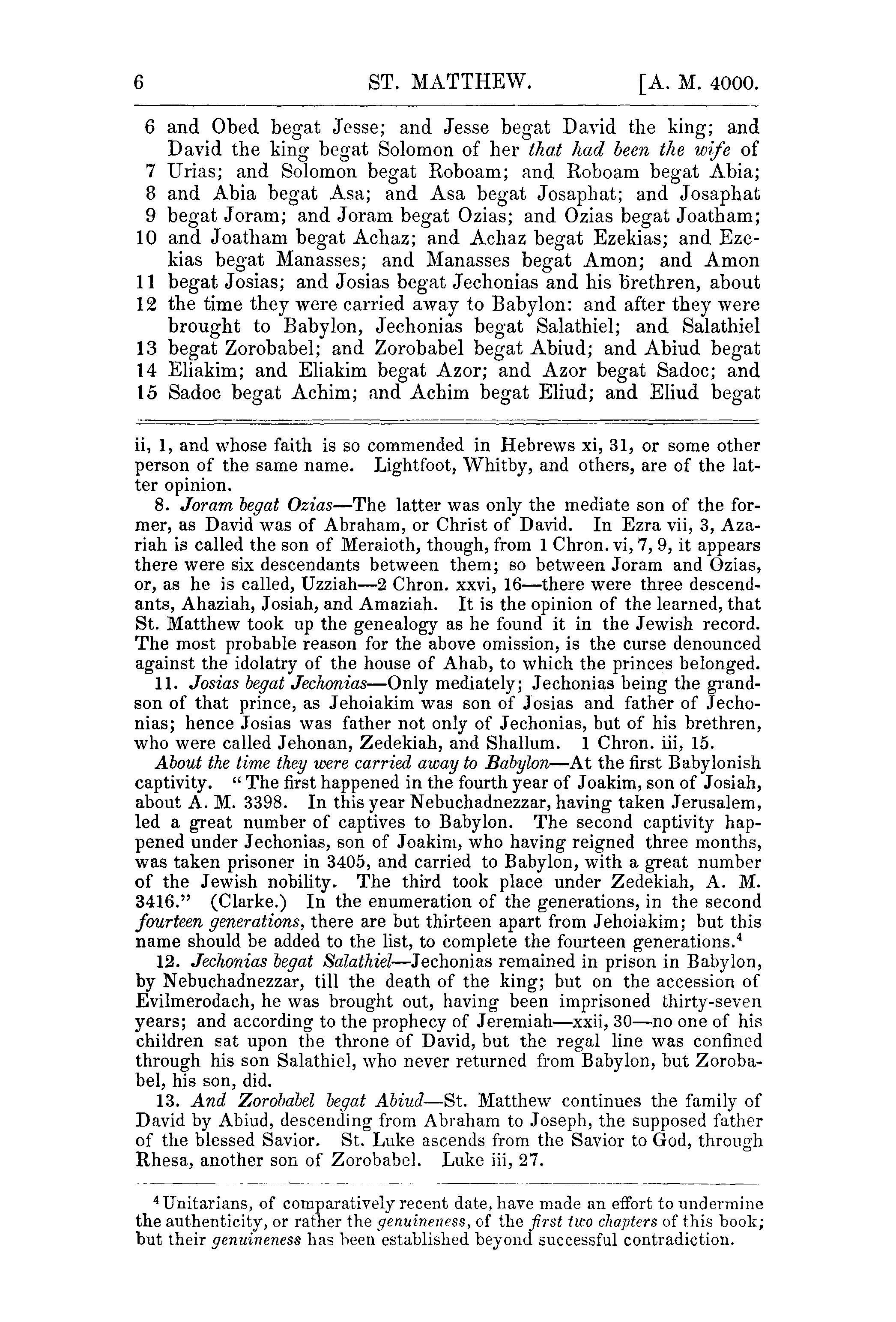
6 and Obed begat Jesse; and Jesse begat David the king; and David the king begat Solomon of her that had been the wife of 7 Urias; and Solomon begat Roboam; and Roboam begat Abia; 8 and Abia begat Asa: and Asa begat Josaphat: and Josaphat 9 begat Joram; and Joram begat Ozias; and Ozias begat Joatham; 10 and Joatham begat Achaz; and Achaz begat Ezekias; and Ezekias begat Manasses; and Manasses begat Amon; and Amon 11 begat Josias; and Josias begat Jechonias and his Brethren, about 12 the time they were carried away to Babylon: and after they were brought to Babylon, Jechonias beg at Salathiel; and Salathiel 13 begat Zorobabel; and Zorobabel begat Abiud; and Abiud begat 14 Eliakim; and Eliakim begat Azor; and Azor begat Sadoc; and 15 Sadoc begat Achim; and Achim begat Eliud; and Eliud begat
ii, 1, and whose faith is so commended in Hebrews xi, 31, or some other person of the same name. Lightfoot, Whitby, and others, are of the latter opinion.
8. Joram begat Ozias-The latter was only the mediate son of the former, as David was of Abraham, or Christ of David. In Ezra vii, 3, Azariah is called the son of Meraioth, though, from 1 Chron. vi, 7, 9, it appears there were six descendants between them; so between Joram and Ozias, or, as he is called, Uzziah-2 Chron. xxvi, 16-there were three descendants, Ahaziah, Josiah, and Amaziah. It is the opinion of the learned, that St. Matthew took up the genealogy as he found it in the Jewish record. The most probable reason for the above omission, is the curse denounced against the idolatry of the house of Ahab, to which the princes belonged.
11. Josias begat Jechonias-Only mediately; J echonias being the grandson of that prince, as J ehoiakim was son of Josias and father of J echonias; hence Josias was father not only of Jechonias, but of his brethren, who were called Jehonan, Zedekiah, and Shallum. 1 Chron. iii, 15.
About the lime they were carried away to Babylon-At the first Babylonish captivity. "The first happened in the fourth year of Joakim, son of Josiah, about A. M. 3398. In this year Nebuchadnezzar, having taken Jerusalem, led a great number of captives to Babylon. The second captivity happened under Jechonias, son of Joakim, who having reigned three months, was taken prisoner in 3405, and carried to Babylon, with a great number of the Jewish nobility. The third took place under Zedekiah, A. M. 3416." (Clarke.) In the enumeration of the generations, in the second fourteen generations, there are but thirteen apart from Jehoiakim; but this name should be added to the list, to complete the fourteen generatlons."
12. Jechonias begat Salathiel-Jechonias remained in prison in Babylon, by Nebuchadnezzar, till the death of the king; but on the accession of Evilmerodach, he was brought out, having been imprisoned thirty-seven years; and according to the prophecy of Jeremiah-xxii, 30-no one of his children sat upon the throne of David, but the regal line was confined through his son Salathiel, who never returned from Babylon, but Zorobabel, his son, did.
13. And Zorobabel begat Abiud-St. Matthew continues the family of David by Abiud, descending from Abraham to Joseph, the supposed father of the blessed Savior. St. Luke ascends from the Savior to God, through Rhesa, another son of Zorobabel. Luke iii, 27.
4 Unitarians, of comparatively recent date, have made an effort to undermine the authenticity, or rather the genuineness, of the first tico chapters of this book; but their genuineness has heen established beyond successful contradiction.
Eleazar; and Eleazar begat Matthan; and Matthan begat Jacob; 16 and Jacob begat Joseph the husband of Mary, of whom was born 17 Jesus, who is called Christ. So all the generations from Abraham to David are fourteen generations; and from David until the carrying away into Babylon are fourteen generations; and from the carrying away into Babylon unto Christ are fourteen generations.
18 Now the birth of Jesus Christ was on this wise: When as his mother Mary was espoused to Joseph, before they came together, 19 she was found with child of the Holy Ghost. Then Joseph her husband, being a just man, and not willing to make her a public 20 example, was minded to put her away privily. But while he thought on these things, behold, the angel of the Lord appeared unto him in a dream, saying, Joseph, thou son of David, fear not to take unto thee Mary thy wife: for that which is conceived in
21 her is of the Holy Ghost. And she shall bring forth a son, and thou shalt call his name JESUS: for he shall save his people from
16. Jesus, who is called Christ-Jesus, from the Hebrew term, which signifies to save. Christ, from the Hebrew, signifying anointed, and applied to the regal, sacerdotal, and prophetical offices, since kings, priests, and prophets were inaugurated by anointing.
18. Espoused to JosephS-The females, of both Jews and Hindoos, were betrothed before being married. According to the law-Deut. xxii, 25-28illicit connection with a "betrothed damsel," was punished with death, nor could a contract of this kind be broken but by regular divorce. Some think Joseph might have taken advantage of this law, and had Mary stoned to death. It was, doubtless, divinely ordered that she was betrothed to Joseph, who, as the legal father, was directed to call him JESUS. Holy Ghost.6
19. To make her a public example-To exhibit her to public ignominy; Joseph intended to put her away privately, to save her life and character; but God interposed, and all is right.
20. AngeF of the Lord-When Joseph thought on, or was in trouble, the angel appeared and allayed his troubles, by saying, Fear not to take unto thee Mary thy wife. This appearance of the angel was in a dream. In the days of Patriarchism and Judaism, God often revealed his will by dreams, not only to his own people, but to the world at large. "There is, however, reason to think, that prophetical dreams had, except in the case of Simon the Just, ceased after the time of the last of the prophets, Malachi;" till this prophetic dream of Joseph. That which is conceived in her is of the Holy Ghost. Instead of conceived, it is better rendered, formed. "It appears that the human nature of Jesus Christ was a real creation, by the power of the Holy Ghost." (Clarke.)
21. Thou shalt call his name JEsus8- The same as Yehosua, or Joshua,
5 In the fifth year, before the account called Anno Domini, or A. D.
6 ITvw.u<t'TO' 1:t}lou-1. The term 7TViU.utt, is rendered but seldom breath. Matt. xxvii, 50; John iii, 8; Rev. xiii, 15. 2. It means, again, the spiritual part of man, opposed to �<tp;, his carnal part. 3. Spirit, the third person in the Trinity.
7 A}}�M,-It is a propel' name, and should be rendered Angel.
8 Save his people, etc.-The word �(t'('IV, 1. Signifies to preserve from any evil, temporal or spiritual. 2. To preserve from sickness, to heal. 3. To preserve from the temporal judgments of the Almighty; as manifested by the destroying angel in Egypt. 4. To give future salvation in heaven. Under the first sense, is implied deliverance from sin-its guilt and dominion. Romans vi, 14.
22 their sins. Now all this was done, that it might be fulfilled which 23 was spoken of the Lord by the prophet, saying, behold, a virgin shall be with child, and shall bring forth a son, and they shall call his name Emmanuel, which being interpreted is, God with 24 us. Then Joseph, being raised from sleep, did as the angel of 25 the Lord had bidden him, and took unto him his wife: and knew her not till she had brought forth her first-born son: and he called his name JESUS.
CHAPTER II. 1. Now when Jesus was born in Bethlehem of Judea, in the days of Herod the king, behold, there came wise men
only terminated according to the Greek idiom. Joshua, the commander of the tribes, was originally called" Oshea the son of Nun," Num. xiii,8; it was given to Christ, because of its import, "he shall save his people from their sins "-from the power, guilt, and pollution of sin, even now, to all that believe.
23. Shall call his name Emmanuel-This is taken from Isaiah vii, 14: "Therefore the Lord himself shall give you a sign: Behold, a virgin shall conceive, and bear a son, and shall call his name Immanuel." The Hebrew word properly signifies a virgin, literally hid, or concealed, till lawfully married. Immanuel is a Hebrew term, el, God, immanu, with us. This is God with us. This name was a proper "sign," and the birth of Jesus an extraordinary miracle. At the juncture when this sign was given, Judah was greatly afflicted; Isaiah is sent from God to Ahaz, king of Judah, at a time when Pekah, king of Israel, and Resin, king of Syria, were united to destroy Judah. The prophet commanded the king to seek a siqn; the latter refused. It is then added, "Therefore the Lord himself shall give you a sign," that a virgin "shall bring forth a son." As if he had said, Till this comes to pass, all the enemies of Judah, etc., shall be unsuccessful; for the scepter shall not depart from Judah till Shilo come. But in after years, the enemies have been successful against Judah and Jerusalem; therefore, the Shilo has come; then let every Jew believe on his namethe Immanuel.
24. Took unto him his wife-Joseph obeyed the heavenly vision. Angel of the Lord-Probably Gabriel showed him the whole matter-the fulfillment of prophecy, the advent of the Messiah, and through him, the redemption of the world.
25. And knew her not, "matrimonially," till she had brought forth her first-born son-It was necessary for the completion of the prophecy, that the mother should continue a virgin till she had brought forth the first-born, but no longer. Says the Lord, "Sanctify unto me all the first-born," Ex. xiii, 2. Some half-educated infidels, with the whole serpent-brood of ignorant fanatics, have, with vulture rapacity, driveled out the remnant of their fetid breath in slandering the birth of the blessed Savior; but the Lord shall laugh at their folly, and judge them for their treason.
CHAPTER II. 1. Bethlehem of Judea-There was another Bethlehem in the tribe of Zebulon. Josh. xix, 15. In Gen. xlviii, 7, it is called Ephrath; in Micah v, 2, it is called Ephratah; in Hebrew, it signifies" the house of bread." This was the place where the Son of God was manifested to take away the sin of the world.
Herod the king-He was an ldumean, born at Askelon, in Edom, or Idumea. He was likewise a proselyte to the Jewish religion. He obtained the kingdom of Judea, by war and bloodshed, and the favors of the Romans. He reigned thirty-seven years in Judea a cruel tyrant. Eusebius says he married ten wives. Five days before his death, he ordered Antipater, his
92 from the east to Jerusalem, saying, Where is he that is born King of the Jews? for we have seen his star in the east, and are come 3 to worship him. When Herod the king had heard these things, 4 he was troubled, and all Jerusalem with him. And when he had gathered all the chief priests and scribes of the people together,
son, to be executed; he also put to death his wife, Mariamne, the only survivor of the Amonian race. Our blessed Lord was born in the last year of his reign;' the fourth year before the account called A. D. 2. lVise men from the east2- Wise men is not sufficiently definite, as they were of a "particular caste, as distinguished by their peculiarities as any of the Grecian sects of philosophers." In the Syriac, Arabic, Latin, and Italian, says Dr. Bloomfield, the word is not translated, and it is better left so. It is of Persian origin-Mogh-and is designated in Persia as the seat of this class of men. Whitby says, that the Jews believed that there were prophets in the eastern countries: "Saba and Arabia, who were the posterity of Abraham by Keturah." The general impression in the eastern country was, that about this time a great personage was to appear. The Magi, it is probable, were astrologers of Jewish extraction, and lived in Arabia Felix, and having seen the star, came to worship the Messiah.
Having seen his star in the east-Some think this was the star mentioned by Balaam-Num. xxiv, 17-"There shall come a star out of Jacob, and a scepter shall rise out of Israel." " Star"- Various are the opinions concerning this star. The probability is that it was a luminous meteor? On seeing it, the Magi forthwith made their way to Jerusalem, to search according to their previous impression, for the King of the Jews. Saying, where is he? we have seen his star in the east-This was after Christ was born. Dr. Hales offers good reasons that this visit of the Magi was between the thirty-ninth and forty-second days after the birth of Jesus. And are come to worship him-The term worship is from two Greek words, signifying a dog crouching at the feet of his master. From the knowledge of the Magi, it is at least presumptive, that they reverentially adored him, though the term means both civil and religious homage. See John iv, 23.
3. When Herod the king had heard these things-Tacitus and Suetonius witness, touching the general impression or expectation of the advent of some great personage. Herod, a proselyte of the Jewish religion, probably had some knowledge of the Jewish Scriptures; hence of the advent of the Messias, and that he should conquer the Jews' enemies and establish a temporal kingdom, and of course depose him. No sooner did he hear of his birth, than he intended to murder him. He was troubled, etc.-This lustful, jealous, and hypocritical man, was troubled at the glorious news of the advent of the world's Redeemer. What a blind wretch! he intended to kill him. What! could he possibly think to abolish the ordinance of J ehovah l All Jerusalem with him-The subjects were as blind as their king.
4. And when he had gathered all the chief priests and scribes of the people4The chief ones of each of the twenty-four courses of the priests. The
1 See Dr. A. Clarke's Oommentary, Oalmet, and Josephus.
2 M!t}GI-Rendered wise men.
3 Dr. Bloomfield says, "Numerous classical citations are adduced by Wetsins, showing the general belief that new stars appeared at the birth or death of celebrated personages."
4" The Hebrew word for scribe is derived from a root which signifies to number, from which probably comes our word cypher. The rendering in Greek is }�')PP."'-'f'w" from }�"'-P.!-'ct, a letter." (Watson.) Scribes were engaged in writing and transcribing the books of the law; hence the term.
5 he demanded of them where Christ should be born. And they said unto him, In Bethlehem of Judea: for thus it is written by
6 the prophet, and thou Bethlehem, in the land of J uda, art not the least among the princes of J uda: for out of thee shall come a
7 Governor, that shall rule my people Israel. 'I'hen Herod, when he had privily called the wise men, inquired of them diligently
8 what time the star appeared. And he sent them to Bethlehem, and said, Go, and search diligently for the young child, and when ye have found him, bring me word again, that I may come and
9 worship him also. When they had heard the king, they departed; and 10, the star, which they saw in the east, went before them, 10 till it came and stood over where the young child was. When they saw the star, they rejoiced with exceeding great joy.
11 And when they were come into the house, they saw the young child with Mary his mother, and fell down, and worshiped him:
terms denote all the Sanhedrim. See 1 Chron. xxiv, and 2 Chron. xxxvi, 14. The scribes were the expounders of the law. He demanded of them where Christ should be born-In order to slay him with one stroke.
5. They said unto him, In Bethlehem of Judea-This was the proper direction. For thus it is written by the prophets-Micah predicted the place of the Savior's birth. Daniel had pointed out the advent by his weeks, so that the minds of the people were in expectation. When John came, they doubted whether he was not the Christ. Luke iii, 15.
6. Art not the least among the princes of Juda-The words in Micah v, 2, "Though thou be little among the thousands of Judah," may be rendered, "Art thou little!"! Among the Jews the word princes is instituted for thousands. See Judges vi, 15: "My family is poor in Manasseh." 'I'o follow the Hebrew, it is, "My thousand is the meanest in Manasseh." Rule my people Israel-Literally, feed my people, etc., as a shepherd his flock, or, as a father furnishes food for his children, so shall the Messiah feed his perishing people.
7. Inquired diligently what time the star appeared-The first thing he inquired, was where he should be born; then, in the second, the time the star appeared, to know the age of the infant rival, that he might take his life.
8. That I may come and worship him-These easterns came from far to worship, while those near the infant Savior came not. Those that live far from the means of grace, ofttimes seek more diligently than those surrounded with the means. Herod feigned to worship him. What perfect dissimulation, while his wicked heart burned in murderous fury against him! Such will God speak to in "his wrath, and vex them in his sore displeasure.
9. The star6 went before them-The star was the constant precursor of the Magi. Stood over where the young child was-God intended that those Arabians should be the first to adore the Savior. The star must have passed along very low, so as to point out definitely the house where the child was. Doubtless this abode of the Messiah was very different from what these men expected.
10. Rejoiced with exceeding great Joy-A stronger expression can not easily be met with. The original is very emphatic.
s See Wesley's Notes.
6 Watson thinks the star disappeared on their entrance into Judea, and reappeared upon their departure from Jerusalem to Bethlehem, and that at this they rejoiced with exceeding great joy.
and when they had opened their treasures, they presented unto 12 him gifts; gold, and frankincense, and myrrh. And being warned of God in a dream that they should not return to Herod, they 13 departed into their own country another way. And when they were departed, behold, the angel of the Lord appeareth to Joseph in a dream, saying, Arise, and take the young child and his mother, and flee into Egypt, and be thou there until I bring thee 14 word: for Herod will seek the young child to destroy him. When he arose, he took the young child and his mother by night, and 15 departed into Egypt: and was there until the death of Herod: that it might be fulfilled which was spoken of the Lord by the prophet, saying, Out of Egypt have I called my son.
16 Then Herod, when he saw that he was mocked of the wise
11. They saw the young child with Mary his mother7-Here is the infant Messiah, with the star above his head, the Magi around him, and God in the midst. What a glorious scene! Fell down and worshiped him-They were not offended with his poverty and humble condition, but prostrated themselves before him, and acknowledged him as their Lord and King; and presented him the choicest productions of their country-gold, frankincense, and myrrh. In the east, visitors of great personages always presented gifts. These gifts were necessary for their flight into Egypt, and to aid them in that strange country.
12. They departed into their own country another way-It might be thought desirous for them to go by Jerusalem, and inform the king, etc. God knew Herod's murderous heart. Hence he directed the WISE MEN into their own country another way.
13. Flee into Egypt-This was the place where the children of Israel had lived and toiled for two hundred and fifteen years. Egypt was beyond Herod's jurisdiction. Joseph obeyed the Divine command forthwith. And be thou there until I bring thee word-In a few months after Herod died, word came, and they returned. How mysterious are the ways of Providence!
14. Egypt-From the time that Alexander conquered this country, the Jews were found in great numbers in its principal cities, especially in Alexandria. Here they established their own worship, and held intercourse with their brethren in Judea. Joseph, of course, could tarry with his brethren while there. It was providential that the Virgin Mary had the prudent Joseph to protect her in such circumstances.
15. Out of Egypt have I called my son-This is quoted from Hosea xi, 1. It is rendered by the &venty, "Out of Egypt have I called his children;" but the Evangelist gives the Hebrew meaning. "As these words were spoken of the people Israel, the question is, whether, in any respect, the people Israel bore a typical character! This must be granted, because nothing is more certain, both from the style of the Hebrew prophets, and from the writings of St. Paul, than that Israel, 'after the flesh,' is often made the type of 'the Israel of God,' or of the Christian Church; and the deliverance of the former from Egypt, the type of our redemption by Christ." (Watson.) The words apply primarily to the Israelites, and in the secondary sense, or, rather, the typical sense, to Jehovah's only Son?
16. Was exceeding wroth-When mocked of the wise men, as he supposed,
7 For some appropriate remarks on this verse, see those of Justin Martyr, Irenzeus, and 'I'ertullian, quoted by Whitby, in loco.
S See some fine remarks made by Watson and Whitby on this text.
men, was exceeding wroth, and sent forth, and slew all the children that were in Bethlehem, and in all the coasts thereof, from two years old and under, according to the time which he had dil17 igently inquired of the wise men. Then was fulfilled that which 18 was spoken by Jeremy the prophet, saying, In Rama was there a voice heard, lamentation, and weeping, and great mourning, Rachel weeping for her children, and would not be comforted, because they are not.
his hypocrisy and malice kindled into rage; he was exceeding wroth. Poor wretch! Slew all the children9-This was a monstrous act, of a monstrous malignity; still, it was in keeping with his character. He had murdered his sons, and his wife, and many others. Well was it said, "It is better to be Herod's hog, than his son."! His Judaism forbade him to eat a hog; but his wicked heart did not forbid him, in cold blood, to murder the innocent children, and to seek the murder of the Son of God. While on his death-bed, he called for all the distinguished Jews, and had them shut up in the circus, ordering that they should be slain when he expired, that the Jews might mourn at his death. "The order was disobeyed; but it marks the character of this unhappy man of blood, with whom departed the scepter finally from Judah."
17. Then was fulJilled-The quotation is from Jeremiah xxxi, 15. It is not said, as in verse 15, That it might be fulfilled, but, Then was fulfilled, signifying" another more eminent completion." Watson thinks Whitby does not give the best reason on this prophecy. The former says, " For if the words of Jeremiah should be considered as a prediction of the distress to be brought upon the Jewish mothers of his day, personified by Rachel, by the slaughtering and the leading away their children into captivity by the Babylonian army, still this prophecy may rank among a large class of predictions, which have an application to two or more events; and the heart-rending affliction of the mothers of Bethlehem and its borders was the second event to which the prophecy of Jeremiah looked, and that with striking propriety, since the scene was laid in the same tract of country, and the event was rendered equally moving by the cries and lamentations of bereaved mothers. The prophecy was, therefore, truly said by St. Matthew to have been' fulfilled' in its originally-designed, ultimate application."
18. In Rama-This place was in the tribe of Benjamin, and near here Rachel was buried. "And Rachel died, and was buried in the way to Ephratah, which is Bethlehem." And here the captive Jews were assembled to be led away to Babylon. This was a memorable spot. The inhabitants of this place were Benjaminites. Benoni, or Benjamin, being Rachel's last child, was much beloved by her husband, Jacob.
9 Tw, 71'�IJ'd.,-Mal� children; 1" Melius est Herodis porcum esse quam jilium." By Macrobius, a heathen of the fourth century: by Lardner. See Watson's Exposition, in loco. Macrobius undoubtedly refers to the tragedy at Bethlehem; so does the Rabbinical work called Toldath Jehu.
It may be asked, Why did not Josephus give an account of the slaughter of those infants? The probable answer is, As Josephus was born in the thirtyeighth year of our Lord, and he wrote the history of the Jewish wars in the fifty-sixth year of his age, and this makes it ninety-four years subsequent to this awful tragedy, it may have passed his memory; and more particularly, as, most likely, there had been no Jewish record of it. What Macrobius has said, though mistaken in the circumstances of his narrative, still "it is sufficient that it is preserved" by him. See Saturn., lib. 2, cap. 4, p. 279.
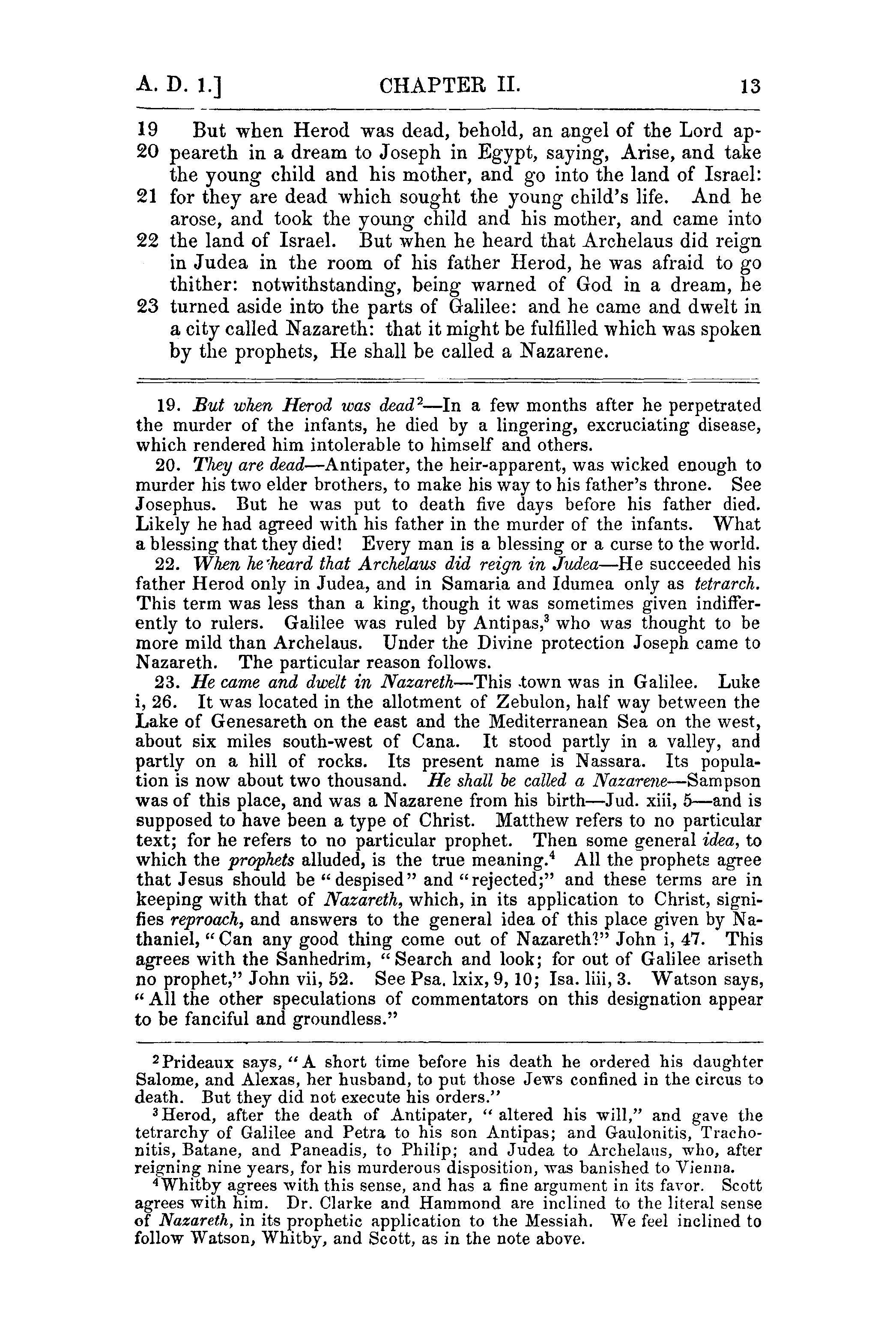
19 But when Herod was dead, behold, an angel of the Lord ap20 peareth in a dream to Joseph in Egypt, saying, Arise, and take the young child and his mother, and go into the land of Israel: 21 for they are dead which sought the young child's life. And he arose, and took the young child and his mother, and came into 22 the land of Israel. But when he heard that Archelaus did reign in Judea in the room of his father Herod, he was afraid to go thither: notwithstanding, being warned of God in a dream, he 23 turned aside into the parts of Galilee: and he came and dwelt in a city called Nazareth: that it might be fulfilled which was spoken by the prophets, He shall be called a Nazarene.
19. But when Herod was dead2-In a few months after he perpetrated the murder of the infants, he died by a lingering, excruciating disease, which rendered him intolerable to himself and others.
20. They are dead-Antipater, the heir-apparent, was wicked enough to murder his two elder brothers, to make his way to his father's throne. See Josephus. But he was put to death five days before his father died. Likely he had agreed with his father in the murder of the infants. What a blessing that they died! Every man is a blessing or a curse to the world.
22. When he <heard that Archelaus did reign in Judea-He succeeded his father Herod only in Judea, and in Samaria and Idumea only as tetrarch, This term was less than a king, though it was sometimes given indifferently to rulers. Galilee was ruled by Antipas," who was thought to be more mild than Archelaus. Under the Divine protection Joseph came to Nazareth. The particular reason follows.
23. He came and dwelt in Nazareth-This .town was in Galilee. Luke i, 26. It was located in the allotment of Zebulon, half way between the Lake of Genesareth on the east and the Mediterranean Sea on the west, about six miles south-west of Cana. It stood partly in a valley, and partly on a hill of rocks. Its present name is Nassara. Its population is now about two thousand. He shall be called a Nazarene-Sam pson was of this place, and was a Nazarene from his birth-J ud. xiii, 5-and is supposed to have been a type of Christ. Matthew refers to no particular text; for he refers to no particular prophet. Then some general idea, to which the prophets alluded, is the true meaning." All the prophets agree that Jesus should be" despised" and" rejected;" and these terms are in keeping with that of Nazareth, which, in its application to Christ, signifies reproach, and answers to the general idea of this place given by N athaniel, "Can any good thing come out of Nazareth!" John i, 47. This agrees with the Sanhedrim, "Search and look; for out of Galilee ariseth no prophet," John vii, 52. See Psa, lxix, 9,10; Isa.liii, 3. Watson says, All the other speculations of commentators on this designation appear to be fanciful and groundless."
2 Prideaux says, "A short time before his death he ordered his daughter Salome, and Alexas, her husband, to put those Jews confined in the circus to death. But they did not execute his orders."
3 Herod, after the death of Antipater, "altered his will," and gave the tetrarchy of Galilee and Petra to his son Antipas; and Gaulonitis, Trachonitis, Batane, and Paneadis, to Philip; and Judea to Archelans, who, after reigning nine years, for his murderous disposition, was banished to Vienna.
4Whitby agrees with this sense, and has a fine argument in its favor. Scott agrees with him. Dr. Clarke and Hammond are inclined to the literal sense of Nazareth, in its prophetic application to the Messiah. We feel inclined to follow Watson, Whitby, and Scott, as in the note above.
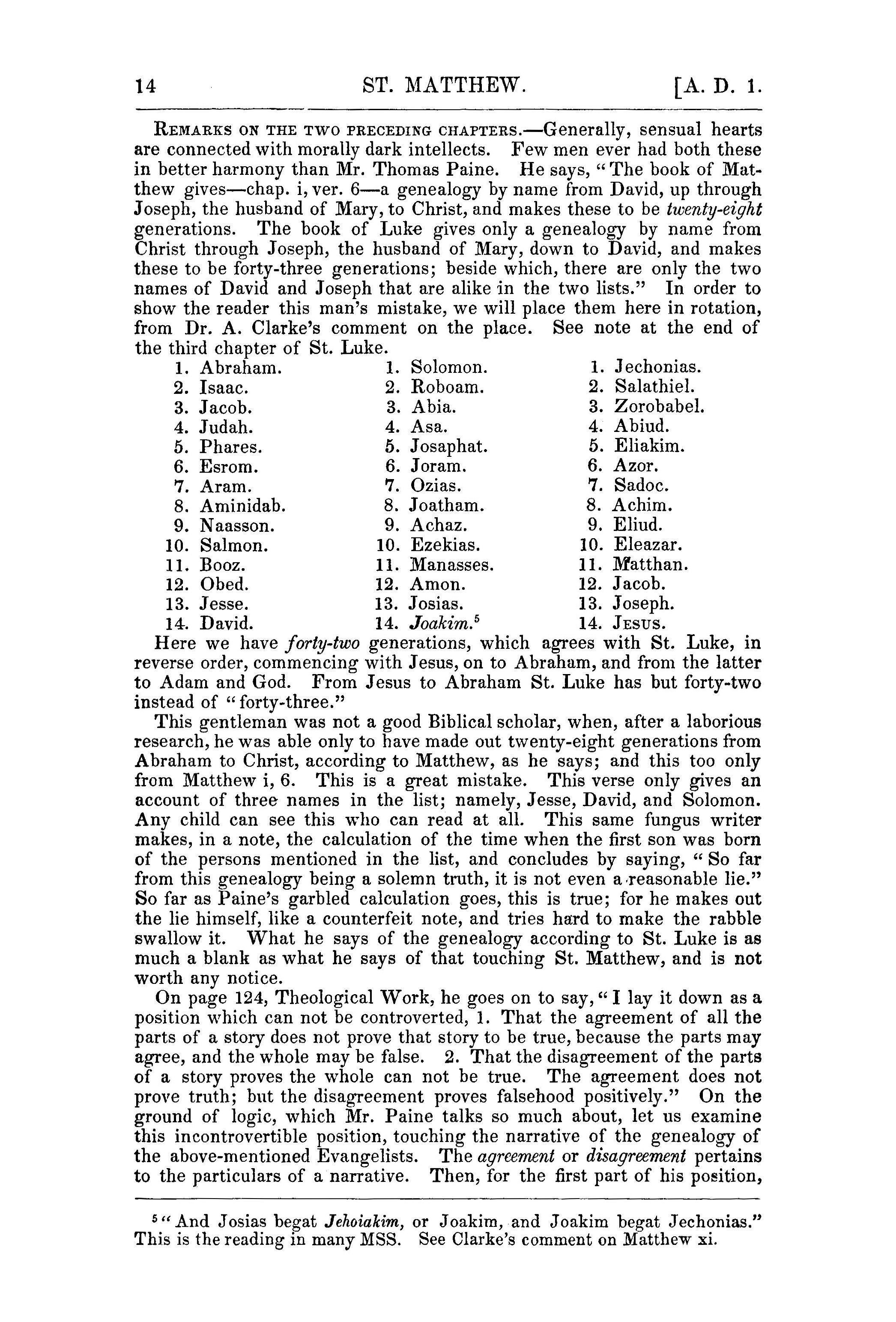
REMARKS ON THE TWO PRECEDING CHAPTERs.-Generally, sensual hearts are connected with morally dark intellects. Few men ever had both these in better harmony than Mr. Thomas Paine. He says, "The book of Matthew gives-chap. i, ver. 6-a genealogy by name from David, up through Joseph, the husband of Mary, to Christ, and makes these to be twenty-eight generations. The book of Luke gives only a genealogy by name from Christ through Joseph, the husband of Mary, down to David, and makes these to be forty-three generations; beside which, there are only the two names of David and Joseph that are alike in the two lists." In order to show the reader this man's mistake, we will place them here in rotation, from Dr. A. Clarke's comment on the place. See note at the end of the third chapter of St. Luke.
1. Abraham.
1. Solomon.
1. Jechonias. 2. Isaac.
2. Roboam.
2. Salathiel. 3. Jacob. 3. Abia.
4. Judah. 4. Asa.
3. ZorobabeI.
4. Abiud. 5. Phares. 5. Josaphat. 5. Eliakim. 6. Esrom. 6. Joram.
6. Azor. 7. Aram. 7. Ozias.
7. Sadoc. 8. Aminidab. 8. Joatham. 8. Achim. 9. Naasson. 9. Achaz. 9. Eliud. 10. Salmon.
10. Ezekias. 10. Eleazar. 11. Booz. 11. Manasses. 11. Matthan. 12. Obed. 12. Amon.
12. Jacob. 13. Jesse. 13. Josias. 13. Joseph. 14. David. 14. Joakim."
14. JESUS.
Here we have forty-two generations, which agrees with St. Luke, in reverse order, commencing with Jesus, on to Abraham, and from the latter to Adam and God. From Jesus to Abraham St. Luke has but forty-two instead of "forty-three."
This gentleman was not a good Biblical scholar, when, after a laborious research, he was able only to have made out twenty-eight generations from Abraham to Christ, according to Matthew, as he says; and this too only from Matthew i, 6. This is a great mistake. This verse only gives an account of three names in the list; namely, Jesse, David, and Solomon. Any child can see this who can read at all. This same fungus writer makes, in a note, the calculation of the time when the first son was born of the persons mentioned in the list, and concludes by saying, "So far from this genealogy being a solemn truth, it is not even a .reasonable lie."
So far as Paine's garbled calculation goes, this is true; for he makes out the lie himself, like a counterfeit note, and tries hard to make the rabble swallow it. What he says of the genealogy according to St. Luke is as much a blank as what he says of that touching St. Matthew, and is not worth any notice.
On page 124, Theological Work, he goes on to say, I lay it down as a position which can not be controverted, 1. That the agreement of all the parts of a story does not prove that story to be true, because the parts may agree, and the whole may be false. 2. That the disagreement of the parts of a story proves the whole can not be true. The agreement does not prove truth; but the disagreement proves falsehood positively." On the ground of logic, which Mr. Paine talks so much about, let us examine this incontrovertible position, touching the narrative of the genealogy of the above-mentioned Evangelists. The agreement or disagreement pertains to the particulars of a narrative. Then, for the first part of his position,
5" And J osias begat Jehoiakim, or J oakim, and J oakim begat J echonias." This is the reading in many MSS. See Clarke's comment on Matthew xi.
CHAPTER III. 1. In those days came John the Baptist, preaching in 2 the wilderness of Judea, and saying, Repent ye; for the kingdom
namely, "The agreement of all the parts of a story does not prove that story to be true." In answer, we say, 1. The agreement of all the parts of a narrative, declared by two or more men, at different periods, and in different places, has more prima facie evidence to be the truth than the falsehood of a narrative. But Paine says "it does not prove" it true. Very well; it does not prove it false. Here the gentleman gains nothing. But the very" agreement" is presumptive evidence that the narrative is true. Yea; it is evidence presumptive in any court of justice. Instance: If four, or even two, witnesses, of as fair a moral character at least as Mr. Paine, were to depose testimony in case of the murder of B by C, at a particular time and place, and both agree in the particulars of the narrative, the court would be bound to receive such as true, or presumptively so. If four unassuming, plain, and honest men certify that they saw a man by the name of Thomas Paine in a French prison, giving time and place, and all agreeing thereto, would the "agreement" of their testimony not be presumptive of the fact l The reverse would be absurd. So much for Mr. Paine's first part of this" incontrovertible position." 2. He says, "The disagreement of the parts of a story proves the whole can not be true," etc. This, of course, if there be contradictory sentiments, or statements; but if only a variety of statement, it strengthens rather than weakens the narrative. Instance: If Messrs. Hume and Paine were to write the life of Voltaire, they would doubtless vary in particulars. The former would say something which the latter would omit, etc. Our dashing writer's" incontrovertible position" is false, in part, and emphatically so in its application to the Evangelists.
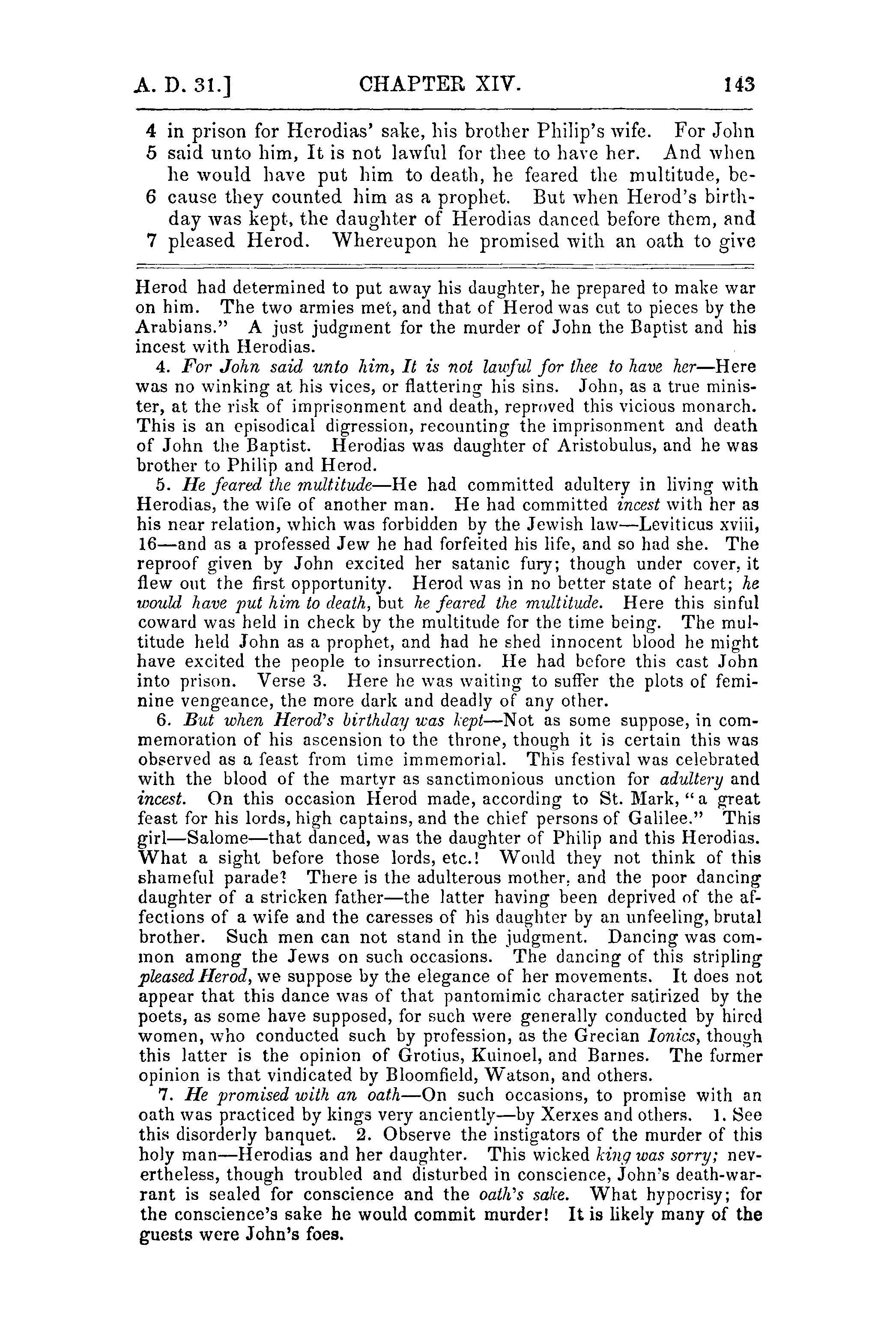
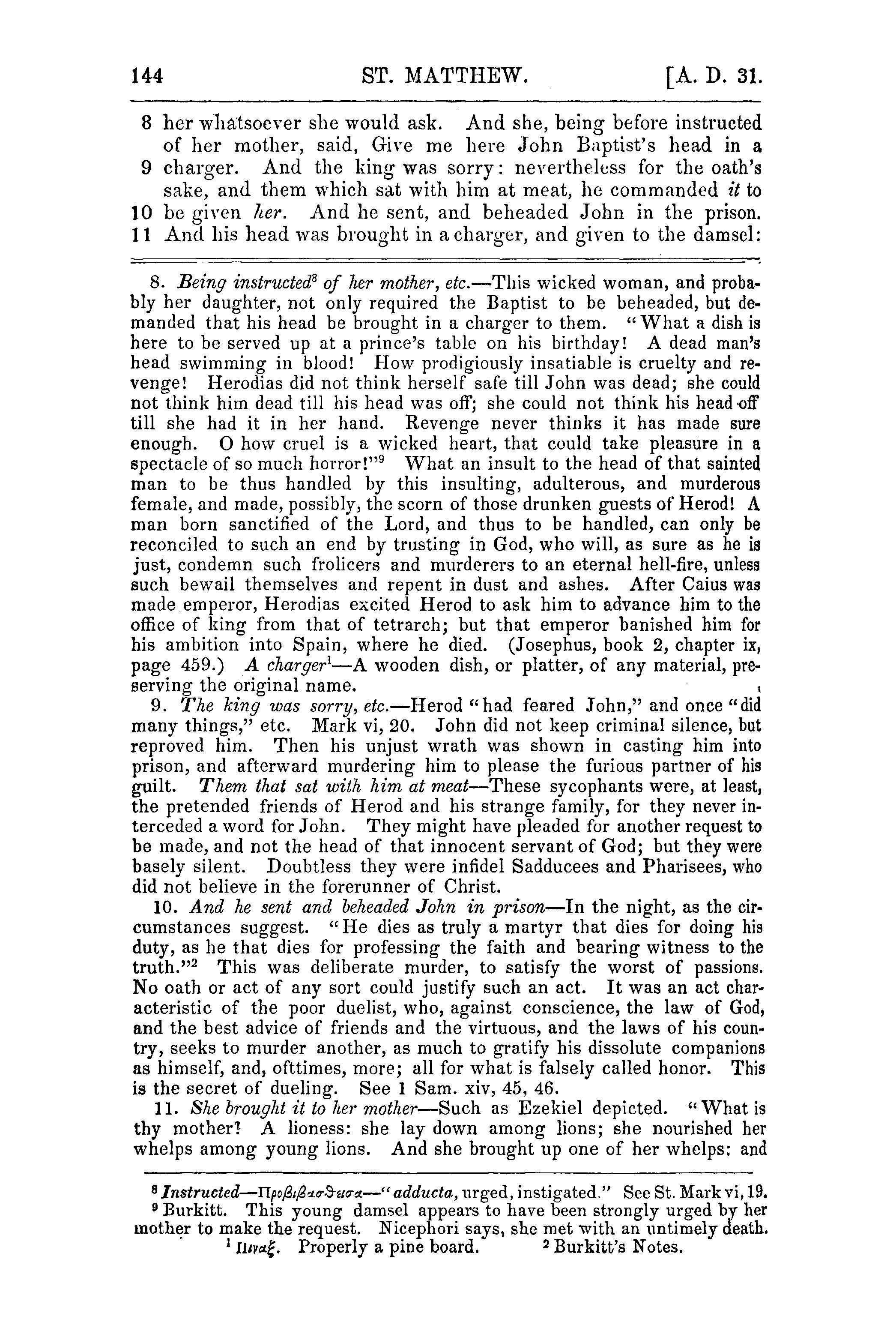
CHAPTER' Ill. 1. In those days-In the fifteenth year of TiberiusLuke iii, I-came John the Baptist, preaching in the wilderness of Judea. St. Matthew passes over the particulars of John's parentage and birth. John was born about six months before our Lord; and it is likely the former commenced his ministry when he was about thirty years of age, according to the Jewish law. The term John is rendered, in the Old 'I'esment, J ohanan. This name he received from the angel, and signifies, The mercy of the Lord. In Luke i, 63, we have the particulars of his birth. He was very abstemious in the manner of his life. For reproving Herod of incest with his brother's wife, he was cast into prison, and Salome, the fine dancer, received his head as a premium, at the instigation of her profligate mother. Preaching6-Discharging' the office of a herald. Wilderness7-Among the Jews it only meant a place not much inhabited. We read of six cities with their villages in the "wilderness," Josh. xv, 61,62; 1 Sam. xxv, 1, 2; and Joab had his house in the "wilderness," 1 Kings ii, 34. Nevertheless, John was not a hermit, as Romanists would have him.
2. Repents ye-See verse eighth. The kingdom of heaven is at hand-The appearance of the Messiah, the sign of whom was termed the kingdom of heaven. This kingdom was predicted by Daniel. Chap. ii, 44, and vii, 13, 14. First. That the kingdom" of heaven" and the kingdom" of God" signify the same thing, as will be evident from the variation of the word: "Blessed are the poor, for theirs is the kingdom of heaven," Matt. v, 3; "The kingdom of God," Luke vi, 20; "The kingdom of heaven is at
6 Kl1pu!TIT(A)V, preaching or proclaiming like a herald in the streets or open air.
7 E��.uo�, wilderness, a place sparsely populated.
8 METctVoWTE, repent. This was the subject-matter of his preaching.
3 of heaven is at hand. For this is he that was spoken of by the prophet Esaias, saying, The voice of one crying in the wilderness,
hand," Matt. iv, 17; "The kingdom of God," Mark i, 15. The reason seems to be, because this kingdom is erected by the" God of heaven;" and, in Scripture phrase, it is the same to be from God and to be from heaven." Secondly. The kingdom of heaven sometimes signifies eternal glory: "Great is their reward in heaven;" see Matt. vii, 21; Mark ix, 46, 47. Thirdly. It signifies, in the Gospel, the coming of Christ to erect his spiritual kingdom. When this kingdom is said to be at hand, that it was "among the Jews," Luke xvii, 21; that it was" come to them," Matt. xii, 28. In the following sketch consider:
.1. WHAT THIS KINGDOM IMPLIES: 1. It implies a king, the Lord Jesus Christ. "Yet have I set my king upon my holy hill of Zion," Psa. ii,6; 1 Tim. i, 17; vi, 17; Rev. xv, 3; xvii, 14; xix, 17.1 2. It implies devoted servants. The Hebrew had two sorts of servants; some were strangers, either bought or taken in war, and they were either kept, exchanged, or sold. Lev. xxv, 44, etc. The others were Hebrew servants, or slaves, who, being poor, sold themselves, or were sold, to pay their debts. But these only continued in slavery six years. After this they might return to liberty. Lev. xxv, 40. The third sort of servant is one who dedicates himself to the service of another by his own will. For example, one like Joshua, who was servant of Moses, Elisha of Elijah, Gehazi of Elijah, and the apostles of Christ. Again: servant is put for the subjects of a prince. The servant of Pharaoh, the servants of Saul. 2 Sam. xi, 11, and xii, 19. In like manner the Philistines, the Syrians, etc., were the servants of David. 2 Sam. viii, 6. Again: servants are opposed to those who are freed from sin, or to the children of the promises, representing the Jews in contradistinction to the Christians, or those who were under the yoke of ceremonies to those under the freedom of the Gospel. The Jews were the servants represented by Hagar and Ishmael; the Christians are the children of liberty represented by Sarah and Isaac. Gal. iv, 3-7, 22, 23, etc. Finally: all faithful persons, who, being brought and redeemed from the bondage of sin, serve God in righteousness and true holiness. Rom. vi, 22. These are the true subjects of Christ's kingdom: in a sense still a little different, all that obey God, not only in the sense of religion, but in some function or peculiar calling, used by God as an instrument to effect or perform his will. Rom. i, 1; Phil. ii, 7. 3. This kingdom has laws. "The government shall be upon his shoulders. Give ear, 0, my people, to my law," Psa. lxxviii, 1; Amos ii, 4; Luke ii, 39; Exod. xviii, 16; Heb. viii, 10, and x, 16.
II. THE NATURE OF THIS KINGDOM: 1. It is a heavenly, in opposition to an earthly kingdom. Matt. v, 3-10; xi, 11; xiii, 11; xvi, 19; John xviii, 36. 2. It is termed the Gospel of the grace of God. It receives and shows mercy to offenders, on their returning to God by faith and repentance. 3. This kingdom shall be an everlasting kingdom. Dan. vii, 14. The perfect and concluding dispensation of this world.
3. For this is he that was spoken of by the prophet Esaias-The Greek
9Whitby's Commentary, in loco.
I Whitby has commented on the nature of the Gospel kingdom at some considerable length, to whom the reader is cheerfully referred on the above text. In his commentary on the New Testament he omits chronology, and generally the description, etc., of the sundry- places; but these are generally made up at the end of his work; in the main It IS a good and great work. Among eight or nine commentators, we esteem Rev. R Watson's Exposition, so far as it extends, on the Scriptures, to be unrivaled for strength and clearness of thought.
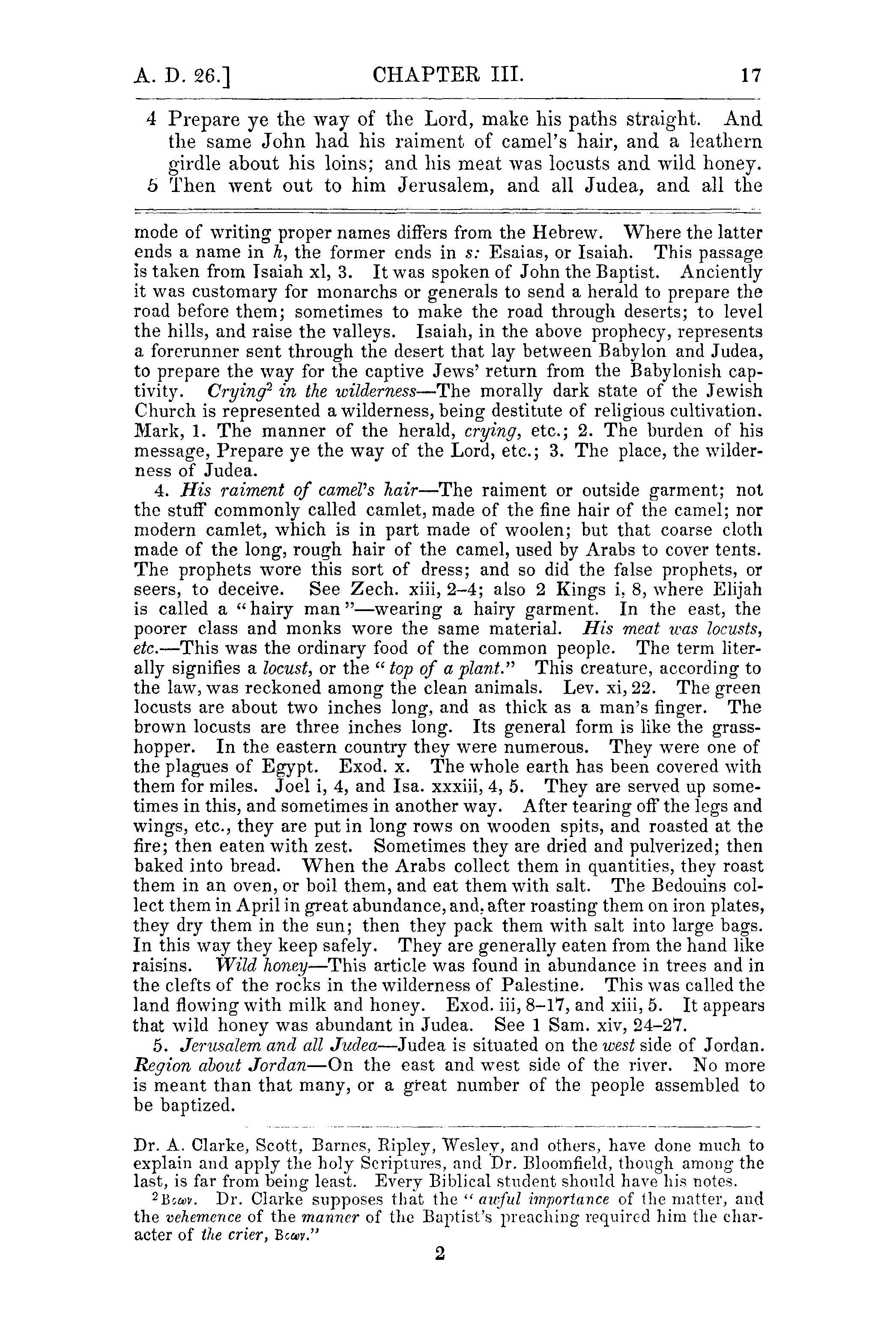
4 Prepare ye the way of the Lord, make his paths straight. And the same John had his raiment of camel's hair, and a leathern girdle about his loins; and his meat was locusts and wild honey.
S Then went out to him Jerusalem, and all Judea, and all the mode of writing proper names differs from the Hebrew. Where the latter ends a name in h, the former ends in s: Esaias, or Isaiah. This passage is taken from Isaiah xl, 3. It was spoken of John the Baptist. Anciently it was customary for monarchs or generals to send a herald to prepare the road before them; sometimes to make the road through deserts; to level the hills, and raise the valleys. Isaiah, in the above prophecy, represents a forerunner sent through the desert that lay between Babylon and Judea, to prepare the way for the captive Jews' return from the Baby Ionish captivi ty. Crying2 in the wilderness-The morally dark state of the Jewish Church is represented a wilderness, being destitute of religious cultivation. Mark, 1. The manner of the herald, crying, etc.; 2. The burden of his message, Prepare ye the way of the Lord, etc.; 3. The place, the wilderness of Judea.
4. His raiment of camel's hair-The raiment or outside garment; not the stuff commonly called cam let, made of the fine hair of the camel; nor modern camlet, which is in part made of woolen; but that coarse cloth made of the long, rough hair of the camel, used by Arabs to cover tents. The prophets wore this sort of dress; and so did the false prophets, or seers, to deceive. See Zech. xiii, 2-4; also 2 Kings I, 8, where Elijah is called a "hairy man "-wearing a hairy garment. In the east, the poorer class and monks wore the same material. His meat was locusts, etc.-This was the ordinary food of the common people. The term literally signifies a locust, or the" top of a plant." This creature, according to the law, was reckoned among the clean animals. Lev. xi,22. The green locusts are about two inches long, and as thick as a man's finger. The brown locusts are three inches long. Its general form is like the grasshopper. In the eastern country they were numerous. They were one of the plagues of Egypt. Exod. x. The whole earth has been covered with them for miles. Joel i, 4, and Isa, xxxiii, 4, 5. They are served up sometimes in this, and sometimes in another way. After tearing off the legs and wings, etc., they are put in long rows on wooden spits, and roasted at the fire; then eaten with zest. Sometimes they are dried and pulverized; then baked into bread. When the Arabs collect them in quantities, they roast them in an oven, or boil them, and eat them with salt. The Bedouins collect them in April in great abundance, and, after roasting them on iron plates, they dry them in the sun; then they pack them with salt into large bags. In this way they keep safely. They are generally eaten from the hand like raisins. Wild honey-This article was found in abundance in trees and in the clefts of the rocks in the wilderness of Palestine. This was called the land flowing with milk and honey. Exod. iii, 8-17, and xiii, 5. It appears that wild honey was abundant in Judea. See 1 Sam. xiv, 24-27.
5. Jerusalem and all Judea-Judea is situated on the west side of Jordan. Region about Jordan-On the east and west side of the river. No more is meant than that many, or a great number of the people assembled to be baptized.
Dr. A. Clarke, Scott, Barnes, Ripley, Wesley, and others, have done much to explain and apply the holy Scriptures, and Dr. Bloomfield, though among the last, is far from being least. Every Biblical student should have his notes.
211owv. Dr. Clarke supposes that the" auful importance of the matter, and the vehemence of the manner of the Baptist's preaching required him the character of the crier, Bcwv."
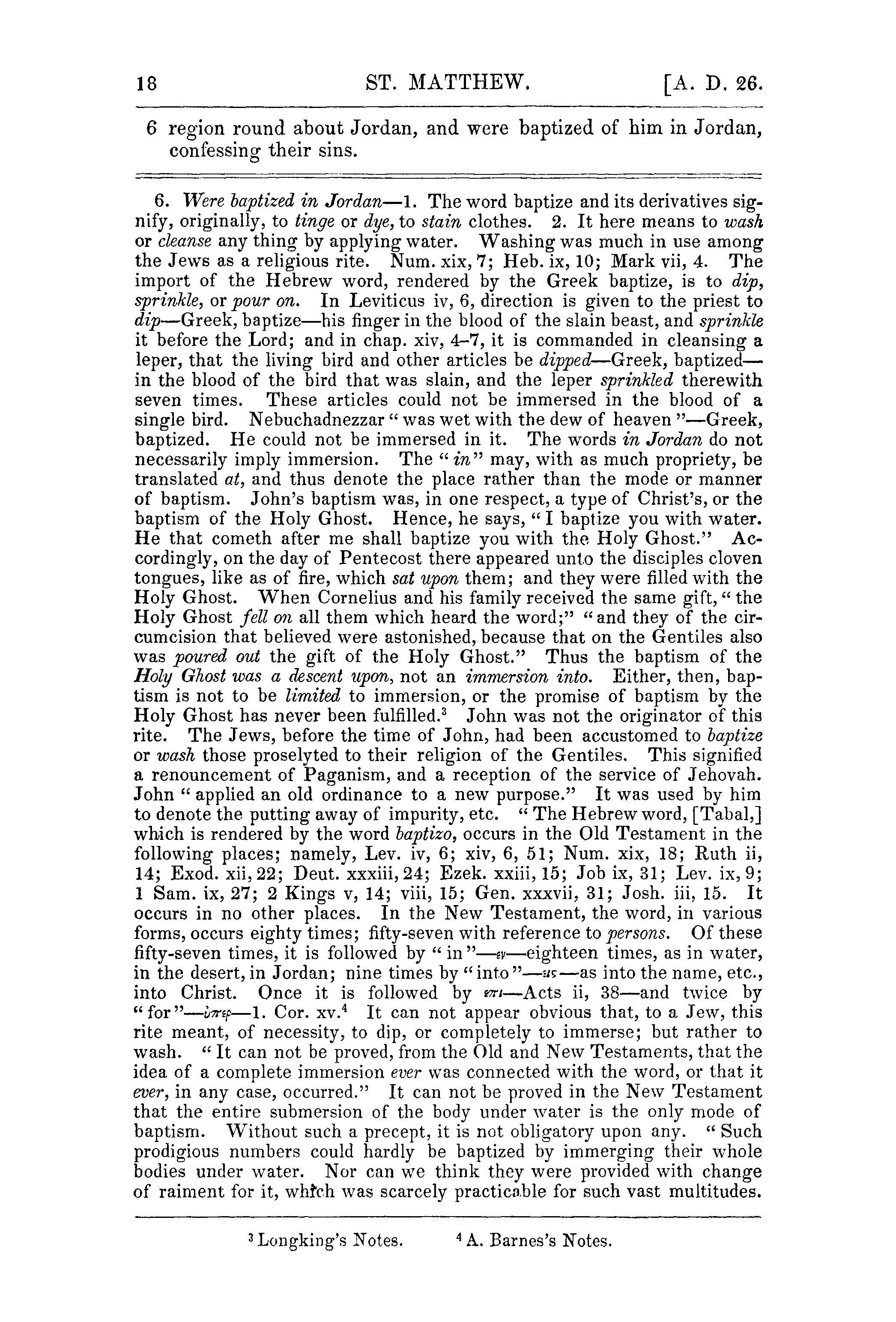
6 region round about Jordan, and were baptized of him in Jordan, confessing their sins.
6. Were baptized in Jordan-I. The word baptize and its derivatives signify, originally, to tinge or dye, to stain clothes. 2. It here means to wash or cleanse any thing by applying water. Washing was much in use among the Jews as a religious rite. Num. xix, 7; Heb. ix, 10; Mark vii, 4. The import of the Hebrew word, rendered by the Greek baptize, is to dip, sprinkle, or pour on. In Leviticus iv, 6, direction is given to the priest to dip-Greek, baptize-his finger in the blood of the slain beast, and sprinkle it before the Lord; and in chap. xiv, 4-7, it is commanded in cleansing a leper, that the living bird and other articles be dipped-Greek, baptizedin the blood of the bird that was slain, and the leper sprinkled therewith seven times. These articles could not be immersed in the blood of a single bird. N ebuchadnezzar was wet with the dew of heaven "-Greek, baptized. He could not be immersed in it. The words in Jordan do not necessarily imply immersion. The" in" may, with as much propriety, be translated at, and thus denote the place rather than the mode or manner of baptism. John's baptism was, in one respect, a type of Christ's, or the baptism of the Holy Ghost. Hence, he says, "I baptize you with water. He that cometh after me shall baptize you with the Holy Ghost." Accordingly, on the day of Pentecost there appeared unt.o the disciples cloven tongues, like as of fire, which sat upon them; and they were filled with the Holy Ghost. When Cornelius and his family received the same gift," the Holy Ghost fell on all them which heard the word;" "and they of the circumcision that believed were astonished, because that on the Gentiles also was poured out the gift of the Holy Ghost." Thus the baptism of the Holy Ghost was a descent upon, not an immersion into. Either, then, baptism is not to be limited to immersion, or the promise of baptism by the Holy Ghost has never been fulfilled." John was not the originator of this rite. The Jews, before the time of John, had been accustomed to baptize or wash those proselyted to their religion of the Gentiles. This signified a renouncement of Paganism, and a reception of the service of Jehovah. John" applied an old ordinance to a new purpose." It was used by him to denote the putting away of impurity, etc. "The Hebrew word, [Tabal,] which is rendered by the word baptize, occurs in the Old Testament in the following places; namely, Lev. iv, 6; xiv, 6, 51; Num. xix, 18; Ruth ii, 14; Exod. xii, 22; Deut. xxxiii,24; Ezek. xxiii, 15; Job ix, 31; Lev. ix,9; 1 Sam. ix, 27; 2 Kings v, 14; viii, 15; Gen. xxxvii, 31; Josh. iii, 15. It occurs in no other places. In the New Testament, the word, in various forms, occurs eighty times; fifty-seven with reference to persons. Of these fifty-seven times, it is followed by" in "�v-eighteen times, as in water, in the desert, in Jordan; nine times by" into "-!ls:-as into the name, etc., into Christ. Once it is followed by Vl'1-Acts ii, 38-and twice by "for "-ump-I. Cor. xv." It can not appear obvious that, to a Jew, this rite meant, of necessity, to dip, or completely to immerse; but rather to wash. It can not be proved, from the Old and New Testaments, that the idea of a complete immersion ever was connected with the word, or that it ever, in any case, occurred." It can not be proved in the New Testament that the entire submersion of the body under water is the only mode of baptism. Without such a precept, it is not obligatory upon any. "Such prodigious numbers could hardly be baptized by immerging their whole bodies under water. Nor can we think they were provided with change of raiment for it, whtch was scarcely practicable for such vast multitudes.
3 Longking's Notes. 4 A. Barnes's Notes.
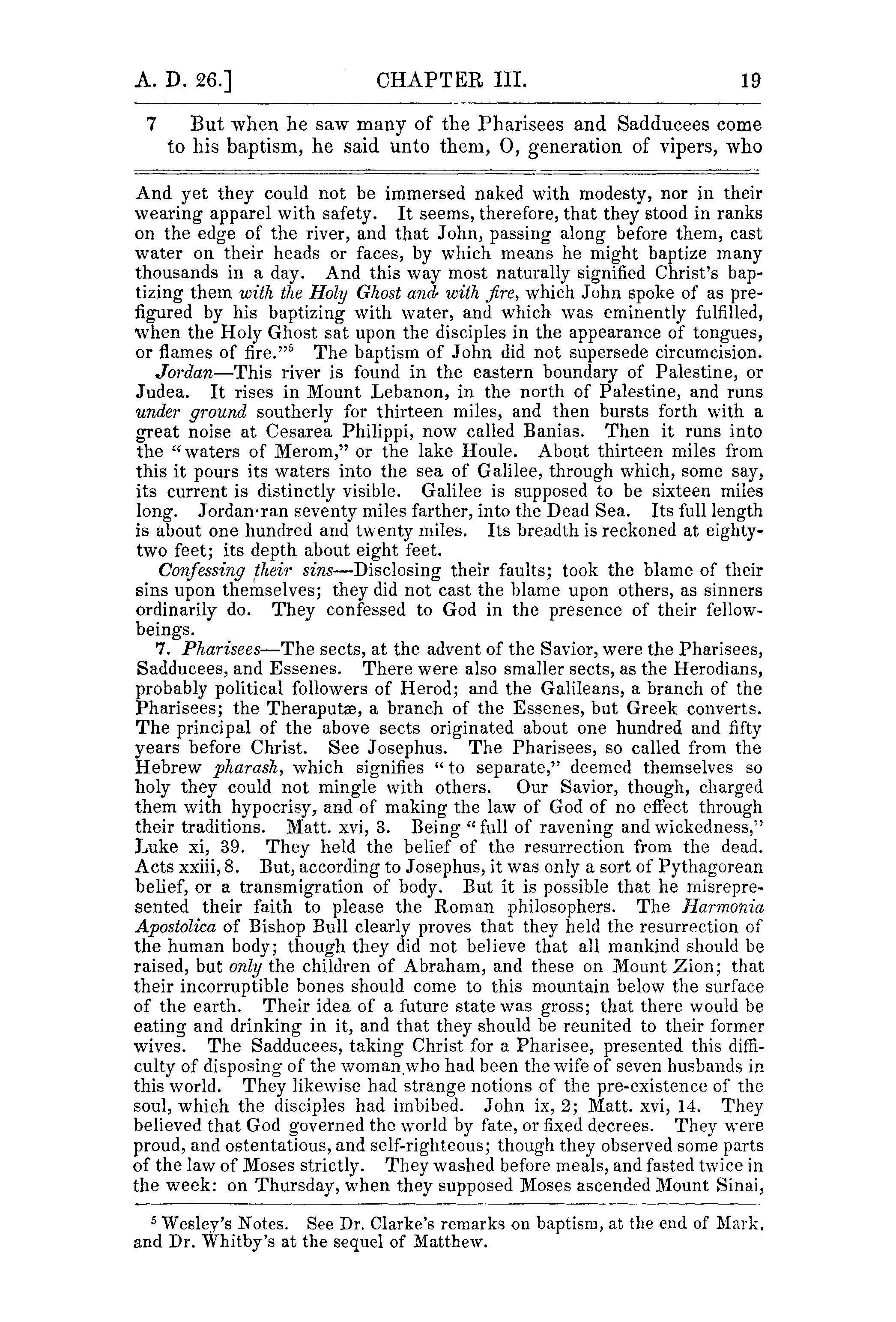
7 But when he saw many of the Pharisees and Sadducees come to his baptism, he said unto them, 0, generation of vipers, who
And yet they could not be immersed naked with modesty, nor in their wearing apparel with safety. It seems, therefore, that they stood in ranks on the edge of the river, and that John, passing along before them, cast water on their heads or faces, by which means he might baptize many thousands in a day. And this way most naturally signified Christ's baptizing them with the Holy Ghost and? with fire, which John spoke of as pre· figured by his baptizing with water, and which was eminently fulfilled, when the Holy Ghost sat upon the disciples in the appearance of tongues, or flames of fire."! The baptism of John did not supersede circumcision.
Jordan-This river is found in the eastern boundary of Palestine, or Judea. It rises in Mount Lebanon, in the north of Palestine, and runs under ground southerly for thirteen miles, and then bursts forth with a great noise at Cesarea Philippi, now called Banias. Then it runs into the" waters of Merom," or the lake Houle. About thirteen miles from this it pours its waters into the sea of Galilee, through which, some say, its current is distinctly visible. Galilee is supposed to be sixteen miles long. Jordan-ran seventy miles farther, into the Dead Sea. Its full length is about one hundred and twenty miles. Its breadth is reckoned at eighty. two feet; its depth about eight feet.
Confessing their sins-Disclosing their faults; took the blame of their sins upon themselves; they did not cast the blame upon others, as sinners ordinarily do. They confessed to God in the presence of their fellowbeings.
7. Pharisees-The sects, at the advent of the Savior, were the Pharisees, Sadducees, and Essenes. There were also smaller sects, as the Herodians, probably political followers of Herod; and the Galileans, a branch of the Pharisees; the Theraputee, a branch of the Essenes, but Greek converts. The principal of the above sects originated about one hundred and fifty years before Christ. See Josephus. The Pharisees, so called from the Hebrew pharash, which signifies "to separate," deemed themselves so holy they could not mingle with others. Our Savior, though, charged them with hypocrisy, and of making the law of God of no effect through their traditions. Matt. xvi, 3. Being" full of ravening and wickedness," Luke xi, 39. They held the belief of the resurrection from the dead. Acts xxiii, 8. But, according to Josephus, it was only a sort of Pythagorean belief, or a transmigration of body. But it is possible that he misrepresented their faith to please the Roman philosophers. The Harmonia Apostolica of Bishop Bull clearly proves that they held the resurrection of the human body; though they did not believe that all mankind should be raised, but only the children of Abraham, and these on Mount Zion; that their incorruptible bones should come to this mountain below the surface of the earth. Their idea of a future state was gross; that there would be eating and drinking in it, and that they should be reunited to their former wives. The Sadducees, taking Christ for a Pharisee, presented this difficulty of disposing of the womanwho had been the wife of seven husbands in this world. They likewise had strange notions of the pre-existence of the soul, which the disciples had imbibed. John ix,2; Matt. xvi, 14. They believed that God governed the world by fate, or fixed decrees. They were proud, and ostentatious, and self-righteous; though they observed some parts of the law of Moses strictly. They washed before meals, and fasted twice in the week: on Thursday, when they supposed Moses ascended Mount Sinai,
5 Wesley'S Notes. See Dr. Clarke's remarks on baptism, at the end of Mark, and Dr. Whitby's at the sequel of Matthew.
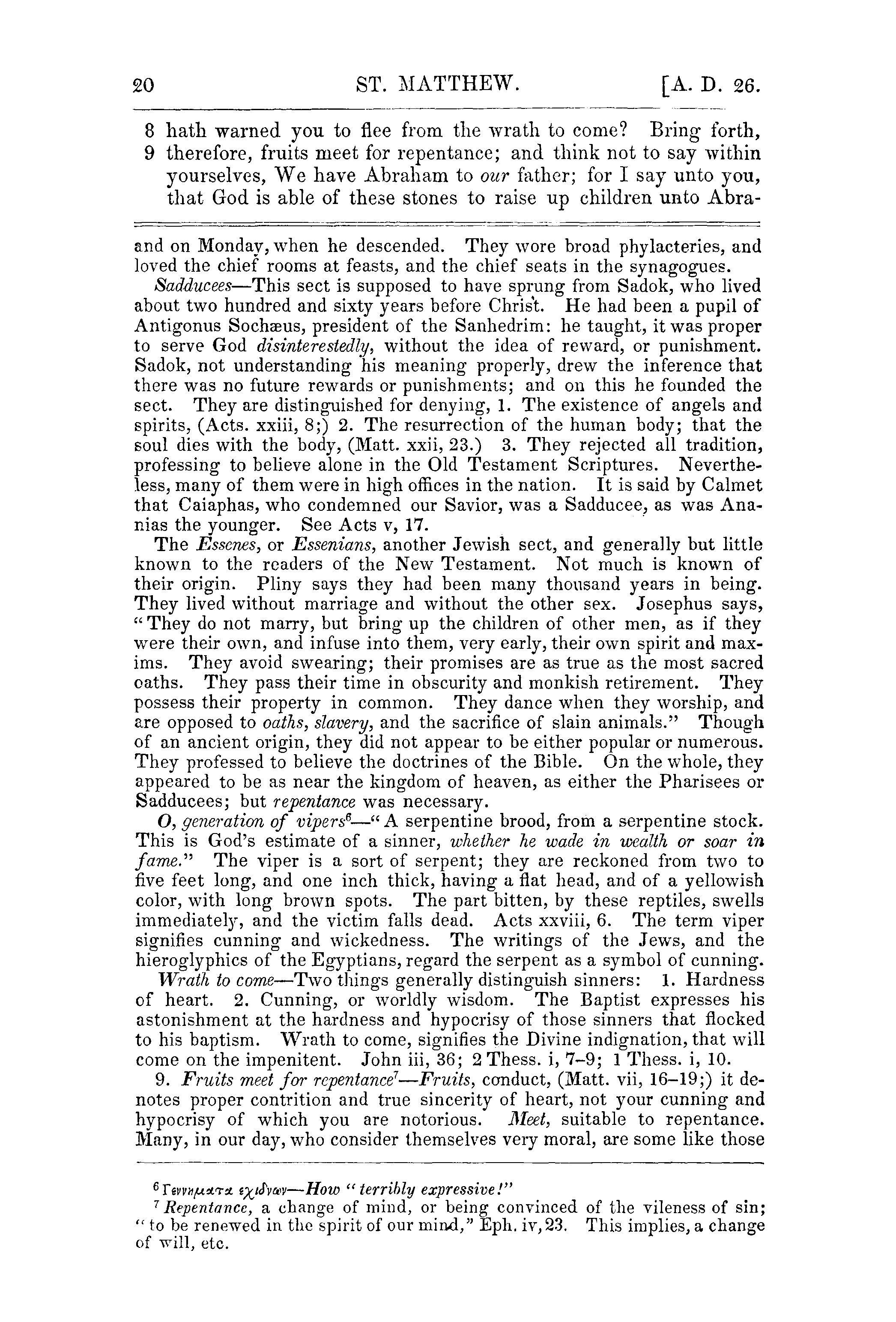
8 hath warned you to flee from the wrath to come? Bring forth, 9 therefore, fruits meet for repentance; and think not to say within yourselves, We have Abraham to our father; for I say unto you, that God is able of these stones to raise up children unto Abra-
and on Monday, when he descended. They wore broad phylacteries, and loved the chief rooms at feasts, and the chief seats in the synagogues.
Sadducees-This sect is supposed to have sprung from Sadok, who lived about two hundred and sixty years before Christ. He had been a pupil of Antigonus Socheeus, president of the Sanhedrim: he taught, it was proper to serve God disinterestedly, without the idea of reward, or punishment. Sadok, not understanding his meaning properly, drew the inference that there was no future rewards or punishments; and on this he founded the sect. They are distinguished for denying, 1. The existence of angels and spirits, (Acts. xxiii, 8;) 2. The resurrection of the human body; that the soul dies with the body, (Matt. xxii, 23.) 3. They rejected all tradition, professing to believe alone in the Old Testament Scriptures. Nevertheless, many of them were in high offices in the nation. It is said by Calmet that Caiaphas, who condemned our Savior, was a Sadducee? as was Ananias the younger. See Acts v, 17.
The Essenes, or Essenians, another Jewish sect, and generally but little known to the readers of the New Testament. Not much is known of their origin. Pliny says they had been many thousand years in being. They lived without marriage and without the other sex. Josephus says, "They do not marry, but bring up the children of other men, as if they were their own, and infuse into them, very early, their own spirit and maxims. They avoid swearing; their promises are as true as the most sacred oaths. They pass their time in obscurity and monkish retirement. They possess their property in common. They dance when they worship, and are opposed to oaths, slavery, and the sacrifice of slain animals." Though of an ancient origin, they did not appear to be either popular or numerous. They professed to believe the doctrines of the Bible. On the whole, they appeared to be as near the kingdom of heaven, as either the Pharisees or Sadducees; but repentance was necessary.
0, generation of vipers6-" A serpentine brood, from a serpentine stock. This is God's estimate of a sinner, whether he wade in wealth or soar in fame." The viper is a sort of serpent; they are reckoned from two to five feet long, and one inch thick, having a flat head, and of a yellowish color, with long brown spots. The part bitten, by these reptiles, swells immediately, and the victim falls dead. Acts xxviii, 6. The term viper signifies cunning and wickedness. The writings of the Jews, and the hieroglyphics of the Egyptians, regard the serpent as a symbol of cunning.
Wrath to come-Two things generally distinguish sinners: 1. Hardness of heart. 2. Cunning, or worldly wisdom. The Baptist expresses his astonishment at the hardness and hypocrisy of those sinners that flocked to his baptism. Wrath to corne, signifies the Divine indignation, that will come on the impenitent. John iii, 36; 2 Thess. i, 7-9; 1 Thess. i, 10.
9. Fruits meet for repentancei-c-Fruits, conduct, (Matt. vii, 16-19;) it denotes proper contrition and true sincerity of heart, not your cunning and hypocrisy of which you are notorious. Meet, suitable to repentance. Many, in our day, who consider themselves very moral, are some like those
6 reVVH,u�'T� eX1d'vr.1v-How "terrihly expressive!"
7 Repentance, a change of mind, or being convinced of the vileness of sin; to be renewed in the spirit of our mind," Eph. iv,23. This implies, a change of will, etc.
10 ham. And now also the ax is laid unto the root of the trees; therefore every tree which bringeth not forth good fruit is hewn 11 down, and cast into the fire. I indeed baptize you with water unto repentance; but he that cometh after me is mightier than I, whose shoes I am not worthy to bear; he shall baptize you with 12 the Holy Ghost, and witlL fire; whose fan is in his hand, and he will thoroughly purge his floor, and gather his wheat into the garner; but he will burn up the chaff with unquenchable fire.
Pharisees who neither have nor desire fruits meet for repentance, but boast of paying their honest debts, and of doing no harm.
9. Within yourselves-In their hearts, as Simon, the Pharisee, "spake within himself," Luke vii, 39. We have Abraham to our father-The Baptist here anticipated their false boast, of their common saying, Abraham is our father." They said this while they went about to kill the Savior. John viii, 40. The Pharisees, particularly, boasted much of being the descendants of that good man, and supposed their salvation secured because they were related to him. What a delusion! The only true children are those who believe in our Lord Jesus Christ. Gal. iii, 29.
10. The ax is laid at the root of the trees-Or lieth at their root, ready to chop them down. Some apply this to the political kingdom of the Jews-Judea having been made a province of the Roman empire, about sixty-three years before this time; and it was ready to be cut down by the Roman ax. But we think that the spirit of this metaphor applies to the moral state of these people: that the" wrath to come" was about to visit them. Trees were used to represent good and evil men by the divine writers. The ax is not to trim the trees, but is laid at their root and ready to cut them down, unless fruit meet for repentance be brought forth. No cunning, or dissimulation, or boast of birth, will answer; the root shall receive the blow; the sincerity of profession must be manifested by suitable fruits. Cast into the jire-" But the chaff he will burn with fire unquenchable," Luke iii, 17. This shall be the portion of the cup of all who bring not fruit meet for repentance. From the preaching of J ohn, to the end of this world, repentance will be the door into the kingdom of God, where the Bible is either read or preached.
11. He that cometh after me-According to the law-Numbers iv, 3-the Savior commenced his ministry at thirty years of age. John was six months older, and commenced six months before him; herein Christ came after him. Whose shoes I am not worthy to bear-The eastern sandals were pieces of wood fastened to the soles of the feet; afterward, leather was used, either dressed or undressed. The sandals were bound by thongs, or latchets, leaving the upper part of the foot uncovered. These were unloosed, taken off, and borne by the lowliest of the servants, or slaves. This expression of John denotes the profoundest humility.
With the Holy Ghost and with fire-This baptism of the Spirit commenced on the day of Pentecost, in Jerusalem, "with a visible appearance as of fire," Acts ii, 3. This was predicted by the prophet Isaiah-iv, 3-and called the "Spirit of burning." See Malachi iii, 2. In John iii, 5, the spiritual character of this baptism is set forth by Jesus, namely: "Except a man be born of water, and of the Spirit, he can not enter into the kingdom of God." To observe the means of grace is proper; but there must be a spiritual work of grace effected in the heart.
12. Whose fan is in his hand-This verse is very figurative. The irnages employed are taken from the Asiatic manner of thrashing grain, and of separating it from the chaff. Their thrashing-floors were places cleared off in the field, made hard by rolling or beating the earth with a maul.
] 3 Then cometh Jesus from Galilee to Jordan unto John, to be 14 baptized of him. But John forbade him, saying, I have need to 15 be baptized of thee, and comest thou to me? And Jesus answering said unto him, Suffer it to be 80 now; for thus it becometh us
The grain was then put on this floor and trodden out with oxen, or by dragging a machine having heavy rollers with teeth. In Isaiah xli, 15, it appears reference is made to some such instrument. The next thing to be done was to cleanse it from the straw and chaff. The floors were generally made on summits, or hills, where the air was brisk. The learned Dr. A. Clarke remarks on chap. i, 18, that the inhabitants of Ireland have "many Asiatic customs, which, added to various authentic historic proofs, are collateral evidences that they received the Christian religion, not from the popes of Rome, but through the means of Asiatic missionaries:" In my travels in Ireland from 1820 to 1829, they generally used the fan in cleaning their grain, in the shape of a sieve; in this, the grain and chaff were taken up by the hands, and poured down before the wind; sometimes this fan was so constructed as to make an artificial wind. Purge his floorCleanse the wheat of the chaff, or purge them as gold and silver. Mal. iii, 3. Gather his wheat into the garner, or granary. Burn up the chaff with unquenchable fire-By the chaff, the wicked, and by the wheat, the righteous are set forth. The wicked are often represented to be driven away, like chaff before the wind. Job xxi, 18; Psalm i, 4; Isaiah xvii, 13; Hos, xiii, 13. The unquenchable fire signifies the eternal sufferings of the wicked in the torments of hell. It is not annihilation. "Where their worm dieth not, and the fire is not quenched," Mark ix, 44. See Daniel xii, 2; John v, 29; Rom. ii, 7-10; Matt. xxv, 41; 2 Thess. i, 8, 9.
13. Then cometh Jesus from Galilee-Up till now, Jesus continued in private life at Nazareth. Mark i,9. From Galilee-This province and Petrea, by the will of Herod the Great, fell to his son Antipas. See chap. ii, 22. Galilee was bounded by Mount Lebanon on the north, by the river Jordan and the sea of Galilee on the east, by Chison on the south, and by the Mediterranean on the west. About this time, Palestine was divided into three parts: Galilee on the north, Samaria in the middle, and Judea on the south. The Rabbins divide it into Upper, Nether, and the Valleys. Upper Galilee abounds in mountains, and was called" Galilee of the Gentiles." Strabo enumerates among its inhabitants, Egyptians, Arabians, and Phcenicians, Lower Galilee contained the tribes of Zebulon and Asher; this part of Galilee Was anciently called the Champaign. Deut. xi, 30. According to Josephus, the Galileeans were brave soldiers, and agreed in all things with the Pharisees; but in the love of liberty they surpassed them.
14. John forbade him8-This was after John had been engaged for some time in his ministry, when Jesus came to be baptized. The grounds of John's opposition to baptize him might have been these: 1. Jesus was free from sin. John baptized on their confession and repentance of sin; but Christ had no sin to confess or repent of. 2. The Savior needed no forgiveness or regeneration; therefore, John possibly thought, no baptism. At this time, John could not have known him personally. See John i, 30, 31. 3. John felt that he needed the baptism of the Holy Ghost, or, of Christ; for, although John was unacquainted with the person of the Savior, yet he was aware of his divine character by revelation.
15. Thus it becometh us-Christ was born under the law, "to fulfill all righteousness;" and it becomes us to walk in all the commandments and
8 AliJt(A)AVeV �VTCV-" Earnestly and pressingly opposed him." (Dr. Olarke.)
16 to fulfill all righteousness. Then he suffered him. And Jesus, when he was baptized, went up straightway out of the water: and 10, the heavens were opened unto him, and he saw the Spirit 17 of God descending like a dove, and lighting upon him: and 10, a voice from heaven, saying, This is my beloved Son, in whom I am well pleased.
ordinances of God, even those institutions which are only temporal. The baptism of John was not exactly the Christian baptism, and is not in force. The example of Christ shows us that Christian baptism should be observed. It becomes us9-It surely became Christ, who is our surety and our example, to [ulfill all righteousness, though there is no command in the Old Testament requiring this; but the Lord of glory sanctioned John's baptism, for reasons best known to himself.
16. Straightway out of the water-Immediately out of, etc. He had come down to the river. "It literally means, 'he went up directly FROM the water.'" All others confessed their sin; instead of this, the Savior would only" fulfill all righteousness." Let the Savior's submission to be baptized "teach us a holy exactness in the observance of those institutions which owe their obligation merely to a Divine command. Surely, thus it becometh all his followers, to fulfill all righteousness."! All this, and the following verse, state the immediate occurrences after his baptism. Three things are noticeable here: 1. The object of his baptism-to fulfill all righteousness. 2. The attendant circumstances. 3. The doctrine inculcated. The circumstances: the heavens were opened unto him-Unto the Baptist, which enabled him to see the Spirit of God descend like a dove, etc.; and this Spirit lighting upon Christ. All this was new to John; of all he had hitherto baptized, no such astonishing occurrence had happened. St. Luke says, it was in a bodily shape like a dove. Chapter iii, 22. Some think, not like a dove, but like the motion of a dove; but this is contradicted by the express words of the text. These strange and solemn circumstances happened when Christ was praying. Luke iii, 21. 3. The doctrine of three persons is clearly set forth here.
17. And 10, a voice from heaven, saying, This is my beloved Son, etc.-I. Here the Father speaks, and calls Christ his Son. 2. The Son, the person addressed. 3. The Spirit of God, or the Holy Ghost, descends upon the Son. The personality of the Father, Spirit, and Son, is thus distinctly set forth. We infer from this baptism, the appropriateness of the Savior being divinely anointed to his great office of prophet, priest, and king of the world. Again: the utility, in the commencement of his ministry, to set forth the personality of the Godhead.
N ow the Savior's mission commences; the kingdom of heaven begins to open upon mankind. The mission of John is about to conclude, and the true light begins to shine. John was a shining light-a flaming herald, of his Master; he fearlessly declared the truth. So should all ministers of the Gospel, in respectful terms, declare their high commission. John was humble; he kept himself out of view, and pointed to and declared the great personage and his kingdom to be at hand. 0, that all ministers of the Gospel would thus herald divine truth!
What a point had the world arrived at, in the baptism of our Lord-a world sunk in moral darkness! Jesus has come, according to Jewish law, at thirty years of age. Num. iv, 3-47. He is anointed to fulfill his great
9 fTgP1"C!. ecr'ilv. .�ee 1 Cor. xi, 13; and ITgf71't:o>, Eph. V, 3 1 Tim. ii, 10; Titus ii, 1; Heb. ri, 10; vn, 26.
1 Rev. John Wesley.
CHAPTER IV. 1. Then was Jesus led up of the Spirit into the wilder2 ness to be tempted of the devil. And when he had fasted forty days
commission, Let heaven and earth unite in his praise. Let both the writer and the reader, for whom he came, give him all the glory of their hearts and lives.
CHAPTER IV. 1. Then was .Jesus led up of the Spirit-This was immediately after his baptism. L3d up of the Spirit" signifies, he was influenced of, or by, the Holy Spirit, to go into the wilderness; for the meaning of which, see Matthew iii, 1. It does not denote a forest, or barren waste, always; but here the Greek term? means a desert; and it is supposed to have been the mountainous part of the desert of Judea, consisting of high, broken, rocky mountains, a place for wild beasts. Mark says-i, 13--Jesus "was with the wild beasts." To be tempted of the devil-The term devil originally signified adversary, or accuser; it is thus given the leader of fallen angels, as adversary of God and men. The devil is full of subtilty, art, envy, and hatred. He is known in the Scriptures by the name of Satan, (Job i, 6-12;) Beelzebub, (Matt. xii, 26;) the old serpent, (Rev. xii, 9.) The name is sometimes applied to men, (2 Tim. iii, 3:) truce-breakers, slanderers, devils; and in 1 Tim. iii, 11: So must their wives be grave, not slanderers, devils. 3 Here is a tremendous occurrence: a being hurried from the jubilating joys and glorious displays of the divine Spirit, to the solitary abodes of the desert, among wild beasts and tempting devils, for nearly six weeks. To tempt, means to try, prove, or solicit. Christ's first ministerial act, "was a combat with Satan." Here he commenced to fulfill the ancient prophecy-Gen. iii, 17-" It shall bruise thy head, and thou shalt bruise his heel." Being made like unto his brethren, he was" tempted in all points" like unto them.
2. Fasted forty days, etc.-The nights are mentioned as well as the days. In some of the regular fasts of the Jews, they ate in the night. Luke says our Lord" ate nothing," chap. iv, 2. Moses, before he held audience with the Lord, and received the law from him, fasted, that is, ate no food, for forty days. Elijah fasted forty days, as well as the Savior of sinners. The best remark we ever read on this point, is found in the comment of the venerable Dr. A. Clarke; says he, "Was not all this intended to show that God's kingdom on earth was to be spiritual and divine?-that it should not consist in meat and drink, but in righteousness, peace, and joy in the Holy Ghost! Rom. xiv, 17." The reader will be pleased with a remark from Dr. Thomas Scott: "Satan assaulted the first Adam in Paradise, and prevailed with him to eat the forbidden fruit, when he might, without offense, have regaled his appetite with a rich variety; but' the second Adam' met the enemy in a how ling wilderness, and thus gave him his full advantage, and he was pleased to sustain, by miracle, an entire fast for forty days and nights, that nothing might interrupt the interesting conflict. Satan could not but know that this was 'the Holy One of God,' and for what end he came into the world; but from that furious enmity, with which he constantly opposes the purposes of God, though always baffled, he was desirous of assaulting him. Perhaps he had some presumptuous expectation of success; he knew that, as man, Jesus was like unto us in all things, except sin; and if he could gain the least advantage, the whole plan of redemption would be frustrated. As he had, therefore, put it into the heart of Herod, to attempt to murder Jesus in his infancy, so he now attempted to draw him into sin; and if he could not do this, yet he should have the hellish pleasure of giving him uneasiness; for our Lord' suffered,
2 Eg%�c" signifies desert or wilderness.
3 CJct�cMu�-Devils; rather, demons.
3 and forty nights, he was afterward an hungered. And when the tempter came to him, he said, If thou be the Son of God, com4 mand that these stones be made bread. But he answered and said, It is written, Man shall not live by bread alone, but by 5 every word that proceedeth out of the mouth of God. Then the devil taketh him up into the holy city, and setteth him on a pin-
being tempted,' in proportion to his perfect holiness. His soul would be the more distressed by the detestable suggestions of the enemy; and that which preserved him from defilement exposed him to suffering; but to this he willingly submitted, that he might have an experimental sympathy with his people." It is very likely that Satan tempted the Savior, from time to time, during the whole forty days, interrupting his meditations, etc.; but particularly when he was an hungered. As the Arabian said to his son, that" hunger dries up and disorders the brain," so Satan availed himself of this opportunity. It is probable that Satan presented these temptations to the mind of the Savior, without any visible appearance. Mr. J. Wesley and others think that he appeared visibly to the Savior. The state of our health, and other circumstances, affords Satan opportunities to harass us. Let us watch and pray.
3. The tempter' came to him-For the first time after his baptism. It can not be doubted but Satan had some knowledge of Christ, as the Messiah of the world; but that he understood his mysterious character as God and man, we can not believe; for this is a mystery which the holy angels desired to look into: and" no one knew the Son but the Father;" hence, being ignorant, to some extent, of his divine character, he probably thought to seduce him. Command that these stones be made bread-Be made loaves. Distrust all other source of support, etc. Satan did not prompt the Savior to create a fine feast in the desert, but to rely on his own power, and make bread to allay the present sensations of hunger. Satan insinuates a doubt: if thou be the Son of God, manifest it by converting stones into loaves; thus to provoke him to satisfy the devil of his real character, if nothing more. The mystery of the union of the Divine and human natures Satan was ignorant of, as in this sense: "no man knoweth the Son but the Father."
4. It is written--In Deut. viii, 3-Here the discourse is about manna, an unusual sort of food; and that man was not to live by bread alone, but by other things as well as bread. The learned say that the term word often means, in the Hebrew, thing, and that it has this meaning here. Neither Moses nor the Savior had any reference to spiritual food. The moral is, that fasting, as well as articles of food, is necessary in the line of Providence. 1. Satan often takes advantage of our circumstances; he tempts the poor and hungry, and the naked; he tempts them to murmur, to be dishonest, to supply their necessities by dishonest means. 2. His temptations are generally strongest, after we have been much favored by the Holy Spirit, as in the case of the Savior. The Father of mercies had just pronounced Jesus to be the Son of God, and Satan immediately took opportunity to prove or try him. 3. The temptations of Satan are often plausible; they seem, sometimes, to be right-they bear the appearance to promote the honor of God. 4. We should meet the temptations of Satan, as the Savior did, with proper quotations of Scripture.
5. Taking him up-It only means that he conducted the Savior. It can not import that Satan took him against his will, or that he bore him thither by his power. The same term is used in chap. xvii, 1: "After six
4 0 1Tfl��t{t)v-The tempter or trier; literally, to pierce through.
6 nacle of the temple, and saith unto him, If thou be the Son of God, cast thyself down; for it is written, He shall give his angels charge concerning thee: and in their hands they shall bear thee
7 up, lest at any time thou dash thy foot against a stone. Jesus said unto him, It is written again, 'I'hou shalt not tempt the Lord
8 thy God. Again, the devil taketh him up into an exceeding high mountain, and sheweth him all the kingdoms of the world, and
days, Jesus taketh Peter, James," etc., that is, he invited them to accompany him. It may have been, the Savior was about to return from the wilderness to Jerusalem, called the" holy city," from its being the place of the temple and the worship of God. The Savior submitted to the temptation, as our second Adam, to be in all points tempted as we. Setteth him on a pinnacle of the temple-Josephus says that the roof was set with spikes of gold, to hinder it from being polluted with birds; such a place would not suit well to sit upon. Others suppose it was the top of the porch, or entrance to the temple; but it is not likely this would be higher than the main building. The temple being built on Mount Moriah, and to prepare a proper basis, it required a high wall on the east. It had porches fifty-five feet broad and seventy-five high. On the south side, the porch was sixty-seven feet broad, and one hundred and fifty feet high; this probably was called the pinnacle, from the top of which to the valley below, was more than seven hundred feet. The term pinnacle does not exactly express the meaning of the original; it applies generally to birds,s and denotes wings, or something having wings, to ascend high. It is probable this was the spot where the Savior was placed. Satan tempted him to an unnecessary exposure of his power.
6. Cast thyself down-From the pinnacle to the valley below. For it is written, etc.-The place is Psalm xci, 11, 12. This beautiful passage-was primarily applied to those wading in providential affliction. It is mutilated and misapplied by the tempter to suit his purpose on this occasion.
7. Thou shalt not tempt the Lord thy God-This is quoted from Deuteronomy vi, 16. Thou shalt not tempt or try the Lord thy God, by throwi,ng thyself into unnecessary dangers; as none need expect protection but those who are providentially in necessity, affliction, or danger. God's promises were never given to those who wantonly provoke or trifle with him or his promises. Satan artfully quoted just so much of the Scripture referred to as suited his purpose; but the Savior repelled his temptation by Scripture properly applied. How many sophists and profane triflers have dared to misquote the Scriptures, to satisfy their inflated hearts! They fraternize with the archfiend. Akin to this is that spirit of presumption, which says, "Is the Lord among us, or not!"
8. Into 'an exceeding high mountain-This mountain is not known exactly. Dr. A. Clarke says that Abbe Mariti speaks of a mountain, in his travels through Cyprus, etc., which could have afforded the prospect in question; namely," Here this part of the mountain overlooks the mountains of Arabia, the country of Gilead, the country of the Amorites, the plains of Moab, the plains of Jericho, the river Jordan, and the whole extent of the Dead Sea." From Mount Nebo the Lord showed Moses still more of the world than Abbe Mariti saw. See Deut, xxxiv, 1-3. Tradition calls this mountain Quarantania.
All the kingdoms of the world6-" In a moment of time," says St. Luke.
5 See Barnes's Notes, in loco.
6 The term olxoup.ml, rendered world, is frequently translated land or country, which should here have been so rendered.
9 the glory of them; and saith unto him, All these things will I 10 give thee, if thou wilt fall down and worship me. Then saith Jesus unto him, Get thee hence, Satan: for it is written, Thou shalt worship the Lord thy God, and him only shalt thou serve. 11 Then the devil leaveth him, and behold, angels came and ministered unto him.
This would have been impossible for Satan thus to have shown the whole earth to the Savior in a moment, or second of time, in the literal sense, unless by representation to his mind, which, possibly, was the fact. Nevertheless, it does appear, from the term mountain, etc., mentioned, that the scene was literal, and the term kingdoms of the world embraced Judea, with portions of the adjacent countries. As Judea had been divided into kingdoms by Herod the Great, this only may be meant. See Rom. iv, 13, and Luke ii, 1. The glory of them-Riches, honors, etc., of them; of the towns, cities, mountains, and vales. It is contended, by some, that the Greek word" to show," and the Latin ostendere do not signify to exhibit to the sight.
9. All these things, etc.-In Luke is added, "For that is delivered unto me." Here was a direct falsehood. The kingdoms never were delivered to Satan. The Lord never ceded any territory to him in any part of the universe, unless it be hell. It is a fact, that Christ styles the tempter, "Prince of this world," John xii, 31, and xiv, 30; and St. Paul terms him, "The god of this world," 2 Cor. iv,4. But these passages only mean the "children of disobedience." Satan seems now to come out in his real character, and tries hard to excite earthly ambition in our Lord's mind; and all the devil appears to want is to be owned as supreme lord of the earth, and hence worthy of homage or worship in the religious sense. To induce Christ to commit idolatry, and thus rob the supreme God of his divine honor, and give it to this wretched, fallen angel; or, in a worse sense still, to have Jesus, who is "God over all," to give spiritual worship to the being who was a liar and a murderer from the beginning-what profound presumption! Satan had been hitherto twice foiled, and this, his third effort, is both open and presumptuous. St. Luke says, "If thou wilt worship before me."?
10. Get thee hence, Satan-This tempter the Savior met with a pointed rebuke. The former were indirect temptations, which violated no direct law of God, and they were rather plausible. Here was a severe rebuke, as a master would command a dog out of his presence: begone out of my presence; get thee hence. It is written-In Deut. vi, 13. Thou shalt worship, etc.-The Savior here gives the sense, not exactly the words, however, as they are found there. To worship God is to believe heartily in him, to love him supremely, and reverence him profoundly and continually.
11. The devilleaveth him-Not forever; "only for a season," St. Luke iv, 13. All through the Savior's life on earth he was annoyed with the devil; "for the prince of this world cometh, and hath nothing in me," John xiv, 30. At the Savior's capture in Gethsemane, he told the chief priests, etc., saying, "This is your hour, and the power of darkness," Luke xxii, 53. Here he appeared to have endured a dreadful conflict with Satan. Angels came and ministered, etc.-These messengers prepared the way for his advent into this sin-stained world. Now, after his fasting and temptation, they are ready, by the order of God, to minister to the humanity of the great Mediator. But how did they minister! They brought him food, as some
7 Says Dr. Lightfoot, "If to worship before the devil be to worship the devil, then to worship before an image is to worship the image."
12 Now when Jesus had heard that John was cast into prison, he 13 departed into Galilee; and leaving Nazareth, he came and dwelt in Capernaum, which is upon the sea-coast, in the borders of
think, to strengthen his body after his long fasting. But was it not more especially to rejoice at the victory he obtained over the chief of fallen angels!
In closing the scene of our Lord's temptation the reader will be pleased with the following remarks from Dr. A. Clarke: "It appears that our blessed Lord was tempted, 1. To DISTRUST: Command these stones to become bread. 2. To PRESUMPTION: Cast thyself down. 3. To WORLDLY AMBITION: All these will I give thee. 4. To IDOLATRY: Fall down and worship me, or do me homage. There is, probably, not a temptation of Satan but is reducible to one or other of these four above named.
"From the whole we may learn:
"1. No MAN, HOWEVER HOLY, IS EXEMPT FROM TEMPTATION; for God manifested himself in the flesh, and was tempted of the devil. 1. That the best way to foil the adversary is by the sword of the Spirit, which is the word of God. Eph. vi, 17. 2. That to be tempted even to the greatest abominations, while a person resists, is not sin; for Christ was tempted to worship the DEVIL. 2. That there is no temptation which is, from its own nature, or circumstances, irresistible. God has promised to bruise even Satan's head under our feet. As I wish to speak what I think most necessary on every subject, when I first meet it; and, once for all, I would observe, that the fear of being tempted may become a most dangerous snare.
"II. THAT WHEN GOD PERMITS A TEMPTATION OR TRIAL TO COllIE, HE WILL GIVE GRACE TO BEAR OR OVERCOME IT. 1. That our spiritual interests shall be always advanced, in proportion to our trials and faithful resistance. 2. That a more than ordinary measure of Divine consolation shall be the consequence of every victory."
12. John was cast into prison-By Herod Antipas, son of Herod the Great, to whom his father gave Galilee and Petra, at his demise. See note on Matthew ii, 15. The Baptist was imprisoned because he reproved Antipas of adultery and incest. See Matthew xiv, 1-11. He departed into Galilee-Not immediately after his temptation. The Savior first passed into Galilee, and called Philip, whom he found in Galilee, though his native place was Bethsaida, the city of Andrew and Peter. John i, 43. The Savior from thence passed into Judea again, and celebrated the passover at Jerusalem. John ii, 13. He baptized in Judea while John was baptizing at Enon. John iii, 22, 23. All this time John had his liberty. John iii, 24. After the Savior's disciples had baptized many, the people, that is, the Pharisees, were offended; and, after this, he left Judea, and departed into Galilee. John iv, 1, 3. After John was imprisoned. Galilee was part of Herod's dominion; and this may be considered the first place of the Savior's ministry. In this place John's preaching had excited the attention of the people. And as Judea had been ruled by the prejudiced scribes and Pharisees, it was more probable that the Savior's labors would be more beneficial here; so that the word might be somewhat established in Galilee before he went to Jerusalem; though it appeared not a very favorable place for doing good, where the forerunner had been imprisoned.
13. Leavin_q Nazareth-Because he was rejected by the citizens, who attempted to kill him. Luke iv, 28, 29. In this place he had been brought up. He came and dwelt in Capernaum-This city was situated on the north-west corner of the Sea of Tiberias. Though not mentioned in the Old Testament, it is repeatedly in the New. In this place the Savior spent much of his time. It was his home during the three years of his
14 Zabulon and Nephthalim; that it might be fulfilled 'which was spo15 ken by Esaias the prophet, saying, The land of Zabulon, and the land of Nephthalim, by the way of the sea, beyond Jordan, Gal16 ilee of the Gentiles: the people which sat in darkness, saw great light; and to them which sat in the region and shadow of death, lig ht is sprung up.
17 From that time Jesus began to preach, and to say, Repent; for the kingdom of heaven is at hand.
18 And Jesus, walking by the Sea of Galilee, saw two brethren, Simon called Peter, and Andrew his brother, casting a net into
ministry; it was called his own city. Matt. ix, 1. Here he paid the tribute, not as tax, but for the support of the temple. Exod. xxx, 13. Every Jew paid this, till after the time of Vespasian, says Josephus, Book vii, 6. Among the Jews, if a man became a resident in any city for twelve months he thereby became a citizen. In the borders-That is, the boundaries. OJ Zabulon and Nephthalim-Primitively two tribes of the Israelites occupied this part of the land of Canaan. Gen. xlix, 13; Josh. xix, 20,32. These places are on the east of Jordan. Josh. xix, 34. Nazareth and Capernaum were in Zabulon. The country of this tribe lay on the Lake of Genesareth, stretching to the land of Sidon. Gen. xlix, 13. Nephthalim wa� near to it. At Capernaum Jesus healed the nobleman's son, (John iv, 37;) Peter's wife's mother, (Matt. viii, 14;) the centurion's servant, (Matt. viii, 56;) and the ruler's daughter, (ix, 23-25.) In the time of Christ this was a flourishing city; but it is now in ruins.
15. Galilee of the Gentiles-That portion of Galilee beyond Jordan, which, according to Strabo, was inhabited by Egyptians, Arabians, and Phenicians. It was a tradition of the Jews that Christ should begin his mission among the Gentiles.
16. The people which sat in darkness8-l\Ioral darkness is meant. It denotes ignorance of God and themselves. The Divine instruction, which removes darkness, is termed light. John iii, 19; 1 Peter ii, 9; 1 John i, 5; ii, 8. Darkness denotes sin. 1 Thess. v, 5; Eph. v, 11. The region and shadow of death-Some of the Israelites thought that death stood between the earth and the sun, and cast a shadow over the face of the nations, producing ignorance, sin, and woe; producing chills and damps peculiar to those dead. Psa. xxiii, 4; Jer. ii, 6. The Gentiles, or heathen, were proverbial for sin and roughness of language. Mark xiv, 70. Here the blessed Jesus came to destroy this shadow of death, and to give light and life to those who were perishing in moral death. Christ did not first choose the more refined parts of Judea, but, possibly, the darkest, in which to commence his ministrations.
17. See Matt. iii, 2.
18. Sea of Galilee-This was also called the Lake of Gcnesareth, and the Sea of Tiberias, and also Sea of Chinnereth. Deut. iii, 17; Num. xxxiv, 11 ; Josh. xii, 3. It is about sixteen miles in length, and from six to nine miles in breadth. The environs of this lake are extremely beautiful, producing every luxury at all seasons of the year. The river Jordan flows through this lake 'without mixing with its waters, as is said. The waters of the lake are pleasant, sweet, and clear. It still abounds with fish, as it did in the days of the Savior. It is said to be stormy, owing, probably, to its being surrounded with hills. Simon called Peter-Which
8 The infidel oracle, Mr. Paine, says, "The whole is in the pretcr tense." The reader can judge if the sentence, Light is spru7Ig up," is in the preter or past tense.
19 the sea; for they were fishers. And he saith unto them, Follow 20 me, and I will make you fishers of men. And they straightway 21 left their nets and followed him. And going on from thence, he saw other two brethren, James the son of Zebedee, and John his brother, in a ship with Zebedee their father, mending their nets: 22 and he called them. And they immediately left the ship, and their father, and followed him.
23 And Jesus went about all Galilee, teaching in their synagogues, and preaching the Gospel of the kingdom, and healing all manner
means a stone, or rock, signifying the same as Cephas. See note on Matt. xvi, 18.
19. Fishers of men-See Ezekiel xlvii, 8-10. To this place the Savior probably alludes. They dirt not make themselves fishers of men. Christ said, "Follow me, and I will make you," etc. God only can effectually make Gospel ministers. Colleges and seminaries never can call and make true ministers of the Gospel.· Education is very excellent in its proper place, and the lips of the priests should keep knowledge; but those presuming that only an educated man can possibly be a fisher of men are in error. Christ might have called learned scribes had he deemed it proper; but he chose the comparatively-illiterate fishermen to convert the world. He chose the foolish to confound the wise. How contrary to the mode of both the Church and the world in these days! It is our opinion that the cause of God suffers more from men who have thrust themselves into the ministry, uncalled by the Lord, than any other thing which afflicts the Church. The calling of these simple, plain men, Peter, and Andrew, etc., into the ministry, suggests that the excellency must be of God, and not of man.
20. Straightway left their nets-This was wonderful! Men engaged at their daily employment, to immediately leave all, and follow a stranger passing along the lake shore! Here was a mysterious power of moral attraction unparalleled in history. This act proved the divinity of his character. It appears that Peter and Andrew were the first called of the disciples; James and John the next.
22. Left the ship, and their father-I. This shows us that we must leave our ships and parents to follow Christ. Luke xiv, 26. 2. That ministers of the Gospel, in particular, must forsake all for the Gospel's sake. He that warreth must not entangle himself with the affairs of this life, but cut loose from them. All those called by the Savior have such attraction to follow their Master, and to join in their Master's vineyard, that the sacrifice can, through grace, be well endured. 3. Our Lord, by prerogative, may call whom he pleases, being Lord of all. While, in too many instances, the Church would choose splendid means and lofty measures to consummate Gospel purposes, it has pleased God to choose fishermen in the most critical period of the propagation of the Gospel. From this, let us learn to keep our places, and let God call whom he may, if it be even a Sabbath school scholar, to be instrumental in the conversion of a parent, or others. 4. All this shows that religion is true; that the power is of God, and not of man. Let us look to him, and trust him for salvation.
23. Teaching in their synagogues9-The places where the Jewish people met to worship God. The Jewish sacrifices were to be offered only at Jerusalem; but other services of religion were not prohibited to be held at other places. The praises of God were sung in the schools of the prophets; and all the people might -assemble at the appointment of the
9 Synagogue, O"(lV�')'Ct>'}I1, from (J'(lV, together, and etrCtl, I bring: a public assembly of persons. (Dr. A. Clarke.)
24 of sickness, and all manner of disease among the people. And his fame went throughout all Syria: and they brought unto him all sick people that were taken with divers diseases and torments, and those which were possessed with devils, and those which were
seers, on the Sabbath, and new moons, for sacred worship. 1 Sam. x, 5-11; 2 Kings iv, 23. This was probably that which gave rise to synagogues. Josephus mentions them long before the coming of Christ. Before Jerusalem was taken by the Romans, there were no less than four hundred and eighty in that city. They were built similar to the temple. The five books of Moses, and portions of the prophets, were read through each year. Our Savior and the apostles attended constantly and spoke to the people. The law was kept near the pulpit, in a chest; the uppermost seats were around the pulpit. Matt. xxiii, 6. In reading the law, the reader stood up; but in expounding it, he, or the expounder, sat down. The Savior imitated their example. Matt. v, 1; xiii, 1. Service was performed in them three times a day. Ten persons would compose a synagogue; it was governed by a council, over whom was a president, or ruler. Preaching the Gospel of the kingdom-That is, proclaiming the glad tidings of the kingdom. 1. The kingdom-the Gospel dispensation. 2. The tidings. 3. To proclaim this good news. See note, chap. iii, 1,2. All manner of sickness, and all manner of disease-The term rendered sickness, signifies chronic disorders; the term rendered disease, means temporary affliction of the body, all kinds of sickness, particularly incurable diseases.
24. And his fame went throughout all Syria-The exact boundary of Syria, in the days of the Savior, is not well known. Some think the country north and north-east of Galilee is meant. Perhaps it was the general name of the country lying between the river Euphrates on the east, and the Mediterranean on the west; and Mount Taurus on the north, and Arabia on the south.
Those possessed with devils1-Demons or demoniacs. As the term devil "is not found in the plural in any part of the sacred writings, when speaking of evil spirits; for, though there are multitudes of demons-Mark v, 9-yet it appears there is but one DEVIL, who seems to be supreme, or head, over all the rest." (Clarke.) 1. Demoniacs, fallen angels, under the devil, as their general head or ruler. The Savior spoke to them as to actual beings; and the hearers could have no doubt to the contrary. 2. The demons spoke, asked questions, and gave answers, and expressed their knowledge, and fear of Christ. Matt. viii, 29; Luke iv, 34; viii, 28. How absurd it is to denominate the evil spirits passions, then to endow them with speech, etc.l 3. These unclean spirits went out of the persons possessed of them and went into other bodies. Matt. viii, 32. Whoever heard of an evil passion doing such! 4. The Savior conversed with them, and asked their name, and they answered him: he commanded them to be silent, to come out, and not to return. Mark v, 8; iX,25. Christ cast out devils, or demons, by the Spirit of God. Matt. xii, 25-28. The immediate successors of the apostles interpreted those passages in the same way.
Again: there is nothing absurd in admitting that those persons were possessed with demons. 1. Not to admit the fall of man as set forth by Moses, and to admit that the Creator is an infinitely holy and benevolent being, is absurd; for this reason: an infinitely holy being must necessarily love holiness and hate iniquity; but men love iniquitous practices, and follow vicious habits; they are troubled with evil desires, etc. Then who
I AJ<t(BoAO�, devil, signifies accuser, or slanderer, from AJ�, through, and (Bd.AAUV, to cast, or shoot: hence, to shoot through.
25 lunatic, and those that had the palsy; and he healed them. And there followed him great multitudes of people from Galilee, and from Decapolis, and from Jerusalem, and from Judea, and from beyond Jordan.
will dare to conclude that a holy Creator would make such devourers of each other-such unholy beings! This would be absurd. Our great first parent was made in the image of God; but he sinned, hence fell therefrom; and the language of the Psalmist is applicable to all the progeny of Adam: "Behold, I was shapen in iniquity; and in sin did my mother conceive me," Psa. Ii, 5. Then, if men fell, so might angels; the latter kept not their first estate, but fell; and in their fall, became enemies to God and men. 2. It is, then, no more absurd that Satan should have possession of the faculties of men, and inflict diseases, than men could on men, by corrupting their morals or making them intemperate. 3. In expelling those unclean spirits, Christ exhibited his power over his, and the enemies of mankind. The object of his mission was to destroy the power of Satan-Acts xxvi, IS-and bruise him under the feet of the saints. Romans xvi, 20.
Those that were lunatic-Luna is the Latin name of the moon: it has the same origin in the Greek. The term was thus given from the then received opinion, that the moon's increase, or decrease, affected those thus afflicted. This disease is only mentioned here and in Matthew xvii, 15. The probability is, that this disease was the falling sickness, or epilepsy, the same as that mentioned in Luke ix, 39, 40.
And those that had the palsy-In the New Testament, the term palsy implies: 1. The apoplexy, affecting the whole body. 2. The hemiplegy, affecting only one side of the body, as the general form of the disease. 3. The paraplegy, affecting all the system below the neck. 4. The catalepsy. This is caused by a contraction of the muscles of the system. This affection was termed" the withered hand." Matt. xii, 10-13. 5. The cramp. This is frequent in the eastern countries. Some think that this was the disease of the centurion's servant. Matt. viii, 6. Death is the result of this disease in a few days, if not cured.
And he healed them-In a miraculous manner. This implies, not an absurdity, but only the suspension of the laws of nature; and this is as much the prerogative of God, as that of the mechanic who suspends the steam of water power. God alone has this power. When the apostles wrought miracles, they were commissioned of God. Christ, as God, cured them by his word; so did the disciples in the name of their Master.
25. From Decapolis, etc.-Decapolis is a Greek term, signifying ten cities. It was the name of a country beyond Jordan, or lying on each side of Jordan. Num. xxxii, 5-33. It was anciently occupied by the two tribes of Reuben and Gad, and the half tribe of Manasseh.
REl.HARKs.-An additional remark on the Savior's temptation, may not be out of place. To deny the doctrine of temptation, we must either reject the Scriptures, or use some violent mode of interpretation which would be inconsistent with the narrative and nature of them. As Mr. R. Watson says, "If there be no Satan, there is no Holy Ghost; for each may be reselved into personification: if there be no spiritual evil influence, Vie have no reason to conclude from the same Scriptures that there is any supernatural good influence. Farther: if there were no true demoniacal possessions, then were the persons reputed to be so possessed mere lunatics and epileptics; and the casting them out was deceptive assumption of pretended power, fatal to the character of our Lord, and the honesty of his disciples; and if there be no disembodied spirits, then were the disciples deceived,
CHAPTER V. 1. And seeing the multitudes, he went up into a moun-
and that by our Lord himself; and the hope of conscious existence immediately after the death of the body, so cheering to them and to all good men since, is without any foundation in truth." According to Unitarians, it was nothing but a visionary scene. To conclude thus, is to trifle wretchedly with the word of God. It is contradicted by the narrative itself; it is bringing down the supernatural grandeur of divine and spiritual things, to the grade of earthly dreams and visions.
Finally: if the temptation of our Lord was but the reverie of a vision, and not real and vicarious, it was no temptation, but a bare farce; for, herein, moral agency could not be exercised, as reason and sense would be out of the question. Thus to conclude, would destroy the narrative of the Evangelist, and that Christ was tempted as we are, etc. This conclusion none can arrive at but the fantastic, and those morally and religiously deluded. To the miracles mentioned in this chapter, particularly in the 23d and 24th verses of it, the following remarks are appended: These verses plainly set forth the great activity and energy of the blessed Savior in his ministrations to fallen men. He went about all Galilee-traveling through the whole district, bearing the glad tidings of his most gracious kingdom.
1. THE NATURE OF HIS MINISTRY.
1. It was a personal ministration. He preached himself, as well as by his embassadors. This answers to the predictions, that he should teach and proclaim good tidings. Prophetically," grace is poured into his lips."
2. Christ's ministry was" arduous and aggressive." He labored continually. He never turned aside.
3. His ministry was most instructive. Teaching in their synagogues, etc.
II. HIS MINISTRY WAS RATIFIED BY INDUBITABLE EFFECTS. "Healing all manner of sickness, and all manner of diseases," etc.
1. He supernaturally healed diseases. Not by medicine, but by his word. He bade pain and disorders to flyaway.
2. He expelled demons, and restored the insane. He came that he might "destroy the works of the devil," etc.
3. He healed the sin-affiicted souls of men. This was generally simultaneous with the healing of the body.
III. HIS MINISTRY WAS CELEBRATED FOR ITS GREAT RESULTS.
1. His ministry was attended b1J great power and effect. This characterized it. The people extolled it, and spread its fame far and wide. Still, the Christian can say, "Come, all ye that fear God, and I will tell you what the Lord hath done for my soul."
2. As multisudes were healed, they both spread and heralded his praise. Hence "health and joy were spread abroad," and disease and sorrow fled away.
3. These miraculous doings of Christ were evidences of his eternal power and Godhead.
Applic.ation.-The way to obtain spiritual healing and life, is by faith in Christ Jesus.
CHAPTER V. 1. Seeing the multitudes-All Judea was alarmed and astonished at the miracles of Christ; great multitudes followed him. He went int02 a mountain-A hill, or elevation. And when he was set-They read the law in the synagogue, standing up; but when they expounded it, they sat. The Savior followed this custom. Usually, he taught in the synagogue; but at this time, the multitudes could not be accommodated in a house. His disciples' came unto him-Stood around him, not only the
:1 Into, U�; into, at, upon, or on. 3 The term 1��!!J-l1'rl1� literally means a scholar.
2 tain: and when he was set, his disciples came unto him. And he 3 opened his mouth, and taught them, saying, Blessed are the poor 4 in spirit: for theirs is the kingdom of heaven. Blessed are they 5 that mourn: for they shall be comforted. Blessed are the meek: 6 for they shall inherit the earth. Blessed are they which do hunger and thirst after righteousness: for they shall be filled.
chosen disciples, but all true believers in him. The term disciples means learners.
2. Taught them-The first lesson that he taught the world, was repentance. These precepts, which follow, in this notable sermon of our Savior, are as healing ointment on the crushed hearts of this heavy-ladened people. See the great condescension of our Lord; coming down from his supreme dignity, to instruct these people who sat in the shadow of moral death. " He insinuates his will and our duty, by pronouncing those happy who comply with it."
3. Blessed are the poor in spirit-Blessed, or happy. Instead of being introduced to the region of death, they are children of immortality and felicity, as the term" imports. See Luke vi, 20. Poor in spirit-The truly penitent, who see their state by nature: who know and feel that in them dwelleth no good thing; literally, one who shrinks with fear. 1. There is no real happiness in thinking on ourselves as we are, while we remain in sin. 2. The poor in spirit, Jesus chooses to bless and make happy. 3. Theirs will be the kingdom of heaven hereafter. This was unlike all the teachings that ever the philosophers and instructors of this world advanced.
4. Blessed are they that mourn-All those, without respect of persons, who mourn over their" spiritual poverty." The continuous bent of men, is after happiness; and yet true comfort, or happiness, comes after true sorrow. 1. Conviction of sin, or true sorrow for sin, is necessary to salvation. 2. Our Lord waits to impart salvation, on our repentance, (2 Cor. iii, 17, 18;) hence, all those that mourn for their sins, and are weary and heavyladen, shall find peace in Christ, (Matt. xi, 28, 29;) and the Comforter shall sustain them, (John xiv, 26, 27.)
5. The meek-In opposition to the supercilious; those that keep their passions, by grace, well balanced; not cowardice, or the giving up of our rights and privileges. Did Christ give up his rights, while we hear him say, "If I have done evil, bear witness of the evil; but if well, why smitest thou me l" John xviii, 23. Did St. Paul give up his rights, while he said, "They have beaten us openly, uncondemned, being Romans, and have cast us into prison; and now, do they thrust us out privily! nay, verily; but let them come themselves and fetch us out!" Acts xvi, 27. Christ says, "I am meek," etc. Matt. xi, 19. Meekness is manifested in the reception of injuries, believing that God sees and will vindicate us, as "ho will repay." Rom. xii, 19. Meekness is proof of true greatness of soul. The poor in spirit shall inherit the" kingdom of heaven," the blessing of the Gospel, and the eternal world. So shall the meek inherit the earth, the blessings of the Gospel in the earth, and the joy of the new earth. Isa. lx, 21; 1 Tim. iv, 8; vi, 3-6.
6. Blessed are they that hunger, etc.-Hunger and thirst here are expressive of strong desire. No wants are so keen, and none so pressing, as these. An ardent desire is often represented in Scripture by hunger and thirst. Psalms xlii, 1,2; lxiii, 1,2. A deep sense of sin is represented by thirsting. Isa. lv, 1, 2. All such desires are founded in the heart by the Spirit of God; and he is always willing to gratify them. And in the
4 M�ctgIOI, not dead; but the happy, the blessed.
7,8 Blessed are the merciful: for they shall obtain mercy. Blessed 9 are the pure in heart: for they shall see God. Blessed are the peace-makers: for they shall be called the children of God. 10 Blessed are they which are persecuted for righteousness' sake:
world to come, "they shall hunger no more, neither thirst any more," Rev. vii, 16. After righteousness-In its broadest sense, it means the full restoration of the soul to the image of God; but in its immediate and literal meaning in this place, it appears to import, according to the light then manifested to the Jews, to do right in all things pertaining to God and men. It is thought that it can not be the righteousness of faith: 1. Because the word righteousness bears no such sense in the Gospel, but only in the epistles of St. Pauli 2. Because the Jews, to whom Christ speaks, had no idea of this righteousness-no apprehension that their Messiah was to die, and much less that they should be justified by his death: and, therefore, had Christ spoken of this righteousness, none of them could have understood his meaning." Still, it appears the righteousness of faith is meant, and nothing else. Shall be filled-The thirsting desire of the fervent heart shall be satisfied with the bread of life."
7. Blessed are the rnerciful-The term among the Jews signifies two things: the pardon of injuries and alms-giving. It literally means pity of heart, or pain of heart at another's sufferings; a distressed heart, and a disposition to relieve it. The same principle is found in Matt. x, 42. See also Matt. xxv, 34, 40. They shall obtain mercy-In the ratio that the servants of Christ give to objects of pity shall they obtain mercy from the hand of God. What an encouragement to do good! See 2 Sam. xxii, 26, 27, and Psa. xviii, 25, 26, in illustration of this point. Mercy has ever been a favorite sentiment with God. Exod. xxxiv, 6. He has shown his mercy to us guilty sinners by giving his only Son for us; by the gift of the Holy Spirit; by his long-suffering and pardon of sin. Our world is full of sin and misery.
"That mercy I to others show, That mercy show to me."
8. Blessed are the pure in heart-In mind, principle, and affections. Not only those who are correct in their external actions, but inwardly are pure. God looks on the heart. This must be pure, or the whole person will be unacceptable before God. They shall see God-In one sense, all that have eyes can see the works of God. In another, all men shall see him as their Judge; "every eye shall see him," Rev. i,7. The expression here means, to enjoy God. To see, among the Jews, signified to possess. John iii, 3; Psa. xvi, 10. The entering into the sanctuary was typical of entering into heaven. The impure could not enter.
9. Blessed are the peace-makers-Those who try to prevent strife and war; those who are vigilant to use the means to cherish peace in the family, neighborhood, and in the country at large. Men of influence may do much to prevent war, envy, and wrath among the people. Let lawyers and physicians, and all others, promote peace; not forgetting that "an ounce of prevention is worth a pound of cure;" "for God is not the author of confusion, but of peace," 1 Cor. xiv,33. Children of God-God being the author of peace, those that follow peace shall be called his children. Hence, all those who ferment strife in the Church or state may be well known not to be of God.
5 Whitby.
6 Xcp"ct(}":}�(}"GV'r'tI, from I(_OP"O�' herbage, a figure taken from cattle filled with grass.
11 for theirs is the kingdom of heaven. Blessed are ye when men shall revile you, and persecute you, and shall say all manner of 12 evil against you falsely, for my sake. Rejoice, and be exceeding glad: for great is your reward in heaven: for so persecuted they the prophets which were before you.
13 Ye are the salt of the earth: but if the salt have lost his savor, w herewith shall it be salted? it is thenceforth good for nothing, 14 but to be cast out, and to be trodden under foot of men. Ye are the light of the world. A city that is set on a hill can not be 15 hid. Neither do men light a candle, and put it under a bushel, but on a candlestick: and it giveth light unto all that are in the
11. Revile you, and persecute you-If the inhabitants of this world were to consider how paradoxical it is to slander or revile a person because of his superior goodness, would they do it1 Yes, they would; no matter how unreasonable. From their native and practical wickedness they will revile. Revile is to slander. Persecute means to pursue with acts of enmity. They said of Jesus, the infinitely holy and perfect being, that he was a Samaritan, and had a devil; that he was mad. But being reviled, he reviled not again. 1 Peter ii, 23. And, as his followers, if reviled, we should bless. 1 Cor. iv, 12. All manner of evil, falsely-If we have done evil, we might expect evil to be spoken of us; if not, and they speak falsely of us, let us bear it for Christ's sake. 1 Peter iii, 14-16. For my sake-While we, as Christians, are not to seek such things by giving offense, still we are not to neglect our duties, or hide our light under a measure, in order to escape being reviled or persecuted, but to do good to our slanderers. 2 Tim. ii, 24, 25.
12. Rejoice-Those that suffer most and faithfully shall receive the greatest reward. Hence, the martyr and the persecuted shall receive a bright crown. Be exceeding glad-It literally means, leap for ioy.1 Great is your reward in heaven-I. By suffering we are conformed to the prophets who have suffered and died. 2. We are encouraged to suffer in view of our great reward in heaven. Instead of mourning and repining because of our afflictions, as is too much the case, we are encouraged to be joyful, yea, exceeding joyful. It is true the reward is not of debt, but of grace. Rom. vi, 23.
13. Ye are the salt of the earth-Reference is here made to the salt rock which can lose its savor. An eastern traveler, speaking of this rock near Gibul, says, "I broke a piece of it, of which that part that was exposed to the rain, sun, and air; though it had the sparks and particles of salt, yet it had perfectly lost its savor. The inner part, which was connected to the rock, retained its savor, as I found by proof." So long as Christians keep close to Christ, the rock, they shall retain their savor; and by their faith, light, and holy life, they shall salt this corrupting world. On the other hand, if the salt have lost his savor, though it may have the appearance of salt, it is, nevertheless, good for nothing, not even for manure, but to be trodden under foot of men.
14. Ye are the light of the worU--As the sun illuminates this earth. John xi, 9. All true Christians are the moral light of those" that sit in darkness." Hence, every Christian is as a candle, and the whole Church as a city set on a hill, to enlighten all around.
15. Neither do men light a candle, etc.-Put it under a bushel or measure, which, among the Greeks and Romans, contained a peck English. We see from this, 1. Religion, if it exists, can not be concealed. 2. That
7 A}<tAAI:t.(T:}e, leap for joy.
16 house. Let your light so shine before men, that they may see your good works, and glorify your Father which is in heaven.
17 Think not that I am come to destroy the law, or the prophets: 18 I am not come to destroy, but to fulfill. For verily I say unto
where it is it will exhibit itself. 3. To attempt to conceal it will be to betray our trust. 4. It was intended, by the Savior, that men profess and manifest it. This teaches us that no Christian can live in vain.
16. Let your light so shine-More literally, "Thus let your light shine." Let every minister of the Gospel and professor of religion "diffuse the light of heavenly knowledge and the warmth of Divine love through the whole circle of their acquaintance." (Clarke.) That they may see your good works-The motive is not merely to be seen of men-see chap vi, 1but to glorify our Father which is in heaven. To act well only to be seen of men would lead to ostentation; but to work good, to glorify God, should be our chief object. God weighs the purposes and motives of all men.
17. Think not that I am come-Our Savior had come a short time previous to this on his very important mission, and had already taught principles in opposition to the scribes and Pharisees, who might think that he was about to abrogate the" law and the prophets." He avers that this was not the object of his advent; but rather to fulfill them. To destroy8Not to dissolve their moral obligation to the law and the prophets. To fulfill-I. To fulfill or complete the ceremonial law of Moses, as it was but a shadow of good things to come; and to satisfy the demands of God's moral law, by teaching its precepts, and by suffering and death to fulfill its sanctions. 2. By the sacrifice of himself he has enabled his faithful followers to love the Lord with ali their heart, soul, mind, and strength. Hence, love is the fulfilling of the law. The prophecies were fulfilled in his birth, life, death, resurrection, and ascension.
18. Till heaven and earth pass-The visible heavens and earth shall pass away. "For the things which are seen are temporal; but the things which are not seen are eternal.?" 2. Cor. iv, 18. One [ot or one tittle-The term [ot, or yod,l is the name of the Hebrew letter J, the smallest letter in the Hebrew alphabet. The term tittle refers to the" points which serve for vowels in this language, if they then existed." This was a proverbial expression among the Jews. The moral law was such as grew out of the nature of things, which never can be changed or abolished, as it must always be right to love God and man. Hence, the [oi and tittle, or the small parts of the law and the prophets, must abide, as well as the greatest, till all be fulfilled. The Jew had three sorts of laws; namely, moral, ceremonial, and judicial. The moral law revealed by the Lord on Sinai. Exod. xx. The ceremonial law was to regulate the religious rites of. the people. The judicial law was to regulate the courts of justice among the Jews. The ceremonial law was fulfilled by the coming of Christ. The judicial law was fulfilled when the Jewish polity was changed. But the moral law, from the nature of God and the character of man and his relation to the Lawgiver, never can be changed; and the Savior did not come to change it. Luke x, 27; Rom. xiii, 9. Till all be fulfilled-The determination of God to fulfill the law and the prophets can never be overthrown, though earth and hell unite in opposition. Even the sense of a 'l/od shall not be lacking, concerning the Messiah and his kingdom; no, not till heaven and earth pass."
8 Ka.7a.AUITaJ, " from xarr«, and AUW, loose, violate, or dissolve."
9 TPOITK.<l.IPa., for a time, temporal, "eternal;" tll(A)VI<l., endless, or eoer- during.
1 Jot, or yod, occurs in the Hebrew Bible 66,420 times. Horne's Intro., vol. i, p.201.
you, Till heaven and earth pass, one jot or one tittle shall in no 19 wise pass from the law, till all be fulfilled. Whosoever, therefore, shall break one of these least commandments, and shall teach men so, he shall be called the least in the kingdom of heaven: but whosoever shall do, and teach them, the same shall 20 be called great in the kingdom of heaven. For I say unto you, That except your righteousness shall exceed the righteousness of the scribes and Pharisees, ye shall in no case enter into the kingdom of heaven.
21 Ye have heard that it was said by them of old time, Thou
19. Whosoever shall break-Shall violate, or disobey, or not conform to their spirit and precept. The Pharisees were remarkable for distinguishing between weightier and less weighty matters of the law. In many instances, they made it void by their traditions. Matt. xxxiii, 23; xv, 3-9. The Savior here awfully warns those, whether teachers of others, or learners, if guilty, they shall be called least in the kingdom of heaven, in the Gospel age, either the least or meanest of the company, or none at all. This should teach us that men should be engaged in obeying all the law of God, without making any distinctions. But, in consideration of the following verse, they shall be entirely excluded from the blessings of the Gospel and the glories of eternal life. As the Pharisees broke the least commandments, by their tradition, except our righteousness exceed theirs, we shall in no wise enter into the kingdom of heaven. All popish indulgences, their idol homage and traditions, dishonor God's law, and leave them void of the kingdom. Shall be called great-He who teaches and does all the commandments, without distinction, "shall be called great in the kingdom of heaven." We learn, hence, 1. That all the laui of God should be received and obeyed by man. 2. That those that teach and obey only parts of the law are unworthy of heaven. 3. That it honors God and benefits men to obey all the commandments. "Then shall I not be ashamed when I have respect to all thy commandments," Psa. cxix, 6.
20. Except your righteousness shall exceed-Except, or unless, your righteousness, moral rectitude, exceed or abound more or beyond the scribes and Pharisees, heaven is forfeited. The scribes and Pharisees-The scribes were the most learned teachers of the law and the traditions of the elders, and most of them were Pharisees. See chap. iii, 7. Their righteousness consisted in outward observance, and hence was not real holiness; as the true righteousness was seated in the heart. Jesus, therefore, said, "Except your righteousness exceed them, ye shall, in no case, enter into the kingdom of heaven," Luke xviii, 10. The scribes and Pharisees not only left out the jots and tittles of the law, but did not conform in their hearts to it; and, more particularly, they made the law void by their zeal for the traditions of the elders, and thereby trusted in their own righteousness.
21. Ye have hear�J esus reverts back to the ancient saying of the fathers who preceded the gift of the law. He does this to show that the righteousness of the scribes and Pharisees was defective. "'Thou shalt not kill "-Gen. ix, 4-shows us that murder was forbidden long before the giving of the law. Exod. xx, 13. It signifies, taking the life of another with malice, with the intention of murder. The Jew thought it meant no more. But our Savior extended it to the thoughts and feelings. Shall be in danger of-Or, held guilty and punished by the judgment. This was the Jewish rendering of the crime of murder. They had twenty-three magistrates, or senators, to judge in the case of murder, and other capital crimes. Some say their judgment consisted commonly of seven members, and that they held their court in each city. From this, the lowest court among
shalt not kill; and whosoever shall kill, shall be in danger of the 22 judgment. But I say unto you, rl'hat whosoever is angry with his brother without a cause, shall be in danger of the judgment: and whosoever shall say to his brother, Raca, shall be in danger of the council: but whosoever shall say, Thou fool, shall be in
the Jews, an appeal could be taken to the great council, which consisted of seventy-two elders, six chosen out of each tribe. They alone could take cognizance of the highest crimes, and they alone could inflict punishment by stoning.
22. But I say unto you-This expression has a moral emphasis. Christ spoke as God and man, (J ohn i, 1;) and, being the lawgiver, had a right to expound it as he desired. He, therefore, spoke as one having authority. Angry with his brother without a cause-Literally, vainly incensed against his brother. This phrase, without a cause," says Dr. A. Clarke," is left out, as it is wanting, at any rate, in some MSS., and all the ancient copies quoted by St. Jerome." Raca2-" It signifies a vain, empty, worthless fellow; shallow brains; a term of great contempt. The council-Sanhedrim. This was instituted in the time of the Maccabees, probably about two hundred years before Christ. The high-priest was the president of it, and generally the chief priests, or head of each course of the priests, being twentyfour-Matt. ii, 4-and the elders, who were the princes of the tribes; and the scribes were learned men, being neither of the rank of the priests or elders, and were generally elected to this senate. Up till the time when Judea became subject to the Romans, this council had the power of life and death. It even after had the power of passing sentence, though the Roman governor had the power of executing it. It sat in a room near the temple. It was before this tribunal that the Savior had his trial; but it then assembled in the palace of the high-priest. Matt. xxvi, 57; John xviii, 24. Thou fool-A term of still greater contempt among the Jews. It sometimes denoted an idolater. "She hath wrought folly in Israel," Deut. xxii, 21; Josh. vii, 15. It means also a denial of the existence of God. Psa. xiv, 1. Shall be in danger of hell-fire-Liable to the hell of fire. The allusion is to the valley of the son of Hinnom." In this place the idolatrous Jews worshiped the idol called Moloch. It is said to have been of brass, with a calf's head, covered with a royal crown, with its arms extended to receive the sacrifice. Being hollow, when heated from beneath, it would soon consume the child put, by the idolatrous worshipers, into its arms. In order that the cries of the child might not be heard, they drummed about the idol, and made a great noise. These tophs sometimes gave the name of Tophet to this valley. King Josiah defiled this place, that" no man should make his son or daughter to pass through the fire to Moloch," 2 Kings xxiii, 10. Ahaz, the king of Israel, burned his children in this fire, "after the abominations of the heathen," 2 Chron. xxviii.B, After the Jewish captivity, according to the example of Josiah2 Kings xxiii, lO-all the filth and dead carcasses were thrown here, and continual fires were kept IIp to consume them. The extreme filthiness of this place, and the continual fires, created a most appalling sight to the Jew. This Gehenna of fire was the most horrific death one could suffer; worse even than stoning. This, Jesus shows, was to be inflicted for minor crimes. We have no account that this sort of punishment was literally in existence in the days of Christ, or for some hundreds -of years before
2 Raca, from the Hebrew rok,
3 The word Gehenna is made lip of two Hebrew words, Ghi hinom, signifying valley of Hinnant. Sometimes this valley was called Tophet-J er. vii, 31, 32a fire stove 01' drum,
23 danger of hen-fire. Therefore, if thou bring thy gift to the altar, and there rememberest that thy brother hath aught against
24 thee, leave there thy gift before the altar, and go thy way; first be reconciled to thy brother, and then come and offer thy gift.
25 Agree with thine adversary quickly, while thou art in the way with him; lest at any time the adversary deliver thee to the judge, and the judge deliver thee to the officer, and thou be cast into
26 prison. Verily, I say unto thee, Thou shalt by no means corne out thence, till thou hast paid the uttermost farthing.
Here the Savior teacheth different degrees of punishment; and if for the minor crime of an evil term the criminal was to be punished with the most horrid death, where shall the punishment end of willful murder! Not in this world, but in the endless agonies of the soul before the resurrection, and of soul and body after it. The valley of Hinnom can not mean here, or elsewhere in the New Testament Scripture, literal punishment, because, in no period of the history of Christ or the apostles, or since, was this punishment in existence; but was an imagery used by the Savior to denote the future eternal punishment of the finally impenitent. We infer from the foregoing, 1. That the law of God reaches not only actual crime, but to our words and passions. 2. That these, or any of the crimes unrepen ted of, shall launch the soul into the hell of fire, and there suffer the degrees of punishment proportionate to the nature of the crime.
23. Therefore, if thou bring thy gift to the altar-The Pharisees thought it alone sufficient to attend to the external form of worship; no matter how much envy or malice he carried in his heart, all was right. But the Savior taught them a different lesson; that if any went so far as to bring his offering to the altar, and there remembered that his brother had something against him, he was to leave his offering, and go and be reconciled.
24. Be reconciled to thy brother-In the first place, if possible. If we have hatred in our hearts against our neighbor, or brother, the Lord will not accept our offering. Or, if any brother have any thing against us, our offering will not be accepted till we have reconciled our brother, or striven faithfully to do so. Reader, remember this! Then come and qffer thy gift-When thy brother is reconciled to thee, or when thou hast done all in thy power to have him so reconciled; but not till then. From this verse we learn, 1. That in order to worship God acceptably we must do justice to our neighbor. 2. Our offering will not be acceptable to God unless we do all we can to follow peace with all men. 3. When we have injured any, we should seek a reconciliation with them immediately. 4. This should be done before our offering is presented to God; if not, he will not accept of our offering.
25. Agree with thine adversary quickly-Adversary,4 "a plaintiff in law." Agree with him quickly, while thou art in the way with him-On the road going to court, or to trial; before you enter trial. It is doing wrong to go to law: "there is utterly a fault among you, because ye go to law one with another," 1 Cor. vi, 7. The Savior shows that God will judge those who agree not with each other-who violate the sixth commandment.
26. The uttermost farthing-If you go to law, by law you shall abide, and its penalties you shall suffer, if it be even to cast you into prison, according to legal. process, and then the uttermost farthing must be paid. The farthing was a small coin, in Judea, worth about seven mills of our currency. This text is connected with the five foregoing verses; all touching the sixth commandment. Those that build universal restoration on this
4 AV'TIJ'I"O�) plaintiff, or opponent.
27 Ye have heard that it was said by them of old time, Thou 28 shalt not commit adultery: but I say unto you, That whosoever looketh on a woman to lust after her, hath committed adultery 29 with her already in his heart. And if thy right eye offend thee, pluck it out, and cast it from thee: for it is profitable for thee that one of thy members should perish, and not that thy whole 30 body should be cast into hell. And if thy right hand offend thee,
verse, or the doctrine of purgatory, or even eternal punishment, greatly pervert it; for the sinner in hell, hundreds of millions of ages, will be as far from paying the" uttermost farthing to God's violated law," as when he commenced, as eternity is immeasurable, and the sinner has nothing, and can have nothing, to pay Divine justice.
27. Ye have heard that it was said by them of old time-" By the ancientsI" Thou shalt not commit adultery-The Savior explains the seventh commandment. It is more than likely the Pharisees explained this, as they had done the sixth, as extending to the external act alone. The Savior shows that this commandment reached to the thoughts of the heart, and the looks of the eye. This is obvious from the following verse.
28. 1Vhosoever looketli on a woman to lust6 after her-The impure heart directs the eyes; and they who only look on a woman, with a coveting, impure desire, according to the meaning of the word, have already, in the sight of God, violated the seventh commandment in their heart. See David,2 Sam. xi, Psa. li, and 2 Pet. ii, 14. Hath committed adultery with her already in his heart-God looks at the heart, and not at the action only. 0, how exceeding broad is the law of God! And how wicked are evil thoughts and feelings before him, though man may know nothing about them! In a certain respect, God regards the will for the deed, for good and evil.
29. And if thy right eye offend thee, pluck it out-That is, that particular, pleasing sin, or profitable evil. Pluck it out-This will be severe; but we must strive against sin: it is not to be taken literally, but morally. Sin must be abandoned at all sacrifices. The Savior often repeated this sentiment. Chap. xviii, 9; Mark ix, 43-47.
It is profitable for thee that one of thy members should perish-In order to be delivered from the evil, there must be a strife against sin, if by this, one of our "members should perish;" for this is better than that they all should be lost, or the whole body cast into hell. The body, in connection with the soul, shall be cast into hell, with all its evil propensities, anger, pride, avarice, malice, envy, and lust. This shall be the case with the unclean and the filthy. And he which is filthy, let him be filthy still," Rev. xxii, 11. Suffering being the fruit of sin, can not destroy its own cause, either here or hereafter.
30. And if thy right hand offend thee, cut it off-To those that have to labor for a living, the right hand is more precious than the right eye; so there is a gradation in the force of the Savior's remarks. Qffend-Cause to stumble;' any thing that leads to sin, or to offend in your heart, against God. Cut it off-Sometimes amputation is profitable, in order that the body may be saved from death; and men will suffer a limb to be cut rff, to protract their physical life; but they generally will not leave off their sins, through the merits of Christ, to gain an endless rest. And not that thy whole body
5 TolC d.PX'1.IO/�, is omitted by many M88. See Dr. A. Clarke's Com.
6 Em&up-nfI'ctl asrrnv earnestly to covet;"it is sometimes used in a good sense. Luke xxii, 15; Rom. vii, 7, and xiii 9.
72K.ctvJ':.tAttH, derived from O"K.:tl'J'::£MV, a stumblinq- block, or a bridge in a trap.
cut it off, and cast it from thee: for it is profitable for thee that one of thy members should perish, and not tha: thy whole body
31 should be cast into hell. It hath been said, Whosoever shall put
32 away his wife, let him give her a writing of divorcement: but I say unto you, That whosoever shall put away his wife, saving for the cause of fornication, causeth her to commit adultery; and whosoever shall marry her that is divorced, committeth adultery.
33 Again, ye have heard that it hath been said by them of old time, Thou shalt not forswear thyself, but shalt perform unto the
34 Lord thine oaths: but I say unto you, Swear not at all: neither
35 by heaven; for it is God's throne: nor by the earth; for it is his footstool: neither by Jerusalem; for it is the city of the great
36 King: neither shalt thou swear by thy head, because thou canst
should be cast into hell-Not the fire of the valley of Hinnom; fer there was no such fire, at the time the Savior said this. See verse 22. Not the grave; for this is not found in either the image or the moral.' 31, 32. It hath been said-In Deut. xxiv, 1. Whosoever shall put away his wife, let him give her a writing of divorcement9-The husband exercised the right at pleasure, to put away his wife, by giving her a writing of divorce, and ofttimes for trivial offenses, according to the Jewish doctors. And this seems to be agreeable to the law in Deuteronomy, as above marked; but the Savior says-Mark x, 1-12-that this was permitted because of the hardness of their hearts; but in the beginning it was not 80. In despite of this hard custom, our Savior brought it back to the original standard, and declared that whosoever did so, should be guilty of adultery, which was and is the law of God; and no legislature, court, or set of men on earth, should grant divorces but for adultery, or fornication. This latter term means whoredom, and not fornication, strictly speaking; as it can not be used, with propriety, in any other sense, in speaking of those that are married.
33. Thou shalt not forswear thyself-According to the tradition of the elders, the third commandment prohibited only gross perjuru, and they might swear as they pleased, if they did not name the name of the Lord thereby. Christ proceeds to correct another wrong interpretation of the law. See Lev. xix, 12; Num. xxx, 2; Deut. xxiii, 23. To forswear, is to swear falsely; an oath is a solemn affirmation, made with an appeal to God for the truth of what is said: and if what is said be not true, it is perjury, or forswearing. The Jew, by custom, would swear by heaven, and the earth; by the head, by the temple, etc.; but to them, this appeared to be no sin. The Savior does not say it is wrong to swear at all; but to perform unto the Lord thine oaths-"\Vhich may be given in courts of law, etc. The Savior answered under oath. Matt. xxvi, 63, 64. The meaning of an oath is to call God to witness. Rom. ix, 1; Gal. i, 20. And oaths were prescribed in the law; and Christ did not come to destroy the law. Exod. xxii, 11. Oaths should not be taken at all, unless on necessary and solemn occasions.
34-36. Swear not at all-In common conversation, or on frivolous occasions. "A common swearer is constantly perjuring himself: such a person should never be trusted."! Swear not by heaven, earth, Jerusalem, nor thy head; for the reasons the Savior gives. 1. We have no right to swear
8 Et, }smdv-Into Gehenna, or hell-fire.
9 BI(!;At�v d7rOCF'Td'7"tCU, writing of divorcement. Chap. xix, 7; Mark x, 4.
1 Dr. A. Clarke's Commentary.
37 not make one hair white or black. But let your communication be, Yea, yea; Nay, nay: for whatsoever is more than these cometh of evil.
38 Ye have heard that it hath been said, An eye for an eye, and
39 a tooth for a tooth. But I say unto you, That ye resist not evil: but whosoever shall smite thee on thy right cheek, turn to him
40 the other also. And if any man will sue thee at the law, and
41 take away thy coat, let him have thy cloak also. And whosoever
by what belongs to God, in common conversation, as by heaven, or earth, etc. 2. It is absolutely forbidden to swear by God, on any occasion; but solemnly to perform unto the Lord our oath. Perjury is directly prohibited by the law of God, and he who is guilty of it, is condemned before God. James ii, 12.
37. Let your communication be, Yea, yea; Nay, nay-Communication, words, be, Yea, yea; that is, a plain affirmation or negation, yes or no.
More than these cometh of evil-From this we may learn, 1. That all profane swearing comes from an evil heart. 2. That those who swear profanely can not be believed; for" he that will break the third commandment, will not hesitate to break the ninth also." 3. Profane swearing is the general habit of the vile and worthless, the drunkard and the prostitute. It is amazing that God does not smite the profane swearer in a moment down to hell. What is more contemptible, on the face of the earth, than the being who wantonly profanes the name of God!
38. An eye for an eye, etc.-This legal regulation is found in Exod. xxi, 24; Lev. xxiv, 24; Deut. xix, 21. It appears to have been given to regulate the decisions of the judges, and as such, it was not unjust; but instead of its being a judicial rule, the Jews applied it to all cases. The Savior opposes this law being applied to every case, or to the private conduct of men.
39. That ye resist not eviP-As a general principle, a Christian is not to resist an evil person. It can not be that the Savior intended to teach that one must remain resistless, when his life or the life of his family is in danger. All laws, human and divine, make no such regulation or demand. It can not surely be intended that we must sit by and see our families butchered, without resistance; but in ordinary matters, the Savior teaches us not to "repel one outrage by another." "Whosoever shall smite thee on thy right cheek, turn to him the other also." We are not to resist evil, by doing evil.
40. And if any man will sue thee at the law--Our Savior every-where shows his abhorrence of legal suits; and hence they should never take place in the Church, as they destroy charity and brotherly-kindness. Thy coat3-Upper garment. Cloak4-Under garment, or dress-coat. The Jew wore two principal garments, or coats; the inner was commonly of linen, extended to the knees, and encircled the whole body. The priests wore beneath this coat, or tunic, a garment corresponding to pantaloons; over this, was commonly worn an upper garment, or over-coat, called here a cloak. It was made square, and wrapped round the body. Our Savior'S cloak was without seam. John xix, 23.
41. Whosoever shall compel thee to go a mile, etc.-The term, shall compel, is of Persian origin. "The Persian messengers had royal authority for pressing horses, ships, and even men, to assist them in the business in which they were employed." As post-offices were unknown, dispatches were
2 TIf 7rOVhPr.J, the evil person. 3 Coat, ):}'U.JV, qreat-coat.
4 Jf<�Tt'v, strait, or dress-coat. Luke vi, 2!J.
42 shall compel thee to go a mile, go with him twain. Give to him that asketh thee, and from him that would borrow of thee, turn not thou away.
43 Ye have heard that it hath been said, Thou shalt love thy 44 neighbor, and hate thine enemy: but I say unto you, Love yom
kept in every part of the country, to deliver the royal command. Cyrus kept horsemen in important places for this purpose. These heralds could press whom they pleased to execute the king's command. It is likely that it was to this custom our Savior referred.
42. Give to him that asketh thee, and from him that would borrow, etc.-To give and lend, "are duties of charity which Christ joins together, and which he sets on equal footing." It is not only the duties of charity, but the express command of Christ; and to fail to perform this command, is to sin against Christ, unless we are unable to perform it; this only can excuse us.
The poor, generally, are the borrowers; the wealthy are generally independent; but they are not alone God's stewards: the poor, the borrower, are his stewards likewise. So the great Lawgiver proves the benevolence of the one by the wants of the other. A loan is very often beneficial, and, as Dr. A. Clarke says, is more so "than an absolute gift: first, because it flatters less the vanity of him who lends; secondly, it spares more the shame of him who is in real want; and, thirdly, it gives less encouragement to the idleness of him who may not be very honest." After all, though, "generosity is godlike; yet, justice has ever, both in law and Gospel, the first claim." Our families must be guarded. 1 Tim. v, 8. And it is seldom right to give to men that are able to work-2 Thess. iii, lO-as giving indulges them in their laziness. But if the sick, orphans, widows, or the man of misfortune, are at our door, we should give cheerfully. Matt. xxv, 35-45; Heb. xiii,2. Again: giving and lending must be graduated consistently with other duties.
43. Ye have heard that it hath been said, Thou shalt love thy neiohbor' and hate thine enemy-The words, "hate thine enemy," are not in the law of God. Lev. xix, 18. It was added by the Jewish teachers. They had not a correct idea of true love to God and man. The Jews were comparatively but a handful of the population of the earth, and were opposed to all others-to all the Gentiles. Thy neighbor-The Jews took the term to mean friend, embracing all the Jews; and their enemies, all the Gentiles.
44. Love your enemies--From the same fountain of benevolence spring two distinct sensations. The one is that feeling by which we approve of the conduct of another, commonly called the love of complacency; the other, by which we wish well to the person of another, though we can not approve his conduct. This is the love of benevolence, and this love we are to bear toward our enemies."? This sentiment-to" love your enemies"is the most sublime in the universe; it differs from all ever taught by philosophers, or moral teachers. It differed from the general teaching and spirit of the Jews: it distinguishes between true and false religion; the latter flatters the pride and natural passions of men. " N one but God could have imposed a yoke so contrary to self-love; and nothing but the supreme, eternal love can enable men to practice a precept so insupportable to corrupt nature."? When we are not bound by love itself, to approbate the tyranny, the falsehood, blasphemy, and murder, of the wicked; still, we are bound, by love, to sympathize with the sinner.
5 nMO"tcv�This word, rendered neighbor, meant, among the Hellenistic Jews, friend only; and it appears the Savior used it in the same sense. Luke x, 36. 6 Barnes's Notes. 10larke's Oommentary.
enemies, bless them that curse you, do good to them that hate you, and pray for them which despitefully use you, and persecute
45 you; that ye may be the children of your Father which is in heaven: for he maketh his sun to rise on the evil and on the
46 good, and sendeth rain on the just and on the unjust. For if ye love them which love you, what reward have ye? do not even the
47 publicans the same? And if ye salute your brethren only, what
48 do ye more than othel's.2 do not even the publicans so? Be ye, therefore, perfect, even as your Father which is in heaven is perfect.
Bless them that curse you-Do not curse again, or render evil for evil. The word bless" signifies to speak well of. If we can find nothing to speak well of in them, then it is our duty to say nothing of them. The term bless applies to God and man. In its application to the former, it means that God speaks good to man. When man is said to bless God, it signifies that he speaks well of his Creator. To bless men, means to speak well of, and confer favor on them. Despitefully9 use y.ou-Hate, despitefully use, and persecute. These are strong terms, combining heart, tongue, and actions, to prosecute at law, or wantonly to accuse another, etc. All these evil things are to be met with: 1. Love for hatred; 2. Blessing for cursing; 3. Prayer for assault.
45. That ye may be the children of your Father-Sons of your Father, or to resemble your Father, as some MSS. read. We are sons of God as his qffspring, and as adopted; also as disciples, or followers, and resemblers of him, by doing good as he doth. He makeih. his sun to rise on the evil and on the good-The truest mark of true Christianity, is the doing good to our enemies, as the Father of mercies, who maketh the sun to rise on the evil, and the blessings of rain upon the unjust, etc.
46. If ye love them which love you-In doing so, we are generally paid by either pleasure or interest. What reward have ye?-What praise have ye1 the very publicans, or tax-gatherers, thus loved. Judea being at this time a province of the Roman empire, the Jews reluctantly paid their tax; hence, they held the publicans in detestation, particularly those who exacted unjust taxation. By the Jews they were reckoned as profane, dissolute wretches. The Savior taught the Jews that these would love each other, and that they should love their enemies, even the publicans.
47. And if ye salute your brethren onlyl-Manifest the common marks of friendship to your friends: to do this, was what the worst men, in the eye of a Jew, would do. But the Savior teaches to manifest friendship, not only to their friends, but their enemies. 1. This should be so, because it shows the true spirit of love. 2. Religion is not partial or selfish, and should be manifested according to its true character before all.
48. Be ye, therefore, perfect-In love to God, supreme and holy; and generous love for all men, even those that curse you, etc. The term perfect, says Rev. A. Barnes, "commonly means, finished, complete, pure, holy. Originally, it was applied to a piece of mechanism, as a machine that is complete in its parts. Applied to men, it refers to completeness of parts, or perfection, where no part is defective or wanting." The original words are emphatic: "Therefore, ye shall be perfect, as your Father who is in heaven is perfect." So the original runs; referring to all that holiness, which is described in the foregoing verses, which our Lord in the beginning
8 EUAO)�ln-I speak well. Clarke's Commentary. Genesis ii, 3.
9 Emp!:(tov rwv-Luke vi, 28; 1 Peter iii, 16. Assault, in a hostile manner.
I The term, translated brethren, is, by the best authorities, rendered friends.
of the chapter recommends as happiness, and in the close of it as perfection; sealing all his commandments with a promise-even the proper promise of the Gospel-that he will put those laws in our minds, and write them in our hearts. He well knew how ready our unbelief would be, to cry out, This is impossible! and, therefore, stakes upon it all the power, truth, and faithfulness of Him, to whom all things are possible." 1. It is God's will. 2. It is our privilege thus to love God with all our heart, soul, mind, and strength. This is all God requires; and it is our privilege to love him perfectly, and love our neighbors as ourselves.
It is only by love that men can keep the precepts of the Divine law, the greater as well as the least commandments. The love of God in the heart shall exceed the righteousness of the scribes and Pharisees, and give us an entrance into the kingdom of heaven. This Divine love will save us from murderous anger, or being angry with our brother. This perfect love, received and retained by faith in Christ, will enable us to offer our gift acceptably, at the altar. It will ever save us from the violation of the seventh and ninth, and all the other commandments; and to bless them that curse us, and do good to them that hate us, etc. Finally, this love thinketh no evil. See 1 Cor. xiii.
REMARKs.-The first prophecy which Mr. Thomas Paine? has quoted, and tried to misapply, is found in Isaiah vii, 14. He tries to caveat with Hosea xi, 1; but, as a man spiritually blind, he could not see the first or literal application of the prophecy, apart from its secondary and moral application. N either could he understand how Rachel, being dead, could weep for her children. At this he nibbles considerably. The passage is found in Jer. xxxi, 15. Back he goes again to Isa, ix, 1, 2, which answers to Matt. iv, 12. He says," This is not correct; it should be Matt. iv, 13-16, where the passage answers to Isa. ix, 1, 2." Here Mr. Paine says," Matthew has falsified the text," etc.; because" he begins his quotation at a part of the verse where there is not so much as a comma, leaves out every thing that makes the verse intelligible." Could this man Paine have had a correct idea of the nature of languages and the process of translation, and that the disciples generally quoted from the Septuagint, and King James's translators went back to the original Hebrew, he might see this would necessarily cause a difference of phraseology. If so, how could this man, who made some pretension to learning, have been so silly as to quibble about this matted His ignorance and weakness are surpassingly glaring.
Among the learned generally, whether sacred or secular writers, of this or past ages, the prophet Isaiah has passed as one of the most eloquent of writers in his imagery and diction; but this infidel gentleman says," Isaiah is, upon the whole, a wild, disorderly writer, preserving, in general, no clear chain of perception in the arrangement of his ideas." (Works, p. 237.)
This same Mr. Paine has had the Satanic assurance to calumniate the character of the blessed Savior himself. A man thus himself devoid of every generous feeling, a blasphemer, a drunkard, and an incestuous being, can only be numbered, according to the Evangelist, with "filthy dreamers, [who] defile the flesh, despise dominion, and speak evil of dignities," Jude, 8. But, as foul as Mr. Paine was, he appears not to have found any thing to condemn from Matt. iv, 12, to Matt. viii, 16. After calling Christ a liar, or that he spoke" falsehood," he lets him rest for a time. Like Satan, he left him for a season.
The first prophecy of the Messiah is found in Gen. xlix, 10. This all the ancient Jews applied to Christ, who was to come when the government should be taken from Judah. "The scepter-peculiar prerogative and
2Paine's Theological Works: Examination of the Prophecies, pp. 284,285.
dignity-shall not depart from Judah till Shiloh come." All know that Judah has no scepter now; but that tribe is scattered among the Jewish tribes. Hence is an undoubted mark that the Shiloh, or Messiah, has come. Daniel points out the precise time when he should come to make reconciliatiom for iniquity, and bring in an everlasting righteousness. See Dan. ix, 24-27. He fixes the seventy weeks of years-that is, four hundred and ninety years-on one side, at the edict of Artaxerxes, for the rebuilding of Jerusalem, which was accomplished by Nehemiah; and, on the other, at the advent of the Messiah, and the establishment of his Church. The two points of this duration are, therefore, known, and one determines the other. The term at which a revolution of four hundred and ninety years commences necessarily shows where it ends. The prophets-Haggai ii, 6-9, and Malachi iii, I-foretold that the Messiah, the desire of all nations, whom they were seeking, should come before the destruction of the second temple, and that his presence should fill it with a glory which the first temple had not, though it was far richer and more magnificent. Jesus preached in that temple, which was totally destroyed within forty years afterward. This second temple has been destroyed upward of seventeen centuries; whence it is manifest that more than seventeen centuries have elapsed since the Messiah came." (T. H. Horne. B. D., vol. i, p. 127.)
Micah predicts the place where the Messiah was to be born; namely, in Bethlehem; and the TRIBE from which he was to spring; namely, Judah. Both circumstances are recorded by the Evangelists as fulfilled. At this time Augustus commanded a general census to be taken. Bethlehem being the chief town of Joseph and Mary, they went thither, and their names were enrolled as being of the line of David. All the Evangelists testify to this. See Micah v,2; Matt. ii, 1; Heb. vii, 14. The prophet Isaiah foretold that he should be born of a virgin, (Isaiah vii, 14;) that he should be of the family of David, (chap. ix, 6, 7; xi, 1,2.) He portrayed him to be without that power, influence, or attraction, to meet the esteem and approbation of the world, (Isa. liii, 1-3;) but that he should be the chief corner-stone, (chap. xxviii, 16;) still he should be a stone of stumbling, etc., (chap. viii, 14,15.) The Jews broke to pieces on this rock. All this has come to pass. But the same prophet said that the Messiah should preach the Gospel to the poor, (chap. vi, 9-11;) that he should restore sight to the blind, heal the diseased, etc., (chap. xlii, 1-4;) that he should harmonize the moral elements of this jarring world, (chap. lv, 13;) and establish peace and purity upon the earth, (chap. lvi, 6-8.) The prophet David foretold the change of the priesthood, and the office of the Messiah, (Psa. ii, 6;) the circumstances of his death, (chap. xxii, 16-18.) Christ was not to live in the grave, nor see corruption, (compare Psa. xvi, 10, with Matt. xxviii, 6;) he was to rise the third day, (Matt. xx, 19; xxviii,6; and 1 Cor. xv, 4;) that he should ascend on high, etc., (Psa. lxviii, 18; Luke xxiv, 50, 51; Acts i, 9.) Again: that the Messiah should introduce a new economy, (Jer. xxxi, 31-33; Heb. viii, 6-13.)
"There is but one deliverer promised, and to one only do the Scriptures bear testimony. Whoever, therefore, has neither been promised nor foretold, can be nothing but an impostor; and whoever can not ascend as high as the first promise, or grounds himself on Scripture less ancient than that of the Jews, stands convicted of imposture by that circumstance alone, either because he has no title, or has only a false one. All the prophets foretold what the Messiah was to do and suffer. There can, there. fore, be no doubt between him who has done and suffered what the prophets foretold, and him who has had no knowledge of their predictions, or has not fulfilled them. Among the predictions of the prophets there are some that can not be repeated, and which are so annexed to certain times and
CHAPTER VI. 1. Take heed that ye do not your alms before men, to be seen of them; otherwise ye have no reward of your Father 2 which is in heaven. Therefore, when thou doest thine alms, do not sound a trumpet before thee, as the hypocrites do, in the synagogues and in the streets, that they may have glory of men.
places that they can not be imitated by a false Messiah. It was necessary, for instance, that the true Messiah should come into the world before the destruction of the second temple, because he was to teach there. It was necessary that he should lay the foundations of the Church in Jerusalem, because from Mount Zion it was to be diffused over the whole world. It was necessary that the Jews should reject him before their dispersion, because it was to be the punishment of their willful blindness. Finally: it was necessary that the conversion of the Gentiles should be his work, or that of his disciples, since it was by this visible mark that the prophets point him out." See Horne's Intro., vol. i, P: 128. The conclusion is, 1. The Jews are dispersed. 2. The Gentiles are converted, or many of them. 3. These things mark the advent of Christ, and, hence, no one else can accomplish that which the prophets predicted of him, as in him they have been fulfilled.
CHAPTER VI. 1. Take heed that ye do not your alms3 before men, to be seen of them-The blessed Savior, after setting forth the character of true, inward holiness, begins in this verse to give direction touching the manner of manifesting this righteousness. As it is the duty of the true sons of God to give alms, it is necessary that they should do it with the proper motive, and in a proper manner, not like the Pharisee, who would sound a trumpet to call attention to his benevolent act." Our Savior did not command his disciples and followers to give alms j but, from the existing want in others, and their perfectly loving hearts, it would become a duty and a privilege. And it is the province of religion to help the poor and needy. Every thing given to such is considered alms. Gal. ii, 10; James i, 27. Before men-We are not forbidden to do good and receive good before men, for we are to let our light shine as Christians; but the Savior forbids the giving of alms, before men, to be seen of them. That is, ostentatiously to solicit their praise; or, to seek praise of men, instead of doing all things to the glory of God. Chap. v, 16. Otherwise, if your motive is to be seen of men, then you may have their praise, but no reward of your Father which is in heaven. Every true, spiritual son, has his Father in heaven; and, hence, all such should seek reward from him. By reward, we are not to understand abstracted merit; for we are not our own, but bought with a price; and our Father will graciously reward us, according to the improvement of our talents in this life.
2. Do not sound a trumpet before thee, as the hypocrites do-The word hypocrite" signifies to dissemble, or hide our real character. It is said to be taken from stage-players, who speak and act the part of others, and act not out themselves. Those who, from objects of gain or applause, put on the appearance of religion, that when they had alms to give, would actually sound a trumpet to call the poor, ostensibly, but really to receive reward or praise of men. In the synagogues-The place of religious worship.
3 The Greek term, !::.IK!:lIQ(J"UVI1, is used by good authorities for the term �A�I/,UQow;,. This latter is the word in the text, and is properly rendered alms. The former word is rendered righteousness.
4 ::rd,A7rI(j"l1�, from (J"!:lA7rJV�, a trumpet. 1 Cor. xiv, 8; xv, 52. A term only proverbial.
5 Y7rv",wr)1�, from U7rQ and "ptV(l), to judge; stage-players-men who carry themselves with other faces, or false appearance.
3 Verily I say unto you, They have their reward. But when thou doest alms, let not thy left hand know what thy right hand doeth;
4 That thine alms may be in secret: and thy Father which seeth in secret, himself shall reward thee openly.
5 And when thou prayest, thou shalt not be as the hypocrites are: for they love to pray standing in the synagogues, and in the corners of the streets, that they may be seen of men. Verily I
6 say unto you, They have their reward. But thou, when thou prayest, enter into thy closet, and when thou hast shut thy door,
See Matt. iv, 23. In the streets-Where they could be seen. Have glory of men-" How can ye believe, which receive honor one of another!" John v, 44. To seek the glory or honor of men, instead of the Father, is sin. Verily6-The apostle uses this term remarkably. "All the promises of God in him are yea, and in him amen," 2 Cor. i, 20. "When a particle, and placed at the beginning of a sentence, it signifies asserting, truly, undoubtedly; sometimes it means swearing. The double amen signifies most truly. They have their reward-Of men, of whom they seek it.
3'. Let not thy left hand know what thy right hand doeth-Not only are we to hide our alms of charity from others, even our near kindred, but from ourselves. Weare not to think ourselves, for the alms' sake, literally worthy of some distinguished favor from God. The expression is proverbial, conveying the idea of the greatest secrecy. The Israelites sometimes attribute actions to members of the body, as the hand and eye. Chapter v, 29, 30. The alms of the right hand, offered in secret, before the Lord, shall be rewarded by him, in time or eternity; alms given to the poor are "lent to the Lord." "The man who is liberal to the poor, has rarely ever suffered by it in his worldly circumstances."
Thy Father which seeth in secret-The Lord sees not only our acts, but the motives that lead to them; and his eye is upon us at all times and places. 0, how circumspectly should we live! Shall reward thee openlyBefore heaven, earth, and hell. He shall reward thee; there can be no doubt about it. For thy work of faith and love, the Savior will amply increase thy store in this world, and enrich thee greatly in the world to come.
5. And when thou prayest-The hypocritical scribes and Pharisees prayed, as they were wont to give alms, in public, to be seen of men. The Savior, after correcting their manner of giving alms, goes on to correct their manner of praying. The term synagogues here means, not the place of regular worship, but a place near the market, where they assembled in view of the people for prayer. Our Lord does not, by this, condemn public prayers in the synagogue; but he condemns their ostentatious prayers, while they neglected private prayer. The Mohammedans and Romanists, like the hypocrites, when the time of prayer comes, cross themselves-at least, the latter-and pray; this is their custom in many places. Prayest-This term is taken from a word signifying, to bind by »oio.' He who prays, promises to obey God if he will bless him. It implies, 1. A belief in the being, truth, and beneficence of God. 2. A conscious dependence on him. All who approach God, with a proper sense of their own character, and an implicit faith in Christ, shall have their reward of the Father.
6. But thou-This is an emphatic address. When thou prayest, enter into thy closet-Prayer requires retirement of the heart. It would be well,
6 A��v is the same with aA�;J(tJ�. See Luke ix, 27; Matt. xvi, 28; Mark ix, 1. 7" ITpor:retlXI1, prayer, is compounded of 7rpO�, with, wX�, a vow." (Dr. A. Clarke.)
pray to thy Father which is in secret; and thy Father, which 7 seeth in secret, shall reward thee openly. But when ye pray, use not vain repetitions, as the heathen do: for they think that 8 they shall be heard for their much speaking. Be not ye, therefore, like unto them: for your Father knoweth what things ye 9 have need of before ye ask him. After this manner, therefore, pray ye: Our Father which art in heaven, Hallowed be thy name.
before we enter into prayer, either in secret, or in public, to spend a few moments in meditation. The roof of every Jewish house was flat, suitable for walking, meditation, etc.: and, generally, over the porch, at the entrance of the house, was a small room of the size of the porch, raised one story higher than the rest of the house, appropriated for retirement. To this, or some other secret place, the Savior directs his disciples to repair for prayer to the Searcher of all hearts. Which seeth in secret-What a grand and precious thought! He seeth in the secret place, where none can see, and seeth the secrets of the heart, which none can know. Reward thee openly-Not only give thee what thou faithfully askest, but reward thee openly for praying to him. 0, blessed Lord, help us to pray to thee!
7. Use not vain repetitions-Earnest repetitions are not here condemned, but vain, unmeaning ones, something like the prayers of Baal's priests. 1 Kings xviii, 26-29. These were common among heathens, and are common among Romanists to the present day, as many of their rites imitate or were borrowed from Pagans. See their numerous paternosters and avemarias, which they use without meaning or devotion. Every word in prayer should be accompanied with the affections and thoughts. Repetition in prayer is right enough; the Savior prayed in the garden, using the same words, nearly, over and over again. A continuation in prayer, is not condemned: the Savior prayed all night. All this is vastly different from vociferously crying for hours, "Great is Diana of the Ephesians!" "In a popish Psalter, addressed to Jesus, the word JESU is repeated fifteen times together, with only have mercy upon us, help us, intervening, and ending thus: 'Give me here my purgatory.'" As the heathen dos-The use of vain repetitions is a heathen, ignorant, and Romish practice. The original word means nations, and is commonly translated Gentiles.
8. Your Father knoweth what things ye have need of-We may notice.T. That prayer is not intended to inform God. 2. It is intended to give man a sight of his misery. 3. To increase his faith, and hope, and love. 4. To raise his soul to heaven. In the above verses we are commanded to avoid, "1. Hypocrisy. 'Be not as the hypocrites.' Verse 5. 2. Dissipation. 'Enter into thy closet.' Vel'. 6. 3. JJfuch speaking, or unmeaning repetition. 'Be not like the heathen.' Ver.7." (Clarke.)
9. After this manner, pray ye-After the Savior had condemned vain repetition in prayer, he goes on to give his followers the words and proper manner of prayer. As Dr. A. Clarke says, "A king who draws up a petition, which he allows to be presented to himself, has, doubtless, the fullest determination to grant the request. We do not sufficiently consider the value of this prayer; the respect and attention which it requires; the preference to be given to it; its fullness and perfection; the frequent use we should make of it, and the spirit which we should bring with it. 'Lord, teach us how to pray!' is a prayer necessary for us to pray; for unless we are divinely instructed in the manner, and influenced by the spirit of true devotion, even the prayer taught us by Jesus Christ may be repeated without profit to our souls." Our Father-I. God is our Father, as creator of all.
8E'&Vi"ol-chap. xviii, 17-from f'&VO" a nation.
10 Thy kingdom come. Thy will be done in earth as it is in 11 heaven. Give us this day our daily bread. And forgive us 12 our debts as we forgive our debtors. And lead us not into tempt-
2. The proprietor and preserver of the universe and all therein. 3. God is emphatically the father of all his adopted children. Rom. viii, 14-17. lVhich art in heaven�" Thou art the high and lofty One, who inhabiteth eternity, whose name is holy," Isa. lvii, 15. Hallowed be thy name-Hallo,v, or sanctify, signifies, to separate from the earth. "In our desires we separate God from the earth and all things." Let thy name be separated from all things, and esteemed holy by all rational intelligences! The name of God is put for God himself. "I will reveal my name unto them;" which is equivalent to, I will reveal myself. To hallow his name is to hallow his character. This may be done, 1. With our lips, by holy conversation. 2. With our thoughts, regulated by grace. 3. With our actions, comporting with the revealed will of God.
10. Thy kingdom come-See note on Matt. iii, 2. The term kingdom here means reign of Christ, in the Gospel dispensation, throughout the continents of the earth and the islands of the seas. Thy will be done-It is God's will that the kingdom of righteousness, peace, and joy, in the Holy Spirit, be established. Hence, his will is infinitely good, and, so far as his infinite power is consistent with the moral agency of man, can be exercised. Righteousness, peace, and joy shall spread throughout the earth; "and earth made the counterpart of heaven." As it is in heaven-As the angels do the will of God in heaven, so should men do his will on earth. What the Supreme wills to be done, the will of man should therein concur. "The salvation of the soul is the result of two wills conjoined: the will of God and the will of man." It is the" will of God, even your sanctification," 1 Thess. iv, 3. See the nonsense of those that vindicate less or more sin in believers. Anyone believing it impossible to be, by the grace of God, delivered from all sin in this life, can not, in sincerity, use this petition in our Lord's prayer. "Our souls can never be truly happy till our wills be entirely subjected to and become one with the will of God."
11. Give us this day our daily bread9-By bread we are to understand any thing necessary to sustain life. Deut. viii, 3; Matt. iv,4. This petition shows us our entire dependence upon God for the means of subsistence. The word means more than bread for the body. It signifies, also, bread for the soul, called the bread of life. 1." God is the author and dispenser of all temporal as well as spiritual good. 2. We have merited no kind of good from his hand, and, therefore, must receive it as a free gift: Give us, etc. 3. We must depend on him daily for support. Weare not permitted to ask any thing for to-morrow; give us to-day." Give us, etc.-This petition will suit every family, and is adapted to family prayer emphatically.
12. And forgive us our debts-Literally, a debt is an obligation to another for value received, and which we are bound to pay according to contract. In this sense we are not debtors to God, as no such contract exists. It is taken in the sense of guilt. God made man upright; but he sinned, violated his law, incurred his displeasure, and forfeited his favor. And as none but a creditor can cancel the debt, so none but God can forgive our sins. But he has made gracious provision, whereby our sins can be forgiven. The debts of all will be forgiven on God's own terms; that is, a believing, fervent supplication, resting on the atonement of Christ; and this is the only rule whereby God grants forgiveness. "Man has nothing
9 The word E71'IOUITM has greatly perplexed critics. Dr. A. Clarke says, It is found in no Greek writer before the Evangelists, and used only in this prayer." (See Schleusner.)
13 ation; but deliver us from evil. For thine IS the kingdom, and
to pay; if his debts are not forgiven, they must stand charged against him forever, as he is absolutely insolvent. Sinners are in debt to infinite Justice; when pardoned, in debt to endless Mercy; and, as a continuance in a state of grace necessarily implies a continual communication of mercy;" so this debt of mercy goes on, and we are continually dependent on God, our creditor, As we forgive our debtors-It does not mean our literal debts, but our moral indebtedness. "That man condemns himself to suffer eternal punishment who makes use of this prayer with revenge and hatred in his heart." The great Creditor lays down the condition particularly on which any reasonable being can expect forgiveness of his debts before God: "as we forgive our debtors." Men are debtors to each other morally for injuries of character, or wrongs done to them. Whether those who injure us confess their wrong, or make remuneration to us or not, we are to forgive them before we can expect forgiveness from God. If we never forgive, how can we use this petition!
13. And lead us not into temptation1-The apostle says, "Let no man say, when he is tempted, I am tempted of God; for God can not be tempted with evil; neither tempteth he any man," James i, 13. Temptation is necessary to prove our faith. Hence," Blessed is the man that endureth temptation; for when he is tried he shall receive the crown of life," James i, 12. David prays, "Incline not my heart to any evil thing," Psa. cxli,4. This is like the petition before us. "God never puts evil into our hearts, or stirs it up there by any positive influence." But, ill the line of his providence, we may be led into sore trials, more than ordinary temptation, from the occurrence of circumstance. The petition does not mean, to be delivered from temptation, but only not to be led into that state wherein we would be pierced through, or overcome by sin. Deliver us from evil-The original has the article, the evil; or, as some suppose, the wicked one? Satan is called so in Matt. xiii, 19; 1 John ii, 13, 14. He is the father of lies, and a murderer from the beginning. The word Satan is from the Hebrew term Sathan, or Sathanas,3 and signifies an adversary, and is taken in this sense. Matt. xvi, 23. The term is most commonly taken for the devil. Rev. xx,2; Matt. xii, 26. Deliver us-Break our bands or chains of all evil influence. For thine is the kingdom-The reion. or dominion-to deliver us from all evil, as none else can deliver but the Lord alone. He is able and willing to set up his gracious kingdom in our hearts. Hence, we are only to look for this kingdom from God, and, when received, to worship, love, and praise his great and holy name. The pO'lQer-By which the kingdom of Christ is established, governed, and maintained. The glory-The honor that shall redound to God by his faithful subjects. Forever4-To the foreoers, both in this world and the world to come. Amen-This word, being Hebrew, literally" signifies faithful or true:" Practically it means, so be it. The words, "For thine is the kingdom, and the power, and the glory, forever; amen," are called the doxology, and are not in St. Luke, nor in many copies of St. Matthew; yet there are sufficient reasons for receiving it as a part of the Lord's prayer; as being in the Syriac version, and owned in the Greek liturgies, and being in most ancient copies."! 'The petitions and doxology of "this prayer are threefold, directed to the Father, Son, and Holy Ghost distinctly, and the whole fully applicable both to every person, and to the ever-blessed and undivided Trinity.?"
1 nup�O",u�v signifies sore trial. It comes from mlpw, to pierce through. :l 0 7T:vnpor, the wicked one.
3 :::E�'T.<tva. is from 7TGVOr, "labor, sorrow, misery," according to the Greek.
4 EI, 'T,U, �IWV�", c c to the [oreoers." 5 Whitby. 6 See Wesley's Notes.
14 the power, and the glory, forever. Amen. For if ye forgive men their trespasses, your heavenly Father will also forgive you: 15 but, if ye forgive not men their trespasses, neither will your Father forgive your trespasses.
16 Moreover, when ye fast, be not as the hypocrites, of a sad countenance: for they disfigure their faces, that they may appear
14. For if ye forgive men-Forgive, signifies to pardon. Their trespasses-Offenses, crimes, faults, which others do to us: if ye forgive them, this is the condition on which mercy is offered to us. The condition itself is easy; for in forgiveness, we ease our hearts of the burnings and burden of anger, jealousy, and wrath, and this is considerable. In thus forgiving men, we may expect mercy from God, and will receive it. In the twelfth verse, is the term "debt;" here it is trespassesl which still explains his meaning. The persons addressed are his disciples: and by forgiving men their trespasses, the disciples, or others, can not merit the forgiveness of God. Some say, "I forgive, but I can not forget." To be careful to remember the faults, etc., of others, is unfavorable to the forgiveness of them. We must forgive, not in word only, but in our hearts. "Let not thy heart be glad when he stumbleth," Provo xxiv, 17. We are to forgive offenses four hundred and ninety times. Matt. xviii, 22. Your heavenly Father-What a sweet and precious name! If he be our heavenly Father, we are his spiritual or heavenly children.
15. If ye forgive not men their trespasses-It appears that the responsibility of our forgiveness is with ourselves: if ye forgive not. Not to forgive, is to shut the door of mercy against ourselves: therefore, a vindictive man can never obtain forgiveness, and by his own act deprives himself of the favor of God in time, and the glory of God in eternity.
16. When ye fasfr-After the Savior gave directions concerning prayer, he passed on to guard the disciples against ostentation in another important religious duty; that is, fasting. To fast, is to abstain from food and drink, whether from necessity, or a religious observance, according to the import of the term. It is generally taken as meaning grief or sorrow; as in such seasons we are not disposed to eat. "Fasting is the natural expression of grief. It is not arbitrary; it is what every person, in sorrow, naturally does. This is the foundation of its being applied to religion as a sacred rite." To abstain from flesh, and to eat fish, etc., as Romanists do, is no fast, but rather a farce. The Jews had annual fasts: one in memory of the destruction of Jerusalem, as mentioned in Jer. Iii, 6; some think in memory of the burning of the temple-Zech. vii, 3-and the various fasts mentioned in Zech. viii, 19. It was customary for the Pharisees to fast twice a week. Luke xviii, 12. Of a sad countenance-Assumed appearances of grief-an affected sourness. They disfigure their faces-By gloomy, austere looks; sometimes by throwing dust on their faces, etc. All this savors of great moral darkness. 1. They could not presume to deceive God by these hypocritical assumptions. 2. Neither could they, with such cobweb covering, deceive men, unless it were those as ignorant of true worship as themselves. How hard it is to play the game of vice, under the pretense of religion, without having the principles of true holiness at heart! Never should a person exhibit more than he feels, or any thing ostentatiously.
7 nt.tp1.7r'T"�,u<t'T"t.t, "from 7rt.tp<t and 7r17r'T"W, to fall off:" from duties they owe to us. O!pm\n,u<lm�.. There is quite a difference in the terms: the first, if) fall q/f; the second, rendered debts-i-eee verse 12-debts to God. Rom. iv, 25; � Oor. v,19.
unto men to fast. Verily I say unto you, They have their re17 ward. But thou, when thou fastest, anoint thy head, and wash 18 thy face; that thou appear not unto men, to fast, but unto thy Father, which is in secret: and thy Father, which seeth in secret, shall reward thee openly.
19 Lay not up for yourselves treasures upon earth, where moth and rust doth corrupt, and where thieves break through and steal: 20 but lay up for yourselves treasures in heaven, where neither moth nor rust doth corrupt, and where thieves do not break through. 21 nor steal. For where your treasure is, there will your heart be
17. Anoint thy head, and wash thy face-Appear as usual; neither put on any thing extra, nor take any thing extra. Some say these anointings and washings were forbidden in the Jewish canon, on these days of fasting. The Jews were much in the habit of washing and anointing; the former before every meal, and the latter with olive oil. Mark vii, 2, 3; John xli, 3. All badges of mourning for the death of friends or relatives, and all religiously external marks, are foreign from the simplicity of the Gospel. That thou appear not unto men, to fast-Let it not be your object to fast, to appear religious, because of being seen of men; but to be seen and blessed of God, who seeth in secret. Thy Father, which seeth in secretLet us rather be afraid of doing any thing to be seen of men, as the motive of doing it. This has some veneration, which the Lord will not admit of. It is wrong in principle; it actually makes man the object, at least, of our hypocritical services: which desires the praise of men rather than of God. What a terrible, but still a gracious, thought, that the Father of mercies sees in secret. Shall reward thee openll-Before all heaven, earth, and hell. The poor Pharisee would fast: disfigure his face, and thus afflict himself, for barely appearing to fast before men-when he neglected the reward--the open reward of the God of the universe. What a wretched infatuation!
19. Lay not up for yourselves treasures upon earth-Treasures, among the ancients, consisted in changes of raiment, gems, wine, lands, and oil-in silver and gold. The moth could corrupt the clothes, and the rust corrupt the silver and gold. The treasures of the ancients consisted in the greatness of their equipage-their rich apparel. Gen. xlv, 22: Joseph gave his brethren changes of raiment; and-Josh. vii, 21-Achan hid a goodly Babylonish qarment; also-Judges xiv, 12-when the Hebrews thought of wealth, it meant with them a display.
Let men of money or other wealth, be not over-anxious to lay up their treasure on this earth. 1. God has the true right to it; you are the steward. 2. If we lay up treasure here, our hearts will be on it; this will make dying hard; and after death we will be poor, not having treasure in heaven. We do not say, that men should distribute the principal; but they should distribute the interest to the poor, and to the support of the Gospel, and those that do not have any interest in Christ's kingdom, but live in the violation of the Savior's injunction. And if your treasure be not stolen by a human thief, death will be thief enough.
20. Lay up for yourselves treasures in heaven-A proper application of our treasures on earth will enrich the soul in heaven-it will give us actual treasure there. In heaven, nothing corrupts, or can terminate our wealth in Christ. There will your heart be also--Every man's heart is set
8 Ev 'T� q>!tvep�. "These words are omitted by nine ]}lSS. in uncial letters; and by more than one hundred others, by most of the versions, and by several of the primitive fathers." (Olarke's Oommentary.)
22 also. The light of the body is the eye: if therefore thine eye
23 be single, thy whole body shall be fun of light. But if thine eye be evil, thy whole body shall be full of darkness. If therefore the light that is in thee be darkness, how great is that darkness!
24 No man can serve two masters: for either he will hate the one, and love the other; or else he will hold to the one, and despise
on God or mammon-on earth or heaven. The heart means the affections, which will, of course, be fixed on the treasure: if we love God, our affections are fixed on him; if the earth, our affections are on the things of this world. And" if any man love the world, the love of the Father is not in him."
22. The light of the body is the eye-That is, as the eye is to the body, so is the light of the sun to this world: it would be a desert without the sun, or a gloomy prison. The sentiment of the preceding verse is carried out by an allusion to the eye. The term, single, signifies simple, or uncompounded. This may, in the first place, allude to the sound, or perfect state of the eye. 2. To the clear and settled vision of it, settled on one object, without vibration toward different objects. "Rope-dancers, in order to steady themselves, fix the eye on some object on the wall, and look steadily at that. If they should look down on the rope, or the people, they would become dizzy and fall." So, in order that our conduct be right, it is important that we fix our attention on heaven-upon Christ singly, not in a confused manner, when we see doUbly, or compoundedly. Happiness is to be found only in the invisible and eternal God. Fix your eye upon him, and keep it fixed.
23. If thine eye be evil-Compounded, double, or distempered. If, therefore, the light that is in thee-The moral vision, or principles of the soul. Be darkness-Morally obscure. How great is that darkness-The physically blind are shut out from the light of day; because of which, their state is dreary; gloom and sadness surround them. But, those who are deprived of spiritual light, or that communion with God, how great is their affliction! darkness around them and in them, above and beneath them! Every man who exclusively amasses treasure on earth, the light of the gracious influence of the Spirit becomes darkness in him; and how much more dreadful is this, than the darkness of an eye!
24. No man can serve two masters-Good and evil are in direct opposition to each other, and both are presented to every rational being every day of our existence. The one or the other will we choose. Each one of the principles has its lord or master. A man may serve, partially, two masters; but he can not serve, devotedly and supremely, two masters. If we lay up treasure in heaven, we can not lay it up on the earth. The interests of the one or other will be absorbing; so, the one we will love above all, and the other hate or love in a less degree. The supreme affections of the soul can not be placed on two or more objects. Ye can not serve God and mammon=-Kircher mentions an idol named Mammon. It is likely that the Jews never formally worshiped this idol; but they used the term to denote riches or wealth. The Greeks gave the same meaning to Plutus. See note on Luke xvi, 9. The term is a Syriac word for riches." To Jove or serve riches is idolatry; and God, who is infinitely holy, will have no rival; and to be guilty of idolatry is to be a violator of the command of
9 The Syriac, mamona, is used for money. Exod. xxi, 30. Some say it is deducible from the Hebrew character, aman, which means to trust, confide. See Clarke's Commentary.
25 the other. Ye can not serve God and mammon. Therefore I say unto you, Take no thought for your life, what ye shall eat, or what ye shall drink; nor yet for your body, what ye shall put on. Is not the life more than meat, and the body than 26 raiment? Behold the fowls of the air: for they sow not, neither do they reap, nor gather into barns; yet your heavenly Father 27 feedeth them. Are ye not much better than they? Which of
God; as the Lord quoted to Satan, "Thou shalt worship the Lord thy God, and him only shalt thou serve," chap. iv, 10. After all, our worldly business can be so arranged as to keep it in subserviency to religion, in the sense that it must not hinder our supreme love to God, and the love of our neighbor as ourselves. We need not lie, as Ziba, or resort to oppression and theft, through falsehood, as Gehazi, in order to obtain a competency of mammon.
25. Therefore-Or, on this account. I say unto you-Not the priests, nor scribes, but I, your Lord and Master, say unto you. Take no thought for your life-In this paragraph the Savior charges his disciples against avarice and anxiety. These two points involved men generally. The rich love wealth, and become avaricious; and the poor are perplexed with anxiety. Therefore, he charges them not to be anxiously careful) for their life. When the Lord commands, he generally gives a reason for what he does and what he says. The reason given here is as follows, Is not the life more than meat and the body than raiment!" He charges his disciples to take no thought about the supplies of their necessary wants. The reason is, God gave them life, the greater blessing, and shall he not give them food, a much less blessing, etc.! Therefore, when God gives greater blessings to his creatures, we may depend on it that he will always give lesser and necessary benefits; and, hence, why should we be filled with anxiety? No thought-" The word thought, when the Bible was translated, meant anxiety, and is so used frequently in old English authors." (Barnes.) This will appear plain to the careful reader. See Phil. iv, 6. In the modern sense in which we use the term, thought, touching the future, is right; but anxious desires are wrong. To a proper degree we may think and be industrious for the future. 1 Tim. v, 8. "If any would not work, neither should he eat," 2 Thess. iii, 10. Still we are to "be careful for nothing," anxious for nothing. For your life-That which will support life. The term meat means food in this verse, and elsewhere generally; but with us it has received a different meaning; that of flesh, or animals slain for our use.
26. Behold the fowls of the air-The Savior's second argument to show why the disciples should not be anxiously careful, is drawn from the fowls. They are numerous, of all sorts; they sing their morning matin and evening song sweetly, unmolested; they neither sow, reap, nor gather into barns; yet they are fed without anxiety; and how few of them die with hunger! Your heavenly Father feedeth them-" Your heavenly Father." What an endearing expression! It is calculated to inspire confidence in God, as emphatically the Father of the faithful. Feedeth them-Some earthlyminded men seldom consider that God takes notice of any thing or person, unless it be in a national capacity. Are ye not much better than they?-If God provides thus for the fowls, will he not provide for thee, who art not only better, but much better than they l
I Mil p.eplp.vG.,H. Luke xi, 12; 1 Oor. vii, 32-34; Phil. ii, 20; iv, 6. It is derived from p.eplp.va, xiii, 22; Mark iv, 19; 2 Oor. xi, 28; 1 Peter v, 7. Compounded of p.eplJ'w, to divide, and vw�, the mind.
28 you by taking thought can add one cubit unto his stature. And why take ye thought for raiment? Consider the lilies of the field 29 how they grow; they toil not, neither do they spin; and yet I say unto you, That even Solomon in all his glory was not arrayed 30 like one of these. Wherefore, if God so clothe the grass of the field, which to-day is, and to-morrow is cast into the oven, shall 31 he not much more clothe you, 0, ye of little faith? Therefore, take no thought, saying, What shall we eat? or, what shall we
27. Which of you by taking thought-The third argument is taken from our great weakness; for we can not increase our stature a single cubit. Therefore, why should we be anxiously careful? Will our uneasiness profit us! Never; unless God vouchsafe to bless us. Our taking thought, or being uneasy about what we shall eat and drink, will only lead to murmurings against our Father; and this will lead to distrust, and thence to apostasy. Cubit unto his stature2-The phrase is proverbial, and denotes something minute, as a minute of time; time being in the hand of God, man can neither add to or take from it. This agrees better with the meaning of the passage, than a cubit being added to the hight of man, which would be very considerable. Originally, the cubit was in length from the elbow to the end of the middle finger, and nearly twenty-two inches. Teach me "the measure of my days," Psa. xxxix, 4. And thou hast made my days as a handbreadth," Psa. xxxix, 5.
28. And why take ye thought for raimenl?-Why anx£ously careful about raiment! All our heavenly Father requires of us is, that we make a proper improvement of our time and circumstances; and he, as the ruling governor of the universe, will providentially direct to us a competency of the necessaries of this life. The fourth argument is deduced from the lilies, which neither toil nor spin; yet they are preserved and beautified by the Creator. Consider them, and let your heart be confidently staid on God.
29. Solomon in all his glory-Kings wore blue, white, and purple. Est. viii, 15; Dan. vii, 9. Solomon was the richest of the kings of Israel; but the lily surpassed him in beauty and glory.
30. If God so clothe the grass of the field-What a particular providence to clothe the very grass of the field with beauty, so as to confound the grandeur of man! Here the Savior corrects the luxury of the wealthy, and the unbelief of the poor; as all disquietude and distrust proceed from unbelief, whether in rich or poor. 0, for faith in God! "Have faith in God." To-morrow is cast into the oven-The eastern people had different modes of baking. Sometimes in the sand, warmed by the sun. At other times they had movable ovens, made of clay, or iron plates. The most common was made by excavating the earth two feet and a half in diameter and from four to five feet deep. This sort is still in use in Persia and some other places. The bottom is paved with stones, and heated by putting wood or dried grass into it; then fired; and when the fuel is consumed, the ashes are removed, and the bread, or dough, is placed on the stones, or bricks, in the bottom. Then, if God beautifies things of so trivial a use, will he not take care of immortal beings1 Hear this," 0, ye of little faith!"
31. What shall we drink, etc.?-" These three inquiries engross the whole attention of those who are living without God in the world." Two of them are common to brutes. Sinners live with brute appetites connected with Satanic impulses, the lust of the flesh, the lust of the eye, and the pride of life. These the brutes have not.
2 The term stature is from MtJl.t(;f" rendered age in John ix, 21, and should be rendered so here.
32 drink? or, Wherewithal shall we be clothed? (for after all these things do the Gentiles seek;) for your heavenly Father knoweth 33 that ye have need of all these things. But seek ye first the kingdom of God, and his righteousness, and all these things shall be 34 added unto you. Take therefore no thought for the morrow: for the morrow shall take thought for the things of itself. Sufficient unto the day is the evil thereof.
32. Do the Gentiles seek-Do the heathens seek, because, being destitute of the true doctrines of religion, they are unacquainted with divine Providence. Their chief anxiety is about what they shall eat, drink, and wear. But those instructed in the doctrines of the kingdom should seek the blessings thereof, and then trust their heavenly Father for all necessary things.
33. But seek ye first the kingdom of God-Christ's spirituai kingdom. His righteousness-That holiness of heart and life, as set forth in, this notable sermon of our Savior. See chapter v, Says Mr. Wesley, "Whosoever seeks this [kingdom] first, will soon come to seek this only." He that seeks this kingdom shall have all things. 1 Tim. vi, 3. Ask great things, and little things shall be added unto you; ask heavenly things, and earthly things shall be added unto you.?"
34. Take therefore no thought-Be not anxiously careful" for the morrow." Such anxiety is useless in itself, and to be careful beforehand, is to borrow the anxieties of a day we may never see, and a day which belongs to God; for the future is his, but the present is ours.
Sufficient unto the day is the evil thereof-More literally, sufficien: for each day is its own trouble or calamity. Calamity, or evil, will be sanctified to the faithful servant of God every day; and as every day we need our daily bread, so every day we will have a portion of trouble, as physic for the mind, in this morally-corrupted world. Happy is he who trusts the Lord for all things, and lives every day eyeing his providence, and glorifying his name.
REMARKS.-l. The Savior teaches the necessity of charity, praye1', and religious duties; of sincerity, and true honesty. As God looks at the heart, and not barely on external duties, the heart must be right in his sight, before we can be acceptable to him. Those who seek the praise of men, when the Lord is displeased, awful must be their condition. See verse 16.
2. Prayer is the key that opens heaven, through the atonement. Men should pray in secret; where God sees, and will reward openly; and family prayer should not be neglected. No prayer under heaven can be of more importance than our Lord's prayer. It is suited to our necessities, and to all men in every age, and in every place in this world. It is plain-so plain that a child may be made to understand it; it is comprehensive, beautiful, and spiritual; in fine, there is none of that vain repetition about it, so common to many modern prayers; but every word is simple, holy, and appropriate. Forgiveness is essential in prayer; he that does not forgive, can not pray acceptably. Verses 14, 15.
3. Avarice is condemned, as being an insult to God. Verses 19-21. It leads to fraud, deception, and covetousness. It is vanity, ending in perplexity and disappointment; therefore, why seek, as valuable objects, those valueless things, such as beauty, etc.! The lily, though beautiful, is of trivial consideration. How soon is human beauty marred! How soon will it lie in the cold earth!
3 Dr. A. Clarke informs us that this quotation was added, as the words of Christ, by Clement, Origen, and Eusebius.
CHAPTER VII. 1. Judge not, that ye be not judged. For with what 2 judgment ye judge, ye shall be judged: and with what measure 3 ye mete, it shall be measured to you again. And why beholdest thou the mote that is in thy brother's eye, but considerest not the 4 beam that is in thine own eye? Or how wilt thou say to thy brother, Let me pull out the mote out of thine eye; and behold, 5 a beam is in thine own eye? Thou hypocrite, first cast out the
4. We are taught the imperishable lesson, to trust God for our food and raiment, as our generous and gracious Benefactor: he feeds the young lions, that look to him for their meat, (Psa. civ, 21;) and the fowls of heaven are daily supplied; he hears the young ravens when they cry, and supplies their wants. And, if so, will he not provide for his favorite creature, man, whom he has made lord of this lower world! Surely he will. Then why be distracted with anxious cares! why borrow the evils of tomorrow, to torture the hours of to-day l
5. In view of all this, rather seek first the "kingdom of God, and his righteousness; and all these things shall be added unto you." To have the blessings of God in the soul, will be the assurance of every other necessary gift, whether it be food or raiment, or any other good thing.
CHAPTER VII. 1. Judge not-In the continuation of this unprecedented sermon, the Savior goes on to correct another evil practice found among the Jews, the scribes, and priests; though they had good precepts against such evils, still they were grossly culpable. They rashly condemned others, which the Savior reproves, as to Judge here means rash, censorious condemnation. Rom. ii, 1; Luke vi, 37. All unconverted men and women, by a criminal disposition of heart, endeavor to elevate themselves by depressing others; and this spirit is found too often among professing Christians. The envious, jealous emotions, stir in the heart of the once justified. It can not apply to magistrates, who judge according to equity and law, for this is necessary. Nor does the Savior mean to say, that we are not to form an opinion of others; for it is right to know the tree by its fruit; and he that does evil, we can not help forming an opinion of such evil.
2. With what Judgment, etc.-Men will judge of us as we do of them, in the general. And God will judge us for retaining and carrying out the evil of our hearts in thus censuring others. 2 Sam. xxii, 27; Mark iv,24; James ii, 13. Here is a peculiar reciprocity of treatment, worthy of our attention, watchfulness, and prayer. James iv, 11, 12.
3. And why beholdest thou the mote4-The splinter. This term is placed in opposition to beam, and signifies, comparatively, something very small. The term beam, means a square piece of timber, of greater magnitude than splinter. It signifies, our aptitude to magnify the faults of others, while we can not or will not see much larger qffenses in ourselves. This was the condition of both the Jews and Greeks; and it is too common among those professing religion, in our own enlightened day.
4. Let me pull out the mote out of thine eye, etc.-How ready are some men to show the way to heaven to others, while they are walking to perdition themselves! "Let me pull out the mote;" suffer me to rectify your heart and practice, etc. This develops a good portion of pride and vanity, which is so common among mankind.
5. Thou hypocrite, etc.-The Savior teaches us to form a correct opinion of others. 1. By a proper preparation of our eye, or understanding, by taking out the beam out of our own eye. 2. Not till this is done, will we
4 K�p<jJcc, rendered mote, may be translated splinter; it is thus rendered by that great man, Hesuchius. See Dr. A. Clarke's Commentary.
beam out of thine own eye; and then shalt thou see clearly to cast out the mote out of thy brother's eye.
6 Give not that which is holy unto the dogs, neither cast ye your pearls before swine, lest they trample them under their feet, and turn again and rend you.
7 Ask, and it shall be given you; seek, and ye shall find; knock,
8 and it shall be opened unto you: for everyone that asketh, receiveth; and he that seeketh, findeth; and to him that knocketh,
be prepared to discover the splinter in our brother's eye. But after this is done, then we shall see clearly to rectify the brother. Hypocrisy is to appear to be what a man is not; that is, a true Christian; and in doing so, of course, sin must be reproved, and the brethren rectified. "Our Lord unmasks this vile pretender to saintship, and shows him that his hidden hypocrisy, covered with the garb of external sanctity, is more abominable in the sight of God, than the openly-professed and practiced iniquity of the profligate."!
6. Give not that which is holy-Every rite, peculiar to Christianity, is reckoned holy, as distinguished from secular things. Some think it means flesh cffered in sacrifice. But it appears to import religious experience, narrated to profligate sinners-admonition and precept. Literally, a pearl is a precious stone occurring in the shell-fish, found generally in India, in the water about Ceylon. Here, the pearl means the doctrine and blessings of the Gospel. Matt. xiii, 45; Rev. xviii, 16. Dogs-Quarrelsome curs, who abuse the doctrines of the Gospel, and slander Christ and his followers. Rev. xxii, 15. Swine-Denotes men of corrupt minds, and of profane, obscene, and sensual habits. Provo ix, 7; xxiii, 9.
7. Ask, and it shall be given you, etc.-Those that ask in the name of Jesus, trusting in his merits alone, shall receive. But we may ask amiss, as many do. A man may ask in vain, if he ask St. Peter, or the Virgin Mary; and if so, he certainly will not receive. Man may ask things inconsistent with the moral government of God, and man's moral agency; and, hence, not receive his petitions. The Lord sometimes permits us to ask, seek, and knock, before he will give, that, hereby, our grace may be tested by the exercise of our faith, fervency, and importunity. "But askpray for them, as well as for yourselves. In this, there can be no such danger. Seek-add your own diligent endeavors to your asking: and knock, persevere importunately in that diligence.t" To seek, is not barely to ask; but to use watching, and all other religious duties. To knock, is taken from the act of knocking at a door for admittance. Luke xiii, 25; Rev. iii, 20. It implies asking and seeking importunately.
8. For everyone that askeili receiveth, etc.-All, of every condition, who ask aright, receive the pardon of sins, the sanctification of the soul, and innumerable blessings for others. These things promised, God will verify, being the judge of our supplications, whether they be proper or not. Many things we may ask, which we know are proper and well-pleasing to our heavenly Father; and the Holy Spirit will teach us, and guide us into all truth; for he "maketh intercession for us," Rom. viii, 26. For every one that asketli receiveth- What a precious assurance have we here from the God of the universe! In this world of so much varied afflictions we know, through Christ, that the things we ask of the Father, in his name, we shall receive. In this text we have God's word, yea, his sure promise, for it. It can not, it shall not fail. Ye shall receive; ye shall find; it shall be opened. Weare hereby assured that not a blessing of the kingdom of heaven shall
5 Clarke's Commentary.
6 Wesley's Notes.
9 it shall be opened. Or what man is there of you, whom if his 10 son ask bread, will he give him a stone? Or if he ask a fish, 11 will he give him a serpent? If ye then being evil know how to give good gifts unto your children, how much more shall your Father which is in heaven give good things to them that ask him?
1� Therefore, all things whatsoever ye would that men should do to you, do ye even so to them: for this is the law and the prophets. 13 Enter ye in at the strait gate: for wide is the gate, and broad is the way that leadeth to destruction, and many there be which
be denied us. 0, precious Savior, incline our hearts to pray to thee! See Luke xi, 9.
9. If his son ask bread, will he give him a stone?-Though a parent may not always give the thing the child may ask, nevertheless, he will give what he thinks most necessary for it. So will our heavenly Father give all necessary blessings to his faithful servants. Though he may not give us all we ask, yet he will grant us all necessary benefits for this life and that which is to come. The apostle Paul asked to be rid of the thorn in his flesh. God did not, in this respect, grant his request; but granted him grace sufficient for him. 2 Cor. xii, 7-9. Just as certain as a merciful parent would not mock his child with giving it a stone instead of bread, neither will our Lord promise and not give, or give us any thing in opposition to our happiness.
10. Or if he ask a fish, will he give him a serpent?-Not at all. It would be averse to the relation of father and son.
11. If ye then, being evil7- Yet feel led by natural affection to give your children the necessary articles of subsistence. How much more shall your Father, which is in heaven, etc.-Shall your infinitely-gracious Creator give good things to them that ask him? We think the things alluded to here are spiritual; such as the blessings of the Spirit. See Luke xi, 13. The longsuffering and beneficence of God are bestowed on thousands of sinners who never ask or thank God for them; but the blessings of the Holy Spirit, as the pardon of sin, peace, and joy, in the Spirit, are never bestowed without asking for them. GOD IS LOVE, and he sendeth the rain and sunshine on the evil, as well as the good. Who could believe that this infinitely-beneficent Father did" reprobate to unconditional and eternal damnation any creature he has made1" There is no analogy for it in nature, heaven, earth, or hell; and such belief is derogatory to the character of God.
12. Therefore, all things, etc.-The Savior, after setting forth the goodness of God, in his justice and mercy to his creatures, goes on, in this verse, to give man a goZden rule of action. This rule recognizes justice and mercy, and, of course, acknowledges the divine law of God as the standard of action; not what the heart might desire, or wish to have, or what others might do contrary to justice. It is impossible for any but the renewed in spirit to keep this precept. This is the law and the prophetsIt is the spirit of both, and is in opposition to man's selfishness and apparent interest in this life. Can any man expect the peace of God in his heart here, or in heaven hereafter, who violates this golden rule? This rule is a sword laid at the neck of avarice, envy, slander, theft, covetousness, murder, and all crimes. The moral sense of men must acknowledge its utility, as the grand balance-wheel of the moral universe.
13. Enter ye in at the strait gate-The way of righteousness is compared
7 IIevIJpot OV'Tf', Literally, depraved, wicked. These words attest man's fall from God.
14 go in thereat: because, strait is the gate, and narrow is the way, which leadeth unto life, and few there be that find it.
15 Beware of false prophets, which come to you in sheep's cloth16 ing, but inwardly they are ravening wolves. Ye shall know them by their fruits: Do men gather grapes of thorns, or figs of this-
17 tles? Even so every good tree bringeth forth good fruit; but a
18 corrupt tree bringeth forth evil fruit. A good tree can not bring forth evil fruit, neither can a corrupt tree bring forth good fruit.
to entering a gate. The public roads among the Jews were allowed to be sixteen cubits, the private, four broad. The latter generally have gates which are comparatively strait. The moral, in view of the context, is to do to men as ye would they should do to you, or, to love the Lord supremely, and our neighbor as ourselves. 1. This teaches us that the way to heaven is narrow, or difficult. 2. The way to eternal death is open, broad, and thronged. A reference may have been made by the Savior to primitive cities, which were surrounded by walls, and entered through gates, of which some were broad, and some narrow. Man, a fallen being, has no hardship to fall into the broad way; but it requires faith and self-denial to enter the strait gate.
14. Which leadeth unto life-The narrow way, followed up, leads to life, or eternal felicity. Few there be that find it-Comparatively few of adult mankind will repent of their sins, and believe on Christ, where the Gospel is preached, and fewer still, who have not the Gospel, will obey, from the evidences of creation and the law in themselves, their Creator, according to the moral light they have. Out of more than eight hundred millions of human beings who people the earth, only about seventy-five millions are nominal Christians. All things necessary to salvation are furnished for all. All things are now ready; Christ died for all; he tasted death for every man. If the sinner will not be saved, it is because he will not believe in Christ and obtain mercy. Neither angels, men, nor devils can send the soul to perdition. Your own act of disobedience and unbelief can only do it.
15. Beware of false prophets-This means false teachers of evil doctrines. Those falsely professing a commission from God to preach the Gospel, or those who deny all such commission, as Mr. A. Campbell, and his preachers, are false prophets, or teachers; and as the blind can not lead the blind, both must fall into the ditch. Come to y01t in sheep's cloth£ng-Outwardly; but inwardly are raven£ng wolves.
16. Ye shall know them by their fruits-Men judge of the tree by its fruit, not by its leaves; for flowers and foliage, though necessary, are of but little value without fruit. So of religious professors and teachers; they may have a religious exterior; but if the heart and conduct before God be evil, all the spiritually-discerned may know it. "Fruits, in the Scripture and Jewish phraseology, are taken for works of any kind."
17. Every good tree bringeth forth good jru£t-The thorn can only produce thorns, prickles; not grapes, nor figs. So an evil heart will only have degenerate fruit; and a purified heart, compared to a good tree, will have good fruit. It can not have evil, from the moral nature of things. Therefore, the good tree means a good heart, and the evil tree, an evil heart; good fruit, a good life, and evil fruit, an evil life. None but God can destroy the evil heart, and create a new heart. A new heart also will I give you, and a new spirit will I put within you," Ezek. xxxvi, 26.
18. A good tree can not bring forth evil fruit-To teach" that the righteous necessarily sin in all their best works, is really to make the good tree bring forth bad fruit, and to give the lie to the Author of eternal truth."!
8 Clarke's Commentary.
19 Every tree that bringeth not forth good fruit is hewn down and 20 cast into the fire. Wherefore. by their fruits ye shall know them.
21 Not everyone that saith unto me, Lord, Lord, shall enter into the kingdom of heaven; but he that doeth the will of my Father 22 which is in heaven. Many will say to me in that day, Lord, Lord, have we not prophesied in thy name? and in thy name have cast out devils? and in thy name done many wonderful 23 works? And then will I profess unto them, I never knew you: depart from me, ye that work iniquity.
Men will never be rid of mental imperfections in this life; but a life of holiness, or the highest state of spiritual devotion, is in perfect keeping with all our failures in know ledge or wisdom. We can not know as God knows;· but we can love with all our heart, perfectly. Chap. v, 48.
19. Every tree that bringeth not forth good fruit-Is it not as easy and pleasant, when grace is furnished, to yield good fruit as bad! Certainly it is. It is the duty and privilege of every moral agent to do so. It is his duty, because God commands it. It is his privilege; for in doing so he shall be blessed. In addition, he has the promise of everlasting life. Is hewn down and cast into the fire-Turned into fuel, as some render it. How dreadful will be the final condition of false teachers and evil hearers: "cast into the fire," to be immortal fuel for everlasting burnings! Wherefore, by their fruits, etc.-As man's eternal interests depend upon his knowing and doing the Divine will, the Savior repeats and emphasizes particularly here. He shows that there can be "no innocent sterility in the invisible tree of the heart. He that brings forth no fruit, and he that brings forth bad fruit, are both only fit for thefire."g The same, as he who does not do the commandments, as he who violates them.
21. Not everyone, etc.-This is termed a Hebraism, Grecism, and Latinism. It signifies no person. To believe in the infinite, but united, attributes of Jehovah, in Christ's divinity and atonement, and in the Bible, as the record of the Savior; and even to be in possession of the power of working miracles, or to make a business of preaching the Gospel, will not, apart from the conversion of the soul and supreme love to God, fit a person for the kingdom of grace or glory. "God may as well, if he chooses, give the power of raising the dead to a wicked man, as the skill of healing to a wicked physician;" as this is only a display of God's power through the medium of man. Baalam was a prophet, though a sinner; for he loved the wages of unrighteousness. Judas had the power to work miracles, though it was better he never had been born. Though with the talents of Paul, the power to speak with tongues, and remove mountains, without love, would be as sounding brass. 1 Cor. xiii, 1-4.
22. Many will say to me in that day, Lord, Lord, etc.-The day of judgment, when all rational beings shall be judged according to their works. Have we not prophesied?-To prophesy, sometimes means to preach or teach. In thy name-Through the power of Christ, as the only Savior of the world. Have cast out devils-Cast out demons, wicked spirits, who had taken possession of the bodies of men. Done many miracles-A miracle can only be wrought by supernatural agency, which changes the course of nature. "Wherefore, tongues are for a sign, not to them that believe, but to them that believe not," 1 Cor. xiv, 22. The object of miracles is to prove the doctrine preached or taught.
23. Then will I profess unto them-Profess,! fully explain to them, I never
9 Clarke's Commentary. 1 O,uOMr�""w, fdly declare.
24 Therefore, whosoever heareth these sayings of mine, and doeth them, I will liken him unto a wise man, which built his house 25 upon a rock: and the rain descended, and the floods came, and the winds blew, and beat upon that house; and it fell not: for it 26 was founded upon a rock. And everyone that heareth these sayings of mine, and doeth them not, shall be likened unto a
knew you-I never approved YOu; you named my name, but ye did not" depart from iniquity," 2 Tim. ii, 19; 1 Cor. viii, 3. How many preachers and writers there are who labor to please themselves rather than Christ! Shall they stand in the judgment? Must they not be driven away in his wrath! What an awful state, to be a teacher of divine things, and yet have no part or lot in the matter; to live and die un forgiven, and finally to be as the chaff before the wind! Psa. i, 4.
Depart from me-What terrible words! They imply the forfeiture of heaven, and banishment in hell. "I know not," says Mr. A. Barnes in his notes," a more decided proof that Christians do not fall away from grace, than this text." In our humble opinion, it is no proof at all. 1. Here Christ positively affirms, "I never knew you;" hence, these never were Christians, and consequently could not fall away. 2. The Savior says of them, "ye that work iniquity." How could such fall away? Wherein is it proof, if sinners abide sinners, that Christians can not fall away 1 It is just none at all; and if this text is "decided proof" of the doctrine, that Christians can not fall from grace, it has no foundation in the Bible.
24. Therefore, whosoever heareth these sayings of mine-The Savior concludes his sermon on the mount, by a plain comparison of the wise and foolish man. Two things make the wise man: 1. To hear Christ's sayings. 2. To do them. Psalms cxi, 10; cxix, 99.
I will liken him unto a wise man-The words may be, rendered prudent man, who foresees the evil and prepares for it. Our salvation is compared to a building erected upon a rock. 1. Jesus Christ is that rock. 2. To build upon this rock, is of the utmost consequence. The building is effected by a faithful hearing of his sayings, and a loving, faithful, and hearty obedience of them.
25. And the rains descended-In tropical countries, the rain sometimes falls in torrents. The country of Palestine being hilly and rocky, the fissures became so filled, that they poured out their waters with such rapidity as to sweep every thing before them. The Jordan, the principal river, was at least annually swollen to a great extent, by these violent rains, as to overflow the plains below. Houses, on the banks of these smaller streams, were endangered by these torrents of rain that occasionally fell; and the only safety was to be found in digging away the foliage and sand, and building upon the rock, as rocks were common in this country. Rain, floods, and winds, generally, are united in storms. It fell not-Because it was" founded upon a rock," Psa. xcii, 13-15. No rain of adverse circumstances, or floods of wicked passion, nor winds of fierce Satanic temptation, can injure the devoted Christian, who is founded on Christ, the "sure foundation."
26. Everyone that hearetli these sayings of mine, and doeth them not-" Talking about Christ, his righteousness, merits, and atonement, while the person is not conformed to his word and spirit, is no more than solemn selfdeception. ,,2 In this sermon, law and mercy are blended, as the rule of man's life. By grace, through faith in the atonement, we may all obey it.
2Dr. A. Clarke's Commentary.
27 foolish man, which built his house upon the sand: and the rain descended, and the floods came, and the winds blew, and beat 28 upon that house; and it fell: and great was the fall of it. And it came to pass when Jesus had ended these sayings, the people 29 were astonished at his doctrine. For he taught them as one having authority, and not as the scribes.
Shall be likened unto a foolish man, which built his house upon the sand-The foolish man, that built his house upon the sand, to be swept away by the storm, is but a faint likeness of the man who only hears the word of God, and does not obey it; for his destruction shall be an "everlasting destruction from the presence of the Lord, and from the glory of his power," 2 Thess. i, 9. But to him that believeth, all things are possible. Heaven shall be his home, and eternity his residence.
27. Great was the fall of it-Greater than to conquer an army, or gain the world: "For what is a man profited, if he shall gain the whole world, and lose his own soul!" Matt. xvi, 26. The loss of one soul is a great loss: it is an eternal loss.
28. The people were astonished3-The multitudes, that attended as hearers. See verse 1, of chap. v. At his doctrine-" Is not my word like as a fire! saith the Lord; and like a hammer, that breaketh the rock in pieces!" Jer. xxiii, 29. These people heard such a sermon from the mouth of the Savior, as they had never before heard. They had heard the scribes expatiate on the tradition of the elders, and the ritual of Moses, etc. But they never heard the law of God so explained and enforced, as the Savior did in this sermon.
29. FOf" he taught them as one having authority, etc.4-The Savior, as having power;ns it is in the original, taught them. Not like the litigious scribes, who spent their time in ridiculous distinctions, or vain and foolish trifles. Christ came with authority, and taught with authority, such as no man could have; therefore, they might well be astonished at his doctrine. Mark vi, 2.
RE1HARKS.-1. The censorious spirit is condemned, from the first to the sixth verse. This spirit is injurious to its possessor, is condemned by God, and is hated by men. As we are not ourselves clear of faults, and as we are too apt to see more in others than ourselves, we should be careful how we judge others; the tree is only known by its fruits; God alone can know the heart.
2. Weare cautioned not to cast the pearls of the Gospel before swine. Verse 6. Nevertheless, we are not to be hasty in judging of men; many may be far more ready to hear the Gospel and to believe, than we might think. The pearls, etc., may not mean the doctrines of the Gospel, but those experimental things revealed to the heart by the Holy Spirit. We are not to address the opposers of the Gospel in a haughty spirit, or in a rough manner; but gently, and guardedly; remembering that" a word fitly spoken, is like apples of gold in pictures of silver," Provo xxv, 11. A true Christian is pitiful and courteous. 1 Pet. iii, 8. The Gospel recommends honor to whom honor is due.
3. The Savior gives great encouragement to prayer. Verses 7-11. To pray to the Almighty is the bounden duty of all. The youth, in particular, are strongly invited to come to our heavenly Father, and beseech of him what they need. The human heart is dark and blind, poor and needy. God only can enlighten it-feed and sanctify it. Therefore, let children ask
301 o;V ot, the multitudes.
4 Keu 01 (/)!!LPU:reuol, and the Pharisees; this is the reading of "almost all the ancient versions." See Dr. A. Clarke's Oommentary.
CHAPTER VIII. 1. When he was come down from the mountain, 2 great multitudes followed him. And behold, there came a leper and worshiped him, saying, Lord, if thou wilt, thou canst make of their Father in heaven every thing which they need, and he will bless them.
4. The soul may be lost-verse 13, 14-from the evil dispositions of the heart. We are inclined to enter the wide gate and the broad way; "many there be which go in thereat." On the other hand, "strait is the gate and narrow is the way which leadeth unto life, and few there be that find it." This is fearful. Our responsibility is great; but our privileges are greater; for, if we will, we may enter in, and be saved finally in heaven.
5. We are next warned against false teachers, and pointed to certain marks whereby we may know them. Verses 15-20.
6. Sincerity of heart is necessary, in order to obtain the favor of God. Verses 21-23. God sees the heart, and he can not be deceived or mocked. Gal. vi, 7. We may deceive our fellow-men or delude ourselves; but the day of judgment will discover the secret evils of our hearts. Let us judge ourselves as we are to judge of others, by the fruit of the tree.
7. We are next directed how to build on the heavenly rock, that we may be wise, and gain an eternal inheritance. Verses 24-27. Christ is the only foundation rock. 1 Cor. iii, 11; Isa, xxviii, 16. He is a tried corner-stone. 1 Peter ii, 6; Eph. ii, 20. On the other hand, how dreadful is it to have the basis of our house washed away, and we left to totter into ruin, and our building fall into the abyss-the abyss of awful and eternal destruction!
In conclusion, we see that we are under the greatest possible debt of obligation to God, for the divine instruction we have in this incomparable sermon. May we love him forever!
CHAPTER VIII. 1. When he was come down from the mountain-Or hill. See chap. v, 1. At the conclusion of this precious sermon, he left the place where he delivered it; and, on leaving, great multitudes followed him. Not satisfied with hearing a lengthy discourse, the multitudes followed him. What an attraction!
2. And, behold, there came a leper-Leprosy is the most dreadful disease under heaven. Its first exhibition is on the surface of the skin. It differs in its appearance. The spots generally make their appearance suddenly, some like the pustules of a ri1}gworm. It appears that anger or passion would bring them out, as it did on the forehead of Uzziah, "while he was wroth with the priests," 2 Chron. xxvi, 19. The spots generally show themselves on the face, about the nose and eyes.
There are three kinds of leprosy, distinguished by the spots; the white, black, and red. These spots gradually spread till they cover the entire body. The disease being first deeply seated in the bones, marrow, and blood of the system, before it makes its appearance, it may commence in childhood, and continue in progress, with increased desolation, till the patient is forty or fifty years old. One form of this disease commences at the extremities; the fingers, toes, and other members drop off, and this awful process continues till the seat of life is affected.
This disease is hereditary, and continues to the third and fourth generation. It is contagious, and easily communicated from one to another. Hence, the affected person was very properly shut out of the congregation. The inspection and judgment of the disease was left to the priest, who, if the person was healed, declared it so, and he was again restored to the congregation. The few reapplied to any save God to remove this disease, as it was incurable by human agency. The legal ordinances concerning it may he seen in Lev. xiii, 14. Dr. A. Clarke says, " It was probable, on
3 me clean. And Jesus put forth his hand, and touched him, saying, I will; be thou clean. And immediately his leprosy was 4 cleansed. And Jesus saith unto him, See thou tell no man; but go thy wwy, show thyself to the priest, and offer the gift that Moses commanded, for a testimony unto them.
account of its tendency to produce this disorder, in that warm climate, that God forbade the use of swine'sflesh to the Jews." "The leprosy has once, and but once, appeared in America. This loathsome and most painful disease has, in all other instances, been confined to the old world."!
And worshiped kim6-See chap. ii, 2. He bowed or crouched down before him, as a token of profound respect to the Messiah. Ij thou wiltThis was a candid acknowledgment of Christ's power to heal and save him. This is the way the sinner must come to Christ, if he expect to find forgiveness. And, blessed be God! no one ever came to him with a penitent and faithful heart, that was ever turned from him. Therefore, let the moral leper come to this great Physician, and he shall obtain a perfect cure. Make:me clean-Heal me. First. Leprosy is an emblem of sin: 1. The natural corruption of man, hidden in the heart. 2. His outward act of sinfulness, suggested by the breaking out of the disease. Secondly. The cure is only to be found in the redemption of Christ: 1. Outward means will not do. 2. The blood of Christ can cleanse the polluted soul. Thirdly. The way the sinner should come; 1. Humbly. 2. By faith and prayer.
"I can but perish if I go; I am resolved to try; For if I stay away, I know I shall forever die."
3. And Jesus put forth his hand, and touched him-In Lev. xiii, it appears they were unclean, and those that touched them were reckoned ceremoniously so. The touching of this leper by the hand of the Savior was more to give him assurance that he was healed, than to indicate that his cure was effected by the act of the touch. I will; be thou clean-Here there is no superior supplicated. I will. His will is omnipotent. By one word/ and a single touch of the adorable Savior, this leper was healed. This is the commencement of a series of miracles wonderful and gracious in their character. Did not this leper know and feel the cure! Can not the same invisible Hand make the sinner's heart feel and know the word and touch of the Almighty1 God's word and act generally go together. Immediately his leprosy was cleansed-Not months hence; the present moment is the time to seek the blessing and to receive the cure.
4. See thou tell no man-Had the Savior fully manifested himself as the Messiah, it is likely the Jews would have proclaimed him their king. This would have caused rebellion against Ceesar, Not to have accepted the office, would have enraged the Jewish rulers. This appears to be the reason why. he told the leper to tell no man. Show thyself to the priestThis would let the secret out; but all that was intended by the command, "Tell no man," was to keep it secret till he appeared before the priest, whose office it was to announce him clean. To show himself to the priest was to fulfill the law in the case. Lev. xiv, 2. The Jewish rabbins held
5 Leprosy, M7rptl., from xen«, a scale. Clarke's Commentary. Herodotus calls it "AeuJt�v, the white scab.
6 The term worship, 7rpo�etJX0p.CI.'. Both Whitby and Bloomfield think the term is not an acknowledgment of the divinity of Christ, but a civil address.
7 Ktl.3-c(PI�.3-Wrl. This word was used peculiarly in healing leprosy. See Dr. Bloomfield's notes.
5 And when Jesus was entered into Capernaum, there came unto 6 him a centurion, beseeching him, and saying, Lord, my servant
7 lieth at home sick of the palsy, grievously tormented. And
8 Jesus saith unto him, I will come and heal him. -The centurion answered and said, Lord, I am not worthy that thou shouldest come under my roof: but speak the word only, and my servant
9 shall be healed. For I am a man under authority, having soldiers under me: and I say to this man, Go, and he goeth; and to
that to cure the leprosy" should be a characteristic of the Messiah;" and, accordingly, the Savior gave them this indubitable evidence. Offer the gift, etc.-This cure was wrought in Galilee, distant from Jerusalem about forty miles. Forthwith the leper was to go to the priest. Had he delayed, the Jews, in opposition to Jesus, might have striven to pronounce it an imposition. The law he must obey, and the proper offering must be made by this leper; and so of every one that will enjoy the favor of God. The offering is pointed out in Lev. xix, 4; xxi,22. For a testimony unto themThe people get the priest's testimony to the certainty of the cure as a proof to the people; again, that, by this testimony, he might be admitted into the congregation, and enjoy the privilege of social life.
5. Capernaum-See note, chap. iv, 13. There came unto him a centurion, beseeching him-A Roman officer, who commanded a hundred men. Judea was a Roman province, and garrisons were kept to keep the people in subjection; this man was likely a heathen-see verse IO-but a man of a noble mind, not prejudiced.
6. Lord,8 my servant lieth at home-This was a beloved servant. See Luke vii, 2. Sick of the palsy-This was a severe species of palsy. See note, chap. iv, 24. This commander did not send his servant home, or take him to the hospital, as many masters have done.
7. Jesus said unto him-It is likely that this man did not speak to Jesus in his own person, but to those whom he sent, as this mode of expression is repeatedly used. Christ is said to have" preached peace" to the Ephesians, which he did not do in person, but by his apostles. See note, Luke vii,3. I will come and heal him-The better rendering is, "I am coming, and will heal him;" for the Lord healed him without being at the house; so our version is not minutely exact.
S. I am not worthy-It appears he referred to his personal unworthiness. It was an expression of great humility, and of profound respect for the Savior, as well as a sense of his great dignity and power. But speak the word only-Speak by "word or commandmeni.r" Here is faith, strong faith, in Christ, blended with gnat humility, which are characteristics of true penitency. "The first degree of humility, is to acknowledge the necessity of God's mercy, and our own inability to help ourselves; the second, to confess the freeness of his grace, and our own utter unworthiness."
9. For I am a man under authority-Not holding authority over others; but as it is in Luke: "set under authority." The Roman soldiers were divided into three grand divisions, each composed of thirty companies, and each company of two centuries, or one hundred men, but of different rank and honor. See Clarke's Com. The sentiment of the centurion would run thus: "I, who hold but a subordinate office, can command my soldiers and servants, who obey my word; how much more thou, who hast all power to cure disorders at thy command!"
H Kupl!, "rather, Sir, for so the word should always be translated, when a Roman. is the speaker." (Clarke's Commentary.)
9 Err" Mj'-v-N early all commentators read &171'1 M}l<I as the proper reading.
another, Come, and he cometh; and to my servant, Do this, and 10 he doeth it. When Jesus heard it, he marveled, and said to them that followed, Verily I say unto you, I have not found so 11 great faith, no, not in Israel. And I say unto you, That many shall come from the east and west, and shall sit down with Abra12 ham, and Isaac, and Jacob, in the kingdom of heaven: but the children of the kingdom shall be cast out into outer darkness: 13 there shall be weeping and gnashing of teeth. And Jesus said unto the centurion, Go thy way; and as thou hast believed, so be it done unto thee. And his servant was healed in the selfsame hour.
14 And when Jesus was come into Peter's house, he saw his wife's
10. I have not found so great faith, etc.-Jesus every-where appeared as a poor Jew; all the Jews in this country were vassals to the victorious Romans. This centurion was in power and authority; nevertheless, he believed in Jesus, he feared God; and, from Luke, we learn, he had built the Jews a synagogue; still it does not of necessity imply that he had saving faith, though it seems probable that he had. The term faith, here, means reliance, or trust, in Jesus, to work the miracle in question. Not in IsraelNot among the Jews, or "the people of Israel." The term Israel was given to Jacob.
11. Many shall come from the east and west-From all parts of the world, as the words import. And shall sit doum.: etc.-These words refer to the manner of sitting at meals. The enjoyment of Christ's kingdom, is described under the similitude of a feast-Matt. xxvi, 29; Luke xiv, 15-and signifies felicity, or enjoyment.
12. The children of the kingdmn-Those who expected the kingdom, that is, the Jews, as they supposed themselves the heirs of heaven. Shall be cast out into outer darkness-This is the image here used to denote future punishment. Feasts, and nuptial solemnities, were celebrated at night, generally; lights were kept burning in every apartment; without was darkness, called here outer darkness, to be endured by those who were cast out. "Some, however, think that there is an allusion to the dark and squalid subterranean dungeons, into which the worst malefactors were thrust." The image expresses the fact, where the wretched prisoner is kept in darkness, without comfort, light, or happiness-where heaven is forfeited and hell inherited. "How many of those called Christians, suffer the kingdom, the graces, and the salvation, which they had in their hands, to be lost; while West India negroes, American Indians, Hindoo Polytheists, and Atheistic Hottentots, obtain salvation!" Weeping and gnashing of teeth.2
13. Was healed in the self-same hour3-This was a complete miracle, which showed at once the power and goodness of Jesus: when we exercise faith in the power and goodness of God, he assuredly will work in us. The salvation which is by faith, must be for the present moment, for this simple reason: it is by faith, that God may be magnified and honored."
14. Come into Peter's house-This account is found also in Mark i, 29, and Luke iv, 38-41. Mark says that Simon and Andrew lived together. How Peter could be the first Pope, and a married man, the Romanists may answer. That he had a wife, they can not deny. Compare 1 Cor. ix, 5,
I AVGt."At.&I1I;rOV'r� intimates the recumbent posture of the easterns at meals.
2 Bp1.J'r�c� 'TWI' cJ'CV'T«Jv, gnashing, or CHATTERI�G of teeth. Horrid!
3 Ev 'Til IAlpGt. fXUVI1, at that very instant." (Dr. Bloomfield.)
15 mother laid, and sick of a fever. And he touched her hand, and the fever left her: and she arose, and ministered unto them.
16 When the even was come, they brought unto him many that were possessed with devils: and he cast out the spirits with his 17 word, and healed all that were sick; that it might be fulfilled which was spoken by Esaias the prophet, saying, Himself took our infirmities, and bare our sicknesses.
with this place, and the above references: it is so plain, it needs no proof. Would the present Pope of Rome acknowledge him as a brother in like office? no, indeed. Would he admit him and family into the lowest order of the priesthood? By no means; as celibacy must be maintained. Then see the absurdity of calling him the foundation of the Church, and the proto-pope: they would hiss him from their pulpits as a miscreant unworthy of their notice. If it is wrong to admit a married man into the ministry, did not Christ do wrong to admit him l Marriage is divinely declared to be "honorable in ALL," Heb. xiii, 4. What wretched tenets have been established by cunning and superstition! 0, may the Holy Spirit inspire our hearts to act rightly, in a world of so much corruption!
Peter's wife's mother-God says celibacy is not good. "It is not good that the man should be alone," Gen. ii, 18. "Those who pretend to say that the single state is more holy than the other, slander their Maker, and say in effect, 'We are too holy to keep the commandments of God.'"
15. He touched her hand, and the fever left her-Christ touched her hand only. Can any circumstance show more plainly the omnipotence of God than this! "If the Scriptures had not spoken of the divinity of Christ, these proofs of his power must have demonstrated it to the common sense of every man whose creed had not previously blinded him.?" The works of Christ testify his character as the eternal God. The fever left her-She was healed. The miracle was not in curing an incurable disorder; but in the manner of the cure: instantly, by a touch. In evidence of this, she arose, and ministered: unto them6-The law did not require her to show herself to the priest, from the character of the disease.
16. When the even was come-According to the law, the Jews kept their Sabbath from evening to evening. Lev. xxiii, 32. The sick generally, by the Jews, were only brought out after sunset, because the Sabbath was ended then. They brought unto him many that were possessed 'with devilsSee note, Matt. iv, 24. It appears that natural judgments attended the Jewish people, because of their repeated crimes. Josephus says, "There was not a nation under heaven more wicked than they." Being addicted to magic, they familiarized themselves with evil spirits. The existence of these evil spirits, neither scribes nor Pharisees doubted, though some of this age appear to disbelieve in such. It was one proof of Christ's divine mission, that demons were subject to him. With his word-By his command.
17. Himself took our infirmities, and bare our s£cknesses-This is a quotation from Isaiah liii, 4. "The Greek in Matthew is an exact translation of the Hebrew, and the same translation should have been made in both places."? The Jews considered dangerous diseases a temporal punishment for sin, and the Savior often addressed those whom he healed, saying, "Thy sins be forgiven thee." It may be granted that the prophecy had a double
4 Clarke's Commentary. 5 �HltOVU, waited on them.
6 Au rOI� "is the reading in most printed editions; but, aU7W, to him, has the utmost evidence."
7 Albert Barnes.
18 Now when Jesus saw great multitudes about him, he gave com19 mandment to depart unto the other side. And a certain scribe came, and said unto him, Master, I will follow thee whithersoever 20 thou goest. And Jesus saith unto him, The foxes have holes, and the birds of the air have nests; but the Son of man hath not 21 where to lay his head. And another of his disciples said unto 22 him, Lord, suffer me first to go and bury my father. But Jesus said unto him, Follow me; and let the dead bury their dead.
fulfillment; first, in the removal of corporeal maladies; and, secondly, in the remission of our sins.?"
18. Unto the other side-It appears that Jesus was now in Capernaum, a city in the north-west corner of the Sea of Galilee. He purposed going to the other side of this sea, and from thence to the country of the Gerqesenes. Verse 28. For some reason, Christ never kept the multitudes long.
19. A certain scribe carne, etc.-It appears this man had received an idea of some worldly advantage to be obtained in following the Savior. But on hearing the true statement of the case, that the foxes and birds had their homes, but the Savior had not where to lay his head, we hear no more of him. The term Master,9 more correctly teacher.
20. Foxes have holesl-Dens, or lairs. Birds of the air have nestil-Places of shelter. The Son of man-This is given to the Savior only three times in the New Testament-in Acts vii, 56; Rev. i, 13; and xiv, 14-except by himself. The phrase signifies his peculiar connection with God, as mentioned in John x, 36. The term Son of man may denote his peculiar connection with man. Sometimes it is equivalent to Messiah, Matt. xvi,28; John i, 51; John xii, 24; Acts vii, 55. The miracle mentioned above gave proof of his divinity; now by the name he gives himself, he appears to maintain his humanity.
21. Another of his disciples-The term disciple signifies a learner, and was sometimes applied to all the followers of Christ. See Matt. v, 1; and John vi, 64; ix,28. It does not imply that a disciple is a pious person, but only a learner. Suffer me first to go and bury my father-This man, on hearing the Savior's speech to the Pharisee touching his poverty, appears to think he would follow the Savior, though he was poor, and had not where to lay his head, on one condition; namely, that he be suffered to bury his father, who was aged, and was shortly to die. Mr. Wesley says, "It is not certain that his father was dead." If not dead, he was probably at the point of death; and the Savior, seeing this man's heart, which, probably, was bent on secular matters, gave him to understand, if he would be his disciple, he must give up the world entirely. There is something very peculiar in the Savior's language. As it was a maxim among the Jews, that, if a man had a relation dead, in the time being he was not required to discharge any other duty. For reasons unknown, the Savior advises this man to follow him. This must have originated from the circumstances of the case. " The children of Adam are always in extremes. Some will rush into the ministry of the Gospel without a call; others will delay long after they are called. The middle way is the safe one; not to move a finger in the work till the call be given, and not to delay a moment after."!
22. Let the dead bury their dead-The term dead is apparently a paradox. It conveys a double idea: 1. An ind1lference to a thing, or of no influence.
8 Dr. Bloomfield. 9 �tJ':l�X.:lA�, from J'td'!trTI£QJ, I teach.
1 <I>(,o)Ae�UI' denotes dens. 2 K.:tT(trTX.I1V(,o):1'EJ�, not nests, but places of shelter.
3 Clarke'S Commentary.
23 And when he was entered into a ship, his disciples followed 24 him. And behold, there arose a great tempest in the sea, insomuch that the ship was covered with the waves; but he was 25 asleep. And his disciples came to him, and awoke him, saying, 26 Lord, save us: we perish. And he saith unto them, Why are ye fearful, 0, ye of little faith? Then he arose, and rebuked the
As, to be dead to the world; to be dead to the law. Rom. vii, 4. To be dead to sin-Rom. vi, ll-means that the world, law, and sin, have no influence over us, just as bodies in the grave are unaffected by them. So men of the world are dead to religion, to its power, purity, and comforts. These are called, by the Savior, dead; and they can bury their dead: those that depart this life. 2. They that live in sin of any sort are dead in it. Luke xv, 32; Eph. ii, 1,2,5, 14; Col. ii, 13; 1 Tim. v, 6. These remarks of the Savior, 1. Attested the character of this man. If he had proper love for Jesus, he would leave his relatives. Luke xiv, 26, 27. 2. Had he returned, his relatives might have dissuaded him from returning to Christ, which was of more importance than all the world, as to follow Christ implied, to preach his Gospel. This will teach us, that when God calls we must leave all else and obey him, if we expect to preach his Gospel. We can not gather from this text that children are to neglect their parents in affliction or death. Christ himself gives us many examples to sustain and nourish them.
23. Into a ship-On the Sea of Tiberias, or, as it is often called, Galilee. It was probably a small open boat, with sails, as used by fishermen. His disciples-Not only the apostles, but many other learners. There were a number of like ships in company with him. Mark iv, 36.
24. There arose a great tenipest' in the sea-It is likely it was raised by Satan. It was a violent storm; so great as to endanger their lives. The ship was covered5-The waves dashed overboard, which, if it continued, would drown the crew. He was asleep-On the hinder part of the vessel, on a pillow. Mark iv, 38.
25. Save us: we perish-Here the discipks6 saw their weakness; but they had faith in their Lord. 1. It may be said, we awake him by prayer and faith. 2. We are united to him by lore; and we perish without his gracious aid. 0, for faith and prayer! We perish without the divine interposition of Jesus. Satan is our enemy. He seeketh to devour. Already the waves of this sinful world are around us. Awake, Lord, to our help!
26. Why are ye fearful, 0, ye of little faith ?7_J esus being Lord of the universe, having all power in heaven and on earth, was one of the crew, with the power of life and death in his hand. There was no reason to fear; still they feared. Fear is connected with unbelief; the unbelieving are always timid. 0, Lord, increase our faith! When the master is safe, his servants are. John xiv, 19. Then he arose, and rebuked the winds and the sea-Commanded them to be still. He removed the cause, and the effect followed. This was a grand display of Divine power. The hurricane all around; the waves dashing; the ship's crew quaking with fear; the Savior asleep; he is awaked; he comes up; and, with the authority of Jehovah, rebukes the storm, and instantly all is a perfect calm.
He plants his footsteps in the sea, And rides upon the storm."
Christ always does more than we ask him to do. Here, in calming the
4 AtLtAtL�, a hurricane. This is the term used by Mark and Luke.
S KtLAUJr'T.".'&tLt, was being covered."
6 Au'Tcu, his, is not in most of the best MSS.
70',I}C7TI7'T1:J_, compounded of CM}'�, little, and mT'TI" faith. Matt. vi, 30.
27 winds and the sea; and there was a great calm. But the men marveled, saying, What manner of man is this, that even the winds and the sea obey him!
28 And when he was come to the other side, into the country of the Gergesenes, there met him two possessed with devils, coming out of the tombs, exceeding fierce, so that no man might pass by 29 that way. And behold, they cried out, saying, What have we to do with thee, Jesus, thou Son of God? art thou come hither
sea, he calms, at the same time, the troubled consciences of those aboard. 1. The winds were rebuked. 2. The fears of the disciples were rebuked. Why are ye fearful?-From this we may learn that the most lawless elements, and most ferocious beings, have been rebuked at his word. There was a great calm-The winds were still, the waves ceased to dash, and Satan was rebuked. "Great and marvelous are thy works, Lord God Almighty," Rev. xv, 3. The crying out of the disciples is similar to a poor, broken-hearted sinner under the penalty of God's violated law, while the storm howls, and hell threatens, and his heart condemns him; till he comes trembling to the Savior, crying, Save, or I perish. The Savior hears and rebukes the tempest that rolls and thickens around his sinking soul. An indescribable peace ensues; a joy springs up, which wraps him in bliss; and so he sails or glides to eternal felicity.
27. The men marveled-The elements, the beasts of the field, and all creatures, obey God at command, but fallen man. Have mercy on us, thou Son of David! What manner of man is this, etc.?-Christ was really a man, and his humanity was the hidings of his power, and only a vail to his ineffable glory. The winds and the sea obey him-This was a new miracle to these men.
28. The other side-Of this sea, called Tiberias. Country of the Gergesenes-Mark calls it the country of the Gadarenes. This difference is made plain, when we consider that Gadara was a city near the Lake Genesareth, one of the ten cities called Decapolis. Matt. iv, 25. Gergesa was a city about twelve miles south-east of Gadara, and about twenty-five east of Jordan. The Savior came into the region where these two cities were situated, and each of the Evangelists mentions a city. If these writers had copied from each other, and intended a fraud, they undoubtedly would have mentioned the same city. Two possessed with devils-Possessed with evil demons. Mark and Luke mention only one demoniac. Luke says, There met him" out of the city," a man, that is, a citizen, as it should be rendered; but this man did not dwell in the city; for Luke says, that he abode in the tombs; hence, not in a house. The one Matthew mentions was, probably, a stranger. These men were possessed with devils. The first-named was, probably, more notorious than the latter, whose case attracted particular attention. Mark and Luke say they dwelt in the tombs. The tombs, among the Jews, were excavations in hills; sometimes in the solid rocks. They were generally cut in places of solitude. J osephus says the tombs were the dwelling-places of bands of robbers.
29. And behold, they cried out, What have we to do with theel-I. These demons knew Jesus to be the Son of God. Hence, they knew more than many people do. 2. They knew that Christ was not their Savior. Alas! what an awful knowledge was this! It might be translated," Why dost thou trouble us!" 2 Sam. xvi, 10; 2 Kings ix, 18. To torment us before the timeS-The time mentioned here refers to the final judgment, the time God
8 TIpQ J{.1.IP:U, "before the appointed time."
30 to torment us before the time? And there was a good way off 31 from them an herd of many swine, feeding. So the devils besought him, saying, If thou cast us out, suffer us to go away 32 into the herd of swine. And he said unto them, Go. And when they were come out, they went into the herd of swine: and behold, the whole herd of swine ran violently down a steep place 33 into the sea, and perished in the waters. And they that kept them fled, and went their ways into the city, and told every has appointed to judge the universe. At this time, the devil and his associate demons and wicked men, shall be condemned to eternal punishment. 2 Peter ii, 4; Jude,6. The torments of perdition will apply to the material bodies of the condemned, and to their spirits, as both devils and wicked men shall have bodies, though of different material. Therefore, these demons petitioned the Savior not to consign them into that torment which awaits them, before the time appointed.
30. A herd of many swine-The term herd has been used in speaking of cattle. Formerly it was applied to both men and beasts. This herd consisted of two thousand, according to Mark v, 13. 1. The demons intended to kill these swine, and this was their object in asking permission to go into them. 2. They had not this power without permission, neither can they have any power over the life of man or beast without permission.
31. So the devils besought him, etc.-They petitioned him, and their prayer was answered, doubtless for good reasons. Suffer us to go away into the herd of swine-That is, if we are cast out. They chose rather to abide than to go; but if they must go, they chose to go into swine. According to Mark and Luke, Jesus inquired the name of the principal demoniac, who said it was Legion; for we are many. This was a term applied to a division of the Roman army, in the days of the Savior, which consisted of three thousand foot, and three thousand horsemen, in all six thousand. The term designates a large number, without particular exactness; it is likely there was a demon for each one of the two thousand swine, at least.
32. And when they were come out-This was after they were permitted to go into the swine. They went into the herd of swine-If these demons were but" evil passions," that were transferred from the two men to the swine, we wonder why the swine, instead of foolishly running into the sea, did not turn in vengeance on their keepers and tear them. Instead of this, the swine were deprived of their ordinary instinct; but such a supposition is barefacedly absurd. The whole herd •... perished in the waters9-The Savior surely foresaw the destruction of the swine, and the object of the demons: and but seldom were any of the miracles of Christ attended with any loss. This took place in the neighborhood of Gadara, and the citizens of this place probably owned the swine. This town was about two miles from the hot-baths; thence to the Lake of Genesareth is but three miles. See Josephus. It is likely, the inhabitants of this place were both Jews and Gentiles. Swine were, to the Jews, unclean animals, and it was unlawful for them to eat or touch them. Lev. xi, 7. 1. This may have been the reason why the Savior suffered the demons to destroy them. 2. The destruction of these swine, would show the citizens the destructive power of the demons. 3. The miracle teaches us, that God estimates the souls for whom Christ died more than swine.
33. They that kept them fled-They were astonished at the miracle, and terrified by the destruction of the herd of swine. Instead of being thank-
9 This is the only one of our Savior's miracles, that was attended with any loss of property, except the fig- tree. Matt. xxi, 18-20.
34 thing; and what was befallen to the possessed of the devils. And behold, the whole city came out to meet Jesus: and when they saw him, they besought him that he would depart out of their coasts.
ful that the men were rid of the demons, they became alarmed at the Savior, and fled to spread the news.
34. The whole city came out-The citizens of this place, that is, Gadara, came out, enraged at the Savior for the loss of their swine. They seem to have come to kill or arrest him, for the injury done to their property. It was not to give thanks to God, for the deliverance of their fellow-beings from the power of the devil. Merciful Heaven, what is man! miserable, poor, and blind, and naked. Notice, 1. The design of the devil to prejudice men against the Savior. 2. The power of avarice. Satan did not pray without an object; but the prayers of Satan and wicked men are only answered in carrying out the justice of God. These Gadarenes, or Gergesenes, were so in love with filthy lucre, that they preferred their swine to Christ. They besought him that he would depart out of their coasts-How sad their state, who say to Christ, depart; but still worse, those that entreat and beseech him to depart from them: thus did this people, and, accordingly, Christ took ship and departed from them, and it is likely he never visited them afterward.
REMARKS.:-1. In the commencement of this chapter, the Savior cured the leper. This disease is an apt emblem of sin. 1. It is loathsome. 2. It is always in progression, till the death of the victim; like sin, till it terminates in eternal death.
2. Observe the case of the centurion. Verses 5-15. 1. He was an honorable and wealthy man, but humble, unworthy to have the Savior come under his roof. 2. He exhibited an unequaled degree of faith. 3. He believed that the Savior was able and willing to heal his servant. 4. H umility and true faith are always connected. 5. We see the love of Jesus toward this man and his servant.
3. St. Peter was a married man, whose wife's mother was instantly healed by a touch of the Savior-verses 14-16-and many others were healed. and devils, or, rather, demons, were cast out.
4. The Redeemer's poverty is manifested. Verse 20. The importance of following Christ is also enjoined in verses 21 and 22; and by the words, "and let the dead bury the dead." From this we learn the necessity of forsaking the world, for the sake of the Gospel, particularly to preach the Gospel. Our first duty is due to Christ; then to our kindred, and neighbors, etc.
Finally: We wish to make a remark in answer to a statement made by Mr. T. Paine, on what he is pleased to call the seventh prophecy of Christ, or, to use his own words, "the seventh passage, called a prophecy of Jesus Christ. [Theo. Works, p. 238.J Matthew, chap. viii, 16: 'That it might be fulfilled, which was spoken by Esaias the prophet, saying, Himself took our infirmities and bare our sicknesses.'" Instead of the 16th verse, it should be the 17th; Mr. Paine says, the" quotation is false; here is nothing about casting out devils, nor curing of sicknesses." We answer, that the verb, nasa, signifies to bear sin, or make atonement for it. Sin is represented in Scripture as a disease; it affects the soul, and of course the body; and when the Savior healed the body, he forgave the sin of the soul; and when he forgave the sin, he healed the body. For illustration, "Jesus, seeing their faith, said unto the sick of the palsy, Son, be of good cheer, thy sins be forgiven thee." Matt. ix, 2. The same Evangelist, "referring to the prediction of the prophet, considered the miracu-
CHAPTER IX. 1. And he entered into a ship, and passed over, and 2 came into his own city. And behold, they brought to him a man sick of the palsy, lying on a bed: and Jesus, seeing their faith, said unto the sick of the palsy, Son, be of good cheer; thy sins
lous healing of the body as an emblem of the soul's salvation," or, that the power to heal a disease, incurable by the art of man, is made as great as to forgive sins. "For whether is easier to say, Thy sins be forgiven thee; or to say, Arise, and walk!" Matt. ix, 5. Again: touching the quotation, it may be that Mr. Paine was not aware, that the Evangelists generally quoted the Old Testament Scriptures from the Septuagint version; and as there have been hundreds of MSS., and various versions, for all Mr. Paine knows to the contrary, St. Matthew has quoted correctly, and, we will add, very correctly. It is made from Isaiah liii, 4; according to our English version, the phraseology is not exactly the same; but according to Mr. Paine, it was unlucky for St. Matthew, that he did not live till after King James's men rendered the Septuagint into English. Mr. Paine, as might be expected, is offended with St. Matthew for mentioning the casting out of devils. He calls it, "the fable of the day, when the books of the New Testament were written." As this is only a sweeping assertion, without proof or reason, it may pass.
CHAPTER IX. 1. And he entered into a ship-The vessel that had brought them over, or ferry-boat. The Savior acceded to the entreaty of the Gadarenes, and he recrossed the Lake of Genesareth. And came into his own city-This was Capernaum, where he resided. Chap. iv, 13. This verse should have concluded the foregoing chapter. As the Savior left the citizens of Gadara, so will he leave those who are weary of his company, and wish him to depart.
2. A man sick of the palsy-See chap. iv, 24. Lying on a bed'-Some think this was only a blanket, or some light material; so that the Lord, with propriety, commanded him to take it up and walk. Verse 6. In Mark-chap. ii, 4-it is said, "they uncovered the roof." Luke says, they "let him down through the tiling," chapter v, 19. The eastern houses were of one story, generally; approaching from the street, a single door is seen in the center of the house, with a lattice window above it. As the female portion of the families was kept from observation, the construction appears suitable for such retirement. The upper apartment is called a closet. On entering the door in front, the first place you come to, is a small square room, with benches around, called the porch; here the master of the house receives visitors and transacts business. Passing through the porch, you enter a large square room in the center of the house, called the court. Into this room the palsied man, according to Luke, was let down about the midst of the house. This room is sometimes paved with marble, with a fountain of water in the center, and surrounded with a gallery or covered walk on each side; from this walk, doors open into the other compartments of the house. All the covering this center room has, "is an awning or canvas;" and this only in wet weather or intense sunshine. It is likely Mark meant this, when he says, "they uncovered the roof." They rolled it up. From the court to the roof, the ascent is by stairs, either in the gallery or the porch. The roof is nearly fiat, and is often made of earth beaten till it is hard. The Psalmist would have the haters of Zion, "as the grass upon the house-tops, which withereth afore it groweth up," Psalm cxxix, 6. The roofs of eastern houses are favorite places for con-
1 KAlVi1�, "a sofa, such as they reclined on at meals." (Clarke's Oom.) It appears, rather, to have been a sort of bed, which might be carried around.
3 be forgiven thee. And behold, certain of the scribes said within 4 themselves, This man blasphemeth. And Jesus, knowing their 5 thoughts, said, Wherefore think ye evil in your hearts? for whether is easier to say, Thy sins be forgiven thee; or to say, Arise, 6 and walk? But that ye may know that the Son of man hath power on earth to forgive sins, (then saith he to the sick of the 7 palsy,) Arise, take up thy bed, and go unto thine house. And 8 he arose, and departed to his house. But when the multitude
versation and devotion. It was here where Rahab concealed the spies. Josh. ii, 6. David walked at eventide. 2 Sam. xi, 2. It was here' where Peter went up to pray. Acts x, 9. The roofs were inclosed with a railing breast high, on all sides. Where the houses were near each other, the railing was constructed to admit them to walk from roof to roof; a railing was put around the open places of the courts above, to keep persons from falling down into the court below. The Savior was in this court, and the sick man was let down before him.
Be of good cheer; thy sins be forgiven thee-It is remarkable, that the Savior would announce his sins forgiven, in the first instance, when the man came to have his body healed. Consider, 1. That moral evil has been the cause of all natural evil, and, possibly, this man's sins had brought on this malady. 2. There may have been great wisdom in the Savior, thus manifesting his power to pardon sin, in connection with the miraculous cure of this man's body; so that, in proof of his power to pardon sin, he healed his body. See Psa. ciii, 3, and xli, 3, 4. Most people are more in earnest about their souls when their bodies are afflicted, than at any other time. The Jews, themselves, regarded diseases as the effect of sin. See fifth chapter of John. Diseases are sometimes the judgment of God for sin. 1 Cor. v, 5; xi, 30. 1. The faith of others sometimes prevails in delivering us from sin, as in the above case. The centurion's faith saved his servant; and Jairus's faith raised his daughter. 2. Notice the power of faith in Christ; it has healed the body, forgiven sins, and raised the dead.
3. This man blasphemeth-This expression, with its attendant emotions, shows what prejudice and unbelief may do. To blaspheme, means, to speak irreverently of God, "to hurt or blast the reputation, or credit of another." They applied blasphemy to Christ, for attempting, in his own name, what belonged to God. The Jew said, "None can forgive sin, but God only." See Mark and Luke. Here they reasoned correctly; but their error was in misapplying the matter-in denying that Jesus was God; for, by the act of forgiving sins, he manifested that he was God, and proved, by an attendant miracle, that he was equal with the Father.
4. Jesus, knoioinq their thoughts-This was another proof of his supreme divinity, which they had in his answer to their thoughts; as the power of knowing the thoughts of men belongs to God only. 1 Chron. xxviii, 9; Rev. ii, 23; Jer. xvii, 10. In knowing their thoughts, Jesus gave proof of his omniscience. John ii, 24, 25.
5. For whether is easier to say, Thy sins be forgiven thee; or to say, Arise, and walk?-Both are equally difficult, or impossible, with any, but God; but with him, both are equally easy.
6. But that ye may know, etc.-For this object, he gave them three proofs of his Godhead. 1. The remission of this man's sins. 2. The restoring the paralytic to perfect soundness. 3. The discerning the thoughts of the scribes.
7. He arose, and departed to his house-This was a living evidence of the omnipotence of Christ.
saw it, they marveled, and glorified God, which had given such power unto men.
9 And as Jesus passed forth from thence, he saw a man named Matthew, sitting at the receipt of custom: and he saith unto him, Follow me. And he arose, and followed him.
10 And it came to pass, as Jesus sat at meat in the house, behold, many publicans and sinners came and sat down with him and his 11 disciples. And when the Pharisees saw it, they said unto his disciples, Why eateth your Master with publicans and sinners?
12 But when Jesus heard that, he said unto them, They that be 13 whole need not a physician, but they that are sick. But go ye
8. They glorified God-Matt. v, 16. To glorify, signifies to praise and honor God; this was an expression of their sensations at the time. Though the multitude marveled, feared, and glorified God, the prejudiced scribes, etc., hated it the more. To prudent, wise men, and doctors, of theoretic religion, the most precious influences of the Spirit, are foolishness, and the subject of ridicule.
9. He saw a man named Matthew-Mathai signifies a gift, in Syriac. He is called by Mark-chap. ii, 14-Levi, son of Alpheus; and by Lukechap. v, 27-he is called by the same name. This was he who wrote this Gospel. He was wealthy, and entertained the Savior at a feast. The receipt oj custom"2-A small house where the collector sat. The taxes were levied by the Romans, and were collected from the Jews.
Follow me-Levi had no hesitation in doing this. Luke says, "he left all." Matthew does not thus commend himself. The apostles never commend themselves. He arose, and followed him-He obeyed the first call; happy are they who do so: how much is lost by delays! Reader, when the God of mercy calls, obey. "Matthew a publican, Zaccheus an extortioner, Manasseh a murderer, Paul a persecutor; all these are brought home to God by the power of converting grace."!
10. As Jesus sat at meat in the house-This feast was furnished by Matthew-Luke v, 29-which was omitted by him, but mentioned by Luke. This is another instance where the Evangelist avoids any thing like praising himself. At this feast, Luke says, "a great company of publicans," and others, sat down with them "-with the Savior and his disciples. In this, the Savior invites the sinner, and the sinner, in turn, invites the Savior, and all feast together.
n. Whyeateth your Master with publicans and sinners?-From passages adduced from Wetsius, and others, it appears that the heathen, as well as the Jews, accounted it pollution to eat with the impious or profane. The Pharisees murmur, because of their envy, instead of admiring Christ's condescension. They accused him of seeking their society; and hence, that he could not be righteous, since he sought the society of the abandoned. The next verse is the Savior's answer.
12. They that be whole, need not a physician, etc.-You Pharisees are whole, in your own estimation. These publicans believe themselves sinners, and need a physician. Observe, 1. Sin is a spiritual malady. 2. Christ is the only physician who can heal this sickness. 3. Such only as are sensible of the disease, are subjects capable of being cured. Christ came on purpose to save sinners. Among them is as much his place, as a physician's place is among the sick.
2 Ts)..t:AJVlOV, "the toll-house."
3 Burkitt.
4 Publicans, d.p.a.prrt:AJAOI-A term which generally signifies heathens, in the Gospels. Chapter v, 46; xi, 19-26,45; Mark ii, 15-17; Luke V, 30-32.
and learn what that meaneth, I will have mercy, and not sacrifice; for I am not come to call the righteous, but sinners to repentance.
14 Then came to him the disciples of John, saying, Why do we 15 and the Pharisees fast oft, but thy disciples fast not? And Jesus said unto them, Can the children of the bride-chamber mourn, as long as the bridegroom is with them'? but the days will come, when the bridegroom shall be taken from them, and then shall 16 they fast. No man putteth a piece of new cloth unto an old gar-
13, But go ye and learn, etc.-Of the Scriptures, which you profess to believe in." I will have mercy, and not sacrijice-That is, I prefer the exercise of mercy, to the offering of sacrifices; or, I am more pleased with acts of beneficence, than with external observances. Sacrifices were the principal part of the Jewish worship, and meant external worship, as well as to prefigure the atonement of Christ. The saying is a Hebrew mode of expression. By" the whole" is meant, that God prefers the exercise of mercy, to the ceremonies of religion.
I am not come to call the righteous, but sinners to repentance-I. We notice, that no human being is naturally righteous. See Psalm xiv, 3; Rom. i, 18-62; iii, 10-18; Psa. ll, 5. Hence, the Savior did not come, of course, to call such. 2. His proper business was to call to repentance, such as he was now with, and not those that vainly estimated themselves righteous. Repentance-See Matt. iii, 2.
14. The disciples of John-Naturally, these men believed John to be the forerunner of Christ, and wondered at the difference that existed between them. They, as well as the Pharisees, fasted often; and why not the disciples of J esus! The Pharisees fasted, to have good luck in dreams, etc. But thy disciples fast not-And wherefore! The Savior answers them very promptly.
15. Can the children of the bride-chamber" mourn, as long as the bridegroom is with them?-See John iii, 29. 1. The Savior teaches the fitness or propriety of things. As, it would not be fit for the children, or the bridernen, the waiters, and special friends of the bridegroom, to think of mourning, or fasting, while he was with them. 2. For this reason, his disciples fasted not. Marriage feasts lasted seven days; and the newly-married woman was considered a bride for thirty days." Then shall they fast-It will be both fit and right for them to fast. John, at this time, was in captivity, and his disciples, possibly, found it a time of grief; hence, it was right for them to fast; but the Savior was with his disciples, and it was their season of joy, and, therefore, they need not fast.
16. No man putteth a piece of news cloth, etc.-To further illustrate the fitness of things, the Savior adduceth another example in this verse. As, no man would put an unfulled piece of cloth in an old garment. since the one being rigid and the other supple, they would not wear well, or look well. It taketh from the garment, and the rent is made worse-By tearing away with it the whole breadth of the seam. This shows, 1. That the rite would be out of place. 2. That it would be injurious to impose unnecessary burdens on his imperfect disciples. Ministers should be careful how they treat new converts.
5 Hosea vi, 6; Provo xxi, 3; Matt. xii, 7.
6 NUf<<l>(A)vo�, bride-chamber, or, VUf<'f!W, bridegroom, as several versions have it.
7 See Dr. A. Clarke's Commentary.
8 OuJ'EJ� m-1f6�}\"�I, etc.-" Noone clappeth a patch of undressed cloth," etc.the same, rough from the weaver, unfulled, etc.
ment, for that which is put in to fill it up, taketh from the gar17 ment, and the rent is made worse. Neither do men put new wine into old bottles: else the bottles break, and the wine runneth out, and the bottles perish: but they put new wine into new bottles, and both are preserved.
18 While he spake these things unto them, behold, there came a certain ruler, and worshiped him, saying, My daughter is even now dead: but come and lay thy hand upon her, and she shall 19 live. And Jesus arose and followed him, and so did his disciples.
20 (And behold, a woman which was diseased with an issue of
17. Neither do men put new wine into old bottles-This makes the third example, or reason, why the Savior's disciples should not fast. Flasks of goat, or sheep-skins, were, and are still in use in eastern countries, and in the southern parts of Europe. These are not easily distended when old, and are easier burst by the fermentation of the liquor. The Jewish ceremonies were foreign to the plain rites of the Gospel dispensation, which, as new wine, could not be held in the old bottle. The old covenant was good in its place; but it was to be succeeded by the new; and the new was not to be incorporated in the old. The Gibeonites "took old sacks upon their asses, and wine-bottles," etc., Josh. ix, 4. This answers to eastern practices. The Arabs, in crossing the deserts of sand, fill sheepskins with water, and lay them upon their camels, which carry them through the deserts to supply their wants.
18 .A certain ruler9-In the Jewish synagogues, there were generally two rulers: the overseer, and the ruier : The former was called the chazan; the latter, the rosh: he appointed the reader of the Iessons, etc. J arius is the rosh mentioned here. Acts xv, 13. And worshiped him-See Matt. ii,2. In Luke viii, 41, it is said, "He fell down at Jesus' feet." This was the regular manner of worship. My daughter is even now dead2-Luke sayschap. viii, 42-that she was his only daughter, about twelve years of age, and that she lay dying." See Genesis xlviii, 21. Come and lay thy hand upon her, and she shall live-" According to the custom of our Lord, as it had been also of the prophets; who, in praying for the benefit of any person, used to put their hands upon him."? Num. xxvii, 18; 2 Kings v, 11; Matt. xix, 13; Acts iv, 30. Shall live-Be restored to life. To be successful in prayer to God, four things are necessary: "First. A man should place himself in the presence of God-he came unto him. Secondly. He should humble himself sincerely before God-he fell down before him-at his feet. Mark v, 22. Thirdly. He should lay open his wants, with a holy earnestness-he besought him greatly. Mark v, 23. Fourthly. He should have unbounded confidence in the power and goodness of Christ, that his request should be granted-put thy hand upon her, and she shall live.,,5 There is no reason why the rite of laying on of hands should not be retained in the Church.
19. Jesus arose and followed him, etc.-Without delay.
20. Behold' a woman, etc.-This disease was reckoned by the Jews to be unclean. Lev. xv, 25. It appears that she was unwilling to make
9 Called, by St. Mark=-v, 22-APX'0"IIv!tJ,CVrt.lV, and named Jairus.
1 See Dr. A. Clarke's Commentary.
2 Ap7t .7EMU'TI17EV, "is by this time dead," or, "as it were dead." (Dr. Bloomfield's Notes.)
3 According to Mark v, 35, certain of the household reported her death in the mean time.
4 Grotius, by Bloomfield. 5 Dr. A. Clarke.
blood twelve years, came behind him, and touched the hem of 21 his garment. For she said within herself, If I may but touch 22 his garment, I shall be whole. But Jesus turned him about, and when he saw her, he said, Daughter, be of good comfort: thy faith hath made thee whole. And the woman was made whole 23 from that hour.) And when Jesus came into the ruler's house, 24 and saw the minstrels and the people making a noise, he said unto them, Give place; for the maid is not dead, but sleepeth.
personal application to Jesus from the nature of her disease. This disease was regarded incurable. She had spent all her property, but still grew worse. Mark v, 26.
Touched the hem6 of his garment-The Savior touched the leper-chapter viii, 3; in this case the patient touches the Savior. All this took place while Jesus was on his way to the ruler's house; and likely it occurred in the street of Capernaum.
21. Said within herself-Her modesty suggested not to make any public acknowledgment of the disease. If I may but touch his garment-Even this was reckoned by the law to be unclean. "By faith in Jesus Christ, little things are often rendered efficacious to our salvation." 1. The virtue, or cleansing power, lay in Christ. 2. By faith this virtue was applied. 3. The faithful heart receives ofttimes more than it expects. This woman came trembling-Mark v, 33-but returned rejoicing.
22. Daughter, be of good comfort-Or, as it may be rendered, Take courage, daughter. As she could not hide the cure, she came fcarinp and trembling, according to Mark, and fell down before him, and told him all the truth.
Thy faith hath made thee whole-Thy faith applied my power to thy necessity, hath saved, or made thee whole. No one is saved who does not believe in Christ. Faith is not the power that saves, but the instrument that applies the power of Christ.
23. Saw the minstrels and the people making a noise-The antiquity of the custom of wailing for the dead, tearing the hair, and mangling the flesh, appears from various parts of the Old Testament. It was common among the Greeks and Romans, and still continues among half-civilized nations. It is intimated by Jeremiah xlviii, 36. Others were hired for this purpose. Amos v, 16. The native Irish have their Caoinan; sometimes women are prepared to walk on both sides of the corpse, to sing the ullaloo alternately.? This violent grief, or as it only appears to be, continues for eight days. The Jews were forbidden to tear their hair or cut their flesh. Lev. xix, 28. They show their grief by rending the outer garment, by not washing or anointing themselves, and by scattering ashes or dust in the air, or lying down in the dust. Job i, 20; 2 Samuel i, 2-4. Minstrels were persons who played on instruments of music. In some of the eastern families, when the person died, the females raised a loud and doleful cry. When the Savior came to the ruler's house, the people, as well as the minstrels, were making a noise.
24. He said unto them, Give place-According to Mark v, 37, the Savior permitted none to be present, except Peter, James, and John, and the parents of the damsel. These five were witnesses enough; these were
6 Tw Kp:l1J'7I';J'cu, the fringe which the Jews were commanded to wear on their garments. Numbers xv, 38. Some render it tassel. "I have adduced three examples-from Arrian, Athenreus, and Plutarch-of heathens, touching the fringe of a great man's robe." (Bloomfield.)
7 �ee Dr. Clarke's Commentary. Sleep is a common euphemism for death
25 And they laughed him to scorn. But when the people were put forth, he went in, and took her by the hand, and the maid arose.
26 And the fame hereof went abroad into all that land.
27 And when Jesus departed thence, two blind men followed him, 28 crying, and saying, Thou Son of David, have mercy on us. And when he was come into the house, the blind men came to him: and Jesus saith unto them, Believe ye that I am able to do this?
the favorite disciples that accompanied him on the Mount of Transfiguration and the Garden of Gethsemane. Mark ix, 2; xiv,33. The maid is not dead, but s!eepeth-She was not dead according to the belief of the Sadducees. Her body only slept in death; her soul did not. John xi, II. And they laughed him to scorn8-Infidelity is here manifested, and is still manifested, by laughs and jeers at the most holy things of the religion of Christ. The spirit of unbelief is affiliated to the fallen angels.
25. He went in and took her by the hand, and the maid arose-It appears, when the Savior had arrived, the girl was actually dead; but the Lord of life, taking her by the hand, communicated that vital energy which conquered the power of death. None but God can raise the dead, either in body or soul. To raise the soul from moral death is as great an act of Omnipotence as to raise the dead body from the grave; as the soul is "dead in trespasses and sins," Ephesians ii, 1. 1. If we have relatives dead in sin, like this ruler, let us either bring them to Christ, or bring him to them, by faithful prayer. 2. In the discharge of our duty we may be derided; nevertheless, let us follow the example of the Savior.
26. And the fame hereof went abroad into all that land-" In this business Jesus himself scarcely appears; but the work effected by his sovereign power is fully manifested; to teach us that it is the business of a successful preacher of the Gospel to conceal himself as much as possible, that God alone may have the glory of his own grace." The fame was in proportion to the miracle, or, at least, it was very great. It is probable the above miracle was wrought at Capernaum, or in the neighborhood. Mr. Watson says, "This was the first instance of raising the dead."
27. Thou Son of David-It was predicted by Jeremiah-chapter xxiii, 5-that "THE LORD OUR RIGHTEOUSNESS," should be raised unto David; that is, should be of the lineage of David. The term Son of David is equivalent to the Messiah. The Jews generally believed that Christ should be "of the seed of David," John vii, 42. Again, that Christ should incontestably be of this stock. Matt. xii, 23.
Have mercy upon us-I. These men did not trust in their own merit. 2. They cried for mercy faithfully and fervently. 3. Their cry was heard and answered. Let every sinner do likewise; follow Christ, and cry for mercy. Every sinner is spiritually blind; but, though blind, Jet him pray, "Son of David, have mercy upon me!"
28. When he came into the house-Peter's house, where he regularly lodged, at Capernaum. 1. The Savior generally was inclined to privacy; herein he evaded the applause of men. 2. He evaded creating any untimely excitement, lest his applauding friends might excite the rage of his enemies. The blind men came to him-It is probable Jesus permitted them to follow him. 1. To try their faith. 2. To give testimony to the inhabitants that he was the Messiah. Believe ye that I am able to do this?'1'0 restore their sight. 1. Notice, these men were blind; hence could not see Jesus, but had to rely on the testimony of others that he was the
8 KIl'Ti'j-EAtIIP ftU'TW, they derided him, grinned at him.
29 They said unto him, Yea, Lord. Then touched he their eyes,
30 saying, According to your faith, be it unto you. And their eyes were opened; and Jesus straitly charged them, saying, See that
31 no man know it. But they, when they were departed, spread abroad his fame in all that country.
32 As they went out, behold, they brought to him a dumb man
33 possessed with a devil. And when the devil was cast out, the dumb spake: and the multitudes marveled, saying, It was never
34 so seen in Israel. But the Pharisees said, He casteth out devils,
Messiah. 2. Though blind, they believed. Yea, Lord-This showed their strong faith in him, and reflected credit on Jesus. Every true believer honors the Savior.
29. Then touched he their eyes-On the profession of their faith in him. The Savior generally laid his hands on those he healed, or touched them. According to your faith be it unto you-As your faith is implicit, the cure shall be perfect. See chapter viii, 13.
30. Their eyes were opened-A Hebraism, importing they received their sight. This cure shows the true character of their faith. Jesus straitly charged them, etc.9-He forbade them make the cure known. See chapter viii,4.
31. But they spread abroad his fame-They should have obeyed; to obey is better than sacrifice. I Samuel xv, 22. What an erring being man is! How soon after we are blessed do we err from the Divine commandment! It was natural to spread his fame; but precept should be obeyed before natural impulses. May this teach us our duty!
32. As the1.J went out-Jesus and his disciples went from Capernaum. They-The people of the neighborhood. Brought to him a dumb man possessed with a lkvizl-This dumbness was occasioned by the power of the demon, who hid himself under the disease, which appeared to be natural. That the cause of this dumbness was the demon is obvious; for when the demon was cast out, the dumb man spoke, as is affirmed here.
33. And when the devil was cast out, the dumb spake-This miracle manifested Jesus to be the Messiah. "The tongue of the dumb [shall] sing," Isaiah xxxv, 6. We learn here, 1. That the devil affects the bodies of men. 2. The expelling of this demon evinces the deity of Christ. It was never so seen in Israel-None of the prophets could ever effect such miracles. Thus the people were affected with the number and power of his mighty acts. It is likely that, in one day, Jesus healed the diseased woman and raised the daughter of J airus, gave sight to the blind men, and likely cast out the demon of this dumb man. Surely," it was never so seen in Israel." Some were possessed who had no bodily disease, as Mary Magdalene.
34. The Pharisees said-Influenced by their malignant prejudice. He casteth out devils, through the prince of the deLils-That is, Christ casteth out demons, through the prince of the demons. The object of the Pharisees was to dissuade the people from believing in him. Here the Savior does not answer this charge. See chapter xii, 24-28. These accusers of the Savior were troubled with malice and envy, which led them to speak
9 Straitly charged, etc. Notwithstanding the etymology, it only imports earnestness, not passion." EV.(tP',/J.M'J"rL'l"O. See Mark i, 43; xiv,5; and John xi,33-38. I Kwi'0v, l:l.t�'VIC:C�'vov, It who was such by demoniacal influence." Vater, Fritzsche, and Bloomfield agree in this definition.
35 through the prince of the devils. And Jesus went about all the cities and villages, teaching in their synagogues, and preaching the gospel of the kingdom, and healing every sickness, and every disease among the people.
S6 But when he saw the multitudes, he was moved with compas· sion on them, because they fainted, and were scattered abroad
37 as sheep having no shepherd. Then saith he unto his disciples,
the language of Satan. As sin is the principle of envy, so all sinners have less or more envy in their hearts. Blessed Savior, save us therefrom!
35. Jesus went about all the cities and villages2-What an example for a Gospel minister! Teaching in their synagogues-The Jews permitted none to teach here but their learned and appointed teachers, or those that wrought miracles. As the Savior was a worker of miracles and mighty deeds, and his disciples, they were permitted, by the Jews, to teach in their synagogues. To teach signifies to instruct religiously. And preaching the Gospel of the kingdom-See chapter iv, 23. He lived among the afflicted and the destitute, to heal their sickness and disease. This single circumstance shows the character of his mission.
36. He was moved with compassions on them-" The Jews esteemed the bowels to be the seat of sympathy and the tender passions, and so applied the organ to the sense." It signifies to feel pity at the miseries of othersto be drawn toward them. They fainted4-Harassed, vexed, troubled. The word occurs in Mark v, 35, Luke viii, 44, in the Greek Testament. Kypke says it signifies to pluck C[/f the hair. Bloomfield defines it better as signifying to claw, like a dog. Were scattered abroad-Thrown down, scattered, exposed to danger and death. The margin reads, were tired and lay down. Not that the multitude were fatigued in following the Savior; but were in moral affliction. As sheep having no shepherd-In a state of starvation; fainting for spiritual food. The moral state of those multitudes that followed the Savior was such as to attract his sympathy or pity.
37. Then saith he to his disciples-Seeing the condition of those, the blessed Savior addressed his disciples in their behalf, in the most beautiful figurative language, engaging their prayers, etc. The harvest truly is plenteous-Antecedent ages may be called the seed-time, and those of the time of the Savior, the harvest, when the world was filled with sinners, who were to be converted from sin to righteousness, by the moral reapers, and prepared for the great garner above. The multitudes that followed the Savior were ripe for instruction, as a field of grain for the sickle. Their state called for proper instruction; not the irksome and obsolete teachings of the self-righteous scribes and Pharisees, but sincere and devoted men, true disciples of their Lord, forsaking all things else to do the work of their Master. But the laborers are few-Such devoted, holy, cross-bearing men then were few, as well as now. Some suppose there are about one hundred thousand ministers to the ten hundred millions of inhabitants of this world. This leaves but a very small portion of laborers for this great harvest.
2 The concluding clause of the thirty-fifth verse, namely, ev 'TOO ''-'''-If'' is excluded by nearly all versions and editors.
3 E!1"7rh�"}'(tVt,,3-I1, from IT7rM"}'X,VCV, the heart, liver, etc., or bowels. The word is not found m the Septuagint nor in the classical writers, as is remarked by Dr. Bloomfield.
4 E!1"'WA�eVal; this term, and not Elt.XeAtI�iVOI, is the true reading, according to the greatest and best authorities. See Bloomfield.
38 The harvest truly is plenteous, but the laborers are few. Pray ye, therefore, the Lord of the harvest, that he will send forth laborers into his harvest.
38. Pray ye, therefore, the Lord of the harvest, that he will send flYl'th$ laborers into his harvest-See Psa. lxviii, 11; chap. xi, 28. Jewish teachers were already in the harvest-Luke xi, 46-but they" lade men with burdens grievous to be borne." "1. God's Church is a harvest-field. 2. That the ministers of God are laborers in his harvest, under God, the Lord of the harvest. 3. That to God alone doth it belong to send forth laborers into his harvest; and none must thrust themselves in till God sends them forth. 4. That the number of faithful laborers in God's harvest is comparatively small and few. 5. That it is the Church's duty to pray, and that earnestly and incessantly, to the Lord of the harvest to increase the number of faithful laborers, and also to increase their faithfulness.t" Let us consider, though God can do all things that should be done, yet there are some things he may not do for man without a faithful supplication.
REMARKS.-l. In the above chapter, we see, from verse second to the sixth, that Christ forgave sins. None can forgive sins but God only; but Christ forgave sins; therefore, he is God. The Savior claimed it, and wrought miracles to prove it.
2. The Savior and his disciples being at a feast in the house of Matthew, possibly introduced the question of the disciples of John and the Pharisees-verse I4-why they and the Pharisees fast oft, and thy disciples fast not? In answer, the Savior made three beautiful illustrations to show us to observe a propriety in things, or the reasons why his disciples should not fast. Nevertheless, the Savior herein did not condemn proper fasting. "Then shall they fast." Primitive fasting carried with it the sense of sorrow. The Savior being with his disciples, they had not, as yet, to suffer persecution; when he was taken away they were persecuted to martyrdom. "After the bridegroom be taken from them, then shall they fast." In spirit Christ was the same as before; but he was not personally with them. They were left alone in a sinful world, amid labors and persecutions; and this was the season of their fasting. Hence, it would be well for all Christians to remember this: that Christ is in heaven, and you are on earth amid affliction and persecutions, and, according to the Savior's argument, you should fast; but not in the sense of Mohammedans or Romanists, but in fervent supplication to the Almighty to defend and bless you.
3. In the narrative of the ruler and the profluous woman we have great instances of faith, and in their being healed a great exhibition of the love and power of Christ.
4. In verse 34 the blasphemous language of the obstinate Pharisees goes to show that obstinate unbelief can withstand all the Divine power and love. Again: that stubborn hearts, amid the full blaze of Gospel light, may so resist Divine power, or ascribe it to an evil agency, as the last resort, and hereby consign themselves to final apostasy.
5. Christ's pity for the multitudes-verse 36-should lead all Christians to do morally and pecuniarily what they possibly can for the salvation of perishing man. In verse 37 we see that prayer is connected with the will of God, and that, although he be eternally omnipotent, nevertheless he will not do for us what he otherwise would if we pray not to him. Gra-
S Send forth; literally, "thrust forth," To thrust holy men into the great harvest of the Lord requires the power of God.
6 See Burkitt's Notes.
CHAPTER X. And when he had called unto him his twelve disciples, he gave them power against unclean spirits, to cast them
cious Sovereign, incline our hearts to supplicate at the throne of thy grace!
6. The awful end of the contemners of the compassion of Christ. Thomas Paine was born in 1737, in Norfolk county, England. He worked with his father, who was a Quaker, at stay-making. Thomas was afterward an exciseman in the town of Lewes, where he married; but, after three years, his wife obtained a divorce from him for neglect and cruel treatment. Soon after this he became a defaulter, and fled to America at the commencement of the Revolution. In 1787 Paine went to France. In 1792 he was chosen a member of the bloody Convention, and sat on the trial of Louis XVI. In the reign of terror and of Robespierre, he was thrown into prison, and narrowly escaped the guillotine, by a strange providence. While in France he published" Letters to Washington "-a scurrilous libel-which were bought, read, and extolled by Deists, Jacobins, and infidels. When Thomas Jefferson became President of the United States, March 4, 1801, among his first acts was to dispatch one of our national vessels to bring back Thomas Paine, his brother Deist, from the bloody grasp of the red republicans of France. Paine arrived at New York in the spring of 1802, in rags and dirt, his pants rent, his vest covered with Scotch snuff-a sottish inebriate. His vulgarity and filthiness hindered his ingress to hotels or taverns. William Carver received him into his own house. His life was hard, and his end not easy. Godwin and Gibbon died as the fool dieth. Aaron Burr, one of the VicePresidents of the United States, died alone, in the dark, in a hut or miserable cottage, on Staten Island, despised and forsaken. William Carver was found dead on the floor in a wretched brothel in No. 37 Walnut-street, New York. Thomas Paine expired at Greenwich, in the same city, despised and forsaken by nearly everyone. Some of the most famous infidels of that day died in disgrace and contempt. When Paine was sick he could not suffer to be left alone. "A few days before his death, but for several in succession, he would exclaim, in great distress, 0 Lord, help me! God, help me! Jesus Christ, help me!" How different is the death of him who dies in the Lord! He says, with the prophet, "The Lord Jehovah is my strength and my song; he also is become my salvation!"
The belief of that great statesman, Thomas Jefferson, is by himself set forth in the following words: "I am a Christian in the only sense in which he [Christ] wished anyone to be; si ncerely attached to his doctrines in preference to all others; ascribing to himself every human excellence, and believing he never claimed any other." In his" Syllabus of an estimate of the merits of the doctrines of Jesus, compared with those of others," he says: "Like Socrates and Epictetus, he wrote nothing himself. Hence, the doctrines he really delivered were defective as a whole, and fragments only of what he did deliver have come to us, mutilated, and often unintelligible." (See Letter 304, dated Washington, April 21, 1803. Correspondence of Miscellanies, from the Papers of Thomas Jefferson," vol. iii, pp. 506-508-year 1829.) The philosophy of the Grecians and Romans has, in our opinion, led many into the mists of Deism.
CHAPTER X. 1. And when he had called unto him his twelve dis:;iples7The reader will see that some of these disciples were called before this time. See chapter iv, 18-22. These twelve were afterward termed apos· tles, "The number seems to have relation to the twelve patriarchs, and
7 See Mark i, 1-20; Matt. iv, 18-21; Luke v, 1-11.
out, and to heal all manner of sickness, and all manner of 2 disease. Now, the names of the twelve apostles are these: 'I'he first, Simon, who is called Peter, and Andrew his brother; James 3 the son of Zebedee, and John his brother; Philip, and Bartholomew; Thomas, and Matthew, the publican; James the son of
the twelve tribes of Israel."! The twelve patriarchs, under God, established the Jewish Church j so do the twelve apostles the Christian Church. At this time the disciples were not only called to follow Christ, but commissioned by him to expel unclean spirits, etc. No man can have any authority to preach Jesus Christ till" he give them power." And who can give this power but God 1 Not all the learning in the universe can convey this power. Learning is good in its place, but Christ only has the power to commission his preachers. Remember, he gave them power aoainst unclean spirits, to cast them out. They would not leave on the authority of human agency; it required supernatural power to expel them. To heal all manner of sickness, and all manner of diseases-Sin was the cause of the curse on man and beast, on the earth and the air; and it is, of course, the primary cause of physical, as well as moral maladies. The disciples had power over the principle and its effect. The power to work miracles the disciples had not heretofore possessed.
2. Twelve apostles9-This is the first place where the term apostle is named. The term was anciently used to signify a person appointed by a king to negotiate a transaction between him and another. "J esus Christ never made an apostle of any man who was not first his scholar or disciple. These twelve apostles were chosen, 1. That they might be with our Lord, to see and witness his miracles, and hear his doctrine. 2. That they might bear testimony of the former, and preach his truth to mankind."!
T'he first, Simon, who is called Peter, and Andrew his brother-The first, or protos, here means the first in order of time. These brothers were envoys of heaven, brothers by nature and grace, and in the apostleship.
After the death of Christ, Matthias was chosen to supply the place of Judas. Acts i, 26. Afterward St. Paul was called to be an apostle to the Gentiles. Rom. i, 1; 1 Cor. xv, 9; Gal. i, 1. Then, counting the above two, there were fourteen apostles. Luke states, after the Savior had continued all night in prayer-chapter vi, 12, 13-in the morning he called his disciples, of whom he chose twelve. This was done on a mountain, and, according to Luke, before the sermon on the mount was delivered, near Capernaurn. Peter means a rock. Sometimes he was called Cephas. John i, 42; Gal. ii, 9. This was a Syro-Chaldaic word of the same import as the term Peter. Andrew had seen the Savior before Peter; but Peter was the first being called. James, the son of Zebedee, and John his brother.
3. Philip and Bartholomew- This latter is probably called Nathaniel. John i, 45. "Philip was of Bethsaida, the city of Andrew and Peter," John i, 44. Thomas and Matthew-Thomas, also called Didymus. John xxi, 2. This name Didymus in Greek signifies twin, as the name Thomas in the language commonly spoken by our Lord and his disciples. James the son of Alpheus-Alpheus, from a term pronounced Alpha or Cleophi; hence Alpheus is called Cleopas. Luke xxiv, 18. Lebbeus, whose surname was Thaddeus-These names have the same signification in Hebrew. Lebbeus is Judas, or Jude. Some think he was called Lebbeus from the name of a town called Lebba, in Galilee, to distinguish him from Judas Iscariot.
S Wesley.
9' A7rol7'1":Mr; is from cl71"CI7'1"iHQ), 'I send a message." According to Herodotus, apostle and herald had the same import.
I Dr. A. Clarke's Commentary.
4 Alpheus, and Lebbeus, whose surname was Thaddeus; Simon the Canaanite, and Judas Iscariot, who also betrayed him.
5 These twelve Jesus sent forth, and commanded them, saying, Go not into the way of the Gentiles, and into any city of the 6 Samaritans enter ye not. But go rather to the lost sheep of the 7 house of Israel. And as ye go, preach, saying, The kingdom of
4. Simon, the Canaanite-" This word would be more correctly spelled Cananite. It does not signify an inhabitant of Canaan. Luke vi, 15, Acts i, 13, call this person Simon Zelotes.,,2 It is said, on good authority., that the term Canaanite, traced to its Hebrew origin, signifies a zealot. Probably this term was given to Simon because of his zeal. Judas Iscariot-Iscariot3 is the cognomen of this traitor. If he betrayed the Savior, thank God he did not betray his cause.
5. Go not into the way of the Gentiles-Matthew's account here is much fuller than Mark's, vi, 8-11, and Luke's, ix, 3-5. The Gentiles-This signifies all other people save the Jews. And into any city of the Samaritans enter ye not-The Samaritans occupied the central portion of Palestine, called Samaria. They were not properly Jews, though they sustained a peculiar relation to the Jews.
The kingdom of Israel continued nearly three hundred years. Samaria, its capital, was taken by Salmaneser, King of Assyria. The Jews and Cuthites became commingled." This capture was 719 years B. C. Jerusalem was destroyed by Nebuchadnezzar 587 years B. C. Hence, the inhabitants of Samaria became corrupt in the Jewish religion. 1. Christ and his apostles were sent first to the Jewish people: the reason appears to be, because Christianity was to be built on the Old Testament-its dispensation was complete. This was meet, in order that those people who had and read the Scriptures, might have their perfect fulfillment by the Savior and his apostles. 2. The Gospel system had not been as yet complete. Christ had not died, or risen, etc. It was time enough to proclaim the new dispensation when it was perfected. John the Baptist proclaimed the coming of the Jewish Messiah; hence to the Jew he was to come. The Father sent his Son, as the Son sent the disciples" to the lost sheep of the house of Israel," principally on the onset. "The way of the Gentiles;" that is, the road that led to the Gentile people. The disciples were not to enter any city of the Samaritans to fulfill their mission. Not. withstanding, many Gentiles and Samaritans who were enlightened by the Jewish Scriptures, were blessed by the Savior and his apostles. Go ye rather to the lost sheep, etc.-The Jewish Church primitively was the fold of God; but they had wandered from their Shepherd and become lost.
7. And as ye go, preach5-As the messengers of your Lord herald the glad tidings. See chapter iii, 1. The disciples were sent two of eachMark vi, 7-not all in one body. Doddridge is of the opinion, or thinks it probable, that they were to make this proclamation with a loud voice as they passed through the streets, as Jonah delivered his message to Nineveh. The subject-matter was, the kingdom of heaven is at hand-the reign of heaven is at hand. We agree with Madnight, that the kingdom of heaven did not begin till the Jewish dispensation was abolished, and that our Lord and his disciples preached only the approach of the kingdom of heaven.
2 Ripley's Notes.
3 Chrysostom and others Ray, Iscariot is from Carioth, Judas's birthplace.
4 See 2 Kings xvii, 5. The Cuthites were sent to dwell in Samaria, and most of the Israelites were carried beyond the Euphrates. The former were idolaters.
6 PapWOI-HV" t. Kl1p!7CTSn; as you proceed proclaim like heralds.
8 heaven is at hand. Heal the sick, cleanse the lepers, raise the 9 dead, cast out devils: freely ye have received, freely give. Pro10 vide neither gold, nor silver, nor brass in your purses; nor scrip for your journey, neither two coats, neither shoes, nor yet 11 staves: (for the workman is worthy of his meat.) And into whatsoever city or town ye shall enter, inquire who in it is 12 worthy; and there abide till ye go thence. And when ye come
8. Raise the dead-This does not appear to be embraced in the power given in the first verse of this chapter, or in Luke ix, 1,2. Scholz and Matthrei" canceled the words;" yet they are defended by Whitby, Griesbach, and Fritzsche. Dr. A. Clarke says, that Griesbach has retained them in his second edition, 1796. "If they be retained," says Dr. Bloomfield, "we may suppose that, like some few other passages in this discourse respecting events which did not immediately take place, they have reference to the period comprehended under the more extensive commission the apostles received after Christ's resurrection. See John xx, 21." Dr. Clarke says, There is no evidence that the disciples raised any dead person previously to the resurrection of Christ." It is worthy of remark that, after the Savior's resurrection, the apostles received the power to confer on others, on whom they laid their hands, the gift of miracles, etc.
9. Nor brass-Pieces of money of small value were made of brass. In your purses6- The eastern people carried their money in purses" under their girdles." The disciples were forbidden to carry money for their traveling expenses. Some are of opinion that as the Jewish girdle was made hollow, that it answered the purpose of a purse, and was thus very convenient and safe to carry money in.
10. Neither scrip-This was a sort of knapsack, made of skin or coarse cloth, to carry provisions in. It was generally hung around the neck. Neither two coats-That is, tunics. Neither shoes7-'Near the sandals you have on, without making any farther preparation for your journey. Nor yet staves-St. Mark says," Save a staff only." Thus two staves were prohibited, as well as two coats and two pairs of sandals. They were to trust in God, and be of one business. They were to go as they were, without any farther preparation. For the workman is worthy of his meat8-I. The disciples were to expect their food and raiment from those benefited by their labors. 2. Every minister of God has a right to this; but not to lay up wealth thereby; and this not merely as a gift, but as being worthy of it, as properly due to him.
11. Who in it is worthy-Of a good, moral character, and liberal or "hospitable to strangers, which was generally a good indication of moral worth, though not an infallible one."g There abide till ye go hence-Luke says, "Go not from house to house" in search of better accommodations, but receive the hospitality they offer to you. "If ministers of the Gospel are useful, it will be by not spending their time in idle' chitchat,' and wandering about as if they had nothing to do, but in an honest and laborious improvement of every moment in study, prayer, preaching, and in giving reliaious instruction to the people."!
12. Salute it-" House" here has the sense of the family or inmates.
6 Z({Jv!t� properly signifies girdle; but the Asiatics to this Jay use their girdles as pur.;cs. COlli pare Luke xxii, 35.
t T7r J' f'-'L'T'L; "a sort of stronz shoes for long journeys. On other occasion!'! sandals were worn" (Bloomfield) Mark Eays, But be shod with sandals" only.
s Tp'111: "means both food and raiment." (Bloornficld.)
9 Watson. I Barnes.
13 into an house, salute it. And if the house be worthy, let your peace come upon it; but if it be not worthy, let your peace 14 return to you. And whosoever shall not receive you, nor )lear your words, when ye depart out of that house, or city, shake off 15 the dust of your feet. Verily I say unto you, It shall be more tolerable for the land of Sodom and Gomorrah, in the day of judgment, than for that city.
16 Behold, I send you forth as sheep in the midst of wolves: be
See Matt. xii, 25; John iv, 53. Luke says-chapter x, 5-the salutation was, "Peace be to this house." "Peace, among the Hebrews, had a very extensive meaning; it comprehended all blessings, spiritual and ternporal."? Peace here signifies a particular blessing, that should rest upon those that received the disciples. Again: the term salute may teach us that religion permits its votaries to be respectful and social to all people.
13. If the house be worthy-If the family be willing to receive you as my disciples. Lei your peace come upon it-Let the blessing you ask for it come upon it. But if it be not worthy, let your peace return. to you-That is, if you are rejected out of hatred to your mission, "Let your peace return to you," Psa. xxxv, 13. "My prayer returned into mine own bosom." Like a person bestowing a gift, if the person did not receive it, it was retained. Like God's word, which" would not return to him void;" that is, the blessing offered would not be given. The blessings of God are often offered, but seldom received properly.
14. Shake off the dust of your feet-W estein gives us examples of Jewish writers stating that they thought the dust of heathen lands had a polluting effect. Ezek. xlv, 1. This act was to be performed, according to the command of Christ, in a solemn manner; Mark says, For a testimony unto them," chapter vi, 11; Acts xiii, 51. Again: this testimony would actually put the house or city under condemnation.
15. In the day of judgment, than for that city-The inhabitants of it. Sometimes collections of men have a judgment or punishment temporally inflicted in this life; but, at the final judgment, "God shall bring every work into judgment, with every secret thing, whether it be good or whether it be evil," Ecc. xii, 14. Watson, Whitby, Bishop Middleton, and Dr. Bloomfield understand the passage of the final judgment. Notice two things: "1. That the severest TEMPORAL judgments upon sinful men do not satisfy the claims of the offended justice of a holy God. The wretched inhabitants of the cities of the plains are still reserved to public trial and future vengeance. 2. That terrible as their case will be, it shall be more tolerable, more supportable than that of those who reject the Gospel of Christ."!
16. Wise as serpents-Not wise to inflict injury; but prudent to shun danger. Happy is the man who has this foresight. The serpent has always been an emblem of wisdom and cunning-Gen. iii, 1 j 2 Cor. ii, 3-and the dove of harmlessness. Yet the disciples were to discharge their duties, though it exposed them to sufferings for the sake of truth. There is no class of men who need more wisdom and love than ministers of the Gospel. "No consideration," says R. Watson," will induce the faithful disciple to desert his post, or to shrink from death itself. PASSION is excluded from our religion, that calm PRINCIPLE may exhibit its more noble triumphs." And harmless as doves-Innocence without prudence will not do for this world, or prudence without innocence for the next.
2 Dr. Clarke's Commentary.
3 R. Watson's Exp.
17 ye, therefore, wise as serpents and harmless as doves. But beware of men: for they will deliver you up to the councils, and 18 they will scourge you in their synagogues. And ye shall be brought before governors and kings for my sake, for a testimony 19 against them and the Gentiles. But when they deliver you up, take no thought how or what ye shall speak, for it shall be given
This has no limitation in any follower of Jesus. This is probably a proverbial expression, conveying a moral lesson to the disciples about to be launched among their enemies.
17. Beware of men, etc.-Those sinful serpents that lie in wait to beguile. Do not run unnecessarily into danger. Use prudence and proper caution. Councils-Some think these to be the courts annexed to the synagogues. See chapter v, 22. They will scourge you in their synagogues-They will inflict upon you" forty stripes" with a whip, "save one;" as the disciples, at least some of them, received. See Deut. xxv, 2, 3. Formerly the person was laid upon the ground, and the blows inflicted on his back, in the presence of the judge. Scourging is still practiced in the east, or, as it is termed, bastinado. The lashes are received on the feet. St. Paul was scourged in the synagogue five times.
18. Ye shall be brought before governors and kings for my sake. Roman governors of provinces, and kings which were tributary to said governments. Who could have thought of such treatment at this time, when the disciples had not even ordinary persecution, the bridegroom being with them! Does not this prove the foreknowledge of Christ, as God over all l For a testimony against them, etc.-Heroism and meekness characterized the disciples of Christ in all ages, and will still characterize every true follower of Christ. To suffer meekly and to love obediently, embrace the true spirit of Christianity. Against them-Of the truth of the Gospel, shown by your sufferings and obedience.
19. Take no thought how or what ye shall speah�-The reason of this appears to be, 1. Anxiety is the symbol of unbelief. 2. It confuses the mind. The above term, thought, is not strong enough for the original term. The promise given should banish every anxious thought. It shall be giv3n you, etc.-What a gracious providence is here suggested! God alone was to be their defense in those seasons of affliction and persecution. The cause being God's cause, he would defend it. See Matt. vi, 25.
Let private Christians, then, when placed in difficult circumstances, and yet are called upon to speak concerning hid religion, rely upon the promises of their Master, both to aid their THOUGHTS and to influence their SPIRIT and manner; and let ministers also have the same holy confidence in Divine help, in their great though regular employment of PREACHING the Gospel. Nor did it follow from this promise that the apostles were not previously to study their religion, or to revolve in their minds the points on which they might be interrogated. They were not to be careless as to the matter; but simply not anxious and distracted; for that is the import of the words used. This also is applicable to the ordinary exercise of the ministry All true ministers of Christ are authorized to dismiss distracting anxiety, as to what or how they shall speak, and to make their preaching' a work of faith' as well as 'a labor of love.' Those who
4 M» /.Hplp.VWn'Ti; that is, be not anxiously solicitous or careful. Considering the apostles plain men, of humble occupation, when brought before kings for the testimony of Jesus, t.hey needed especially the miraculous assistance of the Holy Ghost. We should not look for the san:e miraculous assistance, but should prepare to meet our adversaries, yet trust in Divine assistance.
20 you in that same hour what ye shall speak. For it is not ye that speak, but the Spirit of your Father which speaketh in you.
21 And the brother shall deliver up the brother to death, and the father the child; and the children shall rise up against their 22 parents, and cause them to be put to death. And ye shall be hated of all men for my name's sake: but he that endureth to
choose to write their sermons at full length, and read or repeat them from memory, of course give up all claim in this promise." (Watson.)
20. For it is not you that speak, etc.-You do not speak alone, or apart. But the spirit of your Father which speoketli in you-This was a very extraordinary promise. It was literally fulfilled in the disciples of Christ; and shall be fulfilled in every true believer and minister of the same Savior till the end of time. 1. God will aid them to order their thoughts. 2. He will bless them with utterance to proclaim those thoughts in the best possible manner.
21. And the brother shall deliver up the brother to deathS-The enmity here implied is to overwhelm the natural sympathy of brotherhood; and, strange to say, it is based on religious notions. There appears to be no subject under the heavens that excites the rancorous nature of the fallen heart more than that called religion, whether true or false.
"0, shame to men! devil with devil damned Firm concord holds; men only disagree!"
How fully was this text exemplified in the days of Henry VIII and Queen Mary, Dowager of France! Who but he who knew what was in man could have predicted such an anomalous effect among kindred 1 This proves his presence as "God over all." It proves, too, that diabolical enmity of the human heart that exists against the cause of Christ. Children shall rise up against their parents, and cause them to be put to death-Let none think that the days of this enmity are past; by no means. The principles are as antagonistic now as in the primitive Church. 0, for grace to live and suffer the will of God!
22. Hated of all men for my name's sake-Because ye are mine, and those men belong to the world, having its spirit and acting thereby. He that endureili to the end shall be saved6-The secular interpretation that makes the end here mean the destruction of Jerusalem can not be the true meaning. It signifies the end of life. He who, by faith and loving obedience, endures those trials, shall enter into heaven. Rev. iii,21. 1. The end-the conclusion of our earthly being. 2. The encouragement given: they" shall be saved." This is our comfort. Hold out, reader, to the end of life, then victory and heaven will be thine. The following remarks of the Rev. R. Watson on this verse fully accord with our view of the subject: "The practice of many commentators to refer so many of the allusions in the discourses of John the Baptist, and those of our Lord, to the destruction of Jerusalem and the deliverance of the Christians has destroyed the force of many of the most impressive passages in both. This misapplication, in many instances, is absurd; in others it corrupts the sense of Scripture and destroys its spirituality. In the present instance, the promise that he that endureili to the end shall be saved, can have no important meaning when considered as a part of a discourse which contains solemn
5 Luke xxi, 16. Kuinoel, RosenmuelIer, and others, take this in the forensic sense to signify they shall rise up as witnesses; but the proper sense is that of persecution This sense is defended by Watson, Clarke, Wetstein, Fritzsche, and Bloomfield.
I) �"'.&-4"'fl7ctl; "salvation in heaven."
23 the end shan be saved. But when they persecute you in this city, flee ye into another: for verily I say unto you, Ye shall not have gone over the cities of Israel till the Son of man be come.
24 The disciple is not above his master, nor the servant above his 25 lord. It is enough for the disciple that he be as his master, and the servant as his lord: if they have called the master of the house Beelzebub, how much more shall they call them of his
directions to the apostles as to the exercise of their ministry to the end of their life, and through them to all ministers. What appositeness to this great design would there have been in saying, He that continues a Christian till Jerusalem is besieged by the Romans shall escape being shut up within its walls!' a danger to which not more than one or two, if any, of the apostles were exposed, they being, for the most part, absent from Judea; but, if otherwise, it has no correspondence with the labors, sufferings, and rewards of the faithful, enduring minister of Christ, as set forth in other passages which connect them all with the interests of the soul and the solemnities and glories of eternity."
23. When they persecute you in this city,jlee ye into another-The disciples were not to throwaway their lives where they could preserve them without denying their Master; neither were they to deny their Master to save their lives. We are not to draw upon ourselves, imprudently, persecution, but to exercise the wisdom of the serpent and the harmlessness of the dove. Ye shall not have gone over the cities of Israel till the Son of man be come-I. The time was short for their labor before the temporal judgment then pending upon the unbelieving Jews. 2. A bout thirty-five years after this time this dreadful judgment came. The Romans invaded their city and slew thousands of them. Under these circumstances the disciples were to hasten through their country to preach the truth to them, and if they would not believe, nevertheless, it would be a testimony against them. The" coming of the Son of man" can not refer to the Savior's resurrection or ascension, as neither of these proved the end or terrnination of the gracious visitation of the apostles to this people. The disciples were to bear testimony to the truth throughout every village, town, and city of Judea; this would require some years. The words gone oter' have a peculiar meaning. See below.
24. The disciple is not above his master, etc.-"No disciple is above his master."! "A proverbial saying, which imports that he can not expect better treatment than his master."? If our Lord was so treated, being perfectly holy and harmless, let his followers not be discouraged if they suffer reproach. If they have called our master Beelzebub, the prince of the devils-see Matt. xii, 24, Luke xi, 15, and John viii, 48-why should they not call his children s01
25. If they have called the master of the house Beelzebub-Beelzebub is terminated here according to the vulgate, instead of Beelzebul, which is the true reading. We are told, however, by Dr. Clarke and others. that it is variously written in the MSS. This was the god worshiped at Ekron; so it is an Ekronite or Philistine idol. See 2 Kings i, 2. According to the Greek, it could not end in b, as no word in the language ends in this letter; hence the change of l for b. It is said the Jews believed all the deities of the Pagan to be evil spirits; they transferred this name to Satan. The term Beelzebub signifies the lord of flies. In him the heathen
7 TOlc TEA.Elct{ is "used by the apostle-l Cor. ii, 6-for those who are perfectly instructed in the things of God," (Dr. Clarke's Commentary.) 8 Middleton. 9 Bloomfield.
26 household? Fear them not, therefore: for there is nothing covered, that shall not be revealed; and hid, that shall not be known.
27 What I tell you in darkness, that speak ye in light: and what yo 28 hear in the ear, that preach ye upon the house-tops. And fear not them which kill the body, but are not able to kill the soul:
probably relied to be delivered from all sorts of flies-from the hornet to the insect. The name Beelzebub was not given to our Lord in reference to idols, but to the prince of the fallen angels. It was to the J ews a term of "deep, malignant blasphemy." How much more-Not how much worse will they call them of his household; but how much more certain will they, etc. If Christians are thus exposed to such reproach, let them endure as seeing him that is invisible.
26. There is nothing covered, etc.-The previous expression, fear them not; that is, those persecutors, for the reason," there is nothing covered that shall not be revealed;" that is, "your principles, innocence, and integrity, though now not acknowledged by the world and such persecutors, shall yet be revealed. 1. By the coming and superior light of the Gospel. 2. At the final judgment. The gracious doings of the apostles should be "brought forth as brightness, and their juJgment as the noonday." And all true ministers of the Gospel, as well as every true believer in Christ, shall have their fame" embalmed in the grateful homage of succeeding generations." "As wicked men have cause to fear because their evil deeds shall be made evident, so good men have cause to rejoice because their goodness and good deeds shall be made manifest. Let it be our care to do good, and it shall be Christ's care to discover the goodness which we do, to vindicate it from misconstrnction, and set it in its clearest light." 1
27. What I tell you in darkness, that speak ye in light-For the manner of expression, there are many allusions in the classical writers." "Two customs of the Jews are alluded to here. Their doctors used to whisper in the ear of their disciples," says Mr. Wesley, "what they were to pronounce aloud to others. And as their houses were low and flat-roofed, they sometimes preached to the people from thence." The term darkness signifies private; that is, what the disc.iples heard in private, they were to proclaim in the light, or in public. What ye hear in the ear, that preach ye upon the house-taps-The whispers of the Savior, or, rather, his private teachings, the disciples were to proclaim boldly in public, or from the house-tops. 1. He, the Savior, is to furnish the subject-matter of their preaching. 2. It is the duty of every minister of Christ to publish this matter from the house-tops. "After the return from the captivity, the pure Hebrew was no longer the vernacular tongue of the Jews; yet the law continued to be read in that language; but that its sense might be conveyed to the people, an interpreter, called Targumista, was attached to every synagogue, into whose ear the doctor, in a soft voice, read the Hebrew text, and the interpreter pronounced it aloud in the common dialect. The Jewish doctors, too, employed interpreters, from notions of dignity, into whose ear they whispered their instructions in the Hebrew tongue; and they declared them to the multitude in their own dialect."!
28. Fear not them which kill the body4-This may refer to those cruel persecutions which end in martyrdom. Yet are not able to kill the soul-The malignant persecutor can neither kill the soul nor destroy its felicity.
I Burkitt's Notes.
2 H There are many examples in Wetstein and Recens. Synop." (Bloomfield.)
3 Watson's Exp. 4 Luke xii, 4; Matthew xxiii, 37.
but rather fear him which is able to destroy both soul and body 29 in hell. Are not two sparrows sold for a farthing? and one of 30 them shall not fall on the ground without your Father. But the
What a blessing is this! 1. This text proves the immorta1ity of the soul without dubiety. 2. It pr(1)es the conscious existence of the soul in the state of separate spirits apart from the body. If the soul. at the death of the body, were deprived of perception and thought, of activity and enJoyment, it would be as truly killed as the body. But rather fear him which is able to destroy both soul and body in hell-I. In addition to the exercise of love to God, we are to add fear. This fear I conceive to be neither slavish nor filial, but a fear commensurate to the vastness and grandeur of his character. "It is remarkable that our Lord commands those who love God still to fear him."! "The meaning is not that the punishment of bad men in a future state is annihilation; for the word is often used to express continuance in a state of wretchedness, as Matthew xxv, 24; and, whatever more modern rabbins may have thought, the utter destruction of the souls of the wicked in a future state was not the opinion of the Jews of our Lord's age.?" "It is the lot of the wicked that they live in death, and suffer, as it were, continual death."? "It is not hell-fire we are to fear, but it is God; without the stroke of whose justice hell itself would be no punishment, and whose frown would render heaven itself insupportable?" The wicked can not kill even our bodies, but by the permission of Deity. We must live, love, obey, and suffer till we receive our discharge; and up to this moment we shall be proof against peril. As we expect God to deal with us, he is apt to deal with us.
29. Are not two sparrows sold for a farthing?-The Savior goes on to give another reason why the disciples of Christ should not fear those tyrannous men; that is, the particular providence of God, so that these beings can not exert their limited power independently of his permission. "Till your work is done, or till your sufferings shall be for his glory and your own advantage, they rage only in a chain which they can not break. Sparrows are mentioned as representing the smallest and most insignificant class of birds, of so little value that two were sold for a farthing-an assarium9-about three of our farthings; yet so minute and universal is the providence 'of God, that nothing to which he has given life dies but by his permission." One of them shall not fall on the ground without your Father-Some think this mode of expression is taken from 1 Samuel xiv, 45. "The very brightness of this revelation of the doctrine of a particular providence has dazzled the eye of mere human philosophy. A general providence it may often admit; but not this condescension of the divine Being to particulars. The true reason, however, is, that with all its pretense to high and noble views of God, it, in fact, grovels in low and unworthy conceptions of his wisdom and power; and it knows nothing of his LOVE-his peculiar love to those who trust him. But, even in right reason, the care of the whole necessarily implies the care of all the parts, however minute; and if it was not beneath God to create the smallest objects, it can never be thought below him to preserve and order them Ordinarily there is in God what has been called an ACQUIESCENCE in a common course of events, or, rather, his power ordinarily works in an observable, regular manner; but there is also INTERPOSITION as well as acquiescence, or prayer and individual trust must be expunged from religion, and,
5 Wesley's Notes.
7 Philo.
6 Watson's Exp.
13 Clarke's Commentary.
9 About one-tenth of a Roman penny, or denarius, or, probably, equal to one cent and a half American currency.
31 very hairs of your head are all numbered. Fear ye not, there-
32 fore, ye are of more value than many sparrows. Whosoever, therefore, shall confess me before men, him will I confess also
33 before my Father which is in heaven. But whosoever shall deny me before men, him will I also deny before my Father which is
34 in heaven. Think not that I am come to send peace on earth; I
35 came not to send peace, but a sword. For I am come to set a
with them, religion itself must loose the great foundations upon which it rests."!
31. Fear not, therefore, ye are of more value, etc.2-Who can value a soul for whom Christ died l It is as priceless as the death of Christ. Hence, it is absurd to conclude that God values a hero as a sparrow, as some say.
H He sees with equal eye, as God of all, A hero perish, or a sparrow fall."
Says Dr. A. Clarke, "How cold and meager is this shallow, Deistical say� ing!" It is presumable, that, in truth, Mr. Pope was a Deist, even allowing the beauty of his poetry.
32. Whosoever, therefore, shall confess me before men-The confession of Christ consists in an open acknowledgment of his duty, as possessing the " Godhead bodily," and also to believe in him as the only Savior with the heart unto righteousness, and to observe the ordinances of his religion. Luke xii, 8; Romans x, 9. Him will I confess also before my Father which is in heaven-As our mediator, the Savior pledges himself to recognize his follower before the Father of mercies, and the citizens of heaven. Hence, we are known in heaven before we are admitted into those mansions prepared for the faithful.
33. Whosoever shall deny me before men-They that deny him to be the true God and very man, and live without repentance toward God and faith in Christ, preferring this world to the next, earth to heaven, and Satan to God, the Savior affirms, him will I also deny before my Father which is in heaven. Thus to be "denounced by Christ is to have him neither for a Mediator nor Savior." And if so, where shall they appear, as without Christ there is no salvation 1
34. Think not that I am come to send peace on earth-From the nature of the evil heart of man, the Savior knew that those evil elements would rebel against his purity and precepts. Jeremiah calls himself, in view of their evil opposition, " a man of strife and contention to the whole land." In this sense the coming of Christ would be a sword of contention in this wicked world. Nevertheless," the end of Christ's coming was unquestionably to establish peace on earth; but because sharp dissensions, and the alienation of friends and families, have often been the result, through the violent enmity of the carnal mind to truth and holiness, he represents himself, according to the oriental mode of speaking, as having sent, not PEACE, but a SWORD, and as setting a man at variance with his father, etc.,,3 This appears to be the correct meaning. See Micah vii, 6.
35. I am come to set a man at variance: against his father, etc.-Uncon-
I Watson's Exp. To confess, signifies to profess. See 1 Timothy vi, 12, 13, Romans x, 10.
2" Here we have that most important and consolatory doctrine of a particular providence plainly and clearly laid down. It is Scripture only which on this momentous point can give rest to our souls." (Bp. Porteus.)
3 Watson's Exp, " Variance, from AlluJ.e?lv, signifying literally to divide into two parts, or elements of opposition to each other.
man at variance against his father, and the daughter against her
36 mother, and the daughter-in-law against her mother-in-law. And
37 a man's foes shall be they of his own household. He that loveth father or mother more than me, is not worthy of me: and he that loveth son or daughter more than me, is not worthy of me.
38 And he that taketh not his cross, and followeth after me, is not
39 worthy of me. He that findeth his life shall lose it: and he that loseth his life for my sake, shall find it.
verted fathers will oppose godly children. The spirit of the one will op� pose the spirit of the other; hence, the variance is between the spirits "and not the persons." This saying of the Savior was prophetic, and no prophecy has been more strikingly fulfilled, and it shall continue to be fulfilled so long as the spirit of wickedness is in the world, as it is the wicked spirit that is the cause of such variance.
36. A man's foes shall be they of his oum. household-The sense is every man's foes, as the original may be rendered. It is a little strange that the Jewish tradition embodied the same sentiments as are found in this verse.' The spirit of this text was manifested in the family of the disciples, as is expressed in Psalm xli, 9," Yea, mine own familiar friend, in whom I trusted, which did eat of my bread, hath lifted up his heel against me." This may be said to be the commencement of the variance.
37. He that loveth father and mother more than me, etc.-The principle is clear, that we must love Christ supremely, with all the heart, soul, mind, and strength; and love for the Savior less than this, is not love at all. We must give up earthly wealth, popularity, friends, and our dearest relatives, if they would hinder our ardent love to him. If otherwise, the Savior will say, he "is not worthy of me." By worthiness here, it does not mean so much the meritoriousness of the action as the quality of the person. See Luke xiv, 26. Those who renounce religion, hazard their temporal life and expose themselves to eternal death.
38. And he that taketh not his cross, and followeth after me-According to the Roman custom, when a person was sentenced to be crucified he was to bear his cross to the place of execution. Thus the Savior carried his, till he fainted under it. See John xix, 17 It implies great ignominy and suffering. As if the Savior had said, "He that will not endure suffering and shame for my sake, rather than renounce me, yea, even the most shameful death, is not worthy of me." "It does not consist in making trouble for ourselves, or doing things merely to be opposed; it is doing just what is required of us in the Scriptures, let it produce whatever shame, disgrace, or pain it may.t'"
39. He that findeth his life shall lose it-He that saveth his life by renouncing me shall lose it. Life is a Hebrew image of felicity, and in this sense the word onght to be taken."? And he that loseth his life for my sake, shall find it-He that loseth his earthly enjoyments, and, if need be, the life of the body, for my sake, shall find it. "He that saveth his life by denying me, shall lose it eternally; and he that loseth his life by confessing me, shall save it eternally. And as you shall be thus rewarded, so in proportion shall they who entertain you for my sake."s
5 See the Sola and Sanhedrin, fo1. 97, quoted by Dr. A. Clarke.
6 Barnes's Notes.
t '0 Wp(l;V-�7T'OA3ITH �V'1"I1V. "This is supposed to be an acute dictum, or Oxymoron, including a Paronomasia between the two senses of {Vlth; namely, life and soul." (Bloomfield.)
8 Wesley's Notes.
40 He that receiveth you, receiveth me; and he that receiveth 41 me, receiveth him that sent me. He that receiveth a prophet in the name of a prophet, shall receive a prophet's reward; and he that receiveth a righteous man in the name of a righteous man, 42 shall receive a righteous man's reward. And whosoever shall give to drink unto one of these little ones, a cup of cold water' only, in the name of a disciple, verily I say unto you, he shall in no wise lose his reward.
40. He that receiveth you, receiveth me, etc.-" The treatment shown to an embassador is, in fact, shown to the sovereign." As if he had said, "He who receives and treats you kindly as my embassadors, him will I own as my friend; such shall receive him that sent me." Hence, to receive the messengers of Christ is to receive both the Father and the Son. What a privilege! Hear it, reader, and act accordingly!
41. He that receiveth a prophet, etc.-A divinely-authorized teacher of the Christian religion. In the name of a prophet-This is not one that foretells future events, but a Gospel teacher. And he that receiveth a righteous man, etc.-A lover and a professor of the Gospel. In the name of, etc.-" If the teacher should be weak, or even if he should be found afterward to have been worthless, yet the person who has received him in the name, under the sacred character of an evangelist, shall not lose his reward; because what he did he did for the sake of Christ, and through love for his Church."! A difference is made between receiving a prophet and a righteous man. To receive the former-the greater character-would expose the receiver to greater difficulty than the latter-the righteous man. "J ust as, during a war, and in dangerous circumstances, to receive and assist an officer of the army, would entitle a person to a greater reward than to receive and assist a mere private soldier."! "There is here, no doubt, an allusion to the special benefits conferred upon several persons mentioned in the Old 'I'estament, who received the prophets in ancient times, as the hostess of Elijah, whose barrel of meal did not waste, and the cruse of oil did not fail, till the famine of the land ceased, and the two instances in which the deceased children of those who. entertained prophets were restored to lifeone by Elijah, the other by Elisha. Similar rewards are not intended; but still greater rewards, either in time or eternity, and sometimes. in both.'?
42. A cup of cold water-In warm climates such can not, sometimes, be easily obtained, but by the hospitality of the truly benevolent; and to travelers, in any circumstances, it is worth something, particularly when given in the name of a disciple, since he shall in no wise lose his reward. The house of Obed Edom was blessed on account of the ark, though the ark neither ate nor drank. Our Lord calls his disciples little ones.: or despised disciples. See note on Matthew xxv, 40, where the reward shall be recognized at the final judgment.
REMARKs.--Deism.-About the middle of the sixteenth century, the term Deists was assumed by some men in France and Italy, thinking it to be a more honorable name than Atheists. One of the first authors, as stated by Leland, that makes express mention of them, is Viret, an eloquent French Protestant divine, born in a small town in the district of Berne, near Burgundy, in France, and educated at Paris. He speaks of some persons, at that time, who called themselves by a new name, that of
9 Clarke's Commentary. 1 Ripley's Notes. 2 Watson's Exp. 301/-(lxpOI referring, as Kuinoel thinks, to the Hebrew term which signifies +\ l;ttl" onos lin'! r1i..,,,in1,.,,,_
Deists. These, he tells us, professed to believe in a God, but showed no regard to Jesus Christ, and considered the doctrine of the apostles and evangelists as fables and dreams. Lord Edward Herbert, Baron of Cherbury, was the most eminent of Deistical writers, and, in many respects, superior to those that succeeded him. The first edition of his De Veritaie was published at Paris in 1624, and afterward published at London. After the demise of the author, his work called De Religione Gentilium was published at Amsterdam in 1663, and an English translation of it was published at London in 1705. His lordship seems to have been one of the first that formed Deism into a system. He reduced what he calls religion to five articles; namely: 1. That there is one supreme God. 2. That he is chiefly to be worshiped. 3. That piety and virtue are the principal part of his worship. 4. That we must repent of our sins; and if we do so, God will pardon them. 5. That there are rewards for good men, in a future state, or, as he sometimes expresses it, both here and hereafter. He calls these articles the five pillar's on which all religion is built, and endeavors to show that they alone are sufficient. He expressly declares that it was far from his design to harm the best religion, as he calls Christianity, or the true faith, but rather to establish both. Nevertheless, he inveighs against all pretensions to Revelation and the faith it requires. But it is obvious his design was to overthrow revealed religion," On the above principles we may remark: He asserts God is to be worshiped by our prayers and thanksgiving, and that this is absolutely necessary to our acceptance with God. He urges the strict observance of the ten commandments. But do not modern Deists abhor his five universal principles, as he chooses to call them 1 Deists have no appropriate definition for "God's moral government and particular providence. His worship, especially as it includes prayer and praise, the immortality of the sou), and a future state of retributions, makes no part of the creed of modern Deists." They represent virtue and religion as despicable. This is in the wake of Spinosa, and others.
After all Lord Herbert pretends to say of revealed religion, the tenor of his writings was to overthrow it. He tries to palliate for the idolatry of the heathen, and to reprobate ministers and priests as the officers of superstition, etc. What Plato says in his Alcibiad, touching" Socrates meeting Alcibiades, who was going to the temple to pray, proves to him that he knew not how to perform that duty aright, and that, therefore, it was not safe for him to do it, but that he should wait for a Divine instructor to teach him how to behave, both toward the gods and men," is applicable to him. His lordship speaks of one supreme God; but does not tell us what he is. He mentions his worship, and says that piety and virtue are the principal parts of it, but leaves these terms undefined. Likewise he speaks of rewards and punishments in this or the world to come; out the nature of these he never defines. He maintains that his five articles" are clear and universally acknowledged," and, in the mean time, never defines either sin or virtue, or the law which regulates them. The amount of all he says is about this, that God can not make an extraordinary revelation of his will to particular persons, giving them evidence, at the same time, that such revelation is from God, or "that he can not commission and enable such persons to communicate to others what they have received from him, or can not furnish them with such credentials of their Divine mission as may be sufficient to convince the world that they were sent of God, and to make it reasonable for others to receive the doctrines and laws which such persons deliver in his name."!
4 De Veritate, pp. 271, 272, quoted by John Leland, D. D.
S See Dr. Leland's Deistical Writers, pp. 1-9.
CHAPTER XI. And it came to pass when Jesus had made an end of commanding his twelve disciples, he departed thence to teach 2 and to preach in their cities. N ow when John had heard in the 3 prison the works of Christ, he sent two of his disciples, and said unto him, Art thou he that should come, or do we look for 4 another ? Jesus answered and said unto them, Go and shew 5 John again those things which ye do hear and see: the blind
CHAPTER XI. 1. He departed thence to teach and to preach in their citiesIt appears that this verse belongs to the preceding chapter. Christ departed from the vicinity of Capernaum, where he had given his apostles direction touching their calling, to preach in the neighboring cities of Galilee; for he did not as yet go into Judea.
2. John had heard in the prison-He had been cast into prison by the order of Herod Antipas. See notes on chapter xiv, 3, etc. A little after our Lord began his public ministry, after the first passover. John iii, 24. The account, as it is found here, is given in Luke vii, 18-35. This prison into which John was cast is said to have been in the town of Machaerus, in the south part of Perea, in the country east of Jordan.
3. Art thou he that should come? etc.-What the object of the prophet was is not easily known. It appears not to have been what some suppose-to know if Jesus was the Messiah or not; for this John had the clearest testimony at the baptism of the Savior; and he knew that the works which Christ had done had been predicted of him by the prophets. There is nothing to prove that John's faith had been shaken in Christ as the Redeemer of mankind. What the Savior says of John opposes such an idea; namely, that" he was not a reed shaken in the wind," but a firm character. This was a strong testimony of John's faith in him. After John saw the Spirit descend upon Christ, and the voice of the Father pronouncing him to be his beloved Son, John had no grounds to doubt his Messiahship; and hence he did not send his disciples to know if he were the Savior on his own account. Some of John's disciples had left him and joined the Savior, after he had been cast into prison; but this was only in accordance with John's own words, "I must decrease; but he must increase." It appears that John's friends had access to him in the prison; and as it was his business still, so far as he could, to be the forerunner, he prepared his own disciples for Jesus, as well as others; and he intended to prepare those two whom he sent to him, that, by hearing his words and seeing his miracles, they might, therefore, be prepared to believe heartily in him. Otherwise, hearing of the humble condition of the Messiah, they might have doubted his Divine mission. Again: as John was in prison, and as his life was at the caprice of Herod, he might have felt an anxiety to provide for the remaining part of his disciples, by having them connected with the Savior. The very expression, "Art thou he that should come!" implies a doubt in their minds, and the Savior's answer goes to warn them touching this doubt: "Blessed is he whosoever shall not be offended in me." Certainly this shows that the disciples were in danger of being offended at the lowly and obscure condition of the Savior, as being in one of the most obscure parts of Galilee, and being personally in a very humble condition."
5. The blind receive their sight7-They looked upward on the heavens, which
6 That John did not doubt the Messiahship of Christ is clearly shown by Chrysostom, Whitby, Dodd, Watson; though J'ustin Martyr, Tertullian, and, in their wake, Mr. L. Enfant, think that he doubted.
T Are made to see-look upward.
receive their sight, and the lame walk, the lepers are cleansed, and the deaf hear, the dead are raised up, and the poor have the
6 Gospel preached to them. And blessed is he whosoever shall not be offended in me.
7 And as they departed, Jesus began to say unto the multitudes concerning John, What went ye out into the wilderness to see?
8 A reed shaken with the wind? But what went ye out for to see?
A man clothed in soft raiment? Behold, they that wear soft
the Messiah hath made. The poor have the Gospel preached to them8-This shows a vast contrast between the Gospel, and Judaism, and heathenism, "whose priests and philosophers courted the rich and contemned the poor," not knowing the law of God: "But this people who knoweth not the law are cursed," John vii, 49. It was predicted of Christ that he would preach good tidings to the meek. Isaiah lxi, 1. Or, as it is rendered, "preach the Gospel to the poor," Luke iv, 18. This distinguishes the Gospel system from all other systems of morals or religion under heaven. In the miracles, the Savior shows the two disciples of John the fulfillment of Isaiah xxxv, 5,6. The Jews expected the Messiah, at his coming, to work great miracles. John vii, 31. These miracles were irrefragible proof of the character of Christ, and they shadow forth the work of grace in the sinner's heart. Sinners are blind; they are lame; they are leprous; they are deaf; they are dead; and nothing but the grace and power of God can save them. By his Gospel Christ "opens the eyes of the blind, enables the lame to walk, with an even, steady, and constant pace, in the way of holiness, cleanses the lepers from all the defilement of their sins, opens the ears of the deaf to hear his pardoning words, and raises those who were dead in trespasses and sins to live in union with himself to all eternity."?
6. And blessed is he whosoever shall not be cffended in mel-From the humble condition of the Savior, and the fact that the Jews generally expected a temporal kingdom, and more particularly as these two disciples of John may have had some envy against Christ, being much attached to John. In John iii, 26, there is some appearance of this: "Behold, he [Christ] baptizeth, and all men come to him." This may have led the Savior to make the above remark. The purity and [usiice of God is generally offensive to men.
7. What went ye out into the wilderness to see?-Those words were addressed to the multitudes around him, particularly those scribes and Pharisees who believed in John as a divinely-authorized teacher, but did not believe in Christ, whom John pointed out as being greater than himself. A reed shaken with the wind-As if he said, after the departure of John's disciples, "What went ye into the wilderness of Judea to see l Was it a trifling, unstable man! Did ye ever find any thing in John of this ch aracted Was he a reed shaken with the wind, like the reeds of Jordan! Or, when multitudes of you heard him in the wilderness-Matt. iii-did you see a man clothed in soft raiment? No such a one."
8. They that wear soft clothing are in kings' houses-Our Lord may refer to his" plain fidelity," at the utmost remove from flattery and hypocrisy, more than to John's dress, as generally such "effeminate" flatterers were
8 Or, good news is brought to the poor.
9 Clarke's Commentary.
I 2:J<<l.vJ'<lAltJ'3-11 fV �,uCj; "Stumble in faith; disbelieve and fall from faith in my Messiahship." "Happy is he to whom I shall not prove a stumbling-block." "Christ's doctrines have been complained of by the proud and worldly-minded as hard and impracticable sayings; and his miracles have been ridiculed by those who are resolved to believe nothing but what they can comprehend." (See Bishop Atterbury.)
9 clothing are in kings' houses. But what went ye out for to see? 10 A prophet? yea, I say unto you, and more than a prophet. For this is he of whom it is written, Behold, I send my messenger 11 before thy face, which shall prepare thy way before thee. Verily I say unto you, Among them that are born of women, there hath not risen a greater than John the Baptist: notwithstanding, he 12 that is least in the kingdom of heaven is greater than he. And from the days of John the Baptist, until now, the kingdom of
found in kings' houses or courts, their raiment answering to their effeminate manners.
9. A prophet-John was commissioned by the Lord to reprove sin, and to point out Christ to a dying world. He acted under direct inspiration. Our Lord says more of him; namely: Yea, 1 say unto you, and more than a prophet-Capacitated with greater dignity than any of the Jewish prophets, as, being the precursor of Christ, he saw him, baptized him, and unflinchingly proclaimed him, and finally died a martyr for the truth. He lost his head in time, to obtain a crown of glory in eternity.
10. For this is he of whom it is written, Behold, etc.-In Malachi iii, I, but a part of this prophecy is quoted as "introductory to the whole." John was our Lord's messenger? to prepare his way. The Savior notices six excellences in John the Baptist: 1. His steadiness. 2. A sober and mortified life. 3. He was contented with the regimen of the desert. 4. He was a prophet, living continually under Divine inspiration. 5. He was specifically the herald of our Lord, to prepare his way. 6. He was greater than any prophet from the beginning of the world to that time. The prophets predicted his coming. Isaiah xl, 3; Malachi iii, 1, 2. He fulfilled the prediction of the prophets, by announcing the advent of Christ, which they had foretold."
11. Notwithstanding, he that is least in the kingdom of heaven is greater than he-John is" emphatically sty led" "the prophet of the Highest," Luke i, 76; still" the least in the kingdom of heaven," or in the Messiah's reign; that is, the least prophet, or religious teacher-as the word least refers to prophet-is greater than he. The apostles of our Lord were endowed with miraculous powers; John was not. They were enabled to teach the plain system of faith in Christ, and to offer pardon to sinners in his name, and the influence of the Spirit to all that believe. So every faithful minister of Christ, in view of the blessing of the Gospel, is greater than he. If so, the greatness is owing to the nature of the dispensations rather than persons.
12. The kingdom of heaven suffereth violence4-The allusion may be to besiegers taking cities, pressing into them by force. Since the commencement of John's preaching till now, men have rushed into the kingdom with energy. "Tax-gatherers and harlots go before you into the kingdom of God." "The publicans justified God, being baptized with the baptism of John," Luke vii, 29. The hostility of scribes and Pharisees and the prejudices of men opposed those that would enter the kingdom. Still, this does not appear to be the literal sense of this text, but rather that eagerness with which the multitude received the testimony of John and the teachings of Christ. This is confirmed by the parallel in Luke
2 AnEA.O�; messenger.
3 Clarke's Commentary.
4 In Luke, the middle verb is taken in the active sense, but here in the passive. "The kingdom of heaven is entered by force, and they who strive with all their might take it by violence." (Wesley'S 'I'ranslation.) B/!tO"'Ti1>; violent, impetuous.
heaven suffereth violence, and the violent take it by force.
13 For all the prophets and the law prophesied until John. And if 14 ye will receive it, this is Elias which was for to come. He that 15 hath ears to hear, let him hear.
16 But whereunto shall I liken this generation? It is like unto children sitting in the markets, and calling unto their fellows, 17 and saying, We have piped unto you, and ye have not danced;
xvi, 16: "The law and the prophets were until John; since that time the kingdom of God is preached, and every man presseth into it." "John's preaching was popular, as all true preaching must be. It was adapted to instruct and save the mass of society; and the impress of it was so great that multitudes from every part of Palestine came to his baptism and gladly heard from him that" the kingdom of heaven was at hand.:" After aU this there came a time of backsliding, when many of the ardent people turned back again to their sins. They became" offended" at Christ, and "walked no more with him." On the whole, doubtless many were saved; still the great body of the people remained impenitent," till wrath came upon them to the uttermost." Father of mercies, save the reader from backsliding!
13. All the prophets and the law prophesied6 until John-That is, till John, "the law and the prophets" predicted the reign of Christ; but John did not predict it, but only announced it at hand, and the people flocked to Christ for the remission of their sins and for miraculous healings, etc.
14. This is Elias, which was for to come-Elias? is the Greek name for Elijah. The prophet Malachi predicted the coming of John the Baptist under this name. Malachi iv, 5. In Luke i, 17, we have the reason why he was so called Elijah: "He shall go before him in the spirit and power of Elias," etc. 1. That John should be the forerunner of the Messiah. 2. That he should appear before the destruction of the second temple. "The Lord whom ye seek shall suddenly come to his temple." 3. 'That he should preach repentance to the Jews, and after this the" terrible day of the Lord should come," or the destruction of the temple and Jerusalem. The above is not contrary with John's disavowal in John i,21. The amount of the prophecy is no more than, that John the Baptist was to come in the name and power of Elijah. His doctrine and actions were proof of his mission, and this was proof that Jesus was the true Messiah. The character of the prophet Elijah" in boldness before Ahab and Jezebel, has a striking parallel in the bold manner in which John reproved the incestuous intercourse of Herod and Herodias.?"
15. He that hath ears to hear, let him hear-This is a formula, or an appeal to the understanding, used to attract attention to something of great importance, "and chiefly occurring after parabolic or prophetic declarations figuratively expressed."? The words suggest something clear and manifest. The Jews had ears, but they, with few exceptions, would not hear, and have not heard nor believed to this present time, which is their sin and condemnation.
16, 17. But whereunto shall I liken this generation1-This is a form gen-
5 Watson's Exposition.
6 Prophesied-Tpveq>wnucra.v-Dr. A. Clarke thinks it signifies to teach, or instruct; but it appears to mean predict, "otherwise the connection is not discernible." (Watson.)
7" This term-Elias-should have been written Elijah." (Clarke's Com.)
8 Watson's Exp. 9 Dr. Bloomfield's Crit. N otes, I ThV rm:.tv 'TCJ.tlTnv-this race.
18 we have mourned unto you, and ye have not lamented. For John came neither eating nor drinking, and they say, He hath a 19 devil. The Son of man came eating and drinking, and they say, Behold, a man gluttonous, and a wine-bibber, a friend of publicans and sinners. But wisdom is justified of her children.
erally used of introducing a parable in the Scriptures. "This genera. tion "-the Jewish people-who were led by the perverse and captious scribes and Pharisees, who united the" malignity of persecutors" with the peevishness of children. In the markets2-Our Lord compares these Jews to children in the markets, or broad places of the streets, engaged in imitating, in their plays, the dances at their. feasts, and the mourning at funerals. The Jews used pipes at their dances, festivals, and funerals, to lead the dance and the funeral dirge. Calling unto their fellows-Companions, to correct their errings. And saying, We have piped unto you, and ye have not danced-We have begun the music which should have been followed by your dancing; why are you sullen and thus contrary! We have mourned, and ye have not lamented3-In lamentation, they beat their breasts with their hands. N ah, ii, 7; Luke xviii, 13. The allusion is to the lamentation at funerals. See Matthew ix, 23. Ye are contrary; nothing pleases you, neither gay nor solemn music; ye answer to neither.
18. For John came neither eating nor drinking, etc.-He did not attend their social feasts, nor did he associate with the Jews, but lived in the wilderness eating locusts and wild honey. Hence, the scribes and Pharisees said, "He hath a devil," or, as it may be rendered, he hath a demon, which drives him to melancholy and solitude.
19. The Son of man came eating and drinking-Not practicing austerity, but being social, living as others 1;10; but they taxed him with being fond of excess, and seeking the society of the wicked. Gluttonous-One eating to excess.
Wine-bibber-One addicted to drinking wine-a drunkard. The Savior did not affect singularity; he did not separate himself as a Nazarene; he ate and drank that which was common. As wine, or the simple juice of the grape, was the common drink among the people, he drank it. "It was the pure juice of the grape, and for any thing that can be proved, it was without fermentation."! In regard to the kind of wine that was used, see John ii, 3-10.
Wisdom5 is justified of her child1'en-Or by her children, immediately this applies to the Savior and the Baptist, as wise children, or children of wisdom. Indirectly it will apply to those who know and do the will of God, especially ministers of the Gospel, who are the sons or the children of the wisdom of God. As if the Savior had said," Though ye Pharisees and fault-finders do not appreciate the wisdom of John and myself, nevertheless, after all ye say and do, 'wisdom is justified of her children.''' The term :justify is to be taken in its plain sense of "acquitted from blame."
The spirit and conduct of the Savior and his forerunner declare their doctrine to be the wisdom from above. "The true children of wisdom, in every age, are all those who receive and hold the truth of Christ's doctrine; and they will 'justify' it-clear it of all the charges which ignorant and
2 A'}op':l.t: denotes broad places, as well as market-places. Op.at:/. E771 denotes a general similarity only, where one thing may be illustrated by the other.
3 Horne's Introd., vol. ii, p. 450.
4 Dr. Barnes's Notes.
5 LO<:f>I':l., translated wisdom. This passage has been variously expounded; few more so in the New Testament. Sophia, or wisdom, applies to the plans of John and Christ respectively. Again: the word may signify God's plan of sal vation for Jew and Gentile.
20 Then began he to upbraid the cities wherein most of his 21 mighty works were done, because they repented not. Woe unto thee, Chorazin! woe unto thee, Bethsaida! for if the mighty works which were done in you had been done in Tyre and Sidon, 22 they would have repented long ago in sackcloth and ashes. But
unbelieving men may direct against it, by their prudent and holy life and conversation. By this 'the mouth of gainsayers' is most effectually 'stopped,' and the truth of Christianity most effectually demonstrated before the world.?" See Luke vii, 35,36.
20. Then began he to upbraid the cities, because they repented not-The greater the love God manifests to men, the more inexcusable are they if they continue in sin. Our Lord did every thing necessary to bring these people to salvation; but they would not embrace it-" they repented not." His upbraiding embraced pity, grief, and righteous malediction.
21. Woe unto thee Ohoraeini-s-Bethsaida=-vv e understand from Calmet, that Pococke speaks of a village called Gerasi, among the hills west of the place called Telhouse, ten or twelve miles north-north-east of Tiberias and close to Capernaum. The natives, according to Dr. Richardson, call it Chorasi. "Chorazin is placed by Jerome," says R. Watson, "within two miles of Capernaum." We judge the precise situation is unknown. Bethsaida8 was situated in Upper Galilee, beyond the sea-Mark vi, 45and likely not far from Chorazin. This place had been the residence of three of the twelve apostles-Philip, Andrew, and Peter-John i, 44-hence some of its citizens were devoted to Christ, but the mass of the people were not. Bethsaida" was enlarged by Philip the Tetrarch, and called Julia, after the emperor's daughter." In these cities Christ had done mighty works9 in proof of his mission. Our Lord spent much of his public life in the cities about the Lake of Galilee, and the cities and towns adjoining. Tyre and Sidon-These places are mentioned in 2 Chronicles ii, 11-16. Isaiah prophesied against Tyre-chapter 23. See Ezekiel xxvi, 15. These were Gentile cities situated on the shore of the Mediterranean Sea. The Savior visited the coasts of Tyre and Sidon-chapter xv, 21but it is not certain that he ever entered these cities. Sidon, for centuries has had a great trade; its inhabitants were the first remarkable merchants in the world. It is now called Seide, and is less splendid than it was in the days of the Savior. It has been subdued successively by the Babylonians, Egyptians, and the Romans; the last named deprived it of its freedom. It has been visited by Messrs. Fisk, King, and GoodellAmerican missionaries; the last named had the best opportunity of understanding it, as he went hither in June, 1824, in order to study the Armenian language. He says the inhabitants might be estimated at three thousand. There are six Mohammedan mosques, a Jewish synagogue, a Maronite, Latin, and Greek church. The one-half of the population may be Mussulmen.1 Tyre was situated about twenty mi les south of Sidon. It was built on a small island about twenty paces from the shore. It was a city of great splendor and commerce, and as great for luxury and wickedness. In a siege it held out against Shalmaneser five years. N e buchadnezzar took it after a siege of thirteen years. It was afterward rebuilt, and taken again by Alexander the Great, after an obstinate siege of five
6 Watson's Exp.
7 OUolt (Tet-Alas for thee, is the better rendering'. See Clarke and Bloomfield.
8 The original is Bethsaidan, though Bethsaida is quoted by all the editors, save Griesb. &; Scholz.
9 Mighty works> or miracles.
I See Barnes's Notes.
I say unto you, It shall be more tolerable for Tyre and Sidon 23 at the day of judgment than for you. And thou, Capernaum, which art exalted unto heaven, shalt be brought down to hell: for if the mighty works which have been done in thee, had been 24 done in Sodom, it would have remained until this day. But I say unto you, That it shall be more tolerable for the land of Sodom, in the day of judgment, than for thee.
months. The ancient city is perfectly obliterated. On its site may be found a few miserable huts, built for fishermen. Thus is fulfilled the prophecy, "Thou shalt be built no more; though thou be sought for, yet shalt thou never be found again," Ezek. xxvi, 21.
In sackcloth and ashes-See Horne's Introduction, vol. iii, 523. This was a coarse sort of cloth, like canvas. It was used by the poor, and worn as a sign of sorrow, with the addition of ashes thrown on the head. Jeremiah vi, 26. It signifies deep sorrow. As if the Savior had said, Like Nineveh, they would have turned from their iniquity, and obtained pardon." "Still, let it be remembered that these wicked cities had sufficient warnings, instructions, and mercies to render them guiltless.,,2 1. Notice the cities upbraided. :3. What they are upbraided for; not for personal disrespect to Christ, but disobedience to his doctrine. 3. Whom he upbraids with Tyre and Sidon, etc. The case of those impenitent under the Gospel is the most dangerous, and their damnation shall be most severe," while the heathens of Tyre and Sidon, etc., shall be more tolerable.
23. And thou, Capernaum-This place was the residence of the Savior, and vastly privileged above all places on the earth; therefore, for her nonimprovement, she is not even compared with Tyre and Sidon, but with "infamous Sodom;" even this wicked city would have repented, had those mighty works been done in her, as in thee, Capernaum. Brought down to hell4-This is to be used figuratively, showing the hight of prosperity and the depths of adversity. Exalted to heaven-In point of prosperity, in a moral sense. And brouoht down to hell; or moral degradation. This is a Hebrew metaphor, expressive of the utmost prosperity." Down to hellthe opposite of this. The original word implies" not to see;" the receptacle of the dead; answering- to "sheol, in Hebrew, and implying often, 1. The grave; 2. The state of separate souls, or unseen world of spirits, whether of torment-Luke xvi, 23-or, in general. Rev. i, 18; vi, 8; xx, 13, 14. The word hell, used in the common translation, conveys now an improper meaning of the original word; because hell is only used to signify the place of the damned. But as the word hell comes from the AngloSaxon helan, to cover, or hide, hence the tiling or slating of a house is called, in some parts of England, particularly Cornwall, helinq to this day, and the covers of books, in Lancashire, by the same name. So the literal import of the original word hades was formerly well expressed by it."" Amid Roman and Jewish wars, the cities of Bethsaidan, Chorazin, and Capernaum were destroyed; they are not to be seen. In the above verses, our Lord teaches the apportionment of punishment to the degrees of crime. The greatest guilt of man is to slight and reject the offered salvation of the Gospel.?"
24. It shall be more tolerable for the land of Sodom, etc.-That is, the primitive inhabitants of that city. In the day of judgment-See chapter s,
2Watsoll's Notes.
3 Burkitt's Notes.
4 This word is �J',,�, not rEEVY�, the place of torment. The word is to be used figuratively.
5 Clarke's Commentary.
6 Watson's Exp.
25 At that time Jesus answered and said, I thank thee, 0 Father, Lord of heaven and earth, because thou hast hid these things from the wise and prudent, and hast revealed them unto babes. 26, 27 Even so, Father, for so it seemed good in thy sight. All things arc delivered unto me of my Father; and no man knoweth the Son, but the Father; neither knoweth any man the Father, save the Son, and he to whomsoever the Son will reveal him.
15. Jude says-verse 7-that these cities are suffering the ve:ngeance of eternal fire. The cities, Sodom, Gomorrah, etc., were destroyed one thousand eight hundred and ninety-seven years before the incarnation. "What a terrible thought is this!" says Dr. A. Clarke. But add to this the years since the incarnation, 1851, the number will be 3748 years, and all this but the beginning of the eternity of their vengeance, or suffering. "Great God! save the reader from this destruction!"
25. At that time Jesus answered, etc.-To answer is not always used in the sense of a reply, though generally it may have a relation to something previously stated. 1 thank thee-Or, I adore thee. 0 Father, Lord of heaven and earth-Here Christ calls the father, Lord, though this term is generally applied to the Savior. The terms heaven and earth embrace the universe in this place. From the wise and prudent-This only means the professedly wise and prude:nt-the scribes and Pharisees, or those called learned of the Jewish nation. This thanksgiving was uttered in reference to the blindness and unbelief of the cities above mentioned, who were wise in their own eyes. Not that the Savior thanks the Father for their blindness, etc., but that the mysteries were hidden from them through their pride and obstinacy. And has revealed them unto babes-The plain and simple-hearted; those willing to know the truth and to teach it to others. The things hid were the" mysteries of the kingdom of heaven," in' which he was instructing his disciples. To hide signifies, in other words, not to reveal. The scribes and Pharisees were left, by the Father, "without the special revelations of his doctrine."
26. Good in thy sight1-This does not imply a predetermination in God to cast off these people apart from their own actions as moral beings, but because they denied the Savior in their pride and haughtiness. God chose others to communicate his will to men not noted for opulence, learning, or eloquence. Hence, they were the better prepared to convey truth in its simple majesty," and to obey" the good, and perfect, and acceptable will of God."
27. All things8 are delivered unto me of my Father-Commentators differ touching the word things, or the subject in this phrase. Some understand it as meaning all power; others, all persons; but it agrees better with the context to take it as it is expressed-all things. John iii, 35; Col. i, 16, 17. The government of the universe is committed to him; he is man's Redeemer and Mediator. As the Savior had been speaking of the revelations of the Father, it would be natural to conclude that he is here more particularly speaking of the things of this revelation, as coming through him. No man knoweth the Son but the Father-These words show that there is a mystery in the Son which is only known to the Father. Had Christ been but a human being, this expression in the text would be absurd or without meaning. Neither knoweth any man9 the Father, save the Son,
7 EuJ'clGl<t. This word" denotes the decision of the Divine will," founded on the" hi,qhest wisdom and goodness."
8 TI",v'Tct may mean" all things relating to the counsels of God for the salvation of men." Delivered; n",p,J',,'&lI; rendered betrayed in chapter x, 4; xxvi,45.
9 The original reads, "Neither knoweth allY one the Father," etc.
28 Come unto me, all ye that labor and are heavy laden, and I 29 will give you rest. Take my yoke upon you, and learn of me: for I am meek and lowly in heart; and ye shall find. rest unto 30 your souls. For my yoke is easy, and my burden is light.
etc.-No man knows, or shall ever know, the character of the three persons in the Godhead; neither the angels nor any created being in any period of eternity. So the full and perfect knowledge of the Father is known, and can only be given by the Son. "As the DIVINE SON he fully knows the DIVINE FATHER; and of him and his designs he revealed all that was necessary to the salvation of men to his disciples, in order to its being taught to the world."! It is added," And he to whomsoever the Son will reveal him." The Son, therefore, is the GREAT TEACHER, and the true knowledge of God comes through the Son. This" the angels desire to look into," 1 Peter i, 12. 1. The Son reveals the Father by giving himself an offering for sin. 2. Thus he reveals the purity of the moral law, the nature of offending against it. 3. The manner of satisfying it, and the nature of God's love manifested through his Son, and faith in him.
28. Come unto me, etc.-The Savior opposes himself to the Jewish teachers, and with this, gives this universal invitation. Some understand these words only in reference to the Jewish burdens of the ceremonial law, and the injunctions of their rabbins. Matt. xxiii, 4. But it appears these words of the Savior apply, in general, to the Jews, as already stated, and to the Gentiles in the sense of temptation and sin. The Jews labored under the burden of ceremonies without the spirit, and the yoke of rabbinical teachings. Sinners, wearied with their burdens of transgressions, are invited to corne to the Savior. The invitation is to all. 1. The sinner's life is represented as a hard yoke and heavy burden. 2. The Savior invites such to corne to him for deliverance. The terms burden and yoke are judicial. Christ has a yoke and burden, too. Acts xv, 10. 3. The sinner, by taking Christ's yoke, etc., shall find rest.
Christ's yoke is twofold: that of instruction-learn of me-and that of affiiction or suffering-he suffered for us; it is meet we should suffer in his cause. Weare to learn of him both how to wear the yoke and bear the burden. The former is easy, the latter is light. The character of the instructions are suggested: "For I am meek and lowly in heart." Meekness and condescension are the lessons. Let us beware of self-confidence.
REMARKS.-1. We have proof that Christ is equal with the Father. "If he could open the eyes of the blind, then he can enlighten the sinner; if he could unstop the ears of the deaf, then he can cause us to hear and live; if he could heal the sick, and make the lame walk, then he can heal our spiritual maladies, and make us walk in the way of life; if he could raise the dead, then he can raise those dead in sin, and breathe into us the breath of eternal life. If he was willing to do all this for the body, which is soon to die, then he will be much more willing to do it for the soul, that never dies. Hence, the poor, lost sinner may come and live." (Barnes.)
2. The Savior's testimony of John the Baptist is this, that John was solid, stable; not" a reed shaken in the wind;" not an effeminate being, of "soft raiment;" but" a prophet; yea, more than a prophet." "Among them," says Christ," that are born of woman, there hath not risen a greater than John the Baptist." No mortal ever received such honor from the lips of the Savior as John. Verses 7-14.
3. The obstinate character of the Jewish people is seen in verses 16-19. What they condemned in John, the reverse they opposed in the Savior;
1 Watson's Exp.
CHAPTER XII. 1 At that time Jesus went on the Sabbath day through the corn, and his disciples were an hungered, and began 2 to pluck the ears of corn, and to eat. But when the Pharisees saw it, they said unto him, Behold, thy disciples do that which
and like fickle children in their plays, who were disposed to be contrary, they found fault with the Savior for doing the same thing which they "blamed John for not doing." They acted just as wicked men do in these days, who try to find fault with believers simply to cover their own sins. Their object is calumny, not truth or honor. Hence, the purest characters may be the objects of revenge and malice. Even Christ was accused with intemperance and gluttony.
4. Wicked cities and men are sure of the condemnation and judgments of the Lord. Verses 25, 26. The contrast instituted between the cities, etc., shows the degrees of punishment to accord with privileges bestowed.
CHAPTER XII. 1. At that time-As the original indicates, about that time. Luke gives the exact time-chapter vi, 1-" On the second Sabbath after the first."2 The Jewish passover was observed in the month of Abib, or Nisan, which answers to the latter part of our March and the first of April. This feast commenced on the fourteenth of the month-Exodus xii, 18; xxiii, 15-on the second day of the paschal week. The Israelites were required to "bring a sheaf of the first-fruits" of their harvest unto the priest. Leviticus xxiii, 10, 11. From this day seven weeks were reckoned to the feast of Pentecost. Leviticus xxiii, 15, 16. This feast was called the feast of weeks. Deuteronomy xvi, 10. It was called, too, the feast of harvest. Exodus xxiii. The Sabbath following the second day of the passover would be the second Sabbath. See Mark ii, 2328; Luke vi, 1-5. Jesus went on the Sabbath day through the corn, and his disciples-In America, the term corn is used in a very limited sense, meaning Indian corn. It is used in the Bible in the sense of grain. The original may be rendered. through the fields of grain. The grain here mentioned was probably barley, a sheaf of which as the first-fruit of the harvest, was offered to the priests. This shows that the Jewish harvest was in April, or Nisan. Were an hungered-Hungl'y, though their Lord was with them; nevertheless, they lacked food. "A man, therefore, is not forsaken of God because he is in want."
2. Thy disciples do that which is not lawful to do upon the Sabbath day3_ The Jews were so superstitious in the observance of the Sabbath, that Pompey took Jerusalem on this day, and they would not defend themselves against his army. In those primitive fields of grain, there were paths made in order to pass through them. It was not against the law to pluck the corn in passing through those fields. "When thou comest into the standing corn of thy neighbor, then thou mayest pluck the ears with thine hand," Deuteronomy xxiii, 25. It appears" the Pharisees regarded the plucking and rubbing the ears of corn the next thing to reaping on the Sabbath, which was forbidden by their rules. Hence, the Pharisees deemed this a violation of the Sabbath, and if so, the violators were worthy of death. Exodus xxxv, 2; Numbers xv, 32-36. The fault of the Pharisees was that of ingrafting their superstitious rites upon the original law; but the Savior intended to show the true nature of the law; hence he
2 Ev (J"�f6(dd.m.., J'W'1"&po7l'pc.;rrc.;; that is, according to Luke, On the Sabbath from the second-first." (Clarke's Commentary.) From the second day of the passoyer solemnity, wherein the sheaf was offered, or waved by the priest, beginning from this day they reckoned toward the Pentecost.
3 The parallel passages, Mark ii, 23-28; Luke vi, 1-5.
4 See Maimonides.
3 is not lawful to do upon the Sabbath day. But he said unto them, Have ye not read what David did when he was an hun4 gered, and they that were with him; how he entered into the house of God, and did eat the shew-bread, which was not lawful for him to eat, neither for them which were with him, but only 5 for the priests? Or have ye not read in the law how that on the
disregarded their superstitious ceremonies. Still, he came not to destroy the law, but to fulfill it, and he guarded it with precious sanctions. On this day he usually taught in their synagogues, and, likely, at this time, they were passing from synagogue to synagogue on the Sabbath day; and the disciples being hungry, plucked the ears of corn to satisfy their hunger. There are no examples on record of the Savior giving any countenance to do secular labor on the Sabbath.
3. But he said unto them, Have ye not read what David did when he was an hungered, etc.-The Savior vindicates the conduct of his disciples in their hunger to David's in like circumstance. See 1 Samuel xxi, 1-6. The example of distinguished men had great weight with the Jews. Here David's conduct was possibly less justifiable than the disciples in view of positive law.
4. How he entered the house of God-The tabernacle, as the temple was not then built. The tabernacle was the place of worship till Solomon built the temple. And did eat the shew-bread, or the bread of the presence, as the Hebrew may be rendered; because twelve loaves, one for every tribe, were placed, with frankincense sprinkled over them, on a table in the tabernacle, which was covered with gold. Exodus xxv, 23, 24. These cakes were thus set in the presence of the Lord and regarded peculiarly holy. The loaves that had remained a week the priests ate in the holy place, and twelve new loaves were put in their place on every Sabbath. Leviticus xxiv, 5-8. "It is evident that this bread typified Christ."! Revelations i, 6; v,10; xx, 6; 1 Peter ii, 5. So we see that David, and his men, and the priest, were all concerned. Which was not lawful for him to eat, etc.-But, in cases of necessity, the law was not binding. This was an unanswerable argument to the Pharisees. The Savior goes on to give them another example.
5. The priests in the temple' profane the Sabbath? and are blameless-All "manner of works" for secular advantage is forbidden by the commandment; but works of love and necessity never were. The priests of the temple were engaged on the Sabbath in killing beast!' for sacrifices, and the regular sacrifices were doubled on the Sabbath. Numbers xxviii, 9, 10. In addition to these, the shew-bread had to be set in order. The priests had to be engaged in killing the beasts and the two lambs, and skinning them, etc., to kindle fires to burn them, though to kindle a fire was forbidden on the Sabbath. Exodus xxxv, 3. Were others to do what the priests did, they would profane the Sabbath, but the priests were blameless; they did what they were commanded. All these things were done in the temple, the place of God's holiness. " There is no Sabbatism at all in the temple."! The Pharisees undoubtedly believed this; if so, it follows that some works done on the Sabbath were not unlawful; hence it was as unlawful for the disciples to pluck the ears of corn, etc., to satisfy their hunger, on the Sabbath day, as for the priests to work thereon.
5 Parkhurst, by Clarke. 6 Ev Ttf VO�,!. See Numbers xxviii, 9. 7B�/dI1MU(Tt-" Not really so, but K<tTct TO PIITOV." The worship of God required what otherwise would have been unlawful.
8 M3:imonides, by Watson.
Sabbath days the priests in the temple profane the Sabbath, and 6 are blameless? But I say unto you, that in this place is one 7 greater than the temple. But if ye had known what this meaneth, I will have mercy, and not sacrifice, ye would not have conS demned the guiltless. For the Son of man is Lord even of the 9 Sabbath day. And when he was departed thence, he went into their synagogue.
10 And behold, there was a man which had his hand withered. And they asked him, saying, Is it lawful to heal on the Sabbath
6. In this place is one greater than the temple-This verse appears to be an answer to the Pharisaic objection, quasi dixisset, "But you are no priest, nor is your work for the benefit of the temple." Compare Malachi iii, 1, with Hebrews iii, 3. "The Jews esteemed nothing greater than the temple, except that God who was worshiped in it. Christ, by asserting he was greater than the temple, asserts that he was God."?
7. I will have mercy, and not sacrijice-'Vhen the claims of one oppose those of the other, though, in general, both have their claims in righteousness, yet mercy is preferred. The Pharisees were destitute of true holiness, after all their pretensions of external observances. They carried on rapacity and cruelty under the cloak of servile religious forms. Compare this with the notes on Mark xxii, 23-28.
8. For the Son of man is Lord even of the Sabbath Jay-These words conclude the Savior's remarks on the nature of positive law touching the observance of the Sabbath. "There are four ways in which positive laws may cease to oblige obedience," says Dr. Clarke: "1. By the natural law of necessity. 2. By a particular law, which is superior. 3. By the law of charity and mercy. 4. By the dispensation and authority of the lawgiver." Lord even of the Sabbath day-This appears obvious from the change made of the Jewish to the Christian Sabbath, or from the last to the first day of the week. Revelations i, 10.
9. He went into their synagogue I-Luke says," On another Sabbath." From the similarity of circumstances, Matthew unites it with the preceding particulars.
10. A man which had his hand withered2-It may have been through a partial paralysis; his feet unaffected brought him to the synagogue. And they asked him-The Pharisees kept up their opposition, and were always ready to quarrel with the Savior. Is it lawful to heal on the Sabbath day?"Schammai utterly forbade any attentions being paid to the sick on the Sabbath."! The Jewish teachers contended that it was not lawful to heal or administer medicine on the Sabbath, unless there was danger of death. Mark and Luke mention some circumstances omitted by Matthew on this occasion. Luke says, that Jesus addressed the man, and commanded him to stand forth in the midst. He then addressed the people, asking them if it was lawful to do good on the Sabbath day. The Jewish teachers admitted this, and they were silent at this moment, but" were filled with madness," according to St. Luke--chapter vi, 6-11. St. Mark-iii, 1-6-says, "They held their peace" when the Savior asked them if it were" lawful to do good on the Sabbath days," etc., and remarks, also, that the Savior looked on "them with anger, being grieved for the hard-
9 Clarke's Commentary. 1 The parallel, Luke vi, 6.
2 Hand withered-It An atrophy of the limb and an inability to move the nerves and muscles, which would cause the limb to be rigid, was what the Jews understood by a 'withered limb.'"
3 Watson.
11 days? that they might accuse him. And he said unto them, What man shall there be among you, that shall have one sheep, and if it fall into a pit on the Sabbath day, will he not lay hold 12 on it, and lift it out? How much then is a man better than a sheep? Wherefore it is lawful to do well on the Sabbath days. 13 Then said he to the man, Stretch forth thine hand. And he stretched it forth; and it was restored whole, like as the other.
ness of their hearts." And that the" Pharisees went and straightway took counsel with the Herodians against him, how they might destroy him." According to Matthew they questioned him, etc.; some spoke to him, while others were silent and burned in madness.
11, 12. How much better is a man than a sheep?4-It was lawful, even among the Pharisees, to save their cattle from destruction on the Sabbath. Our Lord would reason from this, what they admitted to be right or lawful, the propriety and the duty to relieve a human being from pain and death. What man among you, that shall have one sheep-If a single sheep of the flock met with an accident, by falling into a pit on the Sabbath day, will he not lay hold on it and lift it out?-As if he had said," You will all do this to save the life of the sheep." Self-interest is a powerful stimulant, and to the selfish heart it covers a multitude of sinful things. Wherefore it is lawful to do well on the Sabbath days5-This was an open reproof to those litigious Pharisees, and the bigoted J ew-a reproof which they must admit upon their own grounds. In confirmation of our Lord's decision, namely, it is lawful to do well, he healed the withered hand of this man in the synagogue before all present.
13. Stretch forth thine hand-This shows that the command of God is reason enough always to obey. This afflicted man might have said, "Lord, my hand is withered, so that I am unable to stretch it out or move it." He did not reason with himself, but obeyed the command and was healed. It is the duty of the sinner to obey whatever God commands, as he will give us strength, if there is a disposition to obey. "He giveth power to the faint, and to them that have no might he increaseth strength," Isaiah xl, 29. And it was restored whole, like the other-The original word signifies" to bring any thing back to its former situation." It is well remarked by Dr. A. Clarke, "That as the man was healed with a word, without even a touch, the Sabbath was unbroken, even according to their most J:'igid interpretation of the letter of the law." Rev. A. Barnes says," This passage should not be applied to the sinner as if it proved that he has no more strength or ability than the man who had the withered hand. It proves no such thing. It has no reference to any such case." It is true, there seems to be no such reference made by the Savior; but we hold that there is some analogy between the state of this withered hand and the sinner. Fallen men, apart from the gracious power of God imparted to them, have no more ability to repent and forsake their sins, than this man had power, without divine aid, to stretch his hand forth. He obeyed and was healed; let sinners do likewise. The Savior shows, by this miracle, that he was certainly the Lord of the Sabbath. These two cases show what may be done on the Sabbath: the one was a case of necessity, to satisfy hunger, the other a case of mercy. Hence, if men labor on the Christian Sabbath, save in works of necessity and mercy, they act at their own peril.
4 The Savior's argument is termed" arqumenium ad hominem." Taken upon their own ground. "An argument to the many, which derives its strength from its personal application."
5 Kai..6l, ?rolflv-To confer benefits on the Sabbath day, on the sick or afflicted.
14 Then the Pharisees went out, and held a council against him, ] 5 how they might destroy him. But when Jesus knew it, he withdrew himself from thence; and great multitudes followed 16 him, and he healed them all; and charged them that they should 17 not make him known : that it might be fulfilled which was spoken
14. Held a council against him-According to Mark iii, 6, with the Herodians. As both the Scripture and Josephus say but little-the latter nothing-about the Herodians, we can not determine much about them. Opinion is that they were Sadducees, as was Herod, and that they were his courtiers and domestics, believing as he did in politics, in the-right of the Romans to rule, and the Jews to obey, etc. There is more power in councils than in individual effort, whether good or evil. What a spectacle! This was a council of human wretches, as Luke says, "filled with madness," whose object it was to destroy the Lord of life and glory; and this, too, on the Sabbath day, which they pretended to keep so sacredly inviolate. Here we have an example of two wicked classes of men, at enmity with each other-the Pharisees and the Herodians-but apparently agreeing to "destroy him who healed their sick, raised their dead, and came to redeem them from the ruins of perdition."
15. When Jesus knew it-Or, Jesus knoioinq it; as he was intimately acquainted with the whole procedure. Withdrew himself-His work was not yet accomplished; hence, he acted with Christian prudence, in accordance to his own advice to the disciples, "\Vhen they persecute you in one city, flee ye to another." Mark says-chapter iii, 7-" Jesus withdrew himself, with his disciples, to the sea." Most likely, Galilee. It is the hight of Christian prudence not to give the wicked the means to commit sin. Let us always count the cost, whether we can do good without exciting much evil; if otherwise, generally it is better to withdraw for the meanwhile.
They might have striven to form a charge of blasphemy upon the Savior's declaring himself" greater than the temple," and" the Lord of the Sabbath," or as a violator of the Sabbath. Our Lord felt himself in danger from them, and hence he departed to another place. Great multitudes followed him-So it appears the scribes and Pharisees had not prejudiced all the people. Likely their influence on the mass of the people was very little. They followed even beyond the boundary of Palestine. Mark iii, 7, 8. The people were attracted by the reports they had heard of him, and from the mighty deeds he accomplished. He saved them from their diseases, possessions, and sufferings. Mark ii, 10, 11. The disciples were commanded to prepare" a small ship" on this occasion, because of the multitudes that pressed upon him.
16. Charged them that they should not make him known-As the person who healed them; that they should not, in the face of the scribes and Pharisees, blow his fame abroad, as the time for this had not yet come, as now it would only excite his enemies to greater opposition to him and his cause. See chapter viii, 4. As man, he wished them to conceal him; as God he could conceal himself. "He always used his power less on his own account than on that of nun."
17. T hal it might be fulfilled, etc.-Matthew here quotes a passage from Isaiah xlii, 1-4, to show why he retired from his enemies. The bigoted Jews thought that the true Messiah should conquer all his enemies. When Jesus thus sought concealment, they became confirmed in their unbelief, because this was contrary to their preconceived opinions. Matthew shows their opinion was wrong according to their prophet's predictions, which he applies to Christ; that instead of a warrior, breaking bruised reeds, and 8
18 by Esaias the prophet, saying, Behold my servant, whom I have chosen; my beloved, in whom my soul is well pleased; I will put my spirit upon him, and he shall shew judgment to the 19 Gentiles. He shall not strive, nor cry; neither shall any man 20 hear his voice in the streets. A bruised reed shall he not break, and smoking flax shall he not quench, till he send forth judgment 21 unto victory. And in his name shall the Gentiles trust.
quenching smoking flax, he would be meek and lowly, the chosen and beloved of the Father.
18. Behold my servant, etc.-Jesus was the Father's servant. Isaiah xlii, 1; Phil. ii, 7; Heb. x,9. He shall show y'udgment to the Gentiles-The term [udqmeni means, in the Hebrew, law, commands, etc. Psa. xix, 9; cxix, 29,30. It means the whole system of truth. The Gentiles embraced all except the Jews. If Christ, the God of the universe, became a servant in order that he might abolish sin, how horrid must sin be! 1. His humiliation shows the sinfulness of sin. 2. The love he had for sinners. Mr. Thomas Paine says this passage has no reference to "He healed them; and that he charged them they should not make him known." That this has a reference to the character of the Messiah is too plain to be doubted by any unprejudiced reader. To apply it to Cyrus, or to the Jews, has not the slightest plausibility. There is a difference between the Hebrew and the Evangelist in the omission of several words and in the change of others; but the sense is substantially conveyed. Matthew agrees better with the Septuagint.
19. He shall not strive, nor cry, etc.-That is, he shall not be contentious or clamorous, but gentle and lowly. With this our Lord's conduct perfectly agreed; which proves he was the person intended by the prophet, possessing a dignified humility; hence, before he would strive with the Pharisees, he withdrew. Neither shall any man hear his voice in the streets-The streets generally were places of concourse; that in such places the Savior should not seek popularity by disputing and overcoming the fault-finding scribes and Pharisees.
20. A bruised reed shall he not break6-A "reed," in Scripture, is an emblem of weakness. 2 Kings xviii, 21; Ezek. xxix, 6, 7; Matt. xi, 7. The figure is used to denote the feeble state of the heart, burdened under a sense of sin, at the point of despair. And smoking flax shall he not quench"The Jews used to employ flax for the wick of lamps." Some think that this alludes to the smoking wick, ready to expire for the lack of oil. As if the Savior had said, "The bruised reed I will not break; that is, I will strengthen the wavering faith; I will kindle the dying piety." Till he send forth judgment unto victory-Judgment here means the truth of God, or the Gospel. It shall not be vanquished; it will be victorious; not in the manner the Jewish teachers expected; yet, though mild, it shall be victorious, till all receive the law" out of Zion," till all its opposers shall fall. "What an amiable picture is here given us of the divine Author of our faith! and how exactly does this correspond to the whole tenor of his conduct in the propagation of his religion."? 1. In the above Scripture, we have a description of Christ as Mediator. He is God the Father's servant. 2. Christ sets up his kingdom without noise or ostentation, but with meekness and gentleness. 3. The tenderness of the Savior toward those of but imperfect light compared to the bruised reed and smoking flax.
6 This prophecy is expressly referred to the Messiah by the Targumist, who renders, Behold my servant, the Messiah," etc. (Greenfield.)
7 Bishop Porteus's Lect vol. i, pp. 298.
22 Then was brought unto him one possessed with a devil, blind and dumb; and he healed him, insomuch that the blind and 23 dumb both spake and saw. And all the people were amazed 24 and said, Is not this the Son of David? But when the Pharisees heard it, they said, This fellow doth not cast out devils, but by 25 Beelzebub the prince of the devils. And Jesus knew their thoughts, and said unto them, Every kingdom divided against itself, is brought to desolation; and every city or house divided
21. In his name shall the Gentiles trustS-Isaiah says" the isles." By isles, remote countries are meant, which expression well agrees with the term Gentiles. Trust signifies to confide. It means that the Gentiles shall have the Gospel preached to them, and that they shall receive it. See Isaiah xli, 1; Romans xv, 12.
22. One possessed with a devil, blind and dumb-See note, :Matt. iv, 24. The same account is found in Mark iii, 22-27, and Luke xi, 14-26. "A person in whom the indwelling demon took away both s(qht and hearing. Satan makes himself master of the heart, the eyes, and the tongue of the sinner.>" "None but Jesus can redeem from this threefold captivity." Spiritually, every sinner has his heart, eyes, and tongue affected with sin. He healed him, insomuch that the blind and dumb both spake and saw-Zacharias is the only one mentioned in the New Testament who was both deaf and dumb. Luke i, 62.
I. ALL SINNERS ARE BOTH BLIND AND DUMB. 1. Not seeing the goodness of God in creation, preservation, or redemption. 2. They are insensible touching his glory and honor.
II. WHEN THE SOUL IS HEALED FROM THE BLIND AND DUMB STATE. 1. It shall see the goodness of God. 2. It shall speak forth the praises of God.
23. All the people were amazed I-The people who were in attendance, after seeing such a glorious victory over the powers of darkness, were struck with amazement, and, thus prompted, they exclaimed: Is not this the Son of David?-The predicted descendant of David, or the Messiah, in accordance with the prophecy of Isaiah, xxxv, 5: "Then the eyes of the blind shall be opened, and the ears of the deaf shall be unstopped." They believed that this miracle proved it.
24. But when the Pharisees heard it, etc.-It was necessary for them to give, as they thought, some reason for this notable miracle; hence, as they could no longer give an account of such a miracle upon natural grounds, therefore they must admit the power manifested by the Savior. They, therefore, ascribe it to the power of the devil, to Beelzebub. 1. In this they admitted to the people that it was a miracle. 2. They tried to inculcate that Jesus was a wretched being, working deception in unison with the worst of the devils. See Matt. x, 25. The god of filth and flies; hence the god of idolaters. Herein was their evasion, to keep good their credit and authority.
25. And Jesus kneio their thoughts-Being" God over all," as this only belongs to God. Psa. cxxxix, 2; Jeremiah xvii, 10. Every kingdom divided against itself, is brought to desolation-It appears from the expression, "Jesus knew their thoughts," that the Pharisees, at this time, had not, as yet, expressed their thoughts. In the mean time, the Savior, in his reproof, gave them to understand that he was omniscience; which was an additional evidence, with the miracles, that he was God, which would go
8 EA?Z"ICUo"l; they shan hope.
9 Clarke's Com.
I E�tT1"<tP1"O; to be stirred out of one's mind; to be greatly astonished. See Dr. Bloomfield.
26 against itself, shall not stand. And if Satan cast out Satan, he is divided against himself; how then shall his kingdom stand?
27 And if I by Beelzebub cast out devils, by whom do your children 28 cast them out? therefore, they shall be your judges. But if I cast out devils by the Spirit of God, then the kingdom of God is
still farther to hinder them from such a blasphemous attack on his character, as they were then thinking. In the words above, he reproves their evil thoughts, which, according to Mark iii, 22, "the scribes which came down from Jerusalem" fully expressed. According to the Savior's argument, every kingdom, or family, divided into strife against itself, is destroyed, can not prosper. This reasoning was drawn from the premises of the Pharisees, which they must admit, and which would destroy their reasoning. But they were so obstinate and vile, that the most astonishing miracles and arguments had no effect on them, unless to excite them to destroy the Savior.
26. If Satan cast out Satan, etc.-" A good cause will produce a good effect, and an evil cause an evil effect. Were I on Satan's side, I would act for his interest, and confirm his influence among you; but I oppose his maxims by my doctrine, and his influence by my pouer,"? It was the doctrine of the Pharisees that Satan did possess those beings. It was their pretended doctrine, too, that Beelzebub helped the Savior to cure them. This would be making Satan destroy his own kingdom. The most ignorant class of human beings would know better than to do this; but to make Satan do this, would be to deprive him of all sense and reason, which would be absurd.
27. And if I by Beelzebub cast out devils, by whom do your childr.en cast them out?-Here our Savior presents a second argument against the Pharisees. The first was drawn from the policy of the devil, the second from their own practices. As if he had said," Admitting that I do cast out devils by Beelzebub, by whom do your children3 cast them out?" The children or disciples of the Pharisees claimed to cast out devils by magic or Jugglery. Acts xix, 13, 14. All this, too, in the name of the Lord Jesus. Luke ix, 49; Mark ix, 38. Even the sons of Sceva, a Jew and chief of the priests, tried to do so. The Jews professed to cast out devils by exorcisms, and invocations in the name of the God of Abraham, Isaac, and Jacob. We learn both from the Scriptures and from Josephus, also from the early fathers, as Justin Martyr, Ireneus, Origen, Tertullian, and others, that this was their practice and the belief of the Jews. They shall be your Judges-Either you must confess that your disciples have been in league with Satan in casting out devils, or demons, and that they have been instructed by you, and yourselves, therefore, accessory, or you must admit that they cast them out by the power of God, by which power I cast them out; therefore, your sons condemn you and justify me. "Envy causes persons often to condemn in one what they approve in another."
28. But if I cast out devils by the Spirit of God-In opposition to those who pretend to do so by incantation. In Luke it is by the" finger of God." Then the kingdom of God is come unto you-The reign of God. Matt. iii, 2. The reign of Satan and the reiqn of God are put in opposition; if in the reign of God, Satan is expelled. It is certain the true Messiah has come according to the prophecies, even I, who cast out demons by the Spirit of God.
2Dr. A. Clarke's Commentary.
3 'fIot, by Jewish idiom, denotes disciples. See 1 Kings, xx, 35; 2 Tim. i, 2. Though this term is generally translated sons.
29 come unto you. Or else, how can one enter into a strong man's house, and spoil his goods, except he first bind the strong man? 30 and then he will spoil his house. He that is not with me, is against me; and he that gathereth not with me, scattereth abroad. 31 Wherefore I say unto you, All manner of sin and blasphemy shall be forgiven unto men: but the blasphemy against the Holy
29. Or else, etc.-This is the third illustration he uses to confound the Pharisees, drawn from one breaking into the house of another, showing the impossibility of casting out Satan by a power from him, which must, of course, be less powerful than Satan; hence, of no avail. Like breaking into the house of a strong man, who must first be bound before his goods are spoiled or taken. If he who should break in should take the goods, this would be sufficient proof that the strong man had been bound. As if the Savior had said," I conquered the devil and spoiled, or, as the original word imports, destroyed his goods, or plundered them. Exodus iii, 22; Colossians ii, 8-15.
I. FROM THESE THREE ILLUSTRATIONS WE MAY LEARN, 1. The great sin of the Pharisees, in opposing, not only Christ, but the kingdom of God, and the power of the Holy Ghost, by whom these miracles were wrought.
II. By EXPELLING THESE DEII10NS CHRIST MANIFESTS HIS POWER OVER SATAN, WHICH INDICATES THE SPIRITUAL CONQUESTS OVER THE POWERS OF DARKNESS.
III. By EXPELLING THOSE DEMONS HE SHOWS HIS BENEFICENCE TO THE rOOR SONS OF II1EN, AND HEREBY DISTINGUISHES BETWEEN THE KINGDOIl1S OF LIGHT AND DARKNESs-by the destruction of the one and the setting lip of the other.
30. He that is not with me is against me-There is no middle ground between serving Christ and being his enemy. Scatiereth. abroad-Luke ix, 50-The meaning seems to be, there can be no collusion between Satan and Christ. The expression may refer to a shepherd gathering the flock into the fold: he that will not help will scatter in order to destroy, or satisfy his selfishness. From the nature of moral good and evil, the kingdom of Christ necessarily must be in opposition to Satan's.
31. All manner of sin and blasphemy shall be forgiven unto men. Mark iii, 28; Luke xii, 10. On confession of their sins, and repentance toward God, and faith in our Lord Jesus Christ. There can be no obscurity touching this fact. But the blasphemy against the Holy Ghost shall not be forgiven unto men-How many sermons, comments, and volumes have been written concerning it1 We should be careful of what we say or write on this point. Apostate angels were cut off from all hope by their fall. Fallen men have been redeemed in Christ from the curse of the law, etc. But there is one fearful precipice, where the soul may be eternally wrecked, and that precipice is not the sin, but the blasphem,l/ against the Spirit.
I. Two vi ews, in particular, have been taken of this, the first restricting it to the conduct of the Pharisees on this particular occasion, the second by the Pharisees and others under the supernatural gifts of the Spirit, after the resurrection and ascension of the Savior. The latter view has been ably vindicated by Whitby-after Baxter and Hammond-Doddridge, and Macknight. Their arguments run thus: 1. "It is declared that, 'whoso-
4 B;>":lo"�I1!"Wt. It is rendered blasphemy in Matthew xv, 19, and xxvi, 65; Mark ii, 7; John x, 33; Colossians iii, B: Revelation xiii, 1. It is rendered evilspeaking, Ephesians i v 31; railing, 1 Timothy vi. 4; Jude ix. When it is spoken of men, it is called evil-speaking: when of God or the Spirit, the original term blasphrmy is retained.
ever speaketh a word against the Son of man, it shall be forgiven him,' and, therefore, the Pharisees, in calumniating his miracles, were not guilty of the unpardonable sin. 2. The sin against the Holy Ghost could not be committed during our Savior's abode on earth, as the Holy Ghost was not given till after his ascension. John vii, 39, etc. 3. In St. Luke xii, 10, our Savior makes the same declaration respecting this sin, when no calumny against him was uttered."! It appears that their first and second reasons are baseless; for the Holy Ghost was given to Christ, at least before his resurrection and ascension. John iii, 34. The third argument has no appropriateness, as St. Luke pays no deference to the order of events in the narration. All things considered, the crime of the Pharisees was the greatest that well could be committed-" the greatest and most willful obstinacy in wrong words that can be imagined when they and all around them saw the most illustrious and beneficial miracles done in confirmation of the most holy and benevolent doctrines, to stand in opposition to both; to insist that the devil conspired against hirnself.i" To relieve the Pharisees of this blasphemy, as above, is, in some degree, to transfer the sin to be under the dispensation of the Spirit, as it is called, a persefJering obstinacy against the Spirit, which certainly is not the blasphemy under consideration.
II. The blasphemy against the Holy Ghost was accusing Christ of work. ing miracles by the aid of the devil, and thus dishonoring the Holy Ghost by whom they were wrought. "There is nothing plainer in all the Bible. It is neither more nor less than the ascribing those miracles to the power of the devil which Christ wrought by the power of the Holy Ghost."? Clarke, Burkitt, Scott, Barnes, Watson, and Ripley agree on this point, though some of them differ concerning the commission of it. "This crime is here called, not as is generally supposed, the sin against the Holy Ghost, but the blasphemy against the Holy Ghost, which evidently refers not to actions but to words; not to the thing done, but to something said against the Holy Ghost.?" This is plain enough, but we can not agree with those commentators who assert that only those who saw the miracles wrought by the Savior could only be guilty of this blasphemy. This would make this Scripture of private interpretation, and cause the Savior to give an unnecessary alarm to the weak, who, if this blasphemy only applied to the Pharisees, could not be instructed by this Scripture. But, as I appre. hend, the Savior designed to apply it to all persons, who, like the Pharisees, ascribed the miracles wrought by the apostles and their immediate successors to the agency of the devil. � May not evil words against that power of the Holy Spirit, by which sins are forgiven to those that seek salvation by faith in Christ, be this blasphemy! for this certainly is a work of the Spirit too, as well as the casting out of the demons. Hence, those who ascribe such power to Satan may be guilty of blasphemy against the Spirit. The blasphemy applies to words, as stated above, and is different from the sin against the Spirit, which is "doing despite to the Spirit of grace." This is, in turpitude, the next thing to the blasphemy against the Holy Ghost; still it is pardonable upon repentance. On the whole, we may not be justifiable in saying that any could commit the blasphemy against the Holy Ghost, whether they have witnessed the miracles or direct manifestations of the Spirit or not. It appears that to commit this blasphemy they must be eye-witnesses to the miracles, or the divine manifestations of the Spirit.
III. In what the irremissibility of this sin consisted we can not say.
5 See Mr. Holden's statement of their arguments.
6 Archbishop Seeker, by Bloomfield, 7 Wesley'S Notes.
8 Bishop Porteus's Lect., vol. i, p. 309. 9 See Watson's Exp.
32 Ghost shall not be forgiven unto men. And whosoever speaketh a word against the Son of man, it shall be forgiven him: but whosoever speaketh against the Holy Ghost, it shall not be forgiven him, neither in th.s world, neither in the world to come.
33 Either make the tree good, and his fruit good; or else make the tree corrupt, and his fruit corrupt: for the tree is known by his 34 fruit. 0 generation of vipers, how can ye, being evil, speak
To make it a consequence of the nature of the offense, is not admissible; for this may as well be said of the sin of "doing despite to the Spirit of grace," or of all unbelief now. "The only satisfactory conclusion on this awful subject is, that God was pleased to make this exception from the mercies of his Gospel as a warning to all mankind, who, if not capable of committing that precise sin, may all make dangerous approaches to it. It was designed to exhibit the evils of spiritual pride and bigotry; to show that there are sins of the INTELLECT and WILL as well as of the senses, most hateful to God."! To conclude, it is not thinking blasphemously, or acting ikspitefully toward the Holy Ghost, but SPEAKING blasphemy actually of the Spirit; and even this may be restricted to those that believe in the Spirit, and have seen before their eyes the power thereof indubitably manifested. "If any exception to a general rule demands a severely rigid interpretation, it is this, which stands in direct opposition to the general character of the covenant of grace.,,2 May the Lord grant the reader understanding in all things pertaining to life and salvatlon P
32. Neither in this world, neither in the world to come-Mark says-chapter iii, 29-" But he that shall blaspheme against the Holy Ghost hath never forgiveness, but is in danger of eternal damnation." The terms, neither in this world, neither in the world to come," amount, in force of meaning, to" never." The phraseology used by St. Matthew appears to be a guarded expression, in view of the unbelief of the Sadducees, who denied any world to come. Mr. Watson thinks" there is no reference in this expression to the notions of the Jews, that some sins would be forgiven to the seed of Abraham after death; for it is not probable that our Lord would seem to sanction so un scriptural an opinion by even an allusion.?" The Papist doctrine of purgatory can not rest on this text, or on any other in the Bible.
33. Either make the tree good, etc.-The tree is known not by its leaves, bark, or form, but by its fruit. This verse applies both to the Savior and to the Pharisees. If the doctrine and works of Christ were of Satan, then the Savior would be as the Pharisees represented him; if not, then their charge was blasphemous. So on the other hand, notwithstanding the religious profession of the Pharisees, their works were the works of the devil, and their doctrines were such as he would teach. This charge the Savior urges in the following verses, which are severe and powerful in their application to the scribes and Pharisees.
34. 0 genemtion of vipers5-Or, as Mr. Wesley translates it, "Ye brood of vipers;" Macknight and Campbell, Offspring of vipers." This verse embraces a keen reproof for the blasphemy of these Pharisees. How can.
I Watson's Exp.
2 'Watson's Exp.
3 Rev. A. Barnes on this text refers this blasphemy, not, probably, to be against the Holy Ghost, but against the Spirit, or divine nature of Christ. See his Notes. This is hardly probable.
4 Exposition in loco.
S EXId'VlAJY-" The most deadly of the serpent brood." A stronger expression is found in chapter xxiii, 33. See chapter iii, 7.
good things? for out of the abundance of the heart, the mouth
3S'speaketh. A good man, out of the good treasure of the heart, bringeth forth good things: and an evil man, out of the evil
36 treasure, bringeth forth evil things. But I say unto you, That every idle word that men shall speak, they shall give account
37 thereof in the day of judgment. For by thy words thou shalt be justified, and by thy words thou shalt be condemned.
38 'I'hen certain of the scribes and of the Pharisees answered,
ye, being evil, speak good things?-As the tree is known by its fruit, so is the heart by the conversation. The ministry of Christ was opposed by the Satanic opposition of those Pharisees, who appeared to spout" the poison of asps" from" under their lips" in the very face of divine miracles. Out of the abundance of the heart the mouth speaketh-The words import, the overflowing abundance of the heart the mouth speaketh, And thus, by the blasphemies uttered by the Pharisees, their true character was unvailed and the full-charged wickedness of their hearts wholly laid open."? They may well be represented as vipers. The full-grown viper is from two to three feet long, and about as thick as a man's arm. The head is flat, the mouth wide, with two large teeth in each jaw. It is spotted with yellow, brown, and black.
35. A good man, out of the good treasure of the heart,7 bringeth forth good things-Some think, even religiously, there are none good; let such read this verse. "The bad heart is the bad treasury, and its treasure is the carnal mind, which is enmity against God, and ill-will to man." Or, prejudice, envy, sensuality, malice, etc., these are evil treasures.
36. Every idle word, etc. a-Idle word. The term itself is vague, but it takes its meaning from the context, in its application to the blaspheming Pharisees. Our Lord hereby shows the importance of correct words, as well as actions. And, moreover, the primitive sense of argos "is idle or useless, from a, a negative, and ergos, work." Every word, in the general application, which men shall speak, of a calumnious character, or with a design to make a false impression, they must give an account of at the judgment-seat of Christ. If men are accountable for" foolish jesting," vain songs, etc., how much more so for lying words and blasphemies! 2 Corinthians v, 10.
37. By thy words shalt thou be justified, etc.-Words, as well as actions, are proofs of character. An evil heart will think, speak, and do evil. Justified, acquitted, approved. By thy words shalt thou be condemned-To condemn is to pronounce judgment against. This verse is primarily applicable to the blasphemous Pharisees, though it is a warning to all others to avoid all sinful and trifling words.
38. Master, we would see a siqn. from thee-This is the lang-uage of the scribes and Pharisees. By" sign," they meant a display of his power-a miracle. Luke says-chapter xi, 16-they wished this sign to be" from heaven," just as if the miracles already manifested were insufficient to establish, beyond doubt, his Messiahship. But infidels, in all ages, hypocritically go on to demand something else besides what God has pleased
6 Watson's Exp. t Ti1r uptt<t\, "is omitted by upward of one hundred MSS." (Dr. A. Clarke.)
8 P�!-<<t dP'Y'V, This latter word has received various definitions. Dr. Clarke says it corresponds with the Hebrew shave, and siznifies vain and empty not only, but also wicked and injurious. Chrysostorn, Whitby, and Campbell render it false. According to Bloomfield, its meaning is falsehood combined with calumny, such as the Pharisees were guilty of.
39 saying, Master, we would see a sign from thee. But he answered and said to them, An evil and adulterous generation seeketh after a sign, and there shall no sign be given to it, but the sign 40 of the prophet Jonas. For as Jonas was three days and three nights in the whale's belly, so shall the Son of man be three
to reveal. Our Lord traces, at once, their fastidiousness to their wicked hearts.
39. An evil and adulterous qeneration seeketli after a sign-" Or seeketh another sign," as the Savior had already given the Jews various miracles or signs, even to point out the "finger of God," or the power of God. The reason of their seeking a sign from heaven, was their adultery. Morally, the Jews were espoused to God under the old covenant-Ezek. xvi-and, under the new covenant, the spouse of Christ. Hence, a departure from his worship was called adultery. Literally, the sin of adultery was rife among the Jews at the Savior's time. They covered their sensuality by their hypocrisy. Polygamy and frequent divorces had become so general that we never hear of the bitter waters of jealousy. Men thus immersed in the dregs of sensuality were apt to be the fierce despisers of the pure doctrines of the Savior. In this place adultery signifies unbelief toward God. There shall no sign be given to it--To this adulterous race, or generation. Signs sufficient, both in their nature and their number, have already been given. But only the sign of the prophet Jonas-\Vho was a type of Christ; yet it does not appear that the Savior intended to convey the idea here. It would rather run thus, "no other sign but what is recorded in the history of that prophet," that Jonah had been miraculously preserved three days, and then restored to life. This was his sign, that he was from God, and the Ninevites believed him and repented. The Savior now for the first time alludes to his resurrection, 40. As Jonah was three days and three nights, etc. a-Jonah was a native of Gath-hepher, a town in Galilee, belongin,g- to the tribe of Zebulon. He was a cotemporary with Jeroboam II, King of Israel. He is supposed to have delivered his prophecy against Nineveh about eight hundred and sixty-two years before the advent of Christ. Fur disobeying the Divine call, on his way to 'I'arshish, the elements of heaven and earth interposed, and Jonah understood them so, and acknowledged he was the cause of the storm. He was thrown overboard, and was swallowed by a "great fish," as the original imports, that God had provided for this purpose. On the third duy the fish" vomited out Jonah on the dry land," whence he went and fulfilled his mission. Three days (wd three niqhis in the heart of the earth1-EueninJ and morning, or night and day, is a Hebrew phrase for a natural day. The Savior arose from the tomb on the day but one after his crucifixion: but the davs on which he died and rOS8 are counted two dnys. Jonah was about tIle same length of rime in the fish; namely, two parts of UOlY'" and one whole day, and two whole nights, called three days and three nights. Escher iv, lG; v, 1. The rubhi ns say, "A part of an onali is as the whole." In the heart of ilie earth-The heart here signifies under or beneath the surface. In Ezek. xxviii, 2, Tyre is said to be "in the heart of the sea," because it is nearly surrounded Lv water. The phrase here means the grave. or sepulcher in whi'eh the Savior by from
9 Teu xwrcuc This denotes not the ichule, but a lar:_::r fish called Lamia. "\Vlnlri; are n or. found in the Moditorraneau Sea. See Horne's Introduction, Iloc hart, and Wat so n
I NuX':;' ,u'fcv, The Greeks w0111d have called twcuty-four hours, or a "illg-Ie ni.'llit, a day. Bishop Pearce says they had no word like us to cxpress twentyfour hours.
41 days and three nights in the heart of the earth. The men of Nineveh shall rise ill judgment with this generation, and shall condemn it: because they repented at the preaching of Jonas; 42 and behold a greater than Jonas is here. The queen of the south shall rise up in the judgment with this generation, and
Friday evening to Sunday, or the morning of the first day, called three days and three nights, according to the ordinary manner of the Jewish computation. -:
41. The men of Nineveh2 shall rise in Judgment, etc.-Nineveh was the capital of the Assyrian empire. It was founded by Nimrod. Gen. x, 11. "The marginal reading is to be preferred here," says Dr. A. Clarke. He-Nimrod-went out into Assyria, and built Nineveh. And hence Assyria is called the land of Nimrod. Mich. v, 6. Hence, it is Nimrod instead of Asshur, as some have it. It was situated on the bank of the river TigriR, north-east of Babylon. It has been so completely destroyed that its foundations can not be found. It was a city of great extent and of great wickedness. It is said to have been forty-eight miles in circumference. Its walls were one hundred feet high, ten feet thick, and defended by fifteen hundred towers, each two hundred feet in hight. It is supposed, at the time of Jonah, to have contained six hundred thousand inhabitants. On their repentance, at the preaching of Jonah, they were saved, and remained in that state two hundred years, till overthrown by the Babylonians about six hundred years before Christ; which destruction had been foretold by the prophet N ahum-cha pter i, 8-about one hundred and fifteen years previously. Ancient cities were generally built of clay, dried in the sun, and not burned; hence, the rains, in the course of time, would dissolve them, and they would finally become an undistinguished pile of ruins. Shall condemn it-Because the Ninevites repented at the preaching of Jonah, at the threatening of temporal judgment by a feeble man-Jonah. Behold, a greater than Jonah is here-The Son of God himself. The poor Ninevites repented at the preaching of a man, while the Pharisees, who were worse sinners than the Ninevites, would not repent at the miracles and preaching of God himself. Thus the Savior contrasts the obduracy of the Jews with the repentance of the inhabitants of Nineveh. Rise up in [udqment. etc.-This alludes to the custom of witnesses rising from their seats and standing up in court to give testimony. So the men of Nineveh should condemn that Jewish generation, at the" eternal Judgment," as witnesses.
42. The Queen of the South, etc.-She is called the Queen of Sheba. 1 Kings x, I; 2 Chron. ix, 1. Josephus says that Sheba was the name of the city of Meroe; that from thence this Queen came. As the Abyssinians, for ages before Christianity was introduced, maintained that this princess was of their country, it is probable their claim is right. Among that people, probably, a form of Judaism was introduced in ancient time. This woman showed wisdom and literary taste in coming to hear the wise discourses of Solomon; and, it is possible, on her return, took with her some copies of the Scriptures. Uttermost parts of the earth-This signifies a great distance. See Deut. xxviii, 49. The knowledge of geog-raphy was limited at this time. It could not have been the extremity of the earth. Behold, a greater than Solomon is here3-" He that was greater in
2 Diodorus Siculus, a Grecian historian, who flourished 44 years B. C., describes this city.
3 nA�IOV 2:�M,W")V'TO(; implying he was superior in nature to Solomon. Though the neuter gender be used, there call be no doubt but the" comparison is of persons, not of things."
43
44
45
shall condemn it: for she came from the uttermost parts of the earth to hear the wisdom of Solomon; and behold, a greater than Solomon is here. When the unclean spirit is gone out of a man, he walketh through dry places, seeking rest, and findeth none. Then he saith, I will return into my house from 'whence I came out; and when he is come, he findeth it empty, swept, and garnished. Then goeth he, and taketh with himself seven other spirits more wicked than himself, and they enter in and dwell there: and the last state of that man is worse than the first. Even so shall it be also unto this wicked generation.
wisdom than Solomon must be more than a man," says Whitby. The Lord promised to Solomon such wisdom, that there was none like him before, neither should be after him. 1 Kings iii, 12. Jesus Christ was greater; hence, wiser; therefore, not a man; aTIlI he was not an angel; "for verily he took not on him the nature of angels," Heb. ii, 16. He was not a peculiar being, the first created of God. for this reason, Wherefore, in all things, it behooved him to be made like unto his brethren, that he might be a merciful and faithful high-priest in things pertaining to God." Hence, he is neither a man abstractedly, 1101' an angel, neither a peculiar being; therefore, he must be what the Father terms him," Thy throne, 0 God, is forever and ever," Heb. i, 3. So the Jews of that age would not listen to one greater than Solomon. See what prejudice can do.
43-45. When the unclean spirit is gone out of a man-" This parable founded upon the' fact of demoniacal possessions," relates to the class of supernatural beings. Some were possessed with one unclean spirit, some with more, as the man near Gadara, and Mary Magdalene-the former having a legion, the latter seven. It is represented in the Scriptures, that a man who had been delivered from one demon might afterward be possessed with mnny. This is the foundation of this parable. It teaches, 1. That evil spirits are wretched. 2. From the character of their wicked nature their very employment hightens their misery. 3. It is possible that some possessions were unattended with moral turpitude; yet such repossessions as are mentioned above were occasioned by a relapse into sin. The effect is, the last state of that man is worse than the first. Finally: the application of the parable was to the Jewish people. Their first state was that of awakening power, through the medium of the preaching of the Baptist and the Savior, apart from the Jewish teachers j for these, with Borne others, had always been a "generation of vipers." On the whole, we may reckon, at this time, that they had grown worse in obstinacy, malignity and blasphemy, and thus they continued till they were destroyed by Titus. So their last state was worse than the first. He walketh through dry places, etc;.-Through deserts unwatered. Our Savior speaks according to the opinion of the J ews, that evil spirits had their abode in desert regions. Here appears to be an allusion to Revelation xviii, 2; Isaiah xiii, 21, 22. "And satyrs shall dance there;" that is, according- to the ancient Greek translation," Devils, or demons, shall dance there." See also Isaiah xxxiv, 14; Deut. xxxii, 17. Seeking rest, and findeili none-It is impossible for evil spirits to find rest, either in the desert or the souls of men. Then saith he-The demon. I wilt return into my house-Into the soul of the man from whom he had been cast. God made the soul; but the demon usurped the authority to dwell there. He findetli it empty, swept, and 9arnished-Commentators differ respecting the sense of these words. 1. The unclean spirit had not left voluntarily. He had been expelled by the power of God. 2. The state of the heart when he left was that of gracious influence; but, for the lack of watchfulness and faithful prayer,
46 While he yet talked to the people, behold, Ids mother and his 47 brethren stood without, desiring to speak with him. Then one said unto him, Behold thy mother and thy brethren stand with. 48 out, desiring to speak with thee. But he answered and said unto him that told him, Who is my mother? and who are my 49 brethren? And he stretched forth his hand toward his disciples, 50 and said, Behold my mother and my brethren! For whosoever shall do the will of my Father which is in heaven, the same is my brother, and sister, and mother.
the Divine power was removed; yet the man's heart had been, in the mean time, improved, enlarged, and was now empty, swept, etc. The evil spirit pays it a visit, and finding it swept of good, and empty of Christ, and garnished, or decorated, with folly," he goes and takes unto him seven other spirits more wicked than himself. Seven was a whole or complete number, and means many. More wicked-Worse than himself. This shows that there is a difference among the demons. They enter in and dwell thereWhat a" cage of unclean birds!" This made the last state of this man worse than the first. Even so shall it be also unto this wicked generationSee 2 Peter ii, 20, 21. This and the text under consideration have a gmeral application to backsliders. I can not think that this text applies to apostates, as some apply it, in the Christian sense.
46. His mother and his brethren5-The Hebrews called cousins brethren. The most ancient and general opinion is, that these were Mary, the wife of Cleopas, and her sons, who were the Savior's cousins. Dr. Bloomfield leans to this opinion. Dr. A. Clarke, R. Watson, and A. Barnes incline to the opinion that these were really his own brethren. This is as good a conclusion as any other, and, probably, the best. See chapter xiii, 55,56.
48. Who is my mother? and who are my brethren?-The reason of this apparent disregard was this: "They went out to lay hold on him; for they said, He is beside himself." Mark iii, 21. This was a severe reflection on his wisdom and power.
50. ·Whosoever shall do the will of my Father, etc.-His spiritual mothers and brethren were nearer to him than those of natural kindredship. Nevertheless, it is natural to suppose that he paid the most tender respect to his relatives. In view of this, what an encouragement have we to love the Lord with continual and faithful fervor. Lord, help us to do thy will! We infer from verses 46-50, 1. The Savior's devotion to and his delight in his official work. 2. His regard to and honor of them that do the will of his Father. 3. His own supreme regard for the glory of the Father.
REMARKs.-'rhe second Deistical writer whom we shall notice is the noted Mr. Thomas Hobbes, of Malmsbury. There are but few persons whose writings have had a more pernicious influence in spreading irreligion and infidelity than his; and yet. none of his treatises are directly leveled against revealed religion; and, therefore, a few brief reflections on them shall be sufficient. He sometimes affects to speak with veneration of the sacred writings. He says, though the laws of nature are not laws as they proceed from nature, yet" as they are given by God in holy Scripture, they are properly called laws; for the holy Scri pture is the voice of God, ruling all things by the greatest right." (De Cive, chapter ii, s. 33.)
4 Empty, stoept, and garnished. "Our Lord hereby strongly snggests, that indulging sinful habits is like sweeping and furnishing the house, to invite the abode of Satan there." (Doddridge.)
S The parallels are found ill Mark iii, 31-35; Luke viii, 19-21.
CHAPTER XIII. The same day went Jesus out of the house, 2 and sat by the sea-side. And a great multitude were gathered together unto him, so that he went into a ship, and sat; and the 3 whole multitude stood on the shore. And he spake many things
Here he acknowledges the authority of the Scripture; but in many other pa�sages he supposes them to have no authority but what they derive from civil power. Sometimes he seems to acknowledge inspiration to be a supernatural gift, at other times he treats the pretense to it as a sign of madness. By a jingle of words he represents the Lord, speaking to the prophets in a dream or vision, to be no more than their dreaming that he spoke to them, or dreaming between sleeping and waking. (Leviathan, p. ]96.)
To weaken the authority of the sacred canon, he endeavors to show that the books of Moses and the historical writings of the Old Testament were not written by those whose names they bear; and that they are derived to us from no other authority but that of Esdras, who restored them when they were lost. (Leviathan, p. 200-203.) As to the writings of the New Testament, he acknowledges them to be as ancient as the apostles, and that they were written by persons who lived in those times. This is more than some modern Deists will admit. He goes on to say that the books of the New Testament, as we have them, are the true registers of those things which were done and said by the prophets and apostles. (Leviathan, p. 204.) But he absurdly declares, they were not received as of divine authority by the Christian Church till declared so by the council of Laodicea, in A. D. 364. Nothing could be more clearly proven than that their divine authority had always been acknowledged by the Christians from the times of the apostles. He says," The precepts of Scripture were not obligatory laws, but only counsel and advice," etc. He asserts the materiality and mortality of the human soul. Herein he differs from Lord Herbert. Hobbes asserts that by the law of nature every man has a right to all things, and over all persons, etc. What sheer infidelity!
CHAPTER XIII. 1. The same day went Jesus out of the house, ctc.-In the previous chapter our Lord preached, or discoursed to the Jews, on some very important points of doctrine, and when he ended his discourse in the house, on the same day we find him on the shore of Galilee about to instruct a multitude which could not be entertained in a house. The Savio! appears to have been incessantly engaged in his labors of love. His is the best example for all ministers of the Gospel. As Burkitt says, "How ashamed may we be to preach once a week, when our Lord preached twice a day!" The Savior was not particular where he did preach-the house, the ship, the synagogue, or the temple. Thus, in the afternoon of the day, what an interesting spectacle, on the banks of the beautiful Tiberias, to see the Lord of heaven and earth sitting in a boat instructing the listening multitude as they stood on the shore! The house he went out of was Peter's. Chapter xvii, 24. It was in Capernaum, which was situated on the shore of Tiberias. And sat-This was the custom of the Jewish rabbi, or doctors.
2. He went into a ship-A vessel kept for the Savior and disciples, as the article in the original may denote.
3. He spake many things unto them in parables6-" The parables of Christ
I) rr"p':J..(2�Adl'. Dr. Bloomfield remarks, that 7I"dp!2,M, in its general sense, denotes, 1. A juxtaposition of one thing with another. 2. A comparison of one with another. 3. In rhetoric, "that species of genus alle_qory which consists of a continued narration of real or fictitious events, applied, by way of simile, to the illustration of moral truth."
unto them in parables, saying, Behold, a sower went forth to 4 sow; and when he sowed, some seeds fell by the wayside, and
were of two sorts: 1. Such as contained illustrations of moral doctrines, and the duties of man to man. 2. Such as signified, though obscurely, the nature of the Gospel and the future state of the Church. We must, 1. Ascertain their general scope, or design, which is to be collected from the context, and the occasion on which the parable was spoken. 2. We must first explain the literal, or external sense, and then the mystical, or internal. 3. We must avoid a too minute scrupulosity, by pressing on single words; nor must we aim at accommodating every part of the general spiritual intent of the parable."? In the second place let us examine the reasons why our Savior resorted to parabolical instruction: 1. This sort of instruction was the most ancient, and generally used throughout the east, being well adapted to the character of eastern nations. This mode had many advantages to interest the hearers and the teacher. It is on a level with the capacity of all, and conveys truth in a more impressive way than the didactic mode. It lays hold on the imagination, and through it instructs the understanding and the affections, without alarm to the prejudices. It would vail unwelcome truths or hard sayings, till the hearers would be able to bear them. Hence, this manner of teaching would shield our Lord himself from the malice of the scribes and Pharisees, who were keen to lay hold on any direct expression of the Savior. Lastly, the refractory scribes and Pharisees would not credit the Savior in the most plain and beautiful announcement of precious truth; so he here, in the commencement of this chapter, introduces a new manner of presenting truth to their minds, and to the minds of all others. Being ignorant, by nature and education, of many things, and willfully ignorant of others, he throws them on their own resources, that they might have an opportunity to exercise their minds, and if they would not, they might not understand. Rev. R. Watson says, "In many cases their meaning required close study, or explanation from himself; and thus the sincerity of those who professed to be inquiring after truth was put to the test. In others, our Lord shrouded those subjects in parables and dark sayings, which could not be fully unvailed till he had completed his work on earth. They were either of a nature too sacred for his malicious enemies fully to know, or such as his disciples were not prepared fully to comprehend, or they depended for their entire illustration upon the events of his death and resurrection."
A sower went forth to sow-See Mark iv, 2; Luke viii, 5, etc. This image of sowing was intelligible to all. It is a fine image of preaching the Gospel-s-of placing the seed in the ground to spring up and bear fruit. Possibly, some farmer at the time was sowing seed in his field in view of the hearers.
4. Some seeds fell by the wayside-The venerable Dr. A. Clarke has a fine remark on this parable; namely, "Under the parable of the sower our Lord intimates, 1. That of all the multitudes then attending his ministry, few would bring forth fruit to perfection. And,2. That this would be a general case in preaching the Gospel among men." The seed is said here to have fallen by the wayside-the head-land, or road, where the soil was beaten. In Palestine birds of the genus starling are as numerous as wild pigeons are in Egypt or America. Very soon these starlings would partially destroy the small grain, as in Palestine it is not generally harrowed or plowed into the earth, as in America. St. Luke adds, that it was
7 Bloomfield's Notes.
5 the fowls came and devoured them up: some fell upon stony places, where they had not much earth; and forthwith they 6 sprung up, because they had no deepness of earth: and when the sun was up, they were scorched; and because they had no 7 root, they withered away. And some fell among thorns; and 8 the thorns sprung up, and choked them: but other fell into good ground, and brought forth fruit, some an hundred-fold, some 9 sixty-fold, some thirty-fold. Who hath ears to hear, let him 10 hear. And the disciples came, and said unto him, Why speakest 11 thou unto them in parables? He answered and said unto them, Because it is given unto you to know the mysteries of the kingdom
"trodden down;" that is, what the fowls did not eat was trodden under foot.
5, 6. Upon stony places-Upon a place where the rock beneath, with only a thin stratum of earth on the surface, remained. Rosenmuller says, "In Palestine, during the seed-time-which is in November-though the sky is generally overspread with clouds, the seed, in thin soil, comes forward rapidly." Were scorched, etc.-'Vhen the clouds dispersed, and the sun shone out, the blade withered. Because it had no rool-The earth being thin, there was not sufficient moisture to sustain its roots. Hence, the cause of its quick appearance was the cause of its decay.
7. Thorns sprung up-The term thorn implies briers and all noxious weeds that spring up among grain, which choke the grain by crowding and shading it, and exhausting the strength of the earth, taking it from the grain.
8. Some a hundredjold, etc.-This product was from the good ground. It is likely this was not the medium crop of Palestine, but peculiar to some choice soil. Isaac received, in the land of the Philistines, in the "same year, an hundred-fold," Gen. xxvi, 12. According to Pliny, Sicily and Egypt easily produced a hundred-fold. How infinitely great is God, even in his minor works!"
9. Who hath ears to hear, etc.-Let him use his senses, particularly on so momentous a subject as the soul's salvation.
10. Why speakesi thou unto them in parables?-This is the first time that St. Matthew records of Christ speaking in a manner to cause his disciples to ask in private for an explanation. "Many parables, either of the longer or shorter kind, he had already spoken in the presence of the multitude, the meaning of which were sufficiently obvious." So says a modern expositor; but it appears sufficiently plain, from the question of the disciples to Christ, "Why speakest thou unto them in parables?" that his manner here of teaching the people was different from his previous manner. The Jewish people, excepting a few, had become more incredulous in seeing the miracles, and hearing the Savior's discourses; so they became more opposed to his doctrine, and rested in the enmity of their carnal heart. This appears to be the reason why he spoke unto them in parables.
11. It is given unto you to know the mysteries, etc.8-I. The term mysteries means something yet to be revealed touching the plan of man's salvation,
8 MUIT'Tl1p':!', from P.UilV, to shut up; something hidden or withheld, and hence unknown. Here and elsewhere it denotes something disclosed only to a few. This is it.'> general meaning in the New. Testament. Rom. xi, 25; xvi, 25; 1 Cor. xiii, 2; Eph. i, 9; iii, 4, 9; 1. Tim. iii, 9, 16. This parable of the sower is likely the first our Savior spoke. This chapter gives us a rich cluster
12 of heaven, but to them it is not given. For whosoever hath, to him shall be given, and he shall have more abund .nce : but whosoever hath not, from him shall be taken away even that he 13 hath. Therefore, speak I to them in parables: because they seeing, see not; and hearing, they hear not; neither do they 14 understand. And in them is fulfilled the prophecy of Esaias,
which had not as yet been revealed. 2. Something prophetic in the following parables concerning the future state of the Christian Church, which was not given to those wicked scribes and Pharisees to know," as they could not bear them," as preached by our Lord and his Spirit. Rom. xi, 25; xvi, 25. Then these mysteries were not beyond the human capacity to understand when once revealed. The Jewish policy was to cease; the Gentiles were to be called; the Messiah was to suffer, and die, and rise again. All these things they would not believe. "They seeing, see not; and hearing, they hear not; neither understand." They had seen the greatest miracles and had heard the greatest things; yet they remained unbelieving and stubborn-worse, they even rejected the mission of the Savior. The disciples were learners of the doctrines pertaining to the kingdom of the Messiah, and were to promulge those after they had been properly taught. Therefore, unto them were given" to know the mysteries of the reign of Christ." See verse 17.
12. For whosoever hath, etc.-" Hath profitably;" those that previously improved the grace given. To him shall be given, and he shall have more abundance-I. OJ instruction: 2. Of grace. 3. Of glory. This was the case of the disciples, They improved the instruction and grace given in attending on Christ's ministry. They improved, 1. By sincerity and humility of mind. 2. By observing and obeying the example and precepts of Christ. But uihosoeoer hath not-In the sense of having improved what had been given,from him shall be taken away even that he hath. The grace first given shall be taken from him. "He shall be utterly deprived of those means and opportunities of salvation which he has neglected and slighted." What a sad state the Jews were in, blinded and hardened in sin, so far gone that the very means of salvation were withdrawn from them! So they lived and so they died in the destruction of Jerusalem, at least many of them.
13. Therefore, speak I to them in parables-This is the answer to the question of the disciples. Because they seeing, see not, etc.-Not because the grace of God was insufficient, or that he was unwilling to give it to them. The words are those in Mark iv, 12, and Luke viii, 10. "That seeing, they may not see." They saw the natural meaning of the parable; yet they did not understand its spiritual signification. The Savior had particular mysteries of the Gospel to reveal to his disciples, and the wicked Jews were incapable of understanding them by their own abuse of truth, etc. Hence, the object of the Savior appears to be to instruct the sincere and the humble by parables, without giving �tfense to his enemies.
14. In them is [ulfilled the prophecy of Esaias-This is found in Isaiah vi, 9, 10. "This quotation of St. Matthew nearly agrees with the Septuagint, and with the Hebrew, in sense, although the imperative verbs in the original are taken by the evangelists as indicatives." (Wntson.) There appears to be a slight difference between the evangelists and the seventy. of parables. Our Savior's own town was Capernaum, on the R]JOre of the Lake of Galilee. There was another Capernaum, on the brook Kishon The Sea of Galilee is now called Bahr-Tabaria, the most beautiful and renowned of all waters. The region around is still flourishing, though under Turkish misrule
which saith, By hearing ye shall hear, and shall not understand; 15 and seeing ye shall sec, and shall not perceive: for this people's heart is waxed gross, and their ears are dull of hearing, and their eyes they have closed; lest at any time they should see with tlle�r eyes, and hear with their ears, and should understand with their heart, and should be converted, and I should heal them.
16 But blessed are your eyes, for they see: and your ears, for they 17 hear. For verily I say unto you, That many prophets and
The reason is, the copies they used were" in a more perfect state than the present; but also that as this version had only human authority, they did not servilely follow it." It appears, also, that they had the Hebrew text before them, which they rendered into the Greek of their own narrative, having more respect to the sense than to a literal translation. The prophecy of Isaiah did not represent a people like the Jews of our Lord's day, but actually them as predicted by the prophet, and thus applied by our Lord. But this prophecy appears to relate to a twofold event. In the first place it may refer to those obdurate JC\VS who rejected God's will, made known to them by the prophets, till they were overtaken by the judgments of God in the desolation of their country by the army of Babylon. But St. J ohn applies this prophecy of Isaiah to the Savior. "These things said Esaias, when he saw his glory, and spake of him." Hence, there can be no doubt but the prophet referred to the Jews in the day of the Savior, which applied to the dispersion and destruction of the Jews in the overthrow of Jerusalem. This prophecy befell them because they rejected the Savior." By hearing ye shall hear, and shall not understand-The Jews were addressed in parables, as we have seen, because of the obduracy of their hearts, and because they, by their un belief, had indisposed themselves for instruction of a more explicit nature; nevertheless, we can not conclude that our Lord thus instructed them to blind their minds; this would be incompatible with the character of God; but· they had blinded their own minds by their evil ways. The expressions in this text are proverbial-used both by the sacred and classical writers.
l�. This people's heart is waxed grassl-The term gross, in its application to mind, is a metaphor, used here to represent the stupidity and slothfulness attendant on sensual indulgence. Like a lazy, fat, sensual, besotted being, oppressed with gluttony and riot, no sound can rouse his ear, and no sight attract his eye; and thus, though he sees, he perceives not, and though he hears, yet he understands not. So of the Jewish people; so besotted in crime, and blinded in the deceivableness of unrighteousness are they, that they voluntarily pre-doom themselves to ruin.
Should be converted, and I should heal them-Conversion, in the New Testament, signifies the" effectual turning of the will and affections to God"equivalent to the phrase, seek him, in the Old Testament. To be healed, signifies the restoration of the soul to the image and favor of God.
16. Blessed are your eyes, etc.-You are permitted to see the truth which they will not see, and to understand spiritual things which they will not understand.
17. Many prophets and righteous men, etc.-In primitive times the holy prophets were desirous to behold the Redeemer, but did not. "Abraham rejoiced to see my day, and he saw it, [by faith,J and was glad." Isaiah
9 Dr. A. Clarke and A. Barnes think the prophecy of Esaias does not refer to Jews of our Lord's day. Revs. Dr. Bloomfield, R. Watson, Ripley, and others give it a twofold application.
1 E7rt:tX.vV�II. See Acts xxviii, 27. Not elsewhere in the New Testament. 9
righteous men have desired to SE'e those things which ye see, and have not seen them and to hear those things which ye hear, and IULYe not heard them.
18,19 Hear ye, therefore, the parable of the sower. When anyone heareth the word of the kingdom, and understandeth it not, then cometh the wicked one, and catcheth away that which was sown in his heart. This is he which received seed by the way-side.
20 But he that received the seed into stony places, the same is he 21 that heareth the word, and anon with joy receiveth it; yet hath he not root in himself, but dureth for a while: for when tribulation
and the prophets looked forward to the coming of the Messiah as the end of their prophecies. Rev. xix, 10. The great and precious mysteries of the Gospel dispensation were, in the days of the patriarchs and prophets, hid under the vail of sacrifices and types, but" these all died in the faith" of the Messiah and the glory that should be revealed. See Luke x, 24. Those prophets and righteous men died and went to heaven without enjoying the blessings of the Gospel, as we now have them. Let us consider the account we must give to God for the great and precious blessings of the Gospel under which we live.
18-23. Hear '!fe, therefore, the parable of the sower2-St. Mark adds," Know ye not this parable! And how, then, shall you know all parables!" Hear the explanation of the parable, or its spiritual meaning. From St. Mark we gather that the Savior thought this a very plain parable, and in its explanation gave the disciples a key to decipher other parables.
19. And understandeth it not, etc.-Mr. Wesley renders it" considereth it not." Dr. A. Clarke renders it" regardeth it not;" that is, the word of the kingdom-the preaching of the Gospel of Christ. Then cometli the wicked one3-According to St. Mark, "Satan cometh immediately" and catches away that which was sown in his head. The word of God communicated either by the Scri ptures, or preaching, or providence, or the immediate influence of the Spirit. Satan cometh immediately. He is always watching to hastily seize the word of life. This expresses" the malignant industry of Satan." He is afraid, lest the divine word should take root and bring forlh good fruit. This is he which received seed by the way-side-A stupid, careless hearer is represented as the way-side hearer. The seed falls here, but it is not received into the earth. "His heart is an open road, where evil affections, and foolish and hurtful desires continually pass and repass without either notice or restraint." (Clarke.)
20. Stony places-This denotes those who hear the Gospel and are filled with delight and zeal for it, yet have not steadfastly retained it. They have no root in themselves; nevertheless, anon4 with joy receiveth it; but not having counted the cost, he finds it too much for him to deny himself of worldly lusts in order that he might be a true disciple of the lowly Savior, and to watch and pray constantly for divine aid.
21. But enduretli for a while-Till temptations and trials come, or tribulation or persecution. Then by and by he is offended: The above trials make him repent his course. He turns back from the apparent difficulties in the way and soon finds himself in the unrestrained, broad road to perdition.
2 The parables are Mark iv, 13-20; Luke viii, 11-15.
3 0 1rOVhfO�; "He who distresses and torments the soul." 0 O"tt'Tttv!t�; Mark lv, 15. 0 db.{6vM�; Luke viii, 12. See 1 Peter v, 8; Revelation xii, 9.
4 Anon, w.sw, immediately receive it.
or persecution ariseth because of the word, by and by he is of22 fended. He also that received seed among the thorns is he that heareth the word; and the care of this world, and the deceitful23 ness of riches choke the word, and he becometh unfruitful. But he that received seed into the good ground is he that heareth the word, and understandeth it j which also beareth fruit, and bringeth forth, some an hundred-fold, some sixty, some thirty.
22. He also that received seed among the thorns-These also represent anxious cares, or covetous desires, which choke the good seed, shadow the blade, when sprung up, keep off the influence of the sun, and draw away the fatness of the soil from the seed." This class of hearers are higher than any of the former; the ground, though thorny, has depth of earth; the sun of persecution does not scorch it; but the distracting anxieties, and deceitjulness of riches chokeS the word. By this we are to understand that riches deceive; they delude the mind; they may promise fair things, such as pleasure, influence in community, or even to aid the cause of Christ; nevertheless, they are sure to disarm the mind and unfit it for spiritual exercises. St. Luke adds to the deceitfulness of riches, "the pleasures of this life;" to which riches prompt nearly in all cases, and the soul is thereby destroyed. And he becometh unfruitjuZ6-Cares to the pOOl'; wealth to the rich; various desires to all; the deceitfulness of riches, that smile and betray, kiss and caress, and finally" smite into hell. They put out the eyes; harden the heart; steal away all the life of God; fill the soul with pride, anger, love of the world; make men enemies to the whole cause of Christ; and all the while are eagerly desired and vehemently pursued by those who believe there is a God." (Wesley.) Religion must be supreme in our lives-our constant object and aim at all times and in all places.
23. Into good ground-Deep earth, well plowed by the convictions of the Holy Spirit, through God's word, preached in sincerity and in faith, and kept clean of evil weeds by constantly watching unto faithful prayer. "In a rich and mellow soil; in a heart that submits itself to the full influence of truth, unchecked by cares and anxieties; under the showers and summer suns of Divine grace; with the heart spread open, like a broad, luxuriant field, to the rays of the morning, and to evening dews." (Barnes.) Or, as St. Luke says, "And keeps it in an honest and good heart." A heart thus made good by the grace of God, "communicated through previous religious advantages;" a heart that duly appreciates the excellency and supreme importance of the Gospel; weighing its" nature, design, and importance;" bringeth forth seasonably, according to the nature of moral circumstances, some a hundred-fold, some sixty, some thirty. Some seed will "prosper in that for which it is sent," Isaiah lv, 10, II. The "preparation of the heart is from the Lord;" that is, the grace is given by the Lord. Man mayor may not receive this grace. If he receive and cherish it, all the wicked powers can not deprive him of it. In the above words there is a beautiful gradation perceivable. All hearts are not alike faithful or productive. This may originate in providential circumstances. Some have more means of Christian improvement than others, of receiving and doing good; and some may have more mental capacity than others. It is admitted that all hearts are naturally evil; that Christ died
5 :2:U/"(7I'VI'}!t, choke; that the thorns either grow up and overtop the seed, or grow 80 together with it, as to choke it.
t; Unfruitful; A""1p7l'a�. See Mark iv, 19; 1 Cor. xiv, 14; Eph. v, 11; Tit. iii, 14; 2 Peter i, 8; Jude 12.
24 Another parable put he forth unto them, saying, The kingdom of heaven is likened unto a man which sowed good seed in his 25 field: but while men slept his enemy came and sowed tares 26 among the wheat, and went his way. But when the blade was for all; and God bestows convicting grace to all; but let us remember, some will not have his grace, or will abuse it when it is given. "No man shall be condemned because he did not change his own heart, but because he did not cry to God to change it, who gave him his Holy Spirit for this very purpose, and which he, by his worldly-mindedness and impiety, quenched." (Clarke.) This parable appears to have been especially intended for our Lord's disciples. It shows them the reason why so many of the people occasionally were effected by the miracles and doctrine of Christ, but afterward gave signs that they were unfruitful. This parable, likewise, was a solemn caution to those that remained faithful, lest they should fall from their steadfastness. This verse closes the parable of the sower. The Lord write it in our hearts, and help us to be faithful to the grace given! 1. Learn that no hearers are, in the sight of God, acceptable, but such as bring forth the fruits of the Spirit. 2. All Christians are acceptable before God for the ripe fruit of the Spirit in their own proportion, whether thirty, sixty, or a hundred-fold. 3. Satan is represented as the fowls of the air, which pick up the seed before it takes root. He is, in his subtilty, engaged to blast the first principles of religion. There are, in this parable, four sorts of hearers, which are every possible sort in our congregations.
24-30. The kingdom of heaven is likened, etc.-The Gospel resemblessee Matt. iii, 2-a man which sowed good seed in his field. In general the field signifies the world, and in particular the Church. This parable, with the foregoing, was delivered by the Savior to the multitudes, on the shore of Tiberias. Christ never sowed any thing else but good seed. Mr. Horn says, The similitude is not to the man, but to the seed." But does it not refer to the field? Good seed means perfect and unmixed. So the Savior sowed the good seed of truth, by his Spirit, in his Church; and the Church proper only consists of "the children of the kingdom."
25. But while men slept-The ministers and members of the Church who were indolent and faithless. His enemy came-The enemy, says the Lord, is the devil. Came and sowed tares' among the wheat, and went his way-This shows the artful character of the enemy. The Savior may here refer to the origin of evil. God sowed good seed, but the enemy evil. The Church was in a glorious state of peace and purity at the Pentecost; but the enemy soon came in and spoiled the wheat; and even Judas was a tare-one of the twelve stocks that grew in the field of Palestine. There was something about the tares that beguiled the eye, as it appeared not to be noticed till the wheat was ripe, or was earing at least. It is said that the people of Aleppo separate the darnel, or tares, as Mr. Wesley and Dr. Campbell call it, from the wheat. This latter is the most valuable kind of grain for man. There are, at least, fifteen species of it. To sum the whole up, the righteous and the wicked are permitted to live together till God shall come to garner the wheat and burn the chaff and tares."
26. But when the blade was sprung up, etc.-The servants had not their
1 ZltotYlot; tares, or "dege1lerate wheat." The term is Chaldee. See Dr. A.. Clarke's Commentary.
8This is the second parable-11'otpot.&y,,,�-of our glorious Lord; and his explanation, in verses 36-43, is the best not only, but sufficiently plain.
sprung up, and brought forth fruit, then appeared the tares also. 27 So the servants of the householder came and said unto him, Sir, didst not thou sow good seed in thy field? from whence then 28 hath it tares? He said unto them, An enemy hath done this. The servants said unto him, "Wilt thou then that we go and
attention awakened to discover the tares till the blade was sprung up and brought forth fruit. This implies inattention on the part of the servants in not noticing the tares till the season of fruit had come.
27. The householder-The proprietor of the field. Sir,9 didst not tMu sow good seed I in thy field?-E�ery faithful minister should seek for the spirit of religious discernment, and when he discovers the evil he should ask the Lord the reason of it, and seek for light and grace how to do under such circumstances. From whence then hath it tares?-Tares could not spring from such good seed; then how have they corne l The Savior's answer is found in the following verse.
28. An enemy hath done this-" A plain answer to the great question concerning the origin of evil. God made men-as he did angels-intelligent creatures, and, consequently, free, either to choose good or evil. But he implanted no evil in the human soul. An enemy-with man's concurrence-hath done this. Darnel, in the Church, is properly outside Christians, such as have the form of godliness without the power. Open sinners, such as have neither the form nor the power, are not so properly darnel as thistles and brambles. These ought to be rooted up without delay, and not suffered in the Christian Church. Whereas, should fallible men attempt to gather up the darnel, they would often root up the wheat with them." (Wesley.) This would be, in some degree, natural, from the apparent similarity existing between the wheat and the tares. "The chief point of difficulty in this parable lies in this question of the servants, and the answer of the master." Some make a distinction between the zizanion and the thorns, briers, etc., as the reader will see in the above quotation. The former must tarry with the wheat, the latter should be plucked out. Others suppose we should not execute discipline against disciples in the Church, lest we root up the wheat. But in this parable the tares, or zizanion, are known as bastard wheat; hence, whv suffer them to remain together! This could not be the intention of our 'Lord touching the regulation of his Church. St. Paul reproved the Corinthians for retaining the immoral person among them, and forbids them to eat with such. St. John forbids" to receive" false teachers, or bid them" God speed." Our Savior can not, therefore, be understood not to expel those workers of iniquity from the Church; therefore" the parable must be understood as not referring at all to questions of Church discipline. The seeds of evil, early sown in the Church, sprung up at length into innumerable heresies and immoralities, and that under the Christian name; and [:'0 long as the civil power was arrayed against Christianity, the only defense of the purer portion of the Church was its own legitimate ecclesiastical power to reprove and to separate offenders from its communion. This began to be done even at an early period, too often in a spirit which indicated that jf greater power had been at command it would have been unmercifully used. A new state of things arose when the civil power lent itself to obey the
9 Kup,r-Sir. This term is repeatedly rendered Lord in the New Testament. J In this parable the oood seed are the children oj the kinqdom. In the preceding it is said" the seed is the word of God." The difference is only, in the one the word of God is the instrument by which men are regenerated, in thisthe parable of the tares-the agent affected by the word is set forth as the seed.
29 gather them up? But he said, Nay; lest while ye gather up 30 the tares, ye root up also the wheat with them. Let both grow together until the harvest: and in the time of harvest I will say to the rtJapers, Gather ye together first the tares, and bind them in bundles to burn them: but gather the wheat into my barn.
call of ecclesiastics, to give greater force to these excommunications by the infliction of pains, penalties, and finally death. And it is a remarkable fact, and one to which our Lord, in this parable, may be supposed particularly to refer, that for so long a period of time even those ministers who were best entitled to be called the servants of the master of the field, were the advocates of civil coercion in matters of religion, and asserted the right of the magistrate to employ the sword to punish offenders against the doctrines and the rules of their respective Churches; a principle whica has been renounced, though even still but partially in comparatively modern times. For many ages almost all ministers, good or bad, advoeeted the violent rooting up of the tares by the arm of power, regardless of the lesson taught them by this parable. Every Church of Christ has the right, nay, the duty is imposed upon it, of separating from its communion all who hold fundamental error, or lead an unholy life, after due admonition, and with tender charity; but to separate men from the Church in order to punish them-the work of Christ at the harvest, which is tM end of the world, and his work alone-is a matter which, though often dietated by a forward and blind zeal, is here wholly prohibited. Grotius has shown that Augustine, Chrysostorn, and Jerome applied the forbearance recommended in this parable to heretics. Augustine concluded from it that no punishments should be inflicted upon them; and though the Donatists made him so far accede as to allow of those punishments which admitted of time for repentance, he continued often to interpose to avert the sentence of death.
"Constantine, in his first edicts, gave all Christians the liberty of worshiping God according to their conscience; but he afterward imposed penalties, chiefly pecuniary fines, on those who separated from the dominant Church. The succeeding emperors were more or less strict in this respect, as it suited their temporal interest; but all were averse to capital punish. ment. Thus the bishops in Gaul, who put the Priscillianists to death, were censured and excommunicated; and the council in the east was condemned which burnt Brogomilus. Arius, Mecedonius, Nestorius, and Eutyches suffered nothing beyond banishment.
"The Arian emperors, and the kings of that sect in Africa, appear to have been the first who imbrued their hands in the blood of their opponents. Thus gradually did the caution of this merciful parable lose its influence over the minds of professing Christians; and the barbarities of future times, induced by the 'accursed ungodliness of zeal,' have fixed the foulest blot upon the history of our rcligion."2 Vanini was burned for Atheism, and those who burnt him were more diabolical than he. That execrable being-Queen Mary of England-who employed the guillotine, or the inquisitorial torments, was as wretched as the fallen powers could make her on this side of perdition.
30. Let both glow topether until harvest-In some parts of Syria the zizania is drawn up by the hand in time of harvest and bound into distinct bundles. This associates well with the tares under consideration. The reapers-These are the angels, who act under the directions of the Savior. These are to gather out of the kingdom all things that offend; all teach-
:I Watson's Exp.
31 Another parable put he forth unto them, saying, The kingdom of heaven is like to a grain of mustard-seed, which a man took, 32 and sowed in his field: which indeed is the least of all seeds: but when it is grown, it is the greatest among herbs, and becometh a tree, so that the birds of the air come and lodge in the branches thereof.
33 Another parable spake he unto them; The kingdom of heaven is like unto leaven, which a woman took, and hid in three meas-
34 ures of meal, till the whole was leavened. All, these things spake Jesus unto the multitude in parables; and without a para-
ers of false doctrines, and all doers of iniquity, to be burned. And, finally, to gather the wheat into my barn-into the glorious kingdom of Christ, to shine forth like the sun forever and ever. Verses 41-43.
31-32. A grain of mustard-seed, etc.3-The object of this parable is to set forth the expansion of this kingdom of grace, and to exhibit its increase from small beginnings. It is a kind of prophetic parable, which has, and is still being fulfilled by the spread of Christianity throughout the world. Which indeed is the least of all seeds-The smallest of all seed of that genus-of a ligneous or woody substance. When it is grown, it is the greatest among herbs, and becometh a tree-Botanists call plants of the larger kind arborescentes, or tree-like. The oriental mustard grew to the size of a small tree, according to some quotations from Lightfoot and Buxtorf, taken from the Jewish writings. "In the deep, rich soil of some lowlands in Lincolnshire, it grows larger than most shrubs, and almost like a small tree. Probably in eastern countries it is the largest plant from the smallest seed that has yet been noticed."! "I have myself seen a field of common cabbage, in one of the Norman isles, each of which was from seven to nine feet in hight; and one in the garden of a friend, which grew beside an apple-tree, though the latitude of the place is only about 48 degrees 13 minutes north, wasjifteen feet high, the stem of which is yet remaining-September, 1798. These facts, and several others which might be added, confirm fully the possibility of what our Lord says of the mustard-tree," See Mark iv, 30-32. Dan. ii, 44; vii, 13. "The object of this parable was not only to place on record a prophecy, the accomplishment of which should be an evidence of the truth of our Lord's mission, but also to afford encouragement to his disciples in their great work of planting the Gospel. However small and discouraging the commencement of their work in any place might be, they planted a seed which contained within itself the capacity of large and wonderful increase. So it has proved in every land, and in every heart where it has been in truth received and diligently cultivated.?"
33. The kingdom of heaven is like unto leaven7-The foregoing parable explained the visible growth of Christ's religion in the world. This explains the secret power of religion in the soul. Leaven is fermented dough. The influence of the Spirit is compared to this secret and powerful agent, as being similar in effect only. The leaven infuses itself
3 This is the third parable. See Mark iv, 30-32; Luke xiii, 18, 19. Chrysostorn traces finely the connection between this parable and the preceding ones They showed the rareness of true Christians; this the increase of Christ's kingdom.
4 Dr. Scott.
5 Dr. A. Clarke. 6 W atson.
7 There is a peculiar beauty in the contrast existing between the first two parables and the last two. A similarity exists between the first and second, and the second and third, and the first two dissimilar from the last two.
35 ble spake he not unto them: That it might be fulfilled which was spoken by the prophet, saying, I will open my mouth in parables; I will utter things which have been kept secret from the founda-
36 tion of the world. Then Jesus sent the multitude away and went into the house: and his disciples came unto him, saying,
37 Declare unto us the parable of the tares of the field. He answered and said unto them, He that soweth the good. seed is the
38 Son of man; the field is the world; the good seed are the children of the kingdom; but the tares are the children of the
39 wicked one)' the enemy that sowed them is the devil; the harvest
40 is the end of the world; and .the reapers are the angels. As therefore the tares are gathered and burned in the fire; so shall
41 it be in the end of this world. The Son of man shall send forth his angels, and they shall gather out of his kingdom all things
42 that offend, and them which do iniquity; and shall cast them into a furnace of fire: there shall be wailing and gnashing of
43 teeth. Then shall the righteous shine forth as the sun in the kingdom of their Father. Who hath ears to hear, let him hear.
throughout the whole of the dough in which it is placed, assimilating it to its own nature. So does the power of the Spirit to all believers. Three measures of meal-This is but a circumstance in the parable, having literally no spiritual meaning. They contained, each one, about one peck and a half, English measure. This, likewise, shows the smallness of the beginning of Christ's kingdom, its secret power, and its universal prevalence throughout the world. Leaven. is generally used in the Scripture as the emblem of corrupt doctrine; therefore we should properly discriminate between the symbols used and the true sense. See chapter xvi, 5-12; 1 Corinthians v, 6-8; Galatians v, 7-12.
35. That it might be fulfilled-This is taken from Psalm lxxviii, 2, 3. The sense and not the very words are given according to our copies of the text. The Savior taught, as did the prophet Asaph, in parables. Divine things can not be taught to man except through the medium of earthly things, which render them palpable. As St. Mark says, "As they were able to hear it." This may have been particularly owing to their prejudices, which rendered the Jewish teachers incapable of understanding explicit instruction. I will utter8-The original word signifies" the gushing forth of fluids, but metaphorically of free and earnest speech." The above Psalm could hardly be termed a "parable" and" dark sayings," being a narrative of God's dealings with the Jews, till he raised up David to be their king. So Asaph must have predicted of that king and people as typical of Christ, the true David, and the Christians his true followers. Compare Psalm xxii, 18, with John xix, 24. Asaph was a descendant of Gershom, of the tribe of Levi, and one of the chief singers of the time of David. 1 Chronicles xvi, 5. He was a prophet, or seer. 2 Chronicles xxix,3Q.
36-43. Declare unto us-Explain the meaning of the parable. From the above verses the following remark may be drawn. The origin of evil in this world. An enemy hath done it-God is infinitely holy, just, and good; hence, it could not spring from him, but from the devil. Verse 39.
8 EPW�O!-<�l. This is the only place in the New Testament where this word is used, and in the Septuagint in Leviticus xi, 10; Psalm xix, 2-the same sense in substance. "Though EpwEcp.<t1 might then be in the text of the Septuagiut, and <I>3-E(�O;-CI=t.} the present reading Ulay be a gloss." ( Bloomfield's Notes )
44 Again: the kingdom of heaven is like unto treasure hid in a field, the which when a man hath found, he hideth, and for joy thereof goeth and selleth all that he hath, and buyeth that field.
No evil can from thee proceed; 'Tis only suffered, not decreed; As darkness is not from the sun, N or mount the shades till he is gone."
I. THIS ENEMY IS DECEITFUL, AND ATTRACTS BY PLEASURE, RICHES, AND HONOR. 1. He is vigilant, while men sleep. 2. He is a secret enemy. He sowed the tares and departed. Verse 25. 3. He sows evil thoughts, words, desires, and looks.
II. SomE REASONS WHY THE MIXTURE OF GOOD AND BAD SEED REl\IAIN TOGETHER IN THE DIVINE PROVIDENCE. 1. From the necessary dependence of one part of creation on another. Were the wicked destroyed, society would be marred. 2. If the ioicl.ed did not exist, there should be a curtailment of many manifestations of the Spirit, conviction, etc. There is a Divine economy established to convert the tares into good wheat. This accords with God's mercy and long-suffering toward sinners.
III. OBSERVE THE END OR HARVEST OF THE FIELD. 1. Those that have chosen to remain tares, or the children of the wicked one-verse 38-shaU be gathered and burned in fire. Verse 40. As the "Redeemer would not deceive us, or use words to torment and tantalize us, he would not talk of hell-fire, which had no existence; nor would the God of truth hold out frightful images merely to terrify mankind. If he meant to say that the wicked shall suffer, then they will suffer." 2. 'The wicked shall suffer in a furnace. The instrument of their punishment, jiJ"e-Dan. iii, 6-the effect, despair, weeping, icailino, and gnash ing of teeth. Verse 42. The place of the righteous is heaven; the object, GOD; the effect, eternal rapture. Dan. xii, 2, 3.
44. The kingdom of heaven is like unto treasure hid in the fieuP-The Gospel dispensation. He compares it to a treasure hid in a field, possibly undiscovered by others, and unknown to the owner. He hideth1-He conceals the discovery he has made, and for Joy thereof gocth and selletli all he hath, and uuyeth that field. According to the Mischna, Whoever buys any thing of his neighbor, if money be found in the article bought, it belongs to the purchaser." The parable determines nothing touching the morality in the case. It only shows" that when men are brought to set a proper value upon the great treasure of salvation, they will make all the sacrifices which Christ requires of them, though it be to 'leave all and follow him' in order to attain it."? This and the two following parables were not addressed to the multitudes, but particularly to the apostles; "the two former to those who receive the Gospel; the third both to those who receive and those who preach it.,,3 "We should consider the salvation of God, 1. As our only treasure, and value it above all the riches in the world. 2. Search for it in the Scriptures, till we fully understand its worth and excellence. 3. Deeply ponder it in the secret of our souls. 4. Part with all we have in order to get it. 5. Place our whole joy and
9 e�(T;lUf(A) x�"pupp.El'(f); that is, such valuables as, in the insecurity of society, in ancient times, men were accustomed to bury in the earth, 011 the expectation of invasion from an enemy. It appears that the Jcwi-h law adjudged all treasures found on land to be the right of the proprietor of the land." (Bloomfield's Notes.) I Expu+€, "either covers it up again, or conceals his good fortune." (Bishop Middleton .) :I Watson. 3 Wesley.
45 Again: the kingdom of heaven is like unto a merchantman 46 seeking goodly pearls : who, when he had found one pearl of great price, went and sold all that he had, and bought it.
47 Again: the kingdom of heaven is like unto a net, that was cast 48 into the sea, and gathered of every kind: which, when it was full, they drew to shore, and sat down, and gathered the good 49 into vessels, but cast the bad away. So shall it be at the end of the world: the angels shall come forth, and sever the wicked 50 from among the just, and shall cast them into the furnace of fire: 51 there shall be wailing and gnashing of teeth. Jesus saith unto
felicity in it; and, 6. Be always convinced that it must be bought, and that no price is accepted for it but the blood of the covenant, the sufferings and death of our Lord and Savior Jesus Christ."!
45, 46. Like a merchanimani seeking goodly pearls-This parable is nearly of the same sense as the preceding; but the former represents Gospel blessings coming to us through the Scriptures. This exhibits them as communicated to us through Christ, to whom the Scriptures direct us to expect them. The one points to treasure in general, the other to a pearl in particular. Pearls were precious stones in the east, which made a considerable portion of the commerce formerly, particularly on the adjacent coasts of the Red Sea. The pearl mentioned here was the goodliest of goodly pearls; the love of God shed abroad in the heart, the best of all pearls, enriching the possessor beyond all riches. Of great price6-Pliny shows the great value of pearls.' The figure of the pearl used by the Savior, is a beautiful one, and goes to show the importance of pure religion in the human heart. Eph. iii, 4-11.
47-50. T'he kingdom of heaven is like unto a net-How largely does the Savior explain the nature of the kingdom of heaven, or file Gospel dispensation! Commentators generally agree that these parables of the net, and the wheat, and tares, have nearly the same meaning. Our Lord did not contemplate his visible Church as a communion in which there should be no intermixture of evil; but as there was a Ham in the ark, and a Judas among the twelve, so there, perchance, may be a Babylon even within the bosom of the spiritual Israel. Esau contends with Jacob." On all the parables it may be remarked, that the leading parts only are intended to be significant. The rest belong to the ornament or filling up of the narrative; and he who endeavors to bring forced and far-fetched meanings out of parables, will generally mistake a perverted ingenuity for the intention and mind of God. This ought to operate as a sufficient caution. The net is the Gospel preacher; the sea is the world; the fish betoken mankind.
They drew to slwre8-This imports the end of time, or the end of the world. They gathered the good into vessels,9 but cast the bad) away-This is
4 Clarke.
5 Av.'jPa>7l'Cf �p.7l'CPtf. See Rev. xviii, 3, 11; xV,23. These terms are not elsewhere in the New Testament.
6 n")\U'Ttp.('v. John xii, 3. Not elsewhere in the New Testament.
7 The pearl-merchant was called margaritarius. This name also was given to the diver.
8 Net: ::Ect/�v�. "Vericulum: A kind of fishing-net which drags every thing before it." The term is only found here in the New Testament.
9 A}"fet�; vessels. 'I'his word is found only here and in chapter xxv, 4, and no where else in the New Testament.
I Tct �ct.71'f:J.; "the refuse."
them, Have ye understood an these things? They say unto him,
52 Yea, Lord. Then said he unto them, Therefore, crery scribe which is instructed unto the kingdom of heaven, is like unto a man that is an householder, which bringeth forth out of his treasure things new and old.
53 And it came to pass, that when Jesus had finished these parab1es
54 he departed thence. And when he was come into his own country, he taught them in their synagogue, insomuch that they were astonished, and said, Whence hath this man this wisdom, and 55 these mighty works? Is not this the carpenter's son? is not his mother called Mary? and his brethren, James, and Joses, and
explained by the forty-ninth verse: The angels shall come [orth, and sever the wicked from among the just-Mark, then, the angels shall separate the bad from the good in the judgment. And shall cast them into a furnace of fire-This, too, shall be the work of the angels. This is an allusion to the eastern punishment of burning alive. While there shall be wailing and gnashing of teeth2-Not merely before they are cast in, but while there. o for grace to escape this anguish!
52. Therefore, every scribe which is instructed unto the kingdom of heavenThe scribes were instructed in all Jewish matters, and were tim!'! qualified as public teachers. Instructed unto the kin qdom of heaven-That is, made thoroughly acquainted with the doctrines and nature of the Gospel, which can only be attained by diligent attention, watching, and prayer. Such a scribe is like unto a man that is a householder, who has laid up in store those fruits of the earth in good variety and abundance, neces�ary for daily use. According to Jewish custom, he distributed to the whole family things new and old. Literally, it was thus promised. Lev. xxvi, 9, 10. "Our Lord manifestly intended to teach that those who teach others should possess a FULLNESS of knowledge themselves on the great subjects of their ministry; that they, a150, like the householder, should be always gathering in new fruits to the old; that the storehouse of their minds should never be scanty; and that the same discri mination is necessary to a minister as to a householder, in providing and bringing forth the food which is suitable to the age and circumstances of the family."!
54. Into his O1lJn country-To Nazareth, where he had been raised; so called in opposition of meaning to Capernaum, which had been the place of his usual abode.
55. Is not this the carpenter's son?�-It was a rule among the Jews to give their sons some trade. Tradition says that Joseph was a carpenter; but that the Savior learned the trade of his reputed father is not certain, and never has been proved. Both Joseph and Mary had evidence of his Messiahship given to them by the angel, and in his extraordinary birth and Divine wisdom, even at the age of twelve years, when he reasoned with the doctors in the temple. There is no question but his family was of low estate. Because the Savior never had the advantages of education, they exclaimed, Whence hath this man this wisdom and these rniphly works? Thus, from the poorness of his family, he had not the honor of a regular education; they were offended in him. Who can measure the prejudice
2 The term furnace is from H.'".tP.IVO¥. See verse 42; Rev. i, 15, 29. In the Septuagint;Gen. xix, 28; Dan. iii, 6.
3 Watson's Exp.
4 The word carpenter is from the term 'HH.'Tfl>V, which signifies a worker in iron, stone, or wood-an artificer, without the adjective. In Scripture it signifies a carpenter. Murk vi, 3.
56 Simon, and Judas? And his sisters, are they not all with us?
57 Whence then hath this man all these things? And they were offended in him. But Jesus said unto them, A prophet is not without honor, save in his own country, and in his own house.
58 And he did not many mighty works there, because of their unbelief.
of an "evil heart of unbelief'!" It seals up the judgment, and darkens the whole mind. James, and Joses, and Simon, and Judas-These were the Savior's kindred of some kind; some say cousins. They appeared occasionally to have dwelt together. See note, chapter xii, 46. Reader, let us not be affected by outward circumstances, at. least so far as to blind our minds to behold real virtues where they exist in others.
57. And they were o.ffended5 in him-They were too proud to be taught by him. Men always look with envy on those of their own rank who advance pretensions to great wisdom or power. Hence, A prophet is not without honor, save in his own house, etc.-Every-where else the Savior had been more honored and beloved than at home. "A case remarkably similar to this occurs in the history of the discovery of America. Columbus, a native of Genoa, had, by patient study, conceived the idea that there was a vast continent which might be reached by sailing to the west. Of this his countrymen had no belief. Learned men had long studied the science of geography, and they had never imagined that such a continent could exist; and they were indignant that he, an obscure man, should suppose that he possessed wisdom superior to all the rest of mankind united.' It was, accordingly, a fact that out of his own country he was obliged to seek for patrons of his undertaking; that there he received his first honors; and that to other kingdoms the discoveries of the obscure Genoese gave them their chief wealth and highest splendor." The preconceived opinions of men have been destructive, in a great measure, to the well-being of society.
58. And he did not many mighty works there, because of their unbelieJ6He did some. St. Mark tells us what they were. He laid his hands upon a few sick folk, and healed them. Because of their unbelief-One object of working miracles was, to ratify the doctrines of the kingdom of grace, and to give ample evidence of his Messiahship, as well as to do immediate good to the afflicted in body and mind. Then, at least, some of the objects of working miracles were not to be attained in his own country, for one reason, and only one reason, unbelief; as it would have been useless to the object of his ministry. The people were so prejudiced against him that they could not judge of evidence; but rather they would run contrary to it, and thus harden their hearts, and incur more of the Divine displeasure, and subject themselves to greater punishment. It can not be understood that their un belief limited his power, or that he" did no mighty works, except toward those who aeknowledged him to be the Messiah, which is not true. He wrought miracles, or mighty works, to convince them, if they would be convinced, that he was the Messiah; yet not as many as he should have wrought, had they had faith in him. Faith is the exercise of that peculiar power of God imparted to the human soul ","hereby man is enabled to believe in God. This principle is omnipotent on the
5 Offended: E7Jt::tVJ':tM(CV'TO. See note on chapter Y, 29,30. They were '!!fended in him-" As assuming the character of a prophet; much more in aspiring to the title of the Messiah." (Carnpbell.)
6 C.VV:lp<ln miracles. So the term is used in chapter vii, 22; xi, 20; Acts xix, 11; 1 Cor. xii, 28; Gal. iii, 5; Reb. ii, 4.
part of man; with it the power of Jehovah will he given to effect every good thing, and without it nothing can be acceptable in the sight of God. o for that vital faith, which laughs at apparent impossibilities, and says it shall be done! Lord, increase our faith, and take away our unbelief!
REMARKS ON THE NATURE OF PARABLEs.-The term parable-71'�p",e'A_ is rendered in Luke iv, 33, proverb. It has the meaning of type or figure in Hebrews ix, 9. It means, sometimes, a bold person, or an extreme danger. In this latter sense it is used by the best Greek writers, as Polybius, Xenophon, and the best Greek lexicographers, as Hesychius and Suidas, This sense of a parable is confirmed, as Dr. Clarke supposes, in Hebrews xi, 19, where Abraham is said to have rescued Isaac from imminent death, iV 71'Clp�,eOA�) which is translated, in a figure. It is thought, by some, to apply to the ancient prophecies, as in Psalm lxxviii, 2. It is true that parables carry with them something not seen as clearly as in explicit instruction; and it is obvious it requires more application of mind to understand the moral import of the former than the latter, though when once found it is generally better retained in the mind.
Bishop Porteus, Dr. A. Clarke, and others, make but little distinction between parables and fables; and others, such as Lessing and Storr, affirm that a fable relates an event as having actually taken place at a certain time, while a parable only assumes it as possible. This conclusion is not correct. "The parable is constructed to set forth a truth spiritual and heavenly: this the fable, with all its value, is not; it is essentially of the earth, and never lifts itself above the earth. It never has a higher aim than to inculcate maxims of prudential morality, industry, caution, foresight; and these it will sometimes recommend even at the expense of the higher self-forgetting virtues." The two fables found in the Old Testament, that of the trees which would choose a king, etc.-Judges ix, 8-15and the brief one of the thistle and cedar-2 Kings xiv, 9-are not quoted by the Lord, nor any of his messengers. In the one, Jotham seeks to teach the men of Shechem their folly, not their sin, in making Abimelech king over them. In the other, J ehoash, in the same way, would make Amaziah see his presumption and pride in challenging him to the conflict, and not thereby to teach him a moral lesson.
The fable attributes the language of reason to beasts, birds, and inanimate objects, which neither can reason nor speak; but by common consent this sporting with truth is admitted in the construction of a fable; yet it is not so with a parable. The Lord of glory presented us with no speaking trees or reasoning beasts; no)' is there one moral lesson in the whole Bible given by the medium of a fable. The my thus is different from a parable. In the first case the vehicle of truth is blended with the truth, and it is impossible to separate the one from the other, while in the parable there is a distinction between the form and the essence, or spirit, of the matter.
The parable is also different from a proverb, though it is true that in some relations the words are used interchangeably in the New Testament as equivalent the one to the other. Thus, "physician heal thyself"-Luke iv, 23-is termed a proverb; but the following, which is of the same character, is termed a parable: "If the blind lead the blind, both shall fall into the ditch." Peter asked the Savior to "declare unto us this parable," Matthew xv, 15. The Savior contrasts the speaking in proverbs and parables-John xvi, 25-with speaking plainly.
Let us consider wherein a parable differs from an allegory, which it does in form rather than in reality. There is in allegory an interpretation of the thing" signifying and the thing signified, the qualities and properties of the first being attributed to the last, and the two being blended together, instead of being quite distinct, and placed side by side, as is the case in
CHAPTER XIV. At that time Herod the tetrarch heard of the 2 fame of Jesus, and said unto his servants, This is John the Baptist; he is risen from the dead; and therefore mighty works do shew forth themselves in him.
3 For Herod had laid hold on J olin, and bound him, and put him
the parable. Thus, in John xv, 1-8, 'I am the true vine,' etc., is through. out an allegory, as there are two allegories scarcely kept apart from one another. John x, 1-16. The first, in which our Lord sets himself forth as the door of the sheep, the second, as the good shepherd." (R, C. Trench.) Isaiah v, 1-6, is a parable, while Psalm lxxx, 8-16, is an allegory. Thus, the reader will see the parable compares one thing with an· other, yet preserves them apart. The allegory transfers the properties, and qualities, and relations of one part to the other, which makes the dis. tinction between the t\\70 figures. " On the whole, the grand object of parabolical writing is not to conceal the truth, but to convey information to the hearts of the hearers in the most concise, appropriate, impressive, and effectual manner." (Dr. A. Clarke.)
Finally, care should be used to understand the object and design of para bles. We have no less than seven in the chapter just closed.
CHAPTER XIV. 1. At that time Herod the tetrarch' heard of the fame of Jesus-This was Herod Antipas, one of the sons of Herod the Great. He is here called the tetrarch, because he was ruler, by his father's will, of the one-fourth of his father's dominions-Galilee and Perea. See note on chapter ii, 1. The tetrarch was properly a ruler of one-fourth part of a country; but sometimes the title applied to a ruler over any portion of a region. The parts of the country over which this man ruled soon fell under the rule of a Roman governor, as a province of that empire, though Herod still held the tetrarchy Some think he was a Sadducee, because that which is called the leaven of the Sadducees is called the leaven of Herod. But they had better concluded he was a Pharisee; for it is said-Mark viii, 15-" Take heed, beware of the leaven of the Pharisees, and of the leaven of Herod." It appears strange that this vicious man only heard of the fame of Jesus now; for the latter had preached considerably in Galilee before this time. Probably the reports of Christ he heard before this only as idle tales, but now they were received as being true by him.
2. This is John the Baptist, etc.-In various parts of this country, where the Savior and John had labored, sundry reports were raised about Christ: some said he was John, others said he was Elias, or Jeremiah, or one of the prophets, whom some of the Jews expected before the advent of the Messiah. Herod, who had murdered John, probably was awakened, by his conscience, to think of the murder of that good man, and hearing of the fame of Jesus, exclaimed to his servants, "This is John the Baptist." There is nothing very clear on this point. Bishop Pearce reads the words interrogatively-" Is this John the Baptist!" It rather appears he did not believe what he said, for St. Luke tells us, "he desired to see him." It is not likely he would desire to see the ghost of that murdered martyr, did he truly believe it was he; if so, it appears he was no Sadducee.
3. For Herodias' sake-This infamous person was the daughter of Aristobulus and Berenice, and granddaughter of Herod the Great. Her first marriage was with Herod Philip, her uncle, by whom she had Salome. Some time after she left her husband, and lived publicly with Herod Antipas, her brother-in-law, who had been before married to the daug-hter of Aretas, Killg of Arabia Petreea, As soon as Aretas understood that
7 Tetrarch-T''Tp�p''x.c-he who rules one-fourth of a kingdom.
4 in prison for Herodias' sake, his brother Philip's wife. For John 5 said unto him, It is not lawful for thee to have her. And when he would have put him to death, he feared the multitude, be6 cause they counted him as a prophet. But when Herod's birthday was kept, the daughter of Herodias danced before them, and 7 pleased Herod. Whereupon he promised with an oath to give
Herod had determined to put away his daughter, he prepared to make war on him. The two armies met, and that of Herod was cut to pieces by the Arabians." A just judgment for the murder of John the Baptist and his incest with Herodias.
4. For John said unto him, It is not lawful for thee to have her-Here was no winking at his vices, or flattering his sins. John, as a true minister, at the risk of imprisonment and death, reproved this vicious monarch. This is an episodical digression, recounting the imprisonment and death of John the Baptist. Herodias was daughter of Aristobulus, and he was brother to Philip and Herod.
5. He feared the multitude-He had committed adultery in living with Herodias, the wife of another man. He had committed incest with her as his near relation, which was forbidden by the Jewish law-Leviticus xviii, 16-and as a professed Jew he had forfeited his life, and so had she. The reproof given by John excited her satanic fury; though under cover, it flew out the first opportunity. Herod was in no better state of heart; he would have put him to death, but he feared the multitude. Here this sinful coward was held in check by the multitude for the time being. The multitude held John as a prophet, and had he shed innocent blood he might have excited the people to insurrection. He had before this cast John into prison. Verse 3. Here he was waiting to suffer the plots of feminine vengeance, the more dark and deadly of any other.
6. But when Herod's birthday was kept-Not as some suppose, in commemoration of his ascension to the throne, though it is certain this was observed as a feast from time immemorial. This festival was celebrated with the blood of the martyr as sanctimonious unction for adulteru and incest. On this occasion Herod made, according to St. Mark, "a great feast for his lords, high captains, and the chief persons of Galilee." This girl-Salome-that danced, was the daughter of Philip and this Herodias. What a sight before those lords, etc.! W onld they not think of this shameful parade l There is the adulterous mother, and the poor dancing daughter of a stricken father-the latter having been deprived of the affections of a wife and the caresses of his daughter by an unfeeling, brutal brother. Such men can not stand in the judgment. Dancing was common among the Jews on such occasions. The dancing of this stripling pleased Herod, we suppose by the elegance of her movements. It does not appear that this dance was of that pantomimic character satirized by the poets, as some have supposed, for such were generally conducted by hired women, who conducted such by profession, as the Grecian Ionics, though this latter is the opinion of Grotius, Kuinoel, and Barnes. The former opinion is that vindicated by Bloomfield, Watson, and others.
7. He promised with an oath-On such occasions, to promise with an oath was practiced by kings very anciently-by Xerxes and others. 1. See this disorderly banquet. 2. Observe the instigators of the murder of this holy man-Herodias and her daughter. This wicked king was sorry; nevertheless, though troubled and disturbed in conscience, John's death-warrant is sealed for conscience and the oath's sake. What hypocrisy; for the conscience's sake he would commit murder! It is likely many of the guests were John's foes.
8 her whatsoever she would ask. And she, being before instructed of her mother, said, Give me here John Baptist's head in a 9 charger. And the king was sorry: nevertheless for the oath's sake, and. them which sat with him at meat, he commanded it to 10 be given Iter. And he sent, and beheaded John in the prison. 11 And his head was brought in a charger, and given to the damsel:
8. Being instructed" of her mother, etc.-This wicked woman, and probably her daughter, not only required the Baptist to be beheaded, but demanded that his head be brought in a charger to them. "What a dish is here to be served up at a prince's table on his birthday! A dead man's head swimming in blood! How prodigiously insatiable is cruelty and revenge! Herodias did not think herself safe till John was dead; she could not think him dead till his head was off; she could not think his head off till she had it in her hand. Revenge never thinks it has made sure enough. 0 how cruel is a wicked heart, that could take pleasure in a spectacle of so much horror!"? What an insult to the head of that sainted man to be thus handled by this insulting, adulterous, and murderous female, and made, possibly, the scorn of those drunken guests of Herod! A man born sanctified of the Lord, and thus to be handled, can only be reconciled to such an end by trusting in God, who will, as sure as he is just, condemn such frolicers and murderers to an eternal hell-fire, unless such bewail themselves and repent in dust and ashes. After Caius was made emperor, Herodias excited Herod to ask him to advance him to the office of king from that of tetrarch; but that emperor banished him for his ambition into Spain, where he died. (J osephus, book 2, chapter ix, page 459.) A chargerl-A wooden dish, or platter, of any material, preserving the original name. I
9. The king was sorry, etc.-Herod "had feared John," and once "did many things," etc. Mark vi, 20. John did not keep criminal silence, but reproved him. Then his unjust wrath was shown in casting him into prison, and afterward murdering him to please the furious partner of his guilt. Them that sat with him at meat-These sycophants were, at least, the pretended friends of Herod and his strange family, for they never interceded a word for John. They might have pleaded for another request to be made, and not the head of that innocent servant of God; but they were basely silent. Doubtless they were infidel Sadducees and Pharisees, who did not believe in the forerunner of Christ.
10. And he sent and beheaded John in prison-In the night, as the circumstances suggest. "He dies as truly a martyr that dies for doing his duty, as he that dies for professing the faith and bearing witness to the truth."" This was deliberate murder, to satisfy the worst of passions. No oath or act of any sort could justify such an act. It was an act characteristic of the poor duelist, who, against conscience, the law of God, and the best advice of friends and the virtuous, and the laws of his country, seeks to murder another, as much to gratify his dissolute companions as himself, and, ofttimes, more; all for what is falsely called honor. This is the secret of dueling. See 1 Sam. xiv, 45, 46.
11. She brought it to her mother-Such as Ezekiel depicted. "What is thy mother! A lioness: she lay down among lions; she nourished her whelps among young lions. And she brought up one of her whelps: and
81nstructed-rrpof?46<Lf73-Eltrct.-" adducta, urged, instigated." See St. Mark vi, 19.
9 Burkitt. This young damsel appears to have been strongly urged by her mother to make the request. Nicephori says, she met with an untimely death. I IJIvaE. Properly a pine board. :2 Burkitt's Notes.
12 and she brought it to her mother. And his disciples came, and took up the body, and buried it, and went and told Jesus.
13 When Jesus heard of it, he departed thence by ship into a desert place apart: and when the people had heard thereof, they 14 followed him on foot out of the cities. And Jesus went forth, and saw a great multitude, and was moved with compassion toward them, and he healed their sick.
it became a young lion, and it learned to catch the prey; it devoured men." Salome, the young lioness, was, according to Josephus, married to Philip the tetrarch, and afterward to Aristobulus, the grandson of Herod, and brother to Agrippa senior. Dr. Walsh, in his travels in Turkey, informs us that the head or the celebrated Ali Pacha, after being cut off and sent to Constantinople, was" publicly exposed in a dish." St. Jerome, by Dr. Clarke, says, that when Herodias got the head of John, she drew out the tongue, and thrust it through with her bodkin. Feasting and dancing has always been the occasion of sin. They are destructive of chastity, modesty, and often of humanity. Those that teach their children to dance teach them how to tread the broad road to perdition. There is no person so revengeful as a dissolute woman. Let ministers of the Gospel guard against such, as much as death itself.
12. His disciples came, and took up the body, and buried it-The head was still in the possession of that wicked Herodias. The body they carefully buried. And went and told Jesus-John was his forerunner, and it appeared proper that Jesus should hear of his death. It was reasonable that those disciples that still remained with John should seek consolation from the Savior. Some of them had before this become the disciples of Jesus. Let us, in all our afflictions, seek for consolation from the Savior of mankind!
13. And when Jesus heard of it, he departed thence-He withdrew, not through fear of those murderers, but prudentially. He never threw himself unnecessarily into danger. On this occasion, the multitude that Herod feared might have disturbed the peace of the murderers of John, and some blame might have rested on the Savior or his disciples, by tarrying in Herod's jurisdiction. By ship into a desert place apart-He went into the country east of Galilee, or the Sea of Galilee, where was a large tract of rough country. St. Luke calls it-chapter ix, lO-Bethsaida. They followed him on foot 3 out of the cities-The term on foot only signifies by land-not by water.
14. Jesus was moved with compassion' toward them-The emotion of compassion is the same as mercy, which is not an attribute of God, as hundreds suppose, but a modification of his love. Mercy implies objects of pity. The love of God, as, indeed, are all his attributes, is eternal. Mercy or compassion is not eternal. The love of God was exhibited to holy angels, and Adam and Eve in Eden before their fall; but since, mercy has been exercised through the medium of Christ. Our first parents, in Eden, sinned and destroyed themselves through the subtility of Satan; at the same time, they became objects of God's pity, compassion, or mercy. Hence, mercy is not, strictly speaking, an attribute of God, but the modification of an attribute. Mark, vi, 34, says he was moved with compassion, because they were as sheep having no shepherd, to defend them from wild beasts, and to take care of the young and the tender ones; as well as lead them to green pastures and still waters. Psalm xxiii, The priests and scribes of the Jews cared little for the people in general; and
3 nf�h by land.
4 Compassion: from ECT71',..�}itVI�.9-H; tender compassion. 10
15 And when it was evening his disciples came to him, saying, This is a desert place, and the time is now past; send the multitude away, that they may go into the villages, and buy them16 selves victuals. But Jesus said unto them, They need not de17 part; give ye them to eat. And they say unto him, We have 18 here but five loaves and two fishes. He said, Bring them hither 19 to me. And he commanded the multitude to sit down on the
if they did teach them, they led them astray. The people then came in great numbers to the Savior, who preached the Gospel to the poor particularly. Matt. xi, 5; John x, 14; 1 John v, 20.
15. When it was evening-Among the Jews, the first evening began at three o'clock, P. M.; the second at six. The first is here meant. The expression, The time is now past; namely, the day is far spent; as if they would have said, " It is now high time to make arrangements to send the multitude away," etc. The reason was, This is a desert place-Comparatively but sparsely populated.
16. Jesus said, They need not depart; give them to eat-I. The place was a desert. 2. Jesus had left unnoticed; the meeting had not been appointed; but the people inquired for him, and, uninvited, followed him. 3. When they found him, they heard him patiently, and, doubtless, profitably, throughout a great part of this day; and, though they were a considerable distance from home, the compassionate Savior pitied them, and gave another miraculous proof of his Divine mission, and supplied food then and there, in order that they might have more benefit of his Divine instructions. 'They need not depart; give them to eat-Strange sentiment, under such circumstances! As Jehovah had fed their fathers in the wilderness, Jesus was about to feed this multitude in the desert by the same omnipotent power. Previous to this, according to John, Jesus asked Philip, "Whence shall we buy bread, that these may eat!" This he said to prm;e him-to try his faith. Philip had not anticipated the matter spiritually, but says," Two hundred denarii or penny worth of bread would not be enough." The denarius was a Roman coin, of about the value of fourteen cents. Two hundred denarii amounted, then, to about twenty-eight dollars. This sum the poor fishermen probably could not raise. The Savior knowing this, required faith, not money; and told them to give them to eat. Here was the ground of this command. 1. When Christ requires of us what of ourselves we are unable to perform, it is to show us our weakness. 2. It is to prompt us to look to him by faith, who has promised to make his grace sufficient for us.
17. We have here but five loaves and two fishes-These loaves were coarse. They were of barley, borne by a lad. The fishes they probably caughtin the lake.
18. He said, Bring them hither to me-Every sort of food should be brought to Christ for his blessing, before it is received by us, if it be but a handful of meal or of herbs.
19. Sit down on the grass-Recline on the grass. He took the five loaves and the two fishes-The Jews' loaves were made broad and thin, and they were brittle; so they always broke them. Looking up to heaven-This should teach us to seek that high and lofty habitation, where, in particular, God reveals himself. He blessed, and brake5-Luke adds, them. Some think he blessed God, others the loaves. The term bless, in the Scripture,
5 Blessed_uAO'f'uv-is used int��changeabl:r with.�X�p'O''l'eJ!, and also sy�ony· mously. Matt. xv, 36; Mark VlU, 6; Luke 1, 64; 11,28; xxlv,53; John VI, 11; Acts xxvii, 35.
grass, and took the five loaves, and the two fishes, and looking up to heaven, he blessed, and brake, and gave the loaves to his 20 disciples, and the disciples to the multitude. And they did all eat, and were filled: and they took up of the fragments that 21 remained twelve baskets full. And they that had eaten were about fi ve thousand men, beside women and children.
22 And straightway Jesus constrained his disciples to get into a ship, and to go before him unto the other side, while he sent the 23 multitudes away. And when he had sent the multitudes away, he went up into a mountain apart to pray: and when the even-
24 ing was come, he was there alone. But the ship was now in the
signifies to give thanks-sometimes to pray for a blessing. The Jewish form of asking a blessing at the table was, "B!esfoied be thou, 0 Lord our God, the King of the world, who hast produced this food and this drink from the earth and the vine!"
20. They did all eat, and were filled-None could doubt this miracle. It is recorded by all the evangelists. Mark vi, 35-44; Luke ix, 12-17; John vi, 1-21. Here were five thousand men, besides women and children. They all ate, and were filled-God alone can create. Here Jesus amplified five loaves and two fishes, to satisfv this vast multitude. Therefore Jesus Christ is God; for no less than infi"nite power could do this. Twelve baskets full6-When the Jews went into the Gentile neighborhoods, it is said, they usually carried their baskets and provision with them, lest they should be polluted by partaking of the food of the heathens. It is likely the disciples had the baskets with them. John states-vi, 12-that the Savior commanded them to gather up the fragments, that nothing be lost. A mark of great economy, which teacheth that all food should be preserved for some end.
21. Above five thousand men-Probably the number present was about ten thousand. This miracle was so convincing that the Jews exclaimedJohn vi, 14-" This is of a truth that prophet that should come into the world "-the Messiah-and they proposed to make him their king. John vi, 15.
22. Jesus constrained his disciples to get into a ship-This seems to have happened so soon as the fragments were gathered. Constrain ordinarily means to compel. Here it only means to command. According to St. Mark, they were directed to sail for Bethsaida, only across the bay. To this place though the Savior could walk, yet he tarried to dismiss the multitude, who, in the mean time, would, by force, have proclaimed him king of the Jews. Because of this he suddenly withdrew, and went into a mountain apart to pray-an example for all tempted by honors.
23. And when the evening was come-This evening is mentioned in verse ]5. It was the second evening, commencing at six o'clock, and extended to the dawn of the next day. He was there alone-What a sight! The Lord of life and glory in a lonely mountain! That past portion of eternity saw him in his uncreated grandeur on the throne of his glory; but now for fallen man he is alone in a mountain! He had no sins to be pardoned or subdued; but he had an immense work to do, temptations to withstand, and sufferings to endure. Let us imitate his example, and retire from this tempting world, and commune with Jehovah, his Father.
24. But the ship was now in the midst of the sea, etc.-Instead of reaching Bethsaida, the wind being contrary, they were driven into the midst of the
G The term K.O�,�our has caused much useless criticism.
midst of the sea, tossed with waves: for the wind was contrary. 25 And in the fourth watch of the night Jesus went unto them, 26 walking on the sea. And when the disciples saw him walking on the sea, they were troubled, saying, It is a spirit; and they 27 cried out for fear. But straightway Jesus spake unto them, say-
sea. They might have reached their destination before dark; but they were driven out of their way, and buffeted with the storm all the night till nearly morning. It is known that the current of the Jordan, which runs from north to south, if opposed by contrary winds is soon raised into a fury.'
25. In the fourth watch of the night-The Jews divided the night into four watches. They used to have but three, but they adopted the Roman custom of four. From six to nine was the first, from nine to twelve the second, from twelve to three the third, and from three to six was the fourth watch. It was then between three o'clock and six in the morning that Jesus went to his disciples. Walking upon the sea-St. Mark adds," And would have passed by them." From John it appears they had rowed "about twenty-five or thirty furlongs," or four miles. Walking on the waves of the sea is, by Job ix, 8, given as an evidence or property of the divine Being. The Egyptian hieroglyphic for expressing impossibility was, "a man's feet walking on the sea." It appears that the Savior had spent most of the night on the mountain in prayer. The night was dark probably, the wind was boisterous, and the little boat was about four miles from the land. There, amid all this storm, comes the Savior, when the disciples were in extreme need. Precious Savior, how welcome! Three things may be considered here: 1. "Though at a distance from his disciples he knew their distress. 2. He found them out on the lake, and probably in the midst of darkness. 3. He walked upon the water."" In doing so he suspended the laws of nature, and triumphed over the boisterous elements as a God mighty to command. Christ knew that his disciples were in the storm, and, doubtless, he prayed for them. "Learn hence, that it is the singular comfort of the Church of God, that in all her difficulties and distresses, Christ is interceding for her; when she is on the sea conflicting with the waves, Christ is upon the mountain praying for her preservation."?
The ark of the Church is often upon the waves in the storm; let us watch and pray Christ will come aboard.
26. They were troubled-It was no wonder that they were troubled. In the dark night, amid tumultuous billows, there comes a man. They thought it was a spirit.' It was a very common opinion among the ancients, that spirits of the dead appeared. Strange that the disciples would take their deliverer to be their destroyer! This is too often the case with poor men in distress for their souls; when they are about giving up all hope, deliverance is at hand. As these disciples did not discern him, at first sight, so neither can sinners discern him, till they believe on his name. They cried out for fear-They believed the appearance to be a. spirit. This shows, at least, that they believed in the existence of a soul after death, which was the belief of the whole body of the Jews, save a few, who called themselves Sadducees.
27. Be of good cheer; it is /j2 be not afraid-The voice of Jesus only could have inspired those desponding disciples at this time. The voice of Christ they heard, which silenced their fears and inspired them with courage. How necessary it is, amid the storms of temptation, and the waves
1 B.x<Ta.vt(o,u£vov, signifies "violently tossed."
8 Dr. A. Clarke. 9 Burkitt. I O'T1 !{!'tV'Ta.<T,urJ., a ghost.
2 E}i'.c1 Et,ul. Literally," I am the person "-a rare idiom.
28 ing, Be of good cheer; it is I; be not afraid. And Peter answered him and said, Lord, if it be thou, bid me come unto thee
29 on the water. And he said, Come. And when Peter was come down out of the ship, he walked on the water, to go to Jesus.
30 But when he saw the wind boisterous, he was afraid, and begin-
31 ning to sink, he cried, saying, Lord, save me. And immediately Jesus stretched forth his hand, and caught him, and said unto
32 him, 0 thou of little faith, wherefore didst thou doubt? And
of this troublesome world, for us to hear the voice of Jesus-be of good cheer, etc.! There are none so strong or independent as to be happy without him, or not to need his comforting grace; and yet how often we act independently of the Savior!
28. Bid me come to thee on the water-Where was the use of this! It is too true that faith which is weak is generaliy inclined to seek for signs, or extraordinary things. "To take Christ at his word argues not only the perfection of faith, but also the highest exercise of sound reason." Peter had an ardent spirit that was prone to overreach; and probably he deemed his faith strong on this occasion, and thereby wished to prove it. He was permitted to make the trial, it may be to show him the character of his faith. At first it was strong enough; but he took his mind from Jesus to examine the elements, and then, while trusting in the frail, weak arm of flesh, he failed.
29. He walked on the water-To unaided human nature this was impossible; but he was enabled to walk by faith in Christ. By this we may learn that whatever Christ commands us to do, we can do, so long as we believe in him, though it be impossible to human nature. Again: we should not put" divine power to the proof for the gratification of a vain curiosity." Neither should we seek for miraculous interposition, when the ordinary means, if used, will accomplish the end; for, however much our seeking may be thus, it will be in vain.
30. But when he saw, etc.-Calling his attention from the Savior to the stormy wind. He was «.fraid-The change was not in the elements, but in himself. At first he believed in the omnipotence of Christ. Now he takes his eye of faith off him, and contemplates the boisterous wind. This instantly produces a different sensation-that of fear-which is the mark of feeble faith; and the consequence was he began to sink. It is likely Peter could swim-John xxi, 7-but it is true when we go seeking Divine aid, we seldom, if properly in earnest, think of aiding ourselves by the use of our natural or acquired means. He cried, Lord, save me!-This is the very best petition that the distressed soul can use, under any variety of circumstances.
31. Jesus caught him-No sooner had he prayed than the Savior diminished the distance, and saved him from sinking, saying, 0 thou of little faith!-This does not signify that he had no faith; but he hesitated or doubted whether to regard the storm or the power of Christ; thus vibrating, he lost the faithful view of the power of Christ. Let this teach us that when Christ commands it is our interest and duty to obey. Moreover, it shows that, though we have but little faith, yet, if we ask, Christ will hear and immediately save us. It is by his power only that we can walk, and by his mercy we are saved from sinking amid the boisterous strife of this" present evil world."
32. The wind ceased-Astonishing! What a manifestation of Divine power before the senses of the storm-stricken mariners! Jesus is the Prince of peace. When he speaks, there is a calm, both moral and physical.
33 when they were come into the ship, the wind ceased. Then they that were in the ship came and worshiped him, saying, Of a truth thou art the Son of God.
34 And when they were gone over, they came into the land of 35 Gennesaret. And when the men of that place had knowledge of him, they sent out into all that country round about, and brought
36 unto him all that were diseased; and besought him that they might only touch the hem of his garment: and as many as touched were made perfectly whole.
33. Of a truth thou art the Son. of God. 3 They came and worshiped him-Owned him as the sovereign Lord. The Son. of God, in the strong. est sense; the Christ; the Messiah. This homage the disciples and the multitude should have given him when he fed the five thousand; but they did not! St. Mark says-vi, 52-" For they considered not the miracle of the loaves; for their heart was hardened." Mark here; was it any wonder that so quickly the affliction of a storm at sea was permitted to try and break the hardness of their heart.l Reader, think of this providence, and act wisely in the fear of God. Always give him the praise due to bis name.
34. They came into the land of Gennesm·et-This land was a portion of country on the western side of the Sea of Galilee, near its head, called Gennesaret, and was about seven miles long and three broad, pleasant, and well cultivated. In this country was Capernaum.
35, 36. When the men of that place had knowledge of him-That he had come among them again; for he had been here before. The terms signify, "They knew him again." Knowing his character, as they did, for they had seen his miracles, they immediately called their sick folks to him. Here the Savior cured the paralytic-Mark ii, 3-he healed the diseased woman, and raised to life the daughter of Jairus. Mark v, 23, etc. Be. sought him, etc.-Jehovah has ordinarily countenanced the most simple and humble means whereby to convey the most exalted manifestations of his grace and power. See chapter ix, 20, 21. '.the virtue was neither in the garment nor in touching it; but only through the medium of the touch faith was exercised, and the virtue came from the Savior. It is very likely that this woman, thus healed by the Savior, who had been afflicted twelve years, and who had touched the hem of his garment, gave these people the idea of touching his garment. After she obtained a cure she made it known, and others became prepared to embrace the opportunity of receiving cures in like manner. The land of Gennesaret embraced Capernaum, where the above-mentioned woman resided, or was healed. Like this woman, the penitent sinner, when converted, spreads the news, and others believe and are saved.
REMARKs.-Deism.-Charles Blount, Esq., openly avowed and tried to promote Deism. "In 1680 he published a translation of the two first books of Philostratus's Life of Apollonius Tyanceus, with large notes, which are manifestedly intended to strike at revealed religion." Apollonius Tyanreus was a Pythagorean philosopher, who lived in the first century. The Pagans opposed his character and pretended miracles to the Savior. Hierocles, to this effect, was effectually answered by Eusebius, who proved the theory to be a heap of "romantic stories and ridiculous fables." Infidelity and Paganism had the influence and power of the
3 The article not being added here, Arians, etc., read it, "a son of God;" but this is not the sense. AA�;}(I); implies, thou art really, u'o� 0.cu, Son of God. Sec Matthew xxvii, 43.
world on their side, while Christianity had all these and every thing else to oppose; but still it triumphed gloriously, which shows its Divine character. Mr. Blount, in his notes, has shown a strong prejudice against the miracles of the Savior and the holy Scriptures. Modern Deists still try to show a parallel between Apollonius and Christ, which always results in absurdity.
In 1683 Blount published a small book called Religio Laici, which appears to be little else than a translation of Lord Herbert's treatise of the same name, and about the same nature. In 1693 another book was published, in which Mr. Blount had a principal interest, and which had a tendency to propagate infidelity; namely, The Oracles oj Reason. This work was not published till after the unhappy death of Mr. Blount. It was published by his friend, Mr. Charles Gildon, who prefaced it by a defense for self-murder, we suppose to shield Blount, who murdered himself. The book itself has neither order nor regularity in it. In general, it is only a collection of letters purporting to have been written by Mr. Blount and his friends. In a letter of the former, there is an effort made to show that God is not to be worshiped by a mediation. This conclusion is based on a misapprehension of the Gospel system. In another letter of that book Lord Herbert's five articles are lengthened to seven. The first article reads thus: "There is an infinite and eternal God, creator of 8)1 things." Nevertheless, this same Mr. Blount, in another part of that book, translates a fragment of Ocellus Lucanus, which is designed to prove the eternity of matter. The Oracles of Reason was animadverted upon by Mr. John Bradley in a work published in London in 1699; but what is particularly worthy of notice, the said Mr\ Gildon, the publisher of the Oracles of Reason, was afterward convinced of his error, in proof of which he published a book in 1705, entitled The Deist's Manual.
The next writer we shall notice is Toland. Though he called himself a Christian, his business was to serve infidelity. In a book which he calls Pantheisticon, published in 1720, he favors the Pantheistic philosophy of Spinoza, and others of his schoo!. He tried to prove that there is nothing in the Gospel contrary to reason, nor above it, and that no Christian doctrine can be properly called a mystery. He published a discourse to this effect in 1696. But, particularly, he took great pains to invalidate the authority of the sacred canon of the New Testament. This he tried to effect by a book he called Amyntor, which he published in 1698. This work was well answered by Dr. Samuel Clarke, in a tract, in 1699.
The next writer we will notice, who has appeared against revealed religion is what is called" the noble author of the Characteristics," the Earl of Shaftesbury, a fine and admirable writer. In 1716 a work was published in London under the title of Several Letters written lYy a Noble Lord to a Young Man in the University." He was a man of a fine genius, delicate taste, and ofttimes of a proper sentiment. In his Characteristics, which were published in three volumes, 8vo., in 1711, he casts frequent reflections on the doctrine of future rewards and punishments, and tried to exalt the state of things in the heathen world; then proceeded to show the different state of things among Christians derogatively. Says he, "A new sort of policy, which extends itself to another world, and considers the future lives and happiness of men rather than the present, has made us leap beyond the bounds of natural humanity, and, out of a supernatural charity, has taught us the way of plaguing one another most heartily." In several other places he sneers at the salvation of the soul in the true, evangelical sense. In other parts of his writings he is pleased repeatedly to call himself a very orthodox believer. He strongly professed to believe in the religion of the Church of England, established by law. Notwithstanding, he speaks with ridicule, as other Deistical writers have, of what
CHAPTER XV. Then came to Jesus scribes and Pharisees, which 2 were of Jerusalem, saying, Why do thy disciples transgress the tradition of the elders? for they wash not their hands when they
he calls 'the specious pretense of moral certainty and matter-of-fact, and insinuates that the facts recorded in the Gospels are absolutely uncertain. Again: he represents that the Gospel was only a scheme of the clergy for aggrandizing their own power; "that the holy records themselves were no other than the pure invention and artificial compliment of an interested party in behalf of the richest corporation and most profitable monopoly which could be erected in the world." (Characteristics, p. 336.) Of all species of infidelity, that withering, hypocritical, and sneering infidelity is the meanest. It is unmanly and dishonorable. The Earl professed to be a Christian, and, in the mean time, used his talents in every sense to abrogate Christianity. His Characteristics have been animadverted on by several learned writers; namely, Bishop Berkeley, Dr. Wotton, Dr. Warburton, and others, who have examined parts of them. The whole of them have been examined by Dr. John Brown, in a treatise called Essays on the Characteristics, published in 1750. It is divided into three essays: the first is on ridicule; the second is on the obligation of men to virtue, and the necessity of religious principles; the third is on revealed religion and Christianity. So much for Lord Shaftesbury's writings as a Deist. If the reader desires more on this character than is found in this brief sketch, let him read Dr. Leland's Deistical Writers. At the same time, let US ever remember" that our faith should not stand in the wisdom of men, but in the power of God." Consistency is a "characteristic" of the Gospel. Deism, and every other species of infidelity, is inconsistent in itself and with itself.
CHAPTER XV. 1. Scribes and Pharisees, which were of Jerusalem-St. Mark says that they saw the disciples of Jesus eating with unwashed hands. The Pharisees were a sect found in every considerable place; but the most eminent were those found in Jerusalem. They pretended to be the most profoundly skilled in the Divine law and in traditions, and generally usurped great authority. They neither had authority from the highpriests, nor assumed it themselves, to rebuke all the violators of the tradition of the elders. They, of course, paid attention to outward forms in religion, but neither had it nor knew its power.
2. Tradition' of the elders-The word elders meant, literally, old men. Here it means the Jewish fathers, who were the expounders of laws and customs, and were the authors of the Jewish traditions; and, from their influence among their brethren, instituted those customs which afterward became as secondary laws among them; though it does' not appear that they formed any ecclesiastical or legal body among the people, such as the councilor sanhedrim, but they were learned, and made themselves doctors of some consideration. Such men and traditions were unknown among the primitive Jews, and they were actually additional burdens among the people. Many of these traditions were collected in the" Misnah, by Rabbi Judah, A. D. 180." In the course of time, the Jews exalted these traditions above the law itself. So our Lord charged them with making" the word of God void through their traditions." In addition to these traditions, they had also the mystical cabbala, which was a mode of interpreting the Scriptures by giving a meaning to parts of words, or making up a word by the initial letters of many, or transposing the letters of a word, and thus affecting to show many great mysteries.
4 n�p<tJ'''O''J(-any thing taught, and delivered down from one to another; and, in our Lord's time, traditions were generally oral.
3 eat bread. But he answered and said unto them, Why do ye also 4 transgress the commandment of God by your tradition? For God commanded, saying, Honor thy father and mother; and, 5 He that curseth father or mother, let him die the death. But ye say, Whosoever shall say to his father or his mother, It is a gift, 6 by whatsoever thou mightest be profited by me; and honor not his father or his mother, he shall be free. Thus have ye made 7 the commandment of God of none effect by your tradition. Ye
3. Why do ye transgress the commandments of God?-As if the Savior had admitted that the practice of his disciples was a violation of their traditions, and a violation of the commandment of men. But ye also transgress the commandment of God by your tradition-Here he places their tradition as a transgression agamst the commandment of God. This is making their tradition sin itself, or the medium of transgressing God's commandment, and, of course, not worthy of respect. "Among the Jews tradition signifies what is called the oral law, which they distinguish from the written law." These oral laws they held sacred; and though the Jewish elders added much to them, still they held them all most sacredly. The Savior's answer was a great rebuke.
4. Honor thy father and thy mother, etc.-Administer to them all such relief as they need. Among the Jews it signified respect, submission, and nourishment. See Deuteronomy xxvii, 16; Exodus xx, 12. This duty was embodied in the ten commandments. No child can expect to please God and prosper who lives in the violation of this duty. Let him die the deathThis is a Hebrew phrase; the same as let him surely die. The Jewish law punished this crime with death.
5. It is a gift5-Mark says-vii, II-korban, an qifering of approach. Ofttimes the Jews offered their property as a gift to God, saying, "It is korbon "-a gift to God. This is called vowing to the Lord. See Deuteronomy xxiii, 21. But the law of God positively enjoined on the children to honor their parents. In despite of this the Jewish tradition held it of more importance to offer their property as a gift to God, whether the poor parents stood in need or not; and in so doing the children would say to the parents, "It is a gift to God." After this appropriation, said property could not be applied to the needy parents. Thus, by their tradition, the parents might starve, so far as the property of the sons was concerned; and hereby God's law would be abrogated with impunity. The son was free from the law, and was not bound to do any thing for them after such an appropriation.
Nearly the same process was carried on, by the Romanists, to a" pitch of unparalleled magnitude," in England, till the suppression of the monasteries. The Romanists "put death-bed grants of land, etc., in the place of Jesus Christ, by throwing the whole secular power of the kingdom into the hands of the pope and the priests.?" It can not be inferred that the Savior speaks against supporting the cause of God; by no means; for he commended even a poor widow for casting in all her living into the treasury of the Lord; but he forbid even the sacred application of property if parents and relation should thereby suffer. Under the Jewish traditions parents might suffer under the pretense of serving God!
6. Ye hypocrites, well did Esaias prophesy of you-" In every place," says Dr. A. Clarke, "where the proper names of the Old Testament occur in
6 Korban. 9ift.
This is the rendering in Mark. It is a Hebrew word denoting a
6 See Dr. A. Clarke's Commentary.
8 hypocrites, well did Esaias prophesy of you, saying, This people draweth nigh unto me with their mouth, and honoreth me with 9 their lips; but their heart is far from me. But in vain they do worship me, teaching for doctrines the commandments of men.
10 And he called the multitude, and said unto them, Hear, and 11 understand: not that which goeth into the mouth defileth a man; but that which cometh out of the mouth, this defileth a man.
12 Then came his disciples, and said unto him, Knowest thou that
the New, the same mode of orthography should be followed." This prophecy is found chapter xxix, 13. These hypocrites are perfectly discovered by our Lord. What the prophet said of the fathers of these Jews, was applicable to them.
B. Their heart is far from me-" And without this all outward worship is mere mockery of God." These people observed the forms of true worship; but God is a Spirit, and seeketh to be worshiped by the spirit, and they had not this in any religious sense. They appeared to be what they were not, and herein was their hypocrisy; but in addition to this, under pretense of piety, these men devoured the property of the poor, and caused many others, beside themselves, to violate the law of God.
9. In vain do they worship me, teaching for doctrines' the commandments of men-The term worship here implies all services of piety. The term doctrines signifies institutions, as well as precepts. The commandments of men-Instead of the true doctrine of our Lord. These scribes and Pharisees were sad teachers of the doctrine of God. Dr. Bloomfield says, "Our Lord confutes them from their own position; ably opposing-their traditions to the commandments of God-and before he disputes respecting the tradition to which they referred, he uproots the very foundation on which their whole reasoning was erected, and shows, by a manifest example, how often this was at variance with the divine laws."
10. And he called the multitude, and said unto them-After he confuted these Jerusalem scribes and Pharisees. Hear and understand-A most important injunction. To hear with attention is very requisite in order to a proper understanding; and a proper understanding is of vast moment in things pertaining to the kingdom of heaven.
11. Not that which goeth into the mouth defileth, etc.-From the tenth to the fourteenth verses inclusive is his speech to the multitude, in the presence of the Pharisees, who are" malignantly observing him." 'I'he Savior took the multitude away from those false teachers, right in their presence. It is likely that our Lord intended to show his disciples that the Mosaic ceremonies should be abolished by the Gospel. The Jews held to the idea of clean and unclean beasts. The former might be eaten; the latter could not without defiling the soul as well as the body. To observe this distinction was a considerable part of their righteousness. In the face of this the Lord says, Not that which goel;" into the mouth defiletli the man"Polluteth or corrupteth the soul.
12. The Pharisees uxre f!!fended, etc.-From the nature of their hearts, and the character of their doctrine, this would be a natural consequence. N one are more likely to take offense than hypocrites. It is right to op· pose error hy proper argument, but not by misrepresentation. The Savior stated the doctrines he opposed fairly, then confuted them by argument conclusively.
7 The term �v'ta:"p.Mt:I., rendered doctrines, is to be understood in the sense of injunctions, and not of opinions.
13 the Pharisees were offended after they heard this saying? But he answered and said, Every plant which my heavenly Father 14 hath not planted, shall be rooted up. Let them alone: they be blind leaders of the blind. And if the blind lead the blind, both 15 shall fall into the ditch. Then answered Peter and said unto 16 him, Declare unto us this parable. And Jesus said, Are ye also 17 yet without understanding? Do not ye yet understand, that whatsoever entereth in at the mouth goeth into the belly, and is cast 18 out into the draught? But those things which proceed out of the
13. Every plant-Or every plantation, as it is rendered in the Itala version, "and by Suidas," says Dr. Clarke, "every religious doctrine." "I have planted, Apollos watered, but God giveth the increase," 1 Cor. iii, 6. Shall be rooted up-Destroyed. The Savior's argument was destructive to the Pharisaic plants, as their doctrine was not of the Father's planting. All false doctrine will be destroyed, sooner or later. Though it be fostered by talent and worldly influence, it shall be rooted up.
14. Let them alone8-Be not anxious about them; they will have their day; then they will wither away. There is nothing in this verse forbidding Christian ministers to try to correet false doctrine by exposing its fallacy; for this the Savior did in the case of the Pharisees and others. It was the command of the Savior to his disciples to let these people alone; to have no religious connection with them, for the reason given; namely, They be blind leaders of the blind; and if the blind lead the blind, both shall fall into the ditch-Blind teachers not only destroy their own souls, but those led by them. An ignorant and wicked ministry shall be sure to have wicked and profligate followers. Therefore, Christ charges the disciples to renounce them and their doctrine. Let them alone" is too weak," says Watson. We think the phrase fall into the ditch is likewise too weak, as it only intimates ordinary danger, specially when the term cothunon is the image for eternal perdition. Our Lord's words fully decide the question on the character and tendency of false doctrine. As every man can make his choice of his leader, and, if he choose, a blind one, he must abide by the consequence.
15. Declare unto us this parable-From the fifteenth to the twentieth verse should be taken in connection. See also Mark vii, 17-23. That which St. Peter calls a parable here only signifies figurative speech; that of not being defiled by eating, etc. 'Ve are aware that some expositions apply this parable to the expression, the blind leading the blind; but it is not applied to this, which is obvious from our Lord's answer to Peter's request. How blind in spiritual matters even the disciples were! and there is still much lack of spiritual discernment among ministers and professing Christians even now:
16. Are ye yet without understanding?-This conveys a mild reproof, but a merited one, that, after having been instructed by the Savior for so long a time, they did not yet understand those plain statements.
17. Cast into the draught 9-1t is a little strange that Michaelis and Dr. Marsh should be perplexed with giving the definition of this text. Some expositors think it plain enough without adding a word of explanation; others that it is very obscure.
18, 19. Come from the heart, and defile the man-The Savior shows what
8 A<j>!71 t:l.U7"W;-" give them up." It does not signify not to try to correct them; {JI" this the Savior did.
9 'A1W'p:vllt-" a Macedonian dialect, signifying a place apart; thence, a privy."
19 mouth come forth from the heart; and they defile the man. For out of the heart proceed evil thoughts, murders, adulteries, for20 nications, thefts, false witness, blasphemies: these are the tltings which defile a man: but to eat with unwashed hands defileth not a man.
21 Then Jesus went thence, and departed into the coasts of Tyre 22 and Sidon. And behold, a woman of Canaan came out of the same coasts, and cried unto him, saying, Have mercy on me, 0 Lord, thou Son of David; my daughter is grievously vexed with, 23 a devil. But he answered her not a word. And his disciples came and besought him, saying, Send her away: for she crieth
does not and what does defile or pollute the soul. The heart is the reservoir of either good or evil. 1. Evil thoughts, the fountain of all others. 2. Murders, malignant hatred toward others, carried out in the destruction of life; or" whosoever hateth his brother is a murderer." 3. Adulteries, fornication. Matt. v, 28. 4. Thefts-the taking the goods of another without their knowledge or consent. 5. False witness-concealing truth, giving evil testimony. It proceeds from a feeling or desire to injure others. 6. Blasphemy, enmity against God-Romans viii, 7-a misuse of his name, or swearing by it. Mark adds several other evil qualities. Chapter vii, 21, 22. All these things taken together prove, infallibly, the fall of man's moral nature from a state of "righteousness and true holiness," in which he was created. This agrees with the prophet Jeremiah: "The heart is deceitful above all things, and desperately wicked; who can know it!"
20. These are the things which defile a man-Not food, whether eaten with washed or unwashed hands. What argument could possibly be plainer than this! 0 for divine light to understand the word of God, and for grace to obey it!
21. The coasts of Tyre and Sidon-This narrative commencing with this verse, and concluding with the twenty-eighth, is found in Mark vii, 24-30. These cities were on the sea-coast or shore of the Mediterranean. See note on Matt. xi, 21,22. It appears he went there for the purpose of concealment, not into either of these cities, but their coast. These cities were but a little distance from each other.
22. A woman of Canaan-Of Canaanitish extraction. St. Mark calls her a Greek and Syro-Phenician. This latter name was applied to Canaan by the Greeks, as it was part of Syria, and as it distinguished the people from the Africans and Carthaginians. Though a Gentile, it is not, therefore, certain that she was an idolatress; for many of the Gentiles were believers in the true God. This woman could easily have been taught the doctrines of the Messiah by the Jews of that country. Have mercy on me, 0 Lord, thou Son of David; my daughter is grievously vexed with a devil-St. Mark says," She besought. Jesus that he would cast forth the devil." This was the burden of her prayer. She prayed not for herself, but for her daughter. She was one of the first Pagan proselytes.
23. But he answered her not a word-" Strange that a miserable supplicant should cry and sue, while the God of mercy is speechless. 0 Savior, we have oft found cause to wonder at thy words, but never till now at thy silence !,'l Her faith was in exercise, and he gave it time to increase. Send her away: for she crieth after us-Grant her the favor she requests; for she clamors after us. Here was a fine Christian feeling of the disciples, 1 Burkitt.
24 after us. But he answered and said, I am not sent but unto the 25 lost sheep of the house of Israel. Then came she and worshiped 26 him, saying, Lord, help me. But he answered and said, It is 27 not meet to take the children's bread and cast it to dogs. And she said, Truth, Lord: yet the dogs eat of the crumbs which 28 fall from their masters' table. Then Jesus answered and said unto her, 0 woman, great is thy faith: be it unto thee even as thou wilt. And her daughter was made whole from that very
toward a poor Gentile, in view of the general prejudice that existed between the Jews and Gentiles. After all, Jesus knew better when to bless her than they did.
24. But he said, I am not sent, etc.-Primarily, or in the first place, my mission is to the Jews as a people, afterward to the whole world. There are good reasons for this answer, as the New Testament Scriptures were not made out. Christ had not died for sinners. He had not risen from the grave, and the Holy Spirit had not come to reprove the world of sin, etc. See Mark vii, 27. The term lost sheep shows the moral character of the Jewish people-lost in sin and far from God. Literally, Christ only preached the Gospel to the Jews; but afterward, at the proper time, the apostles preached it to both Jews and Gentiles.
25. She came and worshiped him-Bowed down to him. See note chapter viii, 2. Lord, help me!-A fine petition for every penitent who feels he needs mercy at the hand of God. The faith of this woman was in lively exercise, and her feeling was intense.
26. But he answered and said, It is not meet to take the children's bread, and to cast it to dogs-That is, it is not proper. The Jews considered themselves always to be the children of Abraham; hence, of God. They esteemed all other nations as dogs, or gross sinners, as the Mohammedans, to this day, apply the term dogs to Christians. The object of the Savior was to try this woman's faith-to test her, if she was willing to receive such a favor of a Jew. We can not imagine that the Savior intended to tolerate the opprobrious term of dog in its application to any nation or individual; but he did it to prove, not to insult her feelings. This is the first time that our Lord had been entreated to bless one who had neither been an Israelite nor a worshiper of God by profession.
27. And she said, Truth, Lord, etc.-Let the children have the bread; admit that I am a poor Gentile, and that I am most unworthy, even according to your argument; let me even as a heathen have the crumbs. This was fine logic. She argues to be favored even on the Savior's premises, and" finds a reason for urging her request in the very terms of the refusal." Yet the dogs eat of the crumbs which fall from their masters' tableHer faith and reason were both good.
28. Then Jesus answered and said unto her, 0 woman, great is thy faitltThe apparent hinderance thrown in this woman's way only increased her ardor and strengthened her faith. Jesus knew the strength of her faith from ';he first, and what it could withstand; and his treatment of this woman was, in love, intended to be illustriously displayed. Be it unto thee even as thou wilt-O what encouragement has the faithful seeker in these words of the adorable Savior! Well, she would have her daughter healed, and so she was made whole from that very hour, or, as it may be rendered, that very moment. But this was not all. Was not her own soul blessed with justifying grace1 On these verses let us notice,
I. THE WORSHIP OF THIS WOMAN. It was faithful, rational, fervent, persevering.
n. THE CONDUCT OF THE SAYlOR. His silence, his repulsive answers,
29 hour. And Jesus departed from thence, and came nigh unto the sea of Galilee; and went up into a mountain, and sat down there.
30 And great multitudes came unto him, having with them those that were lame, blind, dumb, maimed, and many others, and
31 cast them down at Jesus' feet; and he healed them: insomuch that the multitude wondered, when they saw the dumb to speak, the maimed to be whole, the lame to walk, and the blind to see: and they glorified the God of Israel.
32 Then Jesus called his disciples unto him, and said, I have compassion on the multitude, because they continue with me now three days, and have nothing to eat: and I will not send them
33 away fasting, lest they faint in the way. And his disciples say unto him, Whence should we have so much bread in the wilder-
and his eulogy of her faith, attended with an abundant blessing. From which we may infer,!. That God is no respecter of persons. 2. That we should continue in faithful prayer, though the blessings may be delayed.
29. Sea of Galilee-The Lake of Gennesaret. For an account of the various diseases mentioned here see Matthew iv, 24. And went up into a mountain, and sat down the1'e-Not a mountain, but the mountain; the one particularly which he was in the habit of visiting.
30. And great multitudes came unto him-Every place the Savior went to, he was thronged with the multitude. Those that were lame, blind, dumb,' maimed3-Those made lame by accident. Blind, du:mh-This latter term means both deaf and dumb in the original; for those born deaf are naturally dumb.
3l. The multitude wondered-Those miracles were addressed to their senses. He who had multiplied or created the loaves, created new limbs for the maimed. Nothing less than eternal Omnipotence could effect this. Omnipotence is peculiar to God only. Jesus Christ is omnipotent. Therefore, Jesus is God. There can not be two omnipotent beings; neither can this attribute of Jehovah be transferred or delegated. It required Omnipotence to create. Christ created new limbs for those maimed ones; hence, he is God, because he is creator.
32. Because they continue with me now three days-That is, to the third day. And have nothing to eat-They must have lodged out of doors two nights, on this mountain. Some think it Tabor. It was the mountain surrounding the Sea of Galilee, what part none can tell. This same account is recorded in Mark viii, 1-10. The particulars of this miracle are so much like that found in chapter xiv, 14-21, that this needs no particular explanation in, this place; and we will add only a few passing remarks.
33. Whence should we have so much bread in the wilderness, as to fill so great a multitude?-It is strange that the disciples did not require him to give another miracle similar to the one recorded in the fourteenth chapter; but it appears their foresight was not supplied by faith; and hence they were embarrassed to know how such a multitude could be fed. The lack of
2 K",<p,tJ�-deaf, dumb.
3 Maimed, KtlAAGtJ,. It is not clear what is meant by this term. Dr, Clarke says, "Wetstein has proyen that those who had lost a foot or hand, etc., were termed "IJAMI, by the Greeks." Mr. Wakefield, those that had lost a limb. So Rev. Thomas Scott. Maimed" does, in the strictest propriety, signify one Whose hand or arm had been cut off." (Doddridge.) "Men that had lost their limbs." (Hammond.) Lame, ;tCDA'IJ", caused by accident.
34 ness, as to fill so great a multitude? And Jesus saith unto them, How many loaves have ye? And they said, Seven, and a few
35 little fishes. And he commanded the multitude to sit down on
36 the ground. And he took the seven loaves and the fishes, and gave thanks, and brake them, and gave to his disciples, and the
37 disciples to the multitude. And they did all eat, and were filled: and they took up of the broken meat that was left seven
38 baskets full. And they that did eat were four thousand men,
39 beside women and children. And he sent away the multitude, and took ship, and came into the coasts of Magd da, CHAPTER XVI. 1 The Pharisees also with the Sadducees came, and, tempting, desired him that he would shew them a sign from
faith in Christ makes this world a desert of aftlidion. Lord, increase our faith!
37. And they did eat, and were filled4-Here, at this protracted meeting, on this mountain, among an audience of about eight thousand, the lame, blind, dumb, maimed, and many other afflicted persons, were all healed; and, to close the ceremonies, the hungry multitude were fed miraculously. What a meeting! what rejoicing! 0, what rapture! what glad tidings! what glorious realities!
39. lIe sent away the multitude-After he had instructed their souls, and fed their bodies, and healed their maladies. Reader, look to him for every blessing. The coasts of Magdala-The same place is called by Mark-viii, lO-Dalmanutha. It is probable that one of these names refers to the country, and the other to the town; the latter within the bounds of the former. This agrees with Lightfoot and others. The coasts mentioned above were on the eastern side of the Sea of Galilee. Whitby, quoted by Clarke, says, "Magdala was a city and territory beyond Jordan, which joined it to the other side of Galilee, and contained within its precincts Dalmanutha. "
REMARKS.-l. We wonder at the great superstition of the Jewish teachers and people, their pride and arrogance. What a continual proneness men have to introduce foolish ceremonies into religion, which God never authorized!
2. A dead formality engenders hypocrisy. This should be, by true spiritual preaching, detected and brought to light. It is death to the spirit of true religion.
3. Duties to our parents are before all others, save the true worship of God; and even this can not exist if the former be violated. Not even the giving of alms, or offerings to God, can come before this duty. It is first in place and in importance before God.
4. "The case of the Canaanitish woman is, in itself, a thousand sermons," says Dr. A. Clarke. Let us pray for our kindred as this woman, and Christ will hear and bless them, and reward us graciously.
5. The reader will notice the great, protracted meeting the Savior and the multitude held on the mountain. Here Omnipotent power was displayed in healing their bodies and blessing their souls. About the time of the passover, in this climate, the people had a fine time to remain out over night. Why should we think it a hardship to remain at a camp meeting in our pleasant bowers to wait upon God!
CHAPTER XVI. 1. The Pharisees also with the Sadducees-The Pharisees were separatists from their brethren, in order that they might be moro
2 heaven. He answered and said unto them, When it is evening, 3 ye say, It will be fair weather: for the sky is red. And in the morning, It will be foul weather to-day: for the sky is red and lowering. 0 ye hypocrites, ye can discern the face of the sky;
observant of ceremonies, and, of course, manifest a greater pretense to religious matters. The Sadducees were the followers of Sadoc, a disciple of one Antigonus, of Socho, President of the Sanhedrim, about two hundred and sixty-four years before Christ. These" broods of vipers" united, at times, to oppose the Savior, though they generally were at variance between themselves. Tempting, desired him that he would show them a sign from heaven-To tempt means to test his claim to the Messiahship. This test was put by themselves, and it must be from heaven, as was desired in chapter xii, 38. We suppose they meant some prodigy like those we read of in the Old Testament; though there is not a prophecy, which speaks of signs from heaven as attendant on the appearance of the Son of man from heaven. These beings knew that that land had indubitable signs of Almighty power manifested in healing its wretched inhabitants; but they thought they would propound to him a sign of a different character; and, in doing so, try to show a pretense for their obstinacy and unbelief. But, in truth, it matters not what sign they called for, they had evidence already of his divine mission, sufficient for their belief in him; but they would not believe. "There were signs from heaven at the crucifixion, and, by the testimony of the Roman soldiers, on the morning of the resurrection, and, finally, on the day of Pentecost; and yet they continued contemptuously to reject the truth. It was, therefore, the state of their hearts which occasioned that blind and determined unbelief which ultimately caused their ruin."! How many there are in our own day that dreadfully rest in error in preference to the truth-who are obstinately resisting the truth!
3. 0 ye hypocrites, ye can discern the face of the sky-Both the Jews and Romans made a business of foretelling the character of the weather by the appearance of the sky; but when they had greater evidence of the character of Christ as the true Messiah, they would not believe in him. That they had indubitable evidences of his character is beyond doubt. "One of these was the departure of the scepter from Judah, according to the prediction of Jacob; for Judea was now a Roman province, and what remained of power in Galilee, and the neighboring districts, to their last race of kings, Herod and his descendants, was fast passing away, and was, indeed, altogether dependent upon the Romans. Another was the appearance of the forerunner of our Lord, in the person of the Baptist, who had so established the authority of his mission, that' all the people held John to be a prophet;' but, if a prophet of God at all, then his testimony was necessarily true; and he had pointed to Jesus himself as the Christ. To these were to be added the character and conduct of our Lord, which so exactly answered to prophetic description; the fact that a great and extraordinary teacher had appeared among them, learned in the law without being taught in their schools, speaking as never man spoke, refuting all objections, exposing all errors, and instructing all who would follow him, in the purest doctrines, expressed with superhuman eloquence, and confirmed by the greatest miracles, publicly wrought, extending to innumerable cases, conferring the most signal blessings, and filling the country with the most indubitable witnesses of his mission.t" These were the signs of the times which the Sadducees and Pharisees disregarded. They
5 Watson's Exp. e Watson's Exp.
4 but can yo not discern the signs of the times? A wicked and adulterous generation seeketh after a sign; and there shall no sign be given unto it, but the sign of the prophet Jonas. And
5 he left them, and departed. And when his disciples were come to the other side, they had forgotten to take bread.
6 Then Jesus said unto them, Take heed and beware of the 7 leaven of the Pharisees and of the Sadducees. And they reasoned among themselves, saying, It is because we have taken no 8 bread. Which when Jesus perceived, he said unto them, 0 ye of little faith, why reason ye among yourselves, because ye have
professed to be seeking evidence to ascertain whether the Messiah had come; but all this was a false pretense. They in reality were in a state of obstinate unbelief', but appeared to be sincerely seeking divine truth; herein was their hypocrisy. They lived in malignant wickedness against Christ.
4. A wicked and adulterous generation-See note on chapter xii, 39, where this is explained. Seeketli after a sign;' and there shall no sign be given unto it-Christ had given them already signs and miracles perfectly sufficient to establish the divinity of his mission and character beyond all doubt. But the sion of the prophet Jonah-This signifies his death and resurrection, which were the only remaining signs for the belief and love of both Jews and Gentiles. He left them, and depqTted-He left these people who had been solemnly wedded to God, but morally had become wicked and adulterous.
5. When his disciples were come to the other side-That is, of the Sea of Galilee. The conversation had been with the Sadducees and Pharisees on the east side of this sea. T hey had forgotten to take bread-To take a sufficiency. They had only one loaf. Mark viii, 14. They were going to Cesarea. They landed when they crossed at Bethsaida. See Mark viii. 22-27.
6. Beware of the leaven of the Pharisees and Sadducees-Bad leaven makes the whole lump foul and the bread useless. The Savior means the dootrine of these people. Bad doctrine is destructive in every sense. Let us pray to be guided by the Spirit into all truth. The leaven of these people was pride, hypocrisy, and worldly-mindedness-three destructive principles. St. Mark, in giving this conversation, states this caution to be given against the leaven of the Pharisees and of Herod. It is likely that his courtiers were Sadducees.
7. And they reasoned among themselves, etc.-Of what he meant about the leaven. Lightfoot says it was the practice of Jewish doctors to forbid their disciples to buy bread of heathens and Samaritans, as it would be partaking of their leaven. Some think the disciples thought the Savior had reference to this practice; but this, to us, appears out of the question, from their conclusion; namely, it is because we have taken no bread.
8. Why reason ye among yourselves? etc.-I. Why have you not faith touching the necessary supplies? 2. Why are you so dull of apprehension, or spiritual discernment? In the first place, he reproves them for not remembering the five loaves, etc.," neither the seven loaves," etc. In the second place, he explained that he meant not bread, but the doctrine of the Pharisees and the Sadducees. Verses 9-12. This should teach us to give heed how we hear, think, and conclude. It is faith in Christ which gives clear spiritual discernment. Erroneous doctrine is like leaven.1 A sign, fTlI/AUOJ '?r1�1I'TfJ, seeketh sign upon sign-still another sign.
9 brought no bread? Do ye not yet understand, neither remember the five loaves of the five thousand, and how many baskets ye 10 took up? Neither the seven loaves of the four thousand, and 11 how many baskets ye took up? How is it that ye do not understand that I spake it not to you concerning bread, that ye should beware of the leaven of the Pharisees and of the Sadducees?
12 Then understood they how that he bade them not beware of the leaven of bread, but of the doctrine of the Pharisees and of the Sadducees.
13 When Jesus came into the coasts of Cesarea Philippi, he asked his disciples, saying, Whom do men say that I, the Son of 14 man, am? And they said, Some say that thou art John the Baptist: some, Elias; and others, Jeremias,orone of the prophets.
1. It is at first sight unimportant in appearance. 2. It is difficult of detection. 3. Evil doctrine gradually acts on the mind. 4. It acts very certainly. 5. It pervades every faculty of the human soul.
13. When Jesus came' into the coast of Cesarea Philippi-There were two cities called Cesarea. One was distinguished from the other by the name of Philip being added to it. This place was situated at the base of the mountain called Paneas, whence came the source of the river Jordan. It was anciently called Laish, and was rebuilt by Philip the tetrarch, who named it Cesarea, in honor of Tiberias Cesar, but took care to add Philip, his own name, to it. The other Cesarea was a seaport on the Mediterranean, formerly called Strato's Tower. It now has but a few huts, inhabited by Mohammedans. The first named was in the tribe of N aphthali, It contains about two hundred houses, principally inhabited by Turks. When Jesus came-Rather, when Jesus was coming, as Mark says-viii, 27. This conversation took place when in the way, which should have been thus rendered here. Whom do men say that I, the Son of man, am?Doubtless the Savior asked this question for the edification of his disciples. The above is a simple question, not two, as some render it. The term, Son of man, was a title of the Messiah, and by which the Savior usually called himself. Moreover, it was the usual prophetic designation of the Messiah. Macknight surely is wrong in saying that our Lord had not revealed, or directly declared himself to his disciples, as yet, as the Messiah; for the title, San of man, from the commencement of his ministry, was a declaration of it, and this was the very reason why the disciples of John left him and joined the Savior; they believed him to be the true Messiah. Dr. Bloomfield says, "The title, Son of man, occurs sixty-one times in the Gospels, and is always used by Christ himself, never by any other person." This was the prophetic designation used by Daniel vii, 13. It appears this question had been put after Jesus and the disciples had been praying. See Luke ix, 18. It was not put to know what the people thought of him, but only to instruct his disciples; for he knew all things, as well as what they thought of him. Hence, it is right to ask questions, either for information or to convey it, when it is done in the right spirit.
14. John the Baptist, etc.-The idea of the transmigration of the soul is not found here as a Jewish notion, but was borrowed from the Greeks; neither is it clear that it ever was a Jewish notion. The Sadducees were materialists, and could not entertain it. It appears that Herod had heard, by some means-chapter xiv, 2-that John had risen from the dead in the person of Jesus Christ, but not that his soul had passed into a new body
.8li.A-S-te, eri 0 IIlQ"QII� When Jesus was coming.
15, 16 He saith unto them, But whom say ye that I am? And Simon Peter answered and said, Thou art the Christ, the Son of
Some Elias, and others Jeremias, or one of the prophets-That is, that Elias had arisen, and appeared in Christ, under another name. It appears that, if any of the prophets should arise from the dead, the Jews expected J erernias before any other. Still the expression, or one of the prophets, leaves the matter very indefinite. To all this our Lord gave no answer.
15. But whom say ye that I am?-This appears to have been the object of the Savior at first, to draw from the disciples a confession of their faith.
16. Thou art Christ, the Son of the living God_....,This question was put to all the disciples; but Peter was the first to answer; and every word of his answer is most emphatic, and is a very concise confession of faith. As the question was put to them all, so the answer given by Peter is for them all. This confession of Peter has two parts: 1. Thou art the Christ, the Messiah. The Jewish idea was the sent, the anointed of God. The amount of divinity they appended to these terms is not very easily known. One class of them thought him a being in majesty between God and man; another class, some angel; others, a supernaturally-endowed man. " The two latter were the prevalent notions." It will be granted that the modern Jews had not as correct faith as their fathers had. One reason, among others, was the great amount of tradition, and the continually-increasing desire t.o be delivered from the Roman yoke, which had, in a considerable degree, destroyed their ideas of a spiritual religion. This is manifest from that prevalent idea of a temporal deliverance which they never lost sight of. The second part of this confession is, The Son of the living God. This expresses Peter's own view, and that of the other disciples, of the character of him. Even the Jews would ofttimes permit him to be called the Messiah, when they never acknowledged him to be the Son of the living God. After he had come into the ship, in the storm on Ga1ilee,the disciples worshiped him, saying, "Of a truth thou art the Son of God;" whereas the title ��leschiach, or Messiah, means anointed. It is a title of office, and not a proper name; but, by continual use, it is used as a proper name of the Savior, signifying anointed, the same as Christo, Christ. At first it was applied to persons peculiarly favored of God. "Touch not mine anointed," Psa. cv, 15. David-Psa. xxii-applies it to Christ as the anointed King of God's heritage; Isaiah as the anointed messenger of good tidings to the people of the earth-Isaiah lxi, 1, etc.; and Daniel as the anointed sacrifice for the sin of the people. Dan. ix, 25, 26. But the term Son of the living God is a higher term, as it is a name of nature, not of office, and stands in manifest opposition to the phrase," the Son of man," in the question of our Lord, which, though a designation of Messiah, is founded altogether upon his real humanity. By this he was declared both to be the Messiah and truly a man. But was he nothing more? The disciples in the ship, and now Peter, in their name, again reply in the affirmative, and call him the Son of God, the Son of the living God, which is the high and distinguishing appellation of Jehovah, in opposition to dead idols. That this title, the Son of God, was given by the disciples with reference to their belief in our Lord's divine nature, although as yet the mystery of the Trinity was not so distinctly revealed to them as afterward, is rendered indubitable by the sense put upon it by the Jews themselves. Of its universally-received import the Gospels afford complete evidence; and that both as to the popular sense in which it was understood, and with which, therefore, the disciples could not be unacquainted, and also of the interpretation put upon it by the learned. As to the first, we have this pregnant instance, that when our Lord, amidst an
17 the living God. And Jesus answered and said unto him, Blessed art thou, Simon, Bar-jona: for flesh and blood hath not revealed 18 it unto thee, but my Father which is in heaven. And I say unto thee, That thou art Peter, and upon this rock I will build my indiscriminate company of hearers, claimed God as his proper Father, the Jews accused him of blasphemy, and took up stones to stone him. And of the second we have evidence in the fact that he was tried and condemned before the Jewish Sanhedrim on a charge of blasphemy, grounded upon the fact that he professed to be the Son of God. "Then said they all, Art thou the Son of God l And he saith unto them, Ye say that I am;" thereby affirming it. And they said," What need we any further witness! for we ourselves have heard out of his own mouth;" and" the high-priest rent his clothes, saying, He hath spoken blasphemy. Behold, now, ye have heard his blasphemy, what think ye1 They answered and said, He is guilty of death." "So fully demonstrated is it, by these two facts alone, that the title Son of God was considered, by the Jews, to involve an assumption of the Divine nature, which Jesus himself did not deny; but, by his entire silence as to his having used the term in any lower sense, most forcibly and infalliby confirmed."? The above is the only true sense of the term Son of God. All other definitions of the term are Arian and false. I
17. Blessed art thou, Simon, Bar .fona-This name is not translated. When translated it would read Simon son of Jona, or Jonah, which last term was the name of his father. Bar is a Syriac word in Greek characters. John i, 42; xxi, 16, 17. Flesh and blood hath not revealed it unto thee-Flesh and blood: a Hebrew mode of expression for man. It signifies that Peter had not this knowledge of himself or of man, but from the particular teaching of the Father. This is not to be exclusively understood of Peter, but of all the disciples. Hence, the Savior's answer applies to them all, but, possibly, to Peter in particular. So they were all, agreeing in this fait.h, declared blessed. The answer given pleased the Savior. Revealed-To make known something secret or unknown. The Father revealed his divine nature; the virgin mother could have revealed the peculiarities of his extraordinary birth as the Son of man.
18. And I say unto thee, That thou art Peter, etc.-The term Peter, or the proper term Cephas, signifies a rock; for the term Petros, though a Greek term, is but Grecized. We have now advanced to a passage which has involved some considerable controversy. After consulting a number of commentators, etc., we conclude with the following remarks; namely:
I. WHAT WE ARE TO UNDERSTAND BY THE TERl}! ROCK IN THIS PLACE. 1. The term Cephas, or rock. From some peculiarity in the character of Peter, the Savior gave him this name. 2. According to the manner of our Savior's teaching, he makes a transfer of the term Cephas, or rock, to the confession or doctrine which Peter had announced in the preceding verses, which apply to all the disciples; for the question was asked of all, and the answer applies to all; but to Peter, in the first place, as the first preacher of the Gospel, both to Jews-Acts ii, 14-36-and to the Gentiles. Acts x. Thus, doctrinally, Peter had the honor of preaching the Gospel in the very first instance. Nevertheless, the Savior did not mean to exalt Peter to supreme authority above the other apostles, as the Romanists say he did; nor was he the only one by whose doctrines the
9 Watson's Exp., in loco. See Matt. i, 17; John x, 29-36; Matt. xiv, 33; xxvi,63.
t The disciples and the Jews took the words in this sense. Wesley, Watson, Scott, and Burkitt agree with the sense given above.
Church was reared. See Acts xv. Neither was Peter wiser than the other disciples. St. Paul" withstood him to the face, because he was to be blamed," Gal. ii, 11, 12. Hence, he was not infallible, as Romanists aver. Some expositors assert that when the Savior pronounced the words upon. this rock, etc., he pointed to himself as the foundation or rock of his Church. To say the least, this is a harsh and uncertain interpretation. "In short, the sense is, 'Thou art by name rock-that is, thy name means aocx=-and suitable to that will be thy work and office; for upon thee-that is, upon thy preaching, as upon a rock-shall the foundation of the Church be laid.'" See Dr. Bloomfield. It is, we know, objected that Christ is the only foundation. 1 Cor. iii, 11. We answer, the two expressions are employed in very different senses. "In St. Peter's case it was very applicable; for as he was the first apostle called to the ministry, so he was the first who preached the Gospel to the Jews, and also the first who preached it to the Gentiles; so that, to use the words of Bishop Pearson on the Creed, 'the promise made here was punctually fulfilled by Christ's using Peter's ministry in laying the foundation of the Christian Church among both Jews and Gentiles.'" Elsewhere in the New Testament the apostles are represented as being the foundation on which the Church is built, as in Eph. ii, 20; Rev. xxi, 10i or as being employed in erecting the Church by their teachings or ministration. "And what they all more or less did, Peter commenced the work, and might, therefore, be said to be the first foundation, though, in matters of doctrine, the Christian Church rests on the testimony, not of one, but of all." Some urge that the "grammatical construction is against it," says Dr. Bloomfield. "The persons who make this assertion show that they know as little of grammar as of criticism." I will build my Oburclv?
II. THE DECLARATION OF OUR LORD, I WILL BUILD MY CHURCH UPON THE ROCK OF THE DOCTRINE; THAT I AM THE CHRIST, THE SON OF THE LIVING GOD. 1. The foundation. The doctrine, or truth, that the Savior is the eternal Son, possessing the fullness of the Godhead bodily. Col. ii, 9. 2. That he is the anointed, or the Christ, of God, to be high-priest of our salvation. 3. This fundamental truth shall make every true believer free from sin. My Church-The assembly of true believers. The word signifies a public assembly, pledged to walk by the precepts of Christ. Every society is a Church, whether many or few, quickened into spiritual life by the Spirit of God.
III. 1'HIS CHURCH OF CHRIST SHALL TRIUMPH IN DESPITE OF ALL OPPOSITION. The gates of hell3 shall not prevail aqainst' it-The powers of wicked spirits shall not prevail against it. Some have explained this as referring to the death of the body ; that this shall not demolish the Church. This is encouraging; but it does not mean this in this place. It does not suit the imagery. The idea is, the Church is built upon an impregnable rock, perfectly adapted to resist the assaults of war from every source. Anciently, the gates of walled and fortified cities were the places where sovereigns, elders, and chief men sat to give judgment, to hold councils, and make plans of war and peace. The metaphor is easi ly applied. The Church shall live, and overcome all her foes from earth and hell. The
2 Church: EXXAH(FI:tV. 1. The meaning is, all true believers, all the visible members of a congregation or assembly in any particular place Acts xix, 32. Here the Greek term is rendered assembly. In Acts vii, 38, the word is rendered Church, speaking of the Israelites in the wilderness.
3 A,h<;;. Hades, rendered hell in our translation, does not always necessarily mean the place of the punishment of the wicked, but the receptacle of the spirits of the dead, having two regions, one of the blessed, the other the abyss, or gehenna, where the wicked spirits are in a state of misery.
4 K<t7,a-Xtl'" indicates violent force of the devil and his angels.
19 Church: and the gates of hell shall not prevail against it. And I will give unto thee the keys of the kingdom of heaven: and whatsoever thou shalt bind on earth, shall be bound in heaven: and whatsoever thou shalt loose on earth, shall be loosed in 20 beaven. Then charged he his disciples that they should tell no man that he was Jesus the Christ.
expression gates of hell refers to the Church as the nearest antecedent, and not to the foundation, or rock. The above sense of this passage agrees with Watson, Bloomfield, Scott, Ripley, and with nearly all ancient and modern commentators.
19. I wilt give unto thee the keys of the kingdom of heaven-The phrase kingdom of heaven means the Gospel dispensation. St. Peter received the keys according to Divine appointment. A key is used as "a symbol of superintendence-an emblem of power and authority." See Isaiah xxii, 22; Rev. i, 16; iii,7. Peter preached the Gospel, before any of the other disciples, to the Jews-Acts ii, 14-36-and to Cornelius and his friends. See Acts x. In this particular sense, we are to understand keys in this place, rather than power to govern the Church; for, in truth, in this respect, he had no more power than the other apostles, and, in some instances, not as much. Gal. ii, 11. The key, among the Jewish rabbi, was a symbol of office. It was presented to the candidate as a symbol to open the law to the people, which he wore as a badge of office. Isaiah xxii, 22. Whatsoever thou shalt bindS on earth, shall be bound in heaven: and whatsoever thou shalt loose on earth, shall be loosed in heaven-To bind and loose were terms used among the Jews for declaring what was lawful and unlawful; therefore, to bind signified lawful, or admissible; to loose, not lawful. It refers to rites and ceremonies, and not persons; it is not who-soever, but" uihatsoeoer;" Accordingly, they forbid the eating of things offered to idols, and strangled beasts, and blood. Acts xv, 20. See chap. xviii, 18. But it may refer to doctrines likewise. The disciples were to declare the truth in opposition to error, having the law and the promises of the Gospel on their side, and being themselves under the guhbnce of the Holy Spirit. This answers to what he said unto them-John xx, 23"Receive ye the Holy Ghost: whose soever sins ye remit, are remitted to them; and whose soever sins ye retain, they are retained." To show on what terms sins could be pardoned or not. The Romanists abuse this Scripture, in presuming to forgive sins to the people themselves. "We have no instance of the apostles forgiving the sins of any individual by virtue of any authority deposited with them; much less did they affect to transmit this power to their successors. They merely proclaimed and laid down the terms of pardon under the authority of Christ. And we have no instance of their' retaining the sins' of anyone, except by declaring the offender condemned by the laws of the Gospel, of which they were the teachers."
20. Then charged he his disciples-The word in the original signifies, that he strictly charged them. Some render it, "he severely charged them." The former we prefer. That they should tell no man that he was Jesus6 the Christ-I. Because they were not able to defend this deep doctrine, and.
� Bind: J'mv signifies toforbid, in Dan. vi, 8; ix, 11,16; and also in the Rab binical writings; and in the" Ohaldee paraphrase on Numbers xi, 28." 'l'hl> term Au£tv denotes" lawful, concede. permit, direct."
6 The term Jesus, Clarke and Bloomfield say, is omitted by fifty-four MSS., of the greatest authority and antiquity. The term appears to be entirely superfluous in this place.
21 From that time forth began Jesus to shew unto his disciples, how that he must go unto Jerusalem, and suffer many things of the elders, and chief priests, and scribes, and be killed, and be 2Z raised again the third day. Then Peter took him, and began to rebuke him, saying, Be it far from thee, Lord: this shall not be
more especially, because he reserved it to himself, till after his resurrection and ascension to heaven. It may be objected, that if the Father revealed this doctrine to the disciples, namely, thou art the Christ, the Son of the living God-verse 16-why not preach it to Jew and Gentile! The answer is, because at this time, the most perilous of any that had been, the Savior reserved to himself the manifestation of his character and the nature of his advent; for though his disciples had been inspired of the Father to confess the true character of Christ, nevertheless they were not prepared to vindicate the doctrine of the reign of Christ. "Around the character of the Messiah himself, a great obscurity hung in the minds of the Jews, and with great mystery our Lord had generally chosen to invest his own." The disciples had not, as yet, that evangelical knowledge by which to explain and defend the character of their Master; and as yet they were but learners. The time for their teaching came not till they were anointed by the Holy Ghost at the Pentecost, after the Savior's ascension to his glory in heaven.
21. From that time forth-At this moment he gives his disciples the first intimation of his cruel death. To show unto his disciples-Not enigmatically, but in plain terms. How that he must go unto Jerusalem, and suffer many things-The disciples were now instructed into the true character of Christ; hence, they were better prepared to suffer for his sake. Had he told them at the first what he should suffer, etc., it is more than likely they would not have followed him as they did. They were not prepared for it. They, with their Jewish brethren, looked for a triumphant temporal kingdom.
Elders, chief priests, and scribes-These three orders composed the Sanhedrim. The elders mentioned here are different from the elders of cities; these were the leaders of inferior courts of justice. The term elder implies both age and rank. The chief priests were those who had filled the office of high-priest-who were the heads of the twenty-four courses into which the priests were divided. Likely they were members of the Sanhedrim, by virtue of their office as priests, and the acting high-priest was the president of the court. &ribes-A certain number of scribes were chosen to be members of the same court, and possessed great influence. They were supposed to be generally engaged in writing, and as they were the copyists and teachers of the Scriptures, they occupied the place of the Levites in the Old Testament times. Some think these were the learned assistants of the chief-priests at council. "Three sorts of persons, our Lord intimates, should be the cause of his death and passion: the elders, the chief priests, and the scribes,"! Christ is generally persecuted by three descriptions of men: rich men, who have their portion in this life; ambitious and covetous ecclesiastics, who seek their portion in this life; and conceited scholars, who set up their wisdom against that of God." See Mark vii, 31-33; Luke ix, 22.
22. Then Peter took him8-" A man like St. Peter, who is of an impetuous spirit, and decides without consideration upon every subject, must, of
7 Clarke's Commentary.
8 npC(f'M�cp.eva,-" Took him up; suddenly interrupted him!'
23 unto thee. But he turned, and said unto Peter, Get thee behind me, Satan; thou art an offense unto me: for thou savorest not the things that be of God, but those that be of men.
24 Then said Jesus unto his disciples, If any man will come after me, let him deny himself, and take up his cross, and follow me.
necessity, be often in the wrong." Be it far from thee, Lord9-" A passionate exclamation of forbidding." This shall not be unto thee-Poor Peter! little did he know what he said! He thought, probably, that Jesus, by his almighty power, would have crushed his opposers as a moth under his feet, and would have manifested the same power to preserve himself, as he had heretofore done toward healing others and raising the dead.
23. But he turned, and said unto Peter-St. Mark says, "When he had turned about and looked on his disciples, he rebuked Peter," etc. Some think it probable that Peter had taken the Savior by the hand and drawn him a little aside from his position. The Savior turned toward the disciples and rebuked Peter in the presence of them all. Get thee behind me, Satan I_It appears he meant no more than to say to Peter he was an evil counselor, as the word may be rendered. As if he had said, "Thou art an obstacle to the great work of atonement by my death." It is wrong to construe this passage so as to make Peter the agent of satanic influence. For the reason of the rebuke agrees as well with the above as with this. Without doubt the conduct of Peter here was improper. He properly merited a rebuke, which should also reprove and warn the others. Thou art an offense unto me2-Watson thinks that" Satan, through Peter, did what in him lay to shake his resolution, and to hinder the accomplishment of the purposes of his infinite love." Peter did not remember that God had said, "His soul shall be made an offering for sin." There are preachers that go around now saying, "It would be injustice to cause the innocent to suffer thus for the ungodly." Thou saoorest' not the things that be of God, but those that be of men-Peter associated the idea of spiritual blessings, coming through the Savior, with that of a temporal kingdom: so he regarded the latter and minded not the former. After the Savior rebuked Peter, St. Mark says-chapter viii, 34-he called unto him "the people and his disciples," and taught the nature of the kingdom. Let us learn to suffer the wi 11 of Jehovah as well as to do it.
24. If any man will come after me-The Savior takes occasion, from the rebuke he gave Peter, to prepare his disciples to render themselves ready for suffering. As he was about to suffer for the redemption of the world, 80 must they, if they would gain an imperishable inheritance in this redemption. And instead of seeking for a temporal kingdom, they should seek for an eternal inheritance in glory. Let him deny4 himself-Of all unrighteousness; disown acquaintance with sinful habits; renounce and abhor all evil. And take up his cross, and follow me-The figure used here is Roman. As the malefactors bore their cross to the place of execution, and were executed on it, so must the followers of Jesus bear suffering of all description for the sake of Christ, and death itself, if need be. 0 that
9 JMCtl, rnl KupIf.--" Be merciful to thyself, Lord." In verses 21-23, observe,l. Christ foretells his sufferings. 2. Peter took offense at the prediction. 3. Christ's severe reprehension of Peter's assertion.
I �,:t'T<tv<l-An adversary, or an evil counselor.
2 �"::tVJ'::tMv-" A stumbling-block; a hinderance."
3 Ope,yECtl, in Romans viii, 5, is rendered" to mind," to regard. Here it has this sense.
4 A7l':JPVi·P.�I-to deny: 1. "To disown acquaintance with any. 2. '1'0 reo uounce and disregard." Chapter xxvi, 34, 35j Luke xii, 9.
25 For whosoever will save his life, shall lose it: and whosoever will 26 lose his life for my sake, shall find it. For what is a man profited, if he shall gain the \V hole world, and lose his own soul? or 27 what shall a man give in exchange for his soul? For the Son of man shall come in the glory of his Father, with his angels; and
professors of religion would mind this! We are not to make our cross; but if the wicked make it, we are, for Christ's sake, to bear it, and thus to follow Christ by suffering. "A man's self is, to him, the prime cause of most of his miseries," says a good writer.
25. Save his life5 shall lose it-That is, he who wishes to save his life at the casting aside of the cross, shall lose it. Those that will enjoy sinful pleasures and evade Christian sufferings, shall lose their life-their souls forever. See chapter x, 39. The word rendered life here, is so rendered in Matthew vi, 25, Acts xv, 26, xx, 10, 24, Romans xi, 3, xvi, 4.
26. And lose his own soul-The term here rendered soul is likewise rendered life. In other places it signifies persons, and in chapter x, 28, xi, 29, 1 Corinthians xv,45, Hebrews x, 39, xiii, 17, 1 Peter i, 9, it is rendered soul. The original word is rendered life and soul, and, in four places or more, it is translated soul, but signifies persons. Man is composed of two parts-of a body and a soul. To lose the soul, or what is the same thing, the life, does not imply annihilation or extinction of being, but eternal sufferings. Then, were we to gain all the possible pleasures we could enjoy, for this is only meant by gaining the whole uorld, where would the profit be l Time is very brief; its worldly pleasures and profits will soon cease forever; then, eternal joys and riches to be forever cut off, where can the profit be1 Reader, think of this. The term lose' signifies to forfeit. If the life mentioned, or, rather, soul, in this place, mean only the life of the body, it would have been an argument for the disciples to preserve their animal, or bodily life; but the very reverse of this the Savior teaches them; namely, to lay down their bodily life for his sake rather than to deny him. This text agrees with chapter x, 28, where the Savior says, "Fear not them which kill the body, but are not able to kill the soul; but rather fear him which is able to destroy both soul and body in hell." The life of the body is comparatively nothing; but that rational and bodily life can be destroyed, not by entering. into hell, but in hell itself. Hell here can not mean the grave; for before we enter the grave we die, or lose the life of the body. It would be a strange idea, indeed, to die in the grave, un less people were buried alive. lY hat shall a man give in exchanoe' for his soul?-The term exchange here, signifies ransom. The allusion is made to buying or ransoming one's life from violent death by the payment of sums of money.
27. The Son of man shall come in the glory of his Father-This glory is inexpressible. This is to be at the end of this world. The Son of man shall come to raise the dead and immortalize the living, and judge the universe in the bright flame of the Shechinah, in which the angel Jehovah was arrayed when he appeared to the ancient fathers. Habakkuk, the prophet, speaks of the glory of the Shechinah when he says, "God came from Ternan, and the holy One from Mount Paran. His glory covered the heavens; his brightness was as the light." Then he shalt reuxird' every man
5 'YvXHv-L�re. In verse 26 it is rendered soul. It signifies persons. Acts ii, 41, and vii, 14; xxvii, 37; Romans xiii, 1,2,
6 The term lose is from b,uu,,·:;;i. Mark viii, :i6; 1 Corinthians iii, 15; Phil. iii, 8. It is rendered in Luke ix, 25, to be cast away.
7Ir! exchange, frorn A�7C1.�A-LtP.c1.. Mark viii, 3i. Not elsewhere in the New 'I'estamcut.
8 The reward signifies recompense.
28 then he shan reward every man according to his works. Verily I say unto you, There be some standing here, which shall not taste of death, till they see the Son of man coming in his kingdom.
CHAPTER XVII. 1 And after six days, Jesus taketh Peter, James,
according to his works.9 In this verse the Savior gives the reason why men should follow him at all hazards, and bear their cross in despite of every opposition. Some commentators apply his coming to have been at the destruction of Jerusalem, others apply it to his mediatorial reign; but all this is foreign from the true interpretation. To reward every man according to his works-" This is an act, not of gracious mediation, but of strict judgment; so that the coming of Christ in the fullness of his glory, as Mediator, could not be intended; nor is a national judgment a rewarding of every or each man according to his work; for sinners of widely different degrees of delinquency are involved in the same public calamities, and the comparatively innocent share the penalty equally with the most guilty. The passage has clearly no meaning, but as it refers to the end of the world, and the general judgment."! The term works here, signifies those works of vital faith which, through grace, purify the heart. The term is rendered in Luke xxiii, 5], deeds. As the salvation of sinners is effected through the atonement of Christ, and the gracious influences of the Spirit, so all works of righteousness are rewardable in the sense of grace, but as truly so as if they were works of independent merit.
28. Till they see the Son of man corning in his kingdom-" That this coming of the Son of man relates to the setting up of the mediatorial kingdom of Christ in its fullness and perfection, is as certain as that the coming of the Son of man, in the preceding verse, relates to his second advent as judge."? This meaning agrees well with the parallel passages in Luke and Mark. 1. This is called a kingdom, because all human beings are placed under the power of Christ in this kingdom. 2. They are likewise placed under its attractive influence, and precepts, and author. ity. This kingdom was commenced by the personal ministry of our Lord, but not fully established till his ascension to glory, when, on the day of Pentecost, the disciples were endued with power from on high. This was the coming of the kingdom of God, or of Christ, with power. Shall not taste of death-Till after Christ's ascension, and the Spirit was poured out. To taste of death is a Jewish mode of expression; so of to "see death." It means to die. The apostles saw the Son of man coming in his kingdom in Jerusalem before any of them died. The Scriptures speak of three comings of the Son of man: 1. To establish his mediatorial kingdom. 2. To destroy the Jewish nation. 3. His final advent to judge the world.
CHAPTER XVII. 1. After six days-From the conversation recorded in the preceding chapter. Mark ix, 2, has the same number of days; Luke ix, 28,3 "after eight days." The two former mention the days intermediately; the latter, according to the general Jewish custom, mentions the day of commencing and ending, as well as the intermediate six days. This shows the number of davs without contradiction. Peter, James, and John-This James was son of Zebedee, who was afterward slain by Herod; hence, not James the author of the epistle. John was the beloved disciple, and brother of this James. These three
9 From T17Y 71y;ttIV. Luke xxiii, 51. It is rendered deeds.
I Watson's Exposition.
2 Ibid.
3 Luke does not fix the time definitely in chapter ix, 28. The Greek may be rendered about eight days.
disciples were the same that attended our Savior in his agony in the garden of Gethsemane. Mark xiv, 33. Here they were witnesses of his patience in suffering. His transfiguration, as well as his agony, should have witnesses; but still they must be kept secret for the time being, occasioned by the circumstances that surrounded our Lord; but leftso thatvin the mouth of two or three witnesses every word should be established." We are now arrived at the narration of a most awful and mysterious transaction, such as draws back, for a moment, the vail from the invisible world, on the circumstances, manner, and probable purpose of which a brief notice must here suffice. For further particulars the reader is referred to Bishop Hall's Contemplations, Whitby, Macknight, Porteus, and Town. send, and, above all, to the masterly Dissertation of Witsius. The transaction itself may be considered as a figurative representation of Christ's final advent to glory, to judgment. To advert to some of the particulars. Why three disciples and no more were admitted seems to have been, because that number was the number of witnesses necessary to establish legal proof of any transaction. The three particular disciples taken were selected as being the most attached and confidential of the disciples. That the presence of Moses and Elijah, or Elias, was bodily, and not, as some say, a visionary appearance, there is no reason to doubt, especially as it involves no difficulty but such as Omnipotence will vanish at the general resurrection; though the nature of the change is incomprehensible to us with our present faculties. As to supposing, with some skeptic and foreign theologians, the whole to have been a vision, is still less defensible; for though the disciples had been asleep-or, rather, heavy for sleep-the transaction, it seems, took place in the night: see Luke ix, 32-they are distinctly said to have been awake when they saw and heard Moses and Elias conversing with Jesus. With respect to the purposes of this transaction, it seems to have been intended, 1. To loosen the prejudices of the apostles as to the character of the Mosaic law, by a figurative and symbolical representation of the expiration of the Jewish and the commencement of the Christian dispensation. 2. To reconcile their minds to the suffering and death of Christ. 3. To strengthen their faith; affording an additional proof, as it were, by a sign from heaven, of the Divine mission of Jesus. For it is probable that as the Jews supposed the Messiah would, at his coming, be seen literally descending from the heavens and arrayed in glory, so our Lord was pleased to give his apostles this decisive proof of his Messiahship, by showing himself in his glory, such as that with which he would appear at the final advent. The representation was, no doubt, also intended to comfort and support the apostles under their present and future trials and tribulations, by a prospect of the glory which should be revealed in their Savior, the blessed Jesus, and, through him, in themselves.!
A h£gh mountain-By tradition, this is said to have been Mount Tabor; but this is uncertain. That this mysterious circumstance took place near Cesarea Philippi is probable. Contrary to Jewish custom, it was our Lord's habit to select high mountains for prayer; probably for greater privacy. This appears to have been his reason at this time; for he only permitted three of his disciples to be present with him. St. Luke says, Christ and his disciples went up into the mountain to pray," chapter ix, 28. A singular appearance is described respecting Moses when he carne down from the Mount. Exodus xxiv, 29, 30. In Heb. i, 3, Christ is called "the brightness of the glory of God;" in the Greek," splendor or shining," as the sun. There was a change of his garments. Mark says, "They were white as snow." It appears the change was in our Savior's
4 See Bloomfield's N otes.
and J obn his brother, and bringeth them up into an high mOUK2 tain apart, and was transfigured before them: and his face did shine as the sun, and his raiment was white as the light.
3 And behold, there appeared unto them Moses and Elias talking 4 with him. 'I'hen answered Peter, and said unto Jesus, Lord, it is good for us to be here: if thou wilt, let us make here three tabernacles; one for thee, and one for Moses, and one for Elias.
5 While he yet spake, behold, a bright cloud overshadowed them: clotkes, not in his body. What a splendor upon this solitary mountain, at a season when others were asleep!
2. And was transfigured 5 before them-The fullness of that Godhead which Peter had confessed now shines forth, in some of its majesty, through our Lord's human nature. This exhibited, 1. The Savior's divinity. 2. The glories of the resurrection body. The original term signifies a change of form, which is "immediately described." His face did shine as the sun His raiment was white as the light-It arrayed his body with intense splendor.
3. Moses and Elias-St. Luke calls them" two men." They appeared as men arrayed in glory. Elijah had been translated to heaven. He came to this mountain in his spiritual body. Moses was a spirit, having, for the time being, a body. Some think our Lord raised the body of Moses. There is neither proof nor probability of this. As for Rabbinical tradition, it is not worth naming."
4. Lord, it is good for us to be here,-St.. Mark tells us, He wist not what to say: for they were sore afraid." Let us make here three tabernacles: one for thee, and one for Moses, and one for Elias-If he intended any thing, he intended to establish a final residence here; but, being sore afraid, he uttered what he knew not.
5. While he yet spake, behold, a bright cloud ooershadouxd! them-" The three disciples had been asleep while Jesus was engaged in prayer, and when they awoke the scene of the transfiguration commenced; ; and they saw his glory and the two men that were with him.' Though an indescribable awe rested upon them, it was yet mingled with so much solemn delight and satisfaction, that Peter wished to form three tents for the illustrious personages before him, that they might enjoy the glory and felicity of this unexpected manifestation." The tabernacles were tents, or booths, made of the boughs of trees, to keep off heat or cold. The bright cloud is called-2 Peter i, 17-the ;, excellent glory." Some suppose this to have been the Shechinah, in which the Divine Majesty often appeared to the ancient Israelites. Jehovah spoke to the ancient Israelites, generally, in a thick, dark cloud. In this instance the cloud was bright, forming a fine contrast with the shades of the night. A voice came out oj the cloudProbably these three personages appeared all equal in external glory; b�t one only, the Savior of sinners, was worthy to be heard and revered. ThIS is my beloved Son, in whom I am well pleased; hear ye himB-Moses and
5 M�'TE,uCP'i't:.J!}I1-" was transfigured." Sometimes the word imports a change of substance; but here a change of appearance only.
6 It is only a conjecture that the God of love will, at death, give his saints a species of body to preserve their individuality, etc., till the general resurrection K!J.pp�M...
7 E7l',7xI:tcrEV-not overshadowed, but surrounded them. "The (lU'rGUS' may be understood of all present."
8 O�'TC� �"'r'v 0 ui;, f/.W ,; 4),17l'11'T;t. EY � euJ',K.l1crct· aU'rCU (KcUff!-" This is my love-the beloved one, in whom I have delighted." Chap. iii, 17; Mark i, 11; Luke iii, 32.
and behold a voice out of the cloud, which said, This is my 6 beloved Son, in whom I am well pleased: hear ye him. And when the disciples heard it, they fell on their face and were sore 7 afraid. And Jesus came and touched them, and said, Arise, and 8 be not afraid. And when they had lifted up their eyes, they saw 9 no man, save Jesus only. And as they came down from the mountain, Jesus charged them, saying, "Tell the vision to no
Elias, as St. Luke tells us-chapter ix, 31-" spake of his decease, which he should accomplish at Jerusalem." These heavenly ones spoke of the sacrificial death of Christ; therefore showing the ineffectual character of the old covenant. This was well calculated to show these disciples the object of his death and the disannulling of the Mosaic dispensation. God the Father proclaims that in Christ he was well pleased, as the sufficient sacrifice for sins, being God's offering, delivered for our offenses. It appears that the disciples wished to detain Moses and Elias, that they might hear them.
Christ was the fulfillment of the law and the prophets. Then hear and obey him. This transfiguration was calculated to inspire belief in a future state-in the resurrection from the dead; as these men, Moses and Elias, were still alive, "though the former had been gathered to his fathers upward of fourteen hundred years, and the latter had been translated nearly nine hundred." The one had given the law; the other was the representative of the prophets. Hence, the "law and the prophets" appeared before the disciples" impersonated." But here is Christ, the Father's beloved Son, "God over all and blessed for evermore." The disciples were commanded, by the voice of God from the clouds, to hear him. May the Father of mercies impress the same commandment on the heart of the reader!
6. They fell on their face, and were sore afraid-Alarmed by the voice and raptured with the glory of the eternal Majesty, they fell to the earth. So did Daniel-chapter viii, 17-and Saul of Tarsus. Acts ix, 4. What glorious majesty!
7. Jesus came and touched them-Parallel to this is Daniel viii, 18: "He touched me, and set me upright." The touch of the Savior exhibits love and power.
8. They saw no man, save Jesus only-How near to us may the spirits of the departed be, without our knowledge! Moses and Elias conversed with the Savior this moment; the next they were gone hence. The latter had his spiritual body; but this was in keeping, in genius with his immortal mind. Jesus only is to be heard in the universe touching the salvation of both soul and body.
9. Tell the vision to no man9-" Not to the rest of the disciples, lest they should be grieved and discouraged because they were not admitted to the sight; nor to any other persons, lest it should enrage some the more, and his approaching sufferings should make others disbelieve it."! Until the Son of man be risen again from the dead-In addition to what we have said on this transfiguration, it may not be out of place to notice: 1. This occurrence on the mount tended to inspire the Savior, as man, to endure the sufferings that awaited him; not that Moses or Elias encouraged him, but the testimony of the Father; namely, ,; This is my beloved Son," etc. 2. We are taught, by the appearance of Moses and Elias, in conversation
9 To op:t,ttot-rendered here, vision. In Mark, a EId'QY-" what they had seen." So it appears this was not a mere vision, but really beholding what passed.
I Wesley's Notes.
10 man until the Son of man be risen again from the dead. And his disciples asked him, saying, Why then say the scribes, that Elias 11 must first come? And Jesus answered and said unto them, Elias 12 truly shall first come, and restore all things. But I say unto you, that Elias has come already, and they knew him not, but have done unto him whatsoever they listed: likewise shall also the 13 Son of man suffer of them. Then the disciples understood that he spake unto them of John the Baptist.
with him touching his death, etc., that the glorified saints have a great interest in the atonement of Christ; that this is the grand theme of the saints in heaven and earth. 3. By the appearance of those men the immortality of the soul is ratified, and the existence of the human body in glory and beauty is exhibited.
10. That Elias must first come-These disciples had seen Elias as a visitor from glory for the present time; not to tarry on earth, as the scribes said, who based this idea on what the prophet Malachi said; but the latter only intended to predict that the forerunner of the Messiah should have the power and spirit of Elijah, which referred to John the Baptist. This difficulty the apostles felt, and applied to the Savior to explain it.
Ll Elias shall first come-" Our Lord speaks by concession:" allowing that Elias should first come," and restore all things."! He, moreover, adds that Elias is come already; but they knew him not. The prophet Malachi meant John the Baptist, and not. Elijah the Tishbite. Restore signifies to "regulate" all things. See Luke iii, 3-15. "Our translators have followed the vulgate; but the Syriac and Persic versions have the clause, 'And shall complete all things.",3 In the days of John,a general reformation was effected among the mass of the people, among the tax-gatherers, and the soldiers. He preached the coming of Christ, who should baptize with the Holy Ghost, that the reformation should be complete. See Luke iii, 3-15.
12. And they knew him not-That is, acknowledged him not.4 Likewise shall also the Son of man suffer of them-The Jewish rulers put John the Baptist to death. So should the Son of man suffer of them; namely, they should put him to death. The Savior was to die for sinners; but there was no necessity why these wicked people should put him to death. He might have died when his soul was "exceeding sorrowful even unto death," without human agency. But it may be said that the manner of his death had been predicted by the prophets. True enough; but the prophets or seers only foresaw what these wicked men would do, and predicted it accordingly, which they could not have done had they not seen, prophetically, the real state of the wicked Jews. Hence, then, the murderers of Christ were not created for the purpose of being thus the worst sort of murderers. Could this be the conclusion, thev were as innocent in the act of murder as the holy angels in praising God in glory. Hence, that they were preordained to inflict suffering and death on Christ, is absurd.
13. Then the disciples understood, etc.-That is, these three that had
2 The Jews had left the" old paths" of righteousness, and followed the traditions and cunningness of men. John was a true restorer of the law.
3 Watson's Exp. <I OUIt �iT�)'I'(lJT:(V <f.u'T,v-They have not acknowledged him. Kneelinq down to him. Falling at his knees. The ancients consecrated the ear to memory; the fore. head to genius; the right hand to faith; and the knees to mercy." Hence, those who entreated favor fell at the knees of those they supplicated.
14 And when they were come to the multitude, there came to him 15 a certain man kneeling down to him, and. saying, Lord, have mercy on my son; for he is lunatic, and sore vexed, for ofttimes 16 he falleth into the fire, and oft into the water. And I brought 17 him to thy disciples, and they could not cure him. Then Jesus answered and said, 0 faithless and perverse generation, how long shall I be with you? how long shall I suffer you? Bring him
18 hither to me. And Jesus rebuked the devil, and he departed out 19 of him: and the child was cured from that verv hour. Then came the disciples to Jesus apart, and said, Why could not we
been on the mount with him, understood that he spake of John the Baptist.
14-21. This narrative, with a few additions, is found in Mark ix, 14-29, and Luke ix, 37-43. In John is found neither the circumstance of the transfiguration nor this narrative.
14. And when they were come to the multitude-On the day following the transfiguration. It is likely that many of this multitude were his real disciples; but with them were scribes, questioning with his disciples. Mark ix, 14. Probably artfully, in order to lead them from the Savior. Kneeling down to him5-Falling at his knees. This was the civil manner of those who supplicated favor, and probably the service of this man was only that of profound respect. He wished a favor from the Savior. Some never humble themselves only on such occasions.
15. Lord, have mercy on my son-The original term, when used by a Roman, generally signifies sir, a title of civility not abstractedly implying divinity. This was his only child. Luke ix, 38. He is lunatic6-See Matthew iv, 24. Sore vexed-The evil spirit tore him.
16. I brought him to thy disciples, and they could not cure him-These were the nine apostles who were not at the transfiguration. It is probable the failure of our Lord's disciples to cure this child gave great exultation to those scribes who saw it; but it may be the disciples feared to make the attempt, and thus delayed till the Savior came. It may be asked, if Christ had given the disciples power over unclean spirits, why did they not cast out this one'! "The true miraculous power with which they were before invested, had reference to the special mission on which they were sent; and when that was terminated, although they were not deprived of it, yet the case before them being one of a very formidable description, the youth being grievously torn and tormented, that specific act of faith, which appears to have been required in every particular case, here failed them; and that, probably, because, during the absence of Christ, they had not been engaged, like him and the three apostles with him, in special acts of fasting and prayer." (Watson.)
17. 0 faithless and perverse generation-This address was to all present, the disciples, scribes, and others, the father of the afflicted boy not excepted. Various are the opinions touching whom the Savior did address. That he addressed all present is the opinion of Doddridge, Kypke, Kui., and others. When the youth was brought to Christ the evil spirit put forth all his energy. "Straightway the spirit tare him; and he fell on the ground, and wallowed, foaming." When the devil was commanded to come out of him, he "cried, and the child was as one dead. But Jesus
5rvVU7l"i'TlVV-" Ad1)olutio ad genua, as Grotius has shown, is to be distinguished from in genua procumbens, or kneeling" (Watson.)
s :!1!;l.l:VI::!(n::!I-He is moon-struck, epileptic, which was thought to be effected by the moon, as well as madness.
20 cast him out? And Jesus said unto them, Because of your unbelief: for verily I say unto you, If ye have faith as a grain of mustard-seed, yo shall say unto this mountain, Remove hence to yonder place, and it shall remove; and nothing shall be impossi21 ble unto you. Howbeit, this kind goeth not out but by prayer and fasting.
22 And while they abode in Galilee, Jesus said unto them, The
took him by the hand, and lifted him up, and he arose," Mark ix, 26, etc. Here was seen in opposition the utmost energy of the demon and the power of Christ to save to the uttermost. This youth probably was not accountable, because of the demoniacal possession. How the father must have rejoiced at the deliverance of his child, and every friend of Jesus have magnified his name! Do not sinners have great struggles when the power of Satan is being broken 1 It ofttimes happens that their life ap. pears nearly gone. 0 Lord, manifest thy saving power, and destroy the works of the devil!
20. Your unbelief-In my almighty power and absolute faithfulness, whether present in body or absent. A grain of mustard-seed7-Which is the smallest of seed that grows into a tree. A Jewish proverb to express a small quantity. See note Matthew xiii, 31, 32. If your faith be small in the commencement, like mustard-seed, let it grow, etc.; yet if so small, if vital and abiding, it would remove the mountain. It is likely that our Savior alluded to miraculous faith, as supernatural gifts were imparted to the disciples, intended for a temporary duration. That this sort of faith might exist apart from Christian love, we infer from St. Paul-l Corinthians xiii, 2; nevertheless, in both cases the faith was true, only differing in kind; the one had the power of Christ in view, the other Christ as the savior of the soul-both being entire trust in Christ. "Faith even as a grain of mustard-seed excludes doubt, which, as in the case of the disciples just reproved, implied an' unbelief.'" Compare Mark xi, 23; Luke xvii,6. Speaking of this faith of miracles, Mr. Wesley says, Many have had it who thereby cast out devils, and yet will at last have their portion with them."
21. This kind goeth not out but by prayer and fasting-This kind of demons implies that some are stronger than others. This has been manifested by the physical effect produced on the patient. These effects created doubt in the minds of the disciples, probably. But even this kind can be cast out by prayer and fasting. "What a testimony is here of the efficacy of fasting!" May the blessed Savior enable us to discharge this Christian daty-yea, more-a blessed privilege! Prayer and fasting-Let us never forget this. Every pious Jew fasted and prayed; even the Pharisees; and these disciples both prayed and fasted; but more than ordinary prayer and fasting is probably meant in this place. This verse is wanting in several MSS.; stili, it is in all the parallel places. Mark ix, 29. Yet of its genuineness there can be no dispute.
22. While they abode in Galilee-See Mark ix, 30-33; Luke ix, 43-45. Rather, while they passed along through Galilee, as they were on their way to Capernaum, The Son of man shatl be betrayed into the hands of men8_ This rendering suggests Judas as the betrayer; but it appears to have reference to God. Jesus was delivered, by the council of God, to be an atonement for the sins of the world. Acts iv, 27, 28.
t A grain of mustard-seed. This is an" adagial hyperbole." See Rabbinical citations in Wetstein.
8 TIc.t.p:t.J'tJ'W71};tt should be rendered, in this place, delivered up, not betrayed. This agrees with Clarke, Grotius, and Wakefield. TIr--J'IJ',y:tJ is to betray.
23 Son of man shall be betrayed into the hands of men: and they shall kill him, and the third day he shall be raised again. And they were exceeding sorry.
24 And when they were come to Capernaum, they that received tribute-money, came to Peter, and said, Doth not your master
25 pay tribute? He saith, Yes. And when he was come into the house, Jesus prevented him, saying, What thinkest thou, Simon? of whom do the kings of the earth take custom or tribute? of
26 their own children, or of strangers? Peter saith unto him, Of strangers. Jesus saith unto him, Then are the children free.
27 Notwithstanding, lest we should offend them, go thou to the sea, and cast an hook, and take up the fish that first cometh up: and when thou hast opened his mouth, thou shalt find a piece of money: that take and give unto them for me and thee.
23. They shall kill him, and the third day he sliall be raised again-Here was a plain prediction, which the disciples should have understood; but it appears they did not, according to Mark and Luke. See chapter xii, 40. The disciples supposed he was to be a great prince, who should restore the kingdom to Israel. Acts i, 6. But to be delivered or betrayed to death was shocking to them, as it would frustrate all their hopes. And this saying they did not understand till after his resurrection. 24-27. And when they were come to Capernaum-The Savior's residence. See Matt. iv, 13. They that received tribute monel-This was not a tax to the government, but a tax for the support of the temple. A law to this effect is found in Exodus xxx, 11-16; Nehemiah x, 32, 33. The didrachma of the Septuagint, mentioned in Exodus xxx, 13, was twice as heavy as the Attic drachmas, .or equal to a whole shekel; of our money about twenty-eight cents. This was paid to the temple in addition to the tithes paid by the whole nation. It was called the atonement money, and was generally applied to repair the temple. 2 Kings xii, 4, 5. Among the Jews this was continued, according to Josephus, till the time of Vespasian, who ordered it afterward to be paid into the Roman treasury.
25. He saith, Yes-From the words of Peter, it appear:; that the Savior paid all tributes demanded of him. All Christians should conform to the demands of the laws where they live. And when he was come into the house, Jesus prevented him I-He took up the subject, after Peter had come into the house, saying, What thinkest thou, Simon? of whom do the kings of the earth take custom or tribute? of their oum children, or of strangers?-The term stranqers does not mean foreigners, but all else save their own family. The term may be rendered others instead of strangers.
26. Then are the children free-Peter's answer was correct. Custom was received from the subjects, not from the king's family. God the Father is King of the universe; Jesus is his Son; then why should the Son of the King pay tribute, particularly when the strangers, or subjects, are under the sentence of death, and the King's Son comes to ransom them l Shall he have to pay toll by the way, demanded by the prisoners themselves-the very men whom he comes to save!
27. Offend them-Though, as Lord of the temple, the Savior had no right to pay the tribute of the temple, nevertheless he waived his right of
9 �ribute-molley: 6.1J'P�X/A-tJ. A�/A-.2tJ.¥OV'T.�-those that collected the didrachmas, or tribute-money.
1 npO&i'.&�"'£V fLrJ'm-anticipated him, by taking up the subject. See Psalm liz, 10; lxxix, 8; lxxxviii, 13; 1 Tbess. iv, 15; Psalm cxix, 148.
CHAPTER XVIII. At the same time came the disciples unto Jesus, � saying, Who is the greatest in the kingdom of heaven? And
exemption, lest he might offend them or cast a stumbling-block in their way. Go thou to the sea, and cast a hook, and take up the fish that first cometh up-The poverty of Christ was obviously seen at this time; but, though poor, he evinced an omnipotence and an omniscience which, to considerate minds, in contrast with his condition, is overwhelmingly grand. "By whatever means this piece of money was lodged in the month of the fish, Omniscience alone could discover it there, and Omnipotence insure its being first brought to Peter's hook. Had Jesus so pleased, all the treasures in the depths of the sea and in the heart of the earth might, with equal ease, have been laid at his feet. His poverty was, therefore, voluntary, as our suffering surety."? Thou shalt find a piece of money3-A piece of money, the value of a shekel, or equal to two didrachmas, "one to discharge his own tribute, and the other that of Peter." This was a notable miracle, probably transacted before all then present. He either created the money in this fish, or, if the fish had received it by some means, it required Omniscience to see it in the sea and Divine power and wisdom to direct the 'lJery fish to the very hook of Peter. There stands Peter on the shore of Tiberias. How very simple, but how grand! The fish is caught, the money obtained, the tribute paid, the offense evaded, and men enlightened, and God glorified! "Discoveries of the Redeemer's divine majesty greatly assist us in rightly understanding the motive, the benefit, and the glory of his abasement. Could we now behold that sacred countenance which once, for our sins, was disfigured with blood and spitting, we should view it more resplendent than the meridian sun. We should see the Savior no longer 'crowned with thorns,' insulted with the purple robe, and nailed to the cross between two robbers, but' arrayed with light as a garment,' and surrounded with the adoring throng of prophets, apostles, saints, and angels," praising his name.
CHAPTER XVIII. 1. Who is the greatest4 in the kingdom of heaven?See Mark ix, 33-41; Luke ix, 46-50. By this they meant, who is great in the Messiah's kingdom1-the temporai kingdom which they expected him to establish, of great splendor. It appears they did not put this question directly to the Savior. Mark says, they" disputed among themselves by the way." The Savior asked them why they disputed; but they held their peace. Still, he, knowing their thoughts, immediately reproves and cautions them. Luke says they" reasoned among themselves which of them should be the greatest." Our Savior's effort to correct their error was simple and beautiful. He took a child, etc.-Here the lesson he gave accompanied the action, which was very impressive. When St. Matthew says., "They came unto Jesus," etc., he meant that they were disputing as they approached him in the house in Capernaum, and on their approach they became silent. Dr. Bloomfield says," This inquiry, no doubt, arose from a dispute which had arisen of late from the preference just shown by Jesus to Peter, John, and James, and which had excited some envy in the rest of the disciples, and, perhaps, some pride in the bosoms of those preferred." This rests on the supposition that these three disciples, contrary to command, revealed the transfiguration. There is nothing said here about the supremacy of Peter.
2 Scott's Commentary.
3 A stater. It is half an ounce of silver, in value two shillings and sixpence, equal to about fifty-five cents. };<rt:t/rl1p:t--a stater.
4 MiI�«)v-greater, not oreatest, Who should fill the most considerable post In the court of the Messiah?
Jesus called a little child unto him, and set him in the midst of 3 them. And said, Verily I say unto you, Except ye be converted, and become as little children, ye shall not enter into the kingdom 4 of heaven. Whosoever, therefore, shall humble himself as this 5 little child, the same is greatest in the kingdom of heaven. And whoso shall receive one such little child in mv name, receiveth 6 me. But, whoso shall offend one of these little ones which believe in me, it were better for him that a millstone were hanged about his neck, and that he were drowned in the depth of the sea.
3. Except ye be converted5-1. They never thought that there was danger whether they should ever enter this kingdom; for it appears they were confident of all entering it, at least. 2. From what our Savior says, they were actually, at this time, unfit to enter his spiritual kingdom. Except ye be converted ye shall not enter into the kingdom of heaven-Civil offices would require skill; to govern men, energy and decision; to conquer the Roman powers, prowess; but the requisite qualification for Christ's kingdom was the docility and innocence of little children. From this they might have understood the nature of his kingdom; but they did not fully till the descent of the Holy Ghost.
Humility is the leading feature of this conversion. This the child is supposed to have from immature capacity; but the converted adult can only have it by a change of moral principle from ambition, strife, and impurity to the image of God; from a desire of self-exaltation to true humility, which the Rev. R. Watson calls" the root of all the graces," and of which our Lord himself was the copy. If such a conversion was the condition of admission to Christ's Church on earth, how much more emphatically is it to enter eternal life! The imperfect Jews did receive the blessing of his spiritual reign on earth, though imperfect in humility and other graces; yet none but the pure in heart can see the Lord in heaven above. Indeed, for the perfection of the soul the Gospel was given.
5. One such little ch£Zd-One such true disciple, or, as Watson would render it, according to the Syriac version, "one that is as this child," humble and devoted to me. In my name-He has too much humility to come in his own name. He trusts in Christ and comes in his name. Receivetk me-" Christ will go with his servants, and give himself, in the fullness of his grace and salvation, to those who receive them." This should encourage those that receive them and those that go.
6. Whoso shall offend one of these little ones=-" The addition of the words, which believe in me, shows that Christ is not speaking of little ones in age." To offend6 signifies to put a stumbling-block in the way; a hinderance so as to cause him to halt, or fall from the faith. A millstone7-The women, in Palestine, chiefly ground the corn every morning for the use of the family. Some think it means the upper stone of the mill. This drowning does not allude to a Jewish custom; but it was the custom of some nations who inflicted this sort of punishment on criminals of the worst sort. Compare this verse with Luke xvii, 1, 2. Thus, to drown in the sea "affords a fit and striking metaphor for final and utter destruction." A final opposition to truth God shall punish.
5!l� 'tel 7ret.Id',et.-" In respect to unambitiousness, humility, and docility."
II :rlt1vd'::tMv-Stumbling-block.
7 The upper stone of the two is called GJl1CO,.
7 Woe unto the world because of offenses! for it must needs be that offenses come; but woe to that man by whom the offense 8 cometh! Wherefore, if thy hand or thy foot offend thee, cut them off, and cast them from thee; it is better for thee to enter into life halt or maimed, rather than having two hands or two 9 feet, to be cast into everlasting fire. And if thine eye offend thee, pluck it out, and cast it from thee: it is better for thee to enter into life with one eye, rather than having two eyes, to be 10 cast into hell-fire. Take heed that ye despise not one of these little ones: for I say unto you, that in heaven their angels do 11 always behold the face of my Father which is in heaven. For
7. Woe unto the world because of offenses-Offenses will be the cause of woe or suffering, by corrupting the truth and by opposing the teachers of truth; not only causing the weak brethren to fall, but the true followers of Christ, as above described-the little ones. The term offenses is to be taken in its general sense, as embracing every thing that causes hinder. ance to the followers of Christ. It would be better to endure the greatest loss of property and suffering of body than to offend the sincere, though imperfect follower of Christ. God's curse fell upon the Jewish nation for obstructing the truth, and specially on Herod, and Pilate, and others; and every portion of this habitable earth has shown awful signs of God's displeasure upon the rebellious. It must needs be-From the carnal mind of men, as the root of all offenses.
8, 9. If thy hand or thy foot offend thee-The idea of offense is kept up: but he changes the idea from the agency of others to the members themselves. Dr. Bloomfield thinks the best commentary on these verses is 1 John ii, 15, 16. See note chapter v, 29,30. These stumbling-blocks may be the love of profit, honor, and pleasure. All pleasures, or profits, or any thing else that would lead us into sin, must be abandoned at all hazards, if we would obtain eternal life. It is better for thee to enter into life halt, or maimed, or having one eye, etc.-It is not meant that the body shall be raised in the resurrection lacking a hand or an eye; but to carry out the figure, it would be better if even this be so; but in the resurrection the body will be perfect. 1 Corinthians xv, 42-44. It is meant by all this, that if, in this life, we do not abandon the most beloved indulgence, the soul will go into everlasting fire. See Mark ix, 44-46. 10-14. Take heed that ye despise not one of these little ones-By little ones is to be understood his faithful followers. Despise-To undervalue. Our Lord reverts back to verses 6 and 7, and from objects of greater persecution. He proceeds to notice the inward and evil sensations of the heart, such as contempt of weak believers. The Savior then proceeds to state the reasons why such should not be despised. 1. Because of God's care over them, in directing angels to minister to them. Hebrews i, 14. Not in the sense of each one having a guardian angel, as some of the Jews believed; for this can not be proved from the Scripture. It may be consistent with our Lord's words to conclude with Watson, that the term angels means disembodied spirits, and agrees with the Jewish idea of that age, as set forth in the Acts, xii, 15, touching Peter's miraculous deliverance. Do always behold the face of my Father which is in heaven-The allusion is to the privilege granted by eastern monarchs to their favorites. Like the seven princes of Media and Persia, who are said to see the king's face. Esth. i, 14. See 2 Kings xxv, 19; Jeremiah li,25. 2. Our Lord gives another reason why his disciples and their successors should not despise weak and imperfect believers, because he came to save them.
12 the Son of man is come to save that which was lost. How think ye? If a man have an hundred sheep, and one of them be gone astray, doth he not leave the ninety and nine, and goeth into the mountains, and seeketh that which is gone astray?
13 And if so be that he find it, verily I say unto you. he rejoiceth more of that sheep than of the ninety and nine which went not
14 astray. Even so it is not the will of your Father which is in heaven, that one of these little ones should perish.
15 Moreover, if thy brother shall trespass against thee, go and tell him his fault, between thee and him alone: if he shall hear
11 .: For the Son of man is come to save that which was lostS-Christ did not even despise the lost-his enemies-consequently, his ministers should not. As if he said," Will you despise those weak brethren to whom angels administer, while I even will die to save them!" It is reasonable that they should not, and unreasonable that any minister should. Men are called lost when wicked and profligate. They are lost to holiness and happiness. The Son of man came to save them by giving his life a ransom for them. This species of salvation applies to Christ. They are to receive its virtue by belief in him. 3. Another reason is, God's regard for them.
12-14. If a man have a hundred sheep, etc.-This is a parable, of which the leading idea is to be illustrated, the remainder is to fill up the narrative. This should be noticed in every parable. The ninety and nine sheep, and the one, are the leading points in this parable. The ninety and nine may apply to the angels in heaven, and the one to lost man on earth, whom the great Shepherd came to save. If he findeili it, he rejoicetb more, etc.-Not in view of its greater value than the rest, but because of its being rescued from danger. It is not the will of your Father which is in heaven, that one of these little ones should perish-This is a strong affirmative, and a strong reason why Christ's little ones should not be despised; for it is the Father's will to glorify them in heaven, and not that they should perish. This is a beautiful argument, embracing verses 10 and 14, inclusive. Inference: 1. Little children literally shall be saved, if they die in non-age, because Christ died for them, and by his obedience they are made righteous. Rom. v, 19. 2. All believers, or little ones, are saved on the condition of their faith in Christ. Blessed be God for such abundant mercy!
15-18. Moreover, if thy brother shall trespass against thee-The Savior anticipated our need of instruction on this point, and he has given it accordingly; and, in all difficulties among brethren, these instructions should be minutely attended to. The term trespass signifies injury, either in word or deed, or to body or mind, or both. Brother signifies a member of the same Church or community in particular, or any religious persons may be implied, who are children of the same parent, and supposed to be united in affection, and tending to the same destiny. Go tell him his fault-This was required under the Jewish law. Lev. xix, 17. The more literal rendering is, Go and reprove him; or, as Campbell renders it, "expostulate" with him. This appears to be the best rendering. If he hear thee-Admit the wrong done to thee. Thou hast gained thy brother.Recovered thy brother from his error, and gained his affection. A wrong done without reason-if there ever be a reason-excites greater hatred in him who does the wrong, still to persevere in wrong doing to his brother
8 That which was lost-To d.71'OA�)\o�. The" preter tense." Luke xv, 6; xxiv, 32; xix, 10.
16 thee, thou hast gained thy brother. But if he will not hear thee, then take with thee one or two more, that in the mouth of two
17 or three witnesses every word may be established. And if he shall neglect to hear them, tell it unto the Church: but if he neglect to hear the Church, let him be unto thee as an heathen
18 man and a publican. Verily I say unto you, Whatsoever ye shall bind on earth, shall be bound in heaven: and whatsoever
19 ye shall loose on earth, shall be loosed in heaven. Again I say unto you, That if two of you shall agree on earth as touching
or neighbor, particularly if he knew it at the time. Mr. Wesley says on this text: "1. Go and reprove him alone-If it may be, in person; if that can Dot be done so well, by thy messenger, or in writing. Observe, our Lord gives no liberty to omit this, or to exchange it for either of the following steps. If this do not succeed, 2. Take with thee one or two more-Men whom he esteems or loves, who may then confirm and enforce what thou sayest, and afterward, if need require, bear witness of what was spoken. If even this does not succeed, then, and not before, 3. TeU it unto the elders of the Ohurch-Lay the whole matter open before those who watch over yours and his soul. If all this avail not, have no farther intercourse with him, only such as thou hast with heathens. Can any thing be plainer! Christ does here as expressly command all Christians who see a brother do evil, to take this way, not another, and to take these steps in this order, as he does to honor their father and mother." The offender, if incorrigible, should be as a publican. The Jews expelled publicans, then, from their synagogue. To be unto thee as a heathen man and a publican, signified to expel him from the Church. The counsel of our Lord is more than advisory;.,it is a command, and in all cases should be obeyed. I Cor. ix, 5-13. After all, such we are not to account as enemies, but admonish them as brothers. 2 Thessalonians iii, 14, 15. By the Church, the Jews would understand the synagogue, but the Savior would apply it to his own Church. His disci ples formed the elements of his Church at this time, though it was not completely formed till the Pentecost. The 18th verse appears to be in connection with the foregoing-touching the action of the Church in the case of the impenitent. Whatsoever ye shall bind on earth, shall be bound in heaven-Whatsoever conclusions ye come to toward an offending brother, in following these directions, will be ratified by God in heaven. See note chap. xvi, 19. The above directions were given to the apostles; the words, in chap. xvi, 19, were addressed to Peter. Rev. R. Watson affirms, that loosing and binding apply to things, and not to persons, who err. Be this as it may, it is obvious that this loosing and binding referred to rules, or laws, which, in future, should be established in the Christian Church, after the descent of the Holy Spirit; and that they should be guided by this Spirit in all their decisions through the force of plenary inspiration, in a sense that no minister in the present day may expect; if so, these directions apply to the apostles with a force that they can apply to none else. Hence, it was by these laws that things were to be bound or loosed-this is lawful or that unlawful; so, by these laws the censures of the Church should be directed. The series of addresses in this chapter, already under consideration, were given to the disciples alone. 'I'herefore, as God's will was to be their guide in matters pertaining to the Church, so God's law should be, in these days, the guide of Church decisions, and of all ministers. The two following verses are to be taken in connection with the four foregoing. 19,20. If two of you shall agree, etc.-If two, instead of the twelve
any thing that they shall ask, it shall be done for them of my 20 Father which is in heaven. For where two or three are gathered together in my name, there am I in the midst of them.
21 'I'hen came Peter to him, and said, Lord, how oft shall my brother sin against me, and I forgi ve him? till seven times?
22 Jesus saith unto him, I say not unto thee, Until seven times: but, Until seventy times seven.
23 Therefore is the kingdom of heaven likened unto a certain king 24 which would take account of his servants. And when he had
disciples, agree, at anyone time, or place, apart from the others, if they were not present. As touching any thing that they shall ask-In reference to themselves or the business of the Church, as relates to offenders. It shaU be done for them, etc.-According to their faithful, earnest prayer. All the disciples agreed at the Pentecost. "And when the day of Pentecost was fully come, they were all of one accord in one place." Yet, there was no need of the whole to give validity to their actions-two could act to exclude from the Church, or admit into the Church. See Acts i, 14-26; xv, 1-29. This promise, primarily, belonged to the apostles, in organizing the Church. Some commentators think it does not apply to ordinary prayers of believers of those days. To this we can not agree. Ministers now, as well as then, need divine guidance, and the presence of Christ when they pray, touching any matter pertaining to the Church; and this promise will apply to them, too, as well as the apostles, though not in the same strength, or sense. The 20th verse has surely a general application; if the 19th verse apply only to the apostles, the 20th will apply to all believers, and it has this meaning in particular. In my name-By myauthority. John x, 25; xvi,23. There am I-He does not say, there I will be; but I am-showing his omnipresence, which proves that he is God, filling the universe; in the midst of millions, separate and apart. Where two or three are agreed9 in my name.
21,22. Lord, how 'Oft shall my brother sin against me-It was natural for Peter to ask this question. Till seven: tim2s-" Thus saith the Lord: For three transgressions of Damascus, and for four, I will not turn away the punishment thereof," Amos i, 3. St. Peter appears to put the three and the four together. The Rabbins said that three offenses are to be remitted, but not the fourth. See \Vhitby and Watson. Our Lord replies, Until seventy times seven. The same words are used in Gen. iv,24: "If any man kill Lamech, he shall be avenged seventy times seven." God awfully punishes sin in the abundant manner he forgives it, if forgiveness be not obtained. He is abundant in mercy, but will, in no wise, clear the guilty. Exod. xxxiv, 7. This expression of the Savior signifies, that all offenses shall be forgiven on repentance. A trespass, or sin, is an offense wantonly made.
23-35. 'The kingdom of heaven-The Gospel dispensation. God is here set forth as dealing with his Church-as a king with his servants. This parable is related-see Matthew xiii, 3-to show the duty of forgiveness; as God forgives, man should forgive. Would take account of his servanls2-To settle up the affairs, or, as the formula denotes, to settle an opened account. The term servants can not signify slaves; for, had they been slaves, etc.,
9 Are a9reed-�up.�{A)vor, or symphony. Luke xv, 25; xx, 2-13; v,36; Acts v, 9; xv, 15; 1 001'. vii, 5; 2 Cor. vi, 15.
I Seven-E7r'l"cl.Ktr. A full number; denoting frequency.
2 ServantS-D.Ou)'.,{A)V. Not slaves, but civil officers or disbursers of money.
begun to reckon, one was brought unto him which owed him ten 25 thousand talents. But forasmuch as he had not to pay, his lord commanded him to be sold, and his wife and children, and all 26 that he had, and payment to be made. The servant therefore fell down, and worshiped him, saying, Lord, have patience with 27 me, and I will pay thee all. Then the lord of that servant was moved with compassion, and loosed him, and forgave him the
28 debt. But the same servant went out, and found one of his fellowservants which owed him an hundred pence: and he laid hands on him, and took him by the throat, saying, Pay me that thou 29 owest. And his fellow-servant fell down at his feet, and besought him, saying, Have patience with me, and I will pay thee all.
30 And he would not: but went and cast him into prison, till he 31 should pay the debt. So when his fellow-servants saw what was done, they were very sorry, and came and told unto their lord 32 all that was done. Then his lord, after that he had called him, said unto him, 0 thou wicked servant, I forgave thee all that
they were already his property, and to sell them would be for the king to sell his own property. The term means, princes or governors, for no or. dinary servant could owe ten thousand talents-a talent of silver was, in value, £4,500,000 sterling, and a talent of gold, £67,500,000 sterling. In the original, the number is the highest in the Greek arithmetical notation, and signifies an immense sum. See Dr. Clarke's note on Exod. xxv,
34. This enormous sum intimates the number and turpitude of sins which man is indebted to God. His Lord commanded him to be sold, etc.-All the nations of early antiquity had this custom-the Jews only for six years. The moral of this shows that justice must be demanded, in the first place; and that the law of God must be preached, to show the sinner's indebtedness. This is God's plan with sinners; before the demand. was made, there was no falling down to worship him. 1 will pay thee all-Here is an acknowledgment of the debt, and a prayer for farther indulgence, and a promise for ultimate payment. The promise of payment was useless; this his Lord saw. The servant fell down and worshiped him, and sought his patience, or mercy-This was granted, though on unexpressed conditions. Man, as a sinner, can only petition for mercy, if he succeed. The forgiveness of the debt, verse 27, shows the princely beneficence of our Lord: "He is rich to all them that call upon him." He loosed him, and forgave him the debt-We have here, 1. Humility. 2. Prayer. 3. Devoted purpose, in the debtor. In view of the atonement of Christ, in paying the debt to Divine justice for us, all are applicable to the true penitent. But, after all this, we hear of this penitent debtor, verse 28: he found one of his fellow-servants, which owed him an hundred pencet' and he laid hands on him, (Znd took him by the throat, etc.4-And he refused to hear his prayer, the very same which he had offered to his lord; still worse, he manifested an unholy rage toward his poor debtor; he throttled him, and went and cast him into prison, till he should pay the debt-At this evil treatment, the rest of the servants were indignant. And came and told unto their lord all that was done-The lord replied, 1 forgave thee all that debt, etc. His lord was wroth, and delivered him to the tormentors-The jailers, who used to exercise
3 Pence. "The Roman penny is the eighth part of an ounce-which, at five shillings the ounce, is seven and a half pence," about fifteen cents; the whole sum about fourteen dollars.
4 Throat-EmIJA; throttled him.
33 debt, because thou desiredst me: shouldest not thou also have had compassion on thy fellow-servant, even as I had pity on 34 thee? And his lord was wroth, and delivered him to the tor35 mentors, till he should pay all that was due unto him. So likewise shall my heavenly Father do also unto you, if ye from your hearts forgive not everyone his brother their trespasses.
grea.t harshness toward prisoners, and particularly this prisoner, \V11O had incurred the wrath of his lord. The 35th verse contains the moral of this parable: the drift of which is to show the duty of forgiving our brethren. Thus the Savior determines its sense, and we should not go beyond this in any parable, or narrative, in the Scriptures. So likewise shall my heavenly Father do also to you, etc.-" With what measure ye mete, it shall be measured to you again." If we show no mercy to our fellow-creatures, we may expect all justice from God. In the day of trouble, God will not hear our prayer, "if we are deaf to the voice of imploring distress." God's example should teach us our duty. The" unforgiving spirit will cancel our own forgiveness." What an awful lesson! Hear it, ye unforgiving people, the multiplicity and enormity of your sins and wickedness will come back upon your souls. Remember, then, as you treat others, God will treat you. And again, we have been instructed, not only to forgive, but to forgive always on repentance. Verse 22. We honor God by following his example, when we forgive an offending brother, and all else on true penitency. Let us remember there will be a day in which we will have to give an account to God; he will reckon with us, and bring every thing into judgment. Our debts have been many, and we have nothing to pay; but Jesus Christ has ransomed us from the demands of Divine justice, and offers us a free forgiveness of all our indebtedness, on condition of faith in his name. Come, then, and be free, and ye who are free, be not entangled again with the dreadful yoke of sin. "This is the first of the parables in which God appears in his character of King. We are the servants with whom he takes account. Yet this is not, as is plain, the final reckoning, nor is it identical with that of Matt. xxv, 19; 2 Cor. v, 10; but rather such a reckoning as that of Luke xvi, 2. To this he brings us by the preaching of the law-by the setting of our sins before our face.
Thus David was summoned before God by the word of Nathan, the prophet. 2 Sam. xii. Thus the Ninevites, by the preaching of Jonah. Thus the Jews, by John the Baptist. According to the Roman law, the children being part of the property. of the father, they were sold into slavery with him. Under the Mosaic law, to sell an insolvent debtor, is implicitly stated. Lev. xxv, 39; and verse 41 makes it probable that his family also came into bondage with him; and we find allusion to the same custom in other places. 2 Kings iv, 1; N eh, v, 6; Isa, 1, 1; lviii, 6; J er, xxxiv, 8-11; Amos ii, 6; viii, 6. How striking and instructive is that word, 'going out,' slight as it seems, yet one of the key-words of the parable! For how is it that we are ever in danger of acting as this servant 1 Because we 'go out' of the presence of our God; because we do not abide there, with an ever-lively sense of the greatness of our sin, and the greatness of his forgiveness. The question herein involved-Do sins, once forgiven, return on the sinner through his after offenses l=-is one frequently and fully discussed by the school-men. Even, also, it must not be left out of sight that all forgiveness, short of the crowning act of forgiveness and mercy, which will find place on the day of judgment, and will be followed by a total impossibility of sinning any more, is conditional-in the very nature of things so conditional, that the condition must, in every case, be assumed, whether stated or not-e-that
CHAPTER XIX. And it came to pass that when Jesus had finished these sayings, he departed from Galilee, and came into the coast 2 of Judea, beyond Jordan; and great multitudes followed him, and he healed them there.
3 The Pharisees also came unto him, tempting him, and saying unto him, Is it lawful for a man to put away his wife for every
condition being that the forgiven man abide in faith and obedience, in that state of grace into which he has been brought; which he, whom the unmerciful servant here represents, had not done; but, on the contrary, evidently and plainly showed, by his conduct, that he had' forgotten that he was purged from his old sins.' He that is to partake of the final salvation must abide in Christ, else he will be 'cast forth as a branch, and withered,' John xv, 6." The above remarks are from Trench's" Notes 011 the Parables." See Matt. xviii, p. 117.
The following narrative is from the same, and is told by Fleury-H�. Eccles., vol. ii, p. 334: "Between two Christians, at Antioch, enmity and division had fallen out. After a while, one of them desired to be reconciled, but the other, who was a priest, refused. While it was thus with them, the persecution of Valerian began i and Sapricius, the priest, having boldly confessed himself a Christian, was on his way to death. Nicephorus met him, and again sued for peace, which was again refused. While he was seeking, and the other refusing, they arrived at the place of execution. He that should have beeu the martyr was here terrified, offered to sacrifice to the gods, and, despite the entreaties of the other, did 50making shipwreck of his faith: while Nicephorus, boldly confessing, stepped in his place, and received the crown which Sapricius lost." This story runs finely parallel with our parable. Before Sapricius could have had grace to confess thus to Christ, he must have had his own ten thousand talents forgiven; but, refusing to forgive a far less wrong, to put away the displeasure he had taken up, on some infinitely lighter grounds, against his brother, he forfeited all the advantages of his position; "his Lord was angry, took away from him grace, and suffered him again to fall under those powers of evil from which he had been once delivered." May the reader have grace to apply his heart aright, and retain the grace of God to the end!
CHAPTER XIX. 1, 2. He departed from Galilee, and came into the coasts of Judea, beyond Jordan-There is some difficulty here, noticed by Dr. Bloomfield. The apparent sense would make the land of Judea be beyond Jordan, which is not so, unless we call Perea a part of Judea, which foreigners sometimes did. But it is better to limit the meaning according to St. Mark, chap. x, 1-12, "by the farther side of Jordan i" the country which stretched along the other side of Jordan. This is the only place where St. Matthew describes any of the journeyings of the Savior. He came from Galilee, which lay north of Judea, on his way to Jerusalem, to one of the great Jewish feasts. Coasts of Judea-Portions of Judea. See note on chap. ii, 16.
3. Tempting him-That, by the Savior's answers, they might entangle him. Is it lawful for a man to put away his ulife for every cause?-This was a point in dispute among the most learned of the Jews. Nearly every commentator reverts to the schools of Hillel and Schammah-the former allowed divorces for every cause, the latter limited them to the case of adultery only. The former school rendered-Deut. xxiv, I-at the will of the husband, And she find no favor in his eyes," etc. The general mass of the Jews followed this interpretation, and divorced their wives at will; even Josephus, and the most devoted of them, did so. If the Savior decided
4 cause? And he answered, and said unto them, Have ye not read, that he which made them at the beginning, made them 5 male and female, and said, For this cause shall a man leave father and mother, and shall cleave to his wife: and they twain 6 shall be one flesh? Wherefore they are no more twain, but one flesh. What therefore God hath joined together, let not man put 7 asunder. They say unto him, Why did Moses then command to 8 give a wriLing of divorcement, and to put her away? He saith unto them, Moses, because of the hardness of your hearts, suffered you to put away your wives: but from the beginning it was
on the strict and true side, the Pharisees would cavil at the rigidness of his decision; if on the other, according to the school of Hillel, they would find fault.
4-6. And he answered and said, etc.-He did not advert to the opinions of any school, but presented the original design of marriage, by the authority of Moses, which was acknowledged by both schools. Have ye not read, [Gen. i, 27; ii, 21, 22,J He which made them at the beginning, [Mark x, 6,J made them male and female; for this cause shall a man leave father and mother, and shall cleave5 to his wife-Not to wives. "The Lord saith he hateth putting away," Mal. ii, 16. TMy twain shall be one flesh-Or, as it may be rendered, one body. These are the words of God by Adam, when Eve was brought to him; and, as he had neither father nor mother, they prophetically apply to his progeny. In the fifth verse, they are immediately applied to God, the Father of all. The reason of this union is, the woman was made of the man, and for the man, and, therefore, can not be consistently disunited by divorce. What therefore God hath joined together, let not man put asunder-" This law of marriage no man is at liberty to break, and no legislature, or state, has the power to modify or alter." (Watson.) It is a divine institution, ordained by God himself, and will endure through all time. The words, "what God hath joined," constitute a metaphor, taken from yoking cattle; frequently found in Greek and Latin writers. According to Watson, Wetstein adduces several examples. It likewise agrees with the apostle's words, "Be not unequally yoked together." It was a part of the marriage ceremony, in ancient nations, to put a yoke upon the necks of newly-married folks. Our Savior admits of only one reason for divorce-that of adultery. The marriage union should be carefully made: there should be an equality in the parties, and a commensurate love; but even where this is not, the union is not t.o be dissolved; the parties are to bear the cross and suffer the loss during life, and meekly acquiesce or yield to the ordinance of God.
7. 'l'hey say unto him, Why did Moses then command to give a writing of divorcement? etc.-Here they allowed that Moses had commanded divorces, and, if so, they inferred they could not be unlawful. See chapter v, 31.
8, 9. Moses, because of the hardness of your hearts, suffered you to put away your wives-He did not command it-See Deut. xxiv, 1,2; he permitted, in the necessity of the case, to give her a writing of divorcement, that she should not be sent away on any pretense, but should have a divorce thus attested. This gave time for reflection, etc.; the divorce was ratified by witnesses. After such divorce, the woman might marry again. Moses did not thus permit divorces on his own, but by Divine authority, aud all this was only granted; as the Savior told them-was suffered to
5 np,O'��)\)\n.!}wT�:tI. Mark x, 7; Acts v,36; Eph. v, 31. 'I'he word imports, to be 9lued together.
9 not so. And I say unto you, Whosoever shall put away his wife, except it be for fornication, and shall marry another, committeth adultery: and whoso marrieth her which is put away, doth commit adultery.
10 His disciples say unto him, If the case of the man be so with 11 his wife, it is not good to marry. But he said unto them, All men can not receive this saying, save they to whom it is given. 12 For there are some eunuchs, which were so born from their them, for the hardness of their hearts; not commanded, exactly. From the beqinninq it was not so--Nor shall it be hereafter. And I say unto you, Whosoever shall put away his wife, except it be for fornication,6 and shaU marry another, committeth adultery-This is the emphatic law of the Christian dispensation. "The Lord hateth putting away;" and there is only one proviso, which, in the nature of things, must abrogate the principles of this union, and for this only the divine Legislator permits a disunion of the marriage covenant. We fear that our legislatures err egregiously on this subject. It is to be hoped that the day is nigh, when the community will understand this subject to be a divine institution, and treat it accordingly. And whoso marrietb her which is put away, doth commit adulteryIt makes no difference what courts and legislatures may do. They may grant divorces, and the parties may, upon such divorces, marry others; nevertheless, they are guilty of adultery-yea, they live in adultery; and if they die in it unforgiven, they shall be sent to perdition. Every commentator of any note, both ancient and modern, is agreed to this sentiment.
10. His disciples say unto him, If the case of the man be so with his wife, it is not good to marry-They meant, if there be no remedy from the evils and vexations of a bad wife, though she does not commit that sin, which permits of divorce, it is better not to marry. It might be in some cases, but not generally; "and whatever trials may arise out of that state, the remedy lies not in giving facility to divorces. It is the very permanency of the relation which usually calls forth prudence in forming the connection, and the idea of indissolubility has a powerful effect in bringing the parties to make the best of their 10t."7
11. 12. But he said unto them-Unto his disciples, who had indulged in too many of the erroneous opinions of their countrymen. All men can not receive this saying, etc.-That is, all men can not live single; hence the tyranny, to absolutely forbid matrimony, as Romanists do toward their priests and nuns, etc. They do this to avoid moral contamination, and yet, by prohibiting it, they sin against both law and Lawgiver. Save they to whom it is given-By special gift of God. Nothing can be plainer than this. And who are they? And who shall determine on those casesl Shall priests and friars, etc.! What nonsense and vanity-yes, worse, what sin there is in such pretensions! "Every man hath his proper gift," 1 Cor. vii, 7. For there are some eunuchs.' which were so born, etc.-Deficient men; here is a definite case, and, according to the usage of the Church of Rome, these men, and these only, should be their priests; or those, like Origen, who, misconceiving the import of the Savior in this place, literally
6 Adultery. All commentators we have seen, save Whitby, render it adultery; he argues the true sense to be fornication. Not the term, MOI,;tEI::t, which signifies adultery, but TI'fV<l::t. Matt. v,32.
7 Watson's Exp., iii loco.
8 Eunuch, from EUVGUlLot, who took care of the bed-chambers of eastern queens' these were made eunuchs by men, for this purpose.
mother's womb: and there are some eunuchs, which were made eunuchs of men: and there be eunuchs, which have made themselves eunuchs for the kingdom of heaven's sake. He that is able to receive it, let him receive it.
13 Then were there brought unto him little children, that he
made himself a eunuch. Made eunuchs of men-This is a second class definitely set forth. There be eunuchs, which have made themselves eunuchs for the kingdom of heaven's sake-Those to whom it was given, by the Creator. They have the power to abstain from matrimony, and give themselves entirely to God, in a special sense, according to their specific gift. 1 Cor. vii, 37. As the gift is particular, it is not, it can not be obtained by prayer, fasting, and temperance; if so, it would not be special. This closes the Savior's remarks, given in answer to his disciples. 13-15. Then were brought unto him little children1-I n Luke xviii, 15, the term literally signifies children from the birth to the age of four. These appeared to be infants, and from this fact, probably, his disciples rebuked those parents that brought them. That he might put his hands on them, and pray-Christ took them up in his arms, and put his hands on them and blessed them. Mark x, 16. 1. These children were not brought to be healed of any bodily affliction, or the disciples would not have tried to hinder them. 2. It appears they were capable of spiritual blessings, of laying on of the Savior's hands, and of prayer, though they could not understand the import of the blessings. And the disciples rebuked them-Some in our more enlightened day would do the same. But Jesus said, Suffer little children-Though infants. Forbid them not to come unto me-They are capable of both receiving the means of grace, the putting on of hands and prayer, as well as grace. He "blessed them," Mark x, 16. Christ here gave his disciples, and all ministers, a beautiful example, which shows that children should not be chided from the benefits of his Church, from baptism, etc. Of such2 are the kingdom of heaven-Such are the members of his Church, or of the Gospel era. Here the Savior distinguishes between the spiritual act of receiving his blessing, and the spiritual relation; namely, such are the kingdom of heaven. Not such like is the kingdom, etc.; for this could not have been a sufficient reason for our Lord to give the disciple", when they rebuked them that brought their children. If, instead of little children, the persons here mentioned were adult believers; or, if the children, here mentioned, only were to be taken as examples for believers, in disposition, etc., the subject becomes involved in endless confusion and mystery. And if this were admitted, it could not militate against the capability of children being partakers of the blessings of Christ's kingdom, from the fact that he blessed them, etc. Nevertheless, unquestionably, the Savior expresses the relation of children to his kingdom, or Church, as well as blessed them. And what he expressed of those children is applicable to all children. Then, if all children, no difference how wicked their parents may be, are subjects of Christ's kingdom, they are proper subjects of all its benefits. Baptism is one of the rites of the Church, and if children are proper subjects of the laying on of hands, and of the blessings of prayer, they are also of baptism. But it may be said, Christ never baptized them, or no person else. This we admit only in part; for, some of
9 See Clarke's Com., in loco.
1 Little children. St. Luke-xviii, 15-calls them 'T<:t. �PE'PH, signifying infants,
2 OJ such-Totov'T(A)v. Not as some would wish it rendered-of such like, or as resembles little children; we admit the word is ambiguous, but the sense must govern it; and in our version it is properly rendered.
should put his hands on them, and pray: and the disciples re14 buked them. But Jesus said, Suffer little children, and forbid them not, to come unto me: for of such is the kingdom of heaven. 15 And he laid his hands on them, and departed thence. 16 And behold, one came and said unto him, Good Master, what
the later Jews had the children of proselyted parents both circumcised and baptized. It is likely these children, mentioned in the text, were not baptized; but, if Jewish children, they were circumcised, and thus inducted into the covenant of God's favor. Again: Christian baptism was not yet instituted. The baptism of John was on the condition of faith in the coming Messiah. Acts xix, 4. Children could not have faith, therefore they could not be baptized with John's baptism. The Savior did not limit, his address to these children only, but to all children; and the reason is common to all, for of such is the kingdom of heaven. Some may argue that these children were brought to Christ to be healed of some infirmity. There is no intimation of this in the text. It is not said, "he healed them;"! neither is it said that they brought them to Christ, as the Jews sometimes went to their famous doctors for their blessing. If this had been so, the disciples should not have rebuked those that brought them, for this noble purpose. It is true, that even Tertullian, who opposed in-· fant baptism, admits that the ancients looked upon these words of the Savior as a snfficient ground for such baptism." Rev. A. Barnes, in his note on the 14th verse, says: "It is probable-it is greatly to be hoped-that all infants will be saved. No contrary doctrine is taught in the Scriptures. But it does not appear to be the design of this passage to teach that all infants will be saved." We ask, Is it taught here that any will be damned! If not, what is taught here] If children are the copy of believers, and of "such is the kingdom of heaven," and the Savior's address having no private interpretation, as the Scriptures can have none2 Peter i, 20-wherefore can not this text teach the absolute and general salvation of all the children that have ever lived, that are alive, or that shall live and die in infancy, or non-agel That all such stand in a spiritual relation to Christ, as the sovereign of "the kingdom of heaven," the head of this Church, is proved from his own words; and that this relation is not merely nominal, but a vital and beneficial one, appears as clearly from his praying for them, putting his hands upon them and blessing them; all which, being acts of favor and acceptance, indicated their most certain heirship, through his merits and intercession, should they die before forfeiture of this grace, by personal actual offense, to the felicities of immortal life in his perfected kingdom above. Thus this important passage satisfactorily proves the share which infants have in the mercies of the Redeemer, both in this and in a future life. 5 This was a public declaration of the love of Christ to little children, showing the certainty of their salvation. And to leave all Jewish rites aside, children, by virtue of their federal relation to Christ, are entitled to eternal life. For this we bless and praise God's holy name. For imposition of hands, see Gen. xlviii, 14; Num. xxvii, 18.
16-22. One came, etc.-I. He was a young man. Verse 22. 2. He was rich; he had great possessions. 3. He was a ruler. Luke xviii, 18. 4. He had great respect for the Savior. Good Master-Mark says-chap.
3 The term, !!}ep:t.7retJq-av-CI he healed "-is not here; but WA�'}I1ITiV-" he blessed them."
4 Tertul. de Baptismo, cap. 18. See Whitby's Com.
S Watson's Exp., in loco.
17 good thing shall I do that I may have eternal life ? And he said unto him, Why callest thou me good? there is none good but one, that is, God: but if thou wilt enter into life, keep the com18 mandments. He saith unto him, Which? Jesus said, Thou shalt do no murder, Thou shalt not commit adultery, Thou shalt 19 not steal, Thou shalt not bear false witness, Honor thy father
t.er x, 17-" He kneeled to him." 5. He was a true seeker. He came running" to the Savior, inquiring, saying, What good thing shall I do, that I may have eternal life1" He felt in himself, though he was moral and kept the commandments externally, at least, that there was something to be done yet to secure eternal life. The remarks that precede will serve as an introduction. Let us contemplate,
I. THE RESPECTFUL MANNER OF HIS APPROACH TO CHRIST. He came runninp ; he kneeled to him; he inquired, Good Master, This was the general address used by the pupils of the Pharisaical Rabbins. It signifies good teacher." He does not appear to have a correct knowledge of the Savior's divinity.
II. THE EXCELLENCY OF HIS MORAL CHARACTER FROl\I HIS YOUTH. 1. From this it does not appear that he was very young; and, as he was a ruler, too, 2. He kept the commandments outwardly.
III. THE AFFECTION OF OUR LORD TOWARD HIM. "Then Jesus beholding him, loved him," Mark x, 21. He saw his sincerity and desire to obtain eternal life, and the sorrow and struggle of heart with which he departed. He loved his possessions more than eternal life.
IV. THE ENTIRE SILENCE RESPECTING HIIII AFTERWARD. 1. Eternal life can only be obtained by a faithful sacrifice of all things else; whether riches-which signify much or little over what we need for our supportor pleasure, or honor, etc. 2. They who choose the world can not obtain eternal life-I John ii, 15-whether he be rich or poor.
17. There is none good but one-God.7-As if he said, "If you believe that God alone is good, why do you call me s01" Possibly he was taught not to believe in him, or he had the ordinary unbelief of his nation in the supreme divinity of our Lord; and his answer to the young man was intended to rebuke the adulation generally received by the Rabbinical or Jewish teachers, and, at the same time, to teach this yonng man that, primarily and independently, there was none good but God. Though our Lord adduces only the precepts of the second table of the commandments, yet he truly establishes them all. Romans xiii, 8.
18. He saith to him, Which, etc.-It is likely he alluded to vain distinctions made by the Jews touching greater and smaller commandments, or the greatest and least; or, as Rev. R. Watson thinks probable, he alluded "to ritual observances, the importance of which had been so magnified by the Pharisees as to lead to the neglect of 'the weightier matters of''fhe law,' justice, mercy, and charity."
19. Thou shalt love thy neighbor as thyse7f-See Lev. xix, 18. This can only be done in truth where the person loves God. Without his love in our hearts, there can be no love of our neighbor. But this may be called self-love; in a modified sense it is; and he who burdens his soul with
6 l:l1d':lU"x':I.M r:J.1<1.::rt-Good teacher.
7 After all that has been said about various readings, our Greek is the safest and best. If you read the Greek given by various MSS.-t.hough, as Watson says, the versions are nearly balanced-namely, E.J� eHI� 0 1'.ti'':I.&o(-There is one that is good, etc.-what connection has this with the young man's question? He did not ask about a good or bad God, but a good thing.
and thy mother; and, Thou shalt love thy neighbor as thyself.
20 The young man saith unto him, An these things have I kept 21 from my youth up: what lack I yet? Jesus said unto him, If thou wilt be perfect, go and sell that thou hast, and give to the poor, and thou shalt have treasure in heaven: and come and 22 follow me. But when the young man heard that saying, he went away sorrowful: for he had great possessions.
23 Then said Jesus unto his disciples, Verily I say unto you, That
iniquity can not love his soul or body in truth, because, by his evil actions, he makes provision to send both, after the general resurrection, to perdition. Self-love, in this respect, is commendable.
20. All these things have 1 kept from my youth up-According to the letter, outwardly. It is probable he was leaning to his morals for salvation, as moral people generally do. What lack I yen-It is likely he felt a troubled conscience, and had no peace with Gud. He lacked to keep the law spiritually, by faith in Christ, by obeying it in the spirit without seeking salvation by it. It will be remembered, he did not inquire for justification, but final salvation, which salvation is obtained by doing, as well as believing, the will of God.
21. If thou wilt be perfect,S go and sell that thou hast, and give to the poor-From this is implied that his love was placed on his possessions. But if he sell his possessions to follow the Savior, why should he not bring the avails to him and his disciples to further on the Gospel cause! It is peculiar to see the carelessness of the Savior and his disciples touching earthly matters, and it should be a standing rebuke to many who profess the religion of Christ. The term perfect is not to be understood in its absolute sense, but comparatively in the sense of complete salvation.
22. Went away sorrowful, etc.-" Jesus loved him." Still this was no reason why the cross should be any the less. He was sorry because .of the condition of salvation, and his possessions were the cause of the condition, and, possibly, of, his final condemnation. This world is our greatest snare to salvation. Reader, mark this! The poverty of the primitive Christians was well known. Probably such a requisition as was made of this young man was used upon all persons of wealth who were anxious to embrace Christ as their Savior. But the Savior, here seeing this man's undue love of his possessions, for this reason ordered him to sell and distribute them, and, in addition, to convince him immediately of the state of his heart.
23. A rich man shall hardly enter into the kingdom of heaven-The term rich, in this country, is generally misunderstood. People would have it to mean those that have an abundance of wealth, while its Scriptural meaning is, those that have enough to liquidate their expenses and a little to spare. According to the modern sense of the term, if all the rich were lost, many that were not rich would be saved, which is contrary to the sense in which the disciples received it, when they exclaimed," Who, then, can be saved!" Shall hardly9-Riches tend to increase pride, covetousness, effeminacy, and nearly every evil, as well as the increase of cares and sorrows. The cares of the world and the deceitfulness of riches choke the word, and the very nature of riches is such that we naturally
8 Perfect, from '1'eA£lo�-cornplete. The Savior's command to this young man was particular-likely, to convince him of the insincerity of his love for eternal life, and, as Whitby says, "not a precept common to all Ohristians."
II Hardlu, from d'(JrT"OA(A)�, for Jt.d.Ai7l":;;,_H He will scarcely be persuaded to become a Christian."
24 a rich man shall hardly enter into the kingdom of heaven. And again I say unto you, It is easier for a camel to go through the eye of a needle than for a rich man to enter into the kingdom of 25 God. When his disciples heard it, they were exceedingly amazed, 26 saying, Who then can be saved? But Jesus beheld them, and said unto them, With men this is impossible, but with God all things are possible.
27 Then answered Peter, and said unto him, Behold, we have forsaken all, and followed thee; what shall we have therefore?
trust in them. Hence, it is clear enough to any mind that spirituality is opposed by them.
24. It is easier for a camel I to go through the elJ'e of a needle, etc.-That a camel, and not a cable-rope, is meant here can not be doubted. It was a proverb in common use among the Jews. Our Lord here intends to express an impossibility, originating from the nature of riches and the character of man. This was the sense in which the disciples received it. 25,26. They were exceedingly amazed-They had the idea of an earthly kingdom. That the rich and great could not enter this kingdom was to them astonishing. And will it not surprise us l If we part with our riches, others will obtain them; and, as we expect the day to come when righteousness shall cover the earth, where must their riches g01 We answer, to the poor, and to the support of the Gospel. Who, then, can be saved?-If all men desire riches, and men naturally love them, who can be saved! We are measurably relieved by the answer of the Savior: With men this is impossibte2-God only con save a rich man. The words appear to imply an uncommon effort on the part of Omnipotence to effect this." Gen. xviii, 14. The grace of God in the days of our Lord and his apostles triumphed over riches in the cases of Nicodemus, Joseph of Arirnathea, Joanna, the wife of Chusa, Herod's steward, and many others afterward.
27-30. We have forsaken all, and followed thee; what, etc.-These words of Peter appear to originate from his reflections upon the case of the young man. We [the disciples] have forsaken all-This was true. They were not rich, probably, but generally poor; nevertheless, they forsook their means of a temporal living. He inquired what they should have, or what should be their reward. As Christ held out no earthly reward, Peter appears to contemplate it in the spiritual sense. In the twenty-eighth verse the answer of Jesus approbates their conduct. He positively announces to them a reward. The condition of future faithfulness is not mentioned, but implied. Ye which have followed me, in the regenerationBy forsaking all. In the regel1eration4-This term occurs only here and in Titus iii, 5. Here it means the new state of things, or reproduction. It was used by Cicero to express the restoration of his fortune, etc.; by Josephus to express the reoccupation of Judea; by Philo for the renovation of the earth after the deluge. The word used in Titus is qualified by
I Camel, from lC.�fJ.fAO�, not lC.�p.IAo,-a cable, as some think. This" has no support from MSS., or the usus loquendi,"
2 AJ'vvcI.'1"ov. This word is not to be taken in the sense of "hard or difficult." This would destroy the sense of the text; for what is even difficult may be performed; what is impossible can not be. With men it is impossible; with God it is not.
3 See Luke xii, 15-21; xvi, 9-15; xix, 1-10; 1 Tim. vi, 6-10; James i, 9-11; ii, 5-7.
4 Regeneration, from 7TCLhl))'m(T�-signi��ing reproduction, new order.
28 And Jesus said unto them, Verily I say unto you, That ye which have followed me in the regeneration, when the Son of man shall sit in the throne of his glory, ye also shall sit upon twelve 29 thrones, judging the twelve tribes of Israel. And everyone that
the expression, "the renewing of the Holy Ghost," which changes its meaning into that of a spiritual renewal of the soul into the image of God. The term here refers either to the perfected state of the Gospel dispensation or to the resurrection from the dead, and the judgment. Each of these has been defended by eminent commentators. That the apostles shall be exalted to twelve thrones in the day of judgment, etc., is not sustained by Scripture; and, hence, the term will not apply to this, but, as we have said, to the Gospel dispensation, "under which the great and divine work of human restoration from a state of guilt and sin to the favor and image of God shall be perfected." This new age commenced on our Lord's return to his heavenly glory, a little before the descent of the Holy Ghost. In the commencement of this glorious era, his disciples, morally, stood superior to their foes, and Judged, or, as the word imports, ruled the religious tribes of Israel, enjoying vast miraculous gifts and great felicity of spirit, and this only a foretaste to eternal life as the recompense, through the merits of Jesus, for leaving all and following him. When the Son of man shall sit in the throne of his glory-This time was when he ascended up on high, after having redeemed the world. Watson says," From this expression being used in chapter xxv, 31, when Christ's second coming to judge the world is certainly spoken of, it has been concluded that the same event is here also intended; and it is this which appears to have misled many with respect to the sense of this passage. But in chapter xxv, 31, this coming of Christ is connected with circumstances which oblige us to understand it of Christ's coming to judge the world." See Luke xxii, 29,30. To the above definition Drs. Clarke and Bloomfield dissent, and apply the term regeneration to the judgment day, etc.-Whitby, Watson, and Lightfoot as we have given it. Ye also shall sit upon twelve thrones-This can not be taken literally. The allusion is probably to the Jewish Sanhedrim, where the high-priest sat surrounded by the principal rulers and doctors. They were next to Christ in instructing and governing the Church. Judging the twelve tribes of Israel-Judge, to rule; thus: "Jephtha}udged Israel six years," Judges xii, 7. Twelve tribes-The customary language of Jewish writers. Acts xxvi, 7. The words apply to the Christian Church; for this is the" Israel of God," and every true believer is a son of Abraham. "From the first, the natural descendants of Abraham, by Isaac and Jacob, were invested with a typical character, and the grand antitype was the whole body of true believers, the spiritual seed of the spiritual Isaac." (Watson.) Soon after the day of Pentecost, the Christian Church consisted of three thousand and four thousand, the mother of all others. Thus the Church continued in the apostles' doctrine, and the twelve remained for a considerable time at Jerusalem, settling all points of doctrine and discipline by infallible authority. "To have authority under Christ in this spiritual Church; to convey immediately from him its doctrines and laws; to regulate its discipline and its services; to encourage the humble spirits by promises; to direct the perplexed by counsel; to excite the languid by exhortation; to restrain the vicious by rebukes; to exhibit, as the motives to submission and obedience to Christ, all the hopes of heaven, and all the terrors of future punishment, with an authority which they only possessed, and continue to possess to this day; these were to be the rewards of the fishermen and publicans of Galilee, who had left all to follow Christ." (Watson.)
hath forsaken houses, or brethren, or sisters, or father, or mother, or wife, or children. or lands, for my name's sake, shall receive SO an hundred fold, and shall inherit everlasting life. But many that are first shall be last, and the last shall be first.
CHAPTER XX. 1 For the kingdom of heaven is like unto a man that is an householder, which went out early in the morning to hire 2 laborers into his vineyard. And when he had agreed with the 3 laborers for a penny a day, he sent them into his vineyard. And
29. And everyone that hath forsaken, etc.-In the days of Jesus, the Christians, generally, had to forsake houses and all, if they became his followers. In these days it is not so, at least not so generally; though we think itinerant ministers still have to forsake these things, if they be truly itinerant, which is the best ministerial system under heaven. Shall receive an hundred fold-This appears to be a general promise--every one, a hundral fold. St. Mark adds, "Now in this time, with persecutions." It appears to apply, in the first place, to temporal blessings, and, secondly, to spiritual. It is applied to the former by most commentators, but need not, abstractedly. See 2 Cor. vi, 8-10, which is a good comment on this text. And shall inherit everlasting llfe-" The fullness of GRACE here, and the fullness of GLORY hereafter." Thus the reward is more than a hundred fold; it is everlasting life.
30. But many that are first shall be last-It is thought this verse should belong to the next chapter, being an adagial sentence, which the parable following is designed to illustrate. The Jews were first to embrace the blessings of the Gospel, the Gentiles the last; but the lust are now first. All moral people appear to human eye first, and the publicans and sinners of Judea, and all others, who appear last, are oftentimes first saved by grace. From St. Mark, it appears intimated to apply to f.aithful sufferings for Christ, since many would be last who appeared first in religious courage. The commencement of the next chapter illustrates the principle given in this verse.
CHAPTER XX. 1-16. For the kingdom of heaven is like unto a man that is an householder, etc.-The master of a family.> The things that occur in the Gospel dispensation shall be like those of a family. "This parable stands in close connection with the four last verses of the preceding chapter, and can only be rightly understood by their help, so that the actual division of the chapters is here peculiarly unfortunate-causing, as it has often done, texts to be explained quite independently of the context, and without any attempt to show the circumstances out of which it sprung. And yet, on the right tracing of this connection, and the showing how the parable grew out of, and was in fact an answer to, Peter's question, 'What shall we have!' the success of the exposition will mainly depend.
There is, first, the difficulty of bringing the parable into harmony with the saying by which it is introduced and concluded; secondly, there is the moral difficulty, the same as finds place in regard to the elder brother in the parable of the prodigal son. And, lastly, there is the difficulty of deciding what is the salient point of the parable, the main doctrine which we are to gather from it.!" Early in the morning-Abo<lt day-break, with the Jews, was their first hour; about six o'clock.
2. For a penny a da.ll-A denarius was about fourteen cents, and was the day-pay among the Romans-so says Tacitus.
5 Av!j-F�r.Cf OIIl.�J'(T;rG'T"�. See chapters x, 25; xiii, 27; zxi, 33; xxiv, 43; Mark xiv, 14; Luke xii, 39.
6 Trench on the Parables.
he went out about the third hour, and saw others standing idle 4 in the market place, and said unto them, Go ye also into the vineyard : and whatsoever is right, I will give you. And they 5 went their way. Again he went out about the sixth and ninth 6 hour, and did likewise. And about the eleventh hour he went out, and found others standing idle, and saith unto them, Why 7 stand ye here all the day idle? They say unto him, Because no man hath hired us. He saith unto them, Go ye also into the 8 vineyard; and whatsoever is right, that shall ye receive. So when even was come, the lord of the vineyard saith unto his steward, Call the laborers, and give them their hire, beginning 9 from the last unto the first. And when they came that were hired about the eleventh hour, they received every man a penny. 10 But when the first came, they supposed that they should have received more; and they likewise received every man a penny.
11 And when they had received it, they murmured against the good 12 man of the house, saying, These last have wrought but one hour, and thou hast made them equal unto us, which have borne 13 the burden and heat of the day. But he answered one of them,
.3. About the third hour/ and saw others standing idle in the market placeThe Agora was a place for laborers, who wanted employment, to assemble. At different hours the Jews, and others, resorted thither to employ laborers.
4. Whatsoever is right-He promised the just proportion of wages to the hours they might work.
6. About the sixth and ninth hour, and did Ukewise-Which were twelve, and three in the afternoon. The eleventh hour, mentioned in the next verse, answered to five in the afternoon. To all these he promised to give what was right.
7. Because no man hired us-This was the reason they gave for being idle. Morally, where the Bible is read and preached, this reason can not be given; for all men are called to divine service.
8. When the even was come-Generally at six o'clock, or their twelfth hour. The steward8-Overseer.
11. They murmuredi against the g()(}d man of the house-To murmur at goodness is anomalous, and always wrong. The Jews murmured because the Gentiles were made partakers of the Gospel. This showed that they were, in reality, destitute of its blessings themselves. Acts xi, 1, etc.
12. These have wrought but one ho.ar-The Greek words may be rendered, have spent but one hour. But it appears better to keep to our regular version, as, on the whole, it suits the literal sense better. Burden and heatl-The burden of the labor, and heat of the sun-which, in Palestine, in midsummer, is oppressive. The Jews, under the burden of the Mosaic ceremonies, are set forth as bearing the burden and heat of the day; the others, under the light of nature till the Gospel come.
1 npa.-A twelfth part; from sunrise to its setting. The Jewish hour was longer in summer than in winter seasons. At the equinox, the third hour was nine o'clock, A. M.; the sixth, twelve; the eleventh, five, P. M.
8 T� f7l"lrrpOmr-One intrusted; agent, or manager. Ab. e7rlrrp.7rfA), Luke viii, 3; Gal. iv, 2. E71'Irrpo11"i!, Acts xxvi, 12.
g They murmured; from £r�rrVSQr. Luke V, 30; John vi, 41; zlii, 61; vii, 32; 1 Cor. x, 10; Jude 16.
I Heat; from To, KalilTfAI,d.. Luke xii, 55; James i, 11. Literally, burner.
and said, Friend, I do thee no wrong: didst not thou agree with 14 me for a penny? Take that thine is, and go thy way: I will give 15 unto this last, even as unto thee. Is it not lawful for me to do what I will with mine own? is thine eye evil because I am good? 16 So the last shall be first, and the first last: for many be called, but few chosen.
15. Is thine eye evil?-An evil eye is a Hebrew expression for envy. See Eccles. xxxv, 8. A good eye, liberality.
16. So the last shall befirst, and the first last-This is the conclusion of the foregoing chapter, and the sense of this parable is in connection with it, and particularly designed to illustrate it. Our Lord adds, For many be called, but few chosen. Which still, in particular, belongs to the conclusion of the parable, in connection with the previous expression. We remark, 1. _Many be called2-" This is supposed to have been originally a Jewish form of expression, applied by Christ to similar distinctions in the Gospel dispensation. In the Septuagint, XAh70t often denotes those chosen to receive especial favors, or called to execute peculiar trusts. Hence, it is, both in the Old and New Testament, applied to the Jews, who had been chosen from the nations and called EltA!K.701. In the New Testament "A�(m is often used to denote peculiar favor first vouchsafed to the Jews. More frequently, however, both H.AWTot and H.A�(1I; are used of that shown to Christians. As to iXAEH.'TOI, it may be questioned whether it ever be, as some say, synonymous with H.Ah7T',I, at least in the New Testament. These terms are properly distinct, and have reference to two different stages in the Christian course. Thus, in the present passage, and at xxii, 14, they are put in opposition; and in the former, by II.AhTGt, are denoted those who have been invited into, and have entered into the service of Christ; and by ,xi\"''Tal, those who have approved themselves therein. In the latter II.AH'TO' means those who are invited to the blessings and privileges of the Gospel, and fH.A£X'TCI those who, having accepted the invitation, approve themselves worthy of their high calling in Christ. It is true that in both these parables, by the word 1I.j.,,)I'TOI are especially designated the Jews, who were invited to the marriage feast of the Gospel, but who almost wholly rejected the invitation-see Luke xiv, I8-by the fxM;(/TCI, those of them who accepted it, and who are termed by St. Paul-Romans xi, 6, 7-' the remnant, H.:t.'T' tH.M)"r,V.' However, the saying admits of, and was doubtless intended for, a general application: H.A�'Tct will denote those who have accepted the invitation, and are professedly members of the Christian Church; fXA€X'Tct those who have approved themselves not unworthy of the blessing, and have not' received the grace of God in vain.' Thus H.An'TOJ is often used in the Epistles of St. Paul and the other apostles, in this general sense; but sometimes merely as an appellation of Christianity." (Bloomfield.) 2. This, with all other of the sacred parables, should be taken according to its general design. This is the way the Savior used them. However, they have been, by expositors, perverted to answer other purposes. Such" puerilities dissipate the sense," and should be discarded. The great points of this parable are,
I. To SHoW THE EQUITY and superahundant goodness of Christ. Equity in paying the laborers, according to agreement, and abundant goodness in paying and giving to the last as much as to the first. Is it not lawful for me to do what I will with mine own? Is thine eye evil because I am good?
II. THIS PARABLE TEACHES, on the part of God, his divine prerogative to
2 Called: H.An'TOI. This term has a variety of meanings, to be known more particularly in its various connections.
give beyond his covenanted stipulation to whom he pleased, whether to his ministers or anyone else.
III. LET US INQUIRE to whom, in particular, this parable was designed to apply: 1. To the apostles themselves, who, though inferior to the learned scribes and Jewish priests, nevertheless were chosen to the honor of ruling the "Messiah's Church," and to his especial grace and defense in preference to them. 2. The poor publicans and sinners, who were called comparatively late, the Lord of glory made equal compensation; yea, surpassed that of the Jew, though the latter was possessed of long and rigid virtue. The Gentile world, in a remote sense of this parable, were brought to be H fellow-heirs" with Jewish believers of the Gospel of our glorious Lord."
The believing Jews might naturally suppose that, in consideration of their nation having been, for ages, the acknowledged Church of God and the instrument of upholding truth and piety in the world, after the Gentile nations had dispersed from it, that they ought to have eminence and distinction in the Church which Christ was about to set up, although other people might be called into it; yet they had no reason to murmur at God's goodness to the Gentiles, in making them equal, and, in some respects, superior. 3 Jerome applies it to the different periods of the world. "Abel and Seth were called at the first hour, Enoch and Moses at the third," etc. "Whitby makes the first hour the commencement of our Lord's ministry," etc. It is enough for us to say, these views do not illustrate this parable. Some have made the" penny" a day the key to the parable, or equal rewards in heaven. This was Luther's opinion at first; but he altered it. Others apply it to God's disregard of the length of time the laborers are employed in the vineyards, as Maldonatus and Kuinoel; but this, too, would be foreign to what apparently gave rise to it.
Probably the safest application of the intention of the parable would be to apply it as does Trench, not to either Jews or Gentiles primarily, though it applies to them secondarily, but to the" wrong temper and spirit of mind," which Jews and all others are warned against. And it may apply to the correction of the spirit of Peter, when he asked," What shall we have!" Some think this question savored too much of the merit of obedience, as it had a tendency to "bring their obedience to a calculation of so much work." Hence, a comparison between themselves and the young man who had found himself overpowered w ith the requirement. Peter appeared stirred up at his failure to present the claims of the disciples. "The very answer," says Trench, "which the Lord gave to their question would have been as fuel to the fire, unless it had been accompanied with the warning of the parable," P: 136. Undoubtedly cur Lord guarded his disciples, particularly at this stage of their moral light, against self-exaltation; and this may be the clew to this parable. Men should never forget, if saved at all, that they must be saved by grace. Our Lord told the disciples that their reward should be great; but immediately his discourse takes a turn to guard them on their passage to the glorious end. The last shall be first, and the first shall be last. And what is still more particular, For many lie called, but few chosen. These expressions may allude to the Jewish and Roman custom of calling the citizens into martial order, and of finally selecting the best, as in the Jewish army by Gideon. The words were a moral lesson to the disciples and their successors, not to rest for salvation on their own works, or venture to trust even the forsaking of all earthly things, or "attempt to bring in God as their debtor." See Romans iv, 1-4. This parable was a warning to the apostles, and is to all believers, that, however long continued their work, abundant their labors,
3 Watson's Exp.
17 And Jesus going up to Jerusalem, took the twelve disciples 18 apart in the way, and said unto them, Behold, we go up to Jerusalem; and the Son of man shall be betrayed unto the chief priests, and unto the scribes, and they shall condemn him to 19 death, and shall deliver him to the Gentiles to mock, and to
yet if they had not charity to their brethren, and humility before God, they were nothing." Those that seem chiefest in labor, yet if they forget that if the reward is of grace, and not of works, this first shalt be last. God calls to all idlers to come and work in his vineyard; "man's heart never originates the impulse." An agreement was made, by these first-hired laborers, before they entered on their labor-exactly the agreement which Peter wished to make, "What shall we have1"-while those subsequently engaged went in a simpler spirit, trusting that whatever was right and equitable the householder would give them. "Thus we have here, upon the one side, early indications of that wrong spirit. On the other side, we have the true spirit of humble waiting upon God, in full assurance that he will give far more than we can deserve or desire; that God is not unrighteous to forget any labor of love." (Trench.) If the voice of God now is, to men in their probationary state, Why. stand ye here all the (lay idle? shall it not be, in the day of judgment, "What have ye done!" or, "What are ye now!" The moral state influences the action. Call the laborers, and give them their hire-All rational beings of the universe, angels, men, and devils, shall be called and judged, and rewarded according to the merit or demerit of their actions, whether faithful or unfaithful. It is the prerogative of wickedness to find fault; at this day, wicked angels and men, without cause, will be likely to find fault with Christ, the judge of the world. Mark, they all received a penny. An ingenious Romish expositor escapes this point, by trying to show that there were different kinds of denarii, some of brass, copper, silver, and gold, and that the Jew received his penny of'.meaner metal, while the Gentile received the gold. See Trench. However, this is of no account, for the Lord says to all the faithful, "I am thy exceeding great reward." He said to them=-t)«, possibly, to the one most clamorous. Friend, I do thee no wrong-The same was the address to the guest that had not a wedding-garment on-Matt. xxi-and to Judas, when he came to betray his Master. He justifies his manner of dealing with them, as well as his sovereign right. There is some similarity between their murmuring and that of the eldest brother of the prodigal son. 0, for divine light to understand God's word! 17-19. And Jesus going up to Je1'usalem4-This appears to be the continuation of his journey, mentioned in chap. xix, 15, to the Passover. This journey was from Galilee, on the east side of Jordan. At this time it is likely he was near Jericho. This was his last journey to Jerusalem; here he died, in "due time," for the sin of the world; not only so, but for many offenses. Took the twelve apart-From those that accompanied them. All the males of the Jews were required to be at this feast. Exodus xxiii, 17. Sometimes whole neighborhoods would go together. Luke ii, 44. Then it is obvious that the Savior's instructions were not always general and public; here he communicated the most solemn facts to his disciples, apart from all others. Mark adds: "And Jesus went before them, and they were amazed; and as they followed, they were sore afraid." He had told them twice before-chap. xvii, 22, etc.-that he should be betrayed into the hands of men, and be put to death. Probably they began now to fear that this would happen at this time on the road, and they may have
4 'The parallels of this passage are, Mark x, 32; Luke xvii, 31-34.
scourge, and to crucify him: and the third day he shall rise again.
20 Then came to him the mother of Zebedee's children, with her 21 sons, worshiping him, and desiring a certain thing of him. And
felt a solicitude for his life, and their own safety; or the anticipation of his tragical death at Jerusalem; and it appears, the Savior, according to Luke xviii, 31, wished to impress upon them the prophecies concerning his death, that these must be fulfilled. The whole scene was open to the eyes of the Savior; and as he, in his human nature, was subject, sin excepted, to the innocent infirmities of our nature, in anticipation, his sufferings were continual, being always before his eyes. "What stronger proof can we have that the death of Christ was voluntary! and, if voluntary, it was then vicarious. How many particulars are here predicted!
1. That he should be betrayed. 2. Into the hands, not of the Roman governor, but of the chief priests and scribes, composing the great council.
3. That they should condemn him to death, under their law, as a blasphemer. Yet, 4. That they should not stone him, which was the Mosaic punishment, but should deliver him to the Gentiles, the Romans, to mock, and to scourge, and 'to spit upon '-Mark x, 33-and to crucify; all which circumstances were most accurately fulfilled. 5. That on the third day he should rise again."s Luke says, that" they understood none of these things; and this saying was hidden from them; neither knew they the things which were spoken." They understood the words, but probably thought he spoke a parable, of a mystical meaning, which, as yet, they did not understand. They must have understood the powerful opposition against him, but might have thought that, by his almighty power, he would finally overthrow his enemies; in the mean time, amazed and terrified, they failed to understand, clearly, the import of his words. Nevertheless, amid hope and fear, they manifested their attachment to him, and followed him to Jerusalem. In the conflict that followed, God made the "wrath of man to praise" him, in the fulfillment of prophecy, touching the death and resurrection of his Son.
20-28. These verses contain the request of the mother of Zebedee's children; or, rather, James and John, the two sons of Zebedee; they were of the three first called. It is remarkable how oft these two and Peter were reproved-but, whom he loveth he correcteth. Heb. xii, 6; Rev. iii, 19. Again: in this Scripture we have their mistake rectified by the Savior.G The mother of Zebedee's children-Her name was Salome; it is likely Zebedee was dead." The request did not originate with the mother, but with J ames and J ohn, themselves. See Mark x, 35. She probably spoke for them, at their request. Not any thing could be more unseasonable. She, among other pious women with the crowd, were on their way to the feast at Jerusalem. Grotius and others think this request originated with the promise to the disciples, of sitting upon twelve thrones, given in the preceding chapter, as it agrees with the usage of the Sanhedrim; as on the "right hand of the N ase, or President of the Sanhedrim, sat Ab Bethdin, or father of the court, and on the left, the Hacam, or sage." The sons were not inconsistent, in view of sitting upon thrones; but the wrong was in seeking the seats and offices of the greatest honor. " The request proceeded from criminal ambition." The pride of the human heart is hard
5 Watson's Exp. 6 The parallel pn.!'lsage is Mark x, 35-45.
7 Some think she was the daughter of Oleophas, or Alpheus, and sister, or cousin, to Mary, the mother of our Lord. She oft attended Christ, and administered to him.
he said unto her, What wilt thou? She saith unto him, Grant that these my two sons may sit, the one on thy right hand, and 22 the other on the left, in thy kingdom. But Jesus answered and said, Ye know not what ye ask. Are ye able to drink of the cup that I shall drink of, and to be baptized with the baptism that I am baptized with? They say unto him, We are able. 23 And he sai th unto them, Ye shall drink indeed of my cup, and be baptized with the baptism that I am baptized with: but to sit on my right hand, and on my left, is not mine to give, but it shall
to subdue, even in professors of religion. They asked not for employment, but honor, in what they considered his temporal reign.
22. Ye know not what ye ask-This reproves the request, as well as shows their ignorance of the true character of his kingdom. It was only obtained by labor and suffering, as Christ established it by "shame and death." 0, for a proper understanding, and the true spirit of Christ's kingdom! To drink of my cup-In the east, at great entertainments, the governor of the feast appointed to each guest the kind and proportion of wines which they were to drink, as well as to assign everyone his cup. Hence, both sacred and secular writers use the word cup metaphorically, to point out the portion of good and evil that falls to men in this life. Isaiah Ii, 17; Jer. xlix, 12. Baptize with the baptism.' etc.-This signifies excessive trouble and sorrow, and means the same as the cup of sorrow. God the Father is represented as presenting a cup of sorrow to his dear Son. John xviii, 11. Are ye able to drink of the cup that I shall drink of? etc.-They answered, We are able. How rash was this! When he was drinking it at the hall of Pilate, where were they l When he died 00 Calvary's awful cross, where were they l 23. Ye shall indeed drink, etc.-Only in their measure. Both the Master and disci ples suffered for the truth. "James, the brother of John, was put to death by Herod; and John, beside the ordinary persecutions which he endured with his brethren, was banished into Patmos." The spirit of religion and the spirit of the world bore an awful contrast, and still shall, in a greater or less degree. It is not mine to give, but for whom it is prepared of my Father9-The words, "It shall be given to them," are words unhappily put in by the translators. They do not express the sense of the original. The sense rather expresses the idea that Christ has nothing to do in bestowing rewards on his followers. This is all wrong. See Matt. xxv, 31, 40; John v, 22-30. Before the days of King James, it was translated thus: "It is not mine to give, but to them for whom it is prepared of my Father." This expresses the true sense of this passage. Christ loved the two disciples. Nevertheless, if they were not spiritually prepared, they could not even be partakers of Christ's kingdom on earth or in heaven, far less be exalted to any particular place of honor above others, as their request suggests. Hence, according to the Father's preparation of places to suit the piety and labors of his servants. Then, according to the suitableness, Christ will give the blessings of grace and the honors of glory. The reference is, in particular, to the second coming of Christ, as
13 Gr iesbach leaves out this whole clause respecting baptism from his text; but it is found in ehe greater number of MSS and likewise in the parallel in :Mark.
9 A)\A�-but-is used for El I.l.h--except-as in chapter xviii, 8-the latter for the former. See also Mark ix, 8. The COnVf'TSe of £; I.(� for Z.Ma is frequentoccurs in Rom xiv,1'1. See Bloomfield's Notes aad Watson's Exp., in loco, and Bishop Horsely's Sermons, vol. v, P: 281.
24 be gi\'cn to them for whom it is prepared of my Father. And when the ten heard it, they were moved with indignation against 25 the two brethren. But Jesus called them unto him, and said, Ye know that the princes of the Gentiles exercise dominion over them, and they that are great exercise authority upon them. 26 But it shall not be so among you: but 'whosoever will be great
no superiority ever was established among his disciples on earth. Therefore, let us occupy," till he come, and make our" five pounds gain ten pounds," and have" authority over ten cities." It appears to us this is the true meaning of this text.
24. Were moved with indignation-The ten other apostles, Peter among the rest. They appeared as ambitious as the children of Zebedee. Allowance is to be made for them; the Holy Ghost had not yet descended on them. As strange as it may appear, they were yet in considerable spiritual darkness; and, though oft instructed in the spiritual nature of Christ's kingdom, they still were dull of understanding; and, to this present day, men can learn any thing better than spiritual things. St. Mark says they "were much displeased." "Our Lord calmly, and with impressive dignity, restrains them by calling them unto him and teaching them all a lesson of the deepest wisdom as well as piety, and which, if observed, would banish all ambition and all contentions from among the disciples of Christ forever." 0, Lord, impress it on our hearts, that we may earnestly love thee and obey all thy commands!
25. The princes of the Gentiles-Roman and other heathen rulers. Exercise dominion over them-In this way they exercised their ambition and pride, both of which are quite natural to unrenewed hearts. This text does not condemn the exercise of power in civil governments; neither does it prohibit Church governments, and the necessary powers of such government. It rather appears to point to the nature of a temporal government, with its abuse of power-to Christ's spiritual reign of meekness and humility, and, too, of power and authority, as the apostles should judge or rule the spiritual Israel. See chapter xix, 28. The terms dominion and authority! import rather the kind of dominion, and not the degree, which the princes of the Gentiles exercised in their kingdoms, which the Savior excludes from his Church. The apostolic Church consisted, "1. In direction. 2. In brotherly reproof, when a fault has been committed. 3. In faithful but patient admonition, when it is persisted in. And, 4. In exclusion from the table of the Lord, the visible sign of communion; but with no infliction of civil disabilities or penalties. Nothing is more different in kind than this species of government from that exercised in a civil community, and which, in its mildest form, must accomplish its ends by the threat or by the actual infliction of fines, imprisonments, or corporeal chastisement."
26. But it shall not be so among you-Your authority in the Churches must be effected by moral influence; and in keeping with this, Whosoever will be great among you, let him be your ml:nister2-0ur Lord uses the Hebrew style of parallelisms to express himself, where the second clause is explanatory of the previous.
1 The compound verbs lC.'t'l":tlC.:;PIW(l) and lC.'t'l"'�:U71:t("(l) have no more force than the same verbs ill their simple form. St. Luke, in the parallel text, uses them in the simple form to express the same thing. Luke xxii, 25. See Mark x, 42; Acts xix, 16; 1 Peter v, 3.
:I Minister: J'la.x.:vo,-helperj J'wAO�servant, or slave. Mark says, It Servant of all."
27 among you, let him be your minister; and whosoever will be 28 chief among you, let him be your servant: even as the Son of man came not to be ministered unto, but to minister, and to giye
27. Let him be your servant-Or slave, as the word may be rendered. The use and sense are plain.
28. Even the Son of man came not to be ministered unto, etc.-" In the manner as the Son of man came not into the world to exercise power and dominion," but to go "about doing good," as servant of all. And to give leis life a ransom' for many-The doctrine of the atonement is here most clearly laid down. He was in the form of God. Phil. ii, 6. He came 1.>0 this world in the form of a servant. Phil. ii, 7. He came not in pomp and glory, but in the greatest humility; and in this state he did not require them or others to minister to him; but he labored for them, and strove to do them good; and, even to effect their good, he laid down his life for them. See John xiii, 4, 5. A ransom-Literally, a price paid for captives. In war, when prisoners were taken, the money demanded for their release is called a ransom. On paying this, they were set at liberty. So any means that releases one from imprisonment, punishment, suffering, or sin, is called a ransom. Men are sold under sin, and condemned. Eph. ii, 3; Rom. iii, 9-20; 1 John v, 19. They are under its dominion, and exposed to eternal destruction. Ezek. xviii, 4; Psalm ix, 17; xi, 6; lxviii, 2; cxxxix, 19; Matt. xxv, 46; Rom. ii, 6-9. Christ died to ransom them; but they must leave sin and Satan, and believe in the Savior, and follow on to love and obey him, and hereby realize the effect of their ransom. Christ had the power of life: "I have power to lay down my life, and I have power to take it again." This is strong proof of his unoriginated divinity; he had life and death at command. For many4-For, 01' as the Greek term is properly rendered, instead oj many, as in 2 Sam. xviii, 23. "Woulu to Goo. I had died for thee!" "If he ask a fish, will he, jar a fish, [instead of,] give him a serpent}" The term rendered many is applied, by some, to signify that Christ died jar, or instead oj, many sacrifices of the Mosaic law. This is true enough; but not of this text. Some deny that the original term, rendered many, even with the article, ever means all mankind. This is sufficiently refuted by Romans v, 19: "For as, by one man's disobedience, many ['-I 7TD},.MI] were made sinners, so, by the obedience of one, shall many [01 7TO.\AOI] be made righteous." Thank God! the doctrine of the atonement extends to all mankind! The whole of these verses may be summed up in the following remarks:
1. THE AMBITIOUS ADDRESS. 1. There was policy in its management. The mother was prompted to present, and the real movers stood in the tackground, "occupying a show of humility," Gal. ii, 8. 2. Pride appeared to be the moving passion-a desire of honor at the expense of their brethren.
II. WE HAVE THE SAVIOR'S ANSWER TO THEIR PETITION. 1. H� reproves the iqnorance of the petition: " Ye know not what .lie ask." They mistook the nature of his kingdom, and wished for honors without the proper use of the means. Their ignorance was reproved by suggesting to them the
3 A ransom: AU'Tp�v-redemption price, and corresponds with the Hebrew wort; copper, importinO' a piacular sacrifice. "In whom we han; redemption ['lJlr (l7T( AU- p(L'�IV tltro;}ql! his blood,"
4Eph i,7. For: «sm-s-instead of, Many: 7TCAAwv-ofmany. Hcb. ix, 28; John v, 2�; Rom, V, 12; xvii i, 19; 1 Cor, xv, 22. Though 7r:AM:.'� is h(')'(' used without the article, it nevertheless does not mean things, but pcr;;:()lb; Hilt the Mosaic sacrifices, but sinful men, Some deny that ;ro},.},.;t without the article is equal to 7rotv'TE-all-but admit with the article it is. Thi« i,� refuted by the correspondent text ill 1 Tim. ii, 6; again in the Septuagint, DUll. xii, 2.
29 his life a ransom for many. And as they departed from Jericho, a great multitude followed him.
30 And behold, two blind men, sitting by the way-side, when they heard that Jesus passed by, cried out, saying, Have mercy on 31 us, 0 Lord, thou son of David. And the multitude rebuked
thoughts of their sufferings. Ye shall indeed drink of my cup-Of sufferings in your measure. James drank this cup of martyrdom, the first of all the disciples. Acts xii, 2. 2. Christ informs them that the Father sh<1l.lld appropriate the rewards according to the nature of the subJect's fitness.
III. THE REPROOF AND INSTRUCTION THE SAVIOR ADMINISTERED TO THE OTHER TEN DISCIPLES. 1. Their angry feelings toward their brethren. They were moved with indignation, etc. It is too common for people to be angry at those sins, in others, of which they are guilty themselves. ThQ Savior's reproof was gentle; he had reproved them for this same sin before-chapter xviii, 3. They must not be like the princes of the Gentiles. It shall not be so among you. This prohibits tyranny, and the abuse of power. 1 Pet. v, 3. Instead of this, the chief must be servant of all; like their Master, who came not to be ministered to, but to minister, and UJ give his life a ransom for many. This is a great and good reason why ministers, and all Christians, should not strive for the precedency, "because the cross is our banner, and our Master's death is our life."
29-34. And as they departed from Jerich06-At this time Jericho was a large town, about eight miles west of the river Jordan, and aboutnineteen miles north-east from Jerusalem. At the nearest part of Jordan, near this town, the Israelites crossed, when they entered into the land of Canaan. Josh. iii, 16. It was the first city taken by Joshua, who destroyed it, and pronounced a curse on the man who should rebuild it. Josh. vi, 20-26. This curse was fulfilled in the days of Ahab, nearly five hundred years afterward. 1 Kings xvi, 34. Here Elisha wrought a signal miracle, by changing the bitter waters into sweet. 2 Kings ii, 20,21. It was called the city of palm-trees. 2 Chron, xviii, 15. At this place died Herod the Great, of a foul disease. See note, Matt. ii, xix. It is now a poor village, and inhabited with very few people, and called Riha, or Rah. There are only here about thirty houses, or mud huts, inhabited by Arabs, of the Mohammedan religion. The road from Jerusalem to this place lies through the" wilderness of Jericho," infested with robbers. In 1820 Sir Frederick Hennicker, an English traveler, was attacked by Arabs with firearms, who stripped him, and left him lying wounded. Jesus was on his regular journey; he had left Samaria, and crossed the Jordan-chapter xix, I-and had at this time probably arrived in the neighborhood beyond Jericho. St. Mark says, "As he went out from Jericho:" St. Luke, "As he came nigh to Jericho." According to our translation/ it should have been rendered, while he was near to Jericho.
30. 'l'wo blind men-Mark and Luke mention but one, whom Mark calls "Bartimeus, the son of Timeus." They do not say that there was only one, but the one named was probably well known. The term Bar is Syriac, and means son; hence Bartimeus, or son of Timeus. This man was probably the chief speaker for himself and the other.
31. And the multitude rebuked them, because they should hold their peace8-
6 The restoring to sight two blind men is recorded-Mark x, 46-52; Luke xviii, 35-43-at this time.
7 Ev 'TO !)'}t(!lV should be translated, "while he was near;" before he had gone far from the city.
a E7l"l'TI,ur,a-EV drrr�l� ought to be rendered, charoed them; and IV!'L, not because, but that. Mark x, 48. "Many charged him that he should hold his peace."
them, because they should hold their peace: but they cried tho more, saying, Have mercy on us, 0 Lord, thou son of David.
32 And Jesus stood still, and called them, and said, What will ye 33 that I shall do unto you? They say unto him, Lord, that our 34 eyes may be opened. So Jesus had compassion on them, and touched their eyes: and immediately their eyes received sight, and they followed him.
This is an awkward rendering in this place, far more preferable in Mark x, 48. They cried the more-Jesus standing still, asked, What will ye that I shall do unto you? They answered, Lord, that our eyes may be openedMark adds, that Bartimeus cast away his garment, and arose and came to Jesus; it was the outer robe, thrown loosely over him, which was laid aside when persons labored or ran. This denoted his earnestness to come to Jesus. They received their petition. Jesus touched their eyesThis was a very innocent means. It is peculiar that the Savior used means! Was it not to teach us the connection between the means and the end l So Jesus had compassion' on tltem-Others may think and write as they please, yet it is our humble belief, that when Christ healed the bodies of those afflicted men, he likewise healed their souls; this is in keeping with his many merciful acts, and the plenitude of his power. The following remarks will cast some light on the foregoing five verses:
I. THE ADDRESS OF THESE BEGGARS TO CHRIST. It is likely it was made to the Savior after he had passed through Jericho, this wicked pre-doomed city, "which was built under a curse," says the venerable M. Henry. It was in the presence of the multitude that followed him. 1. These blind men were in the way; so should all sinners frequent the place where Jesus has promised to meet with us, to hear prayer and pardon sin. 2. The cause of this was their blindness. All sinners are spiritually blind. Sin is the cause of their blindness. If they ever see, it will be by the grace of God. 3. Present opportunities should be improved. This was the first and last time that Jesus was in Jericho. Sinners should call upon him while he is near, and seek him while he may be found. 4. Let not the sneers of the multitude deter us from continuing to cry, Son of David, have mercy on us!
II. THE ANSWER OF CHRIST TO THE ADDRESS OF THE BLIND MEN. 1. He stood still, and called them. Though on his journey, their cry stopped him; yet he did not disdain them because they were poor. 2. He inquired into their case: What will ye that I shall do unto you?" He made way for a renewal of their request. 3. He cured them. He gave light to them that sat in darkness. Luke i, 78,79. See his power! 4. When cured, they followed him. To farther learn of him, and bear testimony of his compassion and power. As Bartimeus threw off his garments, so let sinners throw off every sin, and "strive to enter in at the strait gate," by faith in Jesus Christ.
REMARKs.-The age of miraculous cures is deemed to be past; all we look for now is, the Divine blessing upon the means used; though there be some foolishly hardy enough not to believe in the arrangements of the Divine government, or in the watch-care of the supreme Being, and in his blessing on the means that feeble man may use. Nevertheless, nothing can be more certain than that God's blessing is requisite, in order to the salutary benefit of ordinary or extraordinary means used for the benefit of either soul or body. Miraculously the Savior cured these blind men; apparently by the effect of the touch, but really by his almighty power,
Compassion j from :I:orM) XVlcr.&i.I�; tender pity, or bowels oj pity.
CHAPTER XXI. And when they drew nigh unto Jerusalem, and were come to Bethphage, unto the Mount of Olives, then sent
which power, yet not in the same degree, we may expect by faithful prayer; in testimony of which, the following incidences will explain: When the Asiatic cholera threatened England, William IV proclaimed a day of fasting and prayet· to almighty God, that he would avert from the kingdom this terrible calamity. The infidels of Paris sneered at what they called the cowardice of England. They held a meeting, of a medical character, at which they said that England lacked moral courage, and they resolved to send a deputation of French physicians over to London, to teach the English physicians to cure the cholera. The scourge came to England, and passed over it exceedingly light, so that, amid the immense population of London, only twenty cases occurred. In turn, it visited France, and, in Paris, one half of the population fled, and no city in Europe was so terribly scared and scourged as Paris. About the same time, the Governor of Kentucky was requested to appoint a day of fasting and prayer for the avertment of the cholera; but he thought it savored of the union of Church and state too much, and, infidel like, disregarded the request. The Hon. Duncan M' Arthur, Governor of Ohio, was, in like manner, requested to appoint such a day of humiliation and supplication to the Almighty to save the people from that scourge; he cheerfully complied. The effect was that the population of the state was very little affected with it. The cities of Wheeling and Pittsburg are about equal in iocation: the latter, in addition to sanitary regulations, proclaimed a day of fasting and prayer to God, to save them from the ravages of this destroying epidemic; in the event, they were highly favored. The former city did not implore Divine interference, and, save a few towns, Kentucky was most severely scourged. Many such incidences have occurred, sufficient to establish the fact that God, only, is the great Arbiter of nations and events. He restrains the wicked, and encourages his people in acts of benevolence to mankind, and in faith in his character and providence. He directed the destroying angel to preserve the families of the Hebrews from plague and death, and at the same time commissioned him to smite the first-born-the chiefest of all the families of Egyptians. He commanded the waters of the Red Sea to stand, like statue-heaps, on each hand, when Israel marched through. The mother and child gazed on the red mountains of waters till they cleared the bed of ocean; then, at. his almighty permit, these fluid heaps spread and rolled over their Egyptian pursuers. The Lord he is God over all the earth.
CHAPTER XXI. 1-11. And when they drew nigh unto Jerusalem-see Mark xi, 1-11 j Luke xix, 29-44-This was while they were on their way from Jericho to Jerusalem; the distance was about nineteen miles; the most of the way was a desert. And were come to Belhphage-St. Mark and St. Luke say," Bethphage and Bethany." Commentators disagree touching which place they carne to first, whether the former or latter of these places. Some think Bethany was between Bethphage and Jerusalem; doubtless they were contiguous. Dr. Bloomfield says," Calmet and others are wrong in describing Bethphage as being a village between Bethany and J erusalern ;" though Calmet represents Bethany us situated at the foot of the Mount of Olives, or Olivet, and so all accounts represent it. It is probable that Bethphage was situated on a portion of the lower ridge of the same Mount, and Bethany just below it, at the base of it; hence, not between Bethany and Jerusalem. This is supported by Jerome and Origen." The. Mount of Olivet is situated east of Jerusalem; between it and the latter place runs a brook, or creek. called Kidron, or Ccdron. It is dry in hot seasons of the yoar, but in rainy times it rises very
2 Jesus two disciples, saying unto them, Go into the village over against you, and straightway ye shall find an ass tied, and a colt 3 with her: loose them, and bring them unto me. And if any man say aught unto you, ye shall say, The Lord hath need of them; and
high. This mount is thought to be called so from its producing abundance of olives. It was from Jerusalem a Sabbath-day's journey. Acts i, 12. On the west side of this mountain was the garden of Gethsemane. Luke xxii, 39; Mark xiv, 32. On the eastern declivity of the mountain were the villages of Bethphage and Bethany. St. Mark and St. Luke say, Christ came near both those places. Luke xix, 29. Lazarus and his sister dwelt in Bethany. John xi. Here it was where he was raised from the dead; and here is where Mary anointed him with ointment against the day of his burial. John xii, 1-7. "These circumstances are omitted by the three first Evangelists, but supplied by John, who wrote after them." The Mount of Olives is about a mile in length, and about seven hundred feet in hight. It overlooks Jerusalem; so that from its highest peak nearly every part of the city could be seen. It has three peaks. "Our Savior is supposed to have ascended from the middle one. There are two roads from Jerusalem to Bethany; one around the southern end of the Mount of Olives, and the other across the summit. The latter is considerably shorter, but more difficult, and it was probably along this road that the Savior went."
2. Go into the village over against you-Barnes calls this village Bethany; others call it Nob. It was distant about two miles east of Jerusalem. It is likely the Savior lodged the night before in the village of Bethphage, and in the morning sent the disciples to the village over against them. Ye shall find an ass tied, and a colt I with her-Mark and Luke add," On which no man had ever sat." Here was an animal unbroken to the saddle. This agrees with the custom under the law. Indeed, whether Jews or Gentiles, neither used any other for sacred purposes. See Deut. xxi, 3; 1 Sam. vi, 7. Mark and Luke mention the sending for the colt only, as it was on this only our Lord rode. Do not these particulars show conclusively our Lord's prescience! In Judea there were but few horses, and those were chiefly used in war. They were seldom employed in ordinary business. The ass, the mule, and camel are, to this present time, commonly used for ordinary purposes. To ride on a horse was an emblem of war; to ride on an ass or mule, the emblem of peace. When Solomon was inaugurated king he rode on a mule. 1 Kings i, 33. Riding in this manner denoted neither poverty nor degradation, but was the appropriate way that kings rode, and in which the King of Zion entered the city of Jerusalem. Whitby remarks," 1. You shall find a colt. 2. On which no man ever sat. 3. Bound with his mother. 4. In bivio,? 5. As you enter into the village. 6. The owners of which shall at first seem unwilling that you shall unbind him. 7. But when they hear the Lord hath need of him they will let him go." This is a strong proof of Christ's foreknowledge, or rather his prescience, and is sufficient to prove his Godhead, as prescience is peculiar to God alone, as one of the attributes of Deity. Hence, none but God can claim prescience; but Christ claimed it; therefore, Christ is God. Some draw the conclusio·n that, in this instance, the Savior went in the wake of ancient kings and prophets in riding upon an ass, etc., as a mark of their kingly character. But the correct and conI A colt, from 7r4JM'. The term II1rO ?u/,w-a name for the aS8-being a beast of burden, :I" A place where two ways meet."
4 straightway he will send them. All this was done that it might 5 be fulfilled which was spoken by the prophet, saying, Tell ye the daughter of Sion, Behold, thy King cometh unto thee, meek, and 6 sitting upon an ass, and a colt the foal of an ass. And the dissistent idea is, to represent his humility rather than his kingly character. This best agrees with the sentiment of the prophet Zechariah=-chapter ix, 9-where the prediction is found, and which the ancient Jews applied to the Messiah. The Lord? hath need of him-The term Lord means no more than the Master, who has need of him. The word master is opposed to servant. See Matt. x, 24; Eph. vi, 5; 1 Peter iii, 5, 6. The persons to whom the disciples came were likely acquainted with the miracles of Christ, as it was in this neighborhood he had raised Lazarus from the dead. Many people regarded him as the Messiah. The Savior, who knew where these creatures were tied, knew likewise the disposition of their owners.
4. All this was done that it might be fulfilled, etc.-" The end of the action was not merely or chiefly to fulfill the prophecy; but the prophecy was uttered with reference to it, while the action itself rested upon other reasons. These appear to have been, 1. To assert his majesty, as the King Messiah, and yet still to show that his kingdom was not a civil one, by his taking no step to avail himself of the popular excitement to seize the reins of govemment; for after the events of this triumphal day he retired into the secrecy and solitude of the Mount of Olives. 2. To give an opportunity to the people publicly to declare their belief that he was the Messiah, the Son of David, of which they were now generally persuaded, although their views of the true character of the Messiah were confused and erring. 3. To profess more publicly than heretofore, and in the very metropolis of Judea, that he was that 'King' of Zion, of whom the prophet Zecharias had spoken, as coming 'riding upon the foal of an ass, I and thus to apply to himself a prophecy which both ancient and modern Jewish commentators have referred to their Messiah, as Brochart has shown by several extracts. 4. To allow his followers to acknowledge him by their acclamations as the Messiah, in order to restrain the chief priests and Pharisees, by fear of the popular feeling in his favor, from an immediate attempt upon his life, and gain time for the delivery of those important discourses, consisting of prophecies and rebukes, which, for five successive days before his crucifixion, he pronounced in the temple, while at night he retired to the Mount of Olives.t'" This prophecy is quoted both by Matthew and John, and by them applied to Christ. What Jewish personage ever answered the prophecy but Christ of Nazareth! Not one in all the pages of history. He is represented as "King of righteousness" and" King of peace," Reb. vii, 2. He came as a conqueror. None dare oppose him; none did oppose. He came into the capital; not some obscure village. On the occasion of the coming of conquerors captives were liberated, as in this case by his own precious blood.
7. And put on them their clothes-There has been much discussion among commentators touching whether they put their clothes on both these creatures, so that our Lord might ride on both alternately, etc. It will be recollected that St. Matthew saw the whole matter, and St. Mark and St. Luke are less minute than he. They say, "They cast their garments on the colt." It is likely, according to St. Matthew, that, as they, in their hurry, did not know on which the Savior would ride, they cast the garments on both. The Savior rode the colt as presented above; and this was
a Lord; at chapter vii, 21, the ItUpto, bas the meaning of J'kl':tCT�:tM�"the name given by the Jews to their Rabbins."
4 Watson's Exp.
7 ciples went, and did as Jesus commanded them, and brought the ass and the colt, and put on them their clothes, and they set him 8 thereon. And a very great multitude spread their garments in the way; others cut down branches from the trees, and strewed 9 them in the way. And the multitudes that went before, and that followed, cried, saying, Hosanna to the Son of David: Blessed
miraculous-to ride an unbroken animal amid so much noise and acclamation! And they set him thereon:"
8. Spread their garments in the way, etc.-They did nearly like this, when Jehu was proclaimed King-they put their garments on the top of the stairs, and placed him on them, "and blew with trumpets, saying, Jehu is King," 2 Kings ix, 13. Plutarch says the soldiers threw down their garments for Cato the younger to tread upon. Herodotus relates that the way was strewed with myrtle branches before Xerxes. The garments mentioned in the text were the loose outer garments of the Jews. This was a wonderful assemblage of people. A very great multitude-Thousands were going up to the feast.
9, 10. That went before and that followed-What a scene! as if the world had been converted to Immanuel. Hosannai to the Son of David, etc.-" It was customary with the Jews, at the feast of Tabernacles, to carry about branches of palm and other trees in their hands, and to sing, " Hosanna, save now, I beseech thee!" Psa. cxviii, 25. This custom they now adopted in honor of our Lord, as proclaiming him to be the great personage for whom they looked-the Messiah-and, as here used, is equivalent to" God preserve the Son of David!" Hosanna in the highesf-Thc best rendering, probably, is, "An address to God in favor of Messiah The whole formed a scene of tumultuous joy, expressing the strongly-excited feelings of the people, who poured out blessings upon the head of the longexpected Messiah, and offered their most fervent wishes to God for his success, now that they imagined he was about to claim the throne of his father David." These people seemed princi pally to be from the country; for when they entered the city, the populace were moved, saying, Who is th£s?Surprised at the unexpected procession. The multitude who attended the Savior, cried, saying, This is Jesus, the prophet of Nazareth. of GalileeVerse 11. Yet, doubtless, many in the city associated with the multitude in the general celebration of the Savior's inaguration, as they were led to suppose. Where were the obstinate chief-priests and Pharisees at this time l Likely they were overwhelmed with fear, and fled before the multitude, as adders would crawl from light into darkness. The following remarks may be in place:
I. THE PREPARATIONS MADE FOR THE CO�IING OF THE SAVIOR TO ZION. 1. They were humble; showing that his kingdom was not of this world. He sent two disciples for the colt, on which he afterward rode; not upon "the heavens," as he hereafter shall, but upon the hum blest creature; and this not his own, but borrowed. The Lord hath need of him. 2. In the preparation for this event we see the Savior's omniscience. He told his
5 "Not, as Euthymius and Theophylact say, 'upon the two asses,' but upon the garments," as he only rode the colt.
6 D.O"Gtvv<:t-" Save us now;" or, Saoe now, we beseech thee. See Psa. cxviii, 25. It is an abbreviated form of two Hebrew words, importing save and now. See Watson's Exp.
7 Ev 'TO" ui-10"'1'W-" In the highest place, or heavens." St. Mark adds, "Blessed be the kingdom of our father David," etc. St. Luke aJds," Peace in heaven and glory in the highestl" Noone would expect that they all would use the same words.
is he that cometh in the name of the Lord: Hosanna in the high10 est. And when he was come into Jerusalem, all the city was 11 moved, saying, Who is this? And the multitude said, This is Jesus, the prophet of Nazareth of Galilee.
disciples where they should find the ass and the colt, being bound and not loosed. We see his power over the disposition of the owner-straightway he will send them.
II. THE FULFILLMENT OF THE PREDICTION. TELL THE DAUGHTER OF ZION, BEHOLD, THY KING COMETH UNTO THEE. Here was the fulfillment of a prediction made five hundred and fifty-one years previously. Wonderful providence! 1. Jesus Christ is the King of his Ohurch, or the Daughter of Zion. He comes to rule her, to defend her; he is "head over all things to the Church," Rom. xi,26. He shall give the law out of Zion. John xix, 14. Isaiah represents the Lord of hosts, as set upon a " throne high, and lifted up," vi, 1. But here: Behold, he cometh up to thee, meek, and sitting upon an ass. Isaiah's representation shall be fulfilled, when he shall come in the clouds of heaven, with the holy angels with him, in tremendous majesty and grandeur. 2. This prophecy could apply an.ly to Christ; not to Zerubbabel, for it was made subsequent to his residence at Jerusalem; besides, he could not be called a king. It can not apply to Nehemiah; for he was only, as the former, appointed" governor," by Artaxerxes, Neither can it 1, upplied to Judas Maccabeus, nor his successors; for how could it be said of any of them, that "he should speak peace to the heathen, and have dominion from sea to sea, and from the river to the ends of the earth!" It therefore applies to our Savior, and to none other.
III. A FEW REMARKS TOUCHING THE PROCESSION ITSELF. 1. The accommodations. For lack of any thing better, they cast their garments on this creature, for the Savior to sit upon. There were no heralds-at-arms; no influential statesmen; no trumpeters sounding before him; no chariots of state; no liveries in waiting-none of all this. The King of Zion comes meekly, because his kingdom was not of this world; rather, he came to redeem it from the thralldom of sin. They spread their garments in the way; they did what they could without delay. Here was a recognition of his supreme honor, unsolicited. Others cut down branches from the trees, and strewed them in the way-As" they used to do at the feast of Tabernacles) in token of liberty, victory, and joy; for the mystery of that feast is particularly spoken of as belonging to Gospel times," Zech. xiv, 16. 2. The theme of the croiod; namely, Hosanna to the Son of David, Hosanna in the highest-Hosanna, the same as "Blessed is he that cometh in the name of the Lord," see Psalm cxviii, 25,26. First." Jesus Christ comes in the name of the Lord; he is sanctified, and sent into the world a Mediator; him hath God the Father sealed. Second. The coming of Christ, in the name of the Lord, is worthy of all acceptation; and we all ought to say, Blessed is he that cometh, to praise him, and to be pleased with him.',.g 3. His reception by the citizens. They said, Who is this?-Strange, "Israel knew him not!" "The Holy One, unknown in the Holy City!" How many say of Christ now," Who is this King of glory1" Psalm xxiv, 8; Isa. lxiii.L The multitude answered them, This is Jesus-This was the vox populithe voice of the people. How oft is it vox Dei-the voice of Godl The multitude were right. He was a prophet, of Nazareth of Galilee. They were right in their royal ceremonies-Jesus was the King of Zion. But they said nothing of his priestly office; this, with sinful man, is hard to learn.
12 And Jesus went into the Temple of God, and cast out all them
12-29. And when Jesus went into the Temple-see, also, the parallel places, Mark xi, 12-33, Luke xix, 45-48-Here we have mentioned five days' labor of the Savior, his cleansing the Temple, and the blighting of the barren fig-tree.
12. The Temple-The first day the Savior entered Jerusalem, and visited the Temple, St. Mark says, "He looked round about upon all things, and now the eventide was come." So the cleansing of the Temple commenced on the second visit, the day following. St. Matthew gives the particulars without mentioning any time .In the evening, after the triumphant entry, he went out to Bethany with the twelve. On the day following he returned from Bethany, saw the fig-tree, etc. The Temple was built upon Mount Moriah. The first Temple was built by Solomon, about 1005 years before Christ. 1 Kings vi. He was seven years in building it. 1 Kings vi, 38. David had contemplated building it, but was not permitted, because he was a man of war. 1 Chron. xxii, 1-9; 1 Kings v, 5. This was a magnificent Temple, and remained till destroyed by the Chaldean monarch, Nebuchadnezaar, 584 years before Christ. 2 Chron. xxxvi, 6-19.
After the Babylonish captivity, the Temple was rebuilt by Zerubbabel, but was vastly inferior, in size and beauty, to the former. This was called the second Temple, and it was often defiled in the wars before the time of Christ, and had become much decayed. Herod the Great had become very unpopular among the Jews for his cruelties-Matthew ii-and was desirous of doing something to obtain the favor of the people; so, about sixteen years before Christ, the eighteenth year of his reign, he commenced repairing it, taking down a part at a time, etc., till it was all rebuilt, and finally surpassed the former in magnificence. It is said, on this building Herod employed eighteen thousand men, and completed it for use after nine years' labor, about eight years before Christ. Still, additions were made to it till A. D. 64-John ii, 20; it is said, forty and six years was this Temple in being built.
All the chambers and courts, etc., received the name of Temple, though the Temple itself was comparatively a small edifice; yet all the compartments occupied about a half mile in circumference. It is likely that into the sacred edifice itself our Savior never went. "The high-priest only went into the holy of holies, and that but once a year, and none but priests were permitted to enter the holy place." Our Savior was in neither of them. Christ was of the tribe of Judah, and had no more privilege than any other Israelite to the Temple, that is, according to Jewish arrangement; nevertheless, he was Lord of all; but the Savior condescended to observe the established ceremonies of the Jews, if they did not injure the true principles of piety. It is said in the text, he went into the Temple. This was true: all the apartments of the Temple pertained to it; he visited at liberty the courts thereof; it was in one of these he overthrew the tables of the money-changers.
The courts were situated as follows: namely, the summit of the Mount was too small to erect all the necessary buildings upon; it was enlarged by building high walls from the valley below, and filling up the space within. We are told that one of the walls was six hundred feet in hight. The ascent to the Temple was by a flight of steps. The entrance to the Temple, or rather the courts, on the top of the Mount, was by nine gates, coated on each side with gold and silver; one was surpassing grand, and was called" the beautiful gate," Acts iii, 2; it was on the east side, and was made of Corinthian brass, and was seventy-five feet, or fifty cubits, in hight. The whole Temple; including all the courts, was surrounded with
a wall about twenty-five feet in hight; this commenced on the wall built from the base to the level of the mountain; so, in some places, it was not far from six hundred feet, particularly in the south-east corner. It was here, possibly, that Satan wished to cast the Savior down. See Matthew iv, 6.
On the inside of this wall, between the gates, were covered porches, and on all sides, save the south, there were two rows of the porches, and on the south three. These were covered walks of about twenty-five feet in width, paved with marble of different colors, with a flat roof of costly cedar, supported with pillars of marble, of about three fathoms in circumference. The one on the east was very beautiful, and was called Solomon's porch. John x, 23; Acts iii, 11. It stood over the vast wall which he had raised from the valley, and which was the only portion of his work which remained. On entering any of the gates into the area, you were soon met with another wall, including considerable ground, more than all the rest of the hill; this space, between the first and the second wall, was called the court of the Gentiles. It was so called, because Gentiles might come into it, but could proceed no farther. On the second wall, and upon the gates, were inscriptions in Hebrew, Greek, and Latin, forbidding any Gentile or unclean person from proceeding further on pain of death. This court was not of equal breadth: on the east, north, and west it was quite narrow; though on the south it was wide, occupying nearly half the surface of the hill; here was the place where most of the business was transacted. This was the place occupied by the buyers and sellers, and the money-changers, which Jesus purified by casting them out.
The inclosure within the second wall was nearly twice as long from east to west as from north to south. It was also divided. The eastern part of it was called the COU1·t of the women; so called because women might advance thus far, but no farther. This court was square, and it was entered by three gates; one on the north, one on the south, and one on the east, opposite to the beautiful gate. In passing through the court of the Gentiles to that of the women, it was necessary to pass up nine feet by steps. This court of the women was inclosed with a double wall, with a space between the walls about fifteen feet in width, paved with marble. The inner part of the walls was much higher than the one outside. The court of the women was paved with marble. In the corners of this court were different structures for the various uses of the Temple. It was in this court that the Jews commonly worshiped. Here, probably, Peter and John, with others, went up to pray. Acts iii, 1. Here likewise the Pharisee and publican prayed-however, it is not certain-the former near the gate that led forward to the Temple, the latter standing afar off on the other side of the court. Luke xviii, 9-14. Paul also was seized here, by bringing the Gentiles into that holy place. Acts xxi,26-30.
A high wall on the west side of the court of the women divided it from the court of the Israelites; so called because all the males of the Jews might advance there. To this court there was an ascent of fifteen steps, in the form of a half circle; and the gate to which these led was called Nicanor. Beside this there were three gates on each side, leading from the court of the women to the court of the Israelites. Within the court of the Israelites was the court of the priests, separated by a wan about a foot and a half in hight. Within this court was the altar of burnt-offering, and the laver standing in front of it. Here the priests performed the daily services of the Temple. Within this place were the accommodations for the priests, when not engaged in the services of the Temple; also for those Levites who conducted the music of the sanctuary. The Temple proper stood within this court. It surpassed all the other build-
that sold and bought in the Temple, and overthrew the tables of
ings of Jerusalem and of the world. It fronted on the east, looking down through the gates Nicanor, and the beautiful gate, and onward to the Mount of Olives. From this Mount, on the east, there was a beautiful view of this Temple. It was there that the Savior sat when the disciples directed his attention to the goodly stones of which it was built. Mark xiii, 1. The entrance into the Temple itself was from the court of the priests by an ascent of twelve steps. The porch in front of the Temple was a hundred and fifty f.eet high and as many broad. The open space in this porch through which the Temple was entered was one hundred and fifteen feet high and thirty-seven broad, without any doors. Josephus says that at the rising of the sun it reflected so strong and dazzling an effulgence, that the eye of the spectator was obliged to turn away.
The Temple itself was divided into two parts. The first, called the sanctuary, or holy place, was sixty feet in length, sixty feet in hight, and thirty feet in width. In this was the golden candlestick, the table of shewbread, and the altar of incense. The holy of holies, or the most holy place, was thirty feet each way. In the first Temple, in this place, was the ark of the covenant, the tables of the law, and over the ark was the mercyseat and the cherubim. Into this place no per�on entered but the highpriest, and he but once in the year. These two apartments were separated only by a vail, very costly and curiously wrought. It was this vail which was rent from the top to the bottom when the Savior was crucified. Matt. xxvii,51. Around the wall of the Temple, properly so called, was a structure three stories high, containing chambers for the nse of the officers of the Temple. The Temple was wholly razed to the ground by the Romans under Titus and Vespasian, and thus destroyed according to the prediction of the Savior. Matt. xxiv, 2. "Julian, the Apostate, attempted to rebuild it; but the workmen, according to his own historian, Ammianus Marcellinus, were prevented by balls of fire breaking out from the ground. See Warburton's Divine Legation of Moses. Its site is now occupied by the mosque of Omar, one of the most splendid specimens of Saracenic architecture in the world." For further particulars see Josephus, Jahn's Archf£ology, Barnes's Notes, and Horne's Introduction, vol. ii, p. 98.
And cast out them that bought and sold in the Temple-This, as above stated, was in the court of the Gentiles, and was esteemed the least sacred of any part of the Temple. This court was the place of permutation; that is, exchange of one article for another. It is likely that the Savior cast them out because of the avarice of the priests, "who," as Whitby thinks, "when these things were bought before in the shambles and markets of Jerusalem, had, for their sordid gain, now brought this merchandise into the house of God; and that this was done in honor of that sacred place is evident from the words following-Mark xi, 16, etc.-' The money.changers9 sat there, not only about the payment of the half-shekel to the sanctuary, but chiefly for the return of money from remote places-this payment being- made even by the Jews in their several dispersions; see Deut, xiv, 24-26-that so they who came to Jerusalem to worship, paying it to merchants at home, might have it safe from thieves and from the trouble of carriage to Jerusalem.'"
In view of the law touching the tithe, which the Jew was to preserve and carry to Jerusalem, or, if the distance was too great to preserve it, he was to sell it, and bring the money to the Temple, and therewith purchase what he desired and eat there before the Lord, probably the Savior did
� Money-changers: H.OAAU,gtO"'TlAlv-from H.GMUf20�, a petty coin; signifying those that exchanged foreign coin into Jewish small coin.
13 the money-changers, and the seats of them that sold doves, and said unto them, It is written, My house shall be called the house 14 of prayer, but ye have made it a den of thieves. And the blind and the lame came to him in the Temple; and he healed them. not absolutely forbid exchanges, it being necessary for them who lived far from the Temple to purchase sacrifices and oblations rather than bring them from home; at least on such festival occasions. That the Savior appears to have reprehended only this avaricious misdealing, is still doubtful.
13. And said, It is written-The quotation is from Isaiah lvi, 7, and agrees exactly with the Septuagint and Hebrew. The latter clause, Bu' ye have made it a den of thieves,! is not a quotation from Jer. vii, 11, as some think, but a saying similar to that, as that refers to robbers who make their abode in caves. It will be remembered that the Passover was now at hand, and all bartering should have been done before this time; and the chief sin particularly rebuked by the Savior was cheatery, or thievery. But it is doubtful whether there was any law or correct usage to justify exchanges in any part of that sacred house. There were markets enough in Jerusalem beside this place to provide food and sacrifices, etc. It is likely this practice of exchanging money, and selling doves, and the like, "had been introduced by the Greeks and Romans." However, the Savior, by a quotation from one of their accredited prophets, sufficiently reproves them: ]Illy house shall be called the house of prayer, but ye have made it,2 etc.What a charge he alleged against, probably, the priests! It is strange, as they were generally so particular, that they should have suffered this prof. anation; but" superstition and irreverence are often found together."
Again: the selling of those articles, etc., poured contempt upon the Gentile proselytes, who were as devoted as they, and had a right to worship there, as it was their only court of worship. Our Lord here manifests great authority; and probably he overawed them by his divine power in the mean time, or while he was overthrowing their tables, etc. However, the Jews expected their Messiah to show authority and correct their errors. On a previous occasion he maintained the" honor of God's house, and his disciples were reminded of the prophetic words-John ii, 14-16-
The zeal of thine house hath eaten me up." The four following reasons are given why these buyers and sellers obeyed the Savior: 1. His divine authority. 2. The reprovings of their own conscience. 3. At this time the multitude were in favor of Christ. 4. The Jewish belief that their prophet should show authority in instructing them. On account of manifesting such authority, St. Mark and St. Luke add, "The scribes and chief-priests sought to put him to death," Mark xi, 18, 19; Luke xix, 47, 48. This they did from envy, as he drew off the people from them; yet they were restrained for fear of the people. But they plotted secretly to put him to death, and finally very gladly received the proposal of the traitor Judas. Matt. xxvi, 14, 15. 0, Envy, how cursed art thou!
14. The blind and the lame-We can not think it probable, with Professor Ripley, that this miraculous healing took place on the day the Savior entered the city and Temple, and before the cleansing of the Temple.' As the cleansing of the Temple, as it is called, took place on the second day, it was more likely these cures were performed on or after this purgation, hereby manifesting the proper use of the Temple. It is a house of
I Thieves, from A�1"'l"l'lJV" It might be rendered" extortioners j" but thieves will agree with J osophus's description of them the better.
2 Origen, quoted by Whitby, says they gave base money instead of good.
3 See Ripley's Notes, in loco,"
15 And when the chief priests and scribes saw the wonderful things that he did, and the children crying in the Temple, and saying, 16 Hosanna to the Son of David; they were sore displeased, and said unto him, Hearest thou what these say? And Jesus saith unto them, Yea: have ye never read, Out of the mouth of babes and sucklings thou hast perfected praise?
prayer, where God's goodness and power are manifested in giving sight to the blind, and in causing the lame to walk, and the deaf to hear.
15, 16. And when the chief-priests and scribes saw the wonderful things that he did--One opposite excites another. A manifestation of grace moves the wicked of both worlds to more sanguinary efforts to do all the injury they can. The more zealous the Christian is, the more fierce will his foes be. T'he children crying in the Temple-St. Luke-xix, 39, 40-adds, "The Pharisees from among the multitude said unto him, Master, rebuke thy disciples." So it appears that the children had but taken up the words of those that had shouted Hosanna, and had commenced shouting here. The disciples mentioned by St. Luke, it is likely, were not of the twelve, but of those who followed and believed in Jesus. At the wonderful things that he did, were sore displease/l-At what! "At the purification of the profaned Temple!" "This was a work they should have done themselves." (Clarke.) "Men often," says Rev. A. Barnes, "are offended that children have any thing to do with religion, and deem it very improper that they should rejoice that the Savior has come." Some think the Savior confirmed their rejoicing by quoting the text in Psalm viii, 2.4 It is not quoted from the Hebrew, but from the Greek translation. The Hebrew is rendered" thou hast ordained strength;" the Septuagint, "thou hast perfected praise." Whitby will not call it a quotation, by way of prediction of the things here done to him; neither is it so applied by Rev. Richard Watson.
16. Out of the mouths of babes and sucklings, etc.-In the above-quoted Psalm, it is set forth that God, in the works of creation and providence, made such a display of his power, that babes and sucklings might see it, and praise him; thus he is said to have appointed or prepared praise. "The Savior applied this to the present occasion." See the parallel passages as marked above; likewise John xii, 12-19, which is equally so. The praises of little children in the Temple, applied, symbolically, to the apostles of our Lord, who were as inefficient as babes and sucklings of themselves to publish, with success, the doctrines of our Lord; but, by the power of Christ, they were made mighty to the pulling down of the strongholds of wickedness. "Christ was first acknowledged and publicly praised in the Temple by children, and that to the confusion of his enemies." How well that passage comes in, "I thank thee, 0 Father, Lord of heaven and earth, because thou hast hid these things from the wise and prudent, and hast revealed them unto babes!" "They openly quarreled at the children's hosannas; they thought an honor was given him which did not belong to him, and that it looked like ostentation. Proud men can not bear that honor should be done to any but to themselves, and are uneasy at nothing more than at the just praises of deserving men. Thus Saul envied David the women's songs; and 'who can stand before envy1' When Christ is most honored, his enemies are most displeased." (Henry.)
4 Dr. Bloomfield avers that this whole Psalm has a prophetic reference to the Messiah, "there being three other passages in the New Testament where it is applied to him." 1 Cor. xv, 27; Eph. i, �2; Reb. ii, 6. Of its reference none need doubt.
17 And he left them, and went out of the city into Bethany, and 18 he lodged there. Now, in the morning, as he returned into the 19 city, he hungered. And when he saw a fig-tree in the way, he came to it, and found nothing thereon but leaves only, and said unto it, Let no fruit grow on thee henceforward forever. \ And 20 presently the fig-tree withered away. And when the disciples saw it, they marveled, saying, How soon is the fig-tree withered
17-22. And he left them, and went out of the city into Bethany-He kft them as incorrigible. And he lodged there5-" Not so much, we may suppose, to avoid the snares that might be laid for his life, as to avoid all suspicion of affecting temporal power."
18. He hungered-This was in the morning. A strange time, if he had had breakfast! It shows he had the innocent infirmity of human nature. Probably he had been praying all night for Divine mercy to be exercised to sinners, and for strength to meet the pending crisis."
19. A fig-tree in the way-It appears to have stood in the public way. It was then common property, and all had a right to its fruits. St. Mark says-chapter xi, 13-" And seeing a' fig-tree afar off, having leaves, he carne," etc. This was seen a distance ahead, on the road. It stood appa. rently healthy, "having leaves;" but it had no fruit. How much like the Pharisees! The time for gathel'ing figs had not come; nevertheless, they were ripe, or fit to eat, before this time came. "The time of figs was not yet," signifies their harvest, or gathering. This is equivalent to the expression, "And when the time of the fruit drew near." "In causing this figtree to wither away, our Lord invaded no private property, as it stood by the wayside and belonged to no one; and, beside, being hopelessly barren, it had no value." See note on Mark xi, 13.
20. And when the disciples saw it, etc.-This appears to have been on the fourth morning of his coming to Jerusalem, on the day before the tree was cursed. Tltey marveled-The Savior" designed that it should arrest their attention. It was not an act of passionate disappointment in him to curse the fig-tree because he found no fruit thereon, as infidels have profanely asserted, which is refuted by his whole character, on which a calm dignity was constantly impressed. He knew that there was no fruit on it; and he might have gone to other trees, where his wants might have been supplied; but he intended to teach his disciples an awful lesson by an emblem which not only pointed out the doom of a degenerate nation, of whose hypocritical and delusive pretensions the barren fig-tree was a sign, but also that of hypocrites and apostates from his religion; for to this event St. Jude appears strikingly to allude when he marks the character and fate of such persons as 'trees whose fruit withereth, without fruit, twice dead, plucked up by the roots.'" (Watson.) Moreover, it is a monument of warning to every man, and, particularly, to every professor of religion. Most certainly all the miracles Christ wrought were for the benefit of mankind. It is remarkable that he did not, as some otherwise affirm, send the devils, or rather demons, into the swine; for at most he only permitted them; and the miracle was for the benefit of the distressed and comfort of the de. voted; and who can tell that it was not for even the final well-being of the wicked owners of the swine! and, at any rate, demons might as well destroy their property as winds or high waters. Says M. Henry, "1. The fruit of fig-trees may justly be expected from those that have the leaves. Christ
5 HUt..17$-11-" He passed the night." A sense found in Eccles. xxiv, 7.
6 On the chronology of the Passion week. See Townson and Hale.
1 One fig-treel from 2:u"l1� f'-�nfc."Jiv, as probably it stood alone in the way.
21 away! Jesns answered, and said unto them, Verily, I say unto you, If ye have faith, and doubt not, ye shall not only 'do this which is done to the fig-tree, but also, if ye shall say unto this mountain, Be thou removed, and be thou cast into the sea; it 22 shall be done. And all things whatsoever ye shall ask in prayer, believing, ye shall receive.
looks for the power of religion from those that make profession of it; grapes from the vineyard that is planted in a fruitful hill: he hungers after it, his soul desires the first ripe fruits. 2. Christ's just expectations from flourishing professors are often frustrated and disappointed. He comes to many, seeking fruit, and finds leaves only, and he discovers it. Many have a name to live, and are not alive indeed; dote on the form of godliness, and yet deny the power of it. 3. The sin of barrenness is justly punished with the curse and plague of barrenness. Let no fruit grow on thee henceforward and forever-As one of the chiefest blessings, which was the first, is, Be fruitful." On the whole, we may remark, 1. Christ empowers his disciples to do miracles of like magnitude or greater than himself. Verses 21, 22, and John xiv, 12. "Greater works than these shall ye do." The condition is faith alone.
21. If ye have faith, and doubt not, etc.-This is the condition even of the faith of miracles, or rather the power to work miracles. The effect of this faith the Savior shows to his disciples by the withering of this figtree. "The addition, 'and doubt not" is added, not in the sense of discrimination, but as equivalent to J'tJG:i(w; and thus, to believe and doubt not, signifies the highest degree of faith in God." Ye shall say to this mountain, Be thou removed-To remove mountains signified, among the Jews, to remove great difficulties, or solve intricate questions. "The saying is neither to be taken in its literal sense, nor is it hyperbolical; it is a proverbial form of speech, which no Jew could misunderstand." Though the saying was not, in all probability, to be understood by the disciples in the literal sense, yet there is no difficulty to take it in this sense: it was just as easy for the believing apostle to remove Mount Olivet as to raise the dead, if need be.
22. All things whatsoever ye shall ask in prayer, believing, ye shall receiveWhat a glorious promise! Blessed be the Lord for such a precious declaration! "Faith is the soul, prayer is the body; both together make a cornplete man for any service. Faith, if it be right, will excite prayer; and prayer is not right if it do not spring from faith. This is the condition of our receiving: we must ask in prayer, believing." Then, in this way, we may not only expect all necessary things, but all things that may conduce to the honor of Christ, and the well-being of man. Though this text was applied immediately to the disciples of our Lord, nevertheless, it has no private interpretation, and hence will apply to all belieoinq hearts. Mark says-xi, 24-" Believe that ye receive them;" that is, believe that ye shall receive them. The present tense is, as here, often used for the future. Our Lord says, Believe that ye receive-That is, shall receive them. It should be remembered, too, that God does not require us to believe without appropriate evidence. The parallel passages, respecting the fig-tree, etc., the reader will please examine. This discourse took place between our Lord and his disci p les, on the way from Bethany to J erusalcm. 23-27. See also Mark xi, 27-33; Luke xx, 1-9.
8 And doubt not, from p.;' J"�JGp:::r�7', is equ ivalent to J'IJG�(W. "There is the same metaphor as in J"0"7:t(W, and the Latin diffido." See Watson and Bloomfield on this verse.
23 And when he was come into the Temple, the chief-priests and the elders of the people came unto him as he was teaching, and said, By what authority doest thou these things? and who gave 24 thee this authoritv? And Jesus answered and said unto them, I also will ask yo� one thing, which, if ye tell me, I in like wise 25 will tell you by what authority I do these things. The baptism of John, whence was it? from heaven, or of men? And they reasoned with themselves, saying, If we shall say, From heaven; 26 he will say unto us, Why did ye not then believe him? But if we shall say, Of men; we fear the people: for all hold John as
23. When he was come into the Temple-Likely into the court of the Israelites. The chief-priests and the scribes-These were members of the Sanhedrim, and likely they came to him, before the crowd had collected, in their official capacity, as the rulers of the Temple; as it belonged to them to inquire into the pretensions of all who claimed the office of teachers or prophets, and to punish any who assumed the office falsely. "Hence," says Watson, "in a rabbinical tract entitled 'Sanhedrim,' it is said,' A tribe, a false prophet, or a high-priest, is only amenable to the couneil of seventy-one judges.'" These members of that council demanded his authority for making a public entry into the Temple, for casting out the traders, and violating their custom, and for teaching publicly in the Temple day after day. They likely expected his confession, that he was a prophet, and that they might hereby find a charge of blasphemy against him. Our Lord baffies this plot with the highest wisdom, because his' hour was not yet come,' and he had yet to deliver many weighty discourses, and, for the public benefit, to bear a severer testimony against the hypocrisy and wickedness of this cunning and corrupt race of men." (Watson.) These subtile hypocrites knew very well by what authority he wrought all these works. John, chapters 5, 6, 7, 8.
24. I also will ask you one thing, etc.-Hypocritically you have asked me a question; but, in sincerity, I ask you, which, if ye tell me, I inlikewise will tell you, etc. As if he had said, "I have not concealed the authority or power of those miracles, which show that I am the Messiah." He, therefore, in his question, asked them touching a similar question as they had propounded to him, whether the authority of John, or his baptism, which embraced his ministrations, was from heaven, or of men?
25. And they reasoned with themselves9-J ohn professed to be a prophet, and the Jews acknowledged him so, that he was divinely commissioned, if the Pharisees, etc., did not. Mark, these men were the acknowledged judges of true and false prophets; so the Savior's question was proper and in place, according to their prerogative as judges. This threw them into a sad dilemma. There they stood reasoning among themselves what to answer. If we shall say, From Heaven-That is, from God, as used in this sense by the Jews. He will say, Why did ye not then believe him?-And, of course, become his disciples, instead of persecuting him.
26. But if we shall say, Of men; we fear the people: for all hold John as a prophet-These Jewish rulers remind us strongly of political demagogues, who dread the people more than their oaths, or the laws of the country; power they breathe after, in connection with the loaves and fishes. The question with them is not, What is r(qht? but, What is the best measure to carry the party, or the suffrages of the people! it is not conscience, or truth,
9 The terms 'TO (6:J.,7f'TIO·/_I.-L, It.)::mou 7fO.$-iV i1V are better rendered, "Whence had John authority to baptize?"
27 a prophet. And they answered Jesus, and said, We can not tell. And he said unto them, Neither tell I you by what authority I do these things.
28 But what think ye? A certain man had two sons; and he came 29 to the first, and said, Son, go work to-day in my vineyard. He answered and said, I will not; but afterward he repented, and
or God they seek to obey. In the above case, the scribes and priests commenced to examine the Savior's authority for doing as he did; but now they are caught in their hypocrisy; they dare not admit the truth, for it would condemn them ; but still they are condemned, take which way they please. We fear the people-Not God! Why l Because, all hold John as a prophet-This was true; for the Jewish people considered the defeat of Herod's army, in his war with Aretas, King of Arabia, to be a signal judgment of God upon him on account of the murder of John. Therefore, had they thus decided, they would have condemned themselves, by the people. Again: had they acknowledged his baptism from heaven, this should still have condemned them, for they pretended not to believe in him; though he had come and lived as abstemious a life as any of them, and was just as strict touching the law as they were; and one should think these Pharisees should have loved a brother Pharisee; but, instead of this, they persecuted him. And now, though he was dead and gone, yet they dare not deny the divinity of his mission. But, again: the difficulty still remains in force against their answer, which is:
27. We can not teW-Here was an answer at the expense of truth, as they had indubitable evidence that John's baptism was from heaven. Nevertheless, this answer destroys their profession, and showed to the multitude in the temple at this time, and to every reader of the Bible, the fallacy of their pretensions, that is, to judge between true and false prophets. They assumed the prerogative of" Divine and self-constituted messengers, the power of which they arrogated to the Sanhedrim." Neither tell 1 you by what authority I do these things-This was a fine answer; for if, according to their own statement, they were unable to discriminate between a true and false teacher or prophet, as in John's case, it would follow they were unfit to decide on the Savior's authority for thus healing the sick, etc.
28-32. But what think ye?-The Savior's object was to make them convince themselves. A certain man had two sons-Hereby the Savior represents the conduct of the Jews, and also of the publicans and sinners; the first the publicans, the second the scribes and Pharisees. This will agree with verse 32. The certain man-The Lord himself. Vineyard-The vineyard was an inclosure in which grape-vines were cultivated. This parable was a sharp reproof to those scribes and Pharisees who professed to love and obey the commandments, yet rejected the ministry of John; and so doing they rejected Christ; had they admitted the baptism, or ministry of the former, they must have admitted that of the latter. But, though they declined to answer, nevertheless, our Lord charges them, in this parable, with a sinful opposition to his ministry, and gives them a view of their real character in the sight of Heaven.
29. I will not-This is generally the reply of obstinate sinners; no poor, wretched, dependent being, as man, should thus answer the voice of Mercy. Afterward he repented? and went-To repent signifies, literally, to look back with sorrow on our past conduct; and denotes, 1. Contrition; 2. A change
I More literally, We know not." Was this true?
2 Repented; from ME7ctf-l!,,�.s11:-" ex f-IET:l., et f-IEA,l, cure est" Verses 32,27; 2 11'. vii, 8; Heb. vii, 21. Not elsewhere in the New Testament.
30 went. And he came to the second, and said likewise. And he 31 answered and said, I go, sir: and went not. Whether of them twain did the will of his father? They say unto him, The first. Jesus saith unto them, Verily I say unto you, That the publicans 32 and the harlots go into the kingdom of God before you. For John came unto you in the way of righteousness, and ye believed him not: but the publicans and the harlots believed him: and ye, when ye had seen it, repented not afterward, that ye might believe him.
33 Hear another parable: There was a certain householder, which
of views and conduct. This son, by contrition, in opposition to his hardness of heart, and a correspondent change of views and conduct, went, or obeyed his father.
30. I go, sir: and went not3-" This prompt but hypocritical assent, followed by disobedience, represented the criminal dissimulation of the Pharisees-who, pretending to pay the most perfect regard to every injunction of God, held the publicans, and other sinners, in the utmost contempt, and yet neither received the testimony of John at first, nor, even after they had seen the mighty effects produced in the reformation of the greatest sinners, afterward repented, and acknowledged his mission." The guilt of the Jewish leaders was a compound of lying, disobedience, and hypocrisy.
31. They say unto him, Thefirst-" In this kind of interlocutory argument, he to whom the question was proposed was bound to answer, although he might see that his reply would only give occasion for his antagonist to turn the conclusion against himself. The debate was in public; and silence on the part of the Pharisees, who had introduced it, would have been confession that they were refuted; they were impelled, therefore, to make answer to our Lord's questions, although, at every step, his remarks pressed with heavier weight upon them." (Watson.) The publicans and harlots4 go into the kingdom of God before you-Kingdom of God: the Gospel of Christ on earth, which is termed the Messiah's reign. Publicans, etc.-The worst species of human beings, the profane and dissolute. Before you-" Are preceding you." At the preaching of John, such immoral persons repented, and flew to the kingdom of God; while the self-righteous scribes and Pharisees mocked at his preaching.
32. In the way of righteousness-Enjoying it in his heart; and observing, most strictly, the minutia- of the laws, with sincerity of heart; with that sanctity and self-denial, bespeaking his divine mission, which was perfectly adequate to have existed in every unbiased mind. And ye believed him not-What an application! But the publicans and harlots believed him"It is very difficult to get a worldly-minded and self-righteous man brought to Christ: examples signify little to him. Urge the example of an eminent saint, he is discouraged at it. Show him a prqfligate sinner converted to God, he is ashamed to own and follow; and, as to the conduct of the generality of the followers of Christ, it is not striking enough to impress him." 1. The scribes and Pharisees had evidence in John's mission to have repented. 2. Irresistible power is not necessary to repentance.
33-41. This parable of the vineyard is also recorded in Mark xii, 1-12; Luke xx, 9-19.
33. Hear another parable [see note Matt. xiii, 3:] There was a certain householder, [note Matt. xx, 1,] which planted a vineyard-The Jewish
3 E}I'V H-uplr-I go, sir; the ellipsis is supplied by I'.lmp)(}Wtl. Vide Watson.
4 Publicans and harlots. TSAI'VVCtl, and 7l'CPVlJ.l, imply" immoral persons in gen. eral."
planted a vineyard, and hedged it round about, and digged a wine-press in it, and built a tower, and let it out to husbandmen,
34 and went into a far country: and when the time of the fruit drew near, he sent his servants to the husbandmen, that they 35 might receive the fruits of it. And the husbandmen took his servants, and beat one, and killed another, and stoned another.
36 Again he sent other servants more than the first: and they did
37 unto them likewise. But last of all, he sent unto them his son,
38 saying, They will reverence my son. But when the husbandmen saw the son, they said among themselves, This is the heir; come,
39 let us kill him, and let us seize on his inheritance. And they caught him, and cast him out of the vineyard, and slew him.
40 When the Lord therefore of the vineyard cometh, what will he do
41 unto those husbandmen? They say unto him, He will miserably destroy those wicked men, and will let out his vineyard unto other husbandmen, which shall render him the fruits in their
Church. Digged a wine-press in it5-A wine-vat, into which the grapes were thrown, and then trodden by men. It was often a stone trough, with a place below, through which the juice would flow into a nether vat, or reservoir. Built a tower6-A watch-house to detect thieves. To husbandmen7-To renters, who would labor the vineyard, and give part for the rent.
34. When the time of the fruit-" This is another proof that the minor circumstances of parables are not to be interpreted strictly." The owner was in a far country; or, as the original only implies, it was a foreign country. Luke says-xx, 9-that he was to remain "a long time." Hence, He sent his servants to the husbandmen, that they might receive the fruits-Bloomfield says, "His fruit;" that is, the portion for the rent. And beat" one, etc.-The little difference of phraseology of the Evangelists touching this parable proves them to be independent and true witnesses. Again he sent other servants more than the first-The term more is generally taken to mean more honorable than the preceding ones.
37. Last of all, he sent his son, saying, They will reverence my song-This was very reasonable to expect; but, instead of this, the husbandmen said, This is the heir,' come, let us kill him-Heirs were entitled to estates. These husbandmen acted wickedly from the commencement, and, at every step, grew more so. Fraud and murder, and a continuation of fraud and murder in the highest degree. Kill the son, and seize the inheritance.
40. What will he do to the husbandmen?-From Luke xx, 16, it has rather the appearance that this question was put to the" people" who stood by as hearers. They say unto him, He will miserably destroy those wicked menl-Thus the scribes and Pharisees passed sentence upon themselves. They had, as the descendants of the unbelieving Jews, persecuted the
5 The word Anvov denotes a vat, called a wine-press.
6 "A cottage in a vineyard," Isaiah i, 8. Sometimes these were residences for the laborers.
7 The word is not QlxoJ'E!T7ro'TJI�-:proprietor-but }EfA)p}ol�-laborer8-who cultivated the vineyard.
S Flayed one. It now receives a milder sense, by abuse, as the meaning changes.
9 Luke-xx, 13-says, "Perhaps they will reverence my son when they see him"
I Campbell renders it, "He will bring these wretches to 71. wretched death."
42 seasons. Jesus saith unto them, Did ye never read in the Scriptures, The stone which the builders rejected, the same is become the head of the corner: this is the Lord's doing, and it
prophets and John, and now they were about to kill the Lord Jesus himself. Mark and Luke ascribe this declaration to our Lord. Mark xii, 9; Luke xx, 16. In the first place it may have been given by the people, then repeated by Christ. According to Luke, they said in reply, "God forbidt'? We suppose, at this moment, they were more than ordinarily excited. How well are these scribes and Pharisees represented by those husbandmen! Poor Jews! their Church privileges were about to be removed, their nation destroyed, and thousands of them to suffer starvation and death, on the dreadful overthrow of their city and temples by the Romans, ami remain a despoiled people till the" fullness of the Gentiles be come in," at God's appointed time. In the conclusion of this parable, notice,
I. GOD'S FAVOR TO THE JEWISH NATION. 1. They were the vineyard. He himself planted and watered it with heavenly dew. They had the law and the prophets, John the Baptist, and Christ himself. He hedged it round about. He kept off invaders. His care, providence, and presence was bestowed upon them; and he owned them for his own people above all the nations of the earth.
II. THE HUSBANDMEN TO WHOM HE LEFT THE VINEYARD IN CHARGE. These were four classes of characters-priests, Levites, doctors, and rulers. 1. Their duty was to take care of the vineyard, as well as to present to the owner the legitimate offerings, and to receive the servants of their Lord with all due reverence, and particularly the Son of God. 2. They abused the servants and murdered the Son of God. By the parables they are reproved, as they admit. Verse 45.
III. FOR THE JEWISH RULERS THUS TO SLIGHT AND ABUSE THE SERVANTS, AND FINALLY" TO MURDER JESUS TEE SAVIOR, THEY INCURRED THE HEAVIEST DIVINE JUDGMENTS IN TIME AND IN ETERNITY. Inference: We should improve by the grace given to us; but, if not, certainly, sooner or late" the Lord will remove it and scourge us.
42-46. Did ye never read in the Scriptures,3 etc.-The passage our Lord quotes is from Psalm cxviii, 22, 23. As many prophecies have a twofold application, so has this. It was first spoken concerning David's persecutions, but final triumph over his enemies, Saul and others, in the kingdom of Israel; and, because of his triumph and prosperity, was like a rejected stone, which the masons would not use, but which finally became the chief-stone. Our Lord applies this passage to himself; and to him it secondarily refers." He predicted his death by the scribes and Pharisees, and likewise his resurrection on the third day. So he was rejected by the builders, or the hypocritical builders of his own Church; but his coming glory, after his resurrection, was to be the chief corner-stone of God's spiritual temple. The chief of the people were "called }(J)vt!l.I-COrnerstones." See Watson on this text. Christ is both the foundation and chief corner-stone; and, by sustaining the building, he is the head-slone. 1 Cor. iii, 11; Eph. ii, 21. Bishop Middleton thinks," 1. That it was something which might be added when the building was complete. 2. That it was so situated that a passer-by might fall against it. And, 3. That it might fall upon him. It exactly answers to an upright stone
2 Mn 'YfVO,'l"O. Luke xx, 16. 3 See Isaiah xxviii, 16; 1 Peter ii, 6, 7. 4" This passage was first spoken of David; but our Lord applies it to himself."
43 is marvelous in our eyes? Therefore say I unto you, The kingdom of God shall be taken from you, and given to a nation
44 bringing forth the fruits thereof. And whosoever shall fall on this stone, shall be broken: but on whomsoever it shall fall, it 45 will grind him to powder. And when the chief priests and Pharisees had heard his parables, they perceived that he spake
or buttress, added for the purpose of protecting the corner of a building, where it is most exposed to external violence." The term rejected 5 will be more fully known by referring as the note directs be low.
43. Therefore I say unto yo?!" The kingdom of God shall be taken from you-Because they, as builders, had rejected Christ, the corner-stone. And given to a nation bringing forth the fruits thereof-Given to Gentile builders, who, instead of rejecting, shall receive Christ in all his fullness, both as "the foundation stone and the chief-stone of the corner." Therefore, this nation shall be the receivers of the kingdom of God, or the blessings of the Messiah's administration. The influence and spread of the Gospel among us now is the fulfillment of this text.
44. Whosoever shall fall, etc.-The Savior connects another figure from the term stone, mentioned verse 42, to show still more fully the destruction which awaited the Jews: that of a person falling on a stone, who shall receive injury; but a stone thrown on a person shall cause still greater injury. This imports that the Messiah was to prove an occasion to the unbelieving Jewish nation of ruin. See Luke ii, 34; 1 Peter ii, 7, 8. This shows there are different degrees of danger in proportion to different degrees of guilt. Many, from their partial light, stumble at Christ; and some, from the lack of light, and erroneous instruction, reject him entirely. Others, amid the full blaze of miracles, and various Divine influences, not only reject, but" crucify afresh the Son of God." The just punishment of the one is, he shall be broken only, though endlessly, while the punishment of the other will grind him to powder/ will forever bury him under God's eternal displeasure, and under the gnawing stings of the" worm that ?fever dieth," unless there be timely repentance toward God and faith in our Lord Jesus Christ. It all may be expressed in the words of Mr. Watson: "This signifies a judicial wielding of Christ's power and supreme authority against all such as reject him, though after much long-suffering and delay. With respect to the Jews as a nation, this took place after the Gospel in its perfected form, with all the additional attestations of Christ'S resurrection and ascension, and the effusion of the Holy Spirit upon the apostles, had been for many years proclaimed among them and pressed upon their acceptance. But they continued to fall upon or stumble at the foundation, and still more grievously to wound and injure themselves, till at last Christ turned against them the weight of his power as the judge, and utterly destroyed their city and nation." And those adult sinners who died in conflict with the Roman powers, in the destruction of their city, were not prepared for the purity and felicity of endless rest.
45. When the chief-priests and Pharisees had heard his parables-Some careless, bigoted men will not tarry to hear; others will not hear from the Bible, lest its truth condemn them, so as to awaken in their consciences uneasy sensations. They perceived that he spake of them-This they could
5 Rejected: a.7ffd'OILI/Ml.l1'rLV. Mark viii, 31; xii, 10; Luke ix, 22; xvii, 25; xx, 17; Reb. xii, 17; 1 Peter ii, 4-7.
6 2UV.:7A:tI1'.:7<t1 signifies to bruise, and "AtILP.<t(A), to disperse. The former word has much more force than the latter; a part of Luke xs, 18, and this place. It is not found elsewhere i:t;1 the New Testament.
46 of them. But when they sought to lay hands on him, they feared the multitude, because they took him for a prophet.
not help very well. But what appears still worse for them, they applied the parable of the husbandmen to themselves; and upon its application the Savior applies, in farther exemplification, the parables that follow that of the husbandmen. They said-verse 41-He will miserably destroy those wicked men-Those scribes, etc., were the wicked men; and this they apply to themselves. But, instead of humbling them, they became still more malignant.
46. They sought to lay hands on him-They actually; in heart, engendered murderous feelings against the blessed Savior; but, as strong as their malice was, they were still overwhelmed with the fear of the multitudes. They feared the multitude-They dare not carry out their murderous design. This was an awful strait to be in, between two flames. Strange that God's professional ministers would be his murderers! Their fear of the people shows that those crowds that came from aU parts to celebrate the feast admitted his claims as a prophet, and would probably have been excited to tumult had they openly attempted violence on the Savior. This rendered it expedient for them to resort to subtile measures. St. Luke says," They watched him, and sent forth spies," etc., chapter xx, 20. "The intrepidity of our Lord," says Dr. Clarke," is worthy of admiration and imitation. In the very face of his most inveterate ene· mies he bears a noble testimony to the truth, reproves their iniquities, denounces the Divine judgments, and, in the very teeth of destruction, braves danger and death! A true minister of Christ fears nothing but God, when his glory is concerned. A hireling fears every thing except him whom he ought to fear." May the reader lay these matters to his heart, and be ready to meet his Lord at his coming!
REMARKS ON THE PARABLES IN THIS CHAPTER.-l. The parable oj the Two Sons. The following remarks may be interesting. "Our Lord had put back with another question the question with which his adversaries had hoped either to silence him, if he should decline to answer, or to obtain matter of accusation against him, if he should give the answer which they expected; and now he becomes himself the assailing party, and commences that series of parables in which, as in a glass held up before them, they might see themselves, t.he impurity of their hearts, their neglect of the charge laid upon them, their contempt of the privileges afforded them, the aggravated guilt of that outrage against himself which they were already meditating in their hearts. Yet even these, wearing, as they do, so severe and threatening an aspect, are not words of defiance, but of earnest and tenderest love, spoken, if it were yet possible, to turn them from their purpose, to save them from the fearful sin they were about to commit, to win them also for the kingdom of God. The first, that of the Two Sons, goes not so deeply into the matter as the two that follow, and is rather retrospective, while those other are prophetic also." (Trench.)
But what think ye? A certain man had two sons." Here, as at Luke xv, 11, are described, under the image of two sons of one father, two great moral divisions of men, under one or the other of which might be ranged almost all with whom our blessed Lord, in his teaching and preaching, came in contact. Of one of these classes the Pharisees were specimens and representatives; though this class, aswell as the other, will exist at all times. In this are included all who have sought a righteousness through the law, and, by help of it, have been kept in the main from open outbreakings of evil. In the second class, of which the publicans and harlots stand as representatives, are contained all who, have thrown off the
yoke, openly and boldly transgressed the laws of God, done evil with both hands earnestly. Now, the condition of those first is, of course, far preferable; righteousness of the law is better than this open unrighteousness; provided, always, that it is ready to give place to the righteousness of faith when that appears; provided that it knows and feels its own incompleteness: and this will always be the case where the attempt to keep the law has been truly and honestly made; the law will then have done its work, and proved a schoolmaster to bring to Christ. If this righteousness is satisfied with itself-and this will be, where evasions have been sought out to escape the strictness of the requirements of the law-if cold, and loveless, and proud, it imagines that it , ants nothing, and so refuses to submit itself to the righteousnes3 of faith; then far better that the sinner should have had his eyes opened to perceive his misery and guilt, even though it had been by means of manifest and grievous transgressions, than that he should remain in this ignorance of his true state, of that which is lacking to him still: just as it would be better that disease, if in the frame, should take a decided shape, so that it might be felt and acknowledged to be disease, and then met and overcome, than that it should be secretly lurking in, and pervading the whole system, and, because secretly, its very existence denied by him whose life it was threatening. From this point of view St. Paul speaks, Rom. vii, 7-9; and the same lesson is taught us in all Scripture: that there is no such fault as counting we have DO fault. It is taught us in the bearing of the elder son toward his father and returning brother, in the parable of the Prodigal Son; and, again, in the conduct of the Pharisee who had invited Jesus to his house; in his demeanor to him, and to the woman" which was a sinner;" and in his who went up into the Temple to pray. Luke xviii, 10. Compare verses 29-32.
And he came to the first, and said, Son, Go work to-day in my vineyard"This command was the general summons made, both by the natural law in the conscience, and also by the revealed law which Moses gave, for men to bring forth fruit unto God. This call, the publicans and harlots, and all open sinners, manifestly neglected and despised. The son first bidden to go to the work, "answered and said, I will not." The rudeness of the answer, the total absence of any attempt to excuse his disobedience, are both characteristic; he does not take the trouble to say, like those invited guests, "I pray thee, have me excused;" but flatly refuses to go; he is, in short, the representative of careless, reckless sinners. And he came to the second and said likewise, and he answered and said, I go, sir7-The scribes and Pharisees, as professing to be zealous for the law, set themselves in the way, as though they would fulfill the commands; thus their profession was like the second son's promised obedience. But as the Lord, on a later occasion, lays to their charge that they said and did not-Matt. xxiii, 2even as he quotes the prophet Isaiah as having long before described them truly-Matt. xv, 8-"This people draweth nigh unto me with their mouth, and honoreth me with their lips, but their heart is far from me "-so wag it here. When the marked time arrived, when it was needful to take decisively one side or the other, when the Baptist came unto them" in the way of righteousness," and summoned to earnest repentance, to a revival of God's work in the hearts of the entire people, then many of those hitherto openly profane were baptized, confessing their sins; and, like the son who at first contumaciously refused obedience to his father's bidding, =repented
7 Eyt'. XUpII. The readings here are various: f'dJ xupn, I17rct}Q) RUplE, and many more may be traced to transcribers who wished to amend what they did not understand, and which seemed incomp'lete. rrCpiuo�al, ct7r'f)'.,o�l1I, or some such word, may be supplied. See 1 Sam. Iii, 4-6; Gen. xxii, 1. lu.
and went;" while, on the other hand, the real unrighteousness of the Pharisees, before concealed under show of zeal for the law, was evidently declared-professing willingness to go, they yet" went not."
"When the Lord demands of his adversaries,' Whether of the twain did the will of his father?' they can not profess inability to solve this question, as they had done that other, verse 27; they are obliged now to give a reply, though that reply condemn themselves. 'They say unto Mm, The first.' Not, of course, that he did it absolutely well, but by comparison with the other. Whereupon, the Lord immediately makes the application of the words which have been reluctantly wrung from them. , Verily, I say unto you, that the publicans and harlots go into the kingdom of God before you.' When he says, they' go before you,' or take the lead of you, he would indicate that the door of hope was not yet shut upon themthat they were not yet irreversibly excluded from that kingdom."! But the Savior adds, "Y e, when ye had seen it, repented not? afterward, that ye might believe him." The above writer continues to say, "But the parable does not primarily apply to the Jew and Gentile, [in this order, and to the Jews and Gentiles, Origen, Chrysostom, and Athanasius apply this para· ble,] but must be referred, rather, to the two bodies within the bosom of the Jewish people. It is not said, the Gentiles entered the kingdom of heaven before you, but, publicans and harlots; while yet the other, if the parable had admitted-and if it had admitted, it would have required itwould have been a far stronger way of provoking them to jealousy. Rom. x, 21, 22. The other application of the parable need not indeed be excluded, since the whole Jewish nation stood, to the Gentile world, in the same relation which the more self-righteous among themselves did to notorious transgressors. But it is not till the next parable that Jew and Gentile, in their relations to one another, and in their respective relations-to the kingdom of God, come distinctly and primarily forward." (Watson.)
The second parable here is" T'he Wicked Husbandmen."-See Mark xii, 112; Luke xx, 9-18. "The Lord's hearers would have been well content that he here should have paused-e-particularly the Jewish rulers. But no; he will not let them go: 'Hear another parable,' as if he would say, '1 have not done with you yet; I have still another word of warning and reo buke;' and to that he now summons them to listen. There is this appar· ent difference between the accounts of the several Evangelists: that, while St. Matthew and St. Mark relate the parable as addressed to the Pharisees, it was, according to St. Luke, addressed to the people. But the sacred narrative itself supplies the helps for clearing away this slight apparent difference-St. Luke mentioning the chief-priests and scribes-verse 19in a way which shows that they were listeners also; and thus, being spoken in the hearing of both parties, in the mind of one narrator the parable seemed addressed mainly to the people; in that of the others, to the Pharisees
"The opening words at once suggest a comparison with Isaiah v, 1-7;
8 The word 11'po!l.)'oum does not imply that they will follow; it merely declares that the others have entered first, leaving it open to them to follow, or not. H Compare the still stronger use of 11'p�n'rol£o�-Matt. i, 25-where there were none to come after."
9 Ou fU're,ui�r,.3-l1're-This word does not imply so comprehensive a change lUI ft&7,:(VOElV; as a less comprehensive word, it is seldom used in Scripture. MI'Tl&,ueM,u':(1 does not, of necessity, signify more than the after anxiety for 1\ deed done, which may be felt without any true repentance toward God-may be merely remorse, such as J'udas felt after he had betra;red his Master; and it is worthy of remark, that this very word, P.£7!1.,uf} ".3-El�, IS used of him. Matthew zxvii, 3. In the present case, the true /-C&7d.VW.t is meant-the change of affoo· tion, and will, and conduct. See Notes on the Parables, by Trench, p. 153.
no doubt our Lord here takes up the prophecy there, the more wiliingly building on the old foundations, that his adversaries accused him of destroying the law; and not in word only, but by the whole structure of the parable, connecting his own appearing with all that had gone before in the past J ewish history, so that men should look at it as past, indeed, as the crowning and final act of that great dealing of mercy and judgment which had ever been going forward. The image of the kingdom of God as a vinestock,' or as a vineyard+ is not peculiar to this parable, but runs through the whole Old Testament-Deut. xxxii, 32; Psalm lxxx, 8-16; Isa. v, 17; xxvii, 1-7; Jer. ii, 21; Ezek. xv, 1-6; xix, lO-and has this especial fitness, that no property was considered to yield so large a return. Cant. viii, II, 12. None was, therefore, of such price and esteem, even as none required such unceasing care and attention." Our Lord compares himself to the vine, as the noblest of earthly plants-John xv, I-and in prophecy had been compared to it long before. Gen. xlix, 11.
"It would not be convenient to interpret the vineyard here as the Jewish Church, since the vineyard is said to be taken away from them and given to another nation; and it is evident that this could not be accurately said of the Jewish Church. In Isaiah, indeed, the vineyard is that Jewish Church, and, consistently with this, it is described, not as transferred to others, but as laid waste and utterly destroyed, its hedge taken away, its wall broken down, all labor of pruning or digging withdrawn from it, and the heavens themselves commanded that they rain no rain on it any more. Here, where it is transferred to other and more faithful husbandmen, we must rather understand by it the kingdom of God in its idea, which idea Jew and Gentile have been successfully placed in conditions to realize. Inasmuch, indeed, as Israel, according to the flesh, was the first occupier of the vineyard, it might be said that the vineyard at that time was the Jewish Church. But this arrangement was only accidental and temporary, and not of necessity, as the sequel abundantly proved. They were not identified with the kingdom of God. To them, indeed, it was first given to realize that kingdom, as to these husbandmen the vineyard was first committed; but failure in each case involved forfeiture of all privileges and advantages, with the transfer of them to others.
"The householder was more than the possessor of this vineyard. He had himself' planted' it. Exod. xv, 17. The planting of this spiritual vineyard found place, under Moses and Joshua, in the establishing of the Jewish polity in the land of Canaan. It is described Deut. xxxii, 12-14. See Ezek. xvi, 9-14; Nehemiah ix, 23-25. But the further details of things done for the vineyard, the' heuging it round about,' etc., may suggest the ample provision of God's goodness toward it." Trench goes on to say, "Having thus richly supplied his vineyard with all things needful, he 'let it out to husbandmen '-the spiritual leaders and teachers of the people; while the vineyard itself will then naturally signify the great body of the people, who were to be instructed and taught, to the end, that, under diligent cultivation, they might bring forth fruits of righteousness. The unprofitableness of the Jew was to be looked at, not merely in the light of common wickedness, but as a breach of the most solemn trust, as ingratitude of the darkest dye. The householder, then, having thus
1 The vine-stock often appears on the Maccabrean coins as the emblem of Palestine; sometimes, too, the bunch of grapes and the vine-leaf.
2 See Bernard's In Cant., sermon 30, where he draws out the comparison between the Church and the vineyard.
3 A vineyard brings forth richly, "but requires most diligent and neverceasing care." Virgil presses this very strongly in words not unworthy to be kept in mind by all to whom a spiritual vineyard has been committed. See Georgics, h. ii, pp. 397-419.
instructed the husbandmen with the keeping and cultivation of the vine. yard, on some certain terms,' went into a far country,' and, as St. Luke adds, 'for a long while.' At Sinai, when the theocratic constitution was founded, and the miracles were performed which accompanied the deliver. ance from Egypt and the bringing into Canaan, the Lord may be said to have openly manifested himself to Israel, and, this done, to have drawn himself away for awhile, not speaking to the people again face to faceDeut. xxxiv, 10-12-but waiting in patience to see what the law would effect."
"And when the time of the fruit drew near, he sent his servants to the hus· bandmen, that they might receive the fruits of it." How, it may be asked, are these servants to be distinguished from the husbandmen! Exactly in this, that the servants-that is, the prophets and other more eminent min. isters of God in his theocracy-were sent; being raised up at particular times, baving particular missions; while others were the more regular and pennanently established, whose power lay in the very constitution of the theocracy itself. It is by no means meant to be said that the law had not an influence in producing uprightness. It cut oft' the grosser manifestations of sin, and revealed its hidden abominations, so that a righteousness according to the law can, even under the law, come forth as fruit. But this, to be sufficient, must have a sense of the need of a redemption for its basis. Romans iii, 20. The servants, therefore, here appear as those who seek for these spiritual needs, that they may link to them the promises concerning a coming Redeemer; but the unfaithful husbandmen, who had abused their own position, denied and slew these messengers of grace." (Olshausen.)
The conduct of the wicked husbandmen toward their lord's servants is brought out with more particularity in the two later Gospels than in the first. In St. Luke the gradual growth of the outrage under the sense of impunity is distinctly traced. When the first servant came, they' beat him and sent him away empty.' The next they not only beat, but' entreated him shamefully;' or, according to St. Mark, who defines the very nature of the outrage, 'At him they cast stones, and wounded him -in the head, and sent him away shamefully handled.' The expression in the original' would seem to indicate that, in the wantonness of their cruelty and pride, these husband. men further devised some insulting outrages, not expressly named in the parable against this servant-perhaps like Hanun's, when he took David's servants, 'and shaved off the one half of their beards, and cut off their garments in the middle, and sent them away,' 2 Sam. x, 4. The third they wounded, and cast out of the vineyard with violence; flung him forth, it might be, with hardly any life in him. The last and worst outrage is reserved for the son himself. His exceeded the maltreatment of the prophets. If we may trust Jewish tradition, Jeremiah was stoned by the exiles in Egypt; Isaiah sawed asunder by king Manasseh; and, for an ample historical justification of this description, see Jer. xxxvii, 28; 1 Kings xviii,13; xxii, 24-27; 2 Kings vi, 31; xxi, 16; 2 Chron. xxiv, 19,22; xxxvi, 16; and also Acts vii, 52; 1 Thess. ii, 15; and the whole passage finds a parallel in the words of the apostle. Heb. xi, 36.
"The patience of the householder under these extraordinary provocations is wonderful. How strange that he sends messenger after meso senger for the purpose of bringing back, if possible, these wicked men to a sense of duty, and does not at once resume possession of his vineyard and inflict summary vengeance, as the end proves that he had power to do, upon them; and this his patience is thus brought out and magnified, that it may set forth the yet more wonderful forbearance and long-suffering of
God! 'Howbeit, I sent unto you all my servants, the prophets, rising early and sending them, saying, 0, do not this abominable thing that I hate,' J er. xliv, 4. 'N evertheless, they were disobedient, and rebelled against thee, and cast thy law behind their backs, and slew thy prophets who testified against them, to turn them to thee, and they wrought great provocations,' N eh. ix, 26.
But last of all he sent unto them his sonj' or, in the still more affecting words of St. Mark-verse 6-' Having yet therefore one son, his uell-beiooed, he sent him also last unto them, saying, They uiill reverence my son.' See Heb. i, 1. This was the last and crowning effort of divine Mercy, after which, on the one side, all the resources, even of heavenly love, are exhausted; on the other, the measure of sins is perfectly filled up. The description of the son as the only one, as the well-beloved, marks as strongly as possible the difference of rank between him and the servants, the worth and dignity of his person, who only was a son in the highest sense of the wordr' see Heb. iii, 5, 6; and, undoubtedly, they who were our Lord's actual hearers quite understood what he meant, and the honor which in these words he claimed as his own, though they were unable to turn his words against himself, and to accuse him, on the strength of them, of making himself, as indeed he did then affirm himself, the Son of God. But when the husbandmen saw the Son, they said among themselves, This is the heir; come, let us kill him, and let us seize on his inheritance.' Compare John xi, 47-53, and the councils of Joseph's brethren against him-Gen. xxxvii, 19. 'This is the heir.' Not, as in earthly relations, by the death, but by the free appointment of the actual possessor. Christ is 'heir6 of all things,' Heb. i, 2. The great Master-Builder was about to take down the temporary scaffolding, which had not served its end; and this his purpose, they, the under-builders, were setting themselves to resist, and were determined to resist to the uttermost." Herein we see the principles of their self-righteousness-the seizing of the inheritance, of that light and instruction which is peculiar to God only.
And they caught him, and cast him out of the vineyard, and slew him.' All three narrators describe him as thus 'cast out of the vineyard,' Heb. xiii, 12, 13; John xix, 17. We find, in the Pentateuch, by the exclusion from the camp was signified the cutting off from the people of God, and from all share in their blessings. Thus, when Naboth perished, on charges of blasphemy against God and the king-that is, for theocratic sins-' they carried him forth out of tile city, and stoned him with stones, that he died,' 1 Kings xxi, 13. In St. Mark it would rather seem that, having slain the son first, they afterward cast out the body: they denied it the common rites of sepulture; they flung it forth to show what they had done, and as much as to say, that was their answer to the householder's demands.
" , lV hen the lord, therefore, of the vineyard cometh, what will he do unto those husbandmen?' In the question itself, Christ makes the same appeal to his hearers, compelling them to condemn themselves out of their own mouths, which Isaiah=-v, 3-had done before. It may be that the Pharisees, to whom he addressed himself, had as yet missed the scope of the parable, answering as they did, 'He will miserably destroy those wicked men, and will let out his vineyard unto other husbandmen,' and so, before they were aware, pronounced sentence against themselves. Or, Olshauseu may be more correct in supposing that they as yet pretended not to per-
5 This has often been observed by the early Church writers, in proof of his divinity.
E" T'he Lord Christ is heir of all things, not as God, but as man; for, as God, he is Maker of all." (Theodoret.)
CHAPTER XXII. And Jesus answered and spake unto them again 2 by parables, and said, The kingdom of heaven is like unto a cera tain king, which made a marriage for his son, and sent forth big
ceive its drift, and therefore rendered necessary the still more explicit words-verses 42-44-which it was impossible, any longer, to affect to misunderstand: 'Therefore I say unto you, The kingdom of God shall be taken from you, and given to a nation bringing forth the fruits thereof.' This resembles the prophet and the wicked king, where the former pronounced the doom of the latter. 1 Kings xx, 44. Thereupon the Lord, in confirmation of this truth: so strange to his hearers, quotes a prophecy from the Old Testament, which proved that such a turn of things had been contemplated long before in the councils of God: 'Did ye never read, in the Scriptures, The stone which the builders rejected, the same is become the head of the corner1' The reason why he leaves, for a moment, the image of the vineyard is, because of its inadequacy to set forth one -important part of the truth, which yet was needful to make the moral complete; namely, this, that the malice of the Pharisees should not defeat the purpose of· God; that the Son should yet be the heir; that not merely vengeance should be taken, but that he should take it. Now, this is distinctly set forth by the rejected stone becoming the head of the corner, on which the builders stumbled and fell, and were broken; which, if they set themselves against it to the end, would fall upon them and crush and destroy them utterly. All three Evangelists notice the exasperation of the chief-priests and scribes, when they perceived that the parable was spoken against them: they no longer kept any terms with the Lord." (Notes on the Para. bles, 150-169.)
CHAPTER XXII. 1-l4. And Jesus answered, and spoke unto them in parables-This parable is termed, in the heading of the chapter, in our version, "The Marriage of the King's Son," which is preferable to that title it sometimes receives, "The Wedding Garment;" thus, the name is given, not from the main circumstance of the narrative, but from that which is but an episode in it. This parable is not to be confounded with that in St. Luke, chapter xiv, 16; though, as Trench says," Calvin and others have so confounded them;" and says he, It is true that the same image lies at the root of both: that, namely, of an invitation to a festival; yet, it is plain that they were spoken on very different occasions-that at a meal, this in the Temple; and that, too, at a much earlier period of our Lord's ministry than this. For then the hostility of the Pharisaic party had not yet openly declared itself, nor, indeed, reached that pitch to which it afterward arrived; on the contrary, we find one of the chief Pharisees, on the very occasion when the other parable was spoken, had invited the Savior to eat bread with him. Luke xiv, l. But when this parable was spoken, their hostility had already attained the highest point, even to the formal determination of making way with Christ by violent means. John xi, 47-53." In the parable in Luke, the guests decline the invitation, and excuse themselves, and, as contemptuous guests, are merely excluded; but in this, their city is burned, and themselves destroyed. In that other, it is "a certain man;" in this it is a kino; and the indignity is still much greater because thereof, and the festival being in honor of the king's son. By which latter circumstance is brought the relation of the Jews, "not merely to the kingdom of God, in general, but their relation to Jesus-the personal theocratic King; and, in every way, the guilt involved in their rejection of him is hightened. And again: while in the parable recorded by St. Luke, nothing more is threatened than that God would turn from one portion of the Jewish people-from the priests and the Phariseesand offer the benefits, which they counted light of, to another part of the
servants to call them that were bidden to the wedding: and they 4 would not come. Again, he sent forth other servants, saying, Tell them which are bidden, Behold, I have prepared my dinner:
same nation-the people that knew not the law, the publicans and harlots. Thus much on the relation in which this parable stands to that recorded by St. Luke. In the present, as compared with the last, we see how the Lord is revealing himself in ever-clearer light, as the central person of the kingdom, giving here a far plainer hint than there of the nobility of his descent. There he was, indeed, the Son, the only and beloved one of the housekeeper; but here his race is royal, and he appears as himself, at once the King and the King's Son. Psalm lxxii, 1. This appearance of the householder as the King announces that the sphere in which this parable moves is the New Testament dispensation-is the kingdom which was announced before, but was only actually present with the coming of the King. That last was a parable of the Old Testament history; even Christ himself appears there rather as the last and greatest of the line of its prophets and teachers than as the founder of a new kingdom. In that, a parable of the law, God appears demanding something from men; in this, a parable of grace, God appears more as giving something to them. There he is displeased that his demands are not complied with; here, that his goodness is not accepted. There he requires; here he imparts. And thus, as we so often find, the two mutually complete one another; this taking up the matter where the other left it.
The two favorite images under which the prophets set forth the blessings of the new covenant, and of all near communion with God, that of a feast-Isaiah xxv, 6; lxv, 13; Cant. v, i-and that of a marriage's=Isaiah lxi, 10; lxii, 5; Hosea ii, 19; Matt. ix, 15; John iii, 29; Eph. v, 32; 2 Cor. xi, 2-are united, and interpenetrate one another in the marriage festival here. There appears, indeed, this inconvenience, resulting from the inadequacy of things human to set forth things divine, that the members of the Church are at once the guests invited to the feast, and, in their collective capacity, constitute the bride at whose espousals the feast is given. But, in the progress of the narrative, the circumstances of the marriage, which are given in full detail, altogether fall into the background; the different conduct of the guests invited to the feast becomes the promis nent feature of the narration. This parable, like the last, has its groundwork and its rudiments in the Old Testament-Exod. xxiv, 11; Zeph. i, '7,8; Provo ix, I-and it entered quite into the circle of Jewish expectations, that the setting up of the kingdom of the Messiah should be accompanied with and ushered in by a glorious festival; and elsewhere our Lord himself does not refuse to make use of the same image for the setting forth the same truths. Luke xxii, 18-30. It is true, indeed, that the marriage is spoken of there, and at Rev. xix, 7, as one that shall not take place till the end of the present age, while here the Lord speaks of it as already present; but the two statements are easily reconcilable when we keep in mind how distinct the espousals and the actual marriage were held in the east, and contemplate his first coming as the time of his espousals, while not till his second coming will he lead home his bride.
"At a fitting time the King' sent forth his servants to call them that were bidden to the wedding'-V/e must presume a numerous company; for, in the corresponding parable in St. Luke, the giver of the feast, a private
7 The phrase ?Tete:" l<t,ucv, occurring in Gen. xxix, 22 and Tob. viii, 19-8ee the Septuagint-is rather, as often in classical Greek, to celebrate the marriage feast than the marriage. See Matt. xxv, 10; Esther ii, 18. The marriage festivities lasted commonly seven or fourteen days. Gen. xxix, 27; Judges xiv, 12.
my oxen and my fatlings are killed, and all things are ready: 5 come unto the marriage. But they made light of it, and went 6 their ways, one to his farm, another to his merchandise, and the
man as it would seem, 'bade many.' Here, then, we may suppose still larger numbers to have been bidden, even as the maker of the feast was a greater person, and the occasion a more solemn one. This second invitation, or rather admonishment, is quite according to eastern manners. Thus Esther invites Haman to a banquet on the morrow-Esther v,8and when the time is actually arrived the chamberlain comes to bring him to the banquet-vi, 14. Modern travelers testify to the same custom now of repeating the invitation to a great entertainment, at the moment when all things are in actual readiness; so that there is no reason at all why with some we should make' them that were bidden' to mean them that were now to be bidden.
"When he savs 'to call them that were bidden,' he teaches us, as he would fain have taught those who then heard him, that there was nothing sudden in the coming in of his kingdom; that its rudiments had, a long while before, been laid; that all which they clung to as precious in their past history, was prophetic of blessings now actually present to themselves. The invitation first went forth at the constitution of the Jewish nation as God's elect people, and ran through all their history. It was taken up and repeated by each succeeding prophet, as he prophesied of the crowning grace that should one day be brought to Israel in the actual presence, in the midst of it, of its Lord and King, and summoned the people to hold themselves in a spiritual readiness against that day.
"Yet they never did more than thus bid the guests; for they only spoke of good things to come. The actual calling of' them that were bidden' pertained not to them. John the Baptist was the first in whose time the kingdom was actually present, the wedding-feast prepared, the King and the King's Son manifested, and the long-invited guests summoned. By the first band of servants I should certainly now understand John and the apostles in their first mission-that which they accomplished during the lifetime of the Lord; his incarnation being the true bridal of the earth and heaven. \Ve observe, upon this first occasion, there was no actual maltreatment of the servants sent out. There was a general averseness to the message and an alienation from the messengers, but, as yet, no positive outrage; nor was there such against the apostles during the lifetime of the Lord; nor, at the first, against the Lord himself. It was simply thus: 'They would not come.' 'Ye will not come to me, that ye may have life.'
Again, he sent forth other servants '-The second sending forth of the servants describes that renewed invitation to the Jews which was made subsequent to the crucifixion. Of this, as was needful, nothing was said; for the parable would not bear it. It need not perplex us to find these spoken of as 'other' servants, while, in fact, many of them were the same. In the first place, there were many others now associated with them-Stephen, and Barnabas, and Paul, and a great company of preachers. Those, too, who were the same, yet went forth as new men, full of the Holy Ghost, and with a somewhat altered message; not preaching generally a kingdom of God, but preaching now' Jesus and the resurrection;' declaring-which, it may be observed, they had not done before-that all things were ready, that all the obstacles which man's sin had reared up, God's grace had removed-Acts ii, 38, 39; iii, 19-26; iv, 12; that, in that very blood which they had impiously shed, there was forgiveness of all sins, and freedom of access to God. The king, instead of threatening or
remnant took his servants and entreated them spitefully, and slew 7 them. But when the king heard thereof, he was wroth: and he sent forth his armies, and destroyed those murderers, and burned 8 up their city. Then saith he to his servants, The wedding is 9 ready, but they which were bidden were not worthy. Go ye therefore into the highways, and as many as ye shall find, bid
rebuking, told his servants only to press the message with greater distinctness and instancy: 'Tell them which are bidden '-So tell them that they can not mistake, that every anterior preparation is made, and that now 'all things are ready.' And exactly thus was it with the apostles after the crucifixion: how willing were they to look upon all that was past in the mildest possible light! thus Peter-Acts iii, 17-' And now, brethren, I wot that through ignorance ye did it:' how did they refuse to dwell upon the past sin, urging rather the present grace! But' the remnant took his servants, and entreated them spitejully, and slew them '-The oppositions to the Gospel are not merely natural; they are also devilish. There are other evils in man's heart beside the worldliness of it, which are stirred up by the word of the truth. It wounds men's pride, it affronts their selfrighteousness, and they visit on the bringers of it the hate they bear to itself. Three forms of outrage are enumerated here; and how abundantly do the Acts of the Apostles, and much else in the later Scriptures, bear out all the three! They' took? or laid violent hands on, 'his servants'Acts iv, 3; v, 18; viii,3. They 'entreated them spitejuUy'-Acts v, 40; xiv, 5-19; xvii, 5; xxi, 30; xxiii,2. They 'slew them '-Acts vii, 58; xii, 3; Matt. xxiii, 34. To this part of the parable, 2 Chron. xxx, 10 supplies an interesting parallel. 'But when the king heard thereof, he was wroth ,The insult was to him, and was intended for him; as in every case where an embassador is outraged, it is his master whom it is intended that the blow shall reach. 2 Sam. 10. As such it was avenged; for the king' sent forth his armies;' that is, as some say, his avenging angels, the armies in heaven-Rev. xix, 14: the legions that are at his bidding. Matt. xxvi, 53; 1 Kings xxii, 19; 2 Sam. xxiv, 16.3 'The city of those murderers' can, of course, be no other than J erusalern, the central point of the Jewish theocracy. Matt. xxiii, 34, 35; Luke xiii, 33, 34; Acts vii, 39; xii, 2, 3. There lies an awful' threat in this appellation. It is their city-not any longer the city of the great King, who owns it no more for his own. With a similar threatening Christ says, ' Your house is left unto you desolate; JUatt. xxiii, 38. • Your house,' not mine; for I no longer fill it with my presence. So to Moses God says, 'Thy people have corrupted themselves,' Exod. xxxii, 7. 'Thy people,' not mine; for the covenant between him and them was suspended by their sin."?
" Then saith he to his servants, The wedding is ready, but they which uere bidden were not worthy'-Their unworthiness consisted in the rejection of the invitation, even as the worthiness of those who did find a place at the festival consisted, not in their previous state-for in that regard they were most unworthy of the honor of setting down at the king's table-but in their acceptance of the imitation. 'Go ye therefore into the highlcays, and as many as ye shall find bid to the marriage '-Hero the doctrine so hateful to Jewish ears-see Acts xxii, 21, :J:}--the callin r of the Gentiles, and that by occasion of the disobedience of the J 0\''-8, is -r.:;"ain plainly declared. By the breaking off of the natural branches of the olive, there shall be
S This was the opinion of Gregory the Great. Ireuteus applied it to the Roman power.
� Trench on the Parables, pp. 170-li!J.
10 to the marriage. So those servants went out into the highways, and gathered together all as many as they found, both bad and good: and the wedding was furnished with guests.
11 And when the king came in to see the guests, he saw there a 12 man which had not on a wedding-garment: and he saith unto him, Friend, how earnest thou in hither, not having a wedding-
room made for the grafting in of the wild olive in their stead. Rom. xi; So Paul sets forth the same truth which here his Lord declares under the image of the exclusion of the guests, who, in the natural order of things. would best become the wedding, and were invited to it, and the reception of those gathered in from the highways in their stead. Compare Matthew viii, 10-12, of which this parable is only the ampler unfolding.
Hereupon the servants' went out into the highways, and gathered together all as many as they found, both bad and good '-In the spirit of this command, ' Philip went down to the city of Samaria, and preached Christ unto them' there. Acts viii, 5. Peter baptized Cornelius and his company; and Paul declared unto the men of Athens how God now commanded 'all men every-where to repent.' When it is said, they gathered in 'bad' as well as 'good'-'bad' here is not equivalent to 'not having a wedding-garment' there; on the contrary, many were 'bad' when invited, who, through accepting the invitation, passed into the number of the 'good;' for here the beautiful words 0.[ Augustine, concerning Christ's love to his Church, find their application: 'He loved her when she was foul, that he might make her fair.' Neither may the terms 'bad and good,' and least of all the latter, be pressed too far; for, speaking with strict accuracy, none are good till they have been incorporated into the body of Christ, and are sharers in his Spirit. Yet, at the same time, few will deny that there are different degrees of moral life, even anterior to obedience to the call of the Gospel. There are' good '-such, for instance, as Cornelius, or those Gentiles that were a law to themselves-Rom. ii, 14: and 'bad'-those who are so far gone in moral depravity that to men there seems no hope of restoration for them. Such were some of you,' says the apostle to the Corinthians, after enumerating sinners of the worst classes. The Gospel of Christ is the draw-net which brings within its ample folds both them who havebeen before honestly striving after a righteousness according to the law, and those who have been more deeply involved in trespasses and sins. Its invitation some of both classes accept: 'The wedding was fumished tvith guests.'
"But however it was the servants' work to gather in the guests to the heavenly banquet, it is not their office here, any more than in the parable of the Tares, to separate finally and decisively between the worthy partakers and the unworthy intruders. And, indeed, how should it be! ,for the garment which distinguishes these from those is worn, not on the body, but on the heart, and only' the Lord trieth the hearts.' When he 'came in to see the guests, he saw there a man who had not on a wedding-garment'Among the guests, ranged in order and splendidly appareled, his eye at once detected one who lacked the apparel that became a guest admitted to a royal festival. Him he addresses, as yet with a gentle compellation, for it was yet to be seen whether he could explain away his apparent contempt: <Friend, how camest thou in hither, not having a wedding-garment?' But he could not tell: 'he was speechless.'" (Trench.)
It is true that Emesti and a few others have maintained that it was not the custom, in the east, to furnish the guests with robes for the occasion at great. festivals, but it is equally true that such garments were furnished; but we need not argue in proof thereof Sampson's proposition for gar-
13 garment? And he was speechless. Then said the king to the servants, Bind him hand and foot, and take him away, and cast
ments-Judges xiv, 13; but rather the general custom of the easterns; namely, to present dresses to the guests on marriage festivals. "So that our Lord's hearers, to whom those customs must have been familiar, would have unconsciously supplied the gap in the narration, and taken for granted such a gift going before, especially when they found so severe a penalty inflicted upon this guest, for a want which otherwise he could not well have avoided. We know, in the first place, that it was part of the state and magnificence of kings, and wealthy persons in the east, to have great store of costly dresses laid up, as at the present day a great portion of their wealth is very commonly invested in numerous changes of costly apparel. Job. xxviii, 16; Isa. iii, 6; James v, 2; 2 Kings x, 2�.1 Keeping this in mind, we need not suppose that the number of guests, however great, would have created any embarrassment. We know, moreover, that costly dresses were often given as honorable presents, marks of special favor-Gen. xlv, 22; 1 Sam. xviii, 4; 2 Kings v, 5; Dan. v, 7; Est. vi, 8; Mac. x, 20; that they were then, as now, the most customary gifts; and marriage festivals-Est. ii, I8-and other occasions of festal rejoicing2 Sam. vi, 19-were naturally those upon which gifts were distributed with the largest hand. If the gift took the form of costly raiment, it would reasonably be expected that it should be worn at once, as part. of the purpose of the distribution would else be lost, which was to testify, openly, the magnificence and liberality of the giver, and also to add to the splendor and glory of the festal time-not to say that the rejection of a gift, or the appearance of a slight put upon it, is ever naturally esteemed as a slight and contempt not of that gifl only, but als-o of the giver. But, in addition to the affront of rejecting the gi ft, supposing it to be granted that such a gift going before may be safely assumed, this guest was guilty of a farther affront in appearing at the festival in unsuitable, probably in mean and sordid apparel. Even with us, there are occasions when such conduct would be felt as manifesting a serious lack of respect; much more among the nations of antiquity, especially those of the east, where out'ward symbols have a signification so far great.er than with us, would such an omission as that whereof this guest was guilty be felt as a grievous affront and insult? to the person in whose honor the more splendid and becoming apparel ought to have been put on; and, of course, the more honorable the person the more serious would be the offense. 'He was 'Speechless;' or, literally, his mouth was stopped; he was gagged;3 with no plea to allege for his contemptuous behavior. He stood self-condemned; and judgment, therefore, immediately proceeded against him. 'Then said the king to the servants '-Or, rather, to the ministering attendants. Bind him hand and foot, and take him away, and cast him into outer darkness ,Within the palace was light and joy, but without it was cold and darkness. Into this the unworthy guest, with no power of resisting the fulfill-
1 See Homer, etc., Odyss., 8, 402; Diod. Sic., 50, 13, pp. 375, 376. "The story told by Horace, of the five thousand mantle" which Lucullus, on examining his wardrobe, found that he possessed, is well known."
2 Chardin mentions the circumstance of a vizier having lost hi>! life hy failing to wear a garment of honor sent him by the king. See Burdcr's Oriental Literature, vol i, p. 94, and Herodotus, 1, 9, c. 3.
3" E1>I,u",.�h; from ct>t,uo<; or '7I"fT'T�,ulcv-a gag. Such gags were actually in use, not merely for beasts, but sometimes for rebellious slaves, or criminals. on their way to execution." For the literal sense of the word, see 1 Tim. V, 18where it is rendered muzzle.
him into outer darkness: there shall be weeping and gnashing 14 of teeth. For many are called, but few are chosen. 15 Then went the Pharisees, and took counsel how they might
ment of the decree-for his hands and feet were first bound-was to be cast. Under the sense of his shame, and loss, and exclusion from the glorious festival, would be 'weeping and gnashing of teeth.' This brings the parable to an end according to the letter; yet is there much in this lat. ter part which demands an accurate inquiry. When, it may first be asked, does the king come in to see, or to scrutinize, the guests 1 Not e:x:clmively of the final judgment, though indeed most signally then. At every other judgment, whereby hypocrites are revealed, or self-deceivers laid bare to themselves or to others, the king enters in to see, or rather diligently to regard, the assembled guests at every time of trial, which is also, in its nature, a time of separation-a time when the thoughts of many hearts are laid bare; though for the day of the last judgment the complete and final separation is, of course, reserved; and then all that has been partiaU, fulfilling in one and another will be completely fulfilled in all. What thIS guest lacked was righteousness, both in its root of faith and its flower of charity. He had not, according to the pregnant image of Paul, here pe. culiarly appropriate, 'put on Christ:' in which putting on of Christ both faith and charity are included-faith as the power putting on, charity, or holiness, as the thing put on. The wedding-garment is righteousness in its largest sense: the whole adornment of the new and spiritual man-including the faith, without which it is impossible to please God, and the holiness, without which no man shall see him, or, like this guest, shall only see him to perish at his presence."!
Many are called, but few are chosen-This expression terminates this parable, as it ended that of the Laborers in the Vineyard. The chosen particularly refers to those guests who came and were clothed in the wedding-garment: it implies obedience to the will of the caller; the term called implies all invited. The chosen did not embrace all who came, for one had not on the wedding-garment; far less does it imply all; neither does it imply a peculiar favor to any of the multitudes called by the lord of the feast, as some would render it; and wherefore: 1. They all were called just alike, without partiality, or mockery. 2. The reason why they were not chosen lay with themselves: they would not come, and one of them who came would not take and use the festal robe. Hence, it lay in their own perverse wills and opposinq affections; hence the truism, "ltfany ar8 called, but few are chosen?"
2�,:��:.._'!'.?�s _n�r_rative ,is also found in Mark xii, 12-17; Luke xx, 20-26.
4 Trench on the Parables, pp. 180-190.
s Verse 3. Sent forth his servants-The Romans called such vocatOf'e8; and the Greeks termed them lC."wnpe;.
Verse 5. They made light of it-A,ueA;;�::t.v7e,. 1 Tim. i, 14; Heb. ii, 3; viii, 9. The feast was not fully prepared till after the sacrifice, etc., of our Lord.
In verse 9. Highways-/:,J,�cJ':u; 7Ct'V oJ'a'v-the passages from one road into another, or places where several roads met. (Scott.) The Rabbinical writinss show" that it was customary with the rich to invite poor travelers to their feasts;" but this was not common in our Lord's day, as it ?"ppears from one of his parables, where he reproves the wealthy Jews for inviting the rich only to their tables. See Watson.
Verse 14. Few are chosen-Bishop Hall, and Revs. Beza, Hammond, and Scott apply the term chosen to the election of grace. If they put this ill oppo· sition to the reprobated for lack of grace, and ground this on their perverse will and rebellions hearts, all is right; but, it is more than likely, they ground it on the act of God; if so, it is antiscriptural, and morally wrong.
16 entangle him in his talk. And they sent out unto him their disciple-s, with the Herodians, saying, Master, we know that thou art true, and teachest the way of God in truth, neither carest thou for any man: for thou regardest not the person of men. t 7 Tell us, therefore, What thinkest thou? Is it lawful to give \18 tribute unto Ceesar, or not? But Jesus perceived their wicked-
15. Then went the Pharisees, etc.-As subtile cowards, they dare not openly and at once seize the Savior, for they feared the people; and why so, if they were the servants of God, and deemed that the apprehension of Jesus, as an impostor, would be to his glory1 Why did they fear the people! This shows the rottenness of their pretensions, and a lack of true faith and courage. And took counsel how they might entangle5 him in his talk-The term entangle originally means insnare, from the idea of trapping birds. They tried to entrap him in his conversation. This consisted in touching the lawfulness of paying tribute to the Romans, which, though presented as a religious inquiry, was no less than a political question. This they presented-the disciples of the Pharisees with the Heradians-hoping that his answer might entangle him, with a charge of sedition before the Roman governor, as a leader of the multitudes collected on purpose to subvert the" existing government."
16. The Herodians--This was a party, probably of Herod Antipas, who entertained a partiality for the Roman emperor, which the Pharisees did not. "It is generally supposed that the great body of the Jews held that the law of Moses-Deut. xvii, 15-forbade their subjection to a foreign power," while the Herodians only regarded that law as forbidding on a voluntary, not a coerced subjection. According to thom it was right to pay tribute and cheerfully to submit to the Roman power. Herein ap. pears to lie the difficulty of the question proposed to the Savior. The leaven of Herod appears grounded on their explanation of the law as above stated. It is probable that those Herodians were of the sect of the Sad. ducees. See Mark viii, 15, and Matthew xvi, 6. Josephus does not represent them as a distinct sect of the Jews. Whitby says, on Mark xvi, 15, "Whence it is certain that the' leaven of the Herodians' here is only the leaven of the Sadducees." It is likely the chief of them concurred with Herod, that it was right to pay tribute. Here was a union of discordant elements-the disciples of the Pharisees and Herodians-a union of enemies to insnare the Savior!
17. Is it lawful to give tribute' unto Cesar, or not?-After they had hypocritically complimented the Savior, this is the question they presented to him. The Roman provinces had to pay a capitation, or head tax; Italy was exempted. This was entirely different from the Temple tribute, which was a didrachm, or half shekel, from every Jew in the country. It is likely, if the Savior had discountenanced the paying tax to Cassar, they should have charged him with sedition; if the contrary, it might have lessened his influence with the people," by representing him an abettor of the Roman tyranny," and quickly they would have cried out," How can he be a deliverer of the people when he favors this Roman yoke1"
18. Jesus perceived their wickedness, and said, Why tempt ye me, ye hypo.
6 Entangle, from 7I':l.1"J'W!]"(J)()"IV, insnare, used only here in the New Testament, and in 1 Samuel xxviii, 9. See Septuagint. The term by Mark is <i.I'PWfJV, to plot one's destruction.
7 Tribute. The term "'!FIrer is exactly the Latin census, and is used both for an enumeration of the people and, also, for the capitation tax. See Watson, in loco.
19 ness, and said, Why tempt ye me, ye hypocrites? Shew me the 20 tribute-money. And they brought unto him a penny. And he 21 saith unto them, Whose is this image and superscription? They say unto him, Cresar's. Then saith he unto them, Render, therefore, unto Czesar, the things which are Cresar's; and unto
crites?-They were wickedly hypocritical. 1. They addressed him as a teacher of righteousness-a truthful and impartial teacher. 2. They intended to insnare him in the answer, whether it was in the affirmative or negative. 3. They hypocritically tempted Christ; though they came to him with flowing, eloquent, and truthful language, yet their hearts were evil. God looks at the state of the heart. St. Luke says," Perceiving their craftiness." This is another strong proof that Christ is God; that he could read the heart; though the language be reverential, still the heart lies open to him with whom we have to do.
19. Show me the tribute-money-The coin by which the tribute was paid. It was a denarius, a silver Roman coin worth about fourteen cents of our currency, having on it the image of Augustus Ceesar. And they brought unto him a penny.8
20. Whose is this image and superscription?-In this manner" he significantly warns these turbulent and seditious demagogues-the Phariseesto render unto Cesar the dues of Cesar, which they resisted; and these licentious and irreligious courtiers-the Herodians-to render unto God the dues of God, which they neglected; thus publicly reproving both, but obliquely, in a way that they could not take any hold of." (Dr. Hales.)
21. Render, therefore, unto Cesar, the things which are Cesar's, etc.-The manner in which our Lord answered their question, must be gathered from their answer. St. Matthew says, "They marveled, and left him." St. Luke," They could not take hold of his words before the people; and they marveled at his answer, and held their peace." 'It appears, as Watson says, "The point, therefore, they wished to be solved was, whether they were bound in conscience, by the law of God, to acknowledge a foreign yoke as of Divine appointment, by paying tribute, or to throw it off, not by the refusal of individuals to pay tribute-for that they did, and were bound to do-but by the joint effort of the nation, as incompatible with their relation as his peculiar people. This was the case which our Lord did not determine; the case of right and wrong, as it lay between the Romans and the Jewish nation. He leaves the whole question of the right or lawfulness of sovereignty, between the Jews and the Romans, untouched; but he lays it down, that a settled government, defacto, whatever may be the ground on which its claims rest, whether clear or questionable, is entitled to receive tribute as affording protection and fulfilling the general purposes of government. The exhibition of the Roman money, in which the tribute was paid, proved the fact of the Roman dominion. Its circulation as a part of the current coin of Judea, proved that the Roman government was in the regular exercise of its authority, defending property and life; therefore had its claims. 'Wherever the money of a king is current, the inhabitants acknowledge him for their lord.' This was their own principle, as, in other words, they perceived that he placed the obligation of paying tribute upon that
8 Adolphus Occo says, it had around the head of Ceasar these words, KI;('f1�� AU}GufJ''l' ]GUJ'11� e�h"'x.11�. Cresar Augustus; Judea being subdued. Hammond says, "It might have been a denarius of Tibcrias." It matters not; it had a head and inscription. The reigning Csesar was Tiberias; but this does not prove whose the image was.
�2 God, the things that are God's. When they had heard these words they marveled, and left him, and went their way.
23 The same day came to him the Sadducees, which say that there �4 is no resurrection, and asked him, saying, Master, Moses said, If a man die, having no children, his brother shall marry his wife,
ordinary state of things in which a sovereign power bestows tlre benefits of civil government, and a people accepts them. 'They marveled, and held their peace:' the answer had taken an unexpected turn, and 'they could not take hold of his words before the people.'" Hence, the point on which the Savior's answer rested was that very principle admitted by them all, that where the currency of a king is admitted, he has authority to rule. On this principle the Savior answered them, and they could not gainsay, for it was according to their own admission: Render, therefore, unto Casar, the thinqs which are Casar's, See Romans xiii, 6.
22. They marveled, and left him-Christ's answer commenced with a just but severe reproof: Why tempt ye me, ye hypocrites? Possibly this expression stung them at the onset; their hearts, though they had striven to hide them, appeared to be immediately discovered by Christ; in addition, the nature of his answer clearly exceeded them. Finding that they were thus detected in their "wickedness, and foiled in their aim, they were confounded, and retired, covered with shame."
23-33. Conversation of the Savior with the Sadducees, respecting the resurrection. See also Mark xii, 18-27; Luke xx, 27-38.
23. The same day9 came the Sadducees-The Pharisees and Herodians had striven to entangle him with a political question: now the Sadducees will try him with a theological one, which they think he can not answer. Which say that there is no resurrection'-There is no future state. They appeared to have no idea of rational existences in the future world, as well as no belief in the resurrection of the human body. It is presumable that the Pharisees, and the people at large, had vague ideas of a future state, and these" occasionally founded on the notions of the heathens. So that our Lord's reply was, in wisdom, so framed as not only to refute the Sadduceean doctrines, but to remove the misconceptions of the Pharisees: and thus to benefit not only the unbelievers of the doctrine of the resurrection, but the misbelievers." (Bloomfield.) The Sadducees held that the soul vanished with the body, as says Josephus, and, of course, they confined all rewards and punishments to this present life. t, Here, however," says Watson, "they bring not a philosophic, but a popular objection." For an account of the Sadducees, see Matt. xvi.
24. Moses said, If a man die, etc.--This law is mentioned-Deut. xxv, 5. This law was not the origin of this matter; it had been an ancient custom of the Hebrews, which was afterward sanctioned by law. If a man died childless, leaving a widow, the brother of the deceased, or the nearest male relation, was bound to marry the widow; but not against his will; he might decline it in the presence of judges, if he allowed the woman the privilege to take off his shoes, and spit in his face, with the discreditable salutation of unshod, which was as much as to say he was the destroyer of his father'S house. Deut. xxv, 5-10. The disgrace was not so much but, if a man deter-
9" This was Wednesday, the second day before the crucifixion."
I No resurrection=-un eiV:H dvd,,"T�!TjV. Campbell maintains that the sense is "no future life;" as the Sadducees denied not only the resurrection of the body, but the immortality of the soul. This appears plausible from Acts xxiii, 8; and it apfears to be confirmed from our Lord's answer. Nevertheless, Dr. Campbell s version is rather an explanation than a translation.
25 and raise up seed unto his brother. Now there were with us seven brethren: and the first, when he had married a wife, de-
26 ceased; and, having no issue, left his wife unto his brother. Like-
27 wise the second also, and the third, unto the seventh. And last
28 of an the woman died also. Therefore, in the resurrection, whose
29 wife shall she be of the seven? for they all had her. Jesus answered, and said unto them, Ye do err, not knowing the Scrip.
30 tures, nor the power of God. For in the resurrection they neither marry, nor are ,given in marriage, but are as the angels of God
mined not to marry her, he might very well bear it.? His brother shall marry his wife-This was the marriage of affinity. See Gen. xxxviii, 8. Andraue up seed unto his brother-It should be rendered children; these were reckoned in the genealogy of the deceased brother, and they were heirs to his estate. Dr. A. Clarke says the Hindoos have a similar law.
25. Seven brethren-It is doubtful whether such a case ever existed; itis likely they increased the number to make the answer more difficult.
26-28. Whose wife shall she be? etc.-They were, from this, very ignorant even of the doctrine they professed not to believe in, which is generally the case of all opposers of Biblical doctrines. But it is likely that the Pharisees had given to the Sadducees and others a dark picture of the future world. They allowed of marriages in heaven. Josephus compares their ideas of heaven to be those of the Greek poets. This was a subject debated among modern rabbins; some of them held to the gross opinion of the Pharisees of our Lord's day, others differing; it is likely this difficulty of the Sadducees had ofttimes baffled the Pharisees, and it is likely they expected success when they presented it to the Savior.
29. Not knowing the &riptures,3 nor the power of God-They knew DQt the Scriptural doctrine on this subject, and they were equally ignorant of God's power. "If infidels and semi-infidels would fairly inquire into the true sense of Scripture: and not fix upon the weak opinions which many have corruptly or hastily deduced from it, they would be, deprived of half their arguments." Ignorance has been the cause of more than the half of the difficulties among men. This, however, is only one of the difficulties which fallen and blinded men have brought against the resurrection of the dead; and the error lies in their meager idea of the infinite power of the Almighty to modify matter as it pleaseth him. Are as the angels of GodImmortal; entirely freed from gross, earthly sensations.
30. In the resurrection, etc.4-Our Lord removes the darkness that SUJl. rounded this doctrine among the Jews and others; and forever reproves the gross, Pagan, Pharisaic, and Mohammedan paradises. "It does not, however, follow, from this exalted view of a future life, that we shall not recognize each other; nor that those tender, intellectual affections, which bind pious friends and relations to each other on earth, shall not there exist." (Watson.) All our powers of body and soul shall be, in heaven, delivered from sin and infirmity, and all vastly enriched with the power of God; and shall be as the angels.
2 See John's Archreology, section 157, p. 166. It is strange that commentators are not more particular to notice this exception.
3 By Scriptures, here, is meant the Old Testament, which, when properly interpreted, prove the resurrection of the dead. See Isa. zxvi, 19; Dan. xii,�.
(In the resurrection-It is expressed by tJ.V:J.IJ''rct.IJ't>, which signifies a rising up; in opposition to '7(rrtv.Tl�, a falling doum, Theophalact, by Whitby, affirms that, as the Sadducees made their objection against the resurrection from the l:w of Moses, Christ confirms that doctrine from the law and words of Moses.
31 in heaven. But as touching the resurrection of the dead, have 32 ye not read that which was spoken unto you by God, saying, I am the God of Abraham, and the God of Isaac, and the God of
31. I am the God of Abraham, etc.-Luke says," That the dead are to be raised, even Moses showed." Have ye not read that which was spoken unto you by God?-It was first addressed to Moses at the burning bush-Exodus iii, 1-14-then by Moses to the Israelites, and to all in the Scriptures-to the Sadducees, the unbelievers, as well as all true believers.
32. I am the God of Abraham, etc.-The Sadducees believed, or affected only to believe, in the books of the Pentateuch; our Lord draws his proof from one of them. Says Rev. R. Watson, Now, to be 'their God,' expressed a COVENANT relation. He was not only the chosen object of their worship and trust, but stood engaged by his covenant with them to be their patron, protector, and the source of all blessings to them in the present and in a future life; for, in dependence upon this covenant, they were content' to dwell in tents' while on earth, because' they looked for a city which had foundations, \ hose builder and maker is God.' It followed, therefore, from the obvious truth that' God is not the God of the dead, but of the living,' or that he could stand in no covenant relation to -the dead, that these patriarchs were still alive as to their souls; which utterly subverted the material doctrine of the Sadducees, that they perished with the body. But how did it prove the doctrine of the resurrection of the body! From a supposed difficulty in connecting the argument with this doctrine, Dr. Samuel Clarke, Campbell, and others, depart from the plain meaning of the word resurrection, and consider our Lord as arguing generally in favor of a future life. But though our Lord's reasoning proves this also, it does it incidentally; his main discourse being on the resurrection of the body, and the passage before us being quoted from the writings of Moses in confirmation of it. The force of the proof lies in this, that to be 'their God' expressed the covenant mad-e with these patriarchs; for it was the manner of the Jews to quote rather the heads of a passage in the Old Testament from which they argued, or to sum up its substance in a leading phrase; and this covenant, as the promise made to Abraham shows, comprehended the gift of Canaan to inherit it. But as Canaan was not put into the possession of Abraham and his immediate descendants, it followed either that the promise had failed, or, if not, that it related in its chief and highest sense to the inheritance of heaven, of which Canaan was an instituted type, and that they must be raised again to enjoy it. For if the Sadducees had acknowledged the immortality of the soul, and merely denied the resurrection of the body, still the disernhodied spirits of Abraham, Isaac, and Jacob solely were then in possession of heavenly felicity: but the covenant was made with their whole persons as men, and could only be fulfilled in their whole persons. In confirmation of this view of the argument, it may be remarked that St. Paul considers the promise, 'I will be their God,' as involving the promise of the heavenly inheritance: 'Wherefore God is not ashamed to be called their God, for, 'I':tP, because he hath prepared for them a city.''' This city they could not receive without a resurrection. "The argument," says the same writer, "of our Lord may, therefore, be thus stated: Since Jehovah became the covenant God of Abraham, Isaac, and Jacob, and even after their death declared that he continued to stand to them in that relation, they can not be dead in your sense, that is, hopelessly and finally so. As to their souls, indeed, they are still alive; and with respect to their bodies, as the covenant was made with their entire persons, with Abraham, Isaac, and J acob, as perfect human beings composed of a body and reasonable soul;
33 Jacob? God is not the God of the dead, but of the living. And when the multitude heard this, they were astonished at bis doctrine.
34 But when the Pharisees had heard that he had put the Saddu35 cees to silence, they were gathered together. Then one of them which was a lawyer, asked him a question, tempting him, and
36 saying, Master, which is the great commandment in the law?
and whatever was implied in being' their God' related to their whole man; so whatever it promises the whole man must enjoy; and though a temporary death has intervened as to the body, it shall be raised up at the last day, that the', covenant of God may stand firm in all its parts, and that he may be 'their God' for ever." God is not the God oj the dead, but of the living-This embraces not only the patriarchs, but all the dead. Wat· son says that Manasseh Ben Israel, a rabbi of the eighteenth century, borrows this argument of our Lord to prove the immortality of the soul.' By our Lord's argument, he refutes the idea of the Sadduceean non-existence of spirits in the future world, as well as proves the resurrection of the dead. See Hebrews xi, 9; x, 13-16.
33. Were astonished at his doctrine-" God uses the infidelity of some for the edification of others. Had no false doctrine been broached in the world, we had not seen the full evidence of the true teaching. The opposition ,of Deists and infidels has only served to raise up men in behalf of the truth of God. Truth always gains by being opposed." The multitude were astonished, and the infidel opposers silenced.
34-40. Jesus converses with a Pharisee concerning the law. See Mark xii, 28-34.
34. But when the Pharisees had heard-" But the Pharisees having hea-rd," etc. (Wesley.) Were gathered together-Dr. Campbell renders it, "flocked about him," which appears here to be the best rendering; for after the refutation of the Sadducees the Pharisees flocked around," which gave occasion to the following conversation." It is not likely they came to laud the Savior for confuting the Sadducees; but uneasy of his popularity among the people, they were ready, by their lawyer, to try to entangle him once more, though it appears that earth and hell should have been satisfied by so many repeated refutations.
35. A lawyer asked him a question-He was an expounder of the-laws of Moses, which was the same as a scribe. These laws of Moses, as found in the Pentateuch, were both religious and civil. The lawyers and scribes were the interpreters of the Mosaic statutes, religion, and tradition. Tempting him7-1t is likely the Pharisees prompted him to attack the Savior, thinking it possible, at least, to insnare him.
36. Which is the great commandment in the law?-The same which is the greatest, not of the moral law only, but of all the precepts of Moses. This was a subject of great dispute among the Jews, before and after this period. Some they called "light," others weighty; some" little," and
5 The Same rabbin is cited by Wetsius. See Bloomfield and the argument stated by Mr. Holden after Mr. Horne, but above all we deem Mr. R. Watson she clearest.
6 Clarke's Commentary.
7 Tempting him-from mlp�?ltJv �V'TOV. Some give this the good sense, that of trying his skill; but most commentators the bad sense of tempting him, which is the correct sense. "Ohrysostom and Theophl. suppose that the man came with an evil intention, but departed better disposed." See Bloomfield. However, Watson, Ripley, Barnes, and most modern commentators give it the sense ill trying him.
37 Jesus said unto him, Thou shalt love the Lord thy God with all 38 thy heart, and with all thy soul, and with all thy mind. This is 39 the first and great commandment. And the second is like unto 40 it, Thou shalt love thy neighbor as thyself. On these two commandments hang all the law and the prophets.
some" great," or some one greatest of all. "Some contended for the law of the Sabbath, some for sacrifices, some for circumcision, some for the wearing of phylacteries." They numbered the divine precepts at 613, into great and small, and constantly gave the preference to the ceremonial ones. The Savior decided in favor of the morallaw.8
37. Jesus saith, Thou shalt love9 the Lord thy God, etc.-The Savior's answer here was not to please the Pharisees, but to instruct the people. "The terms heart, soul, mind, to which St. Luke adds strength, are not intended so much to convey distinct ideas, as to give force to the precept by the accumulation of words of nearly the same import. All interpretations, therefore, built upon the supposed variety of meanings which the terms are held to convey, are too refined It is first, in respect of its object; love being directed to the greatest and best Being, our Creator, Preserver, and Redeemer; first, in the absolute character of its obligation-being bound upon us by the supreme and infinite excellence of God, and by the innumerable benefits which we have received, and shall be forever receiving at his hands; in its sanctifying influence upon the heart; for as it is the intense love of a holy Being, it also is, indeed, the vital, purifying flame of holiness itself." See Deut. vi, 5. It signifies thou shalt love the Lord supremely; to assign to him the first place in our affections, and the application of all our powers and faculties.
38. This is the first and great commandment-In antiquity, dignity, excellence, etc., obedience to this is the spring of all the rest, and makes every duty acceptable to God, when it flows from ardent love to him. It is tho first and the greatest, as the source of the proper fulfillment of all the commandments; for without this none can be acceptably fulfilled.
We may remark, on these two last verses, three things: 1. "That we are to love God above all things" and persons "appreciative; that is, so as to prize him in our judgments above all things," according to that saying of the Psalmist," Because thy loving-kindness is better than life, my lips shall praise thee," Psalm lxiii, 3. 2. That we are to love God above all things comparatively; with a superlative affection, to follow the prizing him in our Judgment. 3. We are to love God above all things and persons intensively; to long, hunger, thirst, and pant after him with all our might; and our love to God must regulate our love for all things and persons, and ourselves included. "No man can serve two masters," Matt. vi, 24. "He that loveth father or mother, etc., u7rep i;,ue, above me, is not worthy of me," Matt. x, 37.1
39. Thou shalt love thy neighbor as thyself.2
1. WHAT ARE WE TO UNDERSTAND BY OUR NEIGHBOR1
In the first place, every person; so St. Paul expresses it. Rom. xiii, 8.
8 See Watson and Bloomfield, in loco.
9 Love; from A"}�7rn, and this from a.}'tt.71"tt.t.l, I love. It implies intensity; it has a variety of etymologies. See Clarke's Com., in loco.
I See Whitby'S Com., in loco.
2 In Bishop Porte us's Lectures on Matthew there are some fine remarks. He says: "Our self-love prompts us to seek our own happiness, as far as is consistent with the duties we owe to God and to man. Our social love should, in the same manner, prompt us to seek the happiness of our neighbor; but in equal circumstances our love for ourselves must have priority of degree."
41 While the Pharisees were gathered together, Jesus asked them, 42 saying, What think ye of Christ? whose son is he? They say
Owe no man any thing, but love one another," etc.; and it agrees with the Savior's definition, in answer to the question, Who is my neighbor!" The Savior presents the Samaritan. Luke x, 25-37. Though the" Jews have no dealings with the Samaritans," John iv, 9, yet, the Samaritan was the afflicted Jew's neighbor. Hence, all men are neighbors; and this is the meaning of the apostle: "As ye have opportunity, do good to all men," Gal. vi, 10; 1 Thess. v, 15. "Be patient and gentle toward all men;" and says the apostle, "The Lord make you to increase in love toward one another, and toward all men."
II. WE ARE TO BE PERFECT IN LOVE, AS OUR HEAVENLY "FATHER IS PERFECT."
Christ is an example for us; he is the Savior of all men, especially of them that believe. In his providence he is merciful to all; he causeth the sun to rise "upon the just and the unjust." And he instructs us thus: "Love your enemies, bless them that curse you, do good to them that hate you, and pray for them that despitefully use you, that you may be the children of your Father, which is in heaven." As love is the end of the law, or its fulfillment-1 Tim. i, 5-so it should be the rule of all our actions to all men, because all men are our neighbors. For more particulars on this subject, see Luke x; 25-37.
40. On these two commandments hang, etc.-These comprehend the substance of what Moses in the law and the prophets have spoken. Mark xii, 32: "Well, Master, thou hast said the truth:" this was the conclusion of the scribe; it appears, in the mean time he had become convicted. Jesus, in reply, told him that he was" not far from the kingdom of heaven:" that is, to receive the doctrines of the Gospel. The Savior was always willing to give encouragement to the least dawn of good dispositions. .Mark and Luke say that this had such an effect, that no man hereafter durst ask him any question-Luke xx, 40; Mark xii, 34; it only means that none of the caviling Jews, etc., durst, but his disciples might. Christ had confounded them all-Pharisees, Sadducees, Herodians, lawyers, and scribes. "The supposed allusion, in the words, hang all the law, to the hanging up of tables of law in public places, adopted by some interpreters, is too far-fetched;" but, by the expression, they meant their sacred Scriptures 41-46. Jesus proposetli a question concerning David's son-See Mark 3537; Luke xx, 41-44.
41. Jesus asked them-In turn, after the -Pharisees were silenced, he proposed to them a question for their solution-not for triumph over them, but to show them their ignorance of the prophecies, and to humble them, and, at the same time, to instruct the people.
42. What think ye of Ch1-ist?- What think ye of his genealogy! ." Tho article should have been retained in the translation-the Christ." They said, the Son of David. They agreed that the Messiah must be the de scendant of David. See Psalm lxxxix, 35, 36; Isaiah ix, 7; xi, 1. The Jews connected with this admission, that when the Messiah would come he should be a mighty conqueror, and subdue the nations of the earth to the Jewish kingdom, and make Jerusalem the metropolis of the world. It is a little surprising that the Jewish interpreters should only conceive of their Messiah as a mere conqueror, and still hold him to be God in the sense of his divine nature, which, of course, was the greater. And why not make his mission to agree more particularly with this nature!
3 Watson's Exposition.
43 unto him, The son of David. He saith unto them, How, then, 44 doth David in spirit call him Lord, saying, The Lord said unto my Lord, Sit thou on my right hand, till I make thine enemies 45 thy footstool? If David then called him Lord, how is he his 46 son? And no man was able to answer him a word, neither durst any man, from that day forth, ask him any more questions.
43. How, then, doth David in spirit call him Lord?-Touching his human nature he was descended from David, and, of course, his son. Psalm ex, 1. Our Savior's objection raised from their answer is, how was he David's Lord! David called him Lord prophetically-2 Samuel xxiii, 1, 2-which answers to 1 Corinthians xii, 3. The Lord, Jehovah, said unto my LordKing David predicted of his human as well as his divine nature; for it was hundreds' of years after David's death before the advent of the Savior. In spirit-By the inspiration of the Spirit. See Acts ii, 30; i, 16. So we see that the inspiration of the Spirit was not peculiar to the Gospel dispensation, or to this only to be applied.
44-46. The Lord said unto my Lord-David, as a monarch, had no earthly superiors; and how could the Messiah be his Lord! This is the point of difficulty which the Pharisees could not answer. It has only one answer; that is, Christ, as "God over all," was David's Lord, even before he was born into this world, and afterward, and forever. This was the ancient doctrine of the Jewish people; but they corrupted it through the teachings of the Pharisees and Sadducees, by reducing the ideas of the Messiah and his instructions to the level of secular things. Their silence is, however, instructive. 1. They had no objection to the passage quoted being applied to the Messiah. 2. It shows, also, that the term Lord, as used by David, was not used as the modern deniers of Christ's divinity would have it, to express merely the office of the Messiah, so that with reference to the dignity of that office David might call him Lord, though his descendant, and a mere man like himself. For why, then, did not the Pharisees make this reply] Nothing could have been easier, had the word horne that import only among them, and they would easily have escaped out of the difficulty of the question. "But they answered him not a word," and thus tacitly confessed that they had embraced opinions respecting the Messiah irreconcilable with declarations of their own sacred books, and with these words especially, which have no true comment but that which is contained in the words of the glorified Savior himself," I am the ROOT and the OFFSPRING of David, the bright and morning etar.?" This is a strong text against modern Arians, etc. Whitby says here, that Waltzogenius notes that this place proves Christ is not God, because he is here distinguished from God, by sitting at his right hand. This we grant, according to that human nature from which alone he is said to "sit at the right hand of God;" and though, as he replies, the human nature is no person, whereas it is the person of Christ which sits at the right hand of God. This is nothing to the purpose: for though it be Christ, personally taken, who sits at the right hand of God, yet he is not said to sit there according to his divine but human nature. Thus is it the" Lord of glory" who was" crucified," 1 Corinthians ii, 8; yet he was not crucified as the God of glory. And it would be ridiculing the passage, to say that the Messiah was David's son and his Lord, as a man only, particularly when Christ never was his successor in Israel, or among any other people, in the regal sense. As ignorant as the Pharisees were of the divine character of Christ, modern Arians are more so.
4 Watson's Exposition.
CHAPTER XXIII. 1 Then spake Jesus to the multitude, and to his 2 disciples, saying, The scribes and the Pharisees sit in Moses' seat: :3 all, therefore, whatsoever they bid you observe, that observe and do: but do not ye after their works: for they say, and do not.
REMARKS.-A sketch on the expression, but they made light of it. Verse fifth of the foregoing parable. Let us notice,
I. IN WHAT RESPECT DO MEN MAKE LIGHT OF CHRIST AND THE INVITATIONS OF THE GOSPEL.
1. Sinners do not affectionately remember the Lord Jesus. "Men are apt to remember and affectionately think of the things that they highly esteem;" but they disregard those which they do not esteem. The sinner does not regard Jesus. He is not in his thoughts or affections; hence, instead of esteeming him he makes light of him.
2. The things men value they think oj, speak oj, and labor for them. Sinners value the things of this life; hence, they think, speak, and labor for them. Hence, if they did not make light of Jesus they would think, speak, and labor to honor him. On the contrary, they make light of him, because they neither think of him, nor speak of him, nor honor him by believing in and loving him. They do not value him.
3. The things men value and esteem" deeply and tenderly affect them," ana excite strong desires in their hearts. But those things which they do not esteem they make light of. They do not esteem salvation in Jesus, therefore they treat it as a light matter. What we highly value we can not buy it too dearly. The merchant that found one pearl of great price, sold all that he had to purchase it. Matthew xiii, 46.
4. Mat we highly value we help our friends to pursue it. Our little improvement in holiness, and the small effort we make for our neighbor's salvation, show how lightly we esteem Christ.
II. THE CRIMINA.LITY OF MAKING LIGHT OF CHRIST.
1. Consider how great and good Christ is, and how vile we are-rebellious worms, miserably blind and naked. Shall angels desire to look into the plan of salvation, and shall vile man make light of it?
2. Sinners are ignorant-willfully ignorant-oj what they slight. If thou hadst known the gift of God, thou wouldst have asked of him living water." John iv, 13; 1 Cor. ii, 8.
3. Sinners make light of their own salvation. This is anomalous. It originates in their nature, blindness, pride, and unbelief.
4. The time is at hand when sinners will not make light of salvation.
CHAPTER XXIII. 1. The multitude and his disciples-Both had heard his disputes and saw his triumphs over the Pharisees and Sadducees, and to them he now more particularly addresses himself. He occupies every moment, and still the more as his tragical end draws nigh.
2, 3. Moses' seat-The doctors of the law delivered their discourses sitting. They had authority to teach the law. All, therefore, whatsoever5_ All precepts in keeping with the law and the prophets. The expression does not signify the observance of all the Jewish traditions without reo striction; for they had made the word of God of none effect by their traditions. See chapter xv, 6. Dr. Clarke renders the Greek terms, whatever they have comrnandeds-c-the past instead of the present tense. For they say, and do not-Therefore they should not be followed as examples;
5 The terms 7I"!tV'TI:t, 7I"OWl"e, must be taken restrictively." And in Col. iii, 2022, Eph. v, 24, it means all things read in the law and the prophets. Some editors cancel 'l"�p�7�, but without cause.
6 Have commanded-ese-« mr",!Tlv. It is possible the Savior referred to the instruction of a former time.
4 For they bind heavy burdens, and grievous to be borne, and lay them on men's shoulders; but they themselves will not move them 5 with one of their fingers. But all their works they do for to be seen of men: they make broad their phylacteries, and enlarge 6 the borders of their garments, and love the uppermost rooms
yet, as invested with authority to teach the law, you are to hear and do accordingly what the law and prophets teach. It is worthy of remark, that those scribes and Pharisees, in their judicial capacity, were restricted to the teaching of the law, to its letter and general directions. Our Lord respected the law, etc., because he himself was under the ceremonial and judicial law, and obeyed it, as the Mosaic institute was not as yet abolished. Upon these words of our Savior some ground the idea that the scribes were the popular teachers of the people in the Jewish synagogues, etc.; but on this there is no evidence. Watson says, " They took the office on their own authority, and trusted to their talents and character with the people to obtain disciples. It was only when they were introduced into the courts that they were vested with any authority; and then not as religious teachers, but as interpreters of the ceremonial and judicial law, and assessors with other judges." The opinion, therefore, that men are bound to obey all they taught is baseless; on the contrary, the Savior taught his disciples not to follow their instructions, and that" if the blind lead the blind, they shall both fall into the ditch." It was only while they were in Moses' seat they were to be heard as above stated.
4. They bind heavy burdens, etc.-This was according to their own instructions, not of the law and the prophets. And even the ceremonial law in itself, is called, in Acts xv, 10, "a yoke which neither our fathers nor we were able to bear." But they will not move them with one of their fingers-This shows their religious hypocrisy and tyranny.
5. They make broad their phylacteries, etc.-For the Jews to wear phylacteries actually was a doubtful practice, but to enlarge them was ostentatious. They were to bind the words of the law, as a sign, on their hands, and as frontlets between their eyes. Deut. vi, 8. These were only figurative expressions, betokening a constant regard to the commandments of God, as some think; but, whether or not, it is plain that the scribes and Pharisees had no authority to enlarge those phylacteries, but they did it for a show, to be seen of men. The Scriptures written on these phylacteries is supposed to have been, "Deut. vi, 1-9, Exod. xiii, 2-11, the last eight verses of the same chapter, and Deut. xi, 13-22. Enlarge the borders of their garments-The Israelites were commanded to wear hems or fringes' on their garments, with a blue or purple band on the fringe. Num. xv, 38. This was, of course, to be understood literally. It distinguished the Jews from other nations, and put them in remembrance of their peculiar relation to God. The Pharisees enlarged these fringes, or borders, as they had their phylacteries, to appear more religious than others. Our Lord gives the following "distinctive characteristics," says Dr. A. Clarke, in this place, "of all false teachers, whether Jewish or Christian: 1. They live not according to the truths they preach. They say and do not-verse 3. 2. They are severe to others: point out the narrowest road to heaven, and walk in the broad road themselves. They bind on burdens, etc.-verse 4. 3. They affect to appear righteous, and are strict observers of certain rites, etc., while destitute of the power of godliness. They
7 Hem, or fringe; from lWJ.rnreJ':1.. It is thought our Lord conformed to this custom; as is said, the hem of his garment."
7 at feasts, and the chief seats in the synagogues, and greetings in 8 the markets, and to be called of men, Rabbi, Rabbi. But be not 9 ye called Rabbi: for one is your Master, -even Christ: and- all ye
make broad their phylacteries,8 etc. 4. They love worldly entertainments, go to feasts wherever they are asked, and seek Church preferments. They love the chief places at feasts, and the chief seats in the synagogues-verse 6. 5. They love and seek public respect and high titles= salutations in tM market-place."
6. Upper rooms--" The first seats at banquets." "That, among the Jews," says Bloomfield, was probably at the top of the tablet as with us; though, among the Greeks and Romans, the middle place, at a triclinium, was the most honorable." Holden says, "Room and place were synany. mous terms" in the age of King James, wh en our version of the Scrip' tures was given. Chief seats in the synagogues-Watson says, "Seniority was the general rule of sitting in the synagogue;" but the scribes, who claimed to be learned, intrusively claimed those seats. The elders sat in the synagogues before the chest which contained the sacred books, and the people fronting them, The Phariseean scribes sought those seats, most likely, for the sake of honor. These men and their practice the Savior justly condemns.
7. Greetings in the markets9-Greetings, or salutations, anciently, were brief and simple; but among these people, at this time, they were disgus� ingly long; they were commenced at a distance, accompanied with various humble gestures, and continued till the parties met." Rabbi, Rabbi-These words import an eminent teacher, and the term anciently was given to civil magistrates and princes. Jewish prophets, and their learned men, had not assumed it till about the time of the birth of Christ "when the pride of the Jewish doctors began to show itself more extrava« gantly." The Savior was addressed with this title, Matt. xxvi, 25, yet he never received any of their degrees, as is plain; for, when he taught in the Temple, they said," Whence hath this man letters, having never learned" in any of the schools of the Jews! It is said there were three titles in use among the Jews-Rab, Rabbi, and Rabban, denoting different degrees of learning. The present age is an era of degrees; and it is to be- feared that such distinctions tend to puff men up in pride.
8-10. Be ye not called Rabbil-These three verses contain the same sentiment, yet varied in terms, forbidding the dominant and proud spirit of those scribes. Bloomfield says," It is only meant, therefore, to warn them-the disciples-against that unlimited veneration for the decisions of men, or implicit reliance on any human teacher, which was so common among the Jewish devotees. Such being the purport, this passage can not be supposed to forbid Christian teachers bearing such accustomed appellations as pertain to superiority of office, of station, or of talent; but only admonishes not to use them as the scribes did, for the purpose of pride and ostentation." After all this, we are inclined to think, with Albert Barnes, who, while speaking of the title Rabbi, says: "This title
8 Phylacteries-" \llUAc;f.!tTiPIc1.; from r;;UA::t�crCl!, to keep, or preserve." From the Hebrew term tephillin, importing prayers; because the Scriptures on them were repeated in their prayers, as preservatives from evils. They were used as amuletsv or charms. See a description of them in Clarke's Oom., and Horne's Introduction.
9 Greetings, etc.-Acr7rttcr,ucu; W 7:U; =rr=>:" salutations in the public places."
I "These three terms used here, pc!/2/21 7r:t..7I1P, and Ktt.&�r, were, as we learn from rabbinical writers, appellations such as were ordinarily assumed by. and given to, their principal teachers."
9 are brethren. And call no man your father upon the earth: for 10 one is your Father which is in heaven. Neither be ye called 11 masters: for one is your Master, even Christ. But he that is 12 greatest among you, shall be your servant. And whosoever shall exalt himself, shall be abased; and he that shall humble himself, shall be exalted.
corresponds with the title 'Doctor of Divinity,' as applied to ministers of the Gospel; and, so far as I can see, the spirit of the Savior's command is violated by the reception of such a title, as it would have been by their being called Rabbi. It is a literary distinction. It does not appropriately pertain to office. It makes a distinction among ministers. It tends to engender pride, and a sense of superiority in those who obtain it; and envy and a sense of inferiority in those who do not; and the whole spirit and tendency of it is contrary to the' simplicity that is in Christ.' " See his Note.
Call no man your father-This does not forbid us to call our parent father; for religion requires all proper honor to be shown to such. Exodus xx, 12; Matthew xv, 4; Ephesians vi, 1-3. The term father here means instructor or guide. For one is yow' Father, which is in heaven-Our infinitely great and holy instructor. Neither be ye called masters2-Leaders or guides. For one is your master3-All these titles were equally prohibited by our Lord. Even Christ-This expression in the 8th verse "is omitted by Griesbach, and is wanting in several of the versions, and a few 1\1SS.; but the evidence in its favor greatly preponderates." (Watson.)
II, 12. But he that is greatest among you, let him be your servant4-Our Lord knew what human nature was; and here he adds for his disciples in all ages this injunctive caution. 0 that it may be written on the reader's heart! How true it is, that" true greatness lies only in self-abasement, and honor in service." The apostle Paul, though" free from all, yet made himself servant of all." 1 Corinthians ix, 19. And this, too, not in pre-cept only, but obedience. The 11th and 12th verses may be sketched thus: 1. Men are naturally proud. Pride and misery are inseparably connected; and these are in opposition to the nature and will of God; and if we will be the Lord's we must become humble and holy like him. Again: pride, while it bears with it its own curse, as well as God's displeasure, shall be abased before God and good men. 2. The reason given. He that exalteth himself shall be abased. Nebuchadnezzar, in the hight of his pride, was brought down to the doom of a beast; Herod, to feed the worms; Babylon, to scorn and contempt. Malachi ii, 9. And the wicked, in the general mass, at the judgment, they shall" rise to everlasting shame and contempt." Dan. xii, 2. 3. The blessings conferred on the humble. "He that shall humble himself shall be exalted." Humility is an " ornament which is, in the sight of God, of great price." The religiously humble are respected by wise and good men, and are generally called to honorable service. They are respected by the Lord Jesus Christ, and exalted by him in time and eternity. He will finally crown them before
2 K�,9-�};I'TXI, gui�7c8, in the sense of directing or instructing.
3 Our version reads x:t�;;}�T;IC; "but the Vatican and n12.l1y MSS. have J':t.u:;;,=o..,�, teacher," which evades repetition, and is likely the true reading. See Wntson, Bloomfield, and Clarke.
1 Your, servant-" .61:t}(,oV'" deacon." It is said in J\IaHhcW' xx, 26, "Let him be your minister." The same word is used here, and the 1110re literal rendering is deacon. No one sentence of our Lord is so often repeated as this. It OCCtH3 at least ten times in the Evangelists." (\'i"'esley.)
13 But woe unto you, scribes and Pharisees, hypocrites! for ye shut up the kingdom of heaven against men: for ye neither go in yourselves, neither suffer ye them that are entering, to go in.
14 Woe unto you, scribes and Pharisees, hypocrites! for ye devour widows' houses, and for a pretense make long prayer: therefore 15 ye shall receive the greater damnation. Woe unto you, scribes and Pharisees, hypocrites! for ye compass sea and land to make
angels and the congregated universe. Dr. A. Clarke says, "Spiritual lordship and domination, ecclesiastical luxury, pomp, and pride must be an abhorrence in the sight of that God who gave the above advices to his followers."
The inference from the above is, that no man is implicitly to receive religious doctrines from men, but from God, or the Bible, his own book.
Between verses 13-33 is included the most eloquent and yet the most dreadful of all discourses ever delivered to mortals. The Savior pro· nounced it in the Temple in the presence of multitudes. "Never was there more faithful dealing, more terrible reproof, more profound knowledge of the workings of hypocrisy, or more skill in detecting the concealments of sin. This was the last of his public discourses; and it is a most impressive summary of all he ever had said, or had to say, of a wicked and hypocritical generation."
Scribes and Phm'isees-Matthew iii, 7-Hypocrites-Matthew vi, 2-Ye shut up the kingdom of heaven-Matthew iii, 2-They shut up the kingdom of heaven by their false doctrines and evil practices. They strove to convince the people that Christ was a false teacher, and that they were true teachers, and thereby hindered many, doubtless, from entering into the kingdom of heaven; that is, the Church of Christ.
13. Woe unto you, scribes and Pharisees, hypocrites-This is not to be understood as an imprecation, or a prayer for evil to fall on these people; but a declaration of the woe that should come upon them, both of a temporal and moral character. Here are eight woes pronounced against them, which answer to the eight blessings pronounced in Matthew v. Christ came to bless the world; but if it will not believe in his name it must abide by the woes incurred by its unbelief, which is the root of all evils; but hypocrisy here was the general cloak 01 those wicked people. The Savior, in pronouncing each woe, gives the reason of the woe, and at the same time proves their hypocrisy, and hereby justifies the judgments that were to come upon them.
In verse 14, we have the second woe and its reason; namely, Ye devours widows' houses6-At this very time, for a pretense, they made long prayer. This was true hypocrisy. These prayers were made in the synagogues and public places. Their object was to" carryon covetousness and rapacious designs;" to cheat widows, who had made them their guardians, and thereby get their property into their hands and then to devour iteating it up," as some render it. Long prayer-Lightfoot and Maimonides say they staid an hour before, an hour in, and an hour after prayer, which make three hours; and the holiest prayed thus three times a day. What a drudgery when the object was avarice! Ye shall receive the greater damnation-For this robbery and hypocrisy, not simply for the prayer,
5 Devour, lC.d!TE?"::7WI"E, ye eat up. Mar k xii, 40; Luke xx, 47; 2 Corinthians' xi, 20; Galatians V, 15; Rev. xi, 5.
6 Houses, from Cnsaa«, by metonymy for propertl' equivalent to, ye destroy widows' property. What a wonderful amount of guilt is here expressed! How much deserving of a terrible doom!
one proselyte; and when he is made ye make him twofold more 16 the child of hell than yourselves. Woe unto you, ye blind guides! which say, Whosoever shall swear by the Temple, it is nothing; but whosoever shall swear by the gold of the Temple, 17 he is a debtor. Ye fools, and blind! for whether is greater, the 18 gold, or the Temple that sanctifieth the gold? And whosoever shall swear by the altar, it is nothing; but whosoever sweareth
whether long or short. In other words, their doom in future punishment should be greater, because of their robbery and hypocrisy.
The third woe is pronounced in the 15th verse, and the reason given is their wicked proselyting. Ye compass sea and land-This is a proverbial expression, denoting the most strenuous efforts to accomplish the object. The proselytes were sometimes from the Gentiles to Judaism. They were counted as Jews, and were permitted to worship in the court of the Gentiles in the Temple. "Many of these Gentile proselytes were among the first to receive the Gospel in several principal cities." Some incline to the opinion, that those proselytes were to be the disciples of the scribes and Pharisees, and that they prided in such devotees. See Watson. Bloomfield shows, by reference, that this proselyting was finally prohibited by law. The child of helf-" One like Satan and doomed to the same punishment." This is said of those proselyted; if their doom be so great, what shall be the more horrid doom of their proselyters l Then the children were worse than their fathers. Justin Martyr avers that they were greater blasphemers against Christ than the Jews.
The fourth woe is announced in the 16th verse, with the reason appended; namely, false swearing, or the subtile distinctions between oaths, which was a crime of no small magnitude; for such the Savior calls blind guides. Such would lead into the ditch. lVhosoever shall swear by the Temple, it is nothing-Asserting that the oath has no force, and may be violated at pleasure; but whosoever shall swear by the gold of the Tempw.meaning the gold of the treasury and the golden vessels-he is a debtor; that is, he is bound by his oath to perform what he has sworn. "The peculiar sanctity attached to these gifts of the Temple, so hightened the supposed meritoriousness of presenting it." As the prayer of the Romanist priest, which delivers from purgatory, is more efficacious, hence, more costly than other prayers, such bringing in the cash, so of these oaths. The Greeks and Romans held to the same idea touching oaths. The latter called donaria; the former tlV��ilfJ-�'f":t. They were placed in high places, in order to be admired and thought more worthy of gifts. These Jews sophistically distinguished between swearing by the gold and the Temple, and the altar, and the sacrifice, and heaven, and the throne of God, etc. Our Lord avers that every oath in appeal to any thing for the truth of what was said, is an appeal to God, the judge of all men, and the avenger of perjury. Leviticus xix, 12. See note chapter v, 33. The Temple that sanctifietb the gold being dedicated to the honor of God, in like manner the throne is sanctified by his presence. The gold received its sanctity from the Temple; if in any other place it was no more than any other gold. How foolish, then, to deem the oath to be binding when the appeal was made to the gold; but when made to the Temple it was not! The Temple sanctified the gold, not the gold the Temple.
1 Tio� 'I'<EVVh,. This is a Hebraism, "deserving of hell." So 1 Sam. xx, 31; 2 Sam. xii, 5; utov .3-tlv:t'f"OU, "devoted to death," as sons of Belial," "children of wrath," etc.
19 by the gift that is upon it, he is guilty. r e fools, and blind I for whether is greater, the gift, or the altar that sanctifieth the gift?
20 Whoso, therefore, shall swear by the altar, sweareth by it, and 21 by all things thereon. And whoso shall swear by the Temple, 22 sweareth by it, and by him that dwelleth therein. And he th,at shall swear by heaven, sweareth by the throne of God, 3D,d bJ
23 him that sitteth thereon. Woe unto you, scribes and. Pharisees, hypocrites! for ye pay tithe of mint, and anise, and cummin, and
18. The altar8-This was the altar of burnt-offerings, in the court 0.( the priests. Matthew xxi, 12. It WaS, at first, made of brass." about thirty cubits in length and breadth, and fifteen in hight. 2 Chronicles iVI 1. On this was offered all the beasts and bloody offerings of the 'I'emple, The gift upon this altar was beasts and birds.
The fifth woe, in the 23d verse, is announced because of their neglect of the weightier matters of the law. Ye pay tithe-This was a tenth part. The law required every Jew to pay a tenth part of all hie! prop� erty to the support of the Levites=exxvii, 30. See Dr. Clarke's remarka on tithe, Genesis xxviii, following verse 22. It appears that the tithe was given to the Levites for their "services of the tabernacle of the congre gation." Numbers xviii, 21. The tribe of Levi had no political existence among the Jews, so far, at least, as making money and getting property was concerned, or the trouble of civil affairs. They were supported by the other tribes; that is, the Lord was their inheritance.' Numbers xviU, 20. The Levites had the tithe of the whole eleven tribes; but they themselves were obliged to give tithe of what they received to the priests of the most hallowed part. Numbers xviii, 24-28; Neh. x, 37! 38. After the people gave the first tithe, they" separated a second tithe, which they ate before the Lord the first and second years; and in the third year it was given to the Levites and to the poor. Deuteronomy xlv, 28, 29. In the fourth and fifth years it was eaten again by the owners, and in the sixth year was given to the poor. The seventh year was a Sabbath to the. land, and then all things were common. Exodus xxiii, 10, 1 I." CA. Clarke.) Touching the second tithe, Mr. Barnes appears to be incorrect in applying it to "the services of the sanctuary." See his Notes on Matthew xxiii, 23. Finally, the Levites had the tenth, which was the tithe of all the product of the land. "They had forty-eight cities, each forming a square of four thousand cubits. They had two thousand cubits of ground round each city." Their aggregate of land was fifty-three thousand acres, and this the very best; but still this was less than as one to two hundred and twelve acres as their portion. See Clarke's Commentary on Numbers xviii,21. The Rabbins say the priests had twenty-four gifts, eight of which were to be eaten in the sanctuary; besides these, they had all the skins of all the sacred things. Lev. vii, 8. Ainsworth says they were in all twenty-four. The priests had likewise the tribute-money. Numbers xxxi, 2·8, 29. In view of all this, who should complain, under the Gospe. era, about supporting the ministry! Not one. In this respect it is vastly more mild than the Jewish system. But remember, God will hold every man accountable for the support of the Gospel and its institutions. And he who will not, when he can, support the Gospel ministry, it is very likely God will blast his prospects in both the present and the eternal world. The Pharisees, by works of supererogation, gave tithe of garden
8 The term concluding this verse, he is guilty," is the same in the original as the term rendered, "he is a debtor," and does not signify guilty, in the ordinary sense of that term, but only" he is bound by his oath,
have omitted the weightier matters of the law, judgment, mercy, and faith: these ought ye to have done, and not to leave the other
24 undone. Ye blind guides, which strain at a gnat, and swallow a 25 camel. Woe unto you, scribes and Pharisees, hypocrites! for ye make clean the outside of the cup and of the platter, but within
26 they are full of extortion and excess. Thou blind Pharisee,
herbs. According to st. Luke," all manner of herbs." Watson says the Talmud says, "The tithing of herbs is from the Rabbins," and followed up by the scribes and Pharisees.
Omitted the weightier matters of the law-St. Matthew calls them Judgment, mercy, and truth. St. Luke, still more briefly, "judgment and the love of God." Both signify the same. Faith9 is comprehended in justice, or confidence in God; and mercy, and faith, in the love of God. The Savior may here speak according to the manner of the Pharisees, who distinguished legal precepts into weightier and liqhier; with them the true order was reversed, but restored by the Savior. These ought ye to have done, and not to have left the other undone-Whether they paid tithe of herbs, or not, was indifferent; the law did not require it. It is strange that 1\1r. Barnes thus applies it. Mr. Watson says," This last clause, however, is not to be interpreted into a sanction by our Lord of this superstitious and self-righteous payment of a tithe of herbs." Nevertheless, commentators generally think our Lord countenanced it. What he says, however, can not be rendered into a command in its favor.
24. Which strain at a gnat1-At a gnat is likely a typographical error, first made in the edition of the Scriptures ordered by the authority of King James I, A. D. 1611, and continued in subsequent editions. Various, and more recent, editions of the Scriptures have out, instead of at. The Greek term does not mean to swallow, but strain through a cloth, and alludes to the custom of filtering wine to cleanse it of insects; this was customary with the ancients as well as the Jews. The law pronounced such insects unclean. Lev. xi, 21, 23. The expression is proverbial, and imports, in doctrine and practice, the scrupulous niceties of the Pharisees toward the tradition of the elders, in paying tithe of herbs, while they lived in the flagrant violation of the greatest precepts of God's law. They devoured widows' property, etc. As Mr. Henry says, "They gave Judas the price of innocent blood, and yet scrupled to put the returned money into the treasury-chap. xxvii, 6; when they would not go into the judgment-hall, for fear of being defiled, and yet would stand at the door, and cry out against the boly Jesus-John xviii, 28; when they quarreled with the disciples for eating with unwashen hands, and yet, for the filling of the Corban, taught the people to break the fifth commandment; they strained at gnats, or lesser things, and yet swallowed camels." Their" inward part was very wickedness," Psalms v, 9.
The sixth woe Jesus pronounced against them was because of the inconsistency of their moral character: Ye make clean the outside of the cup, and of (he platter, etc.-The allusion is to the purification of cups, etc., at meals; still, the application is metaphorical, and meant their moral state. They paid scrupulous attention to trifling ceremonies, and neglected the religious
9 Mr. Calvin, and commentators generally, take faith here in the sense of fidelity; but "devout confidence" in God is more likely to be the meaning. This agrees with Watson and some others.
1 The verb strain-Ex JM\I�EIV, to filter. "The Septuagint, in Amos vi, 6, uses J'IUNr;'P-HMV elVGV; from which it appears that it was the practice of the Jews to filter their wine." See Watson.
cleanse first that which is within the cup and platter, that the 27 outside of them may be clean also. Woe unto you, scribes and Pharisees, hypocrites! for ye are like unto whited sepulchers, which indeed appear beautiful outward, but are within full of dead 28 men's bones, and of all uncleanness. Even so ye also outwardly appear righteous unto men, but within ye are full of hypocrisy 29 and iniquity. Woe unto you, scribes and Pharisees, hypocrites! because ye build the tombs of the prophets, and garnish the sep· 30 ulchers of the righteous, and say, If we had been in the days of
state of their hearts. But within they are full of extortion and excess2_ The term excess here signifies rather injustice than intemperance, as Dr. Campbell suggests-as the Pharisees are never accused of intemperance. What an awful charge the Savior brings against these people here-full of extortion and excess: and stubbornly blind to it all!
26. Thou blind Pharisee, cleanse first, etc.-The figure is continued, but the heart is meant. Cleanse the heart first, then the conduct will be pure; God has furnished grace to rectify both. God abhors inward and secret wickedness, though the exterior conduct be apparently right enough before men. Hypocrisy and iniquity were, in the excessive sense, in the hearts of these scribes and Pharisees.
The seventh woe commences with the 27th verse, and the reasons given are found in this and the 28th verse. Ye are like whited sepulchers3-Many of these were grand and beautiful, particularly those of the kings and the prophets. This is a strong comparison: "as an adorned tomb is but the garniture of death and corruption, which at once marks them and makes them noticeable, so the external sanctity of the Pharisees was in disgust. ing contrast with their inward turpitude; a visible sign of that Ivy. pocrisy and iniquity which they were taught to avoid, lest they should be morally contaminated, as the Jews were ceremonially polluted by graves." Even so ye also appear righteous unto men-The figure is continued: like those whited sepulchers, as they were inwardly full of dead men's bones, and of all uncleanness, so ye are full of hypocrisy and iniquity. Their hearts were full of moral rottenness, as the tombs were of physical corruption. Well may the Savior say, in another place, "Beware of the scribes," Luke xx, 46.
29. The eighth woe and its reasons are given in verses 29-33-which is still stronger and more and more awfully appalling. Ye build the tombs of the prophets-They repaired and beautified them; this was to show they respected them. And garnish the sepulchers of the righteous-In style this is beautiful, but in application it is awfully severe. This they did, by building tombs over the righteous dead-the seers and others-in respect for their memory. In the present time, the l\fohammedans do the same thing in memory of their noted men. In this, the Pharisees disapproved of the conduct of their fathers, who killed the prophets, and yet they burned in wrath to kill Christ, the Lord of all prophets and righteous men.
30. And say, etc.-In acts they said this, in the building of the tombs, etc., but, probably, the object was to exhibit extraordinary piety, all for a
2" The word here rendered excess is (/.H.Pd.rTld., intemperance. Griesbach reads a.J'1"'d.�) injustice-the same thought by another word."
3 Whited-Ex KeH.ovld.,uevol<:. "Which have been whitewashed," Acts xxiii,3. The parallel passage is Luke xi, 44. Bloomfield says the Jews whitewashed their tombs annually, to mark the place, and to save from the pollution of touching them. Numbers xix, 16.
4 See Watson's Exposition.
our fathers, we would not have been partakers with them in the 31 blood of the prophets. Wherefore ye be witnesses unto yourselves, that ye are the children of them which killed the proph32, 33 ets. Fill ye up, then, the measure of your fathers. Ye serpents, ye generation of vipers, how can ye escape the damnation of hell?
pretense. By what they say here they imagined themselves better than their fathers. But the Savior tells them-verse 31-Ye be witnesses-They were, as you say, your fathers: as if the Savior said, "As your fathers did, so do ye," Acts vii, 51. The Savior applies this to them in the moral sense, in their murderous spirit and disposition, "their hatred of the truth, and their malevolent temper "-who in like circumstances would have done as their fathers did.
32. Fill ye up, then,5 etc.-There is no reason to render these words, ye will fill up, etc., as some do, as it robs the passage of its native force, and is not true. Instead of a permission to follow their willfulness, it is rather a prediction of what they would do. As if the Savior had said to them, "Go, since ye are yourselves willfully bent upon it, and since ye reject all counsel, and contemn every effort to bring you to a better mind, fill up the measure of your fathers: ye rejected me, and I now solemnly and judicially reject YOI1."
The punishment of the Jewish nation may be here intimated. The scribes and Pharisees were their corrupt teachers, and the people generally believed and followed them in evil practices, and were thus, as a generation, filling up their measure of iniquity together, and all doomed to severe temporal and eternal punishment; while God, in much long-suffering, waited till their measure was filled, which was yet about forty years to come, when the Roman power came against their city, through the agency of Vespasian and Titus; while the most heart-rending and bloody scenes occurred; while nearly one million of them were swept away by the besom of destruction, with fire, sword, and starvation. It appears that when an individual or a nation has ripened in crime, God, in his majesty, will give them up to destruction. As Mr. Watson says," The measure is full, and the terribleness of the judgments of God proves to all the world, that none ever hardened his heart against God and prospered. This measure was filled up by the Jews, in rejecting the offers of mercy made them by the publication of the Gospel throughout the land by the apostles and disciples of our Lord after the day of Pentecost. Many, indeed, were gathered into the Christian Church; but the majority, still influenced by the increased malignity and persecuting spirit of their chief men and ecclesiastical leaders, not only rejected Christianity with contempt, but were enraged to fierce opposition and blasphemies, because of the calling of the Gentiles."
33. Ye serpents, ye generation of vipers!-He reproves them in the very terms of his forerunner. Matthew iii, 7. This reproof was not uttered in anger; "but in the spirit of calm, piercing judgment, by him who knew the hearts of all men, and, as it has often been justly observed, affords no precedent to justify us in using harsh terms in reproving the most notorious sinners. John the Baptist acted and spoke under special inspiration; our Lord spoke as sovereign and a judge. \Ve are to deal faithfully with men in showing them their true character, and endeavoring to open their eyes to their spiritual dangers: but we are to remember that we, who
5 fI""PaJrT!l.'T£-Fill ye up. Where is the use to follow the Hebrew idiom here; that is, ye will fill up, imperatively? See Watson.
34 Wherefore, behold, I send unto you prophets, and wise men, and scribes; and some of them ye shall kill and crucify, aIJd some of them shall ye scourge in your synagogues, and perse-
address them, are their fellow-sinners. To us it belongs to instruct, persuade, and reason; but it does not belong to us to pronounce the sentence." (Ibid.) How can ye escape the damnation of hell?6-As if he had said, "Y e are deserving of hell, or doomed by your pride, extortion, and excess thereto." On this clause of the text, Dr. Clarke says nothing. Watson applies it figuratively to the temporal punishment of the Jews, and literally, to "the punishment to which they individually rendered themselves obnoxious in a future life." He says," The judgment of damnation of hell often occurs in the Talmud for future torment, and the everlasting wrath of God." See Notes, in loco. Mr. M. Henry says," Christ himself preached hell and damnation, lor which his ministers have often been reproached by those that care not to hear of it. Note-The damna. tion of hell will be the fearful end of all impenitent sinners. This doom, coming from Christ, was more terrible than coming from all the prophets and ministers that ever were; .for he is the judge, into whose hands the keys of hell and death are put, and his saying they were damned made them so." Whitby takes no notice of four verses here, from the 30th to the 34th. Scott remarks, on the above words, "That the most severe and awful things contained in the Scripture, were spoken by Jesus Christ .himself." ThIr. Wesley, in his notes, says, on this, the 33d verse, "Our Lord having now lost all hope of reclaiming these, speaks so as to affright others from the like sins." Mr. Ripley, in his" Notes on the Gospels," says, on the clause above, that it means" the punishments of the world of woe." Mr. Barnes, in his note on this text, says, "This refers, beyond all question, to future punishment. So great was their wickedness and hypocrisy, that if they persevered in this course, it was impossible to escape the damnation that should come on the ,guilty. This is the sternest Ian. .guage that Jesus ever used to wicked men." Dr. Bloomfield refers from this clause to note on verse 15th, by Hebraism, "deserving of, or doomed rto, hell." Let not the false glosses of Universalism, which would construe it to mean the evil passions, or the grave, or gehenna, near J erusalem, 'lead any astray on this important point. For remember, "the wicked .shall be turned into hell, and all the nations that forget God," Psalm ix, 17.
34. WherefDrF!-/ behold I send unto you prophets,S etc.-The term prophet here signifies religious teachers-the apostles and their successors. Luke xi, 49. "Inspired interpreters of the will of God" especially. There are three classes mentioned here; namely, prophets, wise men, and scrt-Des. These were the sundry classes among the Jews; but these are to be transferred to the humble" fishermen of Galilee," who, by the teaching of Christ, are to be raised above the prophets and all the sages of the earth. Some of them ye shall kill and crucify, etc.-It is true there is no recorded evidence" of the crucifixion of any Christian teacher." Says Bloomfield, "It was much before the destruction of Jerusalem; yet the silence of his-
6 The terms ct7l'00U)'UV, KPlO"tv-See Matthew v, 22-are used to escape condemna.tion of a court of judicature. The words of the Greek text are, 'TI" x.pllT�: 'l'nl ,)'eiVVi1�, "the judgment of hen." Luke xx, 45-47; Matt. xxv, 46.
7 Wherefore, Ex ll.It:t 'TGU'TO. Watson says the words mark the connection of t�e �iscourse. Blo?!?field sals, expositors .�onsider it " a mere j()rm. oj tran8i· han. See Matt. xiu, 52; xxn, 29; Mark xu, 24.
8 npoq>l1'T'ct�, )'p.p.p.rJ/1'gl�. This is applied, by the Savior, to .his apostles and their successors in the Church. Prophets and wise men.
35 cute them from city to city: that upon you may come all the righteous blood shed upon the earth, from the blood of righteous Abel, unto the blood of Zacharias, son of Barachias, whom ye 36 slew between the Temple and the altar. Verily I say unto you,
tory-so exceedingly brief as it has come down to us-is no proof that there were none such. It is better to rest on this, than to suppose, with some, that Christ here includes himself." Watson says," Stephen they stoned; James was cut off by the sword; Peter and the other apostles were scourged. Our Lord adds, Some ye shall crucify, referring probably both to his own death and the like punishment inflicted upon some of his disciples in Judea, and before the destruction of Jerusalem, not recorded."
35. That upon you may come all the righteous blood, etc.9.--The blood of Abel, as it cries from the ground to God, and was shed, being innocent. Likewise, the blood of Zacharias, the son of Barachias, by whom is likely meant the Zacharias mentioned in 2 Chronicles xxiv, 20-22, though there he is called Jehoiada.' The Jews frequently had two names," and especially when the name of Jehovah entered into the composition of one of them; thus Jehoiakim is called Eliakim. 2 Kings xxii, 34. This Zechariah is the only one of that name of whom mention is made in Scripture as having fallen a victim to his fidelity in declaring the truth." So both these persons fell victims for righteousness' sake. Conjectures of some, touching other persons of this name, are unfounded. It is a false assumption, that our Lord intended to charge the Jews, of that generation, with all the blood of the righteous men, from the blood of Abel to the last drop shed before the destruction of Jerusalem. The meaning is, "that the vengeance of all the righteous blood shed upon the earth, from Abel to Zacharias, should come upon that generation; that is, a punishment equal to the accumulated woes brought upon them for the crime of rejecting the truth, and persecuting its righteous preachers in all these ages, should be heaped upon the devoted heads of the Jews. And this was an act of manifest justice, since they put one infinitely greater than all the prophets to death, even the Messiah himself; and, in opposition to stronger evidences of a Divine mission than any former prophets had given, wreaked their persecuting hatred upon him and his disciples. The punishment brought upon the Jews bears a remarkable correspondence to those inflicted both upon the murderer of Abel and upon those of Zacharias. The Jews have borne, ever since the subversion of their nation by the Romans, the curse of Cain. A" mark" has been set upon them, and" fugitives" and" vagabonds" have they been in the earth. And as, in consequence of the murder of Zacharias, at the command of Joash, "the host of Syria came to Judah and Jerusalem, and destroyed all the princes from among the people," so it was, only in a severer degree, in the Roman invasion. These especially were the calamities-or some of them-which Christ had in view when he adds-verse 36- Verily I say unto you, that all these things shall come upon this generation7-" But these terrible denunciations proceed from no resentment, no indignant feeling at the wrongs he
9 Upon the earth-E'1TI 'T�� I'�(-upon this land. See Clarke.
1 The father of Kish, it appears, was called Abiel and Ner. See 1 Samuel ix, 1, and 1 Cbron. viii, 23. And Matthew was called Levi. Matthew ix, 9; Luke v, 27. This was not Zacarias the J;li'ophet, neither Zacharias father of J ohn the Baptist, but of Barachias, or Jehoiada, These two last have the same meaning; namely, praise. It is not to be understood that Zacharias, son of Baruch, is meant, who was massacred in the Temple by Idumeans. See Josephus.
2 Shall come upon this generation-Em 'T�V }fVE!tV 'Tcw'Tnv-upon this race of menmeaning the Jews-yet to be the sufferers.
37 All these things shall come upon this generation. 0 Jerusalem, Jerusalem, thou that killest the prophets, and stonest them which are sent unto thee, how often would I have gathered thy children together, even as a hen gathereth her chickens under her wings, 38 and ye would not! Behold, your house is left unto you desolate.
himself had endured; they are wrung from this lover of his country-this lover of the souls of his own people, by the stern necessity of reluctant justice; and they are uttered amidst the heavings of compassion and sore row." (Watson.) The Jewish extortion, excess, maltreatment of John the Baptist, and others, but particularly their malice toward Jesus; in bitter persecution, and their unbelief in his miracles and doctrines, and, finally, betrayment and murder, laid them liable to temporal and eternal ruin.
37. 0 Jerusalem, Jerusalem-This is a beautiful apostrophe, full of tenderness and grace; and it appears to be an emphatic farewell to this self. righteous people. How often would I have gathered thy children togetherNot only would I now gather them, but would 1 have gathered them. As a hen gathereth her chickens under her wing.
" Beneath her fostering wing, the hen defends Her darling offspring, while the snow descends; Throughout the winter's day unmoved defies The chilling fleeces and inclement skies; Till, vanquish'd by the cold and piercing blast, True to her charge, she perishes at last!"
Dr. A. Clarke has extracted the above stanza from that beautiful Greek epigram of the Antholia. See his note on this verse. Christ exercised his tenderest care toward the Jewish people for upward of two thousand years, and particularly for the three years of his public ministry, he labored incessantly, by his preaching and miracles, to convert them to the truth of the Gospel. Let us notice, 1. "It is evident that our blessed Lord seriously and earnestly wished the salvation of the Jews. 2. That he did every thing that could be done, consistently with his own perfections and the liberty of his creatures, to effect this. 3. That his tears over the city-Luke xix,41-sufficiently evince his sincerity. 4. That these persons nevertheless perished. And, 5. That the reason was, they would not be gathered together under his protection; therefore wrath, that is, punishment, came upon them to the uttermost. From this it is evident that there have been persons whom Christ wished to save, and bled to save, who, notwithstanding, perished, because they would not come unto him. John v, 40." (Clarke.) And ye would not?
38. Behold, your home, etc."":"''' House, OI"0�,4 is here used for the city of Jerusalem, the words being manifestly taken from Jeremiah xxii, 5. 'But if ye will not hear these words, I swear by myself, saith the Lord, that this house shall become a desolation.' The word 01"0' is used, not only in this enlarged sense, but for country." (Watson.) Desolate-About to be laid desolate by the Roman power temporally, and by the loss of your souls spiritually.
3 It is from "tU Wit ';&eAl1o"�'1'e. By Jerusalem, we are to understand not only the inhabitants of that city, "but of all Judea," says Whitby. This apostrophe of the Savior applies to every unbelieving adult Jew, whether in the city or elsewhere.
4 "Latin writers use domus for patria;" so ,;tJ,o� may mean the city or country in general. See Bloomfield's Note.
39 For I say unto you, Ye shall not see me henceforth, till ye shall say, Blessed is he that cometh in the name of the Lord.
39. Ye shall not see me henceforth-" The word ct'JZ" Itp'" is, in Matt. xxvi, 64, rendered hereafter; and, in the sense of henceforth, it can not certainly be taken here." (Watson.). Whitby renders it, after awhile. Till ye shall say-Josephus says, when the Jews were near to the destruction, they earnestly expected their Messiah. Blessed is he that cometh in the name of the Lord-This can not mean his coming to destroy their city; neither his coming to judge the world; but rather his coming in all his redeeming and saving power, after the fullness of the Gentiles, to bring in the outcast Jews, as mentioned by St. Paul-Rom. xi, 26; when they shall cry, with believing hearts, Blessed is he that cometh, etc.
REMAB.Ks.-The true worship of the living God, as supreme, good, holy, and just, was the first form of religion among mankind. Mr. Hume does not affirm the truth, when he says that "all mankind, a very few excepted, were idolaters from the beginning, and continued so till 1700 years ago; and the farther we mount up into antiquity, the more we find mankind plunged into idolatry; no marks or symptoms of a more perfect religion occur there." If, by this, he means they had no idea of a supreme God, it is certainly a glaring error; for the idea of a supreme Being continued for a long time among idolaters and heathens themselves, as Mr. Leland says, "and never was entirely extinguished, though greatly obscured and corrupted." Their evil was not in not having an idea of a supreme Being, but in "joining with him, under various pretenses, other objects of worship," to whom they finally rendered divine adoration. From the authentic account given by Moses, the worship of the first ancestors of the human race was that of the true God. The Assyrians and Chaldeans, the Persians, Pheenicians, Arabians, and Egyptians retained the worship of the true God among all or most of them for ages after the flood. See Shuckford's Connec. of Sacred and Prof. Hist., vol. i, pp. 282-303. So of the ancient Chinese, according to the accounts given of them by Messrs. F. M. Riccius and F. Le Compte; of the latter in his Memoirs of China. This is probable, as some of their first" rulers and lawgivers seem to have been among the earliest descendants of Noah." (Ibid.) Dr. Hyde thinks the Chinese had this knowledge from Noah, Shem, and Elam.
Idolatry gradually spread among the primitive nations. It is intimated, in Josh. xxiv, 3, that Abraham and Tera were infected with it, though not to the entire exclusion of the worship of the true God. Nearly two hundred years after the call of Abraham, from the Bible account given of Laban and his family, it is shown that the worship of the one true God was retained in Mesopotamia, at least, among the descendants of Nachor, the brother of Abraham, though mixed with idolatrous usages. When Abraham sojourned among the Phoenicians and Canaanites no idolatry is reported of them; the contrary is inferred from Melchisedek, a king in that country, to whom Abraham showed great respect; but four hundred years afterward, in the days of Moses, they were overrun with idolatry. Of the ancient religion of the Arabians, the book of Job is proof. From the Mosaic account it is seen that God manifested himself occasionally to particular persons: not only to Abraham, Isaac, and Jacob, but to Abimelech, Pharaoh, Laban, and others. It is said Rebecca went to inquire of the Lord touching her children, which seems to suppose there was a prophet, or prophets, in Canaan besides Abraham and Isaac. Gen. xxv, 22, 23. In the days of Job they offered up sacrifices expiatory and precatory; so in the days of Noah, and even back to the time of Abel. All this goes to confirm the idea that the primitive religion consisted of the worship of the one and true God.
CHAPTER XXIV. 1 And Jesus went out, and departed from the Temple: and his disciples came to him for to show him the build2 ings of the Temple. And Jesus said unto them, See ye not all these things? verily I say unto you, There shall not be left here one stone upon another, that shall not be thrown down. s And, as he sat upon the Mount of Olives, the disciples came unto him privately, saying, Tell us, when shall these things be?
CHAPTER XXIV. 1. The Savior, on leaving the Temple, foretells its destruction, and the signs of his coming. The predictions are likewise recorded in Mark xiii; Luke xxi, 5-38. And departed from the Temple-He delivered the preceding discourses only in the court of the Temple; he DOW departs to enter no more. As he departed his disciples came to him, for to show him the buildings of the Temple-This building, having been reo paired so often by Herod, was almost a new building, beautiful and grand. Its splendor was praised by the Jewish rabbins, and also by Tacitus, Philo, and josephus. See Matt. xxi, 12. Josephus says "there were several stones, in the Temple, which were forty-five cubits in length, five in hight, and six in breadth." A cubit is reckoned equal to a foot and a half.
2. There shall not be left here one stone upon another that shall not be thrown down-According to Josephus, after the city was taken, the Roman commander gave orders to demolish the city, only reserving three principal towers/ and the wall on the west side; the remainder of the wall was razed to the ground. Still Titus, when he took the city, did all he could to preserve the Temple, yet he could not restrain the enraged soldiers from destroying it utterly. The whole city became a desolation to that degree, that Turnus Rufus" plowed up the ground on which it had stood, and the Scripture, in Micah iii, 12, was completely fulfilled. Julian, the Apostate, long after this, encouraged the Jews to rebuild the Temple; but it is said that this attempt was defeated by miraculous eruptions of fire out of the ground, which destroyed their work, and scared away the builders.' Dr. Clarke remarks: "The Temple was destroyed, 1. Justly; because of the sins of the Jews. 2. :Mercifully; to take away from them the occasion of continuing in Judaism. And, 3. Mysteriously; to show that the ancient sacrifices were abolished, and the Christian dispensation introduced." Mark here, though Titus intended to save the Temple, still, the enraged soldiers, excited to the highest pitch of malignity, by the Jewish atrocities, destroyed the Temple; but, in the midst of contending and diabolical madness, the purpose of Jehovah was carried out! Again: by the destruction of the Temple, the prophecies of the Scripture were fulfilled, though imperceptibly, to both Jews and Romans; and unsuspectingly were the prophetic fulfillments recorded by Josephus-himself a Jew, and no friend of the Christian religion. This Temple was taken by Titus, the Roman commander, A. D. 70.
3. He sat upon the Mount of Olives-Here they had a beautiful view of the city and Temple; and here the Savior gave his disciples, and through them the world, his farewell sermon-composed, principally, of predictions. The disciples, who, at this time, came to him privately, are said, by St. Mark, to be Peter, and James, and John, and Andrew. Mark xiii, 3. The prediction of the destruction of the Temple hac! been made in the presence of all the apostles, but the above named came to know the time when the
5 Phaselus, Hippicus, and Mariamne.
6 Maimonides, quoted by Dr. Clarke, says this man was of the lineage of Edom. He was left general of the army by Titus.
7 A.mmianus Marcellinus's History.
and what shall be the sign of thy coming, and of the end of the 4 world? And Jesus answered and said unto them, Take heed 5 that no man deceive you. For many shall come in my name, prediction should be fulfilled. When shall these things bel-There are three questions asked here, as some writers think, others but two. Commentators differ in their opinion touching the questions of the disciples here. It is not of so much importance to find out the meaning the disciples put to their questions, as to understand the Savior's answer. Whether the disciples understood the nature of their own question, or questions, is doubtful, considering their obscure state of mind concerning the character of Christ's kingdom, etc. Mr. Scott thinks it doubtful whether they understood the questions they asked. Mr. Henry thinks that Christ looked farther ahead than their questions contemplated, for the instruction of his Church, "not only concerning the great events of that age, the destruction of Jernsalem, but concerning his second coming at the end of time." Dr. A. Clarke says," There appears to be three questions asked here by the disciples;" namely, when shall these things be, the sign of Christ's coming, and the end of the world. Tertullian has a good remark here. He says, "Being asked by the disciples when those things which he had intimated concerning the desolation of the Temple should take place, he set before them the order of the times, first, concerning the Jews, till the destruction of Jerusalem, and then concerning men in general, till the end of the world."! Messrs. Ripley and Barnes, in their Notes, state three questions, and follow up their answers accordingly. So does Mr. R. Watson, with judicious remarks. Dr. Hales makes three questions, and gives three answers at some length. None appear to us to be 80 clear in their divisions of chapter xxiv, as Mr. J. Wesley in his Notes. He says," 1. The destruction of the Temple and city, with the signs preceding-verse 4, etc., 15, etc. 2. His own coming and the end of the world, with the signs thereof-verses 29-31. 3. The time of the destruction of the Templeverse 32, etc. 4. The time of the end of the world-verse 36." This throws the matter into two questions and their correspondent answers," which appears to be most tenable.' The sign of thy coming-Watson says our Lord uses the phrase in three views. "1. A spiritual manifestation, either to his disciples or to the world by his Gospel. 2. His invisible agency as judge in bringing total destruction upon the impenitent nation of the Jews, through the instrumentality of the Roman armies. 3. His final visible and glorious second advent to judge the world," etc.
The end of the world-Or, as some render it, the end of the aqe? In Jewish language, this signifies the second coming of Christ, and the end of time. It is true, in the prophecies there is a principal and subordinate sense to be observed. This agrees with Watson and Horne. Then the whole subject is resolved into two questions and their answers.
4. Take heed that no man deceive you-The Jews, as a nation, still expected the Messiah. This vain expectation would excite impostors to
8 See Scott's Commentary.
9 Wesley, then, agrees with Messrs. Townsend, Chrysos., Euthym.; and-as Dr. Bloomfield says-with these agree many ancient interpreters, and, also, the most eminent modern ones. See his Notes on this place.
I Bishop Porteus, in his Lectures, vol. ii, lecture xix, p. 189, London edition, makes the destruction of Jerusalem a type of the dissolution of the world, and presents the matter thus answered by the Savior.
2 End of the world, from O'UV'T�A£I:;t·( 'T"GU <l1(l)VO,. Our authorized version is in perfect keeping with the Jewish idea, as it refers both to the" coming of the Messiah, and to the end of time." (Watson.)
6 saying, I am Christ; and shall deceive many. And ye shall hear of wars, and rumors of wars: see that ye be not troubled: for all these things must come to pass, but the end is not yet.
7 For nation shall rise against nation, and kingdom against kingdom: and there shall be famines, and pestilences, and earthS quakes in divers places. All these are the beginning of sorrows.
proclaim themselves Messiahs in their turn, and thereby deceive many. Josephus tells us that many thus pretended to be possessed with Divine inspiration, etc. An Egyptian false prophet led thirty thousand into the desert, who were nearly all cut off by Felix. See Acts xxi, 38. Of this character was Simon Magus-Acts viii, 9, lO-and Dositheus, and various others. See Josephus. This warning against false Christs, as Dr. Clarke says, is the" first sign" here given. Verse 5. The second sign is "wars and commotions."
6. Ye shall hear of wars, etc.3-These were numerous. See that ye be not tr()1)}Jled-As if he said, "Cast all your care upon me, and go by my directions." "To be untroubled in troublous times" is the highest prerogative of the followers of Christ.
7. Nation shall rise against nation-The Jews, at Cesarea, fought with the Syrians for the right of the city. This ended in the expulsion of the Jews, and the death of twenty thousand of them. Sedition and civil wars spread throughout Judea. Italy was thrown into civil war by the contention of Otho and Vitellius for the crown. Alexandria and Damascus, etc., were the sites of war and bloodshed. And there shall be farttinesAgabus, in Acts xi, 28, foretold a famine, which is likewise mentioned as having happened. Tacitus, Suetonius, and Eusebius, and Josephus confirm it, by stating that in Jerusalem many died for want of food. "Four times in the reign of Claudius," from A. D. 41-54, famines prevailed in Rome, Palestine, and Greece. Pestilence-Plague succeeded plague. Josephus affirms that a pestilence raged in Babylonia, A. D. 40; in Italy, A. D. 66. Says Tacitus, both were before the destruction of Jerusalem. Earthquakes-" Tacitus mentions one in the reign of Claudius, at Rome, and says that in the reign of Nero the cities of Laodicea, Hierapolis, and Colosse, were overthrown, and the celebrated Pompeii was overwhelmed, and almost destroyed by an earthquake. (Annals xv, 22.) Others are mentioned as occurring at Smyrna, Miletus, Chios, and Samos." Luke says, "And fearful sights, and great signs shall there be from heaven." Josephus records some prodigies and signs; of course not designing to narrate them as fulfillments of prophecy. He says," A star, resembling a sword, stood over the city, and a comet that continued a whole year. And at the feast of unleavened bread, during the night, a bright light shone round the altar and the Temple, so that it seemed to be bright day for half an hour. The eastern gate of the Temple, of solid brass, fastened with strong bolts and bars, and which had been shut with difficulty by twenty men, opened in the night of its own accord. A few days after the feast of unleavened bread, before sunsetting, chariots and troops of soldiers, in their armor, were seen running about among the clouds. A great noise, as of the sound of a multitude, was heard in the Temple, saying, 'Let us remove hence.'" See Josephus. These pestilences, andfamme, and earth. quakes, etc., make the third, fourth, and fifth signs.
3 Previous to the destruction of Jerusalem, the Roman empire was violently scourged with wars. In the brief term of eighteen months four emperors, Nero, Galba, Otho, and Vitellius, suffered violent deaths.
9 Then shall they deliver you up to be affiicted, and shall kill you: 10 and ye shall be hated of all nations for my name's sake. And 11 then shall many be offended, and shall betray one another, and shall hate one another. And many false prophets shall rise, and 12 shall deceive many. And because iniquity shall abound, the love 13 of many shall wax cold. But he that shall endure unto the end,
8. All these are the beginning of sorrows-As the final destruction was vastly greater than could be anticipated.
9. Ye shall be hated of all nations for my name's sake-Not only the Jews, but the Gentiles, likewise, shall hate you. And shall kill you-Stephen was stoned to death. Acts vii, 59. James the Greater was put to death by Herod-Acts xii, 1; James the Less by Ananias, the high-priest; and many Christians were persecuted to the death by Saul of Tarsus-Acts xxii, 4; by Nero, by the Jews, etc. For my name's sake-For nothing else but that they were called Christ's followers, or Christians.
10. Many shall be offended, etc.-See note, Matt. v,29-It signifies to stumble, fall, apostatize from the profession and spirit of religion. Shall betray one another-Those backsliders, or, what is worse, apostates, betrayed the Christians, possibly, by revealing to their enemies their names, or places of residence or concealment. "For, nobly as the early Christians braved the storms which were excited against them-and, truly,' it was then seen with what sublimity religion invests the human characterthere were among them false brethren, who either entirely shunned the cross, or fainted when it began to press heavily. Thus, our Lord warns his apostles, not only of outward, but of inward treachery." How merciful the Savior was thus to forewarn his followers!
11. And many false prophets-False teachers. These were different from the false Messiahs, or Christs, mentioned in verse 5. Josephus says," The tyrannical zealots, who ruled the city, suborned many false prophets to declare that aid would be given to the people from heaven. This was done to prevent them from attempting to desert, and to inspire a false confidence in God."
12. And because iniquity shall abound, etc.-This can not apply to "outrages and mock trials," as it would only be the same sentiment as is found in verse 10; it appears to be iniquity of deeper dye than of persecuting the Christians, etc. It means a growth in crime. The love of many shall wax cold4-That is, become cold. Then, of course, they had love; but this principle should wax cold-become extinct-and thereby" forfeit salvation."!
13. But he that shall endure to the end, etc.-Not only to the end of these trials, but to the end of life. Shall be saved-From temporal calamities, and etel!Jtal death. Eusebius informs us that, "before the war, all the faithful of the Church of Jerusalem were astonished by an oracle delivered by revelation, to men approved there, te depart from the city, and to set over Jordan, and go to Pella;" and Epiphanius declares that" they were forewarned, by an angel, to depart from the city, as being now ready to perish." The occasion of this departure was, saith Dr. Hammond, wonderful: for Cestius Gallus then besieged the city; and if he would, saith Josephus, "he could easily have taken it, and put an end to the war; but, without his raising the siege, and going from it, many eminent Jews fled from the
4 The word rendered cold-+uxcv-signifies to cool; make cold.
S See Watson's Notes, Noone, apart from the divine agency of the Hl)ly Ghost, can be a Chr istiaa ; or, even when justified, can remain in that state without the sustaining influences of the Spirit.
] 4 the same shall be saved. And this Gospel of the kingdom shall be preached in all the world, for a witness unto all nations; and 15 then shall the end come. When ye, therefore, shall see the abomination of desolation, spoken of by Daniel, the prophet, stand in the holy place, (whoso readeth, let him understand.] 16, 17 then let them which be in Judea flee into the mountains: let him which is on the house-top not come down to take any thing out 18 of his house: neither let him which is in the field return back to 19 take his clothes. And woe unto them that are with child, and 20 to them that give suck in those days! But pray ye that your 21 flight be not in the wister, neither on the Sabbath day: for then
city, as from a sinking ship."? Hence, in the destruction of Jerusalem, not one of the Christians perished.
14. And this Gospel of the kingdom shall be preached in all the world-In all the uorld:' The Roman empire is probably meant here, as it embraced the greater part of the civilized world. It is so used in Luke ii, 1. The text is a prophecy which has a double application-having the end of the Jewish polity, a type of the end of the world, in view, and God's forbearance toward the Jews, a symbol of his long-suffering toward the Gentiles, who are to be saved by the Gospel, as well as the final bringing in of the Jews. For a witness to all nations8-The Gospel is the witness, or testimony, of God's love to all men, of his willingness to save all; and his precious provisions made to this effect. Col. i, 6-23.
15. The abomination of desolation-See Dan. ix, 27; xii, 11. Bloomfield says the sense is, "the abominable desolation "-as in Luke i, 48-that is, the Roman army, because" composed of heathens, and carrying idolatrous standards; but then abominably desolating, as being invaders and destroyers." Stand in the holy place-The phrase occurs in Acts iv, 13, xxi, 28, where it is understoodof the Temple. Mark says, "Standing where it ought not." Probably meaning Jerusalem, for all this city was termed holy. Matt. iv, 5. Josephus says the Romans brought their idols into the Temple, and placed them over the eastern gate, and sacrificed to them there. This was a remarkable fulfillment of the prophecy of Daniel.
17. The house-top-The flat terrace, or roof, from which one might descend by stairs, not into the street, but gateways, without going into the house; this indicates haste, but probably is not to be taken literally. See Matt. ix, 1-8.
18, 19. Return back to take his clothes-This means, the outer coat, or garment, which was laid aside in order to work in the field. See Matt. v, 40. It implies great haste. Flee for life. Cumbered women, and those having young children, would not be in a condition to escape by fliuht during the siege of Jerusalem. Those women in the city, at that trme, suffered horrible famine. See Josephus.
20. In the winter-The season of storms, of rain, and cold. Thus to be turned from home, and obliged to take shelter in the mountains, would be a great calamity. Neither on the Sabbath-On this day journeys were prohibited by law. Exod. xvi, 29. In the law the distance is not mentioned which one might travel on this day; yet many of the Jews maintained
6 See Whitby's Commentary,
7 Ev OA� 'T� OIx.ou/-Hv1. Sometimes this phrase means the Roman empire, though generally the whole earth. Dr. Bloomfield understands the latter, with "slight hyperbole." See his Notes.
8 Witness-fMlPTUplcv-has the same sense here as in 1 001'. ii, 1, where the Gospel is called" the testimony of God."
shall be great tribulation, such as was not since the beginning of 22 the world to this time, no, nor ever shall be. And except those days should be shortened, there should no flesh be saved: but 23 for the elect's sake those days shall be shortened. Then if any man shall say unto you, Lo, here is Christ, or there; believe it
that it should not be more than two thousand cubits; some that it was seven furlongs, or nearly a mile. Most of them held it was unlawful to go farther on any account, whether of war or famine. If they went only this distance in the war, they would not be out of danger; if they did, they exposed themselves to the violation of the law and its penalty. It was out of the question to travel in Judea on this day, as the gates of the cities were generally closed. Neh. xiii, 19-22. Persons without burdens might go in and out, but they could not take provisions or any burdens. Our Lord directs them to pray; what! would prayer hinder their flight on the Sabbath! the prayers of a few despised Christians! Yes, these very prayers, likely, caused the first Roman army that surrounded Jerusalem to retire, without any human reason, to give respite to the despised Christians to leave and go to Pella.
21. Such as was not from the beginning of the world-Some commentators consider this a hyperbolical expression; but there is no reason for this. The atrocities and horrors of the siege of Jerusalem have had no parallel in the history of the world-" rapine, murder, famine, and pestilence were within: fire, and sword, and all the horrors of war without."
See St. Luke xxi, 22. Speaking of these troubles Josephus exclaims, "If the misfortunes of all, from the beginning of the world, were compared with theirs, they would appear much inferior; no other city ever suffered such things, as no other generation, from the beginning of the world, was ever more fruitful in wickedness." The terms no, nor ever shall be,9 are rendered too feebly. The last-mentioned writer adds, that in the siege of Jerusalem eleven hundred thousand perished, and the captives amounted to ninety-seven thousand. Of these some were destroyed by wild beasts in the Roman theaters, many were sent to the work-shops in Egypt, and many, under seventeen years of age, were sold as slaves.
22. Except those days should be shortened-If the famine and war were continued, there should no.fiesh be saved. All the inhabitants of the country would die from starvation, if nothing else. But for the elect's sake those days should be shortened-The term elect here means the Christians. See 1 Peter i, 2; Romans i, 7; Ephesians i, 4; 1 Thess. i,4. Many of the Jewish Christians had fled to the mountains, possibly with but little provisions, and might easily have suffered by the continuation of the siege. What care God takes of his followers! For their sake he shortened this siege, lWObably through the valor of the Romans, and partly by the" intestine divisions of the besieged, who might, if united, have held out longer;" but both parties were under the superintending providence of God.
23. La, here is Christ-The Jews expected that their Messiah should deliver them from the Roman oppression. In the time of calamity they 'would anxiously look for him. On this account many of them would naturally start up to meet their desires. Believe it not-As I am the true
9 our cu f.A.n }EVWTI:tI. The terms are strongly emphatic. See Hebrews xiii, 5; Rev. xiii, 14. "It is ,'cry remarkable that the sacred writers make no use of this prophecy as a proof of our Savior's divine powers, or of the truth of his religion." (Bishop Porteus's Lectures, vol. ii. p. 238.) The only infidel cavil brought against. these prophecies is, that they were written subsequently to the destruction of Jerusalem by the Evangelists; but this has no proof.
24 not. For there shall arise false Christs, and false prophets, and shall shew great signs and wonders; insomuch that, if it were
25 possible, they shall deceive the very elect. Behold, I have told
26 you before. Wherefore, if they shall say unto you, Behold, he is in the desert; go not forth: behold, he is in the secret cham-
27 bers; believe it not. For as the lightning cometh out of the east, and shineth even unto the west; so shall also the coming
28 of the Son of man be. For wheresoever the carcass is, there will the eagles be gathered together.
Christ, or Messiah, all beside me must be false in fact and in pretension. Thence, he warns them to beware of such.
24. There shall arise false Christs, and false prophets-Both false Messiahs and false prophets, predicting false things, as we1l as teaching them, particularly to suit the incredulity and sorrows of the Jews. If it were possible, etc.-This expression is better without the terms put in by the translators. If possible-So long as the Christians would do right, it was impossible to be deceived. These false Christs did wonders. Simon Magus" bewitched the Samaritans; they gave heed unto him." Acts viii, 9, 10. Origen says that Dositheus did" prodigious things."! See 2 Thess. ii, 9. As to the phrase, they shall deceive the very elect, it ,,' doth not argue the perseverance of believers to the end, and that it is impossible they should fall away." See the reasons given by Whitby in ratification of this. Every reader will see that the djsciples were in danger to be deceived. This is inferred from the Savior's emphatic caution.
25. Behold, I have told you before-The object of this forewarning was that they might escape deception. They were in danger, or they should not have been thus so solemnly warned.
26. Behold, he is in the desert-in the secret chambers-Impostors were generally lovers of secret places. One of these led his followers into the desert. It is said the Jews expected their Messiah to come to them out of the wilderness; and till his coming, he lay hid in some obscure place in the garden of Eden, or island of the sea. This may be the reason why our Lord, in the following verse, describes his coming as public and sudden to execute judgment and righteousness upon all.
27. For as the lightning, etc.-In this sublime comparison, our Lord shows, in opposition to the idea of coming from the desert, that he should come, "1. In public majesty as judge, to be known' by the judgment which he should execute.' 2. Suddenly, without whispering premonitory rumors, even as the lightning from heaven. 3. Through the length and breadth of the land, by the sudden and general meeting of the Roman armies in march from the east even to the west, all hastening from the Mediterranean coasts, on the east, toward Jerusalem, on the west." (Watson.)
28. For wheresoever the carcass is, there will the eagles be gathered togetherThe eagles mean the Roman standards: the' carcass is Jerusalem. This fine allusion the Savior appears to take from Job xxxix, 30: "Her young ones also suck up blood, and where the slain are there is she." Mr. Barnes says that the words of the Savior here, describes his advent to destroy Jerusalem and his coming to the general judgment. " The words, therefore, had doubtless a primary reference to the destruction of Jerusalem, but such an amplitude of meaning also to express his coming to judg. ment." The word for, in this verse, connects it with the preceding verse, which should not have been separated.
1 Whitby's Com. It is likely that their prodigies were only handicraft operations similar to modern jugglery.
29 Immediately after the tribulation of those days shall the sun be darkened, and the moon shall not give her light, and the stars shall fall from heaven, and the powers of the heavens shall be 30 shaken: and then shall appear the sign of the Son of man in
29-31. Immediately after the tribulation of those days shall the sun be darkened, etc.-Mr. Watson says," From this verse to the thirty-first, another instance occurs of prophecy with a double reference, as the elevation of the style itself intimates; for this coming of our Lord to judge the Jewish nation is described in the strongest and sublimest language of the Old Testament. In the prophetic style, the sun, moon, and stars represent states, and their princes and nobles; and the darkening or eclipsing of them, their destruction. Of this, numerous instances occur in Isaiah, Jeremiah, and Ezekiel. Thus, when the last-mentioned prophet predicts the subversion of Egypt, he addresses Pharaoh, And when I put thee out, I will cover the sun with a cloud, and the moon shall not give her light, and all the bright lights of heaven will I make dark over thee,' Ezekiel xxxii, 7, 8. But the language of Christ rises above that of the prophets: not only are the sun and moon darkened, but the stars fall from heaven; and not the stars, the lesser lights, merely, but the powers of heaven-a phrase which includes all the celestial luminaries,' the greater and the lesser lights.' These shall be shaken from their very orbits; so that the destruction of all the orders and dignities of the Jewish state, represented by these luminaries, shall be irreparably and for ever cast down and destroyed. And so it has been, ever since that day which the prophet Joel, speaking of the same event, calls' the great and terrible day of the Lord.' Jewish kings, princes, and heads of tribes, etc., have passed away, and entire 'darkness' covers the heavens of that state which once glowed so richly with the 'bright lights of the various orders of dignified and holy men.' Not fewer than twelve thousand of the Jewish nobility perished in the siege of Jerusalem." Another author says, "This metaphor imports that men, who, for their state and dignity, might be compared to the sun, moon, and stars, shall suddenly fall down, as a leaf from the vine and from the fig-tree."? "Long before the siege, the thieves and zealots," says Josephus, "kept all the nobles, and rulers of the country, in close custody; and slew and consumed the nobility, and made it their business to leave none of them of power alive;" among others, the high-priests, and among them Ananias, were destroyed by the Idumeans. What a signal scourge that the chief officers and most sanguine opposers of Christ fell by signal scourge before the main body of this obstinate people! How awful is it to oppose divine instruction!
30. And then shall appear the sign of the Son of man in heaven-The former verse applies, figuratively, to the destruction of Jerusalem, and the Jewish state; and, literally, to the final judgment, when the sun, moon, and stars should be darkened. "The sign of the Son of man" was that exhibition of the" supernatural character of the judicial visitation of the Jews," and to the Christians the sign of his divine interference in favor of true piety. Josephus, though a Jew, acknowledges the agency of an angry God. And Titus, a heathen, equally acknowledges the manifested favor of God, in aiding the Romans to overthrow the Jews. "We have fought," said he to his friends," with God on our side; and it is God who hath dragged the Jews out of their strongholds; for what could the hands of men and machines do against such towers as these P" It will be recol-
2 Mairnonides, quoted by Whitby.
3 Newton's Dissertations on Prophecy, vol ii P 276, by Bishop Portous, lecture xx, p. 227. The Jews left their towers and burned their provisions.
heaven: and then shall all the tribes of the earth mourn, and they shall see the Son of man coming in the clouds of heaven
31 with power and great glory. And he shall send his angels with a great sound of a trumpet, and they shall gather together his elect from the four winds, from one end of heaven to the other.
32 Now learn a parable of the fig-tree: When his branch is yet ten-
33 del', and putteth forth leaves, ye know that summer is nigh: so
lected that, in the twelfth year of Nero, Cestius Gallus, the President of Syria, came against Jerusalem with a powerful army, and, as Josephus says, might have taken the city, but, without apparent reason, raised the siege and departed; this, with a few incidental delays which took place before Vespasian besieged the city, and before Titus had surrounded it with a wall, gave the Christians an opportunity of taking the Savior's advice, and of fleeing to the mountains; all this was embraced in the sign of the Son of man. At the last day, the sign of the Son of man will be his personal appearance. Then shall all the tribes of the earth mourn4-This may be taken, first, in the sense of all Judea; secondly, in the sense of aU the earth; primarily, as it regarded the sorrows that came upon the Jewish people; secondarily, as it regards the final overthrow of all sinners at the last day. The Son of man coming in the clouds of heaven, etc.-In this manner the Savior, as Judge, shall descend to judge the universe, to gather up his jewels, and pronounce the doom of the wicked. 31. And he shall send his angels, etc.-Angels literally signify messengers. Luke vii, 24; ix, 52. The word is applied to inanimate objects, or things, which God employs to save his people from danger-Psalms civ, 4; but the term signifies, generally, those holy beings in heaven, who minister to the "heirs of salvation," Heb. i, 14. " Although, no doubt, as the destruction of the Jews is described by metaphors taken from the day of judgment, and is to be considered as an awful type of the perdition of sinful men in general, and especially of those who reject the Gospel: so the signal deliverance of the Christians from being shut up in Jerusalem, and perishing with its devoted inhabitants, was also a type of that separation which shall be made between the righteous and the wicked at the last day, and the deliverance from the terrors of the general judgment of all who believe in Christ." (Watson.) The sound of a trumpet-The Jewish assemblies were called together by the sound of the trumpet, as we are by the sound of bells. Lev. xxv, 9; Num. x, 2; Judges iii, 27. Thus our Savior spoke to the Jews in language which they well understood, and applied it to the gathering together of the universe at the last day. Similar language is used by the apostle, in speaking of the judgment. 1 Thess. iv, 16; 1 Cor. xv,52. The Jewish trumpets were made, at first, of the horns of oxen, cut off at the smaller extremity; afterward they were made of brass, in the shape of a horn. The common trumpet was straight, about a cubit in length-the larger extremity resembling a small bell. From the four winds-East, west, north, and south; the four quarters of our globe. See Ezek. xxxvii, 9; Isa. xliii, 5, 6. From the one end of heaven, etc.-St. Mark says-xiii, 27-" From the uttermost part of tho earth to the uttermost part of heaven." The term heaven signifies the sky, or visible firmament.
32. Now learn a parable of thefig-tree-See Matt. xiii, 3-The term, here, signifies an illustration, or comparison. As if he had said, " Judge of this matter as you would of a fig-tree." The Savior and a few of his disciples were now on the Mount of Olives, where were both olive-trees and figtrees. When his branch is yet tender, etc.-When the sap is running from
4
likewise ye, when ye shall see all these things, know that it is
34 near, even at the doors. Verily I say unto you, This generation
35 shall not pass, till all these things be fulfilled. Heaven and earth shall pass away, but my word shall not pass away.
36 But of that day and hour knoweth no man, no, not the angels
the roots to the branches, which make them tender and brittle; when this comes to pass, ye know that summer is nigh-" Our Lord adds this as the conclusion of this part of his discourse; because he had now given an answer to the question of his disciples, 'What shall be the sign of thy corning!' etc.," verse 3.
33. So likewise ye, etc.-In the same manner, when ye see the signs which I have predicted come to pass, touching the destruction of Jerusalem, mark ye, its end is near. Luke says-xxi, 28-that" your redemption draweth nigh," and-31st verse-'" the kingdom of God is nigh at hand."
Y our deliverance approaches as these things threaten the city; and the kingdom of God shall be established more particularly in the earth after the abolition of Judaism.
34. This generation shall not pass, etc.-A generation signifies a race of men-an age. The destruction of Jerusalem took place about forty years after these words were spoken. Till all these things be fulfilled-This is not intended to exclude a reference to the final judgment; for there are some who question whether the word generation, which means race of people, may not apply to the Jews to this present day, which people probably will exist till the final judgment, though we have no desire to give the matter this turn. By all these things, is meant all the calamities then pending on the Jews, which were to take place before the extinction of the generation then present. Christ's coming to "judge the world, was but a subject ingrafted upon the other, and not that which was in answer to the question of the disciples, just referred to." The term, all these things,s are" restricted to preliminary and premonitory events, and not to the whole of those of which he had been speaking." Hence, the future generations of men are not intended, neither all the generation of the Jews then alive; but only a remnant of that present should see and feel those things predicted by the Savior touching that predoomed city and the Church polity of the Jewish nation. Lightfoot mentions some Pharisees who had seen these events; but this, as Watson remarks, "rests upon no satisfactory evidence." Dr. A. Clarke thinks that" John probably lived to see these things come to pass. Compare Matthew xvi, 28, with John xxi,22."
36-41. But of that day and hour knoweth no man-Mark adds, "Neither the Son." Some critics reject St. Mark's addition, but without good reason. Others say that Christ, as man, did not know the time of the destruction of Jerusalem, or the future judgment-day; and particularly as he speaks here as a prophet, and not as God. As man, Christ grew in wisdom and stature, etc.; but it will be remembered that all this took place before his anointment by the Holy Ghost at his baptism, after which the Spirit was given him, as mediator, without measure; and the idea of growing in wisdom is inapplicable, and is not applied to him in the New
5 All these things-7rI1V711 7111.1'1"11. The words �vea. I1V711, "this generation," never bears any other sense in the New Testament than the men of this age. See Matthew xi, 16, and xii, 42. (Whitby.) Eusebius affirms, translated from the Greek, "He that shall compare the 'Words of our Savior with those of Josephus, concerning the war with the Jews, can not but admire the wisdom of Christ, and his predictions to have been divine."
37 of heaven, but my Father only. But as the days of Noe were,
38 so shall also the coming of the Son of man be. FQr as in the days that were before the flood, they were eating and drinking, marrying and giving in marriage, tin the day that Noe entered
39 into the ark, and knew not till the flood came, and took them
40 all away: so shall also the coming of the Son of man be. Then shall two be in the field; the one shall be taken, and the other
41 left. Two women shall be grinding at the mill; the one shall be taken,and the other left.
Testament after his baptism. The terms to know, knoweth, or reveal, is the Hebrew idiomatic use of the word, and is confirmed by the same manner of expression in 1 Corinthians ii, 2. " For I am determined not to krww any thing among you, save Jesus Christ," etc. The apostle here means the sort of knowledge he intended to communicate, and not that which they had already known. As in the text, that no man, or angel, or the Son revealeth, or maketh known that day and hour. It is worthy of remark, that the Lord never, in the Bible, gave mankind a distinct day or hour when any event would take place. The" one hundred and twenty years" mentioned in Gen. vi, 3, do not apply to the time of building the ark, or the commencement of the deluge, but the reduction of the average age of man from nine hundred to one hundred and twenty years. The terms day and hour refer, in a prophetic twofold application, both to the destruction of Jerusalem and the final judgment. Says Watson, "The reserve expressed in the text is parallel to that in our Lord's words after his resurrection, when the disciples inquired,' Lord, wilt thou at this time restore the kingdom to Israel!' and he answered, 'It is not for you to know the times or the seasons which the Father hath put in his own power.'" See note Mark xiii, 32.
37. As it was in the days of Noe, etc.-This has a primary reference to the destruction of the Judean metropolis; and, secondarily, to his final coming to judge the universe.
38. They were eating and drinking, etc.-A reference is made here to the moral condition of the Jewish people. The analogy between them, before the overthrow of their city and the antediluvians, is presented, 1. In their general practice-eating and drinking, marrying, etc. 2. In point of their ignorance of the pending ruin-and knew not6 till the flood7 carne and took them all away-verse 39-in the one case, and in the other, till destroyed by the Romans. And both cases shadow forth the criminal carelessness of many that may live on the earth at the final coming of the Son of man to judge the world.
40,41. Two be in the field-two grinding at the mill-Two men at work in the field, and two women grinding at the millj" the one shall be taken by death and the other left, in the same family, where were, sometimes, unbelieving Jews and believing Christians. "The Lord knoweth them
6 The criminality is expressed in the term they knew not, from OUK. '"VIIlI1«V. "They considered not" the Divine warnings; but lived on in sin and treason against God.
7 KCC!rGf.K.AUIT,uo,-" an abundant inundation of waters." Luke xvii, 27; 2 Pet. ii, 5-lt<:t'TctK.AUt_2 Pet. iii, 6; Gen. vi, 7.
8 The ,uUM)V was a hand-mill. The term is not found elsewhere in the New Testament. The" particulars here specified amount to no less than twentytwo in number. A larger detail of minute circumstances than is to be found in any other of our Lord's prophecies; and all these we see actually fulfilled in the history of Josephus and other ancient "Writers." (Porteus's Lect., vol, ii, p. 231.)
42 Watch therefore: for ye know not what hour your Lord doth 43 come. But know this, that if the good man of the house had known in what watch the thief would come, he would have watched, and would not have suffered his house to be broken up. 44 Therefore, be ye also ready: for, in such an hour as ye think 45 not, the Son of man cometh. Who, then, is a faithful and wise
that are his." To grind as well as bake were the duties of females among the Jews. "The millstones were about two feet in diameter, and half a foot in thickness." The lower one was fixed, the upper one was turned by a crank. This was a laborious employment, and was generally the business of maid-servants. Exodus xi, 5; Job xxxi, 10; Isaiah xlvii,2; Jud. xvi, 21. The providential coming of our Lord, to be avenged of the obstinate Jews, was unexpected and sudden: they were crying peace and safety-l Thess. v, 3; like the men of Laish, they rested carelessly when their ruin came-Judges xviii, 7-27; the destruction of Babylon came while she said, "I shall be a lady forever," Isa. xlvii,7-9. Or, while scoffers say, "Where is the promise of his coming1"-2 Peter iii, 3, 4; Luke xviii, 8-God breaks forth in his terrible judgments; but the meek are" hid in the day of the Lord's anger," Zeph. ii, 3.
42. Watch ye, therefore; for ye know not, etc.-This, to us, appears to be an inference drawn from the warnings given in the preceding verses, resting upon the certainty of those coming events, and the ignorance of tho disciples touching the precise time when these things should come to pass; therefore, they should watch and be ready. Many commentators think that with verse 41 our Lord closes his predictions respecting the destruction of Jerusalem; and those that follow apply to his coming to judge the world; but, as what precedes can not satisfactorily be applied to one event only, "the best view is, that it applies, throughout, more emphatically to the second personal advent of Christ, than to his more immediate invisible manifestation in judgment; and that this discourse continues to rise, till, in the next chapter, it terminates exclusively in the solemnities of the last day."? Some expositors think what follows was spoken at another time, since St. Luke places it-chap. xii, 39-in another connection; but as Dr. Bloomfield says, "There is no reason why we should not suppose that our Lord employed so solemn a warning twice." The following verses are additional reasons for Christian ioatchfulness:'
43. If the good man of the house, etc.-The householder, or head of the family. Had known in what watch the thief would come-The night was divided into four watches. He would have watched2-To protect his household. Christ besought his followers to keep watch all the time, lest the Son of man should come and find them off their guard. He told them to watch, for the Son of man should surely come. Hence the exhortation in the following verse.
44. Be ye also ready; for in such an hour as ye think not, the Son of man cometh-How essential is true Christian readiness, for national calamities, for sudden affliction, for the hour of death, or the day of judgment! "But the day of the Lord will come as a thief in the night; in the which the heavens shall pass away with a great noise, and the elements shall melt with fervent heat, the earth also and the works that are therein shall be burned up," 2 Peter iii, 10.
9 Watson's Exposition.
1 fWi"OPf.lTE. "fp)1l'P!IV has two senses: 1. To be wakeful; 2. To be watchful." (Bloomfield.)
2"Would not have suffered his house to be broken up"-litcrally, to be dug through. See Exod. xxIi,�. Such thieves might be killed.
servant, whom his lord hath made ruler over his household,
46 to give them meat in due season? Blessed is that servant, whom
47 his lord, when he cometh, shall :find so doing. Verily, I say
48 unto you, That he shall make him ruler over all his goods. But and if that evil servant shall say in his heart, My lord delayeth
49 his coming; and shall begin to smite his fellow-servants, and to
50 eat and drink with the drunken: the lord of that servant shall come in a day when he looketh not for him, and in an hour that
51 he is not aware of. And shall cut him asunder, and appoint him his portion with the hypocrites: there shall be weeping and gnashing of teeth.
45. Who, then, is a faithful and wise servant?-This is equal to the expression, If a servant is faithful and wise-See like expressions in Deut. xx,5; and James iii, 13. His lord hath made ruler-As a superintendent to direct the other servants. Mark, here is nothing of human appoint. ment. The office and duties of a true minister are, by this parable, forcibly pointed out. "1. He is appointed, not by himself, but by the vocation and mission of his Master. 2. He must look on himself, not as the master of the family, but as the servant. 3. He must be scrupulously faithful and exact in fulfilling the commands of his Master. 4. His jid£l. ity must be ever accompanied by wisdom and prudence. 5. He must give the domestics-the sacred family-their food; and this food must be such as to afford them true nourishment. And, 6. This must be done in its season." (Clarke.)
47. Ruler over all his goods, etc.-His mental, moral, and spiritual gifts will be increased, in time, and" his reward in eternity shall be hightened." Clarke says, "Much of a preacher's usefulness may be lost by his unfaith. fulness." Will not this apply to every follower of Christ!
48-51. I. My LORD DELAYETH HIS COMING. 1. Here is unbelief in the promise of God. 2. Unbelief in God's veracity. 3. Irregular and pre. sumptuous conduct: he begins to smite his fellow-servants. 4. Sensuality and luxury: to eat and drink with the drunken.
II. THE EVIL SERVANT'S DESERT. 1. Surprise: tke lord of that servant shall come in a day when he looked not for him. 2. He shall receive retributive justice in the highest degree his crimes demand.
51. 1. And shall cut him asunder3-Commentators, generally, render it saw him asunder; but let it be remembered, the criminal still exists; hence, it can not be taken ill the literal sense; but it means to cut him off from grace and glory in time and eternity. 2. Consign him, with hypocrites, to eternal weep.ing and gnashing of teeth. St. Luke adds to hypocrites, "un· believers." "In this highly-admonitory parable Christ looks beyond his immediate disciples; to the Christian ministry, as he knew it would exist and be abused in future ages." Therefore, let all ministers be watchful.
REMARKs.-Some years after this time-A. D. 33-and after Christianity had made some progress in the world, some efforts were made to revive the credit of the Pagan philosophy. Those called Eclectics proposed to select that which was best of every sect of philosophers, and to throw those principles into one body. The Alexandrian school became famous, and
3" Cut him asunder;" J'tX0'T'op.nlTg(· ex J'IX:J. et 'T'e"uV!tI, seco. Luke xii, 46. It is not elsewhere in the New Testament. See Exod. xxix, 17 -Septuagint. To saw asunder was a manner of capital punishment among the Jews. Reb. xi, 37. Tradition says Isaiah suffered this sort of death by Manasseh. The term means, sometimes, scourging.
CHAPTER XXV. Then shall the kingdom of heaven be likened unto ten virgins, which took their lamps, and went forth to meet 2 the bridegroom. And five of them were wise, and five were was, in reality, preferable to those that preceded it. It held more correct principles touching the unity of God, and his attributes and providence; yet, for this it was indebted to the light of revelation. Eusebius says there had been a school from the first age of the Christian Church, erected among the Christians at Alexandria, distinguished for eloquence and knowledge of divine things. He particularly mentions the celebrated Panteenus as presiding at that school toward the latter end of the second century. Jerome gives the same account; and that he was succeeded by Clemens Alexandrinus, who was also a man of learning. That eminent Alexandrian philosopher, Ammonius Saccas, so highly extolled by Porphyry and Hierocles, according to Eusebius and Jerome, lived and died a Christian, though Porphyry has it, that he embraced heathenism afterward. Be this as it may, he doubtless inculcated many Christian precepts to his pupils, derived from the Jewish and Christian revelation. His school consisted of both the Christian and Pagan creed. Most of the Pagan philosophers, who proceeded of this school, blended the notions received from the holy Scriptures with the Pagan theology and philosophy. Pagan philosophers, though they had a high opinion of themselves, yet the most eminent of them were sensible of the darkness, the ignorance, and the uncertainty they were under. Plato insinuates, in many places, the want of" a divine revelation." Socrates, on meeting Alcibiades going to the temple to pray, advised him not to pray in the temple till God should dispel the darkness of his mind, so that he might be able to discern between good and evil. Alcibiades in answer said, "I think I must defer my sacrifices to that time." See Dr. Leland's Rev., vol. i, P: 433. The latter Platonists, Pythagoreans, and Porphyry, Iamblichus, Hierocles, Proclus, and others, though enemies to Christianity, owned the necessity of a divine revelation from God, to lead men into the knowledge of the truth. (Iamb], in Vito Pythag., cap. xxviii.) How thankful should we be to have such glorious revelations as are found in those four Gospels of our Lord!
CHAPTER XXV. 1-13. Then shall the kingdom of heaven, etc.-"This chapter contains the last public discourse which our Lord uttered before he was offered up. He had before frequently declared what would be the portion of all the workers of iniquity; but what will become of those who do no harm!-honest, inoffensive, good sort of people! We have here a clear and full answer to this important question."! As if the Savior had said, "The candidates of the Gospel era, at my final coming to judge the universe, shall be like ten virgins; those that truly love me, shall be like the five wise, and those who are moralists only, like the five foolish virgins." Hence, this parable should be restricted to those two characters throughout, and particularly represent the Church, and not all mankind in general.
First. LET us SPEAK OF THAT WHICH IS TO BE ILLUSTRATED. It is the kingdom of heaven, or the Christian Church in the Gospel era, at its final period, or the judgment-day, "\vhen the mystery of God shall be finished, and that kingdom delivered up to the Father. The kingdom is put for the subjects of the kingdom. The professor of Christianity shall then be likened to these ten virgins, and shall be thus distinguished." (Henry.) Asiatic customs touching marriages are about the same now as ever.
4 Rev. J. Wesley'S Notes. 18
3 foolish. They that were foolish took their lamps, and took no 4 oil with them: but the wise took oil in their vessels with their
The bridegroom, accompanied by his friends-' the children of the bride. chamber '-Matt. ix, 15-' the friends of the bridegroom '-Jphn iii, 20see Judges xiv, ll-goes to the house of the bride, and brings her, with pomp and gladness, to her own home, or, occasionally, should that be too narrow to receive the guests, to some larger apartment provided for the occasion. She is accompanied from her father's house by her young friends and companions-Psalm xlv, 15-while other of these, the virgins of the parable, at some convenient place meet and join the procession, and enter, with the rest of the bridal company, into the hall of feasting,"! Some give a different account of the matter. They say, "The virgins meet the bridegroom, not as he is returning with, but as he is going to fetch, the bride, and accompany him first into her home. But this supposition has every thing against it." (Trench.) The parable represents the joining of the bridal company as a momentary thing, to be done instantly; for, after the opportunity was lost it could not be recovered. Likewise, it was contrary to the customs of both Jews-John ii, lO-and Greeks" to celebrate the nuptial feast at the house of the father of the bride. The number of ten virgins was not accidental. With the Jews the number was complete; as where ten Jews lived in one place they made a congregation, and there they should have a synagogue. See note by Trench, Lects., p. 194.
I. To ILLUSTRATE THE KINGDOM OF HEAVEN BY THESE VIRGINS, IT WILL BE NECESSARY TO EXAMINE THEIR CHARACTER.
Some think because our Lord calls them all virgins, that, therefore, they all shall be finally saved. "But seeing that to such the task, in the natu ral order of things, appertained, there is no weight in the argument derived from the title which they bear." Chrysostom makes the title, virgins, literal, and makes every thing else figurative, and limits the para. ble to those who had made a profession of outward "virginity." This is contradicted by Augustine's Serm., 93, where he warns his hearers not to apply the parable thus. 1. Notice, that all these virgins made a professUm, which answers to taking their lamps and went forth to meet the bridegfwm. "But," it is immediately added, "five of them were wise, and five of them mere foolish-the wise, 2 Peter i, 5-8-the foolish, 2 Peter i, 9." 2. Notice, "wherein the folly of these and the wisdom of those consisted." They that were foolish took their lamps, but took no oil with them; but the wise took oil in their vessels with their lamps. Trench says, "It is evident that here is the point on which the interpretation of the parable turns.:" The
6 Trench on the Parables, p. 192; likewise Wolf's latest Journal, p. 174. Also, Jahn's Bib. Archreology. The two former give the more definite and latest account. "The custom of the East Indians and the Jews compared." Flambeaus used at bridal ceremonies, were pieces of linen compressed in a round form. Such is held in one hand, and a bottle of oil in the other, which is poured out occasionally on the linen. See D'Oyley and Mant.
6 See Becker's Oharikles, vol. ii, p. 468, in proof that the celebration of the marriage in the bridegroom's house and not in the bride's, was at least the rule. Hughes's Travels in Sicily, etc., v. ii, p. 20, confirms the first view given. He speaks of the nocturnal procession which accompanied the "bridegroom in escorting his betrothed spouse from the parental roof to that of her future husban •. They were attended with a crowd of torch-bearers.
7 The Romanists and Reformers differ widely. The former affirm what the foolish virgins lacked was not faith, but meritorious works; the latter say these virgins lacked faith, which works by love and purifies the heart-the inner spirit of true religion. The Romanists make faith the outward profession
5 lamps. While the bridegroom tarried, they all slumbered and
inward and spiritual life of Christ in the soul, or a living, active faith in the merits of Jesus Christ, answers to oil in their vessels, or heart; or, again, what may be reduced to the same thing, the unction, or oil of the Holy Spirit. Acts x, 38; Heb. i, 9.
Again: by the foolish virgins is meant" not hypocrites," not self-conscious dissemblers-much less the profane and ungodly"-but the negligent, in watching, praying, and doing good. "Nor is it that they have actually no oil at all; they have some, but not enough; their lamps, when they first go forth, are evidently burning, else they could not speak of them as on the point of expiring just as the bridegroom was approaching. In fact, the having no oil provided in the vessels is exactly parallel to the having no deepness of earth-Matt. xiii, 5; the seed springs up till the sun scorches it-the lamps burn on till their oil is exhausted, through the bridegroom's delay. In each case there is something more than a merely external profession, conscious to itself that it is nothing besides; it is not that there was no faith, but rather that there was only that fide-s temporaria which could not endure temptation, nor survive delay-the Christian life, in manifestation, but not fed from deep internal fountains." (Trench.)
The Christian needs, daily, true religious principles, as well as pious feelings, to hold on till the appearing of his Lord.
II. WHEN IT IS SAID IN THE PARABLE THAT THE BRIDEGROOM TARRIED, WE MAY CONSIDER THAT IT WAS A HINT TO THE DISCIPLES THAT HE MIGHT BE LONGER IN COMING THAN THEY SUPPOSED.
The early Christians did not pay attention enough to this hint, as many of them thought his corninz was at hand. "Veil does Mr. Trench say, "Prophecy is no fatalism."? And how true is it that the faithful are not only looking for, but also hasting unto the coming of the day of the Lord! 2 Peter iii, 12.
The bridegroom tarrying, the virgins all slumbered and slept;! first they slumbered, then slept. This is not to be made a prominent feature of the parable, nor yet is it to receive any particular moral meaning; it happened alike to both: to those of prudent foresight and to those of imprudent foresight, as the terms may be rendered." That absurd interpretation which supposes that one in possession of the unction of the Spirit, and the life of Christ, would be found sleeping in an unprepared state, in such a crisis, is unworthy of refutation, and is only in keeping with the doctrine some preach-" once in sin, always in sin," and thank God that they hope to die poor sinners. Watson says, we are" to understand slumbering and sleeping to represent DEATH It is the last day only that shall �lly declare which of them have taken oil in their vessels: that is, whose hearts
of the truth; Protestants make it the active principle, in the atonement of Christ, of the Ohristian's life.
S Rev. M. Henry makes the foolish virgins hypocrites, and so does Rev. 'I'hos. Scott.
9 Augustine says, Predixi, non fixi.
I Some suppose that, as they all slept, they were all unprepared to meet the bridegroom, and that, say they, the arising and trimming their lamps show they were not ready; but this is all foreign to tbe point: for the sleep, here, means death, and arising to meet the bridegroom, the coming to judgment, or, at least, death. Trench says tbat Chrysostom, Theopbylact, Jerome, Gregory the Great, and nearly all ancient commentators, agree to this definition; but, he thinks that the slumbering and sleeping only means a calm awaital of his approach, which may be the sense.
2 The terms" wise and foolish-0pcvl�CI and �(A)p"-I-are to be understood in the sense of prudent foresight, and the contrary." (Watson.)
6 slept. And at midnight there was a cry made, Behold, the bride"I groom cometh; go ye out to meet him. Then all those virgins 8 arose, and trimmed their lamps. And the foolish said unto the 9 wise, Give us of your oil: for our lamps are gone out. But the wise answered, saying, Not so; lest there be not enough for us and you: but go ye rather to them that sell, and buy for your·
are in a state of preparodness to hail his second advent with joy, and to enter into his everlasting kingdom."
Again: let us notice the unexpected coming of the bridegroom, the same as our Lord Jesus Christ, at midnight: there was a cry made, Behold the bridegroom cometh; go ye out to meet him-This cry is supposed to have been made by part of the company running before, but the moral sense has been generally interpreted to apply to "the voice of the archangel, and the trump of God," 1 Thess. iv, 16; "which shall be heard when the Lord shall descend from heaven with a shout." It was a current opinion, among later Jews, that the Messiah would come suddenly at midnight, as their forefathers had been delivered from bondage at that hour in Egypt. Exod. xii, 29. "But it is more natural to suppose that midnight is here named, simply because that is the time when, commonly, deep sleep falls upon men-when such an occurrence, as that in the parable, would be least looked for, accounted least likely to happen; and because thus the unexpectedness of Christ's coming, of the day of the Lord, which' cometh as a thief in the night '-1 Thess. v, 2-is, in a lively manner, set out."
(Ibid.)
When the cry was heard, then all those virgins arose, and trimmed their lamps-" Everyone, at the last, prepares to give an account of his works; inquires into the solidity of the grounds of his faith; seriously searches whether his life has been one which will have praise not merely of men, but also of God, so that self-deception wiH be no longer possible. Thus, when the foolish virgins arose to trim their lamps, they discovered, to their dismay, that their lamps were on the point of expiring for lack of nourishment, and that they had not wherewith to replenish them; so that they were compelled, in their need, to turn to their wiser companions, saying, Give us of your oil: for our lamps are gone out3-Of course, the request and the refusal which it calls out-like the discourse between Abraham and Divesare only the clothing and outer garb of the truth-but, of truth, how important! no other, indeed, than this, that we shall look in vain from men for that grace which God only can supply. We shall be miserably disfllPpointed, if we think thus to borrow in an easy, lazy way, that which must be bought-won, that is, by earnest prayer and diligent endeavor."!
But the wise answered, saying, Not so; lest there be not enough for us and YOlt-" Beginning the sentence with a beautiful abrubtness: such as showed their surprise at the state of those poor wretches, who had so long deceived them, as well as their own souls. Lest there be not enough-It is sure there is not; for no man has more than holiness enough for himself. Go ye rather to them that seU-Without money and without price: that is, to God,
3" The hand-lamp was naturally small, and would not contain a supply of oil for very many hours of continuous burning; even the lamps used at a festival, which would be larger, needed to be replenished, if kept burning long into the night." The term, our lamps are gone out-from �;2iVVVV'rt.tt) are going outim�lies they had been burning.
Several circumstances in this parable must be interpreted generally, and should not have a strictly mystical meaning; inasmuch as all parables are designed to bear only this sort of interpretation. See Watson's Exposition.
10 selves. And while they went to buy, the bridegroom came; and they that were ready went in with him to the marriage: and the 11 door was shut. Afterward came also the other virgins, saying, 12 Lord, Lord, open to us. But he answered and said, Verily I say
to Christ. And buy-If you can. a no! The time is past, and returns no more."! The term Not so, is a negative supplied by the translators, as "the Greek is strongly elliptical, as in a moment of earnestness and haste.t" The best term that can be supplied is a negative. See Genesis xx, 11.
While the foolish virgins were absent, the bridegroom came, and they that were ready went in with him to the marriage: and the door was shut/-The days of their merciful visitations were ended forever. No penitent tears, no devout supplication, no sacrificial influences can now prevail. "That door is shut, which received Aaron after his idolatry; which admitted David after his adultery-after his homicide; which not only did not repel Peter, after his threefold denial, but delivered its keys to be guarded by him." (Trench.) Afterward came the other virgins, saying, Lord, Lord, open to us1. Not that they had obtained oil, but, after seeking for it in vain, they venture to pray for admission whether they had oil or not; this shows that there is a period when men may pray in vain, after their probation is finished. Here they earnestly prayed, Lord, Lord; it is likely this fervency arose from their misgivings, or doubts of entrance to the nuptial feast. The answer of the Lord, or bridegroom, is, Verily I say unto you,8 I know you not-This is to be taken in the sense, "I know my sheep, and am known of mine," and "ye know not me."
The final issue is, the foolish virgins are forever excluded from the marriage feast. See Isaiah lxv, 13. The like figure of barring the door is carried out in Luke xiii, 25, with some modification; but when the door is once shut, those that come too late can not persuade him to open it; it is shut forever. "On this their exclusion Bengel observes that there are four classes of persons; those that have an abundant entrance into the kingdom, entering, as it were, with sails set into the haven; those again that are saved, as shipwrecked mariners reaching, with difficulty, the shore. On the other side, there are those who go evidently the broad way to destruction, whose sins go before them; while again, there are those
5 Wesley's Notes.
6 See note of Trench's, Lects., p. 204. Bloomfield says, "The ancients attached some sort of shame to deny a request." It is strange that this passage should have been used to support the Romish doctrine of works of supereroqation, for it essentially negatives that doctrine.
7 It was shut and should not be opened. The day of mercy is ended. The Hindoos have much the same usage. The door was "shut and guarded by sepoys, I and others expostulated, but in vain." (Ward.)
"8" There was, A. D. 1322, exhibited at Eisenach, before the Margrave Frederick of Misnia, the mystery concerning the five wise and as many foolish virgins. The wise were St. Mary, St. Catharine, St. Barbara, St. Dorothy, and St. Margaret. To these came the foolish, seeking that they will impart to them of their oil; that is, as the actor explained it, intercede with God for them, that they also may be admitted to the marriage; shat is, to the kingdom of heaven. What happens? The wise absolutely deny that they can communicate aught. Then a sad spectacle began; the foolish knocked, they wept, they were instant in prayer, but all profited not a jot; they were bidden to depart and buy oil Which, when that prince saw and heard, he is said to have been so amazed that he fell into a grievous and dangerous sickness. 'What,' he exclaimed, ' is our Christian faith, if neither Mary nor any other saint can be persuaded to intercede for us?' From this an aropIcxy had its rise. of which he died the fourth day after." (From Du Meri by Trench.)
13 unto you, I know you not. Watch, therefore, for ye know neither the day nor the hour wherein the Son of man cometh.
14 For the kingdom of heaven is as a man traveling' into a far country, who called his own servants, and delivered unto them
who, though they seem not far off from the kingdom of God, yet miss it after all. Such were these five foolish virgins, and the fate of these, who were so near, and yet after all fell short, he observes, with truth, must always appear the most miserable of all." (Ibid.) Therefore, let us pay attention to what the Savior says to the Church; yea, to every individual, " Watch, therefore, for ye know neither the day nor the hour wherein the Son of man cometh." This is the great truth designed to be inculcated by this parable; and all its parts should be interpreted accordingto this admonitory precept. "It remains to say a few words," says Trench," on the relation in which this parable stands to that of the marriage of the King's Son, and how it happens that in that the unworthy guest actually finds admission to the marriage-supper, and is only from thence cast out, while in this the foolish virgins are not so much as admitted to the feast." It might, indeed, be answered, that this is accidental-that the differences grow out of the different construction of the two parables; but by such answers every thing that is distinctive in the parables may be explained away; and we treat them with greater respect when we look for some deeper lying reason. The explanation seems to be, that the marriage festivities which are there spoken of, are different from these. In Gerhard's words, "Those are celebrated in this, in the Church militant; these, at the last day, in the Church triumphant. To those even they are admitted Who are not adorned with the wedding-garment; but to these only they to whom it is granted that they should be arrayed in fine linen, dean and white; for the fine linen is the righteousness of the saints. Rev. xix, 8. To those men are called by the trumpet of the Gospel; to these by the trumpet of the archangel. To those who enter can again go out from them, or be cast out; who is once introduced to these, never goes out, nor is cast out from them any more: wherefore it is said, the door was shut. We may finish the consideration of this exquisite parable with the words of Augustine in a homily upon it. 'Now we labor, and our lamps fluctuate among the guests and temptations of the present world; but only let us give heed that our flame burn in such strength that the winds of temptation may rather fan the flame than extinguish it.' ,:Y A few words more we may add. Some commentators, who have found some one or two sorts of parables in the rabbinical writings bearing some little analogy to this parable of our Lord, try to show that they are the source from which our Savior composed this. "How greatly," say they," a"l'e the Jewish parables improved in coming through the hands of our Lord!" Better say," How greatly are Christ's parables spoiled in passing through the hands of Jewish doctors!" (Watson.)
14-30. For the kingdom of heaven is as a man tmveling into a far COllntty, etc.-The former parable was calculated to impress upon the mind deep personal piety, with the continual guard of watchfulness, This is designed to impress upon" Christians the necessary duty of public usefulness." There is a similar parable found in St. Luke-s-xix, 12-but it was spoken on a different occasion in the house of Zaccheus; but this one under consideration, as well as the former, was delivered on the Mount of Olives, three days before the Passover. Among the Jews, it is said, "a master [going] out of the land of Israel, could not take his servants with
9 Ibid. Gerhard wrote his Harm. Evang, ill Latin.
15 his goods. And unto one he gave five talents, to another two, and to another one; to every man according to his several ability; 16 and straightway took his journey. Then he that had received the five talents, went and traded with the same, and made them 17 other five talents. And likewise he that had received two, he 18 also gained other two. But he that had received one, went and
him, unless they pleased."! Therefore, their masters would often furnish them, or some of them, with a small capital for the purpose of trading in their absence.
"While the virgins were represented as waiting for their Lord, we have here the servants" working for him. There the inward spiritual rest of the Christian was described: here his external activity. There, by the end of the foolish virgins, we were warned against declensions and decays in the inward spiritual life: here, against sluggishness and sloth in our outward vocation and work." It may be remarked that our Lord's hearers were his own disciples, who were with him on the Mount while he delivered this parable under consideration. The man traveling into a far country signifies the Savior. "It was a far country into which our Lord Jesus Christ was about to travel; and that his servants might be furnished in his absence, he was about to intrust them, and all their successors, whose representatives they were, with many excellent gifts. The day of Pentecost was, no doubt, the time when the goods-that is, spiritual powers and capacities-were by him most manifestly and most abundantly communicated to his servants, that they might profit withal. Ephes. iv, 8-12. Yet was not that the first occasion when they were so given1 the Lord had communicated to them much during his earthly sojourn with them-John xv, 3-and before his ascension-John xx, 22-and from that day forth he has been evermore delivering his good to each successive generation of his servants." (Ibid.) The natural gifts may signify our ability to work; the talents were given in proportion thereto, in every case, according to infinite wisdom. We remark, that" talent" was, originally, a coin; as used here. it is a metaphor-as it signifies natural and moral ability.
1. THE FINAL RECKONING SHALL BE PARTICULAR AND EXACT, ACCORDING TO TIlE IMPROVEMENT, OR NON-IMPROVE�IENT, OF OUR TALENT, OR TALENTS. 1. God is infinitely [ust, and only requires our improvement to be in keeping with our gifts. 2 Cor. viii, 12. 2. Every individual shall be judged according to his improvement of the talents he possesses. 1 Cor. xii, 14-31.
II. THE INCREASE OF OUR TALENTS IS IN PROPORTION TO A PROPER USE OF THEM, AND THE REWARD IS IN THE SAME RATIO. 1. God has impartially given one or more talents to every human being, for improvement-in order to our felicity, the happiness of others, and the glory of God. There is no possible excuse for non-improvement in any case whatsoever. 2. By improving our talents3 we thereby increase them. Verses 20-23. What a fine view is opened up of the Divine benevolence! "What is done to promote the happiness and salvation of any of his creatures, he regards as done to himself." It is worthy of remark, "that as every servant had at least om talent, so, as every Christian is a servant of Christ, and has his work assigned him, not only that of his own salvation, but the work of serving, he
! Maimonides, quoted by Watson.
2 The term servants is from J'ouAaI-slaves. Of these he made "one vessel unto honor, and another for dishonor," or less honorable; but both are appointed and empowered to show forth his glory, and both are honorable, though the one more than the other.
3 The talent amounted to 187l. lOs. See Matt. xviii, 24. Mr. Barnes reckons it at about $1,505.62."
19 digged in the earth and hid his lord's money. After a long time the lord of those servants cometh, and reckoneth with them.
20 And so he that had received five talents came, and brought other five talents, saying, Lord, thou deliveredst unto me five talents:
21 behold, I have gained besides them five talents more. His lord said unto him, Well done, thou good and faithful servant; thou hast been faithful over a few things, I will make thee ruler over
22 many things: enter thou into the joy of thy lord. He also that had received two talents came, and said, Lord, thou deliveredst unto me two talents: behold, I have gained two other talents
23 beside them. His lord said unto him, Well done, good and faithful servant; thou hast been faithful over a few things, I will make thee ruler over many things: enter thou into the joy of
24 thy lord. Then he which had received the one talent came, and said, Lord, I knew thee that thou art an hard man, reaping where thou hast not sown, and gathering where thou hast not strewed:
25 and I was afraid, and went and hid thy talent in the earth: 10,
26 there thou hast that is thine. His lord answered and said unto him, Thou wicked and slothful servant, thou knewest that I reap
27 where I sowed not, and gather where I have not strewed: thou oughtest, therefore, to have put my money to the exchangers,
has the means of usefulness assigned to him; and, though in a lower degree than some, yet, at the lowest, in a large measure; for this is indicated by the one talent, which, though but one, was no. inconsiderable sum." (1.) These faithful servants are commended. (2.) They receive the jO!J of their Lord. 1 Thess. ii, 19; 2 Cor. i, 14; Phil. iv, 1. III. NEGATIVE VIRTUE IS RECKONED WICKEDNESS, AND MERITS ETERNAL PUNISHMENT. Verse 30. 1. This is exhibited by the man of one talent. First, he went to the trouble to dig in the earth to hide his Lord's money. This originated in wrong views and feelings toward his Lord. I knew, said he, that thou art a hard5 man, etc. (1.) He was wicked in thus conceiving of, and condemning his Lord. Verses 24-26. (2.) He was slothful in not putting the money to the exchangers. Though he returned the one talent, still he was far from being guiltless. See how inconsistent he was! He calls his Lord a hard man-see Exodus v, 7-and, therefore, he did not employ his talent. This should have been one great reason why he should have employed carefully his talent. Thou oughtest, therefore, to have put my money to the exchangers, etc. Verse 27. This is the way thousands act. They shun the cross, waste their time, and neglect to do good, thereby putting their light under a bushel, and hiding their talent in the earth: and thus "to do no harm is praise, fit for a stone and not for a man.t'" (3.) He was faithless; he was afraid. 2. Without a proper improvement of our talent, there is not only no salvation, but positively eternal death. Vel'ses 29, 30. (1.) From him that hath not shall be taken awayeve,& that which he hath-The very means of his salvation. (2.) Cast ye the unprofitable' servant into outer darkness, etc.
4 Watson's Exposition.
s 2:lLAI1PO(-Severe, unreasonable in demand, hard-hearted. N abal is (fJC.AHPO, ltrJJ 71'vv�pa,-l Sam. xxv, 3, 70-churlish
6 Rev. R. Baxter.
7 AXP�lvv-unprofitabl('; this word should not be taken in the" general sense of wicked," for this is foreign from the parable. That this servant was bad is admitted, but only bad because unprofitable; and the sense of the word is unprofitable, 01' useless.
and then at my coming I should have received mine own with 28 usury. Take, therefore, the talent from him, and give it unto 29 him which hath ten talents. For unto everyone that hath shall be given, and he shall have abundance: but from him that hath 30 not shall be taken away even that which he hath. And cast ye
In the first instance, the penalty appears to consist in the loss of the talent which he had suffered to lie idle. "We have here a limitation of Rom. xi, 29. This deprivation may be considered, partly, as the direct penal, and partly as the natural, consequence of his sloth. For there is this analogy between the course of things in the natural and in the spiritual world: that, as a limb which is never called into exercise loses its strength by degrees, its muscles and sinews disappear, even so the gifts of God, unexercised, fade and fail from us. From him that hath not shall be taken away even that which he hath8-And, on the contrary, as the limb is not wasted by strenuous exertion, but rather by it nerved and strengthened, not otherwise is it also with the gifts of God; they are multiplied by being laid out: Unto everyone that hath shall be given, and he shall have abundance'The earth which bringeth forth herbs meet for them by whom it is dressed, receiveth blessing,' that is, a farther blessing, the gift of a continual fruitfulness 'from God.' Heb. vi, 7. Nor is it merely that the one receives more, and the other loses what he had; but that very gift which the one loses the other receives; he is enriched with a talent taken from the other; while, on his part, another takes his crown. We see this continually: one, by the providence of God, steps into the place and the opportunities which another left unused, and so has forfeited. 1 Sam. xv, 28. For this taking away of the unused talent, which will be its complete consummation at the day of judgment, yet is also, in this present time, continually going forward. And herein is mercy, that it is not done all at once, but by little and little; so that, till all is withdrawn, there is still the opportunity of recovering all: at each successive withdrawal, there is some warning to hold fast what still is left, to strengthen the things which remain that are ready to die." It is quite true, at every successive stage of the decline, the effort required for this is greater, the strength for it less; but to complain of this, is to complain that sin is sin, that it has any curse with it; and however this is the mournful truth, yet, at the same time, it remains always possible till the last spark is extinguished, to blow up that spark n.gain into a flame: even the sense of the increasing darkness may be that which shall arouse the man to a serious sense of his danger.?" This may be so, if he be aware of the" increasi.ng darkness;" but, ordinarily, as the darkness increases, the obtuseness of sense increases in proportion, and the reformation becomes still more improbable. On the whole, this man with the one talent gives evi.dence that he mistook the nature of the work to which he was called, as well as the character of his Master. In the preceding parable, it appears that those" virgins thought it too easy a thing to serve the Lord-this servant thought it too hard." "The same great truth, that there is no such thing as negative goodness, if', in this chapter, shown three times: 1. In the parable of the virgins. 2. In the still plainer parable of the servants, who had received the talents. And, 3. In a direct, unparabolical declaration of the manner wherein our Lord will proceed at the last day. The several parts of each of these exactly answer each other, only each rises above the preceding."! In the second place, the
8 To haVe-€)('iV-is here employed ill the sense of use well. or prnjitably; and to luuie not signifies 'not to possess to any valuable end.''' (Watson.)
9 Trench on the Parables.
{ Wesley's Notes. Anciently, the 'Word USIl'i'y meant pr(l,fit, whether great or
the unprofitable servant into outer darkness: there shall be weeping and gnashing of teeth.
31 When the Son of man shall come in his glory, and all the holy angels with him, then shall he sit upon the throne of bis glory: 32 and before him shall be gathered all nations: and he shall separate them one from another, as a shepherd divideth his sheep 33 from the goats: and he shall set the sheep on his right hand, but
penalty will consist of positive affliction-outer darkness; there shall be weeping and gnashing of teeth-This is expressive of extreme anguish, of an eternal duration. Remember, reader, to do no harm, as this unprofitable servant, will not be an availing plea."
31. When the Son of man shall come in his glory-These verses can only apply to the second and final advent of our Lord Jesus Christ to raise the dead, change the living, and judge the universe-not only the inhabitants of this world, but all rational intelligences, of heaven, earth, and hell. Here the Savior comes in majesty and glory: not the glory of another, but his own glory; first, the infinite glory which he had with the Father before the world was; and, secondly, the glory of mediatorial reign, or as the Savior of sinners. And all the holy angels with him-Not some, but all. Then shall he sit upon the throne of his glory-Not literally, in the material sense, but in the infinitely magnificent moral sense. Mark, great care and judgment must be used, in explaining the rendering up of his mediatorial kingdom to the Father, lest it is made to clash with this Scripture under consideration-that, in particular, of his judging the universe. The two preceding parables suggest the final coming of Christ; in the figurative language of the coming of the bridegroom, and the Master, from a far country; but in these verses this coming is grandly set forth without figures, in plain language, which can not well be misunderstood; hence, "this description may be considered as explanatory of the two preceding parables." The Savior here again calls himself the Son of man, and not the J�tdge of the universe; this suggests the mediatorial character of the Savior, and his own recognition of such. See Rev. xx, 11, where the same imagery is found in the verse: "And I saw a great white throne, and him that sat on it, from whose face the earth and heaven fled away." This is the grandest expression on this side of the eternal throne. Ancient kings were judges; here Christ as king shall sit upon the throne.
32. And before him shall be gathered all nations-In the process of gathering the nations, this world will be burned up. 2 Peter iii, 10-12. The dead in Christ, 01' all true believers, shall be first raised from their graves. 1 Thess. iv, 16. The living shall be changed-l Cor. xv, 52-54; 1 Thess. iv, 17; then all the wicked shall come forth-John v, 28, 29; Dan. xii, 2; Matt. xiii, 41, 42; Rev. xx, 13. This answers to the sheep and the goats; the metaphor is taken from the practice of ancient shepherds.! See Ezek. xxxiv, 17.
33. And he shall set the sheep on his right kand1-The sheep and goats small, allowed to the lender for the usc of borrowed money; but as this practice gave rise to great extortion, the name itself became odious. See Campbell.
2 St. Matthew has recorded fifteen parables, as given by the Savior; the one found in the 18th chapter, verses 12-14, is recorded likewise by St. Luke, chapter xv, 3-7. The other ones, mentioned by St Mark, St. Luke, etc., ap· Flear to have been spoken on different occasions, and are somewhat different 1Il the manner; hence, they are generally thought to be different parables.
3 Virgil, Eclog. 7, vol. ii, represents them as feeding, or being pastured, in separate flocks. Thyasis had his sheep, and Corydon his �oats.
4 Among the rabbins, the right hand betokened approbation; the left disap-
34 the goats on the left. Then shall the King say unto them on his right hand, Come, ye blessed of my Father, inherit the king35 dom prepared for you from the foundation of the world: for I was an hungered, and ye gave me meat: I was thirsty, and ye 36 gave me drink: I was a stranger, and ye took me in: naked,
represent the righteous and the wicked, but not from any particular inhertent quality, as some vainly have labored to maintain on this text, though, of course, there are different qualities in those creatures; still, this text should not be allegorical in this manner. "The designation of the wicked as goats, would be, however, very forcible to a Jew; the same Hebrew word being used both for a goat and an evil spirit, or demon. Plato, in his description of the judgment which takes place in the invisible state, represents the judges as assigning the right hand to the just, and the left hand to the unjust." (Watson.) See Psalms c,3; and chap. 23; John x,7-27. That the right hand was the place of honor, see Eccles. x,2; Psalms ex, 1; Acts ii, 25.
34. Then shall the King say unto them on his right hand-The Lord Jesus is the King of Zion, the whole Church, and also of the universe, and Judge of all. Luke xix, 38; John xviii, 37; Rev. xvii, 14; xix, 16. Blessed of my Father-God so loved the world as to give his Son, his only-begotten Son, to die for it; so every believer is beloved of the Father. Inherit the kingdom-Not of grace, but of glory-an inheritance not corruptible, but " eternal in the heavens." Believers are called heirs of God, etc. Rom. viii, 17; Gal. iv, 6, 7; Heb. i, 14; 1 John iii, 2. Prepared for you-That is, intended for you. From the foundation' of the world-This shows the intention of Deity, even had man kept his first estate. He was designed for a higher, a more glorious state of felicity; and, on the supposition of his possibility to fall, the plan-the gracious plan-was made: not after his fall, but from the foundation of the world; and the rewards, on this plan, by faith in Christ. Says Rev. R. Watson, "This praise signifies from the creation of the world, and refers to the designs and counsels of God in eternity. It was his eternal purpose to raise to the felicity of heaven all who should truly believe in Christ, and endure faithful to the end of life. For them, as BELIEVERs-not as a specific number selected, arbitrarily, from the mass of mankind-this state of 'glory, honor, and immortality,' here figuratively called a kingdom, was prepared." Rev. 1\:1r. Barnes, in his note on this text, labors a little to make the kingdom the boon, of the elect, though he guardedly keeps the term elect out of sight. God elected all mankind to the blessings of the Gospel of Christ: first, all dying in nonage and idiots, without the condition of repentance and faith; but all adults, who have the Gospel, on the condition of faith in Christ; and those thus believing with their hearts unto righteousness, and continuing to believe till death, are graciously elected to the felicity of eternal salvation, and none else ever were, irrespective of upriqhteousness, whether heathen or Christian, before or after, ordained to those blessings. That this is obvious, is plain from the decisions of the judgment-day. 35, 36. For I was an hungered, and ye gape me meat-The term for marks the reason, at least, given here, though it is not the primary reason w hy probation. 'Whitby says it "Was a J ew ish custom, "ill capital causes, to place them who were to receive the sentence of absolution, on the iizht haud of the Sanhedrirn ; but those who were to receive the sentence of c ourlernunt ion on the left." Maimonides says," They that stand on the right hand, are the just: they on the left, the guilty." See Kimchi on 1 Kings xxii, 19, and Maiuionides, Tract. Svnedr. G Foundation, from H'rcJf-t:tG't.m�v. See Matthew xx, :B.
and ye clothed me: I was sick, and ye visited me: I was in 37 prison, and ye came unto me. Then shall the righteous answer him, saying, Lord, when saw we thee an hungered, and fed thee? 38 or thirsty, and gave thee drink? When saw we thee a stranger, 39 and took thee in? or naked, and clothed thee? Or when saw 40 we thee sick, or in prison, and came unto thee? And the King shall answer and say unto them, Verily I say unto you, Inasmuch as ye have done it unto one of the least of these my breththese sheep should inherit eternal life, for the love of God and the death of Christ. These verses point out,
1. THE INSEPARABLE UNION EXISTING BETWEEN CHRIST AND HIS FAITH· FUL CHILDREN, IN THIS LIFE.
Every thing done to a follower of Christ, whether good or evil, he considers as done to himself. Acts ix, 4, 5; Heb. vi, 10. "Of all the fruits of the Spirit, none are mentioned here but those that spring from lave or mercy; because these give men the nearest conformity to God."6 The works mentioned here ought to be viewed as the fruits of the Spirit, and not merely the good actions of bad men toward the poor and needy; for they suppose faith and love, as the last named do not. And particularly they signify outward works of mercy; for the judge" could not say, I was in error, and ye recalled me to the truth; I was in sin, and ye brought me to repentance."? "These reasons it is, however, to be remarked, are not the only ones in either case. Neither are the wicked punished solely because they have been fruitless in works of mercy, nor the righteous solely because they have abounded in them. They are taken, in each case, as manifestations of character; and they are specified to show the importance attached to them; and that where religion is not practical, it is wholly false and delusive."! Good actions, apart, then, from that love which is the effect of vital faith, will not profit. St. Paul says-1 Cor. xiii, 3"Though I bestow all my goods to feed the poor, and though I give my body to be burned, and have not charity,9 it profiteth me nothing." The term, in the 36th verse, ya visited me,! signifies" to look after."
II. WHATEVER IS DONE FOR CHRIST'S SAKE IS DONE BY HIS GRACE.
Our redemption, and the influences of the Holy Spirit, the Bible, etc., are all bestowed graciously; yet while we work together in spiritual union, the Lord attributes to us what we do through his influence. God has a right to estimate our works as it may please him; but it is best for us to ascribe all to him. It is our privilege and duty.
37-39. Then shall the riqhieous answer him-It is not likely this is to be understood in the literal sense. It suggests the sensation of astonishment, as well as points out their humility, conscious of their unworthiness.
40. The King shall answer and say unto them-The term king here, was suggested by the term throne, in verse 31, and shows the kingly character of Christ. Inasmuch as ye have done it unto one of the least, etc.-This shows the vast condescension and greatest tenderness of Christ toward the poor and needy creatures of his redemption and providence in this life; and thus to care for them, he must be present in every place, and allknowing to understand their temporal and spiritual conditions; and, like-
6 Clarke's Com. 7 Wesley's Notes. 8 Watson's Exp. 9 A'}�71'/1 should have been rendered love, instead of charity; and in this quotation it signifies love to God and man. See Bloomfield.
1 E7rI7KPN·Cf.MJ,I-fo take care oj, to relieve of allY affiiction, whether spiritual or temporal.
41 ren, ye have done it unto me. Then shall he say also unto them on the left hand, Depart from me, ye cursed, into everlasting fire,
42 prepared for the devil and his angels: for I was an hungered, and ye gave me no meat: I was thirsty, and ye gave me no drink: 43 I was a stranger, and ye took me not in: naked, and ye clothed 44 me not: sick, and in prison, and ye visited me not. Then shall they also answer him, saying, Lord, when saw we thee an hungered, or athirst, or a stranger, or naked, or sick, or in prison,
45 and did not minister unto thee? Then shall he answer them, saying, Verily I say unto you, Inasmuch as ye did it not to one 46 of the least of these, ye did it not to me. And these shall go away into everlasting punishment: but the righteous into life eternal.
wise, to know who do and who do not administer to their wants. And all this is indirectly embraced in the idea of being judge of all. " Those who restrain the term brethren, to poor and destitute Christians, have no warrant from the words or from the scope of the discourse. The term brethren is, therefore, to be taken in its largest sense for all mankind. By taking upon him our nature, Christ became the brother of every man; and even in his exalted and glorified state, recognizes us under that relation." (Watson.) The relation existing between Christ and us is somewhat different than that which exists between each one of us, even in the spiritual or religious sense; for the true believer is to "discern between the righteous and the wicked: between him that serveth God and him that serveth him not," Mal. iii, 18.
41. Then shall he say unto them on the left hand-The left hand was the place of dishonor, where the guilty stood to receive their sentence. Depart from me, ye cursed-This is their sentence, pronounced by Christ, the judge of quick and dead. 1. It embraces the loss of eternal life. 2. Sensitive sufferings-into everlasting fire, prepared for the devil and his angels. 2 "The devil and his angels sinned before the creation of the world, and a place of torment was then prepared for them. We see here, plainly, why sinners are destroyed, not because there was no salvation for them, but because they neglected to receive good, and do good. As they received not the Christ, who was offered to them, so they could not do the work of righteousness which was required of them. They are cursed, because they refused to be blessed; and they are damned, because they refused to be saved."! In these following verses the Savior shows that the poor and needy are his representatives. If they are humble and faithful followers; if they be hungry and naked, those that feed them, etc., are said to feed Christ. May the reader never forget this, and always remember that evangelical faith works by love in aiding the distressed for Jesus' sake.
46. And these shall go away into everlasting punishment-" I have seen the best things that have been written in favor of the final redemption of damned spirits; but I never saw an answer to the argument against that doctrine, drawn from this verse, but what sound learning and criticism should be ashamed to acknowledge. The original word, ctlCtlV, is certainly
2 The inferences which have been drawn from the use of J'W'rE, and 7rCPWET.&� d7r'i,ucu, and of �'rolp.�(/"p.ev�v 'r� C,H/60ACfl X.ctl 'rOle ct'}'}iACt, ltunu-that hell was not originally designed for men "-is unfounded, as Bloomfield avers; thoug-h commentators, generally, think that men in perdition will be intruders III those awful dominions of the fallen angels. To us the former appears more probable.
3 Clarke's Commentary.
to be taken here in its proper grammatical sense-continued being; aJ&I«JV, NEVER ENDING.,,4 As this is a day of considerable heresy, touching the salvation of the human soul, it may be in place to show, particularly, the doctrines of this text.! "The younger Edwards, in his Reply to Chauncey, states: AIr.JV, and ttu.,vo, 7C1!V GUcov«Jv-forever, and forever and ever-occur in the New Testament one hundred and four times. In thirty-two of these it means temporary duration; in seven, the meaning may be doubtful; in sixty-four, 'it plainly signifies endless duration.' AICOV, with its preposition eg, occurs sixty-one times: in six of which it is applied to future punishment; and in the remaining fifty-five it is certainly used in the endless sense. AI(AlVlo�-eternal-occurs in the New Testament seventy-one times; in forty-four of which it is used to express the future life of the righteous; in Rom. xvi, 26, 1 Tim. vi, 16, 1 Pet. v, 10, Heb. ix, 14, it is used to express the perfections of God; in 2 Cor. iv, 18, it is used to express things eternal, in contrast with things temporal. And, if ttl«JVIO� be used seventyonetimes in the whole-sixty-six besides those instances in which it is allowed to be applied to future punishment; and if, in all those sixty-six instances, except two, it certainly means, or at least may fairly mean, and must naturally be understood to mean, an endless duration; if, in all except six, it must necessarily be understood in the endless sense, what are we hence to infer l?" If ever, or everlasting, or eternal, be applied to temporal things, the character of the things, to every person, limits the sensei but when those terms are applied to God, and eternal things, they hold their legitimate meaning. If Universalists say that the term everlastmg punishment signifies only limited duration,' then the same original term, in its application to the felicity of the righteous, necessarily is of limited duration; thus their heaven ends, and of sequence themselves. In the preceding verses we have a description of the final and general judgment. It is impossible to make it apply to the destruction of Jerusalem, as Universalists try to apply it, for the following reasons: At the destruction of the Judean metropolis all nations were not present; neither were present the devils, or" angels which kept not their first estate," and who are "reserved in everlasting chains under darkness unto the judgment of the great day," Jude 6. Again: it is said, "The Son of man shall come in his glory, and all the holy angels with him," etc.: it is certain these things did not come to pass at the above-mentioned destruction; therefore, the description does not apply to that event, but to what it plainly purports to apply; namely, the judgment-day. Universalists had better apply it to the peeled and seared Indian tribes of North America; as, it appears, it would suit better than to apply it to either Jews or Romans at the siege. But, how will they fix the expression, The Son of man shall come in his glory?-What! to destroy the Jews! that is glory with a vengeance! If the Savior divided the sheep from the goats, who were the sheep! The Jews1-those
4 Clarke's Commentary.
5 This text originally reads, Kttl ti?rEAEU!TCiV'l";U aU701 et� XOA<:t".,V tt':'VlOV' oj J'e ,}'iIUtIOI ere e-«JI1V al«Jvlov. Dr. Campbell properly renders the first clause of this text, And these shall go into eternal punishment. Pool thus translates the Jlassage: "Hi ibunt in supplicium eternum "-these shall go into eternal punishment. Bretschneider, the learned lexicographer, defines the term ttl(l)V10�, "That which is always, forever;" Sc hrivellius defines it, "eternal;" Groves, r< eternal, immortal, perpetual."
6 Taylor, in his Hebrew Concordance, gives loulm the sense of m ttlltlVlt in one hundred and seventy-five instances; that is, forever.
7 This is what restorationists say they believe. But modern Universalists affect to believe in no future punishment; hence, as the term ttlC<JVIO)l is apt>lied to both future states, if it does not mean endless duration, there is neither heaven nor bell.
that stoned the prophets, and killed God's servants, and murdered the Savior l Or, were the Romans the sheep1-those heathens who regarded not God nor his service; who were generally only bent on obtaining territory and honor! Certainly, it needs no proof that neither of these nations were his sheep; by sheep we understand Christians, or lovers of God; but those before the siege had fled to Pella; hence, they were not present at the siege, and they surely were not separated from the goats, for they were not there at all. Moreover, the Jews and Romans were always a separate and distinct people.
Again: the earth and elements were not burned at the destruction of that city. St. Peter says, in his second general letter-iii, 3-7-" The heavens and the earth are kept in store, reserved unto fire against the day of judgment and perdition of ungodly men." How does this apply to the destruction of Jerusalem! What nonsense! Who, among our Universalists, will inform us when the heavens were burned! Some Universalists affirm-as Mr. Rogers of the book termed "Pro and Con "-that the definite article is not used. It is only said a Judgment, not the judgment. This is not true, as it is used-l John iv, 17-" Herein is our love made perfect, that we may have boldness in the day of judgment."8 "Because he [God the Father] hath appointed a day, in the which he will judge the world in righteousness," etc., Acts xvii, 31. See Heb. vi, 2; Jude 6-15. Again: "For we must all appear before the judgment-seat of Christ; that every one may receive the things? done in his body, according to that he hath done, whether it be good or bad," 2 Cor. v, 10. Men, in this life, do not receive the desert of their actions. Tyrants, robbers, drunkards, debauchees, and murderers often escape the sanctions of civil law, while, ofttimes, the innocent suffer in their stead; and, ofttimes, the poor and needy have incalculably more suffering, though devoted to the service of God, than many of the most abandoned sinners. Others, of infidel principles, have written against morality, virtue, and religion; their works are being read, and are infecting thousands with infidelity. So this leaven of iniquity will work till the eternal Judgment, when the writers of those works shall answer to God, and receive their final and eternal punishment, according to pure justice.
Against this, it is argued that men suffer in this life for all their sins. This certainly is false; for even suffering, in this life, is not necessarily connected with actual sins-and there can be no other sins, according to Universalists; for they deny the fall of man-of course, hereditary evilbut infants have to suffer and die. If suffering atones and purifies from sin, why do these innocent beings suffer, who are not guilty of actual sin]
If this life be the scene of judgment, rewards, and penalties, will U niversalists tell us why, in thousands of instances, the innocent suffer, and this involuntarily too! It is absurd thus to suppose such things; for there is neither love nor Justice, themselves being judges, in involuntary, innocent suffering. Hence, as all this is found in this life, therefore, this life can not be the place of retributive justice or divine rewards. So there must be a judgment to come, as well as rewards and punishments, apportioned to our state of light, of innocence, or of good or evil deeds. But if men suffer according to the exact demerit of their actions, accord-
8 The expression, in the day of judgment, is from the Greek term iv '1"11 ;'fJ.ep� XP'7!(A)t;, and is well rendered in other texts. The term that day, is used with still greater force.
9 This text is in keeping with the doctrine taught in the Old Testament. Instance Eccle. xii, 14: It For God will bring every work into judgment, with every secret thing, whether itbe good, or whether it be evil." Thousands of both public and secret works, never come to even public notice, or the review of conscience.
CHAPTER XXVI. 1 And it came to pass, when Jesus had finished 2 all these sayings, he said un to his disciples, Ye know that after two days is the feast of the Passover, and the Son of man is
ing to infidelity, or Universalism, then the Scriptures are false; for they say-Matthew i, 21--" And thou shalt call his name JEsus: for he shall SAVE his people from their sins. See Acts iv, 12; v, ·31; xiii, 23-38. The very term Jesus signifies Savior; but" let God be true and every man a liar;" let every species of such infidelity blush and own the charge of falsehood, and remember what the Savior himself has taught mankind. "Marvel not at this; for the hour is coming, in the which all that are in the graves shall hear his voice, and shall come forth; they that have done good, unto the resurrection of life; and they that have done evil, unto the resurrection of damnation." Observe, he does not sav the hour has been, or is; but the hour is corning. The Bible no where ·says that suffering atones for, or in any sense delivers from sin.
Again: Universalists try to make the resurrection of the body the final salvation of soul and body; for this they are continually reciting 1 Cor. xv; but God's power, then, will be applied to the physical body alone. "He that raised up Christ from the dead shall also quicken [make alive] your mortal bodies by his Spirit that dwelleth in you," Romans viii, U. Hence, that doctrine which teaches that all mankind, in the resurrection, will be made holy and happy, is false. What, to raise soul and body, and purify them both! On this supposition the soul must be material,' which is absurd; yet nearly every Universalist preacher either tacitly, or publicly, maintains that men have no souls distinct from their bodies; but that which is called soul is part of the body. There appears to be a striking analogy between them and the Materialists of France, who, in the days of the Revolution in that country, pronounced death an" eternal sleep." Universalists reject the doctrine of the Trinity and eternal divinity of Christ, as well as his vicarious atonement, the depravity of man, and the regeneration and sanctification of the soul.
CHAPTER XXVI. 1-16. When Jesus had finished all these sayings-See Mark xiv, 1-11; Luke xxii, 1-6; John xii, 1-7. By finishing all the sayings, is meant all his discourses.
2. Is the Passover-See Matthew xii, 1-8. This was a great annual Jewish feast, originally instituted by Divine direction, commemorative of the passing over the houses of the Israelites by the destroying angel. It was a type of our redemption by Jesus Christ, who is called" our passover, sacrificed for us." The paschal sacrifice is from a Hebrew term, importing to pass by or over? The feast was celebrated seven days, in memory of the event, from the fifteenth to the twenty-first of the month Abib or Nisan-April. Exodus xii, 15-20; xxiii,15. During this time the people ate unleavened bread, whence the feast was denominated. Exodus xii,
'Mr. Le Fever, editor of the "Gospel Anchor," says, vol. ii, p. 244, "We are irresistibly led to believe that mind depends on organization, and where that is impaired, the mental capacity is destroyed; consequently, in the article of death, we should say that the mind perishes with the body." This is plainly expressed-sheer Materialism. Mr. Balfour, in his" Letters to Hudson," p. 243, says in re�ard to the evidence from the Scriptures of the existence of a soul in man, distinct from bodily organization, 1 can find 110ne, that either such a soul was breathed into man, or is hreathed out of any at death."
2 In the Septuagint, as well as in the New Testament, the words 'TO 71'�II'x,a. signify paschal lamb, as well as :paschal feast. The institution is e:xplained in Exodus xii, 27. The 14th of Nisan, this year, came on Fridav. ThIS evening the lamb was slain.
3 betrayed to be crucified. Then assembled together the chiefpriests, and the scribes, and the elders of the people, unto the
18; Lev. xxiii, 6. On the evening before, all the leaven was removed from the houses. The victim was a lamb, or kid, of a year old, without blemish. It was selected on the tenth day of the month Abib in every year. It was slain on the evening of the fourteenth day, before the altar. Deut. xvi, 2-6. The lamb was commonly slain about three O'clock, P. M. In Egypt the blood of the lamb was sprinkled on the door-posts of the houses of the Israelites; but afterward it was poured, by the priests, at the foot of the altar. Exodus xii, 7. The lamb thus slain was roasted whole, with two spits thrust through it, "one lengthwise, and the other transversely-crossing each other near the fore legs; so that the animal was, in a manner, crucified." Not a bone of it might be broken; thus representing our Savior's death. See John xix, 36; 1 Cor. v, 7. Thus roasted, the lamb was served up with bitter herbs. "Not fewer than ten, nor more than twenty persons, were admitted to these sacred feasts. This feast was at first observed with their sandals on their feet, and their loins girt about in preparation to travel from the land of bondage. At the celebration of the feast, they drank what they called the cup of blessings, as the apostle calls it. 1 Cor. x, 16. It is supposed to be the cup alluded to in the Lord's supper. At this feast the 113th and 114th Psalms were read; after which a brief prayer was offered; then the 115th, 116th, 117th, and 118th Psalms were read. Agreeable to this our Savior and his disciples sang a hymn as they prepared to go to the Mount of Olives. Verse 30. It is likely, instead of the paschal feast, our Lord instituted the final supper, at the institution of which the former ceased. Christ told his disciciples that at this feast he should be betrayed to be crucified. A capital punishment not used by his countrymen. It is strange that his days, in his present mode of existepce, should be ended on a Roman cross! This is the third time, in this book, that he predicted his death to his disciples: and still they appear not to have understood it. See note chap. xxvii, 35.
3. Then assembled, etc.-This was a meeting of the Sanhedrim, during the two days that preceded the Passover. Note Matthew v,22. The palace-The original denotes the hall in the center of the dwelling, called the court. See Matthew ix, 1-8. The high-priest-Holding the office that was first conferred on Aaron. Exodus xxviii. At first this office was hereditary, descending to the oldest son. Numbers iii, 10. When Antiochus Epiphanes had possession of Judea-B. C. 160-he sold the office to the highest bidder. Alexander, king of Syria, conferred this office on Jonathan, and Herod made changes in this office at pleasure. At the time of our Savior the office was fluctuating; hence, Caiaphas was high-priest for that year. John xi, 51. Those who had held the office ofttimes reo tained the name. This is the reason why sometimes more than one is mentioned. Caiaphas succeeded Simon, son of Camith, about A. D. 16Calmet thinks A. D. 25. In Acts v, '17, it appears that Caiaphas was of the sect of the Sadducees. He had married the daughter of Annas, who appears still to be joined with him in the priesthood." About two years after our Lord's crucifixion, both Pilate and Caiaphas were deposed by "VITELLIUS, then governor of Syria, and afterward emperor." Josephus says Caiaphas, unable to bear this disgrace, and for the murder of Christ, killed himself about A. D. 35. He had been appointed high-priest by Valerius Gratus, Pilate's predecessor. His proper name was Joseph: Caiaphas was his surname. This assembling of the chief-priests appears
3 See Olarke'l Oom. 19
4 palace of the high-priest, who was called Caiaphas, and consulted that they might take Jesus by subtilty, and kill him.
5 But they said, Not on the feast-day, lest there be an uproar among the people.
6 Now when Jesus was in Bethany, in the house of Simon, the
to have been at night; and was not, as usual, in the Temple, but at the palace of the high-priest. They intended to have the whole matter a secret.
4. And consulted that they might take Jesus by sub tilly, and kill him-By subtilty-St. Mark says, "By craft." And kill him-This was their intention, and to have the matter as private as possible, and all this before the feast, which was within two days. What a meeting this was! The religious rulers of the people held an ecclesiastical meeting in order to adopt the best possible means to take by subtilly-the machinery of perditiontheir Lord and murder him as secretly as possible!
5. Not on the feast-The day is added by the translators, which mars the sense, for the feast was of seven days' continuance, and not one only. It is better to read the phrase, not during the feaslj4 so these pretending, subtile, and murderous men, contrary to their regular custom, wished to murder the Savior in private: the reason they assign, Lest there be an uproar among the people-The common people they feared more than God; they dreaded the popularity of Christ. St Luke says-chap. xxii,2-they desired to kill him privately, because" they feared the people." After all, God frustrated their designs. If they will put him to death, it will be public. In the mean time Judas offers his services to betray Christ, which offer changed the plan of the Sanhedrim, from that of private assassination to a regular trial, and a public crucifixion. The accompanying signs, as well as the real transaction, took place at the very time of the feast of Passover/ right under the eyes of the multitudes. The mock trials of Christ, his sufferings, death, and resurrection, all took place within the days of the feast. And thus, by means of the vast multitudes present, on their dispersion, the news of those things were carried around the country, which served to prepare the way for a more successful spread of the Gospel afterward. Finally," that infidelity should never have it to allege, that these capital events, which constitute the very basis of our religion, were 'done in a corner.'"
6. Now when Jesus was in Bethany-Neither Matthew nor Mark point out the time definitely, but St. John does: he fixes the time six days before the Passover, and describes the same transaction. In the house of SirfuYn, the leper-Simon, who had been a leper. It was unlawful to eat with persons affected with leprosy. Perhaps our Lord had healed the man. John, xii, 1, says this was the house where Lazarus was, who had been raised from the dead. He farther says that they made Jesus a supper, and that Martha served, and it is probable that Mary, her sister, anointed him. "That St. Matthew and St. Mark should not mention Mary by name, arose, probably, from their having omitted all account of the raising of
4 This consultation was all out of the common order of things, as Maimonides says-De Rebell., cap. 3, § 8; it was the custom, among the Jews, to punish rebels, etc, at one of the three feasts-that, by reason of the public congress of the people, all might hear and fear, according to the law. Deut. xvii, 12, 13.
S The translators render poll £v 711 fOp711 not on the feast-day, meaning the day oC the Passover-confining it to this, instead of this day and the seven days of unleavened bread, which made eight days; whereas, it ought to be confined to the days of the Passover.
7 leper, there came unto him a woman haying an alabaster-box of very precious ointment, and poured it on his head as he sat at meat.
S But when his disciples saw it, they had indignation, saying, To 9 what purpose is this waste? for this ointment might have been 10 sold for much, and given to the poor. When Jesus understood
Lazarus, which appears to have been designed by the Holy Spirit to be related by one of the four only, that we might possess it in that more extended form, and interesting particularity, in which it appears in the affecting narrative of John, who was an eye-witness."!
7. A woman having an alabaster-box of precious ointmenP-This woman is called by St. John-chapter xii, 3-Mary, who took" a pound of ointment of spikenard, very costly," etc. The alabaster is said to be a sort of onyx. This was the material which composed those boxes at first; afterward they were made of gold. The ointment was very precious; in the original it is called Nard. It was usually obtained from an herb growing in the Indies; sometimes it was taken from its root, at other times from its bark: it was a liquid, of an agreeable smell. There was a pound of it-a Roman pound was used among them; it was of Troy weight, twelve ounces. Judas said, "Why was not this ointment sold for three hundred pence1" etc.: this would amount, in American currency, to upward of $40. To anoint the head and feet of guests was a mark of respect in the east. Mary poured the ointment both on the head of our Lord and on his feet. John-probably to supply the omission of the preceding Evangelists-mentions only his feet. It appears that Matthew and Mark omit her name, lest she might unnecessarily be exposed to the malice of the Jews, which, after her death, could have no effect. A similar reason is assigned touching the resurrection of Lazarus; though, to us, this appears doubtful. The apparent difference between the Evangelists, touching this narrative, may be summed up in the words of Bloomfield, "In the allegation of discrepancies between the two statements; while their points of agreement are so remarkable that they can not well be regarded as two different transactions; but have every appearance of being two statements, by two different witnesses, of the same transaction.t" "The whole was the result of Mary's fervent affection for her Lord and Master."
8. They had indignation-They all ardently objected to the waste of the precious ointment. Judas spoke out-John xii, 5-" Why was not this ointment sold for three hundred pence, and given to the poor l" The Evangelist replies, "Not that he cared for the poor, but because he was a thief, and had the bag, and bare what was put therein," verse 6. It is not likely, as some commentators try to show, that Judas became wrathful at the waste of this ointment, and the reproof given by the Savior, and on this pretense betrayed his Lord; but, rather, that the avaricious disposition of his heart led him into extremes to get gain. St. John avers he was a thief. With this characteristic, he was well enough prepared to be the betrayer of Christ. Reader, watch the covetous spirit! It has ruined hun-
6 Watson's Exposition. Koinoel shows that St. John supplied the narrative omitted by St. Matthew and St. Mark. From the fact that it is said Martha served, some critics conjecture that Simon and Martha were related-likely husband and wife-at this time, while soon after Simon died.
7 Some think there were three different anointings mentioned by the Evangelists; but, it is more likely, there were but two anointings of our Savior.
S In the" Asiatic Researches," the inquiries therein, by Sir William Jones, set forth the" nard," of the Hebrews, Greeks, and Romans, to be the same as the sumbul-hindee, or Indian sumbul, of the Persians, and the jatamansi, of the Hindoos. See Longking's Notes, vol. iii, P 385, etc.-by tho way, a very valuable work for all readers, and should be III every library.
it, he said unto them, Why trouble ye the woman? for she hath 11 wrought a good work upon me. For ye have the poor always 12 with you; but me ye have not always. For in that she hath poured this ointment on my body, she did it for my burial. 13 Verily I say unto you, Wheresoever this Gospel shall be preached in the whole world, there shall also this, that this woman hath done, be told for a memorial of her.
dreds-it may thee! It led Judas to fraud; then to treason-the most Heaven-daring. See Mark xiv, 3.
10. Why trouble ye the woman? she hath wrought a good work upon meIt was a work of love; therefore, a good work. Some, as Kypke, render the text? differently. The benevolent Savior guards this woman from pain by what he here says, in answer to Judas and the other disciples. He defends her conduct as a singular act performed in peculiar circumstances, but not so as to relax the obligation of the great duty of caring for the poor: for ye have the poor always with you; but me ye have not always-In the body. "These words," as Whitby remarks, "wholly destroy the doctrine of transubstantiation." In the Romanist sense, Christ must always be with them; at least, every time they bless the wafer.
12. She did it for my buriall-This was not intentional on the part of Mary; though a costly ointment was poured upon the Savior, similar to that poured on persons after death, a custom which the apostles themselves allowed to be perfectly consistent. See 2 Chron. xvi, 14. Therefore, why not consistent before death to be thus anointed, particularly when in death the body of the Savior was not to ,; see corruption!" hence, it needed no embalming after death. "Let her alone: against the day of my bury. ing hath she kept this," John xii, 7. How calm and dignified our Savior kept his death in view! he sawall the circumstances of "its pain, ignominy, and desertion." St. Mark speaks of this occurrence thus: "She hath done what she could:" she has manifested her great love, in pre· anointing my body as a burial service.
13. Wheresoever this Gospel shall be preached in the whole world2-The Savior foresaw that the Gospel should be preached, though then the New Testament was not formed, and the idea of preaching the Gospel through. out the whole world was as strange then as it is familiar now. For a memoriai' oJ. her-The Evangelists noticed it; their successors heralded it. It is plain that" the inspired writings were not designed to render preaching unnecessary." 1. The story of the death of Christ, though a tragical one, is Gospel glad-tidings, because he died for us. 2. The Gospel was to be preached in the whole world; not in Judea only, but in every nation, to every creature. Let the disciples take notice of this, for their encouragement, that their voices should go to the ends of the earth. 3. Though the honor of Christ is principally designed in the Gospel, yet the honor of his saints and servants is not altogether overlooked. The memorial of this woman was to be preserved: not by dedicating a church to her, or keeping an annual feast in honor of her, or preserving a piece of her broken box for a sacred relic; but by mentioning her faith and piety in
9 K07l"ou, '7fd.p�x.�'ie--" Why do ye put the woman to pain?"
I Some think there is an ellipsis of c.J(TEt-that is, she hath done it as if for my burial; eV'Td.<pI�(TCl.l p..�. "The Septuagint uses EVT�'1>I�(TI1{ for the person whose office it was to embalm, Gen. i, 2." (Clarke's Commentary.)
2 By the Gospel our Lord meant his doctrine, his religion. a Eh· p..VI1p..O(TUVOV (LU'ih'-" For her honorable remembrance" Judas started the objection, and the other disciples, or most of them, joined in with it. The ()b· jection was not only dishonorable to Mary, but to the Savior also.
14 Then one of the twelve, called Judas Iscariot, went unto the 15 chief-priests, and said unto them, What will ye give me, and I will deliver him unto you? And they covenanted with him for 16 thirty pieces of silver. And from that time he sought opportunity to betray him.
preaching the Gospel, for examples to others. Heb. vi, 12. Hereby honor redounds to Christ himself, who, in this world, as well as in that which is to come, will be glorified in his saints, and admired in all them that believe.,,4 From this text, we infer that the Savior not only receives the tribute of faithful love, but crushed and opposed virtue he will memorialize. 0, for that spirit of sweet, humble gratitude!
14-16. Then one of the twelve, called Judas Iscariot-The term then} is not to be taken in the sense of immediately, as it is generally taken here by commentators. Judas Iscariot-Iscariot, it is likely, was not part of the name of Judas; but probably the word was made of two Hebrew terms, signifying man of Kerioth, as a town of this name is mentioned in Joshua xv,25. It is likely this term was added to his name to distinguish it from another of the same name. See Luke vi, 16. 1. Judas was a disciple and follower of our Lord, and therefore was empowered to work miracles, as the other disciples. 2. Judas backslid from his sacred state, and in his heart became covetous. 3. His covetousness broke out in words; finally, in actions, which led to the betrayal of his Lord. 4. His end was tragical=-better he had never been born. ° Lord, help us to escape his sin, and shun his end! the one, covetousness and hypocrisy; the other, death! 15. What will ye give me, and I will deliver him unto you?-By force, and publicly, they might have taken him, if the Savior chose to be taken by them. But they were afraid to take him publicly, as they wished to do it privately, lest it should create an "uproar among the people." 1. Judas offered to betray him; this would evade taking him publicly, and thereby the populace would not be excited. 2. Judas sold this offer to the chief-priests, as they preferred buying it rather than risk taking the Savior publicly. St. Mark says, "They were glad, and promised to give him money." It appears they knew too much to pay beforehand. St. Luke says that Judas "sought opportunity to betray him to them in the absence of the multitude." This appears to have been one element of the arrangement. Avarice was the commanding passion of Judas's heart; he therefore wished to make and confirm the bargain before he entered on the work of betrayal. At first Judas appears to be a" sincere or teachable disciple; or it is difficult to conceive that our Lord would have called him into the number of his apostles." But he carried the bag, which contained the money for the apostles and for the poor, which appears to have been the origin of his fall. He is called a "thief:" probably, he applied part of the funds to his own private use occasionally. "Then entered Satan into Judas, surnamed Iscariot, being of the number of the twelve. And he went his way, and communed with the chief-priests and captains, how he might betray him unto them," Luke xxii, 3, 4. Rev. R. Watson says," The fair inference, from the account of the Evangelists, is, that he entered upon an act of deliberate treachery toward Christ himself, under the influence of his own covetousness and the agency of Satan."
4 Henry's Exposition.
S 'The adverb of time, TO'Te, is of indefinite signification;" and here it does not signify that immediately Judas, after the anointing of the Savior, went forth to sell his Lord; but only as a "key to his character," and that it took place some days before. The 'lHf connects what follows with verse 3.
17 Now the first day of the feast of unleavened bread, the disciples came to Jesus, saying unto him, Where wilt thou that we
Thirty pieces of silver-" These were shekels, of the value of about four drams, or two shillings and sixpence." Literally, it is thirty silvers, or silverings, which was the price of a slave. Exodus xxi, 32. Likely they fixed on this sum to show their contempt of Christ. The silver of Jewish coin amounted to fifty-five cents. The whole sum for which Jesus was betrayed, amounted to sixteen dollars and fifty cents of American currency." We have before us an awful theme. 1. The traitor, Judas Iscariot. 2. The proffer he makes- What will ye give me, and I will deliver him unto you? The high-priest and chief-priests had not sent for him to prompt him to betray Christ. There are some among professing Christians who would betray Christ, had they the opportunity, for money, or honor, or pleasure. Had Judas needed food, or raiment, or any thing necessary for his comfort, even then to sell his Lord would have been an awfully outrageous act; but he needed none of these. He had all things necessary for his life and comfort. Neither was it the lack of money, but the love of money, that proved his ruin. 3. The bargain those chief priests made with him-They covenanted with him for thirty pieces of silv�. The price at which Christ was valued. Zech. xi, 13. 4. See the industry of Judas to fulfill his bargain-He sought opportunity to betray him. Verse 16. How wicked is it to seek opportunity to sin! Judas's heart was fully set in him to do evil-evil toward his Lord; malice prepense against his Redeemer!
17. The first of the feast of unleavened bread-According to Jewish tradition, their expected Redeemer was to come on the day of their deliverance from the bondage of Egypt. Jesus being born under the law, kept the law. The Jewish feast, on this occasion, continued eight days, including the day the lamb was killed. Exodus xii, 15. The 14th Abib answering to a part of our March and April. By Passover we are to understand the lamb that was to be killed, and not the feast itself. The obligation to abstain from unleavened bread did not commence properly till the paschal supper, which was on the fifteenth day, the Jews commencing their day in the evening, which continued to the evening of the next day. Thus, Christ is called our Passooer=A Cor. v, 7-slain as a victim for our sins. St. Luke calls this feast by the name of unleavened bread. Chapter xxii, 7. That the priests had to kill all the lambs on this occasion, as presented by "Lightfoot on Jewish Authority," is very doubtful.'
There has been some considerable difficulty among commentators touching this Passover and the supper of our Lord; whether the Savior actually ate this Passover, or instituted the eucharist at an ordinary supper, or only anticipated the Passover a day before the regular Jewish Passover, or ate it at the same time of the Jews. In all this there is nothing of vital importance. However, we may remark that the three first Evangelists agree," 1. That on this day-Thursday-the Jews killed the Passover. 2.
6" Some MSS., instead of d.PflJpl�, read O'Ta'ri1pc1.�; but the value of the shekel and the stater was the same." (Watson's Exp.) There is surely no reason why Michaelis and Rosenm. should think that the money in question was only the earnest for more That the money was paid we find from Matt. xxvii,3-5.
7 Philo, in three places of his works, expressly says that' by the appointment of the law every Jew was permitted to kill his paschal lamb, and to be so far his own priest, though in no other instance,' In this Philo and Josephus appear to be at issue, the latter assigning that office to the priests." See Watson's Exp. Also examine Appendix to chap. xiv or the Gospel according to St. Mark. (Whitby's Oom.)
That the disciples of Christ, under his direction, prepared for him. And, 3. That he supped upon it in the evening, saying, 'With desire have I desired to eat this Passover with you before I suffer.'" (Watson.) The apparent difficulty is to reconcile this statement with John xviii, 28, and xix, 14. In the first text, the Jews would not go into" the judgment-hall, lest they should be defiled; but that they might eat the Passover." This is said to have been on Friday morning. In the latter text, the noon of Friday is called" the preparation of the Passover." To reconcile these expressions with the three aforementioned Evangelists, has caused a varietyof explanations." That of Rev. R. Watson appears to us to meet the case best; namely, "On the day following the Passover, and throughout all the days of unleavened bread, sacrifices of sheep and oxen were daily offered in abundance, and feasted upon. 'Thou shalt sacrifice the Passover unto the Lord thy God, of the flock and the herd, in the place which the Lord thy God shall choose,' Deut. xvi, 2. This passage not only shows that sacrifices from the flock and herd were offered at that season, but the whole ceremonial, including these offerings, is called THE PASSOVER, no doubt because of its immediate connection with what was properly such. In Numbers xxviii, 18, etc., we find that for the day following the proper paschal feast, particular offerings were prescribed, and this day and the seventh are particularly distinguished as the days of 'holy convocation;' and in the account of the celebration of the Passover in the time of J osiah-2 Chron. xxxv-not only are the' lambs and kids,' for the paschal sacrifice, but the' oxen' and other cattle for the offerings on the days of the feast, called' Passover offerings.' When, therefore, St. John tells us that the Jews entered not into the judgment-hall, lest they should be defiled, but that they must eat the Passover,' he uses the term, as Dr. Campbell well observes, in the same latitude as Moses and the writer of the Chronicles; and' no more is meant by eating the Passover, than partaking in the sacrifices offered during the days of unleavened bread.' In another passage this Evangelist, speaking of the day of our Lord's crucifixion-Friday-remarks, 'And it was the preparation of the Passover.'? Dr. Campbell renders-the original-' Now it was the preparation of the paschal Sabbath;' and observes, 'The word 7r�p<J.TXWII, in the New Testament, denotes, always, in my opinion, the day before the Sabbath, and not the day which preceded any other festival, unless that festival fell on the Sabbath.' The' preparation of the Passover' it could not be; for, although we should allow, contrary to Campbell's opinion, that the day preceding any feast was called its preparation, then if Friday, the day of our Lord's crucifixion, was the day of the Passover properly so called, it could not be the preparation of the Passover. Either, therefore, we must render the words' the preparation of the paschal Sabbath,' with Campbell, or adopt a different reading with Nonnus. Thus, the account of John is in perfect harmony with that of the other Evangelists, and the conclusion of the whole is, that our Lord not only ate the paschal feast with his disciples, and that on the Thursday evening-the evening before his crucifixion-but also at the same time as the rest of the Jews, according to the obvious sense of the narrative in the three first Gospels."
8 That the Savior ate this Passover one day sooner than the Jews is held, according to a goodly number of commentators, who try to make it appear that a difficulty originated touching the full moon in the month Nisan ; as among the Jews the Passover was on the full moon in that month We think this is a very uncertain view of the subject.
9 The original is MV eft 7r�p�TK.WII 'l"�U 7r<i7;t<i; not so happily rendered ill our version.
18 prepare for thee to eat the Passover? And he said, Go into the city to such a man, and say unto him, The Master saith, My time is at hand; I will keep the Passover at thy house with my dis19 ciples. And the disciples did as Jesus had appointed them; and: 20 they made ready the Passover. Now when the even was come,
18. Go in the city to such a man-How mysterious that our Lord, being the Creator of the universe, had not where to lay his head in all this world in the days of his pilgrimage! The city mentioned here was Jerusalem. Luke says the disciples whom he sent were Peter and John. The man to whom they were sent was to be known to them by one bearing a pitcher of water. See Mark and Luke on the parallel passages. Though the disciples inquired where they should make ready the Passover, still, it appears, from the Jewish custom on Passover occasions, they might have had any house, where there was room, in the cit!, as the inhabitants offered their rooms, gratuitously, to all who applied. The master of this house was, likely, favorable to our Lord, and for his private accommodation the room was preferred. They went and obtained the house, and made ready the Passover. When the company was small, two or more companies, or families, united together: for, though it was a family office to be performed by the natural head, yet, when the family was small, two or more were united; and, in other cases, individuals agreed to make up a Passover company, who stood in no natural relation to each other. In this case, one presided, as though he had been master of the house." (Wat� son.) Another instance of our Savior's omniscience is manifest in the direction of this feast: in the case of the man with a pitcher of wateramid so many, to select one, and this one to be right in the way of the disciples as they entered the city. And say unto him-Here was no ceremony, but the plain command given by the disciples, from their Master, to the proper man. The Master saith, My time is at hand-The mag/,er in opposition to the learner; not in opposition to the slave. The time mentioned here may mean either the time to eat the Passover, or the time of his death. Mark and Luke add that he should show the disciples a large, upper room, furnished and prepared," for the Savior and his disciples to keep the Passover. "This great festival our Savior observed, with his disciples, the evening before he suffered, and with them ate the paschal lamb, which was a prophetic type of himself, for he was the real paschal lamb that was sacrificed for the sins of men. He was the lamb slain from the foundation of the world-Rev. xiii, 8; the lamb without blemish and without spot-1 Peter i, 19; as the paschal lamb was ordered to be-Exodus xii, 5. There can be no doubt, therefore, that the paschal lamb of the Jews was meant to be an emblem of our Lord."!
19. They made ready the Passover-They purchased a lamb. All these lambs and kids, for sacrifice, had previously undergone an examination by the priests; some think the priests actually killed them, and poured their blood at the altar. Then they roasted the lamb, provided the unleavened bread, the wine, and bitter herbs, and the sauce in which the herbs were dipped; all these things were done by the two disciples, while the Savior was absent.
20. When the even was come3-This was commonly after the setting of
1 See Lightfoot, quoted by Whitby.
2 Bishop Porteus's Lectures, vol, ii, p. 266.
3 See Exod. xii, 6. The rendering of the Hebrew is between the evenings"that is," says Mr. Barnes, "between three o'clock, P. M., and nine in the evening." It appears the Jews reckoned two evenings-one from three o'clock to sunset, the other from sunset to nine o'clock, or the end of the first watch.
21 he sat down with the twelve. And as they did eat, he said, 22 Verily I say unto you, that one of you shall betray me. And they were exceeding sorrowful, and began everyone of them to 23 say unto him, Lord, is it I? And he answered and said, He that dippeth his hand with me in the dish, the same shall betray me.
the sun, and often in the night. Exod. xii,8. He sat down with the twelve4-He reclined, as this was the Jewish manner of eating. At first, the Israelites were commanded to eat it standing, with their staves in their hands, ready to start on their journey. It was at this supper, the Passover, that the instructions in Luke xxii, 14-18,24-30, were given; and the act and exhortation, recorded in John xiii, 1-20, took place. As the time of the Savior's death drew nigh, he embraced every opportunity to give instructions.
21. One of you shall betray me-This was a very solemn announcement, by which all his disciples were affected but Judas. St. John sayschap. xiii, 21, 22-" He was troubled in spirit, and testified and said, Verily, verily, I say unto you, that one of you shall betray me." This, again, shows his divinity: he saw the circumstance which was yet to take place, and knew what would befall him.
22. They were exceeding sorrowful-That he should be betrayed, more than that one of them should betray him. Everyone of them, Judas not excepted, began to say unto him, Lord, is it I?-This showed that they were troubled, and were willing to know themselves. Judas was the last to make the inquiry. This instance shows, 1. That guilt is slow to suspect itself. 2. That it shrinks from the light. 3. That it was Judas's purpose to conceal his intention. And, 4. That nothing but the consciousness that his Lord knew it could induce him to make inquiry."!
23. He that dippeth his hand with me in the dish-Knives and forks were not then in use. Dipping the bread, or spoon, in the dish is still the custom in the east. At the paschal supper, they dipped the unleavened bread in sauce, and the bitter herbs. It was in this that our Lord dipped the SOp6 which he gave Judas, in order to point him out to the other disciples; but this was done subsequently. St. Mark says, "And he answered and said, It is one of the twelve that dippeth with me in the dish." Still, Judas was not yet pointed out. But we learn from John, who, at the time, was" lying on Jesus' breast," reclining on the same couch, being prompted by Peter to ask the Savior which of them it was, in answer to John's question, Christ said, " probably in an under voice," "He it is to whom I shall give a sop "-it is likely it was a portion of the unleavened bread-" when I shall have dipped it" in the sauce provided for the occasion. It was after this that Satan, whose influence had already been exerted upon Judas, to all this added the hypocrisy of affecting to be sorrowful, as well as the rest of the apostles, and of saying, with the others, "Lord, is it 11" Being impelled by the devil, through his own passion of covetousness, he went forth to perpetrate the crime, having learned, or supposing, the Savior would soon leave the city to go to the Mount of Olives-a place of comparative retirement, more suitable for betrayal. In Luke xxii, 21, it is said, "But, behold, the hand of him that betrayeth me is with me on the table." 'Vhitby and Lightfoot suppose, by this Scripture, that J udas was at the eucharist, even in consideration of the 13th chapter of John. This appears to be the opinion of Dr. A. Clarke also. See his note on Luke
4 Wine and water were used in the paschal CllP�; the first Christians did likewise. This is still the practice among Romanists, S Barnes's Note".
6 Sop; it is rendered, by Campbell morsel; the same is in the margin.
24 The Son of man goeth, as it is written of him: but woe unto, that man by whom the Son of man is betrayed! it had been good
xxii, 21. Mr. Barnes and a few others think differently. It was nightJudas left for the object of betraying Jesus.
24. The Son of man goeth/ as it is written of him-The term goeth is a euphemism for dying. All this did not excuse Jndas. "1. That the prediction of this event, that Jesus should thus suffer by the treachery of Judas, did lay on Judas no antecedent necessity of doing this action; because it did not lessen the woe due to him for it, but only doth suppose in God a knowledge how the will of man, left to his own freedom, will determine or incline itself. Of this see note on Luke xxii, 22. 2. That Christ, by saying, 'It were good for that man that he had not been born,' sufficiently shows this can not be the portion of all men, except some few elect, as some men think, and as it follows, from the supposal of an immutable decree, that such persons only should be saved, and others left under such a preterition as will infallibly render it better for them never to have been born; and would have made this the condition of Judas, though he had not done this, provided he was none of God's elect." (Whitby.) Woe 'Unto that man by whom the Son of man is betrayed! it had been good for that man if he had not been born-I. After the betrayal of Christ he soon died. He did not live to suffer much and long for his sins in this life. And it is presumptive his crime, in betraying Christ, hastened his death-hastened him into heaven according to Universalists; but some of them say not; and yet where else! when, according to their theory, there is no hell. If sinners-aecording to some modern Universalists-can not get to heaven immediately after death, where do they g01 Not into hell; for they profess not to believe in either a personal devil or a hell. If it exists at all, it must exist somewhere; but in truth they have no place for it. Universalist preachers are generally Materialists, though this they affect to deny; yet some of their best writers have boldly denied the immortality of the human soul. Then, instead of the Savior expressing a woe against poor Judas, he should have expressed a blessing on him, if for no other reason than through his betraying the Savior he soon died, having hung himself, and thereby got rid of a troublesome world, having its devils or "evils personified," and its hells of "varied afflictions." 2. The Savior most absolutely avers, It had been good for that man if he had not been born." "If a sinner should suffer millions of years, [in hell's torments,] and get out at last to the enjoyment of heaven, then it were well for him that he had been born, for still he has an eternity of blessedness before him.t" But Universalists say there is no future punishment, and all will finally arrive to glory. Do they not directly contradict the Savior in this case of Judas! According to them he was as sure of glory as the beloved disciple, St. John, and, according to some of them, a little more SO; for Judas outwent both John and the Lord Jesus, and arrived in glory before any of the apostles. According to other skeptics, in the resurrection Judas will arrive-whether they can find a place for his soul or not-
7 Gaeth, u7l"ct}El-he departs. A reference is made to the prophetic writings which speak of his 'death-as it is written of him. Mr. Scott thinks that the Almighty predetermined the whole matter touching the death of Ohrist. If so, Judas and others were but carrying out the arrangement of Deity; hence, were his servants in the whole transaction, and, of course, unblamable; but this is averse to truth and righteousness. To foresee is one thing, and to predestinate another thing. The first flows from Omniscience; the latter is an act, causing events, according to purpose, to come to pass.
8 Clarke's Oom.
25 for that man if he had not been born. Then Judas, which betrayed him, answered and said, Master, is it I? He said unto him, Thou hast said.
26 And as they were eating, Jesus took bread, and blessed it,
incorruptibly glorious, and shine in heaven for ever with his Lord. So to betray Christ was advantageous, and it will result in an eternal heaven! It may be said, "This saying of the Savior was only proverbial, or 0. common manner of expression among the Jews," etc. This is certainly not so; for there is not another saying like it in the whole Bible. And the occasion was too solemn and awful for proverbs, or similes, or quaint sayings of Jewish rabbins; and even admitting that such forms of expression were used to express" a condition the most miserable," this does not alter the case a particle. "This passage is conclusive against Judas's repentance and forgiveness in this life, and equally cogent to prove the doctrine of the eternity of future punishment.t"
25. Thou hast said-Judas does not say Lord, but master, or rabbi. This change was not, as some think, to show less respect to Jesus, but greater. The term IWPIO�, "though capable of the highest sense as applied to God, was in general use as a term of ordinary civility to any superior, 01' even equal; and when used without intended and obvious inference, often answers to our sir. But rabbi was exclusively used as a title of high reverence; and the application of it here to our Lord by Judas, was in perfect correspondence with the rest of his conduct at the supper, when he affected to disguise his designs by an apparent sorrow that he should think himself in any danger, by endeavoring to clear himself like the rest, and, in this instance, by giving our Lord a flattering title which he did not usually receive."!
26-30. Compared with Mark xiv, 22-26; Luke xxii, 15-20; 1 Corinthians xi, 23-25.
26. As they were eating2-The paschal supper, about the close of the meal. St. Luke adds, "With desire have I desired to eat this Passover with you before I suffer." This is a Hebrew manner of expression, equiv-alent to" I have greatly desired." So it appears" that after every thing pertaining to the Passover, as it was prescribed in the law, had been observed, namely, the flesh of the lamb eaten with unleavened bread and bitter herbs, our Lord dispensed with the customary additions to the ceremony, on which the law was silent, and took that part of the remaining bread which was usually reserved to be the last mouthful, and the cup, which was, with the Jews, the third cup, or cup of blessing, and with these elements he instituted his supper. Instead, also, of the usual prayer, he offered that which is recorded in John xvii, then sung the hymn, or concluding part of the Hallel, which consisted of Psalms 115 to 118 inclusive; than which nothing could be more appropriate to the new ordinance, since they contain the strongest evangelical allusions. Previously, then, to the usual concluding ceremonies, Jesus took bread-'Tov r:tp'Tov-the bread, or cake; for in this form the bread of the Jews was made; and if there is any force in the article before tJp'1"OV, which is omitted in the parallel passages of St. Mark and St. Luke, which ought probably to have been retained, it points out the cake as that which had been reserved from the former part of the feast according to custom, but which was now to be employed
9 Watson's Exp.
I Ibid.
2 Some commentators render "�(T.&IOV'roov r:l.U'Toov-w}ten they luul eaten; but R.osenmuller, more consistent with the sense, toward tlie end of the supper." (Watson's Exp.)
and brake it, and gave it to the disciples, and said, Take, eat;
to a higher purpose, as the emblem of the body of our Lord; it is not probable that our Lord intended any importance to be attached to the quality of the bread, leavened or unleavened. BREAD, considered as FOOD, appears to constitute the mystic emblem. Taking the bread, he blessed. OUf translators have inserted rr; but this act of blessing was an act of thanksgiving to God, according to the practice of the Jews, who took no food or wine without first offering thanks to God. This was the office of him that presided at the feast. Hence, St. Paul, when describing the institution of the supper of our Lord, instead of the term blessings, says, 'when he had given thanks, he brake and said, Take, eat,' etc," Whether our Lord used the same words in blessing God before this distribution of the bread, or others suited to the occasion of a distinct institution, immediately following the eating of the Passover, does not appear. The probability is that he did; for, as the bread had been broken and distributed during the proper paschal supper, and eaten with the flesh of the lamb, according to the law, he had, as the master of the feast, already used the usual Jewish form of blessing, both over the bread and the wine; and now probably varied it in accordance with the rite which he was about to substitute forever for the Jewish Passover."!
And brake it-There is nothing in breaking the bread peculiar to the sacrament; this was only the manner of preparing it for distribution by the master of the table, when there was such a one at all. The Savior broke the bread when he fed the five thousand, and the four thousand; the bread was only broken for convenient distribution. Says Watson," It is true that St. Paul-l Cor. xi, 23, etc.-makes the words of Christ to be, 'Take, eat; this is my body, which is BROKEN for you,' which might seem to indicate that the broken bread was made an emblem of his wounded and torn body; but St. Paul's words can be no more than equivalent to those of the first institution, which, according to St. Luke, were 'my body, which is given for you;' so that the circumstance of being broken is used not in an emblematical sense, but with reference to the giving of the body of Christ for everyone, as bread is broken to be given to every one at the same. table. If the breaking of the bread had been a symbolical circumstance, all notice of it would scarcely have been omitted by the three Evangelists, who record the institution with so much particularity."
Take, eat: this is my body5-Here the mystery commences: the bread is distributed, and everyone is to take it, and to eat it; and it is the body of Christ; but" the whole is emblematical. That the bread was not the real body of Christ, but only its emblem, is proved equally to sense as to reason; for if it had been of Christ, or transubstantiated into his very body, then was the body of Christ eaten by the eleven apostles, while yet their Lord remained before them; and if the body of Christ was thus eaten by
3 Romanists would have Ohrist to offer the disciples his real body, soul, and divinity. How true the words of Petrus Oluniacensis: "Est contra humanum morem, contra pietatern, carnem Ohristi vel sanguinem, imo Deum et hominem ab hominibus, magistrum a discipulis dominum a servis, Ohristum a Christianis, manibus frangi, dentibus atteri, et escarum more communicum, devorari." (Ed Erasm. f. 315) See Whitby's Commentary,
4 Watson's Exposition.
5 In the Apologies of the Primitive Ohristians azainst the heathen accusations, the latter aver that the former eat human flesh in their sacraments. Trypho, Justin Martyr, Irenreus, Tertullian, Minutius, and others, notice it. See Whitby's Oom in loco. Strange, that, while Romanists vindicate transubstantiation, partially reformed heathens loathe the idea, at least, of eating their gods. See Oicero's De Nat. Deor. lib. 3.
27 this is my body. And he took the cup, and gave thanks, and
the disciples, what was it that Judas betrayed and delivered into the hands of the officers of the chief-priests a few hours afterward!' If the body of Christ had been eaten thus, then Judas betrayed a phantom, and the Jews and Romans crucified only a mysterious shadow of the real body of Christ! What an absurdity! On the supposition that the disciples did in reality eat his body, how, then, could it be eaten at any future period, and in thousands of places at the same moment throughout the earth! All such imaginings are sheer superstition. The absurdity is increased while Christ himself says, "This do in remembrance of me;" or eat me, in reality, in remembrance of me. And it should not be, eat bread and drink wine, but eat the flesh and drink the blood of Christ himself. All this is verily a shocking absurdity. This is my body only signifies, this bread represents my body; this is my blood only represents my blood.
If, according to the absurd doctrine of Romanists, the bread and wine were literally changed, or transmuted, into the body and blood of our Lord, and the priests can, by consecration," change bread and wine into the real body, soul, and divinity of our Lord, they pretend to do more than Christ himself did, or ever will do. "Nor less does this argument conclude against the doctrine of consubstantiation, or the real presence of the flesh and blood of our Lord with the elements of bread and wine in intimate union, though not changed into the same substance; which notion is represented under the comparison of the intimate, permeating presence of fire and red-hot iron, which is nevertheless not changed into the substance of the metal. For no such diffusion of the body of Christ could take place at the first supper; or, a part only of our Lord's person was betrayed and crucified; and that defined and circumscribed body of our Lord, which the disciples saw and conversed with, was not his whole person; and it must follow, among other absurdities, that the body of Christ was partly visible and partly invisible, partly defined and partly indefinitely extended, with various consequences as revolting to reason and to the senses as those involved in the doctrine of transubstantiation itself.?" We have striven to show the reader what is the carnal and absurd application of the mystical meaning of the eucharist; let us now try to present its true meaning: "It is a spiritual participation of the effect and benefits of Christ's death, by which life and strength are given to the soul." 1. Our Lord did not eat the paschal lamb as an element of his own institution, but it was previously eaten according to the law; neither did he eat it in memory, or rather commemoration, of the perpetuity of that institution, as the" offering of himself once for all" put an end to all those. 2. Our Lord's institution of the eucharist mystically represented his death as an acceptable sacrifice to divine justice, on our part; that by his death we might have life. John vi, 51,57,58. Christ here speaks of the life of our souls, as we lay under the curse, dead in sin already, and exposed to endless death. "As the living Father hath sent me, and I live by the Father, so he that eateth me shall live by me." What relation can the carnal eating of Christ's body, etc., have to this! 3. Those who receive properly the Savior's death must receive it by faith in Christ through whom the life of the Father flows into the humble and faithful heart, which is the recipient of stupendous blessings.
6 Watson's Exp. All such phraseology, in the above text, as "this is my body" ranges WIth the following: "The three branches are three days," Gen. xl, 12; "'1'he seven kine are seven years," Gen. xl, 26; "The ten horns are ten kings," Dan. vii, 24; "The field is the world," Matt. xiii, 38; "The seven candlesticks are the seven Churches," Rev. i, SlO. This is a. mode of expression common to most languages.
28 gave it to them, saying, Drink ye all of it: for this is my blood of the new testament, which is shed for many for the remission
27. And he took the cup-In the celebration of the Passover the Jews took "four cups of wine mixed with water, which the master divided among those who composed the Passover company." One cup contained the element, by which his death was emblematically represented. This, with the remaining portion of the unleavened bread, was applied by the Savior for a higher purpose than even the commemoration of the Passover. St. Luke says that he took" the cup after supper." The third cup, among the Jews, was called the cup of blessing. This may have been the cup used by the Savior; but of this commentators are not agreed, though they generally suppose it was the third. Gave thanks-See the note.'
Drink ye all of it-The cup, as well as the bread, was administered to .ALL. The priests of the Papal Church, who withhold the cup from the laity, corrupt the rite, and abuse the ordinance itself. If the eucharist was only intended for the disciples, and, by parity of reason, the priests, then it is wrong to administer it, even in one element, to the laity; but if Christ intended it for all his true followers, and nothing is more certain, as we think, the Papists err in administering the bread, or wafer, to the people, and the wine exclusively to the priests. "The Romanists do not, however, err in mixing the sacramental wine with water, which was the custom at the Passover. This was practiced by the early Christians. The Jews used only red wine at their Passover; which is to be preferred also for the Christian ordinance."! All here means the disciples, and not the wine. It applies to all Christians.
28. For this is my blood of the new testament9-Or the new covenant; signifying agreement or contract between two parties, though not exactly in the literal sense; for it is obvious that God did not pause for man's consent, either to the old or new covenants. It was a gracious overture on the part of God, and sullen and fallen man, in the literal sense, had no say in the matter. It was God's right to give him laws, and his prerogative to show him mercy. Still it is an agreement, so far as obligation, on man's part, to observe the principles of the covenant and to receive its blessings, is concerned. Belief in Christ is connected with life, and disbelief with death. Jesus is man's 6I:i'&nH.l1, or covenant sacrifice. See Isaiah xlii, 6; xlix, 8; Zech. ix, 11. Therefore, Christ's blood is called the blood of the NEW covenant. This new plan is put in contradistinction to the old covenant. 2. Cor. iii, 14. This is a new and living way-Reb. x, 20-the other, grandly pure and terrible, but fully satisfied by man's Redeemer. Behold, the days come, saith the Lord, that I will make a new covenant
7 In verse 26, the term blessed is from WAo'Y'lITct" the same as is found in Mark xiv, 22--.-J esus took bread and blessed·-but St. Luke and St. Paul read iUXd.plrr'T"illTct" gave thanks; that is, to God. Luke xxii, 19; 1 Cor. xi,24. "Instead of fUAo'YI1ITct" blessed, eUXcl.pIIT7"i1ITct�, gave thanks, is the reading of ten MSS., in uncial characters, of the Dublin Codex Rescriptus, published by Dr. Barrett, and of more than one hundred others of the greatest respectability." (Dr. Clarke's Com. on verse 26.) It is not easy to imagine .stronger authority of MS. versions, fathers, and early editions, than that which exists for this reading£UXd.P'IT7"illTct, instead of eUAo),"IT:i>-which has been, with reason, adopted by Wets., Matth., and Scholz. Nevertheless, the common reading is retained and defended by Griesb. and Fritz.; whose reasons, however, seem light when weighed· against such predominant external evidence." (Dr. Bloomfield's Notes, in loco.)
8 Watson's Exp. 9 T11!: H.cLIVI1r: J'td.&l1ltl1r:, new covenant, as the term should be rendered. See Exodus xxiv, 7, 8.
29 of sins. But I say unto you, I will not drink henceforth of this fruit of the vine, till that day when I drink it new with you in
with the house of Israel, and with the house of Judah," Jeremiah xxxi, 31. This partakes. of the character of an engagement on God's part. He promises to be our God, and we are to be his people; but this is not all, he will be our resurrection and eternal life. See note on chapter xxii, 32. By the death of Christ these blessings are procured and sealed to all dying in nonage, and all true believers. All mankind have an interest in his death. Romans v, 15, etc, All are placed in a gracious relation to God by his death; the heathen are enlightened to obey the law written within them. They" are a law unto themselves," Rom. ii, 14; and by the guiding influence of the Spirit, through the merits of Christ's death, on obeying the partial light they have, may be saved. And those believing in Christ, with their hearts unto righteousness, if they continue to the end of life, shall be saved from all sin in this life, and eternally saved in glory. 1. The eucharist is commemorative of man's redemption from sin and death. 2. It is emblematical; setting forth the sacrificial character of his death. 3. It is federal-co by the obedience of one shall many [all] be made righteous." Romans v, 19. At every celebration we have a renewed assurance of God's love in Christ toward us, as well as a ratification of the blessings of this new covenant. 4. It is a confession of our faith in Christ, a public acknowledgment of his love toward us, and our obedience to him. 5. It is piacular "for us."
The eucharist is not properly a supper; because it was instituted after "supper was ended," though it is called so, because it was intended to supersede the paschal supper, commemorative of an infinitely greater deliverance than emancipation from temporal deliverance. 1 COl'. xi, 26. It is called a sacrament, from sacramentum, which implies a sacred ceremony. Likely this was derived from the Roman military oath, and was considered a religious act. Sometimes it is termed communion, implying Christian fellowship at the table of their Lord. For the remission of sins1-Or evangelical repentance toward God and vital faith in Jesus Christ. The term remission means more than the pardon of past offense; it signifies the removal or taking away of sins; "not only the guilt, but also the very nature of sin, and the pollution of the soul through it; and comprehends all that is generally understood by the terms justification and sanctification." (Clarke's Com.)
29. I will not drink henceforth of this fruit of the vine-St. Luke gives these words as spoken during the paschal supper, and not the eucharist. This latter was to be received in remembrance of Christ; hence, by others and not by himself. If it be taken in a federal sense, this appears still stronger, as he was not a party in the matter, but a mediator between God and man, "and could not perform every act which was proper either to the stipulating or to the assenting party. These considerations appear conclusive against our Lord either eating of the bread or drinking of the wine of the eucharist. The second reason in favor of St. Luke's order is, that that Evangelist has stated this part of the conversation of our Lord with greater particularity than St. Matthew; and as his attention was more directed to it, it is the more probable that he has assigned it its proper place in the narrative. Our Lord, therefore, declares that he would no more eat of the Passover 'till it was fulfilled,' accomplished,
1 EJ� cl<peO"lV d.p.,,-prrJlt!v. In reference to the taking away of sins. Mark i, 4; Luke i, 77; iii, 3; xxiv, 47; Acts ii, 38; v, 31; x, 43; xiii, 38; xxvi, 18; Col. i,14.
30 my Father's kingdom. And when they had sung an hymn, 31 they went out into the Mount of Olives. Then saith Jesus unto them, All ye shall be offended because of me this night: for it is written, I will smite the shepherd, and the sheep of the flock 3� shall be scattered abroad. But after I am risen again, I will go 33 before you into Galilee. Peter answered and said unto him,
'in the kingdom of God '-that is, the type should no more be celebrated; but he and his disciples would meet in a state of future felicity, and they with him would celebrate the full and perfect redemption of the Church glorified." (Watson.) This answers to drinking it new with you in my Father's kingdorn- Where the new wine is to be taken in the sense," new heavens,"" new earth," "new man "-meaning spiritual joy. St. Matthew only omitted what St. Luke recorded. In connection with this, we may add, that neither the wine nor the bread were, in point of intent and efflcacy, the eucharist till they were connected with the accompanying ceremony of the Savior; if so, they could have no direct application to himself, but the disciples were to receive the elements in remembrance of his death: and by it their redemption. If this be so, it is not very likely he received these elements himself; and it, therefore, follows that this verse applies to the Passover. It is also likely, that during this interview with his disciples, he spoke the beautiful sentiments found in John, chapters 14-16, and his precious prayer recorded in the 17th.
30. And when they had sung an hymn-This signifies the paschal Psalms, which commenced with the 113th, and closed with the 118th; these were called the great HalleP-the Jews believing that they relate to the sufferings of the Messiah, and the resurrection from the dead. The Hallel was not sung a11-3.t once, but in parts-the last at the close of the Passover ceremony; the 113th and 114th at the commencement, and the 115th and 118th at the conclusion of the supper. The singing, most likely, means no more than chanting.
31. Then saith Jesus unto them-When he was on the way to the Mount of Olives. Shall be offended because of me3-Whitby renders it, "To be scandalized because of me;" and says, it "never bears any other sense in the New Testament." For it is written, [Zech. xiii, 7,] I will smite theshepherd, and the sheep of the flock shall be scattered-Instead of giving this a literal and secondary application, it possesses one evangelical application to Christ only. God is the smiter, Christ the shepherd, the disciples the sheep. The shepherd is termed" the FELLOW" of the Father, and" equal" with God. When our Lord was apprehended, all the disciples fled from him; this dispersion he predicted beforehand.
32. But after I am risen, etc.-Again our Savior plainly speaks of his resurrection; sti11 the disciples were slow to understand him. Probably they understood him in the sense of delivering himself out of the hands of his enemies. I will go before you into Galilee-That is, "I will meet you there again."
33-35. Jesus foretells the fall of Peter-See Mark xiv, 27-31; Luke xxii, 31-34; John xiii, 34-38.
:I Hallel is a contraction of the Hebrew word Hallelu-yah, the first word of the H3th chapter. See Clarke's Commentary.
3 The original is 7l'ctV'Te� u�u, IT,utVJ'ctAIIT:::ri/lnlT:::r�'' ye will all be stumbled;" it is but "an unimportant variation from the Hebrew and Septuagint." (Bloomfield.) Whitby sars, "Our Lord applies the passage to himself rather as an argument a jortion than a prediction." Primarily, it appears to be spoken of an evil shepherd.
Though all men shall be offended because of thee, yet will I 34 never be offended. Jesus said unto him, Verily I say unto thee, That this night, before the cock crow, thou shalt deny me thrice.
35 Peter said unto him, Though I should die with thee, yet will I not deny thee. Likewise also said all the disciples.
36 Then cometh Jesus with them unto a place called Getbsemane,
33. Though all men shall be offended because of thee-The translators improperly insert the term men, as Peter only meant to embrace the disciples. This was characteristic of Peter; he did not appear to know his own weakness, or the power of temptation; he was over" confident and unwatchful." The sin of Judas was" deliberate; Peter's a sin of surprise. Judas's the result of a habitual state of heart; Peter's was an act contrary to his habitual feelings and principles. Judas's fall produced nothing, upon reflection, but despair and horror-all gracious feelings having been extinguished by avarice; but Peter's fall awoke the sorrows of a generous and affectionate nature, which, but in this sad instance of the effect of sudden fear, had never wavered in its clear and simple devotedness to his beloved Master." St. Luke states that Satan desired to have Peter, that he might sift him as wheat; but Jesus prayed for him, that his faith might not faUsee chap. xxii, 31, 32; and also charged Peter, when he was" converted," from the effect of his fall, to strengthen his brethren. We suppose it was to warn them by his example.
34. This night-This was Raid after the paschal supper and the eucharist, we suppose about nine o'clock, on the Mount of Olives. Before the cock crow-Mark adds, before the cock crow twice4-The first crowing was reckoned about midnight; the second, about three o'clock, or day-break. Matthew and John speak without referring to the particular time. Deny me thrice-As Luke adds, that thou knowest me. See verse 74. The Savior's predictive caution to Peter, instead of lessening, increased his crime; he should have regarded it as a solemn warning; the remark of the Savior that Satan wished to sift him as wheat, should have put him on his guard, and increased his watchfulness. There was no necessity laid upon Peter to deny his Master, because the latter predicted it. A knowledge of what will come to pass is not the cause of it.
35. Though I should die with thee, yet will I not deny thee-He was sincere; but, instead of trusting in Christ, he trusted to the zeal he felt for Christ. How many there be who trust their own feelings instead of in Christ! Our Lord gave him double warning, but still he heeded not-he denied him, he thrice denied his Lord! What a warning this is to all the followers of Christ not to trust themselves, for so sure as they do, they will fall! but rather trust in God, who has promised us his aid. All the disciples were offended because of Ch?'ist-See verse 31. Likewise also said all the disciples-They all promised to die with him, rather than deny him. But Peter denied him, and the others fled from him-verse 56; practically denying him, at least. The difference was, Peter denied him formally, with im pre cations.
36. A place called Gethsemane5-St. John says, "Jesus oft resorted thither
4 Ammianus, Lib. 22, Aristophanes, p. 735, and Juvenal, Sat. 9, verse 106, mention two crowings of the cock-the first, at midnight; the second, at the fourth watch, or day-break. See Mark xiii, 35. "The Talmud says, that' cocks were not kept in Jerusalem, because of the holy things.''' Reland and Schoettaen have written learned essays to show that the cocks crowed beyond the walls; better conclude the Gentiles kept them in the city.
s Gethsemane is, probably, taken from two Hebrew terms: gath, a press, shemen, oil; that is, oil-press, where they pressed the olives-the oliue-pre88 garden, 20
and saith unto the disciples, Sit ye here, while I go and pray yon37 der. And he took with him Peter and the two sons of Zebedee, 38 and began to be sorrowful and very heavy. Then saith he unto with his disciples;" hence, it was well known by Judas. Our Lord had spent whole nights here in prayer," but no such night as that which now overshadowed him." Sit ye here-Tarry in this place. While I go and pray yonder-Between the city and this garden was the brook Cedron. On the above six verses we may remark:
1. A PREDICTION OF THE TRIALS WHICH BOTH THE SAVIOR AND HIS DIS· CIPLES WERE ABOUT TO SUFFER. Doubtless Satan tempted the Master as well as the disciples. 1. All the disciples forsook him, and one formally, with imprecation, denied him. This was according to the prophecy. Zech, xiii, 7. Here was felt a general Satanic influence, which sometimes besets the Church, as it did those twelve disciples: one betrayed him, another denied him, and all forsook him. 2. After all, we see the kindness of the Savior in pointing them to the day when they should meet again in Galilee, after this impending storm. Verse 32. This agrees with another part of the prophecy-Zech. xiii, 7-" And I will bring my hand again to the little ones."
II. WE HAVE HERE THE PRESUMPTION OF PETER: THOUGH ALL BE OFFENDED, YET WILL I NEVER BE OFFENDED. 1. He bound himself with a promise that he would never be offended in Christ; not this night only, but never; this betrayed his self-confidence. Before the ordination of the eucharist, they all examined themselves by saying, Lord, is it I? After this ordination they engaged themselves to be faithful to their Lord. 2. Peter thought himself better armed against temptation than any of the disciples: Tlwugh all be offended, yet will not I. As Mr. Henry says," This was worse than Hazael's What! is thy servant a dog? For he supposed the thing to be so bad that no man would do it. But Peter supposes it possible that some, nay, that all might be offended, and yet he escape better than any."
III. OUR SAVIOR'S WARNING TO PETER IS EMPHATIC; VERILY I SAY UNTO ;r'HEE, THOU .SHALT DENY ME TIIRICE. 1. Mark the time: this night. The temptations of Satan are compared to darts that fly suddenly. Ephes. vi, 16. 2. The Savior tells him how often he should deny him; namely, thrice. One sin is introductory to another.
IV. PETER'S ASSURANCE OF" HIS FIDELITY; THOUGH I SHOULD DIE WITH THEE, YET WILL I NOT DENY THEE. This was, in truth, the condition of the apostleship. See Luke xiv, 26. 1. What Peter said they all sub. scribed to: likewise also said all the disciples. 2. Notice that those who feel themselves the most secure are generally most exposed. There is no security but by a vital faith in Christ.
37-45. The Savior's agony in Gethsemane-Recorded also in Mark xiv, 32-42; Luke xxii, 39-46; John xviii, 1.
37. And he took with him Peter and the two sons of Zebedee-That is, J ames and John. Matt. x, 2. On two other occasions he favored these three disciples in a special manner. When he healed the ruler's daughter-Luke viii, 51-and at his transfiguration on the mount-Matt. xvii, I; Mark v, 37. SorrowfuZ6-Much grieved. Very heavy7-This latter expres-
It was situate at the base of the Mount of Olives, east of the city. Some think it was the name of a village found here. At any rate, it was in the suburbs of Jerusalem, as no gardens were permitted in the city.
6 AU?TUCT.s-al; from AU�, to dissolve, or separate soul and body. See Clarke's Commentary.
7 From the term rM'np.mtv-" excruciating anxiety and torture of spirit." St. Mark used another word, ex. .s-d.p.,2EICT&ctl-amazed.
them, My soul is exceeding sorrowful, even unto death: tarry ye 39 here, and watch with me. And he went a little further, and
sion is from a stronger term than the word sorrowful; it means to be overwhelmed with anguish. "This was probably from the arrows of the Almighty sticking fast in his soul, while God laid on him the iniquities of us all."s
38. My soul is exceeding sorrowful, even unto death9-St. Luke adds," And being in an agony he prayed more earnestly: and his sweat was, as it were, great drops of blood falling down to the ground," xxii, 44. This was after an angel had strengthened him-which strength he employed in more earnest prayer; thus, his human nature was strengthened at the commencement of this grand expiatory sacrifice for every soul of the human family. Just witness this terrible scene! Likely the night was cool: the blood, in great drops, oozed from his body without bodily exercise; and, as it flowed, it clotted, and as it clotted it fell" down to the ground." And all this inexpressible agony in his soul was occasioned by the load of man's transgression! Terrible justice! eternal equity! wonderful condescension! everlasting love! In the midst of the agony, he prayed most intently that this cup of agony might pass from him; not that he might be released from dying for the world, as Grotius expounds it: this could not be in keeping with the Savior's perfect knowledge of the whole matter. St. Matthew says this cup. St. Mark says the same thing, without a figure: "He prayed that, if it were possible, the hour might pass from him "-meaning, only, that the" duration of his sufferings might be shortened." And St. Luke expresses the same thing: "If thou be willing, remove this cup from me." This figure expresses Divine Judgments. So we read of" the cup of trembling," "the cup of the Lord's fury." The appeal here was to the Fatherthe proper judge of the petition-whether the atonement, by the removal of this cup, would be impaired, or not. This appears consistent enough: as Christ offered up himself in the place of guilty man, it appeared not to be his place to say what was or was not possible. "And it was possible, not for the cup to be withheld from him, but for that cup, after he had drank so largely of its bitterness, to pass away from him. This we know from the fact: he was relieved from his agony, and rejoined his disciples in a state of composure which itself, from its suddenness, indicated a supernatural interposition: and we know it also from the words of St. Paul: 'Who, in the days of his flesh, when he had offered up prayers and supplications with strong crying and tears unto Him that was able to save him from death, and was heard in that he feared,' Heb. v, 7 The true key to the case is in the fact that this sorrow and anguish of our Lord was purely mental, except as his body might be consequentially affected by them: 'My soul is exceeding sorrowful,' etc. That he did not inflict them upon himself is certain; that he was not yet delivered into the hands of men to injure him is equally certain; and the conclusion must, therefore, inevitably be, that they were inflicted by his heavenly Father. Now, of this agency of God in the passion of Christ, as well as the subsequent agency of men, both types and prophecies are full; and of the latter none need be referred to in proof but the fifty-third chapter of Isaiah, where it is not only said that' he was despised and rejected of men;' but that' it pleased the Lord to bruise him; HE hath put him to grief.''' (Watson.) That the Father bruised him and put him to grief we are bound to believe;
8 Benson's Commentary.
9 ITeptf...U7rVC-" surrounded with sorrows" sufficient to cause neath; emphatically. exceeding sorrowful; still added, e(A)� -S-!Lvot'Tcu-ellen unto death. At the end of this chapter some reasons are given for the physical causes of Christ's death.
fell on his face, and prayed, saying, 0 my Father, if it be possible, let this cup pass from me: nevertheless, not as I will, but 40 as thou wilt. And he cometh unto the disciples, and findeth them asleep, and saith unto Peter, What! could ye not watch
but the manner of this we do not understand, neither can we tell wherefore the Father forsook him on the cross, or why such sufferings were inflicted upon the soul of the Savior in the garden. All these must be viewed in connection with the fact, that Christ was placed in the position of sinners, and was treated as a sinner, and suffered in our stead the penalty of sin. After all, the merit of his sufferings are not to be measured so much by the quantity as by the" dignity and glory" of the sufferer. 1. In this tremendous atonement we have clearly revealed the" rectoral justice" of God, his hatred to sin, and respect for his law. 2. Though our Lord, substituting himself in the place of the sinner, incurred the penalty due to the sinner, yet he still was personally beloved of the Father. 3. If Christ had been less than God, and even immaculate, he could not have atoned for sin; for he could not have more holiness and goodness than his lofty sphere demanded for himself; but because he was God, equal with the Father, he could make an atonement for the transgressors. On the supposition that he was only a peculiar and virtuous being, and that his agony was occasioned by the fear of death, how can it be accounted for that hundreds of his persecuted followers have met death in triumph, when its form has been still more terrible! How is it, though virtuous in every sense, he took no consolation from the rectitude of his life in the hour of peril and death, in the garden praying for a mitigation from the severity of his cup. and complaining, on the cross, of being forsaken of God!
39. And he went a little further-About a stone cast; a short distance. And fell on his face, and prayed-Luke says, "He kneeled down." First, he knelt, then, in the fervency of his spirit and anguish of his soul, he fell with his face on the ground. This was usual in seasons of great earnestness. See Numbers xvi,22; 2 Chron. xx, 18; Neh. viii, 6. If it be possiblel-If it be consistent with Divine justice, and with the redemption of the world. Let this cup [this agony] pass from me-He did not pray," Let me not taste of the cup of agony," but that it might pass from him. The Father heard and answered his prayer. It did pass from him. Hebrews v, 7. The Savior's humanity sought to be released; nevertheless, he could say, Not as I will, but as thou wilt-Hereby we are taught, even in severe calamity, to be resigned to the will of God, and not our will be done. As God is infinitely wise and good we should trust him in all occurrences. Not as 1 will, but as thou-Thus yielding himself with "absolute submission to the Divine appointment, and affording us, in a state of suffering, as in all other circumstances, a perfect example, that we, in our measure, and by the aids of his powerful grace, should 'tread in his steps.''' Reader, this is the great lesson to be learned as the chief object of our being in this life!
40, 41. Saith unto Peter-As the one who had made the greatest promises of attachment to him. Verse 33. What! could ye not watch with me one hour?-If these three disciples could not even keep awake, and watch against temptation while their Lord was so distressed, it was more than likely that they might easily deny him. Strange stupor! "It seems a supernatural heaviness had fallen upon them." Watch and pray-They stood in great need of watching; the tempter was near, and temptation
1 At the close of this verse several MSS. add the clause in Luke xxii,43: There appeared an angel,' etc."
41 with me one hour? Watch and pray, that ye enter not into temptation: the spirit indeed is willing, but the flesh is weak.
42 He went away again the second time, and prayed, saying, 0 my Father, if this cup may not pass away from me, except I drink 43 it, thy will be done. And he came and found them asleep again: 44 for their eyes were heavy. And he left them, and went away
45 again, and prayed the third time, saying the same words. Then cometh he to his disciples, and saith unto them, Sleep on now, and take your rest: behold, the hour is at hand, and the Son of
46 man is betrayed into the hands of sinners. Rise, let us be going: behold, he is at hand that doth betray me.
around. That ye enter not into temptation2-Satan wished to have Peter, that he might sift him as wheat. The spirit indeed is willing, [they were sincere in their attachment to Christ,] but the flesh is weak-Their nature was weak. The temptation here does not mean to be preserved from the onsets of Satan, or from trials of any sort, but from being overcome thereby. It will be recollected, by way of a reason for their drowsiness, that the disciples had had their emotions aroused for their Master's afflictions. St. Luke says, "He found them sleeping for sorrow."! But, it is more likely, when our Lord added, The spirit indeed is willing, but the flesh is weak, he would show that even a willing spirit should" remember the clogs and hinderances which the frailty of flesh hangs upon it, and exert itself the more vigorously to prevent its being brought into bondage to its influence." (Watson.)
44. And prayed the third time, saying the same words-Each time the petitions were the same; but at each time it would seem that the intensity of his feelings was hightened, and his sorrows became more pressing; for after one of these acts of supplication" there appeared to him an angel from heaven strengthening him," lest he should wholly sink under his sufferings; and thus strengthened," being in an agony, he prayed more earnestly." See note on verse 37.
45. Sleep on now, and take your rest-Our Lord no longer enjoins watchfulness upon them, as the particular season for this duty, in respect to the Savior, at least, was past, and the season of trial had arrived. Behold, the hour is at hand, and the Son of man is betrayed into the hands of sinners4He is betrayed by Judas into the hands of wicked Jews, who were most criminal in condemning our Lord, in reality surpassing the worst of heathens; so there is no necessity to apply the term sinners to the Gentiles in this place, as is generally done by expositors.
46. Rise, let us be going-As some think, toward the mob, or them who
2 Into temptation, from (J.11 WTEA'&I1'TE. It does not mean not to be tried.
a Dr. Rush says, 'There is another symptom of grief which is not often noticed, and that IS profound sleep. I have often witnessed it, even in mothers immediately after the death of a child. Oriminals, we are told by Mr. Akerman, the keeper of Newgate, in London, often sleep soundly the night before their execution. The son of General Oustine slept nine hours the night before he was led to the guillotine.''' See Barnes's Notes, Rush's Diseases of the Mind, p. 319.
4 Sinners, from d.(J.d.P'T(A}A{JJV, the Gentiles or heathens, as it is generally rendered, though it need not be thus applied in this place. The former part of this verse may be taken as a "slightly ironical rebuke, quod demonstrandum: 'Since you have thus far failed to watch, sleep on the remainder of the time, and take vour rest, if you can.''' This is the opinion of several authors quoted by Dr. Bloomfield. Notes, in loco. The Greek term means more than sinners; it means idolatrous sinners. See Gal. ii, 15.
47 And while he yet spake, 10, Judas, one of the twelve, came, and with him a great multitude with swords and staves, from the 48 chief-priests and elders of the people. Now he that betrayed him, gave them a sign, saying, Whomsoever I shall kiss, that 49 same is he; hold him fast. And forthwith be came to Jesus, 50 and said, Hail, Master: and kissed him. And Jesus said unto him, Friend, wherefore art thou come? Then came they and 51 laid hands on Jesus, and took him. And behold, one of them came to take the Savior. Others think to join the main body of his disciples, who were in another place from those three which were with him. Probably both these views are correct. Behold, he is at hand that doth betray me-They were not in sight, as yet; but our Lord knew all about them. He sawall their operations; he knew what they had done, what they were doing, and what they could do, and what they could not do.
47. And while he yet spoke, lo, Judas, one of the twelve, came-This impious betrayer found the adorable Lord in the most glorious exercise of prayer, ready for his reception. "0 how happy is it when our sufferings find us in God's way, engaged in his service, and engaging his assistance by fervent supplication!" And with him a great multil'ude-The chief-priests and elders sent a band" of men, and officers, and servants-John xviii, 3with lanterns and torches to show the way, though it was the season of full moon at the Passover; nevertheless it was cloudy, as it appears, and the place whither they were going was shaded with trees. "At the same time a deputation of their number accompanied the band to see that every one did his duty-Luke xxii, 52-for they were exceedingly anxious to get Jesus into their hands."
48. Gave them a sign-Judas had previously agreed on this point with them, that they might not mistake the person, as it was in the night, and, likely, dark; and as there were twelve persons together, Judas found it necessary thus to point out the Savior by the kiss of betrayal. Some think the Savior permitted his disciples, after they had been absent for some time, thus to salute him on their return. See Psalm ii, 12; Luke vii,45.
49. And kissed him6-" Here was honey on the tongue, and poison in the heart. This treacherous kiss enhanced his crime beyond expression. 0, vilest of hypocrites, how darest thou approach so near thy Lord in the exercise of so much baseness and ingratitude! But none sin with so much impudence as hypocrites and apostates." Except the blasphemy against the Holy Ghost, no sin appears more base than this of Judas. Without anticipating his final condition we leave him in the hands of God.
50. Fr'iend/ ioherefore art thou come8-The Savior did not ask this question for his own information, as he knew all things; but, likely, to make Judas conscious of his crime, that by this striking question he might think and repent thereof.
51. One of them which were with Jesus, etc.-This, as John informs us,
5" Band "-John xvi ii, 3-tcrmed (T7reJP'l.; one of the divisions of the Roman legion. Though here it may only mean a deputized company of men to ap' prehend a prisoner or culprit.
6 The term hail signifies to rejoice, to have cause of joy. It was used by Jews and Greeks as a mode of salutation. Master, from p:c,e,ei-rabbi. See Matt. xxiii, 7.
t Friend, X :tIp", was a general form of address.
8 Eq>''-:;. Many MSS. and editions have €1" o. See Dr. Bloomfield. The auvhor ities are nearly equal.
which were with Jesus, stretched out his hand, and drew his sword, and struck a servant of the high-priest and smote off his 52 ear. Then said Jesus unto him, Put up again thy sword into his place: for all they that take the sword, shall perish with the 53 sword. Thinkest thou that I can not now pray to my Father, and he shall presently give me more than twelve legions of
was Peter. The other Evangelists concealed the name, lest it should have exposed him to unnecessary persecution. And drew his sword-The disciples were not in the habit of carrying arms; but on this occasion they had" two swords." Luke xxii, 38. And it appears-Luke xxii, 36-that the Savior told them to sell their garments and purchase swords; but this was only to point out to them the severe trials that awaited them on his death. Struck a servant of the high-priest - John informs us his name was Malchus. Smote cdf his ear-St. Luke says Jesus touched the ear and healed it, thus showing his benevolence toward his foe, who, with others, sought his life. Why did not Peter draw the sword upon Judas instead of Malchus! For this reason, "that Peter did not understand his hypocrisy; the former covered it up with a kiss, and had kept the whole matter dark. This act of Peter was exceedingly rash. The mob might have flayed him to pieces; but likely Christ, by divine po\,.:er, hindered it.
62. Put again thy sword into his place-" Our Lord manifestly designed to teach that injuries, for the sake of religion, are not to be repelled by retaliative violence, but submitted to with patience; and that his cause was not to be maintained or promoted by the strifes of an earthly warfare, or by civil coercion." The disciples were not to return" evil for evil." Christ's cause was in the hand of God, and none but God could avenge his foes. This should be an emphatic lesson to all the followers of Christ, to commit their cause to God. And the doom of persecutors and persecuting Churches should be a standing admonition to all Christian people. For all they that take the sword shall pe1'ish9 with the sword-" All zeal which is not maintained by the mild flame of charity" is wrong, and will sooner or later awaken the vengeance of God. "God is sufficiently able to support his ark: Uzzah need not stretch out his hand on the occasion." How gloriously calm and gentle does our adorable Lord go forth to meet the betrayer and his reckless mob! "With what calmness he received that malignant kiss! With what dignity does he deliver himself into the hands of his enemies!"
53. Thinkest thou that I can not now pray to my Father?-Who always heard and answered his Son; for the latter never asked any thing but what was perfectly consistent with the will of God. He shall presently give me more than twelve legions of angeZs1-Not of soldiers but angels. If the Roman soldiers were present, as some think, this was a beautiful contrast! If not, it contrasts well with the" twelve" deserting and trembling disciples. "How dreadfully irresistible would such an army of angels have been, when one of these celestial spirits was able to destroy one hundred and eighty-five thousand Assyrians at one stroke! 2 Kings xix,
9 Shall perish, ex <:t.7I"aMuV'T,;tl. Many MSS. have <:t.7I"o::t!J.VQUVTC(I-shall die. Both Jews and Romans took the sword against Christ: the government of the former perished upward of seventeen hundred years ago, the latter more than one thousand. See Psalms ii, 4, 9; xc, 1, 5, 6. Some think the phrase is proverbial; but it is likely it was a predictive admonition to Peter and all Christians.
1 A legion was It division of the Roman army, amounting to more than six thousand men. See note Matt. viii, 28. The number twelve, suited to the Savior and the eleven disciples, a legion to guard each oue.
54 angels? But how then shall the Scriptures be fulfilled, that thus 55 it must be? In that same hour said Jesus to the multitudes, Are ye come out as against a thief with swords and. staves for to take me? I sat daily with you teaching in the Temple, and ye laid 1)6 no hold on me. But all this was done, that the Scriptures of the prophets might be fulfilled. Then all the disciples forsook him, and fled.
35." In this place it is likely a great number is only meant, the words going to reprove Peter's distrust in the wisdom and care of God, and all showing the reason why Peter should put the sword up.
54. But how then shall the Scriptures be fulfilled?--It appears that Peter had only a partial knowledge of the Scriptures, which unequivocally declare that" the Messiah should be cut off," etc. The Savior may have alluded to Psalm xxii and lxix, especially to Isaiah liii, and Daniel ix, 24-27. Thus alluding to the fulfillment of the Scriptures, the disciples would be more enabled to believe that the occurrences were permitted and superintended for a gracious object; that Christ would die for the sin of the world, and hereby they would be comforted in the midst of the workings of the powers of darkness. Thus it must be-That is, Christ must die. Though there was no constraint on any of the agents, or their actions, for even Judas and Peter were left to their untrammeled free agency, had they been coerced, there could not have been sin in the betrayal or offense in the denial of the Savior.
55. Against a thief-Or, rather, a robber. Here the Savior severely condemns their manner of arresting him, as if a highwayman or a murderer they were pursuing: hunted by night, with the light of torches and lanterns, as if he was hiding from justice. I sat daily with you teaching in the Temple-He held a protracted meeting with them in the Temple, which had only closed before the Passover, wherein he taught them the great lessons of Christianity. And ye laid no hold on me-The only reason was, they, or, rather, their leaders, feared the people. This was a just reproof to their present conduct, and a showing forth of their treachery and cowardice. See that great multitude, with swords and staves, coming in the "dead of night" to apprehend a man in prayer and agony!
56. But all this was done, that the Scriptures might be fulfilled-It is better to render the words with Holden, But all this is done, etc., for they are the words of Christ and not of the Evangelist, as appears from St. Mark xiv, 49. And St. Luke-xxii, 53-adds, 'But this is your hour, and the power of darkness.''' Then all the disciples forsook him, and.fledThey all promised not to forsake him; but" even the zealous Peter and loving John are among the fugitives!" Are there not, in our own day, those among his disciples," 1. Persons who betray him and his cause! 2. Persons who deny him and his people? 3. Persons who abandon him, his people, his cause, and his truth? Reader! dost thou belong to any of these classes?" (Clarke.) It is likely the disciples feared for their own lives; but whatever the cause was, they manifested cowardice and ingratitude. How truly our Lord's prediction touching them was fulfilled-verse 31-as well as the prediction of Zechariah before quoted! Mark adds, that after the disciples had fled, a young man, having a linen cloth cast about him, attempted to follow him. He might have been the owner of the garden, as Barnes says; but most expositors think he was John. In tho Gospel according to John-xviii, 15, 16-it is said he was a" disciple" who "was known unto the high-priest, and went in with Jesus into-the palace of the high-priest." Many conjectures have arisen about who this young man was. On the whole it is very likely he was John, who, along
57 And they that had laid hold on Jesus, led him away to Caiaphas the high-priest, where the scribes and the elders were as-
58 sembled. But Peter followed him afar off, unto the high-priest's palace, and went in, and sat with the servants to see the end.
59 Now the chief-priests, and elders, and all the council, sought 60 false witness against Jesus, to put him to death; but found none: yea, though many false witnesses came, yet found they none.
with Peter, after they had measurably recovered from the shock of the capture of Christ, followed him to the palace. See further on this point Mark xiv, 51,52.
57-75. Here the trial of our Lord before the council and the denial of Peter are recorded. lJIlatthew and Mark relate the trial first. Luke mentions the denial first. It is likely John follows the natural order best. See Mark xiv, 53-72; Luke xxii, 54-71; John xviii, 13-27.
57. To Caiaphas the high-priest�John alone mentions that he was led first to Annas, the father-in-law of Caiaphas. This Annas had been deposed from office by the Romans, but still had influence, understanding the law, and cunning withal. Here they took the Savior, as it was a more retired place, in the first instance, and for advice in the second, though it appears nothing of moment was obtained.
58. Peter followed him afar off-Some time had elapsed from the moment they took the Savior to Annas till they brought him to the highpriest's palace-hall or court of his house. In this time, Peter and John recovering from their fright followed their Master to the place of trial; but Peter afar off, likely afraid of his life, his fears excited by the prevailing influence of Satan. "It is probable this parleying with his fears increased them," and led to the denial of Christ.
59. Sought false witness-" The chief-priests, and elders, and all the council," save a few that were absent, thus sought. St. Mark says-xiv, 55, 58-they" sought for witnesses against Jesus to put him to death, and found none There arose certain men, and bare false witness against him; but neither 50 did their witnesses agree together." A disagreement in testimony destroys its force; but it appears, also, that the charge they alleged against him was not even, if proven, sufficient to condemn him to the death of capital punishment. The charge was of destroying the Temple and of rebuilding it in three days. To speak against the holy place was religious treason among the Jews; still the promise to "rebuild it again in three days" would soften the matter considerably, in despite of their inappropriate application of our Savior's words. It is likely that they did not, in the first place, search for false witnesses, as their time was very limited; and had they thus selected base witnesses, it is more than likely those witnesses would have agreed. There would have been concert in the matter of testimony. "The meaning seems to be, that though they professed to seek true testimony, yet they readily entertained any, whether true or false, that might criminate J esus."? After all, Divine wisdom ordered it that though they falsely witnessed, they could not condemn him.
60. Though many false witnesses came, yet found they none-" It is the property of falsity to be ever inconsistent, and to contradict itself; there-
2 Bloomfield says, "Dr. Hales, indeed, adduces an extract from Buxtorfs Talmudic Lexicon, containing a citation from a rabbinical writer, admitting, as he thinks, the subornation of false witnesses against Christ, etc. The pas· sage is certainly curious; but Dr. Hales has mistaken, and, consequently, misstated, its purp_ort."
61 At the last came two false witnesses, and said, This fellow said. I am able to destroy the Temple of God, and to build. it in three 62 days. And the high-priest arose, and said unto him, Answerest 63 thou nothing? what is it which these witness against thee? But Jesus held his peace. And the high-priest answered and said
fore they could not find two consistent testimonies, without which the Jewish law did not permit any person to be put to death." (Clarke.) The San-. hedrim condemned him on his own evidence, which was purity and truth. Thus showing that, though these false witnesses were excited to speak against Jesus, they exerted themselves to no purpose. Mark-xiv, 56-says they disagreed.
61. This fellow said, I am able to destroy the Temple of God, and to build it in three days-See John ii, 19; in the 21st verse of the same chapter it is said, "He spake of the temple of his body." So in applying the Savior's words to the literal Temple, they greatly erred; our Lord meant his body, they the literal Temple. The high-priest either finding a disagreement in the witnesses, or the inefficiency of the ground of the charge, which was not sufficient to establish blasphemy-this crime only being sufficient to have him capitally punished, or put to death-artfully changed the ground of attack.
62. And the high-priest m·ose-St. Mark says, " Stood up in the midst." Answerest thou nothing? etc.-This address of the high-priest, in itself, was frivolous, and did not merit an answer from the Savior. Likely he intended to extort such an answer from him as should have condemned him.
63. But Jesus held his peace, etc.-The reason some give for this is, that as Jesus saw they were determined on his death he thought it needless to answer them. But, as Watson says, "His silence had a deeper meaning: he knew that the wisdom of God had appointed that he should be found guilty upon a charge which was, in fact, the great truth by which he professed to be the Son of God; and his silence wholly baffled the intention of the high-priest, who evidently was not quite bold enough to pronounce sentence upon so vague a charge, without fortifying it by what he might draw forth from our Lord himself. To that charge, therefore, our Lord answered nothing; and the high-priest wholly quits it in order to question him upon a higher and graver matter-as to whether, as had been commonly reported, he had professed to be, not merely the Messiah, but the Christ, the Son of God." This is what drew from the high-priest tho solemn adjuration, I adjure thee, by the living God, that thou tell us whether thou be the Christ, the Son of God-" This was a Jewish mode of placing a witness under oath;" accordingly, the answer was given under oath. Our Savior; in his sermon on the Mount, says, Swear not at all; but it is obvious that here he receives the oath, and answers to it, according to the practice of the Jewish court; hence, judicial oaths are not forbidden. I adJure thee3-After this form of oath, the witness was obliged to give an explicit answer, admitting that the form of oath was administered by the proper officer. Compare Exod. xxii, 11; Lev. v, 1; and Provo xxix, 24. Thus far the council was discomfited, and likely the high-priest, enraged at their unsuccessful efforts to condemn him, thus put him to oath to an· suer. Now, if he answered in the affirmative, they stood ready to condemn
3 These words are from the Greek term E;Cp}(.'�r.l 0-.; the Hebrew of the Old Testament is rendered to make one swear; "is justly translated by the seventy, CPlttt;Ctl, or .;cpKtf;r.v." See Gen. xxiv, 3, where Abraham administers an oath to his steward, I will make thee swear by the Lord, etc." The Greek term is only used here in the New Testament.
unto him, I adjure thee, by the living God, that thou tell us 64 whether thou be the Christ, the Son of God. Jesus saith unto him, Thou hast said: nevertheless, I say unto yuu, Hereafter shall ye see the Son of man sitting on the right hand of power, 65 and coming in the clouds of heaven. Then the high-priest rent
him for blasphemy; if in the negative, they would condemn him for being an impostor, for deluding the people under pretense of being the Messiah. Living God4-The eternal Jehovah. The Son of God-The Son of this living, or eternal Jehovah; in the living and eternal sense; that is, his eternal Son, his "only-begotten" and eternal Son. If only a son humanly speaking, or being conceived of the Virgin Mary by the Holy Ghost, in the miraculous sense, or in the sense of his triumphant resurrection, how could it be blasphemy to aver a sonship in anyone or all of these senses! The term Son of God was stronger to the Jews than the term Messiah, and with them meant more; for any person assuming the denomination of Son of God, they presumed as assuming equality of attributes with God.'
64. Thou hast said6-This was a form of expression equal to our yes. Luke-xxii, 70-says, "Y e say that I am;" but this was not said immediately after the question was proposed to him, but what is found in Luke xxii, 67, 68, 69. Nevertheless, I say unto you-The better rendering is, moreover, etc. The right hand of power-The Hebrews-see Solomon Jarchi-use the terms mouth of power, and right hand of power, equal in meaning to the right hand of God. St. Luke has it "the power of God." The sense is, at the right hand of the powerful God. Hereafter' shall ye see the Son of man, etc.-" In the Talmud, in the treatise of the Sanhedrim, the Messias is called Bar Nepheli-" the Son of the clouds.!" This answers to what is written in Dan. vii, 13: "Behold, one like the Son of man came with the clouds of heaven." The Savior here affirms to the highpriest that, though he did not believe that he was the Christ, the Son of God, still, hereafter, he should see the Son of man sitting on the right hand of power; that is, having all power, and using it, too, in making the men of that Sanhedrim both see and feel his power, in the day of their death, and particularly at the final judgment. More than this, thousands of the Jewish people, then living, saw their proud city demolished, and their Temple and its services abolished! In the sense of mercy, they saw his power displayed, by the Spirit of Truth, on the day of Pentecost. To the believers in his name, such a display of omnipotence would be glorious. To the rejecters, it would be "confusion and punishment." So we conclude that the proper establishment of the Messiahship and eternal divinity of Christ should be manifested at his second advent, in despite of all they and others might do toward him. These words of the Savior are prophetical.
65. The hiqh-priest rent his clothes-By law the high-priest was forbidden to rend his clothes; but it is likely meant, only at funerals. Lev. x, 6.
4 Jehovah is called the living God, in opposition to idols. The whole process of this trial was farcical, and contrary to Jewish law and equity, as no prisoner was under obligation to condemn himself; if condemned, it must be by two or three witnesses.
5 See Bloomfield's Notes. Bishop Bloomfield's Dissertation on Redemption, etc.
6 This is a Hebrew form of affirmation, equivalent to, "It is truly so as thou hast said." John says this is the custom" in the vicinity of Mount Lebanon" to this day.
7 rrx». �[oreover, shall ye See the Son of man, etc.
8 Whitby'S Oommentary.
his clothes, saying, He hath spoken blasphemy; what further need have we of witnesses? behold, now ye have heard his blas66 phemy. What think ye? They answered and said, He is guilty
In more modern times, upon hearing blasphemy, the Jewish canons obliged every Israelite to rend his garments, in token of indignation, astonishment, and grief. Caiaphas likely followed the custom of the nation on this occasion. "The dress of the high-priest out of the Temple was not different from that of other Jews; so that the proper pontifical garments were not on this occasion rent." He hath spoken blasphemy-He has perjured himself: arrogating to himself what truly and only belongs to God, claiming to be the Son of God; and, moreover, affirming to come in the character of God in the clouds of heaven. The proper point they never examined, whether he was in reality the Son of God; if so, he could not be charged with blasphemy; if not equal with God, they should have proved him so; but this they did not try to do, and this they could not do; so, in truth, he had no trial in reality. All that they affected was to clamor against his Innocence and purity, and condemn him without proper judge, jury, 01' justice in the case. They assumed that he was an impostor, not only without evidence, but in the face of the greatest possible amount of facts and acts, which, like the focus of a million suns, proved indubitably his sonship and eternal Divinity.
66. What think ye?-As the chief officer of the Sanhedrim he demanded their decision. Their answer is, He is guilty of death.9 In religious cases the Jews had still the power to inflict punishments, yet not death. In civil cases the power of life and death had been taken away from the Jewish courts by the Romans; but in matters of their religion they had still the power to inflict capital punishments, yet the sentence of the Sanhedrim was to be confirmed by the Roman governor before it could be executed." (Watson.)' The capital punishment, by the law, was stoning; but from some reason they anxiously sought to have the Savior crucified, which was the Roman manner of capital punishment; therefore they sought of Pilate a confirmation of their sentence. To effect this, they prompted Pilate to treat him as an enemy to Cresar, and an opposer of the Roman government. Probably the cause was, they feared the populace, lest after all they might raise a tumult; and to evade this they wished the government to put him to death. But all this was governed by the "ruling providence of God;" for the circumstances of his death verified the words of Scripture: "Cursed is everyone that hangeth upon a tree." It is likely this Jewish council condemned Jesus against their better light and know ledge. Did not some of them, at least, see him raise Lazarus from the dead! Had they not sufficient evidence that Jesus was the Son of God? But, in truth, these bloodthirsty men would not admit of evidence in proof of his supreme divinity, or in proof of his innocence at his trial. "The circumstances of the case also demonstrated this: their bargaining with one of his disciples to betray him; their apprehension of him secretly in the night, although he was, as he himself alleged, daily in
9 Guilty, mxo�, obnoxious, or liable to death.
I Since writing the above, and after more research, we think that Mr. Wat· son and quite a number of other commentators are mistaken, in alleging that the Jews held the power of capital punishment in their hands. They had power to condemn to any sort of punishment, but they had no power to execute" capital punishment." That they had, Messrs. Mann and Biscoe, and others affirm. That they had not, has been argued strongly by Dr. Lardner. See his Credib., part i, book i, chap. ii, and Dr. Lightfoot's Quotations from the Talmud.
67 of death. Then did they spit in his face, and buffeted him; and 68 others smote him with the palms of their hands, saying, Prophesy unto us, thou Christ, Who is he that smote thee?
69 Now Peter sat without in the palace: and a damsel came unto 70. him, saying, Thou also wast with Jesus of Galilee. But he denied before them all, saying, I know not what thou sayest.
the Temple; the indecent haste with which they proceeded on so import:.ant a trial, beginning and completing it in the night, contrary to the Jewish canons, which enjoined that' capital causes should be tried in the day, and finished in the day;' and, finally, the tumultuous manner in which they resisted all the efforts of the Roman governor to save him-preferring the liberation of a notorious and pestilent robber, to one who had gone about doing good, and against whom they could find no consistent accusation." (Watson.) After this examination had closed, the Savior was removed from the Sanhedrim, likely in charge of the officers who attended on the occasion. Some few hours afterward our Lord was called up again for a second examination. See Luke xxii, 66-71, and the note on these verses. It was during this recess of the council that those indignities mentioned in the following verses took place.
67, 68. They spit in his face-By both Jews and Gentiles this was and is reckoned a great insult. Numbers xii, 14; Isaiah i, 6; Job xxx, 10. And buffeted him-They struck him with their fists; that is, the inferior officers of the court and servants of the high-priest. Luke xxii, 63, 64; Mark xiv, 65. Others smote him, etc.2-Struck him with their hands in the face, or on the mouth, in token of abhorrence of what he had said, or taught. Prophesy unto us, thou Christ-This was after they had blindfolded him-Mark xiv, 65; Luke xxii, 64-they thus insultingly mocked him, or ridiculed his pretensions to the prophetic office. Who is he that smote thee?-In this the prophecy was minutely fulfilled; for though these men exercised their free agency fully without restraint, still they carried out in action the words of the prophet, "I gave my back to the smiters, and my cheeks to them that plucked off the hair. I hid not my face from shame and spitting." Merciful God, what condescension! what minute fulfillment, and what mercy!
69. Peter sat without in the palace3-" The three first Evangelists give the denials of Peter in a continuous narrative, which, as being distinct from, though cotemporaneous with, the trial of our Lord, was a matter of indifference." The two first Evangelists give it after our Lord's trial. St. Luke before; but St. John preserved the exact proceedings in due order, beginning with the first denial, which happened immediately after Peter entered the court. Then he goes on with the particulars of the trial, and concludes with the subsequent denials. A damsel came unto him-This was the portress of the gate, who had let Peter in by the intercession of John, who had been already in the court, the latter being" known to the high-priest." John xviii, 15.
70. Denied before all-The officers of justice, as well as all in the court. "The publicity of this denial was a great aggravation of Peter's sin," and so are all denials of Christ thus aggravated by their publicity.
2 "Between lGOA!tq>'?W and p�7t'I?w there is the same difference in signification as in our thump and slap." (Bloomfield.) It appears he was blindfolded and buffeted by some of the council. See Benson's Com.
3 In the inward court, the rLU7I.I1, "open interior court." St. Mark says" beneath:" the Sanhedrim occupied elevated seats, and what was done by them W�, likely, seen by those spectators in the vestibule, '7rUAWV.
71 And when he was gone out into the porch, another maid saw him, and said unto them that were there, This fellow was also 72 with Jesus of Nazareth. And again he denied with an oath: I 73 do not know the man. And after awhile came unto him they that stood by, and said to Peter, Surely thou also art one of them; 74 for thy speech bewrayeth thee. Then began he to curse and to
71. And when he was gone into the porch4-This is, as St. Matthew's words infer, when he was about to go into the hall, where the trial was held. However, before he left the servants at the fire, his second denial took place. John xviii, 25. From Peter's reply, recorded by St. Luke, "Man, I am not," it is likely the maid charged Peter of being with Jesus, addressing herself to the men present: one to whom Peter answered, supposed to be one of them who pressed the maid's allegation more effectually than the others.
72. He denied with an oath'-This was his second denial, which he tried to ratify with an oath to cover his "carnal policy," and hide his fears. There need be no covering up of this crime; here was precipitous lying under circumstances the most aggravated, but, to increase the turpitude, he added perjury to falsehood.
73. They that stood by-One of the number spoke for the other. According to St. Matthew and St. Mark, this was the third time he denied the Savior. St. John gives the circumstances in due order of detail, and tells us this man who stood and spoke was a relative of Malchus, whose ear Peter had cut off with the sword. See John xviii, 26 According to St. Luke, there was an interval of half an hour between the second and third denial. Thy speech bewrayeth thee6-Peter spoke the Galilean dialect; it was known that the Savior's intimate followers were generally Galileans, and as Peter spoke this dialect, it appeared to them presumptive that he was his disciple; but still more so when the relative of Malchus said, "Did not I see thee in the garden with him 1" This was pressing the question right home to his conscience. Mark here," no man gains strength to resist greater evils by complying with the lesser, but is, on the contrary, the more powerfully disposed to add one offense to another." On the first charge, as we have seen, he denies; on the second he appealed, by oath, to God; on the third, he adds "violent and gross profaneness to perjury." Peter's conduct here should be a lesson to all sinners-yea, to all professors of religion-to guard against the first onsets of evil; to eye the glory and majesty of God with fear and trembling.
74. Then began he to curse and to swear7-Is it not likely that, when irritated, Peter swore before he was called to follow Christ? Swearing has been an ancient bane of society. Such abominations practiced in youth are easily called up on temptations and provocations afterward.
4 Porch, 7l'UACvV, the hall in which the trial of our Savior was conducted, which opened into the inner court, where Peter was at the fire with the servants. This place is called, by Mark, mpW.U)\IOV, which answers to vestibule.
SHe denied-/-<E& OplGCU. Thus, by a solemn appeal to Heaven, he tried to ratify what he affirmed.
6 H )\<i)\l<i (J'OU J'iJAOV (1"1 7l'Dw·-thy manner of speech, or pronunciation.
7 Kd.'TO:V<:t&E,u<i'1'I�EIV is only here used in the New Testament. Some think a mistake has occurred in transcribing the word, and, according to Dr. A. Clarke, the best MSS. have lG<iT<i&E!-<�m��v. See Watson's Exp. After all, the former term is vindicated by Dr. Bloomfield, or, at least, retained. It is likewise retained by Fritz. and Vater. The word means, to wish curses on himself. The latter word signifies, to lay down, or affirm; and to us this word yields no sense to the context. Hence, the former is preferable.
swear, saying, I know not the man. And immediately the cock 75 crew. And Peter remembered the word of Jesus, which said unto him, Before the cock crow, thou shalt deny me thrice. And he went out, and wept bitterly.
Whether or not this was Peter's case, probably none ought to affirm; but it certainly looks a little like it. However, it may be better to attribute it to direct Satanic agency. Satan had desired to have Peter, that he might sift him as wheat; now he has him-now he sifts him. 0 Lord, deliver us from his fiery darts! Peter became enraged; his language betrayed him, the evidence condemned him; and, against all these, he resorted to a paroxysm of blasphemy, as the dernier resort. Horrid infatuation! I know not the man-This direct denial had been the subject of prophecy, by the only Lord of all true prophets. Who can doubt his omniscience 1
75. And Peter remembered the word of Jesus, etc.-St. Luke has noticed a beautiful and tender thought omitted by the other Evangelists: that, when the cock crowed, "Jesus turned and looked upon Peter." It is likely Peter was off toward the entrance of the hall, in sight of the Savior, when the latter thus turned and looked upon him. 1. This look brought the prediction to his memory. 2. It riveted conviction on his conscience. 3. It melted his guilty heart. 4. It inspired hope of forgiveness. 5. It led him, forthwith, to repentance. He flew from that guilty hall into the darkness of the night, to pour out his soul in bitter lamentation. He went out and wept bitterly-St. Mark says, " And when he thought thereon, he wept," chap. xiv, 72. It appears that the depth of his sorrows and his immediate repentance were in proportion to the character of his guilt; though all this could not make an atonement for his crimes, but they were necessary to forgiveness, and a proper exercise of faith in Christ, not only for poor Peter, but for all adult transgressors. Observe, 1. That no dependence can be placed on merely human resolutions apart from the grace of God. 2. That self-confidence is treacherous, and extremely foolish. Verse 35. 3. In despite of all gracious attainments, if the soul gives way to temptations, and commits one actual transgression, it commonly progresses from bad to worse; one crime naturally draws on another. 4. The love of Jesus to this fallen apostle shows us that none need despair, if they thorough 1y repent and forsake their sins.
The foregoing chapter is a very important portion of the word of God. Among other things, we have the ordination of the sacrament-verse 2628; the agony of the Savior-36-46; his betrayal by Judas-47-50; his trial before Caiaphas, and subsequent abuses, and the dispersion of his disciples-57-68; Peter's denial and recovery-69-75. May the Lord graciously impress our hearts with those solemn facts!
REMARKs.-Mr. T. Paine objects to two prophecies used by St. Matthew. The one in the twenty-first chapter, and the other in the twentysixth. Says he, "I pass on to the ninth passage called a prophecy of Jesus Christ. Matthew, chapter xxi, verse 4. This passage is in Zechariah, chapter ix, verse 9, and is one of the whims of friend Zechariah to congratulate his countrymen," etc. After burlesquing the animals mentioned by the prophet and the Evangelist, he blunders on without apparent sense or reason, condemning, by the wholesale, all commentators as distorters of "every thing." And the man who talks so much about reason gives us not one single reason either against the statement of the prophet or the Evangelist, but asseverates in the last paragraph, "For my own part, I do not believe there is one word of historical truth in the whole book." This is the bigotry of a boasting Rationalist. But where is his reason for
CHAPTER XXVII. 1 When the. morning was come, all the chiefpriests and elders of the people took counsel against Jesus to put � him to death. And when they had bound him, they led him away, and delivered him to Pontius Pilate the governor.
this conclusion! Certainly it is not found in his alleged objections to the prophecy. For a living soul to convert itself into the lowest appetites of the meanest quadruped can not be admired but by some misanthrope like itself!
Again, says he, "I pass on to the tenth passage, called a prophecy of Jesus Christ. Matthew, chapter xxvi, verse 51. It is not probable that the Jews, who were then a conquered people, and under subjection to the Romans, should be permitted to wear swords." This is substantially all he says. He points out no prophecy contradicted, or any word in the New Testament; and it is certain that the term prophecy is not found in the whole passage; hence, his spieen passes in its full tide into his own guilty bosom. We ask again, where are Mr. Paine's" reasons!" An Irish lawyer says," Bigotry has no head, and she can not think; she has no heart, and she can not feel. When she moves, it is in wrath; when she pauses, it is in the midst of desolation. Her prayers are curses; her communion is death; her vengeance is eternal; her decalogue is written in the blood of her victims; and if she stops for a moment from her infernal flight, it is to whet her vulture fangs for keener rapine, and replume her wing for a more sanguinary desolation." The application can be made.
CHAPTER XXVII. 1,2. When the morning was come-See Mark xvi, 1; Luke xxiii, 1; John xviii, 28-At the dawn of day, after the most horrible and malignant night which our earth ever had. Took counsel against Jesus to put him to death-Jesus was led out of the hall in charge of the officers. In the mean time, the absent members of the Sanhedrim, and the elders and scribes of the people assembled. Now, in the absence of the Savior they consult, not how they shall condemn him, but how they shall put him to death. Stephen, afterward, they stoned according to the Jewish manner of capital punishment. It will be recollected this wicked Sanhedrim still feared the people, though now somewhat emboldened by the secret capture and condemnation of Jesus; still they feared to murder him. Finally, they agreed or consulted concerning the manner of his death; that is, that they should charge him with a civil offense before Pilate. This was the result of their counsel. Probably all this took place at the palace of the high-priest, and not, as some think, at the regular place of the meeting of the Sanhedrim. The charge they brought against him now, was, of perverting the nation, and of forbidding to give tribute to Oeuu, Luke xxiii, 2. On this charge, they expected Pilate to condemn him; but on the charge of blasphemy they could not condemn him, as it was not an offense against the Roman law. The object was, to put him to death. Nothing less would satisfy them. Here was malice the most bloodthirsty! Cesarea was the residence, generally, of the Roman procurators, or governors. Tiberias Ceasar, some years before this, had instituted Pontius Pilate governor over Judea. It is intimated by St. John-xviii, 39-that Pilate gave judgment in Jerusalem at the Passovers, where, on great festivals, soldiers were sent to aid the inferior officers, and the legion, who were stationed, ordinarily, in large towns to keep the peace. Pilate came to the city-having heard previously of Christ, probably by Nicodemus, or Joseph, of Arimathea, and of his innocence, and of the envy of the chief-priests and elders against him. As this was early in the morning, it is likely they awoke him out of sleep to attend to the prisoner they had brought, in chains; they bound Christ in the garden, and likely he remained
3 Then Judas, which had betrayed him, when he saw that he was condemned, repented himself, and brought again the thirty 4 pieces of silver to the chief-priests and elders, saying, I have sinned in that I have betrayed the innocent blood. And they 5 said, What is that to us? see thou to that. And he cast down the pieces of silver in the Temple, and departed, and went and
bound during the wicked trial, at the house of Caiaphas. Delivered him to Pontius Pilate, the governor8-Though they themselves would not go into this Gentile's house, lest they should defile themselves-for they had yet to "eat the Passover," or to feast on the sacrificial offering of the sevenday festival-they could yet clamor for the death of Christ, and finally cry, "Let his blood be upon us and our children forever!" St. John saysxviii, 29-" Pilate went out unto them and said, What accusation bring ye against this man 1" He seemed willing to accommodate the rulers of the Jewish people. See the parallel places above mentioned.
3-5. Then Judas, when he saw that he was condemned, etc.-This narrative of Judas breaks in upon the circumstances of the Savior's civil trial. Some think that Judas expected that the Savior should have eluded the Sanhedrim and escaped from them by a supernatural act of his power; but when he saw him bound, tried, and condemned, without a probability of delivering himself, he was awfully alarmed, and overwhelmed with sorrow and pain. Repented himself-He was extremely sorry for his murderous act; and even admitting that he supposed Christ should have delivered himself from those men who thirsted for his blood, he was still a very guilty man for betraying his Master. He repented like the foul criminal, who weeps for having to go to the gallows. "It was the repentance of the damned at the day of judgment, when the gate of mercy is forever shut; for the woe was upon him-the woe of him whom he had basely betrayed." (Watson.) His recantation puts it out of the power of the infidel to retort upon Christianity, that the disciple of its Lord knowing the fallacy of the combination, turned against it and betrayed its author. Instead of this, the traitor, stung with remorse, came and acknowledged his crime, and the innocence of his Master. Let Deists and other infidels take warning from Caiphas, Pilate, and Judas, who were so situated as to take an active part in effecting the death of Christ-all three murdered themselves! "I have known several who have called Christ an impostor, who have cut their own throats, shot, drowned, or hanged themselves. God is a jealous God, and highly resents every thing that is done and said against that eternal truth that came to man through Jesus Christ, by the Holy Spirit." (Dr. A. Clarke.) I have sinned, in that I have betrayed the innocent blood9-This was his confession to the chief-priests and elders. It was a true confession, and his repentance was true likewise; still neither of them was evangelical, though both sincere. Judas, then, confessed his sin, repented of it, and forsook it; still it is not likely that he obtained mercy after all. See chapter xxvi, 24; John xvii, 12; Acts i, 25. And
8 The Greek term I7),Ef-t(t)V belongs to proconsular governors of the Roman provinces. A procurator had not the power of life and death, but the governor had. So it appears that Pilate's power was more than procurator. He governed Judea ten years under Tiberias; but having treated the Samaritans cruelly, the emperor banished him to Vienna in Dauphiny, where, two years afterward, he killed himself. He had, when governor, the power of a president-of life and death. This did not specifically belong to a procurator.
9 Innocent blood, from rJ_tfA.� �(t)ov, "a Hebraism for an innocent man." Some MSS. "read J',UIOV righteous or just," blood or man.
6 hanged himself. And the chief-priests took the silver pieces, and said, it is not lawful for to put them into the treasury, because it 7 is the price of blood. And they took counsel, and bought with 8 them the potter's field, to bury strangers in. Wherefore that 9 field was called the field of blood, unto this day. Then was
went and hanged himself'-The Greek term is not elsewhere in the New Testament, but it may be found in 2 Sam. xvii, 23, where it is applied to Ahithophel, who set his house in order, then went and hanged himself, apparently in cool blood. There is no likelihood that Judas" strangled" to death. It is more likely that he leaped from a prominence, or the cord broke, and he fell, and in the fall he burst asunder, as it is related by St. Peter. Acts i, 18. St. Matthew speaks of the manner of his death; St. Peter of the result.
6. It is not lawful, etc.-Such was forbidden in Deut. xxiii, 18. The treasury2-This was kept in the court of the women. It consisted of chests placed in rotation, to receive the voluntary contribution of the people, as well as the half-shekel required of every male Jew. It is the price of blood-That is, it is the price of life, the meaning of the term blood here. These are the words of the chief-priests themselves; here they acknow ledge that they bought Jesus; then, of course, they bought the" innocent blood," and did not condemn him justly; hence, they were guilty of his death. How religious they appear to be! They must abide by the law-the pieces of silver can not go into the sacred treasury! No, no; this is not lawful; but they could murder their Savior! The Papists have kept Lent, but murdered the Protestants; adored the image of the Virgin Mary, but blasphemed Jesus Christ! The Jewish high-priests were not bad antitypes of Roman bishops; and the chief-priests of the former, a very good copy of the Pope of the Romish Church.
7, 8. Bought with them the potter's field, etc.-Potter's clay being dug out of this field, as it appears; hence, it is of little value; likely, it was filled with pits. It was purchased for the notorious" thirty pieces of silver," and called Aceldama; that is, the field of blood, because bought with the price of the life or blood of Jesus. Likely this name it received by common designation. This was, itself, a witness against the bloody Jewish Sanhedrim, and remains a witness against infidel attacks to the present; and likely will remain so to the end of time. To the publicity of the fact Peter appeals. Acts i, 19. "Jerome says that it was to be seen, in his days, in Aelia-the name of the city built upon the site of Jerusalem, on the south side of Mount Zion."
Both Judas, the traitor, and the bloody priests, instead of concealing their crimes, by this act, immortalize their guilty deeds. Judas, by returning the money, and the priests, by laying it out, raise to themselves an eternal monument-the one of his treachery, the others of their perfidiousness, and both of the innocence of Jesus Christ." (Clarke.) In the
1 The words are, o.7ro\.5-r.Jv am}E(J.'To. The sense is, "He went and hanged himself." And this sense is supported by the best ancient versions. See Dr. Bloomfield's Notes. He thinks the common signification of tt7r(J.}';tEO'.5-(J.1 should not be deserted; "nor any reason to suppose but that Judas hanged himself." Dr. A. Clarke says, "Dr. Lightfoot is of opinion that the devil caught him up into the air," and strangled him; then let him fall, by which he burst; there is no probability of this. The terms St. Peter uses-Acts i, IS-are �>-"!lll.l1l]'g fJ.�I]'O�he burst asunder, probably in his fall from the gallows, or precipice.
2 Kopf6�va.v; this is a Syriac word, signifying an offering, or the place, or treasury.
fulfilled that which was spoken by Jeremy, the prophet, saying, And they took the thirty pieces of silver, the price of him that 10 was valued, whom they of the children of Israel did value; and 11 gave them for the potter's field, as the Lord appointed me. And Jesus stood before the governor: and the governor asked him, saying, Art thou the King of the Jews? And Jesus said unto 12 him, Thou sayest. And when he was accused of the chief-priests
Missionary Herald, 1824, p. 66, it appears that this field is used for a burialplace by the Armenian Christians, in Jerusalem.
9. Spoken by Jeremy, the prophet-The words are quoted from Zechariah xi, 12, 13, and are not found in Jeremiah. It is likely, in the original reading, no prophet is mentioned. In the prophecy itself, the Messiah is represented the actor: "If ye think good, give me my price; and if not, forbear. So they weighed for my price thirty pieces of silver," etc. To this it may be said, in Scripture a thing is represented as done by him who has been the occasion of its being done. Thus St. Peter, speaking of Judas, says, "Now this man purchased a field with the reward of his iniquity;" that he was the occasion of the field being purchased, according to the Hebrew manner of expression. St. l\Iatthew "gives the sense of the prediction rather than the exact words, and refers the act to the true actors: and they took and gave them," etc. It will be remembered that, in the first place, this Evangelist wrote for his Jewish brethren, who understood, or at least read, and acknowledged, the Old Testament true; he, therefore, quotes their own Scriptures, in a manner by which they perfectly understood him.!
11. Art thou the King of the Jews?-For a full account, see John xviii, 28-40. The above question was asked Jesus by Pilate, on account of the charge brought against Jesus, 1. Of perverting the nation. 2. Of forbidding to give tribute to Caesar. Luke xxiii, 2. It was on these charges, after consultation, they agreed to arraign him before the governor. They had condemned him for blasphemy; but they knew Pilate would take cognizance of no such charge. Had the Jews had the power of putting any person to death, surely, in this instance, they should have stoned the Savior, and thereby have murdered him without appealing to Ceesar's bar for the decision of civil law; but they could not. Let it be observed, that only a few days before this, the vast multitude that shouted hosanna, as they escorted the Savior into Jerusalem, expected that he should have received the kingly office; but finding it otherwise, they not only fled from him, but, likely, became his enemies and sided with the factious priests, etc. Yet, doubtless, these very priests still feared the multitude, and wished the Roman authorities to condemn him on the question of treason. Hence, to effect this, they presented new charges entirely against him. Jesus answered Pilate, Thou sayest. Here was an acknowledgment that he was King of the Jews; but in connection with this he often stated that his kingdom was not of this world; hence, here was no ground for a charge of treason. This question and the answer was made in the palace, which fully satisfied Pilate of his innocence. John
3 Touching the different names above alluded to, that is, Zechariah instead of Jeremiah, the difference of one letter in spelling the names in the Greek would make the difference in the names. Jriou, Jeremiah, and Zriou, Zechariah. In transcribing this might easily take place by the most careful hand. Rev. R. Watson and Bishop Pearce think it probable St. Matthew wrote only Ilet 'l"OU 7rPO<q>I1'l"OU, leaving out the name, which agrees with some MSS., and the Syriac version.
13 and elders, he answered nothing. Then said. Pilate unto him, Hearest thou not how many things they witness against thee? 14 And he answered him to never a word; insomuch that the gov15 ernor marveled greatly. Now at that feast, the governor was wont to release unto the people a prisoner, whom they would. 16, 17 And they had then a notable prisoner, called Barabbas. There-
xviii, 23. St. Luke adds," Then said Pilate to the chief-priests and to the people, I find no fault in this man." This enraged his accusers, who clamored out that he was a Galilean, etc. On hearing this, Pilate, desirous to get clear of the case, sent him to Herod, tetrarch of Galilee, who was then at Jerusalem. See Luke xxiii, 5, etc. Matthew omits this circumstance, and goes on with what occurred after Jesus was sent back to Pilate. Our Lord answered Pilate the first time he was before him; but after the Jews poured in their accusations he was silent. 12-14. He answered nothing-Such questions confuted themselves; evideuce, and not the answers of the prisoner, was needed. His silence was the fulfillment of the prophecy of Isaiah. Chapter Iiii, 7. Had he made a public defense, it is probable that the mass of the people would have demanded his release in despite of the members of the Sanhedrim, and, of course, prevented his death. They witness against thee-That is, accuse thee. They charged him with exciting the people to sedition. Luke xxiii, 5. To never a word-He answered nothing. His appearance was that of simplicity, and, in itself, proof against the charges. He was poor and unarmed, and without learned and popular friends. The goverrwr marveled greatly-He was astonished at such charges and the Savior's silence. Now it was that Pilate heard them speak of the Galilean sedition. He, therefore, inquired if he was of Herod's jurisdiction. On learning this he dismissed him. They then brought him to Herod, who was then at Jerusalem attending to the Jewish Passover. See Luke .xxiii, 8-12. Pilate and Herod had been enemies; but the latter, pleased with the respect showed him by Pilate in sending Jesus to him, withdrew his resentment, and they were made friends. Herod found no fault in Christ; but after asking a number of questions and abusing him, in connection with his soldiers, sent him back to Pilate.
15-23. See the parallels, Mark xv, 6-14; Luke xxiii, 17-23; John xviii, 39,40.
At that feast-The Passover. The governor was wont to release, etc.-This was the existing custom; what its origin was is not known. It was likely adopted to secure popularity among the Jews. It was a bad custom, because it tolerated crime. It did not originate in the Jewish law, for this inflicted death without mercy. Hebrews x, 28. It had been the custom among the Greeks and Romans thus to distinguish some of their festivals by the liberation of some of their prisoners. Watson says, "The Christian emperors, Valentini an, Theodosius, and Arcadius, used to release all prisoners at Easter, except for some specified crime." They had then a notable4 prisoner, called Barabbas-His name Bar Abba, meaning the son of a father, rather a common name among the Jews. This, again, shows the furious malice of the Jews against Jesus. They preferred a murderer and a robber to him. "It was not the populace that cried,' Not this man, but Barabbas,' till the members of the Sanhedrim, the great judges and magistrates of the land, had persuaded them. Verse 20. And thus, in prosecuting our Lord, they openly declared that they had no regard to
4 Notable, from f7rlO"I1p.av-remarkable. This prisoner had been an insurrectionist, and a murderer, and a robber.
fore, when they were gathered together, Pilate said unto them, Whom will ye that I release unto you? Barabbas, or Jesus, 18 which is called Christ? (For he knew that for envy they had delivered him.)
19 When he was set down on the judgment-seat, his wife sent unto him, saying, Have thou nothing to do with that just man: for I have suffered many things this day in a dream, because of
justice or law." This Pilate saw. He knew that for envy they clamored for his blood.
17. Whom will ye that I release unto you?-Pilate knew they delivered him through envy. He knew, likewise, that Jesus was loved by the people, though he was condemned by the Sanhedrim; and, likely, in this manner he thought to rescue him from the hands of the priests. And had the people been left unbiased by the priests, he would have been rescued; but they persuaded the multitude-verse 20-to ask Barabbas, and destroy Jesus. This very multitude had acknowledged the claims of Jesus when he entered Jerusalem in triumph; and it is likely they were still his friends, but were overpersuaded by the abominable priests.
18. He knew that for envy they had delivered him-Of all evils that coil in wicked contortions in the human breast envy is the most subtile, and should be the most hated and guarded against. These wicked priests envied the popularity of Jesus. He drew the people from them. Pilate, as a governor and judge, was bound to protect the innocent and administer justice; but in this case he did not thus act; nevertheless, he repeatedly proclaimed before his accusers his full belief in his innocence. At any rate Jesus was to die; to redeem wretched man; to deliver him from the effects of sin.
19. Have thou nothing to do with that Just man-It is more than probable that God had shown this woman the innocence of Jesus, and the judgment that would follow her husband if he regarded not justice in his case. See verse 2. The term just here signifies innocent-not guilty of the charges brought against him. Suffered many things this day in a dream because of him-Mark what she suffered, when she suffered, and how she suffered. It was only in the reign of Tiberias that the wives of governors obtained permission to attend their husbands in the provinces. Her name was Claudia Procula. Many opinions have been given touching the character of this dream. German neologists would explain away its supernatural character; but as Mr. Watson says, "The believer in the Bible, as a revelation from God, must believe that dreams have often been produced by a Divine agency; and it is as objectionable in reason as it is in faith, to deny that a phenomenon, so adapted as to produce powerful impressions upon the mind, should not often be an agency which providence employs for its own purposes. In this case no natural cause could be given for this singular and timely dream; for the attempt to solve it by supposing the wife of Pilate to be acquainted with Christ's character and works has no foundation." There is no proof that she was a Jewess; and as the Romans held the Jews in contempt, and their religion as a farce, it is not likely that either Pilate or his wife were familiar with the history of Jesus, as the Savior had been but seldom at Jerusalem; hence, her dream was not produced by her previous knowledge of Christ, or of his capture or danger; for the very night he was taken she had this dream. The Jewish day embraced the night entirely. The dream affected her powerfully. The message she sent to her husband after the proceedings against Jesus had become public, unites to confirm the supernatural character of her dream; and hereby testimony was g-iven to the purity of Jesus
20 him. But the chief-priests and elders persuaded the multitude 21 that they should ask Barabbas, and destroy Jesus. The governor answered and said unto them, Whether of the twain will 22 ye that I release unto you? They said, Barabbas. Pilate saith unto them, What shall I do then with Jesus, which is called 23 Christ? They all say unto him, Let him be crucified. And the governor said, Why, what evil hath he done? But they cried out the more, saying, Let him be crucified.
24 When Pilate saw that he could prevail nothing, but that rather a tumult was made, he took water, and washed his hands before the multitude, saying, I am innocent of the blood of this just
by a Gentile woman of nobility; going to show the design of the Father to have accumulated testimony in favor of his Son's innocence: thus showing to generations unborn that Jesus Christ the just, died for the unjust, to bring us to God. Then the confession of Judas, the disagreement of the witnesses, the violence of the judges, the unjustness and vagueness of the charges, the governor's wife's dream, and Pilate's repeated declarations of his innocence, most gloriously testify in the ears and faces of his persecutors and all infidels, that in him was no guile.
20. The chief-priests and elders persuaded the multitude, etc.-The prisoner released was on the part of the people, not, apparently, for the rulers, but the multitude. The Jewish rulers urged the people to demand Barabbas, and to condemn Christ.
21. Whether of the twain will ye that I release unto you?-That is, Jesus or Barabbas. They said, Barabbas-How little dependence there is to be put in man! Shortly before this they cried, Hosanna to the Son of David. Now they prefer the murderer and robber to the adorable Redeemer. Be Sure they had been prompted to this by the chief-priests; still this is not a proper excuse; nevertheless, it shows that bad ministers can ruin multitudes; and in proportion to the minister's influence, whether good or bad, he will be blessed or cursed hereafter.
22. What shall 1 do then with Jesus?-It rather appears by this question he wished to release him.
23. And the governor said, Why?-Pilate saw there was no charge alleged against him, in view of the Roman law, to condemn him. But they cried out the more-They vociferously bellowed for his crucifixion. St. Luke says Pilate put this question to them three times, showing his anxiety to release him. What evil hath he done?-Thev dared not to answer this question. He had done none, and they knew this; still they clamored for his death, and that of the most torturing and shameful kind. That part of the multitude most favorable to our Lord was from the country of Galilee; those most against him were of Jerusalem, who were most under the influence of the priests, and the Roman governor had the soldiery under his command; so that it is likely that the part in favor of Christ were overawed, and remained silent on the occasion.
24. He took water and washed his hands, etc.-This agrees with the expression, "I will wash my hands in innocence: so will I compass thine altar." It was, at least, emblematical. See Deuteronomy xxi, 6,7. It is not likely that Pilate alluded to any Jewish custom, but rather to a Grecian or Roman, who, on the commission of involuntary homicide, washed their hands' for the purpose of expiation. In this sense Pilate
5 Origen, quoted by Whitby, says Pilate thus washed according to the custom of the Jews; but to us this is exceedingly doubtful. It was rather the custom of the heathen.
25 person: see ye to it. Then answered all the people, and said, His blood be on us, and on our children.
26 Then released he Barabbas unto them: and when he had 27 scourged Jesus, he delivered him to be crucified. Then the soldiers of the governor took Jesus into the common hall, and
did not wash his hands, but only emphatically to show that he was innocent of the blood of Jesus, and if they demanded his murder they would stain themselves with his innocent blood. Thus, both by word and action, Pilate declared the innocence of Christ, and he tried to show himself innocent too in delivering Christ up to their fury, which surely he had no just right to do. He was guilty in delivering an innocent person to their unreasonable clamor and reckless fury. See ye to it-Pilate used bad reason here. He" vainly hoped to transfer the guilt from himself to the Jews." He was afraid to incur the Jewish prejudices, and he may have feared an insurrection from them, and more so, because he had to contend, before this, with two insurrections from them; one on attempting to bring the Roman standards into Jerusalem; the other, on his appropriating the wealth of the sacred treasury to secular uses; and he may have feared a complaint, or misrepresentation to the jealous emperor Tiberias. Still, all these things were no proper excuse to his dastardly conduct on this occasion. His conscience was burdened with the guilt of the murder of Jesus, and, doubtless, will answer for it at the judgment-day.
25. His blood be on us, etc.-The blood of Jesus followed the Jews in both a temporal and spiritual sense. About forty years after this time their Temple and city were destroyed, and about one million of themselves perished in the siege. Thousands died by famine, thousands by disease, and thousands by the sword. Religiously, they became spiritually blinded in unbelief, and up to this present day-June 20, A. D. 1849-they are scattered throughout the world, and arc both a byword and derision among the nations. Josephus tells us thousands of them were crucified, and that room was wanted" for the crosses, and crosses for the men.t" The same vengeance which they called down upon the adorable Savior awfully befell themselves.
26. lVhen he had scourged Jesus, etc.-This fulfilled the Savior's prophecy respecting himself. "And they shall mock him, and scourge him, and shall spit upon him, and kill him," Mark x, 34. Scourging, among the Romans, preceded capital punishment; but it is probable Pilate, by this, intended to excite their sympathy, so that he might be released without offending them.' He delivered him to be crucljied-His cowardly spirit basely succumbs to the demands of a furious, ranting mob, and he delivers Jesus to them against the convictions of his conscience. "The conduct of Pilate admits, therefore, of no palliation."
27. The common hall-This was the praitorium, formerly the palace of Herod, in the upper part of the city. The" judgment-seat" was on the outside, but the soldiers led Jesus into the interior of the palace. The
6 Five hundred of them a day were sometimes crucified. by Titus, till they exhausted means to furnish crosses.
7 Slaves, among the Romans, were scourged with the flaqella but free m�n with rods. The Greek word used here, ¢p1'}'EAA(A)7<t�, is derived from the Latin flagellare, It was so sharp, Horace caned it horribilia So the Savior received the more torturous slave scourging. .Tacitus, the Roman historian, says, Nero put those who commonly went by the name of Christians, to the most exquisite pain. The author of this name was Ohrist, who was capitally punished in the reign of 'I'iberias, by Pontius Pilate, the procurator." (Dr. A. Clarke.) Scourz inz was ill use amonz the Greeks from the earliest azes.
28 gathered unto him the whole band of soldiers. And they shipped him, and put on him a scarlet robe.
29 And when they had platted a crown of thorns, they put it upon his head, and a reed in his right hand: and they bowed the knee before him, and mocked him, saying, Hail, King of the
30 Jews! And they spit upon him, and took the reed, and smote
31 him on the head. And after. that they had mocked him, they took the robe off from him, and put his own raiment on him, and
32 led him away to crucify him. And as they came out, they found
whole band of soldiers-This was a cohort, or one-tenth of a legion. Five Roman cohorts were stationed at Cesarea, the capital of Syria, and one at Jerusalem; but this latter was a cohort of the largest number. Their business was to keep the peace, and wait the command of the governor. Some legions consisted of four hundred, and some of six hundred men.
28. And they stripped him-Took off his mantle. And put on him a scarlet robe8-Such as kings and people of rank wore. This was done in mockery of the Savior's title, "King of the Jews." St. Mark has it, "A purple robe." The terms are often interchanged. It signifies nearly the same color. Superior Roman officers wore cloaks of the same kind of material.
29. A crown of thorns9-A sort of prickly plant which we denominate thorn. Hasselquist says it is, in all probability, the tree called "naba, or nabda, of the Arabians," of which the crown for the Savior was made. It is very common in the east, and of a very deep green, resembling ivy, of which emperors and generals were crowned. All this was done to burlesque the Savior, and not torture, as some suppose. Bishop Pearce and Michaelis suppose it was the herb achanihus. But it appears this plant was not common in Palestine. It is more likely that it was some common thorn which the Roman soldiers took by the way and made a crown of. And likewise they put a reed in his right hand. This was associated with the mock crown. And they bowed the knee before him, and mocked him, saying, [in derision,] Hail, King of the Jews!-It was not, HaiJ, Messiah; for this they neither knew nor cared about; but they hailed him as a state prisoner, and a king, in opposition to Ceesar, During all this slander, the Savior does not offer a word of retort; but as a" lamb to the slaughter, and as a sheep before her shearers is dumb, so he opened not his mouth." 0 the condescension of Jesus thus to suffer such contemptible assaults from vagrant mortals! That blessed head was crowned with thorns. How can a sinner, in view of this, with any seeming propriety, crown her head with ribbon and artificials at the expense of time and money!
30. And they spit upon him-This shows that he endured the lowest possible contempt. And took a reed and smote him on the head-Apart from genuine repentance, how these poor wretches shall quail before his flaming eye at the judgment-day!
32. And as they came out."..-Out of the governor's palace. In the first place, then, out of the gates of the city, immediately after those insults. In the wilderness offenders were executed without the camp; so here without the walls of the city. St. Paul typically refers to this. Hebrews xiii, 11-13. The bodies of those beasts were burned without the campi
8 Scarlet, from XArI..�utrl.. ItoltltlVI1V; or it may be rendered a crimson robe. St Mark says, A purple robe," from 7r0P'tuprl...
9 TlwrnS-Altrl..v'&!t-being a general term, the species can not be known by it. See Bloomfield's Notes.
a man of Cyrene, Simon by name: him they compelled to bear 33 his cross. And when they were come unto a place called Golgotha, that is to say, A place of a skull,
34 They gave him vinegar to drink, mingled with gall: and when 35 he had tasted thereof, he would not drink. And they crucified
so Jesus suffered without the gate. "Let us go forth, therefore, unto him without the camp, bearing his reproach." This is beautifully carried out by the apostle. Him they compelled to bear his crossl-This was the custom for criminals, as Plautus and others show. The Savior carried his cross for some time, till, probably, by hunger and ill-usage, he fell down under it. Meeting Simon, a Cyrenian, St. Mark says, "coming out of the country," they compelled him to bear his cross. The soldiers, likely, pressed him into service, as the word imports. Cyrene was a city of Lybia, where many Jews resided. It is likely Simon lived, at this time, in Jerusalem. St. Mark says he was father of Alexander and Rufus, who were celebrated among the first Christians; and it is probable he was a follower of Christ, and on this account some think that the Jews, by way of contempt, made him bear, or help the Savior bear, the cross.
33. Golgotha, that is to say, A place of a skuWl-The place shown to be Calvary, at this time, is within the city, and must also have been within the walls anciently; therefore, it is not likely it is the place where the Savior was put to death.
34. They gave him vinegar to drink, mingled with gall-St. Mark says, "Wine mingled with myrrh;" but the term chole designates any bitter material. Their vinegar was made of wine rendered acid, and was the common drink of the Roman soldiers; and this might be called vinegar or wine. Myrrh is a bitter substance, raised in Arabia. Gall is properly a bitter substance, or secretion, from the liver; but both words are used to denote any thing very bitter. "It was the custom for the honorable women of Jerusalem to prepare wine, or vinegar, of this kind, and to give it- freely to those about to suffer death, to render them less sensible of pain." The Savior, when he had tasted of this sort of drink, would not take it: he intended to feel the whole weight of his sufferings. Allusion may have been made to this practice. Proverbs xxxvi, 6. After our Lord ascended the cross, it appears he received vinegar without the myrrh. Verse 48, and John xix, 28-30.
35. And they crucified him-They put him to death on the cross. Some crosses resembled the following, +: others, X -J... On a cross resembling the last cut, they crucified them with their heads downward-the manner, probably, in which Peter was crucified. On a cross like the first cut, it is probable our Lord was crucified. This was a Roman, or heathen punishment, of the meanest and most ignominious character. It was the manner of death used only for slaves and abandoned wretches. The criminal
1 The cross was two pieces of wood, one upright, the other across it. The upright was commonly so long that the feet of the person crucified were two or three feet from the ground, and the upright piece extended a foot or more above the cross piece. It was on this the Savior's superscription was written in three languages.
:2 Golgotha is from the Chaldee, and signifies a skull. It was a hill near J erusalem, and had its name from the skulls of malefactors. Koinoel says that their bodies were permitted to be buried, the skulls excepted. It is more likely, as the Jews did not bury malefactors in the graves of their fathers, they were buried on the spot, and skulls would be, in time, turned up and lie on the surface. The word used by Luke is Cranion; rendered by the translators "Calvary," from the Latin Calvaria. Matthew, Mark, and John term it Golzotha. All the names siznifv the same thine:-skull-place.
him, and parted his garments, casting lots: that it might be fulfilled which was spoken by the prophet: They parted my gar-
carried his cross to the place; it was laid on the ground; the criminal was stripped and extended on it, and the soldiers fastened his hands and feet, generally with nails driven through them and into the wood; then the cross was raised with the agonizing sufferer on it, and the end of the upright beam let fall into a hole dug for the purpose. This fall generally gave the person a great shock. He was then suffered to hang till pain, thirst, and hunger ended his life." "The position of the body is unnatural, the arms being extended back, and almost immovable; an extremely painful sensation is experienced in the hands and feet, and in the back, which is lacerated with stripes. The nails, being driven through the parts which abound in nerves and tendons, create the most exquisite anguish. The exposure of so many wounds to the open air brings on an inflammation, and every moment increases the poignancy of the suffering. Into these parts of tile body, which are distended or pressed, more blood flows throuzh the arteries than can be carried back into the veins. The consequenc"'e of this is, that a greater quantity of blood finds its way from the aorla-' the great artery of the body, which rises from the left ventricle [cavity] of the heart '-into the head and stomach than would be carried there by a natural and undisturbed circulation. The bloodvesseIs of the head become pressed and swollen, which, of course, causes pain and a redness of the face
The aorta not being at liberty to empty, in the usual free and undisturbed way, the blood which it receives from the left ventricle of the heart, is unable to receive its usual quantity. The blood of the lungs, therefore, is unable to find a free circulation. This general obstruction extends its effects also to the right ventricle; and the consequence is, an internal excitement, and exertion, and anxiety, which are more intolerable than the anguish of death itself. All the large vessels about the heart, and all the veins and arteries in that part of the system, on account of the accumulation and pressure of blood, are the sources of inexpressible misery. The degree of misery is gradual in its increase, and the person crucified is able to live under it commonly till the third, and, sometimes, till the seventh day. Pilate, therefore, being surprised at the speedy termination of our Savior's life, inquired in respect to the truth of it of the centurion himself, who had the command of the soldiers. Mark xv, 44."4
And parted his garments, casting lots-It appears that the garments were divided into" four parts, to every soldier a part," J ohn xix, 23. Hence, it is likely that four soldiers were the executioners, under the direction of a centurion. His coat, or robe, was seamless, "woven from the top through. out;" for this only they cast lots, according to the custom, throwing the lots into a helmet. Thus they unconsciously accomplished a prophecy: "They parted my garments among them, and upon my vesture did they cast lots," Psalm xxii, 18.5 Vesture signifies inner garment. After all
3 See remarks at the end of this chapter.
4 Quoted from Rosenmuller, but originally furnished by a learned German physician-George Gottlieb Richter-in a treatise devoted to the subject of our Lord's crucifixion, See Longking's Notes, vol. iv, p. 425.
5 Dr. A. Clarke says, "The whole of this quotation should be omitted as making no part originally of the genuine text of this Evangelist." It is omitted by most MSS., and almost all versions, and most of the primitive fathers. It is thought to be an interpolation from John xix, 24. "They have been canceled by every editor of note." (Bloomfield.) After all, it agrees perfectly with the manner or style of St. Matthew, and it appears to be just in place.
merits among them, and upon my vesture did they cast lots.
36, 37 And sitting down, they watched him there: and set up over his head his accusation written, THIS IS JESUS THE KING
38 OF THE JEWS. Then were there two thieves crucified with him: one on the right hand, and another on the left.
39 And they that passed by, reviled him, wagging their heads, 40 and saying, Thou that destroyest the Temple, and buildest it in
that has been said about this quotation, we are inclined to think with Mr. R. Watson, "that it is quite in the manner of St. Matthew to notice, for the conviction of the Jews, the fulfillment of the ancient prophecies respecting the Messiah, and, especially, those which are expressed in a particular and minute manner. The whole Psalm, from which this quotation is made, must be understood of Messiah, or if David was at all intended, it is in a lower sense; and, as in all the prophecies which have a twofold reference, there are passages which can only apply to the higher and ultimate person or event, so in this Psalm." In the Gospel by John, it is not omitted by one MS., or version or ancient commentator. Dr. Campbell thinks it probable that it was first copied by some one out of John's Gospel. At any rate, it is in perfect keeping with St. Matthew's manner; therefore, this presumptive evidence is in favor of our authorized version.
36. They watched him there-The centurion and the soldiers under his command, to see that the sentence was carried out, and that none removed the body from the cross.
37. And set up over his. head his accusation-It was customary to state the crime for which the person was executed. It was written in black letters on a whitened tablet. This was placed on the cross above the sufferer's head. The inscription placed above the Savior was written according to the direction of Pilate-John xix, 19-in the Hebrew dialect, which the Jews in Judea spoke; likewise in Greek and Latin, so that all might read it. This inscription displeased the Jews. John xix, 20, 21. "The inscription which exclnded Gentiles from the inner court of the Temple was written in those three languages. The Evangelists give the sense of the inscription rather than the exact words, and hence the variation which appears in their account. All agree, however, that the crime for which he was executed by the Romans was, that he claimed to be the King of the Jews; but that for which he was condemned by the Sanhedrim was that he said, 'I am the Son of God.'" As the title was written in three languages, it is not improbable that the verbiage of the title differed in these languages. One of these Evangelists may have translated it from the Hebrew, another from the Latin, etc., but they all agree that he was the King of the Jews; therefore, Paine and other infidels can have no real ground to find fault here.
38. There were two thieves6 crucified with him-It is likely, at this feast, these robbers had been condemned, and to show the Savior the greatest contempt, even in death, they crucified him between them. Nevertheless, this fulfills the Scripture-Isaiah liii, 12-" And he was numbered with the transgressors." The Evangelists thus showing the fulfillment of the predicted particulars, probably in order to remove the offense which would otherwise arise from his ignominious death.
39, 40. And they that passed by-The vile crowd would naturally feast on his tortures; for this purpose they drew near and viewed him, casting upon him their insults. See Job xvi, 4; Psalm cix, 25.
6/::;.UQ ?-.111l''1'dJ-'' highway robbers."
three days, save thyself. If thou be the Son of God, come down 41 from the cross. Likewise also the chief-priests mocking him, 42 with the scribes and elders, said, He saved others; himself he can not save. If he be the King of Israel, let him now come 43 down from the cross, and we will believe him. He trusted in God; let him deliver him now if he will have him: for he said,
44 I am the Son of God. The thieves also which were crucified
45 with him, cast the same in his teeth. Now from the sixth hour
46 there was darkness over all the land unto the ninth hour. And
Reviled him7-All this only fulfilled the prediction," All they that Bee me laugh me to scorn: they shoot out the lip, they shake the head," Psalm xxii, 7. The multitude taunted him with the" perverted testimony" of the false witnesses on his trial, of destroying the Temple in three days. If thou be the Son of God, come down from the cross-" Cruelty is obliged to take refuge in lies, in order to vindicate its infamous proceedings."
(Clarke.)
41. Likewise also the chief-priests mocking him, with the scribes cmd eldersTheir wicked hearts could not be restrained from feasting themselves with cruel mockery on the sufferings of the blessed Redeemer.
42,43. He saved others-It is likely they referred to his miraculous healing of others. Let him come down from the cross, and we will believe kimNo, hypocrites, you will not, for in three days, in godlike majesty, he arose from the dead; but they did not, nor would not believe in him. This shows that unbelieving stubbornness is proof against all evidence. This is true in all times and places, and on all subjects. "They themselves undesignedly apply the prophecy to our Lord, and themselves fulfill it." For he said, I am the Son of God-The Jews reproach Christ, not for the supposed crime of sedition-of opposing Cassar, but for the Savior's profession before their own council; that is, I am the Son of God, which they rendered an assumption of the nature and character of God. Not because of the sanctity of his birth, as some would render it, nor of his resurrection from the grave, for he had not yet arisen. The Jewish idea of the Son of God was absolute and eternal divinity. And it was to them a stronger term than Messiah, Jesus Christ, or any other term.
44. The thieves also cast the same in his teeth-One of these only joined in railing against him. See Luke xxii, 40, 41. " So 'the soldiers' brought him vinegar-Luke xxiii, 36; John xix,29; one of them did it-Matthew zxvii, 48; Mark xv, 36; 'the disciples had indignation '-Matthew xxvi, 8; some of them-Mark xiv,4; one of them-John xii, 4. So-Mark xvi, 5; Matthew xxviii, 2-there is mention of one angel only, but-Luke xxiv, 4; John xx, 12-there is mention of two." (Whitby.) See chapter xxvi, 8. Sometimes this Hebrew manner of speech, putting the plural for the singular number, was customary."
45. From the sixth hour there was darkness, etc.-This unnatural darkness had some semblance to that mentioned by the prophet Amos-chapter viii, 9-" And it shall come to pass in that day, saith the Lord God, that I will cause the sun to go down at noon, and I will darken the earth in the
7 Reviled-��AI1.tT�Hl"'ouv-they blasphemed him. "We may challenge universal history to furnish another instance in which any person, expiring under the tortures of a cruel execution, was treated with such derision, contempt, and mockery, by all ranks and orders of men, and even by one, at least, of his fellow-sufferers." (Scott.)
8 See Olarke's Oommentary; Matthew xxvi, 8. Bloomfield and Watson think It best to take Matthew as speaking generally and Luke precisely.
about the ninth hour Jesus cried with a loud voice, saying, Eli, Eli, lama, sabachthani? that is to say, My God, my God, why
clear day." 1. This darkness was supernatural, 'or above the power of physical laws. The Jews divided the day into twelve hours, commencing at sunrise, or six o'clock; or by dividing those twelve hours into watches, or hours, making every three hours one watch-nine o'clock the first, etc. In proof of th.e above the Jews held their Passover at the full moon, at which time there could not be an eclipse of the sun, as this can only take place about the change of the moon. Again: an eclipse can only continue from twelve to fifteen minutes. Wherefore, this darkness must have been caused by Divine interference with the established physical laws.
This darkness was noticed by the heathens themselves. Phlegon, an astronomer, a heathen, and the freedman of Adrian," treating of the fourth year of the two hundred and second Olympiad, which is supposed to be the year our Lord was crucified, says, "That the greatest eclipse of the sun which was ever known happened then; for the day was so turned into night, that the stars in the heavens were seen." Thallus, likewise, notices it. These authors flourished at the commencement of the second century. We grant that not much reliance can be placed upon them. 2. The duration of the darkness, from the sixth, twelve o'clock, to the ninth hour, three in the afternoon, was for three hours; "while the Sun of righteousness was withdrawing his beams from the land of Israel, and from the world, not only because it was a miraculous testimony borne by God himself to his innocence, but also because it was a fit emblem of his departure." This was the first of the miraculous events which accompanied the crucifixion of Christ. If this tremendous moral sun was eclipsed for the time being, it was only so to come forth in the resurrection glory, and the future development of his majesty.
46. Eli, Eli, lama sabachthani? etc.-These words appear to be quoted from Psalm xxii, 1. Some of the learned say these words are neither Hebrew nor Syriac, St. Mark-chapter xv, 34-gives the words, "Eloi, Eloi, lama sabachthani!" St. Matthew comes nearest the Hebrew, and St. Mark nearest the Syriac.' Watson says the words, according to St. Matthew, are partly Hebrew and Chaldee.? These words were a plaintive exclamation wrung from the Savior, occasioned by the agony of his soul in suffering to atone for us-originating, not from bodily pain, but from the awful load of our sin. Isaiah says-chapter liii, 4-He bore our" griefs, and carried our sorrows; he was wounded for our transgressions, and bruised for our iniquities; the chastisement of our peace was upon him; lnd with his stripes we are healed." He hath redeemed us from the curse of the law, being made a curse for us. Gal. iii, 13. He was made a sin-offering for us-2 Cor. v, 21; he died on our account, to redeem us to God. My God, my God, why hast thou forsaken me?-The interpretation of the above words do not imply any distrust in the Father, for he immediately adds, "Father, into thy hands I commend my spirit." Dreadful hour! tremendous suffering! infinite condescension! See remarks on the physical cause of his death at the end of this chapter.
9 Quoted by Origen, Contra Cels., p. 83. Huet, Grotius, Gusset, Reland, and Alphen believed the darkness was not partial; but universal. See Tertullian, Apol., chap. xxi. "It is said Dionysius, at Heliopolis, in Egypt, took notice of this darkness, and said, t Aut Deus natural patilur, aut mundi machina dissolvitur '-Either the God of nature is suffering, or the machine of this world is tumbling into ruin."
1 See Olar ke's Oommentary.
2 Watson's Exposition.
47 hast thou forsaken me? Some of them that stood there, when 48 they heard that, said, This man calleth for Elias. And straightway one of them ran, and took a sponge, and filled it with vine-
49 gar, and put it on a reed, and gave him to drink. The rest said, Let be, let us see whether Elias will come to save him.
50 Jesus, when he had cried again with a loud voice, yielded up
47. This man calleth upon Elias-This was said from our Savior having used the word Eli, which means, "My God." The Jews had an idea that Elias should precede the advent of Christ. It is likely, in mockery of the Savior, they said the above words; that is, when God would not help him, he then calls upon Elias to come from the dead to aid him.
48. One of them ran-On Jesus saying, "I thirst," John xix, 28, 29. Thirst was one of the effects of crucifixion. Took a sponge-Jesus was elevated; they put the sponge on a reed, as they could not convey a cup to his lips. Filled it with vinegar-This was the common drink of Roman soldiers. John says-xix, 29--there was a vessel set full of vinegar, likely for the use of those who watched his crucifixion. In John, it is said the sponge, filled with vinegar, was put upon hyssop: this was a shrub, large enough, sometimes, to be called a tree. 1 Kings iv, 33. Likely, the stock of this St. Matthew calls a reed. The vinegar the Savior drank, but the wine and myrrh he did not, as it was calculated to stupefy him.
49. T'he rest said, Let be, let us see whether Elias will come to save himThe former sympathized with him; these latter were obdurate mockers.
50. When he had cried again with a loud voice, yielded up the ghost3-The words he used this time were," Father, into thy hands I commend my spirit." These were the dying words of our adorable Lord; and the most appropriate for the dying saint. According to John, he said, after he received the vinegar, "It is finished." His ministry, sufferings, and redemption by him were finished. What a glorious consummation! No being in the universe ever gave or yielded up the ghost, or spirit, like Jesus Christ! He alone was Lord of life. The terms used here, in the original, are not to be found applied to any being but Christ, in the Septuagint of the Old,' nor Greek of the New Testament. In Acts v, 5-10, and xii, 23, the words, gave up the ghost, are applied to Ananias, Sapphira, and Herod; but the word, in both places, instead of ct't'l1lte, is e;e..J-u;e; the former means, he dismissed, the latter, breathe out, or die. See Dr. Clarke. Theophylact and Doddridge, following him, have the Savior" dying, like the Prince of life;" as we understand them, dismissing his spirit at his will, regardless of his crucifiers. If this be their notion, what shall we do with the expression, "They killed the Prince of life1" Surely, Jesus Christ died by suffering on the cross; he subjected himself thereto for us; still, as Lord of life, it is properly said, he dismissed his spirit. Yet we do not aver that the Jews or Gentiles, by acts of torture, caused his death, abstractedly considered; because he bore the penalty of our sins, which was infinitely more than the actual torture of his body on the cross. The Son of God was the offering; the Father the judicial receiver of the satisfaction; in this sense,
3 This was a precatory address, or exclamation. See Rom. viii, 15; Gal. iv, 6; James v 4. There was nothing in his death like a preternatural volition, as some imagine from its suddenness; that is, dismissing his spirit at his will from the body. It is accounted for better upon natural causes. See Gruner's Tract de morte Christi vera; this has been largely quoted by Dr. Bloomfield in his Recens. Synop. The term yielded up the 9Mst, from ct:PI1XE TO ?'l'VEU�'ct, dismissed his spirit." Very applicable the words, "I lay it down of myself," John x, 18.
4 Except the term used touching Rachel. Be sure, it is admitted that Greek writers have many examples to the contrary.
51 the ghost. And behold, the vail of the Temple was rent in twain from the top to the bottom: and the earth did quake, and 52. the rocks rent: and the graves were opened, and many bodies of 53 the saints which slept, arose, and came out of the graves after his resurrection, and went into the holy city, and appeared unto 54 many. Now when the centurion, and they that were with him, watching Jesus, saw the earthquake, and those things that were
the person of the Father withdrew, which may have caused the Savior to exclaim, in the final moment of his agony, My God, my God, why hast thou. forsaken me?
51. And behold the vail of the Temple was rent-This was the second prodigy that attended the crucifixion: about three o'clock in the afternoon, at the time of offering the evening sacrifice in the Temple, the vail was rent, while the priest was offering incense in the holy place, and the people praying without. Of this all the priests who had access to the holy place knew; from them the matter was made public. St. Paul-Heb. x, 19-21considers this prodigy as emblematical of rending the body of our Lord on the cross. It likewise points out the living way to the throne of the Eternal to all, without distinction, who believe in Jesus. It betokened the destruction of the Jewish ceremonial law and polity. And the earth did quake, and the rocks rentS-This was the third miracle which attended our Lord's crucifixion. This points out the destruction of the Jewish state and polity.
52, 53. And the graves were opened-By the earthquake; this was the fourth prodigy. The death of Christ gave life to the dead, but not till after his resurrection. The graves, at this time, were only opened on Friday afternoon, and the Jews would not desecrate the Sabbath followingour Saturday-to close them; so the graves lay open; and, on the first day of the week, Christ arose in triumph from the grave, as the first-fruits of our resurrection from the dead; after him, those bodies of the saints arose. This was a fulfillment of John v, 25. The earthquake might open the graves, but naught else could raise the dead but the power of God. On this prodigy we may remark, 1. Emblematically, it showed that the power of death and the grave was conquered by the death and resurrection of Christ. 2. The Divinity of our Lord is established by the resurrection of these dead. It answers the prediction, "With thee is the fountain of life." 3. The fact that these dead arose was a strong proof of his resurrection: they went into the holy city; they appeared unto many-Unto those who had a previous acquaintance with them; otherwise they could not have been known. The curious may ask, What became of them l It is likely, as Watson supposes, that as our Lord remained in secret till his ascension, so did they, till he passed from the summit of Olivet to the presence of the Father; then they ascended in triumph, as the first-fruits of the general resurrection harvest. Their bodies were immortal; they did not live among men; they paused awhile to wait their Master's triumph. So that, in the words of Eusebius, "though he came down from heaven alone, he ascended to his Father with a numerous train, and was honorably seated at his right hand."
54. They feared greatly-The centurion and the soldiers that were with him. The attending miracles caused them to tremble. Saying, Truly thi«
5" Mr. Fleming informs us that a Deist, lately traveling through Palestine, was converted by viewing one of these rocks." (Benson's Com.) The rocks of that country have been split athwart the veins in a" strange and supernatural" manner.
done, they feared greatly, saying, Truly this was the Son of God.
55 And many women were there (beholding afar off) which followed
56 Jesus from Galilee, ministering unto him: among which was Mary Magdalene, and Mary the mother of James and J oses, and 57 the mother of Zebedee's children. When the even was come,
was the Son of God6-They witnessed the darkening of the sun, the shaking of the earth, the meekness of Christ, his conduct toward the thief, his prayer for his enemies, etc.; all these struck the reflecting officer with astonishment, which extorted the exclamation, Surely, or truly, this was the Son of God! According to St. Luke," Certainly this was a righteous man." Probably he used both expressions, as it is not likely he would, under such circumstances, stay his emotions with only one expression. The centurion was a heathen, but he had heard enough about him from the Jews, on the occasion of his trial, and likely afterward, to understand the reason why they condemned him: that he claimed to be the Son of God. "He probably heard that Christ had been condemned, in the Jewish council, on a charge of blasphemy," for saying he was the Son of God. He knew, therefore, that it was a title implying a claim to a participation of the Divine nature-the nature of that one supreme God, whom, as a man of education, he could not but know the Jews alone worshiped, to the exclusion of all belief in the existence of all inferior, subordinate deities." (Watson.) Taking up this idea, he acknowledged him emphatically to be the Son of God, which the Jews denied. "But the phrase used being tJlO� '&!OU, without the article, some' would render, a Son of Gotlran expression, they think, suitable in the life of a polytheist; but when the disciples in the ship, after Christ had quelled the storm, came to him and worshiped him, and said, 'Truly thou art the Son of God,' the article is wanting, and yet they, being Jews, can not be charged with polytheistic notions; and even a Socinian critic has acknowledged that the phrases, 1J10� 0EOIJ, and 0 IJto� 'l'OV 0EOIJ, or IJto� 'l'0IJ 0EW, mean exactly the same thing." (Watson.) This, to us, is the proper idea of the matter, and the only correct and tangible ground.
65,56. And many women were there-Except John, they were the only heroic disciples Christ had to witness his last conflict. Beholding afar offFrom" delicacy 01' fear from mingling with the multitude." The mother of Jesus was near the cross with John; possibly she was treated with some sympathy, as such, by the spectators. The women follow Jesus from Gali· lee, ministering unto him-Some of them were wealthy, and temporally they thus ministered. These female followers of our Lord acted praise. worthily; they should be imitated by every lover of Jesus. Among which Wire Mary Magdalene-That is, Mary of Magdala:" likely this was the place of her nativity; out of whom had been cast seven devils, whose power over her had been her affliction, not crime, as too many suppose. See Mark xvi, 9. And Mary the mother of James-Of James the less. Mark xv, 49. And Joses-Several MSS. read Joseph. She was, likely, our Lord's mother's sister, the wife of Cleophas. John xix, 25. The mother of Zebedee's children-That is, Salome. On the whole, it is not easy to distinguish, properly, those females named Mary, as it was a sort of common name in the New Testament. In John xix, 25, two of them, with the
6 See verse 43, where the phrase, Son of God, is used, and heard by all,
7 Dr. A. Clarke, on verse 40 of this chapter, opposes the idea, with Whitby, on verse 54. Dr. Barnes coincides with Clarke.
B A village of Lower Galilee, or, it may be, district. See chap. xv, 39. Light foot would call her Magdala, a plaiter of hair, as the word imports.
there came a rich man of Arimathea, named Joseph, who also 58 himself was Jesus' disciple: he went to Pilate, and begged the body of Jesus. Then Pilate commanded the body to be deliv59 ered. And when Joseph had taken the body, he wrapped it in a
mother of Jesus, are said to have stood near the cross. Probably they were kept by the guard at a distance awhile, afterward were permitted to approach. What heart-rending sensations these lovers of Jesus suffered while his enemies insulted him, and he bled and died amid the accompanying horrors!
57. When the even was come-Some say the Jews had two evenings; the first from three o'clock till six, the second from six till dark. It is likely that the second evening is here intended, when the Jewish Sabbath began; that time was now at hand. Before this the Jews besought Pilate that the legs of those crucified should be broken to hasten their death, that they might not remain on the cross over the Sabbath. The soldiers, in executing this office, found that the Savior, contrary to their expectation, was already dead. A soldier thrust a spear into his side, and there was full proof that he had expired. See John xix, 31-37. There came a rich man of Arimathea, or, as the Hebrews called it, Ramathaim, the birthplace of Samuel. As there were several cities of this name in Judea, it is not easy to say which of them this was. It is likely it was Rama. See note Matthew ii, 17. It is probable it was in the tribe of Benjamin, and not far from Jerusalem. This Joseph was a rich man of Arimathea. Luke says he "was a counselor." Mark says," An honorable counselor, and a good man and just," who also himself was Jesus' disciple, but secretly. John xix, 38. This was respecting the fear of the Jews. According to Luke he did not consent" to the counsel and deed of them" concerning the condemnation and death of Christ. However, very manly he went to Pilate and begged the body of Jesus.
58. Then Pilate commanded the body to be given-Pilate, in consideration of his riches and rank, and in view of his good-will toward the Savior, instantly commanded the body to be given to him, though it is admitted that Pilate's good-will was badly shown in the result. Had not Joseph obtained his body, it is likely it should have been cast among the malefactors. But in this very particular God wrought, and the prophecy was fulfilled. See Isaiah liii, 9: "And he made his grave with the wicked, and with the rich in his death." Lowth makes the better rendering: "And his grave was appointed with the wicked; [with the malefactors, according to Roman usage;] but with the rich was his tomb." We learn from John-xix, 39-that Joseph was aided in the burial of the Savior by Nicodemus, the ruler who, on another occasion, came to Jesus at night, who surely evinces a noble courage at this time. These men manifested greater courage than our Lord's disciples, though formerly they feared the Jews.
59. He wrapped it in a clean linen cloth-J ohn-xix, 40-adds, this was done with spices. The Jews were accustomed to use aloes, myrrh, and sundry aromatics, applying them to the body when they buried it, when they were not regularly embalmed, as this required considerable time. It is remarkable that Joseph, Nicodemus, and the women, all pious, had no idea of the Savior's resurrection. It is probable they, and many others, understood the Savior in a figurative sense. From their manifested love to the Savior, on this occasion, it appears their faith was rather obscure, yet their love was strong. 1. The tomb of Joseph was near to the cross on which they crucified Jesus. 2. It was a new tomb; hence, it could not be averred that his resurrection was occasioned by touching the bones c)c)
60 clean linen cloth, and laid it in his own new tomb, which he had hewn out in the rock; and he rolled a great stone to the door of 61 the sepulcher, and departed. And there was Mary Magdalene, and the other Mary, sitting over against the sepulcher.
6� Now the next day that followed the day of the preparation, 63 the chief-priests and Pharisees came together unto Pilate, saying, Sir, we remember that that deceiver said, while he was yet
64 alive, After three days I will rise again. Command, therefore, that the sepulcher be made sure till the third day, lest his disci-
of some prophet, as happened to the body which touched the bones of Elisha. 2 Kings xiii,21. 3. These good men who buried the Savior, with the pious women, instead of expecting his resurrection, had made preparations to embalm him. Luke xxiii, 56. 4. The supposition that his disciples would be so foolish as to try to steal the dead body of their departed Savior, is too contemptible to need refutation."
60. In his own new tomb-John says this was in a garden, near the place of his crucifixion. Chapter xix, 41. Joseph kept the emblem of mortality near him. And he rolled a great stone to the door of the sepulcher-In the providence of God great precaution was used against imposition. The stone was great, and the grave was in Joseph's own garden.
62. The next day that followed the preparation-The next day was the Sabbath itself; the preparation day was the day immediately preceding the Sabbath, "not the following morning, as we should say, but immediately after six o'clock, or sunset, the same evening, when the Sabbath commenced." A night had not elapsed, from the time the body was ordered to be given to Joseph, till the Jews demanded a watch to guard the tomb, but immediately, before it was dark, their Sabbath commencing at six o'clock on Friday evening. See the character of the Jews' religion! They would not attend to business on the Sabbath, but demanded Pilate to require the poor Roman soldiers to keep guard all night over a dead body! The chief-priests and Pharisees came together unto Pilaie-« They remem bered that Jesus had predicted his own resurrection repeatedly. Strange that his disciples appear to have forgotten what his enemies well remembered!
63. We remember that that deceiver said1-Compare this wretched expression with John vii, 12, 47; 2 Cor. vi, 8. Whether they alluded to Matthew xii, 40, or Matthew xxvi, 61, is not clear. After three days2 I will rise again-If these hypocrites alluded to what the Savior had said, "Destroy this Temple and in three days will I raise it up again," see their baseness in permitting this to be forced as testimony against him at his trial: "then they perverted the meaning, now they declare it," and on this ground demand a guard.
64. Lest his disciples come by nightl-This they could hardly expect; but it shows, 1. Their jealousy and their fear of his resurrection. That which
9 For an account of the Egyptian manner of embalming see Clarke's Oom. on Genesis 1, 2-26.I Decei'IJer-7l'A�vot;-properly a vagabond. Strange instance of the Divine providence to make his very murderers witness that he had foretold his resurrection!
2 Properly rendered within three days, etc. a" By night." This fhrase is left out of the text, as Dr. Clarke says, by Erasmus, Aldus, Benge, Boghard, and Griesbach; yet it is defended by Matthew xxviii, 13, and appears to be in place properly enough. Critics appear sometimes to criticise because others have.
ples come by night, and steal him away, and say unto the people, He is risen from the dead: so the last error shall be worse than 65 the first. Pilate said unto them, Ye have a watch: go your 66 way, make it as sure as ye can. So they went and made the sepulcher sure, sealing the stone, and setting a watch.
glorifies God most, is most feared by his enemies; that which maddened Joseph's brethren most, was the fear of his rise and dominion. They might think, as Christ raised Lazarus, so might he raise himself. 2. They appeared to fear his disciples, who proved cowards when he was alive, which they knew right well; why now fear them when their Lord was dead! The last error shall be worse than the first-The first error, according to them, was his pretense to the Messiahship: the last, that of taking him from the tomb-pretending he was risen would be worse than the first.
65. Ye have a watch, etc.-Pilate spoke, as is most likely, imperatively, "Take a guard. 'l Make it as sure as you can-" The lC.cuO"'Twtla consisted of sixty soldiers." Some think that the Jews had at their will a Roman guard which was stationed at Antonia, a castle or tower, not far from the Temple, which, at Jewish feasts, at least, kept guard in the porticoes of the Temple. All this precaution went to strengthen the evidence of the resurrection. Here were sixty Roman witnesses. They could not all be asleep on guard at once, or any of them, without endangering their lives. The unarmed, cowardly, and feeble disciples would not, and could not overcome such an armed force. There were no grounds of their fears of having him stolen by the disciples, but, providentially, great and particular testimony in favor of Christ's resurrection.
66. Sealing the stone, and setting a watch-I. Sealing the stone-For this custom see Daniel vi, 17: "And a stone was brought, and laid upon the mouth of the den; and the king sealed it with his own signet." So of this stone; it was sealed with Pilate's signet. This was to hinder the soldiers, by bribe or otherwise, from breaking in, or permitting any others. 2. Setting a watch-As above noticed. The enemies of Christ had completed their vengeance against our Lord. All they might long for now was the third day, when, as they expected, finding his body in the tomb, they would triumph with a vengeance over their deceiver! But he rises; he rises in triumph from the chambers of death; the powers of hell and earth are led captive at his chariot wheels. "He that sitteth in the heavens shall laugh; the Lord shall have them in derision." Amen, 0 my soul! The resurrection of Jesus Christ closed his mission on earth. Without this nothing, respecting the atonement, was complete. His ascension to heaven, and advocacy there, was necessary for the completion of our salvation, as much so, according to the Divine plan, as his resurrection was necessary to complete the atonement. However, the whole is inseparably connected in one great and glorious plan.
REMARKs.-The physical cause of Christ's death, in connection with the note on verse fifty, of the preceding chapter, may not be uninteresting to some readers. 1. The suddenness and violence of the Savior's death considered physically. (If the reader wishes to have a full detail of this matter, we refer him to "A Treatise on the Physical Cause of the Death of Christ, and its relation to the Principles and Practice of Christianity. "By William Stroud, M. D. Pp. 496. London, 1847.") We have before us Vol. li, No.4, for 1847, of the Medico-Chirurgical Review, and the Methodist Quarterly Review, April, 1848, as strong reviews as are published in any country, in our opinion. Both the above Reviews review Dr. Stroud's work. From these we gather the following remarks. The
usual time of dying on the cross was generally from two to three days, and in some cases from five to even nine days. Jacobus Bosius saysquoted by Stroud-that Victor, bishop of Amiterna, though crucified with his head downward, survived two days. He also gave an account of a married pair, crucified in the Diocletian persecution in A. D. 286, who hung alive on the cross nine days and nights, mutually encouraging each other, but both died on the tenth day. Phylotheus, Habibus, and Paragrus were taken down from their crosses while they were still living. The emperor commanded that huge nails be driven into their heads, by which they died. Other cases might be given. Jesus died within six hours after being nailed to the cross. The question is, what caused this unusual brevity! It is enough to say here that the cause was both moral as well as physical, and neither the one nor the other abstractedly considered. Touching the former, the relapse of the mental agony he felt in Gethsemane was sufficient on the one hand; on the other, some" mortal lesion of a vital organ." Here we discard both theories taken separately; the one by commentators, and the other by physical writers; therefore, not adopting entirely the opinions of either of the Reviews above referred to. Medical testimony from the great Baron Haller and others shows, that excessive grief, sudden fear, anger, or joy may produce bloody sweat and other kinds of hemorrhage, such as rupture of the heart. Take, for instance, the case, by Robinson, of a lady who was so affected by excessive joy, on hearing of the return of her son from the Indies, that she died suddenly. Another, who was so much affected with sorrow at the departure of her son for Turkey, that she expired the moment she withdrew her hand from her son's on parting. Aulus Gellius speaks of one Diagoras, who expired at the joy of having three sons crowned as victors on one day. Livy mentions an old lady, who was overwhelmed with sorrow at hearing that her son was slain in battle, but who was overjoyed on his unexpected return, and who died in his arms. Philip V died suddenly on being told of the defeat of the Spaniards. Zimmerman says, after a postmortem examination, his heart was found ruptured. A like rupture of the heart Stroud supposes to have been" the physical cause" of Christ's death. Stroud says the rupture of the heart takes place by a sudden and violent contraction of one of the ventricles, usually the left, on the column of blood thrown into it by a similar contraction of the corresponding auricle. Prevented from returning backward by the intervening valve, and not finding a sufficient outlet forward in the connected artery, the blood reacts against the ventricle itself, which is consequently torn open at the point of greatest distension, or least resistance, by the influence of its own reflected force." The blood is hereby thrown into the pericardium, and having no means to escape, stops the circulation. The blood thus collected bears a watery liquid called serum, the clotted deep red called crassamentum. This distinction is seldom seen in the dead body, or in its natural receptacles. The rupture of the heart" is not always immediately fatal." Eight of ten cases died instantaneously-one in two hours, the other in fourteen. (M. Q. R., p. 197.) All this, at least, may remind the reader of what is recorded of him in John xix, 34: "But one of the soldiers with a spear pierced his side, and forthwith came there out blood and water." Conjecture is useless here; but it will be admitted, there is some probability in favor of the rupture of the heart being the immediate cause of the Savior's sudden death, physically considered; but it appears to the writer that it was occasioned by moral as well as physical causes, better known to Jehovah than to man, but sufficient in themselves to cause the death of the Savior really and truly.
CHAPTER XXVIII. 1 In the end of the Sabbath, as it began to dawn toward the first day of the week, came Mary Magdalene, 2 and the other Mary, to see the sepulcher. And behold, there was a great earthquake: for the angel of the Lord descended from heaven, and came and rolled back the stone from the door, 3 and sat upon it. His countenance was like lightning, and his 4 raiment white as snow. And for fear of him the keepers did 5 shake, and became as dead men. And the angel answered and
CHAPTER XXVIII. 1. In the end of the Sabbath4-That is, after the Sabbath was over; the same as in the night following the Sabbath, as this day closed at sunset. As it began to dawn toward the first day of the weekMark says-xvi, 1, 2-" The Sabbath was past, and very early in the morning, at the rising of the sun." The sense is, when the sun was about to rise: not that it had risen. It was just before sunrise. John says-xx, 1-" Very early, while it was yet dark." Came Mary Magdalene, and the other Mary-Out of the former the Savior had cast seven demons, who had more particularly possessed her body, which does not positively imply increased wickedness on her part. There is no ground, from this, to prove that she had been a very wicked woman. Thankful for such favors, she ever remained a firm, faithful follower of Christ. The object of these women was to complete the embalming of the body of our Lord. According to St. Mark, Salome, wife of Zebedee, Joanna, and" other women," joined them. Part of the spices they had prepared on the evening before the Sabbath. Luke xxiii,56. Matthew only mentions a few females; the other Evangelists mention more. This is no discrepancy. Matthew does not mention the object of the women; Mark and Luke do. See Mark xvi, 1; Luke xxiv, 1, etc.; John xx, 1, etc.
2. There was a great earthquake-Or there had been, as the verb in the original ought to be rendered. The earthquake, here mentioned, does not necessarily mean a shaking of the earth; but the removal of the great stone from the door of the sepulcher by the angel, at whose appearance the keepers, or guard, fell down as dead men, and afterward ran and made the report to the Sanhedrim. Though the above is the sense of this earthquake, as given by commentators generally, yet we are inclined to beg leave to differ, believing it was a great concussion of the earth itself, particularly about the tomb.
3. His countenance was like lightning-In the original the term countenance refers to the whole person; but with us only to the face. His raiment white as snow-Heavenly beings are generally represented in white; white is a symbol of purity. See Dan. vii, 9; Acts i, 10; Rev. iii, 4, 5; vii, 13, 14. The women on the way had been conversing about rolling away the stone; so it appears they did not know of the arrangement of sealing the stone, and placing the guard.
4. Became as dead�Likely they fainted at the appearance and power of the angel. At this very moment it is likely our Lord arose; hence, he was not seen by them when he came forth; probably this happened before daybreak, not long before the women came. "God can, by one and the same means, comfort his servants, and terrify his enemies." (Benson.)
42:a.!6(!;<J.7(A)V in the plural is used for a week, which closed with the seventh day. On the evidence of Christ's resurrection the reader is referred to Horne's Introd., and Saurin's Sermons. For the reasons of a change of the Sabbath, from the seventh to the first, see Horne's Introd., and a "Pamphlet of Dr. Miller, of Armagh;" and especially an elaborate sermon by" Prof. Lee, of Cambridge, 1833." See Bloomfield.
said unto the women, Fear not ye: for I know that ye seek Jesus, 6 which was crucified. He is not here: for he is risen, as he said. 7 Come, see the place where the Lord lay. And go quickly, and tell his disciples, that he is risen from the dead, and behold, he goeth before you into Galilee; there shall ye see him: 10, I have
5. And the angel answered and said unto the women-Matthew does not say that the angel appeared to them at the outside of the tomb. On the outside he appeared to the keepers; but it was, likely, within the tomb he appeared to the women. Mark says-xvi, 5-" Entering into the sepulcher, they saw a young man sitting on the right side, clothed in a long, white garment," etc. Luke says-xxiv, 3-" They entered: •.. behold, two men stood by them in shining garments." Here they saw the vision of the angels. " Infidels have objected that there are three inconsistencies in the accounts by Mark and Luke: 1. That Mark says the angel was sitting, and Luke says they were standing. The word in Luke does not, of necessity, mean that they stood, but only that they were present. 2. It is objected that Luke mentions two, but Mark and Matthew one. Mark mentions the one who spoke; for it can not be supposed they both spoke the same thing. He does not deny that another was present." (Barnes.) .But, it may be said that Mark and Luke saw a man. Well, angels appeared in the form of men, and are, in Scripture, called as they appeared. See Gen. xviii, 2, 16, 33; xix, 1,5. Fear not ye-The women were troubled, or feared the angels. I know that ye seek Jesus-The angels knew their errand to the tomb. Do they not know our minds, in a degree, as well as our business! Let it not be said that females are cowardly, and can not be trusted. Just the reverse is true of Christian females. These heroines attended amid the terrors of the crucifixion; and now they are privileged to be the first apostles of Christ's resurrection.
6. He is risen, as he said-This latter clause may have conveyed a mild reproof. They should have believed what the Savior said, as well as remembered it. See Matt. xx, 19. The place where the Lord lay-The niche or particular spot in the tomb; and besides this, the tomb being new, there was none other in it-John xix, 41; hence, there was no room for doubt or deception. Maundrell, quoted by Watson, says, "The chamber is eight feet broad and ten long. In it are seven celis, for corpses, hewn out of the firm rock." This is a description of a sepulcher near Arphad.
7. Tell his disciples-St. Mark adds," Tell Peter." This was encouraging to that poor man, who had thus denied his Lord. That he 1'S risen from the dead-This was but a part, though the chief part of the message. The other part was: "Behold, he goeth before you into Galilee-That particular part of Galilee where he had promised to meet his disciples after his resurrection. We should think that, having told them he should rise again, and naming the particular place where he should meet them-both his disciples and his brethren-they might have expected, remembered, and believed the whole matter. There shall ye see him: lo, I have told you.With his risen body it shall be so: mark, I have affirmed it This message was sent to all the disciples; not to the apostles in particular, but to all his followers. Christ intended, once more, upon earth, to make a public manifestation of himself; and this he did "to five hundred brethren at once." Before this time he tarried not; but appeared several times to his eleven disciples. Mark, the greater part of his followers were Jews; and at this time keeping the festival at Jerusalem. Word came to them of his resurrection. This would move them to return home, and, as soon as possible, to repair to the appointed place to meet him. This would relieve many of them, it is very possible, from wrong impressions touching his
8 told you. And they departed quickly from the sepulcher, with fear and great joy; and did run to bring his disciples word.
9 Ano. as they went to tell his disciples, behold, Jesus met them, saying, All hail. And they came, and held him by the feet, and 10 worshiped him. Then said Jesus unto them, Be not afraid: go tell my brethren, that they go into Galilee, and there shall they see me.
11 Now, when they were going, behold, some of the watch came into the city, and shewed unto the chief-priests all the things that
character. They may have believed, about this time, that he, sure enough, was an impostor, and not the true Savior.
8. And they departed quickly-The news being joyful and glorious, they fled to tell his disciples that the Lord was risen. With fear and great joyFear, at the unexpected scenes they had witnessed; joy, that their beloved Lord had risen. They" trembled," says Mark," were amazed, and sore afraid." Did run to bring his disciples word-If they were in the city. It was about half a mile distant, as some say, but it is uncertain.
9. And as they went Jesus met them-Jesus first appeared to Mary Magdalene, while she was alone. This was when they left the tomb the second time. John xx, 14. Afterward he appeared to the other women, as related here." All hail-The Greek word here signifies" rejoice, and answers, says Benson," to the form used by the Hebrews, Peace be unto you." Held him by the feet-Not only, as some suppose, falling before him, according to the eastern custom, but actually taking hold of his feet; manifesting thereby their strongest reverence and affection. And worshiped him-As the Son of God, "a title to which all the Jews attached ideas of supreme divinity." This was proving that he was only what he professed to be," The Son of the living God." Verifying his claim as found in John v, 23, entitled fully and eternally to the worship due only to God.
10. Be not afraid-The women were alarmed when they saw Jesus, taking him, at this time, fully for a divine Being. He comforted them, thereby showing them that he was the same Jesus now as before his death. Go tell my brethren-How condescending and endearing! See John xx, 17. This message was the same the angel had communicated, and in accordance to the directions he had given before his death. See Matthew xxvi, 32. Into Galilee-Here the Savior commenced his ministry, and here he intended to give his disciples a new and glorious commission to preach the everlasting Gospel..
11. When they were going-The women to tell his disciples. Behold, some of the watch-Some of the Roman guard who had been set to watch the tomb. Likely some of the sub-officers were on their way to give an account of the strange occurrences. Came into the city, and shewed unto ihe chief-priests all the things that were done-Gave an account of the earthquake, the rolling away of the stone, and of the resurrection of Christ. St. Matthew gives only the leading facts of the resurrection, and only a few of the appearances of Christ after it. He appears intent only to refute the tale about the disciples stealing his body. How long the guard remained fallen as dead men, is not mentioned; but it appears they were, after this tremendous shock, dispersed; for some of them only came into the city. "Thus the ignorant and stupid heathen became, in effect, the
5 See the" Harmony of the Accounts of the Resurrection," at the end of this chapter.
6 Xa.IP!'r!. The word all is uot in the original, but :,;upplied.
12 were done. And when they were assembled with the elders, and 13 had taken counsel, they gave large money unto the soldiers, saying, Say ye, His disciples came by night, and stole him away 14 while we slept. And if this come to the governor's ears, we will
first preachers of Christ's resurrection, and were witnesses of the truth of it to the most inveterate of his enemies." (Benson.) "It is remarkable that neither the soldiers nor the priests were converted by what they had seen or the others heard."
12. When they were assembled, and had taken counsel-Was ever such obstinate unbelief witnessed! Never, in the annals of the world. They assembled the council of the nation to instruct the heathen soldiers how to lie to the best advantage; and, in so doing, they made a collection to bribe them, and promised to secure them for acknowledging they had slept, which was death by the law. They gave large money unto the soldiersTo lie for them. "Here was large money given for the advancing of that which they knew to be a lie; yet many begrudge a little money for the advancement of that which they know to be the truth, though they have a promise of being reimbursed in the resurrection of the just. Let us never starve a good cause when we see a bad one so liberally supported." (Henry.)
13. Say ye, His disciples came by night, and stole him away while we sleptThis was not the belief of the Jewish Sanhedrim; it was only their badlymade-up lie. It bears its own refutation.
I. THE STATE OF THE TOMB.
II. THE CONDI1'ION OF THE ELEVEN DISCIPLES.
III. THE CHARACTER AND OBJECT OF THE ROMAN GUARD.
I. The state, or condition of the tomb. 1. It was in a rock, only accessible by the door. This door was a great stone, and sealed at that. Nor was the tomb in some lonely desert; but in the very garden of the" honorable counselor," near his dwelling, and a half mile or less from the city.
II. The condition of the disciples. 1. They were cowardly; they fled from Christ by fear. 2. They were few, and weak, and unarmed. 3. They were unbelievers in his resurrection and future mediatorial glory. When they were informed of his resurrection, by the women, their words appeared to them as idle tales, and they believed them not. Not only so, but when Jesus himself stood in their midst, they supposed they had seen a spirit. What good purpose could the body of Christ have answered them!
III. The character and object of the Roman guard. 1. They were hardy heathens, bound on discharging their duty. Whether their number was sixty or less, is it likely that they would all fall asleep in the open air at once! 2. Could it be likely that a Roman guard could either be oft' their guard, or asleep, when such a state exposed them to death, according to the Roman law l Acts xii, 19. Again, 3. Could they be so sound asleep that not a single man of them could wake up amid the noise and bustle of removing the stone, etc.I 4. If they were asleep, how could they tell who removed the body l How could they know that it was his disciples! Their own testimony is proof of the resurrection of Jesus Christ.
14. If this come to the governor's ears, we will persuade him, and secure you-I. Persuade him-bribe him-as we have you. Likely they knew, from his character, this might easily be done. 2. Secure you-From death by the law, for confessing you slept on guard. After this feast Pilate would leave for Cesarea, and would be rather inclined not to interfere with Jewish affairs touching the Savior, at least, as he might think he had trouble enough already, and the Jewish Sanhedrirn might attend to the
15 persuade him, and secure you. So they took the money, and did as they were taught: and this saying is commonly reported among the Jews until this day.
16 Then the eleven disciples went away into Galilee, into a moun17 tain where Jesus had appointed them. And when they saw him, 18 they worshiped him: but some doubted. And Jesus came, and
matter as it pleased. It is presumable that he cared not what they might do.
15. So they took the money-Well may it be said, "The love of money is the root of evil." This saying is commonly reported among the Jews untit this day-Till the time St. Matthew wrote this Gospel; ranging between eight and thirty years after the Savior's resurrection. The Jewish unbelief helped to keep up the report, and the lying report helped to strengthen this unbelief. One sin strengthens another. Notice, 1. In the face of their lying statement, the apostles affirmed that Jesus had arisen from the dead; in and around Jerusalem, just in the place where the contrary was affirmed; before Jews, priests, and all. If the Jews did not believe what the apostles affirmed, why did they not prove it false! This itself is presumptive of his resurrection. 2. The arguments for the resurrection may be arranged thus: The nature of the witnesses; the number of the witnesses; the facts they avowed; the agreement of their testimony; the tribunal before whom they testified; the place where they testified; and the time when they testified. In addition, the fact has been fully demonstrated by the attendant power that followed it.?
16. Went away to Galilee-St. Matthew omits the sundry appearances of the Savior. The disciples did not go immediately into Galilee, not for eight days after the resurrection. John xx, 19. It is likely many brethren went with them. Luke xxiv, 9, 33. The report of his appearance in Galilee had been published for eight or ten days; curiosity and anxiety had been excited. St. Paul-1 Cor. xvi, 6-says Jesus, after his resurrection, "was seen of above five hundred brethren at once." Most likely this was the time. The particular place is not mentioned; likely, from the fact that it was well known by the disciples Christ had frequented one mountain in Galilee-the mount of transfiquration, Here his disciples would go, probably.
17. They worshiped him-As their Messiah. Some doubted8-N ot Thomas, as has been supposed-at least, at this time-but some of the followers of Christ; and this only before he spoke to them.
18. And Jesus came and spoke unto them-Says Henry, "It tended much to the honor of Christ, that the disciples doubted before they believed; so that they can not be said to be credulous, and willing to be imposed upon." Jesus came near and spake to them, even to the doubter as well as the
7 The Jews used every means to palm on the multitude the lie, that the body of Christ was stolen from the tomb by his disciples. But unluckily for them, and for infidelity itself, while only some of the watch, or guard, went to the chief-priests, ot.hers went to the garrison, and, doubtless, told the truth. Justin Martyr-Dialog. Cum. Tryph., p. 368-by Benson, says, "They even [Jews] sent chosen men, of considerable rank, over all the world; not only, in the general, to represent the Christians as an impious sect, but to assert that the body of Jesus was torn out of his tomb by night; and the persons who thus fraudulently conveyed it away, took occasion from thence to report that he rose from the dead, and ascended into heaven." How implacable and expensive have been the efforts of infidels against religion!
B tu<TdfTcJ.v-hung in suspense. This is different from unbelief- The former may desire faith; the latter is opposed to faith.
spake unto them, saying, All power is given unto me in heaven and in earth.
19 Go ye therefore and teach all nations, baptizing them in the name of the Father, and of the Son, and of the Holy Ghost; 20 teaching them to observe all things whatsoever I have com-
believer. All power9 is given unto me in heaven and in earth-All power. What an expression! It is equal to infinite authority or power. Beza says, "Authority and power differ from each other; for many are not able to perform those things which they have a right to do; and, on the contrary, many have power to do those things which they have no right to do."
But, we may notice, our Lord had both the authority and the. power blended in himself from eternity, as God over all. Is given unto me-To the unbeliever in the eternal 'deity of Jesus Christ, we will here ask, if an infinite being can not contain all power? He answers, Yes. Very well. But the opposite to this we wish to ask: Could, or can, a finite being, be he ever so great, contain or receive all or infinite power! His answer must be, No; for you might as well suppose that a pint measure would contain the ocean. Then, if Christ was only a very great, but finite being, how could he receive all power? Or, in other words, how could he receive infinite power and authority l Waltzogenius and some others say this text is a certain argument that Christ is not God; that he only received this power from the Father after his resurrection. To this it may be said, this power was given to Christ as the" Son of man." John v,27. "The human nature of Christ is the temple of the Deity, or the tabernacle in which the AO)or; dwells; and from it all the blessings are derived on the Church by virtue of the Deity united to him." The objector further says, "There was no need to give this power to human nature, as it was received by act of the hypostatic union." To this we answer: Though in the possession of this power by the hypostatic union, yet, while he remained in the form of a servant, and in a state of humiliation, he could not exercise infinite power, or appear at the right hand of the Majesty on high.' Moreover, it has been said that Christ's human nature is no person. If a soul" sorrowful unto death," and a body needing food, and raiment, and rest, etc., be not essentials of real humanity, what, in common sense, can constitute humanity and personality! Christ was really man, as he was "very God." By virtue of his human nature, he walked on the sea; and by virtue of his divine, he kept from sinking. And he who thus walked was God and man; but both mysteriously united in one person. So by our Lord's power and his grace, all things shall be subdued. What grace will not subdue, power must. See Phil. ii, 10, 11. His power extends over the universe; 19,20. Go ye therefore and teach2-This is truly called a great commission. The disciples received a former commission, extending only to the Jews, while this extends to all nations. The doctrine of this text would run thus:
1. THE HERALDS AND SUBJECTS OF THIS COMMISSIOl'L
II. THE COMMISSION ITSELF.
9 All power, from 7reJ..7eJ. ��CUO'I"-, all authority. This is the better rendering.
1 Agreeable to the nature of moral, spiritual, and divine things, this power was given him as Mediator, and not as God. As the former, he was susceptible only of exaltation.
2 The term used here is ?-eJ.S-l1'T�uO"'.'r�; well rendered, disciple. Dr. Doddridge renders it proselyte. It is vory different from the word rendered teaching, m the following verse, which is J'1cJ'eJ.."'ltOV,,"�c, which means instructing. To CODfound the latter with the former, and argue that all must be instructed before they are baptized, is without foundation. See Benson.
manded you; and 10, I am with you alway, even unto the end of the world. Amen.
III. THE ENCOURAGEMENT GIVEN TO EXECUTE IT.
I. The heralds and subjects of this commission. 1. The disciples were the heralds, and their successors to the end of time. They were properly endowed to discharge this commission at the Pentecost, etc. 2. The subjects are all nations, Jews and Gentiles, one and all, young and old, so far as they can possibly reach.
II. The commission itself. It was to be, so far as possible, universal, in its application, to all nations. Formerly it only reached the J ews; now it is to apply to all. 1. They were to teach, or discipline, all nations. They were to instruct bigoted Jews and idolatrous Gentiles into the nature of the offices of the Father, Son, and Holy Ghost. In so doing, they were to inculcate every moral duty and obligation on the hearts and consciences of all, both as it respects God and man; to dissuade from bigotry and idolatry, so rife then, and so common still. 2. They were to instruct all in practical and experimental religion, fully, heartily, and faithfully. They were to baptize them, old and young,3 in the name 4 of the Father, and of the Son, and of the Holy Ghost. As the old covenant had circumcision for its initiatory rite, so the new has baptism. As Jewish infants were subjects of the former, so are they subjects of the latter dispensation. "As the entrance into the Jewish Church was by circumcision, so the entrance into the Christian Church is by baptism." (\V atson.) Hence, baptism derives its covenant character, and is, properly, a sacrament. It is a sign betokening the washing away of impurity by the Holy Ghost. Baptism is likewise a seal of Christ's goodness, manifested to men believing in him, to infants of their righteousness by him. This Christian baptism" differs both from that of John and that which was administered by the disciples of Jesus before his resurrection." (Watson.) John's baptism, and the Christian baptism, were objects of different professions by adults; but of infants only of a different dispensation. It may be asked," What use can there be in baptizing an infant?" Answer: It is a sign pointing to their salvation in Jesus Christ. He is their righteousness. Again: it is a seal to infants of God's love in Christ to them. In turn, we ask our opposer, what use could circumcision-a severe rite-be to the infant Jews? It was commanded by God. But where was its utility 1 Both rites distinguished their subjects.
III. The encouragement given to execute it. 1. The apostles might well be discouraged at such an undertaking. They were in themselves powerless. They had to publish doctrines new and detested; to oppose lusts and prejudice every-where, as well as the power and policy of the world.
3 All, thus made disciples, were to be baptized of adults; and all infants were to be baptized, and then instructed. Not only, according to Whitby, the children of believing parents, but all children not resting their right for Ohristian baptism OIl the religious state of the parent, but on the obedience of Ohrist, by whom they are counted righteous. Rom. v, 19. See Whitby, Clarke, Benson, and Watson, in loco.
4 Not in the names of, etc. This phrase does not mean by the authority of the Father, etc.; but signifies unto the Father, etc. To believe on Christ, is the same as to believe on the name of Ohrist. Oompare John i, 12; ii, 23; iii, 18; 1 001'. i, 13. Thus the Jews were baptized unto Moses. 1 Oor. x, 2. It implies, in adults, a public and hearty reception of the Father, Son, and Holy Ghost. The union of these names proves the equality of the Son and Holy Ghost with the Father. See our note on Matt. iii, 6, and a good dissertation in Whitby's Com., at the conclusion of this chapter. Also. Dr. Lightfoot on the Commission given to the Apostles. (Work, vol. ii, p. 274.)
2. Our Lord gives them a very encouraging promise: All power is givan unto me, etc. Here is the ground of the commission-an infinitely-potent ground it is;, and in connection therewith is the promise, "Lo, I am with you," etc.
Inference. 1. The doctrine of the Trinity is here revealed. 2. The ordinances of religion should be highly estimated, as they are, in connection with the end, the final salvation of our souls. Amen. So be it, and so it shall be!
All hail the power of Jesus' namel Let angels prostrate fall; Bring forth the royal diadem, And crown him Lord of all."
REMARKS ON CHRISTIAN BAPTISM.-Much has been said and written touching this subject. We wish briefly to set forth the ground-work of infant baptism, and add a few reasons for such baptism. These remarks we base upon Matthew xxviii, 19, and Mark xvi, 16. But particularly we argue its propriety from the nature of the Gospel covenant given to Abraham in the following words: H And in thee shall all the families of the earth be blessed," Genesis xii, 3; "As for me, behold, my covenant is with thee, and thou shalt be a father of many nations;" "And in thy seed shall all the nations of the earth be blessed," Genesis xxvi, 4. Before the days of Abraham there were good men; but they had no such covenant relation made to them as was made to Abraham, and, hence, no direct Church establishment. In this covenant, made to Abraham, we have the foundation of the Gospel Church. Then,
1. Abraham is the father of the Gospel Church. All believers, whether Jews or Gentiles, are the children of Abraham, as he is "the heir of the world;" but this" promise was not to Abraham, or to his seed, through the law, but through the righteousness of faith," Romans iv, 13. In the sixteenth verse of this same chapter, Abraham is set forth as "the father of us all," and the" seed, not to that only which is of the law, but to that also which is of the faith of Abraham." Thus showing that the seed should be of all nations. Abraham, then, is our father in the bonds of the Gospel. In accordance with this the apostle says-Galatians iii, 7-" They which are of faith, the same are the children of Abraham."
The twenty-ninth verse reads, And if ye be Christ's, then are ye Abraham's seed, and heirs according to the promise:" the promise made to Abraham in the covenant. Hence, this covenant embraces the Gospel dispensation, and it is the so-called" new covenant," in contradistinction to the covenant of works made with Adam.
The opposers of infant baptism do not relish the covenant made with Abraham. They wish to get round it by saying that long after the days of Abraham, God said, by Jeremiah, I will make a new covenant with the house of Israel, and with the house of Judah: not according to the covenant that I made with their fathers, in the day that I took them by the hand to bring them out of the land of Egypt; which my covenant they brake. But this shall be the covenant that I will make with the house of Israel; After those days, saith the Lord, I will put my law in their inward parts, and writeitin their hearts: and will be their God, and they shall be my people," Jeremiah xxxi, 31-33. It is very obvious that this Scripture applies primarily to the Jews, and to them after their restoration, at the millennium glory. "The national covenant, made at Sinai with Israel, when brought out of Egypt, is here contrasted with the' new covenant.' This covenant was distinct, both from the covenant of works, of which Adam was the surety, and from the covenant ratified with Abraham." (Scott's Com.) The ten commandments were a covenant of grace substantially, though the era was comparatively dark. The
above words of the prophet are quoted by St. Paul-Hebrews viii, 7-13. "After those days" means after the Mosaic dispensation, or ceremonial law, which, by the coming of Christ, was disannulled, or" antiquated." This explanation is given at the beginning of the ninth chapter of the Epistle to the Hebrews. "Then verily the first covenant" had" a worldly sanctuary," etc.
The covenant made with Abraham never was changed or disannulled. "Be ye mindful always of his covenant; the word which he commanded to a thousand generations. Even of the covenant which he made with Abraham," 1 Chronicles xvi, 15, 16. "Which covenant he made with Abraham and his oath unto Isaac," Psalm cv,9. In Isaiah-Iv,3-the same covenant is called the "sure mercies of David," and referred to Christ, according to St. Paul-Acts xii, 34. The" sure mercies" of Christ, the son of David, according to the flesh, were promised to the Jews primarily in the covenant of Abraham, and to all believers in Christ, and all infants.
2. The Abrahamic covenant never will be changed. It is called an "everlasting covenant." Jesus is the very life of this covenant. "Now to Abraham and his seed were the promise made. He saith not, And to seeds, as of many; but as of one, And to thy seed, which is Christ," Gal. iii, 16. So in Christ shall all the nations of the earth be blessed. Not in any other one, or any other covenant, whether new or old, past or to come.
The opposers of infant baptism say the Abrahamic covenant was disannulled, or antiquated, as well as the ceremonial laws of Moses. Certainly the promise made to Abraham never was disannulled by the ceremoniallaw. This was not the intention of this law. It was rather explanatory of the promise. Others argue that the moral law abrogated the Abrahamic covenant. This objection the apostle Paul answers: "This I say, that the covenant that was confirmed before of God in Christ, the law, which was four hundred and thirty years after, can not disannul, that it should make the promise of none effect," Galatians iii, 17. Says the apostle, "Is the law, then, against the promises of God! God forbid!" How, then, could the law, whether moral or ceremonial, annul the covenant of Abraham! Likely the law above mentioned was the ceremonial law, and was intended to carry out the promise. The apostolic conclusion is, "The Scriptures foreseeing that God. would justify the heathen [71:( e.&vl1-the nations] by faith, preached the Gospel before unto Abraham." The Gospel was embraced in the covenant of Abraham; and it is one unbroken chain from Abraham to the end of time-an" everlasting covenant;" and it is the great magna charta of the Church.
What this Abrahamic covenant granted to the Church, it still guarantees to us and to our children. It granted to Abraham and others salvation, through faith, to adults, and justification and righteousness to all infants, idiots, and all in nonage. St. Paul says-Romans v, 18-" As by the offense of one judgment came upon all men to condemnation, even so by the righteousness of one the free gift came upon all men unto Justification of life." Then the human race seminally, or in the infantile sense, are Justified in Christ. But a little more than this yet: in the infantile sense they are made righteous in Christ. "For as by one man's disobedience many were made sinners "-all were made sinners-" so by the obedience of one shall many be made righteous "-all shall be made righteous. Romans v, 19. Hence, all infants are not only justified, but" made righteous" in Christ J esus, and shall ever remain so till forfeited by actual sin.
The seal and sign of this [ustificatioti and this righteousness, in the days of Abraham, was circumcision. The infant was circumcised when eight days old. Some modern efforts have been made to prove circumcision a
national, or a secular ceremony, which passed away with the Jewish theocracy. There is, however, no proof of this. It had no allusion to any law of a secular character among Jews or Gentiles. In proof of this, when the rite was established there were no Jews, or Hebrews. Abraham was called to leave his kindred, and to become the parent of a faithful people, embraced in the covenant of promise, and distinguished by the rite of circumcision; and it existed hundreds of years before the establishment of the Mosaic secular laws, and, therefore, had nothing to do with them.
3. Circumcision was absolutely enjoined: to neglect it was death. See Genesis xvii, 9-14.
In after times, converts from the Gentile to the Jewish religion were both-as we are informed-circumcised and baptized; though John the Baptist omitted the former, and only baptized.
4. St. Paul grafts baptism on the stock of circumcision; or, instead of it, in the moral sense, at least. "In whom also ye are circumcised with the circumcision made without hands, in putting off the body of the sins of the flesh by the circumcision of Christ." Then the apostle takes a very short turn, and with the next breath goes on to say, "Buried with him in baptism, wherein also ye are risen with him through the faith of the operation of God," etc. See Col. ii, 11,12. In circumcision a part of the human body was cut off, and probably buried, from which the allusion is likely carried out here in connection with baptism; that is, "buried with him in baptism." The apostle is speaking of a moral circumcision, and a moral baptism; buried, as well as put "off the body of the sins of the flesh," in both circumcision and baptism; but" risen with him through the faith of the operation of God," from bofJh a death and a burial of sin. This does not apply to the literal and future resurrection, because these were risen already: "ye are risen," etc.
Again: circumcision, in the reign of Christ, or the Gospel dispensation, was never used as either a seal or sign of its blessings; though those Jews, living then, born under the law, were circumcised; and a few in the days of St. Peter, which this apostle-in a sense blamably-introduced into this rite. Before this, however, "certain men which came down from Judea, taught the brethren, and said, Except ye be circumcised, after the manner of Moses, ye can not be saved," Acts xv, I. The apostle Paul strenuously opposed admitting circumcision, as a rite literally used, into the Gospel dispensation. But all the apostles admitted baptism. The former was done away; the latter was continued. Every unprejudiced person will see at once that baptism, as a seal and sign, took the place of circumcision.
The appliances, or rites, of the Abrahamic, or Gospel covenant, after the advent of Christ became more tangible and mild. Circumcision was not a mild rite; and it was, at best, but a partial rite, applying only to males. We conclude, then, as infants, of eight days old, were, on pain of death, to be circumcised, as a sign of their inheritance in the Gospel covenant, and as, since the advent of Christ, baptism is the established rite, infants, therefore, should be baptized.
4. The Abrahamic covenant contains three distinct promises; namely: "1. Of a numerous natural seed. 2. Of the land of Canaan. 3. That in Abraham's seed all the families of the earth should be blessed." The first two have been fulfilled; the third is only being fulfilled. "Of course, the covenant can not be abrogated, till all the promises contained in it are fulfilled." The fulfillment of this covenant, in all its parts, will be the Gospel perfection preceding the end of our earth.
The moral law was given to regulate the Abrahamic covenant. The same Lord ordered and arranged both. The overtures and penalties of it
are alike to Jew and Gentile, and are binding on both. Abraham had the Gospel preached to him. Gal. iii, 8,9. He saw the day of Christ. John viii,56. The Jews had the Gospel in the wilderness of Arabia. Hebrews iv, 2.
Justification by faith, on the part of adults, was the condition of salvation in the Abrahamic dispensation, as in ours. Rom. iv, Sanctification by the Spirit, was the same then as now. Psa. li, 10; Ezek. xxxvi, 25-27. The. blessings of the covenant were the same under the Jewish as the Christian dispensation. But to evade the force of the Abrahamic covenant, the opposers of infant baptism-as Mr. Alexander Campbell and others-try to make it appear that there was more than one covenant made with Abraham. This is not so. The -Bible speaks only of one covenant made with Abraham: "And God remembered his covenant with Abraham," Exo. ii, 24; Acts iii, 25. 1. This is a settled point, that God made only one covenant with him. 2. And in this was the visible organization of the Gospel Church. 3. The door into this Church was circumcision, applicable to both infants and adults. 4. Baptism, by apostolic authority, is now made the initiatory rite into the Church. 5. As infants were fit subjects of the self-same Church in the days of Abraham, they still continue to have the same privileges by the rite of baptism; and they are, by the death of Christ, both justified and sanctified-Rom. v, 18, 19; hence, religiously, they are fit subjects for the Church. Not only, as some affirm, are the children of believing parents fit subjects for baptism and Churchmembership, but all children whatsoever, whether their parents believe, or whether they do not. 6. Children are therefore put into the Gospel Church by positive law; and infant baptism is a sign of their entrance, and a seal of the covenant blessings. We argue infant baptism, therefore, on the ground of the principles of the Abrahamic covenant itself. Jesus Christ is the seed of Abraham, and in him all infants are justified, as is proved above; therefore, they have a right to the covenanted mercies of God, and, hence, Church-fellowship; and no opposer can disannul this.
Finally: let us glance at some objections to infant baptism.
1. "What good does infant baptism do the subjects?" This is a bold question, which calls for a similar answer. What good did circumcision do an infant! Who will dare to answer this!
2. "The New Testament does not mention infant baptism; therefore, it does not prove it." We answer, the New Testament does not prohibit it; hence, it may be practiced. There is no express command to baptize females; but, because of this, who but a novice would conclude that they should not be baptized! The form, only, of the rite, is changed; but not the rite itself. For instance: as one has said, a command is positively given to mark the sheep and lambs with a knife; but, afterward, the owner permits the sheep to be marked with paint; would the man who marked them be justified in excluding the lambs without the owner's special edict! Everyone knows he would not. Then, to exclude infants from baptism, without a special command, appears certainly to be wrong.
3. The objectors to pedobaptism affirm, because infants are not commanded to be baptized, that, therefore, they should not. We answer, it is not commanded to baptize females, or to admit them to the eucharist. Then, why admit-to be consistent-without a command! Again: why do the same objectors to infant baptism vindicate the first day of the week to be the true Sabbath, and keep it as such, when they have no direct command for it1 Certainly, here is an inconsistency! Ecclesiastical history says, that the primitive Christians baptized infants. Then, why do not immersionists believe it1 But, it is still urged, the New Testament does not say so, in so many words. A parallel case to this is found touch.ng the Epistle to the Hebrews. St. Paul does not say that he wrote it;
neither do the Scriptures say it is inspired; but ecclesiastical history says that the primitive Christians received it as such. Why, then, do those sticklers for direct command receive it s01 Why not receive infant baptism on the same evidence!
Again: infants, in the Scripture, are set forth as being capable of Church, or covenant, relations. "Ye stand this day all of you; your little ones, your wives: that thou shouldest enter into covenant with the Lord thy God, and into his oath," etc., Deut. xxix, 10-12. This is to the point. Why not believe it1 Is this not equivalent to a command! Again: the New Testament speaks of the baptism of whole "households." In Acts xvi, 15, Lydia and her household, and the household of Stephanas1 Corinthians i, 16. The Greek term allta�, rendered household in both places, implies infants. Then they may have been baptized in both families. In 1 Timothy iii, 4, it is said, "One that ruleth well his own [atKO!!] family, having his ['T€ltva.] children in subjection." Add to these the likelihood that the jailer had children baptized, and this perfectly agrees with the words of St. Peter-Acts ii, 39-" For the promise is unto you and to your children," etc. This certainly means the promise made to Abraham. If our children have the promises of this new and everlasting covenant, why not let them have the seal of it1 This is for the opposers to answer. It can not be said that by childret: the apostle here means adult Christians, as the term children is placed in apposition to the parents-" you and your children."
4. "As the New Testament Scriptures require faith before baptism, children can not have faith; therefore, they ought not to be baptized." The answer is, This objection is generally drawn from the apostolic commission given in Mark xvi, 15, 16. It will appear to any unprejudiced reader of the commission, that its terms are very general. Preaching and baptism are the prominent particulars. The baptism of infants is no more mentioned in it than the eucharist, or some other duties. But compare this with the commission given by St. Matthew, "Go ye, therefore, and teach all nations," etc. Nations embrace families, and these families children; hence, children were to be taught; a part of this teaching was "baptizing;" and thus taught, as the Greek text is fairly rendered. Faith is not mentioned in this commission at all. See Matthew xxviii, 19,20. If immersionists hold "belief," in connection with baptism only, the argument runs thus: Whosoever believeth and is baptized shall be saved; but children can not believe; therefore, children" shall be damned."
5. "Infant baptism is opposed to the spiritual nature of Christ's kingdom." Answer: Infants are made righteous in Christ-Romans v, 19; hence, spiritual and fit for his kingdom, and for baptism.
6. "Infant baptism excludes the exercise of reason and choice." Answer: Circumcision excluded the exercise of reason and choice. And who will dare to say it-was wrong1
7. "Infant baptism cuts off the natural right of the children." Answer: This objection has equal force against all religious training. But we are commanded to" train up a. child in the way he should go," etc. No child chooses its religious training; but in after life it may approve or disapprove of it. The objection is, therefore, based on a "licentious interpretation" of natural rights. Jesus says, "Suffer little children to come unto me, and forbid them not; for of such is the kingdom of heaven."
HARMONY OF THE ACCOUNTS OF CHRIST'S RESURRECTION.-In narrating the transactions of any person's life, some things-which another may notice-will be omitted by the write]'. This is freely admitted by all secular historians. The writers of the Gospels did not profess to give events in the order in which they occurred. Their aim was to relate the facts themselves. Infidels have striven to make the narratives of the Evan
gelists contradict themselves; but in essaying to do so they but discover their own ignorance and wickedness.
"1. Jesus was laid in the tomb on Friday evening, having been wrapped in linen, with myrrh and aloes, in a hurried manner. John xix, 39, 40. The women, not apprised of that, or desiring to testify their regard further, prepared spices on the same evening to embalm him. Luke xxiii, 56. As it was too late that night to complete the preparation, they deferred it till the first day of the week, resting on the Sabbath." Luke xxiii,56. It is likely these women had bought the spices on Friday evening.
2. On the first day of the week they came to the sepulcher at the dawn of day. Matthew xxviii, 1. "Early, while it was yet dark," John xx, 1-
The persons who came were Mary Magdalene, Mary, the mother of James and Joses-Matthew xxviii, I-Salome, the wife of Zebedee, and mother of James and John-compare Matthew xxvii, 56; Mark xv, 40Joanna, the wife of Chuza, Herod's steward-See Luke xxiv, 10; viii,3and a few others not mentioned. Their object in coming was to embalm, or to finish embalming the Savior.
3. On the way they inquired who would roll away the stone for them, that they might get to the body-Matthew xvi, 3; but to their astonishment they found, on their arrival, that there had been a great earthquake, and the stone had been rolled away. Matthew xxviii, 2; Mark xvi,40. The angel, who had rolled away the stone, sat OD it and appeared to the keepers, but not at this time to the women. The latter he addressed with words of encouragement, etc. Matthew xxviii, 5-7. When the watch fell down as dead men the Savior arose-a short time before the women arrived.
4. At this moment, when the women arrived, Mary Magdalene, agitated with the appearances, and supposing his body had been stolen, left the other women and ran to the city, about a half mile distant, to inform the disciples. John xx,2. In the mean time the other women entered into the tomb. Here" the angel spake unto them," Matthew xxviii, 5. "They saw a young man "-an angel, in the appearance of a man-" sitting on the right side," Mark xvi, 5. When they entered he was sitting. As they entered he arose and stood. Luke xxiv, 4. Luke here adds, there was another with him. This other one was not seen at the time when they entered the sepulcher, as mentioned by Mark; but after they had fully entered it, as mentioned by Luke. The tomb being in the rock, there was no light but by the doorway; and those going in darkened that, 80 they did not distinguish the second till after they had fully entered.
5. The angel told them to go and tell his disciples and Peter-Matthew xxviii, 7; Mark xvi, 7-and to assure them that Jesus would meet them in Galilee; reminding them what he had told the disciples when they were in Galilee. Luke xxiv, 6, 7. They returned immediately to the city; but taking a different way they did not meet Magdalene, and Peter, and John. Matt. xxviii, 8; Mark xvi, 8. "They said nothing to any man," Luke xxiv, 9, 10. Luke says-xxiv, 10-that it was Mary Magdalene, and Joanna, and Mary, the mother of James, that told these things to the disciples. Barnes says," Not that Luke affirms that they were together when they told them, but that the information was given by them, though, perhaps, at different times."
6. While the women were gone, Mary Magdalene, following Peter and John, returned to the tomb. John xx, 2-9. They examined the sepulcher, and found that the body was not there. Magdalene, not hearing what the angel said to the other women, was ignorant of the cause of the removal. Peter and John left the tomb and returned, leaving Mary Magdalene alone. John xx, 10. In the mean time she looked into the sepulcher and saw the two angels; likely the same that had appeared to the 9�
other women. John xx, 11-13. About this time Jesus appeared to her. John xx, 14-18. According to Mark-xvi, 9-he appeared to her" first." Immediately she went to tell the disciples, but they did not believe her .Tohn xx, 18; Mark xvi, 10, 11. Afterward Jesus appeared to the other women-Matthew xxviii, 9-as they went to tell his disciples. Jesus said to them, "All hail." This would seem, according to St. Matthew, to have been immediately after they departed from the tomb the first time. "Many critics observe that the words, 'to tell his disciples,' are wanting in many manuscripts, and are of doubtful authority." The words," as they were going," may, without violence, be rendered," after they were gone "-after they had been away and returned, and after Jesus had been seen of Mary Magdalene.
ALL THE ApPEARANCES OF CHRIST AFTER HIS RESURRECTIoN.-The following is taken, in the main, from Mr. Barnes's Notes-end of Matthew:
1. To Mary Magdalene. John xx, 14; Mark xvi, 9.
2. To the other women. Matthew xxviii, 9.
3. To Peter. Luke xxiv, 34; 1 Corinthians xv, 5.
4. To two disciples as they were going to Emmaus. Mark xvi, 12, 13; Luke xxiv, 13-32.
5. The same day, at evening, to the apostles, in the absence of Thomas. Mark xvi, 14; Luke xxiv, 36; John xx, 19,24; 1 Cor. xv,5.
6. To the apostles when Thomas was present. John xx, 24-29.
7. At the Sea of Tiberias, to Peter, Thomas, Nathaniel, James, and John, and two others. John xxi, 1-14. This is said to be the third time that he showed himself to the disciples; that is, to the apostles when they were assembled together. John xxi, 14.
8. To the disciples on a mountain in Galilee. Matthew xxviii, 16.
9. To more than five hundred brethren at once. 1 Cor. xv, 7. Some think this appearance to be the same as the one on the" mountain in Galilee."
10. To James, one of the apostles. 1 Cor. xv, 7. He was Been by them occasionally for forty days after he arose, probably conversing with them familiarly.
11. To the apostles at his ascension. Luke xxiv, 50, 51; Acts i, 9, 10.
12. To Paul. 1 Cor. xv, 8; Acts ix, 3, 4, 5; xxii, 8.
THE ASCENSION OF CHRIST.-It was forty days, making five weeks and five days-Acts i, 3-after his resurrection, when Christ ascended from the Mount of Olives, near Bethany. Luke xxiv, 50; Acts i, 12.
His ascension took place in the presence of all the apostles. Luke xxiv,50; Acts i, 9, 10.
He was received into a cloud, and ascended to heaven. Acts i, 9-11; Luke xxiv, 50; Eph. i, 20-22.
The ascension of Christ was a miraculous fact. Observe,
1. The place of his ascent. It was the mountain called Olives; a place well known to the apostles, as it had been the spot of many of Christ's conversations with them. No impostor could have selected such a spot in order to feign an ascension."
2. Consider the time of this occurrence. It was during clear daylight. An impostor would have chosen the darkness of night in order to effect an illusion.
3. Observe the manner of his ascension. It was not sudden or violent, but gradual and easy. "Romulus was said to have been lost in a furious storm of thunder and lightning; and being suddenly missed by the Roman people, they were the more easily persuaded of his translation into heaven." Again: the disciples were actually near him when he ascended. He had been conversing with them, and blessed them. And "whilst they beheld him" he arose out of their sight into the celestial glory.
4. The number of witnesses is confirmatory of this occurrence. It was in the presence and view of all the apostles. The demonstrative effusion of the Holy Spirit, which followed this ascension, is further proof of it.
THE GOSPEL ACCORDING TO ST. MARK.
CHAPTER 1. 1 The beginning of the Gospel of Jesus Christ the 2 Son of God; as it is written in the prophets, Behold, I send my messenger before thy face, which shall prepare thy way before 3 thee; the voice of one crying in the wilderness, Prepare ye the 4 way of the Lord, make his paths straight. John did baptize in the wilderness, and preach the baptism of repentance, for the D remission of sins. And there went out unto him all the land of Judea, and they of Jerusalem, and were all baptized of him in
CHAPTER I. 1. The beginning of the Gospel, etc.-The commencement of good tidings touching the salvation of the souls and bodies of men through Christ. It is the Gospel of Jesus Christ; not of Matthew or Mark, but of Christ himself, as he is the subject of its narrative, and the soul of its power. The Son of God-The eternal Son of God. See Psa. ii,7; Matthew xiv, 33; xvi, 16; xxvi,63; Luke iv, 41; xxii, 70; John i, 49; vi, 69; xi, 27; Acts viii, 37; Hebrews i,5. See the notes on the texts here mentioned in Matthew.' John the Baptist heralded the advent of his royal Master. In this sense John's ministry was the prefatory beginning of the Gospel era.
2, 3. In the prophets-Or, as it may be rendered, As it is written by Isaiah the prophet2-However, Watson and others think that the received text is the better and truer rendering, as the Evangelist produces two quotations, one from Isaiah xl, 3, and another from Malachi iii, 1. See note on Matthew xi, 10. Prepare the way of the Lord-See note on Matthew iii, 3.
4. John3 did baptize in the wilderness, etc.-This wilderness, likely, lay near and along the river Jordan. Baptism of repentance-It enforced it as well as a seal, and both respected the remission of sins. See note on the third chapter of Matthew.
5. Confessing their sins-It was the invariable custom of the Jews to admit no one proselyted from heathenism to Judaism, without a renunciation of idolatrous worship and all superstitious rites, and a submission to the laws of Moses. 1. John's baptism was not the Christian baptism, because it had respect to the Jewish Church only. 2. John's baptism respected the Jewish religion, and not the Christian; the baptized proselyte became a member of the former, and not of the latter. 3. Christ's baptism by John, strictly speaking, was neither Jewish nor Christian, and
I Vide R. Watson on the Sonship If the pamphlet be not at hand, see his argument in the Theo. lnsts., and the remarks on this subject found in the Life of Watson, pp. 174-182.
:2 MSS. of great repute have this reading. It is likewise found in seven versions, and in many of the fathers. See Clarke's Com., in loco.
3 The Greek J(A)�m�, so far as sound is concerned, is nearly lost, and still more so is the original" Yehochanan," which signifies grace of Jehovah. 359
6 the river of Jordan, confessing their sins. And John was clothed with camel's hair, and with a girdle of a skin about his loins;
7 and he did eat locusts and wild honey; and preached, saying, There cometh one mightier than I after me, the latchet of whose 8 shoes I am not worthy to stoop down and unloose. I indeed have baptized you with water: but he shall baptize y.ou with the 9 Holy Ghost. And it came to pass in those days, that Jesus came from Nazareth of Galilee, and was baptized of John in 10 Jordan. And straightway coming up out of the water, he saw the heavens opened, and the Spirit like a dove descending upon 11 him. And there came a voice from heaven, saying, Thou art 12 my beloved Son, in whom I am well pleased. And immediately 13 the Spirit driveth him into the wilderness. And he was there in the wilderness forty days tempted of Satan; and was with the 14 wild beasts; and the angels ministered unto him. Now after that John was put in prison, Jesus came into Galilee, preaching 15 the Gospel of the kingdom of God, and saying, The time is fulfilled, and the kingdom of God is at hand: repent ye, and believe 16 the Gospel. Now as he walked by the Sea of Galilee, he saw Simon, and Andrew his brother, casting a net into the sea: for 17 they were fishers. And Jesus said unto them, Come ye after 18 me, and I will make you to become fishers of men. And 19 straightway they forsook their nets, and followed him. And when he had gone a little further thence, he saw James the son of Zebedee, and John his brother, who also were in the ship 20 mending their nets. And straightway he called them: and they
this, too, not only in the ceremony, but in object and aim. Jewish baptism recognized repentance and remission of sins. Christ had no sin and could not repent; therefore, it could not be Jewish. The Christian baptism was not established; so it was not this. It was a sort of priestly anointing, which preceded the sacred office; as among the Jews the priests were anointed to their office at the age of thirty.
5-8. See note on Matthew iii, 3-1I.
9-11. See note on Matthew iii, 13-17.
12, 13. Mark relates concisely what Matthew does more in detail in chapter iv. The Spirit driveth4-Not by force; but inclined him. The same word is rendered, in the forty-third verse of this chapter, sent away; and in Matthew ix, 25, 38, put forth and sent forth. And was with the wild beasts-This is not mentioned by St. Matthew. This wilderness was not near towns and cities, as the wilderness in which John preached, but a most desolate place.
15. The time is fulfilled-The time the prophets predicted as the advent of Christ. In particular the seventy weeks of Daniel, which were prophetic; each week embracing seven, the whole making four hundred and ninety years-to commence with the order issued to rebuild the Temple at Jerusalem. The season of our Lord's appearing and dispensation had come. John had been cast into prison. He, therefore, could not be any longer the forerunner of Christ. The time for the Messiah had also come, in which he was to commence his great commission, and finally suffer and die for men. See note,Matthew iv, 12-25. 16-20. See Matthew iv, 18-22.
4 E",ectMEI, the efficacious, yet not overpowering influence of the Spirit.
left their father Zebedee in the ship with the hired servants, and 21 went after him. And they went into Capernaum; and straightway on the Sabbath-day he entered into the synagogue, and 22 taught. And they were astonished at his doctrine: for be taught 23 them as one that had authority, and not as the scribes. And there was in their synagogue a man with an unclean spirit; and 24 he cried .out, saying, Let us alone; what have we to do with thee, thou Jesus of Nazareth? art thou come to destroy us? I 25 know thee who thou art, the holy One of God. And Jesus re26 buked him, saying, Hold thy peace, and come out of him. And when the unclean spirit had torn him, and cried with a loud 27 voice, he came out of him. And they were all amazed, inso-
22. They were astonished at his doctrine-The same effect had his sermon upon the mount. See note, Matt. viii, 29. It appears from this that our Lord preached a lengthy discourse in the synagogue at Capernaum, in which he manifested great power.
23. A man with an unclean spirit-In the synagogue where the Savior had just been preaching. It is likely this man had "lucid intervals," though still kept under the power of the devil.
24. Let us alone-One demon possessed him; but others were leagued with him; and if one was deprived' of its influence, the others should be deprived of theirs. Evil-workers hold a bond of union. Notice,!." The cry of terror set up by the demon "-the major fallen angel-as it appears he had others under him: Let us alone, etc? They had only" a fearful looking for fiery indignation." Strange that" not one of the evil spirits whom Christ met with during his ministry, was inspired with any hope in him as a Savior; but uniformly regarded him as their inexorable Judge; showed the utmost terror of his presence, and expected 'a time' when he would fully execute judgment upon them." 2." The testimony borne by this evil spirit to the character of Jesus: I know thee." Christ is called, in Dan. ix, 24, "The most holy." It is the holy character of Christ which makes him the terror of demons and wicked men. "It seems plain, from what is said afterward, in verse 27, that the other persons then present did not know Jesus to be the Son of God. How, then, should the demoniac know this, if he had been only mad, as some vainly suppose, and not really possessed by an evil spirit!" (Benson.) 3." Our Lord silences the fiend, as not willing to receive a testimony from so impure a source." 4. "The effect produced." He tore him, etc." St. Luke says, "He hurt him not." Christ counteracted the effect of the demon.
25. Jesus rebuked him-Not the man, but the foul spirit; not even once did Jesus address the man. This is proof enough that it was not a disease, but a being who reasoned, resisted, and knew him. Hold thy peace7-J esus silenced and expelled him.
26. When the unclean spirit had torn him-When he had exerted his last and greatest power, inflicting all the pain he could, came out of him, not optionally, but thrust out by infinite power. The demoniac must obey; but, in his reluctant obedience, he tried to effect all the torture he could. 27,28. They were amazed-They neither understood the true character
5 E<l. is from a Hebrew word, and may be translated, Alas! See Watson's Exposition.
6 Grotius says, o"7rr:f.p�'YP.OY sometimes is used to signify a convulsion. The word here is tr7rr:f.P'L;r:f.V, which may be rendered convulsion. "The demoniac spoke in Hebrew, or in the Chaldeo-Syriac." (Olarke.)
7 The Greek signifies, Be muzzled."
much that they questioned among themselves, saying, What thing is this? what new doctrine is this? for with authority commandeth he even the unclean spirits, and they do obey him.
28 And immediately his fame spread abroad throughout all the
29 region round about Galilee. And forthwith, when they were come out of the synagogue, they entered into the house of Simon
30 and Andrew, with James and John. But Simon's wife's mother
31 lay sick of a fever; and anon they tell him of her. And he came and took her by the hand, and lifted her up; and immediately the
32 fever left her, and she ministered unto them. And at even, when the sun did set, they brought unto him all that were diseased,
33 and them that were possessed with devils. And all the city was
34 gathered together at the door. And he healed many that were sick of divers diseases, and cast out many devils; and suffered
35 not the devils to speak, because they knew him. And in the morning, rising up a great while before day, he went out and
36 departed into a solitary place, and there prayed. And Simon,
37 and they that were with him, followed after him. And when they had found him, they said unto him, All men seek for thee.
of Christ, nor the nature of the miracle. It was strange to them. It was effected by a word, and on the Savior's own authority, showing his superioliity to all foul spirits.
29, 30. See note, Matt. viii, 14, 15.
32-34. See Matt. xvi, 17.
33. All the city-Capernaum was the city; all, signifies a great many. In addition to what St. Matthew has said, St. Mark adds, And suffered not the devils to speak, because they knew him; that is, he " permitted them not to declare that they knew him" to be the holy One of God. This was a revelation, which the Son of God intended, at the proper time, to fully reveal to his disciples in the first place, and through them to the world. But even this was deferred to the period when they should have power.to defend so gracious a fact. See note on Matt. xvi, 20.
35-37. And in the morning, rising up a great while before day-The original" only means very early. Luke says, it was day, or day-break, as it is ofttimes rendered. Departed into a solitary place, and there prayed-The morning is the best season for devotion. 1. The blessed Savior, though infinite, regarded secret prayer as of vital importance. 2. He sought a solitary place for it. 3. The time he chose for it-in the morning. 4. If Christ-who was infinitely holy-prayed, how much more should we! The Father has promised to reward them openly, who call on him in secret. We can not grow in grace without secret prayer. Why should we spend our precious hours in slumber! Was this the practice of the adorable Savior! Verily, not!
36. And Simon-That is, Simon Peter. They that were with himLikely, the other apostles. Followed after him9-They had heard the sermon of Jesus; and, thus, excited by it, they followed eagerly to hear more. "The soul that relishes God's word is ever growing in grace by it."
37. All men seek for thee-Multitudes sought for him, to be instructed by him. How easily the Savior might have carried the whole world with him,
8" By 7l'PltJI, in the morning," implies the space of three hours, the fourth watch of the night.
9 K':('TeJ"ltJ�<tv-" followed him eagerly." It implies ardent desire. See Hos. ii,7.
38 And he said unto them, Let us go into the next towns, that I 39 may preach there also: for therefore came I forth. And he preached in their synagogues throughout all Galilee, and cast 40 out devils. And there came a leper to him, beseeching him, and kneeling down to him, and saying unto him, If thou wilt, thou 41 canst make me clean. And Jesus, moved with compassion, put forth his hand, and touched him, and saith unto him, I will; be
42 thou clean. And as soon as he had spoken, immediately the 43 leprosy departed from him, and he was cleansed. And he straitly 44 charged him, and forthwith sent him away; and saith unto him, See thou say nothing to any man; but go thy way, shew thyself to the priest, and offer for thy cleansing those things which Moses 45 commanded, for a testimony unto them. But he went out, and
by the majesty of his doctrine, and the glory of his mission, had he not respected their moral agency, etc. He might have removed mountains, and desolated cities, and chained demons, and broke down, immediately, all rule and authority. But he chose to operate differently.
38. Let us go into the next towns, that I may preach there also--These were large villages in the neighborhood of Capernaum, without walls. Therefore came I forth-Luke says-iv,43-" Therefore am I sent" to preach salvation to the fallen human family.
39. And he preached in their synagogua1-There was no time to be lost; sinners were perishing, and the adversary prowling about, seeking whom he could devour. All ministers of the Gospel should be as diligent as their great Master was. It is "not less necessary now, than it was then." How much the Christian Church lacks for burning and untiring ministers! See note, Matt. iv, 2, 3-24.
40-45. There came a leper [see note, Matt. viii, 1-4] kneeling down to him-In token of humility and earnestness. See Luke v, xii. If thou wilt-I. Here was an acknowledgment of his power and love; both, in idea, must go together. Thou canst make me clean-The Jewish leper was legally unclean, and separated from the congregation. If made clean, he was restored to those forfeited privileges. 2. And Jesus touched him-This was prohibited by the law; and the very touch rendered the person who touched unclean. Does not this remind the reader of the text: "He took our infirmities, and bore our sickness!" Here is love, infinite love, in union with infinite power. And saith unto him-By his Holy Spirit he speaks to every true penitent's heart, now, as well as then. I uiill; be thou cleanThis shows his infinite power. See thou say nothing to any man-The time to make the glory of Christ public had not yet come. To publish his fame now, would only have enraged the Jewish rulers, and others, without effecting good. Go thy way, shew thyself to the priest, etc .-See Lev. xiv, 2-32; where the leper, when cleansed, showed himself to the priest, who pronounced him clean, on the presentation of his offering, according to the law. In this case the priest became witness to the character of the cure. Had the patient tarried by the way, some person, in the mean time, might have prejudiced the priest, and, thus, have prevented him from pronouncing the cure thorough, being done by Christ. Offer those things, etc."Two birds, and cedar-wood, and scarlet, and hyssop. And on the eighth day, he shall take two he-lambs, without blemish, and one ewe-lamb, and fine flour, and oil," Lev. xiv, 4, 10. For a testimony Ulnto them-The people, not the priest.
1 Hv IthPt.l�(jCtlV-he continued preaching. This is the true sense.
began to publish it much, and to blaze abroad the matter, insomuch that Jesus could no more openly enter into the city, but was without in desert places: and they came to him from every quarter.
CHAPTER II. 1 And again he entered into Capernaum, after some
45. Began to publish it much-It is a hard matter to keep secret good news. Even this shows our infirmity. 1. Here was a divine command given, and it should have been obeyed. 2. We are too often inclined to be led by our natural inclination, as in the case of this leper, in preference to obeying the most solemn precept. Jesus could no more enter into the cityThat is, with propriety, not of necessity, from any moral or physical inability. Likely the difficulty was, his presence, or preaching in the city-s-probably Chorazin or Bethsaida-might excite the jealousy of the secular government, or the malice of the Jewish rulers. To evade this, he tarried in desert places. But, even here, They came to him from every quarter-Most likely he healed many of them; and by preaching with the power and authority of God, he converted thousands of them from sin to holiness: so thinks Dr. A. Clarke, and so thinks the writer. Glory and honor to his precious and infinite character!
REMARKS.-Who can estimate the blessings derived from divine revelation 1 It is strange how much is said in our days of Grecian and Roman refinement, etc. True refinement belongs only to Christianity. Not much is now known of the more ancient Grecians, only that they were worshipers, according to Plato and Aristotle, of the heavenly bodies. The later Grecians were worse idolaters than their more rude ancestors, for they worshiped the stars in the form of men; even at the very zenith of their philosophical glory, Anaxagoras was accused at Athens for impiety, because he held the sun, moon, and stars to be inanimate bodies: both Socrates and Plato censured him. He was the first Greek philosopher who asserted God to be an infinite mind, absolutely separated from matter, though he held matter to be eternal, but mind its great regulator. For this heresy he was fined five talents, and banished.
Antoninus Ma1'cus-the emperor and philosopher-held that the world is God, and that the human soul is a portion of the divine Essence, and the gods the orderers of all things. Cicero informs us, that the famous stoic, Chrysippus, states, that Jupiter is the ether. Ulysses, in Homer, says of the sun, "He seeth and knoweth all things." The emperor Julian has a pompous oration in honor of the sun, whom he represents as the parent of mankind. According to Macrobius, the Assyrians called the sun Adad, and worshiped him. Herodotus and Strabo affirm that the Lybians esteem the sun to be the only supreme, and sacrificed a horse to him. Add to this, that all these nations generally worshiped deified men, at least, afterward, as well as the heavenly bodies, and they became more and more filthy and wretched.
If, in view of all the efforts of the most refined heathens, the people remained in gross darkness, how thankful should we be for the Gospel revelation! Origen, and emphatically St. Paul, declares, that the" things which the Gentiles sacrificed they sacrificed unto demons." In the civilized nations of Greece and Rome, on special occasions, were offered human sacrifices even till the advent of Christ, and for some time after. Was it not "for this purpose the Son of God was manifested, that he might destroy the works of the devil!" John iii,8. See sequel of the third chapter.
CHAPTER II. 1. And it was noised, etc.-Likely he entered the city privately; but this was soon known: the people had felt his power, and had
2 days, and it was noised that he was in the house. And straightway many were gathered together, insomuch that there was no room to receive them, no, not so much as about the door: and
3 he preached the word unto them. And they come unto him,
4 bringing one sick of the palsy, which was borne of four. And when they could not come nigh unto him for the press, they uncovered the roof where he was: and when they had broken it up, they let down the bed wherein the sick of the palsy lay.
5 When Jesus saw their faith, he said unto the sick of the palsy, 6 Son, thy sins be forgiven thee. But there were certain of the
7 scribes sitting there, and reasoning in their hearts. Why doth this man thus speak blasphemies? who can forgive sins but God
8 only? And immediately, when Jesus perceived in his spirit that they so reasoned within themselves, he said unto them, Why
9 reason ye these things in your hearts? Whether is it easier to say to the sick of the palsy, Thy sins be forgiven thee; or to
10 say, -Arise, and take up thy bed, and walk? But that ye may become so deeply impressed, that, on even hearing he was in the city, they crowded around him.
2. There was no room to receive them, no, not so much as about tke doorThe yard, and all about, was too small to receive them. Never was there a being so popular as Jesus was in this city. Can secular history afford a single example equal to this! Preached the word unto them 2-The word of God, which he came to declare.
3-12. See the explanation of this parable in Matt. ix, 2, B.
3. Sick of the palsy, which was borne of four-Palsy. For a description of this disease, see Matt. iv, 24. Borne of four-He was brought on a couch-Matt. ix, 2-which was borne by four men.
4. The press-The multitude who had assembled to see and hear Jesus, who was, very likely, in the hall in the center of the house. Matt. ix, I-B. The people pressed into the hall, and filled the doors, so that they could not have access to him. To avoid the press, they uncovered the roof where he was, having carried up their sick man on the stairs to the flat roof over and above the place where they deemed the Savior to be. The original has nothing to justify the idea of opening the trap-door, according to Lightfoot and others.! Better to say, with Dr. Bloomfield, that the" bearers tore off the tiles in the very place under which they knew Jesus to be," and let the couch down through the opening.
5. Their faith-Their laborious and determined efforts proved that they had faith. Son, thy sins be forgiven thee-The Hebrews used the term son with various meanings. They applied it to descendants, to disciples, etc. Here it denotes affection; it was a word of cemsolation to this poor, palsied man.
7. Who can forgive sins but God emly?-True, but Jesus Christ is God. See Luke v, 20; Matt. ix, 2.
B. When Jesus perceived in his spirit, etc.-Some apply this to our Lord's divine nature, others to light imparted by the Spirit; but it is sufficient to say, that it means what it says, that Jesus knew their thoughts by his omniscience, which proves him to be God.
10. That ye may know that the Son of man hath power em earth to forgi'IJ�
2 The expression TOV M)'oV is here the same as Gospel of the Kingdom, in Matt. iV,23. Compare Acts vi, 2-7.
3 The houses in the east were generally flat-roofed, to receive in the fresh air, See Deut. xzii, 8; J ud, zvl, 27; 2 Sam. xi, 2.
know that the Son of man hath power on earth to forgive sins,
11 (he saith to the sick of the palsy,) I say unto thee, Arise, and
12 take up thy bed, and go thy way into thine house. And immediately he arose, took up the bed, and went forth before them all; insomuch that they were all amazed, and glorified God, saying, We
13 never saw it on this fashion. And he went forth again by the sea-side; and all the multitude resorted unto him, and he taught
14 them. And as he passed by, he saw Levi, the son of Alpheus, sitting at the receipt of custom, and said unto him, Follow me.
15 And he arose, and followed him. And it came to pass, that as Jesus sat at meat in his house, many publicans and sinners sat also together with J esus and his disciples; for there were many,
16 and they followed him. And when the scribes and Pharisees saw him eat with publicans and sinners, they said unto bis disciples, How is it that he eatetb and drinketh with publicans and sinners?
17 When Jesus heard it, he saith unto them, They that are whole, have no need of the physician, but they that are sick: I came 18 not to call the righteous, but sinners, to repentance. And the disciples of John, and of the Pharisees, used to fast: and they come, and say unto him, Why do the disciples of John, and of
19 the Pharisees fast, but thy disciples fast not? And Jesus said unto them, Can the children of the bride-chamber fast, while the bridegroom is with them? as long as they have the bridegroom 20 with them, they can not fast. But the days will come, when tbe bridegroom shall be taken away from them, and then shall they 21 fast in those days. No man also seweth a piece of new cloth on an old garment: else the new piece that filled it up, taketh away
sins-Was it not merciful in the Savior to give the unbelieving scribes a proper understanding of his ability to forgive sins; thus to leave them without excuse to believe on his name?
12. We never saw it on this fashion-No marvel, God himself was at work.
13. By the sea-side-By the Sea of Tiberias, on the shore of which Capernaum was built. See note, Matt. iv, 13.
14. Levi the son of Alpheus-That is, �lJ'Iatthew the writer of the Gospel. The Jews ofttimes used two names.
15. Sat at meat in the house-At meat is not in the original. It should be read, "As he reclined at meal." This feast was made by Matthew in honor of Christ. See Luke v, 29. Many publicans and sinners sat also together with Jesus and his disciples-For the explanation of publican, see note, Matt. v, 47. Sinners4-These were suitable companions for the publicans of those days. For there were many, and they followed him-That is, many disciples. It appears they left their homes and business, and for a time, at least, followed Jesus from place to place. This was soon after the commencement of the Savior's public ministration; before the furious opposition of the rich and the rulers of the Jewish Church commenced. No preacher ever affected so many hearts and gained such universal attention as our Savior, even taking men and occurrences in their natural course of things.
16-22. See Matt. ix, 12-17.
4 These sinners, it is likely, were not Gentiles, as some render the term, but Jews of abandoned character.
22 from the old, and the rent is made worse. And no man putteth new wine into old bottles: else the new wine doth burst the bottles, and the wine is spilled, and the bottles will be marred: but
23 new wine must be put into new bottles. And it came to pass, that he went through the corn-fields on the Sabbath-day; and his
24 disciples began, as they went, to pluck the ears of corn. And the Pharisees said unto him, Behold, why do they on the Sabbath-day
25 that which is not lawful? And he said unto them, Have ye never read what David did, when he had need, and was an hungered,
26 he and they that were with him? How he went into the house of God, in the days of Abiathar the high-priest, and did eat the shew-bread, which is not lawful to eat, but for the priests, and
27 gave also to them which were with him? And he said unto them, The Sabbath was made for man, and not man for the Sab-
28 bath: therefore, the Son of man is Lord also of the Sabbath.
23-26. He went through the corn-fields, etc-See note on Matt. xii, 1-8. The time here mentioned was when Abimelech, the father of Abiathar, was high-priest. 1 Sam. xxi, 1. And from 1 Sam. xxiii, 6, it appears that Abiathar was the son of Abimelech. The difficulty presented here, by saying, in the days of Abiathar-verse 26-may be removed by supposing that Abimelech had also the name of Abiathar-compare 2 Sam. viii, 17, with 1 Chron. xviii, 16: or that Abiathar was the successor in the priesthood, and likely at this time the deputy of his father, and called the priest of the day. Dr. Bloomfield presents a variety of ways used by commentators to evade the difficulty under consideration-which see. In the calamitous times when David ascended the throne, Abiathar fled from Saul, after procuring the ephod," one of the peculiar garments of the high-priest." He reigned as high-priest for a long time, so that it became usual, that to speak of the king was also to speak of the reigning high-priest.
27. The Sabbath was made for man-See note on Matt. xii, 1-8. In addition, we may remark, that man was first made, and the Sabbath was appointed for his rest and religious improvement; hereby the Sabbath becomes subservient to his interest and happiness. It is not making man the servant of a day, but the day, with its hallowed rest, the servant of man; and this for the promotion of piety, peace, and comfort. No institution has been so signally blessed as the Christian Sabbath, to the civil, moral, and religious interests of man. No institution has raised such a barrier to impede the progress of ignorance, disorder, and vice.
Not man for the Sabbath-These words can not be interpreted to lessen or weaken the precept; namely, "Remember to keep holy the Sabbath-day." As the cares of this world oppress the mind, God would have man to be relieved of these, on one day in seven at least; and more than this, to have his mind raised from secular to heavenly things; to have the privilege to assemble in the temple of prayer and praise; that as Deity" blessed and sanctified it," so might his creature, man, rejoice in its sanctified influences, and accumulate his eternal interests.
28. The Son of man is Lord also of the Sabbath-" Our blessed Lord here asserts his right, 1. To interpret the law of the Sabbath; 2. To alter or modify it as he pleased; 3. To alter the time of its observance, which he afterward did, through his apostles, from the seventh to the first day of the week." (Watson.) Hence it is properly called" the Lord's day," because he is its Lord, he appointed it, and on the Christian Sabbath he arose in triumph from the chamber of the grave.
REMARKS ON THE CHRISTIAN SABBATH.-l. The Sabbath, or rest, itself.
This stands apart from the day itself, considered as a portion of time. The Lord created the heavens and the earth in the six days, and rested for a portion of time, called the seventh day; it was not then this time as such, but the Sabbath. If the seventh day and the season of rest be the same, then the following words of the fourth commandment are a mere senseless repetition. "Remember the seventh day, to keep it holy. Six days shalt thou labor and do all thy work; but the seventh day is the Sabbath [seventh] day of the Lord thy God," etc. This proves that the Sabbath is distinct from the day on which it is placed, and might be placed, at the will of the Lord, on any other day. See 2 Chron. xxxvi, 20, 21. The Jews were brought into captivity," until the land had enjoyed her Sabbaths; for as long as she lay desolate she kept Sabbath, to fulfill threescore and ten years." Here, then, was a "transfer of the Sabbaths neglected by the Jews, to the days and years of their captivity in Babylon." This shows that the rest itself was different and distinct. from the time on which it was placed. The object, therefore, of the fourth commandment was, to hallow the Sabbath, and not the period of time on which it was placed, but that one-seventh of our time should be sanctified to the Lord.
Again: if the definite day must be kept only as the Sabbath, how will it fare with those on the opposite side of the globe! To" circumnavigate the globe, a day is always lost or gained." If two parties sailing from each other in opposite directions, meet on the other side of the globe, they will find a day's difference in their calculation. We are told, and it is true enough, that when the English sailors first visited Pitcairn's Island, they arrived on Saturday, according to their reckoning, but found the natives, with John Adams at their head, keeping the Sabbath, because they had reached the island from the opposite direction." See Meth. Quar. Rev., vol. xxxi, p. 26. The above and other reasons might be given, showing the distinction between the Sabbath and the definite time on which it tnay be placed.
2. The Sabbath or rest was the consecrated season of holy rest,jollowing the creation of this world, etc.; so the Christian Sabbath followed a morally "new creation." The latter has been deemed greater than the former; but the same Lord is author of both. The resurrection of Christ was the completing act of redemption. There had been no portion of the moral law so much embarrassed as the Sabbath, by the tradition of the elders; and the same reasons that caused a change of the sacraments of the Church, from circumcision and the Passover, to baptism and the Lord's supper or eucharist, required likewise a change in the day of the Sabbath. It may be added, that the strong leaning of the primitive Christian Church to Judaic practices, would favor a change of the time of the Sabbath.
3. It is true, that such an important matter as the change of the time of the holy Sabbath should have divine authority to sanction it. The reader will accede, that many and important duties are only inferentially presented to us in the Scriptures; and not any of us can precisely tell when the old dispensation ceased and the new commenced; neither can we tell the dates of many of the changes which took place, particularly those which were not vital to Christianity. Jewish prejudices gave rise to most of the disputes in the apostolic days. See what contention circum cision was the cause of; much more than the change of the day for the Sabbath. God intended, for wise and gracious purposes, to change the whole Mosaic dispensation, and the Sabbath with other changes. The patriarchal Sabbath commemorated the physical creation; the Mosaic the exodus; and the Christian Sabbath the redemption of the world by Jesus Christ. Who will question his right to make the change, when he considers the words of the Savior-Luke vi, 5-" The Son of man is Lord also of the Sabbath!" On the Jewish Sabbath, both our Lord and his
CHAPTER III. 1 And he entered again into the synagogue; and 2 there was a man there which had a withered hand. And they watched him, whether he would heal him on the Sabbath-day; 3 that they might accuse him. And he saith unto the man which 4 had the withered hand, Stand forth. And he saith unto them, Is it lawful to do good on the Sabbath days, or to do evil? to 5 save life, or to kill? but they held their peace. And when he had looked round about on them with anger, being grieved for the hardness of their hearts, he saith unto the man, Stretch forth thine hand. And he stretched it out: and his hand was restored
apostles had their night on earth; but on the dawn of the Christian Sabbath, the day-spring arose never to set again. The day of Christ's rising from the dead, fulfilling prophecy, completing redemption, and the opening of a high and a new way to the excellent glory, had the greatest right to be hallowed as the day of rest and religious enjoyment, of all others.
4. Our Lord hallowed this day by meeting with his disciples and engaging in divine worship. Four times" did he thus meet with them on this day; on the evening thereof, he came into their midst, and said, "Receive the Holy Ghost." Certainly, he thus honored this day above other days, and stamped it with his approving presence and blessing. Their next meeting was a week from this time. It had been made by appointment, as they came to the same place on the same day; and Thomas, who had been absent on their first meeting, was present on their second. It is obvious, herefrom, the Savior intended that his followers should consecrate the day of his resurrection for the Sabbath.
5. It appears-from Lev. xxiii, 15, I6-that the Pentecost fell on the first day of the week. This day was signalized by the preaching of the Gospel by the apostles; the wonderful displays of the Holy Ghost; and the conversion of multitudes of souls. It was, even after this, the practice of the apostles to preach to their Christian brethren on the first day of the week. "And upon the first day of the week, when the disciples came together to break bread, Paul preached unto them, (ready to depart o� the morrow.) and continued his speech until midnight," Acts xx.1.·/��ee 1 Cor. xvi, 2; Rev. i, 10.
6. We have the testimony of Barnabas, the companion of St. Paul; and of Justin Martyr, born about A. D. 114; Ignatius and Tertullian, the latter born about A. D. 160; and many others, who assert that the first day of the week was the day of rest, and of religious worship. For some of their testimony see Eusebius's Ecclesiastical History. In the days of Constantine, the Lord's day was to be observed as the Christian Sabbath, according to the laws of the Roman empire.
7. God, in his providence, has defended the Lord's day as a sacred day, by manifesting his judgments against the offenders, and his blessings on the observers of this day. The command touching the Sabbath, not the definite period of time, is as applicable to our Lord's day as the seventh day; and it is the most emphatic precept of the decalogue-Remember the Sabbath day, to keep it holy. May this precept be engraved upon our hearts; and may we continually enjoy the hallowed rest and bliss of the Lord's day on earth, and his glory in heaven!
CHAPTER III. 1-5. See notes on Matt. xii, 10-14. St. Mark introduces, additionally, the circumstance, that he looked round about on them with anger, being grieved for the hardness of their hearts. This anger was a holy indignation" at their hypocrisy, or feigned strictness to the observance of the Sabbath; while they would suffer the sick and afflicted to die, rather than relieve them on this day. Being grieved for the hardness of the'';".
6 whole as the other. And the Pharisees went forth, and straightway took counsel with the Herodians against him, how they 7 might destroy him. But Jesus withdrew himself with his disciples to the sea: and a great multitude from Galilee followed him, 8 and from Judea, and from Jerusalem, and from Idumea, and from beyond Jordan; and they about Tyre and Sidon, and a great multitude, when they had heard what great things he did, came 9 unto him. And he spake to his disciples, that a small ship should wait on him, because of the multitude, lest they should throng 10 him. For he had healed many; insomuch that they pressed 11 upon him for to touch him, as many as had plagues. And unclean spirits, when they saw him, fell down before him, and cried,
hearts-The heart is the seat of feeling. It is called hard, when it remains unaffected at the sufferings of others, and the dangers pending on itself. Indulgence in sin hardens the heart at any period of life. In youth the heart is in the most innocent and teachable condition; hence, in this period, particularly, should all laudable means be used for instruction, in the family and in the Sabbath school, and in the prayerful and attentive hearing of the Gospel.
6. The Herodians-See note on Matt. xxii, 16. How they might destr&y him-The Pharisees hated Christ for his holiness, and particularly for reproving them as above remarked. They would rather put the just to death than forsake their sins; and some sinners, in these days, would do the same things, but for fear of the penalty of the law; and, even in the face of all legal penalty, some have destroyed the innocent. 0, the venom that is found in the sin against holiness!
7, 8. To the sea-The desert regions which surrounded the Sea of Galilee. Here the Savior would avoid the designs against his life; for his time had not yet come. Great multitudes from Galilee followed him, and from JudeaGalilee. See Matt. ii, 22. Judea. See Matt. ii, 1. Jerusalem. The mention of these places shows that the people came not only from the surrounding country, but from the capital itself. From Idumea-The country formerly lJlhabited by the Edomites; but, in the time of the Savior, the southern part of the land of Canaan. The term Idumea is derived from the Hebrew Edom, a name formerly given to Esau, son of Isaac; it signifies red; it was given him, it is said, because he sought red pottage of his brother Jacob, as the price of his birthright. During the Babylonish captivity the Edomites spread over a considerable portion of the south of Palestine They had submitted to the rite of circumcision, and were, in a sense, incorporated with the Jews. From them sprang Herod the Great, a sort of both Jew and Gentile. From beyond Jordan-From the east coast of the river Jordan. It means on the east side. Tyre and Sidon-See note, Matt. xi,21. "Grotius rightly observes, that these are not the Tyrians and Sidonians, but those who inhabited the confines of Tyre and Sidon." 11, 12. Unclean spirits-Persons possessed of demons. Cried, saying, Thou art the Son of God-This was more than equivalent to the term Messiah; for the Savior acknowledged, freely, that he was the Messiah. The term Son of God implied, among the Jews, more than the office of the Messiah. Says Watson, "This must be allowed, or an absurd tautology will take place in some passages. Thus, in the very first verse of this Gospel, 'The beginning of the Gospel of Jesus Christ, the Son of God.' Here, if the Son of God conveyed the same idea as the Messiah, or Christ, it would be as though St. Mark had written, 'The beginning of the Gospel of Jesus Christ, the Christ.' And also in Luke iv, 41, 'And devils also came out of many, crying out, and saying, Thou art Christ the Son of
12 saying, Thou art the Son of God. And he straitly charged them, 13 that they should not make him known. And he goeth up into a mountain, and calleth unto him whom he would: and they came 14 unto him. And he ordained twelve, that they should be with 15 him, and that he might send them forth to preach. And to have 16 power to heal sicknesses, and to cast out devils. And Simon he 17 surnamed Peter. And James the son of Zebedee, and John the brother of James, (and he surnamed them Boanerges, which is, 18 The sons of thunder,) and Andrew, and Philip, and Bartholomew, and Matthew, and Thomas, and James the son of Alpheus, 19 and Thaddeus, and Simon the Canaanite, and Judas Iscariot, 20 which also betrayed him: and they went into an house. And the multitude cometh together again, so that they could not so 21 much as eat bread. And when his friends heard of it, they went out to lay hold on him: for they said, He is beside himself.
God:' it would be only saying, 'Thou art Christ the Christ.' The Son of God implied a distinct and higher conception, which related not to his office only, but to his nature."
13-19. The appointment of the twelve, etc.-For an account of these, see Matt. x, 1-4.
14. He ordained twelve-It only signifies, he appointed twelve: whether this number alluded to the twelve tribes or not, is not certain.
17. Boanerges-Dr. A. Clarke says, this term is neither Hebrew nor Syriac. Some aver that it is made up of two Hebrew words, signifying sons of thunder. The words" beney raam, which the ancient Greeks would pronounce Benereqem, and which means sons of thunder, was probably the appellative used by our Lord." 5 Verbal critics may dispute about the derivation of this compound word as they please; nevertheless, its meaning is fixed by St. Mark. It is not likely that the Savior would give James and John a surname which would perpetuate their hasty petition-in their memories-to have fire from heaven to burn the Samaritans. See Luke ix, 53, 54. Nor yet do we think that they received this name from any thing like impetuosity in their manner of preaching, as they appeared to be mild and gentle in their manner of address. Certainly in this respect Peter appears more worthy of such a name than they. It is likely the name applied more to the powerful Gospel of which they were the heralds, than to their manner.
20. They could not so much as eat bread-This was a most extraordinary application to religious matters. In general this is not required by us, but we see that Christ himself not only permitted, but conducted such efforts. Let opposers of extra and uncommon seasons of preaching and praying consider this.
21. And when his friends heard of it-These, as stated in verse 31, were his mother and his brethren, who had heard that the crowd pressed on him, so that he had not time to eat bread, nor had his disciples. They went out to lay hold on him-The Greek does not imply that they went to constrain him by force, but expecting to appeal to his judgment to desist from his excessive labors. In comparing this passage with John vii, 5, we perceive that some of his brethren did not yet believe in him. For they said, he is beside himself-That is, deranged. Mark, his holiness and fervor caused this accusation. "Let a minister show uncommon zeal, and waste his
5 The sons of Zebedee were surnamed 1110' {JpovII7" the sons oj thunder: these are the words, and this is the sense.
22 And the scribes which came down from Jerusalem, said, He hath Beelzebub, and by the prince of the devils casteth he out devils.
strength in the service of his Master, and the world is not slow to call it derangement. And none will be more ready to originate or believe the charge than an ungodly and infidel parent, or brother; a self-righteous Pharisee, or professor in the Church." (Barnes.) Exactly in the same sense did St. Paul appear" beside himself and mad" to Festus.
22. And the scribes which came down from Jerusalem-Likely hearing of the excitement in and about Capernaum, they came to regulate matters. These city scribes influenced the country scribes and the people, so far as they could, against Jesus. They said, He hath Beelzebub-It appears they believed in demoniacal possessions. By the prince of the devils casteth he out devils-See note, Matt. xii, 24-32. Thus ascribing, in the spiritual sense, the acts and miracles, effected by the Savior, to the devil, was the unpardonable sin. Wesley says, "Is it not astonishing, that men who have ever read these words, should doubt what is the blasphemy against the Holy Ghost 1 Can any words declare more plainly, that it is I the ascribing those miracles to the power of the devil which Christ wrought by the power of the Holy Ghost1'" On the twenty-first and twenty-second verses under consideration, we remark:
1. THAT THE TRULY DEVOTED CHRISTIAN OR MINISTER CAN NOT PLEASE IR.RELIGIOUS PEOPLE.
II. GOD HIMSELF CAN NOT PLEASE BIGOTED PROFESSORS OR SUPERSTITIOUS TEACHERS.
r. That the truly devoted Christian or minister can not please irreligious people. 1. Those dead in trespasses and sins have a benighted heart. If it feels at all, it is only temporal interests. The term conscience signifies "to know together." It is internal judgment of right and wrong. All men have this, by the light of the Holy Spirit; and it may be applied to good or evil ends, be increased or diminished by right or wrong actions. In England they have a "Court of Conscience," established for the recovery of small debts. (Webster'S Dictionary.) (1.) Conscience witnesses what we have done. (2.) It passes sentence upon what we have done. (3.) The sentence generally produces complacency in the actor for "well-doing," or uneasiness for evil-doing. Hence, conscience, before it is destroyed by sin, is on the side of truth, even when the heart or affections, being evil, condemn the truth. 2. The impenitent sinner hates holiness, and opposes it in God and holy men. On the other hand, if God and his followers were unholy, the consciences of a class of sinners, at least, would oppose unholiness in them. Notwithstanding this, the affections of men lead captive their conscience, and oppose true holiness in devoted Christians and ministers. This originates in the carnal-mindedness of the sinner.
II. God himself can not please bigoted professors or superstitious teachers. 1. Bigoted professors of religion do not like even the mercy of God, in view of the conditions on which it is exercised. Here the blessed Savior was on a mission of mercy, but the bigoted scribes, the pretended teachers of religion, hated his mercy, though the condition was only faith. And hereby they spurned his mercy with unaccountable impudence. The same bigoted men would condemn Jesus if he were not merciful: so Christ, as "God over all," could not please them. 2. Neither do impenitent sinners, whether professors of religion or not, like the divine justice of God. They do not love the law of God, for it condemns their practices; neither would they like it if it were altered. If. it were made less, their conscience would be offended; if it were made more, they would cry that it was unjust; and if it had no penalty, they would call it a solecism: and either
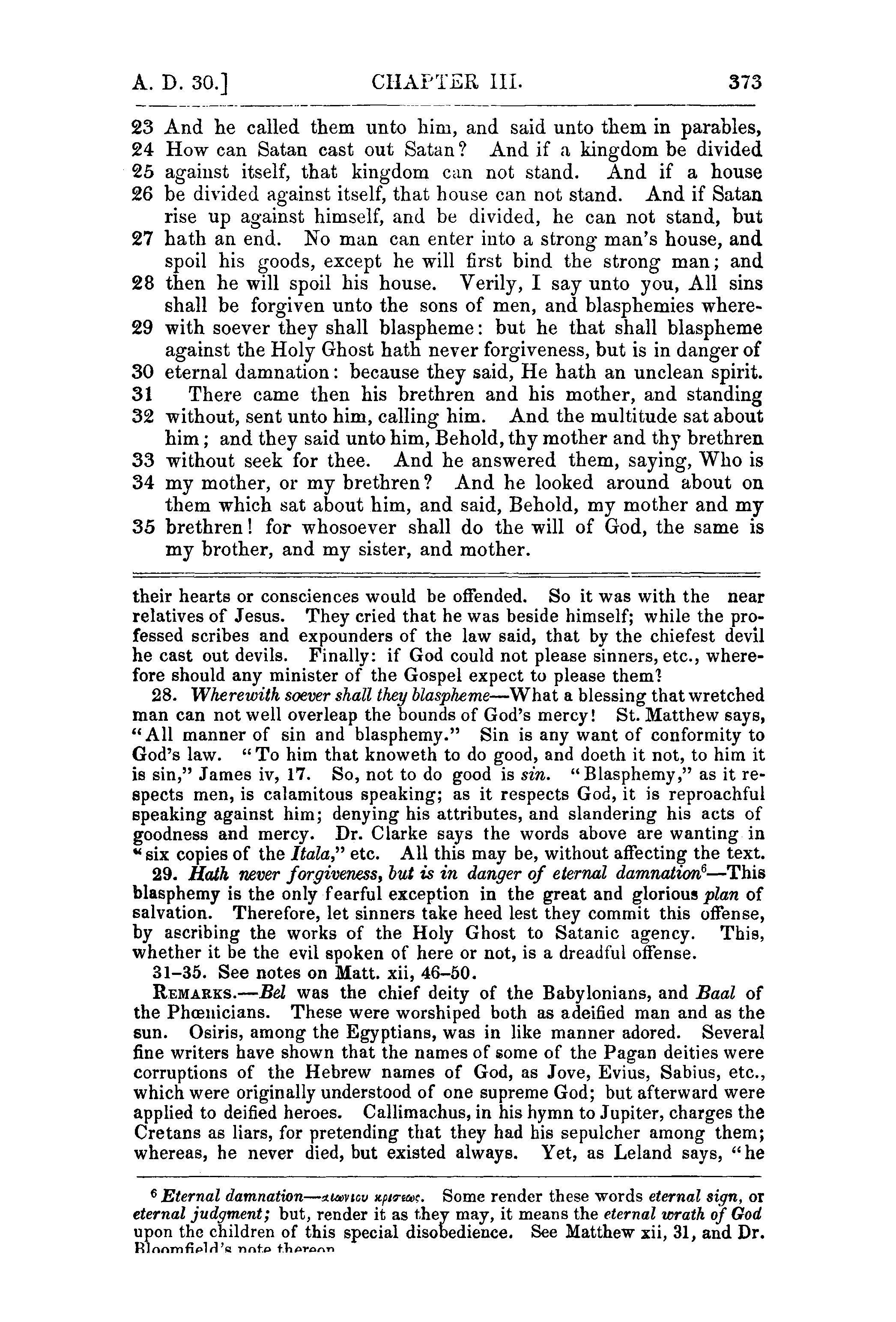
23 And he called them unto him, and said unto them in parables,
24 How can Satan cast out Satan? And if a kingdom be divided
25 against itself, that kingdom can not stand. And if a house
26 be divided against itself, that house can not stand. And if Satan rise up against himself, and be divided, he can not stand, but
27 hath an end. No man can enter into a strong man's house, and spoil his goods, except he will first bind the strong man; and
28 then he will spoil his house. Verily, I say unto you, All sins shall be forgiven unto the sons of men, and blasphemies where-
29 with soever they shall blaspheme: but he that shall blaspheme against the Holy Ghost hath never forgiveness, but is in danger of
30 eternal damnation: because they said, He hath an unclean spirit.
31 There came then his brethren and his mother, and standing
32 without, sent unto him, calling him. And the multitude sat about him; and they said unto him, Behold, thy mother and thy brethren
33 without seek for thee. And he answered them, saying, Who is
34 my mother, or my brethren? And he looked around about on them which sat about him, and said, Behold, my mother and my
35 brethren! for whosoever shall do the will of God, the same is my brother, and my sister, and mother.
their hearts or consciences would be offended. So it was with the near relatives of Jesus. They cried that he was beside himself; while the professed scribes and expounders of the law said, that by the chiefest devil he cast out devils. Finally: if God could not please sinners, etc., wherefore should any minister of the Gospel expect to please them 1
28. Wherewith soever shall they blaspheme-What a blessing that wretched man can not well overleap the bounds of God's mercy! St. Matthew says, "All manner of sin and blasphemy." Sin is any want of conformity to God's law. "To him that knoweth to do good, and doeth it not, to him it is sin," James iv, 17. So, not to do good is sin. "Blasphemy," as it respects men, is calamitous speaking; as it respects God, it is reproachful speaking against him; denying his attributes, and slandering his acts of goodness and mercy. Dr. Clarke says the words above are wanting in "six copies of the ltala," etc. All this may be, without affecting the text.
29. Hatk never forgiveness, but is in danger of eternal damnation6-This blasphemy is the only fearful exception in the great and glorious plan of salvation. Therefore, let sinners take heed lest they commit this offense, by ascribing the works of the Holy Ghost to Satanic agency. This, whether it be the evil spoken of here or not, is a dreadful offense.
31-35. See notes on Matt. xii, 46-50.
REMARKs.-Bel was the chief deity of the Babylonians, and Baal of the Phceuicians. These were worshiped both as adeified man and as the sun. Osiris, among the Egyptians, was in like manner adored. Several fine writers have shown that the names of some of the Pagan deities were corruptions of the Hebrew names of God, as Jove, Evius, Sabius, etc., which were originally understood of one supreme God; but afterward were applied to deified heroes. Callimachus, in his hymn to Jupiter, charges the Cretans as liars, for pretending that they had his sepulcher among them; whereas, he never died, but existed always. Yet, as Leland says, "he
6 Eternal damnatwn-<ttfAJv,QI,I JtPJ'7E6J�. Some render these words eternal si_gn, or eternal judgment; but, render it as they may, it means the eternal wrath of God upon the children of this special disobedience. See Matthew xii, 31, and Dr. Hloomfi.,lrl'" not t.h"l'Ann
CHAPTER IV. And he began again to teach by the sea-side: and there was gathered unto him a great multitude, so that he entered into a ship, and sat in the sea; and the whole multitude
2 was by the sea, on the land. And he taught them many things 3 by parables, and said unto them in his doctrine, hearken; Be4 hold, there went out a sower to sow. And it came to pass as he sowed, some fell by the way-side, and the fowls of the air came
5 and devoured it up. And some fell on stony ground, where it had not much earth; and immediately it sprang up, because it
6 had no depth of earth: but when the sun was up, it was scorched; 7 and because it had no root, it withered away. And some fell among thorns, and the thorns grew up, and choked it, and it
8 yielded no fruit. And other fell on good ground, and did yield fruit that sprang up, and increased, and brought forth, some
9 thirty, and some sixty, and some an hundred. And he said unto 10 them, He that hath ears to hear, let him hear. And when he was alone, they that were about him, with the twelve, asked of 11 him the parable. And he said unto them, Unto you it is given to know the mystery of. the kingdom of God: but unto them that 12 are without, all these things are done in parables: that seeing they may see, and not perceive; and hearing they may hear, and not understand; lest at any time they should be converted, and 13 their sins should be forgiven them. And he said unto them, Know ye not this parable? and how then will ye know all parables? 14, 15 The sower soweth the word. And these are they by the wayside, where the word is sown; but when they have heard, Satan cometh immediately, and taketh away the word that was sown in 16 their hearts. And these are they likewise which are sown on stony ground; who, when they have heard the word, immediately 17 receive it with gladness; and have no root in themselves, and so
himself held Jupiter to have been born in Arcadia." Dr. Cudworth says, touching this circumstance, that "the Pagan theology was all along confounded with a mixture of physiology and horology," the history of great men and heroes. The Greeks, by Zeus, understood the supreme God; and the Latins understood the same of Jupiter and J ovis. Yet, not always, for some among the learned Pagans understood by Jupiter the earth; others the soul of the world; and some, like Macrobius, understood the term to mean the sun. Virgil calls Jupiter rether; and Horace uses the word to signify the air. Other examples might be produced from Homer, who was held in great esteem by the Pagans, both as a poet and divine. For a full account of this matter see Leland's Revelation, vol. ii, pp. 99-126; and Clemens Alexandrinus. For a particular account of the heathen gods see Euhernerus. The worship of evil demons was very common in the Pagan world. See the Divine Legation of Moses, by the Bishop of Gloucester. Origen says the Christians shunned the worship of demons as pernicious and destructive; and he says the worship of the Greeks was the worship of demons. Let the reader contrast the worship of the heathen with the Savior, the apostles, and primitive Christians, and what will be his sensation! Glory be to God, that light and immortality are brought to light through the Gospel!
CHArTER IV. 1-20. See this parable explained in Matthew xiii,3-23On verse 12, see particularly notes on John xii, 39, 40.
endure but for a time: afterward, when affliction or persecution 18 ariseth for the word's sake, immediately they are offended. And these are they which are sown among thorns; such as hear the
19 word, and the cares of this world, and the deceitfulness of riches, and the lusts of other things entering in, choke the word, and it
20 becometh unfruitful. And these are they which are sown on good ground; such as hear the word, and receive it, and bring forth fruit, some thirty fold, some sixty, and some an hundred.
21 And he said unto them, Is a candle brought to be put under a 22 bushel, or under a bed? and not to be set on a candlestick? for there is nothing hid, which shall not be manifested; neither was
23 any thing kept secret, but that it should come abroad. If any
24 man have ears to hear, let him hear. And he said unto them; Take heed what ye hear: with what measure ye mete, it shall be measured to you: and unto you that hear, shall more be
25 given. For he that hath, to him shall be given: and he that hath not, from him shall be taken even that which he hath.
26 And he said, So is the kingdom of God, as if a man should
21-23. Is a candle brought to be put under a bushel? etc.-The word in the original signifies a measure, about a pint less than a bushel. Words similar to these are found in Matt. v, 15; from hence some have thought that St. Mark took portions of that discourse of our Lord and scattered them through his Gospel. But, as Watson says, "This is both an uncritical and a mischievous conclusion. The passages in question have something of a proverbial character, and were, therefore, applicable to quite distinct occasions." 1. The reason why he spoke in parables was, that all might understand, or see, by this lamp, or candle; not that any might be darkened; no more than that the candle was given and designed for the light of all in the house. 2. Why the Savior explained the parable to his disciples, was in order to make them public teachers. But, it may be asked, why did not the Savior explain them to am The reason appears to be this: the unbelieving Jews abused what light they had, and, of course, were accountable for such abuse; had they had more, their guilt would have increased; therefore, it was merciful in the Savior not to increase their guilt by lavishing divine light on them. But, mark, all this was only to be temporary, according to his own words: "For there is nothing hid, which shall not be manifested; neither was any thing kept secret, but that it should come abroad," after his ascension, under the dispensation of the Holy Spirit.
24. Take heed what ye hear, etc.-Carefully consider what ye hear from me, that ye may be able to declare the same to others. What measure ye mete-This proverbial expression occurs in the sermon on the mount; but is here used as a motive to a judicious hearing- of the word; whereas, there it was applied to caution against censorious judging; as if he had said, "according to the measure of attention you pay to my instruction, shall be your improvement in it." "He enjoined it upon the apostles diligently to learn, because they were appointed to teach." All ministers and Christians are here taught a lesson, that they may be able to manifest divine truth to a wicked world.
25. For he that hath, etc.-See note, Matt. xiii, 12. He that improves by my word, shall increase in the knowledge of the truth. He that hath not-That is, improves not. From him shall be taken even that which he hathThe little stock already obtained, as the beginning of future improvement. 26-29. So is the kingdom of God, etc.-This beautiful and brief parable
27 cast seed into the ground; and should sleep, and rise night and day, and the seed should spring and grow up, he knoweth not 28 how. For the earth bringeth forth fruit of herself; first the 29 blade, then the ear, after that the full corn in the ear. But when the fruit is brought forth, immediately he putteth in the sickle, because the harvest is come.
is only recorded by St. Mark. Its connection with the preceding is plain. In that Christ is the sower of the word; in this he unites the disciples with himself, as the future teachers of the Church. The effect, as far as visible agency is concerned, is produced by the energy of the earth, under the influence of the rain and sun-the earth bringeth forth fruit of herselJ1without needing the agency of man to produce the effect, after the ground is once prepared, and the seed deposited." (Watson.) As the fertility of the seed in the earth, so is the divine influence of the invisible Spirit in the human heart; the seed of truth is to be sown by prayer, with entire trust in God, to make it fruitful. These appear to be the leading facts of the parable. However, some difficulties attend its illustration. As a clear-minded writer" �ays, "If we say that the Lord points to himself as the sower of the seed, how then shall we explain verse 271 It can not be said of him that he knows not how the seed sown in the heart of his people springs and grows up; since it is only his continual presence, by his Spirit in their hearts, which causes it to grow at all. On the other hand, shall we say that the sower of the seed is here one of the inferior ministers and messengers of the truth; and that the purpose of the parable is to teach such, that after the word of life, of which they are bearers, has found place in any heart, they may be of good confidence, trusting to its own powers to unfold itself, for it has a life of its own-a life independent of him who may have been the original instrument for the communication of that life; even as a child, after it is born, has a life no longer dependent on that of the parents, from which, yet, it was originally derived!" With this explanation there is still a difficulty. It is said, in verse 29, "When the fruit is brought forth, immediately he [the same as the sower] putteth in the sickle, because the harvest is come." Of whom can it be said, save of the Son of man, the Lord of the harvest, that he putteth in the sickle! "In the sower absenting himself, after he has committed the seed to the ground, and in its growing without him, is the very point and moral of the whole; and to strike out that, would be as the striking out of its right eye, leaving it altogether dark. I will take the parable as having reference, in the first place, though not exclusively, to the Lord himself-the great Sower of the seed-and it will then remain to see how far the acknowledged difficulties are capable of being removed or mitigated. It commences thus: 'So is the kingdom of God, as if a man should cast seed into the ground, and should sleep, and rise night and day.' This signifies, not his carefulness, after having sown the seed, but his absence of such an after-carefulness: he does not think it necessary to keep watch over his seed, after it has been cast on the ground." Moreover, it has a law for its regular development: "first the blade, then the ear, then the full corn in the ear." Let the ministers of the Gospel be content to let the divine word grow in the appointed and mysterious manner; and be of good courage, and commit the whole matter to God, who will carry the work on to perfection.
"When it is said, 'the earth bringeth forth fruit of herself,'" continues
7 OJ herseif-!w'To,wt'J' spontaneously.
8 See Notes on the Parables," etc., by R. C. Trench, A. M.
30 And he said, Whereunto shall we liken the kingdom of God � 31 or with what comparison shall we compare it? It is like a grain of mustard seed, which, when it is sown in the earth, is less than 32 all the seeds that be in the earth: but when it is sown, it groweth up, and becometh greater than all herbs, and shooteth out great branches; so that the fowls of the air may lodge under the 33 shadow of it. And with many such parables spake he the word
Trench, "this does not exclude the rain, and sun, and all other favorable influences; so neither, when we say that the seed of God implanted in any heart has life of its own, is it hereby implied thatit will not require it. Were it a dead thing, it would require nothing of the kind, but, because it is living, it has need of that whereon it may feed. It remains to consider, in what sense that which is said of leaving the seed to itself can be affirmed of Christ. Olshausen 9 suggests this explanation of the difficulties above noted. It is true, he says, that the inner spiritual life of men is never, in any stage of its development, without the care and watchfulness of the Lord who first communicated that life; yet are there two moments when he may be said, especially, to visit the soul: at the beginning of the spiritual life, which is the seed-time, and again when he takes his people to himself, which is their time of harvest. Between these times lies a period in which the work of the Lord is going forward, without any such manifest interpositions on his part-not indeed without the daily supply of his Spirit, and the daily ordering of his providence, but so as that he does not put to his hand so plainly and immediately as at those two cardinal moments. And the difficulty will be slighter when we make application of the parable-as undoubtedly we are bound to do-to the growth and progress of the universal Church, and not only to that of the individual soul.
"The Lord, at his first coming in the flesh, sowed the word of the kingdom in the world, planted a Church therein, which having done he withdrew himself: the heavens received him till the time of the consummation of all things The three stages of spiritual growth, implied in 'the blade," the ear,' and 'the full corn in the ear,' suggests a comparison of this passage with such as 1 John ii, 12-14, where the apostle in like manner divides the faithful into 'little children,' 'young men,' and 'fathers,' evidently according to the different degrees of progress which they have made in the spiritual life. With verse 29 we may compare Rev. xiv, 14,15; and the comparison supplies an additional reason why we should not rest satisfied with the application of the parable to any less than the Son of God himself: 'And I looked, and behold a white cloud, and upon the cloud one sat, like the Son of man, having on his head a golden crown, and in his hand a sharp sickle. And another angel came out of the temple, crying, with a loud voice, to him that sat on the cloud, Thrust in thy sickle and reap: for the time is come for thee to reap; for the harvest of the earth is ripe.'"
30-32. A grain of mustard seed-See the notes on Matt. xiii, 31, 32. This, as well as the foregoing parable, was designed to encourage the apostles in the great work of their calling; and not only them, but all his ministers to the end of time.
33. Spoke the word-The doctrine of the Gospel. As they were able to hear it-As they could understand it. "They were like children; and he was obliged to lead them along cautiously, and by degrees, to a full understanding of the plan of salvation."
9 Kitto represents this man as among the very best commentators.
34 unto them, as they were able to hear it. But without a parable spake he not unto them: and when they were alone, he ex-
35 pounded all things to his disciples. And the same day, when the even was come, he saith unto them, Let us pass over unto the
36 other side. And when they had sent away the multitude, they took him even as he was in the ship. And there were also with
37 him other little ships. And there arose a great storm of wind,
38 and the waves beat into the ship, so that it was now full. And he was in the hinder part of the ship, asleep on a pillow: and they awake him, and say unto him, Master, carest thou not that
39 we perish? And he arose, and rebuked the wind, and said unto the sea, Peace, be still. And the wind ceased, and there was a
40 great calm. And he said unto them, Why are ye so fearful?
41 how is it that ye have no faith? And they feared exceedingly, and said one to another, What manner of man is this, that even the wind and the sea obey him?
34. 'Without a parable spake he not unto them-On things pertaining to the Gospe 1. And when they were alone-When the disciples were by themselves, apart from the people. He expounded, etc.-The spiritual import of the parable.
35-41. See note on Matt. viii, 18-27; Luke viii, 22.
36. Even as he was in the ship-Without making any provision for the voyage; without providing food or raiment; in the same ship in which he had just been teaching the people. And there arose a great storm-See Matt. viii, 23-27. He was asleep in the hinder part of the ship.l-Near the rudder.
39. Peace, be still.2-There our Lord stood amid the roaring of the tempest, the heaving of the sea, and the darkness of the night. None but the God of the universe could hush the angry elements, and breathe peace to the wind and sea. Reader, adore him as thy God, and love him as thy Savior.
REMARKs.-In the thirty-seventh verse it is said," And there arose a storm," etc. God is the governor of the universe, and he sustains all nature by his own power, which sustains the general laws of the universe. Thousands think that such a storm as is here mentioned came by chance, as they call it, though there be no such thing as chance in the whole universe of God. Others say such a storm was their fate, and they have fate as a sort of ruling god, and fatality as their religion, though, at the same time, they affect to hold the doctrine of Divine providence.
According to Plutarch, we may trace the doctrine of fatality down to heathen authors; and it is the shred of heathenism itself. Thales held necessity to be the strongest of all things, for all things are subject to it. Parmenides and Democritus held, as we are informed, that all things came by necessity, and the latter held an absolute material necessity. Heraclitus thought that all things were done by fate, and that fate is the same with necessity. The Stoics spoke much of fate: Zeno taught that all things are subject to fate, as Laertius says. Chrysippus, and the most eminent of the ancient Stoics, held, that in the constitution of the world, "J upiter himself was hampered by natural necessity," so that he could not always do the things that he would. In connection with this, these Stoics
1 So we translate, as Benson properly says, f1l't 'l"� 7fPVP.VI1, without a better English expression, as he lay in the ship near the rudder.
2 Be still, from 7f£�/"u')�Q-be gagged.
CHAPTER V. And they came over unto the other side of the sea, 2 into the country of the Gadarenes. And when he was come out of the ship, immediately there met him out of the tombs a man 3 with an unclean spirit, who had his dwelling among the tombs; 4 and no man could bind him, no, not with chains: because that he had been often bound with fetters and chains, and the chains had been plucked asunder by him, and the fetters broken in 5 pieces: neither could any man tame him. And always, night and day, he was in the mountains, and in the tombs, crying, and 6 cutting himself with stones. But when he saw Jesus afar off, he 7 ran and worshiped him, and cried with a loud voice, and said, What have I to do with thee, J eSTIS, thou Son of the Most High 8 God? I adjure thee by God, that thou torment me not. (For he said unto him. Come out of the man, thou unclean spirit.]
9 And he asked him, What is thy name? And he answered, 10 saying, My name is legion, for we are many. And he besought also held, that some men were necessarily of bad dispositions, and exposed to evils and awful calamities. With many of the Stoics, necessity was a violent and invincible cause, and fate an established chain of causes. Plato himself, according to Plutarch, referred some things to providence, and others to fate, or necessity.
The religious worship of the heathen, as idolatry made progress, was addressed to a multiplicity of deities, and, as Dr. Leland says, prayer was almost universally in use among the Pagan nations;" but they generally only prayed for riches, honor, long life, etc. Some of them, on the other hand, argued against praying. Maximus Tyrius wrote a dissertation, to prove that we ought not to pray at all. Others of them taught the same thing. On the subject of prayer, modern Deists are divided in sentiment. Mr. Chubb is of opinion that there is an impropriety in praying to God, and intimates that it is displeasing to Deity. See his Posthumous Works, vol. i, p. 283. As a perfect refutation of such a sentiment, see Dr. Benson's Tract on the End and Design of Prayer. See the sequel of the sixth chapter.
CHAPTER V. 1-20. The country of the Gadarenes-See notes on Matt. viii, 28-34-The name of the demon, mentioned by St. Mark, is Legion, who spoke for all the others as well as himself. The Roman legion consisted of sixty thousand men, but, customarily, the term was used to signify many, even as seven was used to denote an indefinite completeness. This spirit, as is likely, was one of authority among the orders of the accursed. He acknowledges Jesus to he the Son of the most high God. Verse 7. I adjure thee, by God, that thou torment me not-Adjure signifies to entreat earnestly; "for the strict meaning, to lay under an oath, can not be admitted." (Watson.)
10. And he besought him much that he would not send them away out of that country-This was the demon's prayer, for himself and the others. Says Watson: "These are awful indications of a spiritual world, and of the number, power, and malignity of these fiends of darkness." We see the power of Jesus over these fiends.! We live under the mediatorial reign of
3 Dr. Hammond, quoted by Whitby, gives three reasons why Christ permitted the demons to go into the swine. 1. That the people might see the virulency of them. 2. The mercy shown to the possessed. 3. To test their love, whether it was greater for swine, than for their souls. As these people were heathens, it is likely the demons, for this reason, wished to stay here.
him much that he would not send them away out of the country.
11 Now there was there nigh unto the mountains a great herd of
12 swine feeding. And all the devils besought him, saying, Send us
13 into the swine, that we may enter into them. And forthwith Jesus gave them leave. And the unclean spirits went out, and entered into the swine: and the herd ran violently down a steep place into the sea, (they were about two thousand,) and were
14 choked in the sea. And they that fed the swine fled, and told it in the city, and in the country. And they went out to see what
15 it was that was done. And they come to Jesus, and see him that was possessed with the devil, and had the legion, sitting, and
16 clothed, and in his right mind: and they were afraid. And they that saw it told them how it befell to him that was possessed
17 with the devil, and also concerning the swine. And they began
t 8 to pray him to depart out of their coasts. And when he was come into the ship, he that had been possessed with the devil
19 prayed him that he might be with him. Howbeit Jesus suffered him not, but saith unto him, Go home to thy friends, and tell them how great things the Lord hath done for thee, and hath had
20 compassion on thee. And he departed, and began to publish in Decapolis how great things Jesus had done for him. And all
2 t men did marvel. And when Jesus was passed over again by ship unto the other side, much people gathered unto him: and he was 22 nigh unto the sea. And behold, there cometh one of the rulers of the synagogue, Jairus by name; and when he saw him, he fell 23 at his feet, and besought him greatly, saying. My little daughter lieth at the point of death: I pray thee, come and lay thy hands 24 on her, that she may be healed; and she shall live. And Jesus went with him; and much people followed him, and thronged 25 him. And a certain woman which had an issue of blood twelve 26 years, and had suffered many things of many physicians, and had spent all that she had, and w�s nothing bettered, but rather grew
Jesus Christ, so that we are delivered from these demoniacal possessions, u the greatest calamity which could befall mortals."
The gratitude of the man delivered from the power of the demons was great: when the Savior was about to depart, he prayed him that he might be with him-This the Savior would not permit, but directed him to go to his home, and declare the goodness of the Lord. Immediately he departed, and began to publish in Decapolis how great things Jesus had done for him; and all men did marvel. "As these countries were crowded with a Gentile population, this man became a witness for Christ among the mixed races of that district, which might be one reason why he was not permitted to follow Christ in the number of his disciples. The correspondence between the desire of the devils to remain in the country of the Gadarenes, and the eagerness of the people to press the departure of Christ may also be noted. No wonder the devils affected a country which was so disaffected to the Savior! But the circumstance is admonitory. We can not reject Christ without exposing ourselves to the more special influence, and more confirmed power, of our great adversary, the destroyer of souls. Let all who make light of Christ be warned by this history." (Watson.)
22. One of the rulers of the synagogue, etc.-See notes, Matt. ix, 18-26. This shows that the synagogue had its rulers. 25-34. A certain woman-See notes on Matt. ix, 20-22. St. Mark's
27 worse, when she had heard of Jesus, came in the press behind, 28 and touched his garment: for she said, if I may touch but his 29 clothes, I shall be whole. And straightway the fountain of her blood was dried up; and she felt in her body that she was healed 30 of that plague. And Jesus, immediately knowing in himself that virtue had gone out of him, turned him about in the press, and
31 said, Who touched my clothes? And his disciples said unto him, Thou seest the multitude thronging thee, and sayest thou,
32 Who touched me? And he looked round about to see her that 33 had done this thing. But the woman, fearing and trembling, knowing what was done in her, came and feU down before him, 34 and told him all the truth. And he said unto her, Daughter, thy faith hath made thee whole; go in peace, and be whole of 35 thy plague. While he yet spake, there came from the ruler of the synagogue's house certain which said, Thy daughter is dead:
account is more particular, showing that the disease was incurable by human agency, and had been of long continuance. "She brought, therefore, to Christ, pain, poverty, disappointment, a troubled spirit, and a disorder dragging her rapidly to the grave." This teaches us never to despair when we come to Christ. The greatest number of those diseased, who came to Christ, were incurable by skill and medicine. This disease, which physicians had in vain attempted to cure, during twelve years, was cured at once by the virtue of the Savior. The means of this cure were remarkable; it was not caused by a look, a word, or a touch of the Savior, but by the woman touching the hem or fringe of our Lord's garment. St. Luke-vi, 19-tells us, "And the whole multitude sought to touch him; for there went virtue out of him, and healed them all." This woman came behind, and touched the Savior, as her disease did not admit of explanation; being pronounced by the law as unclean: "any explanation of her case would have led the bystanders to drive her out of the company. She simply touched the fringe of his garment, in token at once of her reverence and faith." The eye of our Lord saw her before as well as after the cure. Christ challenged her, that she might confess the cure, as he knew in himself that virtue had gone out of him." This power had gone out of him consciously, as the reward of faith."
35. Thy daughter is dead- See the notes on Matt. ix, 18-26. Why troublest thou the Master any further?-His friends, probably, were afraid to tax his miraculous power any further; and they may, at this crisis, have feared, particularly as he had not yet among them raised the dead. Or as Dr. Clarke says, "These people seemed to have had no other notion of our Lord than that of an eminent physician, who might be useful while there was life, but afterward could do nothing." In Matt. ix, 18, Jairus, speaking of his daughter, affirmed that she was dead; yet, in verse 23 of this chapter, it is rendered, my little daughter lieth at the point of death. But the Greek may be rendered, with equal propriety, "She is, at this time, dead." It is thus rendered by Dr. Bloomfield. It is rendered, in Luke viii, 42, "She lay a dying;" so there is no real discrepancy-she then was dying: afterward, certain said, Thy daughter is dead.
4 The term !'V;tP.VI, is more definitely rendered power: that power had gone out of him. Hence, it was not the power of another, but his own power.
S Dr. Clarke remarks, on this woman's case, 1. The nature of her malady: it could not be made public, without exposing her to shame and contempt. 2. It was inveterate. 3. Continual. 4. It reduced her to want, etc.
36 why troublest thou the Master any further? As soon as Jesus heard the word that was spoken, he saith unto the ruler of the
37 synagogue, Be not afraid, only believe. And he suffered no man to follow him, save Peter, and James, and John the brother
38 of James. And he cometh to the house of the ruler of the synagogue, and seeth the tumult, and them that wept and wailed
39 greatly. And when he was come in, he saith unto them, Why make ye this ado, and weep? the damsel is not dead, but sleepeth.
40 And they laughed him to scorn. But, when he had put them all out, he taketh the father and the mother of the damsel, and them that were with him, and entereth in where the damsel was lying.
36. As soon as Ohrist heard the word spoken-That she was dead. He saith to the ruler, Be not afraid, only believe-See the tenderness of Jesus. On this sad news, he would cheer the depressed parent with words to prompt him to courage and belief. These words, too, would direct his attention to his marvelous interposing power over the potency of death. Only believe-Precious words, and a precious condition of life from the dead. Luke says-viii, 50-" And she shall be made whole." Reader, amid your sorrows, cares, and labors, only believe!
38. And he cometh to the house, and seeth the tumult-St. Matthew says the minstrels, the hired musicians, and the people, were" making a noise." What a foolish practice! what grieving hypocrites! The Asiatics" hired professed mourners-usually women-who laud the virtues and beauties of the deceased." The Jews were in this habit. See Jer. xlviii, 36. The mourning, generally, continued eight days; but still growing less in vehemence. Dr. Shaw, and Hartly, and Jowett, give us various examples of this practice. The latter, in his travels in "Palestine, in 1823," arrived at N apolose-ancient Shechem-immediately after the death of the governor; and, on approaching the gate, he saw a numerous company of females, singing a kind of song, beating time with their hands, then changing suddenly from singing to the" most hideous shrieks." Something similar to this custom is still practiced among the Romish-Irish to this present time. Here they call it Caoinan. A more untimely, degrading, and foolish practice, could hardly be thought of. Still, the Jews were forbidden to tear their hair, and cut their flesh, in mourning for the deadLev. xix, 28; Deut. xiv, I-as such acts were inconsistent with a proper trust in the Divine will and providence.
39. The damsel is not dead, but sleepeth-This is to be taken figuratively, in the sense, "That she is not so far departed, or dead, as not to return to life, but is, as it were, asleep."
40. And they laughed him to scorn-St. Matthew says," They derided him." Watson says, "This is too strong a translation! of the original; it is a laugh of incredulity." But when he had put them all out-They had pronounced her dead. After this, they must leave the place. The Divine power to be manifested is too great for such spectators. Jesus expelled them all, save the parents of the girl, and probably Peter, James, and John. Note, Matt. xvii, 1,2.
41. And he took the damsel by the hand, and said unto her, Talitha-cumi7-
6 K�llt�'TEf'E�{o)V �!J'TOIJ-and they laughed at him; that is, unbelievingly.
7 Dr. A. Clarke says, in loco, "This is mere Syriac." This agrees with Watson. Others say these words are a mixture of Syriac and Chaldee: hence, called Syro-ahaldaic. See Barnes's Notes, and Longking's Notes. In our opinion, Dr. A. Clarke, as a linguist, has not been excelled in the Church in the past or present century.
41 And he took the damsel by the hand. and said unto her, Talithacumi: which is, being interpreted, Damsel, (I say unto thee,) 42 arise. And straightway the damsel arose, and walked; for she was of the age of twelve years. And they were astonished with 43 a great astonishment. And he charged them straitly that no man should know it; and commanded that something should be given her to eat.
CHAPTER VI. 1 And he went out from thence, and came into his own 2 country; and his disciples follow him. And when the Sabbathday was come, he began to teach in the synagogue: and many hearing him were astonished, saying, From whence hath this man these things? and what wisdom is this which is given unto him, 3 that even such mighty works are wrought by his hands? Is not this the carpenter, the son of Mary, the brother of James, and Joses, and of Juda, and Simon? and are not his sisters here with
Here was displayed a divine majesty, sufficient to call the attention of the highest moral beings of the creation; exhibiting, at once, his power over death, and the spirits of the dead. Says Mr. Scott, It is worthy of observation, that of the three persons, whom Christ is particularly recorded to have raised from the dead, one was the only son of a widow, another the only daughter of J airus, and the third, the beloved brother of Martha and Mary: so much compassion and condescension did he show to the feelings of natural affection." But there were other and higher objects in view.
42. Astonished with a great astonishment-That is, they were exceedingly astonished. This is a common manner of expression, both with sacred and secular writers. It is found, as an" idiom in the LXX, and among Greek and Latin authors."
43. He charged them strictly that no man should know it-By this is not mean t "perpetual secrecy, but present suppression." This was in order to avoid raising a tumult. There was a living power that wrought the miracle which soon spoke for itself. St. Matthew says, "The fame thereof went abroad into all that land." The foolish and artificial mourners, who had pronounced her dead, would now, with wonder, pronounce her living, and hlaze the occurrence abroad. So, certainly, the privacy of the matter would be very temporary. Dr. A. Clarke remarks very beautifully, at the conclusion of this verse, that" while Christ teaches men the knowledge of the true God, and the way of salvation, he at the same time teaches them lessons of prudence, economy, and common sense. True religion, civilization, mental improvement, common sense, and orderly behavior, go hand in hand." Thank God, that everyone may be made a partaker of this" pure and undefiled religion!" Reader, seek it; seek it in youth; seek it now!
REIlfARKs.-Jesus Christ is the Lord Jehovah-Yehovah-of the Old Testament Scripture. This was the peculiar name given to God; or, rather, God revealed it himself to the Hebrew people. It was not utterly unknown to the Gentiles. Diodorus-speaking of Moses-says, that the God who is called 1<%00, delivered his laws to him. Philo Biblius-the translator of Sanchoniathon's Phoenician History-calls him I�vw. The oracle of the Clarian Apollo gave l�w, as the name of the highest of the gods. It is probable that the names Jovis, and Jovis Pater, were abreviated into Jupiter. See Leland's Rev., vol. i, p. 406.
CHAPTER VI. 1-6. This passage is explained in the notes on Matt. xiii, 54-58.
4 us? And they were offended at him. But Jesus said unto them, A prophet is not without honor, but in his own country, and 5 among his own kin, and in his own house. And he could there do no mighty work, save that he laid his hands upon a few 6 sick folk, and healed them. And he marveled because of their unbelief. And he went round about the villages teaching.
7 And he called unto him the twelve, and began to send them forth by two and two; and gave them power over unclean spirits;
8 and commanded them that they should take nothing for their journey, save a staff only; no scrip, no bread, no money in their 9 purse: but be shod with sandals; and not put on two coats.
10 And he said unto them, In what place soever ye enter into an 11 house, there abide till ye depart from that place. And whosoever shall not receive you, nor hear you, when ye depart thence, shake off the dust under your feet, for a testimony against them. Verily I say unto you, It shall be more tolerable for Sodom and 12 Gomorrah in the day of judgment, than for that city. And they 13 went out, and preached that men should repent. And they cast out many devils, and anointed with oil many that were sick, and
7-11. Began to send them forth by two and two-See notes on Matt. x, 1, etc.
12. That men should repent-The nature of repentance is explained in Matt. iii, 2. Repentance was the doctrine of John the Baptist, our Lord, and his disciples. This they were to preach in all the Jewish cities, and they were to announce the approach of the kingdom of God, the Messiah's reign, the downfall of Satan's kingdom, and the exaltation of degraded man. "The doctrine of repentance is as essential a part of true evangelical preaching now as it was then, and it will remain so to the end of time. He is not a true minister of Christ who speaks only of pardon and salvation: he must speak previously of men's guilt and danger, and urge the consideration of that upon them till they feel it; or in vain will he dwell upon the gracious offices of Christ, and the provisions of the covenant of grace." (Watson.)
13. And anointed with oil, etc.8-This was only employed symbolically, as the "first Christians were accustomed to represent, in visible signs, the allegorical allusions in Scripture. They used oil not only as the Jews had done, as a remedy, which had, from high antiquity, become sacred, but, from that sacredness, as a religious rite at baptism, confirmation, and prayers for the sick." (Bloomfield.) "The Papistical doctrine," says Watson, "of extreme unction, has no support from this passage. It does not, indeed, appear that the apostles, in anointing the sick, acted under the command of Christ, or that this was a religious rite at all. It was, most probably, the usual emblematical method of expressing joy upon receiving any particular blessing from God." But, even if it was thus emblematical in the days of the disciples, and used by them thus, what reason can modern ministers have to use this rite l Just none; because our commission is considably different: as we have not the powers of the apostles, therefore it would be absurd to use the sign of raising the dead, and healing the sick, without the power. What is termed "confirmation," both by Romanists
8 It appears, as Dr. Bloomfield states, from Westein and Lightfoot, that oil, in those eastern and southern countries, is of a very mild quality, and was used by Jews and Gentiles in medical applications.
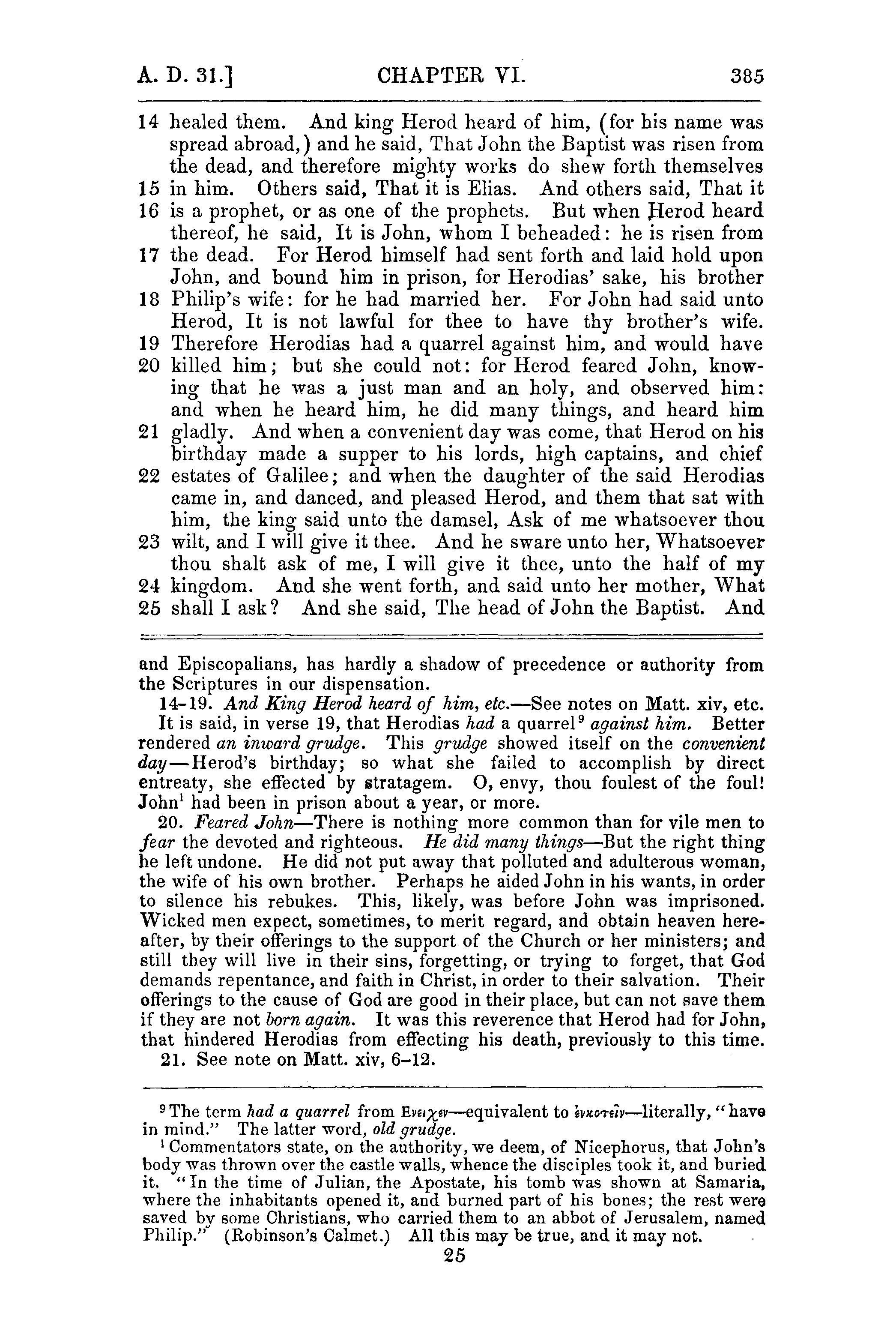
14 healed them. And king Herod heard of him, (for his name was spread abroad,) and he said, That John the Baptist was risen from the dead, and therefore mighty works do shew forth themselves 15 in him. Others said, That it is Elias. And others said, That it 16 is a prophet, or as one of the prophets. But when Herod heard thereof, he said, It is John, whom I beheaded: he is risen from 17 the dead. For Herod himself had sent forth and laid hold upon John, and bound him in prison, for Herodias' sake, his brother 18 Philip's wife: for he had married her. For John had said unto Herod, It is not lawful for thee to have thy brother's wife. 19 Therefore Herodias had a quarrel against him, and would have 20 killed him; but she could not: for Herod feared John, knowing that he was a just man and an holy, and observed him: and when he heard him, he did many things, and heard him 21 gladly. And when a convenient day was come, that Herod on his birthday made a supper to his lords, high captains, and chief 22 estates of Galilee; and when the daughter of the said Herodias came in, and danced, and pleased Herod, and them that sat with him, the king said unto the damsel, Ask of me whatsoever thou 23 wilt, and I will give it thee. And he sware unto her, Whatsoever thou shalt ask of me, I will give it thee, unto the half of my 24 kingdom. And she went forth, and said unto her mother, What 25 shall I ask? And she said, The head of John the Baptist. And
and Episcopalians, has hardly a shadow of precedence or authority from the Scriptures in our dispensation.
14-19. And King Herod heard of him, etc.-See notes on Matt. xiv, etc. It is said, in verse 19, that Herodias had a quarrel 9 against him. Better rendered an inward grudge. This grudge showed itself on the convenient day-Herod's birthday; so what she failed to accomplish by direct entreaty, she effected by stratagem. 0, envy, thou foulest of the foul! John' had been in prison about a year, or more.
20. Feared John-There is nothing more common than for vile men to fear the devoted and righteous. He did many things-But the right thing he left undone. He did not put away that polluted and adulterous woman, the wife of his own brother. Perhaps he aided John in his wants, in order to silence his rebukes. This, likely, was before John was imprisoned. Wicked men expect, sometimes, to merit regard, and obtain heaven hereafter, by their offerings to the support of the Church or her ministers; and still they will live in their sins, forgetting, or trying to forget, that God demands repentance, and faith in Christ, in order to their salvation. Their offerings to the cause of God are good in their place, but can not save them if they are not born again. It was this reverence that Herod had for John, that hindered Herodias from effecting his death, previously to this time.
21. See note on Matt. xiv, 6-12.
9 The term had a quarrel from Evel;tev-equivalent to ;vl£o7£lv-literally, "have in mind." The latter word, old grudge.
I Commentators state, on the authority, we deem, of Nicephorus, that John's body was thrown over the castle walls, whence the disciples took it, and buried it. "In the time of Julian, the Apostate, his tomb was shown at Samaria, where the inhabitants opened it, and burned part of his bones; the rest were saved by some Christians, who carried them to an abbot of Jerusalem, named Philip." (Robinson'S Calmet.) All this may be true, and it may not.
she came in straightway with haste unto the king, and asked, saying, I will that thou give me, by and by, in a charger, the
26 head of John the Baptist. And the king was exceeding sorry; yet for his oath's sake, and for their sakes which sat with him, he
27 would net reject her. And immediately the king sent an executioner, and commanded his head to be brought: and he went and
28 beheaded him in the prison; and brought his head in a charger, and gave it to the damsel; and the damsel gave it to her mother.
29 And when his disciples heard of it, they came and took up his
30 corpse, and laid it in a tomb. And the apostles gathered themselves together unto Jesus, and told him all things, both what
31 they had done, and what they had taught. And he said unto them, Come ye yourselves apart into a desert place, and rest awhile: for there were many coming and going, and they had no
32 leisure so much as to eat. And they departed into a desert place
33 by ship privately. And the people saw them departing, and many knew him, and ran afoot thither out of all cities, and
34 outwent them, and came together unto him. And Jesus, when he came out, saw much people, and was moved with compassion toward them, because they were as sheep not having a shepherd:
35 and he began to teach them many things. And when the day was now far spent, his disciples came unto him, and said, This is
36 a desert place, and now the time is far passed: send them away, that they may go into the country round about, and into the villages, and buy themselves bread: for they have nothing to eat.
37 He answered and said unto them, Give ye them to eat. And they say unto him, Shall we go and buy two hundred penny worth
38 of bread, and give them to eat? He saith unto them, How many loaves have ye? go and see. And when they knew, they say,
39 Five, and two fishes. And he commanded them to make all sit
40 down by companies upon the green grass. And they sat down in
41 ranks, by hundreds, .and by fifties. And when he had taken the five loaves, and the two fishes, he looked up to heaven, and blessed, and brake the loaves, and gave them to his disciples to set before them; and the two fishes divided he among them all.
42, 43 And they did all eat, and were filled. And they took up
44 twelv€ baskets full of the fragments, and of the fishes. And they
45 that did eat of the loaves, were about five thousand men. And straightway he constrained his disciples to get into the ship, and to go to the other side before unto Bethsaida, while he sent away
35-40. This is a desert place, etc.-On this miracle see notes, Matt. xiv, 14-21. To this account St. Mark adds several circumstances. 1. He introduces the disciples, saying-in answer to the Savior's words, Give ye them to eat-Shall we go and buy two hundred pennyworth of bread, and give them to eat? Lightfoot, by Watson, says, this among the Jews meant a considerable sum. Barnes has marked it at "about twenty-seven dollars.
As the disciples had a common purse, in which they carried their little property, consisting of the donations of their friends, and money to be given to their poor, it is not improbable that they had, at this time, about this sum in their possession." 2. St. Mark shows us the order in which this multitude was placed. And he commanded them to make all
46 the people. And when he had sent them away, he departed into
47 a mountain to pray. And when even was come, the ship was in
48 the midst of the sea, and he alone on the land. And he saw them toiling in rowing; for the wind was contrary unto them: and about the fourth watch of the night he cometh unto them, walk-
49 ing upon the sea, and would have passed by them. But when they saw him walking upon the sea, they supposed it had been a
50 spirit, and cried out. (For they all saw him, and were troubled.) And immediately he talked with them, and saith unto them, Be
51 of good cheer: it is I; be not afraid. And he went up unto them into the ship; and the wind ceased: and they were sore
52 amazed in themselves beyond measure, and wondered. For they considered not the miracle of the loaves; for their heart was
53 hardened. And when they had passed over, they came into the
54 land of Gennesaret, and drew to the shore. And when they
55 were come out of the ship, straightway they knew him, and ran through that whole region round about, and began to carry about
56 in beds those that were sick, where they heard he was. And whithersoever he entered, into villages, or cities, or country, they laid the sick in the streets, and besought him that they might touch, .if it were but the border of his garment: and as many as touched him, were made whole.
sit down by companies. The original signifies in rows, as at table. In this position they could all be more easily served, and numbered.
47. The ship was in the midst of the sea-See note, Matt. xiv, 24-33.
52. For their heart was hm'dened-This is given as the reason, either for their fear in the storm, or for the" excessive wonder they expressed when the wind was stilled by the word of Jesus." Says Watson, "Right views, arising from calm and discerning consideration, would have rendered the miracle of the loaves more astonishing, and the calming of the wind and the sea somewhat less so: for, at the latter, they were sore amazed in themselves beyond measure, for their heart was hardened; that is, dull of apprehension, not wickedly insensible-the sense in which the same word is sometimes used-but inapt to learn, and slow to receive conviction; a fault which the Evangelists several times record against themselves, and their fellow-disciples, with the utmost simplicity and humility." The word heart is frequently used in the above sense. See Eph. i, 18, in Greek; Rom. i, 21; 2 Cor. iv, 6.
54. They knew him-Christ had been in this place before, and had wrought miracles there. The country of Gennesaret extended about four miles along the north-western shore of the Sea of Galilee, and was a most fertile, beautiful, and populous country. According to St. Matthew, this visit of the Savior made a powerful impression upon the people-xiv, 3436. St. Mark unites vigor, brevity, and particularity together.
55. And ran through that whole region round about-This was a very uncommon excitement on the approach of the Savior. It exceeded any religious excitement of modern days. The people carried about the sick on couches, to whatsoever place they heard Jesus was. But this was not all; for,
56. Whithersoever he entered, into village, or city, or country, they laid the sick in the streets, and besought him that they might touch, if it were but the border of his garment. What, then! Why, as many as touched him, [or it,] were made whole. Glory be to God!
CHAPTER VII. Then came together unto him the Pharisees, and 2 certain of the scribes, which came from Jerusalem. And when they saw some of his disciples eat bread with defiled (that is to 3 say, with unwashen) hands, they found fault. For the Pharisees,
REMARKs.-In view of the obvious manifestations set forth in this chapter, is it not unaccountably strange for any true believer in the divinity and spirituality of Jesus Christ, to concoct such a figment as idol worship! Image worship is of heathen origin. At first, the heathens worshiped the heavenly bodies-this was their first error: again, they adored deified men, and, finally, the images of their gods, or the very gods themselves. Plutarch blames the Grecians for calling the pictures of their gods, and their statues, of brass and stone, gods. The philosopher Stilpo, of Megara, was brought before the tribunal of the Areopagus, at Athens, for saying that the statue of Minerva, which had been made by Phidias, was not a god. The heathens did not look upon those images as their real gods, but that the gods were represented by them; for, as Celsus says, who but a fool can imagine these images to be real gods! The worship of images was vindicated, and apologized for, by the philosophers. Probably, it first began among the Chaldeans, Pheenicians, and Egyptians, and, likely, it took its rise from erecting pillars or monuments to their great men, or heroes. See Scaliger Animadv. in Eusebius; Bochart on Canaan. Lucian, in his Dea Syria, says, that the Assyrians derived the statues of the gods from the Egyptians. The use of images came into Greece, it is likely, from Egypt. The most ancient Greeks had no temples till they were taught their use by Cecrops, who came from Egypt. Some of the ancient nations abstained, for a long time, from the use of images. The ancient Romans had no images in their temples for one hundred and seventy years after the building of Rome. Plutarch, in his life of Numa, says he forbid the Romans to represent God under the form of man or beast. Lactantius speaks of the fondness of the heathen for images, especially those adorned with gold or silver. Lib. ii, cap. 6. Many examples might be added. We have no doubt but the Roman Catholics borrowed their abominable image worship from the ancient heathen. It is semi-polytheism; degrading in its tendency, ruinous to the mind, condemning to the soul; a dishonor to God, a loathing to holy angels, and an accursed practice.
CHAPTER VII. 1. Certain of the scribes, which came from Jerusalem-See notes on Matt. xv, 1, etc. Their object was to find fault with the Savior, and to condemn him: they found that he was becoming too popular, and that he might endanger their craft, and expose their wickedness. They followed the Savior to censure him.
2. Defiled hands-These were considered so, unless washed before meals. The Greek word signifies, literally, common. It was peculiar, in the Jewish manner of speaking, to say common and holy. It is generally thought that St. Mark wrote for the use of the Gentile converts; therefore we find, in his Gospel narrative, explanatory sentences thrown in, as it seems, for their use. Such as, that is, unwashen, without which they might have misunderstood him, not being well acquainted with Jewish customs. All such customs were of human origin, but had, afterward, obtained an essential position in Jewish ceremonies.
3. Except they wash their hands oft2-The eastern people" wash oft" to
2 The word 7rU)'�if, "the hand to the wrist," says Clarke. Theophylact renders the Greek terms, unless they wash up to their elbows; taking 7rU)'�i1 to mean, the whole arm. Benson says, the Codex Beee, instead of 7rU)'I/-I1, has 7ruII.vi1,jrequently. Greek, ��7r'T111'(AJV'Td.', bathe themselves, "as the word, probably, ought here to be rendered. See Lev. xr, 11."
and all the Jews, except they wash their hands oft, eat not, hold-
4 ing the tradition of the elders. And when they come from the market, except they wash, they eat not. And many other things there be, which they have received to hold, as the washing of
5 cups, and pots, and brazen vessels, and tables. Then the Pharisees and scribes asked him, Why walk not thy disciples according to the tradition of the elders, but eat bread with unwashen
6 hands? He answered and said unto them, Well hath Esaias prophesied of you hypocrites, as it is written, This people hon-
7 oreth me with their lips, but their heart is far from me. Howbeit, in vain do they worship me, teaching for doctrines the command-
8 ments of men. For laying aside the commandment of God, ye hold the tradition of men, as the washing of pots and cups: and
9 many other such like things ye do. And he said unto them, Full well ye reject the commandment of God, that ye may keep
10 your own tradition. For Moses said, Honor thy father and thy mother; and, Whoso curseth father or mother, let him die the
11 death: but ye say, If a man shall say to his father or mother, It is Corban, that is to say, a gift, by whatsoever thou mightest
12 be profited by me; he shall be free. And ye suffer him no more
13 to do aught for his father or his mother; making the word of God of none effect through your tradition, which ye have delivered: and many such like things do yeo
14 And when he had called all the people unto him, he said unto them, Hearken unto me everyone of you, and understand.
15 There is nothing from without a man, that entering into him, can defile him: but the things which come out of him, those are they
16 that defile the man. If any man have ears to hear, let him hear.
17 And when he was entered into the house from the people, his
18 disciples asked him concerning the parable. And he saith unto them, Are ye so without understanding also? Do ye not perceive, that whatsoever thing from without entereth into the man,
19 it can not defile him: because it entereth not into his heart, but into the belly, and goeth out into the draught, purging all meats?
20 And he said, That which cometh out of the man, that defileth
21 the man. For from within, out of the heart of men, proceed evil
22 thoughts, adulteries, fornications, murders, thefts, covetousness, wickedness, deceit, lasciviousness, an evil eye, blasphemy, pride,
23 foolishness; all these evil things come from within,and defile the man.
this day; not only Jews, but Mohammedans: it is commanded in the Koran! The Hindoos wash hands and feet before evening meal. As the Savior and his disciples did not wash, these men must know wherefore.
5. vVhy walk not thy disciples according to the tradition of llu: elders-See note, Matt. xv, 2,9.
9. Full well ye reject the commandment of God-This was a gross iniquity; but, likely, they were blinded, and did not see it. It was a keen reply, and a startling rebuke from the Savior, and spiritual darkness and prejudice, only, could have blinded their eyes.
10-23. These verses are explained in Matt. xv, 3-20. In addition, we may add, St. Mark here enumerates thirteen evils proceeding from the human heart, and St. Matthew points out seven; an awful picture of fallen
24 And from thence he arose, and went into the borders of Tyre and Sidon, and entered into an house, and would have no man know
25 it: but he could not be hid. For a certain woman, whose young daughter had an unclean spirit, heard of him, and came and fell
26 at his feet: (the woman was a Greek, a Syrophenician by nation,) and she besought him that he would cast forth the devil
27 out of her daughter. But Jesus said unto her, Let the children first be filled: for it is not meet to take the children's bread, and
28 to cast it unto the dogs. And she answered, and said unto him, Yes, Lord: yet the dogs under the table eat of the children's
29 crumbs. And he said unto her, For this saying, go thy way;
30 the devil is gone out of thy daughter. And when she was come to her house, she found the devil gone out, and her daughter laid upon the bed.
31 And again, departing from the coasts of Tyre and Sidon, he came unto the Sea of Galilee, through the midst of the coasts of
32 Decapolis. And they bring unto him one that was deaf, and had an impediment in his speech; and they beseech him to put his
33 hand upon him. And he took him aside from the multitude, and put his fingers into his ears, and he spit, and touched his
34 tongue: and looking up to heaven, he sighed, and saith unto
35 him, Ephphatha, that is, Be opened. And straightway his ears were opened, and the string of his tongue was loosed, and he
36 spake plain. And he charged them that they should tell no
humanity. "This is not a description of the heart," says Watson, "Of some one individual, nor of a class of men in some particular place or age; but of the heart of man: and so it is the picture of all the unregenerate, and proves the absolute necessity of the renewing grace of God in the case of every man; for, in this his natural state of pollution and defilement, no man can enter into 'the kingdom of God.''' In view of this, how strongly does our Lord place in contrast the factious conduct of the Pharisees, etc., with this mass of corruption in their hearts! Likewise, it teaches all men the uselessness of a mere ceremonial religion.
25. For a certain woman, etc.-See notes on Matt. xv, 22-28.
32. One that was deaf, and had an impediment in his speech3-This miracle is not recorded by any of the other Evangelists. This is another proof that St. Mark's Gospel is not an abridgment of St. Matthew's.
33. Put his fingers into his ears, etc.-These things could not contribute to the cure effected. It was the power of God which attended the word, that wrought the cure. Such means teach that the Divine powers operate through the means.
34. And saith unto him, Ephphatha-Dr. Clarke says Ephphatha is a Syriac word. Watson says the power was not in the action, but in the mighty word Ephphatha. Did not the power attend the word!
35. And he spake plain4-After the cure was effected.
36. And he charged them that they should tell no man-When the Savior formerly cured the demoniac, he requested him to return to his own house,
3 1kyIA:tAO� is used by some to denote dumb, but improperly; for had he been deaJfrom his birth, he likely would have been dumb. But from verse 35 it appears he could speak some, for when healed he could speak plainly; hence, it is not likely that he was dumb.
4 0p;:}CIl;-distinctly; that is, without stammering.
man: but the more he charged them, so much the more a great 37 deal they published it; and were beyond measure astonished, saying. He hath done all things well; he maketh both the deaf to hear, and the dumb to speak.
and to show his cure to his relations, among whom his wife in particularif he had one-was embraced. But this deaf man,s relations were present at the time of the cure. The command to conceal the miracle is like the same suggested in chapter v, 43. But neither this man nor his friends concealed the matter; and the more he charged them, so much the more, a great deal, they published it. In truth, this command was a little hard to keep. The poor man had, as it were, a new tongue, and new ears; and he wished to use the former in the praise of so gracious a benefactor. Nevertheless, the whole affair is peculiarly strange. There stands Jesus, charging him not to tell; but the more he charged, the more he and his friends published it! Generally, men are slow to bear a public testimony to Divine goodness; but here is one that could not be held back.
37. And were beyond measure astonished-At the condescension, goodness, and power of Jesus. And said, He hath done all things well; he makeili both the deaf to hear, and the dumb to speak-This is really eloquent, and beautiful. What modesty, humility, and grandeur the Savior manifested on this occasion! 0 that all evangelical ministers would learn to follow the Savior! "The good of the creature," says Dr. Clarke," seems evidently more consulted than the glory of the Creator." 0 how" glorious does he appear in the work of redemption! How magnificent, ample, and adequate the provision made for the salvation of a lost world! Here, as in Providence, is enough for all, a sufficiency for each, and an abundance for eternity!"
The following remarks we append in connection with the six foregoing verses:
1. The circumstances of this man. (1.) He was at least partially deaf, and had an impediment in his speech. What a blessing it is to hear, see, and speak! Why do we not render the same hearty gratitude to God, for those senses, that this poor man rendered! (2.) Mark, his friends brought him to Christ. (3.) They besought him, that he would put his hand upon him, as the prophets did upon those whom they blessed in the name of the Lord. 2. His cure was peculiarly solemn, and its circumstances singular. (1.) Christ took him aside from the multitude. Verse 33. Ordinarily he wrought his cures, or miracles, before those present; but this he did rather privately, which shows that he did not seek, primarily, his own glory. Let us thus learn of Christ to be humble, etc. (2.) Christ used more peculiar actions in this case than usual. He put his fingers into his ears; he spit upon his own finger, then touched his tongue; he looked up to heaven to recognize his Father, and, as Mediator, "acted with an eye to him;" he sighed, touched with a feeling for man's infirmities. (3.) Again he spoke, and it was done, Ephphatha, be opened. 3. That which the cure imported. (1.) The Messiahship of Christ. He was to unstop the ears of the deaf, and to loose the tongue of the dumb. Isa. xxxv, 5, 6. In opening the ear be opened the heart; this caused the tongue to utter praise. (2.) His manifested humility-" tell no man." They disobeyed; but this was honest indiscretion. (3.) They were above measure astonished.' They were excited to rapturous reverence: He has done all things well. The Pharisees, on the contrary, would condemn all he did.
6 T7riP7T'¥J�t7(1}�" more than above measure."
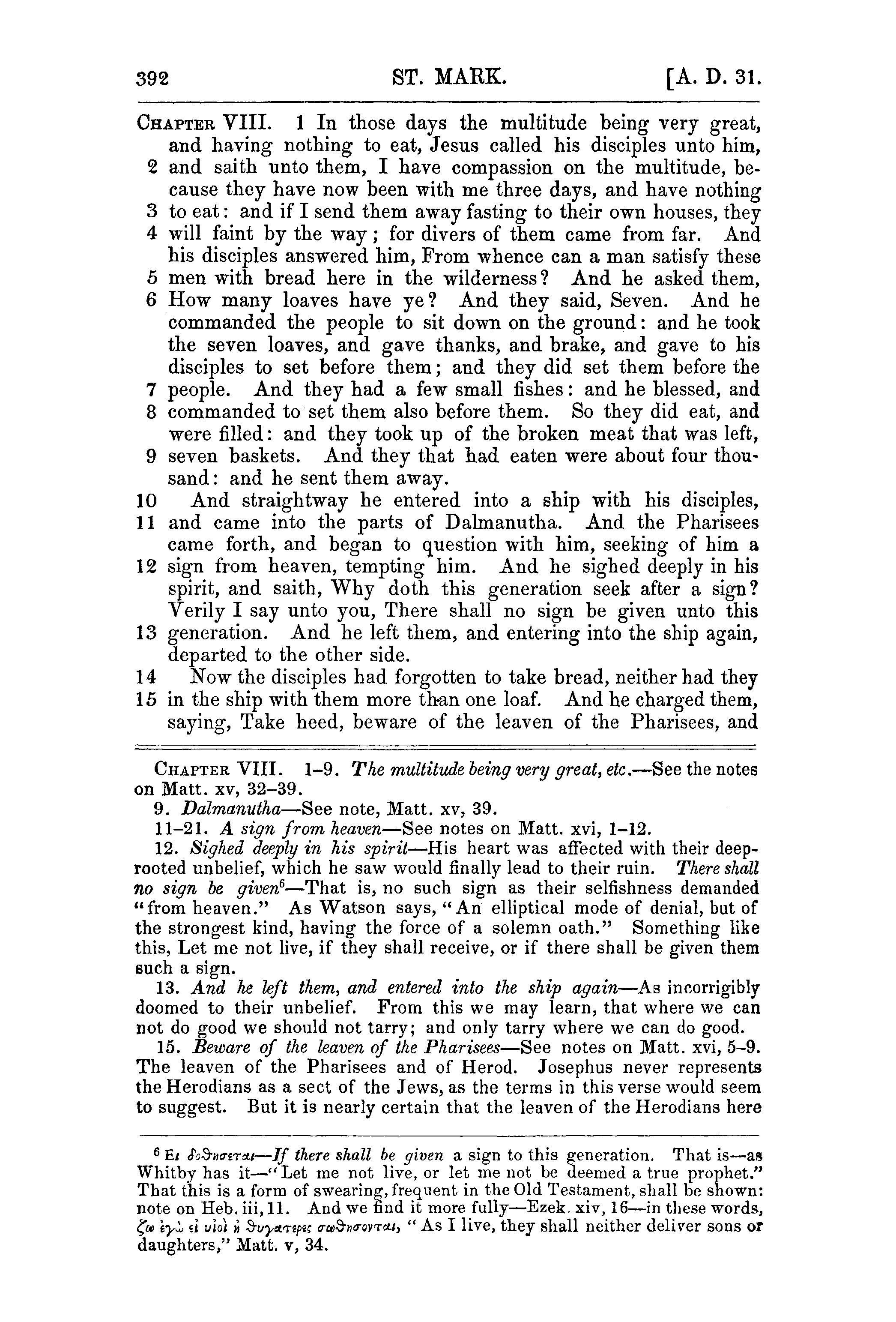
CHAPTER VIII. In those days the multitude being very great, and having nothing to eat, Jesus called his disciples unto him, 2 and saith unto them, I have compassion on the multitude, because they have now been with me three days, and have nothing 3 to eat: and if I send them away fasting to their own houses, they 4 will faint by the way; for divers of them came from far. And his disciples answered him, From whence can a man satisfy these 5 men with bread here in the wilderness? And he asked them, 6 How many loaves have ye? And they said, Seven. And he commanded the people to sit down on the ground: and he took the seven loaves, and gave thanks, and brake, and gave to his disciples to set before them; and they did set them before the 7 people. And they had a few small fishes: and he blessed, and 8 commanded to set them also before them. So they did eat, and were filled: and they took up of the broken meat that was left, 9 seven baskets. And they that had eaten were about four thousand: and he sent them away.
10 And straightway he entered into a ship with his disciples, 11 and came into the parts of Dalmanutha. And the Pharisees came forth, and began to question with him, seeking of him a 12 sign from heaven, tempting him. And he sighed deeply in his spirit, and saith, Why doth this generation seek after a sign? Verily I say unto you, There shall no sign be given unto this 13 generation. And he left them, and entering into the ship again, departed to the other side.
14 Now the disciples had forgotten to take bread, neither had they 15 in the ship with them more than one loaf. And he charged them, saying, Take heed, beware of the leaven of the Pharisees, and
CHAPTER VIII. 1-9. The multitude being very great, etc.-See the notes on Matt. xv, 32-39.
9. Dalmanutha-See note, Matt. xv, 39. 11-21. A sign from heaven-See notes on Matt. xvi, 1-12.
12. Sighed deeply in his spirit-His heart was affected with their deeprooted unbelief, which he saw would finally lead to their ruin. There shall no sign be given6-That is, no such sign as their selfishness demanded "from heaven." As Watson says, "An elliptical mode of denial, but of the strongest kind, having the force of a solemn oath." Something like this, Let me not live, if they shall receive, or if there shall be given them such a sign.
13. And he left them, and entered into the ship again-As incorrigibly doomed to their unbelief. From this we may learn, that where we can not do good we should not tarry; and only tarry where we can do good.
15. Beware of the leaven of the Pharisees-See notes on Matt. xvi, 5-9. The leaven of the Pharisees and of Herod. Josephus never represents the Herodians as a sect of the Jews, as the terms in this verse would seem to suggest. But it is nearly certain that the leaven of the Herodians here
6 El J'Q3-I1CT'eT�I-If there shall be given a sign to this generation. That is-as Whitby has it-" Let me not live, or let me not be deemed a true prophet." That this is a form of swearing, frequent in the Old Testament, shall be shown: note on Reb. iii, 11. And we find it more fully-Ezek, xiv 16-in these words, I;(>} E)'-:' d UIOI ,; 3-U)'!t.'l"Epi' CT'(>}3-nIl"OVTCU, As I live, they shall neither deli ver sons or daughters," Matt. v 34.
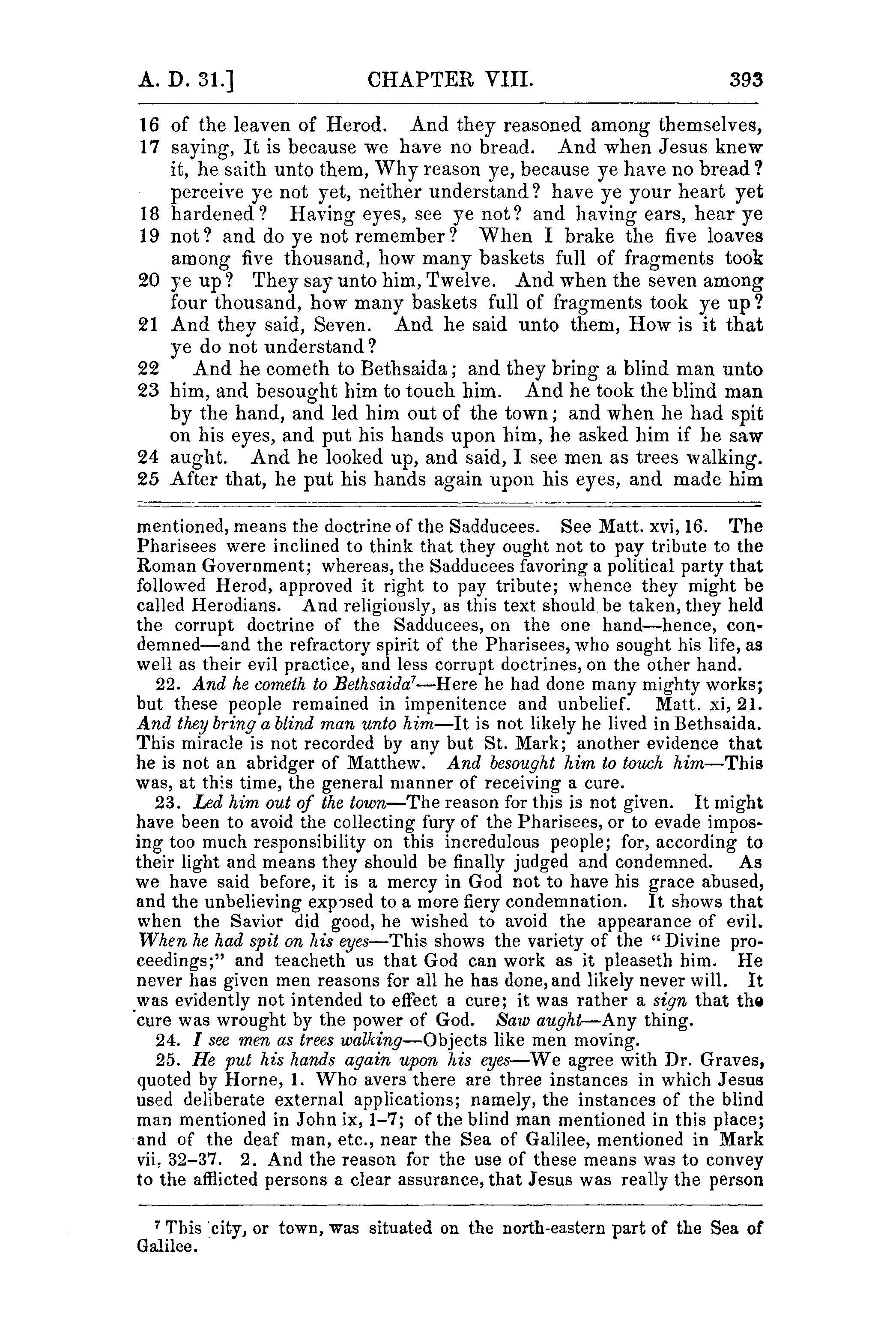
16 of the leaven of Herod. And they reasoned among themselves, 17 saying, It is because we have no bread. And when Jesus knew it, he saith unto them, Why reason ye, because ye have no bread? perceive ye not yet, neither understand? have ye your heart yet 18 hardened? Having eyes, see ye not? and having ears, hear ye 19 not? and do ye not remember? When I brake the five loaves among five thousand, how many baskets full of fragments took 20 ye up? They say unto him, Twelve. And when the seven among four thousand, how many baskets full of fragments took ye up?
21 And they said, Seven. And he said unto them, How is it that ye do not understand?
22 And he cometh to Bethsaida; and they bring a blind man unto 23 him, and besought him to touch him. And he took the blind man by the hand, and led him out of the town; and when he had spit on his eyes, and put his hands upon him, he asked him if he saw 24 aught. And he looked up, and said, I see men as trees walking.
25 After that, he put his hands again upon his eyes, and made him
mentioned, means the doctrine of the Sadducees. See Matt. xvi, 16. The Pharisees were inclined to think that they ought not to pay tribute to the Roman Government; whereas, the Sadducees favoring a political party that followed Herod, approved it right to pay tribute; whence they might be called Herodians. And religiously, as this text should. be taken, they held the corrupt doctrine of the Sadducees, on the one hand-hence, condemned-and the refractory spirit of the Pharisees, who sought his life, as well as their evil practice, and less corrupt doctrines, on the other hand.
22. And he cometh to Bethsaida7-Here he had done many mighty works; but these people remained in impenitence and unbelief. Matt. xi, 21. And they bring a blind man unto him-It is not likely he lived in Bethsaida. This miracle is not recorded by any but St. Mark; another evidence that he is not an abridger of Matthew. And besought him to touch him-This was, at this time, the general manner of receiving a cure.
23. Led him out of the town-The reason for this is not given. It might have been to avoid the collecting fury of the Pharisees, or to evade imposing too much responsibility on this incredulous people; for, according to their light and means they should be finally judged and condemned. As we have said before, it is a mercy in God not to have his grace abused, and the unbelieving exposed to a more fiery condemnation. It shows that when the Savior did good, he wished to avoid the appearance of evil. When he had spit on his eyes-This shows the variety of the" Divine proceedings;" and teacheth us that God can work as it pleaseth him. He never has given men reasons for all he has done, and likely never will. It was evidently not intended to effect a cure; it was rather a sign that the 'cure was wrought by the power of God. Saw aught-Any thing.
24. I see men as trees walking-Objects like men moving.
25. He put his hands again upon his eyes-We agree with Dr. Graves, quoted by Horne, 1. Who avers there are three instances in which Jesus used deliberate external applications; namely, the instances of the blind man mentioned in John ix, 1-7; of the blind man mentioned in this place; and of the deaf man, etc., near the Sea of Galilee, mentioned in Mark vii,32-37. 2. And the reason for the use of these means was to convey to the afflicted persons a clear assurance, that Jesus was really the person
7 This 'city, or town, was situated on the north-eastern part of the Sea of Galilee.
26 look up: and he was restored, and saw every man clearly. And he sent him away to his house, saying, Neither go into the town, nor tell it to any in the town.
27 And Jesus went out, and his disciples, into the towns of Cesarea Philippi: and by the way he asked his disciples, saying unto
28 them, Whom do men say that I am? And they answered, John the Baptist; but some say, Elias; and others, One of the proph-
29 ets. And he saith unto them, But whom say ye that I am? And
30 Peter answereth and saith unto him, Thou art the Christ. And
31 he charged them that they should tell no man of him. And he began to teach them, that the Son of man must suffer many things, and be rejected of the elders, and of the chief-priests,
32 and scribes, and be killed, and after three days rise again. And he spake that saying openly. And Peter took him, and began to
33 rebuke him. But when he had turned about, and looked 011 his disciples, he rebuked Peter, saying, Get thee behind me, Satan: for thou savorest not the things that be of God, but the things that be of men.
34 And when he had called the people unto him with his disciples also, he said unto them, Whosoever will come after me, let him
35 deny himself, and take up his cross, and follow me. For whosoever will save his life, shall lose it; but whosoever shall lose his
36 life for my sake and J the Gospel's, the same shall save it. For what shall it profit a man, if he shall gain the whole world, and
37 lose his own soul? Or what shall a man give in exchange for
38 his soul? Whosoever therefore shall be ashamed of me, and of my words, in this adulterous and sinful generation; of him also shall the Son of man be ashamed, when he cometh in the glory of his Father with the holy angels.
by whose power the cures were wrought: says he, "A blind man can know another only by the voice or touch. We may be confirmed in believing this to have been the design of these external applications, by observing that they were used in no instance except those of blindness and deafness." This appears, at least, probable; and some think it is the better sense to give for the use of such means. Morally, it may be applied thus: "The Holy Spirit's influence is, 1. To convince them of this truth, that sinners are by nature spiritually blind; 2. To open their eyes to show them their condition and danger; and, 3. To lead them to look to Jesus for help, to aid them in coming to him." (Longking.)
26. Neither go into the town, etc.-So he did not live in this place, as some have inferred. Our Lord sent him home, as he had the man of Gadara. Mark v, 19. The Savior did not wish the inhabitants of Bethsaida-' against whom, previously, he had pronounced a woe-to hear the glad tidings which they had so greatly abused. This agrees with Watson and others.
27-'38. See this passage explained in Matt. xvi, 13-28.
36. See the sketch at the end of this chapter.
38. Ashamed of me-On account of poverty, contempt, and sufferings, or any thing else. And of my w01'ds-Doctrines and miracles may be included. This adulterous and sinful generation-A generation of adul terers, etc. Mercy! what a picture! In the glory of his Father-In the day of "eternal judgment." See notes on Matt. xxvi, 54, 1. Christ is our pattern; he was meek, and lowly, and despised. Christians should be like
him. 2. Those who refuse to follow him, he will refuse to acknowledge in the day of judgment; when he shall come in awful majesty with the holy angels. If sinners reject him here, he will reject them then. 3. The result-hopeless misery, endless wailings. Dr. A. Clarke says of the miraculous feeding of the multitudes, which ill a full, unequivocal proof of the supreme divinity of Jesus Christ, "In this miracle he truly appears in his creative energy, with which he has associated the tenderest benevolence and humanity. The subject of such a prince must ever be safe; the servant of such a master must ever have kind usage; the followers of such a teacher can never want nor go astray."
"Happy, if with my latest breath I may but gasp his name I Preach him to all, and cry in death, 'Behold, behold the Lamb!'"
On the last verse of this chapter the following remarks may be based: 1. The disadvantages that religion labors under in this world, in an adulterous and sinful generation; for what existed in the days of Christ, in a considerable degree, remains still. 2. There are many, though they believe theoretically in religion, who are ashamed to embrace it. 3. There is a day coming when the cause of Christ will be obviously as illustrious as it now appears mean before men, when Christ shall come in the glory of his Father with the holy angels. 4. They that are ashamed of Jesus here, he will be ashamed of in the brightness of his glory, etc.
REMARKS ON VERSE THIRTY-SIX.-IMMORTALITY AND PROFIT OF THE SOUL.-" If Satan had not been an angel, he' could not have made a devil."
I. SOME PROOFS OF THE IMMORTALITY OF THE HUMAN SOUL.
1. The universal belief of mankind: Egyptians, Persians, Phanicians, Scythians, Assyrians, Greeks, and Romans.
Ovid, Virgil, and others, give us the following sentiments: Tantalus, for the loathsome banquet he made for the gods, was sentenced to live in water up to the chin, with apples hanging to his lips, yet had no power to eat or drink forever.
The fifty daughters, for the murder of their husbands, were to fill a barrel with water; but the barrel was full of holes, and it run out as fast as they put it in.
Sisyphus, for robbery, was set to roll a great stone up a steep hill" which, when it was just at the top, suddenly fell down again, and forced him to renew his labor.
Tityus was adjudged to have a vulture to feed upon his liver and entrails, which still grew as they were devoured.
The Persians leave one part of their graves open, that, at the visit of an angel, they may be reanimated and brought to the happy abode in a future state.
The Hindoo widows annually sacrifice themselves on the funeral pile of their deceased husbands, expecting, with them, to enjoy the felicities of eternal life.
2. The general desire of a future state implanted in man.
None are satisfied with their present enjoyments. See Archimedes! After discovering the relative quantities of silver and gold in the crown of Hiero, in ecstasy he leaped from the bath, and run through the streets of Syracuse, crying, "I have found it, I have found it!"
It is said that Alexander wept, after conquering the eastern world, on hearing Anacharcus say, "There are an infinite number of worlds."
When Dernosthenes fled from the resentment of Antipater, who sent Archias to bring him by force, Archias assuring him that he should not
lose his life, if he would voluntarily make his appearance, "God forbid," said he, "that after I have heard Xenocrates and Plato speak so divinely on the immortality of the soul, that I should prefer a life of ignomy to an honorable death." He took poison and died.
Newton ascertained the law of universal gravitation, but he still progressed on. Franklin discovered the identity of lightning and electrical fluid, but still was not satisfied.
3. Another proof of the immortality of the soul, is its perpetual progress toward perfection.
A brute soon arrives at its perfection; but a period will come when the human soul shall outshine the most godlike cherub, and be more perfect than it is now.
Mithridates governed twenty-three nations, all of different tongues, and conversed with all of them.
Cyrus called every individual in his vast army by his own name, it is said.
4. The unlimited range opened to the human mind.
The vast and variegated universe. What gradations of intellects in the world of spirits; their mode of correspondence in all parts of the universe! What have been their discoveries of the Divine perfections; of the moral government of God! etc.
5. The moral powers are so formed as both to contemplate and act.
In the annals of the Pagan world there are examples of virtuous actions. See Regulus exposing himself to torture and death, rather than suffer his veracity to be impeached.
Phocion exposed himself to the fury of an enraged people, by inveighing against their vices, trying to promote their interests. Scipio was generous, virtuous, and gentle. Aristides was superior to vile passion, and favored his betrayer, Themistocles, etc.
Some recent examples: Howard labored in hospitals, jails, and dungeons, for the benefit of the wretched. He traveled through Italy twice, France thrice, Germany four times, Holland five times. See Stewart, Elliott, and others! God will not disappoint the expectation and the exercise of the powers of the mind.
6. The sixth argument for the immortality of the soul is from the nature of moral actions, and their rewards and punishments hereafter.
There is order in the physical world; and why not in the moral world! It is said sin is the cause of moral disorder. But God will rectify this by a general judgment; but this judgment is after death: then the soul must live after death.
A future judgment proves the immortality of the soul. There is no reason against it. It ought to be immortal, in view of the discordance of this world. See Alexander the Great: was he not a wholesale murderer! And what was Nero, who murdered his wife Octavia, and his mother Agrippina, and set fire to Rome, to amuse himself with the calamity of the innocent thousands! Look at Napoleon, who, for avarice and fame, waded in the blood of thousands! Behold the frenzied Xerxes, exposing three millions of ignorant and wretched soldiers to be flayed to pieces by the gallant but barbarous Greeks! Still worse: see that human wretch, Tamerlane, causing three or four thousand beings to be pounded in a mortar, and building their bodies, with brick and mortar, into a wall! But, still Worse, see that human demon, Genghis Khan, ravaging Asia, and beheading one hundred thousand prisoners at once, and murdering, in all, about fourteen millions of human beings! Should these not be judged for these deeds! Certainly they ought.
7. We draw another argument for the immortality of the human soul from the redemption of the world by Jesus Christ.
CHAPTER IX. 1 And he said unto them, Verily I say unto you, that there be some of them that stand here which shall not taste of death, till they have seen the kingdom of God come with power.
2 And after six days, Jesus taketh with him Peter, and James, and John, and leadeth them up into an high mountain apart by 3 themselves; and he was transfigured before them. And his raiment became shining, exceeding white as snow; so as no fuller 4 on earth can white them. And there appeared unto them Elias, 5 with Moses: and they were talking with Jesus. And Peter answered and said to Jesus, Master, it is good for us to be here: and let us make three tabernacles; one for thee, and one for 6 Moses, and one for Elias. For he wist not what to say, for they 7 were sore afraid. And there was a cloud that overshadowed them: and a voice came out of the cloud, saying, This is my 8 beloved Son: hear him. And suddenly, when they had looked round about, they saw no man any more, save Jesus only with 9 themselves. And as they came down from the mountain, he charged them, that they should tell no man what things they 10 had seen, till the Son of man were risen from the dead. And
We admit that his redemption of the world was a great temporal benefit; but he should never have died for this only. He is the eternal Son of God. "He is God over all, and blessed forever." He took man's nature upon him. See his sufferings, his agony, and his awful and tragical death! the sun is darkened, the earth is shaken, the graves are opened, the wicked tremble, devils are awed, heaven rejoices, and mankind are alarmed and astonished. All this proves man immortal.
II. OUR FALL AND SIN SUBJECT EVERY ADULT TO LOSE HIS SOUL, AND IF LOST, NOT ANY THING CAN PROFIT US.
I. The gain of this world can riot satisfy the immortal mind. Its faculties are such, that the world can not satisfy them: and if it could, it would only be for a season, which death will terminate.
See the great Saladin, the subduer of Egypt, and conqueror of cities! A moment before he uttered his last sigh, he called for the herald who had carried his banner before him in all his battles, and commanded him to fasten the shroud, in which he was to be buried, and unfurl the banner, and proclaim, "This, this is all that remains to Saladin the Great, the conqueror and king of the empire."
"The Egyptians .•... were the first, of all mankind, who affirmed the immortality of man's soul; which, they say, upon the death of the body, always enters into some other animal; and passing, by a continued rotation, through the different kinds of aerial, terrestrial, and marine beings, returns again into a human body, after the revolution of three thousand years." (Herodotus, rendered by Littlebury.)
" I saw Philip himself," says Demosthenes, "with whom our contest was for rule and dominion, after having lost an eye, having had his hip broken, and being lamed in his hand and his leg, disposed, readily and easily, to part with any part of his body which fortune might choose, so that, with the remainder, he might live in glory and honor." Rather give us "eternal life."
CHAPTER IX. 1. There be some of them that stand here-See notes on Matt. xvi, 28.
2. lVas transfiqured, etc.-See notes on Matt. xvii, 1-4.
they kept that saying with themselves, questioning one with another what the rising from the dead should mean.
11 And they asked him, saying, Why say the scribes that Elias 12 must first come? And he answered and told them, Elias verily cometh first, and restoreth all things; and how it is written of the Son of man, that he must suffer many things, and be set at
13 naught. But I say unto you, That Elias is indeed come, and they have done unto him whatsoever they listed, as it is written of-him.
14 And when he came to his disciples, he saw a great multitude 15 about them, and the scribes questioning with them. And straightway all the people, when they beheld him, were greatly 16 amazed, and running to him, saluted him. And he asked the 17 scribes, What question ye with them? And one of the multitude answered and said, Master, I have brought unto thee my son, 18 which hath a dumb spirit; and wheresoever he taketh him, he teareth him; and he foameth and gnasheth with his teeth, and pineth away; and I spake to thy disciples that they should cast 19 him out, and they could not. He answereth him, and saith, 0 faithless generation, how long shall I be with you? how long shall
20 I suffer you? Bring him unto me. And they brought him unto him: and when he saw him, straightway the spirit tare him; and 21 he fell on the ground, and wallowed, foaming. And he asked his father, How long is it ago since this came unto him? And 22 he said, Of a child. And ofttimes it hath cast him into the fire, and into the waters to destroy him: but if thou canst do. any 23 thing, have compassion on us, and help us. Jesus said unto him, If thou canst believe, all things are possible to him that believeth. 24 And straightway the father of the child cried out, and said with
11-13.8 Elias must first come, etc.-See notes on Matt. xvii, 10-12. The Elias of the prophet is none other than John the Baptist. It may be explained thus: If thou art to die, why has not the predicted Elias come, to explain your character and doctrines! 14-29. See this passage explained in Matt. xvii, 14-21. St. Mark adds some striking particulars, on which we remark in general. When he came to his disciples-That is, from the mount of transfiguration, in company with Peter, James, and John: he met the other nine disciples, with a great company, or multitude about them, and the scribes questioning with themLikely exulting over them, that they could not cast out the demon from the boy that had been brought to them in the absence of Christ. Mark addsverse 159-All the people, when they beheld him, were greatly amazed-The
8In the twelfth verse, the phrase, 1£� 7ff61� "JIe'f'Pt:t7f'Tctl, etc., has troubled com· mentators exceedingly. Dr. Bloomfield has a lengthy criticism on it, appar.ently to but little effect. Dr. A. Clarke, instead of 1£(.(1 7f(l)�, AND NOW, reads it "a)}(I)" AS ALSO, it is written of the Son of man, etc. The former marks it as an altered reading; the latter avers that 1£a)}(1)� is the reading, "supported by A. K. M., seventeen others, the later Syriac in the margin, Sclavonic, and Armenian."
9 Greatly amazed-The word f�.!;hp.f6I1:;}I1, "implies a mixture of admiration, veneration, and awe." (Bloomfield.) Watson says, it "denotes the highest degree of astonishment, not un mingled with fear or awe." Clarke says: "The cause of this amazement is not self-evident."
25 tears, Lord, I believe; help thou mine unbelief. When Jesus saw that the people came running together, he rebuked the foul spirit, saying unto him, 'I'hou dumb and deaf spirit, I charge thee, come 26 out of him, and enter no more into him. And the spirit cried, and rent him sore, and came out of him: and he was as one 27 dead; insomuch that many said, He is dead. But Jesus took
people, generally, were on the side of the Savior. Here they had been beholding the afflicted young man, and the ineffectual effort of the disciples to expel the demon, and the carping of the scribes over them: on this account the people were glad to see Jesus, knowing that he would forthwith relieve the lad, and silence the scribes. But, as it is well remarked by Watson, " It is, therefore, probable, that there was something of unusual dignity and majesty in the air and mien of our Lord; that some rays of glory remained upon his face, as upon the face of Moses after he had been with God on the mount." St. Mark also tells us, that the possessed young man was not only a lunatic, but dumb, and was torn by the evil spirit, so that he foamed, and gnashed with his teeth, etc. And by reason of these things he pined, or wasted away. Mark likewise draws a sad picture of the father of this young man. He had brought his son to Jesus; but, on finding him absent, he afterward applied to his disciples, who, strange to tell, though they had received power to cast out demons, could not cast out this one. "Either they had attempted, and failed, or, what is more probable, for want of faith to encounter so fearful a spirit, would not make the attempt, and so confessed their inability." See Matt. xvii, 14-20. After the father had pathetically described the case, he says: If thou canst do any thing, have compassion on us, and help us. "The powerful struggle between faith and unbelief in the mind of this poor man is artlessly, but most affectingly portrayed." Jesus said: "If thou canst believe, all things are possible to him that believeth. And straightway the father of the child 1 cried out, and said, with tears, Lord,2 I believe; help thou my unbelief-As if he had said, I have faith, but it is weak; yet, though weak, supply its lack, or strengthen it, and cure my son. He had a belief in Christ's power; but the disciples had failed, the affection of his son had been of long standing; and the character of the demon was fearful. All these facts crowding on his mind were sufficient to cause him to exclaim, Help thou my unbelief. He struggled manfully; his prayer was heard, and his son was healed.
25-27. He rebuked the foul spirit-With terrible majesty. Thou dum� and deaf spirit, I charge thee, come out of him-A certain species of modern infidelity would call this a disease. This would be a strange way to address a disease. It would be worse than nonsense. "Is the doctrine of demoniacal possessions false? If so, Jesus took the most direct method to perpetuate the belief of that falsity, by accommodating himself so completely to the deceived vulgar." (Dr. Clarke.) Those, then, that call this a disease, make Jesus Christ an impostor, and themselves his abettors. Such doctrine, in this enlightened age, must pass for what it is worth. The evil spirit exerted all his power before he came out; and he was as one deadverse 26. Many said he was dead. Jesus took him by the hand, and lifted
I Child, from a term which does not import or signify his age. St. Matthew says, the father of the child "kneeled" before our Lord, entreating him to have mercy; the original implies he clasped his knees.
2 Lord-H.upla-is not found in about seven MSS., and some versions, and is canceled by Griesbach, Vater, and Scholz; "but," as Dr. Bloomfield says, "with singular rashness." Dr. A. Clarke thinks it is omitted with propriety, which, to us, appears doubtful.
28 him by the hand, and lifted him up; and he arose. And when he was come into the house, his disciples asked him privately, Why
29 could not we cast him out? And he said unto them, This kind can come forth by nothing, but by prayer and fasting.
30 And they departed thence, and passed through Galilee; and
31 he would not that any man should know it. For he taught his disciples, and said unto them, The Son of man is delivered into the hands of men, and they shall kill him; and after that he is
32 killed, he shall rise the third day. But they understood not that saying, and were afraid to ask him.
33 And he came to Capernaum : and being in the house, he asked them, What was it that ye disputed among yourselves by the
34 way? But they held their peace: for by the way they had dis-
35 puted among themselves, who should be the greatest. And he sat down, and called the twelve, and saith unto them, If any man desire to be first, the same shall be last of all, and servant of all.
36 And he took a child, and set him in the midst of them: and when
37 he had taken him in his arms, he said unto them, Whosoever
him up; and he arose-All this made the miracles more illustrious before the multitude, particularly as the scribes had shown off their impudent sport previously, availing themselves of the weakness of the disciples.
28. Why could not we cast him outl-See note on Matt. xvii, 19-21. It is likely this question was put to the Savior by the nine disciples, or one of their number, after the Savior had retired to some house or place in the neighborhood. In Matt. xvii, 20, Jesus ascribed their failure to their unbelief, and, as it appears, that unbelief was owing to their neglect of fasting and prayer. Hence, it appears that fasting and prayer exercise an influence on one's faith. By this kind, etc., a more powerful and virulent demon is meant." The furious displays of the one under consideration proved him to be of this character. Faith was every thing to the disciples, but not to Christ, because he is the Lord of it; and therefore absolutely faithful.
29. By prayer and fasting-Some means of grace are ordinary, some extraordinary, but not so much of themselves as of their effect, when discharged faithfully. What can go before fasting and prayer? If the miraculous faith depended on these, how much more does that faith which works by love, and purifies the heart!
30-32. And they departed thence-From the country of Cesarea Philippi. And passed through Galilee-" Not through the cities, but by them," for hs would not that any man should knew it-Likely to evade being interrupted in the special instructions he was about to give to his disciples touching his death and sufferings. For he taught his disciples, and said unto them, The Son of man is delivered into the hands of men, etc.-This was the purpose, and prediction, and was as certain as if it had already been so. St. Matthew has it-English version-betrayed; but the right rendering is delivered up to their disposal and malice. But they understood not that sayingThey could not reconcile his death and resurrection with their notions of 8. temporal kingdom, or the deliverance from death with or by the death of himself. These were two matters in the way of their understanding him. What an influence secular matters have always had upon the minds of men!
33-37. "What was it that ye disputed, etc.-See notes on Matt. xviii, 1,
3 Dr. Campbell says, "Who can say that there are not different kinds of demons 2" To us it appears pretty certain that there are. See Matt. xii, 45.
shall receive one of such children in my name, receiveth me: and whosoever shall receive me, receiveth not me, but him that sent me.
38 And John answered him, saying, Master, we saw one casting out devils in thy name, and he followeth not us; and we forbade 39 him, because he followeth not us. But Jesus said, Forbid him not: for there is no man which shall do a miracle in my name, 40 that can lightly speak evil of me. For he that is not against us, 41 is on our part. For whosoever shall give you a cup of water to
etc. This lesson was given to the disciples, the future apostles of the Church. It was of a twofold nature: 1. That the character of the disciples should be simple, and free, and unambitious, and be like that of a child. 2. That they should receive persons of this character into the Church, teachable, loving, and sincere. Watson says, this" shows the interest our Lord took in children, and bears a favorable aspect upon infant baptism."
38. Master, we saw one casting out devils in thy name-An exorcist could not cast out a demon in the name of Christ. It is likely this man was one of John's disciples, or one of the seventy-Luke x, 1-7-who had both the faith and power to expel demons. But he was not of the company who immediately attended on Jesus. Grotius and others think he was not" a full believer;" but this is only conjecture, without proof, and it is hardly a probable conclusion. It is, on the other hand, a more probable conclusion that he was" a full believer." It seems that John, like many who have succeeded him, thought that the authority to cast out devils must come in a particular way. He resembled those persons who would have none but regular graduates, to preach the Gospel; or those who advocate a regular succession from Pope Peter to Pope Gregory, etc. And we forbade him-And wherefore! Because he followeth not us-In the regular ministry. In Acts xix, 13, we have an account of an unauthorized attempt to cast out a demon; but it was ineffectual, and rather injurious to the exorcists: the demons mocked them, etc.
39. Forbid him not-We should forbid none from doing good; for those that do good in the name of Jesus, must be in unison with Jesus, and should not be prevented. Can tightly speak evil of me-The term rendered lightly, means quickly. It means that the person to whom God gave the power to work a miracle, must be acceptable to him, and would not soon be found among the enemies of Christ. It is probable that John had no improper end in view in forbidding this man, only he was not of them, and therefore he thought he acted out of his proper place. See Phil. i, 18; Num. xi, 26,29. Let us cast aside denominational prejudices, and heartily bid" Godspeed" to all true Christian efforts.
40. For he that is not against US,4 is on our part-Such was honoring Christ, and relieving the distressed; hence he was for them. "Let us recollect that, as there is a common Christianity, so there is a common cause among true Christians." If the devil is cast out in the name of Jesus, let us rejoice, over all sectarian and party feeling. Upon the whole, we are to be rigorous in judging ourselves, and candid in judging each other.
41. S hall give you a cup of water to drink in my name, because ye belong to
4Dr. A. Olarke reads u,ualV, you, instead of "P-alV, us, upon the best authorities. See his note, in loco. But where is the use? Is not the received readin� just as good? Dr. Bloomfield says, "The external evidence of the reading IS not superior to the received one; and, if it were, manuscript authority is of little weight in respect to words perpetually confounded in the MSS., and, in internal, even greatly inferior." In loco.
drink in my name, because ye belong to Christ, verily I say unto 42 you, he shall not lose his reward. And whosoever shall offend one of these little ones that believe in me, it is better for him that a millstone were hanged about his neck, and he were cast into the 43 sea. And if thy hand offend thee, cut it off: it is better for thee to enter into life maimed, than having two hands to go into hell, 44 into the fire that never shall be quenched: where their worm
Christ 5_The reader will perceive that John interrupted the Savior by the introduction of the above incident. He left off at verse 37; now he resumes the discourse. See notes on Matt. xviii, 6-9. He shall not lose his reward-This shows us, 1. That everyone may do some good, and there is none so poor but he may show his attachment to Jesus. What precious grounds for religious activity! 2. Jesus will notice and render precious and gracious reward to the faithful doer in his kingdom. "Their feeblest service will be accepted; and acts of love, that may be forgotten by man, will be remembered by kim, and rewarded in heaven." (Barnes.) See Matt. x, 42.
42-50. See Matt. xviii, 7-9.
43,44. Where their worm dieth not, and the fire is not quenched-I. These words, likely, are derived from Isa. lvi, 24, where the imagery is taken from the punishment of rebels, whose carcasses are subject, or represented as subject, to the gnawing of worms and unquenchable fire. The words are here applied to represent eternal misery, in another world, by images taken from gheenna-"yEEvvd.-in this world. See note on Matt. v, 22.6 Whitby says "that gheenna was [by the Jews] still looked on and represented as the place in which the wicked were to be tormented by fire.:"
The ancient J ews � say, "They shall weep under the sense of their pains forever. Judith xvi, 17. Josephus says that the Pharisees held, "the souls of the wicked were to be punished-diel'ut) 'Tlfut)p'd.-with perpetual punishment." Philo says, "to live for ever dying." Our Lord says, the fire that never shall be quenched. Still stronger, if possible, Where their worm dieth not, and the fire is not quenched-verse 44. The worm here is to be "taken typically, for the worm of conscience." Like the fruitless branches and the chaff, the wicked shall be burned with unquenchable fire. Matt. iii, 10-12; xiii, 50; John xv, 6. The wicked "shall go into everlasting fire;" their souls and bodies shall be "cast into hell-fire," Matt. x, 28; xxv, 45; that they shall be "punished with flaming fire," 2 Thess. i, 8; and still more, " suffer the vengeance of eternal fire," Jude 7; "the heavens and earth being reserved to fire for the punishment of ungodly men," 2 Peter iii, 10. 2. The doom of the wicked shall be "eternal damnation." The reason is, the righteousness of God will move him to" recompense tribulation to them that trouble you," 2 Thess. i,6. To them that oppose God lind his cause, and work evil; hence," the wages of sin is death," or eternal
5 The [h] 'TOO ov. [,uot/,] or the words in brackets, "are not found in many MSS."
6 See Professor Stuart.'s tract, styled" Exegetical Essays," on Scripture terms relative to future punishment, namely, d.looV, and a1amo�-M'l1� and "yEeVVet-especially section 3, which treats of figurative language relative to objects of the future existence, where heaven is represented as a paradise, or pleasure garden, a city with walls, etc., and where hell is represented as an abyss; a bottomless pit; a lake, and the like.
7See the Targum, upon Ecclesiastes, ch. ix; xs 10, 11; viii, 10; and particularly on Gen. xv, 17: quoted by Whitby, in loco.
sJudith xvi, 17: "Kh<:tt/Q'OV'Td.I 'ey &1Q'&J1Q'el 'eoo, a.1::'yo�." Philo and Josephus say the same.
45 dieth not, and the fire is not quenched. And if thy foot offend thee, cut it off: it is better for thee to enter halt into life, than having two feet to be cast into hell, into the fire that never shall
46 be quenched: where their worm dieth not, and the fire is not
47 quenched. And if thine eye offend thee, pluck it out: it is better for thee to enter into the kingdom of God with one eye, than
48 having two eyes, to be cast into hell-fire: where their worm dieth
49 not, and the fire is not quenched. For everyone shall be salted
50 with fire, and every sacrifice shall be salted with salt. Salt is good: but if the salt have lost its saltness, wherewith will ye season it? Have salt in yourselves, and have peace one with another.
damnation. Chapter iii, 29. (1.) God's promise has made it just to punish the wicked forever. (2.) The nature of sin makes it just; its inherent demerit-its legitimate effect, which is suffering, makes it just. (3.) Its very nature makes it just, as all sin must be voluntary; without coersion on the part of the agent, men need not merit the wages of sin, and if they do, they do it willingly; and wherefore! because they will serve Satan in preference to God; and if so, in justice they should receive the punishment. (4.) Crimes are punishable in proportion to their degrees of turpitude, and the majesty insulted. Sin is an offense against the majesty of God; inheriting a punishment in proportion to its magnitude. But wherefore should this be eternal! We answer, because the state of the sinner will be eternally evil and in opposition to God. The heart of the sons of men is full of evil, and madness is in their hearts while they live, and after that they go to the dead," Eccles. ix, 3. No language can be more pointed and clearer than this. St. Matthew calls it "eternal fire." This was the constant doctrine of the ancient Jews, and the apostolic Church. Dr. A. Clarke says," The state of punishment is continual; there is no respite, neither alleviation, nor end." See notes on Matthew, v, 29,30.
49, 50. For everyone shall be salted with fire9-Touching the meaning of this commentators differ. The best sense is found-of ten commentators under our eye-in Mr. Watson's notes on these verses. Here we remark, the apostles were the hearers, Jesus the teacher, and eternal consequences the theme, with a preparation for them .• Christ taught the disciples the consequences of offending believers, and gave them an exhortation to evade sin, in order to enter into life. False teachers shall have the salt of fire; the good, the salt of glory.
On verses 49,50, we make the following remarks: These two verses are in connection with the preceding verses, and form a complete disCourse of our Lord to his disciples, commencing at the thirty-third verse. Commentators generally refer the expression-" salted with fire "-to the punishment of perdition; but it appears this is an error. 1 Mark, every one is the subject; salted with fire is the predicate. The leading theme of verse 49 is the" salt of the sacrifice." This expression has a reference
9 Though the" Oodex Bezte wants the first clause of this verse, and some other MSS. omit the second, yet the evidence of the genuineness of the whole verse, from the agreement of the best MSS. and ancient versions, is decisive." (Watson.) These verses may be rendered thus: 1. Others, not with us, may be Ohristians. 2. We ought to avoid giving offense to feeble and obscure believers. 3. Every obstacle to religion ought to be removed.
I See Watson's Exposition, in loco.
CHA.PTER X. 1 And he arose from thence, and cometh into the coasts of Judea, by the farther side of Jordan: and the people resort unto him again; and, as he was wont, he taught them again.
2 And the Pharisees came to him, and asked him, Is it lawful 3 for a man to put away his wife? tempting him. And he answered 4 and said unto them, What did Moses command you? And they said, Moses suffered to write a bill of divorcement, and to put her
5 away. And Jesus answered and said unto them, For the hard6 ness of your heart, he wrote you this precept: but from the be7 ginning of the creation, God made them male and female. For this cause shall a man leave his father and mother, and cleave to 8 his wife; and they twain shall be one flesh: so then they are no 9 more twain, but one flesh. What, therefore, God hath joined 10 together, let. not man put asunder. And in the house his disci11 ples asked him again of the same matter. And he saith unto them, Whosoever shall put away his wife, and marry another,
to Lev. ii, 13, 16, and there means the" covenant of Jehovah;" and this is its meaning here: the" salt of the covenant of Jehovah." As the sacrifice was salted with salt-not to keep it from literal corruption, but as symbolical of purity-so every disciple of Jesus must be salted with fire.
1. What we are to understand by the covenant of salt. Every sacrifice shall be salted with salt, etc. (1.) Weare to understand God's gracious covenant with man a perpetual, gracious stipulation. Compare Num. xviii, 19; 2 Chron. xiii, 5. (2.) The character of this covenant: a perpetual, holy covenant: the basis, "Be ye holy, for I am holy;" and salt the symbol of its sanctity. (3.) As salt preserves from physical, so does holiness from moral corruption. It destroys the" carnal mind," which" is enmity against God; for it is not subject to the law of God, neither indeed can be," Rom. viii, 7. (4.) This sacred sacrifice denotes a complete surrender to the will of God, passive and active.
2. What these verses teach in particular. (1.) They imply that the salt may lose its saltness. (2.) These words teach us to seek and obtain the salt of fire in our hearts; for everyone shall be salted with fire, etc.: every true follower of Jesus. The meaning of the latter clause is defined in the law. Salted with fire corresponds with it; but its meaning is found in Matt. iii, 11: "He shall baptize you with the Holy Ghost, and with fire." In addition to this, the fire Mre mentioned is absolutely necessary to enable the disciples of Christ to cut off the right hand, or the foot, or to pluck out the eye, etc.: to give ourselves unreservedly to Christ. (3.) The effect of this Divine fire on our lives, etc.: it gives peace; it regulates the tongue, etc. (4.) Everyone may have salt in themselves. The grace of God is abundant, and he wants to manifest it.
Inference 1. We can only secure eternal life by offering ourselves unreservedly to God, by the crucifixion of every lust. 2. The salt of fire, or the power of divine grace, is perfectly competent to cause us to triumph.
CHAPTER X. 1-12.2 See this matter about divorces explained in Matt. xix, 1-12.
2 In verse 2-01 <p�. Many MSS. have not the article." It is canceled by Griesbach and others, but without good reason, as it is found in the parallel passage. It may be read, The persons who were of the sect of the Pharisees 10 the surrounding country." Dr. Bloomfield says "that some MSS. are without the 01 in the parallel passage. But they are few in number, and almost all of them such as omit it here:"
12 committeth adultery against her. And if a woman shall put away her husband, and be married to another, she committeth adultery.
13 And they brought young children to him, that he should touch 14 them; and his disciples rebuked those that brought them. But when Jesus saw it, he was much displeased, and said unto them, Suffer the little children to come unto me, and forbid them not:
15 for of such is the kingdom of God. Verily I say unto you, Whosoever shall not receive the kingdom of God as a little child,
16 he shall not enter therein. And he took them up in his arms, put his hands upon them, and blessed them.
17 And when he was gone forth into the way, there came one running, and kneeled to him, and asked him, Good Master, what 18 shall I do that I may inherit eternal life? And Jesus said unto him, Why callest thou me good? there is none good, but one,
19 that is God. Thou knowest the commandments, Do not commit adultery, Do not kill, Do not steal, Do not bear false witness,
20 Defraud not, Honor thy father and mother. And he answered and said unto him, Master, all these have I observed from my 21 youth. Then Jesus beholding him loved him, and said unto him, One thing thou lackest: go thy way, sell whatsoever thou hast, and give to the poor, and thou shalt have treasure in heaven; 22 and come, take up the cross, and follow me. And he was sad at that saying, and went away grieved: for he had great possessions.
23 And Jesus looked round about, and saith unto his disciples, How hardly shall they that have riches enter into the kingdom
12. And if a woman shall put away her husband-According to t.he Jewish law she could not. Salome and others, who did so, acted contrary to the law, and in imitation of Roman licentiousness. Our Savior lays down a law, or rule, not ouly for the Jew, but the Gentile also; and, it is likely, he intended his disciples to carry it out accordingly.
13. They brought young children, etc.-See Matt. xix, 13-15. Anciently, they laid the hands on the head when a blessing was asked. See Gen. xlviii, 14.
14. Saw it-The disciples rebuking them. Was much displeased1. Because I esus loved them, and it was his pleasure to bless them. 2. Because they were doing what they had no command or permission to do. For of such is the kingdom of God-Watson says, A more correct translation would be, For of such belongeth the kingdom of God."
15. Whosoever shall not receive, etc.-See note, Malt. iii, 2. As a little child-I. Free from prejudice and obstinacy. 2. Teachable, mild, and humble. Shall not enter therein-He shall not receive the blessings of the Christian religion, or heaven hereafter.
16. Took them up in his arms-They were small children. Blessed them-How happy would it be if all parents were thus to dedicate their children to God! As Barnes says, "The question with a parent should be, not whether he ought to present them by prayer, but whether he may do it." The same may be said of infant baptism. Our children are in a wicked world. Every day the parents should pray for them, and use every precaution to keep them from sin. 0, Lord, help us, as parents, to do our duty to our offspring-to break their self-will, to admonish and foster them, tenderly, but carefully-to offer them, daily, to Jesus, that he may finally receive them and us in heaven!
17-31. See this passage explained, in Matt. xix, 16-30.
24 of God! And the disciples were astonished at his words. But Jesus answereth again, and saith unto them, Children, how hard is it for them that trust in riches to enter into the kingdom of God!
25 It is easier for a camel to go through the eye of a needle, than 26 for a rich man to enter into the kingdom of God. And they were astonished out of measure, saying among themselves, Who
27 then can be saved? And Jesus looking upon them, saith, With men it is impossible, but not with God: for with God all things are possible.
28 Then Peter began to say unto him, Lo, we have left all, and 29 have followed thee. And Jesus answered and said, Verily I say unto you, There is no man that hath left house, or brethren, or sisters, or father, or mother, or wife, or children, or lands, for my 30 sake, and the Gospel's, but he shall receive an hundred-fold
24. Them that trust in riches, etc.-Job says-chapter xxxi, 24-" If I have made gold my hope, or have said to the fine gold, Thou art my confidence," etc. "This, also," he goes on to say, "were an iniquity to be punished by the judge; for I should have denied the God that is above." See Psalm lxii, 10; 1 Tim. vi, 17. " Riches naturally lead those who possess them to trust in them;" to take away our dependence from God, which "leads to prayer and constant reference to him in our thoughts and pur· poses."
Let us notice the following thoughts:
I. SOME OF THE GODS OF THIS WORLD. 1. Mammon, or riches. Matt. vi, 19. See the end of Damocles, the flatterer of Dionysius, the tyrant of Sicily; Balaam, who loved the wages of unrighteousness; the son of Carmi; Saul; Ahab; Gehazi; Solomon; and Judas. 2. The god of honor. The Jupiter of past ages, at whose shrine wealth, pleasure, and even life, is sacrificed. 3. Sinful pleasure. This is the altar where the youthful, particularly, present their offerings: the goddess Venus.
II. SOME OF THE PRINCIPLES OF THE RELIGION OF THESE GODS, CONTRASTED WITH THE RELIGION OF CHRIST. 1. The friendship of this world. This is distinguished from true Christian politeness, etc. 2. Patriotism The love of country is good to a certain extent, but, at best, it is of I) local and partial character. The Feejeeans, Tartars, and Arabians, are sanguine in their patriotism; but it may be the same patriotism boasted of by those possessing -more light and Christianity. Patriotism is a sort of an acknowledged god, one element of which is, to love where I live transcendently better than where you live. Ofttimes this engenders & dislike for you and your country; and an undue love of myself and my country. 3. Valor, or the principle of valor, is the doctrine of Jupiter. Sinful valor, generally, has its terminus in woe.
THE RELIGION OF JESUS CHRIST HAS FOR ITS PRINCIPLES, 1. Repentance for sin, and faith. in Christ. 2. Love of enemies-Matt. v, 44-46. 3. General charity-2 Peter i, 5-7. 4. Brotherly love-" brotherly kindness." Inferences: 1. If we love riches, we will trust in them, and thus become idolaters. 2. If we love the world, God can not love us. 1 John ii, 15. 3. Godliness is profitable for time and eternity. Deut. viii, 18; 1 Tim. iv, 8 The lover of riches is like the moth:
"Thus the fond moth around the taper plays, And sports and flutters through the treacherous blaze; Ravish'd with joy, he wings his eager flight, N or dreams of ruin in so clear a light."
30. A hundredfold now in this present time-See Matt. xix, 29. St. Mark
now in this time, houses, and brethren, and sisters, and mothers, and children, and lands, with persecutions; and in the world to
31 come, eternal life. But many that are first shall be last; and the last first.
3� And they were in the way, going up to Jerusalem; and Jesus went before them: and they were amazed; and as they followed, they were afraid. And he took again the twelve, and began to 33 tell them what things should happen unto him, saying, Behold, we go up to Jerusalem; and the Son of man shall be delivered unto the chief-priests, and unto the scribes; and they shall condemn him to death, and they shall deliver him to the Gentiles;
adds here-,ui'T:£ J'1(A)r,uwv-with persecutions.! This shows that the hundred-fold does not apply to this life, abstractly. The term imports a species of complete riches, in houses, and brethren, etc.; but the completeness is marred by persecution. It appears that this verse applies more especially to the persecutions of the apostles and primitive Christians, yet certainly to all sincere Christians, and this, too, in a greater or less degree to the end of time. On this verse Mr. Bolton says-quoted by Mr. Watson" Spiritual joy in an enlarged measure, peace of conscience, contentment of soul, more familiarity with God, more communion with Jesus Christ, full assurance of his love, more sensible experience of his all-sufficiency, sweeter taste in the promises, etc. One drop of such spiritual, refreshing dews, distilling upon the soul, even in the greatest outward distress; one glimpse of such glorious, inward joys, shining from the face of the sun of salvation into the saddest heart, into the darkest dungeon, doth incredibly surpass all the comforts which wife, children, wealth, or, in a word, all worldly good, or mortal greatness, can possibly yield." Glory be to God for the riches of his grace!
31. Many that are first shall be last-Many who promise fair to endure persecution with Christian courage, shall finally, from cowardice, lose the crown and eternal glory. On the other hand, some who may be condemned by the judgment of men, and even the Church, shall finally become the unshrinking cross-bearers of Christ, and gloriously triumph in the end. Blessed Savior, help our infirmities!
32. Jesus went before him-Like an intrepid leader, exposing himself to every danger, rather than his followers. And they were amazed; they were afraid-That the scribes and Pharisees, who had ofttimes sought his life, would kill him in Jerusalem. And4 he took again the twelve-These words are rendered by Dr. Clarke, "For having again taken the twelve, for he began to tell them on the way what was to befall him." This gives the reason of the wonder and fear of the disciples; particularly, taken in view of the prediction he gave them in chapter ix, 31. This, then, they did not at first understand; but on its repetition they likely understood, which gave rise to their fears. Fritzsche thinks it was a sort of involuntary presentiment of evil. Dr. Bloomfield applies their fear to a "certain undefinable awe, with which the apostles, since the transfiguration, had begun more and more to contemplate their Lord; and which besides his many miracles, the increasing air of majesty and authority which he more and more assumed, as his hour drew so near, was well calculated to inspire."
3 Not as some critics would explain it, p.i'T<t. J'1(A)}',u&V, after the persecution has ceased. There is no authority for this whatev-er. Dr. Bloomfield says, there is a marvelous diversity of readings of verses 29 and 30, particularly the latter.
4 K,,-, is often rendered for. See Luke i, 22; John xii, 35.
34 and they shall mock him, and shall scourge him, and shall spit upon him, and shall kill him: and the third day he shall rise again.
35 And James and John, the sons of Zebedee, come unto him, saying, Master, we would that thou shouldest do for us whatso-
36 ever we shall desire. And he said unto them, What would ye
37 that I should do for you? They said unto him, Grant unto us that we may sit, one on thy right hand, and the other on thy left
38 hand, in thy glory. But Jesus said unto them, Ye know not what ye ask: can ye drink of the cup that I drink of? and be
39 baptized with the baptism that I am baptized with? And they said unto him, We can. And Jesus said unto them, Ye shall indeed drink of the cup that I drink of; and with the baptism
40 that I am baptized withal shall ye be baptized: but to sit on my right hand and on my left hand, is not mine to give; but it shall
41 be given to them for whom it is prepared. And when the ten heard it, they began to be much displeased with James and J ohn.
42 But Jesus called them to him, and saith unto them, Ye know that they which are accounted to rule over the Gentiles, exercise lordship over them; and their great ones exercise authority upon
43 them. But so shall it not be among you; but whosoever will be
44 great among you, shall be your minister: and whosoever of you
45 will be the chiefest, shall be servant of all. For even the Son of man came not to be ministered unto, but to minister, and to give his life a ransom for many.
46 And they came to Jericho: and as he went out of Jericho with his disciples, and a great number of people, blind Bartimeus, the
47 son of Timeus, sat by the highway side begging. And when he heard that it was Jesus of Nazareth, he began to cry out, and
48 say, Jesus, thou son of David, have mercy on me. And many charged him that he should hold his peace: but he cried the
49 more a great deal, Thou son of David, have mercy on me. And J esus stood still, and commanded him to be called: and they called the blind man, saying unto him, Be of good comfort, rise;
50 he calleth thee. And he, casting away his garment, rose, and
51 came to Jesus. And Jesus answered and said unto him, What wilt thou that I should do unto thee? The blind man said
52 unto him, Lord, that I might receive my sight. And Jesus said unto him, Go thy way; thy faith hath made thee whole. And immediately he received his sight, and followed Jesus in the way.
33, 34. See notes on Matt. xx, 17-19. 35-45. See notes on Matt. xx, 20-28.
46. Blind Bartimeus, the son of Timeus, sat by the highway side beggingSee notes on Matt. xx, 20, etc. St. Matthew says there were two; St. Mark mentions but one; still he does not say there was not another. He mentions this man, because it is likely he is better known. Bartimeus, the blind man, was well known around the country.
50. Casting away his garment-His outer garment. Rose, and came to Jesus-With inexpressible joy. Let sinners throwaway their garments of self-righteousness; let them arise speedily; let them run with joy; let them have full faith in Jesus Christ, casting the mil elves entirely upon his mercy.
CHAPTER XI. 1 And when they came nigh to Jerusalem, unto Bethphage and Bethany, at the Mount of Olives, he sendeth
2 forth two of his disciples, and saith unto them, Go your way into the village over against you: and as soon as ye be entered into it, ye shall find a colt tied, whereon never man sat; loose 3 him, and bring him. And if any man say unto you, Why do ye this? say ye that the Lord hath need of him; and straightway 4 he will send him hither. And they went their way, and found
51. Lord, that I might receive my sight-The word here rendered Lord is Rabboni, a term of the greatest reverence; meaning" great master."!
REMARKs.-In the foregoing chapter we see beautiful simplicity and infinite power sweetly blended, in the doings of Jesus Christ. Nothing of all this is perceptible among the heathen gods, or their worship. Among the latter is not much but degradation and ruin. Whether we look at the maxims of heathen philosophers, or modern Deists, we are alike disappointed, as inconsistencies mark them throughout; even the most clear and renowned of them. Ovid supposed the world created by God. His account of creation was derived from tradition, and in several instances agreeing with Moses; but he was at a loss to know which of the gods to ascribe it to. This shows what is generally true, that the Pagan philosophers derived the best of their religious and moral principles from ancient tradition, supposed to be of divine origin. Some of them denied all certainty, and endeavored to subvert the main principles of all religion. They ascribed to their gods the glory of the chief of their best principles, which many of them borrowed from the Pentateuch and patriarchal tradition. It may be justly affirmed, that these very philosophers were the "great corrupters of the ancient tradition concerning the true God, and the creation of the world." (Aristotle's Metaphysics, by Leland.) "Eusebius cites some passages of a book of Plutarch, which he calls his Stromata," to show the opinions of some of the ancient Greek philosophers, called Physici, or natural philosophers, concerning the origin of the universe. He notices Anaximander, Anaximenes, Xenophanes, Parmenides, Metrodorus, Diogenes, etc. These did not suppose any wise architect of the whole, nor make any mention of God as concerned in it. See Dr. Leland's Revelation, and see the sequel of chapter twelfth. Cicero has many passages concerning the proofs of a Deity from the works of nature; but he approves of paying divine homage to famous men, and worshiping them as gods. Cato observes, that in most cities they took men of fortitude into the number of their gods. In Cicero's books, "De Natura Deorum," he gives proof how greatly the best and greatest of the Pagans were fallen from the knowledge of the true God. Confucius, the Chinese philosopher, was a "great upholder" and defender of Pagan superstitions. How thankful we should be for the light of revelation! See sequel to the twelfth chapter.
CHAPTER XI. 1.6 And when they came nigh to Jerusalem, etc.-See note, Matt. xxi, 1-11. St. Matthew leaves out Bethany, but Sts. Mark and Luke mention Bethphage and Bethany. The former is termed by St. Jeromehis Latin rendered thus-" a little village of the priests, situated in Mount
5 Most of the best MSS. have ouv, for oV', so edited by Matthrei, Griesbach, Fritzsche. and others. See Lampe, on John xx, 16. See a beautiful anecdote at the end of this chapter, in Clarke's Commentaries.
6 It is said, verse 2, Never man sat, etc.-Among both Jews and heathens, animals unbroken were only used for saered use. The" in juge bO'De8 were sacrificed to Minerva."
the colt tied by the door without, in a place where two ways met; 5 and they loose him. And certain of them that stood there said 6 unto them, What do ye, loosing the colt? And they said unto them even as Jesus had commanded: and they let them go.
7 And they brought the colt to Jesus, and cast their garments on 8 him; and he sat upon him. And many spread their garments in the way: and others cut down branches off the trees, and 9 strewed them in the way. And they that went before, and they that followed, cried, saying, Hosanna: Blessed is he that cometh lOin the name of the Lord: Blessed be the kingdom of our father David, that cometh in the name of the Lord: Hosanna in the 11 highest. And Jesus entered into Jerusalem, and into the Temple: and when he had looked round about upon all things, and now the even-tide was come, he went out unto Bethany, with the twelve.
Olivet." Hence, it was a village out of Jerusalem, near the mountain on which the Temple was built.
4. Two ways met-Cross roads. Likely near the center of the village.
5. What do ye, loosing the colt?-Or, what authority have ye for doing this!
6. Even as Jesus had commanded7-It is presumed there was an understanding that-the creature should be returned.
7. Com pare this verse with John xii, 14; 2 Kings ix, 13.
S. Branches of the trees, and strewed them in the way-Dr. Bloomfield says, It appears to denote frondes, the leafy twigs of trees, such as were used for low couches." See Matt. xxi, S.
9. Compare this with Psalm cxviii, 25, 26; Matt. xxiii, 39.
10. The kingdom of our father, David-" That is, the kingdom of Messiah, promised to David, and which was to be perpetual in the person of his great son and descendant, THE CHRIST." This multitude was moved by impulse, without principle. In proof of this, they very soon became offended at him. They had not a just conception of the spirituality of his kingdom; and, strictly speaking, they had neither the impulse nor principles of piety. How many are there, in our own day, that appear to glide along in the wake of the Church! They only stand till the first trial or temptation, when they fly off, with disdain, from the cause of God. 11-26. This passage is explained in Matt. xxi, 18-22. The following are additional remarks:
11. Into the Temple-Rather into courts which surround the principal building. See Matt. xxi, 12. And when he had looked round about upon all things-To look at their abomination was sufficient at this time. It is a little strange that he did not now correct them, instead of waiting till another day. How true it is, that God waits patiently toward sinners, and judgment is his strange work! The even-tide-Any time after three o'clock; likely, this was before sunset, when he usually left Jerusalem to go to Bethany.!
7 K�I w3-lU.t)� .:ttl'TOV .:t1l"O,iAAU U'�. This is rendered by Dr. A. Clarke, "And if any one say to you, Why do ye this? say, the Lord hath need of him, and will speedily send him back hither." A few other critics take this view of this passage. See verse 3, where these words are found.
8 On Monday, the 10th of Nisan, or April, the Savior reached Bethany, after R journey of some day-s, with his disciples. On the 12th he cursed the figtree and cleansed the Temple.
12 And on the morrow, when they were come from Bethany, he 13 was hungry. And seeing a fig-tree afar off, having leaves, he came, if haply he might find any thing thereon: and when he came to it, he found nothing but leaves: for the time of figs was 14 not yet. And Jesus answered and said unto it, No man eat fruit of thee hereafter forever. And his disciples heard it.
15 And they come to Jerusalem: and Jesus went into the Temple, and began to cast out them that sold and bought in the Temple, and overthrew the tables of the money-changers, and the seats 16 of them that sold doves; and would not suffer that any man 17 should carry any vessel through the Temple. And he taught, saying unto them, Is it not written, My house shall be called, of all nations, the house of prayer? but ye have made it a den of
13. A fig-tree-See note on Matt. xxi, 19.
J. THE TIME OF FIGS-Signifies the fig-harvest, and is no reason why this tree had no figs; but it is a reason against it. It had leaves, but the fruit of such trees comes forth before the leaves, and after the leaves are formed the fruit is, ordinarily, nearly ripe. This fact was a proof of its sterility; and other trees, at this time, were laden with fruit.
II. THE REASON WHY IT WAS CURSED. Its sterility was the reason, and the only reason. Again: it was not private, but public property. It was on the way-side, in an apparently-flourishing condition. This occurrence happened "five days before that Passover on which Christ suffered, and the Passover that year fell about the middle of April;" and figs were ripe in Judea, generally, at the Passover. The summer begins, in that country, in March, though the time of gathering figs had not come; so it will not do to say, the fruit had been gathered and was gone.
III. THE SAVIOR'S CONDUCT TOWARD THIS TREE. It is likely it was emblematical of the Jewish people. It was time they had that faith which works by love., But they had no fruit of love. The very means of salvation were hidden from them, and they were under the withering displeasure of God. They had the leaves, or profession of piety, but blindness and hardness befell them. Rom. xi, 8, 25.
15. Cast out them that sold and bought, etc.-See notes on Matt. xxi, 12, 13. He first viewed their evil actions; then he promptly corrected their abuses of the Temple, by stern action, on this day.
17. My house shall be called, of all nations, a house of prayer9-It is true, this magnificent building had apartments for the worship of both Jews and Gentiles. These made up all the nations of the earth at that time. This expression of the Savior is a quotation from Isaiah Ixi,7. "It is probable that all this worldly traffic, and profane secularity, was carried on in the court of the Gentiles, which the Jews, through their contempt of other nations, and their own pride, did not consider as holy." They had written on the wall, which separated the court of the Jews from the Gentiles, "No alien shall enter the holy place." But these obstinate and dark-minded Jews either forgot to keep sacred, or disregarded, what God had consecrated for Gentiles and strangers as well as Jews. The words of Jeremiah-vii, II-were applicable to them, though at this later time:
9Dr. Campbell, of Edinburg, well remarks, in his note on this text, "Our translators followed Beza." Better rendered, My house shall be called, of all nations, the house of prayer, and not, A house of p'!'ayer for all nations. And more than this, this text should be rendered, the house of, etc., and not a house. OSXG" the house.
18 thieves. And the scribes and chief-priests heard it, and sought how they might destroy him: for they feared him, because all 19 the people was astonished at his doctrine. And when even was come, he went out of the city.
20 And in the morning, as they passed by, they saw the fig-tree 21 dried up from the roots. And Peter calling to remembrance, saith unto him, Master, behold, the fig-tree which thou cursedst 22 is withered away. And Jesus answering, saith unto them, Have 23 faith in God. For verily I say unto you, That whosoever shall say unto this mountain, Be thou removed, and be thou cast into the sea; and shall not doubt in his heart, but shall believe that those things which he saith shall come to pass; he shall have 24 whatsoever he saith. Therefore I say unto you, What things soever ye desire when ye pray, believe that ye receive them, and 25 ye shall have them. And when ye stand praying, forgive, if ye
"Is this house, which is called by my name, become a den of robbers in your eyes1 Behold, even I have seen it, saith the Lord."
18. For they feared him1-Better rendered, we think, They dreaded himas having such a power over the minds of the people, in opposition to themselves. Jesus exposed the hypocrisy of those blind guides to the people at large.
21. Which thou cursedst is withered away-Would it not be better rendered, with Dr. G. Campbell, Which thou hast devoted? It appears harsh, at least, to apply the term cursedst to an inanimate object. At most, it does not here imply blame, but destruction, and here it may bear this definition.
22. Have faith in God-Literally rendered, Have a faith of God. It is a Hebraism to subjoin the words ef God to a noun, to denote mighty, excellent, and to an adjective to point out the superlative. In support of this, Bishop Pearce gives a number of examples. All things considered, the authorized version is preferable.? It means, have faith in God. God is the object or end of faith. See Gal. ii, 20; iii, 22.
24. What things soever ye desire, etc.-See note, Matt. xxi, 21. St. Mark expresses it a little more fully. See the latitude of the expression, What things soever ye desire, when ye pray, believe that ye receive them, and ye shall have them. It does not mean, persuade yourself that you receive, and you shall receive them. Everyone should be careful here, so as not to be deceived. As belief is the condition, when we comply with it, then God will impart the blessing; hence, the reception of the blessing will be a test of the vitality of our faith. Mark, What things soever ye desire-St. John qualifies this, "according to his will." We should only pray for what God wills us to have, and for what is always according to his glory and our happiness.
25. And when ye stand praying, forgive-The position in prayer was sometimes standing, and at other times kneeling. God looks at the heart more particularly. Mr. Barnes says," It can not be doubted, however, that in private, in the family, and wherever it can be conveniently done, the kneeling posture is more proper, as expressing more humility and reverence, and more in accordance with Scripture examples. Compare Psalm
I Dr. G. Campbell sees no reason why Bishop Pearce should reject the 01170'. Certainly there appears to us no reason.
2Dr. Campbell, on this verse, gives reasons in favor of the received version. u 8iOll is a genitive of the object, as in Rom. iii, 22."
have aught against any; that your Father also which is in heaven
26 may forgive you your trespasses. But if ye do not forgive, neither will your Father which is in heaven forgive your trespasses.
27 And they come again to Jerusalem: and as he was walking in the Temple, there come to him the chief-priests, and the scribes, 28 and the elders, and say unto him, By what authority doest thou these things? and who gave thee this authority to do these
29 things? And Jesus answered and said unto them, I will also ask of you one question, and answer me, and I will tell you by what
30 authority I do these things. The baptism of John, was it from
31 heaven, or of men? answer me. And they reasoned with themselves, saying, If we shall say, From heaven; he will say, Why
32 then did ye not believe him? But if we shall say, Of men; they feared the people: for all men counted John, that he was a
33 prophet indeed. And they answered and said unto Jesus, We can not tell. And Jesus answering saith unto them, Neither do I tell you by what authority I do these things.
CHAPTER XII. 1 And he began to speak unto them by parables. A certain man planted a vineyard, and set an hedge about it, and digged a place for the wine-fat, and built a tower and let it out 2 to husbandmen, and went into a far country. And at the season he sent to the husbandmen a servant, that he might receive from 3 the husbandmen of the fruit of the vineyard. And they caught 4 him, and beat him, and sent him away empty. And again he sent unto them another servant: and at him they cast stones, and wounded him in the head, and sent him away shamefully 5 handled. And again he sent another; and him they killed, and 6 many others; beating some and killing some. Having yet therefore one son, his well-beloved, he sent him also last unto them, 7 saying, They will reverence my son. But those husbandmen, said among themselves, This is the heir; come, let us kill him, 8 and the inheritance shall be ours. And they took him, and killed 9 him, and cast him out of the vineyard. What shall therefore the lord of the vineyard do? He will come and destroy the hus10 bandmen, and will give the vineyard unto others. And have ye not read this Scripture: The stone which the builders rejected is 11 become the head of the corner: this was the Lord's doing, and
xcv,6; 2 Chron. vi, 13; Dan. vi, 10; Luke xxii, 41; Acts vii, 60; ix, 40." Forgive, etc.-See Matt. vi, 12-15. 27-33. See notes on Matt. xxi, 23-27.
REMARKS.- There is a solemn inference to be drawn from our Lord's conduct toward the barren fig-tree. This tree and the act of the Savior are to be taken as pointing out the religious condition of the souls of men; in the first place, the Jewish people; secondly, the moral state of others. Look at the awfulness of the expression, Let no fruit appear on thee hereafter.forecert Without Christ and the Spirit, we never can be religious: this will be taken for granted. Then, if Jesus should say this much to any soul, that soul will die in its sins. Can a person so abandon himself to sin as to incur this enunciation! Certainly.he may. Not to havefruit1 is to subject one to death.
CHAPTER XII. 1-12. A certain man, etc.-See notes on Matt. xxi, 33-46.
12 it is marvelous in our eyes? And they sought to lay hold on him, but feared the people; for they knew that he had spoken the parable against them: and they left him, and went their way.
13 And they send unto him certain of the Pharisees, and of the 14 Herodians, to catch him in his words. And when they were come, they say unto him, Master, we know that thou art true, and carest for no man: for thou regardest not the person of men, but teachest the way of God in truth: Is it lawful to give tribute
15 to Ceesar, or not? Shall we give, or shall we not give? But he, knowing their hypocrisy, said unto them, Why tempt ye me?
16 bring me a penny, that I may see it. And they brought it. And he saith unto them, Whose is this image and superscription?
17 And they said unto him, Cassar's. And Jesus answering, said unto them, Render to Ceesar the things that are Ceesar's, and to God the things that are God's. And they marveled at him.
18 Then come unto him the Sadducees, which say there is no 19 resurrection; and they asked him, saying, Master, Moses wrote unto us, If a man's brother die, and leave his wife behind him, and leave no children, that his brother should take his wife, and
20 raise up seed unto his brother. Now there were seven brethren:
21 and the first took a wife, and dying left no seed. And the second took her, and died, neither left he any seed: and the third like-
22 wise. And the seven had her, and left no seed: last of all the
23 woman died also. In the resurrection therefore, when they shall rise, whose wife shall she be of them? for the seven had her to
24 wife. And Jesus answering, said unto them, Do ye not therefore err, because ye know not the Scriptures, neither the power of
25 God? For when they shall rise from the dead, they neither marry, nor are given in marriage; but are as the angels which
26 .are in heaven. And as touching the dead, that they rise; have ye not read in the book of Moses, how in the bush God spake unto him, saying, I am the God of Abraham, and the God of 27 Isaac, and the God of Jacob? He is not the God of the dead, but the God of the living: ye therefore do greatly err.
28 And one of the scribes came, and having heard them reasoning together, and perceiving that he had answered them well, asked
13-17. See this passage explained in Matt. xxii, 16,22. 18, 27. Sadducees, which say there is no resurrection-See notes on Matt. xxii, 23-33.
25. Are as the angels-In respect to connections in this life. This text teaches, that the marriage relations will not exist in heaven; though it does not aver that the recollections of these relations shall not be remembered in heaven. The opposite of this is more than likely to exist there.
26. Have ye not read in the book of Moses? etc.-It will be remembered, in the days of the Savior, the Scriptures were not, as yet, divided into chapters and verses; so this was the manner of reference. In the book of Moses, etc.-This was likewise the Jewish manner of quoting the Scripture. 28-34. See Matt. xxii, 34-40.
28. One of the scribes came, and having heard them reasoning togetherIt appears that St. Matthew quotes this passage: in brief, from Deut. vi, 4, 5, and St. Mark, as our Lord spoke it in full, "Hear, 0 Israel: The Lord
29 him, Which is the first commandment of all? And Jesus answered him, The first of all the commandments is, Hear, 0
30 Israel; The Lord our God is one Lord: and thou shalt love the Lord thy God with all thy heart, and with all thy soul, and with all thy mind, and with all thy strength: this is the first com-
31 mandment. And the second is like, namely this, Thou shalt love thy neighbor as thyself; there is none other commandment
32 greater than these. And the scribes said unto him, Well, Master, thou hast said the truth; for there is one God; and there is none
33 other but he; and to love him with all the heart and with all the understanding, and with all the soul, and with all the strength, and to love his neighbor as himself, is more than all whole burnt-
34 offerings and sacrifices. And when Jesus saw that he answered discreetly, he said unto him, Thou art not far from the kingdom of God. And no man after that durst ask him any question.
our God is one Lord: 3 and thou shalt love," etc. St. Matthew wrote for the Jews, who well understood this brief manner of quoting. This was one of the texts which they put into their phylacteries. See note on Matt. xxii, 36, etc. Perceiving that he had answered them well-In accordance with the law of Moses. Asked him, Which is the first commandment oj all?-This scribe appears to have been one who, with meekness, asked a question really for information. Therefore the answer of the Savior is given in great kindness and condescension. After showing him-verse 29-the first branch of this commandment, he goes on to show him the second, namely:
30. And thou shalt love the Lord thy God with all thy heart-Other nations worshiped many gods, but the Jews were to worship one, living and true God. This was the peculiar truth delivered to the Jews, Jehovah, our God, is one Jehovah-This truth they were to keep and remember forever. As Jehovah is only one God, they must not bow down to an idol. Their love must be one or supreme toward God. The whole heart, soul, mind, and strength, must be centered and fixed on God alone.
31. Thou shalt love thy neighbor as thyself-Love to perpetuate his peace and happiness. After we provide for ourselves and families, let us do all the good we possibly can to all men, and, in the mean time, injure none, but aid them, temporally and spiritually. This is the second commandment of primary consequence. The first signifies the greatest, the second, the next in magnitude.
32, 33. Well, Master, thou hast said the truth-St. Mark adds this reply of the scribe; St. Matthew omits it. Well, Master, or, Truly, Rabbi.-Is more than all whole burnt-qiferings, etc. Our Lord acknowledges that the scribe answered correctly-discreetly.4 Likewise told him, that he was not far from the kingdom of God. 1. He had the principles or doctrine of the kingdom. 2. All he lacked was faith in Christ. The first is requisite; the latter is indispensable.
34. And no man after that durst ask him any question-Dr. Campbell renders it, Nobody ventured to put questions to him. He says, the authorized
3 Dr. G. Oampbell renders the Hebrew of the above words thus: Jehovah our God; Jehovah one. His rendering of the Greek is, The Lord is our God; the Lord is one. Oampbell and Vitringa agree in thinking that the words quoted ought to be rendered as two sentences, thus: Jelwvah is our God; Jehovah is one. This shows the oneness or unity of God rather clearer.
4 NGUVEXr.>�, which may be rendered, judiciously, or prudently. Dr. Bloomfield calls his word" later Greek for the earlier VOIIVEXQV'TO�."
35 And Jesus answered and said, while he taught in the Temple,
36 How say the scribes that Ohrist is the son of David? For David himself said by the Holy Ghost, The LORD said unto my Lord, Sit thou on my right hand, till I make thine enemies thy footstool.
37 David therefore himself calleth him Lord, and whence is he then his son? And the common people heard him gladly.
38 And he said unto them in his doctrine, Beware of the scribes, which love to go in long clothing, and love salutations in the
39 market-places, and the chief seats in the synagogues, and the
40 uppermost rooms at feasts: which devour widows' houses, and for a pretense make long prayers: these shall receive greater damnation.
41 And Jesus sat over against the treasury, and beheld how the
version" conveys a suggestion of some stern prohibition, or terrible menace," by which the Savior frightened everyone from attempting to ask him questions, which was not the case. The meaning appears to be, that no Pharisee, Sadducee, or scribe ventured any more to tempt him by putting entangling questions to him. This does not apply to his disciples at all; they might ask him questions for information at any proper time.
35. How say the scribes, etc.-See notes, Matt. xxii, 41-45.
36. By the Holy Ghost5-Some cancel the articles here on the authority of some of the best MSS.; yet, certainly, for David to call the Messiah Lord in Spirit, is to call him Lord in the Holy Ghost; otherwise, it has no sense.
37. The common people heard him gladly-He put to flight the empty and vain Pharisees, etc. Then he preached to the people the words of the kingdom, with power; which the people gladly received, as far surpassing the heartless doctrines of their scribes. Common people-In opposition to the rich and proud, who spurned the teachings of Jesus and his disciples. What existed then, still exists. Now the poor have the Gospel preached to them: the rich and proud generally will not stoop to receive its blessing. This is not the fault of the Gospel; neither is it the fault of God, for he is willing to bless all, if they will lay aside their sins. See Luke xx, 41-44, in connection with Matt. xxii, 34-40.
38. Beware of the scribes, etc.-See notes on Matt. xxiii, 5-7.
40. Which devour widows' houses-See notes on Matt. xxii, 14. What 11 contradiction is found in the character of these scribes! They were the religious teachers of the Jews; but they devoured the subsistence of widows, and their families, likely under pretense of teaching them the knowledge of the law. "They took advantage of their ignorance and unprotected state." This was a sin of no common magnitude. Well might the adorable Savior denounce them. God has especially promised to protect the widow and the fatherless, which these men decoured; yet these very men affect to be God's ministers. What monstrous iniquity! These shall receive greater damnation6-The term damnation, likely, here, had better be rendered punishment, as it is ordinarily confined to the "punishmentof hell."
41. Over against the treasury-" In the second court of the Temple there
6 The articles are canceled by Griesbach, Tittman, Matthrei, etc. It does appear that the omisson is confirmed in Matt. xxii, 43. Middleton would render it "influence of the Holy Spirit."
6" The phrases "P'I1'I� '1'11� r<£VV�� and d.I(l)VIO� "Pll1'g, literally the punishment oj hell, and eternal punishment, are the only terms in the Gospels which may be properly rendered damnation." (Dr. G. Campbell's Disser. and Notes.)
people cast money into the treasury: and many that were rich 42 cast in much. And there came a certain poor widow, and she 43 threw in two mites, which make a farthing. And he called unto him his disciples, and saith unto them, Verily I say unto you, That this poor widow hath cast more in than all they which have cast 44 into the treasury. For all they did cast in of their abundance: but she of her want did cast in all that she had, even all her living.
were thirteen chests placed to receive offerings for sacred uses, and an inscription upon each, denoting to what the offerings contained in it were to be applied. The name treasury was applied to that part of the court where the chests were placed." (Watson.) How the people cast money7The word signifies brass money. See Matt. x, 29. Into the treasuryThese offerings were principally made at the three principal feasts. The treasury was located in the court of the women. See Matt. xxi, 12. These coffers had large mouths like a trumpet, for the purpose of receiving readily the offerings of the people. The first account we have of such a treasury is in 2 Kings, xii, 9; but this was to receive the money brought in by the priests, as it was then in the court of the priests, near the altar. But this under consideration was for both sexes, and for all the people, for lesser Or greater sums.
42. Two mites8-The mite was a small coin made of brass, likely, the smallest in use among the Jews. Some think it amounted to about a cent, others think it was only about one-third of a cent, which is the more probable; then the two would amount to about two-thirds of a cent. See Luke xxi, 1-4.
43. This poor widow hath cast more in, etc.-The wealthy cast in of their abundance; gave a part of their superfluity to God; but this pOOT woman gave actually what she may have needed; hence, in proportion to her poverty, she cast in more than they, each one considered according to his abundance.
44. All her living-Here is where she exceeded them. To give even largely of a great abundance, is not as virtuous as to give all, though that be little. From this passage we may VAry clearly learn the following: 1. Jesus Christ is the great observer of the hearts and actions of all men. 2. God is pleased with offerings made to his cause. 3. That it is our duty to offer our property to God. 4. Christ observes our motives and our circumstances. 5. In giving, we should not inquire, how much, but what we ought to give, in view of our circumstances. 6. Every Sabbath school scholar may give two mites.
REMARKs.-The wisest of the heathen writers fell far short of the poor widow, mentioned above, in Christian courtesy, loftiness of motive, and dignity of spirit. CATO traveled into Egypt and the eastern countries for his own improvement, and, from thence, he seems to have borrowed some of his sublimest notions. Nevertheless, he frequently prescribed the worship of the stars, which seemed to be the divinities he recommended to the people. He represents the poets as being divinely inspired, and that God spoke by them. He allowed drunkenness at the feasts of Bacchus, but
7 The word rendered money is X/tNc.O�, brass money, or a term for money in general.
8" The mite, Am''TCV, was the Hebrew prutah, two of which was the lowest offering permitted to be made." This woman made this offering, and in making it, gave all she had. It is said that a piece of this brass money contained fourteen mites.
CHAPTER XIII. And as he went out of the Temple, one of his disciples saith unto him, Master, see what manner of stones, and
not at other times. He believed in one supreme God, but did not think it proper to publish him to the common people. He frequently acknowledges the darkness of the human mind in divine things. He held two principles of things-God and matter. In disputing against the Atheists he asserted the existence and providence of the gods. In his book of laws he does not recommend the worship of the one true God, to the people, but a plurality of deities. The supreme God, according to him, was not concerned in the creation or the government of the universe. He represents it as the practice of every good and prudent man to invoke God in every undertaking. He was a strangely great man, and wrote some strange and contradictory matters.
Porphyry gives an account of demons, and justifies the worship of them; and he says that Serapis, the great Egyptian deity, was the prince of evil demons. He goes on to give a high encomium of the Egyptian priests, and attributes their worshiping animals to their extraordinary wisdom and divine knowledge; and he seems to oppose divine homage being given to the highest God; and complains that, from the time that Jesus began to be worshiped, the gods had withdrawn their converse from men.
Seneca pretends that all the different heathen gods were only so many names given to one god, with so many different names and powers. He asserts that the world is God, and that we are all of us parts and members of the Divinity; and he supposed matter to be an obstruction to the Deity, in his operations, so that he could not make things so well as he would.
Socrates seems to have believed in one supreme God, yet he speaks of the gods in the plural. He referred the people to the oracles in matters of religion, and recommended divination. He vindicated the doctrine, that men should worship the gods according to the laws of the country. It is a mistake, that he endeavored to draw the people off from the public religion and the established polytheism. See Leland's Rev., vol. i, p. 320. See the sequel to the 14th chapter.
CHAPTER XUI. In this chapter we find an abridgment of the discourse of Christ recorded in the twenty-fourth and twenty-fifth chapters of St. Matthew: on which, see the notes. Our remarks on this chapter will only be upon that variety of expression which may appear.
It may be proper to state, that at this period our Lord takes his leave of the Temple; at the same time predicts its future destruction. On the Mount of Olives, while on his way to Betheny, four of his disciples, who expected Jesus to become a great, exalted temporal prince, who should both restore and extend the kingdom of the Jews, sought, 1. When this should be; 2. And what should be the signs of it, or of his coming; 3. And when the end of the world should be.
The harmony of this discourse is as follows, which I take from a recent publication by Prof. Coleman." "L Destruction of the Temple, and persecution of the disciples. Matt. xxiv, 3-14; Mark xiii, 1-13; Luke xxi, 5-19. 2. Signs of his coming to destroy Jerusalem and put an end to the Jewish state and dispensation. Matt. xxiv, 15-42; Mark xiii, 14-37; Luke xxi, 20-36. 3. Final coming at the day of judgment; duty of watchfulness; parable of the ten virgins and of the five talents. Matt. xxiv, 43-51; xxv, 1-30."
1. What manner of stones-A number of them were of white marble, twenty-five cubits long, eight broad, and twelve deep-" the cubit being
9 The book is called, <I Historical Geography of the Bible."
2 what buildings are here! And Jesus answering, said unto him, Seest thou these great buildings? there shall not be left one stone
S upon another, that shall not be thrown down. And as he sat upon the Mount of Olives, over against the Temple, Peter, and 4 James, and John, and Andrew, asked him privately, Tell us, when shall these things be? and what shall be the sign when all
5 these things shall be fulfilled? And Jesus answering them, 6 began to say, Take heed lest any man deceive you: for many shall come in my name, saying, I am Christ; and shall deceive
7 many. And when ye shall hear of wars, and rumors of wars, be ye not troubled; for such things must needs be; but the end
8 shall not be yet. For nation shall rise against nation, and kingdom against kingdom; and there shall be earthquakes in divers places, and there shall be famines, and troubles: and these are the beginnings of sorrows.
9 But take heed to yourselves; for they shall deliver you up to councils; and in the synagogues ye shall be beaten: and ye shall be brought before rulers and kings for my sake, for a testi-
10 mony against them. And the Gospel must first be published 11 among all nations. But when they shall lead you, and deliver you up, take no thought beforehand what ye shall speak, neither do ye premeditate; but whatsoever shall be given you in that hour, that speak ye; for it is not ye that speak, but the Holy 12 Ghost. Now the brother shall betray the brother to death, and the father the son; and children shall rise up against their
about twenty-two inches of our measure." And what buildings-Not only the Temple, but those edifices connected with it; and the terraces built to enlarge Mount Moriah, and support the Temple. These were three hundred cubits high, casting a brilliancy in the sunshine most admirable.
2. On the Mount of Olives, over against the Temple-This mount was east of Jerusalem, and from its summit there was a fine view of the Temple.
9. They shall deliver you up to the councils-Embracing three, one attached to the synagogues, an inferior council of twenty-one, so called in comparison to the Sanhedrim or great council. As if the Savior said, "Take care of your lives, do not run into unnecessary dangers. Watch, for your enemies will watch to insnare you." Rulers and kings-Roman officers. For a testimony against them-In Matt. xxiv, 14, the Greek is translated, For a witness unto all nations. "This is evidently the most natural interpretation, and suits the usual import of the dative case." It should be, for a testimony unto them; of divine truth, pointing out their errors; and in a sense against them, or their evils; as in the cases of Felix and Festus, who were rulers or governors of provinces. So of kings, as Herod, Agrippa, Nero, Domitian, etc.
11. But when they shall lead you-Ie A forensic phrase, signifying prosecute you," etc. Take no thought beforehand-See notes on Matt. x, 17, etc. Neither do ye premeditatel-This shows, 1. That the disciples were inspired. 2. That they are, therefore, infallible guides in doctrine. 3. This was a most desirable and gracious aid.
IME)"ET�TE'-"COmpose a speech by previous study." The P.EAETa., in this text, by classical writers, is used for forethought, previous study. Compare Matt. X, 19, and Luke xii, 11.
13 parents, and shall cause them to be put to death. And ye shall be hated of all men for my name's sake: but he that shall endure unto the end, the same shall be saved.
14 But whea ye shall see the abomination of desolation, spoken of by Daniel the prophet, standing where it ought not, (let him that readeth understand,) then let them that be in Judea flee to the
15 mountains: and let him that is on the house-top not go down into the house, neither enter therein, to take any thing out of his
16 house: and let him that is in the field not turn back again for to
17 take up his garment. But woe to them that are with child, and
18 to them that give suck in those days! And pray ye that your
19 flight be not in the winter. For in those days shall be affiiction, such as was not from the beginning of the creation which God
20 created unto this time, neither shall be. And except that the Lord had shortened those days, no flesh should be saved: but for the elect's sake, whom he hath chosen, he hath shortened the
21 days. And then, if any man shall say to you, Lo, here is Christ; 22 or 10, he is there; believe him not. For false Christs and false prophets shall rise, and shall show signs and wonders, to seduce,
23 if it were possible, even the elect. But take ye heed: behold, I have foretold you all things.
24 But in those days, after that tribulation, the sun shall be dark-
25 ened, and the moon shall not give her light. And the stars of heaven shall fall, and the powers that are in heaven shall be
26 shaken. And then shall they see the Son of man coming in the
27 clouds with great power and glory. And then shall he send his angels, and shall gather together his elect from the four winds, from the uttermost part of the earth to the uttermost part of
28 heaven. N ow learn a parable of the fig-tree: When her branch is yet tender, and putteth forth leaves, ye know that summer is
29 near: so ye in like mann-er, when ye shall see these things come
30 to pass, know that it is nigh, even at the doors. Verily I say unto you, that this generation shall not pass, till all these things
31 be done. Heaven and earth shall pass away: but my words shall not pass away.
32 But of that day and that hour knoweth no man, no, not the angels which are in heaven, neither the Son, but the Father.
33 Take ye heed, watch and pray: for ye know not when 'the time
15. On the house-top-See Matt. ix, 1-8.
19. From the beginning of the creation, etc.-St. Matthew says, "The beginning of the world." The sense is the same.
32. Neither the Son-See Matt. xxiv, 36, and the note on the place. It has been asked, if Jesus had the divine nature, why did he not know all things! Some have answered, that this expression has been wanting, according to Ambrose, in some Greek copies. To us, this is of little effect, as it is now found in all, or nearly so. This passage has no more difficulty in it than that in Luke ii, 52, where it is said, that he increased in knowledge or wisdom and stature. It will be granted that Jesus had human nature; then he, as a man, grew in knowledge. His human understanding was not infinite; in this respect he could not know all things
As God he did know the day of judgment; as man he did not.
34 is. For the Son of man is as a man taking a far journey, who left his house and gave authority to his servants, and to every 35 man his work; and commanded the porter to watch. Watch ye therefore: for ye know not when the master of the house cometh, at even, or at midnight, or at the cock-crowing, or in the morn36, 37 ing: lest coming suddenly, he find you sleeping. And what I say unto you I say unto all, Watch.
CHAPTER XIV. 1 After two days was the feast of the Passover, and of unleavened bread: and the chief-priests, and the scribes, sought 2 how they might take him by craft, and put him to death. But they said, Not on the feast-day, lest there be an uproar of the people.
3 And being in Bethany, in the house of Simon the leper, as he sat at meat, there came a woman having an alabaster-box of ointment of spikenard, very precious; and she brake the box, 4 and poured it on his head. And there were some that had indignation within themselves, and said, Why was this waste of .5 the ointment made? for it might have been sold for more than three hundred pence, and have been given to the poor. And 6 they murmured against her. And Jesus said, Let her alone; 7 why trouble ye her? she hath wrought a good work on me. For ye have the poor with you always, and whensoever ye will ye 8 may do them good: but me ye have not always. She hath done what she could: she is come aforehand to anoint my body to the
34. For the Son of man, etc.-The substance of this parable is found in several other places in the Gospels. See notes on Matt. xxv, 14-30. Left his house2-The moral of this may be,!. Jesus left his Church in bodily presence, and ascended to heaven. 2. He exhorts the members of his family to watch and labor, and to be ready to receive him at his second coming, at death, and judgment.
35. At cock-crowing-The third watch, or three o'clock in the morning. Reader, watch, thy Lord will come soon.
CHAPTER XIV. I-II. This passage is explained in Matt. xxvi, 1-17.
1. By craft-Matthew says, "By subtilty v=-a secret plan to evade exciting the opposition of the people, as they feared this more than they loved thirty pieces of silver.
3. An alabaster-box of ointment of spikenard3-This sort of ointment was very rare and costly; it was generally adulterated. Mark calls this very precious, or rather pure nard. And she brake the box-It was likely calcareous stone, called alabaster. Brake it-Likely only the seal of it. This is more than presumptive; for otherwise, how could she pour it upon his head 1 The act of this woman expressed very highly the dignity of our Lord; and in a sense it was symbolical of his crucifixion.
5. Three hundred pence-About fourteen dollars and forty cents of American currericv,
8. She hath done what she could-Her object, to glorify Jesus, sanctified the means. It was a token of respect and honor for Jesus; it was, therefore, a good work.
:1 O/JtI�v-Family.
3 The plant is called narda spicata, and the oil unguentum nardi spicctae. The translators appear to have taken the name of the plant from the Vulgate.
9 burying. Verily I say unto you, Wheresoever this Gospel shall be preached throughout the whole world, this also that she hath done shall be spoken of for a memorial of her.
10 And Judas Iscariot, one of the twelve, went unto the chief11 priests, to betray him unto them. And when they heard it, they were glad, and promised to give him money. And he sought how he might conveniently betray him.
12 And the first day of unleavened bread, when they killed the passover, his disciples said unto him, Where wilt thou that we go
13 and prepare, that thou mayest eat the passover? And he sendeth forth two of his disciples, and saith unto them, Go ye into the city, and there shall meet you a man bearing a pitcher of 14 water: follow him. And wheresoever he shall go in, say ye to the good man of the house, The Master saith, Where is the guest-chamber, where I shall eat the passover with my disci-
15 ples ? And he will shew you a large upper room furnished and
16 prepared: there make ready for us. And his disciples went forth, and came into the city, and found as he had said unto
17 them: and they made ready the passover. And in the evening
18 he cometh with the twelve. And as they sat, and did eat, Jesus said, Verily I say unto you, One of you. which eateth with me,
19 shall betray me. And they began to be sorrowful, and to say
20 unto him one by one, Is it I? and another said, Is it I? And he answered and said unto them, It is one of the twelve that dippeth
21 with me in the dish. The Son of man indeed goeth as it is written of him: but woe to that man by whom the Son of man is betrayed! good were it for that man if he had never been born.
22 And as they did eat, Jesus took bread, and blessed, and brake 23 it, and gave to them, and said, Take, eat: this is my body. And he took the cup, and when he had given thanks, he gave it to
24 them: and they all drank of it. And he said unto them, This is
25 my blood of the new testament, which is shed for many. Verily I say unto you, I will drink no more of the fruit of the vine, until that day that I drink it new in the kingdom of God.
26 And when they had sung an hymn, they went out into the 12-16. See Matt. xxvi, 17-19.
12. They killed the passover-The paschal lamb. Go and prepare, etc.Roast the lamb, and obtain the herbs, etc.
13. A man with a pitcher of water, etc.-Likely the servant of the owner of the house, which our Lord had made choice.
14. Say ye to the good man of the house, etc.-It appears this host knew Christ. Guest-chamber4-These rooms were built to entertain any persons at the celebrations of the Passover, without charge, save the hides of the lam bs sacrificed.
15. A large upper room furnished5-It is likely the Jews did not eat the passover at this time as their fathers had done, standing, with their shoes on, and their staves in their hands." 17-31. See this passage explained in Matt. xxvi, 20-35.
4 Kct.TCi.Aup.ct.-guest-chamber, kept for the visitation of friends.
5 EITTp«)p.evov-the couches spread with their cushions, and the floor carpeted.
27 Mount of Olives. And Jesus saith unto them, All ye shall be offended because of me this night: for it is written, I will smite
28 the shepherd, and the sheep shall be scattered. But after that
29 I am risen, I will go before you into' Galilee. But Peter said
30 unto him, Although all shall be offended, yet will not 1. And Jesus saith unto him, Verily I say unto thee, That this day, even in this night, before the cock crow twice, thou shalt deny me
31 thrice. But he spake the more vehemently, If I should die with thee, I will not deny thee in any wise. Likewise also said they
32 all. And they came to a place which was named Gethsemane.
33 and he saith to his disciples, Sit ye here, while I shall pray. And he taketh with him Peter, and James, and John, and began to
34 be sore amazed, and to be very heavy: and saith unto them, My soul is exceeding sorrowful unto death: tarry ye here, and watch.
35 And he went forward a little, and fell on the ground, and prayed
36 that, if it were possible, the hour might pass from him. And he said, Abba, Father, all things are possible unto thee; take away this cup from me: nevertheless, not what I will, but what
37 thou wilt. And he cometh, and findeth them sleeping, and saith unto Peter, Simon, sleepest thou? couldest thou not watch one
38 hour? Watch ye and pray, lest ye enter into temptation. The
39 spirit truly is ready, but the flesh is weak. And again he went
40 away, and prayed, and spake the same words. And when he returned, he found them asleep again, (for their eyes were
41 heavy:) neither wist tbey what to answer him. And he cometh the third time, and saith unto them, Sleep on now, and take your rest: it is enough, the hour is come; behold the Son of man is
42 betrayed into the hands of sinners. Rise up, let us go; 10, he that betrayeth me is at hand.
43 And immediately while he yet spake, cometh Judas, one of the twelve, and with him a great multitude with swords and staves, from the chief-priests, and the scribes, and the elders.
44 And he that betrayed him, had given them a token, saying, Whomsoever I shall kiss, that same is he: take him, and lead
45 him away safely. And as soon as he was come, he goeth straightway to him, and saith, Master, Master; and kissed him.
46, 47 And they laid their hands on him, and took him. And one of them that stood by, drew a sword, and smote a servant of
48 the high-priest, and cut off his ear. And Jesus answered and 32-42. See notes on Matt. xxvi, 36-46.
36. Abba, Father-The word used in Matthew is simply Father. Abba is a Syriac word; in the mouth of Jesus it is expressive of great tenderness and respect. The terms above may be read Father, Father. St. Paul uses the same words. See Rom. viii, 15; Gal. iv, 6.
37. Saitli unto Peter, etc.-See notes on Matt. xxvi, 40.
41. It is enough-This is a difficult expression. Dr. Campbell renders it, All is over. The time of their service to him had gone, and he was, so to speak, already in the hands of his enemies. His agony was over. As Judas approached with the mob, he likely awoke them, saying, "They are at hand that betrayeth me." 43-52. See Matt. xxvi, 47-57.
said unto them, Are ye come out as against a thief, with swords
49 and with staves to take me? I was daily with you in the Temple, teaching, and ye took me not; but the Scriptures must be
50, 51 fulfilled. And they all forsook him and fled. And there followed him a certain young man, having a linen cloth cast about
52 his naked body; and the young men laid hold on him. And he left the linen cloth, and fled from them naked.
53 And they led Jesus away to the high-priest: and with him were assembled all the chief-priests, and the elders, and the
54 scribes. And Peter followed him afar off, even into the palace of the high-priest: and he sat with the servants, and warmed
55 himself at the fire. And the chief-priests, and all the council, sought for witness against Jesus to put him to death; and found
56 none: for many bare false witness against him, but their witness
57 agreed not together. And there arose certain, and bare false
58 witness against him, saying, We heard him say, I will destroy this temple that is made with hands, and within three days I will
59 build another made without hands. But neither so did their wit-
60 ness agree together. And the high-priest stood up in the midst, and asked Jesus, saying, Answerest thou nothing? what is it
61 which these witness against thee? But he held his peace, and answered nothing. Again the high-priest asked him, and said
62 unto him, Art thou the Christ, the Son of the Blessed? And Jesus said, I am: and ye shall see the Son of man sitting on the right hand of power, and coming in the clouds of heaven.
63 Then the high -priest rent his clothes, and saith, What need we
64 any further witnesses? Ye have heard the blasphemy: what think ye? And they all condemned him to be guilty of death.
65 And some began to spit on him, and to cover his face, and to buffet him, and to say unto him, Prophesy: and the servants did strike him with the palms of their hands.
66 And as Peter went beneath in the palace, there cometh one of
67 the maids of the high-priest: and when she saw Peter warming himself, she looked upon him, and said, And thou also wast with
68 Jesus of Nazareth. But he denied, saying, I know not, neither
51. A certain young man-That he was John, is urged from the fact that they all forsook him and fled. We may add, if he had no relation to Jesus, why mention him l And again: why was an attempt made to arrest him! "The probability is, that he was one of the apostles; one who, upon recovering from his first alarm, took heart and followed Christ." (Watson.)
52. And fled from them, etc.-This does not mean that he had no clothes on; ofttimes in Scripture it signifies to be without the upper robe; which likely was the case of this person. 'l'he young meni laid hold on him-The Roman soldiers who had enlisted when they were young, were called "young men." Moreover, this was, at this time, a Jewish manner of speaking. See Gen. xiv, 24; 2 Sam. ii, 14; Isa. xiii, 18. 52-72. This passage is explained in Matt. xxvi, 57-75.
6 Young men-Dr. Oampbell renders it soldiers, from 01 V�:{Vlo"ltOI. It is true, this is a denomination for soldiers among the Greeks. Verse 56, the expressum ,,,"<l.t Wit 11O":{V, he renders, were insufficient: our version, agreed not together.
XIV. 425
understand I what thou sayest. And he went out into the porch; 69 and the cock crew. And a maid saw him again, and began to 70 say to them that stood by, This is one of them. And he denied it again. And a little after, they that stood by said again to Peter, Surely thou art one of them: for thou art a Galilean, and 71 thy speech agreeth thereto. But he began to curse and to swear, 72 saying, I know not this man of whom ye speak. And the second time the cock crew. And Peter called to mind the word that Jesus said unto him, Before the cock crow twice, thou shalt deny me thrice. And when he thought thereon, he wept.
72. And when he thought thereon, he wepf-Doddridge, Wesley, and others render it, And he covered his head, and wept. To us this appears rather foreign. Watson, Kypke, and Campbell support our translation, which appears to be the best. The last named has a lengthy note on verse 72.
In the above chapter, the reader will recollect that on this day, thought to be Wednesday, the 13thof April,at supper, in Bethany, Judas concerts with the chief-priests to betray Christ. Matt. xxvi, 1-16; Mark xiv, 1-11; Luke xxii, 1-6; John xii, 2-8.
Thursday, the 14th, while yet in Bethany, Jesus sends two of his disciples into the city of Jerusalem to make preparation to celebrate the Passover. See Matt. xxvi, 17-19; Mark xiv, 12-16; Luke xxii, 7-13.
That mankind greatly needed a revelation is abundantly shown by the best efforts of some of the greatest of the heathen philosophers. Such as the following:
1J:larcus Antoninus, the emperor and philosopher, says many excellent things; but his opinions are overflowing with errors. He allowed, and in many instances advised, self-murder; though he excelled the other philosophers in the sense he had of truth, he held, that whosoever uttered a lie willingly, was guilty of impiety. After all, he every-where expresses doubts about the immortality of the human soul, and never gives the least hint that men shall be judged after death.
Aristotle approves and prescribes the destruction of weak and sickly children; encourages revenge, and seems to blame meekness and forgiveness of injuries; varies in his doctrines respecting the immortality of the soul, and sometimes seems absolutely to deny it. In the face of this, how farcical is the assertion of Lord Bolingbroke, that there is no moral precept in the whole Gospel but which was taught by the philosophers!
Julius Cesar declared in open senate, that there is nothing to be hoped or feared after death.
Cato of Utica is a model of heathen virtue, if Bolingbroke and Cassar spoke the heathen sentiment. Cato lent his wife to Hortensius, and carried his grief for his brother Cepio to excess, and was addicted to drunkeness; but for all this, Seneca will not allow these things to be faults in him. Cato went a step further: he taught and practiced self-murder. Let those of our own day, who glory so much in the morals and philosophy of heathens, take this for an example! This is the gospel of heathen philosophers, and, by an easy gradation, of modern Deists.
The Chinese have been extolled by some authors as having better morals than Christians; but unnatural lust is common among them. They account drunkenness to be no crime; and take as many concubines
7 E7rlj6!tA(A)V iIl.A!tlr-Instead of, Men he thought thereon, he wept, Campbell renders it, Riflecting thereon, he wept. See his note.
CHAPTER XV. 1 And straightway in the morning the chief-priests held a consultation with the elders and scribes, and the whole council, and bound Jesus, and carried him away, and delivered 2 him to Pilate. And Pilate asked him, Art thou the King of the 3 Jews? And he answering, said unto him, Thou sayest it. And the chief-priests accused him of many things: but he answered 4 nothing. And Pilate asked him again, saying, Answerest thou
as they can keep, lend and pawn their wives occasionally, dissolve marriages for slight causes, and expose their female children to ruin and death; and beside this, they are exceedingly litigious and revengeful. Their courts are but dens of fraud and injustice. Confucius, their most famous philosopher, did not pretend to be himself the author of the moral precepts he delivered. He makes no mention of the immortality of the soul, or rewards and punishment of the soul in a future state. This doctrine was rejected by his disciples. Community of wives was allowed by all the philosophers, particularly by Plato, and the Cynics, as also by the Stoics. Diogenes the Cynic, whom Epictetus calls the pattern of virtue, held that the community of women was correct, and that marriage was nothing; and, like Epicurus himself, held pleasure to be the chief good. Epictetus allowed no rewards and punishments but those which flow from the nature of actions themselves.
The heathen philosophers were admirers of their own powers. This agrees with what Lord Bacon says, that "the only cause and root of almost all errors in the sciences is this, that while we falsely admire the force and abilities of the human mind, we do not seek out the true and proper assistances for it." (Bacon Nov. Organ. Scientiar. Aphor. 9.) This was the failure of Heraclitus, evinced in his vainglorious boasting of himself; yet he was much admired by the Stoics.
The legal precepts of the heathen were not obeyed by the people, and many of the philosophers did not obey them, themselves. Mr. Locke gives us an excellent passage showing that on complete rule of duty could not be made out among the heathen philosophers, and that human reason failed in establishing morality for the people.
Meng-Zu, esteemed the second greatest Chinese philosopher after Confucius, never mentioned in his writing either the immortality of the soul or a future state. Pythagoras held that the human soul is a part of the Divine substance, and hence immortal; but after its departure from the human body, it is resolved into the universal soul. According to Ovid he rejected future punishment.
The resurrection of the body was rejected and ridiculed by the philosophers of Greece and Rome. Socrates was the first among the Greeks who made morals the proper and only subject of his philosophy, and brought it into common life. Yet he was guilty of many improprieties. He expresses his hope of the immortality of the soul, but not to any certainty. The Stoics were the most eminent teachers of morality, but they vindicated suicide.
CHAPTER XV. For the explanation of this chapter, see the notes on Matt. xxvii, in particular. The following are some additions: On Friday, the 15th of April, in the morning, the Sanhedrim led Jesus away to Pilate. See Matt. xxvii, 1,2, 11, 14; Mark xv, 1-5; Luke xxiii, 1-5; John xviii, 28-38. On Thursday evening, previous to the denial of Peter, the Sanhedrim met, some time in the night, in great haste. The trial of Jesus protracted till the morning, during which time our Lord declared himself the Son of God. On this the Sanhedrim affected his condemnation. Immediately they bring him to Pilate to have him capitally condemned. Pilate sends him to Herod. Luke xxiii, 6-12. He is returned. He seeks to
nothing? behold how many things they witness against thee.
5 But" Jesus yet answered nothing; so that Pilate marveled.
6 Now at that feast he released unto them one prisoner, whomsoever
7 they desired. And there was one named Barabbas, which lay bound with them that had made insurrection with him, who had
8 committed murder in the insurrection. And the multitude crying aloud, began to desire him to do as he had ever done unto them.
9 But Pilate answered them, saying, Will ye that I release unto
10 you the King of the Jews? (For he knew that the chief-priests
11 had delivered him for envy.) But the chief-priests moved the
12 people that he should rather release Barabbas unto them. And Pilate answered, and said again unto them, What will ye then
13 that I shall do unto him whom ye call King of the Jews? And
14 they cried out again, Crucify him. Then Pilate said unto them, Why, what evil hath he done? And they cried out the more exceedingly, Crucify him.
15 And so Pilate, willing to content the people, released Barabbas unto them, and delivered Jesus, when he had scourged him, to be
16 crucified. And the soldiers led him away unto the hall, called
17 Pretorium: and they called together the whole band; and they clothed him with purple, and platted a crown of thorns, and put
18 it about his head, and began to salute him, Hail, King of the
19 Jews! And they smote him on the head with a reed, and did
20 spit upon him, and bowing their knees worshiped him. And w hen they had mocked him, they took off the purple from him, and put his own clothes on him, and led him out to crucify him.
21 And they compel one Simon a Cyrenian, who passed by, coming out of the country, the father of Alexander and Rufus, to bear
22 his cross. And they bring him unto the place Golgotha, which
23 is, being interpreted, The place of a skull. And they gave him to 24 drink, wine mingled with myrrh: but he received it not. And when they had crucified him, they parted his garments, casting
25 lots upon them, what every man should take. And it was the
26 third hour, and they crucified him. And the superscription of release him, but does not effect it. When Judas sees him delivered to death, he is seized with remorse, and goes and hangs himself. Jesus is led away in the morning to be crucified. A man of Cyrene, a city on the coast of Africa, is compelled to help Jesus to bear his cross. The crucifixion takes place from nine o'clock till three in the afternoon. See Matt. xxvii, 35-38; Mark xv, 24, 28; Luke xxiii, 33-38; John xix, 18-34.
16. Called Pretorium-Signifying the hall of the prcetor, or Roman governor, where he sat to administer justice. This house had once been the palace of Herod.
25. And it was the third hour-In John xix, 4, it is said, " And it was the
Note-Dr. Oampbell finds an objection to our rendering of the clause in verse fifth- Yet answered nothing, from cunnI ouJ',v ttfTexgl.3-l1. "This implies that he had answered nothing to the former question," which is not so, for hedid. Wetstein is the only English translator who has escaped this blunder, he says, which is contradictory to the import of the Greek. Dr. Bloomfield has not noticed this point; neither has Dr. A. Olarke. The words, Dr. Campbell would render, "Answered no more."
his accusation was written over, THE KING OF THE JEWS.
27 And with him they crucify two thieves, the one on his right hand,
28 and the other on his left. And the Scripture was fulfilled which 29 saith, And he was numbered with the transgressors. And they that passed by, railed on him, wagging their heads, and saying, Ah, thou that destroyest the temple, and buildest it in three days,
30, 31 save thyself, and come down from the cross. Likewise also the chief-priests mocking, said among themselves with the scribes,
32 He saved others; himself he can not save. Let Christ the King of Israel descend now from the cross, that we may see and believe.
33 And they that were crucified with him reviled him. And when the sixth hour was come, there was darkness over the whole land,
34 until the ninth hour. And at the ninth hour Jesus cried with a loud voice, saying, Eloi, Eloi, lama sabachthani? which is, being
35 interpreted, My God, my God, why hast thou forsaken me? And some of them that stood by, when they heard it, said, Behold, he
36 calleth Elias. And one ran and filled a sponge full of vinegar, and put it on a reed, and gave him to drink, saying, Let alone;
37 let us see whether Elias will come to take him down. And Jesus
preparation of the passover, and about the sixth hour." Infidels concur, that the Evangelists here contradict themselves. 1. John is indefinite. He says, "About the sixth hour;" and as the Jews divided the day and night into four equal parts, of three hours each-see Matt. xiv, 25-then the first division of the day commenced at six o'clock in the morning and ended at nine, etc. Moreover, St. Mark gives the time exactly-St. John does not; he says, "About such a time." 2. It was common not to write the words pointing out figures, but to use abbreviations, or a letter for the number. It is known that the Greeks used letters for numbers. Mr. Barnes says, "The Cambridge MSS. of the New Testament, has in this very place, in Mark, not the word third written at length, but the letter 'r. gamma, the usual notation for third." In this way a mistake might very easily be made. The letter �, which stands for six, might be used easily for ". The Cambridge MSS. has third for the reading; and N ann us, of the fifth century, we are told, has this reading. At all events, St. John indefinitely fixes the time of the crucifixion to that space, between the third and the sixth hours; as the third hour continued till the commencement of the sixth. It is likely, that the preparation for the crucifixion occupied about two hours. This would make it approach the sixth hour. This very instance of a slight difference between the Evangelists, would be reckoned strong testimony in a court of justice-circumstantial evidence, with variation in detail, but an essential agreement withal. And they crucified him-The more literal rendering is, Nailed him to the cross; for the English verb to crucify, signifies, to put to death; but the word here only means to nail to the cross. It is not strictly proper to say a man cried out after he was crucified, but, rather, after he was nailed to the cross.
28. And the Scripture was fUljilled-Compare this with Isaiah liii, 12. Griesbach marks this verse with the sign of omission, and Fritzsche canceled it; but, as Dr. Bloomfield says, injudiciously. There is no reason why this fulfillment of prophecy, mentioned by the other Evangelists, should not also be recorded by St. Mark. And he was numbered with the transgressors-That is, he had a place with the transgressors. Neither God nor his earthly judge reckoned him a transgressor. Indeed, both God and Pilate found him holy, blameless, undefiled in life and in death.
38 cried with a loud voice, and gave up the ghost. And the vail of the temple was rent in twain, from the top to the bottom.
39 And when the centurion which stood over against him, saw that he so cried out, and gave up the ghost, he said, Truly this
40 man was the Son of God. There were also women looking on afar off, among whom was Mary Magdalene, and Mary the mother
41 of James the less, and of Joses, and Salome: who also, when he was in Galilee, followed him, and ministered unto him; and many other women which came up with him unto Jerusalem.
42 And now, when the even was come, (because it was the prepa�
43 ration, that is, the day before the Sabbath,) Joseph of Arimathea, an honorable counselor, which also waited for the kingdom of God, came, and went in boldly unto Pilate, and craved the body
44 of Jesus. And Pilate marveled if he were already dead: and calling unto him the centurion, he asked him whether he had
45 been any while dead. And when he knew it of the centurion, he
46 gave the body to Joseph. And he bought fine linen, and took him down, and wrapped him in the linen, and laid him in a sepulcher which was hewn out of a rock, and rolled a stone unto the door
47 of the sepulcher. And Mary Magdalene and Mary the mother of Joses beheld where he was laid.
42. When it was evening-The Jews commonly reckoned two evenings. See Matt. xiv, 23. Here it likely means, after three o'clock in the afternoon, as at six the preparation ended and the Sabbath begun. See John xix, 42.
43. Joseph of Arimathea, an honorable counselor-" The word properly," as Dr. Bloomfield says, "signifies of good presence." He resided in Jeruralem, and was a member of the Sanhedrim, as he had a tomb there. Which also waited for the kingdom of God-More literally, "Himself also was waiting for the kingdom of God "-for a more full manifestation of the nature of Christ's kingdom. This was almost surpassing the disciples of Christ, as they appeared to have their hopes blasted at his crucifixion. And went in boldLy-It is likely that the disciples of Jesus had fled, and if not, it was not likely that they should have much influence with Pilate. Here God had raised up a man perfectly competent for this crisis! Wonderful providence! The Spirit of Inspiration has, so to speak, set this down, as an immortal tribute of the attachment of this senator for Christ. Certainly it is a fine example for those of the same office to follow. The guilty conscience of Pilate, likely, troubled him, and therefore he was the more easily entreated to grant the body of Jesus. Pilate acted the part of a cowardly traitor. First, he pronounced Jesus innocent, but, secondly, though innocent, he delivered him to the most shameful death. Shameful inconsistency!
44-47. And Pilate marveled-He wondered if he was dead already, as it was uncommon for persons crucified to die under two or three days, unless by other violent measures.
45. When he knew it of the centurion-This officer had charge of the soldiers who watched him, and, therefore, could give the proper information.
47. And �Mary �Magdalene, etc.-These beloved women lingered long, in beholding this sorrowful scene. They never forsook the Savior in all his trials and sufferings. Beheld where he was laid-The dearest followers of Christ had fled, but these women still lingered; first on his word, then at the cross, and lastly at the tomb. It is only genuine love that will go
CHAPTER XVI. 1 And when the Sabbath was past, Mary Magdalene, and Mary the mother of James, and Salome, had bought 2 sweet spices, that they might come and anoint him. And very early in the morning, the first day of the week, they came unto 3 the sepulcher at the rising of the sun: and they said among them-
into the dark shades of adversity, and flourish there." Says Rev. R. Watson, " The reality of the death of our Lord, on which so much depended, was therefore confirmed by many striking occurrences. 1. The omission of the Roman soldiers to break his legs. 2. The assertion of the fact by Joseph, a man of rank and a counselor, before Pilate. 3. The testimony of the centurion, who had the charge of the execution, upon the interrogation of the governor." Nicodemus was likewise the devoted servant of Christ, and now was in company with Joseph, who bring spices to embalm him. See Matt. xxvii, 57. Glory be to God, for his providence and grace to dying sinners! Here is Omnipotence condescending to the lowest point for wretched and rebellious man! 0 Lord, impress our hearts with the solemnities of the cross of thy dear Son!
REMARKs.-Every philosopher who taught the immortality of the human soul, maintained in connection the transmigration of souls. See Leland's Revel., vol. ii, p. 335. This shows that the chiefest of the heathen philosophers had at best, but an obscure idea of those things which are most essential for men to know. It is foolish to make such a parade about the glory of heathen moralists; they never brought" life and immortality to light."
They had much to say about 'Virtue, but among the best of them it was a mixture of good and evil. The philosophers generally supposed virtue to consist in " living according to nature," but do not explain what is to be understood by it. Many of them supposed virtue to be equivalent to honesty, but were far from being agreed as to what actions come under that character.
The Spartans held the community of wives and the lending of them. This incest was prescribed or pointed out and regulated by Lycurgus, and approved by Plutarch and by the Stoics, and defended by Mr. Bayle and by the whole horde of continental Deists, which generally follow in the wake of heathen philosophers. The worship of one God, and him only, was not taught by any of the philosophers.
Zeno, the father of the Stoics, was counted a man of eminent virtue by the people of Athens; yet he was charged with great vices and unnatural impurities. He held the community of women and the indifferency of incestuous mixtures, and he put an end to his own being.
Many of the Grecian and Roman philosophers held some fine thoughts, and published some splendid things; but we have not found a single man of them guiltless, even in the sense of morality, far less in the sense of the pure principles and the sweet sensations which the Gospel of the adorable Son of God inculcated. Modern Deists, with Bolingbroke, affect to affirm that those heathen philosophers taught every moral sentiment which the Gospel teaches. A more abominable falsehood has never been uttered, which the examination of their sentiments and lives will declare. See the sequel of chapters i, iii, vi, x, xii, xiv.
CHAPTER XVI. 1. And when the Sabbath was past-See the notes on Matt. xxviii, 1. Had bought sweet spices-These are supposed to have been myrrh, aloes, and unguents, which were used to embalm the honorable among the Jews. This is a proof that they had not properly understood what Christ had so frequently spoken; namely, that he would rise again the third day." (Dr. Clarke.) They had not time to embalm the body of Jesus
selves, Who shall roll us away the stone from the door of the 4 sepulcher? (and when they looked, they saw that the stone was
5 rolled away,) for it was very great. And entering into the sepulcher they saw a young man sitting on the right side, clothed 6 'in a long white garment; and they were affrighted. And he saith unto them, Be not affrighted: ye seek Jesus of Nazareth, which was crucified: he is risen; he is not here: behold the place where
7 they laid him. But go your way, tell his disciples and Peter, that he goeth before you into Galilee: there shall ye see him, as
8 he said unto you. And they went out quickly, and fled from the sepulcher; for they trembled, and were amazed: neither said they any thing to any man: for they were afraid.
9 Now when Jesus was risen early, the first day of the week, he appeared first to Mary Magdalene, out of whom he had cast seven 10 devils. And she went and told them that had been with him, as
before six o'clock, after which the Sabbath commenced, or they would have embalmed him. And this was the reason why they came so early to the sepulcher on the morning of the first day of the week.
2. At the rising of the sun-The word may be rendered, when the sun was about to rise8-St. Matthew says, "As it began to dawn." St. John says, "Early in the morning, when it was yet dark." St. Luke says, "Very early in the morning."
3. Who shall roll us away the stone from the door of the sepulcher?-On starting from their lodging they appear to have forgotten this, and, what was worse, the stationed guard was at the sepulcher. But divine Providence cleared their way of both the rock and the Roman guard. It is well for us, that we do not know every thing, else we would be retarded from acting out our duty as we should. There are some things which it is better we should never know or think of. If we are intent on doing our duty, God will clear our way, and hereby give us evidence of his superintending power. Therefore, let us fear not, but trust a faithful Lord; for he will have the door opened before us, and he will terrify our armed enemies.
7. Tell his disciples and Peter-It is said that lW here has the force of especially-and ESPECIALLY Peter. This was the message of the angel from our Lord. Peter had forfeited the discipleship by denying his Lord, but he had repented. Our Lord knowing the state of Peter's heart, which was likely in great despondency, laden with grief and disappointment, sent the glad news to him especially, that he might recover him from the snare of the devil, and from his unfaithfulness to his divine Master. This shows the wonderful love and condescension of Jesus. Mr. Barnes tries to make Peter a saint throughout, perhaps on account of his final perseverance.
S. Neither said they any thing to any man-So strong were their emotions that they spoke to none by the way. That he goeth before you into GalileeTo a certain place previously selected, and known by the disciples.
9. Now when Jesus was risen, etc.-From this verse to the close of this chapter, we have a rapid narrative of the resurrection of Christ, and his appearances to his disciples, and his commission to them, with other instructions, and, finally, his ascension to heaven.
10. As they mourned and wept-By the death of Christ, the disciples had been thrown into great sorrow and distress, well fulfilling the words of Jesus," Ye shall weep and lament, but the world shall rejoice," etc.
8 AV�'Tm\�VTO� TOU I1Alou-Watson renders these words as above. Dr. Campbell, H About sunrise." Our translation expresses too much, says he: it is not the preterperfect participle that is here used, but an aorist.
11 they mourned and wept. And they, when they had heard that he was alive, and had been seen of her, believed not.
12 After that, he appeared in another form unto two of them, as 13 they walked, and went into the country. And they went and told it unto the residue: neither believed they them.
14 Afterward he appeared unto the eleven, as they sat at meat, and upbraided them with their unbelief, and hardness of heart, because they believed not them which had seen him after he was 15 risen. And he said unto them, Go ye into all the world, and preach 16 the Gospel to every creature. He that believeth and is baptized 17 shall be saved; but he that believeth not shall be damned. And
12. In another form-Or manner of appearance, to the two disciples going to Emmaus. This place was early lost, and has never been discovered. The Savior did not appear in his ordinary character to these disciples. He only presented himself in his known character at the breaking of bread, when they instantly knew him. To us it appears that the Savior never, on earth, manifested the grandeur of his personage to his disciples, or any others. Was not his human body and soul, after his resurrection, as essentially glorious as when he appeared to St. John in Patmos! To the latter he appeared overpoweringly majestic-to the former, not so, because, in mercy to them, he vailed his glory; so that, on the occasions of his appearances, they were not stricken with his majesty, so as, like the beloved disciple, to fall down as dead, but they rather communed with him, etc.
14. And upbraided them with their unbelief-The Jews, as' a people, have been characterized for their unbelief. These disciples, even after they had the fullest evidence of his resurrection, still would not believe. Here, Christ upbraided or rebuked the eleven as they sat, or reclined at meat, for their unbelief. "The unbelief of the disciples is a strong proof of the truth of the Gospel of God." (Clarke.) They appeared not to have anticipated his death or resurrection; for had they, likely they might have been satisfied with the least appearance of his resurrection. "They had been with Jesus three years; they perfectly knew his features, voice, and manner," and it was out of the question for them to be deceived by anyone pretending to be Christ risen from the dead.
15, 16. Go into all the world, etc.-See note, Matt. xxviii, 19. St. Mark has it, Every creature. This is explanatory of St. Matthew, who says, All nations. The sense is, every creature of all nations-all men, whether Jews or Gentiles. The power of his resurrection made them competent to become general heralds of his Messiahship, his death and resurrection in particular. After the outpouring of the Holy Ghost, they were to be, still more emphatically, the apostles of the advent, death, resurrection, and ascension of Jesus, and, moreover, the descent of the Comforter-the Holy Ghost. From these verses we may infer: 1. God's redeeming love has been manifested to all mankind, of every nation, tongue, and kindred. 2. As in the economy of God every creature has been redeemed, so mercy is to be offered to all in Christ. 3. The ground-work of this salvation is, that Christ, "through the grace of God, hath tasted death for every man." Heb. ii, 9. See remarks on baptism, at the conclusion of the 3d chap. of John. 4. The acceptance of this redemption by faith will secure eternal life; the refusal will as fully secure" eternal damnation "-shall be damned. 9 17. These signs shall follow-Rather, "accompany."l Doubtless the
9 The term K-ct.'Tct.lI.pf;J-nO"E'rct.' is sometimes rendered condemned; but here it is to be taken in its strongest sense-as eternal woe.
1 The word is TIctpctlGOMIJ&nO"eJ, rendered as above, by Dr. A. Clarke.
these signs shall follow them that believe: In my name shall they 18 cast out devils; they shall speak with new tongues; they shall take up serpents; and if they drink any deadly thing it shall not hurt them; they shall lay hands on the sick, ami they shall recover.
19 So then, after the Lord had spoken unto them, he was received 20 up into heaven, and sat on the right hand of God. And they went forth, and preached every-where, the Lord working with them, and confirming the word with signs following. Amen.
subject-matter of their preaching was faith, repentance, and obedience. In thus filling their commission, the miracles here expressed should follow, or accompany their labors." Dr. Bloomfield avers, the casting out demons is proved" by the early fathers, Justin Martyr, Clemens Alexander, Origen, Irenreus, Tertullian, etc." Of the second, that is, speaking with new tongues, see Acts ii, 4. Both Scripture and the fathers prove this. The next is, taking up serpents, and the drinking of poison without injury, as it may be rendered. It is known that 81. Paul shook the venomous beast from his hand. And if they drink any deadly thing, etc.-If not, of course the miracle would not follow. It is not likely that any of the apostles did drink any poison or deadly thing. As to the sign, namely, healing the sick, that is, supernaturally, the Bible and early writers give copious examples. There is sufficient evidence, that all these signs, when necessary, followed the preaching of the apostles. No man of sense would require a miracle, when not needed. It required supernatural demonstrations to establish Christianity, at first, in the world; now it does not. It is established, and the era of miracles is past, only excepting the supernatural workings of the Holy Spirit in the human heart. These miraculous doings were, in the providence of God, confined to the first ages of the Christian era; for it is of this we are speaking here. "They have ceased," as Watson says, " not for want of faith, as some have thought, but in pursuance of the Divine purpose and plan." The enthusiastic Mormons have dragged these verses into their code of presumptions, but, after all, to very little effect, unless to blind themselves and delude others.
20. The Lord working with them-By the secret influences of his Spirit, giving power to his word, or increase to the Divine seed they sowed. To this add the continuous co-operation of Jesus with his servants; being with them always to the end, to bless and protect them. Confirming the word with signs following-If the reader could but see, for a single moment, the millions around the throne in heaven, brought there through the death of Jesus, and the preaching of his Gospel, and the thousands who are on their way, his heart would bound with hosannas, and long for the universal spread of such gracious truths."
Weare aware that many great men have deemed it a sort of succinct copy of Matthew's Gospel-such as Griesbach Comm. Thea. of Velthusen, Ect., vol. i, entitled De Fontibus, Ect. In this learned work he endeavors to prove that Mark has throughout copied Matthew. This work was first
2 Dr. G. Campbell says that Jerome averred that few of the Greek copies he had seen had the last twelve verses of this chapter; but what weighed most with him was that Irenreus, in the second century, refers to this Gospel, and likely all the passage was read in all the copies known to him.
a St. Mark is very concise, more so than any of the Evangelists. In most points he coincides with St. Matthew; he has added some new circumstances which Matthew has omitted. On the whole, there is no evidence that he copied from Matthew, but strong circumstantial evidence against it.
published in 1789; Owen, Stroth, Paulus, and H. Saunier, of Berlin, in 1825. These have striven to establish the opinion of Griesbach, as we understand. Others have regarded the original Hebrew Gospel of Matthew as the source of the first three canonical Gospels. Others aver that St. Luke copied the Gospels according to Matthew and Mark. On the whole, a great amount of learning and toil have been expended to poor purpose. If Luke copied the narratives of Matthew and Mark, why has he omitted so many important things mentioned in them! Examples: Matt. ix, 27, seq.: xiii, 24, seq.; xiv, 22, seq.; xv, 21, seq.: xvi, 1-12; xvii, 24, seq.; xix, 1-12; xxii, 34, seq.; xxv, 1-13,31-46; xxvi, 6, seq.; xxvii, 28, seq. Likewise in Mark, i, 16, seq.; vi, 45, seq.; ch. vii and viii, 1-26; x, 1-10; xii, 28, seq.; xiv, 3, seq.; xv, 17, seq., or end. If St. Mark, as Griesbach and others maintain, was the mere epitomator of Matthew and Luke, how is it that there is not a single word of the introduction or proem of either of these Gospels in the book of St. Mark1 "Why did he not tell us any thing of the sermon on the Mount1" And why has he a variety of circumstances not mentioned in either! And why has Mark so many phrases not mentioned elsewhere! A certain author-J. D. Schulze-has marked eighty words in the brief narrative of Mark, peculiar, or nearly so, to himself. "Can all this be true of a composition of so little extent, and yet Mark be a mere epitomator, or pedissequus?" (Prof. M. Stewart.) Yes, were we to believe them, they would make St. Mark a plagiarist, or at best a copyist, a drudge, a transcriber, or an abridger of the productions of his brethren. Alas, how true is it, that ofttimes great men err! As St. Mark was the friend and companion of St. Peter, the latter was his consulter in composing his Gospel. It is more than likely, that Matthew and Peter would agree, both being eye-witnesses of the doings of Jesus. In this way St. Peter could suggest occurrences to Mark exactly agreeing with those expressed by Matthew; and hereby an apparent unity of description: phraseology, and even usus loquendi, are found in their writings.
END OF VOL.!.