
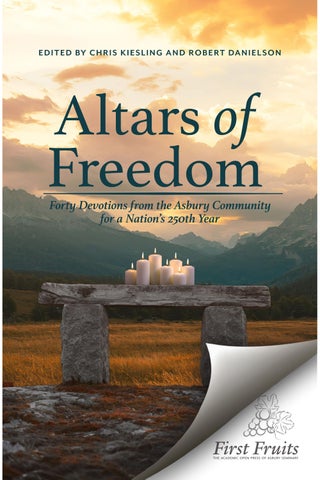
Forty Devotions from the Asbury Community for a Nation’s 250th Year
Edited by Chris Kiesling and Robert Danielson
First Fruits Press Wilmore, KY c2026
ISBN: 9781648174506
Altars of freedom: forty devotions from the Asbury Community for the nation's 250th year
Edited by Chris Kiesling and Robert Danielson
Published in the U.S.A. by First Fruits Press, 2026. Digital version at http://place.asburyseminary.edu/firstfruitsbooks/5/
First Fruits Press is a digital imprint of the Asbury Theological Seminary, B.L. Fisher Library. Asbury Theological Seminary is the legal owner of the material previously published by the Pentecostal Publishing Co. and reserves the right to release new editions of this material as well as new material produced by Asbury Theological Seminary. Its publications are available for noncommercial and educational uses, such as research, teaching and private study. First Fruits Press has licensed the digital version of this work under the Creative Commons Attribution Noncommercial 3.0 United States License. To view a copy of this license, visit http://creativecommons.org/licenses/by-nc/3.0/us/.
For all other uses, contact: First Fruits Press
B.L. Fisher Library
Asbury Theological Seminary
204 N. Lexington Ave. Wilmore, KY 40390 http://place.asburyseminary.edu/firstfruits
Altars of freedom : forty devotions from the Asbury Community for the nation's 250th year [electronic resource]/ edited by Chris Kiesling and Robert Danielson. – Wilmore, Kentucky : First Fruits Press, ©2026.
1 online resource 139 pages ; : port.) : digital.
ISBN: 9781648174506 (uPDF)
ISBN: 9781648174513 (Mobi)
OCLC: 1592516078
1 Devotional calendars. 2 Liberty Meditations
I. Kiesling, Chris A. II. Danielson, Robert A. (Robert Alden), 1969-
BV4810.A47 2026
Cover design by Amanda Kessinger
261.70973

First Fruits Press
Te Academic Open Press of Asbury Teological Seminary 204 N. Lexington Ave., Wilmore, KY 40390 859-858-2236
frst.fruits@asburyseminary.edu asbury.to/frstfruits
Preface: Robert A. Danielson -----------------------------------3
Day 1: !e Paradox of Freedom: John N. Oswalt---------------7
Day 2: Altars Beneath the Trees: Chris Kiesling (Exodus 3:7)---------------------------------------9
Day 3: Resisting the Dri : !e Cost of Covenant: Faithfulness- Andi Wallace (Exodus 19:3-6a)------------------13
Day 4: Walking Together in God’s Calling: Joel Razhamah (Judges 1:3)-------------------------------------15
Day 5: Making Room for Foreigners in our Systems: Allan Varghese Melootu (Ruth 2:8-10) ------------------------17
Day 6: Just a Handful: Tammy L. Cessna: (1 Kings 17:7-15) -----------------------------------------------21
Day 7: Battling on our Knees: Steve Gober (2 Chronicles 20:1-27) -----------------------------------------23
Day 8: Dwelling on God’s Holy Hill: Wilmer Estrada Carrasquillo (Psalm 15:1)--------------------------------------27
Day 9: From Refuge to Witness: Andrew Graham (Psalm 46:1, Colossians 3:12-15)------------------------------31
Day 10: Let Freedom Sing: Ellen Forney (Psalm 68:4-6 and 32-35) --------------------------------------35
Day 11: !e Freedom to Value What God Values: Brian Russell (Psalm 146)--------------------------------------37
Day 12: !e Post I Didn’t Share: Janet B. Dean (Proverbs 10:19)------------------------------------------------41
Day 13: From Many Cornerstones to the Cornerstone: Chance M. Robinson (Isaiah 19:13b)--------------------------45
Day 14: Shepherds Needed: John Ragsdale (Jeremiah 3:15)-------------------------------------------------47
Day 15: Freedom Subordinate to Divine Love:
Robert A. Danielson (Jonah 4:10-11)--------------------------51
Day 16: Doing Politics from Below:
Osias Segura (Matthew 5:3)-----------------------------------53
Day 17: From Inner Freedom to Neighbor Love: Jay Moon (Matthew 6:10) -------------------------------------55
Day 18: Altars of Freedom in an Inverted Bell-Shaped World: Chris Kiesling (Matthew 15)------------59
Day 19: Staying Aligned with God’s Purposes: !omas F. Tumblin (Matthew 16:21-23) --------------------63
Day 20: Overcoming Fear: Taylor J. Diehl (Matthew 24:4-13)--------------------------------------------67
Day 21: Re ecting on the “Quali cations of the Monastery Cellarer”: Jason Horstman (Matthew 25:31-46)-------------------------------------------71
Day 22: Jesus O ers a !ird Way: Steven Bruns (Mark 8:14-21)---------------------------------73
Day 23: Freedom and Gratitude:
Robert A. Danielson (Luke 17:15-16)------------------------77
Day 24: Consecration of Others:
Macy Smith (Luke 19:36-40)--------------------------------79
Day 25: !e Freedom Jesus Gives:
Philip R. Meadows (John 8:31-32)---------------------------81
Day 26: Submitting to God’s Master Plan:
Andrew McFarland (John 15:4) -----------------------------83
Day 27: Free to be Slaves: Robert A. Danielson (Romans 6:22)-------------------------------------------------85
Day 28: Truly Radical: James R. !obaben (Romans 7:21-8:2)---------------------------------------------87
Day 29: !e Wisdom of the Cross:
Ruth Anne Reese (1 Corinthians 1:18-31)--------------------91
Day 30: A Freedom More Triumphant:
Frederick J. Long (2 Corinthians 3:17)-----------------------95
Day 31: Don’t Rush !rough Sloth Day:
David Olshine (Galatians 5:1)---------------------------------97
Day 32: !e Means of Grace Makes Possible the Stewardship of Freedom: Abigail Sipe (Galatians 5:13)-----------------------------------------------101
Day 33: Freedom for Love: Dr. J. Matthew Barnes (Galatians 5:13-14)--------------------------------------------103
Day 34: Our Spiritual Passport: Jay Endicott (Galatians 5:13-26)--------------------------------------------107
Day 35: !e Freedom of Self-Emptying Love:
Paul Allen Tippey (Philippians 2:5-11)----------------------109
Day 36: Whose Builder and Maker is God: Matthew Maresco (Hebrews 11:13-16)------------------------113
Day 37: Re ned by Fire: Odenel Jean Gilles (1 Peter 1:6-7)---------------------------------------------------117
Day 38: Trading Insult for Blessing in Digital Spaces; Luke Smith (1 Peter 3:8-9)---------------------121
Day 39: A Substantial Semicolon Contemplating the Implications: Rachel Coleman (1 John 4:12)----------------------------------125
Day 40: Human Freedom and the Kingdom of God: Stephen Bailey---------------------------------------------------127
A Final Word from Our President- Set Free for Freedom: Dr. David F. Watson---------------------------------------------129
Re ecting on Christian Freedom---------------------------------------------------------131
Dr. Robert A. Danielson
In 1975, Dr. !omas Carruth of Asbury !eological Seminary put together a short booklet for the bicentennial of the United States of America. He entitled it, Altars of Freedom and presented forty devotionals for Christians to consider during the celebration of the 200th anniversary of the country. !e following is from his preface:
!e concept, Altars of Freedom, is as old as the quest for human life and joy. From the days of primitive man, there has been a search for freedom. !is quest took form eventually in man’s confrontation with God. Out of these experiences of freedom, there has come to us the rich heritage of the Hebrew religion, which is a background for our Christian faith.
Jesus launched His ministry on earth with a concept of setting people free. Millions have found true freedom through the Lord Jesus Christ. !e incredible crises and pressures of modern life make it absolutely essential that human beings learn to confront God, themselves, their fellow man and their total world at Altars of deep meaning and rich resources.
!erefore, we use the term Altars of Freedom in a very wide range of experience. We believe that wherever and whenever a man meets God and is set free that this experience is for him an Altar of Freedom.
!e Christian religion helps create Altars of Freedom on the inside of people. A truly democratic movement is interested in setting up Altars of Freedom on the outside. !ese two di erent altars work together in helping man realize his personal and corporate freedom.1
Dr. Carruth ended his preface by stating, “!e book is not copyrighted and may be quoted, printed or shared in any way
1 !omas Carruth, Altar of Freedom: Forty Days at the Altars of Freedom and Love. Wilmore, KY: Dr. !omas A. Carruth (1975): 5-6.
without credit to the author or the program. !e whole e ort is dedicated to the cause of freedom.” By publishing our devotional on an Open Access press of Asbury !eological Seminary, we are carrying forth this idea of openly sharing our thoughts on Christian freedom at the time of the 250th celebration of the founding of the United States.
Many things have changed since 1976, when Carruth’s booklet was in use. I turned seven years old during the bicentennial celebrations that year, and I remember the feelings of that time. Our current time is more divisive, more individualistic, and more materialistic than y years ago. !ere seems to be more violence and more hatred and less genuine and polite public discourse and debate. !e need for the Church is even greater than ever to help spread the message of the Gospel and teach the world the true message of freedom rooted in holy love as measured by the sacri cial work of Jesus on the cross. It is a freedom which emerges from a submission to God, which ironically leads to a freedom from self and sin. It is on these internal altars of freedom that we sacri ce self so that “I no longer live, but Christ lives in me” (Galatians 2:20). And it is in this sacri ce that we are truly made free internally.
But as Carruth noted, it is not enough to stop there. Internal spiritual freedom is a wonderful thing, and the presence of God brings perfect peace amid many troubles and con icts in our personal life. Yet, while God is love and cares about the world, God is also just and righteous and sees the problems in the world which need action, justice, and healing. People who have been transformed through internal spiritual freedom cannot remain aloof from these greater needs but must be part of the answer. !is is the nature of the Kingdom of God which Jesus spoke about. We must learn how to take our internal altars of freedom and help build external altars of freedom where the Good News of Jesus Christ can spread to a hurting world. Carruth saw this in part as the work of a democratic movement, but too o en we see governmental systems hijacked by individual greed and desires
for power, even within the best human-devised systems. While the Church o en has no choice but to work within governmental systems and regulations, it must not rely on governmental systems alone to be the answer to constructing altars of freedom on the outside.
God’s vision for the world as pictured in the book of Revelation in chapters 21 and 22 reads,
And I heard a loud voice from the throne saying, “Look! God’s dwelling place is now among the people, and he will dwell with them. !ey will be his people, and God himself will be with them and be their God. He will wipe every tear from their eyes. !ere will be no more death or mourning or crying or pain, for the old order of things has passed away.” (21:3-4) … !e city does not need the sun or the moon to shine on it, for the glory of God gives it light, and the Lamb is its lamp. !e nations will walk by its light, and the kings of the earth will bring their splendor into it. On no day will its gates ever be shut, for there will be no night there. (21:23-25) … !en the angel showed me the river of the water of life, as clear as crystal, owing from the throne of God and of the Lamb down the middle of the great street of the city. On each side of the river stood the tree of life, bearing twelve crops of fruit, yielding its fruit every month. And the leaves of the tree are for the healing of the nations. Revelation 22:1-2 (NIV)
!is is a vision of a world without death, without su ering and pain, with clean water which brings life for everyone, with an abundance of food and medicine, so there is no hunger, pain, or thirst. !is is a world without danger or crime so that there is no darkness and the gates never need to be shut due to fear of war or attack, where the streets are safe. !is is a world where all nations and ethnicities live together in unity and peace and divisions no one is labelled an immigrant, since all are citizens under the reign of God.
Dr. John N. Oswalt
Visiting Distinguished Professor of Old Testament
!e concept of freedom is enshrined in the roots of American culture. !e Europe from which we came was one of limitation, the limitations of culture: if your father was a bootblack, you would be a bootblack; the limitations of society: if you were born into the serf class, you were going to be a serf all your life; the limitations of politics; the kings and nobles governed everything. What a wonderful breath of fresh air to come to America, where it seemed the possibilities were endless. !e only limitations were your own.
Today that freedom has become an idol. If I want something, I have a right to it; if I want to do something, nobody has a right to stop me; if I think something, it is right and nobody has a right to correct me. !e trouble with that point of view is that it is a frightening form of bondage. I am in bondage to myself and my desires, and I can do nothing else. So, we have people demanding to be le “free” to do what they cannot help but do. A strange kind of freedom.
!e Bible shows us true freedom, a freedom from bondage to desire, a freedom from the power of sin, a freedom to realize all the potential that a benevolent creator has placed within us. But it is a freedom realized because we recognize that we are dependent. It is interesting to contrast the views of !omas Je erson and John Adams. Je erson was sure that if individuals were properly educated and freed from restraint, they could be trusted to do whatever was best for themselves and those around them. !us, there was no need for checks and balances in government. Adams did not believe that educated individuals free from restraint would
always do what was right. He recognized that self-interest could be a corrupting force in human a airs, and that mechanisms had to be put in place to control it.
For the Christian, this is the power of the Holy Spirit. Like the railroad engine that is free to do what it was made for when it is constrained by the two steel rails, so the human is free to realize his or her human potential when constrained by the Biblical vision of life and guided and empowered by the Holy Spirit. We don’t have to be ruled by desire; we don’t have to be dominated by what others think of us; we don’t have to have the highest position or the most recognition. We are free, praise God, we are free.
Dr. Chris Kiesling Professor of Human Development and Christian Discipleship
!en the Lord said, “I have observed the misery of my people who are in Egypt; I have heard their cry on account of their taskmasters. Indeed, I know their su erings.” Exodus 3:7
Many of the devotionals in this collection center upon a biblical understanding of freedom— parsing the language of freedom from the Greek text, drawing upon Pauline theology, or articulating the many ways Christ frees humanity from sin, self, and the Enemy of our souls. In Christ, we are liberated for joyful obedience, holy love, and life in the Spirit.
Yet one of the most profound expressions of freedom in American history emerged not from courtrooms, legislatures, or battle elds, but from the hidden worship gatherings of enslaved African Americans. Beneath the cover of night, in secluded hush harbors deep within the woods, enslaved believers fashioned altars of freedom.
!ough many enslaved persons were introduced to Christianity through plantation churches or the witness of white missionaries, they o en sought spaces where they could worship beyond white supervision and control. In these secret gatherings — held a er the day’s labor had ended and hidden beneath the canopy of darkness — enslaved Christians prayed, sang, preached,
1 !is devotion was developed with the assistance of arti cial intelligence for editorial re nement and stylistic enhancement.
testi ed, and listened anew to the stories of scripture. !ere they encountered not merely the religion of their oppressors, but the living God who hears the cries of the a&icted and delivers the captive.
Tucked away beneath harbors of trees, they sang the songs of Exodus:
When Israel was in Egypt’s land, Let my people go, Oppressed so hard they could not stand, Let my people go.
Go down, Moses, Way down in Egypt’s land, Tell old Pharaoh: Let my people go.
!e spirituals became more than songs. !ey were sermons sung aloud, theology carried in melody, scripture woven into memory. !rough them, enslaved believers proclaimed that Pharaoh would not have the nal word, that bondage would not erase human dignity, and that God had not forgotten his people.
Chains may still have threatened the body, but within the hush harbors worship preserved the freedom of the soul.
It was there that believers sang, Wade in the water. !e lyrics moved through the great waters of salvation history: from Israel passing through the Red Sea, to the waters of baptism, to crossing the Jordan into the hope of eternal life. !e songs were deeply sacramental. !ey formed an inward posture of resistance, hope, and holy expectancy through the mighty acts of God’s deliverance at the Red Sea and at Calvary.
Within the hush harbors, spiritual authority also emerged. Women and men prayed with power, preached with conviction, and nurtured resilient communities of faith. In these hidden gatherings, enslaved Christians cultivated courage, dignity,
communal identity, and resistance against a system that denied their humanity. Historians trace the roots of the independent Black church to these sacred gatherings hidden among the trees.
!e hush harbors remind us that freedom is never merely political autonomy or social permission. True freedom is found wherever the human spirit refuses to surrender its God-given dignity before oppression. Every whispered prayer, every spiritual sung into the night air, every testimony o ered beneath the trees became an altar of freedom — a witness that no earthly power can fully enslave those whose souls belong to Christ.
Even now, the witness of the hush harbors calls the Church to remember that worship itself can become an act of holy resistance. Wherever people gather to proclaim the liberating love of God, to preserve human dignity, and to hope against despair, the Spirit continues to build altars of freedom among us.
Rev. Andi Wallace Development O cer
!en Moses went up to God, and the Lord called to him from the mountain and said, “!is is what you are to say to the descendants of Jacob and what you are to tell the people of Israel: ‘You yourselves have seen what I did to Egypt, and how I carried you on eagles’ wings and brought you to myself. Now if you obey me fully and keep my covenant, then out of all nations you will be my treasured possession. Although the whole earth is mine, you will be for me a kingdom of priests and a holy nation.’” Exodus 19:3-6a (ESV)
Covenant with God is not something we usually reject outright…It’s something we slowly forget. !at’s what happened to the Israelites, the ones called to be a holy nation and God’s treasured possession. !ey didn’t wake up one day planning to betray God’s covenant. !ey dri ed. !ey got busy. Maybe they forgot.
If we’re honest, the same dri that threatened the Israelites can threaten us too—which is why covenant-keeping matters. God initiates covenant as a binding, transformational relationship, shaping us into greater holiness and Christlikeness. If covenant is the relationship, then discipleship is how that relationship is supposed to be lived out.
As we step onto the path of sancti cation -- becoming more like Jesus -- we need to lean into covenant-keeping and allow God to form us from the inside out.
In Luke Jesus tells us that if we want to follow Him as His disciples, we must put Him before everything else—and then count the cost.
Following Jesus means:
– We abide in Him. – We obey His commands. – And we bear fruit that lasts.
Keeping covenant helps anchor us so we don’t dri away from Jesus’ call to be disciples who make disciples. It is intended to help us not become like the Israelites, who o en seemed to forget their calling to holiness.
But I want to caution you about something that can quietly cause our covenant keeping to dri — time. Becoming more holy and Christlike cannot simply be added onto an already overloaded ministry schedule. Covenant faithfulness o en requires more than good intentions—it may demand structural change in our priorities, in our thinking, and in how we live and lead.
We all have the same 24 hours, and there will always be good “church” things competing for our attention. But being a disciple—and making disciples—is never accidental. It is a deliberate commitment, a daily choice to prioritize what matters most through practices like intentional personal worship, spiritual disciplines, and other means of grace. You cannot make disciples if you are not rst being formed as one.
Covenant dri rarely begins with rebellion. More o en, the enemy uses deception to erode our covenant-keeping with small, reasonable and even “church-worthy” compromises.
And so, we must remember what Jesus said: discipleship is costly. For many of us, the greatest cost will be our time.
Covenant love is free. But faithfulness to it can be costly.
Joel Razhamah Asbury Inn
Come up with me… then I, too, will go with you. Judges 1:3
!e opening of the Book of Judges presents a fragile moment in Israel’s history. With Joshua gone, the people must now learn to live faithfully without his leadership. In this uncertain transition, however, the narrative o ers a striking glimpse of communal faithfulness. Judah turns to his brother Simeon and says, “Come up with me… then I, too, will go with you” (Judges 1:3). What begins as a simple invitation unfolds into a shared victory (Judges 1:17).
At one level, the passage recounts a military endeavor. Yet beneath the surface, it is fundamentally a story of relationship and shared responsibility. Judah does not act in isolation, nor does Simeon remain disengaged. Together, they step forward into the task entrusted to them. !eir cooperation suggests that even in moments of uncertainty, faithfulness is not merely an individual pursuit but a communal one.
!is pattern of shared life resonates deeply with my own cultural experience. In the Tangkhul Naga tradition, life is lived communally rather than individually. Whether building a home or cultivating a eld, people work together not for personal advancement but for the good of one another. Labor becomes an expression of solidarity, and the burdens of life are carried collectively. Even the long walk to the elds becomes a space of fellowship. What appears to be ordinary work is, in fact, the formation of enduring relationships. As an African proverb
wisely observes, “If you want to go fast, go alone; if you want to go far, go together.” !is insight echoes the wisdom of scripture: “Two are better than one… for if they fall, one will li up the other” (Ecclesiastes 4:9–10).
Such practices re ect a deeper theological truth: God has not designed His people to live or serve in isolation. Although the cooperation in Judges unfolds within a context of con ict, the enduring signi cance of the passage lies in its relational dynamic. As followers of Christ, we do not replicate the conquest, but we embrace the principle of mutual dependence and shared faithfulness that undergirds it.
!is vision nds fuller expression in the life of the early church, where believers are described as being “of one heart and soul” and sharing all things in common (Acts 4:32). In New Testament witness, the people of God are called into a life marked by mutual care, encouragement, and love (John 13:34–35). !e reconciling work of Christ breaks down the divisions that separate us and forms a new community grounded in peace (Ephesians 2:14–16).
In this light, the brief exchange between Judah and Simeon becomes more than a historical note; it o ers a theological vision of life together under God. Faithfulness is sustained through cooperation, humility, and a willingness to bear one another’s burdens. Where such virtues are cultivated, communities are strengthened, and God’s purposes are carried forward.
Dr. Allan Varghese Meloottu Registrar
!en Boaz said to Ruth, “You will listen, my daughter, will you not? Do not go to glean in another eld, nor go from here, but stay close by my young women. Let your eyes be on the eld which they reap, and go a er them. Have I not commanded the young men not to touch you? And when you are thirsty, go to the vessels and drink from what the young men have drawn.”
So she fell on her face, bowed down to the ground, and said to him, “Why have I found favor in your eyes, that you should take notice of me, since I am a foreigner?” Ruth 2:8-10 (NKJV)
While listening to a sermon series on the Book of Ruth, a particular concept caught my attention. It is from the conversation between Boaz and Ruth. !e context is that Ruth, a Moabite, has come with Naomi to a foreign land. Ruth decides to go check if there is any work she can do, and she comes to Boaz’s eld. !e opening verses capture the short conversation between Boaz and Ruth.
Ruth’s question, “Why have I found favor in your eyes, that you should take notice of me, since I am a foreigner?” stood out as I sensed Ruth’s self-perception of how she understood and carried herself in Naomi’s land. Here, Boaz does not refer to
Ruth as a foreigner; instead, Ruth reveals her embodied identity as a foreigner.
At the same time, the reference comes a er Ruth became the subject of Boaz’s hospitality. We have no indication that Boaz was hostile toward Ruth; instead, we see him instructing the men in his eld to allow her to gather her crops.
In other words, Boaz’s economic and agricultural system accommodated foreigners like Ruth. Neither Boaz nor his men feared her interference. !ey welcomed Ruth and incorporated her input; to some extent, she may also have in uenced how they ran the work. Eventually, as we know later in the story, Boaz’s life was radically changed because of Ruth, as he married her.
!is story reminded me to ask the question within our various social, educational, and ecclesial systems: How are we making room for the foreigner in our American systems, especially in our Christian institutions? In our theological institutions, how are we making room for the “foreigner,” not just in our curricula and degree delivery pathways but also in how we create a nancial system to sustain global learning as we build the Kingdom of God?
Historically, Christianity has had its predominant population in the Western hemisphere. However, in the last y years, Christianity has indeed grown in the Global South to the point that the predominant revelations and learnings of Christian faith will emerge from the foreign land. How should we then listen to our brothers and sisters from the Global South to enrich our faith journey? What structural systems are we to erect in order for us to listen to such learnings?
Personally, as a foreigner, I have been at the mercy of numerous foreign educational institutions and organizations that brought me to where I am today. !erefore, there is a sense of resonance in me when I hear Ruth’s question: “Why have I
found favor in your eyes that you should take notice of me since I am a foreigner?” At the same time, it reminds me of a universal Christian principle that we are all foreigners or pilgrims, and so our ultimate identity is shaped by our King, Jesus Christ, who has brought us into his Kingdom of God. !erefore, there is always room to grow in our knowledge of Christ by listening and learning from our brothers and sisters from other parts of the World.
Dr. Tammy Cessna Director of Alumni and Church Relations
Scripture: 1 Kings 17:7-15
A handful of our was all that remained. And a little olive oil. !ere was no stretching these meager ingredients any further; today would be their last meal.
!e thoughts of imminent death were hard to suppress. She could do no more, but she could still do what she had done each day, one more time. She went to the city gate to gather a few sticks for the re to cook the meal. Preoccupied with her perilous situation, she hardly noticed the bedraggled stranger lingering nearby.
!e stranger asked, “Would you bring me a little water in a jar so I may have a drink? …And bring me, please, a piece of bread.” !e request seemed unreasonable, intrusive, as it met her thoughts of pending starvation. By his dialect and appearance, she knew he was Hebrew. Acknowledging his God, she replied, “As surely as the LORD your God lives, I don’t have any bread, only a handful of our in a jar and a little olive oil in a jug. I am gathering a few sticks to take home and make a meal for myself and my son, that we may eat it and die.”
Elijah declares, “Do not be afraid… But rst make a small loaf of bread for me… and then make something for yourself and your son. For…the God of Israel, says: ‘!e jar of our will not be used up, and the jug of oil will not run dry until the day the LORD sends rain on the land.’”
!is is an invitation to set aside fear and anxiety, and to trust. In a time where there’s o en an anxious striving for more, we frequently believe that freedom is found in having enough and being secure. But God desires to free us from fear and anxiety. Freedom in Christ is not external abundance, but an inward freedom to act in faith, loving Him foremost and our neighbor as ourselves.
God’s prevenient grace enables the widow to set aside her own needs and act in faithful obedience, trusting the promise that the our and oil would not run dry. She gives to Elijah rst. !is is costly obedience. God’s grace is not only helping her, but it is also forming her. What begins as a simple act of obedience becomes an altar of freedom, an inward work of grace expressed outwardly in love.
God works a miracle, not through over owing abundance, but through sustained provision. Each morning, God meets her with just enough for the day, providing what she needs to feed Elijah, herself, and her family. !e pantry does not over ow, but it does not run dry. Day by day, her trust deepens as grace sustains her. Over time, the God she once knew only as his God becomes her God as well, revealed through His provision and the persistent work of grace.
What about you? Where in your life does it feel like there’s “not enough?” What is God asking of you that feels costly right now?
Just as the Lord met the widow, He meets us in the “almost empty” places of our lives. His grace works within us, transforming us inwardly so that we may live outwardly for Him, for others, and for the good of the world around us.
In His hands, even a handful can become something holy when we trust Him and obey.
Dr. Steve Gober
Executive Director of Academic A airs, Asbury Latino Center
Scripture: 2 Chronicles 20:1-27
I o en turn to 2 Chronicles 20:1–27 for encouragement and exhortation. It o ers a biblical pattern for life and leadership. King Jehoshaphat made prayer and worship his priority. He leaned into the hidden, o en di cult work of waiting before God. !ese practices do not always come easily for leaders. Yet at this altar of surrender, prayer, and worship, the inner life is formed. Here, faithful leadership begins.
Jehoshaphat faced a crisis beyond his ability to control. A great multitude was advancing against Judah, and scripture does not conceal the king’s fear. Yet fear did not drive him further into self-reliance. It drove him to seek the Lord. He proclaimed a fast, gathered the people, and prayed with striking honesty: “We do not know what to do, but our eyes are on you.”
!at confession is not weakness. It marks the beginning of rightly ordered leadership. !ere human limitation is acknowledged and divine su ciency is sought.
Many leaders respond to crisis by turning rst to analysis, strategy, and control. !ey measure resources, gather information, and develop plans. Certainly, leadership requires discernment, wisdom, and action. Yet, 2 Chronicles 20 reminds us that faithful leadership begins somewhere deeper. Before Jehoshaphat acted, he sought the face of God. He turned rst to prayer and worship rather than to the limits of his own resources. He knelt before he advanced.
!is is a critical insight for contemporary leaders. Leadership is not rst strategic; it is spiritual, and it is tested in the hidden life. Leaders are always building altars. What they trust, where they turn under pressure, and how they respond when fear rises disclose the altars that govern their lives. Some build altars to e ciency, others to nancial security, and yet others to public approval. None of these sustains the soul. Only the altar of surrender, dependence, prayer, and worship bears that weight.
Jehoshaphat recognized that the battle before him exceeded his strength and that of his people. Such recognition is rarely easy for leaders, many of whom carry weighty responsibility and expectation. Yet God responded to the people’s need and to their posture of submission and dependence. As they stood before the Lord in humility, the word came: “Do not fear or be dismayed… for the battle is not yours but God’s.”
!is does not eliminate human responsibility; it reorders it. Prayer does not release leaders from action. Rather, it situates action within trust, discernment, and dependence on God. !e persons who battle on their knees are not retreating from leadership. !ey are entering it in a truer way.
Contemporary leaders face di erent enemies, though they are no less real. At one moment, the battle may involve walking into a nance committee meeting while knowing the numbers do not add up. At another, it may involve journeying with a young married couple bearing wounds from broken pasts and dysfunctional family histories. On other fronts, internal challenges within one’s own soul may converge with cultural hostility and spiritual opposition from outside. Such pressures threaten a leader’s calling, ministry, and personal life. !ough the enemies change, the deeper character of the battle remains much the same. In such moments, prayer is not a retreat from leadership. It is one of its deepest expressions. To battle on our knees is not to evade responsibility. It is to place that responsibility before our Lord who alone brings deliverance and transformation.
One of the great dangers facing leaders today is the subtle illusion of self-su ciency more than open rebellion against God. We may speak the language of faith while living as though outcomes depend entirely upon us. We may build ministries, organizations, and movements while neglecting the sustaining life of prayer and worship. Yet it is in that hidden life before God that fear is reoriented, pride is cruci ed, and vision is puri ed.
Before leaders call others to action, they must rst learn the slow and o en painful work of dependent trust. !at is why the altar matters. !ere we remember who God is. !ere we remember who we are not. !ere we learn again where the battle belongs.
Dr. Wilmer Estrada-Carrasquillo
Associate Professor of Evangelism, E.S.J. School of Ministry and Mission
O Lord, who may abide in your tent? Who may dwell on your holy hill?
Psalm 15:1 (NRSV)
!e “Preface” of Carruth’s Altars of Freedom states, “We believe that the Church can be the most strategic organization in the improvement of our citizens and our American way of life.” I was not alive when this statement was written, commemorating the bicentennial, so I am unable to assess how the Church measured up to it at the time. But what of it today? Has the Church improved our citizenship and our American way of life? In one sense, there is no doubt of the spiritual, social, and economic impact that the Church has had on the nation. !e church is the Lord’s, and not even the gates of hell can prevail against her (Matthew 16:18). Notwithstanding, the lines between the freedom preached throughout the biblical narrative and the nation’s freedom are becoming blurred. !is is not a recent phenomenon, but it has become increasingly problematic. As a result, the Church has become its own stumbling block to the freedom it should embody.
Today, when we look at the Church in the US, we cannot ignore how easily our understanding of freedom has blended with our nation’s own story of freedom. !e Church has indeed shaped lives spiritually, socially, and economically. Yet if Psalm 15 asks who may truly dwell in God’s tent and live on God’s holy hill, we must also ask whether our current allegiances are drawing us
toward His hill—or quietly leading us to Capitol Hill. Remember, political parties and political platforms are not truly interested in faith; they are interested in fealty, which means demanding unwavering allegiance.
!is is why we must discern how we got here and, more importantly, ask ourselves why we would want to stay here. We can’t serve two masters. Or to ask the same question in light of the Psalm, we can’t pitch a tent on two hills at the same time. Please let me be clear. I am not saying, “Don’t participate in politics. Don’t vote.” Go ahead, do so. Yet, let’s be mindful that no political party represents or speaks for the Church. !e Church doesn’t need a campaign platform, a libuster, or a whip. !e Church belongs to God, and her mission is to live out the truth of God’s kingdom: to live in the mission of God. !is mission is so much greater than any political ideology. And though a political platform may align with Christian values at some political intersection, we can’t deny that it o en runs in its own lane. !us, let us be cautious about merging lanes with quite di erent destinations; when we do, hatred and enmity rule rather than love, justice, and truth.
As I meditated on this, I was taken to Psalm 15. !e Psalmist begins with two piercing questions: “Lord, who may dwell in your sacred tent? Who may live on your holy hill?” !e rest of the Psalm answers who will “dwell” and “live.” I invite you to read the rest of the Psalm but do so with an open heart. It will take more than one reading. As we go deeper into the reading, let’s evaluate whether our political allegiances are moving us towards the destination the Psalms call us to. If our tents are being pitched on Capitol Hill, we should lament, confess, pray, and ask for forgiveness. Hopefully, we are empowered to walk out of that human-made mountain, face toward the hill of God, and lovingly and patiently climb the holy mountain and dwell and live in His tent, knowing that on that journey we will be joined by people who are leaving behind fealty to political parties and seeking to embrace the Kingdom of God anew.
Prayer: Lord, as this nation is about to celebrate its 250th anniversary, let us not forget who our Lord is and who we are called to be in this nation. Let the word of the psalmist, by the work of the Spirit, move us to pitch our altars and tents on your holy mountain. Amen!
Dr. Andrew Graham, LMHC, LMFT Professor in the School of Counseling
God is our refuge and strength, a helper who is always found in times of trouble. Psalm 46:1
!erefore, as God’s chosen people, holy and dearly loved, clothe yourselves with compassion, kindness, humility, gentleness and patience. Bear with each other and forgive one another if any of you has a grievance against someone. Forgive as the Lord forgave you. And over all these virtues put on love, which binds them all together in perfect unity. Let the peace of Christ rule in your hearts, since as members of one body you were called to peace. And be thankful. Colossians 3:12–15 (NIV)
Christian freedom begins with our source of security, where we take refuge.
Scripture names God not only as our Lord, but as our refuge, our place of safety and source of strength. Where there is no security, there is rarely freedom. In our human relationships, those who are secure are freer: freer to listen, freer to engage, freer to act without fear. When insecurity leads, reactivity follows, along with defensiveness, urgency, and the quiet need to prove oneself.
So it is with our life of faith. When we are not deeply rooted in God as our refuge, our e orts to live faithfully can become strained. When we abide in Christ, we begin to experience what earlier generations described as an altar of freedom within, a grace that not only forgives but also frees. In the Wesleyan vision, this
is the ongoing work of sanctifying grace, forming our hearts to no longer be ruled by fear, but ordered by holy love.
!is inward freedom does not remain hidden but is re ected in the relationships closest to us.
Joshua’s declaration, “as for me and my household,” reminds us that the home is a primary place where inward freedom takes shape. In the ordinary rhythms of daily life, we learn to bear with one another, to forgive, and to practice patience. As Paul writes, we “clothe” ourselves with compassion, kindness, humility, and love (Colossians 3:12–14). !ese virtues are not formed in a moment, but through repeated acts of grace.
!ese practices, over time, establish altars of freedom among us. Our homes become places of shared refuge, and the church becomes an extended altar of freedom where our life in Christ is deepened in community. We learn to remain connected even in our di erences, to practice patience without withdrawal, and to bear one another in love. In such communities of faith, people are secure enough to grow, to fail, and to begin again.
What is formed in these altars does not remain there but extends outward into our witness in the world beyond.
In a world marked by division and urgency, it is tempting to believe that faithfulness requires louder or quicker responses. But Christian freedom is not sustained by reaction; it is sustained by spiritual formation. !ose who are secure in Christ move toward others without fear, acting with conviction, not contempt, seeking the good of others without needing to prevail.
Christian freedom, in the end, ows from refuge. Where that refuge is real, it becomes an altar, rst within us, then among us, and nally for the sake of the world.
Prayer: Lord Jesus, our refuge and our peace, establish in us an altar of freedom within. By Your sanctifying grace, form our hearts in love, and make our lives places where others may encounter Your mercy. Amen.
10
Ellen Forney
Help Desk and ILL Specialist, B.L. Fisher Library
Sing to God, sing in praise of his name, extol him who rides on the clouds; rejoice before him—his name is the Lord. A father to the fatherless, a defender of widows, is God in his holy dwelling. God sets the lonely in families, he leads out the prisoners with singing; but the rebellious live in a sun-scorched land. Psalm 68:4-6 (NIV)
Sing to God, you kingdoms of the earth, sing praise to the Lord, to him who rides across the highest heavens, the ancient heavens, who thunders with mighty voice. Proclaim the power of God, whose majesty is over Israel, whose power is in the heavens. You, God, are awesome in your sanctuary; the God of Israel gives power and strength to his people. Psalm 68:32-35 (NIV)
How many times a day do we hear the word freedom uttered in a context that does not seem to last or make sense. Everybody wants to feel free to be the person that they want to be or to live in a land where that is at least an option. David talked about his love of freedom that he was granted from God in Psalm 68 and his response to that feeling was to praise the Lord. “Sing to God, Sing in praise of his name” (Psalm 68:1). Music is a big part of how most people escape the feelings that they are having about the world and what they wish they could change. In times of
great stress, listening to a familiar melody can help to bolster the soul and express feelings that others might try to hide. Take for example the spirituals that were sung by the African Americans as they searched for freedom. “Follow the drinking gourd” was used as a message to help people nd their way to safety by using the stars to guide them and who put those stars in place.
Even looking at the hymnal, you can nd countless songs that speak to the freedom that David was longing for and for the freedom that we still search for today. Look at Faith of our Fathers, in the third stanza, it says “we will strive to win all the nations unto thee and through the truth that comes from God mankind shall indeed then be free.” !e hymn was written to pay tribute to Catholic martyrs, and the message still carries through today. Patriotic songs such as America the Beautiful also speak of praising God for the beauty of his creation and the freedom that we have. Even in what has become known as the Asbury ght song And Can It Be, we sing “My chains fell o , my heart was free, I rose went forth and followed thee”. !e world is pulling us to long for the freedom to choose the newest and greatest technology and to ignore the real reason that we were put on this earth. It is time to sing of the freedom that allows us to stand for the one who paid the ultimate price. So let us raise our song of freedom and sing once again “King of Kings” with a loud voice so that we know where our freedom comes from and that he will never take it away from us.
Prayer: Dear Lord, I choose to raise my voice to sing of the freedom that you have given me. You are the reason that I can stand and sing without fear. Help me to never forget that and to never be afraid to sing of freedom this day and every day. Amen.
Dr. Brian D. Russell Professor of Biblical Studies
Praise the LORD.
Praise the LORD, my soul.
I will praise the LORD all my life; I will sing praise to my God as long as I live. Do not put your trust in princes, in human beings, who cannot save. When their spirit departs, they return to the ground; on that very day their plans come to nothing. Blessed are those whose help is the God of Jacob, whose hope is in the LORD their God. He is the Maker of heaven and earth, the sea, and everything in them— he remains faithful forever. He upholds the cause of the oppressed and gives food to the hungry.
!e LORD sets prisoners free, the LORD gives sight to the blind, the LORD li s up those who are bowed down, the LORD loves the righteous.
!e LORD watches over the foreigner and sustains the fatherless and the widow, but he frustrates the ways of the wicked.
!e LORD reigns forever, your God, O Zion, for all generations. Praise the LORD. Psalm 146 (NIV)
Psalm 146 is both a praise hymn to God and an exhortation about allegiance.
It is an invitation for us to ask: In whom do I really trust? Does my life embody the values of the heart of God or the ways of the wicked?
Psalm 146 reminds us that our help is in God. Human leaders no matter how beloved or reviled are nite and thus unworthy of our ultimate trust. Our deepest trust must be solely in the true King, the Lord Jesus.
!e Psalm shi s in verses 5–9 to describe the God whom we praise. Verse 5 describes as “happy” the person whose help and hope is the LORD. “Happy” describes a person who has been blessed by God. !e New Testament equivalent of “happy” shows up in the Beatitudes in Matthew 5:3–11.
Why is God the true source of hope, help and happiness? !ere are two reasons. First of all, God is the Creator of all that exists. God stands outside time and space as the eternal king who governs His creation.
But there is a key addition. Secondly, the Creator God actively engages our world and advocates for those who are desperate for what only God can do. Verses 6b–7 describe a God who acts in truth (faithfulness) always and takes the side of the downtrodden to insure justice.
Psalm 146 is a reminder that the righteous are not necessarily to be found only among the beautiful, the connected, the wealthy and the powerful. Such a view is worldly and wrong. !e values that our world promotes o en run counter to the vision of our true King. In fact, the ways of the wicked will end in ruin. But the good news is this: the LORD loves the righteous and such persons will be found even among those whom our modern world devalues and o en ignores: the prisoner, the blind, the bowed down, the stranger, the orphan and the widow.
Psalm 146 invites us to care about the same people that God values. As we celebrate the freedoms enjoyed as citizens of the United States, Psalm 146 exhorts us rea rm our trust and hope in the LORD. It likewise challenges us to live counter cultural lives that serve and bless the very people whom God loves.
A soul aligned with the kingdom of God is a soul who worships God. !e pray-er of Psalm 146 vows to praise the LORD for the entirety of his or her life. In the concluding verse the psalmist again returns to the theme of praise. Verse 10 announces the LORD’s eternal kingship and declares this truth to those who are listening.
To close, I invite you to re ect on the two questions with which I began:
In whom do I really trust as my source of hope and help? Does my life embody the values of the heart of God or the ways of the wicked?
Dr. Janet B. Dean Professor of Pastoral Counseling, School of Counseling
In the multitude of words sin is not lacking, but he who restrains his lips is wise.
Proverbs 10:19
My nger hovered over the “enter” button when the Holy Spirit gently asked, “Why this post?” !e topic itself no longer matters. What mattered was the impulse, the almost irresistible urge to speak into the issue of the day. We tell ourselves good reasons: we want to raise awareness, help others think clearly, show that we care. But in that quiet moment, the Spirit invited me to look deeper, beneath my explanations, into my true motivation.
If we are honest, those surface reasons o en don’t hold. Most people are already aware. Most already believe they are thinking rightly. And many will only feel cared for if we agree with them. So, when that urge to take a public stand rises within us, we must ask: What is it really aiming at?
As I sat with that question before God, the prayer of the Pharisee in Luke 18:11 came to mind: “God, I thank you that I am not like other people…”, not like those who don’t see clearly, who are deceived, whose hearts are in the wrong place. But, friends, whose heart is truly in the wrong place?
May I o er a hard word? What if our deepest motivation in public debates, especially on social media, is less about truth
and more about proving our own righteousness? What if we are seeking a rmation rather than o ering love?
When we slow down and re ect, we realize that many of the issues we argue about are far too complex to be reduced to a post. When we step into another person’s experience, we see how easily our words can wound, o en wounding those already hurting. And when we consider the fruit of these exchanges, we must admit they o en produce more division than love of God and neighbor.
So why do we feel compelled to speak? Perhaps, if we are honest, it is for ourselves—our sense of worth, our need to be right. Jesus told this parable, Luke reminds us, for those “who were con dent of their own righteousness and looked down on everyone else (v.9).” Too o en, this is us.
Years ago, I worked as a psychologist in a maximumsecurity forensic unit. Some of my patients had done unspeakable things. One day, I was called to see a young woman who had murdered her children, who were the same ages as my own. I was overwhelmed with anger and disgust. I fell to my knees and asked God for grace to see her as He sees her.
God answered that prayer.
He reminded me that every person, no matter what they have done or believe, is made in His image. Each is “crowned with glory and honor” (Psalm 8:5) by God Himself. And yet, all have sinned and fall short of that glory (Romans 3:23). Every one of us stands in need of grace. And God, in His mercy, o ers that grace freely.
Perhaps this, then, is to be our true stance, even toward those with whom we strongly disagree— Grace.
Grace does not mean abandoning truth. It means leading with love. It does not mean silence but speaking with gentleness and humility. It does not mean avoiding challenge but doing so within the context of relationship and care.
Truth without love becomes self-righteousness. Love without truth becomes empty, cheap grace.1 !ey belong together; they are two sides of the same coin.2 John Wesley even de ned holiness itself as love.3 !ese are not separate realities, but one.
In Jesus’ parable, the tax collector stands at a distance, unable even to li his eyes, and prays, “God, have mercy on me, a sinner (v. 13).” What if this became our starting point? What if, instead of positioning ourselves above others like the Pharisee, we began with our own need for mercy—and then extended that same mercy outward?
I never did press “enter” that day. !e temptation still comes, but God’s mercy restrains me. And sometimes, by His grace, something di erent emerges—not a declaration of righteousness, but a quiet o ering of grace.
1 Bonhoe er, D. (1995). !e Cost of Discipleship. Touchstone/ Macmillan.
2 Wynkoop, M. B. (1972). A !eology of Love: !e Dynamic of Wesleyanism. Beacon Hill Press of Kansas City.
3 Wesley, J. (2013). A Plain account of Christian perfection (1766). In P. W. Chilcote and K. J. Collins (Eds.), !e Works of John Wesley: Doctrinal and Controversial Treatises II, Volume 13, !e Bicentennial Edition. Abingdon Press.
Chance M. Robinson Custodian
…the cornerstones of her peoples have led Egypt astray. Isaiah 19:13b (NIV)
!e prophecy recorded by Isaiah in chapter 19 begins by acknowledging the arrival of the Lord causing the hearts of the Egyptians to melt with fear (v. 1). !e reaction in Egypt to God on the move is not favorable. Animosity and division are stirred up among the peoples (v. 2), people lose heart and turn to quick xes and new age practices (v. 3). !e country is given over to cruel leaders (v. 4). Does anything sound familiar?
!is good news of God’s judgement dries up and makes the very life source of Egypt parched and dry (v. 5-6). !e economic prowess of a powerful country is destroyed such that “all the wage earners will be sick at heart” (v. 10). !e ruling o cials and leaders are said to be fools giving senseless advice while calling themselves wise (v. 11) because “the cornerstones of her peoples have led Egypt astray” (v. 13). At this point you might ask how is this good news?
God is on the move in Egypt. His judgement is restorative. !e Lord is revealing what is lacking and “there is nothing Egypt can do” (v. 15). !e people have looked to many cornerstones, but only one cornerstone is able, Christ Jesus. “In that day the Egyptians will become weaklings. !ey will shudder with fear at the upli ed hand that the Lord Almighty raises against them” (v. 16). When we pray for revival and awakening, do we realize what we are asking for?
For 250 years, the USA has been dependent upon powerful leaders (cornerstones) such as Washington, Je erson, Jackson, Lincoln, and Roosevelt. !ese cornerstones are featured on currency with the motto; In God we trust. But who are we trusting? Do we want to be truly blessed?
“Blessed are the poor in spirit, for theirs is the kingdom of heaven” (Matthew 5:3). It is good news to be weaklings (v. 16) and the fear of the Lord is the beginning of wisdom (Proverbs 9:10). Rev. Fleming Rutledge says, “God’s love resisted feels like wrath,” but when we turn to the Lord and behold his glory, he transforms us (2 Corinthians 3:16-18). When we build an altar of prayer, create space (v. 19) and cry out, he will send a savior and defender to rescue us (v. 20). And best of all, “the Lord will make himself known … and in that day they will acknowledge the Lord” (v. 21a).
Prayer: Lord, you are on the move! I believe, help my unbelief! You are the righteous judge and the faithful Witness. !ank you for the transformative work you have begun. Father, make us “poor in spirit” that we might con dently declare “In God we Trust”! Holy Spirit, stir conviction in our hearts. Make our delight be in the fear and love of the Lord. Jesus, we want to truly love you and depend on you. Maranatha! Come, Lord Jesus, Come! Amen.
Dr. John Ragsdale
Provost, Asbury !eological Seminary
!en I will give you shepherds a er My own heart, who will feed you on knowledge and understanding. Jeremiah 3:15 (NASB)
We need more shepherds.
No, not to corral roving ocks of feral sheep.
We need a di erent kind of shepherd. !ese shepherds show up in our daily lives, see us for who we are, and help us grow. People who can take us from where we are to where we need to be. People who can help us nd freedom.
We need them in our o ces. We need them on construction sites. We need them in the classroom and in the boardroom. Everywhere people work and gather, we humans need shepherds, who will simply love us and nd their joy in being with us and investing in us.
Shepherds a er God’s own heart, as Jeremiah puts it.
“ !en I will give you shepherds a er My own heart, who will feed you on knowledge and understanding.” (Jeremiah 3:15 NASB)
And how do they do that? How do they even know how to do that? It starts by knowing where to get the sustenance the sheep need. Without knowing where those still waters of life are situated, the sheep might as well not even have a shepherd. !ey’ll
be lost. Wandering. Looking, but never nding that which could enrich their souls.
It’s the shepherd’s job to know where to nd knowledge and understanding.
And there’s only one way to know where those waters are. Shepherds must learn the terrain. !eir survival depends on it too. Without food and water, they won’t survive either.
Extending the metaphor further is probably unnecessary. !e reader gets the point. To be a shepherd a er God’s own heart–a clear reference, if ever there was one, to King David–the shepherd must him/herself feed on knowledge and understanding. And the rst source for those twin capacities is scripture.
Psalm 9:7 puts it this way:
“ !e law of the LORD is perfect, restoring the soul;
!e testimony of the LORD is sure, making wise the simple.” (NASB)
!ere’s wisdom contained in the parallel structure of this verse that will help us develop as shepherds a er God’s own heart.
First, the anchor for good shepherding is the LORD’s law and His testimony. Never far from the minds of the Old Testament writers is the idea that God’s law is His heavenly instruction. !e law, even those parts that may be di cult to understand and appreciate, are fundamentally about instructing the readers how to order their lives before the LORD in ways that please Him.
Second, the LORD‘s instruction is both perfect and sure. !e words “complete and rm” might also be used to translate these two ideas. At the heart of the matter is that the LORD‘s instructions and testimonies are reliable. !ey both are complete
and rm, and they foster completeness and rmness in those that read and do them.
!ird, the e ect of allowing the LORD‘s complete instruction and rm testimonies to penetrate our souls is that we are restored. We are made both whole and wise in the process.
People want shepherds like that
People need shepherds like that.
!ey are the shepherds a er God’s own heart.
Dr. Robert A. Danielson Director of Strategic Collections, B.L. Fisher Library
“But the Lord said, ‘You have been concerned about this vine, though you did not tend it or make it grow. It sprung up overnight and died overnight. But Ninevah has more than a hundred and twenty thousand people who cannot tell their right hand from their le , and many cattle as well. Should I not be concerned about that great city?’” (Jonah 4:10-11)
At rst glance, the story of Jonah seems to be the antithesis of freedom. A er all, doesn’t God appear to force Jonah to the Divine will? But this is not exactly true, and the story deserves a closer look.
God gives Jonah the freedom to disobey. Jonah’s path of disobedience takes him to the point where he desires death to end the storm which threatens the ship on which he ed (Jonah 1:14). It is Jonah’s path of disobedience, not God’s will, that ends in the stomach of a great sh, but God gave Jonah the freedom to make that choice.
God gives Jonah the freedom, even when he is obedient, to do the minimum amount of work required for his mission. In a city which takes three days to travel through, Jonah travels one day into the city, gives his message, and leaves. Along with this freedom, God gives Jonah the freedom to be angry at God. Jonah becomes angry at God when Ninevah repents because of his feeble, lackluster message, and God in turn has compassion on Ninevah. Jonah blames God for God’s compassion, perhaps realizing his professional credentials as a prophet will now likely
be stamped “false prophet” due to God’s compassion. At the end of the path of his lazy approach to ministry and his anger at God, Jonah notes, “Now, O Lord, take away my life, for it is better for me to die than live” (Jonah 4:3).
Not one to give up, God gives Jonah the freedom to love his enemies. But instead, Jonah retreats to a position to view the Divine reworks that he hopes will happen and secure his professional position as a prophet par excellence. God provides a shade plant to protect Jonah from the heat of the sun. !e next day God destroys the plant and sends a hot wind from the east and makes the sun especially hot. Once more the intrepid prophet calls out, “It would be better for me to die than to live” (Jonah 4:8).
At this point, God delivers his nal message, reminding Jonah that the prophet cared more for a plant than for 120,000 people who did not know God, and many cattle. Jonah’s freedom to disobey, his freedom to be lazy in ministry, his freedom to be angry at God, and his freedom to choose hate over love were ultimately subordinate to the mandate of Divine love.
God is a patient, compassionate, and loving God. One who desires all people to repent and come to a knowledge of God. God gives us an immense amount of freedom, but this freedom comes to an end when it seeks to interfere with the love of God for the entirety of God’s creation. Our freedom o en leads to choices that lead to death when we choose our own path, but God’s path for us is a choice for Divine love over our own freedom, which leads to true life.
Dr. Osias Segura Adjunct Professor
You’re blessed when you’re at the end of your rope. With less of you there is more of God and his rule. Matthew 5:3 (!e Message)
In the h century, the structures of the Western Roman Empire were fractured under fragile political systems and inconsistent leadership. !is created an unclear future for its citizens. In that precarious context, Pope Leo the Great preached Sermon 93, calling his people away from fear and toward a life of holiness. He exhorted them not merely to confess their faith, but to ground their identity in Christ as they engaged the public sphere. Today, Leo calls us to integrity, humility, responsibility, and hope. He reminds us that spiritual formation directly shapes how we view and participate in politics.
Every believer is called to participate in God’s redemptive work. As citizens of both God’s Kingdom and our earthly nations, our engagement with society is an essential part of our discipleship. We are called to treat our neighbors with kindness and respond to injustice. Leo urges us to lament the e ects of human sin and iniquity in society—and to take action.
Amid harsh and divisive rhetoric where truth is easily distorted, Leo calls us to integrity. Our discourse, especially with those we disagree with, must re ect the character of Christ rather than the tone of the surrounding culture. We are called to
speak with honesty and act with consistency. In a political arena dominated by division and bullying, Leo reminds us to maintain a spirit of gentleness and self-control while advocating for justice.
!is theology of public engagement was tested in 452 AD. When political structures failed, Leo rode out to confront Attila the Hun. While the details of their negotiations remain unknown, the outcome is clear: Leo persuaded Attila to accept a fee and spare the people Rome. He carried moral and diplomatic authority because he practiced the faith he preached, and even a conqueror respected that integrity. !ree years later (455 AD), he had to ride out again to meet the Vandal king Genseric, which prevented the mass slaugher of the citizens of Rome. !e civil magistrates ed from these, and other invasions. Leo stepped into this vacuum as a pastoral administrator, organizing the church to feed refugees, and caring for the poor.
Finally, Leo points us in hope to the reign of Christ. Political systems rise and fall. !e Kingdom cannot be shaken. Our ultimate security does not depend on political parties, human leaders, or nations. Recognizing this truth does not lead us to passivity; rather, it frees us from fear so we can act in the public square with responsibility, integrity, and self-control.
Dr. Jay Moon
E.S.J. School of Mission and Ministry
Your kingdom come, your will be done, on earth as it is in heaven. Matthew 6:10
We live in a time when the word freedom is everywhere, yet its meaning feels increasingly unclear. Freedom is o en reduced to personal autonomy, the right to choose, or the removal of constraints. But the gospel o ers a deeper and more transformative vision.
Christian freedom begins not with external conditions, but with an internal altar.
When Christ saves and sancti es, He establishes within us a new center - a liberated heart no longer bound by sin, fear, or the need to justify ourselves. !is is the beginning of true freedom. It is what we might call an inner altar of freedom - a place where we encounter the love of God and are set free from all that oppresses.
But this is not where the story ends.
A missional imagination helps us see that this inward work of grace always moves outward. We begin to sense the same realities as others - division, fear, injustice, loneliness - but we are invited to envision alternate possibilities shaped by the kingdom of God. Freedom, in this sense, is not merely something we possess; it is something we participate in extending to others.
!is is the movement from altar to mission.
Consider how this works in practice. A church once faced overcrowding and could have simply expanded its building. Instead, through a missional imagination, they asked a di erent question: What would it look like to send rather than accumulate? !e result was not scarcity, but multiplication – they sent 100 people from the congregation to start a new church community, and the kingdom extended into new spaces.
Freedom in Christ reshaped their imagination. And their imagination reshaped their action.
!is is the invitation before us today.
If Christ has set you free, where is He calling you to build an “external altar of freedom” for others? In your family? Your neighborhood? Your workplace? Freedom in the kingdom is never self-contained. It is always oriented toward love of neighbor and the common good.
As kingdom innovators, we learn that this kind of life is not reserved for a select few. It is a learned posture that is cultivated as we align ourselves with God’s mission and begin to see our everyday lives as places where the kingdom can be revealed.
Freedom, then, is not escape from responsibility - it is freedom for responsibility.
Identify one place this week where you feel tension, frustration, or limitation. Instead of reacting, ask, “What might God be doing here and how could I participate in revealing God’s kingdom amidst these circumstances?” Write down one concrete step you can take to move from internal freedom toward outward love.
Prayer: Lord Jesus, !ank You for the freedom You have established within me - freedom from sin, fear, and all that binds my heart. Form in me a missional imagination, that I may see
beyond what is to what could be under Your reign. Show me where You are calling me to extend this freedom to others. Make my life an altar, both within and without, so that Your kingdom may come in my family, my community, and my world. Amen.
Dr. Chris Kiesling
Professor of Human Development and Christian Discipleship
Leaving that place, Jesus withdrew to the region of Tyre and Sidon. A Canaanite woman from that vicinity came to him, crying out, “Lord, Son of David, have mercy on me! My daughter is demon-possessed and su ering terribly.” Jesus did not answer a word. So his disciples came to him and urged him, “Send her away, for she keeps crying out a er us. He answered, “I was sent only to the lost sheep of Israel.” !e woman came and knelt before him. “Lord, help me!” she said. He replied, “It is not right to take the children’s bread and toss it to the dogs.” “Yes it is, Lord,” she said. “Even the dogs eat the crumbs that fall from their master’s table.” !en Jesus said to her, “Woman, you have great faith! Your request is granted.” And her daughter was healed at that moment. Matthew 15:21-28 (NIV)
Jurie Kriel recently observed that politically we may now be living in what resembles an inverted bell-shaped curve. Where societies once shared a broad ideological middle with enough common ground for constructive compromise, polarization has hollowed out the center. Increasingly, public discourse rewards sharp contrast rather than mutual understanding. Inevitably, tensions and misunderstandings arise even among those once considered brother, sister, colleague, or friend.4
For followers of Jesus this adds complexity to discipleship. !e believer may feel torn between competing allegiances —
4 Kriel, Jurie. Hitting the Ball You Cannot See: Accelerating JesusFollowing Into the Future. 2025. NXT Move, Inc., 71.
loyalty to nation, party, ideology, or tribe on the one hand, and loyalty to the Kingdom of God and the teachings of Jesus on the other.
Yet, navigating divided allegiances is not unfamiliar to Jesus. Both Matthew and Mark record Jesus leaving the Jewish region of his country and entering Tyre and Sidon seeking respite from the crowds. Tyre was lled with people of di erent ethnicity and practicing a foreign religion. A Syrophoenician woman with a daughter possessed by an impure spirit addresses Jesus within his Jewish identity – “Son of David, have pity on me,” (Matthew 15:22) begging him to cure her daughter. Jesus initially responds from within the boundaries of Israel’s covenant story declaring that he has no right to take what is bread meant for children and throw it to dogs.
What seems like a denigrating and harsh response, evokes from the woman a second appeal. !is time she addresses Jesus as “Lord,” recognizing in him not only Israel’s Messiah, but God’s instrument of salvation for the whole world - “even the dogs under the table eat the children’s crumbs.” (Matthew 15:27). For such a reply and exemplifying the salvi c nature of this broader identity for all people, Jesus heals her daughter.5
One of the major tests of mature discipleship is remaining faithful amid divided loyalties. When cultural, political, institutional, or ideological tensions pierce the heart and reshape social life, emotional fervor o en gives way to disillusionment or withdrawal. Mature discipleship, however, summons believers beyond re exive reaction toward Christlike action rooted not in outrage, but in virtue.
An o en-overlooked directive in the Sermon on the Mount is Jesus’ instruction to “settle matters quickly when you are on the way to court with your adversary” (Matthew 5:25).
5 Rohlheiser, Ronald. Sacred Fire: A Vision for A Deeper Human and Christian Maturity. 2014. New York: Image Publishing, 109-116.
Jesus moves in the opposite direction of retaliatory politics and in ammatory rhetoric. Having declared that those who embody the Beatitudes are the salt of the earth and the light of the world, God calls his people to preserve and illuminate rather than coerce or condemn.
!e story of scripture — from Abraham to Jude — can be read as God shaping a people who live di erently from the conventions of the world. Every act of reconciliation, restraint, mercy, and truth-telling becomes an altar of freedom, witnessing to the liberating reign of Christ. In his name, we bear witness to true freedom when we beat swords into plowshares and turn con ict into cultivation.
Dr. !omas F. Tumblin
Professor of Leadership, E.S.J. School of Ministry and Mission
From that time Jesus began to show his disciples that he must go to Jerusalem and su er many things from the elders and chief priests and scribes, and be killed, and on the third day be raised. And Peter took him aside and began to rebuke him, saying, “Far be it from you, Lord! !is shall never happen to you.” But he turned and said to Peter, “Get behind me, Satan! You are a hindrance to me. For you are not setting your mind on the things of God, but on the things of man.” Matthew 16:21-23 (ESV)
Jesus o ers quite the juxtaposed declarations as he evaluates Peter. In verse 17 of this chapter, He declares him blessed for rightly naming Jesus as “the Christ, the Son of the living God.” Peter will become foundational in establishing the Church. He will be given the authority to bind and loose. His words and actions will go hand in hand with God’s activity.
What happens when words and actions fail to sync up with God’s intent? Today’s text makes it clear.
As Jesus begins to reveal His impending su ering, death, and resurrection, Peter pulls Jesus aside to set Him straight. “God have mercy on you, Lord! No way this could happen!” To which, Jesus responds, “Get lost, Satan! You are a scandalous stumbling block because your mind is not on God’s thoughts.”
Peter did not understand. In the observations of Dr. Craig Keener, Peter had the right identity (“you are the Christ” in verse 16) but the wrong idea of what type of Messiah Jesus would be.6
Jesus was not lashing out in self-defense. He was declaring the truth. Exercising godly authority outside of godly intent leads to scandal. “You are not on the side of God!” (Matthew 16:23b RSV) Even spiritual exemplars, rock solid as they may appear, can become barriers to God’s purposes when misaligned.
!e Christ surely did not come to die. !e Messiah would come to deliver from Roman oppression, to nally put the Israelites in rst position. Peter could probably cite chapter and verse to defend his argument, e.g., Isaiah 66:6b “ !e sound of the LORD, rendering recompense to his enemies!” How incredibly unthinkable that the conquering Messiah would su er and die!
To be fair, this was the rst time Jesus laid out the costly trajectory of his earthly ministry. From this interpersonal con ict with Peter in chapter 16 to the end of Matthew, Jesus teaches and ultimately ful lls God’s true intent set in motion before the world began: the Lamb of God would be slain once and for all for our redemption (e.g., Hebrews 9, Revelation 5).
!is was more than a teachable moment for Peter. His best aspirations for Christ’s mission were not just ill-informed. !ey ran counter to God’s redemption plan for all of humanity in every generation. !is is not just an “oops.” It had the potential to interrupt salvation history.
No wonder Jesus comes hard and fast in response to Peter’s rebuke. Either think God’s thoughts, submit to God’s purpose, or get out of the way. Do not co-opt God’s authority and do not feign to exercise it when winning has become more important than godly obedience.
6 !e IVP Bible Background Commentary on the New Testament, 2nd ed., (Downers Grove, IL: IVP Press, 2014), p. 86.
Any of us can fall out of alignment with God’s intent. !at is why we need to commit to a healthy Christian community rooted in the entire arc of scripture, not just those passages that seem to t our circumstances. Aligning with the cross of Jesus on this side of eternity always includes su ering, dying to ourselves rather than dying to be in power. May the Holy Spirit help us to stay in sync with God’s purposes!
Taylor J. Diehl
Community Developer: Garden Coordinator
And Jesus answered and said to them, “See to it that no one misleads you. For many will come in My name, saying, ‘I am the Christ,’ and will mislead many. You will be hearing of wars and rumors of wars. See that you are not frightened, for those things must take place, but that is not yet the end. For nation will rise against nation, and kingdom against kingdom, and in various places there will be famines and earthquakes. But all these things are merely the beginning of birth pangs.”
“!en they will deliver you to tribulation, and will kill you, and you will be hated by all nations because of My name. At that time many will fall away and will betray one another and hate one another. Many false prophets will arise and will mislead many. Because lawlessness is increased, most people’s love will grow cold. But the one who endures to the end, he will be saved.” Matthew 24:413 (NASB)
Jesus’ words about what was to come seem increasingly descriptive of the world we now nd ourselves in. Our news feeds are full of updates about ongoing wars and new ones beginning, destruction from natural disasters seems to be increasing, Christians are victims of religious war and persecution in various places around the world, and powerful people are leading many of our brothers and sisters astray. It is easy, both when reading this passage and when looking around at the world, to become so overwhelmed by the chaos that we miss what Jesus is asking of us here: To resist being misled and to resist being frightened.
!ese two instructions are not unrelated, for it is fear itself that so o en misleads us. Fear tells us that we are not safe and therefore must turn to something or someone else to protect us. For many, this means seeking security in things like nancial, political, or military power (and in those who hold such things). Yet, these are false securities that only further tear our world apart, leading to increasing divisions between both nations and neighbors, and intensifying our fear even further. Before long, we may nd ourselves immobilized, fearful even of the family God has given us and far from the abundant life that Jesus o ers.
But how do we escape such overwhelming fear, when chaos seems so prevalent around us? It is certainly not an easy task. Yet, comfort can be found in the nal words of Jesus to his disciples: “…and lo, I am with you always, even to the end of the age” (Matthew 28:20b). !erein lies our only true security. Our King Jesus, to whom all authority has been given, is with us to the very end.
!is is o en easier to hear than it is to believe, when so much in the world around us tells us that we are alone. We need the Holy Spirit to speak this truth deep into our hearts, to remind us daily of who sits on the throne and who joins us in this frightening world. !e disciples needed that reminder too. Just as Jesus, with patience and grace, helped them to grow their faith, he is helping us, so that we too might meet this chaotic world with the love and peace of Christ, and by his power, endure until the very end.
Merciful and gracious God, We confess that we have, at times, given fear a foothold in our hearts, Allowing it to pull us away from our neighbors And to question your presence and power in our lives.
Good Father, Please rescue us from this fear. Forgive us for the ways !at we have sought security in other places Instead of in You.
King Jesus, Speak comfort into our hearts today. And by your resurrection power, Raise us from the depths of fear, !at we might become Bold ambassadors of your love and peace To all the world.
Holy Spirit, Remind us of your presence in our lives. For we are yours, And you are ours, With us, now and forever, Even to the very end of the age.
Amen.
Re ecting on the “Quali cations of the Monastery Cellarer”
Jason Horstman Administrative Assistant to the Dean of the School of !eology and Formation
Scripture: Matthew 25:31-46
“ !e cellarer will regard all utensils and goods of the monastery as sacred vessels of the altar, aware that nothing is to be neglected.”7
!is devotional comes from the thirty- rst chapter of the Rule of Saint Benedict. Here the Rule lays out the quali cations of the cellarer of the monastery. !e cellarer is responsible for the care of the material goods common to the community and is responsible for distributing those goods as needed for the community, paying special attention to the more vulnerable among us, showing, “every care and concern for the sick, children, guests, and the poor…” !e role is regarded as having great responsibility and it is to be undertaken only by those of high virtue.
Notice that—cloistered though the monks may be—there is acute attention paid to the wellbeing and hospitable treatment of others, including those outside of the cloistered community. My wellbeing and yours, your growth in Christlikeness and mine, are intermingled. !e project of holiness is best undertaken together.
Notice too that the call to signi cant power—such as the oversight of the community’s material resources—comes with
7 Benedict of Nursia. !e Rule of Benedict in English. “Chapter 31”. Ed. Timothy Fry. Collegeville, Minnesota: Liturgical Press. 1980.
the weighty charge to execute that power with honesty, humility, compassion, self-control, and discernment. Benedict recognizes the temptation that dwells in our hearts to lord over others whatever authority we might obtain (Matthew 20:25). Against this temptation he instructs diligence, humility, and accountability in service to the great high good of charity.
And nally notice the sacred, indeed sacramental, quality of the ministration of common goods for the common good: the utensils and goods of the monastery are to be regarded as sacred vessels of the altar. !e pots and pans and cups and bowls and silverware we use to feed and serve each other at the kitchen table are tantamount to the vestments, candles, censors, and chalice of the liturgical table.
!e one who feeds, quenches, clothes, shelters, visits, and welcomes does holy work (Matthew 25:31-46), and the work must be done in a holy manner. Of the one to whom much is given, much is required (Luke 12:48). Let us perceive the sacredness and weightiness of the stewardship with which we have each been charged. Let us understand deeply that we have to do with each other. And let us act accordingly.
Dr. Steven Bruns Director of the Doctor of Ministry Program
!e disciples had forgotten to bring bread, except for one loaf they had with them in the boat. “Be careful,” Jesus warned them. “Watch out for the yeast of the Pharisees and that of Herod.” !ey discussed this with one another and said, “It is because we have no bread.”
Aware of their discussion, Jesus asked them: “Why are you talking about having no bread? Do you still not see or understand? Are your hearts hardened? Do you have eyes but fail to see, and ears but fail to hear? And don’t you remember? When I broke the ve loaves for the ve thousand, how many basketfuls of pieces did you pick up?” “Twelve,” they replied. “And when I broke the seven loaves for the four thousand, how many basketfuls of pieces did you pick up?” !ey answered, “Seven.” He said to them, “Do you still not understand?” Mark 8:14-21 (NIV)
Reading through the Gospels, we can forgive the disciples for not understanding what Jesus was saying or doing o en. Many of his actions were unexpected, as were even more of his teachings.
In this passage, Jesus confused the disciples once again by speaking about both the yeast of the Pharisees and Herod. !is comes right a er Jesus fed the 4000. Because of the miracle of food, their hunger, and Jesus’s word choice, the disciples believed
he was speaking about food. With 2000 years of hindsight and the other Gospels, it is easy to see Jesus meant the teaching of the Pharisees and Herod, not their bread.
What is it about these that Jesus needed to warn the disciples?
Painting with a broad brush, the Pharisees were concerned with religious piety and following the Law, while Herod was concerned with political power and in uence. Jesus did not want his followers to fall into either of these two traps. Rather, he wanted them to follow him, his way of experiencing God’s blessing, and his example of what true power is. !e “yeast” that Jesus provided continues to multiply so that everyone has what they need. In contrast, the ways of the Pharisees and Herod will continue to shrink and fail to meet anyone’s needs.
!ere is a temptation today to reduce the Christian faith to a list of rules and laws. In many respects, it is easier to have a faith that is outlined like this. Christianity, however, is not about rules and laws. It is a relationship with Jesus Christ, and it is personal. Jesus knows us and our intentions, not just our actions. !ere are situations in which something may appear to be contrary to a rule, but it is the more just, merciful, and holy action. Jesus demonstrated this repeatedly during his ministry, which is why the Pharisees had so many problems with him. He was constantly showing grace where they would not. He was constantly pushing people to adhere to the heart of the law rather than the letter. !is is still as much of a challenge for us today as it was for the rst disciples.
!ere is also a temptation to seek a er political power and in uence to advance the Gospel. Jesus did not seek to exercise political power among the people who might have had cause to follow him as King of the Jews. Instead, he cautioned them against wanting political power as the real Kingdom was still coming into the world, and that was where their attention and
desire should be. It is a Kingdom built on the principle that the least are favored and the one who serves is greatest of all. No elected or appointed o ce, no army, no legislative agenda can supersede that fact. !is, too, is a challenge for us today.
May we beware the yeast of the Pharisees and the Herods of today.
Dr. Robert A. Danielson Director of Strategic Collections, B.L. Fisher Library
One of them, when he saw he was healed, came back, praising God in a loud voice. He threw himself at Jesus’ feet and thanked him- and he was a Samaritan. Luke 17:15-16
We o en think of the familiar story of Jesus healing the ten lepers as a healing event. It was that, but it was more. We need to remember what leprosy meant. People with this highly contagious disease were exiled from their entire community, including family and friends. People avoided contact, and just the idea of leprosy caused fear and exclusion. For all intents and purposes, it was a prison sentence- but a prison without bars.
!e process to prove that one had recovered from leprosy was also long and required the approval of the priests. When Jesus sent the ten lepers to the priests, they were able to prove that they had been healed, but Jesus had done more than heal themhe had given them their freedom. In the excitement to return home and hug loved ones, resume their careers or trade, meet old friends, and restore ties broken by leprosy, only one remembered to return to Jesus. !ere he was able to throw himself at Jesus’ feet and touch the one who had healed him from a distance. !e other nine, caught up in their new-found freedom, forgot the gratitude they owed to Jesus.
God, through Jesus, sets us free in many ways. !ere is freedom from sin, freedom from sickness, freedom from fear, and freedom from hate, but we must never forget the source of those freedoms. Gratitude needs to be our primary response to freedom. Psalm 9 begins “I will give thanks to you, Lord, with all my heart; I will tell of all your wonderful deeds” (Psalm 9:1). !e psalmist then goes on to relay how God has freed the author from his enemies and freed the oppressed from their oppressors. Freedom requires a gratitude which tells the story of God’s freedom.
!is is at the heart of the story of the ten lepers. Yes, Jesus healed all ten and freed them to return to society, but in that freedom, there is also a responsibility to tell that story to others as an expression of our gratitude. !is is the very essence of evangelism. We tell the story of what God has done in our lives, which has freed us from whatever kept us enslaved. We tell this not to boast, but as an act of gratitude to God, which in return o ers hope to those who hear our story.
Our freedom is not complete without gratitude, just as the leper’s healing was not fully complete without returning to touch the one who healed him with thanksgiving. Notice the story of the lepers ends with Jesus telling the Samaritan who returned, “Rise and go; your faith has made you well” (Luke 17:19). What if the completion of the healing process, was not the inspection by the priests, but was God receiving the response of gratitude? What if our freedom itself is never complete without our returning to God our praise and thanksgiving rst? What if part of that gratitude is sharing our story with others?
Macy Smith
Enrollment Advisor
As he rode along, the crowds spread out their garments on the road ahead of him. When he reached the place where the road started down the Mount of Olives, all of his followers began to shout and sing as they walked along, praising God for all the wonderful miracles they had seen. “Blessings on the King who comes in the name of the Lord! Peace in heaven, and glory in highest heaven!” But some of the Pharisees among the crowd said, “Teacher, rebuke your followers for saying things like that!” He replied, “If they kept quiet, the stones along the road would burst into cheers!” Luke 19:36 -40 (ESV)
In this verse—where we typically focus on the symbolic journey to the Mount of Olives—I focus on Jesus’ response. Rocks have no senses as humans do, and Jesus is saying that creation will always testify to its creator—whatever or whoever that is. I laugh thinking of this interaction because I imagine how this reply dumbfounds the Pharisees by saying that rocks are capable of praise. We cannot be so disconnected from nature that we forget the creator has a purpose for it, too. It is meant to humble, remind, and declare God’s glory to us. Consecration is ideally facilitated in nature, and nature was the setting for many of Jesus’ fasts and time away from the crowd. !is is because the same God who created these magni cent clusters of stars, the billowing meadows, the arches of deserts that frame the sky— made us a part of it all, not separate from it.
Whenever I read about the mountains of the Bible I’m reminded of the curves of Moab and stark cli s of Zion. !ose
rocks speak volumes about God. Some rocks were even set aside as God’s choice for memorials. !ey’re called cairns. A humble, intentionally stacked pile of rocks.
Joshua chapter 3 and 4 tells the story of a cairn-worthy moment. Israel and the ark of the Lord needed to cross the ooded Jordan river. When the priests carrying the ark took their faithful steps into Jordan, the river dried up in that spot and the entire nation of Israel crossed the width of the Jordan River just as they had passed through the Red Sea into freedom from the Egyptian army. !at was at least a million people at the time. Twelve stones were later set up in the place where the priests stood with the ark, “as a memorial to the people of Israel forever.” (Joshua 4:9 ESV)
I invite you to continue studying any of the mountains and cairns listed in the bible. Simply start by reading outside. On the porch will do, wherever you can breathe the natural air and feel sunshine on your skin. Be in nature as God intended, lest we forget our creators’ beauty and His promises.
Dr. Philip R. Meadows
Sundo Kim Professor of Evangelism and Practical !eology
To the Jews who had believed him, Jesus said, “If you hold to my teaching, you are really my disciples. !en you will know the truth, and the truth will set you free.”
John 8:31-32 (NIV)
He was speaking to some Jewish leaders at the Festival of Booths, when they were celebrating freedom from slavery in Egypt, and remembering their faithful dependence on God in the wilderness. So, they did not understand this promise of freedom. !ey replied, “We are descendants of Abraham and have never been slaves to anyone.” In other words, they belonged to the holy nation of Israel, set free from sin by obedience to the law, and lived under the toleration and protection of the Roman empire. Jesus responded by challenging their ancestry, not their argument. He was inviting them to a new kind of exodus.
True descendants of Abraham are all those who recognize the voice of the Father, and respond with faithful obedience, no matter what he commands. !at voice was now calling those Jewish leaders through Jesus, and the proper response of faith would have been obedience to him. Instead of becoming his disciples, however, they accused him of being possessed by a demon. Insofar as he was speaking through the power of the Spirit, this slander was almost unforgiveable. !eir lack of faith in him, and failure of obedience to his word, exposed their slavery to sin. !e bondage from which they needed to be set free was an idolatry of religious and national identity that blinded them to the truth under their very noses. Ironically, they conspired to preserve this
identity by putting Jesus to death, and free themselves from the hard truths spoken by the Messiah himself. In short, they clung on to a sense of freedom born of the devil.
In our claims about Christian freedom, we must not commit the sin of the Jewish leaders. !e desire to secure our discipleship as the birthright of a Christian nation, and have it protected through the rule of law, has not advanced the cause of the gospel into our day. It seems that such Christendom arrangements have only served to weaken the church, through the stealth of nominalism and its absolution from the summons to radical discipleship. Worst of all, our slavery to sin is exposed when the church tears itself apart along the lines of opposing political allegiances, all in the name of Jesus himself. !e truth that sets us free is that the kingdom of God is not of this world. It comes from heaven in the shape of cruciform love and resurrection power.
For those of us living in the West, the issue is not whether we should be thankful for the freedom to practice our faith openly and without persecution. We should, but it gets ever more problematic as the dominant culture becomes increasingly postChristian, the church is pushed to the margins of society, and the biblical narrative is no longer privileged in our politics. What we may learn from the worldwide Christian movement is that true disciples are always free, no matter their nationality or the political conditions under which they live. It is a freedom from the idolatry of national identity that makes our political allegiances more important than our commitment to Jesus himself. We are free to follow him wherever he goes, and take up the way of the cross, with or without the protection of the state. Empowered by the Spirit of resurrection, we are set free from fear, and the temptation to compromise or quit. In short, Jesus sets us free to live and die for him, as communities of disciples, evangelists and peacemakers, who o er an uncompromising witness to the gospel of holy love in a world enslaved to sin. Lord Jesus, set us free.
Dr. Andrew McFarland Grounds Supervisor
Abide in me as I abide in you. Just as the branch cannot bear fruit by itself unless it abides in the vine, neither can you unless you abide in me. John 15:4 (NRSV)
What makes us believe we can bear fruit without God’s help? Is it a desire for independence or is it a loathing of dependence that motivates us? As young children, we are determined to do things on our own. !is tendency only grows stronger as we enter adolescence. By the time we become adults, we have even developed sophisticated and elaborate explanations for this behavior. Nevertheless, Jesus gets right to the heart of the issue. !e branch cannot bear fruit by itself. In fact, attempting to liberate ourselves from the vine ignores the Gardener’s master plan and means certain death for the branch.
Our whole life’s purpose is to abide in the vine and bear fruit. It’s that simple. Abiding in Jesus means we no longer need to search for our purpose in life. God is at work in his garden and our job is to partner with him in what he is doing (John 5:19). We discover a profound freedom when we submit to God’s design in this way. Abiding in Jesus also means we don’t need to worry about whether our needs will be supplied. God knows what the branches need to produce fruit and he intends to supply those things (Matthew 6:32). As we surrender these concerns, we are able to focus more fully on the work God has given us. Finally, abiding in Jesus means we don’t need to be anxious about the quality or quantity of the fruit produced. As branches on the vine, our task is to submit to the Gardener’s plan for a great harvest.
Our reluctance to abide in the vine is rooted in our disagreement with God’s approach to tending his garden. As Craig Keener explains in !e IVP Bible Background Commentary, “!ose tending vines (and some kinds of trees) would cut away useless branches lest they wastefully sap the strength of the plant; in the long run, this diverted more strength into the branches that would genuinely bear fruit. !e weaker the vine, the more harshly one pruned it, reducing short-term fruit but ensuring a greater measure of fruit the following year.”8 However, we tend to perceive God’s pruning as unnecessary, if not hostile, and we are quick to charge him with malpractice. We fail to realize that his approach will allow us to produce more fruit.
As we consider how to respond to God’s invitation to work with him for a great harvest, let us remember that our purpose is to abide in Jesus and bear fruit. Let us understand that God prunes those who have the capacity to produce more fruit. Finally, let us accept that both the garden and the harvest belong to God. !ere is freedom in submission to God’s master plan. Are you ready to abide in Jesus and bear fruit for God’s harvest?
8 Craig S. Keener, !e IVP Bible Background Commentary, New Testament, 2 ed (Downers Grove: IVP, 2014), 293.
Dr. Robert A. Danielson Director of Strategic Collections, B.L. Fisher Library
But now that you have been set free from sin and have become slaves to God, the bene t you reap leads to holiness, and the result is eternal life. Romans 6:22
A verse about slavery in a devotion about freedom? You must be joking! Not at all, but here we need to think about the distinction between “freedom” as interpreted by the secular world and Christian “freedom” as found in scripture.
From a secular point of view, “freedom” is the ability to do what you desire to do, to become who you want to be without limitations. !e central referent is the self. For the Christian, “freedom” is the ability to do what God desires us to do, to become who God wants us to be. !e central referent here is God, not the self.
Romans 6 points out that our ultimate freedom is really in our choice between two paths: the path of self, or the path of God. !e path of self is a downward spiral of sin which seeks to please the self- a path which leads to death. !e path of God is an upward spiral of holiness, in which we become more like Christ as we serve others in obedience to God- a path which leads to eternal life.
In essence, the idea of true freedom is really a myth. We will always be slaves, either to sin and self, or to holiness and God. Our real freedom lies in our ability to choose the master to whom we enslave ourselves.
!e desires of self focus on personal pleasure- greed, lust, fame, or using other people for personal advantage. !ese desires lead to sin, which is ultimately destructive in this life and the nextdestructive to self and to others. !e desires of God are rooted in God’s character- love, justice, truth, and peace. !ese desires lead to holiness in life, in part because they must be practiced in community. When we are focused on self, we become blinded to the needs of others, except where they intersect with our own personal desires. Holiness applies the characteristics of God to our lives. We learn to love others, even our enemies. We learn to seek justice, even for those unable to seek it for themselves. We learn to seek for truth in a world full of lies, even if it is inconvenient for us. We strive to bring peace into other people’s lives, wherever there is con ict. !is is what it means to be free in Christ.
Which master have you chosen? Self or God? Sin or holiness? !ink well, because you cannot serve both- it must be one or the other. Our true moment of freedom comes when we make this choice, and that is the only real freedom we have… and that choice has eternal consequences.
Dr. James R. !obaben
Dean of the School of !eology and Formation
So I nd this law at work: Although I want to do good, evil is right there with me. For in my inner being I delight in God’s law; but I see another law at work in me, waging war against the law of my mind and making me a prisoner of the law of sin at work within me. What a wretched man I am! Who will rescue me from this body that is subject to death? !anks be to God, who delivers me through Jesus Christ our Lord! So then, I myself in my mind am a slave to God’s law, but in my sinful nature a slave to the law of sin.
!erefore, there is now no condemnation for those who are in Christ Jesus, because through Christ Jesus the law of the Spirit who gives life has set you free from the law of sin and death. Romans 7:21-8:2 (NIV)
When I entered college, I wanted nothing more than to “smash the idolatrous altars” of oppression. It was the late 60’s into the early 70’s and I was a Le ist... a real Le ist. Indeed, I had chosen to attend (much to my mother’s consternation) an extremely “progressive” institution for my undergraduate work. I was convinced the Right was corrupt and went there thinking that I should be educated in accordance with in this purportedly “correct” interpretation of the social order. Spiritually, I was barely holding on to the timid Christianity of oldline Protestantism.
Yet, my engagements with radicalism did not proceed as I thought they would. Interactions were marked with pettiness amongst the supposedly like-minded and leaders were self-
aggrandizing. Soon I reached an uncomfortable conclusion, the Right was corrupt… but so, it seemed, was the Le .
And, then came the startling, but bluntly obvious deduction… so was I.
In place of naïve radicalism, I now found myself at the edge of nihilism. Mine was the perennial question of the unsatis ed: if it is all pointless, why bother? !is was by no means a suicidal thought but rather an immersion in cynicism.
!e source of the solution was unexpected. I took a class simply to t my college schedule – an advanced religion course called “!e !eology & Aesthetics of Jonathan Edwards”. In reading Edwards – not the famous “Sinners in the Hands of an Angry God,” but his work entitled “!e Nature of True Virtue” – I found myself compelled to consider, really consider, that not only did God exist, but He wanted to draw me unto Himself. Seeking more, I waded through – in more or less rapid succession – writings of Søren Kierkegaard, Karl Barth, Reinhold Niebuhr, and Hildegard von Bingen.
At almost the same time (a non-believer might dismiss this combination of events as mere coincidence, but I will not), I was reintroduced to the hymnody of my childhood – speci cally that of Charles Wesley. I was asking with him, “And am I born to die?” And I joined him in acknowledging I was “con dent in self-despair.” His suggested solution seemed the only one tting my circumstances, that the Christ was the “Lover of my soul.” And, that immediately seemed to me to be the only solution for society’s ills, as well as my own.
!is rather peculiar combination of personal experience, societal crisis, and works of theological profundity led me to three simple conclusions: (1) evil is real and it is not restricted to the Right or Le , (2) life is absurd if the power of Good is not greater than that evil, and (3) that Goodness must arise from Something
or Someone Who cares for me and everyone else personally. I had asked the question that was Paul’s, “O wretched man that I am! Who will deliver me from this body of death?” And my answer was the same as his, Yeshua Hamashiach, Jesus the Nazarene, the Anointed.
What then of my radical politics? What, then, of all the oppression that had once seemed so apparent to me? Did it suddenly disappear in a mist of positivity? No.
Rather, I accepted that cruelty exists and that I must participate in o ering an alternative. I realized that various political parties and institutions will, inevitably, disappoint, growing corrupt (to a greater or lesser degree) over time. !erefore, I concluded, I would never bow before their altars, Right or Le . More positively stated, I determined, that I could respond to individual and structural evil by doing small things in the Name of my (by then) Savior and Lord. !ese actions would have eternal import.
Most practically, I decided to do seven things every day:
1. Remind myself I really am “no more than a spider” deserving to dangle over hell’s res, and therefore I continue to need a Savior (Edwards).
2. Recognize, I am nonetheless, made in His image and now have been adopted as His child and rendering continuous gratitude,
3. Strive, in response, against my own weakness and epistemic inadequacy by intentionally doing “works of mercy” and “works of piety,” seeking “to will one thing,” the very will of my Savior and now my Lord (Kierkegaard).
4. Commit myself to nding at least one other adopted child of God, each and every day, who will help guide me toward
that purity of heart, reminding me of how far I have come (when I need encouragement) and how far I have to go (when needing spurring). !ere is “no holiness but social holiness” (J. Wesley, “Preface” Hymns and Sacred Poems, 1739).
5. Acknowledge the brokenness and wickedness (albeit in di erent forms) of all individuals and social structures; and, at the same time, recognize each person is either my adopted brother or sister in Christ, or could be. !is means they all deserve my care and at least some will get it – not simply in taking political stands– but in face-to-face engagement. !is speci cally means with those marginalized by fear or health or social circumstances or, most desperately, not knowing Christ.
6. Commit to work, to the extent possible, within those broken institutions of the land in which I live. Temporary though it may be, I may help improve social structures for the moment, letting them become in some small way sites that express the Good, the True, and the Beautiful.
7. Promote and work for freedom, most especially the freedom to worship – the freedom to gather at the True Altar. Every day I must pray for the persecuted Church and use my time and resources to actively help those su ering for the Lord.
!e Right and the Le are transitory, serving either as temporary tools for our God or as impediments to His will. We should work with them when we can and defy them when not -in the end, I guess that makes us truly radical.
Dr. Ruth Anne Reese Professor of New Testament
I have good news for you: God’s wisdom is greater than our wisdom. But here’s the strange thing—God reveals his wisdom in the cross. God’s wisdom isn’t revealed in show stopping signs or in clever observations about the world. His wisdom is revealed in the cross. 1 Corinthians 1:18-31
If you have experienced salvation, then you have experienced the power of God made available in the cross. If you have received forgiveness for what you thought was unforgivable, you have experienced the power of God in the cross. If you have entered God’s presence and experienced love, you have experienced the power of God made available in the cross. !e cross is the power of God to us who are being saved (1 Corinthians 1:18). Our salvation is ongoing. It is still taking place. We are being saved by the power of God demonstrated in the cross.
Do you know what Paul preached? He preached the good news about a king who gave up his life on a cross. !is cruci ed king would be the demonstration of God’s wisdom and power. !is king has called his people. In v. 26 Paul writes: “Consider your calling.” Earlier in 1 Corinthians, Paul has already spoken to them quite a lot about their calling. He tells them that they have been sancti ed in Christ Jesus and are called “saints,” holy people, because they are incorporated into Christ. In v. 9 he reminds them that God has called them into the fellowship of his son Jesus. So, when Paul says, “Consider your calling,” what
he is saying is something like remember what kind of people you are—you are people who have been set apart, made holy, and invited into fellowship with Jesus Christ. !ere is nothing about their calling that is dependent upon them. !ey were not called because they were rich or important or powerful or wise. Indeed, God chose the foolish, the weak, and the lowly. He chose those people and those things to shame those who thought that their status, smarts, or strength were what made them. And the purpose of God’s choosing was so no one could boast before God. Living a good life, being a good person, being an important o cial, being a person others looked up to, being entertaining, having resources, having networks, having anything…all of that is nothing in the face of the God who saves through the extraordinarily upside down message that a state instrument of shameful deprivation, violence, and cruelty is actually the supreme depiction of the love of God. !e sinless man lays down his life willingly so that those he will call brothers and sisters can become sancti ed, saints, and sharers in his life– he has called you, he has invited you to be set apart, a saint who has fellowship with his Son.
But what does this set apart life look like? Here we see the wisdom of the cross. You see, Corinth was a divided Christian community. !e young church was divided into factions around particular leaders. And do you know what division does? It distracts us from the one thing that uni es us: Jesus and the message of the cross. We get busy defending our position and attacking the positions of others and arguing over who is right and who is wrong and pretty soon we have groups of people saying, “I follow… ll in your favorite leader” and then people even saying “well, I follow Christ (and clearly the rest of you don’t)” and the church is divided and the gospel message—the message that Christ was cruci ed and died for our sins, was buried, and was raised—is buried under a barrage of arguments and posturing and judgment. And our faith becomes lip service to the message of the cross.
Paul does not just want people to go around saying the King was cruci ed. He wants people to experience a transformed life—to experience movement from a life ruled by the power of sin to a life set apart by the power of God. And he wants that transformed life to result in action. !e wisdom of the cross asks what rights do I need to lay down? Who is weak that I need to watch out for? What self-control do I need to exercise so my brothers and sisters can ourish and grow? How can I strengthen my brothers and sisters so that we can nd wisdom and discernment together rather than seeking out the opinions of those outside the church? How can we exercise our gi s together for the good of the whole community? How can we lean more deeply into the self-sacri cial love of the cross so that our whole community comes to resemble Jesus’ self-giving love? How can I submit my knowledge to the way of love?
!e wisdom of the cross is relinquishment. Christ, the anointed king, laid down his life out of love for the whole world. And in so doing he became the source of salvation for the whole world. We follow a cruci ed king who relinquished everything.
!e wisdom of the cross is the invitation to a transformed life. !is is the good news: “God has united you with Christ Jesus. For our bene t God made him to be wisdom itself. Christ made us right with God; he made us pure and holy, and he freed us from sin. !erefore, as the scriptures say, ‘If you want to boast, boast only about the Lord’” (NLT).
Today, is there something you need to relinquish? !e Lord invites you to lay it down at the cross today, to experience the wisdom of the cross that brings release from sin and power for a transformed life modeled a er the cruci ed king.
Dr. Frederick J. Long Professor of New Testament and Director of Greek Instruction
Now, the Lord is the Spirit and where the Spirit of the Lord is, [there is] Freedom. 2 Corinthians 3:17
“Freedom” is an abstract noun that we readily ll with our meanings. In the Roman Empire, “whose you were” was just as important as “who you were” since upwards to half were slaves and one’s experience of slavery depended on one’s owner. In fact, some slaves were like family; others were allowed to have their own businesses and eventually buy their freedom. Indeed, it was not uncommon for freed persons to adopt the names of their previous owner, or benefactor, under which they gained their freedom status. Quite signi cantly, the Apostle Paul refers to himself and others as “servants” of God and Christ (Philippians 1:1; Titus 1:1; 2 Timothy 2:24; cf. Colossians 1:23) as do the apostles James, Peter, and Jude (James 1:1; 2 Peter 1:1; Jude 1).
In the New Testament, nine Greek word roots convey “release, set free” according to Johannes Louw and Eugene Nida’s Greek-English Lexicon of the New Testament based on Semantic Domains (§37.127–138). Looking at these words reveals the following range of senses: 1) redeeming persons from some dominating force (like con nement, political domination, sin) (e.g., Mark 10:45; Luke 24:21); 2) paying a price to release someone (e.g., 1 Corinthians 6:20); 3) releasing persons (e.g., Luke 4:18); and 4) a person’s status as free and not a slave (e.g., John 8:36; 2 Corinthians 3:17).
Paul states in 2 Corinthians 3:17: “Now, the Lord is the Spirit and where the Spirit of the Lord is, [there is] Freedom.” In context, 3:17 relates both to the Jewish Exodus tradition and to Roman political traditions.
First, throughout 2 Corinthians 3 Paul compares himself with Moses who led the Israelites out of the slavery of Egypt; Moses had a direct encounter of the Lord’s glory (Exodus 33:22–34:8; 2 Corinthians 3:7) now fully realized in the New Covenant (3:8–10). Paul argued that Moses’s “glory” experience is now available “to everyone who turns to the Lord” (3:16). In fact, in the New Covenant “we are being transformed into [His] same glorious likeness” (3:18)! Our Lord Jesus indeed brings freedom from slavery!
Second, to Roman-minded persons, Paul’s combining of “freedom” with the “Lord” would have been quite stunning since historically Julius Caesar’s “lordship” (Latin, Dominus) led to Brutus’s murder of him yelling “Libertas!!!” (“Freedom!!!”). But Jesus’s Lordship is unlike Roman lordship; it indeed liberates. Moreover, Paul frames 2 Corinthians 2:14–7:1 with God’s “triumphal march in Christ … in every place” (2:14). By Paul’s day, over 300 Roman triumphal marches had occurred. Additionally, imagery of such triumphs was seen on all sorts of media (coins, arches, reliefs—see Titus’s Arch in Rome today) and commonly imitated in civic parades and games. During the triumphs, captured persons were paraded about who then were sold into slavery in the hundreds of thousands. In contrast, Paul a rms that, oxymoronically, believers in Christ adopt Him as their Master/Lord and yet experience “freedom,” a freedom more triumphant than Rome’s empire (see Colossians 2:15; Ephesians 4:8–11). Our Christian status as citizens trumps all others.
Dr. David Olshine Member of the Board of Trustees of Asbury !eological Seminary
It is for freedom that Christ has set us free. Galatians 5:1 (NIV)
My son Andrew has down syndrome. Don’t think for a moment that he sees this as a problem. He has won several events in swimming, paddle boarding, and tennis. Andrew was the only kid with special needs to compete on the local swim team. He also graduated from high school! Maybe his greatest accomplishment is he has co-authored with me two books, the latest called Slow as A Sloth, Fast Like a Cheetah (www.andrewolshinebooks.com).
Our book is about what God and animals can teach us about life. It’s also about how to become truly free.
People seem to live in two extremes. Either too fast (like the cheetah), the fastest land animal, or we live in the slow lane (the sloth being the slowest land animal). Isn’t there another option to these two kinds of living? People tend towards either workaholism or procrastination. Both are signs of bondage.
How do we balance work, rest and play?
Sabbath.
!at’s God’s answer. His remedy and antidote to avoiding burnout. Sabbath means to “cease” or “stop.” God took a day o to rest following his creation. We are to do the same.
We are all called by God to sabbath because God modeled it.
“Six days you shall labor and do all your work, but the seventh days is a sabbath to the Lord your God” (Exodus 20:8 NIV).
Andrew and I call Sabbath sloth day. Sabbath leads to freedom.
People need one day of rest out of the seven days.
Are you taking a sloth day? Sabbath is a break from the regular routine, cadence and rhythm of the week. My job is teaching college students and speaking at my church regularly. Sabbath tells me to stop for one day. ‘’Stop what, you ask?’’
I take a breather. One day a week, I don’t teach or preach or send emails, mentor or make phone calls related to my ministry job. I get outside. Kayak. Bicycle. Swim. Turn my phone o .
Sabbath is one of the best ways to beat burnout. We meet too many folks who don’t take a sabbath. It’s a day to chill. Time to decompress. Wild sloths sleep about 8-10 hours a day and sloths living in captivity sleep more, about 15-20 hours. You might need that much sleep, but sometimes the most spiritual thing you can do is take a nap! Can I get a witness?
When I was ready to graduate from Asbury Seminary, during the nal week, Dr. Don Joy asked me and my roommate if he could have a minute with us. Dr. Joy told us that he was excited for our future. However, he was concerned we would ‘’burnout.” Dr. Joy asked us to promise one thing- that we would take one day o from work each week. Sabbath. We agreed and it saved my life!
!e goal of Sabbath is not about doing more. It’s actually doing less. Sabbath helps us unplug from work and busyness!
Sabbath is about entering into some silence, Scripture reading and solitude with Jesus.
Life is not about living at cheetah-like speed. Life is a marathon, not a sprint. Slow down.
!e big idea: take time one day a week to rest, worship God, recharge, you will actually be more e ective than if you work seven days a week.
Want to beat burnout? Live in balance? Desire true freedom? Try Sabbath.
Enjoy your sloth day.
Abigail Sipe
Executive Assistant to the Vice President of Student Life and Formation
Scripture: Galatians 5:13
Galatians 5:13 says, “For you have been called to live in freedom, my brothers and sisters. But don’t use your freedom to satisfy your sinful nature. Instead, use your freedom to serve one another in love.” Jesus also said that people would know that we are His disciples by our love (John 13:35). It requires personal discipline to live in this freedom that we are called to, but how do we build that discipline? John Wesley drew from the words of Jesus and articulated a set of practices that help facilitate the personal self-discipline necessary. He called these practices “!e Means of Grace.”
Wesley outlines these practices in his 16th sermon, and they include the practices of prayer, studying the scriptures, participating in communion, fasting, gathering together for worship and accountability, serving the vulnerable, and advocating for justice. !ese practices are neither a replacement for salvation nor an earning of salvation, but rather an outworking of our faith and a demonstration of the greatest commandments to love God and love our neighbors. And it takes a deeply rooted love of God and neighbor in order to steward the freedom that we have been called to live in.
We have to study and know God’s Word in order to know what he expects of us in our love of neighbor. How are we to serve
the vulnerable and advocate for justice if we do not know the expectations? Fasting requires us to lay aside our wants, and to submit to the Lordship of Christ. Gathering to worship together, despite personal di erences, is a participation in the Body of Christ. !e Apostle Paul is very clear in 1 Corinthians 12 that if a part of the Body falls ill, the whole Body su ers. How much more does the Body of Christ su er if we do not participate in fellowship together? And how can we know what our brothers and sisters need in service and advocacy if we do not gather with them? Do you see the interdependence of these graces on one another, and in the ful llment of what we are called to?
When we were called to freedom, it was freedom from sin; freedom from bondage. If we neglect our prayer life, our time in scripture, fellowship with other believers, and if we do not show up to serve others, then how do we expect that we will be able to stay out of bondage? We must have discipline and order in our lives so that we can steward what it means to live as a free person. While this order does not have to be regimented, it does have to be present. !e Means of Grace provide a structure and order, so that we can live out the stewardship of freedom for the sake of serving one another in love. What practices do you need to add to your disciplines? What things do you need to change in your life so that you can steward the freedom that we have been called to?
Dr. J. Matthew Barnes Vice President of Student Life and Formation
You, my brothers and sisters, were called to be free. But do not use your freedom to indulge the esh; rather, serve one another humbly in love. For the entire law is ful lled in keeping this one command: “Love your neighbor as yourself.” Galatians 5:13-14
One of the strangest things about freedom is how quickly human beings misunderstand it. We o en imagine freedom as the absence of limits, obligations, or restraints. To be free, we assume, means being able to do whatever we want, whenever we want, without interference from anyone else. Freedom becomes autonomy. Independence. Self-direction.
And honestly, much of modern life trains us to think this way. We are encouraged to “follow our hearts,” de ne our own truth, protect our own preferences, and resist anything that feels restrictive. Freedom becomes deeply individual. !e self sits at the center.
But Scripture describes freedom very di erently.
In Galatians 5, Paul writes, “You, my brothers and sisters, were called to be free. But do not use your freedom to indulge the esh; rather, serve one another humbly in love” (Galatians 5:13).
Notice the movement carefully. Freedom is not rejected. Paul celebrates it. Christians really have been set free in Christ. !rough grace, believers are liberated from the crushing weight
of sin, condemnation, and the exhausting attempt to justify themselves before God.
But Christian freedom does not curve inward on the self. It bends outward toward love.
Paul insists that freedom nds its fullest expression not in self-assertion, but in self-giving. “ !e entire law,” he writes, “is ful lled in keeping this one command: ‘Love your neighbor as yourself’” (Galatians 5:14).
!at vision feels deeply important in a cultural moment where freedom is o en discussed primarily in terms of personal rights, preferences, or individual ful llment. Scripture certainly values human dignity and responsibility, but it also insists that freedom detached from love eventually collapses inward on itself.
A society full of people determined only to protect themselves eventually becomes fragile and fearful. Communities weaken. Trust erodes. Neighbors become competitors rather than companions.
But holy love moves di erently. !e freedom formed by Christ creates people who are increasingly liberated from the need to dominate, grasp, defend, or endlessly promote themselves. Grace slowly frees the heart for humility, patience, forgiveness, generosity, and service.
John Wesley understood this well. For Wesley, holiness was never merely private morality or inward religious experience. It was love lling the heart and over owing into ordinary life. !e truly free person becomes increasingly capable of loving God and neighbor rightly. Perhaps that is why Christian freedom remains so demanding.
It asks us not merely what we are free from, but what we are becoming free for. And according to the gospel, we are being set free for holy love.
Jay Endicott
Scripture: Galatians 5:13-26 (NIV)
Take a moment and read through Galatians 5:13–26 (NIV). In this passage Paul uses vivid imagery by compelling Christ followers to “love one another” and writes that the opposite is to “bite and devour” one another, a result of a community abandoning spiritual love for legalistic bickering or factionalism, inevitably destroying themselves and their witness.
As Christians, we hold dual citizenship. We may be citizens of this world but ultimately have a heavenly passport, therefore our true allegiance belongs to the Kingdom of God and because of our heavenly citizenship there is freedom through the power of the Holy Spirit. Navigating this dual identity is crucial today, as polarization splits our society into competing factions. !e Apostle Paul provides a clear roadmap for how Christians can rise above tribalism and leave a beautiful, positive witness on earth.
First, Paul warns us not to use our freedom “to indulge the esh.” Instead, we are called to “serve one another humbly in love.” In other words, don’t use our freedom in Christ to push others aside to achieve what we think we are owed, even in the name of Christ. Our world encourages ideological selfpreservation, cancel culture, and weaponized political division. As Christ followers, however, we counter this hostility by intentionally using our liberty to li others up, regardless of our di erences. When we actively love our neighbors as ourselves,
we ful ll the entire heart of God’s law. !is radical love provides a shocking contrast to a culture consumed by political warfare and personal victory and is an attractive witness to the world. Re ection: Am I loving others through Christ or just loving myself?
Second, while our earthly esh craves control, partisan validation, and ideological dominance, the Holy Spirit prompts us toward unity. Paul contrasts these two opposing forces clearly: !e works of the esh result in strife, jealousy, wrath, factions and divisions. !ese carnal traits fuel today’s toxic climate and tear communities apart. While the fruit of the spirit is love, joy, peace, longsu ering, kindness, goodness, faithfulness, meekness, and self-control. Re ection: What is the fruit of my daily faith?
Last, how do we maintain this positive witness in a divisive world? Paul concludes with “Since we live by the Spirit, let us keep in step with the Spirit.” !is implies a daily, rhythmic alignment with God rather than a personal agenda. We must consciously choose to crucify our passions, resentments, and desires each morning before facing the world and lay them at the foot of the cross. !en we can step into our workplaces, neighborhoods, and online platforms while walking at the Spirit’s pace, allowing our day to be interrupted, surrendering our agenda to the Holy Spirit’s heavenly agenda, which is always greater than ours. In this way we showcase a better way to live. Our dual citizenship becomes a bridge, inviting a world trapped in partisan anger to experience a heavenly peace. Re ection: Am I surrendering my agenda to the Holy Spirit’s?
Prayer: Heavenly Father, we thank you for the citizenship you have given us in your heavenly Kingdom through your Son, Jesus Christ. Teach us to walk in step with your Spirit every hour, that we may be a true and positive witness to your saving power. In Jesus name. Amen.
Dr. Paul Allen Tippey Dean of Library, Information, and Technology Services
Have this mind in you, which was also in Christ Jesus: who, existing in the form of God, counted not the being on an equality with God a thing to be grasped, but emptied himself, taking the form of a servant, being made in the likeness of men; and being found in fashion as a man, he humbled himself, becoming obedient even unto death, yea, the death of the cross. Wherefore also God highly exalted him, and gave unto him the name which is above every name; that in the name of Jesus every knee should bow, of things in heaven and things on earth and things under the earth, and that every tongue should confess that Jesus Christ is Lord, to the glory of God the Father. Philippians 2:5–11 (ASV)
In a culture that o en sees freedom as self-assertion, selfprotection, or the right to pursue personal interests, Philippians 2 presents a di erent vision. Paul directs us to Christ not only as the one we worship, but also as the pattern for Christian thinking and living: “Let the same mind be in you that was in Christ Jesus” (Philippians 2:5). In this passage, freedom is not imagined as autonomy or self-advancement. It is revealed in the Son’s willing obedience to the Father and in his self-giving love for the sake of others.
What follows is one of the most profound descriptions of Christ in all of scripture. !ough he was in the form of God, Christ did not view equality with God as something to clutch for
his own bene t. Instead, he emptied himself—what the Church has o en called kenosis (self-emptying)—took on the role of a servant and humbled himself to the point of death on a cross. !en, in response to the Son’s obedience, God highly exalted him and gave him the name above every name. !e movement of the passage is unmistakable: he did not grasp, he emptied himself, he humbled himself, and therefore God exalted him.
In that downward movement, we learn something essential about God’s freedom and the freedom of those who belong to him. Christ is most free not when he seizes, but when he gives. He is most glorious not when he dominates, but when he stoops. He is most clearly revealed not in forceful strength, but in loving obedience. !e cross shows the emptiness of any idea of freedom based on pride, control, or personal gain. True freedom is not found in elevating the self; it is found in being freed from the tyranny of the self so that we may love God and neighbor rightly.
!is passage, therefore, invites Christians to deeper inner change. To have the mind of Christ means being freed from the anxious need to win, to be acknowledged, or to protect ourselves at the expense of others. It calls us to lower ourselves in love because we trust that exaltation belongs to God. In Wesleyan terms, this radical humility does not arise from human e ort alone. For human beings, kenosis is not a solitary act of self-emptying, as though we could strip ourselves bare by our own strength. Rather, it is a grace-enabled yielding of the self to God. We are emptied of pride, self-will, and disordered desire in relationship with the Lord so that we may be lled with the Holy Spirit, formed in holy love, and conformed more fully to the likeness of Christ. !e Holy Spirit not only teaches us to admire the humility of Christ but also forms the mind of Christ within us through sanctifying grace, making us more obedient and loving servants of the Lord. !e humility of Christ is not weakness; it shows the form that divine love takes in a broken world.
Such inner freedom leads to visible change. A community shaped by Philippians 2 will resist contempt, reject rivalry, and turn away from the temptations of public showiness. It will choose patience over outrage, truthfulness over manipulation, and service over self-display. Such people will serve in their homes, churches, institutions, and communities. In a divided age, this becomes a signi cant witness. !e common good thrives wherever Christians set aside vanity and embrace the calling to love others sacri cially, bringing open minds, loving hearts, and outstretched hands to their shared life.
At the end of the passage, God li s the Son to a high place, and every knee bows before him. !is reminds us that history does not belong to the proud, the loud, or the greedy. It belongs to Jesus Christ. And the purpose of that history is not merely moral improvement, but worship: that every tongue should confess that Jesus Christ is Lord, to the glory of God the Father. !erefore, we are free to follow him in humility, knowing that the path of selfgiving love is never wasted in the purposes of God and that every faithful act of obedience bends, at last, toward the praise of his name.
Prayer: Lord Jesus Christ, shape your mind within us. Free us from pride, rivalry, and the urge to elevate ourselves. Show us the joy of humility and the freedom of serving others in love. May our lives re ect your kingdom for your name’s sake. Amen.
Matthew Maresco Event Technology Specialist
All these died in faith, without receiving the promises, but having seen them and having welcomed them from a distance, and having confessed that they were strangers and exiles on the earth… !erefore God is not ashamed to be called their God; for He has prepared a city for them. Hebrews 11:13-16 (NASB1995)
Who are you? In a generation of identity politics, the subject of “who” has nearly drawn more lime-light than the ageold question, “why.” Entire industries rise and fall upon whether or not they can deliver the appropriate identities to those who seek them. However, while we might like to imagine that this challenge is new to the church, we nd in the scriptures that the challenge of “who” was exactly what the authors recognized their congregations as needing to hear, and they addressed it by ipping the question on its head: “Who is God?” Surveying the great champions of our faith who have gone before us, nishing the race with endurance, the observation is made that they identi ed themselves by no people, no place, and no person, other than the person of God’s self-revelation. Over the centuries, those who o ered an acceptable sacri ce to God were merely those who o ered nothing less than themselves in whole-hearted devotion to God, even to the degree that they identi ed themselves as
“strangers” and “exiles,” not at home anywhere except with the God who had chosen them.
!is is the chilling rebuttal of Christ to those who will recognize Him and run to Him, kneeling at His feet to say, “Lord, Lord, did we not prophesy in Your name, and in Your name cast out demons, and in Your name perform many miracles?” and rather than praising them for their great theological recognizing skills, or for the many deeds they accomplished, He responds to them, “I never knew you.” Are you known by God? Have you surrendered yourself? Who are you?
Have you been called? Have you responded? Jesus told us of a man who responded to the call. A king called for the rightful guests and they refused, so he turned to the highways and byways, calling anyone, “both evil and good,” who would come in. In that day, it was the obligation of the host to provide garments for any guest who couldn’t clothe themselves appropriately, therefore a slave stood by the door o ering appropriate attire to anyone entering. However, as the king surveyed his guests, he found a man who chose not to identify himself with such a gi , instead foregoing to identify himself as he insisted was his right to choose. Seeing him, the king began with generous inquiry, but then hearing the man had no explanation for himself, the king said, “Bind him hand and foot, and throw him into the outer darkness.”
Who are you? Do you identify in Christ and Christ alone, or does another name hold your allegiance? Do you ache for a promise that is not yet here, or do you reach to grasp the promises you believe are right to have? Do you long for a city whose builder and maker is God, or do you seek to establish local regions of control in His name? Do you identify in Christ’s Lordship alone, or like those kneeling at His feet, might you too hear “I never knew you.”
Prayer for Freedom: Jesus of Nazareth, Lord and Savior of the world, I surrender to You alone. I invite Your mighty Spirit to search me and know me; bring to my mind every way that I choose to identify in a person, place, or thing that is not You, Your Blood, and Your Friendship. I commit to relinquish myself of every identity that competes for Your Name, replacing these distractions with the delight in being known by You, for You, and with You.
Odenel Jean Gilles Enrollment Advisor/ Student
In all this you greatly rejoice, though now for a little while you may have had to su er grief in all kinds of trials. !ese have come so that the proven genuineness of your faith- of greater worth than gold, which perishes even though re ned by re- may result in praise, glory and honor when Jesus Christ is revealed. 1 Peter 1: 6-7 (NIV)
A man once visited his friend, a goldsmith, while he was re ning gold in a scorching re. Curious, the man asked, “Why do you put the gold through such intense heat? Couldn’t you simply wash it with water?”
!e goldsmith replied, “!e re is necessary to permanently remove the impurities from the gold.”
!e man then asked, “How do you know when the gold is ready?”
!e goldsmith answered, “When I can see my re ection in it.”
Finally, the man asked one more question: “How do you make sure the gold is not destroyed by the re?”
!e goldsmith smiled and replied, “Because I am holding it the entire time.”
Nobody enjoys the re, yet gold is never puri ed without it. !e heat does not destroy the gold; it reveals and re nes it. In 1 Peter 1:6–7, the apostle Peter presents trials and su ering not as
hardships to endure, but as the very process through which God tests and puri es the faith of His people.
Writing to believers facing persecution and su ering, Peter reminds them that their trials are both temporary and purposeful. He compares their faith to gold re ned by re, emphasizing both its value and its endurance. Gold, though precious, will one day perish. Genuine faith, however, is eternal.
In seasons of su ering, it is easy to believe that God has abandoned us or is punishing us. Yet Peter reveals another perspective. Trials o en expose what and whom we truly trust. Sometimes our con dence rests in ourselves, nancial security, relationships, careers, or comfort. In His love, God uses trials to reveal these fragile foundations and gently redirect our trust back to Him.
But God’s re ning work is not only about exposure; it is also about transformation. !rough su ering, He conforms us to the image of Christ. Just as the goldsmith knows the gold is ready when his re ection appears in it, God uses the res of life to shape us until the character of Christ is seen more clearly in us. And in that re ning, we discover freedom, freedom from the power of sin, freedom from dependence on worldly security, and freedom to trust God more fully.
Brothers and sisters, this does not mean we should romanticize su ering. But neither should we interpret it as divine abandonment. Just as the goldsmith held the gold throughout its time in the re, God holds His children through every trial. !e Holy Spirit is present with us in hardship, strengthening and sustaining us. So, if you nd yourself in the re today, remember: God has not let go of you. !e very trial you wish would end may be the place where He is strengthening your soul and re ning your faith for His glory.
I pray that the Spirit ll you with joy and peace so that when the re feels overwhelming, you will have hope knowing that God is at work in you and is sustaining you through it.
Luke Smith Manager of Advising
To sum up, all of you be harmonious, sympathetic, brotherly, kindhearted, and humble in spirit; not returning evil for evil or insult for insult, but giving a blessing instead; for you were called for the very purpose that you might inherit a blessing. 1 Peter 3:8–9
I recently heard a prominent sports media personality bemoaning all the negative comments that he receives on social media whenever he posts something. He mentioned that the most negative comments come from accounts that share two features: the commenter is almost always wearing sunglasses, and they almost always include a bible verse reference on their pro le page. In other words, the people making the rudest comments to this stranger who talks about sports are those who claim to be Christians.
Basically, all forms of social media are fraught with glimpses of the worst of people. Whether regarding politics, religion, sports, movies, or children’s cartoons, it does not take long to nd social media posts directed towards people or groups of people that are at best rude and, at worst, repulsive. !ese types of verbal outbursts are becoming increasingly accepted in American culture at large. Unfortunately, as the sports media personality made clear, American Christians are not immune.
!e epistle of 1 Peter was written to an audience of Christians who were trying to gure out how to live in a society that did not understand or share their values. Sometimes this was met with hostility or marginalization of those who claimed to be Christian. It is in this context that Peter gives the instructions found in 3:8–9.
!e verbs Peter uses are worth paying attention to: be harmonious; sympathetic; brotherly; kindhearted; humble in spirit. Christians living in a society and culture in which they are the minority are told not to repay a wrong with another wrong, or even to spew out an insult to someone who insults them rst. Rather, they are instructed to give a blessing.
Most Christians know this is how a Christ-follower ought to behave. We know this behavior is commanded in scripture. What is particularly interesting about these verses, however, is that these are not commands. While almost exclusively translated that way in English translations, these verbs are actually participles grammatically linked to other commands given all the way back in 1 Peter 2:17:
Honor all people, love the brotherhood, fear God, honor the king.
When reading 3:8–9, it is truer to the text to say that we have been given a list of ways to accomplish the commands of 2:17.
How are we to honor all people, love the brotherhood, fear God, and honor the king? We do that by being harmonious, sympathetic, brotherly, kindhearted, and humble. We do it by not repaying evil for evil, and by avoiding the all too prominent trap of trading insult for insult. Rather, we do it by blessing those who insult us. It is to this very purpose we are called.
In a time when the values of American culture are less aligned with Christian values than in many a generation, it is
important for us to take these words from Peter to heart. It is also important for us to realize that those behaviors apply to our online personas as well. Let’s do our best to associate those Bible verse references in our pro les with humility, harmony, sympathy, and blessing, not insults.
Dr. Rachel Coleman
Professor, Biblical
No one has ever seen God; if we love one another, God lives in us, and his love is perfected in us. 1 John 4:12 (NRSV)
Of the many controversies that swirl ercely across social media in our day, perhaps only grammar geeks have paid any attention to the raging debate about semicolons. Proponents of the em dash scorn the use of semicolons as archaic, while others champion the “point and comma” (its Spanish name) as the most elegant way of indicating a pause that is meant to be more substantial than a comma but less de nitive than a period.
While semicolons (and punctuation in general) were not characteristic of New Testament Greek, modern English translations make strategic use of them; their presence (or absence) can reveal a lot about how the translation team understands the relationship between clauses. !ere is a substantial semicolon in 1 John 4:12 that stopped me in my tracks recently. “No one has ever seen God; if we love one another, God lives in us, and his love is perfected in us” (NRSV). At rst glance, that semicolon seems be a non sequitur, uniting into a single thought two clauses that appear to be about di erent things—seeing God and loving one another. But as I sat with that pairing, the semicolon ashed like a bright “pay attention” light, signaling the presence of a weighty truth.
What if it is precisely the love of believers for one another that makes God visible? What if the love of God being “perfected” or made complete in us has revelatory impact? !e way the “if” clause is constructed in Greek makes clear that this love for one another is not automatic; we must choose to abide in the life of the God who is love, a choice that over ows in witness. To quote Jesus in another Johannine writing: “As you, Father, are in me and I am in you, may they also be in us, so that the world may believe that you have sent me” (John 17:21b, emphasis added). Because that kind of collective life—a life together that re ects God’s own life—is a choice with a corresponding testimony, the implication is that the opposite choice (“if we do not love one another”) will have the opposite kind of testimony—God’s face will remain hidden from the world.
In this present darkness, disciples of Jesus do not have the luxury of dismissive scorn or outright rejection of brothers and sisters who have di erent political, social, or theological convictions. !e partidarismo (party spirit) that governs the air waves and social media feeds has no place in the life of the church. We are commanded to love one another in cross-shaped ways: “!is is my commandment, that you love one another as I have loved you. No one has greater love than this, to lay down one’s life for one’s friends” (John 15:12–13, emphasis added). !e world around us is crying out for a glimpse of God’s face; it is in the witness of the church’s cruciform love that those glimpses will come.
Dr. Stephen Bailey
In Altars of Freedom Dr. !omas Carruth writes,
!e Christian religion helps create Altars of Freedom on the inside of people. A truly democratic movement is interested in setting up Altars of Freedom on the outside. !ese two di erent altars… [help] man realize his personal and corporate freedom… We believe the Church can be the most strategic organization in the improvement of our citizens and our American way of life…” (1975, 5-6).
Christians should value human freedom and support liberal democracies, but the Kingdom of God cannot be equated with any society, nation or system of government. All nations are founded on violence and defy God (Psalm 2:1-2). Christians are “foreigners and exiles” (1 Peter 2:11) within the nations of the earth. !eir only allegiance is to Jesus and His Kingdom, not to democracy or any nation-state.
Freedom comes from living under God’s rule, in the righteousness of Christ, with hearts sancti ed by the power of the Spirit who teaches us to live justly with our neighbors and creation. !ere is no holiness without justice. Freedom in Christ requires that we pursue and protect the freedoms and wellbeing of everyone. Freedom grows out of a life of communion with and in service to the triune God; Father, Son and Holy Spirit who exists eternally in mutual freedom and fellowship.
We are the Father’s “handiwork, created in Christ Jesus to do good works, which God prepared in advance for us to do” (Ephesians 2:10, NIV).
Christ Jesus has set us free from the law of sin and death through the law of the Spirit (Romans 8:1-2, NIV).
Where “the Spirit of the Lord is, there is freedom” (2 Corinthians 3:17, NIV) and that Spirit has commissioned us to “proclaim good news to the poor, freedom for the prisoners and recovery of sight for the blind, to set the oppressed free” (Luke 4:18).
Liberal democratic freedoms without God creates an individualism focused on personal rights. !is focus results in individuals enslaved by addictions, isolation, an insatiable desire for comfort and a culture of entertainment and violence. Democracy is not the goal of God’s Kingdom, but democracies are better when seasoned by God’s Kingdom, and people live in them according to the political, social, and economic policies of Jesus.
!e politics of Jesus’ Kingdom demand that every knee bow to his power and authority. Christians look to Him for everything.
!e social policy of Jesus frees us to live on behalf of others, confess our sins one to another, be ambassadors of reconciliation, be peacemakers and love our enemies.
!e economic policy of Jesus acknowledges that all property belongs to God. It calls His people to be stewards of creation, live simply, and share with those in need.
Freedom does not come from democracy but from living under the rule and ethic of Christ’s Kingdom. Let us be salt and light in whatever society we live, pointing people to the Lordship of Jesus and living out His Kingdom policies.
Dr. David F. Watson President of Asbury !eological Seminary
For freedom Christ has set us free. Stand rm, therefore, and do not submit again to a yoke of slavery.
Galatians 5:1
We o en think of freedom in terms of our ability to do what we want. We can vote for whom we want, or we can not vote at all. We can indulge our appetites or exercise restraint. We can travel where we want, as long as we have the means to do so. We can ll our eyes, ears, and minds with whatever media suit our fancy. We can use our words to bless or to curse. We can follow Christ or we can reject him. Indeed, we do have this creaturely freedom. We are agents with our own interests and moral impulses. !is belief is critical to the Western tradition of liberal democracy.
When Paul writes about freedom, however, he generally means something else. He means freedom from sin and death, freedom to experience life in its deepest, truest sense. Once we were slaves to sin (Romans 6:6). In fact, we were dead in our sins but now have been made alive together with Christ (Ephesians 2:1-5). !is new life is characterized by the freedom to think, speak, and act in keeping with God’s will. Yet we are utterly incapable of such freedom on our own.
!e reason God must set us free is that our creaturely freedom is far more limited than we like to admit. We are free to spend our money as we choose, but it is deceptively easy to
become enslaved to it. We are free to view pornography, but we may very well nd we cannot stop. Especially in the United States, where food is so abundant, we are free to engorge ourselves until we can barely move, but when we do so we show ourselves to be enslaved by our appetites. We are free to do many things, but in most cases, we will nd that such “freedom” only leads to enslavement in one form or another. As Bob Dylan put it so well, “It may be the devil, or it may be the Lord, but you’re gonna have to serve somebody.”
What we are not free to do, apart from salvation in Christ, is to live in ways that truly honor God. !rough the merits of Christ, and by the power of the Holy Spirit, God heals our sin-sick souls. He gives us a spiritual heart transplant. He makes us new, and therefore we don’t live as we once did. We don’t want the same things or feel the same way. We are living, breathing conduits of the love of God. Our creaturely freedom, then, is transformed by the freedom we have in Christ Jesus. We now serve a greater purpose: to participate in God’s work of setting free his creation from captivity to sin and its constant companion, death.
A er hearing and re ecting on the concept of Christian Freedom, and both the internal and external altars of freedom in our lives, from many of the various voices at Asbury !eological Seminary, it is time to think through some ideas of your own.
Which scripture best de nes your own understanding of Christian Freedom?
How might you de ne Christian Freedom in your own words?
Can you remember a time when you encountered God and laid your own life, cares, fears, and worries on an internal altar? Take some time to write about that experience, or better yet, share it with someone else.
Can you remember a signi cant time, moment or event, when you feel like you encountered the presence of God in an external altar, as part of a community of Christ-followers? Take some time to write about that experience.
How have these experiences shaped your own understanding about Christian Freedom?
How do you feel this understanding of Christian Freedom should impact the way you live your life around other people?
If you have not experienced Christian Freedom in your own life, now is the time to build your own internal altar. Simply pray in your heart:
God, I am ready to turn my life over to you and become your servant. I lay my entire life on the altar for you. Take my fears and worries, and my whole heart, so I might follow you and nd true freedom. Fill me with your Holy Spirit and direct me to help in building the Kingdom of God in my life and in the world around me. My life has been too focused on myself and has led me in many wrong directions. I now accept your Son Jesus and his sacri ce on the cross to help me turn around and nd a new life in Christ. Amen.