Inductive Biblical Studies
Winter 2026 • Vol. 9 published by first fruits press of asbury theological seminary asbury.to/jibs
Winter 2026 • Vol. 9 published by first fruits press of asbury theological seminary asbury.to/jibs
David F. Watson President and Publisher
John Ragsdale Provost
ISSN 2372-0727
Published in the Winter 2026
Content and articles may be copied for personal or classroom use. Permission to otherwise reprint must be granted by the editor and the author. 204 N. Lexington Avenue Wilmore, Kentucky 40390
The Journal of Inductive Biblical Studies intends to promote the hermeneutical approach to the study of the Scriptures generally known as Inductive Biblical Studies. By Inductive Biblical Study (IBS) we mean the hermeneutical movement initiated by William Rainey Harper and Wilbert Webster White that was embodied in the curriculum of The Biblical Seminary in New York founded in 1900. This approach had precursors in the history of interpretation and has since the beginning of the twentieth-century enjoyed widespread dissemination, being taught at such institutions as Princeton Theological Seminary, Columbia Theological Seminary, Union Theological Seminary in Virginia, Fuller Theological Seminary, Associated Mennonite Biblical Seminaries, Azusa Pacific University, and Asbury Theological Seminary, as well as hundreds of other institutions and organizations around the world.
David R. Bauer
Dean of the School of Biblical Interpretation, Ralph Waldo Beeson Professor of Inductive Biblical Studies, Asbury Theological Seminary
Fredrick J. Long
Professor of New Testament, Director of Greek Instruction, Asbury Theological Seminary
G.Richard Boyd
Associate Professor of Biblical Studies, Wesley Biblical Seminary
Joseph R. Dongell
Professor of Biblical Studies, Asbury Theological Seminary
Michael D. Matlock
Rector of Christ Anglican Church in Cashiers, North Carolina
Alan J. Meenan
Founder/President/Chief Executive of The Word Is Out Ministry
James C. Miller
Professor of Inductive Biblical Studies and New Testament, Asbury Theological Seminary
Suzanne B. Nicholson
Professor of Biblical Studies, Asbury University
Brian D. Russell
Professor of Biblical Studies, Asbury Theological Seminary
Dorothy Jean Weaver
Emerita Professor of New Testament, Eastern Mennonite Seminary
Laruen Kruse
Eric Laudenslager
For more information, contact David R. Bauer or Fredrick J. Long Asbury Theological Seminary 204 N. Lexington Ave. Wilmore, KY 40390
http://place.asburyseminary.edu/jibs/ © Copyright 2026 by Asbury Theological Seminary
VOLUME 9 No. 2 Winter 2026
4 From the Editors
Fredrick J. Long
7 Can AI Perform Inductive Bible Study? A Case Study and Implications for Applying AI in Biblical Studies
Shishou Chen
36 “Where Shall Wisdom Be Found?”: Seeking the Place of Wisdom in Biblical Theology
Daniel J. Hanlon
58 Does Eliphaz Begin Gently? Utilizing Inductive Study of Scripture to Analyze the Tone and Message of Job 3:3–5:7
Abbie F. Mantor
70 Splitting Heirs: When the Land was Divided (Genesis 10:25)
W. Creighton Marlowe
82 Who Are the Sons of God and Nephilim in Genesis 6?: An Exegetical, Theological, and Scientific Evaluation
Samuel Ken-En Gan
94 An Enduring Foundation: A Journey with Inductive Bible Study
David B. Schreiner
4 | The Journal of Inductive Biblical Studies 9/2 (Winter 2026): 4–5
After more than a year hiatus, we are happy to offer this Winter issue of JIBS Volume 9, even if it is a year late (2026 instead of 2025). But what may be lacking in timeliness is certainly not in the excellent content of this issue which features five articles spanning the broad application of Inductive Bible Study (IBS) from observation and interpretation to biblical theology. The issue concludes with personal description of a journey with IBS that shows the natural and necessary integration with other biblical interpretive methodologies.
First, Shishou Chen asks and reports, “Can AI Perform Inductive Bible Study? A Case Study and Implications for Applying AI in Biblical Studies. ” This groundbreaking study is indeed the first of its kind: to apply an AI model to perform IBS tasks. In fact, this article may be the first of its kind using AI for any rigorous biblical interpretive endeavor. Indeed, Chen concludes there are tremendous capabilities but also limitations since the current AI model lacks “completeness and in-depth thinking in handling more complex nuanced tasks” (35). I have used Chen’s AI model to interpret Dr. Seuss’s “Green Eggs and Ham,” and all yoking aside, it did quite well supplementing my initial work.
Second, Daniel J. Hanlon asks and answers, “Where Shall Wisdom Be Found?”: Seeking the Place of Wisdom in Biblical Theology.” Hanlon’s adept summary of biblical theology’s five approaches to Wisdom literature shows how natively practitioners of IBS can engage and contribute to contemporary scholarly debate. Hanlon applies a criteria of “internal consistency.” Here, Hanlon probes assumptions of biblical theologians and argues that the inductive approach should guide future work of assessment of assumptions and set proper agendas for the correlation of biblical wisdom within biblical theology.
Third, Abbie F. Mantor asks and analyzes wisdom passage in “Does Eliphaz Begin Gently? Utilizing Inductive Study of Scripture to
Analyze the Tone and Message of Job 3:3–5:7.” Mantor demonstrates how attention to the structure of Job’s opening lament and one of his friends’ responses (Eliphaz’s) should guide interpretive decisions about whether Job’s friends are supporting or critiquing him. Integral here is noticing a chiastic structure that illuminates “the interrelatedness of the two speeches” (58). Structure guides interpretation.
Fourth, W. Creighton Marlowe creatively investigates, “Splitting Heirs: When the Land was Divided (Genesis 10:25).” At interpretive issue is the meaning of Peleg’s portion of this verse: “Two sons were born to Eber: One was named Peleg, because in his time the earth was divided; his brother was named Joktan” (NIV). After surveying the history of interpretation, Marlowe (as he has done in other articles for JIBS) applies careful structural, lexical, and contextual observations to guide his interpretive conclusion.
Fifth, Samuel Ken-En Gan tackles a perennial interpretive puzzle, “Who Are the Sons of God and Nephilim in Genesis 6?: An Exegetical, Theological, and Scientific Evaluation.” Through careful analysis of the phraseology within a biblical theological/correlative context of the biblical canon, Gan concludes, against the prevailing view influenced by 1 Enoch that fallen angels are meant, that instead the “sons of God” are human beings of the godly lineage of Seth who violate the boundaries of proper marriage by marrying “the daughters of men” outside of the covenant community.
Finally, David B. Schreiner shares autobiographically, “An Enduring Foundation: A Journey with Inductive Bible Study.” As with other such featured articles, we are here privy to the spiritual, academic, and interpretive journey of one earnestly committed to IBS. We learn about mentors, methods, and memories all of which have guide-posted Schreiner’s journey. Then, too, we are treated with his brief structural analysis of Exodus alongside an understanding of ancient imperial ideology, by which the message of Exodus is more appropriately appropriated, which would have spoken volumes in Hezekiah’s day. As such, Schreiner shows how IBS is not an isolated methodology but an integrative one that necessarily converses with other scholarly approaches.
Shishou Chen
Asbury Theological Seminary shishou.chen@asburyseminary.edu
Abstract: This article explores the potential of employing generative AI in biblical studies, focusing on ChatGPT’s strengths and limitations to perform Inductive Bible Study (IBS). Using the Parable of the Sower (Matt 13:3b–9) as a case study, the author evaluates ChatGPT’s ability to carry out core IBS tasks, including division and the identification of Major Structural Relationships (MSRs) in Matthew and in Matthew 13, as well as interpreting Matt 13:3b–9. The study concludes that ChatGPT can serve as a valuable research assistant but cannot replace human scholars. It also proposes a responsible human-AI collaboration model, explores pedagogical applications, and outlines future directions for AI’s application in broader biblical studies.
Keywords: Generative Artificial Intelligence; ChatGPT; Inductive Bible Study; Matthew 13; Human-AI Collaboration.
Introduction: AI and Biblical Studies
AI’s Risks and Applications
Artificial Intelligence (AI) now influences nearly every aspect of life, including the scholarly study of the Bible. Despite AI’s widespread adoption, concerns persist. A Forbes article outlines fifteen risks associated with AI, accompanied by mitigation strategies.1 Such risks include (1) lack of transparency, leading to distrust; (2) bias and discrimination; (3) concentration of power in large corporations and governments; (4) overdependence on AI, potentially undermining human creativity and critical thinking; (5) job displacement; (6) misinformation
1 https://www.forbes.com/sites/bernardmarr/2023/06/02/the-15-biggest-risksof-artificial-intelligence, accessed March 1, 2025.
and manipulation; and (7) existential threats if artificial general intelligence (AGI) surpasses human intelligence.
These risks, however, have not halted AI’s rapid development. Novel AI models such as OpenAI’s o1, DeepSeek R1, Google Gemini, and X Grok continue to emerge, alongside an ever-increasing number of AI tools in fields like healthcare, finance, marketing, education, and customer service. According to a 2024 McKinsey survey, 65% of respondents use generative AI regularly an increase of 49% from 20232 and 33% of global companies have adopted some form of generative AI. Notably, North America leads in generative AI adoption at approximately 40%.3
Relevant to this study is AI’s growing application in academic research. Georgetown University, for example, lists several AI tools for general research: 4 (1) AI-Powered Research Tools, e.g., Consensus, Elicit, Research Rabbit, Scholarcy, and Semantic Scholar. Scholarcy summarizes articles into shareable “summary cards,” assisting researchers in compiling large amounts of information on a given topic. (2)AI-Powered Large Language Models (LLMs), e.g., ChatGPT, Claude, Gemini, and Perplexity. ChatGPT aids in developing initial research ideas (though one should always verify any claims or references it provides). Perplexity functions as a search engine offering AI-generated answers along with hyperlinked citations.
In the field of biblical studies, attitudes toward AI generally fall into three categories, the first of which is skepticism or fear. Unlike other emerging technologies, AI possesses humanlike characteristics and has the potential to assume roles traditionally reserved for humans. Among religious professionals, concerns include whether AI might fundamentally alter religious practices, such as the emergence of AI-driven clergy, and whether AI poses a broader threat to Christianity.5 Some
2 https://www.amplifai.com/blog/generative-ai-statistics#generative-ai-statistic2, accessed March 2, 2025.
3 https://www.amplifai.com/blog/generative-ai-statistics#generative-ai-statistic7, accessed March 2, 2025.
4 https://guides.library.georgetown.edu/ai/tools, accessed March 1, 2025.
5 Mengchen Dong et al., “Fears about Artificial Intelligence across 20 Countries and Six Domains of Application,” American Psychologist (2024): 3–8.
authors examine the limitations of technology in comprehending human faith. For instance, Holy Glitches: AI’s Misguided Journey Through the Bible utilizes AI-generated imagery based on biblical passages to illustrate the extent to which AI may misinterpret sacred texts.6 Others connect AI to eschatological concerns, drawing parallels between advanced technology and apocalyptic themes. They speculate that AI could play a role in an emerging global religious, economic, and political system, potentially enabling the identification of individuals who bear the mark of the beast (Rev 13:17).7
The second perspective is an overly optimistic embrace of AI’s potential. Some proponents assert that AI is accurate 99% of the time and argue that the remaining 1% error rate should not lead to skepticism but rather to cautious engagement.8 Following this positive outlook, several independently published works welcome AI’s role in biblical interpretation, suggesting that it can enhance understanding of Scripture.9
The third and more scholarly position takes a balanced approach, acknowledging both the potential benefits and inherent limitations of AI in biblical studies. A representative example is Larry G. Locke’s blog post, Mapping Our Way Forward: Avoiding Some of the Pitfalls of Using Generative AI in the Christian University. 10 Locke rightly highlights key concerns associated with generative AI, such as hallucination and copyright infringement. However, he contends that the instrumental nature of AI does not justify avoiding its use altogether. Rather, Christian scholars have an opportunity to lead in establishing ethical protocols and boundaries that harness AI’s benefits while mitigating its risks. AI can serve as a powerful tool for good or become a source of
6 Christine E. Lucas, Holy Glitches: AI’s Misguided Journey Through the Bible (Independently Published, 2024).
7 Jimmy Evans and Mark Hitchcock, What’s Next?: AI & the Antichrist (Southlake: Tipping Point, 2024); Thomas Horn, Joe Horn, and Allie Anderson, Summoning the Demon: Artificial Intelligence and the Image of the Beast (Crane, MO: Defender, 2024).
8 Ronald E. Kaine, ChatGPT: Your Personal Assistant for Bible Study: Go from Reading to Understanding! (Independently Published, 2023).
9 Jonathan Sofsky, Artificial Intelligence Presents The Book of Genesis: From The Old Testament (Independently Published, 2023); Malcolm Gloyer, How to Use AI to Decode the Book of Psalms: How to Use Natural Language Processing to Investigate Psalms Authorship, Themes and Literary Features (Independently Published, 2024).
10 https://christianscholars.com/mapping-our-way-forward-avoiding-some-ofthe-pitfalls-of-using-generative-ai-in-the-christian-university/
harm, depending on its application.11 It may be utilized to support Christian ministry, but it also carries the risk of being misused to create a god-like machine or even a new form of religion.12 Thus, one of the most pressing tasks for the church today and in the future is to equip believers with AI literacy alongside biblical and spiritual literacy, enabling them to make informed decisions regarding AI’s use.13 AI, as part of the creation mandate, has the potential to glorify God; however, it must be approached with caution, given the brokenness of the world.14 While risks such as idolatry, corruption, and social isolation exist, these challenges should not lead to despair regarding the technology’s future but rather to a thoughtful and discerning engagement with it. 15
As scholarly reflection on the application of AI in biblical studies continues, some researchers have begun to explore this emerging field. Theological and philosophical inquiries have particularly focused on the nature of AI and its relationship to personhood. From a Christian perspective, currently available AI systems do not meet the minimal criteria for personhood and cannot supersede the image of God.16
As far as biblical translation, AI-generated versions are designed not to replace but to supplement traditional translations.17 AI technologies, particularly natural language processing (NLP) and machine learning (ML), provide innovative tools for textual analysis, enabling scholars to manage vast corpora of biblical literature with greater efficiency. These technologies assist in identifying linguistic patterns, semantic structures,
11 Peter Goeman, Artificial Intelligence and the Christian: Understanding AI’s Promises and Pitfalls (Raleigh, NC: Sojourner, 2024), 1.
12 Stanko Jambrek, “Christians Facing the Challenges of Artificial Intelligence,” Kairos: Evangelical Journal of Theology 18.1 (2024): 82–88.
13 Jambrek, “Christians Facing the Challenges of Artificial Intelligence,” 75.
14 AI Erisman and Tripp Parker, “Artificial Intelligence: A Theological Perspective,” Perspectives on Science and Christian Faith 71.2 (2019): 95.
15 Erisman and Parker, “Artificial Intelligence: A Theological Perspective,” 100–103. Similarly, “In the end our attitude should be thankfulness to God for the good that AI can bring, mixed with the cautious stewardship that must direct our use of any technological development.” George M. Coghill, “Artificial Intelligence (and Christianity): Who? What? Where? When? Why? And How?,” Studies in Christian Ethics 36.3 (2023): 619.
16 Gatot Gunarso et al., “Artificial Intelligence in a Christian Perspective of Humanity and Personhood,” International Dialogues on Education: Past and Present 9.1 (2022): 716.
17 For a New Testament translated entirely by AI, see New Testament: New Artificial Intelligence Version (NAIV) (Independently Published, 2024).
and historical contexts with unprecedented precision.18
In linguistic studies, NLP models have facilitated new explorations in computational linguistics and statistical analyses of various corpora, including ancient languages.19 AI-driven pattern recognition techniques have also contributed to advancements in paleography, particularly in the study of the Dead Sea Scrolls. Through the microlevel analysis of individual scribes, scholars are gaining deeper insights into ancient scribal culture and opening new avenues for the study of biblical texts.20
Any technology that holds the potential to assist also carries the potential to distort. Absolutely harmless tools are, by nature, non-useful tools. Thus, a more pragmatic approach considers not only the capabilities of AI but also the questions of control, intent, guiding principles, and the specific role AI plays in biblical studies.
The purpose of this study is to assess the capabilities and limitations of ChatGPT, an AI language model, in conducting Inductive Bible study (IBS) using the method developed by David Bauer and Robert Traina.21 The findings will have broader implications for biblical studies. Furthermore, this project aims to propose a responsible model for human-AI collaboration in IBS and, potentially, other biblical methodologies.
The significance of this study lies in the growing integration of AI tools across various disciplines, including biblical studies. As AI becomes increasingly prevalent, it is crucial to evaluate its suitability for theological and biblical research not with an overly optimistic or dismissive stance, but by determining its appropriate role within the field.
18 Ojieabu Stanley O., “From Automation to Augmentation: The Potential of Artificial Intelligence in Biblical Hermeneutics,” Crowther Journal of Arts and Humanities 1.4 (2004): 2.
19 A. G. Elrod, “Nothing New Under the Sun? The Study of Biblical Hebrew in the Era of Generative Pre-Trained AI,” HIPHIL Novum 8.2 (2023): 1.
20 Mladen Popović, Maruf A. Dhali, and Lambert Schomaker, “Artificial Intelligence Based Writer Identification Generates New Evidence for the Unknown Scribes of the Dead Sea Scrolls Exemplified by the Great Isaiah Scroll (1QIsaa),” PloS ONE 16.4 (n.d.): 1.
21 David R. Bauer and Robert A. Traina, Inductive Bible Study: A Comprehensive Guide to the Practice of Hermeneutics (Grand Rapids: Baker Academic, 2011).
While some innovative attempts have been made to apply AI to biblical studies, there has yet to be a systematic examination of AI’s ability to execute a specific biblical method, assessing both its strengths and limitations.
Why ChatGPT? AI technology is rapidly evolving, and this study specifically examines OpenAI’s ChatGPT (o1). This choice is based on OpenAI’s prominence in AI development, particularly regarding its advanced reasoning capabilities. ChatGPT also provides a relatively transparent demonstration of its reasoning process, making it a suitable candidate for evaluating AI’s potential contributions to biblical studies. Additionally, studying ChatGPT offers insights that could inform future AI training and refinement for biblical studies.
Why Inductive Bible Study (IBS)? IBS serves as a useful case study for assessing AI’s ability to engage with domain-specific concepts in biblical studies. Its structured procedural approach allows for a clear evaluation of AI’s comprehension and application of biblical methodologies. Moreover, IBS demands a high level of reasoning ability, making it an effective test case for AI’s potential contributions. The implications of this study extend beyond IBS, as its findings may be relevant for other biblical methodologies.
This study employs a case study approach using the Parable of the Sower (Matt 13:3b–9) to evaluate ChatGPT’s performance in key IBS tasks. The process consists of three core components: (1) a book survey of Matthew, including a division of major units and sub-units and major structural relationships (MSRs); (2) a segment survey of Matt 13, analyzing its division and MSRs; and (3) an interpretation of the parable itself. Each task follows a three-step process:
1. AI Execution – ChatGPT will perform each task based on specific instructions given by the researcher.
2. Evaluation – The AI's performance will be assessed using the following criteria:
o Methodological Procedure – Consistency in following the prescribed IBS methodology.
o Accuracy – Precision in understanding and applying key IBS concepts, particularly MSRs; fidelity to the
biblical text without imposing extraneous meanings.
o Completeness – The extent to which all necessary aspects of each step are covered.
o Transparency – Clarity in articulating the rationale behind each observation and interpretation.
o Depth of Analysis – The ability to generate insightful and in-depth observation/interpretation at each stage of IBS.
3. Conclusion – Based on the findings, this study will propose broader implications for AI's role in biblical studies and its future applications.
Limitations. This study does not assess AI’s originality or the source of its reasoning it focuses solely on ChatGPT’s outputs, without examining whether they stem from pre-existing sources or independent reasoning. Additionally, this project does not evaluate ChatGPT’s engagement with scholarly works, as the model lacks specialized biblical studies training. A customized AI tool specifically trained in biblical studies would be better suited for such an evaluation.
A Book Survey of Matthew by ChatGPT
A Division of Matthew by ChatGPT
When prompted to generate a division of major units and sub-units of Matthew, ChatGPT thought for 1 minute and 39 seconds to generate the following outline:
1. The Messiah’s Advent and Preparation (1:1–4:11)
1.1 Genealogy and Birth Narrative (1:1–2:23)
1.2 John the Baptist and Jesus’ Baptism (3:1–17)
1.3 Jesus’ Temptation (4:1–11)
2. Jesus’ Ministry in Galilee (4:12–16:20)
2.1 Inaugural Preaching and Gathering Disciples (4:12–25)
2.2 The Sermon on the Mount (5:1–7:29)
2.3 Miracles and Calling of Matthew (8:1–9:17)
2.4 Further Miracles and Mission Discourse (9:18–11:1)
2.5 Growing Opposition and Parables Discourse (11:2–13:58)
2.6 Recognition of Jesus’ Identity (14:1–16:20)
3. Toward Jerusalem: Discipleship and Conflict (16:21–20:34)
3.1 First Passion Prediction and Transfiguration (16:21–17:13)
3.2 Teachings on Community and Forgiveness (17:14–18:35)
3.3 Journey through Judea (19:1–20:34)
4. Jesus in Jerusalem: Confrontation and Judgment (21:1–25:46)
4.1 Triumphal Entry and Temple Actions (21:1–17)
4.2 Conflict with Religious Leaders (21:18–23:39)
4.3 The Eschatological Discourse (24:1–25:46)
5. Passion, Death, and Resurrection (26:1–28:20)
5.1 Passion Preparations (26:1–46)
5.2 Arrest, Trials, and Crucifixion (26:47–27:56)
5.3 Burial, Resurrection, and Commission (27:57–28:20)
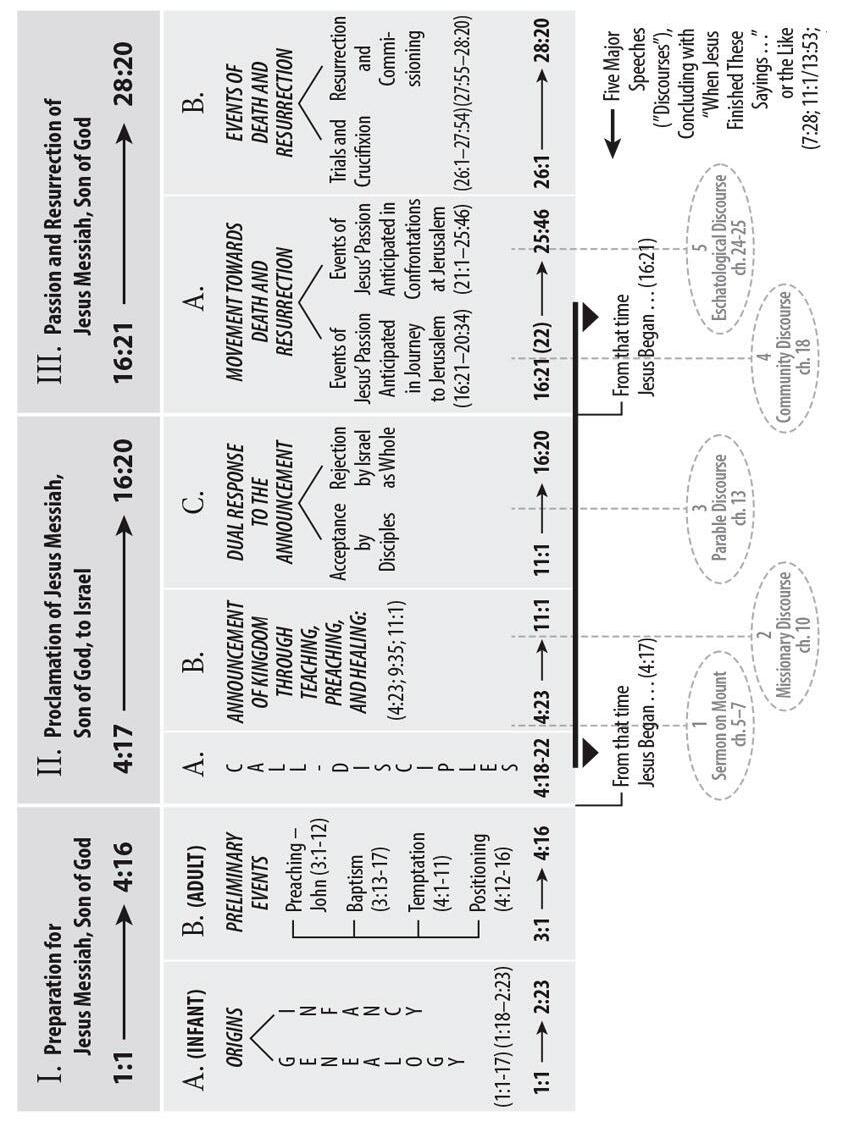
The structure of the Gospel of Matthew remains a matter of scholarly debate. David Bauer, for instance, highlights seven primary approaches: (1) geographical-chronological frameworks, (2) conceptual arrangements based on a unifying theme or idea, (3) outlines enumerating topics in sequence, (4) an alternating narrative-discourse pattern (the “five books”), (5) concentric or chiastic designs centered around Matt 13, (6) a biographical threefold arrangement (built on the parallel formula in 4:17 and 16:21), and (7) additional structural proposals that combine or adapt these methods.22
For example, Hagner notes two pivotal transitions marked by the repeated clause “from that time Jesus began” (4:17; 16:21), yet he does not provide a comprehensive structural outline.23 Similarly, Davies suggests a broad chronological progression covering Jesus’s birth, baptism, Galilean ministry, journey to Jerusalem, passion, and resurrection although this offers limited detail for an overarching outline.24
22 David R. Bauer, The Gospel of the Son of God: An Introduction to Matthew (Westmont: InterVarsity, 2019), 95–128. For a fuller treatment, see David R. Bauer, The Structure of Matthew’s Gospel: A Study in Literary Design (Sheffield: Almond, 1988).
23 Donald A. Hagner, Matthew 1 - 13, WBC (Nashville: Nelson, 2008), li. similarly, Craig S. Keener, Matthew (Downers Grove: InterVarsity, 1997).
24 William David Davies and Dale C. Allison, A Critical and Exegetical Commentary on the Gospel According to Saint Matthew, vol. 1 of ICC (Edinburgh: T&T Clark, 1988),
In contrast, Garland, following Kingsbury,25 proposes a tripartite structure: (1) Matt 1:1–4:16 introduces Jesus as the Messiah and Son of God, (2) 4:17–16:20 focuses on Jesus’s ministry to Israel, and (3) 16:21–28:20 addresses the passion and resurrection.26 The following chart demonstrates David R. Bauer’s division of Matthew.27
In light of scholarly views, here is evaluation of ChatGPT’s division of Matthew.
58–59.
25 Jack Dean Kingsbury, Matthew: Structure, Christology, Kingdom (Minneapolis: Fortress, 1989), 7–25.
26 David E. Garland, Reading Matthew: A Literary and Theological Commentary on the First Gospel (New York: Crossroad, 1993), 9.
27 Bauer, The Gospel of the Son of God, 128.
Procedure. ChatGPT effectively follows the researcher’s instructions and is able to work with relatively broad guidelines. Although the prompt did not specify particular “major shifts,” ChatGPT identified both geographical and thematic elements as key markers. Its proposed section headings reflect this dual focus.
Accuracy. When performing the IBS method, ChatGPT exhibits greater precision under specific directives (e.g., “no more than five units”). It shows less clarity when asked to consider more ambiguous instructions, such as creating divisions “as broad as the text allows.” For instance, ChatGPT’s decision to separate Matt 16:21–20:34 (Unit 3) from 21:1–25:46 (Unit 4) could have been combined into a broader unit. Nevertheless, ChatGPT generally represents the biblical text accurately.
Completeness. ChatGPT provides a division of Matthew that covers the entire Gospel, outlining both major and minor subdivisions. In this respect, it demonstrates a comprehensive treatment.
Transparency. ChatGPT clearly articulates how it identifies its major divisions, citing both thematic developments and the progression of Jesus’ life and mission. When asked for rationale, it offers justifications for each unit, reflecting a transparent thought process.
Depth of Analysis. ChatGPT shows an understanding of the relationships between key sections. For example, Unit 1 “sets the stage for Jesus’ mission” and prepares readers for Jesus’ public ministry. However, its divisions are not consistently geographical. By contrast, R. T. France employs a more uniformly geographical structure.28
Since major structural relationships (MSRs)29 are not general knowledge accessible by ChatGPT, I first instructed it to learn the definitions of these concepts. After a brief 13-second review, ChatGPT applied its new understanding to the Gospel of Matthew, identifying a
28 R. T. France, The Gospel of Matthew, NICNT (Grand Rapids: Eerdmans, 2007), 2–7.
29 Fredrick J. Long, “Major Structural Relationships: A Survey of Origins, Development, Classifications, and Assessment,” The Journal of Inductive Biblical Studies 1.1 (2014): 22–58.
range of examples (e.g., recurring themes, contrasts, comparison, causation, etc.). I will offer an evaluation of this “self-study” process in the subsequent Evaluation section.
Following this preparatory step, ChatGPT spent 43 seconds analyzing Matthew’s structural relationships (with an additional 45-second follow-up), identifying several key MSRs:
1. Inclusio (Framing Device): “God with Us” from Beginning to End
o Beginning: Jesus is introduced as “Emmanuel… God with us” (Matt 1:23).
o End: The risen Jesus declares, “I am with you always… ” (Matt 28:20). This framing underscores a thematic inclusio that bookends the Gospel.
2. Recurrence (Repeated Formula): “When Jesus Had Finished These Words”
o Occurrences at Matt 7:28; 11:1; 13:53; 19:1; 26:1.
o These repeated statements divide the Gospel into alternating sections of narrative and discourse (e.g., Discourse 1: Sermon on the Mount, chs. 5–7, ends at 7:28; Discourse 2: Mission Instructions, ch. 10, ends at 11:1; and so forth).
o This repetition is often referred to as the “narrative–discourse interchange.”
3. Cruciality (Pivot Statements): “From That Time Jesus Began…”
o Occurs twice at Matt 4:17 and 16:21.
o Each instance signals a major turning point in Jesus’s ministry and reorients the unfolding narrative.
4. Other Potential Macro-Structures (and Why They Do Not Qualify)
o Fulfillment Formulas: Although these references appear regularly, they do not divide the entire Gospel into large structural segments. Instead, they function more as a theological motif than a macro-structural device.
o Large-Scale Chiasm: While smaller chiasms exist in parables or brief pericopes, these micro-chiasms do not organize more than half the Gospel’s material in a systematic manner.
David Bauer identifies several MSRs within the Gospel of Matthew, including preparation, repeated comparison, repeated contrast between Jesus and his opponents, repetition of major themes, contrast with causation, climax, inclusio, generalization, and contrast.30 The following evaluation assesses ChatGPT’s performance in identifying these structural relationships.
Procedure. ChatGPT successfully follows instructions, first learning the definitions of MSRs before applying them to the Gospel of Matthew. This demonstrates its ability to comprehend highly abstract and conceptual elements of structural analysis.
Accuracy. ChatGPT exhibits a strong ability to accurately understand and apply MSRs. It correctly identifies inclusio, recurrence of Jesus’ teaching formula, and the interchange between narrative and discourse. However, it misinterprets cruciality. Despite this, ChatGPT accurately represents the biblical text overall.
Completeness. In comparison with Bauer’s list of MSRs, ChatGPT’s analysis is only partially complete, identifying approximately one-third of the MSRs he highlights. While it recognizes important elements such as inclusio and recurrence, it fails to explicitly identify other key MSRs, such as preparation/realization and climax.
Transparency. ChatGPT provides clear rationales for its identification of each MSR. For example, it assesses whether a proposed MSR applies broadly to the Gospel’s structure rather than to isolated passages. Additionally, it engages critically with “Other Potential MacroStructures (and Why They Do Not Qualify),” analyzing fulfillment formulas and large-scale chiasm. This demonstrates an ability to engage with general knowledge while also critically reflecting on its own reasoning process.
Depth of Analysis. ChatGPT produces some relatively deep insights regarding structural relationships. For instance, when identifying minor structural relationships, it notes an implicit instrumentation structure in the Great Commission (Matt 28:18–20):
● Purpose: “Go therefore and make disciples of all nations…”
30 Bauer, The Gospel of the Son of God, 129–35.
● Means: “baptizing them… and teaching them to observe all that I have commanded you.”
Although particularization could also apply here, ChatGPT correctly identifies an implicit instrumentation relationship, despite the absence of an explicit conjunction.
Additionally, ChatGPT occasionally incorporates theological reflection as part of its rationale. For example, in discussing the inclusio of “God with us”, it states:
The theme of ‘God with us’ is revisited in Jesus’ miracles (God’s power present to heal), in his teachings (divine authority among the people), and finally in the Great Commission (the enduring presence of the risen Christ). Thus, it is not an isolated idea but a thread woven through the narrative. This framing device shapes Matthew’s portrait of Jesus’ identity from start to finish, anchoring the entire Gospel in the conviction that in Christ, God is decisively and permanently with his people.
However, ChatGPT fails to fully develop certain MSRs. For example, (1) Preparation/Realization: While it correctly observes that Matt 1:1–4:11 sets the stage for Jesus’ mission, it does not explicitly identify this as a preparation/realization structure. (2) Climax: ChatGPT notes that Matthew concludes with Jesus' passion, death, and resurrection, emphasizing fulfilled prophecy and the global commission. Yet, it does not recognize climax as an MSR. (3) Repeated Contrast: While ChatGPT acknowledges the contrast between Jesus and religious leaders, it does not identify this as an MSR in its structural analysis. (4) ChatGPT correctly notes the pivotal recurrence formulas at Matt 4:17 and 16:21, which mark major shifts in Jesus’ ministry. However, in its division of Matthew, it fails to incorporate this insight consistently into its structural framework.
In sum, ChatGPT demonstrates a solid foundational understanding of MSRs, accurately identifying several key structures with clear rationale. However, it does not yet fully grasp the breadth of structural relationships in Matthew, as outlined by Bauer. While it provides useful theological and analytical insights, its structural divisions do not always align with its own observations, and some critical MSRs remain underdeveloped.
ChatGPT’s Segment Survey of Jesus’s Parables (Matt 13:1–52)
After thinking for 28 seconds, ChatGPT generated the following division:
1. The Parable of the Sower and Its Explanation (13:1–23)
1.1 The Parable to the Crowd (13:1–9)
1.2 Purpose of Teaching in Parables (13:10–17)
1.3 Explanation of the Parable of the Sower (13:18–23)
2. Additional Parables to the Crowd (13:24–35)
2.1 The Weeds among the Wheat (13:24–30)
2.2 The Mustard Seed and the Yeast (13:31–33)
2.3 Fulfillment Citation (13:34–35)
3. The Explanation of the Weeds (13:36–43)
4. Further Parables of the Kingdom (13:44–50)
4.1 Hidden Treasure and the Pearl of Great Value (13:44–46)
4.2 The Parable of the Net (13:47–50)
5. Concluding Exchange with the Disciples (13:51–52)
Evaluation of ChatGPT’s Division
Several structural proposals have been suggested for Matt 13. For example, Hagner observes that chapter 13 does not exhibit any obvious symmetrical structure.31 However, Nolland, following Davies and Allison,32 highlights the prominence of three parables presented in sequence:33
o 13:1–3a: Setting
o 13:3b–23: Parable Set 1
o 13:24–43: Parable Set 2
o 13:44–52: Parable Set 3
o 13:53: Conclusion Parables completed, Jesus moves on
31 Hagner, Matthew 1–13, 364.
32 William David Davies and Dale C. Allison, A Critical and Exegetical Commentary on the Gospel According to Saint Matthew, vol. 2 of ICC (Edinburgh: T&T Clark, 1991), 370–71.
33 John Nolland, The Gospel of Matthew: A Commentary on the Greek Text, NIGTC (Grand Rapids: Eerdmans, 2005), 520–72.
One debated issue is whether vv. 51–52 constitutes a parable. Wenham, assuming that these verses do form a parable, proposes a chiastic structure for Matt 13. 34 However, Gerhardsson identifies only seven parables and suggests a structure of particularization:35
Introductory Parable (1) Complementary Parables (2–7) (a) Those falling by the wayside (2) The tares among the wheat (b) Those falling on stony ground (3) The mustard seed (4) The leaven (c) Those falling among thorns (5) The treasure (6) The pearl (d) Those falling on good ground (7) The good fish among the bad Luz recognizes a significant structural break between v. 35 and v. 36, proposing the following division:36
o 13:1–3a: Introduction
o 13:3b–35: The Discourse to the People
o 13:36–52: The Discourse to the Disciples
Similarly, Bauer suggests that Matt 13:3–35 consists of parables addressed to the Jewish crowds, with the disciples present, whereas Matt 13:36–52 contains parables directed exclusively to the disciples. A more detailed division is provided on the next page.37
34 David Wenham, “The Structure of Matthew 13,” NTS 25.4 (1979): 516–18.
35 Birger Gerhardsson, “Seven Parables in Matthew 13,” NTS 19.1 (1972): 19.
36 Ulrich Luz, Matthew 8–20, trans. James E. Crouch, Hermeneia (Minneapolis: Augsburg, 2001), 229–31.
37 David R. Bauer, “Lecture on IBS-Matthew” (2024).
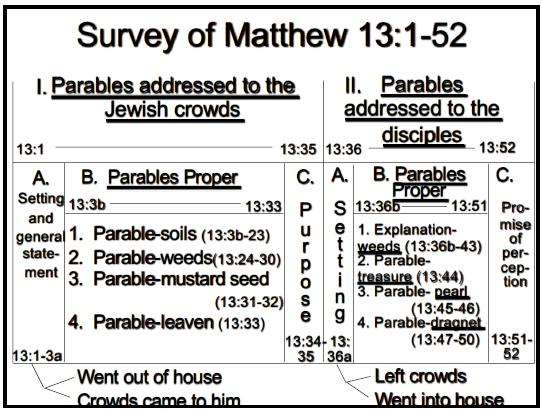
In light of scholarly views, here is evaluation of ChatGPT’s division of Matt 13.
Procedure. ChatGPT follows the IBS method in structuring Matt 13. It applies a systematic analysis of the division based on major shifts in content and audience.
Accuracy. ChatGPT accurately follows the given instructions, limiting the number of units to five. Additionally, its representation of the text is precise.
Completeness. While ChatGPT provides a full division of Matt 13, it overlooks some key structural details. For instance, Matt 13:1–3a functions as a setting and general statement, yet ChatGPT simply includes these verses within 13:1–9 (the parable to the crowd), failing to recognize their distinct role. Similarly, 13:36a serves as the setting for 13:36–52, but ChatGPT does not highlight this transition as clearly as it should.
Transparency. ChatGPT provides explanatory notes for each unit, offering clear rationales for its divisions. For example, it identifies a major transition at 13:36, noting the shift in audience from the crowd to the disciples as a significant structural marker.
Depth of Analysis. ChatGPT demonstrates awareness of the form and role of Matt 13:51–52, recognizing it as a “mini-parable,” echoing with scholarly discussions on whether these verses should be classified as a parable. Furthermore, it correctly identifies the theological and literary function of Matt 13:51–52: 38
This brief conclusion acts as a literary and theological closure for the parable collection. Jesus confirms his disciples’ understanding and commissions them (as ‘scribes trained for the kingdom’) to steward and proclaim both the old (existing revelation) and the new (the unfolding realities of the kingdom).
Similarly, ChatGPT acknowledges the role of Matt 13:34–35 within the broader structure of the chapter.
However, while ChatGPT recognizes the major transition at 13:36, it does not fully integrate this insight into its structural division. Given the clear shift in audience and discourse at this point, the major units should be:
o 13:1–35 (parables addressed to the crowds, with disciples present)
o 13:36–52 (parables addressed exclusively to the disciples)
In sum, ChatGPT offers a thoughtful and well-reasoned division of Matt 13, accurately identifying key structural elements and providing insightful analysis. However, it does not fully capitalize on major transitions, such as the break at 13:36, and misses some key structural markers, such as the distinct function of 13:1–3a and 13:36a.
ChatGPT identified several MSRs for Matt 13.
1. Interchange (Public Parables ↔ Private Explanations)
● Public Teaching to the Crowds (Parables)
38 France suggests that 13:51-52 is a “concluding parable” which challenges the hearers to appropriate response (The Gospel of Matthew, 500–501).
o 13:1–9 – Parable of the Sower told publicly by the sea.
o 13:24–35 – Parables of the Weeds, Mustard Seed, and Yeast delivered to the crowds.
● Private Explanations to Disciples
o 13:10–23 – Disciples ask why Jesus teaches in parables (vv.10–17); Jesus explains the Parable of the Sower (vv.18–23).
o 13:36–43 – After dismissing the crowds, Jesus explains the Weeds parable privately.
● Additional Kingdom Parables (Mostly Private)
o 13:44–50 – Hidden Treasure, Pearl of Great Value, and the Net.
o 13:51–52 – Jesus’ concluding words (“Have you understood?”) and the miniparable of the Householder.
2. Comparison (Repeated Formula “The Kingdom of Heaven Is Like…”)
3. Contrast: In Matt 13:1–52, multiple parables pivot on a stark contrast between those who respond rightly to the kingdom message versus those who do not. This pattern spans well over half of the chapter, including: Parable of the Sower (13:1–9, 18–23): Contrasts four types of soil; Parable of the Weeds (13:24–30, 36–43): Contrasts good seed (wheat) sown by the Son of Man and bad seed (weeds) sown by the evil one; Parable of the Net (13:47–50): Contrasts good fish retained and bad fish thrown away, again highlighting an eschatological separation at the close of the age.
David Bauer identifies several MSRs in Matt 13, including: recurrence of preparation/realization with particularization and generalization (13:1-3a à 13:3b-35; 13:36a à 13:36b-52); recurrence of contrast (the crowds vs. the disciples), causation/substantiation and instrumentation (13:10-17; 34-35), recurrence of comparison (the kingdom of heaven), climax (13:51-52).39
39 David Bauer, Lecture on IBS-Matthew (2024).
Below is an evaluation of ChatGPT’s identification of MSRs.
Procedure. Like its approach to MSRs in the Gospel of Matthew as a whole, ChatGPT successfully follows the requested steps in identifying structural relationships in Matt 13.
Accuracy. ChatGPT demonstrates an accurate understanding and application of structural relationships, faithfully observing and representing the text’s content.
Completeness. While ChatGPT identifies three MSRs, it misses several key structural elements noted by Bauer, including: Preparation/Realization (13:1–3a and 13:36a); Causation/Substantiation and Instrumentation (13:10–17; 13:34–35); Climax (13:51–52).
Transparency. ChatGPT consistently provides rationale for each structural relationship it identifies, clearly articulating its reasoning process.
Depth of Analysis. ChatGPT provides notable insights, such as its discussion of the recurrence of comparison within the kingdom parables: The repeated comparisons underscore different aspects of the kingdom’s nature its mysterious growth, its inestimable worth, the mixture of righteous and unrighteous until the end, etc. This continuous pattern of comparison unifies the second half of the passage under a single concept: understanding the kingdom through relatable analogies.
ChatGPT also pays close attention to the recurrence of contrast, acknowledging the theological focus on response and separation. While parables such as the Mustard Seed (13:31–32), the Yeast (13:33), the Hidden Treasure (13:44), and the Pearl (13:45–46) emphasize growth or value rather than direct contrasts, “The majority of verses still involve a tension between two opposite outcomes or receptions of the kingdom.” Thus, ChatGPT draws theological focus on Response and Separation: Jesus consistently pictures two distinct groups those who embrace the kingdom and those who reject it with starkly different outcomes (blessing vs. judgment). This theme of “division” or “separation” weaves through the bulk of the chapter.
ChatGPT further demonstrates insight into the audience shift in Matt 13:1–52, offering in-depth observations: “The back-and-forth movement spotlights how parables serve a dual purpose revealing truths about the kingdom to Jesus’ disciples while at the same time concealing them from those unresponsive in the crowds (vv. 10–17). Thus, the interchange is not just literary but theological, explaining why some receive deeper insight and others do not.”
However, while ChatGPT recognizes this audience shift, it does
not use this insight to propose a major structural division between 13:1–35 and 13:36–52, which would have been a logical conclusion based on its observations.
In sum, ChatGPT provides a well-reasoned structural analysis of Matt 13, accurately identifying several MSRs with thoughtful explanations. However, it overlooks key MSRs, such as preparation/realization, causation/substantiation, instrumentation, and climax. Additionally, while it recognizes the audience shift at 13:36, it does not fully integrate this insight into its structural division.
Interpretation is inherently more complex than the observational steps outlined above, as it requires a more intricate interaction between the researcher and ChatGPT. The effectiveness of ChatGPT’s interpretation is significantly influenced by the type and content of the questions posed. Therefore, I will assess ChatGPT’s ability to interpret the parable through three levels of questioning: (1) unguided interpretation, (2) moderately guided interpretation, and (3) IBS-guided interpretation.
Unguided Interpretation by ChatGPT
Question: Interpret the parable of Matt 13:3b-9 and state the message of the parable in a concluding paragraph.
After thinking for 13 seconds, ChatGPT provides a 389-word interpretation: (1) heavily rely on Jesus’ interpretation of the parable (vv. 18-23); (2) shallow description of the four soils; (3) a brief conclusion: “At its core, the Parable of the Sower highlights both the generosity of God who broadcasts the message of the kingdom far and wide and the varied human responses. The seed itself is powerful and full of potential; what differs is the receptivity of each heart. Jesus challenges listeners to examine the “soil” of their own lives and to cultivate a depth of spiritual receptiveness. By allowing the divine word to take root unhindered by superficiality or worldly distractions disciples can bear lasting and abundant fruit.”
Question: examine the text and related interpretative issues, such as literary context, syntax, historical background, the literary form of a parable, and other issues you consider relevant.
After thinking for 4 seconds, ChatGPT provides a 846-word interpretation. It puts Matt 13:3b–9 in the context of Matt 13, especially the nature of the Kingdom of Heaven. It also gives some historical background information, such as the manner of sowing. It develops some major points, such as the identity of the sower as Jesus (or God), the emphasis on the fruitfulness (connected to Matthew’s broader emphasis on righteousness), and the immediate and eschatological implications (mixed responses toward Jesus and God’s sovereignty in the growth of the kingdom).
It concludes: The central message of the Parable of the Sower (Matt 13:3b–9) is that God’s gracious word is broadcast widely, yet hearts respond differently to it. The success of the seed depends not on the seed’s inherent power because it is potent in all instances but on the condition of the soil. True disciples are those who cultivate hearts open to God’s word, withstand trials, and remain free of entangling concerns so as to bear abundant fruit. By challenging listeners to examine their own receptivity, the parable both invites self-reflection and assures that, in spite of varied responses, God’s kingdom will ultimately be fruitful in those who truly hear and respond.
Question: Provide a detailed interpretation of the parable of Matt 13:3b-9. Please follow the instructions:
1. Emphasize the relationship between the structure of this parable and its interpretation. The structure of the parable includes: causation from the Sower’s action of sowing to the reception of seed of the four soils; recurrence of causation from the nature of the soil to its outcome; the contrast among the four soils, both their nature and outcome; the climax of the fourth soil that bears much fruit in Matt 13:23; the causation from the parable in 13:3b–8 to the final exaltation in 13:9.
2. Consider the literary context of this parable, such as the reason
for Jesus to speak in parables in Matt 13:10–17, and Jesus’ interpretation of this parable in Matt 13:18–23.
3. Consider the historical background of this parable, such as the manner of sowing, the growth of seed.
4. Consider any significant grammatical issues in this parable.
5. Consider the literary form of a parable and its implications for the interpretation of a parable, such as the relationship between the overall message of a parable and its details.
6. Do theological reflection, such as salvation, human freedom to respond to God’s word,
7. As a result of your study, attempt to state the message of the parable in a concluding paragraph.
After thinking for 8 seconds, ChatGPT provides a 1239-word interpretation to cover the above questions, with the conclusion: “In the Parable of the Sower, Jesus illustrates that while God’s kingdom message goes out to all, only those whose hearts are truly open, teachable, and willing to persevere will bring forth lasting fruit. God scatters His word generously, yet the yield depends on the reception it finds in each person. Where the word is understood, nurtured, and held fast despite trials and temptations, there the kingdom of God takes root and produces an abundant harvest. Hence, Jesus ends with the exhortation: “He who has ears, let him hear,” reminding every generation to examine the condition of their hearts and respond faithfully to the word of the kingdom.”
Unsurprisingly, ChatGPT’s performance in interpretation is the weakest compared to other analytical steps.
Procedure. ChatGPT follows specific instructions to analyze the text, albeit with varying levels of quality. A noteworthy observation is the contrast between unguided and moderately guided interpretations, which highlights the significant impact of researcher’s guidance. Clear and detailed instructions substantially shape ChatGPT’s performance. Accuracy. ChatGPT demonstrates accuracy in understanding and applying aspects of the text, such as historical background, structural relationships, and grammatical analysis. It also faithfully represents the content of the text.
Completeness. Completeness is a major weakness in ChatGPT’s interpretation, as it lacks both scope and depth. For example, it briefly discusses the growth of seeds in Palestinian soil, concluding that “some seed yielding thirty, sixty, or a hundred times was plausible though a hundredfold was an extraordinary yield.” However, the parable requires a broader application of historical and literary tools to uncover its theological significance.40
Transparency. While ChatGPT shows a logical flow from evidence to reference, the complexity of interpretation prevents it from demonstrating self-critical thinking, which was more evident in earlier analytical steps (e.g., identifying MSRs).
In-Depth Analysis. Synthesis: ChatGPT fails to integrate multiple elements into a rich interpretation. Even in its third attempt, which contains more material, the conclusion remains similar to the first two attempts.
Although ChatGPT touches on several points that warrant deeper exploration, it does not or cannot pursue them further. For example: Who is the Sower? The identity of the Sower has been debated: Is it Jesus himself or any faithful Christian preacher?41 Some scholars also examine its first-century background, noting that Roman coins sometimes depicted the emperor as a sower, symbolizing his leadership’s fruitful benefits.
42
Who are the Soils? ChatGPT briefly mentions the necessity of responding with fruitfulness, 43 but many questions are not mentioned. Who are the soils? According to Bauer, the parable of the soils highlights the significance of Jesus’ and the disciples’ ministry, illustrating various responses (Mt 13.3-23). The seed on the path represents Jewish
40 Arland J. Hultgren, The Parables of Jesus: A Commentary (Grand Rapids: Eerdmans, 2000), 19.
41 C. H. Dodd, The Parables of the Kingdom (New York: Charles Scribner’s Sons, 1961), 145–46.
42 Annette Weisenreder, “Didaktik der Bilder: Allegorie und Allegorese am Beispiel von Mk 4,3-20,” in Hermeneutik der Gleichnisse Jesu: methodische Neuansätze zum Verstehen urchristlicher Parabeltexte, ed. Ruben Zimmermann and Gabriele Kern (Tübingen: Mohr Siebeck, 2008), 494–520. Cited by Craig L. Blomberg, Interpreting the Parables, 2nd ed. (Downers Grove: IVP Academic, 2012), 294.
43 The primary stance is the willingness to hear and respond appropriately, a point made specifically by the parable of the Sower. Klyne Snodgrass, Stories with Intent: A Comprehensive Guide to the Parables of Jesus, 2nd ed. (Grand Rapids: Eerdmans, 2018), 24.
crowds who “hear and do not understand.”44
Who is the Audience? Most of Jesus’ audience likely assumed they were among God’s people. However, Jesus challenges this assumption, insisting that only those who bear fruit defined in later parables as hearing and obeying his words qualify.45 However, some scholars emphasize the audience of Matthew’s Gospel (a Matthean community or broader groups) rather than Jesus’ original listeners.46
What is the Intended Response? ChatGPT correctly identifies a causal connection between the parable and the final exhortation (Mt 13.9): “Whoever has ears, let them hear.” This statement emphasizes reception and response, directing hearers toward a final appeal. Jesus’ parables were often interpreted not only as ‘mystical’ (allegorical and salvific) but also as ‘tropological’ (ethical). His own works and mission to Israel are reflected in parabolic form.47
Is the Hundredfold Yield Miraculous? A four- or five-fold yield was common in much of the ancient Mediterranean, especially in Palestine. Against Davies and Allison, some argue that extraordinary yields mentioned by Varro, Theophrastus, and Strabo refer to distant, exotic locations and may have been exaggerated. Thus, even a thirtyfold yield in the parable would have been considered exceptional, even miraculous, in first-century Palestine.48
Eschatological Implications. ChatGPT briefly notes both immediate and eschatological implications but fails to explore them in depth. Eschatology and the Kingdom: Many scholars downplay the doctrinal significance of parables, but they actually contain rich theological insights. The theology of the Parables centers on the Kingdom and the Christ.49 Jesus inaugurated the kingdom with his ministry, though its full realization remains in the future. The kingdom encompasses both reign and realm, personal transformation, and social renewal. It extends beyond the church yet includes all who are truly
44 Bauer, The Gospel of the Son of God
45 Blomberg, Interpreting the Parables, 294.
46 Hultgren, The Parables of Jesus, 196.
47 Ulrich Luz, The Theology of the Gospel of Matthew, New Testament Theology (Cambridge: Cambridge University Press, 2008), 91.
48 Robert K. McIver, “One Hundred-Fold Yield Miraculous or Mundane? Matthew 13:8,23; Mark 4:8,20; Luke 8:8,” NTS 40.4 (1994): 607–8.
49 Blomberg, Interpreting the Parables, 408–46.
God’s people.50
Realized vs. Now-and-not-yet: While Dodd advocates a realized eschatology, Jeremias proposes a “now and not yet” framework: “To human eyes, much of the labor seems futile and fruitless, leading to apparent failure. But Jesus, full of joyful confidence, knows that God has begun a work that will yield a harvest beyond imagination.”51 Jewish Background. Some scholars highlight Jewish intertextual connections. Birds Devouring the Seed: Parallels exist with Jubilees 11, which recounts Terah and the young Abram. The mention of birds devouring the seed may evoke this haggadic tradition for early hearers or readers.52 Old Testament Background: Evans argues that the Sower Parable echoes canonical Isaiah, particularly 55:10-11: “For as the rain and snow come down from heaven and do not return without watering the earth making it bring forth and sprout, giving seed to the sower and bread to the eater so shall my word be that goes forth from my mouth; it shall not return to me empty, but it shall accomplish what I purpose and succeed in what I sent it to do.”53
In sum, A major limitation of ChatGPT’s interpretation is its inability to critically engage with scholarship, which significantly reduces the completeness and depth of its analysis. This shortcoming arises because ChatGPT lacks access to scholarly biblical resources. A biblical studies AI equipped with scholarly works could potentially address this issue (see the section Future Directions for further discussion).
The overall performance of ChatGPT in IBS demonstrates: (1) Procedure: Very high level of performance in following instructions. (2) Accuracy: Strong understanding and application of major IBS concepts, particularly MSRs. However, some misunderstandings or misapplications of MSRs occur. Moreover, it Performs well with specific
50 Blomberg, Interpreting the Parables, 445.
51 Joachim Jeremias, Rediscovering the Parables (New York: Charles Scribner’s Sons, 1966), 150. Cited by Bernard Brandon Scott, Hear Then the Parable: A Commentary on the Parables of Jesus (Minneapolis: Fortress, 1989), 361.
52 Michael P. Knowles, “Abram and the Birds in Jubilees 11: A Subtext for the Parable of the Sower?,” NTS 41.1 (1995): 148.
53 Craig A. Evans, “On the Isaianic Background of the Sower Parable,” CBQ 47.3 (1985): 466.
instructions (no more than five units) but struggles with ambiguous prompts like “as broad as the text allows.” Very high accuracy in representing the text. (3) Completeness: Mild to limited completeness, particularly in interpretation. (4) Transparency: Very high transparency, providing rationale for observations and references. (5) InDepth Analysis: Limited capacity for deeper reflection and conclusion development, especially in interpretation. It cannot engage with scholarly works (e.g., historical background, Jewish background, etc.); it has limited ability to handle nuanced and complex issues, such as the dynamic between the immediate situation and eschatological; it struggles to integrate various aspects into a cohesive interpretation
Therefore, Can ChatGPT Perform IBS? Based on the case study, ChatGPT under a human researcher’s overall design and specific instructions demonstrates a certain ability to perform core IBS tasks. However, its quality is uneven: it excels in lower-order thinking tasks but provides fewer insights at higher levels of analysis. The answer is “No. ” Due to limitations in completeness and in-depth thinking, particularly in complex tasks like interpretation, ChatGPT cannot replace human scholars.
However, ChatGPT’s ability to achieve a certain level of accuracy and completeness validates its role as a research assistant. (1) Improving Observation and Linguistic Analysis. Utilize AI for pattern recognition (e.g., word frequencies, semantic domains, intertextual parallels). Assist scholars in identifying complex structures and key textual variations. (2) Increasing Research Efficiency. ChatGPT completes textual analysis within seconds or minutes, significantly accelerating research speed. (3) Considering AI-Generated Insights in Peer Review. Evaluate AI-generated insights in scholarly communities before integrating them into academic discourse. Therefore, I suggest a responsible human-AI collaboration model for IBS. The principles include: (1) AI as a Tool: AI will not replace human scholars but will enhance efficiency by automating repetitive tasks. (2) Critical Thinking: Researchers must engage critically with AI-generated insights rather than accept them at face value. (3) Responsible Use of AI Data: AI-generated content should be treated similarly to scholarly sources quoted, analyzed, engaged with, and verified. (4) Human Responsibility: Researchers remain accountable for the integrity of their work and conclusions.
Under this collaboration model, human scholars focus on the following areas: (1) Design research (aim, methodology, primary and secondary sources). (2) Provide specific instructions for AI. (3) Verify AIgenerated data through independent research. (4) Engage with scholarship to reflect critically on AI-generated insights. (5) Synthesize findings (both their own and AI’s) into a comprehensive and robust conclusion.
The assistant role of AI is intended to: (1) Conduct effective analysis of lower-level tasks; (2) Generate brainstorming ideas and possible datasets; (3) Offer preliminary insights, though requiring human refinement.
Besides AI’s application to research, this study has implications for IBS pedagogy too. A full discussion of AI’s role in IBS pedagogy extends beyond the scope of this article and warrants further research. However, some preliminary insights emerge from this study.
First, Tutoring and Personalized Education. Emerging AI tools, such as MagicSchool, demonstrate the potential for personalized learning applications. As AI can understand and apply major IBS concepts with a high level of accuracy (without perfection), AI can assess individual student needs in real time, generating tailored questions and assessments. AI can create educational content such as quizzes and exercises. AI can provide real-time answers to student inquiries.
Second, Grading and Feedback. Since AI can understand and apply IBS to a biblical text, AI can assist in grading and providing structured feedback, streamlining assessment processes. While AI has the potential to reduce workload for educators, all its works need to be done under human educators’ supervision.
The application of IBS to study the Parable of Sower might also shed light for future research to explore AI’s applicability beyond IBS to other biblical methodologies, such as: Narrative Criticism, Rhetorical Criticism, and Discourse Analysis. Although these methods differ
from each other significantly, they have a similar framework: domainspecific concepts, certain steps of procedure, and focus on certain aspects of the text. The case study above has demonstrated AI’s potential and limitations in engaging with methodological concepts and procedure, paving the way for applying AI in these biblical criticisms. AI’s reasoning capabilities may be adapted to support these approaches, offering new insights into biblical texts.
Enhancing AI’s capabilities in biblical studies requires two key developments: (1) Improving AI’s reasoning ability to handle the complexities of biblical exegesis. (2) Customizing AI models for biblical studies by training them on specialized datasets. Regarding developing an AI research assistant for biblical studies, the major principle is that AI should be integrated as a collaborative tool to support human scholars, not replace them. Fine-tuning large language models (LLMs) for biblical studies requires careful planning and ethical considerations. The aim is to develop LLMs tailored for biblical exegesis enhancing the depth, accuracy, and efficiency of scriptural analysis while maintaining ethical and theological integrity. While developing an AI assistant is a huge project, this study shed some insights:
First, Data Preparation. A robust AI model for biblical studies must be trained on a carefully curated corpus, including biblical texts in original languages and major translations, classical and modern commentaries, theological writings and exegetical works, and Peer-reviewed scholarly articles.
Second, Model Selection. Given the high reasoning demands of biblical exegesis, a more advanced AI model such as OpenAI’s o1 would be a suitable starting point.
Third, Fine-Tuning the Model. Define specific exegetical tasks, avoiding vague instructions like “broad” or “significant.” Prepare training data by developing labeled datasets and constructing relevant prompts. Incorporate human verification to ensure data accuracy throughout the training process.
Finally, Ethical and Theological Considerations. Transparency: Clearly communicate the model’s limitations and potential biases. Faith Community Engagement: AI should respect theological traditions and incorporate safeguards against generating or promoting
heretical content. Human-AI Balance: AI-generated insights should complement, not replace, human interpretation.
This project examines the capabilities and limitations of ChatGPT in performing Inductive Bible Study (IBS), focusing on a case study of the Parable of the Sower (Matt 13:3b–9). With the researcher’s overall workflow design and specific instructions, ChatGPT executed core tasks, including: division and identification of MSRs of the book, division and identification of MSRs of Matt 13 as a segment, and an interpretation Matt 13:3b–9. The results demonstrate ChatGPT’s strong ability to understand and apply IBS procedures and concepts, generating a certain degree of insight. However, it lacks completeness and indepth thinking in handling more complex and nuanced tasks, particularly the critical task of interpretation. Thus, the project concludes that ChatGPT cannot independently perform IBS but proves valuable as a research tool to assist human scholars. It proposes a responsible human-AI collaboration model for IBS and calls for future research to expand AI’s application to other biblical methodologies. Additionally, this study outlines principles for developing an AI tool customized for scholarly biblical studies.
“WHERE SHALL WISDOM BE FOUND?”:
Daniel J. Hanlon
Christ the Foundation Anglican Church, Kailua, Hawaii dan.j.hanlon@gmail.com
Abstract: This article explores the place of biblical wisdom literature within biblical theology, challenging the claim that wisdom resists integration into theological frameworks. Using Klink and Lockett’s taxonomy, it surveys five approaches historical description, history of redemption, worldview-story, canonical, and theological construction showing that each successfully incorporates wisdom in distinct ways. Rather than privileging a single method, the article argues for the primacy of inductive study of the biblical text. Close attention to wisdom books reveals key epistemological, ethical, and theological dimensions, which provide a flexible framework for integrating wisdom literature into biblical theology across diverse interpretive approaches.
Keyword: Biblical Theology, Wisdom Literature, Theological Method, Inductive Study, Hermeneutics
Introduction
The biblical authors held that God’s word gives wisdom. 1 And yet, Job’s ancient question aptly describes the modern scholarly debate over the place of wisdom in the Bible: “Where shall wisdom be found?”2
1 Terms used for God’s wisdom-giving word include “statutes” and “ordinances” (Deut 4:5–8), “decrees” (Ps 19:8), “commandments” (Ps 119:98), and “sacred writings” (2 Tim 3:15–17). John 1:1–18 casts the divine Word, Logos, as the embodiment of divine Wisdom; see Craig S. Keener, The Gospel of John, 2 vol. (Grand Rapids: Baker, 2010), 352.
2 Job 28:12; Bible quotations are from the NRSV, unless otherwise indicated. On modern debate, see Mark R. Sneed, ed. Was There a Wisdom Tradition? New Prospects in Israelite Wisdom Studies (Atlanta: SBL Press, 2015).
In attempts to determine the place of biblical wisdom literature in the study of the Bible, it seems customary to begin by lamenting the neglect of wisdom in biblical theology. Biblical theologians seek to situate their own approach in contrast to other approaches, which, they argue, have found wisdom literature hard to navigate. Douglas Kennard, for example, offers the analogy of a “reef,” saying, “There are many Titanics and lesser yawls strewn on the ocean floor around this reef.” That is, in the pursuit of an “overarching” biblical theology, “most attempts hit the reef of wisdom literature.” Kennard, of course, like others, proposes that “there is one clear passage through this reef,” a particular method for doing biblical theology.3 Is such confidence in a particular approach well founded? Is there indeed only one method in biblical theology that can successfully navigate biblical wisdom?
While there may be many wrecks, some voyages have succeeded and arrived safely to shore. The aim of this article is to explore the ways biblical wisdom is approached in biblical theology.4 To do this we will first describe a taxonomy of five approaches to biblical theology. With that taxonomy in hand, secondly, we will explore the respective ways in which the Bible’s wisdom texts have been approached, considering representative examples through a survey of recent scholarship. Based on that survey, we will conclude that while there are many ways to find the place of wisdom in biblical theology, there is value in allowing the inductive study of wisdom texts to set the agenda as a guide for any approach.
Kevin Vanhoozer, in an essay dealing with hermeneutics in biblical theology, makes the important observation that biblical theology is an interpretive approach to biblical texts:
3 Douglas Kennard, “The Reef of Biblical Theology: A Method for Doing Biblical Theology That Makes Sense for Wisdom Literature,” Southwestern Journal of Theology 55 (2013): 227.
4 Our concern is with biblical wisdom texts, not with wisdom theology, per se. On wisdom theology, see Craig G. Bartholomew, “Wisdom Books,” in New Dictionary of Biblical Theology, ed. T. Desmond Alexander, et al (Downers Grove, IL: IVP, 2000), 120–22; Ernest C. Lucas, “Wisdom Theology,” in Dictionary of the Old Testament: Wisdom, Poetry & Writings, ed. Tremper Longman, III, et al (Downers Grove, IL: IVP, 2011), 901–912.
“Biblical theology” is the name of the interpretive approach to the Bible which assumes that the word of God is textually mediated through the diverse literary, and historically-conditioned, words of human beings. It is therefore an intrinsically hermeneutical endeavor, having to do with interpretation of the variety of biblical witnesses that communicate the word of God.5
Interpretation isn’t simply something one does on the way to a biblical theology; biblical theology is interpretation. An approach to wisdom in biblical theology must begin with the understanding that certain hermeneutical assumptions are already being made as to how the approach will proceed. Thus, to the extent that there are different approaches to biblical theology, there will be different hermeneutical assumptions. Before our investigation of wisdom in biblical theology can begin, we need a framework for understanding the approaches to biblical theology on offer.
Thankfully, Edward Klink and Darian Lockett have provided such a framework, a taxonomy, in their helpful book, Understanding Biblical Theology: A Comparison of Theory and Practice. 6 Klink and Lockett discuss five different approaches to biblical theology by alternating chapters that define the theory and practice of the approach, with chapters that give an example of the theory in practice by describing the work of a biblical theologian who exemplifies the approach. Our present concern is with those definitions of theory and practice. The authors arrange the approaches along “a spectrum balanced on either end by history and theology, five types of biblical theology are plotted between these poles, as more or less ‘theological' or ‘historical’ in concern and practice.”7 Within this spectrum the theory and practice of biblical theology takes into account decisions on “a nexus of issues.” The issues are: 1) the Old Testament relationship to the New Testament; 2) historical diversity versus theological unity; 3) the scope and sources for the task;
5 Kevin J. Vanhoozer, “Exegesis and Hermeneutics,” in New Dictionary of Biblical Theology, ed. T. Desmond Alexander, et al. (Downers Grove, IL: IVP, 2000), 56, emphasis added.
6 Edward W. Klink, III and Darian R. Lockett, Understanding Biblical Theology: A Comparison of Theory and Practice (Grand Rapids: Zondervan, 2012).
7 Klink and Lockett, Understanding Biblical Theology, 20.
4) the subject matter of biblical theology; and 5) the locus of the discipline in the academy or the church.8 Space here prevents us from exploring the decisions made in each approach, which could be helpful in understanding the methods, but by reviewing the basic theories we will at least have the necessary framework for exploring approaches to wisdom in biblical theology.9
This approach to biblical theology is the most historically oriented, and least theological. According to Klink and Lockett, the historical description approach “pursues the theology that lies behind the text, theology that existed in the minds of the biblical authors. It is a description of the theology of the Bible in its original context….”10 As such, the focus is on what it meant, not on what it means, that is, there is a deliberate resistance to theological abstraction and contemporary application. Since the goal is to get behind the text, this approach employs the historical-critical method.
This approach moves in the direction of theology along the historytheology spectrum, but rests more heavily on the side of history, seeing the Bible as a unified narrative that unfolds sequentially over time. It is the progressive history of God’s redemptive plan, a “special history.”11 Methodologically, each passage or theme of the Bible must fit not only into the historical-cultural context, but also into the context of the history of God’s redemptive story, the macro-context of the Bible. It is important to note that there is disagreement within this approach on this point, the extent of the macro-context, as it relates to historical diversity and theological unity.
8 Klink and Lockett, Understanding Biblical Theology, 17–20.
9 For our purposes it is unnecessary to engage in a critique of these approaches to biblical theology. For a brief list of criteria for how such a critique could be pursued, see Grant R. Osborne, The Hermeneutical Spiral: A Comprehensive Introduction to Biblical Interpretation, 2nd ed. (Downers Grove, IL: IVP, 2006), 366.
10 Klink and Lockett, Understanding Biblical Theology, 46.
11 Klink and Lockett, Understanding Biblical Theology, 23.
The central approach in the history-theology spectrum seeks a middle way between the two poles, balancing history and theology. Here narrative is the primary category, in that it “affirms the overarching ‘story shape’ or narrative connection between the Old and New Testaments as constitutive of the Bible’s theology.”12 Story is employed in the history of redemption approach as a way of talking about the story of God’s unfolding plan of redemption in history. This approach is different in that it is not concerned with a storied history revealed in Scripture, but with the storied shape of Scripture itself, it “begins from the claim that the Bible’s unity is fundamentally a quality of its narrative structure or ‘story’ shape.” In terms of method, this approach attempts to read the parts in light of the larger story of Scripture, “a continuous and interconnected narrative,” which finds coherence through the Bible’s intertextuality.13
Along the history-theology spectrum, the canonical approach leans in the direction of theology, attempting to unite the two under the category of canon. The canon of Scripture is the primary context for interpretation. Klink and Lockett remark:
The locus of meaning no longer resides entirely, even primarily, with the original, historical context, but in the canon, which contains the remnants of the original context, but also the revised remains of other historical contexts to which it was applied throughout its scriptural history. Said another way, the meaning of Scripture is not located behind the text but in the canonical form of the text itself.14
In this approach theology, rather than history, sets the interpretive agenda. As a method for reading the Bible, this approach attempts to understand the Bible in its canonical form, as Christian Scripture.
12 Klink and Lockett, Understanding Biblical Theology, 93.
13 Klink and Lockett, Understanding Biblical Theology, 94
14 Klink and Lockett, Understanding Biblical Theology, 128.
This approach lies intentionally furthest from the history, situated at the opposite end of the spectrum in theology. This approach is closest to what may be called the theological interpretation of Scripture. The starting place, or “primary frame of reference” for biblical theology as theological interpretation is the theology of the Christian church.15 As such, this approach “is part of a movement that is concerned to retrieve the convictions and skills that allowed previous Christians to permit scriptural interpretation to shape and be shaped by Christian principles and practices.”16 In this sense biblical theology is governed by the theological commitments of the church. Unlike historical-critical method, and to a greater extent than the other approaches, theological interpretation seeks to interpret Scripture with a view to application “as God’s Word for the church.”17
With this taxonomy of approaches to biblical theology before us, we are situated to pursue the place of wisdom in biblical theology. We will explore the way wisdom is handled in the five approaches by identifying major contributions to the study of biblical wisdom and describing their works as exemplary of approaches to wisdom in biblical theology. By necessity, this exploration will be limited, so that, although there may be several contributions for a given approach, we will confine our investigation to only a few representative voices. This of course means that our study will be focused, and that nuances may be missed. Even so, our investigation will provide a sufficient way of orienting ourselves among the approaches to wisdom in biblical theology.
Our exploration begins with the approach to biblical theology that rests most comfortably on the history end of the biblical theology spectrum. Roland Murphy’s The Tree of Life: An Exploration of Biblical Wisdom
15 Klink and Lockett, Understanding Biblical Theology, 163.
16 Klink and Lockett, Understanding Biblical Theology, 157.
17 Klink and Lockett, Understanding Biblical Theology, 167.
Literature, now in its third edition, is the exemplar of this approach.18 It should be noted at the outset that Murphy affirms the theological nature of biblical wisdom.19 Yet he approaches wisdom with the historical-critical tools of historical description. As he forecasts in the introduction, the approach of the book is to explore wisdom as a genre, looking at the language and literary forms. But also important are the sages themselves. His concern here is with “the origins of wisdom thought….”20 Thus, he begins his historical description of wisdom as a way to understand the thought world of Israel’s sages. With this framework Murphy traces the wisdom of the sages in chapters covering biblical wisdom texts. These are followed by a chapter on “Wisdom’s Echoes,” which looks for traces of the sages’ influence in other parts of the Bible, especially, Psalms, Deuteronomy, and Song of Songs.
This focus on the sages is a consequence of the historical descriptive task: to describe the thinking of the biblical sages from a historical perspective. Thus, when it comes to theology, he will describe the theology of the sages that lies behind the biblical wisdom books. So, for example, when he wants to describe “the understanding of reality,” which he sees as “essential to a theology of biblical wisdom,” his guiding question is, “How did the sages view reality?”21 Other perspectives he finds essential to a biblical theology of wisdom include, “the search for order,” “creation theology,” and “Yahwism and wisdom.” The last of these is a helpful example.
Murphy acknowledges, “At first sight ‘theology’ seems not to be in character with the experiential thrust of biblical wisdom.”22 So, in a section on “Yahwism and Wisdom (The Wisdom Experience),” he considers “whether the wisdom literature deserves to be considered a valid expression of Israel’s faith.”23 In other words, does the experience depicted in wisdom literature conflict with, or is it in harmony with Israel’s experience of God? Murphy proposes that since “both
18 Roland E. Murphy, The Tree of Life: An Exploration of Biblical Wisdom Literature, 3rd ed. (Grand Rapids: Eerdmans, 2002).
19 Roland E. Murphy, “Wisdom Literature and Biblical Theology,” BTB 24 (1994): 4–7.
20 Murphy, Tree of Life, 4. For a similar approach, see Joseph Blenkinsopp, Wisdom and Law in the Old Testament: The Ordering of Life in Israel and Early Judaism (Oxford: Oxford University Press, 1995).
21 Murphy, Tree of Life, 112.
22 Murphy, Tree of Life , 111.
23 Murphy, Tree of Life , 121.
creation and Sinai are vehicles of revelation for God’s people,” then Israel’s history and natural theology (wisdom tradition) can both reflect Israel’s experience of God. 24 As Murphy states, “The Israelite sages were Yahwists. What they learned about the Lord from creation and experience was necessarily associated with what they learned from their historical traditions.” He adds, “biblical wisdom is a thematic expression of God’s revelation as mediated through creation.”25
Thus, Murphy proposes that a biblical theology of wisdom “should look directly at the wisdom experience (which is also historical!) that the worshiper of the Lord actually had,” in order to determine “the religious dimension of the wisdom experience.”26 From this perspective one finds that “The dialogue between the Israelite and the environment was also a dialogue with the God who was worshiped in Israel as creator and redeemer.” The result is that “The world of the sages was hedged about, but not directed, by the sacred traditions rehearsed in the cult (the liturgical experience).”27 Accordingly, “In short, the wisdom experience is to be described as a faith experience.”28 This discussion demonstrates that for Murphy, a biblical theology of wisdom is an historical description of the faith of the sages of Israel, and their experience of their God in history. This gives wisdom texts a place in biblical theology as windows into the minds of the sages who produced the texts.
Klink and Lockett rightly identify D. A. Carson as a prominent practitioner of this approach to biblical theology. In his book, The God Who is There: Finding Your Place in God’s Story, Carson pursues a biblical theology of God within the framework of the history of redemption. In a
24 Murphy, Tree of Life , 122–23. Cf. John J. Collins, “The Biblical Precedent for Natural Theology,” in Encounters with Biblical Theology (Minneapolis: Fortress Press, 2005), 104–6, who agrees that the sages saw a compliment between natural theology and the experience of God in history, yet without appeal to the unique experience of Israel. While Collins says that Israel’s wisdom tradition developed “independent of the traditions of Israel’s history,” Murphy seems to think that wisdom developed within Israel’s experience of God in history.
25 Murphy, Tree of Life, 124.
26 Murphy, Tree of Life, 124.
27 Murphy, Tree of Life, 124.
28 Murphy, Tree of Life, 125.
chapter entitled, “The God Who is Unfathomably Wise,” Carson gives voice to the often-complicated place of wisdom in this approach to biblical theology: “Neither of these categories psalms and wisdom literature brings the story forward very much. They are not part of the sequence of narrative books that tell us what happens next to the Israelites or refer to what is going on in world history at the time.”29 Notice here the emphasis on the historical, and the possibility of sidelining biblical texts that don’t advance the historical story. Yet, for Carson, the contribution of the wisdom books is significant to the history of redemption, because of “what they contribute to our grasp of God as he has disclosed himself in the Bible.”30
Taking Carson as a point of departure, we will look at two examples of wisdom in the history of redemption approach to biblical theology. As mentioned above, there has been disagreement within this approach as to the extent of the macro-context and the question of theological unity.31 Both the perspectives we will consider seek to place wisdom in the macro-context of the whole Bible. In doing so their perspectives are intentionally Christ-centered, yet differ on the place of Christ in the approach. One makes Christ the telos of the Bible’s story of redemption, for the other, Christ is the hermeneutical key that unlocks the story.32
First, Richard Belcher Jr.’s volume, Finding Favor in the Sight of God: A Theology of Wisdom Literature, in the New Studies in Biblical Theology series edited by D. A. Carson, reflects the aims of the series, in this case, “the articulation and exposition of the structure of thought of a
29 D. A. Carson, The God Who Is There: Finding Your Place in God ’s Story (Grand Rapids: Baker, 2010), 85.
30 Carson, The God Who Is There, 85.
31 For example, the macro-context can be confined to the theology of a single wisdom book; see, e.g., entries on “Proverbs,” “Ecclesiastes,” and “Job” in New Dictionary of Biblical Theology, ed. T. Desmond Alexander, et al (Downers Grove, IL: IVP, 2000), 208–11, 211–15, 200–3. Alternatively, the macro-context may be the theology of the collection of wisdom literature, see e.g., Bartholomew, “Wisdom Books,” 120–22. In addition, a biblical theology of wisdom may be pursued more broadly in the macro-context of the OT or NT theologies, and most broadly in the context of a whole Bible theology.
32 Cf. Ben Witherington III, Jesus the Sage: The Pilgrimage of Wisdom (Minneapolis: Augsburg Fortress, 1994). He argues Jesus is the fulfillment of Israel’s wisdom tradition.
particular biblical writer or corpus….”33 Thus, Belcher pursues a theology of wisdom literature within the history of redemption approach, that has as its particular aim the theology of the individual books, rather than the corpus as a whole within the Bible.
Like Carson, Belcher is aware of the apparent unsuitability of the salvation history approach to wisdom. One solution, he admits, is to look to creation for an alternative foundation for wisdom theology, but he finds it lacking, “The doctrine of creation… still does not stand on its own but is swallowed up in the doctrine of redemption.” 34 So Belcher proposes combining the two: “Without denying the differences between salvation history and wisdom literature, there are many reasons to see areas of similarity and common concern that lead to a more unified approach to creation, wisdom and salvation history.”35
The place of wisdom in the story of redemption that finds its end in Christ is seen in relation to an Adam Solomon Christ typology. For Belcher, creation and salvation history both find their “key elements” in the opening chapters of Genesis. Belcher says, “God’s response to deliver human beings from the curse of sin (Gen. 3:15) is the beginning of salvation history, which has the goal to restore order in creation. The rest of the OT tells this story and points to the fulfillment of God’s purposes in Jesus Christ.”36 Wisdom is brought into this story vis à vis Solomon, who is an antitype of Adam: “the account of Solomon in 1 Kings makes allusions to Adam in the garden so that Solomon functions as a second Adam.”37 He goes on to explain, “Solomon exercises dominion over God’s creation by his understanding of animals and plants (1 Kgs 4:33), just as Adam did in the garden (Gen. 2:19–20). What is different for Solomon is that God gave Solomon great wisdom in order to administer justice in the kingdom (1 Kgs 3:9, 28).” 38 This Adam typology points to Christ, in that Solomon “was only a precursor of the coming king, the Second Adam.” Wisdom literature finds a place in this telling of the story of redemption because
33 Richard P. Belcher Jr., Finding Favor in the Sight of God: A Theology of Wisdom Literature, NSBT (Downers Grove, IL: IVP, 2018), xi.
34 Belcher Jr, Finding Favor, 4.
35 Belcher Jr, Finding Favor, 12. A similar approach is found in John Goldingay, “The ‘Salvation History’ Perspective and the ‘Wisdom’ Perspective within the Context of Biblical Theology,” The Evangelical Quarterly 51 (1979): 194–207.
36 Belcher, Finding Favor, 13.
37 Belcher Jr, Finding Favor, 13.
38 Belcher Jr, Finding Favor, 13–14.
it “helps God’s people successfully navigate the pitfalls of life” until Christ returns to restore creation.39 Thus, Belcher’s approach to wisdom in the history of redemption places it in the story of creation and new creation, which has its end in Christ.
An alternative approach to wisdom in salvation history is offered by Graeme Goldsworthy in his article, “Wisdom and its Literature in Biblical Theological Context.”40 His aim “is to apply a method of biblical theology to the theme of wisdom in the Bible in order to give some understanding of the overall context within which any part of the identifiable wisdom literature falls.” 41 To do this Goldsworthy employs “a method of doing a thematic study that involves assumptions about the theological nature of the Bible as the word of God, and which seeks to understand wisdom as a theme and broadly based point of view within the Bible.”42 More specifically, Goldsworthy maintains that “wisdom is an essential part of the emerging Christology in the Bible.”43 That is to say, “Christian biblical theology recognizes that the heart of the biblical message is the person and work of Jesus Christ. The method of doing any kind of thematic biblical theology that I would advocate involves making contact with the theme first of all in relation to Jesus.”44 In other words, a biblical theology of wisdom starts with Christ.
Goldsworthy summarizes his approach in five points:
(1) Begin with the Christological clues that surround the person and work of Jesus as Israel’s wise man.
(2) Move back to the most prominent antecedents to this in the Old Testament, in this case the messianic narratives of Israel’s kingship.
(3) Capitalize on the links between Solomon and the wisdom literature in order to gather criteria for identifying the distinctive characteristics of wisdom theology and literature.
(4) Identify the antecedents to this in the pre-Solomonic narratives.
(5) Move forward to identify wisdom theology in the three main
39 Belcher Jr, Finding Favor, 14.
40 Graeme L. Goldsworthy, “Wisdom and its Literature in Biblical-Theological Context,” Southern Baptist Journal of Theology 15 (2011): 42–55.
41 Belcher Jr, Finding Favor, 43.
42 Belcher Jr, Finding Favor, 45.
43 Belcher Jr, Finding Favor, 45.
44 Belcher Jr, Finding Favor, 45–46.
stages of revelation, while also making any lateral thematic connections between wisdom and other aspects of biblical theology. The three stages of revelation are: (a) biblical history and especially covenant history from Abraham to its zenith with Solomon; (b) prophetic eschatology as it recapitulates salvation history and predicts its future fulfillment in the Day of the Lord; (c) the fulfillment in Christ of the typology of the previous two stages.45
Notice that this method is thoroughly within the redemptive historical approach, with its movement along the stages of salvation history, and the typological approach to Christology. Like Belcher, Goldsworthy sees wisdom in this approach through Solomon and pointing to Christ. Yet, he makes Christ the starting place, the hermeneutical key that unlocks wisdom in redemptive history. By beginning with Christ as wisdom, and then locating the roots of Christological wisdom in the story of God’s unfolding plan, Goldsworthy shows that wisdom is part of redemptive history. For both Belcher and Goldsworthy, the place of wisdom is seen in the way it points to Christ in the unfolding history of redemption.
We arrive now to the mediating position on the history-theology spectrum of biblical theology. Here we are looking for an approach to wisdom that seeks to place it in the story structure of the Bible, not simply the story of redemption as in the previous section. Thus, we turn to Craig Bartholomew and Ryan O’Dowd’s work, Old Testament Wisdom Literature: A Theological Introduction. 46 Bartholomew is known for a storied approach to the Bible, exemplified in another collaborative work with Michael Goheen, The Drama of Scripture: Finding Our Place in the Biblical Story. 47 Like N. T. Wright, who Klink and Lockett identify
45 Belcher Jr, Finding Favor, 46.
46 Craig G. Bartholomew and Ryan P. O’Dowd, Old Testament Wisdom Literature: A Theological Introduction (Downers Grove, IL: IVP, 2011).
47 Craig G. Bartholomew and Michael W. Goheen, The Drama of Scripture: Finding Our Place in the Biblical Story, 2nd ed. (Grand Rapids: Baker, 2014).
as a key practitioner of this approach to biblical theology, Bartholomew and Goheen view the Bible as a multi-act drama.48 Within this drama, however, wisdom goes almost completely unincorporated, and seems only to relate to the beginning of Solomon’s rule.49
Old Testament Wisdom Literature fills this void. In addition to providing close readings of wisdom books, Bartholomew and O’Dowd seek to situate wisdom within a six act drama scheme, a story that centers on the kingdom of God, with God as King, beginning with the establishment of his kingdom in creation. 50 A comparison with Ancient Near Eastern wisdom literature demonstrates the importance of worldview in Israel’s wisdom literature.51 Wisdom writings can be seen as an attempt to articulate key tenets of a worldview.52 The importance of the king surfaces here, and for Israel Yahweh is the king, under whom human kings may reign.53 The place of wisdom in biblical theology, then,
depends on how one understands God’s kingly rule. If this is understood only as the history of salvation and the great events of redemption, then indeed it is hard to see the place of wisdom. But once one acknowledges that Yahweh the royal redeemer is also the Creator, a new and richer way of understanding wisdom becomes possible.54
48 See N. T. Wright, The New Testament and the People God, Christian Origins and The Question of God, vol. 1 (Minneapolis: Fortress Press, 1992), 141–43.
49 Bartholomew and Goheen, The Drama of Scripture, 99. The Scripture Index only has one entry from OT wisdom literature, Proverbs 1:7.
50 Bartholomew and Goheen, The Drama of Scripture, 22–33: Act 1: God Establishes His Kingdom; Act 2: Rebellion in the Kingdom; Act 3: The King Chooses Israel; Act 4: The Coming King; Act 5: Spreading the News of the King; Act 6: The Return of the King.
51 Bartholomew and O’Dowd, Wisdom Literature, 32–46.
52 Cf. Daniel. J. Estes, “Wisdom and Biblical Theology,” Dictionary of the Old Testament: Wisdom, Poetry & Writings, ed. Tremper Longman, III, et al (Downers Grove, IL: IVP, 2011), 856–57.
53 Bartholomew and O’Dowd, Wisdom Literature, 45–46. A similar view of wisdom in the biblical narrative is provided by Stephen G. Dempster, Dominion and Dynasty: A Theology of the Hebrew Bible, NSBT (Downers Grove, IL: IVP, 2003), 202, who argues that, since the story of the Hebrew Bible focuses on human rule, “Wisdom literature specifically deals with this concern for legitimate mastery and control of creation.”
54 Bartholomew and O’Dowd, Wisdom Literature, 290–91, emphasis original.
Thus, wisdom’s place in biblical theology is central to God’s kingly rule. God is king over creation, and, since God has placed order in his creation, wisdom is needed for life in the world he has made. Thus, wisdom begins with the fear of the Lord (Proverbs 1:7), submission to the rule of God. In other words, a biblical theology of wisdom is concerned with kingdom ethics.55
Seeing wisdom as kingdom ethics makes possible the connection, within the narrative structure, to Jesus Christ, who proclaimed the kingdom of God and taught wisdom. It also makes possible the application of biblical wisdom to other cultures and times. Bartholomew and O’Dowd comment, “Kingdom is a dynamic concept, and it reminds us that we live in a different act of the biblical drama than that of the Israelites, so we cannot just lift Old Testament wisdom out of the Bible and always apply it directly today.” They continue, however, “But if… Christ’s kingdom affirms the creation, we should expect to find myriad clues in Old Testament wisdom to how to live wisely today.”56 Thus, the kingdom ethics of biblical wisdom help people find their place in the story of the Bible.57 In this approach, wisdom texts find a place as ethical norms within a biblical worldview.
We now take a step further along the spectrum toward an emphasis on theology over history. The canonical approach to wisdom seeks to read wisdom considering the whole canon of Scripture. Tremper Longman’s book, The Fear of the Lord is Wisdom: A Theological Introduction to Wisdom in Israel, demonstrates the use of such a method.58 Longman says,
55 On wisdom, ethics, and worldview, Estes, “Wisdom and Biblical Theology,” 857, comments, “It is evident that the most prominent theological contribution of wisdom is in the area of ethics, as it answers the worldview question ‘What has value?’”
56 Bartholomew and O’Dowd, Wisdom Literature, 292.
57 According to Klink and Lockett, Understanding Biblical Theology, 94, intertextuality is characteristic of the worldview-story approach, and this is exemplified in the Proverbs commentary of Bartholomew’s co-author, see Ryan P. O’Dowd, Proverbs (Grand Rapids: Zondervan, 2017).
58 Tremper Longman, III, The Fear of the Lord Is Wisdom: A Theological Introduction to Wisdom in Israel (Grand Rapids: Baker, 2017). Cf. Kennard, “The Reef of Biblical Theology,” who also advocates for a canonical approach to biblical wisdom.
while individual books have their own integrity, the church recognizes that any individual book of the Bible is a component part of the Scripture as canon. This commitment to the Scripture as canon warrants reading any part within the context of the whole. In other words, here and throughout this present book, we engage in what has been called canonical interpretation.59
It should be mentioned that, as noted above, although the tradition history of the text of Scripture may be used in this method, Longman does not show interest in pursuing the process that led to the final form of the wisdom corpus or the canon of Scripture. Of further importance is the way Longman’s pursuit recognizes Christian tradition.
With a canonical approach Longman chooses to trace the concept of biblical wisdom, saying, “perhaps it is best to understand this book not primarily as a description of a literary genre but rather as an exploration of the concept of wisdom.” 60 This is a key difference in the method of this approach compared with the approaches to wisdom we have examined thus far, which focus mainly on the genre of biblical wisdom literature. For Longman, a conceptual approach is “synchronic and not diachronic,” that is, it looks at wisdom in the Bible as a whole, not as a development over time, which means almost completely sidestepping historical-critical concerns.61 This also means that he intends to allow different biblical sources of wisdom to come into dialogue with one another.
This is evident, for example, in his readings of Proverbs, Ecclesiastes, and Job. A “canonical approach to interpretation insists,” he says, that “we must ultimately read any one of these books in light of the others.”62 He continues, “we believe that the books of Job and Ecclesiastes are particularly important to a canonical reading of Proverbs on the issue of retribution theology in order to prevent what we will
59 Longman, The Fear of the Lord is Wisdom, 181.
60 Longman, The Fear of the Lord is Wisdom, 3; see also Charles H. H. Scobie, “The Place of Wisdom in Biblical Theology,” BTB 14 (1984): 47, who argues for a “thematic approach” to wisdom, within a canonical approach; and Peter Adam, “A Biblical Theology of Wisdom: The Only Wise God,” Vox Reformata (2014): 5–6, who argues for an approach to biblical wisdom “as a theological category, rather than a literary category [genre],” rooted in God’s saving wisdom.
61 Longman, The Fear of the Lord is Wisdom, xviii.
62 Longman, The Fear of the Lord is Wisdom, 26.
come to see as an over-reading of Proverbs on the subject.”63 He is referring here to the act-consequence nexus of Proverbs that seems to teach “a simplistic notion of reward and punishment.”64 Although retribution theology could be supported from many parts of the Bible, “a naïve notion of retribution is not the message of the canon.”65 This can clearly be seen when the wisdom books are interpreted together, demonstrating the importance of bringing the different canonical voices into conversation.
More broadly, the conversation intentionally incorporates other texts in a biblical theology of wisdom. Thus, Longman begins with the theological nature of wisdom, founded in the fear of the Lord, and moves on to consider other sources of wisdom, including, Deuteronomy, Psalms, Song of Songs, and biblical prophecy. He also has chapters on exemplars of wisdom (Joseph and Daniel), and exemplars of folly (Adam and Solomon). With such a range of sources, Longman pursues the concept of wisdom through the Bible.
Longman finds an unexpected ally in Will Kynes. Kynes rejects the genre category of wisdom, advocated by Longman, calling it “a restrictive hermeneutical hegemony,” and claiming, it “discourages comparisons outside the category, unless those other texts conform to the characteristics of Wisdom, demonstrating their ‘Wisdom influence.’ This echo-chamber effect undermines the interpretative help Wisdom could provide, making it a hindrance.”
66 Yet, like Longman, Kynes proposes reading the parts in the context of the whole Bible through an intertextual approach in which the texts exist together in “constellations.” He explains, “This would encourage the texts to be interpreted from varied ‘points of view,’ each of which considers different affinities ‘relevant’ as they inspire different textual groupings. This would appreciate how each text demonstrates its particularity by ‘participating’ in multiple genres without ‘belonging’ to any one of them.”67 In this way, Proverbs can be brought into dialogue with other Solo-
63 Longman, The Fear of the Lord is Wisdom , 181.
64 Longman, The Fear of the Lord is Wisdom , 189.
65 Longman, The Fear of the Lord is Wisdom, 189.
66 Will Kynes, “The ‘Wisdom Literature’ Category: An Obituary,” JTS 69 (2018): 23.
67 Kynes, “The Wisdom Literature,” 18.
monic traditions, or other paraenetic literature, such as Deuteronomy.68 The place of wisdom texts in the canonical approach of Longman and Kynes is in its contribution to a biblical concept of wisdom.
The final approach in our exploration takes us to the end of the spectrum furthest from historical description, where the focus is exclusively on theology. Daniel Treier’s work offers an example of a biblical theology of wisdom through the theological interpretation of Scripture. It should be noted that his approach engages with historical-critical scholarship and finds a place for the salvation-historical approach.69
We begin with the way wisdom is interpreted through Christian theology. In his commentary on Proverbs and Ecclesiastes he pursues a theological interpretation of Proverbs through the lens of Christian theology: “The goal is not just to derive theological commitments from these texts at the end of the reading process, as important as that is. More boldly, with prayerful vigilance, appealing to Christian doctrine can foster, rather than hinder, the scriptures having their say.”70 Interestingly, Treier begins his discussion of Proverbs with reference to the way the Didache, an early Christian document, opens with an echo of the wisdom of Proverbs: “There are two ways, one of life and one of death, and there is a great difference between the two ways” (1:1). Thus, he envisions the mutuality of biblical wisdom and Christian tradition.71
Christian theology helps one see that biblical wisdom is about the formation of virtue, or moral formation. 72 This becomes especially clear in his treatment of Proverbs 10–29, which, though it can be difficult to organize, “presents coherent divine revelation concerning the moral life, in relatively large collections containing sporadic clusters of themes. So we need an orderly pattern for setting forth the main lines of its teaching, and the Christian tradition provides both positive and
68 Kynes, “The Wisdom Literature,” 21–22.
69 Daniel J. Treier, Proverbs & Ecclesiastes (Grand Rapids: Brazos Press, 2015), 30
70 Treier, Proverbs & Ecclesiastes, 38.
71 Treier, Proverbs & Ecclesiastes,, 43–46.
72 See also, J. de Waal Dryden, A Hermeneutic of Wisdom: Recovering the Formative Agency of Scripture (Grand Rapids: Baker, 2018).
negative depictions of the moral life with which Proverbs is concerned.”73 Treier is referring to virtues and vices: “On the one hand, we seek to become people of virtue four cardinal virtues [prudence, justice, fortitude, temperance] and three theological virtues [faith, hope, charity]. On the other hand, we must learn to avoid seven “deadly sins” or capital vices [lust, gluttony, avarice, sloth, wrath, envy, pride].” So, although “Proverbs had little directly to do with originating these frameworks,” Treier uses Christian virtues and vices as organizing principles for commenting on Proverbs 10–29. He notes, “Virtues and vices afford a language within which to examine, structure, and summarize the instruction of Proverbs. Moreover, Proverbs informs these frameworks distinctively and supplements them with unique elements of emphasis and context.”74 Thus, again, there is a mutuality in the approach, for theological interpretation of wisdom can provide insight and correction to Christian theology.
Since its concern is moral formation in the church, wisdom has an obvious place in this approach to biblical theology. But for Treier wisdom is more than a topic to be treated in biblical theology, it is also an important part in the practice of theological interpretation of Scripture. Treier claims, “Biblical wisdom seeks to form a sensus communis around the fear of the Lord. Wisdom therefore bears… on the aims and norms of biblical interpretation.”
75 Thus, wisdom is “the proper pursuit of interpretation.”76
Treier advocates for reading the Bible with Christian wisdom, namely, vision and discernment. He notes, in theological interpretation, “wisdom turns us against the exclusively procedural, excessively critical, reductionist rationality of modern biblical scholarship.” A biblical theology of wisdom needs to work its way back onto the practice of biblical theology: “One does not simply apply a Christian vision in particular situations; discernment in each case works back onto understanding of the rule, producing fresh construals of the vision.” Christian wisdom needs to “shape the aims and norms of biblical interpretation,” for the “aim” of theological interpretation “is knowledge of God, ingredient to which is the formation of Christian identity and
73 Treier, Proverbs & Ecclesiastes, 151.
74 Treier, Proverbs & Ecclesiastes, 33.
75 Daniel J. Treier, “Wisdom,” Dictionary for Theological Interpretation of the Bible, ed. Kevin J. Vanhoozer, et al (Grand Rapids: Baker, 2005), 844.
76 Treier, Proverbs and Ecclesiastes, 29.
virtue, unto human flourishing and God’s glory.” Thus, he continues, “To read the Bible with Christian vision ultimately means reading the corpora of the OT and NT together…. And to read the Bible with Christian discernment means attending to the questions of the church and world….” Therefore, “Christian virtues are an interpretive aim and necessity in approaching the Bible,” which, as we have seen from Treier, is what biblical wisdom provides in collaboration with Christian theology.77
In view of the foregoing discussion, we may now posit an answer to the question with which we began. We have explored the way five approaches to biblical theology navigate biblical wisdom. The results vary across the spectrum, but we have seen that each approach successfully navigates biblical wisdom. To be sure, practitioners of the approaches will claim that their way produces the best results. But the truth of this claim cannot be assessed in terms of whether the approach finds a place for wisdom in biblical theology. The historical description approach places wisdom texts as windows into the minds of the sages. The salvation history approach places wisdom texts within the unfolding plan of salvation pointing to Christ. The worldview approach places wisdom texts within a biblical worldview as ethical instruction. The canonical approach places wisdom texts as the foundation for a whole Bible concept of wisdom. And the theological interpretation approach places wisdom texts within the moral formation of the church. The best way to assess these results is by their internal consistency. Above we observed that an approach to wisdom in biblical theology must begin with the understanding that certain hermeneutical assumptions are already being made as to how the approach will proceed. Accordingly, the basis for evaluation is in the interpretive assumptions that guide the task, and whether those assumptions, when consistently applied, prove adequate for interpreting the wisdom literature of the Bible. Those engaging wisdom in the task of biblical theology need to be aware of the assumptions they bring to the text. Each approach successfully navigates wisdom in biblical theology according to its own methods and assumptions.
77 Treier, “Wisdom,” 847.
Multiple approaches to biblical theology can successfully navigate biblical wisdom. How then is one to proceed? Are we not back where we began, wondering how to navigate biblical wisdom, only now faced with the opposite problem of having too many options? There is a way forward. Rather than beginning with a choice of one approach over the others, we must recognize that in biblical theology of greater significance than the assumptions one brings to the text, as important as they are, is the centrality of the text in guiding the course of study. Brian Rosner is right when he says,
The task of biblical theology is to present the teaching of the Bible about God and his relations to the world in a way that lets the biblical texts set the agenda. This goal is achieved by allowing them to serve as the very stuff of inductive study…. In other words, biblical theology subscribes to the primacy of the text; the interpretive interest of biblical theology corresponds as closely as possible to what the text is about.78
Accordingly, we suggest that the way forward is to start with the inductive study of wisdom texts. With this in mind, and building on the work of Andreas Köstenberger, the inductive study of wisdom texts guides the task of doing biblical theology with biblical wisdom. The spectrum of approaches to biblical theology offered by Klink and Lockett is balanced on either side by history and theology, and centers on more literary approaches to the Bible. Thus, as Köstenberger has advanced, the hermeneutical lens of the Bible as history, literature, and theology provides a helpful foundation. 79 Upon this triad, Köstenberger places the inductive study of the Bible.80 The biblical text is allowed to set the agenda by attending to the Bible as history, literature, and theology through the methods of inductive study, especially observation and interpretation. For our purposes, inductive
78 Brian S. Rosner, “Biblical Theology,” in New Dictionary of Biblical Theology, ed. T. Desmond Alexander, et al (Downers Grove, IL: IVP, 2000), 5.
79 Invitation to Biblical Interpretation: Exploring the Hermeneutical Triad of History, Literature, and Theology, 2nd ed. (Grand Rapids: Kregel, 2021).
80 Richard Alan Fuhr and Andreas Köstenberger, Inductive Bible Study: Observation, Interpretation, and Application Through the Lenses of History, Literature, and Theology (Nashville: B&H Academic: 2016).
study allows the wisdom texts to set the agenda for the task of a biblical theology of wisdom. When a biblical theology of wisdom begins with an inductive study of wisdom texts, several priorities emerge that can guide the task, regardless of the approach. These priorities are epistemology, ethics, and theology.
Inductive study of the wisdom texts of the Bible naturally begins with Proverbs, the only book of the Bible explicitly claiming to make the reader wise. Even the casual observer will notice that Proverbs naturally divides into two parts: Chapters 1–9 & 10–31. The speeches of the father and of Lady Wisdom that alternate in the opening chapters provide reasons and motivations for discerning the proverbial wisdom of the second part of the book. Further, the opening chapters are headed by a prologue (1:2–7) that frames the book as a pursuit of wisdom. The careful observer sees multiple wisdom words in the prologue, beginning with hokmah. Hokmah has two levels of meaning.81 The first is “skill” or “ability,” and those who are skilled are wise (hakam). Wisdom is the skill of artists, craftsmen, and weavers (Exod 35:10, 26, 35), and the ability to lead and govern (Deut 34:9; 1 Kgs 3:28; 2 Chr 1:10). Wisdom is the skill for war and conquest (Isa 10:13), and the ability to make wealth through trade (Ezek 28:4–5). It is the vocal ability of professional mourners (Jer 9:17), and expertise in sailing (Ezek 27:8–9). Wisdom is seen in a wife and mother who is a homemaker and provider (Prov 31:10–31). Wisdom is the skill to do something well, and the second level of meaning builds on the first: wisdom is the skill to do life well. Skill at life is exactly what the book of Proverbs is about. By placing hokmah alongside other wisdom words in the prologue, Proverbs aims at a more comprehensive vison of wisdom, and therefore wise living.82
As observation moves into interpretation, wise living becomes three-dimensional: epistemology, ethics, and theology. Richard Clifford puts it this way, “Wisdom in Proverbs has a threefold dimension: sapiential (a way of knowing reality), ethical (a way of conducting oneself), and religious (a way of relating to the divinely designed order
81 Glenn Pemberton, A Life That Is Good: The Message of Proverbs in a World Wanting Wisdom (Grand Rapids: Eerdmans, 2018), 9–12.
82 Cf. Gerhard Von Rad, Wisdom in Israel (Nashville: Abingdon, 1972), 13. On Hebrew wisdom words, see Michael V. Fox, “Words for Wisdom” Zeitschrift für Althebraistik 6 (1993): 149–69.
or to God).”83 These categories open a fruitful conversation between Proverbs and the other wisdom books. Taking the epistemological dimension as an example, we return to Job’s question: “Where shall wisdom be found?” Proverbs is optimistic about the pursuit of wisdom and knowledge through observation, as long as one begins with the fear of the Lord (1:7; 9:10). Knowledge comes through observation of the world (6:6–8; 7:6–13) and discernment of proverbial sayings. Yet, inductive study observes the central place of Job’s question in the logic of the book (Job 28) and leads to an interpretation that challenges the optimism of Proverbs: humans are limited in their ability to find wisdom, divine revelation is needed. Such pessimism is also seen in Ecclesiastes. Two voices can be discerned in the book: the framing voice of the narrator (1:1; 12:9–14) and that of “the Teacher” (Qohelet, 1:2 12:8). The narrator recognizes the truth of the Teacher’s words but qualifies them: in a world that seems meaningless, meaning is found in fear of God and keeping his commands (12:13). Thus, Ecclesiastes speaks of a way to know the things of ultimate value. Inductive study witnesses a tension in the wisdom books on the issue of epistemology. Recognition of this tension can help guide the task of a biblical theology of wisdom, whether by describing the experience of the sages, pointing to and finding resolution in Christ, or giving context for moral formation in the Church. Similar lines of interpretation can also be drawn with the ethical and theological dimensions of wisdom.
The three dimensions of wisdom could seem closest to the canonical approach in the way it conceptualizes wisdom. Taken as a guide for a biblical theology of wisdom, however, these dimensions can set the agenda for any of the approaches we have explored here. The result could be that certain approaches are shown to be better suited for handling the three dimensions of biblical wisdom, or it may bring the various approaches into conversation with one another. Either way, inductive study of the text is vital in seeking the place of wisdom in biblical theology.
83 Richard J. Clifford, Proverbs: A Commentary, (Louisville: John Knox, 1999), 19–20; cf. Daniel J. Hanlon, “What is Wisdom?” in Wise Church: Forming a Wisdom Culture in your Local Church, ed. Scot McKnight and Daniel J. Hanlon (Eugene, OR: Wipf & Stock, 2021), 1–24.
Does Eliphaz Begin Gently? Utilizing Inductive Study of Scripture to Analyze the Tone and Message of Job 3:3–5:7
Abbie F. Mantor
Grace Community Church of the Nazarene abbie@grace-community.net
Abstract: While scholars generally concur on the divisions within the book of Job, the message of those sections is highly debated. One example is the first speech cycle (chs. 3–11) where commentators disagree on the tenor of the speeches. Are the friends offering support or critique? The Inductive Method of Bible interpretation offers helpful insight. This paper will offer a detailed analysis of the chiastic structure of Job’s opening lament and Eliphaz’s response in Job 3:3–5:7. The analysis will illuminate the interrelatedness of the two speeches, providing insights into the tone and message of the speeches.
Keywords: Job speeches, Job 3–5, chiasm
Introduction
Based on my interactions with students, co-workers, and friends, I have come to believe Job is the Old Testament equivalent to the book of Revelation: everyone wants to talk about it, but no one really knows what it means. Difficult grammar, a slew of hapax legomenon, and layers of theological complexity add to the aura of mystery that is the book of Job. Framed with a heavily narrated contest in heaven (chs. 1–2) and a fairytale ending (42:7–17), the center section is a cacophony of untamed voices from the ash heap. In fact, the narrator, who so carefully walks us through the events of the prologue, all but abandons us when the dialogue begins. So, when the patient, faithful servant of the introduction, curses the day of his birth in ch. 3, the reader must wrestle with the discomfort alone.
A similar conundrum is created by Eliphaz’s response to Job’s opening lament. He seems to begin gently. Modern translations render his opening words as “Will you be patient and let me say a word?”1 This seems like a gentle way to offer some encouragement and perhaps a light dose of correction. Yet, the content of his speech feels underhanded or perhaps just not helpful. Which one is it? In short, did Eliphaz begin gently? The various answers suggested by scholars create a cacophony of voices just as confusing as the speeches themselves.
Scholarly insights into the tone of Eliphaz’s speech fall across a broad spectrum. On the most positive end, scholars such as John Hartley and Norman Habel suggest Eliphaz begins with a polite request for Job to listen to him, followed by an affirmation that Job is a “faithful doer of righteousness”2 and his opening words are “sympathetic and affirming.”3 More middle views, typified by Samuel Driver and George Buchannan Gray, note Eliphaz’s tenderness in his opening words, but by v. 5, they note he is “joining words together against Job.”4 Similarly, both Kemper Fullerton and David Clines believe Eliphaz began kindly but are critical of his effectiveness in comforting Job.5
On the far end of the spectrum, some interpreters do not believe Eliphaz becomes sarcastic as his speech continues, but that he begins that way. Scholars with this view perceive Eliphaz as a “pompous dogmatician” 6 who “seems trapped in a world of petrified traditions and unaffected slogans for life.”7 According to Samuel Balentine, his inability to empathize with Job’s situation sets the tone for the remainder of the speeches and justifies God’s angry response to the friends in 42:7. Likewise, John Burnight highlights how problematic sympathetic readings are to the rest of the book. To maintain that Eliphaz considers
1 All Bible verses cited are NLT unless otherwise noted. Other translations are similar to the NLT. For example, NIV renders the verse: “If someone ventures a word with you, will you be impatient?”
2 John E. Hartley, The Book of Job, NICOT (Grand Rapids: Eerdmans, 1988), 105.
3 Norman C. Habel, The Book of Job, OTL (Philadelphia: Westminster, 1985), 124.
4 Samuel Rolles Driver and George Buchanan Gray, A Critical and Exegetical Commentary on the Book of Job Together with a New Translation, ICC (Edinburgh: T&T Clark, 1971), 41.
5 Kemper Fullerton, “Double Entendre in the First Speech of Eliphaz,” JBL 49.4 (1930): art. 4, pp. 339–40; D. J. A. Clines, Job 1–20, WBC 17 (Dallas: Word Books, 1989), 121–25.
6 John Burnight, “Reversal and Response in Job 3–5” (PhD, The University of Chicago, 2011), 396.
7 Samuel E. Balentine, Job, SHBC (Macon, GA: Smyth & Helwys, 2006), 104.
Job innocent here, would be completely incongruous with the tone of the remainder of the friends’ speeches.8
The wide range of suggestions is typical for scholarship throughout the book of Job. It is simply a difficult book to interpret. For the question at hand, though, I believe the Inductive Study of Scripture (ISS) methodology illuminates helpful insights. Particularly, this paper offers a detailed analysis of the chiastic structure of Job’s opening lament in ch. 3 and Eliphaz’s response in chs. 4–5. First, a broader look at their context is important.
The ISS methodology generally begins with a survey of a book-as-awhole.9 In this stage of the process, the main literary units are identified along with general materials and key texts. Job can easily be divided into three main sections: the prologue in 1:1–2:13, the speeches in 3:1–42:6, and the epilogue in 42:7–17. Furthermore, the speeches can be divided into three sections: Job and the friends in 3:1–31:40, Elihu in 32:1–37:24, and the God speeches in 38:1–42:6. The friends’ speeches are further divided into three speech cycles, each including a speech from Job followed by one from each of the three friends.10 As noted above, the prologue and conclusion are carefully controlled prose narratives, while the middle section contains poetic speeches uncontrolled by the narrator’s voice. While the chronology of events controls the prologue, the speeches seem propelled forward by their content, suggesting that the general materials of Job are ideological.
The speeches begin with virtually no introduction by the author. He simply states in 3:1–2, “Afterwards Job opened his mouth, and he cursed his day….” The opening wordsאַחֲרֵי־כֵן link the speech to the prologue and suggests all the dialogues happen on the ash heap, where Job and the friends have been sitting for seven days (2:11–13). Also imperative to my interpretation is that the reader has been privy to the contest in heaven between the Accuser and God, but the friends and Job have not. Their cultural context, guided by the retribution
8 Burnight, “Reversal and Response,” 293.
9 Bauer and Traina offer a step-by-step procedure for completing a ISS study that they have found useful, but note it is not the only possible order. See David R. Bauer and Robert A. Traina, Inductive Bible Study: A Comprehensive Guide to the Practice of Hermeneutics (Grand Rapids: Baker Academic, 2011), 71–74.
10 The exception to this cycle is the third speech cycle which does not as clearly follow the pattern.
principle, assumes misfortune falls on the wicked.11 Even Job ascribes to this idea. The only difference between Job and the friends is that Job knows his actions, and they couldn’t possibly warrant this level of judgment. The reader’s inside knowledge creates a sympathetic bias toward Job and a more critical reading of the message of the friends.
After evaluating the book-as-a-whole, each smaller division can be assessed by identifying the literary structures within each segment. A close reading of chs. 3–5 suggest a chiasm linking the initial speech of Job with Eliphaz’s response.
According to Bauer and Traina, a chiasm is “the repetition of elements in inverted order,”12 commonly referred to as A, B, B', A' where AB and A'B' are coordinate elements. An author may utilize the chiastic structure to encourage the audience to interpret the corresponding elements in light of one another.13 Burnight identifies the structural relationship between the speeches through the following chiastic structure.14
A. 3:3–10 Job’s curse
B. 3:11–19 Job’s vision of death
C. 3:20–26 Job’s query on suffering
C'. 4:2–11 Eliphaz’s explanation of suffering
B'. 4:12–21 Eliphaz’s vision of death without wisdom
A'. 5:1–7 Eliphaz’s curse
If he is correct, this chiasm would suggest that the two speeches should be interpreted together and would likely give insight into the tone of each speech.
11 For an overview of the retribution principle in Job, see Matitiahu Tsevat, “The Meaning of the Book of Job,” Hebrew Union College Annual 37 (1966): 75.
12 Bauer and Traina, Inductive Bible Study, 118.
13 Bauer and Traina, Inductive Bible Study, 120–21.
14 Burnight, “Reversal and Response,” 295.
Before analyzing the connections between Job’s speech and Eliphaz’s, a brief overview of Job’s speech will be helpful for context. The speech is easily divided into three stanzas. In the first (vv. 3–10), Job personifies the day and night as the cause of his suffering. Burnight calls this Job’s Curse (chiastic element A). In the second stanza (vv. 11–19), Job idealizes the rest he could have found if he had died before birth. Burnight labels this Job’s Vision of Death (chiastic element B). In the final stanza (vv. 20–26), Job begins to make a shift. Stepping back towards realism, he wrestles with the reality of suffering. Burnight names this Job’s Query on Suffering (chiastic element C). It is against these three main ideas that Eliphaz mounts his attack stanza-by-stanza. I will offer a few key parallel words and ideas between each of the coordinate stanzas to demonstrate their interconnectedness.15
Parallelism in 3:20–26 and 4:2–11
Eliphaz’s opening stanza in 4:2–11 is his Explanation of Suffering (chiastic element C'). Burnight suggests it should be interpreted in light of Job’s Query on Suffering (chiastic element C). Several thematic connections link the two speeches. First, Eliphaz’s opening words are important to the remainder of his speech. Scholars traditionally render the first colon as “If someone tries speaking with you, will you beתִּלְאֶה (inpatient or possibly discouraged)?”16 However, Clines notes that this translation is grammatically difficult. A better rendering translatesתִּלְאֶה as Job’s current mental state (weary), not how he might feel if Eliphaz speaks (discouraged).17 This would also better connect with Job’s desire for rest
15 For a full analysis of the stanzas including grammatical concerns, see Abbie F. Mantor, “Caring for the Sufferers among Us: Job through the Lens of Classical Rhetoric and Modern Psychological Trauma Studies” (PhD dissertation, Asbury Theological Seminary, 2023).
16 See Amos Ḥakham, Job: With the Jerusalem Commentary, Da’at Mikra Bible (Jerusalem: Mosad haRav Kook, 2009), 36. and Tremper Longman, Job, BCOTWP (Grand Rapids: Baker Academic, 2012), 111.
17 Clines notes that the interrogative only governs the first verb,נִסָּה to venture, attempt, notתִּלְאֶה to grow weary. His translation, “Are we to speak to you one word? You cannot bear it,” reflects this understanding of the grammar. (Clines, Job 1-20, 106.). Burnight notes that Clines’ translation offers a more physical interpretation of תִּלְאֶה where it describes Job’s current state rather than what may happen if Eliphaz speaks. Thus, Burnight paraphrases, “May one venture to speak to you, O weary one? (Burnight, “Reversal and Response,” 299.).
in 3:26. Thus, Eliphaz seems to recognize his friend’s weak state and proceeds anyway.
A similar argument can be made about Eliphaz’s use of weary hands ( רָפוֹתיָדַיִם ) and shaking knees ( כֹּרְעוֹתבִרְכַּיִם ) in vv. 3–4. Most commentators identify his words as an encouragement, reminding Job of his previous good works of strengthening those with weary hands and shaking knees, but in the rest of the HB these terms typically describe fear and anxiety among those who have experienced God’s wrath.18 If understood more traditionally, Eliphaz’s words would serve as a reminder that suffering is a sign of punishment. Eliphaz seems shocked that his friend has abandoned his reasoning.
In 4:5, the friend’s disbelief becomes direct attack when he says, “but now that it comes to you, you have grown weary!” But what exactly is it that has come to Job? It could be the weary hands and shaking knees just mentioned, but if we look back to Job’s speech, we find a stronger possible connection. The parallel word is the common verb √ בוא to come. In his speech, Job identifies three things that have come to him: his groans (v. 24), that which he feared (v. 25), and agitation (v. 26). Is it possible that Eliphaz is chastising Job for allowing those things to make him weary? A pious man, his friend seems to be saying, would acknowledge the LORD’s discipline and bear his just punishment with patience.
A third connection is found in verse six, which is traditionally translated as follows:
Doesn’t your reverence for God give you confidence?
Doesn’t your life of integrity give you hope?
Commentators frequently connect the key terms from this colon to God’s declaration of Job’s righteousness in the prologue.19 Of course, Eliphaz cannot possibly be referencing a speech he had never heard. The author could be echoing the words of the contest in heaven, but Eliphaz himself cannot be. Furthermore,
at the end of the first
18 John Burnight, “Does Eliphaz Really Begin ‘Gently’? An Intertextual Reading of Job 4:2–11,” Bib 85 (2014): 352. See Isa 13:7; 35:3; Jer 6:24; 38:4 for examples.
19 Clines, Job 1-20, 123–24; Balentine, Job, 106; Carol A. Newsom, “Job,” in The New Interpreter’s Bible (Nashville: Abingdon Press, 1996), 376.
stich, has two possible meanings your confidence or your folly. Contra most modern translations, the LXX chooses αφροσύνῃ folly. It renders v. 6 as follows:
4:6 Is your fear not founded in folly, your hope also, and the mischief of your way?20
Taken together, these pieces suggest Eliphaz acknowledges that Job believes hope is only found in death (3:21) and the grave (3:22) and considers it folly.
These three connections strengthen Burnight’s argument for the interrelatedness of the two speeches. Interpreted together, Job’s Query on Suffering is met with a stern warning from Eliphaz that Job himself is in danger of wickedness and folly. Eliphaz does not directly accuse Job of this folly, but he does not offer much comfort either.
Parallelism Between 3:11–19 and 4:12–21
The connections continue in the next stanza of Eliphaz’s speech. In his Vision of Death (3:11–19; chiastic element B), Job glorifies the rest he could have found had he never been born or died shortly after birth. Eliphaz also reports his own vision in 4:12–21, but his is a Vision of Death without Wisdom (chiastic element B'). Several connections will demonstrate the link.
First, both visions begin with sleep language. For Job, sleep is a metaphor for rest only found in death. He visualizes the peace and rest he could have found if allowed to lay down and sleep. Only this could prevent his current trouble ( ﬠָמָל ). Rather than imagining sleep, Eliphaz relays to Job the content of a dream he had while sleeping (4:13).
Second, both visions report hearing a voice. In Job’s Vision of Death, prisoners do not hear the voice ( קוֹלשָׁמְעוּ ) of their oppressor (3:18). Thus, Job likens himself to a slave constantly harassed by his taskmaster.21 Only in death is this voice silenced so that Job can find rest. He
20 See Prov 3:26; Ps 78:7; Job 8:14; 31:24. For a full analysis ofכִסְלָה and its cognates, see Burnight, “Reversal and Response,” 310–16; Burnight, “Eliphaz Begin Gently,” 354–59.
21 W. A. M. Beuken, “Job’s Imprecation as the Cradle of a New Religious Discourse. The Perplexing Impact of the Semantic Correspondences between Job 3, Job
doesn’t specifically accuse God of being his taskmaster, but the indictment is just below the surface. Eliphaz also doesn’t directly name God as the source of the voice he heard (4:16), but he suggests it was from the Almighty or one of his messengers. More importantly, the language Eliphaz uses to describe his vision in vv. 12–16 suggest he is elevating himself to (or above) prophet status, possibly even to the level of Elijah or Moses.22 The message that Eliphaz reports, however, is grossly underwhelming. Clines notes, “almost every reader … is struck by the apparent banality of the utterance that forms the climax of the scene.”23 Charles Yu suggests Eliphaz’s message is part of the author’s rhetorical strategy to undermine the friends. Because the reader has been privy to the divine contest, they know Eliphaz must be misstating God.24 David McKenna states it this way, “In [defending God], he walks on the edge of deism, which puts such distance between a holy God and sinful man that the two can never come close enough to communicate or develop a relationship.”25 With these subtle shifts in theology, the reader begins to understand that Eliphaz sees himself as a spokesperson for God, authorized to reinterpret creation theology for his own ends.
The irony in Eliphaz’s attempt to elevate his experience is that the reader knows Eliphaz’s dream is either a lie or does not apply to Job. For example, Eliphaz claims God does not trust his servants (4:18), but the reader knows from the prologue that God trusts his servant Job, who is singular on all the earth in his blamelessness and uprightness (1:8; 2:3). In Eliphaz’s attempt to overshadow Job, he loses credibility with the reader and angers Job, who knows in his heart that he is righteous.
In this stanza, Eliphaz sternly warns Job that his lack of righteousness before God will only lead to death. He clearly has missed the point of Job’s opening lament, though, because death is exactly what Job seeks! If speaking against common wisdom guaranteed this outcome, Job would be eager to participate.
4–5, and Job 6–7,” in The Book of Job, ed. W. A. M. Beuken, BETL 114 (Leuven: Leuven University Press, 1994), 53–54.
22 See Clines, Job 1-20, 131; Hartley, Job, 111–12; Habel, Job, 127–28; Burnight, “Reversal and Response,” 339.
23 Clines, Job 1-20, 132.
24 Charles Yu, “To Comfort Job: The Speeches in the Book of Job as Rhetorical Discourse” (University of Wisconsin-Madison, 2011), 229.
25 David McKenna, Job, vol. 12 of The Communicator’s Commentary Series, Old Testament (Waco, TX: Word, 1986), 60.
Parallelism Between 3:3–10 and 5:1–7
As stated above, Burnight suggests Eliphaz’s Curse (chiastic element A') in 5:1–7 is the final response to Job’s Curse in 3:3–10. Burnight highlights a few key terms that link the two speeches. First, the verb √ קבב to curse (3:8 and 5:3) is relatively rare in the HB, found only fourteen times (ten of which are in Numbers 22–24). The more common form is √ ארר . Job uses both roots in 3:8 where he summons the cursers (√ ארר ) of the day to curse (√ קבב ) his night. Eliphaz chose the rarer form in 5:3 when he boasts that he is the one who curses (√ קבב ) the home of a fool. When the common form is readily available, Eliphaz’s choice of the rare form strengthens the chiastic structure.26
Second, in v. 4 Eliphaz turns to curse the fool’s children. While Job does not directly address his children in 3:3–10, these stanzas can be linked via common birth imagery. In his speech Job uses birth as a doorway to his misery, a door he wishes had never been opened. Had the womb been closed, he could have avoided his currentﬠָמָל trouble. This becomes a keyword Eliphaz picks up on throughout his speech. In his opening stanza (4:8) he suggests trouble and God’s destruction is the just fruits of those who deserve it (4:9). Eliphaz expands this idea in the current stanza with a subtle but important shift in 5:6–7, saying:
6 For injustice does not come forth from the dust and from the ground, trouble does not sprout.
7 But man has been born for trouble and the sons of Resheph exalt gloom.
He no longer uses agricultural imagery but birth imagery. Balentine summarizes the shift well: “Human beings are not cultivators of trouble, they are cultivated for trouble.”27 This would suggest Eliphaz believes in a highly fatalistic world a view most commentators shy away
26 Beuken suggests that √ קלל would have provided the most substantial connection possible between the speeches because it is the form used in 3:1 (W. A. M. Beuken, “Job’s Imprecation,” 56.). These, though, were the words of the narrator, so it hardly stands that Eliphaz would respond to words he would not have heard.
27 Balentine, Job, 113 (emphasis his).
from by revocalizing the verb.28 Following the more difficult reading, though, better aligns with Eliphaz’s previous misuse of creation for his own agenda.29 These connections seem to suggest Eliphaz elevates his own version of wisdom above all else. It should be no surprise, then, that Eliphaz does not end his speech after attacking every point in Job’s original speech. Instead, he takes a deep breath and heaps on another layer of injury by telling Job everything he should be doing but is not.
If Eliphaz’s speech is such a carefully constructed response to Job, how do the last two stanzas of his speech (5:8–16 and 5:17–27) connect? Whereas many scholars suggest Job is attempting to undo creation in ch. 3, Burnight suggests these two stanzas are Eliphaz’s attempt to correct Job’s unrighteous theology. As the defender of the divine order, Eliphaz utilizes the last words of his speech to craft “his glowing paean to God’s governance.”30
Eliphaz’s first doxology (5:8–16) highlights God’s ability to reverse fortunes first positively by sending rain on the arid ground (v. 10) and raising the downcast (v. 11), but also negatively through sending destruction upon the crafty (vv. 13–14). Not surprisingly, Eliphaz’s self-aggrandizement shines through as he sets himself up as the defender of true wisdom. Naphtali Tur-Sinai goes so far as to suggest that Eliphaz is not telling Job to turn to God but to him and his wisdom. It is Eliphaz, he argues, who has heard the divine word, and only he can pass it along to his friend.31
Eliphaz’s second doxology (5:17–27) suggests an attempt to encourage Job in his suffering with an “assurance of restoration.”32 However, Samuel Driver and George Buchanan Gray note that despite the idyllic world of abundant blessing that Eliphaz paints, Job has not sinned, and therefore, his words have no positive effect on his suffering friend.33 Eliphaz suggests Job will find happiness if he leans into
28 Clines, Job 1-20, 116; Robert Gordis, The Book of Job: Commentary, vol. 2 of Moreshet Series (New York: Moreshet, 1978), 55; Hartley, Job, 116.
29 See also Balentine’s comments on 4:17–19.
30 Burnight, “Reversal and Response,” 419.
31 Naphtali H. Tur-Sinai, The Book of Job (Jerusalem: Kiryath Sepher, 1957), 109.
32 Burnight, “Reversal and Response,” 427.
33 Driver and Gray, Job, 55.
the discipline of the Almighty (v. 17), just as the wise men of the past have learned (v. 27). Eliphaz uses the system of graduated numbers to suggest that if Job turns to God, he will be protected from every calamity, and God will greatly bless his life.34 Burnight notes the irony and carelessness in Eliphaz’s words when he states,
Eliphaz’s tendency toward exaggeration becomes positively grotesque in v. 25 with his use of metaphors that promise Job who has just experienced the destruction of his family a multitude of children. The final assurance in v. 26, too, is ill-conceived: the guarantee of a long life would be cold comfort for a man whose most fervent wish is to die.35
Eliphaz’s words especially damage Job because he claims to be the selfdeclared defender of orthodoxy and spokesman for God. To disagree with him is to disagree with the one who (presumably) sent him. An astute reader, however, cannot give weight to his words. He comes across as hypocritical and egocentric, a playground bully stealing Job’s lunch just because he can.
The analysis of the chiastic structure found in 3:3–5:7 suggests Eliphaz heard Job’s deep lament and felt obligated to reply, but not with the compassionate words of a friend. Rather, each stanza of Job’s speech is met with a direct attack from Eliphaz. First, Job’s Query on Suffering is met with a stern warning from Eliphaz that Job himself is in danger of wickedness and folly. Next, in his Vision of Death without Wisdom, Eliphaz presents himself as something of a divine messenger who sternly warns that Job’s lack of righteousness before God will only lead to death. Finally, in Eliphaz’s Curse, the friend again elevates his own wisdom above Job’s. The closing doxologies in 5:8–27 only add to Eliphaz’s self-righteous and condemning rhetoric.
Job’s initial lament suggests he trusted these friends enough to bear his deepest feelings to them. We can understand his shock when, instead of being met with compassion, he was met with a point-by-point argument that misses the mark on several points. First, Job and the
34 Ḥakham, The Bible, 55.
35 Burnight, “Reversal and Response,” 432.
reader know Eliphaz’s wisdom is simply wrong. Job is actually innocent, and God deeply trusts him. Second, Eliphaz continually emphasizes death as the consequence of sin. If death were an option, Job would gladly choose it. These missteps leave the reader wondering if Eliphaz even paid attention to Job’s opening words.
While these insights do not solve all the problems of interpretation in the book of Job, they do illuminate a few sticky areas in the book. First, if we understand Eliphaz’s tone as a harsh rebuttal of Job’s opening lament, Job’s angry response in chs. 6-7 become clearer. If the other friends have a similar tone as Eliphaz, it would not be surprising that the speeches spiral into utter chaos by the third speech cycle. Finally, God’s harsh chastisement of the friends in 42:7–9 seems justified in light of Eliphaz’s self-aggrandizement and misuse of wisdom and creation to beat Job into submission.
While we cannot fully understand Eliphaz’s intentions, the evidence suggests that he did not, in fact, begin gently. Rather than comfort his distraught friend, Eliphaz offers a near point-by-point rebuttal of Job’s opening lament. His critique of Job’s emotional outburst seems to demonstrate a profound lack of empathy. McKenna summarizes Eliphaz’s brutality well and offers a fitting conclusion to our study. He says,
Eliphaz is a dangerous man because he speaks the truth at the wrong time and in the wrong spirit.… Inherited depravity is a sound doctrine but also a vicious weapon when used arbitrarily and automatically with a suffering soul on the edge of death.… Only the most insensitive counselor would take advantage of a helpless patient by saying, ‘You are sick because you are a sinner,’ with a note of poetic glee.36
36 McKenna, Job, 61–62.
W. Creighton Marlowe Evangelische Theologische Faculteit, Leuven wcmarlowe@icloud.com
Abstract: Shem’s genealogy (in Gen 10:2–30) records that “Two sons were born to Eber: One was named Peleg [ פֶלֶג ], because in his time the earth was divided [ נִפְלְגָ֣ה ]; his brother was named Joktan” (10:25; NIV). What this “division” was has generated a few popular views, but none has reached consensus. The major interpretations to date are that the division was: (1) geographically, the patriarchal partitioning of territories to Noah’s three sons, or (2) a second distribution of these territories after the first by Noah; or (3) the split of the Pangaea continent into the modern continents or some other geological event; or (4) linguistically, the scattering of people after the confusion of the people who built the tower in Babel. This fresh and focused look at this genealogy results in added support for a new and more satisfying interpretation. A plausible answer is a theological split between these brothers, since Joktan and his lineage are connected to Canaanite settlements (Gen 10:30).
Keyword: Genesis 10; Shem’s genealogy, Peleg, Joktan, Shinar, settlement.
Introduction
In Shem’s genealogy (Gen 10:2–30) the author makes a one-off comment (other than just name fathers and their sons in v. 25): “Two sons were born to Eber: One was named Peleg, because in his time the earth was divided; his brother was named Joktan” (NIV).
What this “division” ( פלג ) was has baffled commentators ever since. A few explanations have become popular, but none has reached consensus.1 A fresh and focused look at this genealogy may result in addition proof for a new and satisfying interpretation.2 The word translated “earth” ( ארץ ) should possibly be “land; territory” since contextually no one would have thought of the planet earth as we do in English today. Whatever this division was most likely is limited to Eber’s family and immediate circumstances. Peleg ( פֶלֶג ), likely the firstborn, was named after some kind of division ( פָ גלַ ). His brother’s name (Joktan;יָקטָן ) is not explained in the passage, but if the root isקָטַן then the meaning would be something like “he is insignificant.” Some Hebrew lexica appeal to the Arabic cognate meaning “watchful.” According to the Hebrew Bible (Masoretic Text) in Genesis 11:18, Peleg lived to be 239; but the Greek version (Septuagint) says 339 years. His brother is not
1 D. J. Wiseman (“Peleg,” New Bible Dictionary [Downers Grove, IL: IVP, 1962], 957) translatedפלג as “water course” (suggesting a canal) comparing the Akkadian plagu (irrigation canal) Derek Kidner (Genesis, Tyndale Old Testament Commentaries, ed. D. J. Wiseman [Downers Grove, IL: IVP, 1967], 109) saw such views as conjecture. E. Kevan (“Commentary on Genesis,” New Bible Commentary, [Downers Grove, IL: IVP, 1953; 1968], 86) thought it was the migration of people after Babel (Gen. 11). In 1554 John Calvin (Genesis [Edinburgh: Banner of Truth, 1984], 324) took the approach of a linguistic/territorial split: “Peleg, his great grandson, in whose days the languages were divided”; as did C. F. Keil and F. Delitzsch (Commentary on Genesis [Grand Rapids: Eerdmans, 1963], 171,): “in consequence of the building of the tower of Babel” and H. C. Leupold (Exposition of Genesis [Grand Rapids: Baker, 1942], 378): “The event referred to must be the Confusion of Tongues.”
2 After reviewing all options, David M. Fouts (“Peleg in Gen 10:25,” Journal of the Evangelical Theological Society 41, no. 1 [March 1998]: 17, 21) had nothing to offer other than stick with the “traditional view” (i.e. divisions of tongues, genealogies). The Anchor Bible Dictionary entry by Hess provides current and complete summary lexical and semantic data for understanding the options for translating the ancient Hebrew name and the related verb depicting what happened. Most important for this essay is that Hess shows the tentative nature of the data used for the traditional ideas associated with geography like canals or migrations of people or continents. He does support a possible figurative application to division between people groups like canal builders and nomads; and most notably suggests a social division between Peleg and his brother (see Richard S. Hess, “Peleg,” 217–18, in The Anchor Yale Bible Dictionary [New Haven, CN: Yale University Press, 1992]). NB: my interpretive conclusion argued in this article was reached long before reading Hess’s dictionary entry. That’s the first time I have encountered an explanation similar to what I am proposing. I hope to prove his suggestion. The Eerdmans Dictionary (2000) for the “division” mentions only the typical dispersion after Babel, irrigation practices, or (unusually) some political organization involving Peleg’s descendants (see Bruce W. Gentry, “Peleg,” 1024, in Eerdmans Dictionary of the Bible (Grand Rapids: Eerdmans, 2000).
mentioned in the extra genealogy of Shem in Genesis 11 because it was Peleg’s lineage that led to Abram (vv. 18–26). So, what contextually best explains the division for which Peleg was named?
The major interpretations to date are that the division was: (1) geographical (the patriarchal partitioning of territories to Noah’s three sons);3 (2) a second distribution of these territories after the first by Noah;4 (3) the split of the Pangaea continent into the modern continents or some other geological event;5 or (4) linguistically, the scattering of people after the confusion of the people who built the tower in Babel.6 This last approach is based on understanding “land” as “nation.” But the text of Genesis 11:8–9 only says that the people of this city in Shinar were scattered over theארץ , which is “land” or “territory” not “world” in the full sense of all or a major portion of the “earth/world.” 7 Contrary to the traditional view, Genesis 11 says
3 See e.g. the Book of Jubilees 8:8–9, “And he called him Peleg because in the days when he was born the sons of Noah began dividing up the earth for themselves. . . . And they divided it in an evil (manner) among themselves” (see James H. Charlesworth, ed., The Old Testament Pseudepigrapha, vol. II: Expansions [New York: Doubleday, 1985], 71]). See also Flavius Josephus and William Whiston, The Works of Flavius Josephus: Complete and Unabridged (Peabody: Hendrickson, 1987), 37; and The Biblical Antiquities of Philo, ed. M. R. James (London: SPCK, 1917), 84–85.
4 See e.g. Solomon Caesar Malan, The Book of Adam and Eve (Edinburgh: Williams and Norgate, 1882), 172.
5 See e.g. Dennis R. Peterson, Unlocking the Secrets of Creation (Master Books, 2002), 42; and Henry M. Morris and John C. Whitcomb, The Genesis Flood: The Biblical Record and Its Scientific Implications (Philadelphia: Presbyterian and Reformed, 1961), 482, 486 n. 1. Cf. the unusual view that Genesis 10:25 refers to the rift valley extending to the Red Sea (J. Strickling, “Peleg’s Division,” Creation Research Society Quarterly 15 4 [1979]: 159–160).
6 Larry Pierce, “In the Days of Peleg,” Answers in Genesis, citing James Ussher, Annals of the World, 21; https://answersingenesis.org/bible-history/in-the-days-ofpeleg/ (posted 01 Dec. 1999); accessed 03 April 2021. Archbishop Ussher’s chronology places the Flood in 2349–2348 BCE, concluding that Peleg was born in 2247.
7 Hamilton builds on Gordon’s research to make a case for the use of a lingua franca (the “universal” “one speech”) in Shinar (which could refer to Sumer). From this perspective the author’s “world” is this “known world” of the Sumerians or Mesopotamia if Shinar refers to the plain between the two great rivers (Tigris and Euphrates). See Victor P. Hamilton, The Book of Genesis: Chapters 1–17, NICOT (Grand Rapids: Eerdmans, 1990), 350–52, citing C. H. Gordon, Before Columbus: Links between the Old World and Ancient America (New York: Crown, 1971), 107, 165–66; et al., especially, “Ebla as background for the Old Testament,” Congress Volume: Jerusalem 1986 (VTSup 40; Leiden: Brill, 1988), 295. Von Rad took Shinar as Babylon (Gerhard
nothing about all kinds of new languages or nations being developed by these people.8 The Shinarites began building while using a local language as well as a lingua franca (11:1). In fact, the use of various languages or dialects had already been mentioned in Genesis 10 (vv. 5, 20, 31). They became unable to communicate and cooperate effectively (11:7) and that led to division and ultimately defeat, exile, and a feared dispersion (11:4b). The statement in 11:9 about speech being confused has to do with miscommunication and misunderstanding not some miraculous appearance of new languages people could speak automatically.
As for the first two explanations about this “division,” the spread of Noah’s descendants would not be something specifically applicable to Peleg. Finally, the idea that this division was when continents split is pure speculation and based on a young-earth presupposition.
The inability for many readers of English translations to think contextually and outside the traditional boxes is due to (1) the biased rendering ofארץ (“land”) as “earth” (which to many or most readers means planet earth) and/or (2) the hermeneutic of a strict face-value reading, which assumes the genealogies can provide a factual timeline from Adam to Abram. A division between “lands” can also be understood as physical (such as borders between countries) or ideological (such as differing viewpoints between people). What can we discern from the relevant biblical passages?
3.1 Settlements in Shinar
The story about the settlement in Shinar (Gen 11:1–9) was placed by an early editor between two versions of Shem’s lineage. This suggests a literary purpose for its placement, not necessarily chronological. The so-called Tower of Babel story is possibly linked to the earlier story about Nimrod in 10:8–12. According to 10:10, Shinar was the region von Rad, Genesis: A Commentary, rev. ed. [Philadelphia: Westminster, 1972], 148).
8 See W. Creighton Marlowe, “The Sin of Shinar in Genesis 11:4,” in Other Voices in Old Testament Interpretation (Eugene, OR: Wipf & Stock, 2019), 41–58, or W. Creighton Marlowe, “The Sin of Shinar in Genesis 11:4,” The European Journal of Theology 20.1 (2011): 29–39.
in which he established the principal cities of his eventual kingdom and those that followed.9
Mesopotamian rulers had troubled Canaan before and after Hebrew rule; and the Assyrian and Neo-Babylonian nations (respectively) defeated and deported the Northern (Samaria/Israel) and Southern (Judah) kingdoms. The Kurkh Stela describes the military exploits of two Assyrian kings of the 9th-century BCE.10 The latter, Shalmaneser III (859–824), mentions a battle at Qarqar (in North Syria today) against a military alliance that included Ahab king of the northern Hebrew kingdom, Israel/Samaria (871–852; 1 Kgs 16–22). The Black Obelisk of Shalmaneser III (discovered at Nimrud in north Mesopotamia) has a depiction of Israel’s king Jehu (841–814; 2 Kgs 9–14) paying tribute to the Assyrian monarch. Later (589 BCE) king Zedekiah of the southern kingdom Judah rebelled against king Nebuchadnezzar of Babylon, who invaded Jerusalem in 587 (2 Kgs 25:1–21).11
Nimrud is thought to be the same as “Calah” (NIV for Kelach) in Genesis 10:11, with which Nimrod is associated in the vicinity of Nineveh (vv. 8–12), in or near Shinar between the Tigris and Euphrates. In Genesis 10 Nimrod is connected to Babylon and Assyria so cannot be one person, unless the point is that he started settlements that others over time developed into these famous cities and kingdoms.
The point of the author of Genesis 10 was that these Mesopotamian kingdoms descended from Cush who was a Hamite (a son of the
9 Why Nimrod (a specific Hamite-Cushite) is discussed here is unclear. He may have been a king the author had in mind or symbolic of Mesopotamian rulers or warriors related to early or important cities. Extra attention was also given to Ham’s descendant Canaan (cursed by Noah for Ham’s sin) and the various Canaanite tribes that spread across Canaan (10:15–20). Noah’s son Japheth (vv. 2–5) and Ham’s sons Mizraim (Egypt; vv. 13–14) and especially Put (v. 6) are mentioned in passing. Also, among Shem’s descendants, the sons of the distant Eber (Peleg and Joktan) are highlighted. The apparent reason is that Joktan defected to Canaan (vv. 26–30). He is also mentioned in the same breath with the Peleg division (v. 25). The rest of the Israelite story in the Old Testament is connected largely to Mesopotamian and Canaanite conflicts. Both Nimrod and Joktan foreshadow the polytheistic and idolatrous influences, to which Israel succumbed, and its two main adversaries.
10 Ariel David, “When Ancient Israel and the Arabs United Against a Common Enemy,” Archaeology, (23 Feb. 2021); https://www.haaretz.com/archaeology/2021-02-23/ty-article-magazine/.premium/when-ancient-israel-and-the-arabsunited-against-a-common-enemy/0000017f-ef33-dc28-a17f-ff3769450000; accessed 09 Nov. 2022.
11 [Editors], “Black Obelisk,” Encyclopedia Britannica, January 2, 2022. https:// www. britannica. com/topic/Black-Obelisk; accessed 09 Nov. 2022.
Ham whose son Canaan had been condemned to slavery of Shem by his grandfather Noah in Genesis 9). The point is also made that he (or all those he represents) were mighty hunters (suggests royalty) and were “before the face of Yahweh”; and this preposition (lamedh) in this context could mean “against” (not merely “in the sight of”). These Mesopotamians not only were enemies of the Hebrew nation(s) but also worshiped another God, Marduk. Joktan as well emerges in the narrative as another anti-Yahweh figure (but this time Shemite not Hamite, as seeds of idolatry).
Throughout the OT an enemy of God’s people is an enemy of their God. The first settlements in Mesopotamia (Shinar?) have been dated to 14,000 BCE. Sumerian towns in the southern region date to 3,500. The Eberite Shemites named in the genealogies in Genesis 10 (Shem to Peleg and Joktan) and 11 (Shem to Abram) cannot be dated with any certainty because the narratives are not dated and are not intended as complete chronologies. Abram/Abraham is usually placed in the early 2nd-millennium BCE (b. 2166?). He was from Ur in Chaldea (lower Mesopotamia), which was founded ca. 3800, and where a visitor can still see the ruins of a ziggurat tower (stepped-pyramid; possibly like the one the Shinarites of Gen 11:1–9 began to build but abandoned).
The descendants of Shem are presented in 10:21–31 and 11:10–26. The first only goes as far as Joktan’s 13 sons. The second more basically summarizes Shem to Abram and tells the age at which each major figure fathered a certain son. See Appendix. Shem was second born after Jepheth (10:21). He was an ancestor of Eber.12 Five (5) sons are listed (v. 22) and 5 grandsons (v. 23). Eber was a great grandson (v. 24). Peleg and Joktan are two great-great grandsons. During Peleg’s life the land was divided (in some manner; v. 25). None of his children are mentioned; but Joktan had 13 sons (vv. 26–29), who settled in the eastern hill region of “Canaan” (v. 30). All
12 While the root term ( עבר ) is shared by this name, a word translated “Hebrew” in Genesis 14:13, and a verb meaning “pass over,” any references to an etymological link are conjectural. At best his descendants are Eberites. Some think Eber is etymologically linked to “Hebrew.” This may explain the curious early use of the word for Abram (Gen. 14:13), unless an editor added that later in retrospect.
these are the descendants of Shem by tribes, languages, territories, and nations (v. 31); and all that was said about him, and his two brothers involves the tribes and nations descended from Noah, which scattered across the territories after the Flood (v. 32).
The alternate record of Shem’s descendants (11:10–26) supplies ages related to when a child was fathered. The son mentioned is not necessarily the first, e.g. Shem fathers Arpachshad at age 100 but this is his third son (11:10). Shem died at age 600 (11:11). Arpachshad was only 35 when he fathered Shelah (v. 12). Shelah had Eber at age 30 (v. 14). All the rest mentioned before Terah (v. 26) had the highlighted son from the ages 29–34. The word translated “father of” can also be used for “ancestor of,” so the descendant named is not always necessarily the immediate son of the “father”; and the son mentioned (when only one) is not necessarily the first or only son. Also “son” can be “descendant.” Genesis 11:10–18 explains that these men fathered other sons and daughters in addition to those selected in 10:21–30. Such “gaps” in the record makes it impossible to use the genealogies to reconstruct a complete chronology from which the exact time involved can be calculated.
Only the sons that continued faith in Yahweh are highlighted, leading eventually to Abram; e.g. Shem had five sons (Elam, Asshur, Arphaxad, Lud, and Aram), but only Aram and Arphaxad are mentioned; and then only one of Arphaxed’s sons is mentioned as the one whose lineage led to Abram (10:22–24). This son, Shelah, fathered Eber, who is named in the introductory verse to the genealogy (10:21) as the most significant descendant of Shem. This is because when we get to him in the record (10:24), his lineage leads to Abram. Also, with Eber we have the curious “division” that occurred so that he named a son “division” (Peleg based onפלג ; 10:25). His brother Joktan’s 13 sons are celebrated (10:26–29). The genealogy in chapter 10 ends at this point but the rest is added in chapter 11 (vv. 16–26). From that point on all we are informed about is the lineage through Peleg that led to Abram. Joktan and his sons are important as enemies (living in the eastern hill region of Canaan) of Peleg’s descendants (10:30). The “division” ( פלג ), after which Peleg was named, likely was a premonition (as OT names often are) about the antagonism between the descendants of Peleg and Joktan. Since the flood there had already been a religious split between Noah’s son Shem (“name” perhaps alluding to allegiance to the Name
Yahweh) and his brothers. Now we encounter a later split/division in Shem’s lineage. Likely Joktan’s descendants were polytheists as were those of Ham and Japheth. The Joktanites became part of the mix of people living in Canaan (10:30) with whom the Hebrews were at war originally but eventually intermixed. The Philistines (in Ham’s lineage) occupied the western part of Canaan.
In Genesis 11:18–32, the line faithful to Yahweh continues through the families of Rue (vv. 18–20), Serug (vv. 20–22), Nahor (vv. 22–24), and Terah (vv. 24–32). Terah had three sons: Abram, Nahor (presumably named after his ancestor in v. 22), and Haran (vv. 26–27a). They all moved to a city named Charan (v. 31; confusingly rendered Haran in versions) after the son Haran had died while they were living in Ur. They stopped and stayed in Charan for an unknown reason while on their way to Canaan, where Terah was taking them for an unknown reason. Is it possible that Haran was killed for his faith in Yahweh so that persecution made Terah decide to flee to Canaan? Haran had a son named Lot (vv. 27, 31; Abram’s nephew, who went with him to Canaan; 12:4). He also had a daughter, Milcah, whom Nahor (technically Nachor) married (v. 29). Abram married Sarai, who was infertile (vv. 29–30; this problem is always attributed to the wife in the OT). After Terah died in Charan, Abram receives divine guidance to continue to Canaan (12:1, where his father had been headed earlier). Terah died at age 205 (11:32) and then Abram at age 175 (25:7, considered an old age, cf. 24:1). Joseph lived to 110 (Gen 50:22). Lifespans at this point are close to the limits known ever since. If Abram already knew of his father’s desire for them to be in Canaan, what did it mean when Yahweh told him to “leave but then go to a land later be revealed”? How did he know in which direction to go when he left, until the location was named? What if he had decided to go on the opposite direction? It makes sense that he would have already planned to head towards Canaan in line with his father’s plans for the family. Perhaps, then, the “land” to be made known later was a “territory” (also a usage for Hebrewארץ ). In the Abram/Abraham narratives in Genesis, we see him moving about to different territories.13
13 The author of Hebrews 11:8 was likely not contextually interpreting (exegeting) Abram’s call in Genesis 12 but was making a spiritual application using popular current Jewish hermeneutics that prioritized spiritual over literal interpretations. See Richard Longenecker, Biblical Exegesis in the Apostolic Period (Grand Rapids: Eerdmans, 1975), 28–44, 93–95, 158–185.
A potential problem with this analysis is that an event that happened long after Peleg’s birth cannot be a reason for his name. However, the text does not specify that Peleg was the birth name. But if it was, birth names with prophetic value are found elsewhere in Scripture. The expression “in his day” allows the event to have occurred at any point in his lifetime. Perhaps he gained this “nickname” when he and his brother had a religious “falling out.” Neither is this interpretation made explicit by the author nor is it at odds with the immediate context. Popular and professional explanations continue to favor some physical division of water or land due to preoccupation with (1)ארץ as literally “earth,” (2) פלג as literally a geophysical “separation” (which data are sometimes used to minimize context), (3) a weak connection to population spread based on Genesis 11:9; and along with this a presumption that an ideological “divide” is unreasonable. Yet nothing prevents an ideological religious divide in the context. To the contrary, Joktan’s Canaanite character described in the ensuing five verses presents a very plausible basis for the “split” in verse 25 being relational not geographical.
In the larger context, the “division of the land [ ארץ ; not ‘earth’]” when Peleg was born and named was in recognition of the conflict between Peleg and his brother Joktan which increased with their descendants (Eberites, or Hebrews, and Canaanites). This was not a literal breaking apart of the ground but a religious rift, a division between each religious Grundüberzeugung. From the time of these two brothers a sharp distinction existed that intensified between their descendants: mono- or heno-theism vs. polytheism or idolatry. This contrast had been evident in the pre-Flood world. Seth’s son Enosh stood out as one who called on the name Yahweh (Gen. 4:26b; the statement in this verse is not “they began to call” [as NIV] but “he began to call”). The descendants of Cain through Lamech (actually, Lemek in Hebrew) had gone another direction religiously. His lineage led to Noah, the most righteous man on earth (5:1–32; 6:8–9). Of Noah’s three sons, Shem (whose name means “name,” perhaps to maintaining faith in the Name Yahweh) has a lineage that produced Abram. His bothers’s descendants became those neutral or negative towards the Shemites, who became the Hebrews. Before the Hebrews went to Egypt during a famine the strife between the Patriarchs and the people of Canaan was not so
sharp. After the Exodus, by the time the Hebrews went to Canaan with the objective of conquest, the “iniquity of the Amorites” (Gen 15:16) was full. The followers of Yahweh and those of Baal and other false and faulty gods like Molech were at loggerheads. Yahweh was insistent that life in Canaan could only be successful if complete disassociation with the Canaanites was enforced (Gen 28:1, 6; Lev 18:3; Num 36:8; inter alia). All this provides a good explanation for why the author of the Genesis 10 genealogy would think it necessary to comment on a “world view” division between lands or nations that was present when Peleg was born, and which would intensify in the future.
The Shemites: Noah’s Lineage to Abram through Yoqtan and Peleg and Terah (Gen.10:21–30; 11:10–17; 11:18–26; 11:27–32)
Shem
5 sons: Elam, Asshur, Arphaxad, Lud, and Aram Aram
4 sons: Uz, Hul, Gether, and Meshech Arphaxad
1 son: Shelah
1 son: Eber
2 sons: Peleg and Joktan Peleg was born during land division Joktan:
13 sons: Almodad, Sheleph, Hazarmaveth, Jerah, Hadoram, Uzal, Diklah, Obal, Abimael, Sheba, Ophir, Havilah, and Jobab, who settled in the eastern hills of Canaan.
Why was Aram mentioned before his older brother? The lineage continued through Arphaxad.
Why were only these two mentioned? The region of Aram plays a positive role for the Hebrews.
The others were enemy nations.
Arphaxad had only one son loyal to Yahweh. Genesis 11:10–18 explains that these men fathered other sons and daughters in addition to those selected in 10:21–30. The Shinarite story (Gen 11:1–9) comes between the two narratives about Shem’s descendants.
Does the division in the land have something to do with why the faithful lineage was through Joktan?
However, in Genesis 11:16f., we see that the chosen line was through Peleg. The division likely has to do with the antagonism between Peleg’s and Joktan’s descendants.
Why are the children of the unfaithful son named at this time?
Likely because they are the inhabitants of the area in Canaan where most of the stories about the initial entrance into and conquest of the land take place. These involve the tensions between Peleg’s and Joktan’s descendants (Hebrews vs. Canaanites)
Genesis 11:18–26 genealogy
Peleg:
1 (faithful) son: Reu
1 (faithful) son: Serug
1 (faithful) son: Nahor
1 (faithful) son: Terah
3 sons: Abram, Nahor, and Haran
Genesis 11:27–32 genealogy
Terah
3 sons: Abram, Nahor, and Haran
Haran
1 son: Lot
2 daughters: Milcah and Iscah
Nahor (married Milcah)
Abram (married Sarai, a half-sister who was infertile)
While in Ur in Chaldea (Mesopotamia) Haran died (v. 28). Then the entire family headed to Canaan but stopped in Haran on the way (v. 31). Terah died in Haran (v. 32) and then God calls Abram to continue to Canaan. Apparently, he was the faithful son. What happened with Nahor? Although related to Lot, he apparently stayed in Haran in northern Mesopotamia (also where later Jacob goes to find a woman/wife; Gen 27). Haran is associated with an area called Paddan Aram (Gen 28; 31; 33; 35; 46).
Samuel Ken-En Gan
Creation Ministries International s.gan@creation.com
Abstract: Scholars debate the meaning of bene ha-elohim and Nephilim in Gen 6:1–4, interpreting the former as either spiritual or human, and the latter as giants or hybrids. Using historical exegesis, linguistic analysis, and genetic insights, this study concludes “sons of God” in Gen 6 refers specifically to humans, aligning with the biblical creation mandate of “kind after kind.” Although elsewhere the term may denote spiritual beings, this paper argues for a context-specific human interpretation in Gen 6, while acknowledging the broader biblical usage covering both angels and humans.
Keywords: The sons of God, giants, Genesis 6, kind after kind, spiritual beings, and angels
Introduction1
“The sons of God” or bene ha-elohim ( בְנֵי־הָאֱ+הִים ) mentioned in Genesis 6:1–4 taking the “daughters of men” as wives and producing the Nephilim ( נְפִלִים )2 continues to be a subject of considerable debate within Christian scholarship. 3 This passage describes a scenario before the global flood judgment in which the “sons of God” took wives from the “daughters of men,” leading to the birth of the Nephilim, often translated as “giants.” Interpretations have varied between “the sons of God” being fallen angels and human beings (specifically the
1 Disclosure: ChatGPT o3-mini was used to improve the readability and clarity of the article. Furthermore, the author declares no conflict of interest. The author declares that the views expressed in the article are his own and do not necessarily reflect the position of the affiliations.
2 Strong’s H5303. The termנְפִלִים (nephilim) is commonly rendered “Nephilim” or “giants”; its etymology is debated, though it is often associated with “fallen ones.”
3 See, e.g., Daniel Darling, “Nebulous Nephilim,” Christianity Today 66.4 (May/June 2022): 62–66.
descendants of Seth or rulers/noblemen). This paper argues that “the sons of God” is a broader category used both to refer to good angels (explained later not to include fallen angels) and to godly humans in a holistic reading of the Bible; moreover, in Gen 6, the phrase certainly refers to humans, specifically godly men from the line of Seth. This article takes a literal-grammatical-historical approach to critically evaluate the evidence for interpreting “sons of God” and Nephilim in Gen 6.
The debate over the identity of the bene ha-elohim spans early Jewish literature, patristic writings, and modern biblical scholarship. Early texts such as 1 Enoch and Jubilees portray “the sons of God” as angelic beings, specifically the Watchers, who descended to earth and intermingled with human women, producing the Nephilim. Hellenistic Jewish writers and early Church Fathers, including Justin Martyr and Tertullian, embraced this angelic view. In contrast, later interpreters such as Julius Africanus and Augustine of Hippo argued that the term referred to human beings, specifically the righteous line of Seth. Medieval rabbinic and Christian exegesis increasingly favored the human reading, viewing the account as one of human intermarriage and moral compromise. This paper builds on existing scholarship by integrating rigorous linguistic analysis using the Hebrew of the Masoretic Text (MT) and Scrivener’s Textus Receptus (with Strong’s Concordance references) to argue that the natural reproduction laws and the creation mandate preclude any angelic-human hybrid for Nephilim in Gen 6.
This study employs an interdisciplinary approach that integrates biblical exegesis, historical theology, linguistic analysis, and modern scientific reasoning. The methodology is structured as follows:
A close reading of Gen 6:1–4, emphasizing narrative context and key terms. For instance, bene Elohim, short for bĕnē hāʾĕlōhīm, 4 is examined within its immediate literary framework. Comparison with parallel
4 In the MT,
indicates “ sons ” (Strong’s H1121) “of Elohim” (H430).
texts (e.g., Job 1:6; 38:7; Gen 11:5) to discern the intended referent was also carried out.
Historical-Theological Examination
The historical-theological component focuses on the Watchers tradition in 1 Enoch,5 especially 1 Enoch 6–16, as a representative Second Temple source for the angelic interpretation of Gen 6:1–4; this material is then evaluated against the canonical Genesis narrative.
Linguistic and Contextual Study
Detailed analysis of the Hebrew semantics of bene elohim (from the MT text) and its usage across biblical contexts. This included examining the NT Greek phrase υἱοὶ θεοῦ (“sons of God”) in passages such as Rom 8:14 and Gal 3:26 to establish a consistent interpretative pattern.6
Scientific and Genetic Considerations from Modern Science
The application of modern reproductive biology and the creation mandate (Gen 1:11–12) is used to assess whether the angelic interpretation coherently accounts for viable offspring in Gen 6.
Exegetical and Linguistic Analysis Based on the Context of Genesis 6
Genesis 6:1–4 recounts that “the sons of God” observed that “the daughters of men” were attractive and took them as wives. The resulting offspring, the Nephilim, are described as “mighty men” and “men of renown.” Set immediately after the genealogies of Gen 4 and 5, the passage centers on human multiplication and moral decay. Notably, 6:3 declares that “man” ( אָדָם , adam, Strong’s H120) is subject to divine limitation, a judgment underscoring inherent human corruption.
5 R. H. Charles, trans., The Book of Enoch (London: SPCK, 1917), 1 En. 6–16.
6 Strong’s G5207 corresponds to υἱός (huios, “son”), and G2316 corresponds to θεός (theos, “God”).
Hebrew and Greek Texts Analyzed with Strong’s Concordance
The Hebrew text of Gen 6:2 reads as follows.7
“And the sons of God (bene ha-elohim, Strong’s H1121/H430) saw the daughters of man...”
In the NT, the phrase “sons of God” appears as υἱοὶ θεοῦ in passages such as Rom 8:14 and Gal 3:26. Strong’s Concordance identifies υἱός (huios, G5207) as “son” and θεός (theos, G2316) as “God.” Since Rom 8:14–17 and Gal 3:26–29 identify believers as sons of God through adoption, faith, and Abrahamic inheritance,8 these NT uses show that the phrase can function covenantally for human beings, although they do not by themselves determine the meaning of Gen 6.
The creation mandate in Gen 1:11–12, 21, 24–25 supplies the creationframework that living creatures reproduce “according to their kinds.” Modern biology does not prove the biblical category “kind,” but it does illustrate that sexual reproduction ordinarily depends on reproductive compatibility, including compatible gametes, reproductive anatomy, and homologous chromosome pairing during meiosis; where reproductive isolation occurs, fertilization may fail, or offspring may be nonviable or sterile.9
Furthermore, Gen 11:5 makes a separate lexical and narrative point: bene ha-adam10 identifies the Babel builders as human agents under divine scrutiny and judgment, thereby supporting the paper’s broader claim that the early Genesis judgment narratives focus on human moral agency rather than nonhuman or hybrid actors. It seems to imply the use “of Adam” to be under divine scrutiny.
7 This article uses the MT as the base Hebrew text for the analysis of Gen 6:2.
8 Rom 8:14–17; Gal 3:26–29; cf. John 1:12.
9 Bruce Alberts et al., Molecular Biology of the Cell, 4th ed. (New York: Garland Science, 2002), “Meiosis”; Mary Ann Clark, Matthew Douglas, and Jung Choi, Biology 2e (Houston: OpenStax, 2018), §18.2, “Formation of New Species.”
10 Gen 11:4–8. The Hebrew phrase is הָאָדָםבְּנֵי (bene ha-adam), “sons/children of man/humankind.”
Another interpretation of the “sons of God” is that they were royal/rulers or noble figures11 who took wives from among the common people, the “daughters of men.” This view suggests that the term “sons of God” denoted kings or rulers regarded as divine or semi-divine figures in ancient Near Eastern cultures. However, this interpretation has a few problems.
First, this interpretation relies heavily on extrabiblical sources and ancient cultural practices rather than the biblical text. Second, it does not adequately explain the birth of the Nephilim, who are described as “mighty men which were of old, men of renown” in themselves.
The Bible emphasizes that humanity is made in the image of God, while angels are described elsewhere as spirits rather than embodied human beings. Because Gen 6 frames the flood crisis as the wickedness of adam (“man/humanity”), this article treats the Nephilim of Gen 6:4 as part of the human problem described in the narrative rather than as a separate hybrid class. 12 Furthermore, the narrative in Gen 6 highlights humanity’s moral and spiritual decline, not the rise of royal or noble figures or angel-human hybrids contaminating the human bloodline.
The key to interpreting the “sons of God” in Gen 6 lies in recognising the broader biblical context, particularly in the repeated principle of “kind after kind”13 in the creation narrative of Gen 1. Genesis repeatedly presents creaturely reproduction as occurring “according to its kind,” establishing a creation-order boundary for embodied creatures. Modern reproductive biology clarifies that reproduction requires more than outward resemblance: it requires functional reproductive anatomy, compatible gametes, fertilization, and proper homologous chromosome pairing during meiosis. Therefore, the angelic interpretation requires spiritual beings to not merely appear as human but to generate viable human offspring, thereby implying a form of functional
11 Richard J. Clifford, S.J., review of The Sons of God in Genesis 6:1–4: Analysis and History of Exegesis, by Jaap Doedens, CBQ 82 (2020): 302–4.
12 Gen 1:26–27; Gen 6:3–5; Heb 1:14.
13 Gen 1:11–12, 21, 24–25.
biomimicry14 in the imitation of human reproductive processes, which Scripture nowhere attributes to angels and is contrary to Christ’s statement that angels do not marry (Matt 22:30).
It should be noted that “kind” is being used here as a theological creation-order category rather than as a one-to-one equivalent of modern biological taxonomy. Modern reproductive biology provides an illustrative parallel, since reproductive isolation may occur through behavioral, mechanical, gametic, or postzygotic barriers, including hybrid inviability and hybrid sterility. 15 While some exceptions exist, like the mule (e.g., horse-donkey hybrid), these offspring are from the same kind, and inherit an odd chromosome number, rendering them generally infertile.16
Suggestions that spiritual beings (angels) could yield viable Nephilim with human beings suggest the existence of something outside of the laws within the created world in functional biomimicry, going against the foundational order of creation of “kind” boundaries because angels are spirits, not flesh, thereby also undermining the one-off spirit-human miracle that God put in the virgin conception of the Lord Jesus Christ. If no such restrictions were set within natural laws against such reproduction in the first instance, the birth of Christ would not be a miracle.
Genesis 18 shows that angels can appear in human form and eat,
14 Here “functional biomimicry” is used analogically to distinguish imitation of biological function from mere outward appearance. Biomimicry commonly refers to the imitation or adaptation of biological designs, systems, or processes; here the term is applied narrowly to the hypothetical imitation of human reproductive function. See Nathalie Verbrugghe, Eleonora Rubinacci, and Ahmed Z. Khan, “Biomimicry in Architecture: A Review of Definitions, Case Studies, and Design Methods,” Biomimetics 8.1 (2023): 107. For reproductive compatibility, see Mary Ann Clark, Matthew Douglas, and Jung Choi, Biology 2e (Houston: OpenStax, 2018), §§11.1, 18.2; Bruce Alberts et al., Molecular Biology of the Cell, 4th ed. (New York: Garland Science, 2002), “Meiosis.” Cf. Gen 18:1–8; Matt 22:30; Heb 1:14.
15 Gen 1:11–12, 21, 24–25. For the biological principle, see Bruce Alberts et al., Molecular Biology of the Cell, 4th ed. (New York: Garland Science, 2002), “Meiosis”; Mary Ann Clark, Matthew Douglas, and Jung Choi, Biology 2e (Houston: OpenStax, 2018), §§11.1, 18.2.
16 This infertility stems from the inability of odd chromosome numbers to properly pair during meiosis, the cell division process essential for reproduction. A mule illustrates postzygotic reproductive limitation: the offspring may be viable but is usually sterile because normal gamete formation is disrupted. See R. M. Nowak, Walker’s Mammals of the World, 6th ed. (Baltimore: Johns Hopkins University Press, 1999)
but appearance and ordinary bodily action do not establish reproductive capacity which requires more than outward human appearance; it would require functional reproductive biomimicry, which Scripture nowhere attributes to angels. Interpreting Gen 6 bene elohim as human is congruent by the account of the Tower of Babel in Gen 11:5 and does not cause contradiction with Gen 1.
Genesis 11 reinforces the narrative pattern in which early Genesis judgment texts focus on morally responsible human actors under divine judgment. This suggests that “daughters of men” described in Gen 6 were rebellious like the “children of men” in Gen 11. In Gen 6 and 11, the key issue is human disobedience, pride, and moral decline, leading to God’s judgment. Similarly, the “sons of God” in Gen 6 became wicked and deserving of the global flood judgement because of their intermarrying with the ungodly (like the falling away of the wisest King Solomon due to his many idol-worshipping wives). This falling away has consistently resulted from marrying based on beauty alone (back to the temptation of Adam and Eve where the forbidden fruit looked good). It should be noted that nowhere in Scripture was there evidence of angels being attracted to human beauty, which is another assumption by those proposing an angelic interpretation.
Theologians who support the angelic interpretation of Genesis 6 often point to the use of the phrase bene elohim in Job 38:7, where the “sons of God” (likely referring to angels) rejoice at the laying of creation’s foundations,17 and to the authority of extrabiblical sources such as the book of Enoch18 and Kabbalah.19 It is very likely that Job 38:7 uses bene elohim to refer to angels, since man was not created until the 6th day; contextually, the term referred only to good angels and was never applied to fallen angels. Only fallen angels would disobey God in the “kind after kind” principle to procreate with humans. While Job 1:6 and 2:1 where Satan “came also among ” the “sons of God” to suggest that “sons of God” could also refer to the fallen angels, one must note that the author of Job made a distinction between Satan and the “sons of God” and that Satan coming among the “sons of God”
17 Job 38:7
18 The Book of Enoch, trans. R. H. Charles (London: SPCK, 1917).
19 Gershom Scholem, Kabbalah (New York: Meridian, 1974).
was not a usual occurrence given the specific mention of “There was a day” (Job 1:6) and “Again there was a day” (Job 2:1). Satan was thus distinct from the “sons of God,” and this semantically extended to the other fallen angels. If it were not so, every assembly of the “sons of God” would naturally include Satan and negate the use of “a day.” Since the procreation in Gen 6 would account for a “kind” violation, the “sons of God” cannot refer to good or fallen angels.
In the NT, the Greek equivalent huioi theou describes believers as the “sons of God” through faith in Christ, further affirming the term used only for godly entities. Romans 8:14 uses “sons of God” to refer to human beings in a covenant relationship with God. Thus, when applied to Gen 6, it is more reasonable to interpret bene elohim as referring to godly men, 20 likely the descendants of Seth, who is the ancestor of the covenantal Messianic line, who began intermarrying with the ungodly “daughters of men,” women of families not in the covenant.
The idea of godly men intermarrying with ungodly women in Gen 6 is consistent with the broader biblical narrative, which frequently warns against intermarriage between the godly and the ungodly. Within the OT, Nehemiah rebukes the Israelites for marrying foreign women who did not follow God’s laws (Neh 13:25), and Ezra teaches that the intermarriage between the Israelites and pagan nations is a serious violation of God’s covenant.21 In the NT, Paul argued not to be in close association with unbelievers, possible including entering into marriage (2 Cor 6:14).22 Understanding the bene elohim in Gen 6 as humans, particularly the line of Seth, offending God by marrying ungodly women, is emphasised in many parts of scripture, and in appreciating that “but Noah” is the chosen one among the many “sons of God” to survive the flood judgment. It should be noted that Gen 6 describes human sinfulness leading up to the flood, clearly describing the “wickedness of man,” not “the wickedness of angel-human” hybrids which would not be “man.”23 In fact, even in the introduction of Nephilim, the same verse refers to Nephilim as “mighty men” ( גִּבּוֹר ; “mighty man, warrior, or champion”24) and “men of renown” ( הַשֵּׁםאַנְשֵׁי , ʾanšê haššēm; literally
20 Robert J. Miller, Born Divine: The Births of Jesus and Other Sons of God (Santa Rosa, CA: Polebridge, 2003).
21 Cf. Ezra 9 where God’s laws with regards to marrying foreign women are mentioned.
22 However, if one is married to an unbeliever, believers are not to seek divorce if the unbelieving person “consents” to live with them (1 Cor 7:12–14).
23 Gen 6:5; H120:אָדָם (ʾādām).
24 H1368:גִּבּוֹר (gibbôr), Strong’s Concordance
“men of name/renown”), clearly human and not some angel/demonhuman hybrid.25 In the vein of “Scripture interprets Scripture,” Num 13:33 also mentions Nephilim and as sons of Anak, again referring to mortals that could be killed in war, not some semi-supernatural spiritual-mortal hybrid. If the Nephilim were conceived as spiritual-mortal hybrids, severe theological issues arise. Salvation, as revealed in the NT, is extended to human beings created in the image of God (imago Dei). Angel-human hybrids, being not fully of Adam, would be categorically excluded from redemption, as they would not fully partake in the salvific promise (cf. John 3:16; Rom 5:12). Furthermore, Num 13:33 records that the sons of Anak would perceive the Israelites as “like grasshoppers.” 26 This imagery suggests that the Israelite army was small and insignificant to them, suggesting that they may be physically big and tall like Goliath, thereby the translation of “giants” in some Bible versions. Certainly, God did not send the Israelite army to fight half-angels, for it is said in scripture that the land of Canaan was judged for their wickedness and idolatry (Deut 7:1–5). The Israelites were also told not to intermarry with them, clearly logically ruling them out as hybrids.
A popular conspiracy theory suggests that the sons of God in Genesis 6 were fallen angels who sought to corrupt human bloodlines to prevent the birth of the Messiah. According to this theory, the Nephilim were the offspring of these angelic beings, and their existence was an attempt to thwart God’s plan for salvation, thus God had to use the flood to kill off the Nephilim. 27 However, this theory is speculative, lacks a solid biblical foundation, and is more rooted in ancient mythologies than in the biblical text. Such a theory introduces unnecessary speculation and distracts from the central message of the Genesis narrative on human sinfulness.
Jesus’s teaching in Matt 22:30 provides crucial insight into the nature of angels as purely spiritual beings and their inability to marry. While
25 Gen 6:4. In MT, “men of renown” isהַשֵּׁםאַנְשֵׁי (ʾanšê haššēm), literally “men of name”; Strong’s tagsאַנְשֵׁי toאִישׁ (ʾîš, H376) andהַשֵּׁם to (shem, H8034).
26 Num 13:33 ( חָגָב , ḥāḡāḇ, Strong’s H2284) depicts the sons of Anak’s view of the Israelites as “like grasshoppers,” insignificant.
27 Tim Chaffey, “The Sons of God and the Nephilim Part 7,” Midwest Apologetics, July 3, 2011, https://midwestapologetics.org/blog/?p=551
some may claim that not being able to marry does not negate sex and reproduction with humans, we must go back to Gen 1:28 for the definition and nature of marriage that God made Eve for Adam for purposes of work and to be “fruitful and multiply.” In fact, when naming Eve, Adam called Eve “bone of my bones, and flesh of my flesh” to be “one flesh” (Gen 2:23–24). This is the definition of marriage: the union of “same bone and flesh” to be “one flesh.” It is reasonable to understand that since angels do not even have unions among themselves and are spirits, they will not become “one flesh” with humans. And interspecies sex (an act only among those with flesh) is strictly forbidden ((Lev 18:23) and under the creation ordinance restriction of “kind after kind.” Angels cannot reproduce, much less outside their kind with humans. Marriage is to be “one flesh” to generate other beings of the same flesh in their offspring (“kind after kind,” an observable scientific fact); thus, it is impossible for angels to yield Nephilim hybrids with humans. To force-fit such angelic-human reproduction introduces theological complications and speculations that are unnecessary and unsupported by the biblical text.
Although the Book of Enoch has historically influenced interpretations of the “sons of God” towards the angelic interpretation, its pseudepigraphical nature raises questions about its reliability. Enoch contains extraordinary claims, for example, it depicts baby Noah as glowing with a radiant appearance,28 a detail entirely absent from the canonical account of Noah in Genesis, and a physical trait that is not even attributed to the great Lord Jesus. In contrast, the NT presents Jesus, our Lord, in a manner that underscores both His full humanity and divinity without such physical aberrations. These discrepancies call into question the historical reliability of Enoch, underscoring the necessity of relying on canonical Scripture alone.
From a theological perspective, interpreting the “sons of God” in Gen 6 as humans aligns with the principle of orthodoxy, which seeks to keep a consistent and coherent understanding of Scripture for biblical
28 1 En. 106:2–5; Charles, Book of Enoch.
separation in marriage. If we understand the “sons of God” as godly men from the line of Seth, we can see the moral and spiritual decline that resulted from their decision to intermarry with the ungodly “daughters of men.”
We must maintain biblical separation and never succumb to our sinful lusts or emotions if it causes direct disobedience to God’s commands. The disobedience of the sons of God in Gen 6 caused God to no longer “strive with humanity.” In other words, we must be sober and vigilant to guard against sinful lust as well as sinful practices (see, e.g., 1 Pet 5:8).
To harmonise the understanding of bene elohim contextually with all Scripture, it is important to recognise that the term can refer to different kinds of entities depending on the context. In the book of Job, bene elohim would refer to angels present at the creation of the world. However, in Gen 6, the context shows that the most reasonable understanding of that bene elohim is to human beings, specifically godly individuals from the line of Seth that is supported by the NT usage in passages such as John 1:12 and Rom 8:14.
The interpretation of the “sons of God” as fallen angels presents several theological contradictions. First, it contradicts Jesus’s teaching in the gospel of Matthew. Second, the term “sons of God” is consistently used in a positive sense throughout Scripture, referring to beings who are obedient to God. To apply this term to rebellious angels who have severed their relationship with God through their disobedience to marry humans, is inconsistent with biblical usage. Nowhere in Scripture are fallen angels referred to as “sons of God” after their rebellion, and there is a categorical separation between Satan and “sons of God” in Job 1 and 2. Since they would have contravened God’s repeated principle of “kind after kind”, if the “sons of God” in Genesis were angels, they would have been fallen angels. Thirdly, the subsequent verses in Genesis 6 clearly refer to the Nephilim as “men” and that the motivation for the flood was the wickedness of man, and only the union of humans can give rise to human.
In conclusion, while the “sons of God” can refer to good angels, in Genesis 6 they are best understood as human beings, likely the godly descendants of Seth. This interpretation aligns with the broader context of Scripture and considers the preceding texts on the lineage of Cain as well as the narrowing to Noah, who is from the line of Seth. It also avoids the theological contradictions posed by the angelic interpretation and preserves the moral and spiritual message of the Genesis narrative. While the Bible acknowledges the reality of spiritual warfare and the existence of fallen angels, the focus of Genesis 6 is on human sinfulness and the consequences of disobedience. By interpreting bene elohim as referring to human beings, we uphold the biblical principles of biblical separation to be holy, denying ourselves of sinful lusts, and keeping ourselves from unions with non-believers.
David B. Schreiner Asbury Theological Seminary david.schreiner@asburyseminary.edu
Journeys are a part of life. Whether literal journeys from point A to point B or more symbolic of a development(s) within one’s life, journeys can also become associated with powerful memories. In other instances, they even become representative of important transitions or phases in life. In the case of one’s intellectual development, the journey may not be fully appreciated until well after it completes itself when one has had time to reflect upon where they started and ended. A biblical example of this complexity can be observed in the Israelite historian, who reflected upon his people’s journey toward the Babylonian Exile. Likely writing in Babylon, during the exile, he channeled powerful experiences, memories, and sources into an account that sought to reflect upon and explain his national tragedy. His journey toward Babylon was also his nation’s journey, and they were both reminiscent of a theological journey.
For this volume, I have been asked to write about my journey with the Inductive Bible Study (abbr. IBS) method Consequently, in the paragraphs that follow, I gladly do so. But what should be stated at the onset is that I’ve come to realize my journey with this method began well before I realized it. When I became a professor of Bibe and started to reflect upon my earliest years in Church, I realized that my father, an ordained elder in the United Methodist Church, exposed me to the methodology at a very young age. Later, during my formal education, the IBS method was officially introduced to me, and at that point it became engrained in my interpretive arsenal. Nevertheless, it was not until my own “Midian exile” that one of the most important phases of this journey matured. As I write these words, the IBS method remains an integral component to my interpretive frameworks while the interconnectedness, and mutually influential relationships between processes, have become a personal, methodological emphasis.
As already mentioned, I grew up the son of a United Methodist minister, but he was also an alumnus of Asbury Theological Seminary (M. Div. 1982). Attending there in the late 1970s and early 1980s he studied under professors who have long since retired or even passed on. And as a Master of Divinity student, he took a litany of pastoral, theological, and exegetical courses, so many of which established a theological and practical foundation that still defines the program’s curriculum today. In the case of IBS, like the program today, it was featured in the M. Div. curriculum, although at that time it was called “English Bible.” Regardless of the title, that method of Bible study left an enduring influence as it became a hallmark of my dad’s sermon training and preparation as well as his Bible studies. For example, dad never preferred “topical preaching.” Rather, he preferred organizing his Bible studies and sermon series around biblical books and the messages that arose organically from those books. Perhaps this, more than anything else, signaled the indelible mark of IBS.
When I was attending university at Indiana Wesleyan, I would come home on holidays, the occasional long weekend, and summer breaks. One year, it seemed that every time I came back to visit dad was preaching from the book of Genesis. He had progressed through the book, for sure, but the progression was deliberate and methodical. I could tell by considering that week’s sermon vis-à-vis the text that was preached when I visited previously. So, eventually I pressed him on this.
“Dad, why are you still preaching on Genesis?”
“Because when you start a book of the Bible, you need to finish it,” he said. “It’s pretty stupid to start a series of sermons and yet stop in the middle of the book.”
“Okay. That makes sense,” I asked. “But why Genesis?”
“I always preach from Genesis when I am sent to a new church. It’s the book of beginnings.”
That year, dad preached virtually the entire year from Genesis. What’s more, that interchange reinforced one of the lessons of IBS that I
happened to be learning at Indiana Wesleyan at that time. Biblical books are the most fundamental units of context.1
My dad never served in large churches. They were rarely tiny, but they were very far from the conference monstrosities, like Ginghamsburg U.M.C in Tipp City, OH. This meant, however, that my Sunday School classes were usually small. In many instances, it was just me and my brothers. Occasionally they may have been a visitor, but that was certainly the exception to the rule. As my brothers and I got older, dad took a more active role in our biblical education. This meant, then, that our Sunday School classes featured Bible reading. Yep. It was as simple as that. We would sit in a small circle, or across a table from each other, and take turns reading the Bible out loud. We would read and then get peppered with questions and exhortations from dad.
“No. It doesn’t say that. What does it say?”
“There’s no definite article there. Read it again.”
“Slow down! This isn’t a race.”
“How do those descriptions sit with you? What emotions do they elicit?”
“Who is the subject of the verb? What is the verb? How is the subject modified?”
Now, when you’re an early teenager and you struggle to see the point of even being in Church, this exercise is one of the most frustrating things you could envision. Arguments and snide comments were not uncommon in these moments.
However, I certainly realize now why dad did what he did. His IBS training had taught him to read slowly and attentively, paying attention to what the text was saying and being as precise as possible. In a word, he was modeling for us, and drilling into us, the lesson that good biblical interpretation observes the text, reads precisely what’s there, and then begins to ensure comprehension through a series of questions. This is what Bauer and Traina speak to when they discuss characteristics of effective observation.2 Dad was channeling his IBS training to show us what good interpretive habits looked like.
1 David R. Bauer and Robert Traina, Inductive Bible Study: A Comprehensive Guide to the Practice of Hermeneutics (Grand Rapids: Baker Academic, 2011), 79.
2 Bauer and Traina, Inductive Bible Study, 75–78. On the relationship between observation and questions, see Richard Alan Fuhr, Jr. and Andreas J. Köstenberger,
My formal training with IBS began at Indiana Wesleyan University. Attending between 2000–2004, I matriculated originally in the Criminal Justice program because that subject interested me (it still does actually). I had zero desire to go anywhere close to full-time ministry. I was a pastor’s kid! However, my OT Introduction class changed everything. In short, I couldn’t get enough of it. I studied constantly, and my heart was, as they say, “strangely warmed.” So, by the end of my freshman year, I shifted majors to a degree in Biblical Literature. I admit that I didn’t know exactly where that would lead at that time, but I knew that I had taken a divinely ordered step that needed to be heeded.
At Indiana Wesleyan at that time, any degree based in the Bible department had to include a class called “Methods in Bible Study.” It was a semester long course, and it had a formidable reputation. I can’t tell you how many times I heard how much work it was. And if the comments of my classmates, teammates, and colleagues were anywhere close to the truth, I was preparing to spend the entire semester in the library. Looking back, they were right. It was a lot of work. The weekly assignments took hours as opposed to minutes. But the biggest conceptual adjustment that had to be made was the critical assessment of deeply engrained habits of interpretation. Common questions included:
“Why did you come to that conclusion?”
“Why do you study that word, that way?”
“Is there any evidence in the text for that connection?”
The instructor of record for that course was Dr. David Smith. Like my dad, he too was an alumnus of Asbury Theological Seminary, and he made no secrets as to where he learned the methods he was teaching us. In fact, it was in the opening classes of that semester that I was formally introduced to what was called “Inductive Bible Study.” We were told that it was a method of biblical inquiry that proceeded from an intentional and precise reading of the text and built conclusions based on the evidence of the text. As for the text that we used to cut
Inductive Bible Study: Observation, Interpretation, and Application through the lenses of History, Literature, and Theology (Brentwood, TN: B&H Academic, 2016), 74–99.
our teeth on the method? Jonah. Indeed, there was the occasional foray into the Sermon on the Mount and other texts, but Jonah was the primary theater for our formal training.
I thought I knew Jonah. Remember, I am a pastor’s kid! It’s one of the great flannel-board stories of the evangelical tradition. However, when Dr. Smith got to the opening verses of Jonah 4, only to emphasize the reason why Jonah fled, my head exploded. He used the term substantiation and explained how the cause of so much in the previous chapters stemmed from the prophet’s awareness of God’s character. In other words, Dr. Smith proceeded to tell us that Jonah did what he did because he knew the character of God.
Now, if you’ve never reflected upon the gravity of those words, I would encourage you to do so sooner rather than later. Jonah was a recognized prophet of the northern kingdom (2 Kgs 14:25), a נָבִיא , and yet he fled because he knew that the Lord was gracious, compassionate, and slow to anger. He knew of the possibility that the Lord would relent and spare the inhabitants of Nineveh, the location that remained an existential threat to Israel. Self-preservation and nationalistic endeavors, even prejudice had trumped obedience. And if this wasn’t enough to destabilize years of Sunday School teachings, there’s an entire back and forth between God and the prophet that ultimately describes the prophet as a petulant child incapable of adopting the proper perspective. In that moment, Jonah ceased being the classic example of a person making the most of his or her second chances. Rather, he became someone to be criticized and shamed for his lack of perspective and xenophobic posture.
Of all the semesters of formal education, it’s this one that I point to as the most defining. It was a watershed moment. I had crossed the Rubicon. Simply, it changed the way I read the Bible, and I will never read Scripture the same.
Methods in Bible Study also introduced me to what I have come to call the triumvirate of biblical interpretation: language, history, and culture. Because God used ancient Israel to communicate his revelation to humanity, these three elements bubble below and through the biblical text. Language, history, and culture permeate the text, and so they must be engaged (to varying degrees) to properly understand the text. I found that IBS was a method of study that, with a few tweaks for emphasis here and there, was properly positioned to consider all these variables. It encouraged you to consider the Greek, Hebrew, and
Aramaic if you had the capability. If you didn’t, it showed you how to examine various English translations to identify critical and problematic words or phrases. It emphasized the need to understand the original context in which the Word of God was uttered. And it also encouraged you to consider how the Word of God was received over and over through time. It challenged you to consider how the experiences of ancient Israel were integral to the message that was being offered.
But without a doubt, the most significant outcome of Methods in Biblical Study was the realization that one course would not be able ot satiate a growing passion to understand the Bible’s message. Therefore, this course gave way to Greek and a smattering of different Bible courses over the remaining years I attended Indiana Wesleyan. In each one of these courses, our interpretive work would harken back to Methods in Bible Study in terms of surveys, detailed observations, and other interpretive work.
When I graduated from Indiana Wesleyan in April of 2004, I had already decided that I would attend Asbury Theological Seminary to pursue a M.A. in Biblical Studies. The possibility of a terminal degree was floating on the horizon, but in 2004 I was still unsure if I had the chops to obtain that goal. Asbury Seminary, therefore, was a safe place to figure all that out. It was a safe place because I had already lived in Wilmore (even though I didn’t remember any of it), and, more importantly, it was the alma mater of both my dad and several professors that were so formative in my educational journey while at Indiana Wesleyan.
Due to my training in my undergraduate program, I was given advanced standing, and this allowed me to bypass several introductory courses. Applied to my ongoing training and facility with IBS, I would be able to dispense with the curriculum’s introductory courses and jump right into upper-level courses. Which did I choose? One of the first was NT IBS 636: Acts, based largely on the recommendation of my professor from Indiana Wesleyan. Boy did it not disappoint. It was an open fire hydrant of information, offering surveys, detailed analyses, detailed observations, interpretations, and the more abstract and practical processes such as evaluation and appropriation. When I finished the course, I understood Acts more as the geographic expansion of the Kingdom of God (Acts 1:8) than as a series of experiences of people. And I knew one more thing. Despite a natural ability to think analytically and critically, there was so much to learn about the nuances of IBS. David Bauer, the professor of record, demonstrated a mastery of
the processes, moving between them and connecting them in a way that offered powerful statements of proclamation that ultimately urged people to continue the work of the earliest Christians. I still had a lot to learn.
But David Bauer was not the only master of the method that I had the fortune of learning from. The late David Thompson facilitated a course on the Minor Prophets, and virtually every other professor at Asbury either employed some type of IBS-style assignment in their classes or was clearly affected by the IBS mentality. For example, I don’t think there was one exegesis course that did not employ a book level survey as one of the initial assignments so to ensure that all of us had a good understanding of the book’s overall message and purpose. Consequently, between 2000 and 2007, the governing philosophies of IBS were formally fused into my interpretive method.
The final phase of my formal education took place between 2007 and 2012, when I received a PhD in Biblical Studies from Asbury Theological Seminary. In that program, I took 48 hours of course work, comprehensive exams, and wrote a dissertation. At all points, the imprint of IBS impacted what I did. I surveyed books before I wrote exegetical term papers because I needed to understand the various literary contexts for the passages I was focusing on. I read passages closely, with precise attention to grammar and syntax. I would employ structural terms to describe the logical and semantic relationships I saw in the text. Above all, I made a concerted effort to read inductively, that is evidentially, asking God to speak through the text. Indeed, only my critics will be able to bear witness to whether I was successful in these efforts. But it was put beyond question in my mind that the philosophies inherent to IBS were compatible with the philosophies of other interpretive systems. To put it crudely, it was not a question of whether one should use IBS. Rather, it was how IBS, with its distinct processes, could augment and collaborate with other lines of inquiry. However, in was in this context pressure began to build. It would eventually need an outlet.
When I was pursuing my terminal degree, I was exposed to other methods of inquiry, like archaeology and the comparative method (or contextual approach). It was with these introductions that a tension was produced in my mind. In fact, these tensions existed in my mind for a fair amount of time even after I graduate from that program. It was not immediately clear to me just how these lines of inquiry, and any other historical-critical line of inquiry for that matter, all of which
are often very technical and even idiosyncratic, meshed with the processes and lines of inquiry inherent to IBS. Indeed, the masters of the method have gone to great lengths to discuss where cultural and comparative data points feature in the method.3 However, those treatments always struck me as a bit forced and didn’t seem to do justice to the nuanced conclusions offered by a comparative reading or an archaeological analysis. For example, Fuhr and Köstenberger offer a useful, but general, discussion of how the cultural context can illuminate portions of Scripture that happen to be peculiar to modern readers.4 However, such comments are often restricted by their limited range of applicability. In other words, it’s one thing to scour the databases of cultural information for a singular example that illuminates an obscure statement or dynamic of a passage. It’s quite another thing to channel archaeological commentary on, say, the transition from the Late Bronze Age into the Iron Ages for insight into the books of Joshua, Judges, and Samuel. It’s another level of inquiry to consider genres within Israel’s historiographic tradition that shared with their neighbors in order to detail a precise theological and semantic value. Consequently, moving out of my formal education, these were the questions pertaining to IBS that went with me. I was still considering the coherence of the method and its alignment with other methods of inquiry that were highly specialized and even idiosyncratic. And it took about 4.5 years of separation from the academic ivory tower and an exposure to generalized standards of organization to begin to make progress in alleviating these pressures.
When I finally graduated with my PhD in 2012, I was faced with a nightmare scenario for any graduate. I had just obtained a very specialized degree, but there were no viable job prospects for gainful employment in the field. When you realize that such a scenario will become reality, you begin to lose a lot of sleep. You may even openly question whether you’ve wasted the last 5 or 6 years of your life. Nevertheless, you’re ultimately faced with a relatively simple decision. Will you wallow in self-pity, or will you adapt and make the most of things? I chose the latter.
3 E.g., Bauer and Traina, Inductive Bible Study, 215–21.
4 Fuhr and Köstenberger, Inductive Bible Study, 189–91.
At that point, I took a full-time position in the private sector while attempting to secure as many contracts as possible as an adjunct professor. The idea was to gain experience and build relationships with the hope that it would eventually translate into full-time employment. I ultimately connected with about a handful of institutions, but practically speaking, this meant that much of my early mornings and late evenings were devoted to facilitating a wide range of biblical studies and Old Testament courses while I worked in the manufacturing sector between 8 am and 5 pm. One institution where I served as an adjunct faculty on a regular basis was Asbury Theological Seminary, and one type of course that I facilitated was IBS. This allowed me to do two things. First, and most importantly, it allowed me to further my capabilities with the method by teaching the method. You may know the adage, which says that you learn something a lot better if you teach it (or something like that). Regardless, I can attest that teaching IBS was different than using it. Second, and more interestingly, these adjunct faculty opportunities allowed me a crucible to fine tune my understanding of the method’s coherence.
The job that I took in the private sector was at a manufacturing firm that specialized in the distribution and manufacturing of tapered roller bearing assemblies. Yet in manufacturing, quality management is foundational. It doesn’t matter if you are manufacturing bearing assemblies or food, how does the firm ensure that its processes produce the same results over and over? How does that firm deal with and solve problems? How does the firm consider and implement feedback? How does the firm continuously improve? Quality management relates to the structures that deal with all these concerns and more. What’s more, there are entire departments and personnel devoted to things like procedural writing and root-cause analysis. There are internal auditors whose task is to monitor and maintain entire systems so that a specific standard can be met when auditors came for recurring check-ups.
My task at this firm, for about 3+ years was to first rebuild the firm’s quality management system so that it could reach a certain level of compliance. I was then to maintain it and liaise with governmental auditors. To accomplish these tasks, I had to think in terms of processes whose outputs would become inputs for other processes in a larger system. Moreover, I was compelled to consider individual processes in terms of a connected matrix wherein alterations in one location could affect processes elsewhere in the system. The result was to
envision a web of distinguishable processes that were inextricably connected for the sake of the whole.
More than anything, this experience has impacted my current understanding on the IBS system as well as the way that I teach it. At the expense of potentially sounding glib, IBS is a system comprised of distinguishable processes whereby the results jumpstart other processes within the system. In manufacturing terms, the outputs of certain hermeneutical processes become inputs for other hermeneutical processes. And all of them work together for a common goal the elucidation and clear proclamation of Scripture so to transform lives and communities. More specifically, book surveys identify strategic passages integral to the overall flow and message of the text. And once these passages are identified, interpretive questions asked at the survey stage work to stimulate observations, which in turn become critical in articulating a singular interpretive question that will govern a systematic and comprehensive exegetical endeavor through the engagement of germane determinants. Once one obtains an interpretive answer, one moves to evaluate said answer to ascertain its applicability in a contemporary situation. Finally, appropriation (or more colloquially, application), naturally breeds proclamation, which not only attempts to empower and educate an audience but also facilitate transformation. Consequently, I refer to these years in the private sector as my “Midian Exile.” Moses was exiled to Midian for a certain period, and while there, he learned a set of skills that would prove crucial to his leadership. To lead a people through a barren desert waste land, you must know how to find water and navigate treacherous terrain. When Moses tended the flocks of Jethro in the wilderness, he was learning to do this. Similarly, I was learning skills that would later prove crucial for my paradigms and responsibilities.
A book survey of Exodus will reveal a work with two major literary units: chs. 1–18 and 19–40.5 The opening eighteen chapters are largely
5 Admittedly, this is a point of legitimate discussion. A survey of contemporary commentators reveals a debate primarily between geographic and thematic divisions. In the case of the former, the subsequent question is whether the passages that concern themselves with Israel’s travel to Siani after the Reed Sea event constitute its own book-level unit. As summarized by Carol Meyers, “Just as resistant to scholarly agreement about the formation of Exodus are views about its structure…One strong possibility is that Exodus is a diptych. The first half would end at the beginning of
concerned with the exodus event and getting Israel to Sinai, which happens to be the location that will demonstrate the legitimacy of the Lord and Moses through worship (3:11–12).
The Moses said to God, “Who am I that I should go to Pharoah and bring out the sons of Israel from Egypt?” He responded, “Surely I will be with you, and this will be the sign for you that I sent you: when you bring the people out from Egypt, you will worship God on this mountain.’”
The second unit fleshes out that anticipated worship by articulating the social and religious infrastructure that will define God’s people as they head toward the Promised Land. With this in place, any pericope that may become the object of one’s exegetical focus will be able to understand its function according to this two-fold scheme. In other words, any given passage is one that either functions to detail the events of the exodus or articulates the socio-religious frameworks that will define God’s people.
For example, if one chooses to focus their interpretive attention on a passage in the plague segment (6:28–14:31), they will see that the details of that defiance target certain elements of the Egyptian worldview, whether they be religious, social, or cultural. So, the image of God saving his people through an outstretched arm (e.g., 7:5) plays off perceptions of warfare, Pharaonic ideology, and Egyptian
freedom with the poetic celebration of the crossing of the sea in chapter 15, and the second half would be the Sinai experience. Another consideration is that the MidianJethro episodes in the opening chapters and in chapter 18 frame the first half, with the second half beginning at chapter 19 and consisting of the theophany at Sinai. Somewhat different bipartite arrangements have merit, as does the notion of Exodus as a theme of interlocking concentric circles with God’s presence as the radiating centerpiece. Using various spatial, temporal, literary or even theological considerations, others suggest dividing it into three, four, or even five sections. It is clear that there is no singular organization of the materials that captures all the possible features that one could take into account” (Exodus, NCBC [Cambridge: Cambridge University Press, 2005], 17–18). The content of 19:1–8 is decisive. The chronological notation that references the exodus, the geographic notations that not only give a location but also recall the prognostications of Exod 3, and the generalized reference to the signs preformed by the Lord on their behalf collaborate to suggest a major shift.
iconography.6 And when one realizes this, a process of evaluation reveals a quality about God’s character that transcends its original context and therefore enjoys a relative high degree of scope and force in its applicability. Exodus proclaims that God still confronts the forces that oppress his people so that they may be free to worship him and fulfill their potential as his people. Practically, therefore, God’s people should align, support, and perhaps be agents of this defiance.
However, upon the consideration of certain extra-textual and historical-critical variables, one may be compelled to revisit initial conclusions of their book survey, basic structural observations, and exegetical work to reveal a deeper level of nuance. An awareness of royal literature throughout the ancient world reveals two dominant concerns: military victory and building campaigns. As I am fond of saying, the royal monumental corpus of the ancient Near East is concerned with who you beat up and what you built. Therefore, with this framework in mind, Exodus can be understood as a polemic against prevailing royal ideology. In fact, such a polemic is particularized upon the consideration of Moses’ birth narrative (Exod 2:1–10) against a particular text of the Assyrian literary corpus. Moses’ birth narrative exhibits a critical amount of convergences and divergences with the Legend of Sargon, so much so that a literary relationship is hard to ignore.7 In other words, the birth narrative of the man who will come to defy the greatest empire of the Late Bronze Age and all that it represents Egypt is given in a manner that echoes the birth narrative of one of NeoAssyria’s cultural and ideological heroes. Moreover, this could be part of a historiographic program provenanced in Hezekiah’s day.8 Yet perhaps most importantly, the anti-imperial agenda inherent to Exodus contributes to a thread that permeates the Canon.9
6 See the systematic studies of Brent A. Strawn, “Yahweh’s Outstretched Arm Revisited Iconographically,” in Iconography and Biblical Studies: Proceedings of the Iconography Session at the Joint EABS/SBL Conference, 22–26 July 2007, Vienna, Austria, eds. Izaak J. de Hulster and Rüdiger Schmitt (Münster: Ugarit-Verlag, 2010), 163–211; idem, “With a Strong Hand and an Outstretched Arm”: On the Meaning(s) of the Exodus Traditions” in Iconographic Exegesis of the Hebrew Bible/Old Testament: An Introduction to Its Method and Practice, eds. Izaak J. de Hulster, Brent A. Strawn, and Ryan P. Bonfiglio (Göttingen: Vandenhoeck & Ruprecht, 2015), 103–116.
7 See David B. Schreiner, “The Birth Narratives of Sargon, Cyrus, and Moses” in Silhouettes of Scripture (Lanham, MD: Lexington, 2023), 41–59
8 Schreiner, “Birth Narratives,” 54–57.
9 Literature on this is legion. For qualities forays, see John D. Currid, Against the Gods: The Polemical Theology of the Old Testament (Wheaton, IL: Crossway, 2013); Adam Winn, ed., An Introduction to Empire in the New Testament, RBS 84 (Atlanta: SBL Press,
Admittedly, the excursus just entertained does not do justice to the complexity and nuance of the book of Exodus. However, this is not the context to offer a robust book-level survey. Rather, the excursus merely sought, first, to sketch how conclusions from the survey process informed later interpretive processes. The intention was to show, very briefly, a coherent sequence and relationship among the processes as they cooperate. Second, this excurses sought to illuminate how scholarly constructs and extra-biblical resources, such as historical-critical paradigms and the ancient Near Eastern literary corpus, can compel the interpreter to revisit conclusions so to recognize a greater level of theological complexity and nuance. And it’s on this second point where the methodological conversations, not to mention the future of my perpetual journey with IBS, may be most fruitful. How does a predominantly textually focused method interact with and consider extratextual considerations?
For me, IBS has stood the test of time. It’s a method of study that functioned as my hermeneutical foundation even when I didn’t realize it. And it’s a method of study that continues to be a hallmark of how I interpret Scripture and by which I will strive to empower the next generation of Church leaders. It is my hope and prayer, therefore, that my journey may be the experience of others as well.
2016). Nevertheless, there’s a worthy conversation about the most appropriate classification, whether the texts exhibit a polemical theology or merely function as counter texts (John H. Walton, “Interactions in the Ancient Cognitive Environment” in Behind the Scenes of the Old Testament: Cultural, Social, and Historical Contexts [Grand Rapids: Baker Academic, 2018], 334).
Under the auspices of B.L. Fisher Library, First Fruits Press is an online publishing arm of Asbury Theological Seminary. The goal is to make academic material freely available to scholars worldwide, and to share rare and valuable resources that would not otherwise be available for research. First Fruits publishes in five distinct areas: heritage materials, academic books, papers, books, and journals.
In the Journals section, back issues of The Asbury Journal will be digitized and so made available to a global audience. At the same time, we are excited to be working with several faculty members on developing professional, peer-reviewed, online journals that would be made freely available.
Much of this endeavor is made possible by the recent gift of the Kabis III scanner, one of the best available. The scanner can produce more than 2,900 pages an hour and features a special book cradle that is specifically designed to protect rare and fragile materials. The materials it produces will be available in ebook format, easy to download and search.
First Fruits Press will enable the library to share scholarly resources throughout the world, provide faculty with a platform to share their own work and engage scholars without the difficulties often encountered by print publishing. All the material will be freely available for online users, while those who wish to purchase a print copy for their libraries will be able to do so. First Fruits Press is just one way the B. L. Fisher Library is fulfilling the global vision of Asbury Theological Seminary to spread scriptural holiness throughout the world.