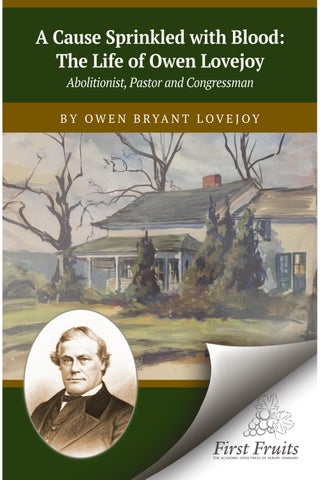
A CAUSE SPRINKLED WITH BLOOD !e Life of Owen Lovejoy Abolitionist, Pastor and Congressman
By Owen Bryant Lovejoy
First Fruits Press Wilmore, KY c2026
ISBN: 9781648174322 A cause sprinkled with blood: the life of Owen Lovejoy, abolitionist, pastor and Congressman Owen Bryant Lovejoy First Fruits Press, ©2026
Digital version at http://place.asburyseminary.edu/firstfruitsbook/5/ First Fruits Press is a digital imprint of the Asbury Theological Seminary, B.L. Fisher Library. Asbury Theological Seminary is the legal owner of the material previously published by the Pentecostal Publishing Co. and reserves the right to release new editions of this material as well as new material produced by Asbury Theological Seminary. Its publications are available for noncommercial and educational uses, such as research, teaching and private study. First Fruits Press has licensed the digital version of this work under the Creative Commons Attribution Noncommercial 3.0 United States License. To view a copy of this license, visit http://creativecommons.org/licenses/by-nc/3.0/us/.
For all other uses, contact: First Fruits Press B.L. Fisher Library Asbury Theological Seminary 204 N. Lexington Ave. Wilmore, KY 40390 http://place.asburyseminary.edu/firstfruits
Lovejoy, Owen Bryant A cause sprinkled with blood : the life of Owen Lovejoy, abolitionist, pastor and Congressman [electronic resource]/ Owen Bryant Lovejoy. – Wilmore, Kentucky : First Fruits Press, ©2026. 1 online resource 97pages ; 21cm. ISBN: 9781648174322 (pdf) ISBN: 9781648174339 (mobi) OCLC: 1581952539 1, Lovejoy, Owen, 1811-1864. 2. Abolitionists--United States--Biography. 3. Clergy--United States--Biography. I. Title.
E415.9.L89 L68 2026eb Cover design by Amanda Kessinger
328.73/0924
Book Cover: In 1931, Mary Win (Skinner) Norris (1914-2014) created the artwork of the Owen Lovejoy Homestead. Mary Win was a life-long resident of Princeton, Illinois and the niece of Mary Emma Skinner who married my great grandfather, Elijah P. Lovejoy, son of Owen Lovejoy. She was a grand lady! !e original painting is displayed at the Owen Lovejoy Homestead in Princeton, Illinois. Many thanks to the Owen Lovejoy Homestead Board of Trustees for allowing me to use the painting for this book! !e portrait of my great, great grandfather is from the public domain. Owen Lovejoy painting by F.B. Carpenter (FB Carpenter Painting Acknowledgement) The original painting of the Honorable Owen Lovejoy, painted by FB Carpenter, is displayed at the Owen Lovejoy Homestead, Princeton, Illinois. !e painting was donated to the Homestead by my cousin, Elijah P. Lovejoy V, who has given me permission to use the image in this book. !ank you, Cousin Elijah!
First Fruits Press The Academic Open Press of Asbury Theological Seminary 204 N. Lexington Ave., Wilmore, KY 40390 859-858-2236 first.fruits@asburyseminary.edu asbury.to/firstfruits
Table of Contents
Preface-----------------------------------------------------5 Introduction:----------------------------------------------7 Chapter One: !e Lovejoy Family of Albion, Maine -- 9 Chapter Two: School Years------------------------------15 Chapter !ree: Brother Elijah ---------------------------25 Chapter Four: Owen in Princeton-----------------------33 Chapter Five: Pastor Lovejoy-----------------------------43 Chapter Six: Congressman Owen Lovejoy--------------53 Chapter Seven: Lovejoy and Lincoln--------------------65 Memorials-------------------------------------------------77 Final Reflections-------------------------------------------87 Acknowledgments----------------------------------------89 Bibliography-----------------------------------------------91
Dedication For Hayden, Isaac, Olivia, Levi, Evan, Charissa, Simeon, Pax, Eva, Valor, Hudson, Lady and Lewis-my thirteen beloved grandchildren. May you come to treasure the gift of your spiritual heritage and godly ancestors, including your great, great, great, great grandfather, Owen Lovejoy. Loving you always, Papa
PREFACE
Several years ago, my daughter, Gwendolyn, advised me: “Papa, you need to write a book about Owen Lovejoy!” She o$ered me that free advice because one of her sons, part of a “Classical Conversations” group, chose Owen Lovejoy as the subject of his “historical figure” report. As he researched his subject, he could not find many youth-oriented sources about Owen Lovejoy, hence my daughter’s suggestion. At the time, I had plenty on my plate, so I put the assigned task on the back burner—until now. !is book is a result of my daughter’s suggestion as well as my life-long interest in my namesake. From my youth, I had known about Owen Lovejoy and had always felt a close kinship to him, not just because we have the same blood but also the same God.
5
6
INTRODUCTION About four hundred years ago, John Lovejoy arrived at Plymouth, Massachusetts, from the shores of England. !e proceeding years saw some of the Lovejoy clan move to the southern states while others continued to live in northeastern states. One line of the northern Lovejoys settled in the Massachusetts Bay Colony, also known as the District of Maine. In 1820 the District of Maine became the state of Maine, the twenty-second state of the Union. Born in the early eighteen hundreds, two brothers, sons of Maine, left a heroic legacy for those who followed them. As adults, their paths converged in the battle waged against slavery in the United States of America. In their struggle, they earned the respect of some and the enmity of many. !eir names are Elijah and Owen Lovejoy. !is book tells the story of the younger brother, Owen Lovejoy, my great, great, grandfather.
7
8 OWEN BRYANT LOVEJOY
CHAPTER ONE THE LOVEJOYS OF ALBION, MAINE Ancestry John Lovejoy sailed from England to Massachusetts Bay Colony around 1630. His lineage can be traced back to Johannes Lovejoy, born in England in 1460. John’s great grandson, Francis Lovejoy, fought in the Revolutionary War. After the War, he started a homestead in the wilderness of present-day Kennebec County, Maine. His son, Daniel, continued working the same acreage while following the call to pastor a Congregational Church. Daniel married a young lady named Elizabeth Gordon Pattee, also from Massachusetts (now Maine). Elizabeth Gordon, her grandmother and namesake, hailed from Scotland. Many ancestors on Elizabeth’s family tree were long-lived and pious. She wrote in her diary that her forebears prayed “that the blessings of the covenant God would descend upon and dwell among their seed till the latest generations.” Home-life in Albion Daniel and Elizabeth married in early 1802. !eir nine children (only seven lived past childhood) were born in the village of Albion, Maine. !e family homestead stood on the shores of Lovejoy Pond, just west of the village. Elijah, the eldest child, was born November 9, 1802. Owen was born January 6, 1811. Owen’s grandfather, Francis, followed by Owen’s father, Daniel, turned forest into farmland, one acre at a time. Between the harsh winters and the forested wilderness, Maine families struggled to survive. Even so, the Lovejoy parents, Daniel and Elizabeth (Betsey), gave their children a loving home and a good foundation to help them live meaningful lives. !e Lovejoys of Lovejoy Pond were a closeknit family. During the early-morning hours, sitting around the kitchen fireplace, Mother Elizabeth, a devout Christian, taught the 9
10 Owen Bryant Lovejoy
children to read beginning at an early age. !e primers of that day focused on literary ability. !ey often contained the hymns of Isaac Watts, the Westminster Catechism, the Apostles’ Creed, and stories of Protestant martyrs. !e Bible doubled as a source of literary skill and spiritual growth. As the children grew, they learned the basics of Greek along with “normal” subjects like math, geography and history. At the end of the day, in the darkening hours, the family would gather around the same fireplace for their evening devotions. Singing hymns, answering questions from the Catechism, reading Scriptures and family prayers filled the closing hour of each day. Father Daniel and Mother Betsey faithfully prayed for and encouraged their children to give their hearts to the Covenant-keeping God. Chores and the Outdoors During the spring, summer, and fall, daylight hours were always full of outdoor activity. !e entire family (age permitting) took part in the day-to-day work required for survival. Gardening, farming and clearing land required everyone’s help. While the younger children gardened, the older boys learned to use the axe, plough and scythe with skill. !eir mother often quoted Proverbs: “An idle soul will suffer hunger and drowsiness will clothe a man with rags.” !e Maine Forests !ere is no state like Maine in the eastern U.S. where such a large chunk of contiguous land has remained continuously forested since presettlement times. It’s tempting to look for similarities with the western U.S., where vast forests were never cleared. Most of those lands, however, are managed by the federal government. Most of the Maine Woods are privately owned, and that has led to a very di$erent kind of relationship between people and forests. Maine, in other words, has carried out its own unique, long-term experiment in land use. Remarkably, Maine’s forested area today is about the same as it was four centuries ago. Of Maine’s 19.8 million land acreage, in 1600, 18.2 million acres were forested. Today, the forests of Maine cover 17.7 million acres. Northern Woodlands Website
!e Lovejoys of Albion, Main |
11
In their teen years, the Lovejoy’s attended China Academy, a school started by their father only a few miles from their home. !ough not the standard practice of that day, both girls and boys attended. For the Lovejoy attendance was generally limited to the winter months when the weather would not permit outdoor chores. Like children everywhere, the Lovejoy kids loved free time! !ey roamed the forest, climbed trees (millions of acres of trees blanketed Maine) and swam in the pond (the size of a small lake). Naturally, they competed with one another whenever possible. One competition among the older siblings involved diving down to see who could reach the bottom of the murky pond. Since the muddy water prevented the observers from seeing to the bottom of the pond, proof of success had to be o$ered. To verify the contestants’ achievement, the contenders had to bring up a clam or mud to demonstrate they had truly completed the fifteen-foot downward journey. Early Settlers of Northern Maine Maine farms were typically small, family-run operations, averaging around 100 acres. Farmers faced formidable natural obstacles, including geographical isolation, thin soils, dense forests, and unpredictable weather. Except for Aroostook County’s potatoes, farmers found no great staple crop for export, and accordingly they devoted a significant amount of time to subsistence production. !ey grew a variety of grains along with potatoes, corn, fruits, and vegetables, and raised poultry, cattle, and sheep. After the fall harvest men produced hand-crafted items like clocks, buggy whips, furniture, horse collars, barrels, and shingles, and women made brooms, baskets, and palm-leaf hats and wove cloth or took in cut fabric or leather to sew into clothes or shoes. With subsistence as a primary goal, the farm family prepared for the long winter months when humans and livestock lived o$ the bounty of the previous season’s work. Households were fortified with bushels of potatoes, oats, wheat, buckwheat, and corn; barrels of salt pork, corned beef, and sausage; bins of vegetable and root crops, crocks of butter, loaves of maple sugar, rounds of cheese, and jars of preserves. Maine Historical Society Website
12 Owen Bryant Lovejoy
Mother’s Influence Along with scholastic learning, Owen’s mother, in word and deed, taught her children moral character. She modeled a tender-hearted sympathy for any neighbor or acquaintance who su$ered. She pitied wrongdoers as “poor creatures” who were ignorant of a better way of living; or insisted that “He has a precious soul.” On the other hand, she greatly valued the sacredness of human life and railed against injustice. As a result, Betsey Lovejoy looked upon slaveholders and those who favored slavery, as “the guiltiest of all creatures.” According to son Owen, one element of his mother’s character which governed her life was her faith in God and a love for God’s word. !e Bible was inspiration pure and direct. Her children would often quote a verse from the Bible just to test their mother’s knowledge of the passage’s whereabouts. Nearly without fail, both the book and chapter would be known. Of second-most importance, after Betsey’s faith, was her maternal a$ection. Owen recalled his mother’s “changeless and overflowing” love for her children. !e only boon she sought for them was that “they might be educated and fear God.” She pursued that goal with heart and soul. !e seeds she sowed landed in good soil. (All quotes in this chapter come from Owen’s remarks at his mother’s funeral; Owen B. Lovejoy’s private collection of Owen Lovejoy sermons)
!e Lovejoys of Albion, Main |
!e Westminster Shorter Catechism First 8 questions/answers of 107 questions/answers Q. 1. What is the chief end of man? A. Man’s chief end is to glorify God, and to enjoy him forever. Q. 2. What rule hath God given to direct us how we may glorify and enjoy him? A. !e Word of God, which is contained in the Scriptures of the Old and New Testaments, is the only rule to direct us how we may glorify and enjoy him. Q. 3. What do the Scriptures principally teach? A. !e Scriptures principally teach, what man is to believe concerning God, and what duty God requires of man. Q. 4. What is God? A. God is a Spirit, infinite, eternal, and unchangeable, in his being, wisdom, power, holiness, justice, goodness, and truth. Q. 5. Are there more Gods than one? A. !ere is but one only, the living and true God. Q. 6. How many persons are there in the Godhead? A. !ere are three persons in the Godhead: the Father, the Son, and the Holy Ghost; and these three are one God, the same in substance, equal in power and glory. Q. 7. What are the decrees of God? A. !e decrees of God are, his eternal purpose, according to the counsel of his will, whereby, for his own glory, he hath foreordained whatsoever comes to pass. Q. 8. How doth God execute his decrees? A. God executes his decrees in the works of creation and providence. A printable version of the Westminster Shorter Catechism can be found on the epc.org website.
13
14 Owen Bryant Lovejoy
IDEAS FOR FURTHER EXPLORATION 1. Owen Lovejoy’s family line can be traced back to 1460. How far back can you trace your “family tree?” Ask your parents or grandparents to help you trace your family line (both maternal and paternal) as far back as possible and draw a family tree with the names of your ancestors. Do you happen to know from what countries your ancestors emigrated to the U.S.? 2. What pastimes did your parents/grandparents enjoy as children? What were their chores? What type of education did they receive? Was there a particularly significant person in their life who helped shape them into who they are today? 3. Owen Lovejoy’s grandfather, Francis, served in the Revolutionary War. Explore the causes and results of the Revolutionary War. Did any of your ancestors serve in that war? 4. !e Bible was central to shaping Owen Lovejoy’s upbringing and beliefs. How has the Bible and its teachings impacted you and your family? 5. Owen Lovejoy’s home state of Maine continues to be a major supplier of wood products while using sound practices of forest management (See textbox above). Land management is a critical issue. Farming, lumbering, mining, etc. can be done responsibly or irresponsibly. !e practices we use today will a$ect, for good or ill, our country’s wellbeing for generations to come. How is your state or area handling land management?
CHAPTER TWO SCHOOL YEARS !e Lovejoy children were blessed with educated parents. !eir father received formal schooling, including seminary training, but most of their early education fell to their mother. She had received very little classroom education having been raised in the wilderness, yet she taught her children math, literature, history, geography and ancient languages. Much of her knowledge came from her own mother. China Academy As mentioned earlier, in their teen years, the Lovejoy’s attended China Academy, in China, Maine, at least in the winter months. Rev. Daniel Lovejoy (Owen’s father), and a few other leading citizens, founded the school in 1818. !e Massachusetts legislature had already chartered 22 other academies in Maine, but none was within easy commuting distance of China, Maine. One of the Academy’s first graduates, Elijah Lovejoy (Owen’s oldest brother) went on to study at Waterville College (now Colby College). He graduated from Waterville College in 1826. Elijah returned to act as Preceptor (similar to Head of School) of China Academy in 1827 before moving west the following year. Students today would find the Academy curriculum challenging. In addition to English, history, chemistry, algebra and philosophy, the school also o$ered instruction in surveying, astronomy, Latin, Greek and French. Each individual course determined a student’s tuition cost. For example, the beginning English course cost $3 per quarter. Tuition for Advanced English, history, algebra, geometry, surveying, chemistry and astronomy each cost $4 per quarter. Latin, Greek and French were o$ered for $5 per class per quarter.
15
16 Owen Bryant Lovejoy
Bowdin College
Like brother Elijah, Owen also graduated from China Academy, around 1829. With the training received at home and the classes at China Academy, Owen met the requirements to enter Bowdin College in Brunswick, Maine at the age of nineteennot an easy accomplishment. Incoming freshmen were expected to write Latin, read Greek Classics and the Greek New Testament and to have su&cient knowledge of “standard” subjects like geography and math. Required courses at Bowdin College in 1830
In 1830, there were only two colleges in this part of New England: Waterville College (now Colby College) and Bowdin College. Owen’s older brother, Elijah, had attended Waterville College and another older brother, Joseph, had attended Bowdin College. Many future leading citizens of America attended Bowdin since its founding by the Congregational Church in
School Years |
1794. For example, Henry Wadsworth Longfellow graduated from and taught at Bowdin. Charles Beecher, (brother of Henry Ward Beecher, Edward Beecher and Harriet Beecher Stowe), was Owen’s classmate. Calvin Stowe, Harriet’s husband, also graduated from Bowdin College. !e Requirements to enter Bowdin College in 1830
!e Beecher family would play a pivotal role in the struggle against slavery in the United States. Charles and Henry Ward Beecher would become pastors. Edward Beecher pastored churches and became the President of Illinois College. In 1837, Edward Beecher, Elijah Lovejoy and Owen Lovejoy would collaborate with others to form the Illinois Antislavery Society. Harriet Beecher Stowe authored Uncle Tom’s Cabin. Her book ignited anti-slavery sentiments in the North.
17
18 Owen Bryant Lovejoy
!e Peucinian Society
Owen attended Bowdin for three years. In 1832, his sophomore year, he was asked to join the Peucinian Society, the college’s oldest literary society, formed in 1805. Entrance into the society was by invitation only. !e name, derived from Greek, reflected the physical surroundings of the college, i.e., “pine covered.” !e motto of the society, taken from Virgil, was Pinos loquentes semper habemus (We always have the whispering pines). One primary purpose for the formation of the Peucinian Society was to discuss and debate questions of importance to the world at large and how one should live life in this world. To that end, the group would host weekly “disputations.” !e president of the society assigned members to prepare “for and against” arguments on an assigned topic. Some subjects bear significance still today. For example, one question for consideration was: “Do colleges cherish a spirit of aristocracy prejudicial to the civil institutions of our country?” Another topic: “Is the study of ancient languages more beneficial to students than that of the modern?” In addition: “Is it good policy to encourage immigration of foreigners into this country?” Slavery also came into consideration between 1830 and 1834. !ese questions were debated: • “Is it the duty of the non-slave holding states to aid in the emancipation and transportation of slaves of this country to Africa?” • “Ought a college for blacks be established in this country?” • “Ought slaves to be immediately emancipated?” • “Are we justified in believing that the Colonization Society will occasion the abolition of slavery?” • “Is the National Anti-Slavery Society deserving of the patronage of the people?” (Bowdin College Special Collections and Archives, Brunswick, Maine.)
School Years |
!ese questions, and others like them, no doubt helped develop Owen’s views on slavery and prepared him for the future role he would play in its elimination. !e Peucinian Society of Bowdin College History
!e Peucinian Society was formed November 22, 1805, as !e Philomathian Society, with the avowed purpose of “the attainment in habits of discussion and elocution.” Within a few short months, however, the Philomathians decided that the chosen name was commonplace; indeed, nearly every college of that day had a Philomathian Society. !us, they voted to change it to the Peucinian Society, from the Greek word for “pine-covered,” thereby o$ering the Society both distinction and local significance. !e matter of changing the name was somewhat contested but, as one of its first Presidents argued: “Cambridge in England has its willows, Oxford its osiers, and we have our pines.” As the Society motto, they adopted a line from Virgil: Pinos loquentes semper habemus (We always have the whispering pines) !e Peucinian Society is one of the nation’s foremost literary societies and the oldest student organization at Bowdoin College, hosting weekly disputations concerning statesmanship, culture, and political thought. What is a Disputation? Most disputations focus on a “resolved” statement (such as, Resolved: Capital Punishment is Justified in a Democratic Society). !e disputation begins with an introduction from the President followed by a poem chosen by the Poet Laureate. Two speakers (the disputants) then present arguments in the spirit of the resolved statement, one taking the a&rmative position, the other the negative. After they are finished speaking, the President will allow attendees to ask clarifying questions and, following that, open up the table for discussion. !e discussion takes up the majority of the evening, with a break halfway through. During the break, or peripatos, attendees are asked to pair up with someone they do not know, or someone they disagree with, and take a walk together around the quad. At the end of the disputation, each attendee votes in the “a&rmative” or the “negative” regarding the resolved statement and asks a reflective question. *A key and intentional element of the disputations was for all members, regardless of their views, to remain fast friends and comrades. !at proved to be true for Owen Lovejoy and his life-long friends, the Beechers and other classmates. For more information on the Peucinian Society, go to this website: students. bowdin.edu
19
20 Owen Bryant Lovejoy
In addition to debating relevant topics of the day, the Peucinian Society purchased and circulated books to its members. !e faculty and students bemoaned the College library’s inadequate book collection and its limited hours of availability. !e literary group voted on its o&cers. One important role was that of the Librarian who had the responsibility of purchasing the books for the group. Longfellow, a former Peucinian, was voted the librarian during his college years. In Owen’s junior year, the members elected him to be the librarian for the group, a distinct honor. Owen: A Typical PK (Preacher’s Kid) Owen excelled in his studies, but he was no angel, at least according to the school’s administration. On two occasions, the school’s governing board reprimanded Owen for unbecoming behavior. On one occasion, Owen refused to snitch on certain classmates charged with misconduct. !e Executive Board admonished Owen for “withholding evidence concerning the breach of College Laws, when called upon by the Executive Government, thereby refusing to submit to an express law of the College.” (Bowdin College Special Collections and Archives, Brunswick, Maine.) Also found in the Executive Government records, Owen was included in a group admonished by the board for taking part in “convivial entertainment at a tavern in this town on the 29th” (of August 1832). !e records do not specify whether Owen’s o$ense was just visiting the tavern or drinking alcohol at the tavern, or both. With the health risks involved in drinking water in those days, it seems likely that Owen followed the common practice of drinking hard apple cider. If so, it was not illegal since there was no minimum drinking age. Since many citizens drank some form of alcohol (even children drank a diluted version of hard cider), most people did not consider alcohol consumption as immoral. Although prohibition sentiments increased in New England during the
School Years |
1830s-1840s, Prohibition laws did not take e$ect until 1851. However, Bowdin College rules prohibited their students from imbibing. !e school leaders were not pleased with Owen, and neither were his parents who were staunch prohibitionists. Letters from Home In their correspondence, Owen’s parents often expressed concern regarding his spiritual condition. Between 1830 and 1833, during his time at Bowdin, his parents wrote to him several times per school year. !eir letters contained general family news but invariably included exhortations regarding his need for salvation. For example, his mother wrote in 1830: “I hope, so ardently hope, Owen you may be a sharer (in the moving of the Spirit) and His saving influence that the blessed Spirit may lead and guide you into all truth and prepare you to be abundantly useful in the Church of the Living God. So prays your a$ectionate mother.” (Owen Lovejoy Papers, William L. Clements Library, University of Michigan, Ann Arbor) In 1831, Father Daniel pleaded with Owen, “O that you may be wise and seek first the kingdom of heaven.” He writes to Owen in 1832, “You live in the midst of temptation, and none can keep you from danger but your Glorious Creator and Redeemer.” Mother Betsey adds: “God bless you my dear child and that in blessing, He will give you a heart to devote to His service. So prays your a$ectionate mother.” (Lovejoy Papers, William L. Clements Library) !e prayers of Owen’s parents for their wayward son would be answered, but not for another two years. Seminary and Reading Law In the summer of 1833, Owen returned home when his father became ill. Daniel Lovejoy died in August 1833. In 1834, after Owen’s dramatic conversion (more about his conversion in chapter 5), he attended Bangor !eological Seminary in Bangor, Maine. For uncertain reasons, he stayed in seminary for only one year. Owen clearly did not like sectarian doctrines forced upon him. Since seminaries typically had very few students, often only
21
22 Owen Bryant Lovejoy
one professor taught all the students-that could prove good or bad! !e year after Owen departed Bangor, a fellow seminarian wrote him to say that a new professor had been hired who turned out to be “just the man.” He added that their studies were much more pleasant than in the previous year.
(Owen Lovejoy Papers, William L. Clements Library, University of Michigan, Ann Arbor; Letter from E.A. Greenleaf to Owen Lovejoy, April 18, 1836)
From Bangor, Owen moved to Calais, Maine where he taught at a private school and “read law” with an established lawyer during the years 1835-1836. As with colleges, there were few law schools in the 19th century. Many would-be lawyers trained with licensed lawyers to gain the required knowledge to obtain a law license themselves. !is practice was referred to as “reading law.” Owen never practiced law though the state of Illinois later licensed him. His training, however, would be vital to his future role as a congressman.
School Years |
23
READING LAW In the 18th and 19th centuries, most young people became lawyers by apprenticing in the o&ce of an established lawyer, where they would read legal texts and engage in clerical duties such as drawing up routine contracts and wills; this became known as reading law. Sometimes they would study on their own by reading legal texts without an apprenticeship. After reading law, prospective lawyers would be admitted to the local court to practice law. Wikipedia article: History of the American Legal Profession
After two years in Calais, Maine, in the fall of 1836, Owen moved to Alton, Illinois to assist his brother, Elijah, a pastor and a newspaper editor. Only God knew the momentous events that would soon thrust these brothers into the mainstream of U.S. history.
24 Owen Bryant Lovejoy
IDEAS FOR FURTHER EXPLORATION 1. Owen Lovejoy was educated at home by his mother in his earlier years. What are your views about home schooling vs. public or private school education? Discuss the benefits and drawbacks of each of these types of education. 2. Owen refused to snitch on certain classmates charged with misconduct. Do you think Owen did the right thing? What would you do and why if you were placed in a similar situation? Would it depend on the infraction? If so, what criteria would you use to make your decision? 3. Owen’s parents had a role in his eventually becoming a Christian. Is there a person who has been instrumental in your spiritual life? How have they impacted you spiritually? 4. !e Peucinian Society of Owen Lovejoy’s day openly disputed or debated crucial and relevant topics of the time. !ey did so without rancor and animosity; no one was condemned for their position on the chosen topic. Can you think of examples today in which people with legitimate opposing opinions can express their views without recrimination? Do you think the freedom to express one’s opinions depends on the topic being discussed? If so, what criteria would you use to make that decision?
CHAPTER THREE BROTHER ELIJAH A Beloved Brother !e Lovejoys of Albion, Maine were a close-knit family. Elijah, the eldest of the siblings (born in 1802), was well-loved by all his brothers and sisters. Owen, nine years younger, especially held his big brother in high esteem both in childhood and adulthood. Elijah left home for the “West” when Owen was a teenager. Elijah landed in St. Louis where he taught in a private school and became a newspaper editor. After Elijah’s three-year absence from home, Owen wrote to him addressing the letter to “Our absent brother, eldest born and dearest.” In the letter he reflected upon the days when Elijah held his small hand as they walked through meadows, sat by the brook among flowers and shade trees, and entertained him with exciting stories. He recalled those childhood days with “sweet and dear remembrance.” Owen expressed his longing to “grasp thy (Elijah’s) hand” once again. (Bureau County Historical Society Archives; Owen Lovejoy Collection) What to Do About Slavery? !ough Owen greatly admired and respected brother Elijah, they did not agree on everything. For example, while the entire Lovejoy family despised slavery as did most New Englanders, no solution to the problem of slavery gained universal approval. Owen, throughout his adult life, was an abolitionist. Abolitionists believed that slavery should be done away with immediately wherever it currently existed and prohibited from spreading elsewhere. Unlike Owen, Elijah was not an abolitionist when he arrived in St. Louis. Yes, Elijah believed slavery to be wrong, and he wanted the slaves emancipated, but he did not think it could be done immediately as the abolitionists desired. For a time, Elijah favored the Colonization approach. With that arrangement, slaves would be purchased from slave owners and 25
26 Owen Bryant Lovejoy
sent to a designated “colony” in Africa. Abolitionists denounced the plan for various reasons. If the plan were even doable, it would take many years to achieve the goal. !e idea could only be carried out if slave owners were willing to sell their slaves and where would the money come from to purchase over two million slaves (in 1830)? For a season, Elijah agreed with some northern pastors who wanted to eliminate slavery by “enlightening” those who participated in the dark practices of slaveholding. !rough education and biblical teaching, they reasoned, the public would undoubtedly perceive the wrong done to slaves by their masters. Regrettably, pro-slavery citizens, including many who called themselves “Christians,” were not receptive to that message. !ey used the Bible to support slavery, not end it. Elijah’s Conversion In 1832, Elijah was dramatically converted at a revival meeting in St. Louis. He described his divine encounter in a letter to his “Dear and Honored Parents:” I wrote you four weeks since last Tuesday, and, as you will have learned from that letter, was in deep distress. Sorrow had taken hold upon me and a sense of my long career in sin and rebellion against God lay heavy upon my soul. But it pleased God, and blessed be his holy Name-to grant me, as I humbly hope, that very night, joy and peace in believing. I was, by Divine grace, enabled to bring all my sins and all my sorrows, and lay them at the feet of Jesus, and to receive the blessed assurance that He had accepted me, all sinful and polluted as I was. (Memoir of the Rev. Elijah P. Lovejoy, p.41.)
!e encounter with God deeply a$ected Elijah and, over time, his approach to slavery. !ereafter, he identified his struggle against slavery as the call of God and his life’s mission. Elijah expressed his concern for the ill-treatment of slaves, by reminding his readers of Jesus’ words. “All things whatsoever you would that men should do to you, do ye even so to them.” In other words, if you do not want to be enslaved, don’t enslave others. With such a mild admonishment, he could not have expected the furor his words produced. !at simple
Brother Elijah |
27
statement sparked an avalanche of angry responses and threats from pro-slavery readers. “My Grave in Alton”
As the threats of violence and persecutions increased, so did Elijah’s concern for his and his family’s safety. In the summer of 1836, like-minded friends persuaded Elijah to move across the Mississippi river to Alton, Illinois, a free state, and continue to publish a newspaper there. !ough Illinois was a free state, it was not free of pro-slavery sentiment. Elijah found adversaries aplenty in Alton. !reats against him and his paper continued. In September 1837, Elijah’s mother, knowing of the threats to her sons’ lives (Owen had joined Elijah in Alton), sent a letter with these words: !ere is, my dear son, but one place of safety in the universe, and that is being sheltered under the wings of the Almighty Savior. If you are there, you are secure from all harm.” She closed her letter with this admonition: “. . . labor with all diligence and humility. Remember one of the sayings, I think of Mr. Newton, ‘If God should send two angels from heaven, one to make a kingdom and one to sweep chimneys, they would not contend who should rule the kingdom.’ May God give such a spirit to us all. O, may we love him, live in his fear, and meet at last in his heavenly Kingdom. So prays your Mother. (Clements Library, U. of M.)
Elijah would not be silenced by his critics. If anything, his adversaries, who often slandered him and threatened him and several times destroyed his printing presses, turned him increasingly towards the abolitionists’ position. Some Christian pastors from the northern states advocated for a message that only addressed the ill-treatment of slaves but not the elimination of slavery. In his printed response to those pastors, Elijah presented a biblical analogy, using the Apostle Paul as his example. Elijah reasoned that when Paul encountered Gentile idolaters, he addressed both the practices of idolatry and idolatry itself. Paul found that in the practice of idolatry, the adherents practiced
28 Owen Bryant Lovejoy
“shameful” rites of sexual immorality and licentiousness. When Paul preached to the idolaters, he did not just speak of the evil practices in an attempt to reform their idolatry. No, Paul’s message made it perfectly clear that Christ came to abolish idolatry and remedy its evils. Likewise, Elijah contended, that “if the gospel is to be preached to the masters of slaves, all it can say is ‘Restore the slave to HIMSELF; give him back those rights which belong to him . . . and which cannot be taken away, without robbing both him and his God.’” (Memoir of the Rev. Elijah P. Lovejoy, p. 207.) !e Brothers Reunited In the summer of 1836, Elijah wrote to Owen to ask him to come to Alton and help him. Owen arrived that fall. After years of separation, the Lovejoy brothers reunited in Alton, Illinois. In October 1837, Elijah, Owen, Edward Beecher, and seventy-five delegates from all parts of Illinois came together to Alton, Illinois to form the Illinois Anti-slavery Society. !e group condemned slavery as practiced in the United States of America and called for its immediate abolition. !eir opposition to slavery and their high regard for Elijah formed their bond. !e Illinois Anti-Slavery Society formed in October 1837 in Alton, Illinois. •
In the Declaration of Sentiments, the seventy-five delegates produced a lengthy document addressing the right to free speech, the evils of slavery and the mechanics of abolishing slavery. !e following reflects their view of the nature and character of American slavery.
•
!e law (the Slave Code laws of Southern slave states) does not defend the slave against personal abuse. It professes, indeed, to guard against excessive punishment, but by denying to the slave all power to prosecute or testify, it renders all such nominal protection entirely vain; and the slave is exposed to numberless cruelties and indignities against which he has no redress. His master may treat him kindly if he will; but if not, there is in the law no redress, and so facts show.
Brother Elijah |
29
• !e fact that all masters do not do all the evil that the system allows, and that some are kind and humane, is no relief to the character of the system. If all the wrong that it authorizes is not done, it is solely because some masters are better than the system. • !e evils that take place under the system are not abuses of it, but it’s true and legitimate results. !e ignorance and degradation, the violation of all social ties, the violence done to female chastity, the defrauding the laborer of his just reward, and the cruelties of chains and stripes are the true and natural fruits of the system, and all flow from the radical sin of disregarding the immortal nature of man, and making him by law a mere article of merchandize, a mere instrument of another’s will, a thing to be bought and sold ; and in law he is, and can be known, as nothing else. • !is system is a fundamental subversion of the law of God, “!ou shalt love thy neighbor as thyself;” (Slavery) is at all times and in all circumstances sinful, to a degree unspeakable and inconceivable; and ought to be utterly and forever abolished. Archive.org: Internet Archive
!e Society described in writing, the many cruelties and injustices done to slaves by slave owners, relatives of slave owners, and often the overseers of the slaves. In the documents they produced, they acknowledged that not every slave owner was cruel. Even so, they articulated, just owning another human being violated the laws of God and the U.S. Constitution. One week after the anti-slavery committee met, the civic leaders of Alton called a meeting to discuss (and challenge) Elijah’s newspaper articles about slavery. Some people made false accusations against him and others simply expressed their concern over the unrest the articles caused in the community. !ey asked Elijah to move his paper to another town. A few citizens stood with Elijah and asserted his right to publish his opinions in Alton. In a calm yet serious manner, Elijah responded to his critics:
30 Owen Bryant Lovejoy
What, sir, I ask, has been my o$ence? If I have committed any crime, you can easily convict me. But if I have been guilty of no violation of law, why am I hunted up and down continually like a partridge upon the mountains? Why am I threatened with the tar-barrel? Why am I waylaid every day, and from night to night, and my life in jeopardy every hour? I plant myself, sir, down on my unquestionable rights, and the question to be decided is, whether I shall be protected in the exercise and enjoyment of those rights. And now if I leave here and go elsewhere, violence may overtake me in my retreat, and I have no more claim upon the protection of any other community than I have upon this; If the civil authorities refuse to protect me, I must look to God; and if I die, I have determined to make my grave in Alton. (Memoir of the Rev. Elijah P. Lovejoy, p. 279.)
Tragically, the reunion between Owen and Elijah would last only one year. Four days after the community meeting, on the 7th of November 1837, Elijah was murdered by a pro-slavery mob in the free state of Illinois. Owen held his dying brother in his arms. If Owen was a fervent advocate of freedom for slaves before his brother’s death, he became a fearless and eloquent champion of emancipation after his brother’s death. Elijah’s death irrevocably set the course for Owen’s life. IDEAS FOR FURTHER EXPLORATION 1. Discuss the pros and cons of slaves in the U.S. being immediately emancipated (the abolitionists’ view) vs. the Colonization Society’s view that slaves should be emancipated and transported to a specific location in Africa over a span of time. 2. Elijah Lovejoy was converted at a revival meeting in St. Louis. Can you describe a day or period of your life when you were converted (became a Christian)? Write at least one paragraph describing your conversion. 3. What is the meaning of a “mob mentality”? Discuss the ramifications of mob-rule and cite historical and/or current incidents when mobs have taken over in situations. What were, or are, the immediate and long-term e$ects of the mob’s actions.
Brother Elijah |
31
4. Elijah Lovejoy is described as the “First Martyr to the Freedom of the Press in the U.S.” Look at other martyrs who were willing to die for the cause in which they believed. Do you have causes that you are passionate about? If so, what are they?
5. !e First Amendment of the U.S. Constitution guarantees freedom of speech, including Freedom of the Press, but not without restrictions. Elijah Lovejoy claimed a God-given and Constitutional right to print his views on slavery (and other topics). Do you think Elijah had the right to print his anti-slavery views? If so, do you think he should have continued to print his views when asked to stop, or do you think he should have refrained from printing his views? In what ways do you think “free speech” should be restricted and why?
32 Owen Bryant Lovejoy
CHAPTER FOUR OWEN IN PRINCETON From Alton to Princeton, Illinois After his brother’s murder in Alton, Owen and brother Joseph wrote a memoir of their slain eldest brother (The Memoir of the Rev. Elijah P. Lovejoy). After completing the Memoir, Owen spent part of 1838 in New York City to arrange for the book’s publication then returned briefly to Alton. In the fall of 1838, Owen departed Alton on horseback and headed north with no clear destination in mind. When he reached north central Illinois, according to one account, he came to a fork in the road. Not knowing which way to go, he dropped the reins and waited for the horse to select the route. !e horse chose the left fork and bore Owen to Princeton, Illinois. A Princeton storyteller described Owen as “. . . a young man with black hair, broad shoulders and expressive blue eyes.” (Bureau County Historical Society, Owen Lovejoy Collection, Princeton, Illinois.) Not a Warm Welcome After arriving in Princeton, it did not take long for the town’s residents to discover Owen’s strong anti-slavery mindset. In short order, he was threatened by a group of citizens who promised to tar and feather him if he so much as showed his face in town. One woman o$ered to furnish the feathers from her bed to complete the task! !ey were clueless as to how little impact their threats would have on Owen; he had already endured a far more deadly trial-byfire. Owen responded to the threats by mounting his horse and riding up and down Main Street in broad daylight, waiting for someone to challenge him; no one did. Never again was he threatened or molested in or around Princeton. (Source: The Lovejoy Shrine by George Owen Smith, 1949) A Man of the Land Owen found lodging in Princeton with the Denham family who had recently moved to the area from Massachusetts. !eir farm 33
34 Owen Bryant Lovejoy
of around twelve hundred acres sat three-quarters of a mile east of the village. Butler Denham farmed, bred cattle and raised horses. Butler and his wife, Eunice, had two young daughters when Owen arrived in town. With years of experience in farming and his uncanny skill with horses, Owen proved to be a valuable addition to the farm. Farmer Lovejoy Because Owen Lovejoy is so well known in the anti-slavery movement, his role as a farmer is often overlooked. He took on the responsibilities of a large farming operation when he married Eunice Denham in 1843. She owned a total of 1,178 acres. Lovejoy’s daughter, Sophia, recalled years later, “To walk through an orchard with Father was a pleasure, to watch him select seed corn was a valuable lesson, to help him train a horse was instructive and to watch him help a child was heredity; had not his mother done it before him?” Lovejoy frequently said Nature intended him to be a farmer, and if not for the pro-slavery people, he would have been content to follow the plow. In Washington, D.C., Lovejoy was known as the Farmer Congressman and helped establish an Agricultural Bureau, an early Department of Agriculture. Pam Lange, Director, Bureau County Historical Society (retired)
A Family Man Butler Denham died in 1841, about the time of his third daughter’s birth. In 1843, Owen married the now-widowed Eunice Denham. Although Owen never o&cially adopted the three Denham girls, everyone referred to them as “the Lovejoy children.” From their childhood until Owen died, he loved the three girls as his own children, with a great a$ection. !e youngest of Owen’s three stepdaughters was Elizabeth Denham. Years after Elizabeth died, her son John recounted family stories that his mother loved to relate about her early years in the family home in Princeton. He penned the following:
Owen in Princeton | 35
Owen Lovejoy’s home life . . . was one of my mother’s favorite themes. She not only honored-in some ways adored-Owen Lovejoy, but she, certainly, and all the other members of the family, enjoyed him very much and looked forward to his being at home as a particularly happy “event.” He had an absorbing passion which was made not only deep but also dominant, because of his brother’s death. He was a good father and stepfather to all of the children.
For instance, my mother spoke of their having a great many good laughs together. To be with Owen Lovejoy was a special privilege and happiness. !eir attitude may in part have been due to the great position which he had in the local community and also in the nation, but the personal relations were always, so far as I know, of the kind I have mentioned. Owen Lovejoy brought to them not only the sense of great events and great personality, but the jolly, friendly things of family life. (Haberkorn, Ruth Ewers. “Owen Lovejoy in Princeton, Illinois.” Journal of the Illinois State Historical Society (1908-1984), vol. 36, no. 3, 1943, pp. 284–315.)
When writing home from Washington DC, Owen’s letters to his children radiated great warmth. For example, in a letter to Lucy (the daughter of Butler Denham), now a young lady, his greeting was: “My Dear Lucy.” To close his letters, he would often give fatherly advice such as: “Read your Bible, say your prayers and believe me as I am your dear good Papa;” “and signed o$ with “Your a$ectionate father.” In a letter dated November 8, 1861, Owen wrote again to his stepdaughter, Lucy: “My dear Lucy, I have received your a$ectionate and dutiful letter of the 24th. It has always been a source of consolation and pleasure as well as gratitude that we, as a family, could love each other as we do, and I trust it will always continue.” In addition to the three Denham girls, Owen and Eunice had seven children of their own although one lived less than a year. !eir sixth child, born in 1850, they named Elijah Parish, II (nicknamed “Chisskey”). In a letter from Sarah, the oldest daughter, to her father, then a Congressman in D.C., she related the family news including: “Last night, as Chisskey was going the rounds, kissing us all, he
36 Owen Bryant Lovejoy
stopped in front of your picture and said, ‘I would give five dollars to give that man a kiss!’” (All letter quotations are from the Clements Library Archives, University of Michigan.) !e Fugitive Slave Law Illinois joined the Union as a free state in 1818. Regardless of the designation, blacks had few basic rights in Illinois. !ey could not vote, gather in groups larger than three, bear arms, etc. Still, given that Illinois bordered two slave states, Missouri and Kentucky, the state became a major throughfare for those fleeing the chains of their Southern masters. Two major rivers, the Ohio and the Mississippi, bordered Illinois. !ose waterways often aided the fugitives’ escape. Some citizens of Illinois wanted to aid the slaves in their attempt to escape their bonds. Others did not want to be involved, and some wanted the runaways recaptured. !e latter group assisted slave catchers who had been hired by slave owners to retrieve the runaway slaves. In 1850, due to pressure from slave-state politicians, Congress passed the Fugitive Slave Law. With the passage of that law, aiding and abetting fleeing slaves became more dangerous for both the fugitives and those assisting them. THE FUGITIVE SLAVE LAW Before the passage of the Fugitive Slave Law of 1850, slave owners, or their representatives, could enter a free state, capture a runaway slave, and transport the slave back home as long as they had the required proof to substantiate the subject was a fugitive slave. Also, the citizens of the free state were prohibited from helping the slave to escape. !e slave states wanted and received more authority in their search and seizure of the runaways. Congress made it easier for the slavers by passing !e Fugitive Slave Law of 1850. !e Law created a national system of law enforcement by appointing commissioners in every locale who, without trial, judge or jury could decide the fate of any person accused of being a runaway slave.!ese same commissioners could authorize the use of state militias, federal marshals and even U.S armed forces to capture and return fugitive slaves.
Owen in Princeton | 37
In Illinois and other northern states, those who desired to assist the freedom seekers did so at great risk. Many took that risk, but they had to take greater precautions as well. You could say that they had to go “underground.” !e loosely organized system to help escaping slaves was referred to as “!e Underground Railroad.” Obviously, no actual trains operated on the Underground Railroad but there were regular routes and stations, such as homes and churches. Field Agents provided runaway slaves with information about routes to take, who to contact and signs or signals to look for. Station Keepers provided a place to stay with provisions for the escapees. Conductors guided or transported the fugitive slaves to the next station. Mostly by word of mouth, runaway slaves, starting their flight to freedom, often had at least a general idea where one or more safe havens (stations) could be found in the free states along their escape route. Before the passage of the Fugitive Slave Law, many slaves fled to Chicago and stayed there in relative safety. Since Princeton is in north central Illinois, it emerged as a vital stop for the fleeing slaves. After the Fugitive Slave Law became the law of the land, Chicago shifted into just another stop on the road to freedom; escaping slaves often continued their journey to Canada. Slavery had been outlawed in Canada in 1834. !e Underground Railroad: Conductor Lovejoy Indicted! Owen Lovejoy loved farming, but he had a burning passion to help slaves and end slavery. He believed that calling came from God. One practical means to help those escaping the oppression of slavery involved using the “Lovejoy Homestead” as a station on the Underground Railroad. (!e Denham Family may have operated a station before Owen arrived). Owen and Eunice Lovejoy helped runaway slaves before and after the passage of the Fugitive Slave Law. Because of Owen’s reputation as an abolitionist preacher and later a Congressman, the Lovejoy Homestead became a well-known station on the road to freedom. Lovejoy welcomed fugitive slaves, but he would not allow
38 Owen Bryant Lovejoy
a slave catcher onto his property. His actions on behalf of the fleeing slaves resulted in an indictment.
!e Owen Lovejoy Homestead circa 1905. !e Owen Lovejoy Homestead, a National Historical Landmark, has been restored and is open for tours in Princeton, Ill. In August of 1843, an article from a Chicago newspaper, The Western Citizen, appeared with the title: INDICTMENT OF OWEN LOVEJOY. On this occasion, Owen was accused of harboring two runaway slaves known as Nancy and Agnes. !e charges included “willfully harboring, feeding, clothing and comforting them.” After hearing all the evidence from various witnesses, His Honor, Judge Caton, instructed the jury with several points of Law. • !e word “harbor, “according to applicable statutes, means a fraudulent concealment. Did the defendant keep the slave in a place of perfect secrecy and conceal this from others? If yes, he is guilty of harboring. But if there were no sort of concealment of their residence in his house but he merely furnished them
Owen in Princeton | 39
food and lodging as a hospitable man would a wayfarer, then he would not be guilty of fraudulent concealment, i.e., “harboring” a runaway slave. (In fact, both Nancy and Agnes worked in and around the house in broad daylight, clearly not being concealed.) • Secondly, it must be proven that the women (Nancy and Agnes) are slaves who have illegally fled an owner who resides in a slave state. It must be documented. (!ere was no documentation submitted to verify this information. After the passage of !e Fugitive Slave Law in 1850, the above-mentioned documentation was not required.) • Lastly, the judge reminded the jurors that Illinois is a Free State and therefore slavery cannot legally exist within its borders. According to the Constitution of the United States, if a slave owner voluntarily brings a slave into a free state, that slave is at that moment free. If he/she escapes from his/her master while in the State of Illinois, it is not an escape from slavery but merely going where a free man or woman has a right to go. Harboring such a person is not a criminal o$ense. (Nancy and Agnes both claimed that they were willingly brought into Illinois by their masters.) An October 1843 edition of The Western Citizen (an antislavery periodical) reported: “Mr. Lovejoy was fully acquitted by the jury of the charges.” His lawyer, Mr. Collins, “addressed the jury in a speech of seven hours’ length. !e courthouse was crowded.” !ose present “. . . heard a genuine abolition speech, who never could have been induced to hear one on any other occasion. Great good has grown out of this trial!” With Lovejoy’s example and encouragement, Princeton Illinois boasted a number of stations on the Underground Railroad. After Owen’s indictment and acquittal, very few “agents” or “conductors” were charged for their actions. !e townspeople and the local authorities stood together to assist those fleeing cruel shackles, protecting slaves from the hired pursuers. In 1847, Owen made this statement in a sermon: “I am known as an abolitionist and as
40 Owen Bryant Lovejoy
far as Princeton is known it is known as an abolitions haunt, and it is pretty well understood over the great river that it is no use to cross the Bureau (River) in pursuit of the fugitive.” (Sermons: Private Collection) !e Lovejoys aided escaping slaves by various methods. !eir home contained a “secret room” in the eaves of the roof which, at times, concealed the runaways. On one occasion, a male slave named John had been tracked to the Lovejoy home. When the slave catchers approached the Lovejoy dwelling, Owen would not permit any intruder to enter the front gate. A few attempted to enter but soon regretted it when Owen very robustly pinned the trespassers in the gate. As friends and foes viewed the stando$, a mysterious rider (a decoy), dressed like a slave with head covered, galloped o$ from the rear of the house. !e slave catchers pursued the rider. Soon after, two figures in dresses and bonnets leisurely departed the home in a wagon heading the opposite direction. John, the sought-after slave, was one of the bonneted figures. In addition, the Law prohibited any citizen of the free state from obstructing, hindering or preventing the seizure of the slave; or aid, abet or assist the slave in their attempt to escape their captors. !ose found guilty of interfering were subject to a fine not exceeding $1000 (about $38,000 today) and imprisonment not exceeding six months. Needless to say, Northern states loudly condemned the new law. It revoked the North’s rights to protect the free black residents in their midst from being claimed as a fugitive. !e Law denied alleged slaves the right to a trial or even testify at their own hearing. Any black person found anywhere in the United States could e$ectively be kidnapped by any white person who claimed the black was a fugitive.
Owen in Princeton | 41
IDEAS FOR FURTHER EXPLORATION 1. Owen and his brother, Joseph, wrote a book about the events surrounding the murder of their brother, Elijah P. Lovejoy. What kind of impact do you think Owen and Joseph’s book (and Elijah’s murder) had on those who read it? Dig deeper into the reaction to Elijah’s death nationwide. What other tragic deaths have impacted the soul of our nation and our world? Have they impacted you? 2. According to a report, Owen let his horse choose the path which eventually led to Princeton, Illinois. Discuss with a partner whether our lives are directed by fate, chance, or God. Substantiate your reasoning using examples in your lives or in biblical accounts. 3. !e Underground Railroad consisted of a network of safehouses where escaping slaves could find secure lodging, food and directions as they made their way north to freedom. Describe the use of symbols, codes, songs and “Freedom Quilts” used to relay information and directions to slaves seeking a route to freedom. On a map of the United States, draw lines of known routes of the Underground Railroad that slaves used to escape their chains. 4. Owen and his wife helped runaway slaves. In so doing, they were in violation of !e Fugitive Slave Law. Do you think Owen (and many other like-minded citizens) was justified in his defiance of that Law? Why or why not?
42 Owen Bryant Lovejoy
CHAPTER FIVE PASTOR LOVEJOY A Call to Ministry Even though Owen was exposed to religion and church-life from his youth, the truths of the Bible only resided in his head, not his heart. !at dramatically changed soon after his twenty-third birthday. Owen wrote to Elijah in February 1834 to inform his older brother of his powerful conversion. In the letter, Owen expressed his wonder that “. . . it is indeed a miracle of grace that so hard a heart as mine should have been made to relent.” Elijah responded: “I shall not attempt to describe the feelings with which I read your letter. . .. Joy, Joy and I think unfeigned thankfulness to God were the predominating emotions of my heart. ‘Blessed be the name of the Lord who alone doeth wonderful works’” (Lovejoy, Elijah Parish Papers, !e Southwest Collection/Special Collections Library, Texas Tech University, Lubbock, Texas). Since Elijah had been dramatically converted two years prior (in 1832), Owen sought his brother’s advice regarding his next steps. Elijah suggested to his younger brother: “. . . bear your testimony of Christ’s love and goodness to you. Be much in prayer, in secret prayer, without this it is impossible to grow in grace. Lift the standard of Christian duty high. I could wish you to set right about the work of preparation for the ministry. His is the great business in which your talents and education can do good.” (Lovejoy, Elijah Parish Papers, !e Southwest Collection/Special Collections Library, Texas Tech Univesity) Owen followed Elijah’s counsel. He studied for a season at Bangor !eological Seminary in Bangor Maine. Later, after moving to Alton, he came “under the care” of the same Presbytery where Elijah ministered. Like his parents before him and his brother Elijah, Owen grew to love the Word of God, the Bible. Even with formal training, Owen did not know if or where he would lead a church congregation until he arrived in Princeton, Illinois in 1838. 43
44 Owen Bryant Lovejoy
Hampshire Colony Congregational Church was the first church established (1831) in Princeton, Illinois. Since Owen was raised in the Congregational Church, he naturally attended this local church. !e pastor of the church was in poor health; for that reason, he had to take a leave of absence. !e congregation asked Owen to become the “stated-supply pastor” until the ailing pastor could return to his duties. Owen agreed to do so. When the pastor’s health declined further and therefore could not resume his ministry at the church, Owen was called to become their full-time pastor. He was well prepared to answer the call. Preacher Lovejoy Owen soon became known as a very gifted orator. He could hold audiences and congregations spell-bound, especially when articulating his views on subjects about which he felt strongly. It did not take long for the congregation of Hampshire Colony, the community, and the entire region to discover Owen’s intense and passionate opposition to slavery. Owen’s stance against human bondage was inflamed by his brother’s murder, but his first exposure to the anti-slavery cause came from his parents. His mother’s sympathies especially overflowed for the enslaved. She became incensed at the injustices perpetrated by slave holders and reckoned them and their supporters as the vilest of sinners. She viewed the slave catchers, hired by the slave owners, equally immoral. Like his mother, Owen believed slavery, as practiced in the United States, was the greatest of evils. His sermons made his views on the subject perfectly clear. Some congregants accused Owen of only preaching about the evils of slavery and his abolitionist views. Many of his sermons did focus on the sinfulness of slavery and God’s abhorrence of such abuse of power. Citing numerous biblical examples, Owen contended that slavery as practiced in the United States was a clear example of cruelty and abuse.
!e Whole Counsel of God
Pastor Lovejoy |
45
Slavery was not the only sermon topic upon which Pastor Lovejoy expounded. Since he believed the Bible was the Word of God, he delivered sermons from various biblical texts. For example, Owen preached a sermon based upon Matthew 5:20. His critique focused on the Pharisees, not slavery. !e Pharisees had religion, but it was defective. It was a religion of the letter and not the Spirit; of form and not soul; of zeal but not love. It was a religion where the love of sect and not the love of Christ impelled them onward. It was a religion of pride, ambition and ostentation. It was a religion that gained the applause and admiration of men and the abhorrence of God. (Owen Bryant Lovejoy Private Collection of Sermons)
Like his sermon from Matthew 5:20, many of Owen’s sermons expounded on various biblical texts without mentioning slavery. Here are a few examples of texts and titles: • 2 Corinthians 5:14,15; For the Love of Christ Constrains Us • Luke 10:7; For the Laborer Is Worthy of His Hire • Ephesians 4:28; Wherefore Putting Away Lying, Speak Every Man Truth • 1 Corinthians 11:28; But Let a Man Examine Himself • John 18:38; What Is Truth? In 1847, upon leaving the old church building, Owen addressed the question of sermon topics and the importance of abolition in his messages over the previous ten years. It is not true; it does not begin to be true and everyone who has attended meetings here with any kind of regularity knows that it is not true that abolition has been the stereotyped exclusive and wornout theme of pulpit discussion here. Have not the great themes of man’s ruin, the necessity of moral renovation, redemption through free and full salvation o$ered to all, the relations we sustain to God and God’s government, and the retributions of that governmenthave not these been presented, urged and dwelt upon? !e practical
46 Owen Bryant Lovejoy
and everyday duties which grow out of the relations of husband and wife, parent and child, church member, neighbor and citizen, have these been forgotten? !ey have not, as is well known or might be. I have spared no sin . I do not deny that abolitionism has been a prominent point in my public administrations. In no way would I excuse or palliate that. I have preached God’s preaching on this subject. My heart responds to the word abolition. It falls upon my ear as the bugle does upon that of the warhorse. In no place, under no circumstances, in the face of no perils, either of violence or ridicule, did the devil ever gather impudence enough to suggest to me the thought of denying that I was an abolitionist. !e question of Slavery is the question of the age.
Lovejoy had an orthodox understanding of original sin and human depravity as well as Christ Jesus’ atoning work on the cross. He also spoke of the claim of Christ upon His disciples, e.g., to live a life worthy of the One who died for us because “. . . you are bought at a price, therefore glorify God with your bodies and spirits which are God’s.” (First Corinthians 6:20; quoted by Owen in a sermon in 1844; Sermons: Private Collection). A Global Vision Owen’s sermons clearly revealed that his passion, on a larger scale, was not just about slavery but the abuse of power in general and his longing for universal justice. In 1848, he delivered a !anksgiving message taken from Daniel 7:9 which states “And I beheld till the thrones were cast down.” In the sermon, Lovejoy gave thanks for various places throughout the world where personal freedoms increased that year; freedom from the oppressive rule of tyrants and despots, “Lords temporal and spiritual.” Owen prayed for the day when “the miter and the crown lie side by side in the dust.” (Owen Bryant Lovejoy Private Collection of Sermons) Pastor Lovejoy delivered a !anksgiving sermon in 1841 with the title: “And Be Ye !ankful” (Colossians 3:15). His giving thanks included the full scope of his pastoral heart. He gave thanks for the work of the Holy Spirit within the church and the hearts of sinners
Pastor Lovejoy |
47
who had repented and thus “been delivered from the body of death.” Specifically, he o$ered thanks for a local husband and father (without naming him), delivered from alcohol abuse, who reunited with his family. He gave thanks for God’s gracious blessings upon the state of Illinois and the nation. Having been the recipients of good harvests and good health, we should render “heartfelt gratitude to the giver of every good and perfect gift,” the pastor stated. Lovejoy then gave attention to and thanks for the freedom of the men, women and children stolen from Africa in 1839. !e kidnapped Africans were first taken to be sold as slaves in Havana, Cuba, then shipped to another part of the island on La Amistad, a Spanish vessel. En route, the kidnapped Africans overcame the slavers and commandeered the boat. Finally, they sailed into U.S. waters where they were detained. !e complex legal issues involved made their fate uncertain. After several years of court battles, the African “Mendeans” were freed by a ruling of the U.S Supreme Court and eventually returned to Africa. “Let us thank God, on behalf of these poor captives that they are free. . .” Lovejoy exhorted. His o$ering of thanks included not only freedom for the African captives but also because the United States set them free. His next statement concerning God’s judgement proved to be prophetic considering the looming Civil War. . . . it seems to me that if we had deliberately shed the blood of these innocent strangers, the measure of our iniquity would have been full and we given up to a reprobate mind and had the vials of God’s wrath poured out upon us. (!ank God) that this last crowning, damning act of guilt is not added the fearful amount of our aggravated criminality.
!is was a direct reference to the sin of slavery in the United States. (Owen Bryant Lovejoy Private Collection of Sermons) words
Lastly, Owen concluded this !anksgiving message with these
Let us moreover be thankful that we are not slaves. Let us be thankful that we are not doomed to severe toil all our lives beneath the lash of an overseer. We have cause of gratitude that we were not
48 Owen Bryant Lovejoy
born in the land of the whip and the chain.” (Owen Bryant Lovejoy Private Collection of Sermons)
Owen Defends the Right to Assist Fugitive Slaves On various occasions throughout Owen’s time as pastor and congressman, he was accused of illegal activity because he aided runaway slaves. Owen preached one of his most famous sermons in 1842. !e message, reproduced and widely distributed, explained his justification for violating the laws of the land when it came to helping fugitive slaves. In his discourse, “We Ought to Obey God Rather !an Men;” he contended that it was not just a right but a duty to violate human laws when they clearly conflict with the divine law. Owen reasoned: It ought evermore to be remembered that human legislation does not make right and wrong. Its only aim is, as ought to be, to establish and secure right, to prevent and suppress wrong. To ascertain what is right and what is wrong, we must have some other standard besides the ever varying and contradictory enactments of congresses, legislatures, and parliaments. !e legislation of these bodies, though they combine and represent all the power and authority of seventeen or seventeen hundred million, can no more destroy, suspend or expunge the eternal laws of right and wrong than they can destroy, suspend, or nullify the physical laws that govern the material universe.
In his sermon, Lovejoy presented biblical examples to defend the practice of aiding escaping slaves, even if such a practice violates the laws of the land. !is example comes from Exodus, chapter one: A class of individuals, as you will remember, who had it in their power were commanded by the king of Egypt to destroy all the male children that should be born, but it is also said that they feared God and disobeyed the king. It must be remembered that the government of Egypt was an absolute monarchy. !e king’s word or desire was law. !e law said kill, and they had taken an oath to be loyal to their king. God said, “thou shall not kill.” Now what should they do; obey God or man? Why, they feared God and obeyed him as all who fear him will do. And we are informed also that the Lord was well pleased and blessed them for what they did.
Pastor Lovejoy |
49
Pastor Lovejoy’s final example, and the title of his sermon, came from chapters four and five of the book of Acts: !e (Jewish) rulers, the lawmakers, called them, the disciples, and commanded them not to speak at all nor teach in the name of Jesus. But Peter and John answered and said unto them, “whether it is right in the sight of God to hearken unto you more than unto God, judge you, for we cannot but speak the things which we have seen and heard.” And then, the next illustration of this principle is found in Acts chapter five. !e high priests were filled with indignation at the apostles and had them put into prison. But the angel of the Lord opened the prison doors and brought them forth and said, “go, stand and speak in the temple of the words of this life;” And when they had heard that, they entered into the temple early in the morning and taught. (Again) they brought them and set them before the council. And the high priests asked them, “did not we straightly command you that you should not teach in his name? And behold you have filled Jerusalem with your doctrine and mean to bring this man’s blood upon us.” Now Peter and the other apostles said, “We ought to obey God rather than men.”
Lovejoy then applied the biblical truth from the book of Acts to the current situation in the state of Illinois (and the nation). I have not arrayed all these examples for nothing. !is subject has practical bearing. !ere are laws on the statute books of Illinois which conflict with the laws of God (He read from the State Slave Code which dictates that it is illegal in Illinois to harbor or assist a runaway slave). !ese are the laws of Illinois. Now listen to the laws of God. In Isaiah sixteen, three, it is enacted by the great legislature above the skies, “hide the outcasts, betray not him that wandereth, be thou covert (shelter) to them from the face of the spoiler.” (destroyer or plunderer). If there is any part of the constitution or any of the laws of Illinois that require us to break the laws of God, I call upon you brethren to come and help me trample under foot, to stomp them in the ground, thus let them rot.
Owen next described an elderly female slave who had endured cruel treatment by her owners and escaped to the North.
50 Owen Bryant Lovejoy
She comes to your door emaciated, ragged, shivering and asks your mercy. Will you turn her away? Will you shut the door in her face? Or, will you shelter and feed her? Will you hide the outcast? Will you obey God, or will you obey the statutes of Illinois? But some will say: “there is a penalty. If you violate human laws, you must abide the penalty.” Well, let them bring forward their penalties, their fines and their imprisonment. Let them heat their furnaces seven times hotter. Let them store their lions. Let them open their amphitheaters filled with wild beasts. Let them erect their crosses and set up their gibbets. What then, can they heat a furnace as hot as the lake that burns with fire and brimstone?
!ere has rarely been spoken a more dramatic and emotional conclusion to a sermon than this: What if we are fined? What if we do die a violent death, a shameful ignominious death? !us the Lord, Jesus Christ died. !us Peter, Paul, and other apostles died. !us the glorious company of martyrs died. !us Cranmer, Latimer, and Rogers died (see textbox). !us Elijah Parish Lovejoy died, and thus with God’s grace helping him will Owen Lovejoy die rather than yield obedience to human law which contravenes God’s law.” Beside the prostrate form of that murdered brother, while the fresh blood was oozing out from his perforated breast on my knees, which alone with the dead and with God, I vowed never to forsake the cause which was sprinkled with his blood. !e oath was written in blood; it must stand. (Owen Bryant Lovejoy Private Collection of Sermons)
!ankfully, my great, great, grandfather was not murdered like his brother, Elijah. If he had, there would have been one less warrior to fight the battle against the forces of slavery in the United States of America. Also, on a more selfish note, I would likely never have been born.
Pastor Lovejoy |
51
Protestant Martyrs Cranmer, Latimer and Rogers were 16th century protestant martyrs in England. !ey were killed for supporting the Protestant Reformation. Like Martin Luther of Germany, these reformers, many of them former clergy of the Catholic Church, denounced the teachings and abuses of the Roman Catholic Church. In Europe, the Roman Church continued to kill reformers (whom they called “heretics”) even into the early 19th century during Owen Lovejoy’s lifetime.
IDEAS FOR FURTHER EXPLORATION 1. In his sermon, Owen gave thanks for the outcome of the Amistad incident. !ere is far more to the story than what I have included. Delve more deeply into the incident of La (the) Amistad with a partner. Report on some of the interesting facts you discover. For example, who were the primary combatants in the legal battle and what were their agendas? What roles did abolitionists and former U.S. President John Quincy Adams play in the outcome? How did the Africans’ return home conclude? 2. !e death of brother Elijah deeply a$ected Owen. One positive result of Elijah’s death was Owen’s sense of mission on behalf of the abolition cause; a mission fueled with passion. Have you had any experiences that engendered a passion within you? Have you considered how that passion might correlate with God’s mission for your life? If so, please elaborate. 3. Owen used biblical examples to justify disobedience to the laws of the land when they contradicted the laws of God. Describe other biblical examples of civil disobedience. How do you feel about the idea that “We ought to obey God rather than men?” How would you determine when that disobedience is legitimate and when it is simply rebellion and insurrection? 4. Owen was a gifted orator. !is served him well as a preacher and in his future career as a congressman. How can clear, concise and compelling speech benefit you in the future? Can you think of ways you could improve your communication skills?
52 Owen Bryant Lovejoy
5. In today’s world, truth is an oft-debated topic. Various people and groups have di$ering opinions on the ultimate source of truth. Others do not believe there is any absolute truth; every human can choose their own truth. !at was not the case for Owen Lovejoy. He believed that there are “. . .eternal laws of right and wrong.” He held that those eternal laws are God’s laws and that they are most clearly expressed in the Bible. Do you agree with Owen’s point of view? If so, why? If not, why?
CHAPTER SIX CONGRESSMAN OWEN LOVEJOY A Larger Goal After pastoring the Hampshire Colony Congregational Church for seventeen years, Owen hoped to have a greater impact in the struggle against slavery. As a pastor, he successfully influenced many local citizens to take a stronger stand against slavery. He organized the “minutemen” of the community to thwart the attempts of slave catchers in pursuit of escaping slaves. His renown as an avid abolitionist and an eloquent speaker grew to include much of the state of Illinois. Although he had given safe haven to many runaway slaves, and preached his heart out in defense of emancipation, his labors had little e$ect on the institution of slavery. Eventually, encouraged by his friends, he turned to politics, believing it to be the best way for him to liberate slaves from their shackles. !e 1850s Political Landscape In the 1850s, two political parties dominated the political landscape in the United States: the Whig Party and the Democratic Party. For various reasons, the Whig Party lost support before 1854, but when the pro-slavery element of Congress passed the KansasNebraska Act in 1854 in violation of the Missouri Compromise of 1820, the Whig Party essentially disintegrated. !e Missouri Compromise of 1820 permitted Maine to enter the Union as a free state and Missouri as a slave state. In addition, it also outlawed slavery above the 36° 30’ line in the remainder of the Louisiana Territory. !at prohibition included the territories of Kansas and Nebraska. !e Kansas-Nebraska Act of 1854 violated that guarantee by allowing settlers in both Kansas and Nebraska to decide for themselves if their territories would become slave states or not. Many Whig leaders capitulated to the agenda of the Slave States while many of the grass roots members strongly opposed submitting to pro-slavery interests, especially the expansion of slavery. 53
54 Owen Bryant Lovejoy
A great number of Northerners, regardless of their political a&liation, reacted strongly against the legislative “betrayal” of the Kansas-Nebraska Act. As a result, they formed a new political partythe Republican Party, with a clear stance against slavery. Between 1854 and 1856 several Mid-western states, including Illinois, formed a Republican Party. Congressman Lovejoy Owen Lovejoy took a leading role in creating the Republican Party of Illinois. In 1856, he made the leap from the local stage in Princeton, Illinois to the national stage in Washington D.C. by winning the U.S. Congressional election as a Republican. (He had won his district’s state-legislature election in 1854 on the Liberty Party ticket). God had been preparing Owen for his role as congressman his entire life. Beginning with his “home-school” learning, he received a classical education. He “read law” as a young man in Maine. He was a skilled orator, and he helped form a political party that was populated with anti-slavery citizens. Clearly, not all Republicans deemed themselves “abolitionists” as did Owen (abolitionists were considered too radical by some), but most Republicans were at least against slavery in principle and opposed to the spread of slavery. When Owen took on his new role in Washington D.C. as a congressman, he entered a battlefield where words were the primary weapon. Few elected o&cials were better prepared to fight those battles than Owen Lovejoy. Over the years, Owen grew thick skin! He had been tested by fire. He saw his brother murdered in Alton, holding him as he died. In the following years, he withstood opposition to his views on slavery within his own community and threats from people whom he did not know. Some even taunted him by referring to the death of his brother, Elijah. For example, the cruel words, “Remember what happened to your brother!” were hurled at him by his antagonists. From day one in Washington D.C., Owen understood that he would be denounced and verbally assaulted by congressmen from
Congressman Owen Lovejoy |
55
the Southern states. However, none of the assaults from those who despised him could silence his impassioned condemnation of the cruelty and injustice of slavery. Examples of Speeches
Owen’s duties and responsibilities in Congress dealt with more than slavery, but the elimination of slavery was still his passion. One of Owen’s early speeches from 1858 came as a response to the Supreme Court’s Dred Scott decision. In short, Dred Scot was born a slave in St. Louis, Missouri. Later, his “owner” moved with his slaves, to Illinois then to Wisconsin, both free states. Eventually, the owner and slaves returned to St. Louis. Since the law declared that a slave taken to a free state by his/her owner automatically gained his/her freedom, Dred Scot went to court to claim his free status. After eleven years of rulings and appeals, in 1857 the case ended up in the U.S. Supreme Court. !e high court ruled that enslaved people were not citizens of the United States because slaves were property. It followed therefore, according to the Fifth Amendment, that slaves could not be taken from their owners. President Buchanan defended the court’s decision. !e Fifth Amendment of the U.S. Constitution (used by the Supreme court in ruling against Dred Scott) No person shall be held to answer for a capital, or otherwise infamous crime, unless on a presentment or indictment of a Grand Jury, except in cases arising in the land or naval forces, or in the Militia, when in actual service in time of War or public danger; nor shall any person be subject for the same o$ence to be twice put in jeopardy of life or limb; nor shall be compelled in any criminal case to be a witness against himself, nor be deprived of life, liberty, or property, without due process of law; nor shall private property be taken for public use, without just compensation. (my emphasis)
!e ruling enraged most Northerners but delighted most Southerners. Owen Lovejoy vociferously condemned the Court’s ruling in a speech entitled: “Human Beings, Not Property.” (February 17, 1858)
56 Owen Bryant Lovejoy
. . . !e President (Buchanan), in his message, claims, or rather assumes, that human beings are property in the absolute and unqualified sense-property, as the grazing ox or the bale of merchandise is property; and that the tenure of this property is a natural and indefeasible right, guaranteed by the Constitution. And it has been averred on the floor of this House that, as an abstract principle, the system of American Slavery was right, having the sanction of natural and of revealed religion. As the whole of this discussion, in its real merits, hinges on this principle or dogma. I confront it at the very threshold and deny it. I a&rm that it has not the sanction of natural or revealed religion, or of the Constitution.
As he continued, Congressman Lovejoy’s speech became more impassioned and biting. After asserting that the “demon of Slavery has come forth from the tombs,” he thundered: It (the demon of slavery) has grown bold, and defiant, and impudent. It has left its lair, lifted its shameless front towards the skies . . . and mutters it blasphemies about having the sanction of a holy and just God . . . and pronounces the dictum that a certain class of human beings have no rights which another class are bound to regard; and then it claims the right to stalk abroad through the length and breadth of the land, robbing the poor free laborer of his heritage, trampling on Congressional prohibitions, crushing out beneath its tread State sovereignty and State constitutions. It claims the right to pollute the Territories with its slimy footsteps and then makes its way to the very home of Freedom in the free States. !e President and Chief Justice, by new, unheard of, and most unwarrantable interpretations of the Constitution, are endeavoring to enthrone and nationalize Slavery, and make it the dominant power in the land. And all this upon the false, atrocious, and impious argument that human beings are property! Again, I meet this doctrine and spurn it. !e Supreme Being never intended that human beings should be property.
At times, Lovejoy’s speeches in Congress sounded a lot like the sermons he preached from the pulpit. Apparently, that surprised no one. He utilized both the Old and New Testaments to support the truth that slaves (like all other humans) are not property but people,
Congressman Owen Lovejoy |
57
created in the image of God. Continuing his speech, “Human Beings, Not Property”, Lovejoy quoted Genesis and Psalms: In those far-o$ solitudes of the past, when that sublime manifestation of Almighty power was to be made in the formation of a human being, what was the utterance that fell from the Divine lips? “And God said, let us make man in our own image, after our likeness; and in the image of God created he him.” Made but little lower than the angels, crowned with glory and honor, there stood man, the delegated lord and possessor of the earth . . .
Owen often quoted and applied !e Golden Rule, “Do unto others as you would have them do to you;” to the issue of slavery. Continuing his speech in response to the Dred Scott decision, after quoting !e Golden Rule, he applied it to those congressmen in attendance with these words: Take one single feature of slavery: it annihilates the family; it tolerates no home; it tears with relentless diabolism its plowsharebeam deep right through God’s domestic institution . . . it transforms the home into a stable and its inmates into cattle... I look around me, and see scores of men, many of whom have, in homes more or less distant, those dearer than life. Can anyone prove to you, gentlemen, by any course of reasoning, that it would be right, under any possible circumstances, to doom those children to the auction block, to be sold like cattle? (Congressional Globe, Library of Congress, Washington, DC)
Unfortunately, there is no record of Owen’s clear and cogent arguments changing the opinion of even one slave-owner or a Southern Congressman concerning slavery. Due to the South’s vested interest in keeping the status quo, Owen’s moral indictments against slavery only deepened the Southern politicians’ hostility towards the North. However, Owen’s speeches, made available to the public, were e$ective in mobilizing Northern antislavery sentiment. Southern members of the House of Representatives despised the fact that Owen openly acknowledged his activity on the Underground Railroad. !ey accused him of being a thief (of slaves) and worthy of a place in the penitentiary. In one of his most impassioned and
58 Owen Bryant Lovejoy
publicized speeches in February 1859, Owen responded to the charge: No human being, black or white, native or foreign, infidel or Christian, ever came to my door and in the name of Common Humanity, or of a pitying Christ, asked for food and did not receive it. !is I have done. !is I mean to do as long as God lets me live... I will not become a slave catcher . . . who sets his hounds upon the rifle-scarred and lash-excoriated slave to hold their captive until the kidnapper comes, with fetters and handcu$s . . . I will never degrade my manhood and stifle the sympathies of human nature… Proclaim it from the house tops. Write it on every leaf that trembles in the forest, make it blaze from the sun at high noon, and shine forth in the radiance of every star . . . let it echo along the arches of heaven and bellow along the deep gorges of hell, where all slave catchers will be very likely to hear it. Owen Lovejoy lives at Princeton, Illinois, three fourths of a mile east of the village, and he aids every fugitive that comes to his door and asks it. !ou invisible demon of Slavery, dost thou think to cross my humble threshold, and forbid me to give bread to the hungry and shelter the houseless! I bid you defiance in the Name of my God! (Congressional Globe, 35th Congress, 2nd Session, February 21, 1859).
COLONEL LOVEJOY In 1861 Owen joined the Union Army as a volunteer. He had no military training, but he was a strong man and a natural leader. He served under General Freemont as an honorary Colonel. In October, 1861, he wrote home to his sons, Chisskey (Elijah) and Charlie from the Army’s Western Headquarters in Missouri: “My Dear Chisskey and Charlie, We expect to leave in the morning, but I do not know where we shall go. I fear the enemy have run away and will not stay to fight. Father thinks a good deal about you all. I cannot tell when I shall return as it will depend on the movement of the enemy. I do not think we shall go much farther, as I think they will go to Arkansas.” He closed with “Your a$ectionate father.” (Owen Lovejoy Papers, William L. Clements Library, University of Michigan, Ann Arbor)
Congressman Owen Lovejoy |
59
Owen’s army career lasted only a few months. His was not a “sugar-coated” experience. He marched with troops up to thirty miles a day; not an easy task for a young man, let alone a fifty-yearold man. Owen often slept on boards, sometimes with no shelter and at other times in a tent. He witnessed horrific atrocities. In a letter to his daughter, Sarah, he wrote: “. . . !e more one sees of war the more one loathes its horrors and execrates the causes that produce it... !e side of war that you get in newspapers is very di$erent from what it is inside of the curtain.” By the end of the year, Owen returned to Princeton, then resumed his duties in Washington, D.C. (Quote from Bureau County Republican, October 28, 1861)
Colonel (Honorary) Owen Lovejoy, 1861
60 Owen Bryant Lovejoy
THE EMANCIPATION PROCLAMATION
Initially, President Lincoln did not plan to outlaw slavery. Before and after he was elected President in 1860, he clearly stated his intention not to abolish slavery where it currently existed but to prevent it from expanding. Nonetheless, after Lincoln won the election, Southern slaveholding states immediately seceded from the Union. !eir attempt to dissolve the Union and their attack on Fort Sumter accelerated the onset of, if not incited, the Civil War. In the summer of 1862, Lincoln began working on a proclamation that would free enslaved Negroes in those states that had seceded from the Union. His change of mind came about as a result of the poor showing of the Union Army. At that point in the war, the North had lost more battles than they had won. Lincoln reasoned that freeing the slaves of the Slave States would weaken those states economically. In addition, any freed male slave could serve in the Union Army, thus helping the war e$ort for the North. In the autumn of 1862, President Lincoln announced the forthcoming “Emancipation Proclamation” which would go into e$ect on January 1, 1863. Once freed, around 180,000 former slaves joined the Union Army. In December of 1863, Owen introduced two bills in Congress to “. . . give e$ect to the Declaration of Independence, and also to certain provisions of the Constitution of the United States;” (HR 21) and to outlaw the re-enslaving of freedmen and punishing those who do so with fines and imprisonment. (HR22) Lovejoy’s bill (HR 21) broadened the scope of the limited emancipation ordered by Lincoln’s Emancipation Proclamation. !e Congressman’s bill asserted that “all persons heretofore held in slavery in any of the States or Territories of the United States are declared freed men, and are forever released from slavery or involuntary servitude, except as punishment for crime, on due conviction.” Lovejoy’s bills never became Law. Because of his debilitating illness (He died just several months later), he could not steer his bill from the committee to the floor of Congress. Also, Northern members
Congressman Owen Lovejoy |
61
of Congress determined to strengthen the prohibition of slavery by adding amendments to the Constitution. !at action would make Owen’s bill unnecessary. Ratified in 1865, the 13th Amendment to the Constitution largely used Owen’s language from bill HR 21. 38th CONGRESS, SESSION ONE December 14, 1863 RIGHTS OF COLORED MEN Mr. Lovejoy introduced a bill to “give e$ect to the Declaration of Independence, and also to certain provisions of the Constitution of the United States”. !e bill was read. It recites that all men were created equal, and were endowed by the Creator with the inalienable right to life, liberty, and the fruits of honest toil; that the Government of the United States was instituted to secure those rights; that the Constitution declares that no person shall be deprived of liberty without due process of law, and also provides-article 5, clause 2-that “this Constitution, and the laws of the United States made in pursuance thereof, shall be the supreme law of the land, and the judges in each State shall be bound thereby, anything in the constitution and laws of any State to the contrary notwithstanding;” It is now demonstrated by the rebellion that slavery is absolutely incompatible with the union, peace, and general welfare, for which Congress is to provide. It therefore enacts that all persons heretofore held in slavery in any of the States or Territories of the United States are declared freed men, and are forever released from slavery or involuntary servitude, except as punishment for crime, on due conviction. !e second section enacts that all persons declared free by the first section shall be protected, as all other free citizens are protected, from unreasonable search and seizure, and shall be allowed to sue and be sued, and to testify in cases in the courts of the United States. !e third section enacts that if any person shall hereafter seize or arrest or cause to be seized or arrested and imprisoned, any slave declared free by the act, with intent to reduce such slave to involuntary servitude or bondage, every person so o$ending shall be guilty of a high misdemeanor, and shall be subject to indictment and tried in any court of the United States having competent jurisdiction, and, on conviction thereof, shall be punished by imprisonment for not less than one year or more than five years, and by fine of not less than $1,000 or more than $5,000. (Congressional Globe, 38th Congress, December 14, 1863).
62 Owen Bryant Lovejoy
!e 13th Amendment to the Constitution of the United States Section 1. Neither slavery nor involuntary servitude, except as a punishment for crime whereof the party shall have been duly convicted, shall exist within the United States, or any place subject to their jurisdiction. Section 2. Congress shall have power to enforce this article by appropriate legislation. !e 14th Amendment of the U.S. Constitution Section 1. All persons born or naturalized in the United States, and subject to the jurisdiction thereof, are citizens of the United States and of the State wherein they reside. No State shall make or enforce any law which shall abridge the privileges or immunities of citizens of the United States; nor shall any State deprive any person of life, liberty, or property, without due process of law; nor deny to any person within its jurisdiction the equal protection of the laws.
IDEAS FOR FURTHER EXPLORATION 1. Dig deeper into the Kansas-Nebraska Act of 1854. Why was it so controversial? What does the term “Bleeding Kansas” mean? Who became famous or infamous for their actions during the days of “Bleeding Kansas?” 2. Which of Congressman Lovejoy’s arguments against slavery do you find most compelling? Why? 3. Owen had enemies who opposed him, made accusations against him, and ridiculed him. Owen was described as “having thick skin.” What does that mean? Have you faced opposition and ridicule? How were you able to handle it, or how could you have handled it better? 4. For two hundred years, the United States of America has had a two-party political system. !e two-party system is not mandated
Congressman Owen Lovejoy |
63
by the Constitution or any other law. Often, there are thirdparty candidates, but no third-party candidate has ever won a Presidential election. (Abraham Lincoln winning the Presidential election in 1860 on the newly formed Republican Party ticket might be considered the only exception.) Investigate the development of the two-party system. Do you think our system is fine as it is? Why or why not? Compare our political system to other leading democracies throughout the world? Is there a system that you think is better than ours? Why? 5. During Owen’s hands-on experience as a soldier, he wrote: “. . . !e more one sees of war the more one loathes its horrors and execrates the causes that produce it. . .” What do you think of that statement? In your view, is war ever a reasonable solution to disagreements between countries? If so, what justifies war? What steps can be taken to avert armed conflicts between nations or people groups?
64 Owen Bryant Lovejoy
CHAPTER SEVEN LOVEJOY AND LINCOLN Beware of Radical Republicans! Owen Lovejoy and Abraham Lincoln became friends and political allies, but it did not start out that way. In the 1850s, before the Republican Party was formed in Illinois and other states, there were two major political parties: the Whig Party and the Democratic Party. Lincoln had been a Whig. When he saw the doom of his political faction, he understood the necessity of joining a di$erent group. Lovejoy and other founders of the Republican Party in Illinois encouraged Lincoln to come on board with them. At first, Lincoln had misgivings about such a move. He accurately noted that though the Republicans uniformly opposed slavery, some of them were “radical” abolitionists-like Owen Lovejoy! Lincoln clearly and publicly denounced slavery saying, “As I would not be a slave, so I would not be a master.” (Fragments; !e Abraham Lincoln Presidential Library and Museum). But he believed slavery could not be abolished quickly without great conflict and without dividing the country in a harmful way, i.e., the North versus the South. !e tall lawyer wanted to prevent slavery from spreading while allowing slavery time to die on its own where it already existed. With some misgivings, Lincoln did unite with the Republican Party. Lovejoy and Lincoln: Political Allies In the end, both Lovejoy and Lincoln’s views evolved. Eventually, they formed both a friendship and political partnership. Lovejoy supported Lincoln and encouraged other anti-slavery advocates to do the same. He believed Lincoln’s heart was in the right place and that he was the best hope to bring about justice and freedom for over three million (in 1850) enslaved men, women and children in the United States of America. Lovejoy, though an abolitionist at heart, eventually came to believe that slavery, where it already existed, could not be immediately abolished without tremendous violence. 65
66 Owen Bryant Lovejoy
Although he pushed for more aggressive anti-slavery measures when possible, he grew to appreciate Lincoln’s wisdom. When Lincoln ran for U.S. Senate in 1858 (he lost) and the Presidency in 1860 (he won), Owen “stumped” all over the state of Illinois at political rallies with the hopes of securing Lincoln’s election. Many abolitionist Republicans denounced Lincoln’s slowmoving strategy to end slavery. Owen Lovejoy consistently played the part of peacemaker within the Party. In 1862, Congressman Lovejoy gave a speech at Cooper Union, a college started by Peter Cooper in 1859 in New York City. After an introduction by William Cullen Bryant, Congressman Lovejoy made clear his ongoing support for President Lincoln. His speech, lasting two and a half hours, brought forth cheers, applause and laughter as he loyally championed the President. In his speech, Lovejoy used various analogies to describe Lincoln’s political reasoning and actions. He compared Lincoln to a skilled horse owner who, trying to lead two horses simultaneously, had to keep his fiery steed (radical Republicans) in check while at the same time encouraging the slower old mare (more conservative Lincoln supporters) to keep up. Owen also likened Abe’s cautious approach with the process of rail-splitting (all understood his reference to Honest Abe’s earlier rail-splitting background.) by pointing out that the narrow end of the wedge must be tapped into the wood first before the heavy blows can be struck. In just the same manner he declared, “So the Executive has taken the Abolition wedge and struck it into the log of Slavery.” (New York Times, June 13, 1862) !e South Secedes from the Union Abraham Lincoln was elected President of the United States November 6, 1860. Soon after Lincoln’s election, the Southern Slave States, starting with South Carolina, began to secede from the Union. !e Slave States understood that Lincoln did not want to permit slavery to expand in any new state or territory of the United States. If slavery were prohibited from all new states, the Southern states
Lovejoy and Lincolin |
67
would lose their political power due to a minority of representatives in Congress. !ey also worried that Lincoln would abolish slavery where it already existed even though Lincoln stated that his primary goal was to preserve the Union, not abolish slavery in the Slave States. !e southerners did not believe him. !ey withdrew from the United States of America to form the Confederate States of America. Various Confederate States specifically mentioned the threat to slavery as the cause of their secession. For example, on December 20, 1860, South Carolina claimed that President-elect Abraham Lincoln’s “opinions and purposes are hostile to slavery.” (“South Carolina Declaration of Secession;” National Constitution Center) On February 2, 1861, Texas announced its reason for withdrawing from the Union, a decision: . . .based upon the unnatural feeling of hostility to these Southern States and their beneficent and patriarchal system of African slavery, proclaiming the debasing doctrine of equality of all men, irrespective of race or color-a doctrine at war with nature, in opposition to the experience of mankind, and in violation of the plainest revelations of Divine Law. (Texas State Library and Archives Commission)
Lincoln took o&ce on March 4, 1861. !e newly formed army of the Southern States attacked Fort Sumter in Charleston, South Carolina, on April 12, 1861, desiring to drive Union troops out of the South. !e actions of the South in their secession and violent attack on Fort Sumter incited the Civil War and eventually led to Lincoln’s decision to abolish slavery in those states that left the Union. Owen obviously encouraged and supported the decision. Many of the freed slaves formed all-Negro regiments to fight for the North against their previous owners. In 1864, the people of the United States voted Lincoln into o&ce for a second term. Lincoln delivered his second Inaugural Address on March 4, 1865. In his speech he used a quote from the New Testament.
68 Owen Bryant Lovejoy
“Woe unto the world because of o$ences! for it must needs be that o$ences come; but woe to that man by whom the o$ence cometh!” If we shall suppose that American Slavery is one of those o$ences which, in the providence of God, must needs come, but which, having continued through His appointed time, He now wills to remove, and that He gives to both North and South, this terrible war, as the woe due to those by whom the o$ence came, shall we discern therein any departure from those divine attributes which the believers in a Living God always ascribe to Him? (Lincoln’s Second Inaugural Address, ushistory.org)
Lincoln’s address revealed how his views of slavery had changed. When Lincoln quoted Jesus’ words in Matthew 18:7, he a&rmed that slavery was a sin (o$ense) in the sight of God and the Almighty wanted to eliminate it. According to President Lincoln, the Civil War was God’s means of doing so. In line with Lincoln’s evolved view, slavery was a sinful institution upon which God rendered judgment. !at had been Owen Lovejoy’s conviction from the beginning. He envisioned as much in a sermon twenty years earlier. He reiterated his belief in a speech to Congress on April 5, 1860, entitled “!e Barbarism of Slavery.” In that speech, Owen denounced slavery as the greatest moral evil of his day: “More than robbery, than piracy, than polygamy, slaveholding is worse — more criminal, more injurious to man, and consequently more o$ensive to God.” (Congressional Globe, Library of Congress, Washington, DC.) A Deepening Friendship In time, Lincoln came to respect Lovejoy and held him in high regard. In a letter dated February 23, 1862, Owen wrote to his children who lived at the family home in Illinois, “I have just been up to the White House to see the President. He feels very much the loss of his little boy Willie who is about the age of Parish (Owen’s son). He died !ursday... His father says he was a very gentle and amiable boy.” (Clements Library, U. of MI) In 1863, Owen visited an aspiring artist in New York City of whom a friend had spoken with great praise. !e young painter, F.B. Carpenter, an ardent admirer of Lincoln and supporter of the
Lovejoy and Lincolin |
69
Emancipation Proclamation, felt inspired to make a painting of the historic document as first read by the President to his Cabinet (afterthe-fact).
Portrait of Owen Lovejoy, By F.B. Carpenter
However, Carpenter knew he could not bring his idea before President Lincoln without assistance. Congressman Lovejoy received word of the desired project and made a stop at Carpenter’s studio. Carpenter described Lovejoy’s visit: !e last day of the year the Hon. Mr. Lovejoy, whom I had never met, but who had become warmly interested in the execution of the work, being in New York, called at my studio . . . At the close of the interview he remarked, in his quaint way, taking me by the hand, “In the words of Scripture, my good friend, I can say now I believe, not on account the saying of the woman, but because I have seen
70 Owen Bryant Lovejoy
for myself.” (Six Months at the White House with Abraham Lincoln by F.B. Carpenter; p. 8, 9)
Even though Owen’s health was failing, he promised to give the young artist an introduction to the President. When Congressman Lovejoy returned to D.C., he did in fact meet with Lincoln and recommended Carpenter’s work and artistic ambition to his friend.
In February 1864, F.B. Carpenter traveled to the Capital and paid Lovejoy a visit to his residence. My great, great, grandfather’s health had deteriorated further by that point. Carpenter wrote of the meeting: “!ough very feeble, he (Lovejoy) insisted upon seeing me, and calling for writing materials, sat up in bed to indite a note introducing me to the President.” (Carpenter, p. 12) !e young artist noted similarities between Lovejoy and Lincoln (after he later came to know President Lincoln). He observed that both their modes of thought and illustration were remarkably alike, and both demonstrated “sterling honesty.” (Carpenter, p.12) He remarked that Lincoln repeatedly called on Lovejoy during his friend’s illness. In March 1864, Carpenter learned from a friend that Lovejoywas on his death bed. He informed President Lincoln of
Lovejoy and Lincolin |
71
the news soon after receiving the report. Carpenter perceived that the message deeply a$ected the President. Lincoln commented to Carpenter: “Lovejoy was the best friend I had in Congress.” (Carpenter, p. 13) In 1864, F.B. Carpenter completed the now-famous painting. It depicted the President, surrounded by his Cabinet, as he read to them the momentous document. Today, the painting occupies a prominent place in the East Room of the White House. !e 9 x 15-foot painting by Francis B. Carpenter of Lincoln’s first reading of the Emancipation Proclamation to his cabinet in 1862. (!e painting was done in 1864).
Owen Lovejoy Monument, Princeton, Illinois
Owen Lovejoy died March 24, 1864, of Bright’s disease (a historical classification of kidney-related diseases) at the age of 53. He is buried in Oakland Cemetery in Princeton, Illinois. One month after Lovejoy died, Abraham Lincoln wrote these words as a memorial to Lovejoy: . . . I have known him (Lovejoy) for many years, and have had many opportunities of observing him in public and private life. !roughout my heavy and perplexing responsibilities here, to the day of his death, it would scarcely wrong any other to say he was my most generous friend. Let his name be ever remembered
72 Owen Bryant Lovejoy
with a$ection and honor. (Library of Congress, Abraham Lincoln Papers)
Grandfather Owen’s friendship with Lincoln extended to the President’s entire family. Just days after Owen Lovejoy died, Mary Todd Lincoln (Abraham Lincoln’s wife) wrote to a close friend about Lovejoy’s death: “Our friend, whom we all so loved and esteemed, has so suddenly and unexpectedly passed away – Mr. Lovejoy!” (Mary Todd Lincoln, Letter to Mercy Levering, late March 1864, Chicago History Museum, Mary Todd Lincoln Papers, Lincoln Collection). Abraham Lincoln died just over one year after his friend, Owen Lovejoy. Who but God could have foreseen that one day the paths of a boy from the Maine wilderness and a boy from the Kentucky wilds would intersect and together help chart, or perhaps change, the course of a nation? Carl Sandburg wrote that in the early years of their acquaintance, Lincoln “. . . could not know that in years to come, amid inscrutable political labyrinths, he and Owen Lovejoy would understand and cling to each other.” (Abraham Lincoln: The Prairie Years and The War Years, p. 64). As unlikely as it was that Lovejoy and Lincoln became friends and allies, we can thank God they did! By the President of the United States of America: A Proclamation. Whereas, on the twenty-second day of September, in the year of our Lord one thousand eight hundred and sixty-two, a proclamation was issued by the President of the United States, containing, among other things, the following, to wit: !at on the first day of January, in the year of our Lord one thousand eight hundred and sixty-three, all persons held as slaves within any State or designated part of a State, the people whereof shall then be in rebellion against the United States, shall be then, thenceforward, and forever free; and the Executive Government of the United States, including the military and naval authority thereof, will recognize and maintain the freedom of such persons, and will do no act or acts to repress such persons, or any of them, in any e$orts they may make for their actual freedom.
Lovejoy and Lincolin |
73
!at the Executive will, on the first day of January aforesaid, by proclamation, designate the States and parts of States, if any, in which the people thereof, respectively, shall then be in rebellion against the United States; and the fact that any State, or the people thereof, shall on that day be, in good faith, represented in the Congress of the United States by members chosen thereto at elections wherein a majority of the qualified voters of such State shall have participated, shall, in the absence of strong countervailing testimony, be deemed conclusive evidence that such State, and the people thereof, are not then in rebellion against the United States. Now, therefore I, Abraham Lincoln, President of the United States, by virtue of the power in me vested as Commander-in-Chief, of the Army and Navy of the United States in time of actual armed rebellion against the authority and government of the United States, and as a fit and necessary war measure for suppressing said rebellion, do, on this first day of January, in the year of our Lord one thousand eight hundred and sixty-three, and in accordance with my purpose so to do publicly proclaimed for the full period of one hundred days from the day first above mentioned, order and designate as the States and parts of States wherein the people thereof respectively, are this day in rebellion against the United States, the following, to wit: Arkansas, Texas, Louisiana, (except the Parishes of St. Bernard, Plaquemines, Je$erson, St. John, St. Charles, St. James Ascension, Assumption, Terrebonne, Lafourche, St. Mary, St. Martin, and Orleans, including the City of New Orleans) Mississippi, Alabama, Florida, Georgia, South Carolina, North Carolina, and Virginia, (except the forty-eight counties designated as West Virginia, and also the counties of Berkley, Accomack, Northampton, Elizabeth City, York, Princess Ann, and Norfolk, including the cities of Norfolk and Portsmouth[)], and which excepted parts, are for the present, left precisely as if this proclamation were not issued. And I further declare and make known, that such persons of suitable condition, will be received into the armed service of the United States to garrison forts, positions, stations, and other places, and to man vessels of all sorts in said service. And upon this act, sincerely
74 Owen Bryant Lovejoy
believed to be an act of justice, warranted by the Constitution, upon military necessity, I invoke the considerate judgment of mankind, and the gracious favor of Almighty God. In witness whereof, I have hereunto set my hand and caused the seal of the United States to be a&xed. Done at the City of Washington, this first day of January, in the year of our Lord one thousand eight hundred and sixty-three, and of the Independence of the United States of America the eighty-seventh. By the President: ABRAHAM LINCOLN WILLIAM H. SEWARD, Secretary of State. National Archives webpage Lincoln’s Second Inaugural Speech Delivered at Washington, D. C. March 4, 1865. Fellow-countrymen: At this second appearing to take the oath of the presidential o&ce, there is less occasion for an extended address than there was at the first. !en a statement, somewhat in detail, of a course to be pursued, seemed fitting and proper. Now, at the expiration of four years, during which public declarations have been constantly called forth on every point and phase of the great contest which still absorbs the attention and engrosses the energies of the nation, little that is new could be presented. !e progress of our arms, upon which all else chiefly depends, is as well known to the public as to myself; and it is, I trust, reasonably satisfactory and encouraging to all. With high hope for the future, no prediction in regard to it is ventured. On the occasion corresponding to this four years ago, all thoughts were anxiously directed to an impending civil war. All dreaded it—all sought to avert it. While the inaugural address was being delivered from this place, devoted altogether to saving the Union without war, insurgent agents were in the city seeking to destroy it without war— seeking to dissolve the Union, and divide e$ects, by negotiation. Both parties deprecated war; but one of them would make war rather than let the nation survive; and the other would accept war rather than let it perish. And the war came.
Lovejoy and Lincolin |
75
One-eighth of the whole population were colored slaves, not distributed generally over the Union, but localized in the Southern part of it. !ese slaves constituted a peculiar and powerful interest. All knew that this interest was, somehow, the cause of the war. To strengthen, perpetuate, and extend this interest was the object for which the insurgents would rend the Union, even by war, while the government claimed no right to do more than to restrict the territorial enlargement of it. Neither party expected for the war the magnitude or the duration which it has already attained. Neither anticipated that the cause of the conflict might cease with, or even before, the conflict itself should cease. Each looked for an easier triumph, and a result less fundamental and astounding. Both read the same Bible, and pray to the same God; and each invokes his aid against the other. It may seem strange that any men should dare to ask a just God’s assistance in wringing their bread from the sweat of other men’s faces; but let us judge not, that we be not judged. !e prayers of both could not be answered—that of neither has been answered fully. !e Almighty has his own purposes. “Woe unto the world because of o$enses! for it must needs be that o$enses come; but woe to that man by whom the o$ense cometh.” If we shall suppose that American slavery is one of those o$enses which, in the providence of God, must needs come, but which, having continued through his appointed time, he now wills to remove, and that he gives to both North and South this terrible war, as the woe due to those by whom the o$ense came, shall we discern therein any departure from those divine attributes which the believers in a living God always ascribe to him? Fondly do we hope— fervently do we pray—that this mighty scourge of war may speedily pass away. Yet, if God wills that it continue until all the wealth piled by the bondman’s two hundred and fifty years of unrequited toil shall be sunk, and until every drop of blood drawn with the lash shall be paid by another drawn with the sword, as was said three thousand years ago, so still it must be said, “!e judgments of the Lord are true and righteous altogether.” With malice toward none; with charity for all; with firmness in the right, as God gives us to see the right, as God gives us to see the right,
76 Owen Bryant Lovejoy
let us strive on to finish the work we are in; to bind up the nation’s wounds; to care for him who shall have borne the battle, and for his widow, and his orphan—to do all which may achieve and cherish a just and lasting peace among ourselves, and with all nations. National Archives webpage
IDEAS FOR FURTHER EXPLORATION 1. Owen Lovejoy and Abraham Lincoln did not see eye to eye on some issues at first but found ways to work together and eventually became close friends. Have you had a similar experience? Discuss ways to dialog, mediate and perhaps compromise without giving up your principles in order to find common ground when you disagree with someone. 2. Explore the use of analogies or parables like Owen used in his speeches to help make a stronger point and get an idea across to the audience. Describe a fable, allegory or choose a parable in the Bible that you could apply in your life and explain its impact on you. 3. Owen had an important role in the completion of F. B. Carpenter’s painting of Lincoln’s first reading of the Emancipation Proclamation to his cabinet in 1862. Discover other famous paintings from the Civil War era. How does art (painting, music, etc.) preserve remembrance of historical events and impact future generations? With a partner or partners, plan and complete an art project depicting an important historical event. 4. Lincoln referred to the North and South in his Second Inaugural Address saying that, “Both read the same Bible, and pray to the same God; and each invokes his aid against the other.” Discuss your thoughts on Lincoln’s statement with a partner. Are di$erent interpretations of a biblical truth or passage always legitimate? Why or why not?
MEMORIALS Wheaton College In 1860, the Illinois Institute changed its name to Wheaton College. Seven founding trustees joined the Board, including Congressman Owen Lovejoy. When Owen died in 1864, Wheaton’s President, Jonathan Blanchard, proposed a new scholarship to honor Congressman Lovejoy. President Blanchard read the o&cial document to the Board. As it has pleased our Heavenly Father during the last year to remove by death the Rev. & Hon. Owen Lovejoy, a member of this Board, we desire hereby to express our loyal and cheerful submission to the ordering of our Sovereign, infinitely wise and good, while we record our a$ectionate sorrow and our appreciation of the Christian, the philanthropist, the patriot, who has been removed from us in the meridian of his powers of his influence of his success. As the lifelong champion of the despised slave he was worthy of our admiration and our a$ection. But to his principles of sympathy with everything that tended to abate from the spirit of caste and to promote a healthy public sentiment, he was willing to cast in his name and influence with this Institution, even when political honors, that had begun to rest upon him, might have tempted him to decline such a relation. We will ever cherish the memory of his virtues, while we believe that the savor of his self-sacrificing life will be preserved as one of the rich legacies of our nation. Whereas the Trustees of the Lovejoy Monument Association have proposed the endowment of Lovejoy Scholarships for the education of colored persons [sic] in such of our literary and professional Institutions as will 77
78 Owen Bryant Lovejoy
receive the recipients of those funds to equal privileges and on the same terms with the white students. Resolved, that this Board highly approve the proposed plan of perpetuating the memory of that Christian patriot, that true philanthropist Owen Lovejoy and that we proceed to the endowment of a scholarship of 1000 dollars upon the conditions required by the Monument Association and to be called the Lovejoy Scholarship. Buswell Library Special Collections, Wheaton College Archives
*Although the wording of the scholarship has been revised, due to current legal requirements, Wheaton will receive donations for this scholarship. If you are interested in donating to the Owen Lovejoy Scholarship at Wheaton College, contact Wheaton’s Development Department: https://www.wheaton.edu/giving/ contact-us/ ask for Noel Stringham.
Memorials |
79
!e U.S. Congress ADDRESSES On the DEATH OF HON. OWEN LOVEJOY, DELIVERED IN THE SENATE AND HOUSE OF REPRESENTATIVES, MONDAY, MARCH 28, 1864 !ree days following his death, members of Congress o$ered tributes to Owen Lovejoy. In the following excerpts I include the sentiments of long-time friends, political allies who whole-heartedly agreed with Owen’s views, and some congressmen who did not. Address of Mr. Washburne of Illinois In 1839 he was ordained as pastor of the Congregational church at Princeton (Illinois) and remained its pastor nearly seventeen years. It was his only charge, and he there proclaimed, according to his own statement, the “everlasting evangel of the fatherhood of God, the sonship of Christ, and the brotherhood of man.” Mr. Speaker, Owen Lovejoy was no common man. In saying that in his death a great man has fallen, I speak it in no common or hackneyed sense, for he was great. He was great in the leading idea of his life; great in his convictions; great in the elements of his character; great in his eloquence; great in his courage; and great in his abiding and ever-living faith in the ultimate triumph of the eternal principles of right, justice, and humanity. As a legislator he was wise, intelligent, practical, vigilant, independent, and, above all, incorruptible. I have spoken of the deceased as a public man, but who shall speak of the virtues which adorned his private life. I shall speak
80 Owen Bryant Lovejoy
of him as husband, father, friend, neighbor, citizen. He was so genial in his intercourse, of a sympathy so quick and ready, so kind, a$ectionate, and generous, that there seemed combined in him all these capabilities . . . which disarmed the resentment of enemies, and endeared him to the hearts of friends. (He was) a noble-minded Christian man, a lover of the whole human race and of universal liberty regulated by law. Address of Mr. Stevens of Pennsylvania Mr. Speaker: A few words shall su&ce for me, for the deceased filled so large a space in the public eye that nothing which can be said here can give the House or the people any better idea of his character and principles. So clear was his perception and so forcible his diction, that no hearer could misunderstand his meaning. Educated for the pulpit, his scriptural knowledge, judiciously used, gave force and elevation to his argument. While he took a deep interest in everything that a$ected the public welfare, his whole heart and soul were alive to the great cause of human freedom. He was not afraid to defend the rights of the injured and oppressed of every race, in this house, nor ashamed to unite with them in worship and kneel at the same altar. Address of Mr. Farnsworth of Illinois My deceased colleague was never afraid to do right, to espouse the side of the despised, to face the hissing, jeering world, to make “himself of no reputation,” as did his Master, for truth’s sake. On one occasion, indicted by a grand jury for giving food and raiment to a poor woman who came, footsore and starving, to his door, on her weary way from a land of chains to a land of freedom, he faced court, jury, bar, and witnesses, and against their statutes and their special pleading beat them with the righteousness of his act. At another time he faced an armed and threatening mob who had seized and bound a man whose only crime was a dark skin, cut his fetters and “let the oppressed go free,” while the mob,
Memorials |
81
awe-struck by his presence and determined manner, slunk away in silence. It is said that all men have their faults as well as virtues. !at he may have had them is doubtless true; but his virtues so much more abounded, and so o’ertopped his faults, that they were seldom seen or mentioned; an a$ectionate and devoted husband, a kind and indulgent father, a good neighbor, an exemplary and consistent Christian minister, a lover and practicer of justice, and a friend of the weak and oppressed. !e poor at his door were never turned empty away; the quivering fugitive from the lash of a cruel overseer was fed and clothed by him, pointed to the north star, and sent “on his way rejoicing.” Address of Mr. Pendleton of Ohio He was a prompt and ready debater. He was an active and vigorous thinker. He was a brave and bold apostle of the faith which he held. What he said, he thought; what he thought, he seemed to believe in the innermost recesses of his soul. What he believed, he uttered; and what he uttered, he was prepared at all times to defend, with all the powers that God had given him. He seemed to be overcome by the strength of his convictions. He was too intense to be always fair; he was too ardent to be always just; he was too thoroughly convinced of his own opinions to be always correct; but it was the very strength of his convictions which made him self-reliant and self-confident; and it was his entire self-reliance which made him always logical in his positions; always candid, frank, outspoken in their expression, and bold, determined, zealous, and constant in their defense. Address of Mr. Odell of New York Our friend has closed his earthly career. His brief days of life have suddenly ended. We shall no more hear in this hall his clear, ringing voice, in words of more than ordinary power and eloquence; we shall never again look upon his robust and manly person.
82 Owen Bryant Lovejoy
In relation to the closing scenes of his life I learn from home this morning that his dissolution was calm and peaceful. He died resting upon the promises of that gospel which he had for so many years of his earlier life preached to others. His last days were soothed by the presence of a devoted wife and loving daughter. He died away from home, in a strange city, but administered to and surrounded by kind friends. Address of Mr. Davis of New York For myself, I never met Mr. Lovejoy until the commencement of the present session of Congress. He had been known to me by reputation, as he had, I believe, by every man of ordinary intelligence throughout the great republic, as a man of marked and positive character, entertaining elevated though sometimes extreme ideas, and. I supposed, sir, until I knew him, that he had not only an ardent but a vindictive temper; that he was rough and savage in his nature. I knew his intense hatred of slavery, and I supposed that the fact that his murdered brother had fallen in his arms years ago, as the first sacrifice in this country to the liberty of the press in its denunciation of human bondage, had so intensified and di$used his hate as to give tone to his entire character. I knew him as a man of intellectual power, because that appeared from his speeches in this hall; but it is not from the power of intellect upon this floor that we are to form a correct judgment of character. Intellect is sometimes cold, icy, una$ected by human sympathy, and indi$erent to human su$ering. It was only when we came together in our committee-room, where the formalities which prevail here are laid aside, and in frank intercourse men express their sentiments, that we from whom our associate has been taken away found that the highest intellect was combined with childlike simplicity of character. No man ever possessed a more kindly or genial nature than Owen Lovejoy. He was ever amiable and gentle, always ready to do full and ample justice, to listen patiently to those who sought redress of wrong.
Memorials |
83
As an advocate of human freedom, Mr. Lovejoy’s name was known through the civilized world; and probably no man in this entire country was more universally admired, for the boldness with which he expressed his sentiments and his inflexible fidelity to the cause of freedom, than Owen Lovejoy. Address of Mr. Trumbull (Senator) of Illinois In some portions of Illinois the prejudice against abolitionists, of whom Mr. Lovejoy was denominated the chief, was such that he could not address public assemblies without danger of personal violence, but when he once got a hearing such was his eloquence and power over the people that he never failed to disarm all personal opposition, if he did not wholly convince his hearers. No man in the State did so much as he to overcome the pro-slavery prejudices of a large portion of its inhabitants, and to elevate that great State to the proud position it now occupies on the side of freedom and of right. But it is not alone as the eloquent advocate of human rights that we should look upon my departed colleague. !ere are few men who have left behind them a brighter record than Owen Lovejoy. He was the friend of the oppressed, the genial companion, the eloquent orator, the able statesman, the Christian divine, the a$ectionate husband and father. What more can I say of him? Address of Mr. Sumner (Senator) of Massachusetts Shortly before he went away from Washington to die, I sat by his bedside. !ere, too, within call, was the beloved partner of his life. He was cheerful; but his thoughts were mainly turned to his country, whose fortunes in the bloody conflict with slavery he watched with intensest care. He did not doubt the great result. But he longed to be at his post again to teach his fellow citizens, and to teach Congress how vain it was to expect to make an end of the rebellion without making an end of slavery. It is only just to his fame that now, on this occasion of commemoration, all this should be faithfully told. To suppress it would be dishonest.
84 Owen Bryant Lovejoy
Sir, let it be spoken here in his honor. He lies cold in death; but he could have no better epitaph than this: “Here rests one who would not compromise with iniquity.” When Senators and Presidents bent to the ignoble behest he stood firm. He was a representative of Illinois, born in Maine when Maine was a part of Massachusetts, so that he was in a certain sense a connecting link between the east and the west. !e welcome which he found in the west, and his complete association with that region, while his sympathies overflowed to his early home, attest better than arguments the ligaments which bind together these di$erent parts of our common Union; so that should hereafter any malignant spirit seek to sow strife between us, his name alone will be a standing protest against the perversity. Born in the east, he was honored in the west. Honored in the west, he never lost his love for the east. But the whole country, not excepting the south, had a home in his patriotic, hospitable, and capacious heart. He hated slavery; but he loved his country in every part with heart, soul, and mind. Such a character must be mourned in Congress; but he will be mourned throughout the country at all those virtuous firesides where fathers, mothers, brothers, and sisters speak of those who have helped the cause of human happiness on earth. And there is another company who cannot yet pronounce his name, but who, as they hear how truly he was their friend, will rise to call him blessed. Already, unseen of men, in vast uncounted procession, the slaves of the Union help to swell his funeral. Addresses on the Death of Hon. Owen Lovejoy (Washington: GPO, 1864), available via Library of Congress and Internet Archive.
Memorials |
85
My great, great, grandfather died at a friend’s house in
Brooklyn, NY on March 25, 1864. His wife, Eunice, and his eldest daughter, Sarah, traveled from Illinois to be with Grandfather Owen during his last weeks on earth. Owen had two funerals; one just a few days after his death in Brooklyn and the other in Princeton, Illinois after his body arrived there from New York. Pastor Henry Ward Beecher gave the funeral address at each service. In his remarks at the Brooklyn funeral, Rev. Beecher quoted a newspaper article that reported: In 1854, Owen “left the Ministry and devoted himself to politics.” In his remarks, Beecher revised the newspaper’s statement with these words: “It should have been written: ‘He changed pulpits but continued his Ministry with the nation as his audience. He never left the ministry-he never left it. He continued his sacred labors in that one direction pointed out by God.” Ruth Haberkorn, in the Journal of the Illinois State Historical Society, described the funeral in Princeton: After his death, elaborate arrangements were made for the funeral which was held on Friday morning, April 1, (1864) in the Hampshire Colony Congregational Church in Princeton where Owen preached for seventeen years. A vast crowd gathered but there was only room inside the church for family, his closest friends, and professional connections which included a Congressional committee from Washington. It is said that the Lovejoy children, the three Lovejoy daughters and three sons, and the three Denham daughters, gathered around their father’s co&n before it left the home and solemnly repeated a vow that they would “never falter or waiver until the cause for which our father died shall triumph in universal liberty.”
86 Owen Bryant Lovejoy
!e funeral address was given by Dr. Beecher, an early anti-slavery worker who had been present when Lovejoy died. He wept, while telling the story of a colored woman with a child in her arms, who pressed through the crowd at the Brooklyn service to kiss the brow of the dead abolitionist. Haberkorn, Ruth Ewers. “Owen Lovejoy in Princeton, Illinois.” Journal of the Illinois State Historical Society (19081984), vol. 36, no. 3, 1943, pp. 284–315. JSTOR, http://www.jstor. org/stable/40188074.
FINAL REFLECTIONS My great, great, grandfather, Owen Lovejoy, fought for the rights of the oppressed his entire adult life. Freedom for Southern slaves was his foremost passion; it was the cause “sprinkled with his (brother’s) blood.” Many Americans in the mid-1800s lauded Owen’s views, his passion and his character; many did not. “Earth hardly knows a crime of which I have not been accused.” (Sermons: Private Collection) !e pro-slavery faction disliked Owen for obvious reasons. But even some Northerners thought Owen was too radical and his words unnecessarily o$ensive. I don’t doubt the validity of some of his contemporaries’ criticisms. Grandfather Owen used blunt, uncompromising speech against any cause or practice he believed to be wrong. On the other hand, politicians, preachers and other public speakers of that era regularly used hardline speech. In addition, given the unspeakable tragedy and injustice surrounding his brother’s death (no one was ever convicted for Elijah’s murder), Owen’s enmity against slavery is understandable. Owen Lovejoy criminalized slavery and slaveholders, not Southerners or the South in general. In his Human Beings, Not Property speech Owen made his views clear: “Let us, then, hear nothing more of North and South. We make no assault on the rights of the South; it is the wrongs and aggressions of slavery with which we grapple.” Like Lincoln, Lovejoy believed the Civil War was God’s judgment upon the evil of slavery but at the same time, Lovejoy mourned the loss of life of both of Northern and Southern soldiers. As he marched with the Union army through Missouri, he lamented “. . . the graves of our young men thickly strewn across the land.” (Haberkorn, Journal of the Illinois State Historical Society) Owen’s beliefs were influenced by his parents, his educators, and his brother Elijah. However, he did not agree entirely with any of them on every subject. Owen followed the path he believed to be right and good, regardless of others’ views. !e only one he never 87
88 Owen Bryant Lovejoy
questioned was his God. Consequently, he would not automatically adopt any individual, church group or political party’s set of beliefs unless he deemed those beliefs clearly biblical. My Grandfather Lovejoy believed that the moral character of God, the will of God and the purposes of God were uniquely revealed by the Word of God-the Bible. In his sermon of January 1847 entitled “But Let a Man Examine Himself,” he rhetorically asks by what standard should we measure Christian character. His answer: “!e law and the testimony of the scriptures of the Old and New Testament-these are the only infallible rule of faith and practice.” (Sermons: Private collection) His orthodox belief in the inspiration of scripture did not make his understanding of the Bible infallible. However, his high view of scripture accounted for his passion and zeal to speak the Word of God clearly as he perceived it. A parishioner once remarked of Pastor Lovejoy: “People may not like him, but they cannot possibly misunderstand him.” (Haberkorn, Journal of the Illinois State Historical Society) In part, I undertook this book project to fulfill my daughter’s request. Beyond that, I desired to paint an honest and accurate picture of my great, great grandfather, Owen Lovejoy: who he was, what he stood for, and what he believed. Ultimately, I wanted to honor him. I am thankful to have the Honorable Owen Lovejoy as my ancestor. I am thankful that the same Lord who touched his life also touched mine. I am thankful that he was a man of faith, action, and great moral character. With God’s help, I pray to become more like him. Owen Bryant Lovejoy January 2026
ACKNOWLEDGMENTS I owe a debt of gratitude to numerous folks who helped me with this book. My daughter, Gwendolyn, motivated me to take on this project. My wife, Anita, spent many hours transcribing di&cult-to-read letters and sermons. She also helped me with the “exploration” questions at the end of each chapter. I first read a chapter of this book (chapter three) to my friend Joe Dongell of Asbury !eological Seminary. He suggested I submit the chapter and book idea to First Fruits, Asbury Seminary’s free open-access digital press. Robert Danielson gave my project the green light! He and his sta$ transformed my manuscript into a polished book. !ank you! In my research, I received valuable assistance from the sta$ of various library and historical society archives: Clements Library of the University of Michigan; Texas Tech University; Bowdin College; Colby College; Wheaton College; Bureau County Historical Society; Maine Historical Society; Illinois Historical Society and the Library of Congress. My deepest gratitude to all those helpful librarians and archivists for their e$orts on my behalf! Friends Jo Lynn Go&n and Liz Duncan proofread and o$ered suggestions for the book. Jack McMahan kindly checked several passages for historical accuracy. Pam Lange, retired director of the Bureau County Historical Society (Princeton, Ill.), answered many of my questions and wrote the textbox information found in chapter four. My friend, Lutz Scherneck, helped with the cover design. To all the above and anyone I missed (I’m so sorry!), I am grateful! 89
90 Owen Bryant Lovejoy
Lastly, to the reader, thank you for taking the time to read this book. I hope you found it interesting, informative and perhaps even inspirational. With gratitude, Owen Lovejoy
BIBLIOGRAPHY Archival Artifacts Owen Lovejoy Papers, William L. Clements Library, University of Michigan, Ann Arbor. Elijah Lovejoy Collection, Miller Library, Special Collections, Colby College, Waterville, Maine. Lovejoy, Elijah Parish Papers, !e Southwest Collection/Special Collections Library, Texas Tech University, Lubbock, Texas. Owen Lovejoy Collection, Bureau County Historical Society, Princeton, Illinois. Bowdin College Special Collections and Archives, Brunswick, Maine. Chicago History Museum (formerly Chicago Historical Society), Chicago, Illinois. Maine State Archives, Augusta, Maine Law Library of Congress, Library of Congress, Washington, DC. Wheaton College Archives and Special Collection, Wheaton, Illinois. Congressional Globe, Library of Congress, Washington, DC. Declaration of Causes: February 2, 1861, Texas State Library and Archives Commission, Austin, Texas. Mary Todd Lincoln Papers, Lincoln Collection, Box 2, Folder: Correspondence, 1864, Library of Congress. Item: Mary Todd Lincoln to Mercy Levering, late March 1864, Manuscript Division, Library of Congress. 91
92 OWEN BRYANT LOVEJOY
Articles
Bureau County Republican, Princeton, Illinois. The Western Citizen, Chicago, Illinois. Haberkorn, Ruth E., “Owen Lovejoy in Princeton, Illinois,” Journal of the Illinois State Historical Society, vol. 36, (1943), 284-315, Springfield, Illinois. Books Beecher, Edward. Narrative of Riots at Alton: In Connection with the Death of Rev. Elijah P. Lovejoy. Alton, Illinois: George Holt, 1838. Reprint, Miami, Florida: HardPress. Carpenter, F.B. Six Months at the White House with Abraham Lincoln. Middletown, Delaware: 2025. Freedman, Russell. Lincoln: A Photobiography. New York: Tickner and Fields: A Houghton Mifflin Company, 1987. Heagle, Rev. D. The Great Anti-Slavery Agitator as a Gospel Minister. Princeton, Illinois: T.P. Sprinter, Printer, 1886. Lovejoy, Joseph C. and Owen, Memoir of the Rev. Elijah P. Lovejoy. New York: Books for Libraries Press, 1838, reprinted 1970. Sandburg, Carl. Abraham Lincoln, The Prairie Years. New York: Harcourt, Brace & Company, 1926. Reprinted: Abraham Lincoln, The Prairie Years and The War Years, One-Volume Edition, New York: Galahad Books, 1993. Smith, George Owen. The Lovejoy Shrine. Princeton, Illinois: 1949. Reprinted, Tiskilwa, Illinois: 1987. !ird Edition, Tribune Printing Company, Princeton, Illinois.
BIBLIOGRAPHY |
93
Tanner, Henry. The Martyrdom of Lovejoy. An Account of the Life, Trials, and Perils of Elijah P. Lovejoy. Chicago: Fergus Printing Company, 1881. Reprinted, New York: Augustus M. Kelley Publishers, 1971. Sermons Owen Bryant Lovejoy private collection of Owen Lovejoy sermons.