SPRING 2026
81. 1
EDITOR
Robert Danielson
EDITORIAL BOARD
Kenneth J. Collins
Professor of Historical Theology and Wesley Studies
J. Steven O’Malley
Professor of Methodist Holiness History
EDITORIAL ADVISORY PANEL
David Bundy, Manchester Wesley Research Centre
Ted Campbell, Perkins School of Theology
Hyungkeun Choi, Seoul Theological University
Richard Heitzenrater, Duke University Divinity School
Scott Kisker, Asbury Theological Seminary
Sarah Lancaster, Methodist Theological School of Ohio
Gareth Lloyd, University of Manchester
Randy Maddox, Duke University Divinity School
Nantachai Medjuhon, Muang Thai Church, Bangkok, Thailand
Stanley Nwoji, Pastor, Lagos, Nigeria
Paul Numrich, Theological Consortium of Greater Columbus
Dana Robert, Boston University
Howard Snyder, Manchester Wesley Research Centre
Leonard Sweet, Drew University School of Theology
Amos Yong, Fuller Seminary
Hwa Yung, United Methodist Church, Kuala Lampur, Malaysia
All inquiries regarding subscriptions, back issues, permissions to reprint, manuscripts for submission, and books for review should be addressed to:
The Asbury Journal
Asbury Theological Seminary
204 N. Lexington Avenue, Wilmore, KY 40390
FAX: 859-858-2375
http://place.asburyseminary.edu/asburyjournal/
© Copyright 2026 by Asbury Theological Seminary
The Asbury Journal
VOLUME
From the Editor
Robert A. Danielson
10 The Christ of the Asbury Road
E. Stanley Jones
25 Hunters of Men: A Tribal Reading of the Missiological Motif in Luke 5:1-11
Themshang Horam
54 A Tribal Hermeneutical Reading of the Creation Narrative in Genesis 1:26-28
Enolyne Lyngdoh
81 Influence of Culture on the Practice of Christianity Among Yoruba in Nigeria and Its Implications for Christian Missions
Olayinka John Akinola
98 The Rise and (Sudden) Fall of the New York Magdalen Society: How a Methodist Doctor Upset the Entire City of New York
Philip Hardt
118 A Brief History of Women at Asbury Theological Seminary
Robert A. Danielson
160 The Discrimination of Methodist Students at Oxford University, 1768
Nicholas M. Railton
316 Eldad and Medad’s Effusive and Momentous Worlds: A Diachronic View
David Zucker
337 Assessing Christocentric and Trinitarian Theism: An Open Dialogue with T.A. Noble, Dennis Kinlaw, Allan Coppedge, and William Ury J. Russell Frazier
Features
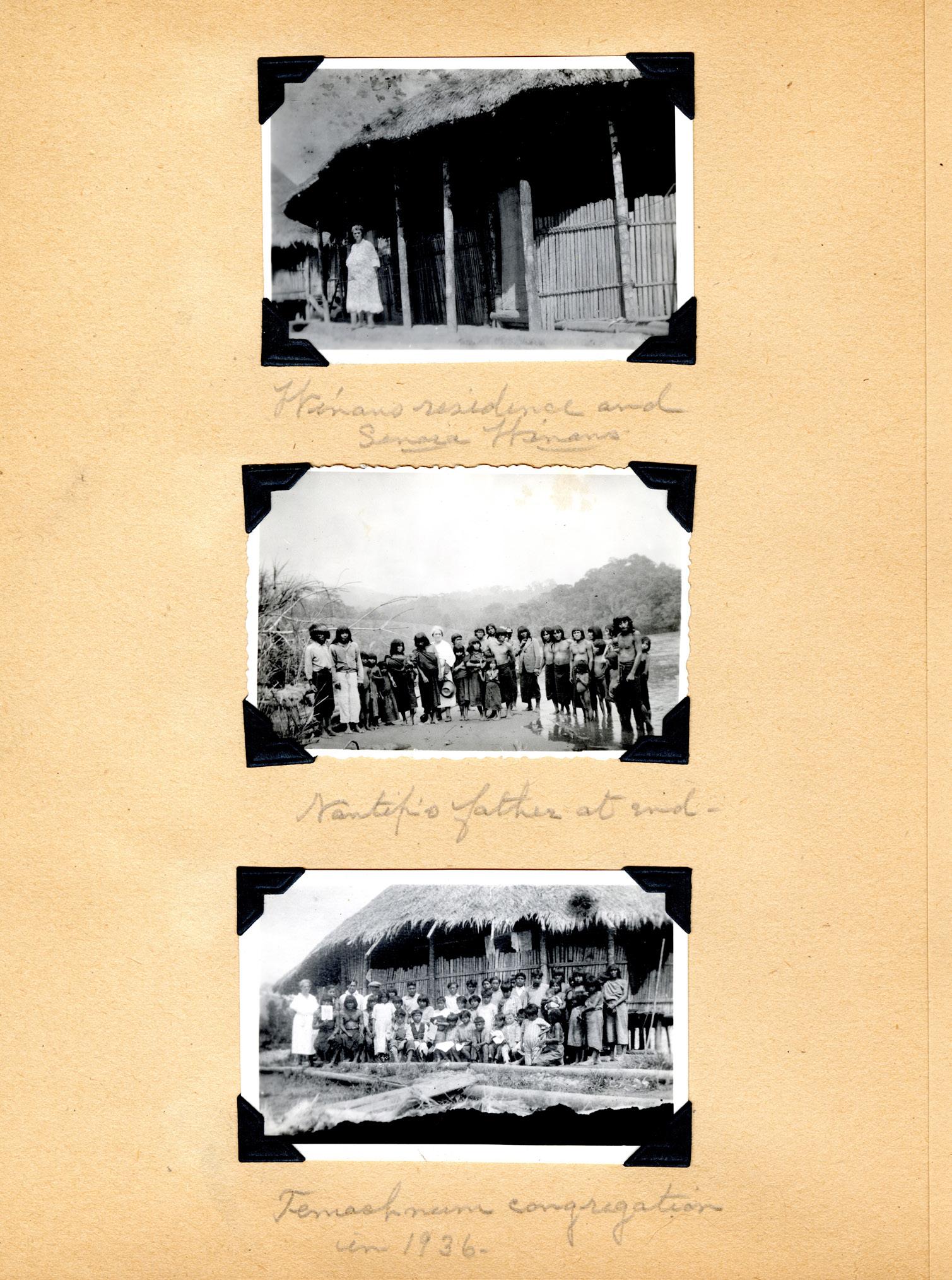
358 From the Archives: Amy Hinshaw and the History of Nazarene Missions in the Woman’s Missionary Society: Robert A. Danielson
394 Books Received
David F. Watson President and Publisher
John Ragsdale
Provost and Vice President of Academic Affairs
The Asbury Journal is a continuation of the Asbury Seminarian (1945-1985, vol. 1-40) and The Asbury Theological Journal (19862005, vol. 41-60). Articles in The Asbury Journal are indexed in The Christian Periodical Index and Religion Index One: Periodicals (RIO); book reviews are indexed in Index to Book Reviews in Religion (IBRR). Both RIO and IBRR are published by the American Theological Library Association, 5600 South Woodlawn Avenue, Chicago, IL 60637, and are available online through BRS Information Technologies and DIALOG Information Services. Articles starting with volume 43 are abstracted in Religious and Theological Abstracts and New Testament Abstracts. Volumes in microform of the Asbury Seminarian (vols. 1-40) and the Asbury Theological Journal (vols. 41-60) are available from University Microfilms International, 300 North Zeeb Road, Ann Arbor, Michigan 48106.
The Asbury Journal publishes scholarly essays and book reviews written from a Wesleyan perspective. The Journal’s authors and audience reflect the global reality of the Christian church, the holistic nature of Wesleyan thought, and the importance of both theory and practice in addressing the current issues of the day. Authors include Wesleyan scholars, scholars of Wesleyanism/Methodism, and scholars writing on issues of theological and theological education importance.
ISSN 1090-5642
Published in April and October
Articles and reviews may be copied for personal or classroom use. Permission to otherwise reprint essays and reviews must be granted permission by the editor and the author.
The Asbury Journal 81/1: 6-10
© 2026 Asbury Theological Seminary DOI: 10.7252/Journal.01.2026S.01
From the Editor
This issue seeks to embrace various voices from the margins of the church. Too often we live in the center of our tradition, and in the process, we can ignore listening to voices that are beyond that center- voices which we need to hear to see a fullness of God as reflected in the diversity present in the world.
The first article comes from the margins of time. Many here at Asbury Theological Seminary have heard of the name of E. Stanley Jones. But what does he have to say to us at Asbury today? This article is a republishing of an unpublished speech Jones gave on May 8, 1942. He speaks to us from 94 years ago. His subject is directed at us, the Christ of the Asbury Road. Known for his work The Christ of the Indian Road, Jones sought to put the Gospel message into a specific context. In this sermon, he sought to seek out the road Asbury itself has followed and still seeks to follow- a path of conversion and sanctification. But at the same time, Jones challenges Asbury to not only remain true to the spiritual ideas of entire sanctification, but to truly see it as “entire” stretching out into the areas of social justice and the conversion and sanctification of society and not just limit it to individual spiritual transformation.
The next three scholars speak from the margins geographically. Themshang Horam challenges us to think about intercultural hermeneutics with a method for reading scripture through the lens of the Naga people of India. He asks the question of what we can do in vastly different environments to help make scripture relevant. To do this he looks at Luke 5:1-11 and reads it through the eyes of Naga hunters as opposed to Galilean fishermen. Enolyne Lyngdoh came to Asbury as a visiting scholar from India and brings a Khasi tribal reading to Genesis 1:26-28. In this context, what does it mean to “rule” or “subdue” the earth? How might a tribal reading of this scripture inform the theological center, in which so many of us live? Olayinka John Akinola speaks from the Yoruba voices in Nigeria to bring a case study of how the Yoruba culture has been influenced by Christianity, but also how it has entered ways of understanding Christian teachings through its own
unique cultural lens especially through praise poetry. Akinola’s paper was part of the Advanced Research Program’s Interdisciplinary Colloquium held Friday, October 11, 2024, under the theme of Theology, Bible, and Human Cultures in a Changing World.
Three other scholars speak from the margins of history. Philip Hardt explores an early failed attempt by the Church in New York to deal with the problem of prostitution. He examines the various issues which led to its failure as the Church attempted to solve a key problem in society. Robert Danielson brings the marginalized voices close to home, with extensive research on the history of women at Asbury Theological Seminary. Rooted in its Holiness heritage, women were seen from the very beginning as people who could be filled and gifted by the Holy Spirit, but it took time for this theology to impact the institution in a culture which most often kept women on the margins. Three distinct generations of women have impacted the Seminary. The first emerging in the 1940s included Bettie Morrison, Daisy Dean Gray, Gaile Morris, and Ada B. Carroll. This generation took the Seminary to an amazing growth in women students by 1949. This work did not last, and by 1971, Asbury had hit a low point with only 2% of degree-seeking students being women. A second major change was generated by Evelyn Kuttler, JoAnne Lyons, Helen Musick, and Catherine Stonehouse. From their foundational work by 2005 there were 13 women on the faculty and 34% of the degree-seeking students were women. The current generation is making its mark, but the future is still unknown. With eight women on the faculty and about 40% of degree-seeking students being women, we need to make decisions about where women at Asbury Theological Seminary go from here. Nicholas M. Railton reflects on when Methodist students were discriminated at Oxford University in 1768, reminding us that even those in the theological center today were often on the margins at one point in time.
Rabbi David Zucker provides us with a new article from the Jewish margins, pointing us back to a little-known account in Old Testament scriptures about Eldad and Medad. These early figures from the story of Moses and the early formation of the Jewish people have been used by early Christians as an example of the work of the Holy Spirit in scripture. Bringing his insight from within Judaism as well as his interest in Jewish-Christian dialog, this article provides fascinating groundwork for those interested in scriptural accounts of God’s Spirit working among the people of God, but it
also demonstrates how rabbinic Judaism looks at scripture in a way which Christians can follow and understand.
J. Russell Frazier, out of Africa Nazarene University speaks from the theological margins as he examines and critiques works of Wesleyan theology from T.A. Noble, Dennis Kinlaw, Allen Coppedge, and William Ury. At least two of these names are well-known at Asbury with both Dennis Kinlaw and Allen Coppedge being connected to Asbury Theological Seminary and Asbury University. Listening to voices outside of our usual circles may be difficult at times, but the sign of good academics is the ability to take critique and work to refine and expand on ideas which may meet with scholarly critique. In this sense, The Asbury Journal encourages scholarly debate, and Frazier lays out some compelling ideas in his analysis.
Finally, in the From the Archives essay, Robert Danielson again explores the issue of women on the margins. In this case looking at a new collection in the Special Collections, material connected to the work of Amy Hinshaw, one of the earliest historians of mission in the Church of the Nazarene. Much of her work explored the individual lives of missionaries and sought to bring these stories to women in the Church of the Nazarene women’s study program of the 1920s and 1930s. Little is known about her personal life, but her influence on mission history has been profound, especially for understanding Holiness missions in one of the most important denominations of the Holiness Movement.
Listening to voices on the margins is never easy. This is partly because such voices often do not have the opportunity to be published and heard by those in the center. It is also because those in the center tend to dismiss or ignore voices from the margins. This is a problem because the Church itself needs to be attuned to other voices, because they may be prophetic voices, directing us to see and understand God in different ways and through different lenses. Whether those voices come from distant voices in time, or from remote geographical regions, from new explorations in history, or people raising key questions about theology, culture, and society, we need to be open to hearing and listening for where the Holy Spirit may be directing us. The scriptures remind us that the margins will become the center in God’s Kingdom. As the twenty-four elders sing to the Lamb in Revelation 5:9-10,
“You are worthy to take the scroll and to open its seals, because you were slain, and with your blood you purchased for God persons from every tribe and language and people and nation. You have made them to be a kingdom and priests to serve our God, And they will reign on earth.”
Robert Danielson Ph.D.
The Asbury Journal 81/1: 10-24
© 2026 Asbury Theological Seminary
DOI: 10.7252/Journal.01.2026S.02
E. Stanley Jones
The Christ of the Asbury Road
Abstract:
This is an unpublished sermon, given by E. Stanley Jones on May 8, 1942, at 11:00 am at a special assembly at Asbury College. The day was named E. Stanley Jones day by the administration, and the 1942 yearbook was dedicated to Dr. Jones, who was also a member of the Board of Trustees. Jones had been asked to adapt the idea of his most well-known book, The Christ of the Indian Road, to his experience and knowledge of Asbury in Wilmore, Kentucky. He provided several interesting points to help ground Asbury’s theological position of holiness and build on that as we move into the future. It is an insightful reminder of where Asbury has come from, as well as a reminder of the roots which have nourished both Asbury University and Asbury Theological Seminary for ministry in the future. The manuscript of this sermon was found while doing research in the Archives of Asbury Theological Seminary in the Papers of E. Stanley Jones.
Key Words: conversion, entire sanctification, social gospel, collective discipline, Christian life
E. Stanley Jones (Jan. 3, 1884 – Jan. 25, 1973) was an internationally known evangelist, missionary, and author connected with the Methodist Church. His early training was at Asbury College in Wilmore, Kentucky, and he remained closely connected with both Asbury College and Asbury Theological Seminary throughout his life. Jones’ work was focused on India and from his work there, he developed the Christian Ashram Movement which continues today. His papers are archived at Asbury Theological Seminary.
Introduction by Dr. Z. T. Johnson, President of Asbury College1
This has been a high day on our campus. It has been a high day because of this world citizen of Asbury College who has been with us. I felt this morning like I have felt every time I ever heard this man speak. I have never had this thought, “Lord, help me to be like Stanley Jones,” but I have never heard him speak but what I have had the impression, “Lord, help me to be like Stanley Jones’ Christ,” which to me is the highest compliment that can be paid any speaker.
Introduction by Dr. Jones
I need not tell you what you have told yourselves a hundred times since the passing of Dr. Morrison, that one of the great men of the religious life of America has passed from us - the last of the old Southern orators.2 There will never be another Southern orator like him, I suppose. It was in his blood, in his frame, in his make-up. He was set on fire by the experience of the Spirit of God and therefore for eighty-five years he wrote and taught. When he fell at last there was a great vacancy upon the horizon, as if a great oak tree had gone. Yet, as I stood beside his grave this afternoon with Sister Morrison, we prayed that the mantle of his life might fall upon some of the rest of us. We will not have his gift of oratory, and perhaps the tastes of the age change, but that single-minded fervor, that one-pointedness of mind, that one-holding to a goal through thick and thin, where a man could say “this one thing I do”, that passion to lead men to Christ, can fall upon us.
I believe it was most fitting that he be buried here in Wilmore. It is very sacred ground now and becoming more sacred all the time as the great ones fall and are buried. We take the torch from their hands and march on. The first bit of poetry I ever wrote I found on a tombstone over there. I hunted it up today. It was obliterated by the knotty tooth of time. It was to Brother Sparks who was going to Argentina as a missionary and died while I was here. I wrote these lines:
Noble missionary His work was done Although the hour of setting sun Came early, All unseen Elijah-like May his mantle fall. May you, my brother,
Heed his call
To far-off Argentine.
That same thought came to me as I thought of this man who went up in a chariot - the thought that God would give his mantle to those who are worthy. I am grateful beyond words that he lived and that he died. When I heard he was dead I said, “This is very beautiful.” I am glad he did not linger. I am glad he just dropped his head over on his shoulder and died that way. Better that way than lingering on. So, it was not death at all. It was a beautiful translation, and we are the richer for his having lived. Asbury owes a deep debt of gratitude to this noble man of God.
The Christ of the Asbury Road
When I was thinking of coming here, your president wrote me and said, “Will you speak to us on the Christ of the Asbury Road?” At first, I said, “Whimsical”. Yet when I thought more about it, I said, “Quite befitting”. The more I thought about it the more I was convinced that there is a Christ of the Asbury Road The title is a modification of the title of my first book, The Christ of the Indian Road. That title was taken from the statement of a Hindu who reacted against the Western Christ dressed in Western habiliments. He said, “The Christ who enters our lowly cottages, who walks with our poor, who loves us because we are people - I can love and follow that Christ, the Christ of the Indian Road.” Each nation has something to contribute to the interpretation of the Son of Man and brings to the interpretation its own history and through those thought-forms and attitudes gives us some fresh facet of life, something that is universal, a particular manifestation of a universal fact. Some of these days I think maybe I will write, if I can, a “Christ of the American Road” interpreted through American life.3 What contribution has America brought to this universal fact? Anything particular or peculiar?
Jesus is universal - the Son of man. It will take the sons of men to really interpret the Son of man. And therefore, every life, every civilization, that is caught up with the purposes of God becomes a fresh interpretation of an eternal fact. We must remember, however, that the interpretation is not the fact, and the fact is not the interpretation. None of us have the Truth. Christ is the Truth. He is the incarnate Truth, and much that I hold as Truth is Truth about the Truth, more or less approximating it. Now, if we could
hold that in mind it would take away a great deal of our dogmatisms and rigidities and we would be open on the side of correction. We would be unlike the Scotch divine who said, “God grant that I may be right, because I never change.” He was too set! There is not a single person here tonight who has the Truth. All we have is more or less close approximations of that Truth. If that be true, I need the cross-fertilization of your Truth to correct, to corroborate, and to compliment my partial views of Truth. The map is not the country, and the map has to be constantly corrected and corroborated by the country. The word is not the fact. Our words have to be constantly corrected by the facts.
There is a group of psychologists who emphasize word-fact relationships. They say our words get out of alignment. For instance, when you are talking about a man, what man are you talking about? The man ten years ago, five years ago, yesterday, or today? Man changes. Men are the most changeable things in the world. Then when you talk about a man, what man are you talking about? Date your statement. Ten years ago, five years ago, yesterday, or today. That would constantly bring up your statements and correct them as to date. Until we can get that, the idea of a Christ of the Asbury Road sounds absurd.
There is a particular contribution that Asbury College, and the interpretation we have here, can make. I think it has permanent worth. I do not say it because I happen to be an alumnus. If I were not, I think I could see that there is something distinctive, peculiar, and worthwhile. And yet something, too, that needs correction, as everyone’s conceptions of Christ need correction constantly and continuously. Somebody has defined education as “change.” The moment you cease to change you cease to be an educated person. I heard of one student who, when he left the college commencement, sent this telegram to his family: “Educated.” The thing I am grateful to Asbury for is that they started me on the road to education. I do not feel I am an educated person. I would like to be. I threatened to quit a number of times and go off and study for a year. There is just an intellectual passion to know!
There is a possibility that there is a distinctive contribution that Asbury College could give to our world. What would it be? I think the Asbury Road runs into the road that leads down Aldersgate Street where Wesley had his heart “strangely warmed” and passed by grace through faith into an experience of Christ and believed that he then and there was a new man, regenerated by the grace and power of God. The Asbury Road runs
straight into that. Also, the further expression that Wesley gave of entire sanctification.
If I were to sum up the two great things distinctive in that Wesleyan movement, I would say they are (1) experience and (2) expression. The heart being strangely warmed and then opening the arms and saying, “the world is my parish.” The experience and the expression of the experience are the two heart-beats of this movement. I believe those two things are completely necessary. It is a law of the mind that that which is not expressed dies. There is a full experience and full expression on a world scale. These are the alternate beats of the heart of Methodism.
When I look at it more closely, I find that that experience comes in two great stages: conversion or the new birth, and entire sanctification or cleansing of the heart, and filling of the Spirit. These two great crises are the outstanding crises of the Christian life. These experiences I have felt free to express in any words I could lay hold on that would show the reality. I take all the words I can to express the word which is beyond my words. But do we have to modify the fact of our conversion? Has it been outmoded? On the contrary, the facts of life have taken people by the hand and said, “You must be born again.” I was talking in a state university recently, and the head of the medical college came up to me and said, “You are right. If you ministers can’t produce conversion we doctors have to, because life demands it.” They are finding that you have to shift the basis of your life to something beyond yourself in order to have mental, spiritual, physical and sociological health.
Professor Kilpatrick of Columbia University said, “The greatest discovery of the modern age is, ‘He that saveth his life shall lose it and he that loseth his life’ shall find it coming back again.” No, Professor Kilpatrick, that is not a discovery. It is a re-discovery. Center yourself on yourself and you won’t like yourself. Do as you like and you won’t like what you do. Express yourself and you won’t like the self you express. That works with mathematical precision. You have to lose your life to find it. Conversion is an experience which, gradually or suddenly, you shift the basis of your life from self-will to God’s will, from the Kingdom of self to the Kingdom of God. I believe that is absolutely sound.
A management engineer came to me some time ago. He is a successful man taking hold of sick businesses and putting them on their feet. He said to me, “You know, invariably, in 95% of the cases, the difficulties are not in the business but in the persons concerned, who get snarled up in
their own lives. They project those snarls out into the business. Then they can’t cooperate with anybody. The spirit of cooperation gets sick. I can’t get that business straightened out unless I get the people straightened out. So, we sit down, sometimes until midnight, and talk things over. They ask me, ‘How do you get unsnarled? straightened out on the inside?’ Before we know what has happened, we are talking religion, conversion, and the new birth. Until midnight we sit with those hard-headed businessmen who want their lives unsnarled, and the only open door we can see is conversion. How did they get to that place? Business took them by the hand and led them out.” If life doesn’t get straightened out that way, it doesn’t get straightened out! There is no doubt that increasingly there will be a demand for conversion from the standpoint of mere psychological help.
Dr. Henry Link, psychologist, gave up Christianity as outmoded and began to straighten people out psychologically. He found he couldn’t unless he gave them something beyond themselves. The first thing he knew he was talking God, putting Christian content into what he said. Before he knew what had happened, he talked himself back into being a Christian.
Srinavasa Shastri, one of India’s greatest Hindus next after Mahatma Ghandi, said, “We always know where Stanley Jones is coming out. If he begins at the binomial theory, he ends up with conversion.” I said to him; “I’m awfully glad you said that. I find that is where life comes out. It takes me by the hand and brings me out to that place.” I come back to you students and ask you to preach this with no stammering of the tongue and no hesitation, utterly and completely, and if you hold your peace then the stones- the hard, bare facts of life- will cry out the necessity of conversion. It is completely sound.
That experience which this institution and other institutions and movements have called entire sanctification. I believe that, too, is sound. When I deal with people in India, I find that the missionaries usually come out to India on the wave of consecration, but it exhausts itself in about a year, against the hard facts of pagan life. I have said to these young missionaries, “This is the great crisis moment of your life. India begins to find you to your depths. Either you will sink back into mediocrity or go on to a full surrender to God and find resources in the cleansing and purifying of God in your life. Then you will master things and they won’t master you; you will sit on top, and they won’t sit on top of you.” I have had to preach it. Necessity has demanded it. It may be a spiritual luxury to you but to us it is a minimum necessity, up against pagan life.
I have dealt with people here in America this year and a half from the heads of great universities on down. In our National Christian Mission we had said we were going to everybody from the President to the humblest citizen, from the big businessman to the small shop keeper, from the society woman to the shop girl, from the college president to the newest freshman, and we were going to preach tor a verdict and ask for conversion. May I say that I made my appeal personally to the President of the United States. When I went to the President I said, “Mr. President, we have fulfilled the rest of the program except the first item - the President of the United States, now we have come to you. We want you to get this and give it to your people. We would like you to get this down in your heart.”
The president of a great university (one of the largest) recently said to me, “Before you leave my office, pray for me,” and I bowed in prayer. What did he need? Exactly what we are talking about - sanctification. He needed to surrender fears and conflicts in his life and find a deeper cleansing and unifying.
I find when I sit down with people, ministers and others, that I can’t get away from talking in terms of a complete surrender, and a cleansing and unifying of their inner nature which I cannot call less than entire. How do I come to that place? The facts drive me. I think modern psychology corroborates this. Not that I want you to go around picking up the crumbs that fall from the table of psychology. We are not dependent on such findings. But it is a good thing to see that all life brings us out as through a funnel to the place where we believe.
Life is a glorious adventure. It is one thing after another. I love to see the corroboration of the central hypotheses of my life. Psychology tells us there are two minds - the conscious and the sub-conscious. In conversion there is built up a love and loyalty in the conscious mind, and you accept Christ as Lord and Saviour. You are saved through grace. But if your experience is like mine, after the first rapturous months when it seems the sky is going to be cloudless forever, clouds begin to come over. It was then I found a conflict within me. I found there was something in the “cellar” I had not counted on. As I look back, I think I see what happened. Into the conscious mind was introduced a new life, a new love, a new loyalty. But there is also a sub-conscious mind which is the residing place of the three driving instincts - self, sex, and the herd, the herd being the social instinct. These three instincts reside in the sub-conscious mind and drive for completion aside from the moralities built up in the conscious
mind. These instincts have come down from a long racial history because men have lived in evil and have come down with unnatural bents toward evil, for God made us naturally pure. But we have lived against ourselves. In conversion, the conscious mind is converted but the sub-conscious mind does not accept it. These urges drive for completion. Hence, if you are like I was, you are puzzled. I said, does salvation extend to the sub-conscious mind? Then I turned to the New Testament to find whether anything there covered this, and I found, to my astonishment, that the teaching concerning the Holy Spirit covered that entirely. The area of the work of the Holy Spirit is largely, if not entirely, in the sub-conscious mind. He works at depths which you and I cannot work; he cleanses where we cannot reach. If we would surrender everything (all we know and all we do not know, which includes the sub-conscious mind), then the conscious mind and the subconscious are fused into a living unity and will beat out music faster than before. I believe that Pentecost provides for the unifying of the conscious and sub-conscious minds. Psychologists tell us that unless these two minds are working toward a common purpose there is an inner conflict, and you don’t know what is the matter with you. As long as there is conflict, you are not the kind of person you ought to be. You are wasting your energy in an inner civil strife. When you ought to have a heart leisure from yourself that you might sympathize with other people, you are having an inner struggle. I am persuaded, therefore, that the teachings we have been given here concerning the two great outstanding works of grace are essentially sound. As I look back across the years when I was here, I can remember a number of mistaken notes but there was an essential honesty, an essential soundness in the religious life of this community. I look back and see things that I could criticize in the light of fuller development, but I say to myself that was an essentially sound religious group. They may have been mistaken here and there, and there may have been weaknesses of human life here and there, but it was an essentially sound and cleansed type of religious life. I am still convinced of that.
I believe, therefore, that the Christ of the Asbury Road, interpreting experience in terms of conversion and sanctification, is essentially a sound movement and ought to survive. That is the reason why I have been identified with it and trust I may continue to be. I think we have something that doesn’t need to be essentially changed. It has to be constantly brought into line with reality, but the essential soundness is there.
Now, having said that, I want to say one or two things that I do think have to be changed in the expression of that life, as I see it. It would be easy simply to say these things and pass on, but I would be dishonest. I do have certain fundamental criticisms. I have learned in group loyalty not to have any inner criticism of anybody that I do not express. In our group in India, we pledged not to have any inner criticisms so if there were no outer criticisms there were no inner. If you do not hear any, you know that Stanley Jones hasn’t any because, as far as possible, I want to live a life of complete honesty.
What I would add after these years, is this:
As you know, I have had to meet truth more definitely than I did while here. I went out and simply had a glorious experience of God, for which I was grateful. But in a little while I had to relate my experience to outer things to which I had not related myself in college. For a time, my back was to the wall. When I got to India, I had not related my faith to the other non-Christian faiths and I was mentally not sure, though experimentally I was. I was nervous, trying to hold this system together. I was afraid if anybody criticized it that it might fall to pieces. Then there came a day when I said, “I am going to let go and see where Truth leads me”, and I inwardly let go. I shall never forget when I did so, I was letting go of fixed securities, and I turned inwardly pale. It was an open-ended venture into Truth wherever it would lead me. The weeks, the months, several years, went by. Then I took stock of what had happened. I found I had come out not six inches from where I had gone in, but now these truths which I had held had come back to me, no longer rigidly and nervously held, but held because they held me! I found I had essentially changed in no great degree except that I had found mental freedom. I was no longer afraid to have men criticize. If what I say is reality nothing can hurt it. It will be self-vindictive. I would speak to Christians in India for an hour, and they would usually cross-examine me for six hours. Sometimes as many as two hundred lawyers would pick me and my message to pieces, and I would let them! After one meeting of that kind, a missionary said to me, “I am physically exhausted. I didn’t know what they were going to ask you next and what you would answer, so I’ve been up in the gallery holding on to the balcony with all my might for two solid hours.” I said, “Sister, I was having the time of my life. What can they say if it is reality? You can’t overthrow reality. You might as well organize a society for the protection of the sun because someone throws mud at it. He is his own protection. I don’t have to protect
Christ. If He were merely held up by my words, He would collapse.” At the close of this cross-examination one of the leading lawyers arose and said, “I think I can answer this man’s answers, but what I can’t answer is his quiet confidence. He really believes it!” I said, “Yes, I do.”
One night after I had been picked to pieces, a man (one of those dear nervous fellows who feels that if he does not hold the thing together it will go to pieces) said, “I can’t stand to have the message torn to pieces.” I said, “Did he tear it to pieces? I thought it lived on in spite of. This is not a hot house plant we have to be afraid to handle. It is the eternal Truth of an eternal God.”
May I tell you what I should like to see added to this interpretation of the Christ of the Asbury Road? You stop short on the word “entire.” It is not entire enough. You have limited it to a very definitely personal application. It lacks a great social application. I know some people have nervous chills going up and down their backs when I talk like that. I’m going to talk about it anyhow. I’m not going to think one thing and say another.
Life is one. You can’t tell where the individual ends and the social begins. Someone has asked what would happen if all the babies in England and France were interchanged between those two countries. Why, the French babies would grow up into perfectly good Englishmen, don’t you know. And the English babies would grow up into perfectly good Frenchmen, with shrugged shoulders and all that. The things you think are born in them are impressed early in life and not born in them at all. But social heredity has a terrific power to convert the person under it, for good or ill. Am I interested then in getting that social heredity changed so that when it comes upon an individual it will help change him in the right direction? If not, then I am not interested in conversion, because I am not interested in an individual gospel or a social gospel. An individual gospel without a social gospel is a soul without a body. A social gospel without an individual gospel is a body without a soul. One is a ghost and the other a corpse. I don’t want one of them. I want both. I want a gospel that comprehends the whole of life, that changes the collective will. Did not Jesus appeal to the collective will of people? He said, “The Kingdom shall be taken away from you and given to a nation bringing forth the fruits thereof.” There is such a thing as an evil soul, and there is such a thing as an evil system. Evil can be in the individual will; it can also be in the collective will.
I would make the sanctification entire. I am not disloyal to this principal. I am simply applying it to wider areas of life. Not doing that, has
made for contradictions in the movement. A man could be personally whole but his social relationships and his attitudes toward money be abominable. His whole life has not been Christianized. His religious experience has just been personal and therefore great contradictions exist in his life. What happens when the Spirit of the Lord comes upon people? A great many would say, “The Spirit of the Lord is upon me, Hallelujah! I am so happy. By and by I want to go to Heaven.” Now I believe in saying “Hallelujah.” We say it too little. I seldom hear it. I am hearing it a little less than I ought. I love to hear it. It is glorious. I believe in getting happy. I believe in going to Heaven; but, my brother, if that is the only program that Christianity has for the redemption of the world, it is not big enough. Listen to what Jesus said: “The Spirit of the Lord God is upon me: because the Lord hath anointed me to preach good tidings unto the meek: he hath sent me to bind up the broken-hearted, to proclaim liberty to the captives, and the opening of the prison to them that are bound; to proclaim the acceptable year of the Lord, and the day of vengeance of our God; to comfort all that mourn.” What did the Spirit of God do when it came upon Jesus? It touched the question of the economic, the moral, the spiritual, and the intellectual, and not simply the saving of the soul. Our sanctification must be more entire. Don’t be afraid that the Spirit of God will lead you into areas where you ought not go.
Then, take Pentecost, in all the interpretations that I heard here, for which I am deeply grateful. We always stop short of the full meaning of Pentecost. I do not believe I ever heard, while here, a single sermon on those passages that relate to Pentecost where it says the disciples were of one mind and soul and “distribution was made unto every man according as he had need.” That was looked upon as something just put in the Bible. But I am persuaded that the disciples had illumination, deep and fundamental. When they found the experience of God that brought them into a brotherhood, they said, “We can’t stop with the spiritual.” And so, the material was gathered up, and distribution was made according to each one’s necessity, and each gave back to the collective whole as he was able. If a man would not work, neither should he eat. If he did not give according to his ability, neither should he receive according to his need. Those were the principles of the early Christian church. I find those social implications neglected in our movement today, and it is the poorer because of it.
Do you need something to control the distribution of the economic goods? On what basis are you going to control it? On the Christian basis, according to need, or the pagan basis according to greed? I believe that
we must say that distribution of the economic goods came out of an experience of God. It was rooted not in view of the coming of Christ but in an experience of Pentecost which was an abiding thing. They said, “We are one in spiritual things, and we will be one in material things.” Why should we be afraid of that?
A friend of mine has charge of problem children of a certain city. She gathers these children up from all the schools into this one school. The group represented in the city schools are: 25% below the poverty line, 25% who are rich, and 50% of those who have not too much or too little. She said the problem children come out of those below the poverty line and the over-privileged. The 50% who have not too much, or too little are the normally adjusted children of America. If you have too much you make problem children. If you have enough it produces the kind of children you ought to have. I commend that to you as a study. If someone says “Socialism” don’t be afraid of it. Andrew Jackson had placed on his coins: “No labor, no food.” I would make everybody work. No parasites. Everybody contributing. If you study what came out of Pentecost, you will say that God is God of the economic and material as well as the spiritual. He is not a half God reigning over a half kingdom.
In our holiness movement we have had a great many people who were very holy personally, but when it came to money, they were not averse to getting money in all the ways they could. We have to Christianize the whole business. The classes have to think too much about money: those who have too little and those who have too much: the poor who have to think about the next meal, and the rich who have to think about the last one. I need what I need and no more. Therefore, I am going to keep it down to my needs. That will free me then for the things that I need to do. Now I commend that to you for your study. And if you do that, I believe you could step right straight out in the religious life of this nation, from being a little eddy around the edges. You’ve got the thing that men want! Something that will gather the whole of life into a consecration and sanctification of God under the direction of the Spirit of God. Why should we pull back and be afraid of that?
Furthermore, I find that the interpretation of the Christ of the Asbury Road lacks emphasis upon growth. We have insisted upon crisis so much and said that sanctification does not come from growth but crisis, that we have thrown out the baby with the bath water, and we have to go out and get that baby and bring it in. We need to grow! I do not believe we
grow into these experiences. I believe most of us come in through crises, but we have had a lot of casualties because we have not taught people the techniques of growing. We haven’t nurtured them. Our altars are filled with people who backslide between meetings. We ought to have techniques of development and develop people after they are converted and sanctified. The art of teaching them how to grow, is what we need. Unless we do that, we are going to be a weak movement.
May I suggest, there has to be a greater emphasis upon corporate guidance. We have been individualists, and now the totalitarians are breaking our molds and making us think in terms of the total concept- the total will of the Kingdom. It reaches down into the inmost thought and then goes to the utmost realm of human society to cleanse and purify. We ought to develop more of collective guidance in the expression of this Christ of the Asbury Road. For many years I lacked that. I was an individualist, a lone wolf, traveling in evangelism, telling other people what to do. It is very hard to be an evangelist and a Christian. I said that one day in India, through an interpreter. I said, “To be an evangelist and a Christian is very difficult. You get cock-sure, wordy, and censorious, and take for granted you are living these things. You are saying words out of which the content has often dropped.” I said, “Yes, and to be a minister or a missionary and to be a Christian is difficult. To be a bishop and be a Christian is difficult!” My interpreter put it this way: “To be an evangelist and a Christian is difficult. But to be a missionary or a bishop and a Christian is impossible!”
I believe that every man who teaches other men should be in an intimate group where the group tells him how to be at his best, and corrects him, and they get corporate guidance. For the last twelve years I have subjected myself to group discipline where the weakest helps the strongest, where the newest convert is free to tell everyone what he feels. One convert of a few months said to me, “I notice when we give you a hard question you take us off to something very interesting. Is that honest?” I now say, “I don’t know.” Some of us have never learned to say it. We are always right and hence others are always wrong.
I don’t believe I ever heard a sermon on: “It seemed good to the Holy Ghost and to us” where a group surrenders itself to God and lets God guide it. We get an idea that God said this to me. If He said it to you, He would also say it to other people. You and I have to live out our lives in group and corporate life and that group correction would be helpful.
One other thing I would correct if I could. We criticize each other too much within our movement. We say we are doing it on principle and really down underneath we are dealing in personalities. I wish we would never criticize any man unless we go to him and tell him. We have a motto in our Ashram: “Here we enter a fellowship; sometimes we will agree to differ; always we will resolve to love and unite to serve.” Critics are human moths that eat an honest name and live by the weaknesses of other people, saying, “Look how weak he is,” meaning, “Look how strong I am.” I would suggest we have greater constructive attitudes toward each other. If we say anything, say it to the person. Sit down and try to help him through. Some people think because I can stand criticism I must have a very thick skin. When I first went to India, I would stay in the cabin of our boat rather than go out on the deck, lest someone say something to me. Now I almost wonder if I do not have a rhinoceros hide. People say because I can smile and stand criticism I must have a thick skin. On the contrary!
I find myself doing two things when criticism comes: first, I ask myself, “Is it true?” Suppose it is wrong and unjust. I have decided I would not allow it to change my attitude toward the critics. As far as I know I have no enemies because I have no enmities. They are just gone! The other day I was riding in a car when the front seat began to slide. The husband said to the wife at the back, “Please kick me forward.” “Good!” I said, “If life has criticisms, I shall make it send me forward. I shall give it direction.” Jesus said, “When they kick you out of one city go to the next.” I would have thought he would say “Go home”. Oh no! Have them kick you in the direction in which you are going. Take criticism and give it but give it to the person involved.
My last word. I love you. I love this movement. I want you to go through a deeper cleansing and purifying. If what I have said is wrong, forget it. If true, then God plant it in your hearts. One thing I want to say in appreciation is this. In the interpretation of the Christ of the Asbury Road there is a freedom here from inhibitions. I see so many people in other institutions tied up. They never get loose, free, and relaxed. Asbury College encourages people to be free. I came to Asbury rather bound. I had come from Baltimore. When I heard people shout, I said, “I shall never do that!!” I was too genteel. Then one day I was swept off my feet and some of you will remember what happened. For three or four days I could not do anything but. The whole thing was swept by the power of God. I saw people jump that high, and I did it too, and then I said, “What’s the use. I have ruined
my reputation. It is gone, so here goes, I am free.” Then I wasn’t nervously holding my reputation anymore. It was gone. But the next night God put His hand on me so quietly that I couldn’t talk above a whisper because of the Spirit of God on me. I said, “This is the authentic Spirit of God, who can loosen us in a spirit of abandon and then quiet us so it would almost be sacrilege to talk above a whisper.” God was both in the deep quietness and in the manifestation of the storm.
I don’t want you to lose that glow. If God wants you to be quiet, be quiet, but if He wants you to be more demonstrative, be demonstrative. Be free. Be yourself. Let God pull out the stops and play you all over. Don’t be bound up with inhibitions. God grant that if any spark of divine grace has been kindled in this meeting you will fan it into a flame.
The verse that has been running through my mind today, I would like to pass on to you in closing. It is from Moffatt’s translation. “I bear branded in my body the marks of the Lord Jesus.” Some of us have them just painted on, not in the flesh and blood. I said, “Oh God, brand the marks of the Lord Jesus in me.” What I would like to see is something that brands you and puts a stamp on you, burns it into your flesh, your nerves, your tissues and brain cells, and then it won’t come off in a moment. I want Asbury to put a stamp on you, and I want Asbury’s Christ to put a deeper stamp. I want this Christ to stamp His own Being into your being until people shall say, “Oh, I see, I see.” Then you will be an interpreter of the Christ of the Asbury Road. It is a great heritage. I commission you to carry it out in the name of the Lord Jesus.
End Notes:
1 Zachary Taylor Jonhson was born June 18, 1897, in Athens, Georgia and attended Asbury College as a student. He served as Executive Vice President of Asbury College from 1935-1940 under Dr. H.C. Morrison. He was the longest serving president of Asbury College, running the institution from 1940 till 1966. He died in Lexington, Kentucky on May 30, 1981.
2 Henry Clay Morrison (Mar. 10, 1857 – Mar. 24, 1942) was a prominent President of Asbury College and founder and first President of Asbury Theological Seminary. This sermon was given about two months after the death of this influential figure who is buried in Wilmore, Kentucky.
3 Jones did write this book a couple years after this sermon. The Christ of the American Road was published in 1944.
The Asbury Journal 81/1: 25-53
© 2026 Asbury Theological Seminary DOI: 10.7252/Journal.01.20265S.03
Themshang Horam
Hunters of Men: A Tribal Reading of the Missiological Motif in Luke 5:1-11
Abstract: This article presents an intercultural and contextual reading of Luke 5:1–11 from the perspective of the Naga tribes of Northeast India, proposing a reinterpretation of the traditional “fishers of men” motif as “hunters of men.” Grounded in the author’s cultural context—where, owing to the absence of large water bodies, fishing serves as a secondary means of subsistence while hunting remains central to social and spiritual life— this study contends that biblical metaphors risk losing their theological depth and communicative efficacy when removed from the ecological and cultural frameworks of the receiving community. Through exegetical analysis and intercultural hermeneutics, the paper demonstrates that Luke’s use of the verb ζωγρέω (“to catch alive”) aligns more closely with the Naga worldview of hunting and capturing life for preservation rather than destruction. The recontextualized reading bridges biblical theology and tribal tradition, recasting discipleship as a communal, participatory, and holistic mission—one that encompasses evangelism, discipleship, and the transformation of the whole person and community. The study concludes that contextualizing scripture within indigenous semiotics not only deepens theological understanding but also empowers local churches, such as the Naga Baptist community, to embody the gospel meaningfully within their cultural frameworks.
Key Words: Nagas, India, intercultural hermeneutics, contextual theology, exegesis
Themshang Horam is a PhD candidate in Historical Theological Studies at Asbury Theological Seminary, Wilmore, Kentucky. He hails from Manipur and belongs to the Tangkhul Naga tribe, one of the indigenous communities of Northeastern India.
Introduction1
Growing up in a remote, landlocked, and hilly region of Northeast India, my earliest encounters with biblical narratives were often filtered through a cultural lens vastly different from the contexts assumed in many scriptural metaphors. As a child who had never left my village—never seen a boat, nor witnessed fishing with nets on open waters—the call of Jesus to his disciples to become “fishers of men” (Luke 5:10) seemed foreign and, at times, perplexing. My only reference for fishing was the traditional, small-scale practices of my community: fishing in shallow streams and rivulets using locally adapted tools such as knives, small harpoons, small fishing nets, sieves, or organic substances like herbal roots and leaves that are pounded and soaked to temporarily stun fish. With no exposure to the maritime world of the Gospels, I initially imagined that the call to be “fishers of men” might involve poisoning the water, reflecting the only method I knew.
This childhood misunderstanding, while naïve, underscores a broader hermeneutical concern: when scriptural metaphors are communicated without attention to local cultural and ecological contexts, they risk misinterpretation or even alienation. Many listeners—like my younger self—require careful contextual explanation to grasp the theological intent embedded in such metaphors. This reveals the critical need for culturally grounded hermeneutics that read scripture from within the lived sociocultural and religious realities of local communities. Engaging scripture through these lenses not only uncovers the kernel of the gospel in a way that is meaningful to indigenous audiences but also affirms their capacity to interpret and embody biblical truths in contextually relevant ways.
This article seeks to contribute to the development of such a contextual hermeneutic by offering an intercultural reading of Luke 5:1–11 from a tribal perspective, specifically within the Naga context of Northeast India. It begins by establishing the cultural framework that informs this re-reading, followed by the articulation of a theoretical model for intercultural exegesis. Central to this approach is the reframing of the missiological motif of discipleship—not as a call to be “fishers of men,” but as a culturally resonant call to become “hunters of men.” The article then presents interpretive insights from this recontextualized reading of the pericope and concludes by exploring its missiological implications for the
construction of a biblically grounded theology of mission among the Naga Baptist churches.
The Cultural Context: The Nagas
The Nagas are a conglomerate group of people comprising more than sixty different ethnic tribes belonging to the mongoloid racial group.2 They are quintessentially a hill people dwelling in the Northeastern Indian states of Nagaland, Assam, Arunachal Pradesh, Manipur, and in the Naga Self-Administered Zone (SAZ) in the Sagaing region in the Northwestern part of Myanmar.3 Their way of life, religion, and worldview are inseparably tied to nature—seeing, interpreting, and assigning meanings within the spatial frame of humanity and creation, and the temporal cycles of the four seasons of the year. Each tribe has its own distinct identity,4 but shares underlying cultural essentials, such as housing patterns, administration styles, the existence of cultural institutions like morungs,5 headhunting practices, food habits, and tradition that unite all Nagas as one people.6 Their distinct way of life, shaped by their social, cultural, and religious worldviews, merits a rereading of the scripture from their own experience.
Intercultural Reading as a Hermeneutical Paradigm
The semiotics of our culture indubitably shape our reading and interpretation of scripture. The cultural lens that each of us wears determines the meaning of the text, which in turn influences our faith. Lalsangkima Pachuau accurately remarked that: “Thus, our cultural presuppositions also direct the trajectory of our faith.”7 Further, he commented that:
Every interpreter should admit that we pick and choose texts, ignoring things we consider irrelevant or hard to understand. Our contexts—in terms of space, time, and the worldviews they produce—form us into who, what, and how we are, and we operate accordingly. Thus, we can only understand the gospel in and through our culture.8
While Pachuau is partially right in pointing out that we embrace concepts and meanings that make sense and have value in our socio-cultural contexts, but disregard messages that we cannot make sense of, however, it should also be noted that unintelligible messages and meanings can be imposed upon the receiving culture as having a divine mandate. For example, among the Tangkhul Nagas, the existence of sheep as domesticated
animals was not known before the coming of Christianity. So, when Christ the good Shepherd was preached (Jn. 10:11, 14-16), many people at that time couldn’t fully comprehend the extent of the metaphor. It took years of preaching and theologizing to make sense of the concept of sheep as the members and the good Shepherd as Christ. Then the question arises— if the gospel of Jesus Christ is good news for all cultures, should it not make sense to the culture in which it is preached? For example, what does it mean to be a good shepherd in a culture where no one has ever seen a sheep in their life? Such challenges have led the church to explore alternative hermeneutical paradigms in its effort to effectively engage with the new worldviews it has encountered, and this paper itself is an attempt to explore such alternatives. One significant outcome of such explorations is the development of intercultural readings9 of the scripture, which facilitates interaction between the text, context, and the indigenous worldview through the lived sociocultural experience and the semiotics embedded within the culture. An intercultural reading enables the scripture to engage with the semiotics embedded within the culture, thus allowing the indigenous people to understand the meaning of the text within their own cultural context. Such an approach recognizes the crucial role of cultural context and its diverse perspectives in interpreting scripture, specifically in the context of the Nagas.
Hans de Wit wrote, “the concept intercultural underlines that we intend to go toward exchange, confrontation, [and] interaction”10 between the texts, para texts, and contexts of the scripture within indigenous cultural contexts. He then defined intercultural hermeneutics as a process of interacting with the biblical texts to “describe what happens when interpretation of Bible texts takes place within the framework of intercultural dialogue.”11 In other words, the interaction of gospel and culture must be allowed to effectively convey the message of the gospel that was encoded within a particular Jewish cultural context. It must be decoded using the semiotics of the receiving culture to make sense and construct intelligible meanings. So, the term “intercultural” then distinctly conveys the idea that we allow the message of the gospel to dialogue, interact, and allow exchange of meanings and ideas within the interacting culture.12 To guide our intercultural reading of the selected pericope, it is essential to exegetically investigate the meaning of the text within its original cultural setting. Accordingly, we shall examine Luke 5:1-11.
Exegetical Analysis of Luke 5:1-11
As part of the exegetical analysis, it is pertinent to briefly establish the literary context and structure of the pericope. I shall first situate the pericope within the larger literary unit, discuss its structure, and then exegetically analyze the passage.
Literary Context
Luke 5:1-11 is a part of the larger literary unit beginning at 4:14 and ending at 9:50. Scholars like Joel B. Green, Mikeal C. Parsons and Darrell L. Bock place the pericope (Luke 5:1-11) within the large literary context of Luke 4:14 – 9:50, arguing that the events recorded in the Gospel of Luke within the specified literary context are accounts of Jesus’ ministries that took place in the region of Galilee.13 However, others like Heinz Schürmann, Wolfgang Wiefel, and John Nolland hold contrary opinions, arguing that the Galilean ministry of Jesus begins at Luke 4:31, not at 4:14, hence, the literary context of Luke 5:1-11, according to these scholars, is from 4:31-9:50.14 Nevertheless, Luke 4:14 explicitly mentions that “Jesus returned in the power of the Spirit to Galilee” after he was tempted in the wilderness. Thenceforth until the end of our proposed section, Luke indicates no break but records continuous events of Jesus’ ministry in the region of Galilee until he goes to Jerusalem (see Luke 9:51). Therefore, we can confidently place the selected pericope within the larger literary unit of Luke 4:14-9:50. The three preceding episodes, i.e., Jesus’ rejection at Nazareth (4:14-30), driving out the impure spirit (4:31-37), and healing of many people (4:38-44), serve as a preview of Jesus’ ministries alone in Galilee. Here in 5:1-11, Luke transposes his narrative lens to Jesus’ gathering of his first disciples—Simon, James, and John. Thence, His lone ministries transitioned to corporate ministries when he called the disciples.
Literary Structure and Outline of the Pericope The literary genre of Luke 5:1-11 fits the narrative literary form. The event is recorded in the form of prose narration about Jesus calling his first disciples.15 Accordingly, different scholars have attempted to assign the pericope to its proper narrative form.16 However, Darrell L. Bock astutely asserts that “[t]here is no need to insist that a form must be simple and have only one point of focus. The miracle lays the basis for the realization about who Jesus is in comparison to other people.”17 True, the main concern here is Luke’s narration of a truly miraculous story of Jesus Christ that eventually
(2026)
culminated in the gathering of the first of his disciples. Luke sets the plot by depicting Jesus teaching a crowd by the Lake of Gennesaret and instructing Simon Peter to cast his nets, resulting in a miraculous catch of fish. Peter, overwhelmed, acknowledges his sinfulness and is called by Jesus, along with James and John, to follow Him and become “fishers of men” (5:10). Luke casts Jesus as the protagonist, and Simon, James, and John as subordinate, yet very important characters. The conflict in the story is first narrated in the form of Peter’s struggle to catch fish and, second, his realization of his inner struggles—sinfulness and unworthiness that were both resolved by Jesus’ intervention. This conflict then climaxed with Peter’s faith and obedience, repentance and humility, and ultimately to the call and commissioning of the disciples to be “fishers of men.”
For exegetical convenience, the pericope is outlined as follows:18
a. Setting (5:1-3)
i. Location (v. 1a)
ii. Audience (v. 1b)
iii. Teaching from the boat (vv. 2-3)
b. Miracles of the catch (5:4-7)
i. Jesus’ command (v. 4)
ii. Peter’s obedience (v. 5)
iii. The catch (vv. 6-7)
c. Response (5:8-11)
i. Peter’s confession (vv. 8-10a)
ii. Commissioning (v.10b)
iii. Departure to be fishers of men (v. 11)
Exegesis
The first three verses (vv. 1-3) of the pericope set the stage for an event that will eventually climax in the calling and commissioning of the first disciples in 5:10-11. Verse 1 begins with a scene by the Lake of Gennesaret where the crowd was thronging to Jesus to hear the “word of God.”19 Luke’s use of the Greek phrase τὸν λόγον τοῦ θεοῦ (translated as “the word of God” or “the word from God”) in a subjective genitive construct expresses the core underlying meaning that the ultimate source of this teaching is God himself20—Christ the Word, who was God, and who was with God in the beginning (Jn. 1:1-2). Identifying Christ as both the source and the Word himself is the foundation of authority in the proclamation of the word by the apostles and the church. It also serves, in the words
of Bock, “to suggest continuity between what the apostles offer and what Jesus taught.”21 This means the continuity in the content, meaning, and purpose of the word of God from Christ to the apostles and down to the church remains unchanged. Linking the phrase “word of God” (5:1b) with “good news of the kingdom of God” in Luke 4:43, Green rightly insists that teaching the word of God signifies “catching people” and gathering them into the kingdom of God through God himself—Christ the Son.22 This is the foundation of our mission—the church is a partaker in the mission of the Triune God at God’s invitation.23
In verses 4-7, the narrative focus is narrowed to Peter. Jesus knows that the fishermen are done with their fishing and probably exhausted from their night-long ordeal. But he asks Peter to literally ἐπανάγαγε
(put back to the deep, 5:4b) to which Peter replies, addressing Jesus as “master.” The Greek word Ἐπιστάτα is a vocative address and it literally means “master.”24 Different scholars have different perspectives on the interpretation of the word Ἐπιστάτα but they all agree on the fact that Peter’s address to Jesus as “master” indicates the authority of Jesus and his words.25 Each Naga tribe possesses a distinct vocabulary for the term “master,” with each of these terms denoting concepts of headship or ownership.26 So, when Peter replied “master,” he fully acknowledges that Christ is his “master” to whom his allegiance is due. Consequently, he replies in obedience, saying, “at your saying, I will let down the nets” (ἐπὶ
δίκτυα, 5:5b). Fitzmyer correctly points out that Peter’s act of obedience and his willingness to follow Jesus’ suggestion prepare for the miraculous catch of fish.27 Green also comments that “success in fishing, under Jesus’ authority, is a prophetic symbol for the mission in which Peter and the others will participate, while Jesus himself, in his word and miraculous deed, is himself engaged in ‘catching.’”28 Green’s observation underscores the asserted authority of Jesus over his creation, as evidenced by his command over the fish in this context. So, Jesus did not ask Peter and his colleagues to venture out in the deep and leave them in the middle of nowhere, but he was personally present with them during the entire fishing episode. Peter’s response to the catch of fish expresses his personal encounter with Christ. It now made him clearly see Jesus really was Lord. Nolland29 and Stein30 comment that the act of Peter falling at the feet is a posture in theophany when one encounters the Lord. As he personally encounters Christ, he realizes his sinfulness and asks Jesus to go away from him (v. 8b). However, this expression, according to Stein, is not meant to be
(2026)
taken literally but as an idiomatic way of asking God to have mercy and to forgive sins.31 If we put together Peter addressing Jesus as Ἐπιστάτα(v. 5) and falling at the feet of Jesus and asking him to have mercy on him (v.8), we see Peter’s complete surrender to be a follower of Jesus, leaving everything behind on the spot. Such similar situations in the context of the Nagas would mean yielding and submission to the master.
The phrase ἀπὸ τοῦ νῦν translated as “from now on” (v.10b) marks a turning point to a totally new direction or phase of life. Green writes that the phrase “emphasizes the disciples’ break with the past…”32 and Nolland points out that the phrase “denotes a fundamental change in the state of affairs.”33 But whose lives were changed, and in what direction? Was it Peter’s alone? While Luke’s attention is focused on the interaction between Jesus and Peter, James and John too, were also very much involved in the whole life-changing fishing experience with Jesus.34 Mark 1:20 records that James and John left their father in the boat to follow Jesus. Matthew 4:22 narrates that they left both their father and the boat and followed Jesus. Here, Luke records that they left everything to follow Jesus. Had their lives not been transformed, they may not have left everything to follow a wanderer like Jesus. The life of the ordinary fishermen took a drastic turn at the call of Jesus.
The phrase ἀνθρώπους ἔσῃ ζωγρῶν in Luke 5:10c is literally translated as “shall be catching human beings alive.”35 The noun ἀνθρώπους in plural form, is a generic term to denote the human race (see Mat. 5:16; Mk. 2:27; 10:27; etc.). It effectively expresses Lucan theology of the universal salvific theme extended to the entire world through the proclamation of the gospel of Jesus Christ.36 The verb ζωγρέω means to ‘capture alive’ figuratively; it also means winning people for God’s kingdom.37 Ancient historians and scholars, like Thucydides (Historiae §1.50.1.4), Flavius Josephus (Antiquitates Judaicae § 9.195.1), Plutarchus (Lucullus §31.9.2), and Philo Judaeus (De Josepho §133.3), all use the word ζωγρέω in a warring context where people are captured alive and taken captives. In the Septuagint, the word ζωγρέω was used to denote saving persons alive from danger (see Num. 31:15, 18; Dt. 20:16; Jos. 2:13; 6:25; 9:20; 2 Sam. 8:2; 2 Chr. 25:12).38 Among some of the Naga tribes, like the Rengmas, when the victim addresses the hunter as “father,” then his life was spared and he was adopted as one of the family members, and they called such person as pi itsa sa meaning to be my offspring.39 Being adopted as a family
member comes along with equal privileges and rights as the rest of the family members.
Modern scholars like Green,40 David E. Garland,41 Diane G. Chen,42 and others opine that the vocabulary “to catch men alive” comes from hunting and warring. Green intricately captures the essence of the verb and comments that:
The verb “to catch,” or, more literally, “to capture alive” or “to spare life,” builds on the vocabulary of the miraculous “catch” (vv 4, 9), but has a prehistory in the OT and in Greek literature, where it belongs to the vocabulary of war and hunting. The nuance in this co-text may not be far from the usage in Josh 2:13 (cf. Herodotus 5.77), where life is spared and there is hope of liberation.43
So, the call to catch men is to “capture them alive.” Now, the disciples will no longer catch fish that are killed and used for human consumption; instead, they are now to catch people to liberate them.44 The Nagas have now a new calling. Rather than taking lives driven by superstitious beliefs, Christ bids them to save souls by stopping the tribal infighting and lead them to the love of God. Intertribal feuds must be brought to an end.
The present participle ζωγρῶν is in a singular form, which raises the concern whether Peter alone was specifically called or if the call was extended those others around him. The literary context of the pericope (see v. 11) shows that, though the emphasis was on Peter, Luke records that Peter and his partners left everything to follow Jesus, which strongly suggests the invitation to catch men was extended to them too.45 The call and commencement were given to the disciples—Peter and his friends, but the vocation did not end with them. The main verb ζωγρῶν in the present participle form, followed by a future deponent verb ἔσῃ, is a future periphrastic construct, and it emphasizes the ongoing or progressive nature of an action.46 Thus, the call and commissioning of the disciples to catch “human beings” is an ongoing business of men and women who respond to the call of Jesus to continue this commission.
An Intercultural Reading of Luke 5:1-11
Why read Luke 5:11 from an intercultural perspective? It is appropriate because Luke himself penned the gospel, reflecting his contemporary cultural thoughts to convey the intended message relevant to
the culture of his audience. Philip Francis Esler observed “…that social and political factors have been highly significant in motivating Lucan theology; in other words, that Luke has shaped the gospel traditions at his disposal in response to social and political pressure experienced by his community.”47 Similarly, it is necessary to read scripture through the lens of the tribes’ experience and worldview to allow the teaching of scripture to take root in the native customs, culture, and tradition.
For example, “Fish,” says R. Alan Culpepper, “was one of the staples in first-century Palestine, where more fish was eaten than any other meat… For export, fish was eaten fresh, processed, salted, dried, or pickled.”48 This probably could be one of the reasons why fishing is mentioned more than hunting in the Bible. On the contrary, fish is not a staple food for the Nagas, probably owing to the geographical location where they are settled in mountainous terrain surrounded by thick jungles. In such dense forests, wild animals were found in abundance, more than fish in the streams and rivulets. Therefore, hunting was by far more successful than fishing, and it became the favored way of subsistence. Secondly, the Naga way of fishing sometimes requires beating and soaking certain herbal roots and plants to temporarily asphyxiate the fish with a natural poison. How, then, shall we interpret and apply this in the light of the missional call of the tribal people to be “fishers of men?” Should they go and use some herbal roots and plants to temporarily poison them? Suffocate them? Should they abandon their homes and move to a new coastal region or lakeside areas where they can use boats and nets to fish to understand the message of scripture? To address these questions to help make the scriptural message more clearly understood by the Nagas, it is necessary to look at their tribal way of hunting in the light of the word ζωγρέω as established in our exegesis.
The Significance of “Hunting” in the Naga Tribal Context
The practice of hunting among the ancient Nagas broadly falls into two categories: (i) headhunting of men for rites, rituals, blessings, and protection; and (ii) hunting animals for subsistence. We shall now briefly examine these practices in the following sections.
The Head and the Soul-force Headhunting49 in the past was closely tied to the hunting of souls, whose addition to the soul-force in the village is believed to secure the safety and flourishing of the village. It eventually ceased to exist when the
Nagas embraced Christianity during the late eighteenth and early nineteenth centuries.50 Headhunting was primarily practiced for religious rites and a superstitious belief that bringing home heads resulted in blessings for the entire village by adding a soul-force obtained from another village.51 They also believed that bringing heads provided a bumper yield of crops during harvest, and it ensured the flourishing of men and cattle in the village.52 In that sense, Tuisem A. Shishak writes, the hunting of the head was a “collective act and all shared equally in the credit [and in the blessings].”53
It was a sacred task, and the hunters prepared themselves with solemn rites. He continues that “…a raid in order to get a head was also a religious business, and not lightly undertaken, whatever the motive.”54 In other words, to be able to be a successful headhunter, one must maintain ritual purity. This echoes Peter asking Christ to have mercy on him. When Peter personally encountered Christ, he was struck by the overwhelming sense of unworthiness as a sinner. He needed divine intervention in his life, which was mitigated by Christ, assuring him not to be afraid (5:10b).
From the perspective of modern Christian readers, it is easy to pass moral judgment and hastily conclude that this headhunting practice would only please the Devil. This is not implausible, and this article is not intended to ever justify the act of headhunting, but the interest here is not in the Christian God nor the Devil, but in the perceptions of the Naga people. After all, the Nagas at this time were ignorant of the existence of the true God manifested in the Trinity, and also were ignorant of the “Devil,” who, according to Christians, is the archrival of God. Therefore, the headhunting practice of the Nagas does not warrant moral judgment from the point of Christian religious ethics. The Naga community practiced headhunting driven by existential necessities—to survive and to ensure the continuity of their lineage for ages to come.
Hunting the Community’s Way
The second category of hunting focuses on sustaining the people within their respective villages.55 Hunting animals also requires ritual purity. M. Horam writes that the “huntsmen because of the defiling of the Morung by a woman would return empty-handed and disappointed.”56 As part of the preparation for a successful hunt, no women were allowed to come near the hunters and vice versa. In other words, to be able to have a successful hunt, all individuals enlisted for the hunting expedition must observe certain rituals. On setting out for the community hunt, the elders
in the group would first consult the spirits in the form of egg or bamboo divination, without which it was forbidden to hunt.57 After consulting the spirits, the elders would choose which area to hunt depending on the size of the group. For a large group of hunters, a larger area was normally selected, and a smaller area for a small group. The hunters, depending on their skills, were assigned specific roles—some to set up ambushes at strategic locations where the animals would normally come out during the flushing operation, and some hunters with hounds were assigned to sweep the area towards where the ambushes were laid at multiple strategic locations. The ambushers were normally the best marksmen, whereas the sweepers with hounds could track down wounded animals. Thus, people with different skills and talents are all utilized for the success of the hunting expedition. The kills were then celebrated together as a community. R. Horam correctly observed that “the chief himself along with the villagers goes for hunting in his own forest land. The hunted animals are feasted along with the villagers.”58
“Hunters” of Men: Missiological Implications
Thus far, I have discussed tribal hunting from two perspectives: headhunting and hunting for subsistence. One of the main driving forces behind the scenes of headhunting was the collection of the soul-force, which the natives believed would please the deities, whose blessings would ensure the flourishing of society and the continuity of their existence for posterity to come. I have also argued that Luke’s usage of the word ζωγρέω expresses the art of warfare and hunting,59 signifying a transition from a comparatively passive fishing profession to a hectic lifetime vocation of catching people for God, characterized by the urgency of life and death. Secondly, I have elaborated on the collective participation of the Naga community in the hunting of animals for subsistence. Each participant is expected to maintain certain rituals of purity for the success of the hunt. The work of the hunt is shared with others in the community. Now, in the ensuing section, this article will discuss the missiological significance of reading Luke’s call narrative from a Naga tribal understanding as “hunters of men.”
Hunting the whole person
Holistic mission aims at the transformation of the entire aspect of a human being— the whole person—body, mind, and spirit.60 Mark L.
Strauss asserts that the emphasis of the phrase “catching alive” is on the salvation of humankind.61 However, the mercy of capturing men alive or taking them as prisoners of war would be the last thing to expect from Naga warriors.62 But now, they do have a new command from the Lord—you shall be catching them alive (5:10c). Therefore, the command to be fishers of men is to save the entire being of a person from eternal damnation. The headhunting practice of the Nagas was motivated by their innocent yet strong desire to increase the soul-force in the village, which they believed would appease the spirits who, in turn, would bless the entire village by granting them prosperity and security.63 Thus, the ancient Nagas did not hunt just the head or just the souls, but they hunted the being of a man. The missionary enterprise of the church does not end with salvation as was the case of Christian missionary enterprises in the past, driven by a dualistic worldview that divided the sacred and the secular, and which dichotomized body and soul. Rather, modern holistic ministry views both the body and soul as inseparable. The soul of a person does not exist without the physical body of a person, and any person who has ever existed has a soul. Thus, the soul and body are not separated.
Personal response and commitment
In the pericope, Nolland observes that elements of personal response and commitment to Jesus feature prominently: Peter’s conviction of sinfulness and confession (5:8), assurance of grace for the forgiveness of sins (5:10),64 and personal response to the call, the catching of men (5:11). It starts with recognizing Jesus as the only ἐπιστάτα (master) who truly has authority over us. Among the Nagas, different tribes express the word “master” in their own language. And each of these terms signifies “headship or ownership.”65 It is a personal choice and responsibility to respond to the call and commit oneself to continuing the rest of the journey. The ancient Nagas, too, voluntarily enlisted themselves in the hunting expedition. They were not coerced, but the reward from the kills motivated them to join the hunt. But once enlisted no one could turn back, as they believed such a defection would result in the loss of good fortune, which they thought was vital for the success of the hunting expedition. This reminds us of Jesus’ teaching in Luke 9:62: “No one who puts his hand to the plow and looks back is fit for service in the kingdom of God.” (NIV). Furthermore, as they enlisted themselves in the hunting expedition, they needed to observe certain rites and rituals for successful hunting.66 Failing to do so may invoke
the anger of the spirits, who might withhold blessings or conversely, inflict casualties. The twenty-first-century church must not lose sight of holiness as an integral part of its mission. We are partakers in the holy mission of our Holy God. We are a “chosen people, a royal priesthood, a holy nation, God’s own people…” (1 Pet. 2:9, NRSV).
Community enterprise
The mission of the church involves the effort of the entire community. Rich and poor, young and old, we all have different roles to play. In Luke 5:1-11, Luke does not explicitly mention the role of the community but highlights the collective role of those individuals present with Jesus and Peter. When they had a miraculous catch at the behest of Jesus and needed a hand to bring the fish ashore, they sought the help of their friends.
Recognition of skills and talent
Large-scale fishing in ancient Israel was done using boats, where different individuals formed groups and ventured out in the Sea of Galilee.67 For such a type of fishing, concerted effort from all the stakeholders is mandated for successful fishing. It is reasonable to assume that those who are good at setting sails might have been assigned to sail, some to the oars, and those good at casting nets might have been duly assigned respectively. In the same way, the ancient Nagas’ way of hunting requires recognition of diverse skills, gifts, and talents to hunt. Likewise, in the evangelistic efforts of the church, it is of paramount importance to recognize the unique gifts and traits of individuals. Not all are gifted in preaching, not all are good in teaching, and not everyone is bestowed with gifts for pastoral ministry. We must recognize the diverse gifts of the members for the holistic evangelism of the church.
Discipleship—Tracking down animals
The ancient Nagas were experts in tracking down animals during hunting. They made sure that all wounded animals were properly tracked and killed as they believed these animals were gifts from the spirits, whom they propitiated before they began the hunt. While tracking, it is amazing to witness the attention given to minute details.68 The mission of the church is not just preaching the gospel. It needs consistent follow-up to make followers of Christ. The church should track the spiritual growth of its
members, and wherever and whenever needed, must offer guidance to keep them from straying. Stephen Offutt et al write, “[t]raditionally, evangelicals have reached out in mission mainly in order to “save” the lost, focusing only secondarily on discipleship; that is, they have focused on “making converts” as opposed to “making disciples.”69 Thus, the tension between evangelism (soul hunting) and discipleship (tracking) can be mitigated by employing the metaphor of tracking down animals during the hunt.
In summary, the insights from the intercultural reading of the pericope from the Naga tribal perspective are presented in the table below:
Scripture Biblical Cultural Concept Naga Cultural Equivalent Basic Christian Principle to Teach
Luke
5:1-5 Fishing All Night, Caught Nothing
Luke 5:5 Term “Master” Recognizes Authority
Hunting All Day, Caught Nothing We Get Tired and Discouraged Doing Things in our own Strength
Term Used Recognizes Authority. For example, the Chakhesang Nagas use the word A-nyepo, meaning master or owner; the Tangkhul Nagas use Akhava or (Amei, depending on context) meaning headship or ownership; the Rongmei Nagas Keipou, expressing ownership or headship; the Rengma Nagas A-Npugii (or A-Npunyu, depending on context), meaning master or owner; the Sumi Nagas use Ampeu in a relational and headship sense; the Ao Nagas use Kibuba which literally means owner or master.
Need to Recognize God’s Absolute Authority
Luke 5:5 Go Back Out, Even If Conditions Are Wrong
Luke 5:6-7 Breaking Nets and Sinking Boats
Go Back Out, Even If Conditions Are Wrong Follow God, Even If Contrary to Human Wisdom
Runs Out of Weapons and Too Many Animals to Carry God Rewards Obedience
Luke 5:7 Community Needed for Fishing Community Needed for Hunting Christian Life Is Communal, Not Just Individual
Luke 5:8 Recognizes That Sinfulness Is Not Compatible with Following Christ
Recognizes That Impurity Is Not Compatible with Following Christ
Holiness Needed in Life and Heart
Luke 5:10 Catching People, Not Fish
Catching People Alive, Not Animals or Taking Heads Transforming Life into Ministry
Luke 5:11 Left Everything and Followed Left Everything and Followed Radical Discipleship
Retelling the Story: Rereading the Call Narrative from the Nagas’ Perspective
To retell the story of Luke 5:1-11 in a Naga tribal interpretation, it would require retelling the story in the following way.
“Imagine if Jesus were born in the land of the Nagas and listen to this version of Luke 5:1-11: One day, Jesus stood speaking to the people at the gate of the village as it was getting dark. A group of men, tired and exhausted from hunting all day, emerged from the forest. Jesus told them to go back into the forest and hunt some more. Simon said, ‘Amei [Keipou, Npugii/A-Npunyu, Ampeu, Kibuba], we have been hunting all day and have not caught anything, but we will do as you say.’ The men went back into the forest and so many animals appeared that they ran out of spears and arrows and had so many animals, they could not even carry all of the hunt back to the village. They called some of the villagers to come and help them carry back what they had killed to the village. When Simon saw this, recognizing that he had not observed all of the purity rites before the hunt, came and bowed down before Jesus, and said, ‘I do not deserve to be near you, since I am not pure and have failed to do what is right,’ since he and all the men on the hunt were amazed at how many animals were caught. Jesus said to Simon, ‘Don’t be afraid, from now on you will bring back men alive with their soul-force and not just animals or lifeless heads.’ The men left all their hunting equipment and everything they owned and followed Jesus.”
Conclusion
An intercultural reading of Luke 5:1-11 from the perspective of the Nagas essentially brings out clearer missional motifs of calling the community to be “hunters of men”—to track down and win souls for Christ. This motif does not end with a call and commission to preach but brings out the intent of the text that evangelism and discipleship are inseparable obligations that we must obey until the end. Reading the text within a hunting context, it becomes more relatable and conveys a deeper meaning
of the call and commission to evangelism and discipleship for a Naga audience, where the traditional fishing metaphors might have failed to bring out the richness of the text. As appropriate to the context of the fishing community, Luke narrates the story of Jesus calling and commissioning the first disciples to be “fishers of men.” Nonetheless, an exegetical analysis of the text reveals that Luke’s use of the term “ζωγρέω,” associated with war and hunting, provides a framework for intercultural engagement that is pertinent to the tribal worldview. Indeed, specifically, the call to be fishers of men means to catch and bring people to Christ, which, in the grand scheme of Luke’s narrative, is to bring all nations to Christ and make disciples. Luke also emphasizes that those called to partake in the ministry of catching men must confess, respond, and commit in faith and obedience to Christ. The promised huge catch of men as a reward for the community to enjoy is waiting for the church to be realized.
End Notes:
1 I am deeply indebted to Dr. Robert Danielson for his invaluable insights, critical comments, and constructive suggestions, without which this article would not have reached its final form. I am also sincerely grateful to Dr. Lalsangkima Pachuau for his encouragement and for granting me the opportunity to undertake this project.
2 This number includes various sub-tribes within the larger tribes, such as Zeliangrong, Chakesang, etc. IWGIA, The Naga Nation and Its Struggle Against Genocide: A Report Compiled by IWGIA, Research no. 56 (Copenhagen K, Denmark: International Work Group for Indigenous Affairs, 1986), 6–8.
3 Hekhevi Achumi, White Paper on Naga Integration (Nagaland: Naga Hoho, 2002), 68–69; S. R. Tohring, Violence and Identity in NorthEast India: Naga-Kuki Conflict (New Delhi: Mittal Publications, 2010), xv–xvii.
4 See Murkot Ramunny, The World of Nagas (New Delhi: Northern Book Centre, 1993), 3; William Carlson Smith, The Ao Naga Tribe of Assam: A Study in Ethnology and Sociology (London: Macmillan and Co., 1925), 149.
5 The Morungs are traditional educational institutions for the youth. It served as an important place of learning where age-old wisdom, tradition, and life skills were imparted. These institutions eventually faded after the dawn of western education. For more information, see Christoph von Fürer-Haimendorf, “The Morung System of the Konyak Nagas, Assam,” The Journal of the Royal Anthropological Institute of Great Britain and Ireland 68 (1938): 349–78.
6 See Abraham Lotha, “Naga Identity: Enduring Heritage,” in Naga Identities: Changing Local Cultures in the Northeast of India, ed. Michael Oppitz et al. (Gent: Snoeck Publishers, 2008), 47; Ramunny, The World of Nagas, 3; Smith, The Ao Naga Tribe of Assam: A Study in Ethnology and Sociology, 130.
7 Lalsangkima Pachuau, God at Work in the World: Theology and Mission in the Global Church (Grand Rapids, MI.: Baker Academic, 2022), 150.
8 Pachuau, God at Work in the World, 151.
9 In advancing an intercultural reading of scripture, it is essential to distinguish it from related concepts such as intracultural and crosscultural approaches, which are often used interchangeably but denote distinct dynamics. Intercultural communication involves interaction between individuals from different cultural backgrounds, characterized by mutual exchange, negotiation of meaning, and the co-construction of understanding. In contrast, intracultural communication refers to exchanges between individuals within the same cultural context, where shared assumptions and values often go unquestioned. Meanwhile, crosscultural communication typically involves a comparative analysis of cultural phenomena across different cultures, without necessarily fostering interaction or dialogue between them. While the terms cross-cultural and intercultural are sometimes used synonymously, an intercultural approach is fundamentally dialogical: it emphasizes reciprocal engagement and the transformative potential of cultural encounter. In the context of biblical interpretation, an intercultural hermeneutic invites multiple cultural perspectives into active conversation with the biblical text and with one another, thereby enriching theological understanding and promoting a more inclusive and contextually sensitive reading of scripture. See William B. Gudykunst and Young Yun Kim, Communicating with Strangers: An Approach to Intercultural Communication (Boston, Mass.: McGraw-Hill, 1997), 1–20.
10 Hans de Wit, “Through the Eyes of Another: Objectives and Backgrounds,” in Through the Eyes of Another: Intercultural Reading of the Bible, ed. Hans de Wit et al. (Elkhart, Ind: Institute of Mennonite Studies, 2004), 28.
11 Hans de Wit, “Intercultural Bible Reading and Hermeneutics,” in Through the Eyes of Another: Intercultural Reading of the Bible, ed. Hans de Wit et al. (Elkhart, Ind: Institute of Mennonite Studies, 2004), 477.
12 The term intercultural hermeneutics has different approaches. Lalsangkima Pachuau, in one of his works, listed four different approaches: (i) social-cultural (used by communication theorists and social scientists); (ii) comparative approach; (iii) biblical scholarship; and (iv) theological and missiological studies. He further categorized intercultural hermeneutics in biblical scholarship into two: (i) post-colonial approach, and (ii) intercultural reading. The writer here employs the latter intercultural reading of Luke 5:1-11. For further information, see Lalsangkima Pachuau, “Intercultural
Hermeneutics: A Word of Introduction,” The Asbury Journal 70, no. 1 (2015): 12–13.
13 Joel B. Green, The Gospel of Luke, The New International Commentary on the New Testament (Grand Rapids, MI.: W.B. Eerdmans Pub. Co, 1997), 198–203; Mikeal C. Parsons, Luke, Paideia Commentaries on the New Testament (Grand Rapids, MI.: Baker Academic, 2015), 77; Darrell L. Bock, Luke 1:1 — 9:50, Seventh Reprint, Baker Exegetical Commentary on the New Testament (Grand Rapids, MI.: Baker Books, 2008), 1:386.
14 A comprehensive discussion of each scholar’s position on the proposed literary structure lies beyond the scope of this study. For detailed analyses and representative arguments, see Heinz Schürmann, Das Lukasevangelium, Herders Theologischer Kommentar Zum Neuen Testament 3 (Freiburg: Herder, 1969), 1:147; Wolfgang Wiefel, Das Evangelium nach Lukas, Theologischer Handkommentar zum Neuen Testament 3 (Berlin: Evangelische Verlagsanstalt, 1988), 86–87, 108; John Nolland, Luke 1:19:20 (Dallas, TX: Word Books, 1989), 35A:186, /z-wcorg/.
15 Green, The Gospel of Luke, 199.
16 Rudolf Bultmann and Gerd Theissen classify it as a miracle story because Luke narrates the “miraculous” catch of fish in the form of a story. See Rudolf Bultmann, The History of the Synoptic Tradition, Rev. ed, trans. John Marsh (New York: Harper & Row, 1976), 217–18; Gerd Theissen, The Miracle Stories of the Early Christian Tradition, ed. John Kenneth Riches, trans. Francis McDonagh (Philadelphia: Fortress Press, 1983), 252;; Joseph A. Fitzymer opines that the pericope is a pronouncement story and further argues that the miraculous catch of fish leads to the event where Jesus pronounces that the fishermen shall—from now on— be “fishers of men.” See Joseph A. Fitzmyer, The Gospel According to Luke I-IX: A New Translation with Introduction and Commentary, The Anchor Bible 28 (Garden City, NY: Doubleday, 1981), 562; In somewhat similar tone with Fitzymer, Charles H. Talbert considers the pericope as a commissioning narrative. He argues that commissioning story includes setting, conflict between the commissioner and the commissioned, response from the commissioned, and reassurance from the commissioner, and all these characteristics perfectly Luke 5:1-11. See Charles H. Talbert, Reading Luke: A Literary and Theological Commentary, Revised Edition (Macon, Georgia: Smyth & Helwys Publishing, Inc., 2002), 63.
17 Bock, Luke 1:1 — 9:50, 1:452.
18 Adapted from Bock, Luke 1:1 — 9:50, 1:452; Also see Green, The Gospel of Luke, 231–35.
19 Luke did not mention the size of the crowd, but it is reasonably surmised that it was such a huge crowd pressing to Jesus so much so, that Jesus had to move away further from the crowd, got in the boats of the fishermen and he began to teach.
20 Fitzmyer, The Gospel According to Luke I-IX: A New Translation with Introduction and Commentary, 565.
21 Bock, Luke 1:1 — 9:50, 1:454.
22 See Green, The Gospel of Luke, 232. Espousing Luke 4:43, he further commented that “the kingdom of God is associated with the ‘good news’ announced in 4:18-19 and the Spirit-anointed ministry of Jesus in 4:31-41, that is, it connotes a new world order where the demonized, the sick, women, and others living on the margins of society... are embraced in the redemptive purpose of God. Already embodied here is a fundamental clash between the kingdoms over which the devil has authority and the authority and power of Jesus—the one intent on the bondage and segregation of persons, the other on release and human wholeness in community. Hence, ‘kingdom of God’ refers both to God’s saving activity and, as will become increasingly clear, to the community and practices that embody God’s saving purpose.” (Green 1997, 227).
23 Timothy Tennent, Invitation to World Missions: A Trinitarian Missiology for the Twenty-First Century (Grand Rapids, MI: Kregel Publications, 2010), 61.
24 F. Wilbur Gingrich and Frederick W. Danker, “ἐπιστάτης, ” in Shorter Lexicon of the Greek New Testament, Second Edition (Chicago, Ill.: The University of Chicago Press, 1983), 76.
25 See Amy-Jill Levine and Ben Witherington III, The Gospel of Luke, New Cambridge Bible Commentary (Cambridge: Cambridge University Press, 2018), 136; Nolland, Luke 1:1-9:20, 35A:221; Green, The Gospel of Luke, 232; Bock, Luke 1:1 — 9:50, 1:456.
26 For example, the Chakhesang Nagas use the word A-nyepo, meaning master or owner; the Tangkhul Nagas use Akhava or Amei; the Rongmei Nagas Keipou; the Rengma Nagas A-Npugii (or A-Npunyu, depending on context). Among the Tangkhul Nagas, the title “amei” is used to address to the chief of the village who is traditionally believed to be a benevolent ruler of the people who have genuine concerns for the wellbeing of his villagers. When Christianity came, the title “Amei” (with capital letter “A”) was used to refer to Christ in the sense of the understanding that Christ is the chief, the ruler of the entire creation.
27 Fitzmyer, The Gospel According to Luke I-IX: A New Translation with Introduction and Commentary, 567.
28 Green, The Gospel of Luke, 233.
29 See Nolland, Luke 1:1-9:20, 35A:222–23.
30 Robert A. Stein, Luke, The New American Commentary (Nashville: B&H Publishing Group, 1993), 24:169.
31 Stein, Luke, 24:169.
32 Green, The Gospel of Luke, 235.
33 Nolland, Luke 1:1-9:20, 35A:223.
34 Stein, Luke, 24:170.
35The other synoptic Gospels, Matthew (4:19) and Mark (1:17), record that Jesus called their disciples, addressing them using their professional titles aἁλιεύς (fisher or fishermen). The Fourth Gospel does not mention or nuance the idea of fishing for people. Jesus named Simon Cephas aka Peter (Jn. 1:42). However, it is beyond the scope of our discussion for intertextual analysis. Here, we shall confine ourselves within the Lucan usage of the word ζωγρέω.
36 Universalism is a vast theological topic. Therefore, it is beyond the perimeter of our discussion. Universalism here is considered as a reference to ‘particularistic Christian universalism’—salvation to all through Christ. For more information, see Pachuau, God at Work in the World, 103–5; Christopher J. H. Wright, The Mission of God: Unlocking the Bible’s Grand Narrative (Downers Grove, Ill: IVP Academic, 2006), 222–64; Harold E. Dollar, St. Luke’s Missiology: A Cross-Cultural Challenge (Pasadena: William Carey Publishing, 2013), 20–35.
37 See Walter Bauer, “ζωγρέω, ” in A Greek-English Lexicon of the New Testament and Other Early Christian Literature, 4th Edition, ed. Frederick William Danker (Chicago: The University of Chicago Press, 2021), 379.
38 I. Howard Marshall, The Gospel of Luke, eBook, The New International Greek Testament Commentary (Grand Rapids, MI.: William B. Eerdmans Publishing Company, 2017), bk. Luke 5:10.
39 Tezenlo Thong, Progress and Its Impact on the Nagas: A Clash of Worldviews, 1st edition (New York: Routledge, 2016), 109.
40 Green, The Gospel of Luke, 234.
41 David E. Garland, Luke, ePub Edition, Zondervan Exegetical Commentary on the New Testament 3 (Grand Rapids, MI.: Zondervan, 2016), 5:10.
42 Diane G. Chen, Luke, New Covenant Commentary Series (Eugene: Wipf and Stock Publishers, 2017), 69–70.
43 Green, The Gospel of Luke, 234.
44 Green, The Gospel of Luke, 235.
45 See John T. Carroll, Luke: A Commentary, First edition, The New Testament Library (Louisville, Kentucky: Westminster John Knox Press, 2012), 125.
46 The Asbury Journal 81/1 (2026)
46 Daniel B. Wallace, Greek Grammar Beyond the Basics: An Exegetical Syntax of the New Testament (Grand Rapids: Zondervan Publishing House, 1996), 648; Also see Buist M. Fanning, Verbal Aspect in New Testament Greek, Oxford Theological Monographs (Oxford: Clarendon Press, 1990), 318.
47 Philip Francis Esler, Community and Gospel in Luke-Acts: The Social and Political Motivations of Lucan Theology, Reprint, Monograph Series: Society for New Testament Studies 57 (Cambridge: Cambridge University Press, 1996), 2.
48 R. Alan Culpepper, The Gospel of Luke: Introduction, Commentary, and Reflections, ed. Leander E. Keck, IX, The New Interpreter’s Bible: A Commentary in Twelve Volumes (Luke; John) (Nashville, Tenn.: Abingdon Press, 1995), 116.
49 Some contemporary Naga scholars challenge the characterization of the Nagas as headhunters, contending that the term was a derogatory label imposed by colonialists to depict the natives as savages and barbarians. However, this paper does not aim to engage with these perspectives but instead focuses on the religious significance of the act of taking heads. Due to the lack of consensus on terminology, the term “headhunting” is employed herein to refer to the act. For more information, see Joseph S. Thong, Head-Hunters Culture: Historic Culture of Nagas (Mittal Publications, 2012); Ringkahao Horam, Customary Laws of the Nagas of Manipur (New Delhi: Sunmarg Publishers & Distributors, 2014), 84–89; also see Thong, Progress and Its Impact on the Nagas, 107–32.
50 Paul Hattaway, From Head-Hunters to Church Planters: An Amazing Spiritual Awakening in Nagaland (Waynesboro, GA: Authentic Publishing, 2006), 8.
51 Tuisem A. Shishak, “Principles Underlying the Socio-Religious Practices of the Tangkhul Naga Animists” (MA Diss., Graduate School of State University at Buffalo, 1970), 57; J. P. Mills, The Rengma Nagas (London: Macmillan and Co., Limited, 1937), 160-161.
52 Shishak, “Principles Underlying the Socio-Religious Practices of the Tangkhul Naga Animists,” 41–42.
53 Shishak, “Principles Underlying the Socio-Religious Practices of the Tangkhul Naga Animists,” 18.
54 Shishak, “Principles Underlying the Socio-Religious Practices of the Tangkhul Naga Animists,” 19.
55 The lack of resources in the art and form of hunting of the ancient Nagas has limited the scope to relying on the knowledge and experience of the researcher as an insider to the culture. The researcher himself was once a passionate hunter participating in various sorts of seasonal hunting permissible under the age-old customary practices and tradition
of the Nagas. Hunting for subsistence was done in two different ways: (i) involving the entire menfolk of the community, (ii) individuals laying traps and ambushes. Here, the researcher has limited his discussion to hunting involving the entire community.
56 M. Horam, “‘Naga Polity’: With Special Reference to Ao, Angami and Tangkhul Tribes” (PhD, Gauhati University, 1975), 90, https:// shodhganga.inflibnet.ac.in/handle/10603/67580.
57 Horam, Customary Laws of the Nagas of Manipur, 53.
58 Horam, Customary Laws of the Nagas of Manipur, 14.
59 See Green, The Gospel of Luke, 234.
60 Brian Woolnough and Wonsuk Ma, Holistic Mission: God’s Plan for God’s People, Regnum Edinburgh 2010 Series (Oxford, UK: Regnum Studies in Mission, 2010), xi.
61 Mark L. Strauss, Luke, eBook Edition, ed. Clinton E. Arnold, Zondervan Illustrated Bible Backgrounds Commentary Series (Grand Rapids: HarperCollins Christian Publishing, 2011), 5:10.
62 However, there are rare instances when, for example, among the Rengma Nagas, if an enemy called out “father” to the person aiming the spear at him, the life of the caller was spared and was adopted as a family member. Nevertheless, unless the enemy surrenders and dared to quickly address the one who is after his head as “father,” mercy is the least thing expected. See Thong, Progress and Its Impact on the Nagas, 109.
63 My argument here is not to glorify the headhunting practice of the ancient Nagas. Taking the life of a person in any manner is a crime and deserves the full force of legal punishment. Having said that, the ancient headhunting practice cannot be viewed or judged from our modern perspective. In their own rights, when there were no established societal laws to govern them, they relied on the basic moral sense of fear and blessings from the unknown spiritual powers doing what was right for their survival even if it meant taking someone’s head.
64 Nolland, Luke 1:1-9:20, 35A:220.
65 For example, the Chakhesang Nagas use the word A-nyepo, meaning master or owner; the Tangkhul Nagas use Akhava, meaning headship or ownership; the Rongmei Nagas Keipou, expressing ownership or headship; the Rengma Nagas A-Npugii (or A-Npunyu, depending on context), meaning master or owner; the Sumi Nagas use Ampeu in a relational and headship sense; the Ao Nagas use Kibuba which literally means owner or master.
66 See discussion on the section “hunting the community’s way.”
48 The Asbury Journal 81/1 (2026)
67 Victor H. Matthews, “Fishing,” in The New Interpreter’s Dictionary of the Bible D-H, ed. Katherine Doob Sakenfeld (Nashville, TN: Abingdon Press, 2006), 2:460.
68 In traditional hunting practices, expert trackers rely on a range of environmental and situational cues to pursue wounded animals effectively. They closely observe the direction of the animal’s footprints, the side on which blood trails appear, the ambient temperature, and the direction of the wind. For instance, if the footprints ascend a hill, it is often interpreted as a sign that the animal is not fatally wounded, suggesting a prolonged and potentially all-day pursuit. The side on which blood is found provides further diagnostic insight: blood appearing on both sides of the trail may indicate that the spear or arrow passed completely through the animal, increasing the likelihood of a fatal wound. On hot days, trackers anticipate that the animal will instinctively seek cooler, shaded areas for refuge. Additionally, careful attention is paid to wind direction, as it can carry the human scent toward the wounded animal, alerting it to the presence of trackers and causing it to flee. This complex and embodied knowledge system underscores the deep ecological awareness and interpretive skill inherent in indigenous hunting traditions.
69 Stephen Offutt et al., eds., Advocating for Justice: An Evangelical Vision for Transforming Systems and Structures (Grand Rapids: Baker Academic, 2016), 155.
Works Cited:
Achumi, Hekhevi
2002 White Paper on Naga Integration. Nagaland, India: Naga Hoho.
Bauer, Walter
2021 “ζωγρέω.” In A Greek-English Lexicon of the New Testament and Other Early Christian Literature, 4th Edition, edited by Frederick William Danker. Chicago, IL: The University of Chicago Press.
Bock, Darrell L.
2008 Luke 1:1 — 9:50. Seventh Reprint. Vol. 1. Baker Exegetical Commentary on the New Testament. Grand Rapids, MI.: Baker Books.
Bultmann, Rudolf
1976 The History of the Synoptic Tradition. Rev. ed. Translated by John Marsh. New York, NY: Harper & Row.
Carroll, John T.
2012 Luke: A Commentary. First edition. The New Testament Library. Louisville, KY: Westminster John Knox Press.
Chen, Diane G.
2017 Luke. New Covenant Commentary Series. Eugene, OR: Wipf and Stock Publishers.
Culpepper, R. Alan
1995 The Gospel of Luke: Introduction, Commentary, and Reflections. Edited by Leander E. Keck. IX. The New Interpreter’s Bible: A Commentary in Twelve Volumes (Luke; John). Nashville, TN: Abingdon Press.
de Wit, Hans
2004 “Intercultural Bible Reading and Hermeneutics.” In Through the Eyes of Another: Intercultural Reading of the Bible, edited by Hans de Wit, Louis Jonker, Marleen Kool, and Daniel Schipani. Elkhart, IN: Institute of Mennonite Studies.
2004 “Through the Eyes of Another: Objectives and Backgrounds.” In Through the Eyes of Another: Intercultural Reading of the Bible, edited by Hans de Wit, Louis Jonker, Marleen Kool, and Daniel Schipani. Elkhart, IN: Institute of Mennonite Studies.
Dollar, Harold E.
2013 St. Luke’s Missiology: A Cross-Cultural Challenge Pasadena, CA: William Carey Publishing.
Esler, Philip Francis
1996 Community and Gospel in Luke-Acts: The Social and Political Motivations of Lucan Theology. Reprint. Monograph Series: Society for New Testament Studies 57. Cambridge, England: Cambridge University Press.
Fanning, Buist M.
1990
Fitzmyer, Joseph A.
Verbal Aspect in New Testament Greek. Oxford Theological Monographs. Oxford, England: Clarendon Press.
1981 The Gospel According to Luke I-IX: A New Translation with Introduction and Commentary. The Anchor Bible 28. Garden City, NY: Doubleday.
Garland, David E.
2016 Luke. ePub Edition. Zondervan Exegetical Commentary on the New Testament 3. Grand Rapids, MI.: Zondervan.
Gingrich, F. Wilbur, and Frederick W. Danker
1983 “ἐπιστάτης.” In Shorter Lexicon of the Greek New Testament, Second Edition. Chicago, IL: The University of Chicago Press.
(2026)
Green, Joel B.
1997 The Gospel of Luke. The New International Commentary on the New Testament. Grand Rapids, MI.: W.B. Eerdmans Pub. Co.
Gudykunst, William B., and Young Yun Kim
1997 Communicating with Strangers: An Approach to Intercultural Communication. Boston, MA: McGrawHill.
Hattaway, Paul
2006 From Head-Hunters to Church Planters: An Amazing Spiritual Awakening in Nagaland. Waynesboro, GA: Authentic Publishing.
Horam, M.
1975 “‘Naga Polity’: With Special Reference to Ao, Angami and Tangkhul Tribes.” PhD, Gauhati University. https://shodhganga.inflibnet.ac.in/handle/10603/67580.
Horam, Ringkahao
2014 Customary Laws of the Nagas of Manipur. New Delhi, India: Sunmarg Publishers & Distributors.
IWGIA
1986 The Naga Nation and Its Struggle Against Genocide: A Report Compiled by IWGIA. Research No. 56. Copenhagen K, Denmark: International Work Group for Indigenous Affairs.
Josephus, Flavius
2001 Jewish antiquities, Books IX - XI. Reprint. Translated by Ralph Marcus. IV. The Loeb Classical Library 326. London, England: Heinemann.
Levine, Amy-Jill, and Ben Witherington III
2018 The Gospel of Luke. New Cambridge Bible Commentary. Cambridge, England: Cambridge University Press.
Lotha, Abraham 2008 “Naga Identity: Enduring Heritage.” In Naga Identities: Changing Local Cultures in the Northeast of India, edited by Michael Oppitz, Thomas Kaiser, Alban von Stockhausen, and Marion Wettstein. Gent: Snoeck Publishers.
Marshall, I. Howard
2017 The Gospel of Luke. eBook. The New International Greek Testament Commentary. Grand Rapids, MI.: William B. Eerdmans Publishing Company.
Matthews, Victor H.
2006 “Fishing.” In The New Interpreter’s Dictionary of the Bible D-H, edited by Katherine Doob Sakenfeld, vol. 2. Nashville, TN: Abingdon Press.
Mills, J. P.
1937 The Rengma Nagas. London, England: Macmillan and Co., Limited.
Nolland, John
1989 Luke 1:1-9:20. Vol. 35A. Dallas, TX: Word Books, 1989. /z-wcorg/.
Offutt, Stephen, F. David Bronkema, Krisanne Vaillancourt Murphy, Robb Davis, and Gregg Okesson, eds.
2016 Advocating for Justice: An Evangelical Vision for Transforming Systems and Structures. Grand Rapids, MI: Baker Academic.
Pachuau, Lalsangkima
2022 God at Work in the World: Theology and Mission in the Global Church. Grand Rapids, MI.: Baker Academic.
2015 “Intercultural Hermeneutics: A Word of Introduction.” The Asbury Journal 70, no. 1 (2015): 8–16.
Parsons, Mikeal C.
2015 Luke. Paideia Commentaries on the New Testament. Grand Rapids, MI.: Baker Academic.
Philo
2007 On Abraham, On Joseph On Moses. [Repr. der Ausg.] 1935. Translated by F. H. Colson. VI. The Loeb Classical Library 289. Cambridge, MA: Harvard Univ. Press.
Plutarchus
2006 Lives: Themistocles and Camillus, Aristides and Cato Maior, Cimon and Lucullus. Repr. [der Ausg.] 1914. Translated by Bernadotte Perrin. II. The Loeb Classical Library 47. Cambridge, MA: Harvard Univ. Press.
Ramunny, Murkot
1993 The World of Nagas. New Delhi, India: Northern Book Centre.
Schürmann, Heinz
1969 Das Lukasevangelium. Vol. 1. Herders Theologischer Kommentar Zum Neuen Testament 3. Freiburg, Germany: Herder.
Shishak, Tuisem A.
1970 “Principles Underlying the Socio-Religious Practices of the Tangkhul Naga Animists.” MA Diss., Graduate School of State University at Buffalo, NY.
Smith, William Carlson
1925 The Ao Naga Tribe of Assam: A Study in Ethnology and Sociology. London, England: Macmillan and Co..
Stein, Robert A.
1993 Luke. Vol. 24. The New American Commentary. Nashville, TN: B&H Publishing Group.
Strauss, Mark L.
2011 Luke. eBook Edition. Edited by Clinton E. Arnold. Zondervan Illustrated Bible Backgrounds Commentary Series. Grand Rapids, MI: HarperCollins Christian Publishing.
Talbert, Charles H.
2022 Reading Luke: A Literary and Theological Commentary. Revised Edition. Macon, GA: Smyth & Helwys Publishing, Inc.
Tennent, Timothy
2010 Invitation to World Missions: A Trinitarian Missiology for the Twenty-First Century. Grand Rapids, MI: Kregel Publications.
Theissen, Gerd
1983 The Miracle Stories of the Early Christian Tradition. Edited by John Kenneth Riches. Translated by Francis McDonagh. Philadelphia, PA: Fortress Press.
Thong, Joseph S.
2012
Thong, Tezenlo
Head-Hunters Culture: Historic Culture of Nagas. New Delhi, India: Mittal Publications.
2016 Progress and Its Impact on the Nagas: A Clash of Worldviews. 1st edition. New York, NY: Routledge.
Thucydides
1919 History of the Peloponnesian War: Book 1-2. Translated by C. F. Smith. Vol. 1. The Loeb Classical Library 108. Cambridge, MA: Harvard University Press.
Tohring, S. R.
2010 Violence and Identity in North-East India: Naga-Kuki Conflict. New Delhi, India: Mittal Publications.
von Fürer-Haimendorf, Christoph. 1938 “The Morung System of the Konyak Nagas, Assam.” The Journal of the Royal Anthropological Institute of Great Britain and Ireland 68 (1938): 349–78.
Wallace, Daniel B.
1996 Greek Grammar Beyond the Basics: An Exegetical Syntax of the New Testament. Grand Rapids, MI: Zondervan Publishing House.
Wiefel, Wolfgang
1988 Das Evangelium nach Lukas. Theologischer Handkommentar zum Neuen Testament 3. Berlin, Germany: Evangelische Verlagsanstalt.
Woolnough, Brian, and Wonsuk Ma
2010 Holistic Mission: God’s Plan for God’s People. Regnum Edinburgh 2010 Series. Oxford, UK: Regnum Studies in Mission.
Wright, Christopher J. H.
2006 The Mission of God: Unlocking the Bible’s Grand Narrative. Downers Grove, IL: IVP Academic.
The Asbury Journal 81/1: 54-80
© 2026 Asbury Theological Seminary DOI: 10.7252/Journal.01.2026S.04
Enolyne Lyngdoh
A Tribal Hermeneutical Reading of the Creation Narrative in Genesis 1:26-28
Abstract:
The indigenous people believe that land is fundamental to their survival and God is the creator and sustainer of every creature on earth. The well-being of every living creature depends greatly on human’s stewardship of God’s creations. Human suffering stems from disobedience to God’s commandment which results in the violation of the divine order and disrupts the harmony that God intended for creation. The exclusive view of the Genesis creation account has led humankind to dominate over God’s creation and promote exploitation of the natural resources. Therefore, it is essential to read the scripture as a unified whole in order to discern God’s divine plan for every creature he has created. The primary concern of the study lies in examining the concept “to rule” and “to subdue” the earth in Genesis 1:26-28. This study argues that the terms are cautiously linked to God’s covenant and blessings. Human beings are expected to be God’s representative on earth because they are created in the image of God. Furthermore, the books of Psalms and Proverbs clearly described Israel’s understanding of God’s creation through confession, thanksgiving and adoration of God. This study reimagines the tribal community in the pre-industrial era of ancient Israel and interprets the text through a tribal hermeneutical lens of the indigenous worldview of the Khasi of North-east India.
Key Words: Creation, covenant, blessings, image of God, to rule (radah), to subdue (Kabash), the earth, land, natural resources, humankind (adam), indigeneous/tribal, creatures and God’s creation.
Enolyne Lyngdoh, is an associate Professor of Old Testament at John Roberts Theological College, India. She came as visiting scholar at Asbury Theological Seminary (June to 15 August 2025). Her current project is writing a book on Biblical Hermeneutics: Bridging the Gap between the Experience of the People of God in the Past and Present and its Relevance in the Context of India.
Introduction
The Genesis creation account narrates God as the creator of the heavens and earth, the giver of life and the one who brings order from chaos and from a formless state into shape. The author speaks about God’s appreciative affirmations and blessings towards his creations. However, the obscurity arrives when one reads about the “making” of humankind in God’s image “to rule” and “subdue” the earth (Genesis 1:26-28). This raises critical questions for the reader to consider: What was the context of Genesis 1, and why does the author employ the phrase ‘to rule and to subdue the earth’? How would the readers or hearers of the tribal society of ancient Israel have understood these terms? What does the text imply for modern readers? And what insight does the text offer to the tribal society of Northeast India? Another surprising elucidation is observed that these terms are cautiously attached to the concept “the image of God.”
It is not easy to grasp the meaning of the text, as it requires careful attention to the historical setting within the religious and cultural worldview of the author and the audience. Besides, the span of the historical distance between the writer, compiler and interpreter creates difficulty to understand the context of the text and the language used by the original author. This study offers a tribal hermeneutical reading of Genesis 1, exploring how the indigenous Khasi community of Northeast India understands cosmologies and their relationship with the land.
The Term ‘tribal’ and Tribal Hermeneutics in the Context of India
The term “tribal” refers to a group of indigenous people and Adivasi. The term Adivasi is derived from Sanskrit adi means “original” and vasi means “inhabitant” or “resident.” Tribe conveys a social group composed of family, clans with common ancestry, language, customs, culture and traditions. According to K. Thanzauva “tribe” is a term that denotes a group of people speaking a common language, observing uniform rules of social organization, and working together for some common purposes.1 In India this term suggests a primitive people living in the hills and forests, they are the original but not highly developed inhabitants.2 The term “tribal” is also a derogatory term that conveys a group of uncivilized people, and backward group in the context of India.
Hermeneutics is developed to explain the plausible meaning of a difficult word. Friedrich Schleiermacher argues that hermeneutics is the art of understanding the meaning of another person’s word correctly; the
failure to understand the obscure word and the possibility to develop new concept for a valid interpretation.3 Regarding tribal hermeneutics in the context of Northeast India, theologians and biblical scholars have made an attempt to interpret the biblical text to relate to the tribal context. Thanzauva suggests three approaches in doing tribal theology such as; rediscovery of a liberative motif from the tribal culture, re-interpretation of the Bible and Christian doctrines within their context and reflection on the struggle of the people for further action.4 Furthermore, he also proposes the method of “synthetic-Praxis” to use in the development of tribal theology.5 Zhodi Angami proposed three key elements in doing tribal biblical hermeneutics such as; a) decolonizing the Bible b) espousing a marginal perspective and c) reading with new eyes.6 Tribal people are the marginalized group of people in the context of India and they are at the bottom of the hierarchical and stratified Indian society. The concern of tribal hermeneutics does not merely understand the ancient text objectively but how a person knows oneself in the process of knowing God through the text and how a person and society can be transformed by that knowledge of the scripture.7 The tribal communities of Northeast India, though diverse in ethnic origins, cultures, languages, and customs, share a common understanding of land as a collective or communal property. Christianity has significantly transformed the tribal societies of Northeast India in relation to education, healthcare, and social reforms. However, the negative impacts are also observed when indigenous values are being replaced by modern education that estrange them from their understanding of land and its natural resources.
The study adopts “reader response criticism” to engage and construct the tribal hermeneutical interpretation of Genesis 1:26-28. Reader response criticism is a type of literary criticism that identifies the reader as the source of meaning, and which emerged in the late 1960’s and early 1970s.8 Davis Jeffrey elucidates John Wycliffe’s argument that a text is actualized only through an active engagement and response of a reader.9 Further, James Resseguie identifies four critical assumptions of reader response criticism: First, the reader is an active participant in the creation of meaning where a reader must use imagination to fill in the gaps.10 The second assumption concerns the relationship between the text and the reader and it is usually referred to as the implied reader whereas the third assumption regards the common ground shared by the text and the reader.11 The fourth assumption is that communication involves something new where the author places the familiar in a new context, making the familiar
(2026)
appear unfamiliar to a reader, a process known as defamiliarization.12 John P. Newport maintains Gadamer’s assessment that “hermeneutics” does not so much unlock the past meaning of the text; but establishes a dialogue with the text that involves a ‘fusion of horizons’ between the past and the present.13 It is about the reader’s understanding of the text, and how the reader interprets the chosen text, which is not merely a concern of science; but belongs to the human experience of the world in general.14 Such hermeneutical reading allows the reader to question some uncertain meaning of the text and provide a relatively closer alternate meaning. Hence, “reader response criticism” is a dialogue between the text and the reader, where meaning emerges through the reader’s engagement with the text in the light of their own context. In addition, this study emphasizes the dynamic of intertextual reading from selected texts of the Old Testament to understand the wider picture of Isreal’s relationship with God and his creations and its relevance to the indigenous Khasi community of Northeast India.
Genesis Creation Account in the Context of Tribal Society
God’s creative act is seen as purposeful, establishing a moral framework and granting humans the responsibility to rule and protect his creation. The creation account in Genesis 1:26-28 states:
Then God said, “Let us make humans in our image, according to our likeness, and let them have dominion over the fish of the sea and over the birds of the air and over the cattle and over all the wild animals of the earth and over every creeping thing that creeps upon the earth.” So God created humankind in his image, in the image of God he created them; male and female he created them. (v. 27) God blessed them, and God said to them, “Be fruitful and multiply, and fill the earth and subdue it; and have dominion over the fish of the sea and over the birds of the air and over every living thing that moves upon the earth.” 15
According to Julius Wellhausen’s theory, he attributed the creation account of Genesis 1 to the priestly source that might have emerged in the post exilic period. Since the Enlightenment period, historical criticism helps to explore the literary, the source, the form, as well as the “traditioning” process that has been involved in the oral and written tradition in order to understand the intention, purpose and function of the text. The priestly
narrative of the creation account in Genesis 1 is possibly written to the agrarian context of the pre-industrial society. Roland Boer in his finding observed that the majority of the Israelite population spent their lives in animal husbandry and agriculture for survival.16 The expression of the psalmist in Psalms 104 described that tribal community of ancient Israel as environment friendly. Before the settlement at Canaan, the tribes of Israel were landless wanderers moving from one place to another. They were farmers, pastoral nomads, and craftsmen and in some places in the countryside pottery was produced of exceptional quality which was able to serve as trade goods. It is, therefore, essential to read the text in its original setting in the context of the tribal community of ancient Israel or the postexilic Jewish community.
Regarding creation, different tribes of Northeast India have different myths and stories about God and creation. The indigenous Khasi believes creation began with Ka Dorbar Blei, which literally means the “Divine Council” comprised of sixteen huts (the ancestors), in which seven huts were empowered to govern over creature. The Divine Decree (ka Hukum) allots certain powers to man as well as to the other creatures in the world. The earth flourishes by the decree of God known as “ka Hukum” or the law of God. God created the earth known as Ka Mei Ramew, which literally means “the mother earth” and her husband U Basa, the patron god of villages.17 God declared that seven out of the sixteen clans living in heaven should descend to till the earth, to populate the wilderness, to rule and govern and they would be known as the Hynniewtrep, the Seven Huts or the Seven Clans.18 The covenant was that, so long as humankind led a virtuous life and lived through righteous earning, and keeping the laws of God, they would never be left alone and they could ascend and descend between heaven and earth through a golden bridge located on a sacred mount called Lum Sohpet Bneng.19 However, the disobedience of the Seven huts occurred when they cut the trunk of the Diengiei oak, and detached the link between heaven and earth by the golden bridge and created the distance between God and humankind. The description of the fall in the both the creation myth of the Khasi and the book of Genesis 3 is rooted in human disobedience, which is intrinsically connected to the disruption of harmony with nature (the Diengiei tree and the forbidden tree) that resulted from human greed. The text in Genesis 3:5 narrates “that their eyes will be open and you will be like gods knowing good and evil.” The text further describes human’s desire to be like God; and that the fruits of the tree are
attractive as it is good for food, pleasant to the eyes and connected to the desire to be wise (Gen.3 :6).
Created in the Image of God
The priestly account of creation in Genesis 1: 1-2:3 described the earth as the cosmic habitation of moral agency that divulges an ethos of the cosmos; the created order that exhibits the most fundamental relationships and values in the formation of the community’s identity.20 The description conveys how the moral community structures itself as the way the natural world is ordered.21 Hence, the portrayal of cosmologies drew from Israel’s theological and intellectual imagination and such moral imagination informed the community of its identity and conduct, sharpening and broadening its character and praxis.22 The priestly creation narrative presents the history of the saving act of God concerning Israel that brings forth into expression the account of creation.23 The usage of the Hebrew term bara (to create) conveys the divine bringing forth; and there is no language besides the Hebrew that has the accurate terminology equivalent to this word and “bara” portrays the divine creativity.24 Howard A. Snyder argues that the noun berit (covenant) has its root in the Hebrew verb bara “to create” (Gen.1:1) and functions as a pledged agreement, with obligations and promises.25 The concept of “creator-creation” is further presented as the saving, preserving action of the God who created the world.26 Hence, the creation account in Genesis emerges in the context that establishes a close relationship between human beings and nature, and the narrator acknowledges the sovereignty of God in creation.
The idea of the image of God is referring to a quality and thinking ability to discern and decide for the common good of every creature which God has created. H. Wildberger argues that the term “in our image” implies that human beings are not the actual image of God but of divine beings, and this interpretation is assured by Psa. 8:6 “you made humanity a little lower” to portray humanity’s divine image, but one must not overlook the context when the image of God or the imago Dei appears.27 But, if one rationalizes that the imago Dei entitles human beings to exploit the earth and to destroy the animals, they overlook the fact of the very nature of God.28 Hence, humankind is expected to reflect the attributes of God, and as God’s representatives created in his image and likeness. Humankind in their desire to reach out for divine prerogatives of knowledge disrupts one’s relationship with God and with God’s creation.29 The disruption and the fall
of humankind is described in Genesis 3 because they desire to be like God, or to be equal with God. Human beings as created in the image of God represent the rule of God in the notion of “having dominion,” but human beings have trespassed the law of God and have corrupted the earth with violence. For the indigenous Khasi, human beings had godly qualities and “the image of God” is reflected in individuals’ right relationship with people and with God, and such a motif revolves around the phrase Tip-Briew-TipBlei meaning “knowing-God-knowing-humankind.” The description of the term conveys that God’s image is reflected in a person who knows God and who treats his/her fellow beings with respect, love, and honesty.
Created in the image of God “to rule” and “to subdue” the Earth
For a peasant, land is not merely a physical space but a vital resource for cultivation, livestock rearing, and sustenance that is deeply intertwined with their survival, livelihood and social existence. In an urban setting, land is primarily viewed as a space allocated for constructing residential buildings, commercial establishments, industrial facilities and public infrastructure. But as a “space,” land encompasses the forests, lakes, and natural resources. Human beings are uniquely commission “to rule” over animate life and to “subdue” the earth; but the crisis emerges when the sacred text is interpreted from a secular world view for selfish gain. In ancient Israel, land management is associated with God’s covenant; it is viewed as a gift and neither the king nor anyone else in Israel is permitted to use it for one’s selfish gain.30 The Hebrew term ha eretz is referring to “earth,” “land,” and “nation”. In this study the terms “earth” and ‘land’ are used interchangeably because land refers to a particular place while “the earth” has a broader term referring to the planet, universe, or the whole cosmos.
The word “radah” (Gen. 1: 26, 28) in a secular usage appears as a statement concerning kings in which the ancient world understood a “king” as a representative of God. The Hebrew word radah is translated as “to rule” “to reign” or “having dominion” which is commonly associated with the “king” and the “monarch”. Likewise, the psalmist declares God as a king and celebrates his reign and rule over his creation in Psalms 47, 93, 96, 97, 98, and 99. The term “to rule” further conveys the implementation of justice to the defenseless as stated in Psalms 9:8 “He rules the world in righteousness and judges the peoples with equity.” William P. Brown opines that, although the verb “to rule” connotes royal control and power and “to
(2026)
subdue” the earth suggest that the earth is “an adversary to be pressed into service.”31 God does not rule over creation with a clenched or iron fist, wresting from or defeating chaos; but with an open hand to receive and direct the creative forces of a cosmos in progress.32 Psalms 49:14 (15) states “the upright shall have dominion over” the wicked people. Furthermore, Psalms 72:7-8 states “the righteous shall flourish and have dominion over the seas, river and earth.” Frequently the Old Testament associates the term “rule” with the kings and righteous people. The gospel of Mathew 11:25-30 affirms in the sayings of Jesus that God is the ruler of the heavens and the earth. The terms “to rule” and “to subdue” can be read as a poetic metaphor associated with responsibility, protection, and stewardship.
A critical question which emerges here is: how do these terms address the context or correspond to the lived reality of ancient Israel tribal society? There is a possibility that the usage of these terms “to rule” and “to subdue” emerged from continuous warfare between tribes and other neighbouring nations of the Ancient Near East. The extraction and allocation of the plundered resources and agricultural products during tribal war is echoed in the term “to subdue” and such resources are generally distributed around the elite class. Claus Westermann argues that creation stories had their original setting in cultic celebration and later the creation narrative lost its setting in lived experience and also lost its original function, which served to maintain and secure the present state of the world and of life.33 It is perceived that in the pre-industrial tribal society of ancient Israel “to rule” or “to have dominion” over the earth implies tilling the ground for food and daily sustenance (Prov.12:11). The book of Genesis 3:19 states “By the sweat of your face you shall eat bread until you return to the ground, for out of it you were taken; you are dust, and to dust you shall return.” Human beings are depicted as the cultivator and caretaker of the earth. Moreover, the vast majority of the people during this period were peasant farmers or herders.
The concept “to rule” is connected with the experiential wisdom of knowing the right season to plant and to sow, and to learn to plant seeds according to the rhythm of the seasons and their favorable soil and climate. The Book of Proverbs 12:11 states that “Those who till their land will have plenty of food, but those who follow worthless pursuits have no sense” (NRSV). In addition to this, a person who tilled the land has plenty of food and is blessed because of his hard work (Prov. 28:19-21). Proverbs 13:23 speaks about the fallow ground of the poor, which would yield much food,
but it is swept away through injustice. The statement implies that not every land is fertile, but how a person revives and keeps the land productive and favourable for certain crops or trees suggest the ability “to rule.” In a preindustrial society, one can hardly imagine building a mega dam to obstruct flowing rivers or building towering factories in place of agriculture. To the tribal society of the indigenous Khasi “to rule” is translated as “synshar” which can be understood as “taking care” and “managing” the land for common good because the land belongs to the community and no one can own or sell the land. This term is generally attached to the role of a “leader” or “chief” in the context of a clan who guides and protects the community. The term radah is attributed to the king and monarch in ancient Egypt and Mesopotamia; and, the “king” bears the attributes of the god or gods. Hence, the term “to rule and to have dominion” does not convey a sense of the arbitrary function of power. But, it is meant rather in the sense of the other classic form of dominion, that of kingship which is associated with responsibility for the welfare of the people and the country entrusted to him.34 Whenever the king is not capable of bringing about and guaranteeing the welfare of those entrusted to him, then he has forfeited his dominion.35 King is considered a shepherd of the people and the protector of the weak and the powerless. When a king rules over his subjects, it does not mean that he has the authority to suppress or exploit his people, but to guard them as a shepherd tending the sheep. A study of the verb “to rule” or “to have dominion” reveals that it must be understood in terms of caregiving and nurture and not in term of exploitation.36 However, the hierarchical view of interpreting the Genesis account of creation has led humankind to dominate over creation when God never intended to grant humankind the power to exploit and subdue to destruction.37 The book of Proverbs 14:1 states “The wise women builds her house, but the foolish tears it down with her own hands.” The folly of greed knows no limits.
Furthermore, the Hebrew word kabash “to subdue” implies bringing forth order against chaos or from disorderliness. According to Schmid, the usage of the term might have had an association with the legend concerning the battle against chaos mentioned in the Ugaritic text and this myth appears only in cosmological contexts.38 However, the term is also metaphorically employed in political contexts concerning the repulsion and destruction of the enemy to maintain political order in which the enemy is portrayed as the manifestation of chaos.39 In the Genesis creation account, the focus on water in the creation of the earth does,
(2026)
however, point to God’s ordering and control of what might potentially be chaos.40 The text states “Fill the earth and subdue it” (Gen. 1:28) and can be read in a poetic form. The question here is what to fill and what to subdue? Further, the term “subdue” might have emerged in the context of the Flood that bring chaos in the history of ancient times. Therefore, the reflection on the Creator-Creation took place in the context of the primeval myths as a reflection on threatened human beings in a threatened world and the Creation myths function in the context of preserving the world and of giving security to every living organism.41 The book of Job chapter 30 narrates that, God’s communicates to the wild animals; and in chapter 40-42 the text speaks about the leviathan or the monster, the mythological untamed creatures that bring chaos in the ancient world.
The book of Psalms 47:3 states “He shall subdue the people under us and nations under our feet” which is often used in the context when God subdue their enemies. The verb kabash “to subdue” and radah “to rule” is connected with the phrases “in our image,” and “according to our likeness,” (1:26)42 If the term “subdue” in the Genesis creation account implies negative connotations such as “conquer by force,” “authority,” and “subjugation,” it detaches human beings from the image of God and his likeness. The word “to subdue” could also means “to tame” and “to discipline.” In the letter of Paul to the Philippians 3:21 the usage of the Greek word hupotasso translated as “subdue” conveys “to place in order” or “to place something in an orderly fashion.” Therefore, “subdue all things to Himself” seems to imply someone neatly rearranging the scattered, disorganized objects according to an orderly or original pattern. The usage of the motif “subdue” has been used in various contexts, from military conquests to personal self-control in political, military, and social contexts to describe efforts to control or pacify forces (Mic 7:19; Num. 32:22, 29; Josh 18:1; 1 Chro. 22:18; 2 Samuel 22:18). Therefore, “ruling over” and “subduing” the earth are responsibilities given by God to humankind as his image bearers to represent God’s rule on earth.
For the tribal the term “subdue” can be interpreted in the context of flood and famine, or in dry season how the farmer uses preventive measures to cope with floods or supply irrigation to dry cultivated land. The flood narrative in Genesis 6-9 relates to the narratives of the Creation of the world and humankind. The concept of “subdue” has its unique setting with Ancient Near Eastern creation myths. In addition to this, the term “subdue the earth” conveys a semantic parallel meaning to “till and keep the land.”43
The description ‘to subdue the earth’ focuses on the earth particularly in cultivation (cf. 2:5, 15).44 Such activity involves maintaining and farming so that the land may bear its fruit and multiply. To subdue the earth means to cope with challenges in times of drought, disaster, and famine as a means of achieving mastery and order. Such imagination leads humans to experience the realization that can be described as experiential wisdom, the coping strategy in relation to disaster and calamities. The verb “to subdue” can also be applied to outside interferences that disturb the peace and harmony of the cosmos. There is a possibility that this term seems to represent the “coping” mechanism or strategy applied in difficult life situations, such as physical and emotional stress. Further, the term is used to depict the suppression of uprisings, the restraint of emotions, and the conquering of lands. Hence, the gap between us who live in a sophisticated era of science and technology and the people who lived in a pre-industrial era brings forth confusion and difficulty in understanding the text.
The Appreciative Affirmation of God (Gen.1)
The text in the Genesis creation account repeatedly described that God was pleased with the exquisiteness of the earth for he sees that everything that he had made was very good. (Gen.1:10, 12, 18, 21, 25, 31). The appreciative affirmation of creation is that the world (the heavens and the earth) is willed by and seen by God to be “good,” that is, lovely, beautiful and pleasing (1:10, 12, 18, 21).45 Further, the narrative not only declares that God created the world, but also affirms that the world was fashioned and brought into an organized structured space.46 The notion of cosmic space and the notion of cyclic time have a central place in which the world was created and sustained by God (Ps. 85: 11-13).47 God created the world and the natural environment before he created humankind, which implies that humankind was created after them to take care of them. The beauty of creation captivates the eyes and mind of human beings which inspires praise of God through nature with poetic expression and psalms. The statement of the praise of God is already suggested in the sentence accompanying the works of creation, an echo which then resounds exuberantly in the Psalms in which the creatures are called to praise (Ps. 148). The Hebraic adjective of tob means “good” and “beautiful” and whoever speaks about the work of the Creator also speaks about what is beautiful. 48 Further, the term “evil” seems to be associated with anything that disturbs the cosmic order. Therefore, the co-existence of humankind and other species is essential for
(2026)
the ecological balance. However, today, humankind has created a great threat to wild animals by making them homeless as the forest is being wiped away and replaced with concrete buildings. Humankind has failed to realize the theological appreciative affirmation of God towards nature and other living organisms. In addition to this, the basis for the concept of a just world is elementarily concerned with food and the sustenance of all living beings in general, and the preservation of the non-living things in particular.49 In the name of development, the earth has become the object of exploitation to meet humankind’s ambition. From a theological point of view, the earth belongs to God and hence every species has the right to live in a healthy environment and to experience the goodness of God. God’s commission “to rule” is a commitment to protect the natural environment, and ought to be grounded in an appreciative affirmation of the richness of the whole cosmos. It is meant for the sustenance of every creature and not to satisfy the greed of humankind. Therefore, harmony and the orderliness of God’s creation must to be reflected in God’s appreciative affirmation towards creation.
The Concept of God’s Blessing as a Continuous Experience
In the Hebrew understanding, the concept of blessing is understood as God’s choice, which is different from a saving act. Blessing, in other words, is continuous, flowing, and unnoticed which cannot be captured in moments or dates and is realized in a gradual process, as in the process of growing, and maturing.50 The Hebrew term “brk” in the Akkadian represents “to dedicate,” “bless,” and “consecration” whereas to the Arab baraka means “benevolent power, health-creating power.”51 The one who is designated as “blessed” is the originator of a healthful situation.52 The phrase “Be fruitful and multiply” is associated with the concept of blessing and this blessing is to be realized through the succession of generations.53 If humankind has received the blessing of God, this same blessing should flow to all the creations of God because they are blessed to be a blessing to all creation. The consciousness and the responsible ethical decision are connected with the receiver of the blessing, as it conveys the outgrowth of the received divine causal activity.54 In addition to this, the notion of blessing should extend not only to future generations but also to every people group on earth. The blessing of God to humankind in Genesis (1:28) is not a privilege without responsibility, but is a commission to take care of both the living and non-living creation of God. To the indigenous
Khasi blessings are associated with “good harvest” having good health with many children and grandchildren. Blessing does not convey an extravagant lifestyle, the massive accumulation of wealth and the massive pile of waste amid global hunger and deprivation. However, the concept of blessing is a continuous experience and is to be manifested in the well-being of every living and non-living creature.
To Keep and to Preserve the Earth (Gen. 2:15)
Having discussed the affirmation of God towards his creation in the previous section, the creation account in Genesis 2 describes that the role of Adam (humankind) is to take care of the Garden of Eden. The text implies that humankind is created to watch over the earth and other living organisms that God has created. The description of human superiority in the concept of “subdue” and “having dominion” over the fish, birds and other living organism is simplified in human stewardship of every created being of the earth. The Hebrew word shamar conveys “to keep”, “to watch over”, “to preserve” (Gen. 2:15). It is, therefore, important to note that the word “keeping” or “preserving” the land is mentioned in the creation account, which signifies the perseveration of the earth for the future generation. The land is the basis for survival in the primitive agrarian society to meet their daily sustenance not only for human beings, but to all living creatures, and land was not meant for individual possession.55 In addition to this, the concept of Sabbath for the land is widely practiced in ancient Israel as the land needed to rest and the cultivated land was left without cultivation in the seventh year so that the land would rejuvenate to its former state. The Genesis creation account describes that humankind and land are connected. Human connectedness to the land is described in the play of word ’adam, meaning humankind, whose lives depend on adamah (land or earth) and human beings are bound to the soil from which they are taken out and to which they return.56 The term ’adam and ’adamah seems to underscore the relation of humankind to earth and in the creation account ’adamah has existed before ’adam. To the indigenous Khasi, land draws the community nearer to God; they seek his blessing so that the community will be nourished, prospered and unite them with the creator. If calamities and famine strike the land, people cry out to God for forgiveness through sacrifices and offerings. It is important to note that when we exploit the earth and the irreplaceable natural resources, we actually destroy ourselves.
Human Beings Interconnectedness to Land and Nature
The interconnectedness of human-beings and the environment is such that human beings cannot survive without a healthy environment. The description of the order of creation in Genesis 1 places humankind at the end of the creation account. The message seems to convey that God created plants and other living species, a balanced ecosystem even before humankind came into existence. God separated the darkness from light, land from water, and created the sun, the moon, the stars and created all the living and non-living creation; and human beings were the last in the creation account before the sabbath. Hence, the rationale of the creation narrative suggests that human beings cannot live without land, water, vegetation, or detached from other living species because human beings are being nurtured and sustained by them. This interconnectedness is revealed in the etymological connection between adam (humankind) and adamah (soil) for humans are derived and their origin and destiny are inextricably tied with the earth.57 The misinterpretation of humankind (adam) “to have dominion” and “to subdue” the earth in Genesis destroys the interconnectedness and life-sustaining work of God’s creation and threatens the very survival of humankind. Such an hermeneutical approach disconnected the concept of human beings as created in the image of God. Concerning this, the indigenous Khasi community views their existence and history from the perspective of the land and its natural environment and apart from it their existence is meaningless.58 For the tribal view, the symbiotic and complementary relationship which they shared with the land and its environment are indispensable not only for their survival but for their very existence. Land sustains the life of the tribes as a clan and community, and it provides meaning in the quest for justice and spirituality and their identity is connected to land. The tribal Creation Myths and folktales inform us about the interconnectedness of land and people as well as the coherence of existing with every living species.
Tribal Understanding of God and His Creations
The indigenous Khasi community believes that God manifests himself through nature, and conveys his message to human beings through the behaviours of animals.59 Nature is portrayed as a teacher in which birds and animals are personified in popular stories and fables with moral lessons to convey to people.60 The indigenous Khasi speaks of nature as the clock and animals communicate with humankind through sign and language.
Prior to the Fall the indigenous Khasi believe that every living creature communicates with each other and they speak a common language, and all creatures worship one true God. They observe that when the cock crows it is time to rise and prepare meals, and it is time to go to the fields when the sun rises and time to return home when it sets. The cycle of seasons is observed through the reading of nature about the time to plant and to harvest. They study future events for the start of rain and drought from the movements of animals and birds. When a beetle chirps shrilly, one knows that autumn is coming and if the walnut trees or the wild cherry trees are flowering or budding profusely, one knows that cultivation will prosper.61 The appearance of the water beetle on stones and trees by the riverside tells of the depth or shallowness of the river in the coming days.62 If too many of these insects appear on the ground, it is believed as a sign of misfortune; and the appearance of many winged kite ants indicates that the rain has stopped for a while.63 Plants and animals communicate with each other imparting wisdom and knowledge to humankind.
According to Wati Longchar, the indigenous communities perceived the mother earth not only as the one who sustains the individuals, clans, and tribes but also unites them with the creator.64 The Khasi view the natural environment as taking part in nurturing and sustaining the creatures of the earth. The earth is viewed as a caring mother and a provider of every living creature, and this is prominent in the indigenous/tribal understanding. They uphold the sanctity of the earth. They describe the mother earth as Mei-Ramew and affectionately call the mother earth mei-rilung and meirisan meaning the mother with tender care, who raises and gives life to all living creatures.65 Prayer is offered to God before cultivation in order to obtain blessings with a good crop.66 The earth protects and provides every living organism like a mother cares for her child.
The Khasi believe that the land and its natural resources belong to the community and no person can claim ownership and no one has the right to destroy it.67 The community ownership of land implies this idea, while the land is also a mark of their identity as a community and clan. According to indigenous ethics, if any person needs wood, bamboo, grass or animals, one should take these with discretion and ask permission from mother earth, and no one has the right to exploit nature.68 The Khasi perceive that the green hills, forests, valleys and waterfalls are guarded by their own patron deities and spirits. Reverence or fear has traditionally served to protect the natural world.69 The sacredness of nature is observed
(2026)
and the existence of the sacred mountains, hills, forest, rivers sacred groves and plants. They consider nature as a holy sanctuary.70 Anyone who visits the sacred groves has to observe the conditions to not to litter or pluck any trees or flowers because the guardian spirit of the forest will be displeased.71 The mountain and river are sacred. The common ground is described such that every creature is nurtured and sustained by mother earth. The Khasi community reserves different parts of the groves as sacred; and there is a practice among the people to declare certain groves as Lawblei, (the groves of God) Lawkyntang, (sacred groves) Law Adong (prohibited groves) and Law Lyngdoh (the groves of the priest). These protected groves cannot be used for commercial purposes. However, in times of needs, the village council is responsible to donate timber from these trees to help rebuild the houses of victims suffering due to cyclones or from any natural calamity.72 Such respect enables the land to generate enough freshwater to nourish vegetation and herbs for medicinal purposes. Besides the Sacred Groves, the hills and rivers are considered as sacred mountains where God loves to dwell.
Ancient Israel’s Understanding of God and Creation
Psalm 104 portrays a similar theological idea found in the creation narrative in Genesis 1:1-2:4a and 6-9. This hymn of praise celebrates God’s creative work as creator and sustainer. The psalmist provides a positive understanding of the life-generative, life-giving power of creation and it speaks about the wonder of the creation and the faithfulness of the creator.73 Through the reading of Psalm 104 one can observe that God communicates through thunder and wind. The sun, the wind, the cloud, and fire are portrayed as having a unique relationship with God (vv.1-4). The psalmist recounts the fullness of God’s creation and offers a concrete and compelling image such as the sea (the great “deep” v.6) is itself an assurance that the order of creation is not yet under threat. Every creature feels the touch of the wind and the sun, and they enjoy equal sunlight, water, and a place for shelter. Psalms 104:19-22 states,
You have made the moon to mark the seasons; the sun knows its time for setting. You make darkness, and it is night, when all the animals of the forest come creeping out. The young lions roar for their prey,
seeking their food from God. When the sun rises, they withdraw and lie down in their dens.74
Psalm 104 seeks to convey that human beings are not the centre of every event or experience that occurs in this world because animals and plants are part of the divine manifestation as well.75 God wrapped in light as with a garment and stretched out the heavens like a tent, and set the beams of his chamber on the waters and make the winds as his messengers. God speaks to mother earth, and the waters stood above the mountains and ran down to the valleys; they flow between the hills, and every wild animal and the wild asses quench their thirst. The moon and the sun seem to cooperate with the creator, knowing it’s time to rise and set so that every creature can prudently organise themselves for food, labour, and rest. In addition to this, vv. 27-28 affirm the generative functions of creation that all food that sustains life is a gift, in the description of breath in 29-30, to portray its dependency on the creator.76 The cedar of Lebanon that God planted, in them the birds build their nests; and the stork has its home in the fir trees. The high mountains are for the wild goats; the rocks are a refuge for the coneys. The well-watered earth is a welcome habitat for all creatures and produces grass for cattle to eat, trees for birds’ nests; mountains where wild goats can graze.
Mother earth feeds the birds and beast; plants, animals and humankind without partiality. The sea, the rock, the caves, the branches are shelter and dwelling place for birds and beasts. Every living species and natural resources are satisfied with the fruits provided by her. Howard A. Snyder argues that Yahweh’s character is portrayed as protective, nurturing fruitfulness of the mother in the title of El Shaddai (womb and breast).77 He further affirms Janzen’s interpretation of the Hebrew pun embodied in the name El Shaddai as associated with “breast” that conveys the nursing mother, the provider. 78 The psalmist speaks of Yahweh who dwells at Mt. Zion (Ps. 2:8; 48:1-3; 50:1-2) and Zion is his residence; his blessing and provision is to satisfy the poor with bread (Ps. 32:13-15). The book of Job 38-41 speaks about God and creation, and Psalms 147:15-20 describes how God communicates to his people through the wind and waters. The covenant and the promise with Abraham are connected to land (Gen. 15:18-21). Land is not for self-security, but for the community, and land management is associated with the covenant.79 God’s creation is portrayed
in the intricate inter-connectedness and subtle inter-dependence of air, soil, water, plants, animals, and human beings.80 Hence the concept “to rule” mother earth conveys protection and care rather than dominating, exploiting or control. Walter Brueggemann states that land has a significant meaning which is not an abstract discussion about real estate, but a reality in which one is rooted.81 Thus, the lifespan and survival of humankind is much dependent on the fruitfulness of the earth. The Book of Job further portrays animals as teachers and the text of Job 12:7-9 states:
But ask the animals, and they will teach you, or the birds in the sky, and they will tell you; or speak to the earth, and it will teach you, or let the fish in the sea inform you. Which of all these does not know that the hand of the Lord has done this?82
Likewise, Proverbs 30:25 tells us that “The ants are a people not strong, yet they prepare their meat (food) in the summer;” and Proverb 6:68 goes a little deeper into detail saying, “Go to the ant, thou sluggard; consider her ways, and be wise: it has no commander no overseer, or ruler, yet it stores its provision in summer and gathers its food at harvest. The practical lessons suggest that human beings are to be observant and practice perseverance, hard work, and discipline.
A Critique to a Modern Understanding of God’s Creation
With the advent of science and technology, the term to “rule” and “subdue” has been interpreted as God’s sanction to use the earth and its natural resources for human interest. These terms are interpretated to promote human achievement to celebrate the age of technology in the Enlightenment.83 Hence, the concept “to rule and to subdue” has played an unfortunate role in the history of Christian civilization, a role that could not have been foreseen by the biblical writer.84 Although “subdue” remains, the lexical definition for kabash in the context of conflict, the royal rhythm of command and fulfilment discloses an ethos of orders that requires effort, but no weaponry.85 The Enlightenment era with its glorification of natural science and scientific explanation of the origin of the earth and humankind has given rise to a shift in the understanding of creation.86 On one hand, the Genesis creation account is being dismissed as myth and an unreliable
source; on the other hand, the text is used to justify the manipulation of the earth for one’s selfish interest.
The understanding of dualism regarding humankind and the earth, spiritual and material, sacred and secular, the soul and the body is derived from Greek philosophy and such a dichotomy promotes exploitation of the earth. Bede Griffiths in his writing argues the understanding of French philosopher Rene Descartes, who stated that the material world is an “extended substance” which is quite separate from the mind, which is a “thinking substance”.87 In addition to this, Francis Bacon succeeded Descartes who recognized that once the “laws” of nature are known, the material world could be controlled and manipulated by human beings for their own purposes, and further the whole system was perfected by Newton.88 It is observed that science was traditionally aristocratic, speculative, and intellectual in intent, whereas technology is initially linked with the lower-class as it is action-oriented.89 Aldo Leopold in his book A Sand County Almanac (1949) states that we abuse land because we regard it as a commodity that belongs to us; but, when we see land as a community to which we belong, we may begin to use it with care and respect. 90 The proclamation of the blessing and the affirmation of the goodness of his handiwork in Genesis 1 is irrelevant in the context of poverty, scarcity and pollution. As mentioned earlier, the psalmist in Psalm 104 admires the work of God saying “From the lofty abode you water the mountains and the earth is satisfied with the fruit of your work”, but this is now a challenge with the construction of a mega dam leading to the bareness of land. One can also assert that the concept of “subdue” seems to have been narrated in the context of ancient agrarians ploughing and tilling the land, as in the case of farming to meet basic needs contrary to modern advanced technology. Contemporary farming in developing and underdeveloped countries not only depletes the soil, but also pollutes river waters. Furthermore, the excessive use of pesticides and chemicals for planting and the preservation of crops threaten the lives of living creatures. Such procedures raised an issue on the commission of keeping and preserving the earth. Teresa M. Thorp suggests that it is essential to lay down a constitutional norm to limit humankind’s exploitation of the earth and its natural resources to cope with issues concerning the environmental crisis.91 But, such norms may or may not work effectively unless human beings accept the responsibility and realize the significance of the environment to our survival.
H.O. Mawrie states that the closeness of the indigenous Khasi with nature is because they live with nature and nature lives in them; and with nature one moves and talks with nature and nature shapes their thoughts.92 The merits of indigenous systems of beliefs for the preservation of the forest like the “sacred groves,” and other natural objects are under threat by the modern concepts of development and the market economy.93 The irony of development is that it has alienated the indigenous community from nature and such knowledge weakens the indigenous land ethics. The dynamics of community ownership and management of land and forest, gradually shifts to the responsibility of the state. The common concern across different groups is that people are no longer benefiting from forestry activities and the community-based management of forests has been eroded. However today the knowledge system and beliefs of the indigenous people is interpreted as superstition and irrational by those who advocate what they consider superior.94 The exclusive interpretation of humankind’s superiority over creation has threatened the earth and other living species. Such knowledge weakens the indigenous eco-principles, and has led some species to become extinct. The value of the forest for purifying the air is to be addressed as it preserves various species of life and additionally water is life and it needs to be valued.95 A similar remark is portrayed at the end of Psalm 104 concerning humankind as “sinners.” The statement conveys that humankind has trespassed the ethical requirements which has disrupted the balanced ecosystem and such transgression (v.35) has thwarted the harmonious rhythm of nature. The reality of injustice is metaphorically expressed in v.35 regarding humankind, which can be interpreted as the act of robbing the gift of the earth beyond measure to the point where birds and beasts struggle to find a place for shelter and food. Likewise, the sanctity of the sacred groves (Law Kyntang) of the indigenous Khasi community, which is a storehouse of biodiversity, but lacks legal protection and runs into the danger of extinction.96 Furthermore, the change in the beliefs about the sacred groves is visible in terms of an emboldened attitude from the indigenous Khasi community so that the size of the sacred groves have shrunk.97 Thus, humankind in their craze for knowledge and desire to transform the world have distanced themselves from wisdom, as wisdom is associated with “order,” “justice,” “long life” and the “fear of the Lord.”
Conclusion
The creation account in Genesis 1 presents its own understanding of the origin of the earth, which is different from scientific theory. This study argues that the phrase “to rule and to subdue the earth” is portrayed as poetic language meaning to “till” and to “cultivate.” Although the phrase is often employed in the context of “kingship,” it conveys protection and responsibility. For modern readers, the text (Gen. 1:1-2:4) is attributed to the priestly creation myth dated around 6th century BCE. The text describes the theogony-cosmogony of the primeval conflict of the divine-cosmic world, like other Ancient Near Eastern texts. However, from the tribal perspective, the text portrays God’s sovereignty, as the keeper and sustainer of his creations. The task of human beings is to preserve and take care of the earth for a harmonious, integral co-existence. Human beings as the bearers of the “image of God” must take the responsibility to protect the land and its natural resources towards a sustainable healthy environment. It is essential to re-visit tribal land ethics, particularly in the context of India to promote the protection of water resources and trees for the sustenance of every species, and to keep the land from becoming barren.
End Notes:
1 K. Thanzauva, Theology of Community: Tribal Theology in the Making (Aizawl: AICS, 2004): 10.
2 Ibid., 11.
3 Friedrich Schleiermacher, Hermeneutics and Criticism And other Writings, translated and edited by Andrew Bowie (Cambridge: University Press, 1998): 5.
4 K. Thanzauva, “Issues in Tribal Theology,” An Exploration of Tribal Theology, ed., A. Wati Longchar (Jorhat: Barkataki & Co., (P) Ltd., 1997): 39-62.
5 Ibid., 42-43.
6 Zhodi Angami, “Looking at Jesus from a Tribal Optic,” Bible Readings from the Northeast India Context, ed., Takatemjen (Mokokchung: CTC for NEISBS, 2014): 17-42.
7 Thanzuava, “Issues in Tribal Theology,”: 50.
8 W. Randolph Tate, Interpreting the Bible: A Handbook of Terms and Methods (Massachusetts: Hendrickson Publishers, 2006): 303.
9 David Jeffrey, “John Wyclif and the Hermeneutics of Reader Response,” Interpretation, 39/3(1985): 272-287.
10 James Resseguie, “Reader-Response Criticism and the synoptic Gospel,” Journal of the American Academic Religion, 52/2(1984): 307- 324.
11 Ibid., 308-309.
12 Ibid., 309.
13 John P. Newport, “Contemporary Philosophical, Literary, and Sociological Hermeneutics,” Biblical Hermeneutics: A Comprehensive Introduction to Interpreting Scripture, eds., Bruce Corley, Steve W. Lemke & Grant I. Lovejoy (Nashville: Broadman & Holman Publisher, 2002): 163174.
14 Hans-Georg Gadamer, Truth and Method, translated and revised by Joel Weinsheimer and Donald G. Marshall (London/ New York: Continuum, 2004): xx.
15 Quoted from New Revised Standard Version.
16 Roland Boer, The Sacred Economy of Ancient Israel (Louisville, Kentucky: Westminster John Knox Press, 2015): 108-109
17 Kynpham Singh Nongkynrih, “The Seven Clans,” Indian Literature, Vol. 45, No. 1 /201(Jan-Feb, 2001): 157-160.
18 Ibid, 157. The Seven Clans, who would later become the ancestors of the Seven sub-tribes of the Khasis, encompassing the Khynriam, Pnar, Bhoi, War, Maram, Lyngngam and the Diko which are now extinct.
19 Lum Sohpet Bneng literally means ‘the Mount of Heaven’ and also called as ‘the Navel of heaven,’ and the ancestors of the Khasi portrays this Mount as an umbilical cord, which link God and humankind.
20 William P. Brown, The Ethos of the Cosmos: The Genesis of Moral Imagination in the Bibles (Grand Rapids: William B. Eerdmans Publishing Company, 1999): 12.
21 Ibid., 12.
22 Ibid., 19.
23 Jurgen Moltmann, God in Creation (Minneapolis: Fortress press 1993): 72.
24 Ibid., 72.
25 Howard A. Snyder, Consider the Lilies: How Jesus Saves People and the Land the Theology and Ecology of Salvation (Wilmore, Kentucky: First Fruits Press, 2025): 126.
26 Claus Westermann, Creation, trans., John J. Scullion, S. J (Philadelphia: Fortress Press, 1971): 14-15.
27 H. Wildberger, “şlm,” in Theological Lexicon of the Old Testament, 3 vols. eds. Ernst Jenni & Claus Westermann, trans. Mark E. Biddle (Peabody, MA: Hendrickson Publishers, 1997): 1352-1357
28 Bernhard W. Anderson, “Creation and Ecology,” in Creation in the Old Testament edited with an introduction by Bernhard W. Anderson (Philadelphia: Fortress Press, 1984): 152-171.
29 Ibid., 164.
30 Walter Brueggemann, The Land, Place as Gift, and Challenge in Biblical Faith (Philadelphia: Fortress Press, 1977): 78-79.
31 Brown, The Ethos of the Cosmos, 44. Cf. T. Hiebert, The Yahwist’s Landscape: Nature and religion in Ancient Israel (New York: Oxford University Press, 1996): 157.
32 Brown, The Ethos of the Cosmos, 47.
33 Claus Westermann, Genesis 1-11: A Commentary (Minneapolis: Augsburg Publishing House, 1984): 91.
34 Claus Westermann, Elements of Old Testament Theology, trans. Douglas W. Stott (Atlanta: John Knox Press, 1982): 98.
35 Westermann, Elements of Old Testament Theology, 98.
36 Terence E. Fretheim, “Introduction, Commentary and Reflection: Genesis,” in The New Interpreter’s Bible, vol. 1, ed. Leander E. Keck (Nashville: Abingdon Press, 1994): 319-674.
37 Victor P. Hamilton, The Book of Genesis Chapters 1-17, The New International Commentary on the Old Testament (Grand Rapids, Michigan: William B. Eerdmans Publishing Company, 1990): 139.
38 H. H. Schmid, “Creation, Righteousness, and Salvation: “Creation Theology” as The Broad Horizon of Biblical Theology,” in Creation in the Old Testament, edited with an introduction by Bernhard W. Anderson (Philadelphia: Fortress Press, 1984): 102-117.
39 Ibid, 104. Confer F. Stolz, Strukturen und Figuren im Kult von Jerusalem BZAW 118 (Berlin: Walter de Gruyter, 1970): 12-101.
40 Patrick D. Miller, The Way of Life (Grand Rapids, Michigan: William B. Eerdmans Publishing Company, 2004): 181.
41 Claus Westermann, Creation, trans. John J. Scullion, S. J (Philadelphia: Fortress Press, 1971): 22.
78 The Asbury Journal 81/1 (2026)
42 Allice Laffey, The Pentateuch A Liberation- Critical Reading (Minneapolis: Fortress Press, 1998): 11.
43 Hamilton, The Book of Genesis Chapters 1-17, 140.
44 Fretheim, “Introduction, Commentary and Reflection: Genesis,” 346.
45 Walter Brueggemann & Tod Linafelt, An Introduction to the Old Testament: The Canon and Christian Imagination (Westminster: John Knox Press, 2012): 56.
46 Rolf P. Knierim, The Task of Old Testament Theology: Substance, Method, and Cases (Grand Rapids: William B. Eerdmans Publishing Company, 1995): 186.
47 Ibid., 192.
48 Westermann, Elements of Old Testament Theology, 92-93.
49 Knierim, The Task of Old Testament Theology, 241.
50 Westermann, Elements of Old Testament Theology, 103.
51 C. A. Keller & G. Wehmeier “brk,” in Theological Lexicon of the Old Testament, 3 vols. eds. Ernst Jenni & Claus Westermann, trans. Mark E. Biddle (Peabody, MA: Hendrickson Publishers, 1997): 373-393.
52 Ibid., 376, 387.
53 Westermann, Creation, 24.
54 Knierim, The Task of Old Testament Theology, 101.
55 Ibid., 239.
56 Phylis Trible, God and the Rhetoric of Sexuality (Philadelphia: Fortress Press, 1978): 78; Cf. Bernhard W. Anderson “Introduction: Mythopoeic and Theological Dimension of Biblical Creation Faith,” in Creation in the Old Testament, ed. Bernhard W. Anderson (Philadelphia: Fortress Press, 1984): 1-24.
57 J. Clinton McCann, Jr., “The Book of Psalms,” in The New Interpreter’s Bible. vol. iv, Lender E. Keck et al. eds. Nashville: Abingdon Press, 1996): 641- 1280.
58 Barnes L. Mawrie SDB, The Khasis and their Natural Environment: A Study of the Eco-Consciousness and Eco-Spirituality of the Khasis (Shillong: Vendrame Institute Publications, 2009): 41.
59 Ibid.
60 Ibid., 47.
61 H.O. Mawrie, The Khasi Milieu (New Delhi: Concept Publishing Company (P) Ltd., 2010): 103.
62 Juanita War, “The Khasi Concept of Nature,” in Religion and Society 42/3 (Sept. 1995): 55-59.
63 Ibid., 58.
64 Wati Longchar, Returning to the Mother Earth: Theology, Christian Witness and Theological Education; An Indigenous Perspective (Kolkata: PTCA/SCRPTRE, 2012): 29.
65 Mawrie SDB, The Khasis and their Natural Environment, 145.
66 Ibid., 145.
67 Barnes L. Mawrie SDB, Khasi Ethics (Shillong: Vendrame Institute Publications, 2014): 105.
68 Ibid., 104.
69 Janet Hujon trans., Tales of Darkness and Light: Soso Tham’s The Old Days of the Khasis (Cambridge, UK: Open Book Publishers, 2018): 10.
70 Mawrie SDB, The Khasis and their Natural Environment, 154.
71 Ibid., 155.
72 A. K. Nongkynrih “Changes in Beliefs about the Sacred Groves.” In Religion and Society 42/1(1995): 60-63.
73 Walter Brueggemann and William H. Bellinger Jr., Psalms, New Cambridge Bible Commentary (Cambridge: University Press, 2014): 446.
74 Quoted from New Revised Standard Version
75 Horst Dietrich Preuss, Old Testament Theology, vol. 1 (Louisville, Kentucky: Westminster John Knox Press, 1995): 229.
76 Brueggemann and Bellinger Jr., Psalms, 447.
77 Snyder, Consider the Lilies, 35.
78 Ibid., 35.
79 Brueggemann, The Land, 78.
80 McCann, Jr., “The Book of Psalms,” 1099.
81 Brueggemann, The Land, 5.
80 The Asbury Journal 81/1 (2026)
82 Quoted from New Revised Standard Version.
83 Westermann, “Biblical Reflection on Creator-Creation,” 90.
84 Knierim, The Task of Old Testament Theology, 239.
85 Brown, The Ethos of the Cosmos, 46.
86 Westermann, “Biblical Reflection on Creator- Creation,” 91.
87 Bede Griffiths, ‘Nature, Technology and the New Society,’ Jeevadhara 18/3(1998): 24.
88 Jesudrson B. Jeyeraj, “Person, Animals and Environment: Biblical Reflection,” Arasaradi Journal of Theological Reflection, 1(1993): 55-71.
89 Lynn White, Jr. “The Historical Roots of Our Ecologic Crisis,” Science, 155/ 3767 (1967): 1203-1207
90 Aldo Leopold, A Sand County Almanac (Oxford: Oxford University Press, 1949), viii.
91 Teresa M. Thorp, Climate Justice: A Voice for the Future (New York: Palgrave Macmillan, 2014): 25.
92 Mawrie, The Khasi Milieu, 97.
93 Tiplut Nongbri, “Culture and Biodiversity: Myths, Legends and the Conservation of Nature in the Hills of North-East India.” Indian Anthropologist, vol. 36. no.1/ 2 (2006): 1-21.
94 Ibid.,1.
95 Gabriele Dietrich & Bas Wielenge, Towards Understanding Indian Society, (Madurai: CSAT Tamilnadu Theological Seminary, 1997): 13.
96 Nongbri, “Culture and Biodiversity,” 18.
97 Nongkynrih, “Changes in Beliefs about the Sacred Groves,” 62.
The Asbury Journal 81/1: 81-97
© 2026 Asbury Theological Seminary DOI: 10.7252/Journal.01.2026S.05
Olayinka John Akinola
Influence of Culture on the Practice of Christianity Among Yoruba in Nigeria and Its Implications for Christian Missions
Abstract:
This study investigates the profound influence of Yoruba culture on the practice of Christianity among the Yoruba people in Nigeria. The Yoruba people group is in the western part of Africa with a larger percentage found in Nigeria. The Yoruba people of Nigeria have a rich cultural heritage that significantly influences the practice of Christianity among them. By employing a qualitative research approach, using descriptive research method, this study delves into the intricate relationships between Yoruba cultural values, beliefs, and practices and Christian teachings and practices. The findings of this study reveal that Yoruba culture has significantly shaped the practice of Christianity among the Yoruba, resulting in a distinctive fusion of traditional and Christian practices. This blending of cultures is evident in various aspects of Yoruba Christian practice, including worship, rituals, and communal life. This research contributes to a deeper understanding of the complex dynamics between culture, Christianity, and identity in Nigeria. The study’s findings have significant implications for Christian mission and ministry in Yoruba land, highlighting the need for contextualized approaches that acknowledge and respect the cultural heritage of the Yoruba people. Ultimately, this study demonstrates that the practice of Christianity among the Yoruba is a rich tapestry of cultural and religious influences, reflecting the complex and dynamic nature of human identity and expression.
Key Words: Yoruba culture, Christianity, Nigeria, contextualization, mission, ministry.
Olayinka John Akinola has a BSc. in Biochemistry from Kebbi State University of Science and Technology (2012), Aliero, Master of Divinity in Theology (2018) and Master of Theology (World Religions and Ethics, 2020) from The Nigerian Baptist Theological Seminary, Ogbomoso. He has served as a lecturer in The Nigeria Baptist Theological Seminary, Ogbomoso (2020–2023), and is currently working as an itinerant evangelist (focusing on Missions, Evangelism and Discipleship) and a part-time volunteer worker with Project HOPE (Health Opportunity for People Everywhere) as a facilitator.
Introduction
Nigeria is a country with multiple cultures. Distinct cultures or people groups are present and influence the nation as a whole. The culture of a diverse society impacts dogma, activities, speech patterns, behaviors, identity, religion and how individuals respond to life situations. Nigeria is a country characterized by a broad cultural diversity across different regions, referred to as geopolitical zones. These geopolitical zones are the: northwest, northeast, northcentral, southeast, southwest, and south. The Hausa/Fulani predominantly populate the northwest; the Igbo dominate the southeast, and the southwest is predominantly Yoruba, though diverse people groups exist within the general regions in different concentrations.
The Yoruba people who occupy the southwest are people with a keen interest in particular religious traditions. The religions found in this region include Christianity, Islam, and African Religions which are connected to the ancient religion of the area. Adherents from foreign countries introduced Christianity and Islam to the southwest around the 18th century. While religion significantly influences culture in many ways, the conduct of some religious adherents is heavily influenced by the culture. Religion and culture remain interconnected in Nigeria, and it becomes almost impossible to separate religion from culture in some quarters.
The disposition of adherents in different geographical locations is such that one can conclude these adherents are more rooted in their culture than in the religion they profess. Amazingly, this culture is also rooted in the foundational religion of the area, so it becomes difficult to have a distinct difference between the two religious traditions. For instance, the Yoruba region of Nigeria has African Religion as its ancient religion, and the people’s practices of this tradition are so interwoven with its culture that this has an impact on the practice of other religions, including Christianity which came later. This has been observed from interactions with adherents, which has stirred this researcher’s interest to explore more about the influence of culture on the practice of Christianity in Yoruba land. This work employed a descriptive-narrative analysis in carrying out its investigation.
The practice of Christianity among the Yoruba in Nigeria is profoundly shaped by their cultural heritage, resulting in a unique synthesis that incorporates traditional music, festivals, language, and values, while simultaneously navigating the tensions between indigenous customs and Christian doctrines. This work will carefully provide an overview of the Yoruba people and culture, the overview of Christianity in Yoruba land,
examine the interface of culture and Christianity, and discusses the implications for Christian missions.
Overview of Yoruba People and Culture
The Yoruba people group lives in the western part of Africa with a larger percentage found in Nigeria.1 They are largely located in the southwest region of the country, while the remainder are spread across the country; north-central (Kogi and Ilorin), Benin, and Itsekiri.2 The Yoruba people group can also be found in French Dahomey, Togo (Nagoi or Amago), Freetown, Sierra Leone (Aku people) and Brazil (Lacumi), Cuba and the Caribbean.3 Yoruba people are believed to have lived in advanced urban kingdoms for more than 1,500 years, where they created a strong economic system through farming activities, trading, and art production. The artistic works, such as woodcarving, sculpture, metalwork, textiles, and bead work are well known.4
At one time, the Yoruba kingdom consisted of twenty territories, each with their own king.5 Ile-Ife is held as the origin of the Yoruba people, although there are different narrations as to the origins of the Yoruba. IleIfe was known as the center of the cultural and religious life of the Yoruba people. Another town of important reference to the Yoruba is Oyo.6 Oyo was the strongest kingdom with the largest military and political system. The kingdom of Oyo was close to the Niger River.7 The rich soil in Oyo allowed the people to grow more crops, and this helped the kingdom of Oyo to trade with neighboring groups. The Oyo empire created a strong military and was in control of 6,600 towns and villages by the end of the 18th Century.8
There are roughly 20 subgroups among the Yoruba, which use about eight distinct dialects of Yoruba languages that are not entirely mutually comprehensible.9 Even though these languages are frequently referred to as Yoruba dialects, some of them may be recognized as distinct languages if they are incompatible.10 Even though it is widely acknowledged that they are all members of the Kwa division of Niger-Kordofanian, some of them, such as Igbomina, Oyo, Egba, Ilorin, Ibolo, Ijebu, and Remo dialects are among those that have a higher level of mutual intelligibility.11 However, several additional languages that are not mutually intelligible, including Ijesha, Owo, Ondo, Ilaje, and Awori, may not be considered dialects. Spoken in the northeastern region is Ekiti; in the southeast is Ijebu; and in the south is Egun, a language descended from Awori.12 These linguistic
groupings do not mutually understand each other, as evidenced by the fact that they are essentially incomprehensible to one another.13 This implies that the name Yoruba is an umbrella term that provides the common ground for the inclusion of all the various groups.
Yoruba cloth was originally woven to serve as underwear and waist wrappers which were designed for hunting, farming and manual labors.14 The influence and development of Yoruba cloth is based on the trade contact between Nigeria and Arabian countries where the first traders were interested in Arabian embroidered fabric, as well as women’s head wrappings and accessories.15 The traders returned and settled down at Ile–Ife in order to open places for trade and selling. Moving forward, during World War II, some individuals were trained to sew shirts and trousers for the military.16 Immediately after the war, most of these persons returned home and settled down. This led to the introduction of a new style of dress which was referred to as western dress and the beginning of modern-day Yoruba designs.17 Yoruba clothes began to include embroidery and the introduction of the sewing machine contributed to new developments where cloth garments can now be sewn within a few hours and new styles began to be developed.18
The core religion of the Yoruba people is the African traditional religion or African Religion. In its context, it is called the Yoruba traditional religion because some of the deities worshiped are peculiar to the Yoruba people. African traditional religion expresses the religious beliefs, customs, norms, behavior, ethics and pattern of administration of people in various communities and societies at large in Africa.19 African Traditional Religion contains the indigenous religious beliefs and practices of the African people.20 It includes the religion which sustained the faith of the forebears of present day Africans, and which continues to be practiced today in various forms and with various shades and intensities by a large number of Africans.21 Within Yoruba traditional religion, the Yoruba people describe the Supreme Being (God Almighty) as Eledumare.22 There are several deities that serve as mediators between Eldumare and his subjects in the Yoruba belief system, these include Ogun, Osun, Oya, Obatala, Sapona, Oba, Osun, and Sango among others.
Overview of Christianity in Yoruba Land
The advent of Christianity in Nigeria came through the work of missionaries from the Western world. The arrival of the missionaries came
principally through the Yoruba region of Nigeria. The first arrival dates to the 15th century with the Portuguese Augustinian and Capuchin Friars, even though this attempt failed.23 The 19th century experienced the arrival of other missionaries sent by the Church Missionary Society in 1842 from England. This team of missionaries was spearheaded by C.A Gollmer. They arrived in Badagry, Nigeria and moved to Abeokuta where the mission headquarters was established as they spread to other places in the Yoruba Land.24 Another group of missionaries to arrive in Nigeria worth noting are the Baptists of the Southern Baptist Convention.
Thomas Jefferson Bowen and his fellow companions were commissioned to come to Nigeria on February 22nd, 1849.25 In December of that year, they set off for Nigeria, and by August 5, 1850, Bowen alone arrived on the shores of Nigeria.26 Their work, like other missionary efforts within Africa, faced major obstacles. For instance, Bowen intended to go to Ilorin, but the people of Ilorin blocked Bowen. Bowen had to remain in Ogbomoso. The King of Ogbomoso known as Soun welcomed Bowen with his entourage.27 This acceptance gave space for the Baptist work to be established in Nigeria, and the Baptist work began to thrive in Ogbomoso. From the observations of this writer, the Baptist churches in Ogbomoso number more than 500. Among Baptists, Ogbomoso is referred to as the “Jerusalem of the Baptists” in the Nigerian Baptist Convention.
Christianity spread in Nigeria through social development projects, schools, health centers, and training facilities for local clergy, such as seminaries. Logistically, the expansion of the various (and often rival) religious missions followed a distinct geographic pattern. Consequently, there were Christian enclaves led by Catholics, Methodists, the Evangelical Church for West Africa, Baptists, the Church Missionary Society, and others.28 Many of these early Nigerian churches might be categorized as Catholic or Mainline Protestant. In an attempt to break free from the grip of the West, churches in Nigeria began to seek independence. This birthed a group of churches identified as African Indigenous Churches. These churches often combined aspects of Western missionary churches with indigenous African religions.
Charismatic and Pentecostals churches came into Nigeria later. The Charismatic and Pentecostals churches that sprung up at this time were mostly indigenous churches with African leaders. In the view of Ogunewu, these churches developed because of Prophets and Prophetic prayer groups.29 These churches rose up as a way of responding to certain
disagreements with the Mainline churches that were the result of the missionary efforts of churches from the Western world. Peel opines that one such area of disagreement was the belief in divine healing.30 These churches are mostly found in the Yoruba region. One of the first groups of churches within this group are called “Ijo Aladura” meaning “the church that prays” or “the Praying Church.”31
Ogunewu asserts that these Aladura churches are different from African Independent Churches because these churches have no affiliation to the established European mission churches.32 These churches form the foundation for the thriving Pentecostal and Charismatic Movements in Nigeria. The challenge(s) with some of these Aladura Churches is that some of these churches have fused the old religion (African Traditional Religion) and culture as fundamental parts of Christianity rather than transforming them into truly Christian practices. Some of the things that were the cultural norms of the people, especially in Yoruba land, have become part of “Christian” worship. In fairness, some practices were necessary parts for effective contextualization, while other elements should have been discarded. Thus, some Christian rituals and articles of faith have become adulterated by traditional religious practices.33
Interface of Culture and Christianity
The Yoruba people have a rich cultural heritage that significantly influences the practice of Christianity within Nigeria. The integration of traditional beliefs and customs with Christian practices is evident in various aspects of religious life. One notable influence is the adaptation of indigenous music and dance into Christian worship. Yoruba Christians often incorporate traditional drumming and dancing into their church services, creating a vibrant and engaging worship experience that resonates with their cultural identity. Yoruba language and proverbs are also infused into sermons and religious teachings, making Christianity more accessible and relatable to the local population. This linguistic integration helps convey the Christian message in culturally relevant ways, fostering a deeper understanding and connection to the faith.
From the point of view of this writer, it is important to note that some cultural aspects fused into Christianity are not negative, even if the sources of some of the practices in some churches in Yoruba land developed from the traditional African religion. This is especially true for indigenous churches which is rooted in a mixture of the culture and the “Esin abalaye”
(2026)
(meaning the “religion met in the world”). Simply put, the source of the prevailing Christian religion in Nigeria is African Religion, specifically the Yoruba Traditional Religion. Aspects which demonstrate this reality include the eulogy, prayer, offering, cultural dance and songs, just to mention a few practices which show up in Christian worship. These elements, and others not mentioned directly here, have their roots in the established culture and the traditional religion which operated in that culture. For purposes of this article, the writer will focus on one example of the interaction between traditional culture and the Christian faith, to reflect on this reality.
Eulogy or Praise Poetry (Oriki)
Nigeria is an oral culture. Orality in culture refers to the reliance on the spoken word and verbal communication for sharing knowledge, traditions, and cultural practices. It plays a crucial role in societies where traditions and histories are passed down through storytelling, songs, proverbs, and rituals. This oral tradition fosters community bonds and preserves cultural identity, ensuring that collective memories and values are transmitted across generations. One of the existing traditions in Africa is the value of the oral tradition. This tradition remains strong and it forms the channel through which history is transmitted in songs and proverbs from one generation to the next. Yoruba people cherish this oral tradition. The efficacy of words in the Yoruba tradition cannot be overemphasized. The use of words is the basis for praise singing or eulogy (Oriki) among the Yoruba people. Traditions of praise-singing exist throughout sub-Saharan Africa.34 Words are important to a Yoruba person. Folaranmi et al. established this using a Yoruba proverb.
Òwe l’ ẹsin ọ̀rọ̀, bí ọ̀rọ bá sọnù òwe la fi n wá a. Proverbs are the horses (power) of speech. When words are lost, we retrieve them through proverbs.35
The above Yoruba proverb demonstrate that words have value of words that are “well thought of observation, concepts and ideas among Africans that have been used for thousands of years to communicate.”
36
Africans use a variety of oral traditions, proverbs being just one of them. Africans have learned about their history/origin, ancestry, religious beliefs, customs and stories from oral traditions, which are diverse kinds of traditional knowledge.37 The value of words to a Yoruba person is reflected in the Oriki (Eulogy). The Yoruba literary genre (Poetry) known as Oriki
is important. This is because it is essential to the creation and execution of every other genre.38 However, the majority of Oriki’s are based on information gathered by experience. Events in life can be readily observed in the Oriki and one’s identity might be linked to it. In other words,39 Oriki ably fulfills the function of historiography. Among the Yoruba people, Oriki contains history, ancestor biographical sketches of a race, people who founded different places, and references to their lords and nobles.40 For instance, this writer discovered his ancestors were from Oye-Ekiti through Oriki even though the present generations claim Igede-Ekiti as their place of origin, both locations are in Ekiti state, Nigeria.
In the same vein, Oriki (Eulogy) is one of the aspects of Yoruba culture brought into Christianity. The Yoruba worshipers have an Oriki for God, which is used to talk about God’s supremacy, identity, history, and a display of reverence for God. Below is a sample of the Yoruba Oriki for God.
ORIKI OLORUN (EULOGY FOR GOD)
A dani wa ye - The one who creates us and places us on the earth.
A se da orun - Creator of the heavenly beings.
A se yio wu ni o - He does as He pleases.
Aabo wa - Our protector.
Aanu ati ife ti ko lopin – He is full of mercy and love that never ends.
Aanu re po bi iyanrin eti okun - His mercy is like the sand on the seashore.
Aba nise ma pada lehin eni - The one who helps us till the end.
Abe ti lu kara bi ajere - God’s ear is always open to hear us all at the same time.
Abiyamo ode orun - The great mother of heaven.
Ada gba ma paro oye - The King who is royal forever.
Adagba ma paaro oye - Unchanging God.
Adajo ma fi t’enikan se - The just Judge.
Adakedajo - He who Judges silently
Adani ma gba gbe - The creator, who never forgets his creation.
Adunbalo - Worthy to follow.
Adunbarin - Worthy to walk with.
Adunkepe - God you can call on.
Aduro gboingboin lehin asotito - Defender of the Truthful.
Aduro tini bi akoni eleru - The faithful God.
Aduro tini lojo isoro - The one who stands by us in crisis.
Afunni ma s’iregun - The God who blesses without asking for reward.
Agbalagba oye - He never grows old; His kingship is eternal.
Agbani lagbatan - The one who delivers completely.
Agbara nla to so Ile aiye ro - The power that upholds the world.
Agbara re ki ba ti - His power always overcomes in any situation.
Agbara to bori gbogbo agbara - The power that’s above all powers.
Agbo ma te ni o - The ancient One who never grows weak.
Agboro dan alailara - The advocate of the defenseless.
Aiku - Living God.
The words used in this eulogy, for the custodians of the language, have a deeper meaning than the English expressions. It makes complete sense and communicates God in a closer, more real way, similar to how “Beer Lahi Roi” communicated to Hagar, Sarah’s servant, when the Angel of God appeared to her when she fled from her mistress (Genesis 16:13-14).
Implications for Christian Missions
It has become evident that the world has become a global village.41 More than ever, cultures different from the Western culture are embracing the Gospel. It would destroy the cultural identity of a people to force any one culture on another. Jay Moon in his Mission of the Church in the World class reiterates that, “the gospel is not a stick of dynamite with the intent of destroying culture but rather seeks to transform it.” As much as some cultures will have excesses that need transformation, the Gospel should not be preached in a way that destroys the culture of the hearer. Compelling people to take on a culture in order to profess a true faith in God was never part of the message of Christ, where people lose their personal identity and self-awareness.42 The desire of God is for all, notwithstanding the culture, to come to the saving knowledge of Christ. This is the process God began from the time of Adam and Eve.43 The following are some of the implications of the practice of Christianity in Yoruba Land for Christian Missions:
Cultural Exchange and Syncretism
a. Missions had led to blending traditional and Christian practices resulting in a unique form of Christianity.
b. Missions have incorporated Yoruba cultural elements, such as music and art, into their worship services and evangelism efforts.
Challenges to Christian Missions
a. Christianity in Yoruba land has been met with resistance to Westernization, as some Yoruba see Christianity as a threat to their traditional way of life.
b. Christian missions have faced competition from traditional Yoruba religions, such as Ifá and Orisha worship, which have a strong following.
Opportunities for Christian Missions
a. The practice of Christianity in Yoruba land has provided opportunities for Christian missions to contextualize the gospel, making it more relevant and meaningful.
b. Christian missions have been able to partner with Yoruba churches, which have been established and led by Yoruba Christians, to reach more people with the gospel.
Implications for Christian Theology
a. The practice of Christianity in Yoruba land can lead to a reevaluation of Western Christian theology, as Yoruba Christians seek to develop a theology that is more relevant to their cultural context.
b. The practice of Christianity in Yoruba land can contribute to the development of African Christian theology, which seeks to articulate the Christian faith in a way that is relevant to African cultures and contexts.
Considering these potential factors, there is a growing need to study cultural anthropology within the curriculum of schools which train ministers of the Gospel. This will prepare the minister’s heart for potential culture shock, provide accurate knowledge on contextualization, and help bring necessary transformation where it is needed. Charles et al. argued that there is a need to develop an interest in the study of practical anthropology, ethnotheology, ethnographic study and contextualization.44 In the past, practical anthropology helped translate the bible into the languages of other people, bringing people to think like westerners, but from the 1970s, the focus changed to help translate the bible into other languages to help people think like Jesus Christ within their own culture.45
Conclusion
The practice of Christianity in Yoruba Land has been a complex and dynamic phenomenon, shaped by the interactions between Yoruba culture, traditional religions, and Christian missions. As Yoruba Christians have sought to indigenize the Christian faith, they have created a unique form of Christianity that blends traditional Yoruba practices with Christian teachings. The implications of this practice for Christian missions are multifaceted. On one hand, the blending of traditional Yoruba practices with Christian teachings has provided opportunities for contextualization and inculturation, making the gospel more relevant and meaningful to the Yoruba people. On the other hand, the incorporation of traditional Yoruba practices into Christian worship and theology has raised questions about syncretism and the potential for cultural and theological compromise. Ultimately, the practice of Christianity in Yoruba Land highlights the need for Christian missions to approach evangelism and discipleship in a culturally sensitive and contextually informed manner. By recognizing the value of indigenous cultures and traditions, Christian missions can work more effectively with local churches and communities to spread the gospel and promote holistic transformation.
This article has reaffirmed the idea that culture influences the practice of Christianity, in this case among the Yoruba people of Nigeria. This article has given an overview of the Yoruba people, an overview of Christianity in Yoruba Land, explained the interface of culture and Christianity, and finally laid out implications for a changing church in a changing world. The church needs to come to the realization that the Christian faith is a global religion. Therefore, there is a need for intercultural training for all gospel ministers if the Great Commission is to be fulfilled. The Christian faith must be presented in a way that it can transform the culture of the people, and the people can also find expression of the Christian faith within the context of their culture. Contextualization is the way forward to fulfill God’s the heart cry; salvation for all people.
End Notes:
1 Sabiru Biobaku, The of Yoruba History (www.disa.uk.ca.za. Accessed September 2023), 1.
2 Biobaku, The of Yoruba History, 1.
3 Biobaku, The of Yoruba History, 1.
4 Nicole Mullen, Yoruba Art and Culture (Berkley, CA: Phoebe A. Hearst Museum of Anthropology, University of California, 2004), 9.
5 Mullen, Yoruba Art and Culture, 11.
6 Ibid.
7 Ibid.
8 Ibid.
9 Ajala S. Aderemi, Yoruba Nationalist movements Ethnic, Politics and Violence: A Creation from Historical Consciousness and Socio-Political Space in South-Western Nigeria (Johanes, Germany: Gutenberg University, 2009), 18.
10 Aderemi, Yoruba Nationalist movements Ethnic, Politics and Violence, 19.
11 Ibid.
12 Ibid.
13 Aderemi, Yoruba Nationalist movements Ethnic, Politics and Violence, 19.
14 Peter O. Oladipo, “The Yoruba Clothing, Culture, it’s Forms and Contents.” Journal of Pristine, 12 (2) (2016), 121.
15 Oladipo, “The Yoruba Clothing, Culture, it’s Forms and Contents,” 121.
16 Ibid.
17 Ibid, 122.
18 Ibid.
19 Oladimeji S. Pinherio et al., “Portrayal of Yoruba Traditional Religion in the Awari Omo Oduduwa Program of MITV” in New Trends in Science, Technology, Management and Social Sciences in Africa (Imesi-Il: International Conference of Villenova Polytechnique, 2019), 131.
20 Pinherio et al., “Portrayal of Yoruba Traditional Religion in the Awari Omo Oduduwa Program of MITV,” 131.
21 Ibid.
22 Babatunde O.E Ajayi, Yoruba Traditional Religion and the Aladura of the Christian Faith (Birmingham, UK: University of Birmingham, 2019), 14.
23 O.A Okuade, Advent of Christianity in Ogbomoso (Oyo, Nigeria: Oyo State College of Education, 1983), 12.
24 Okuade, Advent of Christianity in Ogbomoso, 15.
25 Cecil Robertson, A History of Baptist in Nigeria and West Africa 1849 – 1993 (Unpublished: 1986), 23.
26 Thomas J. Bowen, Letter to Rev. J.B Taylor, Executive Secretary (Foreign Missions Board: 1850), 1.
27 J.A. Atanda, ed. Baptist Churches in Nigeria 1850 – 1950 (Ibadan, Nigeria: University Press Limited, 1988), 122.
28 David Ehrhardt and Jibrin Ibrahim, Christians and Christianity in Nigeria (Oxford, UK: University of Oxford, 2012), 4.
29 Michael Ogunewu, Travails and Triumphs of Aladura Christianity of Nigeria (Lagos, Nigeria: Amen Mission Inc. 2015), ix.
30 J.Y.D Peel, Aladura: A Religious Movement Among the Yoruba (Oxford, UK: Oxford University Press, 1968), 12.
31 Ogunewu, Travails and Triumphs of Aladura Christianity of Nigeria, 1.
32 Ibid.
33 Ehrhardt and Ibrahim, Christians and Christianity in Nigeria, 4.
34 Stephen Folaranmi and Oyewole Oyeninyio, “Reinventing Oral Traditions through Arts and Technology” in the Palgrave Handbook of African Oral Traditions and Folklore, Akinyemi Falola et al eds. (London, UK: Palgrave Macmillan, 2020), 1.
35 Folaranmi and Oyeninyio, “Reinventing Oral Traditions through Arts and Technology,” 1.
36 Ibid.
37 Folaranmi and Oyeninyio, “Reinventing Oral Traditions through Arts and Technology,” 1.
38 Ambimbola Ayinde, “Oriki as a Source of Yoruba History” in Journal of Contemporary Research, 9(2) (2012), 89.
39 Ayinde, “Oriki as a Source of Yoruba History,” 91.
40 Ibid.
41 Paul A. Erickson, And Liam D. Murphy, Readings for a History of Anthropological Theory (Toronto, Canada: University of Toronto Press, 2021), 200.
42 Engen Van Charles, Darrell Whiteman, and Dudley J. Woodberry, Paradigm Shifts in Christian Witness: Insights from Anthropology, Communication, and Spiritual Power (Maryknoll, NY: Orbis Books, 2008), 11.
43 Craig Ott and Harold Netland, A. (eds). Globalizing Theology: Belief and Practice in an Era of World Christianity (Grand Rapids, MI: Baker Academic, 2006), 72.
44 Charlse et al., Paradigm Shifts in Christian Witness, 11.
45 Ibid.
Works Cited:
Aderemi, Ajala S.
2009 Yoruba Nationalist Movements Ethnic, Politics and Violence: A Creation from Historical Consciousness and Socio-Political Space in South-Western Nigeria. Johanes, Germany: Gutenberg University.
Ajayi, Babatunde O.E
2019 Yoruba Traditional Religion and the Aladura of the Christian Faith. Birmingham, UK: University of Birmingham.
Atanda, J.A. ed.
1988 Baptist Churches in Nigeria 1850 – 1950. Ibadan, Nigeria: University Press Limited.
Ayinde, Ambimbola
2012 “Oriki as a Source of Yoruba History” in Journal of Contemporary Research, 9(2): 89-96.
Biobaku, Sabiru 2023 The of Yoruba History. www.disa.uk.ca.za. Accessed September 2023.
Bowen, Thomas J.
1850 Letter to Rev. J.B Taylor, Executive Secretary. Foreign Missions Board.
Charles, Engen Van, Darrell Whiteman, and Dudley J. Woodberry
2008 Paradigm Shifts in Christian Witness: Insights from Anthropology, Communication, and Spiritual Power. Maryknoll, NY: Orbis Books.
Ehrhardt, David and Jibrin Ibrahim
2012 Christians and Christianity in Nigeria. Oxford, UK: University of Oxford.
Erickson, Paul A. and Liam D. Murphy
2021 Readings for a History of Anthropological Theory. Toronto, Canada: University of Toronto Press.
Folaranmi, Stephen and Oyewole Oyeninyio
2020 “Reinventing Oral Traditions through Arts and Technology” in the Palgrave Handbook of African Oral Traditions and Folklore, Akinyemi Falola et al eds. London, UK: Palgrave Macmillan.
Mullen, Nicole
2004 Yoruba Art and Culture. Berkley, CA: Phoebe A. Hearst Museum of Anthropology, University of California Press.
Ogunewu, Michael
2015 Travails and Triumphs of Aladura Christianity of Nigeria. Lagos, Nigeria: Amen Mission Inc.
Okuade, O.A.
1983 Advent of Christianity in Ogbomoso. Oyo, Nigeria: Oyo State College of Education.
Oladipo, Peter O.
2016 “The Yoruba Clothing, Culture, it’s Forms and Contents” in Journal of Pristine, Vol. 12, No. 2. Zaria: Ahmadu Bello University.
Ott, Craig and Harold A. Netland, eds.
2006 Globalizing Theology: Belief and Practice in an Era of World Christianity. Grand Rapids, MI: Baker Academic.
Peel, J.Y.D.
1968 Aladura: A Religious Movement Among the Yoruba. Oxford, UK: Oxford University Press.
Pinheiro Oladimeji S. et al.
2019 “Portrayal of Yoruba Traditional Religion in the Awari Omo Oduduwa Program of MITV” in New Trends in Science, Technology, Management and Social Sciences
in Africa. Imesi-Ile: International Conference of Villenova Polytechnique.
Robertson, Cecil 1986 A History of Baptist in Nigeria and West Africa 1849 –1993. Unpublished document.
The Asbury Journal 81/1: 98-117
© 2026 Asbury Theological Seminary DOI: 10.7252/Journal.01.2026S.06
Philip Hardt
The Rise and (Sudden) Fall of the New York Magdalen Society: How a Methodist Doctor Upset the Entire City of New York
Abstract:
In the 1820s, several new interdenominational societies distributed Bibles and tracts, formed Sunday Schools, and launched missions in areas of the city that lacked a religious presence. Another society called the New York Magdalen Society (hereafter, NYMS) was formed on January 1, 1830, to rescue women from prostitution. To be sure, this society was greatly needed as this activity had been steadily increasing. Their primary focus was a dilapidated area known as the “Five Points.” Purchasing an asylum (i.e., a large house), they started to accept women who sincerely wanted to change. Yet, their first annual report, issued in July 1831, turned most of the city against them because of its supposedly “lewd” contents, overly high estimate of prostitutes, and its total silence on economic issues. Besides these relatively mild criticisms, several other less obvious reasons seemed to account for the outraged response. Ultimately unable to withstand the constant attacks, the society soon went out of existence.
Key Words: David M. Reese, Arthur Tappan, John R. McDowall, New York Magdalen Society, prostitution
Philip Hardt has a Ph.D. degree in American Historical Theology (Fordham University). His focus of research is nineteenth century Methodism in New York City. He currently serves Riverhead (NY) UMC.
Introduction
After such an inspiring start on January 1, 1830, why did the NYMS end its much-needed ministry just two short years later? What prevented it from accomplishing its noble goal of providing a way out of prostitution for many young women? To be sure, by 1830, the number of prostitutes in Manhattan had been steadily increasing throughout the city. Yet, to the society’s surprise, its first annual report in July 1831, received sustained criticism because of its graphic details, exaggerated statistics, and total disregard of current economic conditions.
The Gradual Growth of Prostitution in New York City
Prostitution did not become a widespread concern until the second decade of the nineteenth century. Indeed, from the 1770s to 1820, it was confined to just two areas. The first was known as the “Holy Ground,” a relatively high-class area behind St. Paul’s Chapel on Broadway (Gilfoyle 23-4). The second much larger area was along the East River where the city’s shipping industry was located. Indeed, Timothy Gilfoyle found that “over one half of the ‘disorderly houses’ harboring prostitutes from 1790 to 1820…were taverns, inns, or saloons along the East River” which “were populated with seamen and transient labor.” Also known as “grog shops, slop shops, and tippling houses,” these places usually had dancing in the basement and several beds in the rear of the saloon or on the second floor (Gilfoyle, 163-4). In sum, although prostitution was occurring, it “was a comparatively orderly, controlled enterprise,” mainly “restricted to a few blocks and physically located by the city’s waterfront commerce” (Gilfoyle, 26). In contrast, by the 1820s, prostitution had spread to four areas. The first area was on Broadway between City Hall Park and Houston Street where approximately two hundred brothels operated. Prostitution also occurred at Church and Chapel Streets. A third area was Corlear’s Hook, a poor, working-class neighborhood along the East River which had the most brothels. Finally, the notorious Five Points neighborhood was another known area for prostitution. Indeed, according to Gilfoyle, during the 1830s, “twenty-seven of the forty-three blocks (sixty-three percent) surrounding Paradise Square (in the Five Points) housed prostitutes on at least one occasion” (Gilfoyle, 36).
New York Magdalen Society
The first organized efforts to counteract this growing problem occurred in 1828 when a group of women started a Sabbath School in the Female Penitentiary at Bellevue. The teachers quickly realized that the prison population also included a large number of young prostitutes. Since prostitutes only served a sixty-day sentence, so the teachers’ influence on them was limited. The teachers, however, once again encountered their former students during their visits to the Five Points and Corlear’s Hook areas. Unable to support themselves, these women returned to prostitution. The teachers realized that a place away from the Five Points was needed so that they could learn useful skills to make a complete break with their former lifestyle (Reese, 1-2). Sometime in 1829, as their efforts became more widely known, an interdenominational group of laymen formed the NYMS in order to assist them. According to Christine Stansell, many of these men, who were also members of the recently-formed outreaches, “were members of a rising commercial and industrial bourgeoisie, distinct from the old merchant elite.” For example, the following individuals were either officers or directors of the NYMS. “The Tappan brothers (Arthur [president] and Lewis), were country boys who had made good in the silk trade, the temperance zealot Joseph Brewster (director) was a successful master hatter, and Anson G. Phelps (director) was an iron manufacturer” (Stansell, 67).
Arthur Tappan, a Presbyterian, was originally from Northampton. Massachusetts. His father, Benjamin, was a minister who also operated a dry goods business. His mother, Sarah, had heard Reverend George Whitefield preach in Boston and, at some point, had experienced a profound conversion herself. At an early age, Tappan left home and worked in Boston, Portland (Maine), and Montreal; when the War of 1812 began, he then moved to New York City where he ran a successful importing company (Tappan, 13-17, 33, 51-59). In Manhattan, Tappan had joined practically every benevolent society that existed. These included the American Bible Society (manager), American Tract Society (treasurer), New York Evangelical Missionary Society (honorary director), Young Men’s Missionary Society of New York, American Home Missionary Society (treasurer) and the General Union for Promotion of the Observance of the Sabbath (Tappan, 65, 7399). In addition, he had long been concerned about prostitution and its effects on society. For example, as early as 1810, he had visited the London Magdalen Society and attended several of its Sunday evening services
which had deeply impressed him. In addition, he had also visited several magdalen asylums (i.e., houses for prostitutes who wanted to reform their lives) in Philadelphia. Moreover, he was increasingly worried that not only his young male employees but also all young men in the city might be tempted to immorality. Finally, he believed three steps could be taken to hopefully eradicate it: an asylum like those in other cities, more “purity materials to counter the readily available obscene ones which included the pagan writers used in the schools,” and a concerted effort to strengthen existing laws. According to his brother, Lewis, Tappan believed that “profligate jurors, unprincipled attorneys, and debauched judges can not be relied upon for the prevention of crime, or the punishment of transgressors. Christians, in and out of city councils, and legislative halls, must cooperate with virtuous magistrates, in reformatory labors” (Tappan, 110-1, 121-3). Moreover, Tappan’s vision for an asylum became the society’s primary goal which was “to afford a refuge and a program for females who have deviated from the paths of virtue, and are desirous of being returned to a respectable station in society, by religious instruction and the formation of moral and industrious habits” (Reese, 3).
Now, with the society’s strong backing, the Sabbath School teachers continued to visit brothels in the Five Points, give out tracts, pray with the prostitutes, and tell them about the asylum. In June, they also received some unexpected help from two Princeton seminarians, John McDowall and his younger brother, who had decided to spend their “summer vacation in those parts of our city, where vice and infamy abounded, and striving in the fear of the Lord to pluck some of these sinners ‘as brands from the burning’” (Reese, 3). Like Tappan, McDowall had been raised in a deeply religious family. Indeed, his father was a missionary pastor in upper Canada where McDowall was born. At the age of twenty, he went to Toronto to study law with his uncle. A year and a half later, after feeling called to the ministry, he returned home and helped his father organize Sabbath Schools in the surrounding area. Soon after, to prepare for the ministry, he studied at Amherst College and Union College in Schenectady; in 1826, at the age of twenty-seven, he entered Princeton Theological Seminary (McDowall, 1-2, 14, 32-6, 47, 84).
Instead of returning to Princeton when the summer ended, McDowall accepted the invitation of a Mr. Rice of the Pearl Street Church to be an unpaid missionary to the poor. In addition, the American Tract Society, for whom he had previously worked in Rhode Island, asked him
to set up Sabbath Schools in the Five Points. This ministry helped him to develop close working relationships with members of the NYMS who were also members of the tract society and the various city mission societies. For example, he recorded in his diary that “Mr. Cunningham and a brother of mine daily went with me. Mr. (John) Wheelwright, Mr. (Abijah) Smith, Mr. G. Butler, Mr. (Arthur) Tappan, Dr. (David) Reese, and others, occasionally accompanied us. We went from house to house, distributing Tracts, reading from the sacred Scriptures, and holding meetings for prayer and exhortation, and asking parents if they would come to the Sabbath School and bring their child” (McDowall, 194). Besides Tappan, Wheelwright, Smith, and Reese were also members of the NYMS’s Executive Committee; Reese also served as its corresponding secretary and one of its physicians (Reese, 1).
Originally from Pennsylvania, Reese had graduated from the University of Maryland’s medical school. Upon graduation, he taught at the Institutes of Medicine and Surgery and Medical Jurisprudence at Washington University in Baltimore. He moved to Manhattan in the mid-1820s and attended the Methodist Episcopal Church where he also served as a class leader, local preacher, and president of the Young Men’s Missionary Society of the MEC.
McDowall also began ministering to the young prostitutes in the Five Points which began to deeply affect him. For example, on October 30, 1830, he wrote, “It is painful to see, in the centre of New York, the tender sex destitute of the semblance of modesty. To see young women, of wanton eyes, of impure speech, spreading their nets for the silly youth.” Again, three days later he wrote, “But O, the harlots! How numerous! Modesty and purity forbid a minute detail” (McDowall, 101). During this time, Tappan, who had earlier befriended him when he first came to the city, told him that “a little house had been hired by Mr. Pierson, on Bowery-Hill, for the reception of those persons who wished to do well” (McDowall, 195-6).
Pierson, who was one of the “directors” of the NYMS, had established it a year previous and hired a matron to oversee the women. In a short time, McDowall was able to refer ten women to the asylum. At the same time, he felt that the members of different churches who took turns managing it confused the women “since some wanted them to be Methodist; that some wanted them to fast half of the time, etc.”
Tappan then asked him to be the society’s “agent” (i.e., fundraiser) for five hundred dollars a year. Apparently wanting to return to Princeton, he wrote that “my heart was averse to the work and I unhesitatingly declined the agency. Being urged to accept it, I asked my Princeton professors for
wisdom. They said do it until a permanent person was found” (Mem, 195-6). Besides fundraising, McDowall was also appointed chaplain to the new asylum. Realizing the need for more room, the society had purchased a bigger house. They also purchased a “Probationary House” in the Five Points “where the managers might have opportunity to judge the genuineness of their resolution to reform, before they were regularly and fully admitted to the Asylum” (Reese, 4). Although the society now had a larger house, its monthly rotation of denominations continued to concern McDowall since he believed that they caused “differences to exist in the religious government of the concern; a spirit of proselytism, of universal light, miracle, etc.” which, fortunately, “Mr. Tappan suppressed” (McDowall, 196). Despite his misgivings, the society seemed to be on the way to accomplishing its purpose. Yet, its first annual report, based on McDowall’s ministry, would soon turn the city against it.
The First (and Last) Annual Report of the NYMS
In July 1831, the society issued its first “Annual Report” which was based on McDowall’s observations although he himself did not write it. In his diary he noted that “Mr. Tappan and the committee wished me to write their first annual report, and append it to the public for funds to erect a house. I declined, excusing myself on the ground that it was the Secretary’s duty to write the Report” (McDowall, 196). Instead, he returned to Princeton where he also met with his presbytery and received his license to preach. After his departure, a committee consisting of Reese, Tappan, and Dr. Steven Brown were “charged with the duty of preparing and publishing the report, made from the statistics gathered by Mr. McDowall…All of them were members of churches, and stood well in the denominations to which they belonged. The report was written by Dr. Reese who avowed to the compiler, saying, with characteristic complacency, ‘They say it is the best thing I ever wrote’” (Tappan, 116).
The report was roughly divided into four parts. The first part explained the society’s formation. The second, and most controversial, section contained an estimated number of prostitutes in the city. Based on an incomplete survey of the Five Points, McDowall had counted one hundred forty grog shops, one hundred four known brothels, and thirtysix possible ones. McDowall then estimated that, if five women resided in each of the known brothels, the total would be five hundred twenty. This was a conservative estimate since he had observed as many as fifteen
women residing in one brothel. Next, he estimated that the entire sixth ward (which included the Five Points) had double that number (i.e., one thousand forty). Then, he estimated that each of the remaining thirteen wards had one fourth of the prostitutes in the sixth ward; this came to one hundred thirty per ward making a total of three thousand two hundred fifty. He then added the one thousand which he had rounded off from the sixth ward which now made four thousand two hundred fifty. Next, he added an estimated total of four hundred prostitutes from the Female Penitentiary which brought the number to four thousand six hundred fifty. Finally, he estimated that another five thousand prostitutes frequented “houses of assignation” (i.e., buildings where rooms could be rented either during the day or at night) which made a grand total of ten thousand (Gilfoyle, 1534). According to McDowall these were women “that reside in houses of high reputation, and domestics, and young females who take lodging in private families and boarding houses of respect. These are doubtless more numerous than the girls abroad on the town” (McDowall, 154).
The third part of the report gave several ways in which women were ensnared into prostitution. The first way occurred when a young man failed to marry his fiancé after a long courtship. This was known as “breach of promise” and occurred in the following way: “a man convinces a young woman that their love will lead to marriage, that it is safe for her to agree to have sex with him, then, after getting what he wants, he reneges on his promise” which would then “leave the young woman in a bind and create a problem for her family if the fact that she had been despoiled became known” (Sweet, 61). This is illustrated by a funeral service McDowall conducted in a brothel. He noted that one of the prostitutes who attended “was the daughter of a lawyer who had just made her appearance at this place of death. She is a broken-hearted female. For six years a young man in the city paid his addresses to her; the time of their marriage was fixed; he is in a few days to be married to another” (McDowall, 106). Although the family could file a lawsuit against the young man, it occurred only in extreme circumstances. According to John Sweet, “if a young woman was…lured into losing her virginity by a false promise of marriage, the first priority of most families was to hush things up. Their silence enabled their victimizers but preserved their family’s honor. Pregnancy, however, made it much harder to keep an illicit liaison secret” (Sweet, 226). Seduction also occurred when a man brought an unsuspecting woman into a brothel, gave her alcohol or drugs, and had relations with her. Moreover, sometimes
“the unhappy girl (was) imprisoned for weeks, until all hope of escape from infamy was lost, and she at last gave herself up to intemperance and crime” (Reese, 6).
The second way involved brothel keepers who tried to lure young women into prostitution. The first method was to hire poor, young girls or widows as domestic servants to work in the brothel. Soon after employing them, they sent them “into a room with some man, or rather monster in human shape, and compelled them to submit to his vile purpose, for which the procuress is liberally paid. The poor girl now finds herself ruined, and is presently reduced to consent” Reese, 6). The second method was to invite an unsuspecting girl to enter the house. This is illustrated by a brothel owner who tried to invite a young teenage girl (fourteen years old) into her house. She told her that she was pretty, that men would like her and that she would become rich. The girl, however, refused to enter. A short time later, the woman saw her again, but the girl also refused to enter. The third time she saw her was during a snowstorm. The girl was on her way to church in the afternoon but because of the weather she finally entered the house. Then, the woman told her she could get someone to marry her. A man then came in, and the woman brought alcohol which the girl unwisely drank. By the time she got home at eleven p.m., her reputation had been ruined. The next time the woman saw her, the girl entered and remained there (McDowall, 168-9).
The third way involved the prostitutes themselves. For example, McDowall had noted that “the unfortunate women decoy their friends to the place by alluring promises and representations, without informing them of the character of the place. This done, strong beer and other kinds of drink are given to them. While this operates, their ruin is achieved. Disgrace and fear prevent their retreat” (McDowall, 113). Another example concerned a young woman who came to the city to stay with her aunt. The aunt, however, neglected her and a “lewd” female friend led her to young men. Eventually, one man took her to a brothel in the five Points where she remained for a year. Desperate to leave, she encountered McDowall who directed her to the Asylum (McDowall, 122). The fourth way was mothers who ran brothels and often forced their own daughters into prostitution. Finally, some freely chose prostitution. For example, the report stated that many young women “…hundreds, perhaps thousands of them, are the daughters of the ignorant, depraved, and vicious part of our population, trained up without culture of any kind, amidst the contagion of evil example” who
then “enter upon a life of prostitution for the gratification of their unbridled passions” (Reese, 6). The final section of the report described their plan of religious instruction, learning various work skills, and placement with a family. Moreover, admission was limited to women who were truly sincere, not pregnant, free of any diseases (Reese, 9).
The City’s Overwhelmingly Negative Response to the Report
The NYMS had assumed its report would move the city to take action. Instead, the city took action against the society! Indeed, to the society’s complete surprise, the report was immediately denounced because it had imprudently discussed such a sensitive topic, wildly overestimated the number of prostitutes, and totally ignored economic realities.
The first reason was that many felt that the report lacked discretion. This is illustrated by two editorials in the New York Evening Post (hereafter: NYEP), According to Allen Nevins, “the newspaper was neither Whig nor Democrat, but might be described as a Federalist sheet qualified by a mild attachment to Andrew Jackson.” Its editor was William Cullen Bryant, a poet, who “had a love of freedom, a sense of justice, and a shrewd judgment of men and affairs, which his retiring nature debarred him for bringing into play in any other way.” (Nevins, 133, 139-51). His editorials, however, did not reflect this “retiring nature.” For example, on July 9, 1831, he called the report an “obscene pamphlet” which was “badly conceived, badly written, and an altogether disgusting exposition. The numerous details which they have crammed into the ears of the community…have excited general and hearty disgust.” He also condemned the public reading of the report since many young women had been present. Again, four days later, he expressed concern about the report’s effect on young men since it will “have a direct and decided tendency to deprave those in whom cupidity is stronger than principle.” Moreover, he claimed that the report, while true, would tempt “the young and innocent” and “sully pure minds.” At the same time, he distinguished between the important role of the society itself, which was needed, and the report which he felt would cost it the support of many citizens. Finally, he urged the society to print an “expurgated edition… retaining all that is good, or calculated to do good and leaving out all that is of evil tendency and we then should not complain no matter how many copies were circulated.” Nonetheless, barring a revision, he “hoped that it will be put down by the strong arm of the law.”
Yet, editors from outside the city took the opposite approach. An example comes from an article in the Essex Democrat which was reprinted in the August 6, 1831, issue of the Liberator. Aware of the adverse reaction, the editor had read the report himself to see if the criticism was justified. While admitting the details were indeed depressing, he saw no reason to doubt its veracity and countered that “we know not why any information should be withheld from the public, which would have a tendency to open their eyes to the vast extent of iniquity existing in their very metropolis – or which should rouse them to a vigorous and united effort to suppress the moral contagion that is sweeping down thousands and thousands of their sons and daughters.”
Another example comes from the Doylestown Intelligenser. While also acknowledging its sordid contents, the editor stated that “it is nevertheless a lamentable fact…that the Journals of that city have endeavored to suppress the report, by every means within their power. We think, however, notwithstanding, that this report should be extensively published and the catalogue of crime and misery which it divulges should be held up to the gaze of every member of the city until they are satiated with the foul disgrace…” Moreover, the editor believed that unless the public was fully informed, this behavior would only get worse. Finally, he urged that “the published Journals, instead of endeavoring to suppress the report, should be employed in disseminating its contents, and in ferreting out the ringleaders of this band of infamy, and visiting upon their heads the just indignation merited.”
The second reason for the outrage was McDowall’s claim that New York City contained ten thousand prostitutes. Indeed, several newspaper articles used the most recent census information to rebut his claim. An example comes from the July 13, 1831, article in the NYEP which stated that “… it is sufficiently obvious, that the proportions of vice and virtue in this city are happily not as represented in the Report, and that the number of courtesans must be far smaller than as seen through the multiplying optics of its author.” Moreover, it asserted that, “ten thousand is put down as a moderate computation…Now, any man who examines the census of New York must know, that a statement which makes twenty thousand of our female inhabitants prostitutes, is untrue. If true, where are the virtuous females between the ages of sixteen and twenty-five.” Another example comes from a newspaper in Troy, New York. Based on the latest census which had counted eighty-one thousand females in New
York City, it calculated the following unlikely results. For example, if the city contained ten thousand prostitutes, then “every fifth one of these” was not “virtuous.” Again, if the city contained ten thousand prostitutes, then “of the fifty thousand women between the ages of fifteen and forty, “two out of every five” are “lost to the sense of shame.” Finally, if the report’s number was true, then “every other woman under the age of thirty is a disgrace to her sex.”
Of course, trying to ascertain the exact number of prostitutes was nearly impossible. Timothy Gilfoyle has found that “then, as later, the number changed daily, varied widely in the course of any year, and reflected the prejudices of observers.” Indeed, the figure often depended on who was doing the estimating. On the one hand, persons who actually interacted with this population such as clergy, doctors, and Almshouse Hospital commissioners usually gave a higher number. For example, in 1847, a concerned alderman estimated the number to be twenty thousand. Again, in the 1860s, Dr. William Sanger, who had done an exhaustive survey, also estimated twenty thousand. On the other hand, the police provided lower estimates to prevent criticism from politicians and clergy. According to Gilfoyle, “while the police statistics accurately gauged the numbers of brothels and full-time prostitutes in most commercialized destinations, they no doubt ignored the vast amount of part-time prostitution in the city’s expanding tenements and working-class neighborhoods.” This is also illustrated by a later grand jury investigation of the report’s estimate that found only one thousand four hundred thirty-eight. Yet, this number was so low that even the city’s newspapers rejected it. Thus, Gilfoyle believed that “most likely, the total number of full-time and occasional prostitutes exceeded the low figures (under five percent) given by the police and never reached the excess number (over twenty percent) of the reformers.” Moreover, he estimated that “five to ten percent of all nineteenth century women in New York City (between fifteen and thirty years old) prostituted at some point and that periodic depressions may have pushed the number above ten percent” (Gilfoyle, 57-9).
Third, the report was criticized for its failure to address the economic plight of young women. Indeed, according to Gilfoyle, “the major factor inducing young women to sell their bodies was the low wages for female labor.” Since 1800, many young single women had moved to Manhattan which allowed employers to pay them lower salaries because the supply exceeded the demand. Moreover, seasonal work also led to
economic instability because these women were forced to keep moving rather than stay in one place. Thus, “when work was slow or money slack, milliners, servants, and peddlers alike resorted to prostitution” while still working at their respectable jobs during the day (Gilfoyle, 59-60).
An example of this “economic criticism” comes from a pamphlet entitled, Remarks on the Report of the Executive Committee of the NYMS, in which the anonymous author offered four recommendations. First, he urged the society to aim at prevention rather than conversion since several English magdalen societies had failed to convert many of their inmates. Second, he believed that the society should exert pressure on politicians and employers so that they would pay decent wages to “tailoresses, dressmakers, and domestics.” Third, he felt that society’s members should ask their own wives and daughters “to pay these persons (i.e., domestic servants) not extravagantly, but liberally, so as to enable them to live comfortably” since “it would go farther to prevent the progress of prostitution than all the attempts they can make to reclaim those who have fallen and make them useful members of the community.” Finally, it suggested that the female members should leave the society and form an “employment agency” where they could “give and procure them so much employment as possible, and pay them or take care that they are properly recompensed for their labor” (Remarks, 12).
This is also illustrated by a satirical and anti-religious pamphlet entitled, Orthodox Bubbles, which recommended that the society should operate a “training school” instead of trying to strive for conversions. Since the asylum could only take a limited number of prostitutes, he thought it would be better “to furnish the whole with honest employment and give them other means of subsistence.” In addition, he criticized the society’s excessive reliance on evangelism: “If the object be solely to reform the morals and prevent prostitution, why not, instead of prayers, Bibles, and tracts afford them the means of an honest living by an honorable employment” (Orthodox Bubbles, 9).
Less Apparent Reasons for the Overreaction
At the same time, other less “respectable” reasons may have contributed to the city’s anger. Indeed, the relatively minor criticisms that the report had failed to use discretion, overestimated the number of prostitutes, and neglected economic factors did not seem to warrant such an outcry. The Liberator had also raised questions about this apparent
overreaction in its August 6, 1831, article. While granting that “many chaste and virtuous persons” would have sincerely preferred that it not be published, it wondered why there were “many others who manifest the most exquisite sensitivity on the subject. They talk and act, for all the world, as though a direct attack has been made upon their character. Whence all this winding?” Indeed, instead of leading to collective action to end this evil, it “appears to excite but very little alarm, while the imperfections of the Report have aroused the indignation of a very large portion of the people, to an unwarranted pitch.” Furthermore, it argued, that instead of suppressing it, concerned residents should have access to the facts and then make up their own minds. Finally, the article compared those who sought its suppression to the Pharisees who criticized Jesus: “As it was in time of old, so it is now, a certain class of people ‘tithe mint, and annise, and cummin; and neglect the weightier matters of the law.’”
Several reasons can be given for this “indignation.” One reason is that the report had angered the wealthy landlords who had long rented to brothel owners. Indeed, they actually preferred to rent to them since they always paid their rent on time as opposed to working class families who did not. An example comes from William Simers who had “obtained a thirty years lease for three Mercer Street properties in 1821 and immediately built three first class brothels, leasing one to Mary Wall, one of the richest prostitutes in the city. In 1832, his properties had some of the highest assessments in New York and a total value of two hundred thousand dollars” (Gilfoyle, 124). Another landlord who profited was John R. Livingston who not only rented in the “Holy Ground” area but also owned five brothels in Five Points. Moreover, between 1820 and 1850, he owned more than thirty brothels including some in wealthier neighborhoods. He was also able to move brothel owners to other locations if the need arose. For example, in 1829, Livingston moved Rosina Townsend, who may have been facing complaints, from 28 Anthony Street to the City Hotel on 41 Thomas Street where she remained until 1834 (Gilfoyle, 44). Moreover, some of these landlords were also high-ranking members of Tammany Hall such as Matthew Davis who had been renting his Five Points properties to brothel owners. His connection to Tammany Hall went back to the late 1700s, when as the editor of the New York Evening Post, he had supported them during a political crisis. Then, in 1797, he joined the Tammany Society and, in 1808, became the “secretary in charge of recruitment and chairman of the Committee on Organization which ran the Society on a day-to-
day basis.” In 1829, however, he had to sell most of his buildings due to financial problems. Moreover, Walter Bowne, a Tammany Hall member and current mayor of New York City (1829 to 1834), was also renting to brothel owners in the Five Points (Mushkat, 22, 36; Gilfoyle, 339, f. n. 37)!
Moreover, both the landlords and their renters had relatively little to fear. For example, “the district attorney…sometimes refused to prosecute well-known prostitutes, because of excessive court costs and frequent acquittals. Successful convictions were frequently undermined by minimal penalties. Even when appellate courts came to the defense of tenants unwittingly forced to live with prostitutes, they did nothing to punish guilty landlords” (Gilfoyle, 36). Indeed. On February 20, 1831, McDowall had recorded that Mrs. Jameson who “kept a house of assignation was indicted and imprisoned for six months. She gave one thousand fifty dollars for a pardon, which came forty days before the term of her imprisonment ended. The money was made by a woman she hired to attend her house while she was in prison. This house brought her about three thousand dollars per annum” (McDowall, 163).
In addition, the brothel’s owners themselves were often able to keep things under control when their neighbors complained. For example, when Charles Badeau, who lived on Walnut Street in Corlear’s Hook, a well-known area for prostitution, complained about a nearby brothel, the owner’s daughter, Mary Laurence, led a mob into his house where “they made a great noise and turbulence and destroyed his wood furniture.” Finally, these landlords were able to protect their interests when reformminded civic groups tried to close them down. For example, between 1829 and 1834, two thousand four hundred landowners and renters in the Five Points had signed a petition to tear down the entire area. The Street Commissioner had also called for the “most offensive buildings” in the Five Points to be torn down. Yet, a combination of landlords and brothel owners easily defeated their efforts (Gilfoyle, 45-6, 52).
Second, the more respectable citizens who patronized prostitutes may have been behind the attacks. Indeed, although the report did not specifically mention it, McDowall had noted that brothel visitors also included “a multitude of lawyers, physicians, merchants, accountants’ clerks, private gentlemen, daily laboring servants, nominal Christians, and ungodly ministers…known only to him who seeth in secret all the deeds of darkness” (McDowall, 110). Another entry noted that “men from the highest to the lowest grade haunt these places – even many you would not
expect. Professors of religion are often there. But all these are very cautious; they do not love to be exposed. It is at night these men come. They slip in slily, and as slily escape. Shame prevents them in the day, yet some go in the daytime” (McDowall, 134). This more respectable group also included those who visited the city for business. For example, McDowall noted that he had met a married man from the country who said that, although he was happily married, he “considered it justifiable to have, occasionally, a spree with the girls, as he called it” (McDowall, 151).
The Puzzling Silence of the Churches
It is also reasonable to ask why the churches did not come to the society’s defense. Since Jesus himself had ministered to prostitutes, it seems likely that the churches should have supported the society’s efforts. To be sure, McDowall himself had struggled with the same question. An example comes from an entry in which he asked, “Why so little interest in this city to relieve these miserable beings and purify the community? Can it be the people of God will remain any longer inactive? Let them imitate their blessed Lord and publicans and harlots will from this place enter the kingdom of heaven. Some are now on the way” (McDowall, 116). Two reasons seem to account for this puzzling silence. First, some clergy and “professors of religion” themselves were patronizing prostitutes (see above). An example comes from a letter which Reverend Calvin Stowe had written to his wife, Harriet Beecher Stowe. Stowe was a professor at Lane Theological Seminary in Cincinnati, Ohio. In 1845, on behalf of the seminary, he had undertaken a five-month fundraising effort. In one of his many letters to Harriet, he mentioned that he had heard of four instances of clerical immorality which had shaken his own faith. The first two involved Episcopal clergy in Philadelphia. The third instance involved Reverend N. E. Johnson who was the editor of the New York Evangelists and also pastor of Bloomfield Methodist Episcopal Church in New Jersey. Like the first two clerics, Johnson also had a wife and children. Stowe wrote that “though he has been admired as an evangelical, spiritual, revival preacher of great talent and concentrated piety it now appears that for eight or nine years past he has been in the habit of not only visiting the theatre…but also the brothels and bawdy houses of the city of New York where he would get beastly drunk and revel and swelter with the vilest harlots” (Wilson, 201). Another example concerned Reverend William Berrian, rector of Trinity Episcopal Church in lower Manhattan. On Sunday, January 11, 1857, he
gave a sermon on a “delicate subject” which might have been prostitution; he then concluded by saying “that during a ministry of more than fifty years, I have not been to a house of ill-fame more than ten times” (Strong, 311).
At the same time, some accusations were baseless and simply reflected the writer’s hostility towards Christianity itself. An example comes from the pamphlet, Orthodox Bubbles. The radical pamphlet blamed Christianity for its inability after so many centuries to end prostitution, claimed donations to the society were used for the leaders’ salaries, and asserted that the society was an “auxiliary of the Church-State party.” It also accused the clergy of immoral behavior. For example, since the report had claimed such a high number of prostitutes, the anonymous writer believed that some of them must be female church members who were having relations with their pastors. Moreover, the writer believed that laymen who attended church meetings had an ulterior motive. He asked, “What are all the night, sectional, religious meetings, prayer meetings, anxious meetings, inquiring meetings, whispering meetings but places preparatory to meetings in the ‘houses of assignation.’ These meetings, while they are calculated to raise what are called…religious excitements are calculated to raise other excitement and neither prayers, nor Bibles, nor tracts, nor all the bugbears of a supposed hell in another world, will ever be able to keep down the grosser passion.” The writer even claimed he could reveal their identities (Orthodox Bubbles, 7-13)!
The second reason for the churches’ silence seems to be that many of its male members tended to not only excuse but also even approve of their pastors’ indiscretions! An example comes from one of Berrian’s own parishioners, George Templeton Strong, a lawyer, who was present when the pastor confessed that he had visited brothels. Later that same day, he noted that the pastor had not only handled the sermon well despite its “delicate” nature but also made a “startling announcement” at the end. Yet, Strong and the rest of the congregation seemed to take it in stride! Indeed, Berrian served another three years at Trinity. He then wrote that “seriously considered, it is not startling, one’s first sensation is surprise at the avowal he had been there at all. But its significance lies in the fact that he has been so seldom, and in the surprise with which one hears of even one visit every five years on an average.” Then, Strong reflected on the plight of prostitutes and wrote that ministers should actually visit “houses of ill fame” so that they might minister to them. Indeed, “one would think the haunts of fallen women, friendless, desperate, and often persevering in
profligacy they hate, shut out by public sentiment from all return to honest life, exactly the place for a clergyman to work.” At the same time, he recognized that a minister’s presence might not only be misunderstood but also that he might be severely tempted. Finally, he blamed the “whole city” for its “indifference and inertness in regard to this calamity and scourge” (Strong, 311).
Further Attacks
Unfortunately, the threats and harassment did not die down. For example, a day or two after the report had been published, Reese put a “card” (i.e., a disclaimer) in the newspaper which said, “I am not the author of the Magdalen Report, D. M. Reese, M. D.” When asked why he had done that, he replied, “They threatened to tear down my house” (Tappan, 117). Indeed, this was no idle threat! During the 1700s and early 1800s, angry mobs often destroyed homes and burned the furniture in the streets as jubilant crowds watched. The person, however, was not harmed. Brothels, too, often received the same treatment. Indeed, the goal of their exasperated neighbors was not to harm anyone but to permanently close it. According to Paul Gilje, “when a mob assailed a bawdyhouse, it first destroyed the furniture and bedding, and then if the populace was really irate, it might pull the building down. The idea was to do away with the indispensable tools of the trade” (Gilje, 24). An example occurred in 1833 on King Street where Catherine Brown had opened a brothel. When the authorities ignored her neighbors’ complaints, “a mob entered the house, destroyed Brown’s belongings and chased her away. Brown never returned” (Gilfoyle, 78-9). The recently arrived Irish who usually had the lowest types of jobs and lived together in run-down neighborhoods also experienced the same treatment. For example, in 1825, when an Irishman attempted to move into Harlem Common, a more affluent neighborhood, a nativeborn mob “surrounded his home, stoned the doors and windows, and tore off part of the roof” (Gilje, 127). Another example occurred on Christmas night in 1806 when a native-born mob was preparing to invade an Irish neighborhood. While attempting to restrain the Irish mob, one policeman was stabbed and died instantly. The native-born mob then attacked a nearby grocery store “stoning the house…breaking the windows…and spilling his liquors” (Gilje, 132).
Yet, Tappan, whose home was actually damaged, and Dr. Brown, the society’s other physician, refused to back down. According to Tappan’s
brother, Lewis, “both Mr. Tappan and Dr. Brown treated the recreancy as it deserved. Large portions of the community would, after the denial of Dr. Reese, believe, of course, that one of his associates on the committee was the author. They were content to have it so and took no notice of the denial. Dr. Brown, during the whole turmoil, was firm as a rock. He was an able physician, a calm, thoughtful man, and one that feared God and eschewed evil. He believed he had done his duty. As a physician, he had acquired much knowledge of the state of things in the city and he believed in the truthfulness of the statements made in the report” (AT, 116-7). To be sure, Brown had impressive credentials. Originally from Canaan, New York, he had served at Bellevue Hospital from 1815 to 1826, including several years as resident physician or chief-of-staff. After resigning from Bellevue in 1826, he now had an appointment to New York Hospital (Carlisle, 131).
McDowall, who had been in Princeton for several weeks, was apparently able to return to the city in late July or early August without drawing much attention to himself. During the turmoil, he seems to have been more concerned about whether he should remain as chaplain. Indeed, at Princeton, his professors had given him conflicting advice. On the one hand, Professor Alexander wanted him to leave it, presumably so he could concentrate on his studies. On the other hand, Dr. Miller had “advised me to examine the matter after I returned, and to unite with the Society if discreet men were at its head.” He spoke with Tappan who told him that “Dr. Reese had undertaken to write the Report and to address the public.” Although he considered leaving, he felt that he should remain “united with it, fearing, if I did not, my character would suffer and the cause be finally abandoned.” He also questioned if he should assume the leadership of the society since some of its directors believed he should replace Tappan as president. Yet, McDowall quickly dismissed that idea noting “that I was not its sole counselor, nor did the Society go upon any principles. Different denominations were united in the effort, but there were no principles of union agreed upon – each managed as he thought best for the month he presided; hence the old sectarian spirit returned” (McDowall, 197).
Yet, an event soon occurred that changed everything not only for McDowall but also for the entire society. In August, a meeting was held in Tammany Hall that sought a grand jury investigation of the report. Now, the society had to contend with the city’s most powerful political organization, some of whose high-ranking members such as Davis and Bowne were also renting to brothel owners. Tammany Hall was the political arm of the
Tammany Society which was formed in 1789 as a benevolent society for its members. It took the name, Tammany, from “an ancient and venerable American Indian chief named Tammany” who may or may not have actually existed. Its earliest members had been “tradesmen, artisans, and workmen but included…more affluent citizens who subscribed to its anti-aristocratic tenets” (Oliver, 5). Then “in the early 1800s, as political parties developed, Tammany Hall became aligned with the working-class Republican Party which later became the Democrat Party…By the 1830s, when the Democrat Party had consolidated its position as the dominant political force in the city, the Society” now had total control of the city government (Oliver, 24). Their request was approved but the investigation only found one thousand four hundred thirty prostitutes in the city which even the city’s papers found too low. Although it severely criticized the society’s leaders, it did not indict them (Burrows, 535). Unable to withstand the attacks, Tappan and McDowall soon resigned, the asylum was sold, and the society itself dissolved in December just two short years after its founding.
Conclusion
Although the NYMS had sincerely believed its report would move the city and its churches to address the staggering amount of prostitution, a seeming majority of well-placed individuals angrily attacked its “immoral” contents, inflated statistics, and economic short-sightedness. Moreover, most of its few supporters seemed to be from outside the city which proved to be of little help. At first, the society remained resolute. Yet, the unceasing attacks, culminating in a grand jury investigation, finally convinced it to end its unique mission.
Works Cited
Anonymous
1831 Orthodox Bubbles, or a Review of the First Annual Report of The Executive Committee of the NYMS. Boston, MA: Printed for the Publisher.
1831 Remarks on the Report of the Executive Committee of the NYMS. Printed for the Author.
Allen, Oliver
1993 The Tiger: The Rise and Fall of Tammany Hall. New York, NY: Addison-Wesley Publishing Company.
Burrows, Edwin G. and Mike Wallace
1999 Gotham. New York, NY: Oxford University Press.
Carlisle, Robert J.
1893 An Account of Bellevue Hospital. New York, NY: The Society of The Alumni of Bellevue Hospital.
Gilfoyle, Timothy J.
1992 City of Eros. New York, NY: W. W. Norton and Company, Inc.
Gilje, Paul
1981 The Road to Mobocracy. Chapel Hill, NC: University of North Carolina Press.
McDowall, John R.
1838 Memoir and Select Remains of the Late John R. McDowall. New York, NY: Leavitt, Lord, and Company.
Mushkat, Jerome
1971 Tammany: the Evolution of a Political Machine, 17891965. Syracuse, NY: Syracuse University Press.
Nevins, Allen
1950 The Evening Post: A Century of Journalism. New York, NY: Russell and Russell.
Reese, Dr. David M.
1831
Stansell, Christine
First Annual Report of the Executive Committee of the New York Magdalen Society. New York, NY: Printed for the Publisher.
1982 City of Women. Urbana, IL: University of Illinois Press.
Strong, George T.
1974
Sweet, John W.
The Diary of George Templeton Strong. New York, NY: Octagon Books.
2022 The Sewing Girl’s Tale. New York, NY: Henry Holt and Co.
Tappan, Lewis
1870 Life of Arthur Tappan. New York, NY: Hurd and Houghton.
Wilson, Edmund
1994 Patriotic Gore. New York, NY: Norton.
The Asbury Journal 81/1: 118-159
© 2026 Asbury Theological Seminary DOI: 10.7252/Journal.01.2026S.07
Robert A. Danielson
A Brief History of Women at Asbury Theological Seminary1
Abstract:
Understanding the past roles of women within the 100-year lifespan of Asbury Theological Seminary is an important exercise in institutional history. Educational institutions frequently experience turnover in students, faculty, and administration at high rates. Institutional memory frequently is held by a few older members of the faculty and staff and more importantly by the archives of the institution. Institutional memory provides the foundation for changing policy decisions, understanding the institutional mission, and following how previous administrations dealt with a constantly changing cultural and social context. In the case of Asbury Theological Seminary, this paper explores an institution rooted in the Holiness Movement, which historically allowed and promoted women in ministry. Understanding this history in one Holiness institution provides a case study of the process by which the issue of women in ministry developed over a century. Similar studies done by multiple institutions could provide a broader understanding of how the role of women in ministry was conceived by the movement as a whole. Asbury Theological Seminary started in 1923 and from its start had women on the faculty. While many of the early women taught speech, music, religious education, and served as professional librarians, which were areas more frequently open to women, there were some notable exceptions. Due to the presence of these women and the social and cultural issues of the war years in the 1940s, the number of women students increased dramatically. Throughout the 1950s and 1960s these roles declined until the Seminary reached its low point in 1971. However, student voices, along with an important woman in the Board of Trustees, led to an institutional revaluation of the role of women in ministry and academia leading up to an intentional practice of including more women faculty and highlighting
the issues of women at an institutional level. By 2005, the Seminary hit its high-level mark of 13 women on the faculty along with a massive rise in women students. But as institutional commitment waned, the numbers of women faculty fell, and the growth of women students plateaued with very slow growth at the present. This paper seeks to learn from this history and propose lessons which can be learned from the history of the institution itself.
Keywords: Women in ministry, Asbury Theological Seminary, Women in the Holiness Movement, Women faculty, institutional history
Robert A. Danielson is the Director of Strategic Collections and Scholarly Communications Librarian at Asbury Theological Seminary. He has served as a missionary to the People’s Republic of China and done work in El Salvador and Honduras. He also teaches at the E. Stanley Jones School of Missions and Ministry at Asbury Theological Seminary.
Introduction
Exploring the history of an institution like Asbury Theological Seminary often requires trying to break down that history into units which are easier to research, analyze, and develop into a clear historical narrative.2 This history initially began as research into the women who served on the faculty at Asbury Theological Seminary, but the further the research advanced, the more clearly it appeared that such a limited study would be too superficial. Women faculty are closely connected to women students, and both groups are connected to women on the Board of Trustees. Then there are women on staff, who did not fit the clear categories of full-time women faculty, but who were also essential to the story. Thus, this became a history of women at Asbury Theological Seminary over the past one hundred years.
Such a study is useful as it helps see long-term trends and the roles of individuals who were involved in key parts of the story. It also helps see how complex factors work to drive the growth of degree-seeking women students over the years. While women faculty as role models and mentors play a crucial role, it is not the only factor to drive student numbers. However, it is an important enough factor to realize that it is difficult to separate the stories of women students and women faculty, since they often rise and fall together in tandem. But the story of women at Asbury Theological Seminary is a story that provides a rich legacy which needs to be recorded and told, from its foundations to the present.
The Foundations: Bettie Morrison (1866-1945)
Asbury Theological Seminary was very much a product of the Holiness Movement of the late 19th century. It emerged out of Asbury College in 1923, but the College in turn had been deeply influenced by President H.C. Morrison. One important factor of this connection was that women had been an active part of the Holiness tradition from the start. The concept of sanctification was not limited to men, and therefore it was not uncommon for women to be leaders and speakers. Figures like Phoebe Palmer, Hannah Whitall Smith, and Amanda Berry Smith were well-known, but lesser-known women also served as evangelists and camp-meeting speakers. It should not be surprising then, that Bettie Morrison, the third wife of H.C. Morrison, had a great deal of influence over the formation of the Seminary. Unfortunately, in official histories her role is often ignored or under-reported.
Bettie Leichardt was born in 1866 and studied at the Cincinnati Conservatory of Music. She married a physician, Dr. G. W. Whitehead, and had one son before her husband’s early death. Using her skills in music and her professional training, Mrs. Bettie Whitehead was able to serve as a faculty member of Asbury College teaching piano and voice from 1899 to 1902. From Asbury College she continued teaching at Taylor University from 1902 to1905. Topics like music and speech were some of the few fields which were open to women in academia at this time, except for service in all-female schools or colleges, and even then “higher” subjects were still often taught by men.
Mrs. Bettie Whitehead joined the office of The Pentecostal Herald on September 1, 1906, where she worked as an assistant to the editor until she became Assistant Editor in 1911. She worked in this position until she married H.C. Morrison on February 17, 1916, but even after they married, she remained active in the paper and was listed as Associate Editor until her death. Although she became well-known for her children’s column where she responded to children’s letters as “Aunt Bettie,” she functioned as editor, since H.C. Morrison was often occupied elsewhere. The name “Aunt Bettie” stuck with her, and she was often known by that name around Asbury College and later Asbury Theological Seminary.
“Aunt Bettie” also traveled with Morrison on his evangelistic trips and often used her musical skills to assist him in his preaching ministry. In 1931, when the Seminary was formally incorporated, Bettie Morrison was the only woman to sign as one of the original trustees,3 and she would become the official treasurer of the Board. She continued in this role even after H.C. Morrison died on March 24, 1942. “Aunt Bettie” worked at raising money for the Morrison Trust for student scholarships and for several planned building projects during her time on the Board. The Board of Trustees even discussed giving her an honorary Doctor of Letters degree, but she turned this offer down. “Aunt Bettie” Morrison officiated at the groundbreaking of the Morrison Administration Building on October 23, 1945, and suffered a heart attack three days later, dying on November 8, 1945. As a woman who had served on the faculty of two Holiness schools, an accomplished editor and fundraiser, her role and influence likely paved the way for the early presence of women faculty at Asbury Theological Seminary. While we do not know how much influence she might have had with H.C. Morrison, it was probably influential.
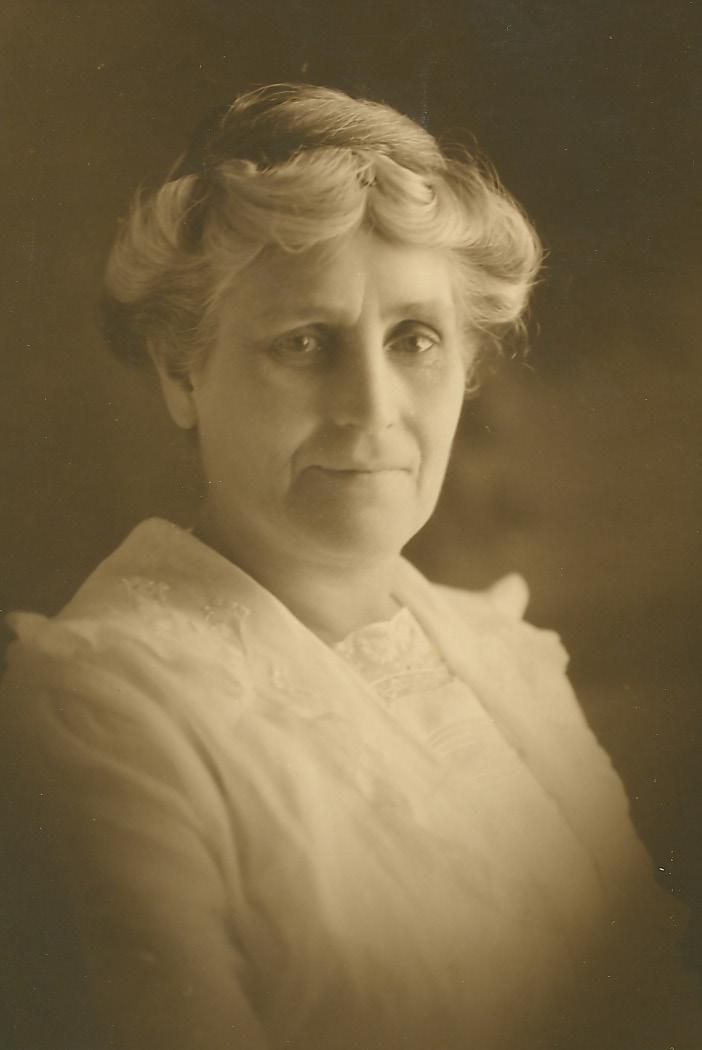
“Aunt Bettie” Morrison provided a firm foundation for women at Asbury Theological Seminary as the first woman on the Board of Trustees. (Image used courtesy of the Archives of Asbury Theological Seminary).
The Earliest Women Faculty of Asbury Theological Seminary (1923-1939)
In the earliest years of Asbury Theological Seminary, the school functioned more as a department of Asbury College. This meant that classes were shared with students in other degree programs and faculty were also shared. There was not a clear division, and few faculty members were seen as being on the Seminary faculty. Early women faculty were often found in the areas of teaching speech, music, and doing library work, but there were a few women who taught traditionally academic subjects. From the very start of the Seminary in 1923, while it was still a part of Asbury College, the Seminary made use of women faculty members at Asbury College in teaching classes for those taking the Seminary degree.
The first known female faculty member was Daisy Dean Gray, who taught from 1923-1924 and 1927-1938 as Professor of Speech. Current Seminary students would identify this more today as “Preaching,” although at this time it was more about how the future pastor should stand, pronounce words, and speak to be heard and make an impact. The subject was less concerned with the sermon content. Gray studied expression
under Dr. Curry of the Curry School of Expression in Boston in 1914. After becoming the principal of Bessie Tift College, Gray spent eight years as the Dean of Women at Meridian Female College before becoming the Director of Expression at Meridian Female College in 1914. The Meridian Colleges in Mississippi were important Holiness schools under the direction of J.W. Beeson, and Beeson’s friendship with H.C. Morrison would be significant through the history of the Seminary.
In 1921 Gray moved to Wilmore, becoming the Director of Expression at Asbury College. In a 1928 article on Daisy Dean Gray in the Asbury Collegian4 , it notes “Miss Grays’ interest in the College and her work is manifested in the attempts at establishing a scholarship that students in the seminary might have the opportunity of receiving the training in expression which is very essential for an efficient servant of the Lord.” The article also notes that all the best speakers on campus had experienced some training under Gray.
Daisy Dean Gray received a master’s degree at the University of Michigan in 1931, and she would often spend time in the summers at her home in Cedar Rock, Georgia helping her brother, Dr. Claude Gray in his work as president of the Locust Grove Institute, a Baptist preparation school. In The Mission Messenger5, a paper published in Atlanta in 1902, about 20 years before coming to Wilmore, Daisy Dean Gray wrote an article discussing how she helped start a mission society in her church in Cedar Rock and how she was involved in missions by reaching out to the local African-American community with the Gospel. Daisy Dean Gray died in Vidalia, Georgia on March 12, 1953.
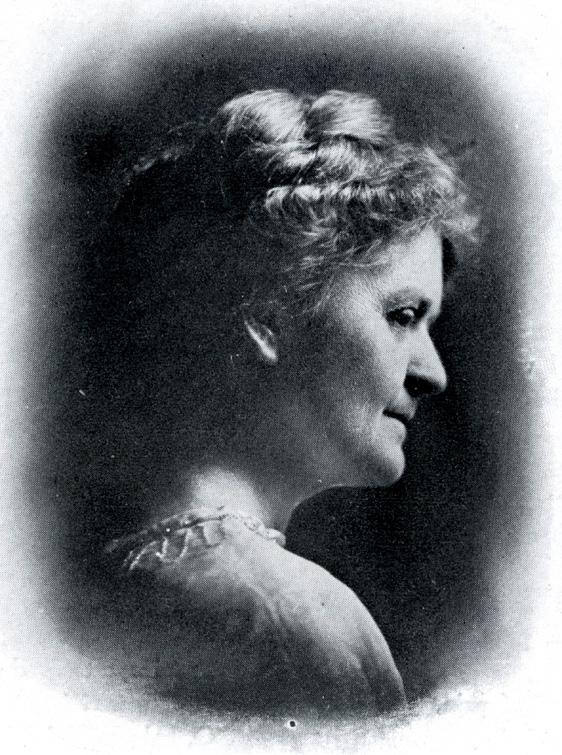
Daisy Dean Gray served on the faculty of Asbury Theological Seminary starting in its first year of 1923. She taught in the area of speech. (Image used courtesy of the Archives of Asbury Theological Seminary).
Another professor “borrowed” from the College to teach in the early Seminary was Hildreth Marie Cross, who taught from 1934-1935 as a Professor of Philosophy and Psychology. Born in March 9, 1901, in Byron, Michigan, Hildreth graduated from Asbury College in 1922 and went on to get a master’s degree from the University of Michigan in 1927 and a Ph.D. at the University of Iowa in 1933, where her dissertation dealt with the issues of stuttering.
Cross taught at Asbury for 17 years, and then Taylor University for 16 years, and finally Azusa Pacific College for three years, before retiring in 1966. She was the author of An Introduction to Psychology: An Evangelical Approach, published in 1952. Dr. Cross died July 7, 1991, in Flint, Michigan. While her work long predated the Seminary’s School of Counseling, the psychological issues of ministry were a concern even at the start of the Seminary.
A third woman faculty member “borrowed” from the college was Mildred L. Stanhope who taught Missions and Spanish at the early Seminary from 1935 to 1938. Stanhope had been a missionary for the Christian and Missionary Alliance in Argentina, Puerto Rico, and Peru, serving from 1920 to 1931. She returned to Asbury College as a student, and then a teacher, earning a master’s degree from the University of Kentucky. Stanhope went
on to become the Dean of Women at Nyack College from 1940 until her retirement in 1961. Throughout her teaching career, she taught Spanish and missions. She also founded a touring group of students at Nyack called the Missionary Crusaders, who worked to encourage the importance of missions to churches and other groups. Mildred L. Stanhope died on April 11, 1981, at 86 years of age.
In addition to these three women, several others also are recorded as teaching early Seminary students, even though they were listed as faculty at Asbury College. These include Mary Elizabeth Corley (1932-1934) Assistant Professor of Speech, Ruth Little (1937-1938) Teacher of Speech, and Mary Chamberlain (1939-1940) Professor of English Bible. While very little is known about their role in teaching or the classes they taught, the Holiness view of women did not exclude women from having a certain degree of authority in teaching men within Asbury College and Asbury Theological Seminary from its very foundations.
The First Women on the Full Faculty of ATS (1940-1970)
In 1937 the curriculum of the Seminary was separated from that of Asbury College and in 1939, the physical campus was divided in accordance with the needs of accreditation. The entirety of Asbury Theological Seminary fit into one building, which became known as the Larabee-Morris building. From this period on, the Seminary had its own faculty without needing to “borrow” from Asbury College’s professors. Yet this early faculty also contained several key women.
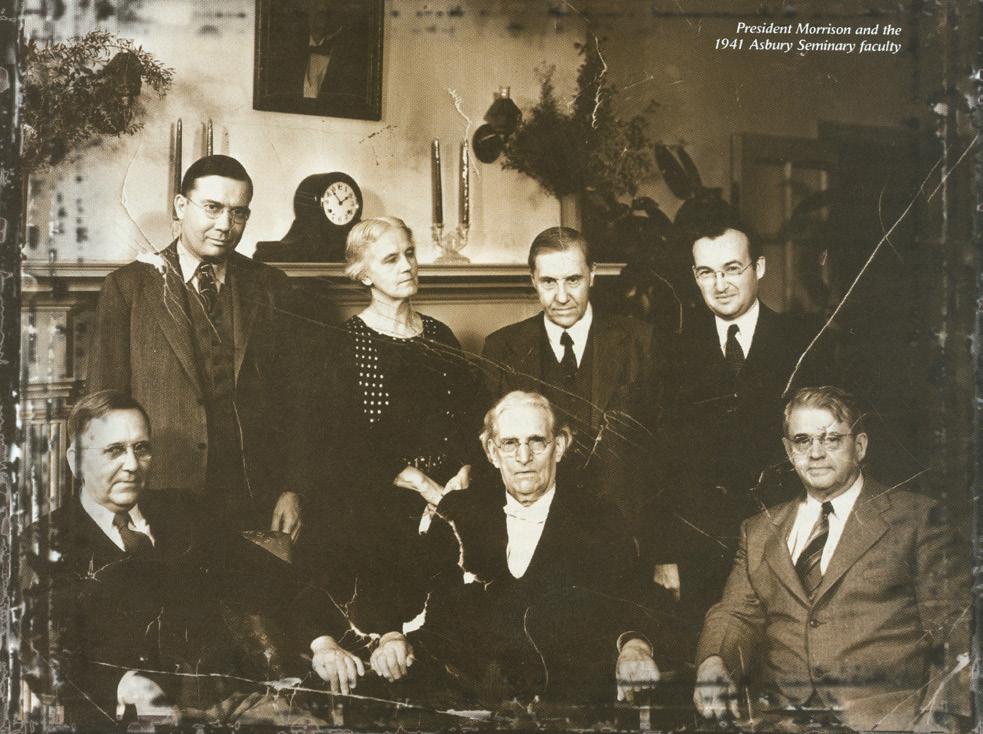
Photo of Asbury Theological Seminary faculty in 1941. In the center of the back row is Gaile and Robert Morris. Gaile Morris was the Professor of Old Testament and Hebrew and played a key role in training students at the Seminary. (Image used courtesy of the Archives of Asbury Theological Seminary).
One of the most well-known and influential women faculty members at Asbury Theological Seminary was Gaile J. Morris, the wife of Frank P. Morris, another early faculty member. She served from 1937 to 1948 as the Professor of Hebrew and Old Testament. After marrying Frank, Gaile served as a pastor’s wife in the North Indiana Conference of the Methodist Church, and as he went on to further education, so did she. She earned a master’s at the University of Kentucky and a Bachelor of Divinity from Asbury Theological Seminary.
She is noted for some of the many students she taught and inspired, including J.T. Seamands, Dennis Kinlaw, Harold Greenlee, and George Livingston, all who became faculty of the Seminary. When Gaile and Frank retired in 1948, they focused their energy on missions in Africa. Gaile Morris was even given a distinguished service award in 1974 by President Stanger. She died in July of 1987 at 105 years of age, and even at that age was known for maintaining a sound mind and keen memory.
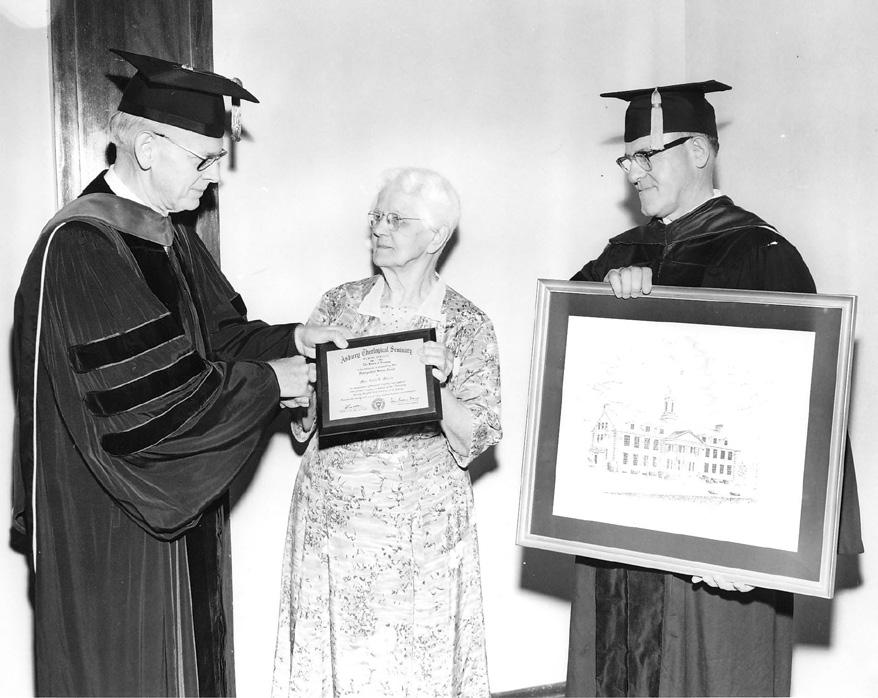
In 1974 President Stanger honored Gaile Morris with a distinguished service award.
(Image used courtesy of the Archives of Asbury Theological Seminary).
Ada B. Carroll was the second women faculty member to become part of this new group at Asbury Theological Seminary. She had been “borrowed” from Asbury College from 1937 to 1938 but would become a full professor of the Seminary from 1943 to1962 as the Professor of Music and Speech. She would lead and define the Seminary’s music program and pick up from Daisy Dean Gray in teaching the speaking skills needed for preaching. Throughout the history of the Seminary, women would often serve in the area of music, although often without full faculty recognition or in short temporary assignments, but this was not the case with Ada Carroll. Carroll was born in Spring Garden, Illinois on July 1, 1891. She graduated from Ruskin Cave College in Nashville in 1921 and did further training at the Chicago Musical College and the American Conservatory of Music. From 1918 to 1921 she worked as Professor of Voice at Olivet College, from 1921 to 1924 at Trevecca College, from 1924 to 1927 at Marion College, from 1927 to 1928 at McKendree College, and from 1928 to 1929 at Des Moines University. She spent part of 1930 travelling in Europe and studying voice and painting. She joined the Asbury College faculty from 1935 till 1943, when she became the Assistant Professor of Music and Speech at Asbury Theological Seminary until her retirement in 1962. She team-taught with President Stanger in preaching, and he noted in her memorial service that he taught “what to preach” and she taught
“how to preach it.” Ada B. Carroll died September 5, 1981, in Lexington, Kentucky.
Other women faculty would follow in Carroll’s shoes in teaching music as full faculty. These included: Ruth E. Nussey (1951-1953) Associate Professor of Church Music, and Elizabeth Batten Edwards (1958-1960) Assistant Professor of Church Music (1960-1968 Visiting Professor). Other women would teach in the field of Christian Education (another field often open to women), but without being recognized as full faculty. These included: Verna M. Culver (1956-1966) Teaching Associate in Christian Education, Grace B. Ely (1959-1960) Assistant in Religious Education, and Alice M. Kann (1963-1965) Assistant with Christian Education Fieldwork.
Another interesting woman who taught for a short time without full faculty status was Annie Kartozian, who served briefly as a Professor of the Chinese Language. Kartozian (1906-1989) was an OMS missionary to China. She went to China in 1934, and during World War II she spent 21 months in a Japanese prison camp. In 1943 she left on the diplomatic ship the Gripsholm as part of a prisoner exchange for the United States. She made it back to China after the war, only to barely escape from Beijing in 1949 due to the Communist Revolution. It is likely that her teaching time at the Seminary from 1945 to 1946 was to help her find some type of work until the end of the war would allow her return to China.
Until the late 1980s, professionally trained librarians at Asbury were given faculty status, and this is another area where women served the Seminary as faculty members. The first professional librarian is especially interesting. Lena Barbara Nofcier served in this role from 1945 to 1949. She is credited with organizing the library along the professional guidelines of the Union Catalog instead of its earlier amateur arrangement and moving the library to its first real home in the basement of the Henry Clay Morrison Administration Building in 1947. She had previously served as a librarian at Asbury College in 1925 but went on to get a Library Certificate from the University of Iowa in 1927 and a B.S. in Library Science from the University of Illinois in 1928. She returned at worked at Asbury College’s library until 1930.
However, Nofcier is more well-known in the world of Kentucky libraries for her creative work as the Secretary of the Kentucky Library Commission and for her part in developing the Pack Horse Library Project during the Depression. Working with the Federal Works Project Administration and the Kentucky Parent Teacher Association, she pointed
out the need to make reading material available “to all people, rural as well as urban, colored as well as white.” She also argued that Kentucky must, “provide not only adequate library facilities, but also equal library privileges for every citizen.”6
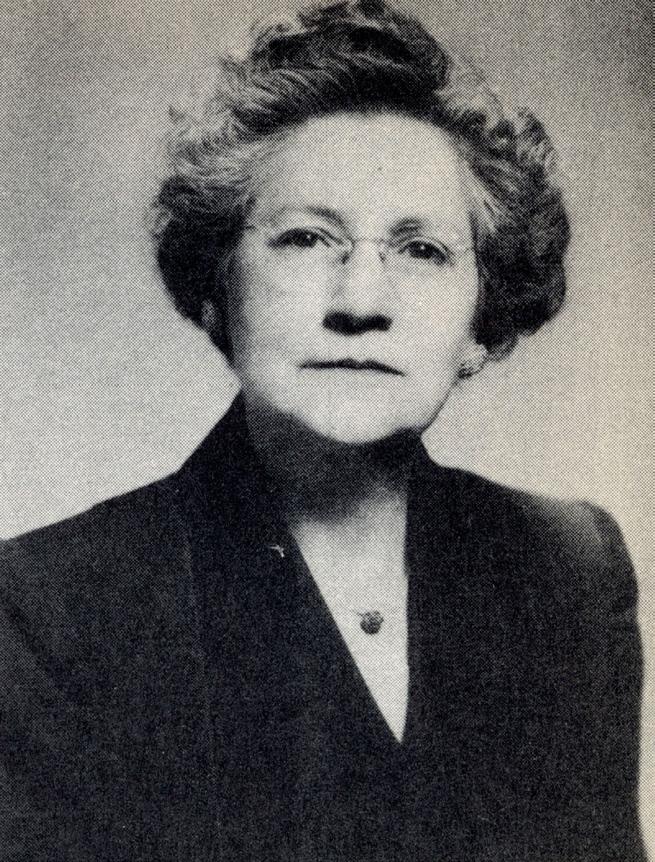
Lena Barbara Nofcier was the first professional librarian on the Seminary faculty. Her work with the Packhorse Librarian Program in Kentucky helped prepare her for organizing the Seminary’s first real library in the Morrison Building basement in 1947.
(Image used courtesy of the Archives of Asbury Theological Seminary).
In 1936, through her fund-raising efforts, librarians were sent out on horseback taking reading material throughout rural Appalachia. Given her religious training, it was noted that one of the most requested books was the Bible, and librarians would often take the time to read portions of scripture at people’s request. It has been noted that, “Mounted carriers averaged over 5,000 miles per month visiting over 4,000 families and 55,000 individuals… Four pack horse carriers in Leslie County covered an area greater than the state of Delaware to serve 8,000 people in fifty-seven mountain communities.” Nofcier would leave the Seminary to work in the public library in Lima, Ohio before retiring in 1965.
From 1962 to 1987 (a period of 25 years), the only full-time woman faculty member to appear is Susan A. Schultz, the librarian. Schultz helped plan and work with developers to build the B.L. Fisher Library and move the entire collection to the new building. She also founded the Archives and Special Collections of the Library and trained three young librarians to become leading scholars in the Holiness and Pentecostal Movements. Donald Dayton, David Bundy, and Bill Faupel would become part of the strong academic legacy of Susan Schultz. She would retire in 1978 and marry recently widowed faculty member Delbert Rose. The couple would travel and work on library development and teaching in various parts of the world, before they died, both at the age of 100 years old.
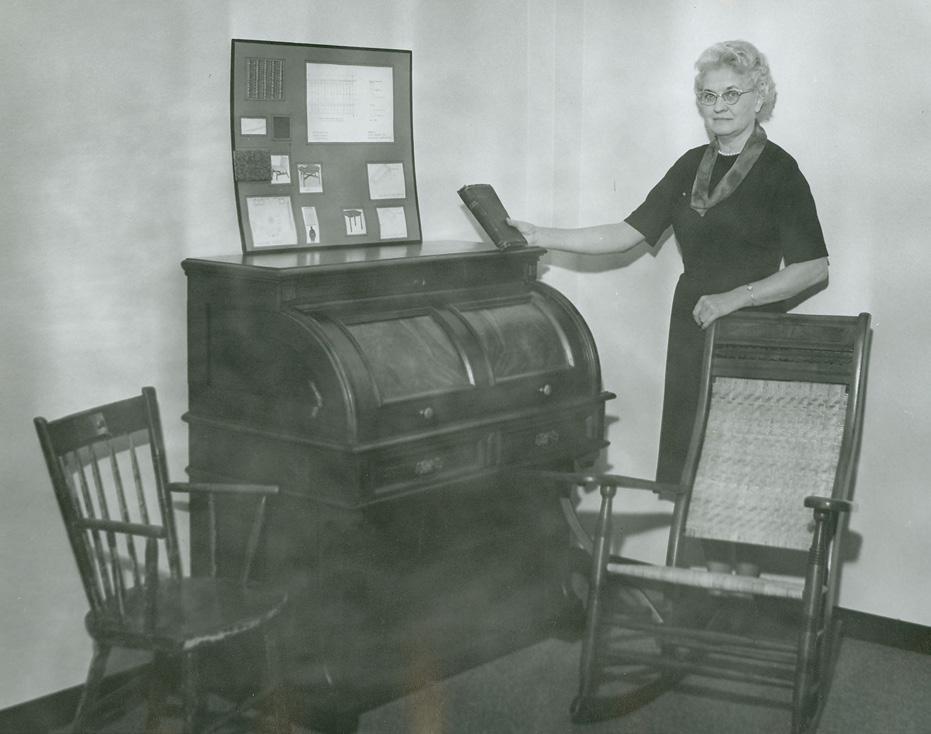
Librarian Susan Schultz would help plan the design and construction of the B.L. Fisher Library, oversee the move to that building, found the archives, and train a group of Holiness-Pentecostal scholars, all as the only woman on the faculty from around 1971 to 1978. There would be no women on the faculty from 1979-1987. (Image used courtesy of the Archives of Asbury Theological Seminary).
Other library workers also had faculty status at this time, and they include: Ollie Mae Williams (1946-1949) Library Cataloger, Ruth A. Warnock (1949-1962) Library Cataloger, and Marilyn Walker Morrison (1965-1971) Library Cataloger. Without these professional women librarians, the current library would not be as strong as it is currently.
By 1947-1949 there were four women with faculty status out of 14 faculty members, representing 29% of the faculty- a number which has never been surpassed in the Seminary to this date. Women students also made up around 22% of the degree seeking students at this time. Organizations of women also began to form, including an organization of the wives of Seminary students, and an organization of the wives of Seminary faculty- called the Seminary Dames. But more importantly, an organization called Chi Alpha was started for women students and staff at the Seminary. With a name standing for their slogan of “Christ First,” Chi Alpha would remain a campus organization into the mid 1980s as a way for women students to build fellowship and develop leadership skills.
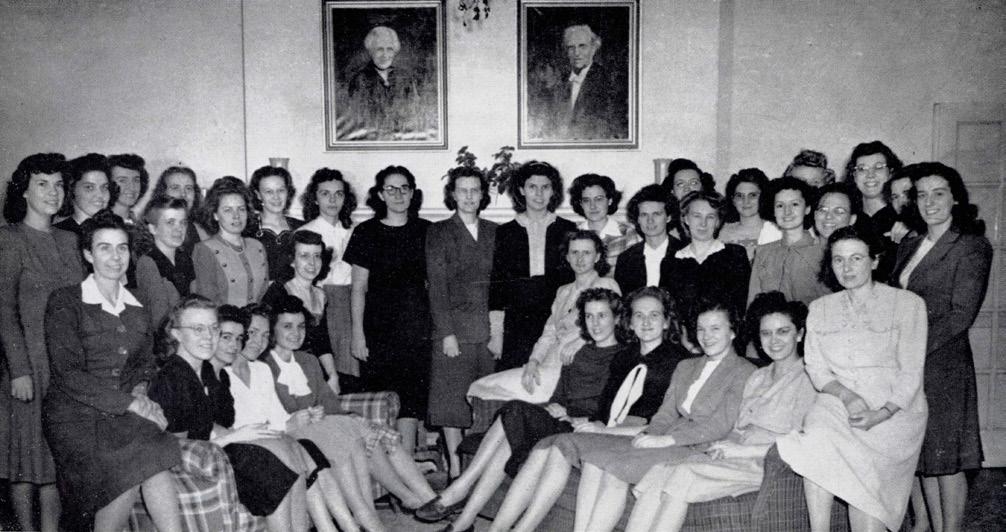
The women students and staff in Chi Alpha in 1947-1948. This group developed out of the need to build fellowship and foster leadership skills among women students at Asbury Theological Seminary as the number of degree-seeking women students grew in the late 1940s. (Image used courtesy of the Archives of Asbury Theological Seminary).
The high point of 22% of the degree seeking students being women occurred from 1947-1949, a period which corresponds with having four full-time women faculty members. This is a good argument to support the idea that women faculty serve as valuable role models and mentors which encourage the presence of women students. Immediately after this period, numbers begin to decline. There are likely several factors for this growth and decline. The late 1940s were still part of the years impacted by World War II. There were fewer male students because of the war and there was
an increase in openness to women in more non-traditional roles because of the demands of the war. At the end of 1949, the war was over and soldiers were returning home. There was a desire to get back to the “normalcy” of the 1930s and to more traditional roles. While women continue to come to the Seminary, increasingly they were not seeking degrees, but were auditing classes. Numbers seem to indicate that these women were often wives of male Seminary students.
In addition, the most prominent woman faculty member, Gaile Morris retired in 1948. Librarians, Lena Nofcier and Ollie Mae Williams left Asbury in 1949. This left Ada Carroll, in the more traditional role of teaching music and speech and two new librarians, Susan Schultz and Ruth Warnock. With the loss of Morris, the remaining positions could only provide role models for the more traditional roles of women in Holiness academia. Gaile Morris’ position as a core professor in Old Testament and Hebrew was likely a key reason many women students felt it was possible to succeed in their own degree programs.
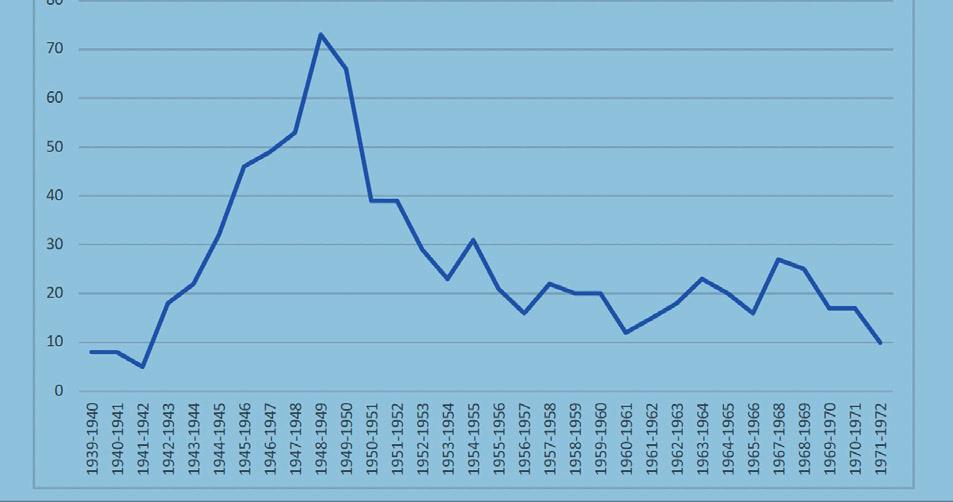
The 1970s: A Low Point for Women at Asbury Theological Seminary, But the Beginning of Change
Throughout most of the 1950s and 1960s the number of women seeking degrees remained low (under 10%) with a larger number of women auditing classes (likely as the spouses of male students). Even by 1980, there were 37 women auditors compared to only 3 men. The lowest point was reached in 1971 when only 2% of the students seeking degrees were women. There were 18 women students out of 431 total students in 1971. Only two women were seeking the Master of Divinity (0.4%) and eight for
the Master of Arts in Religious Education (1.8%). The remaining 8 were auditors not taking classes for a degree. In much of the 1970s, women degree-seeking students made up less than 10% of the entire student population.
Things became so difficult at one point in the early 1970s that there were only 10 women living in the only women’s dorm, Ely-MacIntyre, and the top floor was used to house male students. One graduate even related how Grace Ely, the Dean of Women at the time, had closed off access from the third floor, so that the men had to enter and leave the building via the fire escape stairs outside the building.7 Yet, even at this point, the 1970s was also the time when the seeds of the next generation of women at Asbury were being planted.
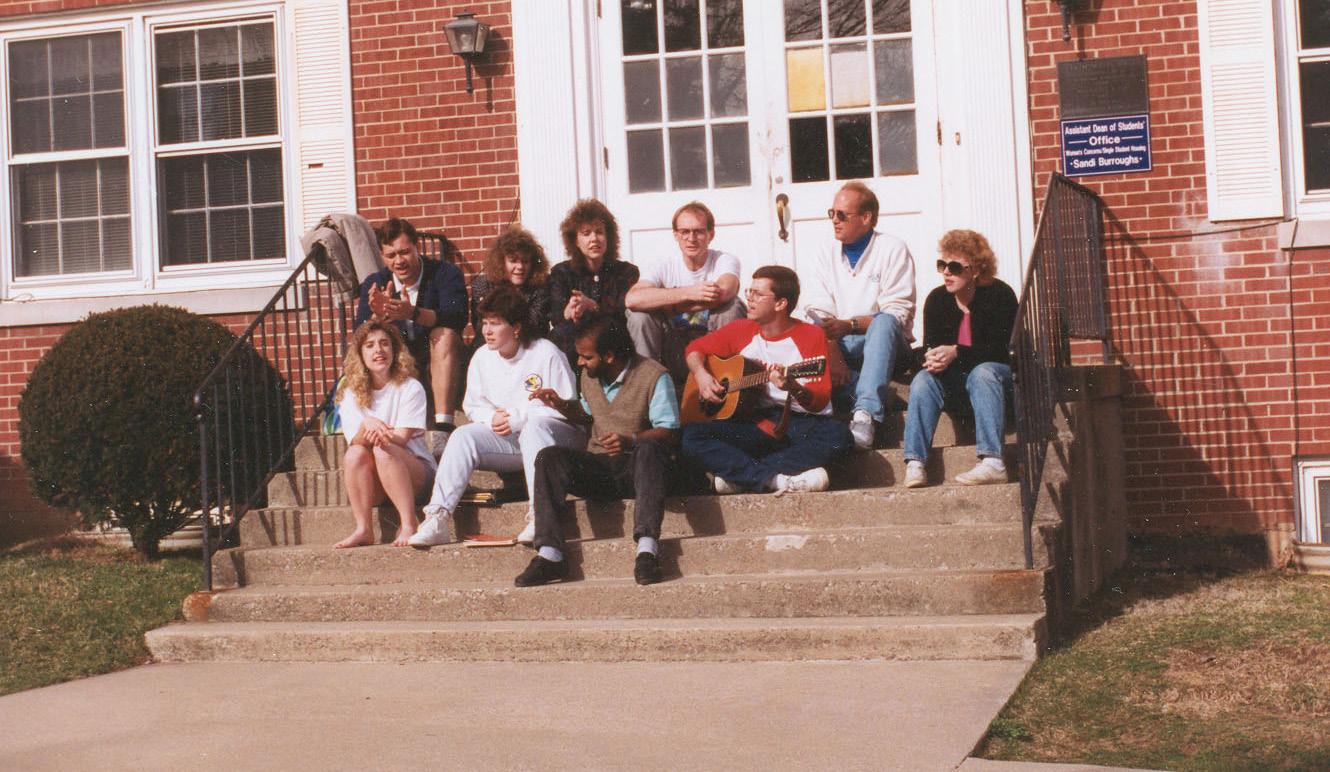
Women and men students outside Ely-McIntire, the women’s dormitory about 1989.
The blue sign on the right notes the Office of Women’s Concerns, at the time listing Sandi Burroughs as director, a position she served from 1988-1990.
(Image used courtesy of the Archives of Asbury Theological Seminary).
In March of 1971 signs of a change had begun. Tedi Reynolds, a woman student serving on the editorial board of the student publication, The Short Circuit wrote,
Being an institutional embarrassment is an unusual position to be in. What do you do with 14 women students among 450 men? Well, you can relegate them to baby news and recipes for one thing. Sorry, fellows, but that’s not my thing! The Christian woman has a definite
role in society today, and all of us better recognize it before we set out in ministry.8
By 1972, Lucille Sider Dayton published a major article entitled “The Feminist Movement and Scripture”9 in the same student publication, which had moved from an institutional noticeboard in the 1960s to a place for students to voice concerns and issues. Such individual voices continued until 1974.
Several other women students had been involved in a summer urban experience with students from other seminaries in 1974 under Dr. Gilbert James. This experience had the theme of “human liberation” and Asbury students had been challenged on the role of women in ministry, and this was also reported in The Short Circuit. In the Fall of 1974, the Seminary started events for the term with the Holiness Emphasis Conference with a discussion on the theology of love. Dr. Gilbert James was one part of this conference, but the other part was the renowned holiness theologian, Dr. Mildred Bangs Wynkoop.
In a letter to the Board of Trustees, Student Body President Fred Price wrote about the influence of this presentation. In the following paragraph he noted, “One of the most interesting developments of the year has been a continuing dialogue concerning women’s rights and women in the church. A number of students found it necessary to reconsider their thoughts and theologies concerning women.”10 When questioned about a connection 50 years after the fact, Fred Price affirmed that there was a connection between Dr. Wynkoop and the increased discussions on women in ministry. Price wrote in 2025, “Mildred Wynkoop was an authority and spoke with authority. That was a challenge to the presuppositions held by some regarding women at the time.”11
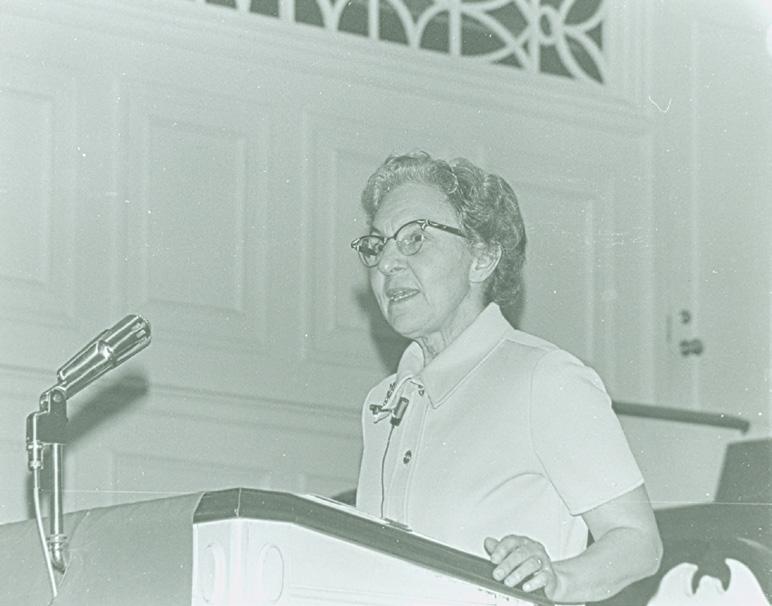
Another watershed moment was when Dr. Mildred Bangs Wynkoop, the noted Holiness theologian spoke in chapel on the theology of love in 1974. Her authority convinced many male students of the idea of women in ministry. (Image used courtesy of the Archives of Asbury Theological Seminary).
The conversation continued to escalate into 1975. An editorial from March 1975, entitled “The ATS Caste System” noted,
Although significant progress has been made in achieving equality for women in many areas of our society, the church is unfortunately lagging behind as usual. Asbury Seminary is no exception. The pattern of hiring reflected in the present faculty and administration demonstrates that there still exists a lack of trust in the leadership ability of women.
Of the thirty-three members of the faculty, there is one woman; over three-fourths of the administrative officers are men; there are no women Trustees.
We hear a lot of support for women, but we don’t see much. The seminary has the opportunity to set a significant example to the church and the world. Asbury Theological Seminary has avoided committing itself on this issue for too long.12
While things seem to quiet down a bit in terms of student voices, things were beginning to change, but this time at the top in the Board of Trustees. In 1978, 32 years after the death of Bettie Morrison, Asbury selected its second female member of the Board of Trustees, Evelyn Kuttler,
a lawyer from St. Petersburg, Florida. Evelyn Kuttler is really at the heart of the story of a massive transition which occurred from about 1985 to 2003 and she has been called a “force” in the advancement of women at the Seminary by several sources. While Kuttler was brought on the Board during the presidency of Frank Stanger, she does not recall him having any position on the issue of women when he brought her on the Board.13 As she came on, she faced at least one Board Member who was directly opposed to any woman coming on the Board. She related in an interview that she reached across the table and told him, “This is my first time at this too, so maybe we can just see how it goes?” The key person to bring Evelyn Kuttler on the Board was another Board member, John Grant, a lawyer from Tampa, Florida who knew Evelyn and her husband. He felt it was time for a woman to be brought on as a Trustee, and he led the fight for her and encouraged her to apply.
As a law student, Evelyn had been the only woman in her class to graduate in a large field of men in 1964. Another woman who had been a part of the class had committed suicide. This made Evelyn especially conscious of the situation many women felt in the educational sector. Before her first meeting with the Board, she requested to meet with women students, and she did this several times afterwards. The biggest problem as she saw it, was that women students in the cafeteria felt they had to constantly defend their call into ministry and were often challenged by more conservative male students. Evelyn wanted to see an end to these “hermeneutical battles.” While Evelyn was not raised in a strong churchgoing family, she had a strong interest (and still does) in theology. Attending the Evangelical Women’s Caucus in 1974 really opened her eyes to seeing Jesus as a liberator of women and not an oppressor. So, as she came on the Board, Evelyn took up the challenge of helping women at Asbury Theological Seminary. She notes, “When I’m passionate about something I go for it, but with gentleness and humor… lots of humor.”
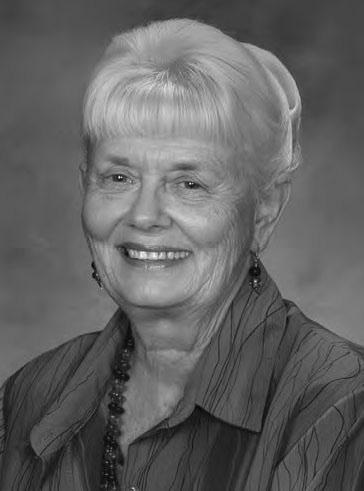
Evelyn Kuttler, the first woman elected to the Board of Trustees since Bettie Morrison, was the primary force which drove the administration to focus on the needs of women students. She served on the Board of Trustees from 1978 to 2003. (Image used courtesy of the Archives of Asbury Theological Seminary).
At the same time Evelyn Kuttler was coming on the Board in 1978, the last full-time faculty member from 1949, Susan A. Shultz, the librarian, retired. While Shultz did not teach many classes, her role was formidable. According to one source, she enjoyed being the only woman on the faculty, and President Stanger would frequently visit her office to discuss problems he faced in running the Seminary. In this sense, it was a bit of an ironic changing of the guards which led to massive change. By 1979, Evelyn Kuttler was appointed chairperson of the Board of Trustees Ad Hoc Committee on Women of the Asbury Seminary Community, and her work on transforming the Seminary had begun.
In a 1979 memo to the Board of Trustees (likely at Evelyn Kuttler’s request) the administration sent an evaluation of the current situation and proposed goals for “ATS Role in Educating Clergy Women.”14 Two situations make an immediate impact. The first is, “There is no role model of a woman minister in full connection immediately available on the faculty or staff of the Seminary nor is one available in the Kentucky conference.” The second
is, “There is no single woman minister readily available in the Wilmore community or nearby who could serve as a counselor to the women in the M.Div. program.” While the presence of women students had improved from 1971, the situation was still not good.
Changing the Roles of Women at Asbury (1980-2000)
By 1980, Evelyn Kuttler’s committee recommended a standing faculty committee with three goals:
“1. To develop faculty awareness of the needs of women students, women staff members and students’ wives.
2. To identify prospects for female faculty and staff.
3. To develop systems to recruit women students.”15
In November of 1981 the Board of Trustees Committee held a join meeting with the faculty Task Force on Women in the ATS Community, chaired by Harold Burgess. Margaret Dunn, secretary of the student council, was also on the Board committee with Evelyn Kuttler. A number of potential goals were outlined to meet some of the identified needs. The top goals included hiring full-time qualified women faculty, finding more visibility for women in worship services, developing courses and workshops about women in ministry,16 and instituting “inclusive language” in the Seminary. Dunn wrote up a report in 1984 on a Chi Alpha forum to discuss progress on these goals.17 Only two of the goals were making concrete progress. The first, was the hiring of Helen Musick to be the founding director of the Office of Women’s Concerns in 1985. The second advance was for a formal Seminary policy on women in ministry to be added to the academic catalog in 1985. It read,
“Asbury Theological Seminary affirms the role of women in ministry. Thus, the seminary aims to create a climate in which women are encouraged in their progress toward professional ministry goals and enabled in their spiritual development.”
By 1984, Evelyn Kuttler would be joined on the Board of Trustees by two other women, Ann Kiemel Anderson and Kathryn Chatios Randle. Ann Kiemel Anderson was a well-known speaker in her day whose work focused on encouraging women. In the same year, the Board of Trustees (likely following Kuttler’s committee work) created a policy and goals
document and created an Ad Hoc committee to discuss the implementation of these ideas. The first goal was that “Competent women to fill significant faculty positions must be identified, recruited, and, when necessary, assisted in academic preparation.” The second goal was that “Recruitment of women students must become a priority.” By February of 1984 a standing faculty committee of women’s concerns had been formed with the only female faculty member being a visiting instructor in Christian Education, Helen Musick.

Helen Musick began her connection with the Seminary as a Visiting Instructor in Christian Education. In this role she would be the only woman to sit on the standing faculty Committee on Women’s Concerns. She would become the first Director of the Office of Women’s Concerns in 1985, and she would work for the needs of women studying for the ministry. (Image used courtesy of the Archives of Asbury Theological Seminary).
It was also in 1983 and 1984 that Asbury Theological Seminary had its first African American women students. While Bernadette Barr who started in 1983 would not graduate, Gwendolyn Wilson who came in 1984 would be the first African American woman to graduate from the Seminary in 1987. She would also go with Helen Musick to the 1986 Women’s Inter-Seminary Conference in Denver, as part of the work of the Office of Women’s Concerns. According to Helen Musick and Gwendolyn Wilson, this conference was quite eye-opening, and full of many ideas common in more liberal settings. For Musick, this was not the direction she wished to go. Having been a woman student at Asbury in the 1970s, Musick
wanted to develop the Office of Women’s Concerns into something which could encourage and empower women in ministry. She would thus shape the direction of the office for the future by developing women’s chapels, women’s forums, and encouraging visiting speakers on women’s issues.
However, change had also been pushed by the denominational organizations which provided the Seminary students. In 1968, the formation of the United Methodist Church reaffirmed the full clergy rights of women and by 1972 created the Commission on the Status and Role of Women. The Free Methodist General Conference of 1974 officially gave women clergy an equal status with men. As denominational moves continued into the 1980s, there was a growing need to change the situation.
At the same time as the forming of the Office of Women’s Concerns in 1985, the Provost, Mel Deiter, reached out to Jo Anne Lyon, an active Wesleyan pastor who was involved in women’s issues in the Christian Holiness Association. She agreed to come as a visiting instructor in Women’s Studies to teach one class a semester while commuting twice a semester from her place of ministry. Jo Anne has noted that she was hired in part because of pressure from the United Methodist Church about new pastors from Asbury not being knowledgeable in “alternative theologies” such as feminist theology.
The newly formed Office of Women’s Concerns would become the Office of Women’s Studies, and this organization actively sought to find ways to encourage and empower women students for ministry. Leaders in this office included Sandi Burroughs, Barbara Minton, Melanie Beachy, Barbara Holsinger, and Margi Galloway. The development of women’s chapels and women’s forums invited Christian women with leadership positions into the Seminary, while classes in women’s studies, and a push for inclusive language were also key projects of the office. The Office of Women’s Concerns was originally housed in Ely-McIntire, the women’s dormitory on campus, which kept it close to the women it sought to serve.
By 1987 the Seminary hired Dr. Catherine Stonehouse as a fulltime professor in Christian Education and one of the most dramatic shifts in the student body at Asbury Theological Seminary was underway. From 1985 to 2005, the percentage of women degree-seeking students rose from 11% to 34% in just 20 years. This growth in women students directly correlates with the growth in women faculty. By 2005, there were thirteen full-time women on the faculty in all areas of the Seminary. This was the highest number in the history of the Seminary to date. There is not a clear
cut off point, but the women hired by 2000 can be viewed as the second generation of women faculty at Asbury Seminary, and they can be held mostly responsible for the rapid growth of women students.
Dr. Catherine Stonehouse was just the first of these women. With experience in the field of Christian Education, she had served as the general director of Christian Education for the Free Methodist Church of North America for fifteen years. Her passion for her field is revealed in her books Patterns on Moral Development and Joining Children on the Spiritual Journey.
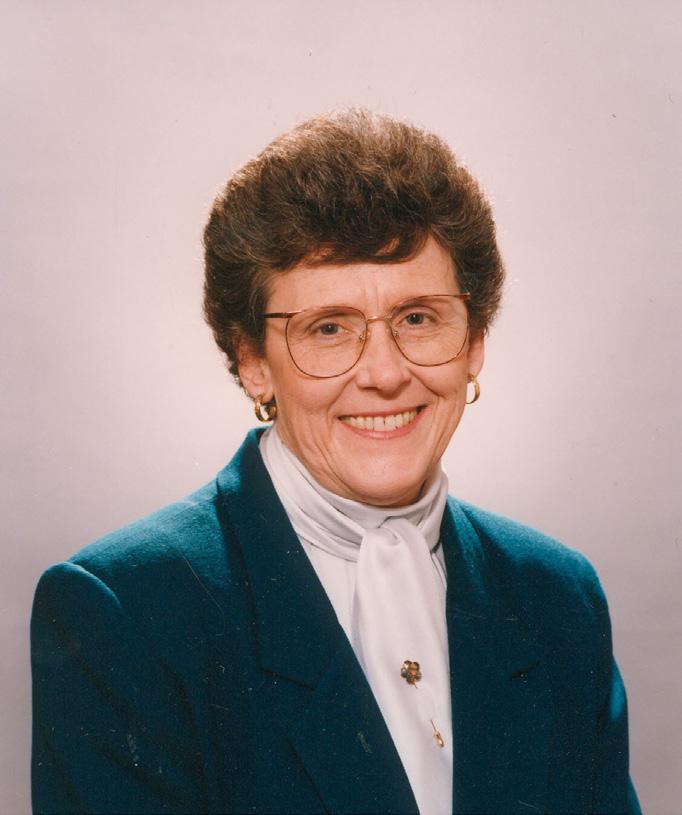
After a significant amount of time with no women on the faculty, Dr. Catherine Stonehouse became the first of the second generation of women faculty at the Seminary in 1987. She was the recognized leader of this group of women and helped create a community to include, encourage, and advocate for women students as well as for women on the faculty. (Image used courtesy of the Archives of Asbury Theological Seminary).
Dr. Christine Pohl was hired in 1989 as the Professor for Church and Society. Her work coordinating services to refugees in New York and serving on the national staff of Bread for the World Educational Fund, led to her formative book Making Room: Recovering Hospitality as a Christian Tradition. She also co-wrote an important book on women in the theological academy, titled Living on the Boundaries: Evangelical Women, Feminism and the Theological Academy. In this book, she shares part of her own story,
Like many women who grew up in mainline Protestant church in the 1960s, I received mixed messages about the significance of gender. I remember thinking, as I walked home from the youth group I loved leading, “If I were a boy, I could become a pastor.” There was some freedom, but little encouragement, for women to pursue theological interest. In my world, there were no models of female pastors. When I moved toward more evangelical settings, the messages were equally mixed, though the ingredients were different. I found myself in leadership positions, especially in teaching roles, but I was usually viewed and treated as “the exception.”18
She also noted,
Teaching at Asbury is different from working in many other evangelical schools because Asbury has had a commitment to training men and women for ministry since its founding. Nevertheless, from the 1960s to 1987, there were no women on the faculty in tenured position (except the librarian), and when I came in 1989, I became the second woman to be on the faculty in a full-time, tenure-track position. Since then, Asbury has added thirteen women to its tenured or tenure-track professors, changing the personal and institutional experience of women significantly. The reality of having more than a token female presence is powerful.19
Dr. Leslie Andrews came in 1990 with a background in Christian Education within the Christian and Missionary Alliance. But while her initial leadership role was as Dean of the Doctor of Ministry program, she ended up as the Provost of the Seminary and played a key role in the administration of the Seminary.
When Dr. Eunice Irwin arrived in 1994, she brought a wealth of mission experience among the Lupuyan Subanen tribe of the Philippines where she served for the Christian and Missionary Alliance. Having studied under Harold Turner at the University of Birmingham, she was an expert on primal religions, new religious movements, and contextual theology.
Dr. Mary Fisher was originally from Australia, and while she came in 1994, she then took a four-year study leave to do Ph.D. level work in Biblical Theology, which she taught on her return in 1999 from England. She was an expert on Chinese culture and evangelization. She had also served as an associate director of InterVarsity Missions and URBANA, while also serving the Christian and Missionary Alliance.
Dr. Virginia “Toddy” Holeman came to Asbury in 1995 as an experienced counselor in marriage and family therapy. Known for her passion for the concept of forgiveness, she would rise to become the head of the School of Counseling before she retired.
Dr. Ruth Anne Reese arrived at Asbury in 2000 after earning her Ph.D. from the University of Sheffield. She had also been involved in academic editing and teaching. She is known for her published works on Jude, 2 Peter and other commentaries. As a scholar in New Testament Biblical Studies, she is the only one of this group of professors still actively teaching at the Seminary as of 2026.
Dr. Sandra Richter came as an Old Testament Biblical scholar straight from her Ph.D. work at Harvard University in 2000. She is most widely known for her books The Epic of Eden: A Christian Entry into the Old Testament and The Stewards of Eden: What Scripture Says About the Environment and Why it Matters. She also produced a video on Women in Ministry at the Seminary which has been widely used on campus over the years.
Finally, Helen Musick returned in 2000 for one year as a full-time instructor in Youth Ministry, coming full circle from her time as the first director of the Office of Women’s Concerns.
In listening to the memories of people connected with this group, several items really come to the forefront. First, many of this generation were older women scholars who were not married. There was often a feeling at this time that women could not have an academic career and a family. These women had all invested heavily in their academic careers. As a result, these women bonded into a tight social group, often joining together for celebrations, meals, and even occasional retreats. It was the practice at Christmas for the women to go to their various houses and help decorate each other’s Christmas trees. Frequently, I have heard that Cathy Stonehouse was the undisputed leader, but that Christine Pohl’s view of hospitality was frequently lived out in this group as well. Likewise, I remember Eunice Irwin telling me how she attended Leslie Andrews and Christine Pohl in their final sicknesses before they died. These women truly formed a family bond and a support system within the larger faculty. Second, most of these women set aside time and energy to invest in mentoring and guiding women students.20 Likewise, newer women faculty all report how the earlier women faculty of this group made them feel welcome and included them as they arrived.
They worked to develop a welcoming environment for women at all levels in the Seminary.
The phenomenal growth of women students during the period of the second generation of women faculty is unprecedented in the Seminary’s history, helping to take the number of women degree-seeking students to around 34%.21 However, these numbers stopped rising about 2005 and remained relatively stable at this level for a number of years. While the number of degree-seeking women did ultimately rise slightly to the present number around 40%, the current number of eight full-time women faculty in 2026 represents a decline in the presence of women faculty. This final part of examining the history of women at Asbury Theological Seminary will look at the last 25 years and reflect on the lessons we can learn from the past.
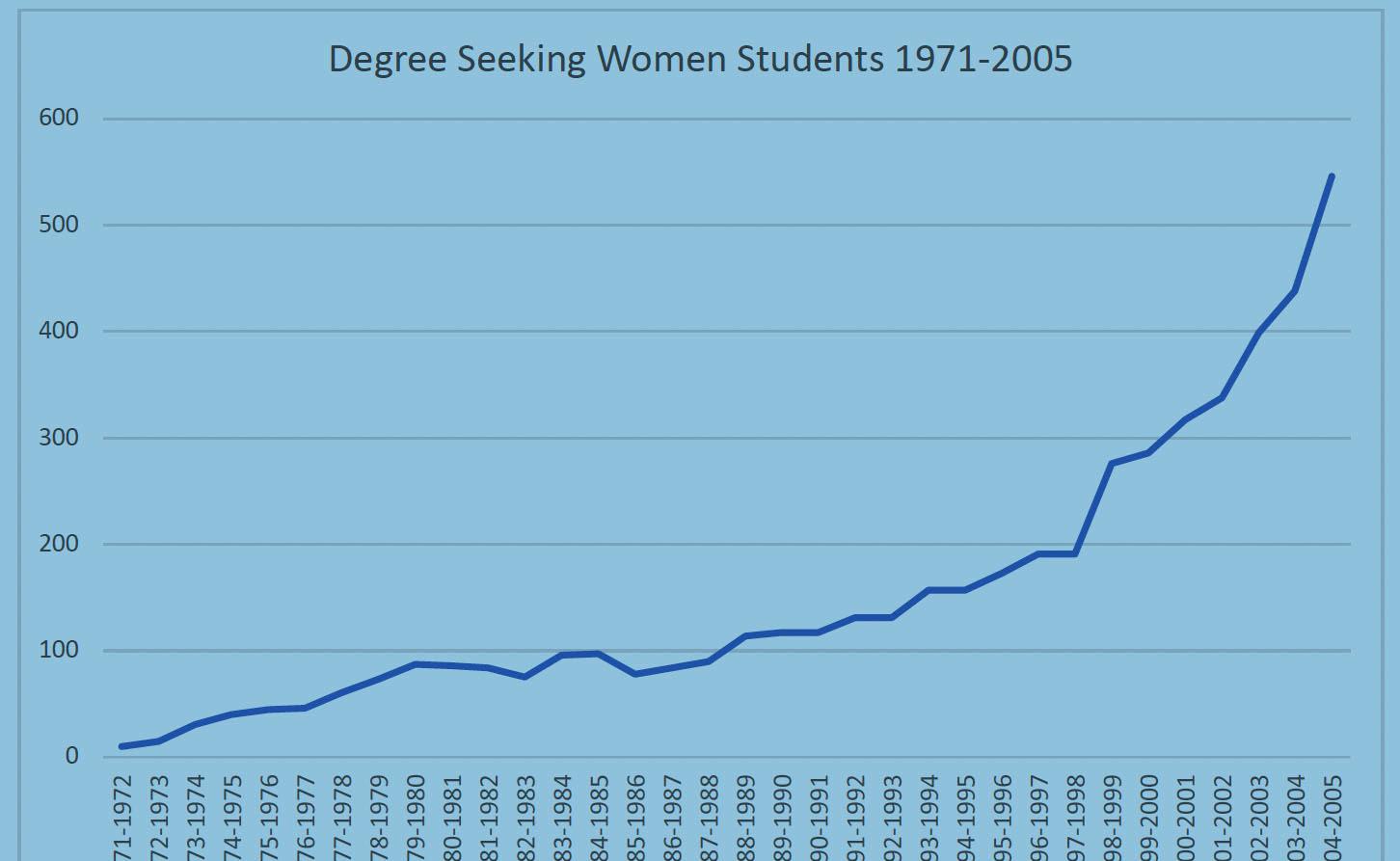
Recent History of Women at Asbury (2001-2026): Slow Growth and Stagnation
The year 2000 found Asbury Theological Seminary nearing the end of a period of rapid growth in women students and women faculty. By 2005 Asbury would hit its high-water mark of thirteen women faculty members. After 2000, the Seminary appears to have focused briefly on expanding to include greater ethnic diversity among its women faculty. Rev. Dr. Joy Moore has noted that the provost at the time, Joel Green, was under pressure from both the student body and accreditation bodies about the low number of ethnic minorities represented on the campus.22 As a result, three women moved onto the faculty in 2002 and 2003. Dr.
Meesaeng Lee Choi (2002-2023) would become the first Asian woman faculty member. Her area of specialty was in Church History, particularly the Holiness Movement in Korea. Dr. Zaida Maldonado Perez (2002-2017) would become the first Hispanic woman faculty member, also teaching in Church History, but rising in the administration to become the Dean of the School of Urban Ministries at Asbury’s Florida campus in Orlando. Dr. Joy Moore (2003-2007) would be the first African American woman faculty member, teaching in the field of Preaching. Later, Dr. Ann K. Gatobu (20082016) would become the first African woman faculty member. She taught in counseling and would rise to lead the School of Counseling for several years. In addition, Dr. Beverly Johnson-Miller would join Discipleship and Formation area from 2002 to 2020, with a special interest in ministry to the elderly.

The women faculty of Asbury Theological Seminary near their high point in 2003 at a birthday celebration for Ruth Anne Reese. Front row (L to R): Catherine Stonehouse, Ruth Anne Reese, Meesaeng Choi, Stacy Minger, Sandra Richter. Back row (L to R): Eunice Irwin, Joy Moore, Leslie Andrews, Mary Fisher, Christine Pohl. Photo taken by Toddy Holeman. (Image used courtesy of Ruth Anne Reese).
From 2000 to about 2017 the number of women students stayed roughly at the same level, a fact recognized by Lisa Weaver Swartz in her book, Stained Glass Ceilings: How Evangelicals Do Gender and Practice Power,
Asbury, however has struggled to achieve the demographic equity it prescribes. At the time of my research, women composed only 34 percent of the entire student population of just over 1,600- a percentage that had remained virtually unchanged throughout the previous ten years. On faculty, the percentage of women was even lower at less than 16 percent. These patterns mirror the gender inequality within American Conservative Protestantism.23
It is important to reflect on possible reasons for the growth to stop, even while the number of women faculty remained strong. Evelyn Kuttler, the Board member most responsible for the initial growth in women faculty and students, left the Board in 2003. It is possible that this led to a decreased commitment to advance women faculty at this time, or perhaps a feeling that the goals had been achieved and other projects needed to be advanced more urgently.
The active program for fostering women in ministry, which has begun in the 1980s faced its own organizational challenges in the early 2000s. In 1995, there was no overarching Office of Student Life, and so the Office of Women’s Ministries ran itself. In 1996, the Office of Student Life and Enrollment was created to house several different operations of the Seminary and Women’s Ministries was included as part of this office under the leadership of Robert Jones as the director. There were two women working in the area, Barbara Holsinger as the Director of Women’s Ministries and Margi Galloway as the Coordinator of Spouse Ministries (the clear assumption being that “spouses” were all women). In 1997, Barbara Holsinger stepped down into another position to allow Joy Moore to become the Director of Women and Ethnic Ministries.24 In 1999, Joy Moore became the Director of Student Life and Robert Jones became the Vice President of Enrollment. As this change occurred there was only one person listed under the Office of Women’s Ministries and that was Margi Galloway as the Director of Spouse Ministries. In 2000, the office became simply the Office of Spouse Ministries and by 2001 it became the Office of Spouse and Family Ministries. Joy Moore had transitioned to becoming a faculty member in Preaching and Anthony Shelton became the Director of Student Services. Thus, the original Office of Women’s Ministries vanished under the creation of the new Office of Student Services.
With the absence of an office committed to focusing on women in ministry, women’s chapels, forums for women in ministry, and similar
projects disappeared on campus. Without increased pressure from within the Board, from the students, and from denominational authorities any focused energy on women in ministry evaporated. Without a clear and focused advocate for women on the board and in the administration, students likely assumed some form of gender equality had been achieved with the presence of 13 women on the faculty and 34% of the degreeseeking students being women.
Since 2017, the number of women degree-seeking students has gradually risen to around 40% of the entire student body in 2026. It is no longer a question of if Asbury Theological Seminary will reach gender equality in the student body, but when that will happen. The question of gender equality among the faculty remains an open question. There are currently only eight women on the faculty at Asbury Theological Seminary as of 2026:
Dr. Ruth Anne Reese (2000- ) remains as one of the youngest of the second generation, and her work as the Professor of New Testament in the School of Biblical Studies continues to inspire women students to enter the field which has often been the most resistant to women scholars.
Dr. Stacy Minger (2004- ) came to Asbury as a student in the 1980s, and while she was one of the few who worked on the M.Div. degree, she became influenced by Cathy Stonehouse and Leslie Andrews, who both provided an “anchor” for her as she joined the faculty. When Stacy became a faculty member in the field of Preaching, she continued to develop a strong relationship with both Cathy and Leslie as mentors. Dr. Minger is the current Associate Professor of Preaching.
In a similar way, Dr. Ellen Marmon (2005- ) came to Asbury as a student in the late 1980s while also working in a local church in Lexington. Since she was interested in the field of Christian Education, she also developed a strong mentor relationship with Cathy Stonehouse, who even encouraged Ellen to go on for a doctorate. Dr. Marmon currently serves as the Professor of Christian Discipleship.
Dr. A. Sue Russell (2014- ) the current Professor of Mission and Contextual Studies came to Asbury Theological Seminary with a wealth of experience after serving for 17 years with Wycliffe Bible Translators in Southeast Asia. She also served as the Associate Professor of Anthropology and the Chair of the Department of Anthropology at Biola University.
Dr. Christine Johnson (2014- ) initially worked at Asbury Theological Seminary as the registrar and then as Associate Provost of
Academic Affairs. She is currently the Assistant Professor of Historical Theology and Wesleyan Studies.
Dr. Maria Russell Kenney (2018- ) comes from a background of involvement with various forms of ministry, including: campus ministry, low-income advocacy in Appalachia, working with emotionally disturbed adolescents, international medical relief work, pastoral ministry and local mission efforts. She came as a student, after meeting Christine Pohl in 1994. Pohl influenced her decision to comes as a student, where they became friends and collegues. She is currently the Assistant Professor of Christian Ethics and continues to be influenced by the work of Christine Pohl.
Dr. Janet Dean (2022- ) the current Professor of Pastoral Counseling Education came to Asbury Theological Seminary in 1992, just as the MA in Counseling was beginning. She developed a great respect for the women on the faculty, especially Catherine Stonehouse, Christine Pohl, and Toddy Holeman, but also with many of the male faculty, such as David Bauer, Harold Burgess, Fred Van Tatenhove, and David McKenna. She also completed an M.Div. at the Seminary and worked as a staff member in the library before teaching at Asbury College, prior to coming on the faculty in 2022.
With 30 years of experience in community mental health counseling, Dr. Jacqueline Smith (2022- ) the current Dean of the School of Counseling has been active in the field, with a special interest in counseling ethnic/racial minority groups. She is one of the most recent women to join a new generation of women at Asbury Theological Seminary. During the same period, Dr. Leanne Dzubinski (2023-2024) served briefly as a professor in leadership.
Asbury Theological Seminary has a strong theological history of women in ministry and leadership. Rooted in the Holiness tradition, which saw women as equally gifted and empowered by the Holy Spirit for ministry, this led to an early rise of women faculty in 1947-1949. In my interviews, some have suggested that the decline in the presence of women in the 1950s-1970s might have been due to a desire for Holiness groups to become more accepted in academia and ministry among mainline denominations. It may also have been due to the cultural dynamics of the post-war era in the United States as women left the workplaces they filled during the war years and returned to traditional roles in the home. The presence of women at the Seminary during these years tends to focus on roles as auditors25, Christian music26, or religious education degrees.
The dramatic growth of women students and women faculty from 1985 to 2000 is clearly due to a focused attention on the issue of women in ministry. The presence of a Trustee committed to change, along with the voices of women students led to a focused Office of Women’s Concerns and ultimately the intentional hiring of women faculty. The presence of a growing number of women on the faculty led to a growing number of women students, who were also supported and empowered by an office founded by the administration. These combined factors led to a rapid growth in the presence of women students and an acceptance of the idea of women in ministry. After 2000, the loss of an advocate in the Board of Trustees and the loss of a specific office to advocate for women in ministry has led to a drop in the intentional hiring of women faculty and thus a dramatic slowdown in the recruitment of women students. This entire history comes together to raise some important lessons Asbury Theological Seminary needs to consider for the future of women at the Seminary.
Lessons Learned from the History of Women at Asbury Theological Seminary
1. Role models matter. While a few people might be self-motivated to overcome obstacles, most people need to see people in key roles to envision themselves in similar positions in the future. With role models comes a belief that the same result is a real possibility, and this encourages students to seek those dreams made real through role models.
2. Growth in women students is a result of investing in women faculty. When women faculty were at their highest levels or growing, the number of degree-seeking women students increased accordingly.
3. Having a specialized focus on women pays off, but it needs to be multidirectional (faculty, students, and Board of Trustees all committed to the same goals). If only one side is pushing for change, the institution is more likely to fail. When all stakeholders are involved there is a better chance at successful change.
4. Provide avenues for public focus. The presence of women’s chapels, special women’s speakers, and an Office of Women’s Concerns helped project an institutional concern which reached beyond a simple public statement of affirmation.
5. Diversity in subject fields is necessary. In the academic environment, just having token representatives in a few less important roles is not enough. The second generation of women faculty was most successful because they were distributed in all different fields of study and in institutional leadership across the Seminary, not just in traditional areas like Christian Education or Music programs.
6. Allowing time for community formation is critical. The early success of women was tied to organizational groups like Chi Alpha and the Seminary Dames, and the second generation of women faculty made it a point to hold community events, retreats, and dinners to support each other. This creates a network of support which helps promote healthy growth.
7. Institutional support is critical. The key force for change came from people like Bettie Morrison and Evelyn Kuttler who used their roles on the Board of Trustees to help push the cause of women into the mindset of the institution. While faculty and students have keys roles to play, it is difficult to change an institution which does not have internal advocates in positions of administrative power.
Conclusion
The history of women at Asbury Theological Seminary demonstrates how history can help inform current practice. Many of the women from the first generation of women faculty have been forgotten, and those from the second generation are rapidly falling out of the institutional memory as well. Asbury was built on a foundation which valued women as people who could also be filled with the Spirit and serve in ministry. That foundation, combined with an institutional commitment in the form of a Board of Trustee member, and students with a passion for ministry, led to the growth of the second generation of women faculty, which in turn resulted in a rapid growth of women students seeking degrees. As institutional commitment to the cause of supporting women in ministry cooled, the number of women faculty dropped, the Office of Women’s Concerns vanished into the Office of Student Life, special events and speakers oriented on women in ministry stopped, and the growth of women students stagnated. It is hoped that an historical study such as this, might provide the answers on how to turn this around in the present as well as reflect on the institution’s past.
Women Faculty of Asbury Theological Seminary
Note: This is the most current list as of Spring 2026 at the end of the first year of the Watson Administration. It was created from several older lists (including Fraley’s An Historical Survey of Asbury Theological Seminary 1923-1949) compared with Seminary directories, Seminarians, Who’s Who directories, and archival records from the provost office. Recent information was also checked through the provost office, Employee Services, and the administrative assistant of the Board of Trustees. It is still likely that some people are missing from this list since the concept of faculty changed over time. It is also possible some dates may be slightly off. From 1923-1937, the Seminary in essence shared faculty with Asbury College, so there were no clear lines. Even after 1937 until the early 1940s some faculty were shared without being clearly listed as being part of Asbury Theological Seminary. From 1945 till about 1982 professional librarians had formal faculty status. It is likely at other times various administrative positions also were treated as faculty, but such positions are not usually referred to as faculty in official publications. From 1945 till 2002 (and possibly longer) various people were hired to teach classes as visiting professors, visiting lecturers, or instructors, but were not given full faculty status. We have included as many of these as possible based on the records previously mentioned, but it is highly likely that some have been missed in the process. The list of full professors is complete and well documented, as are the Librarians with Faculty Status and the women on the Board of Trustees.
Faculty Shared with Asbury College
Daisy Dean Gray (1923-1925; 1927-1938) Professor of Speech
Mary Elizabeth Corley (1932-1934) Assistant Professor of Speech
Hildreth Marie Cross (1934-1935) Professor of Philosophy and Psychology
Mildred L. Stanhope (1935-1938) Instructor of Missions and Spanish
Ruth Little (1937-1938) Teacher of Speech
Mary Chamberlain (1939-1940) Professor of English Bible
Full Professors at Asbury Theological
Seminary
Ada B. Carroll (1937-1938; 1943-1962) Professor of Music and Speech
Gaile J. Morris (1937-1948) Professor of Hebrew and Old Testament
Ruth E. Nussey (1951-1953) Associate Professor of Church Music
Elizabeth Batten Edwards (1958-1960) Assistant Professor of Church Music (1960-1968 Visiting Professor)
Catherine Stonehouse (1987-2011) Professor of Christian Education
Christine Pohl (1989-2018) Professor of Church and Society
Leslie Alice Andrews (1990-2013) Director of the D. Min. Program, Vice Provost
Eunice L. Irwin (1994-2013) Professor of Mission and Contextual Theology
Mary Fisher (1994-2003) Assistant Professor of Biblical Theology
Virginia Todd Holeman (1995-2020) Professor of Counseling
Ruth Anne Reese (2000- ) Professor of New Testament
Sandra Richter (2000-2008) Professor of Old Testament
Helen D. Musick (2000-2001) Instructor in Youth Ministry
Meesaeng Lee Choi (2002-2023) Professor of Church History
Beverly Johnson-Miller (2002-2020) Professor of Transformative Education and Aging
Zaida Maldonado Perez (2002-2017) Professor of Church History and Theology (Florida Campus)
Joy Moore (2003-2007) Assistant Professor of Preaching
Stacy Minger (2004- ) Professor of Preaching
Ellen Marmon (2005- ) Professor of Christian Discipleship
Anne K. Gatobu (2008-2016) Professor of Pastoral Care and Counseling
Deb Colwill (2011- 2012) Assistant Professor of Leadership/ Director of Institutional Research and Evaluation
A. Sue Russell (2014-) Professor of Mission and Contextual Studies
Christine Johnson (2014-) Assistant Professor of Historical Theology
Maria Russell Kenney (2018-) Assistant Professor of Christian Ethics
Janet Dean (2022-) Professor of Pastoral Counseling Education
Jacqueline Smith (2022-) Associate Professor of Counselor Education and Dean of the School of Counseling
Leanne Dzubinski (2023-2024) Professor of Christian Leadership and Director of Beeson Center
Librarians with Faculty Status
Lena Barbara Nofcier (1945-1949) Librarian
Ollie Mae Williams (1946-1949) Library Cataloger
Susan A, Shultz (1949-1978) Librarian
Ruth A. Warnock (1949-1962) Library Cataloger
Marilyn Walker Morrison (1965-1971) Library Cataloger
Women on the Board of Trustees
Bettie Morrison (1931-1945)- Only woman to sign the original incorporation papers
Evelyn Kuttler (1977-2003)
Ann Kiemel Anderson (1979-1984)
Kathryn Chatlos Randle (1984-1993)
Gloria Brooks (1989-2014)
Kimberly Rupert (1993-1998)
Karen Thomas (1995-2024)- Chair of the Board (2022-2024)
Kay F. Radar (1998-2003)
Joan Krupa (2003-2023)- Chair of the Board (2011-2014)
Peggy Kirkpatrick (2005-2018)
Nancy Dumas Boortz (2007-2023)
Debra Blews (2009-2024)
June Edwards (2010-2014)
JoAnne Lyon (2014-2020)
Anna Jackson (2014-)
Amy Wasserbauer (2014-)
Helen Rhea Stumbo (2018-)- Chair of the Board (current)
Sherree Funk (2018-)
Cynthia James (2020-2022)
Stephanie Raglin (2020-)
Linda Adams (2020-2024)
Elaine Friedrich (2021-)
Jill Brue (2021-)
Visiting/ Short Term Lecturers without Full Faculty Status
Annie Kartozian (1945-1946) Professor of Chinese Language
Eva Gilger (1982-1983) Visiting Lecturer in Cultural Anthropology and Missions
Thelma Goold (1984-1988) Visiting Lecturer in Church in Society
Margaret Dunn (1984) Teaching Fellow in English Bible
Jo Anne Lyon (1985-1991) Visiting Lecturer in Women’s Studies
Sandra D. Wilson (1990-1991) Visiting Lecturer in Pastoral Counseling
Suzanne Coyle (1990-1991) Visiting Lecturer in Family Systems Theory
Deanna W. Jobst (1992-1995) Visiting Lecturer in Pastoral Ministry
Julie Joy (1997-1999) Visiting Lecturer in Pastoral Ministries
Music Instructors without Full Faculty Status
Margaret Therkelson (1984-1987) Visiting Lecturer in Music
Beatrice H. Holtz (1986-1988) Visiting Lecturer in Music
Virginia Bowles (1987-2002) Visiting Lecturer in Music
Bonnie Harstad (1988-1999) Visiting Lecturer in Music
Ulle Ritsbek (1992-1993) Visiting Instructor in Piano
Patricia J. Bracken (1992-1999) Visiting Instructor in Voice
Kristine B. Lyon (1995-1996) Visiting Instructor in Voice
Christian Education Instructors without Full Faculty Status
Verna M. Culver (1956-1966) Teaching Associate in Christian Education
Grace B. Ely (1959-1960) Assistant in Religious Education
Alice M. Kann (1963-1965) Assistant with Christian Education Fieldwork
Linda Rickman (1980-1987) Visiting Lecturer in Christian Education
Dorothy Braun (1982) Visiting Lecturer in Christian Education
Helen D. Musick (1986-1989) Visiting Lecturer in Christian Education/ Asst. Dean of Students
Phyllis Hail (1987-1989) Visiting Lecturer in Christian Education
Coleen B. Fitch (1999) Visiting Lecturer in Christian Education/ Youth Ministry
Affiliate Faculty
Holly Carey (2004-) Affiliate Professor of New Testament Greek
Rachel Coleman (2023-) Affiliate Professor for Biblical Studies
Anne K. Gatobu (2017-) Affiliate Professor of Pastoral Counseling
Virginia Todd Holeman (2024-) Affiliate Professor
Joy Ireland (2023-) Affiliate Professor of Mentored Ministry
Beverly Johnson-Miller (2022-) Affiliate Professor of Christian Discipleship
Georgina Panting (2006-) Affiliate Professor of Counseling
Zaida Maldonado-Perez (2024-) Affiliate Professor, Emeritus
Jennifer Woodruff-Tait (2007-) Affiliate Professor of Church History
Sandra Richter (2000-2013) Affiliate Professor of Old Testament
Janet B. Dean (2002-2021) Affiliate Professor of Counseling and Pastoral Care
Christine Johnson (2014) Affiliate Professor of Methodist and Wesleyan History
Kandace Brooks (2011-2012) Affiliate Professor of Worship and Music
Joy Moore (2007-2011) Affiliate Professor of Preaching
Desiree Segura-April (2004-2011) Affiliate Professor of Intercultural Studies
Elaine A. Heath (2001-2006) Affiliate Professor of Theology and Spirituality
Office of Women’s Concerns 1986-1992
Directors:
Helen Musick 1986-1988
Sandi Burroughs 1988-1990
Barbara Minton 1991-1992
Office of Women’s Ministries 1993-1997
Directors:
Melanie Beachy 1993-1994
Barbara Holsinger 1995-1997
Margi Galloway, Coord. of Spouse Ministries- 1996-1997
Joy Moore, Director of Women and Ethnic Ministries- 1997-1999
In 1998, Margi Galloway remained the Coordinator of Spouse ministries, but the Office of Women’s Ministries was ended and her role fell under Student Life. In 2001 it became the Office of Spouse and Family Ministries and a part of Student Life and Enrollment Services.
Dean of the Chapel
Jessica LaGrone (2014-2025)
Tesia Mallory (2025-)
End Notes:
1 This article is done and dedicated especially to the memory of my Ph.D. mentor, Dr. Eunice Irwin (March 12, 1948 – August 31, 2025). Her love of people, especially international students, and her strong faith in the mission of the Church will always remain with me. She also frequently led a class on women in mission, which I sat in on one year. I know she would have been fascinated by this current research. I also dedicate it to other women mentors in my life, and those at Asbury include Cathy Stonehouse and Christine Pohl. But as a male researching and writing about women at the Seminary it is important to note two other women mentors outside of the church who directed by academic work: Dr. Rochelle Marrinan of Florida State’s Anthropology department and Dr. Fumiko Ikawa-Smith of McGill University’s Anthropology department. I owe so much to the women mentors in my life, and this work is due to all they taught me.
2 Much of the information in this article came from archival materials and official reports of the Seminary, but also from directories and other materials. I am especially thankful and appreciative of those people who allowed me the privilege of interviewing them and often preserving those interviews for the future. These include:
Gwendolyn Wilson (Mar. 4, 2025):
https://place.asburyseminary.edu/specialcollectionsvideos/10/ Jo Anne Lyon (June 18, 2025):
https://place.asburyseminary.edu/specialcollectionsvideos/11/ Helen Musick (July 26, 2025):
https://place.asburyseminary.edu/specialcollectionsvideos/13/
Toddy Holeman (July 8, 2025):
https://place.asburyseminary.edu/specialcollectionsvideos/19/ Ruth Anne Reese (June 25, 2005):
https://place.asburyseminary.edu/specialcollectionsvideos/12/ Evelyn Kuttler (July 23, 2025) phone interview- not recorded Stacy Minger (Nov. 14, 2025):
https://place.asburyseminary.edu/specialcollectionsvideos/21/ Ellen Marmon (Nov. 18, 2025):
https://place.asburyseminary.edu/specialcollectionsvideos/20/ Joy Moore (Feb. 12, 2026): https://place.asburyseminary.edu/specialcollectionsvideos/22/
3 It is important to note that from 1923 to 1932, the Board of Trustees of Asbury College oversaw the work of the emerging Seminary. During this period, the Board of Trustees of Asbury College included: Mrs. J.B. Alford (1923-1924), Grace Crary Haskins (1923-1932), Nannie Metcalf (1923-1925), Jennie Ullendorff Gossett (1926-1928), Lizzie H. Glide (1928-1932), and Mary Harris Armor (1930-1932). These women helped oversee the work of the Seminary in its early years. When the Seminary incorporated, those serving were permitted to either remain on the Asbury College Board or move to the new Seminary Board. None of these women moved over to the Seminary Board. So, while Bettie Morrison was the first women on the official Board of Trustees for the Seminary, at least these six women had served on the College Board when it was directing the early years of the Seminary. Cf. All Things Are Ours, edited by Donald M. Joy (Asbury Theological Seminary: Wilmore, KY) 1974: 118.
It should be noted that Lizzie H. Glide, who founded Glide Memorial Church in San Francisco, California, was a major supporter of Asbury College, and the founding of the Asbury Theological Seminary is also due in part to a sizable gift from Lizzie Glide. The Life Story of Lizzie H. Glide, by Julian C. McPheeters (Eagle Printing Company: San Francisco, CA 1936: 75). In this sense she would count as a major financial supporter of the founding of the Seminary as well as an early Board member.
4 Asbury Collegian Vol. 14, no. 22, March 10, 1928, page 2.
5 The Mission Messenger Vol 6, no. 10 October 1902, page 3,6.
6 Much of this information on Lena Nofcier comes from a longer piece I wrote and published “From the Archives: The Library at Asbury
Theological Seminary: The Center of Academic Learning,” The Asbury Journal 78(2) (Fall 2023): 461-487.
7 The story I was told while interviewing a woman student at the time who lived in the dorm, and her husband-to-be who lived on the top floor, was that Grace Ely not only sealed off the top floor, but she also posted a sign on the men’s side of the locked door with Luke 16:26 posted there: “Besides all this, a wide chasm has been fixed between us, so that those who want to cross from this side to you cannot do so, nor can they cross from your side to us.”
8 “Hen Scratchings” The Short Circuit 18(1) (March 9, 1971): 6.
9 “The Feminist Movement and Scripture” The Short Circuit 19(17) (May 10, 1972): 1-3. Lucille Sider Dayton the wife of Donald Dayton would also work closely with Gilbert James in his urban experiences, and together Lucille and Don Dayton would present an influential paper at the 1974 meeting of the Christian Holiness Association called “Women in the Holiness Movement” which outlined the historic role women played in the movement as a foundation for being more open to women in ministry. Jo Anne Lyon has described the presentation of this paper as a major moment for women in the Holiness Movement. It was subsequently published as “’Your Daughters Shall Prophesy’: Feminism in the Holiness Movement” by Lucille Sider Dayton and Donald W. Dayton in Methodist History 14(2) January:67-92.
10 This letter is found in the Board of Trustees minutes for 19741975, appendix F-1.
11 Personnel email from Fred Price dated May 30, 2025.
12 “The ATS Caste System” The Short Circuit 22(7) (March 12, 1975): 6.
13 Most of the information about Evelyn Kuttler comes from either internal documents from the Archives (Board of Trustees papers or materials in the Papers of the Office of Women’s Concerns) or from a personal telephone interview with her on July 23, 2025, from 6:00-7:00pm.
14 Document from Archives: Proceedings of ATS Board of Trustees Committees: Committee on Women of the Asbury Seminary Community (1979-1981): ARC210-004, box 7, folder 9.
15 “Minutes of the AD Hoc Committee on Women of the Asbury Seminary Community” for November 3, 1980 from Archives: Proceedings of ATS Board of Trustees Committees: Committee on Women of the Asbury Seminary Community (1979-1981): ARC210-004, box 7, folder 9.
16 The earliest known course on women in ministry seems to be a course in 1982 called “The Role and Status of Women in Ministry” which was recorded and seems to have been organized and led by Harold Burgess with numerous other speakers including Donald Joy, Steve Harper, Evelyn
Kuttler, and Ann Kiemel Anderson. As part of this class, Kuttler and Anderson met with women students to find out about their needs and concerns as part of a Board taskforce on the issues of women students at Asbury Theological Seminary.
17 “Report: The Role and Status of Women at A.T.S.” Margaret Dunn, The Short Circuit, vol 84, no. 17 (March 10, 1984): 2.
18 Nicola Hoggard Creegan and Christine D. Pohl. Living on the Boundaries: Evangelical Women, Feminism and the Theological Academy. Downers Grove, IL: InterVarsity Press (2005): 19.
19 Ibid., 21.
20 I will add here that Eunice Irwin was my Ph.D. mentor. I never felt that I was treated less, but I could also clearly see her passion for working with women and international students. She went above and beyond what might be expected. She hosted people for meals, especially at Thanksgiving and Christmas, but I especially remember when I married and my wife immigrated from El Salvador. We lived on campus without a car, and Eunice purchased a van to replace her old car, and she used this van for students. One of the first trips she took was to take myself, my new wife, and her nephew Keith on a memorable trip to Memphis, Tennessee. In large part, this was so my wife could visit Graceland, which had always been a dream of hers. But this trip also included exploring Beale Street at night, going to see where Martin Luther King, Jr. was assassinated at the Lorraine Motel, and a memorable Sunday in the African American Pentecostal Church pastored by former musician Al Greene. It was more than I could ever have expected from a Ph.D. mentor, and I am still in awe of her friendship and hospitality.
21 When asked about this figure in an interview, Dr. Joy Moore, who had served as the Director of Student Life at this time, noted that this percentage can be misleading. Smaller schools at the time had higher percentages, but few theological seminaries in the country had such a large number in terms of raw numbers, with over 300 women at Asbury at this time.
22 Interview with Rev. Dr. Joy Moore on February 12, 2026.
23 Lisa Weaver Swartz. Stained Glass Ceilings: How Evangelicals Do Gender and Practice Power. New Brunswick, NJ: Rutgers University Press (2023): 5.
24 Much of this information comes from studying formal administrative structures printed in the Who’s Who Student Directory, which was published annually, and from an interview with Rev. Dr. Joy Moore on February 12, 2026. Moore noted when she transitioned to the faculty, she had assumed that the administration was committed to continuing the work with women and ethnic minorities, but this does not seem to be the case. As of 2001 the only administrative activity seemed ot be geared to spouses of students and not women actively engaged in pursing ministry.
25 From when reports looked at auditors 1946-2007 there were some 513 women auditors recorded, almost always equal to or more than male auditors. In 1948-49, during one of the peaks of women degree seeking students there were 18 women auditing compared to no men. In 1957-58 there were 29 women auditing, although the larger consistent time periods were 1963-64 to 1968-69 (with numbers between 12 and 26 women auditors each year) and 1973-74 to 1980-81 (with numbers between 10 and 37 women auditors each year). It is difficult to draw specific conclusions since terminology is not consistent and can change, sometimes listed as “unclassified” or “specials” as well as “auditors” and this makes it difficult to follow changes in the numbers as well. It is not clear what these changing terminologies mean.
26 From 1957 to 1977 the registrar kept numbers on music degrees and 42 women graduated with music degrees from 1958 to 1972.
The Asbury Journal 81/1: 160-315
© 2026 Asbury Theological Seminary DOI: 10.7252/Journal.01.2026S.08
Nicholas M. Railton
The Discrimination of Methodist Students at Oxford University, 1768
Abstract: Discrimination and persecution are perennial features of church history. This paper deals with six Oxford students who were expelled from the university for what were called ‘Methodist’ practices and beliefs. Their university trial is analysed as are the support structures within the evangelical network in the eighteenth century. The paper sheds light upon the lives of the students post-exmatriculation.
Key words: university students, Oxford, St. Edmund, Methodist, conventicle, fellowship
Nicholas M. Railton is a retired university lecturer. He can be contacted at nicholasrailton@gmail.com
Introduction
On April 15, 1768, a local Bavarian newspaper published a report on the expulsion of six students from the University of Oxford for practising “Methodism.” It noted that university authorities had not taken this step because of the doctrines the six men held, but rather because they had engaged in “conventicles” which had caused a public outcry. The report continued: “But surely this does not warrant persecution.”1 The exmatriculations were, in their day, a cause célèbre, discussed in tracts and newspaper articles, and seen by many as scandalous.
The young men were students at St. Edmund Hall, established after the reign of Edward II and attached to Queen’s College since 1557. In 1756 it had “about twenty-five” students.2 On matriculation all students subscribed to the Thirty-nine Articles. In addition, subscription to the three articles in the 36th Canon was required to ward off dangers that “would proceed by the training up of yong [sic] students in grounds of Puritanisme [sic] and Calvinisme [sic].” Subscription would also ensure that “no Papist, or Sectary of any Kind” would gain admittance to Oxford. Subscription was a religious test to guarantee the university would not become “a seminary of schism.”3
The disciplinary measures taken by the university against what it perceived to be Methodist conventicles caused a stir throughout England and they were registered in Germany, too. In Britain the public debate around the issues highlighted by the expulsions continued into the nineteenth century. The treatment of the six students sent shockwaves through the evangelical world, leading a number of evangelical leaders to plan and set a new course for the revival movements in Great Britain.
To date, Sidney Leslie Ollard, who was between 1903 and 1913 Vice-Principal of St. Edmund Hall Oxford, where the six students had matriculated, has written the only extensive analysis of the affair.4 In the St Edmund Hall Magazine he published a number of short articles on the subject that have not yet been noted or analysed by scholars.5 In Methodist historiography the expulsions are frequently, but superficially mentioned.6
Recently Ryan N. Danker turned his attention to the expulsions.7 However, Ollard’s essay is his main source of information. Most of the primary sources referred to by Ollard at the end of his work do not seem to have been exploited by Danker. Moreover, his use of the sources is at times careless. He writes, for example, that four of the students had been accused of “methodistical behaviour” and “irregularities” such as “field preaching.”
He suggests that social class may have played a role in their demise. He seems to accept the six men were “ecclesiastical mavericks” who had a “passionate, and yet erratic nature.” One source Danker quotes to justify his conclusion that Thomas Jones had violated a law against open-air preaching actually proves the opposite. In that footnote, Jones told his tutor that the accusation that he had preached in fields and barns was “utterly false.” As he hoped to become a Church of England minister he considered such “irregularities” as being detrimental and unwise.8 The very first responses to the expulsions were equally adamant.9
Danker claimed that Richard Hill (1732-1808) had shown himself to be “distinctly venomous and sectarian.” A contemporary, Sir Nathaniel William Wraxall (1751-1831), who knew Hill particularly well, stated categorically, however, that Hill was “one of the most upright, disinterested, and honest men who ever sat in Parliament.” Further, “[h]is manners were quaint and puritanical, his address shy and embarrassed.” He had “a most benevolent disposition” which enabled him to gratify his generous and philanthropic feelings.”10 Danker was also of the view that the student Thomas Jones had a “staunch disdain” of Arminianism. John Fletcher seems to have had a different opinion.11 Danker adopts the misunderstandings, misinterpretations and false characterizations first expressed by the university authorities and their friends in high places. His assertion that the students had acted contrary to the rules and regulations of the university will be a major theme of this paper. Moreover, Kingswood School was founded in 1748 and the plans for Trevecca College had been drawn up long before March 1768. These educational institutions were not, and could not have been, a response to the expulsions, as Danker suggests. His analysis of the events failed to shed more light on the causes and consequences of the measures taken by university authorities. This paper will be framed differently. The paper will also fill in some of the lacunae left by Danker.
A closer study of the available sources can provide important insights into the British evangelical network in the middle of the eighteenth century. This paper will, in addition, provide for the first time information on the fate of the students who suffered the misfortune of being expelled from university.
Previous Expulsions
The expulsion of students from Oxford University did not start in 1768. In 1382 John Wyclif (1324-1384) was expelled for voicing criticism
of certain Catholic doctrines. In the seventeenth century William Penn (1662) and John Locke (1684) suffered the same fate.12 Less famous students had been expelled for a variety of reasons.13 James Parkinson, a Fellow at Wesley’s College, Lincoln, was thrown out in 1683 for religio-political reasons.14 Three students were exmatriculated in 1730 for spouting deism.15 The expulsions of six students in 1768 simply continued this tradition.
Conventicles
The university’s bureaucracy had long been tormented by the spectre of conventicles (conventus, meeting).16 In the University statutes (1636) there were warnings about organizing or attending any illegal conventicle:17
It is enacted that no person of whatever degree or state shall set up unlawful conventicles within the University precinct, or be present thereat, or allow them to be held in his house or lodging. Of this kind are to be deemed all meetings wherein anything against the public peace, the doctrine or discipline of the church, or the government or tranquillity of the University is debated, or carried on, or in which men meet either openly, or privately, otherwise than the statutes of the Realm, the canons of the Church, or the ordinances of the University allow. […].
It is explicitly stated that the doctrines and regulations of the Church of England were not to be discussed in a manner that might undermine its existence. Public order at the University and the social-political status quo were not to be endangered.
In 1768 this statute was interpreted in a way that six students could be exmatriculated. The philosopher Jeremy Bentham criticized the use, or rather abuse, of these statutes in order to religiously cleanse the University of Methodists. When considering the expulsions of 1768, the Catholic Inquisition came to his mind, but also Bishop Jeremy Taylor’s discourse on the liberty of prophesying, originally published in 1647.18 Whether or not the measures taken against the six students were, or were not, in accordance with the letter and spirit of the statutes was much debated in 1768. The arguments for and against the exmatriculations will be analysed in this paper.
Since 1670 there had been a law prohibiting the establishment of secret assemblies or meetings: the Act to prevent and suppress seditious
conventicles.19 This law, which would only be abolished in 1812,20 aimed to ensure that nobody over the age of sixteen would attend meetings of “seditious sectaries or other disloyal persons” organized “under colour or pretense of any exercise of religion in other manner than according to the liturgy and practice of the Church of England.” As the preamble makes clear, the law was formulated with the recent historical period in mind. Conventicles were still suspected of being religiously heterodox and politically opposed to the British constitution. In other words, the law was geared to upholding the religious and political status quo. The law also contained the provison that “every person who shall take upon him to preach or teach in any such meeting, assembly or conventicle” could be fined £20. Any person who wittingly and willingly allowed any such “unlawful assembly” to be held in his or her home, barn, field or yard would also be fined £20. A maximum of four people could be assembled for worship in a home. Every offender against the law could be fined five shillings for the first offence and ten shillings for every further offence.
The Conventicle Act would regularly cause John Wesley and his followers all kinds of problems. On October 20, 1738, John Wesley asked Edmund Gibson (1669-1748), then bishop of London, whether a religious society might be considered a conventicle. Gibson was not of that opinion, but he did warn Wesley that he was not the one interpreting and administering the law.21 Wesley was justifiably worried. The issue concerned not only the religious societies in London that had existed since the seventeenth century. The German Rev. Anton [Anthony] Horneck had established such private societies for spiritual edification from about 1678 to strengthen the spiritual muscles of Anglicanism. There was still, in 1738, a number of such groups in the capital.22 But, more particularly, Wesley had in mind the Methodist societies that he was founding.
Judges and courts did, indeed, fine Methodist preachers for violating the Conventicle Act.23 In the summer of 1762 one Church of England clergyman conducted a personal crusade against John Fletcher’s “conventicle” in Madeley. During a period of absence from his parish a widow and a young man had dared to read from the Bible and offer prayers at the society founded and normally led by Fletcher. The meeting took place in the home of the widow. The clergyman took legal action against Fletcher for “rebellion, schism, and being a disturber of the public peace.”24
The perennial struggle to find a legal path to getting a license for his preaching houses and travelling preachers was nerve-wracking. In 1783 John Wesley was still speaking about the “execrable” Conventicle Act in conversations with his legal adviser, William Clulow. In a letter from Hull dated June 26, 1790, he accused a bishop of persecuting his flock and driving people out of the Anglican Church: “You do not burn them, but you starve them.” He thought the Conventicle Act was no better than de Hæretico comburendo (the Act of 1400 concerning the burning of “seditious heretics”).25 Till his dying day the Act was executed upon Methodists because they said they were members of the Church of England, and not Dissenters. Wesley had to reaffirm that Methodists were law-abiding citizens who had no interest in ecclesiastical schism or political rebellion. All they wished to do was to turn the priesthood of all believers into reality and call their fellow citizens to repent and turn to Christ. The archbishop of Canterbury had called him to that ministry, and he intended to carry it out. The goal was to strengthen the church, not undermine it.26
Perhaps there was also a more private reason why Wesley wanted to know which private fellowship gatherings Bishop Gibson considered to be permissible. In 1701 his father had established a small group for young men in Epworth.27 Susanna Wesley (1669-1742) had led family worship in 1711-1712 in her home and had allowed outsiders to join in the devotions.28 On normal occasions about thirty people were gathered for evening meetings which she conducted. In Horneck’s societies women were not even allowed to be present, let alone lead devotions.
Samuel Wesley’s own curate, Rev. Inman, considered these meetings to be irregular conventicles and believed they were a danger to the church. On February 25, 1712, Susanna alerted her husband to Inman’s intrigues and public condemnation of the meetings:
He and Whitely, I believe, may call it a conventicle; but we hear no outcry here, nor has any one said a word against it to me. And what does their calling it a conventicle signify? Does it alter the nature of the thing? Or do you think that what they say is a sufficient reason to forbear a thing that has already done much good, and by the blessing of God may do much more? If its being called a conventicle, by those who know in their conscience they misrepresent it, did really make it one, what you say would be somewhat to the purpose; but it is plain in fact that this one thing has brought more people to church, than ever anything did, in so short
a time. We used not to have above twenty or twentyfive at evening service, whereas we have now between two and three hundred; which are more than ever came before to hear Inman in the morning.29
She gave no credence to the “senseless objections of a few scandalous persons, laughing at us, and censuring us as precise and hypocritical.” She knew how much opposition there was to people seeking to walk in holiness and deepen their faith:
Because in our corrupt age the utmost care and diligence have been used to banish all discourse of God or spiritual concerns out of society, as if religion were never to appear out of the closet, and we were to be ashamed of nothing so much as of professing ourselves to be Christians.
Interestingly, Adam Clarke noted that Susanna spoke of the group as “our society.” But he called her efforts “this irregular ministry.”30 Luke Tyerman commented: “Mrs. Wesley had thus unintentionally, become a sort of female preacher.”31 She knew her leading such meetings could have ruined the reputation and career of her husband and called for him to adjudicate on the matter. It seems the meetings stopped. John and Charles Wesley had attended these meetings, which Tyerman calls “irregular” and yet “the first Methodist meetings ever held.”32 The impressions they gained would not have left the brothers. The letter their mother wrote to their father on February 6, 1712, which responded to his critique of her meetings, was pubished in the Arminian Magazine with an introduction where John calls her mother “a preacher of righteousness.”33 Wesley knew better than most that the very same arguments for and against such house meetings had resurfaced in Oxford in 1768.
It seemed to the revivalist and politician Richard Hill (1732-1808) that the university in the person of Dr. Thomas Nowell (1730-1801) was focussing in particular on the issue of religious gatherings in private houses and claimed that they had misunderstood or were misinterpreting the Canons of the Church of England, and thus the University statutes which were based on those Canons, when it was claimed the students’ meetings were by law illicit.34 Hill quotes the nonjuror Robert Nelson (1656-1715) who addressed the “pious and devout practices” of the religious societies of his time. He believed their members conformed to the laws of the Church
of England for they regularly attended worship services in their local parish churches. He noted that the leaders took great care to “suppress the dawnings of enthusiasm.” He added:
[I]f ever we are blessed with what great men wish for, and bad men fear, these Religious Societies will be very instrumental in introducing it, by that happy regulation that prevails among them. […] I cannot apprehend but that they must be very serviceable to the interest of religion, and may contribute very much to revive that true spirit of Christianity, which was so much the glory of the primitive times. And I see no reason why men may not meet and consult together, to improve one another in Christian knowledge, and by mutual advice take measures how best to farther [sic] their own salvation, as well as promote that of their neighbours; when the same liberty is taken for the improvement of trade, and for carrying on the pleasures and diversions of life.
Should participants wish, in addition, to voluntarily collect money to give away to charities, Nelson could not imagine why such activity should deserve censure, not least when one considered
when the liberal contributions of gentlemen to support a horse race or a musick [sic] meeting, have never been taxed with the least illegality. And as for those objections which are urged against the Societies from some Canons of the Church; they seem to be founded upon a misunderstanding of the sense of those Canons; the first whereof [Canon 12] was designed against the pernicious opinions of the Anabaptists, and the latter [Canon 73] only against such meetings and consultations, as tended to the impeaching or depriving of the doctrine of the Church of England, or the Book of Common Prayer, or any part of the government and discipline now establish’d in the Church of England.
Nelson argued it would be wholly unjust to claim that religious societies, whose members were manifestly committed to the Church of England and its “publick [sic] holy exercises,” fitted the original context and met the criteria of those Canons’ prohibitions.35 As we shall see, varying understandings and interpretations of the law continued to bedevil the religious culture in Britain.
Nelson’s position was well known to the early Methodists. He had been a personal friend of Rev. Samuel Wesley. The two were zealous
supporters of the religious societies. His work from which Hill quoted was a favourite with the members of the Holy Club.36
Indictments
Seven students at St. Edmund stood trial in 1768: Thomas Grove,37 Benjamin Kay,38 James Matthews,39 Thomas Jones,40 Joseph Shipman,41 Erasmus Middleton,42 and Benjamin Blatch.43 Grove, Matthews and Blatch had matriculated as “gentlemen,” the others as “plebeians.” None were the sons of noblemen.
The seven students were tried by the Vice-Chancellor of Oxford University, David Durell, D.D. (1728-1775) in his function as Visitor. He was advised by his assessors: Rev. Thomas Randolph, D.D. (1701-1783), President of Corpus Christi College; Thomas Fothergill, D.D. (c.1716-1796), Provost of Queens’ College; Thomas Nowell, D.D. (1730-1801), Principal of St. Mary Hall; and Rev. Dr. Francis Atterbury M.A. (1734-1822), Senior Proctor of the University. The Articles of Accusation were pinned to the door of the College chapel to publicly announce the forthcoming trial. The trial itself took place in the dining hall that was crowded with “a great number of gownsmen of all degrees.” Ollard states that they were “bitterly hostile to the accused,” yet Durell, the Principal of Hertford College and the Vice-Chancellor of the University, nevertheless allowed the trial to continue in that heated environment. George Whitefield was shocked to hear that the students “were hissed at, pushed about, and treated in a manner that the vilest criminal is not allowed to be treated, either at the Old-Baily [sic] or any Court of Justice in the kingdom.” The madness of crowds was on display at “this extraordinary tribunal.” In Latin, he quotes from Ovid’s Metamorphoses: “I am ashamed that such reproaches should be spoken and could not be refuted.”44 At the end of the trial “their grand Accuser” – as Whitefield called John Higson – was thanked for a good day’s work.
The two witnesses for the defence were Dr. George Dixon (17101787) and Rev. Thomas Greaves.45 In 1760 Dixon replaced Dr. George Fothergill as Principal of St. Edmund Hall and held this post until his death. He was also vicar of Bramley, Hampshire. He, too, had relatively humble origins (‘plebeian’). He matriculated at Queens’ College on March 18, 1728/29, aged nineteen.46 He corresponded with Lord Dartmouth (17311801) and Rev John Newton (1725-1807), both of whom would play their part in the story to be told.47 George Whitefield compared Dixon with Nicodemus before the Sanhedrin (John 7:50-52). He did all he possibly
could to prevent the expulsions.48 Ollard also praises his defence of the students.49
In 1765 Thomas Greaves had gained his B.A. at St. Edmund Hall and was ordained by the bishop of Lincoln that year. He was a friend of the seven students and the only person to be examined under oath. John Higson had insisted on this step. He knew Greaves to have similar views to the seven, but Greaves had in the past often prayed for Higson during the latter’s bouts of depression.50 Ollard was wrong, however, in stating that Thomas Greaves would later become curate to Rev. John Fletcher, whose name also came up in the trial. Greaves gained his B.A. at St. Edmund Hall and was ordained in December 1765. He went on to become vicar in Westoning (December 1768 to October 1778) and then rector in Broughton Astley. He died on August 21, 1806, aged seventy.51 John Fletcher’s curate from 1776 to 1781 was Alexander Benjamin Greaves (1750-1834) who also briefly studied at St. Edmund Hall in 1777.52 Ironically, A. B. Greaves was named in a letter from Richard Hill to John Wesley during the controversy over comments made shortly after the death of Rev. Augustus Montague Toplady (1740-1778).53 The names of Thomas Greaves (Rector of Broughton Astley) and A. B. Greaves (“late of Oxford”) appear together on a list of subscribers to a book on Hebrew grammar.54
With the one exception of Grove, the students were declared to lack the knowledge of “the learned languages” necessary for a course of study. All six were declared to be “enemies to the doctrine and discipline of the Church of England” and had acted “contrary to the statutes of the University and the laws of this realm.” Matthews, Middleton, and Blatch were accused of disrespecting their Tutor “contrary to the discipline and good order” of St. Edmund Hall. The Vice-Principal, Higson, brought the charges against the students and made application to the Visitor “from a regard to the honour and welfare of the University” and motivated “by every principle religious and civil.”55
The court came unanimously to the conclusion that six of the seven students had to be exmatriculated in the interests of the University. (Blatch was dismissed from the trial because he was not certain whether he would pursue any profession.) “Field preaching” is not mentioned in the indictment of the six students. The first use of the word “Methodist” occurs in Nowell’s protocol of the trial. A former student at Queens’ College, to which St. Edmund Hall was attached, a man by the name of Atkins believed that Matthews was a Methodist on the basis that he knew
the names of some Methodist clergymen. In the Vice-Chancellor’s final remarks, before exmatriculating the students, he used the word “Methodist” four times in the minutes. In the indictment of James Matthews, the student was accused of being “a reputed methodist [sic]” by the fellow student Atkins; of having been an assistant to Mr. Davies, “a reputed methodist”; and of having been taught by Mr. Fletcher, “a reputed methodist.” Benjamin Kay had “tainted” a fellow student at Madgalen College with “calvinistic and methodistical principles.”56 The word “methodist” (and “Methodist”) appears in the sentence pronounced by the Vice-Chancellor on March 11, 1768. Matthews had “connected himself with known methodists”; Erasmus Middleton had been “discarded by his father for being connected with the people called Methodists [sic]”; Thomas Grove had “preached to an assembly of people called Methodists [sic] in a barn”; Benjamin Kay held “methodistical principles.” Kay’s so-called principles were detailed: a belief in the doctrine of absolute election; second, a belief in the irresistible work of the Holy Spirit; and third, a belief that “once a child of God, always a child of God.” Middleton’s Methodist doctrines are also detailed: “Faith without works is the sole condition of salvation; that there is no necessity of works – that the immediate impulse of the Spirit is to be waited for.”57
In summary, three students were found guilty of associating with Methodists, Kay of spreading Calvinistic Methodist beliefs. Matthews was found guilty of believing in “the necessity of the sensible impulse of the holy Spirit” – though not specifically stated, the university officials considered such a view as clear evidence of Methodism. Shipman and Jones had expounded the Bible to a mixed congregation. Middleton had dared to officiate in a chapel. Grove had preached in a barn. None of the four had been “in holy Orders” when they spoke.58 Three students –Matthews, Jones, and Kay – are said to have frequented “illicit conventicles in a private house.”59 The word “conventicle” appears frequently in the key pamphlets on the expulsions.60 George Whitefield also addressed the Conventicle Act, and was reminded of some young Oxford students who, thirty years previously, had been praised by the Ordinary of the prison and the minister of the parish for visiting the sick and imprisoned and for giving words of exhortation even in private houses.61 At that time the two ordained men said they wished they had more such students. Responses to the “Methodist” students in the 1730s had not all been hostile, but the times had clearly changed.
The position of the Assessors was clear: there was one place only where the gospel should be preached (consecrated buildings of the national church). Only ordained clergy had the right to officiate and preach. Calvinism was suspect as were people who spoke about being inspired and led by the Spirit.
Methodists at Oxford and Cambridge
The adjective “Methodist” was generally used in the eighteenth century, by clergymen and others, to describe “irregular” or unsanctioned religious activities conducted outside Anglican church walls or parish boundaries. The first Anglicans at Oxford University who showed an unusual commitment to Bible study, prayer and Holy Communion were mocked and despised as Bible-bigots, Bible-moths, the Holy Club, the Godly Club, Sacramentarians, enthusiasts and Methodists.62 John Bingham, a student of Christ Church, utilized the name of a school of medicine (“Methodists”) from the time of Emperor Nero to mock their methodical approach to living holy lives. They were “more regular” than was usual at that time in their devotional exercises. Initially, the name was neither approved nor accepted by Wesley and his followers. It was a label used by people who did not even want to understand what they were saying. In 1742 Wesley wrote that he would rejoice if the name “might be buried in oblivion.”63 The six students were in fact all zealous members of the Church of England and, as such, were allowed to study at Oxford University.
A few years later a student Charles Caspar Graves (1717-1787) was removed from Magdalen College on the grounds of an alleged madness. That was the official reason offered by his fellow students, for that was how they interpreted his religious behaviour.64 In 1738 he found peace with God. However, in December 1740 Graves felt compelled to officially distance himself in writing from the doctrines and practices of Methodism in order to continue his studies at Oxford.65 The typically Methodist practices he had in mind were preaching in fields, meeting to private homes to discuss the Scriptures “in an irregular and disorderly manner” and pretending to be inspired or led by the Holy Spirit. Graves had supposedly caused scandal and given offence to some people (whom he considered to be wiser than himself) by participating in such exercises. It had been made clear to him that without a Revoco he would not be ordained. “Oppressive men” had imposed this condition. Later, he repented of this confession of
(2026)
guilt and stated, again in writing, that he knew of no so-called principles of Methodism that conflicted with scripture or the laws of the Church of England. Nor did he know of any “just offence or scandal” that he had caused by “attending expositions.” Only people “loaded with prejudice” and those unwilling to enter the kingdom of God themselves could possibly come to any other conclusion. Again, he asserted his assent and consent to the Articles and litury of Anglicanism. Alongside Charles Wesley, Graves evangelized in the north of England in 1750 and helped to start a revival in Yorkshire.66
Twenty-eight years later, the same tensions and prejudices permeated Oxford University. In 1768 Dr. Thomas Nowell would similarly maintain that “the folly of Methodism naturally leads either to madness or infidelity.”67 In other words, people would either lose their minds or lose their faith. Moreover, the threat by dons of not signing a testimonial, as Graves had experienced, was still evident in both Oxford and Cambridge. Jane Hill wrote to Lady Glenorchy on October 20, 1767, deploring the state of things:
alas, to such a deplorable apostacy [sic] is the world come, that young men who are steadfastly attached to the church, and live exemplary lives, can hardly get their testimonials signed for orders.68
Cambridge Methodists
At the other university in England, in Cambridge, zealous evangelicals were also stigmatized and marginalized for their beliefs and practices. A Bible study and prayer group had been formed under the leadership of Rowland Hill (1745-1833).69 Thomas Pentycross (17491808),70 David Simpson (1745-1799),71 and Thomas Robinson (17491813) belonged to the circle.72 Another participant was Charles Edward De Coetlogon (1746-1820).73 In total there were between ten and twelve students who regularly attended meetings. They would sit together and read the Greek New Testament and evangelical publications. Meetings were always concluded with prayer.
The university was almost in total darkness. No wonder, therefore, if, for such exercises, and for some other strong symptoms of a methodistical bias, we were specially marked, and had the honour of being pointed
at as the curiosities of the day. This did good. Others soon joined us […]74
Rowland Hill later reported that, when he was a student at Cambridge, drunkenness and fornication “were deemed less exceptionable practices in a candidate for ministry, than visiting the sick and imprisoned, and expounding the Scriptures in private houses.” As a direct result of the suspicions aroused by these latter activities Hill was turned down six times before he finally got a job in the Church of England.75 The mechanisms at work in Oxford to restrict as far as possible the entry of evangelical theologians to the Anglican ministry were also at work in Cambridge. The same prejudices led to the same consequences. Cambridge University would, however, moderate its position regarding Methodism. Indeed, it would become the preferred destination of evangelicals seeking to enter the ministry.
Thomas Haweis and the Second “Holy Club”
Luke Tyerman called the “society” of students led by Thomas Haweis (1734-1820) at Oxford analogous to the “holy club” Wesley and his friends had established a quarter of a century earlier. In 1820 Johnson Grant had used the word “club” to describe the activities of the six students at St. Edmund Hall and states that their “Methodism and irregular behaviour” led to their being expelled.76 Here links are being drawn between three separate periods in the history of the university and three small groups of enthusiastic Christians. There are, indeed, many similarities.
Thomas Haweis was the spiritual son of the evangelical Samuel Walker (Truro, Cornwall). He matriculated as a 21-year-old at Christ Church College, Oxford, in December 1755.77 Another evangelical in Cornwall, Rev. Joseph Jane, from December 1748 vicar at St. Mary Magdalen in Oxford, financed his studies. At St. Mary Magdalen Jane preached between 1757 and 1762 and seems to have deeply impacted the students.78 The theological faculty became concerned, so much so that the Proctors would often attend these services to remove the students.79 Considering their behaviour in an Anglican church, it does not surprise that the Proctors would be very alarmed by students attending meetings in a private home.
Haweis gathered students in his rooms in Christ Church, drank tea with them and discussed the Bible. The meetings continued even
after Haweis was ordained and transferred to Magdalen College. Haweis, Thomas Will80 and others had breakfast together and sought to build each other up in their faith. Skevington Wood names the following participants:81 Thomas Biddulph,82 Matthew Powley,83 David Pugh,84 Thomas Bliss,85 Cradock Glascott,86 and William Jesse.87 These students also had to put up with being called “Methodists” or “Whitefieldites” by their fellow students. Their leader, Haweis, was deemed to be a dangerous man.88 Rev. Joseph Jane, Fellow and Tutor at Christ Church College and, from 1747, Proctor at the University, offered protection and advice, but he left Oxford in 1763 to take over a church in Iron Acton.89
The evangelical Anglican Rev. Samuel Walker reported to his friend and colleague Thomas Adam on June 7, 1757, that Haweis had already achieved much and quite a large number of students were seeking his company and advice. The situation was full of promise.90 But the inevitable reaction came. “The great ones there are growing jealous; but things are so managed, that it will not be easy for them to rid their hands of those who turn the world upside down,” Samuel Walker wrote on October 22, 1759.91 Walker underestimated the strong reservations against private fellowship meetings, but his eyes would soon be opened.
In 1762 Bishop Hume revoked the licence of Haweis because of the latter’s “Methodist” activities. Haweis had to look for alternative employment.92 His request that the case be carefully reconsidered was rejected by Thomas Secker, the Archbishop of Canterbury.93 Bishop Hume of Oxford was convinced that Methodism would lead to schism and antinomianism. His chaplain, Wheeler, compared Methodism with the old yeast that had to be removed from the house. The bishop of Rochester, Dr. Zachariah Pearce (1690-1774), refused to give Haweis a licnce to preach; he knew that Haweis had been banned from contact with Oxford students no matter how popular he was with them.94 A second reason was given: Haweis had preached in Lock Chapel (Westminster), a church known for its Methodist practices.95 So Haweis had to leave the town in 1762, a few years before the University of Oxford expelled six students for the same offence of “Methodism.”
Lord Dartmouth was informed of the development. James Stillingfleet took over pro tempore the post at St. Mary Magdalen, and Haweis visited friends in London looking for advice.96 James Stillingfleet took upon himself the leadership of the student group and informed Lady
Huntingdon of its existence.97 She had probably been informed about the group already.98
During the trial at St. Edmund Hall in 1768 Erasmus Middleton was accused of having contact with that dangerous fellow Haweis.99 The relationship is not described in any way, but apparently Haweis had boasted of being in a position to help Middleton get ordained. This seems unlikely given Haweis’ broken relations with bishops.
In 1766 George Whitefield encouraged Rowland Hill to build bridges and foster ties between his group in Cambridge and the pious students in Oxford.100 On July 3, 1767, Hill had met the group in St. Edmund Hall. He had already got to know Thomas Jones. Hill took two Danish Christians to one meeting with them in Oxford.101 Seven of the nine participants are named in the report written by the Danes: John Hallward (Worcester College),102 Henry Foster (Queens’ College),103 Pugh (Hertford),104 Philip Gurdon (Magdalen),105 Clark (St. John’s),106 Benjamin Kay, and Thomas Grove (St. Edmund Hall). Hill soon got to know Joseph Shipman and corresponded with him.107 The last three named individuals would soon get to know the limits of English tolerance.
James Stillingfleet
The fellowship meetings in the home of Mrs. Durbridge or, at times, in the college rooms of James Stillingfleet,108 were mentioned at the trial. Richard Hill had attended this group in 1767 and certainly knew Benjamin Kay and Thomas Jones. Both had listened to Durbridge read out published sermons.109 Hill mentions a “Rev. Mr S-----, late of Merton College,” who had expounded the scriptures to the group.110 That was Rev. James Stillingfleet (1729-1817).111 Stillingfleet was the son of James Stillingfleet of Worcester. He matriculated as an eighteen-year-old at Merton College on January 20, 1747.112 Stillingfleet came from a well-known family in Worcestershire that had produced several clergymen. One of his ancestors was Edward Stillingfleet, bishop of Worcester (1635-1699). James Stillingfleet was a close and respected friend of Lord Dartmouth.113 He had already made a name for himself in Oxford. In 1760 the Vice-Chancellor John Browne (1687-1764) and the Heads of Houses had requested him to publish a sermon.114 Nobody could accuse him of hostility to the doctrines and discipline of the Church of England. James Stillingfleet had visited Richard Hill, the author of Pietas Oxoniensis, in 1766 in Shropshire.115
(2026)
He had presumably provided him with details of the fellowship group in Oxford. Richard’s brother, Rowland Hill, was in contact with the students at St. Edmund Hall.116
It would be a mistake to confuse James either with his cousin, Edward Stillingfleet, son of Edward in Wolverley,117 or with another cousin, also called James Stillingfleet, who was vicar in Hotham.118 All three cousins sympathized with Methodism. Francis Asbury is known to have profited spiritually from the sermons of Edward Stillingfleet.119
A month after the disciplinary meeting at St. Edmund Hall James Stillingfleet was offered the vicarage in Shawbury, Shropshire. Richard Hill – his country seat Hawkestone was only five miles away – was patron and even before his conversion was in contact with “his dear adviser,”120 John Fletcher in Madeley. The M.P. for Shrewsbury Thomas (Harward) Hill, whose two sons Fletcher had tutored from 1752, had procured for Fletcher the pastorate at Madeley (Shropshire) and had also put him in contact with other members of the Hill family.121 These contacts formed the basis of Fletcher’s evangelical network in the Midlands.
Fletcher had communicated with Lady Huntingdon on January 3, 1768, and told her that James Stillingfleet, clerk, M.A., had been appointed.122 “I thank the Lord for this fellow-helper,” Fletcher added. On April 26, 1768, Stillingfleet was instituted to the vicarage of the parish church of Shawbury, where he remained until 1775.123 The village became a centre of the evangelical movement.124 Between 1770 and 1774 two curates, Richard De Courcy (1743-1803)125 and John Hallward, supported Stillingfleet.126
The pious Lord Dartmouth and Sir Richard Hill were close friends of De Courcy. His connections, his itinerant work and his evangelical preaching “procured for him the name of a Methodist” and his move to St. Alkmund’s Church in Shrewsbury caused a great stir.127 The very first student at Trevecca, the collier James Glazebrook (1744-1803), a first-fruit of Fletcher’s evangelistic work in Madeley Wood, also served as a curate in Shawbury.128 Due to their evangelism in the region, their itinerancy and their evangelical convictions all four men got labelled with the “invidious (though honourable) name of a Methodist.”129
Lady Huntingdon sent her Trevecca students to Shropshire. Jonathan (Captain) Scott, Cornelius Winter (1742-1808), Rev. John Hawksworth130 and Rowland Hill all preached the gospel in her chapel at Wem.
John Higson
Ollard emphasised the role played by Rev. John Higson M.A. (1720-1787) in the removal of the students from the university.131 In 1751 he had been appointed Vice-Principal of St. Edmund Hall and was responsible for the tuition and discipline of the students. As Whitefield and Richard Hill called him, he was “grand accuser” of their brethren.132 Higson went to a great deal of trouble to find incriminating evidence and witnesses willing to testify against the six students.133 It was he who called upon the ViceChancellor, David Durrell, to put an end to the religious fanaticism in the Hall. By fanaticism he meant all the talk about “regeneration, inspiration, and drawing nigh unto God.”134
Three of the students (James Matthews, Erasmus Middleton and Benjamin Blatch) were accused of failing to attend all his lectures and when they were present, they questioned his understanding of the Thirty-nine Articles.135 This was a struggle for the exegetical high ground in the lecture theatre. Even in their free time they had not always asked for his permission to leave the precincts of the university. Clearly, Higson preferred a system that prioritized control over trust. It is more than likely that Higson did feel threatened and, as Richard Hill stated in his Pietas Oxoniensis, wanted revenge.
Whether the socio-economic backgrounds of the students played any significant role in the trial is a moot point. Were their trades an element in the perceived threat to order and discipline? Matthews, it was noted in the protocol, had been bred to be a weaver in Alton, Hampshire, and had kept a “tap-house.” Thomas Jones had been a barber, Joseph Shipman a linen draper. Benjamin Kay had attended a private meeting where a staymaker had prayed extempore. But Higson had enrolled at Wadham College as “pleb. aet.” and his curate in Batheaston also had humble origins.136 In the pamphlets that appeared following the expulsions, Higson’s state of mind was emphasised.137 He seems to have had a poor reputation. The term “insanity” was actually used.138 With hindsight he appears to have been an odd fellow. He mocked students’ talking about “King Jesus” and their being “children of God.”139 Not he, but students talking in such a manner were suffering a mental disorder; they were “righteous over-much.” So, he alerted Dr. Dixon to his concerns.140 His low opinion of the academic abilities of some of the students may, or may not, have been correct.141 Richard Hill had asked Dr. Nowell why men like Newton, Davies, and
(2026)
Fletcher were being called “Methodists.” Nowell suggested he speak to John Higson. Whether Hill made contact with Higson is unknown.142
The “Reputed” Methodists
In the protocol of the proceedings, Matthews was said to have been tutored for five years by two clergymen (Davies143 and Fletcher144). It is also affirmed that there were additional contacts between the seven students and other “enthusiasts” (Venn,145 Newton,146 Townsend,147 Haweis148). In other words, they had probably been infected with “Methodism.”149 Apparently, Higson did not have a high opinion of the aforenamed clergymen, which Hill made a point of underlining. While talking of the students’ disrespect for him, Higson showed disrespect for their persons, piety, learning pastoral activities.150
On February 17, 1768, Higson wrote a memorandum in which he noted that Matthews had visited his rooms to request a testimonial. The request was rejected until he had heard, or rather read, what Matthews thought about the work of the Holy Spirit in a Christian.151 The tutor was seemingly concerned about the pneumatology of this particular student. “Frenzy and enthusiasm,” “turbulency and fanaticism,” “melancholy and enthusiasm” were the dangers lurking behind their alleged “methodism.”152
Sidney Leslie Ollard suggested that the former bishop of Oxford and the then bishop of Salisbury, John Hume (1703-1782), might have acted as a “malign influence” in the affair. Hume was notoriously hostile to Methodism; he had abused his authority and masterminded the removal of Thomas Haweis from the university.153 One contemporary tract mentioned that the bishop of Salisbury had come to the conclusion, without any external scrutiny or academic examination, that James Matthews was not a fit candidate for ordination.154 Richard Hill thought it likely that such a man would insist on drastic measures and that Higson had been instrumentalized as “the tool or cat’s-paw of others, to perpetrate what, through shame or fear, they durst not undertake themselves.”155 He had done precisely that in the previous decade. Both universities were Anglican in essence and served the interests of the Establishment.
Higson found a number of witnesses for the prosecution.156 John Welling was a commoner of St. Edmund Hall.157 A second student witness was a man called Bromhead.158 Mr Atkins was once a student at Queens’ College.159 Further, Higson found a local watchmaker to testify.160
A Reverend Charles Blackham, curate in Newport (Shropshire) in 1764161 also provided evidence to condemn the students.
John Welling was perhaps the most important witness that Higson had found. In conversations with Erasmus Middleton and William Wrighte162 he had made no secret of the fact that he considered all the miracles in the Bible humbug. Only knaves or fools believed that nonsense, he said. Not surprisingly, he quickly got the nickname of “The Infidel,” a man who was willing to preach anything for £500 a year. It is unclear why Higson would use the testimony of a man who was willing to say anything, even in a pulpit before God, if the price was right. For whatever reason, Welling seemed to him to be a most appropriate witness.163
Bromhead testified against Thomas Grove. Grove had told him that he had preached and prayed extempore in a mixed congregation. According to Bromhead, Grove was opposed to praying on his knees as required by the Anglican liturgy. Yet, Grove did say that liturgy was good.164 Only the first point was recorded in the judgment. Where the alleged conversation took place is not recorded. There were apparently no other witnesses.
Charles Blackham (1735-1803) played an active part in the campaign against Thomas Jones.165 Richard Hill believed this may have had something to do with Blackham’s zealous championing of a “company of strolling players” which made waves in Newport. For Hill such troupes were “pests of society” which had the reputation of encouraging vice, debauchery and immorality.166 Asked by a Justice of the Peace to account for his presence at their performances, the clergyman said there was “no cause to blush.” Thomas Jones owned land in the Newport area and had gifted Captain Jonathan Scott some of it on which a chapel was to be erected.167 These developments were a cause for concern to Blackham. He sent Jones some sermons by Dr. Joseph Trapp (1679-1747),168 hoping they might persuade Jones to stop being too religious and turn from his “Methodist” lifestyle.169 Blackham was sent by Higson to Wheaton Aston in Staffordshire to collect incriminating evidence against Jones. The latter had visited a pious woman there, to whom he was related, and had provided input into a fellowship meeting in her home. Neighbours were also in attendance. He read out loud a chapter of the Bible, prayed, and sang a psalm and a hymn with all those gathered. Then he read from a book by Bishop William Beveridge (Private Thoughts upon Religion, 1709). Blackham had talked to some of those who had taken part in this meeting, telling them he was a
(2026)
friend of Jones’. Jones had spoken to Higson about this meeting long before March 1768 and Higson had not warned him that such a meeting might be illegal.170
Two clergymen conspired to put an end to Thomas Jones’ activities. Time and money was invested in the intelligence-gathering mission. Neither was ashamed; neither could blush at such underhand dealings.
Reactions in the Press
The first reports on the disciplinary measures taken at St. Edmund Hall appeared in publications such as the London Chronicle, the Public Advertiser, Lloyd’s Evening Post, the Gazeteer 171 and the Public Ledger. 172
There was not a little caustic criticism of the students’ treatment. The London Chronicle published two satirical poems on the matter that were republished by other newspapers. One poem compared the treatment of the six students with the persecution of Protestants by Queen Mary (“Bloody Mary”) and her bishop von London, Edmund Bonner (“Bloody Bonner”). It would have been difficult to utter a worse criticism of Oxford University:
Rejoice, ye sons of papal Rome, No longer hide the head; Mary’s blest days once more are come, And Bonner from the dead.
The second poem warned those thinking of matriculating at Oxford University about the danger of singing praises to God and praying from the heart. It would be much safer to spend time drinking, cursing and fornicating:
Ye jovial souls, drink, whore, and swear, And all shall then go well; But O take heed of Hymns and prayer, These cry aloud – EXPEL173
The letters that were published laid out the arguments in favour of and against the exmatriculations. The St. James’s Chronicle reported on the events on March 17, 1768. It said the students had been expelled for “crimes” committed in Oxford.174 The Principal of St. Edmund Hall, Dr. Dixon, had mainly defended the students, claiming they all defended the Thirty-nine Articles and praised the students’ pious, exemplary lives. His
arguments had been rejected, however, because the students had presumed to pray, read Holy Scripture and sing hymns in private contexts.
The Vice-Chancellor David Durrell, an Old Testament scholar, had thanked the “chief accuser” for his good work. One of the heads of houses had enquired whether, given that six students had been expelled for too much religion, one should now scrutinize the lives of students who had too little religion.175
One Oxford inhabitant thought the punishment awfully excessive, even if one were to accept that the students had acted unwisely. Exmatriculation should be reserved for the worst crimes. Now a student was being expelled for something he had done years prior to matriculating and had even apologized for at the time. The others had been completely unaware that religious devotions in a private house might have infringed divine or human law. Once they realized how their tutor was interpreting the statutes they had given assurances that they would desist in future. Only months later had the disciplinary proceedings been instituted. The writer mocked the idea that their trades or work experience was being laid against them. How was it possible that students who wanted to improve their knowledge of ancient languages had been accused of needing such learning. The strange argument was like withholding food from a person precisely because they were hungry. Only Dr. Dixon was praised. He had acted like a real scholar and a real gentleman, like a Christian and a fatherly friend.176
In the next issue of the newspaper a response to this letter was published.177 The writer complained about “injurious misrepresentations” and requested that his “impartial account” of events might be published as a riposte. The students were “improper persons” whose “principles and conduct gave just ground for offence” for they were “of a very alarmimg and dangerous nature.” The examination had been fair and open. The assessors found “the entire approbation of the university in general” by expelling them. People of the lowest stations and abilities, even a woman and a maker of corsets, had presumed to pray extempore. The six students had been maintained by other people who themselves had been “suspected of enthusiasm.” All the students were attached to “the sect called Methodists [sic].” The university had acted correctly in seeking to prevent other young students from receiving “wrong impressions.” It was important to stop the growth of fanaticism and “extirpate, as far as in them lies, principles subversive of all true religion and morality.” At the end of
the letter, he expressed surprise that the Principal of the Hall had admitted such “obnoxious persons,” whose recommendations had been “highly suspicious.” “The sober part of mankind will scarcely think that his conduct can escape some sort of censure, much less deserve the encomiums that have been lavished upon him.” The writer was very informed of the details and must have been present at the deliberations. “Methodists” were in his eyes subversives who were a danger to the social order, a view that Dr. Thomas Nowell held.
Another correspondent in Oxford dealt with all the charges in an undated letter.178 He insisted that no evidence had been provided that the house meetings had been the kind of illegal conventicles prohibited by the statutes and the law of the land. After all, all the students had subscribed to the Articles and had stated they agreed with the doctrine and discipline of the Church of England. How could prayer meetings be a danger to social peace and good order, he wondered. Words like “taught” and “officiated” were being twisted and abused in order to denigrate a woman179 and a corset maker (John Hewett of St. Martin’s). Hewett had indeed prayed and Mrs. Durbrdige had read out sermons and other writings, such as those by Burkitt,180 in her own home to family and neighbours, but only if no literate man was present. James Stillingfleet had performed that office whenever he attended. “To represent this as officiating and teaching is highly disingenuous,” the writer claimed. If she had read a romance or a play nobody would have criticized her. To criticize the trades of the men was equally disingenuous, because there were other students at Oxford who had been apprenticed to trades as low as any of those learned by the exmatricualted students. Different standards were being applied. Higson had in fact admitted students who had far less previous education. As for calling the particular doctrines “Methodist,” he found it “strange that learned men with all their skill in the subtleties of logic, should be unable to attend to the most obvious distinctions.” As for the work of the Holy Spirit, he pointed out that they were living in an age when “all claims to the spirit are exploded indiscriminately.” Middleton had apologized long since for his officiating in a parish church. Had that apology no value? He added that he knew of a case where the assessors had been very lenient in the case of a student charged and convicted of blasphemy and profaneness from whom a recantation had been readily accepted. Surely leading a service in a parish church was no worse crime than blasphemy. Why was a youthful indiscretion treated so mercilessly? The writer clearly knew about
the behaviour of John Welling. It seemed to the writer that the arguments brought forward against the six students were mere pretexts “to give some colour to the proceedings.” Those pretexts had been manufactured by the students’ own tutor.
The letter writer then provided some details on the house meeting in the home of Mrs. Durbridge:
The meeting at Oxford had been kept for a number of years, and several gownsmen in succession had attended it. The six persons expelled for going there were never cautioned against it, though one of them at least, had expressly consulted his tutor upon the point. And it is probable, they would all have forborne to go any more, during their residence in the university, if that alternative had been proposed to them.
Although the disquisition was of a religious nature and the Visitor and his assessors were all doctors of divinity, the whole procedure was declared to have been “little more than a farce.” And when some of the students requested a copy of the notes taken during the trial, even that was refused them. How was one to explain that? Moreover, it was no secret in Oxford that “too many associations” existed which were “expressly contrary to the doctrines and discipline of the Church of England,” if one accepted that intemperance, riot and profaneness were deemed to be such.
But as drinking, swearing, and Bacchanalian songs, are exempted from the suspicion of Methodism, which falls upon prayer, reading the Scripture, and singing psalms; these things seem to give little offence, and enjoy the privilege of an undisturbed toleration.
In this writer’s mind double standards were at play. Lovers of truth, liberty and the established church had much cause to praise the principal’s name and conduct. The encomiums he had received were deserved:
He had too much integrity and generosity to be restrained by fear or favour from bearing honourable and open testimony to the behaviour of his students, of which he was certainly the best judge. He had too much spirit to admit such an exertion of arbitrary power, without protestation. And too much religion to suffer the principal doctrines of our established church, and of the New Testament to be struck at through the sides of these young men, without standing up for their vindication.
(2026)
He is therefore entitled to the respect of all who love their country and their bibles, and I doubt not but in this light his character will be viewed and revered by posterity.
The letters revealed, on the one hand, there was a fear of the long-term impact of “Methodism” on the Church of England and even on society as a whole. This fear had been historically conditioned. On the other hand, there was a recognition that a narrow-minded persecuting spirit had unjustly singled out and marginalized spiritually minded Christians.
Pamphlet Warfare
Before long the first tracts on the events appeared on the market. The first person to defend the six students was a Calvinist Methodist. On April 12, 1768, George Whitefield (1714-1770) submitted his protest to the Vice-Chancellor of the University.181 Whitefield compared the students with Eldad and Medad who prophesied in the camp without having a licence or having been ordained. He explained what he meant by the term “Methodist,” a name that had been forced upon the six students. He quoted the seventeenth article of the Church of England and insisted that the English Reformers Cranmer, Latimer and Ridley had drawn in that article the “true portraiture of a Methodist.” “Methodism” was nothing but “a holy method” by which to live and die for the honour of God.182 As six students had been expelled for extempore praying, Whitefield hoped the time would now come when students would be expelled for extempore swearing. “So severe a sentence” and “such uncommonly rigorous treatment” in an age when every kind of proper discipline was “held with so lax a rein” was bound to excite curiosity in the country, he said. People would wonder what terrible crimes the young men had committed.183 He quoted Isaiah 3:9 to describe the state of affairs:
Every body [sic] is loudly complaining of the badness of our Times, and the degeneracy of our Morals. Sinners now proclaim their sin like Sodom […]
He asked why trades were deemed to be such a “crime,” given that David, Jesus, and the apostles had all learned a trade. And why was extempore prayer a crime? Serious parents would now think twice before sending their sons to Oxford. The academies of the Dissenters would probably increase
their intakes. Only Dr. Dixon would get the thanks of all moderate, serious, sober-minded Christians for his noble stance. The whole sad affair proved that “our very foundations are out of course.”
Whitefield’s open letter got a reply from a graduate of Oxford.184 He took exception to Whitefield’s comparison of the six students and the sons of prophets. The “low Mechanicks” had sought to “creep into the ministry through privy holes.” They only had one call and one ambition: to avoid idleness and hunger by ingratiating themselves into the Church. Their presence in Oxford was “a scandalous prostitution of the University.” He rejected Whitefield’s criticism of Higson and praise of Dixon.
The latter had failed in his duty as a watchman on the walls. He should have blown his trumpet to warn others of the approaching threat.185 But he had allowed traitors and enemies to cause havoc within the city. It was truly scandalous that Dixon had followed the example of Jeroboam [1 Kings 13:33] and appointed priests from the lowest orders of society. People without rank and fortune, barbers and carpenters, without the necessary qualifications, had been admitted to theological studies. The six men could now return to their workshops, or, if they preferred, be taken to Bedlam or St. Luke’s Hospital.186
Behind the plan to infiltrate the church the concerned Anglican saw others at work, such as the vicar of Aldwincle and certain pious ladies.187 The activities of the “fellowship meetings,” the “brotherhoods” and “sisterhoods” were in his eyes clear infringements of the various laws.
Whitefield’s critic was criticized in turn by a “true” Anglican.188 The author moved the discussion on to the spiritual gifts and the concept of inspiration. It was time, he said, to analyze what a “Methodist” or a “real Christian” was. In his view those labelled “Methodists” were indeed true Christians. Venn and Newton were God-fearing laborers and servants of the Church of England, people envied, but also hated, by the worldlyminded. The writer behind the initials “W. C.” had handled the scriptures as carelessly as he had interpreted the university statutes. He polemically compared the struggle launched by “the Pope’s descendants” at Oxford against the six students with the struggle of the Anglican Reformers against the Pope in their day. In this, he adopted the line taken by Whitefield. The persection of the students was cruel, biased, irreligious and slanderous. The attack on their piety was in effect an attack on the Friend and Savior of humanity. The very character of theological studies at Oxford was
(2026)
criticized. He called on Whitefield’s critic to thank God for the fellowship group because it was counteracting “the evil spirit that so rages at Oxford,” a town he compared with Sodom. The Laodicean age of the Church had apparently begun.
On May 12, 1768, Rowland Hill let his spiritual adviser George Whitefield know that his open letter to the Vice-Chancellor and that of “the Shaver” were being discussed in all the coffee houses in Cambridge.189 He also thanked Whitefield for publishing his protest. He hoped many people would read it.190
A former student published A Vindication of the Proceedings against the six students.191 It was a tedious attempt to prove that the fellowship group had violated the university statutes.
On June 1, 1768, Sir Richard Hill (1732-1808) penned the preface to his anonymous critique of the expulsions, Pietas Oxoniensis. It was dedicated to the George Henry Lee, 3rd Earl of Lichfield, Chancellor of the University of Oxford from 1762 until 1772.192 Hill knew some of the students personally. He had prepared a meeting between Thomas Grove and the Earl of Lichfield with the goal of getting him readmitted to university. Hill emphasised that what people were calling “Methodist” doctrines were in fact taught in the Thirty-nine Articles. He, too, compared the treatment the six students had received with the persecution of Cranmer, Ridley and Latimer and he reminded his readers that the word “conventicle” had first been introduced to describe, and denigrate, the activities of the Reformer John Wycliff.193
Reviews of these and other essays on the expulsions appeared in the journals. One reviewer said the Strictures by “No Methodist” were a scurrilous attack on Thomas Nowell and the other assessors.194 Every “methodist or savourer of methodism” would continue to believe that the students had cruelly and unjustly been expelled.
And truly no wonder! It was indeed a mortifying stroke. Just at the time when these aspiring sectaries flattered themselves with having got firm footing in the first university of Britain, to have their wings so unfortunately clipped, - to be, so unluckily, detected, exposed, and driven out, in the view of the whole world, - Oh! it was a disappointment scarcely to be borne!195
A reviwer of Pietas Oxoniensis said the pamphlet was of “such dangerous tendency” that a gentleman at Oxford University should refute the arguments:
We have not lately met with so able a vindication of orthodoxy and modern fanaticism; and we cannot but apprehend that if its contents are not properly exposed and refuted, such a performance may impose on and mislead many an unwary reader. – The progress of Methodism among us is now become so considerable, that it seems to be high time for rational religion and common sense to keep a good watch, and defend themselves against its encroachments, lest we be again overwhelmed by an inundation of pious barbarians, worse than that of those spiritual Goths and Vandals –the Monks.196
Another reviewer noticed that Richard Hill was “a special cudgelplayer” who had dealt Dr. Nowell “some smart blows.” Another was angry with George Whitefield for not assessing the situation as he, a faithful lay member of the Church of England, did. On reading Whitefield’s letter, he suggested a revision of the liturgy and the addition of “schismatics” to the prayer for all Jews, Turks, and heretics. Another expected “Methodists” and “others who favour methodistical principles and practices” to allow the affair, “so mortifying to that aspiring sect,” to pass over in silence.197 Welcoming the expulsions, a reviewer at the Critical Review warned that not “every itinerant preacher, every pious dreamer, every hawker and pedlar of divinity” was justified in their “irregular and extravagant proceedings.” It was apparent that the ambition of “the preachers of Methodism [sic]” aspired to being “gospel meteors.” He thanked the assessors for suppressing the “spiritual Quixotism” at the university.198
Richard Hill’s pamphlet received a response from the Principal of St. Mary’s Hall, the Public Orator of the University of Oxford, Thomas Nowell (1730-1801).199 He published An Answer to a Pamphlet, entitled, Pietas Oxoniensis to protect the reputation of the university and the integrity of its staff. To Nowell it was obvious that the writer of Pietas Oxoniensis was a “blind” adherent of the “sect” that had infiltrated the university. Nowell’s treatment of the affair is balanced and unemotional, but firm in its position. He totally rejected the idea that the expulsions had been cruel and ignominious. The university had shown kindness by giving the six men an opportunity to return to their respective trades and earn their livelihood
(2026)
in an honest, reputable manner. Using Jacob’s Law Dictionary Nowell declared the fellowship meetings were illegal conventicles according to 22 Car. II.200 He also drew attention to Queen Elizabeth’s circular (May 7, 1577) that forbade so-called “prophesyings” or “exercises” then popular among “vulgar people.”201 The Puritan experiment was never far from his mind. He particularly disliked the concept of “a chosen flock,” which excluded “all the good people of England” except the Methodists and Moravians from heaven. Indeed, everyone in Oxford appeared to be damned “except the pious congregation of Mrs. Durbridge.” The “saints” had always fancied themselves to be acting under the inspiration of the Holy Spirit and, guided by that inspiration, they brought about “treason and rebellion,” murdered the best of kings and overthrew the constitutions of Church and State. Nowell saw a neo-puritanical movement in ascendancy as dangerous as its antecedents in the seventeenth century.
Not to be deterred, Hill produced a response to Nowell’s arguments.202 He chose 1 John 4:1 as the motto of this reply: Believe not every spirit, but try the spirits, whether they be of God. The work was dedicated on December 8, 1768, to all the members of the University and offered the essay as a friend, and not, as Nowell had opined, as “the most Enthusiastical, Methodistical, Hypocritical, Puritanical, Undutiful Son of our Alma Mater.” It was easy for Nowell to throw around “the opprobrious names of Puritan, Sectarist, Railer, Vilifier, Underminer of the Church, Enemy of Learning and Religion.” Hill ridiculed the idea that old Mrs. Durbridge was a danger to Church and State. None of the six students had attended meetings in her home in the previous months. They attended when Rev. James Stillingfleet expounded the scriptures either in her home or his rooms. He noted that there was a university statute against gownsmen playing cards, bowls and billiards or going hunting, whoring or shooting. An ecclesiastical canon prohibited clergymen from playing at cards or dice. Why, he wondered, were these laws not being as rigorously applied? The opposite was happening. Those laws were being violated every day without check by the authorities.203 Apologies were even made for open drunkenness and blasphemy, but no excuses were made for “mistaken zeal and piety.” Testimonials were written for known “infidels.” It was no wonder the pulpits were filled with hirelings and wolves in sheep’s clothing. The university was not even ashamed of allowing the testimony of a man like Welling. It was high time, Hill said,
that the friends of the Reformation and of the Church of England, bestir themselves against the secret enemies of both. I know how strong their party is, that find it prodigiously convenient to cry out Methodism! Methodism! so long as they can fill their own bellies and purses.204
Other tracts followed.205 Hill mentions that two other students (Wrighte and Browne) had gone to the Vice-Chancellor the day after the trial, on March 12, 1769, that they had confirmed on oath the allegations made by Benjamin Kay against Welling, namely that he expressed unbelief in miracles and he had blasphemed God. The affidavits were placed before the Heads of Houses who came to the conclusion there was not enough evidence to take the matter further. Welling accepted the charges but pleaded that he had been drunk at the time. Higson gave him his testimonium for holy orders. That was the real scandal and farce, Hill argued. The only charge brought against Kay was that he had listened to a corset maker praying out loud. He had attended a public school and, in contrast to Welling, was “humble and exemplary in his life and conversation.” Had not the university applied double standards to the situation? The infidel had been given the necessary paper to get ordination; the humble Christian was ejected from the university and thrown on to the mercy of his aged parents.206
In 1769 a critique of Dr. Nowell’s answer to Richard Hill was published.207 It was astonishing that theological students had been exmatriculated for being too religious. They had been treated mercilessly and unjustly by theologians. All Nowell’s arguments came in for criticism. If only the shepherds (“useless clergy”) took an interest in their sheep, they would not be tempted to run off to listen to volunteer preachers (“Pietymen”). As for doctrines, the “Methodists Creed” was Nowell’s and his own: “Disprove it if you can.” He called for a renewal of the education system and a revision of the university statutes. That would reduce the number of conventicles far more than “driving from the Walls of Science some wellmeaning, but perhaps misguided men, to preach and pray in fields and barns.” Ollard considered Strictures to be the best and wittiest of all the essays written on the controversy. The author had wisely avoided the trap of framing the expulsions as part of a Calvinist-Arminian conflict.
On August 4, 1768, another commentator criticized the disciplinary measures that had been taken against the students. He
(2026)
considered the severe punishments handed out to be unbecoming and possibly illegal.208 Yet he criticized Hill for his dogmatism when framing the conflict as a battle over Calvinism. Even Calvin had, the author maintains, “a certain bigotry of spirit.”
In 1768 two satirical polemical pamphlets were published anonymously by the former Methodist preacher James Macgowan (17261780).209 The sermon’s text was the article in the St. James Chronicle on March 17, 1768. His purpose was to expose the driving forces behind the discrimination and disciplinary action against the six students. The pamphlet proved to be the most popular of all the tracts that dealt with the subject. Over twenty editions appeared, the last in 1831 in Halifax. As an appendix the University of Oxford was praised for its clarity:210
My thanks, and the nation’s, to the doctors be given Those Guardians of Virtue, those Porters of Heaven, For their timely wise care in suppressing the growth Of praying, expounding, and hymn-singing youth.
Should praying be suffer’d by our learned Sages (What has not been known in O----d for ages) Instead of gay parsons, with cassock and band, There would be none but Puritans all o’er the land.
If drinking or whoring, or scripture reviling, Had been represented as their daily failing, (As often in others it certainly might) To wink at their foibles would then have been right.
These youths with their strictness detect our loose living, Which, known to the world, would keep us from thriving: Religion’s a mirror that shews all profanesness, Exclude it we therefore to hide our own vainness.
Macgowan’s pamphlet led to a response from a man who felt called to silence the “clamourous tongues of enthusiasts and schismatics.” The work is dedicated to the doctors of the University, “the nurse of true religion and sound learning, the handmaid of science, the scourge of ignorance, the bane of superstition, infidelity and fanaticism.”211 The two pamphlets sought to win the argument by ridicule and mockery.
An aspect of the debate was the belief system of the students and how that fitted into Anglicanism. Topics such as election, inspiration, free will and predestination were brought up and ecclesiastical history mined
for arguments. But what the actual students believed became in the course of time of secondary importance. The evidence in Thomas Nowell’s work is meagre on this score. The debate eventually turned into a battle over dogmatics.
Richard Hill published A Defence of the Doctrines of Sovereign Grace: Being A Full Answer to a Letter lately addressed to the Author of Pietas Oxoniensis. 212 Wesley’s Calvinist opponent Augustus Montague Toplady (1740-1778) responded in print.213 Over the next two years the debate dragged on.214
John Fletcher, whose name had been dropped into the proceedings at St. Edmund Hall because he apparently was in contact with some of the students,215 joined in the debate. He took offence at some of the phrases his spiritual son Richard Hill had used.216 By this time, however, the fate of the six students had been lost sight of. Now it was all about Calvin and Arminius.
The Evangelical Network
Certain trades that some of the students had once been involved in were highlighted, or at least mentioned, during the trial. At this time in history a good number of private fellowship meetings were also taking place in the homes of very wealthy individuals, gentry and nobility. Lord Dartmouth, Lady Gertrude Hotham, Mrs. B. Cartaret and Mrs. Anne Cavendish (two sisters who dwelt at St. James’s Place) or Lord Buchan organized such events and took part in them.217 William Cowper pointed to these influential people in his poem on Truth:
Envy, ye great, the dull unletter’d small, Ye have much cause for envy – but not all; We boast some rich ones whom the gospel sways, And one who wears a coronet and prays.218
The line probably refers to Lord Dartmouth.
Not a few evangelical clergymen served as chaplains to noble families. Lady Betty Hastings (1682-1739) offered protection to Oxford Methodists and organized the marriage of her son to Selina Hastings (17071791), the Countess of Huntingdon.219 John Wesley was the chaplain to the Countess Dowager of Buchan.220 In 1757 Thomas Haweis was chaplain in the house of the Earl of Peterborough and, from 1768, principal chaplain to Lady Huntingdon.221 The Countess of Walsingham received spiritual
counsel from Howel Davies. From 1764 Joseph Townsend was domestic chaplain to Jean Drummond (1725-1795), the Duchess Dowager of Atholl, and, from 1769, personal chaplain to the 3rd Duke of Atholl (1729-1774).222 Henry Peckwell, who had studied at St. Edmund Hall in 1772, was chaplain to Jean Janet Kerr (1712-1787), the Dowager Marchioness of Lothian. Two of the six exmatriculated students would later attract aristocratic support: Erasmus Midddleton served the Countess of Crawford and Lindsay; Thomas Jones became the chaplain to Charles Mordaunt, the 4th Earl of Peterborough and Baron of Turvey (1708-1779). These connections appeared on the title pages of their publications and must certainly have impressed some.
To criticize such high-born personages for holding religious meetings would have been audacious and presumptuous. The Wesleyan historian Luke Tyerman suspected that the other students who took part in the fellowship meetings in Oxford were not disciplined precisely because they were gentlemen with good connections.223
It was insinuated, though not proved, that Lady Huntingdon had provided inducements to encouraging “illiterate” young men to apply to study at Oxford. She had persuaded them to leave their trades in order to establish them in ministry in the established church. She had supposedly maintained them in Oxford at her own expense.224 Rev. Godwyn believed Lady Huntington had encouraged tradesmen to leave their God-ordained stations in life to infiltrate the bastion of the Church of England. That must have sounded like revolution in the ears of anybody listening.
The most influential politician in the evangelical network was the Earl of Dartmouth.225 He served in the cabinet of his stepbrother, Prime Minister Lord North (1770-1782), and also advised King George III. “They say that Lord Dartmouth is an enthusiast,” the king once said, “but surely he says nothing on the subject of religion, but what every Christian may, and ought to say.”226 Dartmouth won for himself the nickname “PsalmSinger.”227 And he was mocked as a result in poems:
You, I love, my dearest life, […]
More than Dartmouth loves field-preachers More than Huntingdon her teachers.228
He was a close friend of the Countess of Huntingdon. He first heard the gospel and was converted at her residence. At her country seat he first met John Wesley. He also received Wesley’s letter calling for the establishment
of a union of real Christians (April 19, 1764).229 Ten years later he was still corresponding with Wesley.230 Dartmouth was one of the aristocrats who provided “methodist” preachers with protection, advice and financial support.231 By means of patronage these men and women were in a position to place their favoured preachers in the parishes that most needed them.
Matthew Powley (1740-1806) was one of those men who profited from the relationship. He matriculated at Queen’s College on September 25, 1760, and was converted as a student through the ministry of Haweis at Mary Magdalen Church in Oxford.232 After it became known that he had been infected with “methodism,” he, too, was threatened, in 1761, with exmatriculation. Financial pressure was brought to bear on him. A fellowship was to be withdrawn.233 The threat achieved its purpose. In 1764 he gained a B.A., and four years later an M.A. In 1767 Henry Venn brought him to Slaithwaite in the parish of Huddersfield. Not only Venn, but also Lady Huntingdon had heard of his difficulties and his vibrant faith and in 1768 he was able to preach in one of her ladyship’s chapels, in Bath. Haweis had probably spoken with Rev. John Newton about Powley. In meetings that took place in the so-called Great Room in Olney, Powley’s letters were read out loud and prayer was offered for him. Soon after Newton’s arrival in Olney, Powley was given the opportunity to preach there. In 1777 Lord Dartmouth organized his transfer to Dewsbury (Yorkshire).234 He often preached for Newton in Olney.
Lady Huntingdon, a woman Horace Walpole (1717-1797) called “the St. Theresa of the Methodists,”235 wanted Dartmouth to take over her role in the evangelical network after her death.236 Some of her close friends knew this before the students were expelled. It was not surprising, then, that a correspondent sent a protocol of the Oxford proceedings to Dartmouth shortly after March 11, 1768, which summarized the accusations levelled against them. The relations of one of the students (James Matthews) to the alleged “Methodists” Davies and Fletcher were mentioned. Matthews was said to be a “Methodist” too. All six were were supposedly “people called methodists.”
The lay preaching and Erasmus Middleton’s officiating in a chapel in Chieveley (Berkshire) were highlighted.237 The mention of Chieveley was perhaps significant. The Welshman Cradock Glascott (1742-1831) was curate there between 1765 and 1767. Wesley had recommended to Glascott in 1764 that he contact Mr. Crosse of St. Edmund Hall should he need advice or help.238 Glascott was dismissed for his “Methodism”
in 1767. That year he became domestic chaplain to David Stuart Erskine (1742-1829), 11th Earl of Buchan. His sister was Lady Anne Erskine (17391804), one of Lady Huntingdon’s spiritual collaborators. Glascott entered the service of Lady Huntingdon as her assistant chaplain and preacher.239 Glascott collaborated with one of the expelled students, Benjamin Kay, in spreading the gospel in Lincolnshire. They organized meeting together in Dalby, near Spilsby, in 1774.240 The fact that Glascott knew Middleton and Kay is further evidence of an organic unity between the fellowship groups led by Haweis and Stillingfleet. Dartmouth knew and supported both men. He was certainly well informed about the actions taken against pious Christians. Five years later, on June 21, 1772, Rev. Edward Stillingfleet (c1732-1795),241 wrote to Dartmouth with a request to provide assistance to Rev. James Glazebrook,242 to whom the bishop of Worcester, James Johnson, had denied a letter bene decessit. He had already refused to ordain Glazebrook, because he had studied neither in Oxford nor in Cambridge. Glazebrook was called upon to immediately leave his curacy in Rowley, which had caused great consternation in the congregation.243 Not even Dartmouth was able to resolve this situation. The prejudices were too strong. Johnson’s successor, Dr. Richard Hurd (1720-1808), ordained Glazebrook in 1777.
John Newton
For at least one of the six students expelled by Oxford University the vicar of Olney was a key influence. Rev. John Newton had asked Dartmouth in May 1759 whether he might help him get ordination. In the ecclesiastical hierarchy there was massive resistance to allowing Newton into the ranks of churchmen.244 Newton corresponded with Dartmouth and Dr. Dixon on the situation at St. Edmund Hall.245
John Newton had to wait for many years until he found a bishop willing to ordain him. In 1764 Lord Dartmouth recommended Newton to the bishop of Lincoln, Dr. John Green (1706-1779),246 for the vicarage in Olney. During the interview for the post, he stated quite openly that he disagreed with some points of the ruling ideas within the Church of England. He did not want people to accuse him later of having concealed his true beliefs.247 Not every bishop would have accepted a man who spoke of spiritual regeneration and conversion through the amazing grace of Christ. Newton claimed the bishop was not offended. He was ordained deacon on April 29, 1764, priest in June 1765.
In Olney and its vicinity it was known that people whom “the world calls Methodists” met together for fellowship.248 The world and clergymen like Rev. Thomas Scott (1747-1821) meant by the term “methodist” a person who was “full of superstition, fanaticism and spiritual pride.”249 Scott’s assessment at the time goes some way to explaining the hostility against the six students. Soon Newton would get the same reputation of being a “methodist.” Someone who wanted to keep the Sabbath holy and a day of rest would be decried as such. He said the local Justices of the Peace had “little zeal for reformation” and would not listen to a reputed Methodist were he to make proposals for improvement.250 Those who visited him in his vicarage and talked to him personally often left with a very different impression to the one spread by critics. One such person was the rich businessman, John Thornton. After talking to the former slave-trader in Olney, Thornton opened up his purse. During his ministry in Olney, Newton reckoned that about £3000 was provided by Thornton alone to support him.251 The revival had to be financed and men like Thornton accepted their responsibility. The “private meetings” took place in the largest parlour in the house.
And I should rejoice in devoting it to this service in perpetuum if it would conveniently contain us, but by the accession of Mrs. Unwin’s family252 and some other additions the Lord has favoured us with, we are so crowded that when the weather grows warmer we shall not be able to meet there without being greatly incommoded. I believe therefore I must avail myself of your Lordship’s obliging offer of the large room in the great house on the right hand side; […] 253
Erasmus Middleton, who wrote a short biography of Newton’s friend, William Cowper, characterized those private meetings attended by Cowper and Mary Unwin. They had moved from Huntingdon to Olney in October 1767 in order to profit from the ministry of Newton. Middleton wrote:
Their days were spent as at Huntingdon; except the differences produced by a substitution of frequent evangelical worship for the daily forms of prayer, – the advantages of a more extended religious intercourse, –and the peculiar friendship of Mr. Newton.254
In a letter dated March 23, 1766, Newton mentions that there were a few students of “the good sort” at Oxford. He meant the evangelicals. Only one
pious young man by the name of Fly was known to him personally.255 He suggested to his correspondent that he make contact with James Stillingfleet of Merton College. Stillingfleet would be able to tell him the names of the rest.256 Although Newton did not know Stillingfleet personally, his name and work among students as well as his meetings in the home of Mrs. Durbridge were familiar in Olney. Oxford was only fifty miles away. Newton got to know some members of the fellowship group. He perhaps got to know about Thomas Jones through his connection with the evangelist Captain Jonathan Scott. The two of them met in 1766 and had corresponded ever since.257 Thomas Jones lived for a while in Newton’s vicarage in Olney. A spiritual bond was formed.258
On April 6, 1768, Rev. John Newton wrote a letter on the expulsions to Dartmouth.259 The six men had been treated very harshly, Newton wrote. He added:
The young men are highly honoured so far as their sufferings One of them Thomas Jones is now with me and I have reason to hope he knows and serves the Lord. He considers this affair as a correction, which he and his fellows justly brought upon themselves, not for having too much, but too little, of the life of religion. And by what I can hear from other hands there was not that remarkable fervour of zeal or union of affection among the professing students that should just at this time provoke the resentment of their superiors more than usual. Some of them think it was rather a chastisement, because they were disunited amongst themselves and sinking apace into coldness and formality. If so, and the Lord takes occasion by this turn to revive, quicken and humble them, they will have reason to be thankful for it. But surely so far as men are concerned they have been very hardly dealt with.
Newton’s letter reveals that he was a truly spiritual, wise councellor, who had offered hospitality to a disgraced student. Jones also seems to have sought a spiritual explanation for the university response to their meetings. He considered the possibility that the dissolution of the group was a judgment from God on their lack of zeal and waning affection for one another. He sought the blame in his own heart.
Newton wrote to Dr. Nowell to clarify that Matthews had spent “one or two nights” with him in Olney, namely in 1766. If Matthews had called more often, he would have been “neither ashamed nor unwilling”
to welcome him as a student. Newton insisted he had never encouraged “irregular” proceedings by example or advice.260 In an undated letter to Dartmouth, Newton said that “I hope those who know me will not think I was ashamed or sorry to be thought engaged in that cause which some call Methodism.”261
On May 10, 1768, Lord Dartmouth received yet another letter from Newton. It dealt with George Whitefield’s open letter to the ViceChancellor. He criticised certain expressions used but found the letter a reasonable response to the situation in Oxford. He wondered, however, whether Whitefield’s intervention might not serve to further exacerbate the prejudices against, and the future prospects of, the students.
I hear a report that two of them are to be reinstated and some probability in favour of a third: if so, as two of them have accepted Lady Huntingdon’s invitation, Mr Jones (who is now with me) seems the only one without any prospect. As your Lordship was pleased to mention that you had heard something not to his advantage I hope you will excuse me taking this occasion to assure you that, though when he came first to Olney he was forward and conceited to an extreme, I do hope and believe he is much otherwise now and has been so for a considerable time. I have had a good character of him from all my friends, among whom he has been conversant, and I believe Dr. Dixon was not less satisfied with him at Oxford than with the rest. His talents are not of the shewing kind, but I do hope if the Lord should see fit to bring him into the ministry he would be faithful, steady, and exemplary.262
Newton’s hopes that the university would correct some of the judgments were not realized. Lady Huntingdon responded immediately to their expulsion and, probably through an intermediary, made contact with at least two of them, perhaps more. Newton countered the rumours that Dartmouth had heard.
Rev. Blackham had told Higson that it had been Newton who had prepared Jones for study at Oxford. A tutor in Newport had previously turned down Jones’s request. Newton had maintained him in Olney and taught him the rudiments of Latin and Greek.263 The relationship between Newton and Jones remained close even after his expulsion.
It has already been mentioned that, from August 1769, Newton organized private fellowship meetings in an old mansion house (the so-
(2026)
called “great house”) in Olney, on the property of Lord Dartmouth.264 He rented a large room there for that specific purpose. In a hand-written note Newton listed the participants. There we find the names of Cowper, Kaye [sic], Halward [sic] and the curate in Clifton, Thomas Jones.265 For the Sunday evening meetings in the great house Newton wrote hymns, one of which may well have been his famous Amazing Grace, penned in 1772.266 Newton maintained a correspondence with another student expelled in 1768. Under the pseudonym “Omicron” he wrote essays for the Calvinist Gospel Magazine, which Erasmus Middleton edited from 1776 to 1783.267 Middleton had become one of Toplady’s friends, hardly a recommendation in the eyes of John Wesley. One of Middleton’s daughters married the son of one of the participants in Newton’s fellowship meetings. William Hull’s name was on the hand-written list drawn up by the vicar of Olney, alongside the names of Kay and Jones. Hull was a friend of George Whitefield’s. The latter commended “my good old friend, Mr. Hull” to Newton, shortly after the latter was appointed to Olney.268 His son, William Hull Jr. (c1785-1851), a plumber by profession, married Elizabeth Middleton in Chelsea in 1807. One of their daughters, Erasma Hull (1811-1903), married Stephen Hislop, who became a missionary to India. Commenting on Erasma’s background, George Smith called the vicarage in Olney “the inner circle of the old evangelical school of last century.”269 Olney was a magnet for many young Christians, including James Matthews, Benjamin Kay and Thomas Jones.
After serving as William Romaine’s curate, Erasmus Middleton spent his last years as rector in Turvey, four miles away from Olney. He preceded the well-known evangelical writer Legh Richmond (1772-1827) in that parish.
While Lord Datmouth operated largely behind the scenes, Richard Hill was the politician who played a key role in the 1768 debates. He used his literary gifts, but also his financial assets, to promote the revival and defend the six students. A contemporary remarked on Hill’s absolute integrity and blameless character and noted that, although he was a friend of King George, he was an even greater friend of King Jesus.270 Richard,271 his brother Rowland272 and their sister Jane273 utilized their contacts all over the country to come to the aid of the six students. For example, Jane was a close friend of Lady Glenorchy, a woman she seems to have led to Christ.274 Like Lady Huntingdon, Lady Glenorchy was actively involved in the revival movement. She used her rights of patronage, her wealth and her
personal contacts to establish chapels or tabernacles and place “methodist” preachers in them.
At this point it may be useful to provide some details on the Mr. Townsend whose name was mentioned during the disciplinary proceedings against the six students.275 In 1767 Lady Glenorchy and Lady Huntingdon organized a meeting between Erasmus Middleton and Joseph Townsend in Edinburgh.276 Both Joseph Townsend and Thomas Haweis studied medicine at Edinburgh University. They became close friends and Thomas eventually married Joseph’s sister, a widow. Both came under the influence of Whitefield during their studies and adhered to the Calvinistic stream of Methodism. Perhaps the influence came from Jean Murray, Dowager Duchess of Atholl, for whom Townsend worked as domestic chaplain from August 1764. Jean Murray was the niece of Adam Drummond (16791758), a surgeon apothecary in Edinburgh, who also became professor of anatomy at the University there. Townsend also had a home in Bath and would later preach in Lady Huntingdon’s chapels in the Vineyards area of Bath. On October 6, 1765, he shared the pulpit with George Whitefield to open the chapel. In 1767 Townsend preached for her in Dublin. Many of Huntingdon’s laborers, who “the world denominated Methodists,” men such as Dr. Peckwell, preached the gospel in Plunkett Street Chapel in Dublin.277
Townsend’s father had amassed a fortune from coal mining in Wales and tin mining in Cornwall. When he offered his son the lucrative living of Pewsey in Wiltshire, Townsend gave up his university studies and, in the initial years, devoted himself for years to preaching. Rev. Richard Graves satirized Townsend in his The Spiritual Quixote (1773). His zeal for preaching seems to have waned in proportion to his increased interest in foreign travel and geology. John Wesley got to know Townsend and preached in Pewsey on October 2, 1764. He expressed displeasure in a letter on August 2, 1767, and gave Townsend part of the blame for the falling numbers in his society in Edinburgh. He wrote:
But you did not know the Methodists (unless one or two honourable ones). You had no fellowship with them. You neither joined with them in public, nor strengthened their hands in private. You stood aloof from them as though they would have infected you. […] You opened many mouths against them.278
Certainly, the mention of Townsend’s name in St. Edmund Hall eight months later would not have animated Wesley to open his mouth in defence of them.
On February 19, 1770, Erasmus Middleton was asked by Lady Glenorchy to become the family chaplain. On March 1, he led family worship for the first time. Glenorchy noted in her diary that she “found great comfort in considering his coming as an answer to prayer.” She hired St. Mary’s Chapel in Niddry’s Wynd, Edinburgh, and wanted to use the place as an inter-denominational place of worship. Three meetings took place each Sunday, but they were not to clash with services in canonical hours. Methodists could use it one day in the week. Ladies Glenorchy and Maxwell, with the assistance of Dr. Alexander Webster (1707-1784), minister of the Tolbboth Church, organized the meetings. She asked Middleton to give the sermon on the day the chapel was opened (March 7, 1770). His text was Eph 2:8.279 By that time he was already officiating at an Episcopal Chapel in Dalkeith. On September 28, 1770, she recorded “a long (and a too warm) debate” with Middleton on the doctrine of assurance. He said “he dare not preach it; and that those who say they know their sins to be forgiven, are deluded.” She disagreed, it seems.
Lady Glenorchy also got to know Thomas Grove. She corresponded with Lady Huntingdon and Lady Maxwell about finding employment for him. Huntingdon had already placed Joseph Townsend, Dr. Henry Peckwell, Richard De Courcy and Erasmus Middleton in preaching posts, before Grove’s case came to her attention. On December 11, 1774, Lady Glenorchy mentions him in her diary. She prayed for the success of his ministry.280 In March 1775, she was in London. Her chapel there was supplied by Anglican clergymen and probationers, but also by two dissenting men: the former Methodist John Edwards (1714-1785) of Leeds and Thomas Grove of Wooburn. In a letter to Lady Huntingdon, she praised his excellent talents as a pastor.281 He preached in her Chapel in Edinburgh for three months at the end of 1774 and again for a few months in the winter of 1775/1776. On December 27, 1775, Lady Glenorchy requested that the Presbytery of Edinburgh permit Grove be appointed to her chapel:
the chapel is now statedly supplied by the Rev. Thomas Grove, a minister of established character and abilities, who for several years has been pastor of a Protestant dissenting congregation in England, and as such gave the security required by law in that part of the kingdom
for his loyalty to Government, and his adherence to those essential doctrines of the Reformation in which the established Confessions of both churches are happily agreed. He is well known to several ministers of this city and suburbs, with whom he has joined in ministerial communion; and to those who attend at the chapel, having preached to them during the space of three months last year, and as many this year; to whom his ministrations are so acceptable that they have expressed their earnest desire of his continuance among them as their pastor [...]
She did not want to separate from the Church of Scotland, as a number of her friends had for conscience’s sake already done. Grove was “very generally acceptable” to the congregation although some disliked his views on church order. This minority gave expression to its sentiments in such a way that made Lady Glenorchy “very uneasy.” The Moderator of the Presbytery, Henry Moncreiff Wellwood, in his reply, expressed approval of her intentions to establish new congregations within the bounds of the Presbytery, but required evidence that Grove had been regularly licensed and ordained and was willing to conform to the standards of the Church of Scotland.282 Although he wanted to stay in Scotland, he did not wish to subscribe the confessions of the national church. This, Thomas S. Jones wrote, was due to his experiences at Oxford University that created in him a deep distaste for established national churches. Grove moved back to Wooburn.
John Wesley was watching the situation in Edinburgh carefully. There were a number of doctrinal disagreements, opposition from “false brethren” from England, and he gave some blame to his own preacher in Edinburgh, Alexander McNab (1747-1797), who was “too warm and impatient of contradiction.” Wesley had a number of meetings with Lady Glenorchy at this time and it is quite possible that he met Middleton, too. He must have heard about him. Wesley wrote to Lady Maxwell on January 24 and February 26, 1771, after he had heard the Calvinist Methodist Rev. Richard De Courcy had been appointed to Lady Glenorchy’s chapel. On June 28, Lady Glenorchy, probably persuaded by Dr. Webster, wrote in her diary that she had “dismissed Mr. Wesley’s preachers from my chapel.”283 Between 1772 and 1774 she had a new chapel built near the Edinburgh Orphan Hospital. The second preacher to officiate there was a Wesleyan Methodist, Thomas Snell Jones, who was ordained by the Scottish Presbytery
in London on June 9, 1779. On July 28, 1779, he subscribed the Confession of Faith and Formula and officially began his long ministry in the Scottish capital.284
Other Exmatriculations
The discrimination against students who held unwelcome religious views had not begun in 1768 and it certainly did not stop with the six expulsions. Joseph Benson (1749-1821) was another student who suffered the wrath of an Oxford University administrator. He experienced the narrow-minded bigotry of his tutor Edward Bowerbank (1739-1805) at St. Edmund Hall. Bowerbank was the successor of John Higson as VicePrincipal of the Hall. He refused to sign a testimonial for Benson, thus denying him a degree, after the latter’s contacts to Lady Huntingdon and John Wesley came to his attention. He had also discovered that Benson had expounded the scriptures and prayed with others in private homes.285
Benson and Dr. Dixon of St Edmund Hall corresponded with each other in 1769-1773. Benson had sent Dixon a copy of John Fletcher’s Checks to Antinomianism, for which Dixon thanked him. Indeed, it seems Benson had persuaded the principal that one could not praise the work highly enough. Dixon gained “heart-felt satisfaction and pleasure” from reading Fletcher. He appreciated, apart from the “clearness, precision and judgment” of the arguments,
the temper and spirit, at the same time so amiable and Christian-like, that those who cannot answer, and yet do not choose to be convinced, or yield to his arguments, must at least approve of the spirit manifested in them, and wish that their own doctrines may be constantly attended by the same spirit, wherever, or by whomsoever embraced.
Even though Benson became an intinerant Methodist preacher, he seemingly did not lose “in any degree, the esteem or affection” of Dixon. Dixon wrote a letter from St. Edmund Hall, dated May 9, 1773, signing off as Benson’s “affectionate friend.” He also made an interesting comment on the state of affairs at the Hall since the expulsions:
Of late, but few persons have had courage enough to enter themselves of [sic] Edmund Hall: and, indeed, such has been the general treatment it hath met with,
that there is little reason to expect any will hereafter much care to enter in it, but such as are above minding what countenance they may meet with in this world, so they may but secure an interest in the next.286
Those sentiments were of the Principal of St. Edmund Hall who tried hard, but failed, to prevent the exmatriculation of six zealous Christian students. Stephen Seager, a former student at Kingswood School (176869),287 applied to study at Oxford.288 On June 26, 1769, the Vice-Chancellor of Oxford University, Nathan Wetherall, interviewed Seager. Dr. Dixon of St. Edmund Hall had brought the matter to his attention and probably supported the desire to matriculate. Seager had worked as a silver-plater in Birmingham for five years prior to spending a year at Kingswood School. J. Audley spoke with Seager’s former mistress who spoke of Seager’s great desire to become a preacher. He had been in close connection with the Methodists in Birmingham and attended both their public and private meetings. Joseph Benson supported Seager and described his treatment in a letter to John Wesley in August 1769 as brutal and unchristian.289 Seager probably moved back to Birmingham.290
The next victim of Oxford intolerance was Robert Roe (17541782).291 Roe had been thrown out of the family home for joining himself to the Methodists. A curate at Christ Church, Rev. David Simpson, knew the family well. Simpson was one of the Cambridge Methodists.292 Roe had matriculated at Brasenose College on May 14, 1774, aged twenty. Thomas Charles, who studied at Jesus College, mentions a student (“R.”) at “BrazenNose College” [sic] who was denied a degree and a fellowship because of his “Methodistical principles” in 1777. Charles deplored the “rigorous severity of their persecuting spirit”.293
After the conclusion of the disciplinary proceedings on December 20, 1777, Roe noted in his journal: “Are these thy Teachers, O Israel? Are these the Shepherds of the flock of Christ? Where is honour? Where is truth? Where is justice? Where is humanity? I have reason to praise my God for a clear conscience, a sense of his approbation, and a calm resignation to his will. To suffer thus is not misery, but an increase of happiness.”294 The answer to Roe’s questions was easy to find. The bishops and university authorities were agreed not to allow anyone suspected of “Methodism” to be ordained. At the same time, men who got drunk, worked on the Sabbath, cursed and swore, or sinned in other heaven-
defying ways, were acceptable, whether they ruined the reputation of the Church of England or not.295
Alternative Theological Education
Wesley knew from personal experience that studying at Oxford brought risks for a true believer, particularly for those who were not yet grounded in their faith. In a letter to Joseph Benson dated May 27, 1769, he wrote: “When I was at Oxford, I never was afraid of any but the almost Christians.296 If you give way to them and their prudence an hair’s breadth, you will be removed from the hope of the gospel.” As Benson seemed to have a clear call to Oxford, he told him to “keep a single eye and have courage and steadiness.” He prayed that Benson would be a means under God of raising another set of real Bible Christians at the university. This had always been the ultimate purpose of Kingswood School in Bristol. In January 1769, he wrote that “the devil is more deeply concerned against this school than against any other in England.” He struggled at times to find the right teachers, however, and this led him to contemplate “another kind of school than that at Trevecca or none at all.”297
Wesley hoped that Kingswood School would be able to provide the same kind of education scholars at Oxford University received. At times he criticized the knowledge of clergymen in the Church of England. It is perhaps no coincidence that the 1768 edition of the account on the school in Bristol end swith the following sentence: “Whoever carefully goes through this Course, will be a better Scholar than nine in ten of the Graduates at Oxford or Cambridge.”298
Twenty years after his expereinces at St. Edmund Hall Joseph Benson subjected the teaching of theology at Oxford to biting criticism.299 Benson believed it was the duty of all Christians to consider well their choice of teachers. They had a duty to judge the truth or falsehood of their doctrines. That was the ptinciple test of whether their spirits were of God or not. Their qualifications, ability, or integrity had no role to play in such an assessment. He accepted that many students at both universities entered upon their holy office with pure motives and in the right spirit.
But many of these, you know, Sir, are stigmatized with the appellation of Methodists; and because of what you have termed, their “greater sanctity of character, and formality of devotion,” as well as for their strict adherence to the doctrine contained in the Articles and
Homilies, are made the objects of reproach, and held up to ridicule, even among their brethren. […] in too many [Schools and Colleges], there is, at least, one great and capital defect. The fundamental and essential truths and duties of Christianity, contained in the Articles, Homilies, and Litury, of that Church of which they are designed to be ministers, are not explained to them, and enforced upon them; nor are they given to understand how necessary it is that they should be enlightened, and renewed, by the Holy Spirit, thay they may have just and affecting views, of the nature and importance of these truths and duties themselves, and may take due pains to inculcate them upon others. […] Are they given to understand that their end ought to be, not ease, nor preferment, nor wealth, but only the glory of God and saving souls from death eternal? […] And no wonder, for how few School-masters, Tutors, or Heads of Colleges, could say a word about it, without more or less condemning themselves? […] Is it not notorious that the expectation of preferment in the Church [.] of a Living, nay, if possible, of two or three, or at least of a competency, a warm and comfortable livelihood, is the chief, if not the sole motive which induces most parents to think of bringing up their children for the church, and most young men to offer themselves for holy Orders? This is not even attempted to be concealed, but is avowed in the face of the sun, without one blush upon the cheek! 300
Repentence towards God, a new birth, holiness of heart and life were neither taught nor enforced. Students of theology were largely motivated by the material reward. Such clergymen needed to be told that they could expect no blessing from God, but most certainly a curse.
Benson was well aware that students at Oxford were not being trained for the necessary work of mission and pastoral care. Parallel structures had to be built. At a remote country place called Trevecca in Wales, Lady Selina Huntindon had developed plans for such a college years before the six students were expelled from Oxford. On Jnauary 15, 1765, she corresponded with Howell Harris about the need for such a training establishment. On August 24, 1768, her college was opened. Benson became its first director.301 The expulsions from St. Edmund Hall in March of that year may have provided an additional impetus to accelerate the process. It presented an occasion to Lady Huntingdon to rescue students from “the immorality then prevailing at the University.” As Rev. A. H. New explained: the college was not established because of the expelled students, because
the plans were settled before that event took place.302 John Wesley had his doubts about the project, John Fletcher (who would become principal himself one day), and George Whitefield (who gave the opeing speech) less so. Lady Huntingdon financed the project for over twenty-three years. It has been calculated that she invested a total of £100,000 in her various revivalistic endeavours.303 For some time, Christians had been thinking about establishing an alternative to studies at Oxford and Cambridge. As was shown by Lady Huntingdon, money did not have to be a barrier.
Evangelical Anglicans wanted to create support structures for students planning to study theology at the two universities. In 1766 the Elland Society was established in the home of Rev. Henry Venn (Huddersfield).304 Quarterly meeetings took place at the vicarage. The Elland meetings were hosted from 1771 by the Scotsman George Burnett.305 On March 19, 1777, Rev. Miles Atkinson (1741-1811) proposed extending the purposes of the pastoral association. The group of clergymen wanted to support young men, who had proven themselves to be deeply pious Christians. The sons of clergymen who were not in a position to finance the studies of their children, would particularly profit from the financial support of the Elland Society as they prepared for ministry.306 Young men who had had close connections with Methodists were normally not supported.307 Venn’s former curate George Burnett, who served a parish in Elland, reported to Lord Dartmouth on the progress made by the Society.308
Other evangelical Anglicans like John Newton looked for alternatives to Oxbridge. Newton heard from Rev. John Clayton (1754-1843) in 1782 that he had many acquaintances who were keen on establishing a new inter-denominational academy to prepare young men for full-time preaching. Emphasis had to be placed on communicating biblical truth, but also on deepening the spiritual walk of students. William Bull (1738-1814) was appointed pastor of an independent fellowship in Newport Pagnell, seven miles from Olney, in Octocer 1764. This Congregationalist was to be the director; the Anglican Newton was to formulate the constitution and rules of the establishment (“a dissenting methodistical academy”). The businessman John Thornton (1720-1790) promised the necessary capital. In 1783 the Newport Pagnell Theological College was opened for business.309
Rev. Townsend (Pewsey) had prepared Erasmus Middleton for studies in Oxford. He also generously paid Middleton’s bills. Following Middleton’s exmatriculation, the banker and Dissenter William Fuller (1705-1800) financially facilitated Middleton’s studies at King’s College,
Cambridge.310 Middleton’s four-volume Evangelical Biography was financed by dozens of friends and subscribers including Lady Glenorchy, Lady Huntingdon, Rev John Berridge (Everton), the Archbishop of Canterbury, Mrs. Carteret and Mrs. Cavendish, the Earl of Dartmouth, Sir Richard Hill, Gerrit Karsdorp (Hamburg),311 William Romaine, Henry Peckwell, Vincent Perronet – and by Dr. George Dixon, Principal of St. Edmund Hall.312
William Fuller, Lady Huntingdon, and Lady Glenorchy all became involved to varying degrees to coming to the support of the expelled students. It was mooted that Lady Huntingon had sent the students to Oxford and had maintained them there.313 Richard Hill considered such rumors to be absolutely false. Rev. Josiah Bull mentions that Lady Huntingdon had recommended all six students to Dr. George Dixon.314 The banker William Fuller invested his fortune into developing a new generation of evangelical preachers of various denominational backgrounds. The Academy in Rotherham (known at the time as the “Oxford for Dissenters”) received from him a gift of £5000.315 In 1788 he gave £1000 to the Congregational Fund Board (est. 1695). The resulting dividends provided life-long financial support for six preachers.316
In her last will, Lady Glenorchy left £5000 to Rev. Jonathan (“Captain”) Scott (1735-1807), to enable him to train young men for the preaching ministry.317 Scott knew Thomas Jones. In 1765 he had received a piece of land from Jones – as a gift – where a place of worship was to be built.318 The chapel was in Newport, where Rev. Charles Blackham, the accuser of Jones,319 served a congregation. Scott used the legacy to train a number of preachers who ministered in the spirit of Jones.
In the last will of Sir Richard Hill, a number of co-laborers are mentioned – John Hallward, James Stillingfleet, Robert Pugh, William Jay (Bath), Rev. Brian Hill,320 John Hyatt (Tottenham Court Chapel),321 John Lee (Wem).322 Hill left money and jewels to various representatives of the revial movment. He wanted, even after his death, to support evangelical religion and itinerant preachers in the county of Shropshire.323 In a similar vein, his brother Rowland Hill donated many thousands of pounds to missionary societies, Bible societies, the Religious Book Sciety, the Home Missionary Society and other evangelical institutions.324
What Became of the Six Students?
Ollard only provided a few details on the future lives of the six students. Danker added nothing. In this section of the paper further details
(2026)
will be brought to light. The Church of England lost the gifts of Thomas Grove. Kay, Jones, and Middleton remained faithful to their church. Matthews and Shipman served Lady Huntingdon, who until 1781 remained attached to the Anglican establishment.
Benjamin Kay
Benjamin Kay was ordained a deacon on May 26, 1771, and a priest on December 22, 1771, by John Green, bishop of Lincoln. He was ordained at the same time as Thomas Jones in Buckden. Lady Mary Digges Manners (1737-1829)325 and Lord Robert Manners (1721-1782) used their patronage to appoint Benjamin Kay in 1771. Lady Manners was part of Lady Huntingdon’s Calvinistic Methodist network.326 Kay served as chaplain to Lord Manners and preached a clear gospel in the parish churches of Bloxham (Bloxholm) and Digby in Lincolnshire. He was installed as officiating minister.
The Manners seem to have appointed out of genuine pity for his being ejected from Oxford. Kay alerted the Manners to another believer, Robert Morris (1714-1817), a Baptist, who was going through a similar trial. This was in 1773 or 1774. Morris was a private soldier who was, he said, persecuted by his commanding officer who hated Morris’ religion. The quartermaster did not want troops running after “the methodist devil.” Officers felt it was “a disgrace to the regiment” that Morris went to different denominational churches in High Wycombe on Sunday mornings and even gave words of exhortation to the assembled believers. He sought a discharge from the army. Instead, the corporal organized a court martial. Morris, like Kay (“one of the six ejected ministers”) had a few years earlier, objected to the unjust proceedings. The Baptist pastor at Great Missenden, Benjamin Godwin, found it disconcerting that British military officers should treat a Christian in such a manner. For Godwin this was a spiritual struggle between those who only had a form of religion, and a man who felt its power.
His conduct was such, that nothing which could constitute a ground of criminal proceedings against him could be discovered, till they find what, in its greatest possible guilt, was only pardonable inadvertency; and this they determined to notice with all the rigour of martial law. But is it not strange, that so respectable a body of officers should treat a man with such oppressive harshness, whose integrity and uprightness deserved
their admiration, and whose principal crime was, that he felt religion to be a more important concern, and attended to its holy precepts with more seriousness and diligence than those around him?
His biographer spoke of the “despotic behaviour of this hater of ‘good men’ [sic].” It was, he wrote, “an unusual pleasure in beholding the combination of rank and piety” in the person of Lady Manners. She wrote a very affecting letter to Morris, and, although she was not able to deliver him from “the power of oppression” by offering two men to serve in his stead, she encouraged him to remember that the Lord would over-rule all things for the good of his children and that his grace was sufficient for him. It was clear that Lady Manners was a godly woman who knew the scriptures. Her husband, too, kept in touch with Morris during the legal proceedings, giving advice, sending notes and intervening personally.327 For Kay, this was all a case of déjà vue. No doubt he was able to provide advice based on his personal experiences. In contrast to Kay’s experience, however, the court martial was abandoned and Morris freed from confinement and given an honourable discharge. And strict orders were also given that Morris be given full pay and monies owed to him by other soldiers be also that he be paid in full. As soon as he was discharged, he went to London to thank Lord and Lady Manners for all their support. In 1776 he became pastor of the Baptist Church in Amersham, nine miles away from Wooburn.
The key themes of Kay’s sermons were the guilty conscience, sin, and salvation in Christ.328 Under their protection he turned the area into a centre for evangelicalism. Sleaford, where John Pugh served for many years, was also under the influence of Lord and Lady Manners. Craddock Glascott itinerated with Kay, and they collaborated in organizing meetings for a number of years.329
Lord Manners strengthened evangelicalism in the area by bringing his friend Rev. Dr. Henry Peckwell to Bloxholm in 1776. He had been sent by Lady Huntingdon to preach in Edinburgh, Dublin, and other places.330 He was appointed rector of Bloxham and Digby in 1782. Peckwell remained in that post until his death. His obituary pointed out that “his connections with, and attachment to, the people called Methodists, is well known.”331 As a doctor he had devoted himself to helping the poor of London. Thomas Grove, who is called Peckwell’s brother-in-law in an obituary, preached the funeral sermon on August 26, 1787. The service took place in Tottenham
(2026)
Court Road Chapel and in the Tabernacle, Moorfields. The sermon was printed and distributed in various Tabernacles. Services took place not only in Tottenham Court Road, but also in Wesley’s Chapel (Moorfields), Rowland Hill’s Surrey Chapel, Lady Huntingdon’s Chapel (Spa Fields) and in Westminster Chapel.
It is not known how long Kay resided in Bloxham and Digby. Kay spent the last years of his life as vicar of a church in Burton (1779-1793). Apparently, he was a popular preacher, but some congregants disliked his strict Calvinism and found him to have an “irritable and imperious temper.” There were conflicts over the tithes. He resorted to the ecclesiastical courts. One reviewer of a historical work on his last parish called Kay “a pestilent, litigious fellow, who worried his flock with suits.”332 However, the congregation does not seem to have been blameless. Kay’s successor in the pulpit fared no better than he had. Hearers who were dissatisfied with the theology and preaching of the new vicar began to meet for worship in a house in Lane Head, Kirkburton. The house church welcomed preachers – Rev. Moorhouse (Huddersfield) and Rev. Joseph Galland (Holmfirth) and others – into their midst. They eventually persuaded William Thorp to become their pastor.333 He stayed for twelve months and then moved on. The house church moved to Shelley. Finally, the group built their own chapel, which was opened by Rev. R. Rayson (Wakefield) on January 1, 1797.334
Benjamin Kay died on January 16, 1793, at the age of fortyseven. When he died he left huge debts behind him as a result of his fight for justice.335 Perhaps his premature death was brought on by the legal wranglings. His widow, who came from nearby Sleaford, died at Leasingham aged seventy-six on August 27, 1837.336
Thomas Grove
Grove was converted at the age of eighteen by reading a book by Joseph Alleine (1634-1668).337 He looked for fellowship and rode forty miles to Moorfields to listen to George Whitefield. The Vice-Chancellor of the University, Durell, expelled Grove for preaching in a barn some time before he had matriculated.338 It was a gathering of “Methodists,” Durell claimed. Where and when that event took place is not stated. It was perhaps in Wooburn, a village near High Wycombe, where Grove came from. But there were no Methodists there. The place had once been a centre of Puritanism. The country seat of Philip, Lord Wharton (1613-1696),
an opponent of the Conventicle Act (1670), became a refuge for nonconforming preachers who had been driven from their parishes. One such man was the great theologian John Owen (1616-1683).339 In the middle of the eighteenth century there was in Wooburn a Conference Society made up of its more pious inhabitants. Society members gathered for prayer and Bible study in their homes. The family home where meetings took place was in the Cores End area of Wooburn.
Grove’s pious grandmother, who had taken care of him after the death of his parents, actively took part in these meetings. At that time there was no resident Anglican vicar in the parish and services were infrequent. As a youth Thomas Grove had actually been driven out of the parish church by a vicar for some unrecorded offence.340 It was not the last time a divine would drive him away.
Grove continued the tradition of meetings after returning from Oxford and led meetings in his own house and in Hawks Hill. Once the house became too small for the numbers attending, he used a barn there, which had to be extended to make space for everyone. In 1768 Grove had a new building erected at his own expense. He was a wealthy man. The land on which the chapel stood was given to the congregation. On the building there is today a plaque: “This wall is part of the barn in which the founder of the Church, the Rev. T. Grove first held services, 1768.” A second plaque states: “BETHEL. The original House and ground were given by the Rev. T. GROVE 1768. The Chapel was Taken down and rebuilt by public Subscription 1804.”341 Grove reapplied for admission to Oxford, but was rejected, though he promised to conform to the university statutes in future. Only then did he decide to separate from the Church of England.342
On March 9, 1773, an Independent Chapel was formally constituted.343 Grove was chosen as its pastor. Some of the paper factory owners in the vicinity344 and many of the workers gathered together in that building, not least because many of them found the spiritual state of the Church of England to be intolerable.345 To house the large congregation a new chapel was erected in May, 1781, on land that Grove donated. Grove labored for seven years in Wooburn and welcomed sixty-nine people into fellowship. A writer commented on his evangelistic success following his ejection from Oxford University:
In this circumstance we have an admirable proof how easily God “can make the wrath of men to praise him,”
and can render the very means which were designed to fetter the consciences of men, and destroy the spirituality of religion, the instruments of maintaining the simplicity of the Gospel and withering the reign of intolerance.346
His successor, Rev. Thomas English, interpreted the expulsion similarly: “The high Academic Anathema was graciously over-ruled by Him who is wonderful in counsel and excellent in working and it proved a general benefit to the cause of religion, and a very singular blessing to Wooburn in particular.”347
Rowland Hill maintained close relations with at least one of the expelled students, Thomas Grove.348 Hill preached in Wooburn five times in March and April 1773 before large congregations. He was warned at the time by his future wife, Mary Tudway (1747-1830),349 that such “irregular” meetings might prevent his own admission to holy orders. People were already decrying him as a “Methodist.” Hill decided he would stay in Wooburn as he was known in the region. He did not want to do anything that would “slacken dear Grove’s hands, and grieve the dear people of God in the neighbourhood.”350 It is known that his sermons led to at least one conversion, that of Mary English.351 Curiously, Mary English married the man who succeeded Thomas Grove as pastor of the congregation in 1778.352 Thomas English (d. 1809), who owed his conversion to William Romaine and had studied at Trevecca, served there for thirty-one years. In the years before he settled in Wooburn, he had preached many times in the chapels of Lady Huntingdon.353 We have already noted Grove’s contacts with Lady Glenorchy and Scotland. He travelled to Edinburgh repeatedly and was always thankful for her help and support.354
Grove remained in Wooburn until 1778 and then became the successor of John Thorp at the Masbrough Independent Chapel in Rotherham. Grove knew Thorp and must have preached in that chapel before moving permanently. Without naming Grove, the Arminian Magazine quoted him as saying that Thorp was a “very holy man” and was not surprised that his congregation deeply respected him.355 Wesley had asked Thorp to become a lay preacher. That congregation asked Grove to be Thorp’s successor.
During his residence in Yorkshire, Grove made preaching trips to Wales and the west of England.356 He served Whitefield’s Tabernacle six weeks every year.357 He would spend a number of weeks preaching in Bristol. In 1793 he became pastor of the Bridge Street Chapel in Walsall
(Shropshire). Grove served that congregation for twenty-five years until his death. The chapel had been opened by Rev. William Jay (Bath) and Captain Scott in 1791. Rowland Hill preached for Grove and raised monies to help pay off the mortgage. Grove was noted for his piety and simple preaching which attracted large crowds of people from all social and denominational backgrounds. Sir Charles Forster called him “a model of a christian [sic] pastor, who ruled his church with a rod of iron.”358
Grove travelled to London to preach in Whitefield’s Tabernacle in Moorfields and the chapel on Tottenham Court Road. His sermons there are said to have confirmed many in the truths of the gospel.359 In May 1799 he preached before a meeting of the London Missionary Society in Tottenham Court Road Chapel.360 He is named in various evangelical magazines as praying ordination prayers and opening new chapels. His fellow sufferer, Erasmus Middleton, noted that Grove preached the funeral sermon for his friend, the Methodist preacher John Edwards (1714-1785).361 As has already been noted, he preached the funeral sermon for his brother-in-law Henry Peckwell, another “Methodist” and colleague at Bloxham- Benjamin Kay.362
Grove died in Walsall, after forty-nine years of ministry, on October 6, 1817. His last words were: “I am going to Him.” He left a wife, Nancy, and nine orphaned grandchildren.363 All six of his children died before him. In 1812 his daughter had died. She had married Rev. Joseph Berry, who led a Congregational church in Warminster. William Jay (Bath) preached that funeral sermon.364 Mr William Thorp of Bristol preached the funeral sermon for Thomas Grove. One obituary mentioned that he was the last survivor of the six Oxford students who had been expelled for “their irregular preaching and expounding.” Another stated that he had been “for many years, the labourious and respected pastor of a congregation at Walsall” and “the last survivor” of the six students expelled from “Edmund College” for “praying, reading, expounding the Scriptures, and singing hymns in a private house.”365 Fifty years later the events had still not been forgotten. As we shall later point out, William Jay also knew another “Methodist” named during the 1768 proceedings.
Grove’s successor at Wooburn set up a literary monument to him:
Next, in due time, Jehovah rais’d a youth, Form’d for his work and zealous for the truth, a kind relation’s tender charge and care, The constant subject of her fervent pray’r. He to the ancient seat of science went,
(2026)
With pious mind on useful studies bent. The downy doctors there, unus’d to such, Were griev’d that some were “righteous over much;” Yet few there were of this complexion found, But six are seen of many hundreds round; Their great offence was preaching, praise, and pray’r, As no such practice could be sanction’d there. Lest others should receive contagious breath, They were condemn’d to “academic death.”
How deep the counsel of Jehovah lies! His plans are all unfathomably wise. Men from discordant motives often act, And give the great designs of heav’n effect. Dear Grove, expell’d, returns to his abode, And consecrates his dwelling to his God. With fervent zeal he preach’d the sacred word, And numbers hearing turn’d unto the Lord. His pious care propos’d a larger house For God, and there they paid their solemn vows; His faithful labours heav’n did greatly own, And many deck’d his ministerial crown.366
At the centenary celebration event at the Bristol Tabernacle in 1854 Thomas Grove was remembered as “a truly good man, whose labours were greatly blessed” in that city. One of his converts would actually preach on occasion at the Bristol Tabernacle. Rev. William Maurice (1762-1802) was converted through the preaching of Grove on Isaiah 3:10. He joined Grove’s congregation in Rotherham and prepared himself for the ministry at Rotherham College. He would later become a preacher himself. Maurice was first pastor at Orchard Street Chapel, Stockport, and later called to Fetter Lane Chapel in London. Two of the expelled Oxford students left their mark on the people who met in Whitefield’s meeting house. Shipman was the other.367
Joseph Shipman
Shipman (1747–1771) was converted through the preaching of John Fletcher in Staffordshire.368 In 1767 he wrote to Lady Huntingdon and on December 15, 1767, he matriculated at St. Edmund College. Erasmus Middleton wrote later that Shipman – and five other students, who he does not name – had taken part in fellowship meetings and had tried to interest the inhabitants of Oxford in Christianity. He went to Trevecca in Wales and met Lady Huntingdon “immediately after his expulsion.” On November 10, 1768, John Fletcher wrote to Lady Huntingdon, describing the changes
Shipman experienced during a time of prayer and fasting in Trevecca. A spirit of repentence came over him, and he confessed to having a spirit of bigotry. He confessed his sins and prayed fervently for Lady Huntingdon. From then on Shipman preached the gospel passionately, Fletcher wrote.369 Shipman gained her confidence and was able to preach in a number of her chapels. He seems to have become acquainted with many leading Methodists.370 Whereas Shipman’s own family wanted to save him from such “fanaticism” and cast him off when they failed, but Lady Huntingdon –a true mother in Israel – took him under her wings and paid all his expenses. Seymour claims that “vast numbers” of people came to a living faith through Shipman’s sermons in Bristol, Plymouth, Rodborough, Haverfordwest, and other places. He preached for Lady Huntingdon for about six months. Shipman got to know Rev. Cornelius Winter (1742-1808), who had accompanied Whitefield in America.371 Winter spent five weeks with Shipman in Clifton and wrote of the young man:
I became acquainted with Mr. Joseph Shipman, who was one of the six students, expelled from Oxford. My acquaintance with him commenced from a very affecting letter, he wrote the Bristol society, who had partook of his short labors in the decline of life. I spent much time with him, and found it very profitable. He wanted services I was able to render him, and I found my being with him opened a door of many mercies to me. […] My dying friend used to remind me, that I wanted a new suit of clothes. I replied, when I could pay for them I would have them. […] Mr. Shipman, remarking that I wanted a horse, I said, if I run in debt for anything, it must be for that. […] A party of gentry which was at Clifton,372 had heard of the pleasing frame of Mr. Shipman’s mind, and was desirous of seeing and conversing with him. Captain, now Sir Charles Middleton,373 was one of them, to whom I dedicated Mr. Shipman’s funeral sermon.374
The mention of Charles Middleton is fascinating. Had Middleton heard Shipman preach? Had one of the “elect ladies” told him about Shipman? It is known that three baronets once preached on the same day at Bristol Tabernacle. Both naval and military captains sometimes preached in uniform there.375 Middleton was an evangelical of the old Puritan type. He was a member of the committee of the Society for Reformation of Manners, the same society which both Samuel and John Wesley had supported. The society aimed to “check the rapid progress of impiety and
licentiousness.” As an abolitionist he got to know the former slave trader, Rev. John Newton. Middleton’s wife, Margaret Gambier (1730-1792), joined the abolition cause too; in fact, she provided a key impulse for the campaign. She corresponded with the evangelical writer Hannah More and the Middletons often welcomed Lord and Lady Dartmouth to their home in Kent. Middleton went to the Bristol Tabernacle to hear Winter’s funeral sermon. He often invited him to dinner and gave Winter a gift of ten guineas before the latter left Clifton.
Winter, his friend Rowland Hill376 also visited Shipman as he lay dying in Clifton. Lady Huntingdon wrote her last letter to her protégé on August 14, 1771. It was sent “with the warmth of a friend, love of a Christian, and the maternal tenderness of her who is ever, dear Shipman, your affectionate friend.”377 Cornelius Winter preached the funeral sermon.378 His death was a shock for the congregation at the Tabernacle for he was “highly esteemed” for his services there. At the centenary meeting at Bristol honourable mention was made of Shipman.379 Erasmus Middleton immortalized Shipman in his opus magnum. 380 William Romaine called Shipman a good man, who had died in the Lord.381
Erasmus Middleton
Of all the six students Erasmus Middleton (1739–1805) is probably the most well-known.382 He was born in Horncastle, Lincolnshire.383 Wesley preached there in April 1759 and July 1761 and Middleton became one of his many followers in that area.384 In 1769 a preaching station was opened. Middleton was converted at the age of twenty-two and joined the local Methodists.385 He became an active member of the group. At some point he determined to study theology. Rev. Townsend (Pewsey) prepared him for Oxford. His decison led to bitter arguments with his father, who was a High Church Anglican and, according to Rev. Robert Aspland, rather narrow-minded and bigoted. He had a reputation in town to protect and was pained to see his two sons, Erasmus and John, join the “Culemites” (the local designation for Methodists).386 That his sons would turn their backs on the family business and choose an alternative career was very difficult for him to accept. Erasmus’ expulsion from the university exacerbated the situation further. His father felt such punishment brought shame on the family.
Midddleton received financial support from “friends” while he was at St. Edmund Hall. He refused to divulge the names during the disciplinary
proceedings.387 After leaving Oxford he went to London, where he stayed with a hospitable friend. He continued his studies in private homes. A clergyman taught him the ancient languages.388 As has been mentioned, the banker William Fuller generously supported his studies at King’s College, Cambridge. Middleton became a protégé of Lady Huntingdon in England and of Lady Glenorchy in Scotland. The Bishop of Hereford, Lord James Beauclerk (c.1709-1787), had refused to ordain him prior to his matriculating at Oxford.389 This was not an uncommon reaction to “Methodist” students. Rowland Hill was denied ordination by six bishops.390 Friends advised Middleton to leave England and seek ordination in Ireland by the Bishop of Down and Connor, Dr. James Traill.391 The trip was successful and Middleton was appointed to an Episcopal church in Dalkeith, Scotland, where he served for three years, from May 1769 till May 1772.392 In Scotland he met a number of preachers and vicars who sought a closer inter-denominational fellowship. One such colleague was Rev. David Plenderleath, who had been Church of Scotland pastor in Dalkeith from 1746 to 1764, when he transferred to the Tolbooth Church in Edinburgh. His daughter Jane became a Methodist and John Wesley spent time with her when he visited Elgin in May 1784.393 Plenderleath helped Middleton clarify his understanding of a range of biblical topics: “The rubbish was removed; and his entire confidence for remission of sin, and the future grandeur and felicity of his nature, was placed on the foundation which God’s wisdom, and not man’s arrogance, hath laid in Zion.”394 In Dalkeith he met and married, in 1779, Margaret Elizabeth Grierson (1739-1803). She was the daughter of Sir Gilbert Grierson (16981766) and sister of Sir Robert Grierson (1738-1839).395 Margaret had been converted by his sermons and then established a women’s prayer group. She became mockingly known in the family as “the Elect Lady.” The couple had two daughters. Elizabeth married William Hull, as has already been mentioned. The other, Margaret Ann, married Rev. Samuel Adams. Both daughters died in Olney.
Middleton was encouraged by friends to return to England. From July 1773 to January 1776, he was lecturer at St. Ethelburga in London. From January 1775 to March 1787, he was lecturer at St. Bennet’s, Grace Church Street, and at St. Leonard’s, Eastcheap. He worked at St. Helen’s, Bishopsgate Street. He also worked as a chaplain to Lady Crawford and Lindsay. He was curate for Rev. John Davies in St. Margaret’s Chapel, Westminster. For several years he was curate to William Romaine (St Andrew-
(2026)
by-the-Wardrobe and St Anne, Blackfriars),396 and from 1786 curate to Rev. William Bromley Cadogan (St. Luke’s, Chelsea).397 Cadogan’s successor was no friend of the evangelicals and it soon became clear that Middleton would have to leave.398 Money was collected for support. The bishop of London sent him £90. Ever since his exmatriculation he had lived in relative poverty, according to Jonathan Grant.399 In 1804 Miss Fuller, the daughter of the banker, offered him the vicarage at Turvey in Bedforshire.400 In the one year of ministry there he contributed much to a revival and conversion of many congregants. He died on April 25, 1805. Rev. John Davies preached the funeral sermon on Matt 25: 21. The obituaries reminded people of the 1768 events.401
Midddleton published a number of works apart from his Biographia Evangelica. 402 He edited a number of works by Robert Leighton and Martin Luther’s commentary on Galatians. Middleton was the successor of August Montague Toplady as editor of The Gospel Magazine 403
Thomas Jones
Sir Richard Hill got to know Jones before his expulsion. They corresponded with one another prior to the start of the trial. He assured Jones that the Conventicle Act and the university statute against coventicles only applied to seditious political gatherings, not to meetings for mutual spiritual edification. He said he would try to get a copy of Josiah Woodward’s work on the religious societies404 and send it on to him. He told Jones not to lose heart at the problems being caused him, but to look to God “who is engaged to make all things work together for good to his church and people.” The letter was full of good advice. He recommended that, should his superiors and seniors at the university insist that he not meet any townspeople again, he should submit to their authority. Jones should tell Middleton that what he did before he was a member of the university was not subject to the statutes: “I think it cannot affect him any more than what he did twenty years before.” Yet, he added, “I hope he will freely acknowledge his error, and declare his future intention of regularity.” The Chancellor of the University of Oxford, the Earl of Litchfield, had supported the re-admission of Jones, but had been rebuffed by the Vice-Chancellor and his assessors.405
Through the influences of Hill, Lady Huntingdon and Lord Dartmouth obtained ordination for him. Jones was ordained deacon on
December 22, 1771, and priest on September 20, 1772, by the bishop of Lincoln. He was installed as curate in Dunton, Bucks. The following year he began his ministry in Clifton Reynes, not far from Olney.406 Between 1772 and 1792 he was curate in Clifton.407
According to a letter from Rev. John Berridge (1716-1793) – he calls him “an expelled Oxonian” – Jones spent a lot of time with John Fletcher in Madeley discussing topics like antinomianism. “Mr Jones says,” Berridge wrote, “he considers and treats me as an Antinomian.”408
John Newton conducted the marriage of Thomas Jones and Martha Richardson, widow of Richard Green, in Olney on May 15, 1778.409 In Olney, Jones got to know William Cowper, poet and friend of John Newton. Cowper regularly visited the rectory in Clifton Reynes, not, however, in order to chat with Jones about the Bible, but rather to see the sister of Jones’ wife, Lady Ann Austen, née Richardson (1736-1802).410 After Lady Austen moved into the Olney vicarage in autumn 1782 she helped her brother-inlaw to collect monetary contributions for Newton’s successor, the ex-antiMethodist Thomas Scott. When Scott moved from Ravenstone to Olney he had to accept a 25 percent cut in salary. He did not have the wide network of supporters as Newton did.411
Jones was pastor of St. George’s Church in Little Bolton from August 19, 1796, to 1800.412 Rev. Thomas Bancroft (1756-1811) criticized his colleague for “disreputable conduct,” “irregularity in the discharge of his duty,” and for spending £7,000 on a building he had planned himself, thus creating huge debts for others. “Yet,” he added, “mark the credulity of mankind, of their fondness for new-fangled teachers.” Jones moved to Liverpool, where he had a church built by subscription in 1803 (St Mark’s Church, Upper Duke Street) similar to that in Bolton, only larger, capable of seating 2,600 congregants.413 He died in 1804 in the The Hen and Chickens Hotel and Tavern in Birmingham. He left a wife and several children behind.414 He was at the time on the way to London to get a tract printed. He died while correcting the proof sheets. In another obituary it is mentioned that he was well known for having been expelled from the University of Oxford “for departing from the strict rules of the College, the circumstances which gave rise to Macgowan’s keen satire of the Shaver.” He is said to have been a close friend of, and correspondent with, William Wilberforce, Sir Richard Hill, the Thorntons (father and son), and other well-known Christians.415 He not only wrote many letters, but had sermons
published.416 In the course of his life he actually published more than Dr. Thomas Nowell, the man who pushed for his exmatriculation.
James Matthews
Two of the expelled students, James Matthews and Joseph Shipman, went to Tunbridge Wells. Lady Huntingdon had either sent for them or they sought her out with a view to studying at Trevecca. They were asked to preach the gospel to tourists in that resort. Matthews and Shipman moved into her residence (usually referred to as Mount Ephraim) that she had purchased in 1768.417 There was an Anglican chapel of ease and a Presbyterian meeting house in Mount Sion.418 Whitefield, Wesley, Venn, Madan and many others held meetings in the Presbyterian building in Little Mount Sion. Whitefield preached the opening sermon at Lady Huntingdon’s new chapel on Mount Ephraim in 1769.419 Lady Huntingdon demanded that her two “servants of Christ” preach on the lawn in front of the residence. Shipman preached on Gen 6:3. It was alleged that the meeting met with God’s pleasure.420
Matthews did not apparently register for studies at Trevecca College.421 It is unknown what happened to him. Perhaps he returned to his father, John Matthews, who had a business in Alton, Hampshire. Dr Nowell noted that Matthews had been trained as a weaver and had then kept a public house (“tap-house”). In a 1790 directory a James Matthews is listed as the landlord of the King’s Head pub.422 The pub only closed in 2019.
Benjamin Blatch
Blatch was the young man who was allowed to continue studying at Oxford although he had shown Higson disrespect. During the trial he had stated that he was not designed for holy orders and would be out of place in the Church. As he was represented during the trial as a man of fortune, the Vice-Chancellor did not think it reasonable to expel him though he was said to be “one of the righteous overmuch.”423 Was he allowed to remain a student because he was the son of gentleman? There was no mention in Nowell’s protocol of his taking part in private “conventicles.” The alleged disrespect had no consequences. Whatever the reason, the charges against him were dropped.424
Like Thomas Grove, Benjamin Blatch came from a family that dissented from the Church of England. In December 1765 Benjamin Blatch was part of an independent meeting in Henry Blatch’s house in Cholderton.
In October 1766 his father James Blatch set apart a house for independent religious meetings at Ratfyn. In 1806 a meeting house, partly belonging to Benjamin’s nephew Henry Blatch of Ratfyn (1740-1819), was licensed for independent worship in Bulford. Henry’s widow Sarah erected a chapel at her own expense in nearby Durrington in 1824.425
Although he had not been sure whether he even wanted to work, let alone become a clergyman, Blatch became a vicar. In 1772 he was ordained a deacon and, shortly afterwards, a priest by John Green, bishop of Lincoln. He served first as curate at St. Mary Magdalene Church in Little Brickhill, Buckinghamshire, from 1772. In 1774 he married Miss Anne Bloxham.426 From 1780 till his death he was vicar in Chicklade, Wiltshire.427
Rev. Edward Davies (1736-1812)
It has already been mentioned that a Mr. Davies was named during the proceedings. He was said to have tutored James Matthews for five years. James Matthews is described as Davies’ “assistant.”428 In all likelihood this was Rev. Edward Davies. Davies came from Ruthland, Flintshire in Wales. He matriculated at Jesus College in December 1754 aged eighteen. He gained a B.A. in 1759 and was ordained in 1760. For over a quarter of a century Davies played a significant role in the evangelical movement within the Anglican Church. He led John Hallward to Christ and prepared him for studies at Oxford. Hallward was one of those Methodists who had taken part in the group that so annoyed Higson, but he was not one of the seven selected for disciplinary action. Following his ordination Hallward joined James Stillingfleet in Shawbury. He served there from 1775 to 1781.429 For a time he served at Reading St. Giles, then at St. Dunstan’s, where William Romaine was lecturer, and also at St. Margaret Pattens. From February or April 1767 Davies was curate in Bengeworth (Evesham).430 Davies married Arabella Jenkinson (1753-1787), his second wife, in September 1774. He had four children from his first marriage. Arabella authored two books that Edward published posthumously in 1788.431 He married a third time. His third wife was Miss Farr of Uffculme.432
Davies is mentioned as a member of “our little conference” at Worcester, on whose support John Fletcher was counting. He participated regularly in this pastoral society. Edward Davies was a co-founder of this society for evangelical clergymen in the Midlands.433 This was une petite conférence des Ecclesiastiques, according to Fletcher in two letters sent to Charles Wesley (April 29 and May 9, 1765).434 Nine evangelicals came
(2026)
together four times a year for fellowship and to discuss the spiritual state of the country.435 Davies’ relationship to Fletcher seems to have been close. Fletcher invited him to Madeley “pour soutenir un peu mes mains” (May 10, 1765).436 He wanted a colleague to strengthen him in prayer. It is no coincidence that, before a meeting of this pastoral conference in Birmingham in May 1768, William Talbot (1717-1774) read out the letter Whitefield had addressed to the Vice-Chancellor of Oxford University, Rev. Dr. David Durell.437 Those gathered most certainly prayed for the six students as they were going through their trial. Davies also knew, and defended Thomas Haweis, another Oxford man who was subjected to public criticism during the church-jobbing affair at Aldwincle in 1767.438
Since 1739 Whitefield and Wesley had often preached in Evesham and Bengeworth.439 In 1768 Davies invited John Wesley to use his pulpit in Bengeworth.440 Wesley may have heard about the expulsions directly from Davies. Middleton had made contact with Wesley by 1762 at the latest and may also have communicated with him. The whole affair, however, does not seem to have concerned Wesley too much at the time, though he was more generally concerned about the way the Conventicle Act impacted Methodists.
Davies also had contacts among the gentry of the country. It was Lady Charlotte Edwin (1704-1777)441 who nominated him to succeed James Stillingfleet (the leader of the Oxford group in the 1760s) as rector at the church in Coychurch, three miles from Bridgend in Glamorganshire. Stillingfleet was presented on April 11, 1767, and Davies on July 22, 1768, by Lady C. Edwin.442 She was patron of several livings in the Vale of Glamorgan and filled four of them with Methodists. Davies held this living until his death. However, since he was not a Welsh speaker, he did not reside there and served elsewhere. Arabella Davies’ book Letters from a Parent to her Children was dedicated to another godly woman, Wilhelmina Nisbet, the Countess of Leven and Melville (1724-1798), who was converted by George Whitefield.443
Batheaston
Soon after the expulsions, Higson was no longer Vice-Principal. Dr. Henry Grey,444 and his wife Margaretta, who knew and respected Thomas Grove, wrote many years later that Higson had been expecting a promotion for his endeavours; he received instead a letter of dismissal. The rest of his life was spent, Grey said, “in circumstances of merited depression
and contempt.”445 John Higson had either resigned his job in Oxford or was quietly removed in 1768. He spent the last years of his life in Batheaston, near Bath (Somerset), where he had held a living since 1766.446 He was now free to dedicate his life to his real passion: cultivating potatoes.447 Unsurprisingly, he often found himself in disagreements with the local farmers about the tithes he was to receive. He died on February 15, 1787, aged sixty-six.
The village welcomed a new clergyman in 1789: Rev. Edward Davies took charge of Higson’s pulpit. He had received a dispensation for non-residence and accepted the curacy of Batheaston, two miles from Bath. He still, however, spent a lot of time in London. In 1811 he permanently moved back to the capital where he died on March 8, 1812, at the age of seventy-seven.448 But before he moved to London, he established Sunday Schools in and around Batheaston.449 His name appears just below that of the Earl of Dartmouth as a subscriber to the Society for the Relief of Poor, Pious Clergymen.450 He also subscribed to the British and Foreign Bible Society.451 At the turn of the century Davies’ church in Batheaston had the only pulpit in the area of Bath that remained open to Anglican evangelicals.
One particular colleague became a friend and co-labourer. In a letter from Bath dated January 8, 1793, Hannah More refers to “an extraordinary young man” who was “almost the only preacher of religion in this very silly, dissipated place.”452 Rev. William Jay (1769-1853) was that man. In London Davies got to know Jay, who had brought to their meeting a letter of recommendation from his spiritual father, Rev. Cornelius Winter, patron and friend of the exmatriculated student, Joseph Shipman.453 Winter had spent a lot of time with Joseph Shipman in Clifton. He may have had contact with Thomas Grove, too. He certainly preached in James Stillingfleet’s house in Shropshire in 1768. He corresponded with believers in Wem. Though he was a Calvinist, his biographer tells us he was “intimately acquainted” with John Wesley and often spent days with John Fletcher. His correspondence was published in the Arminian Magazine. 454 For William Jay, Winter was one of the two holiest men he had ever got to know. Two evangelicals of a previous generation were Jay’s great role models. “I deem Mr. Newton the most perfect instance of the spirit and temper of Christianity I ever knew – shall I say with the exception? – no, but with the addition of Cornelius Winter,” Jay wrote.455 Jay stood on the shoulders of spiritual giants.
(2026)
Henry Gauntlett was a close friend of Rowland Hill and Sir Richard Hill. He became curate at Olney in 1811 and a successor of Newton in 1815. In 1800 Gauntlett married one of Davies’ daughters, Arabella Jenkinson Davies (1775-1850).456 Davies’ oldest daughter was the best friend of Mrs. Rowland Hill, the man who linked the evangelicals in Cambridge with those in Oxford. Anne Davies and William Jay were married in 1791 by Rev. Rowland Hill.457 Jay, pastor at the Argyle Chapel in Bath,458 a building that Lady Glenorchy had financed, and made annual pilgrimages to Hill’s Surrey Chapel over the course of sixty years. Jay became a key link and conduit in his generation for the evangelical message that men like Newton, Fletcher, Whitefield, Wesley and many lesser-known preachers had incarnated and taught in their days.
Concluding remarks
Luke Tyerman (1820-1889) noted that the expulsion of the six students had caused “a national sensation” and those who sat in judgment over them he called a “judicial junta.” The University of Oxford had behaved tyrannically.459
The events highlighted the growing divide between academic theology and popular revivalism. Laws that had been designed to prevent illegal conspiracies threatening the ecclesiastical and political staus quo were arbitrarily perverted into mechanisms to control public discourse. In contrast to the strolling preachers of the 17th century, lay preachers were not calling for armed rebellion. At that time the archbishop of York, John Williams (1582-1650), had issue warnings about uneducated lay preachers – he called them Coachmen-Preachers, Watchmaking-Preachers and Barber-Preachers – who insinuated themselves into private homes to stir up the population against the authorities.460 People had not forgotten those anarchic times. Theophilus Evans, vicar in Brecon, considered “Methodism” a form of revival, but he meant a revival of the fanaticism and antinomianism, of Satanical delusion and moral licence, of blasphemy and enthusiasm unleashed by people he called “the Methodists of that age.” To show that eighteenth-century Methodism was in fact controlled by evil men or evil spirits Evans quoted a “judicious writer” who had noted that the word “Methodist” appeared in the Greek New Testament. Evans pointed his readers to Eph 4:14 and 6:11, where the Greek word methodeia is used. The word could be translated as “Methodism,” Evans claimed, meaning “lying in wait,” “deceive,” or “watching to take an advantage of any one.” Poor
exegesis, or rather a strained eisegesis, has always been used in theological struggles and is still very much in evidence today.461
Evans’ interpretation of the Methodist movement was shared by more worldly-minded contemporaries such as Horace Walpole (17171797), who was worried about the long-term effects of Whitefield’s sermons:
This nonsensical new light is extremely in fashion, and I shall not be surprised if we see a revival of all that folly and cant of the last age.462
The Anglican watchmen on the walls of Oxford sensed danger in the gatherings of ordinary people talking about religion outside of church walls. They had no control over how the Bible was being expounded in private homes. Their response was merciless. In 1811 a poem addressed the modern forms of religious persecution.463 The poet addressed the doctors of theology:
Ye men of Oxford, if still such remain, Who do not hold the keys and rod in vain; Such as long since exerting vigour true, Swept from your halls the pestilential crew, Who, like young Daniel,464 (stubborn Jew) made free To keep on praying, spite of your decree. You deem’d most arrogant, the student’s [sic] aim At more religion than their tutors claim; And by expulsion drove the herd away, That future young divines might cease to pray Ye sage Oxonians! lend us succour now, To crush our methodists – no matter how. Forbearance here is candour’s overplus; Kindness to them is treachery to us.
The expulsions did nothing, of course, to counteract the corruptions of the established church. Looking back from the middle of the nineteenth century, one writer commented: “To what a mournful state of popish bigotry and ungodliness must the University of Oxford have been reduced, before such a sentence could have been passed or recorded!”465 Faithful Anglicans such as the former slave trader John Newton interpreted the situation very differently to the Oxford divines. In a letter to Lord Dartmouth (November 11, 1772) he rejoiced over the signs of revival within the Church of England and hoped it would continue. He saw the growing interest in gospel truths, as shown by the fellowship meetings in Oxford, as a move away from moralizing deism.
Surely had not the Lord seasonably interposed by raising up what is called Methodism, the knowledge of the true Gospel had been by this time nigh lost out of our land.466
It seemed offensive to some that lay persons like Earl of Dartmouth and Lady Huntingdon were helping to organize a camapign to equip men from a trading background to preach and teach the nation. It was a movement rooted in prayer and praise. Newton’s meetings at Olney were one expression of renewal. In a letter to James Stillingfleet, Lady Huntingdon was very grateful for the many prayer meetings among Oxford students.467 In Shropshire the wife of Thomas Hill noted: “The Methodists are a people that do nothing but pray: they are praying all day and all night.”468 Praying together and reading “awakening sermons” was organized in the home of Mrs. Durbridge in 1768 as it had done in the home of Mrs. Wesley in 1711 and 1712.
Persecution and discrimination has been the normal response of societies to pious Christians since the early Church. Pietists and Moravians were subjected to ill treatment in the generation before the Oxford “methodists” formed their society in the 1760s. Religious “conventicles” were also illegal in Germany. In the first decades of the eighteenth century the theology students Johann Friedrich Klein and Samuel Nagel were suspended by Straßburg University for attending pietistic conventicles. Johann Friedrich Haug, another student of theology, was suspended, too, and he led “conventicles” in the home of a blacksmith by the name of Klein. In 1690 university authorities in Leipzig had called for students who adhered to “pietist” teaching to be deprived of all financial support. Nor were they to enjoy free meals which others might be granted.469 Money has always been used to bring the recalcitrant back into line.
Something similar to the Oxford group began in Germany forty years earlier. In 1727 and 1728 a group of students at Jena University began meeting as a society (one member called it a brüderliche Verbindung, a fraternal association) of believing Christians. They met for mutual edification and combined spiritual exercises with practical outreach efforts, such as offering free schooling to the poor. The spiritual father and protector of this association of converted students was one of the professors, Johann Franz Buddeus (1667-1729). Count Zinzendorf visited this group several times. Zinzendorf led meetings in private homes. Rumours were spread
against them, and the Count was suspected of having been the instigator of the “schismatic” movement. Some of the Jena students (August Gottlieb Spangenberg, Gottfried Clemens, Johann Michael Langguth, Paul Eugen Layritz) attached themselves to the Moravian Brethren and served in various capacities later in life. Some years later a pedagogical seminary was established and many catechists and tutors were developed there.470 What “Methodist” students experienced and suffered in 1768 had already been undergone by German “pietist” students in the previous decades.
The best known of the Oxford Six, Erasmus Middleton, in his conclusion to Biographia Evangelica, commented on the origin of the evangelical revival in England:
About the year 1740, or rather before, it pleased God to revive his own work in the midst of the land, and, by instrumentality of a few obscure and despised men, to effect a surprising alteration in sentiment and practice. As the prevalent heterodoxy in the Establishment took its rise at Cambridge; so this lively promulgation of the old truths and ancient principles of the Church of England, with all its happy consequences, began in the University of Oxford. ’Tis an honor, which (notwithstanding some poor proceedings that I wish to bury in silence) she ought never to be ashamed of.471
The purpose of this paper was to bring to light again to “some poor proceedings” that took place in 1768. The reverend judges had hoped, too, to bury the whole affair, yet
they suffered the archives of their seat of science to preserve the entry of a record, which seemed unsuitable to the character of a great Protestant community in the eighteenth century.472
The only official record of the expulsions can be found in the Battel Book of St. Edmund Hall. A single word refers to what happened: Amotus (Banished).473
When Erasmus Middleton published his veiled critique of the expulsions, he was a lecturer at St. Helen’s Bishopsgate in London.474 St. Helen’s remains to this day a centre of conservative evangelicalism within the Church of England and is at the forefront of the struggle to prevent the blessing of same-sex unions.
William Talbot (1717-1774), grandson of Dr. William Talbot, bishop of Durham, was one of those Christian students who Thomas Haweis had gathered around him in Oxford. He later became closely connected with the Earl of Dartmouth, Lady Huntingdon, Sir Richard Hill, Martin Madan, Samuel Walker, John Fletcher, and other evangelicals.475 Hallward was his curate while Talbot served as rector of St. Giles in Reading. Sometimes Talbot was called a Methodist, sometimes a Dissenter, because of his “vital piety” and his “apostolical zeal” for the kingdom of God.476 He saw himself, however, as a traditional Anglican. Haweis had argued that the name “Methodist” was used by theologians with “no inward experimental acquaintance” with Christ but who simply had an intellectual understanding of the Christian religion. The term was weaponized to vilify and denigrate true believers. In a letter from July 16, 1759, to Samuel Walker (Truro), Haweis used Talbot’s own label. He called Talbot “evangelical.”477 This term was used in the eighteenth century to denigrate others:
to men thus orthodox in their principles, affectionate to the National Establishment, of unblemished morals, and exemplarily assiduous in the discharging of their pastoral duties, do a certain number of their clerical brethren apply the epithet of evangelical minister, (in whatever way this appellation may have originated,) as a term of reproach.478
Evangelical vicars in the Church of England, men like John Fletcher, often called themselves simply “gospel labourers.”479 Some of the six students were suspected of “Methodism” in 1768. They do not seem to have identified themselves by the term “Methodist.” George Whitefield said they had been “dubbed” Methodists; it was a nickname imputed to them by hostile students.480 All were orthodox members of the Church of England. In the first edition of his book on the religious situation in Oxford, Cox pointed out that, under Isaac Crouch, Vice-Principal of St. Edmund Hall,
the then small party of prayer-loving, Bible-reading, God-seeking Christians, who were called Methodists by the cold majority, but who now [in 1861] would be simply called “Low-Churchmen,” or would be called by themselves “Evangelicals.”481
In 1768 the term “Methodist” was used in a pejorative and tendentious manner to serve a propagandistic purpose: the delegitization of the steadily growing evangelical movement within the national church. It was an abuse of language itself.
In the last years of his life the Principal of St. Edmund Hall, Dr. Dixon, came to see that the prejudices towards devoutly pious students had mellowed somewhat. He lived to see the day when liberal-minded contemporaries resisted being influenced by the sound of “an opprobrious name.” He was able to excuse errors and overlook imperfections in students if he was convinced that their hearts were right with God. The six students had perhaps “more piety than prudence” and “more zeal than learning,” he admitted. Dixon’s wise behavior at the time reflected his attitude as “the father of the society, and the friend of religion.”482
The students apparently did not make contact with John Wesley at the time of their ordeal. His initial silence and apparent empathy with Dr. Nowell’s position were evident in his short journal note. Was this a relic of his High Church period or a reflection of his anti-Calvinist bent?
Three Vice-Chancellors of the University – Thomas Randolph, David Durell and his successor Nathan Wetherell – were known to be anti-Calvinists. Did this sway Wesley into accepting Nowell’s interpretation of events and “that stretch of power, that summum jus,” as he wrote in his journal. None of the names of the students nor even the charges (“Methodism,” attending “conventicles,” preaching without holy orders) seemed worthy of a mention.483
In a later account of Kingswood School, however, he reviewed the events of 1768 and now openly expressed a certain degree of contempt for the theologians at his alma mater:
The late remarkable occurrence of the six young Students, expelled from the University, and the still more remarkable one of Mr. Seagar [sic], refused the liberty of entering into it, (by what rule of prudence, I cannot tell, any more than of Law and Equity,) have forced me to see, that neither I, nor any of my Friends, must expect either favour or justice there. I am much obliged to Dr. Nowell, and the other Gentlemen who exerted themselves on either of those transactions, for not holding me longer in suspense, but dealing so frankly and openly. And blessed be God, I can do all the business which I have in hand without them.
When Wesley came to speak about the spiritual state of the tutors at Oxford University, he said that many, like the professors, were not men of piety and diligence and were simply unqualified for the work that they had been entrusted with. They were not the kind of people who could contribute to his evangelistic and holiness movement. Wesley continued:
Perhaps if a person who knew of this [viz. religion] were to examine therein the famous Gentleman of Edmund-hall, who made such a pother with the young men for their want of learning, he might be found as very ignorant an ignoramus as Mr. Middleton. 484
Here Wesley speaks openly about Higson’s lack of qualifications. To a rhetorical statement that the bishops had all conspired not to ordain any Methodist, Wesley retorted that he looked forward to the day when they would not ordain any drunkard or Sabbath breaker or anyone who swore, nor anyone who “makes the very name of religion stink in the nostrils of Infidels.” The infidel John Welling, was deemed by Oxford University to be an acceptable candidate for ordination in 1768 in stark contrast to Erasmus Middleton who was, indeed, deemed by the Assessor to have a deficient knowledge of Latin, Greek and Hebrew. The character of the individuals the educational institution was tolerating, or ejecting from its midst, was a good indicator of how useful it was, or could be, in the purposes of God. It seems the ironic thanks were offered to Thomas Nowell for his inadvertently opening Wesley’s eyes to the spiritual condition of Oxford University. The treatment of the students was declared to be unwise, unjust and perhaps even illegal. True religion was lacking in most professors and tutors. Like Benson, Wesley became aware that the syllabus and lectures were unlikely to produce the men he required to spread scriptural holiness across the land. The opposite was more likely. Like the masters at the public schools, university professors taught scholars “what is utterly destructive of all religion whatever,” to the point that some of their chosen texts even promoted sodomy and adultery. For Wesley teachers and professors might have great learning, but without the fear of God in their hearts and a blameless lifestyle they would produce nothing of worth. Those who did not fear God could not possibly educate or disciple others in that fear. The opposite was more likely, namely the spread of vice, and in particular, what Wesley called “softness and effeminacy.” A lot of unlearning would be necessary for scholars being shaped by such individuals.485 For Wesley
the year 1768 produced an example of a spiritually lukewarm institution vomiting out men who practised their faith more rigorously than was usual in that day of loose discipline. Wesley’s love of, and admiration for, the university had been considerably weakened and undermined by its unconscionable treatment of committed Christians. The expulsion of six men and the rejection of Seager were an expression of a fundamental clash between two irreconcilable value systems. But, as Wesley well knew, persecution “never did, and never could, give any lasting wound to genuine Christianity.”486 If the University thought it prudent not to admit Seager, then one should remember how Wesley defined worldly prudence, namely as the “mystery of iniquity” and the “offspring of hell.”487
Though the six students were not officially connected with Wesley’s stream of Methodism, yet, William Myles emphasised, their expulsion “and the noise it made in the kingdom […] greatly furthered the cause of Methodism.” He reiterated that “persecution furthers the cause it means to destroy” and claimed, without providing any evidence, that the scandal “removed the prejudice which many had against Lay-Preachers.” The Conference that year, 1768, addressed the question whether itinerant preachers should follow trades.488
The existence and activities of the students in 1768 reveals the depth and breadth of the revival movement. This small Oxford fellowship was embedded in a network of vibrant and committed relationships that ensured that they were not forgotten and abandoned. These evangelicals offered mutual assistance, and the noble, wealthier adherents had all the means and contacts at their disposal to protect their protégés.
One hundred years after the expulsions the fate of the six students was used as illustrative material in a Bible commentary. The discrimination and persecution of the Church Methodists elucidated the sense of Luke 6:22, an example of authoritarian hatred. The six were believers who had been hated, vilified and cast out.489
In the twentieth century, representatives of St. Edmund Hall found words of self-criticism when they reconsidered the expulsions. In an essay published in 1911, Stephen Ollard, the Vice-Principal of St Edmund Hall, appeared to agree with James C. Gray’s interpretion. The reaction of the Hall to the young men who used their free time for spiritual edification had been shameful, he wrote. The pious and kind Dr. Dixon had courageously defended the genuine piety of the six students who used scriptures to justify their position and used them in a way authorized by the Church
of England.490 Ollard criticized the role of John Higson. He accepted Richard Hill’s assessment that Higson was, indeed, either mad, eccentric or vengeful. Two of the three students who supposedly showed him disrespect (Matthews and Blatch) were gentlemen. Higson himself had relatively humble origins (pleb. fil.) like some of the accused. Blatch, Shipman and Matthews came from wealthy families and wanted to study rather than live off that wealth. One wonders whether Higson’s own social background may have contributed in some way to his extreme over-reaction. Ollard noted, however, that the supposed lack of respect shown to him by some of the students found no mention in the final judgment of the Visitor. Higson clearly did not like his interpretations of the Thirty-nine Articles being openly contradicted and refuted by students. Ollard accepted the arguments of Richard Hill and concluded that the disciplinary measures had been unreasonable and disproportionate.
In 1954, a reviewer of the book The Evangelicals at Oxford 17351871 (J. S. Reynolds) reminded students of St. Edmund Hall of the longforgotten, yet notorious treatment of six of their predecessors. Most of their contemporaries in 1768 had apparently held the same view as the great intellectual Dr. Samuel Johnson, who had compared the six with farm animals:
Sir, that expulsion was extremely just and proper. What have they to do at a university, who are not willing to be taught, but will presume to teach? Where is religion to be learnt, but at a university? Sir, they were examined, and found to be mighty ignorant fellows. […] I believe they might be good beings; but they were not fit to be in the University of Oxford. A cow is a very good animal in the field; but we turn her out of a garden.491
The animals were driven away, and staunch Tories and High Church Anglicans like Johnson were very glad of it. He, like Nowell, wanted a unified and strong established church.
In addition, the reviewer pondered the spiritual changes that had taken place at St. Edmund Hall in the decades following the scandal. Under the leadership of Isaac Crouch (1783-1806)492 the Hall became a veritable meeting-place for Christians who wanted to pray and study the Bible, that is, as he put it, for students who the indifferent majority in 1768 had called “Methodists.”493 Rev. Edward Davies even sent his son Edward to study at St. Edmund Hall.494 When Crouch’s successor Daniel Wilson was in charge
there, St Edmund Hall was even derided as “a nest of Methodists”495 or even derided as “the Hall of Methodism.”496 In 1812, Rev. John Hill became VicePrincipal and held that office until 1851. He was known all over town for his “zealous and unflinching advocacy of Evangelical opinions on religious subjects.”497 He continued the work of his two predecessors and solidified the Hall’s evangelical ethos. Seventy years after the expulsions St. Edmund Hall was the headquarters and training centre for the evangelical movement in England.498
Luke Tyerman interpreted the expulsion of the six students in 1768 as a long-term consequence of the opposition created by the activities of John Wesley and Thomas Haweis at the university in Oxford. Haweis had been marked out as a danger to good order, just as William Romaine had been, following a sermon on imputed righteousness at the university.499 “Good order” was defined by the Canons of the Church of England, the statutes of the University of Oxford and the Conventicle Act. Discussions about what was licit and illicit surfaced when the religious societies began to be formed at the end of the seventeenth century. Susanna Wesley discussed the issues with her husband Samuel. John Wesley sought clarity on the matter from the bishop of London, who himself was uncertain about how the law might in practice be interpreted. Charles Graves was torn between two opposing theological camps on the matter. He spoke about “oppressive men” causing him pangs of conscience. The Welshman Thomas Nowell was one such force in the 1768 events. He was essentially the apologist for the University, and, in his own mind, the chief protector of the Church and the State.
In his response to Sir Richard Hill, Nowell spoke of Erasmus Middleton’s “high offence against the laws both of God and his country, the sin of Korah, Dathan, and Abiram.”500 Four years later he used exactly the same idea in a sermon on Numbers 16:3 before the House of Commons. He again felt the need to speak about the “spirit of discord,” “open rebellion,” and “the madness of the people.”501 Some parliamentarians were not amused. In 1772, Nowell was Fellow of Oriel College, Principal of St. Mary Hall, King’s Professor of Modern History, Savilian Professor of Astronomy and Public Orator of the University of Oxford. He was a zealous Tory. One Member of Parliament, Thomas Townshend, Viscount Sydney (1733-1800), argued that the sermon preached before the House of Commons in 1772 implied that Nowell was a believer in the divine right of kings and the nonresistance of all subjects. In particular, he thought the “abasement of the
(2026)
inferior orders of the people” was a necessity for good order. Nowell had compared George III with Charles I and even suggested the grievances felt by the subjects of both kings were figments of their own febrile imaginations. Nowell saw the members of the House of Commons as “descendants of those men he terms enthusiasts, that opposed the measures of that tyrannic monarchy.” Britons had one duty: to obey the monarch. Townshend had recommended that the sermon be burnt by the hangman, since it was full of “arbitrary, tory, high-flown doctrines.” Townshend’s critique of Nowell sold like hotcakes.502
Nowell’s supporters had drank to “Church and King” on reading his so-called sermon. Such a Tory was certainly most disconcerted and alarmed in 1768 when confronted with Methodist “enthusiasts” who took it upon themselves to expound scripture without having holy orders. They reminded him of the Puritans (“a turbulent sect”) and the “levelling principles” of other religious groups in England’s past which led to the subversion of the social order. He was wary of people “wearing the garb of religion,” calling themselves saints, and yet creating schism in the church. He saw the religion of the six men merely as a Trojan horse for the political designs of their handlers. It was the first step, in his mind, of a march through the institutional mechanisms of the church with the ultimate purpose of subverting it. In his response to Richard Hill, he spoke of his lack of surprise that “a set of men” who were “enemies” to true religion were indignant at the punishments meted out:
Their views of filling the church with their votaries have by this seasonable interposition been disappointed; and the plan, which they have for some time been labouring to accomplish, is at present disconcerted at least, if not entirely defeated.503
For Nowell, the six students were mere pawns in a conspiracy against Church and State. From students he expected “an absolute and implicit obedience to their Tutor’s directions and commands.”504 Noting Nowell’s references to illicit conventicles, one critic called him an “arrant quibbler” for using arguments that twisted the meaning and the letter of that “ugly” and “pinching” Act of Parliament, the Conventicle Act. He mocked Nowell’s understanding of the law and challenged him to prove that Mrs. Durbridge was organizing meetings to “cook up intrigues against Church or State.”505
Whether Nowell’s ideology was shared by his fellow Assessors and the Vice-Chancellor might be a fruitful area of research.
The expulsions brought to light the efforts made by university authorities, backed by some friends in the media, to disparage, marginalize and, if possible, crush evangelical influence over students of theology. Control over the thinking of students implied control over the future trajectory of the church. One member of the university praised the ViceChancellor for taking seriously “the care and education of youth” and protecting students from the baneful influence and “impetinent intrusion” of “methodists” who had presumed to “wear the gentleman commoners gown.”506 He believed that anybody tainted by a trade had no place in a British university. The politician and writer Horace Walpole sounded the same alarm. Anyone connected to the “arch-rogue” George Whtefield was suspect in his eyes. When he considered the expulsions, he was reminded of the religious convulsions of the Civil War period. In a letter to Rev. William Cole (1714-1782) on April 16, 1768, Walpole wrote:
As little as you and I agree about a hundred years ago, I don’t desire a reign of fanatics. Oxford has begun with these rascals, and I hope Cambridge will wake. I don’t mean that I would have them persecuted, which is what they wish; but I would have the clergy fight them and ridicule them.507
That fight continues to this day. The struggle for power and influence over the direction of the church as a socio-political organization is unlikely ever to end. If in 1768 the term “Methodist” was used as a weapon to silence and marginalize evangelicals, one of the many preferred ideological truncheons today is the term “homophobic.” In Britain, in 2025, it is the Methodist Church itself, in league with the purportedly evangelical Cliff College and friendly media outlets, that seeks to minimize evangelical influence. This can be clearly seen in the expulsion of Dr. Aaron Edwards from his teaching post for tweeting against the growing acceptance of homosexuality within the church.508 One wonders what Wesley would have said about a church that deprived an evangelical Christian, a father of five, whose wife was pregnant, of an income and a home, for the “crime” of warning the church against inroads being made by advocates of homosexual practice. We do, in fact, know what he thought of such acts.509
One is reminded of what he wrote to a bishop in 1790: “You do not burn them, but you starve them.”
In Wesley’s day the Anglican Church had sought to be an inclusive big tent. The expulsions of the six evangelical students revealed the limits of liberal and enlightened tolerance in the eighteenth century, just as Edwards’ expulsion brought into sharp relief not only the British Methodist Church’s current ideological intolerance but, more generally, the fig leaf of theological pluralism. If, as Ollard accepted, it was the anti-Methodist Bishop Hume who gave the order to remove the six students, just as he had had Haweis removed, one should perhaps ask the question who ultimately gave the instruction to dismiss Dr. Edwards.510 In both cases an example was made of evangelicals in the interests of the new, ruling ideology (High Church Toryism in Oxford University in 1768, progressive ideology in the British Methodist Church in 2023).
The persecution of the Oxford Six was one aspect of the antiMethodist crusade being conducted by church and state in the eighteenth century. Edwards’ treatment should be seen against the largely unreported Europe-wide, indeed world-wide, persecution and discrimination of Christians by progressive and religious forces abusing the apparatus of government and the judiciary. In 1768 students were blamed for practising Methodism; Edwards was sacked for using unacceptable, inappropriate language in a Tweet. In both cases dissent from the ruling orthodoxy was deemed to be a danger to church and society. Ultimately, these were political games about who controlled the future trajectory of the organization and what place, if any, evangelicalism would have within it. Laws and language were, and are, mere tools to achieve particular political goals.
One is reminded of John Wesley’s exasperation at the legal interpretation and application of the Conventicle Act and the Act of Toleration. He believed the laws were unrighteous in themselves, and, in addition, saw that they were being interpreted and executed in an unrighteous manner. In 1789 he expressed his dismay at the legal situation in a letter to William Wilberforce. A few poor people who had met to pray together in a house had felt the full force of the law and the homeowner had been fined £20. Methodists, he said, were “liable to be ruined by the Conventicle Act.”
If this is not oppression, what is? Where then is English liberty? the liberty of Christians, yea, of every rational creature? Who, as such, has the right to worship God according to his own conscience.511
In a further letter to a bishop, he asked:
Why do you trouble those that are quiet in the land? Those that fear God and work righteousness. […] Why should your Lordship, setting religion out of the question, throw away such a body of respectable friends? Is it for their religious sentiments? Alas my Lord, is this a time to persecute any man for conscience-sake? […] Then think, and let think.512
George Whitefield exaggerated when he said the expulsion of the six students was one more example of religious persecution in England which could be traced back to Thomas Cranmer, Nicholas Ridley, and Hugh Latimer, “those glorious lights of the Reformation” who were burnt alive near Balliol College in Oxford.513 The point he wanted to make was that the students had suffered unjustly for their biblical faith and praxis pietatis The struggle to guarantee freedom of thought, the freedom to pray and express one’s faith, is still being waged in most countries of the world. Ecclesiastical and religious organizations, then as now, are often to be found on the wrong side of justice and, one suspects, on the wrong side of history. The Church of England contributed not a little to freezing out evangelical Methodists in the eighteenth century. Yet, Jeremy Bentham’s critique of the abuse of laws and statutes to silence dissenting views is as valid today as it was at the beginning of the nineteenth century. Indeed, United States VicePresident Vance made precisely this point to the European elites gathered at the Security Conference in Munich in 2025. He reminded the assembly of the “tyrannical forces” that had once “censored dissidents” and “closed churches” in eastern Europe. He warned media executives about silencing anything they believed to be “hateful content.” And he noted the Scottish government’s direct attacks on the freedoms of Christians, making certain private prayers even in their own homes a criminal offence and asking citizens to report any “thought crime.” The British government, too, had used laws, Vance said, to criminalize prayer in certain places.514 Sadly, Vance’s warning fell on deaf ears.
(2026)
Christians are being hounded by activists and dragged before courts for expressing their traditional biblical beliefs on sexuality. Six men were dragged before a tribunal in 1768. The following six people represent a growing number of men and women suffering the same fate today in Europe: the theology lecturer Dr. Edwards and the Anglican Rev. Dr. Bernard Randall in England, the Lutheran clergymen Rev. Olaf Latzel and Rev. Marcus Piehl in Germany, the Christian charity worker Matthew Grech in Malta, a former Interior Minister of her own country, the doctor Dr. Päivi Räsänen in Finland. The reason is the same as in the eighteenth century: a fundamental clash between two irreconcilable value systems. The confrontation between the secular moral norms dominating Europe and traditional Christian beliefs and behaviours has created this situation. Christians who verbally express a traditional biblical understanding of marriage and sexuality are deemed to be, and treated as, a danger to peace and order in European society. It has, moreover, become increasingly clear that church hierarchies, largely silent about the persecution of Christians in the Muslim and Hindu worlds and their discrimination in the western world, are increasingly supportive of this cancel culture. Parallels between the situation today and the situation in 1768 are easy to delineate.
The same question can be asked today as it was in the eighteenth century: What place does evangelicalism have in ecclesiastical organizations that have, since the Reformation, moved on with the times? The weaponization of laws and language alongside an artificial eisegesis to justify whatever is deemed necessary by ruling elites still feature prominently in all parts of our fallen world. However, the fate of the six students reveals how the strokes of misfortune were eventually turned to their benefit. What men meant for evil, God turned around for good. Though men controlling the levers of power had carried out a plan to prevent six evangelicals from being ordained for public preaching in the Church of England, their ultimate fate did not lie in the hands of university officials.
End Notes:
1 Augspurgische Ordinari Postzeitung, von Staats= politischen und andern Neuigkeiten No. 89 (April 15, 1768).
2 “From the Inspector.” The Universal Magazine of Knowledge and Pleasure 18: 121 (January, 1756): 15.
3 A Complete and Faithful Collection of the Several Papers which have been published in Oxford, On the Subject of Subscription to the XXXIX Articles, Required from Young Persons at their Matriculation. Oxford: Printed in that University (1772): 8, 12-13; “Entrance to the University.”Register of the University of Oxford. Volume 2: 1571-1622. Part 1: Introductions. Edited by Andrew Clark. Oxford: Clarendon Press (1887): 5-7.
4 S. L. Ollard, The Six Students of St. Edmund Hall Expelled from the University of Oxford in 1768 with a Note on the Authorities for their Story. London-Oxford: Mowbray (1911).
5 S. L. Ollard, “The Higson MSS.” St. Edmund Hall Magazine 1: 6 (December 1925): 11, 17-18; S. L. Ollard, “A Note on the Expulsions of 1768.” St. Edmund Hall Magazine 2: 3 (December 1928): 63-67. Ollard mentioned that he had preached on the affair in 1903.
6 William Myles, A Chronological History of the People called Methodists, of the Connexion of The Late Rev. John Wesley; from their Rise in the year 1729, to their last conference in 1802. London: [s.n.] (1803): 116117; John Gillies, Memoirs of The Life and Character of the late Rev. George Whitefield, A.M., of Pembroke College, Oxford. Philadelphia: Probasco (1820): 193-195; L. Tyerman, The Life and Times of the Rev. John Wesley, M.A., Founder of the Methodists. London: Hodder and Stoughton (1871). 3: 32-34; L. Tyerman, The Life of George Whitefield, B.A., of Pembroke College, Oxford. New York: Randolph (1877). 2: 542-548; Abel Stevens, The History of the Religious Movement of the Eighteenth Century, called Methodism. London: Wesleyan Conference Office (1878). 1: 361-362; George Smith, History of Wesleyan Methodism. London: Longman, Brown, Green, Longmans, and Roberts (1859). 1: 343-344; Josiah Henry Barr, Early Methodists under Persecution. New York: Methodist Book Concern (1916): 178-196; Catharine K. Firman, “A Footnote on Methodism in Oxford.” Church History 29: 2 (June 1960): 161-166.
7 Ryan N. Danker, Constrained to Deviate: John Wesley and the Evangelical Anglicans. Dissertation Boston University (2012): 213-239. Ryan Nicholas Danker, Wesley and the Anglicans. Political Division in Early Evangelicalism. Downers Grove: IVP Academic (2016): 187-211.
8 [A Master of Arts], Pietas Oxoniensis: or, A Full and Impartial Account of the Expulsion of Six Students from St. Edmund Hall, Oxford. 2nd. edition. London: Oliver (1768): 24 (fn).
9 [The Author of Pietas Oxoniensis], Goliath Slain: Being a Reply to the Reverend Dr. Nowell’s Answer to Pietas Oxoniensis. London: Keith, Dilly, Folinsby (1768): 195, 211.
10 Henry B. Wheatley, The Historical and Posthumous Memoirs of Sir Nathaniel William Wraxall 1772-1784. New York: Scribner and Welford (1884). 3: 268.
11 John Fletcher, who got to know Jones, also knew the Hill family well. He had worked from 1752 as a tutor at Tern Hall in Shropshire. His
employer was Thomas [Harwood] Hill (1693-1782), who married Margaret, the sister of Richard Hill and Rowland Hill. Robert Cox, The Life of the Rev. John William Fletcher, late Vicar of Madeleey, Shropshire. London: Butterworth (1825): 9, 22, 27-29.
12 James J. Moore, The Historical Handbook and Guide to Oxford: embracing a succinct History of the University and City from the Year 912. Oxford: Shrimpton (1878): 155-156; [A Master of Arts], Pietas Oxoniensis: 19, 25 (fn).
13 Some followers of the atheist Samuel Strutt (including Paul Whitehead and Tinkler Ducket) were exmatriculated from the University of Cambridge in 1739. James Henry Monk, The Life of Richard Bentley, D.D. London: Rivington (1833). 2: 391-395.
14 An Account of Mr Parkinson’s Expulsion From the University of Oxford In the Late Times. In Vindication of him from the False Aspersions cast on him in a late Pamphlet, Entituled, The History of Passive Obedience London: Baldwin (1689).
15 Luke Tyerman, The Life and Times of the Rev. John Wesley, M.A., Founder of the Methodists. London: Hodder and Stoughton (1876). 1: 66.
16 “Conventicle.” Giles Jacob, A New Law-Dictionary. London: Nutt and Gosling (1729): (unpaginated); “Conventicle.” Dictionary of the Christian Church Ancient and Modern. London: Wells, Gardner, Darton, and Co. [n.d.]: 155; George Sargent, The Oxford Methodist: or, The Early Life of John Wesley. London: Green (1850): 27-37; John S. Simon, “The Conventicle Act and Its Relation to the Early Methodists.” Proceedings of the Wesley Historical Society 11: 4 (December 1917): 82-93; John S. Simon, “The Repeal of the Conventicle Act.” Proceedings of the Wesley Historical Society 11: 5 (March 1918): 103-108; John S. Simon, “The Repeal of the Conventicle Act.” Proceedings of the Wesley Historical Society 11: 6 (June 1918): 130-137; David Hempton, “Methodism and the Law, 1740-1820.” Bulletin of the John Rylands Library 70: 3 (1988): 93-107.
17 “Of putting down unlawful Conventicles.” Oxford University Statutes. Translated by G. R. M. Ward. London: Pickering (1845). 1: 164165; Philip Bliss, Reliquiae Hearnianae: The Remains of Thomas Hearne, M.A., of Edmund Hall. Oxford: Printed for the Editor (1857). 1: 721-722.
18 Jeremy Bentham, Church-of-Englandism and its Catechism examined, preceded by Strictures on the Exclusionary System, as pursued in the National Society’s Schools. London: Wilson (1818): xv-xviii. The book appeared anonymously (“An Oxford Graduate”) in 1817. Bentham studied at Queen’s College, Oxford, from 1760 and decided to subscribe the Thirtynine Articles against his will and better judgment.
19 “Charles II, 1670, An Act to prevent and suppresse [sic] Seditious Conventicles.” The Statutes of the Realm. Edited by John Raithby. London: Dawsons (1819). 5: 648-651.
20 “An Act to repeal certain Acts, and amend other Acts relating to Religious Worship and Assemblies and Persons preaching or teaching therein, 29th July 1812.” The Statutes of the United Kingdom of Great Britain and Ireland. Edited by John Raithby. London: Eyre and Strahan (1812). 4: 1069-1071.
21 The Journal of the Rev. John Wesley, A.M. Edited by Nehemiah Curnock, Standard Edition. London: Kelly (1911). 2: 93 (fn).
22 David Pike, “The Religious Societies, 1678-1738.” Proceedings of the Wesley Historical Society 35: 1 (March 1965): 15-20; David Pike, “The Religious Societies, 1678-1738 (concluded).” Proceedings of the Wesley Historical Society 35: 2 (June 1965): 32-38.
23 The Journal of the Rev. John Wesley, A.M. 5: 479 (July 17, 1772).
24 Luke Tyerman, Wesley’s Designated Successor: The Life, Letters, and Lterary Labours of the Rev. John William Fletcher, Vicar of Madeley, Shropshire. London: Hodder and Stoughton (1882): 78-80.
25 The Journal of the Rev. John Wesley, A.M. 7: 339 (November 3, 1787); 8: 100 (October, 1790); Henry Moore, The Life of the Rev. John Wesley, A.M. New York: Bangs and Emory (1826). 2: 225-228.
26 The Journal of the Rev. John Wesley, A.M. 2: 211-213 (June 5, 1739), 214 (letter to Jemmy Hutton, June 7, 1739).
27 David Pike, “The Religious Societies, 1678-1738”: 15-17.
28 Adam Clarke, Memoirs of the Wesley Family. London: Tegg (1836). 2: 88-99. “A Short Account of Mrs. Susannah [sic] Wesley.” The Arminian Magazine, For June 1781: 313-316; An Extract of the Rev. Mr. John Wesley’s Journal, from his Embarking for Georgia, to his Return to London. No. I and II. London: Whitfield [sic] (1797): 58 (“Susannah”); The Journal of the Rev. John Wesley, A.M. 3: 31 (August 1, 1742). “Susannah Wesley.” J. A. Jones (ed.), Bunhill Memorials [...]. London: Paul (1848): 359. Her first name on the memorial erected in December 1870 is spelt “Susannah.” Curnock stated that she signed her name “Susanna.”
29 Adam Clarke, Memoirs of the Wesley Family: 95-96.
30 Adam Clarke, Memoirs of the Wesley Family: 98.
31 Luke Tyerman, The Life and Times of the Rev. Samuel Wesley, M.A., Rector of Epworth. London: Simkin and Marshall (1866): 346.
32 Luke Tyerman, The Life and Times of the Rev. Samuel Wesley: 347.
33 “A Short Account of Mrs. Susannah [sic] Wesley” The Arminian Magazine, For June 1781: 313-316.
(2026)
34 [Author of Pietas Oxoniensis], A Letter to the Reverend Dr. Nowell: 10-11; Robert Nelson, A Companion for the Festivals and Fasts of the Church of England […]. 3rd edition. London: Churchil [sic] (1705): viiixii.
35 Constitutions and Canons Ecclesiastical, Treated upon by the Bishop of London […]. London: Bill, Hills and Newcomb (1683): 4-5 (XII. Maintainers of Constitutions made in Conventicles, censured), 35 (LXXIII. Ministers not to hold private conventicles).
36 John H. Overton, John Wesley. Boston-New York: Houghton, Miflin and Co. (1891): 120; “A Letter concerning the Religious Societies.” Samuel Wesley, The Pious Communicant Rightly Prepar’d […]. London: Harper (1700): Appendix, unpaginated; V. H. H. Green, The Young Mr. Wesley. A Study of John Wesley and Oxford. London: Arnold (1961): 151 (fn), 198, 230, 275, 313.
37 He matriculated on January 16, 1767, at the age of nineteen. Details on Oxford students can be found in Joseph Foster, Alumni Oxonienses: The Members of the University of Oxford. 3 vols. Oxford: Parker (1888).
38 He matriculated on July 10, 1765, at the age of twenty.
39 Matriculation on May 7, 1766, aged thirty.
40 Matriculation on June 13, 1766, aged twenty-one.
41 Matriculation on December 15, 1767, aged twenty.
42 Matriculation on June 4, 1767, aged twenty-eight.
43 Matriculation on July 1, 1767, aged twenty-one.
44 George Whitefield, A Letter to the Reverend Dr. Durell, Vicechancellor [sic] of the University of Oxford; occasioned By a late Expulsion of Six Students from Edmund Hall [sic]. 2nd edition. London: Millan, Dilly, and Folingsby (1768): 20. There was criticism of Whitefield’s understanding of the Conventicle Act. A Vindication of the Proceedings against The Six Members of E----- [sic] Hall, Oxford. By A Gentleman of The University. London: Hingeston (1768): 5-10.
45 S. L. Ollard, The Six Students: 14-15.
46 “Obituary of considerable Persons.” The Gentleman’s Magazine: For March, 1787: 277.
47 “Fourteen Letters to the Rev. Dr. D. [sic] from September 6, 1768 to September 1, 1779.” The Works of The Rev. John Newton, late Rector of the United Parishes of St. Mary Woolnoth and St. Mary Woolchurch Haw, London. New York: Whiting (1811). 6: 201-249; John Newton, Cardiphonia: or, the Utterance of the Heart; in the course of a real Correspondence.
London: Johnson (1798). 1: 3-124, 293-299; Josiah Bull, Letters by the Rev. John Newton of Olney and St. Mary Woolnoth. London: Religious Tract Society (1869): 87-111 (letters to Dartmouth); S. L. Ollard, The Six Students of St. Edmund Hall: 31-34.
48 George Whitefield, A Letter to the Reverend Dr. Durell, Vicechancellor [sic] of the University of Oxford; occasioned By a late Expulsion of Six Students from Edmund Hall [sic]. 2nd edition. London: Millan, Dilly, and Folingsby (1768): 21-22.
49 S. L. Ollard, The Six Students of St. Edmund Hall: 31.
50 Thomas Nowell, An Answer to a Pamphlet: 2nd. Edition, Oxford: Clarendon (1769): 13; [The Author of Pietas Oxoniensis], Goliath Slain: 5657, 181-182.
51 “Provincial Occurrences.” The Monthly Magazine; or British Register 22: 3 (October 1, 1806): 302; “Broughton Astley.” John Nichols, The History and Antiquities of the County of Leicester. 2nd edition. London: Nichols (1810). 4: 61.
52 Rev. A. B. Greaves, A letter addressed to ministers of state, Bishops, Magistrates and others; Respecting the Body of Men generally Termed Methodist preachers, by which is meant the old connection, including also the clergy of the Church of England Sheffield: Printed for the Author (1799); Rev. Alexander Benjamin Greaves, A Sermon Alluding to the Present Times. Sheffield; Printed for the Author (1799); Rev. A. B. Greaves, A Sermon on the Godhead of Christ; or the Divinity of our Saviour of the World. Manchester: Gleave (1831). After his curacy in Madeley, Greaves became minister (1794-1834) of St. Martin’s Church in Stoney Middleton, Derbyshire.
53 Richard Hill, A letter to the Rev. John Wesley […]. London: Mathews (1780): 5, 10, 19, 20, 21.
54 Rev. Cornelius Bayley, An Entrance into the Sacred Language; containing the necessary Rules of Hebrew Grammar. London: Printed for the Author (1782). In the preface William Romaine, James Hervey and John Wesley are quoted.
55 John Higson, “The Articles of Accusation (February 29, 1768).” Thomas Nowell, An Answer to a Pamphlet, entitled Pietas Oxoniensis, in a Letter to the Author. […]. 2nd edition. Oxford: Clarendon (1769): 17-20.
56 “Minutes of the accusation brought against James Matthews, Thomas Jones, Joseph Shipman, Erasmus Middleton, Benjamin Kay, Thomas Grove, and Benjamin Blatch of Edmund Hall; their examination, &.” Thomas Nowell, An Answer to a Pamphlet, entitled Pietas Oxoniensis, Or a Full and Impartial Account of the Expulsion of Six Students from St. Edmund Hall, Oxford. In a Letter to the Author. 2nd edition. Oxford: Clarendon (1769): 22, 23. These minutes were taken down for his own “private satisfaction, without the least thought of their being made public.” Nowell accepted that
(2026)
inaccuracies or errors might have been made but expected that the other gentlemen present might be able to correct them.
57 “Letter, Oxford, March 11, 1768.” Thomas Nowell, An Answer to a Pamphlet: 28, 30, 31.
58 “Letter, Oxford, March 11, 1768.” Thomas Nowell, An Answer to a Pamphlet: 30, 31.
59 “Letter, Oxford, March 11, 1768.” Thomas Nowell, An Answer to a Pamphlet: 28, 29, 31.
60 Thomas Nowell, An Answer to a Pamphlet: 34-45; [The Author of Pietas Oxoniensis], Goliath Slain: 19-25, 29, 201, 206; [A Master of Arts], Pietas Oxoniensis: 20, 22, 37.
61 George Whitefield, A Letter to the Reverend Dr. Durell, Vicechancellor [sic] of the University of Oxford; occasioned By a late Expulsion of Six Students from Edmund Hall [sic]. 2nd edition. London: Millan, Dilly, and Folingsby (1768): 18-20, 28.
62 George Birkbeck Hill, Dr. Johnson. His Friends and His Critics. London: Smith, Elder and Co. (1878): 49-51, 59. Between 1728 and 1731 Samuel Johnson studied at Pembroke College, Oxford and heard such comments. The verbal abuse was reported in Germany: “Von den KirchenGeschichten.” Historisches Jahr-Buch vom Jesu Christi 1740. FrankfurtLeipzig: Riegelt (1746): 617-619; “Glaubwürdige und erbauliche Nachricht von denen in Engeland ietzund so genannten Methodisten.” Verbesserte Sammlung Auserlesener Materien zum Bau des Reichs GOttes. Das XIV. Stück, Leipzig: Walther und Fuchs (1739): 707.
63 John Wesley, The Character of a Methodist. Bristol: Farley (1742): “To the Reader.”
64 Charles C. Graves matriculated in 1736 and received scholarships in the years 1736 to 1741. He gained in B.A. in 1740 and was ordained on June 17, 1750. He became rector in Tissington, Derbyshire, in 1759. The Journal of John Wesley, A.M. 2: 151 (March 13-14, 1739), 153 (letter from John Wesley to George Whitefield, March 16, 1739), 193 (May 8, 1739), 207 (June 2, 1739), 264 (letter from Charles Wesley to George Whitefield, August 15, 1739); “The Church on the Hill.” Wesleyan Methodist Magazine 79 (April, 1856): 334.
65 The Journal of John Wesley. 3: 40-42 (August 16, 1742), 50 (fn. 2). His brother, Richard Graves (1715-1804), was a clergyman and poet who received his diploma on the same day as George Whitefield. He was for a time sympathetic to the Holy Club. His work The Spiritual Quixote (1773) was a satire on early Methodism and on Joseph Townsend (“Geoffry [sic] Wildgoose”) in particular.
66 L. Tyerman, The Life and Times of the Rev. John Wesley, M.A., Founder of the Methodists. London: Hodder and Stoughton (1876). 1: 225,
361, 391-392, 406, 410, 414; [Aaron Crossley Hebart Seymour], The Life and Times of Selina, Countess of Huntingdon. London: Painter (1839). 1: 48-51, 57, 254; L. Tyerman, The Life of the Rev. George Whitefield, B.A., of Pembroke College, Oxford. New York: Randolph (1877). 2: 260; An Extract of John Nelson’s Journal, written by Himself. Newcastle: Saint (1770): 50; Francis Kilvert, Remains in Verse and Prose. Bath: Sims (1866): 104.
67 Thomas Nowell, An Answer to A Pamphlet: 68.
68 Thomas S. Jones, The Life of the Right Honourable Willielma, Viscountess Glenorchy: containing extracts from her diary and correspondence. Edinburgh: Whyte (1822): 89-90.
69 L. Tyerman, The Life of the Rev. George Whitefield. 2: 530, 544; William Jones, Memoir of the Rev. Rowland Hill, M.A. 3rd edition. London: Bohn (1845): 46-48.
70 Pentycross matriculated in 1767. He gained his B.A. in 1771 and his M.A. in 1774. He became curate in Horley, Surrey (1771) and pastored St. Mary’s, Wallingford, Berks, until 1808. He died there on February 11, 1809, aged fifty. “The Late Rev. Thomas Pentycross, A.M. Rector of St. Mary’s le More, Wallingford, with All Hallows, Berks.” The Evangelical Magazine, November, 1808: 453-458; The Evangelical Magazine, December 1808: 497-504; The History of Christ’s Hospital. From Its Foundation by King Edward the Sixth. London: Nichols (1821): 200-209; John Kirby Hedges, The History of Wallingford, in the County of Berks, from the Invasion of Julius Caesar to the Present Time. London: Clowes (1881). 2: 383, 387-388; William Jones, Memoir of the Rev. Rowland Hill: 47, 50, 66, 108, 116, 628. In 1774 Pentycross was appointed to St. Mary Church in Wallingford. William Romaine had recommended him. Pentycross evangelized between 1779 and 1782 under the auspices of Lady Huntingdon and often preached in Surrey Chapel, built for Rowland Hill in 1783. Pentycross is mentioned in Wesley’s journal on January 23, 1774, and on October 16, 1787. [Aaron Crossley Hebart Seymour], The Life and Times of Selina, Countess of Huntingdon. London: Painter (1839). 2: 59-62, 76-77.
71 Simpson came from Yorkshire. He matriculated in 1765, gained a B.A. in 1769 and a M.A. in 1772. He was ordained in 1771 and became curate in Ramsden Bellhouse, Essex (1771) and in St. Michael’s Macclesfield (1772-1779). He lost his licence to preach because of his Methodist sermons and preaching trips. He became vicar at Christ Church Macclesfield (1779-1799). John Wesley often preached in his church. Simpson established a number of schools, published hymns and psalms and other writings, including a work on dreams and visions and another on the prophecies. He died on March 24, 1799, aged 54. “Memoir of the Late Rev. David Simpson, M.A.” The Methodist Magazine For January, 1813: 3-12; The Methodist Magazine For February, 1813: 81-92; John White Middleton, An Ecclesiastical Memoir of the First Four Decades of the Reign of George the Third. London: Seeley (1822): 162-166; Rev. D. Simpson, A Key to the Prophecies; or, A Concise View of the Predictions contained in the Old and New Testaments. To which is prefixed Some Account of His Life. Halifax: Milner and Sowerby (1852); “David Simpson.” Dictionary of
National Biography. Edited by Sidney Lee. London: Smith, Elder and Co. (1897). 52: 268-269.
72 Robinson was the son of a merchant in Wakefield, Yorkshire. He matriculated at Trinity College Cambridge in 1768 at the age of 18. He gained a B.A. (1772) and a M.A. (1775). He became curate in Witcham and Wickford (c.1773), a lecturer ar All Souls Leicester (1773-78), curate at St. Mary’s Leicester (1778-1813). He established a number of charitable associations in Leicester. He died on March 24, 1813, in Leicester. Edward Thomas Vaughan, Some Account of the Reverend Thomas Robinson, M.A. Late Vicar of St. Mary’s, Leicester. London: Sherwood, Neely and Jones (1816).
73 De Coetlogon matriculated in 1766 at the age of 18 at Pembroke College. He was the son of a London doctor, Dionysius Claudius. He gained a B.A. (1770) and a M.A. (1773). He was ordained in 1772. He became curate in Marden, Kent (1770); curate at Lock Hospital. He was a Calvinistic Methodist. He became vicar in Godstone, Surrey (1794-1820). His written works were published between 1807 and 1810 in three volumes. He died on March 8, 1821, in Blackfriars. “Coetlogon, Charles Edward (c.1748–1820).” Dictionary of National Biography. Edited by Leslie Stephen. New York: Macmillan (1887). 11: 214-215; The History of Christ’s Hospital. From Its Foundation by King Edward the Sixth. London: Nichols (1821): 209-215; John White Middleton, An Ecclesiastical Memoir of the First Four Decades of the Reign of George the Third. London: Seeley (1822): 143-145; John Nichols, Literary Anecdotes of the Eighteenth Century; Comprising Biographical Memoirs of William Bowyer, Printer. London: Printed for the Author (1815). 9: 113-115. De Coetlogon enjoyed the patronage of William Legge, second Earl of Dartmouth (1731-1801).
74 Rowland Hill, Journal of a Tour through the North of England and Parts of Scotland. With Remarks on the Present State of the Established Church of Scotland. London: Gillet (1799): 4-5.
75 Rowland Hill, Journal of a Tour through the North of England and Parts of Scotland: 4-5; William Jones, Memoirs of the Life, Ministry, and Writings of the Rev. Rowland Hill, M.A., Late Minister of Surrey Chapel. To which are added Fifteeen Sermons [….] with a Funeral Sermon occasioned by the Death of Mr. Hill, by the Rev. W. Richards. London: Bennett (1834): 18.
76 L. Tyerman, The Life of the Rev. George Whitefield. 2: 375. Johnson Grant, History of the English Church and of the Principal Bodies of Dissenters, with Answers to Each, From A.D. 1800 to the End of George III. London: Hatchard (1820): 65.
77 A. Skevington Wood, “A Second Holy Club.” Proceedings of the Wesley Historical Society 29 (December 1953): 73-75; A. Skevington Wood, “Three Evangelicals.” Proceedings of the Wesley Historical Society 28 (June 1952): 105-109.
78 Thomas Haweis, Evangelical Principles and Practice: Being Fifteen Sermons, Preached in the Parish-Church of St. Mary Magdalen in Oxford. 4th. edition. London: Dilly (1796).
79 [The Author of Pietas Oxoniensis], A Letter to the Reverend Dr. Nowell: Containing Some Remarks on certain Alterations and Additions in the Second Edition of his Answer to Pietas Oxoniensis. Lndon: Keith, Dilly, Folinsby and Fletcher (1769): 11 (fn.).
80 “Wills, Thomas.” Evangelical Biography: being a Complete and Faithful Account of the Lives, Sufferings, Experiences and Happy Deaths of Eminent Christians who have shone with Distinguished Lustre. London: Stratford (1807). 4: 483-487.
81 A. Skevington Wood, “A Second Holy Club”: 75.
82 Thomas Biddulph, born in Madresfield, Worcestershire, matriculated as a gentleman at Magdalen College on March 24, 1759, at the age of 23. In October 1768 he became curate at Bengeworth.
83 Matthew Powley came from Westmoreland and matriculated as a plebeian at Queen’s College on September 25, 1760, at the age of 19. He was a curate at Dewsbury and then perpetual curate in Slaithwaite from 1777 till his death in 1806.
84 David Pugh, from Dolgelly in Merionethshire, matriculated at Hertford College on December 15, 1758, aged 19. From 1770 to 1817 he was pastor in Newport, Pembrokeshire, where he died in 1817.
85 Thomas Bliss, who came from Oxford, matriculated at Merton College on June 13, 1755, aged 17.
86 Cradock Glascott, from Cardiff in Glamorganshire, matriculated at Jesus College on March 26, 1760, aged 17. He was vicar in Hatherleigh, Devon, from 1781 till his death in 1831.
87 William Jesse, from Wellington, Somerset, matriculated at Trinity College on March 26, 1757, aged 18.
88 Edwin Sidney, The Life and Ministry of the Rev. Samuel Walker, B.A. Formerly of Truro, Cornwall. London: Seeley and Burnside (1838): 324, 329 (letter from Samuel Walker, Truro, to Thomas Adam, Wintringham, April 1757).
89 Edwin Sidney, The Life and Ministry of Rev. Samuel Walker: 325, 493. In 1758 Jane was considered by William Warburton, the Dean of Bristol, to be a Methodist. John Selby Watson, The Life of William Warburton, D.D., Lord Bishop of Gloucester from 1760 to 1779: with Remarks on his Works. London: Longman, Green, Longman, Roberts and Green (1863): 489.
(2026)
90 Edwin Sidney, The Life and Ministry of Rev. Samuel Walker: 199, 276, 325, 329, 436, 461, 552.
91 Edwin Sidney, The Life and Ministry of Rev. Samuel Walker: 493. He quotes Acts 17:6.
92 [Aaron Crossley Hebart Seymour], The Life and Times of Selina, Countess of Huntingdon. 1: 414 (fn).
93 Thomas Haweis, An Impartial and Succinct History of the Rise, Declension and Revival of the Church of Christ; from the Birth of the Saviour to the Present Time. London: Mawman (1800). 3: 247-248 (fn); “Early Methodism and Dignitaries of the Established Church.” The WesleyanMethodist Magazine, July 1870: 615. Haweis believed his treatment by the bishop amounted to unjust persecution.
94 John Campbell, Maritime Discovery and Christian Missions, considered in their mutual relations. London: Snow (1840): 539.
95 John Morrison, The Fathers and Founders of the London Missionary Society. A Jubilee Memorial. Including a Sketch of the Origin and Progress of the Institution. London: Fisher (1844): 327.
96 Samuel Willoughby Duffield, English Hymns: Their Authors and History. New York-London: Funk and Wagnall (1886): 160. On the ecclesiastical resistance to Haweis’ activities: [Aaron Crossley Hebart Seymour], The Life and Times of Selina, Countess of Huntingdon. 1: 226, 326, 366; Edwin Sidney, The Life of Sir Richard Hill, Bart., M.P. for the County of Shropshire. London: Seeley and Burnside (1839): 84-85, 102; “Rev. Dr. Thomas Haweis.” The Gentleman’s Magazine; March 1820: 277278.
97 A. Skevington Wood, “A Second Holy Club”: 75.
98 [Aaron Crossley Hebart Seymour], The Life and Times of Selina, Countess of Huntingdon. 1: 421-422.
99 Thomas Nowell, An Answer to a Pamphlet: 2nd. Edition, Oxford: Clarendon (1769): 25; [The Author of Pietas Oxoniensis], Goliath Slain: 58.
100 L. Tyerman, The Life of George Whitefield. 2: 503-504, 530.
101 Edwin Sidney, The Life of the Rev. Rowland Hill, A.M.: 23-29, 38-45; “Rowland Hill.” The Methodist Quarterly Review, April 1863: 250254.
102 John Hallward (1749-1826), a gentleman student, son of Thomas Hallward, Worcester; matriculation on July 14, 1766, aged 16; B.A. 1770, M.A. (1773); ordained deacon in 1773, ordained priest in 1774; curate in Reading St. Giles 1773-1774; James Stillingfleet’s curate in Shawbury from 1775 to 1781; vicar in Milden (1780-87); vicar in Assington (1780-1827).
Richard Hill, Pietas Redingensis, or, A Vindication of the Rev. John Hallward
’s Sermon on Tit. iii. 8. In a Series of Letters […]. Reading: Carnan and Smart (1776); John Bickersteth, Mortality Swallowed Up of Life. A Memorial of the Rev. John Hallward, M.A., Vicar of Assington, and Rector of Milden, Suffolk, and Formerly Fellow of Worcester College, Oxford. Being a Sermon, upon the Occasion of His Death, the 21st. day of December, 1826, aged SeventySeven. London: Seeley (1827); Charles B. Tayler, Personal Recollections. London: Religious Tract Society (1876): 93-108; Richard Cecil, Life of the Honourable and Reverend William Bromley Cadogan, A.M. London: Religious Tract Society (1832): 12-16; Edwin Sidney, The Life of Sir Richard Hill: 101, 249-253; [Aaron Crossley Hebart Seymour], The Life and Times of Selina, Countess of Huntingdon. 2: 397-402, 409. Hallward was an important source of information for Richard Hill and his brother Rowland. Before and after his conversion he had a close relationship with his spiritual father, Rev. Davies, and to a Mr. [John?] Riland. Davies gave him spiritual advice that was described by the latter’s parents as “the quintessence of enthusiasm and Methodism”. Edward Davies (Evesham) and John Riland were members of a fellowship group established by John Fletcher in 1765. Edwin Sidney, The Life of Sir Richard Hill: 101; Peter Stuart Forsaith, “An Eighteenth Century ‘Worcester Association’.” Silver Jubilee Miscellany 1965-1990. Occasional Publication No. 3 of the West Midlands Branch of the Wesley Historical Society. Edited by Paul Bolitho. Warwick: The West Midlands Branch (1990): 44, 45.
103 Rev. Henry Foster, B.A. (1769), ordained as a deacon in 1767 and as a priest in 1769; curate (1767) and Lecturer (1773-1777) at St. Andrew by the Wardrobe with St. Ann Blackfriars (where William Romaine was working from 1766); Lecturer at St. Swithun London Stone with St. Mary Bothaw (1774); curate, St. Ethelburga (the predecessor of Erasmus Middleton); Foster established the Sunday Evening Spitalfields Lecture in Spitalfields Church (1783). T. Cromwell, History and Description of the Parish of Clerkenwell. London: Longman, Rees, Orme, Brown, and Green (1828): 207-208.
104 John Pugh (1744-1799). B.A. (1771), ordained priest (1771); curate in Iron Acton (1770); vicar (1771-1800) in North Rauceby and Cranwell; from 1771 till 1799 pastor in Cranwell, Lincolnshire. He was said to be a very serious evangelical clergyman with a very good reputation. He was one of the fathers of the Church Missionary Society. Edward Trollope, Sleaford in the County of Lincoln. London: Kent (1872): 284; Charles Hole, The Early History of the Church Missionary Society for Africa and the East to the End of A.D. 1814. London: CMS (1896): 2324, 29; “Obituary of Remarkable Persons.” The Gentleman’s Magazine For May 1799: 440. John’s brother Robert Pugh (1749-1825) was converted through the ministry of Samuel Walker (Truro) and served as Perpetual Curate in Lee Brockhurst (Shropshire), not far from Hawkstone, the country seat of Sir Richard Hill. He died close to Hawkstone. The New Monthly Magazine and Literary Journal, Part III, April 1825: 187.
105 Philip Gurdon, son of Philip Gurdon, from Bures, Suffolk. He matriculated on May 30, 1764, aged 17; B.A. (1768), M.A. (1770); Fellow of Magdalen College (1770-1778); ordained in 1771. He died in 1817. Philip Gurdon, A Sketch of the Distinguishing Graces of the Christian Character,
(2026)
as originating from the Holy Spirit’s secret yet efficacious Influence upon the Minds of Men. London: Matthews (1778); [Aaron Crossley Hebart Seymour], The Life and Times of Selina, Countess of Huntingdon. 2: 404405; “Obituary. Rev. Philip Gurdon.” The Christian Observer No. 191 (November 1817): 754-756. He and John Hallward, who also served in Assington, were both founders in 1811 of the Suffolk Auxiliary Bible Society.
106 Possibly Thomas Clark, a gentleman, son of Thomas Clark, St. Luke’s, London; matriculated on July 10, 1760, aged eighteen; B.A. (1764), M.A. (1768); B.D. (1773); D.D. (1786); ordained deacon in 1764 and priest in 1766 in 1766. Clark was vicar at St. Michael’s in Tretire (Herefordshire) and in Bell Broughton, Worcestershire (1777-99). He died on February 1, 1799.
107 Edwin Sidney, The Life of the Rev. Rowland Hill: 31, 68.
108 By 1767 at the latest, students were participating in this home group. Edwin Sidney, The Life of Sir Richard Hill: 82-3, 100-101; [Aaron Crossley Hebart Seymour], The Life and Times of Selina, Countess of Huntingdon. 1: 422; [The Author of Pietas Oxoniensis], Goliath Slain: 1819. Sidney explains how this group grew out of the earlier meeting under Haweis’ leadership.
109 Thomas Nowell, An Answer to a Pamphlet: 24, 26, 147.
110 [The Author of Pietas Oxoniensis], Goliath Slain: 19.
111 James Paterson Gledstone, The Life and Travels of George Whitefield, M.A. London: Longmans, Green and Co. (1871): 497; [Aaron Crossley Hebart Seymour], The Life and Times of Selina, Countess of Huntingdon 1: 226, 421-422, 425 (fn). “Obituary.” The Gentleman’s Magazine, For July, 1817: 90; Samuel Walker, Fifty-two Sermons on the Baptismal Covenant, the Creed, the Ten Commandments, and other Important Subjects of Practical Religion. London: Mathews and Leigh (1810). 1: i-lv (Oxford, June 5, 1763).
112 James Stillingfleet, B.A. (1751), M.A. at Merton College (1754); ordained as priest on June 5, 1757; pastor in Coychurch, Glamorganshire (1767-1768); vicar in Shawbury, Shropshire (1768-1775); vicar at St. Martins Church, Worcester (1775-1779); Prebendary of Worcester (17721817); vicar at St. John the Baptist, Bedwardine (1786-1794); rector in Knightwick and Dodenham (1778-1813). He died on July 6, 1817.
113 Sermons, preached in the Cathedral Church of Worcester. By the Late Rev. James Stillingfleet, A.M. London: Longman, Hurst, Rees, Orme and Brown (1819): vi; “Sermons Preached in the Cathedral Church of Worcester, by the late Rev. James Stillingfleet, A.M.” The Investigator 1 (May 1820): 109.
114 James Stillingfleet, The Christian Ministry and Stewardship. A Sermon Preached before the University of Oxford, At St. Mary’s, on Sunday June 8, 1760. Oxford: Clarendon Press (1760).
115 [Aaron Crossley Hebart Seymour], The Life and Times of Selina, Countess of Huntingdon. 2: 39-40 (fn).
116 Edwin Sidney, The Life of Rev. Rowland Hill: 30-31, 37-45.
117 Edward Stillingfleet (1731-1795) matriculated at the age of 17, on March 13, 1748/49, at Wadham College. B.A. (1752), M.A. (1755). He became rector in How Caple and Solers Hope (Herefordshire) and then, thanks to the patronage of Lord Dartmouth, Rector and Lecturer at All Saints Church in West Bromwich (1757-1782). For a while he cooperated with John and Charles Wesley. His assistant curate from 1768 to 1772 was William Piercy, who had studied at St. Edmund Hall. Edward Stillingfleet, Sermons on Some of the Principal Doctrines of the Christian Religion, with Practical Inferences and Improvements. York: Tessyman and Todd (1794).
118 James Stillingfleet (1741-1826), son of Rev. Edward Stillingfleet (1720-1777) in Wolverley, matriculated on April 4, 1759, aged 17, at Queen’s College, Oxford. B.A. (1762), M.A. (1765). He was ordained in 1766 by James Johnson, bishop of Worcester; clergyman in Bierley Chapel (1767-1771); pastor in Hotham (Yorkshire) from 1771 till his death in 1826. James Stillingfleet (Hotham), “A Short Sketch of the Life and Character of the Author.” Private Thoughts on Religion and other Subjects connected with it. Extracted from the Diary of the Rev. Thomas Adam, Late Rector of Wintringham. Poughkeepsie: Rudd and Stockholm (1814): 13-36. Wesley preached in Hotham on March 23, 1788.
119 Frederick W. Briggs, Bishop Asbury: A Biographical Study For Christian Workers London: Wesleyan Conference Office (1879): 15.
120 Edwin Sidney, The Life of Sir Richard Hill: 23-31, 195, 198, 204. When Hill was still searching for God, Fletcher gave him Memoirs of the Life of the Reverend, Learned and Pious Mr. Thomas Halyburton, Professor of Divinity (London, 1718) to study. In London, Hill often heard William Romaine preaching, which confirmed him in his new faith.
121 James Caswell, “Thomas Hill, Esq., of Tern-Hall, Salop, and the Rev. John Fletcher.” The Wesleyan-Methodist Magazine 23 (July 1844): 561.
122 The Works of the Rev. John Fletcher, late Vicar of Madeley. London: Kershaw (1826). 7: 397. Madeley is only twenty miles from Shawbury.
123 “Institutes of Shropshire Incumbents, 1705 to 1775.” Transactions of the Shropshire Archaeological and Natural History Society Fourth Series. 5 (1915): 206. Rev. John Mayor, a friend of Thomas Scott (1747-1821), would one day take his place.
(2026)
124 Rev. Thomas Harris, “Memoir of Mrs. Harris, of MoretonCorbet, Shropshire.” The Wesleyan-Methodist Magazine, For December, 1828: 799-803; Peter Yalden, Nonconformity in North Shropshire: the Evolution of chapel communities in a rural society, c.1650-1900. PhD Dissertation. University of New South Wales (1997): 60-61.
125 Rev. Richard De Courcy, Self-defence Not Inconsistent with the Precepts of Religion. The Substance of a Sermon, preached at Hawkstone Chapel […] Shrewsbury: Printed for the Author (1798); “The Rev. Richard De Courcy, B.A.” The Shropshire Gazeteer. Wem: Gregory (1824): 622627; “The Rev. Richard De Courcy.” The Church of England Magazine, February 15, 1840: 109-110; Thomas Phillips, The History and Antiquities of Shrewsbury. 2nd. edition. Providence Grove, near Shrewsbury: Published by the Editor (1837). 1: 232-236; “Memoir of the Rev. Richard De Coucey, B.A., late Vicar of St Alkmond’s Church, Shrewsbury.” The Christian Herald 6: 7 (July 17, 1819): 193-198; “Memoir of the Rev. Richard De Courcy, B.A., Late Vicar of St. Alkmond’s Church, Shrewsbury.” The Evangelical Magazine, March 1804: 97-104; “Rev. Richard De Courcy.” Salopian Shreds and Patches 3 (July 24, 1878): 71-72; “Obituary.” The Gentleman’s Magazine, For November 1803: 1094-1095; “Richard De Coucey.” Erasmus Middleton, Evangelical Biography; being a Complete and Faithful Account of the Lives, Sufferings, Experiences and Happy Deaths of Eminent Christians who have shone with Distinguished Lustre. London: Stratford (1807). 2: 24-28; T. S. Jones, The Life of the Right Honourable Willielma, Viscountess Glenorchy: 208-234. The Irishman De Courcy preached for Lady Huntingdon, Lady Glenorchy and George Whitefield. Jane Hill had recommended him. Wesley and Whitefield appreciated his ministry.
126 Joseph Pattison, “Memorials pertaining to Wem, in Shropshire, with a History of Chapel Street Chapel.” The Evangelical Magazine, and Missionary Chronicle, For October 1855: 568.
127 “The Rev. Richard De Courcy, B.A.” The Shropshire Gazeteer. Wem: Gregory (1824): 624.
128 [Aaron Crossley Hebart Seymour], The Life and Times of Selina, Countess of Huntingdon 2: 82, 86; “James Glazebrook.” Dictionary of National Biography. Edited by Leslie Stephen. London: Smith, Elder and Co. (1890). 21: 422-423; Luke Tyerman, Wesley’s Designated Successor: The Life, Letters and Literary Labours of the Rev. John William Fletcher. London: Hodder and Stoughton (1882): 124-125.
129 “Memoir of the Rev. Richard De Courcy, B.A., Late Vicar of St. Alkmond’s Church, Shrewsbury.” The Evangelical Magazine, March 1804: 100.
130 Memorials of the Late Rev. Joseph Pattison, Minister of the Church in Chapel Street, Wem. Sermons recently preached by him: and a Sketch of his Life, compiled by the Rev. D. D. Evans. Bridgnorth: Rowley (1867): 14-15; [Aaron Crossley Hebart Seymour], The Life and Times of Selina, Countess of Huntingdon. 2: 40 (fn), 86 (fn), 187, 188. Hawksworth married Maria Möller (Mollar), who came from Wem. She was the sister of
Andrew Möller of the Moravian Church. In 1782 he left Lady Huntingdon’s Connexion and joined the United Brethren.
131 S. L. Ollard, The Six Students of St. Edmund Hall: 4-5, 27-28; Robert Barlow Gardiner (ed.), The Registers of Wadham College, Oxford. (Part II.) From 1719 to 1871. London: Bell (1895): 61.
132 [The Author of Pietas Oxoniensis], Goliath Slain: 57, 181; George Whitefield, A Letter to the Reverend Dr. Durell: 20. Whitefield wrote his letter on April 12, 1768, and Hill wrote the dedication in his work on December 8, 1768.
133 [A Master of Arts], Pietas Oxoniensis: 12.
134 [A Master of Arts], Pietas Oxoniensis: 8-9; [The Author of Pietas Oxoniensis], Goliath Slain: 17, 209.
135 [A Master of Arts], Pietas Oxoniensis: 30 (fn); [The Author of Pietas Oxoniensis], Goliath Slain: 209; Thomas Nowell, An Answer to a Pamphlet: 19.
136 [A Master of Arts], Pietas Oxoniensis: 15-16, 28, 83; Thomas Nowell, An Answer to a Pamphlet: 23, 24, 29, 37, 57.
137 [The Author of Pietas Oxoniensis], Goliath Slain: 16-17; S.L. Ollard, The Six Students of St. Edmund Hall: 27-28.
138 [A Master of Arts], Pietas Oxoniensis: 9-11, 83 (fn); Thomas Nowell, An Answer to a Pamphlet: 10, 188-189; [The Author of Pietas Oxoniensis], Goliath Slain: 17 (fn); [The Author of Pietas Oxoniensis], A Letter to the Reverend Dr. Nowell: 34.
139 [A Master of Arts], Pietas Oxoniensis: 10; [The Author of Pietas Oxoniensis], Goliath Slain: 59, 109, 209 (fn).
140 [A Master of Arts], Pietas Oxoniensis: 8-9, 30, 36, 83.
141 [A Master of Arts], Pietas Oxoniensis: 28-30; Thomas Nowell, An Answer to a Pamphlet: 192.
142 Thomas Nowell, An Answer to a Pamphlet: 186-187.
143 Rev. Edward Davies (Evesham).
144 John William Fletcher (1729-1785), from 1757 vicar in Madeley, Shropshire. [A Master of Arts], Pietas Oxoniensis: 16, 18, 79, 85, 98; Thomas Nowell, An Answer to a Pamphlet: 24, 187.
145 Henry Venn (1724-1797), from 1759 vicar in Huddersfield, Yorkshire.
(2026)
146 Thomas Nowell, An Answer to a Pamphlet: 23, 188; [A Master of Arts], Pietas Oxoniensis: 18, 79, 85, 98; [The Author of Pietas Oxoniensis], Goliath Slain: 41, 70, 72, 172-173, 187; [The Author of Pietas Oxoniensis], A Letter to the Reverend Dr. Nowell: 43-45 (letter from Newton to the Earl of Dartmouth). John Newton (1725-1807), from 1764 vicar in Olney, Buckinghamshire. James Matthews spent two days in Olney. Thomas Nowell, An Answer to a Pamphlet: 23 (fn).
147 Joseph Townsend (1739-1816), from 1764 vicar in Pewsey, Wiltshire.
148 [A Master of Arts], Pietas Oxoniensis: 10-11; Thomas Nowell, An Answer to a Pamphlet: 25. Thomas Haweis (1734-1820), vicar at All Saints Church, Aldwincle, Northamptonshire. Haweis married Judith, the sister of Rev. Joseph Townsend. “Memoir of the late Rev. Thomas Haweis, LL.B. & M.D.” John Morrison, The Fathers and Founders of the London Missionary Society: 323-345. Haweis had close contacts with Lady Huntingdon and preached in her chapels.
149 [A Master of Arts], Pietas Oxoniensis: 16, 18, 79, 85, 98; Thomas Nowell, An Answer to a Pamphlet: 23, 24, 145; [The Author of Pietas Oxoniensis], Goliath Slain: 10 (fn), 72 (fn), 172-175, 187, 203; [The Author of Pietas Oxoniensis], A Letter to the Reverend Dr. Nowell: 45.
150 [The Author of Pietas Oxoniensis], Goliath Slain: 10 (fn), 70, 72 (fn), 173 -175.
151 “Sir R. Hill and the Expelled Oxford Students.” The Christian Observer No. 22 (October 1839): 590.
152 [A Master of Arts], Pietas Oxoniensis: 24, 78, 98; [The Author of Pietas Oxoniensis], Goliath Slain: 192, 206, 209.
153 S. L. Ollard, The Six Students of St. Edmund Hall: 3, 9-10; [Aaron Crossley Hebart Seymour], The Life and Times of Selina Countess of Huntingdon. 1: 414 (fn), 423.
154 [A Real Member of the Church of England], The Oxford Expulsion Condemned, and the Gross Errors of the Oxonian Refuted: In His Remarks on the Revd. Mr. Whitefield’s Letter to the Revd. Dr. Durell, Vice-Chancellor of the University of Oxford. In a Letter to a Friend. London: Fisher (1769): 11.
155 [A Master of Arts], Pietas Oxoniensis: 10; [The Author of Pietas Oxoniensis], A Letter to the Reverend Dr. Nowell: 9; Thomas Nowell, An Answer to a Pamphlet: 10.
156 [No Methodist], Strictures on an Answer to the Pietas Oxoniensis: 27; Thomas Nowell, An Answer to a Pamphlet: 26, 59-65, 71, 187; S. L. Ollard, The Six Students of St. Edmund Hall: 11, 16.
157 John Welling came from Bridgewater in Somerset. He matriculated at St Edmund Hall on November 3, 1766, aged twenty-four. In 1768 he was awarded a B.A. by Magdalen Hall. On May 29, 1768, he was ordained and became a curate in Kempston, Bedfordshire. On September 13, 1775, he became vicar in Wootton, Bedfordshire, on the recommendation of Sir Philip Monoux (c.1739-1805). He died on June 14, 1785.
158 This was probably Joseph Bromhead who, in 1770, gained a B.A. at Queen’s College. In 1770 he was curate in Hethe, Oxfordshire. Between 1776 and 1793 he was Lectuer at St. Mary Somerset with St. Mary Mounthaw, London.
159 Thomas Nowell, An Answer to a Pamphlet: 24; [The Author of Pietas Oxoniensis], Goliath Slain: 10, 70. Atkins provided the information that was used in evidence against James Matthews. Possibly, this was Rev. Francis Atkins (c.1718-1796). From November 1743 to 1746 he served as chaplain to Theophilus Hastings, Earl of Huntingdon and husband of Lady Selina Hastings. He was curate in 1743 in Midhurst and was appointed vicar on April 18, 1769, in Horsham.
160 [The Author of Pietas Oxoniensis], Goliath Slain: 17 (fn). He testified against Benjamin Kay.
161 [A Master of Arts], Pietas Oxoniensis: 12-14, 23-24. He married a Miss Dean of Newport (worth £10,000) in 1766. “List of Marriages.” The Gentleman’s Magazine 38 (October, 1766): 494.
162 Thomas William Wrighte came from Lincoln. He matriculated at St. Edmund Hall on March 28, 1767, aged twenty-eight. He gained his B.A. from St. Alban Hall in 1771 and an M.A. in 1774. He was Clerk in Orders at St. Martin’s in the Fields from 1777. In 1788 he became rector in Wychling in Kent. Clerical Policy; or, A Short Account of the Impositions, Encroachments, and Regulations, of The Revd. William Wrighte. London: Printed for the Rev. William Boyer (1784).
163 S. L. Ollard, The Six Students of St. Edmund Hall: 25-27.
164 Thomas Nowell, An Answer to a Pamphlet: 27.
165 [A Master of Arts], Pietas Oxoniensis: 12-14. From June 24, 1768, Blackham was second master, and, in 1776, headmaster, of Queen Mary’s Grammar School in Walsall, where his ancestors had served as governors. He served as curate at Pelsall, near Walsall. In 1793 he was appointed to St. Thomas’s church in Wednesfield. “Ecclesiastical Preferments.” The Gentleman’s Magazine: and Historical Chronicle; Supplement for the Year 1793: 1218.
166 For examples of the impact of such theatrical productions, see The Journal of the Rev. John Wesley, M.A. 5: 256 (April 26, 1768); James Sigston, A Brief Memoir of Mr. J. Woolstenholme, Wesleyan Methodist Association Minister. London: Wesleyan Methodist Association Book Room
(2026)
(1846): 6; J. U. Walker, A History of Methodism in Halifax, and Its Vicinity. Halifax: Hartley and Walker (1836): 43; “Extracts from Mr Hyde’s Journal.” The Wesleyan-Methodist Magazine 2 (May 1823): 333; C. H. Crookshank, History of Methodism in Ireland. Belfast: Allen and Allen (1885). 1: 159.
167 Dugald MacFadyen, “The Apostolic Labours of Captain Jonathan Scott.” Transactions of the Congregational Historical Society 3 (1907-1908): 55; W.G.D. Fletcher, “The Expulsion of Oxford Students in 1768.” Transactions of the Shropshire Archaeological and Natural History Society 2 (1912): 186, 187, 191.
168 Joseph Trapp, The Nature, Folly, Sin, and Danger Of being Righteous over-much; with a particular View to the Doctrines and Practices Of certain Modern Enthusiasts. London: Austen (1739); A Reply to Mr Law’s Earnest and Serious Answer (As it is Called) to Dr. Trapp’s Discourse of the Folly, Sin, and Danger of Being Righteous Over-much. London: Gilliver (1741). Trapp represented the High Church stream of Anglicanism. In 1739 he preached against George Whitefield.
169 [A Master of Arts], Pietas Oxoniensis: 13-14.
170 [A Master of Arts], Pietas Oxoniensis: 12-13, 23-24.
171 Quoted in [The Author of Pietas Oxoniensis], Goliath Slain: 198-200. This report included a mention that one of the students had once been “a Teacher in a School belonging to W[esle]y”.
172 [The Author of Pietas Oxoniensis], Goliath Slain: 201-204; Cuthbert Bede, “The Rev. Rowland Hill and the “Methodists” of St. Edmund Hall, Oxford.” Notes and Queries: A Medium of Intercommunication 9: 230 (May 26, 1866): 427.
173 “Extract of another Letter from Oxford, March 18, 1768.” The London Magazine. Or, Gentleman’s Monthly Intelligencer, For March, 1768: 126.
174 Quoted in [Aaron Crossley Hebart Seymour], The Life and Times of Selina, Countess of Huntingdon. 1: 424; William Myles, A Chronological History of the People Called Methodists, of the Connexion of The Late Rev. John Wesley. 3rd edition. London: Printed for the Author (1803): 116-117.
175 Quoted by John Gillies, Memoirs of the Life and Character of the Rev. George Whitefield, A.M. of Pembroke College, Oxford. 2nd edition. Dublin: Wilkinson and Courtney (1811): 196-197; Josiah Bull, Letters by the Rev. John Newton of Olney and St. Mary Woolnoth. London: Religious Tract Society (1869): 112.
176 “Extract of another Letter from Oxford, March 18, 1768.” The London Magazine. Or, Gentleman’s Monthly Intelligencer, For March, 1768: 126.
177 “To the Printer. Oxford, March 26.” The London Magazine. Or, Gentleman’s Monthly Intelligencer, For April, 1768: 213-214. The same letter (dated May 26, 1768) was published in The Gentleman’s Magazine, For May, 1768: 225-226.
178 Miror [sic], “Letter to Mr. Urban.” The Gentleman’s Magazine: For September, 1768: 410-412.
179 [The Author of Pietas Oxoniensis], Goliath Slain: 19, 28-29, 112, 147, 209; Thomas Nowell, An Answer to a Pamphlet: 24, 26, 147. The woman in question, described by Nowell as “that old puritanical Mrs. Durbridge” and by Richard Hill as “old Mother Durbridge,” was a widow whose husband had been revered by George Whitefield as “a humble, but eminently pious friend.” Edwin Sidney, The Life of Rowland Hill, AM. London: Baldwin and Cradock (1834): 37-38; [Aaron Crossley Hebart Seymour], The Life and Times of Selina, Countess of Huntingdon. 1: 422, 425. George Durbridge was taken on as an apprentice by Nicholas Halse (1726-1800) in May 1752. Halse, a sadler by profession, would later become mayor of Oxford. He may have been the woman’s late husband. Durbridge died in 1755. Mary Durbridge died in 1773. Settlement Certificate (PAR 199/5/A1/55). I wish to express my thanks to Jennie Montague-Jones of the Oxfordshire History Centre for this piece of information.
180 Possibly Rev. William Burkitt (1650-1703).
181 George Whitefield, A Letter to The Reverend Dr. Durell, Vicechancellor [sic] of The University of Oxford; occasioned By a late EXPULSION of Six Students from Edmund Hall. 2nd edition. London: Millan, Dilly and Folingsby (1768); The Works of the Reverend George Whitefield, M.A. Late of Pembroke College, Oxford, and Chaplain to the Rt. Hon. The Countess of Huntingdon. London: Dilly (1771). 4: 311-341; Robert Philip, The Life and Times of the Reverend George Whitefield, M.A. New York: Appleton (1838): 464-469; L. Tyerman, The Life of the Rev. George Whitefield. 2: 542-548.
182 George Whitefield, A Letter to the Reverend Dr. Durell: 28-29.
183 Contemporaries criticized the lax discipline at Oxford University. Memoirs of the Life and Writings of Edward Gibbon, Esq. Composed by Himself. London: Whittaker, Treacher, and Arnot (1830). 1 3647; Diaries and Correspondence of James Harris, First Earl of Malmesbury Edited by His Grandson, the Third Earl. London: Bentley (1844). 1: viii-ix. Malmesbury studied at Merton College between 1762 and 1765.
184 [W.C., A Late Member of the University of Oxford], Remarks Upon the Reverend Mr. Whitefield‘s Letter to the Vice-Chancellor of the University of Oxford; in a Letter to the Rev. Mr. Whitefield. Oxford: The Theatre (1768).
185 Ezekiel 33:3-9.
186 The two madhouses in London.
(2026)
187 The propagandists of Methodism were “W. M.”, “H.”, “Lady H.”, “Lady C.” and “Miss B.”
188 [A Real Member of the Church of England], The Oxford Expulsion Condemned, and the Gross Errors of the Oxonian Refuted: In His Remarks on the Revd. Mr. Whitefield’s Letter to the Revd. Dr. Durell, Vice-Chancellor of the University of Oxford. In a Letter to a Friend. London: Fisher (1769).
189 Edwin Sidney, The Life of Rev. Rowland Hill: 42.
190 Edwin Sidney, The Life of Rev. Rowland Hill: 31, 38-45, 68. Rowland Hill had also shared a word at the home of Mrs. Durbridge. Edwin Sidney, The Life of Sir Richard Hill: 101.
191 A Vindication of the Proceedings against The Six Members of E---- [sic] Hall, Oxford. By A Gentleman of The University. London: Hingeston (1768); S. L. Ollard, The Six Students of St. Edmund Hall: 24. The tract was dedicated on May 14, 1768, to Dr. David Durell, Vice-Chancellor of Oxford University from 1765 to 1768. A second edition was published in March 1769.
192 Pietas Oxoniensis: Or, A Full and Impartial Account of the Expulsion of Six Students from St Edmund Hall, Oxford. By a Master of Arts of the University of Oxford. London: Oliver (1768); “Sir R. Hill and the Expelled Oxford Students.” The Christian Observer No. 22 (October 1839): 582-593.
193 [A Master of Arts of the University of Oxford], Pietas Oxoniensis: 19, 25, 37-38, 97.
194 [No Methodist], Strictures on an Answer to the Pietas Oxoniensis: By Thomas Nowell, D.D., Principal of St. Mary-Hall. London: Bladon (1769).
195 “Art. 14. Strictures on an Answer to the Pietas Oxoniensis: by Thomas Nowell. By No Methodist.” The Monthly Review; or, Literary Journal 39 (1768): 483.
196 “Art. 46. Pietas Oxoniensis: or, a full and impartial Account of the Expulsion of Six Students from St. Edmund-Hall, Oxford.” The Monthly Review; or, Literary Journal 39 (June, 1768): 512.
197 The Monthly Review; or, Literary Journal 39 (1768): 151, 230, 313, 415-416, 482-483, 504, 511-512; The Monthly Review; or, Literary Journal 40 (1769): 70, 261-262, 509, 511, 513-514; The Monthly Review; or, Literary Journal 42 (1770): 331-334, 409-411; The Critical Review: or, Annals of Literature 25 (1768): 396-400, 474-475; The Critical Review: or, Annals of Literature 26 (1768): 154, 318, 390, 392, 469; The Critical Review: or, Annals of Literature 27 (1769) 77-78, 398.
198 “33. Goliath Slain: Being a Reply to the Rev. Dr. Nowell’s Answer to Pietas Oxoniensis.” The Critical Review: or, Annals of Literature 27 (January, 1769): 78.
199 Thomas Nowell, An Answer to a Pamphlet, entitled Pietas Oxoniensis, Or a Full and Impartial Account of the Expulsion of Six Students from St. Edmund Hall, Oxford. In a Letter to the Author. Oxford: Clarendon (1768). He finished writing his answer on September 10, 1768. The ViceChancellor of the University, Nathan Wetherell (1726-1808), gave his imprimatur on October 19, 1768. On Nowell: Dictionary of National Biography. Edited by Sidney Lee. London: Smith, Elder and Co. (1895). 41: 251-252.
200 “Conventicle.” Giles Jacob, A New Law-Dictionary. 5th edition. London: Ware, Ward et al (1744): no page numbers. Jacob notes that the term was first applied to the meetings organized by John Wycliff.
201 Samuel Hopkins, The Puritans and Queen Elizabeth […]. New York: Randolph (1875), 2: 63-65.
202 Goliath Slain: Being a Reply to the Reverend Dr. Nowell’s Answer to Pietas Oxoniensis. By the Author of Pietas Oxoniensis, London: Keith, Dilly, Folinsby (1768).
203 Goliath Slain: 29-30, 188-189. For the relevant laws: Oxford University Statutes. Translated by G. R. M. Ward. London: Pickering (1845). 1: 157-162; John Johnson, A Collection of All the Ecclesiastical Laws, Canons, Answers, or Rescripts […]. London: Knaplock (1720): 960 (64).
204 Goliath Slain: 191.
205 The Contrast: or the Rev. Dr. Thomas Nowell, Public Orator of the University; against Dr. Nowell, Principal of St. Mary Hall, concerning the Doctrine of Justification; in his Letter to the Author of Pietas Oxoniensis. By one who is not a Master of Art. London: Lewis (1769); [A Member of the Church of England], A Letter to the Author of a Pamphlet Intitled Pietas Oxoniensis. London: Johnson (1768).
206 [The Author of Pietas Oxoniensis], A Letter to the Reverend Dr. Nowell: 21-29.
207 [No Methodist], Strictures on an Answer to the Pietas Oxoniensis: By Thomas Nowell, D.D., Principal of St. Mary-Hall. London: Bladon (1769).
208 [A Member of the Church of England], A Letter to the Author of the Pamphlet, intitled [sic], Pietas Oxoniensis. London: Johnson (1768).
209 [The Shaver], Priestcraft Defended. A Sermon occasioned by the Expulsion of Six Young Gentlemen from the University of Oxford, For Praying, Reading, and Expounding the Scriptures. 8th edition. London: Keith (1768); A Further Defence of Priestcraft: Being a Practical Improvement of
(2026)
the Shaver’s Sermon on the Expulsion of Six Young Gentlemen from the University of Oxford, for Praying, Reading, and Expounding Scriptures. Occasioned by a Vindication of that Pious Act by a Member of the University. 5th edition. London: Keith (1768). John Macgowan began his ministry as a Methodist preacher and helped organize congregations in Darlington. His Calvinism led to his expulsion. He became a Baptist and from 1766 served a congregation in Devonshire Square, Bishopsgate, London.
210 John Macgowan, Priestcraft defended. A Sermon occasioned by the Expulsion of Six Young Gentlemen from the University of Oxford, for Praying, Reading, and Expounding the Scriptures. Halifax: Nicholson (1831).
211 [A Matriculated Barber], The Shaver Shaved; a Macronic Dialogue between B. and S. London: Fletcher, Owen and Woodfall (1769).
212 London: Oliver (1768).
213 [A Presbyter of the Church of England], The Church of England Vindicated From the Charge of Arminianism; and The Case of Arminian Subscription particularly considered: In A Letter to the Revd. Dr. Nowell. Occasioned by Some Passages in that Gentleman’s Answer to the Author of Pietas Oxoniensis. London: Gurney (1769).
214 The First of a Series of Letters to the Author of Pietas Oxoniensis, in Answer to his Letter to the Rev. Dr. Adams, of Shrewsbury; occasioned by the Publication of his Sermon entitled A Test of true and false Doctrines London: White (1770); [The Author of Pietas Oxoniensis], The Admonisher Admonished: Being a Reply to some Remarks on a Letter to the Rev. Dr. Adams, of Shrewsbury. London: Dilly and Polingsby (1770).
215 [A Master of Arts], Pietas Oxoniensis: 16, 18, 79 (fn); Thomas Nowell, An Answer to a Pamphlet: 24, 187.
216 A Third Check to Antinomianism; in a Letter to the Author of Pietas Oxoniensis; By the Vindicator of the Rev. John Wesley’s Minutes. Bristol: Pine (1772).
217 A.M.W. Stirling, The Hothams, being the Chronicles of the Hothoms of Scorborough and South Dalton from their hitherto unpublished Family Papers London: Jenkins (1918). 1: 239-280. “Letters to the Countess of Huntingdon from the Rev. John Fletcher.” The Free Church of England Magazine and Harbinger of the Countess of Huntingdon’s Connexion 1 (1867-1868): 9 (letter from September 6, 1760), 37 (letter from October 3, 1760); Hugh Joshua Hughes, Howell Harris. The Welsh Reformer. Newport, Mon.: Jones (1892): 411-412; Edwin Sidney, Life of Sir Richard Hill: 96-97.
218 Poems by William Cowper, Esq. 7th edition. Dublin: Wogan (1805). 1: 52.
219 Anne Laurence, “Lady Betty Hastings (1682-1739): Godly patron.” Women’s History Review 19: 2 (2010): 201-213; Beatrice Scott,
“Lady Elizabeth Hastings.” The Yorkshire Archaeological Journal 55 (1983): 95-118.
220 A. Wallington, “Was Wesley Chaplain to the Earl or to the Countess of Buchan?” Proceedings of the Wesley Historical Society 10: 3 (September 1915): 91-92.
221 “Haweis, Thomas, M.D. (1734-1820).” Dictionary of National Biography. Edited by Leslie Stephen and Sidney Lee. London: Smith, Elder and Co. (1891). 25: 186.
222 Literary Memoirs of Living Authors of Great Britain. London: Faulder (1798). 1: 323.
223 L. Tyerman, The Life of the Rev. George Whitefield. 2: 544. Tyerman names the following participants who were not expelled: Dr. Stillingfleet, Fellow, Merton College; Foster, Queen’s College; Pugh, Hertford College; Gordon [sic], Magdalen College; Clark, St. John’s College; Halward [sic], Worcester College.
224 “Letter from Rev. Charles Godwyn to Mr Hutchins, Balliol College, March 14, 1768.” John Nichols, Literary Anecdotes of the Eighteenth Century […]. London: Printed for the Author (1814). 8: 253-254; [Aaron Crossley Hebart Seymour], The Life and Times of Selina, Countess of Huntingdon. 1: 423-426; Abel Stevens, The History of the Religious Movement of the Eighteenth Century, called Methodism. London: Wesleyan Conference Office (1878). 1: 361-362.
225 “Legge, William, second Earl of Dartmouth (1731-1801).” Dictionary of National Biography. Edited by Sidney Lee. New York: Macmillan (1892). 32: 417-419.
226 John Brown, Memoirs of George the Third, Late King of Great Britain; including Characters and Anecdotes of the British Court. Liverpool: Caxton (1820): 605; William Forbes, An Acccount of the Life and Writings of James Beattie, LL.D. New York: Brisban and Brannan (1807): 186; David McClure and Elijah Parish, Memoirs of the Rev. Eleazar Wheelock, D.D. Founder and President of Dartmouth College and Moor’s Charity School. Newburyport: Little (1811): 50.
227 Henry B. Wheatley, The Historical and Posthumous Memoirs of Sir Nathaniel William Wraxall 1772-1784. New York: Scribner and Welford (1884). 3: 268.
228 “An Epistle written from the Author to his Mistress.” The Gentleman’s Magazine for January, 1773: 40.
229 Thomas Marriott, “The Rev. John Wesley and Christian Union.” The Wesleyan-Methodist Magazine, January, 1846: 43-45; Thomas Marriott, “The Rev. John Wesley and the Earl of Dartmouth.” The Wesleyan-Methodist Magazine, December 1849: 1297-1298.
(2026)
230 The Manuscripts of the Earl of Dartmouth. Volume III [Historical Manuscripts Commission. Fifteenth Report. Appendix, Part I]. London: Her Majesty’s Stationary Office (1896): 220.
231 James A. Huie, Records of Female Piety; comprising Sketches of the Lives and Extracts from the Writings of Women eminent for Religious Excellence. Edinburgh: Oliver and Boyd (1841): 163-222; [Zachariah Atwell Mudge], Lady Huntingdon Portrayed; including Brief Sketches of some of her Friends and Co-laborers. New York: Carlton and Porter (1857): 98-121; [T. McC.], “Religion among the Nobility: Lord Shaftesbury.” The Christian Miscellany, and Family Visitor 14 (1867): 97-102; Samuel J. Rogal, “Ladies Huntingdon, Glenorchy, and Maxwell: Militant Methodist Women.” Methodist History 32: 2 (January 1994): 126-132; [D. H.], “Early Methodism and the Aristocracy.” The Christian Miscellany, and Family Visitor 14 (1868): 193-196, 225-228, 260-264, 291-295.
232 The Poetical Works of William Cowper. Edited by Robert Southey. London: Bohn (1854). 1: 443.
233 [A Real Member of the Church of England], The Oxford Expulsion Condemned: 69.
234 Josiah Bull, Letters by the Rev. John Newton: 179-180; “The Rev. Matthew Powley, M.A., 1767-1777.” Charles Augustus Hulbert, Annals of the Church in Slaithwaite, (Near Huddersfield), West-Riding of Yorkshire, From 1593 to 1864, in Five Lectures. London: Longman (1864): 86-97; The Works of William Cowper. Edited by Robert Southey. London: Bohn (1854). 3: 114-116, 247-249, 442-453.
235 The Letters of Horace Walpole, Earl of Oxford. Edited by Peter Cunningham, London: Bohn (1861). 3: 307 (letter to Sir Horace Mann, May 7, 1760).
236 [Aaron Crossley Hebart Seymour], The Life and Times of Selina, Countess of Huntingdon. 2: 12-13.
237 The Manuscripts of the Earl of Dartmouth. 3: 187. The author of the protocol is not named, nor the person who forwarded the document to Dartmouth. In the parish of Chieveley there were actually three chapels of ease, namely in Leckhamstead, Oare, and Winterbourne.
238 John Crosse (1739-1816) of St. Martin’s-in-the-Fields who matriculated at St. Edmund Hall on October 21, 1762, was ordained deacon in 1763 and was awarded a B.A. on December 1, 1768. Crosse travelled to Halle and got to know Gotthilf August Francke. Letters of Samuel Johnson, LL.D. Edited by George Birkbeck Hill. New York: Harper and Brothers (1892) 1: 135. William W. Stamp, “Memoir of the Rev. John Crosse, A.M.” The Wesleyan-Methodist Magazine, For January, 1844: 1-9; The Wesleyan-Methodist Magazine, For February, 1844: 89-105; “John Crosse (1739-1816.” Dictionary of National Biography. Edited by Leslie Stephen. London: Smith, Elder and Co. (1888). 13: 224-225.
239 L. Tyerman, Wesley’s Designated Successor: The Life, Letters, and Literary Labours of the Rev. John William Fletcher. London: Hodder and Stoughton (1882): 121; John Gould Hayman, A History of the Methodist Revival of the Last Century, in its Relations to North Devon. 2nd edition. London: Woolmer (1871): 162-166; “Craddock Glascott.” The Bible Christian Magazine 2 (1866): 10-15; [Aaron Crossley Hebart Seymour], The Life and Times of Selina, Countess of Huntingdon. 2: 458; [George Pearse, Hatherleigh], “The Rev. Cradock Glascott.” The Christian Treasury 3 (May 1847): 99. George Whitefield and the Wesleys knew the Glascott family well. John Wesley, “Letter to Mr. C. Glascott, Jesus College, Oxon. May 11, 1764”; “Letter to Nathanael Price, Cardiff, December 6, 1739.” The Works of the Rev. John Wesley, A.M. London: Mason (1856). 13: 63, 149-150. Glascott preached for John Fletcher in his absence. He was presented to the vicarage in Hatherleigh (Devon) by James Ireland, friend and companion of Fletcher, and served there from 1781 until his death.
240 J. T. Barker, Congregationalism in Lincolnshire. A Paper presented to the Lincolnshire Association of Independent Ministers and Churches. London: Judd and Glass (1860): 20-22.
241 Edward Stillingfleet was Dartmouth’s domestic chaplain and a friend of Richard Hill. He was the cousin of James Stillingfleet, one of the leaders of the fellowship group in Oxford. Edward Stillingfleet had also been accused of being an “enthusiast” and a “methodist.” [Aaron Crossley Hebart Seymour], The Life and Times of Selina, Countess of Huntingdon. 2: 39. Francis Asbury profited much from the sermons of Edward Stillingfleet. Journal of Rev. Francis Asbury, Bishop of the Methodist Episcopal Church New York: Lane & Scott (1852). 2: 158 (July 1792).
242 Glazebrook was a miner by profession. He became the first student at Lady Huntingdon’s training institute in Trevecca. He was converted in Madeley, where Fletcher served. “The First Student at Trevecca.” The Harbinger, or New Magazine of the Countess of Huntingdon’s Connexion (October 1852): 299-303; Rev. Shirley, A Narrative of the Principal Circumstances relative to The Rev. Mr. Wesley’s Late Conference, Held in Bristol, August the 6th 1771. Bath: Gye (1771): 15; Minutes of Several Conversations, between the Rev. John Wesley, A.M., and the Preachers in Connection with Him, From the Year 1744. Leeds: Baines (1803): 7 (Manchester, August 20, 1765); “Obituary. Account of the Rev. Mr. Glazebrook.” The Christian Observer 2: 7 (July 1803): 457.
243 The Manuscripts of the Earl of Dartmouth. 3: 204.
244 The Manuscripts of the Earl of Dartmouth. 3: 171-73.
245 Newton wrote at least fourteen letters to Dixon between 1768 and 1779. The Works of The Rev. John Newton, late Rector of the United Parishes of St. Mary Woolnoth and St. Mary Woolchurch Haw, London New York: Whiting (1811). 6: 201-249; John Newton, Cardiphonia: or, the Utterance of the Heart; in the course of a real Correspondence. London: Johnson (1798). 1: 3-124, 293-299; [The Author of Pietas Oxoniensis], A Letter to the Reverend Dr. Nowell: 43-45 (letter from Newton to the Earl of
(2026)
Dartmouth); Josiah Bull, Letters by the Rev. John Newton: 87-111(letters to Dartmouth).
246 Green was opposed to Methodism. He wrote The Principles and Practices of the Methodists considered, in Some Letters to The Leaders of that Sect. 2nd edition. London: Bristow (1761). The first letter was addressed to John Berridge.
247 Leben und Wirken von Johann Newton, evangelischer Prediger in London. Basel: Schneider (1831): 128.
248 Leben und Wirken von Johann Newton: 139 (fn). The English orginal of this work was Richard Cecil’s Memoirs of the Rev. John Newton (1824). The translator was the Lutheran pastor Johann Georg Vaihinger (1802-1897). He explained to his readers that the word “Methodist” meant the same in England as the word “Pietist” in Germany. Wesley and Whitefield were the teachers and guides of the Methodists, just as Spener and Francke were for German pietists.
249 Richard Cecil, Memoirs of the Rev. John Newton […]. London: Baynes (1824): 61; Leben und Wirken von Johann Newton: 138-144. The Bible commentator Thomas Scott was vicar at Ravenstone, near Olney, between 1775 and 1777. He was converted after getting to know Newton personally. His published testimony (The Force of Truth) became influential in evangelical circles. He later became vicar at Olney when Newton removed to London.
250 The Manuscripts of the Earl of Dartmouth. 3: 183 (Letter to Dartmouth, November 7, 1766).
251 Richard Cecil, Memoirs of the Rev. John Newton […]: 56; Leben und Wirken von Johann Newton: 134.
252 Mary Unwin (1724-1796), widow of Rev. Morley Unwin (17031767), was a close friend of the poet William Cowper (1731-1800). She is buried in St. Edmund’s Chapel, Dereham. They had a daughter, Susanna (sometimes spelt Susannah, as on the tablet in Trinity Church, Ripon), and a son, William Cawthorne Unwin (c1745-1786). The family belonged to the evangelical party in the Church of England. Susanna married the evangelical Matthew Powley (1740-1806), curate of Slaithwaite and vicar of Dewsbury, Yorkshire. Powley handpicked his successor, Rev John Buckworth (17791835), who had studied at St. Edmund Hall.
253 The Manuscripts of the Earl of Dartmouth. 3: 185 (letter to Dartmouth, Fenruary 16, 1768).
254 “W. Cowper.” Erasmus Middleton, Evangelical Biography; being a Complete and Faithful Account of the Lives, Sufferings, Experiences and Happy Deaths of Eminent Christians. London: Statford (1807). 1: 600. Middleton lifted the text from an obituary. “Memoir of William Cowper, Esq.” The Evangelical Magazine 11 (April, 1803): 135-136.
255 Possibly William Ley, with whom John Fletcher corresponded in 1765. Peter Stuart Forsaith, “An Eighteenth Century ‘Worcester Association’.”: 44. Ley studied at St. Edmund Hall. He became vicar at East Tilbury in Essex, lecturer at St. Alphage London Wall and lecturer at St. Martin Outwich. “Incidents, Marriages, and Deaths, in and near London.” The Monthly Magazine; or British Register 14: 4 (November 1, 1802): 357.
256 “Letter XXX.” The Christian Correspondent; or a Series of Religious Letters, written by The Rev. John Newton, To Captain Alex. Clunie. From the Year 1761, to the death of the latter in 1770. Hull: Prince (1790): 104.
257 Josiah Bull, Letters by the Rev. John Newton: 140-46.
258 Josiah Bull, Letters by the Rev. John Newton: 112-118 (letters from January 7, 1767, and October 20, 1767), 49-64 (letters from March 7, 1765 to July 25, 1772).
259 The Manuscripts of the Earl of Dartmouth. 3: 187-88.
260 Thomas Nowell, An Answer to a Pamphlet: 23-24.
261 [The Author of Pietas Oxoniensis], A Letter to the Reverend Dr. Nowell: 45.
262 The Manuscripts of the Earl of Dartmouth. 3: 188.
263 “Sir R. Hill and the Expelled Oxford Students.” The Christian Observer No. 22 (October 1839): 590.
264 The Manuscripts of the Earl of Dartmouth. 3: 190; Josiah Bull, John Newton of Olney and St. Mary Woolnoth. An Autobiography and Narrative, complied chiefly from his diary and other unpublished documents. London: Religious Tract Society (1868): 166; Josiah Bull, Memorials of the Rev. William Bull, of Newport Pagnel. Compiled chiefly from his own letters, and those of his friends, Newton, Cowper, and Thornton 1738-1814. London: Nisbet (1864): 60.
265 One Hundred and Twenty Nine Letters from the Rev. John Newton, late Rector of St. Mary Woolnoth, London, to the Rev. William Bull, of Newport Pagnel. London: Hamilton, Adams and Co. (1847): 57. The other men who prayed were: [Daniel or Thomas?] Raban, [Nathan?] Sample, R. Stamford, [Joshua?] Harris [of Northampton], [Richard?] Chater, Percy, B. Nind, [Thomas?] Trinder (Northampton).
266 Olney Hymns, in Three Books. London: Oliver (1779): Preface, xii, 53-54. Hymn No. XLI was called Faith’s review and expectation and was based on 1 Chron 17:16-17. The Manuscripts of the Earl of Dartmouth 3: 248 (letter to Dartmouth, August 13, 1779). Lord Dartmouth received a complimentary copy of the hymnbook.
(2026)
267 In 1776 Middleton succeeded Augustus Montague Toplady as editor. “To A Lancashire Traveller.” The Gospel Magzine 2: 14 (February, 1842): 64 (fn); Josiah Bull, John Newton of Olney and St. Mary Woolnoth: 203; John Gadsby, Memoirs of the Principal Hymn-Writers and Compilers of the 17th, 18th and 19th Centuries. London: Gadsby (1870): 62; The Manuscripts of the Earl of Dartmouth. 3: 210 (letter to Dartmouth, June 29, 1774); “Olney, Bucks.” Supplement to the Evangelical Magazine For the Year 1841: 661-662.
268 “Letter from George Whitefield to Rev. Newton, London, August 8, 1765.” Josiah Bull, John Newton of Olney and St. Mary Woolnoth: 126. Elizabeth died in Olney on November 23, 1863.
269 One Hundred and Twenty Nine Letters from the Rev. John Newton: 57 (fn); George Smith, Stephen Hislop. Pioneer Missionary and Naturalist in Central India From 1844 to 1863. London: Murray (1888): 20.
270 Henry B. Wheatley, The Historical and Posthumous Memoirs of Sir Nathaniel William Wraxall 1772-1784. New York: Scribner and Welford (1884). 3: 268.
271 Edwin Sidney, Life of Sir Richard Hill, BART. M.P. for the County of Shropshire. London: Seeley and Burnside (1839).
272 Edwin Sidney, The Life of Rowland Hill, A.M. London: Baldwin and Cradock (1834); William Jones, Memoir of the Rev. Rowland Hill, M.A. London: Bohn (1845); John Wesley, An Answer to Mr. Rowland Hill’s Tract, entitled “Imposture Detected.” London: Hawes (1777).
273 Edwin Sidney, Life of Sir Richard Hill: 61-79.
274 “Campbell, Willielma, Viscountess Glenorchy (1741-1786).” Dictionary of National Biography. Edited by Leslie Stephen. London: Smith, Elder and Co. (1886). 8: 397-398; John Ersline, A Supplement to Two Volumes (Published in 1754) of Historical Collections. Chiefly containing late Remarkable Instances of Faith Working By Love. Edinburgh: Constable (1796): 14-18; Thomas Gibbon, Memoirs of Eminently Pious Women. A New Edition. Revised and enlarged by the Rev. Samuel Burder, D.D. London: Duncan, Longman [et al] (1827). 3: 50-66; Life of the Right Honourable Willielma Viscountess Glenorchy. London: Religious Tract Society (n.d.); T.S. Jones, The Life of The Right Honourable Willielma, Viscountess Glenorchy, containing Extracts from her Diary and Correspondence. Edinburgh: Whyte (1822).
275 Goliath Slain: 109, 203.
276 [Aaron Crossley Hebart Seymour], The Life and Times of Selina Countess of Huntingdon. 1: 411.
277 [Aaron Crossley Hebart Seymour], The Life and Times of Selina Countess of Huntingdon. 2: 159-163, 199 (fn), 202 (fn); A. D. Morris, “The Reverend Joseph Townsend MA MGS (1739-1816). Physician and Geologist
– ‘Colossus of the Roads’.” Proceedings of the Royal Society of Medicine 62: 5 (May 1969): 471-477.
278 H. G. Godwin, “John Wesley and Joseph Townsend.” Proceedings of the Wesley Historical Society 25: 5 (March, 1946): 75-77; The Letters of the Rev. John Wesley, A.M. Edited by John Telford. 5: 57-59; The Journal of the Rev. John Wesley. 5: 98 (October 2, 1764), 366-367 (May 12, 1770).
279 T. S. Jones, The Life of The Right Honourable Willielma, Viscountess Glenorchy […]. Edinburgh: Whyte (1822): 142, 145, 146, 180; James A. Huie, Records of Female Piety; comprising Sketches of the Lives and Extracts from the Writings of Women eminent for Religious Excellence. Edinburgh: Oliver and Boyd (1841): 200; Life of the Right Honourable Willielma Viscountess Glenorchy: 47.
280 T.S. Jones, The Life of The Right Honourable Willielma, Viscountess Glenorchy: 347, 348, 362-367.
281 Thomas W. Aveling, Memorials of the Clayton Family. With Unpublished Correspondence of the Countess of Huntingdon, Lady Glenorchy; the Revs. John Newton, A. Toplady; etc. London: Jackson, Walford and Hodder (1867): 166-168.
282 Hugo Arnot, The History of Edinburgh. Edinburgh: Creech (1779): 280; James A. Huie, Records of Female Piety: 211; T. S. Jones, The Life of The Right Honourable Willielma, Viscountess Glenorchy: 362-366. Thomas Snell Jones (1754-1837) reiterated the basic story of Grove’s “harsh treatment” at St. Edmund Hall by “severe judges.” He described Grove as “a gentleman of some landed property, of good address and talents, and of pleasant manners.” T.S. Jones was brought up by a Wesleyan Methodist and studied at Trevecca under the patronage of Lady Huntingdon. Jones was preacher at Lady Glenorchy’s Chapel from 1779 and remained in that post for fifty-eight years.
283 T. S. Jones, The Life of The Right Honourable Willielma, Viscountess Glenorchy: 132, 152-156, 208-210, 225-230, 239; William Atherton, The Life of Darcy, Lady Maxwell, of Pollock, Late of Edinburgh. 4th edition. London: Mason (1852): 51-54.
284 T. S. Jones, The Life of The Right Honourable Willielma, Viscountess Glenorchy: 450-454, 473-474; “Lady Glenorchy’s Chapel.” Hugh Miller, Edinburgh and Its Neighbourhood Geological and Historical […]. Edinburgh: Black (1864): 163-175; James Grant, Cassell’s Old and New Edinburgh: Its History, its People and its Places. London-Paris-New York: Cassell, Petter, Galpin and Co. (1880): 359-362.
285 From 1766 Benson taught Classics at the Kingswood School. He went to St. Edmund Hall in 1769. In 1770 he was appointed headmaster of Trevecca College in Wales. On Bowerbank: John Richard Magrath, The Queen’s College. Oxford: Clarendon (1921). 2: 140, 143, 318, 339; [A.B.A.], “An Historical Account of the Hall, 1675-1914.” St. Edmund
Hall Magazine 4: 4 (December 1939): 46; James Macdonald, Memoirs of the Rev. Joseph Benson. New York: Bangs and Mason (1823): 21-26; [Aaron Crossley Hebart Seymour], The Life and Times of Selina, Countess of Huntingdon. 2: 106; Richard Treffry, Memoirs of the Rev. Joseph Benson New York: Carlton and Phillips (1853): 25, 35-7.
286 Joseph Benson, The Life of the Rev. John W. de la Flechere […]. New York: Bangs and Mason (1820): 162-163; [A Friend of Sabbath Schools], The Life of the Rev. Joseph Benson. New York: Emory and Waugh (1832): 19-20; James Macdonald, Memoirs of the Rev. Joseph Benson. New York: Bangs and Mason (1823): 30-31, 35-36.
287 [A.H.L. Hastling], The History of Kingswood School, By Three Old Boys. London: Kelly (1898): 101.
288 “A Plain Account of Kingswood School, near Bristol.” The Arminian Magazine, For September 1781: 488 (“Dr. Nowell”), 492; Randy L. Maddox, “Resistance to Methodist Students at St Edmund Hall, Oxford: The Remarkable Case of Stephen Seager.” Wesley and Methodist Studies 12: 1 (2000): 71–91.
289 Randy L. Maddox, “Resistance to Methodist Students at St Edmund Hall, Oxford”: 84.
290 If, as Randy Maddox suggested, Stephen Seager became a grocer and tea dealer in Bull Street, Birmingham, it is curious that the place where Seager was declared financially ruined was the very same place where Thomas Jones would suffer physical death: The Hen and Chickens Hotel and Tavern in Birmingham. Both had been condemned to “academic death” by Oxford University, to use Rev. Thomas English’s phrase. Bailey’s Northern Directory, or, Merchant’s and Tradesman’s Useful Companion, for the Yeat 1781 Warrington: Ashton (1781): 160; “Bankrupts from the Gazette.” The Universal Magazine of Knowledge and Pleasure 96 (February, 1795): 150; The London Gazette No. 15776 (January 29, to February 2, 1805): 153; “Incidents, Marriages and Deaths, in and near London.” The Monthly Magazine, or British Register 22: 1 (August 1, 1806): 80.
291 “The Experience of Robert Roe.” The Arminian Magazine, For October 1783: 521-524; The Arminian Magazine, For November 1783: 580582; The Arminian Magazine, For December 1783: 638-641; The Arminian Magazine, for January 1784: 19-22; The Arminian Magazine, For February 1784: 76-81; The Arminian Magazine, For March 1784: 132-137; The Arminian Magazine, For April 1784: 186- 189; The Arminian Magazine, For May 1784: 244-248; The Arminian Magazine, For June 1784: 303-307; The Arminian Magazine, For July 1784: 358-362; The Arminian Magazine, For August 1784: 417-419; The Arminian Magazine, For September 1784: 469473; The Arminian Magazine, For October 1784: 523-527; The Arminian Magazine, For November 1784: 582-587; The Arminian Magazine, For December 1784: 635-638. His trial in 1777 is described on pages 134 to 137 (March, 1784).
292 Benjamin Smith, Methodism in Macclesfield. London; Wesleyan Conference Office (1875): 127-136, 142-148, 187-191.
293 Edward Morgan, Life and Labours of the Rev. T. Charles, A.B. (Late of Bala, Merinethshire,) in whose Labours the Bible Society Originated. London: Simpkin, Marshall and Co. (1852): 27 (letter, December 11, 1777, to Rev. Griffin). Charles was in contact with both Thomas Haweis (Aldwincle) and John Newton. He was ordained in June 1778 together with Isaac Crouch (Narborough) and John Mayor (Shawbury). John W. Mayor (1755-1826) came from Dolgelly, the same town as Rev. John Pugh (Hertford College), who belonged to the ‘Methodists’. Mayor was vicar in Shawbury from 1781 to 1826. “Obituary.” The Gentleman’s Magazine: and Historical Chronicle 96: 1 [Supplement] (1826): 646.
294 “The Experience of Robert Roe.” The Arminian Magazine, For March 1784: 137.
295 “A Plain Account of Kingswood School, near Bristol.” The Arminian Magazine, For September 1781: 488, 492.
296 John Wesley, The Almost Christian: A Sermon Preached at St. Mary’s Oxford, before the University, On July 25, 1741. London: Strahan (1741).
297 The Letters of the Rev. John Wesley, A.M. Edited by John Telford. 5: 122-123, 137; Richard Treffry, Memoirs of the Rev. Joseph Benson: 24.
298 [John Wesley], A Short Account of the School, in Kingswood, Near Bristol. Bristol: Pine (1768): 12; Joseph Benson, A Defence of the Methodists, in Five Letters, Addressed to the Rev. Dr. Tatham. London: Paramore (1793): 28; John Wesley, “An Address to the Clergy. London, February 6, 1756.” The Works of the Rev. John Wesley, A.M. Third American Complete and Standard Edition. New York: Carlton and Porter (1856). 6: 217-231.
299 Joseph Benson, A Defence of the Methodists, in Five Letters, Addressed to the Rev. Dr. Tatham. London: Paramore (1793): 5-9, 2032. His experiences at Oxford are described on pages 29 to 30. Edward Tatham (1749-1834) was Rector of Lincoln College from 1792 till his death. In 1792 Tatham’s published A Sermon suitable to the Times (London: Rivington 1792) on 1 John 4:1. He considerd Methodist preachers to be the contemporary false prophets and blind leaders of the blind, who were activated by the spirit of Antichrist.
300 Joseph Benson, A Defence of the Methodists: 22-23. Italics in the original.
301 [Aaron Crossley Hebart Seymour], The Life and Times of Selina Countess of Huntingdon. 2: 78-123; Hugh J. Hughes, Howell Harris. The Welsh Reformer. Newport, Mon.: Jones (1892): 412, 416-421; James Macdonald, Memoirs of the Rev. Joseph Benson: 17-21.
(2026)
302 Hugh J. Hughes, Howell Harris: 417; “Letter from John Jones to the Editor of the Harbinger, Rev. A. H. New. Birmingham, September 15, 1857.” The Harbinger: A Magazine of the Countess of Huntingdon’s Connexion (October 1857): 162-163.
303 A. Skevington Wood, The Inextinguishable Blaze. Spiritual Renewal and Advance in the Eighteenth Century. Exeter: Paternoster Press (1967): 194.
304 Answering a request from the Earl of Dartmouth, Sir John Ramsden offered Venn the appointment in Huddersfield in 1757. The Life and Selection from the Letters of the Late Henry Venn, M.A. Edited by the Rev. Henry Venn, B.D. London: Hatchard (1839): 64, 66, 152. When he moved away from Clapham, he had to accept a 50 percent reduction in salary. Wesley and Whitefield preached for Venn, while Venn often preached in the chapels of Lady Huntingdon.
305 The meetings took place in the vicarage in Elland for over seventy years.
306 Thomas Hervey, Life of the Rev. Samuel Settle. Colmer: Privately Printed (1881): 23-24; Charles Augustus Hulbert, Annals of the Church in Slaithwaite, (near Huddersfield), West-Riding of Yorkshire, From 1593 to 1864, in Five Lectures. London: Longman (1864): 98; Josiah Bateman, The Life of the Right Rev. Daniel Wilson, D.D., Late Lord Bishop of Calcutta and Metropolitan of India. London: Murray (1860). 2: 265. The financial supporters of the Elland Society included William Wilberforce, Henry Thornton, William Romaine, William Walter, the 5th Earl von Dartmouth, Sir Richard Hill and Charles Simeon. Robert I. Wilberforce and Samuel Wilberforce, The Life of William Wilberforce. London: Murray (1838). 1: 252, 255-256, 267-268; Memoirs of the Life of the Rev. Charles Simeon, M.A. Edited by Rev. William Carus, M.A. London: Hatchard and Son (1848): 88-89, 285, 373.
307 James Everett, Memoirs of the Life, Character and Ministry of William Dawson, Late of Barnbow, near Leeds. London: Hamilton, Adams and Co. (1842): 72-73, 82-83, 89, 138, 144-146, 154-155.
308 The Manuscripts of the Earl of Dartmouth. 3: 257-258 (George Burnett to Lord Dartmouth, March 29, 1782).
309 Omicron, “A Plan of Academical Preparation for the Ministry, May 14, 1782.” The Works of the Rev. John Newton, Late Rector of the United Parishes of St. Mary, Woolnoth, and St. Mary, Woolchurch Haw, London, London: Hamilton (1821). 9: 57-93; Fredrick William Bull, “The Newport Pagnell Academy.” Transactions of the Congregational History Society 4: 5 (May 1910): 305-322; Josiah Bull, John Newton of Olney and St. Mary Woolnoth: 257-259.
310 “Erasmus Middleton.” Evangelical Biography: being a Complete and Faithful Account of the Lives, Sufferings, Experiences and Happy Deaths of Eminent Christians who have shone with Distinguished Lustre. London:
Stratford (1807). 3: 371-372; “Memoir of the Late Rev. Erasmus Middleton, B.D. Rector of Turvey, in Bedfordshire.” The Evangelical Magazine, August 1805: 337, 339; Robert Philip, The Life and Times of the Reverend George Whitefield, M.A. London: Virtue (1837): 496.
311 Gerrit Karsdorp (1729-1811) was a conservative Mennonite preacher and a supporter of the Enlightenment.
312 Erasmus Middleton, Biographia Evangelica: or, an Historical Account of the Lives and Deaths Of the most eminent and evangelical Authors or Preachers, both British and Foreign, in the several Denominations of Protestants. vol. 4. London: Justins (1786): List of Subscribers (unpaginated).
313 Goliath Slain: 194, 195, 210; [Aaron Crossley Hebart Seymour], The Life and Times of Selina Countess of Huntingdon. 1: 425; “Letter from Charles Godwyn, Balliol College, 14. March 14, 1678.” John Nichols, Literary Anecdotes of the Eighteenth Century: Comprising Biographical Memoirs of William Bowyer, Printer. London: Printed for the Author (1814). 8: 253.
314 Josiah Bull, Letters by the Rev. John Newton: 113. Josaiah Bull was appointed pastor in 1833 of the independent congregation in Newport Pagnell, Buckinghamshire. His father, Rev. William Bull, was one of Newton’s friends.
315 David Bogue and James Bennett, History of Dissenters, from the Revolution in 1688, to the Year 1808. London: Printed for the Authors (1812). 4: 122, 261, 357-358; “The Congregational Fund Board.” Supplement to the Congregational Magazine For the Year 1830: 692; Thomas Aveling, Memorials of the Clayton Family: 69-70; “Marriages and Deaths in and near London.” The Monthly Magazine for April 1, 1800: 299. Fuller is said to have invested £60,000 – a huge fortune – in the theological training of Christians.
316 John H. Taylor, “The Congregational Fund Board 1695-1995. Can These Bones Live?” Supplement to Congregational History Circle Magazine 3 (1995); John H. Taylor, “The Congregational Fund Board 16951995. Can These Bones Live?” Supplement to the Journal of the United Reformed Church History Society 5 (1995).
317 Thomas Gibbon, Memoirs of Eminently Pious Women. 3: 65. Scott was converted by a sermon by William Romaine in Oak Hall, Sussex, one of Lady Huntingdon’s buildings. In 1779 he met Lady Glenorchy. [J. W.], “Memoir of the Late Rev. Jonathan Scott.” The Evangelical Magazine, November 1807: 489-496; The Evangelical Magazine, December 1807: 537-48; [Aaron Crossley Hebart Seymour], The Life and Times of Selina, Countess of Huntingdon 2: 75; Dugald Macfadyen, “The Apostolic Labours of Captain Jonathan Scott.” Transactions of the Congregational Historical Society 3 (1907-1908): 48-66.
318 Dugald Macfadyen, “The Apostolic Labours of Captain Jonathan Scott”: 55.
(2026)
319 [A Master of Arts], Pietas Oxoniensis: 12-14; “Sir R. Hill and the Expelled Oxford Students.” The Christian Observer No. 22 (October 1839): 590.
320 Brian Hill was the eighth son of Sir Rowland Hill and younger brother of Rev. Rowland Hill. He was chaplain to the Earl of Leven and Melville. “Obituary.” The Gentleman’s Magazine, For August 1831: 185.
321 Hyatt (1767-1826) was one of the most popular preachers in London for over twenty years. Sketches of Fifty Sermons of the Late Rev. John Hyatt London: Nisbet (1827). “Recent Deaths.” The Congregational Magazine, March 1826: 168.
322 On Lee, see “Preface.” Rev. David Simpson, An Essay on Beneficence and the Wonderful Remunerations of Divine Providence to Charitable Men. With a Great Variety of Examples. London: Edwards (1815). John Lee was related to the Macclesfield “Methodist” David Simpson. Lee was a deacon in the Independent Church in Chapel Street, Wem. By profession he was a lawyer. He was a member of the Shropshire Auxiliary Society of the British and Foreign Bible Society.
323 Edwin Sidney, Life of Sir Richard Hill: 507; Sir John Bickerton Williams, “On the Life of Sir Richard Hill, Bart., April 2, 1840.” The Evangelical Magazine, and Missionary Chronicle, For October, 1840: 480481.
324 “Biographical Notice of the Late Rev. Rowland Hill.” The Christian’s Penny Magazine 2: 48 (May 4, 1833): 142-143.
325 “Obituary.” The Gentleman’s Magazine, and Historical Chronicle Part I Supplement (1829): 649.
326 [Aaron Crossley Hebart Seymour], The Life and Times of Selina, Countess of Huntingdon. 2: 65-66.
327 Memoirs of Richard Morris, late Pastor of the Baptist Church, Amersham, Bucks. Complied by Benjamin Godwin. 2nd edition. London: Cox (1819): 24-52.
328 “Obituary, Mr. Richard Brand.” The Baptist Magazine (April, 1823): 150. Brand and a friend walked five miles every Sunday to hear Kay’s sermons.
329 J. T. Barker, Congregationalism in Lincolnshire. A Paper presented to the Lincolnshire Association of Independent Ministers and Churches. London: Judd and Glass (1860): 21, 48; Thomas W. Aveling, Memorials of the Clayton Family. With Unpublished Correspondence of the Countess of Huntingdon, Lady Glenorchy; the Revs. John Newton, A. Toplady; etc. London: Jackson, Walford and Hodder (1867): 31-33.
330 [Aaron Crossley Hebart Seymour], The Life and Times of Selina, Countess of Huntingdon. 1: 217, 364; 2: 64-65, 120-124, 163, 165, 167169, 196-200, 207, 295-296, 350, 393, 431.
331 “Peckwell, Henry (1747-1787).” Dictionary of National Biography. Edited by Sidney Lee. New York: Macmillan (1895). 44: 198; “Anecdotes of Dr. Peckwell.” The Gentleman’s Magazine, For September 1787: 834-835. In the 1760s he attended Whitefield’s Tabernacle. Peckwell matriculated at St. Edmund Hall on May 17, 1770. Peckwell became an itinerant preacher for Lady Huntingdon. She sent him to Edinburgh, where he preached in the chapel of Lady Glenorchy. From April 1774 he served at Westminster Chapel. Lady Huntingdon was the godmother of Peckwell’s daughter, Selina.
332 “The History and Topography of the Parish of Kirkburton and of the Graveship of Holme.” The Athenæum. Nr. 1808 (June 21, 1862): 816.
333 Thorp was born near Rotherham in 1771. His father was John Thorp, pastor of the Independent Church in Masbrough, where Thomas Grove became pastor in 1777. William Thorp became Theological Tutor at the Bristol Theological Institution. Between 1806 and 1833 he was preacher at the Castle Green Chapel in Bristol. He died in Bristol in 1832.
334 “Shelley.” James G. Miall, Congregationalism in Yorkshire. A Chapter of Modern Church History. London: Snow (1868): 361.
335 Henry James Morehouse, The History and Topography of the Parish of Kirkburton and of the Graveship of Holme. Huddersfield: Printed for the Author (1861): 69-71, 96. In the floor of the church in Kirkburton there is a memorial plaque to Kay: “Beneath are deposited the remains of the Rev. Benjamin Kay, late vicar of this parish: he died the 16th January, 1793, aged 47 years.”
336 “Obituary.” The Gentleman’s Magazine 8 (October 1837): 437.
337 “Oxford in 1767 and 1768.” The Christian Treasury, containing contributions from Ministers and Members of Various Evagelical Denominations. 15: 21 (1859): 244-246; “Sketch of the Life of the Rev. Thomas Grove.” The Christian Treasury, containing contributions from Ministers and Members of Various Evagelical Denominations. 15: 22 (1859): 256-258, 303-305, 317-320. The book was Joseph Alleine, An Alarme to Unconverted Sinners; In a Serious Treatise. London: Parkhurst (1691).
338 Dr. Dixon informed the assessors that Grove did not normally preach in a barn, but rather outside on a common. Thomas Nowell, An Answer to a Pamphlet: 32, 193.
339 Bryan Dale, The Good Lord Wharton: His Family, Life, and Bible Charity. London: The Congregational Union of England and Wales (1906): 83-84.
(2026)
340 “Sketch of the Rev. Thomas Grove. No.III.” The Christian Treasury, Containing Contributions from Ministers and Members of Various Evangelical Denominations. 15 Edinburgh: Johnstone, Hunter and Co. (1859): 320.
341 I wish to thank Rev. Terry Hinks, Cores End United Reformed Church, Bourne End, Bucks., for this information. The church’s website provides some details on Grove. https://www.coresendurc.com/about-us/ history/
342 Edwin Sidney, The Life of the Rev. Rowand Hill. London: Baldwin and Cradock (1834): 85.
343 W. H. Summers, History of the Congregational Churches in the Berks, South Oxon and South Bucks Association. Newbury: Blackett (1905): 84.
344 George Grove, the father of Thomas, had a stake in the Glory paper mill, Wooburn, after 1767. John Grove held a stake in 1786.
345 Records of Buckinghamshire, or Papers and Notes on the History, Antiquities, and Architecture of the County. Aylesbury: De Fraine (1870). 4: 20-21; Memoirs and Remains of the Rev. John Griffin, of Portsea. By His Sons, London: Hamilton, Adams and Co. (1840): 15; John Waddington, Congregational History, 1850-1880. London: Longmans, Green and Co. (1880): 381-382; “Religious Intelligence.” Supplement to the London Christian Instructor, or Congregational Magazine. For the Year 1823: 719-720.
346 “Memoir of James Harding, of Wooburn, Bucks.” Supplement to the Evangelical Magazine for the Year 1837: 614.
347 Thomas English, A Short Account of the Rise and Progress of Religion, in the Village of Wooburn, in the County of Bucks […]. London: Ball (1808): 22.
348 Strangely, an entry in a biographical dictionary states that Hill was one of the six students expelled from St. Edmund Hall. “Rowland Hill.”
John Gorton, A General Biographical Dictionary. vol. 3. London: Whittaker (1833): (unpaginated). This presumably reflects his close contacts with them all.
349 Mary Tudway was the sister of Clement Tudway. Clement Tudway (1734-1815), a lawyer and politican, married Elizabeth Hill, daughter of the M.P. Sir Rowland Hill (1705-1783). “Biographical Particulars of Celebrated Persons, lately Deceased. Rev. Rowland Hill,” The New Monthly Magazine and Literary Journal 38: 149 (May, 1833): 97-98.
350 Edwin Sidney, The Life of the Rev. Rowand Hill. London: Baldwin and Cradock (1834): 85-89.
351 “Memoir of Mrs. Mary English, late wife of the Rev. Thomas English, of Wooburn, Bucks.” The Evangelical Magazine 3 (May, 1795): 173.
352 “Memoir of James Harding, of Wooburn, Bucks.” Supplement to the Evangelical Magazine for the Year 1837: 613-614.
353 [Aaron Crossley Hebart Seymour], The Life and Times of Selina, Countess of Huntingdon. 1: 393; 2: 120, 296, 403; The Centenary Services of Bristol Tabernacle, held November 25th, 1853: 109; “Biographical Notices of the Rev. John Griffin.” The Congregational Magazine 17 (September, 1834): 501-511. Griffin’s parents were part of Thomas Grove’s congregation in Wooburn. He was nine years old when Grove left for Rotherham and Thomas English became his pastor. English introduced Griffin to John Thornton who paid for Griffin’s studies at Cornelius Winter’s academy in Painswick. While at Painswick he became friends with Rowland Hill. Griffin would later preach annually in Rowland Hill’s Surrey Chapel and Hill would use Griffin’s pulpit in Portsea.
354 [M.G.L.D.], “Sketch of the Life of the of Rev. Thomas Grove.” The Christian Treasury, containing Contributions from Ministers and Members of Various Evangelical Denominations 25 (1859): 257, 317.
355 John Thorp was a cobbler by profession. The remarkable story of his conversion has been told many times. He joined the Methodists and got to know Benjamin Ingham (1712-1772), who was related to Lady Huntingdon, and John Berridge, Everton. “Anecdotes of the Rev. John Thorp, of Masborough, near Rotherham, Yorkshire.” The Arminian Magazine, for June 1794: 311-313; “The Reverend John Thorpe, late Pastor of the Independent Church, at Masborough, near Rotherham.” The Evangelical Magazine, For February, 1794: 45-50; John Guest, Historic Notices of Rotherham: Ecclesiastical, Collegiate, and Civil. Worksop: White (1879): 457-458; John Stoughton, History of Religion in England, from the Opening of the Long Parliament to the End of the Eighteenth Century. New York: Armstrong (1882). 6: 340; John Stoughton, Religion in England under Queen Anne and the Georges. 1702-1800. London: Hodder and Stoughton (1878). 2: 261-262.
356 Thomas Grove subscribed to the publishing costs of a book of sermons by the Welsh Calvinist Methodist Rev. Daniel Rowland (17131790). Eight Sermons upon Practical Subjects Preached at the New Church in Langeitho, South Wales: by the Rev. Mr. Daniel Rowland. 2nd edition. London: Printed for the Editor (1774). Other subscribers included many representatives of the evangelical revival who are mentioned in this paper: John Berridge, Charles de Coetlogan, the Honourable Mrs. Carteret, Rev. Davies (Coychurch), the Earl of Dartmouth, Rev. R. De Courcy, the Countess of Huntingdon, Rev. Rowland Hill, the Countess of Buchan, Richard Hill, Thomas Jones, Lady Robert Manners, Lord James Manners, Rev. E. Owen (assistant preacher, Tottenham Court Chapel), Rev. D. Pugh (Newport), Rev. Pentycross (Wallingford), Rev. Peckwell, Rev. W. Romaine, Lady Frances Shirley, Rev. John Street (Fetter Lane), Jonathan Scott (Shropshire), John
(2026)
Thornton (Clapham). There is even a Rev. Dan Roberts of Georgia, America, on the list.
357 Thomas English, A Short Account of the Rise and Progress of Religion, in the Village of Wooburn, in the County of Bucks […]. London: Ball (1808): 23.
358 Frederic W. Willmore, A History of Walsall And Its Neighbourhood. Walsall: Robinson (1887): 372-373.
359 “Obituary of Mrs. Mary Reynolds.” The Gospel Herald, or Poor Christian’s Magazine 12 (1844): 27. Grove is named in the same breath as John Hyatt (1767-1826). “Rev. John Hyatt.” The Evangelical Magazine and Missionary Chronicle 4 (March, 1826): 115-116; “Obituary.” The Monthly Repository 21 (February, 1826): 123.
360 The Missionary Magazine No. 54 (November 17, 1800): 484.
361 Erasmus Middleton, Evangelical Biography. 2: 106.
362 Thomas Grove, The substance of a sermon preached August 26th, 1787, at the chapel in Tottenham-Court-Road, and the Tabernacle, Moorfields: on the death of Rev. Henry Peckwell, D.D. Late Retor of Bloxham cum Digby, Lincolnshire; and Chaplain to the Most Honourable the Marchioness Dowager of Lothian. Who departed this Life August the 18th, 1787, Aged 40 Years. London: Smith (1787).
363 His wife later died at Walsall. “Obituary.” The Evangelical Magazine and Missionary Chronicle 26 (December 1818): 516.
364 “Mrs. Eliza Berry.” Thomas Gibbon, Memoirs of Eminently Pious Women 3: 333-340; “Sketch of the Life of the Rev. Thomas Grove. No. II.” The Christian Treasury, containing contributions from Ministers and Members of Various Evangelical Denominations 15: 26 (1859): 305.
365 “Deaths.” The Northern Star, Or, Yorkshire Magazine 1: 6 (December, 1817): 476 (italics in the original); “Obituary; with Anecdotes of remarkable Persons.” The Gentleman’s Magazine, For December, 1817: 562.
366 Thomas English, The Blessings of Woooburn, Bucks. London: Bensley (1800): 13-14.
367 The Centenary Services of Bristol Tabernacle, held November 25th, 1853: 105, 108; “Orchard Street Chapel, Stockport.” Cheshire Notes and Queries 8 (1888): 44; “William Maurice.” J. A. Jones (ed.), Bunhill Memorials [...]: 174-175; William Maurice, The Meridian Glory oft he Redeemer’s Kingdom. A Discourse Preached Nov. 13, 1798, at Spa-Fields Chapel, London, before the Missionary Society [...]. London: Griffiths (1798).
368 “Shipman, Joseph.” Erasmus Middleton, Evangelical Biography; being a Complete and Faithful Account of the Lives, Sufferings, Experiences and Happy Deaths of Eminent Christians who have shone with Distinguished Lustre. London: Stratford (1807). 4: 161-162.
369 Edwin Welch, “John Fletcher and the Trevecca College Revival.” Proceedings of the Wesley Historical Society 51 (May, 1997): 25-30.
370 [Aaron Crossley Hebart Seymour], The Life and Times of Selina, Countess of Huntingdon. 2: 388-393. Shipman is here referred to as Rev. Joseph Shipman, one of the students “ungenerously expelled” from Oxford.
371 Johnson Grant, A Summary of the History of the English Church and of the Sects which have departed from its Communion. London: Hatchard (1825). 4: 506-508; [Aaron Crossley Hebart Seymour], The Life and Times of Selina, Countess of Huntingdon. 2: 389-390. Winter was converted in 1760 by Whitefield’s preaching. “The Character and Letters of Cornelius Winter.” The Evangelical Magazine and Missionary Chronicle, For December 1849: 622-627; William Jay, Memoirs of the Life and Character of the Late Rev. Cornelius Winter. Bath: Gye (1808): 149-150, 287.
372 Lady Willielma Campbell, Glenorchy (1741-1786) and Lady Henrietta Hope (1750-1786) financed the building of Hope Chapel on Granby Hill at the Hotwells in Clifton, Bristol. Lady Darcy Maxwell (17431810) was Lady Glenorchy’s executrix, and she watched over the completion of the building in 1786. Abel Stevens, The Women of Methodism: Its Three Foundresses […]. New York: Carlton and Porter (1866): 110-114; John Lancaster, The Life of Darcy, Lady Maxwell, of Pollock […]. 2 vols. London: Blanchard (1821). William Jay preached at Hope Chapel from 1789, before being appointed pastor in the Argyle Chapel in Bath in 1791. Jay met John Wesley a number of times in Clifton, including at Lady Maxwell’s house. Wesley inquired after Jay’s tutor at Marlborough, Cornelius Winter, adding that “he was an excellent man.” Cyrus Jay, Recollections of William Jay, of Bath. London: Hamilton, Adams and Co. (1859): 11.
373 Charles Middleton (1726-1813), later Lord Barham, was influenced by James Ramsay (1733-1789), the surgeon who took holy orders and campaigned for the abolition of slavery. Middleton became involved in that movement and got to know William Wilberforce, who often stayed with the Middletons at their residence in Teston. Georgiana, Lady Chatterton, Memorials, Personal and Historical of Admiral Lord Gambier London: Hurst and Blackett (1861). 1: 138-225; William Roberts, Memoirs of the Life and Correspondence of Mrs. Hannah More. 2nd edition. London: Seeley and Burnside (1834). 1: 93, 185, 238, 275, 277, 317; 2: 13, 24, 81-82, 106-107, 110, 154, 253, 261, 390; 3: 15. Christian Ignatius Latrobe believed that “God put it into the heart of Lady Middleton” to encourage her husband to push for abolition. “The abolition of the slave trade was, under God, and when the time was come, the work of a woman, even Lady Middleton.” Robert Isaac Wilberforce and Samuel Wilberforce, The Life of William Wilberforce. London: Murray (1838). 1: 130-134, 140-147, 150, 290, 370-371, 393-394. The Middletons had a daughter, Diana, Baroness Barham, who was the mother of the Baptist preacher, Rev. Baptist
(2026)
Wriothesley Noel (1798-1873). She financed the building of free schools and a number of Calvinist Methodist chapels.
374 William Jay, Memoirs of the Life and Character of the Late Rev. Cornelius Winter. Bath: Gye (1808): 149-150, 287; William Bishop, Strict Fidelity and holy Fear: A Sermon on the much-lamented Death of The Rev. Cornelius Winter, Preached At the Interment in the Independent Meeting, Painswick, The 19th of January, 1808. Glocester [sic]: Walker (1803).
375 John Sibree and M. Caston, Independency in Warwickshire […]. Coventry: King (1855): 395 (fn).
376 Winter welcomed Rev. Rowland Hill to the Bristol tabernacle. The Centenary Services of Bristol Tabernacle, held November 25th, 1853. London: Oakey (1854): 101; [Aaron Crossley Hebart Seymour], The Life and Times of Selina, Countess of Huntingdon. 2: 386.
377 [Aaron Crossley Hebart Seymour], The Life and Times of Selina, Countess of Huntingdon. 2: 391-392.
378 Rev. Cornelius Winter, The conflicts of a believer, attended with the evidence of a compleat [sic] conquest, a sermon, (occasioned by the death of Mr. Joseph Shipman, Minister of the Gospel, And lately expell’d from Edmund-Hall, Oxford,) preached at Upton upon Severn, on Sunday, January 5, 1772. Bath: Mills (1772). Shipman’s family lived in Upton-uponSevern.
379 The Centenary Services of Bristol Tabernacle, held November 25th, 1853: 105, 108; “Orchard Street Chapel, Stockport.” Cheshire Notes and Queries 8 (1888): 44; “William Maurice.” J. A. Jones (ed.), Bunhill Memorials [...]: 174-175; William Maurice, The Meridian Glory of the Redeemer’s Kingdom. A Discourse Preached Nov. 13, 1798, at Spa-Fields Chapel, London, before the Missionary Society [...]. London: Griffiths (1798).
380 “Shipman, Joseph.” Erasmus Middleton, Evangelical Biography. 4: 160-164.
381 The Whole Works of the Late Reverend William Romaine, A.M. London: Tegg (1837): 574 (letter, August 30, 1785).
382 John White Middleton, An Ecclesiastical Memoir of the First Four Decades of the Reign of George the Third; or, an Account of the State of religion in the Church of England during that Period. London: Seeley (1822): 145-52; “Erasmus Middleton.” Dictionary of National Biography. Edited by Sidney Lee. New York: Macmillan (1894). 37: 349; “Erasmus Middleton.” Evangelical Biography: being a Complete and Faithful Account of the Lives, Sufferings, Experiences and Happy Deaths of Eminent Christians who have shone with Distinguished Lustre. London: Stratford (1807). 3: 370-375.
383 R. Brook Aspland, Memoir of the Life, Works and Correspondence of the Rev. Robert Aspland, of Hackney. London: Whitfield (1850): 22.
384 G.C. Henderson, The Journal of Thomas Williams, Missionary in Fiji, 1840-1853. Sydney: Robertson (1931). 1: xxiv. Williams’ father had the same profession as Middleton’s father. They were both cabinet makers in Horncastle.
385 Johnson Grant, History of the English Church and of the Principal Bodies of Dissenters, with Answers to Each, From A.D. 1800 to the End of George III. London: Hatchard (1820). 4: 65; “Letter from Mr Erasmus Middleton, to the Rev. John Wesley, Horncastle, February 27, 1762.” The Arminian Magazine, For June 1781: 338-340.
386 R. Brook Aspland, Memoir of the Life, Works and Correspondence of the Rev. Robert Aspland: 23. Jonathan Grant criticizes Middleton for this decision. The Vice-Chancellor mentions these family problems in his concluding remarks during the disciplinary proceedings. Thomas Nowell, An Answer to a Pamphlet: 30. “Culemites” was a term of reproach for the dissenting followers of a man called Culem from Needingworth. R. W. Dixon, A Century of Village Nonconformity at Bluntisham, Hunts. 1787 to 1887. Cambridge: University Press (1887): 249.
387 Thomas Nowell, An Answer to a Pamphlet: 25.
388 [The Author of Pietas Oxoniensis], Goliath Slain: 59.
389 Thomas Nowell, An Answer to a Pamphlet: 25.
390 Rowland Hill, Journal of a Tour through the North of England and Parts of Scotland. With Remarks on the Present State of the Established Church of Scotland. London: Gillet (1799): 5.
391 Traill was known for his ‘schismatical’ ordinations. Thomas Stephen, The History of the Church of Scotland, from the Reformation to the Present Time. London: Lendrum (1845). 4: 385; “Correspondence.” The Church Advocate and Magazine 7: 79 (July, 1845): 224 (fn).
392 T. S. Jones, The Life of the Right Honourable Willielma, Viscountess Glenorchy: 146-147 (fn); The New Statistical Account of Scotland. Edinburgh-London: Blackwood (1845). 1: 521, 523.
393 Donald Fraser, The Life and Diary of the Reverend Ralph Erskine, A.M., of Dunfermline, One of the Founders of the Secession Church Edinburgh: Oliphant (1834): 127-128; The Journal of the Rev. John Wesley, A.M. 6: 504 (May 8, 1784); “Letter CCCXXII From the Rev. Mr Wesley to the Rev. Mr. Plendelieth [sic], May 23, 1768.” The Arminian Magazine, For December 1783: 681-683.
394 “Erasmus Middleton.” Evangelical Biography. 3: 372-373.
395 “Mrs. Middleton.” Evangelical Biography being a Complete and Faithful Account of the Lives, Sufferings, Experiences and Happy Deaths of Eminent Christians. London: Stratford (1807). 3: 375-379.
(2026)
396 H. B. Wilson, An Aged Rector’s Valedictory Address to his Parishioners. London: Leslie (1853): 18. Rev. Wilson criticized Middleton’s support for Lord George Gordon and the Protestant Association.
397 Daniel Lysons, The Environs of London: Being an Historical Account of the Towns, Villages, and Hamlets, within Twelve Miles of the Capital. Volume II, Part II: County of Middlesex. London: Cadell and Davies (1811): 821 (Appendix to page 72).
398 “Erasmus Middleton.” Evangelical Biography. 3: 373.
399 Johnson Grant, History of the English Church: 66-67; Erskine Neale, The Earthly Resting-places of the Just. London: Longman, Brown, Green, and Longmans (1851): 166, 204; T. S. Grimshawe, A Memoir of the Rev. Legh Richmond, A.M., of Trinity College, Cambridge. London: Seeley and Burnside (1828): 108, 112-113.
400 George Cornelius Gorham, The History and Antiquities of Eynesbury and St. Neot’s, in Huntingdonshire; and of St. Neot’s in the County of Cornwall. London: Harding, Mavor and Lepard (1824). 1: cxvi.
401 “Monthly Obituary.” The Orthodox Churchman’s Magazine and Review, For June 1805: 479; “Obituary.” The Gentleman’s Magazine, For May 1805: 491; “Recent Deaths.” The Evangelical Magazine, June 1805: 286; “Memoir of the late Rev. Erasmus Middleton, B.D. Rector of Turvey, in Bedfordshire.” The Evangelical Magazine, August 1805: 337-343.
402 Rest for the Weary: A Sermon Preached, in the Parish Church of St. Bennet, Grace-Church Street, On January 2, 1785; Upon Occasion of the Death of William Binns, Esq. London: Printed for the Author (1785); Grace Triumphant: A Sermon Preached, in the Parish Church of St. Bennet, Grace-Church Street; On November 12, 1775, occasioned by the Death of Mr. Thomas Jackson. London: Vallance and Simmons (1776); Versions and Imitations of the Psalms of David, Selected from various Authors, and Adapted to the Public Worship of the Church of England. London: Wilson (1806).
403 “The Editor to his Correspondents.” The Gospel Magazine 2: 14 (February 1842): 64 (fn).
404 Josiah Woodward, An Account of the Rise and Progress of the Religious Societies in the City of London […]. 2nd edition. London: Printed for the Author (1698).
405 “Sir R. Hill and the Expelled Oxford Students.” The Christian Observer 38: 22 (October 1839): 586-587 (Letter from Richard Hill to Thomas Jones. Wigmore Street, March 1, 1768). This letter also makes clear that Dixon corresponded with Middleton and kept Lord Dartmouth informed.
406 W.G.D. Fletcher, “The Expulsion of Oxford Students in 1768”: 190.
407 The rector from 1765 to 1791 was William Gardner. He was a pluralist and was also rector in Hardmead, Buckinghamshire (1759-1802).
408 Richard Whittingham, The Works of the Rev. John Berridge, A.M. Late Fellow of Clare Hall, Cambridge, Vicar of Everton, Bedfordshire, and Chaplain to the Right Honourable the Earl of Buchan, with an enlarged Memoir of his Life. London: Simkin, Marshall and Co. (1838): 387-388 (letter to John Thornton, Everton, September 25, 1773).
409 “Memoirs of John Clark.” The Works of the Rev. William Jay, of Aryle Chapel, Bath New York: Harper and Brothers (1844). 3: 126; “William Cowper.” Erasmus Middleton, Evangelical Biography being a Complete and Faithful Account of the Lives, Sufferings, Experiences and Happy Deaths of Eminent Christians. London: Stratford (1807). 1: 604; “Letter of the late Rev. Mr. Jones, on the death of his wife, Martha Jones, who departed this life 25th June, 1795 [Olney, Bucks, June 28, 1795].” The Imperial Magazine; or. Compendium of Religious, Moral, and Philosophical Knowledge 3 (April 1821): 333-336. Martha is mentioned in Cowper’s poem A Poetical Epistle to Lady Austen. John Bruce, The Poetical Works of William Cowper with Notes and A Memoir. London: Bell and Daldy (1865). 2: 323.
410 Thomas Wright, The Town of Cowper or The Literary and Historical Associations of Olney and its Neighbourhood. London: Sampson Low, Marston, Searle and Rivington (1886): 259. Clifton Reynes is about one mile away from Olney.
411 John Scott, The Life, Letters, and Papers of the late Rev. Thomas Scott, D.D. Author of the Commentary on the Bible. New Haven: Whiting (1827): 86-88.
412 James C. Scholes, Bolton Bibliography and Jotttings of Booklore: with Notes on Local Authors and Printers. Manchester: Gray (1886): 68-69, 193.
413 The Picture of Liverpool; or, Stranger’s Guide. Liverpool: Jones (1805): 88; The History of Liverpool […]. Liverpool: Robinson (1810): 384.
414 Joseph Dodson Greenhaigh, Sayings and Doings of the Rev. James Folds, otherwise Parson Folds, Lecturer of Bolton Parish Church from 1755 to 1820. Bolton: Winterburn (1879): 48-49; “Obituary, with Anecdotes, of remarkable Persons.” The Gentleman’s Magazine, and Historical Chronicle 74 (February 1804): 188; “Monthly Obituary.” The Orthodox Churchman’s Magazine and Review 6 (February 1804): 126.
415 “Provincial Occurrences.” The Universal Magazine 1 (March 1804): 314.
416 Rev. Thomas Jones, A right acquaintance with God, the only Way to solid Peace and real good. Being the substance of several sermons preached to the Parishioners of Clifton, Bucks. 2nd edition. Bristol: Printed for the Author (1792); Rev. Thomas Jones, Jesus Christ all in all: Two Sermons, preached in St. George’s Church, Little Bolton, on the 21st.
of August, 1796; The Sunday following the Consecration of the Church. Bolton: Gardner (1796); Rev. T. Jones, Britain’s Triumph and Duty; stated in a Sermon: the Substance of which was preached in St. George’s Church, Bolton, on Account of the last General Thanksgiving. Manchester: Sowler and Russell (1798); Rev. T. Jones, Human Depravity: Exemplified by a Statement of Facts, in a Letter from the Rev. T. Jones to the Rev. J. N. ***** [sic]. London, Manchester: Sowler and Russell (1799); [Thomas Jones], Radical Reform: Addressed to All; particularly to the Magistrates, Clergy, Traders and Others, in and around Great Bolton, in Lancashire, and its Vicinty. 3rd. edition. Manchester: Sowler and Russell (1798); Thomas Jones, Two Letters to a Friend relating to his connection with St. George’s Church, Bolton. Liverpool: n.p. (1803); A Selection of Psalms and Hymns. 2nd edition. Bolton: Gardner (1812).
417 The Free Church of England Magazine and Harbinger of the Countess of Huntingdon’s Connexion 1 (1867-1868): 29-30.
418 Wesley preached in Tunbridge Wells in January 1778, November 1781, November 1783 and in December 1784.
419 [Aaron Crossley Hebart Seymour], The Life and Times of Selina, Countess of Huntingdon. 2: 124-126; John Gillies, Memoirs of the Life of the Reverend George Whitefield, M.A. London: Dilly (1772): 250 (July 23, 1769).
420 The Free Church of England Magazine and Harbinger of the Countess of Huntingdon’s Connexion 2 (1868-1869): 29-31. The names of the two ex-students are not named in this article.
421 Helen Weller of Cheshunt College Archives informed me that Matthews’ name does not appear on the list of students in Trevecca nor in the catalogue of the main archive of Cheshunt College. Trevecca relocated to Cheshunt in 1792.
422 “Alton.” The Universal British Directory of Trade, Commerce, and Manufacture […]. London: Printed for the Pantees (1790). 2: 32.
423 Thomas Nowell, An Answer to a Pamphlet: 18-19, 23, 27, 55.
424 Aged twenty-one, Blatch matriculated on July 1, 1767, at St. Edmund Hall. Joseph Foster, Alumni Oxonienses: 122; Thomas Nowell, An Answer to a Pamphlet: 18-9, 27.
425 Wiltshire Dissenters’ Meeting House Certificates and Registrations 1689-1852. Edited by J. H. Chandler. Devizes: Wiltshire Record Society (1985): 27-28, 43, 53, 60, 61, 62, 74; “Home Intelligence.” The Evangelical Magazine 15 (August, 1807): 379; “Religious Intelligence.” The Evangelical Magazine and Missionary Chronicle 10 (March, 1832): 114; “Mrs. Sarah Blatch, of Ratfyn, near Amesbury, Wilts.” The Evangelical Magazine and Missionary Chronicle 16 (December, 1838): 597-598.
426 “Marriages.” The Westminster Magazine; or, The Pantheon of Taste: For January, 1775: 55. He was living at Amesbury at the time, where his father, James, lived the life of a gentleman.
427 “Monthly Obituary, December 1785.” The European Magazine and London Review 8 (December, 1785): 487. According to the Church of England Database, he died on February 23, 1786.
428 Thomas Nowell, An Answer to a Pamphlet: 23-24, 187; [A Master of Arts], Pietas Oxoniensis: 16, 18, 79, 85, 98; [The Author of Pietas Oxoniensis], Goliath Slain: 72, 172-173, 203; Valentine Green, A Survey of the City of Worcester […]. Worcester: Butler and Gamidge (1764): v; David Robert Wilson, Church and Chapel: Parish Ministry and Methodism in Madeley, c.1760-1785, with Special Reference to the Ministry of John Fletcher. PhD Dissertation. University of Manchester (2010): 150-151.
429 John Bickersteth, Mortality Swallowed Up of Life. A Memorial of the Rev. John Hallward, M.A., Vicar of Assington, and Rector of Milden, Suffolk, and Formerly Fellow of Worcester College, Oxford. Being a Sermon, upon the Occasion of His Death, the 21st. day of December, 1826, aged Seventy-Seven. London: Seeley (1827): 22.
430 George May, The History of Evesham […]. Evesham: May (1834): 148.
431 “Married.” The Monthly Miscellany; or Gentleman and Lady’s Complete Magazine 2 (November 1774): 291; “Mrs. Arabella Davies.” Memoirs of Eminently Pious Women. Revised and enlarged by Rev. Samuel Burder. London: Duncan, Longman, et al (1827). 3: 208-222; Arabella Davies, Letters from a Parent to her Children. London: Buckland, Dilly et al (1788); The Diary of Mrs. Arabella Davies, late Wife of the Rev. E. Davies, A.B. Rector of Coychurch. London: Buckland, Dillys et al (1788).
432 “Marriages.” The European Magazine 14 (December 1788): 485.
433 “A Society of Ministers of the Gospel in the Church of England.” Proceedings of the Wesley Historical Society 22: 3 (September 1939): 5257. Richard Baxter’s “fraternall Association” (1653) in Worcestershire seems to have been the model. “A Society of Ministers.” Proceedings of the Wesley Historical Society 22: 7 (September 1940): 168; Lord Stamp, “Ministers‘ Associations.” Proceedings of the Wesley Historical Society 22: 8 (December 1940): 172-174.
434 Peter Stuart Forsaith, “An Eighteenth Century ‘Worcester Association’.”: 44-45; Frederic W. Macdonald, Fletcher of Madeley London: Hodder and Stoughton (1885): 88-91.
435 The other particpants were: Edward Stillingfleet (West Bromwich), John Riland (curate in Sutton Coldfield till 1763, then Henry Venn’s curate in Huddersfield), Samuel Hatton (Waters Upton, Shropshire),
William Talbot (Kineton), Bailey (Pershore), Cook (Welland) and Thomas Biddulph.
436 Exodus 17:12.
437 Letter from John Fletcher to George Whitefield, May 28, 1768, quoted by Peter Stuart Forsaith, “An Eighteenth Century ‘Worcester Association’.”: 46.
438 The Autobiography of the Rev. William Jay. Edited by George Redford and John Angell James. 3rd edition. London: Hamilton, Adams and Co. (1855): 476.
439 William and Benjamin Seward were their most important contacts in the town.
440 The Journal of John Wesley, A.M. 5: 250 (March 16, 1768).
441 [Aaron Crossley Hebart Seymour], The Life and Times of Selina, Countess of Huntingdon. 1: 174-175.
442 “Coychurch, Co. Glamorgan.” Archaelogia Cambrensis. The Journal of the Cambrian Archaelogical Association No. 32 (October 1877): 298; Edward Morgan, Ministerial Records; or, Brief Accounts of the Great Progress of Religion […]. London: Hughes (1840). 1: 104-105, 112-114; The Clerical Guide, or Ecclesiastical Directory […]. London: Rivington (1817): 49; [Aaron Crossley Hebart Seymour], The Life and Times of Selina Countess of Huntingdon. 1: 23, 87, 174-175, 228; The Journal of John Wesley, A.M. 5: 429 (August 28, 1771), 8: 158 (September 7, 1748); John Hervey, Memoirs of the Reign of George the Second […]. Edited by John Wilson Croker. London: Murray (1848). 2: 480; Roger L. Brown, The Welsh Evangelicals. Tongwynlais: Tair Eglwys Press (1986): 26.
443 “Obituary. Countess of Leven and Melville.” The Christian Observer 17: 4 (April 1818): 270; William Fraser, The Melvilles, Earls of Melville, and the Leslies, Earls of Leven. Edinburgh: n.p. (1890). 1: 349-350; [Aaron Crossley Hebart Seymour], The Life and Times of Selina Countess of Huntingdon. 1: 91, 101.
444 From 1843 Rev. Henry Grey (1778-1859) was a minister of the Free Church of Scotland. “Henry Grey, D.D. An Evangelical Divine.” The Monthly Chronicle of North Country Lore and Legend 5: 54 (August 1891): 356-358.
445 [Aaron Crossley Hebart Seymour], The Life and Times of Selina, Countess of Huntingdon. 1: 423; Henry Grey, A Parting Memorial of His Ministry. London: Nelson (1858): 116-117.
446 [A Master of Arts], Pietas Oxoniensis: 28; John Collinson, The History and Antiquities of the County of Somerset […]. Bath: Cruttwell (1791). 1: 108.
447 Rev. Higson, “On the Culture of Potatoes.” Letters and Papers on Agriculture, Planting, etc. selected from the Correspondence of the Bath and West of England Society. Bath: Cruttwell (1783). 1: 28-32; “Solandra.” Thomas Martyn, The Gardener’s and Botanist’s Dictionary. Volume II, Part II. London: Rivington, Johnson [et al] (1807): [no page numbers].
448 “Edward Davies.” J. A. Jones (ed.), Bunhill Memorials [...]. London: Paul (1848): 36.
449 Plan of a Society established in London, Anno Domini 1785, for the Support and Encouragement of Sunday-Schools in the different Counties of England […]. London: n.p. (1797): 23. Also listed are Rev. Rowland Hill, Rev. Thomas Jones (Clifton), Rev. John Newton, and William Wilberforce M.P.
450 Plan of a Society for the Relief of Poor, Pious Clergymen, in the Established Church, residing in the Country. Instituted 1788. London: Noble (1801): 25. Other members of the evangelical network are also listed whose names have been mentioned in this paper: Sir Richard Hill, Thomas Haweis, Philip Gurdon, John Hallward, Rev. John Mayor of Shawbury, Hannah More of Bath, Rev. John Newton, Rev. Matthew Powley, Rev. David Pugh, Rev. John Ryland of Sutton Coldfield, Rev. William Romaine, Rev. Stillingfleet (Prebendary of Worcester), Rev. Charles Simeon, Rev. James Stillingfleet (Hotham), Rev. Venn (Clapham), William Wilberforce M.P. and Rev. Isaac Crouch (St Edmund Hall).
451 Reports of the British and Foreign Bible Society. London: Seeley (1808): 75, 212. The following were also listed as financial supporters: Thomas Haweis, Sir Richard Hill, Rowland Hill, Erasmus Middleton, James Stillingfleet (Prebendary of Worcester), James Stillingfleet (Hotham), Rev. Henry A. Stillingfleet (How Caple), John Venn (Clapham), William Wilberforce M.P., Cornelius Winter (Painswick).
452 Georgiana, Lady Chatterton, Memorials, Personal and Historical of Admiral Lord Gambier. London: Hurst and Blackett (1861). 1: 210.
453 J. B. Wakeley, Anecdotes of the Rev. George Whitefield, M.A., with Biographical Sketch. London: Hodder and Stoughton (1872): 294; Cyrus Jay, Recollections of William Jay, of Bath: 13-15.
454 William Jay, Memoirs of the Life and Character of Cornelius Winter: 154-156, 220, 339, 354, 449-459; “Letter CCCLXXI. From Mr. C. Winter, to the Rev. J. Wesley. Brecon, August 10, 1772.” The Arminian Magazine, For June 1785: 336-337.
455 “Reminiscences of John Newton, by the late Rev. William Jay.” The Christian Treasury, Containing Contributions from Ministers and Members of Various Evangelical Denominations. 10: 31 (1855): 370. Italics in the original.
456 Catharine T. Gauntlett, Memoir of the late Rev. Henry Gauntlett, Vicar of Olney, Bucks. London: Seeley and Burnside (1835): 12-14, 28, 46-
49; “Died.” The Newspaper (April 6, 1850): 112. The biography (page 38) includes a letter to Gauntlett from Edward Davies (Coychurch, August 5, 1803).
457 The Autobiography of the Rev. William Jay. Edited by George Redford and John Angell James. 3rd edition. London: Hamilton, Adams and Co. (1855): 91-93, 328, 476. Hill became acquainted with Jay while the latter was a student at Marlborough under Cornelius Winter. Cyrus Jay, Recollections of William Jay, of Bath: 9-12.
458 Two miles away from Batheaston.
459 L. Tyerman, The Life of the Rev. George Whitefield. 2: 543-544.
460 John Hacket, Scrinia Reserata: A Memorial Offer’d to the Great Deservings of John Williams, D.D. London: Lowndes (1693). 2: 165-66.
461 [Theophilus Evans], The History of Modern Enthusiasm, from the Reformation to the Present Times. 2nd edition. London: Printed for the Author (1757): 102-109, 122, 129.
462 “Letter to George Montagu, September 3, 1748.” Letters from the Hon. Horace Walpole to George Montagu, Esq., From the Year 1736, to the Year 1770. London: Rodwell and Martin (1818): 50.
463 Modern Persecution. A Poem, in Three Cantos. By the Author of the Right of Frivolity. London: Haddon (1811): 15. The 1768 scandal is mentioned in a footnote to the lines quoted here. Thomas Beck (c.17551844), preacher in Deptford, London, an adherent of George Whitefield, penned the poem. Thomas Timpson, Church History of Kent; from the Earliest Period to the Year MDCCCLVIII. London: Ward (1859): 356-357.
464 Macgowan also drew a comparison between the students at St. Edmund Hall and the four exiles in Babylon. The Shaver, Priestcraft Defended: 20.
465 John Morison, The Fathers and Founders of the London Missionary Society: 300 (fn).
466 The Manuscripts of the Earl of Dartmouth. 3: 200.
467 [Aaron Crossley Hebart Seymour], The Life and Times of Selina, Countess of Huntingdon. 1: 226.
468 Life of the Rev. J. W. Fletcher, Vicar of Madeley. London: Religious Tract Society (1832): 8, 17-18; Thomas Scott, The Force of Truth: An Authentic Narrative. London: Keith (1779): 192.
469 Samuel Schwerdtmann, Kurtzer Bericht von Der Gemachten Schelwigischen Sectirerey. n.p. (!898): 140-142; Gottlieb J. Planck, Geschichte der protestantischen Theologie von der Konkordienformel an bis in die Mitte des achtzehnten Jahrhunderts. Göttingen: Vandenhoeck
and Ruprecht (1831): 242-243; Paul Grünberg, Philipp Jakob Spener. Göttingen: Vandenhoeck und Ruprecht (1893). 1: 237-239; Johann Adam, Evangelische Kirchengeschichte der Stadt Strassburg bis zur französischen Revolution. Strassburg: Heitz (1922): 472-486.
470 “Lebenslauf des Bruders Gottfired Clemens, heimgegangen in Herrnhut den 23. März 1776.” Nachrichten aus der Brüder-Gemeine 2 (1836): 239-245; Geschichte des Pädagogiums der evangelischen BrüderUnität. Nisky: Schultze and Pemsel (1859): 3; August Gottlieb Spangenberg, Leben des Herrn Nicolaus Ludwig Grafen und Herrn von Zinzendorf und Pottendorf. n.p. (1773). 4: 1090; Historische Nachricht vom BrüderGesangbuche des Jahres 1778 […]. Gnadau: Burkhard (1835): 194; August Gottlieb Spangenberg, The Life of Nicholas Lewis Count Zinzendorf, Bishop and Ordinary of the Church of the United (or Moravian) Brethren. London: Holdsworth (1838): 99-102; David Crantz, The Ancient and Modern History of the Brethren […]. London; Strahan (1780): 129-132; Gerhard Reichel, August Gottlieb Spangenberg. Bischof der Brüdergemeine. Tübingen: Mohr (1906): 49-52.
471 Erasmus Middleton, Biographia Evangelica: or, An Historical Account of the Lives and Deaths Of the most eminent and evangelical Authors or Preachers […]. London: Printed for the Author (1788). 4: 510511.
472 John White Middleton, An Ecclesiastical Memoir of the First Four Decades of the Reign of George the Third. London: Seeley (1822): 149.
473 S. L. Ollard, The Six Students of St. Edmund Hall: frontispiece, 22.
474 John Edmund Cox (ed.), The Annals of St. Helen’s, Bishopsgate, London. London: Tinsley (1876): 55, 200.
475 [Aaron Crossley Hebart Seymour], The Life and Times of Selina Countess of Huntingdon. 1: 10, 380-381, 388, 430-431; 2: 12-13, 397399.
476 For a contemporary use of the name ‘Methodist’, used in connection with Talbot, John Hallward and William Bromley Cadogan, see: Richard Cecil, “Memoirs of the Honourable and Reverend William Bromley Cadogan.” Discourses of the Honourable and Reverend William Bromley Cadogan, A.M. Late Rector of St. Luke’s, Chelsea. London: Rivington (1798): xxvii-xxxvii.
477 Edwin Sidney, The Life and Ministry of the Rev. Samuel Walker, B.A. Formerly of Truro, Cornwall. London: Seeley and Burnside (1838): 479-488.
478 John Pearson, The Life of William Hey, esq. F.F.S. 2nd edition. London: Hurst, Robinson and Co. (1823). 2: 49.
479 Peter Stuart Forsaith, “An Eighteenth Century ‘Worcester Association’.”. Silver Jubilee Miscellany 1965-1990. Occasional Publication No. 3 of the West Midlands Branch of the Wesley Historical Society. Edited by Paul Bolitho. Warwick: The West Midlands Branch (1990): 44.
480 George Whitefield, A Letter to the Reverend Dr. Durell: 27, 28.
481 George V. Cox, Recollections of Oxford. London: Macmillan (1870): 30 (fn 2). Italics in the original.
482 [C.A.], “Letter to Mr Urban, April 14, 1787.” The Gentleman’s Magazine: For April, 1787: 287-88.
483 The Journal of the Rev. John Wesley, A.M. 5: 293 (November 19, 1768).
484 “A plain Account of Kingswood School, near Bristol.” The Arminian Magazine, For September, 1781: 488-490, 492. Italics and capitals as in the original. The Plain Account was first printed in 1781 but may have been written just a few years after the expulsions.
485 “A plain Account of Kingswood School, near Bristol.” The Arminian Magazine, For August, 1781: 432-434, 436.
486 John Wesley, “The Mystery of Iniquity.” John Wesley, Sermons on Several Occasions. 10th edition. London: Tegg (1829). 2: 73.
487 The Journal of the Rev. John Wesley. 1: (February 26, 1738); 2: 218 (June 11, 1739).
488 William Myles, A Chronological History of the People Called Methodists, of the Connexion of The Late Rev. John Wesley. 3rd edition. London: Printed for the Author (1803): 117-118.
489 James Comper Gray, The Biblical Museum: A Collection of Notes and Explanatory, Homiletic, and Illustrative, on the Holy Scriptures, especially designed for the Use of Ministers, Bible-Students, and SundaySchool Teachers. Containing the Gospels according to St. Luke and St. John. London: Stock (1871). 2: 61. In 1859 Gray became pastor of an independent Chapel in Halifax.
490 Dixon’s basic attitude can be seen from a letter he wrote to Joseph Benson when he was principal of St. Edmund Hall. The Life of the Rev. Joseph Benson, abridged from authentic sources. New York: Emory and Waugh (1832): 19-20.
491 [J. McM.], “The Evangelicals at Oxford 1735-1871. By J.S. Reynolds.” St. Edmund Hall Magazine 6: 4 (July, 1954): 73. Johnson’s critique had been republished as late as 1939. [A.B.E.], “An Historical Account of the Hall, 1675-1914.” St. Edmund Hall Magazine 4: 4 (December, 1939): 46. James Boswell, The Life of Samuel Johnson, LL.D. Including A Journal of a Tour to the Hebrides. A New Edition with numerous additions and notes
by Wilson Croker. London: Murray (1831). 2: 180; Neil Gregor Smith, “The Religion of Samuel Johnson.” Canadian Journal of Theology 3: 1 (1957): 25.
492 On Crouch see: George V. Cox, Recollections of Oxford London: Macmillan (1870): 30-31; “Obituary Rev. Isaac Crouch, M.A.” The Gentleman’s Magazine, February, 1836: 208.
493 [J. McM.], “The Evangelicals at Oxford 1735-1871. By J.S. Reynolds.” St. Edmund Hall Magazine 6: 4 (July, 1954): 74.
494 Edward Davies matriculated on June 22, 1809, at the age of 19.
495 Richard Welford, Men of Mark ‘Twixt Tyne and Tweed. London: Scott (1895). 3: 346.
496 “The Right Reverend Father in God, Daniel Wilson, D.D. By Divine Permission Lord Bishop of Calcutta.” Living Preachers’ Portrait Gallery (London: n.p. (1842): 4. Wilson became Vice-Principal in 1809. On his life as a student at St. Edmund Hall see: Josiah Bateman, The Life of the Right Rev. Daniel Wilson, D.D., Late Lord Bishop of Calcutta and Metropolitan of India. Volume I, London: Murray (1860). 1: 41-70.
497 Edward Walford, Hardwicke’s Annual Biography For 1856. Containing Original and Selected Memoirs of Celebrated Characters who have died during the Year 1855. London: Hardwicke (1856): 209.
498 John Stoughton, Religion in England from 1800 to 1850. A History. London: Hodder and Stoughton (1884). 1: 166.
499 Edwin Sidney, The Life and Ministry of the Rev. Samuel Walker, B.A. Formerly of Truro, Cornwall. London: Seeley and Burnside 1838, 324, 329 (letter from Samuel Walker, Truro, to Thomas Adam, Wintringham, April 1757); L. Tyerman, The Life of the Rev. George Whitefield. 2: 375.
500 Thomas Nowell, An Answer to a Pamphlet: 45. One gentleman spoke of the “high offence of disrespectfull [sic] behaviour to superiors” as being destructive of all discipline and good order. A Vindication of the Proceedings against The Six Members of E----- [sic] Hall, Oxford. By A Gentleman of The University. London: Hingeston (1768): 14.
501 [Thomas Nowell], A Sermon Preached before the Honourable House of Commons, at St. Margeret’s, Westminister, on Thursday, January XXX, 1772. London: Hughs (1772): 5, 11, 13; [A Member of the House of Commons], Critical Remarks on Dr. Nowel’s [sic] Sermon, Preached on Thursday, January 30, 1772, before the House of Commons; To which is annexed The Sermon complete. London: Evans (1772): 4. See the reviews of the two publications: The Critical Review: or, Annals of Literature 33 (March 1772): 258-259.
502 The Correspondence of King George the Third with Lord North From 1768 to 1783. Edited by W. Bodham Donne. London: Murray (1867): 91-93; “Letter No.XXIV. Edward Gibbon to J. B. Holroyd. February 21,
(2026)
1772.” The Miscellaneous Works of Edward Gibbon, Esq. London: Murray (1814). 2: 78; “Chronicle. January 15th.” The Annual Register, or a View of the History, Politics, and Literature, For the Year 1772. 6th edition. London: Davison (1809): 79; Boswell’s Life of Johnson. Edited by George Birkbeck Hill. Oxford: Clarendon (1887). 2: 152, 4: 296.
503 Thomas Nowell, An Answer to a Pamphlet: 1.
504 [No Methodist], Strictures on an Answer to the Pietas Oxoniensis: 29.
505 [No Methodist], Strictures on an Answer to the Pietas Oxoniensis: 15-21.
506 A Vindication of the Proceedings against The Six Members of E----- [sic] Hall, Oxford: 11-12, 15.
507 “Letter to Rev. William Cole, Strawberry Hill, April 16, 1768.” The Letters of Horace Walpole Fourth Earl of Orford. Edited by Peter Cunningham. London: Bentley (1891). 5: 97.
508 The thirty-four page protocol of the Employment Tribunal hearings of his case for unfair dismissal (Case Number 1804160/2023) is available on the website of the Government of the United Kingdom. His case is mentioned in Commission of Inquiry into Discrimination against Christians. Interim Report (2024). Available at: < www.cidac.co.uk > (accessed on January 10, 2025). Intolerance and Discrimination against Christians in Europe Report 2024. Vienna: Observatory on Intolerance and Discrimination against Christians in Europe (2024). Available at: < www.intoleranceagainstchristians.eu >. Philip Mountstephen, Bishop of Truro’s Independent Review for the Foreign Secretary of the Foreign and Commonwealth Office Support For Persecuted Christians. Final Report and Recommendations (2019). This report is also available on the UK Government website.
509 The Journal of the Rev. John Wesley. 7: 13-14 (August 26, 1784). The source of Wesley’s information on the king of Prussia’s homosexual practices was Voltaire’s Memoirs of the Life of Voltaire, written by himself. London: G. Robinson (1784).
510 Chris Eyte, “Employment Tribunal in the UK: ‘independent’ LGBT activist ruled against Bible college lecturer.” Christian Daily (June 8, 2024). Available at: < https://www.christiandaily.com/news/lgbt-activistruled-against-bible-college-lecturer > (accessed on January 4, 2025). The activist was Rev. Michaela Youngson. However, Cliff College is financially dependent on the Methodist Church in Britain and money sometimes speaks loud and clear. The British Methodist Church affirms and celebrates same-sex marriage and cohabitation.
511 Luke Tyerman, The Life and Times of the Rev. John Wesley, M.A. 3: 512-514.
512 Charles Atmore, The History of Persecution, from the Patriarchal Age, to the Reign of George II […]. Hull: Printed for the Editor (1813): 420421.
513 George Whitefield, A Letter to the Reverend Dr. Durell: 30.
514 Munich Security Conference 2025. Speech by JD Vance and Selected Reactions. Volume 2 of the Series Selected Speeches held at the Munich Security Conference. Edited by Benedikt Franke. Hamburg: Mittler (2025).
Works Cited
Anonymous
1756 “From the Inspector.” The Universal Magazine of Knowledge and Pleasure 18: 121 (January, 1756): 15.
1766 “List of Marriages.” The Gentleman’s Magazine 38 (October, 1766): 494.
1768 Augspurgische Ordinari Postzeitung, von Staats= politischen und andern Neuigkeiten No. 89 (April 15).
1768 “Extract of another Letter from Oxford, March 18, 1768.” The London Magazine. Or, Gentleman’s Monthly Intelligencer, For March, 1768: 126.
1768 “To the Printer. Oxford, March 26.” The London Magazine. Or, Gentleman’s Monthly Intelligencer, For April, 1768: 213-214.
1768 “Letter to Mr. Urban.” The Gentleman’s Magazine 38 (September, 1768): 410-412.
1768 “Art. 14. Strictures on an Answer to the Pietas Oxoniensis: by Thomas Nowell. By No Methodist.” The Monthly Review; or, Literary Journal 39 (1768): 483.
1768 “Art. 46. Pietas Oxoniensis: or, a full and impartial Account of the Expulsion of Six Students from St. Edmund-Hall, Oxford.” The Monthly Review; or, Literary Journal 39 (June, 1768): 512.
1769 “33. Goliath Slain: Being a Reply to the Rev. Dr. Nowell’s Answer to Pietas Oxoniensis.” The Critical Review: or, Annals of Literature 27 (January, 1769): 78.
1772 A Complete and Faithful Collection of the Several Papers which have been published in Oxford, On the Subject of Subscription to the XXXIX Articles, Required from Young
(2026)
Persons at their Matriculation. Oxford: Printed in that University.
1773 “An Epistle written from the Author to his Mistress.” The Gentleman’s Magazine 43 (January, 1773): 40.
1787 “Anecdotes of Dr. Peckwell.” The Gentleman’s Magazine 57 (September, 1787): 834-835.
1787 “Obituary of considerable Persons.” The Gentleman’s Magazine 57 (March, 1787): 277.
1795 “Memoir of Mrs. Mary English, late wife of the Rev. Thomas English, of Wooburn, Bucks.” The Evangelical Magazine 3 (May, 1795): 173.
1797 Plan of a Society established in London, Anno Domini 1785, for the Support and Encouragement of SundaySchools in the different Counties of England […]. London: n.p.
1799 “Obituary of Remarkable Persons.” The Gentleman’s Magazine 69 (May, 1799): 440.
1800 “Marriages and Deaths in and near London.” The Monthly Magazine for April 1, 1800: 299.
1801 Plan of a Society for the Relief of Poor, Pious Clergymen, in the Established Church, residing in the Country. Instituted 1788. London: Noble.
1803 “Obituary. Account of the Rev. Mr. Glazebrook.” The Christian Observer 2: 7 (July, 1803): 457.
1803 “Memoir of William Cowper, Esq.” The Evangelical Magazine 11 (April, 1803): 135-136.
1804 “Obituary, with Anecdotes, of remarkable Persons.” The Gentleman’s Magazine, and Historical Chronicle 74 (February, 1804): 188.
1804 “Provincial Occurrences.” The Universal Magazine 1 (March, 1804): 314.
1804 “Monthly Obituary.” The Orthodox Churchman’s Magazine and Review 6 (February, 1804): 126.
1805 “Memoir of the Late Rev. Erasmus Middleton, B.D. Rector of Turvey, in Bedfordshire.” The Evangelical Magazine 13 (August, 1805): 338-343.
1806 “Provincial Occurrences.” The Monthly Magazine; or British Register 22: 3 (October 1, 1806): 302.
1808 “The Late Rev. Thomas Pentycross, A.M. Rector of St. Mary’s le More, Wallingford, with All Hallows, Berks.” The Evangelical Magazine, November, 1808: 453-458; The Evangelical Magazine, December 1808: 497-504.
1813 “Memoir of the Late Rev. David Simpson, M.A.” The Methodist Magazine For January, 1813: 3-12; The Methodist Magazine For February, 1813: 81-92.
1817 “Obituary. Rev. Philip Gurdon.” The Christian Observer No. 191 (November, 1817): 754-756.
1817 “Obituary.” The Gentleman’s Magazine, For July, 1817: 90.
1817 “Deaths.” The Northern Star, Or, Yorkshire Magazine 1: 6 (December, 1817): 476.
1817 “Obituary; with Anecdotes of remarkable Persons.” The Gentleman’s Magazine, For December, 1817: 562.
1820 “Sermons Preached in the Cathedral Church of Worcester, by the late Rev. James Stillingfleet, A.M..” The Investigator 1 (May, 1820): 109.
1823 “Obituary, Mr. Richard Brand.” The Baptist Magazine 15 (April, 1823): 149-151.
1823 “Religious Intelligence.” Supplement to the London Christian Instructor, or Congregational Magazine. For the Year 1823: 719-720.
1824 “The Rev. Richard De Courcy, B.A.” The Shropshire Gazeteer. Wem: Gregory (1824): 622-627.
1829 “Obituary.” The Gentleman’s Magazine, and Historical Chronicle Part I Supplement (1829): 649.
1833 “Biographical Notice of the Late Rev. Rowland Hill.” The Christian’s Penny Magazine 2: 48 (May 4, 1833): 142143.
1833 “Biographical Particulars of Celebrated Persons, lately Deceased. Rev. Rowland Hill,” The New Monthly Magazine and Literary Journal 38: 149 (May, 1833): 9798.
1834 “Biographical Notices of the Rev. John Griffin.” The Congregational Magazine 17 (September, 1834): 501511.
1836 “Obituary Rev. Isaac Crouch, M.A.” The Gentleman’s Magazine 5 (February, 1836): 208.
1837 “Obituary.” The Gentleman’s Magazine 8 (October, 1837): 437.
1837 “Memoir of James Harding, of Wooburn, Bucks.” Supplement to the Evangelical Magazine for the Year 1837: 613-614.
1838 “Mrs. Sarah Blatch, of Ratfyn, near Amesbury, Wilts.” The Evangelical Magazine and Missionary Chronicle 16 (December, 1838): 597-598.
1839 “Sir R. Hill and the Expelled Oxford Students.” The Christian Observer No. 22 (October, 1839): 582-593.
1842 “The Right Reverend Father in God, Daniel Wilson, D.D. By Divine Permission Lord Bishop of Calcutta.” Living Preachers’ Portrait Gallery. London: n.p.
1844 “Obituary of Mrs. Mary Reynolds.” The Gospel Herald, or Poor Christian’s Magazine 12 (1844): 27.
1852 “The First Student at Trevecca.” The Harbinger, or New Magazine of the Countess of Huntingdon’s Connexion (October, 1852): 299-303.
1859 “Oxford in 1767 and 1768.” The Christian Treasury, containing contributions from Ministers and Members of Various Evagelical Denominations. 15: 21 (1859): 244246.
1859 “Sketch of the Life of the Rev. Thomas Grove.” The Christian Treasury, containing contributions from Ministers and Members of Various Evagelical Denominations. 15: 22 (1859): 256-258, 303-305, 317320.
1862 “The History and Topography of the Parish of Kirkburton and of the Graveship of Holme.” The Athenæum. Nr. 1808 (June 21, 1862): 816.
1863 “Rowland Hill.” The Methodist Quarterly Review, April 1863: 250-254.
1866 “Craddock Glascott.” The Bible Christian Magazine 2 (1866): 10-15.
[A.B.A.]
1867-68 “Letters to the Countess of Huntingdon from the Rev. John Fletcher.” The Free Church of England Magazine and Harbinger of the Countess of Huntingdon’s Connexion: 8-11.
1877 “Coychurch, Co. Glamorgan.” Archaelogia Cambrensis. The Journal of the Cambrian Archaelogical Association No. 32 (October, 1877): 294-298.
1878 “Rev. Richard De Courcy.” Salopian Shreds and Patches 3 (July 24, 1878): 71-72.
1891 “Henry Grey, D.D. An Evangelical Divine.” The Monthly Chronicle of North Country Lore and Legend 5: 54 (August, 1891): 356-358.
1939 “A Society of Ministers of the Gospel in the Church of England.” Proceedings of the Wesley Historical Society 22: 3 (September, 1939): 52-57.
1939 “An Historical Account of the Hall, 1675-1914.” St. Edmund Hall Magazine 4: 4 (December, 1939): 38-49.
Adam, Johann
1922 Evangelische Kirchengeschichte der Stadt Strassburg bis zur französischen Revolution. Strassburg: Heitz.
[A Friend of Sabbath Schools]
1832 The Life of the Rev. Joseph Benson, abridged from authentic sources. New York: Emory and Waugh.
[A Gentleman of The University]
1768 A Vindication of the Proceedings against The Six Members of E----- [sic] Hall, Oxford. London: Hingeston.
[A Master of Arts]
1768 Pietas Oxoniensis: or, A Full and Impartial Account of the Expulsion of Six Students from St. Edmund Hall, Oxford. 2nd. edition. London: Oliver.
[A Matriculated Barber]
1769 The Shaver Shaved; a Macronic Dialogue between B. and S. London: Fletcher, Owen and Woodfall.
[A Member of the Church of England]
1768 A Letter to the Author of a Pamphlet Intitled Pietas Oxoniensis. London: Johnson.
[A Member of the House of Commons]
1772 Critical Remarks on Dr. Nowel’s [sic] Sermon, Preached on Thursday, January 30, 1772, before the House of
Commons; To which is annexed The Sermon complete. London: Evans.
[A Presbyter of the Church of England]
1769 The Church of England Vindicated From the Charge of Arminianism; and The Case of Arminian Subscription particularly considered: In A Letter to the Revd. Dr. Nowell. Occasioned by Some Passages in that Gentleman’s Answer to the Author of Pietas Oxoniensis London: Gurney.
[A Real Member of the Church of England]
1769 The Oxford Expulsion Condemned, and the Gross Errors of the Oxonian Refuted: In His Remarks on the Revd. Mr. Whitefield’s Letter to the Revd. Dr. Durell, ViceChancellor of the University of Oxford. In a Letter to a Friend. London: Fisher.
Asbury, Francis 1852
Aspland, R. Brook
Journal of Rev. Francis Asbury, Bishop of the Methodist Episcopal Church. vol. 2. New York: Lane & Scott
1850 Memoir of the Life, Works and Correspondence of the Rev. Robert Aspland, of Hackney London: Whitfield.
Atherton, William 1852
The Life of Darcy, Lady Maxwell, of Pollock, Late of Edinburgh. 4th edition. London: Mason.
Atmore, Charles 1813
The History of Persecution, from the Patriarchal Age, to the Reign of George II […]. Hull: Printed for the Editor.
[Author of Pietas Oxoniensis] 1768 Goliath Slain: Being a Reply to the Reverend Dr. Nowell’s Answer to Pietas Oxoniensis […].London: Keith, Dilly, Folinsby and Fletcher.
1769 A Letter to the Reverend Dr. Nowell: Containing Some Remarks on Certain Alterations and Additions in the Second Edition o his Answer to Pietas Oxoniensis. London: Keith, Dilly, Folinsby and Fletcher.
Aveling, Thomas W. 1867 Memorials of the Clayton Family. With Unpublished Correspondence of the Countess of Huntingdon, Lady Glenorchy; the Revs. John Newton, A. Toplady; etc. London: Jackson, Walford and Hodder.
Barker, J. T.
1860
Barr, Josiah Henry 1916
Bayley, Cornelius 1782
Congregationalism in Lincolnshire. A Paper presented to the Lincolnshire Association of Independent Ministers and Churches. London: Judd and Glass.
Early Methodists under Persecution. New York: Methodist Book Concern.
An Entrance into the Sacred Language; containing the necessary Rules of Hebrew Grammar. London: Printed for the Author.
Beck, Thomas 1811
Modern Persecution. A Poem, in Three Cantos. By the Author of the Right of Frivolity. London: Haddon.
Bede, Cuthbert 1866 “The Rev. Rowland Hill and the “Methodists” of St. Edmund Hall, Oxford.” Notes and Queries: A Medium of Intercommunication 9: 230 (May 26, 1866): 427.
Benson, Joseph 1793 A Defence of the Methodists, in Five Letters, Addressed to the Rev. Dr. Tatham. London: Paramore.
1820 The Life of the Rev. John W. de la Flechere […]. New York: Bangs and Mason.
Bentham, Jeremy 1818
Bickersteth, John 1827
Church-of-Englandism and its Catechism examined, preceded by Strictures on the Exclusionary System, as pursued in the National Society’s Schools. London: Wilson.
Mortality Swallowed Up of Life. A Memorial of the Rev. John Hallward, M.A., Vicar of Assington, and Rector of Milden, Suffolk, and Formerly Fellow of Worcester College, Oxford. Being a Sermon, upon the Occasion of His Death, the 21st. day of December, 1826, aged Seventy-Seven. London: Seeley.
Bliss, Philip 1857 Reliquiae Hearnianae: The Remains of Thomas Hearne, M.A., of Edmund Hall. vol. 1. Oxford: Printed for the Editor.
Bogue, David and James Bennett 1812 History of Dissenters, from the Revolution in 1688, to the Year 1808. 4 vols. London: Printed for the Authors.
Boswell, James
1831 The Life of Samuel Johnson, LL.D. Including A Journal of a Tour to the Hebrides. A New Edition with numerous additions and notes by Wilson Croker. vol. 2. London: Murray.
Briggs, Frederick W.
1879
Bristol Tabernacle
Bishop Asbury: A Biographical Study For Christian Workers London: Wesleyan Conference Office.
1854 The Centenary Services of Bristol Tabernacle, held November 25th, 1853. London: Oakey.
Brown, John
1820 Memoirs of George the Third, Late King of Great Britain; including Characters and Anecdotes of the British Court. Liverpool: Caxton.
Bruce, John
1865 The Poetical Works of William Cowper with Notes and A Memoir. vol. 2. London: Bell and Daldy.
Buckinghamshire Records Society
1870 Records of Buckinghamshire, or Papers and Notes on the History, Antiquities, and Architecture of the County. vol. 4. Aylesbury: De Fraine.
Bull, Josiah
1864
Memorials of the Rev. William Bull, of Newport Pagnel Compiled chiefly from his own letters, and those of his friends, Newton, Cowper, and Thornton 1738-1814 London: Nisbet.
1868 John Newton of Olney and St. Mary Woolnoth. An Autobiography and Narrative, complied chiefly from his diary and other unpublished documents. London: Religious Tract Society.
1869 Letters by the Rev. John Newton of Olney and St. Mary Woolnoth. London: Religious Tract Society.
Burder, Samuel
1827 Memoirs of Eminently Pious Women. vol. 3. London: Duncan, Longman, et al.
[C.A.]
1787 “Letter to Mr Urban, April 14, 1787.” The Gentleman’s Magazine: For April, 1787: 287-88.
Caswell, James 1844 “Thomas Hill, Esq., of Tern-Hall, Salop, and the Rev. John Fletcher.” The Wesleyan-Methodist Magazine 23 (July 1844): 561.
Cecil, Richard 1824 Memoirs of the Rev. John Newton […]. London: Baynes. 1832 Life of the Honourable and Reverend William Bromley Cadogan, A.M. London: Religious Tract Society.
Church of England 1683 Constitutions and Canons Ecclesiastical, Treated upon by the Bishop of London […]. London: Bill, Hills and Newcomb.
Clark, Andrew 1887 Register of the University of Oxford. Volume 2: 15711622. Part 1: Introductions. Edited by Andrew Clark. Oxford: Clarendon Press.
Clarke, Adam 1836 Memoirs of the Wesley Family. vol. 2. London: Tegg.
Clemens, Gottfried 1836 “Lebenslauf des Bruders Gottfired Clemens, heimgegangen in Herrnhut den 23. März 1776.” Nachrichten aus der Brüder-Gemeine 2 (1836): 239245.
Cowper, William 1805 Poems by William Cowper, Esq. 7th edition. 2 vols. Dublin: Wogan.
Cox, George V. 1870 Recollections of Oxford. London: Macmillan.
Cox, John Edmund 1876 The Annals of St. Helen’s, Bishopsgate, London. London: Tinsley.
Crantz, David 1780 The Ancient and Modern History of the Brethren […]. London; Strahan.
Croker, John Wilson 1848 John Hervey, Memoirs of the Reign of George the Second […]. Edited by John Wilson Croker. vol. 2. London: Murray.
Cunningham, Peter
1861 The Letters of Horace Walpole, Earl of Oxford. Edited by Peter Cunningham, London: Bohn.
Curnock, Nehemiah
1909-1916 The Journal of the Rev. John Wesley, A.M. Edited by Nehemiah Curnock, Standard Edition. London: Kelly.
Cox, George V. 1870 Recollections of Oxford. London: Macmillan.
Cox, Robert
1825 The Life of the Rev. John William Fletcher, late Vicar of Madeleey, Shropshire. London: Butterworth.
Cunningham, Peter
1891 The Letters of Horace Walpole Fourth Earl of Orford. 9 vols. London: Bentley.
Danker, Ryan N.
2016 Wesley and the Anglicans. Political Division in Early Evangelicalism. Downers Grove: IVP Academic.
Davies, Arabella
1788 Letters from a Parent to her Children. London: Buckland, Dilly et al.
Davies, Edward
1788 The Diary of Mrs. Arabella Davies, late Wife of the Rev. E. Davies, A.B. Rector of Coychurch. London: Buckland, Dillys et al.
Dodwin, Benjamin
1819 Memoirs of Richard Morris, late Pastor of the Baptist Church, Amersham, Bucks. Complied by Benjamin Godwin. 2nd edition. London: Cox.
Donne, W. Bodham
1867 The Correspondence of King George the Third with Lord North From 1768 to 1783. London: Murray.
English, Thomas 1800 The Blessings of Woooburn, Bucks. London: Bensley.
1808 A Short Account of the Rise and Progress of Religion, in the Village of Wooburn, in the County of Bucks […] London: Ball.
Ersline, John
1796 A Supplement to Two Volumes (Published in 1754) of Historical Collections. Chiefly containing late Remarkable
Instances of Faith Working By Love. Edinburgh: Constable.
Evans, Theophilus 1757 The History of Modern Enthusiasm, from the Reformation to the Present Times. 2nd edition. London: Printed for the Author.
Everett, James 1842 Memoirs of the Life, Character and Ministry of William Dawson, Late of Barnbow, near Leeds. London: Hamilton, Adams and Co.
Firman, Catharine K. 1960 “A Footnote on Methodism in Oxford.” Church History 29: 2 (June 1960): 161-166.
Fletcher, John 1826 The Works of the Rev. John Fletcher, late Vicar of Madeley. vol. 7. London: Kershaw.
Fletcher, William G. D. 1912 “The Expulsion of Oxford Students in 1768.” Transactions of the Shropshire Archaeological and Natural History Society: 186-192.
Forbes, William 1807 An Acccount of the Life and Writings of James Beattie, LL.D. New York: Brisban and Brannan.
Forsaith, Peter Stuart 1990 “An Eighteenth Century “Worcester Association”.” Silver Jubilee Miscellany 1965-1990. Occasional Publication No. 3 of the West Midlands Branch of the Wesley Historical Society. Edited by Paul Bolitho. Warwick: The West Midlands Branch.
Foster, Joseph 1888 Alumni Oxonienses: The Members of the University of Oxford. 4 vols. Oxford: Parker (1888).
Franke, Benedikt 2025 Munich Security Conference 2025. Speech by JD Vance and Selected Reactions. vol. 2. Hamburg: Mittler.
Gardiner, Robert Barlow 1895 The Registers of Wadham College, Oxford. (Part II.) From 1719 to 1871. London: Bell.
Gauntlett, Catharine T. 1835 Memoir of the late Rev. Henry Gauntlett, Vicar of Olney, Bucks. London: Seeley and Burnside.
Gibbon, Edward
1814
(2026)
The Miscellaneous Works of Edward Gibbon, Esq. vol. 2. London: Murray.
1830 Memoirs of the Life and Writings of Edward Gibbon, Esq. Composed by Himself. London: Whittaker, Treacher, and Arnot.
Gibbon, Thomas 1827
Gillies, John 1772
Memoirs of Eminently Pious Women. A New Edition. Revised and enlarged by the Rev. Samuel Burder, D.D. vol. 3. London: Duncan, Longman.
Memoirs of the Life of the Reverend George Whitefield, M.A. London: Dilly.
1811 Memoirs of the Life and Character of the Rev. George Whitefield, A.M. of Pembroke College, Oxford. 2nd edition. Dublin: Wilkinson and Courtney.
1820 Memoirs of The Life and Character of the late Rev. George Whitefield, A.M., of Pembroke College, Oxford Philadelphia: Probasco.
Gledstone, James Paterson
1871 The Life and Travels of George Whitefield, M.A. London: Longmans, Green and Co.
Godwin, H. G.
1946 “John Wesley and Joseph Townsend”. Proceedings of the Wesley Historical Society 25: 5 (March, 1946): 75-77.
Grant, James
1880 Cassell’s Old and New Edinburgh: Its History, its People and its Places. London-Paris-New York: Cassell, Petter, Galpin and Co.
Grant, Johnson
1820 History of the English Church and of the Principal Bodies of Dissenters, with Answers to Each, From A.D. 1800 to the End of George III. vol. 4. London: Hatchard.
1825 A Summary of the History of the English Church and of the Sects which have departed from its Communion. London: Hatchard.
Gray, James Comper
1871 The Biblical Museum: A Collection of Notes and Explanatory, Homiletic, and Illustrative, on the Holy Scriptures, especially designed for the Use of Ministers, Bible-Students, and Sunday-School Teachers. Containing
the Gospels according to St. Luke and St. John. vol. 2. London: Stock.
Green, V. H. H. 1961 The Young Mr. Wesley. A Study of John Wesley and Oxford. London: Arnold.
Greenhaigh, Joseph Dodson 1879
Sayings and Doings of the Rev. James Folds, otherwise Parson Folds, Lecturer of Bolton Parish Church from 1755 to 1820. Bolton: Winterburn.
Grey, Henry 1858 A Parting Memorial of His Ministry. London: Nelson.
Grimshawe, T. S. 1828 A Memoir of the Rev. Legh Richmond, A.M., of Trinity College, Cambridge. London: Seeley and Burnside.
Grünberg, Paul 1893 Philipp Jakob Spener. vol. 1. Göttingen: Vandenhoeck und Ruprecht.
Hacket, John 1693 Scrinia Reserata: A Memorial Offer’d to the Great Deservings of John Williams, D.D. vol. 2. London: Lowndes.
Harris, James 1844
Diaries and Correspondence of James Harris, First Earl of Malmesbury. Edited by His Grandson, the Third Earl. vol. 1. London: Bentley.
Haweis, Thomas 1800 An Impartial and Succinct History of the Rise, Declension and Revival of the Church of Christ; from the Birth of the Saviour to the Present Time. London: Mawman.
Hayman, John Gould 1871 A History of the Methodist Revival of the Last Century, in its Relations to North Devon. 2nd edition. London: Woolmer.
Hervey, Thomas 1881 Life of the Rev. Samuel Settle. Colmer: Privately Printed.
Hill, George Birkbeck 1878 Dr. Johnson. His Friends and His Critics. London: Smith, Elder and Co.
1887 Boswell’s Life of Johnson. 6 vols. Oxford: Clarendon.
Hill, Richard 1780
Hill, Rowland
1799
(2026)
A letter to the Rev. John Wesley […]. London: Mathews.
Journal of a Tour through the North of England and Parts of Scotland. With Remarks on the Present State of the Established Church of Scotland. London: Gillet.
Hopkins, Samuel 1875 The Puritans and Queen Elizabeth […]. New York: Randolph.
Hughes, Hugh J. 1892
Huie, James A. 1841
Howell Harris. The Welsh Reformer. Newport, Mon.: Jones.
Records of Female Piety; comprising Sketches of the Lives and Extracts from the Writings of Women eminent for Religious Excellence. Edinburgh: Oliver and Boyd.
Hulbert, Charles Augustus 1864 Annals of the Church in Slaithwaite, (Near Huddersfield), West-Riding of Yorkshire, From 1593 to 1864, in Five Lectures. London: Longman.
Jacob, Giles
1729 A New Law-Dictionary. London: Nutt and Gosling.
1744 A New Law-Dictionary. 5th edition. London: Ware, Ward et al.
Jay, Cyrus 1859
Jay, William 1808
Recollections of William Jay, of Bath. London: Hamilton, Adams and Co.
Memoirs of the Life and Character of the Late Rev. Cornelius Winter. Bath: Gye.
1849 “The Character and Letters of Cornelius Winter.” The Evangelical Magazine and Missionary Chronicle, For December 1849: 622-627.
1855 “Reminiscences of John Newton, by the late Rev. William Jay.” The Christian Treasury, Containing Contributions from Ministers and Members of Various Evangelical Denominations. 10: 31 (1855): 370.
[J. McM.]
1954 “The Evangelicals at Oxford 1735-1871. By J.S. Reynolds.” St. Edmund Hall Magazine 6: 4 (July, 1954): 73-74.
Johnson, John
1720 A Collection of All the Ecclesiastical Laws, Canons, Answers, or Rescripts […]. London: Knaplock.
Jones, John A.
1848 Bunhill Memorials [...]. London: Paul.
Jones, John
1857 “Letter from John Jones to the Editor of the Harbinger, Rev. A. H. New. Birmingham, September 15, 1857.” The Harbinger: A Magazine of the Countess of Huntingdon’s Connexion (October 1857): 162-163.
Jones, Thomas
1821 “Letter of the late Rev. Mr. Jones, on the death of his wife, Martha Jones, who departed this life 25th June, 1795 [Olney, Bucks, June 28, 1795].” The Imperial Magazine; or. Compendium of Religious, Moral, and Philosophical Knowledge 3 (April 1821): 333-336.
Jones, T. S.
1822
Jones, William
1834
The Life of The Right Honourable Willielma, Viscountess Glenorchy, containing Extracts from her Diary and Correspondence. Edinburgh: Whyte.
Memoirs of the Life, Ministry, and Writings of the Rev. Rowland Hill, M.A., Late Minister of Surrey Chapel. To which are added Fifteeen Sermons [….] with a Funeral Sermon occasioned by the Death of Mr. Hill, by the Rev. W. Richards. London: Bennett.
1845 Memoir of the Rev. Rowland Hill, M.A. 3rd edition. London: Bohn.
[J. W.]
1807 “Memoir of the Late Rev. Jonathan Scott.” The Evangelical Magazine, November 1807: 489-496; The Evangelical Magazine, December 1807: 537-48.
Lee, Sidney 1887 “Coetlogon, Charles Edward (c.1748–1820).” Dictionary of National Biography. vol. 11. New York: Macmillan.
1897 “David Simpson.” Dictionary of National Biography. vol. 52. London: Smith, Elder and Co. (1897).
1895 “Thomas Nowell.” Dictionary of National Biography vol. 41. London: Smith, Elder and Co.
1892 “Legge, William, second Earl of Dartmouth (1731 1801).” Dictionary of National Biography. vol. 32. New York: Macmillan.
1894 “Erasmus Middleton.” Dictionary of National Biography. vol. 37. New York: Macmillan.
1895 “Peckwell, Henry (1747-1787).” Dictionary of National Biography. vol. 44. New York: Macmillan.
Macdonald, Frederic W. 1885 Fletcher of Madeley. London: Hodder and Stoughton.
Macdonald, James 1823 Memoirs of the Rev. Joseph Benson. New York: Bangs and Mason.
MacFadyen, Dugald 1907-08 “The Apostolic Labours of Captain Jonathan Scott.” Transactions of the Congregational Historical Society: 48-66.
Maddox, Randy L. 2000 “Resistance to Methodist Students at St Edmund Hall, Oxford: The Remarkable Case of Stephen Seager.” Wesley and Methodist Studies 12: 1: 71–91.
Marriott, Thomas 1849 “The Rev. John Wesley and the Earl of Dartmouth.” The Wesleyan-Methodist Magazine, December 1849: 12971298.
Miall, James G. 1868
Congregationalism in Yorkshire. A Chapter of Modern Church History. London: Snow.
Middleton, John White 1822 An Ecclesiastical Memoir of the First Four Decades of the Reign of George the Third; or, an Account of the State of religion in the Church of England during that Period. London: Seeley.
Middleton, Erasmus 1781 “Letter from Mr Erasmus Middleton, to the Rev. John Wesley, Horncastle, February 27, 1762.” The Arminian Magazine, For June 1781: 338-40.
1786 Biographia Evangelica: or, An Historical Account of the Lives and Deaths Of the most eminent and evangelical Authors or Preachers, both British and Foreign, in the several Denominations of Protestants. vol. 4. London: Justins.
1788 Biographia Evangelica: or, An Historical Account of the Lives and Deaths Of the most eminent and evangelical Authors or Preachers […]. 4 vols. London: Printed for the Author.
1807 Evangelical Biography; being a Complete and Faithful Account of the Lives, Sufferings, Experiences and Happy Deaths of Eminent Christians. 4 vols. London: Statford.
Miller, Hugh 1864
Edinburgh and Its Neighbourhood Geological and Historical […]. Edinburgh: Black.
Moore, Henry 1826 The Life of the Rev. John Wesley, A.M. vol. 2. New York: Bangs and Emory.
Morehouse, Henry James 1861 The History and Topography of the Parish of Kirkburton and of the Graveship of Holme. Huddersfield: Printed for the Author.
Morgan, Edward 1852 Life and Labours of the Rev. T. Charles, A.B. (Late of Bala, Merinethshire,) in whose Labours the Bible Society Originated. London: Simpkin, Marshall and Co.
Morgan, Edward 1840 Ministerial Records; or, Brief Accounts of the Great Progress of Religion […]. vol. 1. London: Hughes.
Morris, A. D.
1969 “The Reverend Joseph Townsend MA MGS (1739-1816). Physician and Geologist – ‘Colossus of the Roads’.” Proceedings of the Royal Society of Medicine 62: 5 (May 1969): 471-477.
Morrison, John 1844 The Fathers and Founders of the London Missionary Society. A Jubilee Memorial. Including a Sketch of the Origin and Progress of the Institution. London: Fisher.
Mudge, Zachariah Atwell, 1857 Lady Huntingdon Portrayed: including Brief Sketches of some of her Friends and Co-laborers. New York: Carlton and Porter.
Myles, William 1803
A Chronological History of the People called Methodists, of the Connexion of The Late Rev. John Wesley; from their Rise in the year 1729, to their last conference in 1802. London: [s.n.].
Neale, Erskine
1851 The Earthly Resting-places of the Just. London: Longman, Brown, Green, and Longmans.
Nelson, Robert
1705 A Companion for the Festivals and Fasts of the Church of England […]. 3rd edition. London: Churchil [sic].
Newton, John 1779 Olney Hymns, in Three Books. London: Oliver.
1790 The Christian Correspondent; or a Series of Religious Letters, written by The Rev. John Newton, To Captain Alex. Clunie. From the Year 1761, to the death of the latter in 1770. Hull: Prince.
1798 Cardiphonia: or, the Utterance of the Heart; in the course of a real Correspondence. vol. 1. London: Johnson.
1811 The Works of The Rev. John Newton, late Rector of the United Parishes of St. Mary Woolnoth and St. Mary Woolchurch Haw, London. 6 vols. New York: Whiting.
1821 “A Plan of Academical Preparation for the Ministry, May 14, 1782.” The Works of the Rev. John Newton, Late Rector of the United Parishes of St. Mary, Woolnoth, and St. Mary, Woolchurch Haw, London, vol. 9. London: Hamilton.
1831 Leben und Wirken von Johann Newton, evangelischer Prediger in London. Basel: Schneider.
1847 One Hundred and Twenty Nine Letters from the Rev. John Newton, late Rector of St. Mary Woolnoth, London, to the Rev. William Bull, of Newport Pagnel. London: Hamilton, Adams and Co.
Nichols, John
1814 Literary Anecdotes of the Eighteenth Century […]. vol. 8. London: Printed for the Author.
[No Methodist]
1769 Strictures on an Answer to the Pietas Oxoniensis: By Thomas Nowell, D.D., Principal of St. Mary-Hall.London: Bladon.
Nowell, Thomas 1769 An Answer to a Pamphlet, Entitled Pietas Oxoniensis, in A Letter to the Author […]. 2nd. Edition, Oxford: Clarendon.
1772 A Sermon Preached before the Honourable House of Commons, at St. Margeret’s, Westminister, on Thursday, January XXX, 1772. London: Hughs.
Ollard, S. L.
1911 The Six Students of St. Edmund Hall Expelled from the University of Oxford in 1768 with a Note on the Authorities for their Story. London-Oxford: Mowbray.
1925 “The Higson MSS.” St. Edmund Hall Magazine 1: 6 (December 1925).
1928 “A Note on the Expulsions of 1768.” St. Edmund Hall Magazine 2: 3 (December 1928).
[One who is not a Master of Art]
1769 The Contrast: or the Rev. Dr. Thomas Nowell, Public Orator of the University; against Dr. Nowell, Principal of St. Mary Hall, concerning the Doctrine of Justification; in his Letter to the Author of Pietas Oxoniensis. London: Lewis.
Overton, John H. 1891 John Wesley. Boston-New York: Houghton, Miflin and Co.
Pearson, John
1823
Philip, Robert
1838
Pike, David
The Life of William Hey, esq. F.F.S. 2nd edition. vol. 2. London: Hurst, Robinson and Co.
The Life and Times of the Reverend George Whitefield, M.A. New York: Appleton.
1965 “The Religious Societies, 1678-1738.” Proceedings of the Wesley Historical Society 35: 1 (March 1965): 15-20; “The Religious Societies, 1678-1738 (concluded).” Proceedings of the Wesley Historical Society 35: 2 (June 1965): 32-38.
Raithby, John
1812
The Statutes of the United Kingdom of Great Britain and Ireland. vol. 4. London: Eyre and Strahan.
1819 The Statutes of the Realm. London: Dawsons.
Redford, Georg George and John Angell James
1855 The Autobiography of the Rev. William Jay. Edited by George Redford and John Angell James. 3rd edition. London: Hamilton, Adams and Co.
(2026)
Reichel, Gerhard
1906 August Gottlieb Spangenberg. Bischof der Brüdergemeine. Tübingen: Mohr.
Roe, Robert 1784 “The Experience of Robert Roe.” The Arminian Magazine, For March 1784: 132-137.
Romaine, William 1837 The Whole Works of the Late Reverend William Romaine, A.M. London: Tegg.
Rowland, Daniel 1774
Scholes, James C.
Eight Sermons upon Practical Subjects Preached at the New Church in Langeitho, South Wales; by the Rev. Mr. Daniel Rowland. 2nd edition. London: Printed for the Editor.
1886 Bolton Bibliography and Jotttings of Book-lore: with Notes on Local Authors and Printers. Manchester: Gray.
Scott, Thomas 1779 The Force of Truth: An Authentic Narrative. London: Keith.
Seymour, Aaron Crossley Hebart 1839 The Life and Times of Selina, Countess of Huntingdon. 2 vols. London: Painter.
Sibree, John and M. Caston 1855 Independency in Warwickshire […]. Coventry: King.
Sidney, Edwin 1834 The Life of Rowland Hill, AM. London: Baldwin and Cradock.
1838 The Life and Ministry of the Rev. Samuel Walker, B.A. Formerly of Truro, Cornwall. London: Seeley and Burnside.
1839 The Life of Sir Richard Hill, Bart. M.P. for the County of Shropshire. London: Seeley and Burnside.
Simon, John S. 1917 “The Conventicle Act and Its Relation to the Early Methodists.” Proceedings of the Wesley Historical Society 11: 4 (December 1917): 82-93.
1918 “The Repeal of the Conventicle Act.” Proceedings of the Wesley Historical Society 11: 5 (March 1918): 103-108;
“The Repeal of the Conventicle Act.” Proceedings of the Wesley Historical Society 11: 6 (June 1918): 130-137.
Smith, Benjamin 1875 Methodism in Macclesfield. London: Wesleyan Conference Office.
Smith, George 1888
Stephen Hislop. Pioneer Missionary and Naturalist in Central India From 1844 to 1863. London: Murray.
Smith, George 1859 History of Wesleyan Methodism. London: Longman, Brown, Green, Longmans, and Roberts.
Smith, Neil Gregor 1957 “The Religion of Samuel Johnson.” Canadian Journal of Theology 3: 1 (1957): 23-28.
Southey, Robert 1854 The Poetical Works of William Cowper. 3 vols. London: Bohn.
Stamp, Lord 1940 “Ministers‘ Associations.” Proceedings of the Wesley Historical Society 22: 8 (December 1940): 172-174.
Stephen, Leslie 1886 “Campbell, Willielma, Viscountess Glenorchy (1741 1786).” Dictionary of National Biography. vol. 8. London: Smith, Elder and Co.
1890 “James Glazebrook.” Dictionary of National Biography. vol. 21. London: Smith, Elder and Co.
Stevens, Abel 1878 The History of the Religious Movement of the Eighteenth Century, called Methodism. London: Wesleyan Conference Office.
Stillingfleet, James 1819 Sermons, preached in the Cathedral Church of Worcester. By the Late Rev. James Stillingfleet, A.M. London:Longman, Hurst, Rees, Orme and Brown.
Stirling, A.M.W. 1918 The Hothams, being the Chronicles of the Hothoms of Scorborough and South Dalton from their hitherto unpublished Family Papers. London: Jenkins.
Stoughton, John
1878
(2026)
Religion in England under Queen Anne and the Georges. 1702-1800. vol. 2. London: Hodder and Stoughton.
1882 History of Religion in England, from the Opening of the Long Parliament to the End of the Eighteenth Century. vol. 6. New York: Armstrong.
1884 Religion in England from 1800 to 1850. A History. vol. 1. London: Hodder and Stoughton.
Summers, W. H.
1905
Telford, John
History of the Congregational Churches in the Berks, South Oxon and South Bucks Association. Newbury: Blackett
1960 The Letters of the Rev. John Wesley, A.M. 8 vols. London: The Epworth Press.
The British Government
1896 The Manuscripts of the Earl of Dartmouth. Volume III [Historical Manuscripts Commission. Fifteenth Report. Appendix, Part I]. London: Her Majesty’s Stationary Office.
[The Shaver]
1768 Priestcraft Defended. A Sermon occasioned by the Expulsion of Six Young Gentlemen from the University of Oxford, For Praying, Reading, and Expounding the Scriptures. 8th edition. London: Keith.
1768 A Further Defence of Priestcraft: Being a Practical Improvement of the Shaver’s Sermon on the Expulsion of Six Young Gentlemen from the University of Oxford, for Praying, Reading, and Expounding Scriptures. Occasioned by a Vindication of that Pious Act by a Member of the University. 5th edition. London: Keith.
The Society for the Benefit of the Sons and Daughters of the Clergy 1845 The New Statistical Account of Scotland. vol. 1. Edinburgh-London: Blackwood.
[T. McC.]
1867 “Religion among the Nobility: Lord Shaftesbury.” The Christian Miscellany, and Family Visitor 14 (1867): 97102.
Treffry, Richard
1853
Memoirs of the Rev. Joseph Benson. New York: Carlton and Phillips.
Tyerman, Luke
1866 The Life and Times of the Rev. Samuel Wesley, M.A., Rector of Epworth. London: Simkin and Marshall.
1871 The Life and Times of the Rev. John Wesley, M.A., Founder of the Methodists. London: Hodder and Stoughton.
1876 The Life and Times of the Rev. John Wesley, M.A., Founder of the Methodists. 2 vols. London: Hodder and Stoughton.
1877 The Life of George Whitefield, B.A., of Pembroke College, Oxford. 2 vols. New York: Randolph.
1882 Wesley’s Designated Successor: The Life, Letters, and Lterary Labours of the Rev. John William Fletcher, Vicar of Madeley, Shropshire. London: Hodder and Stoughton.
Venn, Henry
1839 The Life and Selection from the Letters of the Late Henry Venn, M.A. London: Hatchard.
Waddington, John 1880 Congregational History, 1850-1880. London: Longmans, Green and Co.
Wakeley, J. B.
1872
Walford, Edward 1856
Walker, Samuel 1810
Anecdotes of the Rev. George Whitefield, M.A., with Biographical Sketch. London: Hodder and Stoughton.
Hardwicke’s Annual Biography For 1856. Containing Original and Selected Memoirs of Celebrated Characters who have died during the Year 1855. London: Hardwicke.
Fifty-two Sermons on the Baptismal Covenant, the Creed, the Ten Commandments, and other Important Subjects of Practical Religion. London: Mathews and Leigh.
Walpole, Horace
1818 Letters from the Hon. Horace Walpole to George Montagu, Esq., From the Year 1736, to the Year 1770. London: Rodwell and Martin.
Ward, G. R. M.
1845
Oxford University Statutes. Translated by G. R. M. Ward. vol. 1. London: Pickering.
[W.C., A Late Member of the University of Oxford]
1768 Remarks Upon the Reverend Mr. Whitefield‘s Letter to the Vice-Chancellor of the University of Oxford; in a Letter to the Rev. Mr. Whitefield Oxford: The Theatre.
Welch, Edwin
1997 “John Fletcher and the Trevecca College Revival.” Proceedings of the Wesley Historical Society 51 (May, 1997): 25-30.
Welford, Richard
1895 Men of Mark ‘Twixt Tyne and Tweed. vol. 3. London: Scott.
Wesley, John
1742 The Character of a Methodist. Bristol: Farley.
1768 A Short Account of the School, in Kingswood, Near Bristol. Bristol: Pine.
1770 An Extract of John Nelson’s Journal, written by Himself. Newcastle: Saint.
1781 “A Short Account of Mrs. Susannah [sic] Wesley.” The Arminian Magazine, For June 1781: 313-316.
1781 “A Plain Account of Kingswood School, near Bristol.” The Arminian Magazine, For July 1781: 381-384; The Arminian Magazine, For August 1781: 432-435; The Arminian Magazine, For September 1781: 486-493.
1783 “Letter CCCXXII From the Rev. Mr Wesley to the Rev. Mr. Plendelieth [sic], May 23, 1768.” The Arminian Magazine, For December 1783: 681-683.
1797 An Extract of the Rev. Mr. John Wesley’s Journal, from his Embarking for Georgia, to his Return to London. No. I and II. London: Whitfield [sic].
1829 “The Mystery of Iniquity.” John Wesley, Sermons on Several Occasions. 10th edition. vol. 2. London: Tegg.
1832 Life of the Rev. J. W. Fletcher, Vicar of Madeley. London: Religious Tract Society.
1856 “Letter to Mr. C. Glascott, Jesus College, Oxon. May 11, 1764”; “Letter to Nathanael Price, Cardiff, December 6, 1739.” The Works of the Rev. John Wesley, A.M. vol. 13. London: Mason.
Wheatley, Henry B.
1884 The Historical and Posthumous Memoirs of Sir Nathaniel William Wraxall 1772-1784. vol. 3. New York: Scribner and Welford.
Whitefield, George 1768 A Letter to the Reverend Dr. Durell, Vicechancellor [sic] of the University of Oxford; occasioned By a late Expulsion of Six Students from Edmund Hall [sic]. 2nd edition. London: Millan, Dilly, and Folingsby.
1771 The Works of the Reverend George Whitefield, M.A. Late of Pembroke College, Oxford, and Chaplain to the Rt. Hon. The Countess of Huntingdon. vol. 4. London: Dilly.
Whittingham, Richard 1838 The Works of the Rev. John Berridge, A.M. Late Fellow of Clare Hall, Cambridge, Vicar of Everton, Bedfordshire, and Chaplain to the Right Honourable the Earl of Buchan, with an enlarged Memoir of his Life. London: Simkin, Marshall and Co.
Williams, Sir John Bickerton 1840 “On the Life of Sir Richard Hill, Bart., April 2, 1840.” The Evangelical Magazine, and Missionary Chronicle, For October, 1840: 480-481.
Willmore, Frederic W. 1887 A History of Walsall and Its Neighbourhood. Walsall: Robinson.
Winter, Cornelius 1785 “Letter CCCLXXI. From Mr. C. Winter, to the Rev. J. Wesley. Brecon, August 10, 1772.” The Arminian Magazine, For June 1785: 336-337.
Wood, A. Skevington 1952 “Three Evangelicals.” Proceedings of the Wesley Historical Society 28 (June 1952): 105-109.
1953 “A Second Holy Club.” Proceedings of the Wesley Historical Society 29 (December 1953): 73-75.
1967 The Inextinguishable Blaze. Spiritual Renewal and Advance in the Eighteenth Century. Exeter: Paternoster Press.
The Asbury Journal 81/1: 316-336
© 2026 Asbury Theological Seminary DOI: 10.7252/Journal.01.2026S.09
David J. Zucker
Eldad and Medad’s Effusive and Momentous Worlds: A Diachronic View
Abstract: In Numbers 11, Eldad and Medad, two of the seventy chosen elders of the people of Israel remain in camp, while their counterparts join Moses at the Tent of Meeting. At the Tent, God takes some of the divine spirit that is on Moses and puts it on the elders, who then speak in ecstasy (others: prophesy, have a vision). Suddenly and simultaneously Eldad and Medad also speak in ecstasy (others: prophesy, have a vision). This article addresses how the text has been received and interpreted in the postbiblical world, largely in rabbinic writings, but also in religiously based homilies and commentaries written by Jews and Christians, and likewise in secular scholarly commentaries. Eldad and Medad’s in-camp ecstasy/ prophesying/having a vision, invites explanation and explication. Moses generally is portrayed as being pleased about the Eldad-Medad episode, but there may be more to the matter.
Key Words: Eldad; Medad; Numbers 11; speaking in ecstasy/prophecy/ have a vision
David J. Zucker is a retired rabbi and independent scholar. He is co-author, along with Moshe Reiss, of The Matriarchs of Genesis: Seven Women, Five Views (Wipf and Stock, 2015). He is also the author of American Rabbis: Facts and Fiction, Second Edition (Wipf and Stock, 2019). Other publications include The Torah: An Introduction for Christians and Jews (Paulist, 2005); The Bible’s Prophets: An Introduction for Christians and Jews (Wipf and Stock, 2013), and The Bible’s Writings: An Introduction for Christians and Jews (Wipf and Stock, 2013). His website is DavidJZucker. org and he may be contacted at: DavidJZucker@gmail.com.
The figures of Eldad and Medad appear briefly in the book of Numbers (Num 11:26-28). They speak in ecstasy/prophesize/have a vision on an occasion when Moses is outside of the camp at the Tent of Meeting.1
Two of the men, one named Eldad and the other Medad, had remained in camp; yet the spirit rested upon them— they were among those recorded, but they had not gone out to the Tent—and they spoke in ecstasy [others: prophesied, have a vision] in the camp. An assistant ran out and told Moses, saying, “Eldad and Medad are acting the prophet in the camp!” And Joshua, son of Nun, Moses’ attendant from his youth, spoke up and said, “My lord Moses, restrain them!” But Moses said to him, “Are you wrought up on my account? Would that all GOD‘s people were prophets, that GOD inspired them.” (Num 11:26-29, The JPS Tanakh: Gender-Sensitive Edition, 2023).
This article addresses how the text has been received and interpreted in the post-biblical world, largely in rabbinic writings but also in religiously based homilies and commentaries written by Jews and Christians, and likewise in secular scholarly commentaries. Eldad and Medad’s in-camp ecstasy/ prophesying/having a vision, invites explanation and explication. Moses generally is portrayed as being pleased about the Eldad-Medad episode, but there may be more to the matter.
The immediate wider context for Eldad and Medad’s ecstasy/ prophesying/having a vision is that earlier in chapter 11, Moses had complained to God that he (Moses) was fatigued with the weight and responsibility of leadership (Num 11:10-15). God then advised him to gather a group of Israel’s elders and bring them to the Tent of Meeting. There God would come down, speak to the group, and take some of the spirit (haruah) that was on Moses, and place it upon the elders (Num 11:16-17). God explains to Moses that when God shall put some of the “spirit that is on you, and put it on them; they shall share the burden of the people with you, and you shall not bear it alone.” In principle, the elders would then carry some of the weight of leadership. This echoes advice given to Moses by his father-in-law Jethro in Exodus 18. There Jethro had said, appoint capable and trustworthy people who will assist you. “The thing you are doing is not right; you will surely wear yourself out, and these people as well. For the task is too heavy for you; you cannot do it alone.” (Exod 18:17-18).
Numbers 11 then digresses and God tells Moses to give certain instructions to the people in the camp which he does (Num 11:18-24a).
Next at God’s direction, Moses “gathered seventy of the people’s elders and stationed them around the Tent. Then, after coming down in a cloud and speaking to him, GOD drew on the spirit that was on him [Moses] and put it upon the seventy elders. And when the spirit rested on them, they spoke in ecstasy [others: prophesied, have a vision], but did not continue” (Num 11:24b-25).2 At this point Eldad and Medad, still in the camp, spoke in ecstasy (others: prophesied, have a vision).
The text of Numbers presents two seemingly insoluble problems. On one hand Moses is instructed to designate seventy elders (Num 11:16). This includes Eldad and Medad who “were among those recorded” (see Num 11:26). At the same time, the text reports that Moses “gathered seventy of the people’s elders and stationed them around the Tent… [God then] drew upon the spirit that was on him [i.e. Moses] and put it on the seventy elders” (Num 11:24-25). Were there seventy-two elders chosen, and Eldad and Medad remained in the camp, or were there sixty-eight elders at the Tent of Meeting, even though the Bible says that seventy elders were there? One possible answer is that the figure seventy is meant as a large round number,3 and could have been, among other possibilities, seventy-two, seventy, sixty-eight, or some other large number.
Then, when the text says that “GOD drew upon the spirit that was on him [Moses] and put it upon the seventy elders” (v. 25) was Moses’ spirit somewhat diminished? Or does it mean that “the divine spirit that has been bestowed upon Moses will now also rest on the elders? According to the latter explanation, the divine spirit, “like wisdom or candlelight can be given to others without any diminution of its source”4 which is the position taken by the Targums (ancient Aramaic translations) as will be explained below.
A word about the title of this article: “Eldad and Medad’s Effusive and Momentous Worlds: A Diachronic View.” Unexpectedly, Eldad and Medad exceed expectations – not the least of which because they remained in the camp – unlike their fellow elders. In their effusive actions they create something momentous, indeed rebellious, challenging the Mosesconnected institution of ecstasy/prophesying/having a vision. There is no precedent for this kind of spontaneous speech. Their historic and decisive behavior begs for an explanation. For two millennia, in the post-biblical world, largely in rabbinic writings, but also in religiously based homilies and
commentaries written by Jews and Christians, and likewise in both secular and religiously based scholarly commentaries, their in-camp speaking in ecstasy/ prophesying/having a vision invited some kind of elucidation and explication. Likewise, Moses’ demurral to Joshua that, “Would that all GOD’s people were prophets, that GOD inspired them” drew the attention of later commentators. Though Moses’ response to Joshua will be mentioned, the primary focus of this article is on the variety of explanations over many centuries – hence a diachronic view –concerning the actions of Eldad and Medad.
Eldad and Medad are part of the chosen seventy elders of the people Israel who are invited to join Moses outside of the camp at the special area of the Sanctuary, at the Tent of Meeting. These references to them in Numbers 11 are the only place that they appear in the Bible. There is no indication that any of the elders, much less Eldad and Medad, are only from the tribe of Levi, who form both the priesthood and the assistants to the priests, the Levites. In rabbinic thought, the elders are purposely drawn as representative from all of the twelve tribes. The seventy are chosen because God told Moses to pick people whom he has experienced them, “as elders and officers of the people” (Num 11:16) without any reference to tribal affiliation or connections. Since the Bible does not explain why Eldad and Medad remain in the camp, later commentators offer their opinions, as shall be noted. Although they are not there with and alongside their confrères, Eldad and Medad have a similar experience: they begin to speak in ecstasy/prophecy/have a vision. The Hebrew word for their action is vayitnab’u from the root word for speak in ecstasy/prophecy/have a vision: Nun-Bet-Alef. 5 The “strange, peculiar names Eldad and Medad may well be fictious names whose meaning we can no longer penetrate.”6 The meaning of their names is not directly tied to the narrative.
Rabbinic Midrash: Antiquity to Early Middle Ages
Midrash involves a wide variety of genres including tales and allegories, ethical reflections, epigrams, and legends. A key point is that midrash always develops out of and is grounded in the biblical text. “Midrash is a type of literature, oral or written, which has its starting point in a fixed canonical text, considered the revealed word of God by the midrashist and his audience, and in which this original verse is explicitly cited or clearly alluded to.”7 Midrash often moves far from the plain meaning of that text. Adele Berlin writes that “midrashic comments help us see the meaning
more clearly, if more imaginatively.” She goes on to say, “The rabbis were not interested in what we call ‘the original meaning of the text.’ They were more intent on the meaning for their own time, and they engage in obviously anachronistic readings. They thereby lift the biblical story out of its original context and apply it to another context. In so doing, they keep the Bible alive.”8
The two richest midrashic sources which address Eldad and Medad are Midrash Numbers Rabbah (redacted perhaps 11th-12th centuries CE) and Midrash Tanhuma Numbers, redacted around the 9th-10th centuries CE.9 Since the Bible does not offer a reason why Eldad and Medad choose to remain in the camp and do not join the other elders who are with Moses, the rabbis offer their explanations.
Rabbinic literature takes the number of seventy elders quite literally. This allows the rabbis an opportunity to offer explanations about how Moses chose those individuals. Or alternately, the rabbis explain how it was designated that certain elders were included for the event at the Tent of Meeting, but others were excluded. The rabbis suggest that the total number of elders in the Israelite camp was seventy-two, even though there is no scriptural basis for that figure. In principle there could have been seventy-five, or eighty elders, or some other number, and Moses just arbitrarily chose whom he chose. Not so, say the rabbis. In both Numbers Rabbah and Tanhuma Numbers, Moses devises a plan to come up with the number seventy without causing difficulties or resentments. At first, he considers choosing six representatives from ten of the tribes, and five from the other two tribes, but he decides against this strategy because it would cause jealousy. Instead, he takes slips of paper and on seventy-two of them he writes the word “elder” and two are left blank. He then puts these seventy-four ballots in an urn. If an elder drew a blank, a supervisor says to the person, “There is still a ballot in the urn inscribed with the word ‘elder’, and had you been worthy of being appointed you would have drawn it.” Eldad and Medad drew blanks and acknowledged that they were unworthy of being among the appointed elders. (Numbers Rabbah Beha’alotekha 15.19). In a variation of this description, Moses writes out seventy pieces of paper with the word elder, and another seventy-two, left blank. In both instances only Eldad and Medad end up with the blank chits. (Tanhuma Numbers, Beha’alotekha, 3.22). According to another tradition, which does not mention a lottery, Eldad and Medad purposely stand back, claiming that they were not worthy of that honor (Babylonian Talmud Sanhedrin 17a
(composed 500 CE). Similar ideas are found in Sifré Numbers 95 (composed c. 200-250 CE).10 In both Numbers Rabbah and Tanhuma Numbers five reasons are given to explain the special merit of Eldad and Medad, what sets them apart from the other elders. (1) The seventy elders only prophesied on that one day, Eldad and Medad continued to prophesy. (2) The elders died during the period in the wilderness, Eldad and Medad entered the Land, suggesting that Eldad was the same person as Elidad ben Kislon, and Medad was Qemuel ben Shiftan (– see Num 34:21,24). (3) The elders were not mentioned by name, Eldad and Medad were. (4) The prophetic spirit (they spoke in ecstasy - vayitnab’u; others: prophesied/had a vision) of the elders came to an end (Num 11:25b) [while theirs did not].11 (5) The elders’ prophecy shared some of Moses’ spirit, but Eldad and Medad’s spirit came from God.
In Numbers Rabbah 15.25 the midrash explains that God tells Moses that the deity will not imbue these elders directly but rather will take some of the spirit that is on Moses and place it on them (Num 11:25). “This notwithstanding Moses lost nothing,” for at the end of forty years Moses was able to give Joshua his full spirit (cf. Deut 34:9).
In response to a line in the book of Joshua which mentions “the elders who lived on after Joshua” (Josh 24:31) a midrash suggests that this refers to Eldad and Medad (Numbers Rabbah 3.7).
Targums
The word Targum (plural: targumim) means “translation.” After the Babylonian Exile (586-538 BCE), and by the late Second Temple period, the language of Aramaic becomes the common link between Jews living in Babylonia and in the land of Israel. This initially necessitated the translating of the biblical readings during religious services (see Neh 8:7-8, and Babylonian Talmud Megillah 3a). With the parting of the ways in the early centuries of the first millennium, between what would become emergent Christianity and Judaism, with each religion claiming its interpretation of scripture as the correct or true one, there was an even greater need for an Aramaic translation of first the Torah, and then the rest of the Hebrew Bible.
There are three Targums to the Torah/Pentateuch. The Targum Onqelos ([Onkelos], hereafter TO), otherwise known as the Babylonian Targum is the most authoritative. It is “one of several extant Aramaic versions. The Targumist usually renders MT’s [Masoretic Text] Hebrew by its Aramaic equivalent, word for word. When TO is not literal, the deviation is
generally very subtle. The other Aramaic translations, [the Targum Neofiti, and the Targum Pseudo-Jonathan, known as the Palestinian Targums] are more expansive, frequently paraphrasing and adding interpretations and derash [sermonic material] that are not even implied in the biblical text.”12 Since the Targum Neofiti and the Targum Pseudo-Jonathan provide material which often are found in the rabbinic midrashim, targum examples will be drawn from those two works. The dating for these books is disputed. Targum Onqelos was composed after the 4th century CE. Targum Neofiti many believe comes from the 4th century CE; Targum Pseudo-Jonathan’s final composition is placed between the 4th and 14th centuries CE.
In terms of Num 11:17 where God says the deity will take some of the spirit that is on Moses and place it on the elders, the Targums make it clear that Moses does not lose any of his spirit. Rather God gives Moses additional spirit which is then transferred to the elders.
All three of the Targums also differ from the Masoretic Text regarding a key point: how long did the elders who were with Moses prophesy? The Biblical text indicates that they “spoke in ecstasy (others: prophesied/had a vision) but did not continue” (v. 25). The Targums explain that they did not cease from prophesying (v. 25).13 In terms of Eldad and Medad however, TO simply reflects what is in the MT. That said, Targum Neofiti (hereafter TN) offers additional information about Eldad and Medad. Eldad merely comments that the quail miracle that follows in the Torah (Num 11:31-34) will be a stumbling block for Israel. Medad speaks about future days. He explains that Moses’ leadership will come to an end, and that Joshua will succeed him. Then both Eldad and Medad prophesy that at the end of the days Gog and Magog will ascend to Jerusalem, but they will “fall at the hand of King Messiah.” Further for seven years Israel shall kindle fire from their weapons, they will not have to go out to the forest (TN Num 11:26). The statements about Gog and Magog are based on the prophet Ezekiel’s words in chapters 38-39 of that book. “The word of GOD came to me: O mortal, turn your face toward Gog of the land of Magog” (Ezek 38:1-2).
Targum Pseudo-Jonathan (hereafter TPsJ) provides even more information. In verse 26 it explains that Eldad and Medad are the sons of Elisaphan bar Parnak (see Num 34:25), and that their mother is none other than Yokebed (Jochebed) the daughter of the patriarch and tribal leader Levi. According to rabbinic midrash when still in Egypt (see Exod 1:22) Jochebed’s husband Amram had divorced her lest she bear a son who, by
Pharoah’s decree would be thrown into the Nile (Babylonian Talmud Sotah 12a). Nonetheless she married Elisaphan bar Parnak and bore both Eldad and Medad, making them half-brothers to Aaron, Miriam and Moses. She subsequently remarried Amram and bore Moses.14 In TPsJ it is Eldad who explains that Moses shall be gathered from the world and that Joshua shall not only succeed him, but he will also bring the Israelites into the Promised Land, giving them possession of it. In TPsJ Medad refers to the quail, where in TN it was Eldad. In TPsJ both Eldad and Medad prophesy as one about a king arising from the land of Magog. The wording in TPsJ is much more elaborate than TN. The enemy will be destroyed by a burning breath in a consuming fire coming from God. This reflects imagery in Ezekiel 38:22. Their prophesy also speaks of the war “in the land of Israel” pitting the “sons of the exile” (see Ezek 37) against the foreign enemy. The enemy will be utterly defeated and “all the wild animals and birds of heaven shall come and consume their bodies [see Ezek 39:4-5]. And after this all the dead of Israel will live again.” This latter imagery reflects Ezekiel 37.1-14.
The Peshitta
The Peshitta is the Syriac translation of the Hebrew Bible, and also the Christian Scriptures. Its dating is either the first or second century in the Common Era. Although intended for the Jewish community, by the 3rd century CE it became the Bible of the Syriac speaking Christian church. It differs occasionally from the Masoretic Text. While the EldadMedad section is the same as the MT, Peshitta translations differ in terms of Numbers 11:25. Some reflect MT’s translation that the elders speaking in ecstasy (prophecy, having a vision) ceased.15 Another translation features these words: “when the spirit rested upon them, they prophesied, and then they ceased to complain.”16 Just who ceased to complain – possibly the Israelites, is unknown, but the matter is ambiguous. It probably means that the elders ceased to prophecy.
Early Christian commentators: The Patristics (Church Fathers)
The development of rabbinic Judaism and emergent Christianity began two millennia ago and then moved into late antiquity (roughly the third century to the beginning of the eighth century in the Common Era) and beyond. The rabbis “formulated their arguments as well as their principles of faith mainly as scriptural exegeses.” The Patristics, the Church Fathers such as Cyril of Jerusalem, Ephrem the Syrian, Epiphanius of Salamis, and Saint
Jerome “did not confine [themselves] to scriptural commentaries” but used various genres to support their claims. “These genres included dialogues . . . apologia [and] monographs defending their religion.”17 The Eldad-Medad incident was of interest to these early Christian leaders. Cyril of Jerusalem (4th century Jerusalem), suggests that “And [God] secretly alluded to what was to happen among us on the day of Pentecost; for He Himself came down among us.”18 This refers to when the Holy Spirit descended upon the Apostles as described in Acts 2:1-4, (and see also Acts 10:44-45 as well as I Cor 10:12, 28). Cyril also points out that “it was not Moses who bestowed the gift but The Spirit who wrought, Eldad and Medad had been called but had not presented themselves, also prophesied.”19
The Church Father Ephrem the Syrian (4th century Turkey) wrote the “Nisibene Hymns,” a collection of 68 hymns written during his stay in the Syrian city of Nisibis. One of these, “Concerning Abraham, Bishop of Nisibis” features these words: “Let the love of Moses abide in you, for his love was a discerning love, his zeal a discrete zeal … In Eldad and Medad he made known that his good will was altogether this that all the people should prophesy. [Response:] Blessed be He who in His good will was reconciled!” (19.7).20
In addition, there is a now, long lost document termed “Eldad and Modad.” “A pseudepigraphon, now lost, contained these [their] ecstatic prophecies.” All that remains is a short text: “The LORD is near to those who turn (to him)” which appears in the Visions of the Shepherd of Hermas 2.3.4. in the later 1st century CE, Epiphanius of Salamis (later 4th century CE, Greece) makes a reference to the two being part of the seventy-two prophets, and their being half-brothers of Moses.21 Whether this is based on a separate Christian tradition or reflects Targum Pseudo-Jonathan is unknown. Saint Jerome (Rome, late 4th, early 5th century CE) mentions Eldad and Medad in a letter. “Seventy elders are chosen, they go to the entrance of the tent/tabernacle, two remain, Eldad and Medad, not negligent of authority but humbly submissive, while they consider themselves unworthy of honor, whence they prophesy.”22
Medieval Commentators/the Meforshim
Throughout the Middle Ages various rabbi scholars commented on the biblical text. Known as the meforshim (commentators/exegetes) their words are part of what is termed The Commentator’s Bible, or as the Rabbinic Bible. (Note: citations at the end of this section).
Rashi, (Rabbi Shlomo Itzhaqi, 11th century northern France) as is his wont reflects traditional midrashic thinking and explains that Eldad and Medad were two of the chosen elders, but they thought that they were not worthy of such greatness. Rashbam, (Rabbi Shmuel ben Meir, 12th century, northern France, Rashi’s grandson), refers to the Babylonian Talmud, tractate Sanhedrin 17a, noting that they had been recorded among the seventy elders, but out of modesty chose not to leave the camp. Rabbi Abraham Ibn Ezra (12th century, Spain) comments on v. 26 and touches on the fact that according to midrashic tradition Moses had originally chosen twelve elders per tribe but then modified those arrangements. Isaac Abarbanel (15th century Portugal) suggests that it was precisely because of the great modesty of Eldad and Medad, that the Bible takes note of their names.23
Christian Commentators from the 16th Century and Later
A sermon by Martin Luther (16th century Germany) titled “The Christian race for the prize” based on verses in 1 Corinthians, refers to Eldad and Medad.24 Luther suggests that the two were part of the “great and noble” men of the past. He also suggests that as part of the seventy elders, even though they had not gone out to the Tent of Meeting nonetheless they were very worthy, and “shared in the spirit of Moses, Eldad and Medad in particular (Num 11:27).” Likewise, Ulrich Zwingli, (16th century Switzerland) uses Eldad and Medad as an example. “Zwingli says that … Christ gave the Holy Ghost, not to certain individuals, but to the whole of the disciples. Therefore, although not present, they received It, the bounty of the Giver not being contracted to those present He illustrates this by the analogy of Eldad and Medad, which was itself a type.”25
John Calvin (16th century France/Switzerland) comments on v. 26 (But there remained two of the men in the camp) He explains that their remaining in the camp was part of God’s plan. Their effusive speaking in ecstasy (prophecy, having a vision) was to spread God’s sacred words among all the people, not just among the seventy elders.
It is not certain why they had not appeared amongst the others. I do not at all doubt but that they were called for by Moses; nor would they have been endued with the same grace of the Spirit as the others, if through idleness or contempt they had not come at the time appointed. We may, therefore, probably infer that they did not actually receive the invitation, because they could not be found; and hence it arose that God excused their
ignorance. Still, however, it must be observed that they were kept back by the secret counsel of God, that His grace might be made known by this illustrious proof amongst the common people in general, when they were not all eye-witnesses of it: for the greater portion of them had not assembled at the Tabernacle. In order, therefore, that its fame might spread more widely, and might reach even to the most lowly, God chose that this new and extraordinary gift of His Spirit should be conspicuous in the midst of the camp, lest any of the dullest and grossest among them should pretend to be ignorant of it. In fact, it is plain that they were all aroused by the miracle; for the ‘young man,’ who is spoken of, would not have run to bear the incredible news to Moses, unless struck by the novelty of the case.26
In his commentary to the Bible, John Wesley (18th century England) addresses several points in the Numbers narrative. He notes on v. 24 that although scripture states it was seventy men with Moses, they “are called seventy from the stated number, though two of them were lacking.”27 (As mentioned, seventy is oftentimes used as a generic large number, see note 3).
Wesley also follows the tradition that is found in the Targums, namely that even though God took some of the spirit that was on Moses, this was additional spirit and that Moses’ own spirit was not diminished.
Verse 17
And I will come down and talk with thee there: and I will take of the spirit which is upon thee, and will put it upon them; and they shall bear the burden of the people with thee, that thou bear it not thyself alone.
I will come down By my powerful presence and operation.
I will put it on them That is, I will give the same spirit to them which I have given to thee. But as the spirit was not conveyed to them from or through Moses, but immediately from God, so the spirit or its gifts were not by this means impaired in Moses.28
Wesley then elucidates on verse 25 that the elders’ actions (ecstasy –others: prophesy, have a vision) continued. Here he follows the King James Version translation of this verse which states “they prophesied, and did not cease.” KJV reflects the wording in the Targums, as mentioned above, which explains that the elders new power was unceasing. Newer (20th/21st
century) translations of verse 25 reflect the MT, which explains that it did not continue “Hebrew lo’ yasafu”.29 The New English Bible (Oxford/Cambridge, 1970) explains “as the spirit alighted on them, they fell into a prophetic ecstasy, for the first and only time.” The New International Version of the Bible (1973, 1978, 1984) translation of verse 25 reads “they prophesied, but they did not do so again.” NIV does have a note which reads, “Or prophesied and continued to do so.” The Jerusalem Bible, (Roman Catholic, 1966) text reads, “When the spirit came on them they prophesied, but not again.” There is a note which adds, “The Hebr. defies translation and is here corrected to read as Vulg.” The New Revised Standard Version Updated Edition (NRSVUE –2021) reads: “25 Then the Lord came down in the cloud and spoke to him and took some of the spirit that was on him and put it on the seventy elders, and when the spirit rested upon them, they prophesied. But they did not do so again.”
In his comments, Wesley adds, “this gift was perpetual this was a continued gift conferred upon them to enable them the better to discharge their magistracy.” As to why Eldad and Medad remained in the camp. Wesley suggests, concerning verse 26, that there were mitigating circumstances which explains why they stayed where they were. Similar to Calvin, Wesley sees this as part of the wider plan of God. This also allowed for an even greater miracle. They did not go “to the tabernacle, as the rest did, either not having seasonable notice to repair thither: or, being detained in the camp by sickness, or some urgent occasion, not without God’s special providence, that so the miracle might be more evident.”30
Matthew Henry (late 17th, early 18th century British, Nonconformist minister) writes about the two men and reflects thinking similar to that of Zwingli and Wesley. He also appears to know the midrashic tradition that they self-defined as being unworthy of going out to the Tent of Meeting (Numbers Rabbah Beha’alotekha 15.19). In his Concise Commentary on the Bible, Henry explains that two of the elders had a special role, to show that God’s spirit could reach a wide audience. “Eldad and Medad, went not out unto the tabernacle, as the rest, being sensible of their own weakness and unworthiness. But the Spirit of God found them in the camp, and there they exercised their gift of praying, preaching, and praising God; they spake as moved by the Holy Ghost. The Spirit of God is not confined to the tabernacle, but, like the wind, blows where He listeth [i.e. desires, wishes]. And they that humble themselves shall be exalted; and those who are most fit for government, are least ambitious of it.”31
Contemporary Commentators
Irene Nowell observes that Moses is filled with God’s prophetic spirit. God takes some of that spirit, presumably from Moses, and bestows “it on the elders who … fall into a prophetic trance.” Like Matthew Henry she explains that God’s spirit found the two men in the camp. Even though Eldad and Medad “were on the list but for some reason did not go out to the tent of meeting. The spirit found them anyway and they too fell into a prophetic state.”32
The Paulist Bible Commentary points out that in terms of Eldad and Medad, “that God can empower an unlikely person rather than someone from a privileged circle. Other voices from among the people may well be called. True prophecy is a sign of the presence of God’s spirit.”33
Eldad and Medad Successfully Challenge Moses’ Control over Prophecy
Other contemporary scholars posit that Eldad-Medad’s behavior has an important, a momentous official aspect to it. By excelling in their effusive actions, autonomously and away from Moses, it “serves to protect the independence of the prophetic office from those who would subject it to institutional control,” explains The New Jerome Biblical Commentary. 34 Contemporary scholar David Frankel reaches a similar conclusion. He suggests that Eldad and Medad remaining in the camp is done purposefully to separate them from Moses. He writes that
Eldad and Medad refused to go out in conscious defiance of Moses. God and Moses chose them to be among his seventy ‘yes-men,’ an arrangement designed to bolster Moses’ singular authority. All spirit had to be transmitted to others via Moses (see esp. v. 25), and the purpose of this transmission was strictly to authorize subordinates who would serve him There was no place in this arrangement for individual spiritual voices that might speak independently of the figure of Moses and bring a diversity of opinions into the public domain. Eldad and Medad challenged not only the centralized and exclusive authority of Moses but also, at least implicitly, the attempt to wield political control over the divine spirit.
Frankel then goes on to say, “God approves of Eldad and Medad who refuse to go out to Moses’ tent ... He rewards them with the bestowal of His spirit, not because of their excessive humility but specifically because of their spiritual audacity. And He gives them of His spirit directly, without the
mediation of Moses at his tent. God allows them to prophesy in the midst of the camp because God ultimately endorses the spiritual freedom and pluralism that they seek to promote” (italics in original).35 In either case, their action, at least publicly, is strengthened by Moses’ endorsement of their behavior (v. 29).
The comments of the New Jerome Biblical Commentary and Professor David Frankel are in a very different category than the observations of the rabbis, the Patristics, or other religious or secular commentators through the ages. Theirs is a kind of socio-political analysis. Describing Eldad’s and Medad’s action as promoting the “independence of the prophetic office from those who would subject it to institutional control” (New Jerome Biblical Commentary) means that they are challenging the authority of Moses. Framing their actions as “spiritual audacity” and claiming that God approves of “the spiritual freedom and pluralism that they seek to promote” (Frankel) they publicly contest Moses’ claim of being the only one with whom God has a special relationship. As mentioned towards the beginning of this article Moses has a history of not sharing responsibilities (Exod 18). He seems reluctant to allocate privilege. Moses mostly limits power and authority to a very small group of people, primarily the Levites. Moses’ second in command is Aaron, his older brother. Moses’ older sister Miriam likewise has a prominent role in the camp. They too posit that Moses refuses to share power and authority (cf. Num 12:2).
In a short while, in chapter sixteen, Moses will be challenged by his cousin Korah as well as some Reubenites. Korah’s complaint, his challenge to Moses may well be accurate and well-founded. In Numbers we read Korah’s defiant words: “You have gone too far! For all the community are holy, all of them, and GOD is in their midst. Why then do you raise yourself above GOD’s congregation?” (Num 16:3) Moses does have a history of being reluctant to apportion authority. Will he really share it with the newly inspired elders? The matter is far from clear.
Moses’ Response to Eldad and Medad’s Actions in the Camp
Eldad and Medad’s prophesying is noted in verse 26, and then Joshua mentions them by name to Moses when he raises his concern with them in verse 27. Joshua wants Moses to silence them. Moses’ calm response, “Would that all GOD ‘s people were prophets, that GOD inspired them!” (v. 29) wins Moses praise throughout the millennia. Cyril of Jerusalem explains that Moses says, “I cannot forbid them, he says, for
this grace is from Heaven; nay, so far am I from forbidding them, that I myself am thankful for it. I think not, however, that you have said this in envy; art thou jealous for my sake, because that they prophesy, and you prophesy not yet? Wait for the proper season; and oh that all the Lord’s people may be prophets, whenever the Lord shall give His Spirit upon them” (italics in original).36 Abarbanel suggests that “Moses assured him [Joshua] that he was not jealous of them, and that he was quite happy for them to prophesy whether in his presence or out of it, for it was God who put His spirit upon them, whether drawing it from Moses or not.”
37 John Calvin also praises Moses. He writes, “we fully perceive the gentleness and humility of Moses, whom no ambition, nor consideration of his personal dignity, prevents from willingly admitting the very lowliest into companionship with himself… In sum, Moses declares that nothing would be more gratifying to him, than that God should diffuse the grace of the spirit of prophecy amongst the whole people, so that all should be partakers of it, from the least to the greatest.”
38 The Roman Catholic Navarre Bible explains, “Moses, for his part, has absolutely the right attitude: he has no desire to monopolize the spirit or be its only channel; he seeks only the people’s welfare and is delighted to see signs of the spirit in other people; indeed he would like all the Israelites to have it.”
39 A contemporary Jewish author explains in a Torah commentary: “Moses is secure in his own relationship with God … [and wished more people would experience the divine blessing.] The ability to share is a sign of greatness; lesser leaders feel impelled to protect their status at all times.”
40
Those evaluations, suggesting that Moses was pleased for the extra help may be a bit sanguine. While the seventy (or perhaps the sixty-eight) elders may have a new competence and a higher status, the question remains, was Moses receptive to this new set of circumstances? It is one thing to say “Are you wrought up on my account? Would that all GOD’s people were prophets, that GOD inspired them,” but did Moses really mean that? Moses had complained to God (Num 11:10-15) that he needed help. God had provided the elders who then were filled with God’s spirit. The other elders acquired their new status literally in proximity to Moses. In a sense they were Moses’ men. They were beholden to Moses. Not so Eldad and Medad whose ecstasy/prophecy/have a vision took place independently. Moses claims he is pleased about the Eldad/Medad prophesy; but as mentioned, when Korah a few chapters on raises leadership issues, Moses clearly is opposed to sharing leadership.
The Long-Term Effect of the Elders’ Ecstasy/Prophecy/Having a Vision
What is not clear is if there was an ongoing benefit to the elders’ actions at the Tent of Meeting. They do speak in ecstasy/prophecy/have a vision, but that is the only time that they do (v. 25). They prophesy, but they “are not prophets as such.”41 Scholars differ over the question if the elders shared or lightened Moses’ burdens, or if they did, was it for a very limited time? It is argued that there is a “clear failure of uncontrolled prophetic behavior to provide Moses with the administrative help he requested.”42 There is nothing in the text which shows how Moses’ burden was lifted through the elders’ prophesying. The elders “may have received a prophetic vision, but their authority, like the spirit that rested upon them, was dependent on Moses”43 Yet it is also possible that there were positive aspects to the elders’ actions at the Tent of Meeting. A contemporary scholar suggests that while “the elders did not continue to experience prophetic ecstasy, but clearly the spirit withdrawn from Moses and conferred upon them had altered their status permanently. The spirit that had settled on them endowed them with the continuing capability of sharing responsibility with Moses in governing the people. Their ecstasy was a passing experience, but their status, and presumably their new competence, were permanent.”44 Yet, even if all that was so, what about Eldad and Medad? Were they a threat to Moses? They are not referred to again in the Bible. Did they challenge Moses’ authority? Were they part of Korah’s crowd? Or at least were they sympathetic to Korah’s position? It is possible that Eldad and Medad saw what happened to Korah and his followers when they challenged Moses, and so they decided to retreat into the background. The Bible is silent about those matters.
Conclusion
The book of Numbers’ account in chapter 11, Moses’ request to God for greater support, God’s instructions to gather together seventy elders at the Tent of Meeting, how these figures were chosen, and then Eldad and Medad’s experience within the camp and the implications of their doing so separated from Moses invited explanations. Throughout the centuries, in antiquity the rabbis and the Church Fathers, and then Medieval rabbinic commentators, as well as prominent Christian leaders such as Luther, Calvin, and Wesley offered their thoughts. Likewise in the contemporary world scholars offer their ideas about what took place, both without and within the camp. The rabbis took the number seventy quite literally, but then suggested ways that at least in principle, there would be six elders
per tribe, even though the Bible does not say that there would be equal representation from the twelve tribes. One explanation is that there was a kind of lottery, and Eldad and Medad came up with blank chits, and therefore they did not join their confrères at the Tent of Meeting. Another answer was that the two men were exceedingly modest and voluntarily chose to excuse themselves on that occasion. The rabbis then offer five reasons that illustrated the special merit of Eldad and Medad, not the least of which was that their experience came directly from God, while their fellows’ was connected to Moses, and further that they continued to act in a special manner while the other elders only did so on that one occasion. In the three Targums to Numbers, the Targum Onqelos, the Targum Neofiti, and the Targum Pseudo-Jonathan on verse 25 suggest that the elders continued to prophesy. Further, in the Targum Neofiti, and the Targum Pseudo-Jonathan, Eldad and Medad speak of the fact that at a future time Joshua will succeed Moses, and they also relate that in the far-off future Gog shall fight with Israel, drawing on imagery found in the book of Ezekiel. Some of the Patristics draw an analogy with the Holy Spirit descending as explained in Acts and in Corinthians. The Meforshim, the rabbi-scholars from the Middle Ages often reflect teachings similar to those found in the midrash. Christian commentators from the time of the Reformation explain that Eldad and Medad’s effusive speaking in ecstasy (prophecy, having a vision) was to spread God’s sacred words among all the people, not just among the seventy elders. Contemporary scholarship suggests that Eldad and Medad’s action was speaking in “enraptured enthusiasm” (the Catholic Study Bible). Professor David Frankel makes a strong case “that Eldad and Medad refused to go out in conscious defiance of Moses,” that this was an act of spiritual audacity. In terms of the seventy elders at the Tent of Meeting, what they experienced, it has been suggested “altered their status permanently. The spirit that had settled on them endowed them with the continuing capability of sharing responsibility with Moses in governing the people. Their ecstasy was a passing experience, but their status, and presumably their new competence, were permanent.” It is likely that Eldad and Medad’s status also permanently changed, and that they too, shared responsibility with Moses in terms of governing the people, but they did so quietly.
End Notes:
1 A considerably shorter, less extensive version of this article appears in Jewish Bible Quarterly (“Eldad and Medad: The Men Who Were Not There” 53:2, 2025).
2 “They prophesied: in the sense, not of foretelling the future, but of speaking in enraptured enthusiasm.” Comment on Num 11:25, New American Bible. (Roman Catholic). (Cleveland, OH: Collins World, 1970).
3 In the Bible the number 70 is often used to refer to a generic “large group” and not a specific number. Seventy, is “a symbolic number, like seven, it is not intended as an exact number but only as an appropriation of a large group of people.” Jacob Milgrom. The JPS Commentary – Numbers. (Philadelphia: Jewish Publication Society, 1990), 86. See also Nahum Sarna, JPS Torah Commentary – Genesis. (Philadelphia: Jewish Publication Society, 1989), 69, “The Seventy Peoples.”
4 Milgrom, 87.
5 Nun Bet Alef. See BDB, 611-12. The nature of their action, ecstatic speech, prophesy, having a vision is beyond the parameters of this article. For a discussion about this point see John R. Levison. “Prophecy in Ancient Israel: The Case of the Ecstatic Elders.” Catholic Bible Quarterly Vol. 65, No. 4 (October 2003), 503-521; and Milgrom, Excursus 25 “Ecstatic Prophecy in Israel and the Ancient Near East,” 380-83.
6 Martin Noth, Numbers: A Commentary. OTL. Tr. James D. Martin. (Philadelphia: Westminster, 1968), 90. Eldad may be God has loved (BDB 44), or perhaps, God loves, Milgrom, 90. Possibly it is “short for Almodad,’ beloved of God.” Milgrom 309, n. 64.
7 Gary G. Porton. 1992. “Midrash.” Anchor Yale Bible Dictionary. Ed. D. N. Freedman, (New York: Doubleday, 1992). 4.819.
8 Adele Berlin. 2003. “Writing a Commentary for a Jewish Audience.” The Book of Esther in Modern Research. Eds. S. W. Crawford and L. J. Greenspoon. (London: T. & T. Clark, 2003), 15.
9 Midrash Rabbah Numbers, Vol. 2. Tr. Judah J. Slotki, (London: Soncino, 1961 (1939)). Midrash Tanhuma, Vol 3, Numbers and Deuteronomy. S. Buber Recension. Tr notes, John T. Townsend. (Jersey City, NJ: Ktav, 2003), 95-96.
10 Jacob Neusner. Sifré to Numbers. Vol. 2, Sifré to Numbers 59115. (Atlanta: Scholars Press, 1986.)
11 The parallel words in the Tanhuma reads: “4. The elders had their prophecy cease, but these [i.e. Eldad and Medad] did not have their prophecy cease.”
12 Targum Onkelos to Exodus. An English Translation of the Text with Analysis and Commentary. Tr. Israel Drazin. (New York: Ktav, 1990), 2.
13 Targum Onqelos to Leviticus and Numbers. Tr. Bernard Grossfeld. (Wilmington, DE: Michael Glazier, 1998), 102; Targum Neofiti 1: Numbers. Tr. Martin McNamara; Targum Pseudo Jonathan – Numbers. Tr. Ernest G. Clarke with the assistance of Shirley Magder: (Collegeville, MN: Liturgical, 1994), 73; 219-20.
14 There also is a tradition that Eldad and Medad are Moses’ paternal-based step-brothers. Abraham Joshua Heschel. Heavenly Torah: As Refracted through the Generations. Ed. Gordon Tucker with Leonard Levin. (New York: Continuum, 2005), 642.
15 “they prophesied and they did not repeat” The Peshitta Holy Bible. Tr. Glenn David Bauscher, Lulu Publishing, 3rd ed. 2018/2019. See also “They prophesied but did no more.” The Syriac Peshitta Bible with English Translation. Tr. Edward M. Cook, George A. Kiraz, Joseph Bali. (Piscataway, NJ: Gorgias Press, 2015). https://archive.org/details/ PeshittaOldTestament/4_Numbers/page/50/mode/2up
16 The Holy Bible … Translated form the Peshitta, the Authorized Bible of the Church of the East. George Lamsa. (Nashville, TN: Holman Bible Publishers, 1981 (1933)).
17 Marc Hirshman, A Rival of Genius; Jewish and Christian Biblical Interpretation in Late Antiquity. Tr. Batya Stein. (Albany: SUNY, 2000), 10.
18 Cyril of Jerusalem. Catechetical Lecture 16.26. https://www. newadvent.org/fathers/310116.htm
19 Cyril of Jerusalem. Catechetical Lecture 16.25. Ancient Christian Commentary on Scripture. Old Testament III, Exodus, Leviticus, Numbers, Deuteronomy. Ed. Joseph T. Lienhard in collaboration with Ronnie J. Rombs. (Downers Grove, IL: 2001), 218. See also on Numbers 11,25 https://www. newadvent.org/fathers/310116.htm
20 Translated by J.T. Sarsfield Stopford. From Nicene and PostNicene Fathers, Second Series, Vol. 13. Edited by Philip Schaff and Henry Wace. (Buffalo, NY: Christian Literature Publishing Co., 1890.) Revised and edited for New Advent by Kevin Knight. At New Advent, 11 July 2024, at http://www.newadvent.org/fathers/3702d.htm.
21 “Eldad and Modad.” Tr. E. G. Martin. The Old Testament Pseudepigrapha, Vol. 2. Ed. James H. Charlesworth. Garden City, NY: Doubleday, 1985, 463, 464. See also expansive comments in Targum Pseudo-Jonathan Numbers. Tr. Ernest G. Clarke with the assistance of Shirley Magder (Collegeville, MN: Liturgical, 1995), 220, n. 45.
22 https://epistolae.ctl.columbia.edu/letter/365.html
23 The Commentators’ Bible, The JPS Miqra’ot Gedolot, Numbers. Tr. Michael Carasik. (Philadelphia: Jewish Publication Society, 2011), 8182.
24 https://sermons.martinluther.us/sermons31.html Paragraph 8.
25 Nine Sermons: Preached Before the University of Oxford by Edward Bouverie Pusey, 64. https://www.google.com/books/edition/Nine_ Sermons/Z1lIAAAAYAAJ?hl=en&gbpv=1&bsq=eldad
26https://www.studylight.org/commentaries/eng/cal/numbers-11. html
27 https://www.studylight.org/commentaries/eng/wen/numbers-11. html
28 https://www.studylight.org/commentaries/eng/wen/numbers-11. html
29 Milgrom, 89, n. 25. This note then continues “Others read yasufu, ‘not cease’, that is, their prophetic gift was lifelong, or yissafu; ‘not die.’”
30https://www.studylight.org/commentaries/eng/wen/numbers-11. html
31https://dir.sermon-online.com/english/MatthewHenry/Matthew_ Henrys_Concise_Commentary_On_The_Bible.pdf
32 Irene Nowell. Numbers. (Collegeville, MN: Liturgical, 2016), 52-53.
33 Numbers, J. Edward Owens. The Paulist Bible Commentary, Eds. José Enrique Aguilar Chiu, Richard J. Clifford, et.al., (New York: Paulist, 2018), 133.
34 The New Jerome Biblical Commentary. (Englewood Cliffs, NJ: Prentice Hall, 1990), 85.
35 https://www.thetorah.com/article/eldad-and-medadsuccessfully-challenge-moses-control-over-prophecy
36 Cyril of Jerusalem. Catechetical Lecture 16.26. https://www. newadvent.org/fathers/310116.htm Comment on Num 11:29.
37 Carasik, The Commentators’ Bible, 82.
38 https://www.studylight.org/commentaries/eng/cal/numbers-11. html Comment on v. 29.
39 The Navarre Bible. The Pentateuch. (Princeton, NJ: Scepter, 1999), 572.
40 W. Gunther Plaut. “Essays – B’haalot’cha.” The Torah: a Modern Commentary. Ed. W. Gunther Plaut, Rev’sd. Ed. David. E. S. Stein, (New York: Union of Reform Judaism, 2005, 2006), 969. “Moses’ selflessness reaches its apogee in this passage.” Milgrom, 91.
41 Philip J. Budd. Numbers. Word Bible Commentary. (Waco: TX, 1984), 130.
42 John R. Levison. “Prophecy in Ancient Israel: The Case of the Ecstatic Elders.” Catholic Bible Quarterly. 65.2003, 504. This is so whether one follows the MT tradition where the ecstatic prophesying was a onetime event, or the Targum’s tradition that the elders continued to prophesy. Levinson makes a case that the prophesying of the elders was not ecstatic behavior, but some kind of vision.
43 Levison, 516.
44 Baruch A. Levine, Numbers 1-20; Anchor Bible. (New York: Doubleday, 1993), 340.
The Asbury Journal 81/1: 337-357
© 2026 Asbury Theological Seminary DOI: 10.7252/Journal.01.2026S.10
J. Russell Frazier
Assessing Christocentric and Trinitarian Theism: An Open Dialogue with T. A. Noble, Dennis Kinlaw, Allan Coppedge, and William Ury
Abstract:
This review essay analyses three works by Wesleyan theologians: T. A. Noble’s Christian Theology, Volume 1, and two contributions from the Francis Asbury Society: Christology as Theology by William M. Ury and Trinitarian Theology by Allan Coppedge, which articulate Christocentric Theism and Trinitarian Theism. While appreciating some aspects of these approaches, the essay raises critical concerns: the tendency to minimize the role of progressive revelation, the need for greater attention to divine accommodation and pedagogy, the danger of collapsing theology into a narrow Christonomism, and the risk of cultural insularity in global contexts. The article contributes to ongoing dialogue within Wesleyan theology, cautioning against methodological imbalances.
Key Words: Christocentric theism, Trinitarian theism, Wesleyan theology, divine accommodation, missions
J. Russell Frazier is an associate professor and Coordinator of the Ph.D. and D.Min. Programs at Africa Nazarene University. He received, in 2011, a Ph.D. from The University of Manchester, where his research focused on the theology of John William Fletcher (1729-1785). He serves as the production editor for Transform: A Journal of Biblical, Theological, and Practical Studies in the Wesleyan Tradition, has published several articles, and a book entitled True Christianity: The Doctrine of Dispensations in the Thought of John William Fletcher (1729-1785).
Introduction
In recent years, Wesleyan theologians have written works from the perspectives of Christocentric Theism and Trinitarian Theism. Christocentric Theism places Jesus Christ at the starting point and center of theological reflection. Thus, it entails interpreting revelation through the lens of Christ’s life, teachings, death, and resurrection. The Christocentric approach begins with Jesus and uses Christology as an interpretive lens through which to understand all of revelation.
Trinitarian Theism posits the triune nature of God as the key to understanding divine revelation and work in the world. The Trinitarian theists, as identified in this essay, hold that the fullest revelation of the Trinity occurred in the coming of Christ; thus, the doctrine of the Trinity becomes the foundation for Christian worship and belief and is the lens for comprehending other doctrines of the Christian faith.1
These two approaches to the theological enterprise are integrally connected. While holding to the ontological Trinity, the proponents stress the noetic unfolding of the Trinity; the revelation of God in Christ reveals the Triune nature of God. As T.A. Noble asserts, only when one kneels and confesses with Thomas “My Lord and my God!” (Jo. 20:28) can one begin to believe in the Triune God (Noble 2022:77). Thus, the advent or the resurrection of Christ reveals the Trinity.
This review essay proposes to summarize recent publications from Wesleyan publishers, which advance Christocentric Theism and Trinitarian Theism. The two principal projects are T. A. Noble’s Christian Theology, Volume 1: The Grace of our Lord Jesus Christ and Francis Asbury Publication’s publication of a systematic theology, Holy Love: A Wesleyan Systematic Theology. Later, it will analyze and raise questions about these approaches to theology.
Noble’s Christian Theology
In 2022, The Foundry, the publishing arm of the Church of the Nazarene, published T. A. Noble’s Christian Theology, Volume 1, which entails three parts: one on “Faith and History,” the second on “Christology: The Doctrine of the Person of Christ,” and the third on “Soteriology: The Doctrine of the Work of Christ.” The work is a tour de force with over 1,000 pages.
Wesleyan theology, as influenced by the Wesley brothers, was not sectarian, Noble insists. He aims to set out “an Integrative Theology in the
Wesleyan tradition” (Noble 2022: xxii). The overall aim is “to articulate the Theology which is common to the whole Church as it is seen at the beginning of the twenty-first century of the Christian era” (Noble 2022: xxii).
Dr. Noble deviates from what he considers the traditional presentation of systematic theologies by avoiding discussions of theology proper and a theological epistemology. His starting point in his work is Christology. According to Noble, Christology holds the key to theology and divine revelation. In discussing his methodology, Noble makes a surprising statement: “…any doctrine of God that takes its starting point elsewhere [anywhere other than Christology] or is determined otherwise, will be less than fully Christian” (Noble 2022: 296).2 He employs the order of 2 Cor. 16:14, rather than the order of the baptismal formula in Matt. 28:18f. (e.g. Father, Son, Spirit), to provide the structure for his unfolding theological system. Thus, Noble’s volumes unfold in a Trinitarian structure beginning with Christology: volume one is subtitled “The Grace of our Lord Jesus Christ”; volumes two and three will be entitled “The Love of God” and “The Fellowship of the Holy Spirit” (Noble 2022: xxii).
Having distinguished his approach from the traditional structure, he indicates several disadvantages of the traditional order. First, theologians tend to “derive the doctrine of God” from other sources such as philosophical theism or philosophical ontology (Noble 2022: 75). Secondly, theologians tend to heighten the doctrine of the unity of God while relegating the doctrine of the Trinity to “an inferior status” (Noble 2022: 76). Thirdly, the traditional approach tends to equate God “solely or almost exclusively with the Father” (Noble 2022: 76). As a result, and fourthly, there is a tendency “to demote Christ with a subtle and hidden (or not-so-hidden) Arianism” (Noble 2022: 76). Noble concludes his list of the disadvantages of the traditional structure of theology with a fifth point: “…in other cases there may be a truly Christian belief in the Triune God but a misguided attempt to contrast a Trinitarian Theology with a Christocentric Theology” (Noble 2022: 76).3
After outlining the limitations of the traditional theological structure, the author turns to the benefits of starting theology with Christ. First, this approach grounds Christian theology directly in the message of the Gospel, rather than beginning with abstract philosophical ideas or the history of God’s dealings with Israel (Noble 2022: 77). Second, it avoids the often-tiring practice of addressing questions “of theological epistemology
as ‘prolegomena’” (Noble 2022: 77). Third, it removes the need to start with discussions on theological methods, which are typically tied closely to epistemological concerns (Noble 2022: 78). Fourth, structuring theology this way aligns it more closely with the Bible and enhances its relevance for evangelism, worship, and the global mission of the Church (Noble 2022: 78). Lastly, by building theology around the Gospel rather than Enlightenment-era philosophical issues, the author hopes to create a framework that resonates more deeply with churches in Africa, Asia, and Latin America (Noble 2022: 79).
Before evaluating Noble’s arguments, let’s look at another publishing venture in Christocentric theism.
Kinlaw and the Francis Asbury Society
In 2024, Francis Asbury Press published the first two of five volumes in a series entitled Holy Love: A Wesleyan Systematic Theology Dr. Dennis Kinlaw brought together a group of scholars for a collaborative effort of writing a systematic theology in the Wesleyan tradition, which took “nearly a quarter of a century” (Ury 2024: 7). Kinlaw’s predilections have shaped the work: 1) a high regard for the integrity of scripture; 2) “orthodoxy and orthopraxy ought always to be held concomitantly” (Ury 2024: 8); 3) contributors of the Asbury University or Asbury Theological Seminary ilk; and, 4) the purpose and mission of the Francis Asbury Society. The first two volumes have been published: Christology as Theology by William M. Ury and Trinitarian Theology by Allan Coppedge. The projected volumes are Cosmology, Bibliology, Pneumatology, and Anthropology (vol. 3) by John N. Oswalt, Gareth Lee Cockerill, Matthew I. Ayars, and Dennis F. Kinlaw; Hamartiology, Soteriology, and Predestination (vol. 4) by John N. Oswalt, Allan Coppedge, and Thomas H. McCall; and Ecclesiology and Eschatology (vol. 5) by Steve Blakemore and Christopher T. Bounds (FAS Bookstore).
Dr. Ronald E. Smith, who was at the time of writing the president of the Francis Asbury Society, authored the “Foreword” of Ury’s Christology as Theology. He specifies three books that were influential in shaping the thought of the contributors. The first was Kinlaw’s work, Let’s Start with Jesus: A New Way of Doing Theology (2007), an inciting, pungent title, which captures one of the central convictions of the Christocentric approach and which encapsulated the agenda for the collaborative project. Like Noble’s work, Kinlaw promulgates Christocentric Theism.4 His thesis is that Christ is the norm for personhood, revealing both divine personhood
and human personhood. The same theme is “more exhaustively researched and reported” in Ury’s Trinitarian Personhood: Investigating the Implications of a Relational Definition (Ury 2024: 10). This second influential resource posits “that the Social Trinity is the metaphysical reality for humanity’s relational existence” (Ury 2024: 10-11). In addition, Oswalt’s work, Called to Be Holy, has shaped the new series as well.
Ury’s Christology as Theology
The key resource in the series for developing the Christocentric foundation is William M. Ury’s contribution to volume one, Christology as Theology. In chapter 1, “The Cornerstone,” Ury addresses the methodology for Christocentric Theism; like Noble, Ury avoids beginning with a prolegomena but begins instead with Christology. He emphasizes the centrality of Christ to all of reality and revelation. Ury states the orientation of his work: “Scripture seeks to introduce us to the marvel of Trinitarian reality through the Son. If what we have said thus far is true, then it is logical that theology must find its origin in Jesus” (Ury 2024: 41).5 Christology is central to theology because the Eternal Son of God became the Son of Man at a precise point in human history. Thus, Christ is the fullest revelation and embodiment of the Triune God, and he incarnates human personhood, embodying and exemplifying what it means to be human.6 Jesus is the “way” (John 14:6) to the life of the Triune God. Only through Christology can one understand the Trinity.
Ury’s “Christological Methodology” “presupposes that the GodMan, Jesus, must inform a true and personal theological agenda” (Ury 2024: 42). Thus, he does not begin with the Fatherhood of God as do the creeds; they simply presume the eternal relationship of the Father and the Son. (Ury 2024: 43). Ury argues that Christ is the consummation of revelation (Ury 2024: 45). Yet, since the seventeenth century, the history of theology has demonstrated the diminishment of the person of Christ in the face of which Ury seeks to reassert an orthodox Christology.
Coppedge’s Trinitarian Theology
The second volume of the Holy Love: A Wesleyan Systematic Theology series is Trinitarian Theology by Allan Coppedge, a longtime professor at Asbury Theological Seminary.7 Francis Asbury Press abridged Coppedge’s previous monograph, The God Who is Triune: Revisioning the Christian Doctrine of God, which was published in 2007 (Coppedge
(2026)
2007).8 The God Who is Triune was designed to be one in the volumes of the series; however, Coppedge “jumped the gun” in publishing well before the other writers in the project.
In this work, Coppedge reflects Trinitarian Theism, which is intricately connected to Christocentric Theism. In the first sentence of his introduction, Coppedge asserts, “It is time to return to Jesus as the center of the Christian faith!” (Coppedge 2007: 13). Christ’s centrality in Christian thought entailed a shift from Judaism’s strict monotheism to trinitarian faith; however, the author begins with the divine plurality and then broaches the unity of God. The author emphasizes his theme: “The overarching approach of this book is to look at Jesus as the theological beginning to understanding the nature of the triune God, a trinitarian focus that sets the stage for knowing his attributes and his economic roles in relationship to the world” (Coppedge 2007: 237). Coppedge underscores an inextricable link between faith in Christ and faith in the Triune God: he asserts, “to be a disciple of Jesus is to be a disciple of the triune God” (Coppedge 2024: 24).
Coppedge endeavors to distinguish Trinitarian Theism from classical theism. The starting points differ: classical theism begins with the oneness of God, whereas Trinitarian Theism begins with the three-ness of God (Coppedge 2007: 17). Further, Trinitarian theism serves as a middle way between the perceived lack of relationality in classical theism, according to Coppedge, and the emphasis on relationality of open theism because Trinitarian Theism begins with the eternal relationship between the persons of the Trinity, the perichoresis (Coppedge 2007: 134), and since God is the source of all of creation, all of reality reflects Trinitarian relationality. Coppedge expands the treatment of biblical studies of the Trinity to include, not only the passages mentioning the three persons of the Trinity, but also explores the passages dealing with two persons of the Trinity and the Trinitarian literary structures reflected in books of the Bible because he believes that the discussion adds to the incomplete picture reflected in classical studies (Coppedge 2007: 25ff.; Coppedge 2024: 11ff.). Trinitarian Theism signals a shift in divine attribution:
When Jesus introduced God as Father, this changed his disciples’ perspective on God’s sovereignty. The emphasis shifted from God’s relative attributes (omnipotence, omniscience, omnipresence, wisdom) to his personal (sociality, life, reason, imagination, emotions, will, freedom, responsibility, creativity) and moral attributes (holiness and love expressed in righteousness, truth,
purity, grace and goodness). … However, …the trinitarian perspective… begins with God as Father, the relative attributes (e.g., omnipotence) are subordinate to the personal attributes (e.g., freedom) and moral attributes (e.g., love, righteousness, goodness). The coming of the Son of the Father has irrevocably altered our view of God and his providence (Coppedge 2007: 306).9
Here, Coppedge’s Trinitarian Theism is on full display. One of the major concerns of The God Who Is Triune is to provide a polemic against the classic theism’s (in the tradition of Augustine, Aquinas, and Calvin) views of divine providence and sovereignty, open and process theism (Coppedge 2007: 320). Trinitarian Theism, avoiding the fatalistic and deterministic views of classic theology, provides a freer and more relational understanding of God and humanity. In this manner, Coppedge re-visions the Christian doctrine of God as the subtitle of his earlier book suggests.
Assessing Christocentric and Trinitarian Theism
Strengths of Christocentric and Trinitarian Theism
Having summarized the salient points of Christocentric and Trinitarian Theism, I will elaborate on some of their strengths. First, Christocentric and Trinitarian Theists have attempted to address the claims of the “cultural despisers” whose thinking was influenced by the Enlightenment, resulting in a diminished role of Christ in recent Christian thought. Both Christocentric and Trinitarian Theism attempt to restore Christ to his rightful place at the center of the theological enterprise. The next point is related to the present one.
Proponents of Trinitarian and Christocentric Theism are advocates of the Nicene Creed and other significant orthodox settlements on Christology. Such proponents attempt to restore the role of the Nicene Creed and to demonstrate its relevance in light of the devaluing of Christology due to the influence of the Enlightenment worldview.10 Christocentric theologians attempt to restore the role of the Nicene tradition in the faith of the Church.
Dr. Thomas McCall writes the preface, “A Trinitarian Theology of Holiness,” in which he addresses the question of whether or not the contributors to the Holy Love: A Wesleyan Systematic Theology series are proponents of “Social Trinitarianism.” McCall regards the term “Social Trinitarianism” as ambiguous and problematic and is concerned about
the projections of tritheism on the project; however, the contributors “are committed to the belief that mutual holy love is shared between and among the Father, Son, and Holy Spirit, for we are convinced that the life of the Trinity is a life of holy love” (Ury 2024: 20). Thus, the writers of the FAS project attempt to avoid Social Trinitarianism.
Another positive characteristic of the Christocentric and Trinitarian Theism is its focus on the fundamental relationality of all of reality. The Triune God is the Creator of all things, and all of creation reflects the relationality of the inner life of the Trinity. Jesus, as the Eternal Son, is the embodiment of divine personhood and, as the Son of Mary, is the embodiment of human personhood. Kinlaw provides a definition of human personhood grounded in the person of Christ, which reflects the following characteristics: consciousness of identity, capable of a web of relationships, reciprocity, freedom, moral consciousness, openness, and trusting love (Kinlaw 2005: 79-101). Thus, full human personhood is reflected in the life of Jesus. Christlikeness becomes the goal of the restoration of human beings in the image of God. Hence, Christocentric and Trinitarian Theism provide a solid foundation for a relational theology of holiness.
Concerns
about Christocentric and Trinitarian Theism
Despite the many commendable features of Christocentric and Trinitarian Theism, it raises several concerns and questions. I express concerns below about Christocentric and Trinitarian theists’ methodology or procedures. However, the concerns are not merely methodological or procedural, but they have broader implications for theology and practical ministry, particularly missions and pastoral theology.
The Order of Revelation
In his book The God Who Is Triune, Dr. Coppedge discusses the differences in the Old and New Testaments and the differing ways of reading the scripture; in this context, he distinguishes between the “order of knowing” and the “order of being.” The former is defined as “how God unfolds his revelation in a progressive way through time and history” (Coppedge 2007: 54). In his explanation, he stresses the role of progressive revelation and that the knowledge of each era must be understood in light of previous revelations and of the historical context of the recipients, with their measure of revelation. Coppedge, then, defines “the order of being” as follows: “The order of being is holistic; it is God’s overarching truth derived
from all Scriptures” (Coppedge 2007: 54). The order of knowing unveils the order of being.11 The order of being is truth from the vantage point of full revelation; it is comprehending all the history of revelation in the light of total revelation. Coppedge applies these two concepts to the doctrine of the Trinity.
The parallel with the Trinity is obvious. There were some things that God was saying about the plurality of his own being that were vaguely or not at all understood under the old covenant. But in light of the incarnation and Pentecost, God’s revelation is much more explicit, so now we read what he said earlier in a fuller light (Coppedge 2007: 56).
I must make an important point about the use of language; the typical theological language does not serve Coppedge well at this juncture. What Coppedge calls the “order of knowing” would be better termed the “order of revelation.” “Order of knowing” places stress upon the recipients of revelation. However, Coppedge’s own definition addresses “how God unfolds his revelation…” (Coppedge 2007: 54). My point is that the manner and timing of unfolding is God’s doing. God has chosen to reveal himself, as the Hebrew writer put it, “through the prophets at many times and in various ways…”12 The unfolding of history is God’s doing; thus, the terminology “order of revelation” is more suitable than the “order of knowing.” The “order of knowing” makes the phrase anthropocentric; the term “order of revelation” renders the concept theocentric in line with Coppedge’s description. Of course, the Hebrew writer continues to emphasize that Christ is the apex of revelation, the exact impression, representation, and embodiment of God: “in these last days he has spoken to us by his Son, whom he appointed heir of all things, and through whom also he made the universe. The Son is the radiance of God’s glory and the exact representation of his being, sustaining all things by his powerful word” (Heb. 1:2, NIV). The latter revelation, though infinitely superior, should not undermine the previous revelation, no matter how piecemeal, fragmentary, and incomplete it might be. The immensely greater value of God’s revelation in Christ does not invalidate the previous revelation.
The Accommodated God Noble makes a similar point as Coppedge did in the above citations:
(2026)
And while Christians believe that ontologically (in the order of being), God was the Holy Trinity from all eternity, long before the Incarnation of the Son, yet noetically (in the order of knowing) the doctrine of the Trinity is grounded in Christology. Until we kneel before the risen Lord with Thomas and say, ‘My Lord and my God,’ there is no reason to confess God to be Triune (Noble 2022: 77).
Here again, increased precision is required. Rather than asserting that “the doctrine of the Trinity is grounded in Christology,” it would be more precise to claim a wider scope of history for divine revelatory activity; that is, the full-orbed doctrine of the Trinity was revealed to human beings in God’s self-disclosure throughout revelation history. History is sequential; it is chronological and pedagogical. The Christological approach – that God was revealed in Christ – presumes the existence of God and a prior knowledge of God. For example, the titles, “Lord” and “God”, that Thomas used in this declaration, which Noble quoted in the above citation, have long histories in the faith of the community of Israel, which give meaning to his confession.
Furthermore, the history of divine revelation includes not only the Christ event but also Pentecost. As H. Ray Dunning asserts, “Early Christians, for instance, experienced God in a threefold way. They encountered Him as always and everywhere (Father); as there and then (in Jesus Christ); and as here and now (Holy Spirit). This experience is what gave rise to the doctrine of the Trinity” (Dunning 1988:90). While Dunning’s statement in agreement with Christocentric Theism underscores a specific vantage point, it also underscores the unfolding of the order of revelation and a vantage point that is historically subsequent to the life of Christ. That is, after Pentecost, the early Church had the best vantage point, as the fullest divine revelation, for understanding the doctrine of the Trinity. The Catechism of The Book of Common Prayer reflects this history of divine revelation as reflected in personal experience: “First, I learn to believe in God the Father, who hath made me, and all the World. Secondly, in God the Son, who hath redeemed me, and all mankind. Thirdly, in God the Holy Ghost, who sanctifieth me, and all the elect people of God” (Book of Common Prayer 1892: 283).
The Divine Pedagogy
One of the challenges for Christocentric Theism is the tendency to ignore divine pedagogy; it seemingly ignores the way that God has revealed
himself progressively throughout salvation history to human beings. This issue raises the doctrine of accommodation, the idea that God has, in love, accommodated himself in history to the finite limitations of human understanding in order to reveal himself fully.13
In the two previous sections, I attempted to keep the focus on God’s revelation to human beings. That is, God has chosen to accommodate himself to humanity to reveal himself fully. God has accommodated himself to the frailties, limitations, and sinfulness of human beings, but that does not mean that the doctrine is anthropocentric because God is at the center of revelation, dispensing revelation in the measure that human beings can apprehend it.
Educationists insist upon the importance of sequence in learning; in common parlance, one says, “You must learn to crawl before you can walk.” In the same way, knowledge about God has a specific sequence to it; divine accommodation occurs within history and must unfold sequentially due to human frailties and sinfulness. To ignore the sequence of accommodation is to ignore the grace-filled sovereignty of God in dispensing revelation in measures that human beings are capable of apprehending. The parable of the laborers in the vineyard (Matthew 20:1-16) and the parable of the talents (Matthew 25:14-30) provide a theological basis for the grace-full sovereignty of God in dispensing grace.
Therefore, there is a pedagogical sequence ordained by God commensurate with the finite human capacities. In his response to critics, Dr. Noble doubles down on his Christocentric way of knowing: “That is why I believe that following the order of knowing is pedagogically preferable to following the order of being.”14 Though Noble insists that the Christological approach is “pedagogically preferable,” his assertion does not seem to align with human experience. In his book The Orphean Passages: The Drama of Faith, Walter Wangerin, Jr., a Lutheran pastor and award-winning writer, recounts the story of the fictional Reverend Orpheus who undergoes six stages of faith. Before becoming known as Reverend Orpheus, the little Orphay encountered the Holy Other:
…the sky has a thousand moods; and behind them, within them, something – no, a Someone – commands and cares for them. Someone orders all things, for doesn’t the child himself always feel the presence of a greater Other in control of them, too? – and so of all things? …And though, at first, the child has no name for this Someone so Significant, this Other, the Dear, or else
the Terrible Almighty (El-Shaddai!), yet the holiness and glory, the power and even righteousness of the Other are very real to him – and the love may wax and wane, depending upon the child’s own sense of goodness and his health. It is the common lot of all children to encounter and to experience the Deity. And so faithing begins. And because it begins in children, regardless of their cultures, regardless of what languages shall later contain, explain and edit reality for them – because it begins, in fact, apart from the interpretive function of language – faithing, we may say, is not unique to a few people: it is at least initiated in all. It is a universal human experience. We have all danced one round with God. (Wangerin 1986: 21-22)
So, little Orphay encounters the Creator, the Wholly Other and only later does he find a name or the language to “frame his experience” (Wangerin 1986: 23).15 My point here is that the noetic order of human experience of the divine begins with the Creator or Holy Other.16 God accommodates himself to humanity and reveals himself through general revelation.17
As pointed out in the above section, the typical order of the history of divine revelation is Creator, Redeemer, and Sanctifier. Classical theology assumes a particular order in the systematic exposition of theology. Thomas C. Oden’s three-volume work, Systematic Theology, is typical: he discusses the doctrine of theology proper in the first volume, The Living God; the second volume discusses Christology under the title The Word of Life, and the third volume focuses on the doctrine of the Spirit entitled Life in the Spirit. Additionally, and more importantly, the creeds of the Church unfold in a chronological order, that is, Creator, Redeemer and Sanctifier.18
While the typical order of structuring theology has been noted, it is not uniform in the Christian tradition. Dr. Noble, in an article “Our Knowledge of God according to John Calvin,” points out that in Calvin’s thought the order is reversed: “…the noetic order is from Redemption to Creation – only by faith in the Redeemer can we know him as our Creator, and it was the noetic approach which had characterized Calvin’s theology” (Noble 1982: 13). Federal theologians have recognized an analogy between the ordo temporum and the ordo salutis. According to van Asselt’s understanding of Johannes Cocceius’ theology, the ordo temporum is the objective, extrinsic divine revelation which “proceeds linear-historically, from beginning to end, and from the preceding to the subsequent” (van Asset 2001: 297). The ordo salutis is the sequential, subjective application of
the salvation of believers, which is analogous, for federal theologians, with the ordo temporum. 19 In the monograph, True Christianity: The Doctrine of Dispensations in the Thought of John William Fletcher (1729-1785), I underscored John Fletcher’s analogy between the ordo temporum and the ordo salutis. Fletcher described the unfolding salvation history in three eras: the dispensations of the Father, the Son, and the Spirit.20 These three dispensations are analogous to the development in the lives of believers who are recipients of the complete revelation of God. I pointed out that the early Methodist order of salvation is the opposite of that of John Calvin’s.
…in Fletcher’s thought the order is reversed. Against Calvin’s noetic order, Fletcher would insist that knowledge of the Creator is prior to knowledge of the Redeemer because, for example, it is impossible for one to have an awareness of the need to repent of offending God without an awareness of divine existence. Whereas Calvin’s system overrides any personal or salvation history by divine fiat, Fletcher’s order respects the historical sequence of divine revelation (Frazier 2015: 77).
Christological Theism seems to align with Calvin’s order of revelation rather than with that of early Methodism.
Ahistorical Orientation
Wesley held that written histories were instructive and wrote or edited several different histories to provide “an explanation of the providence of God within history displaying divine wisdom in God’s interactions with human beings.” (Frazier 2009: 34). During the Minute controversy with the Calvinists, John Wesley, along with John William Fletcher, attempted to defend the universal extent of the atonement; Wesley had “to demonstrate the atonement’s extent not only for all persons who were alive in his day but for all human beings who had ever lived since the beginning of time” (Frazier 2009: 36). The questions were two: a geographical question and a historical question. Was the atonement efficacious only for those who lived after the death of Christ? Is God the God of the heathen as well as the God of Christians? Was the atonement efficacious for Abraham, for example, who was the father of faith, but who did not know of the ministry and atoning work of Christ? Wesley recognized the implications of the doctrine of
(2026)
universal atonement and developed what, in eighteenth-century language, might be called a “doctrine of the heathen”’ (Frazier 2009: 36-37).21
Christological Theism begins its analysis of the theological significance of history at the mid-point of history with the Incarnation of Christ. It narrows the significance of history to the Christ-event. Coppedge writes, “In the economic Trinity the Son is primary; that is, he is the person through whom we know the most about the other two” (Coppedge 2007: 128). While the Christ-event is the apex of history and the interpretive lens for all of history, it does not mean that all pre-Incarnation history is without meaning or salvific import; history, in Wesleyan theology, is infused with deep meaning. The history prior to the Incarnation reveals the Creator/ Father. In the Christocentric paradigm, salvation history is seemingly narrowed to the New Testament era with little appreciation for the Old Testament era. God had chosen to reveal himself to humanity in the manner he has done, and the piecemeal manner (Heb. 1:1) in which he has done so is instructive. The scope of salvation and the Gospel is seemingly narrowed to the redemption of the post-resurrection disciples. Were not the Jews God’s people? Was not Abraham the father of faith? Wesley and Fletcher argued that the love of God was not confined and that the atonement was universal in its intent. Furthermore, Fletcher argued for a “general gospel” – a gospel which was/is provisionally applicable to all persons regardless of the geographic limits of the community of faith “that heralds the news of God’s redemption” and the historical limitations of “those who lived and died prior to the advent of Christ” (Frazier 2015: 107).22
In theologies emphasizing the austerity of God, theologians seem to have no qualms with the doctrine of particular predestination. In contrast, the impetus for Wesleyan theology is the love of God. The early Methodists responded to the hyper-Calvinists, reasserting the love of God against the Calvinist doctrine of particular predestination, and in doing so, Fletcher developed his theology of the union of grace and nature.23 And concomitant with this union was the idea that the love of God extended beyond the geographic and historical boundaries of the Gospel in Christ. God’s love is not confined to the history after God’s revelation in Christ or to the current geographic confines of the Church. God’s love is not confined!
Yet, Christocentric theists appear to confine the knowledge of God (with its salvific import) to the Christ-event. They limit the noetic, human apprehension of the divine Trinity to the period of the historical Jesus (and the period after it). The myopic, singular focus on the Christ-event, the
beginning point of the theologies, and the neglect of saving activity in the pre-Incarnate history makes one wonder if such Christological Theists deny revelation and salvation to pre-Incarnate humans.
Concerns over the Sources
Previously, it was observed that there seems to be little or no correspondence between the FAS project and Noble’s work. Noble does not list Kinlaw’s Let’s Start with Jesus (2005) or Allan Coppedge’s The God Who is Triune (2007) in his bibliography of Christian Theology: Volume One, The Grace of Our Lord Jesus Christ (2022). Nor do the writers of the first two volumes of the Holy Love: A Wesleyan Systematic Theology (2024) refer to Noble’s work. Christocentric and Trinitarian Theism seems to arise from sources that are detached from the central commitments of Wesleyan theology. For example, Dr. Ury quotes from Karl Barth, who seems to be the impetus for the methodological shift to “Christocentric Methodology” (Ury 2024: 42).24 Additionally, Henry Spaulding II laments in his review essay that Wesleyan themes are not as prominent as they might be in Noble’s Christian Theology (Spaulding 2024: 113).25
The Approach to Ministry
Not only does this Christocentric methodology imply something about the divine-to-human pedagogy, but it also means something about human-to-human pedagogy and a practical approach to ministry. Theological discourse, whether written or oral, is construed to teach the recipients. The structure and order of the Christocentric approach appear to overlook the knowledge of the recipients. As God has accommodated himself to humanity, human beings must accommodate their ministry to the recipients to gain a hearing. The apparent dismissal of both divine and human accommodation to human finitude seems to engender an obtrusive approach to missiology and mission practice.
The early Methodist emphasis on the noetic, chronological order of revelation is significant for missionary practice. When missionaries enter the second culture, they should give due regard to the understanding of the people and the steps in the progress of biblical revelation to effectively lead people to an adequate knowledge of God. Missionaries entering new geographical areas, tribes, or cultures must give due consideration to the understanding, limitations, and culture of the intended audience. They will also allocate adequate time to study and learn the culture to communicate
effectively. They will seek for redemptive analogies, those elements of the culture, which anticipate the Gospel, in order to communicate the Gospel more effectively (Gailey 2007: 226).26
Noble asserts that his theology will be more appropriate and palatable for churches in Africa and other regions of the globe (Noble 2022: 79), but the opposite seems to be the case. For example, traditional Africans, as a whole, believe in a divine transcendent God. Kenyan philosopher and author, John Mbiti, states, ‘All African peoples believe in God. They take this belief for granted. It is at the center of African Religion and dominates all its other beliefs’ (Mbiti 1975: 40). Yet, the Christocentric approach does not appear to welcome African faith in God as a starting point of theology or missional practice. Furthermore, Christocentric theism seems to exclude from conversation the commonality of monotheism in discussions with those from other monotheistic world religions.
Noble claims that “the starting point for all Christian theology is not the cultural context, but the Gospel” (Noble 2022: 79). However, most missiologists assert that the best approach to ministry in new contexts is to begin where the people are, typically with the knowledge of the Creator. For several years, New Tribes Missions has stressed the chronological approach of teaching the Bible, which is consistent with this emphasis on the noetic, chronological order of revelation (Steffan 2008: 355).27 Rather than employing a chronological approach of the Bible in teaching and evangelizing, the Christocentric approach seems to impose the missionary’s ideas upon recipients rather than beginning with their current knowledge and leading them to the apex of God’s revelation in Christ.
Conclusion
The two projects discussed in this paper make some significant contributions to Wesleyan theology. Readers of these volumes will benefit significantly from a solid, biblical, and historical study of Christology grounded in the Nicene-Chalcedonian tradition.
However, I have some concerns about the implications of Christocentric Theism for theology and the practice of ministry. First, Christocentric Theism risks collapsing the fullness of the Trinity into a narrow Christonomism, neglecting the persons of the Father and the Spirit. Secondly, the tendency to emphasize the role of Christ as the mediator of divine truth will tend to underemphasize the roles and persons of the Father and the Spirit as revealers of truth and marginalize the witness of creation,
natural law, and human reason. Thirdly, a singular focus on the Christ of history diminishes the role of the Eternal Son of God and the efficacy of his atoning work for “all human beings in all ages of history and in all places of the world” (Frazier 2015: 104). Fourthly, Christocentric Theism tends, in some expressions, to demonstrate cultural insularity.
Despite the concerns, it must be acknowledged that the two projects understudy in this paper are currently incomplete. The remaining volumes of Noble’s work are highly anticipated, as are the remaining volumes in the Holy Love: A Wesleyan Systematic Theology. It will be interesting to see how subsequent volumes of these publications address the concerns that have been raised in this review essay.
End Notes
1 It might be said that all orthodox Christians are “Trinitarian theists” in that they hold to the doctrine of the Trinity. However, the Trinitarian theism, addressed in this essay, stresses the noetic, human apprehension of the divine Trinity through divine revelation principally or solely in the historical Jesus. Thus, this essay addresses Trinitarian theism in the latter narrower sense.
2 Later, Noble acknowledges the traditional approach of several contributions and states of them, “Such a procedure cannot therefore be regarded as wrong” (Noble 2022: 1019).
3 In this quotation, Noble underscores a broader use of “Trinitarian theism” than I am using in this essay. See footnote number one.
4 Interestingly enough, there seems to be little or no correspondence between the FAS project and Noble’s work. Noble does not list Kinlaw’s Let’s Start with Jesus or Allan Coppedge’s The God Who is Triune in his bibliography of Christian Theology. Nor do the writers of the first two volumes of the Holy Love: A Wesleyan Systematic Theology make reference to Noble’s work.
5 Ury 2024: 41. In another place, he writes, “Triune reality revealed in the person of the Son is the center of theology” (Ury 2024: 83).
6 The connection between the personhood of Christ and human personhood seems to be a distinct feature of the FAS project that does not yet seem to be evident in Noble’s Christian Theology. However, Noble does set out a trinitarian theology of holiness in Holy Trinity: Holy People: The Theology of Christian Perfecting, Cascade Books: Eugene, Oregon, 2013.
7 See my review of the book: Frazier, J. Russell. “Review of Coppedge, A., Trinitarian Theology, Volume Two, in J. N. Oswalt, C. Albertson, and M. Ayars (Eds.), Holy Love: A Wesleyan Systematic Theology
(2026)
Wilmore, Kentucky, Francis Asbury Press, 2024. ISBN: 978-0915143702.” Transform: A Biblical, Theological, and Practical Journal in the Wesleyan Tradition 4, no. 1 (March 2025): 64–66, (https://transform.anu.ac.ke/_files/ ugd/d61982_f00a7b3c4db44af8a0590a2d8e24d6d0.pdf).
8 Most of my citations and references will be drawn from The God Who Is Triune. I will refer to them as one work, except when there is a need to make reference to each separately.
9 Italics added.
10 See an example, from a Wesleyan perspective, in Jerome Van Kuiken, The Creed We Need: Nicene Faith for Wesleyan Witness (Aldersgate Press, 2025).
11 Coppedge states, “Once we have the whole perspective, we shift from the order of knowing to what may be called the ‘order of being’” (Coppedge 2007: 54).
12 The New International Version (Grand Rapids, MI: Zondervan, 2011), Heb 1:1. Hereafter, all scripture references will employ this version of the Bible with an in-text citation, indicating this version as NIV, unless otherwise indicated.
13 Dowey discussed the two aspects of the doctrine of accommodation, the accommodation to finite comprehension and accommodation of human sinfulness (Dowey 1994: 3ff.).
14 T. A. Noble, “The Grace of Our Lord Jesus Christ: Responding to Four Positive Critics,” Wesleyan Theological Journal 60, no. 1 (Spring 2025): 200–201.
15 Walter Wangerin, The Orphean Passages: The Drama of Faith (San Francisco: Harper & Row, 1986), 23. Wangerin’s ideas appear to align closely with developmental psychology and the related field of faith development.
16 Here, the ordo salutis reflects the ordo temporum. See the discussion below.
17 Dr. Bounds criticizes Noble’s Christocentric Theism because “it does not follow the biblical narrative given to the church or the history of God’s ‘special’ revelation to humanity” (Christopher T. Bounds, “A Theological Appraisal of T.A. Noble’s Christian Theology, Volume 1, The Grace of Our Lord Jesus Christ,” Wesleyan Theological Journal 60, no. 1 (Spring 2025): 190).
18 Noble acknowledges that the structural unfolding of the traditional approach of the creeds and of the written theologies is different than the Christological approach that he has taken in his work (cf. Noble 2022: 1018f.).
19 The citation above from the Catechism of The Book of Common Prayer reflects this very idea.
20 There is no correspondence between Fletcher’s doctrine of dispensations and the dispensations popularized by Cyrus I. Scofield.
21 Frazier, 2009: 36-37. Fletcher gave a more thoroughgoing response to the Minute controversy of the 1770’s and developed a more thoroughgoing theology of history than did Wesley. Cf. J. Russell Frazier, True Christianity: The Doctrine of Dispensations in the Thought of John William Fletcher (1729-1785). Cambridge: James Clarke & Co., 2015.
22 Frazier 2015: 107. On 29 August 2025, I presented this essay as a paper in a colloquium in the School of Religion and Christian Ministry at Africa Nazarene University. An African academic raised the following question during the question-and-answer session, “Does Wesleyan theology provide hope for seeing my grandfather who died without hearing the name of Christ?” Thankfully, it does. For more information on Fletcher’s position on this subject, see chapter 4 on “The Dispensation of the Father” in Frazier 2015.
23 See chapter 2, “God of Nature and of Grace: Theological Foundations for the Doctrine of Dispensations,” in Frazier 2015: 107.
24 Ury 2024: 42. Ury quotes the following from Karl Barth: “Christology is the touchstone of all knowledge of God in the Christian sense, the touchstone of all theology.”
25 Spaulding 2024: 113. See Dr. Maddox’s comments which present a more nuanced view (Maddox, Randy. “Reflections on T.A. Noble’s Christian Theology, Volume 1, The Grace of Our Lord Jesus Christ.” Wesleyan Theological Journal 60, no. 1 (Spring 2025): 161–67).
26 Gailey 2007: 22. See for example Don Richardson’s contribution in Winter, Ralph D., and Steven C. Hawthorne. “Redemptive Analogy.” In Perspectives on the World Christian Movement: A Reader, Don Richardson. 397-403. Pasadena, CA: William Carey Library, 1999.
27 Steffen 2008: 355. The concept is dramatically presented in the video: Ee-Taow: The Mouk Story and The Next Chapter.
Works Cited
Bounds, Christopher T.
2025 “A Theological Appraisal of T.A. Noble’s Christian Theology, Volume 1, The Grace of Our Lord Jesus Christ.” Wesleyan Theological Journal 60, no. 1 (Spring): 182–92.
Coppedge, Allan
2007
The God Who Is Triune: Revisioning the Christian Doctrine of God. Downers Grove, IL: Inter-Varsity Press.
2024 Trinitarian Theology, Volume Two. Edited by Christianne Albertson and Matt Ayars. Holy Love: A Wesleyan Systematic Theology, edited by John N. Oswalt. Wilmore, KY: Francis Asbury Press.
Dowey, Edward 1994 The Knowledge of God in Calvin’s Theology. Expanded Edition. Third. Grand Rapids, Mich: William B. Eerdmans Publishing Company.
Frazier, J. Russell 2009 “John Wesley’s Covenantal and Dispensational View of Salvation History.” Wesleyan and Methodist Studies 1, no. 1 (2009): 33–55.
2015 True Christianity: The Doctrine of Dispensations in the Thought of John William Fletcher (1729-1785). Cambridge: James Clarke & Co.
Noble, T. A.
1982 “Our Knowledge of God According to John Calvin.” The Evangelical Quarterly 54, no. 1 (March): 2–13.
2022 Christian Theology, Volume 1: The Grace of Our Lord Jesus Christ, Part 1: Faith and History. Vol. 1. Kansas City, MO: The Foundry Publishing.
2025 “The Grace of Our Lord Jesus Christ: Responding to Four Positive Critics.” Wesleyan Theological Journal 60, no. 1 (Spring): 193–201.
Spaulding II, Henry 2024 “Review Essay: T. A. Noble’s Christian Theology, Vol. 1, The Grace of Our Lord Jesus Christ.” Wesleyan Theological Journal, vol. 59, no. 1 (Spring): 107-119.
Ury, M. William
2024
Christology as Theology, Volume One. Edited by John N. Oswalt, Christianne Albertson, and Matt Ayars. Holy Love: A Wesleyan Systematic Theology. Wilmore, KY: Francis Asbury Press.
Van Kuiken, Jerome
2025 The Creed We Need: Nicene Faith for Wesleyan Witness Aldersgate Press.
Wangerin, Walter
1986 The Orphean Passages: The Drama of Faith. San Francisco, CA: Harper & Row.
The Asbury Journal 81/1: 358-393
© 2026 Asbury Theological Seminary DOI: 10.7252/Journal.01.2026S.11
From the Archives: Amy Hinshaw and the History of Nazarene Missions in the Woman’s Missionary Society1
In 2024, the Archives and Special Collections at Asbury Theological Seminary obtained a small but important collection of material connected to Amy Naomi Hinshaw. While little is known about Amy Hinshaw and the personal side of her life, she played an important part in recording the history of the mission work of the Church of the Nazarene, especially within the Woman’s Missionary Society. Few organizations begin recording their history until after the first generation has passed away, but Amy Hinshaw began working on the history of Nazarene missions while it was still an active project and many of the early missionaries were still on the field. Her work often includes quotes from letters, and thus she becomes an important historiographer for the denomination. Her work is also important because Nazarene missions often built off the work of some of the earliest Holiness missionaries, from groups like the Pentecostal Mission in Tennessee, which merged with the Church of the Nazarene in 1915. Since many of these very early Holiness missionaries began their work in the 1890s or early 1900s, they were still around when Hinshaw did much of her writing in the 1920s and 1930s.
Amy Hinshaw’s Early Life
Born in Indiana in June of 1865, Amy Naomi Hays was the only daughter of Barton S. Hays and Amie W. Elliott. Barton Hays had two daughters from a former marriage, but after his wife’s suicide, he remarried Amie who had one daughter, and whose husband had also committed suicide. Amy Hinshaw’s three stepsisters had all married and left home by the time she was five years old. Amy Hinshaw later wrote about her father,
The atmosphere in the Hays home was always intensely religious. Mr. and Mrs. Hays were affiliated with the Newlight2 organization, which at that time
had only recently branched off from the Campbellite denomination. They were godly and consistent Christians as well as enthusiastic supporters of the tenets of their church. They kept open house for all itinerant preachers who chanced to pass their way, and every year they entertained crowds of visitors who came long distances to attend the great Camp meetings which were conducted in their neighborhood. Upon such occasions Mrs. Hays superintended the cooking for the whole crowd, assisted, of course, by a number of women visitors. At night the women and children, scores of them were packed into the house where they ingeniously utilized every available inch of space for sleeping quarters. The men sprawled comfortably upon beds of hay in the big barns.3
Barton S. Hays (1826-1914) was a self-trained oil painter of some local fame, best known for his portrait of Indiana Territorial Governor William Henry Harrison, who would later become president. He earned a living by teaching art, and he is also known for the fame of one of his pupils, William Merritt Chase. Hinshaw’s father also taught at McLean’s Female Seminary in Indianapolis. The 1880 census shows 14-year-old Amy Hays as being at school, and so it is likely she received some of her education here. When the family moved to Minneapolis, she attended the State University of Minnesota. An archivist at the University of Minnesota in Minneapolis confirmed Amy Naomi Hays was listed as a freshman student in Classics in the 1884-85 calendar, but she does not appear after this, so it is likely she did not finish a degree.
Amy Hinshaw seems to have been greatly attached to her father. She noted in a later letter asking if she had any of her father’s artwork,
…the walls of every room in my house (except the kitchen) are practically covered with my father’s pictures- various sizes. No place could be “home” for me without them.
These treasures are of various kinds.
1st Portraits. These include a fine likeness of the artist himself in the prime of his manhood. This was painted from his reflection in a mirror. Another shows him at work at his easel. The collection also includes likenesses of his youngest daughter (my unworthy self) at various ages- 6 months, 3, 5, 8, and 18 years of age.
2nd- A number of beautiful fruit pieces copied from life.
3rd Lovely landscapes- These include several pastoral scenes- also a picture of the Shady Nook homestead, my
mother’s childhood home. Last, but by no means least, I will mention a lovely creation which the artist named “Nearing the End.” No words can describe the delicate technique and the exquisite coloring of the autumn foliage (“nearing the end” of the year), and of the sunset sky (nearing the end of the day), and the pathetic figure of an old man leaning upon his cane, nearing the end of his journey and nearing the end of his life.4
By the 1910 census, Barton Hays was living with Amy Hinshaw and her family in Minneapolis. He would die in March of 1914.
On June 15, 1887, Amy Naomi Hays married Millard E. Hinshaw in Minnesota, and the wedding license notes she was a member of the Methodist church. By the 1895 Minnesota State census, Millard is listed as being a real estate agent, although earlier records from Indiana show he had been a teacher. He was the son of Zeno and Abigail Hinshaw and had been born in October of 1856. The Hinshaws would have five children: Barton D. Hinshaw (Aug. 3, 1888 - June 24, 1909) who passed away at only 20 years of age, David L. Hinshaw (Sept. 27, 1891 - Dec. 11, 1928) who records show was a resident of the Minnesota School for the Feeble Minded and Colony for Epileptics (his World War I draft card noted that he had “no comprehension of the matter contained here-in”), and Ida May Hinshaw (July 1893 - Nov. 11, 1902) was only nine years old when she passed away from diphtheria. Two children survived to an old age, Alice Ruth Hinshaw (Mar. 11, 1895 - Nov. 2, 1986) and Neal Warren Hinshaw (Mar. 16, 1906 – July 18, 1988). Census records showed they remained with their mother and there is no indication they ever married or had children. The Hinshaws remained in Minneapolis, Minnesota at least through the 1920 census, although Millard seems to have moved into work as a merchant tailor, possibly through mail orders. By 1930 Amy and Millard appear to have separated, with Amy in Kansas City and Millard E. Hinshaw is recorded as dying in San Francisco, California on Dec. 13, 1937. It does not appear the Hinshaws divorced, as in the 1940 census Amy Hinshaw lists her status as a widow.
Amy Hinshaw appears to have gotten into writing by editing a column called “The Home Circle” for The Christian Standard, a conservative Christian newspaper which was connected with the Disciples of Christ out of the Stone-Campbell Movement from at least 1911 to 1914. Given Hinshaw’s father’s connections to the Stone-Campbell tradition, such a
connection makes sense, and perhaps it was even due to his connections that Amy was given the chance to write a column.

An early postcard of the Nazarene Publishing House in Kansas City, Missouri.
Amy Hinshaw would work here from around 1929 to 1938, apparently as a proofreader, but she would become a major author of mission biography for the Church of the Nazarene, especially with the Woman’s Foreign Mission Society.
In a report in June of 1927, Amy Hinshaw appears as the Superintendent of Study and Publicity for the Minneapolis District of the Nazarene Woman’s Missionary Society5, at their third annual meeting. The report noted, “Sister Amy Hinshaw of Minneapolis, our District Superintendent of Study and Publicity, presented the study course and gave some helpful suggestions for W.M.S. study work.” Hinshaw was selected to continue her post for the next year. The Minneapolis District was one of the earliest to organize under the W.M.S. in 1923 and clearly Amy Hinshaw was an early leader in this group. At the 1927 meeting where Hinshaw spoke, J.B. Chapman was speaking and present. The Minneapolis District was organized in 1922 by Rev. J.G. Morrison and led by him until 1926 when he became an Executive Field Secretary in missions and eventually an editor of The Other Sheep, the official Nazarene mission periodical. Morrison would write introductions to several of Hinshaw’s later publications. All these connections are possible explanations of how Hinshaw might have become involved with the Nazarene Publishing House and her later writing.
Amy Hinshaw, Susan Fitkin, Mary E. Cove and the Nazarene Mission Study Book Program
The Herald of Holiness became the official paper of the Church of the Nazarene in 1912, but the General Board of Foreign Missions decided it was necessary to launch a monthly periodical to promote the mission work of the church. This became The Other Sheep which started publication in July of 1913.6 The Other Sheep becomes the best source for information about Nazarene missions and since they gave a regular space to the work of the Woman’s Missionary Society, it also becomes the best source for information on this organization and its mission study program. A key part of its mission study program was the promotion of mission study books, which were recommended for group study by all the women’s groups of the Church of the Nazarene.
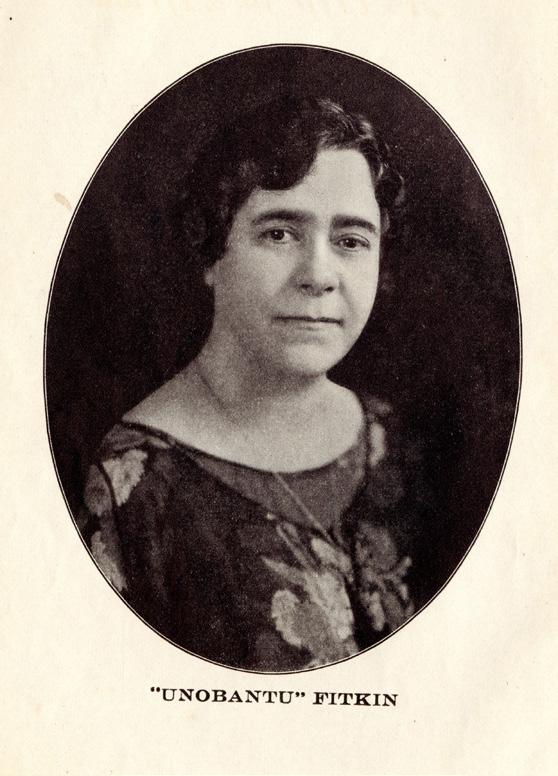
Image of Rev. Susan Fitkin, the influential founder of the Woman’s Foreign Mission Society of the Church of the Nazarene. This image was used in her early book A Trip to Africa.
The Woman’s Missionary Society of the Church of the Nazarene is best understood through the work of Susan Fitkin, the dynamic and influential leader of the organization, and its president from 1919 until 1948. Fitkin had been a Quaker, born in 1870 in Quebec, Canada. She became a minister in the Friend’s Society (Quakers), and after experiencing sanctification in a Holiness convention at a Methodist Church she continued
preaching holiness within the Quaker meetings, even after marrying her husband, Abram Fitkin. Eventually, the couple joined the Association of Pentecostal Churches of America along with Hiram F. Reynolds around 1895. The Fitkins continued as holiness evangelists, and in 1899 Susan Fitkin helped found the Ladies’ Foreign Missionary Auxiliary of the Pentecostal Churches of America, under the direction of Reynolds who was the Foreign Missionary Secretary. Fitkin became the president of this group in 1900, and when the Association of Pentecostal Churches of America joined with the Church of the Nazarene in 1909, she was ordained by Dr. Phineas Bresee as a minister of the Church of the Nazarene. By 1915, Fitkin was helping to organize the women of the Church of the Nazarene, which resulted in the formation of the Woman’s Missionary Society, which would eventually be renamed the Women’s Foreign Missionary Society. Fitkin would become president in 1919 and held the position for over thirty years.7
It is Susan Fitkin who began the idea of a study program which promoted books on mission for the women to study. From the start of the organization in 1919, there had been a Superintendent of Study and Publicity, starting with Miss Fannie Claypool. Claypool had mission study material prepared and released within the Nazarene mission periodical The Other Sheep and sometimes small leaflets and maps had also been prepared to send to local women’s groups. For example, in 1923-24, Claypool published mission study outlines and at least one leaflet on Japan and recommended the first known book for study, Creative Forces in Japan by Galen M. Fisher (Mission Education Movement, 1923). In 1924-25, Fitkin recommended using the book Our Friends in Guatemala by Reuben E. Bower, (The General Board of the Church of the Nazarene, 1924). Copies of this book were rushed to ten district presidents, and they were encouraged to develop study groups around the book.8 Claypool continued to publish study guides in The Other Sheep and as leaflets on Peru and Africa. In 1925 Fannie Claypool passed away and the program was reorganized to create a General Committee of Study. Fitkin continued to see the importance of a study program,
In early February 1927, at the helm of the W.F.M.S. Executive Committee, sitting in Kansas City, she (Fitkin) directed the growing missionary work for the forthcoming year. At this time the emphasis was upon a study program, for Mrs. Fitkin felt that missions “perish where there is not knowledge.” The roots of the woman’s work, she insisted, must go deep into the mental subsoil
of Nazarene thinking, if the program of global service was to be realized. This meant guided study courses which would result in missionary information that would spring forth as inspiration for prayer and giving.9
In 1926-27 Mary Elizabeth Cove took over as the chairman of the General Committee of Study, and she had quickly prepared three study guide leaflets: one on China, one on Islam, and one on India. In February of 1927, the Committee recommended the book India As I Found It by May Tidwell McKay (Pentecostal Mission Publications, 1925), even though it was too late to be considered as a study book for the program. By November of 1927 the Nazarene mission periodical The Other Sheep reported on the plans for the new mission study for 1928,
The Committee on Study has already announced that the new study book, “Latin Americans- Our Southern Neighbors,” prepared by our committee, and Mrs. Hinshaw’s charming little booklet, “Messengers of the Cross in Latin America,” which we have planned to use in connection with the study book, would be in the hands of the local leaders by the first of December for their meeting in that month… We are delighted with the little booklet of Mrs. Hinshaw’s. This is something new, and really inspired, we believe, and we urge that no society attempt to take up the study book without this one as helpful side material… These stories are written in a charming manner, and the booklets ought to be in every Nazarene home in the land.10
The plan was for a nine-month study course for Nazarene women to end in August of 1928. For the first time, there was a list of four books recommended: New Days in Latin America by Webster E. Browning (Missionary Education Movement, 1925), Looking Ahead with Latin America by Stanley High (Missionary Education Movement, 1925), Ventures in Inter-American Friendship by Samuel Guy Inman (Missionary Education Movement, 1925), and Central American Indians and the Bible by W.F. Jordan (Fleming H. Revell Co., 1926). Along with these resources a map of Latin America, which measured 38 inches by 50 inches had been prepared. But 1927-28 was the first year the Nazarene women themselves had been able to prepare a book under Cove’s leadership, and this was supported by Amy Hinshaw’s first book to create a unified study on missions in Latin America. Mary Cove also commented on Hinshaw’s book
in January of 1928, “… Mrs. Hinshaw’s charming biographies of our own missionaries. These are not stupid lists of births and so forth; it is full of life and love and joy and sorrow. It will make you laugh and cry and then- the Lord have mercy on you if you don’t pray and sacrifice!” Cove also pointed out that the aim of the W.M.S. was to get 10,000 Nazarene women all praying for the same thing and focus on a specific geographic area.11
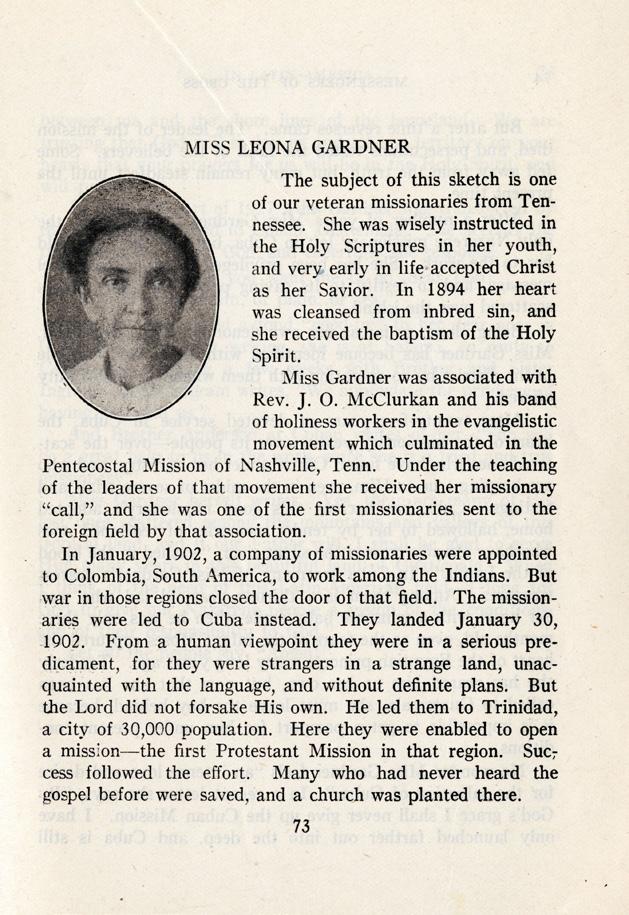
A page from Hinshaw’s The Messengers of the Cross in Latin America, the first in her important Messengers series. Women in the Woman’s Foreign Missionary Society were introduced to Nazarene missionaries with their photographs and detailed, but entertaining, accounts of their lives.
Hinshaw’s accounts are some of the best sources for missionaries like Leona Gardner, who started as an early holiness missionary from the Pentecostal Mission before it joined the Church of the Nazarene.
It is important to note that Amy Hinshaw was 62 years of age when she published The Messengers of the Cross in Latin America.12 As mentioned earlier, she was a local leader in the Minneapolis District of the Nazarene Woman’s Missionary Society, and in the Report of the Woman’s Missionary Council for 1927 it noted that the board wished “to express their appreciation to Mrs. Amy Hinshaw, who has written the beautiful little book, ‘Messengers of the Cross in Latin America,’ and donated it to our W.M.S.”
It appears that this booklet was a personal act on Amy Hinshaw’s part to collect and organize information from missionaries’ letters and articles in The Other Sheep and develop them into short historical biographies with photographs which would appeal to women readers. As far as I know from historical data, Hinshaw never traveled to visit the mission fields, but used her skills as a writer to promote the work of Nazarene missionaries as if she were personally acquainted with each one of them. Yet, this book would launch her well-known Messengers series, which would ultimately grow to five books detailing the biographical histories of early Nazarene missionaries. One source has noted of the study publications of the Woman’s Missionary Society,
The first full-fledged study book, titled Latin Americans, Our Southern Neighbors, was prepared for the 1927-28 assembly year. Members were urged to read “missionary books published by the Nazarene Publishing House,” although Amy Hinshaw’s Messengers of the Cross in Latin America was the only Nazarene book among the six recommended for that year. Amy Hinshaw was to become one of the most prolific writers of missionary books in those early years.13
In July of 1928, Amy Hinshaw published an article in The Other Sheep, entitled “Do We Really Pray?”14 which was aimed at encouraging Nazarene women to pray for missions. She would use a large part of this article in a later section she wrote for the book The Dynamic of Mission 15 The success of The Messengers of the Cross in Latin America soon became apparent. In August of 1928, Mary Cove announced that Hinshaw would be doing a second book on the lives of African missionaries. This same issue was accompanied by a letter from Mrs. John T. Benson, who was the treasurer of the Woman’s Mission Society, but also the wife of an important figure involved in the founding of the Pentecostal Mission in Nashville, which had merged with the Church of the Nazarene in 1915. Mrs. Benson wrote of conducting a day long women’s meeting in Nashville, and she noted,
Don’t you think that the results of this day’s well thought out, unhurried work, proves the value of the day meeting? And still we had an hour and a half left for our lesson on Latin America and for the accompanying sketch of the missionaries as given in Mrs. Hinshaw’s invaluable little
book, “Messengers of the Cross.” I trust that no president is making the fatal error of leaving these sketches off her program. No other feature has proved more inspiring to our women here, nothing has come nearer getting them to shouting than these stories of our devoted, selfsacrificing missionaries, of their call, their preparation, their hardships and their victories. There was a time when our women had nothing of this kind. Now that God has our study committee and Mrs. Hinshaw to fill this great need we cannot afford to miss a line they have given us. Thank God for the two books in our course.16
As indicated earlier, Hinshaw gave her first book The Messengers of the Cross in Latin America to the Woman’s Missionary Society, which became a companion to the book produced by the General Committee on Study for the W.M.S. (including Mary E. Cove, Mrs. L.S. Tracy, Mrs. Robert White, Mrs. J.T. Benson, and Mrs. W.B. Needles), Latin Americans: Our Southern Neighbors 17 This book essentially used the four recommended books and contained a series of nine lessons, focused on facts and figures for Latin America and the specific countries of the missions of the Church of the Nazarene.18 It also referred to Hinshaw’s book in its suggestions for leaders and noted, “…the little booklet of Mrs. Hinshaw’s, ‘Messengers of the Cross in Latin America,’ should be presented to the people, and as many sold as possible. Especially the latter will sell well if properly advertised. One should be in every Nazarene home before the year is out. Remember the informed people are the inspired, praying, giving people.”19 Susan Fitkin’s own book, Over in Old Mexico20, detailing her trip to the Mexican missions, came out too late to be part of the study program. It is possible there was a bit of a rivalry between Hinshaw and Fitkin. It may have been friendly, and both were deeply committed to the cause of promoting Nazarene missions. But at the end of Fitkin’s Over in Old Mexico, she includes the biography of Rev. T.V. Santin, a convert and pastor in Mexico. In a slightly critical footnote, Fitkin wrote, “As Sister Hinshaw failed to secure Dr. Santin’s autobiography for her ‘Messengers of the Cross in Latin America,’ we are very glad to include it in this little booklet.”21 Hinshaw, Cove, and Fitkin would form a powerful trio for developing the early mission study program and its resources, which was critical for building the Woman’s Missionary Society for the Church of the Nazarene.
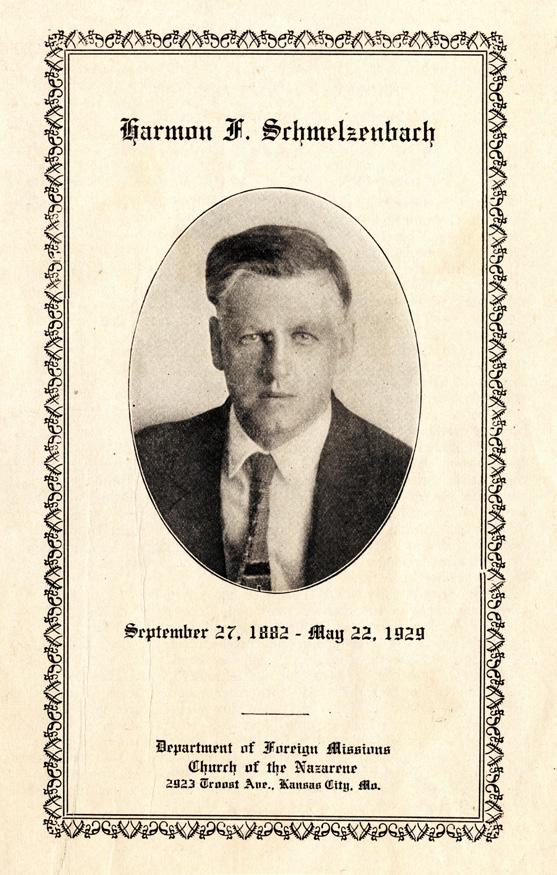
Hinshaw also wrote a few brief pamphlets, especially when a missionary died, such as this one for African missionary, Harmon F. Schmelzenbach in 1929.
Despite being close in age, Susan Fitkin and Amy Hinshaw were very different kinds of people. Yet, Fitkin would become another strong writer of books used in the mission study course. Fitkin had financial resources and high-level connections within the denomination. She would travel to most of the mission fields: Africa (1927), Mexico (1928), the Caribbean (1929), Central America (1935), the Orient (1936), and Argentina (1937). Her books are mostly written like travelogs, focused on where she went, who she met, and her impressions of the countries, their cultures, and the work being done by the Nazarenes in that place. Hinshaw was not wealthy, did not travel, and relied on resources and research she could do within the letters and reports in The Other Sheep. Yet, her style, insight, and way of writing make her works more accessible and useful today than those of Fitkin. Mary E. Cove brought the experience of a gifted teacher to her curriculum development which helped produce lessons for the study program in a dynamic way. Combined with Cove’s pedagogical knowledge and experience, and Fitkin’s organizational prowess, Hinshaw brought to her writing the artistic skills of her father and was able to paint pictures with
her words that could move her audience. The three would revolutionize the Woman’s Missionary Society. Fitkin wrote of this period,
We suffered a sad interruption in the work of study and publicity, when our precious Sister Fanny Claypool left us, and slipped away to Heaven. It was hard to fill her place, and we still mourn her loss. Finally our great need was supplied by a study committee. This committee has prepared and had published the first study booklets, containing material for monthly study, as well as maps and suggestions for leaders. Besides this, there are now two more booklets on sale along this line, one a set of fascinating little biographies of our missionaries in Latin America, another the account of the writer’s trip to Africa. We hope soon to have a worthy list of publications that we can send out over the country.22
Hinshaw’s style was simple and colorful but showed a strong reliance on letters and reports from The Other Sheep. Her work is much more historiography than hagiography, perhaps because so many of her subjects were still living at the time she wrote. Nevertheless, Hinshaw does portray the work of the missionaries in a positive, even heroic, light. It must be kept in mind that these books were designed to be used for group study among lay women in the Church of the Nazarene, and the aim was to promote the mission work of the Church. Hinshaw’s language can seem to lean toward a romantic view of missions, but that is in keeping with the time and the audience. For historians who might criticize her lack of citations and references, it is important to remember the context and audience of the book, but also to remember that Hinshaw was not writing history but recording the lives of current missionaries for the Church. Thus, her works really fit more into the category of primary sources rather than being historic reference works.
By the 1930 census, Amy Hinshaw was living with her son Neal, who was working as a salesman in Kansas City, Missouri. Alice remained in Minneapolis and rented a place for herself as she worked as a foreman for an envelope company. It is not clear when Hinshaw relocated from Minneapolis, but she is listed as working as a proofreader for a publishing house at the age of 64. It is possible the death of her third child, David, in December of 1928 provided the stresses which led to her separation from her husband and her decision to relocate to Kansas City, but this is only speculation. The census record is the only hint of her connections with the
Nazarene Publishing House in Kansas City. While it is not clear exactly when she began working at the Nazarene Publishing House, her passion for missions and prayer immediately surfaced in her first known book, the first of her Messengers series, The Messengers of the Cross in Latin America. As Hinshaw noted in a short forward in this book, the purpose was to introduce Nazarene missionaries to members of the Church, including their stories along with photos which, “…will cause you to love them better, to pray for them more earnestly, and to take a more active interest in Nazarene foreign missions.”23
The format of this first book in the Messengers series appears to have been successful and was quickly followed by The Messengers of the Cross in Africa24 in 1928, when it too became a study book for 1928-29. Following the pattern of the Latin American study, the Woman’s Foreign Missionary Society (W.F.M.S. as it was then known) put out three books: the study guide The Challenge of Africa/ Palestine and Syria25 by Mary Cove and the Committee with planned lessons, The Messengers of the Cross in Africa by Hinshaw, and A Trip to Africa26 by Susan Fitkin.27 The Committee seems to have been overly ambitious in 1928, and they set out to also include material on Nazarene missions in Palestine and Syria. This material was added as lessons by the Committee to The Challenge of Africa/ Palestine and Syria (although it was still not complete and they noted a later supplement would be sold to complete the work), but Hinshaw was unable to produce this material until 1929 when she published the awkwardly combined and named Messengers of the Cross in Palestine, Japan and Other Islands. 28
About the same time as The Messengers of the Cross in Africa, Hinshaw also wrote The Call of the Aguaruna. 29 This work is advertised in July of 1929 in The Other Sheep, just a few months after the death of Esther Carson Winans on November 6, 1928. The advertisement noted, “Mrs. Hinshaw is the author of several of our W.F.M.S. text books and writes as with a pen of fire from a heart that beats in sympathy with the needs of the heathen as well as with the privations and heroic sacrifices necessary on the part of the missionaries.”30 While this book likely began as an update to the Winans’ biography she wrote for The Messengers of the Cross in Latin America, this does seem to mark the beginning of a special fascination she seems to have had with the mission work of Roger and Esther Carson Winans and their work at the Pacasmayo mission among the Aguaruna tribe of northern Peru, started in 1917. When Winans’ first wife died because of malaria, pneumonia and “brain fever” leaving three small children,
including a delicate infant, a new missionary, Miss Esther Carson nursed the baby until it also died. Roger Winans and Esther Carson were married and continued the mission work, until her untimely death in 1928. It is not surprising that this story appealed to Amy Hinshaw and was also a true-life romance which could elicit interest from her readers and promote missions while also appealing to the hearts of Nazarene women. This story would be used several times by Amy Hinshaw in her promotion of missions.
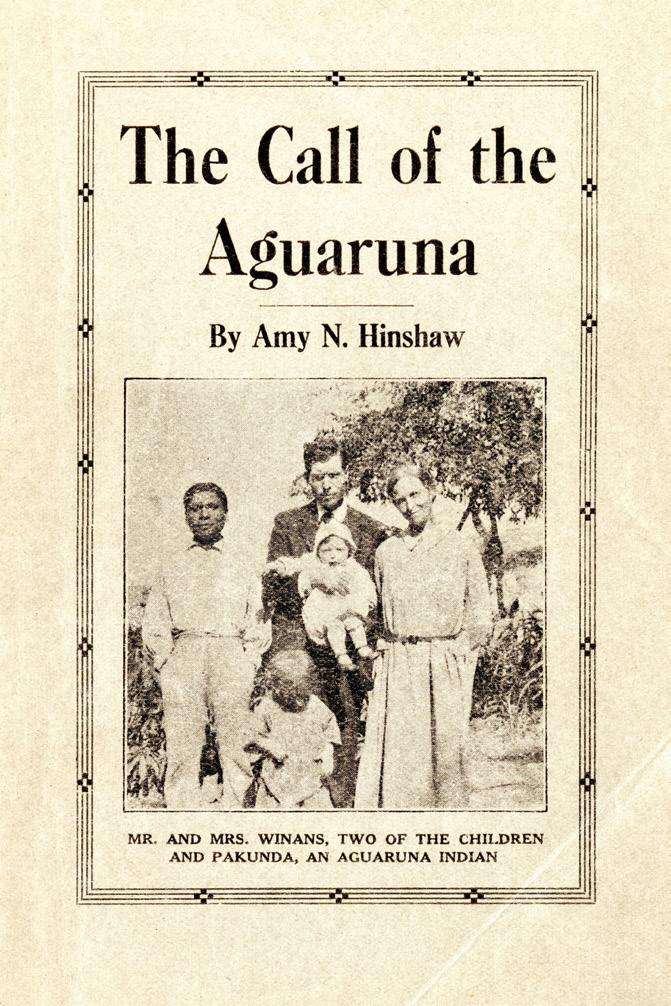
The cover of The Call of the Aguaruna (1929), one of Hinshaw’s early works.
Amy Hinshaw would be very engaged with the missionary story of Esther Carson Winans, and wrote on her a few times. The story fit romantic ideals of women of this time, and the tragic nature of Esther’s early death touched the hearts of Nazarene women readers.
In 1929, Hinshaw wrote Messengers of the Cross in Palestine, Japan and Other Islands which was promoted as a mission study book in 1929-30, the third of the Messengers series. The study for 1929 focused on the Nazarene work in the Caribbean and included the Committee’s lesson book by Mary E. Cove, Friends on the Islands,31 and Susan Fitkin’s Under Tropical Skies. 32 During 1929, Hinshaw also wrote A Missionary Tour by
Airplane33 which is a brief imaginary trip through all the Nazarene missions. With an introduction by J.G. Morrison, the Missionary Secretary, this book was promoted for missionary study material and for pastor’s source material to do sermons encouraging missions. Morrison concludes his introduction writing,
We appreciate the splendid work done upon this little volume by the gifted author, Mrs. Amy N. Hinshaw, a faithful Nazarene of Minneapolis, Minn. Her devoted love for our Lord, and intense interest in spreading holiness at home and abroad, has permeated these pages, and instilled into each one, the divine urge of the Holy Ghost. It is a privilege for which we are grateful that we have in the Church of the Nazarene such splendid talent so beautifully placed under tribute to the work of the Master.34
The book includes much briefer overviews of the missionaries and their work, along with specific needs either for people to go as missionaries, funds needed for the missions discussed, or items for special prayer. When the announcement of this book was made in The Other Sheep in January of 1930, they wrote,
That (Missionary Tour by Airplane) is the title of a book of sixty-three pages by Mrs. Amy N. Hinshaw. Those who have read her Messengers of the Cross series and other writings need no further comment. The twelve flights of this book take us to all our mission fields, with one, two, or three landings in each, and furnish excellent material in handy form for a missionary program each month of the year.35
The missionary study course for 1930-31 was different from the previous years. Susan Fitkin was ill for several months as the result of a nervous breakdown36 and Mary Cove had surgery and an extensive recovery time convalescing. When the course was finally revealed in October of 1930 it contained The Story of Missions by Mary E. Cove, seven leaflets on different subjects (referred to as the “Foreign Jewels Series”)37, and Hinshaw’s Messengers of the Cross in India. 38 Cove’s book is a simplified general history of Christian missions in twelve lessons which she credits to three books: Two Thousand Years of Missions Before Carey by Lemuel Call Barnes, A Hundred Years of Missions by Delavan L. Leonard, and The Progress of World-Wide Missions by Robert H. Glover. Cove noted in her
directions to the W.F.M.S. Superintendents of Study that her book might be too difficult for some societies, and she indicated that some leaders might prefer to begin with lesson seven (which began with modern missions and India) and lean more on Hinshaw’s book and the seven leaflets.39 At the same time, Hinshaw’s Messengers of the Cross in India was described, “Then another part of the course is another ‘Messengers’ from the pen of our favorite writer, Sister Amy N. Hinshaw. This contains the life stories of our missionaries in India, told as only she can tell them, with laughter, tears, and inspiration in fascinating mixture.”40
For 1931-32, a different approach was taken for the mission study course, but it involved Hinshaw in two different projects. The first portion was an account by Nazarene missionary Rev. Clarence J. Kinne on his work in China, entitled Our Field in China, but this was joined with a work by Amy Hinshaw called Pictures of Chinese Life into one volume.41 This was for financial expediency given the impact of the Great Depression. A publisher’s notice at the start of the work notes that there was no collaboration on the parts of the authors, but “In the interest of economy with its resultant savings to the members and friends of the Woman’s Foreign Missionary Society, we are combining the two.” C.J. Kinne’s portion makes up the first 15 pages and Amy Hinshaw’s portion makes up the remaining 47 pages of the 62-page booklet. Hinshaw, in her own foreword noted the help of Mary E. Cove in helping gather material as well as the help of material sent from several Nazarene missionaries in the field. She also cites several books she drew from, and noted,
This booklet was added to the W.F.M.S. study course after the time specified for submitting the manuscripts of the study books to the Publishers had expired. Since the time allowed for preparation and writing was so very short, the author sends this volume forth with much misgiving. The task seemed an impossible one on such brief notice, but since the Lord has helped, we venture to hope that our readers will find in these simple pages some useful and interesting information about China and her people. These “Pictures” are, for the most part, descriptive of conditions in North China where our Nazarene field is located.42
In addition, Hinshaw added Messengers of the Cross in China43 as the final volume in her Messenger series. Regarding these books, Mary Cove wrote,
Another book is being written by Mrs. Amy N. Hinshaw, whom we all love. This little book will furnish the stories and descriptions to go with Brother Kinne’s. One will not be complete without the other. Then another of the wonderful little Messengers will be added to the course this year, this time containing the lives of our own missionaries in China, written up, briefly but strikingly, as only Sister Hinshaw can prepare them.44
Amy Hinshaw noted in her introduction that this was the last of the Messengers series, and adds, “…we wish to express our heartfelt thanks to all who have helped to make this series a success since it was started as an experiment, five years ago.” The experimental project started in 1927 resulted in an almost complete sweep of Nazarene missionary biographies from its earliest period of mission. Very few other denominations have anything even close to this type of source material, let alone such material produced from written correspondence from these very missionaries.45 By 1932-33, Mary Cove was still preparing a study guide, but the main text for the mission study course was Beth and I in India by Mrs. Gertrude P. Tracy, a Nazarene missionary serving in India. On the title page of this book, it notes that it was edited by Amy N. Hinshaw and Mary E. Cove. A few months earlier, Susan Fitkin had released her autobiography, Grace Much More Abounding46, and Amy Hinshaw was likely working on two larger projects. An announcement early in 1931 had indicated that Hinshaw was working on a biography of Esther Carson Winans. The announcement read,
“Blazing the Aguaruna Trail” is the name of a new book written by Mrs. Amy N. Hinshaw. It is really a complete life of Esther Carson Winans. Mrs. F.W. Carson, Esther’s mother, after reading the manuscript, writes: “We are so pleased, satisfied and delighted. You have treated the whole life story with great accuracy.”47
This is likely a reference to writing Hinshaw did for the Herald of Holiness from April 1, 1931 until September 30, 1931, which carried chapters of a serial book-length biography of Esther Carson Winans called “Trail of the Aguaruna”48 While no book called “Blazing the Aguaruna Trail” came out in 1931, it is assumed that this might have been an early version of The Trail of the Aguaruna: A Life Story of Esther Carson Winans which was not
published until 1935. It is also likely that Hinshaw was working on Native Torch Bearers which would be published in 1934.
In 1933-34, the mission study book was 30,000 Miles of Missionary Travel by J.B. Chapman, which related nine months of travel done by Chapman in 1931 in Latin America, the Caribbean, and Africa visiting Nazarene mission fields. Yet, Hinshaw was also involved in another project in 1933, the publication of The Dynamic of Missions, which was co-written with J. Glenn Gould and Basil W. Miller. Gould wrote a section on “The Holy Spirit and Missions” and Miller wrote a section on “The Bible and Missions” while Hinshaw wrote the section on “Prayer and Missions.”
A brief foreword notes that in 1932 the General Assembly formed a Commission on Foreign Mission Study Literature, and this was the first book born from this Commission. Hinshaw’s section carries stories of many of the heroes of the mission field found in her Messengers series. Hinshaw noted at the end of her section how she envisioned these books would work along with intercessory prayer to support Nazarene missions,
Let them meet at stated intervals, behind closed doors, beginning their service about the middle of the forenoon, and continuing as long as the Spirit may prompt them to linger. The Bible and late copies of The Other Sheep containing the latest news from all the fields should be at hand. The intercessors should endeavor to cultivate at least a speaking acquaintance with our Nazarene missionaries and their work through the “Messenger” books. While assembled together, with the Holy Spirit in the midst, the needs of each field should be sympathetically presented, taking one field at a time, alternating with seasons of prayer for each. The missionary problems of the church should be considered, also the Missionary Board and the W.M.S. leaders should all receive their share of attention. While the Holy Spirit is always reasonable, five or six hours will not be too long to cover the ground.49
In August of 1934 a new Missionary Training Course was introduced by the Woman’s Foreign Missionary Society, which was separate from the usual yearly study program.50 Any woman who signed up for the course was to read a set of resources and answer questions on a “home quiz.” Those who applied for the course and finished submitting their quizzes would obtain a certificate from the W.F.M.S. with seals added for the questions they answered. The materials were found in four groups:
Group One:
Story of Missions by Mary Cove
Grace Much More Abounding by Susan Fitkin
Under Tropical Skies by Susan Fitkin
Group Two:
Latin Americans, Our Southern Neighbors by the W.M.S. Committee of Study
Messengers of the Cross in Latin America by Amy Hinshaw
Over in Old Mexico by Susan Fitkin
The first 118 pages of 30,000 Miles of Missionary Travel by J.B. Chapman
Group Three:
Challenge of Africa/ Palestine and Syria by the W.F.M.S. Committee of Study
Messengers of the Cross in Africa by Amy Hinshaw
Messengers of the Cross in Palestine, Japan and Other Islands by Amy Hinshaw
Chapters 17-20 of 30,000 Miles of Missionary Travel by J.B. Chapman
Group Four:
Our Field in China by C.J. Kinne/ Pictures of Chinese Life by Amy Hinshaw
Messengers of the Cross in China by Amy Hinshaw
Beth and I in India by Mrs. L.S. Tracy
Messengers of the Cross in India by Amy Hinshaw
Heart Throbs from India by John McKay
What is significant here, is that this list shows the extent of publishing done on early Nazarene missions, mostly connected to the work of the W.F.M.S. and out of fifteen books, 83% of the authors are women and roughly 37% (counting one half of the book done with C.J. Kinne) of the writing was by Amy Hinshaw, more than any other author. Susan Fitkin came in second with 20%, roughly equal with Mary Cove, who also led the Committee of Study.
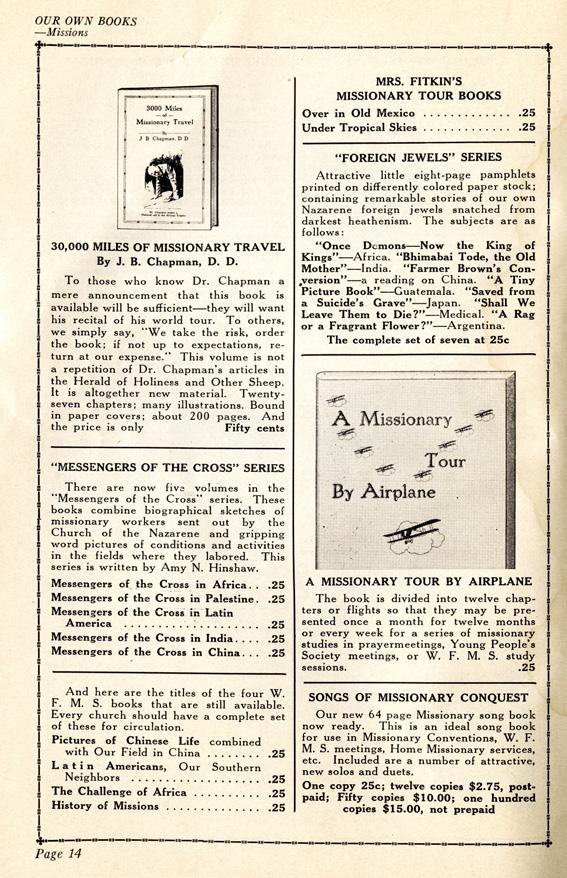
The page of mission resources from the Nazarene Publishing House Catalog for 1932.
Of the 18 items listed, Amy Hinshaw is the author of seven of the books: the Messengers series of five books, A Missionary Tour By Airplane, and Pictures of Chinese Life. Hinshaw was the most prolific writer of Nazarene mission material in the 1920s and 1930s.
Along with this new Missionary Training Course, the usual yearly study book for 1934-35 was Amy Hinshaw’s Native Torch Bearers. 51 When this book was promoted in The Other Sheep, they wrote that the book,
…written by Amy N. Hinshaw that incomparable writer of missionary material, tells the stories of native workers in the foreign fields- their conversion, their persecution, their faithfulness and their zeal in bringing to the hearts and lives of others, the light of the gospel that has come to them. There is not a tedious paragraph in the entire book. It will thrill you and inspire you to more earnest prayer and to greater enthusiasm for the cause of foreign missions.52
This work took a lot of extra time and effort, which Hinshaw noted in her foreword,
The assembling of material for this little volume has been no easy task. It has involved ten months of intensive
correspondence on the part of the author, also much extra labor on the part of our precious missionaries, who are already overburdened with work and responsibility. Yet they have co-operated cheerfully and generously, giving of their time and strength in collecting the necessary data for the life stories. Without their co-operation this book could never have been written.53
This volume was dedicated to recording the stories of indigenous leaders on the mission field. This type of thinking was far ahead of many mission organizations at the time. In her introductory chapter, Hinshaw reflects on 1925 as a year when the church of the Nazarene had to pull missionaries off the field and reduce the number of native evangelists. She notes how some of the missionaries chose to reduce their own luxuries and pay native workers out of their own reduced salaries, rather than see the work of the Gospel slowed. This emphasized to Hinshaw and others the importance of native evangelists, and so she set off to write a book which told their stories. It is truly an innovative project for mission literature in the 1930s. The stories of native evangelists from all corners of the work are told, and the importance of their work is emphasized. While there are a few exceptions, most mission histories focused on native evangelists were not written until the 2000s, and few of them have the extensive record that we see in Hinshaw’s 1934 book.
Amy Hinshaw published The Trail of the Aguaruna: A Life Story of Esther Carson Winans in 1935. While this was a major work in terms of her own apparent interest in the story of Esther Carson Winans, the book itself was not a study book for 1935-36. This might be due in part to a late printing, since it appears in the General Catalog of the Nazarene Publishing House for September 1935, but not in the regular pages but added to the inside of the front cover with other “Very Recent Additions.” The Catalog wrote, “This is the long-awaited life-story of Esther Carson Winans and her work among the Aguaruna Indians. It is a thrilling, moving, gripping story told as only Mrs. Hinshaw can write. This book will fascinate children, inspire young people and lead older readers to deeper devotion and greater sacrifice.”54 J.G. Morrison wrote an introduction to the book, which Hinshaw dedicated to Esther Winans’s mother and father,
A well told story of any life is interesting. When, however, the tale is that of far-away heroism, narrow escape and sacrifice among a wild and almost savage
people, then it becomes thrilling. Add to that the miracle working power of the gospel of grace operating on savage hearts, carried to these wild folk by the heroine of the tale, and the thrill is intensified many fold. Then to have that story told in a sympathetic, dramatic manner, that carries one on the swelling tide of its captivating interest to the tragic denouement which calls for the supreme sacrifice, and you have all the elements that will grip and fascinate to the end… It is graphically told by Mrs. Amy N. Hinshaw, a gifted writer. We are sure that every one who reads it will be stirred by its simple heroism, its miraculous providences, and finally tremendously aroused by its martyrdom.55
But other shifts were also occurring. Mary E. Cove had been replaced in terms of the study program by Olive M. Gould, who became much more interested in developing the idea of a course with certificates, and placed less emphasis on the usual yearly study program. She would add The Trail of the Aguaruna: A Life Story of Esther Carson Winans as a study book to the 1936-37 program, but only because the chosen book Life of Mary Reed had gone out of print and no more copies were available. Hinshaw’s work was substituted in March of 1937 to replace that book.56 In addition, the yearly study books clearly move in a new direction with largely male authors of Nazarene published material and biographical works focused on popular non-Nazarene missionaries, such as Adoniram Judson (Baptist), J. Hudson Taylor (China Inland Mission), the Moffats (Congregationalists), and John G. Paton (Presbyterian). The work of educating Nazarene women had become too popular and financially important to be left in ordinary hands. It also did not help that Amy Hinshaw turned 70 years old in 1935.
Amy Hinshaw’s last book published by the Nazarene Publishing House was In Labors Abundant: Biography of H. F. Reynolds.57 While there is not a copyright date and the book does not appear in The Other Sheep or among the missionary publications of the W.F.M.S., it must have been written and published in early 1939 since Dr. Reynolds died in September of 1938 and the book ends with a detailed account of his funeral. It cannot be later than 1939 because Rev. J.G. Morrison wrote the introduction and he passed away suddenly in 1939. Given the amount of time needed for writing and publication, 1939 seems the most likely date. This book was a culmination of Amy Hinshaw’s work, and her devotion to Nazarene missions. This work was longer and more in depth, in part because Hinshaw was able to work from Reynolds’ autobiographical notes. She refers to this
(2026)
in the text, noting, “In 1929 Dr. Reynolds prepared, with much labor, the autobiographical notes from which this history has been compiled.”58 There are also some elements which seem to come from Hinshaw herself, such as, “In 1930, before he moved his family to Wollaston, Mass., he frequently visited the Publishing House. Each time he entered an office, the weary employees felt the thrill of his cheery personality, as if a sunbeam had suddenly brightened a dark room, or as if a spring breeze laden with ozone had floated in through an open window.”59
Hiram Reynolds had been a major figure in the early Church of the Nazarene and had emerged from the Methodist Episcopal Church into holiness evangelism and eventually into the Association of Pentecostal Churches of America at the same time as Susan Fitkin. As the Missionary Secretary of this early holiness group, he had been involved in sending missionaries to India. He went on to play a crucial role in helping the Association of Pentecostal Churches of America merge with the Church of the Nazarene in 1909. Then he went on to help lead the Church of the Nazarene as a General Superintendent. From 1907 to 1923 Reynolds served as the General Secretary of the General Foreign Mission Board and acting President of the Board. He made several lengthy missionary tours and was committed to the missionary work of the Church. Hinshaw was now using her skills in writing missionary biography to honor the first major leader of the missionary movement in the Church of the Nazarene, and someone who she clearly admired. It really was the highpoint of Amy Hinshaw’s work as a Nazarene biographer. Sometime around 1939 (when the Reynold’s book was written), Amy Hinshaw, now 74 years of age, left her work of writing and the Nazarene Publishing House and moved to Chicago.
Additional Hinshaw Materials in the Asbury Theological Seminary Collection
Looking beyond the known publications of Amy Hinshaw, the new collection at Asbury Theological Seminary’s Archives and Special Collections includes unpublished material and scrapbooks of articles she had published elsewhere. These include a complete scrapbook of the column she edited from 1911-1914 for The Christian Standard. There are also scrapbooks of material she published elsewhere, but the dates and original published sources are unknown. Two of these are devotional in nature and include “On Blue Galilee” and “When Jehovah Leads.” Of greater
interest are two scrapbooks tied to Nazarene missions. One appears to be a series of articles laid out for possible future publication as a book, entitled “Deeper into Africa” about the mission work of H.F. Schmelzenbach, one of the earliest and most important Nazarene missionaries in Africa. The second, also laid out for publication is “A Missionary Romance” which appears to have been originally published about 1937 or 1938 in The Young People’s Journal, a Nazarene publication for youth in the denomination. This is once again the story of Roger Winans and Esther Carson Winans in Peru, a story which captivated Hinshaw. What makes these last two scrapbooks interesting is that Hinshaw included numerous photographs, some cut from other publications, but also some original photos which she likely intended to use when she turned these items into books.
The collections also include a couple of unpublished devotions. One entitled “Thirty Years at Nazareth” contemplates the years Jesus spent in Nazareth before his public ministry. One might even hear the experience of Amy Hinshaw speaking as she reflects here,
“…in the seclusion of Nazareth, Jesus solved the problems which make our commonplace, every day lives a burden. By so doing he made it possible for you and me to live victorious Christian lives, irrespective of our class or condition in life! Are we obscure, insignificant, filling a place of little importance in the world? Must we struggle with poverty and adverse circumstances? Do we stagger under the weight of peculiar responsibility and care? Jesus, in the Nazareth home, suffered all these things, yet he, “increased in wisdom and stature, and in favor with God and man.”60
The second unpublished devotional is a Christmas piece titled “Wonderful” and in this piece it is possible to see how Amy Hinshaw was influenced by the artistic vision of her father. Yet, she painted in words instead of oil, when she wrote of God creating plants in the Creation story, “At the next Divine word a new and greater miracle appears- the miracle of life which drapes the hillsides with verdure and carpets the bleak ground with softest green- a mysterious, pulsating life which tints the face of the violet, and scents the heart of the rose, and brushes the cheek of the peach with down! And God looked down upon all this and said that ‘it was good.’”61
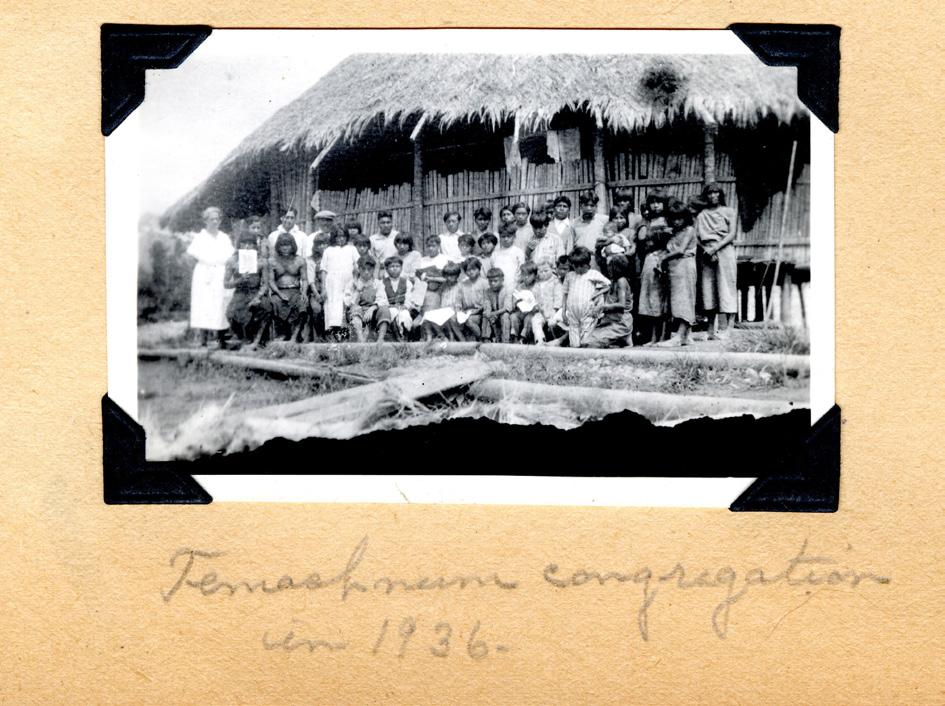
The Amy Hinshaw Collection at Asbury Theological Seminary contains several scrapbooks of writings Hinshaw was likely planning on publishing, and some of these contain original photographs, like this one of an Aguaruna congregation in 1936.
The collection does not contain personal correspondence, family papers, or personal photographs, and this lack continues to make Amy Hinshaw a rather unknown figure in the mission history of the Church of the Nazarene. However, the material in this collection puts most of her writings in one place, including many articles she wrote besides her betterknown books. There are also a few pamphlets which Hinshaw seems to have written at the times of the death of Schmelzenbach and Esther Carson Winans. Finally, the collection also contains two books not by Hinshaw, one is a pamphlet “The Aguarunas of the Upper Maranon” by Mrs. Watkins, which may have been a source for some of Hinshaw’s writing. The second is a copy of From the Mouth of the Lion: Told by a Prisoner of Japan (1943) by Nazarene missionary, L.C. Osborn, which is inscribed to Hinshaw by the author.
The Impact of the Early Mission Study Books on the W.M.S.
It is difficult to judge the total impact of Amy Hinshaw without understanding her role as part of the Woman’s Missionary Society of the Church of the Nazarene and especially in the Mission Study Book program. This program appears to have been shaped primarily by three women. Susan Fitkin provided the organizational force and the vision for an educational program to help bind the various Nazarene women together
into a missional force for the Church. Mary Cove, as a trained teacher with a long-term interest in children and education, rose to become the Chairman of the Study Committee after the death of Fanny Claypool, the head of Study and Publicity. In the process, the running of the Mission Study program was able to change direction, become more pedagogical, and advance into publishing its own material. However, this organizational skill and pedagogical giftedness would have gone nowhere without someone with the skill to write material that appealed to Nazarene women of the 1920s and 1930s. This was where Amy Hinshaw excelled and contributed to the growth of the program.
In 1923, the year the Minneapolis District W.M.S. was organized, the entire W.M.S. had just over 7,000 members and had contributed around $5,000 to mission work. Roy Swim in his early book on missions in the Church of the Nazarene wrote, “During the quadrennium of 1932-1936 the W.F.M.S. as it is known, secured for the General Budget the total of $433,549, which was more than four-fifths of the total amount raised for foreign missions by the church.”62 He continues, “Besides the work of fund raising the society carries on an intensive course of missionary study, insists on much intercessory prayer and offers itself always to the advancement of the cause of missions.” Swim also noted that the membership at the time he was writing was over 38,000, just in the United States. In the matter of a short thirteen-year period, the W.M.S. had become a major force in the Church of the Nazarene, both in numbers and in financial influence.
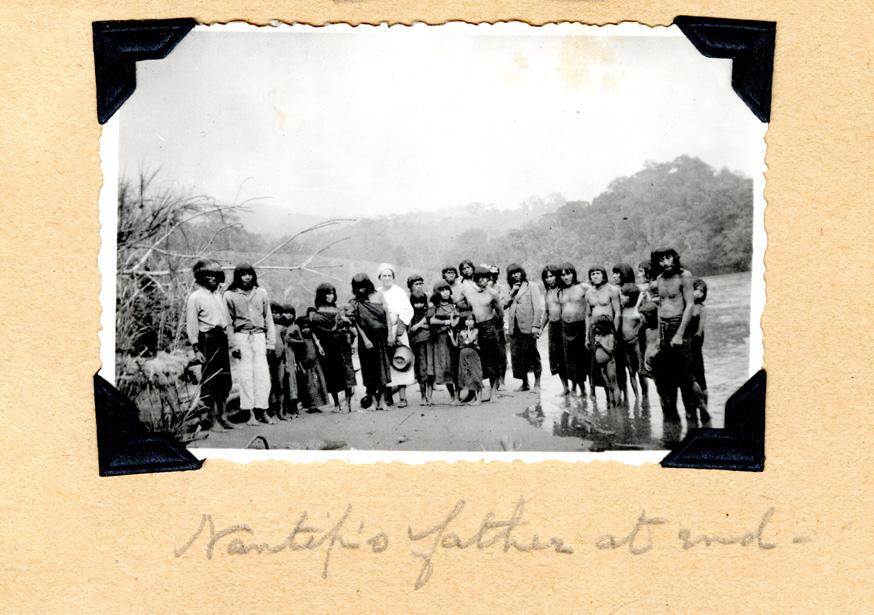
Another image from Hinshaw’s scrapbook on the Nazarene mission in Peru in 1936.
It is interesting that it was in this gap that Amy Hinshaw was at her most productive, and along with Susan Fitkin and Mary Cove, the W.M.S. produced most of its own literature without relying on outside sources or even denominational publications through the Nazarene Publishing House. From 1923 to 1927, some books from outside of the W.M.S. were recommended and various study outlines and leaflets were used to guide the study course often through the medium of The Other Sheep, but from 1927-1936 the publishing was dominated by W.M.S. produced material, mostly written by Amy Hinshaw, Susan Fitkin, and the General Committee on Study of the W.M.S. under the leadership of Mary Cove. Of seventeen items published and promoted during this period (counting the “Foreign Jewel Series” as one item), Amy Hinshaw wrote 38% of the material, with Mary Cove and the General Committee writing 29%, Susan Fitkin writing 12%, and others writing 21% of the study material. This means the trio of Hinshaw, Fitkin, and Cove produced 79% of the study literature in this period.
What is important about this number is that they wrote specifically about Nazarene missions, not missionary work in general. Hinshaw especially brought the missionaries to life for women scattered in rural communities across the country. It was this course of study which educated an entire generation of Nazarene women about the work of their missionaries, and the sacrifices they made. Hinshaw made the stories accessible while being accurate and touching on the romance of missions. Most of the comments of her work recorded here focus on how these stories touched women’s hearts and emotionally connected them to mission. The rise of membership numbers and funds emerging from the W.M.S. at this time are likely directly connected to this course of study and getting women personally invested through prayer. While Hinshaw’s The Trail of the Aguaruna: A Life Story of Esther Carson Winans would become a substitute course of study book for the following year, by this time the pattern had shifted. Books by men and stories of missionaries from outside the Church of the Nazarene dominated from 1937-1940, and likely beyond this period. The course of study had grown to be so important and influential in the W.M.S. that it was taken in a different direction.
What is also interesting is to see Amy Hinshaw as a pioneer in the field of missionary biography. Dana Robert has done more to advance this field in terms of recent scholarship than most other missiologists. She has noted,
The attraction of studying individual religious motivation is that it often leads to the heroic- of people living beyond the limitations of their human nature. And the heroic is interesting precisely because it constantly skirts on the edge of the tragic. Living according to principle can lead to death and destruction, just as easily to success and glory. For scholars, the religion part of religious biography, with its stress on exploring human decisions based on belief in ultimate truths, is what makes people interesting subjects. For believers, at a popular level, the heroic/tragic potential of Christian belief has long made the hagiographic form of religious biography a classic aid to Christian piety. Although I hope that my biographies are not hagiographies, I do wish them to respect persons of faith.63
I think that Amy Hinshaw wrote for similar reasons, although not as academically phrased. She wanted to portray Nazarene missionaries as heroic and sometimes tragic people who lived out lives based on their Christian faith. She also desired to avoid turning these men and women into saints but did desire their stories to encourage Christian holiness in the life of her readers. Robert noted in her classic work American Women in Mission that “this study assumes that mission theory includes the motivations, goals, theological assumptions, and reflection upon practical strategies that American women employed as they participated in foreign missions.”64 In this sense, a missiological study of Amy Hinshaw’s mission theory would be a helpful way to understand Holiness missiology in the Church of the Nazarene in its early years, especially through a feminist lens. The amount of her work, including numerous short biographies provide a useful way to understand how women theologized about mission through lived experience. This is especially true since her writing appealed to thousands of Nazarene women in the Woman’s Missionary Society.
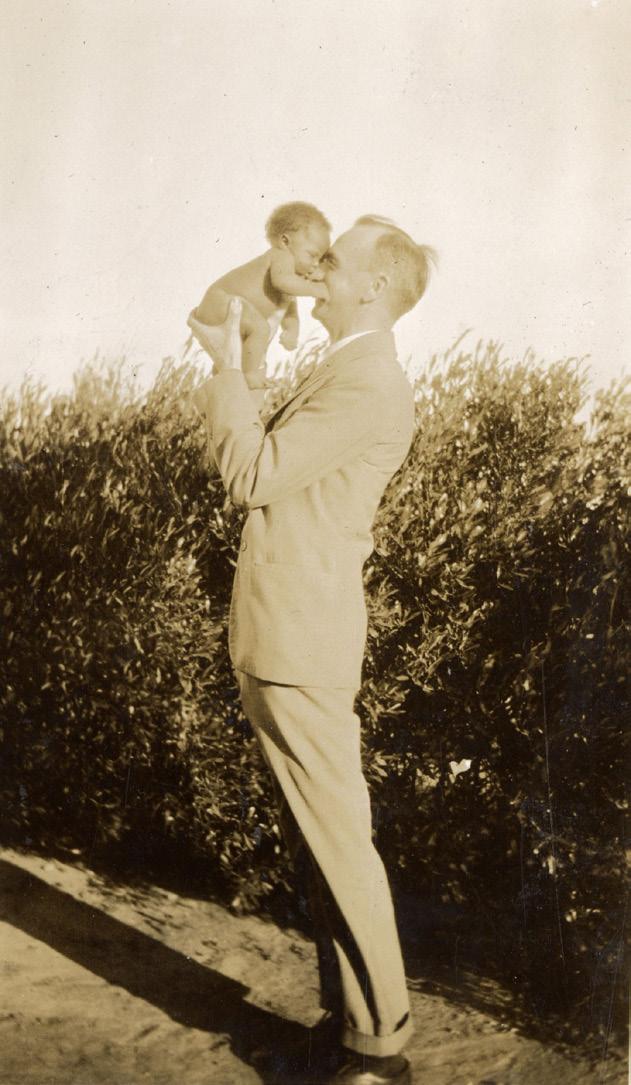
New Year’s Wishes for 1932 with a photo of Dr. David Hynd, a medical missionary for the Church of the Nazarene at the Raleigh Fitkin Memorial Hospital in Swaziland. The hospital was built to honor Susan Fitkin’s ten-year old son, Raleigh who died in 1914. This item is part of Amy Hinshaw’s scrapbook on Africa.
Susan Fitkin continued to write and lead the W.M.S. adding her voice through her book Holiness and Mission, published in 1940 in honor of the 25th anniversary of the W.M.S. She retired as President of the W.M.S. in 1948 after 33 years of successful leadership. Mary Cove rose to hold several positions, including Second Vice-President, but much of her later work turned toward working with juniors and children. Little is known about Amy Hinshaw after writing what should have been her biggest triumph, In Labors Abundant: Biography of H. F. Reynolds in 1939. By the 1940 census, Amy Hinshaw was living in Chicago with both of her children, Alice and Neal. In the 1950 census, the three were still living together in DuPage, Illinois. Amy Naomi Hinshaw died on January 8, 1955, at 89 years of age and was buried in Minneapolis, ultimately with all five
of her children. There was no obituary or mention of her passing in The Other Sheep.
Woman’s Missionary Society Study Books 1923-1940
1923-24 Creative Forces in Japan (Missionary Education Movement) by Galen M. Fisher was recommended, Mission Study Outlines in The Other Sheep and leaflets on Japan by Fannie Claypool.
1924-25 Our Friends in Guatemala (General Board of the Church of the Nazarene) by Reuben E. Bower was recommended, Mission Study Outlines in The Other Sheep and leaflets on Africa and Peru by Fannie Claypool.
1925-26 No study materials due to the death of Fannie Claypool and late appointment of Mary Cove to the Chairman of the Study Committee.
1926-27 Three study guides: one on China, one on Islam, and one on India by Miss Mary E. Cove (no books), India As I Found It (Pentecostal Mission Publishing) by May Tidwell-McKay (recommended late in the year).
1927-28 The Messengers of the Cross in Latin America by Amy Hinshaw (Number 1 of the Messengers Series), Latin Americans: Our Southern Neighbors by the General Committee on Study W.M.S. (Mary Cove, chairman).
1928-29 The Challenge of Africa by Mary Cove and the General Committee on Study W.M.S., The Messengers of the Cross in Africa by Amy Hinshaw (Number 2 of the Messengers Series), A Trip to Africa by Susan Fitkin.
1929-30 Messengers of the Cross in Palestine, Japan and Other Islands by Amy Hinshaw (Number 3 of the Messengers Series), Friends of the Islands by the General Committee on Study W.M.S., Under Tropical Skies by Susan Fitkin.
(2026)
1930-31 The Story of Missions by Mary E. Cove Seven leaflets on different subjects (referred to as the “Foreign Jewels Series”), Messengers of the Cross in India by Amy Hinshaw (Number 4 of the Messengers Series).
1931-32 Our Field in China by Clarence J. Kinne/ Pictures of Chinese Life by Amy Hinshaw, Messengers of the Cross in China by Amy Hinshaw (Number 5 of the Messengers Series).
1932-33 Beth and I in India by Mrs. L.S. Tracy (Edited by Amy Hinshaw and Mary Cove).
1933-34 30,000 Miles of Missionary Travel by J.B. Chapman.
1934-35 Native Torch Bearers by Amy Hinshaw.
1935-36 Missionary Pioneers and Our Debt to Them by J. Glenn Gould.
1936-37 The History of Nazarene Missions by Roy E. Swim, Life of Mary Reed (ran out of print by February 1937) replaced with: Trail of the Aguaruna: A Life Story of Esther Carson Winans by Amy Hinshaw.
1937-38 The Challenge of China by H.A. Wiese and L.A. Reed, Life of Adoniram Judson.
1938-39 The Dawning Light: A Study in Latin American Missions by Lewis T. Corlett, The Moffats.
1939-40 Our Island Missions by Maud Widmeyer, Everette Howard, and Pearl Wiley, Life of J. Hudson Taylor.
1940-41 India’s Open Door by Prescott L. Beals, Life of John G. Paton by Bessie L. Byrum.
The archives of the B.L. Fisher library are open to researchers and works to promote research in the history of Methodism and the WesleyanHoliness movement. Images, such as these, provide one vital way to bring history to life. Preservation of such material is often time consuming and
costly but are essential to helping fulfill Asbury Theological Seminary’s mission. If you are interested in donating items of historic significance to the archives of the B.L. Fisher Library, or in donating funds to help purchase or process significant collections, please contact the archivist at archives@ asburyseminary.edu.
Robert A. Danielson
End Notes:
1 All images used courtesy of the Archives of the B.L. Fisher Library of Asbury Theological Seminary who own all copyrights to these digital images, unless otherwise noted. Please contact them directly if interested in obtaining permission to reuse these images.
2 Newlight or “New Lights” tend to refer to followers of Barton W. Stone, a Presbyterian minister who formed what was known as the Christian Church after the Cane Ridge Revival in Kentucky. Stone merged with Alexander Campbells group, often known as the Restoration Movement to become the Disciples of Christ in Lexington, Kentucky in 1832. Given Hinshaw’s account it is possible her father was connected with a group that later broke off going back to some of Stone’s original teachings.
3 Amy Naomi Hays Hinshaw, “Barton S. Hays- Artist.” Unpublished manuscript from the Wilbur D. Peat Research Papers of the Indianapolis Museum of Art, page 1.
4 Amy Hinshaw, letter to Wilbur D. Peat, dated October 8, 1951. From the Wilbur D. Peat Research Papers of the Indianapolis Museum of Art.
5 “Minneapolis District Woman’s Missionary Society,” The Other Sheep (June 1927): 10.
6 Mendell Taylor, Fifty Years of Nazarene Missions, vol 1. Administration and Promotion. Kansas City, MO: Beacon Hill Press (1952): 73.
7 Cf. S.N. Fitkin, Grace Much More Abounding. Kansas City, MO: Nazarene Publishing House (1930?) and Basil Miller, Susan N. Fitkin: For God and Missions. Kansas City, MO: Nazarene Publishing House (1949?).
8 Basil Miller, Susan N. Fitkin: For God and Missions. Kansas City, MO: Nazarene Publishing House (1949?): 106.
9 Ibid., 120.
10 “Special Attention! District Superintendents of Study,” The Other Sheep (November 1927): 11.
11 Mary E. Cove, “New Nazarene Study Books for Nazarene W.M.S.” The Other Sheep (January 1928): 11.
12 Published by The Woman’s Missionary Society of the Church of the Nazarene, Kansas City, MO, in 1927.
13 J. Fred Parker. Mission to the World: A History of Missions in the Church of the Nazarene through 1985. Chapter Five, The Nazarene World Mission Society, Kansas City, MO: Nazarene Publishing House (1988): 80.
14 Amy Hinshaw, “Do We Really Pray?” The Other Sheep 16(1) (July 1928):4.
15 J. Glenn Gould, Basil W. Miller, and Amy N. Hinshaw, The Dynamic of Mission. Kansas City, MO: Nazarene Publishing House (circa 1932).
16 Mrs. John T. Benson, “W.M.S. Letter.” The Other Sheep 16(2) (August 1928): 11.
17 Published by The Woman’s Missionary Society of the Church of the Nazarene, Kansas City, MO, in 1927.
18 Cf. Latin Americans: Our Southern Neighbors, Kansas City, MO: Woman’s Missionary Society (circa 1927).
19 Ibid., 45.
20 Published by The Woman’s Foreign Missionary Society by the Nazarene Publishing House, Kansas City, MO, circa 1928.
21 Susan N. Fitkin, Over in Old Mexico. Kansas City, MO: Woman’s Foreign Missionary Society (ca 1928): 37.
22 Rev. Mrs. S.N. Fitkin, A Brief History of the Woman’s Missionary Society, Church of the Nazarene 1915-1927, Kansas City, MO: Woman’s Missionary Society (circa 1927).
23 Amy Hinshaw, The Messengers of the Cross in Latin America, Kansas City, MO: Woman’s Missionary Society (circa 1927): 5.
24 Published by The Woman’s Foreign Missionary Society by the Nazarene Publishing House, Kansas City, MO, in 1928.
25 Published as two books in one: The Challenge of Africa and Palestine and Syria. No publishing information is given, just “Accepted as Study Book for Woman’s Foreign Missionary Society by the Nazarene W.F.M.S. Study Committee.” Published in 1928.
26 Printed in New York, no publisher’s information given, likely self-published in 1928 although no date is listed.
27 “New Study Course Ready,” The Other Sheep 16(4) (October 1928): 12.
28 Published by The Woman’s Foreign Missionary Society by the Nazarene Publishing House, Kansas City, MO, in 1929.
29 Kansas City, MO: Nazarene Publishing House (1929).
30 Advertisement for The Call of the Aguaruna. The Other Sheep 17(1) (July 1929): 11.
31 Published by The Woman’s Foreign Missionary Society by the Nazarene Publishing House, Kansas City, MO, in 1929. (Check?)
32 Published by The Woman’s Foreign Missionary Society by the Nazarene Publishing House, Kansas City, MO, in 1929. Cf. “New Study Course,” The Other Sheep 17(3) (September 1929): 10.
33 Kansas City, MO: Nazarene Publishing House (1929).
34 Amy Hinshaw, A Missionary Tour by Airplane. Kansas City, MO: Nazarene Publishing House (circa 1929): 6.
35 “Missionary Tour by Airplane,” The Other Sheep 17(7) (January 1930): 7.
36 The Other Sheep 17(8) (February 1930): 3.
37 The 1932 General Catalog for the Nazarene Publishing House (page 14) refers to these as “eight-page pamphlets printed on differently colored paper stock” and lists the titles: “Once Demons- Now the King of Kings” (Africa), “Bhimabai Tode, the Old Mother” (India), “Farmer Brown’s Conversion” (China), “A Tiny Picture Book” (Guatemala), “Saved from a Suicide’s Grave” (Japan), “Shall We Leave Them to Die?” (Medical Missions), and “A Rag or a Fragrant Flower?” (Argentina).
38 Published by The Woman’s Foreign Missionary Society by the Nazarene Publishing House, Kansas City, MO, in 1930. Cf. “Something New for the W.F.M.S. Study Course,” The Other Sheep 18(4) (October 1930): 12.
39 Mary E. Cove, The Story of Missions. Kansas City, MO: Nazarene Publishing House (1930): 63.
40 “Another Messenger,” The Other Sheep 18(4) (October 1930): 12.
41 The Other Sheep 19(5) (November 1931): 10.
(2026)
42 Amy Hinshaw, Pictures of Chinese Life bound together with C.J. Kinne Our Field in China. Kansas City, MO: Nazarene Publishing House (1931):18.
43 Published by The Woman’s Foreign Missionary Society by the Nazarene Publishing House, Kansas City, MO, in 1931.
44 Mary E. Cove, “The New Study Course for 1931-1932,” The Other Sheep 19(3) (September 1931): 11, 14.
45 One possible interesting comparison (I hope someone decides to do a Ph.D. dissertation someday) would be to compare Hinshaw’s work with that of Una Lawrence Roberts who wrote study books for the Southern Baptists in the same time period as Hinshaw (around 1923-1954) including one of the first books on Lottie Moon (1927) and a series of biographies called Pioneering Women (1929) as well as other missions and biographical books in the period. It would be interesting to see how both women approached the theology of mission and how they portrayed women missionaries given the different theological views of their denominations.
46 Kansas City, MO: Nazarene Publishing House (1932).
47 The Other Sheep 18(7) (January 1931): 3.
48 Mendell Taylor, Fifty Years of Nazarene Missions, vol 1. Administration and Promotion. Kansas City, MO: Beacon Hill Press (1952): 80.
49 Amy N. Hinshaw, The Dynamics of Missions. Kansas City, MO: Nazarene Publishing House (1933): 174.
50 “Missionary Training Course.” The Other Sheep 22(2) (August 1934):
51 Kansas City, MO: Nazarene Publishing House (1934).
52 Advertisement for Native Torch Bearers The Other Sheep 22(4) (October 1934): 16.
53 Amy N. Hinshaw, Native Torch Bearers. Kansas City, MO: Nazarene Publishing House (1934): 3.
54 General Catalog for the Nazarene Publishing House, issued September 15, 1935, Kansas City, MO: Nazarene Publishing House (1935): inside front cover.
55 J.G. Morrison, “Introduction” to Amy N. Hinshaw, The Trail of the Aguaruna: A Life Story of Esther Carson Winans. Kansas City, MO: Nazarene Publishing House (1935).
56 Olive M. Gould, “Important Notice.” The Other Sheep 24(10) (March 1937): 30.
57 Kansas City, MO: Nazarene Publishing House (1939).
58 Amy Hinshaw, In Labors Abundant: Biography of H. F. Reynolds. Kansas City, MO: Nazarene Publishing House (1939): 269.
59 Ibid.
60 Amy Hinshaw, “Thirty Years at Nazareth.” Undated. Unpublished devotional in the Papers of Amy Hinshaw, Archives and Special Collections at Asbury Theological Seminary, box 1, folder 17.
61 Amy Hinshaw, “Wonderful.” Undated. Unpublished devotional in the Papers of Amy Hinshaw, Archives and Special Collections at Asbury Theological Seminary, box 1, folder 18.
62 Roy E. Swim, A History of Missions of the Church of the Nazarene, Kansas City, MO: Nazarene Publishing House (1937):38.
63 Dana Robert, “The Craft of Writing Religious Biography”- Paper presented at the American Society of Christian History Conference, Jan. 2006. Dictionary of African Christian Biography, accessed at: https://dacb. org/resources/writing-biography/ on October 24, 2025.
64 Dana L. Robert, American Women in Mission: A Social History of Their Thought and Practice. Macon, GA: Mercer University Press (1998): xx. Robert has a small section on Holiness missions in this book (pp. 237-240) and she even uses Hinshaw’s Messengers of the Cross in Africa. She also notes, “The theological emphases of the holiness missions also created greater space for women’s ministries. Emphasis on the sanctifying work of the Holy Spirit meant that women had a legitimacy as evangelists, healers, and ordained pastors that was not possible in missions that adopted Scofield-type dispensationalism wholesale. Many holiness women maintained a commitment to ‘Woman’s Work for Woman’ that would have been seen as a deviation from evangelism in the fundamentalist missions. The holistic ‘civilizing’ aspects of women’s missiology in holiness missions was probably inherited from the Methodist Church, which mothered many of the leading holiness women until they left it for newly-established holiness denominations.” (239-240). Hinshaw exhibits this same holiness emphasis in the work of writing about missions, even if she never travelled to the mission fields themselves.
The Asbury Journal 81/1: 394-395
© 2026 Asbury Theological Seminary
Books Received
The following books were received by the editor’s office since the last issue of The Asbury Journal. The editor is seeking people interested in writing book reviews on these or other relevant books for publication in future issues of The Asbury Journal. Please contact the editor (Robert.danielson@asburyseminary. edu) if you are interested in reviewing a particular title. Reviews will be assigned on a first come basis.
Bailey, Justin Ariel
2026 Discipling the Diseased Imagination: Spiritual Formation and the Healing of our Hearts. Grand Rapids, MI: Baker Academic. ISBN: 978-1-5409-6986-6. Price: $24.99.
Chr. Van Driel, Edwin
2025 The Incarnation as God’s First Intention: Supralapsarian Christology for Fatih and Practice. Grand Rapids, MI: Baker Academic. ISBN: 978-1-5409-6947-7. Price: $37.99.
Cornell, Collin
2025 God Draws Near: Rethinking the Biblical Theology of Mission. Grand Rapids, MI: Baker Academic. ISBN: 9781-5409-6896-8. Price: $26.99.
Davis, Corwin Malcolm, and Ted A. Smith, eds.
2026 At This Time: Dialogues in Theological Education. Grand Rapids, MI: Wm. B. Eerdmans Publishing Co. ISBN: 9780-8028-8521-0. Price: $19.99.
Dzubinski, Leanne M.
2026 Confronting Sacred Inequalities: Creating Christian Organizations Where Women Thrive. Grand Rapids, MI: Baker Academic. ISBN: 978-1-5409-6758-9. Price: $22.99.
Gathercole, Simon
2025 The Genuine Jesus and the Counterfeit Christs: New Testament and Apocryphal Gospels. Grand Rapids, MI: Wm. B. Eerdmans Publishing Co. ISBN: 978-0-80288445-9. Price: $24.99.
Johnson, Christine L.
2025 Triumphant Death: Grace, Holiness, and Death in the Theology of John Wesley. Wesleyan and Methodist Explorations. Eugene, OR: Cascade Books. ISBN: 979-83852-3888-0. Price: $29.00.
Keener, Craig S.
2025 1-2 Peter, Jude. Word and Spirit Commentary on the New Testament. Grand Rapids, MI: Baker Academic. ISBN: 978-1-5409-6387-1. Price: $24.99.
Keener, Craig S.
2025 Suffering: Its Meaning for the Spirit-Filled Life. Grand Rapids, MI: Baker Academic. ISBN: 978-1-5409-69439. Price: $26.99.
Lim, Bo H.
2025 Contextual Theological Interpretation: An Integrated Model for Reading the Bible. Grand Rapids, MI: Baker Academic. ISBN: 978-1-5409-6889-0. Price: $23.99.
McKirland, Christa L.
2025 A Theology of Authority: Rethinking Leadership in the Church. Grand Rapids, MI: Baker Academic. ISBN: 9781-5409-6816-6. Price: $32.99.
Nonnenmacher, David, Jr.
2025 Because I am Compassionate: Humanitarianism in the Book of the Covenant and Cuneiform Law. Eugene, OR: Pickwick Publications. ISBN: 979-8-3852-5127-8. Price: $35.00.
Payne, J.D.
2025 Understanding Evangelism: Biblical Foundation, Historical Developments, and Contemporary Issues. Grand Rapids, MI: Baker Academic. ISBN: 978-1-54096358-1. Price: $32.99.
Urga, Abeneazer G., Michael P. Naylor, and Edward L. Smither, eds.
2025 Reading Revelation Missiologically: The Missionary Motive, Message, and Methods of Revelation. Littleton, CO: William Carey Publishing. ISBN: 978-1-6450-86802. Price: $22.99.

About First Fruits Press
Under the auspices of B. L. Fisher Library, First Fruits Press is an online publishing arm of Asbury Theological Seminary. The goal is to make academic material freely available to scholars worldwide, and to share a valuable resource that would not otherwise be available for research. First Fruits publishes in fve distinct areas: heritage, academic books, books, journals, and papers.
In the Journals section, back issues of e Asbury Journal will be digitized and so made available to a global audience. At the same time, we are excited to be working with several faculty members on developing professional, peer-reviewed, online journals that would be made freely available.
Much of this endeavor is made possible by the recent gi of the Kabis III scanner; one of the best available. e scanner can produce more than 2,900 pages an hour and features a special book cradle that is speci cally designed to protect rare and fragile materials. e materials it produces will be available in ebook format, easy to download and search.
First Fruits Press will enable the library to share scholarly resources throughout the world, provide faculty with a platform to share their own work and engage scholars without the di culties o en encountered by print publishing. All the material will be freely available for online users, while those who wish to purchase a print copy for their libraries will be able to do so. First Fruits Press is just one way the B. L. Fisher Library is ful lling the global vision of Asbury eological Seminary to spread scriptural holiness throughout the world.