Why Hospitality Leaders Need Strong Financial
Insight by Asad Malik

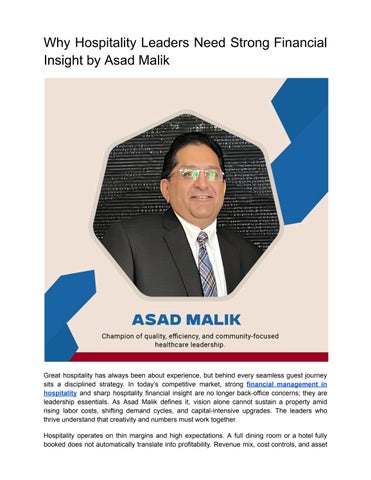
Great hospitality has always been about experience, but behind every seamless guest journey sits a disciplined strategy. In today’s competitive market, strong financial management in hospitality and sharp hospitality financial insight are no longer back-office concerns; they are leadership essentials. As Asad Malik defines it, vision alone cannot sustain a property amid rising labor costs, shifting demand cycles, and capital-intensive upgrades. The leaders who thrive understand that creativity and numbers must work together
Hospitality operates on thin margins and high expectations. A full dining room or a hotel fully booked does not automatically translate into profitability Revenue mix, cost controls, and asset
utilization determine whether growth is sustainable or simply cosmetic Leaders with financial fluency can read beyond top-line revenue and identify where value is actually created. They understand RevPAR trends, food cost percentages, labor ratios, and cash flow timing as interconnected signals rather than isolated metrics
This level of insight changes decision-making When a new concept is proposed, financially aware leaders evaluate return on investment, break-even timelines, and risk exposure before approving expansion. When occupancy dips, they examine pricing strategies, distribution channels, and cost structures rather than reacting emotionally Financial clarity transforms uncertainty into structured problem-solving
Strong financial capability also shapes culture Teams perform better when leadership communicates clear targets and explains the “why” behind budget discipline Transparency builds accountability. When department heads understand how their actions affect margins, they make smarter purchasing, staffing, and scheduling decisions Financial literacy becomes operational empowerment
Moreover, investors and stakeholders expect more than hospitality flair They want measurable performance and strategic foresight Leaders who combine brand vision with disciplined forecasting earn credibility. They can secure funding, justify renovations, and negotiate partnerships from a position of strength Financial insight builds trust because it signals control
In a sector defined by experience, emotion, and service, numbers might seem secondary. In reality, they are foundational Sustainable growth in hospitality depends on disciplined financial management, supported by consistent analysis and informed leadership decisions Ultimately, true hospitality financial insight enables leaders to protect margins, invest wisely, and elevate guest experiences without compromising long-term stability