ARWA ALI PORTFOLIO

Page 1


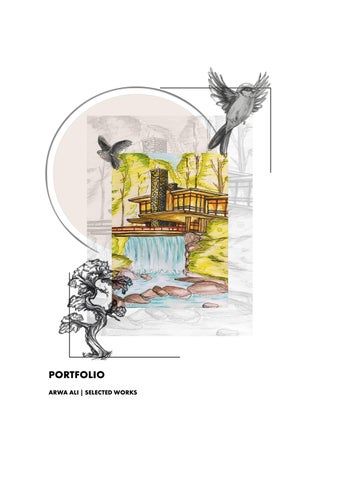
PORTFOLIO

ARWA ALI | SELECTED WORKS

Arwa Ali ABOUT

Driven Architectural Designer seeking higher education. Enjoys exploring how space, light, and community shape human experience, with professional and academic work bridging concept, craft, and constructability.

Email: arwalaka@gmail.com

Address: Burlington Ontario

Website: ali-arwa.format.com

LinkedIn: www.linkedin.com/in/arwali

WORK EXPERIENCE

Architectural Coordinator

Mattamy Homes

July 2022-present

Coordinate low-rise residential projects, drawings, BIM models, QA reviews, and site collaboration.

Design Administrator

D.G. Biddle & Associates

Apr 2021 – May 2022

Prepared AutoCAD/Revit drawings and supported architectural & engineering coordination.

Co-Founder / Designer

Freya

Aug 2019 – 2021

Developed interiors, furniture designs, floor plans, and client presentations.

EDUCATION

Bachelor of Environmental Design

Minor in Furniture Design

OCAD University

2015 – 2019

BIM / VDC Management

George Brown College

2022 – 2023

AutoCAD & Revit Courses

Humber College

2020 - 2021

SOFTWARE

Revit - Advanced

AutoCAD - Intermediate

BIM 360 - Intermediate

Navisworks - Foundational

Civil 3D - Foundational

Sketchup - Advanced

Rhino - Intermediate

Vray - Intermediate

Lumion - Intermediate

D5 - Intermediate

Adobe Photoshop - Advanced

Adobe Illsutrator - Advanced

Adobe Indesign - Advanced

BlueBeam - Intermediate

Office Suite (word, excel, powerpoint)

IESV - Foundational

AGi32 Lighting Analyst - Foundational

LANGUAGE

Arabic- Native

English - First Language

PERSONAL STATEMENT

I see architecture as an extension of human experience, a language that communicates through light, texture, and emotion. My work explores how spaces can listen, respond, and connect to the people who inhabit them. I am drawn to the idea that architecture can awaken awareness, encouraging individuals to engage with their surroundings, their senses, and with one another.

My architectural exploration centers on sensory perception, empathy, and the social responsibility of design. I view architecture as an instrument that influences perception and well-being, shaping both the physical and emotional landscape of daily life. Each of my projects investigates how design can activate the senses, foster inclusion, and cultivate belonging. Whether it is through the tactility of materials, the openness of learning environments, or the adaptability of refugee housing, I seek to create architecture that is both experiential and ethical.

Ultimately, I believe architecture is most powerful when it becomes personal, when it empowers people to discover new ways of seeing, feeling, and connecting. My goal is to design spaces that do not simply accommodate life, but enrich it through awareness, empathy, and sensory engagement.

TABLE OF CONTENTS

Architecture Academic Projects

BIM Academic Projects

Architectural Professional Projects

Furniture Academic Projects

Painting Personal Projects

ARCHITECTURE ACADEMIC PROJECTS

THE LUMEN HAVEN

Individual Undergraduate Thesis Project

PROJECT DESCRIPTION

An Inclusive, Multisensory Elementary School and Community Center designed for wellness, safety, and belonging. Key Design Stratagy: Sensory-Driven Spacial Clarity

DESIGN CONCEPT

I designed this building as an inclusive environment that supported a wide range of neurodiverse users and learning styles. Rather than prescribing a single way of experiencing space, I focused on creating a carefully balanced sensory environment; one that engaged all five senses while maintaining clarity, predictability, and emotional comfort.

Sensory wellness was achieved through spaces that allowed users to regulate their surroundings. I introduced adaptable environments where students could control light, sound, and movement, transforming learning into an interactive and playful experience. This sense of agency strengthened memory, focus, and emotional well-being, allowing education to unfold through curiosity rather than instruction alone.

A strong connection between outdoors and indoors shaped the overall atmosphere of the project. Natural light, vegetation, airflow, and material textures were drawn deep into the building, dissolving the boundary between interior spaces and the surrounding landscape. This continuous presence of nature grounded the sensory experience, providing calm, orientation, and rhythm throughout the day. Clear circulation paths and gentle spatial transitions reinforced a sense of safety and security, ensuring the building remained legible and reassuring for all users.

Through this approach, I created a wellness-centered learning environment that embraced sensory awareness, adaptability, and connection to nature. An architecture designed not only to accommodate education, but to support the emotional and perceptual needs of its occupants.

PROGRAMS USED:

RHINO

DESIGN CONCEPT DIAGRAMS

INCLUSIVE SPACE

I designed a variety of communal spaces at different scales, allowing users to connect, observe, or retreat based on their comfort and needs.

SENSORY WELLNESS

I shaped the environment through natural light, material softness, and spatial variation to support sensory balance and emotional well-being.

FROM MASS TO LUMINOUS HAVEN

These diagrams illustrate the evolution of the building form, beginning with a simple mass and gradually shaped through carved centers and flowing pathways to create a legible, light-filled architecture that connects ground, roof, and landscape.

SECURITY AND SAFETY

I used curved walls and paths to create clear intuitive wayfinding, fostering of safety and reassurance.

SAFETY and continuous spatial lines and fostering a sense reassurance.

FLEXABLITY AND ADAPTABLITY

I introduced movable furniture and adaptable layouts that allowed users to personalize spaces and support multiple modes of learning and use.

PREDICTABLITY AND CLARITY

I applied consistent textures and material cues to define zones and guide movement, making the building easy to read and navigate.

FIRST FLOOR PLAN

The first floor of The Lumen Haven was designed as a clear and open landscape, divided into two connected zones with the elementary school above and the community center below. At the heart of each zone, I placed an openconcept gathering space, a city center inspired auditorium for the community center and a central cafeteria for the school, Which both are shaped by ground typologies inspired by

natural landscapes to promote sensory calm and wellness. Dome-like structures surrounding the main building house a restaurant and café, extending moments of light, gathering, and pause across the site. Indoor and outdoor playgrounds, a communal garden center, and a skateboard park completed the plan, reinforcing movement, play, and connection to nature within a safe and inclusive environment.

SECOND FLOOR PLAN

The second floor of The Lumen Haven extended the building into the landscape through outdoor walkways that began at ground level and gently rose to the rooftop, creating a continuous path between earth and sky. These flowing routes reinforced clarity and wayfinding while inviting movement, light, and air deep into the architecture. At the center of the plan, I introduced an outdoor rooftop seating area as

a place for pause, gathering, and sensory calm. The lower half of the building was dedicated to a communal garden center, where planting and cultivation became part of daily life, strengthening wellness through direct connection to nature.

EAST SIDE SECTION

SOUTH SIDE SECTION

These sections illustrated the integration of light, landscape, and circulation to create a clear, continuous, and wellness-centered spatial experience.

ROOFTOP WALKWAY RENDERING

INTERIOR AUDITORIUM RENDERING

INTERIOR CLASSROOM RENDERING

MONUMENTAL HOTEL

Undergraduate studio group project

PROJECT DESCRIPTION

A collaborative project reimagining the pyramid as a stepped urban hotel centered on light, water, and holistic wellness in downtown Toronto.

Key Design Stratagy: Form and energy-centered organization

ROLE & RESPONSIBILITIES

I contributed to the project by developing the main digital model and producing the technical drawings, renderings, diagrams, and physical model to translate the design concept into a cohesive architectural proposal.

DESIGN CONCEPT

I worked on the Monumental Hotel as a collaborative studio project that explored how monumentality could be reinterpreted within the contemporary urban fabric of downtown Toronto. Inspired by the timeless geometry of the pyramid, the design reimagined permanence and symbolism through a stepped form that responded to context, scale, and human experience rather than direct imitation.

Located at 380 Wellington Street, the building was conceived as a new urban landmark among Toronto’s most recognizable sites. Its pyramidal massing gradually receded as it rose, creating balance and ascension while opening each level to generous terraces that established a continuous dialogue between interior life and the surrounding city.

The hotel was organized around the idea of the pyramid as a center of energy and balance. Drawing from the belief that ancient pyramids channeled natural forces such as sunlight, the heart of the building became a holistic core housing the spa and swimming pool. This luminous center anchored the experience, transforming monumentality into an immersive, wellness-driven journey.

PROGRAMS USED:

I organized the Monumental Hotel as a vertical sequence of experiences, where each level contributed to a gradual transition from the city to a holistic retreat above. The underground level was dedicated to parking, accessed directly from Wellington Street, allowing service and arrival to remain discreet while preserving the monumentality of the ground plane. The ground floor welcomed guests with a

reception and shopping center, establishing an active public interface with the city. Above, the second and third floors were primarily devoted to hotel rooms, with the third floor also introducing the first level of the holistic center, housing the spa as the beginning of the building’s wellness core. On the fourth floor, hotel rooms continued along the north side, while the south side stepped back to accommodate two penthouse residences. This

shift marked the last occupied level on the south massing, allowing increased light and openness for the remaining upper floors. The fifth floor held hotel suites and the second level of the holistic center, where a swimming pool connected directly to an outdoor terrace that cascaded over the south building, reinforcing the dialogue between water, light, and form.

The sixth floor was reserved for a single penthouse

apartment, offering privacy and elevated views over the city. Above, the seventh floor housed a shared library for residents, creating a quiet space for reflection and retreat within the monument. The eighth and final floor crowned the building with a high-end restaurant and bar, providing a luminous destination that completed the vertical journey with a luxurious experience rooted in wellness and Toronto’s urban lifestyle.

FROM MASS TO MONUMENT

These sections illustrated the integration of light, landscape, and circulation to create a clear, continuous, and wellness-centered spatial experience.

SWIMMING

EAST SIDE ISOMETRIC SECTION

This section illustrated how the stepped, pyramid-inspired massing organized the Monumental Hotel into a vertical journey from the city to retreat. The underground garage anchored the building to the site, while the main floor opened to public life above. Rising through the hotel rooms and penthouses, the section revealed the luminous central core that housed the spa and pool, acting as the heart of the building and drawing light deep into the interior. At the top, the library and rooftop restaurant crowned the monument, completing the ascent with spaces for reflection and gathering above downtown Toronto.

REFUGEE CITY

Competetion submition for Microhome competetion

PROJECT DESCRIPTION

Off the grid microhome deisgn as a solution to an emergncy refugee crisis

Key Design Stratagy: Compact, self-sufficient living systems

ROLE & RESPONSIBILITIES

I contributed to the project by developing the conceptual design and producing the digital model, diagrams, technical drawings, and renderings that translated the humanitarian intent into a buildable proposal.

DESIGN CONCEPT

I developed Refugee City in collaboration with a partner as part of a microhome design competition, where I explored how architecture can respond to displacement with dignity, care, and long-term value. I questioned the temporary nature of informal shelters and sought to reimagine emergency housing as a permanent, humane environment that supports both daily life and emotional well-being.

I designed the microhome as an off-grid dwelling intended to provide families fleeing war with safety, comfort, and stability. I focused on creating a cost-efficient and self-sufficient building envelope, while organizing compact interior spaces to maximize light, privacy, and essential domestic functions within a limited footprint.

While I situated the proposal in Hatay, a region shaped by large-scale displacement, I intentionally designed the system to adapt to other global contexts affected by conflict, homelessness, and climate crisis. Through this approach, I envisioned the microhome as both an immediate response and an enduring solution, capable of forming resilient communities rooted in dignity and belonging.

MAIN FLOOR PLAN

We designed the main floor as an open, flexible living space that combined the kitchen and living room, connected directly to the backyard, and integrated a shared washroom beside the entrance for clarity and efficiency.

SECOND FLOOR PLAN

We organized the second floor around five compact sleeping pods with integrated overhead storage and a shared desk area, maximizing capacity while preserving privacy within a livable footprint.

NORTH EAST ISOMETRIC SECTION

This isometric section revealed how the compact vertical layout organized open living spaces below and modular sleeping pods above, connected by a central stair and unified under a selfsufficient envelope designed for efficient, dignified living.

SUSTAINABLE ELECTRICAL AND WATER SYSTEMS

An off-grid, cost-efficient system is estimated to cost less than $ 15,000 per unit.

Exterior Material

Exterior made out of natural materials (Earth and Adobe bricks) - Which is completely sustainable, cost efficient, and makes the building adjust to climate without relying on air conditioning or heating system.

Solar Electrical System

In turkey the average electricity consumption per person is 7.6 kWh per day. This Solar Electrical Sytem could generate over 7000 kWh of electricity which would be enough fo this microhome and will make it completely sustainable.

Rainwater Harvest System that makes the microhome off-grid by harvesting rainwater and storing it. Filtered rainwater is then pumped through faucets, making it clean to use and drink.

Solar Water Heating System that heats up water using the natural heat of the sun.

Natural Sun Light
Inverter
Fusebox
Rainwater Storage
Sand Filter
Hot water tank

REFUGEE CITY DESIGN INTENT

We designed the microhome as a fully off-grid living system that integrated solar energy, rainwater harvesting, and passive material strategies to create a self-sufficient and costefficient shelter. By combining environmental performance with efficient spatial design, the project supported daily life with dignity while remaining adaptable to different climates and contexts. The proposal also envisioned how these homes could intertwine with the existing urban fabric, forming a connected community within refugee settings that blended into the life and rhythm of the surrounding city. Together, these strategies formed a resilient microhome community that fostered safety, sustainability, and a sense of belonging.

MOSAIC COMMUNITY

Undergraduate studio group project

PROJECT INFO

A Collaborative Student Residence Rooted in Community Key Design Stratagy: Community through spatial balance

DESIGN CONCEPT

I contributed to the Mosaic Community project by conducting site analysis, developing technical plans, producing renderings, and building the physical model as part of a collaborative effort.

DESIGN CONCEPT

I worked on Mosaic Community as part of a collaborative studio project exploring how student housing could balance privacy, community, and urban integration. Our shared concept shaped a residence rooted in student lifestyle, and I contributed through site analysis, technical plans, renderings, and the physical model.

Located behind David Crombie Park in the St. Lawrence neighborhood of downtown Toronto, the project was embedded within a vibrant context close to markets, libraries, restaurants, and nearby universities, allowing the residence to intertwine with everyday city life. The building was designed to foster accessibility, comfort, and connection through a careful balance of shared spaces and private zones.

Two flexible apartment types (one-bedroom and two-bedroom units) accommodated diverse living situations, with convertible beds allowing spaces to adapt to shared living and small families. Through this project, I explored how housing can cultivate belonging while supporting the varied needs of students within the urban fabric.

EDUCATIONAL BUILDINGS COMMUNITY BUILDINGS

SITE ANALYSIS

I analyzed the site behind David Crombie Park by mapping surrounding recreational, community, educational, and green spaces, along with key transportation routes that shape daily student life in the St. Lawrence

neighborhood. This understanding guided the placement and orientation of the residence, allowing it to intertwine with its urban context and strengthen accessibility, connection, and a sense of community.

GREEN SPACES

UNITS CLOSEUP FLOOR PLAN

We designed two unit types to support different living preferences, with two-bedroom units for shared or family living and one-bedroom units for students who preferred to live alone. Each unit combined private bedrooms with

generous shared spaces (kitchens, living rooms, washrooms, and study areas) to balance privacy, comfort, and flexibility within a compact layout.

GROUND FLOOR PLAN

We designed the ground floor as a shared recreational heart for the residence, organizing social, fitness, and gathering spaces to bring students together and strengthen daily interaction. Informed by our site analysis, this level opened toward surrounding green spaces and neighborhood amenities, allowing the building to engage directly with the life of St. Lawrence and reinforce its role as a community anchor.

SECOND TO FIFTH FLOOR PLAN

Across the upper floors, we organized student units around shared circulation and terraces, creating a balance between privacy and collective living. As part of this collaborative project, these residential levels were shaped by the site study to capture light, views, and connections to the urban context, supporting comfortable living within an interconnected student community.

EAST SIDE SECTION

These sections illustrated how we stacked communal and residential spaces to create a legible vertical rhythm, using light, circulation, and shared terraces to connect student living with the surrounding urban context.

SOUTH SIDE SECTION

BULWAR HOUSE

Undergraduate studio Individual project

PROJECT INFO

A Home Shaped by Touch, Light, and Community

Key Design Stratagy: Sensory navigation through form and material

DESIGN CONCEPT

I designed Bulwar House as a residence for a math teacher with visual impairment, his wife, and their child, grounding the project in the idea of community. The house was conceived as an open and interconnected environment where living spaces flowed together to support shared family life while remaining warm, legible, and intuitive to navigate.

The spatial organization strengthened both internal connections and the relationship to nature. Living areas extended outward through visual and physical links to the outdoors, allowing light, air, and landscape to shape daily experience and reflect the client’s love for open spaces.

Materiality, lighting, and form became tools for sensory orientation and comfort. I introduced contrasting textures and generous light to support spatial awareness, while curvilinear walls and spiral elements shaped a fluid, calming experience that transformed movement through the home into a tactile and emotional journey.

BASEMENT FLOOR PLAN

The floor plans organized the home as a flowing, open sequence of family, work, and private spaces, using curved geometry and strong indoor–outdoor connections to create a legible, sensory rich environment for everyday living.

GROUND FLOOR PLAN

DESIGN CONCEPT DIAGRAMS

NATURAL LIGHTING

Natural light was used to enhance spatial clarity and comfort, helping a person with visual impairment sense boundaries and changes space while creating a warm, healthy environment for family life.

SECOND FLOOR PLAN

visual in environment

The spiral stair became a tactile and fluid vertical path, offering intuitive navigation for a person with visual impairment while acting as a shared sculptural element that brings the family together.

Curved walls guided movement through gentle geometry, supporting wayfinding through touch and body memory while creating a calming, playful environment for both the client and the family.

SPIRAL STAIRS CURVED WALLS

This section illustrated how the home was shaped as a continuous, open sequence of family and private spaces, connected through light, curved circulation, and vertical movement to support a fluid and legible living experience.

EAST SIDE SECTION

DINNING ROOM RENDERING

BACKYARD CONNECTED TO BASEMENT RENDERING

SPIRAL STAIRS RENDERING

BIM ACADEMIC PROJECTS

ARCHOVATION

Post secondary program BIM Management Capstone Group Project

PROJECT DESCRIPTION

Collaborative BIM Capstone: Integrated Design & Coordination

Key Design Stratagy: Integrated digital coordination

PROJECT DESCRIPTION

The BIM Management Program capstone, BIM Planning and Implementation, was a collaborative, team-based project where we developed a comprehensive BIM Execution Plan for a multi-storey rental building, guiding the work from schematic design through design development while integrating design authoring, interdisciplinary coordination, clash detection, 4D sequencing, and cost estimation using Revit and Navisworks. Within this process, I led the development of the architectural model, contributed to BIM standards and workflows, and supported coordination with structural and MEP teams by running clash detection, resolving conflicts, and preparing diagrams and presentation material that communicated our phasing strategy and BIM deliverables. Together, the project simulated real-world BIM practice and demonstrated how coordinated digital processes can drive informed, collaborative decision-making from concept to construction planning.

STRUCTURAL BIM MODEL

PLUMBING BIM MODEL

MEP BIM MODEL
REVIT

ARCHITECTURAL PROFESSIONAL PROJECTS

CANADIAN CANOE MUSEUM

PROJECT INFO

Crofessional Cultural Project: Integrated Lighting Design & Coordination

MY ROLE

I contributed to the interior and exterior lighting design as part of the electrical design team, supporting coordination within an Integrated Project Delivery framework.

PROJECT DESCRIPTION

The Canadian Canoe Museum is a professional project currently under construction at 2077 Ashburnham Drive in Peterborough, Ontario, developed through an Integrated Project Delivery process by D.G. Biddle and Associates in collaboration with Lett Architects, Chandos Construction, and a multidisciplinary consultant team. The project celebrates Canada’s canoeing heritage through a contemporary cultural building that brings together exhibition, education, and community spaces within a landscape-driven waterfront setting.

As part of the electrical design team at D.G. Biddle and Associates, I contributed to the lighting design of both the interior and, in particular, the exterior environments. My work focused on shaping how the building is experienced, highlighting architectural forms, guiding movement, and reinforcing safety and atmosphere across the site. Through this role, I supported the translation of architectural intent into coordinated lighting systems that responded to the museum’s materiality, public presence, and relationship to the surrounding landscape.

Working within an Integrated Project Delivery framework allowed me to collaborate closely with architects, engineers, contractors, and consultants, gaining firsthand experience in interdisciplinary coordination and real-time problem solving. This project strengthened my understanding of professional practice, technical rigor, and the role of lighting as a powerful tool in shaping public space and architectural identity.

FIRST FLOOR PLAN

SECOND FLOOR PLAN

PROJECT INFO

Low-Rise Community Design & Project Management

MY ROLE

I coordinate architectural drawings, BIM models, and consultant inputs while supporting project management from design through construction on low-rise residential communities.

PROJECT DESCRIPTION

I work as an Architectural Coordinator, managing and supporting residential projects from early design through construction, where I am deeply involved in project management, drawing coordination, and interdisciplinary collaboration. My role includes reviewing and producing architectural drawings and Revit models, coordinating with architects, engineers, VDC teams, and construction staff, and managing documentation, RFIs, change orders, and contract administration to keep projects aligned with schedules, budgets, and quality standards.

Working on projects that are fundamentally community-based deepens my understanding of how architecture shapes everyday life beyond individual buildings. I follow designs from initial plans on paper to seeing full neighborhoods take form on site, reinforcing the connection between design intent, coordination, and built reality. Through this process, I continue to develop a holistic perspective on designing for community, learning how thoughtful planning and execution come together to create livable, connected environments.

I hold this role at Mattamy Homes, one of North America’s leading residential developers, where I am part of teams delivering large-scale communities that prioritize quality, consistency, and long-term value.

REPRESENTATION OF SINGLE UNIT RENDERING AND ELEVATIONS

SITE VISIT IMAGES

PROGRAMS

DETAIL LIBRARY - MATTAMY HOMES

PROJECT INFO

Detail Library Development: From Site Research to Buildable Standards

MY ROLE

I collaborated on a task force team to research construction sites and develop code-compliant, buildable residential details for a shared reference library.

PROJECT DESCRIPTION

As part of a collaborative task force team, I helped initiate and develop a comprehensive residential detail library to strengthen constructability and consistency across low-rise projects. Grounded in site research, we visited active construction sites to study real assemblies and translate them into clear, buildable details that reflect field conditions. The library serves as a shared reference for all common residential conditions, ensuring alignment with building code requirements while streamlining coordination between design and construction teams. This collaborative effort bridges drawings and reality, supporting more accurate, efficient, and reliable community delivery.

PROGRAMS USED:

SINGLE UNIT RENDERING

HARDIE GARAGE WALL DETAIL
BRICK WALL DETAIL
1HR FLOOR DETAIL
SLAB ON GRADE DETAIL

FURNITURE PROJECTS

WOVEN CHAIR

Undergraduate furniture design individual project.

PROJECT INFO

Form, Materiality, and Tactile Comfort

Key Design Stratagy: Material-led form exploration

PROJECT DESCRIPTION

In this project, I explored how form can shape both comfort and experience, searching for a balance between the softness of a couch and the light, everyday presence of a café chair. Through bending plywood into a continuous, curvilinear frame, I created a structure that feels fluid and inviting, then wove cane into it to bring warmth, flexibility, and tactile comfort. The natural strength of the cane allowed the chair to remain lightweight yet supportive, while its texture introduced a quiet rustic quality. Together, the flowing geometry and honest materiality turned the chair into a study of how simplicity and comfort can coexist in a refined, modern form.

LUMB(E)AR SUPPORT

Undergraduate furniture design individual project.

PROJECT INFO

Furniture as Body Object Dialogue

Key Design Stratagy: Body–object interaction

PROJECT DESCRIPTION

In this project, I explored the relationship between the body and object, designing a piece of furniture that exists only through use. Lumb(a)er Support invites the user to lean with one elbow and one knee, guiding the body into an upright posture through two cushioned points that can be adjusted to different heights. Rather than simply offering comfort, the piece encourages awareness of balance, weight, and alignment turning support into an active experience.

The form integrates side handles and a small tabletop, extending its function beyond posture into moments of pause and everyday use. A secondary side cushion further stabilizes the knee, reinforcing the idea that every element serves the body. What defines the piece, however, is its dependence on the user: it cannot stand on its own unless engaged, creating a reciprocal relationship where furniture and person rely on one another. Through this design, I investigated how objects can shape movement and presence, transforming support into an interactive dialogue between body and form.

AND SIDE PLANS

FRONT

PAINTINGS

NILE AT DUSK

PROJECT INFO

Light, Memory, and the Flow of the Nile

PROJECT TYPE

Personal Project | Acrylic on Canvas | 40” × 80”

PROJECT DESCRIPTION

In this painting, I sought to capture the Nile not just as a river, but as a living thread of memory, movement, and light. The drifting sails become quiet figures of passage, gliding through rippling blues as the sun dissolves into the horizon, washing the sky in layers of warmth and calm. I was drawn to the dialogue between stillness and motion the steady presence of the land against the ever-changing surface of the water using color and reflection to tell a story of time slowly unfolding. Through this work, I explored how landscape can hold emotion, transforming a familiar scene into a moment of pause, where light, water, and horizon come together to evoke belonging, nostalgia, and quiet hope.

BLISS

PROJECT INFO

Reflections of Stillness and Calm

PROJECT TYPE

Personal Project | Acrylic on Canvas | 12” × 10”

PROJECT DESCRIPTION

In Bliss, I explored the quiet poetry of stillness, capturing a moment where water, light, and reflection dissolve into one another. The solitary boat and perched bird become gentle anchors in a vast, luminous landscape, inviting a pause to breathe and simply be. As the sun softens the horizon and its glow melts into the surface below, I used acrylic layers to blur the boundary between sky and water, shaping a space that feels suspended in time. Created as a personal project on a 12 × 10 inch canvas, this painting reflects my search for calm within simplicity where solitude becomes comfort, and a single moment holds a sense of peace and belonging.

WHERE THE LIGHT WAITS

PROJECT INFO

Light as the Language of the City

PROJECT TYPE

Personal Project | Acrylic on Canvas | 8” × 10”

PROJECT DESCRIPTION

In this painting, I explored the quiet drama of an urban moment, where light becomes the storyteller of the city. The glowing signal and receding street lamps guide the eye through layered facades, capturing the rhythm of pause and movement that defines everyday life. Through soft acrylic washes and warm, muted tones, I sought to blur the edges between architecture and atmosphere, allowing the street to feel both grounded and dreamlike. As a personal project, this work reflects my fascination with how light shapes space and memory, turning an ordinary street into a moment of reflection within the city’s constant flow.

Turn static files into dynamic content formats.

Create a flipbook
ARWA ALI PORTFOLIO by Arwa Ali - Issuu