
Australian and International Art

Page 1


Specialists

Single-Owner Auctions

Paul Sumner 0412 337 827

Sandy Bruce 0421 920 387

Chinese and Asian Arts

Donald Lee 0455 888 080

Yang Yang 0466 112 688

Paul Sumner 0412 337 827

Indigenous Australian Art

Shaun Dennison 0410 501 857

Arts of the Middle East

Dr Susan Scollay 0418 175 694

design + decoration & Interior Decorator Auctions

Amanda Swanson 0414 592 234

Australian and International Art

Paul Sumner 0412 337 827

Michael O’Meara 0418 505 519

Ethnographic Arts

James Parkinson james@artvisory.com.au

Melissa Parkinson melissa@artvisory.com.au

Regional Representatives

Western Australia

Julie Smetana 0427 921 756

South Australia

Judith Quigley 0417 841 355

Brisbane

Dominic Katter (07) 3003 1850

New Zealand

James Parkinson james@artvisory.com.au

Melissa Parkinson melissa@artvisory.com.au

For all email enquiries please email mail@artvisory.com.au

Fine Australian & International Art

LIVE AUCTION

VIEWING

Tuesday 24 March 2026, 6.00pm

Saturday 21 March 11am–5pm

Sunday 22 March 11am–5pm

Monday 23 March 11am–5pm

Tuesday 24 March 11am–1pm

COLLECTIONS

Wednesday 25 March 10am–5pm

Thursday 26 March 10am–5pm Friday 27 March 10am–5pm

ADDRESS Artvisory Galleries 310 Toorak Road, South Yarra, Melbourne

ONLINE View catalogue online at www.artvisory.com.au

SPECIALIST ENQUIRIES

ADMINISTRATION ENQUIRIES

Michael O'Meara 0418 505 519 michael@artvisory.com.au

Accounts & auction administration: Amanda Swanson 0414 592 234 amanda@artvisory.com.au

Paul Sumner 0412 337 827 paul@artvisory.com.au

Collections & Shipping: Jennifer Hirst 0410 777 996 jennifer@artvisory.com.au

How to bid at our Auctions

Catalogues and Viewing

Auction catalogues can be viewed on the Artvisory website www.artvisory.com. au approximately three weeks prior to the published date of an Auction.

Printed catalogues will be available complimentary at the auction viewing and can be express posted (within Australia) prior to the viewing for $35AUD

The Auction viewing is open to the public and generally takes place during the three days prior to the Auction date at the advertised location/s in the Auction catalogue, 11am-5pm daily.

Lot Descriptions

The Lot/Catalogue descriptions provide the overall information of an item including size, date or age, medium, attribution, quantity and if known, provenance.

Estimates

The estimate accompanies each lot in the printed and online catalogue. This estimate takes into consideration the quality, condition, rarity, condition and provenance of the item. Each estimate also has a reserve, and the reserve is the undisclosed and confidential amount set at or below the low estimate. Please note the reserve will never exceed the low estimate at Artvisory.

Condition Reports

Condition reports supplement the lot/catalogue description and focus on the condition of the item. We strongly advise obtaining a condition report if you are unable to view the lot in person. Condition reports and additional images are available to view as part of the auction item listing at Invaluable.com or can be requested from Artvisory directly.

Symbols

Occasionally a symbol is printed next to a lot number in the catalogue, this indicates a special clause that is associated with the sale of that item. Please refer to the Terms and Conditions for specific symbol meanings and information.

Buyers Premium

Artvisory Auctions in Australia are conducted in AUD and charges a Buyers Premium of 26% on the hammer price of all Auction items unless otherwise stipulated with GST of 10% applicable to the Buyers Premium.

Bidding

Artvisory offers four options for bidding at our Auctions:

Live Bidding

If this is your first-time bidding in person at an Artvisory auction you will be required to register with us, which requires you to fill out a buyer registration form in person at the viewing.

To facilitate this, please bring along your Government issued photo identification, such as a driver’s licence or passport as this is the only form of identification that will be accepted.

Please make sure you register in the name you want your final invoice to be made out to, as invoices once issued cannot be changed, and in certain cases a deposit may be required before you can bid.

Online and Timed Online Bidding

Online bidding via the International Auction platform Invaluable.com allows you to bid via the internet in real time, whilst also allowing you to view the live stream of the Auction. You have two options to register for this service:

• Register via the Artvisory website and an Invaluable.com online bidding fee of 2% of the hammer price is added

• Register direct with Invaluable.com and an online bidding fee of 5% of the hammer price is added

Please make sure you register for online bidding at least 24 hours prior to the Auction to ensure you do not miss your lot and note that you must use Chrome or Firefox as your Internet Browser as Safari is not supported.

Please note if you have not bid with Artvisory previously, then Government issued photo identification verifying your name and address will be also be required before you can be approved to bid with Artvisory via the Invaluable.com site, and in certain cases a bidding deposit (20% of the low estimate of each Lot you wish to bid on) may be required before you can bid.

Artvisory cannot be held responsible for any errors that occur with internet connectivity during an auction or buyer bidding errors.

Bidding Deposits

Artvisory reserves the right to request a deposit for any buyer wanting to register for the auction, and this must be received in cleared funds 24 hours prior to the commencement of the auction. If the buyer is not successful, then it will be refunded in full by the third day after the auction.

Telephone Bidding

Complimentary telephone bidding is available at all of our live Auctions and involves an Artvisory representative calling you approximately 3–5 lots in advance of your nominated lot and you then instruct them to bid on your behalf.

Telephone Bids must be requested at least 24 hours prior to the commencement of the Auction and are provided on a first come, first served basis, as the number of phone lines available are limited.

See our website to download and complete a telephone bidding form and please note that if this is your first time bidding with Artvisory, we will require a clear, scanned copy of Government issued photo identification such as a drivers licence or current passport verifying your name and address and in certain cases a deposit may be required before you can bid.

Artvisory reserves the right to request a deposit for any buyer wanting to register for the auction, and this must be received in cleared funds 24 hours prior to the commencement of the auction. If the buyer is not successful, then it will be refunded in full by the third day after the auction.

Absentee Bidding

Absentee bidding offers convenience if you are unable to attend an Auction in person, bid over the telephone, or if you wish to stick to your budget.

An absentee bid should be set at the maximum amount you wish to bid on the lot/s you are interested in purchasing. Should the lot/s be knocked down at an amount lower than the bid recorded on your form, the lot will be sold to you for the lesser hammer price plus Buyers Premium. If identical bids are received for the same lot, then the first bid received by Artvisory will take precedence.

Absentee bids must be received by Artvisory at least 24 hours prior to the Auction commencing and the Company cannot be held responsible for activating any late bids that are received.

See our website to download and complete an absentee bidding form and please note if this is your first time bidding with Artvisory, we will require a clear, scanned copy of Government issued photo identification such as a drivers licence or current passport verifying your name and address and in certain cases a deposit may be required before you can bid.

Payment and Collection

If you are successful with your bid/s, your invoice will be emailed to you immediately after the Auction finishes.

You will pay the hammer price, plus the Buyers Premium of 26% plus GST on each lot, together with any additional charges such as the Invaluable.com online bidding fee, GST on hammer, or the Artist Resale Royalty if applicable.

As per our terms and conditions, payments must be made in full by three (3) days after the Auction has been completed as printed in the catalogue.

We accept Direct Deposit into the Company Trust Account, Eftpos (up to your daily limit) or credit card in person with the following merchant fee applicable (1.43% inc GST for Visa, Mastercard and American Express)

If you wish to pay “over the telephone“ with a credit card you must request a secure payment link by emailing accounts@artvisory.com.au and the secure BPOINT link will be emailed to you. Cash payments must be deposited direct to the Company Trust account via any Commonwealth Bank Branch, and goods can be released upon supplying the deposit receipt.

Personal, Company and Bank cheques are not accepted. All payment options and Company Trust Account details are included on the invoice that is emailed to you after the Auction if you are a successful bidder.

All items must be paid for in full and collected within the collection times advertised for each individual Auction. If items are not collected within this time frame then Artvisory reserves the right to charge removal, storage and release fees.

Packing and Delivery

Artvisory has a list of recommended carriers specific to each auction that will be sent with your invoice if you are the successful buyer and is happy to help you with this process.

ELIOTH GRUNER

NEW ZEALAND/AUSTRALIAN, 1882-1939

Bondi Beach (with a glimpse of sea), c.1912

oil on wood panel

signed 'E GRUNER', lower left 22.3 x 17.3cm. (8.77 x 6.80 in.), Frame: 35 x 30cm. (13.77 x 11.81 in.)

PROVENANCE

Private Collection. Adelaide.

RELATED WORKS

'Bondi Beach' circa 1912, oil on cardboard, 22 x 21.5cm, Art Gallery of NSW, Acc No: 6910

'The Wave', oil on wood panel, c.1913, 30.5 x 24.4cm, Queensland Art Gallery of Modern Art (QAGMA), Acc. No: 1.1595

COLLECTIONS

Elioth Gruner's works are widely held in the collections of public institutions in Australia including the National Gallery of Australia, Art Gallery of NSW, Art Gallery of South Australia, Art Gallery of Western Australia and the National Gallery of Victoria.

$8,000–12,000

'Bondi Beach (with a glimpse of sea)’, can be seen as a companion piece to the widely considered masterwork, 'Bondi Beach, circa 1912' held by the Art Gallery of NSW. The central character of woman with red parasol, like in the AGNSW example, holds the viewers eye. The balance and the perspective is exceptional, as variations in colours and a clarity of figure placement are purposeful differences between the two works. Another feature of our painting is the thin ribbon-like glimpse of the sea. While it could be said that our painting is an initial patterning of the figures on the beach created just prior to the AGNSW 'Bondi Beach' work, it is just as probable that it is a resolution or refinement of the afore mentioned work, moving from cardboard to wood panel as surface. It can be said that our painting in particular carries with it an exquisite aesthetic.

Like 'The Wave' 1913, in the QAGOMA, our painting is on wood panel, wonderfully textured brush strokes are shared characteristics of both works. In the 1913 work, the perspective was not from such a high vantage point, and this appears to have continued in future works going forward.

Barry Pierce, the then Director of the Art Gallery of NSW, wrote in his 1983 monograph on Elioth Gruner, that 'there are basically two phases of beach scenes by Gruner, circa 1912-14 and circa 1917-20' (B. Pierce, Elioth Gruner, 1882-1939, Art Gallery of New South Wales, 1983, p.30)

Born in Gisborne, New Zealand in 1882, Gruner and his family immigrated to Australia when he was one year old, settling in Sydney. His mother encouraged his love of art and Gruner began attending art classes with Julian Ashton from around the age of twelve. After the death of his father and the marriage of his eldest brother, Gruner, aged fourteen, began to work long hours as a draper's assistant at Farmer's department store in order to help support his family. He continued to take art classes at night after working gruelling twelve-hour days. Gruner exhibited for the first time, with the Society of Artists, in 1901, with a still-life painting. He continued to paint still life's throughout his career, most often when he was at home in Sydney, preferring to paint landscapes when he was able to paint outdoors 'en plein air' in the manner of the Impressionists he so admired.

In 1912, aged thirty, Gruner left the drapery business and devoted himself full-time to art. He worked for Julian Ashton as a gallery manager for a time, and then as a teacher at his art school. Gruner spent weekends painting beach and harbour scenes around Sydney, including Bondi beach ca. 1912 and Afternoon, Bondi 1915. (AGNSW, online artist Biography, n.d. )

SYDNEY LONG AUSTRALIAN, 1871-1955

The Spit, Middle Harbour Sydney, 1930 oil on canvas on board signed and dated 'SYDNEY LONG 1930', lower left 34 x 39.5cm. (13.39 x 15.55 in.), Frame: 51 x 56.5cm. (20.07 x 22.23 in.)

PROVENANCE

A Private Melbourne Estate RELATED WORKS

James Ranolph Jackson, The Spit, Sydney, 1935, Mosman Art Gallery collection.

COLLECTIONS

Sydney Long's work is held in public institutions including the National Gallery of Australia and all state galleries. International collections include the Museum of New Zealand.

$6,000–10,000

An historically important and tonally beautiful Sydney long painting of The Spit, Middle harbour Sydney, painted from the area of Beauty Point, just after the building of the first bridge in 1924.

In 1893 the North Sydney tram service was extended to Spit Junction. Then in 1900 the tram line was extended to The Spit and there was a great celebration by local residents.

However, as the trams could not go onto the punt, travellers to Manly had to disembark at The Spit, transfer to the punt on foot and catch the Manly tram on the other side.

In 1911 a single tram line to Manly from The Spit was opened which required that a special punt be designed to transport the trams across Middle Harbour." (The Spit Historical overview, Mosman Library Local Studies Service, n.d.)

In 1924, the first spit bridge opened.

ARTIST UNKNOWN

AUSTRALIAN SCHOOL, 19TH CENTURY

Broken Hill, circa 1886

oil on board

no signature apparent

31.5 x 48cm. (12.40 x 18.89 in.), Frame: 42 x 59cm. (16.53 x 23.23 in.)

PROVENANCE

Private collection, Tasmania

$6,000–8,000

Broken Hill, circa 1886, captures a moment in time looking towards the beginnings of the BHP line of lode. It is an extremely rare and historically important artistic interpretation of the Broken Hill township being formed at light-speed. A light-footed horse flies through the emerging township driven by a white-hatted gentleman. While at the same time, a laden coal cart is driven heavily uphill by a worker.

The date of circa 1886, is supported by an 1890 engraving from a similar perspective held in the collection of the State Library of Victoria, that was published by David Same & Co , April 1, 1890. That engraving, is signed

by both the engraver F. Sleap and by Scottish artist John Macfarlane (1857-1936), who had arrived in Australia from Scotland in 1884.

Our painting captures, not only the modern beginning of Broken Hill, but the establishment of BHP under George McCulloch, who was to become the initial Director of BHP and an important art collector of international repute.

McCulloch was born in Glasgow in 1848 and a Station Manager who came to to Australia in the 1870's. When Charles Rasp tagged a claim at Broken Hill at Broken Hill in 1883, McCulloch organised the formation of a syndicate and the extension of the claim. Influenced by William Jamieson, a government surveyor who bought into the venture. In 1887, he went to London to float the British BHP. Co. and lived in Broken Hill until returning to London in 1893. In Broken Hill he had donated works to the Art Gallery and money to the hospital. In London he gathered a fine collection of pictures and sculpture which he displayed in four salons. He restricted himself to contemporary works. After his death in 1907, his most important art collection was then sold by Christie's in London in 1911. (Australian Dictionary of Biography, George McCulloch, Vol. 5, 1974).

While our painting at this time cannot be directly linked to the collection of George McCulloch, it is likely to have spent its initial years proudly in the home or office of a person involved in the beginning of BHP and formation of Broken Hill.

SIR ARTHUR STREETON

AUSTRALIAN, 1867-1943

A Still Life with Garden Roses

oil on Windsor and Newton academy board signed lower left, A Streeton Windsor and Newton, Prepared Academy Board label attached verso (board circa 1890s)

26 x 21cm. (10.24 x 8.26 in.), Frame: 39 x 34cm. (15.34 x 13.39 in.)

PROVENANCE

A Private Melbourne Estate

COLLECTIONS

Sir Arthur Streeton's work is held in institutional collections throughout Australia including the Australian War Memorial, National Gallery of Australia, Art Gallery of NSW, National Gallery of Victoria, Art Gallery of South Australia and Art Gallery of Western Australia.

$15,000–25,000

This is a most rare, and a highly evocative flower painting of garden roses by Arthur Streeton. It is s much more than a still life. It is an emotional response to garden roses, likely completed at a time of personal romantic endeavour and artistic exploration in England.

As indicated in an essay accompanying a 1994 exhibition of Streeton works in the NGA collection, "most if not all, of Streeton's paintings of the 1920s and 1930s possess an ingenious quality, indicating an absolute concentration on the subject: the flowers (their texture, colours and almost their smell); and the container of glazed pottery, silver or glass. By contrast, earlier flower studies by Streeton were excuse for a luxurious play of purely painterly concerns, a play arising from and combined with the form and evocative suggestions of the flower."1

In describing an earlier painting in the NGA collection 'michaelmas daisies', circa 1910

'In this painting the flowers spread over the canvas in a diffuse spray, a presentation that would have been inconceivable later on when the artist had foregone such disorderly pleasures. Licks of green paint with pale accents of white and mauve describe and blur the foliage, the flowers and the broad glass container and melt darkly into the dim ground'.2

Our Painting, 'A Still Life with Garden Roses', also fits this description. Streeton lived near Hampstead Heath between 1900-1902. He is known to have sourced art materials from art supply stores in Hampstead and other works of this period including 'Sunlight in the Wood' (NGA collection) share characteristics, including...'crocodiling of dark colour belong to the turn of the century, a time when Streeton is unlikely to have been able to afford more expensive materials'.3

The turn of the century is also supported by the use of a Windsor and Newton prepared academy board. The particular characteristics of the label in including the placement of the Griffen and lettering, date this board's manufacture to the 1890s.

Streeton's love of flowers and roses in his gardens in England and later in Australia is well established. While the date of the work is unknown, it is likely that our work is painted around the turn of the 19th and 20th Century. This was a time when Heysen was first in love with the violinist Nora Clench. And a time when his work was directly influenced by the work of J.M.W Turner.

'In mid-1899, they went together to the Guildhall in London to see an exhibition of works by J.M.W. Turner (1775–1851) who, by that time, had acquired status as a great progenitor of modern English painting. Heightened by the excitement of being in love, Streeton was enraptured by the tremendous range and wonderful tones as well as the colour, beauty and imagination of Turner's work. For the next few years, he devoted himself to the subjects and light effects Turner had explored until 'by a certain coterie he was hailed as the Australian Turner'. Shortly after visiting the Turner exhibition and while the paintings were still vividly in mind, Streeton and Nora spent all of one long midsummer's day in Richmond Park, the scene of some of Turner's most evocative images of London.'4

1–4. (quoted

JULIAN ROSSI ASHTON

AUSTRALIAN, 1851-1942

Home Paddocks

oil on wood panel signed J R ASHTON, lower left titled and dated , 'HOME PADDOCKS' 1884, to verso 24.5 x 19.3cm. (9.65 x 7.59 in.), Frame: 43.5 x 38cm. (17.12 x 14.96 in.)

PROVENANCE

A Private Melbourne Estate

RELATED WORKS

Julian Ashton, Evening, Merri Creek, 1882 (other title: Winter's evening), oil on canvas, 91.5 x 122cm, signed and dated 1882, Art Gallery of NSW, Acc. no. 7211

Tom Roberts, A quiet day on Darebin Creek (also referred to as Merri Creek by NGA), 1885, oil on wood panel, 26.4 x 34.8cm, signed and dated, "Tom Roberts' 85

COLLECTIONS

Julian Rossi Ashton's work is held in institutional collections throughout Australia including The National Gallery of Australia, Art Gallery of NSW, National Gallery of Victoria, Art Gallery of South Australia, Art Gallery of Western Australia and Queensland Art Gallery.

$6,000–10,000

Julian Rossi Ashton met Tom Roberts and McCubbin at a Melbourne Art studio in circa, where it is said that he advised McCubbin to paint Plein Air. Roberts would soon travel to London to study.

'He (Roberts) found on his return that the rail link established in 1882 made access quicker and simpler. Roberts knew property owner David Houston and was able to set up camp in one of his uncleared paddocks near the present day sight of Gardiner's Creek....'(Sasha Grishin, Australian Art A History, The Miegunyah Press, 2013, p119)'. It is well established that Ashton, Abrahams, Mccubbin and others would paint here together,

Julian Ashton's painting, 'Evening on the Merri Creek', held in the collection of the National Gallery of Victoria, appears to be an evening scene of a similar location to our painting. If so, clearly the NGV painting is made closer to the creek's edge. The NGV notes that the artist laid claim to it being the first plain-air painting completed in Australia.

Our painting bears a date of 1884 verso on the stretcher. It is painted on wood panel. As is the Tom Roberts work, A Quiet Day on Darebin Creek, dated 1885 Both paintings appear to be painted in a similar location, from a different working perspective.

Home paddocks presents as a work from the mid 1880's. It is an early Heidelberg School plain-air work and of the highest quality.

ELLIS ROWAN

AUSTRALIAN, 1848-1922

Eucalyptus Ficifolia, F.v.M. WA (Western Australian Flowering Gum) gouache on paper signed lower right, Ellis Rowan titled to verso, 'Eucalyptus Ficifolia, W.A by Ellis Rowan' 51.2 x 34cm. (20.16 x 13.39 in.), Frame: 84 x 66cm. (33.07 x 25.98 in.)

PROVENANCE

Christie's Australia, Melbourne 24/11/1993, lot. no. 162 Gina and Ted Gregg Sydney By descent to a Private Sydney Collection

EXHIBITED

(Probably) World's Columbian Exposition, Chicago, 1893. A work by Ellis Rowan is catalogued as Eucalyptus ficifolia, F.v.M. W.A. The F.v.M in the formal catalogue refers to Ferdinand von Mueller who formally recorded the species in 1860.

COLLECTIONS

Ellis Rowan's works are held in collections in Australian and International public institutions , including The National Gallery of Victoria, Art gallery of Western Australia and the Art gallery of NSW. The National Library of Australia holds the Ellis Rowan Collection of 919 watercolours and gouaches.

$12,000–18,000

Eucalyptus Ficifolia, WA is a master-work by the extraordinary Ellis Rowan. This rare painting is exceptional in terms of its quality and condition. It is simply mesmerising to the viewer. A small Ellis Rowan signature beetle appears on a leaf. We are with Ellis Rowan in a special place and at a moment in time.

As Eucalyptus Ficifolia is endemic to only a small area in South Western Australia in Walpole the Stirling Ranges both near Albany, it is likely that our painting was executed with great affection in the field in the summer of 1880/81 when Ellis Rowan was based in Albany, WA. Ellis Rowan first travelled to Western Australia in 1880 (Albany) and then again in 1889 and 1906. (Kalgoorlie, Laverton and Goongarrie). Making it most likely that this important work was created during this first visit, as her second visit was focussed on a journey to the wildflowers of the North West of Western Australia by horse and cart, with Margaret Forrest, wife of Governor John Forrest. Who then together held what is recorded

as the first exhibition of Art in Western Australia in 1889 at the Perth Railway Station.

Ellis Rowan hosted the celebrated English botanical artist Marrianne North in Albany upon North's arrival on 18 November 1880. North wrote that Rowan 'introduced me to quantities of the most lovely flowers –flowers such as I had never seen or even dreamed before.' (Marion North, Some reflections of a Happy life: ...in Australia and New Zealand, p66, edited by Helen Velacott).

Rowan (1905) was later to reminisce about her time with North in Albany: 'I became her devoted admirer, and she became the pioneer of my ambition. A world-wide traveller in search of specimens, her description of her adventures was so vivid, so graphic, so thrilling in its prospects of wider fields that I became infected, stimulated by an example and a result beyond dreams successful. Retiring to my room that night, after my conversation with her, I resolved to do what she had done. I would travel the world in search of flowers rare and wonderful, travel countries inaccessible, as well as those which offered difficulties only imaginary'. (New Idea Magazine, Melbourne, 6 /2/1905, p.714, quoted in Moreton-Evan's, The Flower Hinter', 2008, p. 78)

Not only did Ellis resolve to travel, but also to exhibit her work, and by the end of the decade, was exhibiting and winning recognition at numerous international exhibitions and awarded 10 gold medals, 15 silver medals and 4 bronze medals,. This included being awarded both gold and first order of Merit at the 1888 Centennial International Exhibition in Melbourne where, Tom Roberts took silver and McCubbin, Bronze. The awarded work is in the collection of the National Gallery of Victoria. In 1893, Ellis Rowan exhibited 99 paintings at the 1893 World Columbian Exhibition in Chicago and was awarded the gold medal. Included in the catalogue of the New South Wales Courts of the World's Exposition, Chicago, 1893 is a work titled: Eucalyptus ficifolia, F.v. M.

Finally, in understanding why this is such an inspired artwork, one should remember that Eucalyptus Ficifolia was first formally described by Ferdinand von Mueller in 1860 based on specimens collected near Broke Inlet near Walpole WA. He was also the first Victorian Government Botanist. Ellis Rowan was born in Melbourne in 1848. When her father acquired Deriwiett heights in Mount Macedon in 1872, the garden layout was designed by W.R. Guilfoyle and plantings sourced by family friend Ferdinand von Mueller, Director of the Royal Botanic Gardens in Melbourne. It is understood that Von Mueller encouraged Ellis from a young age to pursue, record and submit her artwork. Letters were exchanged between the two throughout their lives and one can only imagine what each may have hared about this painting.

JANET AGNES CUMBRAE STEWART AUSTRALIAN, 1883-1960

Berlin Cathedral (Berlin Dom) from the River Spree pastel on paper signed 'Cumbrae Stewart', lower left housed in a John Thallon Frame John Thallon, Framer and Carver, label attached, attached verso 41.5 x 34cm. (16.33 x 13.39 in.), Frame: 51 x 43cm. (20.07 x 16.92 in.)

PROVENANCE

A Private Melbourne Estate

RELATED WORKS

St Benezet Bridge, Avignon, pastel, 49.8 x 59.8cm, National Gallery of Victoria, Acc. no. 818-5

COLLECTIONS

Cumbrae Stewart's work is held in the collections of public institutions including the National Gallery of Australia, National Gallery of Victoria and the Art Gallery of NSW.

$1,200–1,800

"In 1922 Cumbrae Stewart went to London with her sister Beatrice and began exhibiting at the Galérie Beaux-Arts, Paris (1924-31), the Royal Academy and the Salon de la Société des Artistes Français (the Old Salon), Paris—in 1923 she received an honourable mention from the latter. In the same year she travelled through the Continent and to Canada. During her seventeen-year stay in Europe she lived at Avignon and Caen in France and at Laiguelia on the Riviera di Ponente, Italy, with Miss Argemore ffarington 'Bill' Bellairs, her companion." (Australian Dictionary of biography).

JAN HENDRIK SCHELTEMA

NETHERLANDS - AUSTRALIAN, 1861-1941

The McCubbin Homestead Macedon oil on canvas signed J H Scheltema, lower right titled to stretcher, 'The McCubbin Homestead Macedon' on stretcher bar, to verso 33 x 49.5cm. (12.99 x 19.48 in.), Frame: 47.5 x 64cm. (18.69 x 25.19 in.)

PROVENANCE

A private Melbourne Estate

COLLECTIONS

Jan Scheltama's work is held in institutional collections throughout Australia including The National Gallery of Australia, National Gallery of Victoria and the Art Gallery of Western Australia.

$3,000–5,000

'Fontainebleau' as the property was affectionately called by the McCubbin's was purchased for five hundred pounds in 1901. 'Fontainebleau', the garden and the surrounding bushland became one of the major painting grounds for McCubbin and it was here that he produced works such as 'The Pioneer', 1904.....The Macedon Years were ones of great happiness for McCubbin and his family. His students would often visit him during their summer vacation and pitch their tent in the bush close to his cottage. Here they could sit with their Drawing Master, or 'The Proff' as he was affectionately called, and discuss their art and all matter of worldly subjects. The environment of Mount Macedon inspired the artist, and his output and the consistent high standard of his Macedon works, given that during the week he worked full-time as the Drawing Master at the National Gallery of Victoria, was exceptional. (Andrew Mckenzie, artist footsteps, Frederick McCubbin, The Macedon Years)

WILLIAM DELAFIELD COOK SENIOR AUSTRALIAN, 1861-1931

Cardinals in the morning light oil on board signed 'W, Del, Cook', lower left signed again 'Del.Cook' in oil. lower left 24 x 29cm. (9.44 x 11.41 in.), Frame: 40 x 45.5cm. (15 3/4 x 17.91 in.)

A Private Estate, Melbourne

COLLECTIONS

Delafield Cook senior's work is held in Australian public institutions including the Art Gallery of Western Australia.

$800–1,200

William Delafield Cook studied in Melbourne with John Ford Patterson. He was a member of the Council of the Victorian Artists Society and for many years a regular exhibitor in the Society exhibitions.

HENRY RYLAND

BRITISH, 1856-1924

Classical maiden and harvest

watercolour and graphite on paper on board signed 'H RYLAND', lower right 51 x 36.5cm. (20.07 x 14.36 in.), Frame: 74 x 57cm. (29.12 x 22.44 in.)

PROVENANCE

Private collection of Australian and International works, Sydney

SELECTED WORKS & RESULTS

A classical maiden kneeling on terrace..., graphite and w/c, 53 x 35.6cm, Christie's, New York, 5/02/26. $10,160 US

Love's Messengers, 37.8 x 35.6cm, graphite and w/c, Christie's, New York, 5/02/26. $20,320 USD

The Guarded Flame, pencil, watercolour and bodycolour..., Christie's Online, 14/07/22. $63,000 GDP

COLLECTIONS

Henry Ryan's works are held in the collections of public institutions including: Nuneaton Museum and Art gallery, The Fitzwilliam Museum, Ashmolean Museum Oxford and the Victoria and Albert Museum.

$3,000–5,000

Henry Ryland was a painter, watercolourist, decorator and designer whose style successfully mixed the themes of the Neo-classical and Pre-Raphaelite movements. His favourite subject being young women in classical draperies on marble terraces. Born in Bedfordshire, Henry Ryland was a pupil of Benjamin Constant and later Gustave Boulanger at the Academy Julian in Paris. Influenced by Puvis de Chavanne, AlmaTadema and the Pre-Raphaelites, Ryland's highly finished paintings which he exhibited frequently at the Royal Academy, The New Gallery and the Royal Institute of Painters in Watercolour establish him as of the foremost of the neo-classical painters working in watercolour. He was also a renowned illustrator, his woodcuts used as headers and footers in the English Illustrated Magazine in the 1880s and 1890s and he often designed for other media, including stained glass windows. (Peter Nahum, A century of Master Drawings, Watercolours and works in off Tempera,: Peter Nahum at Leicester Galleries n.d.)

AUSTRALIAN, 1928-2018

Portrait of Perceval at Williamstown, 1956 ink on paper

Portrait of Perceval at Williamstown, 1956 signed, dated and inscribed 'Blackman/1956/Williamstown' lower right; signed 'Blackman' lower left ink on paper, 93.2 x 121.0cm titled on reverse and further inscribed William Mora Galleries, First floor 19 Indoor Place, Melbourne 93 x 121cm. (36.60 x 47.64 in.), Frame: 121 x 146cm. (47.64 x 57.47 in.)

PROVENANCE

'Australian Pictures', Christie's, Melbourne 25/08/1992, lot no. 12 Dr Joseph Brown Collection, Melbourne. 'Paintings from the Joseph Brown collection', Christie's, Melbourne, 17 May 2005, lot 11, Private Collection, Victoria.

$10,000–15,000

When John Perceval bought his first car, an orange Volkswagen beetle, in 1956 he took his friend Charles Blackman for a drive across the Yarra River and down to Williamstown. Charles Blackman drew this large and masterful drawing to mark this occasion. In the drawing, he shows John Perceval (as a boy) standing on the marine rock wall waving excitedly to Blackman, while behind him is the harbour opening. Translated into present topography, this would be near to where Bayview Street turns into the Esplanade leading into Gloucester Reserve. Variously known as Bayview Harbour, the Secret Harbour and Jimmy's Creek, the anchorage was converted by local fishermen with blocks of bluestone, bricks and concrete rubble and contained a mixture of wooden walkways, fishermen's hut shelters and old tyres painted white.

In this drawing, Blackman has closely observed the topography with the walkways and the ramshackle constructions and contrasted this with the triumphant figure of Perceval waving his hand in the air like a child who for a moment is the king of the castle. Drawn with pen, brush and ink, Blackman with bold energetic strokes maps out most of the topographical features of the design and adds a few seagulls in the sky to carry through some of the energy spreading from Perceval's waving arms. Not immediately apparent to the viewer, tucked away next to a crumbling hut is a somewhat incongruous sketch of a schoolgirl in her school uniform.

Blackman was born in Sydney but grew up in Queensland until he left school at the age of thirteen and returned to Sydney to work as an illustrator for the Sydney Sun. As an artist, he was essentially self-taught and attended night classes at the East Sydney Technical College between 1943-1946.1 In 1951, Blackman moved to Melbourne and joined the circle

of artists who surrounded the patrons John and Sunday Reed centred at Heide. They included Sidney Nolan, Albert Tucker and Joy Hester. The house that they were living in Barbara Blackman described as 'a forgotten coach-house stable and loft behind an old Victorian mansion in Chrystobel Crescent in Hawthorn, befitting a marriage and a studio.'2

It was during Blackman's first year in Melbourne that he discovered the bayside suburb of St Kilda, where he would travel by tram to swim, draw and visit Luna Park. He also by then had met and became friends with the artists living in Murrumbeena, who included Arthur Boyd and John Perceval.

Blackman's first major series, 'Schoolgirls', created between 1952 and 1955, established his reputation as a significant Australian artist. He presented uniformed, often solitary schoolgirls in urban settings with an underlying note of menace. Blackman explored the themes of alienation, vulnerability and innocence and showed them as being under threat. He drew on a number of sources, including the notorious murder of a young girl in Melbourne, literature on the theme of adolescence, the lyrical poetry of John Shaw Neilson and direct observations of children playing in the city streets. He often drew the schoolgirl figure depicted in eerily empty streetscapes, as a symbolic embodiment of urban loneliness and alienation. This series was first exhibited at the Peter Bray Gallery, Melbourne in May 1953 and John and Sunday Reed acquired several paintings. As the series grew, Blackman was repeatedly praised for his draughtsmanship.3 He subsequently went on to paint his Alice series, inspired by Lewis Carroll's book Alice in Wonderland, that he encountered though his wife Barbara Blackman, who served as the model for Alice in these works.

Blackman's Portrait of Perceval at Williamstown, 1956, was created at the moment that he had completed his Schoolgirl series and was commencing work on the Alice series. It was at a time that he experienced widespread acclaim within the circle of Australian artists and was being acquired by prominent art collectors. This drawing was previously in the collection of the leading authority on Australian art, Joseph Brown. It is a lively and wonderfully spirited work that is full of joy and presents an accurate transcription of the Williamstown topography from a bygone era. Despite being prominently signed by the artist, Blackman in a subtle and humorous manner inserted in it a sketch of one of his schoolgirls, like an insider signature for artists and his collectors to recognise.

Emeritus Professor Sasha Grishin AM, FAHA Australian National University

1. Thomas Shapcott, The art of Charles Blackman, London, A. Deutsch, 1989

2. Blackman, Barbara, Glass after glass: Autobiographical reflections, Ringwood, Vic., Viking/Penguin Books Australia, 1997, pp.150-51

3. Felicity St. John Moore, Charles Blackman: Schoolgirls and Angels, Melbourne, National Gallery of Victoria, 1993

FRED WILLIAMS

AUSTRALIA, 1927-1982

Mittagong Landscape, 1961

gouache on paper signed. Fred Williams', lower centre certificate of authenticity and provenance, signed by Matthew William Henry attached to verso. 37 x 36cm. (14.57 x 14.16 in.), Frame: 66 x 64cm. (25.98 x 25.19 in.)

PROVENANCE

Hattam family

Matthew William Henry – certificate of authenticity and provenance attached to verso

Private collection, Queensland

RELATED WORKS

Landscape with the Bent Tree c.1958-9, watercolour, gouache, brush and ink on wove paper, 38 x 42cm, National Gallery of Victoria Landscape with Steep Rd, 1958, oil on masonite, 110 x 90cm, National Gallery of Australia

Landscape with a steep rd, etching, 19.6 x 15.7, National Gallery of Australia Mittagong 1958, relief etching, 30.6 x 25.5cm, National Gallery of Victoria

COLLECTIONS

Fred William's work is held in the collections of numerous public institutions including the National Gallery of Australia (in excess of 500 works), National Gallery of Victoria (in excess of 2500 works) and all other State galleries.

$25,000–35,000

'Fred Williams left Australia as a student and returned in 1957, an artist'.1 'On William's return to Australia, he turned to the landscape...In his earliest Australian Landscapes, Williams dismembers the landscapes into basic formal values – rocks, trees or hillside summit.

– and then reorganises them as if they are elements in a Cubist still life that can then be pushed against the picture frame. In his painting 'Landscape with a steep rd', 1957-8 and the related etching acquaint of the same title, 1959, both of which are based on the landscape near Mittagong in NSW, we can clearly witness this new attitude to landscape art..... Williams landscapes of the early 60s show a gradual abandonment of the cubist grid'2

Our painting was painted in 1961 near the farm of friends of Fred and Lyn Williams who they regularly visited during this period. Lyn remembers being with Fred when he painted this work in 1961 at the property of Joan and John Stephens, then a secluded area in the Nattai Valley, near Mittagong.

'Joan and John Stephens moved from Melbourne in 1957 to farm what was then a secluded area in the Nattai Valley, near Mittagong. John Stephens had met John Brack in the Army in Melbourne and retained a close friendship. Fred Williams was introduced to Stephens by Brack in 1946, and Brack and Williams often stayed at the bush property with John and Jean Stephens.'3

We are grateful to Mrs Lyn Williams for her assistance in cataloguing ‘Mittagong Landscape, 1961’.

1. Patrick McCaughey: Fred Williams, Bay Books, 1980, p. 102

2. S. Grishin, Australian Art a History, Miegunyah Press, 2013, pp. 431-443

3. National Library of Australia, Manuscript, John Stephens, biography reference n.d.

JOHN COBURN

AUSTRALIAN, 1925-2006

Desert Bird III

oil on canvas signed and dated, 'coburn 87' lower right inscribed with artist name, title, date and medium (oil) to verso label with original purchase price on stretcher bar 91 x 122cm. (36.21 x 48.03 in.)

PROVENANCE

The Artist Private Collection Law Firm, Perth from 1994-2008 2008, Gift to Private collection, Perth

LITERATURE

Nadine Amadio, John Coburn Paintings, Sydney Craftsman House, 1988, list of artworks, Desert Bird III, 1987, oil on canvas, 91 x 122cm.

RELATED WORKS;

Desert Bird, 1987, oil on canvas, 91 x 122cm, The Christensen Fund, Perth Desert Bird II 1987, oil on canvas, 91 x 122

Desert Bird IV, 1987, oil on canvas 91 x 122cm

Study for Desert Bird III, Gouache on paper, 23.5 x 32cm

COLLECTIONS

National Gallery of Australia, the Art Gallery of NSW, the Museum of Contemporary Art, Rome's Vatican Museum, Vienna's Graphische Sammlung Albertina, as well as state and regional galleries in Australia.

$50,000–70,000

"There are actually five desert paintings. One was painted before I went to the Northern Territory but after being there I painted the other four.... one could say the shapes are bird like, feathers in the sky, the triangular shape of termite mounds, or of course the marvellous shape of Ayers Rock (Uluru) in the desert. They can suggest all these images simply remain ambiguous" (John Coburn, 1987, quoted in Nadine Amadio, John Coburn Paintings, Sydney Craftsman House, 1988)

Our painting Desert Bird III, was created following a deeply inspiring three week expedition to the Northern Territory in July 1987. It started in Kakadu ... and the trip culminated in Uluru where Coburn painted the changing colours of Uluru at sunset. (Klepac, L., John Coburn: The Spirit of Colour, The Beagle Press, Sydney, 2003, p.78).

Desert Bird III and Desert Bird IV are the only paintings in the five work series that feature Uluru.

The series capture different times of day, with Desert Bird IV set against. cool night sky where our painting is illuminated by the changing afternoon light that changes those who experience it.

This journey and series of painting went on to inform and refine John Coburn's reputation as a master of light in the landscape.

YAYOI KUSAMA

JAPANESE, 1929Pumpkin 2000 (Green) (Kusama 300)

screenprint in colours signed in pencil, 'Yayoi Kusama', lower right titled in pencil, 'PUMKIN 2000' edition numbered in pencil 74/100, lower left printed by K2 Screen, published by Serpentine Gallery, London, the full sheet image 30 x 35cm. (11.81 x 13.77 in.), sheet 48 x 60cm. (18.89 x 23.62 in.)

PROVENANCE

Serpentine gallery, London

Private collection, Sydney

LITERATURE

Yayoi Kusama: PRINTS 1979-2017, Tokyo, 2017. ABE Publishing Ltd (different edition number, illustrated, plate no. 300, p. 175

COLLECTIONS

Yayoi Kusama's works are held in the permanent collections of museums and collections worldwide, including the Museum of Modern Art New York, That Modern, London, Centre George Pompidou, Paris, National Museum of Art in Tokyo and the National Gallery of Australia, to just name a few.

$30,000–40,000

In 2000, the Serpentine presented 'YAYOI KUSAMA, 26 Jan-19 Mar 2000, the first major survey of Yayoi Kusama's work in Britain. Born in 1929 in Matsumoto, Japan, Yayoi Kusama came to international attention in 1960s New York for a wide-ranging creative practice that has encompassed installation, painting, sculpture, fashion design and writing. The artist has been the subject of monographic exhibitions around the world. Since the 1970s Kusama has lived in Tokyo, where she continues to work prolifically and to international acclaim.

(Serpentine Gallery, exhibition archive, 2000)

TIM STORRIER

AUSTRALIAN, 1949-

Night Blaze (the plains)

synthetic polymer paint on canvas signed 'Storrier'. lower right signed and titled 'Night Blaze (the plains)' to verso on stretcher bar. 76 x 152cm. (29.92 x 59.84 in.), Frame: 90 x 164cm. (35.42 x 64.56 in.)

PROVENANCE

The Artist

Private collection Perth

RELATED WORKS

Starlight on the plains (Night coals), acrylic on canvas, 153 x 304cm, Tim Storrier Moments, Capon et al, Macmillan Art Publishing, 2009, pp.14-15.

COLLECTIONS

Tim Storrier's work is held in the collections of public institutions including: Art Gallery of NSW, Art Gallery of South Australia, Art Gallery of Western Australia, Museum Of New Zealand, National Gallery of Australia, National Gallery of Victoria, National Portrait Gallery

$70,000–100,000

In the recent publication, "Tim Storrier, moments", there is a focus on the first decade of work in the new Millennia. In the introduction, the authors suggest that:

"Storrier has said that he follows an idea or theme, sometimes over decades, because it intrigues him. He returns to it because its allure is unabated.....'You don't finish anything while you continue to address ideas areas that concern you' , therefore after Storrier's powerful epiphany of the 1980s, which saw the introduction of his 'fire-lines' or 'blazelines', these have become a constantly revisited theme...". (Tim Storrier Moments, Capon et al, Macmillan Art Publishing, 2009, pp.14-15.)

In earlier sublime works, the focus was often on the subject of the painting, such as early point to point and literal 'lines and burning ropes of fire'. Often taking the viewer to a memory or a location or to an experience of the Australian seasonal burns of farm land Night Lines (circa 2010) is no less sublime than the earliest works, and in some ways more expansive in theme and when viewed. A window into a universe that is both affected by us and yet invites us to be part of something more.

JOHN OLSEN AO OBE AUSTRALIAN, 1928-2023

Simpson Desert Meets the Void, 2005

watercolour, crayon, pastel and synthetic polymer paint on paper signed and dated John Olsen '05, lower left 151 x 101.5cm (Perspex frame size 164cm high, 114cm wide)

PROVENANCE

The artist

Tim Olsen Gallery, Sydney Private Collection, Melbourne

Menzies, Australian and International Fine Art and Sculpture, December 2015, lot 30 Private Collection

EXHIBITED

John Olsen: The Flight to Broome, Tim Olsen Gallery, Sydney, 15 October – 19 November 2005, cat.2

SELECT PUBLIC EXHIBITIONS

John Olsen's works have been featured in numerous institutional exhibitions, including:

2017 John Olsen: The You Beaut Country, Art Gallery of New South Wales, Sydney

2016 John Olsen: The You Beaut Country, National Gallery of Victoria, Melbourne

2005 Pulse, Tarrawarra Museum of Art, Victoria

1992 John Olsen Retrospective, Art Gallery of New South Wales

1992 John Olsen Retrospective, National Gallery of Victoria, Melbourne

1986 John Olsen: Gold, Art Gallery of New South Wales, Sydney

1983 John Olsen: Selected Graphics, Art Gallery of Western Australia, Perth

1983 John Olsen – The Land Beyond Time, Art Gallery of Western Australia, Perth

COLLECTIONS

John Olsen's work is held in institutional collections throughout Australia including the National Gallery of Australia, Art Gallery of NSW, National Gallery of Victoria, Art Gallery of South Australia and Art Gallery of Western Australia. Internationally, Olsen's work is held at the Museum of New Zealand.

$50,000–70,000

'In 1971, Olsen moved to Dural NSW from which over the next 9 years, this would be a based for many painting expeditions. "Olsen first visited Lake Eyre (Kati Thanda to its Arabana custodians) in October 1974 and was introduced to the almost inhuman scape and space of the Australian interior – 'a bowl of endless sky [to] a point of limitless nothing'. This had a cathartic effect on Olsen's art. Over subsequent decades he made numerous trips to the region.

In 1973 the lake, normally a salt-encrusted wasteland abutting the Simpson Desert, was filling for only the second time since European occupation. Olsen witnessed its transformation into an immense inland sea teeming with birds, fish and insects. Later, as the waters receded, he watched the lake and its life disappear.

The vastness of this life–death cycle, and Olsen's sense that 'the full lake is entwined with the destiny of the empty lake', catalysed a new spirituality in his art. Alive to various Zen and Taoist philosophies since the late 1950s, he saw Lake Eyre as 'the void' – a metaphor for the generative forces from which creation springs. These revelations brought a new lyricism to his art, in paintings crafted as part close-up habitat, part aerial view, part visual poetry..... Olsen emerged from his Lake Eyre experiences with a more contemplative line, expansive space and a pictorial lyricism' (source: Art Gallery of NSW, nd.)

In 2005, 30 Years on, Lake Eyre would be in flood again and the Simpson desert would re-connect again through an ecosystem of secretive tributaries would fill give rise to new life. Once again The Void would be the generator of that new life before gradually receding.

In Simpson Desert Meets the Void, thin spidery lines are like new life beginning in the void, connected by fluid brushstrokes, swaths of golden wattle pollen. In earlier works from the 70s, the blossoming of wattle that coincided with the flooding of Lake Eyre was represented by staccato dotting of paint. Examples of such include:

Wattle Pollen Time, Aug (1978), private collection NSW, and Nightfall, when wattle stains the doubting heart AGNSW (1980) (AGNSW)

In Simpson Desert meets the Void, 2005, small splashes give way to swaths and become like rays from the sun, awakening a dual visual experience beyond the defines of a traditional landscape.

The importance of Lake Eyre and the Simpson desert to John Olsen was reinforced in 2023, when 'The Lake Recedes', was a finalist in the Wynne prize and was the final major painting before his death. John Olsen had previously won the Wynne prize in 1969 and 1985. He also won the Archibald prize in 2005 – the oldest artist to do so, at the age of 77.

DAVID BOYD

AUSTRALIAN, 1924-2011

The Last Tree, 1958

oil on composition board signed and dated lower left David Boyd 1958, 58.5 x 91.5cm 56.5 x 88.5cm. (22.23 x 34.84 in.), Frame: 119 x 150cm. (46.85 x 59.04 in.)

PROVENANCE

Australian Galleries, Melbourne

Mr & Mrs E.H. Hansen, Washington DC Deutscher-Menzies, Melbourne, 13 September 2006, lot 19 Private collection, Victoria.

RELATED WORKS

King Found 1958, oil and tempera on composition board, 122 x 137cm, illus. in Benko, N., The Art of David Boyd, Lidmus, Adelaide, 1973, p.25

The offering: Truganini, 1960, earthenware, 48.4 x 40.4 x 57.2cm, National Gallery of Victoria, Acc. no. D13 -1983

$40,000–60,000

A museum quality and beautifully rendered allegorical work from his ground-breaking Exile themed paintings of 1958.

David Boyd was born in Australia in 1924 and he was a member of the Contemporary Art Society of Australia by the age of 18.

The first exhibition of David Boyd's paintings was held at Rowden White Library in the University of Melbourne, in the early 1940s.

In 1959, David Boyd, together with brother Arthur, was a signatory to the Antipodean Manifesto and participated in the subsequent exhibition titled The Antipodeans. This was a landmark exhibition and a statement by the participating artists against the move to abstractionism. As well as the two Boyd brothers, other members included John Brack, Robert Dickerson, Sidney Nolan, John Perceval, Clifton Pugh, and academic Bernard Smith.

Works by David Boyd are held by the National Gallery of Australia, and most other National public collections, including The National Gallery of Victoria, AGNSW, AGWA.

18

SIR HANS HEYSEN AUSTRALIAN, 1877-1968

Morning Mist

oil on canvas

signed and dated 'Hans Heysen/1917' (lower right)

80 x 104cm. (31 1/2 x 40.93 in.), Frame: 104 x 127cm. (40.93 x 50 in.)

PROVENANCE

Mr A L Davidson, South Australia and thence by descent

Anonymous sale, Christie's, Melbourne, 26 August 1997, lot 63

Private collection, Melbourne

Masterpiece Fine Art Gallery, Hobart

Acquired from the above by The John and Margaret Bleasel Collection, Tasmania on 10 July 2002

Christie's, The Bleasel Collection of Australian Paintings, Melbourne, 22 March 2005, lot 8 (sold for $170,000. hammer $203,150. inc BP)

$120,000–180,000

Hans Heysen’s Morning Mist, 1917, is an exceptional painting that celebrates gum trees in a rural setting. It is a painting that is imbued with a sense of mysticism and is the celebration of a celestial presence. It belongs to a series of paintings that established Hans Heysen’s national reputation. The major gum tree on the left was found near the front gate of Heysen’s property, The Cedars, and featured in many of his paintings from this period.1

Two years after completing this painting, Heysen wrote of his general philosophy of painting the Australian landscape. “I am only trying to paint as truthfully as I can, and that which my eyes see and perhaps what I unconsciously feel. Truth to Nature after all is the goal but Truth interpreted through temperament. Of course Light interests me as much as ever, but I am seeking it more under the ‘everyday aspect’ of nature. Rural life under these conditions has always held a great fascination for me and also the animals that ‘toil for man’, and I shall not be surprised if this part of my art will demand more and more of my attention as time goes on. It is surprising what beauty enveloping light gives to ordinary things in nature and instead of them becoming more commonplace, they become more and more filled with charm – so that every nook and corner has its special message at various times of day. But I suppose everything in Nature is much the same wherever you are once the eye has become more or less trained to seize upon the underlying rhythm of nature.”2

In many ways Hans Heysen was an atypical landscape painter in the Australian context, and one who did not emerge out of the glowing

green-and-gold formula of the Heidelberg School or the various diluted versions of Australian Impressionism. He was born in Hamburg, in Germany, on 8 October 1877 and immigrated to South Australia as a child with his family in 1884. Between 1893 and 1894 he studied watercolour painting in James Ashton’s Norwood Art School in Adelaide, and by 1898 he was at the South Australian School of Design. In the following year, supported by four private local patrons, Heysen went to Europe for four years, spending two-and-a-half years in the different académies in Paris before visiting Holland, Great Britain, Germany and Italy. Shortly after his return to Australia, he painted the large and majestic oil painting, Mystic morn, 1904, for which he was awarded the Wynne Prize for landscape art by the Art Gallery of New South Wales trustees. When the work was exhibited in the seventh Federal exhibition in Adelaide, it was promptly acquired by the Art Gallery of South Australia, their first acquisition of Heysen’s work. Later in 1904, Heysen married Selma (Sallie) Bartels and, following several financially very successful exhibitions, in 1912 the Heysens bought The Cedars, a 36-acre property near Hahndorf, an area settled by German migrants, where the artist was to remain until his death in 1968.

While the gum tree did become like a patent in Heysen’s art, and he did become, in art historian Herbert Badham’s words, ‘the portraitist of the gum-tree’3, his art was based on very solid workmanship with a firsthand knowledge of developments in European art. Already in 1929, the perceptive critic Basil Burdett had observed: “One of the most important

landscape painters in the country to mature after Streeton, Hans Heysen, is not readily traceable to any particular local influence, but rather to general academic principles. He has approached landscape from an angle from which few Australian painters have approached it, that of a draughtsman. He has always searched carefully the forms of landscape and applied the results in a more conscious and traditionally pictorial manner than most of his fellow painters in Australia. In this respect he is the most traditional of our landscape painters and an outstanding figure whose work is not so conclusively derived from impressionism … Certainly, he has endeavoured, by the intimate rendering of mood and light, to overcome the literalness which might have resulted from his studied carefulness of observation. Briefly, he has tried to paint light without sacrificing form, and his traditional sense of composition has been a natural corollary to that ideal.”4

Despite the overt nationalism detected in his pictures, during World War I, when Morning Mist, 1917, was painted, and when the anti-German sentiment in Australia reached its xenophobic peak, the trustees of the Art Gallery of New South Wales refused to include Heysen’s work in a loan exhibition of Australian art until he ‘definitely and satisfactorily’ declared that his ‘allegiance and sympathies [were] with the British Nation’. Heysen was offended and declined to make such a declaration; he was therefore not included in the exhibition, as he explained in a letter to Elioth Gruner: “I … am sorry at not being represented but as I dislike

the approach of the Gallery Board on the question of nationality I must take the consequences of what I thought right to stick up for—if a man’s feeling for Australia cannot be judged by the work he has done—then no explanation on his part would dispel the mistrust …”5 After the war finished, Heysen’s popularity returned and he became one of Australia’s most famous and celebrated artists. His exhibitions in Sydney, Melbourne and Adelaide, particularly in the 1920s, sold well at very high prices, and he was awarded the Wynne Prize on nine occasions.6 By 1920, he was the subject of a book published by Art in Australia, and when he held his 1921 retrospective exhibition in Melbourne it was opened by Dame Nellie Melba.7

What is not widely known, Heysen was also a passionate conversationist and not only bought land around The Cedars to prevent the felling of trees, but paid landholders substantial sums of money to not clear their land of significant trees. On one occasion, he wrote to the local council, “Beautiful trees are decided moral factors in everyone’s life, and so every tree should be spared on this account alone, wherever possible ...”8

Heysen’s Morning Mist, 1917, is a large, early, very rare and exceptional painting where the artist celebrates the gum tree as a symbol of Australia’s national identity. He is one of those extraordinary artists “who changed the way we view the landscape of this country.”9

Emeritus Professor Sasha Grishin AM, FAHA Australian National University

1. Hans Heysen, Centenary retrospective, 1877-1977, catalogue, Adelaide, Art Gallery of South Australia, 1977, for example, Morning Mist, 1918 Cat.31, Autumn Morning, 192830 Cat 56 and White Gums, ca.1918 Cat 91

2. Hans Heysen, letter to Lionel Lindsay, 7 February 1919. La Trobe Collection, State Library of Victoria, MS 9104, quoted in Ian North, Heysen, Melbourne, The Macmillan Company of Australia and the Art Gallery Board of South Australia, 1979, p. 10

3. Herbert E Badham, A study of Australian art, Sydney, Currawong Publishing, 1949, p. 6

4. Basil Burdett, ‘Notes on Australian landscape painters’, in James S MacDonald, Australian landscape painters of to-day, Sydney, Art in Australia, 1929, np

5. Hans Heysen, letter to Elioth Gruner, 9 April 1918, quoted in John Tregenza’s summary in North, p. 10

6. Hans Heysen was awarded the Wynne Prize for Landscape Art in 1904, 1909, 1911, 1920, 1922, 1924, 1926, 1931, 1932

7. Rebecca Andrews, Hans Heysen, Adelaide, Art Gallery of South Australia, 2008, p. 78

8. Colin Thiele, Heysen of Hahndorf, Adelaide, Rigby, 1968, p. 184 quoted in Allan Campbell, “Hans Heysen: Artist and conversationist” in Hans and Nora Heysen: Two generations of Australian art, catalogue, Melbourne, National Gallery of Victoria, 2019, p. 57

9. Christopher Menz in Rebecca Andrews, Hans Heysen, Adelaide, Art Gallery of South Australia, 2008, p.6

SIR HANS HEYSEN

AUSTRALIAN, 1877-1968

The Farm-Worker, Laren Holland (circa 1900)

oil on wood panel

signed 'HANS HEYSEN' lower left, 11 x 16cm. (4.33 x 6.29 in.), Frame: 25.5 x 30.5cm. (10.03 x 12.00 in.)

PROVENANCE

A Private Melbourne Estate

RELATED WORKS

Two directly related artworks are held in the collection of the Art Gallery of South Australia

'Dutch farm worker gathering wood', 1901, oil on canvas, 58 x 52cm 'Dutch luggers, West Wemys, 1901, oil on canvas board, 23.2 x 32.8cm In addition, an etching, titled dutch farmhouse, held in the collection of the Art Gallery of South Australia, provides a broader view of what is likely to be the farmhouse and hedge in our painting.

COLLECTIONS

Hans Heysen's work is held in institutional collections throughout Australia including the National Gallery of Australia, Art Gallery of NSW, National Gallery of Victoria, Art Gallery of South Australia and Art Gallery of Western Australia. Internationally, Heysen's work is held at the Auckland Art Gallery and Christchurch Art Gallery.

$6,000–10,000

Executed on wood panel, an extraordinarily rare early masterwork, completed most likely at the farm where Heysen stayed in Laren in the summer of 1900. The paint is luxuriously applied and there is a genuine fondness implied in the noble scene of solidarity with the farm worker.

During his 2 1/2 years studying in Paris from November 1899 to May 1902 Heysen used the summer breaks as an opportunity for painting campaigns in the Netherlands and Scotland, as well as for study of museum collections in the cities. In the summer of 1900 Heysen went to the Netherlands via London….. After a few weeks in London Heysen ….sailed for Holland and settled in the village of Laren 30 kilometres southeast of Amsterdam. In the 1880's the Laren school of Barbizon-style painting had been founded. Heysen…boarded with the farmer and his wife and spent several months painting the countryside and the labourers in the nearby seascapes. (Rebecca Andrew, Hans Heysen, Art Gallery of South Australian exhibition, 2008, p32.)

Our untitled painting, ‘The Farmworker, Laren Holland’ sits admirably alongside works from this summer residence in terms of quality, subject, and rendering. One other notable example is ‘Dutch farm worker gathering wood’. A later monotype completed in 1904 upon his return to Australia, provides another perspective of what appears to be the farmhouse and hedge in this painting. Those two All are held in the collection of the Art Gallery of South Australia, together with the late and most celebrated work, The Toilers 1920, awarded the Wynne Prize in 1920.

Writing about the 1920 Wynne Prize awarded work, 'The toiler's', Rebecca Andrew noted that ... the curved form of the bending farm worker...The powerful motive recalls John Francois Millais heroic and monumental peasants the Barbizon school….. and he exerted a profound influence on Heysen.

"the modern Dutch school of painting impressed me considerably I like the simplicity and truth of nature and solid techniques. Jacob Maris is my favourite and his work has impressed me most of any landscape painter" (Hans Heysen, quoted by Rebecca Andrews, Hans Heysen, Art Gallery of South Australian exhibition, 2008, p. 64.

SIR HANS HEYSEN

AUSTRALIAN, 1877-1968

The Quarry Glen Osmond watercolour on paper signed lower right, 'HANS HEYSEN' inscribed to verso, No. 223, "The Quarry Glen Osmond" 'HANS HEYSEN, Hahndorf S Aus'

31 x 40cm. (12.19 x 15 3/4 in.), Frame: 58.5 x 66cm. (23.03 x 25.98 in.)

PROVENANCE

Private collection

RELATED WORKS

'Quarry at Mt Osmond', watercolour and gouache on paper, 32 x 38.5cm, 1950, Queensland Art Gallery of Modern Art, Accession no. 2015.219

'The quarry', watercolour on paper, 51cm x 66.7cm, Art Gallery of NSW, Accession no: 29

The Quarry, 1922, watercolour on paper, 51 x 66.7cm, Art Gallery of NSW, purchased 1922.

COLLECTIONS

Hans Heysen's work is held in institutional collections throughout Australia including the National Gallery of Australia, Art Gallery of NSW, National Gallery of Victoria, Art Gallery of South Australia and Art Gallery of Western Australia. Internationally, Heysen's work is held at the Auckland Art Gallery and Christchurch Art Gallery.

$10,000–15,000

The Quarry Glen Osmond is a highly desirable study of the colour and rhythm of the landscape in Glen (Mt) Osmond. Although closely related in tone, complexity and size to the painting 'Quarry at Mt Osmond', held by the Queensland Art Gallery of Modern Art, this work captures the overall scene rather than the specific features of the quarry. A point of difference and a rarity, making this a particularly special painting of this iconic location for Hans Heysen.

'A similar high-horizon study of light on coloured earths or rocks is found in his paintings of Quarries at Crafers, in the Adelaide Hills, such as The Quarry, 1922, where vast quantities of bare, luminous creamy rock fill the landscape. This watercolour is one of a number of variations of this theme in charcoal, watercolour and oil. it was awarded the Wynne Prize in 1922 and bought by the Art Gallery of NSW. here luminous dune and quarry subjects are another echo of the barbican School; Camille Corot, a more pure landscapist than the figure painter Millet, was greatly admired for his glowing cream, yellow and ochre roadsides and clay banks' (Rebecca Andrews, Hans Heysen, AGSA,p.75).

SIR HANS HEYSEN

AUSTRALIAN, 1877-1968

The Quarry (Crafers), circa 1924

charcoal and crayon on ivory paper signed 'HANS HEYEN', lower left titled 'THE QUARRY' and dated 1924, to Verso 1967 "Historic Hahndorf" exhibition label with title 'The Quarry, Crafers.': attached on verso, inscribed No. 92, to verso inscribed 'framed by David Heysen', to Verso Hahndorf Academy label, attached to verso 31 x 40cm. (12.19 x 15 3/4 in.), Frame: 54.5 x 61.5cm. (21.46 x 24.21 in.)

PROVENANCE

Private Estate Melbourne

EXHIBITED

Historic Hahndorf Exhibition, 1967, catalogue number 120, Leonard Joel, 17 McKillop St Melbourne.

RELATED WORKS

A closely related work of charcoal on ivory laid paper of identical dimensions, titled the quarry 1924, is held in the collection of the Art Gallery of NSW.

A further closely related work, and titled the Quarry 1922, is a larger water colour that was awarded the Wynne prize in 1922 and bought by the Art Gallery of NSW in that year.

"A similar high-horizon study of light on coloured earths or rocks is found in his paintings of Quarries at Crafers, in the Adelaide Hills, such as The quarry, 1922, where vast quantities of bare, luminous creamy rock fill the landscape. This watercolour is one of a number of variations of this theme in charcoal, watercolour and oil. it was awarded the Wynne Prize in 1922 and bought by the Art Gallery of NSW. here luminous dune and quarry subjects are another echo of the barbican School; Camille Corot, a more pure landscapist than the figure painter Millet, was greatly admired for his glowing cream, yellow and ochre roadsides and clay banks" (Rebecca Andrews , Hans Heysen, AGSA, p.75 illustrated).

COLLECTIONS

Hans Heysen's work is held in institutional collections throughout Australia including the National Gallery of Australia, Art Gallery of NSW, National Gallery of Victoria, Art Gallery of South Australia and Art Gallery of Western Australia. Internationally, Heysen's work is held at the Auckland Art Gallery and Christchurch Art Gallery.

$5,000–7,000

SIR HANS HEYSEN

AUSTRALIAN, 1877-1968

The Quarries, Crafers graphite and charcoal on paper signed and dated, 'HANS HEYSEN' 24, lower left label attached with title 'The Quarries Crafers', to verso 36 x 52cm. (14.16 x 20.46 in.), Frame: 68 x 82cm. (26.76 x 32.28 in.)

PROVENANCE

Collection

RELATED WORKS

The Quarry 1924, is held in the collection of the Art Gallery of NSW. The Quarry 1922, is a watercolour that was awarded the Wynne prize in 1922 and is also in the collection of the Art Gallery of NSW.

COLLECTIONS

Hans Heysen's work is held in institutional collections throughout Australia including the National Gallery of Australia, Art Gallery of NSW, National Gallery of Victoria, Art Gallery of South Australia and Art Gallery of Western Australia. Internationally, Heysen's work is held at the Auckland Art Gallery and Christchurch Art Gallery.

$4,000–6,000

23

SIR HANS HEYSEN

AUSTRALIAN, 1877-1968

Arches Provence

oil on canvas on board no visible signature

John Martin's Galleries, John Martin & Co. Limited Adelaide label affixed to verso titled 'Arches Provence' on John Martin Galleries label also known as 'Landscape Florence' on certificate of authenticity accompanied by a Dridan Fine Arts certificate of authenticity, signed by the author of the 'Art of Hans Heysen' David Dridan and dated 8 Dec, 1989, 18.8 x 31cm. (7.40 x 12.19 in.), Frame: 34 x 47cm. (13.39 x 18 1/2 in.)

PROVENANCE

John Martin's Galleries Adelaide, circa 1959

D. Dridan, Adelaide, certificate of authenticity, stating acquired from the artist Deutscher-Menzies, 2/09/2003 lot 343, as Landscape Florence Private collection, Adelaide

$5,000–8,000

On the eve of his 22nd Heysen boarded the Villa de la Ciotat from Port Adelaide, and set sail... for France. He arrived in Marseilles. In Paris, he studied at the Academy Julian and by April 1901 was selected for admission to the Ecole des Beaux-Arts. He would paint an number of sketches along the Seine and in the Luxembourg gardens in his afternoons. In May 1902, Heysen finished at the Ecole des Beaux-Arts. He had spent his summer holidays travelling, including to Laren Holland in 1901. (Rebecca Andrews, Hans Heysen, AGSA, 2008, p.24)

Our painting is stylistically similar to his works he painted plein-air in and around Paris in 1901, Those paintings featured river arches and local people going about their daily lives. Our painting has two titles. The first is that of 'Arches Provence' and the second 'Landscape Florence'.

Heysen's fourth year in Europe was spent in Italy. It is feasible that the painting was made on his way to Italy via Provence or while in Italy. 'Arches Provence' brilliantly depicts light through arches. A small child and woman are there too and heysen, captures the idiosyncratic stance of a young child.

One of two Heysen European oil paintings in this sale that are important artworks in themselves and provide a direct guide to future works to be completed upon his return to Australia as a master of light.

24

ARTHUR MERRIC BLOOMFIELD BOYD AUSTRALIAN, 1920-1999

Moses striking the rock oil on canvas

signed 'Arthur Boyd' in oil, lower right inscribed 'Moses Striking the Rock', to verso on stretcher. undated (c.1968 to 1973)

120 x 88cm. (47.24 x 34.64 in.), Frame: 133 x 103cm. (52.35 x 40.54 in.)

PROVENANCE

1987 Collection of Mr and Mrs Jurgrau 2002 By descent to A and F Reisberg

2013 Deed of gift to current owner

$70,000–100,000

Arthur Boyd was not an overtly religious painter, but the biblical narratives served as a metaphorical armature on which he could build a much broader comment on the human condition. The figure of Moses – leading his people or smashing the Tablets of the Law and dressed in the red flowing robes of a prophet – has figured in his art since the 1940s.1

The theme of Moses striking the Rock first appears in Arthur Boyd's art in the early 1950s on painted ceramic tiles, one of which is in the collection of the National Gallery of Australia, Canberra.2 The episode relates to a passage in Scripture, Exodus 17:1-7 where 'all the congregation of the children of Israel journeyed from the wilderness of Sin, after their journeys, according to the commandment of the LORD, and pitched in Rephidim: and there was no water for the people to drink. Wherefore the people did chide with Moses, and said, Give us water that we may drink. And Moses said unto them, Why chide ye with me? wherefore do ye tempt the LORD? And the people thirsted there for water; and the people murmured against Moses, and said, Wherefore is this that thou hast brought us up out of Egypt, to kill us and our children and our cattle with thirst? And Moses cried unto the LORD, saying, What shall I do unto this people? they be almost ready to stone me. And the LORD said unto Moses, Go on before the people, and take with thee of the elders of Israel; and thy rod, wherewith thou smotest the river, take in thine hand, and go. Behold, I will stand before thee there upon the rock in Horeb; and thou shalt smite the rock, and there shall come water out of it, that the people may drink. And Moses did so in the sight of the elders of Israel.'

In our painting, painted in the heavy impasto style that was characteristic of the artist's work from about 1968 to 1973, the figure of Moses in red, in the foreground on the right, has just struck with his rod the rock in

Horeb and the water is gushing out in the centre of the composition. Surrounding the scene is the tangled Australian bush foliage that is frequently encountered in Boyd's Old Testament paintings. Close stylistic parallels are found between our Moses Striking the Rock painting and the Nebuchadnezzar Series of paintings.3 For example, Arthur Boyd's Nebuchadnezzar on fire falling over a waterfall, c.1966-68, in the collection of the Art Gallery of New South Wales,4 has a similar treatment of foliage, the gushing water in the centre of the composition, and again it is signed, almost identically in both paintings in the lower right-hand corner, and is also not dated. This Nebuchadnezzar painting was included in the major touring Arthur Boyd retrospective in 1993-94 and was featured on the cover of the accompanying monographic catalogue.5

Arthur Boyd was born in 1920 at Murrumbeena into Australia's most famous artistic dynasty. He was the second of Merric and Doris Boyd's five children, with an older sister Lucy, younger brothers Guy and David, and younger sister Mary. His father, Merric Boyd was one of Australia's most significant early studio potters, while his wife, Doris née Gough, was a painter. Murrumbeena was a semi-rural emerging suburb on the southeastern outskirts of Melbourne that had been part of an old orchard.

The Boyds owned a large double block where the central residence was named Open Country and there was also Merric Boyd's studio and subsequently studios were built for Arthur Boyd and for Arthur's brotherin-law, the artist John Perceval.

Arthur Boyd's friend and biographer, Franz Philipp, described the atmosphere at Open Country in the following terms. 'It was not a middleclass background'‚ but one best described as 'aristocratic poverty', in which the values of the mind and of the heart were supreme, in

which guests were always welcome and always abundant, in which it was considered perfectly natural–indeed, almost necessary–that the children should be artists.'6 It was an atmosphere steeped in traditional humanist cultural values, where readings from the Bible were frequently supplemented with readings from Fyodor Dostoevsky, Franz Kafka, Dylan Thomas and TS Eliot. The open-door policy meant that people frequently dropped in, such as Max Nicholson, an English honours student who came around every week to read the next instalment of Dostoevsky and from novels by other writers; Peter Herbst, a philosophy student who with enthusiasm discussed the ideas of Ludwig Wittgenstein; and Danila Vassilieff and Josl Bergner, recently arrived European artists who were interested in Expressionist art.

Merric Boyd was an eccentric, epileptic and deeply religious man, where the division between reality and the Old Testament was not that readily observed. It was within this atmosphere at Open Country and particularly in its central hub, the Brown Room, that Arthur Boyd's love of Old Testament imagery was cultivated. Although anchored in Scripture, Boyd's images of Moses or Nebuchadnezzar are allegorical images set within an Australian bush setting and frequently commenting on contemporary history and the eternal questions of power, vanity, lack of faith and leadership.

In 1959, Boyd with a number of other figurative artists was a member of the Antipodeans. He participated in their exhibition and was a signatory

to their manifesto. In the same year, his father Merric died and Arthur Boyd and his family relocated to London where they remained until 1971. In England, he experienced considerable success and recognition receiving commissions for ballet and opera sets, exhibiting widely and producing etchings, ceramic paintings and having his works interpreted as tapestries. In 1971, the family returned to Australia when Arthur was a recipient of a Creative Arts Fellowship from the Australian National University. By 1978, Arthur and Yvonne Boyd purchased properties and settled permanently at Bundanon on the Shoalhaven River and he was regarded as one of Australia's most highly acclaimed artists.

Arthur Boyd's Moses Striking the Rock was painted at a time when the artist was working at the height of his powers with a free expressionist language and an intensity of feeling. About the time he executed this painting, Arthur Boyd noted in an interview: 'I'd say my work was about feeling more than anything else. I don't think you can get this feeling over without having an idea to hang it on. When I am going to paint I make many drawings hoping for something in the drawings that I might latch on to. Being primarily a figurative painter, I suppose the ideas behind these drawings are of a literary nature but I would hope that some strength of feeling would come through.'7

Emeritus Professor Sasha Grishin AM, FAHA Australian National University

1. Janet McKenzie, Arthur Boyd: Art and life, London, Thames and Hudson, 2000, pp.70-71

2. Moses Striking the Stone, 1951-52, 57.0 x 57.0cm, ceramic, in the collection of the National Gallery of Australia, Canberra, also see Franz Philipp, Arthur Boyd, Thames & Hudson, London, 1967, p. 250, cat. 6.24

3. T.S.R. Boase , Arthur Boyd: Nebuchadnezzar, London, Thames & Hudson in 1972

4. Arthur Boyd, Nebuchadnezzar on fire falling over a waterfall, c.1966-68, oil on canvas, 183.5 x 175.9cm, Art Gallery of New South Wales

5. Barry Pearce, Arthur Boyd: Retrospective, Sydney, Art Gallery of New South Wales, 1993, p.125

6. Franz Philipp, Arthur Boyd, Thames & Hudson, London, 1967, p.21

7. Laurie Thomas Foreword to Christopher Tadgell, Arthur Boyd drawings 1934-1970, London, Secker & Warburg/The Rudy Komon Gallery, 1973

BRETT WHITELEY

AUSTRALIAN, 1939-1992

The Dove 1982

mixed media: etching printed in four colours and collage signed 'Brett Whiteley', lower right below image editioned 23/30, lower left below image signed with monogram upper left. plate: 110 x 79cm. (43.31 x 31.10 in.), sheet: 211 x 91cm. (83.06 x 35.82 in.)

PROVENANCE

Private collection Perth

EXHIBITED

Some Recent Works: Birds (II) The Drought of 83, Robin Gibson Gallery, Sydney 30 July – 17 August, cat. 31 (another example)

LITERATURE

Brett Whiteley: The Graphics 1961-1992, Deutscher Fine Art, Melbourne, 1992, p.113, cat.69 (another example illus. p.74)

REFERENCE

Whiteley visited Rome in 1982 to work with Walter Rossi on this and two other large etchings.

(Brett Whiteley, The Graphics, 1961 -1962, Deutscher Fine Art 1995.)

COLLECTIONS

Brett Whiteley's work is held in institutional collections throughout Australia including the National Gallery of Australia, Art Gallery of NSW, National Gallery of Victoria, National Portrait Gallery and Art Gallery of Western Australia. Internationally, Whiteley's work is held at the Museum of New Zealand, Tate Britain, London and Museum of Modern Art (MoMA), New York, USA.

$35,000–55,000

AUSTRALIAN, 1899-1970

View of St Paul's Cathedral from Across the Thames oil on board

certificate of authenticity signed 'James Gleeson', attached verso, stating 'During his years in London (1929-38) Dobell painted a number of works based on the Thames, its bridges, buildings and water-traffic. This view of St Paul's Cathedral was painted in 1931'

Lauraine Diggins Fine Art label, attached verso 23 x 31cm. (9.06 x 12.19 in.), Frame: 40 x 48cm. (15 3/4 x 18.89 in.)

PROVENANCE

Sotheby's Fine Art 28/04/1998

Sotheby's Fine Art 19/04/1994

Lauraine Diggins Fine Art

Private Collection, South Australia

COLLECTIONS

William Dobell's work is held in institutional collections throughout Australia including the National Gallery of Australia, National Gallery of Victoria, Art Gallery of South Australia and Art Gallery of Western Australia.

$25,000–35,000

James Gleeson refers to the London and Belgium landscapes of 1930 and 1931 in his 1969 book on the artist. He particularly refers to Dobell's style of the period, including a drawing-like character of his paint, and a series of landscapes he competed in those years including Canal Bruges, A bridge in London and a closely related or possibly our work, not illustrated, titled 'St Paul's from Waterloo Bridge, 1931'. The perspective of our painting is consistent with being painted from Waterloo Bridge or near location.

'...a satisfying exercise in Impressionism, It too is hatched in with repeated brush strokes in a style that is derived from drawing techniques, though it is possible to to find a faint echo of Van Gough in the animation of its surface'. (James Gleeson, William Dobell, Thames and Hudson, 1969,p. 28).

'Born in 1899 in Newcastle, New South Wales, into a large working-class family, Dobell commenced early classes with Julian Ashton in 1925... In 1925 he was awarded the Society of Artists Travelling Scholarship, which took him to London, where he enrolled at the Slide School of Art... Dobell immersed himself in the collection of art in Great Britain and on the continent, where among many of the great old masters also discovered the poetic vision of Pierre Auguste Renoir, and poverty led him to experience at first hand a Dickensian London. He recalls sharing accommodation with a professional burglar, so he could sleep in the only bed at night, while his roommate was out plying his trade.... It was during this period in London that Dobell painted his highly expressive , small scale canvases that have a generous dose of social commentary'.

(Sasha Grishin, Australian Art, A History, The Miegunyah Press, 2013, p. 266)

CLIFTON PUGH

AUSTRALIAN, 1924-1990

Black Crows and the Grampians oil on board

signed and dated "Clifton Jan '56", lower left titled, Black Crows and the Grampians, to verso inscribed "CLIFTON PUGH COTTLES BRIDGE, VICTORIA, to verso 70 x 77cm. (27.55 x 30.30 in.), Frame: 90 x 99cm. (35.42 x 38.97 in.)

PROVENANCE

Lawsons, Sydney, 23/07/1996

Estate of Elaine Thompson

COLLECTIONS

Clifton Pugh's work is held in the collections of public institutions, including the National Gallery of Australia, The Art Gallery of NSW, Art Gallery of Western Australia, the National Gallery of Victoria and the National Portrait Gallery.

$12,000–15,000

In the 1950s Pugh first came to notice with depictions of indigenous flora and fauna in an interpretive, figurative style. His bush scenes struck a dramatic contrast, particularly with those of the Heidelberg School, for their denial of the sentimental in favour of harsh realism. His landscapes were innovative for their employment of a relatively loose brushstroke and layering of paint that imitated the disordered character of the Australian bush. A typical work is 'Meeting of the Apostle Birds' (1958), in which birds of the Cottles Bridge area, north-east of Melbourne, where he spent his adult life, are arranged in an artificial pattern over the detritus of the bush floor. In 'A Feral Cat' (1957) the introduced animal dominates the composition, emphasising its threat to native fauna.

Pugh held his first major one-man show in March 1957 at the Victorian Artists' Society. He became a vocal member of the Antipodeans, a group established in 1959 to defend figurative art. Other members were his artist friends, John Brack, Bob Dickerson, Arthur Boyd, David Boyd, Charles Blackman, John Perceval, and the art historian, Bernard Smith. Their exhibition at the VAS in August 1959 inspired several later reconstructions of the original show. Pugh received leading coverage in British newspapers in an exhibition of prominent Australian artists at the Whitechapel Gallery in London in 1961. (Australian Dictionary of Biography, Volume 18 , 2012)

Black Crows and the Grampians, Jan '56 is both a powerful and beautiful landscape that evokes an empathy for the survival of our treasured landscapes and their inhabitants. Our painting is particularly rare in terms of subject matter, period and especially location of execution which is titled to the board. In every way, an iconic and early Clifton Pugh master work, with a balanced and sculpted rhythm of black crows painted like no other artist at the time or since.

ARTHUR BOYD

AUSTRALIAN, 1920-1999

Figure crossing a bridge oil on board signed 'A Boyd', lower right auction label, to verso, titled Figure crossing a bridge, c. 1978. 66 x 90cm. (25.98 x 35.42 in.), Frame: 100 x 125cm. (39.36 x 49.21 in.)

PROVENANCE

Joan's Ridge Street Art Gallery, Sydney, 1998 Private collection, Sydney

COLLECTIONS

Arthur Boyd's work is held in institutional collections throughout Australia including the National Gallery of Australia, National Portrait Gallery, National Gallery of Victoria, Art Gallery of NSW, Art Gallery of South Australia and Art Gallery of Western Australia. Internationally Boyd's work is held at The Museum of New Zealand, Auckland Art Gallery and Tate Britain, London.

$25,000–35,000

ALBERT TUCKER

AUSTRALIAN, 1914-1999

Image of Modern Evil, 1972

pastel and gouache on paper signed and dated 'Tucker 72', lower left Gould Gallery label attached to verso 38.5 x 48.5cm. (15.16 x 19.08 in.), Frame: 58 x 66cm. (22.82 x 25.98 in.)

PROVENANCE

Gould Galleries, Melbourne

RELATED WORKS

Heide of Modern Art, Albert Tucker: The Modern Metaphysical, 11 June to 23 October 2022, including works from the Albert and Barbara Tucker Foundation:

Image of Modern Evil 1972, pen and chalk on paper 22.5 x 29cm

Image of Modern Evil 1972, cast bronze, 10.4 x 36 x 16.5cm

Image of Modern Evil 1972, cast bronze, 32 x 22 x 11cm

Crescent head Woman 1976, pastel and gouache on paper, 25.4 x 31.8cm

Night Image 1978, synthetic polymer paint on composition board, 82 x 100cm

COLLECTIONS

Albert Tucker's work is held in institutional collections throughout Australia, including the National Gallery of Australia, National Gallery of Victoria, Art Gallery of South Australia, Art Gallery of Western Australia, Art Gallery of NSW, the National Portrait Gallery, Heidi Museum of Modern Art.

$20,000–30,000

HOWARD TAYLOR

BRITISH/AUSTRALIAN, 1918-2001

Northcliffe, clouds trees and wind near Windy Harbour (1976)

oil on composition board signed 'H TAYLOR', lower right inscribed with catalogue number '18', to verso housed in artist frame as part of the artwork 21 x 35.8cm. (8.26 x 14.08 in.), Frame: 57 x 42cm. (22.44 x 16.53 in.)

PROVENANCE

Howard Taylor family

The Jonathan Eastoe, Howard Taylor Collection, Perth Jonathan Eastoe met Howard Taylor at the Art Gallery of Western Australia in 1987. Jonathan and Howard, together with their wives would develop a close friendship. Many visits to Northcliffe were made. Works were acquired directly during Howard's life and following his passing from Howard's family and the Galerie Dusseldorf in Perth.

EXHIBITED

(Probably) Nolan Room, Undercroft Gallery, University of Western Australia 1977, catalogue number 18.

RELATED WORKS

'And the three clouds couchant', 1976 oil on composition board, 29.5 x 26cm, signed and dated l.r.c. "H Taylor '76", Kerry Stokes Collection Perth. Illustrated p. 213, Gary Dufour, Howard Taylor a Painter's Journal, AGWA 2025.

COLLECTIONS

Howard Taylor's work is held in institutional collections throughout Australia including the National Gallery of Australia, Art Gallery of NSW, National Gallery of Victoria, Art Gallery of South Australia and Art Gallery of Western Australia.

$10,000–15,000

A work that captures the energy, feeling and shimmer of a high breeze near Northcliffe. This is an exceptional work from a most revered series, many acquired by major private and institutional collections including the Art Gallery of Western Australia. The catalogue No. 18 suggests that it was shown at the University of Western Australia exhibition. More significantly, The work was initially gifted by Howard Taylor to his daughter. Jonathan Eastoe remembers it being on the wall of her room in Northcliffe, until he acquired it from the family in the 1990s.

'With encroaching suburbia and his increasing reputation, Howard relocated to Northcliffe in 1968. Since the mid - seventies, painting re-emerged as his primary focus. The work, while always based on the direct observation of natural phenomena, often alternates between abstraction and stylised interpretations of the natural world. Many of Howard's works invite a meditative response from the viewer. We are actively engaged in the process of perception and with patience are reminded that "If the viewer wishes to go further than just the visual acceptance there is more to discover.'

(Howard Taylor (video recording)/ research and interview by James Murdoch: producer Peter Campbell, Australian Council, 1986).

'The artist's interest in weather, particularly the unique visuality of cloud formations, rainbows, wind and rain can be seen in his alla prima landscapes of 1975-76. Paintings from this series exhibited in 1977 are held in the Art Gallery of Western Australia: Cloud Acc. no. 2016/0076; Hillside Acc. no. 1977/00P4; Northcliffe across the paddock Acc. no.1991/0567. An oil Sun, cloud and light study c.1976 was exhibited in 1978. The Artist's interest in weather can also be traced to his early student years, his interest in John Constable, and the studies Taylor produced in the countryside around Birmingham in 1947.' (Gary Dufour, Howard Taylor a Painter's Journal, AGWA 2025, p. 212).

'Taylor's work rarely presented vista's, as in more conventional Western landscape painting, preference equivalence to description, Even the more naturalistic landscape sketches, such as his 1976 series of small oilon-board paintings focus on climate conditions and phenomena such as rainbows and cloud formations. He further avoids the illusion of a window onto the world by extending the paintings with hand-made painted frames, incorporating them into the work and so reminding us of their object status.' (Russell Storer, In a Silent Way, Howard Taylor Phenomena, published by the AGWA, on the occasion of the exhibition HOWARD TAYLOR, PHENOMENA, curated by Gary Dalfour 2003).

HOWARD TAYLOR

BRITISH/AUSTRALIAN, 1918-2001

Maquette (Landscape) Oil Jarrah HHT0030

oil on shaped jarrah wood inscribed 34 HHT0030 Gallerie Dusseldorf label, to verso label reads, Howard H Taylor Estate represented exclusively by Gallerie Dusseldorf

Howard Taylor: Paintings I Maquettes I Drawings ....

1 September - 6 October 2002

7.3 x 16.4 x 2cm. (2.87 x 6.45 x 0.79 in.), Frame: 41 x 48.5cm. (16.14 x 19.08 in.)

PROVENANCE

Collection of the Artist

Galerie Dusseldorf 2002

The Jonathan Eastoe, Howard Taylor Collection, acquired at the above

EXHIBITED

Dusselfdorf Gallery

Howard Taylor: Paintings I Maquettes I Drawings .... 1 September – 6 October 2002

LITERATURE

Catalogue illustrated, No. 34, 34 / HHT0030

Maquette [Landscape] c1985, Oil on Shaped Jarrah Wood, Howard Taylor: Paintings I Maquettes I Drawings .... 1 September – 6 October 2002

COLLECTIONS

Howard Taylor's work is held in institutional collections throughout Australia including the National Gallery of Australia, Art Gallery of NSW, National Gallery of Victoria, Art Gallery of South Australia and Art Gallery of Western Australia.

$4,000–6,000

This both an intoxicating sculpture and painting, where the rare and significant Western Australia Jarrah wood – native to local forests at risk of extinction, and its texture is purposely exposed to the sculptured edges. While other maquettes that focus on the painted are made of plywood, this is purposely different and the Ted Snell essay on this period provided an insight to this museum quality work with deep roots in the structure of WA native flora and how it informs the sky or sea scape.

A most important essay by Ted Snell titled sphere/disc/planet/sun/object/ figure, written in 1990 sheds light on work from this period of 1985-1990

'In a slow methodical working methods for which he is renowned, Howard Taylor makes impeccably crafted and visually intoxicating paintings that record the slight changes in the forest and the sky that occur every hour or every minute, a light plays across their surfaces. He translates these observed experiences of light, refracted and reflected, into signs which communicate discoveries about perception, and the natural environment. His works are non-figurative, created through the process of abstracting the essence of his experience in nature and giving them concrete expression; however, Taylor's relationship with nature never becomes a system: ... (Ted Snell, in Howard Taylor, A Painter's Journal, Art Gallery of Western Australia, 1925, p. 183)

" I think I have been approaching the landscape in a direct, almost naturalistic way with my spontaneous drawing and little paintings.... you can also come in the other sideband start off with geometric shapes, get interest going in the way of movement, contradiction... and led it towards, landscape, to end up with a significant comment on landscape. To go back to the other one, you can come in from the naturalistic way and refine it, reduce it, and end up with an abstract work, but you can also start with an abstract work" (Howard Taylor, recorded by Ted Snell and referenced in an 1990 essay by Ted Snell, Howard Taylor, A Painters Journal, AGWA, 1925, 183).

HOWARD TAYLOR

BRITISH/AUSTRALIAN, 1918-2001

Compass and Sphere HHT 0354 graphite on card untitled inscribed HHT 0354, to verso of frame. variable 11 x 2 x 32cm. (4.33 x 0.79 x 12.59 in.), Frame: 35 x 43cm. (13.77 x 16.92 in.)

PROVENANCE

The Artist's family

The Jonathan Eastoe Howard Taylor Collection, Perth

RELATED WORKS

Art Gallery of Western Australia. Howard Taylor, Sculpture Proposal for the New Parliament House in Canberra 1988, cited in Ted Snell's "Howard Taylor: Sphere/disc/planet/sun/object/figure" Praxis, No 20. Compass and Perspective, commission, Parliament House, Canberra. A gift of the WA people in 1988.

Sphere 1989, synthetic polymer paint on marine plywood panel, 85.5 x 111.8cm, National Gallery of Victoria Planet, 1988, oil on plywood, 90 x 120cm. National Gallery of Australia, Acc. no. 218, 654

COLLECTIONS

Howard Taylor's work is held in institutional collections throughout Australia including the National Gallery of Australia, Art Gallery of NSW, National Gallery of Victoria, Art Gallery of South Australia and Art Gallery of Western Australia.

$3,000–5,000

A particularly rare and important graphite pencil and maquette, constructed from paper card – containing elements that can be seen in the 'New Parliament House commission' – Compass Perspective, 1988 and other major sphere works that are known to have been on the walls of Howard Taylor's studio and then in important public institution collections.

The National Portrait Gallery holds a gelatinous silver photograph made at Taylor's studio on March 18, 1988, while he was designing the Compass – Perspective Commission. It does not provide evidence of this particular work, but provides insights into Howard Taylor's process during the period of the commission, working on rectangular sheets of paper and card with pencil.

What is particularly unique about our work, is the materials used - what appears to at first be a pencil drawing on card has transformed into a three dimensional maquette. The point of the compass is present and a faint line runs vertically through the sphere.

HOWARD TAYLOR

BRITISH/AUSTRALIAN, 1918-2001

maquette HHT0309

oil on plywood

Inscribed, HHT 0309 to verso of frame.

18 x 0.5 x 14.4cm. (7.08 x 0.2 x 5.66 in.), Frame: 48 x 41cm. (18.89 x 16.14 in.)

PROVENANCE

The Artist's Family

The Jonathan Eastoe, Howard Taylor Collection, Perth

COLLECTIONS

Howard Taylor's work is held in institutional collections throughout Australia including the National Gallery of Australia, Art Gallery of NSW, National Gallery of Victoria, Art Gallery of South Australia and Art Gallery of Western Australia.

$4,000–6,000

Our work features in a personal photograph taken by Jonathan Eastoe on a visit to Howard Taylor's studio in Northcliff. The landscape on plywood relates indirectly in both colour and style to a period of important works competed circa 1990-93, that indicate that this work may reference the bend of a forest river and the canopy of trees. The artist's journal refers to a painting commission by the University of Western Australia titled 'Landscape 1990' (illustrated pp. 194-5) and the NGA of Australia holds a series of works that provide potential insights into ours. This includes 'Forest River' 1990-93, Acc. No. 219.662 and 'Trees' 1950, oil painting plus two studies that indicate a connection to the forms inherent within a tree canopy. While not definitive, this painting suggests a minimalist pattern inherent in a river bend and also a tree canopy.

HOWARD TAYLOR

BRITISH/AUSTRALIAN, 1918-2001

St Peter's Church Droitwich, circa 1947

ink and graphite on paper signed 'H TAYLOR', lower right, inscribed HHT 0445 on mount, lower right 13 x 16cm. (5.12 x 6.29 in.)

PROVENANCE

Howard Taylor Family

The Jonathan Eastoe Howard Taylor Collection, Perth

RELATED WORKS

St Peter's Church, Droitwich 1947, oil on composition board, 23 x 29cm, exhibited 1949, Newspaper House Art Gallery, Perth 6 – 17 September.

$1,200–1,800

Howard was born in Hamilton, Victoria, in 1918 but moved to Western Australia in 1932. As a boy, he was interested in aviation and spent time drawing and designing models often according to aerodynamic principles. After attending Perth Modern School, he enlisted in the Royal Australian Air Force for flight training. Howard describes this time as

"one of the happiest periods of (his) life." Upon transferring to the Royal Air Force, he was commissioned to a squadron providing air support in France just prior to the declaration of war in 1939. In May the following year, Howard's plane was shot down and he was interned for the duration of the war. As a prisoner, Taylor reflected on his life direction:

'My five years in prison of war camps was the most important time of my life artistically, because that's when I did accept the fact that I might head that way and I got deeply involved in it.'

During his imprisonment, Howard Taylor honed his drawing skills with materials provided by the Red Cross and utilised the plentiful supply of willing life models. Many of these early drawings are in the State Art Collection. He was also interned with other prisoners who shared an interest in art, including fellow Western Australian artist, Guy Grey-Smith.

When the war ended, Howard studied at the Birmingham College of Art. Here he learnt to cope with the image problems of landscape and was influenced by renowned English painters, John Constable and Samuel Palmer. He was also attracted to the work of Paul Nash, whose images allowed for natural forms to shift between the objective and symbolic.

(Reference; Howard Taylor video recording/research and interview by James Murdoch: producer Peter Campbell, Australian Council, 1986.)

St Peter's Church, Droitwich, Spa is approximately 50 km south of Birmingham.

AUSTRALIAN, 1929-2012

Dragonfly 1971

oil on board

signed and dated, lower left, Juniper '71

34 x 40cm. (13.39 x 15 3/4 in.), Frame: 43 x 49cm. (16.92 x 19.28 in.)

PROVENANCE

A Private Melbourne Estate.

COLLECTIONS

Robert Juniper's works are held in the collections of Australian public institutions including the National Gallery of Australia, Art Gallery of NSW, Art Gallery of Western Australia, National Gallery of Victoria and the Heidi Museum of Modern Art.

$2,000–4,000

This early 70s work has an exquisite reflective quality. The surface subtly shimmers and the textured surface is a delightful feature of works from this period where hessian was often laid onto board. A Japanese aesthetic is created by way of an exquisite line balanced in an open plain. Phillipa O'Brien provides some important insight into influences for our painting. Juniper was included in 'Recent Australia Art' at the Whitechapel in London in 1961 and 'Australian Painting at the Tate Gallery in 1963, and in Hal Missingham's selection for 'Young Australian Artists' that went to Japan in 1965. Rose Skinner had previously organised an exhibition of his work in Japan in 1964. However, what provided to be a more significant event a trip to Japan in 1967.....

"In Japan there wasn't a leaf our of place. It has a beauty all of its own. It's lovely and just like walking into a print of Hiroshige. But its almost too tidy. I longed for a bit of scruffy, dandruffy Australian bush. I'd stepped away from Australia and then suddenly saw the Australian landscape for what is it.... a beautiful landscape. I really saw it for the first time when I came back from Japan." (quoted in P. O'Brien, Robert Juniper, Craftsman House, 1992, p. 39).

ROBERT JUNIPER

ROBERT JUNIPER

AUSTRALIAN, 1929-2012

Untitled 1981, (Roebuck Bay, Broome WA)

oil on canvas

signed and dated 'Juniper '81', lower left 182 x 241cm. (71.65 x 94.87 in.), Frame: 185 x 244.5cm. (73.62 x 96.84 in.)

PROVENANCE

The Artist

Qantas Corporate Collection until 2017 Private collection Melbourne

RELATED WORKS

Flood Creek, 1980, 182 x 243cm, Wynne Prize 1979 – Art Gallery NSW, McCaughy Memorial Prize, National Gallery of Victoria 1980, Collection: Holmes a 'Court, Western Australia Fishing Lesson, Roebuck Bay, 1981, 244cm x 183cm, Finalist Sulman Prize 1982, Art Gallery NSW, Collection: Australiana Fund Rock Pools on the Helena, 166cm x 362cm – TarraWarra Museum of Art, Victoria

They don't stay long, 1982, 183 x 244cm, Queensland Art Gallery, Brisbane

COLLECTIONS

Robert Juniper's works are held in the collections of Australian public institutions including the National Gallery of Australia, Art Gallery of NSW, Art Gallery of Western Australia, National Gallery of Victoria and the Heidi Museum of Modern Art.

$40,000–60,000

This iconic canvas by Robert Juniper was created in 1981.

The significance of this period of Juniper's career is supported by the other major works completed over a period of 3 years between 1979 and 1982, making it arguably his most influential period on the national art stage. The importance of this untitled major artwork is enhanced by its shared iconography with the related paintings referenced above. For example, Flood Creek, awarded the Wynne Prize in 1980, presents the ambiguity of sky and water in a similar way to 'Untitled 1981. Fishing Lesson Roebuck Bay, shares the typography and presence of a family of eagles. Together the works are truly sister works of art, sharing the same monumental size of linen and telling different aspects of a bigger story.

The seminal limited edition publication 'The Art of Robert Juniper, was written by Elwyn Lynn in 1986. Referring to the related painting Fishing Lesson, Roebuck Bay, 1981, ."...there is an emphasis on design on strongly recognisable elements on humans on something approaching narrative for from time to time juniper wishes to record incidents that were significant for him the aboriginal Gran Gran, taught the sacred ritual of fishing to junipers wife associated with his magic is the legend in broom partly situated in Roebuck Bay that when the tide went out it left the stairway to the moon, meanwhile 2 eagles stare at the intruders the boat is left high as are mentally, the unaccustomed observers while the waters sway and surge or take delicately blue long and leisurely meanders up the coast. The fastidiously delectable hues are unsurpassed in Junipers work"

Untitled 1981, shows a couple, on the edge of land, exploring the waters edge or the pathway to the sky. Are they on the edge of where the water meets the sky or is it a reflection of the sky in Roebuck Bay. The story emerges with the subtle presence of a fine lined figure of a person swimming bathed in the reflection of sky n the edge of the bay.

In terms of provenance, untitled 1981, was created shortly after Mandy and Robert married in 1980. Informal insights shared in 2018 by Mandy Juniper, suggested that the work coincided with a project that Robert Juniper did for Qantas at that time...

The orange ground in the painting is pindan and that pindan "is almost certainly the pindan he collected and used after he had sieved out al the rubbish" 'Pindan is a local language name given to the red-soil country of the south west Kimberly.

CHARLES BLACKMAN

AUSTRALIAN, 1928-2018

Astrological Cathedral

oil on paper

signed CHARLES BLACKMAN, lower left accompanied by a copy of Rainforest Charles Blackman, 1988. 173 x 114cm. (68.10 x 44.88 in.), Frame: 183 x 127cm. (72.04 x 50 in.)

PROVENANCE

Christensen Fund until 1997 Private Collection Melbourne

LITERATURE

Rainforest, Charles Blackman, text by Al Alvarez, Macmillan, 1988, (illustrated, p.33)

SELECTED EXHIBITIONS

In 1960, Blackman won the Helena Rubenstein Scholarship and left for England. In 1961 he was part of the now legendary Whitechapel exhibition through which an Australia school of painting was discovered internationally. At the time of the Rainforest series... his work has been seen in over ninety group or one-man exhibitions in Australia or over-seas, Seven books had been published on his art... (from Forward of Rainforest, text by Al Alvarez, Macmillan, 1988, p.i)

1988 Recent Acquisitions to the Heide Collection, Heide Park and Art Gallery, Victoria

1987 Innocence and Danger: An Artist's View of Childhood, by Robert Rooney, Heide Part and Art Gallery, Victoria

1985 Australian Modernism: The Heide Collection, Heide Part and Art Gallery, Victoria

1975 Paris Drawings, Albert Hall, Arts Council of Australia, ACT Division, Canberra

1963 Australian Painting and Sculpture in Europe Today, Metropolitan New Art Centre, Folkestone, UK

1962 Commonwealth Art Today, Commonwealth Institute Gallery, London

1961 Biennale des Jeunes, Musee d'Art Moderne, Paris

1960 Rubinstein Invitation Exhibition, National Gallery of Victoria, Melbourne (toured all states)

COLLECTIONS

Charles Blackman's work is held in institutional collections throughout Australia including the National Gallery of Australia, National Gallery of Victoria, Art Gallery of South Australia, Art Gallery of Western Australia, Art Gallery of NSW and Queensland Art Gallery. Internationally, Blackman's work is held in the collection of the Contemporary Art Society, London, Musee de l'Art Moderne, Paris and Worcester Museum, USA.

$22,000–28,000

Astrological Cathedral is a pivotal work from the Rainforest series that was created for the Christensen Fund and was Charles Blackman's response to the magic of Australia's rainforest in 1987-1988. The deep blue is as if still wet, like a rainforest underwater.

Blackman wrote, "The rainforest is often likened to a cathedral. At first I felt that rainforests and cathedrals were very different. With the great Gothic cathedrals of France, like the Cathedral of Beauvais with its gigantic vaulted ceilings, and unbelievable stained glass windows, you feel the soaring lightness and the aspiration of the human spirit towards the heavens, as the multi-faceted myriad flecks of rainbow light enter and descend to the floor. In the rainforest, each layer of trees filters out more of the light and the ground is sun-flecked; its vaulted, its high and one's spirits soar, but in a different kind of way..... In my mind I saw the beautiful gothic cathedral at Rouen, filled with the forest and in the forest at Noah Creek, I saw the cathedral fill the forest... Before beginning my main rainforest paintings, I had grown to love a piece of music by Debussy call the Engulfed Cathedral, and as a result, had made a number of pictures of cathedrals, as it they were beneath the sea like stones.... like an imaginary place of the psyche...The underwater cathedral suddenly becomes a key to my interpretations, from which all images were developed." (Charles Blackman, Rainforest, Macmillan, 1988, p. 6)

CHARLES BLACKMAN

AUSTRALIAN, 1928-2018

Nights Dream, Celestial Mirror, c.1984

oil on canvas

signed lower right, BLACKMAN inscribed on label NIGHTS DREAM CELESTIAL MIRROR, to verso title and size inscribed on Art Galleries schubert label to verso 122 x 183cm. (48.03 x 72.04 in.), Frame: 127 x 189cm. (50 x 74.40 in.)

PROVENANCE

Art Galleries Schubert, Queensland Private Estate collection, Melbourne

Our painting Night Dream, Celestial Mirror, is thought to be associated with a period when Blackman completed major works for a theatre production, Celestial Mirror.

SELECTED EXHIBITIONS

In 1960, Blackman won the Helena Rubenstein Scholarship and left for England. In 1961 he was part of the now legendary Whitechapel exhibition through which an Australia school of painting was discovered internationally. At the time of the Rainforest series... his work has been seen in over ninety group or one-man exhibitions in Australia or over-seas, Seven books had been published on his art... (from Forward of Rainforest, text by Al Alvarez, Macmillan, 1988, p.i)

1988 Recent Acquisitions to the Heide Collection, Heide Park and Art Gallery, Victoria

1987 Innocence and Danger: An Artist's View of Childhood, by Robert Rooney, Heide Part and Art Gallery, Victoria

1985 Australian Modernism: The Heide Collection, Heide Part and Art Gallery, Victoria

1975 Paris Drawings, Albert Hall, Arts Council of Australia, ACT Division, Canberra

1963 Australian Painting and Sculpture in Europe Today, Metropolitan New Art Centre, Folkestone, UK

1962 Commonwealth Art Today, Commonwealth Institute Gallery, London

1961 Biennale des Jeunes, Musee d'Art Moderne, Paris

1960 Rubinstein Invitation Exhibition, National Gallery of Victoria, Melbourne (toured all states)

COLLECTIONS

Charles Blackman's work is held in institutional collections throughout Australia including the National Gallery of Australia, National Gallery of Victoria, Art Gallery of South Australia, Art Gallery of Western Australia, Art Gallery of NSW and Queensland Art Gallery. Internationally, Blackman's work is held in the collection of the Contemporary Art Society, London, Musee de l'Art Moderne, Paris and Worcester Museum, USA.

$25,000–35,000

Nights Dream, Celestial Mirror is an exquisite oil painting on canvas by one of Australia’s important figurative and expressionist post-war painters of the 20th century.

It is a deeply contemplative artwork to be with. In many of Blackman's works, the figuration is especially prominent, in this case it is subtle and sits within the night sky — a perfect dream and a painting that evokes lightness and calmness in the deepest blue.

OTTO PAREROULTJA

AUSTRALIAN, 1914–1973

Twin Ghost Gums at Uruna Tjina (James Range), 1960s

watercolour on artist paper board signed 'Otto Pareroultja' lower centre 52 x 72cm. (20.46 x 28.35 in.), Frame: 122 x 140cm. (48.03 x 55.11 in.)

PROVENANCE

An Important Private Collection of Hermannsburg Watercolours, Melbourne

RELATED WORKS

Ghost Gum, James Range (c.1955), watercolour, 53.5cm x 72.5cm, National Gallery of Victoria, Acc. no. 2004.252

James Range Country, c.1965-70, 53 x 70cm, watercolour on paper, Queensland Art Gallery of Modern Art, Acc. mo. 2004.79

Otto Pareljoulta, Central Australian Landscape with Ghost Gums, National Gallery of Australia

COLLECTIONS

Otto Pareroultja's work is held in public institutions, including: The National Gallery of Australia, National Gallery of Victoria, Art Gallery of Western Australia, Art Gallery of South Australia, Art Gallery of NSW.

$20,000–30,000

'The strongest feature of Otto's paintings is in his rhythm or ornamentation. Nothing quite like this painting has ever been done before. It is rhythmic and decorative from beginning to end, yet it portrays a real scene and was painted from nature. The famous Van Gogh never produced anything more complete with movement like this picture. And Otto, by the way, knows nothing about Van Gogh or his work' ( Rex Battarbee, describing one of Otto's early works from the 1940s), Modern Australian Aboriginal Art, Angus and Robertson, 1951, p. 27)

Our painting is from the highly regarded twin ghost gum works of the 1960s and its rarity is enhanced both by its style and its size. It is painted on a full size artist illustration board. It is increasingly rare to find such a work outside of public institutions and even rarer to see a work of such quality still in private hands. In this particular example, the day time sky is subtly woven into the canopy of ghost gums.

Contemporary commentators saw the parallel lines and concentric circles often used by the Pareroultja brothers in their watercolours, as being distinctly Aboriginal motifs, signalling a modern Aboriginal art movement. Battarbee claimed that elements of Otto Pareroultja’s work were derived from Aboriginal rock art and from the designs on tjurunga (sacred objects). The linguist, T. G. H. Strehlow, singled out Pareroultja’s depiction of ghost gums as being, ‘… in close harmony with Ancient Aranda … tales, according to which many of these old gums had arisen from poles abandoned on their travels by their original totemic ancestors.’ Strehlow also commented that Pareroultja’s watercolours are capable of reproducing ‘… the same kind of distinctive Aranda feeling for balance, love of repetition and design, and sure sense of rhythm, that give such glorious vitality to their best verse’. Pareroultja’s paintings undoubtedly draw on his intimate knowledge of his land and culture. Some recent commentators on the Hermannsburg school, suggest that these artists drew on sacred ancestral knowledge in their paintings; other writers continue to see the work of artists such as Pareroultja as a remarkable regional development within a European landscape tradition.

(Wayne Tunnicliffe 2014, from 'Tradition today: Indigenous art in Australia’ by Heath Perkins, Art Gallery of New South Wales, Sydney, 2004, p. 16.)

WILLIAM ROBINSON

AUSTRALIAN, 1936-2025

Still Life in Red Vase

pastel on paper

signed lower right, William Robinson 64 x 46cm. (25.19 x 18.10 in.), Frame: 71 x 90cm. (27.94 x 35.42 in.)

PROVENANCE

Philip Bacon Galleries

Private collection, Queensland

RELATED WORKS

See: 'Eternal Present – The Still Life Paintings of William Robinson' The first survey exhibition of 60 William Robinson still-life paintings, held at the William Robinson Gallery, QUT, 14 July, 2017-25 June 2018, features other still life works from the period of our work. (other examples).

LITERATURE

'Eternal Present', John McDonald, published on the occasion of the 'Eternal Life' exhibition, 2018

COLLECTIONS

William Robinson's work is held in institutional collections throughout Australia including the National Gallery of Australia, Art Gallery of NSW, National Gallery of Victoria, Art Gallery of South Australia and Art Gallery of Western Australia. Internationally, Robinson's work is held institutions including the Museum of New Zealand and the Metropolitan Museum of Art, New York USA.

$15,000–20,000

Still life in the red Vase, is an example of a flower painting that is mesmerising in colour, both still and rhythmic like a sway of flowers in a landscape. The exotic blue table cloth and table edge also presents as an horizon line.

'Although Robinson is perhaps best known for his large-scale landscape paintings portraying the magnificence of nature, many of his early works depict humble still life and interior scenes.

These works are equally beautiful. Robinson has a unique ability to engage the viewer in the experience of the painting whether the subject is a vertiginous mountain range or an assortment of domestic objects laid out on a table.' (Professor Peter Coaldrake AO forward to Eternal present: the still life paintings of William Robinson, 14 July 2017 to 25 June 2018, William Robinson Gallery QUT, p. 15).

'...from 2010 he has been predominantly a painter of still life and interiors. This aspect of Robinson's career mirrors the late phase of Pierre Bonnard, who for the final seven years of his life (which encompassed the Second World War) rarely ventured far from his home in Le Cannet, where he painted in a small mezzanine room. Like Bonnard, Robinson's retreat to his home studio is partly a response to the march of time. Now in his eighties, the artist is working with as much dedication as ever, but is unable to trudge through the rainforest in search of promising motifs, as he did in the past.....Robinson's still life's are not a new departure but rather a return to an earlier period before he became well known. The earliest surviving example is Poppies 1962–64, a picture that owes a debt to Bonnard's distinctive palette and to a manner of painting that has been called 'overallness', where each mark seems to be in a loose dialogue with the others.'

(John Mcdonald, Eternal present: the still life paintings of William Robinson, 14 July 2017 to 25 June 2018, William Robinson Gallery QUT, p. 53).

BEN QUILTY

AUSTRALIAN, 1973-

Olley's Vase

watercolour on paper signed with initials 'bq' lower right inscribed ‘25’ lower right titled lower left 'Olley's Vase' 38 x 28.5cm. (14.96 x 11.22 in.)

PROVENANCE

The Artist Private collection, Melbourne

RELATED WORKS

A series of works that are related to our painting on paper, were shown by Ben Quilty, at Tweed Regional Gallery in 2025.

COLLECTIONS

Ben Quilty's works are held in Australian public collections including the National Gallery of Australia, Art Gallery of NSW, Art Gallery of South Australia and the National Gallery of Victoria, Queensland Art Gallery of Modern Art and regional galleries including the Tweed Regional Gallery.

$7,000–10,000

In 2025, Ben Quilty's 2011 Archibald prize winning painting of Margaret Olley was acquired by the Tweed Regional Gallery in June 2025. Accompanying the painting and on display at the Tweed Regional gallery as part of an exhibition Painting Life: Margaret Olley, June 31 – Aug 2025

'Included in this exhibition, and on public display for the first time are 11 still life paintings by Quilty paying homage to his friend and mentor. The colour-rich works depict flora from the artist's garden arranged in cut-glass vases and a ceramic vessel that were gifts from Olley.' (Tweed Regional Gallery, press release 14, June, 2025)

BEN QUILTY

AUSTRALIAN, 1973-

Clara's Gift, Olley's Vase oil on linen

signed with initials and titled, Clara's gift, Olley's vase, to verso

40.5 x 35.5cm. (15.93 x 13.98 in.),

Frame: 43.7 x 38.2cm. (17.19 x 15.03 in.)

PROVENANCE

The Artist Private Collection Melbourne

RELATED WORKS

A series of works that are related to our painting Clara's Gift, were shown by Quilty, at Tweed Regional Gallery in 2025.

Also, In 1919, Ben Quilty, 'Using pastels cast in the shapes of teapots, jugs and vases from Olley's home studio, Quilty has captured her unmistakable presence one more time. Quilty has cast in chalk some of the objects Olley gave him over the years: teapots, jugs and other vessels, and has used these to draw as series of portraits. (Queensland Art Gallery of Modern Art exhibition summary, online. 'A Generous Life' at the Queensland Gallery of Modern Art (QGOMA) 15 June – 13 October 2019 examined the legacy and influence of much-loved Australian artist Margaret Olley, who spent a formative part of her career in Brisbane. A charismatic character, whose life was immersed in art, she exerted a lasting impact on many artists as a mentor, friend and muse. (QAGMA. 2019 exhibition essay)

COLLECTIONS

Ben Quilty's works are held in Australian public collections including the National Gallery of Australia, Art Gallery of NSW, Art Gallery of South Australia and the National Gallery of Victoria, Queensland Art Gallery of Modern Art and the Tweed Regional Gallery.

$15,000–20,000

JAMES TIMOTHY GLEESON AUSTRALIAN, 1915-2008

A visual translation of what Sibyl said oil on linen signed and dated, Gleeson 05, lower left titled and signed,' A visual translation of what the Sibyl said' James Gleeson, to verso 136.5 x 176.5cm. (53.74 x 69.48 in.), Frame: 145 x 185cm. (57.09 x 72.82 in.)

PROVENANCE

Buratti Gallery Perth Private Collection Perth

RELATED WORKS

The Sybil, lithograph, 46 x 38.5cm, Art Gallery of NSW, Acc. no. 147.1990 Study for 'A sybil travelling incognito', 1996, charcoal and collage, 38 x 51cm, Art Gallery of NSW, Acc. no. 243.2002

COLLECTIONS

James Gleeson's works are held in the collections of public institutions in Australia including the National Gallery of Australia, all State Galleries and the National Portrait Gallery. The National Gallery of Australian holds over 400 works and the Art Gallery of NSW holds in excess of 500 works.

$30,000–50,000

AUSTRALIAN, 1915-2008

An Event in the Nursery oil on linen signed and dated, 'Gleeson 06', lower left titled and signed 'AN EVENT IN THE NURSERY' James Gleeson, to verso 111 x 149cm. (43.70 x 58.65 in.), Frame: 120 x 157cm. (47.24 x 61.81 in.)

PROVENANCE

Private Collection, Perth

RELATED WORKS

Study for 'Games in a bad-weather crèche', 1983, charcoal on paper, 38 x 51cm, Art Gallery of NSW, Acc. no. 162.2001

COLLECTIONS

James Gleeson's works are held in the collections of public institutions in Australia including the National Gallery of Australia, all State Galleries and the National Portrait Gallery. The National Gallery of Australian holds over 400 works and the Art Gallery of NSW holds in excess of 500 works.

$30,000–50,000

In June 2005, the National Gallery of Australia, held the exhibition James Gleeson, beyond the Screen of Sight. The exhibition was curated by Lou Klepac and Geoffrey Smith.

'The meticulous and sensuous application of paint added a further sense of realism that was simultaneously beguiling and disturbing. A sense of prophecy pervades many of these images.....

....In his eighty-ninth year, James Gleeson remains one of Australia's greatest epic painters and social commentators of his generation. Although he has pursued a life-long vision of subverting the workings of the rational world, his work has never been an absurdist gesture, devoid of meaning and context. Each work possesses an extreme seriousness, with political, philosophical and moral implications, and encourages us to look below the surface and 'beyond the screen of sight'.

(National Gallery of Australia, quoted in essay to the exhibition with text sourced from Klepac, Lou, James Gleeson: Beyond the Screen of Sight, the Beagle Press, 2004.)

DALE FRANK

AUSTRALIAN, 1959-

LECONFIELD LUSKINTYRE, 2008

varnish on linen signed and dated 'Dale Frank 2008', to verso titled 'LECONFIELD LUSKINTYRE', on Schubert Contemporary label attached, to verso inscribed with four-way directional arrows, to verso 120 x 163cm. (47.24 x 64.17 in.)

PROVENANCE

Schubert Contemporary Private collection Melbourne.

COLLECTIONS

Dale Frank's work is held in the collections of Australian public institutions including The National Gallery of Australia, all State galleries and the Museum of Contemporary art which also conducted a survey exhibited in 2000. International, collections include the Auckland Art gallery and the Museum of New Zealand.

$20,000–30,000

AUSTRALIAN, 1923-1999

Nearing the Bore – Alexandria Downs NT oil on board signed 'SAWREY', lower right titled 'Nearing the Bore - Alexandria Downs NT', to verso 30.5 x 35.5cm. (12.00 x 13.98 in.), Frame: 53 x 57.5cm. (20.87 x 22.64 in.)

PROVENANCE

Private collection of Australian and International works, Sydney

$3,000–5,000

'In the Forties in the Channel Country it was mainly horse work. It was open country and we mustered from one waterhole to the next. The men and women took pride in what they were doing and took pride in their gear, the belts and buckles, the stirrups, bridles and saddles. Today, it's motorcycles and four-wheel drives, a real mechanical age. It's a shame.'

Hugh Sawrey, 1997

(The Sunday Mail, Brisbane, 2 February 1997, quoted in Design and Art, Australia on-line, Feb.22, 2018)

HUGH SAWREY

MARGARET OLLEY

AUSTRALIAN, 1923-2011

Two girls, New Guinea, 1968

oil on composition board signed and dated Olley 68, lower right 59 x 74cm. (23.23 x 29.12 in.), Frame: 72 x 87cm. (28.35 x 34 1/4 in.)

PROVENANCE

Johnstone Gallery Brisbane, label attached, to verso

Private collection Queensland

Private collection NSW acquired from the above, c.1975

EXHIBITED

Probably: Leaves from a New Guinea sketch book and other paintings by Margaret Olley, The Johnstone Gallery, Brisbane, 14 – 26 October 1968

RELATED EXHIBITIONS

New Guinea Paintings by Margaret Olley were also exhibited at the Horticultural Society of Papua New Guinea, Port Moresby, 3 June 1970. It is not known if this painting was exhibited.

COLLECTIONS

Margaret Olley's work is held in the collections of Australian public institutions, including the National gallery of Australia, Art Gallery of NSW, Art gallery of South Australia, Art Gallery of Western Australia and the National Portrait Gallery, Canberra.

$12,000–18,000

Margaret Olley is one of Australia's most significant still-life and interior painters. She drew inspiration from her home and studio and the beauty of the everyday objects she gathered around her. Many of her paintings feature arrangements of fruits and flowers, set amid the pottery, art and exotica of her travels. A widely-recognised figure in Australian art, she was a major benefactor to public institutions

What is less known, is that in 1967 and 1868, Margaret Olley made trips to Papua New Guinea. Including travelling down the Sepik river by double canoe. A rare and fine portrait capturing the spirit of local people and place.

NARPUTTA NANGALA JUGADAI

AUSTRALIAN, CIRCA 1926-2003

Kuniya Kutjarra – Two Carpet Snakes (1996)

synthetic polymer paint on linen

Painted for the Ikundji Women's Centre, Haasts Bluff, Northern Territory

153.5 x 181cm. (60.42 x 71.26 in.), Frame: 157 x 183cm. (61.81 x 72.04 in.)

PROVENANCE

Ikuntji Women's Centre, Northern Territory (IK96NJ15)

Gallery Gabrielle Pizzi, Melbourne, Private Collection, United States of America

Important Aboriginal Art, Sotheby's, Melbourne, 25 July 2005, lot 176

The Elizabeth Jones Collection, Melbourne

The Elizabeth Jones Collection of Contemporary Aboriginal Art, Mossgreen Auctions, Melbourne, 14 August 2007, lot 8

Private Collection Melbourne

RELATED WORKS

Karrkurutinytja, 1999, synthetic polymer paint on canvas, 151.5 x 284.5cm, Art Gallery of NSW

Karrkurutintya, 2003, synthetic polymer paint on canvas, 152.5 x 122cm, National Gallery of Australia

Karrkurutinytja, 1998, synthetic polymer paint on canvas, 152.5 x 122cm, National Gallery of Australia

COLLECTIONS

Nuputta Kutjurra Jugadai's works are held in the collections of public institutions including The National Gallery of Australia, Art Gallery of NSW, Art Gallery of South Australia and regional Galleries such as Geelong Gallery.

$4,000–6,000

49

DONALD FRIEND

AUSTRALIAN, 1915-1989

Ikerre, West Africa 1939

ink and wash on paper signed and dated, 'D Friend 39', lower right inscribed, 'Donald Friend, Nigerian Native Children, Ikerre West Africa, 1939', to verso 21 x 33.5cm. (8.26 x 13.18 in.), Frame: 36.5 x 49.5cm. (14.36 x 19.48 in.)

PROVENANCE

Private collection Sydney

RELATED WORKS

Carved pillar, Ikerre, 1939, pencil, pen and ink, 34.1 x 21.5cm, Art Gallery of NSW.

COLLECTIONS

Donald Friend's works are held in Australian public institutions including the National Gallery of Australia, Art Gallery of NSW, Art Gallery of South Australia, Art gallery of Western Australia, the national Gallery of Victoria and the Australian War Memorial.

$1,500–2,500

In 1936 Friend went to London and enrolled at the Westminster School of Art....his drawings were shown in a group (1937) and a one-man (1938) exhibition.... In 1938, ... he fell in love with Ladino, a Nigerian man from Ikerre, and in 1938 travel to Nigeria, where, next year, he became an advisor to the Ogoga (leader) in Ikerre. (Anne Gary, Australian Dictionary of Biography, Volume 17, 2007)

50

NORMAN LINDSAY

AUSTRALIAN, 1879-1969

Rose pencil on paper signed, NL, lower left titled, 'Rose' on Bloomfield certificate of authenticity label, to verso Bloomfield label signed, 'Lin Bloomfield'. 27 x 17.5cm. (10.63 x 6.88 in.), Frame: 66 x 54cm. (25.98 x 21.26 in.)

PROVENANCE

Private collection Sydney

COLLECTIONS

Norman Lindsay's work is held in Australian and International public institutions including the National Gallery of Australia and all State galleries, the National Portrait Gallery, Christchurch Art Gallery and Auckland Art Gallery.

$1,000–1,500

51

NORMAN LINDSAY

AUSTRALIAN, 1879-1969

The Play

watercolour on paper signed, 'Norman LINDSAY', lower left inscribed, 'To Eric Thomas from Norman Lindsay', lower left the work is mounted on card with a 1917 newspaper page from a Melbourne newspaper, to verso 27 x 26cm. (10.63 x 10.24 in.)

PROVENANCE

Private collection Sydney

RELATED WORKS

Illustration to Congrieve's play, 1917, pen and ink, 29.2 x 25.4cm, AGNSW, acc. no. 162

Moonlight, 1921, watercolour, 36 x 37cm, AGNSW, Acc. no. 97

Play, 1927, watercolour, 48 x 39.5cm, AGNSW, Acc. no. 98

COLLECTIONS

Norman Lindsay's work is held in Australian and International public institutions including the National Gallery of Australia and all State galleries, the National Portrait Gallery, Christchurch Art Gallery and Auckland Art Gallery.

$5,000–7,000

50

KEN UNSWORTH

AUSTRALIAN, BORN 1931

Free Fall (circa 1976)

mild steel

title 'Free Fall' is taken from the larger example of this important sculpture held in the collection of the Art Gallery of NSW. variable 72 x 57 x 60cm. (28.35 x 22.44 x 23.62 in.)

PROVENANCE

The Collection of the Artist

An important Corporate Collection Melbourne

RELATED WORKS

Art Gallery of NSW, Free Fall 1975, 224 x 117 x 190cm, accession number 208.1979

LITERATURE

Free Fall, 1976, Mild Steel, from the collection of the Art Gallery of NSW, illustrated p. 94, Anthony Bond, Ken Unsworth, Sydney, ArtandFoundation, 2018)

Free Fall, 1976, from the Art Gallery of NSW collection, has one steel cube supported on long straight rods that, like 'Inverted Step Pyramid' (1979), splay out spaghetti-like, once they hit the floor. It is as the block is a balloon and the rods are strings hanging down, rather than supporting the mass above.... Wooden cubes and later, larger steel cubes suspended and propped form a significant body of work that begins in the 70s and continues for many years. (Anthony Bond, Ken Unsworth, Sydney, ArtandFoundation, 2018, p. 96)

COLLECTIONS

Ken Unsworth's work is held in the collections of public institutions in Australia and Internationally including the National Gallery of Australia, Art Gallery of NSW, Art Gallery of Western Australia, National Gallery of Victoria, Queensland Art Gallery of Modern Art, National Gallery of Denmark, Museum Sztuki Loedz, Poland.

$7,000–10,000

EDWIN RUSSELL TANNER

UNITED KINGDOM/AUSTRALIAN, 1920-1980

Untitled – A Horse A Horse, My Kingdom for a Horse (Richard III (1980)

synthetic polymer paint on canvas signed and dated "EDWIN TANNER 1980', lower right inscribed 'TANNER C 19' to verso on stretcher bar. 120.5 x 135cm. (47.43 x 53.14 in.), Frame: 125 x 140cm. (49.21 x 55.11 in.)

PROVENANCE

Private Estate collection, Melbourne.

RELATED WORKS

A Horse, A Horse, My Kingdom For A Horse (Richard III) 1977, synthetic polymer paint on canvas, 168 x 183cm

Drawing for "A horse a horse", pencil on paper, 1965, 39 x 29cm

LITERATURE

Duncan, J., Edwin Tanner Works 1952–1980, Monash University Gallery, Melbourne, 1990, p. 28 (1977 example, illus. p. 28)

Fitzpatrick, A., Edwin Tanner: mathematical expressionist, TarraWarra Museum of Art, Victoria, 2018, pp. 25, 26, 107 (1977 example illus. p. 134)

$16,000–22,000

A small drawing from 1965, titled 'a horse a horse', provides poetic insight into this major Edwin Tanner work, completed in what would be one of his final major paintings of a most significant life as an engineer and 'mathematical expressionist'.

In the 1965 drawing of an almost identical depiction of a concrete horses head, Tanner included an evocative line from Shakespeare...

"... My kingdom for a horse-pre-stressed concrete – Richard 3rd –The lone and level sands stretched far away"

In the original drawing, a tiny bird incidentally sat atop the horses head. There was no hint of flight. In this final version, 15 years on, a honeyeater or the like, carriers the concrete horse head – with such a delicate lightness. The heaviness of man-made construction is lifted.

A widely exhibited sister piece to this work, was created in 1977. In that closely related work, the horse head is upside down in a similar blue sky, however, the small bird still sits atop the horses head. That 1977 work featured in the two major retrospectives of the artists work At Monash University in 1990 and TarraWarra Museum of Art in 2018. Our work completes the picture as the last work in this most important series of work by the artist.

54

LAWRENCE DAWS

AUSTRALIAN, 1927-2025

Coronation Ridge

oil on board

signed DAWS, lower right

Copperfield Gallery label, attached to verso 92 x 106cm. (36.21 x 41.72 in.), Frame: 113 x 127cm. (44.49 x 50 in.)

PROVENANCE

Copperfield Gallery, Sydney

Private collection, Sydney Christie's, Melbourne, 26 November 1996, lot 121.

Private collection, Victoria Menzies, Australian & International Fine Art & Sculpture, Melbourne, 23/03/2016, lot no. 124

Private collection Sydney

RELATED WORKS

Coronation Ridge II, synthetic polymer paint on board, 106 x 137cm, AGNSW, Acc. no. OA32.1970

$5,000–8,000

55

DAVID BOYD

AUSTRALIAN, 1924-2011

Picnic oil on canvas

signed 'David Boyd', lower left 50 x 44.5cm. (19.67 x 17.51 in.), Frame: 71 x 66cm. (27.94 x 25.98 in.)

PROVENANCE

A Private Melbourne Estate

$8,000–12,000

Artist David Boyd was born in Australia in 1924, and he was a member of the Contemporary Art Society of Australia by the age of 18. The first exhibition of David Boyd's abstract paintings was held at Rowden White Library in the University of Melbourne in the early 40s. Later, together with his wife Hermia, David Boyd became an internationally recognised potter and sculptor of clay. When he returned to abstractImpressionist painting in the 1950s, he created his Explorer Series, followed by the Trial Series 1960-63. This is one of the very fine examples of the picnic series that emerged in the 70’s, still with a social perspective at play.

AUSTRALIAN, 1943-2014

Guitar Marker

oil on canvas

signed and inscribed 'Jacks/ Guitar/ Marker' to verso 84 x 84cm. (33.07 x 33.07 in.),

Frame: 88 x 88cm. (34.64 x 34.64 in.)

PROVENANCE

Deutscher Menzies, 28/11/2001, lot 211

Private collection

Menzies, 11/12/2014, lot 172

Private Collection Melbourne

COLLECTIONS

Robert Jack's work is held in the collections of Australian public institutions Including the National Gallery of Australia, all State Galleries and significant museums including Heidi Museum of Modern Art.

$4,000–6,000

Born in 1943, Jacks studied sculpture at East Sydney Technical College from 1958-1960 and painting at RMIT in 1961-62. His first exhibition was held to great acclaim in 1966 and in 1968 his work was included in the landmark exhibition, The Field at the National Gallery of Victoria. Beginning in 1968, jacks spent 10 years lives and working in Canada and United States,much of which was spent in New York, in which Jacks met such artistic luminaries as Sol LeWitt and Donald Judd and that his unique visual language matured. (Source NGV)

In 2015, the National Gallery of Victoria hosted a major retrospective of the life and work of the artist titled, Order and Variation.

ROBERT JACKS

ALBERT FULLWOOD

BRITISH/AUSTRALIAN, 1863-1930

The Medway Valley oil on canvas signed illegibly, lower right, probably with initials A.F titled, signed and dated to verso: The Medway Valley (date illegible, c.1907) 101 x 152cm. (39.75 x 59.84 in.), Frame: 120 x 170cm. (47.24 x 66.93 in.)

PROVENANCE

Grace Sage, Melbourne from circa 1951 Private collection Sydney from circa 1969

EXHIBITED

Societe des Artistes Francais, the (old) Paris Salon 1912. Fullwood only exhibited once there in 1912 and there is reportedly a French review of this work from 1912.

RELATED WORKS

The Medway Valley, Kent, etching, Exhibition of coloured drawings and etchings by A. Henry Fullwood, Chenil Gallery, London, 1 May 1920-1 June 1910) cat. no. 41

The Medway Valley, lithograph, 1907, 28 x 39cm, National Gallery of Australia, Acc. no. 87-605

LITERATURE

Anne Gary (ed.) Australian art at the National Gallery of Australia, National Gallery of Australia, 2002. A. Henry Fullwood, The Medway Valley, Kent 1907

REFERENCE

letter affixed verso from previous owner, Grace Sage Melbourne, "This painting was bought from Stanley Lipscombe, then at Castlereagh St... about the year 1951. Mr Darrell Lindsay (then Director of the Melbourne National Gallery) wanted to buy it from me before I left Mtr Lipscombe's shop...Fullwood was not represented there and that he considered him a fine example....of the Streeton School.... The subject of the picture is the Medway Valley ......it depicts the old manorial scene (illegible) by the smoke of the Industrial revolution in Northern England. The painting had at one time sold in England for 500 guineas......), signed Grace Sage Melbourne, 6.5.69

$12,000–18,000

Albert Henry Fullwood (1863-1930), artist, was born on 15 March 1863 at Erdington, Birmingham, Warwickshire, England, son of Frederick John Fullwood, jeweller, and his wife Emma, née Barr. From 15, Henry, as he was known, attended Birmingham Institute on a scholarship. On completing his studies he migrated to Sydney in 1883. ....For a time he lived with friends Tom Roberts and Arthur Streeton at their camp at Sirius Cove Sydney.... In 1900 he auctioned his work and took his family first to New York for a year, thence to London. He visited Capetown in 1903. He found plenty of black and white work in London, exhibited at the Royal Academy of Arts from 1906 and the Salon de la Société des Artistes Français, Paris. A member of the Chelsea Arts Club, he was a friend of English artists and Bertram Mackennal.

Soon after the outbreak of World War I Fullwood joined the Allied Arts Corps. From April 1915 to November 1917, when he was discharged as medically unfit, he served as a sergeant in the Royal Army Medical Corps, and was posted to No.3 London General Hospital, Wandsworth, with fellow Australian artists, Roberts, Streeton, George Coates and Miles Evergood. In 1918, with the rank of honorary lieutenant in the Australian Imperial Force, he went to France as official artist to the 5th Division and painted scenes of the Western Front, mainly watercolours, for the Australian War Memorial, Canberra. Demobilized on 31 December 1919, Fullwood embarked for Sydney in February next year. In 1920 with John Shirlow he was a founder of the Australian PainterEtchers' Society and in 1924 served on the first committee of the Australian Water-Colour Institute.

(Martin Terry, Australian Dictionary of Biography, Vol. 8, 1981, online in 2006).

PRO HART

AUSTRALIAN, 1928-2006

Stockyards oil on board

signed 'Pro HART'. lower right

28.5 x 59cm. (11.22 x 23.23 in.), Frame: 54 x 84cm. (21.26 x 33.07 in.)

PROVENANCE

Private collection

COLLECTIONS

Pro Hart's work is held in the Australian collections of public institutions including, the National Gallery of Australia, Art Gallery of NSW, Art Gallery of South Australia, and the National Gallery of Australia

$3,000–5,000

DAVID JOHN VOIGT

AUSTRALIAN, 1944-

Origins of a Wild River

acrylic on canvas

signed , 'VOIGT' lower right signed and dated, Voigt 1988, to verso titled 'Origins of a Wild River' on stretcher bar, to verso 117 x 184cm. (46.06 x 72.43 in.), Frame: 130 x 198cm. (51.17 x 77.95 in.)

PROVENANCE

Private Collection, Sydney

RELATED WORKS, Pacific Tide, 1984, etching and aquatint, 30 x 40cm, AGNSW, Acc. no. 1986.8

Wind in the Kentia, 1984, AGNSW, Acc. No. 56.1886.9

AWARDS

Awarded the Blake Prize 1976, Blue Requiem, and again in 1981 for 'Meditation' Awarded the Wynne Prize 1981, Hills of Riverside, acrylic on canvas, 136 x 136cm Finalist, Wynne Prize, Desert Edge, 1982 and two further occasions, AGNSW

COLLECTIONS

David Voigt's work is held in the collections of Australian public institutions including the National Gallery of Australia, Art Gallery of NSW and the Art Gallery of Western Australia.

$3,000–5,000

HERMANUS WILLEM KOEKKOEK

NETHERLANDS, 1867-1929

The Cuirassier and the Chasseur oil on canvas signed with initials 'HWK', lower left inscribed 'HW Koekkoek, lower centre of frame stamped 'WINSOR & NEWTON...., on canvas to verso 26.5 x 32cm. (10.42 x 12.59 in.), Frame: 54 x 60cm. (21.26 x 23.62 in.)

PROVENANCE

Private collection, Tasmania

LITERATURE

Hermanus Willem Koekkoek (1867-1929) Schilder en illustrator vn oorlog en vrede (trans. Painter and illustrator of war and peace), Jos W.L. Hilkhuijsen, Nijmegen Vantilt Publishing, 2019

$3,000–5,000

A scene from the Franco Prussian war, circa 1870-71. The mounted officer is a French cavalry officer or trooper (cuirassier). The foot soldier is a chasseur, an expertly trained marksmen of a light infantry unit. It was very common for cavalry troopers to have more than one horse. An exchange of a written message – possibly from the cavalry scout reporting to an infantry unit.

EUGENE JOSEPH VERBOECKHOVEN

BELGIUM, 1798-1881

'Pastoral Landscape'

oil on wood panel

signed 'E Verboeckhoven', lower left inscribed 'Eugene Joseph Verboeckhoven 1798-1881', to verso 21.5 x 31.5cm. (8.46 x 12.40 in.), Frame: 41 x 51cm. (16.14 x 20.07 in.)

PROVENANCE

Private collection, Tasmania

AWARDS

La Croix de la Légion d'honneur l'ordre de Léopold de Belgique Croix de Fer d'Allemagu

COLLECTIONS

Eugene Verboeckhoven's work is held institutional collections in Australia, including The National Gallery of Victoria. Internationally, Voebeckhoven's work is held by public institutions including the Victoria and Albert Museum England, Cleveland Museum of Art, Hermitage Museum St. Petersburg, Louvre Paris, Musée des Beaux-Arts Antwerp, Musée des Beaux-Arts Aix, Musée des Beaux-Arts Brussels, Musée des Beaux-Arts Liège, National Gallery of Norway – Oslo, Nationalgalerie Berlin, Rijksmuseum Amsterdam.

$4,000–6,000

BRITISH/AUSTRALIAN, 1882-1971

Garden Roses oil on board

signed Albert T Sherman, lower right 53 x 43cm. (20.87 x 16.92 in.), Frame: 68 x 58cm. (26.76 x 22.82 in.)

PROVENANCE

Commissioned by the mother of the current vendor circa 1960-5, with flowers from the family's Bowral garden.

LITERATURE

For related works, see: The Flower Paintings of Albert Sherman, Angus and Robertson, Sydney, 1955.

COLLECTIONS

Albert Sherman's work is held in the collections of Australian public institutions including the Manly Art Gallery

$3,000–5,000

ALBERT SHERMAN

JAMES TIMOTHY GLEESON

AUSTRALIAN, 1915-2008

Greek Myth oil on board

signed 'Gleeson', lower right titled 'GREEK MYTH', on Greythorn Galleries label, to verso 14.8 x 12cm. (5.83 x 4.71 in.), Frame: 28 x 25.2cm. (11.01 x 9.91 in.)

PROVENANCE

A Private Melbourne Estate

EXHIBITED

Greythorn Galleries, 2b Tannock St, Nth Balwyn n.d

COLLECTIONS

James Gleeson's works are held in Australian public institutions including the National Gallery of Australia and all state galleries. Over 500 works are held in the collection of the Art Gallery of NSW.

$3,000–5,000 END OF SALE

Ashton, Julian Rossi 5

B

Blackman, Charles 11, 37, 38

Boyd, Arthur 28

Boyd, Arthur Merric Bloomfield 24

Boyd, David 17, 55

C

Coburn, John 13

D

Daws, Lawrence 54

Delafield Cook Senior, William 9

Dobell, William 26

F

Frank, Dale 45

Friend, Donald 49

Fullwood, Albert 57

G

Gleeson, James Timothy 43, 44, 63

Gruner, Elioth 1

H

Hart, Pro 58

Heysen, Sir Hans 18, 19, 20, 21, 22, 23

JJacks, Robert 56

Jugadai, Narputta Nangala 48

Juniper, Robert 35, 36

K

Koekkoek, Hermanus Willem 60

Kusama, Yayoi 14

L

Lindsay, Norman 50, 51

Long, Sydney 2

O

Olley, Margaret 47

Olsen, John 16

P

Pareroultja, Otto 39

Pugh, Clifton 27

Q

Quilty, Ben 41, 42

R

Robinson, William 40

Rowan, Ellis 6

Ryland, Henry 10

S

Sawrey, Hugh 46

Scheltema, Jan Hendrik 8

Sherman, Albert 62

Stewart, Janet Agnes Cumbrae 7

Storrier, Tim 15

Streeton, Sir Arthur 4

T

Tanner, Edwin Russell 53

Taylor, Howard 30, 31, 32, 33, 34

Tucker, Albert 29

U

Unknown, Artist 3

Unsworth, Ken 52

V

Verboeckhoven, Eugene Joseph 61

Voigt, David John 59

W

Whiteley, Brett 25

Williams, Fred 12

11 ©Charles Blackman/Copyright Agency, 2026

12 © Estate of Fred Williams/Copyright Agency, 2026

13 © John Coburn/Copyright Agency, 2026

16 © John Olsen/Copyright Agency, 2026

17 © David Boyd/Copyright Agency, 2026

18 © Hans Heysen/Copyright Agency, 2026

19 © Hans Heysen/Copyright Agency, 2026

20 © Hans Heysen/Copyright Agency, 2026

21 © Hans Heysen/Copyright Agency, 2026

22 © Hans Heysen/Copyright Agency, 2026

23 © Hans Heysen/Copyright Agency, 2026

24 © Arthur Boyd/Copyright Agency, 2026

25 © Wendy Whiteley/Copyright Agency, 2026

26 © William Dobell/Copyright Agency, 2026

28 © Arthur Boyd/Copyright Agency, 2026

35 © Juniper Family/Copyright Agency, 2026

36 © Juniper Family/Copyright Agency, 2026

37 ©Charles Blackman/Copyright Agency, 2026

38 ©Charles Blackman/Copyright Agency, 2026

39 © Otto Pareroultja/Copyright Agency, 2026

46 © Hugh Sawrey/Copyright Agency, 2026

49 © Donald Friend/Copyright Agency, 2026

55 © David Boyd/Copyright Agency, 2026

56 © Robert Jacks/Copyright Agency, 2026

Auction • Monday 4 May 2026

The finest decorative arts from across the world in one beautiful, curated catalogue.

Enquiries

Paul Sumner 0412 337 827 paul@artvisory.com.au

Arts of the Middle East

Dr Susan Scollay 0418 175 694

Indian and South East Asian Arts

James Parkinson james@artvisory.com.au

KK Partners Group, Chartered accountants are based in Brighton Victoria and have set up and independently managed the vendor trust accounts for Artvisory vendors, since the day the company was established.

Buyer payments are collected in this trust account and reconciled to auction results when an auction is complete. Payments owed to vendors are processed by KK Partners Group, after which any monies owed to Artvisory as per the Auction Agent Agreements are paid.

Together KK Partners Group and Artvisory ensure auction clients funds are collected, reconciled and processed responsibly and with accountability.

Absentee Bid Form

In order to register to bid with Artvisory, please complete this form, scan and email to accounts@artvisory.com.au

Auction Title:

Name (please print clearly):

Email Address (for invoicing & correspondence):

Telephone (mobile): Telephone (home/work):

310 Toorak Road South Yarra VIC 3141 +61 3 9826 4039 www.artvisory.com.au

Invoice address (PO Box not accepted): City State Post Code Country

Please tick here if you do not want to receive special invitations and online auction catalogues by email. We value your privacy and will not disclose your details to any third party. You may request that your details are removed from our database at any time. If you have not previously purchased with Artvisory, please scan your photo ID (either a drivers licence or passport) and email to accounts@artvisory.com.au

Lot Number (in order)

Catalogue Description (please print clearly)

Cover Bid Not including buyer’s premium or GST (where applicable)

I authorise Artvisory to register bids on a per lot basis up to the maximum price I have indicated for each lot. I will not hold Artvisory responsible for any errors that occur. I understand that if my bid is successful, the purchase price will be the sum of my final bid plus the buyer’s premium of 26% plus GST of the final hammer price plus any GST payable on the hammer price, as indicated in the catalogue. GST will be charged on the buyer’s premium. If the lot is denoted by the † symbol, GST will be charged the whole amount (hammer price + GST). If the Resale Royalty Scheme is applicable 5% will be charged on the hammer price only. The Resale Royalty Scheme is denoted by the § symbol in the catalogue. Your invoice will be emailed to the supplied email address immediately after the auction has finished and will contain all details pertaining to payment and collection.

I have read and accepted Artvisory’s terms and conditions as printed in the catalogue and online at www.artvisory.com.au. Bids will not be processed unless this form is signed.

Signature Date

Bidder Number (Office Use Only)

Telephone Bid Form

In order to register to bid with Artvisory, please complete this form, scan and email to accounts@artvisory.com.au

Auction Title:

Name (please print clearly):

Email Address (for invoicing & correspondence):

Telephone (mobile): Telephone (home/work):

Invoice address (PO Box not accepted):

310 Toorak Road South Yarra VIC 3141 +61 3 9826 4039 www.artvisory.com.au

City State Post Code Country

Please tick here if you do not want to receive special invitations and online auction catalogues by email. We value your privacy and will not disclose your details to any third party. You may request that your details are removed from our database at any time.

If you have not previously purchased with Artvisory, please scan your photo ID (either a drivers licence or passport) and email to accounts@artvisory.com.au

Lot Number (in order)

Catalogue Description (please print clearly)

Bid Not including buyer’s premium or GST (where applicable)

Telephone bids must be received by Artvisory no later than 24 hours prior to the commencement of the Auction. Once received, your bid will be confirmed by email.

I authorise Artvisory to register bids on a per lot basis up to the maximum price I have indicated for each lot. I will not hold Artvisory responsible for any errors that occur. I understand that if my bid is successful, the purchase price will be the sum of my final bid plus the buyer’s premium of 26% plus GST of the final hammer price plus any GST payable on the hammer price, as indicated in the catalogue. GST will be charged on the buyer’s premium. If the lot is denoted by the † symbol, GST will be charged the whole amount (hammer price + GST). If the Resale Royalty Scheme is applicable 5% will be charged on the hammer price only. The Resale Royalty Scheme is denoted by the § symbol in the catalogue. Your invoice will be emailed to the supplied email address immediately after the auction has finished and will contain all details pertaining to payment and collection.

I have read and accepted Artvisory’s terms and conditions as printed in the catalogue and online at www.artvisory.com.au. Bids will not be processed unless this form is signed.

Signature Date

Bidder Number (Office Use Only)

Terms and Conditions of Sale

The terms and conditions of sale listed here contain the policies of Artvisory Pty Ltd. They are the terms on which Artvisory Pty Ltd and the Seller contract with the Buyer. They may be amended by a printed Saleroom Notice or oral announcements made before and during the sale. By bidding at auction you agree to be bound by these terms and conditions.

1. Background to the Terms used in these Conditions

The conditions that are listed below contain terms that are used regularly and may need explanation. They are as follows:

“the Buyer” means the person with the highest bid accepted by the Auctioneer

“the Lot” means any item depicted within the sale for auction and in particular the item or items described against any lot number in the catalogue.

“the Hammer price” means the amount of the highest bid accepted by the auctioneer in relation to a lot

“the Buyers Premium” means the charge payable by the Buyer to the auction house as a percentage of the hammer price.

“the Reserve” means the lowest amount at which Artvisory has agreed with the Seller that the lot can be sold.

“Forgery” means an item constituting an imitation originally conceived and executed as a whole, with a fraudulent intention to deceive as to authorship, origin, age, period, culture or source, where the correct description as to such matters is not reflected by the description in the catalogue. Accordingly no lot shall be capable of being a forgery by reason of any damage or restoration work of any kind (Including re-painting).

“the insured value” means the amount that Artvisory in its absolute discretion from time to time shall consider the value for which a lot should be covered for insurance (whether or not insurance is arranged by Artvisory.)

All values expressed in Artvisory Pty Ltd catalogues (in any format) are in Australian Dollars (AU$) unless otherwise specified. All bids, “hammer price”, “reserves”, “Buyers Premium” and other expressions of value are understood by all parties to be in Australian Dollars (AU$) unless otherwise specified.

2. Artvisory Auctions as Agent

Except as otherwise stated Artvisory Pty Ltd acts as agent for the Seller.

The contract for the sale of the property is therefore made between the Seller and the Buyer.

3. Before the Sale

a) Examination of Property

Prospective Buyers are strongly advised to examine in person any property in which they are interested before the Auction takes place. Neither Artvisory nor the Seller provides any guarantee in relation to the nature of the property apart from the Limited warranty in the paragraph below.

The property is otherwise sold “AS IS” and a condition report can be requested at any time prior to the sale.

b) Catalogue and other Descriptions

All statements by Artvisory in the catalogue entry for the property or in the condition report, or made orally or in writing elsewhere, are statements of opinion and are not to be relied upon as statements of fact. Such statements do not constitute a representation, warranty or assumption of liability by Artvisory of any kind. References in the catalogue entry to the condition report to damage or restoration are for guidance only and should be evaluated by personal inspection by the bidder or a knowledgeable representative. The absence of such a reference does not imply that an item is free from defects or restoration, nor does a reference to particular defects imply the absence of any others. Estimates of the selling price should not be relied on as a statement that this is the price at which the item will sell or it’s value for any other purpose. Neither Artvisory nor The Seller is responsible for any errors or omissions in the catalogue or any supplemental material. Images are measured height by width (sight size). Illustrations are provided only as a guide and should not be relied upon as a true representation of colour or condition. Images are not shown at a standard scale. Mention is rarely made of frames (which may be provided as supplementary images on the website) which do not form part of the lot as described in the printed catalogue. Foreign buyers should note that all transactions are in Australian dollars so there may be a small exchange rate risk. The costs associated with acquiring a good certificate will be carried by the purchaser. If the item turns out to be forged or otherwise incorrectly described, all reasonable costs will be borne by the vendor.

c) Buyers Responsibility

All property is sold “as is” without representation or warranty of any kind by Artvisory or the Seller. Buyers are responsible for satisfying themselves concerning the condition of the property and the matters referred to in the catalogue by requesting a condition report

No lot to be rejected if, subsequent to the sale, it has been immersed in liquid or treated by any other process unless the Auctioneer’s permission to subject the lot to such immersion or treatment has first been obtained in writing.

4. At the Sale

a) Refusal of Admission

Artvisory reserves the right at our complete discretion to refuse admission to the auction premises or participation in any auction and to reject any bid.

b) Registration before Bidding

Any prospective new buyer must complete and sign a registration form and provide photo-identification before bidding. Artvisory may request bank, trade or other financial references to substantiate this registration.

c) Bidding as a Principal

When making a bid, a bidder is accepting personal liability to pay the purchase price including the buyers premium and all applicable taxes, plus all other applicable charges, unless it has been explicitly agreed in writing with Artvisory before the commencement of the sale that the bidder is acting as agent on behalf of an identified third party acceptable to Artvisory and that Artvisory will only look to the principal for payment.

d) International Registrations

All International clients not known to Artvisory will be required to scan through an accredited form of photo identification and pay a deposit at our discretion in cleared funds into Artvisory’s account at least 24 hours before the commencement of the auction. Bids will not be accepted without this deposit. Artvisory also reserves the right to request any additional forms of identification prior to registering an overseas bid. This deposit can be made using a credit card via a secure BPOINT link, however the balance of any purchase price in excess of $5,000 can not be charged to this card without prior arrangement. This deposit is redeemable against any auction purchase.

e) Absentee bids

Artvisory will use reasonable efforts to execute written bids delivered to us AT LEAST 24 Hours before the sale for the convenience of those clients who are unable to attend the auction in person. If we receive identical written bids on a particular lot, and at the auction these are the highest bids on that lot, then the lot will be sold to the person whose written bid was received and accepted first. Execution of written bids is a free service undertaken subject to other commitments at the time of the sale and we do not accept liability for failing to execute a written bid or for errors or omissions which may arise. It is the bidder’s responsibility to check with Artvisory after the auction if they were successful. Unlimited or “Buy” bids will not be accepted.

f) Telephone bids

Priority will be given to overseas and interstate bidders. Please refer to the catalogue for the Telephone Bids form. Arrangements for this service must be confirmed AT LEAST 24 HOURS PRIOR to the auction commencing. Artvisory accepts no responsibility whatsoever for any errors or failure to execute bids. In telephone bidding the buyer agrees to be bound by all terms and conditions listed here and accepts that Artvisory cannot be held responsible for any miscommunications in the process. The success of telephone bidding cannot be guaranteed due to circumstances that are unforeseen. Buyers should be aware of the risk and accept the consequences should contact be unsuccessful at the time of Auction. Artvisory will advise Telephone Bidders who have registered at least 24 hours before the auction of any relevant changes to descriptions, withdrawals or any other sale room notices.

G) Online and Timed Online Bidding

Artvisory offers an online bidding service via Invaluable.com. When bidding online the buyer

agrees to be bound by all terms and conditions listed here by Artvisory and agrees to pay any fees charged in regard to any purchases made via Invaluable.com. Artvisory accepts no responsibility for any errors, failure to execute bids or any other miscommunications regarding this process. It is the online bidder’s responsibility to ensure the accuracy of the relevant information regarding bids, lot numbers and contact details and to make sure the Internet Browser used for bidding is either Chrome or Firefox not Safari as this browser does not support the Invaluable.com platform. We recommend registering or logging at least 24 hours in advance prior to bidding in the sale to make sure there are no issues with customer log in.

H) Reserves

Unless otherwise indicated, all lots are offered subject to a reserve, which is the confidential minimum price below which the Lot will not be sold. The reserve will not exceed the low estimate printed in the catalogue. The auctioneer may open the bidding on any Lot below the reserve by placing a bid on behalf of the Seller. The auctioneer may continue to bid on behalf of seller up to the amount of the reserve, either by placing consecutive bids or by placing bids in response to other bidders.

I) Auctioneers Discretion

The Auctioneer has the right at his absolute and sole discretion to refuse any bid, to advance the bidding in such a manner as he may decide, to withdraw or divide any lot, to combine any two or more lots and, in the case or error or dispute and whether during or after the sale, to determine the successful bidder, to continue the bidding, to cancel the sale or to re-offer and resell the item in dispute. If any dispute arises after the sale, then Artvisory’s sale record is conclusive.

J) Successful bid and passing of risk

Subject to the auctioneer’s discretion, the highest bidder accepted by the auctioneer will be the buyer and the striking of his hammer marks the acceptance of the highest bid and the conclusion of a contract for sale between the Seller and the Buyer. Risk and responsibility for the lot (including frames or glass where relevant) passes immediately to the Buyer.

K) Indicative Bidding steps, etc.

Artvisory reserves the right to refuse any bid, withdraw any lot from sale, to place a reserve on any lot and to advance the bidding according to the following, at the auctioneers discretion:

Increment Amount Dollar Range

$20 $0–$500

$50 $500–$1,000

$100 $1,000–$2,000

$200 $2,000–$5,000

$500 $5,000–$10,000

$1,000 $10,000–$20,000

$2,000 $20,000–$50,000

$5,000 $50,000–$100,000

$10,000 $100,000–$200,000

$20,000 $200,000–$500,000

$50,000 $500,000–$1,000,000

Absentee bids must follow these increments and any bids that don’t follow the steps will be rounded up to the nearest acceptable bid.

5. After the Sale

a) Buyers Premium

In addition to the hammer price, the buyer agrees to pay to Artvisory the buyer's premium. The buyer’s premium is 26% of the hammer price plus 10% GST. (Goods and Services Tax) where applicable.

b) Payment and passing of title

The buyer must pay to the company trust account managed by KK Partners Pty Ltd Chartered Accountants the full amount due (comprising the hammer price, buyer's premium and any applicable taxes and GST) not later than 3 days after the auction date.

The buyer will not acquire title for the lot until Artvisory receives full payment in cleared funds, and no goods under any circumstances will be released without confirmation of cleared funds received. This applies even if the buyer wishes to send items interstate or overseas.

Payment can be made by direct transfer or Eftpos/ credit card in person with a 1.43% (inc GST) merchant fee charged for Visa, Mastercard and American Express.

Credit card payments where the card-holder is not present can be made by requesting a secure BPOINT link to be emailed by Artvisory Accounts.

Cash in person is not accepted, however this may be deposited directly into the company trust account and bank receipt supplied) Personal, Company and Bank cheques are not accepted.

The buyer is responsible for any bank fees and charges applicable for the transfer of funds into Artvisory’s company trust account.

c) Collection of Purchases & Insurance

Artvisory is entitled to retain items sold until all amounts due to us have been received in full in good cleared funds. Subject to this, the Buyer shall collect purchased lots within 3 days from the date of the sale unless otherwise agreed in writing between Artvisory and the Buyer.

At the fall of the hammer, insurance is the responsibility of the purchaser.

d) Packing, Handling and shipping

Artvisory will be able to suggest local, national and international carriers and takes no responsibility whatsoever for the actions of any recommended third party carrier. Artvisory can pack and handle goods purchased at the auction by agreement, however will take no responsibility for damage, and a charge may be made for this service. All packing, shipping, insurance, postage & associated charges will be borne by the purchaser.

e) Cultural heritage Export Licences

Unless otherwise agreed by us in writing, the fact that the buyer wishes to apply for an export licence does not affect his or her obligation to make full payment immediately, nor our right to charge interest or storage charges on late payment. It is the Buyer’s responsibility to check Australia’s Protection of Moveable Cultural Heritage Act 1986 before purchase. If the Buyer requests Artvisory to apply

for an export licence then we shall be entitled to charge a fee for this service. We shall not be obliged to rescind a sale nor to refund any interest or other expenses incurred by the Buyer where payment is made by the Buyer in circumstances where an export licence is not granted.

f) Remedies for non-payment

If the Buyer fails to make full payment immediately, Artvisory is entitled to exercise one or more of the following rights or remedies (in addition to asserting any other rights or remedies available under the law)

i) to charge interest at such a rate as we shall reasonably decide

ii) to hold the defaulting Buyer liable for the total amount due and to commence legal proceedings for it’s recovery along with interest, legal fees and costs to the fullest extent permitted under applicable law

iii) to cancel the sale

iv) to resell the property publicly or privately on such terms as we see fit

v) to pay the Seller an amount up to the net proceeds payable in respect of the amount bid by the defaulting Buyer. In these circumstances the defaulting Buyer can have no claim upon Artvisory in the event that the item(s) are sold for an amount greater than the original invoiced amount.

vi) to set off against any amounts which Artvisory may owe the Buyer in any other transactions, the outstanding amount remaining unpaid by the Buyer.

vii) where several amounts are owed by the Buyer to us, in respect of different transactions, to apply any amount paid to discharge any amount owed in respect of any particular transaction, whether or not the Buyer so directs.

viii) to reject at any future auction any bids made by or on behalf of the Buyer or to obtain a deposit from the Buyer prior to accepting any bids.

ix) to exercise all the rights and remedies of a person holding security over any property in our possession owned by the Buyer whether by way of pledge, security interest or in any other way, to the fullest extent permitted by the law of the place where such property is located. The Buyer will be deemed to have been granted such security to us and we may retain such property as collateral security for such Buyer’s obligations to us.

x) to take such other action as Artvisory deem necessary or appropriate

If we do sell the property under paragraph (iv), then the defaulting Buyer shall be liable for payment of any deficiency between the total amount originally due to us and the price obtained upon reselling as well as for all costs, expenses, damages, legal fees and commissions and premiums of whatever kinds associated with both sales or otherwise arising from the default.

If we pay any amount to the Seller under paragraph (v) the Buyer acknowledges that Artvisory shall have all of the rights of the Seller, however arising, to pursue the Buyer for such amount.

g) Failure to collect purchases

Where purchases are not collected within 3 days from the sale date, whether or not payment has been made, we shall be permitted to remove the property to a warehouse at the buyer’s expense, and only release the items after payment in full has been made of removal, storage handling, insurance and any other costs incurred, together with payment of all other amounts due to us.

6. Extent of Artvisory Liability

Artvisory agrees to refund the purchase price in the circumstances of the Limited Warranty set out in paragraph 7 below. Apart from that, neither the Seller nor we, nor any of our employees or agents are responsible for the correctness of any statement of whatever kind concerning any lot, whether written or oral, nor for any other errors or omissions in description or for any faults or defects in any lots. Except as stated in paragraph 7 below, neither the Seller ourselves, our officers, agents or employees give any representation warranty or guarantee or assume any liability of any kind in respect of any lot with regard to merchantability, fitness for a particular purpose, description, size, quality, condition, attribution, authenticity, rarity, importance, medium, provenance, exhibition history, literature or historical relevance. Except as required by local law any warranty of any kind is excluded by this paragraph.

7. Limited Warranty

Subject to the terms and conditions of this paragraph, the Seller warrants for the period of thirty days from the date of the sale that any property described in this catalogue (noting such description may be amended by any saleroom notice or announcement) which is stated without qualification to be the work of a named author or authorship is authentic and not a forgery. The term “Author” or “authorship” refers to the creator of the property or to the period, culture, source, or origin as the case may be, with which the creation of such property is identified in the catalogue.

The warranty is subject to the following:

i) it does not apply where a) the catalogue description or saleroom notice corresponded to the generally accepted opinion of scholars and experts at the date of the sale or fairly indicated that there was a conflict of opinions, or b) correct identification of a lot can be demonstrated only by means of a scientific process not generally accepted for use until after publication of the catalogue or a process which at the date of the publication of the catalogue was unreasonably expensive or impractical or likely to have caused damage to the property.

ii) the benefits of the warranty are not assignable and shall apply only to the original buyer of the lot as shown on the invoice originally issued by Artvisory when the lot was sold at Auction.

iii) the Original Buyer must have remained the owner of the lot without disposing of any interest in it to any third party

iv) The Buyer’s sole and exclusive remedy against the Seller in place of any other remedy which might be available, is the cancellation of the sale and the refund of the original purchase price paid for the lot less the buyers premium which is non refundable. Neither the Seller nor Artvisory will be liable for

any special, incidental nor consequential damages including, without limitation, loss of profits not for interest.

v) The Buyer must give written notice of claim to us within thirty days of the date of the Auction. The Seller shall have the right, to require the Buyer to obtain two written opinions by recognised experts in the field, mutually acceptable to the Buyer and Artvisory to decide whether or not to cancel the sale under warranty.

vi) the Buyer must return the lot to Seller in the same condition that it was purchased.

8. Severability

If any part of these Conditions of Sale is found by any court to be invalid, illegal or unenforceable, that part shall be discounted and the rest of the Conditions shall continue to be valid to the fullest extent permitted by law.

9. Copyright

The copyright of all images, illustrations and written material produced by Artvisory relating to a lot including the contents of this catalogue, is and shall remain the property at all times of Artvisory and shall not be used by the Buyer, nor by anyone else without our prior written consent. Artvisory and the Seller make no representation or warranty that the Buyer of a property will acquire any copyright or other reproduction rights in it.

10. Law and Jurisdiction

These terms and conditions and any matters concerned with the foregoing fall within the exclusive jurisdiction of the courts of the state in which the auction is held.

11. Pre-Sale Estimates

Artvisory publishes with each catalogue our opinion as to the estimated price range for each lot. These estimates are approximate prices only and are not intended to be definitive. They are prepared well in advance of the sale and may be subject to revision. Interested parties should contact Artvisory prior to auction for updated pre-sale estimates and starting prices.

12. Sale results

Artvisory will provide auction results as published on the website www.artvisory.com.au via Invaluable.com after the sale.

13. Goods and Service Tax

In accordance with A New Tax System (Goods and Services Tax) Act 1999 Artvisory Auctions will collect on behalf of the Australian tax office (ATO) a Goods and Service Tax (GST) of 10% on all applicable transactions. GST is applicable on the hammer price in the case where the seller is selling property that is owned by an entity registered for GST. GST is also applicable on the hammer price in the case where the seller is not an Australian resident. These lots are denoted by a dagger symbol † placed next to the estimate.

GST is also applicable on the buyer’s premium. Overseas buyers and buyers non-resident in Australia

will not be charged GST on both hammer price and premiums under the following conditions:

1. The items are exported through a Artvisory approved freight company including Australia Post

2. The items are exported within 60 days of the date of the sale

The invoice supplied by Artvisory for purchases will be regarded as a Tax invoice for GST purposes.

14. Resale Royalty Scheme

Under the legal obligations of the Resale Royalty Scheme for Visual Artists Act 2009, sellers must provide the following information to comply with the act:

• was the artwork acquired after 8 June 2010?

• is the sale/reserve price (including GST) $1,000 or more?

• is the artist from Australia or a country listed in the Regulations to the Act?

• is the artist alive, or deceased less than 70 years?

The seller:

i) acknowledges that he or she understands his or her legal obligations under the Resale Royalty for Visual Artists Act 2009 (the Act);

ii) undertakes to comply with all requirements of the Act, including by providing its agent, the company, with accurate information sufficient for compliance with sections 28 and 29 of the Act;

iii) undertakes to indemnify the company for any loss incurred by the company as a result of the vendor’s failure to comply with any of the vendor’s legal obligations under the Act; and

iv) acknowledges that if he or she fails to comply with any of his or her legal obligations under the Act, the company may provide the vendor’s name and contact details to Copyright Agency Limited (CAL).

Lots subject to payment of the Resale Royalty Scheme will be denoted by the §. The Australian Resale Royalty is a flat rate of 5% on the hammer price (including GST).

The Australian Resale Royalty is payable by the buyer in addition to the buyers premium plus any applicable GST.

Turn static files into dynamic content formats.
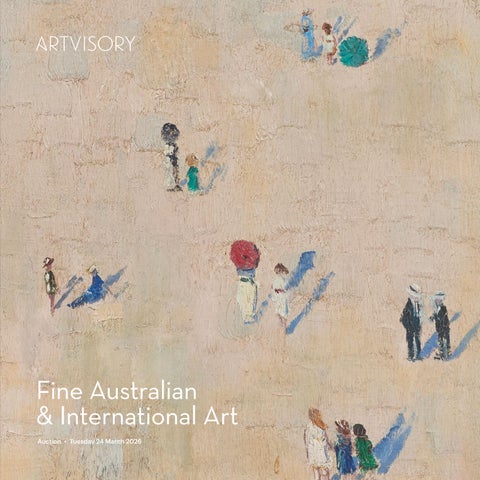
Create a flipbook