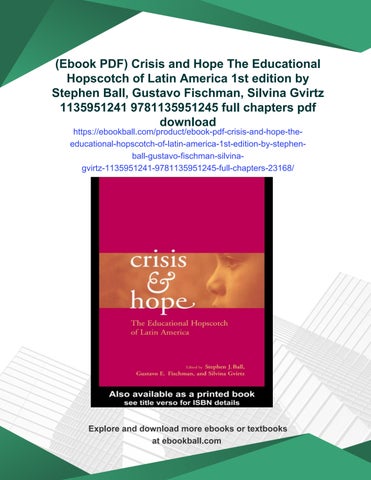
(Ebook PDF) Crisis and Hope The Educational Hopscotch of Latin America 1st edition by Stephen Ball, Gustavo Fischman, Silvina Gvirtz 1135951241 9781135951245 full chapters pdf download https://ebookball.com/product/ebook-pdf-crisis-and-hope-theeducational-hopscotch-of-latin-america-1st-edition-by-stephenball-gustavo-fischman-silvinagvirtz-1135951241-9781135951245-full-chapters-23168/
Explore and download more ebooks or textbooks at ebookball.com
Get Your Digital Files Instantly: PDF, ePub, MOBI and More Quick Digital Downloads: PDF, ePub, MOBI and Other Formats
(Ebook PDF) Educational Developement Through Information and Communications Technology 1st edition by Rakesh Bhanot, Stephen Fallows 1135727031 9781135727031 full chapters https://ebookball.com/product/ebook-pdf-educational-developementthrough-information-and-communications-technology-1st-edition-byrakesh-bhanot-stephen-fallows-1135727031-9781135727031-fullchapters-23024/
(Ebook PDF) The Palgrave Handbook of Educational Leadership and Management Discourse 1st edition by Fenwick English 9783030990961 full chapters https://ebookball.com/product/ebook-pdf-the-palgrave-handbook-ofeducational-leadership-and-management-discourse-1st-edition-byfenwick-english-9783030990961-full-chapters-21992/
(Ebook PDF) Educational Research The Attraction of Psychology 1st edition by Paul Smeyers 9400750382 9789400750388 full chapters
https://ebookball.com/product/ebook-pdf-educational-research-theattraction-of-psychology-1st-edition-by-paulsmeyers-9400750382-9789400750388-full-chapters-25414/
Bond Markets in Latin America On the Verge of a Big Bang 1st edition by Eduardo Borensztein, KevinCowan, Barry Eichengreen and Ugo Panizza ISBN 0262026325 ‎ 978-0262026321 https://ebookball.com/product/bond-markets-in-latin-america-onthe-verge-of-a-big-bang-1st-edition-by-eduardo-borenszteinkevincowan-barry-eichengreen-and-ugo-panizzaisbn-0262026325-aeurz-978-0262026321-14714/
(Ebook PDF) Education and Educational Technology 1st edition by Yuanzhi Wang full chapters
https://ebookball.com/product/ebook-pdf-education-andeducational-technology-1st-edition-by-yuanzhi-wang-fullchapters-23422/
(Ebook PDF) Teaching and Educational Technology in the 21st Century The Case of the Asia Pacific Region 1st edition by Suzanne Bell 1591407257 9781591407256 full chapters https://ebookball.com/product/ebook-pdf-teaching-and-educationaltechnology-in-the-21st-century-the-case-of-the-asia-pacificregion-1st-edition-by-suzanne-bell-1591407257-9781591407256-fullchapters-22982/
(Ebook PDF) The Emergence of Self in Educational Contexts Theoretical and Empirical Explorations 1st edition by Giuseppina Marsico, Luca Tateo 3319986023 9783319986029 full chapters https://ebookball.com/product/ebook-pdf-the-emergence-of-self-ineducational-contexts-theoretical-and-empirical-explorations-1stedition-by-giuseppina-marsico-lucatateo-3319986023-9783319986029-full-chapters-25434/
(Ebook PDF) Philosophy of Educational Knowledge 1st edition by W Brezinka isbn 978-0792315223 0792315227 full chapters
https://ebookball.com/product/ebook-pdf-philosophy-ofeducational-knowledge-1st-edition-by-w-brezinkaisbn-978-0792315223-0792315227-full-chapters-23308/
(Ebook PDF) Encyclopedia of Terminology for Educational Communications and Technology Springer 1st edition by Rita Richey 1461465737 9781461465737 full chapters https://ebookball.com/product/ebook-pdf-encyclopedia-ofterminology-for-educational-communications-and-technologyspringer-1st-edition-by-ritarichey-1461465737-9781461465737-full-chapters-23430/
Crisis and Hope
Crisis and Hope The Educational Hopscotch of Latin America
Edited by Stephen J.Ball, Gustavo E.Fischman, and Silvina Gvirtz
RoutledgeFalmer NEW YORK AND LONDON
Published in 2003 by RoutledgeFalmer 29 West 35th Street New York, NY 10001 Published in Great Britain by RoutledgeFalmer 11 New Fetter Lane London EC4P 4EE RoutledgeFalmer is an imprint of the Taylor & Francis Group. This edition published in the Taylor & Francis e-Library, 2005. “To purchase your own copy of this or any of Taylor & Francis or Routledge’s collection of thousands of eBooks please go to www.eBookstore.tandf.co.uk.” Copyright © 2003 by RoutledgeFalmer All rights reserved. No part of this book may be reprinted or reproduced or utilized in any form or by any electronic, mechanical, or other means, now known or hereafter invented, including photocopying and recording, or in any information storage or retrieval system, without permission in writing from the publishers. Library of Congress Cataloging-in-Publication Data Crisis and hope: the educational hopscotch of Latin America/ edited by Gustavo E.Fischman, Stephen Ball and Silvina Gvirtz. p. cm.— (Reference books in international education) Includes bibliographical references and index. ISBN 0-415-93535-0 (Hardcover: alk. paper) 1. Education—Latin America. 2. Educational change—Latin America. I. Fischman, Gustavo. II. Ball, Stephen J. III. Gvirtz, Silvina. IV. Series. LA541.C76 2003 370'.98–dc21 2002152243 ISBN 0-203-46382-X Master e-book ISBN
ISBN 0-203-47176-8 (Adobe eReader Format)
iv
REFERENCE BOOKS IN INTERNATIONAL EDUCATION Edward R.Beauchamp, Series Editor
EDUCATION AND THE SCANDINAVIAN WELFARE STATE IN THE YEAR 2000 Equality, Policy, and Reform edited by Arild Tjeldvoll POLITICS OF CLASSROOM LIFE Classroom Management in International Perspective edited by Nobuo K.Shimahara EDUCATION, CULTURES, AND ECONOMICS Dilemmas for Development edited by Fiona E.Leach and Angela W.Little SCHOOLING IN SUB-SAHARAN AFRICA Contemporary Issues and Future Concerns edited by Cynthia Szymanski Sunal GENDER ISSUES IN INTERNATIONAL EDUCATION Beyond Policy and Practice edited by Maggie Wilson and Sheena Erskine CHINA’S NATIONAL MINORITY EDUCATION Culture, Schooling, and Development edited by Gerard A.Postiglione THIRD WORLD EDUCATION Quality and Equality edited by Anthony R.Welch THE ETHNOGRAPHIC EYE
Interpretive Studies of Education in China edited by Judith Liu, Heidi Ross, and Donald P.Kelly TEACHER EDUCATION IN THE ASIAPACIFIC REGION A Comparative Study edited by Paul Morris and John Williamson DISTANT ALLIANCES Promoting Education for Girls and Women in Latin America edited by Regina Cortina and Nelly P.Stromquist INTENSE YEARS How Japanese Adolescents Balance School, Family, and Friends by Gerald K.LeTendre and Rebecca Erwin Fukuzawa JAPANESE MODEL OF SCHOOLING Comparisons with the U.S. by Ryoko Tsuneyoshi COMPETITOR OR ALLY? Japan’s Role in American Educational Debates edited by Gerald K.LeTendre POLITICS OF EDUCATIONAL INNOVATIONS IN DEVELOPING COUNTRIES An Analysis of Knowledge and Power edited by Nelly P.Stromquist and Michael L.Basile
v
EDUCATIONAL RESTRUCTURING IN THE CONTEXT OF GLOBALIZATION AND NATIONAL POLICY edited by Holger Daun TEACHING IN JAPAN A Cultural Perspective by Nobuo K.Shimahara CIVIC EDUCATION IN THE ASIAPACIFIC REGION Case Studies across Six Societies edited by John J.Cogan, Paul Morris, and Murray Print HEGEMONIES COMPARED State Formation and Chinese School Politics in Postwar Singapore and Hong Kong by Ting-Hong Wong PROFESSIONAL DEVELOPMENT OF SCIENCE TEACHERS Local Insights with Lessons for the Global Community edited by Pamela Fraser-Abder CONSTRUCTING EDUCATION FOR DEVELOPMENT International Organizations and Education for All by Colette Chabbott SCHOOL LEADERSHIP AND ADMINISTRATION Adopting a Cultural Perspective edited by Allan Walker and Clive Dimmock DEVELOPMENT EDUCATION IN JAPAN A Comparative Analysis of the Contexts for its Emergence, and Its Introduction into the Japanese School System by Yuri Ishii DAUGHTERS OF THE THARU Gender, Ethnicity, Religion, and the Education of Nepali Girls by Mary Ann Maslak
EDUCATION, CRISIS AND HOPE Crisis and Change in Latin America edited by Stephen J.Ball, Gustavo E.Fischman and Silvina Gvirtz
Contents
Series Preface
viii
Introduction:
Toward a Neoliberal Education? Tension and Change in Latin America GUSTAVO E.FISCHMAN, STEPHEN J.BALL, SILVINA GVIRTZ
1
Chapter 1
Toward a Unified Agenda for Change in Latin American Higher Education The Role of Multilateral Agencies ROBERTO RODRÍGUEZ-GÓMEZ and ARMANDO ALCÁNTARA
19
Chapter 2
Two Decades of Neoliberalism in Latin America Implications for Adult Education DANIEL SCHUGURENSKY
43
Chapter 3
Prioritizing the Education of Marginalized Youth in Brazil A Collaborative Approach PIA L.WONG and RAMON BALESTINO
65
Chapter 4
A Local Reform Goes Global The Politics of Escuela Nueva PATRICK J.McEWAN and LUIS BENVENISTE
93
Chapter 5
Neoliberalism and Educational Decentralization Policies The Experience of the 1990s JORGE M.GOROSTIAGA DERQUI
113
Chapter 6
Searching for “Neoliberal” Education Policies A Comparative Analysis of Argentina and Chile MARIANO NARODOWSKI and MILAGROS NORES
139
vii
Chapter 7
Beyond Neoliberalism in Education The Citizen School and the Struggle for Democracy in Porto Alegre, Brazil LUIS ARMANDO GANDIN and MICHAEL W.APPLE
157
Chapter 8
Teachers’ Work Revisited Mexican Teachers’ Struggle for Democracy and the Anti-Neoliberal Alternative SUSAN STREET
179
Chapter 9
While Gender Sleeps Neoliberalism’s Impact on Educational Policies in Latin America NELLY P.STROMQUIST
199
Chapter 10
The Northern Influence and Colombian Education Reform of the 1990s PATRICIAVANEGAS
227
Index
251
Series Preface
This series of scholarly works in comparative and international education has grown well beyond the initial conception of a collection of reference books. Although retaining its original purpose of providing a resource to scholars, students, and a variety of other professionals who need to understand the role played by education in various societies or world regions, it also strives to provide accurate, relevant, and up-to-date information on a wide variety of selected educational issues, problems, and experiments within an international context. Contributors to this series are well-known scholars who have devoted their professional lives to the study of their specializations. Without exception these men and women possess an intimate understanding of the subject of their research and writing. Without exception they have studied their subject not only in dusty archives, but have lived and traveled widely in their quest for knowledge. In short, they are “experts” in the best sense of that often overused word. In our increasingly interdependent world, it is now widely understood that it is a matter of military, economic, and environmental survival that we understand better not only what makes other societies tick, but also how others, be they Japanese, Hungarian, South African, or Chilean, attempt to solve the same kinds of educational problems that we face in North America. As the late George Z.F.Bereday wrote more than three decades ago: “[E]ducation is a mirror held against the face of a people. Nations may put on blustering shows of strength to conceal public weakness, erect grand façades to conceal shabby backyards, and profess peace while secretly arming for conquest, but how they take care of their children tells unerringly who they are” (Comparative Methods in Education, New York: Holt, Rinehart and Winston, 1964, 5). Perhaps equally important, however, is the valuable perspective that studying another education system (or its problems) provides us in understanding our own system (or its problems). When we step beyond our own limited experience and our commonly held assumptions about schools and learning in order to look back at our system in contrast to another, we see it in a very different light. To learn, for example, how China or Belgium handles the education of a multilingual society, how the French provide for the funding of public education, or how the Japanese control access to their universities enables us to better understand that there are reasonable alternatives to our own familiar way of doing things. Not that we can borrow directly from other societies. Indeed, educational arrangements are inevitably a reflection of
ix
deeply embedded political, economic, and cultural factors that are unique to a particular society. But a conscious recognition that there are other ways of doing things can serve to open our minds and provoke our imaginations in ways that can result in new experiments or approaches that we may not have otherwise considered. Since this series is intended to be a useful research tool, the editor and contributors welcome suggestions for future volumes, as well as ways in which this series can be improved. Edward R.Beauchamp University of Hawaii
x
Introduction Toward a Neoliberal Education? Tension and Change in Latin America GUSTAVO E.FISCHMAN STEPHEN J.BALL SILVINA GVIRTZ
In surveying the impact of neoliberalism in Latin America as we inch anxiously into the twenty-first century, it is not difficult to find educational and social programs and practices to be critical about. Skepticism and disdain are easy. The challenge of finding a coherent political, theoretical, or ethical base from which to develop purposive critiques and alternative plans of action is not so easy. For those committed to the ideals of fairness and equality of social and civil rights as the bases of a substantive democracy, critique and innovation are even more difficult. Neoliberalism stands, as we suggest in this introduction, as an ideology without ideology, beyond politics. Part of its success is that it evades and eschews the conflicts and disputes that arise around struggles for social justice. Rather it promises “a better life” by releasing individuals to do what they do best. It offers betterment, in a sense, without effort, as a side effect. Against this the plans, interventions, and bureaucracy of social democracy look out-moded. It is increasingly difficult to find “another place” from which to be heard. Thus, like many others, we start with critique—but in this volume as a whole, we also offer evaluation and some possibilities for hope. The policy orthodoxies of national economic development are now well established, and there is no short age of policy. Levin goes so far as to call it a global “policy epidemic.” Similar policies are pursued in very different political and economic locations. Certainly during the 1990s countries throughout Latin America experienced an accelerated process of change and witnessed the implementation of new social and economic models of development (Reimers 2000; Torres and Puiggrós 1997; UNESCO-OREALC 2000) associated with the implementation of neoliberal programs. Basically, these models were either directly related to the “conditionality” requirements of IMF and World Bank loans or their regional agents, or were taken up by local politicians committed to the normativities of northern development directions. In either case pacing was typically sacrificed for speed, often with dire consequences. At the level of global policy the changes in the welfare regimes in many developed and developing countries—and the atten dant transformation of public sector organizations and the further opening up of these economies to global capitalist institutions—are part of a process of alignment with the “inviolate orthodoxy” (Stiglitz 2002, 43) espoused by organizations like the OECD, World Trade Organization (WTO), and the World Bank. The World Bank and International
2 GUSTAVO E.FISCHMAN, STEPHEN J.BALL, AND SILVINA GVIRTZ
Monetary Fund (IMF) in particular are firmly committed to what is sometimes called the Americanization of the world economy. Joseph Stiglitz, reflecting on his time as chief economist at the World Bank, describes major decisions taken by the IMF as “made on the basis of what seemed a curious blend of ideology and bad economics, dogma that sometimes seemed to be thinly veiling special interests” (xiii). However, while the use of the term neoliberalism is very common in Latin America, a definite assessment of its impact is made somewhat difficult by the looseness and ambiguity with which the term is used. Lynne Phillips (1998) among others points out: “Neo-liberalism is the process of growing reliance on the market for organizing social and economic activities. Why this process has taken place in Latin America is still a matter of debate” (xvi). Lidia Henales and Beatrice Edwards describe this situation by pointing out that: Generally, critics of neo-liberalism describe it as economic and social strategies that together constitute the renovation of the old liberal mercantilist ideal. However, those who currently design and implement these policies reject the term neo-liberal and instead use such terms as privatization, decentralization, deregulation, and tax reform to convey the same meaning. In this way they successfully disown the long ideological continuum from which they have evolved, while simultaneously promoting neo-mercantilism as new and diverse. (2000, 1) Most of the programs aimed at bringing about privatization, decentralization, deregulation, and tax reform were justified as the only possible solution to the economic and social problems faced by the Latin American countries because only these policies were attuned to the worldwide process of globalization.1 In this case globalization was equated with modernization and implied the acceptance of the expansion of transnational capital, the supranational character of productive decision making, increasing trends pressuring in the direction of the homogenization of information and cultural consumption, and the connection of geographically and culturally distant places in such a way that local events are shaped, as well as influenced, by events occurring in remote places.2 Neoliberal economic policy discourse has become hegemonic in the public sphere and all but overwhelmed the articulation of alternative social conceptions that emphasize the need for greater democracy and the improvement of the quality of life —measured not only in economic terms but also in preventing environmental collapse and creating equal access to job opportunities, education, culture, health, and welfare. There is a hegemonic inevitability about neoliberal reforms, but it is an inevitability that is carefully “policed” by international agencies. In practice and in political discourse, neoliberal reforms are presented as simply rational-technical solutions to the problems of underdevelopment, and separated from their ideological and philosophical origins.3 Terry Eagleton’s reflections are helpful here:
INTRODUCTION 3
Many a ruling class has sought to erase from historical memory the blood and squalor in which it was born. As Blaise Pascal admonishes with arresting candor in his Pensées, “The truth about the [original] usurpation must not be made apparent; it came about originally without reason and has become reasonable. We must see that it is regarded as authentic and eternal, and its origins must be hidden if we do not want it soon to end” (Eagleton 2002, 119). Eagleton’s point underlines the importance of trying to understand and deconstruct the neoliberal perspective and the arguments of its supporters that propose its “nonexistence” and work against the possibility of “thinking otherwise.” In the simplest sense educators and researchers need to address the relevance of policies based on economic and business practices to the ethical/ intellectual processes of education. More specifically, it is important to understand how the hegemonic position of neoliberalism in Latin American countries works on the fears, concerns, perspectives, and strategies of social subjects that are reinterpolated within a discourse of responsibility and a “vocabulary and ethics of enterprise” producing in turn a new “style of conduct” (Weber 1915/1948). The market, competitiveness, and choice involve not simply a new and more efficient mechanism for the delivery of public sector services but also the basis for a new moral economy. It brings with it a new set of values and a new ethical framework within which relationships and practices in public sector organizations are reworked. Defining the neoliberal perspective in education Steve Klees (1999) has noted that economic theory and policies, from the early writings of Adam Smith to the current discussion of neoliberalism and the IMF and World Bank sponsored structural adjustment programs, have always been anchored in the debates about the role and balances between the force and presence of the market and the state. While the defining characteristics of neoliberalism follow the central elements of classic economic liberalism with regard to the role of the state, there are key differences here, which are fundamental to understanding the current politics of education in the Latin America. Mark Olssen’s clear statement of the differences between neoliberalism and classic economic liberalism is worth quoting in its entirety: Whereas classical liberalism represents a negative conception of state power in that the individual was to be taken as an object to be freed from the interventions of the state, neo-liberalism has come to represent a positive conception of the state’s role in creating the appropriate market by providing the conditions, laws and institutions necessary for its operation; although for many developing societies these conditions for the market are dictated by international lenders and multi-lateral agencies. In classical liberalism, the individual is characterized as having an autonomous human nature and can practice freedom. In neo-liberalism the state seeks to create an individual who
4 GUSTAVO E.FISCHMAN, STEPHEN J.BALL, AND SILVINA GVIRTZ
is an enterprising and competitive entrepreneur. In the classical model the theoretical aim of the state was to limit and minimize its role based on postulates which included universal egoism (the self-interested individual); invisible hand theory which dictated that the interests of the individual were also the interests of the society as a whole; and the political maxim of laissezfaire. In the shift from classical liberalism to neo-liberalism, then, there is an important element added, for such a shift involves a change in subject position from “homo economicus,” who naturally behaves out of self-interest and is relatively detached from the state, to “manipulatable man” who is created by the state and who is continually encouraged to be “perpetually responsive.” It is not that the conception of the self-interested subject is replaced or done away with by the new ideals of “neo-liberalism” but that in an age of universal welfare, the perceived possibilities of slothful dependence create necessities for new forms of vigilance, surveillance, performance appraisal and of forms of control generally. In this model the state has taken it upon itself to keep us all up to the mark. The state will see to it that each one makes a “continual enterprise of ourselves”…what seems to be a process of “governing without governing.” (Olssen 1996, 340) This process of governing without governing involves not a deregulation and withdrawal of the state, but a re-regulation and a new kind of role. According to Olssen’s description one of the main goals of the neoliberal state is the development of “an individual who is an enterprising and competitive entrepreneur” (Olssen 1996, 34). Similarly, Kless (1999,1) notes that this emerging model of the state is “an integral part of neo-liberalism’s attempt to delegitimate government and disengage government and society from any collective responsibility for social welfare.” This shift from collective responsibility to entrepreneurial individualism has profound implications for the educational sector. A central feature of the neo-liberal argument as applied to education systems is that schools must bring their policies and practices in line with the importance of knowledge as a form of production (Davies and Guppy 1997). Neoliberal educationalists largely blame public schools, state-monopolies, and “producer capture” for economic decline, and they argue that educational reform must therefore be responsive to the postindustrial labor market and the needs of a restructured global economy. Davies and Guppy explain that the renewal of school must follow: “Curricula concentrated on consumer relations, problem solving, entrepreneurialism, and cross-cultural ‘multiskilling’ are central to this economic transformation. Employers will recruit people with broad education and complement this with intensive on-the-job training” (1997, 439). Neoliberal discourses both theoretically and ideologically rest on a belief in the selfcorrecting qualities of the corporatist logic of the free market as part of a selfproclaimed ideologically neutral discourse of efficiency and accountability. Within this discourse the market and the corporation are sanitized and romanticized. Market failings are erased and the “perfections” of competition are set over and against the
INTRODUCTION 5
“conservatism” of state bureaucracies. The role of the state in regulating markets— most recently highlighted by the hurried passing of the Sarbanes-Oxley Act in the U.S.—is glossed over in the enthusiasm of neoliberal politics. In this sense, the region is facing what Pierre Bourdieu refers to as the “gospel” of neoliberalism. This gospel is one that serves as a clarion call to combat “by every means, including the destruction of the environment and human sacrifice, against any obstacle to the maximization of profit” (1998, 126). It is worth quoting Pierre Bourdieu’s description of neoliberalism at length: A powerful economic theory whose strictly symbolic strength, combined with the effect of theory, redoubles the force of the economic realities it is supposed to express. It ratifies the spontaneous philosophy of the people who run large multinationals and of the agents of high finance—in particular pension-fund managers. Relayed throughout the world by national and international politicians, civil servants, and most of all the universe of senior journalists—all more or less equally ignorant of the underlying mathematical theology—it is becoming a sort of universal belief, a new ecumenical gospel. This gospel, or rather the soft vulgate which is put forward everywhere under the name of liberalism, is concocted out of a collection of ill-defined words —“globalization,” “flexibility,” “deregulation” and so on—which, through their liberal or even libertarian connotations, may help to give the appearance of a message of freedom and liberation to a conservative ideology which thinks itself opposed to all ideology. (1998, 126) This ideology without ideology is set over and against the “failures” of social democracy, and the inability of welfare systems to meet the needs of all citizens. As Brenkman notes: “While liberal democracy offers an important discourse around issues of rights, freedoms, participation, self-rule, and citizenship, it has been mediated historically through the damaged and burdened tradition of racial and gender exclusions, economic injustice, and a formalistic, ritualized democracy, which substituted the swindle for the promise of democratic participation” (Brenkman 2000, 123 and in Giroux, forthcoming). At the same time, liberal and republican traditions of Western democratic thought have made possible the development of limited forms of social and political argumentation that at a minimum contained a “referent” for addressing the gap between the promise of a radical democracy and the existing forms of democratic governance.4 Neoliberalism then gathers discursive strength and political influence from both its promises of a new kind of nonideological freedom and a telling critique of democratic failures. It represents, in its own terms, a move beyond politics back to a state of nature, back to the “natural” impulses of individualism and competition.
6 GUSTAVO E.FISCHMAN, STEPHEN J.BALL, AND SILVINA GVIRTZ
Neoliberalism and educational policies in Latin America Neoliberal discourse can be subjected to thorough examination and critique, but this book’s major task is to examine the material effects of neoliberal policies both at the level of whole economies and in the lives of those of the margins of global society— those to whom the “promises” of neoliberalism matter most. Arguably, over the last decade as a whole the macroeconomic indicators have improved from previous decades, and economic growth has somewhat resumed in most countries of the region. According to data of the Inter-American Development Bank (1999), between 1990 and 1997 Chile’s GDP increased at a yearly rate of 6.9 percent–4 percent in Argentina, 2 percent in Bolivia, 2.7 percent in Peru, 3.6 percent in Uruguay, and below 2 percent in ten other countries. However, in the last two years growth has stalled and several Latin American economies—Bolivia, Argentina, and Uruguay in particular—now find themselves in free-fall and looking for further international loans. Even while it lasted, however, economic growth did not improve the basic picture of extreme inequality. Since 1990, unemployment rates have increased, and poverty and worsening living conditions are the everyday reality for a growing number of people. As a clearly conservative outlet such as The Economist pointed out: “The fundamental economic outlook is favorable but the poor cannot eat ‘fundamentals.’ What they see is that the region’s traditionally wide gap between the incomes is widening further” (1996, 21). As a region, Latin America still has one of the highest levels of income inequality in the world. On average, a quarter of national incomes is appropriated by the wealthiest 5 percent, and only 7.5 percent is distributed among the poorest 30 percent of the population. Between 1980 and 1997 the number of people living below country-specific poverty lines increased from 136 to 204 million, with 90 million living in conditions of extreme poverty. Many of the poor live in rural and indigenous areas, and the process of pauperization has also disproportionately affected women.5 In contrast, the wealthiest sectors of the population have enjoyed the benefits of the application of policies of “liberalization and modernization,” which have increased their opportunities to access the latest world-market technology and consume fashionable goods. The simultaneous increase of wealth for a few and the expansion of poverty for many is the expression of the striking economic segmentation and its parallel process of social polarization of the region. Important transformations existed not only in the economy but also in the education sector. And how does all of this relate to education? The short answer is: In a number of complex ways. As we have suggested already, the overall relationship between education and the economy—both in terms of inputs and outcomes—is being reworked. Education itself is drawn ever more directly into the sphere of profit. There is the insertion of the habitus of private production and its commercial sensibilities and a concomitant “utilitarian morality” into educational practices. Education is commodified. In many ways we have as yet no well-developed language with which to describe and analyze the “marketisation” of education. Concrete developments have outrun the scope of our usual conceptual tools. Furthermore, increasing evidence
INTRODUCTION 7
suggests that the effects of market structures in education may directly parallel the segmenting and polarizing effects of the neoliberal economy. The “new modernization” discourse developed a strong educational tone, stressing the importance of higher levels of educational efficiency and quality through school decentralization, autonomy, increased rigor, discipline, efficiency, efficacy, accountability, and higher levels of private sector participation in the delivery of educational services. The educational debate in Latin America at the beginning of the twenty-first century appears to be dominated by polemics about standards, testing, school autonomy, decentralization, accountability of the public sector, privatization, and vouchers, indicating that the center of the debate is how to best accommodate educational institutions to the demands of the market. As Hursh (2001) notes: The neo-liberal states, through the use of standards, assessments, and accountability, aims to restrict educators to particular kinds of thinking, thinking that conceptualizes education in terms of producing individuals who are economically productive. Education is no longer valued for its role in developing political, ethical, and aesthetic citizens. Instead, the goal has become promoting knowledge that contributes to economic productivity and producing students who are compliant and productive. Blackmore explains that: “educational policy has shifted emphasis from input and process to outcomes, from the liberal to the vocational, from education’s intrinsic to its instrumental value, and from qualitative to quantitative measures of success.” (2001, 34)
The processes noted by Hursh for the U.S. and the UK have their parallels in Latin America. The educational debate prior to the rise of neoliberalism centered on providing equality of opportunity and the imagined nexus between education and democracy. Within the neoliberal hegemony, the educational focus and agendas have shifted to financially driven and assessed programs of school reform. These agendas are centered on increasing the accountability and efficiency of the public systems of education through processes of “educational restructuring.” This restructuring is mainly understood as a process of producing financial savings, while at the same time thoroughly transforming goals, epistemological bases, and methods and procedures of school systems. In some ways this is again a simple and powerful transposition of logic from the market into the public sector. Education is held to account; its efficiency is measured. But this is not simply a process of measurement and comparison; it also effects and changes what it measures, driven by the reductionist idea that everything is a matter of accounting (Readings, 1998) and the only things that are worthwhile are those that can be counted or measured. As Du Gay (1996, 190) puts it: “the generalization of an enterprise form to all forms of conduct may of itself serve to incapacitate an organization’s ability to pursue its preferred projects by redefining its identity and hence what the nature of its project actually is.”
8 GUSTAVO E.FISCHMAN, STEPHEN J.BALL, AND SILVINA GVIRTZ
Programs for increasing the efficiency and accountability of educational systems have become the primary strategy for dealing with public education. Many educational reform programs are now almost exclusively framed by the qualityefficiency equation, and the complex connections between education and democracy often have been displaced by these more “pressing” priorities—although some of the chapters in this collection highlight the conflicts and struggles that are inherent in the making and enactment of policies. There are several example of hybrid policies with mixed priorities.6 During the 1990s most Latin American countries were subject to multiple attempts at significantly restructuring their educational systems. Many of these attempts emphasized the rhetoric of choice, accountability, quality, and decentralization, though, as suggested already, they have frequently had the paradoxical effect of reducing school autonomy and enabling central governments to acquire even greater control over the daily life of educational institutions. Barry, Osborne, and Rose (1996) aptly describe the changing role and tactics of governmental and quasi-governmental organizations: Paradoxically, neo-liberalism, alongside its critique of the deadening consequences of the “intrusion” of the state into the life of the individual, has nonetheless provoked the invention and/or deployment of a whole array of organizational forms and technical methods in order to extend the field in which a certain kind of economic freedom might be practiced in the form of personal autonomy, enterprise, and choice. (Barry et al., 10) Currently, ministries of education in the region (both at the national or provincial level) not only have more power to determine school policies, curriculum changes, and evaluation processes, but also have tighter control over the performance of individual schools. These performances are linked to the goals of financial programs of economic adjustment, devised and supervised by international financial institutions such as the World Bank and the IMF. This type of control is not driven by educational principles or needs. These processes of extending the presence of the state were implemented while the state simultaneously was withdrawing from intervention from its traditional sphere as guarantor of equal educational opportunities and provisions. Fernando Reimers makes the following comments: It should be acknowledged that the stark inequalities among primary schools serving different children occur in contexts of relatively low spending and quality for all children enrolled in public schools in Latin America. In spite of the fact that international organizations and governments have been more prone to emphasize reforms to improve resource utilization (which assumes that there is unutilized or poorly utilized capacity in the system) the public education systems in Latin America spend significantly less than the United States or the Caribbean. Expenditures per pupil in primary education, as a
INTRODUCTION 9
percentage of GNP per capita, exceed 2.5 percent only in Costa Rica and Cuba. In most other countries they are significantly below this level (Reimers 2000, 446) As already noted, the Latin American reforms of the 1990s were formulated to advance two simultaneous goals: increasing the accountability of the educational systems and promoting school-level reform. In general terms, the changes proposed to achieve those goals were structured according to the following main strategies:7 • Establishing new general laws for the educational sector (in those countries that did not already have them). In Venezuela the “Ley Orgánica de Educación” (Organic Law of Education) was passed on July 26, 1980, and was established in 1986; in Chile the “Ley Orgánica Constitucional de la Enseñanza” (Organic Constitutional Law of Teaching) was passed in 1990; in Argentina the “Ley Federal de Educación” (Federal Law of Education) was passed in 1993; in Colombia the “Ley General de Educación” (General Law of Education) was passed in 1994; and in Brazil the “Ley de Directrices y Bases de la Educación” (Law of Orientation and Foundations of Education) was passed in 1997. • Establishing processes of system decentralization. In Chile the process of decentralization began in 1980 and ended in 1986. In Argentina, the greatest political effort was made in 1978 and concluded with passing the “Ley Federal de Educación” (Federal Law of Education) in 1994. In Venezuela, the “VIII Plan de la Nación” (VIII Plan of the Nation) was proposed to decentralize the administration of education. In Colombia, except for certain administrative aspects, the new law of education promoted processes of decentralization (Martínez Boom, 1993), as in Venezuela (Braslavsky and Gvirtz 2001) • Attempts to promote a managerial ethos in individual schools through “Proyectos Educativos Institucionales” (Institutional Education Projects).8 These programs have been carried out in Latin America since the 1990s (Argentina, Colombia, Venezuela, and later Brazil). The institutional projects intended to give each school the power to elaborate its own project, which had to include the objectives of the institution, the profile of graduates, and a master plan describing in detail the prioritized contents to be taught. All stakeholders in the institution were to participate in its elaboration and form work groups, as well as provide support in the decision-making process. This was to be done bearing in mind the priorities and problems of the school itself, while respecting the general guidelines presented by either the national state or the provincial states. The institutional projects’ rationale should have allowed and promoted each school to create its own working method. Thus, the curricular sequence and organization, the teaching methods, and their pacing were to vary from one school to another according to their institutional differences. Perhaps the most innovative and ideologically different program promoting institutional autonomy is the Escola Cidadã Program (Citizen’s School Project) developed by the Municipality of Porto Alegre (Rio Grande do Sul, Brazil) since 1989 (Fischman and McLaren, 2000). In this
10 GUSTAVO E.FISCHMAN, STEPHEN J.BALL, AND SILVINA GVIRTZ
program, educators, students, parents, community organizations, and individuals have had the opportunity to express their opinions about the role that schools should play in the larger society, and reflect upon the type of social, political, and educational practices they would like to see in operation in the municipality’s schools.9 • The state’s withdrawal from strict curricular regulation and development of national standards or “minimum curricular contents” were elaborated in Argentina, Brazil, Chile, Colombia, the Dominican Republic, and Mexico, replacing former national curricula that dictated in great detail the contents to be taught. • Implementing national systems of school and student assessment. Undoubtedly, systematic evaluation is not new in modern pedagogy; it was and is widely used in educational systems throughout the world. What makes its current implementation different in this case is that it was designed with the rationale of constituting the core of these reforms. It is gradually being applied in a significant number of countries of the region. So much importance is placed on this new mechanism that lawmakers are contemplating the creation of instruments for evaluating the systems, and the majority of Latin American countries have already created and implemented them. Chile pioneered the implementation of experiments in the evaluation of system quality in Latin America. Currently it has the “Sistema de Medición de la Calidad Educativa” (SIMCE) (System of Measuring Educational Quality). The national ministries of education have been carrying out this task of measuring quality since 1988. In Mexico, the Sistema Nacional de Evaluación (SNEE) (National Evaluation System) was created. Brazil has its so-called Sistema Nacional de Evaluación de la Educación Básica (SAEB) (National System for the Evaluation of Basic Education), Paraguay has the Sistema Nacional de Evaluación del Proceso Educativo (SNEPE) (National System for the Evaluation of the Educational Process). Costa Rica, Venezuela, Argentina, Colombia, and Uruguay have also used this type of evaluation. Evaluation in these countries has two primary goals: one is the technical goal of improving the quality of the system through the analysis of outcomes; the other is an explicit political goal in which some of the results are used to legitimize certain political discourses regarding the objectives of the reforms.10 If in the traditional organization of Latin American educational systems results were guaranteed by means of highly centralized curricula, and attempts to enforce uniform teaching methods by means of daily control were carried out by administrators and supervisors, the reforms of the 1990s hoped to guarantee educational performance through the evaluation of what students have learned or, perhaps more accurately, their performance on tests or examinations. Supervision is no longer intended to be a daily phenomenon; rather its application is to be systematic over time. Nonetheless, whatever our location, educators now operate within a baffling array of figures, performance indicators, comparisons, within the educational system and competitions—in such a way that the contentments of stability are increasingly elusive, purposes are contradictory, motivations blurred, and self worth slippery. For
INTRODUCTION 11
teachers, constant doubts about which judgements may be in play at any point mean that any and all comparisons to “supposedly good teaching performances” have to be attended to. What is produced is a state of conscious and permanent visibility at the intersection of government, organization, and self-formation. The vast literature that addresses the contemporary changes in educational systems associated with the processes of globalization and capitalistic reorganization demonstrates above all that formal systems of schooling are positioned as one of the most important social policies of the state (Ozga 2000; Fischman and Stromquist 1999, Rizvi and Lingard 2000). In the new scenario of public education in Latin America, it appears that the authorities seek to employ forms of expertise in order to govern schools at a safe distance. As noted before, neoliberalism involves less a retreat from governmental “intervention” and more a transformation based on the reinscription of the techniques and forms of expertise required for the exercise of government. (Barry et al., 14) As Rose writes, the “formal political institutions” govern from a distance and “conceive of these actors as subjects of responsibility, autonomy, and choice, and seek to act upon them through shaping and utilizing their freedom” (Rose 1995, 53–4). Nonetheless, the social “purposes” of education in the Latin American context and elsewhere are also firmly subordinated to the financial and economic policies and principles of neo-liberalism. In Latin America the neoliberal logic is made explicit by the policy recommendations presented in different documents formulated in international conferences (Jomtien, Thailand 1990; Santiago de Chile, 1998; Dakar, Senegal, 2000) and by regional and international entities such as the World Bank and CEPAL-OREALC. Using the goals defined in these documents as an evaluative parameter it is possible to conclude that the reforms of the 1990s have had a very limited positive impact in terms of improving education in the region. Among the most relevant indicators of the limitations of these reforms are: • Although educational systems expanded, incorporating more students, this was done within highly fragmented systems in which the disparities among groups and regions have increased. (Post 2001) • The newly implemented systems of educational assessment give empirical proof that the educational systems have achieved very low levels of learning. (Post, in press) • The teaching workforce has not reached appropriate levels of compensation or professionalization. (Fischman 2000) • The infrastructure needed to support the notion of education as lifelong learning has not reached adequate levels to attend to the needs of the adult population, reducing the services exclusively to basic education. To conclude, the educational reforms in the 1990s developed a new organizational model of public schooling. This is a hybrid model (Braslavsky and Gvirtz 2001) and has advanced forms of decentralization and empowerment, which encouraged limited
12 GUSTAVO E.FISCHMAN, STEPHEN J.BALL, AND SILVINA GVIRTZ
systems of local control and community participation while strengthening central authority and increased privatization. These changes are producing tensions in the character and orientation of the state and are reworking the relationships and patterns of influence between the state, the economy, and education. While the educational policies of the 1990s expanded the number of buildings, teachers, and students, their relevance for poor children and their families seems, thus far, limited, and they may well have resulted in new educational divisions and greater social polarization. About the content of this book The contributors to this volume are a mix of scholars from North America and Latin America, and their chapters display the richness and variety of approaches that is necessary if we are to begin to understand the complexities of educational policy and its multiple connections with the changing state, the changing economy, and the changing needs of diverse populations. As in any selection for an edited book, they cannot account for all of the historical, social, political, economical, and cultural patterns of national development and the organizational particularities of every system of education in the region. Nevertheless, seeing them as a whole, these chapters address some of the most important changes and continuities taking place in the educational sector in Latin America, and situate them within the context of the shifting dynamic forces of globalization. The writers do not take up a single, unified stance toward neoliberalism nor toward educational policy and its purposes. They also write with different points-of-view—gender, higher education, adult education, marginalized youth, rural schooling, educational elites, “local” policy making, comparisons between policies and between countries, and policy changes over time. Read individually they are fascinating; read together they constitute a powerful document of contemporary change in Latin America and its possibilities and problems. Roberto Rodrìguez-Gómez and Armando Alcántara explore the role of several multilateral organizations in the configuration of a unified agenda to reform higher education in Latin America. Their main interest is to document the principal similarities and divergences in the policies and strategies that these agencies advocate in order to transform Latin America’s higher education systems. Daniel Schugurensky analyzes the changes in the field of adult education policy and practice during the 1990s, indicating that the application of neoliberal economic and social policies in the region had several implications for adult education policy and practice. First, increasing inequality of income places a greater burden on adult education as a “compensatory measure for the poor.” Education in general, and adult education in particular, is increasingly turned to as the remedy for solving social problems such as poverty or unemployment. Secondly, the rapid and unfinished transition to democracy in Latin America requires broad, popular preparation for participation in democratic society and in the development of democratic values, particularly in times when formal democratic institutions are not living up to expectations, and novel means of democratic participation need to be designed. This
INTRODUCTION 13
entails, at a minimum, universal adult literacy that allows for a more informed public, and widespread education in citizenship, particularly the knowledge, skills, and attitudes that prepare individuals for active political participation. In his conclusions, Schugurensky emphasizes that adult education alone cannot solve all the social problems, and certainly not of the problems faced by the one hundred and fifty million Latin American youth and adults who have never had access to school or have been forced out of it. However, in connection with other actors and initiatives, it can offer a significant contribution to a more sustainable, just, democratic, and equitable development. It can also make a modest contribution to the collective development of alternatives to the hegemonic neoliberal perspective. Pia L.Wong and Ramon Balestino arrive at a similar conclusion in their discussion of educational reforms in Brazil. This chapter examines three critical questions related to the education of marginalized young people in Brazil: (1) to what extent does current government policy prioritize the education of marginalized young people; (2) what alternative models exist for addressing their educational needs and interests; and (3) what kind of policies are needed next to maximize educational opportunities for this population? Wong and Ballestino discuss three approaches used in the education of marginalized young people and show how the Brazilian policy makers have made “nods of the head,” acknowledging the existence of marginalized young people but continuing to use conventional practices to address their concerns. Wong and Balestino conclude their article by making recommendations for new collaborative forms of policy making in which grassroots groups and state entities work in partnership to prioritize the educational rights of marginalized young people. This type of partnership may offer compelling alternatives for a mediated, mitigated neoliberalism. Patrick J.McEwan’s and Luis Benveniste’s chapter addresses the history and politics of rural education reform in Colombia, with particular attention to the Escuela Nueva program. These two scholars conceptualize educational change not as a result of a unified or enduring policy package but as a dynamic process that is continuously shaped and reshaped as political actors and institutions compete for influence and scarce resources in a variable social arena. In particular, they assess the motivations of the Colombian state in promoting a comprehensive reform of its rural schools. They argue that Colombia’s unique political context was, in large part, responsible for its novel approach to school reform. As the political context shifted, however, so to did the state’s posture to rural schooling. The authors track the Escuela Nueva program through three phases (grassroots, formalized, and decoupled) to demonstrate how social actors, their interests at a specific point in time, and the distribution of power among them are crucial elements for understanding the motivation and outcomes of social policy making. Jorge M.Gorostiaga Derqui offers an analysis of the characteristics of decentralization policies and their relationship with neoliberalism in Argentina, Brazil, Chile, and Mexico. The objective of this chapter is not to arrive at a “correct” interpretation of the relationships between the two phenomena (neoliberalism and decentralization), but rather to explore different views and the complexity of the topic.
14 GUSTAVO E.FISCHMAN, STEPHEN J.BALL, AND SILVINA GVIRTZ
Gorostiaga Derqui argues that school decentralization—or “school autonomy,” the transferring of functions and responsibilities from the state to schools—appears as a new and extended reform that was accompanied by more traditional forms of decentralization during the 1990s such as provincialization or municipalization. These decentralization policies were coupled with processes of centralization of planning and evaluation at the national level. This new form of centralization/ decentralization is seen as linked to the neoliberal restructuring of the state, to pressures from globalization processes and forces, and to various internal demands for improving quality and efficiency in the delivery of education. Mariano Narodowski’s and Milagros Nores’s work intends to provide evidence of the complexity of the relationships between economic and educational reform, and they argue that the concept of neoliberalism contributes little to the understanding of education reforms, especially in the cases of Argentina and Chile. They contrast the inequalities of Chile’s market system with those of Argentina’s state system and ask difficult questions about which system is worse. Luís Armando Gandin and Michael W.Apple situate the processes of educational policy and reform within the larger Brazilian sociopolitical context. They discuss the ways in which a set of “local” policies has had what seem to be extensive and longlasting effects on educational participation. These authors describe and analyze the policies of the “Popular Administration” in Porto Alegre, Brazil. The focus of this chapter is on the “Citizen School” and on proposals that are explicitly designed to radically change both the municipal schools and the relationship between communities, the state, and education. Susan Street’s chapter addresses the new centrality of schools—and teacher actions within them. Street addresses school reform programs as they have evolved in Mexico from the perspective of subaltern actors—the teachers’ dissident movement—and the efforts of this movement to disengage its struggle for democracy from the traditional leftist posture of taking over state power (democratizing the teachers’ union). The alternative is the development of a pedagogical movement deemed necessary to revolutionize teaching and schooling at the community level, as the struggle for popular or radical democracy continues and deepens. In her chapter, Nelly P.Stromquist examines some of the manifestations of neoliberalism in education from the perspective of gender using political economy frameworks. Specifically, this chapter seeks to show the myriad ways, the variety of actors, and the consequences through which neoliberalism is impacting womens’ education and use of education as a liberating tool. The political economy perspective highlights the material, as opposed to discursive properties, of neoliberal dynamics and, in so doing, exposes the tensions among institutional actors as new equilibrium are sought, prevented, and negotiated. Patricia Vanegas focuses on the international influence exerted on educational reform in Colombia. Specifically, she addresses how global trends of thought, in this case neoliberalism, pervade the contexts of policy making. Vanegas defines and describes this influence as a relationship of power between the international context and the Colombian educational policy-making elite. Vanegas uses the concept of
INTRODUCTION 15
Northern Influence to explore the specificities of this relationship of power. She argues that the Northern Influence does not simply happen as a result of imposition from the north to the south, but rather through a complex of relationships, influences, interests, and dependencies that impact upon the capability of individuals to “think otherwise” about policy. Notes 1. The position of Jeffrey Puryear and José Brunner, two of the most renowned social scientists in Latin America, illustrates this tendency: “The current development model has placed new demands, on both citizens and the state. Globally-integrated, open economies require an internationally competitive work force, strong in science and technology. With the return to democracy after military dictatorships, people have made new demands on public services at the same time that government needs its citizens to be more informed and responsible. The decentralization of public administration puts more emphasis on participation, autonomy and civic responsibility at the local level” (Jeffrey M.Puryear and José J.Brunner, “Una agenda para la reforma educacional en America Latina y El Caribe.”) 2. Granted, globalization is one of the hottest and most argued concepts in terms of its meaning and outcomes among social scientists (Rhoten 2000). Stephen Ball, in a paper about global citizenship and educational policy (1998), points out that very often globalization is defined from the top but there are also “down perspectives.” The “top perspective” conceptualizes globalization as a process of cooperation between the most developed and industrialized nations, multinational corporations, and local elites, in which there is widespread attempt to sustain free market rules through the acceptance of a “consumerist ethos.” (Ball 1998,121). From the “down perspective,” or for the vast majority of poor and impoverished middle classes within Third World countries, globalization has been received with less optimism. The “global market” has not delivered all the benefits its public defenders have promised. In fact, the globalized economy is largely controlled by the operations of multinational corporations and the similar interests of the G-7 countries, international financial institutions, and supranational organizations. Since the mid-1970s the MNCs have grown more rapidly than the world economy. In 1976, the fifty largest industrial corporations worldwide had sales of $540 million and received $25 billion in profits. In 1990, sales figures for the top fifty had climbed to $2.1 trillion and their profits had reached $70 billion. In real terms, whereas the U.S. economy was growing at an annual rate of 2.8 percent (the OECD average was 2.9 percent), the MNCs’ annual sales growth was about 3.5 percent during the 1975–1990 period (Brown and Lauder 1997, 173). 3. Rosa Nidia Buenfil (1998) provides a good example of how the implementation of neoliberal-inspired policies are often masked by the state: “The Mexican government assumes ‘social liberalism’ (a euphemism for neoliberalism) as the philosophical axis of this reform, thus subordinating education to economic views: (e.g. education as investment), economic needs (e.g. schooling as unemployed depot) and pace (e.g. education as training), thus inscribing on education a managerial administration.” 4. For these reasons it would be a mistake not to examine the complex and contradictory histories of personal and collective struggles that have contributed to and benefited from
16 GUSTAVO E.FISCHMAN, STEPHEN J.BALL, AND SILVINA GVIRTZ
the welfare state. To dismiss the fact that, accompanied by severe contradictions, the condition of public schools as a component of the welfare state did vastly improve—in relative ways—the social conditions of economically and socially oppressed groups is not only politically disingenuous, but also an inadequate exercise in historical reasoning. 5. Several studies (CEPAL 1995; IRELA 1995; Stromquist 1997) have asserted that structural adjustment programs have been particularly pernicious to women. For a thorough discussion of the critical shortcomings for women in structural adjustment models of development, see Kabeer 1995. 6. We are not suggesting that the current neoliberal discourse in Latin America has replaced a previous discourse of democracy and social justice (or at least compensatory education). What the debates are showing is that neoliberal policies are promoted alongside a discourse of equity and poverty reduction. 7. We cannot fail to mention that there have been some limited “choice-based” experiments, as in the case of Chile, where the national government, through a decree issued on June 2, 1989, authorized the use of “vouchers” to subsidize the demand for education. In most other countries in the region, the chief reform strategies currently applied tend to subsidize and improve the supply of education. 8. This is the denomination given to the forms of implementation of autonomy in Colombia and Argentina. 9. This process of educational reform expresses the articulation of democratic ideals, community experiences, the legacy of the popular education movement, and a firm commitment to create a new model of schooling even amid a dramatic financial and economic crisis, and provides one of the most radical experiences of popular participation in school management, including a process of competitive and accountable system of budget allocation. 10. Regarding the political use of assessment instruments, David Post notes, “In the 1990s, separate attempts were made by UNESCO and by the International Association for the Evaluation of Achievement (IEA) to assess language and mathematics achievement in Latin America. Even when ministries were convinced to participate, the results of these assessments have been kept secret in several countries (including Peru and Mexico). National pride, and a concern to save face, will always politicize the measurement of quality.” (Post 2001,6)
References Ball, S. (1998). “Cidadania Global. Consumo e Politica Educacional.” A Escola Cidada no Contexto da Globalizacao. L.Heron Da Silva. Petropolis, Editora Vozes. Barry, A., T.Osborne, and N.Rose. (1996). Foucault and Political Reason: Liberalism, Neoliberalism, and Rationalities of Government. Chicago: University of Chicago Press. Bourdieu, P. (1998). Acts of Resistance: Against the Tyranny of the Market. New York: The New Press. Bourdieu, P. (1999). The Weight of the World: Social Suffering in Contemporary Society. Stanford: Stanford University Press. Braslavsky, C., and S.Gvirtz. (2001). “Nuevos desafíos y dispositivos en la política educacional Latinoamericana de fin de siglo.” Madrid, Organización de los Estados Iberoamericanos. Brenkman, John. 2000. “Extreme Criticism.” In What’s Left of Theory, edited by J.Butler, J.Guillary, and K.Thomas. New York: Routledge.
INTRODUCTION 17
Brown, P., and H.Lauder. (1997). “Observations on Global/Local Articulations of the Regendering and Restructuring of Educational Work.” International Review of Education 43, no. 5–6:439–461. Brunner, Joaquin, and Jeff Puryear. (1995). Educación, Equidad y Competitividad Económica en las Américas: An Interamerican Dialogue: Vol 1, Key Issues. Washington, D.C.: Organization of American States. Buenfil, Rosa Nidia. (1998). Globalization, Education and Discourse Political-Analysis Ambiguity and Accountability in Research Qualitative Studies in Education CEPAL (1995). “Panorama Social de América Latina” Santiago, Chile, CEPAL Davies, Scott, and Neil Guppy. (1997). “Globalization and Educational Reforms in AngloAmerican Democracies.” Comparative Education Review 41 (4):435–459. Du Gay, P. (1996). Consumption and Identity at Work. London: Sage. Eagleton, Terry. (2002). “Capitalism and Form.” New Left Review 14:119. Economist, The. November 30th, (1996). “Latin America’s Blacklash.” The Economist 341 (7994):19–23. Fischman, G. and N.Stromquist. (1999). “Globalization and Higher Education in Developing Countries.” Higher Education: Handbook of Theory and Research 15:501–22. Fischman, G.E. (2000). Imagining Teachers: Rethinking Gender Dynamics in Teacher Education. Lanham, Md.: Rowman and Littlefield. Fischman, G. and P.McLaren. (2000). “Schooling for Democracy: Toward a Critical Utopianism.” Contemporary Sociology 29, no. 1:168–80. Giroux, Henry. (2003).“Thinking Politics and Resistance as a form of Public Pedagogy.”In Critical Theories, Radical Pedagogies and Global Conflicts, edited by G.Fischman, P.McLaren, and H.Sunker. Lanham: Rowman and Littlefield Publishers, 1–12. Henales, Lidia and Beatrice Edwards. (2000). “Neo-liberalism and Education Reform in Latin America.” Current Issues in Comparative Education 2, no. 2:1. Hursh, David. (2000). “Neoliberalism and the Control of Teachers, Students, and Learning: The Rise of Standards, Standardization, and Accountability.” Cultural Logic 4 (1): 1–6. Inter-American Development Bank. (1999). Facing Up Inequality in Latin America. Washington, D.C.: Inter-American Development Bank. IRELA. (1995). Poverty in Latin America: Causes and Consequences. London; IRELA. Kabeer, N. (1994). Reversed Realities: Gender Hierarchies in Development Thought. London, New York: Verso. Klees, Steven J. (1999). “Privatization and Neoliberalism: Ideology and Evidence in Rhetorical Reforms.” Current Isues in Comparative Education 1, no. 2,1. Krawczyc, N. and M.C.Maria, et al., eds. (2000). O cenário educacional Latino-americano no liminar do seculo XXI. Reformas en debate. Campinas, Editora Autores Associados. Levin, B. (1998). “An Epidemic of Education Policy: What Can We Learn for Each Other?” Comparative Education 34, no. 2, 131–42. Martínez Boom, A. (1993). “Ley General de Educación. Alcances y Perspectivas” Bogotá: Fundación Tercer Milienio. Olssen, M. (1996). “In Defense of the Welfare State and Publicly Provided Education.” Journal of Education Policy 11:337–62. Ozga, J. (2000). Policy Research in Educational Settings: Contested Terrain. Buckingham: Open University Press. Phillips, Lynne. (1998). “Introduction: Neoliberalism in Latin America.” In The Third Wave of Modernization in Latin America: Cultural Perspectives on Neoliberalism, edited by L. Phillips. Wilmington, DE: Jaguar Books, xi–xxiv.
18 GUSTAVO E.FISCHMAN, STEPHEN J.BALL, AND SILVINA GVIRTZ
Post, D. (2001). Children’s Work, Schooling, and Welfare in Latin America: Chile, Peru, and Mexico Compared. Boulder, Colo.: Westview Press. Readings, Bill. (1996). The University in Ruins, Camgridge, MA: Harvard University Press. Reimers, F., Ed. (2000). Unequal Schools, Unequal Chances: The Challenges to Equal Opportunity in the Americas. Cambridge, Mass.: DRCS-Harvard University. Rhoten, D. (2000). “Education Decentralization in Argentina: A ‘Global-Local Conditions of Possibility’ Approach to State, Market, and Society Change.” Journal of Education Policy 15, no. 6:593–619. Rizvi, F., and B.Lingard. (2000).“Globalization and Education: Complexities and Contingencies.” Educational Theory 50, no. 4:419–426. Stiglitz, J. (2002). Globalization and Its Discontents. London: Penguin Books Stromquist, N. (1997). Literacy for Citizenship: Gender and Grassroots Dynamics in Brazil. Albany, SUNY Press. Torres, Carlos A., and Adriana Puiggrós. (1995). “The State and Public Education in Latin America.” Comparative Education Review 39 (1): 1–27. UNESCO-OREALC. (2000). Regional Report of the Americas: An Assessment of the “Education for All” Program in the Year 2000. Santiago, Chile: UNESCO-OREALC. Weber, Max. (1964). Basic Concepts in Sociology. Edited and translated by H.P.Secher. New York: Citadel Press.
1 Toward a Unified Agenda for Change in Latin American Higher Education The Role of Multilateral Agencies ROBERTO RODRÍGUEZ-GÓMEZ ARMANDO ALCÁNTARA
Introduction This chapter explores the role of several multilateral organizations in the configuration of a unified agenda to reform higher education in Latin America. Our main interest is to document the principal policies and strategies that these agencies advocate in order to transform Latin America’s higher education systems. A central purpose of the chapter is to identify both similarities and divergences in the approaches to policy design and implementation that are being used by the multilateral agencies participating in the ongoing debates. During the last two decades the higher education systems of Latin America have experienced a number of structural changes including a dramatic increase in enrollments, systemic territorial expansion of institutions, diversification of the system through the founding of new institutional types, and opening to private investment in third level education. In addition, legal reforms have been adopted at a national level that have weakened institutional autonomy. It could be said that the most significant changes are those that are intended to increase institutional accountability to the state and which have resulted in a variety of policy instruments aimed at improving the system’s productivity, efficiency, and quality. Accordingly, there are now policies mandating performance-based pay for faculty; funding for programs that are contingent on compliance with predetermined quality assurance indicators, and incentives to encourage faculty to earn the doctorate in order to achieve their professionalization. Despite the uniqueness of each nation’s system of higher learning, there is remarkable agreement and similarity in the ways in which their governments are pursuing their modernization. Thus, our first hypothesis is that in the realm of higher education policies in Latin America, there is a tendency to wards the creation of a unified agenda for reform, which would follow—albeit with some years of delay and under less favorable circumstances—the same path to transformation as has been followed in the more economically developed countries (Goedegebuure, Leo et al., 1994, Morsy and Altbach, 1998). A second hypothesis proposed in this chapter is that multilateral agencies, through recommendations, their own policies and their programs, have assumed a leading
20 ROBERTO RODRÍGUEZ-GÓMEZ AND ARMANDO ALCÁNTARA
role in shaping the higher education reform agenda in Latin America. We have to acknowledge, however, that the production of and socialization to a “unified agenda” is a rather complex process. On the one hand, the perspective of multilateral organizations is not homogeneous although a convergence exists in a number of crucial aspects. On the other hand, it is worth distinguishing between the development of criteria for reform, which is the province of the government and their implementation, which is under the province of the academic community. It is within the academic community that we witness strong resistance to reforms which are perceived as eroding institutional autonomy and academic freedom. As a consequence, in the current debates the compromises and negotiations that ensue have had the effect of placing the multilateral agencies on one side of the table, and the institutions of higher education (or their representing organizations), on the other. In this chapter we examine only one aspect of the problem: that which corresponds to the different perspectives on higher education reform in Latin America being held by some of the principal multilateral organizations. We wish to note that a more comprehensive view of the issue under consideration would have to take into account the specific political processes of each country and their effect on the implementation of the transformation agenda that has been outlined by the multilateral agencies. Our main interest in this chapter is to compare the perspectives of organizations representing the multilateral banking system and the organizations whose principal objective is the search of political consensus for social and economic development. The first case under scrutiny is that of the World Bank and the Inter American Development Bank; the second case is represented by the United Nations Education, Science and Culture Organization (UNESCO) along with the Economic Commission for Latin America (ECLA). A number of questions guide our analysis: What is the position of these agencies with respect to higher education in Latin America? What are the reform initiatives they support? What are the similarities and differences in the reform initiatives being proposed by these agencies? Answer to these questions will allow us, to outline some of the basic elements that constitute the current “unified agenda” and to raise issues that are of critical importance for the near future. International agencies and higher education The notion of international agencies covers a complex institutional constellation with purposes that go from economic exchange to the formation of political consensus. These agencies cover a variety of subjects that have cooperation and the regulation of competition in common. Some of them represent regional blocks, others have worldwide coverage and yet others form conglomerates on matters of shared interest (Jallade, Lee and Samoff, 1994). In the Latin American educational field and particularly in the university, the participation of multilateral agencies has a continuous trajectory. Some of them, like the Union of Latin American Universities (UDUAL) or the Higher Education Regional Commission of UNESCO for Latin American and the Caribbean
TOWARD A UNIFIED AGENDA FOR CHANGE IN LATIN AMERICAN HIGHER EDUCATION 21
(CRESALC) have worked for decades to stimulate regional university cooperation. However, in recent years, the presence of multilateral development banks has been a factor in the definition of higher education policies in the countries of the region and has opened up a debate, which is still going on, about the pertinence of its recommendations. Other intergovernmental agencies, that propose the search for consensus with respect to development problems, have also made pronouncements on higher education and constitute a point of reference in the processes of change in Latin American universities (Tünnermann, 1995; Kent, 1995; Coraggio, 1998; Alcántara; 2000; Rodríguez-Gómez, 2000). For these reasons, it is important to compare the perspective of these two types of organizations on higher education reform. Beyond the obvious differences arising from the very nature of the organizations, what is the position of the international agencies with respect to higher education at present and in the future? The following text is an attempt to answer this question. To do so, we divided the presentation into two groups, the first represents the broadest level of discussion, exemplified by the cases of UNESCO and the World Bank, both agencies with a worldwide coverage including all the countries of Latin America. The second group is comprised of regional level organizations and is illustrated with the cases of ECLA and IADB. UNESCO UNESCO is a specialized agency of the United Nations Organization (UN), founded in 1948 with the purpose of “promoting education for everyone, cultural development, protection of nature, cultural heritage, as well as scientific cooperation, freedom of the press and communication”. In its Declaration of Principles, the associate countries made the commitment to offer “complete and egalitarian educational opportunities” and procure an “unrestricted search for objective truth and the free exchange of ideas and knowledge”. Although more than 180 countries belong to the agency, some have opted to cease being members; such is the case of the United States in 1984 and the United Kingdom and Singapore in 1985 (UNESCO, 1999). From its creation, UNESCO has been a central instance in the international educational debate. As well as the General Conference that meets every two years in ordinary sessions, thematic world conferences are held periodically: in 1998 the World Conference on Higher Education (Paris) took place and in 1999 the World Conference on Science (Budapest); agreements and resolutions were made in both that are pertinent to our analysis. In Latin America, UNESCO is present through a decentralized unit (the Regional Education Office for Latin America and the Caribbean, OREALC) which is responsible for supporting the countries of the region in educational improvement (UNESCO, 1998c). The work of OREALC is complemented by the activities of the recently constituted International Institute of UNESCO for Higher Education in Latin America and the Caribbean (IIESALC) to substitute CRESALC. The Institute is responsible for promoting the debate on university problems, disseminating studies
22 ROBERTO RODRÍGUEZ-GÓMEZ AND ARMANDO ALCÁNTARA
on higher education and providing technical assistance for planning and implementing programs. World Bank Like UNESCO, the origins of the World Bank go back to the nineteen forties. It was founded in 1944 with the initial purpose of supporting the material reconstruction of the allied European block, but with time it has become the main multilateral instrument for financing development projects and also a highly effective means to promote the economic policy positions of the advanced capitalist countries. The World Bank currently groups together 180 countries and mobilizes a volume of credits for US$30,000,000,000 a year that are distributed under three principal modalities: project loans, sectoral loans and structural adjustment loans. Each country has a number of votes in terms of their shareholding which, in turn, is determined by the size of their economies in relation to the world economy; thus the Group of 7 (Canada, France, Germany, Italy, Japan, United Kingdom and United States) represent 45% of the capital of the World Bank and the United States another 17%. The World Bank member countries participate simultaneously in the International Monetary Fund (IMF) and, in accordance with the normativity in force, only developing countries are subject to the Bank’s credit. In different stages, the World Bank has assumed different missions. Once the reconstruction phase was ensured, the Bank turned to financing modernization projects through loans for infrastructure and equipment. In the eighties, it fostered economic liberalization processes and approved credits for the payment of foreign debt and structural adjustment. From the beginning of 1990, the Bank concentrated on a strategy “to combat poverty” that included the objective of “investing in people, particularly through the promotion of basic health and education; environmental protection; the fostering of private sector development; the strengthening of governments’ capacity to provide quality services in a sufficient, transparent way; the promotion of reforms to create a stable macroeconomic environment, and to direct investment and long term planning strategies”. (World Bank, 1999a). These objectives represent a second generation of structural adjustment programs and coincide with the purpose of sustaining the viability of the macroeconomic reform and alleviating its social and political impacts. In this way, the part of the loans that the World Bank channels to financial and public sector management tended to decrease: in the eighties, approximately one half of the loans were directly linked to the macroeconomic adjustment program, while in the nineties, this proportion decreased to one third (World Bank, 2000). The World Bank began operating in the educational field in 1963. In the sixties and seventies, loans were focused on training and technical formation; and in this period the proportion of resources for education was marginal given the total number of loans approved. In the eighties, the situation began to change: from 1980 to 1995 the volume of loans to the educational sector tripled and its share in total World Bank credits doubled. In the nineties, the overall average for education was 8.2%, with a
TOWARD A UNIFIED AGENDA FOR CHANGE IN LATIN AMERICAN HIGHER EDUCATION 23
peak of 10.9% in 1995. In the Latin American region the average for the decade was 8.6%, with a maximum of 12.3% in 1995, which in absolute terms represents more than US$600,000,000 a year. The World Bank focus on educational priorities has also varied. In 1990, a preference for basic education was established as the central part of resource distribution; during the decade projects associated with primary and secondary education consumed more than half the credits of the sector. In 1995, a priority was established in education for girls and an interest in the educational needs of ethnic minorities and indigenous groups, while infrastructure loans began to decrease and loans for other educational inputs to increase (World Bank, 1995). In spite of this approach, the Bank continued approving credits for post-basic educational programs. In Latin America several projects to reform higher education were approved, as is the case of Argentina (1996), Mexico (1998) and Chile (1999) with credits for US$165, 000,000, US$180,200,000 and US$165,000,000 respectively (World Bank, 1999b). In its most recent document on sectoral policy, the World Bank proposes four global priority areas: basic education, with special attention to girls and the poorest sector of the population; early interventions, with programs aimed at early childhood and school hygiene; innovative delivery, including distance education, open learning and new technologies; and systemic reform considering actions such as: determination of standards, curricular reform, achievement assessment, governance and decentralization (World Bank, 1999c). The Bank recognizes that these priorities are not necessarily the same for all regions and countries given the diversity of conditions and results the different educational systems and structures present. For Latin America, it suggests the following order of priorities: “to improve the learning-teaching process; to include those who are excluded; to meet the needs of young people; to reform institutional management; to use technology to improve education and reform higher education” (World Bank, 1999c) and with respect to higher education reform it recommends; “diversifying tertiary education in order to raise quality and efficiency, improving university access for the lowest two-fifths in terms of income and strengthening the role of the private sector in financing and providing higher studies”. (World Bank, 1999d). ECLA The Economic Commission for Latin America was founded in 1948 by a resolution of the Economic and Social Council of the UN, with the following objectives: to carry out studies and research; to promote economic and social development through cooperation and integration; to collect, organize, interpret and disseminate information and data relative to the economic and social development of the region; to provide advisory services to governments; implement technical cooperation and assistance programs for development; organize meetings of intergovernmental groups and groups of experts; to sponsor training courses, symposia and seminars; and contribute to the regional perspective of world problems being taken into account.
24 ROBERTO RODRÍGUEZ-GÓMEZ AND ARMANDO ALCÁNTARA
Throughout its history, ECLA has played an important role in defining development options for Latin America (Bielschowsky, 1998). In the fifties, the Commission recommended import substitution as the basis of an industrialization strategy suitable for Latin American reality, while it also insisted on stimulating exports and intraregional exchange. It also underlined the virtues of planning and recommended investment in human capital as a premise for technological advance. In the sixties, ECLA’s thinking was sustained on two fundamental theoretical bodies: dependency theory and the thesis of structural heterogeneity. Through this reflection, that incorporated new analytical dimensions to the subject of appropriate development, it underlined the need for a more equitable social distribution of the product in order to respond to the demands unleashed by the modernizing process. The discussion in the seventies centered around “development styles” a concept suggesting a broader definition of development, not only economic but also social, political and cultural. In the face of the world economic crisis of 1973–1974, the Commission recommended a better combination of the use of the internal market and an export drive. In the context of Latin American militarism and during the crisis of the eighties, ECLA lost its role as protagonist as an instance promoting development strategies in the region—a role that was assumed by the IMF with its structural adjustment programs. Nevertheless, it continued with its work on theoretical reflection and the formulation of recommendations. Thus, in relation to adjustment policies, the Commission proposed that the recessive adjustment of the balance of payments be substituted by an expansive adjustment. At the end of the eighties, ECLA opened up a discussion on the long-term growth process, centered on the thesis of productive transformation with equity. In the nineties, the development model recommended by the Commission, in tune with the new conditions of global exchange, emphasized competitive trade liberalization based on the addition of intellectual value to exports. In ECLA’s trajectories, the theme of education is a constant. It insists on its key role in national and regional development with different shades of meaning. ECLA’s influence on Latin American educational thought is also relevant and it parts from long term research projects (suffice it to remember the Development and Education in Latin America project of the eighties) and a vast editorial production on the subject. IADB The Interamerican Development Bank (IADB) was established in 1959—in the context of the Cold War and at the request of the American government—with the purpose of “accelerating the economic and social progress of Latin American and the Caribbean”. Today, this bank is the main source of multilateral financing for Latin America and the Caribbean: since it was founded it has channeled direct loans for almost US$100,000,000,000. IADB belongs to 46 countries; 28 are “regional members” (the American continent) and the remaining countries are “extraregional” (from Europe, Asia and the Middle East). As in the case of the World Bank, the voting power of each country is derived from its shareholding; at present, 51% of the votes
TOWARD A UNIFIED AGENDA FOR CHANGE IN LATIN AMERICAN HIGHER EDUCATION 25
correspond to the conglomerate of Latin American and Caribbean countries, 32% to the US, 4% to Canada and the remaining 13% to non-regional members. During the 1960’s and 1970’s, IADB was a pioneer in the multilateral financing of social projects in the areas of health and education; moreover, in the same period, it contributed to the creation of some hundred higher education institutions. In spite of this, the loans for basic infrastructure (roads, hydraulic works and energy, transport and housing) consumed most of the resources. In the eighties, the debt crisis put pressure on the Bank to operate principally as an instance of financial assistance. Indeed, the projects approved operated as resource transfer vehicles and not as IADB intended—to make investments that would foster productivity and economic reform. In this context, a debate arose within the agency between two positions, one that insisted on its role providing financial and technical assistance and the other that adjudicated it with a central role in promoting the economic policy recommended by the “Washington Consensus”; that is, in favor of structural adjustment. In 1994, some conciliation was achieved and put into writing in the “IADB-8 Agreement”. This agreement authorized the eighth increase in the financial fund of IADB since its creation, increasing authorized resources from US$60,000,000,000 to US$100, 000,000,000. The agreement also indicated the “appropriate combination” with which the Bank may distribute loans for economic policy reforms and for social investments. Recently, IADB reformulated its priorities on the basis of a broader definition of development, understood as “equitable, which supposes the integration of the poor, women and minorities in the benefits and obligations proper to development; balanced, in the sense that it demands the participation of the public sector to an equal extent as the private sector and civil society, and sustainable, bearing in mind its impact on the environment and the need to have more vigorous institutions” (IADB, 1999a). At the end of the decade, IADB did a five year planning exercise that included, among other goals, “to make US$40,000,000,000 available to the region in the next five years; devote half this sum to the social sectors and duplicate the amount of loans dedicated to education so that they will reach a minimum of US$5, 000,000,000 in the five year period” (IADB, 1999b). In the educational field, IABD’s loans have supported different areas and programs in accordance with the criteria in force in each state. At present, priority is given to reform and extension of secondary education projects, the strengthening of higher technical, non-university education and the consolidation of the national science and technology systems; in the 1990’s, Mexico and Brazil contracted credits under this last concept. In 1993, the Mexican project “Science and Technology Program” was approved with a total cost of US$300,000,000 of which IADB contributed US$180, 000,000 and the national government a further US$120,000,000. This project includes a sub-program for Support to the Technological Modernization of Industry that the National Council for Science and Technology (CONACyT) is in charge of, and is aimed at distributed direct financing to micro and small, private enterprises so that they can carry out research and development projects, and a sub-program on the Formation of Human Resources that consists in an educational project at the National
26 ROBERTO RODRÍGUEZ-GÓMEZ AND ARMANDO ALCÁNTARA
Autonomous University of Mexico (UNAM) for scientific and technological development (IADB, 1997b). In the Brazilian case, in September 1995, a similar credit was approved for the “Science and Technology Program” project with a total cost of US$320,000,000 to which IADB contributed 50%. As in the previous case, the project consists of a sub-program for the technological modernization of local enterprises through which reimbursable resources are distributed to those involved, and an academic sub-program that transfers non-reimbursable resources and funds for research to public universities and public or private research centers (IADB, 1998). In both loans, amortization terms are over 20 years. From the characterization provided so far, we should add that both the World Bank and the Interamerican Development Bank are included in the definition of lending banks, that is, the investor countries are exclusive credit subjects. In practice, the developing countries are the borrowers, but they have minimum power of decision in the definition of the banks’ policies, since their contributions to the fund limit their voting capacities. The influence of multilateral banking on the economic and social policy trends of developing countries is derived from this condition of basic inequality and operates under the logic of “crossed conditioning” (Manchón, 1995), based on the shared views of the actors with greatest weight in the international financial community. The political benefit obtained by the investor countries is nothing to be despised; in part because it ensures a continuous renovation of alignment in the world balance of power today in the framework of competition between regional economic blocks and, also in part, as a distension factor to avoid pressures arising from the erosion in living conditions in the poorest countries (Vilas, 1995). The complexity of the system of international relations is not reduced, of course, to interactions between multilateral banks and countries; the role of intergovernmental adjustment agencies, like UNESCO and ECLA, already described, must be added. These last agencies lack tax instruments or ways of conditioning similar to those of the multilateral banks. Their recommendations are indicative and their power of conviction is based, almost exclusively, on their capacity to articulate and transfer rationality to the emerging social development models. Historically, there have been convergences, differences and frank opposition between the postures of multilateral banking and the consensus agencies, which is indicative of the contingent character in which the definition of said models occurs, a situation in which we can locate the debate on educational policy. For these reasons, it is necessary to go into the specific traits, into nuances and even into the details of the different educational policy proposals of the multilateral agencies considered here, an aspect that we shall look at below. Perspective of the international agencies with respect to higher education In this section, we examine the proposals for higher education reform that the agencies included in our study have developed. It should be pointed out that we have reviewed
TOWARD A UNIFIED AGENDA FOR CHANGE IN LATIN AMERICAN HIGHER EDUCATION 27
documents with different dates (although all from the nineties) and issued in different contexts. Nevertheless, it seems to us that they reflect the principal policy approaches suggested and that, as a whole, they allow us to appreciate the essential and superficial differences that interest us. The World Bank and the lessons of experience In 1994, the World Bank published “Higher Education: Lessons of Experience” (World Bank, 1994) in which it presents a general diagnosis of what, from the perspective of the agency, constitutes the critical matters in higher education in developing countries. Although the empirical analysis concentrates principally on the African region, the inferences, conclusions and recommendations devolve upon the set of developing countries. Among the problems diagnosed in the document (Kent, 1995) the following should be mentioned: 1) The bad quality of higher education as a result of a rhythm of expansion imposed on the national higher education systems in a context of limited economic resources. In the eighties, while net growth of the gross domestic product was minimal and in some cases regressive, university expansion continued, giving rise to “do more with less” strategies that, in the end, would be counterproductive for academic quality. 2) Problems with efficiency in the institutional use of government resources and subsidies. For various, although convergent, reasons, (statutes of autonomy, absence of an accountability culture, university governability based on relations of clientage, lack of efficient methods and systems of administration, corruption, etc.), both the handling of resources and productivity are diagnosed as inefficient. As the rates of terminal efficiency in the developing countries are also low, costs per graduate tend to be higher than those prevailing in the developed countries. 3) Problems in equity since, according to the World Bank, the priority granted to higher education in the developing countries caused a severe distributive imbalance giving rise to the university institutions consuming resources that could have been destined to basic or secondary education or the technological segment. Since, as a group, university students come from the middle and upper classes, university subsidies imply a biased subsidy in favor of these social groups, and in detriment to the education support needs of lower class sectors. This bias is translated into an inequitable distribution of opportunities and income among the population. Based on this line of analysis, the recommendations contained in the document cover three public policy areas suggested in the following objectives: a) to increase institutional differentiation, b) to strengthen the institutions’ financial base, and c) to improve the quality of teaching and research. As a corollary to the recommendations, the need to redefine the role of government in relation to national higher education systems is emphasized. Since the document is also offered as “a guide to support the developing nations in the formulation of effective reform strategies” the chapter on proposals is illustrated with examples of cases that have successfully implemented solutions and projects attending the objectives mentioned above.
28 ROBERTO RODRÍGUEZ-GÓMEZ AND ARMANDO ALCÁNTARA
“To increase institutional differentiation” is a proposal for redistributing the demand for higher education, avoiding excessive concentration of preferences in saturated areas and professional positions. Instead of a curricular structure concentrated on the traditional liberal professions, according to the World Bank, there should be a trend towards a system that, as well as the conventional degree, can offer short cycle technological modalities, higher technological studies, above all those focused on new technologies, postgraduate studies for research, teaching and specialized professional practice, among others. Together with the above, it is proposed to demolish bureaucratic barriers that until today have prevented adequate mobility of students among cycles, modalities and degree courses. “To strengthen the financial base of the institutions” is a proposal that suggests such actions as: combining government subsidies with registration fees and supporting this combination with educational credit systems independent of the government; diversifying the sources of institutional financing through projects with technological applications and through the sale of services; differentiating government subsidy through competition for programs for which funding is offered and by means of institutional productivity assessment instruments. Furthermore, recommendations are made in the sense of improving university administration and pressing for transparent accountability, as well as favoring competition between private individuals in the supply of higher education. “Improve the quality of teaching and research” is also a general postulate that translates into a set of concrete proposals. The need is emphasized to have external evaluation instances that will give rise to positive competition between institutions and will favor the standardization of the quality of the results. The importance of constructing links between universities and the productive sectors is underlined since in this way it is possible to construct a higher education system more pertinent and sensitive to market needs and productive transformation. As several specialists have noted, an uncompromising economic supposition underlies the World Bank’s approach: higher education is significant in terms of value added, that is, to the extent that the individual returns the investment and to the extent that the national economy is favored through competitiveness. The subject of educational expenditure as investment has been the subject of interest of the World Bank for a long time and refers to the calculation of the “rates of return” of schooling. Until the beginning of the nineties, the Bank’s economists had sustained that, in developing countries, basic and secondary education generate the greatest rates of return at both individual and aggregate level, which justifies government investment in these levels. In contrast, the higher education subsidy is regressive for national economies and should therefore be transferred to students and their families (Psacharopoulos, 1994). This orthodox thesis has been debated and modified in the thematic groups of the Bank (Betts, 1999) and, although the debate has not been closed, a broader view on the subject can be seen that is translated, for example, into proposals of a shared subsidy for higher education (Colclough, 1996). Of course, the problematic of higher education is not exhausted in a discussion on financing, diversification and reform of contents and methods. Questions on the
TOWARD A UNIFIED AGENDA FOR CHANGE IN LATIN AMERICAN HIGHER EDUCATION 29
meaning, mission and functions of the universities appear together with these subjects, subjects that UNESCO has tried to recover through a broad discussion of the social, political and humanistic objectives of higher education. Agenda 21 of UNESCO In October 1998, the World Conference on Higher Education sponsored by UNESCO was held, an act in which work commenced three years earlier with the publication of the organization’s policy document “Change and Development in Higher Education” (UNESCO, 1995) was culminated. Between 1996 and 1998, several Regional Conferences were held in different parts of the world with the purpose of collecting the points of view of the communities of academics, directors, civil society groups, government bodies and other social actors on four key subjects: relevance, quality, financing and administration, and international cooperation. With this thematic agenda the following Conferences took place: Havana (November 1996), Dakar (April 1997), Tokyo (July 1997), Palermo (September 1997) and Beirut (March 1998). Another two meetings of experts at regional level were also organized: one with the Council of Europe (Strasbourg, July 1998) and another with the countries of North America in Toronto (April, 1998) in which Canada and the United States participated as well as representatives from Mexico and Puerto Rico. The result of this program was an enormous amount of documents arising from declarations, conclusions, minutes and other texts that, taken as a whole, offer a complete view of higher education problems in the world, while providing a range of solutions with which to face the educational challenges of the twenty-first century. Similarly, the base documents were prepared for the thematic debates, that were held in parallel to the sessions of the World Conference, dealing with such aspects as education and culture, the new information technologies, the students’ view, the role of the woman, sustainable human development, education for peace, the problematic of employment and the role of educational research, among others. As expected, the documents approached the subjects contained in the 1995 text. Nevertheless, each document reaches a level of development and depth of analysis that is really remarkable. Similarly, these texts are outstanding for their explicit formulation of political and value commitments that, in each case, provide the fundaments for the orientation and postures presented. Of course, to review the content of all these documents exceeds the limits of this article, even more so if it is considered that they are syntheses. Nevertheless, we shall refer to one of them in particular given that it illustrates the general sense of the discussion and its main themes. The text, “Towards an agenda 21 for higher education” (UNESCO, 1998b) synthesizes the challenges and tasks for the coming century seen in the light of the results of the Regional Conferences. It begins with a list of the missions that the contemporary university and higher education systems fulfil and should tackle more deeply in the immediate future. Thus, it indicates, in first place, that “the eminent mission of higher education is to serve mankind and society”, that “through its
30 ROBERTO RODRÍGUEZ-GÓMEZ AND ARMANDO ALCÁNTARA
research function, its courses of study and training, its cooperative activities and its alliances with several social sectors, higher education is called to make a key contribution to opening up and illuminating new paths towards a better future for society and the individual and to give direction and orientation to that future”. Based on such principles, higher education has two important missions before it: “to actively participate in solving the main global, regional and local problems (such as poverty, malnutrition, illiteracy, social exclusion, exacerbation of inequalities between nations and individuals, widening of the gap in science and technology between industrialized and developing countries, and environmental protection), and to work intensely on the generation of proposals and recommendations that promote sustainable human development, the extension of knowledge, universal respect for human rights, equality of opportunities between men and women, justice and the application of democratic principles within their own institutions and in society, understanding between nations and ethnic groups, religions, cultures and other groups, in favor of a culture of peace and non-violence and in the construction of intellectual and moral solidarity”. It is similarly considered that the traditional mission of maintaining, increasing and disseminating knowledge through research and intellectual creation is fundamental, as is the teaching and dissemination of said knowledge. This mission must include the task of “developing endogenous capacities to acquire and apply existing knowledge and to create new knowledge”. Similarly, it is the task of higher education “to educate responsible, informed and active citizens as well as highly qualified specialists”. It should be added with respect to this vision that one of the most important missions of higher education is concerned with ethic and cultural aspects: “to preserve and affirm cultural identity, promote the propagation and creation of cultural values, to protect and foster cultural diversity and to participate actively in the development of intercultural understanding”. Finally, it is mentioned that higher education must “contribute to the implementation of lifelong learning for everyone”. In this sense, higher education is considered to “have a great responsibility with respect to the educational system as a whole and the educational activities of society”. Another part of the document stresses the importance of higher education systems establishing and harmonizing relations with the different instances comprising society and the State. Emphasis is given to the strategic role of partnerships between higher education institutions and the different social actors in order to promote the development of said institutions in the perspective of reaching higher levels of pertinence and to promote the notion of co-responsibility in the educational enterprise. The subject of innovation is then approached. Innovation must be promoted so that higher education can successfully face the challenges of a labor market that demands greater competences and knowledge, as well as the need for most of the population to have them. One challenge that is outlined on the horizon is how to take higher education to the groups and sectors that need to be updated in order to confront their new employment conditions. In this discussion, the notion of lifelong learning is the key and diversification and flexibility actions appear as feasible responses in the reform that is required.
TOWARD A UNIFIED AGENDA FOR CHANGE IN LATIN AMERICAN HIGHER EDUCATION 31
The subject of access to higher education is central throughout the document. It is one point on which the documents produced by the Regional Conferences found convergence, from different points of view, when they indicate that: “All persons must have the possibility, at some stage in their lives, of access to education and to have an opportunity to go back to university life (Havana); it is important to extend and diversify opportunities so that each citizen can be a beneficiary of higher education, as well as competence and knowledge (Tokyo); diversification of demand implies institutional diversification, as well as new policies and flexibility to guarantee access (Palermo); special measures are required to facilitate access to those who have begun their working life or have had to give up their studies prematurely (Beirut); there is a need for policies aimed at specific goals to increase the number and rate of participation of women in higher education, in teaching and in positions of responsibility as well as in science and technology careers (Dakar)”. “Agenda 21” also considers the subject of university students and professors, recognizing that they are “the main protagonists in higher education”. It is noted that, even recognizing the potential of distance teaching technologies, the professorstudent interaction and the relations among students, with respect to human contacts, are formative and educational to such an extent that they are determinants of the quality and the results of the teaching-learning process. With respect to the students, the importance of their “playing an active role in higher education institutions” is stressed as is the importance of this role being recognized by the institutions and translated into the opening up of possibilities for them and their organizations to participate in decision making and in the design of courses of action. It is mentioned that “everything that concerns the students is of interest to the professors and vice versa”, in such a way that “the formation and updating of the teaching body is a key aspect to being able to raise the levels of educational quality.” Furthermore, it is recognized that “the participation of professors in research, as well as the link between research and teaching is essential in ensuring quality and effectiveness in higher education in order to contribute to the progress of knowledge and develop endogenous research and research and development capacities.” This chapter of the document closes with a pronouncement on the need to increase mobility of professors and students on national, regional and international planes and the need to develop institutional networks to facilitate the exchange and mutual certification of knowledge. The following point considers the topics of autonomy and accountability, academic freedom, objectivity and intellectual rigor. It indicates that “academic freedom in higher education and its wide autonomy are essential for the institutions to perform their mission” and it mentions that autonomy presupposes responsibilities in the face of society. The document ends with a section on research and anticipation functions. To begin, it indicates that research is a fundamental mission and a principal function of higher education, that the task of advancing in knowledge and focusing it on solving fundamental social problems is the responsibility of the institutions, but also of the academics in particular. Moreover, it notes that higher education institutions must have sufficient resources to do research and that the State is mainly