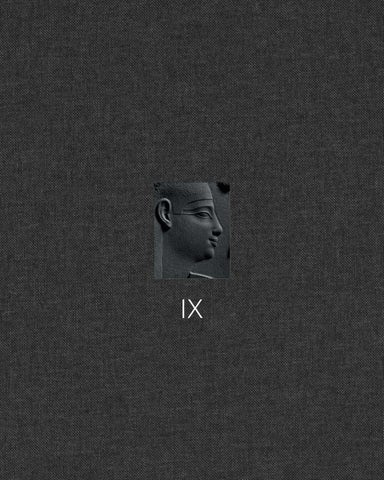
IX
IX
LONDON | 2026 DAVID AARON
IX
IX: The collection
IX
David Aaron 2026 | A Note from the Directors
The past year has been an exceptional one for the gallery, with successful exhibitions at TEFAF Maastricht, TEFAF New York and Frieze Masters London, alongside many important museum collaborations and scientific discoveries. A particular highlight was our involvement in the sale of a remarkably complete dinosaur fossil that was subsequently donated to the Natural History Museum, London. Further research revealed it to be an entirely new genus and species, Enigmacursor “the enigmatic runner” (p.111). We also collaborated for the first time with a living artist, British sculptor Paul Vanstone, to create the Carrara Triceratops Skull, a world-first, life-sized marble sculpture now on public display in Berkeley Square. In April, we facilitated the world-premiere display of ‘Juliasaurus’ at Hollytrees Museum, Colchester. The fossil of the 154-million-year-old Late Jurassic carnivorous dinosaur may represent another previously unknown dinosaur species and is now undergoing further study (p.117). Other notable placements included a Greek Stele of Medeia (p.5) with the Virginia Museum of Fine Arts, a 1488 Timurid tomb element to a major US museum, a Luristan axe to the Louvre Museum and an exceptional near-complete Camptosaurus skeleton with a prominent museum in the Middle East. We thank our clients, colleagues and friends for their continued support and look forward to the year ahead. David, Salomon, Jonathan and Benjamin Aaron
Statue of a Female Offering Bearer (pg. 1)
IX: The collection
Crouching Venus (pg. 27)
IX: The collection
Roman bust of Hermarchus (pg, 33)
IX: The collection
The ‘Brummer’ Horus (pg. 73)
IX: The collection
Sculptor’s Model of a Royal or Divine Head (pg. 21)
IX: The collection
Statuette of the Cat Bastet (pg, 17)
IX: The collection
Statue of Chalchiuhtlicue (pg. 99)
CONTENTS 1
Statue of a Female Offering Bearer Egypt
p. 1
2
Grave Stele Inscribed for Medeia Attic Greek
p. 5
3
Large Cycladic Head Cycladic, Greek
p. 9
4
Stag Appliqué Scythian
p. 11
5
Northern Cardinal Figure Egypt
p. 15
6
Statuette of the Cat Bastet Egypt
p. 17
7
Sculptor’s Model of a Royal or Divine Head Egypt
p. 21
8
Crouching Venus Roman
p. 27
9
Roman bust of Hermarchus Roman
p. 33
10
Wooden Figure of a Man Egypt
p. 41
11
Stele of Thutmose IV Egypt
p. 45
12
Relief of Nectanebo II Egypt
p. 47
13
Neo-Babylonian Cuneiform Barrel-Cylinder for Nebuchadnezzar II Babylon
p. 49
14
Dedicatory Stele of Fayšat South Arabia
p. 51
15
Portrait Head of a Priest Palmyra
p. 59
16
Young Nubian Woman Egypt
p. 65
17
The ‘Hultmark’ Horus Egypt
p. 69
18
The ‘Brummer’ Horus Egypt
p. 73
19
Omar Pacha Cippus of Horus-Shed Egypt
p. 77
20
Shroud Fragment Egypt
p. 79
21
‘Rustafjaell’ Portrait Head of Ptolemy II Egypt
p. 81
22
Upper Part of the Inner Coffin Lid of Horsaiset Egypt
p. 85
23
Relief of a Pharaoh Worshipping Thoth Egypt
p. 89
24
Bottle with Applied Decoration Egypt
p. 93
25
Hebrew Masoretic Text Near East
p. 97
26
Statue of Chalchiuhtlicue Mexico
p. 99
27
The Alsdorf Bodhisattva Gandhara
p. 105
28
Diplodocus skeleton Wyoming, USA
p. 109
29
Enigmacursor skeleton Colorado, USA
p. 113
30
‘Juliasaurus’ skeleton Morrison Formation, USA.
p. 117
1. Statue of a Female Offering Bearer Late 11th-Early 12th Dynasty, Middle Kingdom, Egypt Polychrome on wood H: 53 cm Published Collection Madeleine Rousseau, Hôtel Drouot, Paris, 23 May 1962, Lot 27, pl. 1. Provenance Previously on the French art market, based on wooden base by the maker Kichizô Inagaki (1876-1951), prior to 1951, with old inventory number in ink on the reverse of the statue, reading ‘no. 2602’, and old inventory label on base ‘No. 201 CENDDD’. Private Collection of Madeleine Rousseau (1895-1980), Paris, by at least 1962. Private Collection, France. ALR: S00260439, with IADAA Certificate, this item has been checked against the Interpol database.
1
A large wooden figure of an offering bearer from ancient Egypt. The figure stands with the true left leg extended slightly ahead of the other, in traditional striding pose. She sports a high-waisted dress or skirt, which is tied under the breasts with deep greenish-blue ribbons outlined finely in ochre. She wears a wide ousekh necklace composed of triangular, spherical, and cylindrical beads around her neck. The long tripartite wig, painted a rich dark black, falls to the top of her chest and down her back. The wide nose and mouth, with thick, slightly upturned lips, are carved from the surface of the face, while the large eyes and eyebrows are painted on in black. The eyes are wide and almond-shaped, and outlined with long cosmetic lines which extend towards the large, round ears on either side of the face, which are also outlined in ochre paint. It is very rare for such extensive and vibrant polychrome painting to survive from antiquity. Rectangular sockets in each of the shoulders reveal how the arms would have originally been affixed to the body. Wooden figures were produced throughout ancient Egyptian history, but the majority extant today were made during the Middle Kingdom. During this period, wooden figures were
carved with increasing variety and personalisation. Models such as this may have been found in the burial chambers of tombs, often orientated to the cardinal directions around the coffin, as well as 1) Kichizô Inagaki mark on the back of the stand. 2) Kichizô Inagaki (18761951)
2
1
3
on top of the coffin itself. The striding pose of the figure suggests that it would have originally been one of a number of figures of offering bearers. The names of places would often be written beside these figures, identifying them as the personifications of estates that would supply the owner throughout their afterlife. A pair of large, intricately painted female offering bearers were discovered in a hidden chamber within the tomb of the 12th Dynasty royal chief steward Meketre, during the 1920 excavations led by Herbert Winlock (now in the Metropolitan Museum of Art, New York, 20.3.7, and the Egyptian Museum, Cairo, JE 46725).
3) Collection Madeleine Rousseau, Hôtel Drouot, Paris, 23 May 1962, Lot 27, pl. 1. 3
2. Grave Stele Inscribed for Medeia Circa 375-350 BC, Attic Greek Marble H: 65.5 cm, W: 57.0 cm, D: 10.0 cm Published Joseph Brummer Collection Part III, Parke-Bernet Galleries, New York, 8-9 June 1949, Lot 419. The Ernest Brummer Collection, vol. II, Spink & Son and Galerie Koller, Zurich, 16-19 October 1979, Lot 601. Christoph W. Clairmont, Classical Attic Tombstones, vol. 1 (Kilchberg, 1993), p. 308, no. 1.310. Johannes Bergemann, Demos und Thanatos (Munich, 1997), pp. 173, 236, no. 574. Linda Jones Roccos, ‘Back-Mantle and Peplos. The Special Costume of Greek Maidens in 4th-Century Funerary and Votive Reliefs’, Hesperia, 69:2 (April-June 2000), pp. 237 (note 23), 255, no. 40. Hélène Bectarte, ‘Le costume de l’épouse dans l’art funéraire attique de l’époque classique’, in Chemin faisant. Mythes, cultes et société en Grèce ancienne. Mélanges en l’honneur de Pierre Brulé, ed. Lydie Bodiou et al., (Rennes, 2009), pp. 237, 245, fig. 1. Katia Margariti, The Death of the Maiden in Classical Athens (Oxford, 2017), p. 390, no. E39, pl. 36. Katia Margariti, ‘Lament and Death instead of Marriage. The Iconography of Deceased Maidens on Attic Grave Reliefs of the Classical Period’, Hesperia, 87:1 (January-March 2018), p. 134, no. 25. Ancient Sculpture and Works of Art, Sotheby’s, London, 4 December 2018, Lot 14. The Devoted Classicist: The Private Collection of a New York Antiquarian, Christie’s, New York, 6 October 2022, Lot 17.
Provenance Previously with Theodoros A. Zoumpoulakis (active c. 19121960s), 13 Edward Law, Athens, by at least 1923. Private Collection of Joseph Brummer (1883-1947), New York, inv. no. P801, acquired from the above c. 20 November 1923, transferred into the Brummer Gallery inventory on 31 December 1928 and kept in house vault from May 1934, accompanied by inventory card and photographs. Thence by descent to his brother, Ernest Brummer (1891-1964), Paris and New York, photographed by Schiff on 22 April 1948, accompanied by handwritten inventory list from 1964. Thence by descent his wife, Ella Laszlo Baché Brummer (19001999), New York until 1973, then Durham, North Carolina, from 1964 to 1979. Sold at: The Ernest Brummer Collection, vol. II, Spink & Son and Galerie Koller, Zurich, 16-19 October 1979, Lot 601. With Robin Symes Ltd., London, acquired from the above sale. Private Collection, Belgium, acquired from the above on 31 October 1979. Thence by descent. Sold at: Ancient Sculpture and Works of Art, Sotheby’s, London, 4 December 2018, Lot 14. Private Collection of Bassam Alghanim (b. 1952), New York, acquired from the above and kept in the James F.D. Lanier House, New York City, until 2022. ALR: S00256889, with IADAA Certificate, this item has been checked against the Interpol database.
A finely carved fragment of an Attic marble grave stele carved in high relief, depicting a female figure in profile within an architectural frame. The figure of the young woman faces towards her right, with her right hand raised towards her shoulder. The fingers of the raised hand are curved, as if holding an object. In his 1993 publication Classical Attic Tombstones (p.308), Christoph W. Clairmont suggests that the figure may originally have been holding a painted object that has since worn away. Her wavy hair is parted in the centre and held back in a long braid over her neck and back. She wears a chiton buttoned on the upper arm under a peplos of heavier material, belted around her waist, and a back mantle fastened with large circular brooches at the shoulders. Her clothes identify her as a parthenos, or unmarried young woman.
1) The stele is shown on display at the Brummer Gallery, NY, c.1950s Opposing Page) Brummer Gallery Inventory photo for P801
1 5
2
4
3
The figure is framed by antae supporting a horizontal architrave with staggered antefixes surmounting the tiled roof. The architrave is carved with a single line of inscription recording the name of the woman to whom the stele is dedicated: Medeia. Within ancient Greek society, parthenoi occupied a liminal space between childhood and adulthood. Being unmarried, they were not seen as having fully transitioned into their adult roles as wives and mothers. Their importance is attested by this fine funerary monument, and Roccos theorises that the death of a parthenos represented both a personal loss and a societal one – preventing any possibility of their future children furthering the Athenian cause. Surviving stelae representing parthenoi are comparatively rare, comprising only 4% of Clairmont’s extensive corpus of Attic funerary reliefs.
5
7
2) Joseph Brummer Collection Part III, ParkeBernet Galleries, New York, 8-9 June 1949. 3) The Ernest Brummer Collection, vol. II, Spink & Son and Galerie Koller, Zurich, 16-19 October 1979, 4) Ernest Brummer 1964 inventory of the ‘Greek Room’ in the Brummer Gallery, New York. 5) The Brummer inventory card for item P801, showing the stele prior to any restoration.
3. Large Cycladic Head Circa 2600-2400 BC, Early Bronze Age II, Cycladic, Greece Marble H: 15.2 cm, W: 7.5 cm Published Pat Getz-Preziosi, ‘Cycladic Objects in the Fogg and Farland Collections’, American Journal of Archaeology, 70:2 (April 1966), no. 8, p. 110, pl. 31. Provenance Previously in the Private Collection of Leo (1922-1979) and Evelyn D. Farland (1930-2025), New York, by at least 1966. Thence by descent. ALR: S00266743, with IADAA Certificate, this item has been checked against the Interpol database.
1
A simplified marble head from a Cycladic idol. The head is on an impressively grand scale, making the full estimated length of the figure 70cm tall: according to Pat Getz-Preziosi in her 1966 publication ‘Cycladic Objects in the Fogg and Farland Collections’ (p.110), this is much larger than most idols of this type. The head is typically abstracted, with a slightly rounded chin and broader, flatter top, the smooth surface broken only by the long triangular nose in raised relief. Much of the evidence we have for the Early Cycladic period comes from goods and objects that were found in tombs on the Greek islands of the Cyclades. The tombs contained a range of objects in different materials: tools and weapons of Melian obsidian and bronze; shell, stone, bone, bronze and silver jewellery; and elaborately carved soapstone boxes. However, marble was clearly the preferred material for sculpting. The marble came mainly from the islands of Naxos and Keros, and some from Paros and Ios. Marble objects were made only during the first two phases of Early Cycladic culture, with the folded-arm figures appearing only in the second stage. The meaning and use of such figures remains uncertain, and may have changed across the five centuries in which they were
produced. Some archaeologists have suggested that they were produced solely for funerary use, and may have fulfilled the same role as ushabtis in Egyptian graves (to perform work for the owner in the afterlife), as substitutes for human sacrifice, or as guides for the soul of the deceased. Others have suggested that they had apotropaic qualities. Another theory is that they represent figures from Cycladic mythology, and could even have been images of the ‘Great Mother’ goddess. There is little evidence for this deity in Cycladic culture, however, and androgynous figures, as well as examples with male genitalia have also been excavated. Some figures were found broken and repaired prior to their placement in the tomb – this suggests that they were used before they were interred, perhaps within a domestic shrine. 1) Pat Getz-Preziosi, ‘Cycladic Objects in the Fogg and Farland Collections’, American Journal of Archaeology, 70:2 (April 1966), no. 8, p. 110, pl. 31.
9
4. Stag Appliqué Circa Late 5th Century BC, Scythian Gold L: 5.5 cm, Weight: 49.8 g Published Jerome M. Eisenberg, Art of the Ancient World, Vol. II, December 1966, Royal-Athena Gallery, New York, front cover, no. 132. Provenance With Aaron Gallery, Tehran, by at least 1965. With Jerome M. Eisenberg (1930-2022), Royal Athena Gallery, New York, acquired from the above on 15 February 1965. With Nasli M. Heeramaneck (1902-1971), New York. Private Collection of Jay C. Leff (1925-2000), Uniontown, Pennsylvania. With Jerome M. Eisenberg (1930-2022), Royal Athena Gallery, New York, acquired from the above, database number LJ01. Private Collection of Louis and Hilaire Beck (d. 2018), 2084 Fifth Avenue, New York, acquired from the above on 30 March 1978, inventory number 1855. Thence by descent to their daughter, Kathy Beck, New York. ALR: S00272230, with IADAA Certificate, this item has been checked against the Interpol database.
1
An appliqué in the shape of a stag, fashioned from a single piece of thick, hammered gold. The stag is captured mid-movement, with its legs drawn up beneath its body. The slender curved neck is extended to tilt the head upwards, granting the stag a proud demeanour. Prominent antlers rise from the crown of the head, extending towards the stag’s rump in an intricate arrangement of cascading curlicues. Additional detail has been added to suggest the texture of the stag’s coat, with small incised lines along the tail, brow, ruff, and above the hooves. The facial features are also picked out in relief. The reverse of the stag features three small hoops,
attached with a gold-copper alloy, that would have been used to affix the appliqué to clothing or a shield, allowing it to be worn by its wealthy Scythian owner. Altogether, this is a fine example of the ‘Animal Style’ art of the Eurasian Steppe in the first millennium BC. 1) Jerome M. Eisenberg, Art of the Ancient World, Vol. II, December 1966, Royal-Athena Gallery, New York, front cover, no. 132. 11
2
3
Appliqués such as this were produced in the Caucasus region, from the late second millennium BC onwards. Highly stylised animals with small waists and arched necks and backs were the core motif of this style, and feature on a range of objects, including buckles, axes and pins. Examples have been found in Georgia, Armenia, Azerbaijan, and the Northern Caucasus, dating from the beginning of the Late Bronze and Early Iron ages. Cast bronze belt clasps have been excavated in the Republic of Georgia, and are one of the region’s distinct cultural outputs in the first few centuries AD. The openwork patterns may imitate thin plaques of gold and silver, which were decorated with twisted wire and filigree, and would have been nailed at the corners to wood and leather backings.
2) Map showing the location of the Caucasus Mountain region. 3) Drawing showing finer details of the gold stag. 13
5. Northern Cardinal Figure Circa 1550-1292 BC, 18th Dynasty, New Kingdom, Egypt Wood statuette on unbaked clay base H: 16 cm Published Collection A. Raifé. Antiquités, Monnaies & Médailles, Hôtel Drouot, Paris, 18-25 March 1867, p. x, Lot 316. Provenance Previously in the Private Collection of Adolphe Raifé (18021860), 9 rue de Lille, Paris, by at least 1860, with handwritten collection label on base. Thence by descent to his son-in-law Gustave Gosset (1826-after 1860), 9 rue de Lille, Paris. Private Collection of Julien Bessonneau (1842-1916), Angers. Thence by descent. Private Collection of Jean-Pierre (b. 1936) and Liliane (19402016) Leveilley, Angers, acquired from the above in the 1970s or 1980s. ALR: S00259874, with IADAA Certificate, this item has been checked against the Interpol database.
1
1 2
A wooden figure of a man in striding pose, with true left foot forwards and arms held straight by his sides. The figure is wearing a short loincloth and a long tripartite wig. The rounded face is carved with a broad nose and mouth; the eyes with extended cosmetic lines and the eyebrows are outlined in black paint. The large ears protrude on either side of the face, in front of the wig. The body is modelled softly, with a pronounced curve inwards at the waist, subtly suggested pectorals and a slightly rounded stomach. The figure is mounted on a rectangular base of unbaked clay, which is painted with white hieroglyphs on the upper side and black hieroglyphs on the front, forming a prayer for Outkaou, the owner of the tomb in which this figure was placed. It is unusual for a wooden figure of this time to have been carved out of one block of wood, as is the case for this example – this demonstrates a high level of skill from the craftsman who made it. Wooden figures such as this were interred within tombs and burial shafts throughout ancient Egyptian history. The white hieroglyphic inscription identifies the figure as a personification of the North, as part of a known but uncommon practice of placing statuettes embodying the four cardinal points within the burial chamber. Such figures have been found both on top of the coffin and on the floor surrounding it. Although most popular in the Middle Kingdom (2040-1782 BC), wooden models were still in
use in the New Kingdom – Tutankhamun’s tomb held 35 wooden boats and associated figures. The proportions of the figure, with the emphasised waist and shorter torso, are consistent with the proposed 18th Dynasty dating. The intact unfired clay base rarely survives from antiquity, due to its delicate material, making this a rare example of its kind. 1) Photograph of the wooden figure in Jean-Pierre Leveilley’s collection cabinet 2) Handwritten note on the underside reading ‘Egypte. / Bois. – Statuette d’un homme debout, / vêtu de la schenti. Sur la socle, en argile crue / inscription peinte, contenant un prière pour / le défunt Outkaou (?). / Collect. Raifé. 316.’ 3) Collection A. Raifé. Antiquités, Monnaies & Médailles, Hôtel Drouot, Paris, 1867 3
15
6. Statuette of the Cat Bastet 664-332 BC, Late Period, probably Saite Period (664-526 BC), Egypt Bronze H: 17 cm Published Collection A. Raifé. Antiquités, Monnaies & Médailles, Hôtel Drouot, Paris, 18-25 March 1867, p. ix, either Lot 212 or Lot 213. Provenance Previously in the Private Collection of Adolphe Raifé (18021860), 9 rue de Lille, Paris, by at least 1860, with handwritten collection label. Thence by descent to his son-in-law Gustave Gosset (1826-after 1860), 9 rue de Lille, Paris. Private Collection of Julien Bessonneau (1842-1916), Angers. Thence by descent. Private Collection of Jean-Pierre (b. 1936) and Liliane (19402016) Leveilley, Angers, acquired from the above, in the 1970s or 1980s. ALR: S00260436, with IADAA Certificate, this item has been checked against the Interpol database.
1
An extremely well-modelled bronze figure of a cat from ancient Egypt. The cat sits in the typical pose for these statuettes, facing ahead with the forepaws placed in line with the rear legs. The tail curls around the true right side of the cat’s flanks, resting with the tip just in front of the right forepaw. The cat’s musculature is supple and smoothly curved, with particular naturalistic details such as the line of the shoulder blades on the back, and the V-like diagonals of the rear haunches finely articulated. The facial features are similarly well-defined: angular cheekbones frame the nose and jaw, with the minutiae of the nostrils and philtrum rendered in clear incised lines. The angular eyes are recessed, and were likely originally inlaid with stones or other precious material. The two large ears, damaged at the tips, are pierced with small holes that would have held earrings. The figure is hollow, with an ovoid opening at the base, and a rectangular shaft protruding downwards which would have been used to affix the statuette to another object.
Cats were the sacred animal of the goddess Bastet – originally a lion-headed goddess who eventually became the gentler counterpart of the warrior goddess Sekhmet and more 1) Photo of the bastet in Jean-Pierre Leveilley’s collection cabinet 2) Collection A. Raifé. Antiquités, Monnaies & Médailles, Hôtel Drouot, Paris, 1867. 18-25 March 1867, p. ix, Lot 212 or Lot 213
2
17
3
Cats were originally domesticated by Egyptians in the Middle Kingdom, who used them for their hunting abilities, but by the New Kingdom they had become valued household companions. The earliest three-dimensional representation of a cat dates from the Middle Kingdom, and was used as a cosmetic vessel (Metropolitan Museum of Art, New York, 1990.59.1). Painted tomb scenes depict cats seated beneath their owner’s chairs and on hunting boats, where they assisted their masters by flushing out the birds in the Nile marshes.
associated with the domestic cat. Bastet was a protector of Lower Egypt and defender of the pharaoh and the sun-god Ra; she is often represented battling Ra’s enemy, the snake Apep. She was one of several deities associated with the apotropaic symbol of the right wedjat-eye, or Eye of Ra. Bastet was a goddess of protection against contagious diseases and evil spirits, and a goddess of pregnancy and childbirth. Many bronze cat statuettes were dedicated to Bastet in temples throughout Egypt, centring in the city of Bubastis in the Nile Delta. Bubastis was home to a large population of cats who were cared for by Bastet’s devotees, and buried in the temple precincts when they died. Hollow statuettes, such as this one, may have held mummified cats that were placed in Bastet’s temples as votive offerings.
3) Handwritten label tied to the front paw of the figure stating the name ‘Raifé’ 19
7. Sculptor’s Model of a Royal or Divine Head 360-282 BC, Reign of Nectanebo II or Ptolemy I, 30th Dynasty or Early Ptolemaic Period Granite H: 17.5 cm, W: 14.4 cm, D: 5.5 cm Exhibited Centenaire de Champollion, Musée du Louvre, Paris, 1922. Published Master Sculpture from Four Millennia, Sotheby’s, Paris, 13 November 2025, Lot 3. Provenance Previously in the Private Collection of Emile Miriel (1876-1940), France, by at least 1922, previously with custom-made slanted yellow marble stand from the early 20th Century. Private Collection of Françoise Schlumberger-Primat (19171998), Château de Grandchamp, Calvados, France, acquired in the 1960s or earlier. Thence by descent to her daughter, Margaux Primat (b. 1988), Santa Monica, USA, the relief remained in France from 19982025. Sold at: Master Sculpture from Four Millennia, Sotheby’s, Paris, 13 November 2025, Lot 3. With David Aaron Ltd., London, acquired from above sale. ALR: S00271543, with IADAA Certificate, this item has been checked against the Interpol database.
1
A finely carved head in profile in low relief, facing right. The figure is shown wearing a tripartite wig, identifying them as either a royal or a deity. The facial features are delineated clearly and with considerable care: a straight, gently sloping nose; wide, almostsquared lips, subtly upturned into a smile; and an almond-shaped eye framed by bold cosmetic lines that extend right up to the edge of the wig. By contrast, the figure’s clothing from the neck downwards and the area to the rear of the wig are left largely uncarved, with only their outlines indicated in silhouette. The relief is carved from the granite known as ‘fine granite’, quarried at Aswan at the First Nile Cataract in Egypt. This distinctive lightgrey to pinkish-grey stone was used only rarely during the New Kingdom and the Ptolemaic Period.
Many small sculptures and reliefs from ancient Egypt appear to have been left deliberately incomplete, and several surviving examples seem to demonstrate the successive stages of the carving process. Pieces such as this are thought to be sculptor’s models, created to demonstrate the techniques and methods required to produce finished works. Another theory is that works such as this were created as votive gifts to be dedicated in temples, a suggestion supported by the inscriptions and find sites associated with some examples. However, the almost total lack of painted examples, especially when compared to the colourful 1) Artistic render of the details of the relief. 21
2
3
paintwork of completed limestone sculptures, together with the fragmentary nature of some of these works, suggests that this was not their primary function. It may instead be that the models were dedicated later in their lifespans, perhaps to the creator’s patron deity. The relief was previously in the collection of Emile Miriel (1876-1940), who was born in Brest on 12 November 1876. He served as an Inspecteur des Finances as well as various other positions within the Crédit Foncier Egyptien (including as Chief of Staff to Minister Merlou, Director of Personnel, and Director of Debt). He worked for the CFE for over two decades, and gained great authority as an advisor on how to best protect French interests in Egypt. During his many visits to Egypt for his work, he collected a range of antiquities that he brought back home to France. Miriel was one of the founders of La Societé des Amis de l’Art in 1924, alongside other prominent collectors. He donated works to various museums during his lifetime, including many to the Musée du Louvre in Paris. In 1922, Miriel was one of the key collectors who lent
works to the Louvre’s exhibit to celebrate the centenary of Champollion translating hieroglyphs using the Rosetta stone. Works from his collection were exhibited alongside works lent by Baron Edmond de Rothschild, Joanny Benoitjoa Peytel, Colonel Mutiaux, Marcel Guérin, and Calouste Gulbenkian, as well as works from the Louvre’s own collection that were not on permanent display. The ancient Egyptian artworks, including this relief, were organised in the Colonnade room, arranged around a portrait of Champollion by Georges Bénédite.
2) Note detailing the loan by Mr. Miriel for the Champollion exhibition. 3) Centenaire de Champollion exhibition 1922. Opposing page) Photo taken for the Champollion exhibition. 23
8. Crouching Venus Late 1st Century-Early 2nd Century AD, Roman Marble H: 36 cm Provenance Previously with Galerie Mouseion, Paris, by at least 12 November 1975, accompanied by dated photograph and a dated statement by François Antonovich (1934-2023). Private Collection, France, acquired from the above in 1975. Thence by descent. ALR: S00266745, with IADAA Certificate, this item has been checked against the Interpol database.
1
A partial marble statue of the goddess Venus crouching at her bath. The goddess kneels on her right knee, with her left raised towards her torso, which curves over both legs. Traces of the arms can be seen on the top of the left leg, where they would have rested to cover her nudity. The marble is carved delicately to create a supple softness across the goddess’s figure: the gentle folds of her stomach and rounded breasts with pert nipples establish the physical sensuality appropriate for the goddess of love. The torso has been meticulously polished, lending greater emphasis to the fleshly modelling, while the stone of the legs has been left rough. A single curled lock of hair remains where it falls over the left shoulder, although the head and both arms are now missing.
2
Depictions of the goddess in this pose are typically known as ‘Crouching Aphrodite’ or the ‘Venus of Vienna’, and are modelled after a 2nd-century BC Greek original attributed to Doedalsas of Bithynia.
1) Antonovich description of the Venus, signed and dated 17 November 1975. 2) Antonovich letter dated 21 October 1975. 27
3
post-pubescent adult), and her statues were common throughout Ancient Greece. During the first decades of the 1st century AD, the Roman interest in all things Hellenistic led to the creation of many sculptures of Venus modelled after Greek originals. This trend quickly spread throughout the empire, and today provides us with a fascinating insight into both Roman art history and the vast corpus of now-lost Greek statues of the goddess that must have once existed.
Venus was the Roman goddess of love, beauty, pleasure, and procreation – the Roman variant of the Greek goddess Aphrodite. Venus was central to many religious festivals, and was revered in Roman religion under numerous cult titles. Some believed her to be a daughter of Jupiter, but according to Hesiod’s Theogony, Venus was created, or ‘born’, of the sea foam after the severed genitals of Uranus fell into the water. This latter explanation appears to be the more popular theory due to the countless artworks depicting Venus rising from the sea in a clam. Venus was one of the ‘Dei Consentes’, the Roman Council of twelve major gods in ancient Rome. Her Greek counterpart was one of the twelve original Olympian Deities and one of the most commonly represented deities in art and literature. Her figure was often presented as an ideal nude (she was born already a nubile
3) Signed statement and photograph (opposing page) dated 12 November 1975. 29
9. Roman bust of Hermarchus Circa 2nd Century AD, Roman Marble H: 22.2 cm Exhibited Stone Talk – Elisa Sighicelli, Rossi & Rossi, Hong Kong, 3 October-14 November 2020.
Video ‘A Million Reasons to Love Hong Kong: Michael Lau’, Tatler Asia, 13 July 2021
Published Fulvio Orsini, Theodoor Galle, and Johannes Faber, Illustrium imagines: Ex antiquis marmoribus, nomismatibus et gemmae expressae (Antwerp, 1606), p. 64, no. 111 (misattributed as Pittacus). M P de Nolhac, ‘Les collections antiquités de Fulvio Orsini’, Mélanges d’archéologie et d’histoire, vol. 4 (Paris, 1884), p. 183, no. 15 (misattributed as Pittacus, after Orsini). Robert and Erich Boehringer, Homer: Bildnisse und Nachweise, vol. I (Wrocław, 1939), pl. 18. Marion van der Meulen, Petrus Paulus Rubens Antiquarius: Collector and Copyist of Antique Gems (Alphen aan den Rijn, 1975), p. 179, C13. Rubens: ses maîtres, ses élèves, Musée du Louvre, Paris, 10 February-15 May 1978, pp. 55-56, no. 41. Manfred Kätzlmeier-Frank, Theodor Galles, Zeichnungen zu Fulvio Orsinis Imagines. Der Codex Capponianus 228 (Münster, 1993), p. 212, no. 114. Marion van der Meulen, Rubens: Copies after the Antique (London, 1994), vol. II, pp. 237-238, no. 209, and vol. III, figs. 425-426. Giuseppina Alessandra Cellini, Il Contributo di Fulvio Orsini alla Ricerca Antiquaria (Rome, 2004), pp. 389-390. Ancient Marbles: Classical Sculpture and Works of Art, Sotheby’s, London, 13 June 2016, Lot 48, pp. 92-93. ‘A Million Reasons to Love Hong Kong: Michael Lau’, Tatler Asia, 28 December 2020.
Provenance Previously in the Private Collection of Fulvio Orsini (1529-1600), Palazzo Farnese, Rome, by at least 1598, drawn by Theodoor Galle (1571-1633) in Orsini’s studio in 1596 (Biblioteca Apostolica Vaticana, Vatican City, Cappon.228, fol. 17r), and listed in the 1600 post-mortem inventory of Orsini’s collection, ‘Nota di Teste di Marmo et Bassi Rilievi’, no. 15, p. 49, as ‘Testa di Pitacco col petto di termine’. Galle’s drawing was later copied by Peter Paul Rubens (1577-1640), most likely during his visit to Rome in 1605/6-1608, and annotated ‘PITTACVS / VRSINVM In Marmore’ (Musée du Louvre, Paris, INV 20360.B, Recto). Private Collection of Cardinal Odoardo Farnese (1573-1626), Palazzo Farnese, Rome, bequeathed by the above. Private Collection, Europe, 18th Century, based on previous restoration techniques. Private Collection, England, acquired in the late 1970s/early 1980s. Private Collection of David Cambridge, Cheltenham, UK. With Galerie Chenel, Paris, acquired from the above in 1998. Private Collection, France, acquired from the above in 1999/2000, accompanied by French passport 169964. Sold at: Ancient Marbles: Classical Sculpture and Works of Art, Sotheby’s, London, 13 June 2016, Lot 48, pp. 92-93. Art Market, UK, acquired from the above sale. ALR: S00275551, with IADAA Certificate, this item has been checked against the Interpol database.
Portrait bust of the philosopher Hermarchus, carved from white marble. He is depicted slightly turned to the left, with his brows furrowed in thought over deeply set eyes. His face reflects both age and dignity, with wrinkles across his forehead and cheeks, which lend an air of accumulated wisdom to his strong, aquiline nose and sharp cheek bones. He sports a long moustache and thick, curled beard that ends at the base of the neck. His hair is neatly arranged with a short fringe along the brow, and falls in controlled waves around his large ears. The head sits atop a herm-like bust, with a rectangular recess on either side, each fitted with dowel holes for attachments at the shoulders. Hermarchus, also known as Hermarch, was an Epicurean philosopher who lived from c. 325 BC to c. 250 BC in Mytilene on Lesbos. He was born to a poor man, and trained as a rhetorician
1) Medallion of Pittacus previously used to identify this bust. Fulvio Orsini, Theodoor Galle, and Johannes Faber, Illustrium imagines: Ex antiquis marmoribus, nomismatibus et gemmae expressae (Antwerp, 1606), pl. 111.
1
33
2
3
before becoming a follower of Epicurus and his teachings. When Epicurus died, in around 270 BC, he left his garden to Hermarchus and appointed him as the next head of his school. Hermarchus died at around the age of 75, in the House of Lysias, having built up a reputation as a great philosopher. Although all of his works are now lost, they were described by 3rd-century biographer Diogenes Laërtius as ‘excellent’. Although Orsini initially identified this bust as a likeness of the earlier philosopher, Pittacus (c. 650-570 BC), based on a bronze medallion from his collection, it has since been reidentified as Hermarchus based on its similarity to the bronze bust found at the Villa of the Papyri at Herculaneum with the later philosopher’s name inscribed on its base.
2) Fulvio Orsini, Theodoor Galle, and Johannes Faber, Illustrium imagines: Ex antiquis marmoribus, nomismatibus et gemmae expressae (Antwerp, 1606), p. 64, no. 111. 3) M P de Nolhac, ‘Les collections antiquités de Fulvio Orsini’, Mélanges d’archéologie et d’histoire, vol. 4 (Paris, 1884), p. 183, no. 15. 35
4
7
5
4) Robert and Erich Boehringer, Homer: Bildnisse und Nachweise, vol. I (Wrocław, 1939), pl. 18. 5) Rubens: ses maîtres, ses élèves, Musée du Louvre, Paris, 10 February-15 May 1978, pp. 55-56, no. 41. 6) 1994 Marion van der Meulen, Rubens Copies after the Antique. Pg. 7 . Showing the original drawing by Theodoor Galle (1571-1633), and Ruben’s copy. 7) Peter Paul Rubens, Self Portrait, painted between 1623 and circa 1630 Opposing Page) ‘Pittacus’, copy after Theodoor Galle, from the workshop of and hand-finished by Peter Paul Rubens (1577-1640), Musée du Louvre, Paris, INV 20360.B Recto.
6
37
10. Figure of a Man 2360-2195 BC, 6th Dynasty, Old Kingdom, Asyut, Egypt Wood H: 31.1 cm
1
Provenance With Dikran Khan Kelekian (1867-1951), New York, before 1951, accompanied by old photograph and inventory, no. 6473. In the Private Collection of Richard “Max” Miller (1902-1983), Miami, Florida, acquired from the above on 11 December 1951, accompanied by dated purchase invoice. Thence by descent. ALR: S00269439, with IADAA Certificate, this item has been checked against the Interpol database.
A figure of a striding man carved from a rich, red-coloured wood. The slender figure stands with left foot in front of the right on a black rectangular base, and each of the separately carved arms held straight at his sides. Both hands are closed in fists, with thumbs extended downwards. The torso slopes into a narrow waist, and broadens upwards to the rounded shoulders. The belly button is deeply incised, while both nipples were inlaid and painted originally (only one remains intact). The partially pleated fabric of the kilt knotted below the abdomen is carved with delicate details. Each of the facial features are picked out in carved and painted lines; the broad nose and mouth are carved in relief, while the slightly recessed eyes are painted with white sclera and black outlines and pupils, and framed by long, black-painted eyebrows. The closecropped hair is also painted a deep black. Wooden statues and statuettes have been found in tombs spanning the entire history of ancient Egypt, even despite wood’s tendency to degrade over time. These wooden models represent a
range of figures and animals, singly and in groups, often engaged in a range of activities from ‘daily life’. It is believed that these models were designed to populate the tomb with workers to ensure that the tomb owner would receive material comforts in the afterlife. Despite the skill that went into their production and the intricate details represented, the majority of these statuettes were hidden within the enclosed chambers of underground tombs, only visible to visitors through narrow viewing slits. Later examples have also 1) Label from the album cover of the Kelekian collection, Binder III, pre1951. Opposing page) Image from the Collection Kelekian Photographic Inventory, Binder III, pre-1951. 41
2
been found in temple contexts, both freestanding royal statues and smaller votive figures placed in wooden shrines. The native trees of Egypt – acacia, tamarisk, date palm, plane tree, and sycamore fig – did not provide the best wood for carving. Instead, better-quality timber had to be imported from the surrounding countries at great cost: cedar, cypress, spruce, pine, yew, and birch were imported from Syria and Lebanon, ebony from Sudan and Ethiopia. These imported woods, particularly yew and cedar, were the most expensive and, therefore, the most prestigious to work in. Wood was a good material for representing fiddly details, like limbs held away from the body, extended legs, and small hands holding smaller objects – it was soft enough to carve without huge difficulty, but strong enough to support fragile extensions. Often, as in this case, a figure’s arms were crafted separately and attached to the torso with a simple but strong mortise and tenon joint. Wooden models were produced from as early as the
Pre-Dynastic Period (for example, the gilded figures from Eastern Kom, Tell el-Farkha). The first wooden models of single figures from the Dynastic Period are dated to the end of the 5th Dynasty, and they increasingly appeared in the tombs of elite figures following the reign of Pepi II Neferkare (r. c. 2278-c. 2214 BC). From the 6th Dynasty onwards, wooden statues and statuettes supplanted limestone as the primary material used for tomb models. Many wooden tomb figures survive from the Old Kingdom, representing people engaged in a range of ‘daily life’ activities, such as farming, food preparation, brewing, animal butchering, and entertainment. Wooden model boats were also very popular. 2) Richard Miller purchase invoice from Dikran G. Kelekian Inc., 11 December 1951.
43
11. Stele of Thutmose IV Circa 1417-1407 BC, Reign of Thutmose IV, 18th Dynasty, New Kingdom, Egypt Limestone H: 69 cm, W: 46 cm Provenance Previously in the Private Collection of Ben Weider (1923-2008), Montréal, Canada, presented to him by the United Arab Republic of Bodybuilding Federation for his work in popularising bodybuilding in the Middle East in March 1964, Cairo, and kept in his office in Montréal until it was moved to storage in 2015. ALR: S00261886, with IADAA Certificate, this item has been checked against the Interpol database.
1
A round-topped limestone stele for Pharaoh Thutmose IV. The stele depicts the pharaoh on the right-hand side with both arms extended bearing offerings of plants. The pharaoh sports the uraeus serpent, symbol of sovereignty, on his brow. Receiving the offerings on the left stands the god Atum, wearing the double crown of Upper and Lower Egypt, or pschent. In his right hand he holds an ankh and in the other the was-sceptre. His name is inscribed in hieroglyphs above him. In the centre of the row of incised hieroglyphs are two cartouches recording the name (‘Djehutimes’ or Thutmose) and prenomen (‘Menkheperure’) of the pharaoh. A winged sun disc sits at the top of the composition, with wings outstretched over the scene. Thutmose IV (r. c. 1401-1391 or 1397-1388 BC) was the eighth pharaoh of the 18th Dynasty. His prenomen (royal name) was Menkkheperure, meaning ‘Established in forms is Re’. He is best known for his restoration of the Great Sphinx of Giza and subsequent commission of the Dream Stele. Thutmose IV was the son of previous pharaoh Amenhotep II and Tiaa, but he was not Amenhotep’s chosen successor. It has been theorised that Thutmose usurped his older brother in order to claim the throne, and that the magnificent Dream Stele was designed to consolidate his rule. The large, round-topped granite stele (also known as the Sphinx Stele) was positioned between the front paws of the Great Sphinx of Egypt during the first year of Thutmose’s reign. The stele is 3.6 metres tall and originally formed the back wall of a small open-air chapel. It depicts Thutmose making offerings and libations to the Sphinx. The inscription tells that Thutmose was
granted kingship by the Sphinx itself, as a reward for clearing the sands that had risen around its base. He also added an inscription on the body of the Sphinx, recording that the pharaoh found a stone in the shape of the divine falcon of Horus as a child. During his reign, Thutmose IV established peace between Egypt and their former rival Mitanni, and married a Mitannian princess to secure the alliance – the princess would go on to become his principal consort, queen Mutemwiya. He was also responsible for many grand architectural projects across Egypt, including the completion of the eastern obelisk at the Temple of Karnak. At 32 metres tall, this was the largest obelisk ever erected in Egypt, and it would later be transported to the Circus Maximus in Rome by Emperor Constantius II in 357 AD, and then to the Piazza San Giovanni by Pope Sixtus V in 1588. Thutmose also constructed a unique chapel and peristyle building on the eastern walls of the main Karnak temple building. This was a place where the common people, who were not allowed into the temple itself, could address their prayer to the god Amun. Thutmose IV is also depicted in numerous portraits, although many were later coopted by Ramesses II. After a roughly ten-year reign, Thutmose died and was succeeded by his son, Amenhotep III. 1) Bronze presentation plaque from United Arab Republic of Bodybuilding Federation detailing the award. 45
12. Relief of Nectanebo II 30th Dynasty/Ptolemaic Period, 4th-2nd century BC, Egypt Red Granite H: 60 cm, W: 40 cm Provenance Said to be from the Iseum (Temple of Isis), Behbeit el-Hagar. Previously in the Private Collection of museum-curator, publisher and director of the Presses Universitaires de France between 1934-1976, Mr Paul-Joseph Angoulvent (1899-1976), France, acquired in 1937 (accompanied by old collection inventory card confirming acquisition in 1937, and set in a rosewood base by the maker Kichizô Inakagi (1876-1951)). Thence by descent, France (accompanied by French cultural passport 238509). ALR: S00226309, with IADAA Certificate, this item has been checked against the Interpol database
1
2
statuary, shrines, and temple reliefs. The sculpture is believed to have been a part of a temple representation depicting King Nectanebo II offering food delicacies to the goddess Isis, who is thought to have appeared to the right of the king. King Nectanebo II was the final native Egyptian ruler before the invasion of Artaxerxes III and the Persians. Despite the passage of nearly three millennia, the standard combination of profile and frontal views established for Egyptian figures remains evident in this masterful bas-relief.
This bas-relief is a remarkable example of ancient Egyptian artistry, expertly crafted from hard red granite, likely quarried from Aswan in Upper Egypt. The depicted figure, believed to be King Nectanebo II, is adorned with traditional attire, including a loincloth, ousekh collar, and uraeus headpiece, with part of a hieroglyphic inscription incised above. It is recorded that this relief originated from Behbeit El-Hagar, an archaeological site in Lower Egypt that features an ancient temple dedicated to the goddess Isis. The temple, known as the ‘Iseion’ or ‘Iseum’, is believed to have suffered significant damage due to an earthquake during antiquity and has since remained in ruins. The temple itself is a significant historical landmark, as it was the first large temple dedicated solely to the goddess Isis. Its construction is attributed to the kings of the 30th Dynasty, dating back to 380-343 BC. It was later completed by Ptolemy III, who ruled over Egypt from 246-222 BC. Because of this, two possible datings have been proposed for this relief. Based on the style of the flower bouquet below the figure’s outstretched arms, Christine Farvard-Meeks has suggested a Ptolemaic date, while Biri Fay believes that the bouquet was a later addition to an unfinished relief carved under Nectanebo II (Correspondence with Christine Farvard-Meeks and Biri Fay, 21 February 2024.). The use of red granite in the creation of this bas-relief is noteworthy, as this material was typically reserved for royal
3
47
1) ‘SCULPTURES: Bas relief in red granite, depicting a priest making an offering. From the Iseum at Behbeit el Hagar (Delta). Egyptian, Ptolemaic. Rosewood base by Inagaki. Est [xxx] Office. Purchased 1937.’ 2) Photograph dated September 1981 showing the Angoulvent family with the relief just visible to the right. 3) Label on back of relief reading ‘Provient du Temple de Begbed’
13. Neo-Babylonian Cuneiform Barrel-Cylinder for Nebuchadnezzar II 605-562 BC, Babylon (Al-Hilla) Clay L: 9.6 cm, W: 4.4 cm Published Egyptian, Greek and Roman Antiquities, Sotheby’s, London, 4 July 1932, Lot 143. Fine books and manuscripts from the library of the late Alan G. Thomas, Sotheby’s, London, 21 June 1993, Lot 1.
1
Provenance Private Collection of Sir John Lubbock, 1st Lord Avebury (18341913). Sold at: Egyptian, Greek and Roman Antiquities, Sotheby’s, London, 4 July 1932, Lot 143. With Spink and Co., London, acquired from the above sale. Private Collection of Alan Gradon Thomas (1911-1992), London, acquired from the above. Sold at: Fine books and manuscripts from the library of the late Alan G. Thomas, Sotheby’s, London, 21 June 1993, Lot 1. Private Collection of Jacques Carré (1927-2015), Antwerp, acquired from the above sale. Thence by descent to Olivier Carré. ALR: S00234422, with IADAA Certificate, this item has been checked against the Interpol database.
2
“I, Nebuchadnessar, king of Babylon, the son of Naboplassar, king of Babylon, have rebuilt Emah, the temple of the noble and lofty goddess Ninham on Babylon, I have put around it a strung terrace wall made of bitumen and burnt brick filled in with pure earth; O Ninmah, gracious mother, look with pleasure on it and may favour for me be established on your lips; may my seed wide spread and may my offspring be prosperous and make my progeny successful.”
The text records the rebuilding of the Emah, the great temple of the goddess Ninmah in Babylon. This is one of many documents recording the restoration works performed by king Nebuchadnezzar, which are also recorded in the Bible, Daniel 4:30:31. Clay cylinders such as this one were inscribed in cuneiform script, baked, and then buried into the foundations of buildings when they were built and restored. As in this example, these texts often recorded the restoration of structures in particular temples of the city. Akkadian is the earliest documented Semitic language. It was spoken in ancient Mesopotamia from the third millennium BC until it was gradually replaced by Old Aramaic by the eighth century BC. It was written in cuneiform. Cuneiform is the logo-syllabic script used to write several languages between the early Bronze Age and the beginning of the Common Era. It was originally developed to write the Sumerian language of southern Mesopotamia, and is the earliest known writing system. The archaeological site of Emar (modern Tell Meskene) is
situated in the great bend of the mid-Euphrates. It ranks alongside Ugarit, Mari, and Ebla as one of the most important archaeological sites in Syria due to the number of cuneiform tablets excavated there. These texts, dating from the fourteenth century BC to the fall of Emar in 1187 BC, reveal that Emar was an important Bronze Age trade centre due to its position between Upper Mesopotamia and Anatolia-Syria. Most of the tablets from this site, unlike those from other cities, are private, rather than royal or official documents. These documents include private transactions, judicial records, real estate dealings, marriages, last wills, and formal adoptions. 1) Egyptian, Greek and Roman Antiquities, Sotheby’s, London, 4 July 1932, Lot 143. 2) Jacques Carré Inventory Card, No. 2065.
49
14. Dedicatory Stele of Fayšat Circa Late 1st Century BC, Qataban, South Arabia Calcite-Alabaster H: 42.7 cm, W: 29.5 cm Exhibited Bowes Museum, Barnard Castle, County Durham, May-October 1960. Birmingham City Art Gallery and Museum, 1960-1970. In Celebration: Works of Art from the Collections of Princeton Alumni and Friends of the Art Museum, Princeton University, 22 February-8 June 1997, no. 5.
Provenance Reputedly from Timna. Previously in the Private Collection of Captain John Aylward (1929-1986), Birmingham, acquired in South Arabia in 1958. Sold at: Egyptian, Western Asiatic, Irish Bronze Age, Greek, Etruscan, Roman, Celtic, Anglo-Saxon and Byzantine Antiquities, Islamic Pottery and Metalwork, Sotheby’s, London, 13 July 1970, Lot 16. With Paul Delplace, 30 rue de Namur, Brussels, acquired from the above sale, accompanied by description letter. Private Collection of Carlo Bombieri, Milan, acquired from the above. Thence by descent to his son, Enrico Bombieri (b. 1940), USA. Sold at: Ancient Sculpture and Works of Art, Sotheby’s, London, 29 November 2017, Lot 73. With Daniel Katz Ltd., London, acquired from the above sale. Private Collection of Stuart Roden, London, acquired from the above on 1 February 2018, until 2026. ALR: S00271022, with IADAA Certificate, this item has been checked against the Interpol database.
Published Egyptian, Western Asiatic, Irish Bronze Age, Greek, Etruscan, Roman, Celtic, Anglo-Saxon and Byzantine Antiquities, Islamic Pottery and Metalwork, Sotheby’s, London, 13 July 1970, Lot 16, pp. 12-13. In Celebration: Works of Art from the Collections of Princeton Alumni and Friends of the Art Museum, Princeton University, 22 February-8 June 1997, exhibition catalogue, no. 5, pp. 1-2, 9. Alessandra Avanzini, Corpus of South Arabian Inscriptions I-III: Qatabanic, marginal Qatabanic, Awsanite inscriptions (Pisa, c2004), p. 328, CSAI I, 270. Alessandra Avanzini, ‘An introduction to their history’, in Art and Technique in Yemen: The Bronzes from the Museum of Baynun, La Limonaia, Pisa, 27 May-10 June 2009, p. 49, fig. 33. Ancient Sculpture and Works of Art, Sotheby’s, London, 29 November 2017, Lot 73, pp. 94-95. Digital Archive for the Study of pre-Islamic Arabian Inscriptions, CSAI I 270: (accessed 20/04/2026). Mnamon: Ancient writing systems in the Mediterranean Database.
A calcite-alabaster funerary stele carved in high relief, featuring the bust of a woman surrounded by a projecting border on all sides. The figure emerges from a semi-circle around her midriff, appearing from the torso upwards. Two subtly modelled breasts make clear the gender of the figure. The true left arm is folded over the centre of the chest and holds some ears of grain, which may suggest fertility, while the right hand is raised to the side, with palm facing forwards in a gesture of veneration and adoration. Each of the wrists is adorned with bracelets. A broad neck sits
between the rounded shoulders, with the head carved in even deeper relief and projecting forwards to meet the lower edge of the top border. The facial features are incised in detail, with full cheeks, small yet full lips, and large expressive almond-shaped eyes below slender eyebrows. The pupils would originally have been inlaid with precious materials. The top border is adorned with nine frontally oriented ibex heads set between two false windows of concentric recessed rectangles. The lower border is inscribed with nine letters in Qatabanian, reading from right to left: Fys2t Ndh ..n 51
2
1
(“Fayšat [of the family of] Nadhán”). This identifies the deceased woman honoured and represented by the stele as Fayšat; as it is carved from a single block of creamy yellow calcite-alabaster with a roughly hewn reverse, this suggests it would have originally been positioned against the wall of her tomb. The family name Nadhán is recorded on other stelae found at H. ayd bin’Aqil, the necropolis of the Qatabanian capital of Timna. This stele forms part of a group of funerary monuments, of which around thirty exist today (both fragmentary and intact). Based on epigraphic and palaeographic evidence, these stelae were all carved between 100 BC and 100 AD. Timna served as an important hub of the Incense Route, the camel caravan that transported incense from Arabia and India to ports on the Mediterranean Sea. Roman author and philosopher Pliny the Elder (23/24-79 AD) described Timna as a busy city with around 65 temples. Excavations in 1950 and 1951 by Wendell Phillips and his team unearthed several sites in the city, including the South Gate, private residences, a structure identified as a temple complex, and
the necropolis. The alabaster heads and stelae were found in the vicinity of the necropolis, known as Hayd ibn ‘Aqil. A further head was discovered in 1962 by a British officer stationed in Aden. The finds are all roughly carved on the reverse and often squared off at the top and back, suggesting that they were designed to be placed within niches in a shrine; several of the sculptures were found together within the antechamber of a crypt. 1) Artistic render of the details of the relief 2 and opposing page) Egyptian, Western Asiatic, Irish Bronze Age, Greek, Etruscan, Roman, Celtic, Anglo-Saxon and Byzantine Antiquities, Islamic Pottery and Metalwork, Sotheby’s, London, 13 July 1970, Lot 16, pp. 12-13. 53
2
3
The boundaries of Ancient South Arabia fall within modern Yemen, parts of Oman, and Saudi Arabia. South Arabia was famous in the ancient world as the main producer of incense and perfume. Due to its ritualistic and traditional uses, there was great demand for incense in the ancient cities of Greece, Rome, Byzantium and Persia. Enormous caravans made up of hundreds of camels snaked through the desert carrying this precious commodity, along with other goods brought to the ports of the South from India and East Africa. The gold the caravans returned with made the Southern tribes of the peninsular very wealthy. Classical writers described the region as ‘Arabia Felix’ (Fortunate Arabia), due to its fertile lands. In the first century BC, South Arabia included five kingdoms: Saba, Qataban, Ma’in, Awsan and Hadramawt. Saba (referred to in the Bible as Sheba) was the oldest and most important of these kingdoms. Timna, the capital of the kingdom of Qataban, was a key hub in the Incense Route. The profusion of inscriptions that have been discovered in the area suggests the Qatabanians were a highly literate society.
2) In Celebration: Works of Art from the Collections of Princeton Alumni and Friends of the Art Museum, Princeton University, 22 February-8 June 1997, exhibition catalogue, no. 5, p. 9. 3) P. Delplace description of the stele
55
15. Portrait Head of a Priest Circa Late 2nd Century AD, Palmyra Limestone H: 30.7 cm Published Antiquities and Oriental Art: The Thomas Barlow Walker Collection, Sotheby Parke Bernet, New York, 26-29 September 1972, Lot 302. Antiquities Auction, Harmer, Rooke Numismatists, Ltd., New York, 19 September 1973, Lot 166. Antiquities and Islamic Art, Sotheby’s, New York, 20 June 1990, Lot 112 (published with no provenance given). Olympia Bobou, Amy C. Miranda, Rubina Raja, and Jean-Baptiste Yon, The Ingholt Archive: The Palmyrene Material, Transcribed with Commentary and Bibliography, Vol. 2 (Turnhout, 2022), p. 690. The Devoted Classicist: The Private Collection of a New York Antiquarian, Christie’s, New York, 6 October 2022, Lot 19 (published with only the 1990 sale recorded as provenance).
Provenance Previously in a Private European Collection, from c. 16th-19th century, based on marble socle and earlier restorations. Private Collection of Thomas Barlow Walker (1840-1928), Minneapolis, most likely acquired from the above been 1909 and 1926, and by at least 1928, and kept at 803 Hennepin Avenue, Minneapolis. Collection number #426. Consigned to the Walker Art Gallery, Minneapolis, by the above between 1927 and 1928, until 1972. Recorded in Ingholt Archive, PS 541. The archival record and photograph were most likely created by at least 1944 – a 1944 letter by art historian Karl Lehmann notes that Ingholt was supplied with photographs of the Walker’s Palmyrene sculptures (letter in the Walker Art Center Archives). Sold at: Antiquities and Oriental Art: The Thomas Barlow Walker Collection, Sotheby Parke Bernet, New York, 26-29 September 1972, Lot 302. Accompanied by confirmation that #426 corresponds to Lot 302 from the Registrar’s file for this sale. Art Market, USA, by at least 1990. Sold at: Antiquities and Islamic Art, Sotheby’s, New York, 20 June 1990, Lot 112. Private Collection of Bassam Alghanim (b. 1952), New York, acquired from the above and kept in the James F.D. Lanier House, New York City, until 2022. With David Aaron Ltd., London, acquired from the above on 15 August 2024. ALR: S00255910, S00248710, with IADAA Certificate, this item has been checked against the Interpol database.
A head of a man, carved from pale cream limestone. Clear, deeply incised lines delineate the thin, gently curved lips, straight aquiline nose, and large almond eyes under a knitted brow. He sports the flat-topped cylindrical headdress, or modius, worn by Palmyrene priests. A wreath runs around the base of the modius, flanking a central medallion enclosing a small figural bust, most likely representing one of the priest’s predecessors or ancestors. The additional adornment of the modius suggests that this figure may have held an elevated rank within the priesthood. It has been speculated that the modius would have been made of a kind of
felt (like a tarbush or ‘fez’). It covers the priest’s hair, which would probably have been kept shaved. The laurel wreath is a feature not present in Palmyrene sculpture until c. 130-140 AD, supporting the dating of this head to the late 2nd century AD Palmyrene funerary portraiture is now recognised as the largest corpus of Roman portraiture outside of Rome. Prof. Rubina Raja, head of the Palmyrene Portrait Project, has stressed the importance of status over individual likeness within Palmyrene funerary sculpture. Of the more than 3,000 extant Palmyrene sculptures, around ten percent depict priests. The number of 59
1
depictions suggests the prestige accorded to priests in Palmyrene society; suitable candidates for the position were chosen only from the city’s leading families. The polytheistic religion of ancient Palmyra encompassed the gods of the northwestern Semitic pantheon, as well as others from Mesopotamian and Arab societies. The chief deity was known as Bol, or Bel after 217 BC – the god of fertility, weather, and war known as Baal in northwestern Semitic practices. The pantheon comprised another sixty ancestral gods of the Palmyrene clans, including deities unique to Palmyra and to other regions in the Levantine. Palmyra was established sometime in the third century BC and soon grew to be a city of major importance, due to its location on two of the most important trade routes in the ancient world: the Silk Road to China, and the route between the Far East
1)Antiquities and Oriental Art: The Thomas Barlow Walker Collection, Sotheby Parke Bernet, New York, 26-29 September 1972, Lot 302. 61
2
3
and India and the head of the Persian Gulf. Although it began as a Mesopotamian settlement, Palmyra was run successively by the Arameans, the Arabs, and the Romans between the first centuries BC and AD. In the second century AD, the Persians conquered the city, but the original site was destroyed in 273 AD by the Roman emperor Aurelian. The Romans and the Byzantines held the city for the next 400 years, rebuilding it and establishing it as a Christian city. The architectural and artistic style of the Palmyrenes reflects the shifting cultural landscape of the city, combining Greco-Roman, Persian, and Arabian influences. Situated as it was between the two great empires of Rome and Parthia, its languages, society and religion, art and architecture speak of a rich and varied heritage, a unique synthesis of East and West that continues to fascinate and inspire scholarly research.
2) Antiquities Auction, Harmer, Rooke Numismatists, Ltd., New York, 19 September 1973, Lot 166. 3) Antiquities and Islamic Art, Sotheby’s, New York, 20 June 1990, Lot 112. Opposing page) Ingholt Archive, PS 541. 63
16. Young Nubian Woman 18th Dynasty, New Kingdom, Egypt Wood H: 19 cm, W: 4.5 cm Exhibited The Collector’s Eye: Masterpieces of Egyptian Art from the Thalassic Collection, Ltd., Michael C. Carlos Museum, Emory University, Atlanta, US, 11 April 2001 – 6 January 2002, no. 50.
Provenance Private Collection of Joseph von Kopf (1827-1903), Rome. Thence by descent to his wife, Mrs. von Kopf, Rome, 1903. With Joseph Altounian (1889-1954), Paris and Mâcon, by at least 1954, accompanied by a stamped photograph. With Daphné Zimmerman-Koutoulakis, Geneva, by at least 1982. Private Collection of Theodore Halkedis (1932-2001) and Aristea S. Halkedis (1933-2014), ‘The Thalassic Collection’, New York, 1990s-2014. Private Collection of Sheikh Saud bin Mohammed Al Thani (1966-2014), London, acquired from the above via Christie’s New York Private Treaty (along with the whole Thalassic collection) on/around 25 June 2002. Thence by descent, London. ALR: S00254288, with IADAA Certificate, this item has been checked against the Interpol database.
Published Dr. Ludwig Pollak, Joseph v. Kopf als Sammler (Rome, 1905), no. 266, pl. XI. Jacques Chamay, Jirí Frel, Jean-Louis Maier, Le Mondes de Cesars (Musée d’art et d’histoire de Genève, 1982), end page. Peter Lacovara, Betsy Teasley Trope, Sue H. D’Auria (eds.), The Collector’s Eye: Masterpieces of Egyptian Art from the Thalassic Collection, Ltd., exhibition catalogue, Michael C. Carlos Museum, Emory University, Atlanta, 2001, no. 50, p. 91.
A hand-carved wooden female figure in striding pose, with her true left leg extended ahead. She is depicted in the nude, and delicately modelled, with a slender waist and small breasts. Her head is clean shaven, except for a circular tuft of hair on her crown – a hairstyle associated with Nubians, but also popular among young Egyptian women in the 18th Dynasty. Her arms hang by her sides, with one hand in a fist, pierced horizontally, suggesting it may originally have held an object. As there are no other attachments for other parts, it suggests that this was originally a free-standing sculpture, rather than incorporated into a cosmetic item, as was popular for figures of female youths at the time. It is unusual for a wooden figure of this period to have been carved out of one block of wood, as is the case for this example – this demonstrates a high level of skill from the craftsman who made it.
1) Stamp on the reverse of the collection photograph Opposing page) Photograph from the Collection Joseph Altounian, AltounianLourbet Study Photographs archive.
1
65
2
3
This type of small wooden statuette was common in the second part of the 18th Dynasty, particularly during the reign of Amenhotep III. The image of a nude, adolescent girl is imbued with notions of sexuality, fertility, birth, and rebirth into the next world. This figure may well have served a similar purpose to the tomb statuette of Amenemheb now in the Metropolitan Museum of Art, New York (26.7.1413a, b). This nude figure of a young boy holds a lotus in his fist, and was found in his mother’s coffin, dedicated by his father alongside a figure of his brother, Huwebenef, who is depicted in the same striding pose as the female figure, with a pierced hand for an attachment.
2) Pages from Dr. Ludwig Pollak, Joseph v. Kopf als Sammler (Rome, 1905), no. 266, pl. XI. 3) Pages from Jacques Chamay, Jirí Frel, JeanLouis Maier, Les Mondes de Cesars (Musée d’art et d’histoire de Genève, 1982), end page 67
17. The ‘Hultmark’ Horus 663-525 BC, Saitie Period, Egypt Bronze H: 22.7 cm Exhibited Emil Hultmarks Samling, Kungliga Akademien för de fria konsterna, Stockholm, 1942, no. 596. Published Maj Sterner, ‘Fil. dr. och fru Emil Hultmarks hem. Birger Jarlsgatan 32, Stockholm’, Svenska Hem I Ord Och Bilder, ed. Stig M H-son Björkman (1936), p. 176. Emil Hultmarks Samling, Kungliga Akademien för de fria konsterna, Stockholm, 1942, no. 596, p. 73, pl. 34.
1
Provenance Private Collection of Dr. Emil Hultmark (1872-1943), Birger Jarlsgatan 32, Stockholm, from at least 1936. Thence by descent (accompanied by Swedish export licence). ALR: S00253479, with IADAA Certificate, this item has been checked against the Interpol database.
A supremely fine figure of the Egyptian god Horus in the form of a falcon. It is exquisitely crafted from bronze, with an unusually high level of detail. The gently rounded head smoothly merges into the feathers of the back, extending into a V-shaped tail, giving the piece an elegantly balanced silhouette. The facial features are highly lifelike, with rounded eyes framed by a thin raised eyelid and an almond-shaped socket. The extension of the eye lid at the outer corners of each eye recalls the apotropaic wedjat-eye, or Eye of Horus. The beak is similarly detailed, even featuring the pointed overhang of the falcon’s upper mandible. The naturalistic treatment of the bird continues in the soft curves of its breast, demonstrating the expert abilities of the artisan who produced it. The falcon’s feathers are individually incised, centring around the crown of the head and flowing outwards down the back. The back
feathers are each represented by overlapping c-shaped curves, with individual barbs picked out as small angled lines running down a triangular central shaft. The falcon’s wings are folded across its back, with the longer flight feathers differentiated into their primary and secondary layers of remiges. The tips of the wings 1) Photograph featuring the Horus from Maj Sterner, ‘Fil. dr. och fru Emil Hultmarks hem. Birger Jarlsgatan 32, Stockholm’, Svenska Hem I Ord Och Bilder, ed. Stig M H-son Björkman (1936), p. 176. 69
2
cross over the tail symmetrically, with sharply defined edges adding further dimension. The tail feathers are similarly incised, again as the retrices are found in life, in a single horizontal row. Below the crural feathers, which end in slightly rounded points behind the two legs, the ridged texture of the legs and feet is represented through deeply incised lines. The three front toes and shorter back toe are each surmounted by a sharp, viciously curved claw. It stands on a flat square base. The remains of three projecting rods on the base of the Horus (two beneath the base and one in the centre of the tail) suggest it may have originally been affixed to something. The bronze is hollow, with an accessible opening beneath the back and tail.
2) Emil Hultmarks Samling, Kungliga Akademien för de fria konsterna, Stockholm, 1942, no. 596, p. 73, pl. 34.
71
18. The ‘Brummer’ Horus Circa 378-341 BC, 30th Dynasty, Egypt Limestone H: 50 cm, L: 44.5 cm Published The Cranbrook Collections, Sotheby, Parke-Bernet, New York, 2-5 May 1972, Lot 360, p. 151. Provenance Previously with Maurice Nahman (1868-1948), Cairo, by at least 1929. With the Brummer Gallery, New York, acquired from the above on 9 July 1929, accompanied by inventory card P6163 and inventory binders. Private Collection of William Randolph Hearst (1863-1951), California, acquired from the above on 9 December 1930. With Parish-Watson & Co., New York, acquired from the above, by at least 1939. With the Brummer Gallery, New York, acquired from the above on 2 June 1939, accompanied by inventory card N4456 and inventory binders. Cranbrook Academy of Art, Michigan, accession number 1939.87, acquired from the above on 10 November 1939, accompanied by inventory sheets and October 1939 correspondence between George Blooth and Joseph Brummer. Accession number matches the one painted in red on the tail of the statue, ‘39.87’. Sold at: The Cranbrook Collections, Sotheby, Parke-Bernet, New York, 2-5 May 1972, Lot 360. Private Collection of Peter Wilson C.B.E. (1913-1984), Château de Clavary, Auribeau-sur-Siagne, France, by at least January 1983, accompanied by dated inventory. Thence by descent. ALR: S00261880, with IADAA Certificate, this item has been checked against the Interpol database.
1
2
A large, finely carved limestone statue of the falcon of Horus. The bird stands tall on an integrated rectangular base, its long, slender talons articulated with delicate precision. The legs rise smoothly into the proudly rounded breast, with the wings folded flush on either side. The divided tail feathers cross over in the typical V-shape at the back of the statue. The wide, alert eyes are outlined with a deep incision that highlights their oval form. The beak is similarly rounded, and incised with additional detail. Atop the falcon’s head sits the remaining base of a uraeus-serpent and crown of Upper and Lower Egypt (now missing), denoting its kingly status. Traces of the original red paint can be seen, for instance on the wings. This is a smaller, though still notably large, version of the famous Horus falcon flanking the entrance to the temple of Horus at Edfu. Very few examples of limestone statues of falcons have survived from antiquity, due to the relatively soft nature of the stone. One example, also acquired from Maurice Nahman like this one, is now in the Musée du Louvre, Paris (E 11152), and another is in the North Carolina Museum of Art, Raleigh, N.C. (GL.57.14.86).
1) The Cranbrook Collections, Sotheby, ParkeBernet, New York, 2-5 May 1972, Lot 360, p. 151. 2) Brummer Gallery inventory card P6163, recording 9 July 1929 purchase from Maurice Nahman and 9 December 1930 sale to William Randolph Hearst. 73
3
5
4
3) William Randolph Hearst Collection Album Pages. 4) Cranbrook Academy of Art Inventory Sheets and Photograph, noting 1972 Parke-Bernet Sale, and 1945 photograph of the Horus on display at the Cranbrook Museum, Michigan. 5) Brummer Gallery inventory card N4456, recording 2 June 1939 purchase from ParishWatson & Co. and 10 November 1939 sale to the Cranbrook Foundation. Opposing page) N4456 recorded in Brummer Gallery Sold Inventory binder.
75
19. Omar Pacha Cippus of Horus-Shed Circa 332-330 BC, Ptolemaic Period, Egypt Steatite H: 12.5 cm Exhibited TEFAF Maastricht, Netherlands, 12-21 March 2010. On loan to the Staatliches Museum Ägyptischer Kunst, Munich, November 2013-March 2021. Published Collection de Feu Omar Pacha Sultan Le Caire (Paris, 1929), no. 274, pl. XLIV. Maarten van Laarhoven, ‘Handelaar die left bij gratie van de pracht’, Limburger, 15 March 2010.
1
Provenance Private Collection of Omar Pacha Sultan, Cairo, by at least 1929. With Galerie du Sycomore, Paris, by at least 1979. French private collection, Paris, acquired from the above in 1979. With Sycomore Ancient Art, Geneva, 2010, accompanied by a sales invoice dated 15 March 2010. Private Collection of Sheikh Saoud Al Thani, Doha, Qatar, from at least 2013. Private Collection of Ms. Natsagsuren Mangalam, Mongolian noble family Tengernuden ALR: S00248666, with IADAA Certificate, this item has been checked against the Interpol database.
A black steatite magical stele depicting the nude child-god HorusShed (‘Horus the Saviour’) standing with his feet balanced on two crocodiles. In each hand he holds two long serpents and one scorpion by their tails. He also holds a long-horned oryx in his true right hand and a lion in his left, hanging down on either side of his legs. He sports the sidelock of youth, draped over his right shoulder. Above Horus-Shed’s head, the head of the dwarf god Bes is carved in high relief. A series of other deities in human and animal form are incised in the horizontal and vertical registers framing the central gods. Horus-Shed is flanked by standards in the form of lotus and papyrus columns (the symbols of North and South Egypt). Both sides of the stele are inscribed, with twelve registers of text filling the sheer side of the reverse. These inscriptions evoke the cure by Re of the infant Horus from snake and scorpion bites, after he had been hidden in the papyrus swamps by his mother Isis. A lunette featuring a multi-headed solar deity kneeling within a sun disc enclosed by large ka-arms is carved in the centre of the verso side, above the inscriptions. A line of four baboons, with their arms raised in sun worship, stand on either side of the lunette. The sides and bottom of the base of the cippus are also inscribed with other apotropaic lines. This is one of about 400 known magical stelae featuring Horus-Shed. They are generally inscribed with healing spells referencing the above story, which may have been intended to cure the wielder from a snake bite or scorpion sting. Other
spells found on cippi usually allude to broader themes of healing, rejuvenation, and renewal. It is thought that these spells could be activated by pouring water over the cippus to transform it into a curative remedy to be imbibed or applied to the skin. It has also been theorised that rubbing or kissing the stone could activate the spells, as suggested by particular patterns of ancient wear, as seen on the face of Horus-Shed in this example. 1) Collection de Feu Omar Pacha Sultan Le Caire (Paris, 1929), no. 274, pl. XLIV. 2) The reverse of the Cippus is covered in magical text.
2
77
20. Shroud Fragment Circa 1st-2nd Century AD, Roman Period, Egypt Polychrome painting on linen fabric, mounted. L: 62.7 cm, W: 44.5 cm Provenance Previously in the Private Collection of Karl Heinrich Ulrich Anton Coray, ‘Han’ (1880-1974) and Theodora Stoop, ‘Dorrie’ (18951928), Erlenbach, Zurich, circa 1920-1928, then kept at Casa Coray, Agnuzzo, Ticino from 1930 onwards, accompanied by old photographs taken between 1930 and 1974. Thence by descent, Switzerland. ALR: S00272975, with IADAA Certificate, this item has been checked against the Interpol database. 1
A large piece from a woven linen funerary shroud decorated with a polychrome painting of a female figure, most likely depicting Nut or Hathor. The figure is depicted head-on, with large, darkly outlined eyes looking directly forwards. While the eyes and eyebrows are painted in black, the rest of the facial features are outlined with a rich reddish-brown pigment, close in tone to the red of the skin. The face is framed by thick, tightly coiled hair, parted on both sides and falling in front of the shoulders in six distinct locs on either side. A white headband with a pattern of blue circles is tied around the crown of the head. The large ears, both of which stand in front of the hair, are each adorned with a gold and blue hoop earring. The woman sports a high-necked white dress with sleeves down to the elbow. The dress is patterned with red and blue bands of geometric designs and tied around the waist with a belt. Several necklaces of red, black, and blue beads are hung around the neck. Visible to the true right of the figure are three rows of kneeling adorants: a woman in a white dress, figure with a bovine head, and a large serpent. The background is patterned with red dots and between the arms and the body of the figure are drawn several black stars, possibly suggesting a cloak or blanket behind her. Shrouds of this kind were designed to protect the mummified body of their owner, while also conveying semi-divine status in their transition to the afterlife. Egyptian shrouds from this period typically represent life-size images of either the god Osiris, ruler of the underworld, for male owners, or the sky goddesses Nut and Hathor for female owners (both of whom also play significant roles in funerary art and practices). Shrouds were laid directly on
top of the mummified owner, completely enclosing their body. The painted imagery gave the body a new visage with which they could interface with the afterlife and with those performing their funerary rites. Linen was produced from the abundant flax plants in the Nile Valley, and so was a highly accessible material; however, it is highly frangible over time, meaning it is rare to find such an intact fragment as this today. 1) Photograph of the shroud at Casa Coray, Agnuzzo, Ticino. Taken between 1930 and 1974. 2) Photograph of the shroud at Casa Coray, Agnuzzo, Ticino. Taken between 1930 and 1974.
2
79
21. ‘Rustafjaell’ Portrait Head of Ptolemy II Reign of Ptolemy II, 284-246 BC, Egypt Limestone H: 19.7 cm Exhibited The Epstein Collection of Primitive and Exotic Sculpture, Arts Council, London, 1960, no. 297.
Provenance Previously in the Private Collection of Robert de Rustafjaell (1876-1943), Luxor, by at least 1913. Private Collection of Sir Jacob Epstein (1880-1959), recorded in Jacob Epstein’s Personal Collection Ledger, and in the Valuation for Probate document after his death. According to the 1989 publication, this item is also mentioned in postmortem shipping lists. Private Collection of Carlo Monzino (1931-1996), Switzerland, acquired 1963. Private Collection, Midwestern U.S.A., by at least 2008. Sold at: Antiquities, Christie’s, New York, 4 June 2008, Lot 51. Private Collection, Europe, acquired from the above. Thence by descent. ALR: S00261715, with IADAA Certificate, this item has been checked against the Interpol database.
Published Catalogue of the Remaining Part of the Valuable Collection of Egyptian Antiquities formed by Robert de Rustafjaell, Esq., Sotheby, Wilkinson & Hodge, London, 20-24 January 1913, Lot 242. Antiquities, Silver and Works of Art, Sotheby, Wilkinson & Hodge, London, 27-28 November 1916, Lot 92. The [Jacob] Epstein Collection of Primitive and Exotic Sculpture, Arts Council, London, 1960, exhibition catalogue, no. 297. Catalogue of Antiquities, Sotheby’s, London, 10 July 1979, Lot 100, p. 42. Ezio Bassani & Malcolm D. McLeod, Jacob Epstein Collector (Milan, 1989), p. 188, no. 848. Antiquities, Christie’s, New York, 4 June 2008, Lot 51, pp. 56-57.
An ancient Egyptian limestone head from a statue of King Ptolemy II (r. 284-246 BC). The oval face is smoothly carved with idealised youthful features. Full, gently upturned lips sit above a pointed chin. The narrow almond-shaped eyes, with slightly downturned tear ducts, are incised in sharp lines, contrasting with the softly modelled eyebrows above. The brows themselves are straight and curve downwards at the outer ends. The attached ears project on either side of the face, sitting just below the unstriated nemesheaddress. The headdress is adorned with a single band around the forehead, and the remains of a uraeus with symmetrical coils. Traces of grid lines are visible on the left rear of the headdress, suggesting that this may have been a sculptor’s model, although it is unusual for these pieces to be finished in the round. The facial features closely resemble several known portraits of Ptolemy II. Ptolemy II Philadelphus was the second pharaoh of Ptolemaic Egypt, succeeding from his father, Ptolemy I, in 284 BC. Ptolemy II followed his father’s principle of aligning his public image with that of the native Egyptian pharaohs, and supporting the local priestly elite. His actions are recorded in two commemorative steles: the Mendes stele records rituals Ptolemy performed in honour of the ram god Banebdjedet at Mendes; and the Pithom stele that records that Ptolemy inaugurated a temple at Pithom for his royal jubilee in 279 BC. Ptolemy II also financed
1) Catalogue of the Remaining Part of the Valuable Collection of Egyptian Antiquities formed by Robert de Rustafjaell, Esq., Sotheby, Wilkinson & Hodge, London, 20-24 January 1913, Lot 242.
1
81
2
4
3
large-scale construction works at temples throughout Egypt, including the core of the Temple of Isis at Philae, which made it one of the most important religious sites in the country. He was a keen patron of scholarship, and funded the expansion of the Library of Alexandria and provided stipends to famed poets, such as Callimachus, Theocritus, Apollonius of Rhodes, and Posidippus, and the mathematician Euclid and astronomer Aristarchus. He is also thought to have commissioned the Aegyptiaca from Manetho – an account of Egyptian history that may have been designed to help the new rulers understand the country better.
2) Antiquities, Silver and Works of Art, Sotheby, Wilkinson & Hodge, London, 27-28 November 1916, Lot 92 3) The [Jacob] Epstein Collection of Primitive and Exotic Sculpture, Arts Council, London, 1960, exhibition catalogue, no. 297. 4) Catalogue of Antiquities, Sotheby’s, London , 10 July 1979, Lot 100, p. 42. 5) Head recorded in Jacob Epstein’s Personal Collection Ledger 5
83
22. Upper Part of the Inner Coffin Lid of Horsaiset 712-525 BC, 25th-26th Dynasty, Late Period, Egypt, probably Western Thebes Polychrome, Stucco, Linen, Wood H: 47 cm, W: 45 cm Published Archéologie, Pierre Bergé, 30 May 2015, Lot 39, pp. 39-41. Provenance Previously in the Private Collection of Admiral Joseph Maurice Exelmans (1816-1875), 2nd Comte Exelmans, Château du Broutay, France, acquired in Egypt around 1850. Thence by descent to his son, Brigade General Charles Marie Jacques Octave Exelmans (1854-1936), 3rd Comte Exelmans, and his wife, Comtesse Thérèse Simone Balsan (1866-1960), Château du Broutay, France, accompanied by 1915 inventory. Thence by descent. Sold at: Archéologie, Pierre Bergé, 30 May 2015, Lot 39 Art Market, USA, by at least 2016. Private Collection, USA. ALR: S00275235, with IADAA Certificate, this item has been checked against the Interpol database. 1
The upper part of the lid for a wooden inner coffin, carved into the form of a male head and upper chest. The head sports a large tripartite wig painted with gold and blue stripes that follow the line of the wig as it parts on either side of the face and ends just above the end of the false beard. The false beard itself is painted turquoise and incised with diagonal lines to represent the braid. The top portion of a patterned ousekh collar, in the same shade of turquoise, can be seen on the chest behind the beard. The skin of the head and neck is painted a deep red. The facial features are modelled three-dimensionally, with a wide, slightly upturned mouth, broad nose, and narrow, slightly recessed eyes. The eyes and eyebrows are outlined in thick black lines; the heavy cosmetic lines extend a fair length from the outer corners of the eyes. The round ears sit in front of the wig on each side. On the sides of the wig, the turquoise stripes alternate with red. The crown of the head
is painted with the image of the goddess Nepthys, kneeling with her wings outstretched, against a solid gold background. This is divided from the rest of the wig with a black border. The reverse is densely painted with eight registers of hieroglyphic inscription; the inscriptions continue over the vertical sides, and vertically below the horizontal registers (both of which are cut off at the bottom). The text includes a number of traditional offering formulas to various deities, wishes concerning the owner’s afterlife, and the formula of goddess Nut. The owner is identified as Horsaiset, son of Irtyrou, Prophet of Thoth, master of strength, Prophet of Khnum, lord of the great battle, and Prophet of Sobek, lord of the 1) Artistic render of the internal details of the coffin. 85
2
3
land of the trees. Painted in the centre of the reverse, below the text, is the face of the goddess Nut, facing to the right with arms raised. The earliest symbolic role of the ancient Egyptian coffin was as a ‘house’ or eternal dwelling for the deceased. Outer coffins tended to be rectangular, imitating the shape of a tomb or shrine, while inner coffins were mostly anthropoid in form from the Middle Kingdom onwards. From the New Kingdom, coffins showed an increased resemblance to the living, in both form and dress, demonstrating the link between coffins as separate to, but one aspect of, the self. Wood was used as a material for coffins since very early in ancient Egyptian history. Cedar was the most prestigious wood, as it provided long, straight planks. However, it had to be imported into Egypt from Lebanon, making it highly expensive and, therefore, a sign of high status. Coffins made from local woods, generally sycamore fig, had to collate smaller, irregularly shaped pieces using wooden cramps and dowels, which had to be secured at the corners with leather thongs.
2) 30 October 1915 Château du Broutay Inventory, listing the coffin lid as ‘Téte sarcophage momie. Egypte, de Sues’ as property from ‘Vice Amiral Maurice Exelmans’. 3) Château du Broutay, Tendu, Indres 87
23. Relief of a Pharaoh Worshipping Thoth 380-30 BC, 30th Dynasty, Late Period-Ptolemaic Period, Egypt Limestone H: 24.2 cm, L: 77.5 cm Published Robert Wright, ‘Galleries: Painter of the Norditerranean’, The Tatler & Bystander, 7 March 1962, p. 553. Provenance Previously with KJ Hewett, London, by at least 1962. Private Collection of Elsa Vaudrey Barker-Mill (1905-1990), Montpelier Square, London, gifted by the above by 1962, accompanied by 1988 Memorandum of Wishes and Probate Inventory dated 10 July 1990. Private Collection, UK, acquired from the above by bequest, 1990. Thence by descent. ALR: S00274274, with IADAA Certificate, this item has been checked against the Interpol database.
1
A rectangular block of limestone carved with a detailed scene in sunken relief. The ibis-headed deity Thoth is depicted facing to the left, wearing the atef crown and headdress with corkscrew horns. The god holds the was-sceptre, representing power and dominion, in front of himself. Two hands with slightly upturned fingertips are visible on the left of the relief, facing the god. These represent a pharaoh offering the emblem of the goddess Ma’at to Thoth. Above the hands are the lower portions of two cartouches, which would have held hieroglyphic inscriptions identifying the pharaoh. Parts of the original polychrome paint survive, particularly in the red colour of the king’s hands and the blue-green paint on the hieroglyphic figure of Ma’at. The detailed carving on Thoth’s wig and headdress, as well as the expressive rendering of the hands, and the incorporation of the horns into the atef-crown, suggest a date in the 30th Dynasty or early Ptolemaic period. Scenes depicting the pharaoh offering Ma’at to various
gods and goddesses are represented in many Egyptian temples, gaining particular prominence by the Ptolemaic period. Ma’at was both herself a goddess and the personification of truth, balance, law, and justice. Presenting Ma’at to other deities illustrated the reciprocal relationship between the pharaoh and the gods. Thoth, God of wisdom and writing, was also the masculine counterpart of Ma’at, and often called ‘Lord of Ma’at’. 1) Excerpt Robert Wright, ‘Galleries: Painter of the Norditerranean’, The Tatler & Bystander, 7 March 1962, p. 553.
89
1
NOT HIGH RES!
24. Bottle with Applied Decoration Circa 13th-14th Century, Mamluk Glass, enamelled and gilt H: 28 cm Exhibited International Exhibition of Persian Art, Royal Academy of Arts, London, 7 January-28 February 1931, no. 291 P.
Provenance Previously in the Private Collection of Aziz Ezra, by at least 1930. With Dikran Khan Kelekian (1867-1951), New York, acquired from the above, 8 July 1930, inv. no. 4240. Thence by descent to Charles Dikran Kelekian (1899-1982), New York, inv. no. 508, with old collection label. Private Collection of Dr. Vallo Benjamin (1934-2021), East 57th Street, New York. Sold at: Annual New Year’s Day Auction, Nadeau’s, Windsor, Connecticut, 1 January 2023, Lot 518. Private Collection, New York, acquired from the above sale. ALR: S00263408, with IADAA Certificate, this item has been checked against the Interpol database.
Published Catalogue of the International Exhibition of Persian Art, Royal Academy of Arts, London, exhibition catalogue, 7 January-28 February 1931, p. 167, no. 291 P. Arthur Upham Pope, ‘More about Persian Glass’, Apollo, 13, January-June 1931, p. 12, fig. V. Carl Johan Lamm, ‘Glass and Hard Stone Vessels’, in Arthur Upham Pope (ed.), A Survey of Persian Art from Prehistoric Times to the Present (London and New York, 1939), vol. III, pp. 2599-2600, vol. VI, pl. 1445D. Fine Oriental Miniatures, Manuscripts and Islamic Works of Art, Sotheby Parke Bernet, 30 June 1980, Lot 331. Antiquities and Islamic Art, Sotheby’s, New York, 24-25 November 1987, Lot 4A. Annual New Year’s Day Auction, Nadeau’s, Windsor, Connecticut, 1 January 2023, Lot 518.
A tall bottle of clear glass, with blue and brown enamelled and gilded elements. The bottle sits on a circular foot, from which extends the globular body. The enamelling begins at the widest point of the vessel, in repeated bands running around its circumference. A vegetal border marks the edge of the elaborately decorated ground, featuring medallions picked out in blue enamel and gold gilt plant motifs. The body attaches to a long, thin neck, adorned with applied threads of glass: four spaced evenly around the body, shaped in long waves reaching up the neck; and another running around the midpoint of the neck. The neck features enamelled striped and floral designs, and terminates with a flared lip. Enamelling on glass was first developed in the Syrian region, probably at Raqqa; recent research has moved the earliest date of its production to the last two decades of the 12th century or the early 13th century. After the Mamluks made Cairo the official capital of their empire, glassmakers at Fustat soon became active. The mid-13th century has been referred to as the ‘golden age’ of gilding and enamelling on Islamic glass and, by the 14th century, most enamelled glass was probably produced in Egypt. Enamelling required a sophisticated control over the temperature of the wood-fuelled kilns of the medieval period, which had to remain consistent for prolonged periods in order to fix the different colours to the glass surface. Throughout the following centuries of Mamluk rule, glass production expanded into a wide range of different forms adapted from metalwork, pottery, leather, and ivory, and dimensions were increased dramatically. Small, portable
enamelled and gilded glassware, such as this flask, was produced mainly towards the earlier period of the Mamluk Sultanate (12501517). 1) Catalogue of the International Exhibition of Persian Art, Royal Academy of Arts, London, exhibition catalogue, 7 January-28 February 1931, p. 167, no. 291 P. 2) Arthur Upham Pope, ‘More about Persian Glass’, Apollo, 13, January-June 1931, p. 12, fig. V. 1
2
93
3
6
4
7
3) Arthur Upham Pope (ed.), A Survey of Persian Art from Prehistoric Times to the Present (London and New York, 1939), vol. VI, pl. 1445D. 4) Fine Oriental Miniatures, Manuscripts and Islamic Works of Art, Sotheby Parke Bernet, 30 June 1980, Lot 331 5) Antiquities and Islamic Art, Sotheby’s, New York, 24-25 November 1987, Lot 4A. 6) Dikran Kelekian Inventory, recording the purchase from Aziz Ezra on 8 July 1930, inv. no. 4240. 7) Charles Kelekian Inventory, circa 1950s, inv. no. 508.
5
95
25. Hebrew Masoretic Text Likely late 10th/11th Century, Near East Parchment Leaf H: 39.5 cm, W: 35.0 cm Exhibited XVI Congress of the International Organization for the Study of the Old Testament, Library of Law Faculty, University of Oslo, 29 July-7 August 1998. Published Western Manuscripts and Miniatures, Sotheby’s, London, 18 June 1991, Lot 57 (part). Doug Powell, Holman QuickSource Guide to Christian Apologetics (Nashville, Tennessee, 2006), p. 189. Western and Oriental Manuscripts and Miniatures, Bloomsbury Auctions, London, 10 July 2018, Lot 6. Provenance Most likely from the famous Cairo Genizah, Ben Ezra Synagogue of Fustat, Cairo. Sold at: Western Manuscripts and Miniatures, Sotheby’s, London, 18 June 1991, Lot 57 (part). With Bernard Quaritch Ltd., London, acquired from the above sale. The Schøyen Collection, Oslo and London, MS. 1630, acquired from the above, November 1992. Sold at: Western and Oriental Manuscripts and Miniatures, Bloomsbury Auctions, London, 10 July 2018, Lot 6. Private Collection, Burgess Hill and London, acquired from the above sale. ALR: S00269393, with IADAA Certificate, this item has been checked against the Interpol database.
1
A single large, square parchment leaf with three 22-line columns of an excerpt from the Bible in Hebrew (Zechariah 14:21-Malachi 2:10). The text is written in clear, square script with nikkud, Masorah magna above the text and Masorah parva below the text, and small Masorah inserted between the columns. This page is an example of the earliest extant form of the Hebrew Bible in codex form, of equal or near-equal antiquity to the earliest surviving manuscripts. It is arranged in the oldest known codex format of a nearly square leaf with three columns of text, echoing early papyrus codices. The earliest surviving Hebrew biblical books date to the ninth or tenth century, including the surviving parts of the Aleppo Codex (c. 920, now Jerusalem, Shrine of the Book), the Damascus Pentateuch (c. 1000; also Jerusalem, Hebrew University), the St. Petersberg Codex (dated 1008/09, now National Library of Russia, MS.B19a), British Library, Or.4445 (Pentateuch only, tenth-century), and the near complete ninthor tenth-century codex, ex D.S. Sassoon, sold in Sotheby’s, 5 December 1989, lot 69, for £2,035,000. This leaf joins these codices as the key records of the format of the text as selected by the Masoretic scholar, Aaron Ben-Asher (d. c. 960), in Tiberias
(modern Palestine). Ben-Asher’s text was adopted by Maimonides as the most accurate Bible, and remains in use today. Professor of Jewish Studies at University College London, Chimen Abramsky (1916-2010), assigned this leaf securely to the same scribe that recorded the tenth-century codex now in the British Library, Or. 4445. As Or.4445 does not feature a eulogistic acronym for Ben-Asher, this suggests that it was written during Ben-Asher’s lifetime. German scholar, Paul E. Kahle has even suggested that Or.4445 was the work of Ben-Asher himself, meaning that the scribe who wrote this leaf was a member of BenAsher’s circle during the critical formative stages of the Hebrew Bible. A sister leaf to this example was also in the Schøyen Collection, and sold at Sotheby’s on 10 July 2012. 1) Western Manuscripts and Miniatures, Sotheby’s, London, 18 June 1991, Lot 57 (part).
97
26. Statue of Chalchiuhtlicue Circa 1400-1521 AD, Post-Classic Period, Aztec (or Mexica) Culture, Mexico Stone H: 61 cm Exhibited America Antiqua: Vergeten Indiaanse Grootheid, Rotary Club Sint-Niklaas, Sint-Niklaas City Council, Vlaams Institut voor Amerikanistiek, Stedelijk Museum van Sint-Niklaas, Sint-Niklaas, Belgium, 2-30 November 1975, no. 21. Art de Mésoamérique, Meso-Amerikaanse Kunst, Société Générale de Banque, Brussels, 17 November 1976-8 January 1977, no. 104.
Provenance Previously in the Private Collection of Ferdinand Seiffart (1802-1877), Mexico (1845-1850), Berlin (1850-1856), and Nordhausen (1856-1877), by at least 1852. Museum für Volkerkunde, Berlin, bequeathed by the above in 1852, until 1972, acquisition number IV Ca 173/ No. 3004, accompanied by 1852 correspondence between Seiffart and the museum, original entry in the museum catalogue (no. 3004). With Galerie Deletaille, Brussels, December 1971, acquired from the above, accompanied by 1972 certificate of authenticity from the museum. Private Collection, Belgium, acquired from the above in 1972, accompanied by an insurance document dated 20 March 1986. ALR: S00273527, with IADAA Certificate, this item has been checked against the Interpol database.
Published America Antiqua: Vergeten Indiaanse Grootheid, Rotary Club Sint-Niklaas, Sint-Niklaas City Council, Vlaams Institut voor Amerikanistiek, Stedelijk Museum van Sint-Niklaas, Sint-Niklaas, Belgium, 2-30 November 1975, pp. 17, 45, 58, no. 21. Art de Mésoamérique, Meso-Amerikaanse Kunst, Société Générale de Banque, Brussels, 17 November 1976-8 January 1977, no. 104.
Standing figure of the Mexican goddess Chalchiuhtlicue carved from grey volcanic stone with a reddish-brown patina. The goddess stands frontally with her feet shoulder width apart. Her true left arm, now damaged, would have been raised at ninety degrees to the chest. She wears a skirt and a poncho with triangular panels that fall over her chest and back. She also sports her distinctive headdress of several wide bands of fabric, adorned with two large tassels framing her face on either side and lined with round amaranth seeds. Two long strands hang down the goddess’s back. A multistrand pearl necklace drapes elegantly over the front of the poncho. A cavity in the solar plexus would originally have held a valuable stone inlay. Her facial features are rendered simply but clearly – the eyes and mouth are recessed ovoid forms, with the triangular nose in raised relief between them. Chalchiuhtlicue, or ‘She of the Jade Skirt’, is an Aztec goddess of water – encompassing rivers, seas, and rainstorms – as well as of fertility, serving as patroness of childbirth. She was a major goddess for the Nahuas in the Postclassical period of central Mexico. Closely associated with water god Chalchiuhtlatonal, wife and/or sister of the rain god Tlaloc, mother of moon god Tecciztecatl, or wife of senior deity Xiuhtecuhtli (depending on the text), Chalchiuhtlicue was a central figure in the Aztec pantheon.
1
2
99
1) America Antiqua: Vergeten Indiaanse Grootheid, Rotary Club Sint-Niklaas, SintNiklaas City Council, Vlaams Institut voor Amerikanistiek, Stedelijk Museum van Sint-Niklaas, Sint-Niklaas, Belgium, 2-30 November 1975, pp. 17, 45, 58, no. 21. 2) Art de Mésoamérique, Meso-Amerikaanse Kunst, Société Générale de Banque, Brussels, 17 November 1976-8 January 1977, no. 104.
4
5
3
3) Museum für Volkerkunde catalogue entry, no. 3004. 4) Museum für Volkerkunde certificate of authenticity dated 11 April 1972, recording the exchange with Emile Deletaille in December 1971. 5) 20 March 1986 Insurance Document. Opposing page) Letter from Seiffart to the Museum für Volkerkunde regarding the statue, dated 5 July 1852.
The goddess was believed to help Tlaloc to rule the paradisial kingdom of Tlalocan, bring fertility to crops, and protect women and children. She held a dual role as life-giver and life-ender. Once, in retaliation against her mistreatment by Tlaloc, Chalchiuhtlicue is said to have released 52 years of rain, causing a flood that extinguished the Fourth Sun and prompted the development of our current world (the Fifth Sun). She also built a bridge between heaven and earth, allowing those in her favour to travel between the two in the form of fish. 101
27. The Alsdorf Bodhisattva 3rd-4th Century AD, Gandhara Grey Schist H: 157.5 cm, W: 51 cm Exhibited A Collecting Odyssey: Indian, Himalayan, and Southeast Asian Art from the James and Marilynn Alsdorf Collection, The Art Institute of Chicago, 2 August – 26 October 1997, cat. no. 154. Tefaf, Maastricht. Netherlands, March 2026. Published Indian and Islamic Art, Parke Bernet Galleries, New York, 3 April 1971, Lot 65. P. Pal, A Collecting Odyssey: Indian, Himalayan, and Southeast Asian Art from the James and Marilynn Alsdorf Collection (Chicago, 1997), pp. 125, 307, cat. no. 154.
1
Provenance Most likely in an earlier 20th-Century Collection, based on the restoration, which was already present by the 1971 sale. Previously in a Private Collection, New Jersey, from at least 1971. Sold at: Indian and Islamic Art, Parke Bernet Galleries, New York, 3 April 1971, Lot 65. Private Collection of James and Marilynn Alsdorf, Chicago, acquired from the above sale, accompanied by purchase invoice. ALR: S00219038, with IADAA Certificate, this item has been checked against the Interpol database.
A large grey schist figure of a bodhisattva, standing on a plinth. His left hand, which rests by his side, holds a lotus flower. His right is missing from above the elbow, but was most likely raised in the Abhayamudrá, the gesture of reassurance. His head and shoulders are framed by a large disc-shaped halo, indicating his divinity. The body is solidly conceived, with a muscular torso and broad shoulders. His facial features are articulately rendered and strong, and embellished by curling moustaches. His attire marks him as specifically Gandharan, particularly his sandalled feet (rarely encountered in other schools of Buddhist art) and necklace of charms suspended from a cord. The cord terminates in a makara, a legendary sea creature. This charm, presumably designed to protect the wearer, adds a touchingly
human element to so regal a figure. He wears a dhoti and shawl and is richly adorned with jewellery, including bracelets, armlets, a heavy collar, a corded belt and hooped earrings in his long-lobed ears. He wears a jewelled headdress featuring a small stupa, and his hair falls in rich waves down his neck.
1) Indian and Islamic Art, sale no 3183, Parke Bernet Galleries, New York, 3 April 1971, Lot 65. 105
2
3
Both his headdress and the lotus flower in his hand identify him as the bodhisattva Avalokiteshvara. Alongside the Buddha and the bodhisattva Maitreya, Avalokiteshvara is considered one of the principal deities of early Gandharan Buddhism. Avalokiteshvara translates as “Lord who looks down with compassion”. The base of the figure bears a frieze depicting a homa, or fire ritual, performed by a monk with three participants, one of whom (far right) is female. During such rituals, the priest would pour ghee, or clarified butter, and various ointments onto the blaze lit within the cauldron. These fire rituals have their roots in the ancient Vedic religion, were adopted by ancient Buddhism and Jainism and are now found throughout the Asian subcontinent. The practice of offering symbolic objects to the gods by casting them into the fire had a votive function.
2) P. Pal, A Collecting Odyssey: Indian, Himalayan, and Southeast Asian Art from the James and Marilynn Alsdorf Collection, Chicago, 1997, p. 125 cat no. 154. 3) The Bodhisattva on display at TEFAF Maastricht 2026. Opposing page) Indian and Islamic Art, Parke Bernet Galleries, New York, 3 April 1971, Lot 65. 107
28. Diplodocus skeleton, Carnegii Type, 155-145 million years ago, Late Jurassic Period Thermopolis, Wyoming, USA Fossilised Bone L: circa 20 m Provenance Discovered in 1993 on a private ranch just east of Thermopolis, Hot Spring County Wyoming, USA on the Morrison Formation, at the following GPS coordinates: LAT: 43º37.14”N, LON: 108º10.50”W
1
2
The Diplodocus, of which the best known species is Diplodocus carnegii, was a large, herbivorous dinosaur which lived in the Late Jurassic Age, around 155-145 million years ago. They are found in North America, in the Morrison Formation, a distinctive sequence of Upper Jurassic sedimentary rock found in the western United States which has been the most fertile source of dinosaur fossils in North America. They were sauropods, part of a group of long-necked dinosaurs which included the Brachiosaurus and Brontosaurus, and lived contemporaneously with the Stegosaurus and Allosaurus. They had powerful back legs, shorter front legs, a long neck and a very long tail, which could reach around 45 feet and had as many as 80 vertebrae. The name Diplodocus means ‘double beam’ and refers to the unique structure of the tail, which had bones on the underside which had a double (diplos) beam (dokos). This powerful, whip-like tail combined with their size would have been a strong deterrent to predators. They weighed on average around 15,000 kg (around 15 tonnes), the same as 5 full-grown rhinos. They reached maturity relatively fast, at around 10 years old, and lived to around 80 years.
1) Map of the USA showing Hot Spring County Wyoming, 2) Diagram of the bone structure and body outline of the Diplodocus 109
29. Enigmacursor skeleton Circa 150 million years ago, Late Jurassic Period Moffat County, Colorado, USA Fossilised Bone Mounted L: 182 cm, W: 25 cm, H: 62 cm ‘Dog-Sized Neornithischian Dinosaur Unearthed in Colorado’, Sci News, 26 June 2025 Will Noble, ‘150-Million-Year-Old Dinosaur Skeleton Joins Natural History Museum’s Permanent Collection’, Londonist, 1 July 2025. Frances Allitt, ‘Natural History Museum’s new dinosaur specimen acquired from London dealer David Aaron’, Antiques Trade Gazette, 4 July 2025 Melanie Gerlis, ‘When dinosaurs rule the world of collecting’, The Financial Times, 9 July 202 ‘A sale as old as time: Natural History Museum to display £450,000 dinosaur fossil after London gallery helps secure buyer’, The Art Newspaper, 9 July 2025 Adrian Villellas, ‘Cat-sized ‘running dinosaur’ discovered in Colorado remains a mystery to scientists’, Earth.com, 11 July 2025 Riley Stuart and Syan Vallance, ‘Rare dinosaur skeleton exhibit going under hammer at Christie’s in London’, ABC News, 9 December 2025 Riley Stuart, ‘Rare dinosaur skeleton exhibit being auctioned at Christie’s in London’, 10 December 2025, Radio New Zealand.
Exhibited Natural History Museum, London, NHMUK PV R 39000, 26 June 2025-present. Press James Ashworth, ‘New species of ‘mystery’ dinosaur unveiled at the Natural History Museum’, Natural History Museum Science News, 25 June 2025: Georgina Rannard, ‘Dog-sized dinosaur that ran around feet of giants discovered’, BBC News, 25 June 2025 Tom Watling, ‘Dog-sized dinosaur that scuttled between feet of giants 150m years ago discovered’, Independent, 25 June 2025 Chris Simms, ‘Small and speedy dinosaur recognised as a new species’, New Scientist, 25 June 2025 Sean Keach, ‘DINO-PHWOAR! Never-before-seen dog-sized dinosaur that dodged 32ft flesh-eating giants and killer crocs found after 150 MILLION years’, The Sun, 25 June 2025 ‘A new addition to the dinosaur family – and other news in pictures’, The Times, 25 June 2025 Megan Howe, ‘Labrador-sized dinosaur to go on display at London’s Natural History Museum after scientists discover it’s a new species’, The Standard, 25 June 2025 ‘Natural History Museum acquires specimen of newly named dinosaur’, Museums+Heritage Advisor, 25 June 2025 Annie McNamee, ‘The Natural History Museum has a new 150 million-year-old dinosaur skeleton’, Time Out, 25 June 202 Vaishnavi Pandey, ‘A Newly Discovered Dinosaur The Size Of A Dog Will Go On Display At The Natural History Museum Tomorrow – Making It The First New Dinosaur To Go Up Since 2014’, Secret London, 25 June 2025 Patrick Pester, ‘Mysterious ‘runner’ dinosaur a sign there are more Jurassic secrets to unlock beneath western US’, Live Science, 26 June 2025
Published Susannah C R Maidment and Paul M Barrett, ‘Enigmacursor mollyborthwickae, a neornithiscian dinosaur from the Upper Jurassic Morrison Formation of the western USA’, Royal Society Open Science (2025), 12:6, 242195. Provenance Found and excavated in 2021-22 in Moffat County, Colorado on the Skull Creek Estates (lots 37 and 38). ALR: S00234799, with IADAA Certificate, this item has been checked against the Interpol database.
1) Diagram of the bone structure and body outline of the Enigmacursor Opposing Page) The Enigmacursor in the Earth Hall, at the Natural History Museum, London. © The Trustees of the Natural History Museum, London
1
113
2
Originally thought to be a Nanosaurus, this specimen has since been studied by Professor Susannah Maidment and Professor Paul Barrett of the Natural History Museum, London, and identified as a brand-new genus and species – the Enigmacursor mollyborthwickae. This specimen, now on display in the Natural History Museum, London, has helped to resolve some of the difficulties surrounding the identification of small neornithiscian dinosaur fossils found in the Late Jurassic Morrison Formation in Colorado. As the most complete, three-dimensionally preserved specimen from this group (and one of the most complete from the Middle-Late Jurassic Periods), the new genus was named for its role in deciphering this mystery and for its strong legs – Enigmacursor means ‘puzzle runner’. This discovery suggests that there could be far more diversity within the group of small-bodied bipedal neornithiscians, previously all grouped within the taxon
Nanosaurus agilis, than previously thought. At a height of 64 cm and a length of 180 cm, the Enigmacursor would have been roughly the size of a labrador, with the tail alone making up more than half of its total length. The small skull suggests that it was not a species of great intelligence, but the proportionally long legs and feet, combined with solid, dense hips, indicate that it would have been a fast runner. The short forearms may have been used to bring plants into its mouth. This specimen was probably a juvenile of its type, as suggests from the incomplete fusion of the vertebrae.
2) Location of Moffat County, Colorado, the findspot in the USA:.
115
30. ‘Juliasaurus’ skeleton 154-142 million years ago, Late Jurassic Period, Morrison Formation, USA. Fossilised bone L: 5.5-6.0 m Exhibited Discover: Museum Wonders, Hollytrees Museum, Colchester, 3 April 2026-30 November 2027.
Provenance Found and excavated from land owned by Thomas H. Harlan, Harlan Ranch, Barnum Road, Kaycee, 82639 Wyoming, GPS coordinates N43 38.640 W106 49.793, accompanied by a signed certificate of origin dated 12 October 2020. With Uwe Krautworst, Krautworst Naturstein G.M.B.H., Creuzberg, Germany, land leased from the above from 31 March 2003, and excavated. Specimen stored at Kapellenstr. 2, D-97789, Oberleichtersbach, Germany. Accompanied by quitclaim deed, dated 31 March 2003, and Fossil Lease Agreement Renewal, dated 1 September 2013. With Paleomoove Laboratory, Marseilles, France, acquired from the above, 17 February 2023, accompanied by dated purchase invoice.
Press Laura Chesters, ‘May fair antiquities dealer part of the team revealing a 154-million-year-old fossil’, Antiques Trade Gazette, 27 Feb 2026 ‘Museum Moves 20-26 February 2026’, Museums+Heritage Advisor, 26 February 2026 Tom Foot, ‘‘Premiere’ for Juliasaurus a little late!’, Westminster Extra, 27 February 2026 Iman Choksy, ‘New Juliasaurus fossil going on display at Essex museum’, Halstead Gazette, 28 February 2026 Tabish Khan, ‘The Top Exhibitions to See In London: April 2026’, Londonist, 17 March 2026 ‘Be first in the fossil line:snap up your tickets to see Juliasaurus today!’, Colchester City Council, 23 March 2026 Rhys Blakely, ‘‘Juliasaurus’ at Essex museum could be new dinosaur species’, The Times, 1 April 2026 Vittoria Benzine, ‘154-Million-Year-Old Fossil Debuts in the U.K. – But Its Species Remains a Mystery’, Artnet, 9 April 2026: ‘Roar-some fun awaits at Colchester Museums this May’, Colchester City Council, 15 May 2026 ‘The One Show’, BBC One, 1 April 2026, 19:00. ‘ITV News’, ITV, 4 April 2026, 10:33
1
2
A medium-sized carnivorous theropod that lived in North America during the Late Jurassic Period, approximately 154-142 million years ago. This specimen measures around six metres long, with bone fusion indicating that it is the skeleton of a fully grown adult. Although not an apex predator, ‘Juliasaurus’ would have been a formidable hunter, likely preying on smaller herbivores and scavenging when necessary. Palaeontological analysis of the specimen has revealed that, although it is similar to examples of Marshosaurus and Allosaurus, it differs enough to require further investigation to confirm the species and could represent a brand new dinosaur.
1) The Morrison formation, a distinctive sequence of Upper Jurassic sedimentary rocks (157 to 150 million years old) in the western United States. 2) Diagram of the bone structure and body outline of Juliasaurus 117
DAVID AARON www.davidaaron.com info@davidaaron.com 25a Berkeley Square London Mayfair W1J 6HN +44 (0) 207 491 9588
LONDON | 2026 DAVID AARON