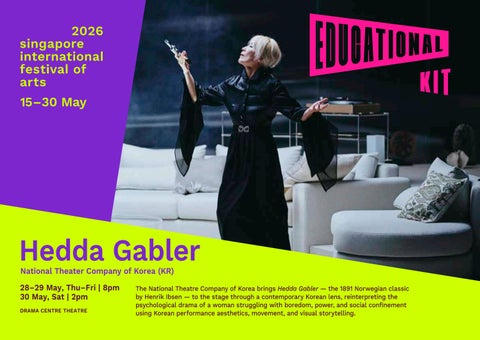
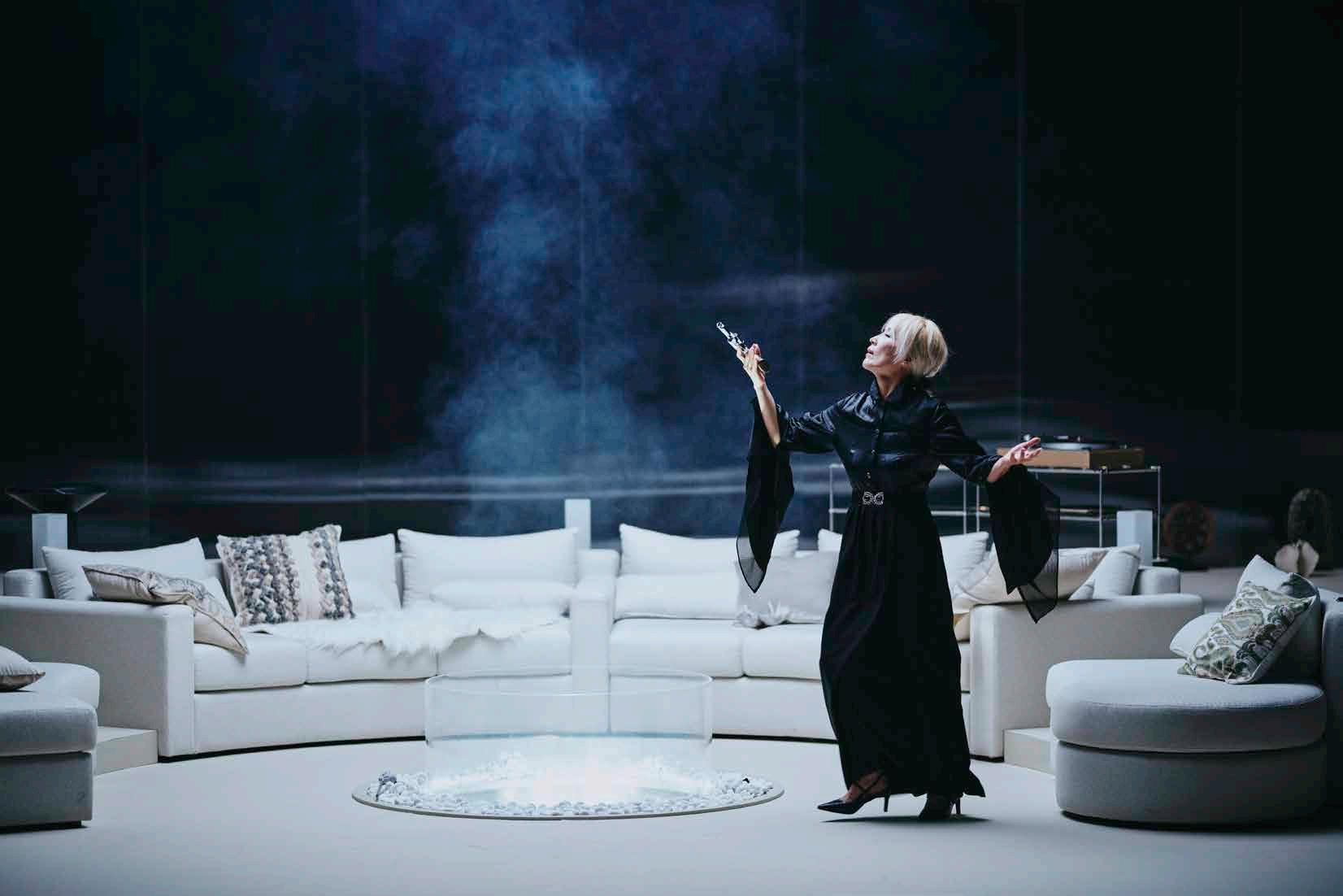
The National Theatre Company of Korea brings Hedda Gabler — the 1891 Norwegian classic by Henrik Ibsen — to the stage through a contemporary Korean lens, reinterpreting the psychological drama of a woman struggling with boredom, power, and social confinement using Korean performance aesthetics, movement, and visual storytelling.
Outcomes
What students will know, understand, and do through this kit and the performance.
01 Learning Outcomes p.02
02
03
.
• The basic story of Hedda Gabler: a woman returns from her honeymoon and struggles with boredom, control, and feeling trapped in her life.
• Key characters and their relationships.
• That the play was written by Henrik Ibsen (1891) as part of modern realist theatre.
• That this production is an intercultural staging by a Korean national company, interpreting a Norwegian classic through Korean performance aesthetics
• How social expectations (marriage, reputation, gender roles) affect people’s choices.
• How theatre can show a character’s inner thoughts without saying them directly.
• How a story from one culture can be reinterpreted through another culture’s performance style.
• That space, silence, and movement can communicate meaning.
• Watch actively by noticing staging, movement, and design.
• Track how power shifts between characters.
• Reflect on how the production made them feel and think.
• Connect themes from the play to modern life.
02.
Before the Show
Pre-show preparation to understand the context. H
Ibsen's Norway & the "Woman Question"
When Ibsen wrote Hedda Gabler in 1891, women had almost no legal or economic independence. Identity was bound to marriage — name, income, purpose all filtered through a husband.
The world he depicted was one where intelligence and ambition in women were considered dangerous or pathological.
Why "Gabler" — not "Tesman"?
The play uses Hedda's maiden name — her father General Gabler's — not her husband's. Ibsen explained he thought of her as her father's daughter: someone who had not truly entered the life she was legally part of.
Consider: what it means to live with a name given rather than chosen.
Whose story is Hedda living?
Research briefly: What were women's legal rights in Europe in the late 1800s? Could married women easily divorce?
Write two social expectations women faced In one sentence, explain why a comfortable home might be a prison for a certain kind of person.
Control, manipulation & impossible choices
Hedda cannot work, travel alone, or speak freely — but she can manipulate, withhold, and destroy. Watch how power circulates: not just who holds it, but who is seen to hold it, who is allowed to want it, and what happens when someone reaches for it through unsanctioned channels.
What
power, besides money?
Name one: an object, a piece of information, a relationship, a reputation, or a silence that could be used as leverage.
Write one "power risk" you will watch for — e.g., a secret that shifts the room, an object that becomes a weapon.
Pre-show warm-up
Critical Thinking
Write one assumption you have about why people feel “trapped” in life (e.g., money, family expectations, reputation, career pressure). Be ready to test whether the play confirms or challenges your assumption.
Communication, Collaboration & Information
Two strategies you use when you don't understand someone's motives. .
Cross-Cultural Literacy
One respectful question you could ask about something unfamiliar in the staging.
The promise — and the cost — of "a beautiful death"
At the heart of Hedda Gabler is a question about the stories we are handed. Hedda has inherited an idea of herself from her father: aristocratic, superior, untouchable. The respectable domestic marriage to an academic she doesn't love is a betrayal of that self-image.
She imagines a "beautiful death" — a romanticised, self-authored exit — as the only freedom left. Ibsen asks: what happens when the only story left to write yourself into is tragedy?
Y C The "inherited identity" question
In a quick-write, define "freedom" in 20 words. Underline the words that come from society — not from you.
Predict: how might a story about self-image cause conflict inside a family or a relationship?
General's daughter turned academic wife. Bored, brilliant, and dangerous. Wants to shape destinies she cannot possess directly.
Hedda's husband. A well-meaning academic absorbed in his research. Oblivious to the tensions around him.
A calculating family friend who enjoys power over others. Recognises Hedda's intelligence and exploits it.
Hedda's former lover and intellectual equal. His manuscript represents everything she cannot have.
Gentle and brave. Has risked everything for Lövborg. Represents the selfless love Hedda is incapable of.
Hedda Gabler
George Tesman
Judge Brack
Eilert Lövborg
Thea Elvsted
03.
During the Show
Choose one strand to track as you watch. Use short notes or keywords so you can stay present.
E 2 1 C C Prompts while watching
Critical Thinking — What evidence does the production give for why characters are trapped?
Communication — How do characters reveal and conceal their real intentions?
Civic & Cross-Cultural — Find one moment of genuine recognition and one of dismissal.
Track power as action S
When do you notice power made visible (a gesture, an object, a refusal, a pause)? What does the production want you to notice?
Find one moment where a character re-frames a situation to make it work for them. What shifted: meaning, tone, or implication?
Who gains authority when a scene is controlled? Who loses it when it breaks down? Give one example. What is not said — a confession, a plea, a declaration? What is the impact of that silence?
Track "freedom" stories & their cost
Identify one belief about "being free" — from marriage, from expectation, from the past. Where does it appear in the action?
Which characters seem trapped in a story they inherited (family, society, love)? How can you tell?
Notice one moment where someone chooses safety over truth — or truth over safety. What might they be protecting?
S
Track theatre as a mirror
Spot one moment of disagreement about "how to behave" (social convention, class, gender). What assumptions are clashing?
Where do you see genuine connection working? What makes it possible — honesty, humour, patience, risk?
Where do you see connection breaking down? What would have helped?
After the Show
Complete one option. Refer to specific moments — a line, a gesture, a design choice, or a silence.
"Control / Loss" reflection
Write two moments where a character tried to control another person — and what it cost the controller
Write two moments where someone lost control — and what that revealed about them.
Choose one and explain why it mattered to the power dynamics in the room.
Describe Hedda's situation in one sentence (avoid "she's just bored" — go deeper).
List three pressures she faces: social expectation, financial dependency, romantic history, intellectual stifling, pregnancy
Pick a moment where her choices shape what happens next. What might change if she acted differently?
Write one sentence describing a "selfimage" that a character clings to.
Write one sentence describing the cost of that story for them or someone else.
Connect it to school, community, or media. What advice would you give a younger student about that story?
What makes a character "sympathetic" — even when they do harm?
Find two critical perspectives on Hedda: one that condemns her, one that defends her. Compare: which is more "faithful" — and to what (justice, psychology, social critique)?
Make a 1-slide or 1-page comparison with your conclusion and evidence.
For further exploration on the subject, topic, or themes.
Why the 1891 staging caused a scandal
Read the reception history and list three reasons the play shocked its first audiences.
Extension — Identify one way social context shows up indirectly in staging choices (furniture, costume, restraint).
Choose one pathway (A–D). These can be done individually or in groups over 30–60 minutes
Solving a cross-context communication problem
In groups of four, role-play a misunderstanding from the show — something that won't translate across gender, class, or time.
Constraint — use at least two strategies (paraphrase + checking; example + analogy; gesture + rephrasing).
Debrief — Which strategies worked best, and why?
Freedom, constraint, and identity
Create a two-column poster: (1) what society says freedom is; (2) what you think a genuinely free life could look like.
Include one quotation or moment from the performance as evidence.
Share and discuss: how do different communities define "freedom" differently?
Critical, Adaptive & Inventive Thinking
Identify assumptions, compare perspectives, justify a conclusion with evidence.
Communication, Collaboration & Information
Explain your reasoning clearly; collaborate using multiple sources; manage uncertainty
Civic, Global & Cross-Cultural Literacy
Consider how history, power, and identity shape how we live; show empathy for difference.
As Singapore's annual pinnacle performing arts festival, SIFA presents captivating and diverse works across theatre, music, dance, film and visual arts. First launched as the Singapore Festival of Arts in 1977, the festival has gone through several evolutions and inspired generations of arts lovers and practitioners.
Today, the highly anticipated festival is a high point on Singapore's arts and cultural calendar. SIFA continues its festival mission to champion the creation and presentation of Singaporean and international works.
ABOUT SINGAPORE INTERNATIONAL FESTIVAL OF ARTS ABOUT ARTS HOUSE GROUP CONTACT
For further enquiries on programmes or education kits gladyschin@artshouse.sg
Arts House Group (AHG) is a not-for-profit organisation dedicated to inspiring and enriching lives through the transformative power of the arts. We organise two flagship national festivals: the Singapore International Festival of Arts and the Singapore Writers Festival. At the heart of AHG's mission are six arts spaces — including two national monuments, The Arts House at the Old Parliament and Victoria Theatre & Victoria Concert Hall — alongside the Drama Centre and three creative enclaves: Goodman Arts Centre, Aliwal Arts Centre, and Stamford Arts Centre. First set up as The Old Parliament House Limited on 11 Dec 2002, it was renamed Arts House Group on 27 Aug 2025. As a public company limited by guarantee under the National Arts Council, we remain steadfast in our mission to champion the arts as a powerful force for positive change.