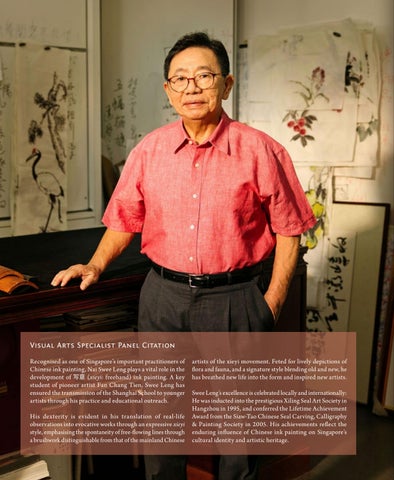
Visual Arts Specialist Panel Citation Recognised as one of Singapore’s important practitioners of Chinese ink painting, Nai Swee Leng plays a vital role in the development of ⱗ䠑 (xieyi: freehand) ink painting. A key student of pioneer artist Fan Chang Tien, Swee Leng has ensured the transmission of the Shanghai School to younger artists through his practice and educational outreach. His dexterity is evident in his translation of real-life observations into evocative works through an expressive xieyi style, emphasising the spontaneity of free-flowing lines through a brushwork distinguishable from that of the mainland Chinese
artists of the xieyi movement. Feted for lively depictions of flora and fauna, and a signature style blending old and new, he has breathed new life into the form and inspired new artists. Swee Leng’s excellence is celebrated locally and internationally: He was inducted into the prestigious Xiling Seal Art Society in Hangzhou in 1995, and conferred the Lifetime Achievement Award from the Siaw-Tao Chinese Seal Carving, Calligraphy & Painting Society in 2005. His achievements reflect the enduring influence of Chinese ink painting on Singapore’s cultural identity and artistic heritage.
c u lt u r a l m e d a l l i o n 2 0 2 5
Nai Swee Leng 饆榰륫
炞卓稡稡 ‘Fruitful Harvest’
68cm by 68cm, Chinese Ink on Rice Paper Private Collection 2022
Nai Swee Leng (b. 1946) is a distinguished Chinese ink artist known for his Chinese ink paintings and calligraphies. Swee Leng graduated from Nanyang Academy of Fine Arts and received mentorship from masters of the Shanghai School, Fan Chang Tien, See Hiang To, and leader of the Lingnan School, Chao Shao-an. Integrating traditional brush techniques with subjects of Nanyang, Swee Leng developed his unique, bold and spontaneous freehand xieyi style (ⱗ䠑崣). The depth, strength and grace of Swee Leng’s Chinese ink paintings embodies his pursuit of 溫㊥繡 (zhēn shàn měi: truth, goodness, beauty). Swee Leng loves painting flora and fauna and Nanyang themes, such as coconuts trees, bamboo, birds, and flowers. He has held solo and group exhibitions throughout his career and has published three art books so far. Swee Leng’s artistic achievements have garnered local and international recognition. Since 1995, he was appointed Overseas Member of the prestigious Xiling Seal Art Society Zhejiang, one of China’s most important traditional stone seal engraving art associations; and in 2006, he was awarded the Siaw-Tao Distinguished Art Award by Siaw-Tao Chinese Seal Carving, Calligraphy & Painting Society. Swee Leng’s Chinese ink art works were represented at the 2014 and 2016 Singapore Post Stamp Series in conjunction with the President’s Charity Art Exhibition, and his Chinese ink calligraphies have been inscribed on many traditional wooden plaques at The Lian Shan Shuang Lin Monastery, a National Monument. Swee Leng dedicated a significant part of his career to art promotion. He co-founded the Molan Art Association in 1967 to promote and preserve Chinese arts and heritage, and conducted art classes nurturing many artists for the past five decades. As the Singapore correspondent for the Taiwan First Art Magazine in the 1980s, he wrote about Singapore’s fine arts for overseas Chinese communities. He frequently exhibited his works and was guest speaker at local and overseas art events, including speaking at the 2014 and 2015 editions of Hong Kong Chinese Ink Art Festival at the Jao Tsung-I Academy. In March 2016, Swee Leng spoke at the Ink Masters Series – National Gallery Singapore about the development of Chinese ink arts during the Ming and Qing periods. He also conducted engaging live demonstration sessions of his Chinese ink brushwork, where he painted his favourite subjects such as pine trees, and Nanyang landscapes.
N ai Sw ee Leng
13
Steeped in the Past, Onward to the Future by Teo Han Wue
As a boy growing up in Merchant Road in the 1960s, Nai Swee Leng was fascinated watching his father practise Chinese calligraphy at home – so much so that he helped himself to the latter’s brushes and started painting with ink on rice paper, which was easily available in the house. As a student at the Whampoa Secondary School in the early 1960s, he had the good fortune of meeting Fan Chang Tien (1907–1987), a celebrated ink painter who was teaching at the school. Fan was no ordinary art teacher, having studied under renowned masters of the Shanghai School of painting such as Wang Geyi, Wang Yiting and Zhu Wenyun in Shanghai during the 1930s. The Shanghai School, which combined traditional Chinese techniques with modern influences, can be traced back to artists such as Wu Changshuo (1844–1927) and Ren Bonian (1840–1896) in the trading port where the literati-painting tradition underwent rapid change in response to the less elitist taste of the mercantile class who formed the main clientele of ink painting at the end of the 19th century. Among the last in the generation credited with distinction in the three skills of Chinese art tradition namely poetry, painting and calligraphy, Fan was the archetypal literati painter who excelled in all the three. He was already an artist of considerable renown in China before arriving in Singapore via Bangkok in 1956.
cult ur al medallion
Young Swee Leng caught Fan’s attention one day when the boy brought a painting he had done to show his teacher. Besides attending the regular art lessons in school, Swee Leng was readily taken in as part of a select group of pupils Fan was tutoring individually and privately at home on Saturdays. Many of whom later became notable artists in Singapore’s ink art scene. He could not have found a better teacher than Fan who was erudite, kind and generous. He remembers how Fan was not only teaching him one on one, he was doing it for free as well as treating him to meals at home. Among Swee Leng’s fondest memories is the time when he had to skip lessons due to his busy schedule working as a freelance graphic designer. “Master Fan came to my house bringing a stack of rice paper and persuaded me not to stop,” he recalls. He felt so touched by the master’s kind gesture, he resumed his lessons and continued until Fan died in 1987.
At the opening of Nai Swee Leng’s solo art exhibition at the Mandarin Hotel Orchard in 1979, the artist was accompanied by Mr Henri Chollet, then French ambassador to Singapore, and gallery owner, Mrs Della Butcher, who was widely regarded as “Mother of Singapore Artists.” Photo courtesy of Nai Swee Leng.
“Fan Laoshi not only taught me painting, seal-carving and literature, he also taught me about life and how to conduct myself,” Nai reminisces. In 1966, Swee Leng enrolled in Nanyang Academy of Fine Arts (NAFA) where he majored in oil painting under Georgette Chen, Ng Yat Chuan and See Cheen Tee. “My training in Western art is relatively unknown to many. I gave away all my early works as gifts. I am only reminded of them from time to time when friends bring them to show me what I’d given them,” says Swee Leng who turns 80 next year (2026). He took advantage of the weekends to attend See Hiang To’s ink painting lessons informally from 1966 to 1967 at NAFA. Besides learning from his NAFA lecturers as well as outstanding artists such as Fan and See Hiang To, Swee Leng still strived to expand his artistic horizon beyond the skills of painting, calligraphy and seal-carving which he had acquired under the tutelage of both leading masters. In 1980, he went to Hong Kong to seek out the Lingnan master Chao Shao-an (Zhao Shao’ang, 1905–1998), who was known for his animated studies of flowers and birds in vivid hues, and swift, bold brushstroke. He spent two months studying intensively under Chao. His diligent practice, as well as passionate pursuit of, and complete commitment to ink art over five decades have allowed him to build a solid foundation. He exhibits his works frequently and extensively at home and abroad, in places such as China, Japan, Thailand, Indonesia, Australia, England, France, Finland and the United States. Swee Leng’s body of work displays his eclecticism, enriched with various aesthetic sources: Besides the Shanghai school, he imbibes the Eight Eccentrics of Yangzhou, a group of Qing dynasty painters in the 18th century who eschewed the orthodox for expressive individualism and and the 17th-century artist Bada Shanren, not forgetting the Western
N ai Sw ee Leng
15
oil painting style he studied at NAFA. All these are blended into a distinctive style which is uniquely Nai Swee Leng. For example, he may incorporate an expressive Shanghai touch of a bamboo flourish and a radiant Lingnan detail of a realistic bird perched on a branch against the overall composition of an oil painting. Aside from an affinity for floral and bird studies, he also paints vegetables, fruits and small creatures such as cats, butterflies, fish, frogs and squirrels. “I see beauty in all these ordinary everyday living things around us — I just feel like painting them from different angles with my brush,” says Swee Leng. This is aligned with the Chinese aesthetic tradition: these subjects represent a schema by which a cultured person with a scholarly temperament contemplates nature, expresses his or her love of it, as well as a desire to live in harmony with it. At the opening of the President’s Charity Art Exhibition at The Arts House in 2014, the artist was accompanied by President, Dr Tony Tan, and the then Minister of Culture, Community and Youth, Mr Lawrence Wong. Photo courtesy of Lim Sew Yong/Raffles Fine Arts Auctioneers Pte Ltd.
Singaporean ink artist Tay Kiam Hong, himself a student of Fan Chang Tien, locates Swee Leng’s art “much in the character of the Shanghai School of painting,” adding that “Swee Leng, who was a senior disciple of Fan, clearly exemplifies this, builds on it and takes it to a higher level.” As a nod to Fan, Swee Leng expands the palette, evident in many bamboo and orchid studies, by blending Fan’s signature style with elements from Qing master Zheng Banqiao (1693-1766) and Lingnan master Chao Shao-an. At the risk of appearing too “sweet” or frivolous – a quality some critics deemed “vulgar” in the literati tradition – he painted in 1996 a picture of a pomegranate tree bearing blooms and fruits in a riot of bright colours. Titled ‘Abundance’, the work communicates a sense of jubilation represented by red ruby seeds bursting out of the fruit, itself a symbol of a big, happy family blessed with many offspring. A 1996 painting ‘Chirpy Chatter’, showing a dozen sparrows perched on a rock and some bamboo branches, is another exemplar of the artist’s mastery of finely detailed brushstroke – the vivacity of the tiny birds juxtaposed with the slender elegance of the bamboo articulated with bold, swift gestures. Swee Leng can also dabble in social satire. Another painting, titled “Voices of Frogs” (1982), depicts six frogs frolicking together, but each painted in a different posture and in varying intensity of ink wash, representing a lack of unison. The artist’s inscription in the upper half of the frame refers to their endless croaking, full of vanity and futility, showing up those folk who fancy themselves as smart but are actually ignoramuses stuck at the bottom of the well. Swee Leng understands the virtue of giving too. Since the 1960s, he has been active in the Singapore scene with his involvement with art societies. These include Molan Art Association, which he co-founded with some friends; Hwa Hun Art Society, whose members were former students of Fan Chang Tien; Singapore Art Society, Singapore’s first
cult ur al medallion
multicultural art body founded in 1949; and Siaw-Tao Chinese Seal Carving, Calligraphy & Painting Society, which was formed by NAFA graduates in 1971. In China, he is an overseas member of several art organisations, including Xiling Seal Society, the prestigious 100-yearold national body dedicated to the academic research of calligraphy and seal carving based in Hangzhou. Apart from his own practice, he has also dedicated himself to education, giving private art lessons for five decades and working as a lecturer at NAFA for over a decade in the 1980s. As testament to his mentorship, he has taught countless number of students who have gone on to establish themselves as ink artists.
At a solo exhibition organised by Cape of Good Hope Art Gallery at Ion Orchard in 2016, the artist signed books and gave a demonstration to the audience, including many of his students. Photo courtesy Cape of Good Hope Art Gallery.
The success of his ink art lies in how it has come into its own while remaining solidly grounded in the rigorous technique of past mentors. As Mr Lee Soon Hock, a former National Arts Council director of corporate services during the 1990s, who is familiar with Nai’s work, says: “Swee Leng is always teaching his students how they should work hard to build upon the foundation of the ancient ink tradition – without being bound by what they have inherited from the past to take their art into the future.” In life and in his art, Swee Leng proves he is a man of his words.
Teo Han Wue was a journalist at ‘The Straits Times’. He later became the director of Art Retreat incorporating the Wu Guanzhong Gallery and is now an art writer and curator.
N ai Sw ee Leng
17
Gathering for Winter 匡ꢂ馱 136cm by 68cm, Chinese Ink on Rice Paper Collection of National Gallery Singapore 1995
cult ur al medallion
words of appreciation 䖎虾䎋㖈䧮 㿨鵯♧䎃䒊㕂 ヰ䎃㕂㹻⨴䐁籗虾⛓꣢䖤ⵌ㕂 㹻⛓俒⻋㤙畎 䧮霟䗱涸䠮靧䧮㕂俒⻋鿈⛓雩〳ㄤ䲿䬫罜⢪䧮腋곡ⵄ䖤ⵌ姽虾钚 䎇䠮靧♳♴㔙ꢭぐ⡙⛓䊨⡲➃プ䠮靧饭䮸䔂⯓欰⛓䲀虜ㄤ㢵⡙㥪⿼ 㢵䎃勻⛓㎗㤙ㄤ렽⸠䠮䛸劊ꤿ剚긭㣐⸂䲀䎛俒⻋蒍助䎇䲿⣘㖞㖒 ⡮䎃䠮䛸㹻⚥㣐㼭⛓ꂂざ罜腋⢪䧮㽴䗱⡲䠮䛸薵僅✝䛸 䋗鵂♲⼧䎃⯏忘昶䗱⛓來㼋 䧮劍劆劢勻涸傈㶩⚥鷆䃪絊欰㷖⛴♸倞鵯勴麥騟〄䪋⠛絡宐㟯 歙⚂絩絯⚹蒍助⦸㼋倞過⢪䧮㕂⛓ぐ停⠏葻⠛絡䖤ⵌ蒍助倞 罜涰蔅룅佞
At the age of 79, I am greatly honoured to be conferred the Cultural Medallion during this milestone year that marks the 60th anniversary of our nation’s independence and continued prosperity. I sincerely thank the Ministry of Culture, Community and Youth’s recognition and support, which has made this honour possible. I also thank all staff members for their hard work, Mr Terence Teo for nominating me for the Cultural Medallion, and my fellow artists and friends for many years of encouragement. I would like to express my gratitude to Teo Yeonh Huai Kuan for its generous support of culture and the arts, and for graciously providing its venue for over 20 years. I am grateful for my family’s unwavering support, which has allowed me to dedicate myself fully to artistic pursuits. I am especially grateful to my mentor, Mr Fan Chang Tien, for his loving guidance over three decades. Looking ahead, I hope to continue on the path of lifelong learning and innovation to promote and advance traditional ink painting, as well as keep nurturing new talent in the arts. May the rich traditions of all our communities flourish through artistic innovation, blossoming into a vibrant scene of cultural expression!
N ai Sw ee Leng
19