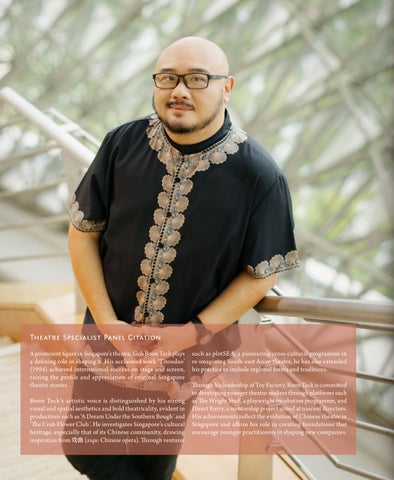
Theatre Specialist Panel Citation A prominent figure in Singapore’s theatre, Goh Boon Teck plays a defining role in shaping it. His acclaimed work ‘Titoudao’ (1994) achieved international success on stage and screen, raising the profile and appreciation of original Singapore theatre stories. Boon Teck’s artistic voice is distinguished by his strong visual and spatial aesthetics and bold theatricality, evident in productions such as ‘A Dream Under the Southern Bough’ and ‘The Crab Flower Club’. He investigates Singapore’s cultural heritage, especially that of its Chinese community, drawing inspiration from 䧬刼 (xiqu: Chinese opera). Through ventures
such as plotSEA, a pioneering cross-cultural programme in re-imagining South-east Asian theatre, he has also extended his practice to include regional forms and traditions. Through his leadership of Toy Factory, Boon Teck is committed to developing younger theatre-makers through platforms such as The Wright Stuff, a playwright incubation programme, and Direct Entry, a mentorship project aimed at nascent directors. His achievements reflect the evolution of Chinese theatre in Singapore and affirm his role in creating foundations that encourage younger practitioners in shaping new companies.
c u lt u r a l m e d a l l i o n 2 0 2 5
Goh Boon Teck
Goh Boon Teck (b. 1971) is not just a visionary force in Singaporean theatre, but also a deeply human storyteller whose work has touched lives. As a director, playwright, designer, and cultural advocate, Boon Teck boasts a career that spans more than three decades of tireless dedication. Mentored by veterans including Wee Beng Chong, Tan Teck Heng, Chua Soo Pong, and the late Kuo Pao Kun, he has shaped the very language of Singaporean theatre, bridging Chinese and English, tradition and modernity, the intimate and the spectacular. From stage to television, he has brought stories that resonate with local and international audiences. Few artists embody such versatility: Boon Teck holds the record for directing the most productions at the Esplanade Theatre and Concert Hall, a validation of his prolific creativity and his ability to command Singapore’s grandest stages.
‘Titoudao’ at Victoria Theatre by Toy Factory Productions, 2024. Photo Courtesy of Toy Factory Productions Ltd.
His groundbreaking play ‘Titoudao’ has become an icon of our cultural landscape, adapted for television and stage and shared as far afield as Australia, India, Egypt, Indonesia, China, Japan, South Korea, Thailand, the Philippines, Taiwan, Hong Kong, the United States, Latin America, and North America. ‘The Straits Times’ (2024) cited that ‘Titoudao’ “stands the test of time” with its 30th Anniversary staging, while ‘Today’ (2015) lauded the production as the “magical bridge that links us to Singapore’s vanishing treasures,” referring to the lost art of wayang, or street opera, of which the show is primarily set in. His contributions extend beyond his artistic achievements. He is a cultural champion, preserving South-east Asian art forms while embracing innovation. His productions abroad, including the acclaimed productions of ‘Glass Anatomy’, ‘The Crab Flower Club’, ‘Spirits’ and ‘Prism’, have established him as an ambassador for Singapore’s stories, showing the world who we are and what we stand for. Boon Teck has generously guided and nurtured numerous directors, actors, designers, and production members, inspiring emerging talents through mentorship, collaboration and example. His quiet, steadfast leadership has cultivated a generation of theatre-makers who continue to shape the industry. He believes in the transformative power of creativity, an unwavering commitment to community, and a lifelong devotion to telling stories that matter. His legacy has defined the arts scene here and helped shape the country’s identity.
G oh B o on Teck
5
A Communal Fe ast for the Senses by Cl ariss a O on
Live theatre is about layering performance, scenography, words and sound to build a house the audience can live in fully for two to three hours. Few are as adept at theatrical worldbuilding as Goh Boon Teck, or as tireless and chameleonic, as seen in two standout yet very different works of his from a decade ago. First was the Mandarin musical ‘December Rains’, a stirring spectacle of torn parasols and slanted arches, inspired by the real-life stories of Chinese-educated Singaporeans spurred by leftist ideals to leave their loved ones and throw in their lot with communist revolutionaries, little knowing what awaited them. These were telescoped into interlocking tales of love, friendship and betrayal by Boon Teck’s direction, a regional creative team, and the mellifluous words and music of Liang Wern Fook and Jimmy Ye. A recent viewing of the archival recording of the 2015 production was as one remembers it: the young ensemble (led by Andie Chen, Chriz Tong and Sugie Phua) filling out their characters’ journeys, thrilling hundreds in the cavernous Esplanade Theatre. Over three decades, they went from the starched whites of 1950s-era Chinese school students to flashy belted power suits, from tearful portside separations to bittersweet airport reunions. The slanted arches morphed seamlessly into the
cult ur al medallion
panoramic vertical-slat screens of moneyed interiors, where resilience and regret unfurled in song.
‘A Dream under the Southern Bough: Reverie’ at Drama Centre Theatre by Singapore International Festival of Arts, 2019. Photo Courtesy of Toy Factory Productions Ltd.
Earlier in 2015, the same visual chutzpah and sensitivity to the music of a text – this time its inner music – underscored Boon Teck’s direction and design of two works in English, one about the machinery of censorship and the other on the machinery of male-female hook-ups. They were written by Singapore’s master of political plays Tan Tarn How, and part of Esplanade’s The Studios: fifty season of 50 noted home-grown English-language plays in that SG50 year. Boon Teck’s mash-up of Tan’s ‘Fear of Writing’ and ‘Machine’ deployed choice excerpts, a quartet of talented young actors (Amanda Tee, Zee Wong, Andrew Lua and Terence Tay), four platforms, floor spots, a light box on a central table and inventive stage blocking to create the mood of an investigative thriller. Amplifying the tightly-wound tension, paranoia and sinuousness of Tan’s writing, it switched deftly between the two plays with the smallest of costume changes. All this in what was billed as a “dramatised reading” in a small studio. At their best, the works of Toy Factory Productions’ chief artistic director are symphonies or chamber recitals of visual design and dramatic action – he is equally comfortable with blockbusters or intimate works as he is in the Chinese language or English. Boon Teck’s facilities as a painter of the stage and musical storyteller were cultivated from an early age. He was a fine arts student who topped his diploma class at the Nanyang Academy of Fine Arts. As a child, he played bit parts in shows fronted by his mother, Madam Oon Ah Chiam, a popular Hokkien street opera performer in the 1970s. Crossing between the front stage of performers singing and executing acrobatic martial arts moves to cheering crowds, and the backstage of actors painting their faces in front of mirrors and naked light bulbs, he found his second home in the wooden tented structure of the wayang stage. This nexus of total theatre and community is what galvanises the chief artistic director of the bilingual Toy Factory Productions, which has over its 35 years been one of the driving forces of Chinese language theatre in Singapore. ‘December Rains’ remains one of the most-watched Mandarin productions in recent theatre history, playing to a combined audience of around 35,000 through its 2010 and 2015 stagings. While Boon Teck likes that doing different aspects of theatre – from directing to writing to set design – allows him to “control the final appearance and direction of the whole production,” he also loves that theatre is “always a community, it’s like everyone plays a part. Even if you play more parts, it’s still a part of many parts.”1 Long-time collaborators attest to the director’s generosity. “He will always listen with an open mind, and you will see your ideas reflected in the script or in his direction,” says Esplanade senior producer Delvin Lee. His signature production is ‘Titoudao’, a heartwarming tale of a Chinese opera performer based on Madam Oon’s life. Written by Boon Teck in
G oh B o on Teck
7
English, Mandarin and Hokkien, it has been staged seven times between 1994 and 2024, performed in Cairo, Hangzhou, Beijing and Shanghai, and adapted into a Mediacorp TV drama series in 2020. An enduring tribute to an art form that was the equivalent of Netflix in its heyday, ‘Titoudao’ continues to resonate because it “captures the true heart of an artist and the ultimate joy of performance, whether or not anyone is watching,” says another longtime collaborator Beatrice Chia-Richmond, who performed in ‘Titoudao’ in 2000.
‘The Crab Flower Club’ at Esplanade Theatre by Esplanade, 2022. Photo Courtesy of Toy Factory Productions Ltd.
Another career highlight is ‘The Crab Flower Club’, inspired by seven poems from the Chinese literary classic ‘Dream of the Red Chamber’. About five sisters in China’s late Qing Dynasty who hatch a secret allwomen poetry club, it was first written in English for the 2009 Singapore Arts Festival. In 2022, he was commissioned by Esplanade to create a Chinese-language iteration infused with Chinese opera. A TV drama series adaptation is currently in production by Mediacorp. He’s tried and done everything, from edgy fringe works to the National Day Parade, for which he was creative director for three editions. Not all of it has stuck but he remains indefatigable. Having brought Toy Factory back from the brink of bankruptcy several times, he says philosophically, “You have to learn from your mistakes and then you have to welcome all these mistakes. These mistakes build the foundation. So perseverance is the most important thing.”2 At the age of 19, Boon Teck was among a group of puppetry enthusiasts, working on Kuo Pao Kun’s 1990 production of ‘Lao Jiu’, who founded the then Toy Factory Theatre Ensemble. The bilingual drama doyen was an early influence on him. At age 26, returning from London’s Middlesex University where he studied theatre directing, he declared in an interview, “To break all the walls around this island is one of my tasks.” As he said then, “I try to be a very open person. I don’t want to be so specific that I become a director who only does one thing. I like the whole process, from writing to producing.”3 Years ago, he shared with this writer that while he started out doing offbeat, experimental works – ‘Osean’ (1993), for example, was a sitespecific, non-verbal dance drama performed in and around a hotel swimming pool – his background on the Chinese wayang stage led him towards the mainstream, to create works that could bring together large numbers of people. Yet his early fringe productions have a boldness and elan that lingers. Watching his remix of Tan’s works in 2015 recalled Toy Factory’s 2004 Chinese-language adaptation of Singapore playwright Eleanor Wong’s seminal queer dramas ‘Mergers and Accusations’ and ‘Wills and Secessions’, staged in the attic of a Tanjong Pagar shophouse. Wong wrote powerfully about a woman struggling to find love not in the shadows, but fully and openly with a partner, and then fighting to keep all the loves of her life in one piece. It helps that when Boon Teck is working with strong scripts like these – words in isolation are, to
cult ur al medallion
this writer, not his strong suit – his remixes are highly attuned to the textures and provocations of their writing yet throw the door open to new audiences, such as the Chinese-speaking community. Directed by Boon Teck and Nelson Chia, with a blistering translation of Wong’s English script by journalist Han Yong Hong, the cut and thrust of these witty yet achingly moving exchanges between characters came to life on an industrial set of rusty, recycled metal bars and crates – the actors so close to the audience in that attic space that one could hear every little catch in the throat. Over the last decade, there have been two notable strands in his output: mining stories of the Chinese community in Singapore and scouring Chinese literary classics for inspiration. ‘Kwa Geok Choo’ at Victoria Theatre by Toy Factory Productions, 2022. Photo Courtesy of Toy Factory Productions Ltd.
For the foreseeable future, he wants to widen the first strand and focus on original Singapore content in English or Mandarin, “creating a story from our heritage and history,” as he puts it. “I’m more familiar with the Chinese [culture]. I do wish that I can do more for Malay culture and Indian culture, but it’s just that I’m not very familiar with them, and I hope I have the opportunity to know more.”4 While Boon Teck is a survivor who has weathered a lot for his art, theatre-making continues to energise him. Theatre “makes me happy. It makes me alive,” he says simply. 5 In so many ways, he lives out that core memory of the wayang theatre scene he grew up in. An accomplished cook, he keeps his actors wellfed at every rehearsal. “Because when I was young, we always eat with the wayang aunties and wayang uncles. I think that became part of me, that eating is part of theatre creation, for ice-breaking or to build trust,”6 he explains. His table overflows, whether on or off stage, and it is a delight to feast at it.
Clarissa Oon is a long-time theatre critic-turned-archivist. A former journalist with ‘The Straits Times’, she is head of digital and content at Esplanade – Theatres on the Bay and oversees its archives as well as its digital arts publication ‘Esplanade Offstage’.
G oh B o on Teck
9
References: 1 2 3 4 5 6
‘Moonlit City’ at Gateway Theatre by Toy Factory Productions, 2025. Photo Courtesy of Toy Factory Productions Ltd.
cult ur al medallion
Interview with me, 6 October 2025. Ibid. Elizabeth A. Kaiden, ‘Toy winds up for play’, ‘The Straits Times’, 30 July 1998, p5. Interview with me, op. cit. Ibid. Ibid.
words of appreciation I’d like to extend my gratitude to National Arts Council which has been supporting my theatrical works since 1990. I thank you deeply for nurturing my artistic journey for 35 years. My parents. Thank you for allowing me to pursue the dream I wanted. To my mother, thank you for giving me all her talents in drama creation. To Kuo Pao Kun, Wee Beng Chong, Tan Teck Heng, Chua Soo Pong, and all my mentors and teachers. Thank you for giving me the tools and knowledge to craft my art. To my partner, Justin. Thank you for your love and protection. To Professor Lai Chee Kien and Miss Sharon Au. Thank you for this nomination. To Daini. Thank you for being the best assistant in my artistic career. Thank you all.
G oh B o on Teck
11