The News Magazine of the University of Illinois School of Music
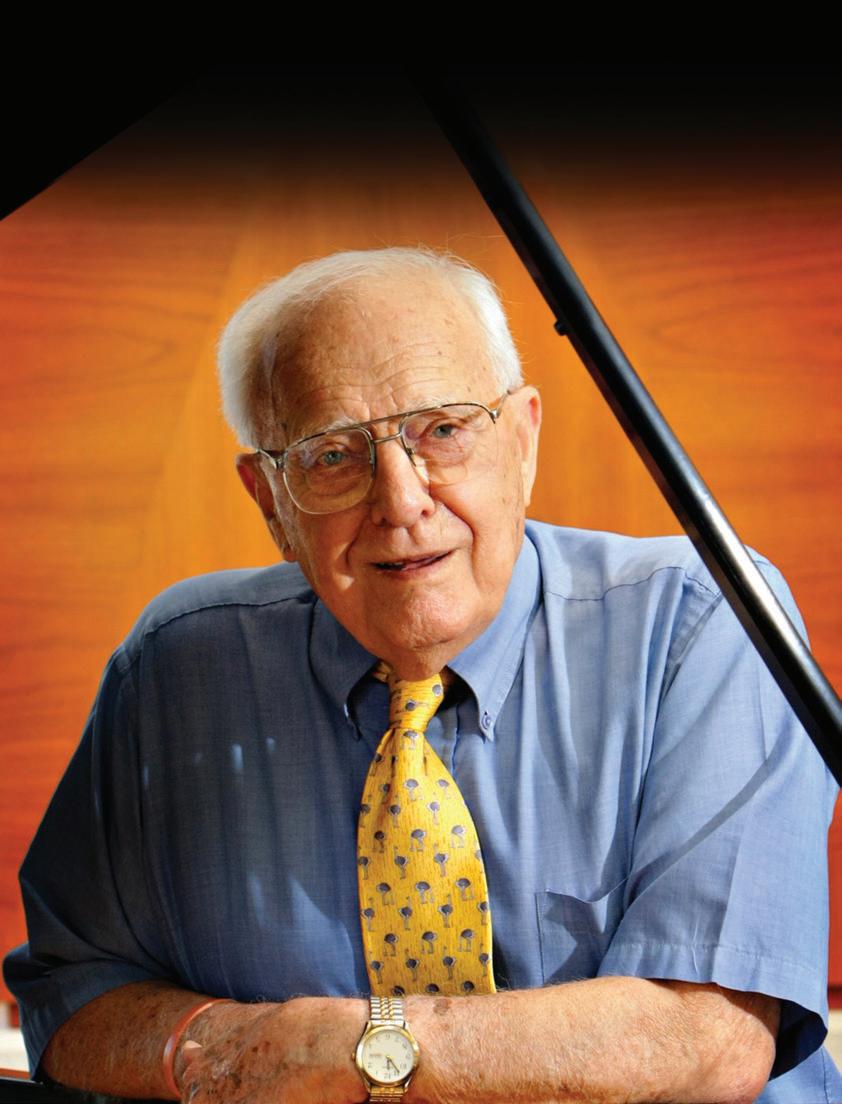
(APRIL 15, 1921–AUGUST 17, 2012)
From the Dean
WINTER 2013
Published for alumni and friends of the School of Music at the University of Illinois at Urbana-Champaign.
The School of Music is a unit of the College of Fine and Applied Arts at the University of Illinois at Urbana-Champaign and has been an accredited institutional member of the National Association of Schools of Music since 1933.
Jeffrey Magee, Interim Director
Joyce Griggs, Associate Director for Academic Affairs
James Gortner, Assistant Director for Operations and Finance
J. Michael Holmes, Enrollment Management Director
David Allen, Outreach and Public Engagement Director Ruth Stoltzfus, Coordinator, Music Events
Managing Editor: Ruth Stoltzfus
Associate Editor: Emily Wuchner
Research Assistant: Stephen Burian
Research Assistant: Lauren Coleman
Contributing Writers: Christina Bashford, Dale Cockrell, Eduardo Diazmuñoz, Julie Gunn, Anne Mischakoff Heiles, Joseph Horowitz, Herbert Kellman, Roger Laramee, Melissa Merli, Jeananne Nichols, Paul Redman, Dusty Rhodes, Emily Wuchner
Graphic Design: Bonadies Creative, Inc.
Front cover: Bernard Wolff Photography
UI School of Music on the Internet: www.music.illinois.edu
Share your good news! Send photos and submissions to: Sonorities, UI School of Music 1114 W. Nevada, Urbana, IL 61801 or sonorities@music.illinois.edu, by August 31, 2013.
As I begin my tenure as Dean of the College of Fine and Applied Arts, I look forward to working with the faculty, staff, alumni, and friends of the School of Music to further strengthen its fine programs and to extend the reach and impact of its work on Campus and beyond. The School’s exceptional record of innovative music scholarship, education, performance, and public outreach is a source of pride for the College and University.
I have taught city planning for 15 years, eight of those in FAA at Illinois. My research and teaching focuses on the policies, plans, and public and private organizational arrangements and partnerships that influence the economic development of cities and regions in the US and around the world. Naturally that means that my most immediate past professional experience is with the applied arts side of our College. Yet like most city planners, I have a deep appreciation for the role the performing and visual arts play in underpinning great communities, exploring the human condition, and elevating the human experience through artistic expression. Indeed, I firmly believe that FAA’s blend of the core environmental design fields with the visual arts, design, and the performing arts positions our College to contribute substantially and uniquely to Illinois’ new initiative to tackle some the world’s most significant environmental, social and economic challenges. The School of Music brings considerable established strength and a history of multidisciplinary collaboration to that agenda.
With the departure of Karl Kramer to the Sydney Conservatorium, the School of Music enters a new era in its leadership. I am grateful to Interim Director Jeffrey Magee for his willingness to shepherd the School through this time of transition as the College moves forward with a search for a permanent director. Meanwhile, the good work of the School continues and this year is already off to an impressive start. Our entering music students are as talented as ever, the School put on another outstanding Allerton Music Barn Festival, and we welcomed several new faculty members, including the renowned Jupiter String Quartet, to our distinguished ranks.
Edward Feser Dean, College of Fine and Applied Arts
From the Director
For many readers, this issue of Sonorities will strike a retrospective note tinged with nostalgia. The cover story about Daniel Perrino that we had long planned took on the added resonance of loss after he passed away on August 17, 2012. We also mark the passing of other key figures in the School of Music community.
But there is much more than nostalgia here. For me, recently assuming the role of Interim Director, every page of this Sonorities stands as a snapshot of the present and a challenge for the future—a challenge to uphold the standards of excellence that Perrino and others have embodied. Joseph Horowitz’s commencement address, reprinted here, certainly offers a challenge for musicians and educators of the future—a vision of how musicians will thrive in the 21st century that meshes well with Chancellor Phyllis Wise’s call for Illinois to be an “agile” university.
We stand at a pivotal moment in the School of Music’s history. This past year we said goodbye to many key figures in the School’s life, including Director Karl Kramer and Associate Director Edward Rath, who stepped out of retirement, guided the self-study for our National Association of Schools of Music accreditation, and served briefly as Interim Director. We are grateful for Karl and Ed’s leadership over the past several years, and wish them and their families the best for the future.
Even in this transitional time, there is much to celebrate. The School has welcomed several dynamic, energetic, rising stars in their fields, including a new string quartet, the Jupiter, and two internationally respected composers. By this time next year, we will have a permanent Director and a new Director of Development to work with our new Dean, Edward Feser. The University and the School are on firmer financial footing than we have been in the past five years, but we need your support—moral, strategic, financial—more than ever to stay on track.
As we move ahead, our core mission and strengths remain: a world-class faculty, a vibrant student body, a dedicated staff, and thousands of active alumni who remain invested in the School’s greatness. With everyone working together, we can expect a vibrant future and a great year ahead.
Jeffrey Magee Interim Director, School of Music
Campus News
a nglo- a merican MusiCaL ConneCtions
Even the weather cooperated. It was late July 2012 and some 80 delegates to the North American British Music Studies Association (NABMSA)’s Fifth Biennial Conference were about to descend on Champaign-Urbana for three days of papers, performances, and related events. My main worry, as chair of local arrangements, was that the blistering 100 degree temperatures we’d been having would continue or give way to bad storms, even power outages. But right on cue it cooled down. And so “AngloAmerican Musical Connections” —this was the conference’s focal theme—took off.
a Concert in Honor of niCHoLas teMperLey on his 80th Birthday
by Stacey Jocoy, M.M. ’96, PhD ‘05) and the Scotch snap (a paper by Nicholas Temperley and his son David). Tenor Justin Vickers (D.M.A. ‘11) gave a lecture recital on the excised epilogue to Benjamin Britten’s Holy Sonnets of John Donne. The quality of presentations and discussion was excellent and many people commented on the buzz that was being generated.
Featuring CHoraL anD orCHestraL
MusiC By BritisH anD aMeriCan
CoMposers: HanDeL, WesLey, pearsaLL, stanForD, Fine, tippett, Bennett, iVes anD VaugHan WiLLiaMs
Featuring : Baroque artists of Champaign urBana
Conductor: Chester alwes the prairie ensemBle
The School of Music was delighted to welcome NABMSA to campus because both British and American music have long been strengths of the Musicology Division here. Research into British music was first spearheaded by Professor Emeritus Nicholas Temperley, who joined the faculty in 1967 and laid the foundations for this now thriving field of scholarship. He later served as NABMSA’s first president, and more recently endowed a prize for the conference’s best student paper. I arrived in 2005 and am also a British music specialist. Like me, Nicholas Temperley is a native of Britain.
Conductor: Kevin Kelly
prairie VoiCes
The keynote address on the Anglo-American theme was given on July 27 in Krannert Art Museum by Patrick Warfield (University of Maryland), who spoke on John Philip Sousa’s interactions with British copyright law, with a fabulous mixture of wit and erudition. It was followed by a tour of an exhibition up the street at the Sousa Archives, curated by Adriana Cuervo to compliment Warfield’s talk. Both events were open to the public.
Conductor: Laurie Matheson
Krannert Center for the performing Foellinger 28 July 2012 at 7:30pm
The conference opened with a welcome address by Jeffrey Magee, Interim Director and American music scholar, who highlighted the depth and breadth of the program. Papers on the Anglo-American theme were indeed many and varied; during the meeting we heard about Elgar’s music in America, Motown’s influence on Dusty Springfield, Irish fife and drum bands in multicultural Toronto, and an American collector of Gaelic folksong, to name a few. Plus, there were talks on British subjects including Charles Dickens as opera librettist, the use of Beatles songs by avant-garde composers, the British Broadcasting Corporation’s music policies, mad songs in Shakespeare’s Hamlet (the latter given
In fact, campus outreach played a significant part in the proceedings. There were two other exhibitions: one in the Music and Performing Arts Library, drawing on its holdings of American and British music materials; the other in the lobby of the Krannert Center for the Performing Arts, showcasing published research on British and American music by musicology faculty (Lawrence Gushee, Jeffrey Magee, Gayle Sherwood Magee, Gabriel Solis, Temperley, and myself). There was also a special Krannert Uncorked at KCPA on July 26, at which delegates joined the local community for a tasting of American wines and British ales, and sparkling AngloAmerican cabaret performed by singers Sam Dewese (B.M. ’12), Karen Loda (B.M. ’11), Dane Suarez, (M.M. ’12) and Ingrid Kammin (M.M. ’08,
D.M.A. ’12) with current musicology graduate student Anderi Strizek at the piano. We heard Noel Coward, Cole Porter, Andrew Lloyd Webber, and much more.
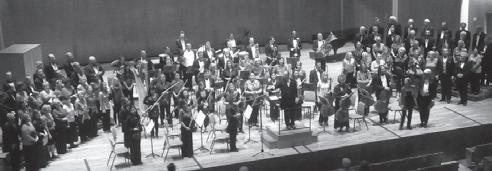
But the biggest, most electric event came last: a gala public concert of British and American orchestral and choral music on July 28 at KCPA, to honor Temperley’s pioneering contribution to British music research, both at the University of Illinois and throughout North America, on his 80th birthday, which fell a few days after the conference. The performers were local groups with UI connections: the Baroque Artists of Champaign Urbana (conducted by Professor Emeritus Chester Alwes), The Prairie Ensemble (conducted by Kevin Kelly, M.M. ’93) and Prairie Voices (conducted by Laurie Matheson, D.M.A. ’98). The program included works by Samuel Sebastian Wesley, Charles Stanford, Michael Tippett, Charles Ives, and Ralph Vaughan Williams, whose Serenade to Music (with soloists Amy Fuller, M.M. ’95, D.M.A. ‘11; Elizabeth Buckley, M.M. ’98, D.M.A. ’09; Justin Vickers; and Ronald Hedlund, professor emeritus of voice) proved a moving and memorable end to what was a truly excellent concert.
Afterward we had a wine reception with speeches, thank-yous, two renditions of “Happy Birthday,” and farewells. Temperley presented the Temperley (student) Prize for 2012 to Erica Siegel (University of California, Riverside) for her paper on Vaughan Williams’s female students in America. And speaking of students, I must say that the conference would never have run so smoothly without the sterling help of five of our musicology GAs (Catherine Hennessy, Linda Remaker, Mike Warner, Megan Woller, and Alex Woller) and Maureen Reagan (KCPA). AngloAmerican connections indeed.
– Christina Bashford, Associate Professor of Musicology
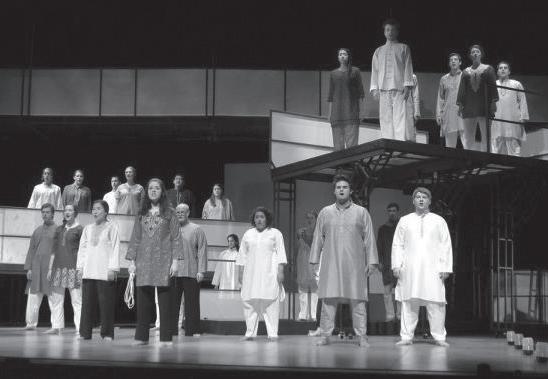
Performers receive an ovation on the Foellinger Great Hall stage during the concert for Nicholas Temperley for his 80th birthday.
Nicholas Temperley
Photo: Catherine Hennessy
SPRING 2013 ENSEMBLE PERFORMANCES
UI SYMPHONY ORCHESTRA, February 8
ILLINOIS MODERN ENSEMBLE, February 20
2012 Allerton Music Barn Festival Recap
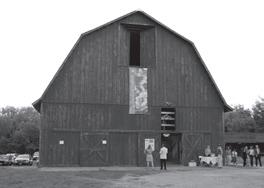
The sixth annual Allerton Music Barn Festival featured the Jupiter String Quartet making its performance debut as University of Illinois faculty members. Also during the festival, the jazz faculty paid tribute to The Blues and the Abstract Truth and several faculty members at the School of Music performed The Pirates of Penzance. The Labor Day weekend festival took place in a beautifully restored 19thcentury Dutch barn in Allerton Park, about 25 miles southwest of the University of Illinois near the town of Monticello. Each year since its inception, the festival has sold out of tickets.
Nelson Jr., a graduate student in the School of Music, was on stage to introduce the tunes and talk about his father’s work.
The festival opened August 30 with the Jupiter String Quartet performing Ravel’s Quartet in F major; Anton Webern’s “Langsamer Satz,” one of his few tonal works; and Schubert’s Cello Quintet, with Illinois cello professor Dmitry Kouzov. In a concert version of Gilbert and Sullivan’s comic operetta Pirates of Penzance on August 31, Professor Jerry Siena sang the famous patter song “I am the Very Model of a Modern Major-General”—with a new verse by Nicholas Temperley with a local twist (see box). Ian Hobson, pianist and music director of Sinfonia da Camera, conducted.
On September 1, members of the Jazz Studies faculty paid tribute to saxophonist Oliver Nelson’s 1961 album The Blues and the Abstract Truth, best known for “Stolen Moments,” now considered a jazz standard. Nelson also was a composer and arranger, credited with creating the music for the television shows “Ironside,” “Night Gallery,” “Columbo,” and “The Six Million Dollar Man.” Nelson’s son Oliver
The Allerton Bach Choir and Orchestra performed Cantata No. 21 on September 2, under the baton of Fred Stolzfus. The Reverend Roger Digges gave an insightful homily that developed the cantata’s spiritual themes. The Allerton Winds, directed by Robert Rumbelow, concluded the festival on September 3 with a Labor Day concert featuring an Armed Forces medley, Sousa’s “Washington Post,” “Easter Monday on the White House Lawn,” and “Stars and Stripes Forever.”
– Dusty Rhodes, UI News Bureau
(To replace verse 2 of “I am the very model of a modern Major-General”)
I’ve heard of Illinois, it has a famous university: It’s in Champaign-Urbana, which they say could be a worse city. They shuffle the administrators often, almost daily, a Proceeding which led one of them to scuttle to Australia.
The Music School is excellent: I offer no apology 5 For relishing a marching band, and even musicology.
Yes, I can hum a fugue of which I’ve heard the music’s din afore And whistle all the airs from that infernal nonsense, Pinafore.
[Chorus]
Yes, I know every opera from Figaro to Peter Grimes, But no-one, even Gilbert, has produced a set of neater rhymes. 10 In short, in matters musical, poetic, and ephemeral I am the very model of a modern Major-General.
N. T.
(Lines 7-8 are Gilbert’s.)
WIND SYMPHONY, February 21
CHORALE, February 22
WIND ORCHESTRA, February 26
SCHOOL OF MUSIC OPERA: My Fair Lady, February 28-March 1-2-3
UI CHAMBER ORCHESTRA, March 1
UI PHILHARMONIA, March 2
CAMPUS AND UNIVERSITY BANDS, March 5
BLACK SACRED MUSIC CONCERT, March 10
HARDING AND HINDSLEY BANDS, March 12
ILLINOIS MODERN ENSEMBLE, March 28
WIND SYMPHONY, April 2
UI SYMPHONY ORHESTRA, April 5
WIND ORCHESTRA, April 7
ILLINOIS BRASS QUINTET, April 7
UI PERCUSSION ENSEMBLE, April 11
WOMEN’S GLEE, April 13
UI BLACK CHORUS, April 13
UI TROMBONE CHOIR, April 16
BALKANALIA, April 20
WIND ORCHESTRA CHAMBER CONCERT, April 22
JAZZ BAND II, April 23
CAMPUS AND UNIVERSITY BANDS, April 24
JAZZ TROMBONE ENSEMBLE, April 24
SCHOOL OF MUSIC OPERA and ILLINOIS MODERN ENSEMBLE: The Threepenny Opera, April 25-26-27-28
HARDING AND HINDSLEY BANDS, April 25
UI STEEL BAND, April 25
JAZZ VOCAL ENSEMBLE, April 25
CONCERT JAZZ BAND, April 26
VARSITY MEN’S GLEE CLUB, April 27
LATIN JAZZ BAND, April 27
JAZZ BAND III, April 27
WIND ORCHESTRA, April 28
UI PHILHARMONIA, April 28
JAZZ COMBO I, April 28
JAZZ BAND IV, April 28
WIND SYMPHONY, April 30
OPERA STUDIO, April 30
JAZZ SAXOPHONE AND GUITAR
ENSEMBLES, April 30
UI SYMPHONY ORCHESTRA, May 1
OPERA STUDIO, May 1
JAZZ COMBO II, May 1
For more event information: http://music.illinois.edu/events_and_performances
PARADISES LOST
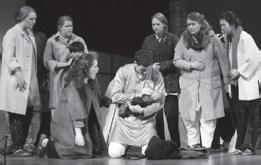
Traveling on a spaceship destined for a new planet makes perfect operatic sense to Stephen Taylor, associate professor of Composition and Theory. The University of Illinois Opera Department premiered Taylor’s opera Paradises Lost in April 2012 at Krannert Center for the Performing Arts.
“It just seemed like there are all of these science fiction books and science fiction movies and TV shows and opera has been really underrepresented,” Taylor said.
A science fiction buff, Taylor began exploring a variety of novels and short stories he could adapt into an opera. He ran across Ursula Le Guin’s short story Paradises Lost
“Although I like minimalism a lot, and composers like John Adams and Steve Reich are big influences, what I was really going for in the opera was a musical language that shares elements with popular artists like Bjork and Radiohead, two of my big favorites.”
– Stephen Taylor
and found the premise—which touches on both science and religion—intriguing. Taylor began conceptualizing the opera in 2003 and contacted Le Guin, who was supportive of the idea. After many drafts, workshops, and a librettist change, Taylor and librettist Marcia Johnson completed the work for the 2011-2012 opera season.
The opera follows a group of pioneers on the spaceship Discovery which is set to land on the planet Shindychew years in the future. All those aboard the ship were born there and have no conception of what life on a planet is like. A faction called Bliss challenges whether the ship is meant to land or not. Unexpectedly the pioneers realize that the ship has gained momentum, meaning it will land in mere days.
The passengers each must choose to either remain on the ship or live on the new planet.
To create music for such a plot, Taylor mixed musical characteristics from late twentieth century composers and popular artists. He also built electronic elements into the score to depict the sounds of the spaceship and space itself.
“Although I like minimalism a lot, and composers like John Adams and Steve Reich are big influences, what I was really going for in the opera was a musical language that shares elements with popular artists like Bjork and Radiohead, two of my big favorites.”
Taylor believes the premiere was a success and looks forward to staging the opera again in the future. In the meantime, in September he presented a paper on his work at the 100 Year Starship Public Symposium. He also looks forward to organizing a conference themed “Science Fiction and the Arts” at UI next year.
– Emily Wuchner, Associate Editor
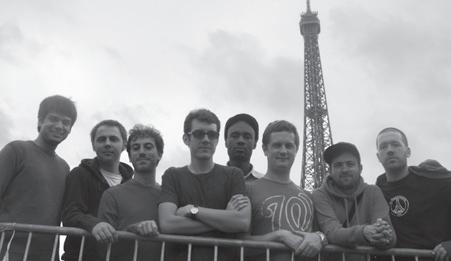
Members of the UI Jazz Trombone ensemble (l to r) Dan Pierson, Ben Ford, (friend), Joshua Torrey, Reginald Chapman, Euan Edmonds, Lars Larson, Sam Hasting (not pictured: Sam Peters, Alex Moraru) enjoy the sights in Paris this past summer. For its “homogeneous sound and impeccable rythm and smooth, seamless transitions” the ensemble won the Kai Winding Competition, sponsored by the International Trombone Association and was invited to perform and represent the UI Music Department and Jazz Division at the 2012 International Trombone Festival, held this past July at the Paris Conservatoire. The group also won the National Jazz Trombone Ensemble Competition and performed in March at the Eastern Trombone Workshop in Washington DC, sponsored by the US Army Band “Pershing’s Own.” The ensemble is directed by Professor of Jazz Studies Jim Pugh.
Photos: Hyungsul Kim
DoCha, downtown Champaign’s chamber music festival founded by University of Illinois School of Music professors, is now under the artistic leadership of Professors Stefan Milenkovich, Dmitri Kouzov, and Gabriel Solis with administrative support provided by Executive Director Paul Redman. DoCha is unique in its commitment to share chamber music with all people by offering free performances and educational outreach activities that are funspirited, engaging, inclusive, informal, and collaborative.
For the 2012 season, DoCha partnered with Julie Gunn, associate professor of accompanying, to expand on its engagement of talented young musicians in the Champaign County area. The result was the founding and creation of the University of Illinois School of Music Academy. Originally a pilot program, this comprehensive chamber music and music theory academy for musicians under age 18 was extremely successful and will continue in 2012-13. Designed to provide advanced young musicians with sustained training opportunities with School of Music faculty, the program also serves as an important recruiting mechanism for the School of Music and a way for the music faculty to further engage the public community beyond the campus.
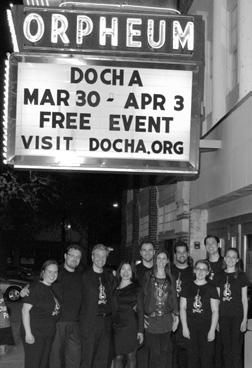
The 2013 DoCha festival will take place April 5- 7 at the Orpheum Theatre through its renewed partnership with the Orpheum Children’s Science Museum. The festival schedule will include three evening performances geared toward adult audiences featuring unique collaborations among University of Illinois music professors, music students, dancers, and artists.
DoCha has built a loyal and devoted following of audiences of all ages. Beyond a traditional chamber music festival, DoCha is a community project involving the participation and collaboration of many people and organizations. For more information visit www.DoCha.org
– Paul Redman, Executive Director, DoCha
PICTURE-PERFECT DAY FOR RAVINIA FESTIVAL
There has been a lot to celebrate at the University of Illinois recently, and for me it all connected on a picture-perfect day at the Ravinia festival in Highland Park, IL. If you haven’t been to the Ravinia Festival, you should consider attending. For the entire summer world-class artists and their fans—including Juilliard String Quartet, Stephanie Blythe, Diana Krall , and Garrison Keillor—converge at this park to celebrate the arts through concerts, masterclasses, young artists’ programs, fine dining, and over-the-top picnics.
My husband Nathan Gunn was slated to sing one of his favorite roles: Papageno, the birdcatcher of Mozart’s Magic Flute, with the Chicago Symphony Orchestra under James Conlon. This Magic Flute cast was stellar. Nathan was joined by the luminous Ailyn Pérez (Pamina), the titanic Morris Robinson (Sarastro), and the virtuosic Erika Miklósa (the Queen of the Night). I’ve had the good fortune to see a few semi-staged operas in my time, but on this occasion the CSO added something new: John De Lancie, of Star Trek fame, acted as narrator (and sometimes as scenery!) For me it was an excellent performance, especially with Nathan singing the entire role in a Hawaiian shirt and a baseball hat.
In addition to the musical treat, we saw many Illinois friends there: President Bob Easter with his wife Cheryl, Chancellor Phyllis Wise, Richard and Susan Herman, Dean Bob Graves, and Trustee Pam Strobel and her husband Russ. Alumni and friends were there as guests on behalf of the School of Music National Advisory Council, particularly Paul and Ginny Uhlenhop and Lynd and Gene Corley.
The Interim Director of the School of Music, Jeffrey Magee, gave a warm welcome to all guests, especially students from the new Chicago High School for the Arts (ChiArts.) The School of Music will be coming to Chicago for three special receptions this year at the Heritage Building by Millenium Park to introduce ourselves to students from ChiArts and the exciting program “After School Matters” and to reconnect with alumni and supporters. I hope to see you there!
– Julie Jordan Gunn. Associate Professor of Accompanying
Photos: Paul Redman
Development Update
Roger Laramee, Assistant Dean for Advancement, College of Fine and Applied Arts
Campaign provides financial resources to enhance “brilliant futures”
The past year has been a mixture of exciting achievements along with many changes in the School of Music. One major accomplishment is the successful conclusion of the University’s Brilliant Futures Campaign During the course of this effort, alumni and friends committed more than $1.6 billion to the Urbana-Champaign campus, and the entire University’s campaign final total was $2.4 billion. The College of Fine and Applied Arts surpassed its $70 million campaign goal with commitments totaling $83.4 million, and a total of $18.9 million was contributed on behalf of the School of Music during this University-wide campaign effort.
Of the $18.9 million contributed to the School of Music during the Brilliant Futures Campaign $6.5 million (34.5 percent) was unrestricted in support of the School while $5.8 million (30.6 percent) was devoted to assisting undergraduate and graduate students. Faculty support included $5.7 million (30.2 percent) and the remaining balance supported academic programs and facilities. It is especially significant to note the majority of this remarkable amount of generous funding will support the School of Music in perpetuity as endowment in the form of scholarships, fellowships, and faculty support.
Alumni and friends who contributed during the Brilliant Futures Campaign have provided resources that will change and influence lives. The impact of our donors’ philanthropic spirit will provide opportunities for future generations of Illinois students to have access to
transformative learning environments, influence from the finest faculty, and financial resources which make educational opportunities possible. Gifts made today will cause a ripple effect, will impact lives and will be the force behind “brilliant futures.”
Thank you to all the donors who contributed to the future of the School of Music at the University of Illinois. Their foresight and generosity will enhance the School and opportunities for students who will be our future scholars, musicians, and music educators. All of us look forward to witnessing how these investments create a brighter future.
School of Music Campaign Gift Commitments
A total of 11,311 gifts were made to the School of Music during the Brilliant Futures Campaign and were made by 3,454 alumni, friends, corporations and foundations. The collective impact of these donations will influence the School of Music for generations to come. Listed below are the new School of Music funds donors established during the campaign with the University of Illinois Foundation:
Ann and Ralph Mason Endowed Fund in Music
Dalheim Memorial Scholarship
Daniel J. Perrino Chair
Dee Wood Frame Excellence in Music Award
Donald E. Messman Trust for the Marching Illini Band
Doris Vance Harmon Scholarship
Dorothy A. and Claude R. Langford Endowed Chair in Music
Dr. Charles Leonhard Endowed Fund for Excellence in Music
Drumline Scholarship Fund
Edmund C. Williams Excellence Award
Edmund Plaszczykowski Memorial Scholarship for Excellence in Music
First and Foremost Bands Fund
G. Jean Sutter Music Education Scholarship
George M. Unger Endowment in Music
Gerald and Linda Anderson Music
Education Scholarship
Ginny Sherman Memorial Scholarship
Glen Strauss and Krista Tesreau Allerton Music Barn Festival
Gregory S. Vasich Memorial Endowment
Harry Begian Assistantship in the Department of Bands
Howard A. Stotler Graduate Fellowship
IBQ Brass Scholarship
James R. and Candace Penn Frame Endowment
James Russell Vaky Merit Scholarships in Music
Jerry Hadley Memorial Scholarship
Jessica Brennan Clark Scholarship
Joe Bartkowiak Memorial Scholarship Fund
John Garvey Jazz Scholarship
Josephine Daniel Endowment Fund
June and Charles Ross Piano Fellowship
June and Charles Ross Piano Restoration
LT Spence Scholarship
Martha S. Beerman Endowment Fund
Mather Other Guys Performance Fund
Michael E. Ewald Memorial Scholarship
Nicholas Temperley Award for Excellence in a Dissertation in Musicology
Presser Foundation Fellowship in Music
Robert Earl Thomas Award in Music Education
Roger R. Cunningham Fellowships
Stephen Blum Endowment for the Robert E. Brown Center for World Music
Steven Schankman Family Endowment in Jazz Studies
Susan Starrett Chair in Violin
Thelma Willett Piano Scholarship
Trotter Endowment Fund
Varsity Men’s Glee Club Scholarship
Virginia Summers Harroun Trust
Wert Music Advocates for Young Artists Award
The importance of private gifts to the School of Music increases every year. The State of Illinois provides basic operating revenue for the University; however, support from state government covers less than 14.6 percent of the total budget. So gifts from alumni and friends are crucial to provide the margin of excellence that distinguishes the UI School of Music. We continue to evaluate new opportunities and programs that will help to ensure our position as one of the leading music schools in America today. To reach our goals and to provide the best possible education for our students, we must have the proper resources in place. The following items represent the current needs and wishes of the School of Music:
Scholarships and Fellowships: Continued excellence depends in part on attracting the most talented students from across the nation and around the world. To remain competitive among the leading schools in the country, we must be prepared to assist exceptional students.
Chairs and Professorships: Endowed chairs and professorships serve as effective tools with which to recruit and retain scholars and performers. Renowned members of the faculty attract the most talented students and the brightest minds to study at the University of Illinois. As artists and scholars, such faculty members contribute to the world of research, creativity, and learning that are the University’s principal missions.
Building Infrastructure and Equipment: Maintaining facilities and equipment for our students and faculty takes considerable resources. To be competitive with our peer institutions, we must continue to have outstanding facilities and performance venues.
Opera Sponsorship: The School of Music produces two full-length operas each year. An opera production takes considerable time, effort, and money—often in excess of $60,000. While ticket sales cover about half the cost of each production, additional support will provide both student performers and audience members with operatic experiences comparable to those found in major cities, while keeping ticket prices reasonable. There are several specific giving opportunities available for opera sponsorship each season.
Unrestricted Gifts: In these ongoing times of economic uncertainty, the School of Music, like all institutions, needs the flexibility to manage our financial resources in strategic ways that continue to provide our students with the best possible education. An unrestricted gift will allow the School of Music to invite visiting guest artists to give master classes to our students, showcase our student ensembles in run-out performances outside of Urbana-Champaign, assist faculty with recruiting the best students in the nation, and much more. Consider making an unrestricted gift to assure that your support goes where it is most immediately needed.
We hope you will consider making a gift. If you are interested in funding projects such as these or would like to explore other opportunities, please contact the School of Music’s Development Office at (217) 333-6452.
WATCH FOR THESE UPCOMING ALUMNI RELATION EVENTS
Alice Campbell Alumni Center 601 S. Lincoln Avenue, Urbana 12:00–2 p.m. Ballroom
Outreach Update
David Allen, Outreach and Public Engagement Director/Clinical Assistant Professor of Music Education
Dan Perrino’s memorial event was a wonderful tribute to a great man. I’m sure that I speak for many who attended when I say that even if you think you knew a lot about Dan, you only knew a slice. In order to see the whole pie, you would need to interview the multitude of people who knew him personally and knew his work. Those of us who work to plan and promote our engagement programs are well aware of his work in Continuing Education and Public Service, and especially his work with Illinois Summer Youth Music. As Joyce Griggs and I prepared an article for the 2009 edition of Sonorities, Dan was instrumental in giving us a feel for the ISYM that once lived in Allen Hall and held concerts under the “Big Top.” His dedication to engagement through music is something we should all keep in mind as we engage through music.
Speaking of engagement through music, ISYM 2012 was a huge success as we increased our enrollment by 100 participants. Our Pre-College series and ISYM Academy continue to attract young musicians who are looking for a musically challenging and fulfilling one-week experience. Another attraction that our 2012 participants enjoyed was the addition of ukulele lessons to our electives line-up (see the entire list of electives at www.ISYM.music.illinois.edu). We plan to expand this for ISYM 2013 to fit demand. Our newest week-long programs for 2012 were Composition/Electronic Music and Rock Band/Song Writing. Both went wonderfully and I am happy to say we will be offering these programs again in 2013.
Finally, we had a record number of participants who took advantage of back-to-back sessions. This appeals to young musicians who want to enjoy a large ensemble experience and also take part in an instrument specific program.
Our School of Music Academy for high school string and piano players has begun its second year and has proven to be an important addition to our engagement activities. The performance level achieved by these outstanding musicians was evident in their recital last May. Please take a moment to hear some of that performance at www.go.illinois. edu/SoMacademy.
In November 2011 we celebrated the 100 year legacy of Paul Rolland’s teachings. Dr. Michael Fanelli presented a talk entitled “Paul Rolland 2011: A Centennial Biographical Presentation of His Life and Work in String Education.” Peter Rolland shared many of Paul’s teaching videos as well as some wonderful stories about
growing up “Rolland.” Lynn Denig and Nancy Kredel presented master classes and Robin Kearton’s Bowdacious Strings ensemble worked with Peter Rolland on some music prepared specifically for the event. In addition to those already mentioned, distinguished guests included Marvin Rabin and Dan Perrino. The event description is available in the past events section of our Outreach and Public Engagement web page at www.music.illinois.edu/ outreach.
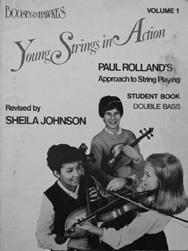
“Young Strings in Action” (c. 1985) is one of Paul Rolland’s method books for beginners.
Finally, I would like to thank all of our Alumni who support our current students through shared opportunities and career networking. Our representation in music is strong across the nation and daily I see the work of our graduates, whether they serve as cooperating teachers, advisors, or colleagues, to our newest graduates.
While there will be few who ever touch as many lives as those touched by Dan Perrino, many of our graduates (myself included) strive to provide for others opportunities to be a part of the rich traditions and resources of Illinois.
Public Engagement Programs for 2013
High School String and Orchestra Clinic
February 9
Foellinger Great Hall, KCPA
High School Chamber Music Symposium
April 5-6
TBD
CU Symphony-Young People’s Concerts
April 10-11
Foellinger Great Hall, KCPA
Superstate Band Festival
May 3-4
Foellinger Great Hall, KCPA
Illinois Summer Harp Class
June 6-8
School of Music
Illinois Summer Youth Music
Session I - June 16-22
Session II - June 23-29
Session III - July 7-13
School of Music
SOUNDS FROM JUPITER
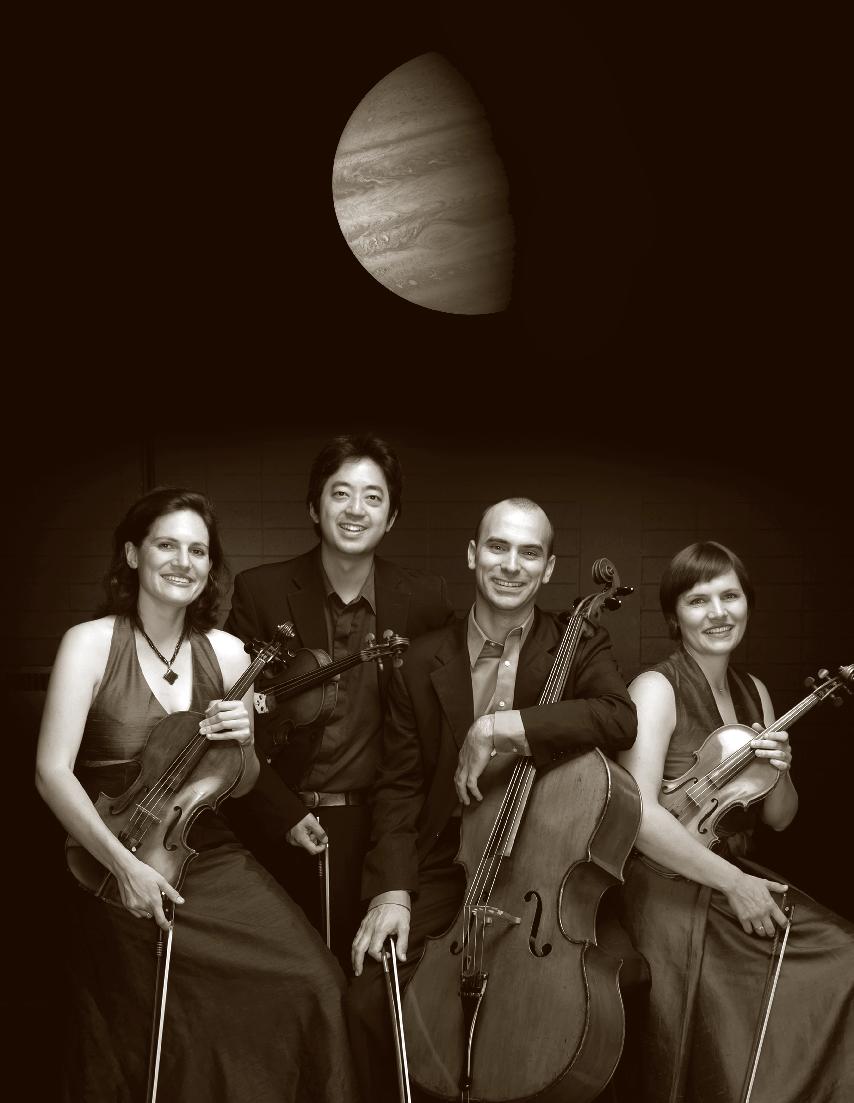
The Jupiter String Quartet is ready to give a world of music to students and the community as the new string quartet in residence at the University of Illinois.
By Emily Wuchner
“What these young players brought to the Schubert was both energetic firmness and fine nuance, qualities that served the opening movement and the extended set of variations in the slow movement beautifully.”
– THE NEW YORK TIMES
While a barn is not the first place you would expect to hear a professional string quartet, it seems to hold a special significance for the Jupiter String Quartet.
The quartet debuted as an ensemble at the Yellow Barn Music Festival in Putney, Vermont in 2003. Nearly 10 years later, in the big red barn at the Allerton Music Barn Festival, the quartet made its debut as string quartet in residence at the University of Illinois.
Composed of violinists Nelson Lee and Meg Freivogel, violist Liz Freivogel, and cellist Daniel McDonough, the group serenaded a sold-out crowd with music by Ravel, Webern, and Schubert.
“We had a great audience; they were very attentive,” Liz Freivogel said. “When we’re playing we can tell they’re right there with us. It lets us do things we wouldn’t normally do. It’s a beautiful setting.”
Though the quartet found their first performance venue in Champaign-Urbana charming, they are eager to call the Krannert Center for the Performing Arts and the community itself home.
Originally based in Boston, MA, the quartet is particularly close as Meg and Liz are sisters and Meg is married to McDonough. All grew up listening to classical music and taking individual lessons, but each member was drawn to the collaborative nature of the quartet genre.
Freivogel said, so that all members can contribute individually while also working together to create a unified sound.
“I love that (the string quartet) combines your own voice—one on a part—you can really have that individuality, but you’re contributing to a larger whole” Meg Freivogel said. “And because of that it is always changing, your mind is working in a creative way so you are initiating something, but you’re also always reacting to each other. I think that’s a challenge and also the beauty of it.”
The group spends significant amounts of rehearsal time discussing how they want to communicate specific feelings through the music. Determining and developing the energy of the music is crucial, Meg Freivogel said. Such concepts are also discussed democratically so that everyone’s ideas are considered.
“One thing that we talk about a lot is becoming the character of the music in a theatrical way,” Meg Freivogel said. “Not in the way you move, but actually embodying the spirit of the music, so especially when we are performing, that’s what we’re trying to feel and we’re trying to get across. So we really strive for that and let the technical things fall into it, and I hope that comes across in our sound and in our interpretation.”
Lee, Meg Freivogel, and McDonough met as students at the Cleveland Institute of Music, where they occasionally played together in chamber ensembles. When the trio of friends decided to form a string quartet, they needed a violist to complete the group. Meg suggested Liz, who was studying at the nearby Oberlin Conservatory. In 2001 the ensemble began in the intense String Quartet Training Program at the New England Conservatory. The program focuses solely on string quartet playing and trains groups who intend to work together for years to come.
“It was a way for us to really connect as a quartet through sound and technique, blending sounds and playing off of each other,” Liz Freivogel said. “It was a great experience.”
The quartet gained inspiration for its name from the planet Jupiter, which prominently shone in the sky when the ensemble formed. The connections can be extended symbolically, as the astrological symbol for the planet resembles the number four, and musically to Mozart’s “Jupiter” Symphony and Holst’s The Planets
The techniques they learned through the String Quartet Training Program continue to influence how they unite as an ensemble and create a distinctive sound. The quartet strives for a democratic voicing, Meg
Lee adds, “It’s hard for us to have perspective on our own playing sometimes because we’re so caught up in what we’re doing. We don’t necessarily try to distinguish ourselves in a different way. I think we just try to be ourselves as much as we can. We try to present the most communicative and personal interpretation of the music that we identify with. And whatever happens after that, we just let that carry over into the audience into how people react.”
Beethoven, Bartók, and Britten are among the quartet’s favorite composers to perform, and last summer they performed Beethoven’s 16-quartet cycle in just 10 days. In commemoration of Britten’s 100th birthday next year, they plan to frequently play his three quartets. They try not to limit themselves to one specific era, style, or composer, and often commission new music, which is evident in their diverse repertoire.
When building concert programs, the quartet strives to find creative, often less obvious ways of linking seemingly unrelated pieces. While this requires a lot of research, the process allows the ensemble to better understand the historical side of the music and what inspired its composition. These ideas are detailed in the program notes, often written by the quartet, allowing the members to share their thought process first-hand.
Similarly, the quartet has found creative ways to connect the works featured on its two CDs. The first album, released in 2007, focuses on the
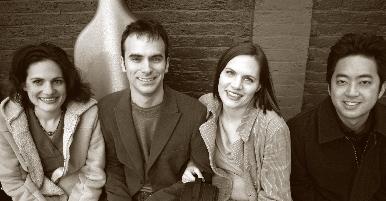
The Jupiter String Quartet, including (l to r) Liz Freivogel, Daniel McDonough, Meg Freivogel, and Nelson Lee, met in 2001 and have been collaborating since.
“Every so often a performance leaves us in awe of its loving sophistication, its attention to the finest details of balance and expression. That’s how it was with the Jupiter String Quartet’s performance Monday night of a Haydn F minor String Quartet (Op. 20, No. 5).”
powerful and personally reflective quartets written by Shostakovich and Britten during WWII. Its most recent album, released in 2009, includes the last quartets of Beethoven and Mendelssohn, which the quartet’s research yielded surprising results. While one might expect Beethoven’s final quartet to be dark and dismal it is cheerful, and the typically lively Mendelssohn’s final quartet is sorrowful and turbulent.
Since its formation the ensemble has focused on touring and festivals, but it also has fulfilled temporary university residencies which typically includes short visits and concerts throughout the year. Securing a permanent residency has always been an important goal, not just for the playing opportunities but also for the chance to join and contribute to a university community.
“When you’re a quartet you do a lot of traveling to perform, and it can feel like you don’t have any roots,” Liz Freivogel said. “We really liked the idea of building our own community to play frequently for the same people and students to teach on a regular basis. Having roots somewhere is something really appealing to us.”
coach chamber music and the ensembles there. Hopefully we’ll be able to share our passion for music-making with them,” McDonough said.
Ultimately, the members of the quartet view themselves as ambassadors for the University and the region. They hope that through their frequent travels they can promote the University and attract students to attend the School of Music. The quartet is also interested in collaborating
Before being awarded the position at the University of Illinois, the quartet scheduled performances for the next two years. Despite its frequent upcoming travels, the ensemble scheduled performances at Krannert Center as well as collaborations with cellist Dmitry Kouzov, pianist Ian Hobson, and the Illinois Wind Symphony. McDonough said these collaborations were organized even before the members began packing for the move from Boston.
“We’ve gotten so many nice emails from faculty, staff and students who I think are excited, and they kind of want to get the ball rolling, and they want to plan great music and great concerts,” McDonough said. “It’s a nice feeling. Even the guy who helped me buy my house wanted to know when we play.”
Besides performing and touring, teaching their own studio is a new responsibility for the quartet members. All are eager to get to know their students, help them improve their playing, and share their love of music.
“I think all of us have always loved teaching, so we are excited to both teach individually the talented students at the University and also get to
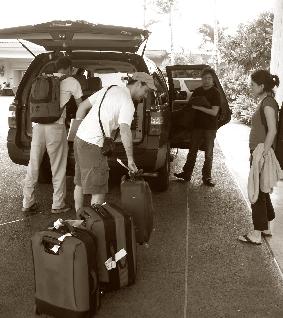
Though their perfomances take them to exotic locations around the world, Liz Freivogel speaks for the rest of the quartet when she states: “We really liked the idea of building our own community to play frequently for the same people and students to teach on a regular basis.”
with other areas of the University, to strengthen ties campus-wide. Their Sept. 11 commemorative performance was one way the quartet linked the community and the University. Liz Freivogel said the strong community ties will help the quartet better invest in outreach and concerts, such as Allerton Barn Music Festival.
Ten years ago a yellow barn initiated a new beginning for the Jupiter Quartet. Now a red barn marks another new journey, which they hope to share with audiences throughout the campus, community, and region.
UPCOMING PERFORMANCES
February 17, 2013
Recital at Krannert Center
Schubert Quartet in Eb D. 87
Britten Quartet no. 1 in D major op. 25
Dvorak Quartet in Ab major op. 105
April 13, 2013
Chicago Chamber Music Society
Mozart Quartet in D major K. 575
Brahms Quartet in C minor op. 51 no. 1
Vist www.jupiterquartet.com to see a full performance schedule.
Emily Wuchner is a Ph.D. student and graduate teaching assistant in musicology. She earned her B.A in Journalism and Music from Murray State University in 2009 and M.A. in Musicology from the University of Tennessee at Knoxville in 2011.
– THE DALLAS MORNING NEWS
All photos courtesy of the Jupiter String Quartet.
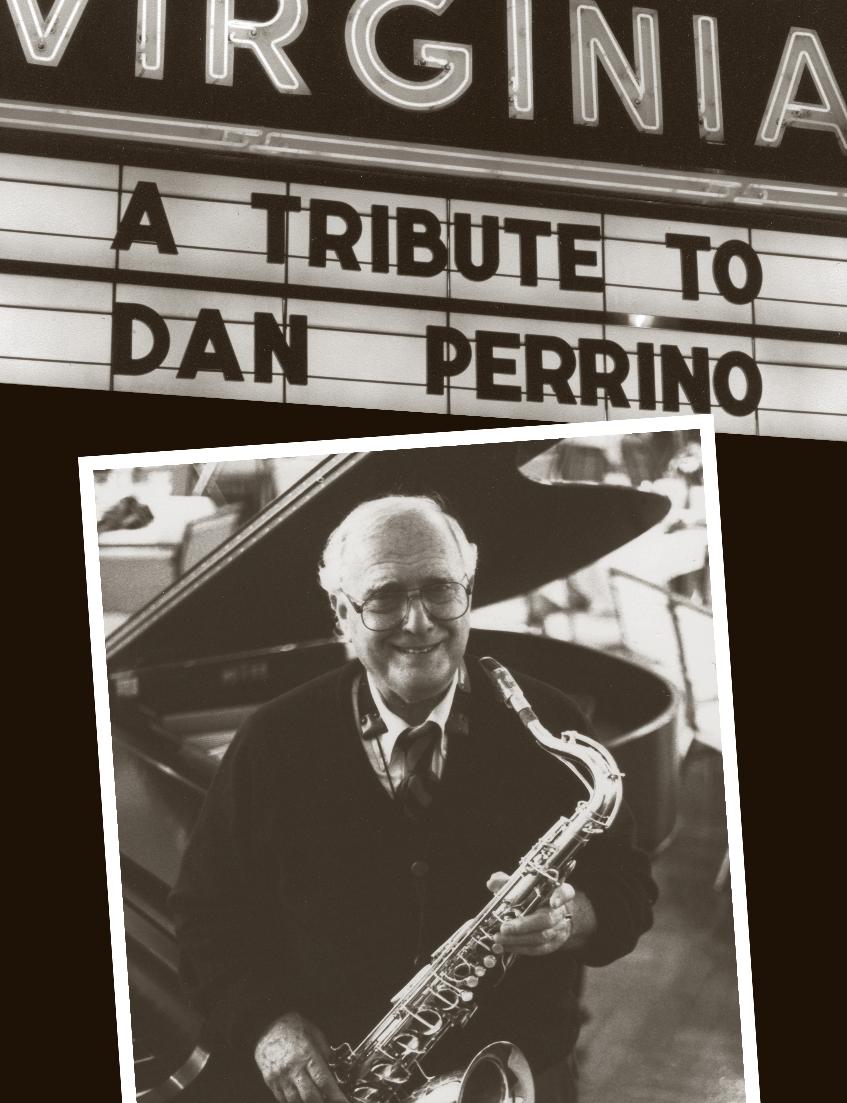
(APRIL 15, 1921–AUGUST 17, 2012)
DANIEL J. PERRINO
Danny Boy
Danny Boy
A look at the life and legacy of Dan Perrino
by Anne Mischakoff Heiles
Music, Perrino always insisted, was his passion, and his life was celebrated in music performed by the Illinois Wind Symphony (conducted by Robert Rumbelow), the Black Chorus (directed by Ollie Watts Davis), students he had mentored, and a re-gathering of his Medicare 7, 8, or 9 jazz ensemble colleagues. The formation of this ensemble holds a special significance in the history of the University and the community.
In 1969 Perrino was in the second of what would be six years as Dean of Student Programs and Services. From his office on the corner of Oregon and Matthews, just south of the old chemistry building, he could see students demonstrating against Dow Chemical for its production of napalm and Agent Orange, used in the Vietnam War. When the Claybaugh Act forbade subversives from speaking on campus, still more students came out to protest. Students questioned the relevance of their courses; they distrusted administrators.
Medicare 7, 8, or 9, sometimes called Perrino’s signature achievement, began on November 20, 1969, as an effort to overcome that growing distrust among students, faculty, administrators, and the CU community. The wariness had first bubbled up earlier in the 60s with battles for Civil Rights and wider participation in university governance, as well as against the Vietnam War. Activist students swapped their neatly pressed khakis, tobacco, and crew cuts for dirty jeans, marijuana, and long hair. Peaceful demonstrations and sit-ins turned more violent after enactment of a draft lottery, assassinations of Martin Luther King, Jr. (April 4, 1968) and Robert Kennedy (June 6, 1968), and ensuing riots in Chicago, Detroit, and elsewhere. Tension built on campuses across the country.
resolve the problems. “Of all the administrators on campus, Dan Perrino was probably the only one that people totally trusted because he had no agendas. Even if students wanted to stage a protest, Dan would find them a public address system,” former Dean of Students Hugh Satterlee said. “He was the best-liked administrator that I knew of, bar none.”
“He would be going to a meeting at the Union,” Broom recalled, “and I’d be going with him because he needed me to carry something. But it would take us 30 minutes to walk the two blocks.” Long-haired activists, gray-haired faculty, student newspaper editors, and others would stop and talk with him. “Instead of answering ‘No’ to requests, he would say, ‘Let’s talk about that.’ Dan was the only person not considered one of ‘them’ but rather as someone trusted by both students and administration.”
In” for “Danny Boy” on September 9, 2012 at a memorial celebration of Daniel Perrino’s life, hundreds of his family members, former students, colleagues, and friends paid tribute to him with sadness along with warmth and joy in their memories of the beloved man. As an administrator Perrino was near legendary, but he was also recalled as so much more: teacher and mentor, husband and father, conciliator, and sparkplug for at least a dozen programs. But he is remembered especially as a musician.
Perrino and his staff had ears to the ground: the students reporting the campus talk back to his office. According to Willard Broom, then a junior and later Associate Dean of Students, Perrino and his staff sought ways to
Perrino’s answer to many of the students’ concerns was to start or facilitate an array of programs. One was a Rumor Center, modeled on the mayor’s program in Chicago, which began in Perrino’s office in March 1969 and was run by students. Its intent was to observe what was actually occurring on campus to quell exaggerated or false rumors reported locally and elsewhere.
Faculty and administrators had become fearful of demonstrations turning dangerous and even of some activist leaders. Perrino worked to have them meet face to face with the activists. For example, he introduced one frightened dean to John Lee Johnson, a black community leader, over drinks at the Capital Bar (later the site of Murphy’s).
After students began throwing rocks and breaking windows on the campus and Green Street, he brought together business people and students for talks. Soon student volunteers were standing in front of storefronts to protect them.
Students had taken over the South Lounge of the Illini Union building as the stage for their speeches. Perrino and his staff first established a “ When the Saints (Went) Marching
Dialog program, with prominent faculty members sitting in the Lounge and talking about “anything the students wanted to talk about.” As Perrino recalled, during one such Dialog session, trumpeter and music professor John O’Connor “came by and said, ‘How are things going?’ ‘Well,’ I said, ‘I think they are going OK, but there is a lot of tension here.’ And he said, facetiously I thought, ‘What you need here is some jazz.’ So we got a group of faculty members together and went there. We played jazz, and it opened up a new avenue for discussion.”
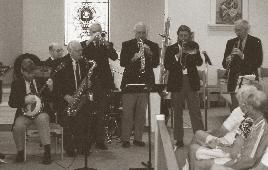
Jamming unrehearsed Dixieland, the band was a mix of administrators (Dan Perrino as announcer and on saxophone, Stan Rahn on clarinet and as vocalist, Art Proteau on banjo), faculty (John O’Connor on trumpet; Mo [Morris] Carter on trombone), and students (Terry Gates on tuba, Charles Braugham on drums, Larry Dwyer on piano, Willard Broom adjusting sound levels). Some 75 student listeners grew to a standing-room-only crowd of 500. When a reporter asked Perrino how many players were in the group, he said, “Seven, eight, or nine, depending on how many show up.” Rahn added, “Well, I guess considering our ages, you could probably call us Medicare 7, 8, or 9.” According to then-Chancellor Jack Peltason, the band closed the generation gap, the town-gown gap, and the racial gap.
“I wish I could say that was exactly the way we expected it would happen. We didn’t know,” Perrino said many years later. “That first [performance] could have triggered something negative, and then it would have been a complete bust for us and I might have been demoted! We were lucky that things didn’t go the wrong way, but I think it is a credit to the staff we had,” acknowledging Willard Broom, Dave Bechtel, and other students. “They all felt that need for communication because they knew that as long as you are talking to one another, you aren’t shooting one another.” Eve Harwood, retired Professor of Education and Associate Dean of Fine and Applied Arts, commented, “It was an incredibly brave thing to do; they could have just got laughed out of the Union or got spitballs. It took some vision and it took some guts.”
Over the years Medicare 7, 8, or 9 gave more than 2,000 concerts across the nation in all sorts of venues—for alumni groups and for youngsters, from Krannert Center to Wrigley Field—Perrino managing the scheduling, programming, and rotation of well over 100 musicians. Louis Liay, Executive Director of the Alumni Association, wrote, “They are the greatest ambassadors the UI has ever had.”
One of the graduate students who played trombone with Medicare in the mid-1980s was Erik Lund, now a professor of composition: “I quickly learned what a special man Dan was,” Lund recalls. “On one occasion Medicare played in the Chicago area, and my parents came to the concert. I introduced them to Dan, and he promptly invited them to dinner with the band. They were stunned by Dan’s immediate and genuine generosity and hospitality. I was fortunate enough to travel with Medicare to the East Coast, where I was amazed to see how Dan seemed to know people everywhere. And when our hosts introduced Dan and the band at our concerts, in city after city, the outpouring of love and respect for Dan was always abundantly evident.” Another young trombonist to play with Medicare was composer Morgan Powell, who went on to enjoy a warm friendship with Perrino and to play at his memorial.
“Dan was ‘Mr. Outreach.’ I immediately took to him because both of us had parents who were born in Italy and teachers who opened the doors for us. At one Philharmonia concert that I conducted—an evening concert that he came out for when he was already 85— he came backstage to greet me, which really touched me. I asked, ‘Well, Dan, how did you get here?’ and he said, ‘By cab.’ And I said, ‘We’ll give you a ride home, please.’ ‘Oh, I’ll just call a cab.’ It was at least 9:30, so we insisted. Over the years I ran into him at SoM events. Last year I was the recipient of the Daniel J. Perrino chair in music education. And he came up to me on the street this past year, saying, “Hey, you have my chair!”
– Louis Bergonzi,
J. Perrino
Another program Perrino began in response to the unrest was Quad Day. The first one in 1970 included representatives from campus activities and organizations, including religious organizations and the YMCA. With Frisbees flying, a Yo-Yo competition, Slip and Slide with plastic and soapy running water, volleyball games, and music making, students, police, administrators, and faculty were all talking with one another. It was “like a county fair,” Willard Broom said.
Louis Bergonzi, Professor of Music Education who also holds the Daniel J. Perrino chair said, “It wasn’t that he ignored the issues: the issues were still there—Civil Rights, poverty, the Vietnam War—but he focused on the people. He wasn’t out to cure poverty or stop the war; he wanted to attend to people and bring them together and diffuse the [tension] so that progress could be made on those issues.”
Daniel
Chair in Music Education, Professor of Conducting and Music Education/Strings and Conductor of the UI Philharmonia Orchestra
“It’s one thing to get a program running when you’re in charge of it; it’s another to get it institutionalized, which means you have the vision to see something that really needs to happen and you get other people to buy in so that it outlasts you. That’s rare.”
Perrino assisted in the creation of La Casa Cultural Latina to recognize the contribution of Hispanic and Latino/a students, faculty, and staff at the University and in the central Illinois region. He initiated programs and activities that would complement their education.
Between 1961 and 1967 Perrino also became involved with the Civil Rights movement and the black community. He assisted in the creation of the African-American Cultural Center (established in 1969), providing a support system for students with advising, counseling, program planning and implementation. Another program he worked on was the Project 500 (1968) to provide equal educational opportunity to black and Latino students to attend UI; that year 565 students began studies in the program.
“Dan loved mentoring minority students and others who felt they were getting overlooked, and he found unusual, creative ways to get things going if they were needed,” Eve Harwood said. “That’s a gift as an administrator. He could get a system in place that lasts. It’s one thing to get a program running when you’re in charge of it; it’s another to get it institutionalized, which means you have the vision to see something that really needs to happen and you get other people to buy in so that it outlasts you. That’s rare.”
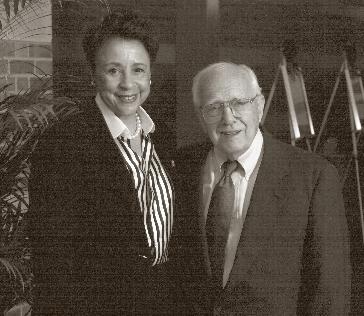
Among the many UI students Perrino mentored was a violinist named Sheila Crump Johnson who went on first to become director of the Youth Strings in Action, co-founding partner of Black Entertainment Television, CEO of Salamander Hospitality, a noted philanthropist, and much more.
Johnson was awarded an Alumni Achievement Award in 2008. She gave $4 million to endow two SoM chairs, one of which she stipulated should be named after her mentor, Daniel J. Perrino.
Perrino received numerous awards, including the Alumni Association’s UI Distinguished Service Award, 1981; the Governor’s Award for the Arts in Illinois, 1982; the School of Music’s Distinguished Alumni Award; the Chancellor’s Medallion, 2001; and the Lou Liay Spirit Award, 2002, from the UI Alumni Association. “Over the years I have been fortunate to get nice awards and plaques,” Perrino said, “but the one that I probably appreciated more than any is a little plaque signed by Terry Townsend, thanking me for whatever I was doing at the time by the black community.” Perrino had helped start a drum corps and music guitar lab in the community, and helped organize the Twin City Gospel Choir.
In 1968 four black students stopped to talk with Perrino, sharing with him their wish for a choir on campus similar to ones they knew in larger cities that “gave the level of comfort and familiarity available in singing spirituals, gospel music, and anthems.” That led him to help them establish the Black Chorus, first directed by Robert Ray. Professor Ollie Watts Davis, who has directed the group since 1981, relates how fortunate she has always felt in having had Perrino’s support and encouragement of the Black Chorus and her career, as a student and as a faculty member and concert artist. “He was so gracious, gentle, and kind, and his demeanor and commitment to music students and his community continue to inspire me.” Perrino sent her the recordings he had kept of the Black Chorus’s early years—and she kept the version of “Happy Birthday” he wrote out and mailed her. Just last April 2012, he attended the Awards Luncheon, and Davis was able to sing “Happy Birthday” back to him when he had just turned 91. ***
Perrino was a middle child, born Vito Joseph Perrino. His father, Dominick, immigrated to the U.S. by himself at age 10, going to South Dakota to work with the railroad, eventually settling on the southwest side of Chicago, and marrying Pietrina DiVincenzo, another Italian immigrant. Vito’s sister disliked his name and introduced him on his first day of kindergarten as “Danny;” the name stuck (he changed his name legally to Daniel only in 1982).
The family lived near what is now Midway Airport in a blue-collar melting pot of a neigh-
Perrino with distinguished alumna Sheila C. Johnson—a noted entrepreneur, philanthropist, and musician—who established the Daniel J. Perrino Chair in Music in 2009.
“Many of Perrino’s accomplishments within the SoM have become so deeply rooted that it is hard to imagine that they were all the initiatives of this one administrator.”
borhood where they were the only Italians. Music featured prominently in the family home. Even during the Depression, Perrino’s father managed to take him to the opera, vaudeville, and to hear Bing Crosby, Fanny Brice, and Guy Lombardo: “Guy Lombardo’s was a very popular big band, and I saw the front row of shining gold saxophones, and that was what I wanted to play. So my father bought me a soprano saxophone for $25.” Young Perrino began solfège lessons from a friend of his father’s, who told him he should study piano. Danny stood up for himself and insisted also on playing saxophone. He studied at Chicago’s Hull House.
It was a tough neighborhood, however, and in the seventh grade Perrino joined a gang for protection and because it had a softball team. He suffered a lot of bullying, probably not only because he was of Italian descent but also because he was short. He walked around with rocks in his pocket or carrying a stick; one “weapon” of choice against bigger boys was tomatoes with rocks in the middle of them. He found himself in plenty of tight spots trying to escape bullies, and once he was caught in a sewer where he was rescued by a policeman and then, to add insult, severely reprimanded in public by his dad.
Perrino attended Kelly High School. One day someone stole his saxophone and the books from his locker. When Dan heard that he would have to pay for the books, he thought he should be reimbursed for at least the instrument. “I told (the principal) he was crazy if he thought I was going to pay for my stolen books and he wasn’t going to pay for the horn.” The principal slapped him for his insolence, and Perrino’s “knee-jerk reaction” was to kick him in the leg and run. He was sent to the large, all-boys Tilden High School in “enemy territory” near the stockyards, “one of the roughest neighborhoods in Chicago.” After one particular run-in with bullies, Perrino cut school for 78 days, hiding in movie theaters. His sister finally arranged a meeting that allowed him to transfer back to Kelly, which by then had a new principal.
Austin Harding’s band. But Germany occupied Paris, and was moving into Greece. “I remember in a speech class I had to defend why I was a nonisolationist,” he said, recalling how he received a failing grade from his isolationist teacher. “In those days you were thinking about the war and seeing classmates going off to it.
“My roommate . . . told me that he thought it would be good for me to make sure I got in the ROTC to work toward getting into the officer corps.” Perrino signed up and in January 1943 attended Office Candidate School. “I fell in love with the ROTC program. It really helped me with leadership opportunities, and I attribute any kind of administrative success that I’ve had to my work in the Army. I learned an awful lot being in the military. I ended up a commanding officer in Europe and the Pacific and came out a Captain.” Perrino also attributed his drive, assertiveness, and creativity in his subsequent administrative career to his wartime experience.
Stationed as a communications officer in the Southwest Pacific Theater with the 77th Division, Perrino remained there during the occupation of Japan until 1947. He was asked to lead an army dance band to help boost the morale of the American troops and bridge the gap between the American and Japanese people. For six months after the Japanese surrender, he led a musical group that toured Japan.
“I remember we were getting ready to leave on the train for Sapporo,” Perrino said, telling one of his favorite stories from the occupation days. “There had been a foul-up. We were supposed to have a reserved car for all 22 band members, performers, and our instruments, but it turned up full of Japanese civilians. And you have to remember at that time, Japanese railroad cars …were much, much smaller than American ones, so things were pretty tight. Well, the Japanese travel master wanted to pull all of these people out of the car so we could board, but I told my interpreter that perhaps we could all fit.
Perrino led a dance band at school and by the time he graduated in 1939, he had already played jazz in a variety of clubs and theaters. He acquired the nickname “62 inches of Swing.”
After a year at the University of Chicago and the Chicago Musical College, Perrino transferred to UI in fall 1940, drawn to it by hearing A.
“It was a pretty tense situation. Pretty soon, one of (the band members) hauled out his guitar and started strumming it to demonstrate a certain chord progression. Then, out came other instruments…and pretty soon we had a jam session going. When the music started, it just broke the tensions. Smiles started to break out on the faces of the Japanese, and before we knew it, all this food…started coming at us.”
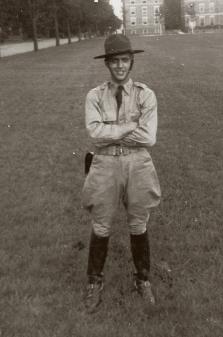
Perrino in the UI ROTC horse artillery. Ironically, he had never ridden a horse before joining.
It was in Japan that Perrino discovered his own ambition to be a teacher when he began organizing community music groups and acquainting children with American music. He also arranged for the GIs to combine voices with a women’s chorus for a Christmas program, complete with a Santa and “Jingle Bells.”
After 42 months in the service, Perrino returned to finish his BME degree in 1948 and MS degree in 1949. He met his lifelong partner, Marjorie Aileen Galutia, who was first chair saxophone in the UI band. Two weeks after graduation, in 1948, they were married. The couple went on to have three children: Donald, Michael, and Debbi, as well as three grandchildren, David, Liza, and Carie.
With his degrees completed, Perrino was hired as director of music and conductor of the band at Macomb High School (1949-51). He was recruited away to become director of bands and music education at Quincy High School (1951-55), and then to assume the same position at Urbana High School (1955-60).
Steve Shoemaker, who was a trombonist in the UHS band, remembers that Perrino led the players in Tchaikovsky’s “March Slav,” Respighi’s “Pines of Rome,” and even works by Shostakovich, unusual band repertoire for the 1950s. “The students loved him. He was enthusiastic, listened, and cared about us. He started a jazz band that played at Friday night dances and at the ‘Stage Show,’ an end of the year talent show with singers, dancers, and yes, even Rock & Roll student groups. He taught me to appreciate all types of music.” The 1959 high school yearbook was dedicated to Perrino. Shoemaker, retired as minister at McKinley Presbyterian Church/Foundation and executive director of the University YMCA, says Perrino exemplified “the Rotary Club mission of building bridges and avenues through service.”
such patience for young people,” Ebert wrote. “I clearly remember having an attack of nerves as emcee for one of his band concerts, and how did he handle it? He asked me again for the next one.” In an interview in June 2012, Perrino told Jeff Bossert how special Ebert was as a student, “always thinking and fitting the right statement in the right place. Sometimes when you get somebody who is an emcee, they talk too much.” About six years ago, Perrino sent Ebert a cassette tape of that second show, which he had saved for nearly 50 years!
Perrino was happy at UHS so that when the UI School of Music’s director invited him to join its faculty, he first declined. But his former advisors took him out to Steak ‘n Shake and told him: “You can’t turn down a university job.” In February 1960 he accepted a joint appointment as Assistant Professor of Music and Music Extension.
Perrino missed the interaction with students. The next year, however, he became director of Music Extension and the Illinois Summer Youth Music programs, where he had contact with both high school and university students. He brought energy to the Extension program, helping to arrange tours for ensembles, increasing enrollment in ISYM, establishing in-service training programs for teachers, and setting up workshops for student singers and instrumentalists.
Roger Ebert was another UHS student when Perrino asked him to emcee the “Stage Show” in 1956 and 1957. In his debut evening as emcee for the band’s performance, Ebert was understandably quite jittery. “He had
After Perrino’s tenure as Dean of Student Programs and Services, he became Associate Dean of the College of Fine and Applied Arts in 1976. When he heard that “the students were indicating that they needed to get involved in more creative experiences,” Perrino designed and taught a popular course called “Exploring the Arts.” Eve Harwood, one of his administrative successors at FAA, said “It’s a legacy course that continues for non-arts majors to get a taste for the arts, usually three different ones.” They might be anything from Kabuki theatre, glass blowing, jazz, or dance notation, to architecture.
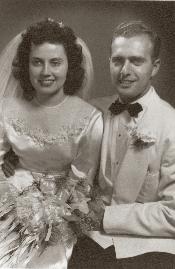
With bride Marjorie in 1948.
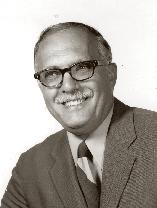
Perrino as Dean of Students.
Perrino (right) as director of Music Extension and the ISYM program in 1961.
Courtesy of the University of Illinois Archives.
Courtesy of the University of Illinois Archives.
Many of Perrino’s accomplishments within the SoM have become so deeply rooted that it is hard to imagine that they were all the initiatives of this one administrator: he established the SoM’s Student Leadership Committee (1980s-90s), its fall open house for prospective high school students, its Awards Luncheon and Program, its commencement ceremony, and its development program. He also reorganized the SoM Music Alumni Association.
Beyond these initiatives, Perrino anticipated by decades three practices in contemporary music education. Bergonzi enumerates them: “He was involved in jazz even in the early 1960s when the music education profession was saying, ‘The Beatles and jazz are nice, but we don’t have room for them in the classroom.’”
Perrino also anticipated by 40 to 50 years the “idea that music education goes beyond K-12 to community music, wherever music making occurs, as an opportunity for music students. Third, Perrino had long used rote teaching, what educators now refer to as ‘Ear to Eye’ or ‘Rote to Note.’
With faculty who complained about activist students, Perrino used to answer “You know, you guys have a responsibility, too. You have students in your classroom whom you could talk to.” He advised them to listen more. “I can’t tell you how many times I’d say that I wasn’t sure if I could do anything, but I’d certainly look into it.”
University Archives from 25 former administrators about campus events from 1968 to 1972.
Besides volunteering for diverse organizations (Rotary, Habitat for Humanity, Illinois Arts Council, Illinois Parks and Recreation, and more), Perrino continued to mentor young people until the end of his life. Molly Netter was one of them and said, “He taught me how to sing jazz and American songs with the right style, to relax into the beat, and most importantly to look at each piece with an open heart and perform it with sincerity.” Harwood got to know more of Perrino through her daughter, Molly: “He’s a person that connects with people. Dan could meet a thousand people and remember every one of them. If you had an interest, a little spark to you, or were a person with something to give, Dan would find a way for that to happen.
Perrino continued his work in the SoM as Director of Continuing Education in Music and ISYM and as Coordinator of Alumni Affairs and Development in the 1980s. He retired from the University in 1988—for at least a few months. But his skills and restless energy returned him to serve part-time as coordinator of Alumni Affairs for the SoM, 1989-91; as chair of the Chancellor’s Task Force on Ethnic and Cultural Diversity, 1991-93; coordinator of Medicare 7, 8, or 9 performances until 1998; and creating a “senior alumni/retired faculty program,” 1993-2001. Perrino and Hugh Satterlee, retired Ombudsman and Dean of Students, then coordinated the gathering of an oral history for the
Perrino knew to match audience, songs, and musicians “When we have an older audience, we try to select tunes they are familiar with,” he told Nancy Gilmore. With children, on the other hand, there was more of the story of jazz and a show-and-play of the instruments. Usually, Perrino said, the group would “start out with a grabber—something infectious like ‘Sweet Georgia Brown’—and end with a good finish— usually ‘When the Saints Go Marching In.’” Band members watched faces in their audience “as a barometer” to gauge reactions.
“He loved to bring music to audiences. He understood very well how to entertain an audience. It was a combination of music that was accessible and extremely well performed,” Harwood says. Maureen V. Reagan calls Perrino a “music educator from the heart” whose actions were “moved by love, joy, and respect.” She remembers how he coached young singers in selecting programs from the Great American Songbook, showing them how to couple their singing with talking to the audience to make performances more personal. And many of these young musicians appeared in the Krannert lobby as pre-concert shows, an
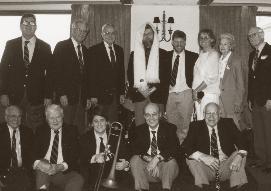
The original Medicare 7, 8, or 9.
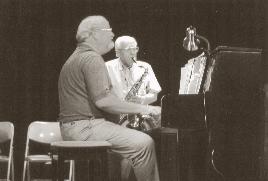
Performing with jazz pianist Rick Murphy.
“Dan was one of those people you never forget. I would say, in a matter of a few days, he’ll know everyone in heaven.”
idea forwarded by Perrino.
“He was like a grandfather to them,” Harwood said.
Richard Murphy, music teacher at the University Laboratory High School recalls how Dan loved people who had “a zest for sharing, being friendly, and opening their hearts to music. He was a tireless supporter of people of all ages, but he especially loved energetic young people.” Murphy and Reagan quickly listed examples: Abby Burgett Crull, Caitlin Caruso Dobbs, Courtney Huffman, Ingrid Kammin, Rachel Klippel, Mary Prost, Allison Semmes, violinist Annie Rong, among others.
The encouragement of young people extended to the children of his acquaintances as well. For example, he wrote a formal letter of congratulations on January 18, 1994, to newly designated Eagle Scout Dan Bechtel: “Bravo on your selection and progress to include the prestigious Eagle Scout distinction. This is, of course, quite an honor. You must indeed feel good about yourself as well as making your family proud of all your accomplishments.... I know you will continue to achieve excellence in whatever you do, simply because you are a person who personifies excellence.” And Dan Bechtel went on to fulfill Perrino’s faith in him, becoming an award-winning math teacher at UHS and recipient of the Gene Amberg Excellence in Teaching Endowed Chair
Throughout his later years, Perrino continued to care for people he met and heard about. One of Medicare’s pianists, the “wonderful and amazing”9 Don Heitler, recalled how his colleague picked him up from the nursing home after Heitler’s mother had died. “The world could use 100 more Danny’s right now.”
Erik Lund, too, experienced that caring firsthand: “I ran into Dan one day at the local grocery store. Somehow we got onto the subject of macular degeneration of the eyes, which Dan suffered from, and I mentioned that my sister-in-law had recently been diagnosed with the disease. Later that afternoon Dan was knocking on my door with a folder full of literature about MD for me to share with my sister-in-law, someone he had never met.”
Friends like to recall other very human aspects of Perrino. Suzi Duker tells that “finding a parking spot on campus was never a problem for Dan. He would simply leave the car running and the door open. One time he left
it for three hours and found the car had run out of gas!” Others recall his love of food. He was a regular at Sam’s Club, an aficionado for whom there could never be too many double chocolate-fudge muffins or apple pies. Perrino was quick to recommend food shops and restaurants in the Italian section of Chicago along Taylor Street near Halsted. One time he took Erik Lund with him to Chicago: “The restaurants, the delis, the lamb shop, the pastry shop.… Dan knew the owners in every spot, and it was clear that he was still family to them.” On another occasion Perrino talked with an acquaintance at an evening party about the old neighborhood’s culinary treasures. The next day, he sent the man a three-page letter, complete with irresistible descriptions of 10 places that he recommended for various foods, including the Conte di Savoia Grocery Store, the “place where Al Capone’s family shopped many years ago.” He included a neatly hand-drawn map of the area noting each place’s location.
At Perrino’s 90th birthday party (posted on YouTube), when people started singing “Happy Birthday,” Dan went to the piano to accompany the friends’ singing, calling out, “In the key of F!” He went on to play “Hail to the Orange,” “Daisy Bell,” and “Mona Lisa” on the piano he had made sure was purchased for the new Alumni Center.
Edward Rath, former Associate Director of the School of Music, remembers Dan as a “bundle of friendly energy.” Sharing the sentiment of many, he says, “If we all aimed to be more like Dan, even if we were to fall short of the goal, the world would be a better place.” Paul Duker, who first met Perrino as a high school student in Quincy, gave him as fine a signoff as any: “Dan was one of those people you never forget. I would say, in a matter of a few days, he’ll know everyone in heaven.”
Thank you to Louis Bergonzi, Eve Harwood, Molly Netter, Richard Murphy, Ollie Watts Davis, Roger Ebert, Eric Lund, Steve Shoemaker, Maureen Reagan, and Edward Rath, Jr. for sharing their thoughts and memories on the life of Dan Perrino for this article.
Quotes from Perrino and selected others are borrowed from The Oral History Project, the Dan Perrino Papers, Nancy Gilmore’s The Magic of Medicare 7, 8, or 9 and All That Jazz, The Chicago Tribune, Inside Illinois, The Quincy Herald-Whig, and articles from illinois.edu.
Anne Mischakoff Heiles, who earned a D.M.A. from the University of Illinois, has taught at UIUC as a visiting professor in the Music Education Division. She has taught viola, chamber music, and music history at the University of the Pacific, California State University, and Northwestern University; and she played viola as a member of the Detroit Symphony and was a regular substitute in the Chicago Symphony. She has written three books and dozens of articles, one of them winning a national award for educational presses. She is a past national president of the American String Teacher’s Association.
Perrino with wife Marge.
MORAL FIRE
CONVOCATION SPEECH TO THE GRADUATING CLASS OF 2012
by Joseph Horowitz
A lot of the writing that I’ve done over the past 25 years has explored the story of classical music in America in its most dynamic period—the late nineteenth century.
Here’s a vignette: the Metropolitan Opera presented the premiere of Wagner’s Tristan und Isolde in 1886. When the curtain fell on Isolde’s “Liebestod,” stunned silence ensued for a period of minutes. Then—as we can read in the Musical Courier—women in the audience stood on their chairs and “screamed their delight for what seemed hours.”
Here’s a second anecdote about the same event. In the third act, Wagner has Tristan tear the bandages off his wound when he sees Isolde’s ship approach. The wound bleeds copiously, and Tristan expires. When Albert Niemann, the Met’s first Tristan, tore his bandages and bared his wound, many in the audience swooned. At subsequent performances, the bandages remained intact. I don’t think that this story is about an audience’s timidity; what it documents is an unbearable intensity of experience.
I would suggest that at least four ingredients account for the astounding urgency and immediacy of this epochal 1886 operatic performance. The first of course is Wagner’s opera—it was radically new. The second is the condition of the people who swooned and screamed. That the vast majority of Wagnerites in late nineteenth century America were women tells us that Wagner answered powerful needs, needs for self-realization not otherwise answered for in the corseted and sequestered Gilded Age housewives and mothers. The third ingredient is the Metropolitan Opera of the 1880s and 90s—never again would the Met be such a hotbed of innovation and experimentation. Its visionary mastermind was a charismatic conductor who had lived with Wagner almost as a surrogate son: Anton Seidl, the central missionary for Wagnerism in the United States. Fourth, and finally, Americans of the late nineteenth century were acutely susceptible to sophisticated art and culture: it crucially helped them to discover and define who they were, and what America was as a nation.
The full of title of my new book is Moral Fire: Musical Portraits from America’s Fin de Siecle. The portraits are of Laura Langford, who presented Wagner concerts 14 times a week in summertime at Coney Island; of Henry Krehbiel, the onetime dean of New York’s music critics; of Charles Ives, arguably the most important concert composer that this country ever produced; and of Henry Higginson, who invented, owned, and operated the Boston Symphony Orchestra. The binding theme is that all four of these heroic individuals embraced the notion that art is morally empowering. They inhabited a moment half a century before the music lovers Hitler and Stalin discredited art as a moral beacon. But we can still, I believe, draw inspiration from their example, and from those screaming Wagnerites at the Met.
This afternoon, I would mainly like to ponder the saga of Henry Higginson and his Boston Symphony—its gestation and subsequent history—and ask what lessons this history might teach today.
Higginson was not born to wealth. As a young man he went to Vienna to become a musician. When he discovered that he lacked sufficient talent to excel, he adopted a different life plan: to amass enough capital to create a world class orchestra for the city of Boston. He entered the family business, which happened to be banking. Then, in 1881, at the age of 47, he placed an announcement in every Boston paper headed “in the interest of great music.”
What Higginson announced was the creation of a Boston Symphony Orchestra, wholly financed by himself. It would perform twice weekly, October through March. Its membership would be stable—no playing for dances on rehearsal or performance days. Also, a certain number of 25 cent tickets would be set aside for all performances—because Henry Higginson was a cultural democrat.
I have a new book, published this month, titled Moral Fire. Here are three sentences from my introduction:
“If screaming Wagnerites standing on chairs are unthinkable today, it is partly because we mistrust high feeling. Our children avidly specialize in vicarious forms of electronic interpersonal diversion. Our laptops and televisions ensnare us in a surrogate world that shuns all but facile passions; only Jon Stewart and Bill Maher share moments of moral outrage disguised as comedy.”
By 1900, Higginson’s Boston Symphony was already internationally acknowledged as a great orchestra. It was already a catalyst for the creation of important orchestras in Cincinnati and Chicago. It already gave more than 100 concerts a season. It already offered a summer series of Promenade concerts—today’s Boston Pops. In format, length, and ritual, its concerts were virtually identical to the Boston Symphony concerts of today.
That by 1900 Higginson’s orchestra looked and sounded like American concert orchestras a century later either documents resilience—or inertia: resistance to change. Meanwhile, the world was changing—and in ways that impacted on the symphonic experience.
A useful criterion in assessing any cultural event is “sense of occasion.” Higginson was lucky: his concerts created a sense of occasion automatically. In 1900, you couldn’t hear an orchestra in your living room on the radio
Photo by Maggie Horowitz
or phonograph. Also, orchestras the caliber of Boston’s were few and far between. Also, Higginson’s audience was keenly inquisitive about new music: new symphonies by, say, Dvořák and Tchaikovsky. Also, Boston’s audience equally appreciated local composers. Everyone understood that George Chadwick was no Beethoven—but every new symphonic work Chadwick composed was promptly premiered by Higginson’s orchestra. Theodore Thomas, the founding father of American symphonic culture, preached that “a symphony orchestra shows the culture of a community.” Higginson’s Boston Symphony did that.
If this late Gilded Age moment marks the apex of classical music in America, that’s because it’s a moment buoyed by a central aspiration, an aspiration influentially pursued by Antonin Dvořák as director of Jeannette Thurber’s courageous National Conservatory of Music—the aspiration to create for American orchestras and opera companies a native repertoire of operas and symphonies that would gird American classical music to come. But this never happened. We instead acquired a mutant musical high culture, a Eurocentric culture privileging masterpieces by dead Europeans.
How that happened and why are questions that have long preoccupied me. Certainly, after World War I, visionaries like Higginson—or Thurber, or Dvořák, or Anton Seidl, or Henry Krehbiel, or Theodore Thomas— were little in evidence. Instead, the central powerbroker for classical music was a businessman: Arthur Judson, who simultaneously ran the New York Philharmonic, the Philadelphia Orchestra, and Columbia Artists Management—the major booking agency for conductors and solo instrumentalists. It was Judson’s frank opinion that an orchestra’s programming could “only go as far as the public will go with us.”
This notion that the audience sets taste was something new, a concession unknown to the pioneering tastemakers of turn-of-the-century America.
With the advent of recordings, of radio and TV, orchestras could be heard at home. With the advent of modernism, audiences were estranged from contemporary music as never before. That every concert would generate a sense of occasion, as in Higginson’s Boston, could no longer be assumed. All of this challenged orchestras—or might have—to rethink the concert experience. Then came exigent challenges of another kind. Since 2005, the average orchestral deficit—and most American orchestras run deficits—has more than tripled. Classical music participation has dropped 30 percent over the past two decades. Costs continue to rise faster than revenues. According to Jesse Rosen, who heads the League of American Orchestras “The current problems are not cyclical problems. The recession has merely brought home and exacerbated long-term problems.”
And here’s one more statistic—according to a survey of Philadelphia Orchestra subscribers—by reputation, a conservative body of listeners— only 21 percent are in favor of standard format concerts with no talking. This hunger for information, I would say, reflects both fatigue with businessas-usual among “old listeners” and the growing needs of “new listeners.”
I cannot recommend a panacea. But I’d like to cite one sign of constructive change. As never before, American orchestras are experimenting with what’s known in the field as “contextualized programming”— explicating music in the context of cultural and political history, and in relationship to literature, the visual arts, dance and theater. The Chicago Symphony calls it “Beyond the Score.” The New York Philharmonic has
used the rubric “Inside the Music.” Philadelphia offers “Access Concerts.” In particular, a landmark $300,000 grant from the National Endowment for the Humanities supports a consortium of orchestras intent on absorbing contextualized programs not as a tangential option, but as part of their central artistic mission.
During the season just concluded—the first year of this NEH “Music Unwound” initiative—three orchestras performed Dvořák’s New World Symphony in tandem with a visual presentation restoring the cultural vocabulary of the symphony’s first New York audience, culling pertinent excerpts from Longfellow’s “The Song of Hiawatha,” culling iconic paintings of the American West by Albert Biestadt, George Catlin, and Frederic Remington.
The Buffalo Philharmonic’s “Dvořák and America” festival incorporated an event at an art museum exploring the relationship between Dvořák’s symphony and what art historians term “the American sublime.” The North Carolina Symphony’s Dvořák festival, last February, linked to 11th grade American History classrooms that made Dvořák‘s American sojourn a major curricular component. When the Pacific Symphony Youth Orchestra did its Dvořák festival, last March, all 100 members of the orchestra, grades 9 to 12, studied the Dvořák story in detail, and inquired into the possible impact of extra-musical readings on the way musicians hear and interpret Dvořák’s American symphony.
The success of these festivals—all the participating orchestras are eager for more—suggests that today’s orchestras, unlike Henry Higginson’s Boston Symphony, cannot take their mission for granted. This is a moment for orchestras to refresh and even to reformulate their reasons to exist.
And I would like to further suggest, in closing, that this lesson may pertain to young artists such as those assembled here today.
Certainly those of us in classical music occupy a milieu in flux. It is, I would say, incumbent on us to discover and articulate, as never before, a personal sense of mission. We cannot assume that we can slip into existing niches of professional experience—because those niches are vanishing or evolving. When I meet with young pianists, I urge them to study composition and improvisation, and music outside the Western canon— to identify objectives that are specific, novel, and individual—new pieces or little-known composers that they believe in, or new ways of presenting music in live performance. And in fact a fresh wind of entrepreneurial innovation is everywhere apparent.
Those 1886 Wagnerites screamed and stood in their chairs because Tristan und Isolde answered the needs of the moment—needs demanding a new kind of artistic expression, and new realms of aesthetic experience. Today’s moment again generates substantially new needs, needs impacting on artists and on artistic institutions.
This challenge is equally an opportunity.
Thank you very much.
Joseph Horowitz is a writer and concert producer. His nine books include Classical Music in America: A History and Moral Fire: Musical Portraits from America’s Fin de Siecle. He served as Executive Director of the Brooklyn Philharmonic Orchestra in the 1990s, and subsequently as a consultant for a variety of American orchestras, including the New York Philharmonic, Pittsburgh Symphony, and Pacific Symphony. He is co-founder and Artistic Director of PostClassical Ensemble of Washington, D.C., a chamber orchestra which specializes in music of the Americas.
RIGHT-HAND MAN THE SCHOOL OF MUSIC SAYS GOODBYE TO ITS
By Anne Mischakoff Heiles
When Edward Rath retired after 24 years as right-hand man to four directors of the University of Illinois School of Music, the University lost a key contributor to its well-being. You might think of Rath as a kind of administrative handyman, on the spot to enable tough fixes. Or you might think of him as an executive for IPOs, overseeing startups of the jazz program’s advanced degrees and other academic programs. He’s been an impresario for gala events. Then there’s his development work and overseeing the process for faculty promotions and tenure. You might have found him subbing as professor for piano lessons or piano literature or even performing in concert. Most students and faculty have known him especially as the resident expert on curricular matters, as ombudsman, conciliator, and diplomat, and, as Professor William Heiles says, “advisor-in-chief.”
midnight. “So I developed an affinity for the cello and its literature, which grew in college.” He was in charge of the artist series at Northwestern State University in Natchitoches, LA, and it was there that he jumped in to accompany cellist Leonard Rose on short notice.
Rath completed his DM in piano performance and literature with high honors at Indiana University in 1975, where he studied with György Sebök and coached with cellist Janos Starker. He had already taught at his undergraduate alma mater, Lawrence University, for four years and at the University of WisconsinParkside for an additional year. Next he joined the faculty at Northwestern State University in Louisiana, where he remained for nine years.
developed an interest in opera.” Moses later moved to the University of Iowa, where he founded the Classical Music Festival, which took place in the Esterházy Palace in Eisenstadt, Austria. In 1976, at Moses’s suggestion, Himie Voxman at Iowa’s School of Music asked Rath to serve as administrative director for the CME. Rath helped organize the festival and manage its finances while Moses served as artistic director and conductor. Rath was the festival’s administrative director for 22 years.
When the opera staff position in Iowa was cut in 1986, Rath’s career took a zigzag. He had long been interested in finances and for two years became an investment executive with Dain Bosworth, Inc. “But I missed music and academia; the separation was difficult.”
“His warmth, intelligence, good cheer, and dedication to the School will be sorely missed,” Professor Charlotte Mattax Moersch comments.
“I remember how positive and supportive he was of every faculty member. He was instrumental in guiding so many of us successfully through the tenure and promotion process. Although he held an administrative position, he is a first-rate pianist whose performances I always admired for their musicality and professionalism.”
Born in California, Rath grew up in Chicago, Oklahoma, and Wisconsin—which he considers his home. As a youngster he was friends with the cellist son of his piano teacher (Rath also played first bassoon in local youth orchestra), and many evenings the two boys played chamber music with the cellist’s father, a professional violinist, until
Rath went on to perform with former principal cellist of the New York Philharmonic Laszlo Varga, Ronald Leonard, and for UI faculty cellists Laurien Laufman, Suren Bagratuni, and Dmitri Kouzov. His routine, he says, was to eat a steak before these concerts.
In 1984 Rath accepted a position as an opera coach at The University of Iowa, supporting singers in the opera class and stage productions. “In graduate school I was the accompanist for Don V Moses’s Chamber Singers. Many members of that group were singing in operas and giving recitals, and as their accompanist I
Moses became Director of UI’s School of Music in 1988. By then he had seen Rath work with concert artists as well as with government officials in Austria and knew both his organizational and musical skills. He hired Rath, first as Visiting Assistant Director (1988-90) and then as Associate Director, a position he held from 1990 until his official retirement in 2010, with parttime extensions until 2012.
“Growing up in Oklahoma, I remember my dad banked at the Citizen’s State Bank, which had a motto: ‘Large enough to serve you, small enough to know you.’ I think if you expand on that idea, the SoM has many fine facilities, a great music library, expert recording capabilities, outstanding ensembles and excellent teaching, scholarship, research, and performance. There’s very little that you can’t experience here. So it’s large enough to serve a variety of interests and students at the very highest levels. But there’s always been that feeling, to me at least, of a family. Yes, we have some large lecture classes, but we try to keep our discussion sections at 20 or fewer. Often when I met parents I let them know that it was an honor to be entrusted with the musical lives of their children, and that I always considered them ‘our kids’ and that I wanted the best for our kids.”
Beginning his administrative position at UI, Rath says that he “immediately felt comfortable and fell in love with Illinois.” During his second semester, Moses appointed him temporary Chair of the Division of Opera to tide the program over during the search for a new opera director. He worked to better organize the program and oversee its financial aspects. He also worked with Daniel Perrino and Beverley
Friese in the area of development and played an important role in the creation of the Friends of the School of Music. The organization was started by Moses to better communicate and involve the community with the SoM, thereby helping expand its donor base.
In 1989 Rath succeeded Perrino, who had taken him under his wing when he first visited Urbana, as Chair of Continuing Education and Public Service in Music (now the Office of Outreach and Public Engagement.) For three years he worked on recruiting and outreach and integrated the CEPS office more closely with the SoM to avoid duplicating services and to “save expenses and become more economical.”
“Over the years, that CEPS office has evolved substantially,” Rath says. Originally considered a division of the school, under Karl Kramer it became a “support organization.” Rath explains that it assumed a “more central, active role.” Kramer also instigated creation of the SoM website, the expansion of Sonorities (which had many years earlier been a shorter tabloid), and updated publicity materials. “It’s become more outreach and public service: workshops, clinics, programs for teachers, and ISYM, the big program for public engagement.” One successful change Rath made was to offer one-week summer youth camps rather than two, which eased both budgets and staff responsibilities. “You can only have so many dances, movies, parties to entertain the kids in the evenings.”
contended with an extensive bureaucracy, and in its earliest years (given the 10 years of the province’s occupation by the Soviets) dealt with limited amenities like taxis or private bathrooms. Burgos, a larger site, presented somewhat the opposite challenge: a seeming lack of bureaucracy and paperwork that made for continual difficulty in securing necessary commitments in writing.
Among Rath’s proudest accomplishments for the University, however, were the gala productions he arranged. He planned and brought together the “Gift of Love Through Music” retirement gala for William Warfield. His reputation, what he had done to break the color barriers in the 1940s and 50s, and the help he had given so many students, Rath adds, made it an occasion for a campuswide celebration, and Rath was in charge of the SoM aspect. “There was participation by some of our best students, many faculty, and guest artists. Letters of tribute came from all over. I took a call from James Earl Jones. Some 1,300 people attended. Rex Anderson had cued up the clip of his singing ‘Oh Lawd, I’m on My Way’ in Porgy and Bess, and we played that as he exited the stage. Bill was genuinely touched by the whole event.”
During Karl Kramer’s tenure, Rath also oversaw the Burgos Chamber Music Festival in Spain in 2006 and 2007 in a capital city of northern Spain. In Eisenstadt, the festival enjoyed free use of the palace hall and the town’s conservatory,
Another Rath extravaganza was a SoM contribution to the annual UI Foundation weekend, a gala called “From Sea to Shining Sea.” He wrote the script, titled from the ending of “America the Beautiful,” and organized the program. A trib-
ute to the influence of music in America, the music featured the school’s various band and choral groups, jazz ensemble, orchestra, and solo singers, ending with a combined rendition of “America the Beautiful.” “We had upwards of 500 participants,” Rath recalls, “and it was a lot of fun.”
Over his 24-year tenure Rath worked with “four very talented and quite different directors, at least five deans, and as many provosts, chancellors, and four University presidents!” In the past decade he helped former director Karl Kramer and professor Chip McNeill get the jazz program off the ground, making it a reality on three degree levels.
Rath and his wife, Lois, have two children (Lori, an attorney in Seattle, and Nathan, a sergeant on the Champaign police force) and two grandsons (Collin and Aaron). So far in his retirement Rath is enjoying the chance to practice his swimming and golfing, continue his passion for cooking, keep up with his lively grandsons, work around the house, practice the piano, have extra time for travel and his family, and to occasionally not dress till late morning.
“I got paid for doing what I enjoy, working with people who are the best of the best, and so many talented kids! This is just a wonderful place to be.”
“Of all the universities that I’ve been associated with, UI, throughout the campus, has consistently been the most helpful. People seem to go out of their way to be of assistance; yes, there are exceptions. But I’ve never felt anything but that UI is a wonderful place to spend one’s life. And if I had to do it all over again, I’d do it exactly the same; I’d just work harder.”
Ed with the late Jerry Hadley in 1993.
Faculty Profiles
COMPOSITION-THEORY FROM
By Emily Wuchner
Though Erin Gee and Carlos Carrillo-Cotto have spent recent years composing and teaching far from the Midwest, both are eager to return to the area and begin work as new theory-composition faculty members.
Gee earned degrees in piano performance (B.A.) and composition (M.A.) from the University of Iowa. She then moved across the Atlantic to Gratz, Austria where she earned her Ph.D. in music theory at the University of Music and Dramatic Arts. While in Europe, she traveled and studied throughout Germany, Italy, and even completed a short residency in Japan. These travels gave her new perspectives on composition and allowed her to hear many contrasting types of music-making.
with the title Mouthpiece. With 20 installments to date, Gee experiments with the ways various instrument and voice combinations can mimic each other and work together to create what she calls a “super mouth.”
Her Mouthpieces have won a number of prestigious awards and received international acclaim. In 2007 Gee’s Mouthpiece 9: For Voice and Orchestra won the International Rostrum of Composers Contest, in which radio stations worldwide select a recently composed, distinctive piece of music. Though her piece was nominated by Austria— where she was living at the time—Gee is the first American to win the contest since George Crumb in 1971.
“It’s a slightly different world in Europe in general,” Gee said. “I was mostly in the Germanspeaking part, but I was in Italy for a year at the American Academy in Rome with the Rome prize. It was just great to have an even broader idea of what kind of music-making is going on, whatever everyone is composing all over the world.”
Gee’s research and composition interests focus on the voice as an instrument that produces sounds instead of audible words, which she classifies as non-semantic. Exploring the mouth’s extensive sound palette was part of her dissertation research—specifically on the relationship between non-semantic music and the phonetic alphabet. She has developed and expanded upon these ideas in her series of compositions—which she typically performs herself—each beginning
“He’s an inspiration to me,” Gee said. “It was a particular honor to win a prize that he had won more than 30 years before.”
In 2009 Gee was awarded the esteemed Guggenheim fellowship, in which she composed three different Mouthpieces: one for electric ensemble, a concert opera, and one for solo piano. The concert opera, Mouthpiece XIII: Mathilde of Loci Part I, was commissioned by the American Composers Orchestra and done in collaboration with her older brother, Colin. The partially staged opera includes a non-semantic voice, a silent actor, video, and chamber orchestra.
Her theatrical works and collaboration with her brother extend
to her 2009 chamber opera SLEEP, which won the composition competition Teatro Minimo and premiered in Zürich Opera House. The opera follows a character through a personal transformation experienced during the four stages of sleep. At the premiere, Gee sang the non-semantic female voice part and Colin wrote the libretto, which was spoken by a male voice artist.
“It was really amazing to work with an opera house that is a really fantastic and huge institution,” Gee said. “I was really happy to be able to work there. It is a beautiful opera house and beautiful to sing there as well.”
Similarly, Carlos Carrillo, who joins the theory faculty in the spring 2013 semester, is also trying his hand at writing an opera. Born in Puerto Rico, he says his culture is an important aspect of his works.
“It’s my heritage, and it’s just part of who I am, and that’s fine with me,” Carrillo said. “I think where you come from brings something special. You are adding something that other people can’t bring. It’s just part of who I am.”
One of his continuing projects, an opera titled La pasión según Antígona Pérez, also reflects
FAR AND ABROAD
this passion. Written by the prominent Puerto Rican author and playwright Luis Rafael Sanchez, Carrillo describes the storyline as the Latin American version of Antigone. To create the libretto Carrillo is pulling text directly from the original source, involving him in every aspect of the compositional process. In April, parts of the opera were presented in New York with great success, and Carrillo is exploring potential performance opportunities for the work’s premiere in the next few years.
Most recently Carrillo taught theory and composition at the San Juan Conservatory. He studied composition at Eastman (B.A.), Yale (M.A.), and the University of Pennsylvania (PhD) and has held teaching appointments at DePauw University in Greencastle, IN. and Reed College in Portland, OR. Though he draws inspiration from Bach, Beethoven, Takemitsu, and Janáček, he credits his teachers as an important influence on his compositional style. He describes his works as non-tonal with some sense of consonance and “lyric and expressive.”
One of Carrillo’s most successful works and proudest achievements is his symphony titled Cantares which was written in 1993 during his third year of undergraduate study at Eastman. In the same year, Cantares won the prestigious BMI Foundation and Bernes awards for student composers. Not only did this achievement open many doors professionally, but the recognition and encouragement from his peers motivated him to keep composing. In 2002 Cantares was featured at the LA Philharmonic’s workshop “Synergy: Composer and Conductor,” which is designed to foster relationships between young and upcoming composers and conductors.
Among his many accolades, Carrillo was one of the first recipients of the Aaron Copland Award, which included a stay at Copland’s home in New York. In the peaceful atmosphere he was able to focus on creativity and composition. In
fact, on his first day staying at the home Carrillo wrote the connective theme that begins and ends his opera. He still has the original sketch.
“While I was in the house I was able to read about him—I knew some of his work, but I was able to learn more, and I know that he encouraged many composers in all of the Americas,” Carrillo said. “Somehow I feel that was still happening. While I was working in his house it felt he was still encouraging composers on.”
In addition to his numerous commissions for professional ensembles, Carrillo especially enjoys working with youth ensembles through both conducting and composing works specifically for them.
“I love teaching, and working with a youth symphony is conducting and teaching at the same time,” Carrillo said. “When I was conducting that youth ensemble in Indiana, I saw it as an expansion of my teaching. I apply the things I know and love. It’s a fantastic experience.”
In addition to composition, teaching and fostering relationships with students are something Gee and Carrillo are passionate about. They both agree that instructing and learning from students while also sharing their own love for music is what they look forward to most at UI.
“The students are so great,” Gee said. “They’re just really interested in what they are working on. I find them wonderful and outgoing, very nice, very good, very knowledgeable. I am just looking forward to teaching and incorporating my composing at the same time. It’s a good dynamic I think. I am excited to show them what I am working on. I find teaching really rewarding and inspiring and I am just so excited to be here.”
Erin Gee: www.erin-gee.com
Carlos Carrillo: www.amc.net/CarlosRCarrilloCotto
FACULTY MILESTONES
PROMOTIONS
Tito Carrillo
Associate Professor
Ricardo Herrera
Associate Professor
Dana Robinson
Associate Professor
Chip McNeill
Professor
Ann Yeung
Professor
Jeffrey Magee
Professor
STAFF PROMOTIONS
Stephen Burian
Outreach and Public Engagement,
Assistant Director
VISITING FACULTY, 2012-13
Bridget Benton
Visiting instructor (Theater)
Cara Chowning
Visiting Lecturer (Opera)
Lillie S. Gordon
Visiting Assistant Professor (Musicology)
Jesse Leyva
Visiting Assistant Professor (Bands)
Susan Parisi
Visiting Assistant Professor (Musicology)
Jake Rundall
Visiting Assistant Professor (Comp-Theory)
Joel Spencer
Visiting Assistant Professor (Jazz)
Joe Wachtel
Visiting Instructor (Music Ed)
RETIREMENTS
Tom Turino
Edward Rath
Faculty News
Reid Alexander (piano pedagogy) presented solo recitals in conjunction with master classes and guest lectures at the University of Northern Colorado, the University of North Carolina-Wilmington (artist-clinician for their Piano Day), Central Michigan University, Eastern Illinois University, and Western Illinois University where he adjudicated their piano concerto competition.
I Ketut Gede Asnawa (musicology) taught Gamelan at Miami University and performed for the Music and Dance festival held at Ohio University. He also taught and directed Gamelan for the Indonesian Performing Arts of Chicago and was a member of the judging panel for instrumental ensemble performances at the Singapore Youth Music festival Primary School. In addition, he composed three new works for two different types of Balinese Gamelan.
Christina Bashford (musicology) continued work on her “Violin Culture in Britain and Beyond” project, which materialized into a chapter for a book of essays (published June 2012), a paper at the American Musicological Society conference, and a new phase of archival work done in Ireland as a Visiting Fellow of the Institute for Research in Irish Historical and Cultural Traditions at the National University of Ireland in Maynooth. Bashford also contributed to a musicology roundtable at the International 19th-century music conference in Edinburgh, and a paper at the conference, “The Art of Listening,” in Berlin.
Louis Bergonzi (music education) helped organize and lecture at an on-campus symposium in Fall 2012 linked to his research on instructional climates in music education settings regarding sexism, racism, and homophobia, compared in high school and music camp settings. He appeared as a guest conductor at all-state and festival honor groups nationwide and gave more than 20 free master classes at schools in Illinois.
Donna Buchanan (musicology) gave papers at The Ohio State University, the annual Society for Ethnomusicology meeting, and the University of Chicago. Her presentation at Ohio State University will be published and revised in expanded form as a chapter in Beyond Mosque, Church, and State: Negotiating Religious and Ethno-National Identities in the Balkans (eds. Theodora Dragostinova and Yana Hashamova). She led an organized panel, “Balkan Beats for a New Europe: Comparative Soundscapes of Social Difference,” at the Society for Ethnomusicolgy conference in 2012.
Michael Cameron (double bass) released his CD Canto in May which features solo and chamber works by Thomas Fredrickson. In December his album The Sonata Project will be released. He was awarded a Research Board Grant for The Sonata Project – Phase II. Now serving as chair of the string division, he organized and participated in the college division of the Chicago Bass Festival at Ravinia.
Elliot Chasanov (trombone) was a guest artist at Kutztown Brass Day at Kutztown University (PA) in February 2012. He continues building the
catalogue of the Elliot Chasanov Brass Series, published by Metropolis Music in Belgium and his works have been performed in Belgium, Italy, and Argentina.
Charles Daval (trumpet) played solo trumpet on Bach’s Brandenburg Concerto #2 with the Seattle Symphony in January. During the summer he participated in his 22nd Grand Teton Music Festival in Jackson Hole, WY.
Ollie Watts Davis (voice) won a lifetime ACE (Arts, Culture, Education) award from 40 North. She celebrated her 30th anniversary year as music director and conductor of the UI Black Chorus and received the Illinois Student Senate Teaching Excellence Award for 2011-2012. She appeared as soprano soloist in Mendelssohn’s Midsummer Night’s Dream with the Prairie Ensemble, performed recitals and concerts at Mesa State University (CO) and completed an artist residency at the University of South Carolina-Charleston.
John Dee (oboe) will present several world premiere performances at the University of Illinois during the 2012-2013 concert season. He was an invited guest performer at the 2012 International Double Reed Society Annual Conference held this summer at Miami University of Ohio. In addition to other featured appearances at the conference, he performed with newly formed University of Illinois Double Reed Quartet comprised of associate professor of bassoon Timothy McGovern, and their teaching assistants Evan Tammen (ob) and Ashley Haney (bsn).
Gregory DeNardo (music education) spent Fall 2012 on sabbatical to re-examine schools in the Milwaukee Symphony Orchestra’s Arts in Education Partnership. DeNardo helped launch the program in 1991 and is revisiting schools that have participated in the partnership for 23 years.
Eduardo Diazmuñoz (opera) was invited by the National Institute of Fine Arts in Mexico to work as Artistic and Music Director for a posthumous tribute to Daniel Catán featuring a performance of all of his music. In November he was appointed to Director of Academic Review at the National Council of the Fermatta Music Academy in Mexico. In February 2012, he guest conducted the Zacatecas Philharmonic Orchestra (Mexico) in a tribute concert for Mexican symphonist Candelario Huízar. He was on sabbatical in Spring 2012 to work on a Symphonic Suite based on the themes he wrote for a Mexican feature film in the summer of 2010.
Timothy Ehlen (piano) completed and released volumes four and five of the complete Beethoven Sonatas on Azica Records. His book chapter “Genre References in Beethoven Sonatas” was published in The Pianist’s Craft: Mastering the Works of Great Composers. He presented five lectures on Beethoven’s piano sonatas, a solo recital broadcast live on the internet, and master classes and chamber performances at the Brevard Music Festival. He also performed with with the ChampaignUrbana Symphony in Fall 2011, as well as a series of two-piano recitals in Spring 2012 with piano duo partner, Yu-Chi Tai (A.D. ’11, D.M.A. ’11). Ehlen and Tai have recently been invited to join the Steinway Artist Roster as an ensemble.
Ricardo Flores (percussion) was a featured soloist at the 2011 Percussive Arts Society International Convention in Indianapolis on a concert with an expanded Steel Band, including members from the UI Steel Band. He also participated in residencies, concerts and clinics at the University of Arizona-Tucson, the Illinois Music Educator’s Conference, and Western Illinois University.
Lawrence Gray (jazz bass) had many performance engagements including with the Larry Gray Trio in Chicago and a concert appearance in Tblisi, Georgia. His arrangements for for jazz sextet were performed last winter at Smith Hall and also at the Iron Post in Urbana. Recently, a performance with the John Moulders quintet at the Green Mill was recorded and released as a CD on the NAIM label.
Julie Gunn (accompanying) piloted a new course for accompanists and string players focusing on the violin and cello sonatas and trios of Beethoven, culminating in two recitals. She founded the UI School of Music Academy, which instructs students in chamber music and theory and provides coaching from graduate students as well as string and accompanying faculties. She and husband Nathan Gunn will perform with the Pacifica Quartet in Carnegie Hall during Winter 2013.
Nathan Gunn (voice) sang at the Segulda Festival in Latvia, Houston Grand Opera, and the Lyric Opera of Chicago. He performed in the John Dexter production of Billy Budd at the MET. He has also shared new recital repertoire at the Van Cliburn Series, the Krannert Great Hall Series, and the Parlance Series. In September he was appointed by the Opera Company of
Philadelphia as the Director of the American Repertoire Council to lead its commitment to produce a new American opera in 10 consecutive seasons.
Rudolf Haken (viola) appeared as a member of the American Piano Quintet in concert at Andrews University (MI) and as a guest artist for the University of Tennessee Viola Celebration. His piece for solos viola, Faust, was premiered by Rachel Barton Pine at the Beethoven Festival in Chicago.
Dawn M. Harris (voice), sang the second soprano solos in Bach’s B Minor Mass with the Baroque Artists of Champaign and appeared as the soprano soloist at the 2011 Allerton Barn Festival on the “An Evening of Strauss Waltzes and Viennese Bonbons” concert. She also directed and performed Lee Hoiby’s one woman opera, Bon Appetit! with the Prairie Ensemble and will join colleague, Ronald Hedlund, as she performs the role of Illona in the operetta, Game of Love at the Station Theater.
Ricardo Herrera (voice) was baritone soloist with UI Philharmonia Orchestra in Prokofiev’s Lieutenant Kije, bass soloist in Bach’s Cantata No. 21 at the Allerton Barn Music Festival, sang the role of Figaro in Mozart’s Le Nozze di Figaro with the El Paso Opera, and was the stage director of the World Premiere of Paradises Lost by Stephen Andrew Taylor. Additional performances include engagements with the American Chamber Orchestra and the Danville Symphony, and the role of Porteo in Astor Piazzolla’s tango opera Maria de Buenos Aires in Chihuahua City, Mexico.
Faculty News
J. Michael Holmes (saxophone) performed with the St. Louis Symphony Orchestra during their 2012 European tour in London, Berlin, Lucerne, and Paris. He was featured on the cover of the 2012 September/October Saxophone Journal
Barry L. Houser (bands) completed his first term as Governor of the North Central District of Kappa Kappa Psi and was Keynote Speaker and Coordinator of the Intercollegiate Band and Reading Bands at the 2012 NCD Convention for Kappa Kappa Psi and Tau Beta Sigma. Additionally, he was co-director of the Macy’s Great American Marching Band which includes more than 200 students who perform in the annual Macy’s Day Parade in New York City. He was director and clinician at festivals in Illinois and Florida and presented at the 2012 CBDNA Athletic Band Directors Symposium at The Ohio State University.
Jonathan Keeble (flute) was chair of the board of directors of the National Flute Association. He performed at Eastman School of Music, Indiana University, Northwestern University, and the University of Michigan. He taught and performed in various capacities with faculty from Eastman, Juilliard, Oberlin, the Hartt School of Music, and musicians from the St. Louis Symphony, Chicago Symphony, Lyric Opera, and the National Symphony. The Aletheia Duo (with harpist Ann Yeung) released the album Song of the Black Swan and performed in Italy and Switzerland.
William Kinderman (musicology) completed two books: The Creative Process in Music from Mozart to Kurtág and Wagner’s Parsifal. He gave two keynote addresses at conferences in France and Canada, five other conference papers (in the US, Hungary, and Germany), and several lecture recitals, including a Beethoven lecture recital in the Chamber
Music Hall of the Beethoven-Haus at Bonn. He completed several articles and served as an organizer of the “New Beethoven Research” conference in San Jose, California.
Dmitry Kouzov (cello) performed with the St. Petersburg Symphony Orchestra in Russia, Brazil, and the US. In addition, he recorded Shostakovich’s two cello concertos with the St. Petersburg Symphony Orchestra. He performed chamber recitals in the US, Russia, and Italy and participated in festivals throughout the US and in Brazil.
Erik Lund (compositiontheory) composed Credo (for chorus and chamber orchestra) for the 2011 Allerton Barn Festival. He toured Taiwan as a guest composer and performer in May 2012 where his work Unknown Origins was performed by the Taiwanese Illiart Piano Trio at the Yuan-Lin Concert Hall and at Taipei National Education University. He also performed at The Artists Village in Taipei. He gave lectures at the National Chiao Tung University and Taipei National Education University. Additionally, he performed trombone at Roosevelt University (Chicago) and in a series of concerts sponsored through a grant from the Urbana Arts Grant program. He was commissioned by the New York-based ensemble mise-en to compose a new work for chamber orchestra, to be performed in May 2013.
Jeffrey Magee (musicology) completed his book Irving Berlin’s American Musical Theater and gave a public lecture at the 92Y Tribeca in New York with Irving Berlin’s eldest daughter, Mary Ellin Barrett, in attendance. He also presented papers at the annual meeting of the American Musicological Society in San Francisco and at the Harvard-Princeton Musical Theater Forum, an invited interdisciplinary event that also included doctoral candidate Megan Woller.
Charlotte Mattax Moersch (harpsichord) recorded the solo harpsichord works of Armand-Louis Couperin and was invited to perform these works at the Berkeley Early Music Festival in Berkeley, CA. During the 2011-2012 season she also performed the harpsichord concerti of Johann Sebastian Bach with the Bach Choir of Bethlehem, PA, with whom she recorded the Bach’s St. John Passion for Analekta Records.
Timothy McGovern (bassoon) has toured extensively, presenting recitals and masterclasses at schools including Northwestern University, Indiana University, Ohio State University, and Miami University.
Charles L. McNeill (jazz) and the UI Concert Jazz Band performed at the Midwest Band Clinic in Chicago and at McCormick Place. The Concert Jazz Band and Jazz Vocal Ensemble performed at the Jazz Education Network international conference in Louisville. His professional jazz quintet was invited to perform at the JEN conference, promoting their latest CD release, The Whirl. He played with Doc Severinsen and the Tonight Show Big Band on a three week tour in February and March 2012. Last summer he toured Russia (Moscow) and Ukraine (Kiev) with the Ark Otruvskiy Jazz Group.
William Moersch (percussion) was a returning featured solo artist at the 10th International Patagonia Percussion Festival in Rio Negro, Argentina, and the 2011 Percussive Arts Society International Convention in Indianapolis, IN. His clinic, “The Art of Timpani: Improving Students’ Musicianship,” was selected for the Illinois Music Education Conference. He also appeared as a concerto soloist in Joseph Schwantner’s Concerto for Percussion with the University of Illinois Symphony Orchestra.
Linda R. Moorhouse (bands) served as a headliner conductor for the Western International Concert Band Clinic in Seattle this past fall. She was a member of the 2012 Chick-Fil-A Bowl Pregame/Halftime staff in January, and served as a clinician/conductor for honor bands in Louisiana, Kentucky, North Carolina, and Illinois last Spring. She also represented the United States on an international panel of music judges for the 2012 Singapore Youth Music Festival.
Jeananne Nichols (music education) published two chapters in Narrative Soundings: An Anthology of Narrative Inquiry in Music Education. She presented papers at the 2012 American Educational Research Association meeting in Vancouver, British Columbia, the Day of the Arts (part of the Eighth International Congress of Qualitative Inquiry at UIUC) and the International Society for Music Education 30th World Conference on Music Education in Thessaloniki, Greece. In the Fall she was awarded a seed grant by Action Research Illinois to provide a weekly arts experience for youth incarcerated in the Champaign County Detention Center.
Susan Parisi (musicology) edited the book The Music Library of a Noble Florentine Family: A Catalogue Raisonne of Manuscripts and Prints of the 1720s to the 1850s collected by the Ricasoli Family , which are now housed in the University of Louisville Music Library. The book was awarded a publication subvention from the American Musicological Society, and the publication brings together documentary studies and a catalogue of more than 1,400 compositions.
Yvonne Redman (voice) performed with Jonathan Keeble on his faculty flute recital and with Ricardo Herrera for the Sinfonia da Camera gala held at the Champaign Country Club.
Debra Richtmeyer (saxophone) was a featured invited saxophone soloist for the North American Saxophone Alliance Biennial National Conference evening Chamber Music Recital at Arizona State University in Tempe. She performed the world premiere of Surrenatalia II with violinist Stefan Milenkovich and composer and pianist Rudolf Haken. She was featured invited concerto soloist for the XIII World Saxophone Congress Final Gala Concert in St. Andrews, Scotland performing the European Premiere of the Concerto for Saxophone and Orchestra by Lee Actor with the Scottish Chamber Orchestra. She also recorded concertos by composers Lee Actor and Hilary Tann.
Dana Robinson (organ) presented solo recitals in Glens Falls, NY, at the Basilica of St. Adalbert in Grand Rapids, MI and at the University of Iowa, where he performed duets with fellow Iowa alumnus Paul Tegels. He also performed at St. Philip Presbyterian Church, where he presented a master class on pedal technique for the organ students at the University of Houston, and at Westminster Choir College, where he performed J. S. Bach’s entire Orgelbüchlein.
Ronald Romm (trumpet) received the International Trumpet Guild Honorary Award in Columbus, GA in May 2012. The award is in recognition of a trumpeter’s significant international contribution to performance, research, and pedagogy. At this year’s ITG presentation the Romm Trio (Avis Romm, piano, Ronald and Aaron Romm, trumpets) performed and lectured.
Robert Rumbelow (bands) has comissioned new compositions for the Illinois Wind Symphony through organizing a national consortium for a new work by Christopher Theofanidis. Over the next three years, the Illinois Wind Symphony will premiere at least two new works per season due to this effort. He continues to compose music, having completed two works
for wind band (among other projects) that will be published next year.
Donald Schleicher (orchestra) was invited to return for the fifth time as a lead teacher for the International Conducting Workshop and Festival in the Czech Republic, and for the second time for the International Conducting Institute. He joined the Illinois Council of Orchestras as a member of the Board of Directors.
Bernhard Scully (horn) was invited as a guest artist at the Southeast Horn Workshop at Tennessee Tech University, Lubbock, Northwest Horn Workshop (Pacific Lutheran University), and the International Horn Symposium (University of North Texas) where he gave lectures and master classes at each event. He was invited to residencies as a guest artist at Texas Tech University, The Glenn Gould School (Toronto, Ontario), University of WisconsinStevens Point, Wheaton College (IL). His new CD, Dialogues En Français was released and featured on a National Public Radio Broadcast on All Things Considered
Rochelle Sennet (piano) performed recitals in Russia with violinist Igor Kalnin at the Nizhny Novgorod State Conservatory and Children’s Music School #12. She also recorded George Walker’s Piano Concerto, with Ian Hobson conducting the Sinfonia Varsovia of Poland. This recording also features her participation in the chamber work Da Camera. She was a solo performer at the Illinois State Music Teachers Association New Faculty Recital, which was held at Illinois State University in Fall 2011.
Gayle Sherwood Magee (musicology) spent the summer working on her new book on music in director Robert Altman’s films. Forthcoming publications include an article on Altman’s classic film Nashville (1975) in the journal Music and the Moving Image, and a chapter on copyright and music through
Faculty News
Altman’s career in the book The Robert Altman Companion, edited by Adrian Danks.
Gabriel Solis (musicology) completed two book manuscripts currently under contract: Thelonious Monk Quartet with John Coltrane, Live at Carnegie Hall which is an analytical study of one album, and What Is He Building in There: Tom Waits and Rock at the End of the American Century. He had two major articles accepted in ethnomusicology journals (Ethnomusicology and Musicultures) and one substantial review essay on new research in the South Pacific in Ethnomusicology. He also taught a guest course at Melbourne University, and contributed workshops on ethnomusicology at the University of Goroka, in Papua, New Guinea.
Andrea Solya (clinical assistant professor) helped recreate the UI American Choral Directors Association Student Chapter which sponsored and hosted a two day long workshop with the American Boychoir in November 2011. This event presented conducting and rehearsal technique workshops for choral students in both undergraduate and graduate programs and concluded with a joint concert featuring elementary and middles school singers from the area. She also presented her editions of Andreas Rauch’s Thymiaterium Musicale at the bi-annual National Collegiate Choral Organization’s conference in Fort Collins, Colorado.
Sylvia Stone (voice) was artistic director of a summer opera program, Il corso estivo per giovani cantanti lirici, in Italy. The event attacts students from Australia, Germany, England, and the US. She also taught American and Canadian students at the Franco American Vocal Academy in Salzburg where she also spoke at Schloss Mirabelle.
Bridget Sweet (music education) co-presented research with four colleagues from different universities at the 2011 Symposium on Music Teacher Education at the University of North Carolina-Greensboro and the
2012 Biennial Music Educators National Conference in St. Louis. Aditionally she presented conference sessions on the adolescent male and female changing voice at the 2012 American Choral Directors Association Central Division Conference and the 2012 Illinois Music Education Conference. A recipient of a 2012 FAA Creative Research Award, she will now begin a qualitative research project focused on the adolescent female changing voice.
Heinrich Taube (composition-theory) completed the Research Board grant/Beckmann award to redesign Chorale Composer automatic theory instruction software. This has been a huge undertaking (55,000 lines of code) and is now nearing completion with an Alpha release in June 2012 and use in theory instruction in Fall 2012.
Stephen Taylor (composition-theory) presented two versions of his opera Paradises Lost: a chamber version in Portland, OR and the complete version premiered at the Krannert Center, directed by Ricardo Herrera and conducted by Robert Rumbelow. He also had new works premiered by Ann Yeung (Shindychew Dances for solo harp) in Vancouver, BC; and Decohere for two saxophones, premiered by Phil Pierick (B.M. ’09, M. M. ’12) and Noa Even (M.M. ’10), in Tempe, AZ. His 2010 percussion ensemble piece Everywhere Entangled was released on Albany Records. He also wrote arrangements for the CD 1969, by Pink Martini with Saori Yuki, which went platinum in Japan.
Reynold Tharp (composition-theory) completed two new chamber pieces which premiered in the spring of 2012: Red-winged Blackbird by Ensemble Dal Niente and the sea is but a sound on a Boston Modern Orchestra Project Club concert. His piece Chaparral was recorded by Jonathan Keeble and Ann Yeung, who also performed the piece at Indiana University and UI last fall. His work, Wide sea, changeful heaven was premiered by the UI Symphony Orchestra in September. He is currently working on a large ensemble piece for the New Juilliard Ensemble for 2013.
Matthew Thibeault (music education) is a Faculty Fellow for the 2012-2013 year in the Illinois Program for Research in the Humanities, working on a book examining sound recording at the end of the nineteenth century and new media at the end of the twentieth as catalysts for change in music, musician, and audience. He published several chapters and articles, continues to write the “Secondary Scene” column for General Music Today, and gave several invited presentations at the national level. His group the Homebrew Ukulele Union was profiled by multiple media outlets.
Sever Tipei (compositiontheory) premiered his computer-assisted composition for computergenerated sounds work figer at Northern Illinois University. It was also performed at York University, UK; Trinity College, Dublin; and the National University of Music in Bucharest along with HB with G&E for piano and computer-generated sounds and other works. Talks about his music and DISSCO, software for composition and sound synthesis developed at CMP, were delivered in Europe and the US during his sabbatical.
Ann Yeung (harp) appeared at major universities and schools such as Eastman and Interlochen as well as institutions in Indiana and Michigan. She published two articles in Harp Column and the American Liszt Society Newsletter, and edited the World Harp Congress Review
Aaron Ziegel (musicology) presented his paper “Sacred Music as a Signifier of Patriotism in American Operas from the Early 1910s” at the 2012 annual conferences of the Nineteenth Century Studies Association and the American Musicological Society. Additionally, he published articles in Music Research Forum and The Opera Journal, along with reviews in both American Music Review and the Journal of the Society for American Music
New Publications and Recordings
Emily Wuchner, Associate Editor
Christos Tsitsaros, professor of piano pedagogy, recently released two new CDs on the Centaur Records label. The first (Cahier Tango; Sonata; 4 Concert Transcriptions of American Songs) contains original compositions including a stylized tango and arrangements of songs by Hoagy Carmichael, Vernon Duke, and Cole Porter. The second, Easier Piano Works, includes recent compositions from the last seven years written to educate young musicians. He edited and recorded 19 Little Preludes by J.S. Bach (G. Schirmer, 2012) which was launched at the 2012 MTNA conference in New York. He also completed Lyric Ballads: 6 Romantic Pieces (Hal Leonard, 2012) for Piano Solo.
“ The music of Christos Tsitsaros has a deceptive simplicity about it… or, perhaps more accurately, it is easy to hear but subtle in construction, much like such pieces as Debussy’s Clair de lune or Golliwog’s Cakewalk, Beethoven’s Für Elise, or Schumann’s Träumerai Each of those pieces, like the music of Tsitsaros, has an essential simplicity of form as well as being accessible to medium-level piano students, yet the music gains immeasurably in impact from being played by a superior artist.”
– Fanfare
The Creative Process in Music from Mozart to Kurtág by William Kinderman; University of Illinois Press, 2012.
William Kinderman explores the different stages of musical creativity in his latest book, which traces the composition of musical works through reviewing autobiographical reports, handwritten sketches, and revised manuscripts. This book provides revealing insights to both well-known and unknown works by Mozart, Beethoven, Schumann, Mahler, Bartók, and Kurtág.
“An engaging investigation of the creative process and genetic criticism. These deeply thoughtful essays establish an enviable range, from Mozart through the grand figures of the German nineteenth century (Beethoven, Schumann) and beyond to three seminal figures of the twentieth (Mahler, Bartók, Kurtág). A significant contribution.”
– Richard Kramer, author of Unfinished Music
Song of the Black Swan: Works inspired by nature by the Aletheia Duo with Masumi Per Rostad (viola); Albany Records, 2012.
In its newly released CD, the Aletheia Duo, comprised of Jonathan Keeble (flute) and Ann Yeung (harp), forge a link between the natural and the spiritual, containing works inspired by various facets of nature. The repertoire evokes images of waterfalls, rivers, landscapes, and night. They are joined by violist Masumi Per Rostad on the Debussy Sonate. The album also features Chaparral, written by UI theory/ composition professor Reynold Tharp.
“On this disc dedicated to the mystery and natural beauty of the black swan, Yeung and Keeble have chosen a fascinating program that reveals a diversity of repertoire not usually associated with flute and harp.”
– Fanfare
The Devil’s Hopyard by Trombari: Glenn Wilson and Jim Pugh; Jazzmaniac, 2012.
Trombone/baritone saxophone combinations are relatively rare, but Glenn Wilson and Jim Pugh hope to change that. The duo has expanded the repertoire, drawing on works from swing to free jazz tracks, while also experimenting with varied instrumentations. The ensemble on this recording includes violin, cello, bass, drums, and percussion—what Wilson and Pugh refer to as “The Devil’s Hopyard.” The album features music by the late saxophonist Thomas Chapin.
“In short this CD has it all going, great compositional platforms played with authority, a horn & strings sound that puts this music in a league of its own, and the exuberant presence of two horn masters. I hope this band does some touring because it is impressive and should be heard widely. The Devil’s Hopyard delivers some excellent music that you should not miss.”
– Gapplegate Music
Louis Bergonzi, Daniel J. Perrino Professor of Music Education, published an arrangement of the Andante from Mendelssohn’s Violin Concerto, Op. 64. The arrangement, geared towards young musicians, was the Editor’s Choice for 2012 from J.W. Pepper Music.
“Arranged for string orchestra, Dr. Bergonzi has come up with a true masterpiece with Mendelssohn’s Andante. This solid, slow piece has been sensitively and successfully arranged for younger players.”
– J.W. Pepper Music
The Music Library of a Noble Florentine Family edited by Susan Parisi; Harmonie Park Press, 2012.
The University of Louisville Music Library is home to a collection of manuscripts, prints, and music books from 17501860 that once belonged to three branches of the Ricasoli family—part of the high nobility of Florence. This resource contains essays on the background of the collection as well as a complete catalogue of the more than 1,400 compositions which range from operas, oratorios, masses, ballet music, concertos, sinfonias, and other genres.
Pugh-Taylor II by Jim Pugh with David Taylor.
“Pugh-Taylor II” is the followup recording to the original 1984 Digital Music Products CD, “The Pugh-Taylor Project.” In the style of the original, it is a collection of eclectic works for tenor and bass trombone, composed for Jim and David, involving a variety of ensembles. It was recorded in New York over a 15-year period and features the music of David Matthews, Irwin Bazelon, Michael Sahl, John Clark, and Rich Shemaria.
Irving Berlin’s American Musical Theater by Jeffrey Magee; Oxford University Press, 2012.
Jeffrey Magee’s latest book delves into the life and career of Irving Berlin focusing particularly on his immense influence on American musical theater. Combining both musicological and literary analysis, Magee critically approaches some of Berlin’s most enduring songs and popular Broadway shows. Considering his early experiences singing for pennies and his later struggle with depression, this book details how such instances influenced and informed his music.
“An astonishingly rich book. Everything about it is appealing. The research is prodigious; the cultural analysis fresh and compelling. Like Berlin himself, Magee makes show business come alive, from the first song to the last.”
– Rose Rosengard Subotnik, Professor of Music Emerita, Brown University
Emeriti Reports
Nettl Named Distinguished Humanist
Bruno Nettl, a professor emeritus of music and of anthropology at the University of Illinois, has been awarded the Charles Homer Haskins Prize, presented annually to a distinguished humanist by the American Council of Learned Societies. This honor includes a cash award and asks the recipient to deliver the Haskins Prize Lecture reflecting on “a lifetime of work as a scholar and an institution builder” at the Council of Learned Societies’ annual meeting in May 2014.
Nettl pioneered the field of ethnomusicology, the study of social and cultural aspects of music in local and global contexts. He is the author, co-author or editor of 26 books, including Nettl’s Elephant, a collection of essays on the evolution and current state of ethnomusicology, and The Study of Ethnomusicology: Thirty-one Issues and Concepts—the updated and expanded edition of his 1983 book Twenty-nine Issues and Concepts, which is considered a classic in the field.
Nettl’s fieldwork focused on India, Iran and Israel, and the Blackfoot people of Montana. In recent years, he has focused on the study of improvisatory music, the understanding of musical change throughout the world and the intellectual history of ethnomusicology.
He is the former president and publication editor of the Society for Ethnomusicology, which nominated him for this current honor, and the first scholar in that organization to receive this prize.
Nettl was born in Prague and earned degrees in music, musicology, library science, and anthropology. He received a Ph.D. in musicology, with minors in anthropology and folklore, from Indiana University in 1953, and taught at Wayne State University before joining the UI in 1964. He retired in 1992 and continues researching, teaching and advising part time, and has several essays and scholarly articles set for publication.
– Dusty Rhodes, University of Illinois News Bureau
A festschrift dedicated to the work of Nicholas Temperley (musicology) Music and Performance Culture in Nineteenth-Century Britain: Essays in Honour of Nicholas Temperley, edited by Bennett Zon, was published in 2012. The book was formally presented to him at the Biennial Conference on Nineteenth-Century music at Edinburgh on June 27, 2012. At the fifth meeting
of the North American British Music Studies Association, June 26-28, 2012, he was made the first Honorary Lifetime Member of NABMSA. A concert of Anglo-American music was given in honor of his 80th birthday under SoM auspices in Foellinger Great Hall, conducted by Chester L. Alwes (D.M.A. ’82), Laurie Matheson (D.M.A. ’98), and Kevin Kelly (M.M. ’93).
During the academic year 2011-2012, Bruno Nettl (ethnomusicology) presented his paper “Musikwissenschaft und Ethnomusikologie in Mitteleuropa und Amerika um die Jahrhundertmitte: Erfahrungen und Kommentare” at Gesellschaft für Musikforschung, a special conference on post-war history of musicology in Germany, in Mannheim on January 20, 2012. He presented work entitled “The Study of Formal Design in Native American Music: Scholarship, History, and Speculations” at the second Annual Conference on Analytical Approaches to World Music at the University of British Columbia on May 11, 2012. He presented the keynote lecture, “What Are the Great Discoveries of Your Field? Reply to a Question from a Physicist” at the Eighth Annual Congress on Qualitative Research, Day of the Arts through the College of Education at UI on May 16, 2012.
Zack Browning (composition-theory) gave lectures at Seoul National University, Ewha Womans University, and Keimyung University in South Korea, and at Stetson University, University of Florida, the University of Central Florida, University of Tampa, and Eckerd College in Florida. Browning attended the world premiere of his composition Mung Bean Mountain by the Lumiere Ensemble at the Seoul Arts Center, and went to six universities in Illinois and Missouri doing lectures connected to the performances of his String Quartet by the UI student Quasari Quartet, composed of violinists Emelinda Escobar (B.M. ’12) and Gloria Mo (B.M. ’12), violist Alyssa Roggow (B.M. ’12), and cellist Philip Bergman (B.M. ’12). In January 2012, Innova Recordings released a CD of five of his recent compositions called Secret Pulse Browning also served on the Illinois Arts Council Panel of Judges for the 2012 IAC Individual Arts Fellowships.
John Walter Hill (musicology) published his article “Thematic Transformation, Folksong and Nostalgia in Brahms’s Horn Trio Op. 40” in the Musical Times. His article “A Small Selection from among the Many Things that I Still Do Not Know about Baroque Music” appeared in the Journal of Music History Pedagogy. During the past year, Hill was offered a one-year, full-time visiting position at the Central Conservatory of Beijing to teach a course on Baroque music. His textbook on that subject has recently been published in Chinese. Also this year he was named by the Italian National Agency for the Evaluation of Universities and Research Institutes to an international panel assigned to assess the quality of faculty research in music departments offering doctoral programs in Italy.
Chester Alwes (choral music/music education) completed a five-week sabbatical replacement at Greenville College in Greenville, IL. His chapter
Photo by L. Brian Stauffer, University of Illinois News Bureau.
“Choral music in the Culture of NineteenthCentury Romanticism” appeared in the Cambridge Companion to Choral Music. He produced performing editions of choruses from two Handel oratorios and J. S. Bach’s Cantata 150 for G. Schirmer. He was also music director for a CD to accompany a new edition of Sternhold and Hopkins’ Whole Book of Psalms.
Ronald Hedlund (voice) participated in many performances including Dr. Bartolo in the Barber of Seville with UI Opera Program, soloist for the Granny’s Porch program at the Virginia Theater, soloist for the 2011 Heartland Festival Orchestra’s New Year’s Greeting Gala, and in scenes from Die Fledermaus with UI Graduate vocalists and his former students, soprano Kay Welch (M.M. ’09) and tenor Justin Vickers (B.M. ’98, D.M.A. ’11). He co-produced and performed an evening of opera and musical theater with the Danville Symphony in May 2012 featuring numerous UI singers and musicians. He was a soloist at memorial services honoring late UI Professors Eric Dalheim (M.M. ’62) and Wendell Williams and sang recitals at the Montpelier, VA Historic Home of James and Dolly Madison to benefit the James Madison Museum with Cara Chowning and cellist Barbara Hedlund.
Former Associate Director Edward Rath will be an adjudicator in the piano division at the 12th biennial Los Angeles International Liszt Competition in November. The Competition focuses primarily on piano repertoire, but also includes categories for singers and organists. Rath continues to serve on the Board of the American Liszt Society, for which he is Editor of the Society’s newsletter and also serves as webmaster for the Society’s site at www. americanlisztsociety.net. In February, he will join Professor Emeritus Ian Hobson for a performance of the four-hand version of some of Brahms’ Hungarian Dances as part of Hobson’s all-Brahms series to be performed throughout the 2012-2013 academic year.
Student News
a selection of recent accomplishments
Lauren Coleman, Research Assistant, School of Music Development Office
Seol Baek, a sophomore in flute performance, attended the Academie Internationale d’ete de Nice, France during the summer for two sessions.
James Blachly, a master’s student in orchestral conducting and the 2012 winner of the Presser Foundation Award, presented a concert of Mahler’s Fifth Symphony on July 12 at St. Bartholomew’s Church in New York City, in a performance titled “A Work of Great Humanity.” All proceeds from the concert went to the Youth Orchestra of the Lower 9th Ward, an El-Sistema inspired program in New Orleans now in its second year, which James helped to create. Performers were some of New York’s finest freelancers, including members of the Declassified, Ensemble ACJW, New York Philharmonic teaching artists, and the Orchestra of St. Luke’s.
Keshena Cisneros-Watson, a senior in vocal performance, appeared as the Third Lady in Mozart’s Die Zauberflöte at the Harrower Summer Opera Workshop at Georgia State University.
Lauren Coleman, a doctoral student in flute performance, was a semifinalist in the National Flute Association’s Piccolo Artist Competition and performed at their convention in Las Vegas. Alexis Evers, a junior in flute performance, was a winner of the Smith Scholarship Competition on campus. She also attended the Eastern Music Festival over the summer.
Allison Fromm, a doctoral student in choral conducting, conducted the first festival choir of singers with disabilities to perform at the American Choral Directors Association Eastern Division Conference. She also presented research on Aaron Copland’s In the Beginning for the ACDA Conference as well as for the University of Maryland Chamber Singers. In addition, she conducted the Joyful Noise Chorus at the Yale International Choral Festival Symposium: Choirs Transforming the World.
Karen Gallant, a senior in flute performance, won first place in the 2012 John D. and Fern Hodge Armstrong Competition for Outstanding Undergraduate Performance as well as second place in the Mid-South Young Artist Competition.
Adam Hawthorn and Erik Elmgren, both students of Professor Debra Richtmeyer were accepted as two of 40 participants in the competition portion of the inaugural International Saxophone Symposium and Competition held in Columbus, GA October 25-28, 2012.
Holly Holmes, a Ph.D. candidate in ethnomusicology, presented “With a Voice Like a Gun: Brazillian Popular Music, Censorship, and Strategies of Resistance during the Military Dictatorship, 1964-85” at the Society for Ethnomusicology Conference in New Orleans.
Chen-Yu Huang, a doctoral student in harp performance, was Principal Harp of the American Wind Symphony Orchestra for their Summer 2012 tour. She performed Henk Bading’s Harp Concerto with the AWSO during the tour.
Jackline Madegwa, a doctoral student in vocal performance, appeared as Donna Elvira in Mozart’s Don Giovanni at the Bay View Music Festival (Michigan). She won the 2012 Adrian Boyer Concerto Competition (Michigan) as well as the 2012 Bel Canto Foundation Award. She also appeared as Eliza in J. LanYe’s Highway to Canaan
In March, Ann McLaughlin, a graduate student in harp performance, performed with the University of North Texas Symphony Orchestra as a winner of the UNT concerto competition. During the summer months, she was an official street musician for the downtown arts program in her hometown of Sioux Falls, SD. While in South Dakota, she also choreographed a musical and ventured on many long distance unicycle rides.
Ian Middleton, a Ph.D. student in ethnomusicology, presented “Identity, Peace, and Learning at Rural Music Festivals in Columbia’s Caribbean Coast” at the Society for Ethnomusicology Conference in New Orleans.
Student News
John Nichols III, a DMA student in composition presented his composition Praxis Accidens at the 2012 International Computer Music Conference Ljubljana, Slovenia. His composition AGE was awarded a Special Mention and inclusion in a CD for the 2012 Métamorphoses Acousmatic Composition Competition. His piece Headbanger was selected for inclusion on the SEAMUS Electro-miniatures 2012 CD.
Eugene Power, a graduate student in orchestral conducting, continues his position as Music Director and Conductor of the McHenry County Youth Orchestra.
Michael Siletti, a Ph.D. student in musicology, presented “One thing you must cut out: Constructing musical biography and the case of Ethelbert Nevin” at the American Musicological Society-Midwest conference in Indianapolis.
Noël Wan, an undergraduate student in harp performance, won the 22nd Chi-Mei Arts Award for strings in Taiwan. She also transcribed for harp and recorded piano works by John Cage including Music for Marcel Duchamp, Dream, Prelude for a Meditation, and Two Pastorales. Additionally, she was accepted as a contestant for the 18th International Harp Contest in Israel, the longest running, most prestigious international harp competition held every three years.
Emily Wuchner, a Ph.D. student in musicology, presented “Entrances and Afterthoughts: Schumann’s compositional process in the Waldszenen Op. 82” at the American Musicological Society-Midwest conference in Indianapolis.
JungHwa Yoo, a doctoral student in flute performance, was a semifinalist in the Myrna Brown Young Artist Competition in May. She also received honorable mentions in the Southern Illinois Young Artist Competition as well as the Coeur d’Alene National Young Artist Competition.
Marc Zyla, a graduate student in French horn performance, was named Principal Horn of the Evansville Philharmonic. In addition to the position in the EPO, Zyla is also the Consortium Instructor of Horn at the University of Evansville.
2010-11 AWARD RECIPIENTS
THIRTEENTH ANNUAL 21ST CENTURY PIANO COMMISSION AWARD:
John Nichols (composition)
Tatiana Shustova (piano)
THEODORE PRESSER UNDERGRADUATE MUSIC AWARD:
Kyle Griffith
THEODORE PRESSER GRADUATE MUSIC AWARD: James Blachly
CHANCELLOR’S SCHOLARS:
Katherine V. Bokencamp (voice)
Erin M. Brooker (instrumental music)
Kelsey L. Cunningham (music education)
Brendan J. Doshi (jazz performance)
Colin H. Drozdoff (jazz performance)
Erik J. Elmgren (instrumental music)
John Jaworski (instrumental music)
Holly M. Leyden (music education)
Jeremy N. Loui (music education)
Emily Malamud (music education)
Alek J. Mann (music education)
Tabitha J. Nelson (music)
Karen M. Theis (music education)
Karen A. Wanner (music education)
KATE NEAL KINLEY MEMORIAL FELLOWSHIP: Yu-Chi Tai
CLARA ROLLAND PIANO AWARD: Jiaxin Vania Ng
PAUL ROLLAND MEMORIAL VIOLIN AWARD:
Leslie de Leeuw (undergraduate)
Michiko Theurer (graduate)
KRANNERT DEBUT:
Wuna Meng
UNIVERSITY OF ILLINOIS SYMPHONY ORCHESTRA CONCERTO COMPETITION:
Phil Pierick
Yun Jin Ro
Minyoung Yoon
Alternates:
Chu-Chun Yen
Wuna Meng
Congratulations to our students for their outstanding work and accomplishments!
Alumni News
Lauren Coleman, Research Assistant School of Music Development Office
1970-1979
David Keeney (B.M.E. ‘77) retired after 33 years teaching junior high school band in School Districts 123 & 126, Oak Lawn & Alsip, IL and serving as a Union Officer for both Districts in AFT Local #943. Look for Dave playing sax & guitar in Reverend T’s Blues Revival Band & The Brewski Brothers. Dave’s replacement at Prairie Jr. High in Alsip is Brian Hillhouse, (B.M.E. 2010.)
1990-1999
Andrew Bawden (B.A. ’98) placed second in the American Prize for Vocal Performance - Friedrich & Virginia Schorr Memorial Awards, in the college/ university art song division.
Donato Cabrera (M.M. ’99) was recently appointed Music Director of the Green Bay Symphony.
Horacio Nuguid (D.M.A. ‘94), pianist and Artistic Director of the Rochester Chamber Music Society (rochesterchambermusic. org) performed Beethoven’s Emperor Concerto with the Manila Symphony Orchestra last August. During this trip to the Philippines, he presented two solo and chamber music recitals, which included the Trio for Horn, Violin, and Piano by Brahms. Nuguid also serves as a clinician at the Young Artist World Piano Festival held at Bethel University.
2000-2009
David Anderson (M.M. ’08) added the position of Director of the Beloit College Orchestra to his list of engagements including Music Director and Conductor of the Lake Geneva Symphony and Conductor of the Elgin, IL Youth Orchestra.
Lindsey Gomes (B.M. ’08) is working in Educational Music Programming at the Baltimore Symphony.
Jamie Hillman (M.M. ’09) is currently piloting a comprehensive choral music program at the largest medium-high security prison in the state of Massachusetts. The initiative uses music, because of its numerous cognitive, emotional, social, spiritual, and therapeutic benefits, to fill an important need in the marginalized community of a prison.
Julia Kay Jamieson (M.M. ’02) was a guest performer/ clinician and composer at the Illinois Summer Harp Class at the University of Illinois this summer. She gave workshops as well as a recital featuring both the concert grand pedal harp and Douglas Single-Action harp. In addition, she was the featured clinician and concert artist for the University of Oregon annual Harp Day, and was a guest clinician and concert artist for the Seattle chapter of the American Harp Society’s harp weekend where her harp ensemble piece, Between My Balloon and the Moon, was performed by local students. Jamieson continues to perform as Principal Harp for the Cleveland Chamber Symphony in Ohio.
Travis Juergens (M.M. ’09) added the position of Assistant Conductor of the Boulder Philharmonic to his ongoing position as Music Director and Conductor of the Kansas City Philharmonia.
Sara Kramer Fraker (D.M.A. ’09) was named Principal Oboe of the Tucson Symphony Orchestra.
Carolyn Kuan (M.M. ’01) retains her position as Music Director and Conductor of the Hartford Symphony.
Po Kwan Law (M.M. ’09) was appointed Assistant Conductor of the Hong Kong Children’s Symphony Orchestra.
Charles W. Lynch III (M.M. ’02, D.M.A. ’09) performed as substitute principal harp with the Illinois Symphony as well as principal harp with the Millikin-Decatur Symphony and Kankakee Valley Symphony last season. He
also performed with the Chicago Composer’s Orchestra, premiering several works. In August, he performed in the opera orchestra for the Sugar Creek Symphony & Song festival. He assisted in harp sectionals with the Chicago Youth Symphony last semester. Lynch continues to develop programs at Olivet Nazarene University, Valparaiso University, and St. Mary’s College. He presented a faculty recital at St. Mary’s College in South Bend, IN with flutist Kimberlee Goodman, as part of the duo From the West in September.
Ricardo Sepúlveda (M.M. ’08) was hired as an adjunct faculty member at Millikin University in 2010. Since then he has taught private studio voice, class voice (for non-music majors), vocal performance seminar on Spanish vocal literature, and voice master class. He also recently performed the role of Schaunard in La Boheme with the West Suburban Symphony in Chicago and performed with Pamela Williams (Lyric Opera of Chicago) and Desiree Hassler (D.M.A. ’11) in a recital featuring works by Handel, Schubert, Sibelius, and Dvorak in Door County, WI.
Colleen Potter Thorburn (B.M. ’06) was appointed principal harp with the Eastern Connecticut Symphony Orchestra in New London, CT, beginning in fall 2012. Colleen’s horn and harp duo, Apple Orange Pair, was awarded an alumniVentures grant from the Yale School of Music in January 2012, with which they commissioned, performed, and recorded three new pieces for horn and harp. Colleen’s playing will be featured on several recordings next year: one with Apple Orange Pair, and another showcasing the music of Los Angeles composer Michael Winter. Colleen has taught music appreciation as an adjunct lecturer since 2010 at Naugatuck Valley Community College in Waterbury, CT, and as an adjunct instructor of Hearing in Spring 2012 at the Yale School of Music.
2010-2012
Zachary Carrettin (M.M. ’10) was appointed Director of Orchestras at the University of Houston.
Katie Gunn (D.M.A. ’12) was selected to join the faculty at Indiana State University in Terra Haute in August.
Claire Happel (B.M. ’04, B.F.A. ’04) received a Chicago Department of Cultural Affairs CAAP Grant to record Carter’s Trilogy with Karisa Werdon. She played a concert of works for bass and harp by Francaix, De Falla, Faur, and several songs by Latin American Composers with Philip Alejo at the Mackinac Island Music Festival and in Petoskey, MI. She attended the International Ensemble Modern Academy in Innsbruck, Austria, playing works by Unsuk Chin, Isang Yun, and Anton Webern. Additionally, she won the Associate Harp position with the Civic Orchestra of Chicago.
Aaron Kaplan (B.M. ’11, B.M.E. ’11) was appointed as the new music director/ conductor for the Sangamon Valley Youth Symphony in Springfield, IL. There, he will conduct three orchestras and an adult community orchestra while also overseeing the beginning strings program. He was invited to be the orchestra director for the Illinois High School Theatre Festival’s production of Memphis in January 2013. This is the first production of the Broadway musical to be produced, aside from the original production, and the first national tour.
Austin Macdonald (M.M. ’12) was appointed Adjunct Professor of Horn at Meredith College in Raleigh, NC. He is also third horn in the Raleigh Symphony Orchestra.
Jake Walburn (D.M.A. ’11) is currently Assistant Professor of Trumpet at the University of Texas-Pan American, where he teaches applied trumpet, trumpet pedagogy, directs the UTPA Jazz Ensemble, and performs as a member of the UTPA Faculty Brass Quintet. Jake and his wife Alba Madrid-Walburn currently live in McAllen, Texas, where they welcomed their first child, Melanie Sophia Walburn, in December.
Ka-Wai Yu (D.M.A. ’11) has been on the faculty of Eastern Illinois University since 2010. He recently signed a contract with A-R Editions, Inc. to publish his transcription of Robert Schumann’s Cello Concerto in A Minor, Op. 129 for cello and string quartet. This is a version originally proposed by Schumann himself in 1853, but was rejected by the publisher.
In Memoriam
Remembering Charles Hamm (1925-2011)
Charles Hamm became a faculty member in the musicology division of the School of Music in 1963, and left for Dartmouth College in 1976.
During his tenure at the University, Charles made a huge impact on the division and the School. He was an unusual man with an unusual combination of qualities: at first encounter soft-spoken, almost shy, but obviously warm and kind; in other contexts self-assured, disciplined, forthright, occasionally with contained but palpable anger. He had his own ideas, usually outside the norm but ultimately persuasive, because they made sense. He was unfailingly generous, loved poker, travel, sports (he played squash with his colleagues and creamed most), hated injustice, pretentiousness, and social conventions. He was both a pragmatist and an idealist, also a conspiracy theorist. He had staunch friends all over the School and in many other parts of the University.
Charles was an outstanding scholar. His 1960 Princeton dissertation on the music of Guillaume Dufay was published soon after his arrival. By the time he left he had produced a second book (on opera); two critical editions (works of Leonel Power and Stravinsky); three chapters on 20th century American Music in a volume coauthored with Bruno Nettl and Ronald Byrnside; the first volume of a five-volume catalogue of Renaissance manuscripts co-edited with this writer; and 10 major articles, all on Renaissance music and its sources. At that point he was a leading scholar in that field, and in musicology at large. He was president of the American Musicological Society from 1972-74.
such straightforward terms, and with such attractive informality, that students quickly acquired the confidence to undertake the unraveling on their own. His undergraduate courses were filled, the students fascinated and enthusiastic. All his graduate students admired him, and many were inspired to write dissertations and theses on the subjects he himself found most intriguing.
In the fall of 1971, Charles Hamm offered a graduate musicology seminar on “19th-Century American Sheet Music,” certainly the first such course of its kind. Within its fine collection of sheet music, UI had a copy of the “complete” Foster Hall reprints and, in the spirit of the seminar, Charles suggested that the final exam should be a collective performance of all the Stephen Foster songs. On January 15, 1972 (which Charles remembered to me shortly before he died as one of the “coldest days of his life.” The high was -4 and the low -12 with typical Central Illinois winds) the class gathered in a room on the west side of the Illini Union, threw the doors open and invited the world to enjoy the beauties of Stephen Foster, performed as well as we could manage. Significantly, there were lots of worlds that shifted a bit that day, and in some ways large and small the study of American music went off in new directions. Several of us in and around that seminar have devoted important parts of our scholarly careers to the study of that music, including Deane Root (M.M. ’71, Ph.D. ’77), Doris Dyen (Ph.D. ’77), Bill Brooks (M.M. ’71, D.M.A. ’76), Neely Bruce (M.M. ’66, D.M.A. ’71), and myself. (Deane Root has since become the director of the University of Pittsburgh’s Foster Hall Collection.) And if there’s a little less mystery today about what that music is, how it can move people, and its meaning, it’s largely a result of Charles being unafraid of the unknown and taking us all along for the adventure.
Dale Cockrell (B.M. ’71, M.M. ’73, Ph.D. ’78) Director of the Center for Popular Music at Middle Tennessee State University, Professor Emeritus of Musicology at Vanderbilt University.
I was involved in one of Charles’s longest-lasting contributions to the School. As graduate students at Princeton we had decided eventually to establish a research facility for Renaissance manuscript studies, and this became possible when I joined the musicology faculty in 1966. We soon founded the Renaissance Archives, housed it in the Music Building, and embarked on the Census-Catalogue, describing 1,600 manuscripts. The first volume was completed before Charles’s departure, and with his long-distance moral support, the remaining four volumes were published by 1988. Both the Archives and the Census-Catalogue became essential resources, used by countless scholars and students to this day. One more string in Charles’s bow requires a word. When he came to Illinois, the School was a vital center for the new, avant-garde music, paralleled in the other arts, and manifest almost daily, but grandly celebrated in a biennial Festival of Contemporary Art. Charles was not only a dedicated aficionado of all this activity, but, previously a prolific though less experimental composer, was stimulated by the new music of Illinois composers and visitors to write a series of new works in far more advanced idioms, for performance on campus. [For a vivid account of the extraordinary atmosphere here in those years, see Bruno Nettl’s Encounters in Ethnomusicology, A Memoir (2002)].
Charles gave courses and seminars in this and later periods of European music, and in American music, his deepest complementary interest. He had an enviable reputation. One of his striking strengths was his ability to put complex issues in music (and anything else) into
Charles spent less than half of his career here, though it was here, in the 1970s, that his passionate advocacy for the study of popular music became a professional imperative. That passion flowered in the remarkable series of publications of his Dartmouth years, but the seeds were planted at the University of Illinois.
— Herbert Kellman, Professor Emeritus of Musicology
Life Remembered: Schleis recalled for expertise, wit, kindness
If there’s a heaven, Thomas Schleis is there at the piano, accompanying the opera singer Maria Callas.
Mr. Schleis, a beloved lecturer, opera coach and opera manager at the University of Illinois, died at his home in Urbana on July 18, 2012. The Champaign County coroner attributed his death to natural causes.
Mr. Schleis was known for his encyclopedic knowledge of opera, his bon vivant ways, his wicked wit, and the kindness and encouragement he gave hundreds of students who passed through the UI Opera Program as well as everyone else he met.
“He certainly was a unique human being, exceedingly brave, courageous, generous, and about the kindest person I ever knew,” said Eduardo Diazmuñoz, director of the UI Opera Program. “He never complained about anything in spite of his always frail health, and I guess we all know that his health problems caused him more pain than we shall ever know.
“He taught us so many lessons in life by example, not only in opera, a world in which his knowledge was vast. I still don’t know how the opera program will get along without him.”
Diazmuñoz had planned a surprise celebration for Mr. Schleis’s 25th anniversary with the program. He will now dedicate the 2012-13 season to his colleague’s memory.
Mr. Schleis joined the UI faculty in 1981 and became the opera program vocal coach in 1987. He also taught classes and was a musical consultant for the UI Department of Theatre.
The public knew Mr. Schleis in various ways. One was through the concert program notes he had written since 1984 for Sinfonia da Camera and since 1979 for the UI Opera Program.
He also gave pre-concert lectures for 25 years at Krannert Center for the Performing Arts and was an organist for 33 years at St. John’s Chapel on campus.
Mr. Schleis also taught for 10 years in the UI Office of Continuing Education’s community non-credit programs, Elderhostel programs and senior scholars programs. In 2005 he received an outstanding instructor award from the Illinois Lifelong Learning and Service Coalition.
As a lecturer in the School of Music he received the Excellence in Teaching and Faculty Service Award.
And from 1979 to 1980 Mr. Schleis was a freelance music critic for The News-Gazette, writing 44 pieces by his count. He famously lost that position after writing a mixed review of Luciano Pavarotti’s 1980 concert at Krannert Center. Shortly after his review was published, a critic for The New York Times panned a Pavarotti recital at the Metropolitan Opera in New York.
A Wisconsin native, Mr. Schleis studied piano at Lawrence University and received a master’s degree in musicology at the University of Wisconsin at Madison. Funded by a Fulbright, he did research in Germany on opera. He came to the UI to do advanced work and stayed.
“I’m very happy here,” he told The News-Gazette in 2005. “I certainly love the town. The UI music library is such a fine music library, and we have so many gifted students. That’s the pleasure of staying here.”
Many of his former students are among Mr. Schleis’ 2,860 Facebook friends. Many posted remembrances on his page upon learning of his death.
Brett Schleis wrote that it was wonderful to see the “many great messages” from people whose lives had been touched by his cousin.
“He was an amazing friend, mentor, counselor, and cousin to me,” Brett Schleis wrote. “He was immensely thoughtful and never forgot a word that he heard. His interactions with students and his time at the University of Illinois meant everything to him.”
– Melissa Merli
Reprinted by permission of The News-Gazette 2012
Thomas Henry Edward Schleis December 13, 1949 – July 18, 2012
Professor Thomas Schleis will be sorely missed for years to come. He was a living legend and even larger than life, as I quickly realized after moving to Champaign-Urbana in July 2004. Thus, I began to refer to him as the Opera Division’s Soul.
The simple mention of his name conjures many stories, memories, and so much more. Schleis definitively frames an epoch not only at the University of Illinois, the School of Music, and the Opera Division, but also in the community and within many opera circles. It is always difficult to accept that an era has come to an end and with his departure, we are still without words.
The many students who knew Tom were touched by his passion, kindness, gentleness, and broad and wide knowledge of music, and in particular of opera and musical theatre. Above all I along with many others admired his selfless drive, resilience, and his dedication and passion for teaching. He was always willing to offer advice no matter if he was on campus, at Timpone’s, or simply walking down the street. We all know how profoundly he touched our community and he himself became an institution through his preconcert lectures at Krannert Center, the courses he taught the Office of Continuing Education and the Theater Department, and his service as organist at Saint John Catholic Newman Center. It is therefore fitting that Tom was awarded an Excellence in Teaching and Faculty Service award from the University’s Continuing Education Association.
While he held a strong influence on several opera circles and with several colleagues, I think it is still too soon to fully realize the magnitude and scope of his legacy. I am absolutely convinced that it will continue to touch and amaze several generations to come, for his teachings were not only about music, but also valuable lessons in life. I only saw him mad once and I never heard him speak poorly of anyone. He was the type of man that never saw evil even if it was obvious to all others. This is not about turning your face away from reality. It is a valuable lesson to not becoming bitter, frustrated, or poisoned. In spite of his incurable disease—God only knows how much he suffered—he never complained. Every day was a beautiful day to enjoy, to be happy, and to share joyfully with others.
This year would have been Tom’s 25th season as General Manager and Principal Coach of the Opera Division. My original intention was to celebrate this occasion throughout the year and I wanted to surprise him. Instead, he surprised us. Therefore we are now dedicating the 20122013 opera season to the memory of Thomas H. Schleis. He was looking forward to this year’s repertoire and I know that everyone involved in the season, patrons included, will join me in making him proud of each production. A day-long celebration of his life was held on Sunday, October 21, at Saint John Catholic Newman Center, culminating with a concert at Krannert’s Foellinger Great Hall. His spirit was with us for sure, and I imagine he must be extremely happy fulfilling one of his most precious dreams: coaching his favorite singer, Maria Callas.
— Eduardo Diazmuñoz, professor and chair of opera
Eduardo Diazmuñoz (left) with Thomas Schleis.
In Memoriam
PLANNED GIVING
Creating a Legacy of Excellence
Lizabeth Wing (Ed.D. ’78) died at the age of 64 on Thursday, August 9, 2012, after an extended battle with cancer. Liz earned a bachelors degree music education at Luther College, a master of music degree at the University of Cincinnati CollegeConservatory of Music and Doctor of Philosophy degree from the University of Illinois at Urbana-Champaign. She served on the music education faculties of the University of Oregon and the Crane School of Music at Potsdam College. She was appointed head of the Division of Music Education in 1986 at CollegeConservatory Music where she taught until here retirement in the spring of 2011. A member of the National Board of Editors for The Quarterly from 1990-97, Liz was also on the Council Advisory Committee for the Council for Research in Music Education from 1988-98. She was an editorial board member for Contributions and the Southeastern Journal of Music Education. As an author, she wrote a chapter for the Handbook for Research in Music Teaching and Learning (1992), was section editor for the next edition of the Handbook and co-wrote Structural Knowledge for Music Teaching (2004) with Richard Colwell. She held the state and regional division research offices with the Music Educators National Conference, and was a clinician at state and national conventions. She was a founding member of the Mountain Lake Colloquium for Teachers of General Music Methods and served as the executive editor of the Mountain Lake Reader. She was beloved by colleagues and students alike for her irreverent wit and surpassing dedication to the profession of teaching music.
Vernon Holman Opheim (D.M.A., ’71), age 79, died on October 25, 2011. Vernon was born December 29, 1931 to Mattie and Ingvald Opheim in Sedalia, Alberta, Canada. He moved to Minnesota in 1950 to pursue an education in music. After an accident injured his hand, he changed his focus from piano performance to choral music. He graduated from Concordia College in Moorhead, MN and taught in the high school for one year in Princeton, MN and for 11 years in Moorhead. He obtained his Doctorate of Musical Arts from the University of Illinois, and then taught choral music and conducting first at the University of Maine, then for 20 years at the University of Minnesota-Duluth, regularly taking choirs on international tours. He established a madrigal dinner tradition at UMD. He was active in ACDA and MMEA. He retired from teaching in 1992 and established a business organizing international tours for other choirs. He retired to Tucson in 2001. He married Avis Walwick in 1955. They have three daughters, Kathryn Opheim (Terry Feenstra), Sioux City, IA; Mayme Barber (Tom), Eveleth, MN; and Kara Nevin (Dave), Rio Rancho, NM. Grandchildren are Abbey, Meredith, and Annie Feenstra, Breanna and Neil Barber, and Romee and Kelsey Nevin.
A significant portion of the School of Music’s annual gift income comes from realized bequests from our alumni and friends. Donors who remembered the School of Music in their estate plans provide critical funding to establish scholarships, awards, fellowships, and other student and faculty support.
The School of Music would like to recognize the following alumni and friends who have chosen to remember the School through a bequest, charitable trust, or other planned gift vehicle:
Anonymous
Mr. Gerald E. and Mrs. Linda Allen Anderson
Mr. Alan J. and Mrs. Joyce D. Baltz
Mr. Patrick J. Bitterman
Prof. Stephen Blum
Mr. David A. Bruns
Mr. Richard R. Clark
Mr. Stanford J. Collins
Mr. Roger R. and Mrs. Shirley E. Cunningham
Mr. Calvin D. and Mrs. Edna M. Filson
Mr. James R. and Ms. Candace Penn Frame
Mr. Preston L. and Mrs. Cathy L. Gale
Dr. Edward N. and Mrs. Ferial Hook
Mr. Donald M. and Mrs. JoAnn Unsell Houpt, Jr.
Mr. Larry R. Houtz
Dr. Raymond V. and Mrs. Lori L. Janevicius
Mr. Bruce C. Johnson
Mr. Edward J. Krolick
Mr. Dean T. and Mrs. Nancy Langford
Mr. Randall S. Lindstrom
Mrs. Barbara C. and Mr. Michael J. McDonnell
Dr. Peter A. and Dr. Sharon D. Michalove
Dr. George W. Mitchell III and Dr. Tamara T. Mitchell
Mr. William T. Scott III
Mr. Frederick V. and Mrs. Willodean Simon
Mr. R. Marc and Mrs. Linda D. Sims, Jr.
Mr. Robert V. Sperlik, Jr.
Mrs. Diane H. and Prof. Albert E. Staub
Mr. Craig B. Sutter
Mr. David A. and Mrs. Deborah M. Trotter
Ms. Sharon Marie West
Mr. John T. Winburn
Mr. Robert L. Zarbock
If you are interested in information about establishing a planned gift to benefit future generations of music students at the University of Illinois, please contact Roger Laramee, Assistant Dean of Advancement, College of Fine and Applied Arts, at (217) 333-8761
GIFTS IN SUPPORT OF THE SCHOOL OF MUSIC (JULY 1, 2011–SEPTEMBER 30, 2012)
Partners in Tempo
The overall success of the School of Music depends greatly on the generosity of our alumni, friends of the School of Music, foundations and corporations. We gratefully acknowledge the generous support of the following individuals, corporations and foundations, who made gifts in support of the School of Music from between July 1, 2011, and September 30, 2012.
Please note that members of the President’s Council are designated with an asterisk (*). The President’s Council, the University of Illinois Foundation’s donor recognition program for those who give at the highest levels, is reserved for contributors whose outright or cumulative gifts total $25,000 or more, as well as those who have made deferred gifts of $50,000 or more.
The School of Music welcomes new contributors to the 2012-2013 honor roll. For more information about making a gift to the School of Music, please contact Lauren Coleman in the Development office, at 217-333-6452 or lwaidel2@illinois.edu.
PRESTISSIMO
($15,000 and above)
Ann Scott Mason Trust (Dec)*
Donald E. Messman Trust (Dec)
James Nakada Trust (Dec)*
Mr. Mark W. Nakada*
Howard A. Stotler Trust (Dec)*
Mr. Paul B. and Mrs. Virginia L. Uhlenhop*
George Unger Charitable Remainder Unitrust (Dec)*
Ruth E. Weinard Estate (Dec)
PRESTO
($1,000–$14,999)
Mr. William P. Alberth Jr. and Mrs. Patricia A. Robb
Mrs. Linda Allen Anderson*
Mrs. Fern Hodge Armstrong*
Mr. Robert M. Barnes Jr. and Mrs. LisaAnn Lingner Barnes
Dr. Richard B. Berlin Jr. and Mrs. Misaho M. Berlin*
Dr. Alan R. Branfman*
Ms. Sarah E. Chernick Buerger*
Dr. W. Gene and Mrs. Lynd W. Corley*
Mr. William and Mrs. Eleanor M. Crum
Mr. John P. Davidson III and Ms. Shirley A. Schaeffer*
Mrs. Lynne E. Denig
Mr. Todd Towbridge Dorman and Ms. Beverly Jeann Lacy
W. Jean Elsesser Estate (Dec)
Dr. Albert C. England III and Mrs. Barbara A. England
Mr. James R. and Ms. Candace Penn Frame*
Mr. Andrew L. Goldberg
Mr. Charles E. Gullakson
Mr. Joseph R. and Mrs. Kristy L. MardisHanley
Mr. Dennis Helmrich
Mr. Raymond J. and Mrs. Bettie A. Holeman
Dr. Raymond V. and Mrs. Lori L. Janevicius*
Mr. Harrison J. Kaplan
Mr. Thomas J. Keegan
Mr. Robert G. and Mrs. Cynthia M. Kennedy*
Mr. Edward J. Krolick*
Ms. Sandra R. Leonard
Dr. Sara de Mundo Lo*
Peter T. Magnusson, MD
Mr. Arash Mahboobin
Mr. Stuart M. Mamer*
The Honorable Stephen E. Manrose
Mr. Joseph S. and Mrs. Joyce Marquette
Mr. David R. Martin
Dr. Steven E. and Mrs. Jennifer S. Mather*
Mrs. Diane Emiko Matsuura
Mr. Charles T. and Mrs. Trudy L. Medhurst
Ms. Susan Harmon Meyer
Mr. J. Michael Moore
Mr. Joseph E. and Mrs. Lois E. Morrow
Dr. Jeffrey Russell and Dr. Rebecca Kliewer Olson*
Dr. George A. Pagels*
Mr. Daniel J. (Dec) and Mrs. Marjorie A. Perrino*
Mr. William G. and Mrs. Cynthia N. Petefish
Mr. Dean A. Pollack and Ms. Lizabeth A. Wilson
Mr. James R. Ponder and Ms. Jennifer A. Sochacki
Dr. Edward and Mrs. Lois Beck Rath*
Mr. Paul A. and Mrs. Yvonne G. Redman
Mr. Allan H. and Mrs. Dorothy E. Romberg
Dr. Charles A. and Dr. June R. P. Ross (Dec)*
Mr. Joseph G. Sanstrom
Dr. Edwin A. Scharlau II and Mrs. Carol A. Scharlau*
Mr. Arthur Lee and Mrs. Frances A. Schlanger
Mr. Ralph C. and Mrs. Penny S. Skogh
Judge Lawrence A. Smith Jr. and The Reverend Donna Hacker Smith*
Mr. G. Gregory and Mrs. Anne D. Taubeneck*
Dr. Stephen Tipton Miles*
Mr. Craig R. and Mrs. Margaret Resce Milkint*
Mr. William R. and Mrs. Martha Behr- Miller*
Prof. William and Prof. Charlotte Mattax Moersch
Mr. Truman A. and Mrs. Susan L. Moore
Dr. Kenneth G. Nolte
Dr. Philip O. and Mrs. Jennifer L. Nubel
Mr. William J. Pananos
Mr. G. Martin Riemenschneider
Donald and Gay Roberts*
Mr. Paul D. and Mrs. Debra A. Sarvela
Dr. Paul K. and Mrs. Susan K. Schlesinger*
Mr. Glendon A. and Mrs. Julie A. Schuster*
Dr. Dennis J. and Mrs. Patricia H. Schwarzentraub*
Mr. William R. and Mrs. Kathryn J. Scott
Mr. Frederick V. Simon
Mr. Melvyn A. Skvarla
Prof. Nicholas and Prof. Mary S. Temperley*
Ms. Tammy L. Thramann
Mr. John H. Walter and Mrs. Joy Crane Thornton-Walter*
Mr. Bruce B. and Mrs. Megan G. Weber*
Mr. John E. and Mrs. Nancy J. Whitecar
Ms. Mariann Yevin
VIVACE
($500–$999)
Ms. Forough Minou Archer*
Beth L. Armsey*
Mr. Theodore J. Barczak
Mr. John H. Beaty
Prof. Sigurbjorn and Mrs. Sally Takada Bernhardsson
Patrick J. Bitterman*
Mr. Craig W. and Mrs. Nancy E. Branigan
Mr. Clark A. and Mrs. Cynthia Massanari Breeze
Mr. Ronald J. and Mrs. Melody J. Domanico*
Prof. Gert (Dec) and Mrs. Anne A. Ehrlich
Mr. James Paul and Mrs. Lauren R. Emme
Ms. Elaine N. Estes
Prof. James A. Farmer Jr. and Prof. Helen S. Farmer*
Mr. Cleve W. Fenley
Mr. Ronald H. Filler*
Mr. Roger C. and Mrs. Linda C. Fornell*
Prof. Marvin and Mrs. Matilda Frankel*
Ms. Melva F. Gage*
Mr. James J. and Mrs. Jennifer A. Gettel
Mrs. Mary L. and Mr. Paul W. Hartsuch
Mr. Edward W. Harvey*
Dr. Edward N. Hook*
Mr. Robert L. and Mrs. Cynthia A. Hormell*
Mr. Scott E. and Mrs. Jean H. Jamison
Mr. Jeffrey K. Jungk
Dr. Peter J. and Mrs. Elizabeth M. March*
Mr. Leonard G. and Mrs. Bridget G. Marvin*
Dr. Gordon W. Mathie
Mr. John S. and Mrs. Virginia P. Mead
Mr. Cottrell R. Meadors and Ms. Barbara C. Hunter
Mr. David J. Wagstaff
Mr. Jeffrey D. and Mrs. Kimberly Ann Wahl
Mr. John B. Weaver
Ms. Lisa A. Weinstein
Dr. Darren R. and Mrs. Jean E. West
Ms. Susan J. Williams
Mr. Robert L. Zarbock
Mr. Michael and Ms. Kimberley Ziegler
ALLEGRO
($200–$499)
Dr. Daniel C. and Mrs. Olga Adams
Mr. William P. and Mrs. Donna M. Alberth
Dr. Richard E. and Mrs. Carolyn B. Anderson
Mr. Shawn D. and Mrs. Colleen Anderson
Mr. Erwin O. and Mrs. Linda A. Arends*
Dr. Anton E. Armstrong
Mr. Larry J. Ashley
Ms. Stephanie J. Ashton
Dr. J. Mark Baker
Martha S. Beerman Trust (Dec)
Mr. Richard B. Biagi
Mr. Christopher A. Biank
Ms. Laura J. Bingham
Mr. Alan W. Blair
Dr. Charles W. Boast and Ms. Marsha Clinard
Dr. Philip V. and Mrs. Christine W. Bohlman
Dr. Robert S. Bretzlaff
Mr. George W. and Mrs. Janine Brock
Mr. David A. Bruns
Mr. Ralph D. Butler
Mrs. Janet K. and Mr. Jeffrey M. Carter
Mr. Joel and Mrs. Anna Y. Catalano
Mr. Michael P. Chu
Ms. Kirsten R. Clemens
Mr. Jeff Clodfelter
Mr. Larry D. Cohen
Mrs. Laura J. and Mr. Douglas Coster
Mr. James L. Davidson Jr.
Mrs. Marguerite L. Davis
Dr. Delbert D. Disselhorst
Mr. Donald R. Dodds*
Mr. Mark G. Duebner
Mr. Christopher L. and Mrs. Maureen A. Durack
Ms. Ariana L. Dymerski
The Honorable Ann A. Einhorn*
Dr. David Eiseman
Mr. Rodney L. and Mrs. Aldena L. Everhart
Ms. Judith A. Feutz
Mrs. Margaret A. Frampton*
Dr. John P. Frayne
Mrs. Barbara E. Geis
Ms. Dorothy E. Gemberling*
Ms. Vickie A. Gillio
Mr. Joseph Dale Goble*
Mr. Thomas E. Goettsche
Mr. Nicholas Good
Mrs. Nobuko S. and Prof. Robert B. Graves
Mr. Robert Knight Gray
Mr. Dale A. Hallerberg and Dr. Brenda L. Brak
Mr. Eric L. Hammelman
Dr. James B. Hancock
Ms. Jennifer L. Hanson
Ms. Kathleen A. Harvey
Mr. James S. Hatch
Mr. Thomas W. Hawley
Ms. Heather M. Hermanson
Ms. Gaye Ann Hofer and Dr. Gregory Michael Cunningham
Dr. Jesse E. Hopkins Jr.
Dr. Albert C. Hughes Jr. and Mrs. Charlotte E. Hughes
Ms. Jane P. Hummel
Dr. R. Bruce and Mrs. Sandra S. Huston
Dr. Barbara G. Jackson
Mrs. Kathryn A. and Mr. Alan J. Janicek
Mr. Rick R. Joellenbeck
Mr. Bruce C. Johnson*
Mr. Corey R. Johnson
Vinson M. and Linda G. Johnson
Mr. Howard V. Kennedy
Mr. David W. and Mrs. Jennifer L. Knickel
Mr. John W. Koenig Jr.
Mr. William J. and Ms. Carol A. Kubitz*
Mr. Frank L. Kuchuris
Mr. David D. Kullander
Mr. David R. and Ms. Carol C. Larson
Ms. Hannah E. Lebovitz
James E. LeGrand, MD
Mr. David William and Mrs. Barbara R. Lembke*
Prof. Ruth E. Lorbe
Mr. Stephen J. Madden III and Mrs. Janet M. Madden
Mr. Alek J. Mann
Mr. Richard S. Marsho
Mrs. Deborah A. and Mr. Ricky Mason
Mrs. Joanne J. McIntyre*
Mr. Bryan J. Meeker
Mr. Robert B. and Mrs. Mariana H. Meeker
Mrs. Anna J. Merritt*
Dr. David W. and Mrs. Sharron P. Mies
Mr. LeRae Jon Mitchell
Mr. Jeffrey Leigh and Mrs. Barbara T. Modlin
Ms. Ruth A. Moore
Mr. Robert E. Morgan*
Mr. Mark W. Mosley and Mrs. Sarah J. Good
Ms. Phyllis Brill Munczek
Mr. Frank H. Mynard III and Mrs. Suzanne Mynard*
Mr. Lee E. Nickelson Jr.
Mrs. Marjorie S. Olson
Mrs. Lynda Oshinskie
Dr. Mary J. Palmer
Prof. Susan H. Parisi and Prof. Herbert Kellman
Dr. Karin A. Pendle
Mr. Jeffrey Robert and Mrs. Barbara Jo Peterson
Mr. Michael S. Pettersen and Dr. Jan Aramini
Dr. Stephen L. and Dr. Esther Portnoy*
Mr. Michael W. Pressler
Mr. Bruce T. Rhodes
Mr. Luzern A. Richter
Dr. Kevin W. Rockmann
Mr. Jeffrey L. and Mrs. Joyce Kim- Rohrer
Mr. Kenneth W. Rubin
Mr. Robert John and Mrs. Elda Louise Ruckrigel
Ms. Lauren A. Rush
Mr. Thomas E. Schrickel*
Mr. Richard H. and Mrs. Janet D. Schroeder*
Mrs. Christie B. Schuetz*
Mr. Steven P. Seaney
Mr. Ralph E. Shank
Mr. Aaron T. and Mrs. E. Regan Shepley
Mrs. R. Janice and Prof. Donald R. Sherbert
Dr. William J. Stanley
Mr. Jon D. and Mrs. Kendra H. Stewart*
Mrs. Janine Sue Stoyko
Mr. William J. Susman
Mr. Lawrence E. Thee
Mr. Dennis O. Thiel
Mr. John J. Thramann
Prof. H. C. and Mrs. Pola Fotitch Triandis*
Mr. Jeffrey W. Trimble
Dr. A. Robert and Mrs. Mary K. Twardock*
Ms. Samantha M. Uher
Dr. Peter and Mrs. Nancy Van Den Honert
Dr. Justin M. Vickers
Mrs. Sandra Smith Volk*
Ms. Diane K. Walkup
Dr. David L. Whitehill
Mrs. Dorothy W. Williams*
Mr. Richard Lee Williams
Mr. Rodney J. and Mrs. Susan M. Williams
Mr. James T. and Mrs. Cheryl B. Wormley*
Prof. Richard E. Ziegler*
ALLEGRETTO
($100–$199)
Dr. Montgomery M. Alger
Mr. Eddie K. Allen
Kenneth W. Altman, MD
Prof. Carl J. and Mrs. Nadja H. Altstetter
Mr. David G. and Mrs. Sharon M. Anderson*
Mr. Glen R. Anderson
Mr. Glenn R. Anderson
Prof. Walter L. Arnstein
Mr. Charles C. Aschbrenner and Chris T. Spencer
Dr. David F. Atwater
Ms. Susanne L. Aultz
Mrs. Virginia A. Baethke
Mrs. Eileen J. Balliett
Mr. Michael J. Bandzierz and Ms. Ethel M. Patterson
Mr. Clyde L. Barth
George O. and Sandra L. Batzli*
Mr. Raymond A. and Mrs. Mary Ellen E. Baum
Mr. W. Herbert and Mrs. Iva Jean Bayley
Ms. Susan D. Bell
Dr. Michael D. Bennett
Ms. Sharon Mae Berenson
Prof. Richard J. and Mrs. Carol A. Betts*
Mr. Michael G. and Mrs. Joyce A. Billing
Mr. Alex C. Binek
Dr. Jonathan T. and Mrs. Sarah L. McKibben
Black
Dr. Cathrine Blom and Dr. Gordon A. Baym*
Mr. Joseph A. and Mrs. Jill A. Bonucci
Dr. Richard D. Bradley
Dr. Lynn Grabher Bradtke
Mr. Clark S. and Mrs. Karen S. Brookens
Mr. Jeffrey A. and Mrs. Stephanie P. Bryk
Dr. L. Kathryn Bumpass
The Reverend Stephen S. Burgener
Dr. Wesley R. Burghardt and Ms. Angela M. Stramaglia
Mr. Jim and Mrs. Kimberly W. Burson
Mr. Thomas G. and Mrs. Kara J. Butts
Mrs. Luana M. and Mr. Charles M. Byte
Mr. Fernando R. Campos
Mrs. Sandra R. Casserly
Mr. Thomas E. and Mrs. Amy A. Clark
Mrs. Sandra Cohen
Miss Judith Kay Cotter
Mr. Robert E. Cowan
Dr. Grady E. Coyle
Mr. Kevin E. Craine
Ms. Doreve A. and Mr. Richard B. Cridlebaugh
Mr. Thomas and Mrs. Donna L. Crown
Dr. Warren J. and Mrs. Marsha K. Darcy
Mr. John D. and Mrs. Angela Deligiannis
Ms. Alice L. Dell
Mr. Scott R. Dell
Mr. Richard N. DeLong*
Mrs. Susan B. DeWolf
Russell B. Dieterich, MD
Mr. Gerald R. and Mrs. Cathy L. Ditto
Mr. Robert F. Doak
Steven G. Docimo, MD
Mr. Hans J. Doebel
Mr. C. William and Mrs. Kay W. Douglass
Mr. Fred H. and Mrs. Adele G. Drummond
Mr. Scott W. Duff
Ms. Marilyn M. Duginger
Mr. Mark A. Duker
The Reverend Wyeth W. Duncan
Dr. David D. and Mrs. Mary K. Granato Dungan
Mr. Russell Joseph Duszak
Mr. Roger J. Eastman
Mr. Peter A. Eggleson
Mr. Kristopher J. and Mrs. Cheryl M. Einsweiler
Mr. Mark E. Elledge
Ms. Janeen Emory- Kolb
Mr. Stephen L. Enda
Mr. Perry W. Ergang
Mrs. Joanne H. Erwin
Ms. Dawn Fairchild
Mr. Frederick D. and Mrs. Constance A. Fairchild
Dr. Virginia Farmer
Mr. Todd Henry Faulstich
Dr. Stefan P. Fiol and Dr. Meera Murthi
Mr. Richard H. and Mrs. Joanne Bresee Foley*
Dr. Diane Foust and Mr. James A. Nelson
Prof. Douglas A. and The Reverend Margaret A. Foutch
Mr. David and Mrs. Sharon Bray Frank
Dr. Michael T. and Mrs. Julie Fresina
Prof. Stanley and Mrs. Frances Friedman
Dr. Kathleen S. Gaylord
Mrs. Leslie J. and Mr. Kent D. Geibel
Mr. Karl W. Geis
Ms. Viva G. Gillio
Dr. Christopher and Dr. Valerie Woodring Goertzen
Dr. Joe W. and Mrs. Rebecca M. Grant
Mr. Edward E. Gray
Mrs. Paulette K. and Mr. Anthony F. Graziano
Ms. Jennifer Leigh Grill
Mr. Gregory M. Grobarcik
Mr. Gregory R. Grove
Mr. Glen E. Gullakson
Mr. John W. and Mrs. Michelle S. Hackett
Mr. Richard K. Haines
Mrs. Candice A. Hansen
Mrs. Rebecca Hanson*
Mr. Kennet F. Harris
Dr. Albert D. and Mrs. Pamela G. Harrison
Ms. Mary Ann Hart
Mr. Edward G. and Mrs. Louise M. Hartigan
Mr. Joseph C. Hartman
Mrs. Gretchen Graepp Haskett
Mr. John J. and Mrs. Marilyn H. Haynie
Ms. Patricia J. Hernas
Mr. Steven Kenneth Hesla
Ms. Karen Ann Higdon
Mr. Paul D. and Mrs. Donna K. Hilgeman
Mr. Ronald Z. and Mrs. Mary Ann Hood
Mr. Donovan P. Hough
Mr. Larry R. Houtz*
Mr. Christopher A. and Mrs. Peggy S. Huson*
Mr. James A. Hutchinson
Dr. Charles F. Isaacson
Mr. John A. Jackanicz
Mr. Everett M. James III
Mrs. Laurine Jannusch
Mr. Jeffrey R. and Mrs. Eileen M. Jasica
Ms. Julie A. Jasica- Mercola
Mr. William A. and Mrs. Gail A. Jindrich
Carlyle W. and Judith M. Johnson
Dr. Clifford B. Johnson Jr. and Dr. Cristina N. Medrano- Johnson*
Dr. James R. Johnson
Mrs. Mary L. Johnson
Mr. Robert R. and Mrs. Bobbie S. Johnson
Dr. Richard B. and Mrs. Terri J. Jonas
Mr. Charles W. and Mrs. Joanne W. Kelly
Mr. R. Edward and Mrs. Barbara Kiefer
Dr. Kent L. and Mrs. Karen A. Knoernschild
Mr. William R. Komarek
Mr. Michael K. Konrad
Mrs. Linda S. Kranz
Mrs. Nancy J. Krumpolz
Ulrich E. and Mary U. Kruse
Ms. Janet Kuchler
Mr. Andrew M. and Mrs. Susan M. Kunz
Dr. Marvin Lee Lamb
Mr. Ronald P. and Ms. Joan R. Larner
Dr. Christina M. Leiner- Lohse
Mrs. Susan S. Lewis
Mr. Blake W. Linders
Dr. William A. Longacre
Mr. Alan B. Lopatka
Prof. Morgan J. Lynge Jr. and Mrs. Brenda Callahan Lynge*
Dr. Walter J. and Mrs. Marguerite F. Maguire*
Dr. David M. Main*
Mr. Robert M. and Mrs. Susan Bekermeier Makeever
Mr. Douglas J. Mandel
Mrs. Constance A. Marigold*
Ms. Jane R. Marsh
Mrs. Carolyn R. May
Ms. Judith McCulloh*
Mr. Myron D. and Mrs. Nancy Ellen McLain
Mrs. Ellen M. Mettler
Mr. John Warren Meyer
Mr. Stephen E. and Mrs. Wendy S. Michels
Mr. Brian S. Mitchell
Mr. David R. and Mrs. Sherri L. Morris
Mr. George M. Morvis*
Dr. Bruce B. and Ms. Kathy Moss
Ms. Stephanie T. Munyon
Dr. Robert D. Mussey*
Mr. Ernest W. and Mrs. Kathryn R. Nance
Mr. Fredric G. Nearing*
Mrs. Gerda T. Nelson
Mr. Larry R. and Mrs. Donna L. Nemeth
Kim Nickelson MD
Mr. Andrew F. Nickles
Mr. Gerald R. and Mrs. Mary Ann Norton
Mr. Richard E. and Mrs. Jenene Norton
Mr. Thomas R. Oakley
Mrs. Jean and Prof. Howard Osborn*
Mr. Michael T. O’Sullivan
Mrs. Margene K. and Mr. Peter M. Pappas
Mrs. Barbara L. Patterson
Mr. Robert F. Pattison
Mr. David L. Patton
Dr. Carolyn R. Paulin and Dr. Paul Vermel
Mr. Gregory W. Pfeifer
Mr. Michael A. Pizzuto
Mr. Kenneth R. Pletcher
Mr. William L. and Ms. Retta Pollio
Dr. Michael Joseph and Mrs. Diane M. Potts
Mrs. Janet S. and Mr. Michael W. Preston
Mr. Roland H. and Mrs. Kelly A. Raffel
Winifred Ehler and A. William Ramstad
Mr. Stanley E. Ransom
Ms. Phyllis Rappeport
Mr. Richard L. and Mrs. Alexis G. Rasley
Mr. Gregory Reichold Jr. and Ms. Barbara J. Gawszik
Mr. Lawrence R. and Dr. Linda S. Remensnyder
Mr. Daniel J. Repplinger
Mr. William D. Rice
Mr. John Richard
Mrs. Cheryl Lynn Richt
Mrs. Lois M. Richter
Mr. Robert J. and Mrs. Diana L. Rogier
Dr. Deane L. Root
Dr. Sylvia L. Ross
Mrs. Janice F. and Prof. Melvin Rothbaum*
Mr. David A. Roush
Mr. Stephen K. and Mrs. Deborah C. Rugg*
Dr. John M. and Dr. Kathreen A. Ryan
Dr. Lori K. Sanders
Mrs. Jeanne D. and Mr. Ray K. Sasaki
Mr. John L. Schlafer
Mr. Ralph S. Schlesinger
Mr. Herbert Schneiderman
Dr. Steven E. Schopp
Mr. Wallace B. and Mrs. Patricia J. Schroth
Mr. John F. and Mrs. Nancy K. Schwegler
Mrs. Tobi L.S. Sellekaerts
Mr. Benjamin H. and Mrs. Amanda- Kathryn Blanchette Shanbaum
Ms. Teresa A. Shine
Mrs. Ruthann Shurts
Dr. John J. Silantien
Mrs. Ellen and Mr. Marc Singer
Mr. Michael J. Sisto
Mr. John D. Skadden
Prof. Robert M. and Mrs. Mary M. Skirvin*
Gregory L. Skuta, MD
Mr. Terry S. and Mrs. Katharine E. Slocum
Dr. William C. Smiley
Mr. Philip and Mrs. Marilyn Smith
Mr. David D. and Mrs. Marcia L. Sporny
Ms. Kathryn G. and Mr. Marc A. Spritzer
Mr. Brian K. and Mrs. Wendy Stabler
Dr. Aaron Stachowiak
Dr. Richard J. Stanislaw
Ms. Kaitlin M. Steele
Mr. Brian D. Stepping
Mr. Christopher M. Stoddard
Mr. George E. Strombeck
Nancy E. Stutsman
Mr. Willie T. and Mrs. Valerian A. Summerville
Ms. Jennifer L. Hested Swayne
Mr. Scott L. Swinderman
Ms. Kimberly I. Tallungan
Mr. Thomas C. and Mrs. Susan L. Temple*
Mr. John A. Tenuto Jr.
Mr. William P. Theisen and Ms. Amy A. McArthur
Ms. Laura J. Thelander
Mrs. Jacqueline A. Tilles
Mr. Randall E. and Mrs. Margaret A. Torbeck
Mr. Robert L. and Mrs. Mary W. Towner
Mr. Michael A. and Mrs. Olivia L. Tremblay
Mr. David A. and Mrs. Deborah M. Trotter*
Mr. Marshall M. and Mrs. Cecilia Tucker
Mrs. Jane Groft Turcza
Dr. Robert C. Van Nuys
Ms. Athanazia E. Varner
Mrs. Angelija Vasich
Ms. Diane Waltermire
Dr. Calvin E. Weber
Mr. Gerald G. and Mrs. Mary Beth Weichbrodt
Dr. Morton W. and Mrs. Cecelia A. Weir*
Mrs. Ellen M. West
Mrs. Robin Jean and Mr. James W. West
Mr. Edmund W. White
Mr. Roger M. Widicus
Mr. George R. and Mrs. Diane H. Wilhelmsen
Mr. John E. and Mrs. Tania N. Wilken
Ms. Julie E. Wilkins
Thelma Willett Estate (Dec)
Mr. Casey W. Williams
Mr. Keith L. Wilson
Prof. John Wustman*
Prof. Scott Alan and Mrs. Marian Kuethe
Wyatt
Dr. William R. YaDeau
Ms. Megan E. Zachar
CORPORATIONS, FOUNDATIONS, AND ORGANIZATIONS
American Endowment Foundation
Ann and Gordon Getty Foundation
Arlie Gough and Sons
Background Research Reports, Inc.
The Chicago Community Foundation
Chico Heart Medical Clinic
Community Foundation of East Central Illinois
ConAgra Foods Lamb Weston
Dads Association
David E. Grabeman, DDS, PA
David Martin & Company Consultants, LLC
East Balt Commissary, Inc.
The Erwin and Linda Arends Foundation
Fidelity Charitable Gift Fund
Gavlin Family Foundation
Gibson Electric Company
Glen Anderson & Associates, LLC
Golden Lyre Foundation IL Federation of Music Clubs
Haines & Associates Ltd.
Harry A. Rice Insurance Agency
The Hindsley Transcriptions, Ltd.
Human Kinetics
Illinois Opera Theatre Enthusiasts
Jeanne F. Morrisette, CPA, PC
Kenneth and Diane Matsuura Foundation
L. R. Peck, Ltd.
Law Offices of Lance D. Taylor
M. R. Bauer Foundation
Magyar Family Trust
Maplewood
Massey Family Dentistry, PC
Memphis Musicraft Publications
The Mintel Family
Neil A. Kjos Music Company
Opera Illinois League
Our Lady of Loretto Men’s Club
The Presser Foundation
The Safeway Group
Schreiber Foods, Inc.
Schwab Charitable Fund
The Stough Group Inc.
Student Foundation of I.S.M.T.A.
Thiel Accounting & Financial Services
Tony Barron Orchestra
U.S. Charitable Gift Trust
University of Illinois Alumni Club of Houston
Vanguard Charitable Endowment Program
Wright-Patt Credit Union, Inc.
YMCA of Central & Northern Westchester
MATCHING GIFTS
Abbott Fund
Ball Corporation
Bank of America Foundation
The Boeing Company
Edison International
Exelon
ExxonMobil Foundation
Fidelity Foundation
First Midwest Bancorp, Inc.
GE Foundation
HSBC Bank USA
IBM Matching Grants Program
Illinois Tool Works Foundation
Ireetec Incorporated
McKesson Foundation, Inc.
Mead Johnson Nutrition
Nokia Initiative for Charitable Employees
The Northern Trust Company
Northwestern Mutual Life Foundation, Inc.
PNC Foundation
Sempra Energy Foundation
St. Petersburg Times Fund, Inc.
State Farm Companies Foundation
Swiss Re
Takeda Pharmaceuticals North America, Inc.
Texas Instruments Foundation
Thrivent Gift Multiplier Program
W.W. Grainger, Inc. Corporate Giving Program
Wells Fargo Foundation
Xcel Energy Foundation
ISYM ACADEMY
The ISYM Academy is an accelerated track within the large ensemble programs giving high-level performers a more rigorous musical experience. Enrollment will be limited to only one or two participants per instrument or voice area. Small chamber ensembles, lessons with University of Illinois faculty, master classes, special topic classes, and expanded individual practice time will comprise the majority of the day. Those selected for The Academy will receive preference for a principal position within one of the three large ensembles (Orchestra, Band, and Chorus).
Audition Requirements: All Academy participants will be selected during the auditions that take place on the first day of each ISYM session.