The PSOAE European Members Newsletter is a fine art newsletter with contribution from European members of the Portrait Society of America for the European members, compiled and written by the PSOA Ambassador to Europe, Andrea Steinbauer.
Author of the Newsletter: Andrea Steinbauer Contact: https://andysteinbauer.com/fineart/contact.html https://www.portraitsociety.org/state-ambassadors
Information about the Portrait Society: https://www.portraitsociety.org/ Membership: https://www.portraitsociety.org/join
Contributors:
Aapo Pukk, Alessandra Marrucchi, Charles Moxon, David Sandell, Svetlana Semenova, Rosanna Gaddoni, Alexandra Telgmann, Alex Faudé, Ginny Page, Fernando Garcia-Monzon, Günter Schwarz, Victoria van Kap-herr
Copyright: All contents and images of this newsletter are copyright by the authors/artists of the artworks.
Layout & Design: Andrea Steinbauer
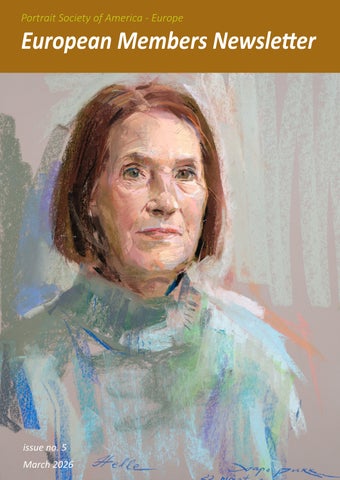
Cover Artwork: Aapo Pukk
“Helle”
Members Only Competition 2025 Congratulations European Artists
Commissioned Portrait
Aapo Pukk (Estonia) - Finalist
“Mr. Rain Kirjanen” Oil on canvas, 124x74cm
Aapo Pukk is also among the “Selected 30” of the 28th International Portrait Competition 2026, with his portrait painting “Bishop Ove Sander”.
Landscape
Aapo Pukk (Estonia) - Finalist
“Samos Island, Greece” Watercolor on paper, 10x7 “
Outside the Box
Aapo Pukk (Estonia) - Finalist
“Helle” Pastel on paper, 24x18 “
MOC 2025
Alessandra Marrucchi (Italy) - 4th Place
“Our Golden Wedding Anniversary” Oil on linen canvas, 61x70 cm
Alessandra’s painting was also selected as a Finalist of the 28th International Portrait Competition 2026.
David Sandell (UK) - Finalist
“Trinity” pencil/pastel on Pastelmat, 50 x 70cm
Non Commissioned Portrait
Svetlana Semenova (UK) - Finalist
“Holding on to Moments” Oil on panel 50 x 47cm
Charles Moxon (UK) - Finalist
“Bern” Oil on Canvas, 16x20”
MOC 2025
Rosanna Gaddoni (The Netherlands) - 2nd Place
“Stories” Charcoal on paper, 63 x 48 cm
Finalists:
Alex Faudé (Belgium)
“Fairytale” Charcoal, 70 x 50 cm
Animals as the Subject
Alexandra Telgmann (Germany) - 7th Place
“Silver Ocean Reflections Dolphins” Oil on Aludibond, 70 x 70cm
Ginny Page (Denmark)
“Now What” Oil on panel, 23x30cm
Andrea Steinbauer (Germany)
“Whiskers” Oil on panel, 60x50cm
News from Members
Exhibitions, Awards and Other News
Fernando Garcia-Monzon (Spain)1st Prize at the “Portrait of a Princess” Award
The Royal Body of the Nobility of Madrid launched the Prize “Portrait of a Princess” in reference to H.R.H. Princess Leonor heir to the Spanish Throne. Fernando Garcia-Monzon’s portrait captivated the jury and got the First Prize. The award ceremony took place in Madrid, and its Mayor handed it over.
Günter Schwarz (Austria)
Unveiling - Portrait of Helmut Leierer
Günter Schwarz was invited to see the unveiling of a recent portrait commission. It was his portrait painting of the architect Helmut Leierer, how is well know in Vienna and Lower Austria, depicted with his wife. The painting was unveiled during Leierer’s 95th birthday party; the honoree and the guests in attendance were delighted.
Image by Fernando Garcia-Monzon: Fernado’s drawing “Mayoría de edad”, Conté crayon on Canson paper, 80 x 50 cm, 2025 (left), Fernando at the award ceremony (right)
Image by Günter Schwarz: Günter’s portrait of Helmut Leierer with his wife
Victoria von Kap-herr (Germany)New Series About Horse Race
From an early age, I was immersed in equestrian life. My first visit to the racetrack was in Frankfurt with my father, whose uncle presided over the Thoroughbred association. I encountered a world of ceremony and prestige — polished surfaces, restrained gestures, and the quiet intensity that gathers before a race.
Years later, time spent around racing stables in the United States, with regular visits to tracks in Miami, revealed the labor beneath the spectacle: early mornings, disciplined routines, and the intimate bond between horse and groom. More recently, while living in Berlin, visits to the track in Hoppegarten showed me another, more contained yet equally charged atmosphere.
After a series of sketches the direction of this work became clear. I found myself drawn not to the race itself, but to the paddock parade — that suspended moment before release. What first excited my painter’s eye was the harmony of natural, almost monochrome values in the horses — deep browns, grays, blacks — set against the sudden, graphic brilliance of the racing stables’ colors, embodied in the jockeys’ silks. These vivid patterns cut sharply through the organic palette of the scene, introducing a visual tension between nature and design.
Images by Victoria von Kap-herr: Preliminary sketches for the new series (gouache and drawings); the final paintings will be in oil
Image by Victoria von Kap-herr: Victoria’s painting, depicting her (middle), Countess Tini Rothkirch (right) and an English lady (left)
Members Spotlight
Fernando Garcia-Monzon (Spain)
I’m an architect and wanted to be ever since. In those days, when computers didn’t exist, hand-drawing was the tool to master. While my training process, I discovered portraiture and it caught my interest on the spot. That relationship is still fully-alive more than 45 years later.
As for my technical background, things have to be well “constructed”, line is fundamental and color superfluous. I also focus on the important things, the head in case of a portrait. The rest contributes adding information. The principle is that the less you need to draw, the stronger the message will be.
In my view, a portrait works like the cover of a book. What you see on the outside is not the important thing; it is what it hides behind. The mere image we perceive cannot convey the whole story on its one. As with books, you have to dive in to understand everything! That’s why I make videos for my website.
Being the father of a severely dependent boy taught me that you shouldn’t make final conclusions from what you see. Antoine de Saint-Exupéry skillfully put it into words:
“It is only with the heart that one can see rightly; what is essential is invisible to the eye”.
Images by Fernando Garcia-Monzon
Albrecht Dürer and the Myth of the Magic Brush
By Andrea Steinbauer
As artists, don’t we all hope to unveil the secret of a great master or discover a special tool or material that will boost our skills to a higher level, just overnight? Well, so far in my career as an artist I haven’t been able to uncover such a secret jet; instead it always has been hard work of practicing and learning to improve step by step.
There is an anecdote about Albrecht Dürer, the great master of the Northern Renaissance, concerning mysterious tools. During Dürer’s first stay in Venice 1494, the Venetian master Giovanni Bellini visited him in his studio. Fascinated by the precise lines and the details of Dürer’s artwork, Bellini asked the German artist if he could give him one of his special brushes he is using to achieve this. Dürer grabbed a few brushes and replied: “Take whatever you want; I can do this with any brush.” And to emphasize his point, he picked up a brush at random and made a stroke. The two artists became friends, learned from each other, and thereby also supported the exchange of knowledge between Northern and Southern Europe in an era of transition from the middle age to the modern time.
What can we learn from this anecdote? It’s the artist who creates the magic and not a mythical tool, special material or secret trick. But we can learn by studying and analyzing the work of the old masters. And just like them, we should always remain curious, be willing to continue learning, and exchange knowledge and experience with like-minded artists. Over the past three years, our community of European Portrait Society members provided a wonderful chance to do this. In particular, our regular Zoom meetings have become a valuable opportunity for creative exchange and support.
Image by Andrea Steinbauer: Master copy of Dürer’s self-portrait, pastel on sanded paper
Photo by Andrea Steinbauer: Albrecht Dürer, “Self-portrait”, 1500, oil on wood, Alte Pinakothek Munich
Last Words Quote
“Friendship, on the other hand, has many advantages: wherever you turn, it is always there, it is never excluded, it is never inappropriate, never annoying.” Cicero
In his double portrait, Pontormo painted two of his friends who were sitting for him. The hands of both point to an open book with a quote from the Roman writer Cicero about friendship. The gaze of both men in the painting is directed outward, revealing their interaction with the painter; thus, the painting becomes a record of the interaction between three friends.
Photo by Andrea Steinbauer: Jacopo Carrucci di Pontormo, “Double Portrait of Two Friends”, 1523/1524, Galleria di Palazzo Cini, Venice