J A N UA R Y/ F E B R UA R Y 2 0 2 6 $9
C OV ER S T ORY Beyond the sea with April Phillips and Friends with Computers PLUS Pasar Malam: Printmakers explore shadow places PLUS The Long View: The Power of the Art World Novel
EX HIBITION LISTINGS
V IC
NSW
QLD
AC T
TA S
SA
WA
NT
I N S I D E T H I S I S S U E
A Note from the Editor
20 Questions with Jess Cochrane
Chloé Wolifson
Anna Carlsson
PR EV IEW
Shadow Play: Pasar Malam (Night Market)
Sophia Halloway
Craft Master: Helen Britton
Objet d’Art—Theo Koning and his Creative Self PLAY!
Rhianna Melhem Suzon Fuks: e-Galaxy
Josephine Mead Briony Downes STUDIO
Hany Armanious
Louise Martin-Chew
Jane O’Sullivan
Revealing Dress: Fashion as portraiture
F E AT U R E
Emma Do Paola Pivi: I don’t like it, I love it
Rhianna Melhem Young | youth in Australian photography: 1980s to now
Anna Carlsson Hobart Current: Here
Emma-Kate Wilson Rosalind Lemoh: Masked Memory
Sophia Halloway Yield
Louise Martin-Chew Ode: Margaret Olley and Sally Anderson
Emma-Kate Wilson
The Threads That Bind: Tammy Kanat
Camilla Wagstaff Stress Test: 2026 Adelaide Biennial of Australian Art: Yield Strength
Steve Dow THE LONG V IEW
The Process is the Point: The Power of the Art World Novel
Joseph Earp F E AT U R E
Making a Home: Nell
Emma O’Neill All Grown Up: Iconic, Loved, Unexpected
Paul Sutherland
F E AT U R E
When Code Meets Care: April Phillips and Friends with Computers
Rosamund Brennan
MAPS 1 V I C T O R I A
9 & 10
D A R L I N G H U R S T, R E D F E R N ,
W AT E R L O O & PA D D I N G T O N
2
MELBOURNE CBD 11 & 12
G R E AT E R S Y D N E Y
3
FI T ZR OY & C O LLI N GWO O D
& N E W S O U T H WA L E S
4
G R E AT E R M E L B O U R N E
13 & 14
G R E AT E R B R I S B A N E & Q U E E N S L A N D
5 & 6
NORTHERN & SOUTHERN MELBOURNE
15 & 16
BRISBANE & CANBERRA
7 S Y D N E Y
17 & 1 8
HOBART & ADELAIDE
8
19 & 20
PERTH & FREMANTLE
SYDNEY CIT Y
Strategic Sponsors
Major Partner
Media Partner
Supporting Partner
Mary Nolan, Tessa, Arles, 1964, black and white photograph (detail). National Library of Australia, courtesy of the Lady Mary Nolan Estate.
A Note From the Editor January/February 2026
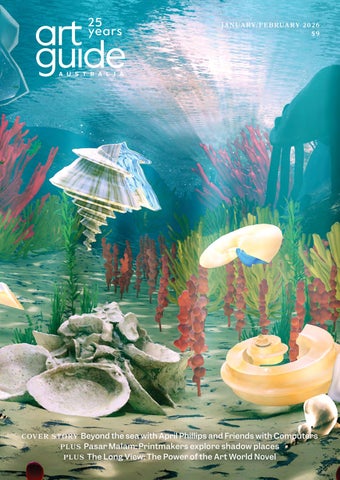
Welcome to Art Guide Australia’s January/February issue, which is wrapped in summer vibes. Our aquatic cover image is a still from April Phillips and Friends with Computers, whose digital installation Under Waters has been developed through the Perth Institute of Contemporary Arts’ inaugural boorda yeyi Immersive Arts Commission. As Rosamund Brennan writes, Phillips’ work embodies “a portal between digital and physical, between sea and stars, between self and vastness.” Phillips notes that while her work is made on a computer, “it is so handmade in the realm of digital. Everything is created with a lot of care and love.” It’s a theme that echoes through this issue of Art Guide, with artists being guided and challenged by their chosen materials in the service of their vision: from the instinctual mark-making of painter Jess Cochrane to fibre artist Tammy Kanat painting with thread; from multidisciplinary artist Helen Britton’s repurposing of objects of memory to sculptor Hany Armanious wrestling with the nature of perception. For the Indonesian and Australian artists involved in Pasar Malam (Night Market), creating the large-format screenprints for this touring exhibition was also a challenging process. However, as Josephine Mead writes, the resulting project highlights the possibilities of such collective creative exchange. Elsewhere, the summer reading continues with the next in Art Guide’s long form essay series The Long View. Painter and novelist Joseph Earp writes on the art world novel, taking as his jumping-off point Patrick White’s seminal text The Vivisector, and exploring the recent wave of Australian literature set in the world of Australian art. Please enjoy this issue, and immerse yourself in art this summer. Chloé Wolifson Print Editor, Art Guide Australia
Editorial Team ED I TOR–AT–LARG E
PRINT E D I TOR
Neha Kale
Chloé Wolifson
ASSOCIATE EDITOR
Anna Carlsson
WE BSI TE AND SO C IAL M E D I A COORDINATO R
Minna Gilligan DESIGNER
Jack Loel BOOKSTORE MANAG ER
Jackson McLaren P R OD UCTI ON ASS ISTANT
Madeline Walling L I STI N GS AS S ISTANT
Arthur Foulkes CONTR I BUTO RS IS SU E #159
Rosamund Brennan, Evie Cahir, Anna Carlsson, Emma Do, Steve Dow, Briony Downes, Joseph Earp, Sophia Halloway, Louise Martin-Chew, Josephine Mead, Rhianna Melhem, Emma O’Neill, Jane O’Sullivan, Paul Sutherland, Hamish Ta-mé, Camilla Wagstaff, Emma-Kate Wilson SUB E D I TO R
Art Guide Australia Wurundjeri Country, 43-47 Simpson Street, Northcote, Victoria 3070 Phone: 03 7044 9750 artguide.com.au Art Guide Australia acknowledges the Aboriginal and Torres Strait Islander peoples who are Traditional Custodians of Country throughout Australia. We particularly acknowledge the Boon Wurrung and Wurundjeri peoples of the Kulin Nation, upon whose land Art Guide Australia largely operates. We recognise the important connection of First Peoples to land, water and community, and pay respect to Elders past, present and emerging. This magazine contains Traditional place names within Australia sourced by AIATSIS Pathways or provided by galleries and museums. Please contact Art Guide at info@ artguide.com.au if you wish to provide feedback. PA PE R
Pacesetter Satin T YPE
Bookmania Garnett Contacts E D I TOR IAL
Paul Sutherland
editors@artguide.com.au
P R I NTI NG
A DV E R T ISIN G
Postscript Printing P UBL I SHE RS
Graham Meadowcroft Kim Butterworth
Graham Meadowcroft advertise@artguide.com.au SU B S C R IP T IO N S
artguide.com.au/subscribe G E NE R AL E N Q UIR IE S
info@artguide.com.au D I ST RI B UT IO N
Art Guide Australia is distributed through galleries, museums, independent bookstores, newsagencies and art supply retailers. Cover artist: April Phillips and Friends with Computers
Art Guide Bookstore The Art Guide Bookstore is a curated collection of the best contemporary art books. It is located at 43-47 Simpson Street, Northcote, Victoria 3070 and open Wednesday to Saturday, 9am–5pm. S H OP O N L IN E bookstore.artguide.com.au
Art Guide Australia is a proudly independent bimonthly publication produced by Print Ideas. ISSN: 091 091 593 April Phillips and Friends with Computers, Under Waters, (still), boorda yeyi Immersive Arts Commission, 2025, Perth Institute of Contemporary Arts. Courtesy of the a rtist.
30
Issue 159 Contributors Rosa mund Br enna n is a Fremantle, Western Australia-based freelance journalist and photographer focusing on culture, travel and society. Her work has appeared in publications including The Guardian, The Australian, Al Jazeera, The Sunday Telegraph, Qantas Magazine and Delicious, among others.
Louise M a rtin-Chew is a freelance writer. Her most recent book is Margot McKinney: World of Wonder, published by Museum of Brisbane, 2022. Her first biography, Fiona Foley Provocateur: An Art Life (QUT Art Museum, 2021) won the 2022 Best Book Prize (joint), AWAPA, Art Association of Australian and New Zealand.
Ev ie Ca hir born in Ballarat, 1992, studied a degree in Illustration from NMIT (2013) and now lives and works in Melbourne. At the heart of Cahir’s practice is a deep engagement with light and colour, both of which act as a vehicle for emotional and spatial awareness.
Josephine Mea d is a visual artist, writer & curator, living and working on Wurundjeri woi wurrung & Dja Dja wurrung Country (Australia).
A nna Ca r lsson is a writer born in South Korea, raised in Warrnambool but now residing on Wurundjeri land. She has a background in publishing with an arts and cultural focus and is co-writer of the Substack, Pleasure Principle. Emm a Do is a writer and editor based in Naarm/ Melbourne. She runs an infrequent podcast called Smart Casual and fires off the occasional missive at spacesbetween.substack.com. Stev e Dow is a Melbourne-born, Sydney-based arts writer, whose profiles, essays, previews and reviews range across the visual arts, theatre, film and television for The Saturday Paper, Guardian Australia, The Monthly, The Sydney Morning Herald, The Age, Sunday Life, Limelight and VAULT. Br ion y Dow nes is an arts writer based in Hobart. She has worked in the arts industry for over 20 years as a writer, actor, gallery assistant, art theory tutor and fine art framer. Most recently, she spent time studying art history through Oxford University. Joseph Ea r p is an awarded and exhibited novelist, painter and critic. His fiction debut Painting Portraits of Everyone I’ve Ever Dated was released by Pantera Press in 2025.
R hi a nna Melhem is an independent curator, arts writer and art consultant specialising in contemporary Australian art. Previously, she was associate director of Artereal Gallery for 16 years, and sat on the Art Month Sydney board and the Museum of Contemporary Art’s Next committee. Emm a O’Neill is an arts manager, writer and curator based on unceded Gadigal land. Ja ne O’Sulli va n is an independent art writer. She has contributed to VAULT, ArtAsiaPacific, Ocula, Flash Art, Art Monthly and Running Dog and is also a former editor of Art Collector. Paul Suther la nd is a writer, editor, and former journalist. He writes short- and long-form fiction and non-fiction from his home in regional Victoria. H a mish Ta-mé is an established commercial photographer with a parallel career as an exhibiting artist. He focuses on portraiture in both his commercial and fine art practice. Ca milla Wagsta ff is a journalist and writer based in Sydney, Australia. She specialises in arts, culture, interiors and travel writing. Emm a-K ate W ilson is a contemporary art and design writer originally from the UK and now based in Bellingen, NSW. She has written for various publications such as Art Collector, Art Almanac, ArchitectureAU, Habitus Living, and others.
Sophi a H a lloway is an art critic and writer based in Kamberri/Canberra. She has written for publications including Art Monthly Australasia, Art Almanac, and others.
31
Previews W R ITERS
Anna Carlsson, Emma Do, Sophia Halloway, Louise Martin-Chew, Rhianna Melhem, Emma-Kate Wilson
Fremantle/Walyalup Objet d’Art—Theo Koning and his Creative Self
Walyalup Fremantle Arts Centre Until 26 January
Theo Koning’s artistic legacy is as wide-ranging as his practice, which spanned an incredible diversity of media, including sculpture and assemblage, often drawn from found materials, painting, drawing, print editions and artists’ books. As an artist, teacher and activist, Koning had a profound impact on the arts community in Fremantle and across Western Australia. This legacy is celebrated in an expansive retrospective at Walyalup Fremantle Arts Centre, comprising over 250 works drawn from the artist’s estate and institutional, corporate and private collections across Australia. Objet d’Art—Theo Koning and his Creative Self Theo Koning, A Life Lived, 2022, acrylic paint on traverses the incredible breadth of Koning’s output, painted metal, 48 x 44 cm. Courtesy the Estate including a series of Instagram posts, the homemade of the A rtist. photoGRAPH: R ebecca M a nsell. horror film Amputation (1980), and Koning’s gardening works and unpublished poetry. “He possessed a fluid urgency around collecting materials and creating things,” curator André Lipscombe explains. “He had this exquisite method of bonding materials together, of understanding their tolerances.” “Koning was interested in the idea of the constructed self, of identity as something that’s crafted by culture through various experiences and histories,” says Lipscombe. The exhibition will chart the experiences that informed Koning’s creative output—his art advocacy and involvement with contemporary art organisations such as Praxis, his 2015 residency at Atelier Mondial Studio in Basel, and his family life, all of which remained a vital source of both support and creative impetus throughout his career. It is impossible to summarise the essence of Koning’s legacy through words alone—his works can speak to that—but Lipscombe hopes the artist can be remembered, among many other things, for “the totality of his aspirations of blending art and the constancy of everyday life.” — S O P H I A H A L L OWAY
32
Theo Koning, Construction#26, 2006, assemblage found materials, painted elements, 102 x 65 x 34 cm. Collection of Philip Gr iffiths. photogr a ph: Robert Fr ith.
33
Katoomba/Dharug and Gundungurra Country PLAY!
Blue Mountains City Art Gallery Until 15 February
Bursting with tactile, playful works that call out for touch and engagement, PLAY! at Blue Mountains City Art Gallery invites audiences to set aside the usual etiquette Sanné Mestrom, Still Life Moving, 2022, in of gallery viewing. Encouraging curiosity and hands-on The Whole is Greater than the Sum of Her Parts exploration, the exhibition—curated by Hayley Zena playspace. Photogr a ph: K er r ie Br ew er, Poynton—dissolves traditional institutional boundaries, Nationa l Ga llery Austr a li a. transforming the gallery into a space for intergenerational connection, creativity and shared discovery. As Poynton explains, PLAY! emerges from a deep awareness that “there’s such a clear need from the public for frivolity, for joyousness, for a feeling of interconnectedness. When you look at the political and war-torn landscape globally, these microcosms of community—created even just for an afternoon— feel incredibly powerful.” Anchoring the exhibition is an interactive playable sculpture by Sanné Mestrom. Known for creating playful, socially engaged work, Mestrom’s piece references cubist forms, presenting an abstracted female body that can be reassembled, climbed upon and inhabited—reimagining how audiences engage with art. Alongside this, Melissa Gilbert presents a work from her Hyper Temples Playkit series (2022)— an installation of chromatically charged soft sculptures that invite what she calls “ceremonial activations”, as visitors continually rebuild the work so it’s always in flux. Also included are meticulously constructed artworks by Corrigan Fairbairn, which defy categorisation. Part painting, part sculpture, these analogue animations invite viewers to turn a wooden handle, setting in motion an evolving sequence of colours, patterns and forms that transmogrify before the eyes. Spanning an eclectic mix of mediums, PLAY! also features an interactive, motion sensor work by Andrew Yip—a playful ‘choose your own adventure’ experience—and Nastia Gladushchenko’s expanded paintings, which invite audiences to leave their mark on a collective artwork. Joined by works from Robert Frost, Nadia Odlum and Kate Reid, the exhibition positions play as a vital tool for social inclusion, reconnecting audiences through shared curiosity and a sense of wonder. — R H I A N N A M E L H E M
Cairns/Gimuy Suzon Fuks: e-Galaxy
NorthSite, Cairns 16 February—18 April (exhibiting concurrently at Stanley Street Gallery, Sydney/Gadigal Country 7—26 March)
Suzon Fuks, SpinWheel Galaxy, 2024.
34
e-Galaxy reimagines electronic waste as a new macro-environment. Artist/activist Suzon Fuks explores the component materials of our electronic devices, noting that the core minerals at their centre were formed by the Earth millions of years ago, and that these and other materials used impact the environment through their sheer volume and built-in obsolescence. Yet she also celebrates the human achievement that produces these devices.
Throughout her career, which began in Brussels as a performer, Fuks has also practiced as a visual and digital artist. With e-Galaxy, her versatility is evident. She told Art Guide, “What is the most important for me in art is what we want to say. Then, we choose which skills to use. Personally, I continuously learn new skills or update them.” e-Galaxy is suitable for audiences of all ages. In Cairns, the exhibition comprises a labyrinth filled with possibilities that the audience may walk through, a series of artists’ books made from obsolete smartphones, two videos, and miniature e-Galaxies using smaller components. In this installation, which Fuks has presented all over the world in recent years, most recently in Munich, “I talk to the public, as we are all explorers of the future. It draws in issues of child labour, mining, minerals and access to electronic devices. Only seven of ten people globally have access to electricity—three will never have these devices—so it’s important to share, reuse and recycle.” “I also talk about the accumulation of knowledge and skills over time in order to get to this technology. There is a wonder that I try to share, and a warning. I try to make people think and rethink how we make things, use them, and recycle and redesign with long term vision.” — L O U I S E M A R T I N - C H E W
Liverpool/ Dharawal Country Revealing Dress: Fashion as portraiture Liverpool Powerhouse Until 19 April
Beyond the spectacle of the runway, fashion is an everyday language for storytelling. Whether intentional or not, what we wear broadcasts our emotions, values and identities. “Clothes can reveal ourselves and who we want to be seen by,” says Luke Letourneau, head of Liverpool Powerhouse’s curatorial team. These intimate connections to clothing are laid bare in Revealing Dress, an exhibition of over 20 independent Australian fashion designers and visual artists whose works foreground garments. The themes are expansive: clothing is posited as heirloom, resistance, cultural archive, and mirror. Grace Lillian Lee’s twine and feather exoskeletons, mesmerisingly woven using the traditional Torres Strait Islander ‘grasshopper’ technique, were inspired by her grandmother’s wedding on Thursday Atong Atem, Men In This Town [04], 2024. Island. Lily Golightly’s kid-friendly installation of handCourtesy the artist and MARS Gallery, painted cloaks, each representing various emotions, Melbourne. makes clear how fashion reflects our feelings. Meanwhile, a puffer jacket elegantly carved from marble by Alex Seton questions what we insulate ourselves from. There is, of course, a clear celebration of creativity. Pieces by designers including Jordan Gogos, Alix Higgins, Nicol & Ford and Wackie Ju herald artistry over commerce. Among five new commissions, Megan Hanson’s work demonstrates a quiet commitment to craft—a thread that runs through the show. The textile artist transformed photographs of her friend and collaborator Marcus Whale into a bespoke outfit, weaving its fabric on a digital Jacquard loom. It was Claudia Nicholson’s video, in which young asylum seekers playfully don masks and costumes, which offered Letourneau direction early on. In it, fashion is both self-expression and concealment. “It called to an interesting tension,” Letourneau says. “We want to put ourselves out there, we want human connection and to be seen. But we’re also hesitant to be fully on display in a hyper-surveilled world.” — E M M A D O 35
Libby Harward was invited to exhibit her ongoing Ngugi Bajara (Ancestors’ Footsteps) project, which she reiterated as Ngali Gabili (We Tell) (2024). In this work, living plants, both Indigenous and exotic, are displayed in terrariums, and they ask, in language, “Why am I here?” Harward explains, “For the first time this iteration fits into my Aboriginal and colonial heritage through John Tinker Campbell, who came over from Canada. His son, who married my Ngugi grandmother, was a pastoralist in an era of agricultural policy that saw foreign plants like sugarcane being trialled on my ancestral Country.” Bancroft’s take on food preservation inspired Elizabeth Willing’s Pluck Pickle, which sees an excess of cast ceramic sausages piled on a table. “His interest in preservation is so familiar in modern food production, and the way it is displayed— on a bed of Styrofoam, in the centre of a table—refers to the plasticity of contemporary food.” During the course of the exhibition, the engagement space will be activated over three iterations, initially featuring activities designed by Lyndon Davis, to be followed by Elizabeth Willing and finally Fernando do Campo. — LOU ISE M A RTI N- CH EW
Tweed Valley/ Bundjalung Country Ode: Margaret Olley and Sally Anderson
Tweed Regional Gallery Until 8 March
Ode: Margaret Olley and Sally Anderson at the Tweed Regional Gallery unites the practices of two painters whose lives are seemingly entwined, their oeuvres hovering at the boundaries of still life and landscapes. Like Margaret Olley, Sally Anderson was born in Lismore, NSW, on Bundjalung Country, and both spent time in Sally Anderson, Olley’s green still life, iPad Paris exploring the galleries and house museums. landscape, MO cushion, Augie’s highchair, placenta banksias, 2025, acrylic on canvas, 137 x 168 cm. During Anderson’s 2025 residency at the gallery’s Im age courtesy of the a rtist, © The a rtist. Nancy Fairfax Artist in Residence Studio, she found inspiration for her new paintings in the reconstruction of Olley’s home. This led Anderson to consider how composition and ‘arranging’ are embedded within their respective practices. “I think a lot about arranging—how we arrange thoughts, time, memories, households, feelings, gardens, furniture, objects, colour—and how rearranging the order of things ultimately shifts meaning, revealing new truths, narratives, and histories,” says Anderson in her artist statement. “I find the arrangement of Olley’s home/studio completely fascinating. The layers of objects, surfaces, textiles, smells.” Anderson’s paintings feature personally significant objects deliberately positioned alongside objects borrowed from Olley’s reconstructed home/studio. While recently her art explored the intersection of her life and maternal experience, Anderson now muses on mortality after her father’s passing. She reflects on memento mori in art, particularly in still-life paintings, where iconography such as fruit and flowers can serve as reminders that life is fleeting. Anderson muses how these symbols allow paintings to become “a kind of afterlife”. As seen at the Tweed Regional Gallery, objects can live on far beyond their owners. Ode: Margaret Olley and Sally Anderson combines both artists’ works to become gentle reminders of time and memory. — E M M A- K AT E W I L S O N
40
Sally Anderson, Self as subject (after PP in Paris) with quilt window, hydrangeas and birth banksias, 2025, acrylic on polycotton, 198 x 152 cm. Im age courtesy of the a rtist, © The a rtist.
41
W H EN CODE M EETS CA R E Digital art often overwhelms the senses, but April Phillips invites us to slow down. In a new major commission, she turns light, sound and code into something tactile, gentle and deeply human. WRITER
Rosamund Brennan
42
April Phillips and Friends with Computers, Under Waters, (still), boorda yeyi Immersive Arts Commission, 2025, Perth Institute of Contemporary Arts. Cou rte sy of the a rtist.
43
April Phillips and Friends with Computers, Under Waters, (still), boorda yeyi Immersive Arts Commission, 2025, Perth Institute of Contemporary Arts. Cou rte sy of the a rtist.
For the Wiradjuri-Scottish artist April Phillips, technology is not a shortcut but a material to be shaped. In her practice, light, sound and projection are built slowly, layer by layer, until they take on the tactility of craft—in a method she calls “digital handmade”. “It’s done on a computer, but it is so handmade in the realm of digital,” says Phillips. “Everything is created with a lot of care and love.” Living and working on Yuin Country on the south coast of New South Wales, Phillips’ practice is rooted in futurism and media arts, spanning moving image, printmaking, illustration, augmented reality (AR) and photogrammetry (3D photo scans). She continually expands the limits of the digital realm, exploring how virtual worlds can open new ways of seeing and feeling. Her new commission at the Perth Institute of Contemporary Arts (PICA) extends that vision. Working with collaborators Pat Younis and Jordan East under their collective Friends with Computers, Phillips is creating Under Waters, a large-scale installation that moves between the deep ocean and outer space. Visitors will step inside a darkened room where light, sound and projection shift in response to their presence. “It’s about the tension between our world and another world,” she says. “You really are transported, and you go somewhere else.” Developed through PICA’s inaugural boorda yeyi Immersive Arts Commission, Under Waters marks
44
the beginning of a three-year initiative supporting artists who merge technology and contemporary practice. For Phillips, it’s a chance to push the language of immersive art toward something slower and more sensorial. Rather than dazzling spectacle, the work invites quiet participation, a space where stillness becomes the point of connection. Visitors will be tracked in real time, but not in the usual reactive sense. “People will be rewarded for staying and being,” she explains. “The longer the camera detects the same body staying, the more that will happen. It’s about finding and growing within the space.” The work will take shape inside a room within a room, where projection spills across translucent scrim, creating what Phillips calls “a delicate portal membrane into a parallel place”. Rather than light hitting a wall, the scrim allows illumination to hover mid-air. “It’s almost like suspending light in air,” she says. “It feels like being inside your dream space. It’s so restful for your eyes, and it’s almost like clouds, the way the light comes through.” To build these worlds, the team uses a blend of photogrammetry and 3D modelling—processes that merge the real and the digital. “I’m the kind of person that will go for a walk, pick up sticks, then take hundreds of photos of them to create 3D models and place them into digital earth,” she explains. “All of the energy and the vibrations of the real world, when you pull that into digital, that’s when you create this pull and this tension between digital and analogue.”
April Phillips and Friends with Computers, Under Waters, (still), boorda yeyi Immersive Arts Commission, 2025, Perth Institute of Contemporary Arts. Cou rte sy of the a rtist.
“People will be rewarded for staying and being. The longer the camera detects the same body staying, the more that will happen. It’s about finding and growing within the space.” A PR I L PH I LLI PS
For Under Waters, Phillips is also collaborating with the Western Australian Museum to integrate 3D scans of marine specimens, including xenophora shells, creatures that collect other shells and attach them to their own. “They’re beautiful spiral shells,” she says. “We’re looking at doing some photogrammetry scans with them, bringing them to life in different ways.” Each detail is designed with sensitivity to site. The work’s celestial mapping will mirror the night sky above Perth. “When you look up in the sky, the stars will correspond with the longitude and latitude coordinates,” she says. “So if you went up on the roof at PICA and looked up, it would be exactly the same.” Phillips also describes the project as “art which puts First Nations first,” both in theme and in method. “People have expectations of First Nations art,” she says. “They expect it to look and sound a certain way, but what’s important is the methodology.” The work will involve intergenerational First Nations artists from regional Western Australia, contributing across sound and visuals. “It’s about collaboration,” she says. “Not just consultation or co-design.” This ethos of care runs through all her projects. In kajoo yannaga (2024), Phillips collaborated with Yuin Djiringanj artists Warren Foster Jnr and Warren Foster Snr to create a virtual walk on Country guided by the Companion Sky Spirit.
Through real-time motion tracking, the work brings together story, movement and technology to reflect on connection and care for Country. For Phillips, Under Waters reflects a broader shift in how immersive art is evolving. “It’s kind of becoming its own thing, sitting beyond digital, beyond film, beyond all these things,” she says. While international institutions are embracing innovation in this field, she sees PICA’s boorda yeyi commission as a chance to help shape how immersive practice grows locally. Her new work steps into that space, offering a contemplative alternative to fast, overstimulated digital culture. Under Waters embodies that ethos: a portal between digital and physical, between sea and stars, between self and vastness. “We’re overstimulated and cramped,” she says. “What we yearn for is that wonderful feeling of being able to see so far that you can’t see the end of it.”
Under Waters April Phillips
Perth Institute of Contemporary Arts (Perth/Boorloo WA) 19 February—29 March
45
20 QU E STIONS W ITH
Jess Cochrane
46 46
AS TOLD TO
Anna Carlsson
Jess Cochrane is a modern-day artist, looking through a lens of Impressionism, motherhood and her camera roll. Acknowledging the legacies of life before her, the London-based artist’s work combines inspiration from the past with the mundane of the present, to create a time stamp of life in this moment. Her latest solo show, The Middle of the Flower at Sullivan+Strumpf in Sydney, is an ode to family history and family heartbreak, as she embarks on a journey of self-exploration.
Describe your practice in seven words? Literal, personal, connecting, joyous, contemplative, honest, humorous. Your first art love? The National Gallery of Australia. Dad would take me there often as a child and it really informed my understanding that the world can be a visually magical place, and that human imagination and inner worlds are sacred and should be celebrated.
Jess Cochrane, Sunflowers at Corner 75, 2025, oil on canvas, 65 x 80 cm.
Im age cou rte sy the a rtist a n d Su lli va n+Stru mpf.
left
How and when did you first start painting? Being an artist has always been my calling. I am lucky to have been raised by parents who did nothing but encourage the creative part of me. My father, Rick Cochrane, has been involved with Canberra Art Workshop and M16 Artspace for as long as I can remember. When he saw my interest in drawing figuratively at around age 16, he let me join a life drawing class. But it wasn’t until recently, when I gave birth to my first daughter, that I decided to take painting seriously. Becoming a mother made me realise I’d spent my life embodying art but being too afraid to really paint. There is nothing that will crush your concept of what is fearful and hard quite like giving birth. How important is place to you when creating? The studio is as much a machine as it is a gremlin art cave and your best friend. So much of being an artist is showing up and being in your studio. Sometimes you need to dance around the studio like a lunatic, sometimes you need to cry in there. The space’s importance lies in its ability to hold you through all phases of making. Ultimately, it has to be an extension of you.
Jess Cochrane in the studio, 2025.
Photogr a ph: Chloe Bor ich.
47