
Welcome to the 2026 presentation of The West Australian Pulse, the Art Gallery of Western Australia’s annual exhibition showcasing selected works by Year 12 Visual Arts graduates. Now in its 34th year, the exhibition remains a vital platform for young artists at a formative stage in their creative and personal development.
Drawn from the previous year’s graduating cohort, The West Australian Pulse brings together a range of emerging practices, offering insight into the experiences, interests and concerns shaping young people at this formative stage. Working across a wide range of media – from painting and drawing to animation, textiles and installation – these artists demonstrate technical skill, conceptual clarity, and a willingness to test ideas, materials and processes. Their works do not seek to resolve the world around them but to examine it: to question how identity is formed, how values are established, and how individual experience connects to broader social conditions.
As these artists move from school into early adulthood, their work reflects this shift. Questions of independence, responsibility and self-definition sit alongside considerations of cultural inheritance, wellbeing, belief systems and social expectations. The result is an exhibition that is varied in approach yet connected by a shared attentiveness to the present – an interest in how to position oneself within a changing social and cultural landscape.
The selection process, conducted by Isobel Wise, AGWA Associate Curator of Contemporary Art; Abdul-Rahman Abdullah, Artist; and Lisa Bowden, Principal Consultant, Visual Arts, School Curriculum and Standards Authority (SCSA), was rigorous and rewarding, reflecting the high number of submissions and the calibre of work produced across the state. We extend our thanks to the panel for their attentive and considered approach to this process.
Beyond the exhibition, AGWA remains committed to supporting pathways that enable young people to continue their engagement with the arts. Through partnerships with schools, tertiary institutions and industry, the Gallery seeks to create opportunities for emerging practitioners to develop their skills, expand their networks and consider future directions in the creative sector.
We extend our sincere thanks to the students featured in this exhibition, as well as to the teachers, families and school communities who support and encourage their development. Their collective investment underpins the strength and continuity of arts education in Western Australia.
The West Australian Pulse affirms the importance of making space for young voices in our cultural institutions. As these artists begin to establish their place within a wider creative community, their considered, candid and forward-looking perspectives offer confidence in the future of creative practice in this state.
Colin Walker Director AGWA
The West Australian Pulse 2026, now in its 34th year, is the event I most look forward to each year, and this year’s extraordinary cohort reminds me why.
These 63 works, selected from more than 320 entries across 90 Western Australian schools, are not student exercises. They are statements. Dispatches from the front lines of growing up in a complicated world, made by young people who have chosen art as the most honest and raw form to share their stories.
In our newsroom, we are in the business of stories. We know that the most powerful ones are personal, the ones that evoke an emotional connection. That is what these artists have achieved. William Jones’s Joy, a portrait of his mother Joylene, a proud Yamatji woman shaped by the Stolen Generations, begins in family history and arrives at something profound about resilience, cultural reclamation, and love. When Jones says he hopes viewers feel pride rather than sadness standing before it, he reveals the generosity that runs through so much of this exhibition. These young people are not simply processing their own experiences. They are offering them to us.
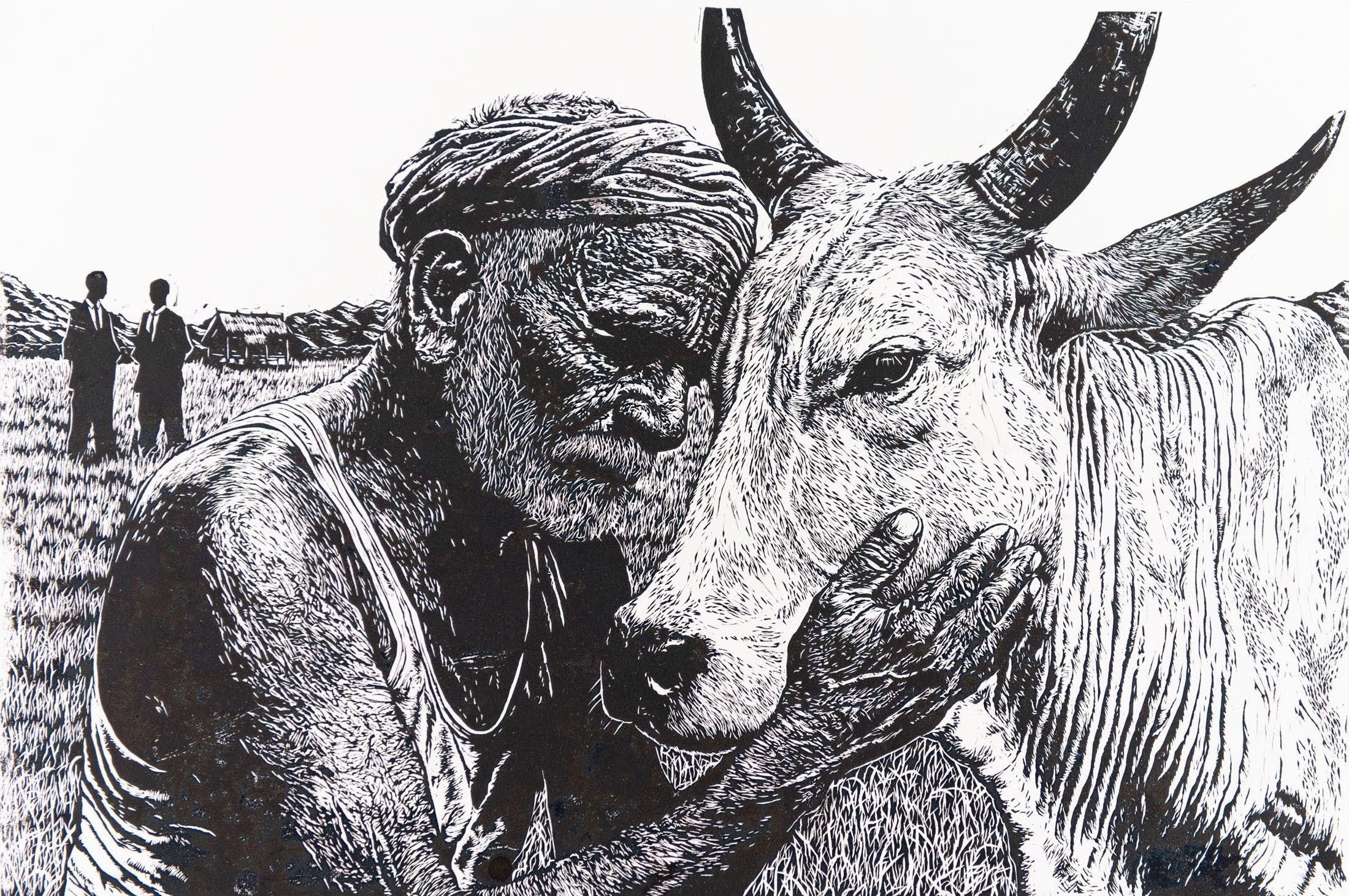
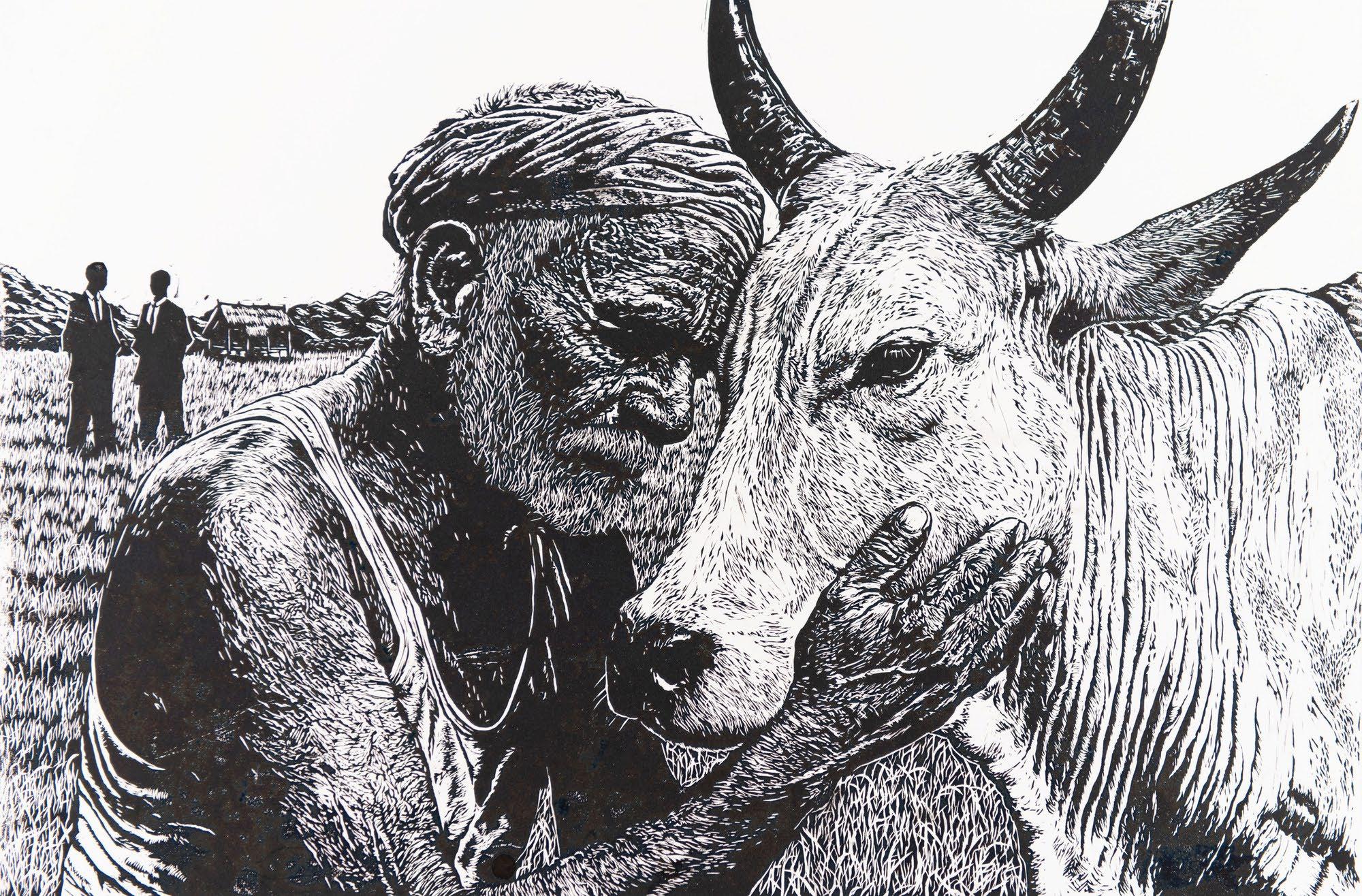
Lisa Ho invites us into the tension of growing up between cultures, her Made In Australia placing a giant Vegemite jar against a blazing crimson field of Chinese dragons. It is funny, sharp, and quietly aching all at once. Caitlin Graham confronts us with a painting that refuses to look away from the dangers women navigate every day. And Yuvan Muthusami transforms a global crisis into something unbearably intimate with The Last Embrace, portraying a farmer holding his bull as authorities wait to seize his land. Each work asks something of the viewer: reflection, empathy, recognition.
What moves me most about Pulse, year after year, is what it says about fearlessness. Not the grand kind, but the quiet sort: the willingness to make your inner world visible, to share something true at an age when the pressure to perform and conform has never been greater.
The West Australian is proud to partner with The Art Gallery of Western Australia in bringing these voices to the broadest possible audience. To every artist in Pulse 2026: your stories matter. Thank you for sharing them.
– Sarah-Jane Tasker Editor, The West Australian
The West Australian Pulse stands as one of our State’s most energising showcases of young creative talent.
Each year, the exhibition offers a vivid window into the perspectives of emerging artists across Western Australia. Their works reveal the issues they’re grappling with, the ideas that inspire them, and the stories they’re ready to tell. This year, more than 300 submissions were received, with 63 works selected from 43 schools statewide. Together, they reflect the breadth and diversity of young voices.
The Cook Labor Government and I extend our warmest congratulations to every student featured in Pulse 2026. We also acknowledge the essential contribution of art educators across Western Australia. Their dedication, expertise, and encouragement play a crucial role in nurturing young artists and fostering the creative confidence that exhibitions like this make visible. Our thanks also go to the families and mentors who support these students along the way.
As Minister for Creative Industries, I’m pleased to see The Art Gallery of Western Australia (AGWA) continue its commitment to emerging talent through initiatives like Pulse. Supporting young artists at the earliest stages of their development is fundamental to building a strong and sustainable creative sector for the future.
Pulse 2026 highlights not only the strength of visual arts education in our schools, but also the broader value of creativity in our communities. Art enriches our cultural identity, strengthens wellbeing and brings people together.
I warmly encourage everyone to visit AGWA to experience Pulse 2026 and celebrate the next generation of Western Australian artists.
— Hon Simone Mcgurk MLA Minister For Creative Industries
The future is ours to create
Tahlia Ashwin
Ken Asaoka
Arabella Barnaba
Lauren Branch
Grace Bray
Keira Buschenhofen
Leah Collins
Georgia Curtis
Nicholas Daly
Amelia Do
Isabella Dods
Eva Doyle
Liam Dunn
Bridget Fisher
Eva Forster
Charli Gherardi
Elton Giraudo
Francesca Gobby
Joanne Goh
Caitlin Graham
Chloe Haagman
Alyssa Henry
Lisa Ho
Isabella Hogg
Josephine Hunt
Jake Ieraci
William Jones
Mira Khaled
Kira Landuyt
Maulina Lantu
Evangeline Lau
Maeve Leech
Rebecca Liu
Jaime Macapagal
Hannah Marinovich-Zano
Adi Maynard
Genevieve Mickle
Catherine Mundy
Yuvan Muthusami
Clara North
Ollie O’Neill
Zoe Ong
Sarah Panetta
Margaux Parsons
Caitlin Perrella
Bianca Petsos
Dan Pham
Josephine Purcell
Eleanor Read
Laura Simmonds
Lauren Smyth
Benjamin Stack
Isabella Teo
Isabelle Tewman
Lennon Todd
Ryan Twomey
Arket (Itsaranuwat)
Udkaew
Ruby van der Lee
Toby Warner
Amelia Williams
Axel Wood
Harley Wright
Harrison Zupp
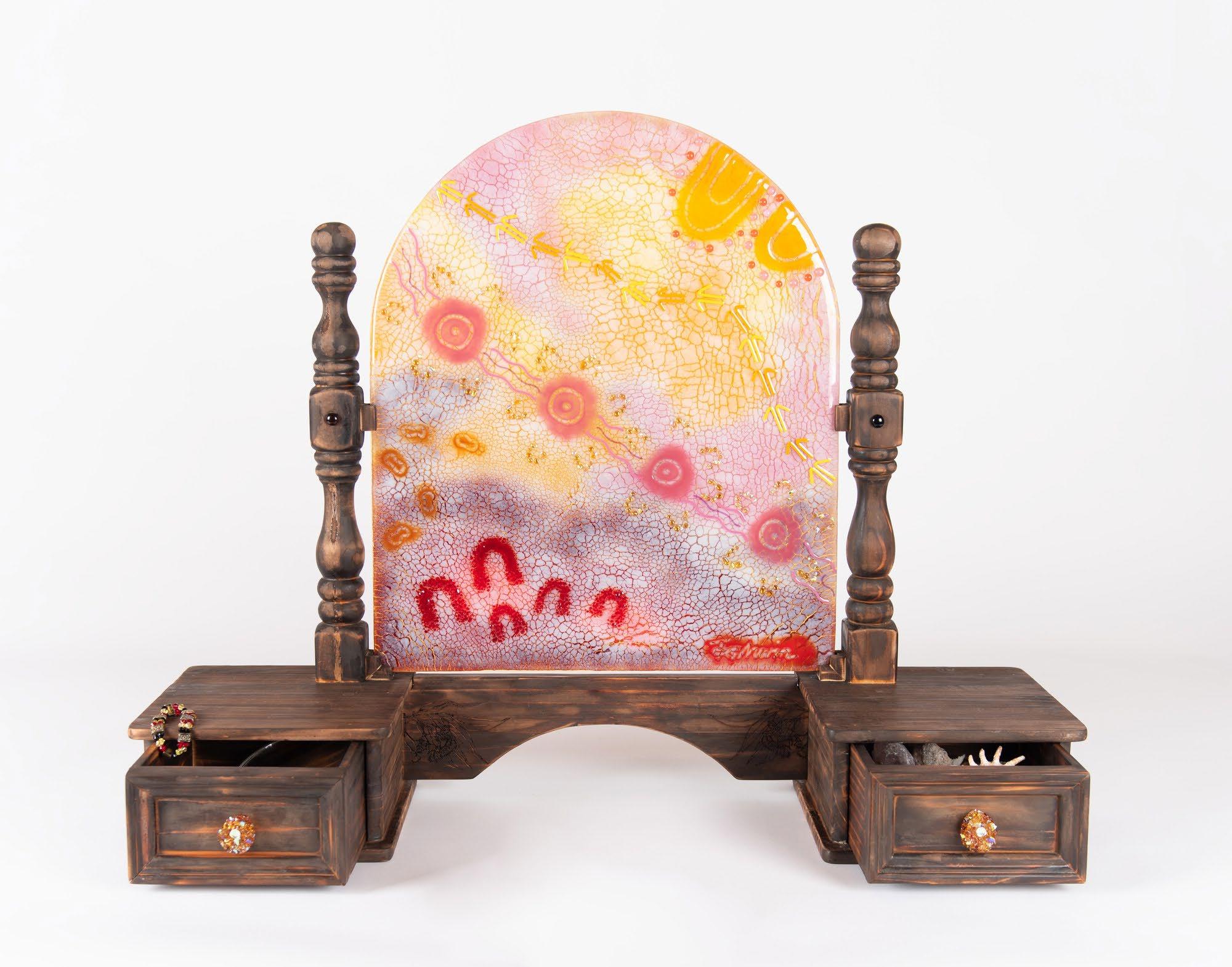
glass and found objects
75 x 94 x 26 cm
My artwork reimagines my childhood vanity, turning it from a surface that shows my outward form into one that reveals the stories and spirit within me as a Wangai Yamatji girl. The mirror becomes a window into identity and Country, transforming reflection into remembrance. The scorched timber frame connects me to the earth, solid and enduring, while the layered glass creates a crackled surface that recalls the glowing hues of sunset. The flameworked glass depicting kangaroo tracks and frit glass imagery honour my family and ancestors. When I look into it, I see my Country, my kin, and the stories that formed me.
Bob Hawke College
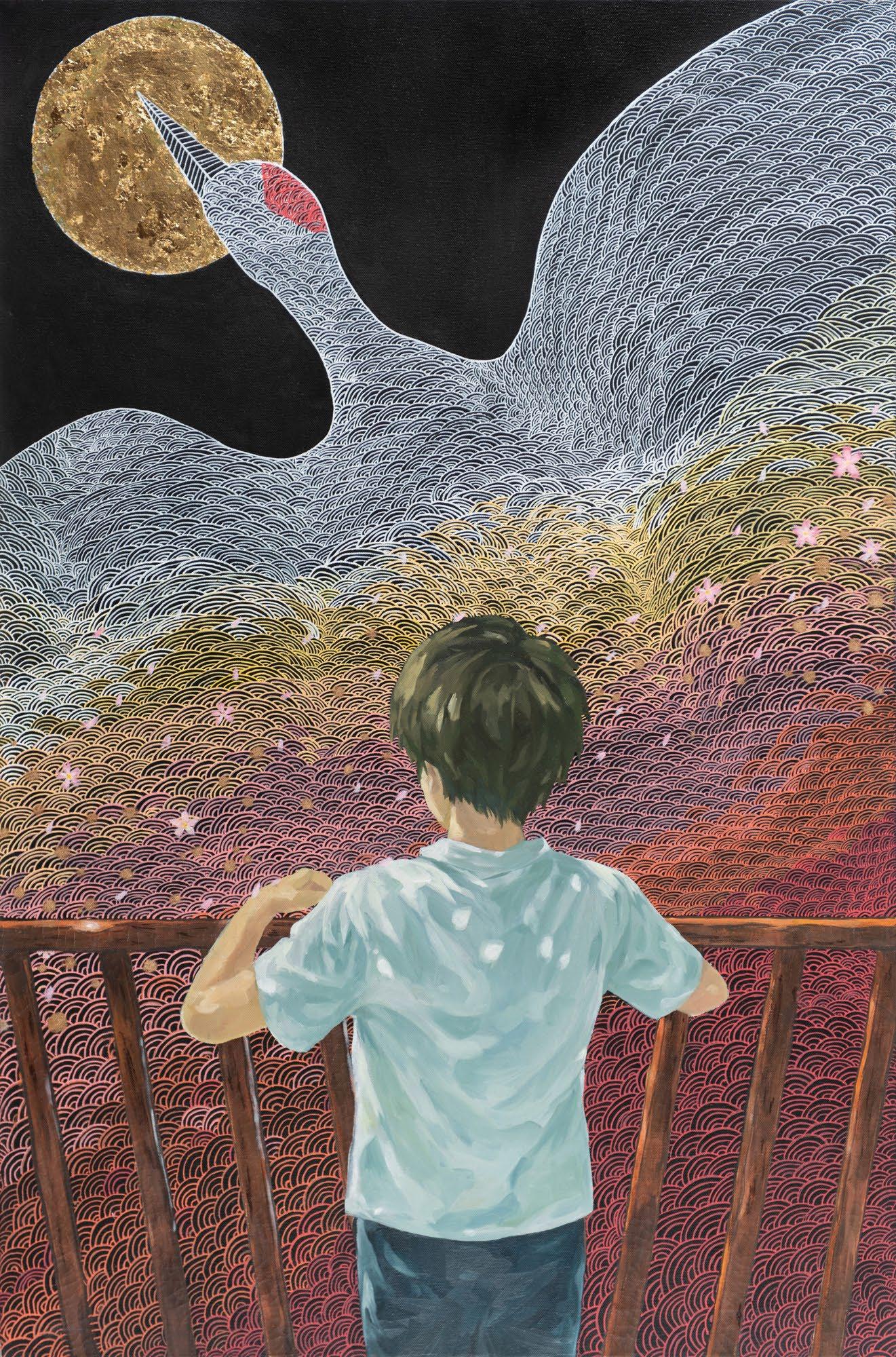
synthetic polymer paint, oil and gold leaf on canvas 91.5 x 61 cm
My artwork explores cultural in-betweenness and the feeling that my identity is slowly fading. After moving to Australia following eleven years in Japan, I often struggle to find a sense of belonging. The large crane, painted in the repetitive Seigaiha pattern, symbolises my Japanese heritage, and its upward flight toward the golden moon reflects how distant that part of myself now feels. The boy in the foreground, a self portrait, represents my childhood and the challenges of separation. The wooden fence forms a barrier between us, showing how my roots remain visible yet inaccessible. Influenced by Kehinde Wiley’s patterned backgrounds, I have used ornamentation to express fragility, memory, and shifting identity.
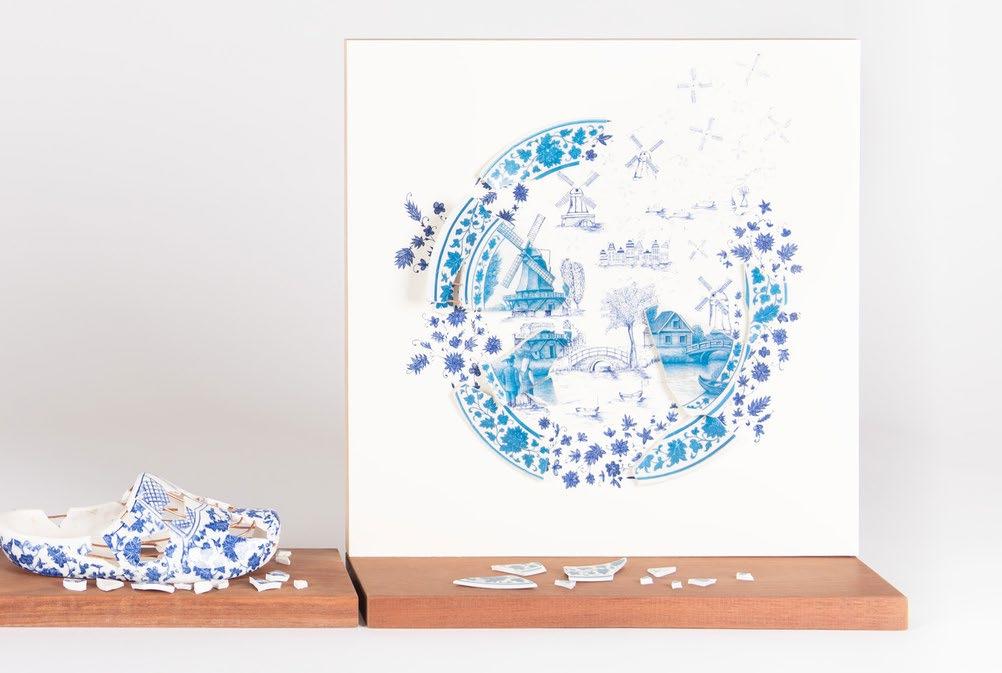
ceramic, porcelain plate, cobalt stain, pen, jarrah, copper wire and paper three parts: 14 x 40 x 15 cm; 11.5 x 65 x 15 cm; 48.5 x 46 x 15 cm
St Hilda’s Anglican School for Girls
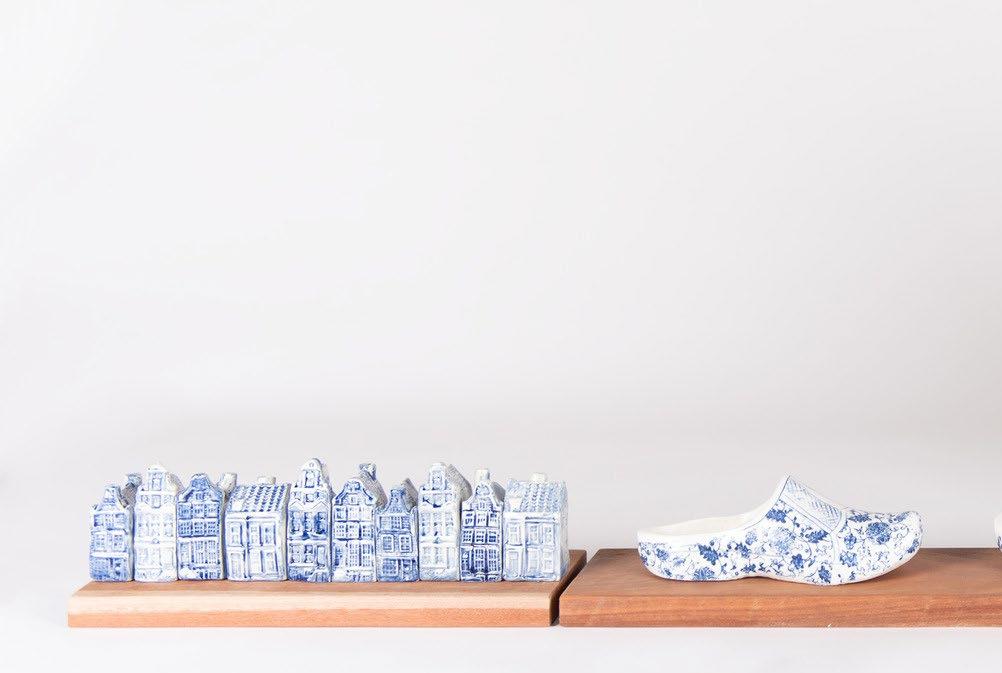
My mixed-media installation traces my family’s migration from Holland to Australia in 1954 and the fracture created by the passing of my great-grandmother, Oma, at 103. The terraced Amsterdam houses, sculpted from paper clay with a Delft Blue wash, evoke my great-grandparents’ homeland and stand as symbols of family and origin. Porcelain clogs, slip-cast from my Opa’s original pair, show one preserved and one shattered, reflecting the loss of cultural continuity. Influenced by artists Bouke de Vries and Rob Strati, I emphasise breakage, allowing fragments to hold history and beauty rather than concealing damage. Through these shards, I express how heritage and identity transform, never erased, but carried forward and reimagined in new ways.
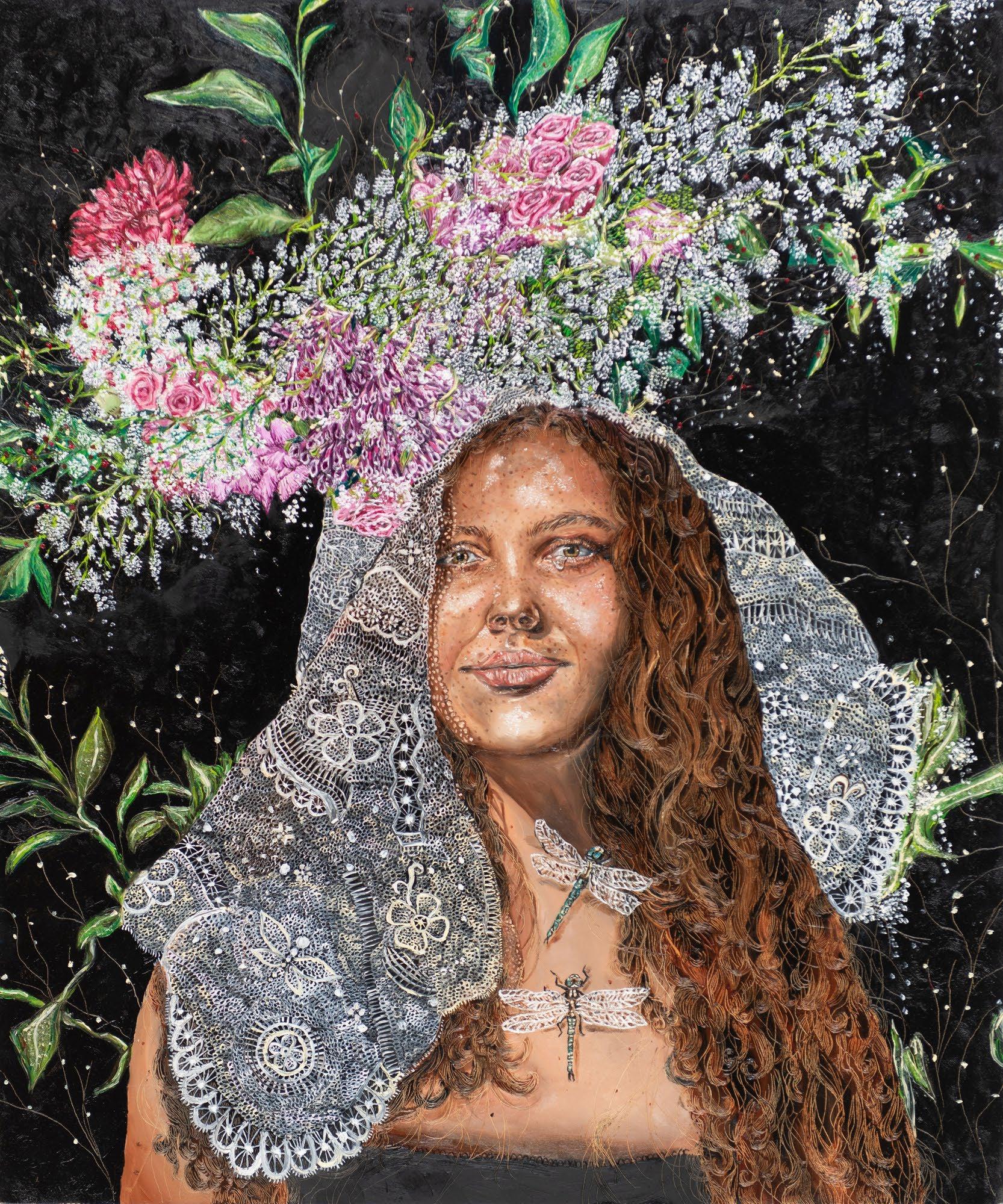
oil on board 69 x 56 cm
My artwork explores how life’s beauty is both fleeting and profound, blooming brightly but briefly like a flower. It reminds viewers to embrace each moment and spend time with the people they love, because nothing is permanent. When my Grandma passed away from leukemia, grief became a bittersweet reflection of a life well lived. My mum always said dragonflies are gentle visitors from departed souls, and on the morning I began this piece, one landed outside my home and became my reference image. The dragonfly, the tear, and the soft smile express grief’s mix of sorrow and gratitude. Inspired by memento mori, I included falling petals and depicted my Grandma and me as dragonflies, symbols of remembrance, transformation, and love. Seton Catholic College
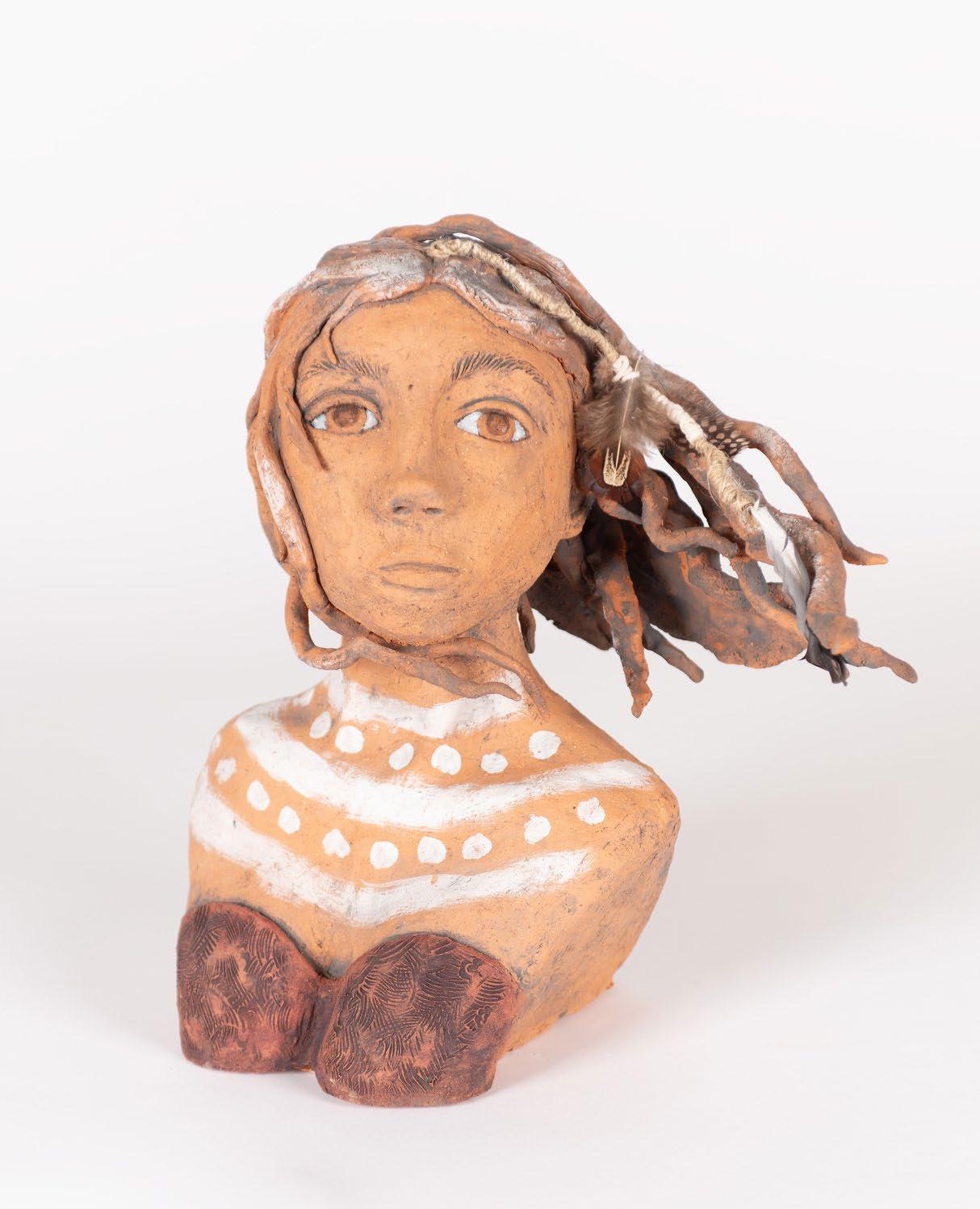
clay, feathers and twine
36 x 36 x 24 cm
I created this sculpture as a tribute to my great -grandmother, who was part of the Stolen Generations. It honours her legacy and expresses the pride I feel in her courage and resilience in the face of adversity. The figure is made from clay, feathers, and twine, materials that helped me bring a sense of movement into the work. I drew inspiration from Jess-Riva Cooper and Robyn Varpins, whose work with nature and gesture guided me in creating a piece that has a sense of liveliness, symbolising bravery and strength. Living Waters
John Curtin College of the Arts
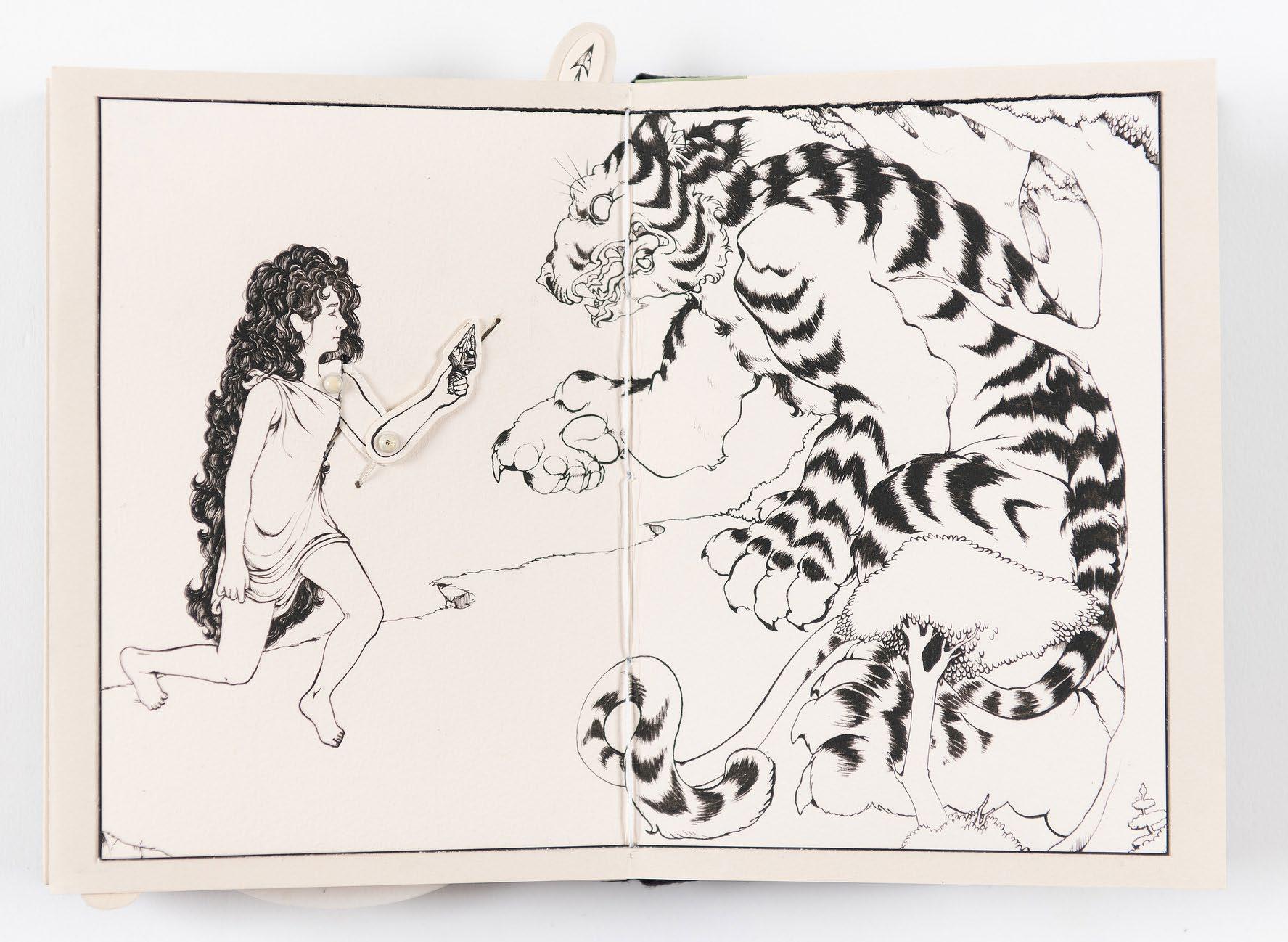
fabric, thread, ink, watercolour, paper and board
26 x 16 x 5 cm
Tiikeri (/’ti:keri/) is an allegory; when there’s nowhere left to run, and you find yourself confronted with the beast, if you cannot defeat it, you must either succumb or survive. Sometimes, to reach the stage in life where you are content, you must first live alongside the parts of yourself you wish to destroy. These, too, are an integral part of your humanity, thus cannot be ignored – they must be acknowledged. The dramatic dip pen and ink line drawings attempt to pull the viewer into interrogating how, when you’re accustomed to the safety of a fabricated solace, will you ever realise you’re trapped?
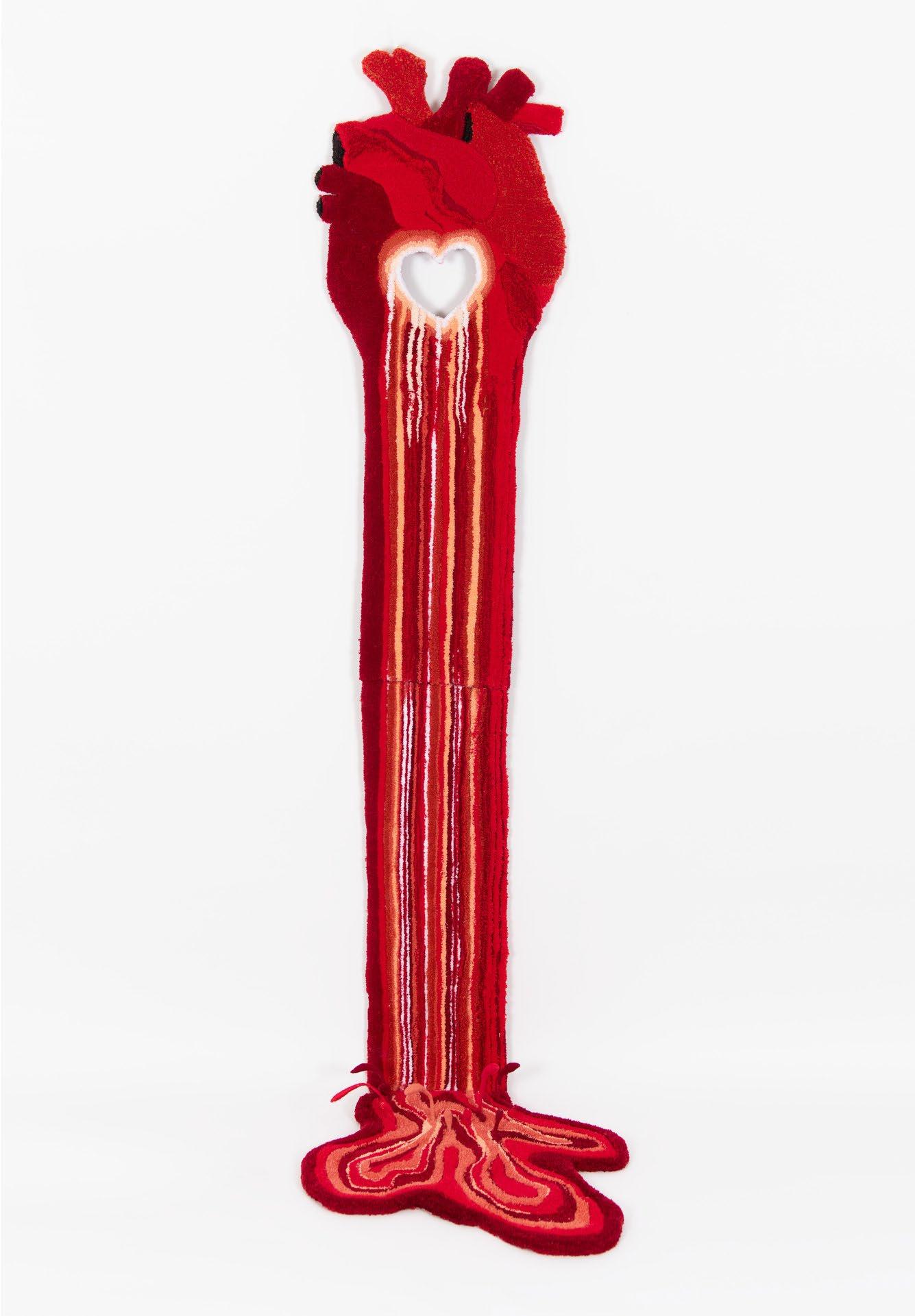
tufted yarn and wire
240 x 70 x 65 cm
Blood From My Heart Runs Thin is a deeply personal exploration of inherited illness and loss. My father lived with Thrombocytopenia and multiple other heart and body dysfunctions, conditions that shaped his life and led to his passing in 2020 when I was 13. I’ve recently learned that some of these disorders may have been passed on to me, creating a connection that feels both fragile and confronting. This mixed media installation reflects the sensation of blood running thin, the body weakening, and the fear of fading away. It is also a tribute to my father –someone I never truly knew during my childhood years – revealing how grief and love intertwine through the legacy of illness.
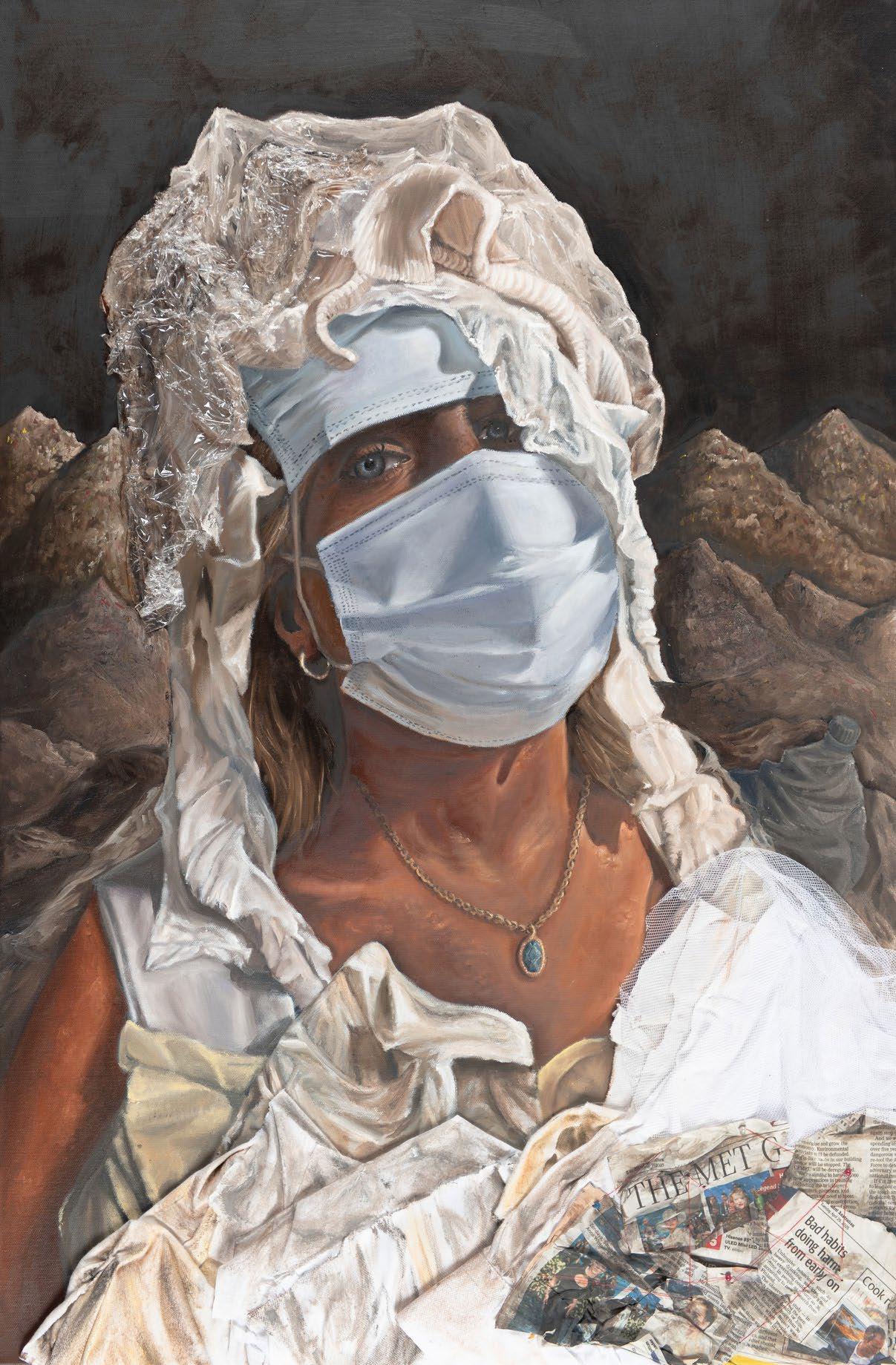
oil, newsprint, fabric, pins, thread and plastic on canvas
91 x 61 x 3.8 cm
‘Consumerism is our idolatry, the heart of our illusions of power, security, and self-sufficiency, which translate into rape of the environment.’
Kathleen Norris, The Cloister Walk, 1996.
My artwork critiques consumerist culture and how it erodes both the environment and individuality, exposing how fragile identity becomes in a society that normalises materialistic habits. I created this piece after witnessing fast fashion, mass production, and obsession with trends. The female figure, suffocated in abandoned landfill fabrics, embodies the weight of overconsumption. Using oil paint and repurposed textiles, I highlight materialism’s allure versus its consequences. Influenced by artists Nicola Samori, Jeremy Mann, Barbara Kruger, and even the movie Wall-E, the work reflects how consumption overwhelms people – including myself – reducing us to participants in a relentless cycle of waste.
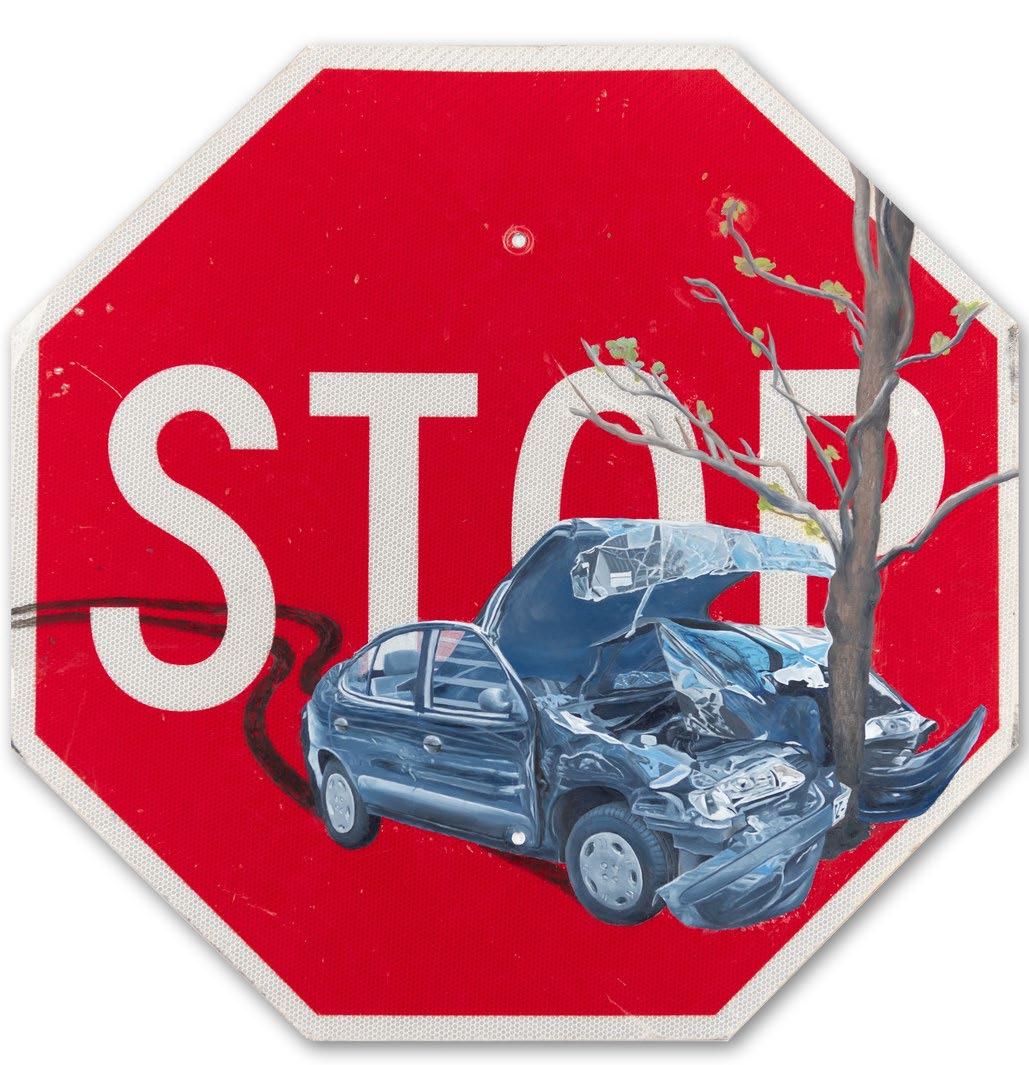
oil on canvas, oil and synthetic polymer paint on street sign two parts: 76 x 61 cm; 76 x 75 cm
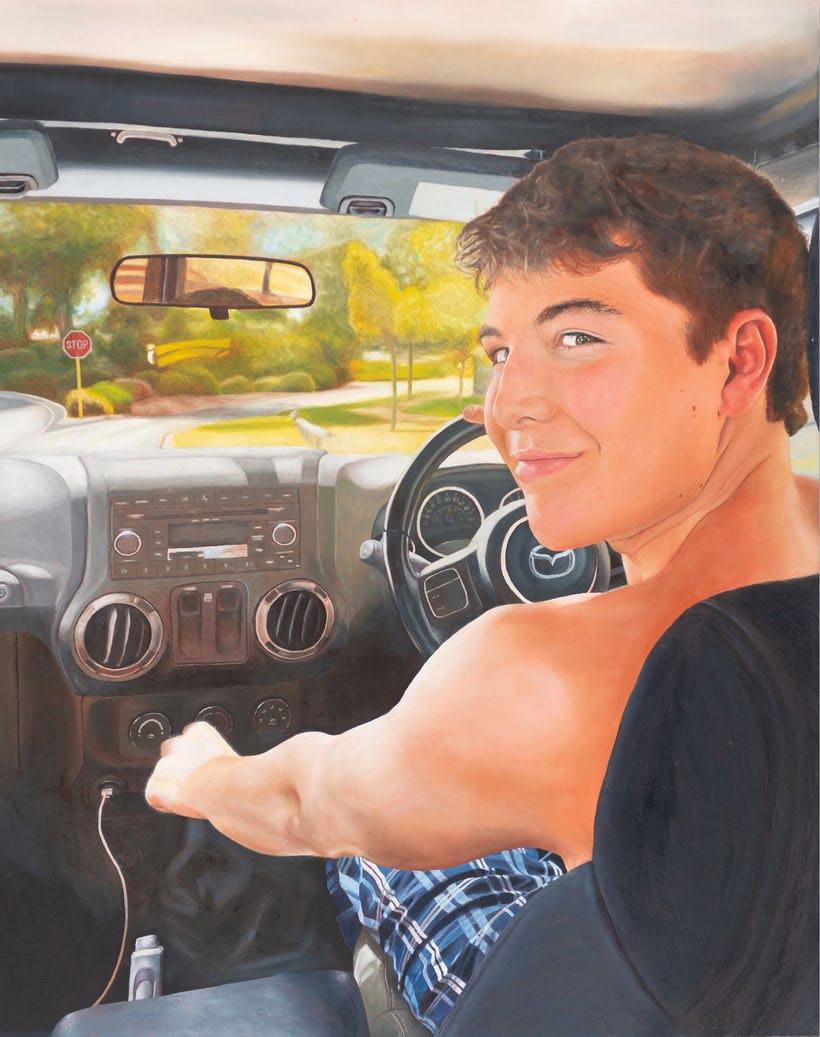
My artwork explores themes of youth, recklessness, and the fragile boundary between control and chaos, using driving as a metaphor for the choices that shape our lives. In the first painting, the depiction of the boy behind the wheel with a distant stop sign hint at confidence, impulse, and the quiet warnings we often ignore. In the second painting, created directly onto a real stop sign, the familiar word “STOP,” usually a symbol of safety and caution, becomes a warning unheeded. Through this work, I contrast freedom with consequence, reflecting how quickly control can fracture and how the signs are often there, waiting, if we choose to see them.
Penrhos College
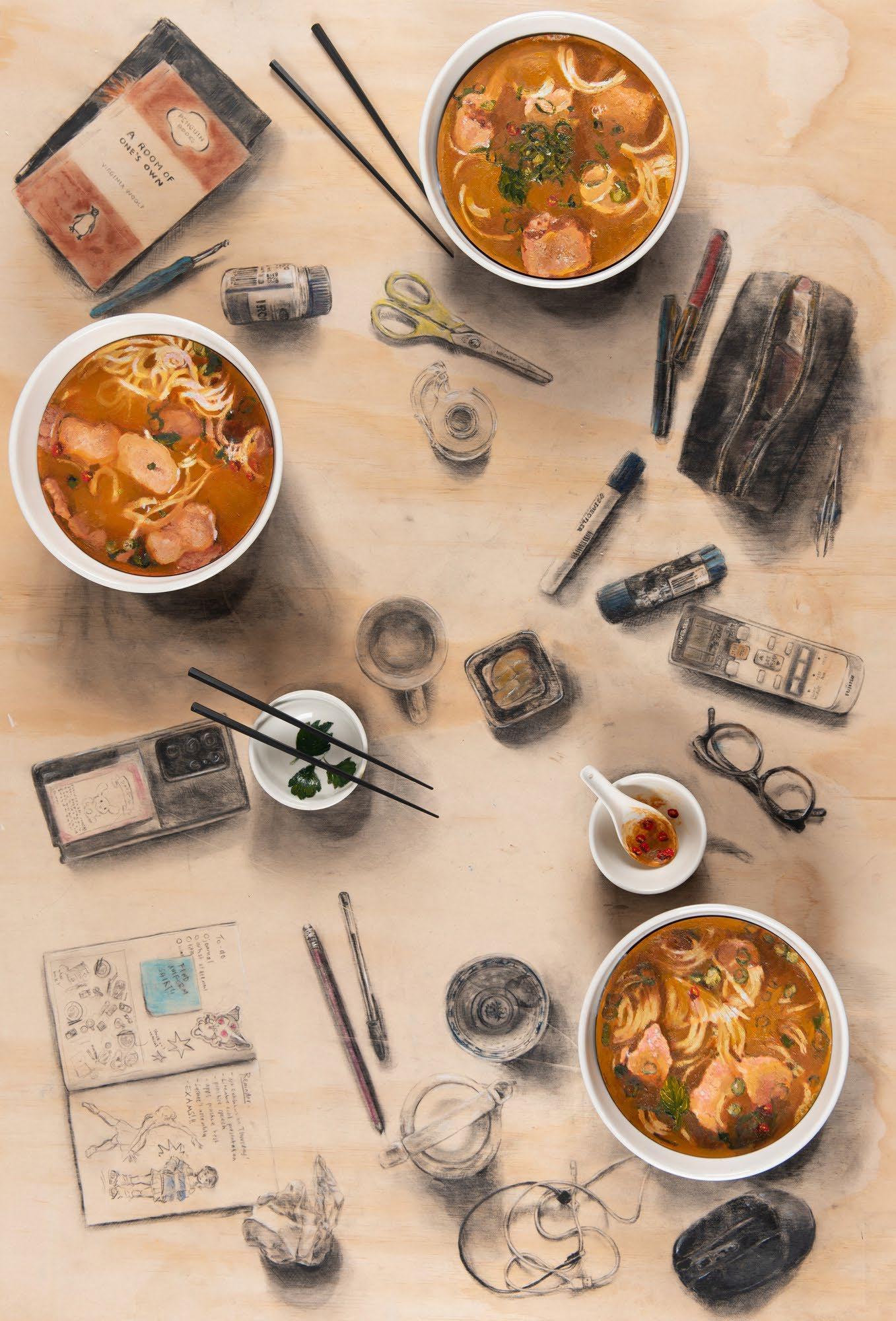
“Mini, what you want for dinner?”
charcoal and oil on board, bowls 110 x 80 x 16 cm
Food brings people together – to each other and to their heritage. For me, phở is more than a dish; it’s memory, sustenance, comfort, and connection. Coming home to the smell of peppery star anise and velvet broth was the rhythm of my childhood. A dinner table reveals a family: its habits, chaos, and shared histories. My three-generation household is made up of storytellers, and almost every story is told over dinner or lingers long after. Some stories are embellished, drawn out, or half-censored. Sometimes language lets details slip or words don’t land quite right, but meaning still finds its way through. In my family, certain phrases say everything: “Eat more. Take more food.” They always mean: “I love you.”
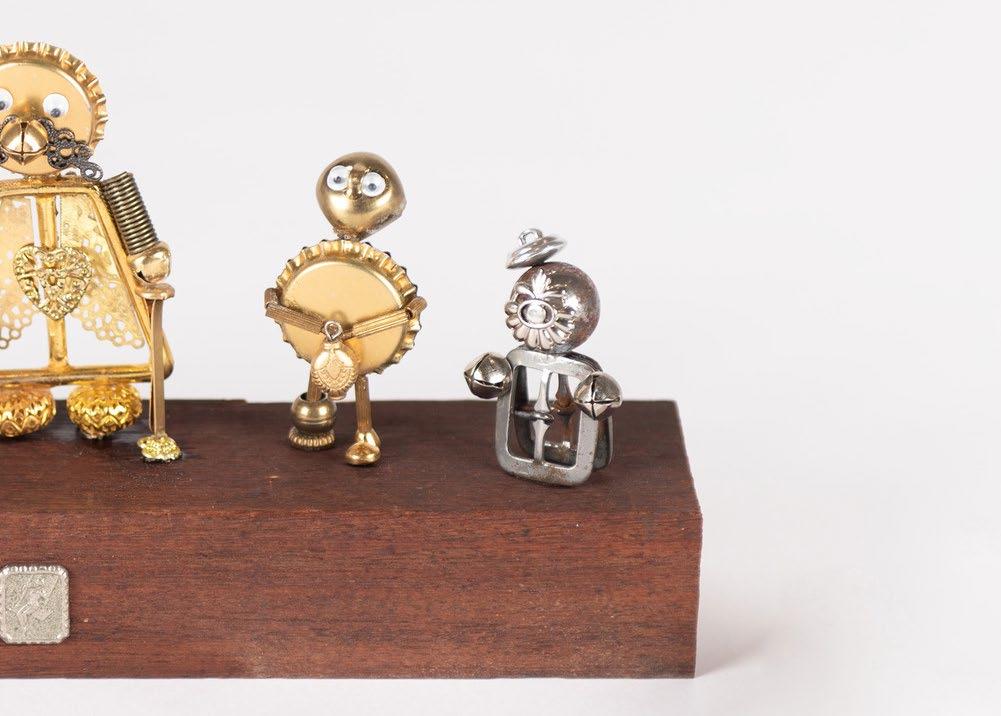
metal springs, nuts, screws, bottle tops, balls, bells, super glue and plastic eyes
15 x 29 x 6 cm Kennedy
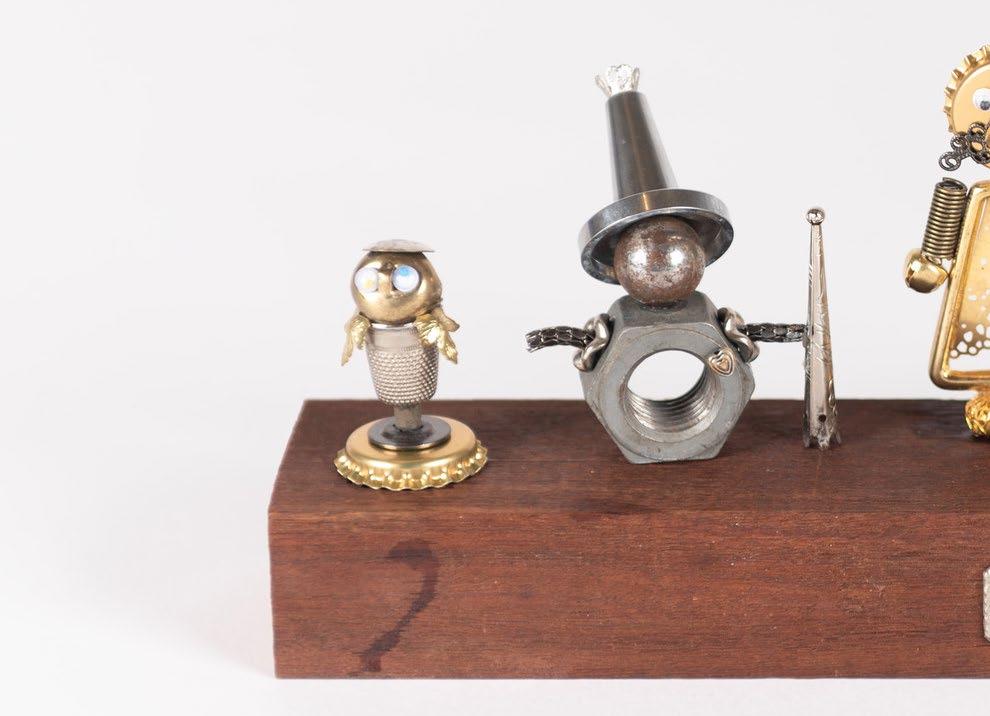
From a collection of small metal objects, I set myself the challenge to construct as many fantasy, humorous characters as I could. These characters express my joy in stepping into the life of imagined stories. This sculpture celebrates the fun of making something playful and imaginative from everyday objects and letting creativity guide the story.
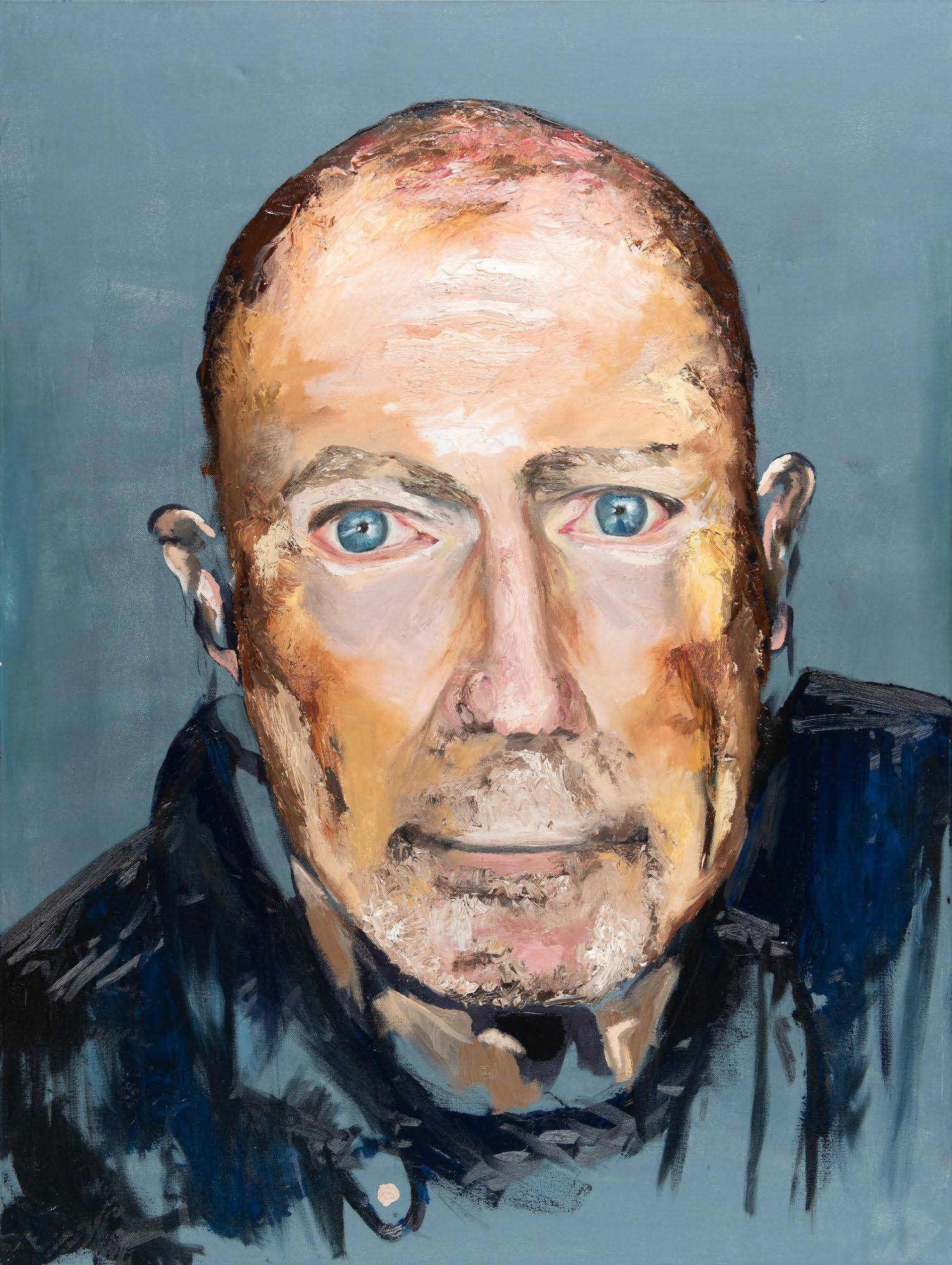
oil and synthetic polymer paint on canvas
120 x 90 cm
The Unaltered Soul portrays my grandfather, who lives with Parkinson’s disease. I wanted to show three perspectives experienced by people with Parkinson’s or other ageregressive illnesses. The first is his own: he still sees himself as the man he was before diagnosis, wanting to drive and walk unaided even as these things become impossible. The second is the view of strangers, who notice tremors, frailty, and slurred speech. The third is mine, shaped by knowing who he was before the disease. I painted his bruised, aging face with loose palette knife strokes against a smooth background to emphasise the imperfections brought about by age, but focused his eyes with care – they hold the stories and the person he still is.
oil and synthetic polymer paint on canvas two parts: 41 x 51 cm (each)
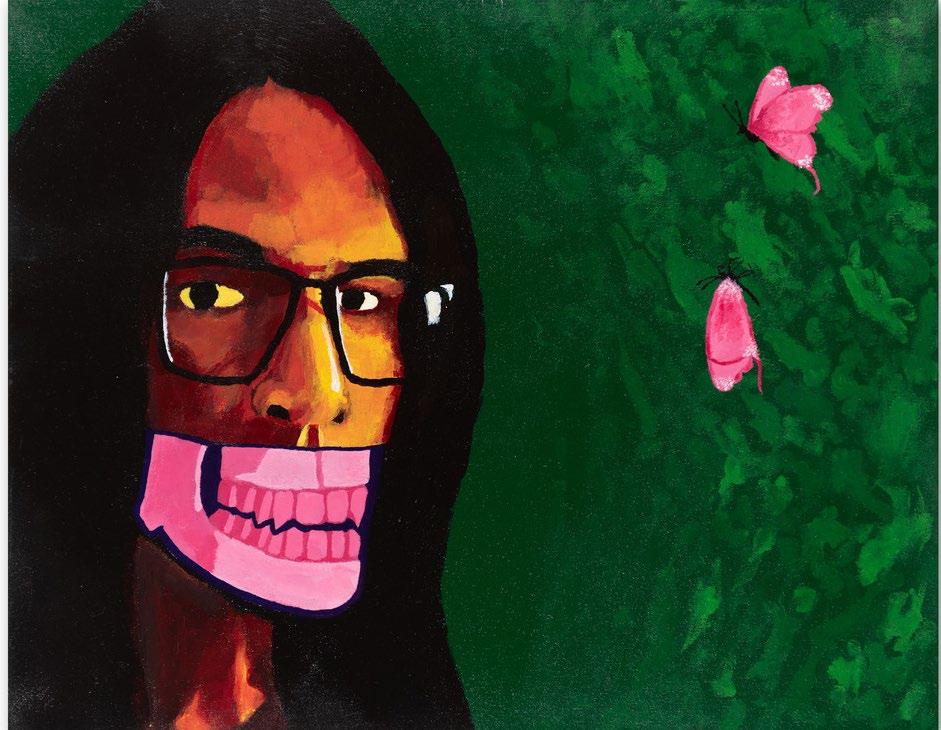
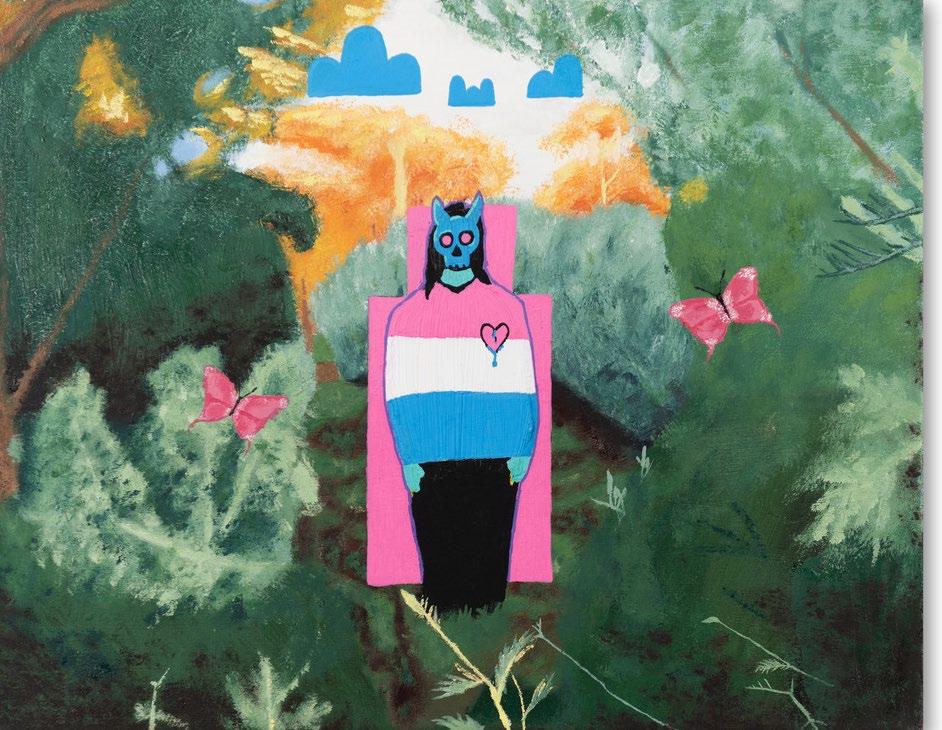
The meaning I’m intending to convey through these artworks is centred on identity and self-expression. Each piece reveals parts of myself that are usually more hidden. The work with the skeleton jaw expresses a usually concealed part of myself becoming visible, contrasting with the version of me most people see. The butterflies symbolise transformation, peeling away the cocoon to become something more. The figure in the garden shows me in a place I love – surrounded by nature – yet still not quite fitting in, always sticking out a little. The boxes around me represent how I can feel boxed in or defined by others, even in spaces that should feel comfortable.
pen, ink, synthetic polymer paint and copper leaf on paper
74 x 45 cm
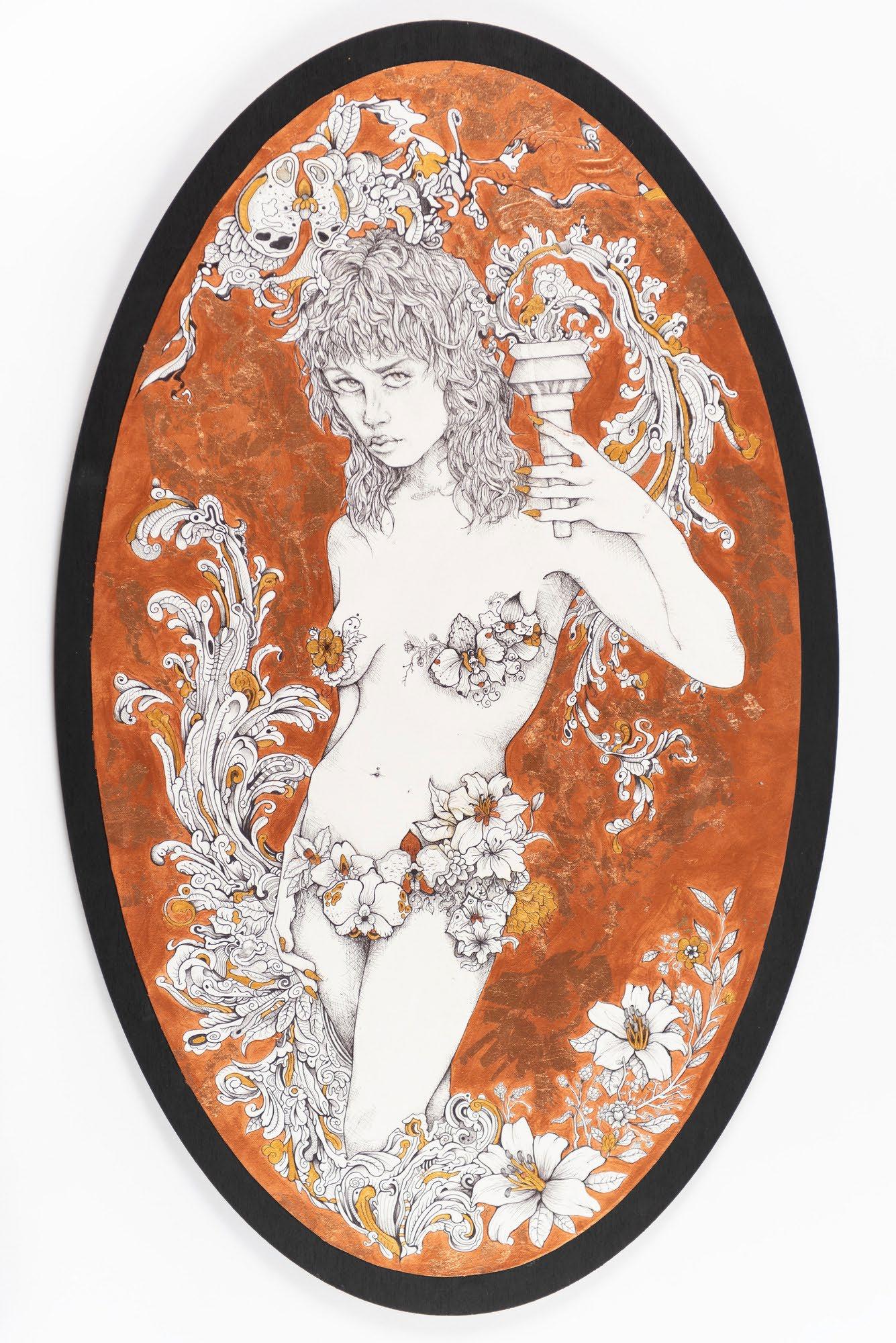
A Girl is a self-portrait that reflects how I see myself as a teenage girl, constantly negotiating between how my body is viewed and how I choose to present it. Drawing myself in pen felt permanent, mirroring how adolescence can feel irreversible and public. The metallic negative space elevates the work, suggesting that vulnerability still holds value and strength. Her gaze is mine, meeting the viewer directly to resist being reduced to an object. The torch represents the burden and power of visibility, carrying my own light forward. The flowers that grow over me symbolise transformation, resilience, and the messy process of becoming. Framed like an icon, the work claims visibility while embracing fragility and self-possession.
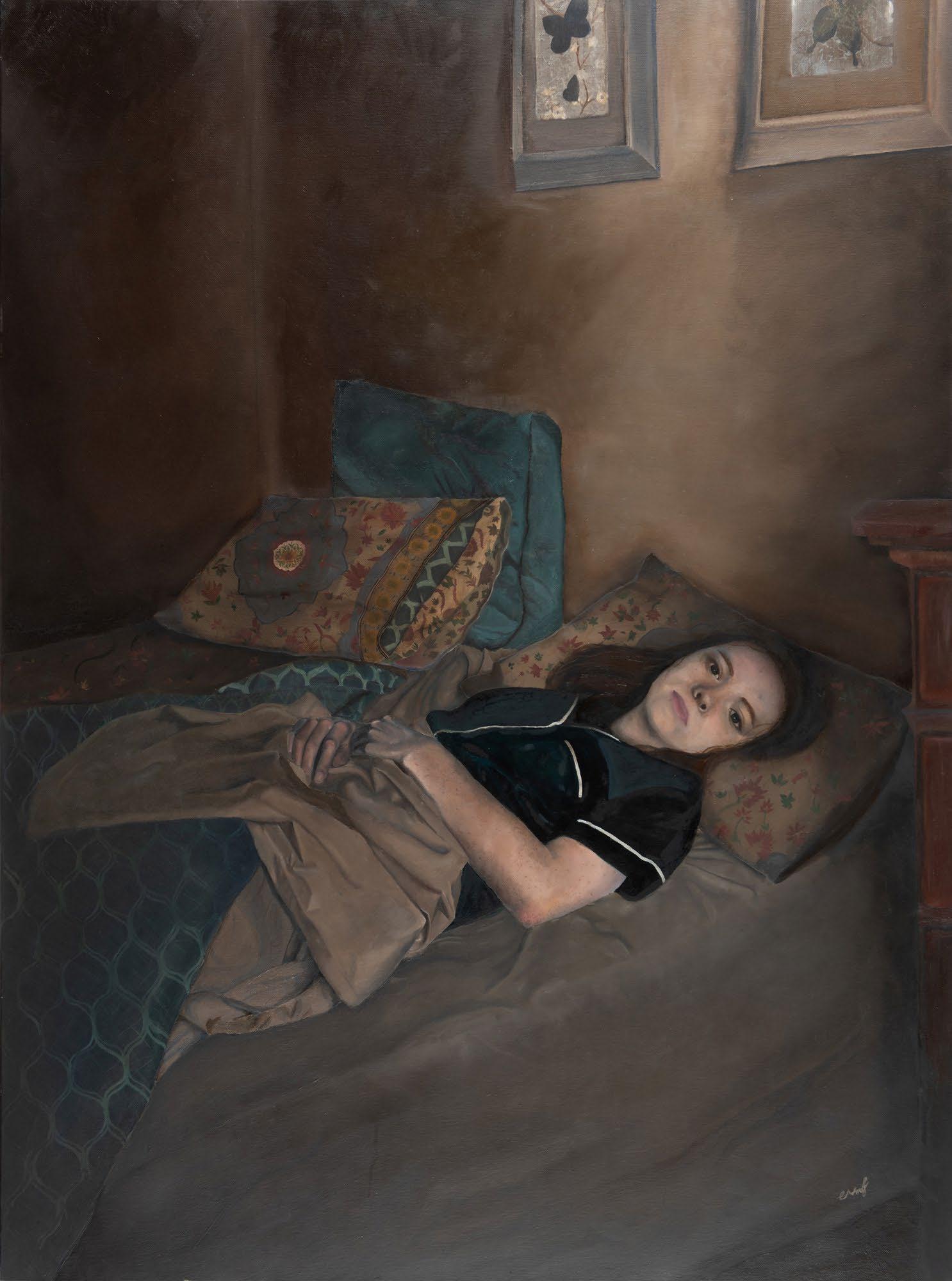
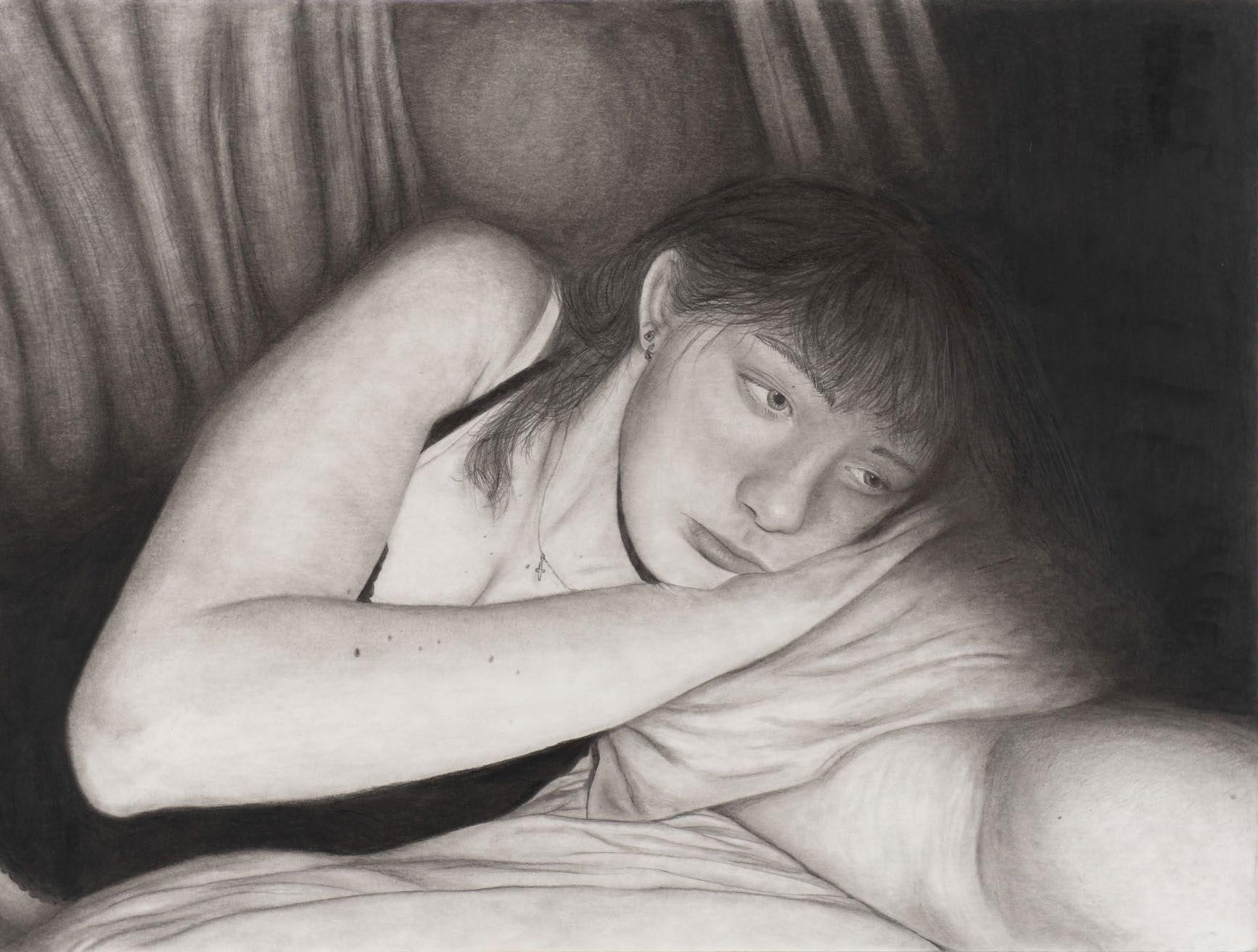
Inspired by Renaissance works that capture deep, emotional scenes, I became intrigued by the way colour and value were used to communicate mood. I was also drawn to Social Realist artworks and their unsentimentalised records of daily life, particularly their willingness to capture sadness and struggle. My work depicts a moment of loneliness as the subject awakes the morning after a loss. It responds to my internal fear of losing loved ones by presenting that fear as a reality. I aimed to capture the numbness and emptiness that may be felt during the mourning process. The work does not present a particular message but acts as a way of expressing an inner feeling.
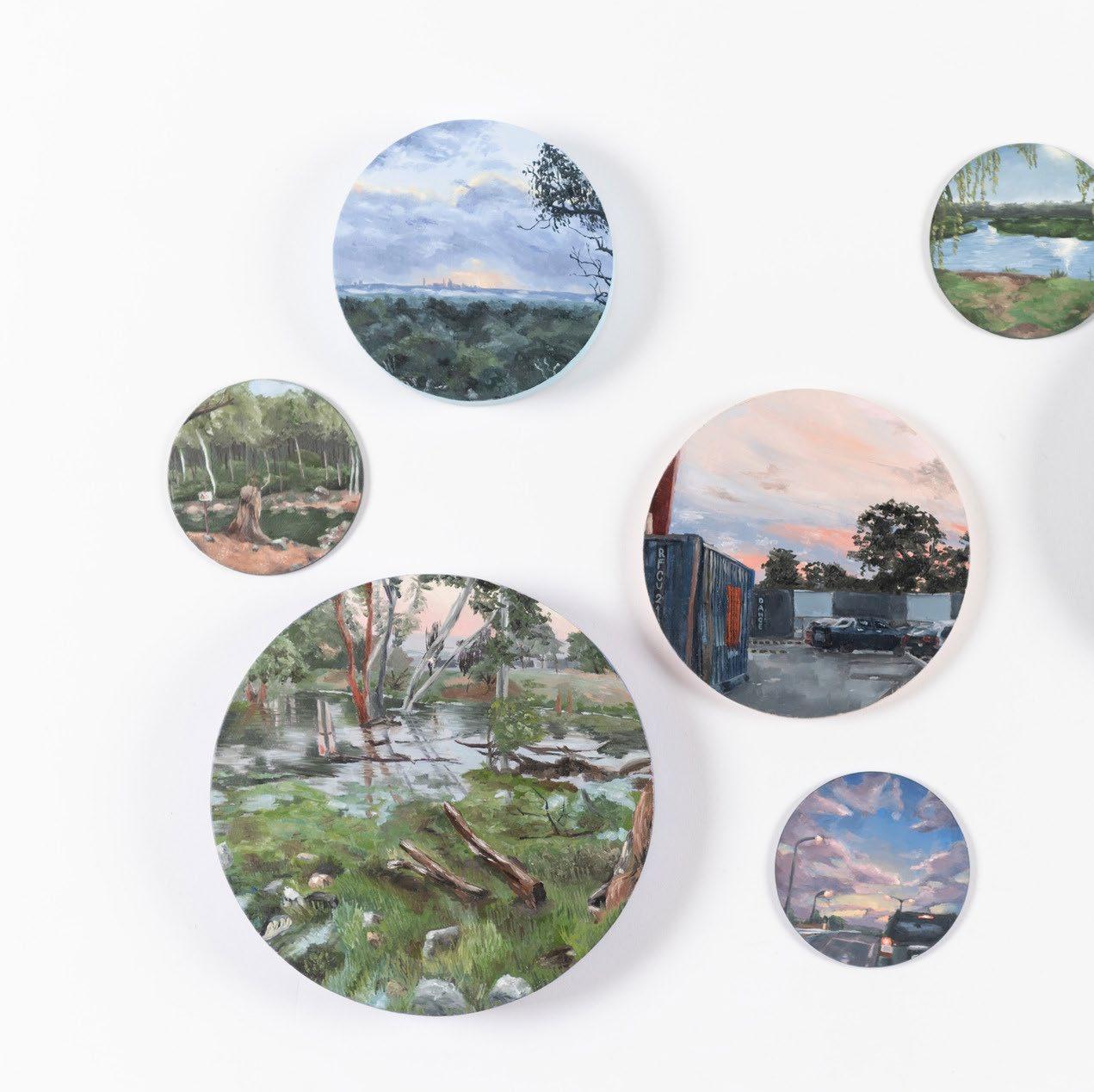
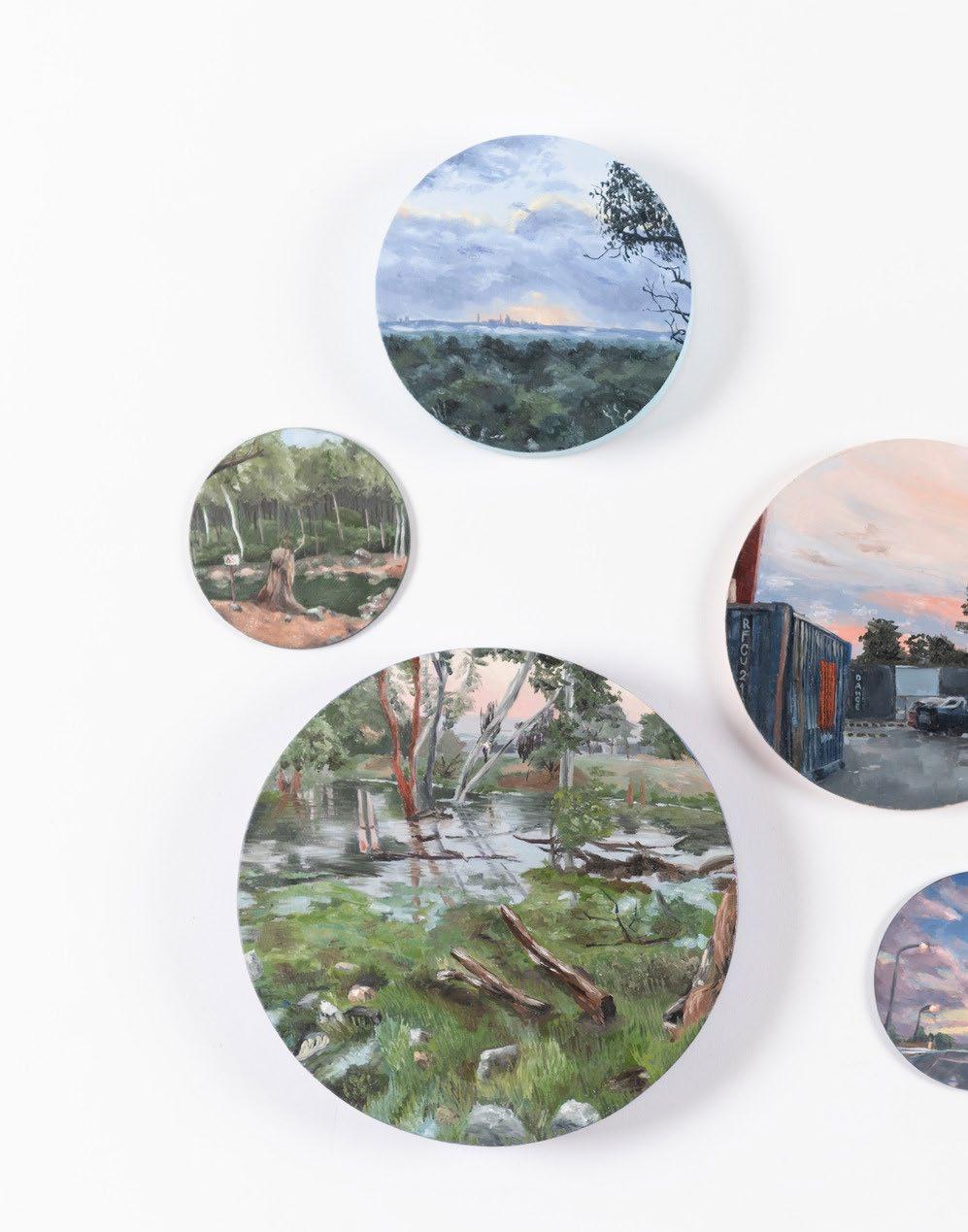
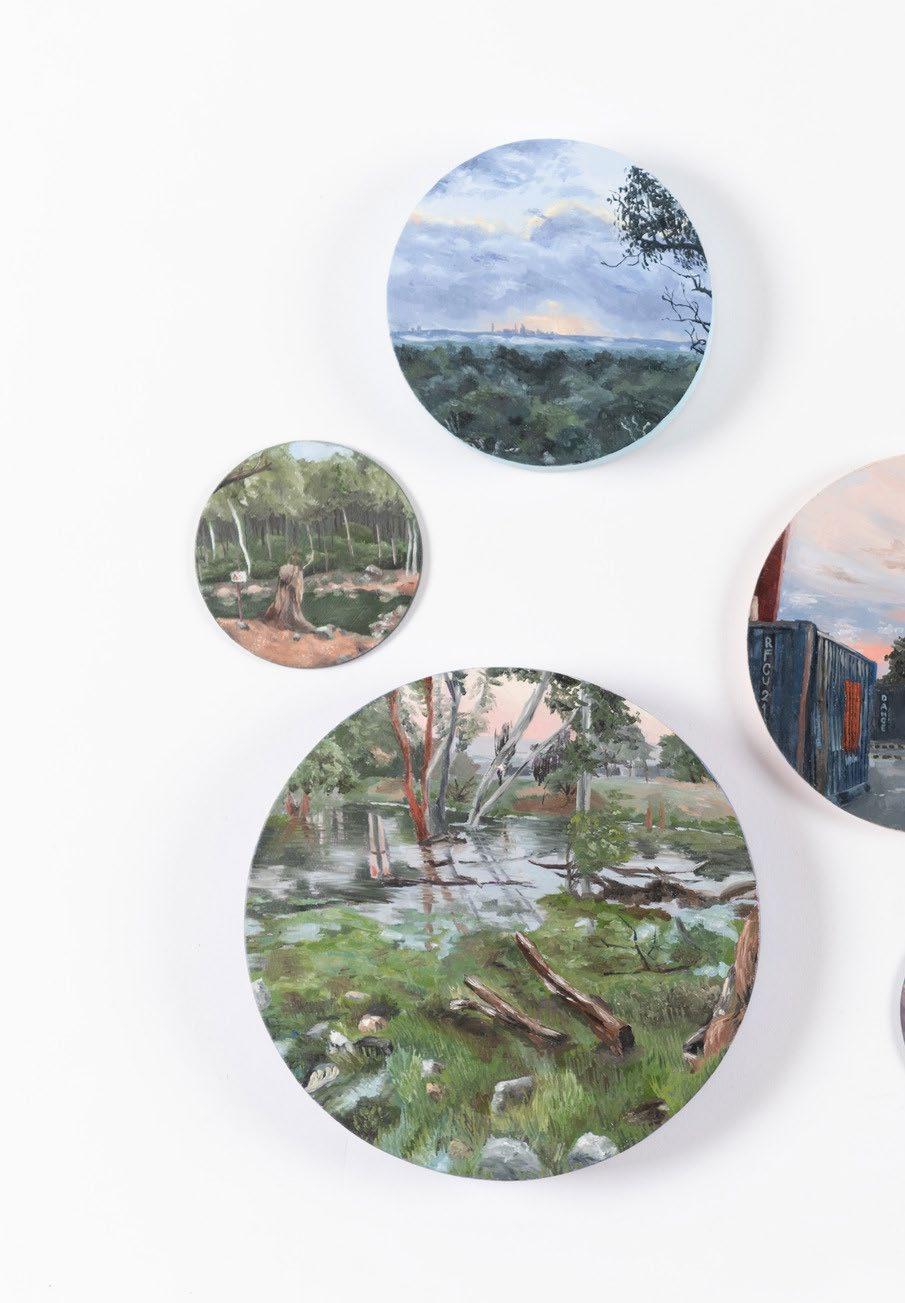
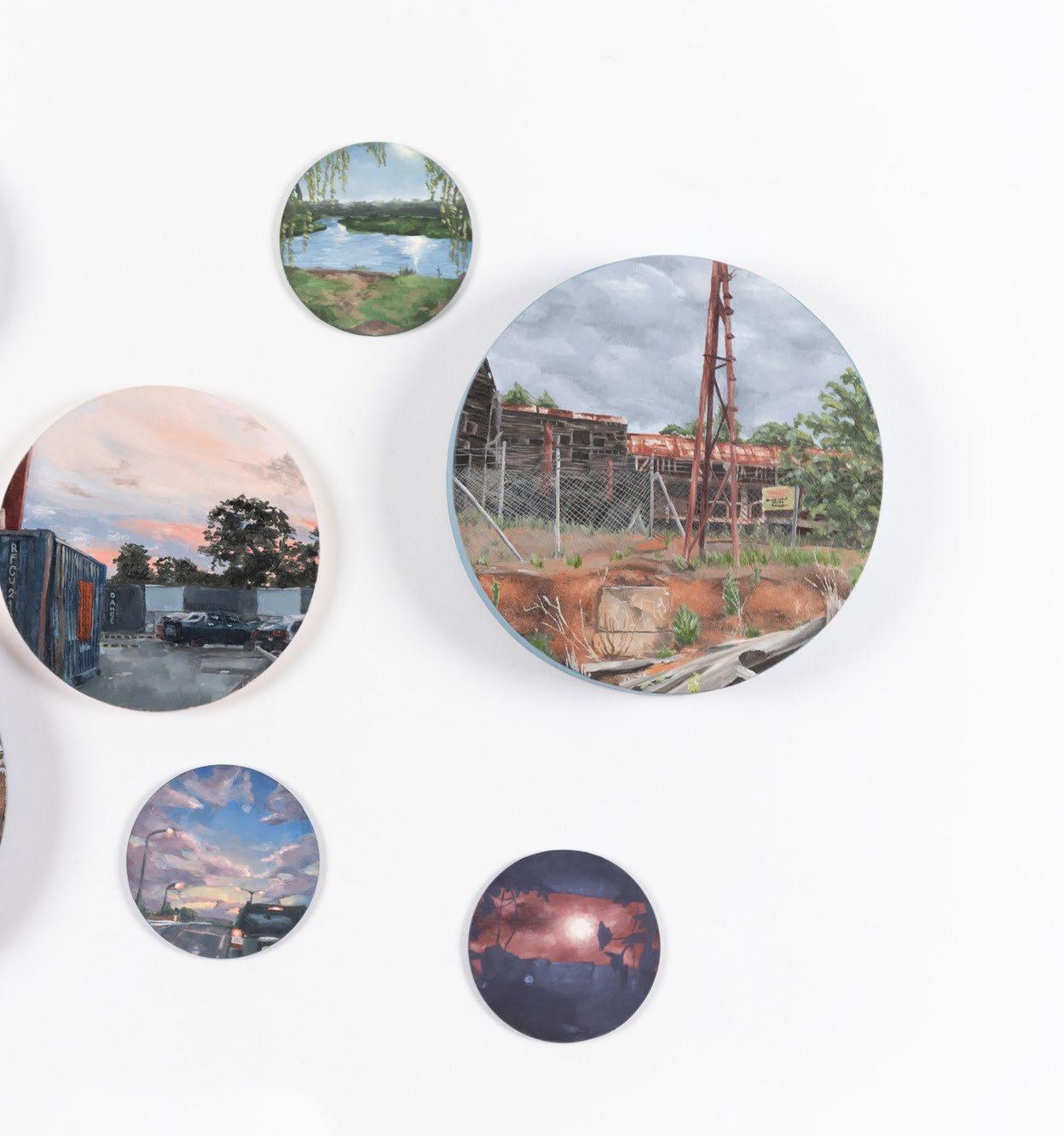
I have changed a lot throughout high school, both in
John Curtin College of the Arts
mixed media and digital print two parts: 84 x 93 x 32 cm; 61 x 41 cm
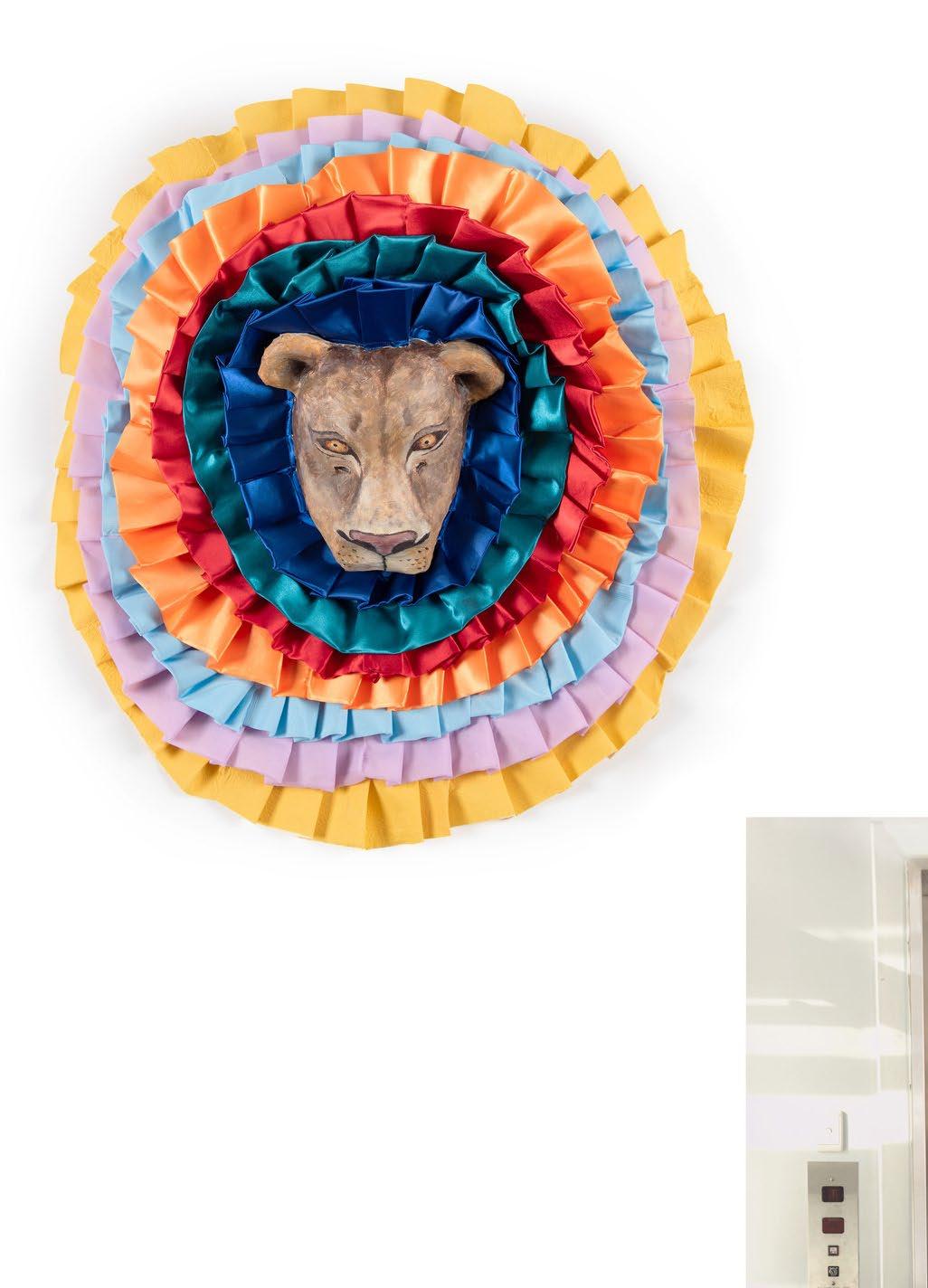
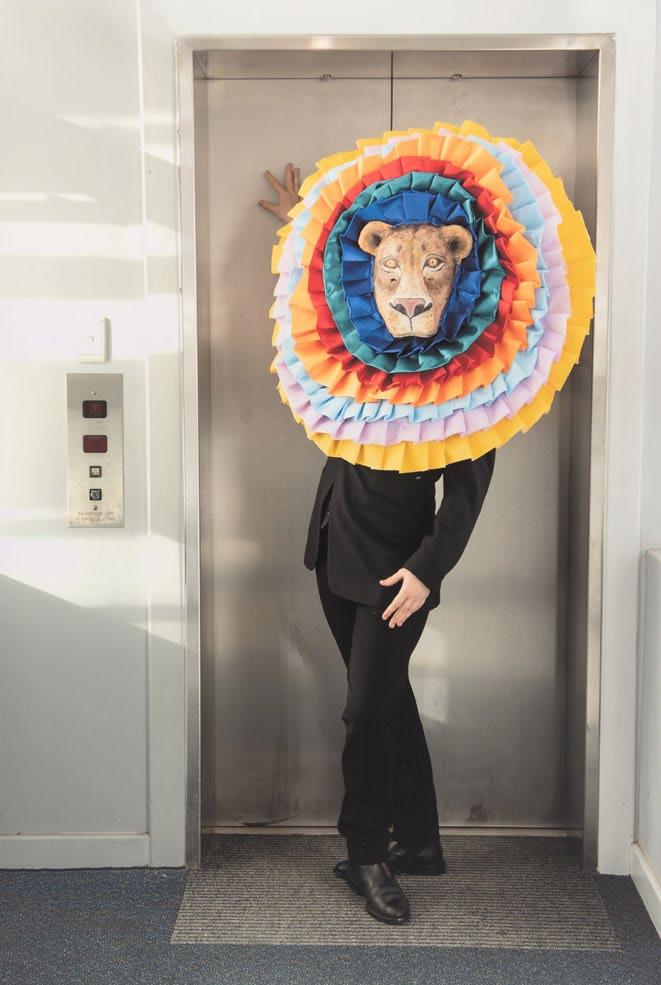
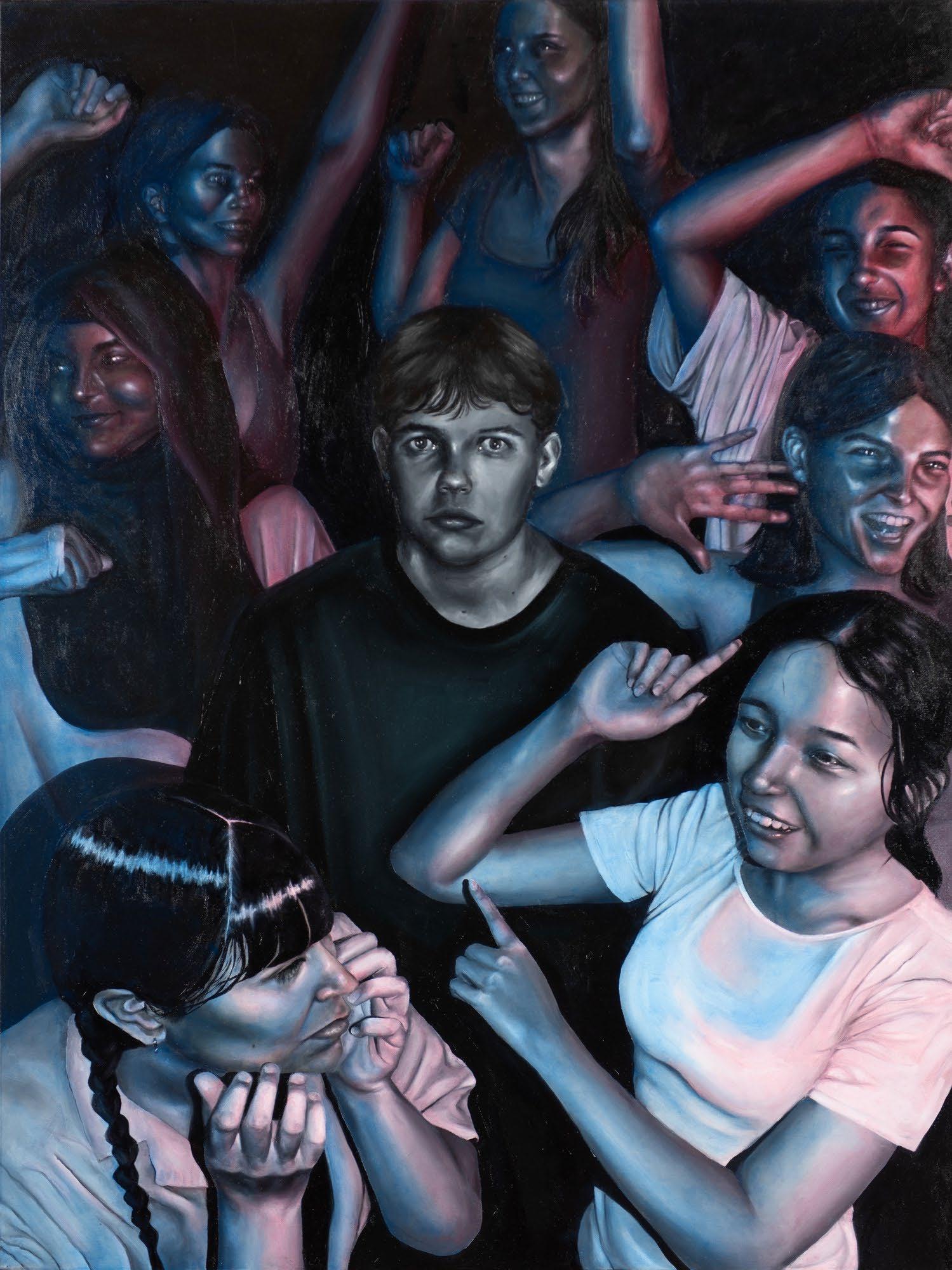
oil on canvas
121.5 x 91.3 cm
Perth College Anglican School for Girls
This work explores feelings of isolation and missing out in social settings, particularly when overstimulation and a short social battery make it hard for me to engage and enjoy myself. As someone who is neurodivergent, I often feel physically present but emotionally distant, which is what I wanted to capture. I place myself at the centre, surrounded by figures who dance and interact, highlighting the tension between wanting to belong and feeling drained. Influenced by Canadian artist Owen Rival, I use exaggerated red and blue lighting and dominant darkness to heighten the overwhelming atmosphere. This work is a personal reflection on social exhaustion, showing that even in the middle of a crowd, it’s possible to feel isolated.
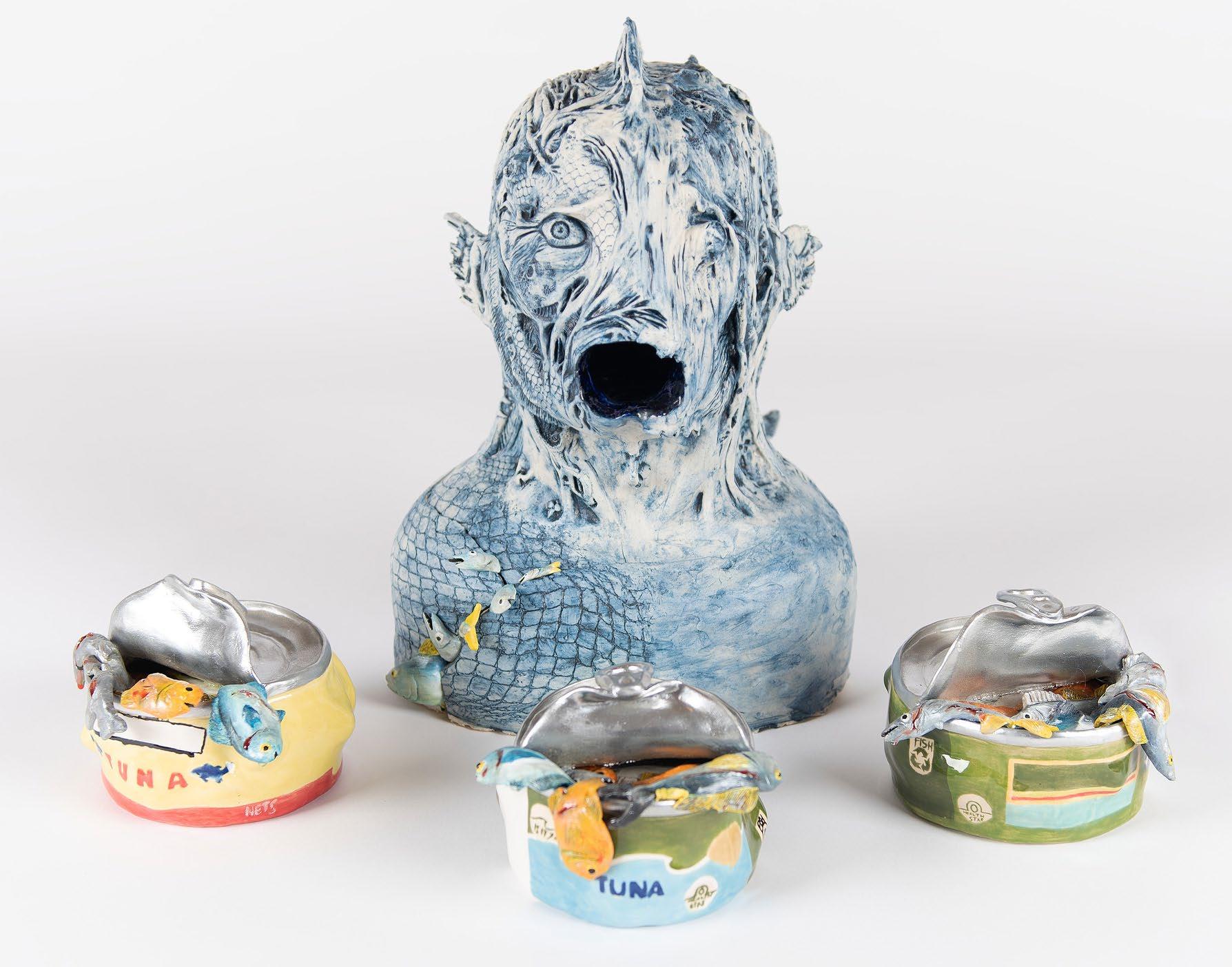
stoneware, mineral stain, synthetic polymer paint, Sculpey and epoxy resin four parts: 38 x 29 x 28 cm; 13 x 18 x 14 cm (each)
Inspired by writer Marya Mannes’ words, “we abuse and the living things we kill will, in the end, take their revenge,” my work explores the destructive cycle of overfishing and human greed. As the anthropomorphised tuna bust gains human anatomy, it reveals emotions of fear, agony and despair. The melting and decomposing forms suggest that both humans and fish will eventually disappear as destruction continues. Manipulated tuna cans expose greenwashing by brands claiming their products are responsibly caught, while their indentations reflect frantic attempts by fish to escape inescapable nets. The distorted forms suggest the violence of bottom trawling fishing methods, showing how overconsumption traps both marine life and us in an endless cycle.
oil on board 120 x 86 cm
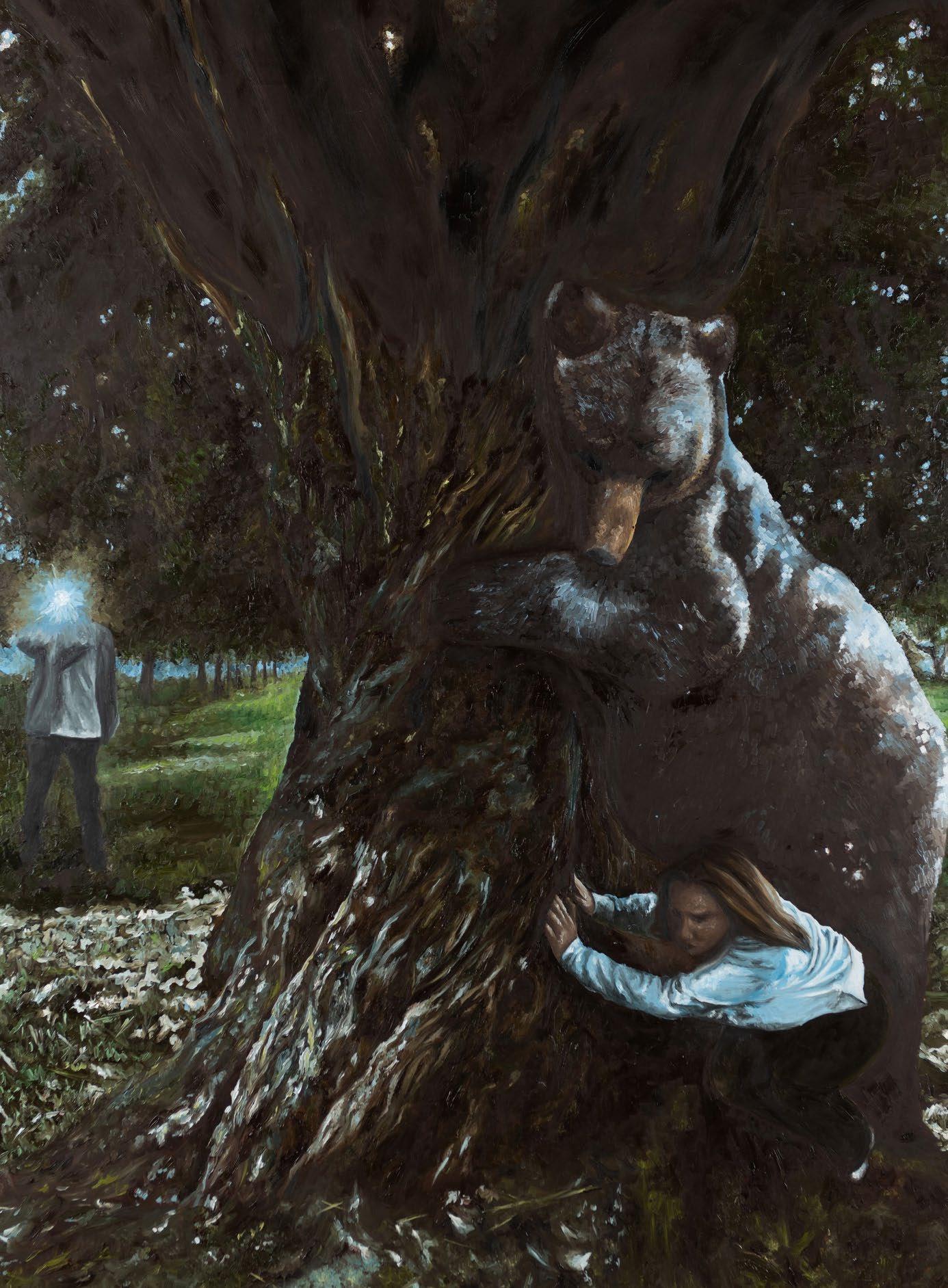
On average, one woman is killed every nine days by a current or former partner. This reality frames my work, which responds to the viral man versus bear debate, where many women chose the bear over a man when asked who they would rather be alone with in the woods.
The irony of suggesting that a woman might find safety with a wild animal critiques the everyday dangers women face. Influenced by artist George Gittoes, whose work uses powerful social commentary to portray devastating realities with emotional clarity, I question whether protection is found more easily in nature than within society itself.
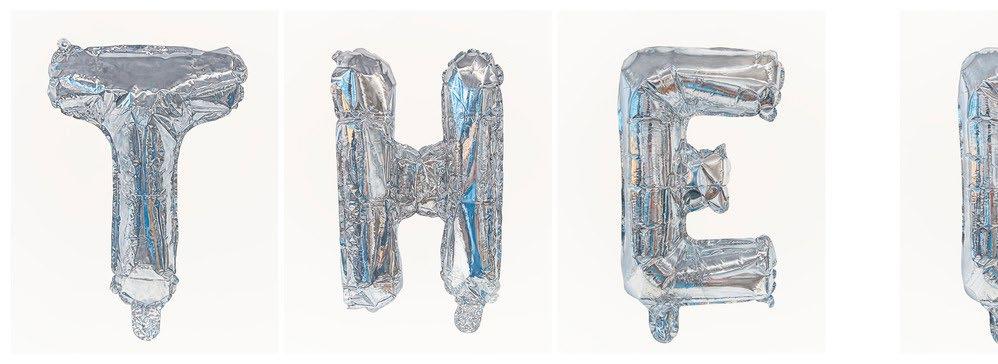
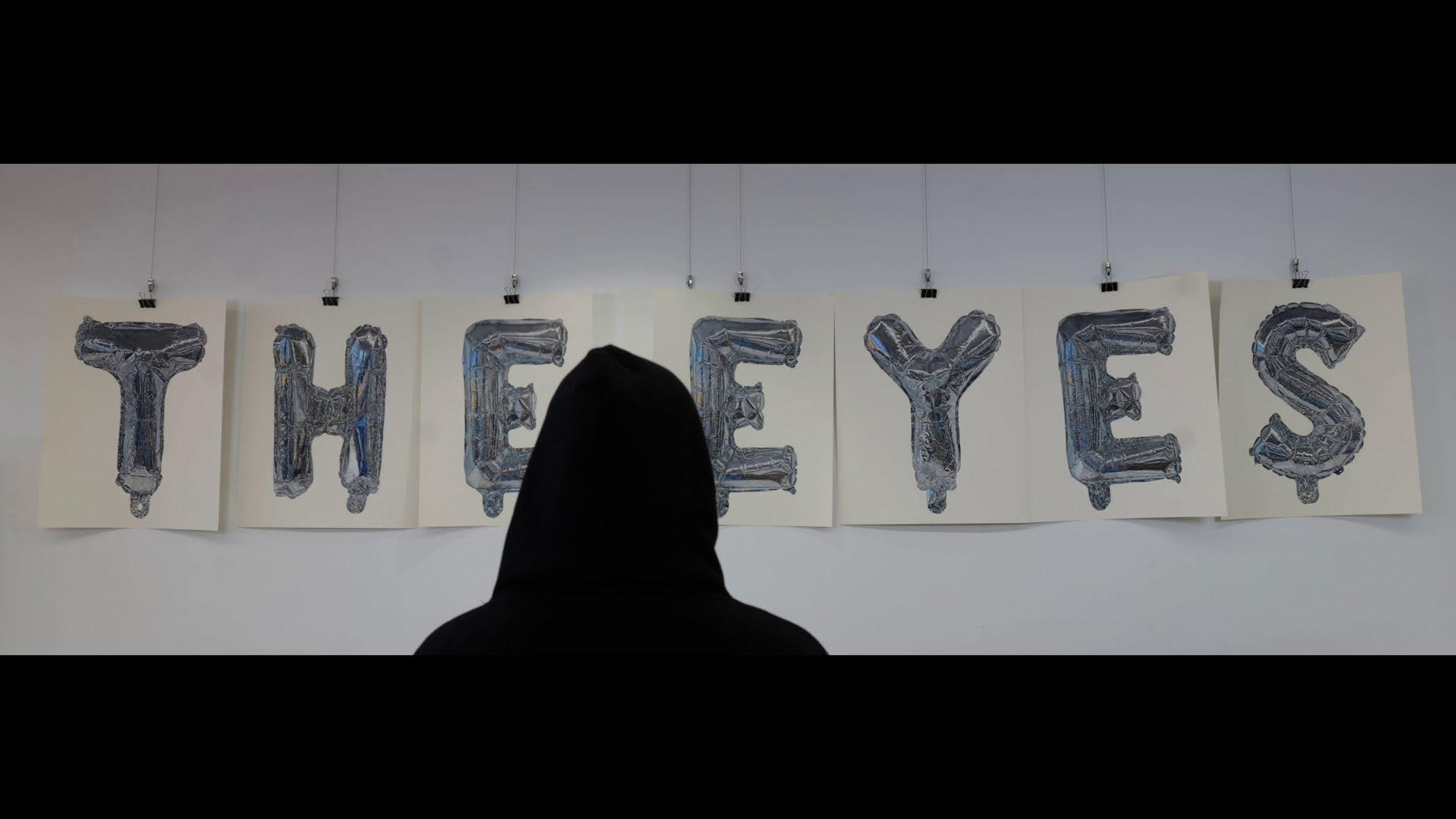
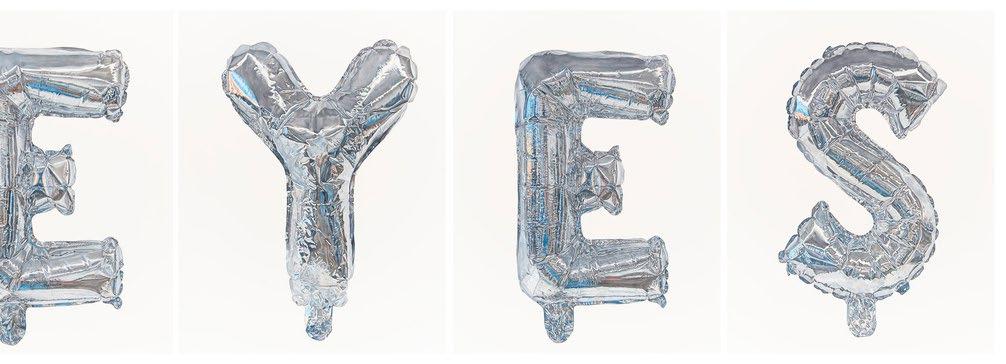
coloured pencil on paper, video eight parts: 62 x 50 cm (each); 1 minute 16 seconds
My artwork explores the complexities of perception through the manipulation of language. By transforming the words “THE EYES” into “THEY SEE”, I emphasise how eyes act as the lens through which we view art, make judgements, and form critiques, even though each person interprets what they see differently. This reflects how meaning is never fixed, shifting with individual context and perception.
I embody this subjectivity through balloon letters; their playful, kitsch appearance contrasts with layered interpretation. The implied reflective surfaces act like mirrors, reminding viewers that perception is shaped by the perspectives they bring, and that art is never experienced the same way twice.
“Nice
oil on canvas
29 x 38 cm
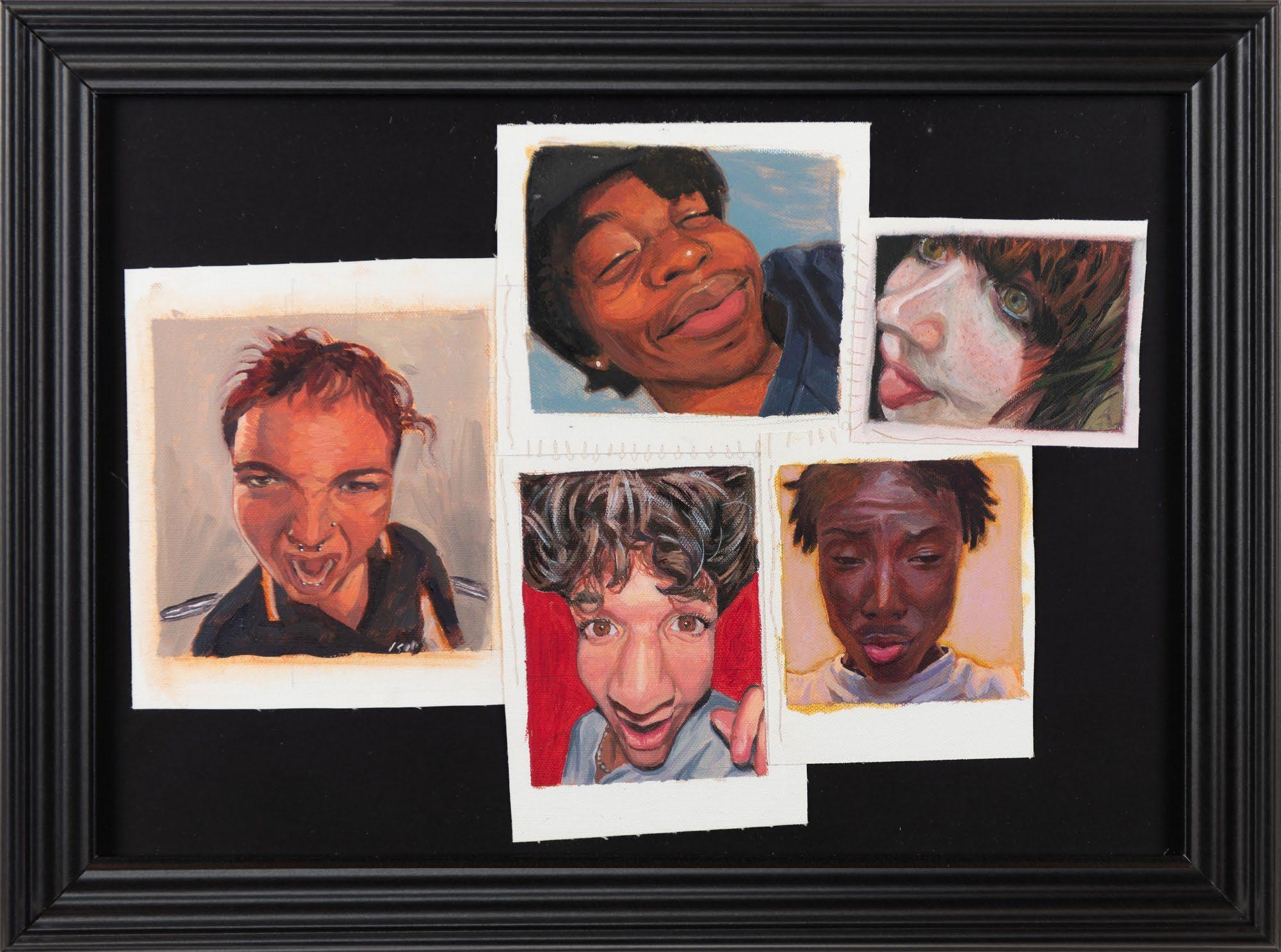
“Nice Photo!” is a small collage of oil paintings made over the school year. For my first year doing portraits, I chose to paint close-ups of some of my classmates from photos they considered unflattering or silly. I believe these types of photos should be just as appreciated as those photos people consider flattering. This work celebrates candid and playful moments as something meaningful and worthy of being captured in paint, challenging ideas that deem them as too informal or unappealing for display.
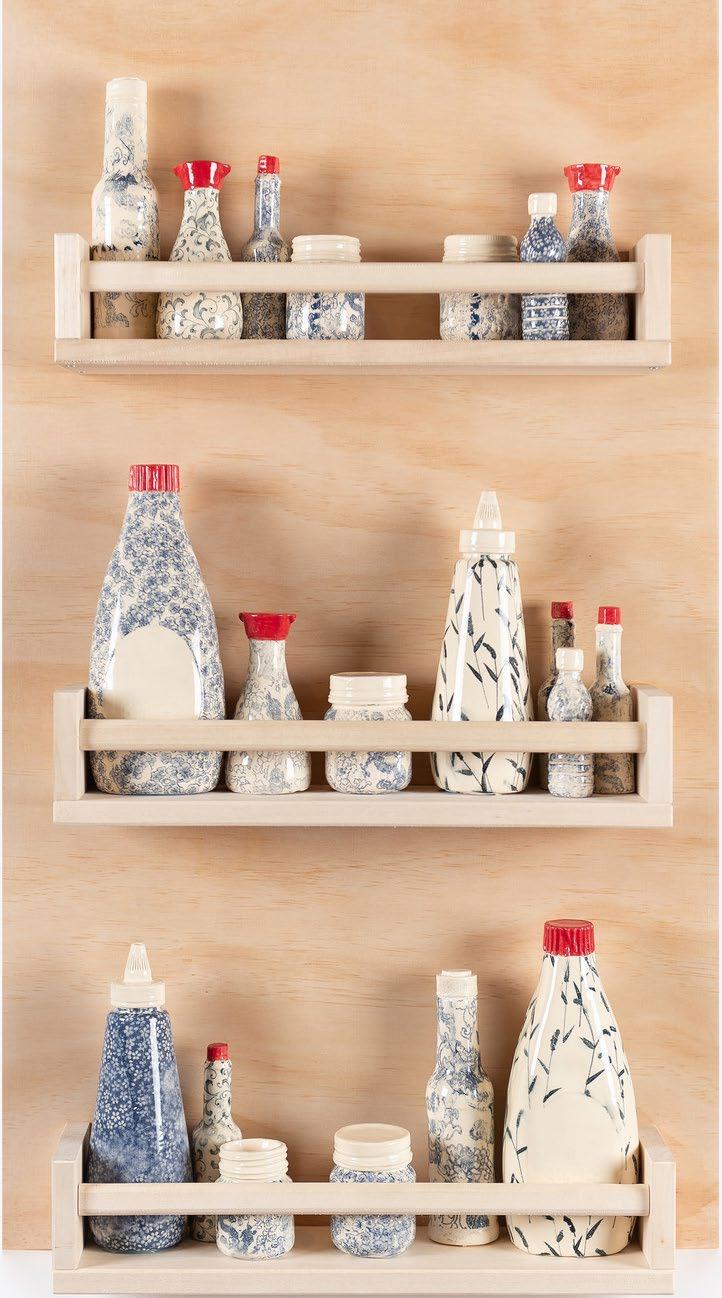
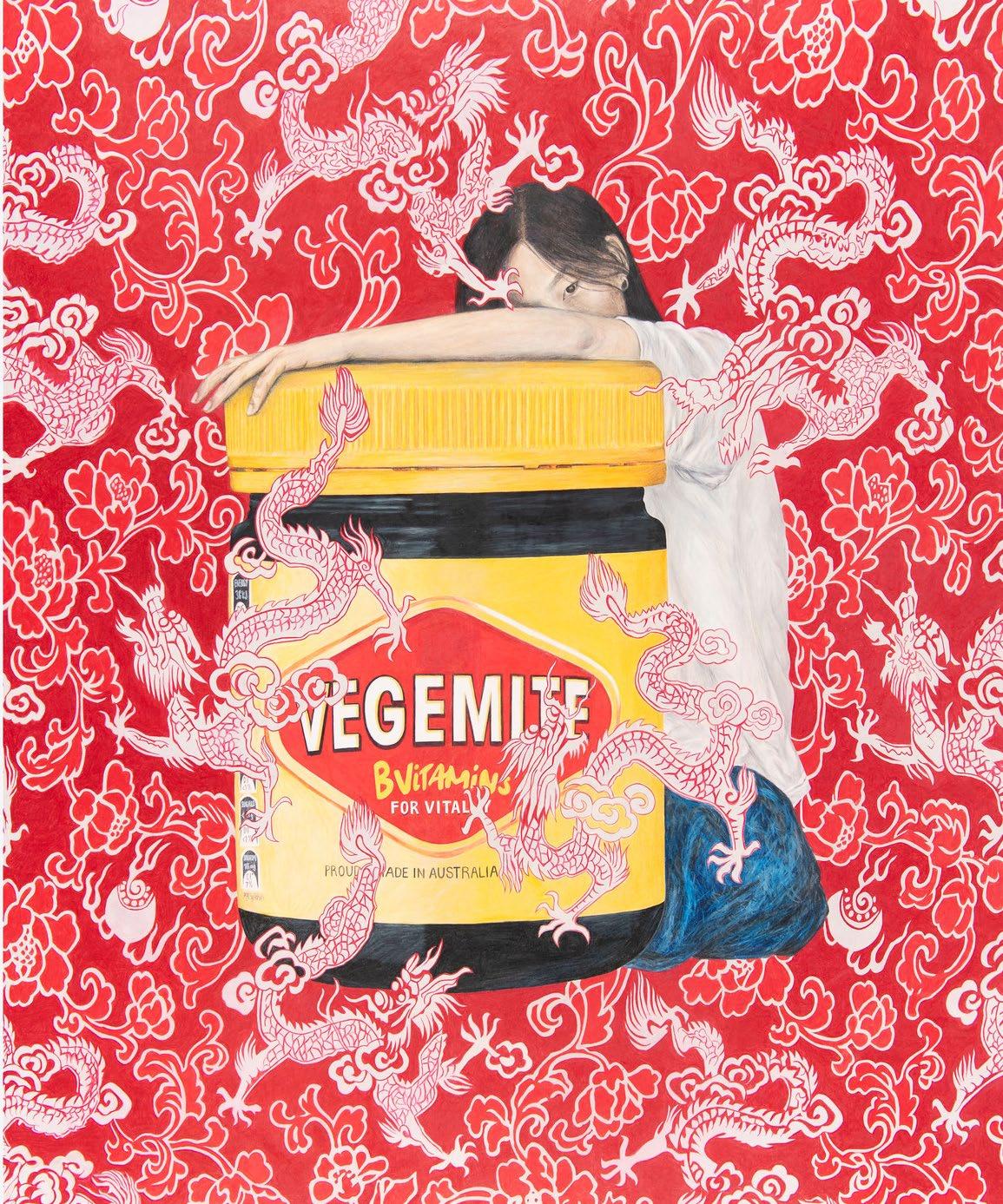
Made In Australia explores the tension I experience as an Australian with Chinese-Malaysian heritage. As the child of immigrants, I was raised differently from my peers, often leaving me questioning where I belong. This quiet frustration sits at the centre of the work. I was inspired by Shaun Tan’s short story Eric, particularly his subtle portrayal of cultural difference through domestic spaces like pantries and food.
The mix of pantry items rendered in slip-cast ceramic reflect the lived reality of growing up between cultures. The contrast between the Vegemite jar and the crimson background of Chinese dragons symbolises the push and pull between cultures and the nuanced struggle of feeling in between.
earthenware, cobalt, timber, coloured pencil on paper two parts: 90 x 50 x 1.2 cm; 101.5 x 82.5 cm
pencil, oil and synthetic polymer paint on canvas
three parts: 52 x 40.5 cm (each)
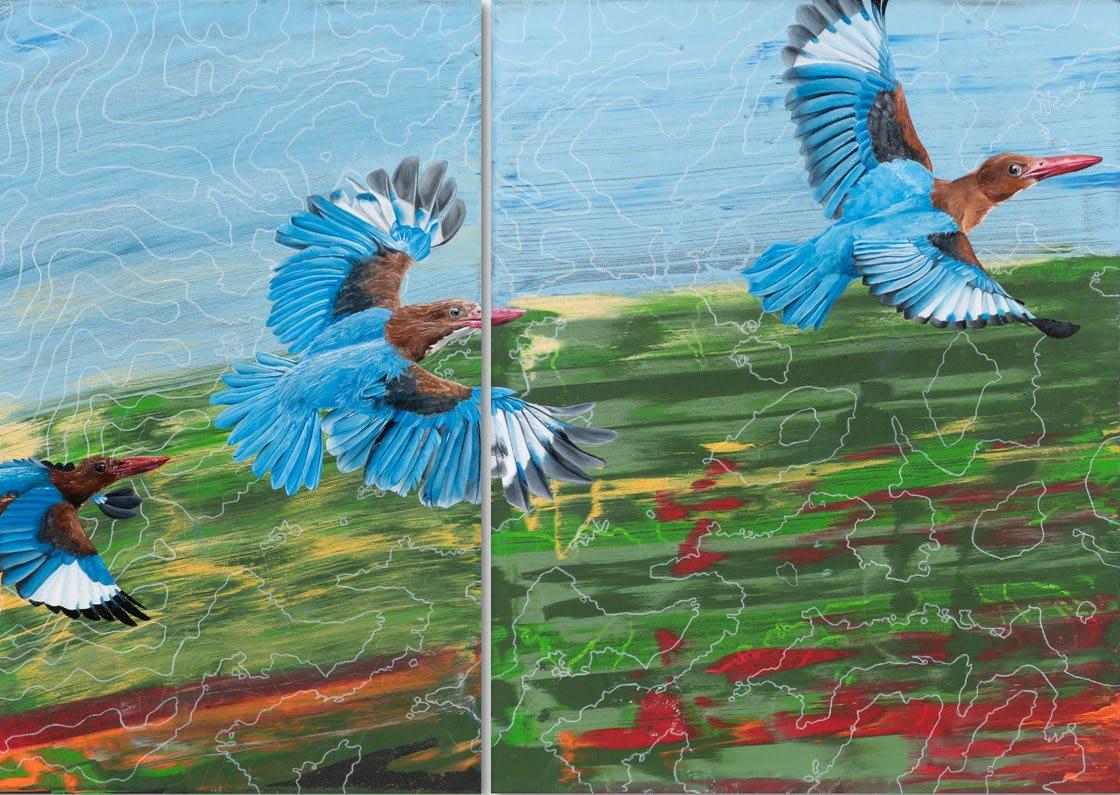
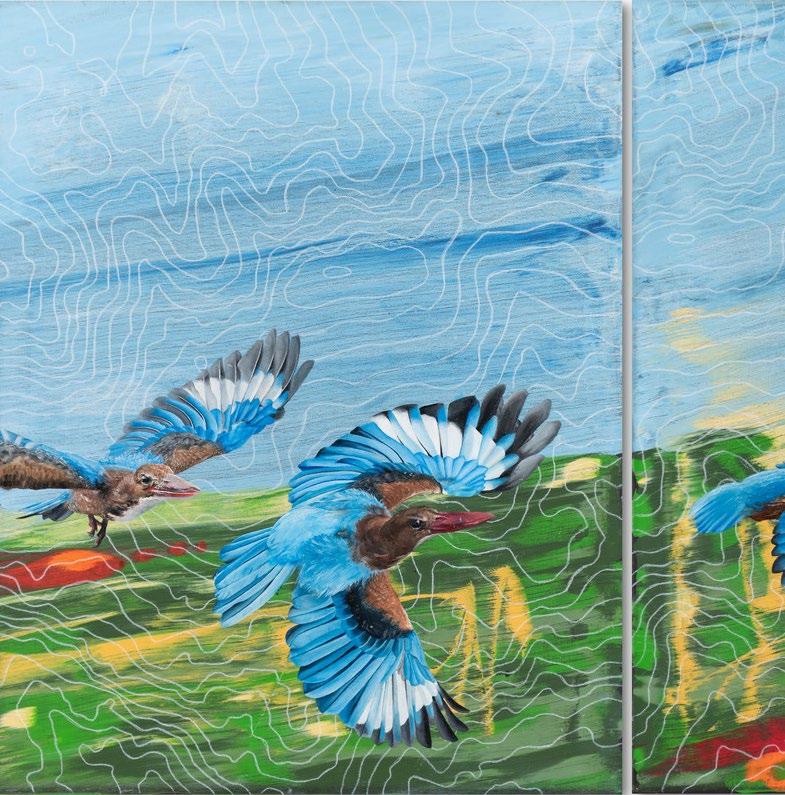
My work explores migration through my family history. My popo (grandmother), was born in Alor Setar, Malaysia, later studying in Taiping where my mother was born, before emigrating to Australia, where I was born. The White-throated Kingfisher symbolises this movement across generations, taking off from Taiping and continuing on to Perth. Although the bird usually remains close to its territory, some wander further, reflecting the bravery and adaptability of my family. Inspired by artist Giacomo Balla’s expression of movement, I use repetition, flight anatomy, and three shifting landscapes to express transition. The final panel shows the Kingfisher reaching new heights, reflecting my personal growth and evolution.
oil and oil stick on canvas
112 x 91 cm
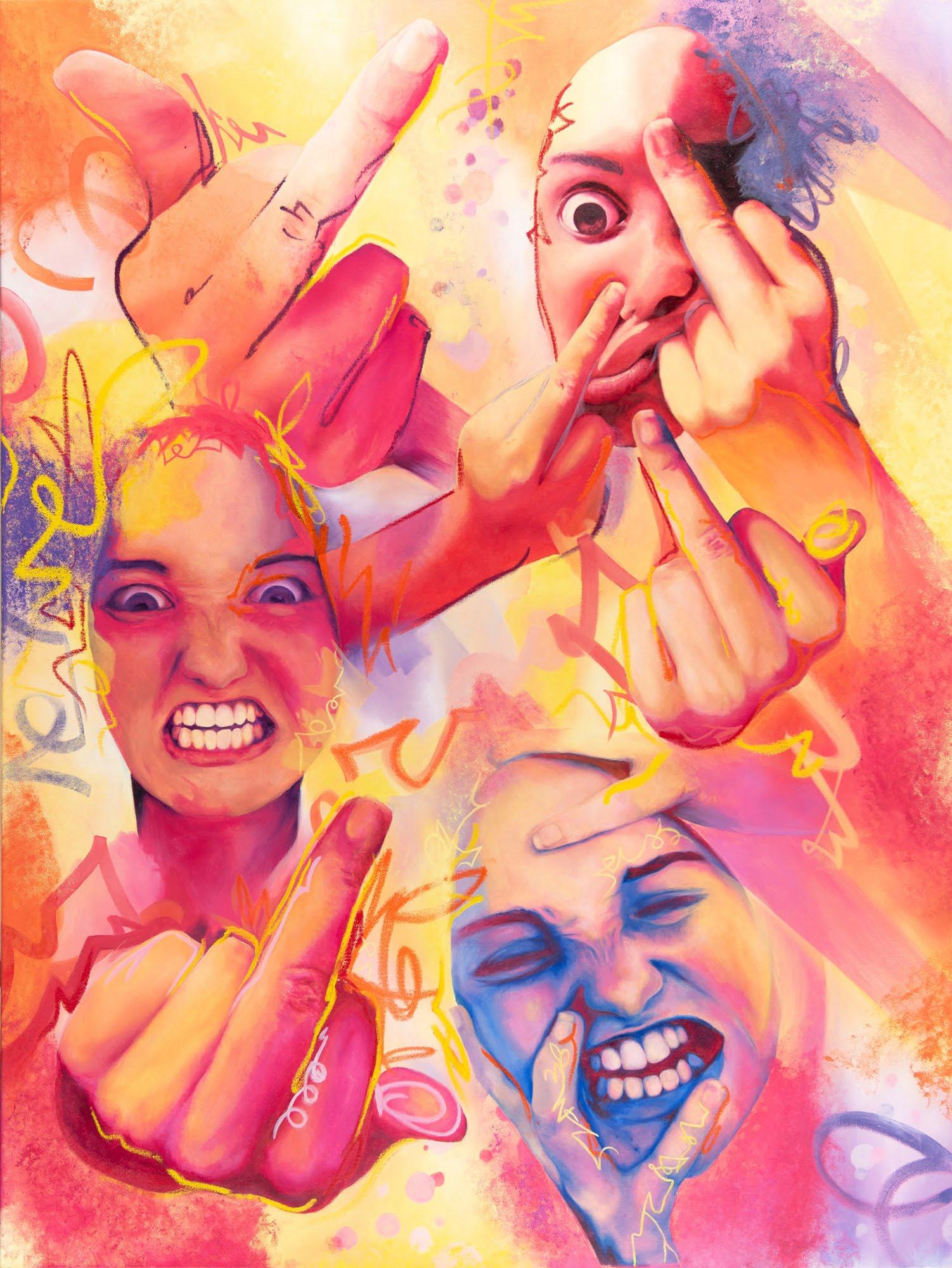
This work conveys feelings of aggression, frustration, and stress that come from the pressure placed on young people, particularly art students. It responds to how rigid marking keys and expectations can stifle creativity and limit genuine self-expression. For me, these constraints create confusion and emotional tension, where making art becomes about validation rather than honesty. Influenced by artists like Jenny Saville and Francis Bacon, I see art as a way to communicate psychological intensity and contradiction. This painting is an act of resistance and an assertion of creative autonomy, pushing back against systems that confine youth creativity while demanding space for joyful, authentic artistic expression.
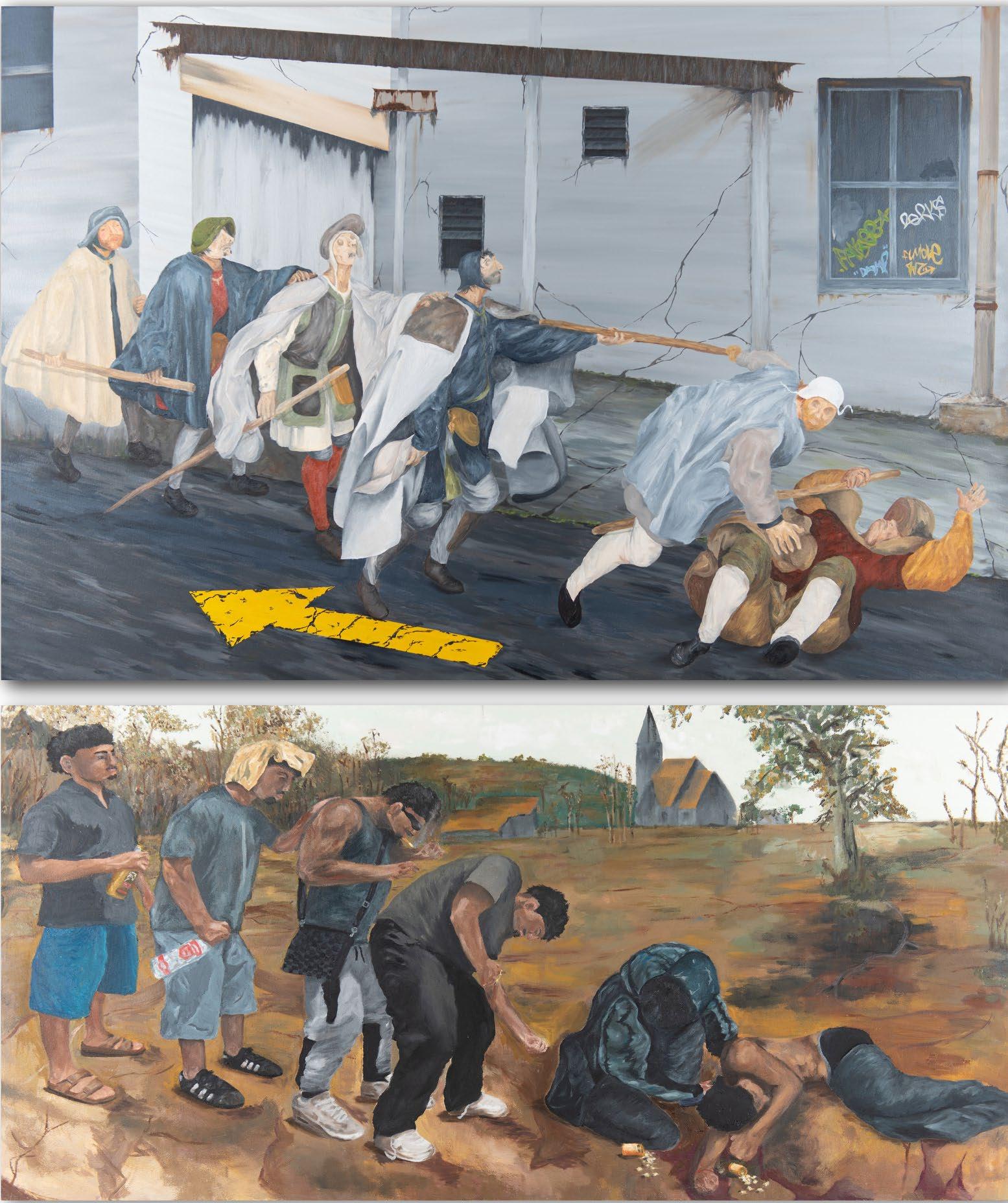
oil on canvas two parts: 91 x 137 cm; 68 x 137 cm
Blind Exchange explores how misguidance, vulnerability, and self-destructive behaviour persist across time. Reinterpreting Pieter Bruegel the Elder’s The Blind Leading the Blind, I use allegory to question patterns of human behaviour and society’s tendency to ignore warning signs. Influenced by artists such as Kehinde Wiley and Banksy, I was interested in merging historical imagery with contemporary concerns to reveal continuing cycles of neglect, addiction, and systemic failure. The diptych format allowed me to place past and present in conversation, suggesting that blindness is not only physical but social. Through this work, I express my belief that art can expose uncomfortable truths and prompt reflection on what we may choose not to see.
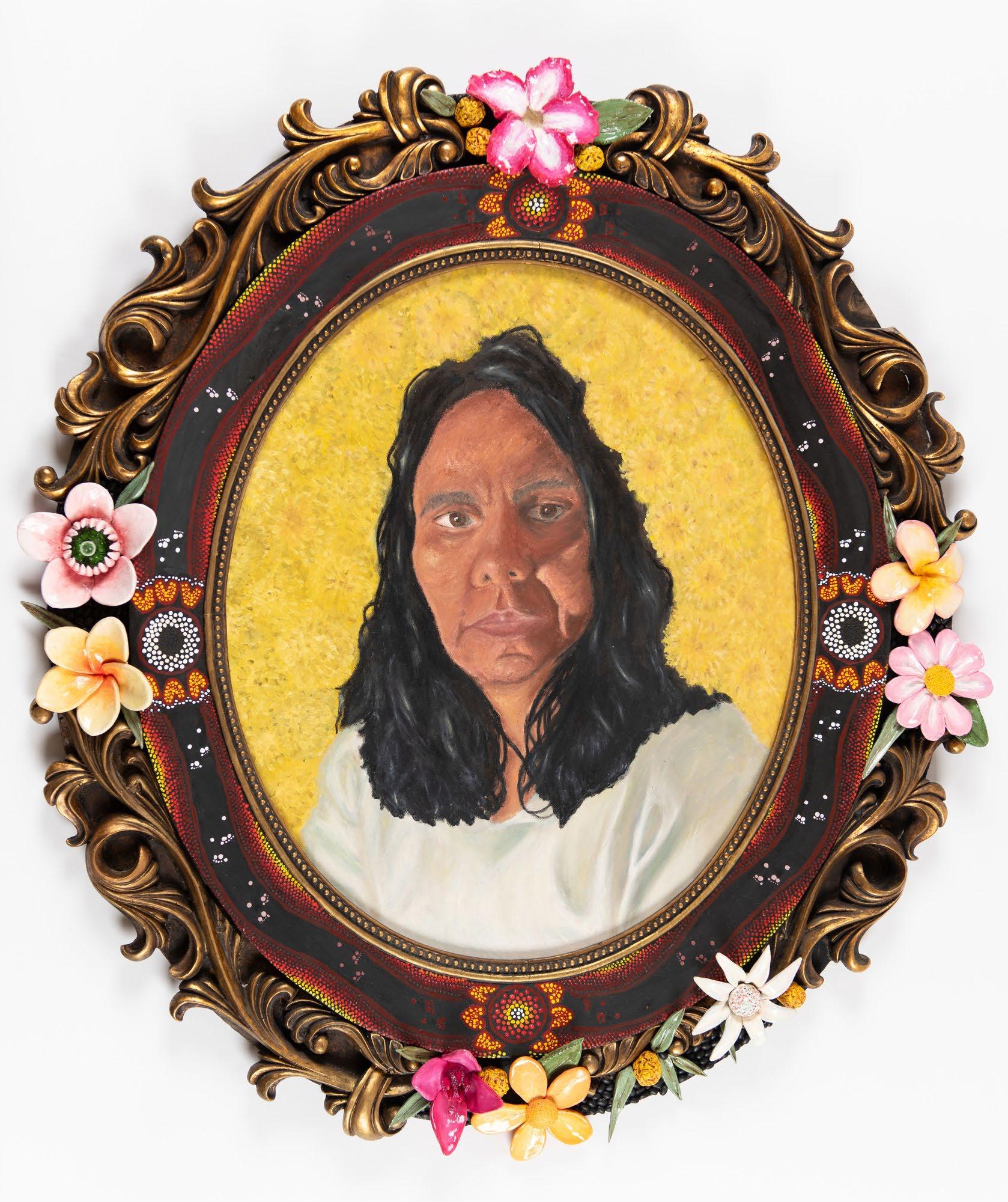
oil on board, seeds, Sculpey and synthetic polymer paint on wood frame 97 x 83 x 7 cm
My artwork portrays my mother, Joylene, and her resilience as a proud Yamatji woman shaped by the legacy of the Stolen Generations. Her story is rooted in generational trauma: my nan was forcibly removed from her family under the White Australia policy, and all seven of my mother’s older siblings were also taken. My mother was briefly removed as a baby. Despite these profound disruptions, she has built a stable family and now supports others through her work. Inspired by artist Kehinde Wiley, I sought to elevate her story with dignity and strength. The work speaks to cultural reclamation, connection to Country, and the enduring resilience passed down through generations.
Applecross Senior High School
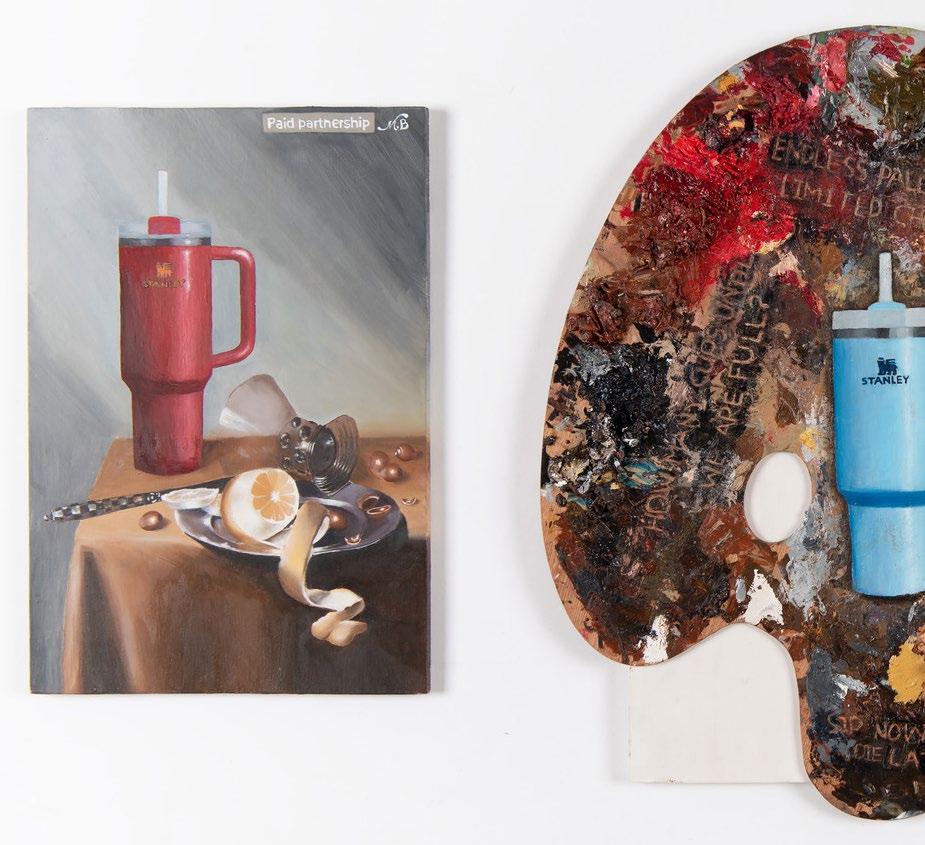
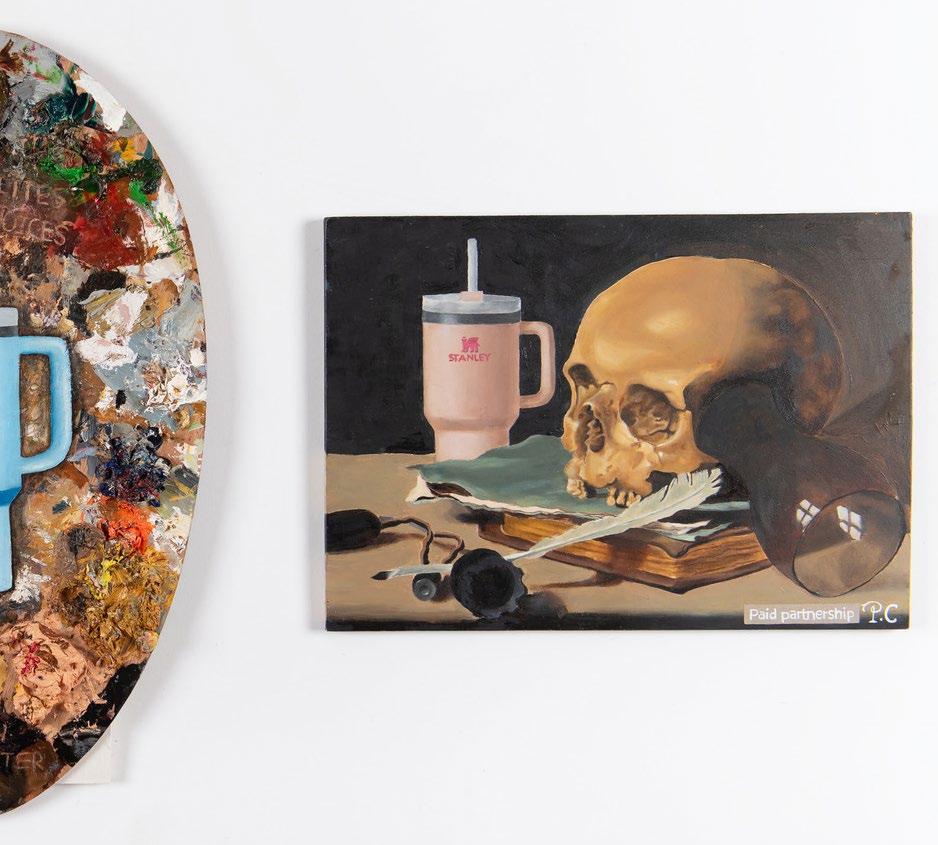
FOMO: Fear of Mortality Obscured explores consumer culture and how fear of missing out distracts from mortality. Influenced by seventeenth-century Dutch vanitas still life paintings, I replace traditional symbols of wealth with contemporary consumer icons to reflect how trends and possessions mask impermanence.
The work is shaped by my cultural background, where repurposing is valued and objects are defined by function rather than novelty. By treating branded goods with the seriousness once reserved for fruit and still life objects, the series critiques how consumerism restricts freedom while promoting excess. Ultimately, the work asks viewers to consider how vanity and accumulation fail to obscure the certainty of mortality.
Dear Saigon, From, Ho Chi Minh
Butler College
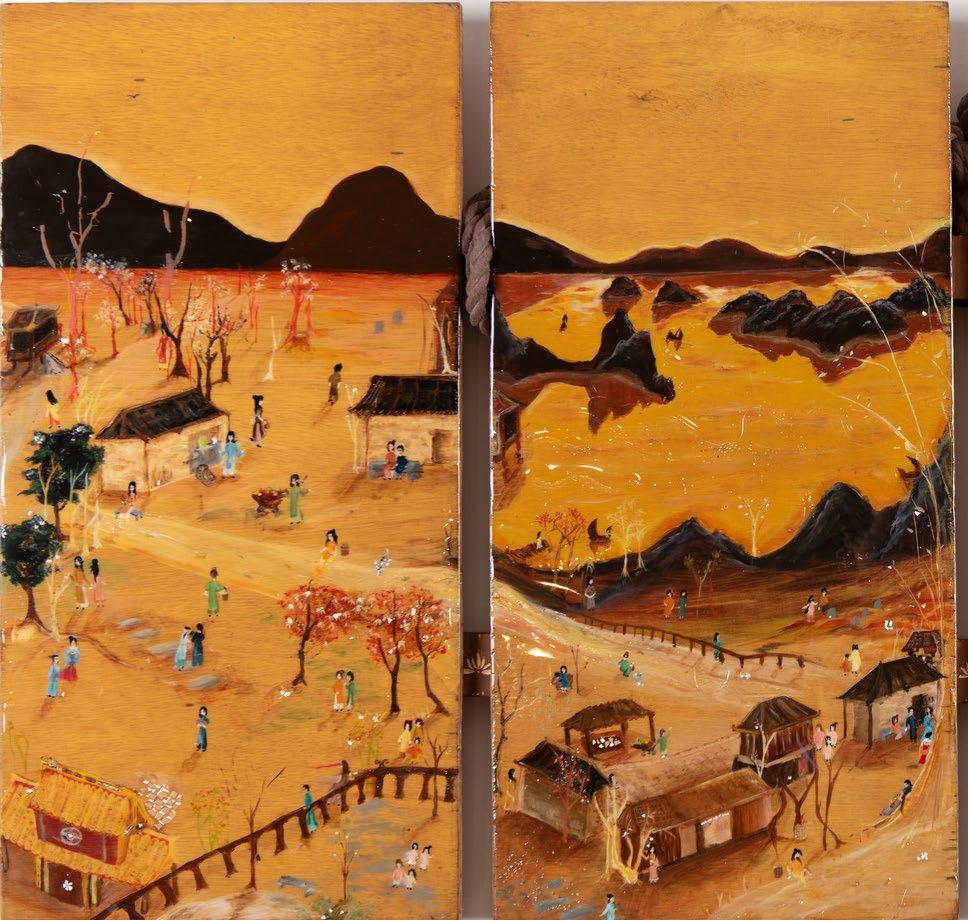
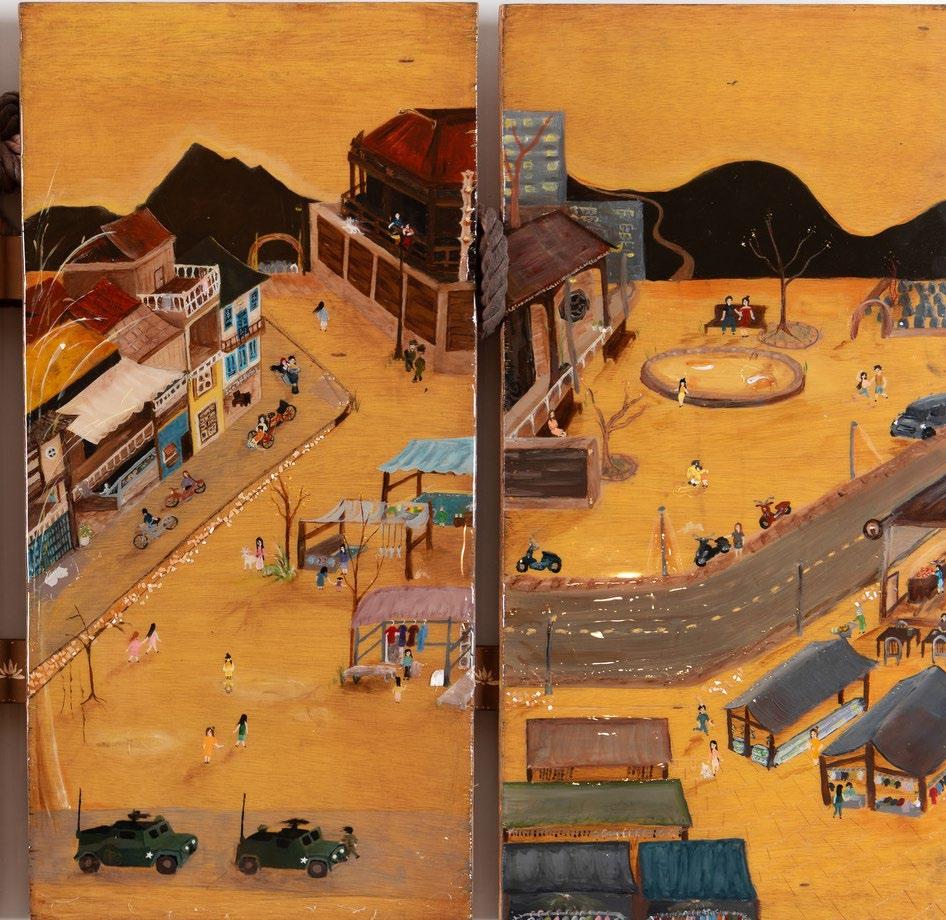
Dear Saigon, From, Ho Chi Minh is a reflection on loss, growth, and honours Vietnamese art. The work traces four periods of Vietnam’s history, exploring loss of youth, love, faith, and freedom, and how individual stories shift alongside changes in culture and environment. Vietnam is my mother’s birthplace and an important part of my identity, so my love for its culture naturally shapes my work. Inspired by Vietnamese lacquer painter Nguy n Gia Trí, I draw on his use of colour and symbolism to relay notions of heritage, prosperity, and loss. Through traditional materials, I explore how growth often emerges through loss, both in Vietnam and in life.
photographic print, coloured pencil and synthetic polymer paint on cardboard two parts: 123.5 x 51.5 cm; 61 x 60 x 12 cm
Shelved or Boxed explores my relationship with memory, change, and impermanence. Using the unfolded shoebox, I reflect on how moments from my past are stored and revisited, like personal keepsakes. The closed box represents how memories are packed away during frequent moves and periods of transition in my life. The work responds to the biblical concept of hevel, where life is compared to a gust of wind that cannot be reached or held. I reflect on the tension between revisiting memories and allowing them to fade, and how dwelling too much on the past can prevent living fully in the present.

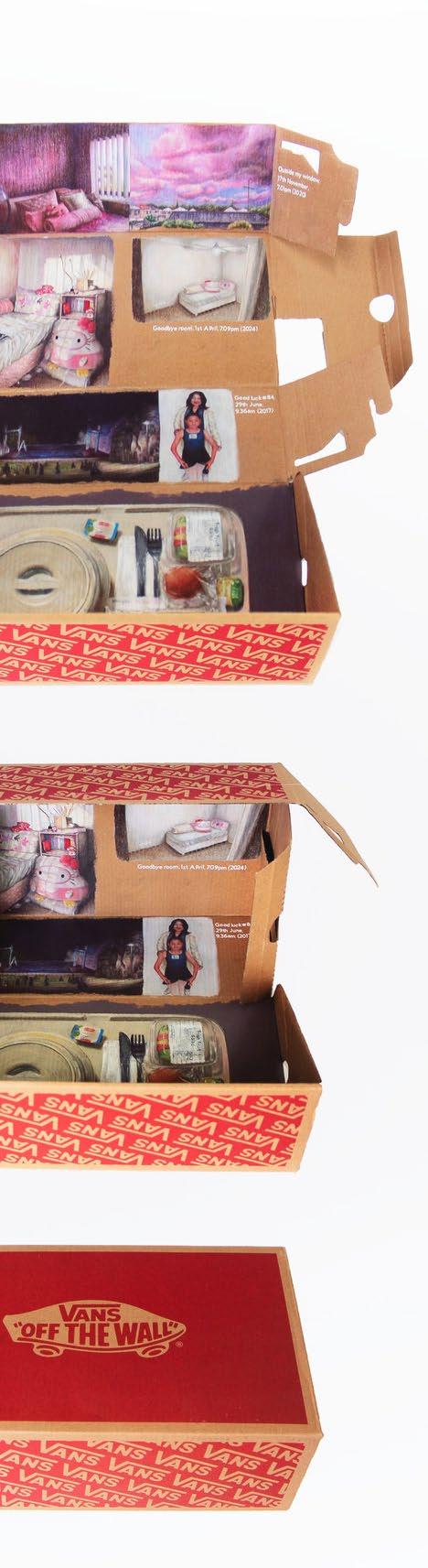
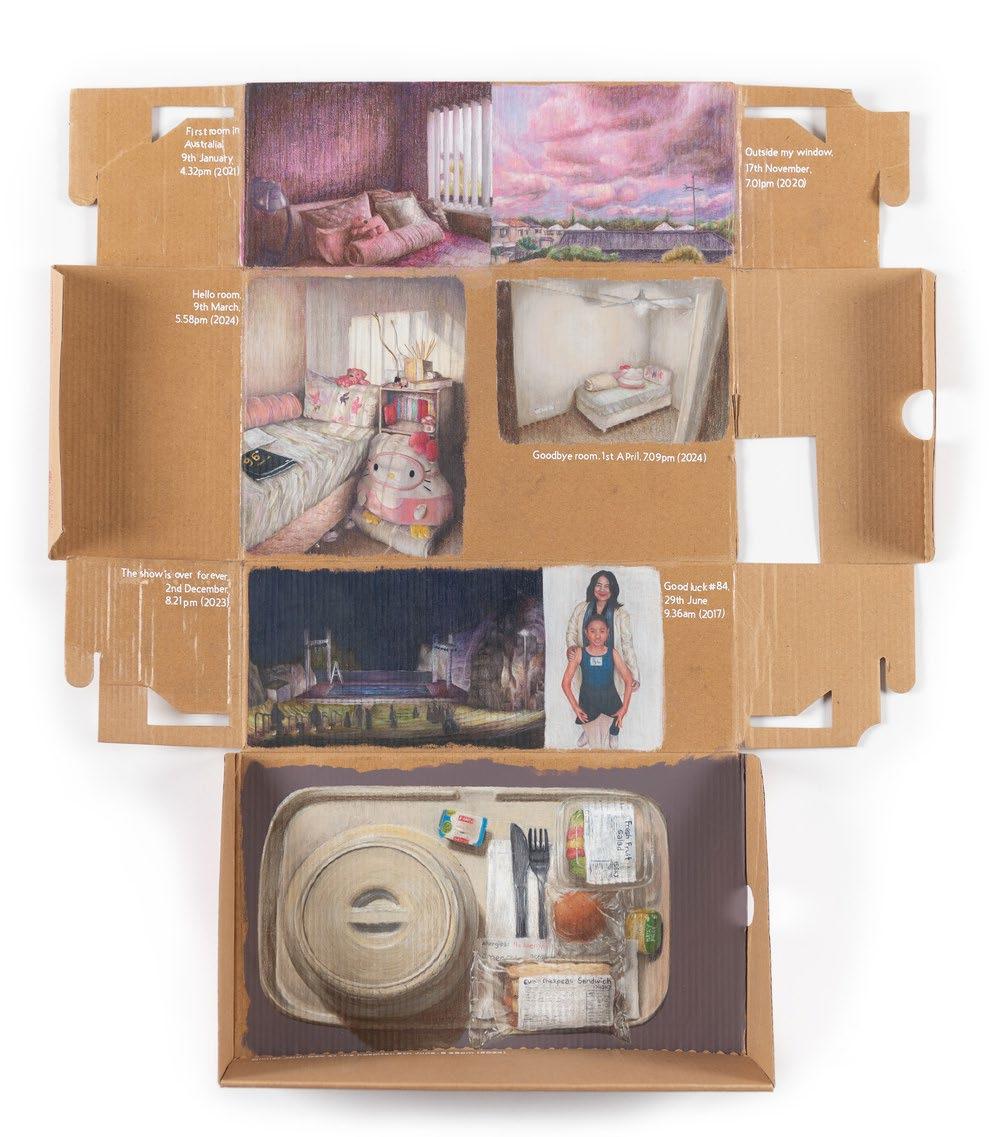
John Curtin College of the Arts
graphite on paper with mixed media 9 x 103 x 84 cm
Aston Casino is a portrait of my once foster greyhound, Aston, and a reflection on the injustices of the greyhound racing industry. The work highlights how racing dogs are valued only for performance, despite being gentle, athletic animals capable of full lives beyond competition. Once deemed unfit for racing, they are often discarded, carrying lifelong internal and external injuries. By presenting Aston as both a cherished companion and a specimen for study, I question the industry’s treatment of these dogs and the normalisation of harm in the name of sport. Through this portrait, I encourage reflection on the ethical cost of racing culture.
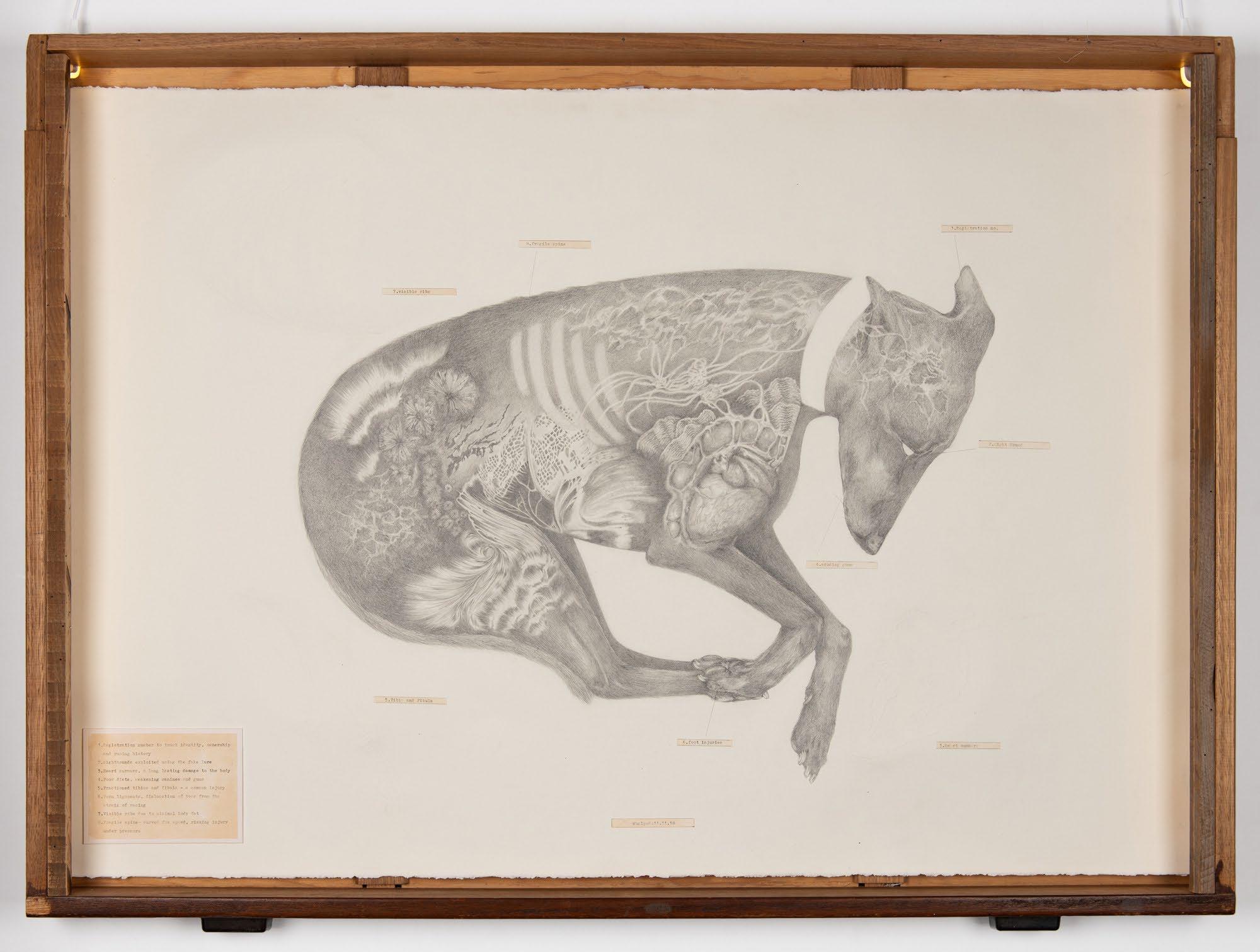
80 x 50 cm
My piece is inspired by the concept of sonder, the realisation that every passerby lives a life as vivid and complex as my own. I aim to express curiosity and appreciation for the individuality of others and their unseen experiences. Trains became a key metaphor, as they bring together people with countless stories, moving through a shared space without personal connection. By separating individuals onto their own planets, I reflect how everyone exists within their own world, often unaware of others.
The comic style structure suggests that we are all characters in one another’s stories, while layered surfaces add depth, representing the countless people we pass without ever knowing their stories or experiences.
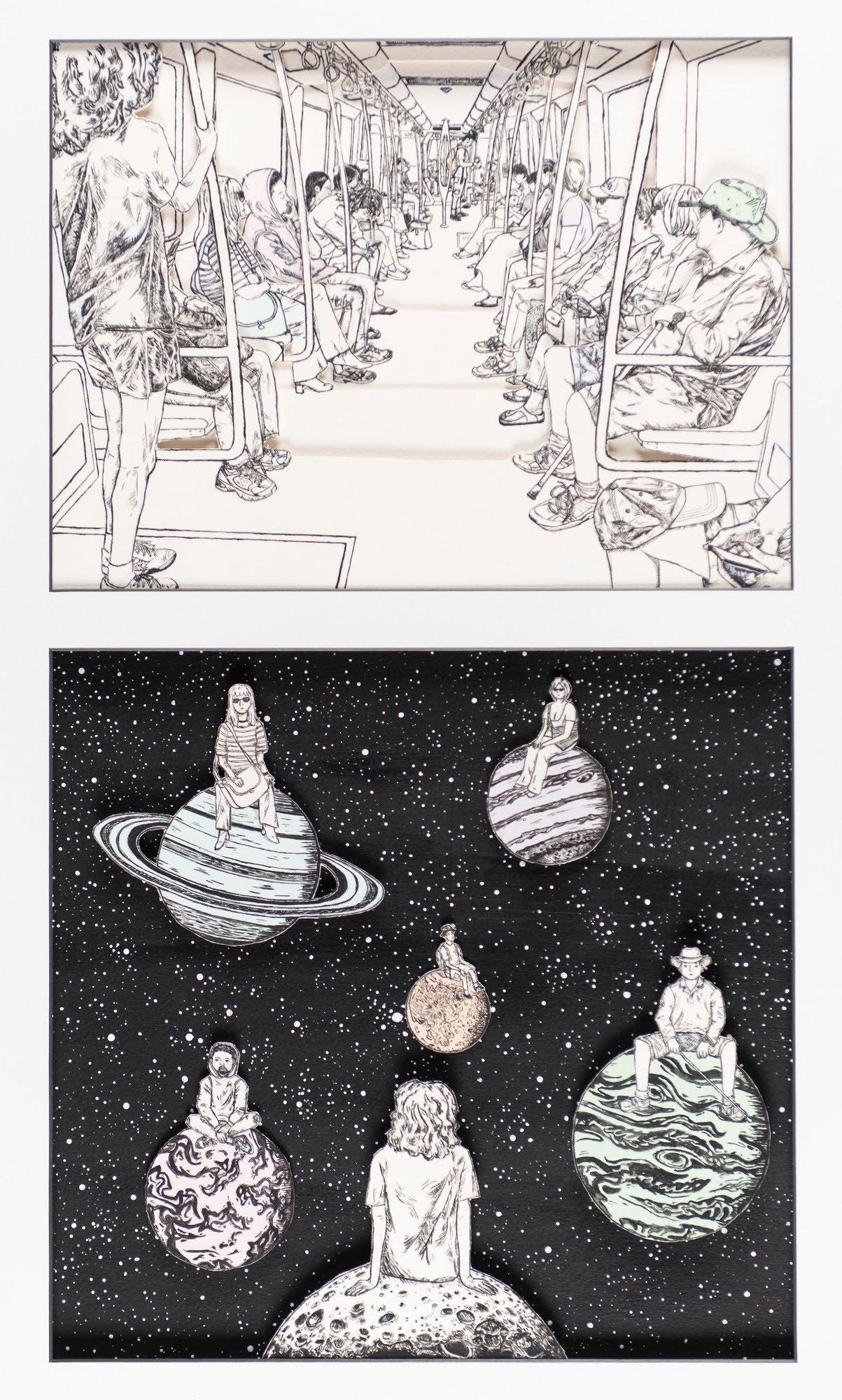
Rossmoyne Senior High School
digital print on vinyl gloss film three parts: 58 x 37 cm; 28 x 60 cm; 28 x 60 cm
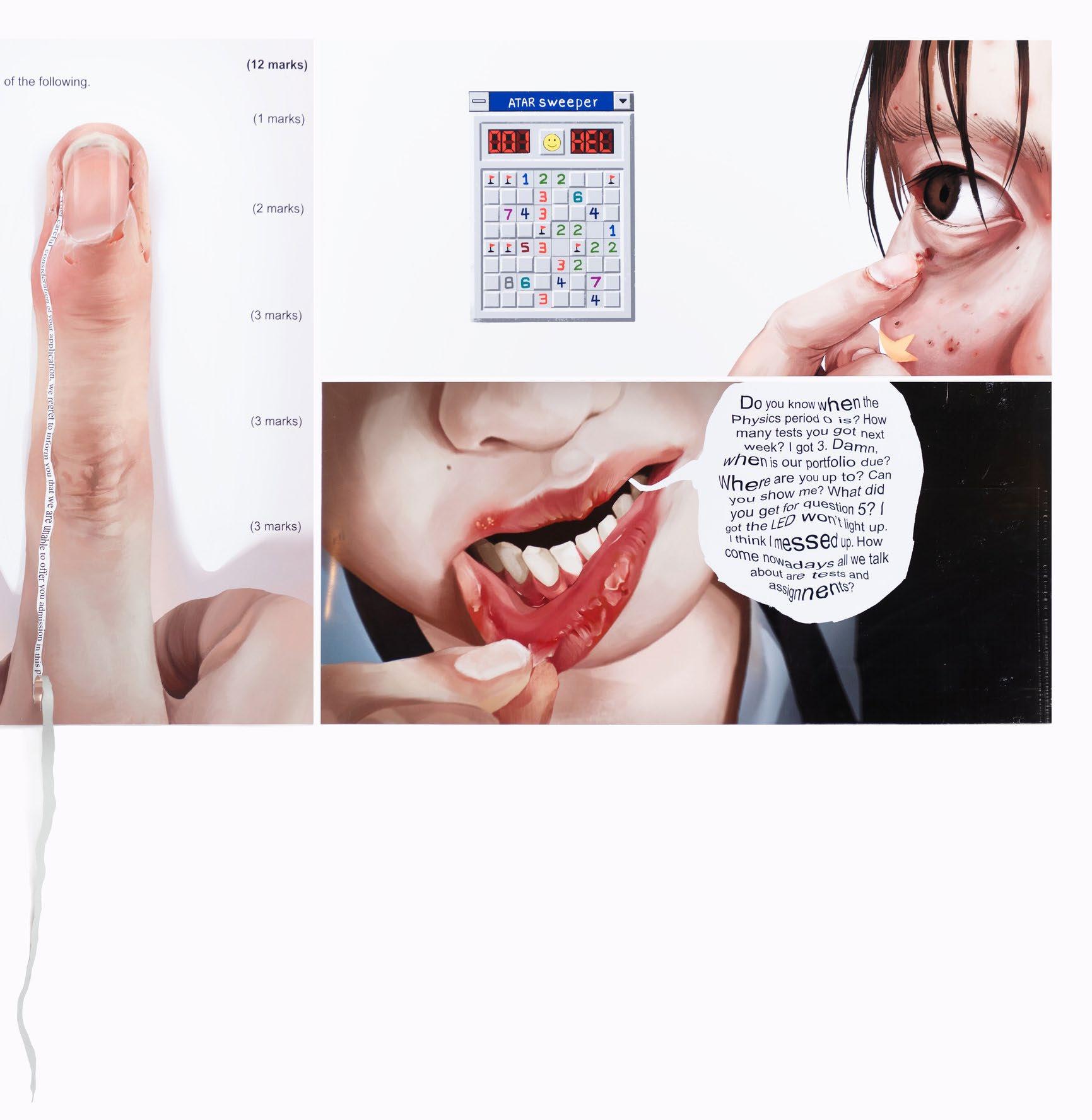
My artwork explores the creeping anxiety of Year 12, a pressure that sat constantly at the back of my mind and manifested through habits like biting and peeling my fingers for comfort. It reflects the sense of impending doom created by deadlines, assessment rubrics, and the fear of mistakes.
I wanted to capture the alienation of feeling irregular and discordant while being forced into rigid, geometric expectations. Influenced by exams, constant reminders, and pressure to perform, I draw a parallel to Minesweeper – a game where one wrong move can ruin everything. This work reflects how Year 12 consumed both my mind and my hands.

oil on canvas
64 x 48.5 cm
Balcatta Senior High School
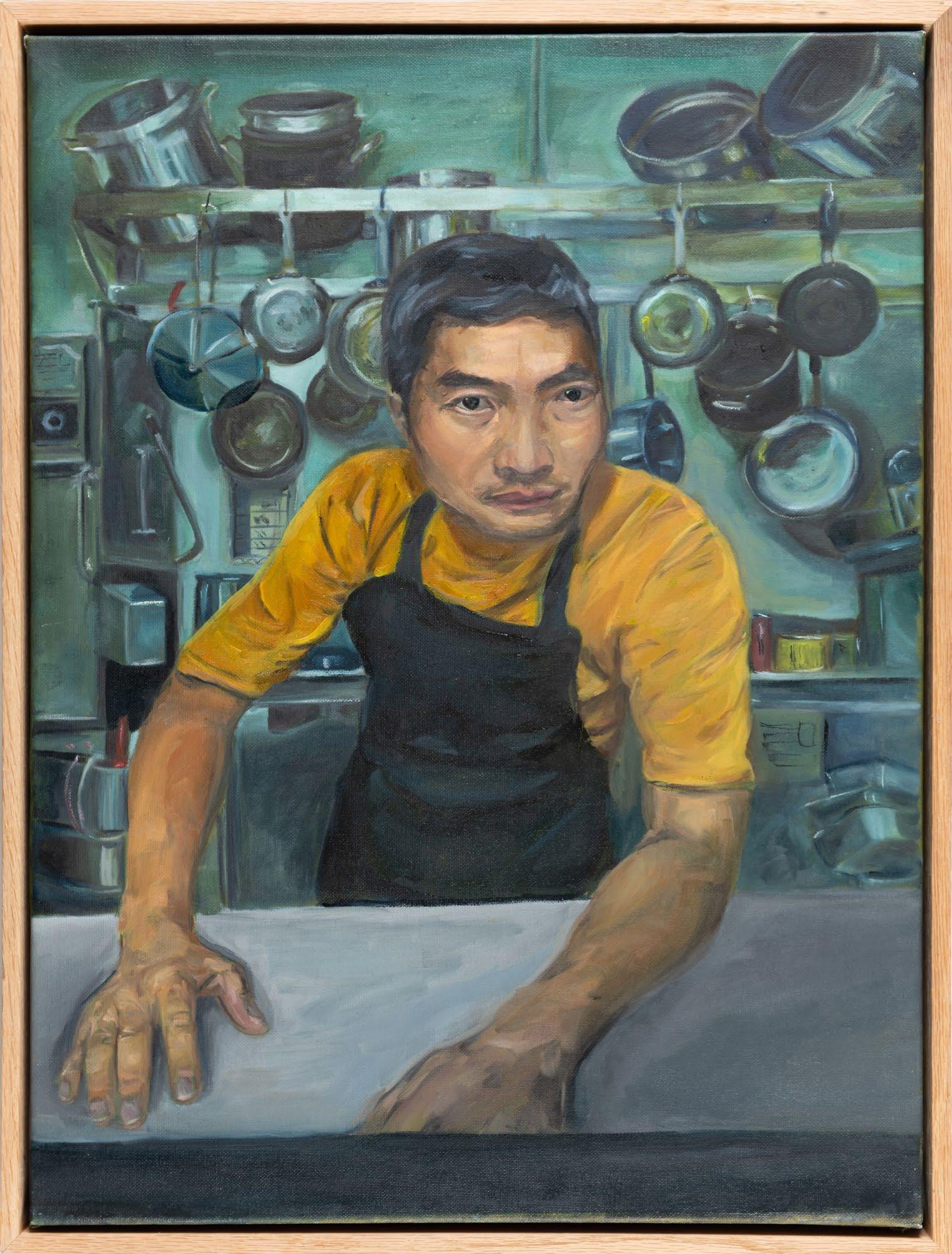
This artwork, inspired by my father’s early experiences as an immigrant in Australia, explores sacrifice, identity, and resilience. Once a respected sales manager in the Philippines, he arrived here to find his experience diminished, working long nights as a kitchen hand at Crown Perth. Moments like him scrubbing greasy floors on New Year’s Eve shaped my understanding of perseverance and quiet strength. This work aims to humanise the invisible labour behind privileges many take for granted. While rooted in my father’s story, it speaks more broadly to the experiences of migrants. It invites viewers to consider how living in a prosperous country can allow comfort to obscure hardship, and how easily struggle and sacrifice can remain unseen.
oil on board
88 x 67 cm
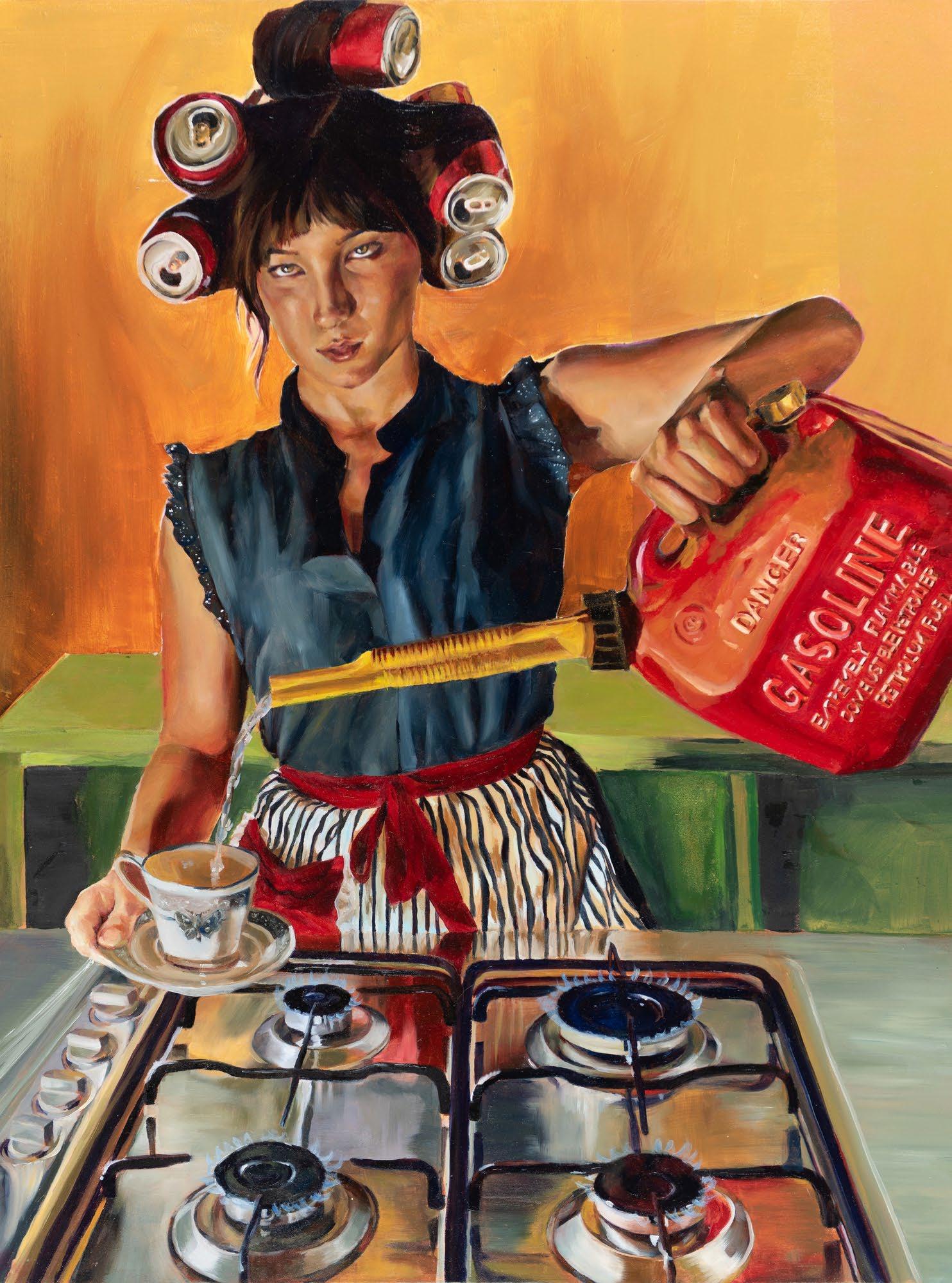
My piece explores the paradox of seeking comfort within danger. Inspired by Oscar Wilde’s line, ‘a burnt child loves the fire,’ from The Picture of Dorian Gray, I reflect on how familiarity can make harm feel safe. Through my love of poetry, I examine the fragile intersection between beauty and pain, particularly within cycles of domestic violence where terror becomes confused with care. By juxtaposing confronting subject matter with casual body language, the work expresses a bittersweet oblivion to self-destruction. References to 1950s imagery suggest how these cycles persist across generations, while echoes of J. Howard Miller’s We Can Do It! poster introduce both vulnerability and resistance, urging recognition of patterns and the possibility of breaking inherited cycles.
synthetic polymer paint, thread, markers and clay on cotton three parts: 89 x 41.5 cm (each)
Lake Joondalup Baptist College
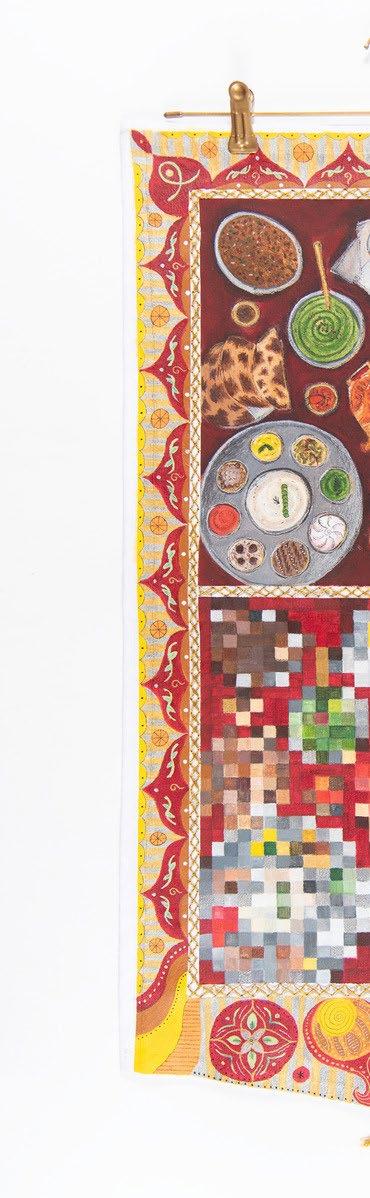
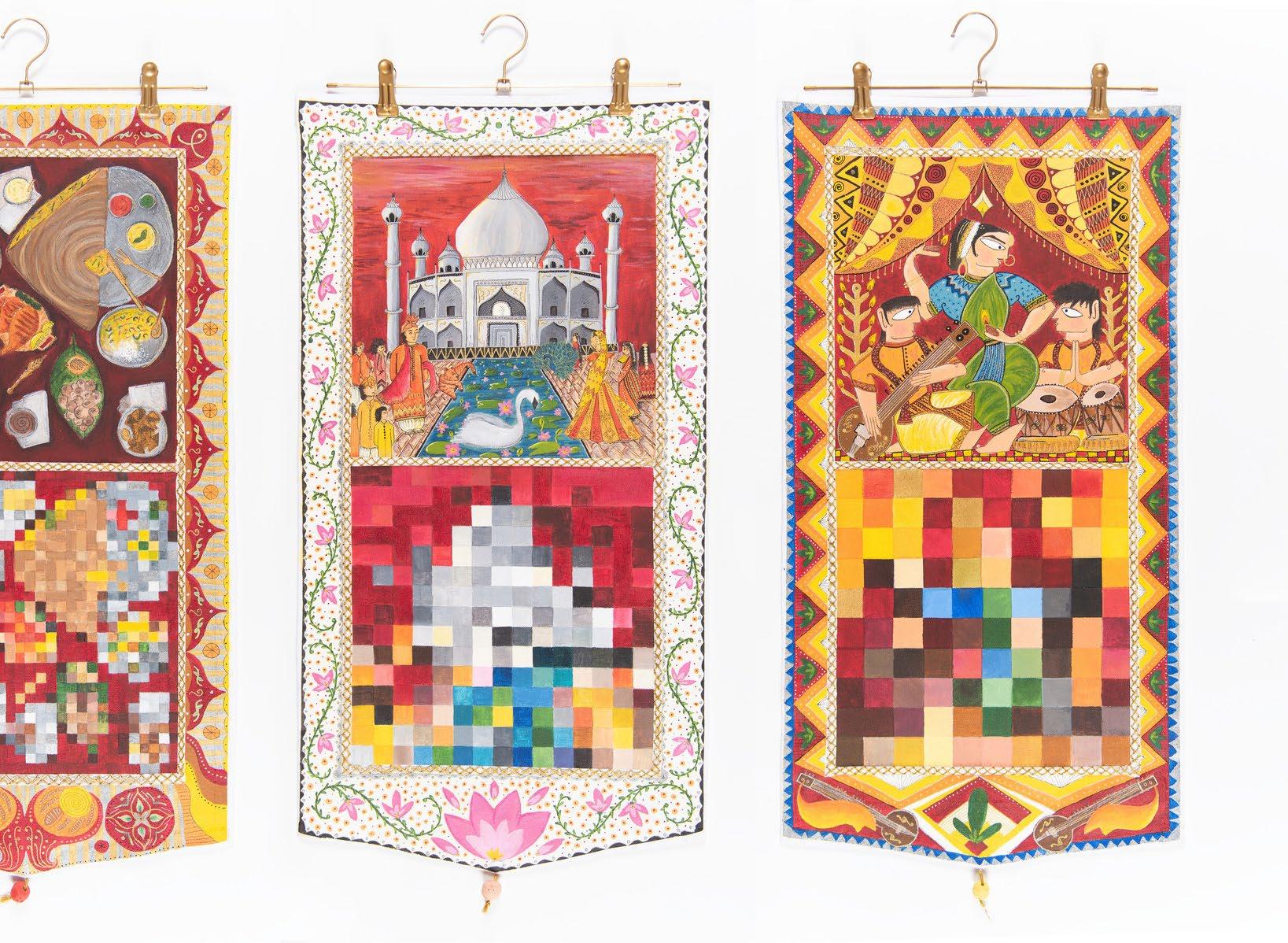
My artwork explores Indian culture and how it is perceived by outsiders. Influenced by artists Jamini Roy and Nainsukh, the triptych examines what is often seen as the basis of culture: cuisine, landmarks, and art.
Having lived and studied in India for three years before finishing my education in Australia, I have reflected on how culture is understood differently from the inside and the outside. Increasing pixelation across the panels symbolises how more complex cultural practices become misunderstood by those not living within the culture. The use of fabric references tourist commodities and questions how Indian culture, though complex and lived, is often simplified, repackaged, and sold by both Indian and non-Indian people alike.
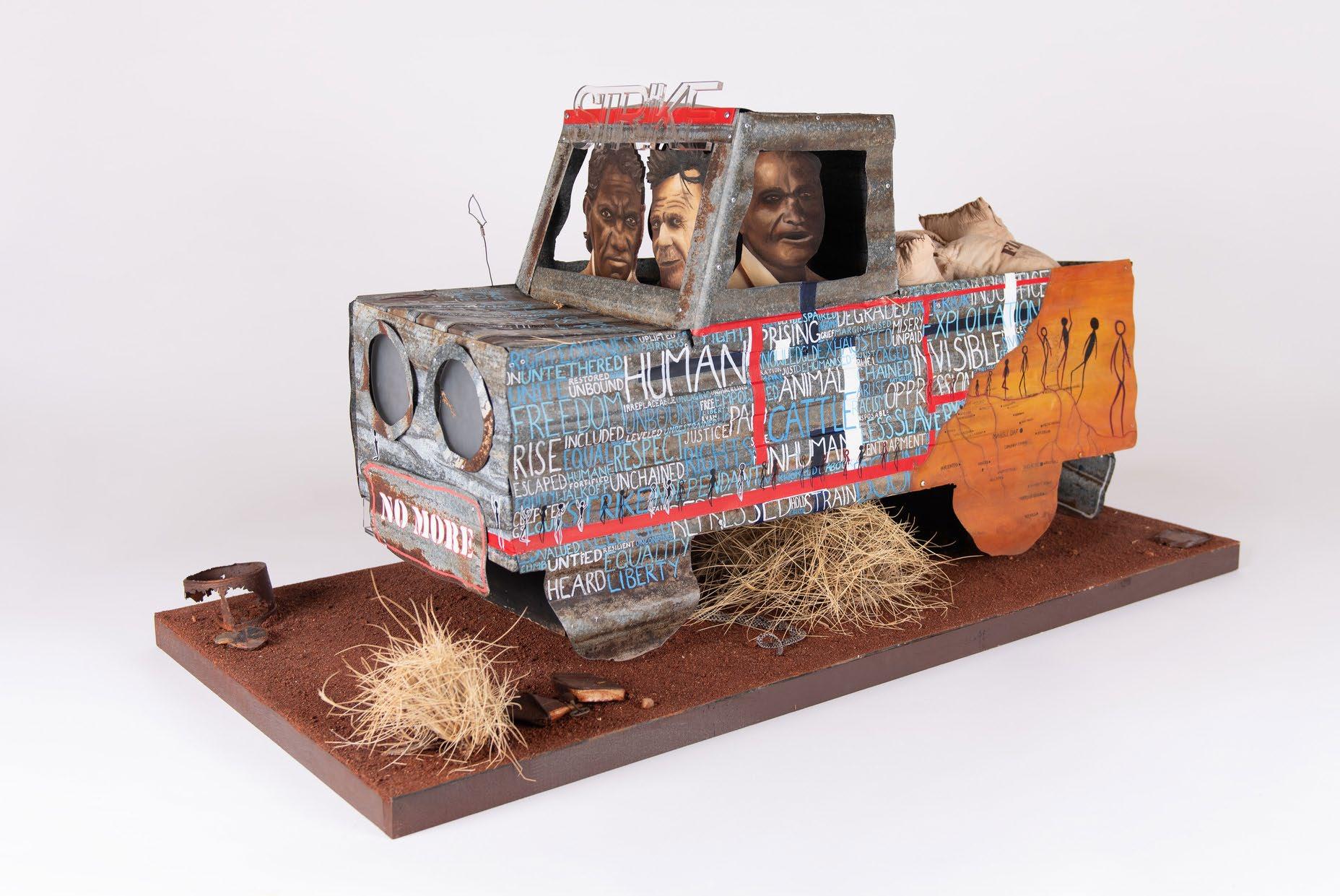
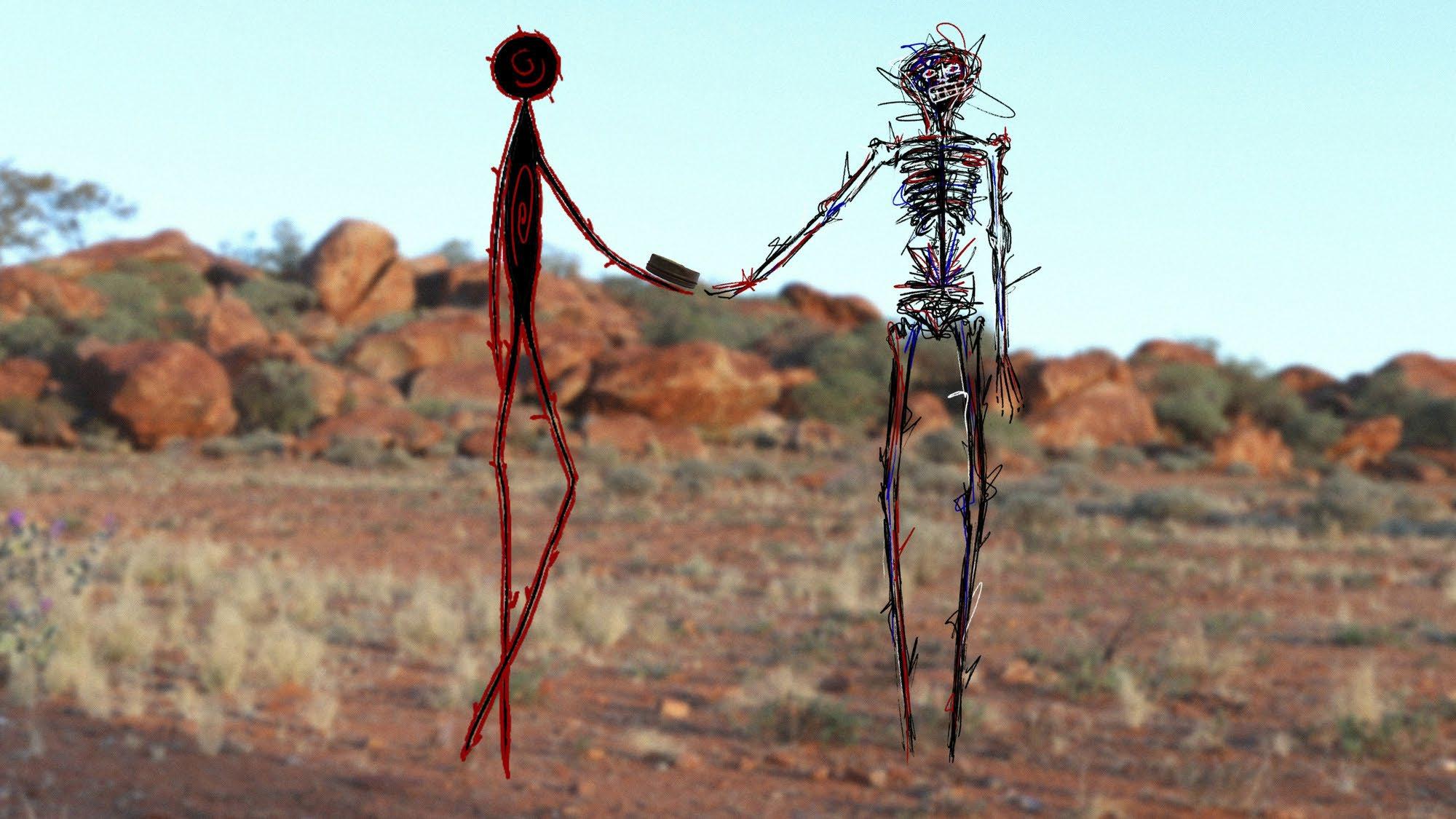
oil and Posca on tin, synthetic polymer paint, found objects, MDF, textiles and animation two parts: 77 x 75 x 140 cm; 2 minutes 59 seconds
“We said, ‘No. We’re not going back to the station no more.’” Nyamal elder Peter Coppin, 1946 Pilbara Strike leader.
My work responds to the 1946 Pilbara Strike, a history of Aboriginal resistance I first learned about through news articles describing rusted cars left behind on Country. Struck by how often this history is overlooked, I felt compelled to explore its legacy. The work centres on the ute as a symbol of movement, resistance, and collective action. At the front, strike leaders Clancy McKenna, Dooley Bin Bin, Daisy Bindi, and Don McLeod drive toward freedom. Influenced by Gordon Bennett, the work examines colonisation, silenced Indigenous voices, and exploitation, while honouring collective resistance and the enduring presence of this history on Country.
The artist of this work is non-Indigenous. In the development and exhibition of this artwork, the artist and the school consulted with the Mingullathorndo Community and the Ngarluma Aboriginal Corporation in Western Australia. Guidance and permission were sought from Elders to inform a respectful approach to filming on Country, the use of materials, and the presentation of histories connected to the 1946 Pilbara Strike. The work is presented with acknowledgement of Aboriginal custodianship of Country and respect for the ongoing cultural knowledge and histories of the Pilbara region.
coloured pencil and collage on board
75 x 150 cm
John XXIII College
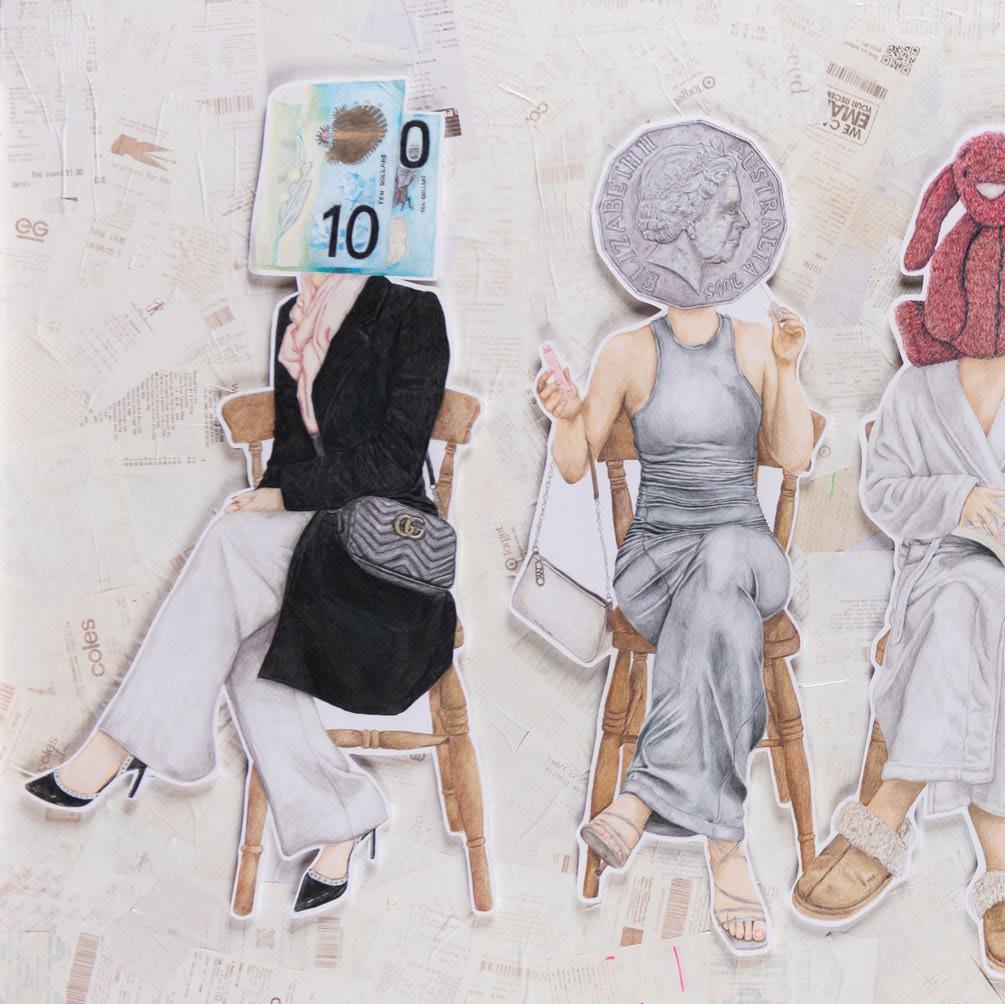
Consumed explores the quiet erosion of individuality within a culture driven by material desire. By replacing human faces with objects and commodities, the work questions how consumerism reshapes identity and reduces people to symbols of status and belonging. In contemporary society, branded goods and trends often act as shortcuts to validation, offering momentary comfort through consumption. The seated figures suggest both ease and restraint, reflecting how material desire can feel reassuring yet confining. The layering of receipts acknowledges my own participation in this cycle, exposing the tension between selfhood and consumption. Influenced by Pop Art, the work highlights how everyday objects infiltrate identity, blurring the boundary between individuality and societal expectation.
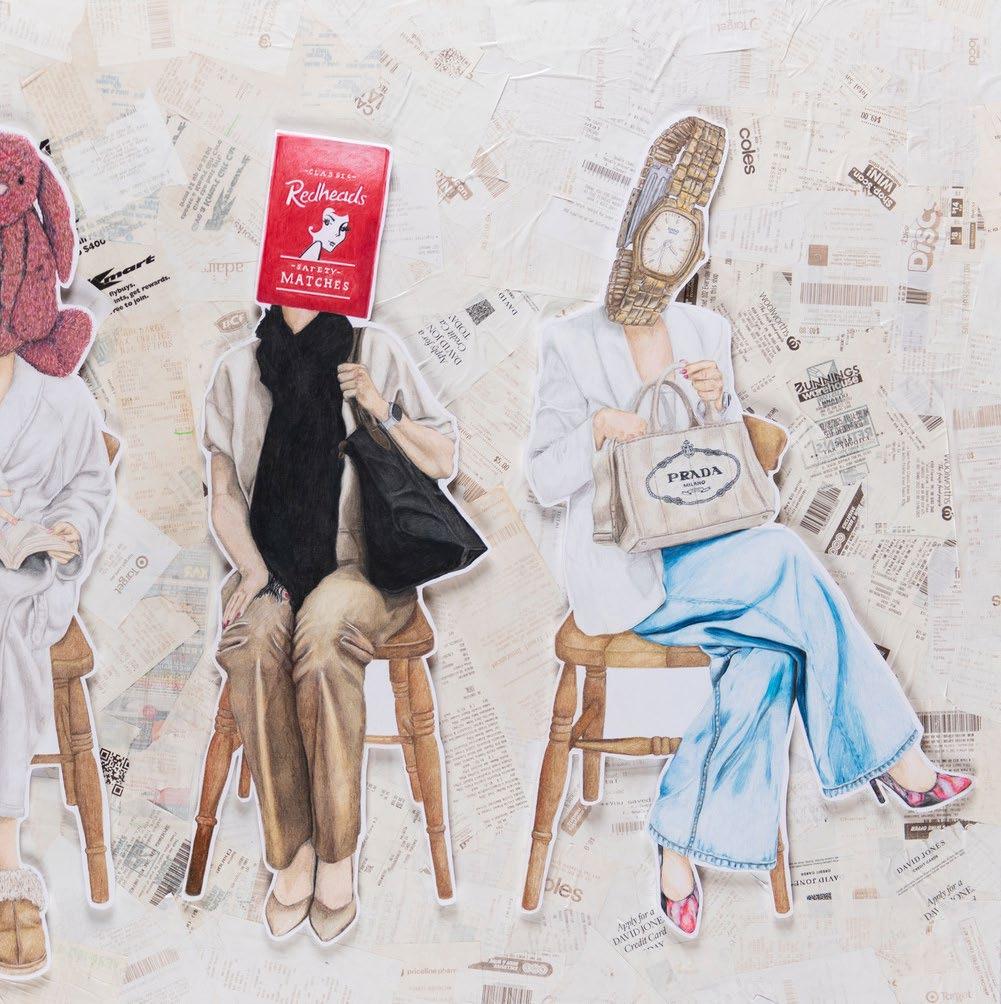
Bob Hawke College
ink on paper 45 x 64 cm
Since 1995, over 400,000 Indian farmers have died by suicide, driven by debt, corruption, and systemic violence. This crisis is personal for me, as members of my extended family in India have faced similar pressures, giving me a strong sense of urgency to respond through art. The Last Embrace portrays a farmer in his final moment, holding his bull, his partner in labour, as authorities wait to seize his land. The irreversible nature of lino-cut carving mirrors the permanence of these losses. This work is both a reflection and a protest, honouring lives erased by systems that reduce human labour and land to collateral.
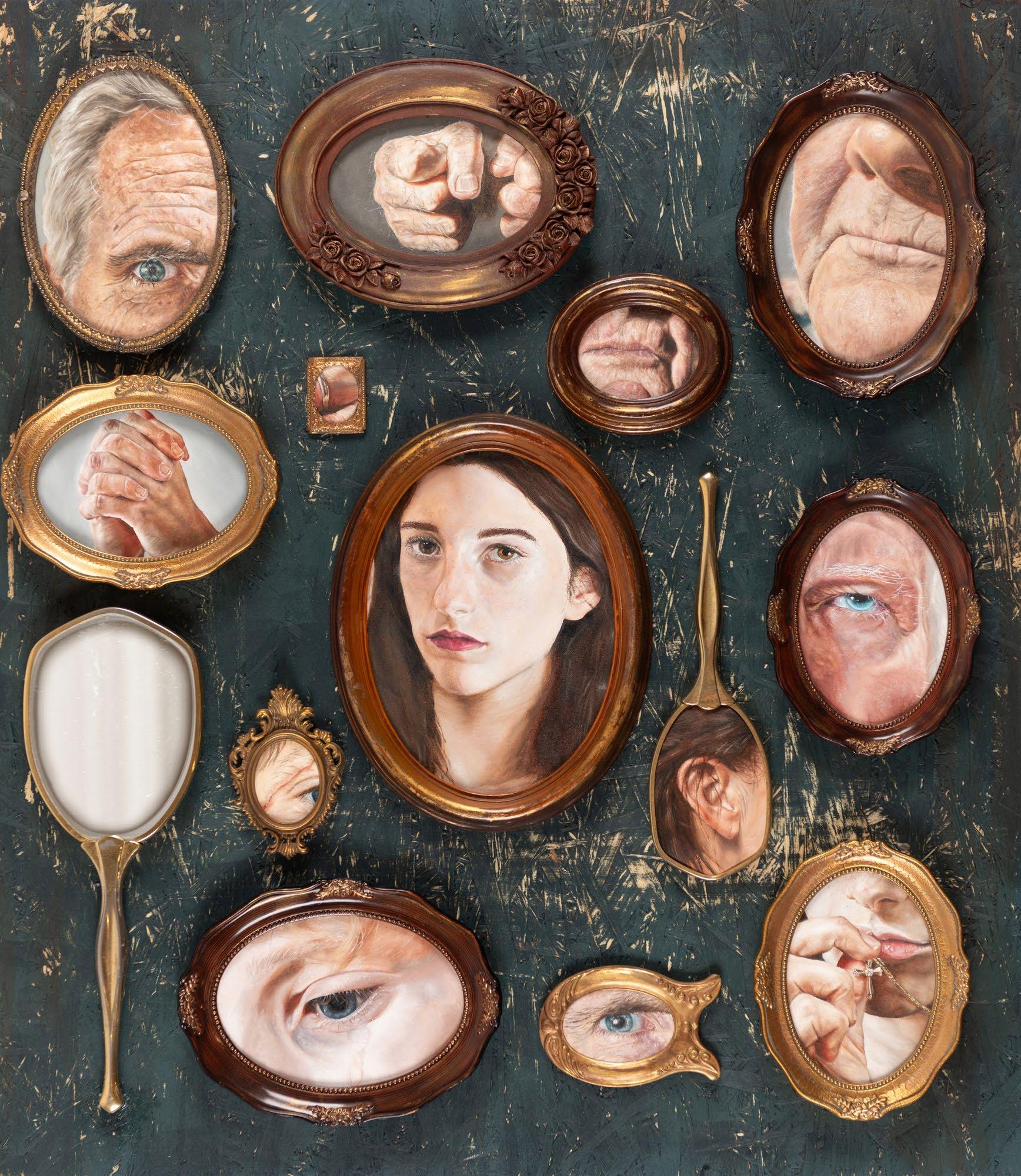
oil on vintage frames, mirror and wood 78 x 70 x 4 cm
Am I a product of the people around me?
This work explores how identity is shaped by environment, relationships, and circumstance. I reflect on how family and society can influence young people in ways that are both nurturing and harmful. The fragmented facial features and hands speak to scrutiny, judgement, guidance, and neglect, highlighting the ways young people are watched, shaped, or silenced by others. Inspired by the work of Australian artist Rone, the distressed surfaces suggest how environments leave lasting imprints on identity. This piece asks viewers to consider their own influence, encouraging empathy, care, and awareness of how even small actions can shape a life.
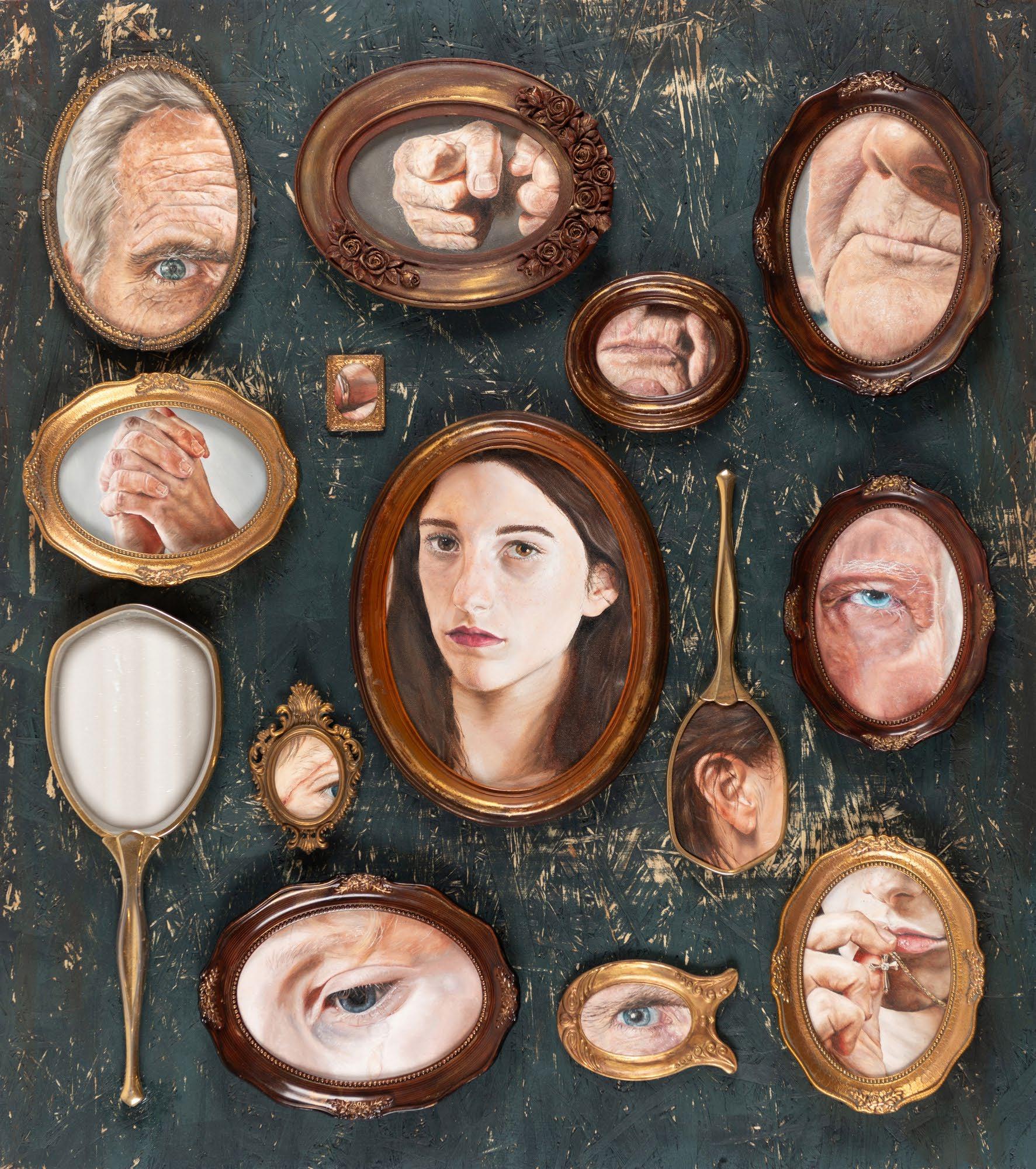
Duncraig Senior High School
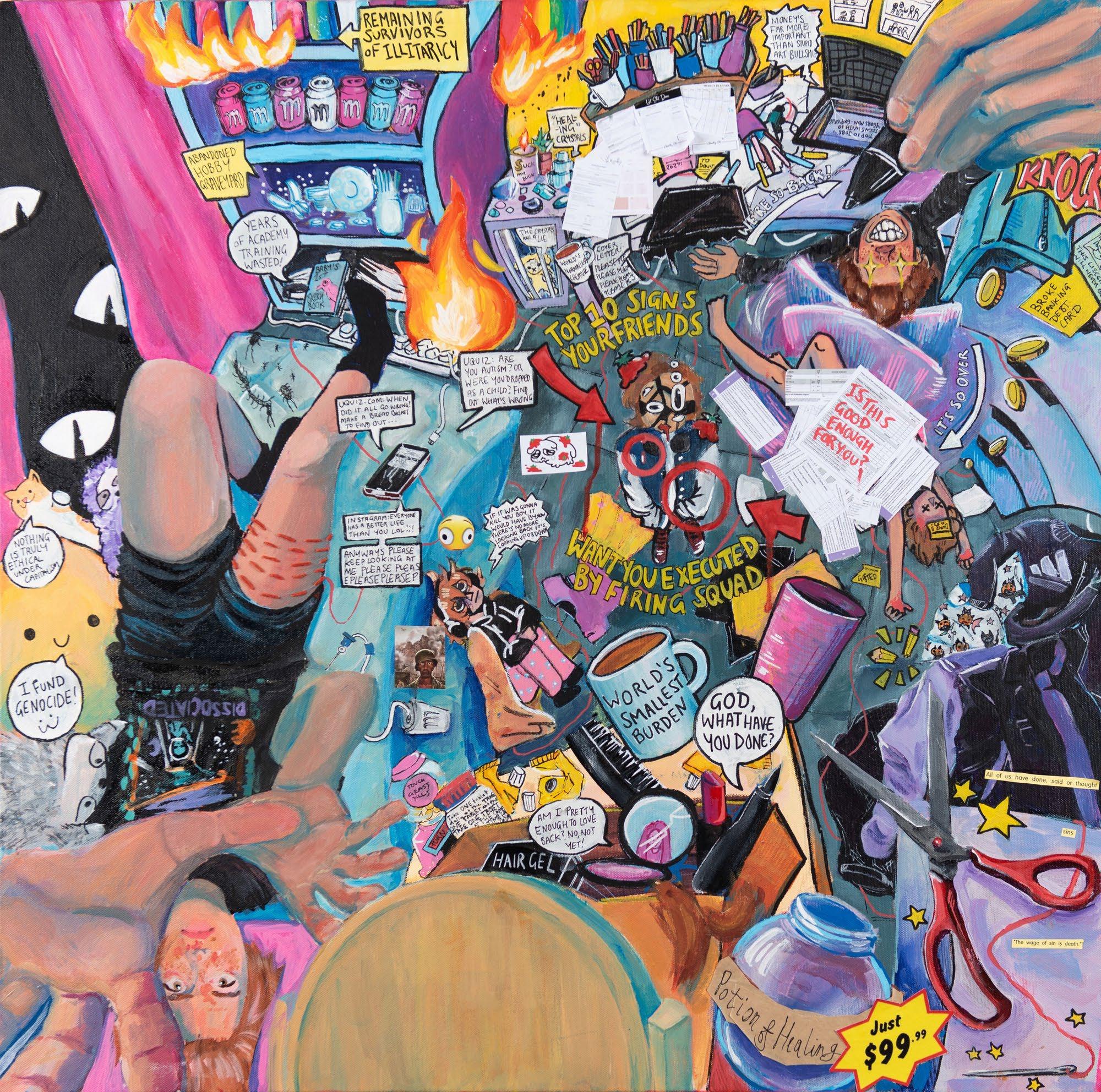
synthetic polymer paint, oil, paper and Posca on canvas, augmented reality 76 x 76 cm
This work reflects how pressure, illness, and online life accumulate inside my mind. The deliberately chaotic title mirrors the feeling of being trapped and consumed by overlapping versions of myself. Inspired by animator Vewn, I explore cycles of inertia, short-lived motivation, anxiety, and hopelessness.
The different versions of myself represent these patterns, while memories of past experiences intrude into my present. Using painting alongside augmented-reality animation, I show how repressed experiences can resurface unexpectedly. Despite its angsty themes, the work is layered with sarcasm, jokes, and memes, reflecting my instinct to make light of all my issues, only speaking up when it ends with a punchline.
synthetic polymer paint, coloured pencil and resin on board three parts : 33 x 33 cm (each)
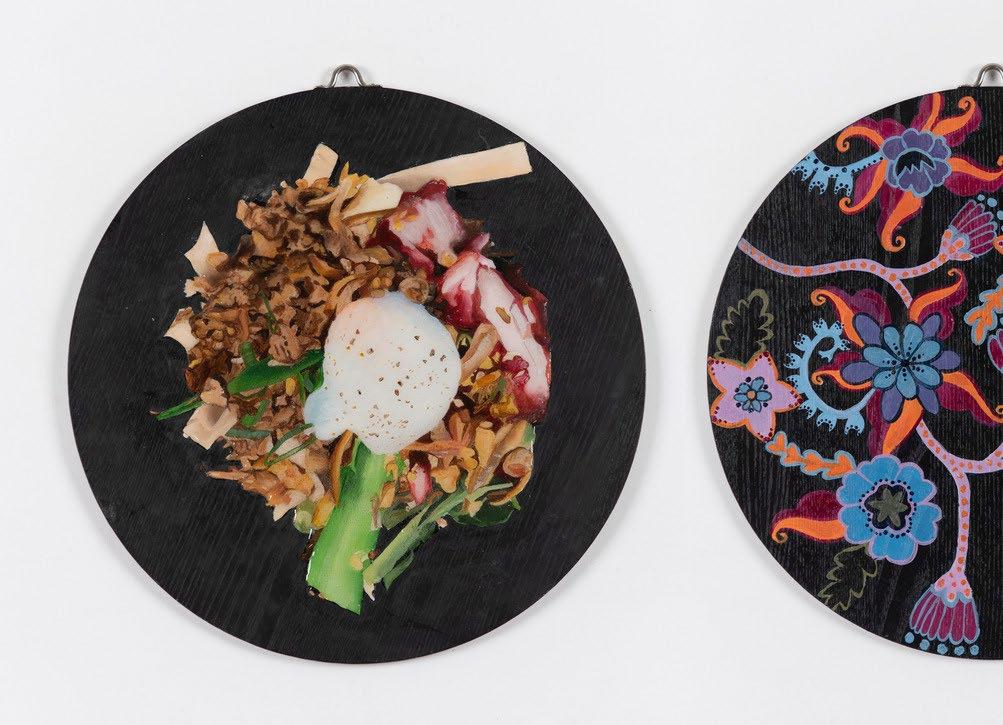
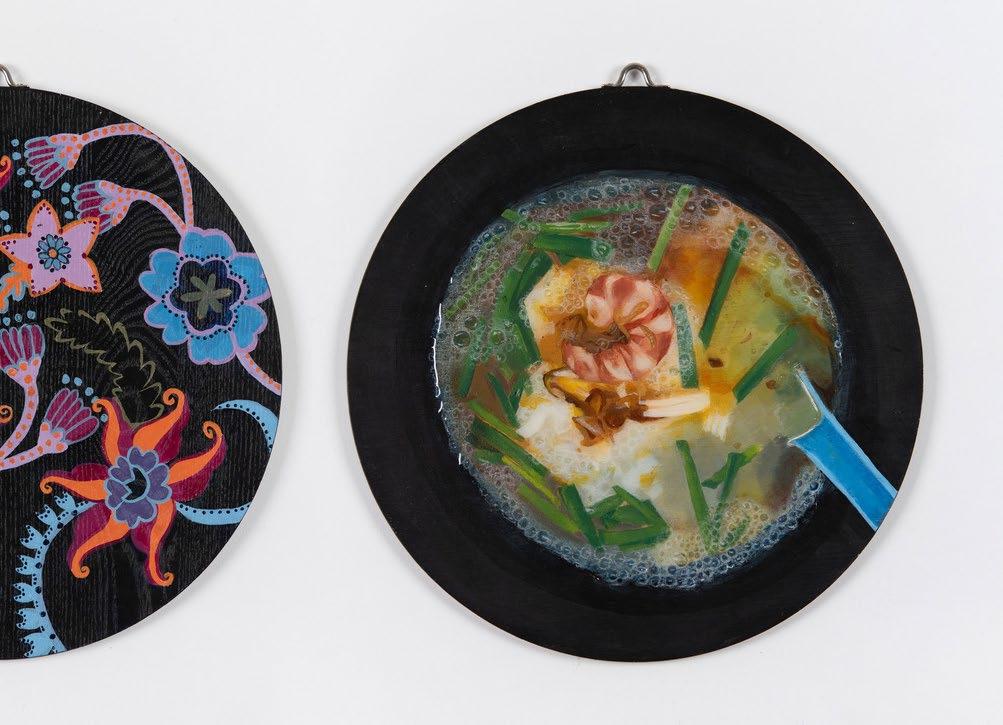
Makan! Makan! explores cultural identity through food as a first-generation Australian. The circular panels position a shared meal as a site where belonging is negotiated. For me, Malaysian cuisine is more than nourishment; food is a language that speaks to presence and absence, and to generational and geographical divides. The inclusion of the Australian brand Maxwell & Williams situates the work within my life in Australia, while batik-inspired patterns and native flora reflect the meeting of cultures. Through this work, I honour food as a marker of identity and invite viewers to reflect on home, heritage, and ritual.
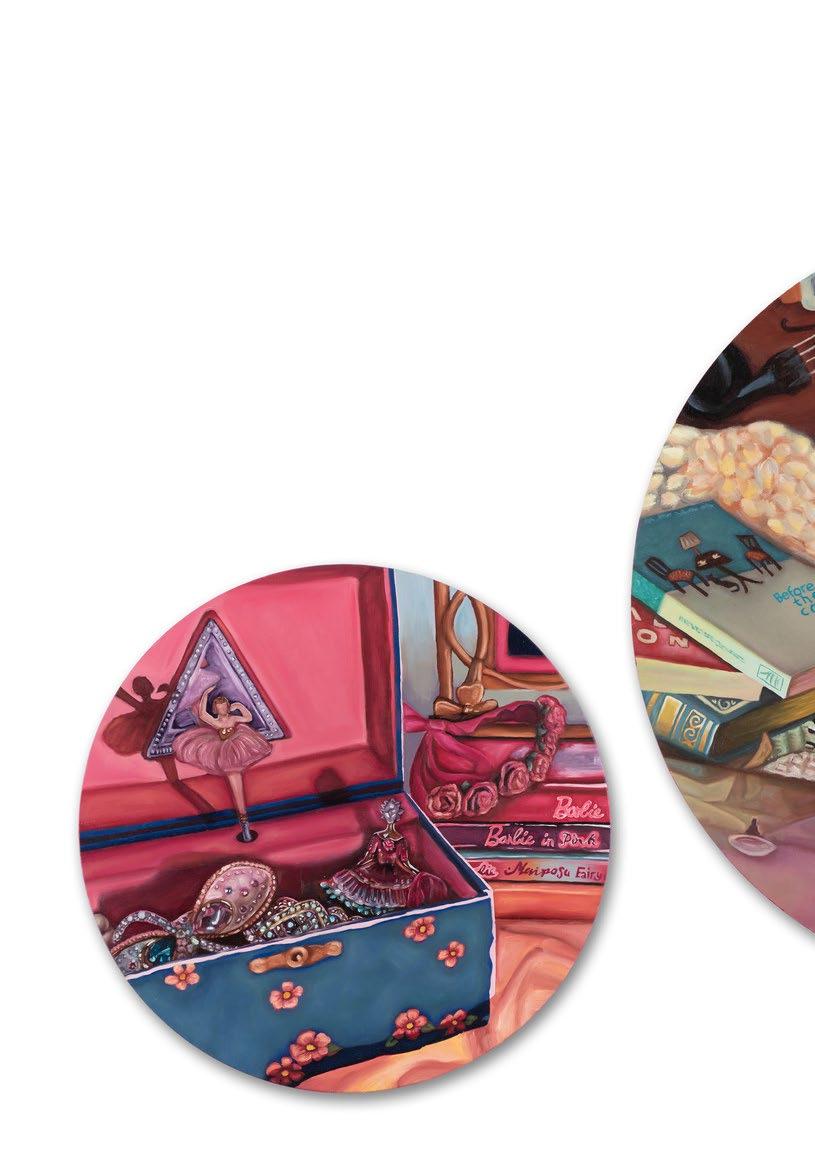
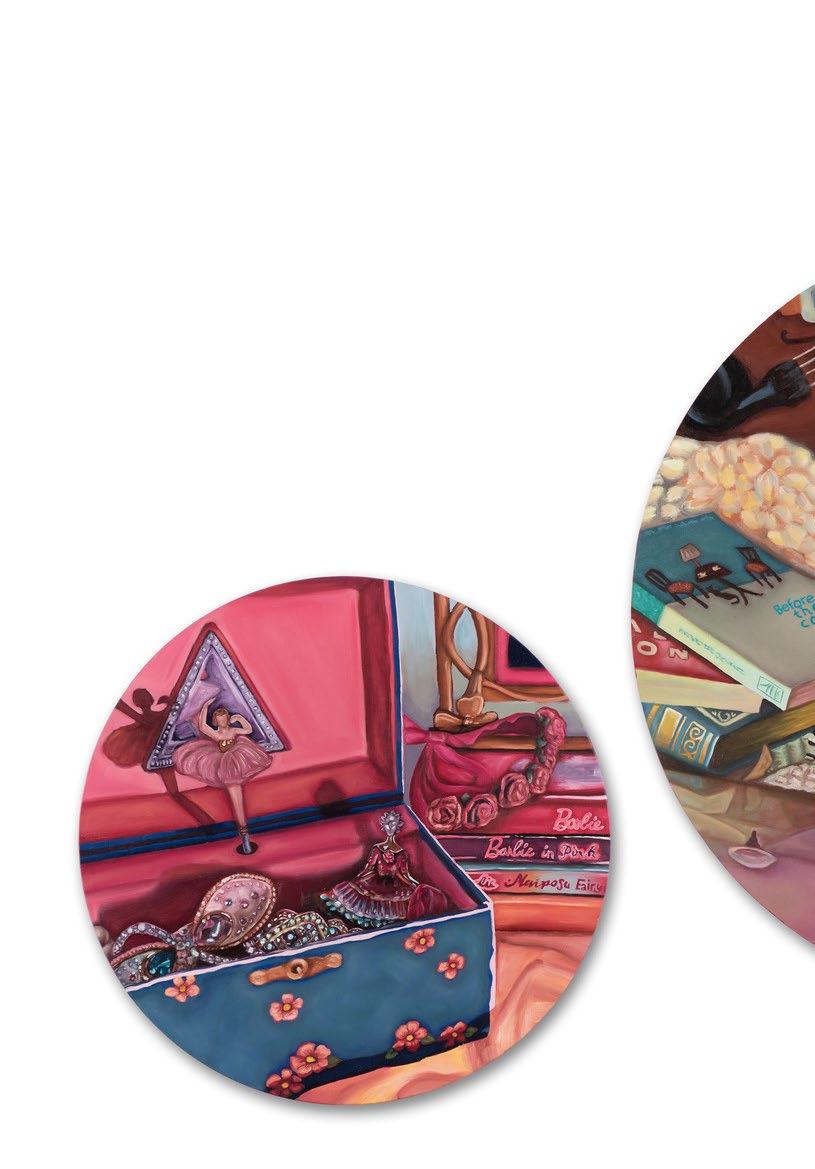
oil on board
three parts: 40 x 40 cm; 60 x 60 cm; 40 x 40 cm
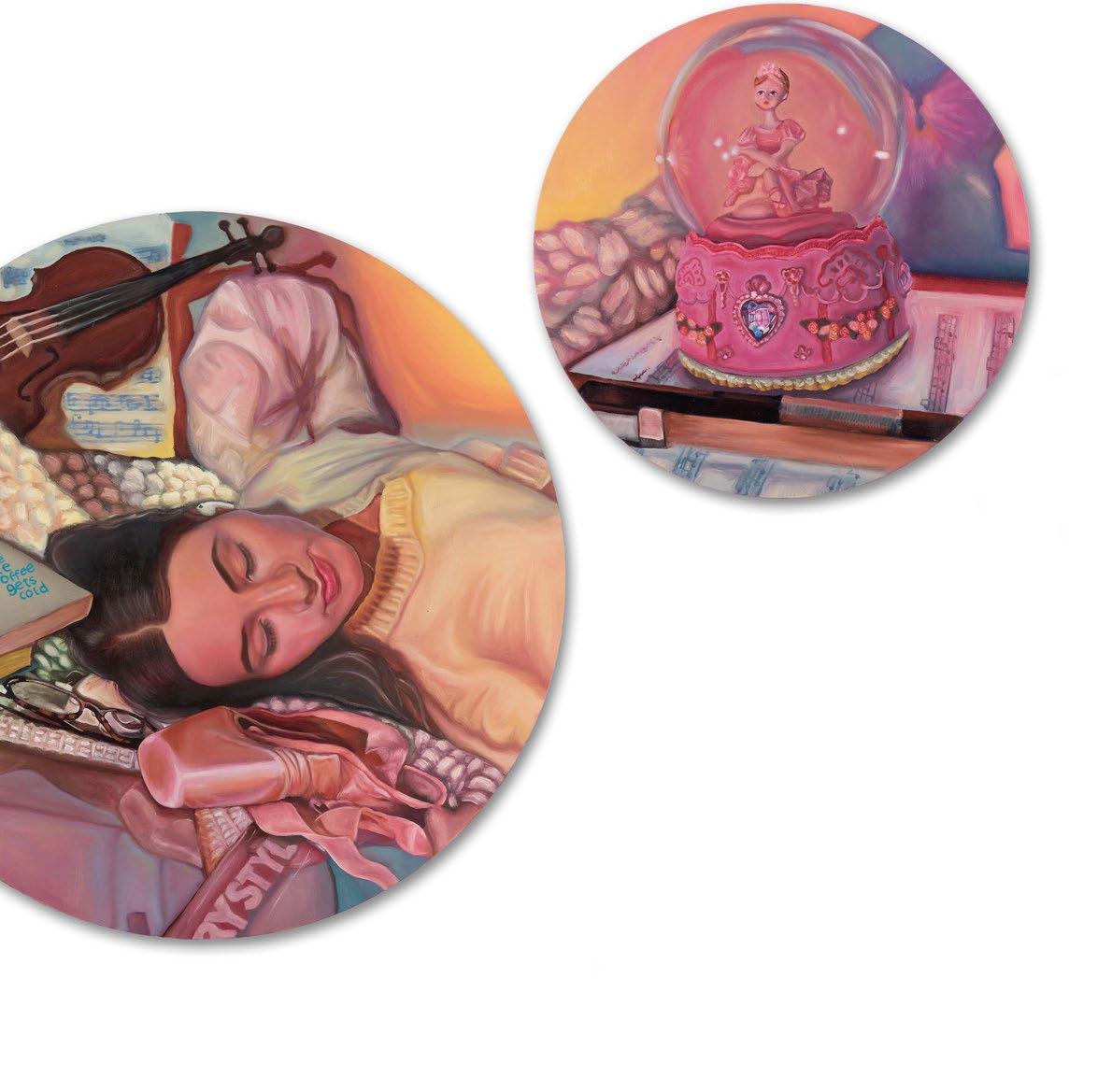
This artwork reflects my idea of escapism and the things I turn to when I need a break from reality. It centres on the comfort I find in familiar hobbies and personal interests that have stayed with me over time, offering moments of calm and grounding. The softness and harmony of the work mirror the emotional space I seek in moments of stress, creating a sense of being held in a world separate from external pressures. This piece is especially meaningful in the context of Year 12, a time shaped by constant demands and futurefocused thinking. It affirms the importance of slowing down and holding onto rituals that sustain a sense of self.
oil on canvas, coloured pencil and magnets two parts: 121.5 x 91 cm (each)
Measured By Waste reflects society’s growing consumerism and the greed driving overconsumption. The work critiques how identity and value are increasingly measured through material possessions and the pursuit of social acceptance. Hand-drawn brand symbols and luxury items appear as magnetised elements across the portrait, their potential repositioning suggesting how consumer icons can overwrite and redefine identity without altering who exists beneath. These symbols resemble pimple patches, implying the concealment of perceived flaws behind wealth and branding. One panel depicts second-hand shirts from local op shops, highlighting discarded excess and rejecting fast fashion exploitation. Influenced by artists Alex Gross and Yukari, the diptych draws on maximalism and satire to confront consumer excess and expose the emptiness it conceals.
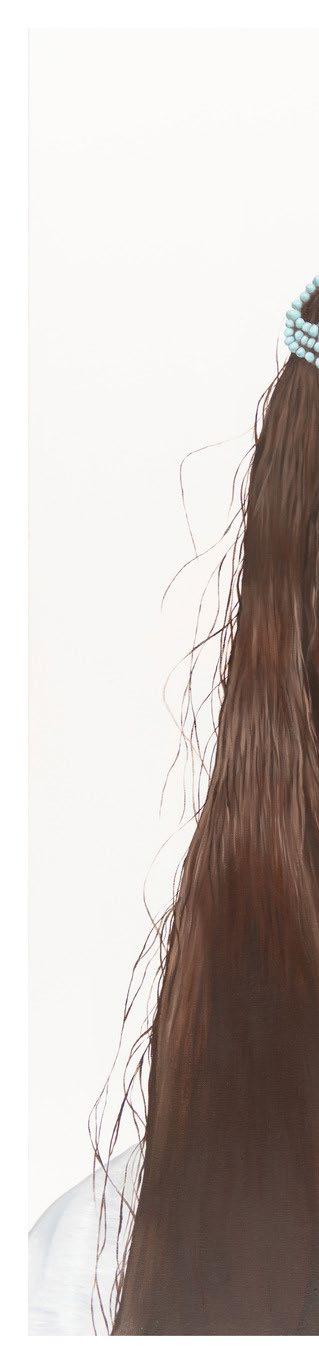
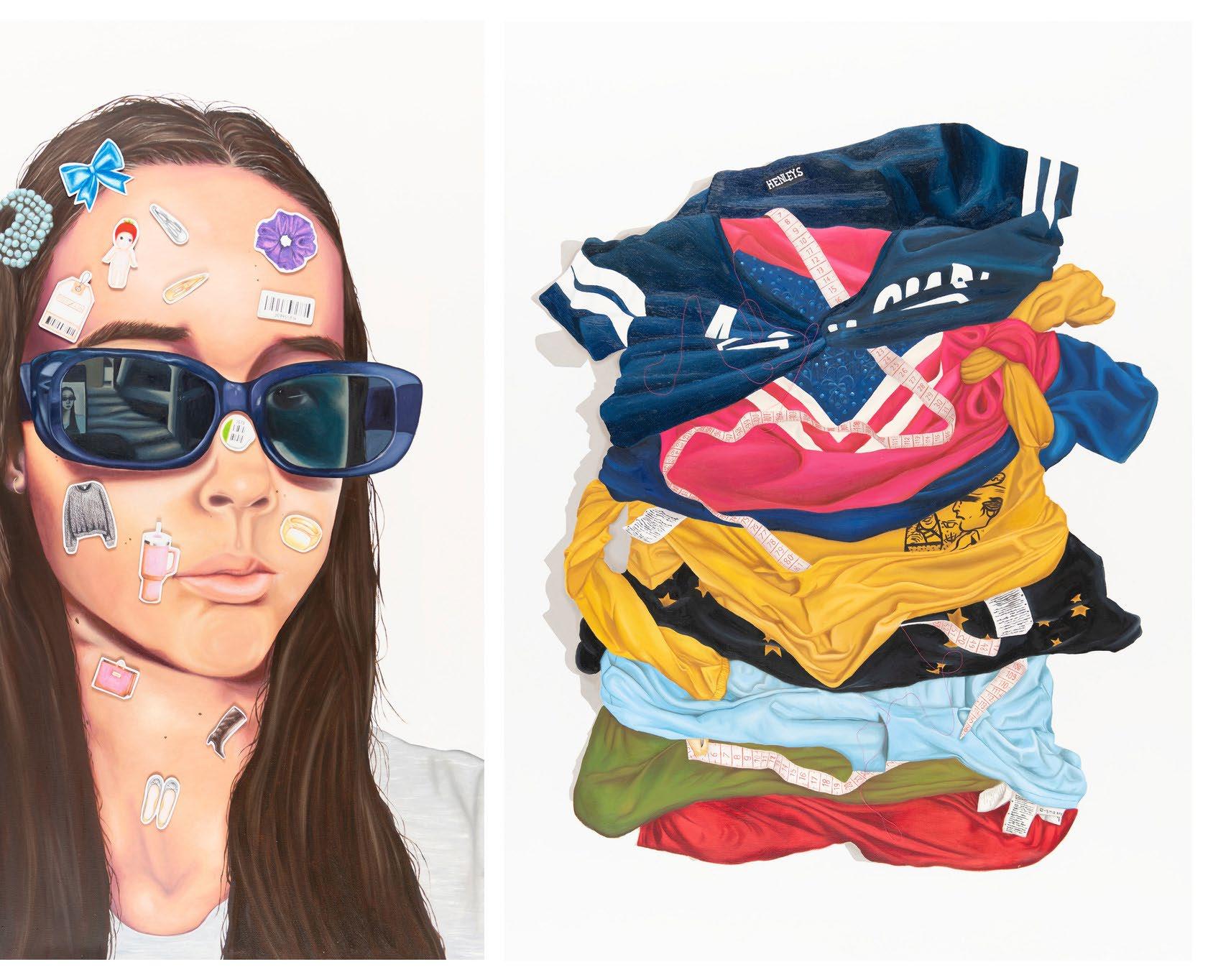
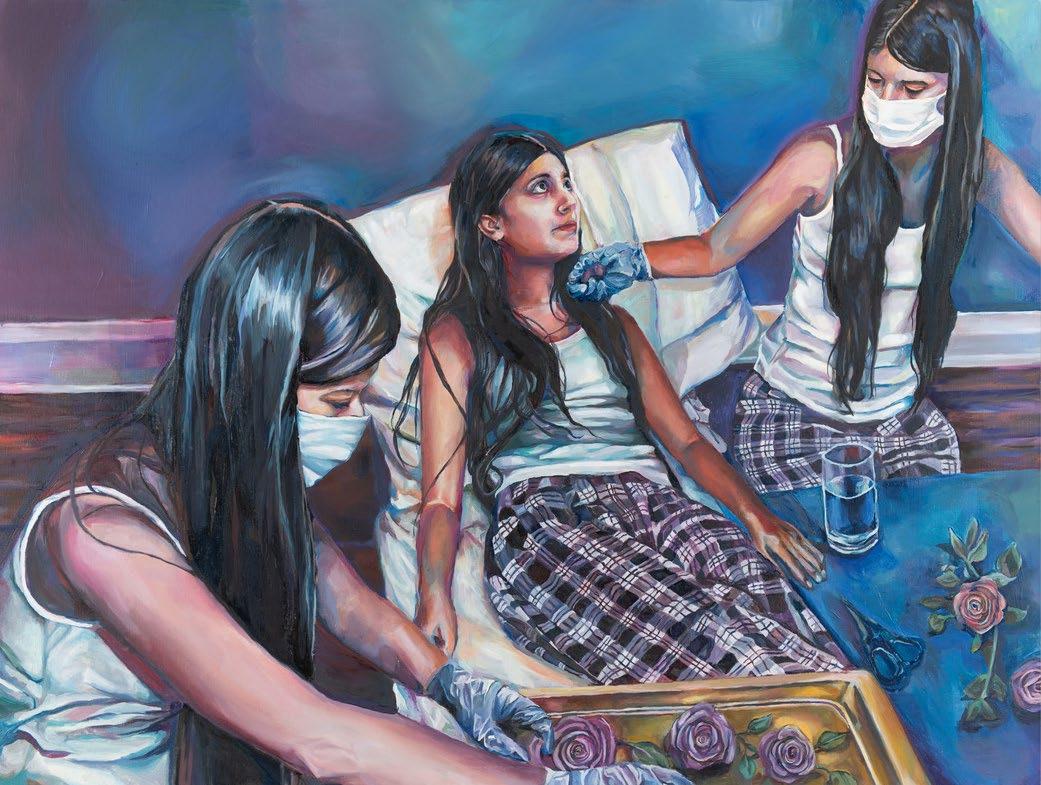
oil on canvas two parts: 76 x 102 cm; 102 x 76 cm
This work explores the lived experience of menstruation in contemporary society, drawing attention to pain and struggles that are often overlooked or dismissed. For me, creativity is a way to confront taboo subjects that tend to be ignored. Inspired by Yves Klein, I use blue to convey the emotional weight and sorrow surrounding menstrual pain.
Through self-portraiture, I reflect the conflict between personal suffering and societal indifference, particularly the expectation that women endure pain without care. One work addresses reliance on superficial remedies in the absence of proper medical treatment, while the other highlights the financial burden of period products. Together, the diptych challenges the normalisation of dysmenorrhea and exposes systemic medical and social failures.
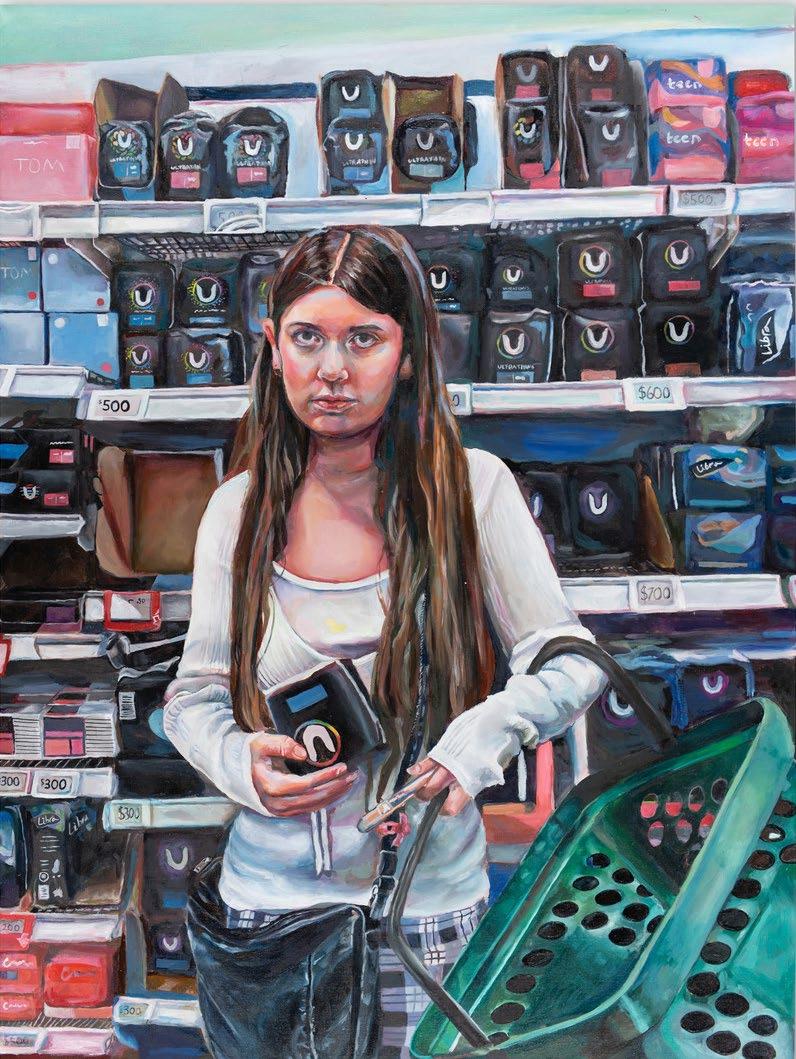
90 x 120 cm
XXIII College
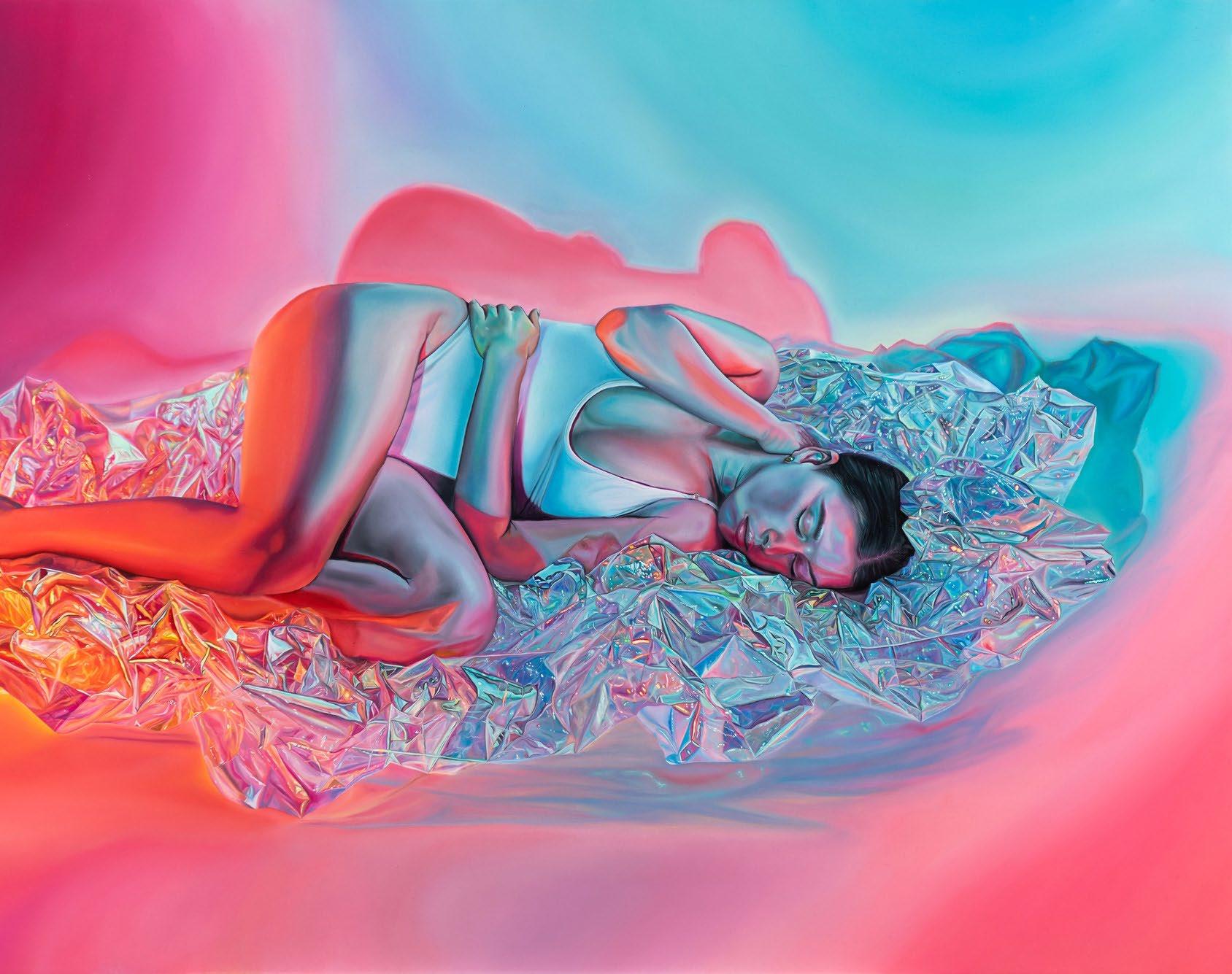
Inspired by T.S. Eliot’s The Waste Land, my work explores regeneration emerging from decay, while questioning birth within an artificial world. The figure is nurtured by the very materials that are slowly unmaking her, she is not born, but unborn – delivered into a state of vulnerability and dependence. This reflects how we turn to technology not only to ease our burdens, but to relieve us of the weight of choice itself. But in embracing this comfort, we find ourselves emotionally stifled – sealed in a world that is too sharp, too sterile, too artificial to nourish the soul. Our “mother” is no longer nature, but industry and consumption.
oil on canvas
three parts: 71 x 71 cm (each)
Chisholm
Catholic College
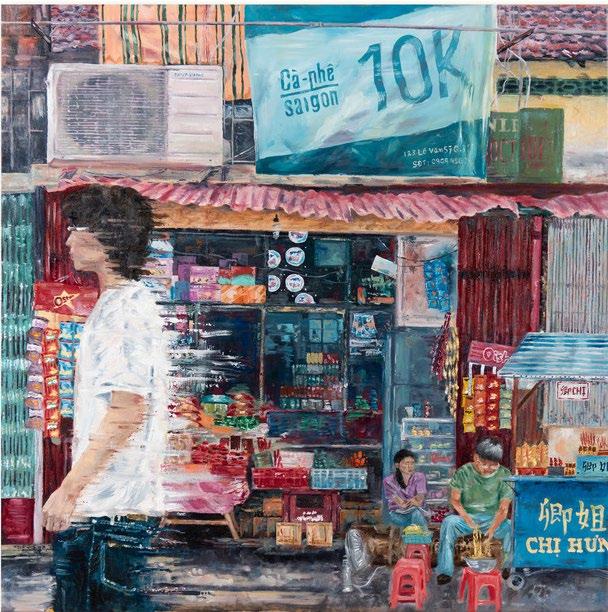
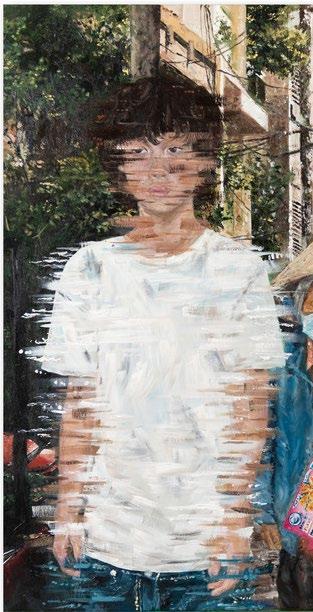
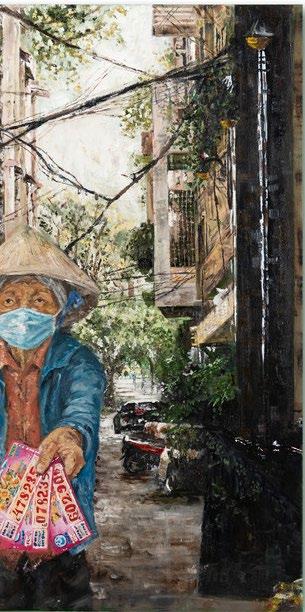
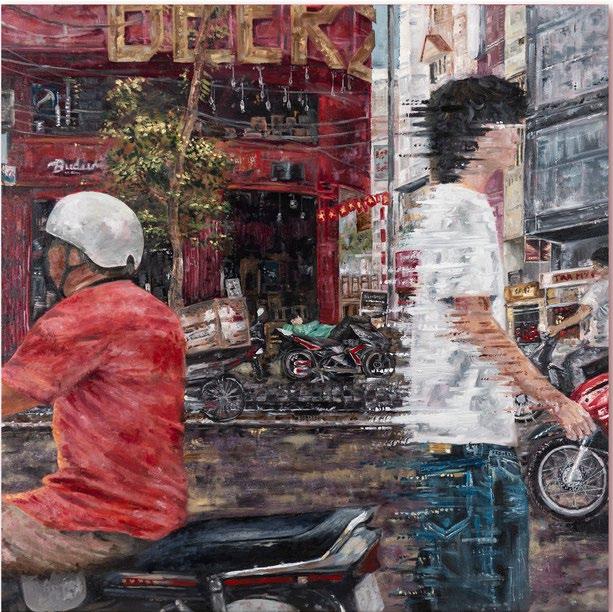
Intersections explores tensions of cultural identity, displacement, and belonging through scenes of everyday Vietnam. These environments reflect lived realities I have observed during visits to Vietnam, filtered through the perspective of someone born and raised in Australia. Across the canvases, a recurring blurred, glitching figure appears, dressed in Western clothing. Although Vietnamese, this figure feels out of place, representing the tension of inhabiting two cultural identities without fully belonging to either. Influenced by artists Hung Liu and Dede Eri Supria, the work reflects how cultural memory, movement, and environment intersect. Together, the panels form a meditation on identity existing between places, familiarity, and estrangement.
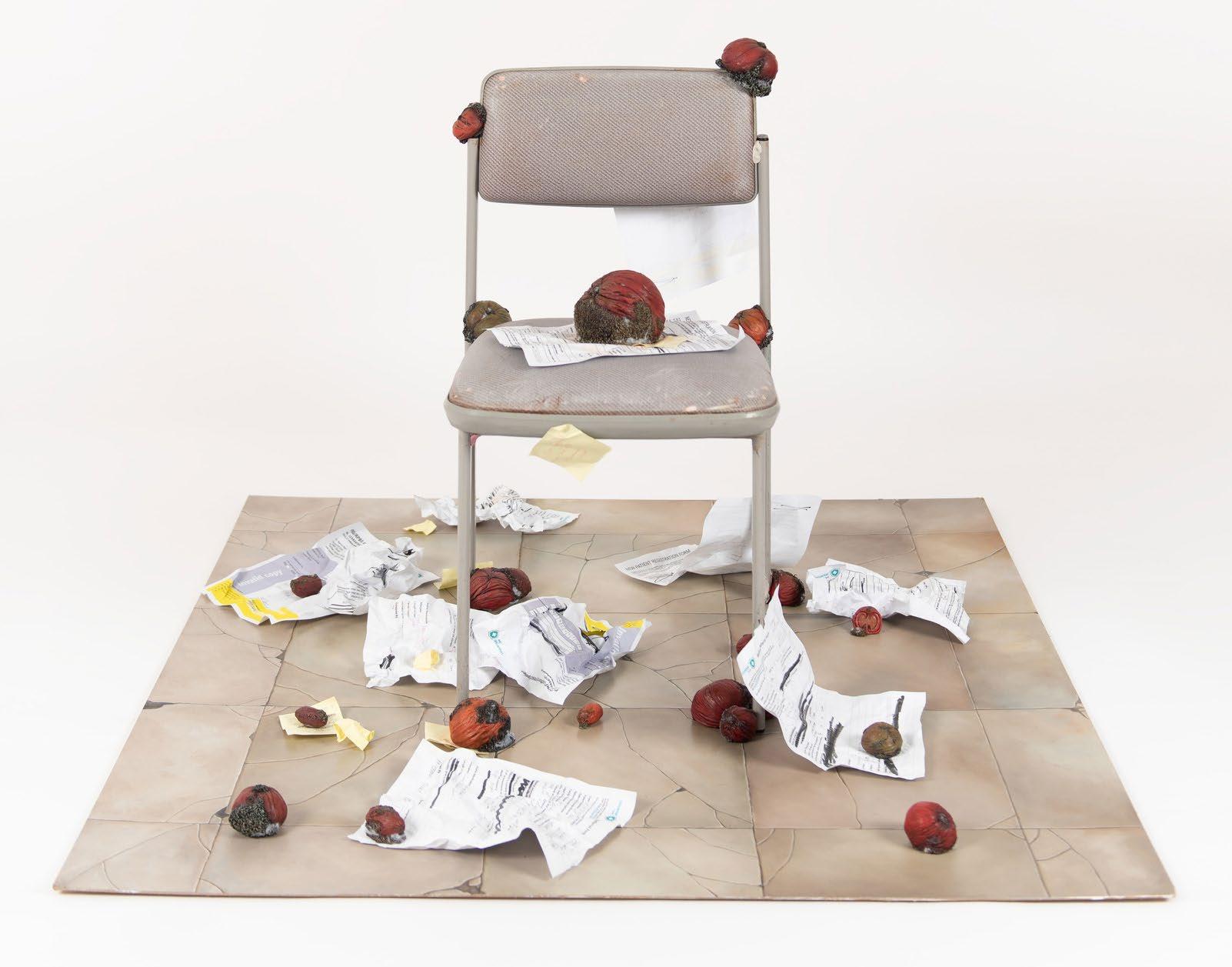
Whatever you say, Doc
Sculpey, waiting room chair, synthetic polymer paint, pompoms, paper, oil on board 75 x 120 x 120 cm
My artwork recreates the tension of sitting in a waiting room chair, rehearsing lines as if presenting my case to a court. Compiling evidence and practising rebuttals becomes a way of forcing my experiences to be heard. The work critiques diagnostic overshadowing, where pre-existing diagnoses are treated as fixed templates, causing symptoms outside them to be dismissed. This comes directly from my own experience of being failed by the medical system and resisting dismissive GPs for years before receiving proper evaluation. Inspired by artist Kathleen Ryan’s Bad Fruit, decay becomes a metaphor for neglected health, while discarded medical paperwork reflects how people are reduced to data rather than treated as complex individuals.
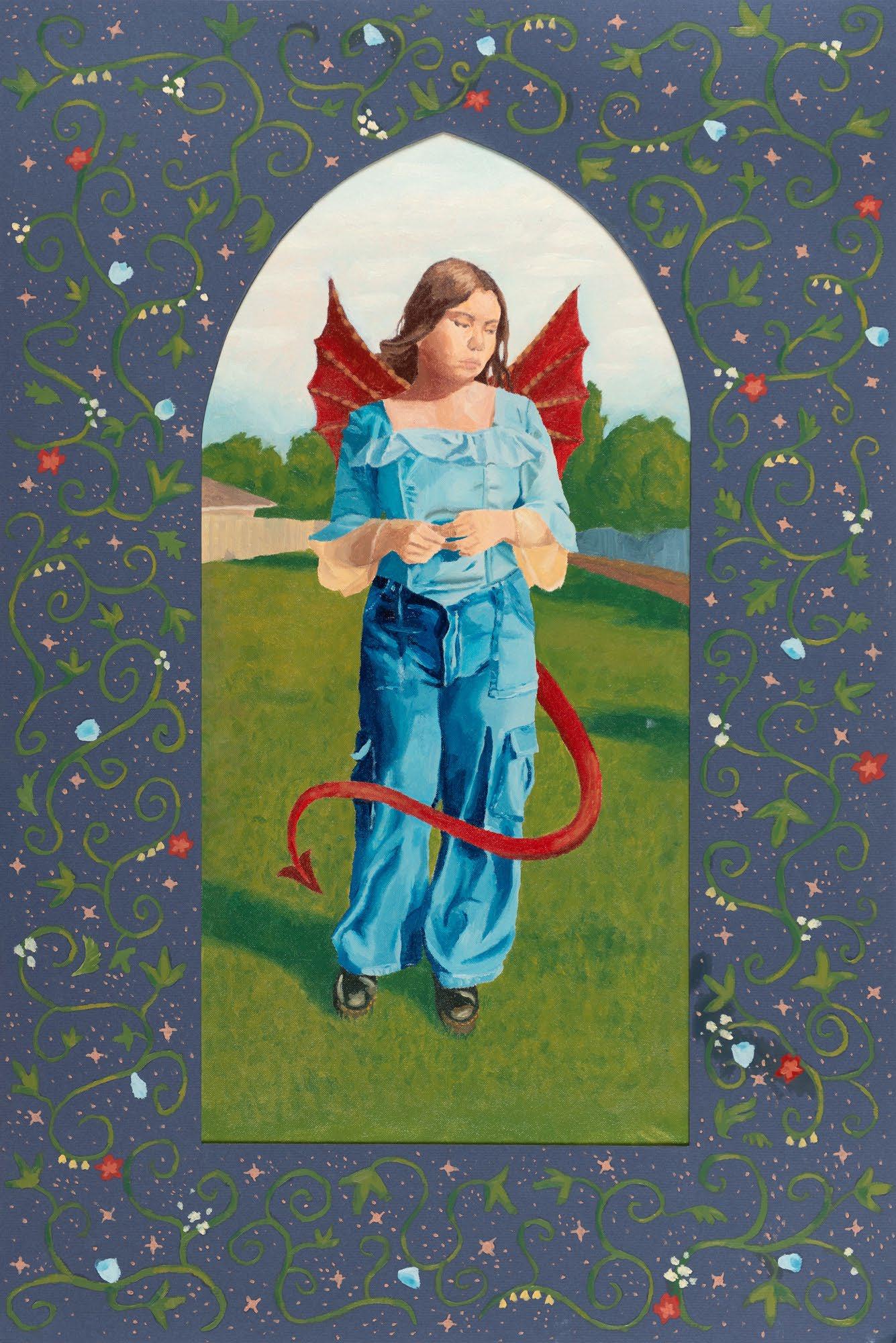
oil on canvas and card 91 x 61 cm
In this artwork, I use a contemporary interpretation of medieval aesthetics to explore how my experience as an autistic person is shaped by historical and modern views of neurodivergence. I draw on the myth of the changeling, an uncanny placeholder believed to replace a child taken by fairies, now theorised as an early explanation for intellectual disability and neurodivergence.
Although rooted in harmful ideas, I resonate with this myth, as navigating social cues often feels like mimicking human behaviour from the outside. Through dragon wings and a tail, I connect this sense of otherness to historic views of neurodivergent people as monstrous. Inspired by medieval illuminated manuscripts and tapestries, I invoke the vibrant details of medieval iconography.
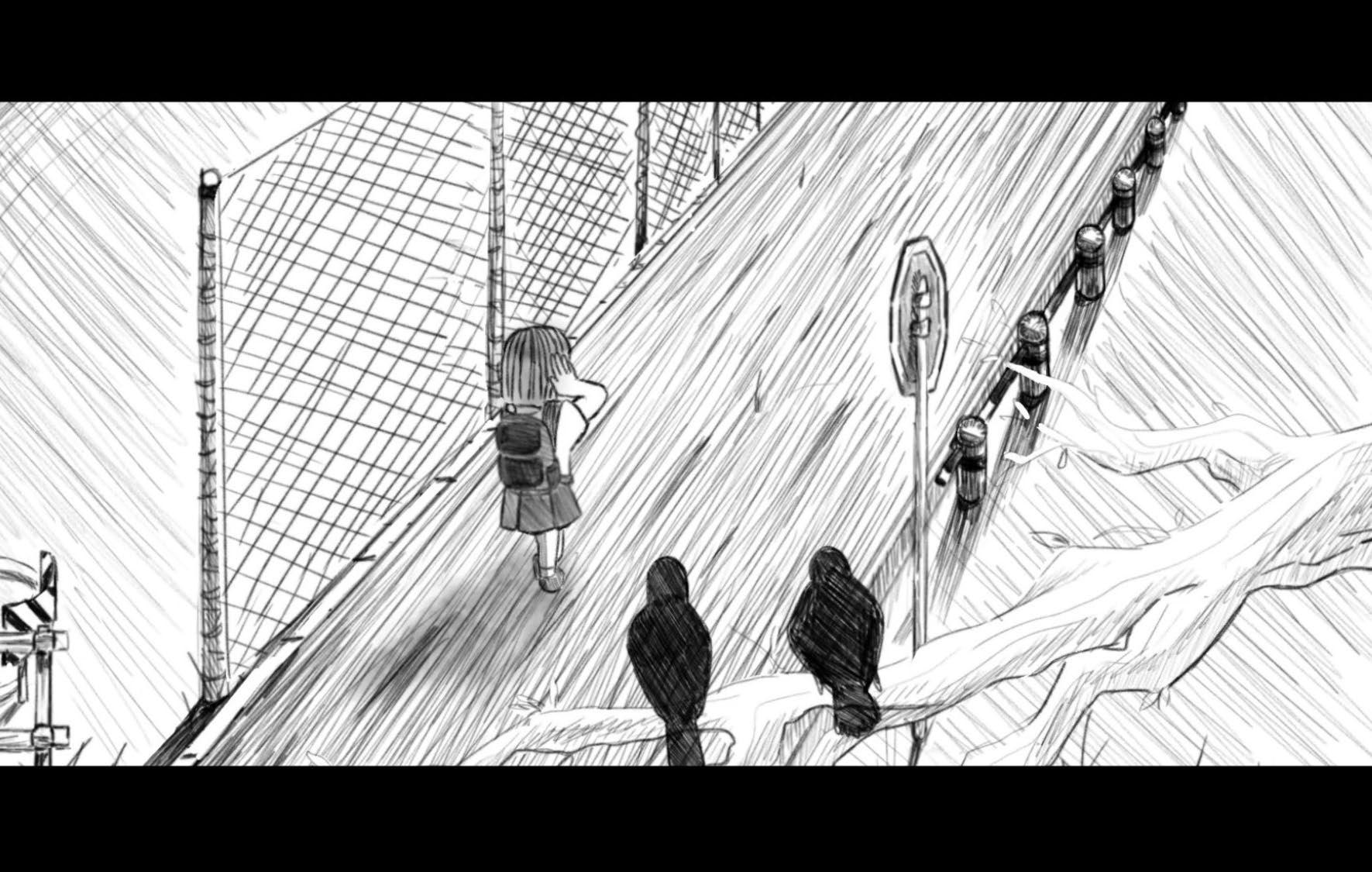
animation 2 minutes 31 seconds
Perth Modern School
The world is a vast and overwhelming place. Uncomfortable sounds, unwelcome touch, and sensory overstimulation are an inevitable part of being human, something I am intimately familiar with and will have to embrace in adulthood. In Walk On, I use hand-drawn animation alongside real-world footage to explore this experience through a heightened journey home from school. The beginning and ending sequences depict the real world through bright colour and overlapping sounds, while the sketched monochrome section feels quiet and numb; its fragmented movement mirrors sensory overload and dissociation, while flashes of colour briefly pull focus back to reality.
St
synthetic polymer paint on linen and board
87 x 115 x 10 cm
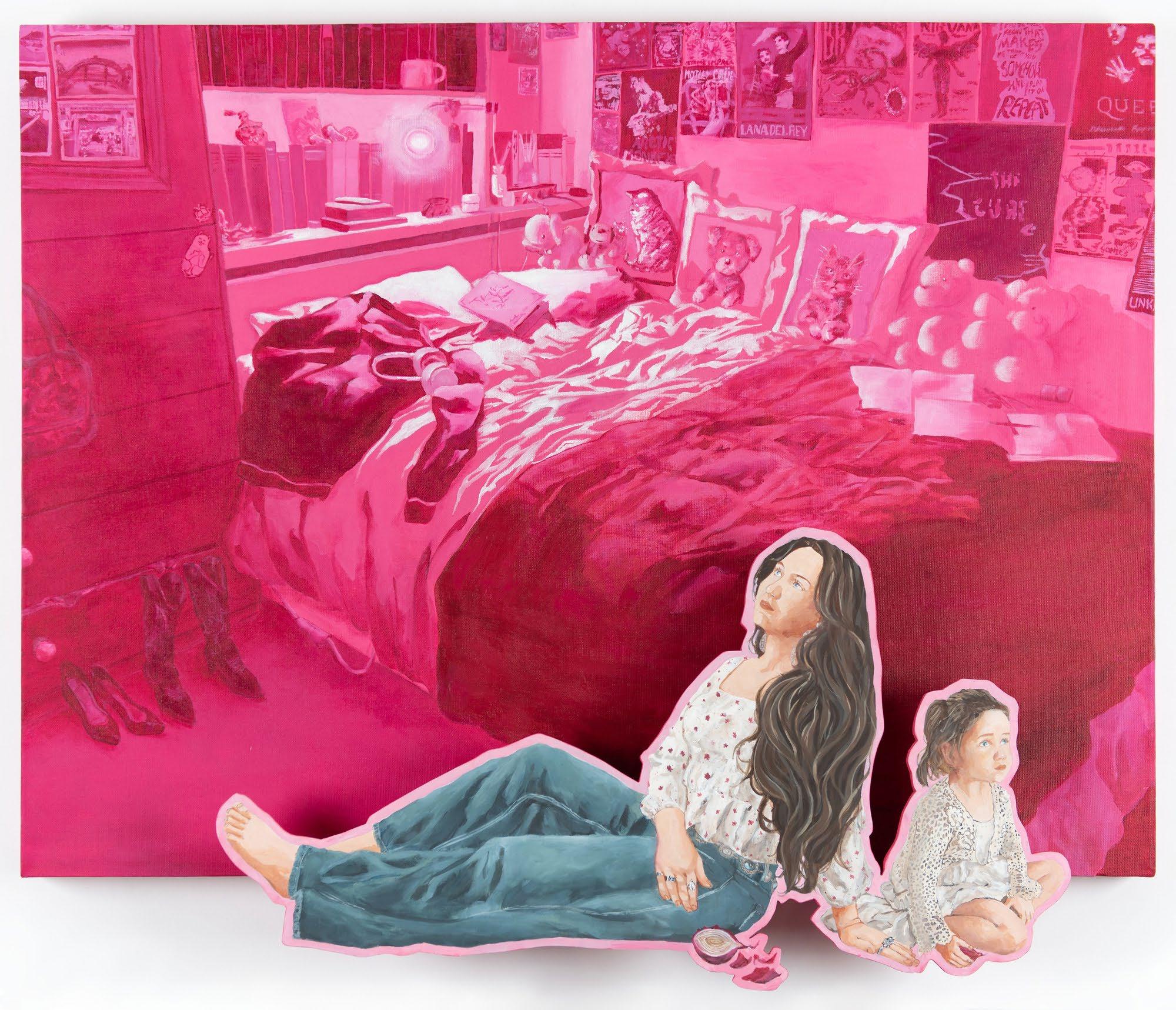
Layered Soul reflects my inner world through the metaphor of an onion and the walls I build around myself. These layers once protected me, but over time they have become isolating. Each layer represents an experience, fear, or memory forming a barrier around my core. As a child, peeling these layers felt simple, but with age they accumulate, making vulnerability harder to reach.
My bedroom becomes the outer skin of the onion, a place of comfort and concealment. Peeling back each layer represents growth, letting go, and allowing myself to be seen. The work captures the tension between protection and isolation, and the search for authenticity at the heart of who I am.
synthetic polymer paint on canvas
122 x 122 cm
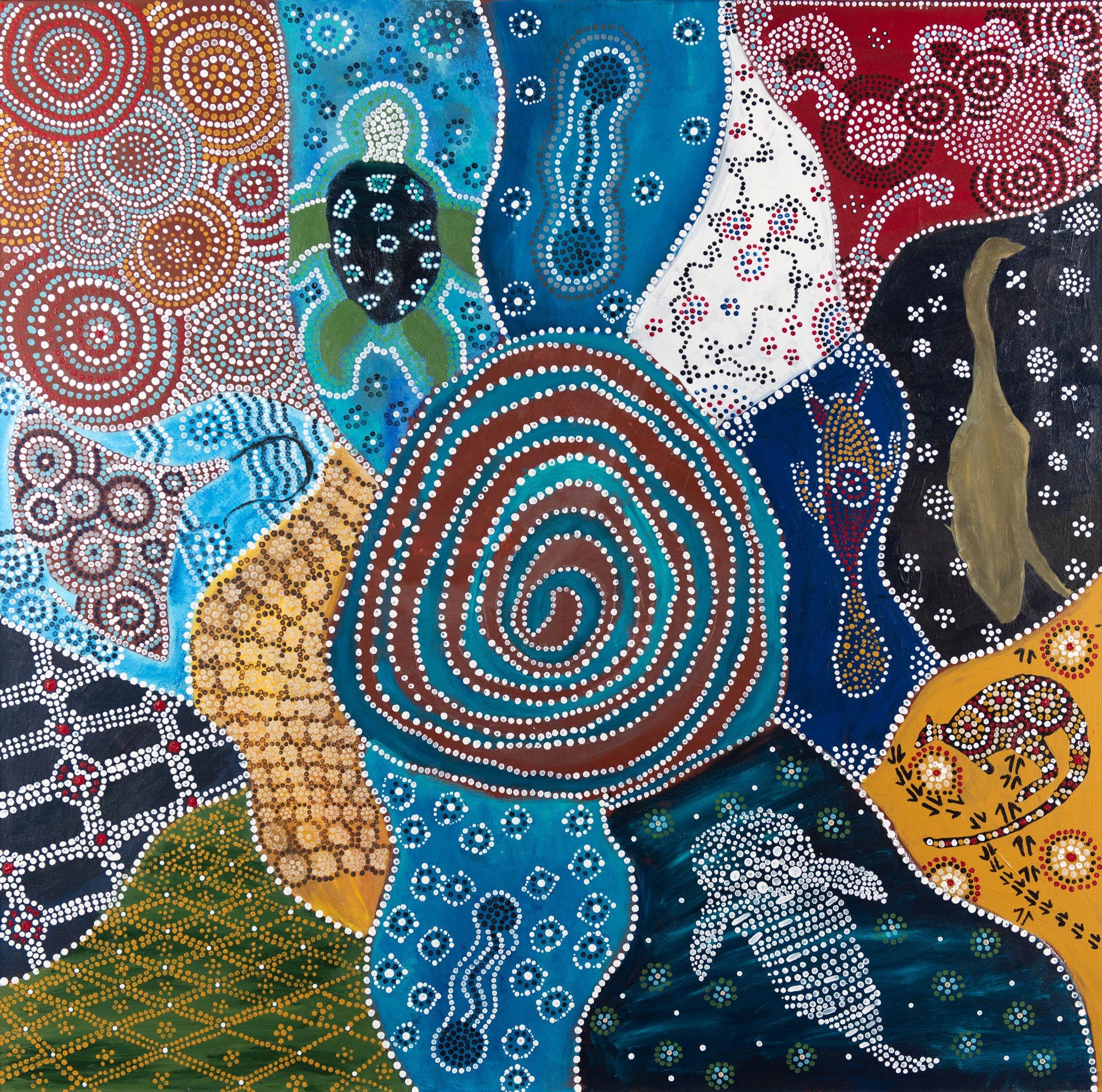
Each section of my work represents one of the 14 individual Noongar language groups of the Noongar Nation in Western Australia. It includes boorna (animals), such as the yongka (kangaroo), bamba (stingray), karda (racehorse goanna), and weitj (emu). These boorna are part of the Dreamtime stories.
I have included our bilya (river) to represent our connection to it and how it gives us life. In the middle is the Wagyl, the Dreamtime serpent, who lives in the bilya amongst all the other boorna and still, to this day, protects us from the yundok, the ancestral crocodile who does not belong on Noongar boodja (land) and wardan (ocean). Ngany boodalang, yangka (I am boodalang, thank you).
oil on board
two parts: 61 x 45.5 cm; 60 x 60 cm
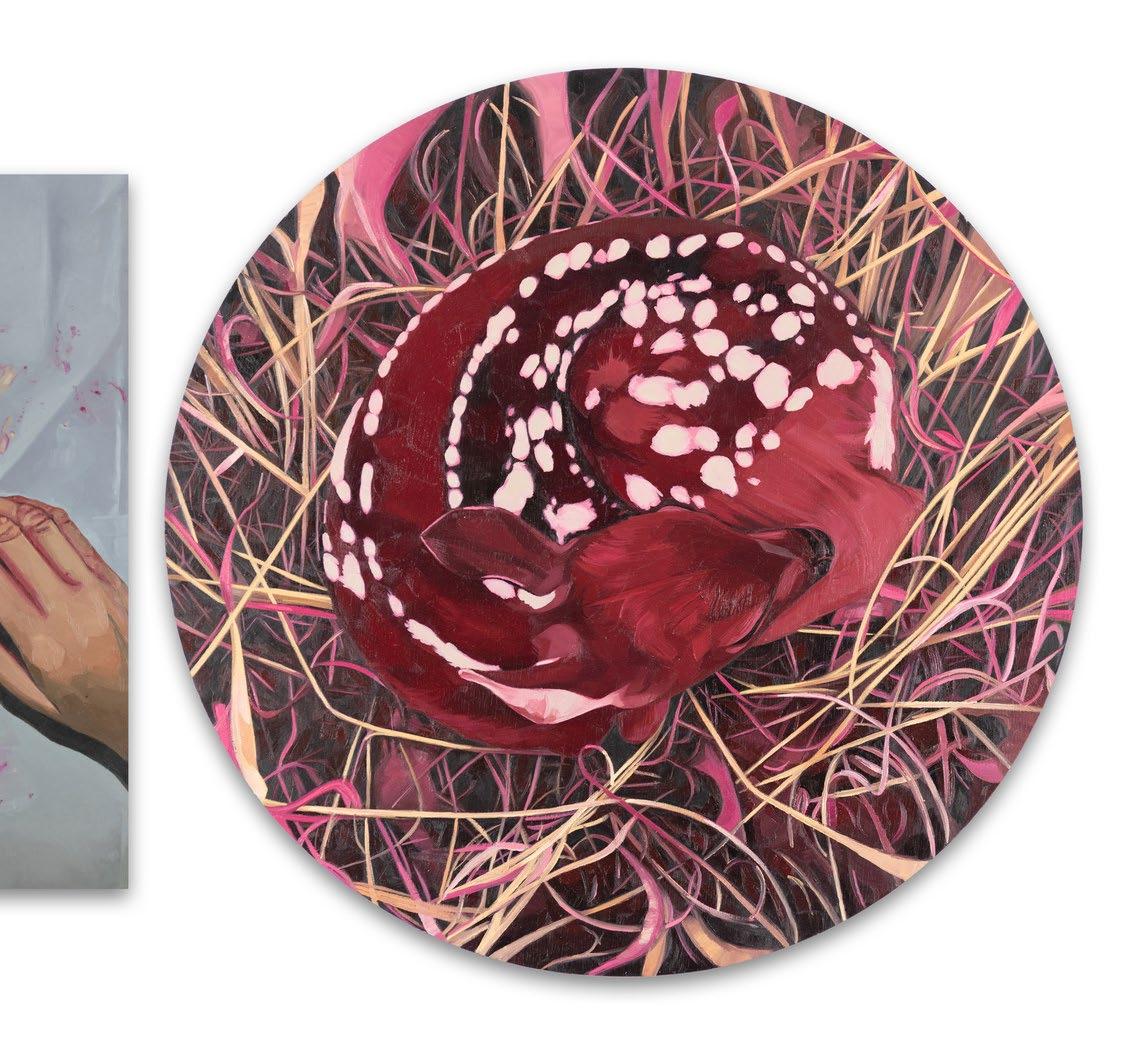
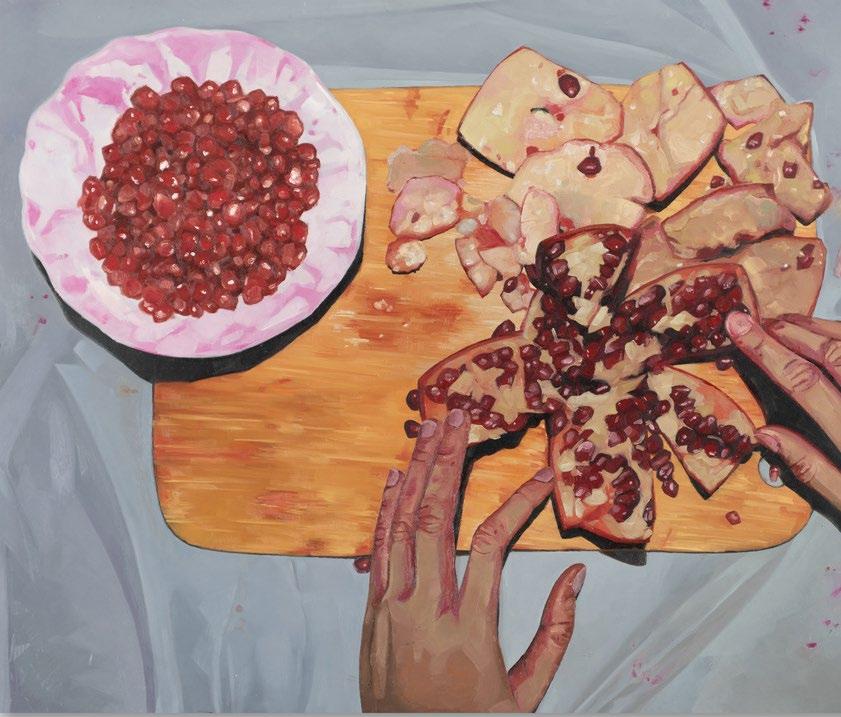
5pm. I will peel this pomegranate for you. Cut it and beat it against a board that holds the stains of my choices. I pick at each seed meticulously, so I make no mistakes. 6pm. I serve you the cleanest seeds from my messiest effort. I am stained. I stick to you full of fear – please don’t hate me. If you want it, I can be it.
This work explores the trauma response of fawning through peoplepleasing as self-protection. The bird’s-eye view places the viewer inside or above the act of peeling a pomegranate for someone to seek approval or safety. Stained hands suggest scars, while the fawn echoes the pomegranate and hints at an instinct to camouflage, representing the exhausting balance between being liked and blending in.
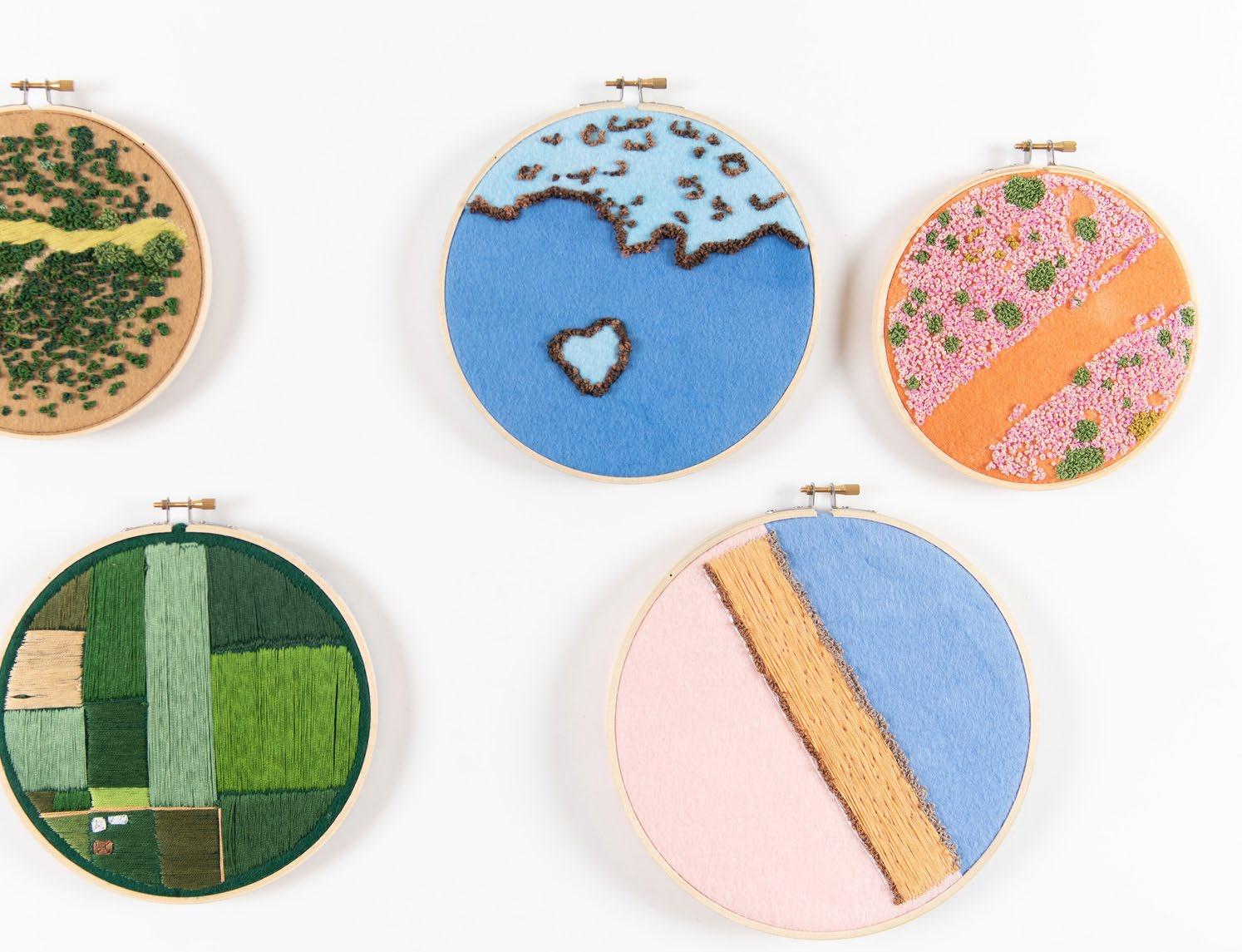
felt and thread on embroidery hoops
five parts: 100 x 50 x 3 cm (overall)
St George’s Anglican Grammar School
This artwork is inspired by Australian landscapes. I used aerial photographs from different places around Australia as references for my embroidery hoops. I was also inspired by Cassandra Dias, an embroidery artist from Southern California who makes stitched landscapes. Through this series, I wanted to highlight the beauty of the land we live on and share my appreciation for my home country. I used a range of embroidery stitches to add texture and define landmarks such as trees and paths. I chose photographs and places that allowed me to use a wide range of colours to highlight how beautiful and colourful Australia is.

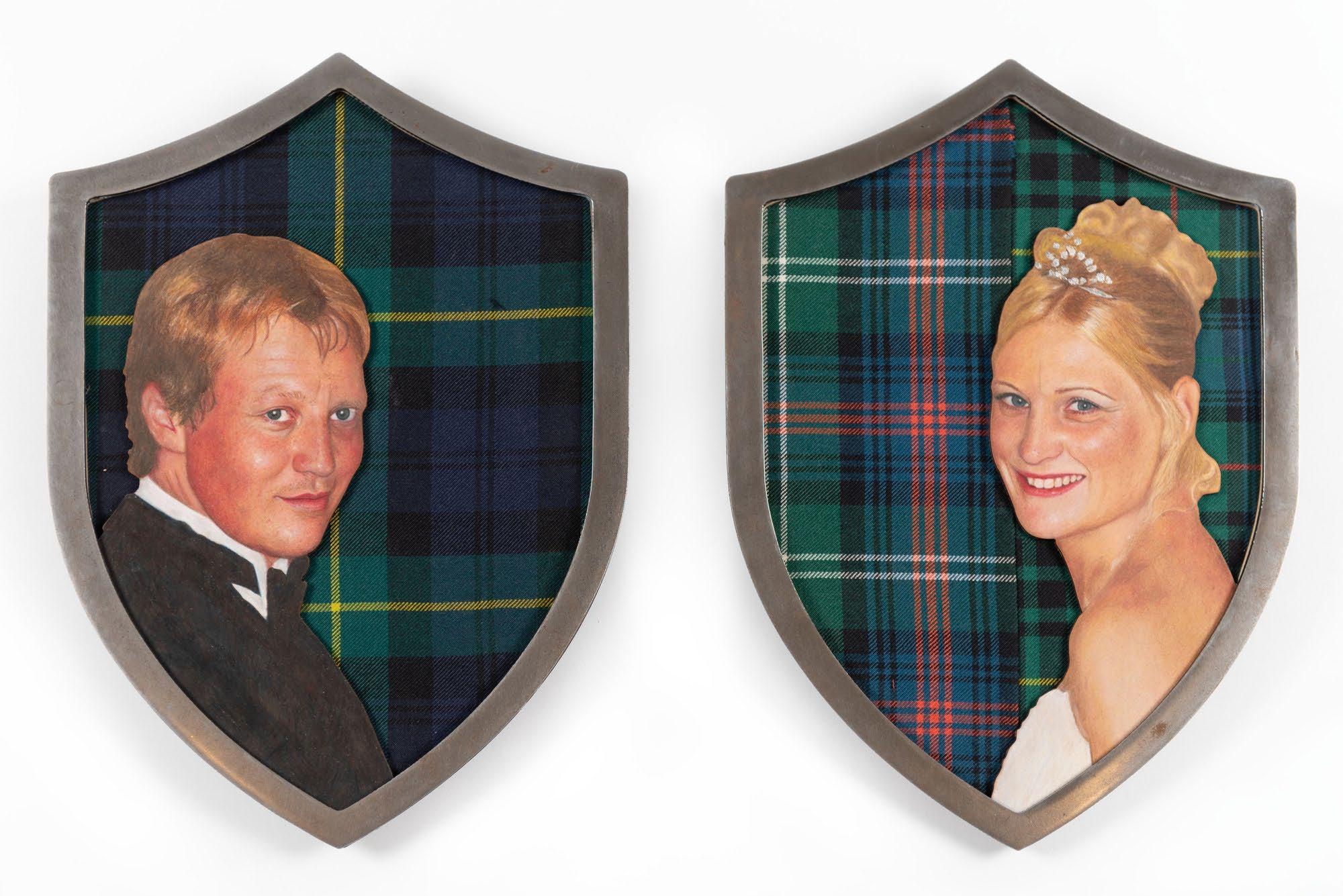
coloured pencil on board, fabric on board and steel two parts : 42.5 x 31 x 1.5 cm (each)
Swan Valley Anglican Community School
Two shields, two clans, one story, my family’s Scottish heritage brought to life in pencil and tartan.
Shielded in Tradition explores my heritage through portraits of my parents, combined with traditional tartan fabrics and Scottish iconography. The work honours the clans that shaped my family’s story and reflects how culture lives on through those we love. The shield-shaped forms reference protection and legacy, echoing traditional clan banners and emblems. The tartan represents the woven history of my ancestry, while the steel border adds strength and resilience. Drawing my parents and using real tartans from their clans allowed me to connect with a part of my identity I am still learning about, and to honour the people who link me to it.
John Septimus Roe Anglican Community School
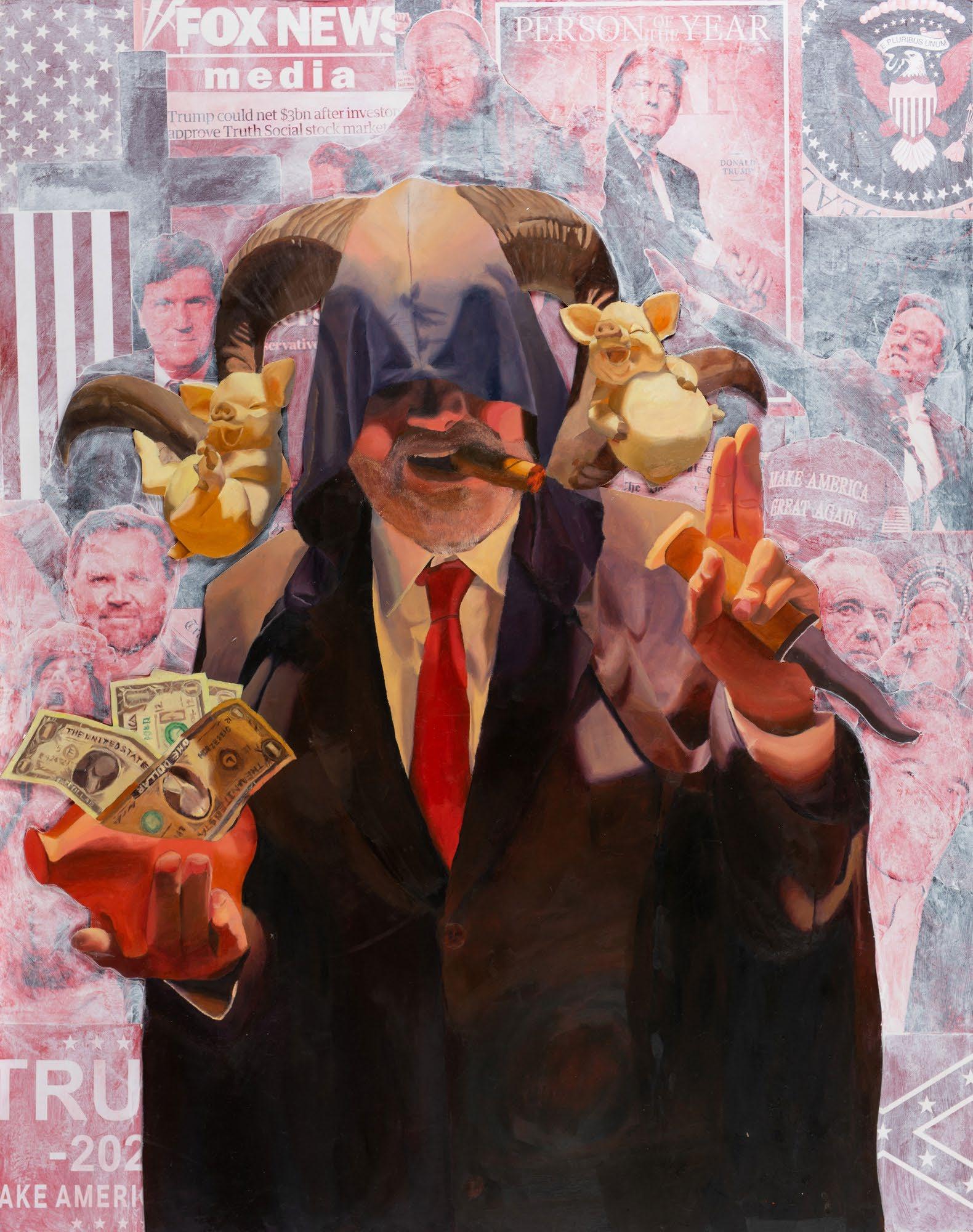
mixed media on board
100 x 80 cm
Democracy is dead and the rich are snorting with laughter.
This artwork responds to recent political events in America and the growing fear surrounding the rise of the far right and elite power. I depict the wealthy and politically powerful in a negative light to expose hypocrisy, particularly the contradiction between claimed Christian values and actions that harm vulnerable groups. The central figure is a smug, wealthy elite surrounded by cult-like symbols of extremism. Using a layered, mixed media approach, I draw on punk aesthetics that prioritise holding the rich accountable. Influenced by the 2025 USA election, the work critiques a system appearing to shift from democracy toward oligarchy.
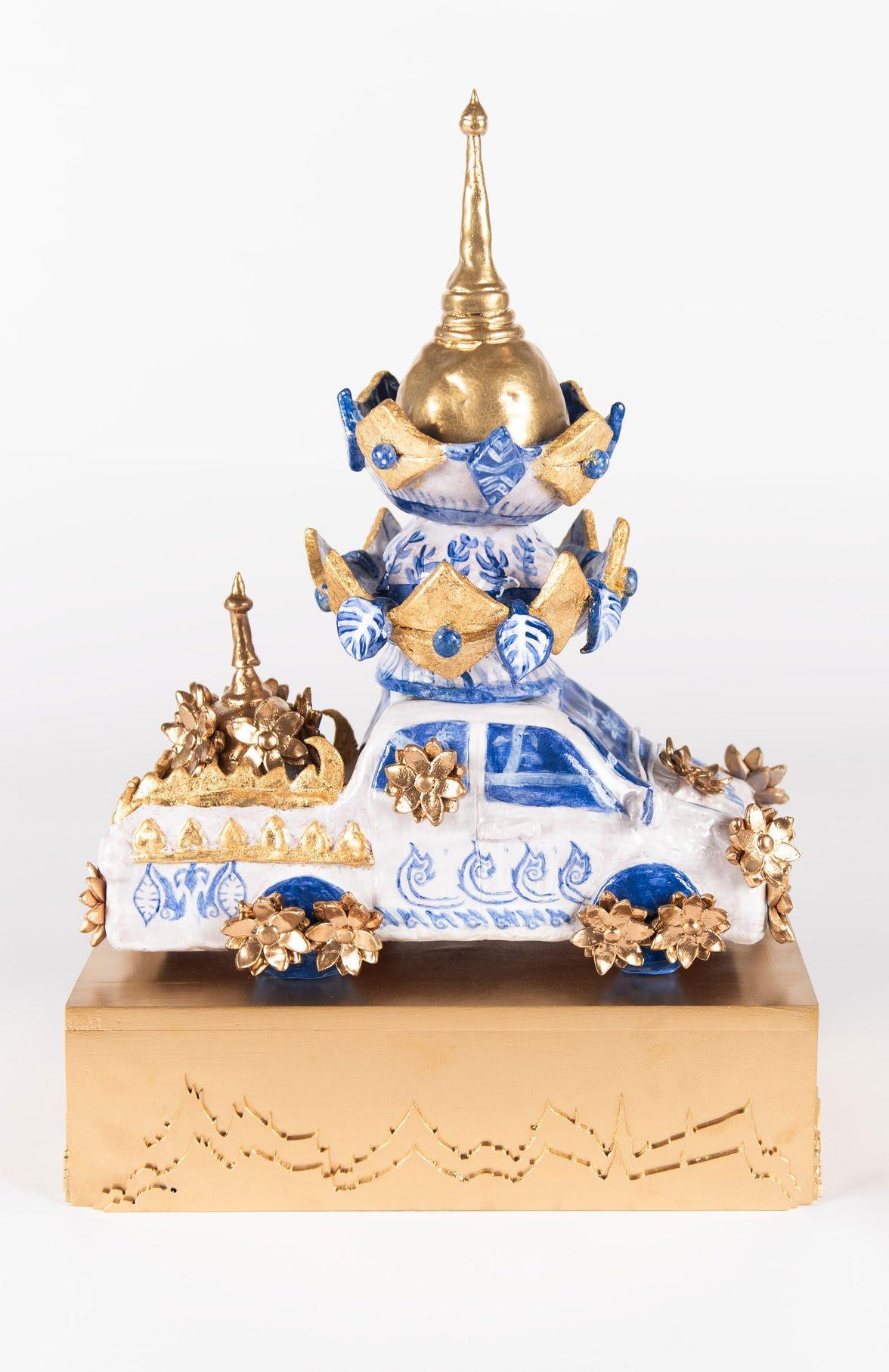
underglaze, spray paint and gold leaf on ceramic and wood 40 x 36 x 22 cm
Ute and Wats explores identity, belonging, and the navigation of dual heritage from a ThaiAustralian perspective. After three years of living in Australia, I find myself existing between two cultures, noticing differences in values, logic, and ways of living. Influenced by artist Vipoo Srivalasa, whose work reflects both Thai and Australian identities, my clay sculpture draws on personal and cultural symbolism to create a totem as a vessel for growth. The juxtaposition of the Australian ute with the sacred architecture of Thai wats brings together the everyday and the spiritual. A palette of blue, white, and gold references porcelain traditions and spiritual symbolism, evoking calm, reflection, and enlightenment while mirroring the ongoing balance of identity within a hybrid self.
graphite and charcoal on paper 80 x 108 cm
In Your Presence, Let Me Break captures a moment of silent unravelling in the presence of God. Set within the intimacy of a bedroom, a sacred personal space, it reflects the belief that God draws closest during times of hardship. The work expresses a desire to be seen not in strength, but in brokenness, and to find grace through vulnerability.
Using charcoal and graphite, the drawing invites viewers into a quiet space of confession and reflection, as the figure reaches toward light that symbolises God’s presence. Inspired by my own experiences, the work affirms that hardship does not weaken faith but shapes us into who God calls us to be.
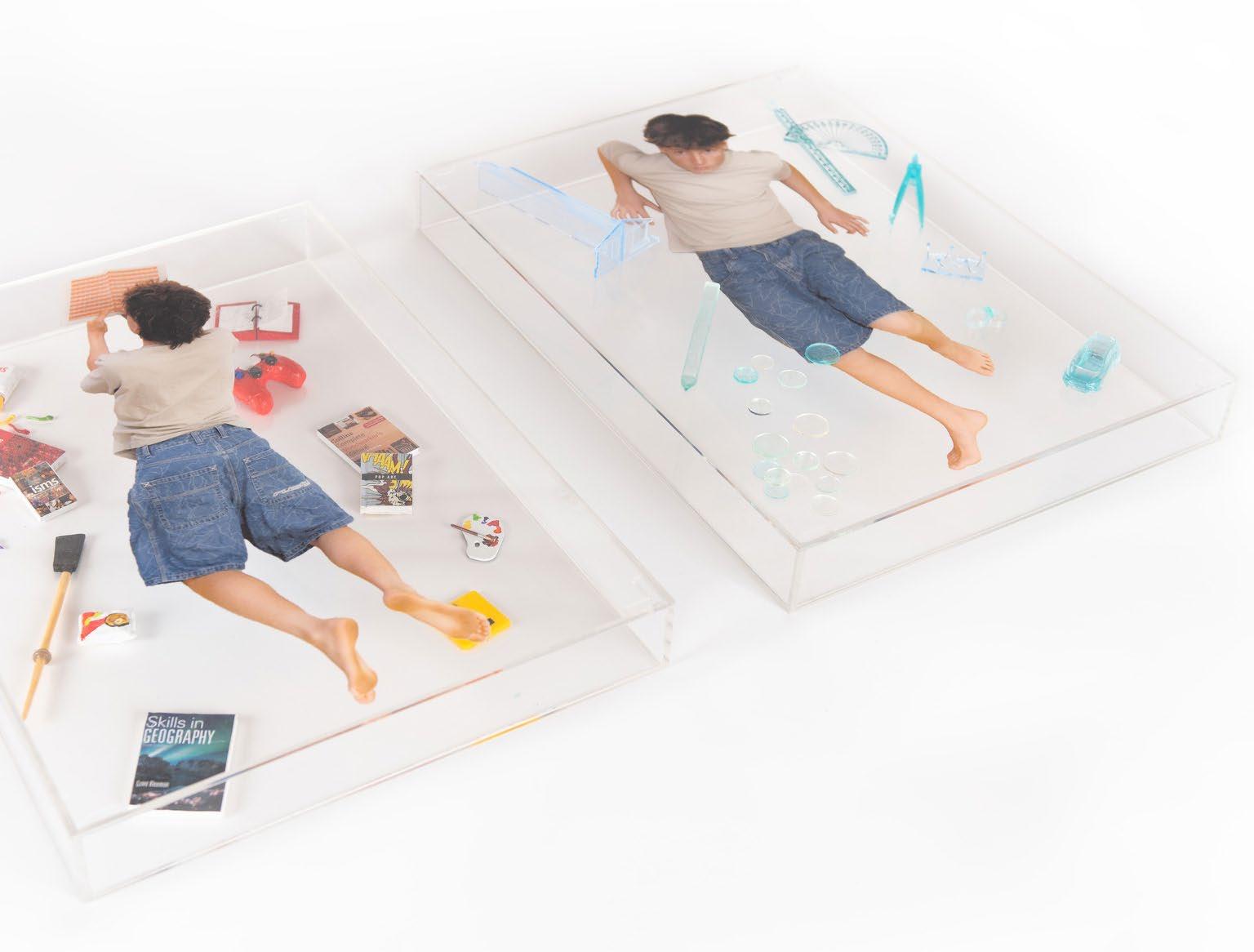
acrylic, epoxy resin, synthetic polymer paint, balsa wood and paper two parts: 7 x 63 x 95 cm (each)
During my final year of school, I was often asked what I wanted to do next. For me, this moment represented a turning point between childhood and adulthood. My artwork reflects on my life during school, my past, and the future I imagined for myself at that time. I explore how choices made during school influence the path ahead.
The two figures represent this transition: one looking back, grounded in familiarity, and one stepping forward into uncertainty. The solid objects from my present and translucent forms of future aspirations highlight both optimism and doubt. Together, they capture my growth and transition into adulthood, and the uncertainty of whether ambition will become destiny.
Swan Christian College
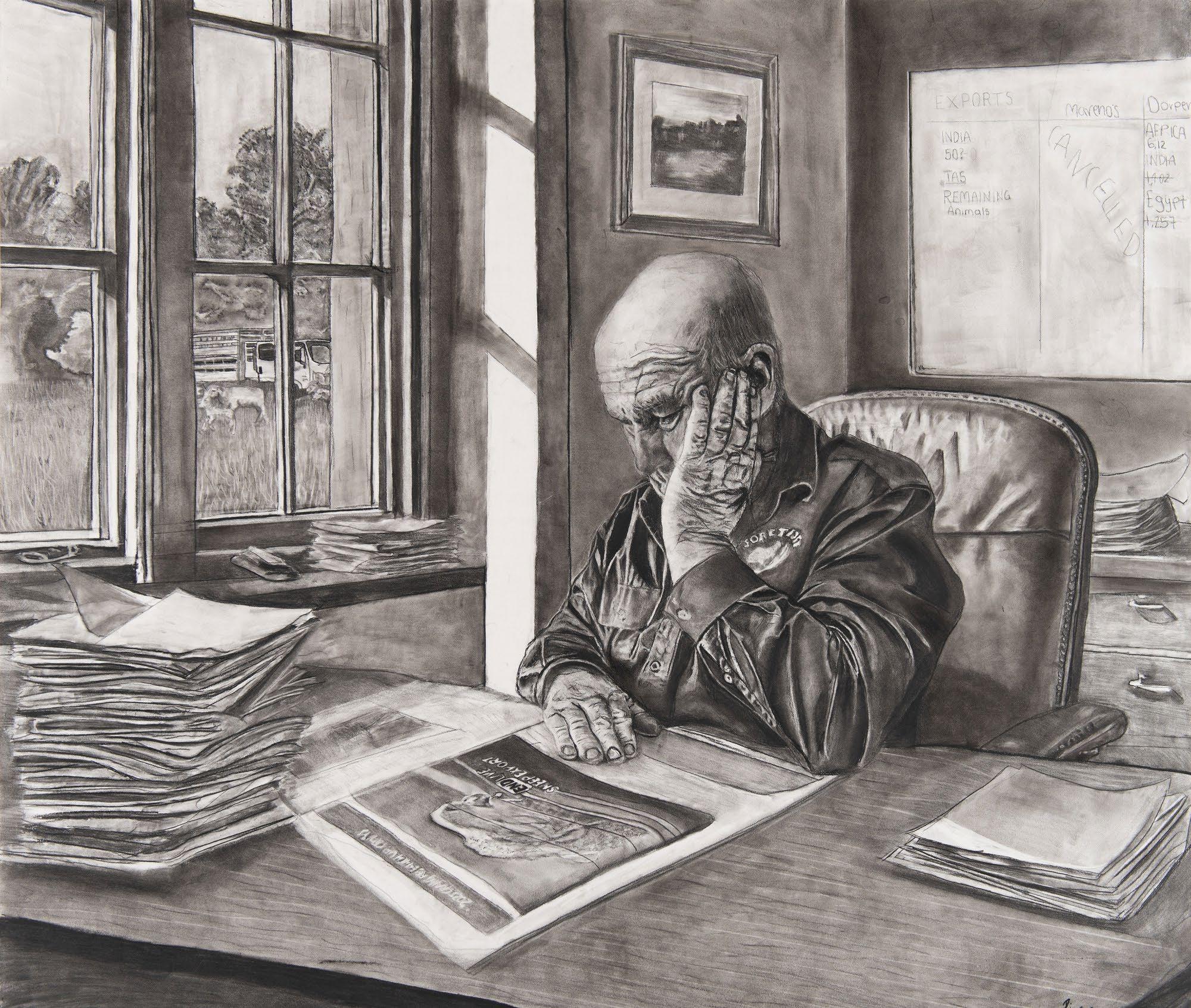
charcoal on paper 111 x 126 cm
This artwork comments on the societal issue of banning live animal export, a political matter that is close to my heart after growing up around the agricultural industry.
I explore how political campaigns and media narratives often rely on shock tactics, while overlooking the lived realities of farmers and the wider economic impact of such decisions. The work challenges the imbalance between public perception and firsthand experience, questioning who is given a voice in these discussions. Influenced by Vernon Ah Kee’s large-scale portraits, I use scale to highlight the importance of this issue and encourage viewers to consider the bigger picture beyond campaign imagery.
Pray for Peace, Prepare for War
oil on canvas
three parts: 76 x 61 cm (each)
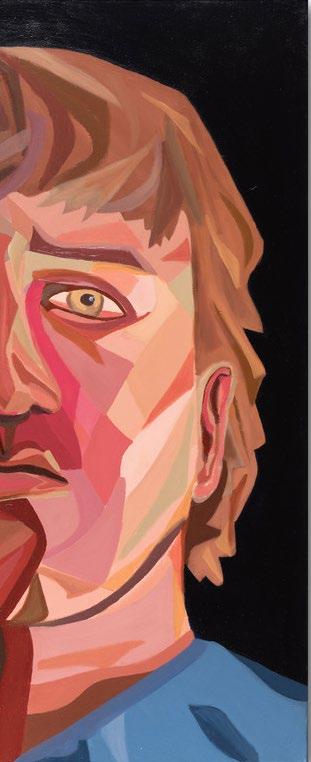
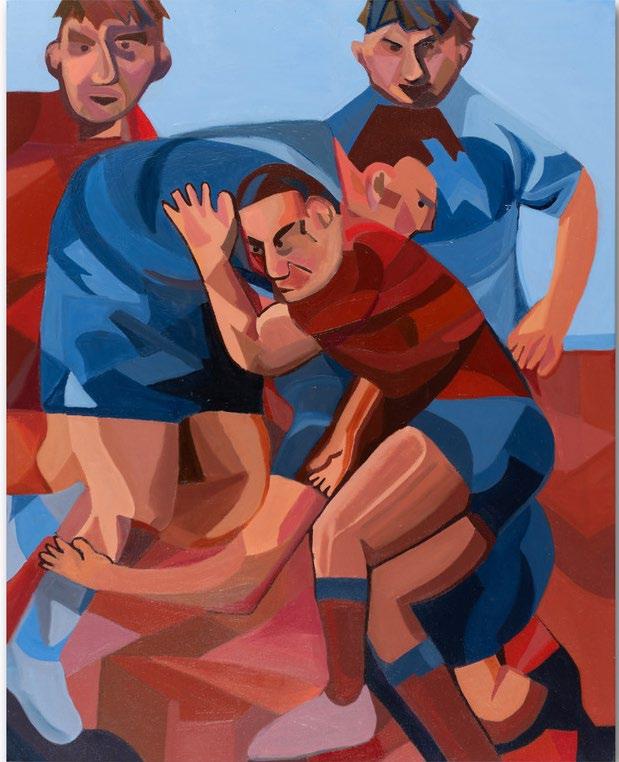
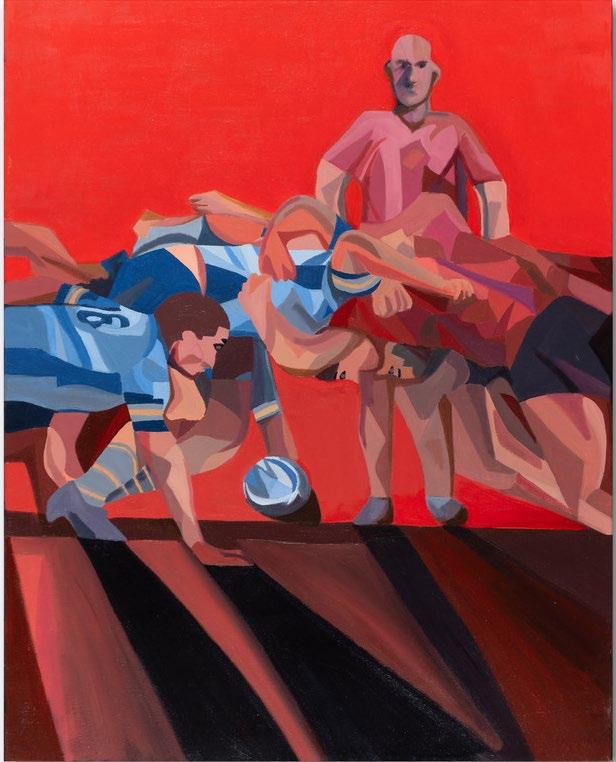
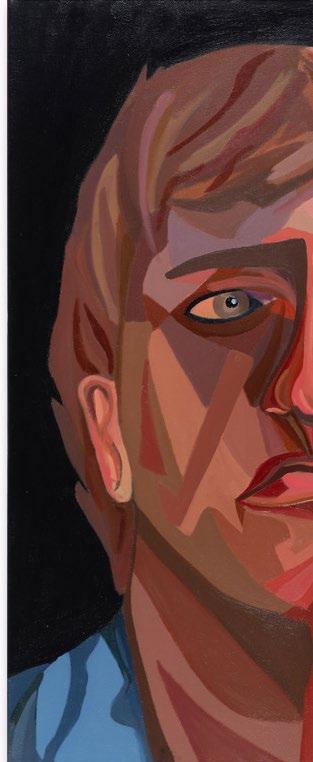
Pray for Peace, Prepare for War explores rugby not just as a sport, but as a metaphor for conflict, resilience, and unity. Using a Cubist-inspired style, the work employs distortion and rugged marks to reflect the intensity, motion, and physicality of the game. Across the panels, moments of pressure, reflection, and solidarity play out, addressing both on-field confrontation and off-field mental discipline and comradery.
Together, they emphasise that rugby is not just about brute force, but also about protection, trust, and unity. Struggle becomes meaningful through the bonds it creates, positioning rugby as a symbol of facing conflict with courage and seeking peace through connection.
Ocean Reef Senior High School
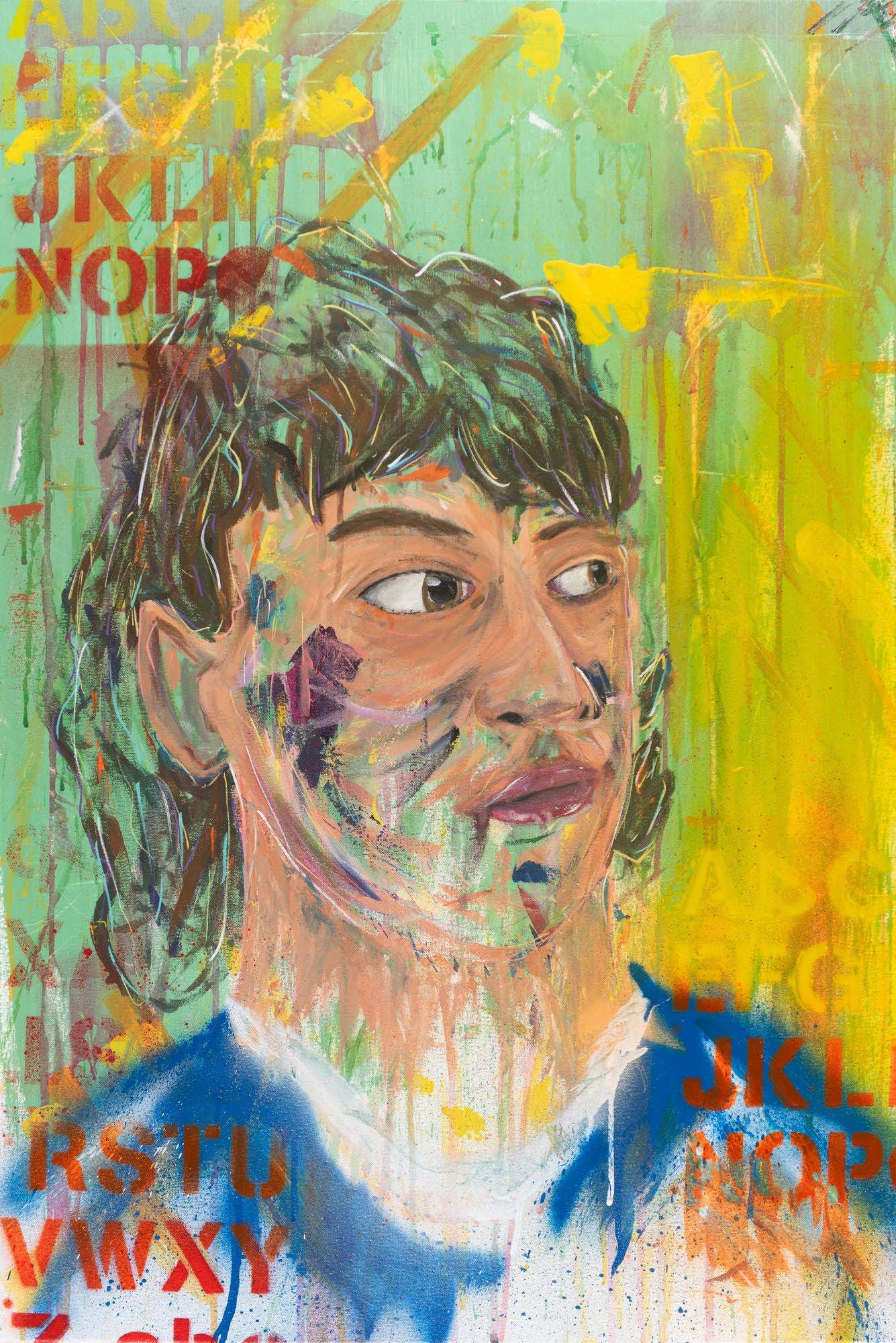
synthetic polymer paint, oil and spray paint on canvas
80 x 60 cm
My artwork captures a friend gazing toward an uncertain future, reflecting the fragile tension between adolescence and adulthood. As we move through our schooling years, the world becomes increasingly complex, and questions arise about our generation and the roles we may play in society. What was once a simple, carefree journey through childhood transforms into a layered and intricate path toward adulthood. Through overlapping imagery, I explore the passage of time and the uncertainty of what lies ahead. The work invites viewers to reflect on growth, change, and moments of introspection, capturing this pivotal stage of transition between past, present, and future.
oil on board
86 x 62 cm
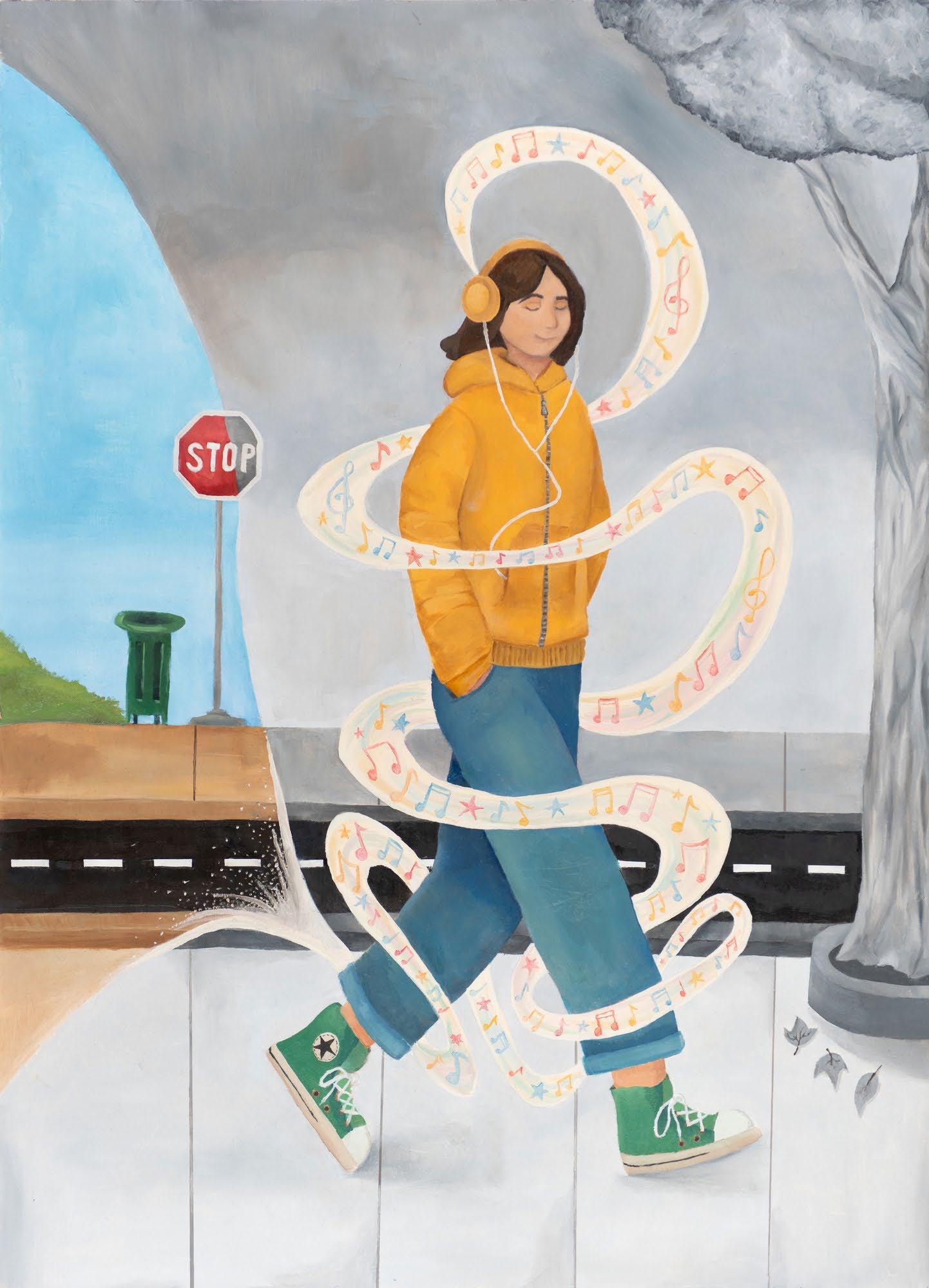
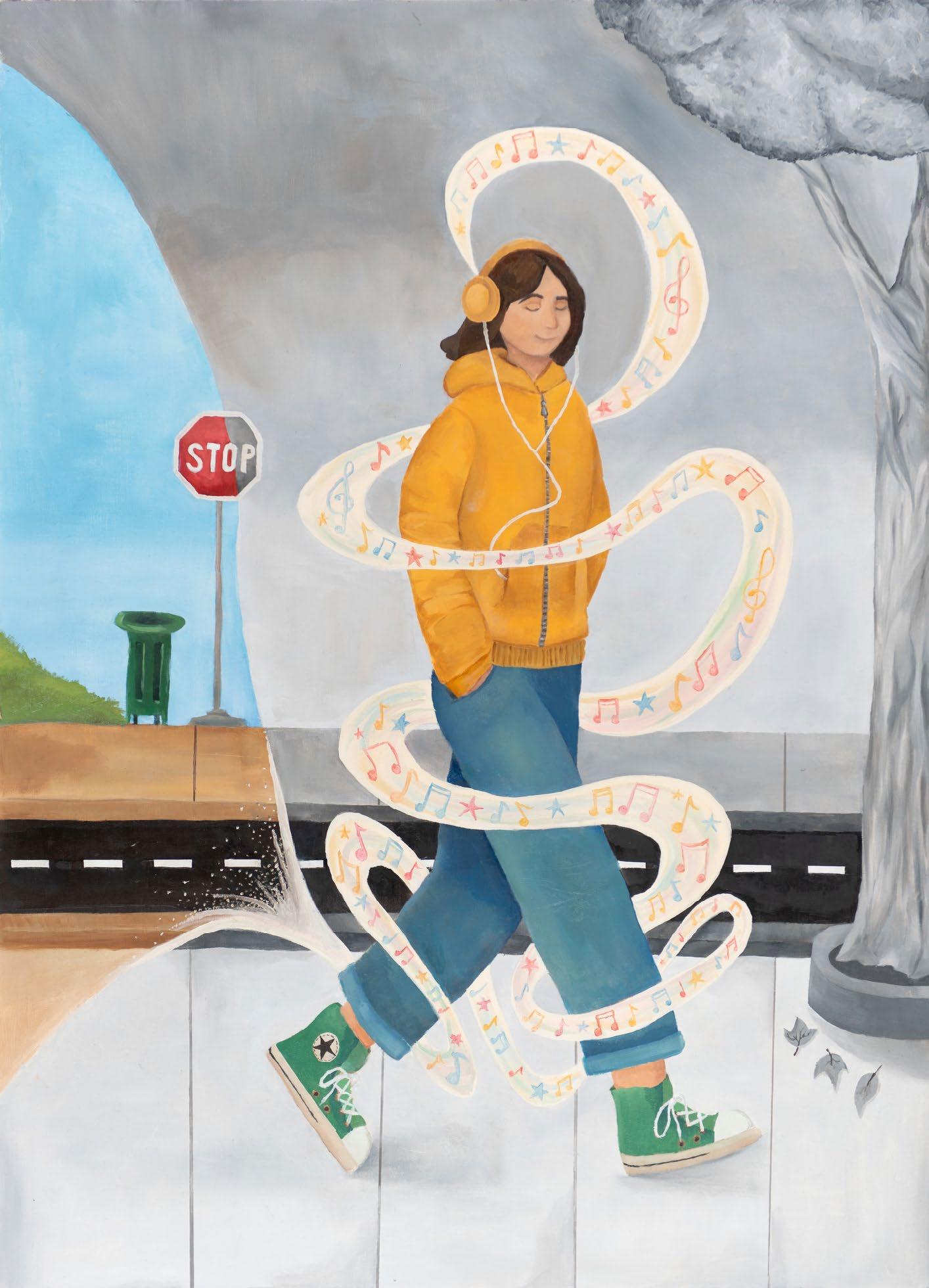
This painting explores the powerful influence music has on mood and the lasting impressions those moods create. The central figure represents the way we move through the routine and often dull aspects of everyday life. She appears vibrant, bringing colour to her grey surroundings; the ribbon of music twists around her and fills the world with vitality. The work reflects how music can transform internal experience and subtly reshape the world around us, inviting viewers to reflect on their own sources of inspiration and consider how they may continue to resonate beyond the present moment.