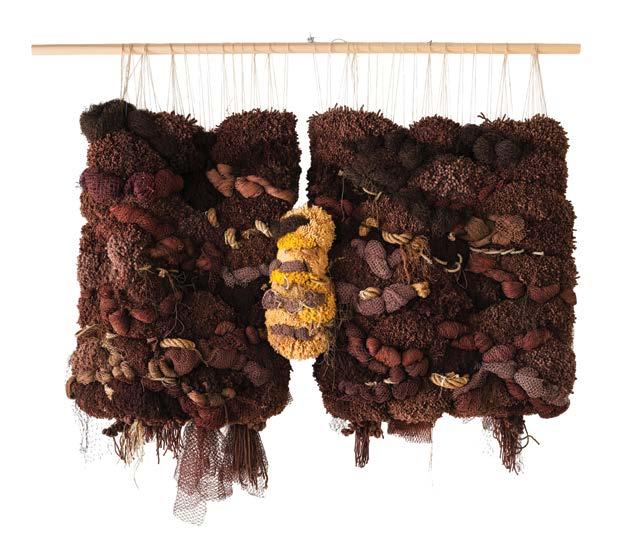
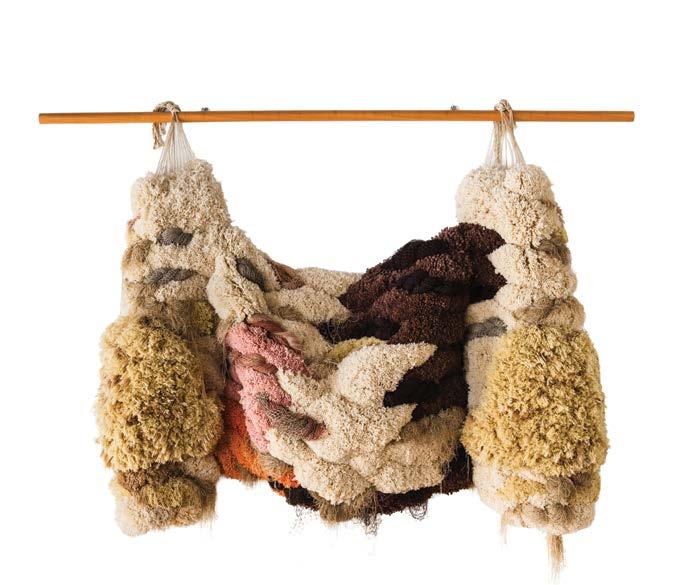
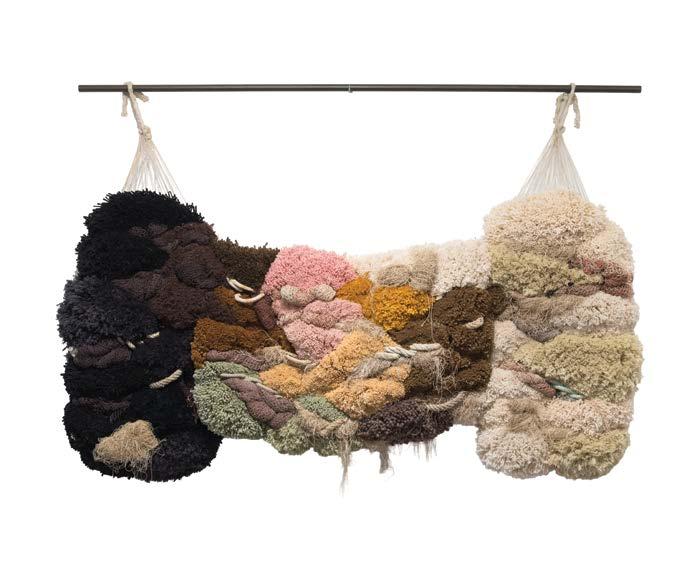
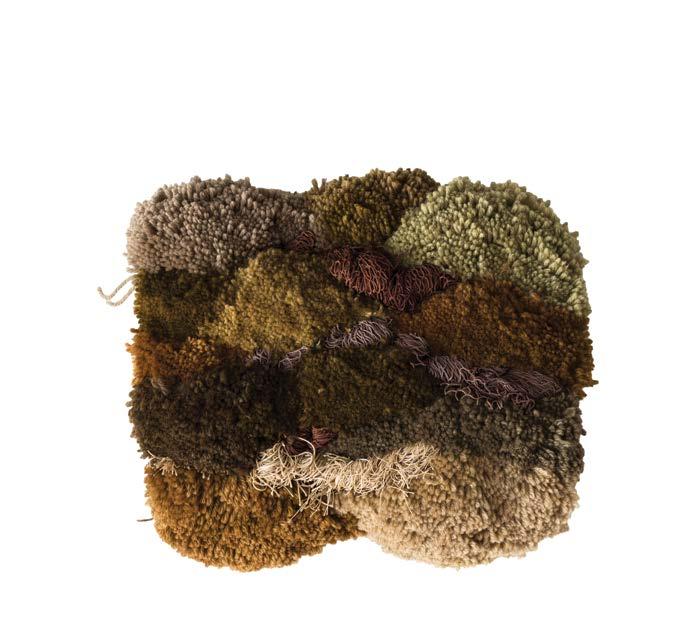
l a próxima edición de la Bienal de Venecia 2026, que se desarrolla entre el 9 de mayo y el 22 de noviembre, parece perfilarse como algo más que una plataforma de legitimación internacional. Bajo el título In Minor Keys y concebida por Koyo Kouoh, la muestra propone una sensibilidad distinta: menos centrada en el espectáculo monumental y más atenta a lo sutil, lo colectivo y lo sensorial. En un contexto marcado por la saturación visual y la aceleración tecnológica, esta bienal podría convertirse en un espacio para observar cómo el arte contemporáneo vuelve a poner el cuerpo, la materia y la experiencia táctil en el centro de la creación.
La fuerte presencia latinoamericana —con quince artistas de la región participando en esta edición— también da cuenta de un desplazamiento en las narrativas dominantes del arte contemporáneo. Temas como la memoria, la ecología, las experiencias indígenas y afrodescendientes, así como las formas de comunidad, atraviesan hoy muchas de las prácticas más relevantes del continente. En ese escenario, la participación del chileno Norton Maza, en una muestra curada por Marisa Caichiolo y Dermis León, adquiere una resonancia particular: su trabajo, marcado por la crítica política y la construcción de escenas materiales complejas, dialoga con esta necesidad contemporánea de repensar los vínculos entre territorio, memoria y representación.
Pero la escena internacional del arte contemporáneo no se articula únicamente en torno a Venecia. Entre el 18 y el 21 de junio de 2026 tiene lugar Art Basel 2026 en Suiza, una de las ferias más influyentes del circuito global, donde galerías, coleccionistas y artistas suelen consolidar muchas de las tendencias que luego dominan el mercado y las instituciones. Si la Bienal funciona históricamente como un espacio de reflexión curatorial y experimentación conceptual, Art Basel opera como un termómetro de las dinámicas económicas y estéticas del presente. La cercanía temporal entre ambos eventos permite pensar cómo ciertas preocupaciones —la materialidad, el retorno al oficio, las prácticas colaborativas y las exploraciones identitarias— atraviesan hoy tanto el discurso institucional como el mercado internacional del arte.
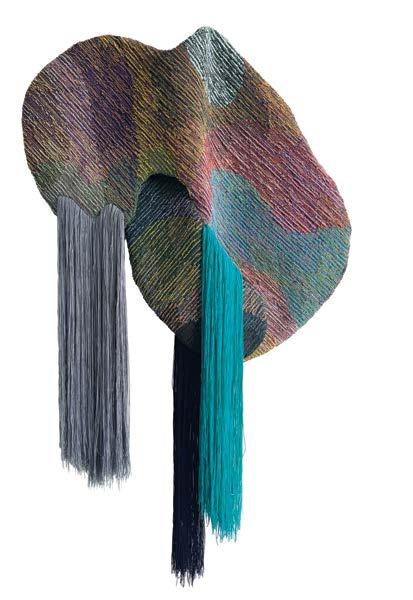
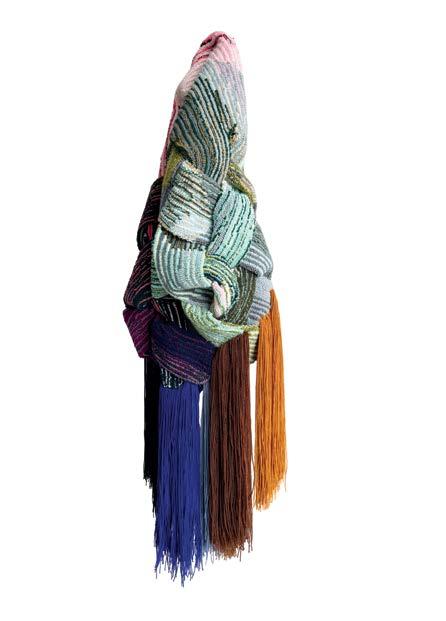
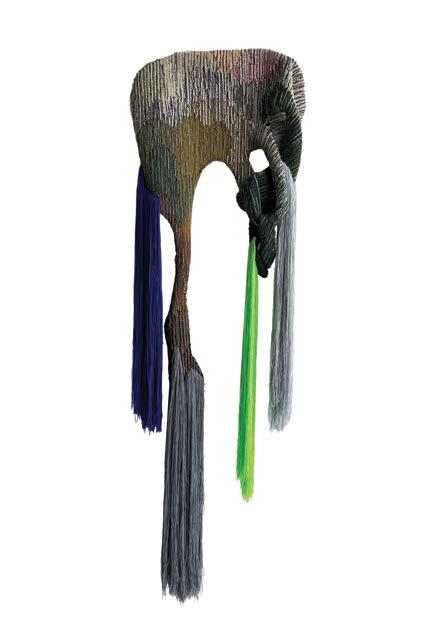
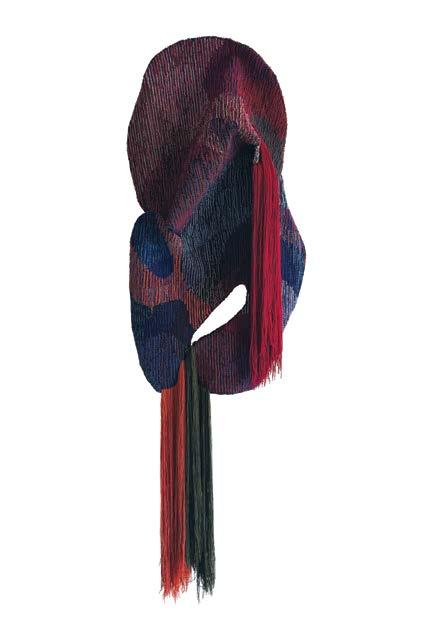
No es casual que, frente al auge de la inteligencia artificial y la producción infinita de imágenes digitales, muchas de las tendencias actuales apunten hacia un renovado interés por las artesanías, el textil, la cerámica y las técnicas manuales. La materialidad vuelve a importar: las superficies con textura, los ensamblajes híbridos y el uso de materiales reciclados aparecen cada vez con más fuerza en museos, galerías y ferias internacionales. Más que una nostalgia por el pasado, este retorno a lo hecho a mano parece funcionar como una respuesta crítica frente a la desmaterialización creciente de la experiencia contemporánea.
t he upcoming edition of the Biennale Arte 2026, taking place from May 9 to November 22, seems to be shaping up as something more than a platform for international legitimization. Under the title In Minor Keys and conceived by Koyo Kouoh, the exhibition proposes a different sensibility: one less centered on monumental spectacle and more attentive to the subtle, the collective, and the sensory. In a context marked by visual saturation and technological acceleration, this biennial could become a space for observing how contemporary art is once again placing the body, materiality, and tactile experience at the center of artistic creation.
The strong Latin American presence — with fifteen artists from the region participating in this edition — also points to a shift in the dominant narratives of contemporary art. Themes such as memory, ecology, Indigenous and Afro-descendant experiences, as well as forms of community, currently run through many of the continent’s most relevant artistic practices. Within this context, the participation of Chilean artist Norton Maza, in an exhibition curated by Marisa Caichiolo and Dermis León, acquires particular resonance: his work, marked by political critique and the construction of complex material scenes, dialogues with this contemporary need to rethink the relationships between territory, memory, and representation.
Yet the international contemporary art scene is not articulated solely around Venice. Between June 18 and 21, 2026, Art Basel 2026 will take place in Switzerland, one of the most influential fairs within the global circuit, where galleries, collectors, and artists often consolidate many of the tendencies that later come to dominate both the market and institutional spaces. If the Biennale has historically functioned as a site for curatorial reflection and conceptual experimentation, Art Basel operates as a barometer of the present’s economic and aesthetic dynamics. The temporal proximity between both events makes it possible to consider how certain concerns — materiality, the return to craft, collaborative practices, and explorations of identity — now traverse both institutional discourse and the international art market.
It is no coincidence that, in the face of the rise of artificial intelligence and the infinite production of digital images, many current tendencies point toward a renewed interest in craft practices, textiles, ceramics, and manual techniques. Materiality matters once again: textured surfaces, hybrid assemblages, and the use of recycled materials are appearing with increasing force in museums, galleries, and international fairs. More than a nostalgia for the past, this return to the handmade seems to function as a critical response to the growing dematerialization of contemporary experience.
Ana María Matthei Ricardo Duch Matthei
DIRECTORES
Ana María Matthei
Ricardo Duch Marquez
DIRECTOR COMERCIAL
Cristóbal Duch Matthei
DIRECTORA DE ARTE Y EDITORIAL LIBROS
Catalina Papic
PROYECTOS CULTURALES
Camila Duch Matthei
EDITORA
Javiera Paz Fernández
CORRECCIÓN DE TEXTOS
Vania Oyarzún
DISEÑO GRÁFICO
María Nestler
ASESORES
Benjamín Duch Matthei
Ricardo Duch Matthei
Milagros Duch Matthei
Felipe Duch Matthei
REPRESENTANTES INTERNACIONALES
Julio Sapollnik (Argentina)
REPRESENTANTE LEGAL
Orlando Calderón
TRADUCCIÓN
Cecilia Nestler
SUSCRIPCIONES
info@arteallimite.com
IMPRESIÓN
A Impresores
DIRECCIONES
Chile / Francisco Noguera 217 oficina 30, Providencia, Santiago de Chile. www.arteallimite.com
PORTADA
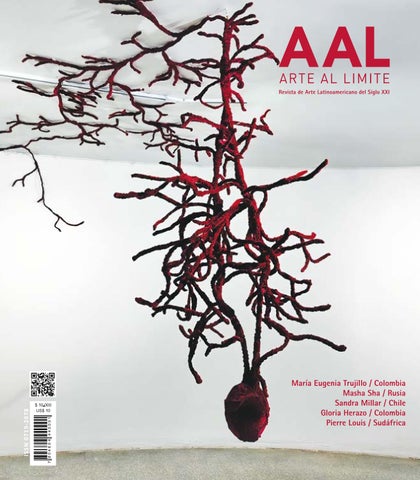
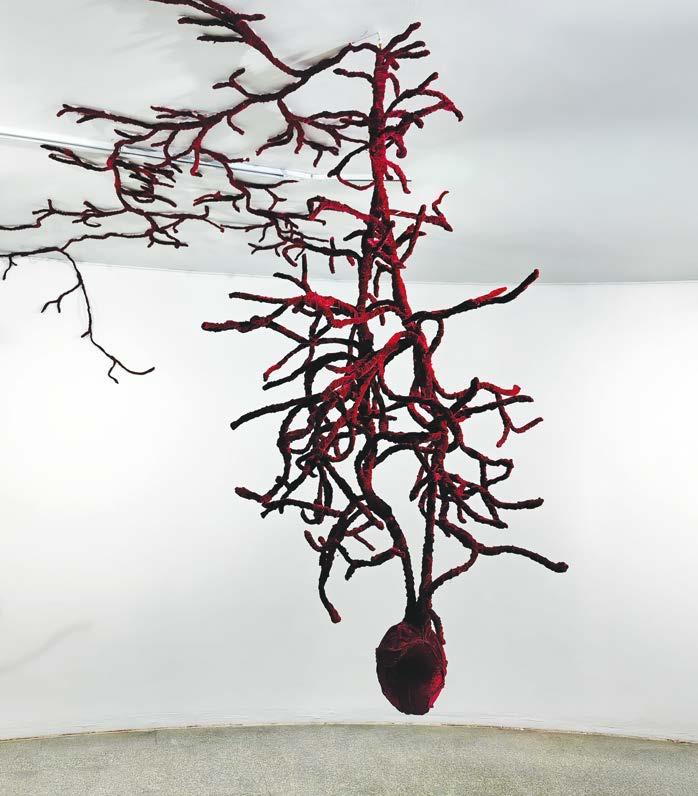
María Eugenia Trujillo. La ofrenda, 2024, instalación escultura blanda, dimensiones variables. Fotografía Daniela Cubillos.
Por Ivón Figueroa Taucán. Magíster en Teoría e Historia del Arte (Chile) Imágenes cortesía de la artista.
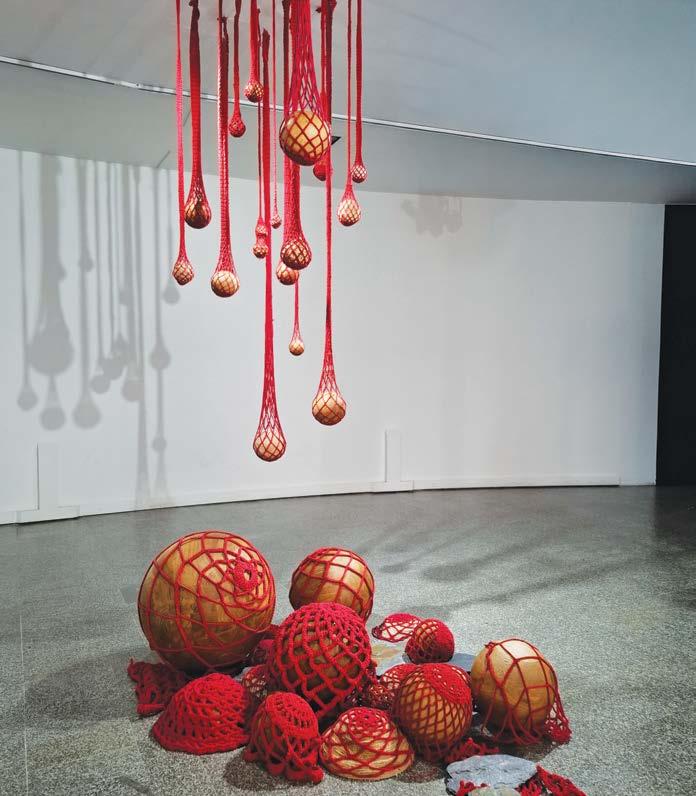
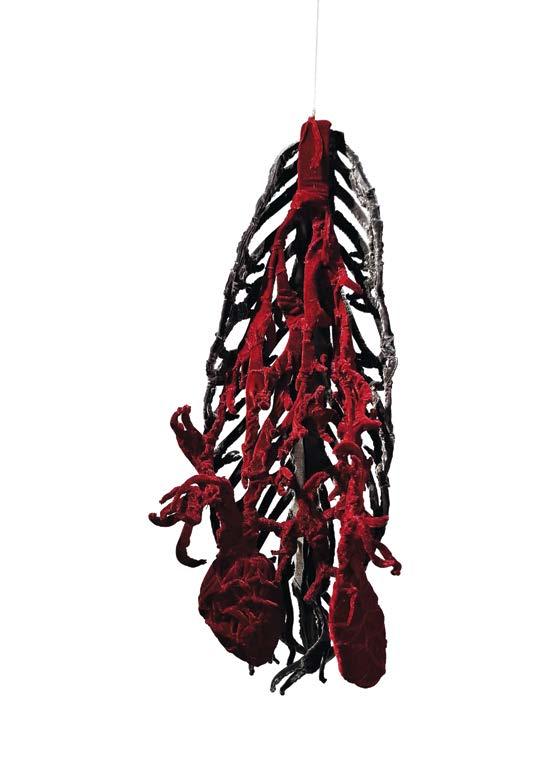
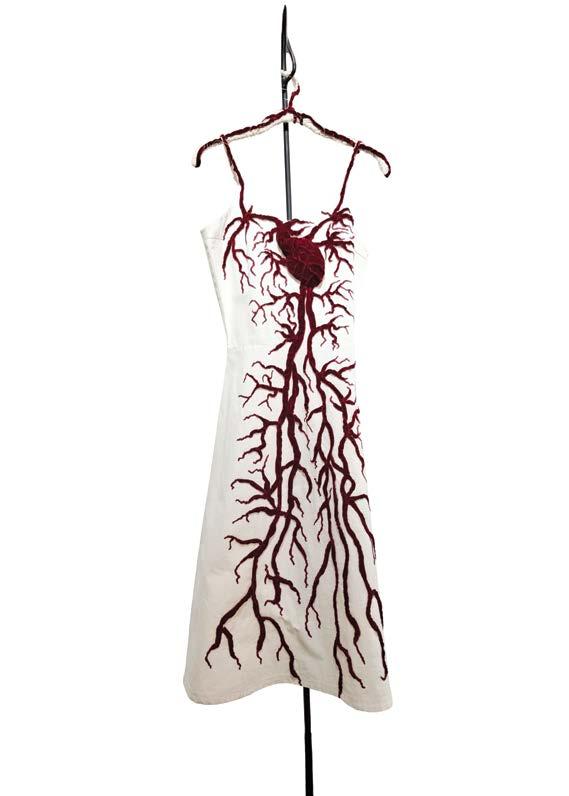
“ Siento que suben ramificaciones por las paredes, siento que se llenan de corazones”. La frase fue pronunciada por la madre de María Eugenia Trujillo poco antes de morir, cuando la artista tenía apenas 19 años. Durante décadas, ese recuerdo permaneció contenido, suspendido en algún lugar entre la memoria familiar y la experiencia íntima del duelo. Casi cincuenta años después encontraría una forma material en Me adhiero, persisto y resisto (2025), una de las exposiciones más personales y autobiográficas de su trayectoria.
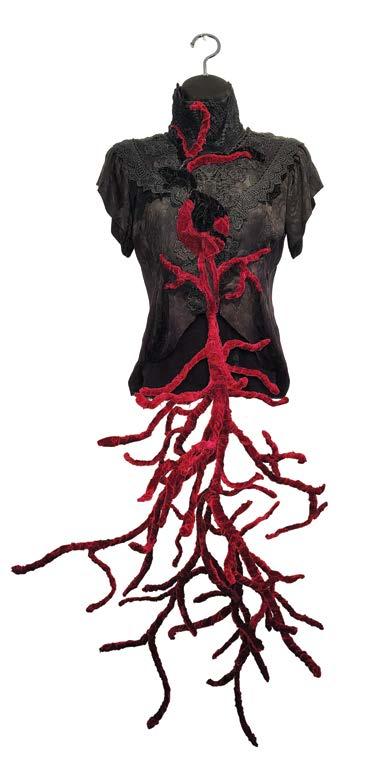
Aunque ha trabajado toda su vida, reconoce que las últimas décadas han concentrado el período de mayor visibilidad de una obra que construye un lenguaje propio a partir del bordado, los textiles y lo que ella llama escultura blanda. En sus instalaciones emergen corazones, ramificaciones y tejidos que parecen crecer por el espacio expositivo como organismos vivos, haciendo que la memoria tome forma material.
Su madre era modista y su padre sastre. Las telas, los hilos y las agujas formaban parte del paisaje cotidiano de su infancia. Más tarde, en un colegio de monjas, aprendió costura. Con el tiempo entendió que podía dibujar con hilos y pintar con telas. Desde entonces, su práctica se ha desarrollado como una investigación sensible sobre las posibilidades expresivas de materiales históricamente asociados al trabajo femenino y doméstico. Terciopelos, rellenos, bordados y copas de brasier transformadas en corazones desplazan la dureza monumental de la escultura hacia un territorio íntimo, corporal y biográfico.
¿Cuál es la conexión entre el recuerdo de tu madre y las temáticas que te movilizan como artista?
El recuerdo siempre permanece, el homenaje siempre está. También está la continuidad de una misma como hija y como mujer. Pero además de recordar, para mí es importante darle voz a las mujeres. Las generaciones de mi mamá y de mis abuelas no tuvieron voz.
Siempre he pensado que el arte tiene que ver con la propia vida, con la cotidianidad y con lo que uno tiene alrededor. Yo trabajo desde lo que vivo, desde mis propias experiencias y desde las experiencias de las mujeres que me rodearon toda la vida.
“ feel branches climbing up the walls, I feel them filling with hearts.” These words were spoken by María Eugenia Trujillo’s mother shortly before her death, when the artist was only nineteen years old. For decades, the memory remained suspended somewhere between family recollection and the intimate experience of grief. Nearly fifty years later, it would finally take material form in Me adhiero, persisto y resisto (2025), one of the most personal and autobiographical exhibitions of her career.
Although she has worked throughout her life, Trujillo recognizes that the last decades have concentrated the period of greatest visibility for a practice that has developed a distinctive language through embroidery, textiles, and what she refers to as soft sculpture. In her installations, hearts, branching forms, and stitched surfaces emerge as if growing through the exhibition space like living organisms, allowing memory itself to acquire material presence.
Her mother was a seamstress and her father a tailor. Fabrics, threads, and needles formed part of the everyday landscape of her childhood. Later, while attending a convent school, she learned sewing. Over time, she understood that she could draw with threads and paint with fabrics. Since then, her practice has unfolded as a sensitive investigation into the expressive possibilities of materials historically associated with domestic and feminine labor. Velvets, stuffing, embroidery, and bra cups transformed into hearts displace the monumental hardness traditionally associated with sculpture toward a more intimate, corporeal, and biographical territory.
What is the connection between the memory of your mother and the themes that move you as an artist?
Memory always remains; the homage is always there. There is also the continuity of oneself as daughter and as woman. But beyond remembering, it is important for me to give voice to women. The generations of my mother and my grandmothers did not have a voice.
have always believed that art is connected to one’s own life, to everyday existence, and to what surrounds us. work from what have lived, from my own experiences, and from the experiences of the women who surrounded me throughout my life.
Dibujar con hilos, pintar con telas Drawing with Threads, Painting with Fabrics
Los maniquíes y el bordado aparecen de forma persistente en tu obra. ¿Qué encontraste en ellos?
Solía trabajar las imágenes en dibujo, pero sentía que no me daba todas las herramientas expresivas que necesitaba. Después de quedar viuda a los 41 años, hago un quiebre importante y realizo mi primera obra sobre un maniquí femenino. Ahí comienza realmente el trabajo con los maniquíes y posteriormente la serie Mapas ilimitados (2007). Curiosamente, todos han sido maniquíes femeninos. Solo hice uno masculino, que tiene una diana pintada y se llama Ya vengo. Viene de esa idea del hombre que dice “ya vengo, voy por la leche” o “voy por cigarrillos” y nunca regresa. En Colombia eso también tiene relación con la desaparición y con la violencia. Ese es el único maniquí masculino que he hecho hasta ahora. Durante mucho tiempo, estos materiales fueron considerados banales o menores, pero en realidad no lo son. El traje, la tela, el hilo y la aguja constituyen una forma de vida.
En tu exposición Auto de fe (2026) hay una gran cama cubierta por un tejido a crochet que titulas Red de niebla ¿Podrías contarme más sobre ella?
A mis 72 años sentí que era el momento de hacer algo parecido a una autobiografía, pero en vez de escribirla decidí relatarla en imágenes. El crochet me lo enseñó mi mamá. Entonces pensé que debía hacerse sobre una cama, porque una llega sola a una cama y también se va sola de ella. Esta mide un metro de ancho, porque la vida es personal y única. Comencé a trabajar desde mis recuerdos. Al principio probé hacerlo en colores, pero no funcionó. Los recuerdos son como una nube gris. A veces no sabes si algo ocurrió realmente o si es una construcción de la memoria.
Un día escuché en un programa agropecuario el concepto red de niebla que es una red casi invisible usada para atrapar pequeños pájaros o murciélagos para estudios. Me pareció perfecto: la red como aquello que conecta todo y la niebla como ese territorio gris de la memoria. Empecé el tejido imaginando que somos polvo de estrellas y que venimos de este universo. La obra recorre mi vida: aparece mi madre, mi infancia, la adolescencia, los primeros amores, la muerte de mi mamá, mi matrimonio, mis hijos, la viudez, las épocas difíciles. La obra tiene mucho de enigmático. El tejido mide actualmente más de siete metros de largo y termina simbólicamente en el mar, porque quisiera que mis restos quedaran allí. Es un mural horizontal que cuenta mi vida en clave visual y textil.
Mannequins and embroidery appear persistently throughout your work. What did you find in them?
used to work primarily through drawing, but felt it did not provide all the expressive tools I needed. After becoming widowed at forty one, I experienced a profound rupture and created my first work using a female mannequin.
That was the true beginning of my work with mannequins, followed later by the series Mapas ilimitados (2007). Curiously, they have all been female mannequins. I made only one male figure, painted with a target and titled Ya vengo. It comes from that familiar image of the man who says, “I’ll be right back, I’m going out for milk” or “for cigarettes,” and never returns. In Colombia, that phrase also resonates with disappearance and violence. That remains the only male mannequin I have created so far. For a long time, these materials were considered banal or secondary, but they are not. Clothing, fabric, thread, and needle constitute a way of life.
In your exhibition Auto de fe (2026), there is a large bed covered by a crocheted textile titled Red de niebla. Could you tell me more about it?
At seventy two, felt it was time to create something similar to an autobiography, but instead of writing it, I decided to narrate it through images. My mother taught me crochet, so thought the work had to happen on a bed, because one arrives alone in a bed and also leaves it alone. The bed is only one meter wide because life is personal and singular. I began working from my memories. At first I tried using color, but it did not work. Memories are like a gray cloud. Sometimes you cannot tell whether something truly happened or whether it is a construction of memory.
One day, while listening to an agricultural radio program, heard the term mist net an almost invisible net used to capture small birds or bats for scientific studies. It felt perfect: the net as that which connects everything, and the mist as the gray territory of memory. I began weaving while imagining that we are stardust and that we come from this universe. The work traverses my entire life: my mother appears, my childhood, adolescence, first loves, my mother’s death, my marriage, my children, widowhood, difficult periods. The piece contains something deeply enigmatic. The textile currently measures more than seven meters in length and symbolically ends in the sea, because I would like my remains to stay there. It is a horizontal mural that narrates my life through a visual and textile language.
En exposiciones previas incorporaste partes del cuerpo femenino en piezas inspiradas en objetos religiosos. ¿De dónde nace tu interés por el cruce entre sexualidad, cuerpo femenino e imaginario católico?
Vengo de una familia profundamente católica, pero siempre he sido muy crítica de la Iglesia y de cómo ha tratado a las mujeres a lo largo de la historia. Soy completamente anticlerical.
Hice una serie llamada Las vírgenes (2010), donde trabajaba figuras religiosas repujadas y colocaba el corazón como una vagina. Luego me puse a pensar cuál podría ser otro objeto religioso potente para transmitir mi mensaje. Descubrí la custodia y pensé que, en lugar del cuerpo de Cristo, podía colocar partes femeninas: un seno, una vagina u otras alegorías, todo bordado. Eso generó un gran revuelo. La exposición se presentó primero en el Museo de la Inquisición en Cartagena y luego en la iglesia desacralizada de Santa Clara. Muchas personas católicas se sintieron ofendidas y presentaron acciones judiciales para impedir la muestra. Todo llegó hasta la Corte Suprema de Justicia, que finalmente determinó que la libertad de expresión estaba por encima de los argumentos religiosos que se utilizaban en mi contra. Eso también confirmó para mí cómo la Iglesia sigue operando contra la autonomía de las mujeres y terminó dándole mucha más visibilidad a la obra.
¿Qué lugar ocupa el espacio expositivo dentro de tu trabajo? Creo en los espacios no tradicionales y en romper paradigmas. El cubo blanco también es un paradigma. Por ejemplo, en Cartografías íntimas (2019) construí un pequeño cuarto donde la gente podía entrar físicamente. También tengo una instalación llamada Once años (2000-2007) con el maniquí roto de una niña que llevé a colegios, calles y distintos espacios antes de exhibirlo. No soy una artista de galería. He tenido la fortuna de no depender económicamente de la venta de mi obra, así que utilizo el mundo real para mostrarla: universidades, colegios y espacios cotidianos.
In previous exhibitions you incorporated parts of the female body into works inspired by religious objects. Where does your interest in the intersection between sexuality, the female body, and Catholic imagery come from? come from a deeply Catholic family, but I have always been highly critical of the Church and the way it has treated women throughout history. am completely anticlerical.
created a series called Las vírgenes (2010), where I worked with embossed religious figures and placed the heart as a vagina. Then began thinking about what other powerful religious object could communicate my message. I discovered the monstrance and thought that, instead of the body of Christ, I could place female body parts inside it: a breast, a vagina, or other allegories, all embroidered. It caused an enormous controversy. The exhibition was first shown at the Museum of the Inquisition in Cartagena and later in the desacralized church of Santa Clara. Many Catholics felt offended and filed lawsuits attempting to stop the exhibition. Everything eventually reached the Supreme Court, which ruled that freedom of expression stood above the religious arguments used against my work. For me, this also confirmed how the Church continues to operate against women’s autonomy, while paradoxically giving the work far greater visibility.
What role does exhibition space occupy within your practice? believe in non traditional spaces and in breaking paradigms.
The white cube is also a paradigm. For example, in Cartografías íntimas (2019), I constructed a small room that viewers could physically enter. also have an installation titled Once años (2000-2007), featuring the broken mannequin of a young girl that I brought into schools, streets, and different public spaces before ever exhibiting it formally. am not a gallery artist. I have been fortunate enough not to depend economically on selling my work, so use the real world to show it: universities, schools, and everyday spaces.
CHILE | CHILE
SANDRA MILLAR
Por Javiera Paz Fernández. Magíster en Estéticas Americanas (Chile) Imágenes cortesía de la artista.
Tejer como acto de memoria Weaving as an Act of Memory
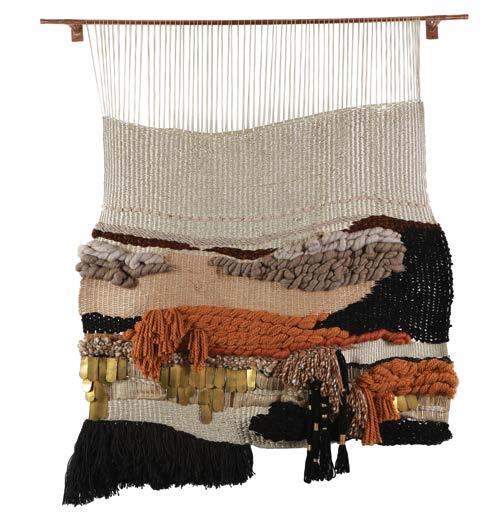
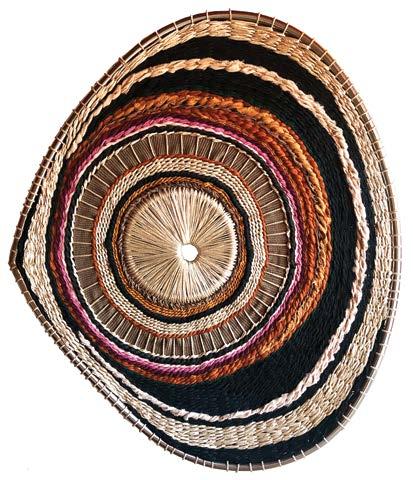
a través de un sueño, una mujer mapuche le transmitió, en mapudungun, las directrices para tejer en telar. En ese espacio, urdimbres blancas moviéndose como cuerdas de un arpa de lana, Sandra Millar aprendía con las manos mientras una voz le susurraba al oído. En ese mismo sueño fue nombrada Lilen Kuche: araña hilandera y tejedora.
Pero las señales del tejido como el lenguaje que hasta hoy la acompaña y moviliza comienzan desde muy pequeña. Hija de madre chilota, su infancia estuvo marcada por las frazadas de lana tejidas en telar que la abrigaban en Llau Llao, cerca de Castro, con relieves florales hechos en nudo chilote —o “pelo”, como lo llaman las tejedoras—. Luego, fue su vida en Coyhaique, donde el frío extremo convertía la lana en una necesidad vital. Sin embargo, no fue hasta los 40 años que comenzó a tejer, lo que reconoce como un indicio revelador.
t hrough a dream, a Mapuche woman transmitted to her, in Mapudungun, the instructions for weaving on a loom. In that space — white warp threads moving like the strings of a woolen harp — Sandra Millar learned with her hands while a voice whispered in her ear. In that same dream she was given the name Lilen Kuche: spider, spinner and weaver.
Yet the signs of weaving as the language that still accompanies and moves her began much earlier. The daughter of a Chilote mother, her childhood was marked by handwoven wool blankets that kept her warm in Llau Llao, near Castro, adorned with floral reliefs made using the nudo chilote (chilote knot) — or “pelo,” as local weavers call it. Later came her life in Coyhaique, where the harsh cold turned wool into a vital necessity. Even so, it was not until her forties that she began weaving, something she now recognizes as a revealing sign.
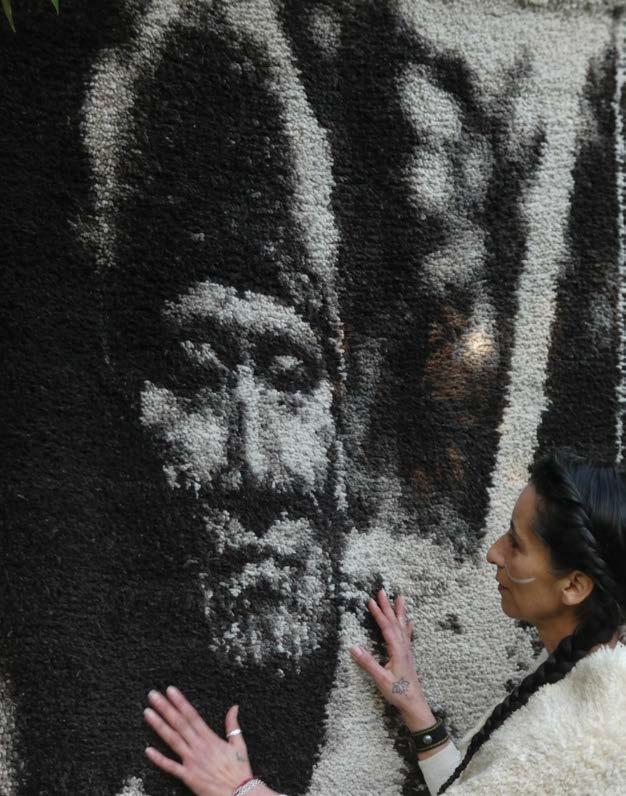
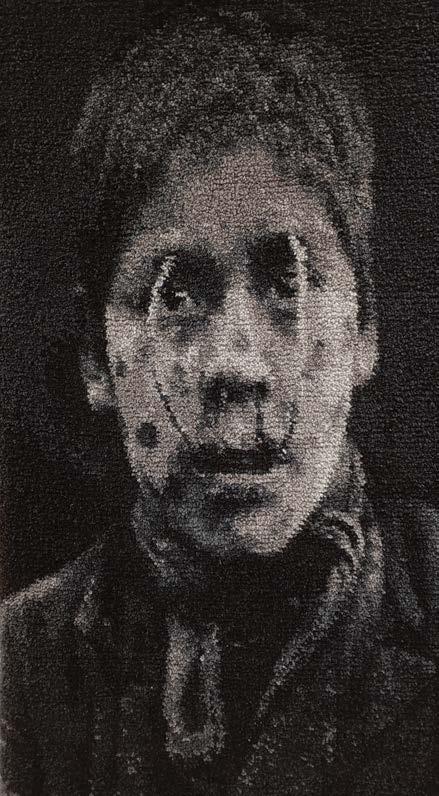
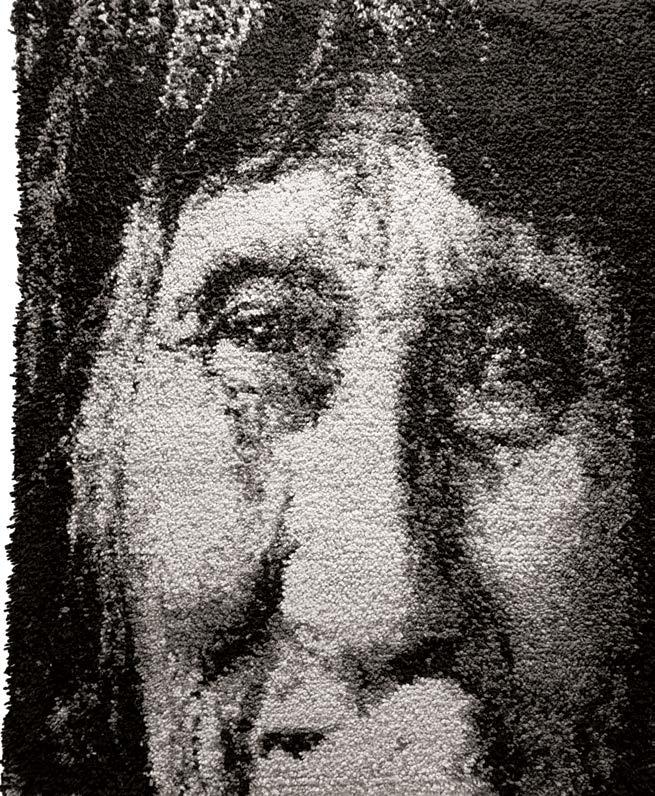
Desde entonces, su trabajo textil se ha construido como un cruce entre territorio, memoria y espiritualidad. En su obra HALIMINK , el retrato se vuelve un gesto de restitución: rostros selk’nam emergen desde el tejido como presencias vivas, en diálogo con la historia de un pueblo exterminado. A través del textil, y particularmente del nudo chilote, Sandra Millar no solo construye imágenes, sino que sostiene una memoria colectiva que conecta diferentes capas de sentido. “Me gusta pensar esta obra como un cruce entre lo visible y lo invisible. Lo visible es la imagen, el retrato; lo invisible es todo lo que sostiene esa imagen: la historia, la energía, la memoria ancestral, incluso lo espiritual”.
Tu obra HALIMINK puede leerse en distintos niveles: la dimensión pictórica de los retratos de personas selk’nam; el diálogo entre el retrato y el tejido como materialidad; y la irrupción de un pasado violento —marcado por el exterminio de un pueblo— en relación con el presente, junto con la evocación de técnicas y saberes artesanales. En ese cruce de capas, ¿cómo te interesa pensar esta obra?
HALIMINK es, para mí, un acto de memoria viva. Es una obra que habita en varios niveles al mismo tiempo. Por una parte, está lo pictórico: estos retratos de personas selk’nam que emergen desde el tejido como si volvieran a tomar presencia. Pero no me interesa el retrato sólo como representación, sino como un gesto de restitución. No estoy “mostrando” rostros, estoy intentando, desde el respeto, volver a traerlos a la vida, devolverles un lugar.
El tejido, en ese sentido, no es solo materialidad: es lenguaje. Cada hebra, cada nudo, cada decisión técnica —como el uso del nudo chilote— sostiene una intención. El textil me permite construir imagen, pero también sostener la memoria. Es un soporte que contiene tiempo, cuerpo y territorio.
HALIMINK también nace desde el dolor. Desde el impacto profundo que sentí al conocer la historia de exterminio del pueblo selk’nam. Ese quiebre emocional se transforma en impulso creativo, pero no desde la denuncia directa, sino desde algo más íntimo: la necesidad de honrar, de reconocer, de no olvidar.
También un acto político, pero desde la sutileza del hacer. Es una forma de resistencia desde la belleza, desde el cuidado, desde el tiempo que implica tejer. En un mundo que muchas veces borra o acelera, el tejido insiste en permanecer.
En esa obra, el retrato de Lola Kiepja se vuelve especialmente significativo. ¿Qué es lo que más te interpela de su figura? ¿Qué te parece importante que recordemos de ella hoy?
Lo que más me interpela de Lola Kiepja es su presencia. No solo como figura histórica, sino como una mujer que sostuvo, hasta el final, una memoria que el mundo intentó borrar. Ella no es únicamente “la última sobreviviente selk’nam”. Para mí, es una portadora de conocimiento, de espiritualidad, de canto, de lengua. Es alguien que encarna una continuidad, incluso en medio del quiebre más profundo. Hay algo muy potente en eso, en haber sido testigo de la devastación y, aun así, seguir siendo un canal de vida.
Me conmueve profundamente su voz. Sus cantos no son sólo registros etnográficos, son expresiones vivas de una cosmovisión. Cuando pienso en ella, pienso en una mujer que no dejó de habitar su cultura, incluso cuando todo alrededor había sido violentamente transformado. Eso, para mí, es una forma de resistencia muy profunda.
Since then, her textile practice has developed as an intersection of territory, memory, and spirituality. In her work HALIMINK , portraiture becomes an act of restitution: Selk’nam faces emerge through weaving as living presences, in dialogue with the history of an exterminated people. Through textiles — and particularly through the nudo chilote — Sandra Millar not only constructs images, but also sustains a collective memory that connects multiple layers of meaning. “I like to think of this work as a crossing between the visible and the invisible. The visible is the image, the portrait; the invisible is everything that sustains that image: history, energy, ancestral memory, even spirituality.”
Your work HALIMINK can be read on different levels: the pictorial dimension of the portraits of Selk’nam people; the dialogue between portraiture and textile materiality; and the eruption of a violent past — marked by the extermination of a people — into the present, alongside the evocation of artisanal techniques and knowledge. Within this layering, how do you think about the work?
HALIMINK is, for me, an act of living memory.
It is a work that inhabits several dimensions simultaneously. On one level, there is the pictorial aspect: these portraits of Selk’nam people emerging from the textile as if reclaiming presence. But I am not interested in portraiture merely as representation; rather, I see it as an act of restitution. am not simply “showing” faces — am trying, through respect, to bring them back into presence, to restore a place for them.
In that sense, weaving is not only materiality; it is language. Every strand, every knot, every technical decision — such as the use of the nudo chilote — carries intention. Textile allows me not only to build an image, but also to hold memory. It is a medium that contains time, body, and territory.
HALIMINK also emerges from pain — from the profound impact felt when learning about the extermination of the Selk’nam people. That emotional rupture became a creative impulse, though not through direct denunciation, but through something more intimate: the need to honor, to acknowledge, to remember.
The work is also political, though through the subtlety of making. It becomes a form of resistance through beauty, care, and the time that weaving demands. In a world that often erases or accelerates, weaving insists on remaining.
Within this work, the portrait of Lola Kiepja becomes especially significant. What is it about her that most deeply moves you? What do you feel is important for us to remember about her today?
What moves me most about Lola Kiepja is her presence — not only as a historical figure, but as a woman who carried memory until the very end, even as the world attempted to erase it. She is not simply “the last Selk’nam survivor.” To me, she is a bearer of knowledge, spirituality, song, and language. She embodies continuity, even in the midst of profound rupture. There is something deeply powerful in having witnessed devastation and still remaining a vessel of life.
Her voice deeply affects me. Her songs are not merely ethnographic recordings; they are living expressions of a worldview. When I think of her, think of a woman who never ceased inhabiting her culture, even while everything around her was being violently transformed. To me, that is an extraordinarily profound form of resistance.
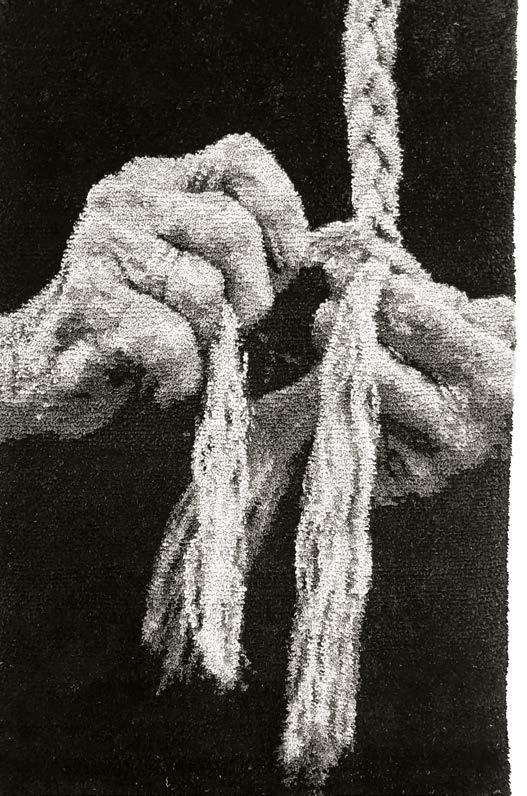
Newen , 2025. Mural tejido en telar mapuche con lana de oveja, técnica de nudo chilote. 110 × 170 cm. Retrato de manos de una mujer trenzando su cabello, asociado al newen (fuerza/poder).
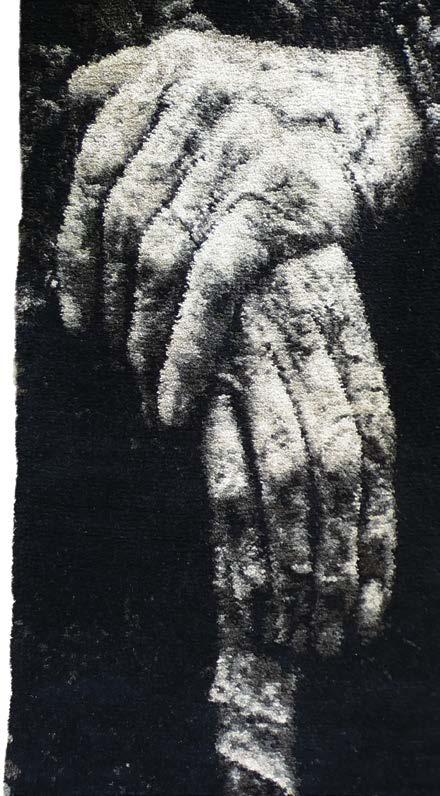
Manos que hablan , 2024. Mural tejido en telar mapuche con lana de oveja, técnica de nudo chilote. 115 × 240 cm. Retrato de las manos de una mujer sabia, matriarca vinculada a la Tierra.
También me interpela su condición de mujer indígena en un contexto atravesado por la colonialidad. Su imagen y su historia han sido muchas veces miradas desde fuera, interpretadas, clasificadas. Por eso, al trabajar su retrato, lo hago desde un lugar de mucho respeto, intentando no apropiarme, sino más bien abrir un espacio de presencia, de reconocimiento.
Siento que es importante recordarla no desde la idea de “fin”, sino desde la continuidad. Aunque fue considerada la última, su legado no termina en ella. Vive en la memoria, en los registros, en el territorio, y también en quienes hoy, desde distintos lenguajes, intentamos mantener esa conexión viva.
En tu obra el tejido permite, por una parte, construir un retrato de lo real, pero también cargarlo de una dimensión profundamente ancestral. ¿Cómo trabajas ese cruce entre representación y memoria en tu proceso? Para mí se trata de un espacio de encuentro. El punto de partida muchas veces es una imagen —un rostro, un registro— que podría situarse en lo “real”, en lo visible. Pero en el momento en que lo llevo al telar, esa imagen deja de ser solo representación. Se transforma en un proceso. El tejido introduce tiempo, repetición, cuerpo, respiración. Y en ese tránsito, la imagen empieza a cargarse de otras capas.
Trabajo desde un proceso muy consciente. Primero hay una traducción técnica —llevar la imagen a un lenguaje textil, pixelarla, entender cómo se va a construir hilo a hilo—, pero paralelamente ocurre algo más intuitivo. Mientras tejo, entro en un estado muy particular, donde la memoria no es solo histórica, sino también corporal y, para mí, espiritual.
Ahí es donde aparece ese cruce. No estoy buscando copiar un rostro, sino sostener una presencia. Y esa presencia se construye tanto desde la precisión técnica como desde la intención con la que cada hebra es puesta.
El textil tiene algo muy particular: no es inmediato. Obliga a habitar el tiempo. Y en ese tiempo empiezan a emerger otras cosas, emociones, pensamientos, incluso silencios, que también quedan inscritos en la obra. Por eso siento que mis piezas no sólo representan, sino que contienen.
Tus tejidos abren un espacio donde cuerpo y naturaleza se vinculan como formas de conexión y conocimiento. ¿Cómo entiendes esa dimensión del tejido entre corporalidad y entorno? Para mí, el tejido es un lenguaje profundamente corporal. No es algo que pase solo por la mente; pasa por las manos, por el ritmo del cuerpo, por la respiración. Hay una memoria que no es intelectual, sino física, y que se activa en el hacer. Cada gesto, tensar, anudar, entrelazar, va construyendo una forma de conocimiento que se aprende y se comprende desde el cuerpo.
Al mismo tiempo, ese cuerpo no está separado del entorno. Trabajo con materiales que vienen directamente de la naturaleza: lana, fibras, tintes. Hay un vínculo directo con el territorio, con los ciclos, con los tiempos de la materia. Entonces, cuando tejo, no solo estoy construyendo una obra, también estoy entrando en relación con ese origen.
Siento que el tejido funciona como un puente. Por un lado, está la corporalidad: la repetición del gesto, la cadencia, el estar presente. Por el otro, está la naturaleza: la materia viva que se transforma. Y en ese encuentro aparece un conocimiento que es distinto, más intuitivo, más relacional.
También hay algo en la estructura misma del tejido que refleja esto. Todo está conectado. No hay un hilo que exista de manera aislada, cada uno depende del otro para sostener la forma. Para mí, eso es muy similar a cómo entiendo la relación entre el ser humano y su entorno: como una red, como un sistema vivo.
am also moved by her condition as an Indigenous woman within a colonial context. Her image and story have often been viewed from the outside, interpreted and classified. That is why, when working with her portrait, I do so from a place of deep respect — not attempting appropriation, but rather opening a space for presence and recognition.
believe it is important to remember her not through the idea of an “ending,” but through continuity. Although she was considered the last, her legacy does not end with her. It lives on in memory, in recordings, in the territory, and also in those of us who, through different languages and practices, try to keep that connection alive.
In your work, weaving allows you, on one hand, to construct a portrait of reality, while also infusing it with a deeply ancestral dimension. How do you approach this intersection between representation and memory within your process?
For me, it is a space of encounter. The starting point is often an image — a face, an archival record — something that could belong to the realm of the “real,” the visible. But the moment I bring that image to the loom, it ceases to be mere representation. It becomes a process. Weaving introduces time, repetition, body, and breath. And through that transition, the image begins to absorb other layers.
work from a very conscious process. First there is a technical translation — bringing the image into a textile language, pixelating it, understanding how it will be built thread by thread — but alongside that, something more intuitive also takes place. While weaving, I enter a very particular state where memory is not only historical, but also bodily and, for me, spiritual.
That is where this intersection appears. I am not trying to reproduce a face, but to sustain a presence. And that presence is constructed both through technical precision and through the intention with which every strand is placed.
Textiles have something very particular: they are not immediate. They force you to inhabit time. And within that time, other things begin to emerge — emotions, thoughts, even silences — which also become embedded within the work. That is why feel my pieces do not simply represent; they contain.
Your weavings create a space where body and nature are linked as forms of connection and knowledge. How do you understand this dimension of weaving between corporeality and environment?
For me, weaving is a profoundly bodily language. It is not something that happens only in the mind; it passes through the hands, through the rhythm of the body, through breathing. There is a form of memory that is not intellectual but physical, and it is activated through making. Every gesture — tightening, knotting, intertwining — constructs a kind of knowledge that is learned and understood through the body.
At the same time, that body is not separate from its environment. I work with materials that come directly from nature: wool, fibers, natural dyes. There is a direct relationship with territory, with cycles, with the temporality of matter. So when weave, am not only constructing a work; I am entering into relation with that origin.
feel that weaving functions as a bridge. On one side is corporeality: the repetition of gesture, cadence, the act of being present. On the other is nature: living material in transformation. And within that encounter emerges a different kind of knowledge — more intuitive, more relational.
There is also something in the very structure of weaving that reflects this. Everything is connected. No thread exists in isolation; each depends on the others to sustain the form. For me, this is very similar to how understand the relationship between human beings and their environment: as a network, as a living system.
SUDÁFRICA | SOUTH AFRICA
PIERRE LOUIS
Por Julio Sapollnik. Crítico de Arte (Argentina)
Imágenes cortesía del artista.
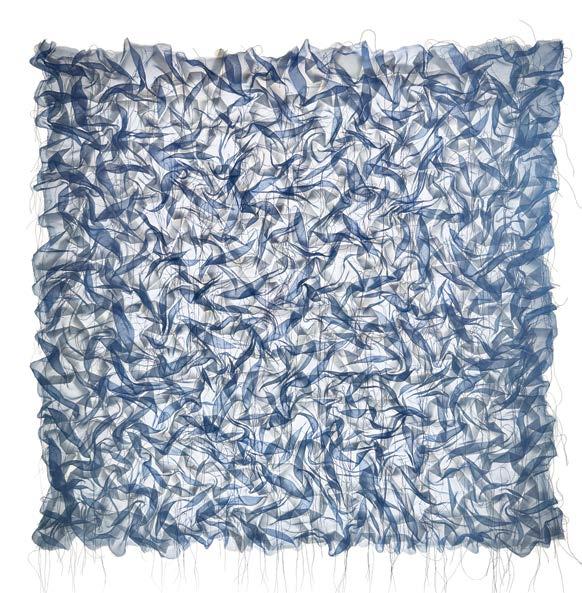
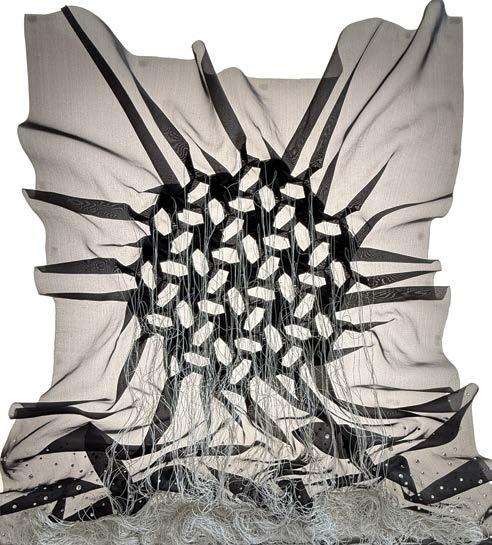
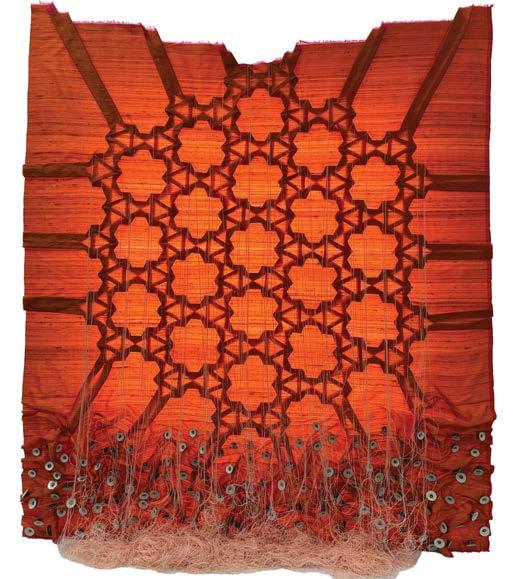
El susurro del mar, 2025. Seda salvaje, chifón, hilo y caja de luz ,110 x 110 x 16 cm. Fotografía: Pierre Louis Geldenhuys.
La teselación de la seda The Tessellation of Silk
c ontemplar las obras de Pierre Louis Geldenhuys (Johannesburg, Sudáfrica, 1971) provoca una emoción intransferible: nuevas imágenes que, en rigor, antes no existían. Hay en su trabajo una primera vez permanente, una experiencia que desborda la mera percepción para instalarse dentro del territorio de lo revelado. Hay allí una forma de aparición que no responde únicamente a la invención formal, sino a una sensibilidad que reorganiza lo visible desde un principio silencioso: la búsqueda de una belleza que no es ornamento, sino sensibilidad y pensamiento.
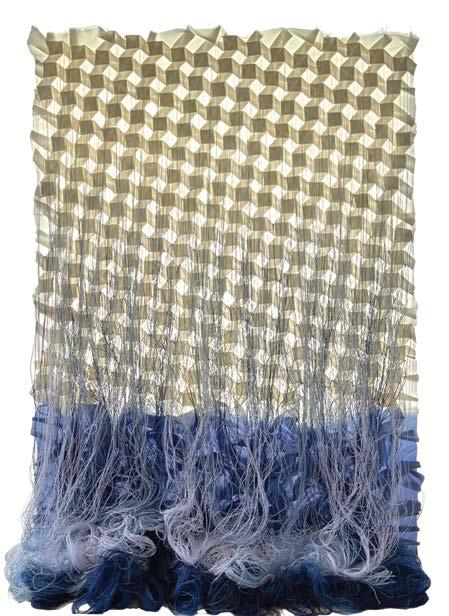
Su práctica se inscribe, en apariencia, dentro de una estructura compositiva heredada del arte islámico: la teselación. Este principio —un patrón que cubre una superficie sin interrupciones— ha sido históricamente una manifestación de lo infinito a través de lo finito. En los mosaicos de la arquitectura árabe, la repetición no es redundancia, sino expansión: cada módulo contiene la promesa del todo.
Sin embargo, Pierre Louis introduce una torsión decisiva. Su noción de teselación de la seda desplaza la lógica geométrica hacia un campo sensorial y orgánico. Si la teselación clásica responde a una matemática del encaje perfecto, la seda introduce una variable blanda, casi viva. La repetición ya no es rígida, sino flexible; no se impone, sino que fluye.
La seda —producida por el gusano a partir de la fibroína y la sericina— no solo aporta una materialidad específica, sino también poética: la del pliegue, la continuidad, la suavidad. Gilles Deleuze, en su lectura del barroco, afirmaba que “el pliegue no cesa de desplegarse”, sugiriendo que la forma nunca está cerrada, sino en perpetua transformación. En Pierre Louis, cada módulo parece plegarse en el siguiente, disolviendo los límites entre figura y fondo.
La teselación de la seda genera así una estructura continua que no abruma, sino que acoge. El espectador no se sitúa frente a un sistema cerrado, sino que se desliza en él. Byung-Chul Han ha señalado que la estética contemporánea necesita recuperar la experiencia de lo contemplativo frente a la saturación de estímulos: “La belleza es demora, no impacto”. En este sentido, las obras de Pierre Louis proponen una mirada que habita, más que una que consume.
También resuena aquí el pensamiento de Etel Adnan, quien entendía la pintura como una extensión del mundo interior en diálogo con el paisaje: “El color es un pensamiento que se vuelve visible”. La paleta de Pierre Louis, nacida de la referencia a la seda, parece operar precisamente en ese umbral donde la materia deviene pensamiento. En un tiempo atravesado por la urgencia ecológica, su trabajo puede leerse también como una toma de posición. No desde la denuncia explícita, sino desde una afirmación: la posibilidad de imaginar el mundo como un sistema aún habitable.
Desde otra perspectiva, el cineasta Abbas Kiarostami sostenía que “la realidad no se revela de golpe, sino en fragmentos que el espectador debe unir”. La obra de Pierre Louis funciona de manera análoga: cada fragmento es autónomo, pero su sentido emerge en la continuidad, en la forma en que se enlaza con los otros.
contemplating the works of Pierre Louis Geldenhuys (Johannesburg, South Africa, 1971) provokes an intransferable emotion: new images that, strictly speaking, did not exist before. There is in his work a sense of perpetual first time, an experience that exceeds mere perception to settle within the realm of the revealed. What emerges is a form of appearance that does not respond solely to formal invention, but to a sensibility that reorganizes the visible from a silent principle: the search for a beauty that is not ornament, but sensibility and thought.
His practice appears, at first glance, to be inscribed within a compositional structure inherited from Islamic art: tessellation. This principle—a pattern that covers a surface without interruption—has historically been a manifestation of the infinite through the finite. In the mosaics of Arabic architecture, repetition is not redundancy, but expansion: each module contains the promise of the whole.
However, Pierre Louis introduces a decisive inflection. His notion of the tessellation of silk shifts geometric logic toward a sensory and organic field. If classical tessellation responds to a mathematics of perfect fit, silk introduces a soft, almost living variable. Repetition is no longer rigid, but flexible; it does not impose itself, but flows.
Silk—produced by the silkworm from fibroin and sericin—contributes not only a specific materiality, but also a poetics: that of the fold, continuity, and softness. Gilles Deleuze, in his reading of the Baroque, asserted that “the fold does not cease to unfold,” suggesting that form is never closed, but in perpetual transformation. In Pierre Louis’s work, each module seems to fold into the next, dissolving the boundaries between figure and ground.
The tessellation of silk thus generates a continuous structure that does not overwhelm, but rather receives. The viewer does not stand before a closed system, but slides into it. Byung-Chul Han has noted that contemporary aesthetics must recover the experience of the contemplative in the face of the saturation of stimuli: “Beauty is delay, not impact.” In this sense, Pierre Louis’s works propose a gaze that inhabits rather than consumes.
The thought of Etel Adnan also resonates here, as she understood painting as an extension of the inner world in dialogue with landscape: “Color is a thought that becomes visible.” Pierre Louis’s palette, born from the reference to silk, seems to operate precisely at that threshold where matter becomes thought. In a time marked by ecological urgency, his work may also be read as a form of positioning—not through explicit denunciation, but through affirmation: the possibility of imagining the world as a still habitable system.
From another perspective, the filmmaker Abbas Kiarostami maintained that “reality is not revealed all at once, but in fragments that the viewer must assemble.” Pierre Louis’s work functions in an analogous way: each fragment is autonomous, yet its meaning emerges in continuity, in the way it connects with others.
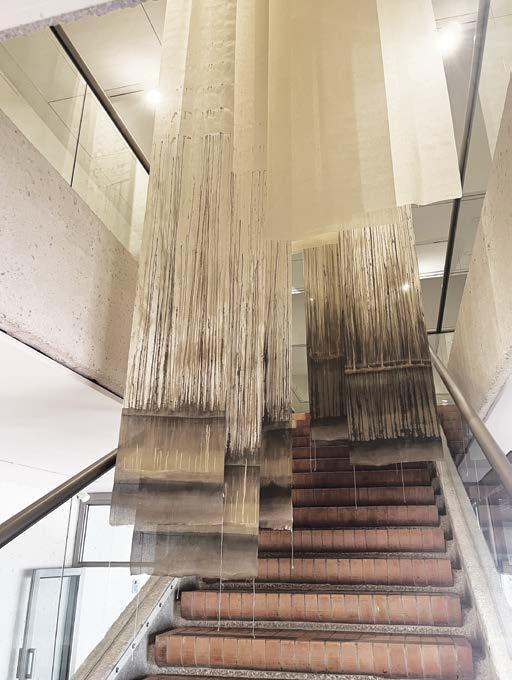
Escalera
Fotografía: Pierre Louis Geldenhuys.
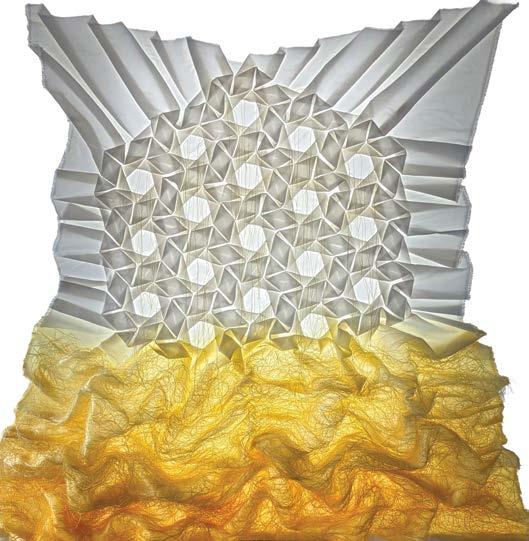
Amanecer en Springerbaai, 2025. Seda salvaje, tinte, hilo y caja de luz, 115 x 115 x 16 cm. Fotografía: Pierre Louis Geldenhuys.
La Oscuridad del Desierto 2023. Organza de seda, hilo, cristales, caja de luz, 95 x 85 cm. Fotografía: Pierre Louis Geldenhuys.
En esta confluencia entre arte, naturaleza y pensamiento, la obra se vuelve metáfora de sistemas complejos. No hay jerarquías evidentes, sino una red de relaciones donde lo múltiple se organiza sin perder su diversidad. Esta lógica puede leerse también en clave social: una estructura donde las diferencias no se anulan, sino que encuentran modos de coexistencia.
Pierre Louis Geldenhuys, artista sudafricano radicado en España, inscribe su práctica en un circuito transnacional que comunica su obra. La publicación de su trabajo en una revista de arte chilena, acompañada por la escritura de un crítico argentino, no es un dato menor: señala una circulación donde la identidad se construye en tránsito, como una teselación cultural.
Vida y creación se funden así en una misma superficie continua. La obra no es un objeto aislado, sino un campo de relaciones donde confluyen tradición, materialidad y pensamiento contemporáneo. La teselación de la seda no es solo una técnica o un concepto, es una forma de imaginar el mundo como un tejido suave, donde el orden no oprime y la repetición no limita, sino que abre.
En tiempos marcados por la rigidez de los sistemas y la fragmentación de la experiencia, la propuesta de Pierre Louis ofrece una alternativa: pensar la estructura desde la fluidez, la forma desde el tacto y la repetición desde la diferencia. Un arte que no impone su lógica, sino que la deja emerger, como la seda, en su propia continuidad.
Las piezas, alojadas en dispositivos lumínicos, adquieren una dimensión adicional. La iluminación no solo revela, sino que construye: intensifica transparencias, sugiere profundidades, multiplica las capas. En ese cruce entre geometría, desplazamiento y luz, el espacio parece expandirse más allá de sus límites físicos, evocando una idea de infinitud contenida.
Este interés por la fluidez material encuentra otra vía en el uso de compuestos industriales en estado primario, como la fibra de vidrio. Lo rígido se vuelve maleable, y lo técnico, casi orgánico. Las formas que emergen de este proceso ocupan el espacio con una presencia que remite a lo escultórico, desafiando las categorías tradicionales del arte textil.
En paralelo, la incorporación de largos filamentos introduce una dimensión gestual. Estas hebras no solo atraviesan la superficie, sino que se proyectan hacia el entorno: caen, se agrupan, se suspenden. Hay en ese despliegue una energía latente, como si la obra no estuviera completamente fijada, sino en un estado de devenir constante. Las imágenes se tensan, se enlazan y se prolongan más allá del plano, activando la percepción del espectador.
Así, la llamada teselación de la seda puede entenderse como algo más que un procedimiento formal. Es una manera de concebir el mundo como entramado: un sistema donde cada elemento encuentra su lugar sin perder su singularidad. En esa lógica, el arte se vuelve una metáfora de coexistencia, una invitación a imaginar estructuras donde la complejidad no derive en caos, sosteniéndose en armonía.
En última instancia, la obra de Pierre Louis propone una experiencia que desborda lo visual. Es, ante todo, una práctica de atención, una forma de mirar y de pensar en la que el orden no se impone y se despliega con la suavidad de una búsqueda de una manera singular de existir.
In this confluence of art, nature, and thought, the work becomes a metaphor for complex systems. There are no evident hierarchies, but rather a network of relations in which multiplicity is organized without losing its diversity. This logic can also be read in social terms: a structure where differences are not erased, but find ways to coexist.
Pierre Louis Geldenhuys, a South African artist based in Spain, situates his practice within a transnational circuit that communicates his work. The publication of his work in a Chilean art magazine, accompanied by the writing of an Argentine critic, is not insignificant: it signals a circulation in which identity is constructed in transit, like a cultural tessellation.
Life and creation thus merge into a single continuous surface. The work is not an isolated object, but a field of relations where tradition, materiality, and contemporary thought converge. The tessellation of silk is not only a technique or a concept; it is a way of imagining the world as a soft fabric, where order does not oppress and repetition does not limit, but opens.
In times marked by the rigidity of systems and the fragmentation of experience, Pierre Louis’s proposal offers an alternative: to think structure through fluidity, form through touch, and repetition through difference. An art that does not impose its logic, but allows it to emerge, like silk, in its own continuity.
The pieces, housed within light-based devices, acquire an additional dimension. Illumination does not merely reveal, but constructs: it intensifies transparencies, suggests depths, multiplies layers. In this intersection of geometry, displacement, and light, space seems to expand beyond its physical limits, evoking a sense of contained infinity.
This interest in material fluidity finds another path in the use of industrial compounds in their primary state, such as fiberglass. The rigid becomes malleable, and the technical almost organic. The forms that emerge from this process occupy space with a presence that evokes the sculptural, challenging traditional categories of textile art.
In parallel, the incorporation of long filaments introduces a gestural dimension. These threads do not merely traverse the surface, but project into the surrounding space: they fall, cluster, and suspend themselves. There is in this deployment a latent energy, as if the work were not fully fixed, but in a state of constant becoming. Images are stretched, linked, and extended beyond the plane, activating the viewer’s perception.
Thus, the so-called tessellation of silk can be understood as more than a formal procedure. It is a way of conceiving the world as an interwoven structure: a system in which each element finds its place without losing its singularity. Within this logic, art becomes a metaphor for coexistence, an invitation to imagine structures where complexity does not devolve into chaos, but sustains itself in harmony.
Ultimately, Pierre Louis’s work proposes an experience that exceeds the visual. It is, above all, a practice of attention, a way of seeing and thinking in which order is not imposed, but unfolds with the softness of a search for a singular way of being.
La guerra de los botones 2024. Seda tornasolada, hilo, botones esmaltados y caja de luz, 110 x 110 x 16 cm. Fotografía: Pierre Louis Geldenhuys.
COLOMBIA | COLOMBIA
GLORIA HERAZO
Por Pedro Pablo Bustos. Historiador del Arte (Chile) Imágenes cortesía de la artista.
Representada por Adrián Ibáñez Galería.
Entre-medios
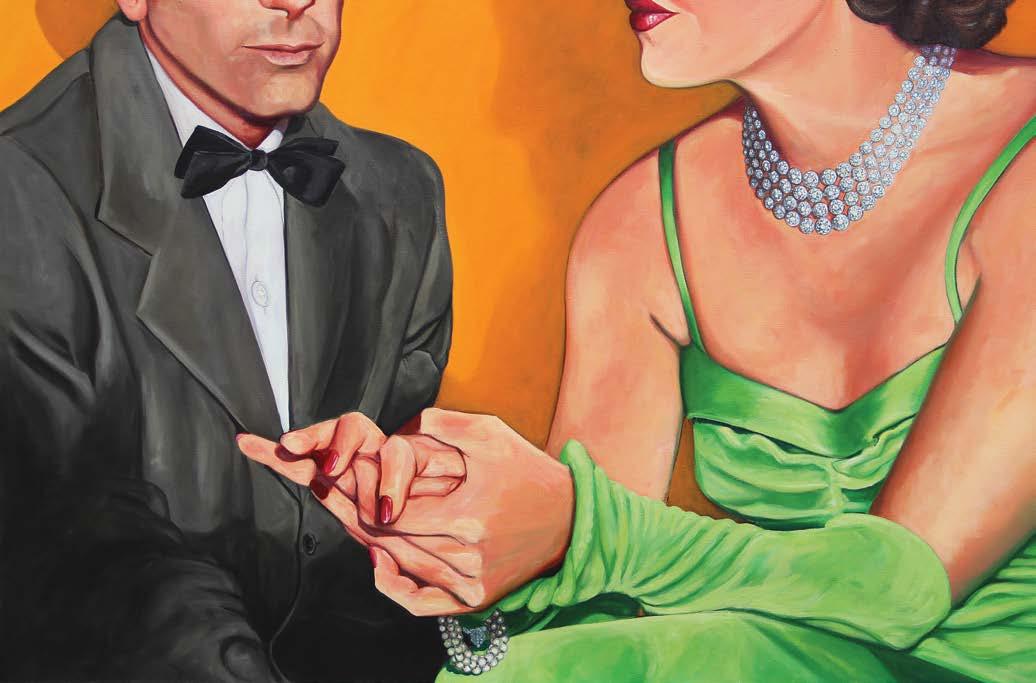
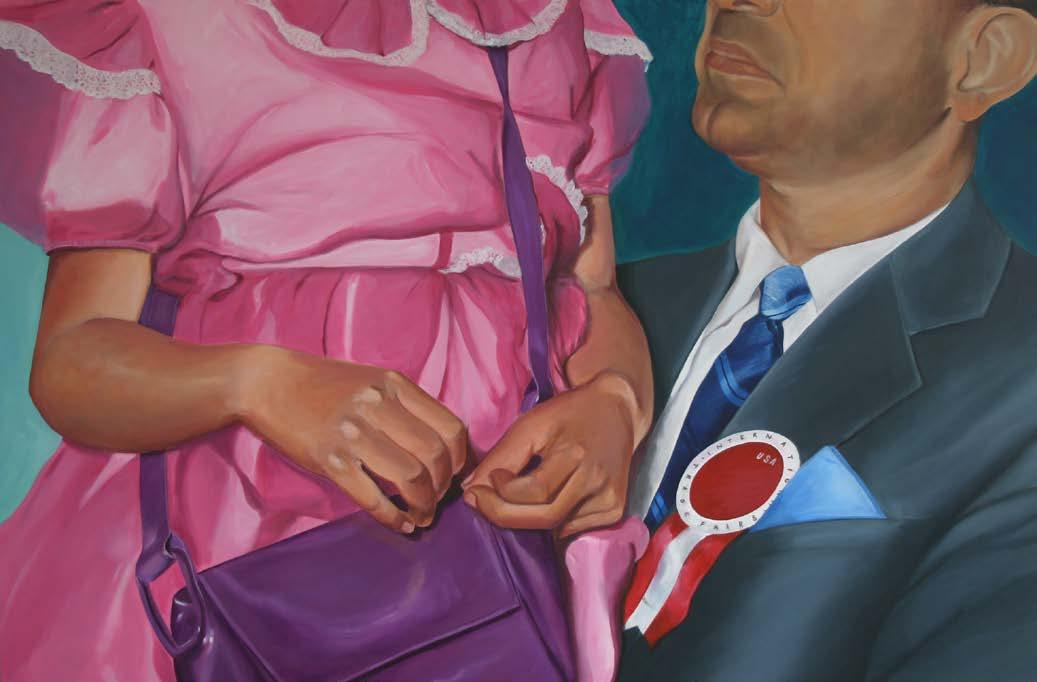
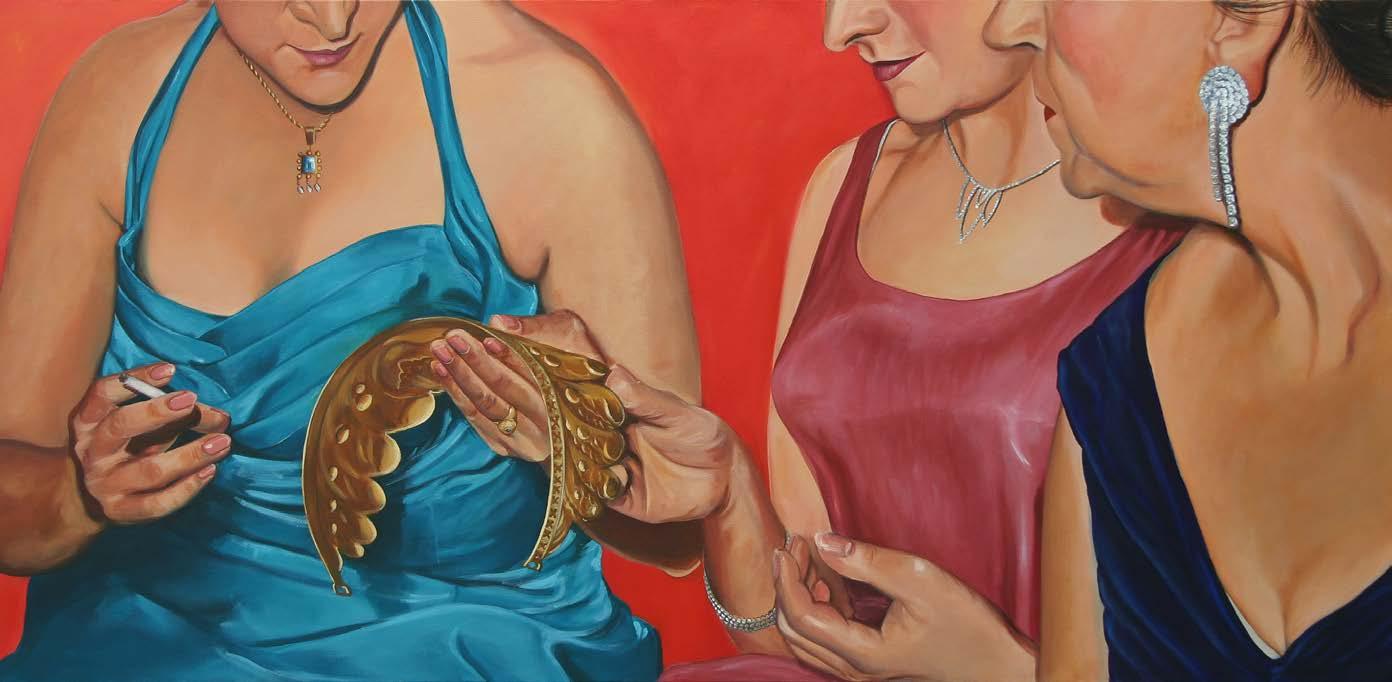
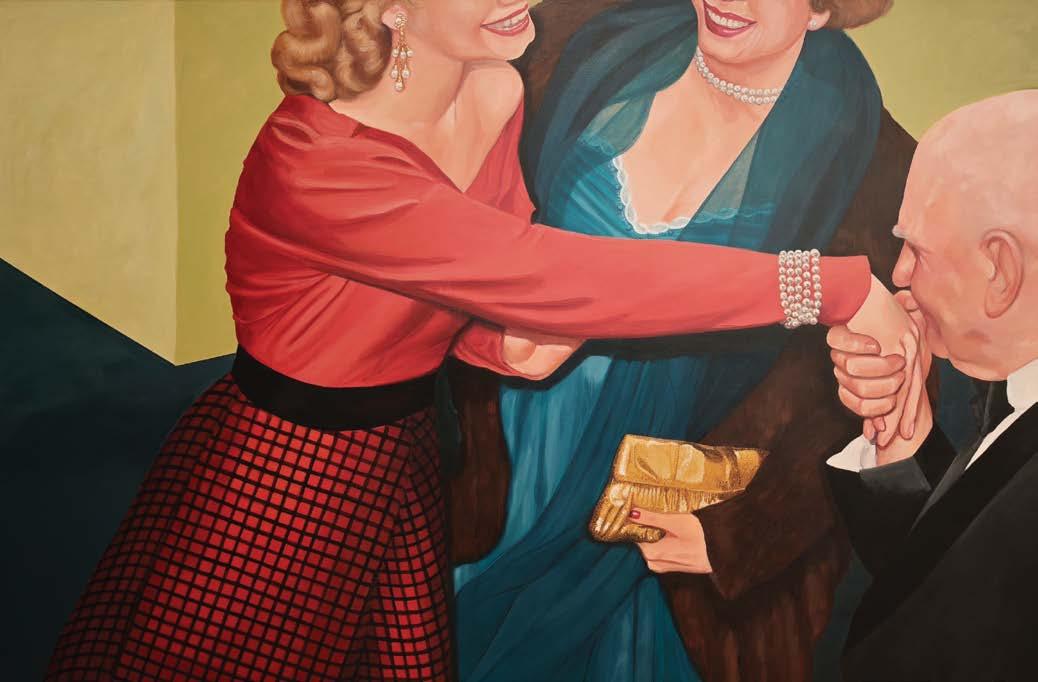
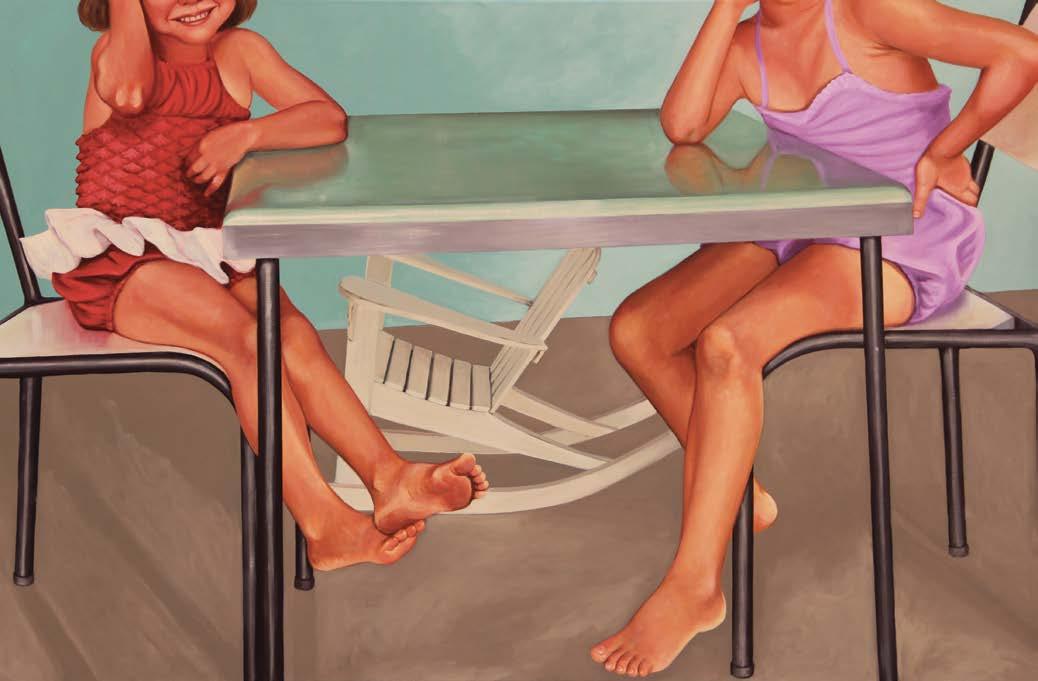
loria Herazo (1973, Bogotá, Colombia) sitúa a la mujer —como sujeto histórico, social, económico, político, simbólico, funcional y artístico— en el núcleo desde el cual emerge la fuerza de su trabajo. Desde allí, despliega una operación de deconstrucción que le permite construir imágenes que bucean en la historia de la representación femenina a lo largo de los siglos. A través de pinturas, bordados y collages realizados a partir de dispositivos industriales como la fotografía y la revista, su obra tensiona las formas en que las imágenes han modelado la experiencia de lo femenino.
Tanto en la fotografía como en el collage y el bordado se aplican cortes que atestiguan las cabezas ausentes de los retratos pintados por la artista. El rostro —marca de una identidad singular; sonríen las máscaras— es despojado del cuerpo, desplazándose hacia un territorio de indiferenciación. Sin embargo, permanecen los restos: los gestos, las vestimentas, los fragmentos que actúan como testigos de regímenes biológicos y culturales vigorosamente codificados y controlados. En pintura, el efecto del corte consiste precisamente en sugerir aquello que queda fuera del cuadro, recurso ampliamente practicado por los artistas barrocos en sus composiciones abiertas.
De este modo, la obra remite a sistemas de representación visual en los cuales lo personal es también político, lo privado se vuelve público y lo doméstico adquiere una dimensión sistémica. Así lo ha planteado el pensamiento feminista al discernir y denunciar la opresión de la cultura patriarcal y su diseño de lo femenino como pieza clave dentro de un sistema sociocultural organizado en favor de las funciones dominantes de lo masculino.
In-Between Media
gloria Herazo (1973, Bogotá, Colombia) places women—as historical, social, economic, political, symbolic, functional, and artistic subjects—at the core from which the strength of her work emerges. From this center, she deploys a deconstructive operation that allows her to build images delving into the history of female representation across the centuries. Through paintings, embroideries, and collages created from industrial mediums such as photography and magazines, her work explores the tension in how images have shaped the feminine experience.
In photography, as well as in collage and embroidery, decisive cuts bear witness to the absent heads of the portraits painted by the artist. The face—the mark of a singular identity; masks smile—is stripped from the body, displaced toward a territory of undifferentiation. However, the remnants persist: the gestures, the garments, the fragments that act as witnesses to vigorously codified and controlled biological and cultural regimes. In painting, the effect of the cut consists precisely in suggesting that which remains outside the frame, a resource widely practiced by Baroque artists in their open compositions.
In this way, the work references systems of visual representation in which the personal is also political, the private becomes public, and the domestic acquires a systemic dimension. This has been articulated by feminist thought when discerning and denouncing the oppression of patriarchal culture and its design of the feminine as a key piece within a sociocultural system organized in favor of the dominant functions of the masculine.
Esto lo ejemplifica la filósofa italiana Adriana Cavarero al comentar la pintura Santa Ana, la Virgen y el Niño de Leonardo da Vinci. La autora destaca las líneas inclinadas y oblicuas de la composición, en las que reconoce una mirada relacional de la maternidad, cercana a lo cotidiano y distante de la monumentalidad piramidal de la representación tradicional de lo sagrado. Lo materno aparece así ligado al cuidado del otro, trazado mediante líneas oblicuas, nunca verticales, con las luces y sombras que estas proyectan. En este sentido, Cavarero evoca también a Medea para pensar una tradición iconográfica de la vulnerabilidad y de la responsabilidad frente a ella.
El siguiente elemento que pondero son las alusiones de Gloria a la estética de los años cincuenta, un periodo clave de la posguerra marcado por una fuerte reactivación económica tras la destrucción y la crisis. En el contexto de la Guerra Fría se consolida una sociedad de consumo, definida por el bienestar material y la promesa de prosperidad, tal como evidencian los eslóganes “You’ve never had it so good” en Inglaterra y el “American Way of Life” en Estados Unidos. En este contexto se desarrolla con fuerza la publicidad —especialmente televisiva—, consolidando la idea de una sociedad de consumo en Estados Unidos y expandiéndola globalmente a través del cine, la música y las revistas. Paralelamente, la Unión Soviética experimenta un auge industrial y económico que culmina en el lanzamiento del Sputnik 1 en 1957, dando inicio a la era espacial. En la misma década emerge la contracultura beatnik, que cuestiona el modelo de sociedad consumista y conservadora, a la que se suma la Revolución Cubana de 1959 como una potente reacción a la hegemonía estadounidense en Latinoamérica. Los años sesenta —también referidos por la artista— prolongan y tensionan las configuraciones de la década anterior, donde la prosperidad y los valores tradicionales entran en crisis, dando paso a progresismos que buscan reconfigurar la realidad sociocultural desde los ámbitos civil, político y religioso.
This is exemplified by the Italian philosopher Adriana Cavarero when commenting on Leonardo da Vinci’s painting The Virgin and Child with Saint Anne. The author highlights the slanted and oblique lines of the composition, in which she recognizes a relational gaze upon motherhood, close to the everyday and distant from the pyramidal monumentality of the traditional representation of the sacred. The maternal thus appears linked to the care of the other, traced through oblique—never vertical—lines, with the lights and shadows they project. In this sense, Cavarero also evokes Medea to reflect on an iconographic tradition of vulnerability and the responsibility toward it.
The next element I consider are Gloria’s allusions to the aesthetics of the nineteen-fifties, a key postwar period marked by strong economic reactivation following destruction and crisis. In the context of the Cold War, a consumer society consolidated itself, defined by material well-being and the promise of prosperity, as evidenced by slogans like “You’ve never had it so good” in England and the “American Way of Life” in the United States. Within this context, advertising—especially on television—developed forcefully, solidifying the idea of a consumer society in the United States and expanding it globally through cinema, music, and magazines. Concurrently, the Soviet Union experienced an industrial and economic boom culminating in the launch of Sputnik 1 in 1957, ushering in the space age. The same decade saw the emergence of the beatnik counterculture, which questioned the conservative and consumerist societal model, joined by the Cuban Revolution of 1959 as a powerful reaction to US hegemony in Latin America. The nineteen-sixties—also referenced by the artist—prolonged and strained the configurations of the previous decade, as prosperity and traditional values entered a crisis, giving way to progressive movements seeking to reconfigure sociocultural reality from civil, political, and religious spheres.
Lo mencionado en los párrafos anteriores —y probablemente mucho más de lo que esta lectura alcanza a registrar— se hace visible en las obras de Gloria en los distintos formatos que utiliza, a través de procesos de apropiación, intervención, edición y producción constantes, ejecutados con alta resolución técnica. En acrílico, lino, papel e hilo, su trabajo articula lo pensado, lo sentido, lo recordado, lo aprendido, lo ignorado y lo intuido, desplegando un realismo atento al detalle que invita a la interpretación, la imaginación, el goce y la reflexión de los públicos, entre los cuales me incluyo.
Con Gloria Herazo, las técnicas y formatos se contaminan e imitan como espejos, articulándose en una cadena de producción transdisciplinaria. De este cruce emergen pinturas con lógica de collage, collages pictóricos, bordados-collage y sus inversos, así como dibujos con hilos de seda, recientes en su trabajo, que prescinden del gesto punzante de la aguja y se desplazan hacia lo conceptual y lo abstracto, sin perder la delicadeza de su factura.
Un último elemento que subrayo en la poética de Gloria es el jardín, fuente de observación y conocimiento situado en los contornos de su hogar, donde se emplaza también su taller. Este espacio forma parte activa de su proceso creativo, el cual no se detiene con el cese del trabajo manual, sino que continúa en una creación permanente que ocurre en la mente y en el cuerpo, en una vida inseparable de los flujos del demiurgo. Por cierto, El jardín de las delicias (c. 1490–1500) de Jheronimus van Aken, El Bosco, es una obra que, según ha señalado Gloria, reviste un alto grado de relevancia —quizás el mayor— como tríptico que, desde su contexto, reflexiona sobre la condición humana. Por su fuerza, creatividad y manufactura, se ha vuelto una imagen arquetípica: fue, es y será, atravesando la catástrofe por la que toda pintura debe navegar, como plantea Gilles Deleuze, para desprenderse de los clichés, depurar su lenguaje y alcanzar una singularidad irrepetible, vibrante y deslumbrante.
What has been mentioned in the preceding paragraphs—and likely much more than this reading manages to record—becomes visible in Gloria’s works across the various formats she employs, through constant processes of appropriation, intervention, editing, and production, executed with high technical resolution. In acrylic, linen, paper, and thread, her work articulates what is thought, felt, remembered, learned, ignored, and intuited, deploying a detail-attentive realism that invites interpretation, imagination, enjoyment, and reflection from its audiences, among whom include myself.
With Gloria Herazo, techniques and formats contaminate and mimic one another like mirrors, articulating themselves in a transdisciplinary chain of production. From this intersection emerge paintings that operate with the logic of collage, painterly collages, embroidery-collages, and their inversions, as well as drawings made with silk threads—a recent addition to her work—that dispense with the piercing gesture of the needle and move toward the conceptual and the abstract, without losing the delicacy of their craftsmanship.
A final element I highlight in Gloria’s poetics is the garden, a source of observation and knowledge situated on the perimeter of her home, where her studio is also located. This space is an active part of her creative process, which does not stop when the manual work ceases, but continues as a permanent creation occurring in the mind and body, in a life inseparable from the flows of the demiurge. Incidentally, The Garden of Earthly Delights (c. 1490–1500) by Jheronimus van Aken, Bosch, is a work that, as Gloria has pointed out, holds a high degree of relevance—perhaps the greatest—as a triptych that, from its context, reflects upon the human condition. Due to its power, creativity, and craftsmanship, it has become an archetypal image: it was, is, and will be, traversing the catastrophe that every painting must navigate, as Gilles Deleuze proposes, in order to shed clichés, purify its language, and achieve an unrepeatable, vibrant, and dazzling singularity.
WARA CARDOZO VELÁSQUEZ
Por Lucía Rey Orrego. Académica e investigadora independiente (Chile) Imágenes cortesía de la artista.
Representada por Espacio de Cultura, Arte y Contemporaneidad Aplicada.
BOLIVIA | BOLIVIA
La trascendencia simbólica
de lo íntimo en lo residual
“Las palabras se vinculan a las cosas que señalan sólo por convención del lenguaje, pero los símbolos, a diferencia de las palabras, están íntimamente conectados a lo que significan”
Ch. Hallpike.
The
Symbolic Transcendence of Intimacy Within the Residual
“ Words are connected to the things they designate only through linguistic convention, whereas symbols, unlike words, are intimately linked to what they signify”
Ch. Hallpike.
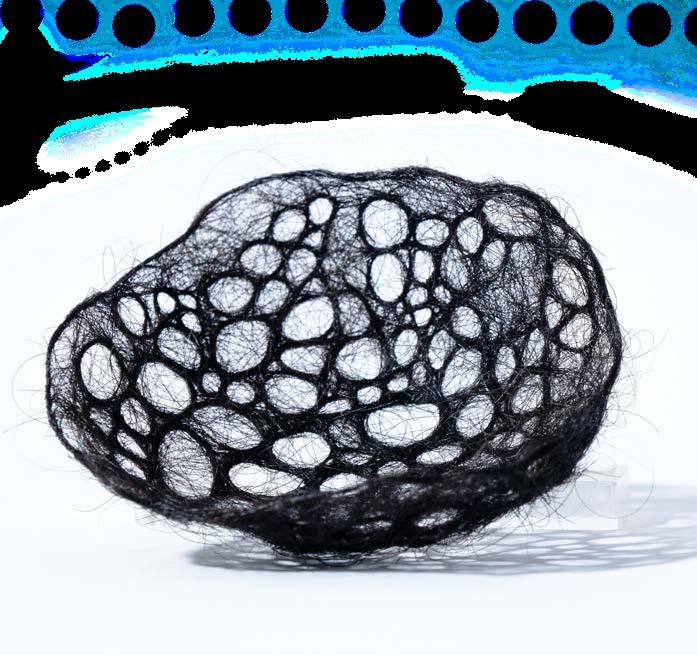
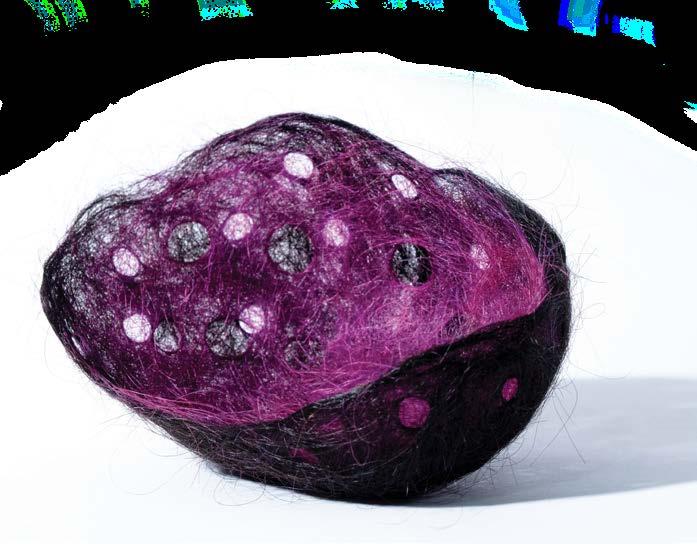
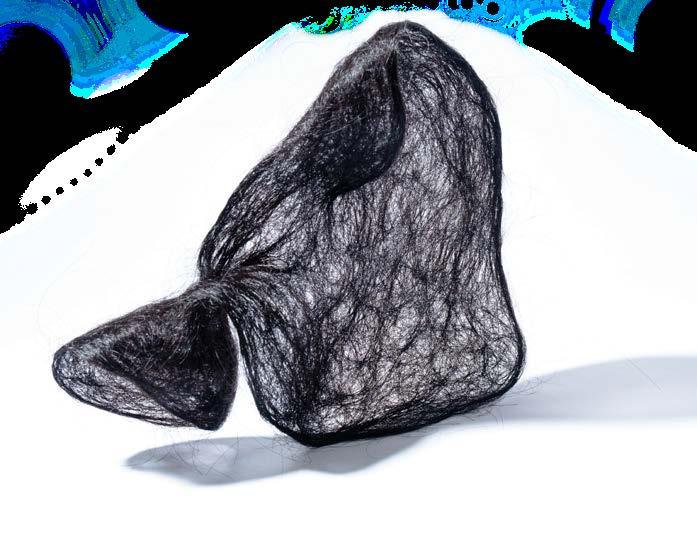
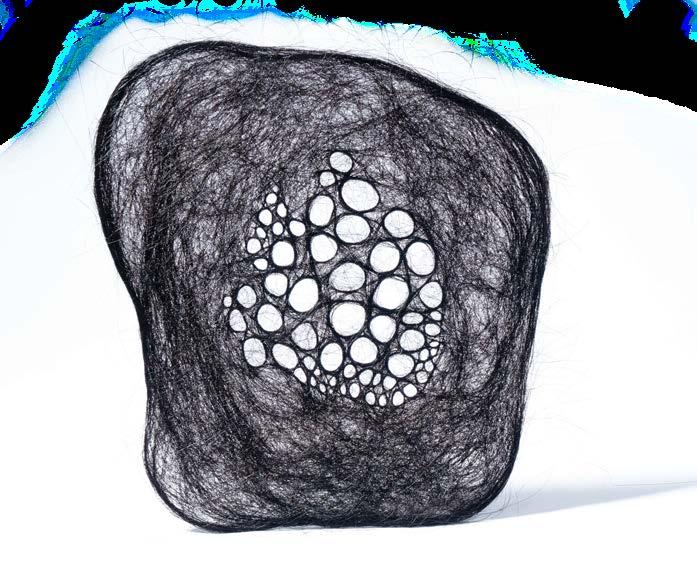
e stas obras de Wara Cardozo Velásquez (Bolivia) forman parte de la serie titulada Desde lo humano, expuesta en la Galería Manzana Uno, en Santa Cruz, la cual reúne 31 piezas en diversos formatos, como urnas de vidrio, cúpulas y composiciones en formato de cuadro. Su materialidad es cabello humano trabajado con aguja. El proceso creativo de la artista se sitúa en la temporalidad y la espacialidad propiciadas por la pandemia. Sin posibilidad de desplazamiento hacia el exterior, los cabellos que iban cayendo comenzaron a acumularse en su vivienda. En este contexto de encierro y de autoobservación “obligada”, la artista se enfrenta a su corporalidad residual, configurada por silenciosos y casi imperceptibles restos que también permanecen confinados, lo que implica una toma progresiva de conciencia respecto de su propio cabello ya desprendido del cuerpo, así como de sus múltiples significados y posibles formas.
Este encuentro con el deshecho propio la llevó a investigar sobre el uso histórico del cabello en distintas dimensiones y sentidos simbólicos para diversidad de territorios culturales. Así fue cómo comenzó a coleccionarlos, generando la que llamó Garabatos. Colecciones de Cuarentena , con los que experimentó materialmente, a la vez que investigaba su trayectoria simbólica en libros. En esta dialéctica investigativa, la artista comienza a dar formas con una aguja, herramienta que le remitía emotivamente a las memorias de las abuelas, quienes con un utensilio tan sencillo y mínimo lograban gestionar recursos para la sobrevivencia de manera independiente.
t hese works by Wara Cardozo Velásquez belong to the series Desde lo humano exhibited at Galería Manzana Uno, bringing together thirty-one pieces in different formats, including glass urns, domes, and framed compositions. Their materiality is human hair worked with a needle. The artist’s creative process emerged within the temporality and spatial conditions imposed by the pandemic. Unable to move beyond the confines of her home, the hairs that gradually fell began to accumulate in her living space. Within this atmosphere of enclosure and enforced self-observation, the artist confronted her own residual corporeality, composed of silent and almost imperceptible remains that also persisted in confinement. This led to a gradual awareness of her own hair once detached from the body, together with its multiple meanings and possible forms.
This encounter with her own discarded matter led her to investigate the historical uses of hair across different cultural territories and symbolic systems. In this process, she began collecting it, producing what she called Garabatos. Colecciones de Cuarentena , through which she experimented materially while simultaneously researching its symbolic trajectory in books. Within this investigative dialectic, the artist started shaping forms with a needle, a tool that emotionally evoked memories of grandmothers who, with such a simple and minimal utensil, were able to create means of survival independently.
De esta manera, la artista comienza a superponer capas de cabello, perfilando los costados y generando formas escultóricas, a la vez que recibe donaciones de cabellos. Este proceso la lleva a profundizar en el sentido de hilar cabellos propios —portadores de información tan íntima e invisible como el ADN— con los de otras personas. En esa trama, las formas se articulan como un tercer elemento colectivo, un material simbólico del inconsciente que emerge como un acto fallido. Aunque trabajados escultóricamente, estos cabellos evocan una presencia ambigua, entre lo que está y no está, en una oscilación que remite a la noción de éter como sostén de estos filamentos humanos. Su condición despierta, en algunos espectadores, una reticencia asociada a imaginarios de lo mortuorio o lo brujeril.
Estas figuras orgánicas, que pueden corresponder a micro o macro espectralidades, abren un horizonte simbólico vinculado a una memoria persistente que atraviesa siglos y que impregna la materialidad de una extrañeza estética (das Unheimliche), reforzada por el trabajo minucioso con la aguja y su inevitable pinchazo. Pelo, herida y posible sangre emergen así en la imaginación como parte de una dimensión ritual de las obras, que condujo a la artista a una atención sostenida en las figuraciones que se iban configurando en su devenir escultórico. Esta concentración, afinada en la persistencia de la hebra capilar, fue derivando en un estado otro de la consciencia, cercano a una modulación casi trance de la forma. Entre poiesis y téchne se abre un espacio intermitente en el que la práctica puede volverse receptiva, habilitando la emergencia de asociaciones que atraviesan la memoria, la vitalidad de la materia y sus zonas de indeterminación.
Una de sus obras destacables es Origen, una pieza mortuoria realizada con el cabello de su padre al mes de su fallecimiento, cuyo contenido sensible puede ser comprendido tanto como un homenaje, un acto sanador y también una magia para su materializar su trascendencia.
In this way, the artist began layering strands of hair, defining contours and generating sculptural forms, while also receiving donations of hair from others. This process led her to deepen her reflection on the act of intertwining her own hair — carrying information as intimate and invisible as DNA — with that of other people. Within this woven structure, the forms emerge as a third collective element, a symbolic material of the unconscious appearing almost like a Freudian slip. Although sculpturally constructed, these strands evoke an ambiguous presence, oscillating between what is there and what is absent, recalling the notion of ether as a support for these human filaments. Their condition awakens, in some viewers, a sense of unease associated with imaginaries of death, magic, or witchcraft.
These organic figures, which may suggest either micro or macro spectralities, open a symbolic horizon linked to a persistent organic memory that traverses centuries, impregnating the material with an uncanny aesthetic strangeness (das Unheimliche), reinforced by the meticulous work of the needle and its inevitable puncture. Hair, wound, and the possibility of blood emerge in the imagination as part of a ritual dimension within the works, leading the artist toward a sustained attention to the figurations gradually taking shape through their sculptural becoming. This concentration, sharpened through the persistence of the hair filament, slowly evolved into an altered state of consciousness, close to a trance-like modulation of form. Between poiesis and techne, an intermittent space opens in which the practice becomes receptive, allowing associations tied to memory, the vitality of matter, and its zones of indeterminacy to emerge.
One of her most significant works is Origen a funerary piece created with her father’s hair in the month following his passing, whose emotional content can be understood simultaneously as homage, healing gesture, and an act of materializing transcendence.
Junto a esta, hay otras obras en donde trabaja a partir de la mezcla de cabellos donados por diferentes personas, construyendo figuraciones orgánicas que, por las características del pelo en sí, logran sostenerse volumétricamente y otras que penden precisamente de uno o dos de los mismos filamentos.
El cabello está asociado a múltiples significados: forma parte de la cotidianeidad, pero también porta una información íntima que, al volverse “demasiado íntima”, activa una distancia reticente en el espectador. En ese umbral, las obras ingresan en el juego simbólico del Das Unheimliche freudiano, donde se cruzan diversas lecturas culturales del cabello, especialmente cuando se encuentra separado del cuerpo vivo. A diferencia de su uso funcional, por ejemplo en una peluca, aquí su extrañamiento se intensifica al ser trabajado escultóricamente, mediante un proceso que implica pinchazos y pequeñas heridas en la persistencia de la costura. Esta no funcionalidad de su modulación desplaza la mirada hacia zonas no literalizables de la imagen, difusas u oscuras, que conectan desde lo inconsciente con una vitalidad de otra dimensión, frecuentemente asociada a imaginarios mágicos o brujeriles, lo que explica que el cabello cortado o caído tienda a ocultarse.
En este contexto, la donación de cabellos introduce una lectura doble: puede tratarse de gestos sin carga simbólica en un marco de postsecularización de creencias supersticiosas, o bien de una entrega intencionada de sentido a una artista percibida como capaz de transformar la realidad, donde el donante busca una forma de trascendencia. Ambas lecturas pueden coexistir, y en su conjunto refuerzan la pregunta sobre el origen de esos cabellos, dotando a las obras de un misterio que activa la reflexión sobre el otro como presencia anónima y a la vez persistente.
Alongside this work are others composed from mixtures of donated hair from different individuals, constructing organic figurations that, because of the properties of hair itself, sometimes sustain volumetric structures while others hang delicately from one or two filaments alone.
Hair is associated with multiple meanings: it belongs to everyday life, yet it also carries intimate information that, when becoming “too intimate,” activates a sense of reticence in the viewer. At this threshold, the works enter the symbolic field of Freud’s Das Unheimliche, where diverse cultural readings of hair intersect, especially when separated from the living body. Unlike its functional use, for example in a wig, its estrangement intensifies here through sculptural manipulation, in a process involving punctures and small wounds generated by the persistence of stitching. This non-functional modulation shifts the gaze toward diffuse and non-literalizable zones of the image, connecting from the unconscious to a vitality belonging to another dimension, frequently associated with magical or witch-like imaginaries, which may explain why cut or fallen hair tends to be hidden away.
Within this context, the donation of hair introduces a double reading: it may function as a gesture devoid of symbolic charge within a post-secularized framework where superstitious beliefs have weakened, or as an intentional transfer of meaning toward an artist perceived as capable of transforming reality, where the donor seeks a form of transcendence. Both readings can coexist, ultimately reinforcing the question surrounding the origin of these strands of hair, endowing the works with a mystery that activates reflection on the other as both anonymous and persistently present.
Orgánica 2023. Pieza suspendida de dos filamentos de cabello, 25 × 25 cm. Fotografía: Andrés Zúñiga.
CHILE | CHILE
ANA BLANCHARD
Por Vania Oyarzún López. Periodista (Chile) Imágenes cortesía de la artista.
Representada por Judas Galería.
El pulso invisible de lo orgánico The Invisible Pulse of the Organic
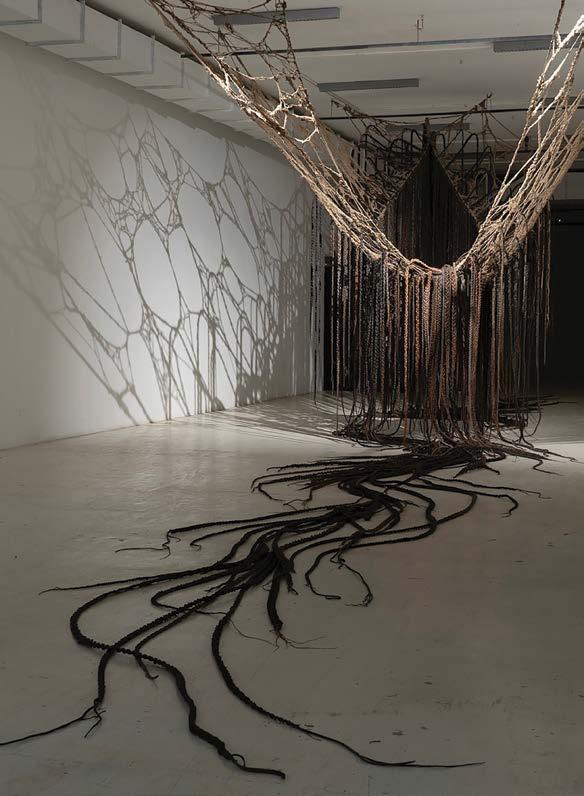
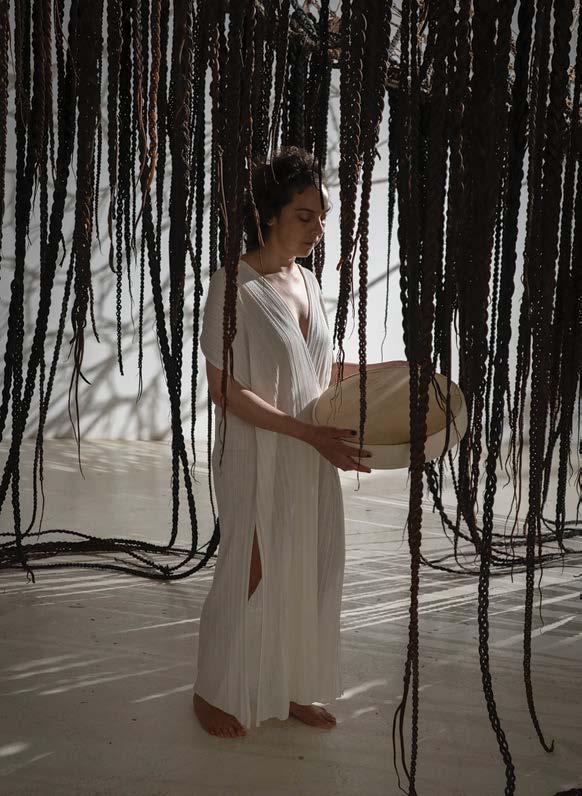
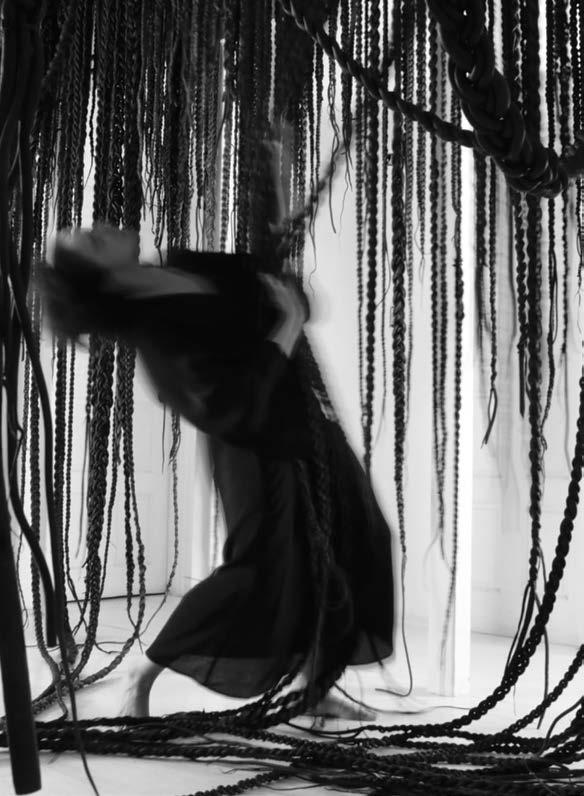
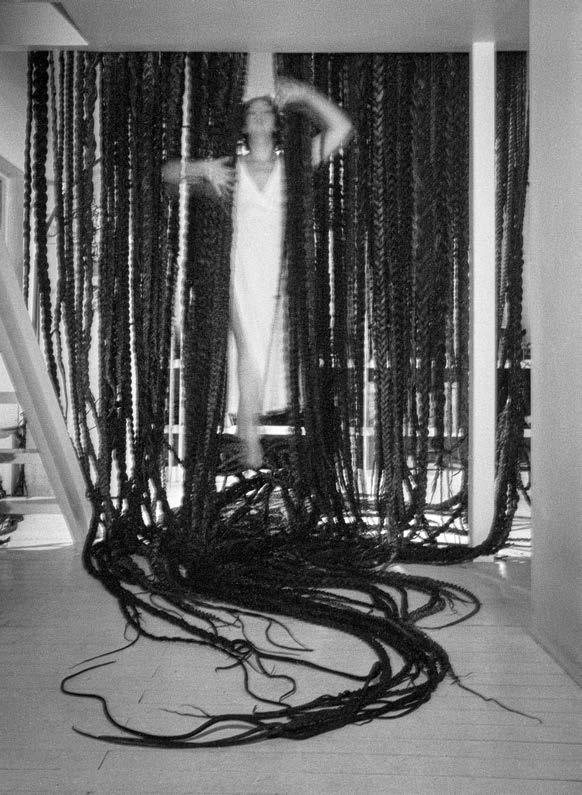
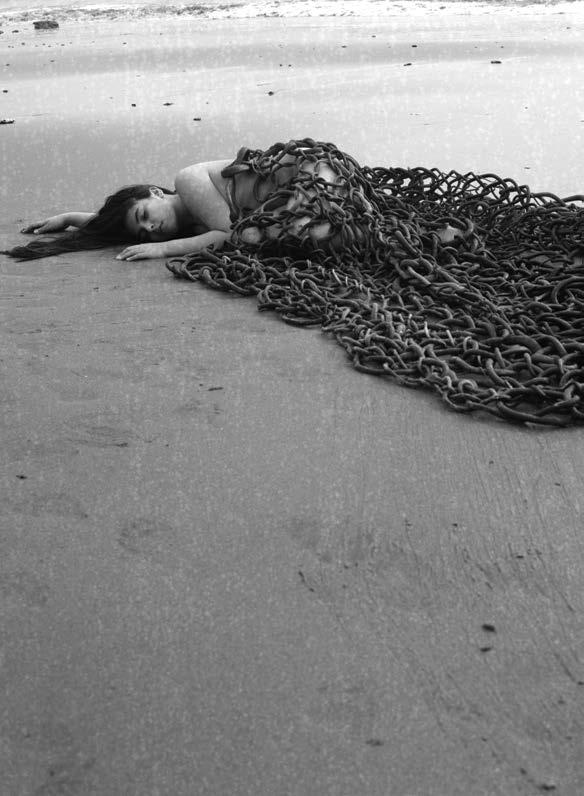
l a obra de Ana Blanchard se sitúa en un umbral donde paisaje y cuerpo se reconocen como una misma materia sensible. Matriz Marina nace de la exploración material, corporal y simbólica del cochayuyo varado en el borde costero, y se transforma en materia viva de territorio y memoria. Recolectado como vestigio desplazado por las mareas, este cuerpo marino conserva huellas de desgaste, tránsito y permanencia, activando vínculos entre paisaje, origen e identidad. La práctica de la artista se despliega así como una serie de acciones donde la materia y cuerpo se entrelazan en una cartografía sensible del borde costero.
En esta instalación, así como en la performance Ecos en la piel, estas trenzas fueron activadas sonoramente mediante un sistema de transducción, amplificando las vibraciones y sonidos propios del cochayuyo. Este proceso permitió revelar una dimensión acústica oculta en la materia, haciendo audible su corporalidad, su textura y su memoria.
En tu trabajo, el paisaje parece devenir un espacio íntimo y meditativo. ¿Cómo se configura esta relación entre territorio y experiencia personal en Matriz Marina?
En Matriz Marina, el paisaje emerge como una extensión sensible del cuerpo y la memoria. El borde costero y sus restos configuran un territorio profundamente íntimo, ligado a experiencias tempranas y a una memoria corporal persistente. Desde una cercanía afectiva, el territorio deja de ser geografía para convertirse en un espacio de resonancia emocional, biográfica y simbólica.
El cochayuyo aparece como materia viva, cargada de memoria y desplazamiento. ¿Qué te llevó a elegir este elemento y qué resonancias encontraste en su tránsito entre mar y orilla?
El cochayuyo surge como una presencia inevitable, una materia profundamente ligada al territorio costero y a una memoria colectiva y personal. Su condición de cuerpo desplazado —arrancado del océano y depositado en la orilla— revela un tránsito constante entre profundidad y borde. En ese recorrido se articula una metáfora sobre desplazamiento, transformación y persistencia. Porta huellas del mar y del tiempo, convirtiéndose en una materia viva donde convergen paisaje, memoria y corporalidad.
El gesto de trenzar se presenta como una acción sostenida y casi ritual. ¿Cómo dialoga este proceso manual con lo biográfico, lo ancestral y lo territorial en tu práctica?
Trenzar implica habitar una temporalidad lenta, repetitiva y profundamente corporal. Es un gesto que activa dimensiones íntimas y ancestrales, vinculadas a memorias femeninas y a prácticas de cuidado, transmisión y transformación. En ese proceso manual se entrelazan lo biográfico y lo territorial, permitiendo que la materia recolectada sea reconfigurada a través del cuerpo. La acción se vuelve ritual: un acto donde memoria, paisaje y experiencia personal se enlazan en un acto de reconstrucción sensible.
the work of Ana Blanchard is situated at a threshold where landscape and body recognize themselves as a single sensitive matter. Matriz Marina emerges from a material, bodily, and symbolic exploration of cochayuyo seaweed stranded along the shoreline, transforming into a living matter of territory and memory. Collected as a vestige displaced by the tides, this marine body preserves traces of erosion, movement, and permanence, activating connections between landscape, origin, and identity. The artist’s practice thus unfolds as a series of actions in which matter and body intertwine within a sensitive cartography of the coastal edge.
In this installation, as well as in the performance Ecos en la piel (Echoes on the Skin), these braids were activated sonically through a transduction system, amplifying the vibrations and sounds inherent to the cochayuyo. This process revealed an acoustic dimension hidden within the material, rendering audible its corporeality, its texture, and its memory.
In your work, the landscape seems to become an intimate and meditative space. How is this relationship between territory and personal experience configured in Matriz Marina?
In Matriz Marina the landscape emerges as a sensitive extension of the body and memory. The coastal edge and its remnants shape a deeply intimate territory, linked to early experiences and to a persistent bodily memory. From an affective proximity, territory ceases to be mere geography and becomes a space of emotional, biographical, and symbolic resonance.
Cochayuyo appears as a living material, charged with memory and displacement. What led you to choose this element, and what resonances did you find in its movement between sea and shore?
Cochayuyo arises as an inevitable presence, a material deeply tied to the coastal territory and to both collective and personal memory. Its condition as a displaced body—torn from the ocean and deposited on the shore—reveals a constant movement between depth and edge. Within this trajectory, a metaphor unfolds around displacement, transformation, and persistence. It carries traces of the sea and of time, becoming a living material where landscape, memory, and corporeality converge.
The act of braiding appears as a sustained, almost ritual action. How does this manual process engage with the biographical, the ancestral, and the territorial in your practice?
Braiding entails inhabiting a slow, repetitive, and deeply embodied temporality. It is a gesture that activates intimate and ancestral dimensions, linked to feminine memories and to practices of care, transmission, and transformation. Within this manual process, the biographical and the territorial are interwoven, allowing the collected material to be reconfigured through the body. The action becomes ritual: an act in which memory, landscape, and personal experience are bound together in a process of sensitive reconstruction.
En Ecos en la piel, el sonido emerge desde la materia misma. ¿Qué implica hacer audible esa dimensión oculta del cochayuyo y cómo transforma la percepción de la obra?
Ecos en la piel se trató de una activación de la obra, una performance que aunaba danza butoh y arte sonoro, donde el cochayuyo fue llevado a un estado de presencia expandida.
Hacer audible al cochayuyo implica revelar una memoria latente, una vibración interna que normalmente permanece oculta. A través del sistema de transducción, la materia deja de ser contemplada únicamente desde lo visual para convertirse en un cuerpo sonoro, capaz de activar una experiencia sensorial más profunda. Este gesto transforma la percepción de la obra, permitiendo que el cochayuyo sea experimentado como una presencia viva, donde sus fibras contienen ecos del territorio, del mar y del tiempo. El sonido abre así una dimensión íntima y expandida de la materia.
Tu obra convoca vínculos íntimos y generacionales, como la presencia de tu madre e hija. ¿De qué manera estos cuerpos y relaciones expanden el sentido de rito y transformación en tu trabajo?
La presencia de estos vínculos introduce una dimensión afectiva y transgeneracional. Sus cuerpos encarnan distintas temporalidades y memorias, ampliando la obra hacia un territorio donde linaje, transmisión y transformación se vuelven centrales. Estas relaciones activan un sentido ritual que vincula cuidado, herencia y continuidad, desplegando la obra como una trama de vínculos donde cuerpo, memoria y territorio se transforman colectivamente.
En tu trabajo, el registro análogo activa una atmósfera que remite a una melancolía alquimista. ¿Cómo dialoga esta dimensión con las huellas y devenires presentes en la obra?
El registro análogo permite trabajar con una imagen atravesada por la huella, la fragilidad y el tiempo. Sus veladuras e inestabilidades contienen una cualidad alquímica, donde la imagen parece estar siempre en proceso de transformación. Esta materialidad dialoga con las fugas y devenires de la obra, reforzando una sensibilidad hacia lo mutable, lo residual y lo transitorio. La fotografía análoga se convierte así en una extensión de estos procesos, revelando presencias que oscilan entre aparición, desaparición y memoria.
Matriz Marina propone la materia como archivo territorial. ¿Cómo comprendes la presencia de la obra en el espacio expositivo y las relaciones que emergen en ese encuentro?
En el espacio expositivo, la obra se presenta como una presencia expandida donde la materia activa nuevas relaciones entre cuerpo, paisaje y memoria. El cochayuyo, desplazado desde la orilla, deja de ser residuo para devenir archivo sensible. La instalación opera como un umbral que invita a establecer vínculos íntimos con memorias territoriales propias. En ese encuentro, la materia se transforma en experiencia viva, capaz de activar resonancias personales y colectivas.
In Ecos en la piel, sound emerges from the material itself. What does it mean to make this hidden dimension of cochayuyo audible, and how does it transform the perception of the work?
Ecos en la piel was conceived as an activation of the work, a performance that brought together butoh dance and sound art, where cochayuyo was carried into a state of expanded presence.
Making cochayuyo audible implies revealing a latent memory, an internal vibration that usually remains concealed. Through the transduction system, the material ceases to be perceived solely through the visual and becomes a sonic body, capable of activating a deeper sensory experience. This gesture transforms the perception of the work, allowing cochayuyo to be experienced as a living presence, whose fibers contain echoes of territory, sea, and time. Sound thus opens an intimate and expanded dimension of matter.
Your work evokes intimate and generational bonds, such as the presence of your mother and daughter. In what ways do these bodies and relationships expand the sense of ritual and transformation in your work?
The presence of these bonds introduces an affective and transgenerational dimension. Their bodies embody different temporalities and memories, expanding the work into a territory where lineage, transmission, and transformation become central. These relationships activate a ritual dimension that connects care, inheritance, and continuity, unfolding the work as a web of relations in which body, memory, and territory are collectively transformed.
In your work, analog recording generates an atmosphere that evokes an alchemical melancholy. How does this dimension engage with the traces and becomings present in the work?
Analog recording allows for working with an image marked by trace, fragility, and time. Its veils and instabilities contain an alchemical quality, where the image seems always to be in the process of transformation. This materiality dialogues with the fugitive and shifting nature of the work, reinforcing a sensitivity toward the mutable, the residual, and the transient. Analog photography thus becomes an extension of these processes, revealing presences that oscillate between appearance, disappearance, and memory.
Matriz Marina proposes matter as a territorial archive. How do you understand the presence of the work within the exhibition space and the relationships that unfold in that encounter?
Within the exhibition space, the work presents itself as an expanded presence in which matter activates new relationships between body, landscape, and memory. Cochayuyo, displaced from the shoreline, ceases to be residue and becomes a sensitive archive. The installation operates as a threshold that invites the viewer to establish intimate connections with their own territorial memories. In that encounter, matter is transformed into a living experience, capable of activating both personal and collective resonances.
IRENE ORTIZ VIDAL
Representada por Pigment Gallery.
Por Ricardo Rojas Behm. Escritor y Crítico (Chile)
Imágenes cortesía de la artista.
ESPAÑA | SPAIN
Girasoles
Reconociendo esa verdad que sólo la naturaleza puede ofrecer
“ la naturaleza es el único libro que ofrece un contenido valioso en todas sus hojas”. Qué mejor que esta cita de Johann Wolfgang von Goethe para aproximarnos al trabajo de Irene Ortiz Vidal, artista textil catalana que actualmente vive en Vilassar de Mar, un pueblo costero en las afueras de Barcelona. Desde muy joven mostró una fuerte inclinación hacia lo creativo, formándose en diseño de moda, disciplina a la que se dedicó por más de veinte años y que terminó por incubar una relación casi epidérmica con lo textil, hoy visible en una laboriosa faena que la convierte en un legítimo referente de un arte que, querámoslo o no, posee una raigambre atávica de la cual Irene, al parecer, no está exenta.
“Mi madre era una mujer con un gusto exquisito. Yo no encajaba en el sistema académico; me costaban mucho los estudios, y fue ella quien me animó a estudiar diseño de moda, porque veía en mí una sensibilidad que también reconocía como propia. Pero hubo otra figura clave: la madre de mi mejor amiga, doña Francisca Jaraba, quien era artista textil en los años 90. Recuerdo ir a su casa y quedarme fascinada observándola trabajar con el bastidor y las lanas”.
Tomando ese hilo conductor, ¿qué fue eso tan revelador que gatilló Josep Grau-Garriga que marcó un punto de inflexión en lo artístico, profesional y personal?
Fue un momento muy potente. Venía de tocar fondo en mi profesión y sabía que necesitaba reinventarme. Quienes me conocían lo percibían: estaba en plena búsqueda, aunque aún no sabía hacia dónde ir. Alguien me dijo que fuera a La Farinera de La Bisbal. No me habló de Josep Grau-Garriga ni de la exposición; simplemente me dijo: “ves”. Y cuando entré y vi aquellos tapices, lo supe de inmediato. Hubo algo revelador, casi físico: entendí que eso era lo que quería hacer. El lunes siguiente fui a una mercería y compré un bastidor pequeño y unas cuerdas de algodón. Fue un gesto sencillo, pero marcó el inicio de todo.
Recognizing
That Truth Only Nature Can Offer
“ Nature is the only book that offers valuable content on all its pages.” What better quotation by Johann Wolfgang von Goethe to approach the work of Irene Ortiz Vidal, a Catalan textile artist currently living in Vilassar de Mar, a coastal town on the outskirts of Barcelona. From a very young age, she showed a strong inclination toward creativity, training in fashion design, a discipline to which she dedicated more than twenty years and which ultimately fostered an almost epidermal relationship with textiles. This is now visible in a laborious practice that makes her a legitimate reference within an art form that, whether we like it or not, possesses an atavistic rootedness from which Irene herself seems far from exempt.
“My mother was a woman of exquisite taste. I did not fit within the academic system; I struggled a great deal with studies, and it was she who encouraged me to study fashion design because she saw in me a sensitivity she also recognized in herself. But there was another key figure: the mother of my best friend, Mrs Francisca Jaraba, who was a textile artist in the nineteen nineties. I remember going to her house and becoming fascinated watching her work with the loom and the wool.”
Weaving that thread further, what was the exact nature of the revelation triggered by Josep Grau-Garriga that marked such a definitive turning point in your artistic, professional, and personal life?
It was an incredibly powerful moment. had hit rock bottom in my profession and knew I needed to reinvent myself. Those around me could sense it: I was searching intensely, though still did not know for what. Someone told me to go to La Farinera in La Bisbal. They did not mention Josep Grau Garriga or the exhibition; they simply said, “go.” And when walked in and saw those tapestries, knew immediately. There was something revelatory about it, almost physical: understood that this was what I wanted to do. The following Monday, I went to a haberdashery and bought a small loom and some cotton cords. It was a simple gesture, but it marked the beginning of everything.
Ciertamente el peso de la materia es un elemento clave, dado que es ella quien se expresa con su gestualidad y sus volúmenes. ¿Cómo ese acercamiento inconsciente e intuitivo se hace presente en tu obra?
En mis inicios trabajaba con cuerdas de algodón de macramé, simplemente porque era lo único que tenía a mi alcance. Durante mucho tiempo fue mi forma de explorar el lenguaje textil. Tras una búsqueda bastante insistente, encontré una fábrica en Portugal y compré mis primeras lanas. Después de varios tapices en algodón, el primer encuentro con la lana fue revelador: los colores, la textura, la suavidad al trabajarla.
En el bastidor, la materia empezaba a responder de otra manera, generando volúmenes más orgánicos, más vivos, casi inesperados. Ahí entendí que mi proceso es profundamente intuitivo, pero siempre guiado por lo que la propia materia propone. Desde entonces, la lana se ha convertido en mi material principal, aunque también incorporo mezclas con acrílico o lino.
Es indudable que ese maravilloso universo textil y del tapiz, trae consigo un lenguaje único en el cual pueden dialogar el yute con la arpillera, el lino con las interminables madejas de lanas, y eso sin olvidar los tintes que le dan vida. De todos esos, ¿cuáles son los materiales que más representan tu mundo interior?
Mi material predilecto es la lana; también me atrae mucho el lino, aunque es más caro y difícil de encontrar en madejas grandes. Sin embargo, uno de los materiales que más representa mi obra son las redes de pesca recuperadas: redes rotas que, con el uso y el paso del tiempo, han ido adquiriendo colores preciosos. Con estas redes, combinadas con la lana, consigo resultados muy orgánicos y con una fuerte carga material y visual. Dicho en simple, prefiero los materiales naturales y sus texturas más honestas y contenidas.
¿Qué papel juega la experimentación en tu trabajo, especialmente en la incorporación de nuevos materiales dentro de un informalismo matérico y gestual, donde convergen retazos de tejidos industriales de distintos grosores que se entrelazan y anudan con elementos provenientes de lugares inesperados o en desuso? Últimamente pienso que el verdadero trabajo está en la búsqueda de los materiales: encontrar nuevos recursos, distintos grosores, colores de tintes naturales, cuerdas o plantas flexibles que puedan trabajarse bien en el bastidor. Es en esa exploración donde se concentra gran parte del proceso. Así la obra casi comienza a desarrollarse por sí sola. En ese punto, mis manos simplemente acompañan el proceso, como si bailaran sobre el bastidor.
Certainly, the weight of matter is a key element, since it is matter itself that expresses through its gestures and volumes. How does that unconscious and intuitive approach manifest itself in your work?
In the beginning, I worked with cotton macramé cords simply because they were the only materials available to me. For a long time, that was my way of exploring textile language. After a rather persistent search,I found a factory in Portugal and bought my first wool yarns. After making several cotton tapestries, that first encounter with wool was revelatory: the colors, the texture, the softness of working with it.
On the loom, the material began responding differently, generating more organic, more alive, almost unexpected volumes. That is when understood that my process is deeply intuitive, though always guided by what the material itself proposes. Since then, wool has become my primary material, although I also incorporate blends with acrylic and linen.
There is no doubt that this marvelous textile and tapestry universe carries with it a unique language in which jute can converse with burlap, linen with endless skeins of wool, without forgetting the dyes that give them life. Of all these materials, which ones most represent your inner world?
My favorite material is wool; am also deeply drawn to linen, although it is more expensive and difficult to find in large skeins. However, one of the materials that most represents my work is reclaimed fishing nets: broken nets that, through use and the passage of time, have acquired beautiful colors. Combined with wool, these nets allow me to achieve highly organic results with a strong material and visual presence. Simply put, prefer natural materials and their more honest and restrained textures.
What role does experimentation play in your work, especially in the incorporation of new materials within a gestural and material informalism where fragments of industrial fabrics of different thicknesses intertwine and knot together with elements from unexpected or discarded places?
Lately, I feel that the real work lies in the search for materials: finding new resources, different thicknesses, naturally dyed colors, ropes, or flexible plants that can work well on the loom. Much of the process is concentrated in that exploration. The work then almost begins to develop on its own. At that point, my hands simply accompany the process, as if they were dancing over the loom.
¿En qué medida la incertidumbre, la improvisación y la intuición propias del autodidacta se articulan con la experiencia de quien trabajó durante años en moda y carga un conocimiento profundo de lo textil, potenciando su libertad creativa? Gracias a mi profesión como diseñadora de moda dentro del grupo Inditex (Bershka), tuve la oportunidad de viajar mucho a Asia (Japón, Corea, China, Hong Kong). Durante esos años en la industria de la moda pude ver y empaparme de mucha belleza, además de una enorme diversidad de inspiraciones, materiales y estéticas muy diferentes a las que encontramos en España o en Europa.
Todo ese recorrido ha sido muy significativo en la construcción de la persona que soy hoy. Sin duda, ha ampliado mi mirada y ha influido profundamente en mi manera de entender lo textil y lo creativo.
¿Cuáles son los elementos simbólicos que movilizan tu trabajo artístico, considerando que tus obras trascienden su dimensión estética y funcional para adquirir también un valor simbólico?
Sin duda, son elementos de la naturaleza: fragmentos de tierra húmeda, follaje seco, campos de cultivo o llanuras áridas. Todo esto es lo que yo reconozco en mis obras; una naturaleza en distintos estados, en constante transformación. Sin embargo, me encantaría saber qué ven los demás cuando las observan, qué paisajes o significados se activan en su propia mirada. Porque en mi trabajo, y en realidad en toda mi vida, la naturaleza lo es todo: la necesitamos.
Es más, la percibo a través del color—los verdes y marrones de los árboles, el azul del mar y del cielo, los naranjas de las hojas en otoño, los tonos terrosos de las hojas secas en invierno, la intensidad de las flores en primavera—. Son colores que la química no logra reproducir ni de cerca, y precisamente por eso es tan importante para mí trabajar con tintes naturales en las lanas. Busco acercarme a esa verdad cromática que solo la naturaleza puede ofrecer, con toda su sutileza y su fuerza.
Un tempestuoso y leve brío que, descontando la introspección, Irene Ortiz Vidal reconoce como artista toda vez que se interioriza en sus composiciones textiles, hasta el punto de que el más diminuto detalle venido de la naturaleza la sigue sorprendiendo, convirtiéndose en el hilván imaginario capaz de iniciar un proceso creativo tan metódico, y poco común en una artista autodidacta. Primero decide el tamaño de la obra, luego los colores y los materiales, y a partir de ahí el trabajo se desarrolla de una manera muy orgánica, generando un desdoblamiento en el que lo más trascendental es que no deja de lado lo espontáneo y se deja llevar, sin pensar qué hará más adelante, sino dejándose seducir en un axioma en el cual es tanta su claridad y entrega, que no necesita otra demostración que hacer lo que hace y ya.
How do the uncertainty, improvisation, and intuition inherent to a selftaught practice intertwine with the profound textile knowledge gained from years in the fashion industry, ultimately expanding your creative freedom? Thanks to my profession as a fashion designer within the Inditex group, specifically Bershka, I had the opportunity to travel extensively throughout Asia, such as Japan, South Korea, China, and Hong Kong. During those years in the fashion industry, I was able to absorb an enormous amount of beauty, along with a vast diversity of inspirations, materials, and aesthetics very different from those we encounter in Spain or elsewhere in Europe.
That entire journey has been deeply significant in shaping the person I am today. Without a doubt, it expanded my perspective and profoundly influenced the way I understand textiles and creativity.
What symbolic elements drive your artistic work, considering that your pieces transcend their aesthetic and functional dimension to also acquire symbolic value?
Without question, the elements of nature: fragments of damp earth, dried foliage, cultivated fields, or arid plains. These are what I recognize in my works, a nature in different states, in constant transformation. At the same time, I would love to know what others see when they observe them, what landscapes or meanings are activated within their own gaze. Because in my work, and really throughout my life, nature is everything: we need it.
In fact, perceive it through color, the greens and browns of trees, the blue of the sea and sky, the oranges of autumn leaves, the earthy tones of dry winter foliage, the intensity of flowers in spring. These are colors that chemistry cannot even come close to reproducing, and that is precisely why working with natural dyes in wool is so important to me. seek to approach that chromatic truth that only nature can offer, with all its subtlety and strength.
A tempestuous yet gentle breeze which, beyond introspection, Irene Ortiz Vidal recognizes as an artist each time she immerses herself in her textile compositions, to the point that even the smallest detail drawn from nature continues to surprise her, becoming the imaginary thread capable of initiating a creative process both methodical and unusual in a self taught artist. She first decides the size of the work, then the colors and materials, and from there the process unfolds in a deeply organic manner, generating a kind of unfolding in which what matters most is that spontaneity is never abandoned. She allows herself to be carried along without thinking ahead to what will come next, surrendering instead to an axiom in which her clarity and commitment are so complete that no further explanation is needed beyond simply doing what she does.
| COLOMBIA
KATHERINE SARMIENTO ROJAS
Por Ivón Figueroa Taucán. Magíster en Teoría e Historia del Arte (Chile) Imágenes cortesía de la artista.
COLOMBIA
De la serie “Trayectos” 2025. Collage bordado sobre impresión en papel pergamino, 28 cm de diámetro.
Las cartas que guardamos The Letters we Keep
el textil ocupa un lugar central en la biografía de la artista. Desde pequeña acompañaba a su madre en la máquina de coser y, con el tiempo, reconoció cómo este trabajo había sido, en su entorno, tanto una labor doméstica y una fuente de ingreso para las mujeres. Este vínculo aparece como una práctica incorporada desde la infancia, atravesada por una transmisión generacional. A estos intereses se suman la fotografía y, durante su formación universitaria, la cerámica, configurando un recorrido material diverso, donde lo manual se mantiene como un elemento constante.
La serie Trayectos se origina en una experiencia sostenida de distancia dentro de su familia, marcada por dos procesos migratorios hacia España: el de su tía en 1984 y el de su hermano en 2008. Desde niña, esta distancia se hacía presente a través del intercambio de cartas entre su madre y su tía. La espera del correo, los mensajes y fechas como los cumpleaños dejaron la marca de la escritura y el tiempo en la relación, donde la comunicación estaba mediada por los tiempos de espera.
Ese archivo epistolar, que su madre conservó, adquiere también un valor material. La artista recuerda haber hojeado estas cartas en su infancia, asombrada por su visualidad: la letra manuscrita, el desgaste del papel, las marcas del uso. Trayectos se construye desde la superposición de mapas, las cartas rasgadas y el uso del hilo, que operan como recursos para abordar la experiencia de la distancia y los vínculos familiares.
En la obra trabajas con dos momentos migratorios distintos, 1984 y 2008. ¿Qué diferencias te interesaba hacer visibles entre esos contextos y cómo se inscriben en la pieza?
Lo que me interesa es pensar la comunicación a través del tiempo. Con mi tía, en los años ochenta y noventa, el vínculo se sostenía principalmente por cartas. Aunque no eran diarias, las sentía recurrentes, porque marcaban un ritmo en la relación. Las llamadas telefónicas eran esporádicas, generalmente una vez al año, en fechas importantes como Navidad, y además eran breves debido a su alto costo. En ese sentido, las cartas permitían desarrollar con mayor amplitud lo cotidiano.
Cuando mi hermano migró en 2008, ese esquema cambió. Aunque ya teníamos internet en casa, íbamos a cibercafés para usar Skype y comenzamos a comunicarnos por correo electrónico. Esa transición implicó un cambio en la velocidad y en la forma de decir las cosas. Actualmente tenemos un chat familiar donde hablamos todos los días. La comunicación se volvió más inmediata, pero también más breve. A veces un sticker reemplaza lo que antes requería varias líneas.
Cada medio tiene su propia temporalidad. Las cartas implicaban detenerse, seleccionar lo que se quería decir, mientras que hoy el contacto es más inmediato. Esa facilidad también es algo que valoro, porque permite sostener el vínculo de manera más constante.
En la serie superpones dos mapas muy específicos. ¿Qué buscas activar en ese encuentro entre territorios?
Trabajo con Bogotá, específicamente con Ciudadela Colsubsidio, que es el barrio donde vivo, y con Fuenlabrada, en España, donde viven mi tía y mi hermano. Me interesa marcar esos puntos concretos, no como abstracciones, sino como lugares habitados. También hay una dimensión temporal en esos desplazamientos. Mi tía viajó en 1984 y regresó en 1997, mientras que mi hermano migró en 2008 y ha tenido retornos intermitentes. Esos movimientos trazan trayectorias distintas dentro de un mismo mapa familiar.
textiles occupy a central place in the artist’s biography. From an early age, she accompanied her mother at the sewing machine and, over time, came to recognize how this work functioned within her environment both as domestic labor and as a source of income for women. This connection appears as a practice absorbed since childhood, shaped by generational transmission. Alongside these interests came photography and, during her university studies, ceramics, forming a diverse material trajectory in which manual processes remain a constant element.
The series Trayectos (Trajectories) originates from a sustained experience of distance within her family, marked by two migratory processes toward Spain: that of her aunt in 1984 and that of her brother in 2008. Since childhood, this distance became present through the exchange of letters between her mother and aunt. The waiting for the mail, the messages, and dates such as birthdays left the imprint of writing and time upon the relationship, where communication was mediated by waiting periods.
This epistolary archive, preserved by her mother, also acquired a material value. The artist recalls leafing through these letters during childhood, astonished by their visuality: the handwriting, the worn paper, the traces of use. Trayectos is constructed through the layering of maps, torn letters, and the use of thread, all functioning as resources through which to approach the experience of distance and familial bonds.
In the work, you engage with two distinct migratory moments, 1984 and 2008. What differences were you interested in making visible between those contexts, and how are they inscribed within the piece? What interests me is thinking about communication across time. With my aunt, during the 1980s and 1990s, the relationship was sustained mainly through letters. Even if they were not daily, they felt recurrent because they established a rhythm within the relationship. Telephone calls were sporadic, usually once a year on important dates such as Christmas, and they were brief because of the high cost. In that sense, letters allowed everyday life to be expressed more expansively.
When my brother migrated in 2008, that structure changed. Although we did have internet at home, we would go to cybercafés to use Skype, and we began communicating through email. That transition implied a change in both speed and in the way things were expressed. Today, we have a family chat where we speak every day. Communication became more immediate, but also briefer. Sometimes a sticker replaces what previously required several lines.
Each medium carries its own temporality. Letters implied pausing, selecting what one wished to say, whereas today contact is more immediate. That ease is also something I value, because it allows relationships to be sustained more constantly.
In the series, you superimpose two very specific maps. What do you seek to activate through this encounter between territories? work with Bogotá, specifically Ciudadela Colsubsidio, the neighborhood where I live, and with Fuenlabrada, where my aunt and brother live. am interested in marking these concrete points not as abstractions, but as inhabited places. There is also a temporal dimension to these displacements. My aunt traveled in 1984 and returned in 1997, while my brother migrated in 2008 and has had intermittent returns. These movements trace distinct trajectories within the same family map.
¿En qué momento ese material deja de ser íntimo y comienza a operar como materia artística?
Los archivos tienen una relevancia importante, porque permiten acercarse a lo que las personas quisieron comunicar en un momento determinado. Me interesa eso, pero también su materialidad. Las manchas del tiempo, las arrugas del papel, los dobleces y la presión de la escritura generan una visualidad específica. Esa combinación entre contenido y forma es lo que me lleva a trabajarlos como materia artística. A partir de ahí, los vinculo con mi interés por la unión simbólica entre territorios atravesados por la distancia. Además, retomo elementos de una serie anterior, Corte, herida y cicatriz , donde trabajaba la ruptura de patrones generacionales. En Trayectos hay una continuidad técnica —el bordado, el rasgado— pero también temática, en torno a la intimidad y las relaciones interpersonales. Es una forma de abrir ese espacio sin exponerlo completamente.
El uso del pergamino, el bordado y el punto de cruz remiten a prácticas manuales y domésticas. ¿Cómo dialoga esa decisión con las narrativas más documentales o estadísticas de la migración? El bordado es una técnica con la que pienso las relaciones interpersonales. Más allá de su dimensión ornamental o utilitaria, el punto de cruz funciona como un mecanismo de unión y sujeción, pero también como una forma de dibujar recorridos. Por eso la serie se llama Trayectos . El pergamino, en cambio, me interesa por su transparencia. Me permite trabajar por capas, donde la información no se revela completamente. Hay zonas visibles y otras que permanecen ocultas. Esa condición dialoga con la idea de memoria y archivo. También es un material frágil, lo que refuerza la idea de cuidado. Por esa razón no utilizo las cartas originales, sino que trabajo con impresiones.
¿Cómo piensas el montaje de la obra? ¿Hay una dimensión espacial que se activa más allá del soporte? Las primeras obras fueron pensadas como un conjunto horizontal, atravesado por una línea en zigzag que sugiere los diferentes viajes de mi familia. Aunque funcionan de manera individual, fueron concebidas como un tríptico. Me interesa seguir desarrollando esa dimensión espacial en futuros proyectos, probablemente en formato instalativo. Pienso en piezas textiles de mayor escala y en la posibilidad de involucrar al público a través de ejercicios de escritura. La correspondencia implica tiempo y dedicación. Elegir el papel, escribir y enviar son acciones que construyen una forma de presencia distinta a la comunicación digital.
La obra se construye desde una escala íntima. ¿Cómo dialoga con discursos más amplios sobre migración contemporánea?
Aunque la obra parte de una experiencia personal, es un tema que muchas personas reconocen. Cuando hablo de ella, suelen aparecer recuerdos vinculados al envío o recepción de cartas. No abordo directamente el contexto político, pero está presente. Existen múltiples formas de migración —por razones económicas, afectivas o de violencia— y no todas implican las mismas condiciones. Mi trabajo se sitúa en un caso específico, pero puede abrirse a otras experiencias. Me interesa pensar el arte epistolar desde las cartas que guardamos.
When does this material cease to be intimate and begin operating as artistic matter?
Archives hold significant relevance because they allow us to approach what people wished to communicate at a particular moment. That interests me, but so does their materiality. The stains of time, the wrinkles of paper, the folds, and the pressure of handwriting generate a specific visuality. This combination of content and form is what leads me to work with them as artistic matter. From there, I connect them to my interest in the symbolic union between territories crossed by distance. I also revisit elements from a previous series, Corte, herida y cicatriz (Cut, Wound and Scar), where I worked with the rupture of generational patterns. In Trayectos , there is both a technical continuity—embroidery and tearing—and a thematic one centered on intimacy and interpersonal relationships. It is a way of opening that space without fully exposing it.
The use of parchment, embroidery, and cross-stitch refers to manual and domestic practices. How does this decision engage with more documentary or statistical narratives surrounding migration? Embroidery is a technique through which I think about interpersonal relationships. Beyond its ornamental or utilitarian dimension, crossstitch functions as a mechanism of connection and attachment, but also as a way of drawing pathways. That is why the series is called Trayectos Parchment, on the other hand, interests me because of its transparency. It allows me to work through layers where information is never fully revealed. Some areas remain visible while others stay hidden. This condition dialogues with the idea of memory and archive. It is also a fragile material, which reinforces the idea of care. This is why, do not use the original letters, but rather work from reproductions.
How do you envision the staging of the work? Does it activate a spatial dimension that transcends the support itself?
The first works were conceived as a horizontal ensemble crossed by a zigzag line suggesting the different journeys within my family. Although they function individually, they were conceived as a triptych. am interested in continuing to develop that spatial dimension in future projects, probably in an installation format. think about larger-scale textile pieces and the possibility of involving the public through writing exercises. Correspondence implies time and dedication. Choosing the paper, writing, and sending are actions that construct a form of presence distinct from digital communication.
Conceived from a deeply intimate scale, how does the work enter into dialogue with broader discourses surrounding contemporary migration? Although the work begins from a personal experience, it is a subject many people recognize. When speak about it, memories related to sending or receiving letters often emerge. I do not directly address the political context, but it is present. There are multiple forms of migration—for economic, emotional, or violent reasons—and not all involve the same conditions. My work is situated within a specific case, but it can open toward other experiences. I am interested in thinking about epistolary art through the letters we keep.
De la serie “Trayectos” 2025. Collage bordado sobre impresión en papel pergamino, 28 cm de diámetro.
COLOMBIA | COLOMBIA
ANGÉLICA CHAVARRO
Por Lucía Rey Orrego. Académica e Historiadora Independiente (Chile)
Imágenes cortesía de la artista.
Representada por BEA Beatriz Esguerra Art.
La trama y el pulso de una vitalidad contemplativa
“Quien durante mil años preguntara a la vida: “¿por qué vives?”, si pudiera responder no diría otra cosa que “vivo porque vivo”. Esto es así porque la vida vive de su propio fondo y brota de lo suyo; por eso vive sin porqué, porque vive de sí misma”
Meister Eckhart: El fruto de la nada
l a obra de Angélica Chavarro se mueve en un flujo entre lo simbólico y lo abstracto, entre lo visible y lo invisible, donde materializa estéticamente imágenes y texturas articuladas entre reflexiones que recorren coordenadas interiores extendidas exteriormente, generando una propuesta artística que propone ser un espacio contemplativo. Su creación proviene de la multiplicidad de experiencias que se ponen en relación con el significado de la vida, ya sean a partir de la práctica de meditación, la relación simbólica con imágenes arquetípicas en el tarot, o del encuentro con la diversidad de materialidades principalmente naturales, con las que busca propiciar un cierto magnetismo frecuencial entre los cuerpos, tanto del espectador como de la obra.
El punto de anclaje será la vivencia de una dinámica silenciosa entre su arte y su espiritualidad, donde la creación, siendo una producción artística como tal, trae consigo, simultáneamente, lo sagrado, una donación de sí, que Jean-Luc Marion podría llamar fenómeno saturado, donde lo intuitivo desborda la ausencia de concepto, que el espectador podría experimentar a destiempo, metafóricamente, como la resonancia de una contra-experiencia. Desde perspectivas psicológicas o transpersonales, sugieren un flujo de pensamientos e imágenes en una imaginación activa (C. G. Jung), que permite ir sincronizando con ello la posibilidad de una actividad sanadora, liberadora de pensamientos y visiones. Esta simultaneidad experimentable en su obra artística, se configura para el espectador como una propuesta espiritual, evocadora de un espacio y tiempo otros, que refiere a una consciencia plena, pero diversificada o desplegada en fulcros (aquí capas), ante el misterio viviente de la existencia.
Así, este trabajo por capas y ensambles textiles —un elemento persistente en estas obras— hace posible una contemplación anclada en la abstracción de contenidos simbólicos vinculados a la consciencia. Desde una estética de lo sutil, la artista busca magnetizar una frecuencia introspectiva que podría leerse, siguiendo a Ken Wilber, como fulcros o bandas del espectro de la consciencia, a través de los cuales emergen patrones psicoideos y laberintos existenciales.
Tanto su trabajo en gran formato como los cuadros enmarcados llevan la figuración de una abstracción, ya sea de óleo, tinta o escritura expandida, que rememora el gráfico de los latidos cardíacos, como si quisieran referir a un pulso de vida. En el caso de la obra instalativa de gran formato llamada Bosque de Bruma, se trata de un rollo de tela de fibra natural suspendido a pocos centímetros del piso, que se caracteriza por ser penetrable. El contexto ambiental puede ser oscuro o luminoso, nocturno o diurno, ya que este laberinto serpentino y textil cuenta con iluminación interna, resultando para ambos casos la figura metafórica de la bruma, que aparece con una semi-transparencia de capas recorribles.
The Weave and Pulse of a Contemplative Vitality
“If someone were to ask life for a thousand years, ‘Why do you live?’, if it could answer, it would say nothing other than: ‘I live because I live.’ This is so because life lives from its own ground and springs from itself; thus it lives without why, because it lives from itself.”
Meister Eckhart, The Fruit of Nothingness
the work of Angélica Chavarro moves within a flow between the symbolic and the abstract, between the visible and the invisible, where she aesthetically materializes images and textures articulated through reflections that traverse inner coordinates outwardly extended, generating an artistic proposal conceived as a contemplative space. Her creation emerges from a multiplicity of experiences brought into relation with the meaning of life, whether through the practice of meditation, the symbolic relationship with archetypal images in tarot, or encounters with diverse materialities—primarily natural ones—through which she seeks to foster a certain magnetic frequency between bodies, both those of the viewer and the work itself.
The anchoring point lies in the experience of a silent dynamic between her art and her spirituality, where creation, while remaining an artistic production as such, simultaneously carries within it the sacred, a self-giving that Jean-Luc Marion might call a “saturated phenomenon,” in which intuition exceeds the absence of concept, something the viewer might experience belatedly, metaphorically, as the resonance of a counter-experience. From psychological or transpersonal perspectives, this suggests a flow of thoughts and images within an active imagination (Carl Jung), allowing for the synchronization of a healing activity capable of liberating thoughts and visions. This simultaneity, experienceable within her artistic practice, is configured for the viewer as a spiritual proposition, evoking another space and time, one that refers to a full consciousness, though diversified or unfolded into fulcrums (here, layers), before the living mystery of existence.
Thus, this work through layers and textile assemblages—a persistent element throughout these works—makes possible a form of contemplation grounded in the abstraction of symbolic contents linked to consciousness. From an aesthetic of subtlety, the artist seeks to magnetize an introspective frequency that could be read, following Ken Wilber, as fulcrums or bands within the spectrum of consciousness through which psychoid patterns and existential labyrinths emerge.
Both her large-scale works and framed pieces carry the figuration of an abstraction, whether through oil, ink, or expanded writing, recalling the graphic trace of heartbeats, as if referring to a pulse of life. In the case of the large-scale installation Bosque de Bruma (Forest of Mist), the work consists of a roll of natural-fiber fabric suspended just a few centimeters above the floor, characterized by its penetrability. The surrounding atmosphere may be dark or luminous, nocturnal or diurnal, as this serpentine textile labyrinth contains internal illumination, producing in both cases the metaphorical figure of mist, appearing through semi-transparent traversable layers.
No hay luz sin oscuridad 2026. Técnica mixta. Ensamble de telas de fibra natural intervenidas, 160.5 x 75.5 x 9 cm.
Este camino sinuoso y embrumado tiene también la característica que desde arriba parece chorrear una tinta, que confluye, invertidamente, con la mencionada gráfica del pulso vital. El carácter penetrable e inmersivo de esta obra nos recuerda los penetrables de Hélio Oiticica, que invitaban al espectador a sumergirse en la sutileza del recorrido, aunque aquí la artista no invita a intervenir el espacio, pero sí a que el espectador sea “intervenido” por éste, en la perspectiva del ingreso a una bruma de algún paisaje interior, “sostenido” desde arriba por un pulso permanente.
Las obras tituladas No hay luz sin oscuridad, realizadas mediante capas textiles, pictóricas y escriturarias, superpuestas y dispuestas instalativamente, reiteran esta figura del pulso vital. Esta se manifiesta, por ejemplo, en las imágenes que emergen de su poesía visual y de una escritura expandida —o “susurros del pensamiento”— cuyos contenidos indescifrables aluden al pulso mántrico de la permanencia y la impermanencia. También está presente esta sugerente figuración de manera fragmentaria y abstracta en las gráficas cromáticas sobre las bandas de tela. La persistencia, sea consciente o inconsciente de la artista, en la gráfica del pulso vital, nos remite a una medición médica, donde estaría en observación la permanencia de la vida del paciente, presentándose aquí en una multiplicidad de capas intervenidas a través de aguadas.
La composición de tramas textiles propone un recorrido entre capas, que alude a la completitud de un tejido vital en la urdimbre visual del espectador, quien va tejiendo con la mirada estas bandas intervenidas con pintura y escritura, generando una dialéctica de sentido interior. Esta obra podría hermanarse con algunas propuestas abstractas de la primera parte del siglo XX, que, a propósito de la secularización de Occidente, mimetizan lo espiritual a través de la abstracción. Allí sobresale la obra de Mondrian, Malevich y Mark Rothko muy bien explicada en clave reticular por Rosalind Krauss. Sin embargo, su genealogía podría situarse en un pasado más remoto, en las obras de mujeres espiritistas y visionarias cuyos trabajos fueron abordados desde marcos espirituales, al margen de los filtros institucionales de la secularización. En muchos casos, estas prácticas sólo fueron reconocidas internacionalmente décadas después de su muerte, siendo posteriormente consideradas por algunos como pioneras del arte espiritual y de la abstracción en la modernidad: Hilma af Klint, Georgiana Houghton, Olga Fröbe-Kapteyn y Emma Kunz.
En esta línea, encontramos la vinculación de la abstracción con la espiritualidad y la tendencia a un misticismo diferente a la figuración religiosa, primero a través de la investigación de Juan Eduardo Cirlot y hoy con elementos de lo que Amador Vega llama una estética apofática. Desde la ausencia de la imagen figurativa se elabora una mística, que llama paradójicamente a una implicación pasiva, porque propicia desde lo sensible, una no actividad interior de presencia plena.
This winding and mist-covered path also possesses the quality that, from above, ink seems to drip downward, converging inversely with the aforementioned graphic of the vital pulse. The penetrable and immersive nature of this work recalls the Penetráveis of Hélio Oiticica, which invited the viewer to immerse themselves in the subtlety of the journey. Here, however, the artist does not invite the audience to intervene in the space, but rather for the viewer to be “intervened upon” by it, through the experience of entering the mist of an inner landscape “sustained” from above by a permanent pulse.
The works titled No hay luz sin oscuridad (There Is No Light Without Darkness), created through superimposed textile, painterly, and scriptural layers arranged installation-wise, reiterate this figure of the vital pulse. It manifests, for instance, in the images emerging from her visual poetry and expanded writing—or “whispers of thought”—whose indecipherable contents allude to the mantric pulse of permanence and impermanence. This suggestive figuration also appears fragmentarily and abstractly in the chromatic graphics spread across the fabric bands. The artist’s persistence, whether conscious or unconscious, in the graphic of the vital pulse recalls a medical measurement in which the patient’s survival is under observation, presented here through a multiplicity of layers intervened with washes.
The composition of textile weavings proposes a visual journey across layers, alluding to the completeness of a vital fabric within the viewer’s visual warp, as the spectator weaves together with their gaze these bands intervened by painting and writing, generating a dialectic of inner meaning. This work may be linked to certain abstract proposals from the first half of the twentieth century which, in response to the secularization of the West, mimicked the spiritual through abstraction. Here the works of Piet Mondrian, Kazimir Malevich, and Mark Rothko stand out, profoundly interpreted through a grid-based framework by Rosalind Krauss. However, its genealogy may be situated in a more remote past, in the works of spiritualist and visionary women whose practices were approached through spiritual frameworks, outside the institutional filters of secularization. In many cases, these practices were only internationally recognized decades after their deaths, later being considered by some as pioneers of spiritual art and abstraction within modernity: Hilma af Klint, Georgiana Houghton, Olga Fröbe-Kapteyn, and Emma Kunz.
Within this line of thought, one finds the link between abstraction and spirituality, and the tendency toward a mysticism distinct from religious figuration, first through the research of Juan Eduardo Cirlot and today through elements of what Amador Vega calls an “apophatic aesthetic.” From the absence of figurative imagery, a mysticism is elaborated that paradoxically calls for a passive implication, because through the sensible it fosters an inner non-activity of full presence.
MASHA SHA RUSIA | RUSIA
Por Karla Siguelnitzky. Historiadora del Arte (Chile)
Imágenes cortesía de la artista.
Bizarre 2026. Lápiz de carpintero sobre papel diamante, 48 x 215 pulgadas.
Hacia un lenguaje material Toward a Material Language
n la práctica de Masha Sha, el lenguaje aparece como materia en un estado constante de transformación. Desprendida de su función estrictamente comunicativa, la escritura se expande sobre la superficie con la intensidad de un gesto que piensa mientras inscribe, convirtiendo el lenguaje en una presencia física, casi táctil, cuya densidad excede aquello que enuncia. Sus dibujos de gran escala envuelven al espectador en campos textuales donde la frase abandona su condición de mensaje para convertirse en imagen, ritmo y cuerpo, activando una experiencia de lectura que no depende únicamente de la comprensión semántica, sino también de la percepción sensorial de la forma.
Más que registrar una idea preconcebida, cada inscripción parece surgir de una necesidad interna que encuentra en el dibujo su modo de aparición. La marca insistente, reiterada, vibrante, hace visible el tiempo de su propia emergencia, revelando un proceso en el que pensamiento y gesto se despliegan simultáneamente, como si la línea participara activamente en la formación de aquello que articula. La superficie se convierte así en el lugar donde el lenguaje tiene lugar antes de estabilizarse, conservando algo de su origen manual y pulsional, de ese momento primario en que el lenguaje aún no se ha separado por completo del cuerpo.
Lo que emerge, a su vez, es una desestabilización de la propia lógica textual. Las frases que atraviesan sus composiciones parecen prometer sentido sin permitir nunca que este se asiente por completo, suspendidas en un estado de latencia donde cada palabra apunta hacia otra y toda posibilidad de significado es indefinidamente postergada.
i n Masha Sha’s practice, language appears as matter in a constant state of transformation. Detached from its strictly communicative function, writing expands across the surface with the intensity of a gesture that thinks as it inscribes, turning language into a physical, almost tactile presence whose density exceeds what it enunciates. Her large-scale drawings envelop the viewer in textual fields where the phrase abandons its condition as message to become image, rhythm, and body, activating an experience of reading that depends not only on semantic comprehension, but equally on the sensorial perception of form.
Rather than recording a preconceived idea, each inscription seems to emerge from an inner necessity that finds in drawing its mode of appearance. The insistent, reiterated, vibrating mark makes visible the time of its own emergence, revealing a process in which thought and gesture unfold simultaneously, as though the line itself were actively participating in the formation of what it articulates. The surface thus becomes the site where language takes place before stabilising, retaining something of its manual and pulsional origin, of that primary moment in which language has not yet fully separated from the body.
What emerges in turn is a destabilisation of textual logic itself. The phrases traversing her compositions seem to promise meaning without ever allowing it to fully settle, suspended in a state of latency where each word points toward another and every possibility of meaning is endlessly deferred.
La escritura se vuelve una superficie resonante donde el sentido aparece menos como certeza que como vibración, eco o promesa: una forma de presencia perpetuamente parcial y diferida.
Encontrarse con sus dibujos es, por lo tanto, entrar en un modo distinto de lectura, más cercano a la deriva que a la interpretación. El lenguaje ya no se presenta como información ordenada, sino como una secuencia de intensidades que afectan antes de organizarse conceptualmente, configurando un espacio donde la percepción precede al entendimiento y la emoción antecede a la formulación racional. Sus frases portan la cualidad de un pensamiento aún en proceso, de una conciencia expuesta en su estado más vulnerable, donde intuición, afecto y lenguaje aún no adquieren contornos definitivos.
En tus dibujos, el lenguaje parece ir más allá de su función lingüística convencional, adquiriendo una presencia visual y física poderosa dentro de la composición. ¿Cómo se desarrolló inicialmente tu interés por trabajar el lenguaje como material visual?
Quizás porque soy extranjera. Como artista rusa viviendo y trabajando en Estados Unidos durante muchos años, he desarrollado una relación con el lenguaje que permanece en un estado constante de descubrimiento. Cuando eres extranjera, las cosas cotidianas de pronto se vuelven desconocidas y sorprendentes de maneras que a menudo pasan inadvertidas para los hablantes nativos.
Me gusta exagerar y jugar con las cualidades gráficas y poéticas de las palabras. Para mí, esto crea entonación y espacio: un lugar en el que uno puede entrar y habitar.
Writing becomes, in this sense, a resonant surface where meaning appears less as certainty than as vibration, echo, or promise — a form of presence that remains perpetually partial and deferred.
To encounter her drawings is therefore to enter a different mode of reading, one closer to drift than interpretation. Language no longer presents itself as ordered information, but as a sequence of intensities that affect before organising themselves conceptually, configuring a space where perception precedes understanding and emotion comes before rational formulation. Her phrases carry the quality of thought still in the making, of consciousness exposed in its most vulnerable state, where intuition, affect, and language have not yet acquired definitive contours.
In your drawings, language seems to move beyond its conventional linguistic function, taking on a powerful visual and physical presence within the composition. How did your interest in working with language as a visual material first develop?
Maybe because I am a foreigner. As a Russian artist living and working in the United States for many years, I’ve developed a relationship with language that remains in a constant state of discovery. When you are a stranger, ordinary things suddenly become unfamiliar and astonishing in ways that often go unnoticed by native speakers.
like to exaggerate and play with the graphic and poetic qualities of words. For me, this creates Intonation and Space — a place one can enter and dwell within.
O quizás proviene del descubrimiento de cuánta iluminación puede contener una sola palabra. Cuando me encuentro con una frase o una palabra, a menudo me enamoro de ella. La llevo en mi cabeza, la doy vueltas, la dejo desplegarse. Todo desaparece eventualmente, y hacer un dibujo se vuelve una forma de aferrarse a algo efímero, de dar una forma temporal a un pensamiento o una palabra que pasa, para poder volver a entrar en esa habitación más tarde.
Por ejemplo, vas conduciendo y de pronto ves un letrero que dice: “Gusty Winds May Exist”. “May exist”: de pronto la pregunta por la existencia aparece en medio de una señal de advertencia cotidiana. También “there”: la conciencia de que todo lo que conoces podría desaparecer con una sola ráfaga. Experimento estos momentos casi como haikus accidentales. Me gusta hacer dibujos de palabras y frases que me desconciertan, o que se despliegan en direcciones opuestas al mismo tiempo, a menudo contradiciéndose simultáneamente.
Existe una fuerte cualidad gestual en tu trabajo, donde la repetición y la acumulación de marcas parecen registrar el tiempo y la energía de su propia realización. ¿Qué rol juega el cuerpo en el proceso de creación de estas piezas?
El dibujo sigue siendo un proceso inexplorado y liberador para mí porque nunca lo estudié formalmente. Hay en él una inmediatez y una honestidad en las que confío profundamente. Encuentro el proceso tanto energizante como meditativo.
Or perhaps it comes from discovering how much illumination a single word can contain. When encounter a phrase or a word, often fall in love with it. I carry it around in my head, turning it over, allowing it to unfold. Everything disappears eventually, and making a drawing becomes a way of holding onto something ephemeral, of giving temporary form to a passing thought or a word, so that I can step back into that room again later.
For example, you might be driving and suddenly see a road sign that reads: Gusty Winds May Exist. “May exist” — suddenly the question of existence appears in the middle of an ordinary warning sign. Also “there” — the awareness that everything you know could disappear with a single gust. experience these moments almost as accidental haikus. like making drawings of words and phrases that puzzle me, or unfold in opposing directions at once, often contradicting themselves simultaneously.
There is a strong gestural quality in your work, where repetitive and accumulative mark-making appears to register the time and energy of its own making. What role does the body play in the process of creating these pieces?
Drawing remains an untouched and liberating process for me because never formally studied it. There is an immediacy and honesty in it that deeply trust. find the process both energising and meditative.
Calamity 2017. Lápiz de carpintero sobre papel diamante, 110 x 96 pulgadas.
Trabajo en el suelo con grafito y crayón sobre grandes hojas de papel vegetal, construyendo la superficie mediante un trazo repetitivo que oscila entre la agitación y la meditación, aunque finalmente desemboca en una especie de quietud. Me interesa tanto ese momento final de calma como todo lo que conduce hacia él. El proceso en sí es improvisado y físicamente exigente, mientras la acumulación de marcas se despliega lentamente en el tiempo. Cada dibujo contiene la tensión entre una sola enunciación impulsiva y el trabajo de horas de marcaje.
Si bien muchas de las frases en tus dibujos permanecen completamente legibles, su significado resiste el cierre y se mantiene en constante flujo. ¿Qué te atrae de esa tensión entre legibilidad, ambigüedad y experiencia interior, especialmente cuando el lenguaje parece oscilar entre la declaración y algo más cercano a la advertencia o el grito?
En mis dibujos, las palabras funcionan menos como declaraciones que como reportes o advertencias. Aparecen casi como gritos, pero sus bordes parpadean y se difuminan, recordando lo fácilmente que el habla puede ser mal oída, cuestionada, transformada o incluso no dicha. En ese desplazamiento, la ambigüedad no es solo una cualidad formal, sino una forma de resistencia frente al orden, la certeza y la subordinación.
El dibujo permite dar forma a estados internos y experiencias que exceden el lenguaje fijo o la representación estable, aunque no lo situaría completamente fuera del pensamiento racional. Lo que me interesa es la tensión y la coexistencia entre intuición, emoción y estructura racional. El equilibrio entre estas dimensiones genera un tercer elemento impredecible —algo que ni el lenguaje ni la imagen pueden controlar por completo— y es en ese espacio inestable donde la obra comienza a emerger.
work on the floor with graphite and crayon on large sheets of tracing paper, building the surface through repetitive marks that oscillate between agitation and meditation, though they ultimately arrive at a kind of stillness. am interested both in that final calm and in everything that leads toward it. The process is improvisational and physically demanding, while the accumulation of marks unfolds slowly over time. Each drawing holds the tension between a single impulsive gesture and hours of mark-making.
While many of the phrases in your drawings remain fully legible, their meaning resists closure and remains in constant flux. What draws you to this tension between legibility, ambiguity, and interior experience, especially when language seems to oscillate between declaration and something closer to warning or shout?
In my drawings, words function less as statements than as reports or warnings. They appear almost like shouts, yet their edges flicker and blur, acknowledging how easily speech can be misheard, questioned, transformed, or even left unspoken. In this shift, ambiguity is not only a formal quality but also a form of resistance to order, certainty, and subordination.
Drawing allows me to give form to inner states and experiences that exceed fixed language or stable representation, although would not place it entirely outside rational thought. What interests me is the tension and coexistence between intuition, emotion, and rational structure. The balance between these dimensions generates a third, unpredictable element—something that neither language nor image can fully control—and it is in that unstable space that the work begins to emerge.
COLOMBIA | COLOMBIA
VANESSA VALERO
Representada por Wolf and Nomad Gallery (Miami) y Milk Moon Gallery (Colorado).
Javiera Paz Fernández. Magíster en Estéticas Americanas (Chile) Imágenes cortesía de la artista.
Tejidos y pensamientos que habito Weavings and Thoughts I Inhabit
s se aborda el arte textil como una mirada expansiva y sensible que da cuenta de los cruces entre cuerpo, materialidad y subjetividad, Vanessa Valero aparece con claridad en este escenario. Diferentes combinaciones de colores, patrones y formas, tanto geométricas como abstractas, componen su reciente entramado visual, que se ha ido desplazando desde tapices de paisajes y referencias naturales hacia esculturas textiles de minuciosa elaboración. En estas piezas, su pulcritud no opera como un simple acabado formal, sino como una cualidad que se abre en cada pliegue del tejido, generando una experiencia visual y táctil de gran delicadeza.
Más allá de una práctica meditativa —que, para Vanessa Valero, está siempre presente—, el tejido en su trabajo parece configurarse como una extensión de lo humano, como si la materia compartiera una misma vibración vital. La artista lo formula de manera directa al describir su relación con el hacer: “Es una práctica que realmente es demasiado rica. A veces me preguntan: ‘¿y si tú estás brava, enojada, se ve en la pintura?’, y yo digo: no, al revés. La obra hace que el enojo se me vaya. No es como que aparezca algo agresivo, cero. Ella me pone en ceros otra vez.”
La artista insiste en esta personificación del proceso, del textil como forma viviente: el material no es neutro ni pasivo, sino que incide sobre su estado emocional. La fibra, en su formulación, no solo se trabaja, sino que también trabaja sobre quien lo produce. “Ella” nombra justamente esa dimensión: el tejido como presencia femenina activa, casi como una entidad que propicia y potencia afectos, ritmos y estados anímicos.
La práctica de Vanessa Valero se ha ido construyendo a lo largo de más de doce años, en los que ha transitado desde la representación de paisajes hacia un lenguaje más abstracto. Nacida en Bogotá, Colombia, relata que su formación de maestría en arte textil en Finlandia fue un punto de inflexión decisivo. Allí, el contacto con otros modos de trabajo textil y con nuevos paisajes abrió preguntas por la representación del entorno. En esa mirada activa, el contraste entre el paisaje finlandés y el colombiano no operaba como oposición, sino como una activación de la memoria visual.
“Yo veía el paisaje finlandés y me acordaba del paisaje colombiano, y decía ‘uf, estaría increíble hacer el paisaje colombiano’”, recuerda, señalando cómo ese desplazamiento geográfico permitió reactivar una sensibilidad previa. En ese tránsito, la investigación continuó en Islandia, donde realizó su tesis de maestría inspirada directamente en ese paisaje.
i
f textile art is approached as an expansive and sensitive lens that accounts for the intersections between body, materiality, and subjectivity, Vanessa Valero clearly emerges within this field. Different combinations of colors, patterns, and forms—both geometric and abstract—compose her recent visual framework, which has gradually shifted from tapestries of landscapes and natural references toward meticulously crafted textile sculptures. In these pieces, precision does not operate merely as a formal finish, but as a quality that unfolds within each fold of the weave, generating a visual and tactile experience of remarkable delicacy.
Beyond a meditative practice—which, for Vanessa Valero, is always present—the textile in her work seems to take shape as an extension of the human, as if the material shared the same vital vibration. The artist expresses this directly when describing her relationship to making: “It’s a practice that is incredibly rich. Sometimes people ask me, ‘if you’re upset or angry, does it show in the painting?’ And I say no—on the contrary. The work makes the anger go away. It’s not like something aggressive appears, not at all. It brings me back to zero.”
The artist insists on this personification of the process, of the textile as a living form: the material is neither neutral nor passive, but actively affects her emotional state. In her formulation, the textile is not only worked on; it also works on the one who produces it. “She” names precisely that dimension: the weave as an active feminine presence, almost like an entity that fosters and intensifies affects, rhythms, and emotional states.
Vanessa Valero’s practice has been built over more than twelve years, during which she has moved from the representation of landscapes toward a more abstract language. Born in Bogotá, Colombia, she recounts that her master’s studies in textile art in Finland marked a decisive turning point. There, contact with other modes of textile practice and with new landscapes opened up questions about the representation of environment. Within this active gaze, the contrast between the Finnish and Colombian landscapes did not operate as opposition, but as an activation of visual memory.
“I would look at the Finnish landscape and remember the Colombian one, and would think, ‘wow, it would be incredible to make the Colombian landscape,’” she recalls, pointing out how this geographical displacement allowed a previous sensibility to be reactivated. Within this trajectory, her research continued in Iceland, where she completed her master’s thesis directly inspired by that landscape.
La artista describe cómo desde la infancia el paisaje colombiano se le presentaba como una sucesión de transformaciones rápidas, donde los microclimas alteran constantemente la percepción del entorno. Esa mutabilidad se traduce en su trabajo como una lógica de variación y flujo, más que de representación fija. En ese sentido, Valero insiste en que sus obras no remiten a un paisaje específico, sino a una acumulación de experiencias visuales que se decantan en la materia textil.
En su práctica, el color adquiere una dimensión casi sensorial. Ella misma lo describe como una forma de experiencia expandida: “el ojo se siente demasiado atraído a la textura, es como comida para los ojos”. Esta idea de “comida visual” permite pensar el tapiz y lo textil en general no solo como imagen, sino como una superficie que activa una relación corporal con la mirada, donde la textura introduce una densidad perceptiva que, según afirma Valero, el dibujo por sí solo no alcanza.
En el tránsito hacia sus obras más recientes, Valero ha desarrollado esculturas que combinan tanto precisión técnica como exploración intuitiva. Estas piezas, que ella misma describe como “criaturas” surgidas de sus dibujos, condensan años de aprendizaje sobre el color, la forma y las técnicas textiles. La meticulosidad y atmósfera etérea de estas obras no son sólo un gesto de limpieza formal, sino el resultado de un proceso prolongado de experimentación y repetición.
Al mismo tiempo, su relación con lo textil se ha expandido hacia una reflexión sobre el arte latinoamericano, donde reconoce figuras como Olga de Amaral o Marlene Hoffmann, ambas colombianas, como antecedentes fundamentales para el quehacer en su país y para su propia praxis. Sin embargo, observa que en Colombia el desarrollo del arte textil no ha sido necesariamente continuo, sino más bien impulsado por trayectorias individuales que han abierto caminos para nuevas generaciones.
En su caso, ese impulso por permanecer en el mundo de los tejidos se articula con una relación sostenida con la naturaleza. Valero señala que no le interesa trabajar desde una posición biográfica, sino más bien desde lo que observa en su entorno: “No me gusta hacer mi obra como autorreferenciada en mi vida, me llena más encontrar inspiraciones en el exterior, siento que me da paz. Mi práctica me da paz”. En esa deriva, la naturaleza aparece no como representación literal, sino como campo de resonancia desde el cual se activan infinitas preguntas y asociaciones.
Para Valero no hay un paisaje único que determine sus obras, sino una serie de observaciones dispersas —viajes, estaciones, climas, tránsitos— que se sedimentan en el trabajo. Es justamente esta forma de atención, más bien fragmentaria, la que permite que su práctica se acerque a un ejercicio de absorción sensorial, tanto interno como externo, de aquello que observa y ha observado a lo largo de su vida.
The artist describes how, since childhood, the Colombian landscape presented itself to her as a succession of rapid transformations, where microclimates constantly alter the perception of the environment. This mutability translates into her work as a logic of variation and flow rather than fixed representation. In this sense, Valero insists that her works do not refer to a specific landscape, but to an accumulation of visual experiences that settle into textile matter.
In her practice, color acquires an almost sensory dimension. She herself describes it as a form of expanded experience: “the eye feels deeply drawn to the texture—it’s like food for the eyes.” This idea of “visual nourishment” allows us to think of tapestry and textile more broadly not only as image, but as a surface that activates a bodily relationship with vision, where texture introduces a perceptual density that, according to Valero, drawing alone cannot achieve.
In the transition toward her most recent works, Valero has developed textile sculptures that combine both technical precision and intuitive exploration. These pieces, which she herself describes as “creatures” emerging from her drawings, condense years of learning about color, form, and textile techniques. The meticulousness and ethereal atmosphere of these works are not merely a gesture of formal clarity, but the result of a prolonged process of experimentation and repetition.
At the same time, her relationship with textile has expanded into a reflection on Latin American art, where she acknowledges figures such as Olga de Amaral and Marlene Hoffmann, both Colombian, as fundamental precedents for the practice in her country and for her own work. However, she observes that in Colombia the development of textile art has not necessarily been continuous, but rather driven by individual trajectories that have opened paths for new generations.
In her case, this drive to remain within the textile field is articulated through an ongoing relationship with nature. Valero notes that she is not interested in working from a biographical position, but rather from what she observes in her surroundings: “I don’t like to make my work self-referential to my life; find more fulfillment in finding inspiration outside myself—it gives me peace. My practice gives me peace.” In this drift, nature appears not as a literal representation, but as a field of resonance from which infinite questions and associations emerge.
For Valero, there is no single landscape that determines her work, but rather a series of dispersed observations—travels, seasons, climates, transitions—that sediment within it. It is precisely this form of attention, more fragmentary in nature, that allows her practice to approach a kind of sensory absorption, both internal and external, of what she observes and has observed throughout her life.
ADRIÁN PAIVA ARGENTINA | ARGENTINA
Por Ivón Figueroa Taucán. Magíster en Teoría e Historia del Arte (Chile) Imágenes cortesía del artista.
aentre islas
sus 55 años habla de sí mismo con cierta ironía. Es, en sus palabras, “cada vez más pintor viejo”. Esa forma de nombrarse aparece ligada a una conciencia del paso del tiempo y de los cambios en su trabajo. Empezó a formarse en los años noventa, en un momento atravesado por la expansión de la globalización y de nuevas formas de entender lo contemporáneo. Tenía poco más de veinte años y, como muchos en ese contexto, avanzaba siguiendo corrientes artísticas del momento. Cuando comenzó a exponer, hacia los 2000, trabajaba en distintas direcciones y la pintura aparecía de manera más distante, incluso con un tono paródico. Con el tiempo, esa relación cambió. La pintura empezó a ocupar un lugar central y hoy se reconoce en ella. Ese trabajo lo desarrolla en el delta del río Paraná, en la zona de Tigre. Un delta se forma cuando un río llega a su desembocadura y pierde fuerza, dejando sedimentos que con los años crean islas, canales y ramificaciones. En este caso, el Paraná se abre antes de encontrarse con el Río de la Plata, dando lugar a un territorio fragmentado, húmedo y cambiante.
Painting Between Islands
at 55, he speaks about himself with a certain irony. He is, in his own words, “becoming ever more of an old painter.” This way of naming himself is tied to an awareness of the passage of time and the transformations in his work. He began his training in the 1990s, at a moment shaped by the expansion of globalization and new ways of understanding the contemporary. He was in his early twenties and, like many in that context, moved forward by following the artistic currents of the time. When he began exhibiting, around the 2000s, he worked in different directions, and painting appeared more distantly, even with a parodic tone. Over time, that relationship changed. Painting came to occupy a central place, and today he recognizes himself in it.
He develops this work in the delta of the Paraná River, in the Tigre area. A delta forms when a river reaches its mouth and loses strength, leaving behind sediments that over time create islands, channels, and branches. In this case, the Paraná opens up before meeting the Río de la Plata, giving rise to a fragmented, humid, and ever-changing territory.
Pintar
Representado por Galería Isabel Anchorena.
El artista vive y trabaja en una de esas islas, en la primera sección del delta, relativamente cerca de la ciudad. El entorno está atravesado por arroyos, puentes y vegetación densa. No hay autos y los desplazamientos se hacen en lancha. Aun así, la distancia es relativa. En menos de una hora puede estar en el centro de Buenos Aires, recorriendo exposiciones y participando del circuito artístico.
¿Qué implica para ti trabajar desde el delta?
Me encontré pintando el paisaje al aire libre, a la intemperie, registrando todos los estímulos. El cuerpo va registrando todo: cómo caminas hacia el lugar, llegas cansado, te pican los mosquitos, pega el sol o el frío. Todo eso influye en la pintura. No es solamente un registro visual, los colores también tienen toda esa influencia del entorno. Por ejemplo, acá en el Museo de Arte Tigre había una muestra de una pintora que hace recitales de pintura. Ella pone el cuadro delante de la gente durante cinco minutos y va proyectando luces o música, cambiando la percepción del cuadro. Acá, lo que uno ve cuando se pone a pintar en la naturaleza es todo eso junto: sonidos, silencios, luces y el tiempo que va transcurriendo.
¿Cómo es el momento mismo en el cual pintas?
El taller está en la isla y la naturaleza está presente todo el tiempo. Para llegar a él paso por todo el terreno con lo que eso implica. En esta zona, un inconveniente es la sudestada: se inunda y queda todo bajo agua. Por eso las casas están sobre palafitos a dos metros. Ir al taller a veces implica pasar por el agua y llegar con los pies congelados. Eso termina influyendo en la creación. Trato de pintar desde un lugar consciente de dónde estoy parado físicamente, desde la forma en que te paras ante el bastidor. Trabajo con pinturas grandes, con las chiquitas el proceso es diferente, pero también aparece algo del cuerpo que se concentra en ellas. No trabajo con imágenes proyectadas, es algo más inmerso en el paisaje.
The artist lives and works on one of these islands, in the first section of the delta, relatively close to the city. The environment is crossed by streams, bridges, and dense vegetation. There are no cars, and movement takes place by boat. Even so, the distance is relative. In less than an hour, he can be in downtown Buenos Aires, visiting exhibitions and participating in artistic ecosystem.
What does it mean for you to work from the delta?
found myself painting the landscape outdoors, exposed to the elements, registering every stimulus. The body records everything: how you walk to the place, you arrive tired, mosquitoes bite you, the sun or the cold hits you. All of that influences the painting. It is not only a visual record—the colors also carry all that environmental influence. For example, here at the Tigre Art Museum there was an exhibition by a painter who does painting recitals. She places the canvas in front of the audience for five minutes and projects lights or music onto it, changing the perception of the painting. Here, what you experience when painting in nature is all of that at once: sounds, silences, light, and the passage of time.
What unfolds in the very act of painting?
The studio is on the island, and nature is present all the time. To reach it, I cross the entire terrain, with everything that implies. In this area, one challenge is the sudestada: flooding occurs and everything ends up underwater. That’s why houses are built on stilts about two meters high. Getting to the studio sometimes means walking through water and arriving with frozen feet. That inevitably affects the work. try to paint from a place that is conscious of where am physically standing, from the way you position yourself in front of the canvas. work with large paintings—smaller ones involve a different process, but something of the body still concentrates in them. don’t work with projected images; it’s something more immersed in the landscape.
¿Qué significa para ti tomar distancia ante la tradición pictórica del paisaje del delta?
Como el delta está cerca de Buenos Aires, todos los pintores pasan por aquí en algún momento y lo tematizan. Siempre estuvo en la historia de la pintura. Al ser un puerto, tiene mucha conexión con la ribera y con los pintores de La Boca, que influyen en mi posicionamiento, porque son pintores sociales, físicos y de intemperie. No es una mirada publicitaria, nunca me gustó pintar barcos o muelles para promocionar el lugar. Prefiero mirar hacia dentro de la isla, la parte más inhóspita.
Empecé a pintar paisajes a partir de las crisis económicas, era un lugar donde uno podía refugiarse, sobrevivir y pintar. Fue un desafío, porque es difícil, tienes muchos planos espaciales y si no manejas el óleo, se hace una mancha marrón enseguida. Cuando empecé me dije que esto no era un hobby, sino algo importante y cuando vine a vivir acá, sentí que tenía que poder pintar un paisaje. Empecé con acuarelas, teniendo en mente la tradición, pero se fue armando un paisaje mental. Me di cuenta de esto en un viaje a Misiones, pensaba que allí sería igual de exacerbado, pero era otro paisaje y no podía pintarlo. Ahí comprendí que lo que pinto es algo que tengo en la cabeza, no el paisaje de Tigre propiamente dicho.
¿Cómo decides qué pintar en medio de ese paisaje tan cambiante? Estoy pintando delante de un paisaje donde la luz cambia constantemente. A la mañana tienes la luz de un lado y al mediodía del otro. Ramas y hojas que veías desaparecen y aparecen otras que estaban en la sombra. Trato de registrar ese movimiento, que la imagen no sea fija como una fotografía. En la composición uso mucho los bordes. Un profesor decía que era una composición de “barra de billar”, donde la mirada rebota de borde a borde. Con los colores generas profundidad o avanzas el plano, hay algunos que parecen estar flotando adelante.
What does it mean to untether your gaze from the deeply rooted pictorial tradition of the delta landscape?
Because the delta is close to Buenos Aires, all painters pass through here at some point and turn it into a subject. It has always been part of painting’s history. As a port, it has strong connections with the riverbank and with the painters of La Boca, who influence my position, because they are social, physical painters, working out in the open. It’s not an advertising gaze—I never liked painting boats or docks to promote the place. I prefer to look inward, toward the more inhospitable areas of the island.
I began painting landscapes during economic crises; it was a place where one could take refuge, survive, and paint. It was a challenge, because it’s difficult—you have many spatial planes, and if you don’t handle oil well, it quickly turns into a brown stain. When I started, I told myself this wasn’t a hobby but something important, and when came to live here, I felt had to be able to paint a landscape. I began with watercolors, keeping tradition in mind, but a mental landscape gradually took shape. realized this during a trip to Misiones: thought it would be just as intense, but it was another landscape and I couldn’t paint it. That’s when I understood that what paint is something carry in my head, not the landscape of Tigre itself.
How do you decide what to paint when immersed in a landscape in perpetual transformation?
I’m painting in front of a landscape where the light is constantly shifting. In the morning, the light comes from one side, and at midday from another. Branches and leaves you saw disappear, and others that were in shadow appear. I try to register that movement, so that the image is not fixed like a photograph. In composition, I use edges a lot. A teacher used to say it was a “pool table” composition, where the gaze bounces from edge to edge. With color, you create depth or bring planes forward; some seem to float in front.
Paraná Mini, 2018. Acrílico y óleo sobre tela, 175 x 245 cm.
Viviste un desplazamiento desde la ciudad hasta las islas. ¿Cómo esta decisión transformó tu práctica artística y tu forma de vida? Vine después de la crisis del 2000. Terminaba la escuela de arte, hacía docencia y nos bajaban los sueldos. No se conseguía trabajo y la situación era terrible. Ya había vivido un año en la isla y decidí volver, porque estaba deshabitada y era muy barato vivir allí, era como estar de campamento. Un lugar agreste donde vivías pescando y haciendo fuego, una experiencia muy hippie. Me redescubrí feliz andando en canoa. Mi pintura empezó a volverse más informal, más rústica, usando materiales como madera, barro y vegetales. Descubrí la suciedad y el olor. Hacías una pintura con barro y cuando la sacabas de contexto, el olor era terrible. Eso le pasa a todos los artistas que vienen a vivir a la isla, descubren esa parte física vinculada a los sentidos y al cuerpo en situación. Al principio no quería exponer mis pinturas porque aspiraba a ser más moderno o contemporáneo, pero alguien me dijo que muchos hacían lo que yo hacía y que pocos sabían realmente pintar, por lo que debía mostrar mis obras. Mis primeras muestras incluían objetos y fotografías, pero la pintura empezó a ganar protagonismo con el color de otra manera.
Tu trabajo se origina en el Delta y luego circula en galerías y museos. ¿Qué piensas de ese desplazamiento?
No es un desplazamiento muy grato. Trato de concentrar toda la atención en la obra y necesito un contexto de observación ideal, aunque termino adaptándome a lugares que a veces no están preparados. A veces pienso en la pintura como algo virtual, como colores sin soporte. En el montaje trato de que no haya interrupciones, como un televisor al lado del cuadro. Al principio me asustaba que mis cuadros resaltaran tanto por sus colores estridentes y contrastes fuertes, pero con el tiempo me acostumbré. Pienso que son lo suficientemente fuertes para equilibrar el espacio expositivo.
You moved from the city to the islands. How did this decision transform your artistic practice and your way of life? came after the 2000 crisis. was finishing art school, teaching, and our salaries were being cut. There was no work, and the situation was terrible. I had already lived on the island for a year and decided to return, because it was uninhabited and very cheap—it was like camping. A rough place where you lived by fishing and making fires, a very hippie experience. I rediscovered happiness paddling a canoe. My painting became more informal, more rustic, using materials like wood, mud, and plants. I discovered dirt and smell. You would make a painting with mud, and when you took it out of context, the smell was terrible. That happens to all artists who come to live on the island—they discover that physical dimension tied to the senses and the body in situation. At first, I didn’t want to exhibit my paintings because I aspired to be more modern or contemporary, but someone told me that many people were doing what I was doing and that few really knew how to paint, so should show my work. My early exhibitions included objects and photographs, but painting gradually took center stage, with color operating in a different way.
Your work takes root in the wildness of the delta, yet it ultimately migrates into the institutional spaces of galleries and museums. How do you experience this territorial displacement?
It’s not a very pleasant displacement. try to concentrate all attention on the work, and I need an ideal context for viewing, although end up adapting to places that are sometimes not prepared. Sometimes I think of painting as something virtual, like colors without support. In installation, try to avoid interruptions, like a television next to a painting. At first, I was afraid that my paintings would stand out too much because of their strident colors and strong contrasts, but over time I got used to it. think they are strong enough to balance the exhibition space.
Entre Muelles, 2025, óleo sobre tela, 160 x 200 cm.
ERIKA EWEL
BOLIVIA | BOLIVIA
Por Javiera Paz Fernández. Magíster en Estéticas Americanas (Chile) Imágenes cortesía de la artista.
Recorridos
vitales en permanente remiendo
Vital Journeys in Constant Mending
desplegada a lo largo de más de tres décadas, la práctica artística de Erika Ewel transita por distintos medios —dibujo, pintura, fotografía, video, instalación—, pero es en el trabajo textil donde su investigación adquiere una densidad particular. Allí, la artista desplaza la noción de imagen hacia una materialidad sensible en la que el hilo, la tela, la costura y sus ensamblajes funcionan como registros del tiempo, del desgaste y de la experiencia vivida.
Erika Ewel sitúa el inicio de su vínculo con lo textil a comienzos de los años 2000, a partir de su interés por las vestimentas tradicionales de las cholitas y las entradas folclóricas en Bolivia. Sin embargo, es en las últimas décadas donde este lenguaje se vuelve central en su producción. En series como Entre puntadas (2016), la artista trabaja con retazos de tapices, encajes y telas teñidas que luego corta, une a máquina y borda, generando superficies donde “dibuja con el hilo como si creara pequeños mundos”. Esta idea del dibujo como construcción textil se profundiza en La línea del hilo (2018), donde cada puntada se transforma en una suerte de cartografía interior, una escritura del afecto y la fragilidad material.
La dimensión doméstica del textil adquiere especial relevancia en Habitar vacíos (2020), proyecto realizado durante el confinamiento, donde borda sobre objetos cotidianos como manteles antiguos, sábanas usadas o pañuelos de tela. En estos trabajos, lo doméstico deja de ser un espacio neutral para convertirse en un territorio de reflexión social y política. La artista reconfigura estos objetos cargados de intimidad para abrir preguntas sobre el habitar, el cuidado y la memoria afectiva inscrita en los materiales.
En sus obras más recientes, como Paisajes Minimal (2024–2025), el textil se expande hacia composiciones de gran formato que evocan paisajes del Altiplano boliviano, atravesados por la luz y la vastedad del horizonte. En este punto, la artista propone una síntesis entre lo íntimo y lo expansivo: “cada fragmento textil es una geografía emocional”, afirma, subrayando la idea de que el paisaje no es sólo exterior, sino también una construcción de memoria. En sus palabras, estos fragmentos funcionan como “mapas hechos de memoria, entre lo inmenso del afuera y el refugio de lo doméstico”.
Uno de los ejes más significativos de su obra reciente es la relación entre cuerpo, enfermedad y proceso creativo. En 2023, tras ser diagnosticada con cáncer de mama, Ewel atravesó una experiencia
s panning more than three decades, the artistic practice of Erika Ewel moves across different media — drawing, painting, photography, video, and installation — but it is in textile work where her research acquires a particular density. There, the artist shifts the notion of image toward a sensitive materiality in which thread, fabric, stitching, and their assemblages function as records of time, wear, and lived experience.
Erika Ewel situates the beginning of her relationship with textiles in the early two thousands, through her interest in the traditional clothing of cholitas and folkloric celebrations in Bolivia. However, it is in recent decades that this language has become central to her production. In series such as Entre puntadas (Between Stitches, 2016), the artist works with fragments of tapestries, lace, and dyed fabrics that she later cuts, sews by machine, and embroiders, generating surfaces where she “draws with thread as if creating small worlds.” This idea of drawing as textile construction deepens in La línea del hilo (The Line of Thread, 2018), where each stitch becomes a kind of inner cartography, a writing of affect and material fragility.
The domestic dimension of textiles acquires particular relevance in Habitar vacíos (Inhabiting Voids, 2020), a project developed during lockdown, in which she embroidered everyday objects such as antique tablecloths, used bed sheets, and cloth handkerchiefs. In these works, the domestic ceases to be a neutral space and becomes instead a territory of social and political reflection. The artist reconfigures these objects, charged with intimacy, in order to open questions surrounding dwelling, care, and the affective memory inscribed within materials.
In her most recent works, such as Paisajes Minimal (Minimal Landscapes, 2024-2025), textiles expand into large scale compositions that evoke landscapes of the Bolivian Altiplano, traversed by light and the vastness of the horizon. At this point, the artist proposes a synthesis between the intimate and the expansive: “each textile fragment is an emotional geography,” she states, emphasizing the idea that landscape is not only external, but also a construction of memory. In her words, these fragments function as “maps made of memory, between the immensity of the outside world and the refuge of the domestic.”
One of the most significant axes of her recent work is the relationship between body, illness, and creative process. In two thousand twenty three, after being diagnosed with breast cancer, Ewel underwent an
Paisaje Minimal 2025. Bordado a mano sobre tela, 150 x 150 cm. Fotografía: Vassil Anastasov.
Horizonte de la serie “La línea del hilo”, 2018. Bordado a mano sobre tela oxidada, 130 x 130 cm. Fotografía: Vassil Anastasov.
Piel de la serie” La línea del hilo”, 2018. Bordado a mano sobre tela oxidada, 130 x 130 cm. Fotografía: Vassil Anastasov.
que reconfiguró profundamente su práctica, llevándola a comprender que el deterioro del cuerpo y el dolor no pueden desligarse del contexto político ni de los discursos sobre lo femenino. A partir de esta vivencia, su obra comienza a articularse como una forma de reconstrucción: “reconstruí mi ser posquimios de retazos”, señala, estableciendo un vínculo directo entre biografía, experiencia encarnada y procedimiento artístico.
En este contexto, el textil se vuelve una extensión de la piel y del tiempo. La artista ha señalado que su trabajo “grita en torno a lo íntimo, lo privado y lo femenino”, entendiendo lo femenino no como una categoría decorativa, sino como un territorio político donde se inscriben experiencias de cuidado, violencia y memoria. En esta línea, la serie Bendita agua (2026) incorpora siluetas femeninas bordadas sobre servilletas, objetos históricamente asociados al trabajo doméstico. Allí, el cuerpo aparece como huella más que como representación, como inscripción de una experiencia afectiva y material.
La noción de retazo atraviesa de manera transversal su obra reciente. En la serie De los retazos me construyo, presentada en la Casa de América en Madrid en 2026, el fragmento se entiende como resto, pero también como posibilidad de recomposición subjetiva. El retazo no solo refiere a la fragmentación, sino que se configura como una forma de recomponer la vida desde lo quebrado.
En este entramado hecho de retazos, el tiempo aparece como una continuidad que atraviesa toda su producción, mientras lo textil se convierte en un medio para pensar su transcurrir y su inscripción en el cuerpo. “Durante los últimos dos años he pensado mucho en la muerte y en el deterioro del cuerpo. Hoy, temas como el tiempo, la vejez y el desgaste —tanto físico como mental— se han vuelto inevitables en mi trabajo. Acompañé la muerte de mi padre y actualmente cuido de mi madre; mi obra refleja esa conciencia del tiempo que avanza y de un cuerpo que cambia constantemente”, expresa.
Finalmente, su trabajo se sitúa en una tensión entre lo íntimo y lo político, lo doméstico y lo público. En ese cruce, el textil se convierte en un dispositivo de pensamiento donde la memoria, el cuerpo y la experiencia femenina se entrelazan. Más que una técnica, es una forma de escribir el tiempo: un archivo sensible donde la vida se narra en fragmentos, puntadas y superficies que conservan, al mismo tiempo, la fragilidad y la persistencia de lo vivido.
experience that profoundly reconfigured her practice, leading her to understand that bodily deterioration and pain cannot be detached from political contexts or from discourses surrounding femininity. From this experience onward, her work began to articulate itself as a form of reconstruction: “I rebuilt my post chemo self from scraps,” she explains, establishing a direct link between biography, embodied experience, and artistic procedure.
Within this context, textiles become an extension of the skin and of time itself. The artist has stated that her work “cries out around intimacy, privacy, and femininity,” understanding the feminine not as a decorative category, but as a political territory where experiences of care, violence, and memory are inscribed. In this line, the series Bendita agua (Blessed Water, 2026) incorporates embroidered female silhouettes on napkins, objects historically associated with domestic labor. There, the body appears more as trace than representation, as the inscription of an affective and material experience.
The notion of the scrap fragment runs transversally throughout her recent work. In the series De los retazos me construyo (From Scraps I Build Myself), presented at the Casa de América in 2026, the fragment is understood both as remnant and as the possibility of subjective recomposition. The scrap does not merely refer to fragmentation, but becomes a way of rebuilding life from what has been broken.
Within this weave made of fragments, time appears as a continuity running through all her production, while textiles become a means for thinking about its passage and inscription upon the body. “Over the last two years, have thought a great deal about death and the deterioration of the body. Today, themes such as time, aging, and wear — both physical and mental — have become unavoidable in my work. I accompanied my father through death, and am currently caring for my mother; my work reflects this awareness of advancing time and of a body that is constantly changing,” she expresses.
Ultimately, her work exists within a tension between the intimate and the political, the domestic and the public. Within this crossing, textiles become a device for thought in which memory, the body, and female experience intertwine. More than a technique, it is a way of writing time: a sensitive archive where life is narrated through fragments, stitches, and surfaces that preserve, simultaneously, both the fragility and persistence of lived experience.
PERÚ | PERU
KRISTIE ARIAS
Por Daniel G. Alfonso. Historiador del Arte, Curador y Crítico de Arte (Perú) Imágenes cortesía de la artista.
Paisaje Nodal, 2019. Instalación Museo Amano, medidas variables. Fotografía: Alex Bryce.
Hilos de memoria, tramas de presente
Threads of Memory, Weavings of the Present
e
n el panorama del arte peruano contemporáneo existen creadoras cuya obra es imposible de leer fuera del territorio que la produce. Kristie Arias es una de ellas. Su trabajo textil no puede comprenderse sin el peso de cuatro mil años de tradición en fibra que el Perú porta como herencia y como identidad viva, pero tampoco puede leerse únicamente desde ese legado.
Kristie Arias es, ante todo, una artista contemporánea que ha elegido el telar como lenguaje para hablar de estratos geológicos, de ciclos vitales, de la memoria sedimentada en la materia y de la tensión permanente entre lo ancestral y lo presente. Insertarla en la historia del arte textil no es una operación nostálgica, es reconocer que su práctica forma parte de uno de los movimientos más dinámicos, teóricamente ricos y políticamente urgentes de la escena artística internacional de las últimas décadas.
Uno de los errores más extendidos y tenaces en la historiografía occidental es tratar el textil precolombino, africano, asiático y oceánico como “artesanía” o “arte decorativo”. La investigación académica de las últimas cuatro décadas desmonta sistemáticamente esta lectura, revelando que el textil fue, en la mayor parte de las culturas humanas antes de la modernidad europea, un sistema completo de producción de conocimiento, de registro de información y de construcción de identidad social y cosmológica.
Entendamos que los textiles no eran objetos meramente funcionales. En los Andes la domesticación de la alpaca y la llama hacia el 3500 a.C. en el altiplano provee la fibra animal que será el sustrato de una de las tradiciones textiles más ricas de la historia humana. Asimismo, en las culturas andinas precolombinas, como veremos en detalle más adelante, el tejido era simultáneamente registro de información, ofrenda ritual, marcador de estatus, herramienta de negociación política y archivo de la memoria colectiva.
Asimismo, para entender dónde se ubica Kristie Arias dentro de la historia del arte, es necesario comprender primero la batalla que el textil ha librado contra el canon occidental. Durante siglos, la jerarquía del arte en Europa colocó la pintura y la escultura en la cima del valor estético, relegando el tejido, el bordado y las artes en fibra a la categoría inferior de “labores decorativas” o “artesanía”. Esta jerarquía no fue ingenua, tenía un género y una geografía.
Esta doble exclusión, por ser considerada “artesanía” y por ser considerado “trabajo de mujeres”, se superpuso, en el caso latinoamericano, con una tercera exclusión de carácter colonial. La investigadora argentina Maité Soledad Rodríguez, en su ensayo PER/REsistencias: El arte textil argentino contemporáneo y su vínculo con el pasado ancestral (Universidad Nacional de La Plata, 2024), señala que el arte textil en América Latina cargó con una doble colonialidad, la del sistema occidental de las bellas artes que lo clasificó como artesanía, y la del proceso colonizador que negó a las culturas originarias el derecho a la contemporaneidad artística.
within the landscape of contemporary Peruvian art, there are artists whose work cannot be understood outside the territory that produces it. Kristie Arias is one of them. Her textile practice cannot be separated from the weight of four thousand years of fiber tradition that Peru carries as both inheritance and living identity, yet neither can it be read solely through that legacy.
Above all, Kristie Arias is a contemporary artist who has chosen the loom as a language through which to speak about geological strata, life cycles, memory sedimented within matter, and the constant tension between the ancestral and the present. To place her within the history of textile art is not a nostalgic gesture; it is to recognize that her practice forms part of one of the most dynamic, theoretically rich, and politically urgent movements in the international art scene of recent decades.
One of the most persistent and widespread errors in Western historiography has been the tendency to classify pre-Columbian, African, Asian, and Oceanic textiles as “craft” or “decorative art.” Academic research over the past four decades has systematically dismantled this interpretation, revealing that textiles functioned, in most human cultures prior to European modernity, as complete systems of knowledge production, information storage, and the construction of social and cosmological identity.
Textiles were never merely functional objects. In the Andes, the domestication of alpacas and llamas around 3500 BCE in the highlands provided the animal fiber that would become the basis of one of the richest textile traditions in human history. In pre-Columbian Andean cultures, weaving simultaneously operated as a system of record-keeping, ritual offering, marker of status, instrument of political negotiation, and archive of collective memory.
To understand where Kristie Arias positions herself within the history of art, it is first necessary to understand the battle textiles have long waged against the Western canon. For centuries, the European hierarchy of art placed painting and sculpture at the summit of aesthetic value, relegating weaving, embroidery, and fiber arts to the lower category of “decorative labor” or “craft.” This hierarchy was never innocent; it carried both a gender and a geography.
This double exclusion — being considered “craft” and “women’s work” — overlapped in Latin America with a third form of exclusion rooted in colonialism. Argentine researcher Maité Soledad Rodríguez, in her essay PER/REsistencias: Contemporary Argentine Textile Art and its Link to the Ancestral Past (National University of La Plata, 2024), argues that textile art in Latin America carried a dual coloniality: that of the Western fine arts system, which classified it as craft, and that of the colonial process itself, which denied Indigenous cultures the right to artistic contemporaneity.
En 1949, Anni Albers se convirtió en la primera tejedora en tener una exposición individual en el Museo de Arte Moderno de Nueva York, un hito que toda la literatura especializada señala como el momento de legitimación institucional del textil en el circuito norteamericano del arte. Su libro On Weaving (1965) es el primer texto teórico sistemático sobre el tejido como práctica artística autónoma, y contiene la frase “Los hilos estuvieron entre los primeros transmisores de significado”, que el MoMA eligió como epígrafe de la exposición Woven Histories. Textiles and Modern Abstraction de 2025.
Pareciera que en ningún otro país la pregunta por el arte textil adquiere la misma densidad histórica y urgencia contemporánea que en el Perú. Los textiles de las culturas andinas precolombinas constituyen uno de los desarrollos técnicos, estéticos e intelectuales más sofisticados de la historia de la humanidad, por lo que su comprensión resulta clave para pensar la práctica textil actual. Desde Chavín, Paracas, Nazca, Wari, Chimú e Inca, es posible reconocer una iconografía persistente que se transforma en el tiempo, evidenciando que el tejido operó como un sistema de transmisión de conocimiento religioso y cosmológico, comparable a la arquitectura ceremonial o la escultura sagrada.
El caso más extremo y fascinante del textil como sistema de información en el mundo andino es el khipu (del quechua nudo), conjunto de cuerdas de algodón o lana anudadas y suspendidas de una cuerda principal que el Imperio Inca utilizó como sistema administrativo de registro. Para Kristie Arias, el khipu no es solo un referente histórico, sino la evidencia de que el tejido puede funcionar como pensamiento y como soporte de memoria social, mito y organización de la vida colectiva. Este diálogo se despliega en sus muestras Entrelazada (2016) y Paisaje Nodal (2019), donde el entrelazado —operación técnica fundamental del tejido, basada en el cruce de urdimbre y trama— se convierte en una metáfora de la articulación de tiempos, memorias, culturas y genealogías artísticas.
Paisaje Nodal (2019) es una de las series más densas y analizadas de Kristie Arias. Su instalación en el Museo Amano constituye un gesto curatorial significativo, al situar la obra en diálogo directo con la colección de textiles precolombinos del museo, una de las más importantes de Lima, y con piezas de hasta dos mil años de antigüedad, activando así la comparación implícita que ese encuentro conlleva.
El concepto articulador de la exposición es el nudo, trabajado desde una pluralidad de dimensiones semánticas. En primer lugar, remite al khipu incaico, sistema de cuerdas anudadas utilizado por el Imperio Inca como herramienta administrativa y posiblemente narrativa. En segundo lugar, dialoga con la obra de Jorge Eduardo Eielson (1924-2006), quien convirtió el nudo en el eje de su práctica plástica durante más de cuatro décadas. Sus quipus, telas atravesadas por un nudo central, constituyen un hito del arte peruano moderno y han sido exhibidas en instituciones como el MoMA, el Centro Pompidou y la Bienal de Venecia.
In 1949, Anni Albers became the first weaver to receive a solo exhibition at the Museum of Modern Art in New York, a milestone widely recognized in specialized literature as the institutional legitimization of textile art within the North American art circuit. Her book On Weaving (1965) remains the first systematic theoretical text on weaving as an autonomous artistic practice, containing the phrase “Threads were among the earliest transmitters of meaning,” later chosen by MoMA as the epigraph for the exhibition Woven Histories: Textiles and Modern Abstraction (2025).
Perhaps nowhere else does the question of textile art acquire the same historical density and contemporary urgency as in Peru. The textiles of pre-Columbian Andean cultures represent one of the most technically, aesthetically, and intellectually sophisticated achievements in human history, making them essential for understanding contemporary textile practices. From Chavín, Paracas, Nazca, Wari, Chimú, and Inca cultures, it is possible to trace a persistent iconography transformed over time, demonstrating that weaving operated as a system for transmitting religious and cosmological knowledge comparable to ceremonial architecture or sacred sculpture.
The most extreme and fascinating example of textiles functioning as a system of information in the Andean world is the khipu (from the Quechua word for “knot”), a system of knotted cotton or wool cords suspended from a main cord and used by the Inca Empire as an administrative recording device. For Kristie Arias, the khipu is not merely a historical reference, but evidence that weaving can function as thought itself, as a support for social memory, myth, and the organization of collective life. This dialogue unfolds in exhibitions such as Entrelazada (2016) and Paisaje Nodal (2019), where interlacing — the fundamental technical operation of weaving based on the crossing of warp and weft — becomes a metaphor for the articulation of times, memories, cultures, and artistic genealogies.
Paisaje Nodal (2019) is among Kristie Arias’s most conceptually dense and critically discussed series. Its installation at the Amano Museum constituted a significant curatorial gesture, placing the work in direct dialogue with the museum’s collection of pre-Columbian textiles — one of the most important in Lima — alongside pieces dating back two thousand years, thereby activating the implicit comparison that such an encounter entails.
The central concept of the exhibition is the knot, explored through multiple semantic dimensions. First, it refers to the Inca khipu, the knotted cord system used by the empire as an administrative and possibly narrative device. Secondly, it dialogues with the work of Jorge Eduardo Eielson (1924–2006), who transformed the knot into the central axis of his artistic practice for more than four decades. His quipus — textiles pierced by a central knot — constitute a landmark of modern Peruvian art and have been exhibited at institutions such as MoMA, the Centre Pompidou, and the Venice Biennale.
Paisaje Tributo 2019, fibras naturales, 140 x 160 cm. Fotografía: Alex Bryce.
Las piezas que componen Paisaje Nodal fueron descritas en su recepción crítica como “estratigrafías blandas”: obras tejidas cuya composición reproduce la imagen de un corte transversal de la tierra. Sus franjas horizontales evocan estratos geológicos, pero sus colores no corresponden a la roca desnuda, sino a las tradiciones textiles de la costa y la sierra peruanas —cochinilla, índigo, arcillas ocres de Ayacucho—. Este desplazamiento cromático constituye uno de los núcleos conceptuales más densos de la exposición, al sugerir que memoria geológica y memoria cultural operan de manera isomorfa: ambas se sedimentan en capas y solo revelan su historia en el corte.
La forma circular que adoptan varias piezas de la exposición añade una dimensión simbólica adicional. En la cosmología andina, el círculo es el símbolo del ciclo, del tiempo que regresa, de la muerte como apertura al renacimiento, del sol como principio generador que vuelve cada día. Los fardos funerarios Paracas, que el Museo Amano custodia, son envolturas circulares de mantos tejidos en los que el cuerpo del muerto es envuelto en posición fetal, en una imagen que une el nacimiento y la muerte en un solo gesto. Kristie Arias hace explícita esta conexión con sus piezas circulares que son, a la vez, referencia al fardo funerario como “envoltura del tiempo” y símbolo de regeneración. El nudo es, en este sentido, cierre y origen al mismo tiempo.
Debemos afirmar que Kriste Aries eligió el camino más exigente en el contexto del arte contemporáneo peruano, y la fibra como lenguaje principal en un sistema que aún vacila entre reconocer el textil como arte mayor o relegarlo a la categoría de oficio técnico o artesanía.
Esta elección no es una limitación ni una nostalgia, es una posición que habla que cuatro mil años de memoria textil en el Perú no pueden quedar fuera del debate contemporáneo sobre el arte, que el tejido andino no es solo pasado sino presente activo y urgente, que la fibra puede hablar de estratos geológicos, de ciclos vitales y de la memoria sedimentada en la materia con la misma densidad conceptual que cualquier otra práctica artística reconocida por el canon.
La obra de Kristie Arias es una respuesta concreta a esta pregunta, una práctica que teje, en el sentido más literal y figurado del término, los estratos de un pasado que no ha cesado con las exigencias de un presente que tampoco acepta ignorarlo. La obra de Arias es el punto de encuentro de hilos que venían de tiempos y lugares muy distintos, y que en su práctica encuentran, por fin, la trama que los une.
The pieces composing Paisaje Nodal were described in critical reception as “soft stratigraphies”: woven works whose compositions resemble cross-sections of the earth. Their horizontal bands evoke geological layers, yet their colors do not correspond to exposed rock but rather to the textile traditions of Peru’s coast and highlands — cochineal reds, indigo blues, and the ochre clays of Ayacucho. This chromatic displacement forms one of the exhibition’s densest conceptual cores, suggesting that geological memory and cultural memory operate in isomorphic ways: both sediment in layers and reveal their histories only through the cut.
The circular forms adopted by several works in the exhibition introduce an additional symbolic dimension. In Andean cosmology, the circle symbolizes cycles, returning time, death as an opening toward rebirth, and the sun as a generative force that rises anew each day. The Paracas funerary bundles preserved by the Amano Museum are circular wrappings of woven mantles in which the body of the deceased is enclosed in fetal position, forming an image that unites birth and death within a single gesture. Kristie Arias makes this connection explicit through her circular works, which function simultaneously as references to the funerary bundle as a “wrapping of time” and as symbols of regeneration. In this sense, the knot becomes closure and origin at once.
It must be said that Kristie Arias has chosen one of the most demanding paths within contemporary Peruvian art: fiber as a primary language within a system that still hesitates between recognizing textiles as major art or relegating them to the category of technical craft.
This choice is neither limitation nor nostalgia; it is a position. It insists that four thousand years of textile memory in Peru cannot remain outside contemporary debates about art, that Andean weaving is not merely the past but an active and urgent present, and that fiber can speak about geological strata, life cycles, and memory sedimented within matter with the same conceptual complexity as any artistic practice legitimized by the canon.
Kristie Arias’s work is a concrete response to this question: a practice that weaves — in both the literal and figurative sense — the layers of a past that has never ceased with the demands of a present unwilling to ignore it. Her work is the meeting point of threads arriving from vastly different times and places, finding, at last, the weave capable of holding them together.
Resplandor 2020. Fibras Naturales tejidas en telar circular, estructura de aluminio, 90 X 104 cm. Fotografía: Kristie Arias.
ARGENTINA | ARGENTINA
ALICIA ESQUIVEL
Por Ricardo Rojas Behm. Escritor y Crítico (Chile) Imágenes cortesía de la artista.
Pájaro (Guyra), serie Mandu á punta de plata sobre canvas, 2 × 1,20 m. Fotografía: Gustavo Barugel.
La ferocidad arrolladora de lo sutil
“En medio del camino de nuestra vida, me encontré en una selva oscura, porque la recta vía estaba perdida. ¡Ay, cuánto decir cuál era es cosa dura esta selva salvaje, áspera y fuerte, que en el pensamiento renueva el miedo!”
(Divina Comedia, Infierno, canto I, Dante Alighieri).
n o hay nada más feroz que el fuego, no sólo por su incontrolable devastación, sino porque puede hacer desaparecer gran parte de nuestra geografía. La flora y la fauna que nos han acompañado desde siempre. Aun así, esa cartografía que cobijamos en nuestro interior, y que conserva intactos nuestros recuerdos, no está libre de ser amenazada. Un hecho que se hace evidente en una artista visual que congenia tanto la realidad como la sutileza de un oficio tan grácil y, a la vez, tan feroz como el fuego. Porque más allá de la reflexión, esta artista posee la cualidad de volver sobre sus pasos, convirtiendo su trabajo en una denuncia implícita, no exenta de belleza, sino colmada de esa furibunda ingravidez que nos otorga la naturaleza.
Ella es Alicia Esquivel, artista argentina que sabe tanto de mundo como de selva, porque su vida ha transcurrido entre Misiones, Corrientes, Italia y Buenos Aires. Esos trasvasijes han ido conformando a una artista visual marcada por su crianza entre el monte, la selva y la tierra colorada que se le pegaba como un tatuaje, tiñéndolo todo, incluso la mirada. Los saltos y las cascadas —con la fuerza incontrolable del agua— son el afluente que la hace regresar, una y otra vez, a los veranos en Palmasola, junto a sus abuelos.
“Crecí en zonas donde la naturaleza es brutal, entre monos carayá que saltaban como trapecistas, tucanes, pájaros de colores intensos y torbellinos de mariposas que parecían papel picado. Orquídeas fucsias y amarillas daban una nota de color en la selva, junto a esteros, bañados con camalotes, yacarés, víboras e insectos. Humedad sofocante, sin respiro.
A ello se suman los aromas del monte, la tierra húmeda y el pasto con rocío, y la cocina de mi abuela en Palmasola. Desayunos de campo con maíz, chipa, tortillas, quesos y frutas como banana, mamón y guayaba, seguidos de sandías y melones enfriados en el pozo para compartir tras la siesta. En esos silencios, cuando el tiempo se detenía, aparecían historias de duendes y seres que se llevaban a los niños. Todo ese imaginario está en mi obra, en mi ADN”, dice la artista.
The Overwhelming Ferocity of the Subtle
“Midway upon the journey of our life, I found myself within a dark forest, for the straight way had been lost. Ah, how hard a thing it is to say what this wild and rough and stubborn woodland was, which in thought renews the fear!”
(The Divine Comedy, Inferno, Canto I, Dante Alighieri)
t here is nothing more ferocious than fire, not only because of its uncontrollable devastation, but because it can erase vast portions of our geography—the flora and fauna that have accompanied us since time immemorial. Even so, that cartography we carry within us, which preserves our memories intact, is not free from threat. This becomes evident in the work of a visual artist who brings together both reality and the subtlety of a practice as graceful and, at the same time, as fierce as fire. For beyond reflection, this artist possesses the ability to retrace her steps, turning her work into an implicit denunciation—one not devoid of beauty, but filled with that furious weightlessness bestowed upon us by nature.
She is Alicia Esquivel, an Argentine artist who knows as much about the world as she does about the jungle, as her life has unfolded between Misiones, Corrientes, Italy, and Buenos Aires. These crossings have shaped a visual artist marked by a childhood among the brush, the jungle, and the red earth that clung to her like a tattoo, staining everything, even her gaze. Waterfalls and cascades—with the uncontrollable force of water—are the current that brings her back, again and again, to summers in Palmasola, alongside her grandparents.
“I grew up in areas where nature is brutal, among howler monkeys leaping like trapeze artists, toucans, brightly colored birds, and whirlwinds of butterflies that looked like fluttering paper cutouts. Fuchsia and yellow orchids brought flashes of color to the jungle, alongside marshlands, wetlands filled with water hyacinths, caimans, snakes, and insects. Suffocating humidity, without respite.
To this are added the scents of the forest, damp earth and dew-covered grass, and my grandmother’s kitchen in Palmasola. Rural breakfasts of corn, chipa, flatbreads, cheeses, and fruits such as banana, papaya, and guava, followed by watermelons and melons cooled in the well to be shared after the siesta. In those silences, when time stood still, stories of goblins and beings who carried children away would appear. All that imagery is in my work, in my DNA,” says the artist.
Aun así, no podemos desconocer lo importante que fue su estancia italiana donde estudió restauración, acercándose al arte desde otro lugar y tomando contacto con obras bizantinas de los siglos 700 y 800. Allí aprendió la técnica del dorado a la hoja usando el oro zecchino en su forma más valiosa, de un color intenso amarillo anaranjado. Allí descubrió lo emocionante que era trabajar en esos laboratorios. Para ella, era como entrar completamente dentro de las formas, los colores y los olores de los materiales, tal cual lo usaban en aquellos tiempos. Era como trasladarse en la máquina del tiempo, pero en tiempo presente. “Las obras llegaban oscuras, dañadas sobre todo por el humo de las velas y la grasa. Allí conocí nuevas técnicas y reforcé las adquiridas en mis años de academia en Buenos Aires, donde tuve grandes maestros. Juan Carlos Distefano, fue mi profesor en la Escuela Superior Ernesto de la Cárcova. Él fue muy importante porque aprendí no solo escultura, también dibujo, me enseñó la técnica de la punta de plata, técnica poco usada en estos tiempos. Soy también orfebre, lo que me permite tener a mano siempre alambres de plata, cobre y bronce, herramientas fundamentales en mis dibujos, aparte de la carbonilla, el grafito, pastel y tintas”.
Es indiscutible que en Alicia existe un eje movilizador originado en la restauración. Su práctica de recuperar cuadros dañados —por el paso del tiempo, factores ambientales, cambios de temperatura, residuos de humo de velas, hollín o incluso vandalismo— se ha vuelto parte de su modo de estar en el mundo. Como ella misma señala: “todo esto tiene que ver con ese camino de recuperación”. En ese mismo gesto se vincula el daño medioambiental, los incendios y las inundaciones con su obra, siendo el fuego su principal disparador. “Y no se termina cuando se apaga el fuego”, afirma. Por el contrario, allí se activa una práctica marcada por la tensión entre destrucción y reparación, entre las acciones devastadoras del tiempo y la persistencia de la materia —un paisaje al que, dice, jamás podrá acostumbrarse.
En este marco, su infancia adquiere un rol fundamental. Allí descubre un territorio generoso en especies nativas que luego reaparecen en sus dibujos: puercoespín, pájaro carpintero, tucán, búho, papagayo, yaguareté, aguará guazú, cururú, entre otros, junto a plantas como el lirio de agua, el caraguatá o el fruto de la pasión.
Even so, one cannot overlook the importance of her time in Italy, where she studied restoration, approaching art from a different perspective and engaging with Byzantine works from the 7th and 8th centuries. There, she learned the technique of gold leaf gilding using oro zecchino in its most valuable form, with its intense orange-yellow hue. It was there that she discovered the excitement of working in those laboratories. For her, it was like fully entering the forms, colors, and smells of materials as they were used in those times—a kind of time travel experienced in the present. “The works arrived darkened, damaged above all by candle smoke and grease. There I encountered new techniques and reinforced those I had learned during my years at the academy in Buenos Aires, where I had great teachers. Juan Carlos Distéfano was my professor at the Ernesto de la Cárcova Higher School. He was very important because I learned not only sculpture but also drawing; he taught me the technique of silverpoint, a technique rarely used today. I am also a goldsmith, which allows me always to have silver, copper, and bronze wires at hand—fundamental tools in my drawings, alongside charcoal, graphite, pastel, and inks.”
It is undeniable that in Alicia there exists a driving axis rooted in restoration. Her practice of recovering damaged paintings—affected by the passage of time, environmental factors, temperature changes, candle smoke residue, soot, or even vandalism—has become part of her way of being in the world. As she herself points out, “all of this has to do with that path of recovery.”
Within that same gesture, environmental damage, fires, and floods are linked to her work, with fire as its main trigger. “And it does not end when the fire goes out,” she affirms. On the contrary, what is activated there is a practice marked by the tension between destruction and repair, between the devastating actions of time and the persistence of matter—a landscape, she says, to which she will never become accustomed.
Within this framework, her childhood takes on a fundamental role. There she discovered a territory rich in native species that later reappear in her drawings: porcupine, woodpecker, toucan, owl, parrot, jaguar, maned wolf, toad, among others, along with plants such as the water lily, caraguatá, and passion fruit.
Perro (Jagúa), serie Mandu á punta de plata y carbonilla sobre canvas, 2 × 1,20 m. Fotografía: Gustavo Barugel.
Son recuerdos vivos que a veces parecen inverosímiles, pero que se vuelven tan reales que cuesta creer lo que está frente a nuestros ojos. Aves, animales y plantas que trinan, gruñen y germinan, como parte de un arraigo que sostiene su imaginario artístico.
“Acudo al ritual del dibujo, trato de detener el curso de lo que está en vía de extinción, adueñarme de la esencia y, en la misma ceremonia, capturar el pasado y volver a transitar la impenetrable y enmarañada selva”, afirma la artista.
Alicia es capaz de articular un lenguaje visual que estremece, pero no desde la confrontación directa, sino desde un registro más poético que incendiario, donde incluso las impugnaciones aparecen de manera subrepticia, como parte de una reflexión más amplia. Como ella misma señala: “Los artistas tenemos la posibilidad de llegar de diferentes maneras al espectador. Es un trabajo casi inconsciente. Genero paisajes en tensión que mutan, en crisis, como dispositivo crítico. Pienso que los artistas tenemos la capacidad de poner poesía en el drama. Sorprendentemente llega con otra intensidad a los lugareños: se conmueven, hasta las lágrimas, preguntan, reconocen plantas y animales, nombres familiares que han escuchado, pero nunca han visto. Se sienten parte de esa geografía. Tienen conciencia del daño. Son testigos silenciosos.”
En estas palabras se percibe un fervor y una autenticidad por su trabajo, centrado en la recuperación y en la capacidad de la naturaleza de regenerarse sin claudicar, en un gesto de resiliencia que pone en valor la flora y fauna endémica, constantemente amenazada. Lo más valioso es que en esa disputa existan también artistas como Alicia Esquivel, quien se entrega por completo a obras que se gestan desde lo experiencial, no desde la distancia engañosa de lo efectista ni del afán de congraciarse con la masa. En su trabajo no hay conformismo, sino una convicción profunda de que, a través de estas prácticas, puede disiparse la amenaza que se cierne sobre nosotros y sobre un planeta donde lo “salvaje” no es la naturaleza ni su inconmensurable belleza, sino la acción humana y su desmedida ambición. Una lógica que devasta y extingue lo que tiene por delante como signo de su propia inconsciencia.
These are living memories that sometimes seem improbable, yet become so real that it is difficult to believe what stands before our eyes. Birds, animals, and plants that chirp, growl, and germinate, as part of a rootedness that sustains her artistic imagination.
“I turn to the ritual of drawing; I try to halt the course of what is on the verge of extinction, to seize its essence and, within the same ceremony, capture the past and once again traverse the impenetrable and tangled jungle,” the artist affirms.
Alicia is capable of articulating a visual language that moves us deeply, not through direct confrontation, but through a more poetic than incendiary register, where even critiques appear subtly, as part of a broader reflection. As she herself notes: “Artists have the possibility of reaching the viewer in different ways. It is an almost unconscious process. create landscapes in tension, shifting, in crisis, as a critical device. believe artists have the capacity to place poetry within drama. Surprisingly, it reaches local people with a different intensity: they are moved, even to tears; they ask questions, recognize plants and animals—familiar names they have heard but never seen. They feel part of that geography. They are aware of the damage. They are silent witnesses.”
In these words one perceives a fervor and authenticity centered on recovery and on nature’s capacity to regenerate without surrender—a gesture of resilience that brings endemic flora and fauna, constantly under threat, into focus. Most valuable is that within this struggle there are artists like Alicia Esquivel, who fully commits herself to works born from lived experience, not from the deceptive distance of spectacle or the desire to please the masses. In her work there is no complacency, but a deep conviction that, through these practices, the threat looming over us—and over a planet where what is truly “wild” is not nature and its immeasurable beauty, but human action and its boundless ambition—may be confronted and, perhaps, gradually undone. A logic that devastates and extinguishes whatever lies before it as a sign of its own unconsciousness, leaving behind not only absence but also the urgent need to imagine new forms of coexistence, responsibility, and care.
Aguará guazú, punta de plata y carbonilla sobre canvas, 120 × 100 cm. Fotografía: Gustavo Barugel.