Membership Benefits
Wisconsin Craft brings together artists and communities throughout the state to educate, support, and engage in traditional and contemporary fine craft.
As a non-profit, we host monthly professional programming, exhibitions, networking, and public events.
Feb 22 - April 2, 2027



October 3 & 4, 2026 June 5 & 6, 2027



EDITOR’S NOTE
Every issue brings a new level of excitement, surprises, and opportunities. Our co-editor, Rachel Hausmann Schall, received the 2026 Wisconsin Visual Art Achievement Award for Arts Writing, presented by the Museum of Wisconsin Art, Wisconsin Academy of Sciences, Arts, & Letters, and Wisconsin Visual Artists. We participated in our first Door County Contemporary Art Fair at PenArt as Artdose Projects, featuring paintings, sculptures, collages, and mixed media work by our writers who are also artists. In this issue, we welcome Samuel Schwindt as a contributing writer, and guest contributing writers, allison anne, Jeremy P. Bushnell, Matthew Rose, and John Sievers. Each writer brings artists, artist projects, and the work of non-profit arts organizations to the table to celebrate what makes us Midwest.
- Frank Juárez
CO-EDITOR’S NOTE
The Midwest is ripe with creativity. It is rich with visual art. It lives here in abundance. It breathes in a multitude of forms. It challenges us, it surprises us, and it impresses us. It acts as a celebration and archive of the diverse voices that inhabit our region. From garage galleries and collage-influenced publications to spaces supporting Native artists and work driven by research, biology, and movement, Issue 41 highlights the creativity of Midwest artists. The breadth of work represented in this issue embodies the distinct flavor of art between the coasts. It is rooted in care. It fuels connection. It produces curiosity. It uplifts voices that need to be heard. It references historic artists. It digs into the process. It creates an appetite for more.
- Rachel Hausmann Schall
MAILING
Artdose Magazine LLC
P.O. Box 1125
Sheboygan, WI 53082-1125
SUBMISSIONS
Visit artdosemagazine.com for submission guidelines.
All inquires should be sent to artdosemagazine@gmail.com.
Frank Juárez
CO-EDITOR
Rachel Hausmann Schall
GRAPHIC DESIGNER
Alison Kleiman
CONTRIBUTORS
April Behnke
Frank Juárez
Linda Marcus
Samuel Schwindt
Samantha Timm
GUEST CONTRIBUTORS
allison anne
Jeremy P. Bushnell
Matthew Rose
John Sievers
SOCIAL MEDIA
@artdosemagazineweekly @artdosemagazine
All Rights Reserved
© 2026 Artdose Magazine LLC and the individual contributors
Limited quantities available in listed arts centers, museums, studios, and galleries.
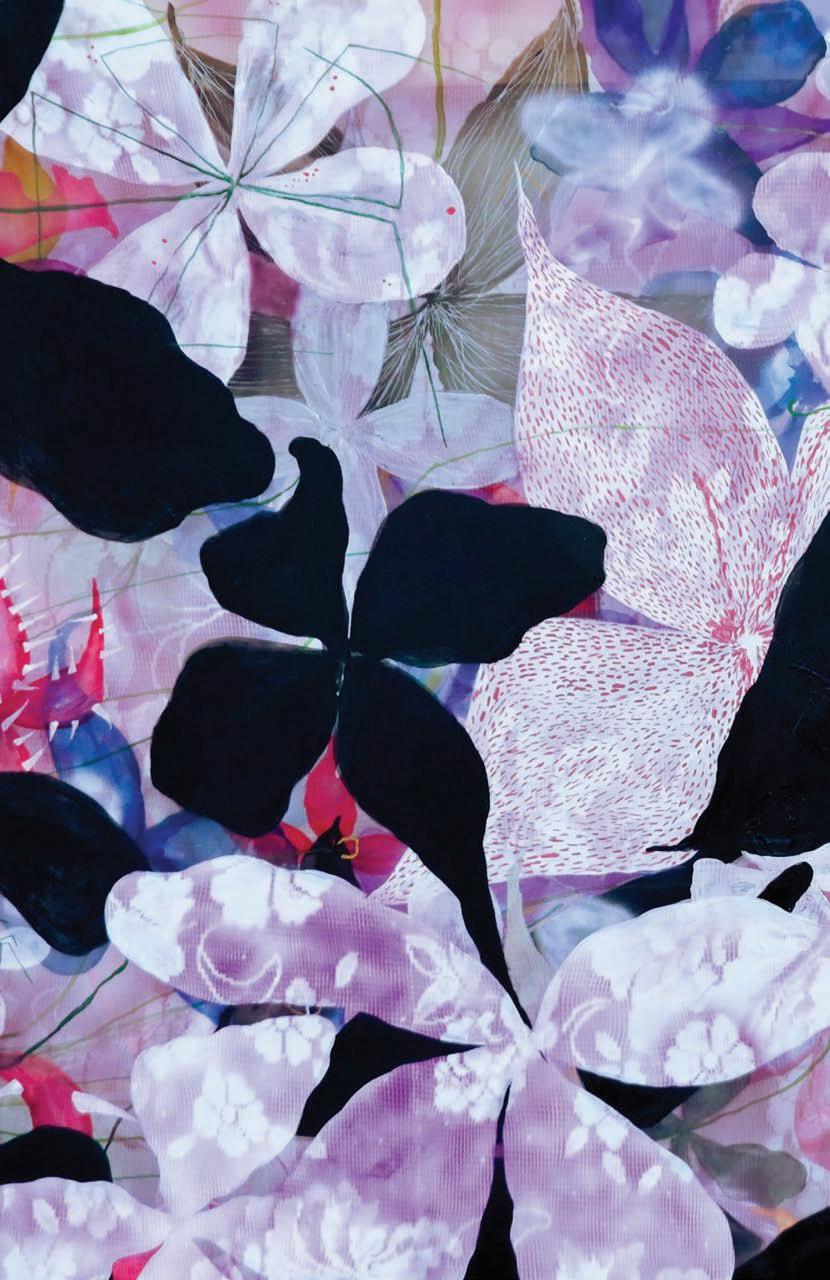
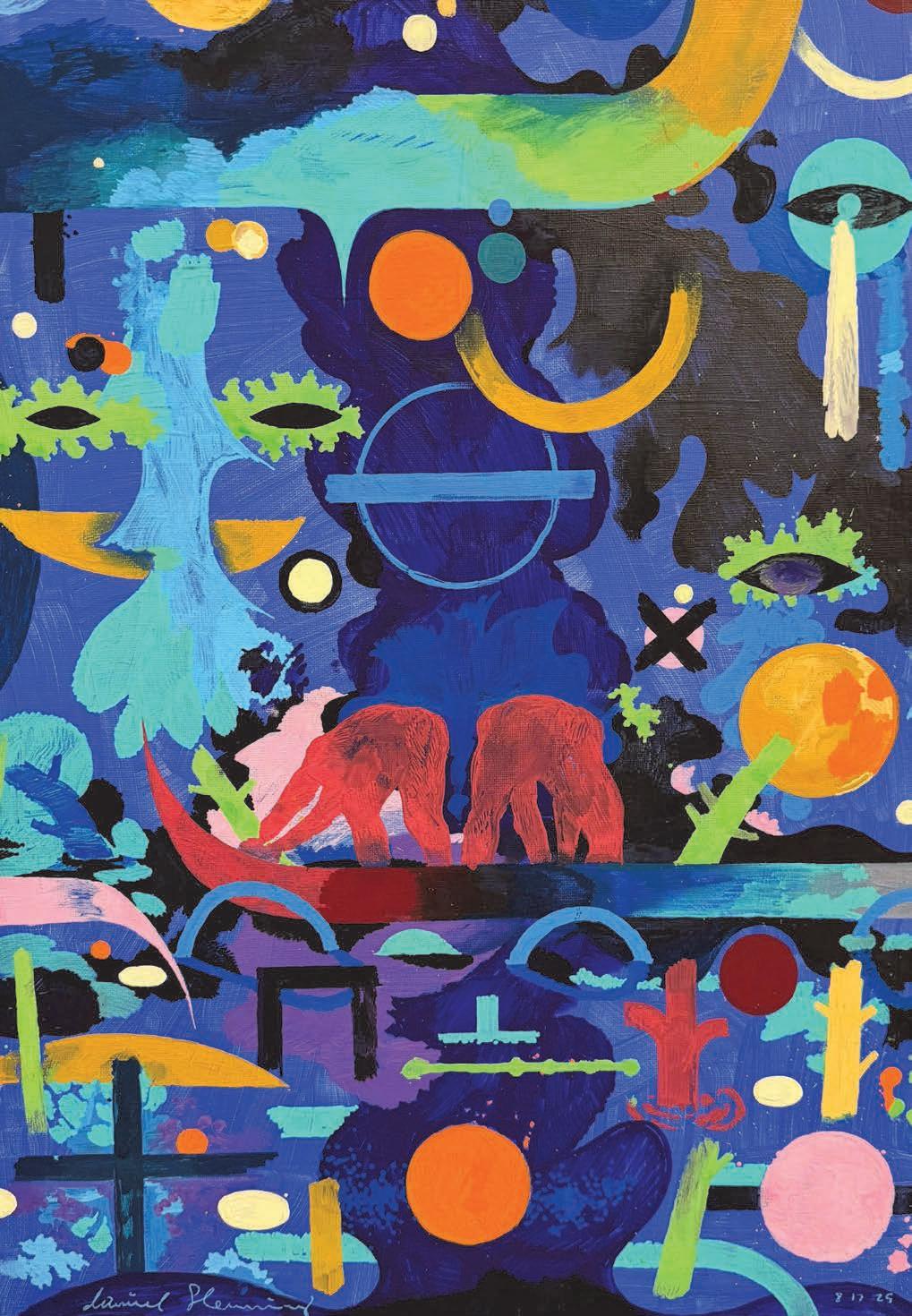
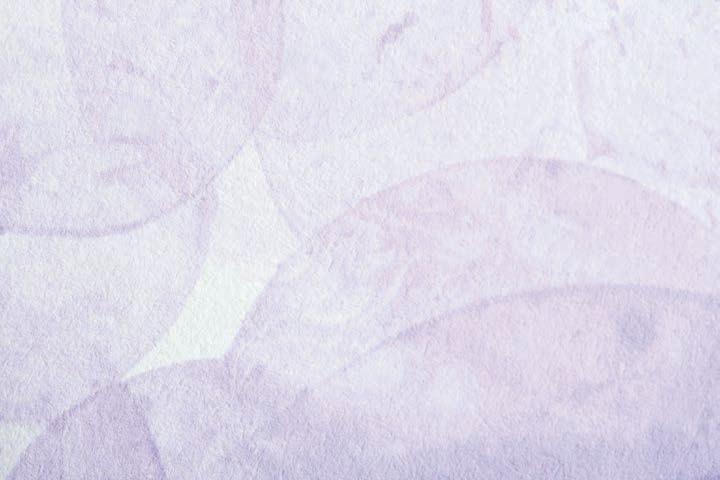
Cover: Jade Pergl, Untitled (detail), 2026, Paint and airbrush on fabric, 48 x 48 inches. Photo: Aloy Xiong.
By Frank Juárez
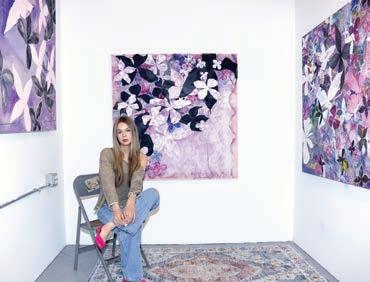
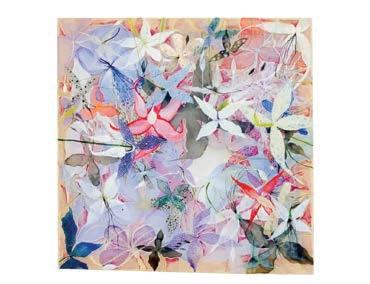
Jade Pergl is a recent BFA graduate (2024) from Milwaukee Institute of Art & Design. She earned a degree in Fine Art + New Studio Practice with a focus in painting and a minor in writing. My first encounter with her work was in early 2026 on Instagram. I found her work to be meditative and inviting. Like many, when we see a work of art that captures our attention, we find ourselves perusing the artist’s feed to gain a sense of who the artist is and what the work is about, resulting in clicking that follow button.
I often wonder how an artist executes a work of art. Does the artist begin with sketches, reference photos, or work intuitively? For Pergl, her approach is intuitively similar to an abstract expressionist, processing daily responses about life, people, and ideas. As she begins applying gestural lines or broad paint strokes, she is always thinking about the next step and sometimes about the next painting. This allows her mind to remain active whilst building the excitement for the next visit to her studio. Maintaining a rigorous studio practice, managing to go to her studio 3 to 4 times per week, is important to her. This level of discipline is necessary for her continued growth as an artist, watching every painting lead to something more. The idea of being in the moment allows the element of change to surface and unexpectedly impacting her next mark.
As I took a closer look at her paintings, I noticed that the substrate she uses is transparent, exposing the stretcher bars. She uses fabric to stretch her canvases, which provides the perfect backdrop for paint, mark making, and airbrush to respond to one another. The airbrush gives a ghostly presence juxtaposed by opaque shapes of color. The use of fabric adds a tenderness to the painting, giving it a sense of fragility,
femininity, and vulnerability. The floral motifs subject matter exude a sense of calmness; not depicting a specific type of flowers, but rather a reimagined existence of how she sees the world. Thinking about organic shapes and how they interact and overlap lends itself to endless compositional constructs.
“The tension between surface and structure sits at the heart of my practice. Prompting questions about control, vulnerability, and balance.”
“The tension between surface and structure sits at the heart of my practice. Prompting questions about control, vulnerability, and balance,” says Pergl.
As we near the end of the interview, I wonder how artists today define success. What does success look like through their lens? Pergl shares that success is having a sustainable career, moving slowly and methodically as she continues to define her practice and the direction she wants to explore.
Jade Pergl is a painter who lives and works in Milwaukee, Wisconsin. She holds a BFA from the Milwaukee Institute of Art and Design. She has exhibited locally and is part of the 2026 Emerging Artists Program Cohort at the John Michael Kohler Arts Center.
To learn about Jade Pergl, visit jadepergl.com and connect on Instagram at @jade_pergl.
Bergstrom-Mahler Museum of Glass presents The Nation’s Only Outdoor All-Glass Art Event!

Artisan Food and Beverages • Kids’ Art Activities
SATURDAY, AUGUST 8, 2026
10:00 AM–5:00 PM
Coming to YOUR Museum:
William Manson: Shatter the Ordinary August 7, 2026 – February 7, 2027
A Weekend with William Manson
Member Event: November 13, 2026
Public Event: November 14, 2026
Drew Ebelhare
September 11, 2026 – August 8, 2027
Sibylle Peretti: Before it Turns to Gold October 23, 2026 –March 14, 2027



By April Behnke
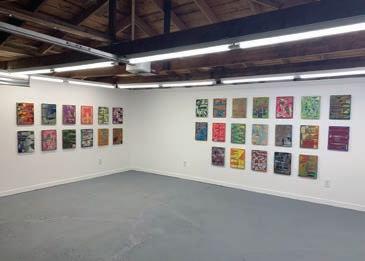
Waiting Rainbows, Michael Wille, September 2022.
Tucked away in a small garage, deep in Chicago’s western suburbs, is one of the region’s hidden contemporary art gems: Studio Break. I recently spoke with David Linneweh, the artist who runs it all.
While Studio Break is also a gallery, it began in 2011 as a podcast dedicated to fostering an artist community. As Linneweh explains, “Our interviews provide an indepth look into an artist’s studio practice, extending beyond the boundaries of the gallery.”
Podcasting was a brand-new endeavor when Studio Break first launched. “It was in its infancy,” he jokes. Linneweh, who had recently earned his MFA at Southern Illinois University and completed several residencies, was inspired by the rich sense of community they offered.
“There were all these great conversations about art and life,” he shared. “While visiting my friend, artist John Reddington, I recorded our chat about his paintings and studio practice on a whim. Working in the studio can be an isolating experience. I thought maybe someone would appreciate the conversation.” The podcast was born. Today, it holds an impressive archive of over 300 recordings.
"Working in the studio can be an isolating experience. I thought maybe someone would appreciate the conversation.”
Studio Break highlights artists across a wide spectrum of experience. Emerging artists are regularly featured through its juried and open call
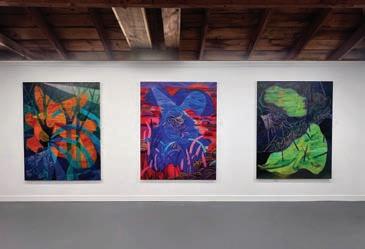
Between Worlds, Erika b Hess, October 2025. Photos: David Linneweh.
programming, bringing a (usually) younger voice to the table. But established artists are showcased too. It’s always expanding. “Like a mix tape from the 90s, I often find out about new artists through our growing community,” he says.
The gallery and the podcast strengthen each other. “I’ve been doing the podcast for 15 years, and that comes across in how the gallery and podcast work in tandem,” he explains.
Linneweh launched the gallery in 2021, turning his garage into a refined space to host exhibitions. It’s located in West Chicago, far from downtown, but that has its perks. “Because we’re located in the suburbs, we’re a destination rather than one stop on a gallery hop,” he says.
Studio Break Gallery holds its place in a long tradition of alternative spaces in Chicagoland. Linneweh views that as an honor. But he doesn’t limit the roster to highlighting artists in the region alone. “My goal has been to bring in great artists to show here,” he says. “It’s been amazing to have national artists flying in to be a part of it.”
Community, for Linneweh, underlies it all. “Art for art’s sake is important. Building meaningful connections, not just looking for opportunities, has shifted the paths of many of those who make it out for a show. It’s been fantastic to have artists and friends out to see some great work, then sit by the fire, talk, and look up at the stars.”
To learn about David Linneweh, Studio Break Gallery, and the Studio Break Podcast, visit davidlinneweh.com.
By Samantha Timm
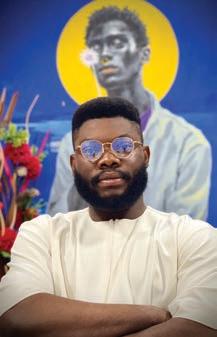
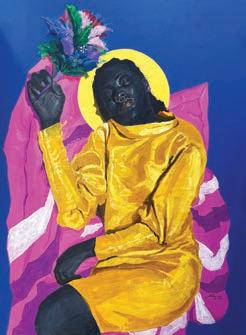
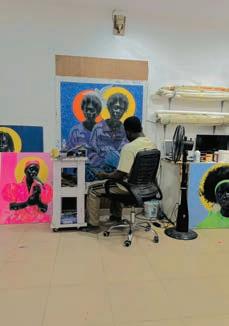
Left: Akindele John. Middle: Beauty of the Mind, 2024, Oil, acrylic, and charcoal on canvas, 49 x 65 inches. Right: Dream Land, 2023, Oil, acrylic, and ink on canvas, 60 x 45.5 inches. Photos: Genre: Urban Arts.
My recent visits to the Walker’s Point Center for the Arts to see “Genre’d: Expressions of Blackness” and a conversation with Nakeysha Roberts Washington, curator of the exhibition and CEO of Genre: Urban Arts sparked my interest in the work of Nigeria-based artist Akindele John.
Struck by a tension in the pieces, I found myself lingering with Akindele’s work, then returning for a second and third visit. Upon further investigation, I was excited to learn that “Genre’d” is Akindele’s third exhibition in Milwaukee––with previous work in a solo exhibition at Woodland Pattern and a group show at 5 Points Art Gallery + Studios––and notice that the artistic legacy that he is developing in Milwaukee seems to run parallel to Nakeysha’s and the media platform she runs, Genre: Urban Arts.
The insights they’ve shared with me illuminate the impacts of creative collaboration on an individual and widespread community level. In this first part of a series of articles on these creatives, I focus on Akindele’s work; in the next part, I dive deeper into Nakeysha’s creative practice, Genre: Urban Arts, and the process of representing Akindele’s work to a U.S. audience.
***
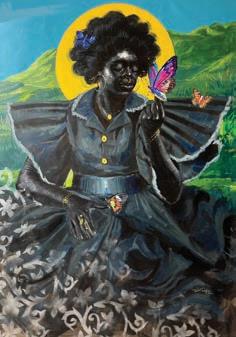
Akindele John’s practice centers around “an ongoing exploration of the soul––mine and yours” that is “deeply rooted in…African-Nigerian heritage” and “pays particular homage to Black feminine identity and expression,” which he sees as “central to the
pulse of African society…The grace, strength, and spiritual depth embodied by Black women” continues to drive his work. He notes, “conceptually, my practice is rooted in an ongoing engagement with African identity and diasporic memory,” and explains his mounting interest in “how the subject holds and presents history, interrogating the ways that hair, skin, adornment, and posture function as visual languages of inheritance, resilience, and transformation are part of the African and African Diasporic identities. The work becomes a space where past and present coexist as living, shifting entities.”
Akindele’s paintings start as “states of feeling” that “carry a kind of pressure that eventually demands form.” This urgency to create something from a “convergence of sensations and emotions” is the very crux of being an artist.
In spending time with his painting Dream Land, I’ve found that Akindele’s work offers neither an answer or resolution on his subject; instead, his work reads as discovery and invites contemplation, “charged” with both “serenity and regality.”
Dream Land––predicated on this moment of blissful sleep, its own expansive, imaginative space––particularly encourages introspection and presents a quiet, caught moment, with a female figure rendered in decisive brushstrokes that move effortlessly between figuration and abstraction. Set against vivid pinks and a deep- royal-periwinkle background, her dress becomes a focal point as it encases her in
protective folds of pale and golden yellow softened by vast passages of ochre.
From her face––painted realistically in sharp focus––our eye moves down her sleeve as the brushtrokes become looser, traveling up the length of her arm to a grouping of purples, pinks, and reds that burst from her bouquet. The aliveness of the flowers she holds, bunchiness of the stylized pink blanket on which she rests, and her stylized halo that manages to catch a shadow cloak her in movement and prevent any sort of stillness from settling over her figure and her environment.
When viewers interact with his paintings, Akindele intends the work to “[unfold] new truths and meaning over time.”
This underscores his approach to creating spaces not only of contemplation, but also for rigorous engagement with culture, Blackness, physicality, and the unfixed experience of how we connect with each other.
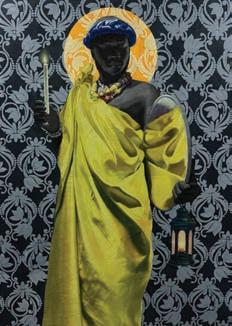
Akindele’s formal choices as a painter further acknowledge the complexity and depth of Black beauty: “I use a particular Black scale color for the human subject who I depict in my art…At first black as a color is an achromatic color, and a powerful tool for artists to create deep contrast, evoke emotions and historically represent power and elegance.”
He mentions using black to “relate it to my art as a Black African artist” and “a way to talk about my cultural identity as Black as well as the traditions and
Black history, bringing back the old way looks into present, even in diaspora.” The appearance of the “Black scale color” on his canvases seem to open up far-reaching sites for memory, engagement, and cultural histories.
He hopes that viewers feel “a sense of intimacy with the figure,” and that “the work offers a moment of return, to oneself, to memory, to questions of identity and belonging.” For Akindele, if viewers step away from his work “with a lingering sense of contemplation, or even uncertainty that continues beyond the encounter with the painting, then the work has achieved its purpose.”
A fundamental part of Akindele’s artistic project is something many creatives can relate to: “I hope my work continues to open space for viewers to slow down and reflect—not only on what they see, but on what they feel and remember in the process of looking…If the work can hold that space, even briefly, then it has fulfilled something essential for me as an artist.”
Akindele’s paintings remain resonant and capacious, capable of opening up spaces for reflection and connection––just as Nakeysha’s work with Genre: Urban Arts offer opportunities for artists of diverse mediums.
To learn about Akindele John, visit akindelejohn.com and connect on Instagram @akindelejohnn. To learn about Nakeysha Roberts Washington and Genre: Urban Arts, visit genreurbanarts.com and connect on Instagram @nakeysha.
By John Sievers
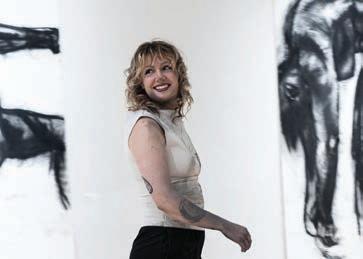
“Itwas almost as if my drawings were already a type of choreography,” says artist Jessalyn Finch. She describes herself as a Body Experience Artist and an Installation Architect. Her movement towards these practices has been full of starts and stops.
Currently based in Rochester, MN, Finch came to art later in life. Initially, she focused on becoming an elite gymnast, but as an undergraduate, a serious back injury led her to reorient and complete a Bachelor of Science in Fine Arts and Eastern Philosophy. Later, she earned a Master’s in Project Management and worked in that field while training as a yoga teacher.
Since 2018, Finch has pursued life as an artist and has created a version of self-portraiture that explores body dysmorphia, self-perception, and body memory. These are all concepts she faced while recovering from her back injury and an eating disorder. Her work has grown from printmaking through large full-bodysized charcoal sketches to 3-D sculptures that are sometimes worn, to collaborations with dancers, and representing her creativity on film.
“Large-scale body-based drawing was my first love,”
“Large-scale body-based drawing was my first love,” says Finch, “but I’ve always been interested in the overlap of different skills, and exhibition design. When I taught myself to sculpt, it was still grounded in the body because they were to be worn and interacted with.”
Motion is at the heart of Finch’s large black and white drawings. The larger-than-life strokes in her charcoal sketches squirm off her works and nestle in the
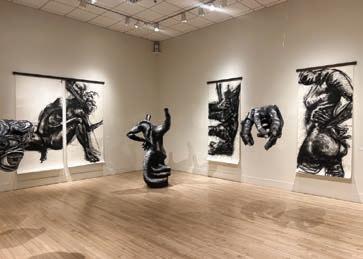
subconscious. Even when Finch uses reference images or researches how a body works in a specific pose, she works from videos.
Finch’s large drawings led her to create painted cardboard sculptures that show aspects of motion curving through three-dimensional space in figures that can be worn like animal masks. For instance, she created a long-trunked gray elephant and a tall-eared rabbit that can be worn. They seem to emphasize certain anatomical features and use shaded painting to create a slight macabre mood. These masks later transformed into free-standing figures tall enough to walk through that look like twisted limbs painted in dark colors.
In January 2026, Finch brought her drawing and sculpture to life with motion when she premiered a short film entitled “Embodied Landscapes” at The Historic Chateau in Rochester, MN. She led an allfemale team, including choreographer and dancer Mary Mailand Schlicting and cinematographer and codirector Laura Sukowatey, to create the film. The film erases boundaries between dance, sculpture, and drawing by following a wanderer guided through interior realms by an otherworldly presence. The film’s protagonist journeys through surreal landscapes filled with Finch’s large black and white sculptures and drawings.
“I’ve done so much mental work to be able to examine my experiences and create pieces about them,” says Finch, “that it’s made me less fearful of how others perceive me.”
To learn about Jessalyn Finch, visit jessalynfinch.com or connect on Instagram at @jessalynfinch.
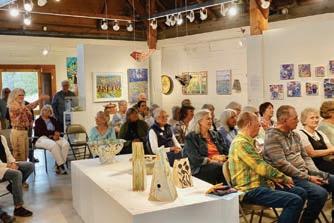


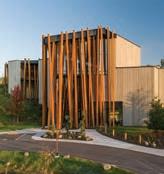

The Art Preserve of the John Michael Kohler Arts Center is the world’s only museum dedicated to the preservation and celebration of artist-built environments—spaces and places that have been significantly transformed by an artist to embody and express aspects of their history, place, or culture. More than 30,000 works by 40 artists are on display, including award-winning, artistdesigned washrooms. Admission and parking are always FREE.
Tue, Wed, Fri 10 am – 5 pm, Thu 10 am – 8 pm, Sat and Sun 10 am – 4 pm, 3636 Lower Falls Road Sheboygan, WI 53081; 920.453.0346; jmkac.org
The James Watrous Gallery is dedicated to amplifying Wisconsin artists. Located on the third floor of Overture Center for the Arts in downtown Madison, the Watrous focuses on solo and curated exhibitions that feature contemporary Wisconsin artists. As a program of the Wisconsin Academy of Sciences, Arts & Letters, the gallery aims to draw connections between art and other disciplines.
Thu-Sun 12 - 5 pm; 201 State St, Madison, WI 54703; 608.733.6633 x25; wisconsinacademy.org/gallery
The John Michael Kohler Arts Center (JMKAC) is a nationally acclaimed visual and performing arts complex located in Sheboygan. Year-round offerings include rotating original exhibitions and thematically aligned live performances, community events, and art-making experiences for all ages and abilities. Experience includes a friendly café, a gift shop, and a hands-on art studio. Admission and parking are always FREE.
Tue, Wed, Fri 10 am – 5 pm, Thu 10 am – 8 pm, Sat and Sun: 10 am – 4 pm, 608 New York Ave, Sheboygan, WI 53081; 920.458.6144; jmkac.org
Located in the heart of Milwaukee, the Kim Storage Gallery is a vibrant space celebrating the creativity of Wisconsin and beyond. This gallery features a diverse mix of museum-quality artwork, ranging from innovative pieces by emerging local talents to esteemed works by established artists. It's a dynamic hub where art enthusiasts can explore the evolving landscape of contemporary art in an inviting and accessible environment.
Tues-Sat 10 am - 5 pm, Viewings by appointment; 207 E Buffalo St, Ste 404, Milwaukee, WI 53202; 608.381.6905; kimstoragegallery.com
Little Known Art House is committed to showcasing local and mid-western artists, promoting eco-conscious practices, and supporting a culture of collaboration. Through carefully curated collections and thoughtful exhibitions, they aim to inspire and engage individuals while contributing to human connection within our community.
Wed 10 am - 5 pm, Thu and Fri 10 am - 6 pm, Sat 10 am - 2 pm; 115 E Washington St Suite 104 Appleton, WI; 920.222.0694; littleknownarthouse.com
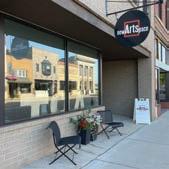
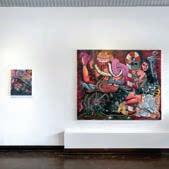
newARTSpace is dedicated to presenting dynamic contemporary art through sharing local, regional, and national accomplished and emerging artists. We are a non-commercial, artist-driven exhibition and event space enlivening a storefront in historic downtown De Pere. We believe in the necessity of art in our society and are committed to providing a platform that reflects and serves that conviction.
Variable hours (Check Website for weekly updates); 124 N. Broadway, Suite A, De Pere, WI 54114; 541-991-7119; newartspace124.com
For over a decade, Kimberly Oliva of Oliva Gallery presents material forward work in her eponymous Logan Square Gallery. Oliva has curated over 250 multidisciplinary exhibitions and is the home to the Midwest Ceramic Sculpture Exhibition.
Fri 5-8 pm, Sat 12-4 pm and by appointment; 3816 W Armitage Ave Chicago, IL 60647; 847.922.5736; olivagallery.com
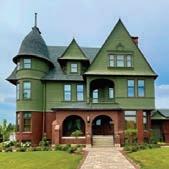
The Rahr-West Art Museum is a City of Manitowoc facility that preserves and enhances its collections and historic mansion. The museum's purpose is to engage the dynamic learning opportunities in the visual arts, and enrich life in the area by serving as a cultural resource.
Tue-Fri 10 am - 4 pm, Sat and Sun 11 am - 4 pm; 610 N. 8th St. Manitowoc, WI 54220; 920.686.3090; rahrwestartmuseum.org
Located in downtown Platteville, Ripple Artspace offers exhibitions and events in addition to regular gallery time. Swing down Platteville’s historic Main Street.
Thu and Fri 4-7 pm, Sat 10 am - 2 pm, or by appointment. 120 W Main St. Platteville, WI 53818; 608.630.4013; rippleartspace.org
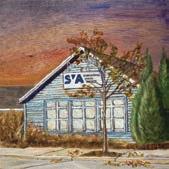
We are a cooperative of 85 artists serving the Sheboygan area. The SVA focuses on empowering local artists and engaging the public through exhibits, workshops, scholarships, and community outreach programs. Our new gallery is open on Sheboygan's riverfront. Learn more on our website and come see our artists' works at the gallery.
Wed-Sat 11 am - 4 pm. Plus, Sundays in the summer. 534 South Pier Drive, Sheboygan, WI 53081; sheboyganvisualartists.org
Two Fish Studio, formerly Two Fish Gallery, is focused on making and teaching. The shelves are full of Pat’s ceramics, both sculptural and functional, and assemblages, plus Karen’s birdhouse ornaments, books, and collages.
Open for events and by appointment. Including the Garden Party, July 16-18, and the Art on Wheels Party, September 18-19; 244 East Rhine Street, PO Box 487, Elkhart Lake, WI, 53020; 920.838.0626; twofishgallery.net
By allison anne and Jeremy P. Bushnell
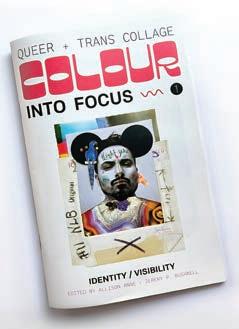
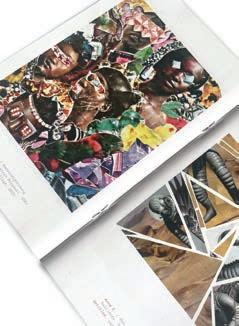
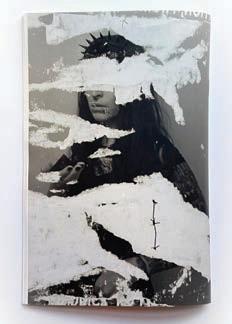
Colour into Focus is an ongoing series of publications devoted to showcasing the work of an international roster of queer and trans collagists. The first issue debuted in 2025; its second issue was released in April of this year. A third issue, focused on innovative practices and techniques, will debut this summer at Making Meaning, a collage symposium held at Vassar College. Although global in scope, the project has strong Midwestern representation, with artists from Illinois, Indiana, Minnesota, Missouri, Wisconsin, and Nebraska published in the first two issues.
The series is produced as a collaboration between two organizations, each with Midwestern ties: Twin Cities Collage Collective (TCCC) and NONMACHINABLE. TCCC, is a community arts group co-founded in 2017 by Minneapolis-based artist-publisher allison anne. One of anne’s early TCCC projects was the anthology publication North Star Collage, emerging from the constraints of the early COVID-19 pandemic. It published 24 Minnesota artists in its first issue, and the project has only grown since, including 76 artists in the second anthology (2022) and 124 in the third (2024).
The process of compiling North Star Collage gave anne the idea for another anthology project, one that prioritized the creative perspectives of the LGBTQIA2S+ community. “Throughout my life, collage threads my queer, nonbinary identity with creative practice and community, representing sustained connection and care,” anne explains. “These projects offer an opportunity to build something together.”
NONMACHINABLE, began as a distributor of “optically interesting” publications. Co-founded by anne and the
Chicago-based artist and writer Jeremy P. Bushnell— who work together as the “collage laboratory” Morphic Rooms—NONMACHINABLE sought out art zines and artists’ books from around the world, focusing especially on the work of women, artists of color, and trans and queer artists.
As NONMACHINABLE branched out into producing its own publications, a collaboration between NONMACHINABLE and Twin Cities Collage Collective was an organic next step. Looking for a way to push back against increasingly virulent anti-queer and anti-trans ideologies, anne presented Bushnell with the prospect of co-editing an inclusive anthology— and the idea that had been simmering for a few years came to a head. “I knew immediately that this was something I wanted to do,” says Bushnell. “It felt crucially important, during these difficult times, to work hard on a project designed to elevate the creativity, joy, and resilience that I see everywhere in this community.”
Both anne and Bushnell see this series as an extension of their personal and professional commitments to uplifting LGBTQIA2S+ voices, especially in a time where queer and trans people find their very right to exist being questioned. Colour into Focus reinforces the knowledge that these artists are a vital part of our communities and our futures—embodying creative perspectives that should be invested in, prioritized, and uplifted.
To learn more, visit nonmachinable.com and twincitiescollagecollective.com and connect on Instagram at @nonmachinable.
By Matthew Rose
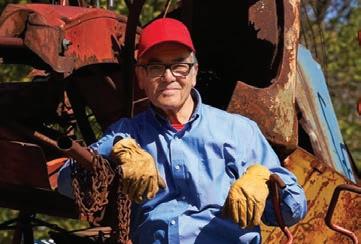
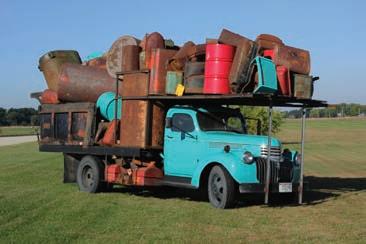
In2024, “How Things Stack Up,” The Koehnline Museum of Art in Des Plaines, Illinois, celebrated a 60-year survey of John Himmelfarb’s art. Bringing together the artist’s earliest and most recent works, Himmelfarb’s abstractions in paint, and the range of his sculpture in wood, steel, and bronze, to his REO Speed Wagon assemblages – drivable artworks were on full display.
The trucks are gutted and sometimes repainted, their beds serving as plinths for rising temples of rust and iron plucked from junk yards. Himmelfarb’s incarnations lay bare a mid-century American dream, casting their glance into the future by amassing the past.
“Penelope Awaiting Her Chamberlain” (2013), his first, cost Himmelfarb $2,000, paid to a local farmer. The 1946 Chevrolet was stripped, then loaded with oil drums, pipes, and old bed frames. With a working engine and questionable brakes, “Penelope” found her way across the Midwest; others were featured in dada-like concerts, like the one at Café Coda in Madison. Musicians drummed on the fenders and searched for melodies along the scaffolding, a performance John Cage might have appreciated in its tonal discordance and harmonic consistency.
While Himmelfarb continues to paint out an America in motion, the artist’s language – complex, personal and layered – has found its way to airport terminals (Boston’s Logan), the Kedzie metro in Chicago, a school in Omaha. The trucks, however, take on weighty matters in ways two-dimensional works can’t. “Remains” (2015), now parked at Sculpture Fields in Chattanooga, says Himmelfarb, “is made up of body parts – truck body parts. The theme is death and what we carry with us.”
Motion and the open road have always attracted artists. The 20th century offered generations a seductive industrial prologue. Marcel Duchamp’s “Bicycle Wheel” (1913) notoriously signaled this new addiction. Painted cars appeared on the covers of Vogue and in sleek 1930s showrooms. After two world wars, the ‘70s opened up the pump for artists like Warhol and Lichtenstein, who painted the bodies of BMWs. John Chamberlain, an inspiration to Himmelfarb, turned crushed car bodies into exquisite and colorful art. Charles Ray’s life-sized painted aluminum firetruck was stationed on Madison Avenue outside the Whitney’s 1993 Biennial.
Himmelfarb’s first truck works were modest paintings, drawings of pickups, chortling along roads through a made-up American landscape. He borrowed from Philip Guston’s thick impasto and black lines, giving his machines a heart and soul. The trucks grew up and took on a third dimension; some manifested in bronze, at first child-like, then in steel and wood –each new model swelling like teenagers learning how to impress.
Himmelfarb commutes from his studio in Chicago to his home-studio in Spring Green, Wisconsin, and is at work on a new piece. The truck is entirely fabricated in aluminum. A wooden model produced in 2025 anticipates a full-sized sculpture this year.
“I’m calling it ‘Andromache, Love and Grief,’” says Himmelfarb. “Andromache was the Greek goddess known for her virtue and fidelity – and the suffering of women.”
To learn about John Himmelfarb, visit johnhimmelfarb. com and connect on Instagram at @johnhimmelfarb.
By Linda Marcus
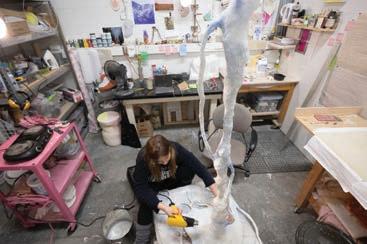
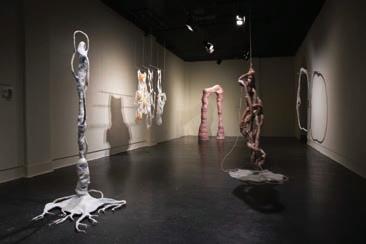
Disgust and discomfort are precisely the reactions Emily Mulvaney hopes to evoke in viewers of her art. “I like it,” she says. “I knew leaning into abject imagery and textures would allow me to play with that sense of the unknown. I’m more offended when there’s no reaction at all.”
The Minneapolis-based artist creates amorphous sculptures inspired by microbes, bacteria, and magnified cellular forms. Her practice exists at the intersection of art and science, transforming biological research into deeply personal sculptural investigations. Mulvaney describes the work as an attempt to better understand her own body and its invisible ecosystems: “I was interested in the other creatures and beings using my body as their home, and in unfolding a conversation about multispecies assemblages.” The work recalls the legacy of abject art explored by artists such as Kiki Smith and Louise Bourgeois, both of whom used the body as a site of vulnerability, transformation, and psychological inquiry. Mulvaney pushes this further. Her practice aligns with more recent bio-art traditions in which scientific processes become both medium and metaphor.
Mulvaney began developing her work while attending graduate school at the University of Montana. She divided her time between the studio and the laboratory, collaborating with scientists and gaining access to specialized equipment. Using bacteria collected from her own body, she cultivated living specimens under laboratory supervision. The experience fundamentally altered her understanding of herself. “It was the first time I witnessed my physical self as a specimen,” she explains. “It dismantled a lot of societal pressures women place on themselves. Seeing myself simply as a physical being trying to stay alive took some of that pressure away.”
In one project, Mulvaney created sealed environments that allowed bacteria to grow and communicate, their interactions revealed through shifts in color and form. In another, bioplastics became substrates for mold gathered from her art studio. These works position decay, contamination, and transformation not as something to fear, but as evidence of interconnected systems in constant flux. Her sculptures echo the material experimentation of artists working with organic processes and entropy, while also invoking philosopher Julia Kristeva’s concept of “the abject” — that which unsettles boundaries between self and other, attraction and repulsion.
In addition, Mulvaney is interested in the tools used in the lab. “Shifting toward the instruments, technology, and architecture of scientific objects is interesting. I want to reimagine them, abstract them, or shift their origin. I’m curious how that might open things up even further.”
Despite the unsettling nature of the work, humor remains central to Mulvaney’s practice. “Humor and absurdity can bring down barriers,” she says, particularly within the often-inaccessible language of science. “Lab spaces can feel intimidating with all the jargon. Humor adds a sense of humanness back into it and makes it more approachable.” That balance between unease and play gives Mulvaney’s work its particular power: the sculptures repel and attract simultaneously, asking viewers to confront the strange biological realities that exist both within and around them.
To learn about Emily, visit emilymulvaney.com and connect on Instagram at @emily_mulvaney.
601 Sixth Street
Racine, WI 53403
Saturdays 12:00 - 5:00 pm
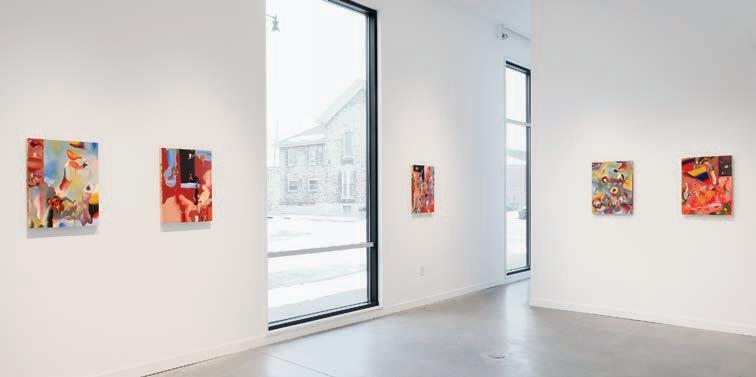
OS Projects features artists from the Chicago-Kenosha-Racine-Milwaukee region in solo and two-person exhibits.
Installation image of Stephen Williams: “…and the far off flutter of smoke stained wings.” and by appointment
osprojects.art 262-800-3564

“Eco-Portraits of Forests and Wetlands”
Granlund “Fragments in Conversation”
“Antarctic Echoes: Reflections on Antarctica , Music, and the Human Spirit ” incorporating student works from St . Bruno Parish School
FREE Public Artist Talks accompany each exhibit .
Visit our website for dates or scan the QR code. www.wilson-center.com/ploch-art-gallery
Call for Artists October 2026 for the 2027/2028 season
Call For Artists Opens October 1 , 2026
Individual artist , two person/collaborative group, and curated exhibitions proposals are welcome. All artists must reside in WI, be a native of WI, or be a graduate of a WI college-or university-level post-secondary program. All submitted artwork must be family friendly.
For “Artist Call” details visit: www.wilson-center.com/calls-to-artists
PLOCH ART GALLERY HOURS: Tuesday–Friday: 11am–6pm. Hours may be limited due to venue events. Call ahead 262-781-9520
Artwork available for purchase.
3270 Mitchell Park Drive Brookfield, WI 53045 www.wilson-center.com
Gallery wrapped. Acts like a panel. Lightweight, warp resistant. Custom sizes. For more info: infrastructurecanvas.com Mention this ad for 15% discount.
207 E. Buffalo St. #14 LL, Milwaukee, WI 53202 414.559.0935 steven @ infrastructurecanvas.com

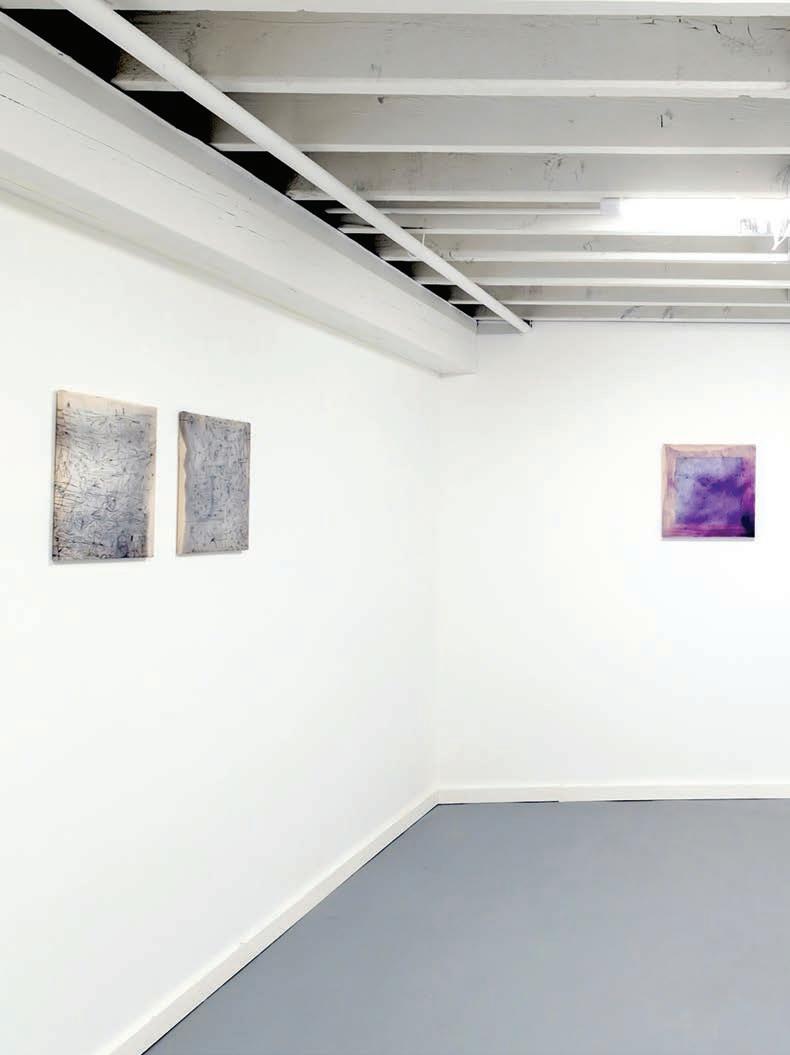
Delicate Reminders at Underscore Gallery, Milwaukee, WI, February 8 - March 8, 2025. Photo: Underscore Gallery.
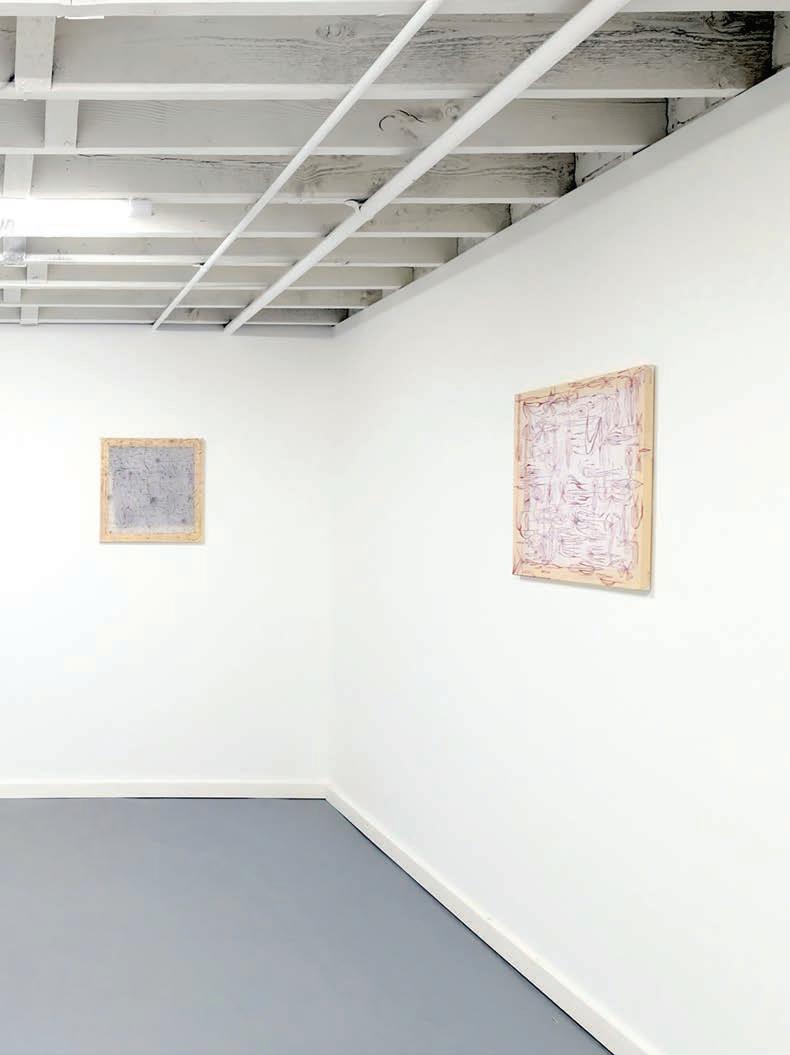
Take a ride on a healing machine. Or snap a selfie in our award-winning washrooms. From the world’s largest collection of artist-built environments to unexpected exhibitions, there’s something for everyone—all for free. Two museums. One unforgettable experience. jmkac.org
By Samuel Schwindt
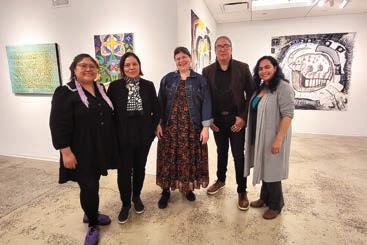
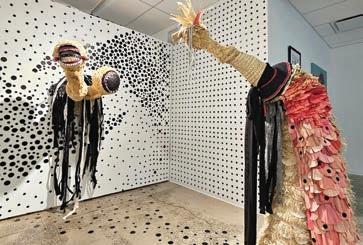
Left: From left to right: Debra Yepa-Pappan, Co-founder and Director of Exhibitions and Programs; Melissa Melero-Moose, current featured artist; Hattie Lee Mendoza, current featured artist; Sean Chandler, current featured artist; and Monica Rickert-Bolter, Co-founder and Director of Operations. Right: Erin Lee Antonak, Inchoate (mounted), Prayer Gatherer (freestanding), 2025, cornhusk, natural dyes, leather, wool, tobacco, mixed-media, dimensions variable. Featured in “Sight of Resistance” from July 12, 2025, through February 28, 2026. Photos: Center for Native Futures.
Founded in 2020 and moving into a permanent space in 2023, the Center for Native Futures (CNF) in Chicago, IL, was a process of cultivation. This Midwestern, Indigenous art home-base offers 2.5 large exhibitions every year, representing contemporary native artists from all over the country. That’s not where and when it all began, however.
“It’s something I’ve been envisioning for 30 years,” said Co-founder Debra Yepa-Pappan in an interview with Artdose. She and her husband—prolific artist Chris Pappan—went to school in Santa Fe and moved back to Yepa-Pappan’s hometown of Chicago after school. “We didn’t feel there were any galleries or any spaces that were dedicated to art for Native people, by Native people,” said Yepa-Pappan about the reasons to turn a space into a cutting-edge representation of Native contemporary art. “It was not something we could start on our own back then,” she said about their lack of experience when the “original dream” was growing: “we probably would have failed immediately.”
“We didn’t feel there were any galleries or any spaces that were dedicated to art for Native people, by Native people.”
To get ready, they knew they needed a robust team with a diverse range of skills. Culling from their networks, conversations “checking in on each other” grew into a preliminary plan. That’s when Monica Rickert-Bolter, now the Director of Operations, came
in. Rickert-Bolter’s tribe helped cover the cost of professional development classes for her with Notre Dame, and she ended up joining the board of the American Indian Center for a couple of years, all to build “more and more experience” to bring CNF to fruition. The Terra Foundation soon offered seed money for the space.
CNF showcases much beyond fine art: they have film and video art, sound installations, and poetry readings. “We are very contemporary people,” said Yepa-Pappan about how they are not focused on showing “traditional art,” or what the general public would expect Indigenous artists to be making. “We need to have people understand that, as Native artists, we should be advancing. We should be evolving. We shouldn’t be stuck in timeframes of ‘we can only make art in this one particular way.’ So those are the kinds of messages that we’re trying to show,” said Yepa-Pappan.
Their future-gaze in their brightly lit storefront in Chicago’s loop allows connections to form with people who casually stumble onto the space. When I asked about one of their favorite memories, Yepa-Pappan reflected on a fortuitous moment. “A group of young people was visiting from Oklahoma,” said YepaPappan. “And I said, ‘yeah, come in!’ and I noticed one of them left a comment in our comment book, and they said, ‘I felt instantly at home as soon as I walked in.’”
To learn about the Center for Native Futures, visit centerfornativefutures.org and connect on Instagram at @centernativefutures.
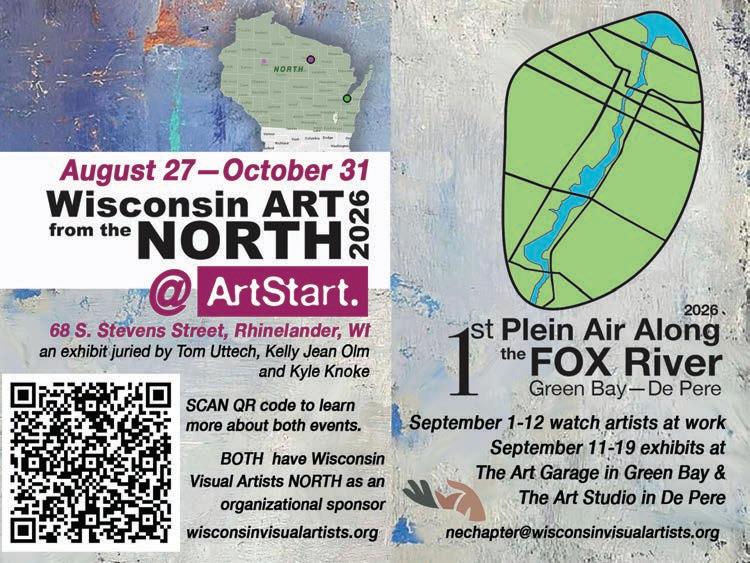
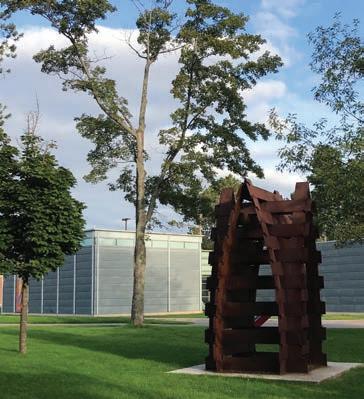
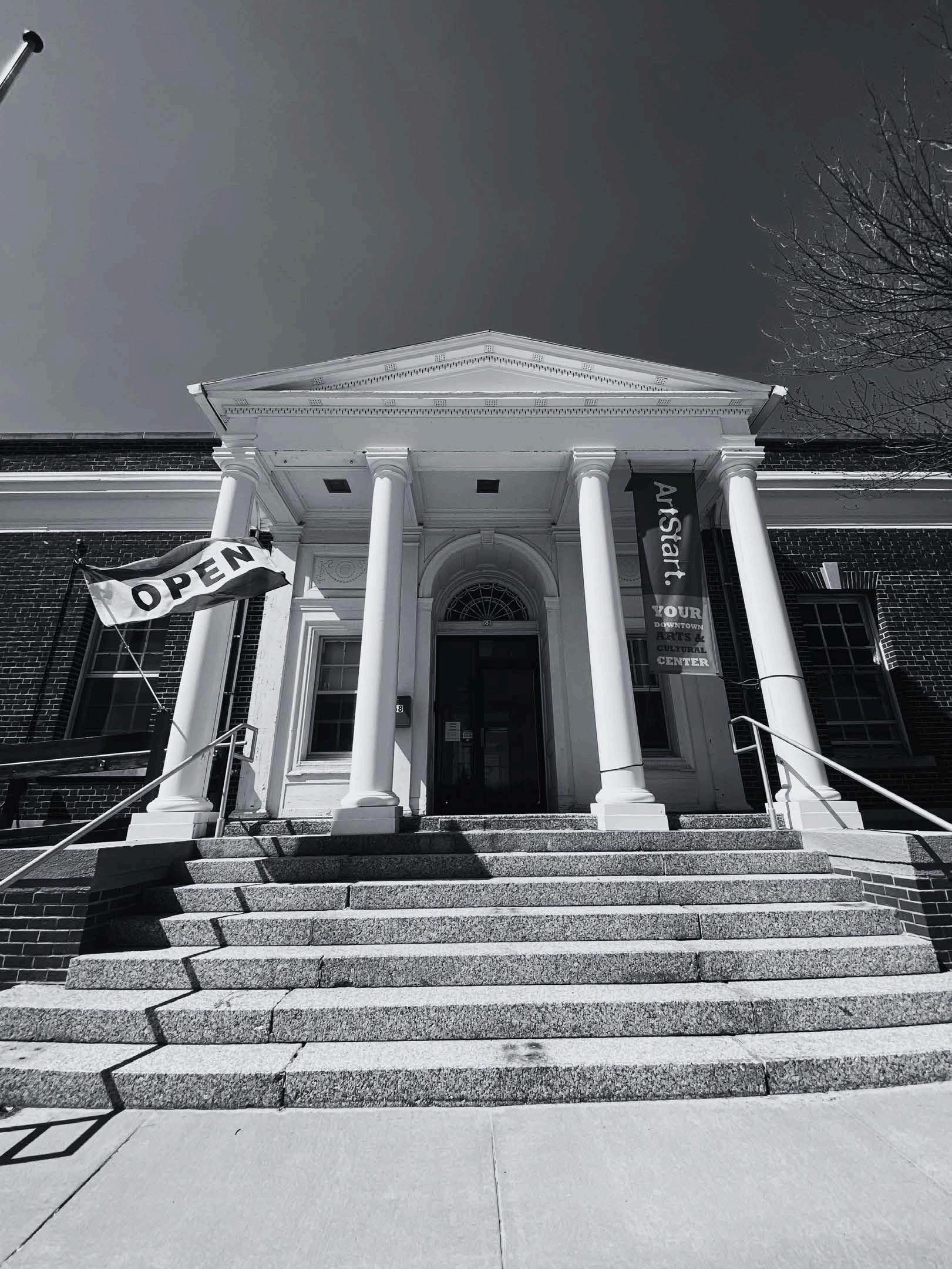
Located at the corner of Tracy and 7th Streets on the campus of NMU, the Art Museum features
nmuartmuseum.com

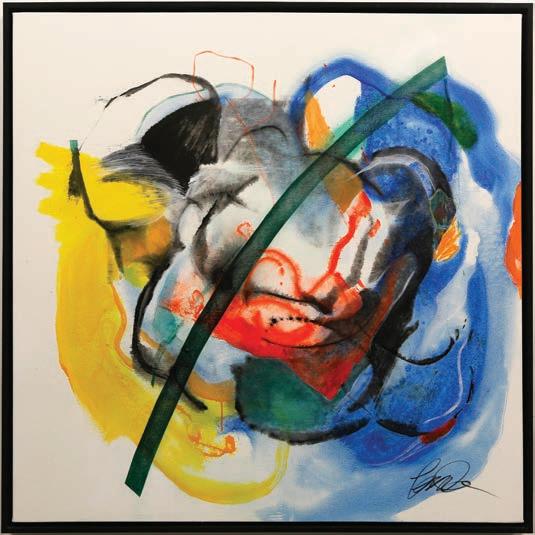
Energy of Hope reflects the turbulence of the world we inhabit — beauty, chaos, tension, and the unseen forces that pull at the fabric of community. Fields of color move like atmospheric currents, carrying moments of instability alongside resilience and renewal. A translucent green arc cuts across the composition as a stabilizing force. It does not silence the storm, but instead channels its energy, symbolizing the power of hope to re-center us and guide us forward together. Through layered gestures, movement, and vibrant abstraction, the work becomes a meditation on connection, endurance, and the possibility of balance within uncertainty.
pamela@pamelaandersonstudio.com | pamelaandersonstudio.com | @pamelaandersonstudio
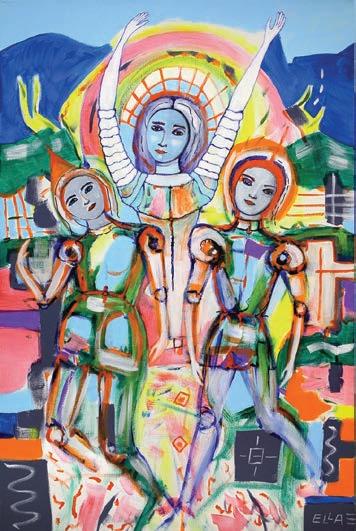
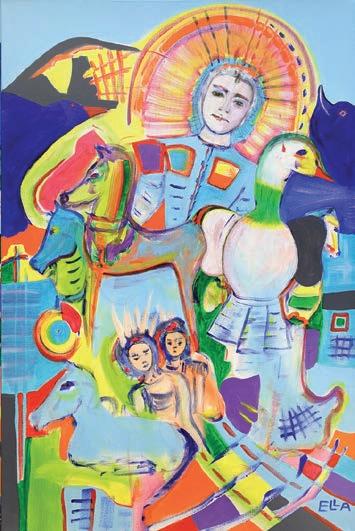
The Blessing of the Dancers, 2025, Acrylic on canvas, 36 x 24 inches. Right: Dawn of a New Morning, 2025, Acrylic on canvas, 36
Munich-born Ella Blame is a multidisciplinary artist whose life has been deeply shaped by both music and visual art. Raised in a musical family, she developed a passion for creativity from an early age. She lived in Munich and Berlin, Germany, and Vienna, Austria, before immigrating to the United States, where she settled in southeastern Wisconsin.
While Ella attended the prestigious Academy of Fine Arts in Munich, she considers herself largely self-taught, having honed her craft through independent exploration. Her artistic oeuvre is diverse, encompassing nature studies, surreal and abstract compositions, as well as explorations in figurative and mystic expressionism. Through her paintings, Ella seeks to distill the essence of rhythm and movement, weaving a visual dialogue between the finished and the unfinished, the raw and the refined, and the interplay of darkness and light. On canvas, she favors acrylics, while her works on paper employ a range of media, including markers, ballpoint pens, graphite, colored pencils, ink, and watercolor.
ella@ella-blame.com
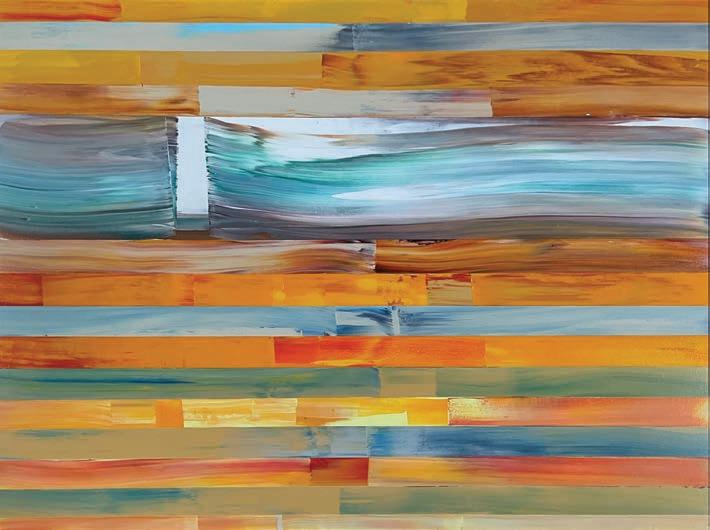
Des Moines, 2026, Acrylic on canvas, 48 x 35 inches.
Born in Kenosha, Wisconsin. Studied art at the University of Wisconsin in the 70s. Worked with artists William Weege, Richard Long, Jack Damer, Dean Meeker, and Don Reitz. Worked as an assistant at the studios of Weege and Meeker. Received an MFA from the San Francisco Art Institute in 1982. Showed with several galleries in the Bay Area in the 80s and 90s. Returned to Madison in the 90s to run a frame shop and raise a family. Begin to paint seriously again in 2020. Included in several group shows and a solo show at Gallery 800 UBD.
The work is based on color field abstraction. The starting point is the flow of water as a metaphor for experience and memory. The saying goes that you never step into the same river twice. Everything comes into play as a dialogue of representation and abstraction. That dialogue elicits an interpretation from the view of the materiality of the paint as an intuitive exercise.
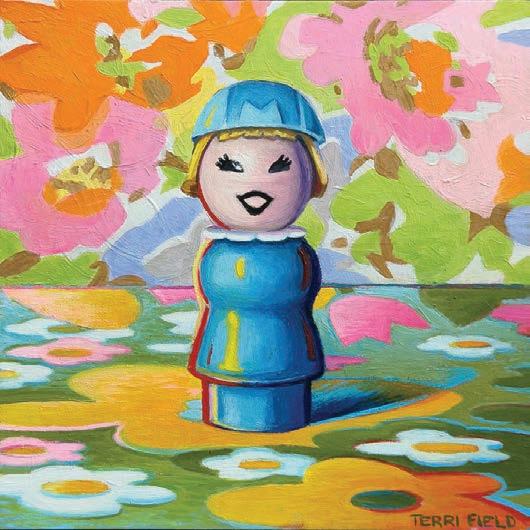
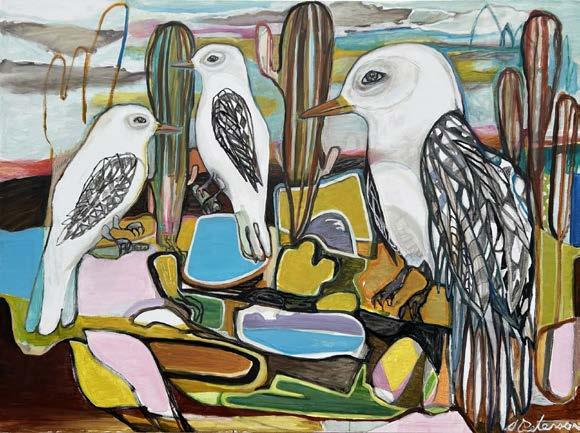
A Bird Without Wings, 2026, Oil on board, 5 x 5 inches, $250.
The moment you see something beloved from your childhood… the toy your cousin owned that you wished you had, or the mug your grandmother used every morning… these are the things that begin the art of Terri Field.
She brings impressions of a time we have fewer records of to life with oils and reflection. She looks for those moments and for their meaning, for the quiet everyday memories we all share. Portraying 1970s mementos on vintage fabrics, she highlights the long, uninterrupted stretches of quiet creativity from the past – a big contrast to today’s onslaught of interruption, distraction, and overwhelming information.
Beneath a toy’s fixed plastic smile or a stereotypical image of a parent lies hidden depth. These pieces invite you to pause, think about the stereotypes, generational differences, the then vs now, and find your own meaning.
terri@terrifield.com | terrifield.com | @terrifieldart
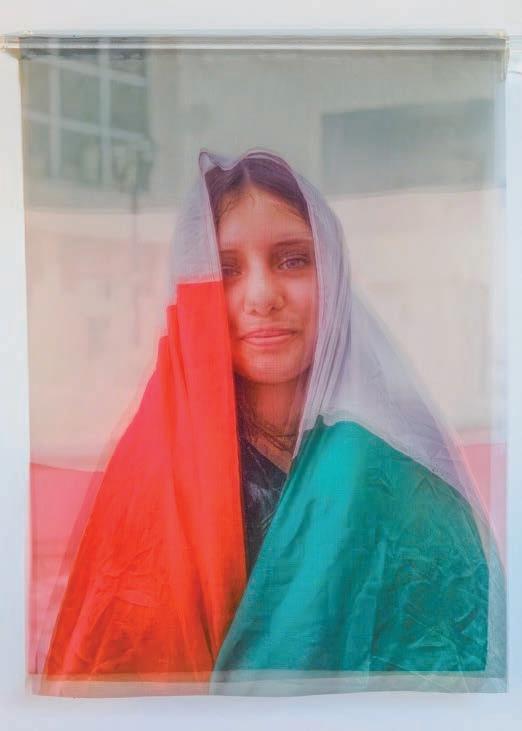
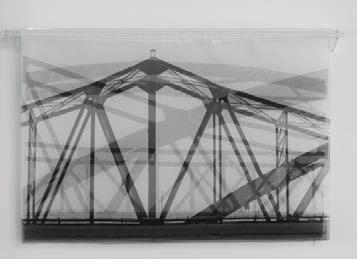
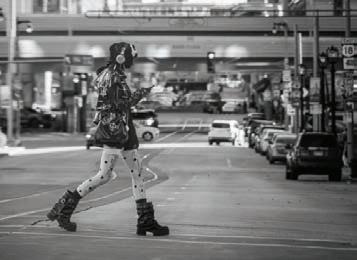
Left: Standing Up, 2025, Pigment print on three silk panels, 17 x 24 x 5 inches, $550. Top Right: Going Places, 2026, Pigment print on three silk panels, 25 x 17 x 5 inches, $550. Bottom Right: On the Avenue, 2026, Archival pigment print, 20 x 16 inches, $400.
Kristine Hinrichs is a Milwaukee-based photographer whose work focuses on the urban environment. Her work often makes use of reflections, shadows, and layers to illustrate how elements of the urban environment affect and are affected by each other – much like a funhouse mirror, one element reverberating off of the other. She believes that these elements do not exist by themselves, but only in context. Many of her images are produced before dawn, when the city streets are quiet, at the Milwaukee lakefront, or in commercial districts. She presents many of her images as (three) silk panels hung in series, providing a three-dimensional effect or as large, ceiling-hung panels. She finds that the use of silk, as an ancient medium, provides a counterpoint to the highly technological nature of digital photography.
She continues to work on her project focusing on essential workers, those that people tend not to notice. She recently created large organza panels that are ceiling-hung – providing the illusion of invisibility and looking past or through these important people.
Kristine shoots every day and has not missed a day in more than fifteen years. That provides for a level of continuity and allows her to notice and document subtle changes in the people and urban landscape. She believes that the images find her. Kristine’s award-winning work has been exhibited nationally and throughout Wisconsin and the Midwest.
To make a purchase, contact the artist directly.
Kristine.Hinrichs@gmail.com | KristineHinrichsPhotography.com | @KristineMarie
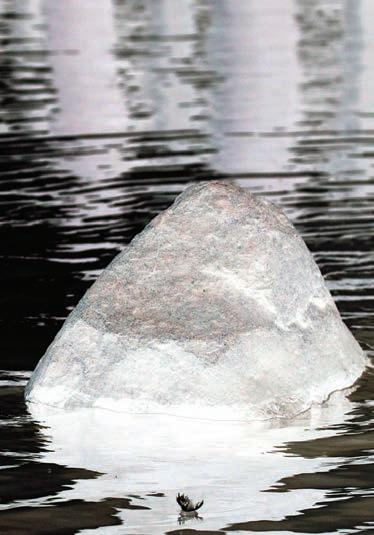
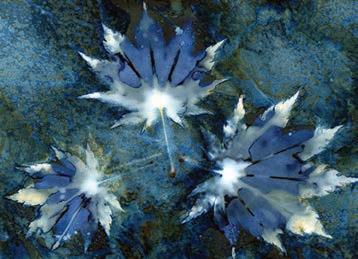
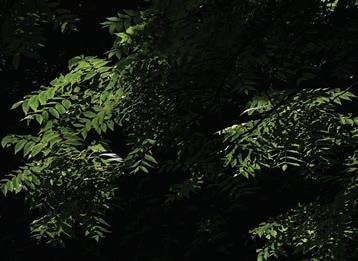
Left: Where the Water’s Edge and Hope Exist, 2022, Archival pigment print, 18 x 12 inches; Top Right: Three Leaves, 2022, Wet cyanotype on watercolor paper, 9 x 12 inches; Bottom Right: Darkness Envelopes, 2023, Photograph, archival pigment print, 12 x 18 inches.
Angela Johnson is an artist, creativity coach, and educator based in Madison, Wisconsin. She earned a master’s in art education, an MA in Art, and an MFA with a focus in photography from the University of Wisconsin-Madison.
Her photo-based work explores themes of place, specifically nature and how we interact with it, ideas of balance, and telling stories through individual and collective memories. As part of her daily practice, she walks/ hikes with her camera and a focus on being present, marking and noticing small interactions or occurrences that may otherwise be missed or unnoticed.
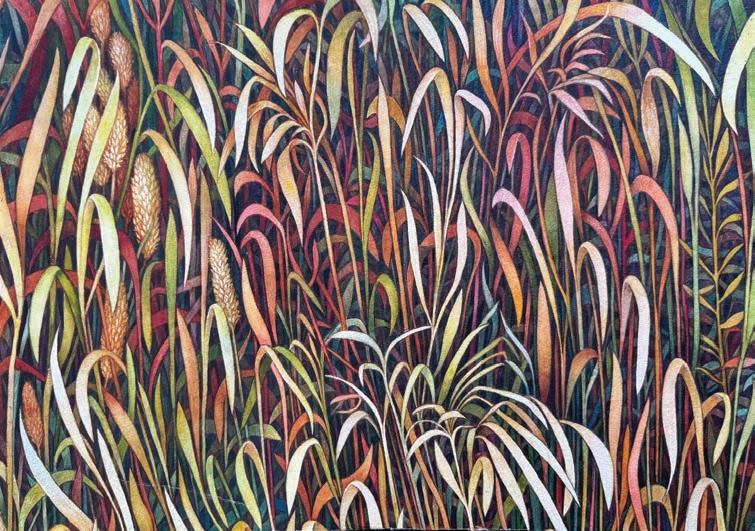
Helen R. Klebesadel is an artist, an educator, and an activist who maintains an art studio in Madison, Wisconsin. Born and raised in rural Wisconsin, she is best known for her environmental and women-centered watercolors. Her watercolors push the traditional boundaries of the medium in scale, content, and technique. Ranging in size from the intimate to the monumental, her paintings are transparent watercolors on paper and canvas. She starts with detailed drawings and develops the images with layer upon layer of color washes and dry brush technique mixed with occasional areas of wet-into-wet spontaneity.
Helen’s current artworks focus on the importance of helping native plants and pollinators thrive, especially in the context of prairies. Prairies once covered over 40 percent of the United States. Now, only about 1 percent of the North American prairie still exists. Prairies build soil, capture carbon, trap sediment, grow livestock, and support pollinators. Helen considers her artworks to be part of larger efforts calling for the adoption of sustainable environmental practices for the good of us all, understanding that what we do to the earth we do to ourselves.
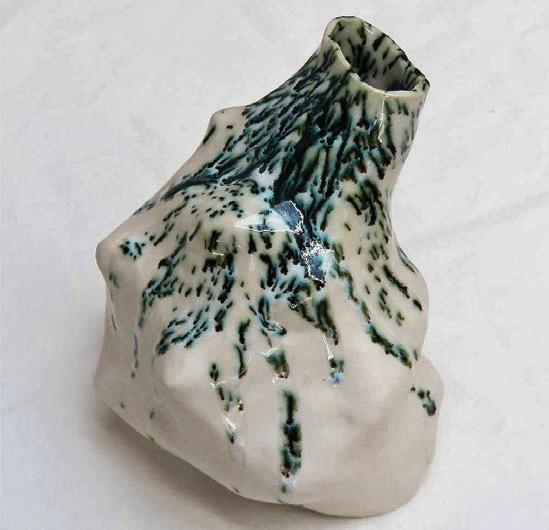
Linda is a sculptor, and clay is her partner. She reimagines relationships of power through feminism and domesticity by layering, cutting, and folding. Her current work aims to highlight hierarchies that control the way a female form moves and ultimately to the periphery. The vessels she makes are formed by reimagining a common technique in fashion design, “the dart.” It was created by male tailors to develop silhouettes to satisfy the male gaze. By randomly employing the dart in clay, she creates unusual torso-like vessels. Some straddle, lounge, or even pour over the edge. This deliberate act of sitting or resting is a form of non-compliance and an act of resistance. Her process is laborious, but by manipulating clay, it creates a repetition: a meditative mode for her, one that imbues her with the work created. It’s a simultaneous act of validation and devotion.
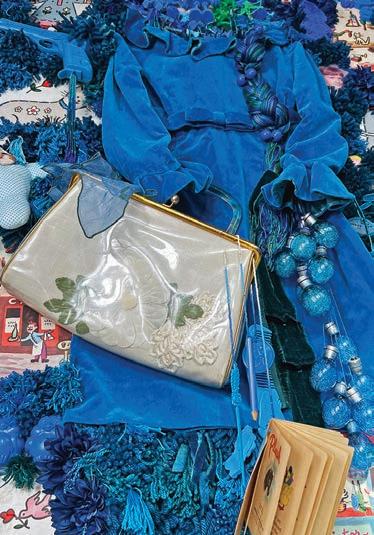
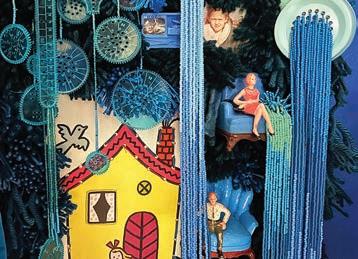
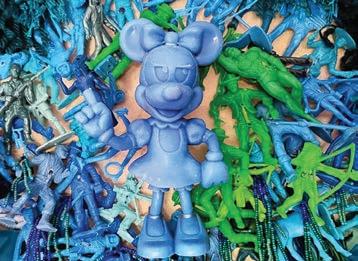
Fever Dream, 2026, Work in progress, assemblage, 58 x 80 inches.
Cyndie Rauls is a sculptor based in the Driftless Region of Wisconsin, where her practice explores the delicate tension between what is found and what is lost. Utilizing a palette of vintage textiles and collected objects, she creates abstract meditations on the emotional resonance of material history. Her work seeks to preserve the “journey” of the medium, elevating discarded fragments into permanent testaments of existence.
In her current series, “1972,” Rauls presents a tactile autobiography of a 1970s childhood. By meticulously integrating well-worn clothing, toys, and era-specific ephemera, she constructs tangible narratives that navigate the complexities of beauty, heartbreak, and resilience. Every bead and found element serves as a waypoint in a timeline of memory… transforming material relics into multifaceted sculptures that hold the weight of a lived story.
Upcoming Exhibitions:
The Northern National Art Competition at Nicolet College Art Gallery, Rhinelander, Wisconsin
June 18 to July 31, 2026
Re: Creation at The Overture Center, Madison, Wisconsin
November 24, 2026, to February 21, 2027
cyndierauls@gmail.com | wanderbrookglen.com
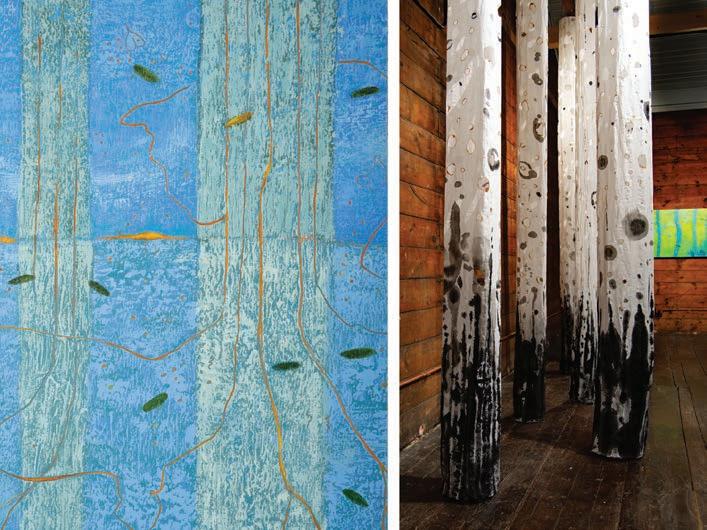
Left: Where Light Dissolves (detail), 2026, Acrylic on canvas, 36 x 46 inches, Courtesy of Kim Storage Gallery; Right: Sentinels, 2023, India ink, on charred and burned linen gauze, 120 x 9 x 9 inches (multiple).
Katherine Steichen Rosing explores environmental issues related to forests and watersheds through richly surfaced paintings and immersive installations.
Her abstract symbolic paintings envision intricate connections between forest ecosystems and their watersheds. Her Drowning Forests paintings explore the slow devastation of forest flooding — trees submerged, suffocated, and lost to rising waters. She often draws or writes into wet paint, embedding lines and phrases that refer to invisible processes and life forms. Working with multiple layers of saturated color, she creates richly worked surfaces using brushes, knitting needles, and other implements. Atmospheric, smoke-like imagery in recent paintings symbolizes climate spirits — changing weather patterns that traumatically impact ecosystems with cycles of drought and deluge.
Her immersive installations invite viewers to walk among delicate suspended ghost trees evoking fragile ecosystems, atmospheric phenomena, and the invisible climate forces unraveling us. The sculptural installations are created with fabric and other materials, burning holes in delicate linen gauze as a meditation on fire and ecological loss, and incorporating India Ink (made of burned particulates) as a symbol of life and carbon. Hillyer Gallery, Washington, D.C., will present a solo exhibition of Rosing’s work in the fall of 2026.
krosing@studioksr.com | studioksr.com | @KatherineRosing
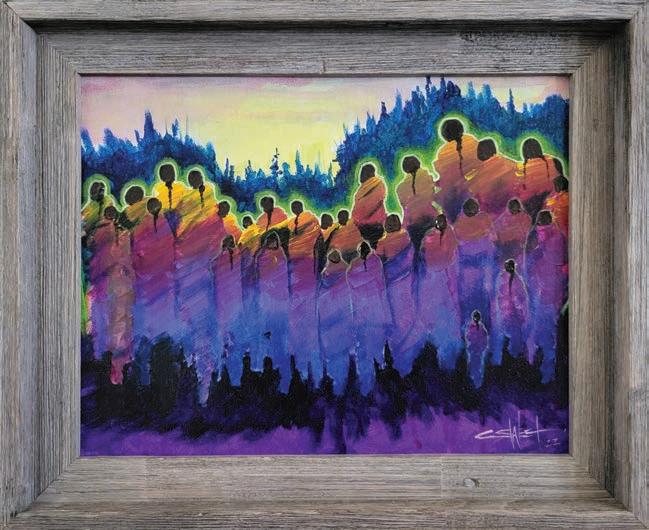
Generational Resilience, 2022, Acrylic on canvas, 11 x 14 inches.
Christopher Sweet, a contemporary multi-disciplinary artist, is an enrolled member of the Ho-Chunk Nation of Wisconsin and ancestry of the White Earth Band of Ojibwe of Minnesota. His artistic practice is deeply shaped by the traditions, histories, and vibrant cultures of both tribal nations. Raised in Wisconsin, Sweet continues to live and create in the ancestral lands of the Ho-Chunk people, drawing continual inspiration from his upbringing and heritage. Art has been a lifelong pursuit for Sweet, and after a pivotal solo exhibition in 2016, he chose to pursue it as his professional path. Since then, his work has been exhibited broadly across the Midwest in juried exhibitions, commissioned projects, site-responsive murals, and installations.
Sweet’s creative process is guided by intentions of unity and healing, with each artwork serving as an extension of his personal journey. He seeks to foster connection and understanding among viewers through his art. Naturally introspective, sweet uses visual language to express his emotions, beliefs, and values. Through layering paints and creating textures, he explores the complexity and depth of lived experiences. Recurring themes in his work include cultural identity, self-reflection, and the interplay between traditional and contemporary Native ways of life. Sweet’s art pays homage to regalia, dance, family bonds, storytelling, and spiritual connectedness, aiming to unite all people through the universal language of art.
csweetnativeart@gmail.com | csweetnativeart.com | facebook.com/csweetdzine
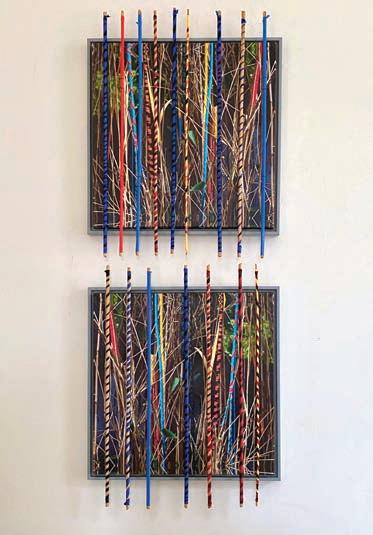
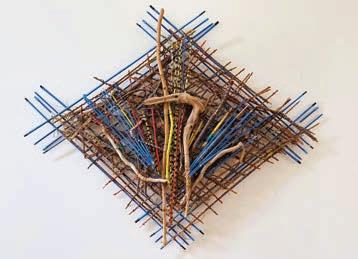
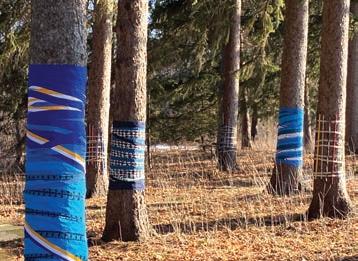
Left: Earth to Earth—In Conversation, Mixed media: digital art, installation print, spiral wrap, wood collage, 21.5 x 54 x 2.5 inches, $1100. Top Right:Blue Heron in the Rush, Mixed media, wood, wire, fiber, found objects, 50 x 44 x 5 inches, $4000. Bottom Right: Holding Space—Circling Pines, ephemeral land art installation—Fiber-based media, 21 x 45 feet.
Marian JA Vieux is a Wisconsin-based artist utilizing mixed media assemblages and ephemeral land-art installations to detail nature’s design in the Great Lakes Region. JA Vieux’s work emphasizes vivid color and nature’s dynamic, recurrent patterns through which her abstract depictions of woods and grasslands are expressed. She invites the viewer to experience the sensory elements of nature—the reflections of water, the movement of clouds, and the textures of patterned perennial landscapes.
JA Vieux’s professional background includes fellowships at the MacDowell Colony, NH; Ossabaw Island, GA; as well as collegiate residencies in the Midwest. She created “Holding Space—Circling Pines” art installation at the Lynden Sculpture Garden’s Winter Carnival. This installation can be experienced throughout the seasons. Her artwork is held in both public and private collections; has been exhibited at Chicago’s Navy Pier; and has been featured in publications such as Public Art Proposals—Ecology and Art, sponsored by The International Sculpture Center and the NICAF, Yokohama, Japan.
JA Vieux presents a show that explores the confluence of how we shape and are shaped by nature. The exhibit “Eco Portraits” will be on view at the Ploch Gallery at the Sharon Lynne Wilson Center for the Arts from September 8 to December 23, 2026.
marianvieux@gmail.com
2027 Partners:
Anchor Press Paper and Print (AP3)
Bronzeville Center for the Arts
Carthage College
Charles Allis Art Museum
Concordia University
Grove Gallery/Team Nerd Press
House of RAD Gallery
Jewish Museum Milwaukee Latino Arts
Lawrence University
Milwaukee Art Museum (MAM)
Milwaukee Institute of Art & Design (MIAD)
MPL Archives and Special Collections
Miller Art Museum
Portrait Society Gallery
Racine Art Museum (RAM)
River Press
St. Kate the Arts Hotel
Tandem Press
Tory Folliard Gallery
UW Green Bay
UW Oshkosh
UWM Mathis Gallery
UWM Union Gallery
VAR Gallery
Villa Terrace Museum and Gardens
Wisconsin Lutheran College