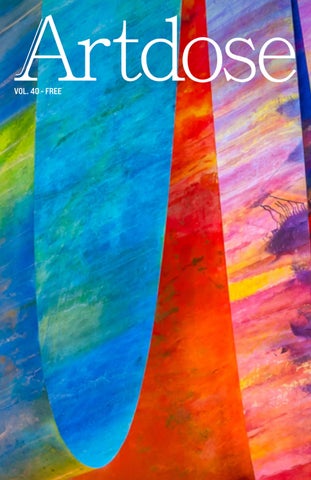
VOL. 40 - FREE
YOUR MIND WILL LINGER LONG AFTER YOU’VE LEFT. Two world-class art museums offering a singular experience. Here, words may fail you but the art speaks volumes. This is a place that will stay with you and won’t let go. You’ll see. jmkac.org
Top to Bottom: Yvette Mayorga, Bedroom After 15th (detail), 2022. Courtesy of the artist; Tyree Guyton, Penny Car, 2003. Courtesy of the artist; Art Preserve of the John Michael Kohler Arts Center. Photo: Durston Saylor.
2025.01.03_ArtdoseAd8x5_JMKACfullpage_FNL.indd 1
11/7/25 3:24 PM
ARTDOSE MAGAZINE PUBLISHED BI-ANNUALLY : SUMMER & WINTER VOLUME 40 | WINTER 2026 PUBLISHER’S NOTE 2026 marks our 13th year bringing the visual arts and design into our communities through print. Each issue features regional artists, designers, non-profit arts organizations, institutions, galleries, artist projects, and guest contributing writers. Artdose continues to navigate the art world with new ideas, initiatives, and most recently, opening a physical space called A Project Space, to curate exhibitions and create programming focused on emerging to mid-career artists working in varied media, genres, and processes. It provides the perfect backdrop for experimentation, conversation, and community building—sparked by curiosity, creative risk-taking, and critical discourse. We can’t wait to see how this new space evolves! - Frank Juárez
CO-EDITOR’S NOTE Artdose has been a champion of the visual arts in the midwest for 39 issues. In Volume 40, we continue celebrating the robust and diverse creative communities here, from ceramicists and photographers to painters and art publications. Whether it’s a formal museum space, a community-focused group that supports grief practices, or an art center dedicated to serving artists with disabilities, our vibrant arts ecosystem is thriving. It is essential to uplift the voices of artists, projects, and spaces like those featured in this issue because their creativity and sincerity remind us of what it means to be human. By publishing our stories, Artdose is the connective tissue that builds stronger ties across our artistic communities. We are eager to see the prosperous future of the midwest’s art and design network and look forward to bringing people together through print for many years to come. - Rachel Hausmann Schall
MAILING Artdose Magazine LLC P.O. Box 1125 Sheboygan, WI 53082-1125
PUBLISHER Frank Juárez
SUBMISSIONS Visit artdosemagazine.com for submission guidelines.
CONTRIBUTORS April Behnke Emilie Heidemann Linda Marcus Rachel Hausmann Schall Samuel Schwindt Samantha Timm
All inquires should be sent to artdosemagazine@gmail.com.
GRAPHIC DESIGNER Alison Kleiman
SOCIAL MEDIA @artdosemagazineweekly @artdosemagazine All Rights Reserved © 2026 Artdose Magazine LLC and the individual contributors Limited quantities available in listed arts centers, museums, studios, and galleries.
Cover: Anne Labovitz, Convergence, Hope, Love, Resilience, Rest, Community (Detail), 2024, Acrylic on Tyvek, 31 x 30 x 5 feet. Photo: Bailey Bolton. Vol 40
3
WISCONSIN CRAFT MAY 30 & 31, 2026
Outside The Marcus Center, Milwaukee WI
CALL FOR ARTISTS - Applications due February 4th, 2026
MKE STUDIO TOUR
Wisconsin Craft Members Exhibition
October 3 & 4, 2026 Self Guided Art Studio Tour around MKE County
February 6 - March 6, 2026 Alverno College, Milwaukee CALL FOR ARTISTS
Self Guided Art Studio Tour MKE County Applications due around April 2026
Opening Reception February 13th, 5:00pm
Become a
Wisconsin Craft Member!
Wisconsin Craft brings together artists and communities throughout the state to educate, support, and engage in traditional and contemporary fine craft. As a non-profit, we host professional programming, exhibitions, networking, and public events.
4
wisconsincraft.org
MARY HAGER 3D MIXED MEDIA ADELL, WI Artdose Magazine | artdosemagazine.com
Anne Labovitz: Visual Representation of Optimism By Frank Juárez
COVER ARTIST
Left: Anne Labovitz in the studio. Right: Anne Labovitz, Installation view, Plains Art Museum, Fargo, ND. [Left] Light Windows; [Center] Embracing Well-Being II; [Right] Convergence, Soft Works. Photos: Bailey Bolton.
I
saw the work of Anne Labovitz at the Rochester Art Center, Rochester, Minnesota, in 2023. The exhibition was titled The Nexus of Well-Being and Art. The exhibition consisted of an atrium installation, “Will to Meaning,” which greeted me as I entered the art center. I remember being mesmerized by the scale, repetition of draped material installed from the ceiling, and vibrant colors. It had such a presence that it set the tone of my visit. On my way to the main exhibition space, I felt eager to see what was next. I began thinking of the context of the exhibition and what it meant to take care of ourselves and others. What does this look like in our practice, work, and home environments? 2023 was a year in which mental health was the top priority for everyone. I have felt the anxiety, stress, and never-ending feeling of not knowing when we will go back to how things were. I sat down with Labovitz virtually to learn more about her process, practice, and work ethic. After reconnecting for a few minutes, we dove right into the conversation, which focused on two main questions: What informs your practice, and in what ways do you use your studio practice to bring light to important topics such as mental health, well-being, equity, and community? Labovitz states that her work is centered on how we are human together, the people, and the human condition. Through art, we can find ways to connect regardless of socioeconomics, race, sexual orientation, culture, and so on. Art is a gateway that welcomes everyone to have a shared art experience about what it means to connect to something bigger than ourselves. Creating space for us to come together is an integral
Vol 40
part of Labovitz’s work. A space that allows for selfreflection, to be seen through a communal lens, and to pause life – even for a moment – to connect to the meaning of her work. Providing the community access to contribute to the conversation by amplifying their voices to be heard is important to the quality and equity of the art experience.
Art is a gateway that welcomes everyone... to connect to something bigger than ourselves. Labovitz’s work is contemplative, relevant, and impactful in many ways. Using art as a vehicle to bring attention to important personal and societal issues and concerns is one of the best ways to begin that engagement and process healing. Through her research-based practice, ideas are investigated, influence creative decisions. These creative decisions include voices and personal perspectives from the community. “People’s words are my reason, “says Labovitz. Through an inclusive approach, her attention to detail, personal inquiry, artistic vision, and the art of listening provide a roadmap that addresses her wondering on how she can continue to have the impact that brings people together. When you are fully committed to your practice, it encompasses your entire being and becomes what you are about as an artist and human. A passion driven by purpose. To learn about Anne Labovitz visit labovitz.com and connect on Instagram at @annelabovitz. 5
Rockford Art Museum presents three major exhibitions each year alongside changing permanent collection shows. Follow our social media or visit rockfordartmuseum.org for information on current shows, exhibition-related programs, and events.
Galleries open Thu-Sun, 10 AM-5 PM, free admission
711 N MAIN ST. | ROCKFORD, IL | ROCKFORDARTMUSEUM.ORG | (815) 968-2787
6
Artdose Magazine | artdosemagazine.com
LEIGH YAWKEY WOODSON
ART MUSEUM
JANUARY 17 – MAY 3, 2026
Vol 40
7
Be Part of the Transformation! Bergstrom-Mahler Museum of Glass is delighted to share that we are embarking on a renovation project that will enhance our mission, engagement, accessibility, and guest experience for more than 32,000 annual visitors and glass enthusiasts. This project will maintain our building's historical importance, vintage character, and charm, while integrating thoughtful modern enhancements focused on technology, accessibility, and elevating our visitors extraordinary glass experiences. Renovation Partner
Naming Partners
AUTOMOTIVE FAMILY
Shown: Perthshire Paperweights; Sunflower, 1992; Gift of Mr. & Mrs. F. John Barlow; PW 1992.4.1915
BERGSTROM-MAHLER MUSEUM OF GLASS 165 NORTH PARK AVENUE | 920.751.4658 | @BMMGLASS | BMMGLASS.COM 8
Artdose Magazine | artdosemagazine.com
Where Language Fails: The Art of James Kao By April Behnke
Left: James Kao. Photo Credit: Brennan Witt. Right: Smokeset, 2021, Oil on linen over board, 14 x 15 inches. Courtesy of the artist.
J
ames Kao’s paintings and drawings inhabit the space between perception and imagination. Shapes of trees, mountains, and water surface recede, emerging through soft layers of color and mark-making. Edges blur; forms appear and dissolve. His images seem to capture not the world as it is, but as it feels—filtered through memory, time, and reflection. Although rooted in direct observation, Kao’s work resists classification as landscape painting. His scenes hover between the recognizable and the abstract, conjuring a world of suggestion rather than description. “I want my artwork to fill a space where language fails,” he says, “to articulate sensation over thought.” The result is work that feels meditative and searching, grounded in seeing but never static.
“I want my artwork to fill a space where language fails...” Kao’s fascination with the natural world began in childhood. Growing up near a bayou, he spent long hours exploring and observing the wildlife around him. Those early experiences of curiosity and solitude remain central to his practice. Today, he travels widely—through forests, mountains, and rivers—collecting impressions that resurface later in the studio. “There is a never-ending world of interconnectivity,” he says. “In unbuilt lands, there is a sense of survival, history, and sorrow that is buried or shut away in our urban environments.” His paintings hold that tension: the pull between awe and unease, Vol 40
between permanence and loss. The work invites quiet attention, rewarding viewers with slow, unfolding revelations. Beyond his studio, Kao has become a cornerstone of Chicago’s art community. In 2014, he co-founded 4th Ward Project Space with artists Mika Horibuchi and Valentina Zamfirescu in Hyde Park. What began as a way to stay connected after graduate school has grown into one of the city’s most respected artistrun spaces. “Because we do not need to generate income to maintain our program, 4th Ward provides artists an opportunity where a successful exhibition is marked by something other than the sale of artwork,” Kao explains. This model of independence has made the gallery a refuge for experimentation and exchange. Kao’s connection to Chicago is deeply personal. “Chicago is home,” he says. “Anybody who comes out here brings real love and support. That comfort and familiarity is a hallmark of the Midwest.” In addition to his artistic and curatorial work, Kao is a Professor of Art at Aurora University. Teaching, he insists, is inseparable from his practice. His experiences navigating the art world have also informed the structure of 4th Ward, from its focus on one-person exhibitions to its decision to operate outside commercial pressures. At the heart of it all—whether painting, teaching, or collaborating—is a spirit of curiosity and generosity. “Doing what you want to do yields a sense of effortlessness,” Kao reflects. His work shares those qualities: gentle, steady, and open to discovery. To learn more about James Kao, visit jameskao.org and connect on Instagram at @bookish_dancer. 9
A New Home: Celebrating the Re-Opening of the Trout Museum of Art By Rachel Hausmann Schall
Left: Facade of the new location for the Trout Museum of Art. Photo: Artdose Magazine. Right: Beth Lipman, Sphenophyllum and Chains (detail), 2019, Glass, wood, metal, paint, adhesive, 50 x 54 x 38 inches, Beth Lipman: Oncoming Close. Photo: Rich Maciejewski.
A
s a Wisconsin-based artist and art lover, I’m interested in visiting art spaces across the state. From museums and art centers to garage galleries and basement event spaces, it’s intriguing to see the variety of arts institutions that exist in our great state. It might be easy to familiarize oneself with art spaces in Wisconsin’s larger cities like Milwaukee or Madison, which are well-known for their creative communities, however, it’s rewarding to become acquainted with galleries, art centers, and museums from other parts of the state. The artistic community here extends far beyond our highly populated cities, and recent initiatives like Wisconsin Art Destinations, which created a collective of 14 Wisconsin art museums, make it effortless for those art-curious individuals to get to know art spaces from across the state. As a member of Wisconsin Art Destinations, the Trout Museum of Art in Appleton, Wisconsin has recently completed a tremendous task: moving into a brand new space at 325 E College Ave, just a few blocks down the road from its old location in the heart of downtown Appleton. The new museum, now located on the ground floor in a building shared with Lawrence University, represents itself as one of Wisconsin’s premier arts institutions. It was clear upon my first visit to the new location that this sleek and modern physical space has the capacity to enhance the museum's offerings: exhibitions, workshops, residencies, and community engagement, while leaving room for plenty of new possibilities. The upgraded facility includes expanded gallery spaces
10
with concrete floors and high ceilings, visible storage areas, and many street-facing windows that invite the public inside. The museum has secured free admission through 2026, encouraging community members to experience what the new space has to offer. With 30,000 square feet of contemporarily designed spaces, including a café, classrooms and educational spaces, a dedicated studio space for artists-inresidence, and large, open galleries with ample wall space for captivating exhibitions, the Trout is well equipped to bring meaningful and inspiring visual art experiences to audiences in the Fox Valley region for years to come.
“It was important to me that at least half of the artists have a connection to Wisconsin, and then to contextualize them in this national and international cohort of artists as a way that strengthens both the local and global stories that are going on here.” In October 2025, the museum reopened at its new location with many different exhibitions for visitors to explore, including Guiding Ethos, an exhibition guestcurated by artist and entrepreneur Jenie Gao. Guiding Ethos features the work of 25 national and
Artdose Magazine | artdosemagazine.com
Left: Installation view of Guiding Ethos at the Trout Museum of Art. Right: Installation view of Home Rules: Michelle Grabner. Photos: Rachel Hausmann Schall.
international artists–half are from Wisconsin or have ties to the state–whose work engages in storytelling as both record and resistance through historical reflection and collective memory. As a guest curator, Jenie had the unique opportunity to work with Trout staff in planning this exhibition leading up to the reopening. Jenie describes one of the connecting threads of the exhibition, “The show brings together artists who have previously been censored by fine arts institutions, alongside artists who have organized, protested, and built community as a part of their creative practices.” “It was important to me that at least half of the artists have a connection to Wisconsin, and then to contextualize them in this national and international cohort of artists as a way that strengthens both the local and global stories that are going on here.” Jenie went on to explain their perspective on the recent museum move, “working with the Trout Museum and watching how they facilitated this move into the new building and understanding how they steward their policies around the work they show has been a great experience. They have built a foundation for themselves that gives them a lot of latitude and agency over what they exhibit.” Representation of contemporary artists, including those local to Wisconsin, felt like a central focus for the museum during the reopening celebration. As I meandered through the galleries on opening day, I recognized name after name, noticing artists’ work from across the state. In addition to Guiding Ethos,
Vol 40
other exhibitions in the Trout galleries celebrated the work of artists with ties to Wisconsin, like Michelle Grabner, Beth Lipman, and Li Hu. The museum also showcased its permanent collection, assembled over the past 40 years by its namesake, Dr. Monroe E. and Sandra Trout. Additionally, the museum celebrated the work of previous artists-in-residence through a group exhibition and unveiled a custom 20-foot mural created by their Designer of the Year that hangs behind the counter in the museum store, greeting visitors upon entrance. David Najib Kasir, a Wisconsin-based artist whose work was featured in Guiding Ethos, shared his outlook on the recent move to a new building: “I got to see the space as I dropped off my work and walked around, and I was blown away by what I saw. I really thought that this new building sets a new standard for smaller art museums. They have something special in Appleton. At the opening, I felt honored to be among the first works in the new spaces.” Like many artists, I strive to find spaces where I feel like I belong or where I feel welcome to be an independent thinker and creator. The museum's new location has succeeded in making the art-curious welcome, and I encourage any art lover to visit, explore, and enjoy what one of Wisconsin’s many art spaces has to offer. To learn more about the Trout Museum of Art, visit troutmuseumart.org and connect on Instagram at @troutmuseumofart.
11
Madison Death Studio By Emilie Heidemann
Left and Right: The Madison Death Studio leads a mock burial at a natural cemetery in Verona, Wisconsin. Photos: Madison Death Studio.
M
eghan Allynn Johnson, a death worker and artist from Madison, Wisconsin, knows how lonely it can be to go through a devastating loss and to grapple with the grief that follows. Her parents died two years apart. Johnson’s father died in 2018, and her mother in 2020. “I had been living in Harlem at that time and lost close friends and neighbors when COVID-19 first hit New York City, so alongside my mother’s death, I was experiencing a stream of losses within my community,” Johnson said. “During that time, I found out just how isolating it can be to go through loss after loss in our death-phobic culture. I ran into bureaucratic bereavement policies at work and felt the fatigue in talking about grief and death within my close relationships.” She turned to Instagram. That led to the creation of the Madison Death Studio, which posted for the first time on the social media site in May 2024, and sought to use art to help people better understand their own grief and develop a more comfortable relationship with the concept of death. The Madison Death Studio initially launched as the Madison Death Collective, Johnson said, with her friend, who is a grief therapist. It’s just Johnson running the show these days, as her friend wanted to focus on her practice full-time. There are “maybe eight or nine others” organizations of this type around the world, she said. “People clearly needed this. We started getting a lot of interest in the Madison Death Collective and our inperson events. I started setting up booths at local markets … where I was approached by grievers, the dying, health practitioners, and lots and lots of curious folks who were like, “What the heck is a death 12
collective, and how can I be a part of it?’ Johnson said Madison Death Studio’s programming centers on different types of craft and creative projects for death care practices.
“When we consider [death] controversial, then people who are experiencing ... loss are isolated. The truth is, we heal in community.” “Our first event in 2024 was a Weave and Grieve, where we sat in a rented room in the Goodman Community Center and sipped hot cocoa and weaved thrifted yarn onto handmade cardboard looms together while talking about the community around death and grief.” The Madison Death Studio has also held mock burials at natural cemeteries in the Madison area, and leads an art history series alongside death work artist Narinder Bazen, called Dead of Winter. The series invites death workers and creators to join during the winter months to make art and look at artworks “through the lens of mysticism, folklore, and cultural death midwifery.” “It’s part studio time, part creative show-and-tell, and part history lecture,” said Johnson. “When we avoid death and consider it controversial, then people who are experiencing death or loss are isolated and made to feel shame about their lived experience. The truth is, we heal in community.” To learn more about Madison Death Studio, visit madisondeathcollective.org and connect on Instagram at @madison.death.studio. Artdose Magazine | artdosemagazine.com
Abel Contemporary Gallery
One of the most impressive collections of fine art and fine craft in the country. Find us in Stoughton, WI and online.
524 East Main St. Stoughton, WI 53589 608-845-6600
abelcontemporary.com Vol 40
Image: Adam Stoner 13
ART VENUES Art Preserve The Art Preserve of the John Michael Kohler Arts Center is the world’s only museum dedicated to the preservation and celebration of artistbuilt environments—spaces and places that have been significantly transformed by an artist to embody and express aspects of their history, place, or culture. More than 30,000 works by 40 artists are on display, including award-winning, artist-designed washrooms. Admission and parking are always FREE. Tue, Wed, Fri: 10 am – 5 pm, Thu: 10 am – 8 pm, Sat and Sun: 10 am – 4 pm, 3636 Lower Falls Road Sheboygan, WI 53081; 920.453.0346; jmkac.org
James Watrous Gallery The James Watrous Gallery is dedicated to amplifying Wisconsin artists. Located on the third floor of Overture Center for the Arts in downtown Madison, the Watrous focuses on solo and curated exhibitions that feature contemporary Wisconsin artists. As a program of the Wisconsin Academy of Sciences, Arts & Letters, the gallery aims to draw connections between art and other disciplines. Thurs-Fri 12 - 6 pm, Sat 11 am - 5 pm, Sun 12 - 5 pm; 201 State St, Madison, WI 54703; 608.733.6633 x25; wisconsinacademy.org/gallery
John Michael Kohler Art Center The John Michael Kohler Arts Center (JMKAC) is a nationally acclaimed visual and performing arts complex located in Sheboygan. Year-round offerings include rotating original exhibitions and thematically aligned live performances, community events, and art-making experiences for all ages and abilities. Experience includes a friendly café, a gift shop, and a hands-on art studio. Admission and parking are always FREE. Tue, Wed, Fri 10 am – 5 pm, Thu 10 am – 8 pm, Sat and Sun: 10 am – 4 pm, 608 New York Ave, Sheboygan, WI 53081; 920.458.6144; jmkac.org
Kim Storage Gallery Located in the heart of Milwaukee, the Kim Storage Gallery is a vibrant space celebrating the creativity of Wisconsin and beyond. This gallery features a diverse mix of museum-quality artwork, ranging from innovative pieces by emerging local talents to esteemed works by established artists. It's a dynamic hub where art enthusiasts can explore the evolving landscape of contemporary art in an inviting and accessible environment. Tues-Sat 10 am - 5 pm, Viewings by appointment; 207 E Buffalo St, Ste 404, Milwaukee, WI 53202; 608.381.6905; kimstoragegallery.com
14
Artdose Magazine | artdosemagazine.com
ART VENUES newARTSpace newARTSpace is dedicated to presenting dynamic contemporary art through sharing the work of both accomplished and emerging artists in our local, regional and national communities. We are a non-commercial, artist-driven exhibition and event space enlivening a storefront in historic downtown De Pere, WI that believes in the necessity of art in our society and are committed to providing a platform that reflects and serves that conviction. Variable hours (Check Website for weekly updates); 124 N. Broadway, Suite A, De Pere, WI 54114; 541-991-7119; www.newartspace124.com
Rahr-West Art Museum The Rahr-West Art Museum is a City of Manitowoc facility that preserves and enhances its collections and historic mansion. The museum's purpose is to engage the dynamic learning opportunities in the visual arts, and enrich life in the area by serving as a cultural resource. Tue - Fri 10 am - 4 pm, Sat - Sun 11 am - 4 pm; 610 N. 8th St. Manitowoc, WI 54220; 920.686.3090; rahrwestartmuseum.org
Sharon Lynne Wilson Center for the Arts Located in a scenic park in Brookfield, Wisconsin, just 20 minutes from Milwaukee, the Wilson Center focuses on three main disciplines: Performing Arts, Arts Education and Visual Arts. The Wilson Center hosts a full performance season, year-round art exhibits by Wisconsin artists, an outdoor Arts Park, many permanent art installations and artist talks with each new gallery show. Join us in summer for our free Starry Nights Concerts. Tues–Fri: 11 am – 6 pm. Hours may be limited during performances. 262-781-9520. 3270 Mitchell Park Drive, Brookfield, WI 53045; wilson-center.com/ploch-art-gallery
Sheboygan Visual Artists We are a cooperative of over 75 visual artists serving the Sheboygan area. The SVA focuses on empowering local artists and engaging the public through exhibits, workshops, scholarships, and community outreach programs. We support artists in all stages of their creative careers. Our new gallery opens in early 2026 on Sheboygan's riverfront at 534 South Pier Drive. Learn more about us and see our artists' amazing works on our website, Facebook, and Instagram. contactus.sva@gmail.com; www.sheboyganvisualartists.org
Vol 40
15
CENTER FOR THE VISUAL ARTS
427 N. 4TH ST. WAUSAU - CVAWAUSAU.ORG- 715.842.4545 W 10-4PM | TH 10 - 7PM | F 10- 4PM | SAT 12-4PM
G
16
C - CERAMI L OF ART O O H C S ALLERIES
CVA SHOP STUDIO -
Artdose Magazine | artdosemagazine.com
Monica Rezman: Between Two Worlds By Linda Marcus
Left: Mexico Studio, 2022. Photo: Patricia Robert. Middle: Names and Shapes, 2021, Cardboard, acrylic, canvas, and thread. Right: The Minds House, 2021, Cardboard, acrylic, canvas, and thread. Photos courtesy of the artist.
F
or artist Monica Rezman, the “in between” is not a point of transition but a place of belonging. It’s where her practice lives — in the slip between mediums, cultures, and states of being. “It feels natural,” she says of this undefined space. “It’s my strength.” Dividing her time between Chicago and Mérida, Mexico, Rezman moves fluidly between two distinct worlds, drawing energy from the friction and harmony of both. When she first arrived in Mérida, the absence of familiar materials prompted an unexpected evolution. “I realized I work best with limitations,” she recalls. “I’m not scared; I’m not afraid of failure. I’m always open to learning new things.” What might have seemed like constraint became the generative condition of her practice. Rezman’s work occupies a hybrid terrain — painting that behaves like sculpture, sculpture that retains the sensibility of painting. Her recent series begins as acrylic on canvas, but the surfaces are cut apart, reassembled, and stitched back together. Seams, reminiscent of garment construction, interrupt the painted fields, invoking a tactile language of repair and transformation. “Painting is such an intense art form,” she notes. “Bringing stitching into it relieves me — it gives me a kind of space in between.” The results are dynamic, wall-bound forms that refuse containment. Protruding outward, they seem to shift and unfold, their physicality animated by the rhythm of addition and subtraction. “I like reassembling Vol 40
things,” Rezman says. “I’m always adding, taking away, and seeing where it goes.” The process is both constructive and deconstructive — an act of material thinking that asks what it means to make a painting that is also, insistently, an object. A parallel inquiry runs through Rezman’s sculptural work, much of it derived from her earlier ‘hair paintings,’ begun more than a decade ago with charcoal on paper. She now adds cardboard armatures, lending structure to forms that remain visually light. The motif of hair — first inspired by watching her mother try on wigs — carries forward a meditation on femininity and self-presentation. “I became fascinated by how women use adornment as a kind of language,” she says. That curiosity has evolved into a larger ambition: to expand the visual vocabulary of sculpture itself. “I want to make sculptures that feel like a woman made them,” Rezman explains. “Not these large, rusty monuments, but something colorful, something alive. I think of sculpture as painting — I want to bring my paintings into a bigger arena.” In Rezman’s world, the boundaries between media are not obstacles but openings — permeable thresholds where material, memory, and identity continually recombine. The “in between” is not where she hesitates. It’s where her work begins. To learn more about Monica Rezman, visit monicarezman.com and connect on Instagram at @monicarezman 17
The Story Behind the Iconic Art Muscle By Frank Juárez
Left: Debra Brehmer and Frank Juárez at Paradigm Coffee + Music. Photo: Alison Kleiman. Middle: Art Muscle, July 15/Sept 15, 1988. Right: The Business Journal, Week of June 15 – June 21, 1987. Images courtesy of Debra Brehmer.
A
rt Muscle made its debut in the Milwaukee art community in 1986. The magazine was founded by UW-Milwaukee graduate student Debra Brehmer, who is an arts writer, historian, and owner of Portrait Society Gallery Contemporary Art in the Historic Third Ward. The germ of the idea, says Brehmer, probably came from her love of Interview Magazine (founded by Andy Warhol) as a disgruntled teenager locked in a suburban bedroom. Brehmer studied journalism with an emphasis in the arts at the University of Wisconsin- Eau Claire. During her time there, she had an internship at a weekly newspaper, and after graduation worked for several years as a feature editor at a daily paper. Through this experience, she learned how publishing works. Later, she worked for the Milwaukee Art Museum as the editor of its publications. She decided to go to graduate school for art history at the University of Wisconsin–Milwaukee. This is where the story began. Like many publications, an idea must take interest. During her graduate school years, a classmate, Jerome Schultz, approached Brehmer, whom he knew had a background in editing and publishing, and said, “We should start an art publication in Milwaukee.” Brehmer responded with, “Yeah, we probably should.” So, they did. That was it. Art Muscle encompassed the heart of what it meant to be alive in the arts. With its democratic approach to arts writing, it tapped into every possible avenue of selfexpression, media, and discipline. Whether it was visual, performance, literary, music, film, or even oddities, Art Muscle was a place to showcase them. A vision was
18
conceptualized, planned, and executed to address a need in the art world. This brought diverse and creative minds to the table, coming from academia and the visual arts worlds. The initial group of collaborators disbanded shortly after the first issue due to differences in opinion as to what the direction of the publication should be. Part of the group wanted it to be a non-profit critical journal to serve more of the academic world, whereas the other part of the group wanted to make the publication broadly appealing and rooted in the city – collaborative and engaged. It became a for-profit business whose office was located on the corner of 9th and National Avenue in Milwaukee. The office was initially on the top floor above what used to be the Walker’s Point Center for the Arts, and later moved around the corner. Art Muscle had a circulation of 20,000 and was published bi-monthly. It was distributed free in Milwaukee and sold on newsstands statewide and nationally. In 1995, Art Muscle was sold to Judith Moriarity, a longtime contributor and writer. Running a bi-monthly magazine was a challenging undertaking, which eventually resulted in its dissolution in 1997. I was intrigued by the name of the publication when I heard about it in the early 2000s. In 2018, John Shannon, owner of Guardian Fine Art Services, with an interest in archives, preservation, and publishing, led the funding of the digitization of all 62 issues of Art Muscle to become part of UW-Milwaukee Special Collections. Access to this online database of the city’s arts and
Artdose Magazine | artdosemagazine.com
culture history is vital to the understanding of the foundation that put Milwaukee on the map on a national scale. Brehmer mentioned that in 1987, artist Julian Schnabel gave a presentation at the Milwaukee Art Museum. In his hand, he held up a copy of Art Muscle and said, “What the f#@& is this? I would expect this in New York, not in Milwaukee.” The magazine had published a skeptical assessment of his work. Today, the iconic publication has resurfaced modestly, with supporters seen wearing an Art Muscle t-shirt. This nostalgic experience has spread throughout the city and beyond, revisiting memories and providing a new generation of creatives with an understanding of how the 80s and 90s became pivotal times for the arts in Milwaukee, led by the people behind it. People are proudly wearing and supporting this publication with selfies shared on social media. Could there be something else in the future that celebrates the arts, culture, and community that Art Muscle has shaped? Only time will tell. View the digitized Art Muscle uwm.edu/lib-collections/art-muscle
collection
at
Above and right: images courtesy of Debra Brehmer.
Vol 40
19
Art comes alive in the Milwaukee’s Third Ward Where artists and art lovers meet in creative dialogue and passionate collectors find that perfect piece. Visit us us today today Visit
Representing 5555 international, localartists artists in Representing international,national national and and local 7 different exhibtions each year including in 7 different exhibitions each year including Milwaukee's Gallerygallery Night and Day. Milwaukee’s night and day. 215 WIWI 53202 l 414.509.5756 215N.N.BROADWAY, Broadway,MILWAUKEE, Milwaukee, 53202 | 414.509.5756 lilypadgallery.com l info@lilypadgallery.com lilypadgallery.com | info@lilypadgallery.com Hours: Wednesday Sunday11 11am amtoto 6 pm. Open Monday and Tuesday. Hours Wednesdaythrough through Sunday, 6 pm. and openby by appointment appointment Monday and Tuesday.
20
Artdose Magazine | artdosemagazine.com
GREEN BAY ART COLONY
january 24 - march 22 NWTC ARTISAN & BUSINESS CENTER
ANNUAL SHOWCASE
march 28 - may 17
NEVILLEPUBLICMUSEUM .ORG Vol 40
21
COVER ARTIST: ANNE LABOVITZ
Anne Labovitz, Detail Night View. Selections of Will to Meaning, City of Rochester, 2024, Acrylic on Tyvek with LED lights and Plexiglass, 10 x 136 x 1 feet (currently on view) Photo: Bailey Bolton. 22
Artdose Magazine | artdosemagazine.com
Vol 40
23
24
Artdose Magazine | artdosemagazine.com
Aaron Becker: Making Sense of Myself By Linda Marcus
Left: Becker among his works; Middle: Hopeful wife head with vase car, 2025, Hand-built, fired cone 6, underglaze, stain, underglaze pencil, glaze, 15 x 14 x 10 inches.; Right: Becker with his handmade flute at home. Photos: Stevie Connor.
A
sense of “self” is what interdisciplinary artist Aaron Becker finds when he works with clay. For him, the material is a means of communication. “Clay is like a conduit to my imagination,” he says. “It’s a relationship that’s honest, and it informs you while you’re working. You have to be tuned in all the time. With paint, you’re pushing it around with a brush—you can feel disconnected. With clay, you don’t.”
The result is a body of clay pieces that convey not just technical skill but an evolving worldview. Becker views working with clay as a collaboration—one in which the material has an active voice.
The Chicago-based, Wisconsin-born artist creates sculptural vessels that explore human experience. Becker spent more than a decade practicing traditional wheel-throwing, working strictly within that discipline. But after a short hiatus to pursue another passion— snowboarding—he began thinking more deeply about individualism, imperfection, and looseness. He became curious about what might happen if he allowed those ideas into his studio practice.
Then Becker turns to glazing—an intuitive, deeply considered part of the process. “I think of color as a washing with time,” he says. “So, when we go to discover these pieces in a gallery or museum, you’re unearthing meaning. Each person will have a different experience.”
That shift marked a breakthrough. Becker embraced imperfection as a generative force rather than something to correct. “Your flaws are what make you different,” he says. “I love ugly things. I love seeing the human experience in how things are made and felt. I realized that was a great way to talk about things.”
“When I started working with clay, I learned to get in tune with the tips of my fingers,” he says. “I learned how to touch gently for the first time.” He also began merging hand-building with his thrown forms, a hybrid approach that expanded the language of his work and opened new pathways for expression. Vol 40
“When I started working with clay, I learned to get in tune with the tips of my fingers,” he says. “I learned how to touch gently for the first time.”
Becker’s appreciation for humble, functional forms connects in part to mingei—a Japanese modern aesthetic philosophy founded in the 1920s that incorporates Buddhist ideas. Mingei values beauty in everyday objects often made by unknown craftspeople and emphasizes communal authorship and the sincerity of handmade work. Rooted in the spirit of mingei, Becker’s work honors the beauty found in objects shaped by ordinary hands and honest labor. Yet he brings that tradition into the present with a language unmistakably his own—one built on looseness, curiosity, and the willingness to let clay lead the way. His vessels become small monuments to imperfection, each one carrying the marks of the day it was made and the person who made it. In the end, Becker’s art offers a quiet reminder: the most meaningful forms in our lives are the ones that bear the imprint of being touched. To learn more about Aaron Becker, visit asif1111.com and connect on Instagram at @aaron.asif.becker 25
Uncovered Autobiography: Project Onward’s Cultural Work By Samuel Schwindt
Left: Image from the exhibition Poor Man’s Paradise. Middle: Image of the entryway to Project Onward at the Bridgeport Art Center. Right: Image of an artist and facilitator at work. Photos: Project Onward.
A
rchaic artifacts adorn the wall, nudging the ceiling. Artist-made paintings, drawings, and sculptures reside below, their sources in autobiography coupled with a sneaky history. This was the first exhibition I witnessed at Project Onward in their Bridgeport Art Center studio and gallery in September 2025. The exhibition featured objects from the bustling days of street sellers on Maxwell Street and artists in the organization with shopping-memories. Poor Man’s Paradise: Honoring the Legacy of Maxwell Street Market investigated a history of Chicago long-forgotten. Artists join Project Onward via their website, social media, and word of mouth — submitting 10 artworks. It’s “the originality and strength” of the work that is paramount, said Nick Jackson, a studio facilitator. The organization’s objective is to bolster the creative practice of individuals with mental illnesses and disabilities. They cater to different ranges of abilities: some have “conditions that are more severe,” said Jackson. Applications, however, can be “imitative,” with artists drawing cartoon characters without an “original voice.” Yet they always pass on tips and suggestions to artists who’ve applied and not been accepted, said Jackson. It’s important that the artists have a generative dynamic within the shared studio space, too; Project Onward’s mission and vibrant space require an intuitive, collaborative approach. Materials spread and projects unfold in unison with the scratches of pens and groaning of kilns, after all. While there is a requisite probation period, “we’ve never turned someone away” after the trial, said Jackson.
26
They have had artists in the studio since the founding in 2004, and there’s kinship and mentorship from long-term artists relating to new residents. There can sometimes be “tunnel vision” from individual artists, but a through-line often becomes apparent to the teachers and mentors. Sometimes, even, it’s “common obsession over trains,” said Jackson. This leads to their exhibitions: a facilitator like Jackson will concoct uniting themes to tell the stories of artists with similar experiences. Project Onward not only seeks to support the development of an artistic vision and voice, but also a business plan as well. Some issues arise with artists’ growing success. A hurdle Jackson mentioned is that many artists have conflicts with disability support from state and federal funds, though Illinois ABLE allows individuals with disabilities to set aside money for approved disability-related expenses while maintaining eligibility for benefits. This is all because, of course, the prolific success of their artists. The oeuvre of concepts and material manipulation is inventive and industrious. Whether it’s the autobiography of one artist going to Maxwell to buy a switchblade as a kid or a science fiction/teen fiction graphic novel, Project Onward is a compelling foil to the Chicago art scene. With their balancing act between fine art, craft, and commercial production, Project Onward has a Midwestern percussion. The tempo is palpable in an archived instrument from Maxwell Street; the much-needed cultural work is ready to hum. To learn more about Project Onward, visit projectonward.org and connect on Instagram at @projectonward. Artdose Magazine | artdosemagazine.com
Lauren Semivan and the Choreographic Potential of the Artist's Studio By Samantha Timm
Left: Vanishing Point, #1/5, 2025, Archival pigment print, 40 x 50 inches. Middle: Souvenir, #1/5, 2025, Archival pigment print, 40 x 50 inches. Right: Parasol, #1/5, 2025, Archival pigment print, 32 x 40 inches. Photos: Lauren Semivan.
L
auren Semivan’s photographs are built worlds that trace her studio movements and propose probing questions about time and space. Using an early 20th-century large-format camera, Semivan captures scenes that she creates in her studio through a curious process of composition and performance. Her images tend towards the mysterious and prompt an invitation to viewers: to wonder.
Her images tend towards the mysterious and prompt an invitation to viewers: to wonder. After encountering her recent work at the Portrait Society Gallery for Contemporary Art in Milwaukee, I found myself wondering about movement in Semivan’s photographs, and how much of this larger gesture was driven by the artist’s own movements to compose, place, draw, pull, paint, and finally, to photograph. In a past interview for METAL Magazine, she compared the process of composing these scenes to “choreographing an event that takes place in front of the lens, almost like a ballet…” Her current creative process remains tied to this medium: she compares the development of the final image to the kind of intensity and studied “rehearsal” required for a performance and describes her artwork as “the culmination of all that energy in the brief exposure of film within the camera.” For Semivan, “the exposure of a large format negative is much like a symphony orchestra performance, ballet, theater production…” Vol 40
Physically, she notes a lot of “stepping forward toward the set, then stepping backward to lift the dark cloth and look into the camera.” Over a matter of hours and days, she finds herself “going up and down a step ladder, stretching my arms up to reach the top of the wall with a large drawing or piece of fabric, reaching across the wall, hammering pins, making a mark with charcoal, dropping something, stepping down, stepping back to look into the camera, repeating that sequence.” This fluency in performance stems from her study of music from a young age, something she continued alongside her art education in college. Semivan’s compositions read like tableaux, and there is a stillness in them that conjures not only a sense of immediacy but also of tension, as if she is pulling on the threads of time and composing with them. Threads and found objects are suspended in the air and seem to provide a glimpse into a layered studio moment packed with meaning–caught and grounded firmly by her charcoal marks but allowed to hang precariously from string as their stories seem to emanate out in smudges of soft, dramatic color. In Parasol, for instance, the painted olive greens and dark grey-blues almost appear as if they were drawn onto the wall by this found object–as if this hazy impression is a rubbing-off of the parasol’s physical and material history. To learn more about Lauren Semivan, visit laurensemivan.com and connect on Instagram at @lsemivan. Continue reading at artdosemagazine.com/posts. 27
Pamela Anderson
Coordinates of Light, 2025. Acrylic, collage on canvas, 36 x 36 inches, $2300.
Color and mark-making are my truest language. In Coordinates of Light, I use bold shifts of hue, shape, and form to map an inner landscape, one guided by intuition, rhythm, and emotion. Working across canvas, wood, and paper, my process is physical and fluid: brushes, knives, and scrapers moving in conversation with the surface. The journey of color perception begins with our eyes but travels far beyond, deep into the corridors of our brain. It influences everything from memory retention to emotional well-being. Abstract composition allows me to translate what I feel into something seen. Color becomes a compass, shape becomes structure, and form becomes the way meaning holds together. In this piece, these elements create a visual reflection of my own coordinates, moments of clarity, warmth, and movement. I hope that viewers find their own points of connection within my work, moments where the light meets them, too. To make a purchase, please contact the artist directly.
pamela@pamelaandersonstudio.com | pamelaandersonstudio.com | 28
@pamelaandersonstudio
Artdose Magazine | artdosemagazine.com
Matthew Braunginn
No Kings No Tyrants No AI Lords, 2025, Oil on canvas, 36 x 48 inches, $7000.
Matthew Braunginn’s (Higgs) work is an exploration of what might be called Contextual expressionism —responding to the context in which you exist in the present. His work is a meeting point between his internal world and the external, whether it be interpersonal relationships or global events. In doing so, they are a presentation and reflection of the context in which their creation exists, forcing the world and those observing my work to see the world, including both the good and the bad. He sees this work as a response to art as an aesthetic during a time of rising fascism, destruction, antiintellectualism, AI slop, and genocide. In doing so, they have become a masculine act of creation, when masculinity is being presented as domination. Each piece, with music woven into its DNA, is injected with the emotionally expressive weight of his subjective interaction and observations of our shared existence. While rejecting the root of the modern world through expressionism, Higgs compels observers to confront the complex emotions of simply being, learning to feel and express freely, rather than practicing avoidance of the world. To make a purchase, please contact the artist directly.
braunginn.com | Vol 40
@TheHiggsTape 29
Kristine Hinrichs
Left: Essential Invisible II, 2025, Pigment print on three silk panels, 48 x 24 x 24 inches. $750; Top Right: Dark and Deep, 2025, Pigment print on three silk panels, 24 x 35 x 5 inches. $750; Bottom Right: Women Walking, 2023, Pigment print on three silk panels, 24 x 35 x 5 inches. $750.
Kristine Hinrichs is a Milwaukee-based photographer whose work focuses on the urban environment. Her work often makes use of reflections, shadows, and layers to illustrate how elements of the urban environment affect and are affected by each other – much like a funhouse mirror, one element reverberating off of the other. She believes that these elements do not exist by themselves, but only in context. Many of her images are produced before dawn when the city streets are quiet and at the Milwaukee lakefront or in commercial districts. She presents many of her images as (three) silk panels hung in series, providing a three-dimensional effect, or as large, ceiling-hung panels. She finds that the use of silk, as an ancient medium, provides a counterpoint to the highly technological nature of digital photography. She continues to work on her project focusing on essential workers, those that people tend not to notice. She recently created large organza panels that are ceiling-hung – providing the illusion of invisibility and looking past or through these important people. Kristine shoots every day and has not missed a day in fifteen years. That provides for a level of continuity and allows her to notice and document subtle changes in the people and urban landscape. She believes that the images find her. Kristine’s award-winning work has been exhibited nationally and throughout Wisconsin and the Midwest. To make a purchase, please contact the artist directly. kristine.hinrichs@gmail.com | kristinehinrichsphotography.com | 30
@kristinemarie
Artdose Magazine | artdosemagazine.com
Katie Hogan
Left: Emily [In Color], 2024, Oil on linen, 14 x 18 inches, $425. Top Right: Blue Vinyl, 2025, Oil on linen, 14 x 18 inches, $450. Bottom Right: Jenny, 2024, Oil on wood panel, 10 x 10 inches, NFS.
Katie Hogan is a Madison-based, Virginia-born and raised, oil painter exploring how to fit a human being within a flat square. Driven by a fascination of painting people and portraits, she attempts to capture brave souls who allow the artist to stare at them for hours. What began as a technical endeavor to get the likeness ‘right’ has evolved into capturing the moment, the emotion, their personality ‘right’ .She creates in environments that provide room for the model’s pose or reference image to speak to the painting and how it wants to exist. Working from a breathing, blinking, person requires decisiveness; sketching quickly in oil, wiping down and re-blocking if needed, working within the temporary setting and the energies of the model and artist on that given day. Is the artist’s energy large, chaotic? Is it quieter, more contemplative? This has translated into working from photographs as well, a new challenge in how to bring liveliness and energy into a static moment. Accepting commissions. To make a purchase, please contact the artist directly.
katie.hogan.art@gmail.com | katiehoganart.com | Vol 40
@katie.hogan.art 31
Angela Johnson
Left: Where the Water’s Edge and Hope Exist, 2022, Photograph, archival pigment print, 18 x 12 inches; Top Right: Three Leaves, 2022, Photograph, wet cyanotype on watercolor paper, 9 x 12 inches; Bottom Right: Darkness Envelopes, 2023, Photograph, archival pigment print, 12 x 18 inches.
Angela Johnson is an artist, creativity coach and educator based in Madison, Wisconsin. She earned a master’s in art education, an MA in Art, and an MFA with a focus in photography from the University of Wisconsin-Madison. Her photo-based work explores themes of place, specifically nature and how we interact with it, ideas of balance, and telling stories through individual and collective memories. As part of her daily practice she walks/ hikes with her camera and a focus on being present, marking and noticing small interactions or occurrences that may otherwise be missed or unnoticed. To make a purchase, please contact the artist directly.
aj@angelajohnsonartist.com | angelajohnsonartist.com | 32
@angelajohnsonartist Artdose Magazine | artdosemagazine.com
Megan Woodard Johnson
Leaving Questions, 2025, Mixed media on panel, 36 x 36 inches.
Megan Woodard Johnson is a mixed-media artist living and creating in West Bend, Wisconsin. Johnson’s work hangs in private and corporate collections across and beyond the United States and is represented in multiple US galleries. She has shown work in numerous juried group and solo exhibitions, taught workshops, and completed multiple artist residencies, including the prestigious year-long Residency at Saint Kate - The Arts Hotel, in Milwaukee, WI, from September 2024 through August 2025. Johnson’s abstract mixed media paintings are inspired by and reflective of the way our full, beautiful lives are comprised of little rules we try to follow, layered with unplanned detours and lively interactions. She works by combining expressive, luscious applications of paint and drawn line with collected materials such as vintage packaging, ledgers, workbooks, and hand-written records. This piecing together of materials results in energetic compositions that evoke joy, spark curiosity, and reward close inspection. Johnson maintains a full-time studio practice that yields a consistent inventory of work on paper, canvas, and panel, in all manner of sizes. She also welcomes commissions and fine art reproduction requests. To make a purchase, please contact the artist directly.
megan@meganwoodardjohnson.com | meganwoodardjohnson.com | Vol 40
@meganwoodardjohnsonart 33
Helen R. Klebesadel
Pollinator Effect: Lupine Prairie, 2025, Watercolor on Aquaboard, 18 x 24 inches, $2800.
Helen R. Klebesadel maintains her art studio in Madison, Wisconsin. Her visual concerns run the gamut from careful study to poetic, symbolic, and sometimes political representations of nature and human nature. She is best known for watercolor paintings on paper, board, and canvas that address issues of identity and humans’ relationship with the environment. Helen’s watercolors push the traditional boundaries of the medium in scale, content, and technique. Her most recent series, Pollinator Effect, includes watercolors, like Lupine Prairie above, that explore native plant communities and the pollinators that depend upon them. Klebesadel considers her artworks to be part of larger efforts calling for the adoption of sustainable environmental practices, understanding that what we do to the earth we do to ourselves and vice versa. To make a purchase, please contact the artist directly.
Helen@Klebesadel.com | Klebesadel.com | 34
@hklebesadel Artdose Magazine | artdosemagazine.com
Dale Knaak
It’s for you, Marge, 2025, Oil on paper, 22 x 22 inches.
Knaak’s body of work is a synthesis of two basic disciplines of art: drawing and painting. The use of a paper support is the usual constant. The intimate nature of drawing creates the foundation for each piece and is an essential element of the finished surface, merging the boundaries between drawing and painting. As with all of Knaak’s still life paintings, the painting is composed using personal objects in a still life setup. An intense and exhaustive arrangement of subject matter, controlled lighting, and meticulous drawing is followed by layers of paint and glazes. Paint is applied, subtracted, and reapplied. A process that creates varied edges, as well as opaque/transparent layers of color. The intuitive, experimental stage of the process. The results are a snapshot of the moments, people, and a past that defines the artist. To make a purchase, please contact the artist directly.
@knaakpaintings Vol 40
35
Issis Macias
Light Burn I, 2025, Acrylic and oil pastel on canvas, 24 x 30 x 1.5 inches, $700.
Issis Macias is a self-taught artist and daughter of Mexican immigrants who explores the spectrum of human experience through vibrant, intuitive abstraction. Born in Los Angeles and now based in Madison, Wisconsin, she turned to painting during a transformative period of motherhood and a career transition amid the pandemic. Working with acrylic and oil pastels, Macias transforms personal experiences into universal expressions. Macias was named the 2025 Latina Artist of the Year and received the 2024 Micaela Salinas Artist Fellowship, sponsored by Latinos Organizing for Understanding and Development. She was also a 2023–2025 Bridge Work artist at Arts + Literature Laboratory, a 2023 Forward Art Prize finalist through the Women Artists Forward Fund, and is a member of the Madison Art Guild. Her work is held in private collections throughout the United States, Mexico, and Europe. Accepting Commissions. To make a purchase, please contact the artist directly.
issismac@gmail.com | issismacias.com | 36
@issis.unstrung Artdose Magazine | artdosemagazine.com
Linda Marcus
To Rest, 2024, Ceramic with gold leaf, 15 x 12 inches, $850.
I am a sculptor, and clay is my partner. I reimagine relationships of power through feminism and domesticity by layering, cutting, and folding. My current work aims to highlight hierarchies that control the way a female form moves and ultimately to the periphery. The vessels I make are formed by reimagining a common technique in fashion design, "the dart". It was created by male tailors to develop silhouettes to satisfy the male gaze. By randomly employing the dart in clay, I create unusual torso-like vessels. Some staddle, lounge, or even pour over the edge. This deliberate act of sitting or resting is a form of non-compliance and an act of resistance. My process is laborious, but by manipulating and laying clay, it creates a repetition: a meditative mode for me, one that imbues me with the work created. It's a simultaneous act of validation and devotion. To make a purchase, please contact the artist directly.
lindamarcusart.com | Vol 40
@lindamarcusdesign 37
Cyndie Rauls
Left: All I Loved, I Loved Alone, 2025, Assemblage and fiber art, 43 x 12 x 4 inches. Top Right: Like Glitter and Gold, 2025, Assemblage and fiber art, 53 x 22 x 3 inches. Bottom Right: Proxy, 2025, Assemblage and fiber art, 41 x 15 x 4 inches.
Cyndie Rauls resides in the Driftless Region of Wisconsin and dives deeply into the relationship between what is found and what is lost. She uses materials at hand, often found objects, to create her sculptures. What materializes is an abstract meditation on the beauty and emotional power of these objects. Her sculptures are intended to draw attention to the medium’s journey, and the artist’s journey, in an attempt to preserve a fragment of their existence before they are lost forever. Her artistic process begins by collecting clothing, toys, and ephemera from the 1970’s which she then assembles into vignettes of her childhood. Through texture, form, and the inherent narratives embedded within each object, Cyndie invites viewers to discover the subtle messages woven within her work. Each piece marks a single moment within a spectrum of emotion as complex and multifaceted as childhood itself, and serves as a testament to the enduring power of objects and their ability to hold stories. Upcoming Exhibitions: Dubuque Area Arts Collective, Dubuque, IA, January 2026 Overture Center Playhouse Gallery, Madison, WI, November 24, 2026 - February 21, 2027 To make a purchase, please contact the artist directly.
cyndierauls@gmail.com | wanderbrookglen.com | Bluesky: cyndierauls.bsky.social 38
Artdose Magazine | artdosemagazine.com
Katherine Steichen Rosing
Left: When the Forest Holds its Breath (detail), acrylic on canvas, 30 x 40 inches, 2025; Right: Atmospheric Intricacies, (detail), Cyanotype on cotton gauze, hand-blown glass, sand, water, river rock, embroidery floss. (site-specific installation at Ripon College, 2025).
Katherine Steichen Rosing investigates intricate ecological relationships between forests, watersheds, and climate through painting, mixed media, and immersive sculptural installations. With a poetic consciousness of the interconnectedness of all things, Rosing’s richly-hued paintings envision hidden connections within ecosystems—particularly carbon and water cycles disrupted by climate change. Like Arthur Dove, whose work fused natural phenomena with abstract forms, Rosing merges the visible with the invisible. Lines and inscriptions drawn into wet paint reference root systems, unseen ecological processes, and microscopic aquatic life. Layers of saturated color sometimes obscure these marks, embedding hidden messages in complex surfaces. Rosing is obsessed with atmospheric rivers. She envisions these intensifying weather patterns as malicious climate spirits, and new imagery is emerging in both her paintings and installations. Forests are Rosing’s lens to climate, invasive species, and ecological cycles—themes explored in her large-scale installations. Physically immersive, her soaring suspended sculptures become virtual forests offering contemplative spaces to consider deforestation, photosynthesis, and climate-driven water cycles. The sculptures are made from lightweight fibers and paper—hand-sewn, beaded, and embroidered, or painted with ink and burned. Kim Storage Gallery, Milwaukee, will present a solo exhibition of her paintings from April 17–May 23, 2026.
krosing@studioksr.com | studioksr.com | Vol 40
@KatherineRosing 39
Canvas reinvented.
Gallery wrapped. Acts like a panel. Lightweight, warp resistant. Custom sizes. For more info: infrastructurecanvas.com
Mention this ad for 15% discount. 207 E. Buffalo St. #14 LL, Milwaukee, WI 53202
414.559.0935 steven@infrastructurecanvas.com
40
Artdose Magazine | artdosemagazine.com
Vibrant abstract Bold abstract paintings paintings + sculpture + sculpture. Visit my studio, gallery
Visit my studio, gallery to view to artworks, view current current commission artworks, commission an artwork for your collection or loved one. an artwork for your
collection or loved one.
207 E. Buffalo Street, Suite #210 (2ND 414-559-1063 floor of the Marshall Building) Follow me on
Color Block 1, Acrylic, graphite on Infrastructure 600 | Hours: Canvas,Suite 36 x 36 inches, 2020 By appointment
pamela@pamelaandersonstudio.com pamelaandersonstudio.com pamela@pamelaandersonstudio.com •• pamelaandersonstudio.com 414-559-1063 • Hours: By appointment • Follow me on
+ square 6900 feet of creative art space. A 207 E. Buffalo collaborative sustain St., Suite 600 able space for artists ( 6 T H F L O O R O F to create, promote and T H E M A R S H A L L B U I L D I N G ) sell their work.
Due to COVID-19 check website for current hours, or by appointment only.
materialstudiosandgallery.com materialstudiosandgallery.com
207 East Buffalo St., Suite 600 (6TH FLOOR, MARSHALL BLDG) Visit website for current hours new Facebook
Vol 40
new instagram
41
This artwork could soon be on your wall.
THURSDAY NOON - 4 PM FRIDAY 2 PM - 6 PM WEEKENDS 10 AM - 4 PM STAFF Evan Bradbury, gallery owner carnelianartgallery@gmail.com Emilie Heidemann, marketing director eheidemanncag@gmail.com
42
221 KING ST, SUITE 102 MADISON, WI 53703 CARNELIANART.COM 608-333-5309 "Soft Sides" Amanda Langer 20 x 15 inches Steel and fiber
Artdose Magazine | artdosemagazine.com
ART
CULTURE
COMMUNITY
YOU
UPCOMING EXHIBITIONS With Age Comes Lines Rene Iannarelli November 20 - January 17
Nature Photographs David Barnhill November 20 - January 17 Since 2011, ArtStart has been sparking creativity and building community. With two dynamic galleries, creative programs, live performances, and a spirit rooted in collaboration - ArtStart is a cultural cornerstone in the Northwoods of Wisconsin. Plan your visit today.
68 S. Stevens St. Rhinelander, WI | 715-362-4328 artstartrhinelander.org | @artstartrhinelander Vol 40
43
Most Trusted Art Service in the Midwest Confidential, Experienced, Insured
▪ Serving museums, galleries, artists, and private collectors
▪ Appraisals, inventories, advisory services, collection management
▪ Transportation, crating & packing, art storage, installation of artwork and sculpture
▪ CHUBB Insurance Preferred Service Provider for Fine Art Transportation and Storage
▪ Midwest and NY shuttles and exclusive use trucks, all air-ride and climate controlled
Contact Us: 1635 W St Paul Ave, Milwaukee, WI 53233 guardianfineart.com ▪ info@guardianfineart.com 414.252.0677 ▪ 1.833.252.0677 toll free
®