Summit Magazine_Edition 3_issu version

Page 1


Reviving a landmark

Hanna’s Arcade powering the East Mall’s renewal

Courthouse clocking on

The ter Hedde family timekeepers

Local dancers on the big stage

Council support helps young dancers

iconic autumn streetscapes

By Gorge what a view

Discover a hidden tourism gem near Armidale

Armidale’s

From Summit to success: Stories of innovation, opportunity and community

Summit magazine has been produced by Armidale Regional Council’s Communications and Engagement team

Paulette Chavez-Henry, Jo Harrison, Cherene Spendelove, Dane Townsend and Rochelle Tubb

Contributor: Matt Cawood UNE

Editor: Rochelle Tubb

Photography: Simon Scott, Jo Harrison and Paulette Chavez-Henry

Design: Kassandra Hunt

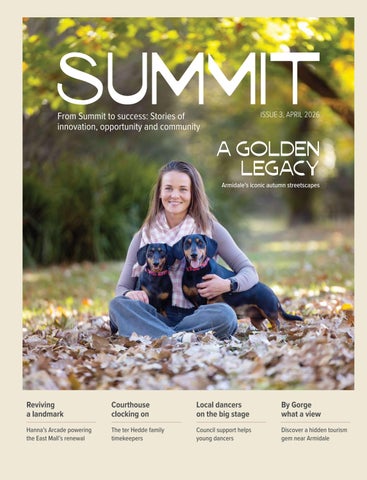
Cover photo: Chaise, Freddie and Pumba enjoying the autumn weather.

Image by Jo Harrison

MAYOR’S RAMBLE WITH SAM COUPLAND

Welcome to the autumn edition of Summit Magazine

Summit isn’t your average council newsletter. It’s a vibrant, people-first magazine that delves into the heart of Armidale and Guyra, showcasing how council services and upgrades are making a real difference in everyday lives.

Summit tells the stories behind the services – through the voices of the people who benefit from them. You’ll meet inspiring locals who go above and beyond for their community and discover how council initiatives are helping shape a more connected, resilient, and thriving region.

Whether it’s infrastructure, events, tourism or essential services, Summit brings it all together in a compelling read that celebrates the power of community and the role council plays in supporting it.

Real stories. Real impact. Real community.

Autumn in the Armidale region is a time of rejuvenation when crisp air and stunning colour transform our region into something truly special. It’s the perfect season to get outdoors, enjoy our parks and tree lined streets, and appreciate the beauty that makes our community unique.

This is also one of our busiest visitation periods, as people from near and far come to experience our famous autumn hues. Their presence brings energy to our local businesses and showcases the warmth and hospitality of our region.

We also look back proudly on the success of last month’s Armidale Autumn Festival, which brought thousands together to celebrate creativity, culture, and community spirit. From sunrise events to the colourful parade and vibrant activities across the city, it was a highlight of the season and a reminder of all we can achieve together.

As we embrace autumn, I encourage everyone to enjoy the colours, welcome our visitors, and carry forward the positive momentum of this year’s festival.

Summit is published by Armidale Regional Council. © 2026, Summit. All rights reserved. No part of this publication may be reproduced, distributed, or transmitted in any form or by any means, including photocopying, recording, or other electronic or mechanical methods, without the prior written permission of the publisher.

Disclaimer: While every effort has been made to ensure the accuracy of the information contained herein, Armidale Regional Council assumes no responsibility for errors, omissions, or outcomes resulting from the use of this material. All content is provided for general informational purposes only and should not be construed as professional advice. Readers are encouraged to seek independent advice before acting on any information contained in this publication.

Summit is a people–first magazine that shares the stories behind council services and initiatives in Armidale Region, highlighting real locals, real impact, and the vibrant community they help to create.

Afather’s legacy and the son who has cared for the clock that has kept time above the old Armidale Courthouse for more than 145 years, is a labour of love that has been part of the ter Hedde family since the 1950s.

Gerry ter Hedde has been winding the historic clock three times a week inside the roof space of the old Armidale Courthouse for 26 years. Every step up the ladders and across the roof space has been etched in his memory, and Gerry says he could probably do it with his eyes closed.

A $14,000 quote to clean the clock in 2000 by a firm in Sydney led Gerry’s mate of 50 years, former Chamber Magistrate Brian O’Connell, to ask Gerry what he could do.

“I said to Brian that I can look after the clock, I can fix the clock if something goes wrong with it, and I’ll clean it for nothing,” said Gerry. “There was also a bit of gardening to do, so I put in a little price for the clock and the gardening, and I got the little job because there was no one else who could look after the clock.”

Gerry has always loved tinkering with old mechanical clocks, something he inherited from his father. While he is not a trained clockmaker, he can usually fix any old clock with a mechanical mechanism.

“I maintain the clock, repair it and wind the clock on,” said Gerry.

“The bell had been disconnected for many years because of the noise to people staying in the mall, but a while back I was asked to get the bell going again.”

“I worked on it for a couple of days. It was all dismantled, but the bell was still there and now it chimes every hour. I think people like to hear it.” said Gerry.

The Courthouse was originally built in 1859, and the clock tower and bells were added by Tornaghi of Sydney in 1878. A telegram from Armidale states that Mr Tornaghi of Sydney has just erected a large town clock on the tower in front of the Courthouse there, “the striking of the bell of which can be heard two miles distant. (Sydney Morning Herald, Saturday 3 May 1879).

Gerry’s family came to Australia in 1955 from Holland and settled in Western Australia for a couple of years.

“My father was out of work and my mother knew a lady who lived in Armidale,” said Gerry. “At the time the courthouse clock was not working, and a man by the name of Mr Plunket said to my father that if he could get the clock working, he would get him a job. We moved to Armidale in 1957 and my dad fixed the clock.”

Gerry hopes one day the courthouse will be a thriving community space and believes it would make a wonderful museum. In the meantime, he will continue to look after the clock for a few more years. He isn’t ready to hand over the reins just yet but hopes in a few years’ time to find that special person he can train to care for the grand old clock for many years to come.

In 2022 Armidale Regional Council took over ownership of the historic building from the NSW Government. Extensive community consultation has been undertaken on ideas for its future use. The Courthouse walkway project including the conversion of the former Sheriff’s Cottage into a café remains in the Development Assessment phase, with Council’s planning team currently reviewing the proposal. Council has also applied for a $1 million Transport for NSW Safer Cities: Her Way 2 grant to support the walkway upgrades and is awaiting the outcome. Meanwhile, a request for tender is open for an architectural consultancy to develop a masterplan for the adaptive reuse of the historic main courthouse building, attracting strong early interest ahead of its early April closing date. While both initiatives are still in the planning stage, successful grant funding would enable the walkway construction works to begin within the next 12 months.

How Hanna’s Arcade is powering the East Mall’s renewal

For decades, Hanna’s Arcade stood as one of Armidale’s great meeting places – a cultural and commercial hub where locals mingled, shopped, and shared daily life.

But as retail trends shifted and the historic department store closed, the once-bustling arcade slowly emptied. Its long colonnades, stained-glass touches, and unmistakable charm remained, but much of the energy that once defined the East Mall faded away.

Today, that story is changing – and it started with two tenants who saw possibility where others saw decline.

When Sam Kelly and his business partner Duncan Moran relocated their B2B IT services company, Morelly, from the Smart Region Incubator at the university into town, they were looking simply for a place to grow. They found far more than an office – they found a vision.

“We took the opportunity to set up our office in what is genuinely one of the most beautiful buildings in town,” said Duncan. But when they moved into Hanna’s Arcade, they noticed something else: the old department store space, a defining feature of the building, had been left in an “undesirable” state.

Rather than accept it, they rolled up their sleeves and began cleaning, repairing, and refreshing the space – not because they were asked to, but because they believed the arcade deserved better.

That initiative caught the attention of the building’s owner group, who soon invited them to buy into the property. They accepted enthusiastically.

“Our guiding principle wasn’t simply finding the easiest tenants to fill a space,” said Duncan. “We wanted to put the right tenants in – businesses that complement each other, build community, and re-establish culture and vibrancy in this part of town.”

That philosophy has already reshaped the arcade. Long-standing tenants – APJ Law, Image 2 Dye 4, Smith Sharpe & Abbott, New England Records and others – provided a solid foundation. But new arrivals, including NJOY Pilates, Via Rey, Double Drop Espresso, Bistro Margolyn, and Chique Hair, have introduced fresh energy and daily foot traffic.

“It’s about creating stability for the building and anchoring a new version of the epicentre Hanna’s once was,” he said. “Whether it’s early mornings, nine-to-five activity, or evening dining, we want to bring life back to the East End Mall.”

More exciting tenants are still to be announced, and additional footprint will soon be available for businesses looking to join the momentum.

The revitalisation hasn’t stopped at street level. The pair have also established Regional Workspace, a fully serviced office offering upstairs. It’s become a hub for businesses that don’t need a full commercial lease but want a professional presence in the CBD.

What’s emerged is an organically formed community – many of them women-led businesses – including Wholesome Health Chiropractic, Her Heard, Little Steps, and Wallaby Indigenous Corporation. Through referrals, collaborations, and shared goals, they’ve built a micro-ecosystem that strengthens the arcade as a whole.

But at the heart of this revitalisation is a simple but powerful belief: Armidale deserves a CBD that reflects its character.

“We imagine the East End Mall as a place that blends relaxed country lifestyle with the vibrancy of an urban centre,” said Duncan.

“Armidale has the socio‑economic profile to support great offerings – the community just needs the opportunity.”

The team has been active participants in Creative Streets, Christmas in the Mall, and other council-led initiatives, and they’re eager to collaborate further.

Since December 2024, Armidale Regional Council has worked closely with the team to untangle complex redevelopment challenges, from building certifications to broader regulatory hurdles.

“Much of the legal and bureaucratic terrain was new to us, but rather than letting us stumble, council stepped in with timely guidance and practical support,” said Duncan. “That partnership has been critical to attracting new businesses back to the East End Mall and to the progress we’ve made so far.

“We’re proud to be operating in an environment where council and local business are aligned in driving regional growth. As a local with a young family growing up in Armidale, that shared commitment gives us real confidence to keep investing our time, energy and resources in this town.”

After relocating to Armidale in 2022 for work, Christina Linning and James Fairbank quickly found themselves scouting the city for the perfect spot to bring their long-held dream of opening a bistro to life.

Their search eventually led them back to a site in Hanna’s Arcade – where a chance encounter with Sam Kelly and Duncan Moran quite literally stopped them in their tracks.

That spontaneous conversation became the spark that set their new venture in motion. Now, after months of planning and creative collaboration, the couple is preparing to unveil Bistro Margolyn, set to open its doors in mid-2026.

With more than 25 years each working across the fine-dining scenes of Sydney and Brisbane, Christina and James bring a depth of culinary expertise that has shaped a clear and confident vision. Bistro Margolyn, they say, will celebrate uncomplicated European flavours, delivered with elegance and restraint.

“In a nutshell, we are truly passionate about our industry,” said James. “Our menu is grounded in refined, classical technique, but we let locally sourced produce shine. Paired with attentive, friendly, and unobtrusive service, we aim to offer an exceptional dining experience for every guest.”

Named in honour of their mothers, Margaret and Carolyn, Bistro Margolyn is a reflection of where Christina and James’ love for hospitality began – helping in the kitchen from an early age and learning the value of care, generosity and connection around the table.

For Christina, whose 25-year career spans fine-dining front-of-house roles across Queensland and New South Wales, creating a memorable guest experience is both a craft and a privilege.

“There is a real beauty in providing tailored, thoughtful service, it’s something we genuinely love doing.”

As opening day approaches, Bistro Margolyn stands as the meeting point of passion, experience and opportunity –and a heartfelt addition to Armidale’s evolving food scene.

The East Mall project originates from the Armidale Mall Vibrancy Plan 2017, aimed at boosting business, shopping, and tourism through mall upgrades. Council has applied for $9.28M in funding under the federal government’s Regional Precincts and Partnerships – Stream Two: Precinct Delivery Program for the design and construction of East Mall upgrades.

Over the past 12 months, council has also invested more than $150,000 in East Mall improvements using Section 7.12 Developer Contributions funds. Works include new street furniture at Double Drop Espresso and Tumbl, upgraded lighting, Art Light Boxes, Bank Lane upgrades, new art murals and the relocation of infrastructure including the payphone.

When a company as influential as Bangarra Dance Theatre steps into a regional school, the impact reaches far beyond the dance floor.

For students, it affirms that their stories, culture and creativity belong on the same stage as the nation’s finest performers –and that geography is no barrier to excellence.

That impact was felt firsthand at Armidale Secondary College (ASC), which recently hosted Bangarra dancers and choreographers for a contemporary Indigenous dance workshop, bringing world-class training directly to the heart of the New England.

A total of 70 students from across the region took part, travelling from ASC, Bingara Central School, Bundarra Central School, Glen Innes High School, Guyra Central School, Kempsey High School, Macintyre High School, Oxley High School, Uralla Central School and Walcha Central School.

Led by Bangarra artists Sani Townson, Amy Flannery and Alira Gurr, the workshop explored technique, storytelling through movement and cultural expression, while creating a positive, inclusive and culturally safe learning environment.

For ASC students, the opportunity built on the strong foundations of the Lyāmbay Aboriginal Dance Group, whose growth has been supported by Armidale Regional Council through its Community Small Grants. Council funding has helped the group access workshops, rehearsals and travel, enabling young dancers to develop locally while engaging with major state and national opportunities.

ASC student Madi, who has danced in Schools Spectacular for several years, said she loved taking part in the local workshop.

“I was excited about this workshop because I have been in School Spectacular for the last three years and learned a lot already,” she said. “Sani, Amy and Alira taught us new dance moves, and it was good to see students from other schools here.”

For Georgia, who recently joined Lyāmbay, the workshop was both inspiring and aspirational.

“I just joined Lyāmbay and it was really cool to watch how the Bangarra teachers help us,” she said. “I want to keep dancing and I hope we get to go to School Spectacular in the Aboriginal Dance Ensemble.”

Patty, who performed with Lyāmbay and the Aboriginal Dance Ensemble at Schools Spectacular last year, said the experience strengthened his confidence.

“After the workshop with Sani, Amy and Alira, I feel good about having a go. I’m going to try out for the NSW Public Schools Aboriginal Dance Company this year.”

Students said they gained new skills, confidence and creative tools, while also enjoying the chance to connect with dancers from other schools. Many felt inspired to continue dancing, audition for future programs and explore new ways of expressing themselves through movement.

The Bangarra visit followed a strong performance year for Lyāmbay Aboriginal Dance Group, whose members shone at the NSW Public Schools State Dance Festival and NSW Schools Spectacular 2025.

Mayor Sam Coupland praised the students’ commitment and the value of supporting young artists locally.

While Lyāmbay dancers are now reaching wider audiences, they remain deeply connected to home – sharing knowledge, mentoring emerging dancers and proving that when opportunity arrives in a regional school, it can open doors nationwide.

Armidale Regional Council’s Community Small Grants and Community Support Grants are designed to support groups and services within the local government area. Visit armidale.nsw.gov.au

Armidale’s live music scene has long been shaped by collaboration, experimentation, and community support, and one of its newest acts, The Cham Cham, is a clear reflection of that spirit.

Formed in early 2025, the four piece band has quickly made a name for itself through dynamic performances, a genre blending sound and a strong connection to local events.

The beginnings of The Cham Cham were informal and unexpected. When the band’s lead vocalist and guitarist, Cameron O’Keefe, stepped in to fill a lead guitar role for Steve Jackson’s band, Tell Tale Hearts rehearsals revealed something special.

What started as preparation for a single gig soon became the foundation for a new project. Since then, the band has been refining its sound and shaping a catalogue that reflects what works best for them musically.

The Cham Cham is made up of Steve Jackson on rhythm guitar and backing vocals, Richie Lockwood on drums, Felix Davies on bass, and lead guitar and vocalist, Cam, at the front of the stage.

“We draw from a wide range of musical influences, creating sets that resist being pinned to a single genre,” said Cameron.

“Outlaw country, folk, pop, blues, country rock and indie rock all feature across our performances, often within the same set.”

Local festivals and large scale events in the Armidale region have played a significant role in the band’s development. Opportunities to perform at events such as the Creative Streets Festival and The Big Chill have allowed The Cham Cham to reach audiences far beyond what smaller venues can offer.

These events provide valuable exposure, professional staging and the chance to connect with new listeners, all while celebrating the depth of local talent within the region.

For the band, these local platforms are about more than just performance opportunities. They represent a broader commitment to fostering creativity and supporting artists within the community.

“Being able to share original and adapted music with large, engaged audiences has helped shape the band’s confidence and direction,” said Cameron.

Looking ahead, The Cham Cham remains focused on growth through live performance. As a relatively new project, the band is continuing to refine its sound and narrow in on a repertoire that best represents who they are. Alongside this, they are developing ideas for original songs designed specifically for their format, with plans to gradually introduce this material into their set lists.

While hesitant to offer advice as a young band, the group does share a simple philosophy for other local musicians hoping to pursue a future in music.

“Playing as often as possible is key, but just as important is focusing on sound, finding what works and committing to it,” said Cameron.

For The Cham Cham, audiences respond when something sounds genuine and well crafted. Adapting songs to suit their own musical sensibility has been a major part of that process.

As they continue to evolve, The Cham Cham stands as a reminder of what can emerge when local talent, creative risk taking and community support come together, one performance at a time.

Armidale Regional Council’s continued investment in large scale events has played an important role in supporting the growth of local performers like The Cham Cham. Through festivals such as Creative Streets and The Big Chill, council provides more than just performance opportunities, it offers professional platforms where emerging artists can connect with highly engaged audiences and develop their craft in real world conditions. These events offer local musicians access to quality staging, production, promotion and diverse crowds that would otherwise take years to reach.

For descendants like Phil Jones, whose father Alwyn Jones served on the Armidale Beautification Committee formed in the 1940s, a walk around the city is not only a fond reminder of loved ones but also a source of deep pride in the legacy they left behind.

Today, Armidale is celebrated as a must see autumn destination for leaf-peepers from across the country, thanks to its striking display of deciduous trees in rich reds, yellows, and oranges that line its streets, parks, and educational institutions. This spectacle was no accident. It was the result of the vision and dedication of community members who recognised the need to enhance the city’s streetscape by selecting species that offered summer shade, winter sunshine, spring blossom, and autumn colour.

The autumn display we enjoy today began in the 1940s with the work of the Armidale Improvement and Beautification Committee and was brought to life by the Street Tree Planting Committee. Between 1948 and 1964, more than 1,500 trees were planted along Armidale’s streets, guided by the committee’s recommendations. Planting was a true community effort, with residents enthusiastically planting trees supplied by council.

Phil Jones recalls that his father and fellow committee members had a clear and simple objective.

“They wanted to create summer shade and autumn colour, which prior to the plantings were virtually nonexistent in Armidale.”

“My father’s ’signature’ tree is the Pistacia – Pistacia chinensis – which is outstanding in it’s colour of reds, orange and yellows. It’s the tree which lines Marsh Street from Dumaresq to Erskine Street, Mann Street and Barney Street – and others.

“My father always looked for exotic trees which would provide outstanding autumn colour, but not grow too tall. He was aware of the power line issue! He planted many possible street trees in his own garden in Garibaldi Street to see how they responded to Armidale’s conditions prior to recommending them.”

Today, council proudly continues this legacy, not only preserving the Armidale region’s celebrated seasonal beauty but also strengthening the city’s economy through the growing tourism value that these trees now bring each autumn.

Pistacia chinensis, or Chinese pistache

A hardy, deciduous ornamental tree prized for its brilliant autumn colours, rounded canopy, and ability to thrive in a wide range of soils and climates.

It grows 6-15 metres tall, prefers full sun, and is drought tolerant once established, making it ideal for urban landscapes and low maintenance gardens. The tree is dioecious, with female trees producing colourful but inedible berries that attract wildlife.

Best planted in spring or autumn, it requires well drained soil, deep early watering, and light formative pruning during its first years.

With strong pest resistance, a deep taproot, and excellent tolerance to heat, poor soils, and pollution, Chinese pistache offers dependable shade, vibrant seasonal colour, and long term landscape value.

Ginkgo biloba, Maidenhair tree

A long-lived deciduous species famed for its unique fan shaped leaves, brilliant golden autumn colour, and status as a “living fossil” dating back over 200 million years.

Native to China, it grows 15-24 metres tall with a pyramidal form when young, broadening with age, and thrives in full sun with well-drained soil while tolerating pollution, heat, salt, and a wide range of soil types, making it ideal for urban landscapes.

The tree is dioecious, with male trees preferred for gardening as female trees produce foul smelling fruits; otherwise, the species is notably low maintenance, pest resistant, and highly resilient. Its striking seasonal display, adaptability, and longevity make it a popular choice for street-scapes, parks, and home gardens worldwide.

Populus nigra ‘Italica’ Lombardy poplar

A fast growing, narrow, columnar deciduous tree originating from the Lombardy region of Italy.

Reaching 12-21 metres tall with a slender 3-4.5 metres spread, it is commonly planted in rows for windbreaks, privacy screens, and strong vertical accents in the landscape. Its upright, parallel branching creates the iconic “exclamation mark” silhouette, while its diamond shaped green leaves turn golden yellow in autumn.

Although highly valued for rapid growth and dramatic structure, it is short lived (typically 10-15 years) due to susceptibility to pests and canker diseases, and its aggressive shallow roots can lift pavements and invade pipes.

Best grown in full sun and well-drained soil, the Lombardy poplar is admired for quick height and visual impact but requires thoughtful placement due to its maintenance issues and invasive root behaviour.

Quercus palustris, Pin oak

A fast growing deciduous oak native to eastern and central North America, admired for its strong pyramidal shape when young and its distinctive branching pattern –upper branches rising upward, middle branches growing horizontal, and lower branches drooping.

It typically reaches 15-18 metres tall with a 12-18 metres spread, making it a popular shade and landscape tree. Pin oaks thrive in full sun and moist to medium, acidic, well-drained soils, tolerating poorly drained clay and occasional flooding. The glossy, deeply lobed leaves turn russet red to bright crimson in autumn, providing excellent seasonal colour.

The tree produces small acorns that feed wildlife, though it may take 15-20 years to begin fruiting. Known for its rapid growth and ecological value, it is also susceptible to chlorosis in alkaline soils. Its attractive form, transplant ease, and tolerance of wet sites make it highly useful in parks, rain gardens, and large landscapes.

UNE has been central to a unique community conservation program that has released more than 8,000 turtle hatchlings into local waterways.

When herpetologist and Local Land Services officer Marty Dillon walked into a UNE laboratory in 2015 looking for incubators to hatch turtle eggs, he sparked a project that spread across the region, across interest groups, and across the years.

All to save a seldom-seen turtle from extinction.

The Bell’s turtle is unique to the rivers of the Northern Tablelands, and it is in trouble. Foxes raid more than 97 percent of Bell’s turtle nests. In 2022, the species’ conservation status was elevated from vulnerable to endangered.

“In some catchments, particularly the Border Rivers, we’re seeing only aging populations,” said Associate Professor Eric Nordberg, a UNE herpetologist. “The juvenile and in-between ages are missing. Once those older turtles are gone, without intervention, the population will continue to decline into extinction.”

In 2015, Marty Dillon was hunting for incubators because the near-extinction of the Bellinger River turtle from an unknown virus was fresh in the minds of turtle lovers. In that year, in his capacity as Senior Land Services Officer with the Northern Tablelands Local Land Services (LLS), Marty established (and still manages) a project called Turtles Forever.

LLS has since won $431,000 in funding for the project, which has grown into a remarkable collaboration between 92 landholders, five Indigenous corporations, government, turtle ecologists, and university researchers and students.

Turtles Forever aims to give Bell’s turtles a better chance at survival. Eggs are taken from wild nests and incubated and hatched at UNE. The hatchlings are cared for over a few weeks, then released when they have the mobility to escape predators.

Dr Lou Streeting has been the driving force behind the project’s on-the-ground conservation success. While completing her doctorate at UNE, Lou pioneered the techniques to locate and protect nests in the wild and developed protocols for hormonally inducing wild-caught females to lay eggs for incubation in the lab at UNE.

Half of the 8,000 hatchlings began as eggs incubated in the lab, bypassing fox predation. The remaining 4,000 came from

wild nests that Lou and the Turtles Forever team protected on the riverbanks using wire mesh and fox-deterrent fencing.

“We suspect these turtles can live to beyond 100 years of age,” said Lou. “Once females reach maturity at 20 years, they lay a clutch of eggs every year for the next 80 years or so. By releasing pulses of hatchlings, we are aiming for some to survive to maturity and replenish the breeding population. Until then, ongoing intervention is needed to keep Bell’s turtles in our waterways.”

And how is the project going?

“Measuring the success of hatchling recruitment programs for long-lived species takes time,” said Marty. “Our data aren’t yet robust enough for a full statistical trend, but we have a strong sense that those juveniles are out there. The proportion of juveniles we catch that have come from our program is high, suggesting that we are making a real difference.”

During her PhD, Lou also trialled raising hatchlings to 12 months of age prior to release, with much higher recapture rates than hatchlings released at just a few months old. Some of those turtles are now seven-years-old, and thriving. UNE and LLS are now working towards securing funding for a dedicated “turtle hub” that will allow hatchlings to be raised for longer before release, increasing their chances of survival.

“Our dream is for the turtle hub to be a place for turtle outreach, community involvement, and research for many turtle species.”

Even as the long-term fate of the Bell’s turtle remains uncertain, the commitment of those involved has not wavered.

“Everyone involved is absolutely passionate about saving this turtle,” said Marty. “My respect for people just keeps going up and up.”

To learn more about Bell’s turtle conservation follow the Turtles Forever Facebook page facebook.com/bellsturtles

If you think you may have Bell’s turtles on your property and would like to be involved, contact Northern Tablelands Local Land Services.

Honouring a lifetime of service to the Armidale community

For Armidale local David Steller, volunteering isn’t just something he does – it’s part of who he is.

Long before he became a familiar face across community organisations, David grew up in a family where giving back was simply a way of life. Weekend working bees, selling raffle tickets, and helping at street stalls and canteens were everyday experiences that quietly laid the foundations for a lifelong commitment to service.

That grounding only deepened when David married his wife, Kerry, and the couple made Armidale their home.

“When we moved here, we quickly got involved in local sports clubs and community groups,” said David. “Kerry helped establish netball in Armidale and is now a life member of both the Armidale District Netball Association and the Armidale Catholic Sports Club. I became closely involved with the Demon Knights Soccer Club as an administrator, coach and player.”

Their shared passion for community service continued to grow. One of their earliest commitments was joining the Armidale Tree Group in 1987 – an organisation dedicated to propagating and planting native species to combat eucalypt die-back. More than four decades later, both David and Kerry remain actively involved as proud life members.

Asked what drives his volunteering, David simply says:

“Maybe it’s in my DNA. I’ve always looked out for others and put my hand up to help.”

Joining Rotary in 1993 opened the door to even broader opportunities. Through Rotary Australia World Community Service projects, David became involved in initiatives that extended well beyond Armidale. At the same time, his career in engineering with Armidale Regional Council allowed him to support local sporting and community groups in practical, lasting ways.

Working with the Armidale Sport and Recreation Committee, David helped secure long-sought Federal and State Government funding, contributing to the construction and upgrade of many of the city’s sporting facilities.

Environmental projects have also been a significant part of David’s contribution. Working alongside schools and community groups, he helped lead the revegetation of the Armidale Bypass – restoring the landscape while inspiring new grassroots groups focused on caring for local nature reserves and public open spaces.

Among all the projects David has supported, one stands especially close to his heart: helping to establish the School of St Jude in Tanzania alongside fellow Armidale resident Gemma Sisia (née Rice).

“Gemma came to my Rotary club with an incredible vision –to break the cycle of poverty through education,” said David. “She had five acres of donated land in the village of Moshono and needed to build a school.”

The Armidale Central Rotary Club embraced the vision, raising $15,000 in 1999. In 2000, David led a team of 13 volunteers to Tanzania, where they built the school’s first three classrooms. The School of St Jude welcomed its first students in 2002.

Today, the school operates across three campuses and educates around 1,800 students. Graduates have gone on to university studies in fields ranging from medicine to engineering, many returning to give back to their own communities.

Closer to home, one of David’s most meaningful recent roles has been with St Vincent de Paul. As retirement approached, he joined the St Augustine Conference, supporting the redevelopment and operations of Freeman House.

Now modernised, Freeman House provides rehabilitation, detox services and short-term accommodation for people experiencing homelessness or recovering from drug and alcohol dependency – a vital community resource David feels privileged to support.

Reflecting on decades of service, David said the greatest reward has been the people he has met and the lives improved along the way.

“I’ve been fortunate to work with so many committed volunteers,” he said. “I hope Armidale continues to do what it does best – caring for one another and supporting the groups that make this such a wonderful place to live.”

Armidale Regional Council 2026

Senior/Elder Australia Day Award

David Steller was awarded the 2026 Senior/Elder Australia Day Award in recognition of his longstanding, selfless service to the Armidale community. Through decades of volunteer work across environmental care, social welfare, aged services and community support, David has consistently given his time, compassion and leadership to improving the lives of others.

The Guyra Show Society has been bringing the community together for 118 years, making the Guyra Show one of the longest running and most cherished events in the region. In its long history, the show has only been missed once, during wartime. It has endured droughts, floods and the COVID19 pandemic, standing as a symbol of resilience and community pride.

Today, the Guyra Show remains the biggest event of the year in the district. It offers one of the few opportunities each year for people of all ages to reconnect in a positive, welcoming environment. Often regarded as one of the best shows in New England, it reflects the strength, diversity and spirit of the Guyra community.

“For us, the vision is simple,” said president of Guyra Show Society, Callan Schaefer.

“It’s about keeping the show growing, building on what’s already been achieved and making sure it stays relevant, inclusive and family friendly.”

The show is powered by its volunteers, with an estimated 200 to 300 people contributing their time each year. Many volunteers come from multi-generational families, passing on knowledge, skills and tradition. From the wool and pavilion sections to livestock competitions, these volunteers are the heart of the event.

Many are part of multi-generational families, passing on skills and traditions. Former president and current vice president Richard Post said the people are what make the show work.

“It’s the volunteers and the community,’ he said. “If you’ve got good people leading it and you say thank you – and say yes to new ideas – people want to get involved.”

Anne Starr, vice president, agreed: “You only have to walk through the pavilion or the wool section to see kids, parents and grandparents all working together. That’s what makes the Guyra Show special.”

The Guyra Show showcases every aspect of community life, from agriculture and livestock – cattle, sheep, poultry, horses and working dogs – to flowers, baking, craft and children’s exhibits. Every section is strong, making the show a true reflection of the region.

The show also offers outstanding value for families, with a $30 family ticket providing access to a full day of entertainment, including demonstrations, competitions and headline attractions. Carefully managed finances and strong sponsorship ensure the show remains affordable, inclusive and sustainable.

Supported by a strong partnership with Armidale Regional Council, affordable entry and sound financial management, the Guyra Show is well positioned for the future – continuing to grow while staying true to the community it represents.

A strong partnership with Armidale Regional Council (ARC) supports the ongoing success of the Guyra Show. Council owns and maintains the showground, while the show society delivers the annual event. The society recently received a Community Support Grant of $4000 from ARC to build a new stage in the community hall. Recent upgrades, grants and ongoing maintenance have significantly improved facilities, enhancing safety, presentation and user experience at the showground for all to enjoy.

The Kempsey to Armidale Road Reconstruction Project (K2A) has become one of the most ambitious disaster recovery undertakings in regional New South Wales, shaped by fire, flood and years of community disruption.

For project director Brad Nixon, leading this complex effort is both a professional challenge and a personal commitment.

“K2A is more than an infrastructure program,” said Brad. “It’s about reconnecting communities safely and sustainably after years of hardship. The engineering is complex, the governance is robust, and the purpose is simple: restore the lifeline and build resilience for the long haul.”

Brad brings 27 years of experience across civil, building and infrastructure delivery to the role, spanning local government, higher education and mining. He has spent much of his career navigating technically demanding projects through every phase of development, and the K2A program represents the culmination of those skills.

“My role is to lead a high risk, multifaceted recovery project that demands strong governance, technical rigour and collaborative leadership,” said Brad.

“Nearly three decades of hands on experience in major infrastructure has prepared me for the scale and complexity of this work.”

The project itself was born from successive natural disasters that reshaped the region. The 2019 bush fires stripped the landscape and destabilised slopes along the Kempsey–Armidale Road, and the severe flooding events that followed in 2020 and 2021 triggered landslips, pavement failures and widespread drainage collapse. Large sections became unsafe or impassable, strands of rural communities were cut off, and access remained restricted long after emergency repairs allowed essential travel to resume.

For Brad, the devastation and the community response were major motivators.

“People along this corridor have endured years of disruption,” he said. “Taking on this role meant being able to contribute to restoring something essential. This road supports residents,

The people, purpose and leadership behind the Kempsey Armidale reconstruction

primary producers, freight operators and tourism. Helping return that functionality was a decision I didn’t hesitate to make.”

The reconstruction effort now underway will restore approximately 45 kilometres of the Kempsey-Armidale Road and an additional five kilometres of Lower Creek Road to pre-disaster condition. This involves pavement rehabilitation, scour protection, drainage and culvert reconstruction, and extensive slip remediation across steep, geologically sensitive terrain. It is one of the largest and most technically challenging reconstruction programs council has ever delivered, requiring a level of adaptation and capability growth across the organisation.

Brad leads a multidisciplinary project team currently comprising 16 staff, with numbers expected to grow to 23 during peak delivery. The team spans leadership and governance, technical specialists and commercial functions, supported by external consultants in design, costing, legal, program, transaction management and project assurance.

“The strength of this team is one of the reasons this project is moving forward with such clarity,” he said.

“The capability, experience and commitment they bring reflects the significance of what we’re delivering.”

The main restoration works are currently out to tender, with contract award expected mid year. Construction is set to span several years, with completion anticipated by mid 2029. Once finished, the corridor will return to full operation, reestablishing reliable access for residents, freight, emergency services and the broader regional economy.

Reflecting on the journey ahead, Brad remains focused on the project’s longterm purpose.

“This is an opportunity to build back with strength and resilience,” he said. “The community deserves a safe, reliable transport link, one that will support them well into the future. That’s what drives us every day.”

Perched boldly on the rim of Dangars Gorge –peering out towards the impressive falls – sits one of the New England region’s most remarkable hideaways.

By Gorge Escape isn’t merely accommodation; it’s a unique, off-grid retreat that lets visitors experience the vastness of Oxley Wild Rivers National Park that stretches in every direction. Dangars Falls is visible from the deck of the tiny house and shifts dramatically with the seasons – roaring and thunderous after rain, gentling to a silver thread during dry spells.

The unique Eco Hauslein tiny home offers that rare alchemy of solitude and indulgence. It is exactly the sanctuary that Lucy Emmery and her family envisioned. Just over ten years ago, Lucy and her husband Graham made a life-altering decision. Their children were eight and six, and the couple sensed a now-or-never moment to shift their lives to another country.

For 17 years they had lived in a village tucked beneath Mont Blanc in the Chamonix Valley. But France, as Lucy tells it, could be complicated. Graham, originally from Canberra, felt the pull homewards. Lucy – who grew up on a farm in Herefordshire and had spent time working in Australia years before – was ready for wide spaces.

The family travelled across Australia, from the Northern Territory to Western Australia, searching for the right place. They wanted space, beauty, and critically, a location where the children could attend good schools without needing to board far from home.

The New England region struck them immediately.

With help from a local agent, they found Tiverton Park –a 340-acre property where they began running Angus cattle. Then the 2019 drought hit. In a courageous and somewhat daunting move, they bought an additional 1,000 acres from a neighbour, land etched with spectacular gorge country that Lucy quickly fell in love with.

What felt risky at first gradually revealed itself as opportunity. With tourism experience already in their skill set, diversifying into accommodation felt intuitive. Armidale Regional Council

Discover one of our region’s hidden tourism gems

(ARC) was supportive of the idea, and Lucy tracked down a second-hand Hauslein cabin, which was transported from Yass to its new perch above the gorge.

From the moment they opened their doors just over a year ago, demand has been strong. Some guests return again and again; one couple even came back to get married beside the gorge.

What consistently surprises her is the number of Sydney-siders willing to make the long drive for just two nights of restorative wilderness. They come for the open vistas, the solitude, the off-grid sustainability, the night sky, and yes – the bath with the view.

“They love that it’s only them, no other cabins. Just the gorge, the falls, and the sky.”

Lucy believes the New England has only begun to tap its tourism potential and she was recently involved in ARC’s Destination Management Plan consultation process.

“The gorge and falls are absolutely magnificent, and the hiking opportunities rival some of the world’s better-known trail regions,” said Lucy. “I would love to see a future where adventure tourism is embraced, drawing inspiration from places like New Zealand. Improved infrastructure would definitely help unlock that potential.”

But for now, By Gorge Escape is already offering travellers something increasingly rare: genuine stillness, deep quiet, and an encounter with landscape on a grand scale.

As a local tourism operator, Lucy took part in The Armidale Region Destination Management Plan (DMP) community consultation process. The DMP is designed to guide the sustainable growth of the visitor economy across the Armidale Region and was shaped by the voices of locals who care deeply about where they live and about sharing it in meaningful ways. For more information on the DMP visit armidale.nsw.gov.au

The 2026 Armidale Autumn Festival, held on 21 March, once again demonstrated why it remains one of the region’s most cherished and enduring community celebrations.

Energetic, vibrant, and deeply rooted in local identity, this year’s festival delivered a full day of colour, creativity, and connection, further strengthening its place as a cultural cornerstone for the community.

From sunrise, the streets and parks of Armidale came alive. The day opened with a breathtaking spectacle as Patricia Piccinini’s Skywhales Across Australia ascended over the city.

The iconic parade followed, featuring more than 50 entries and attracting thousands of spectators. Festival goers enjoyed heritage and cultural displays in the park, children’s activities, amusement rides, and longtime favourites such as Breakfast with the Band and the Campus to City Canter.

The roar of a World War II aircraft, paired with the thrilling aerobatics of Paul Bennet in his Wolf Pitts Pro plane, created unforgettable moments in the skies above Armidale. The event continues to grow stronger each year and 2026 was no exception.

When maintenance work at Armidale Town Hall uncovered a pair of small leather shoes hidden deep under the building, caretakers were taken aback.

“I was surprised when the little boots were brought through the trapdoor in the Armidale Town Hall floor,” said Armidale Regional Council caretaker Jamie McAuley.

“It was obvious they had not seen the light of day for many years, and it felt strange bringing them to the surface.”

Puzzling over their story, and sensing the significance of the find, Jamie took the boots to the team at Armidale Folk Museum. Together, they began researching.

Why were the boots under Town Hall? How long had they been there?

According to museum assistant Eva Rummery, the shoes are workers shoes and possibly date to the late 1800’s.

“Finds like this are not unusual for builders as there is a long tradition of concealed shoes,” she said.

“The practice originates from 16th century Europe. Shoes, or other charms, were hidden in house chimneys, beneath floors, above ceilings, and around doors and windows.

“They were believed to act as protective charms, warding off evil and bringing good fortune to the building’s occupants.”

Historians have several theories to explain the origins of the custom. Some suggest that evil spirits dislike the smell of burning leather, which would result when shoes were placed in chimneys. Others believe that the container like shape of a boot could trap demons or witches. Shoes have also long been associated with fertility, adding another potential layer of meaning.

“Although the tradition began in Europe, concealed shoes have been unearthed at many sites across Australia –including under the Sydney Harbour Bridge,” said Eva.

“European colonists clearly continued to find the practice important. Given that shoes were such expensive items, in the 16th century and the 19th century when Armidale Town Hall was built, the decision to place them in the foundations is significant.”

Understanding the historical context of the Armidale Town Hall shoes, the Folk Museum team and the caretakers chose to return them to their original resting place.

“Some may say it was coincidental, but there were a few things that did not go to plan while those shoes were out from under Armidale Town Hall,” said Jamie.

“I am glad they are back where they belong, safeguarding the building for future generations.”

The Sunday K is, quite simply, Parkrun for swimmers: a free, friendly, one-kilometre event designed for every level of ability. But the idea didn’t come from a committee or a strategy meeting. It came from a serious bout of FOMO (fear of missing out).

“I couldn’t run anymore – my body just wouldn’t let me – so I found myself missing that Parkrun buzz,” said founder James Harwood. “Some long laps alone with my thoughts helped me come up with a plan, and the Sunday K was born.”

After 35 years of swim coaching and teaching, James knew exactly what he wanted the event to be: accessible, inclusive, and something that nudges people back into the water.

“Having worked in swimming for so long, I wanted to create a free event that would encourage more people to swim and use the fabulous facilities we have.”

Swimmers register online, then check in on the day to receive a QR-coded wristband. Poolside, they’re sorted into lanes that match their ability – either by previous times or the pace they estimated during registration.

Then comes the unique part: swimmers enter the water one by one, setting off at seven-second intervals. The steady, staggered rhythm gives everyone room to find their tempo and settle into a comfortable pace for the one-kilometre swim.

“It’s not the Olympics,” James reminds participants in each pre-event chat. “It’s about community spirit and working together.”

Up to ten swimmers can share a lane, and somehow, it all runs like clockwork thanks to a timing system and the cooperative atmosphere that has quickly become the Sunday K’s signature.

To bring the idea to life, James teamed up with friend and local tech wizard Nick Oxley, who volunteered his time to build the event’s website and app.

“Nick has done an amazing job,” said James. “Swimmers can register, track their improvement, and receive emailed updates of their times, including personal bests and other results.”

The first Sunday K took place on 23 November 2025, drawing 39 swimmers. Since then, participation has surged: the event now averages over 60 swimmers each week, and more than 270 people have registered.

And winter won’t slow them down – when temperatures drop, the Sunday K will move indoors to the TAS pool.

And the momentum is spreading. New Sunday K events are set to launch in Guyra, Inverell and Broken Hill, with strong interest from Mudgee, Quirindi, Muswellbrook and other regional centres. The long-term plan is to expand across regional NSW and, eventually, into the cities.

The Sunday K is completely not-for-profit and free to join. Local sponsors help cover the cost of wristbands, signage, and insurance, while grant applications are in progress to support the growing network of events. Armidale Regional Council has also stepped in, granting free pool entry to all Sunday K participants – a huge boost to the program.

The inclusive ethos is at the heart of the event. Swimmers range from eight to 75 years old; flippers are allowed; stopping is fine; and the pace is always your own. The result is an environment where confidence builds, friendships form, and simply being part of something becomes the real reward.

“It’s tremendous seeing people come down, use the Monckton Aquatic Centre, and practice for the Sunday K,” said James. “We’ve found it to be a fantastic event for bringing people from all walks of life together and into our community.”

For more information visit thesundayk.com.au

When it comes to managing weeds, early action can make all the difference – not just for today, but for the future of our region’s farms and landscapes.

Not too long ago, biosecurity and weeds services were delivered through the New England Weeds Authority. Today, those services sit directly within Armidale Regional Council, with the same experienced staff now part of council’s dedicated Weeds and Biosecurity team. For landholders, that transition has meant simpler access to advice and on the ground support when it matters most.

For Michael Jackson, a property owner near Guyra, that support has been invaluable.

When Michael noticed weeds emerging near the front entrance of his property, he knew early identification was critical. Weeds at property entrances are often the first point of spread carried in by vehicles, stock, machinery or visitors. And if left unmanaged, they can quickly move deeper into paddocks and neighbouring land.

“I was pretty unsure of what I was looking at,” said Michael. “I contacted council and Anne, a council biosecurity officer, helped me identify the plants and talked through practical options for controlling them early.”

Rather than waiting until the weeds became widespread and difficult to manage, Michael chose to act straight away.

“Protecting the value of the property and ensuring it remains productive and healthy for the generations who will inherit it is a priority for me,” said Michael.

“By managing weeds early, I can prevent them from spreading further across the farm and beyond, reducing longterm impacts on agriculture, neighbouring properties and the local environment.”

This proactive approach reflects the core aim of council’s biosecurity service: working alongside landholders to inspect, identify and advise on practical control options for weeds before they take hold.

Council encourages landholders across the region to regularly check property entrances, fence lines and high traffic areas, and to contact council if they need help identifying or managing weeds. Early action is key to stopping the spread and safeguarding our region for generations to come.

Weeds advice available at the customer service desk

This service allows landholders and residents to ask questions, seek advice, and get help identifying weeds all before problems escalate.

To make support even more accessible, council’s biosecurity and weeds officer is available to assist residents in person at both Guyra and Armidale.

Guyra Civic Administration Building Last Wednesday of each month. 10am – 12noon.

Armidale Civic Administration Building Second Thursday of each month. 9am – 11am.

Tip: If bringing a weed sample, please keep it sealed in a bag or container.

Robyn’s Journey

FROM NEW BEGINNINGS TO A THRIVING COMMUNITY AT OAK TREE TAYLOR STREET

Robyn was the very first resident of the village and has now called Oak Tree Taylor Street home for six years!

“I’ve seen the village grow from the ground up into the beautiful community it is today.”

“The best part is having all the maintenance and gardening taken care of,” Robyn explains.

For someone who enjoys a bit of travel, the peace of mind is invaluable.

“It’s so reassuring to know that if I want to lock up and leave, there’s always someone here keeping an eye on things.”

Brand new villas available now!

Turn static files into dynamic content formats.

Create a flipbook
Summit Magazine_Edition 3_issu version by ArmidaleRegionalCouncil - Issuu