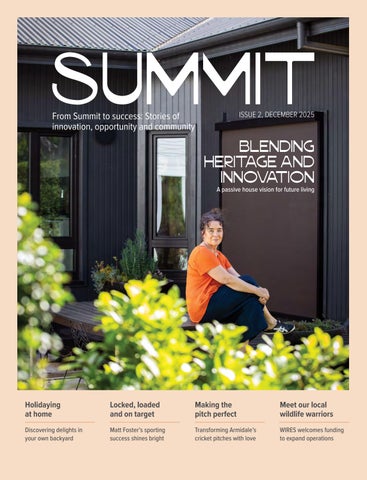
ISSUE 2, DECEMBER 2025
From Summit to success: Stories of innovation, opportunity and community
A passive house vision for future living
Holidaying at home
Locked, loaded and on target
Making the pitch perfect
Meet our local wildlife warriors
Discovering delights in your own backyard
Matt Foster’s sporting success shines bright
Transforming Armidale’s cricket pitches with love
WIRES welcomes funding to expand operations Page 1
From Summit to success: Stories of innovation, opportunity and community Summit magazine has been produced by Armidale Regional Council’s Communications and Engagement team Paulette Chavez-Henry, Jo Harrison, Cherene Spendelove, Dane Townsend and Rochelle Tubb Contributor: Matt Cawood UNE Editor: Rochelle Tubb Photography: Simon Scott, Jo Harrison, Paulette Chavez-Henry and Dane Townsend Design: Kassandra Hunt Cover photo: Maree McKenzie, Chief Executive Officer Homes North Community Housing. Image by Simon Scott
Summit isn’t your average council newsletter. It’s a vibrant, people–first magazine that delves into the heart of Armidale and Guyra, showcasing how council services and upgrades are making a real difference in everyday lives. Summit tells the stories behind the services – through the voices of the people who benefit from them. You’ll meet inspiring locals who go above and beyond for their community and discover how council initiatives are helping shape a more connected, resilient, and thriving region. Whether it’s infrastructure, events, tourism or essential services, Summit brings it all together in a compelling read that celebrates the power of community and the role council plays in supporting it. Real stories. Real impact. Real community.
I was thrilled with the positive response from the community to the first edition. A heartfelt thank you to everyone who shared their stories and helped us showcase the rich and diverse landscape of services Team ARC provides to our region. We hope this format offers a refreshing take on how we tell council stories, something a little different, a little more personal. If you enjoyed the first edition as much as I did, you’re in for another treat.
MAYOR’S RAMBLE WITH SAM COUPLAND
Welcome to the Summer edition of Summit Magazine
As we wind down a busy 2025 and turn our attention to end-of-year festivities and a well-earned break, this edition brings you a collection of engaging stories. From meeting the local contractors behind the Armidale Creeklands Restoration Project, to discovering Guyra-made products now featured at the Armidale Visitor Information Centre, there’s plenty to explore. And if you’re planning to stay in the region this holiday season, we’ve got you covered with a comprehensive guide to things to see and enjoy. Wishing everyone a safe, joyful, and relaxing holiday season!
Summit is published by Armidale Regional Council. © 2025, Summit. All rights reserved. No part of this publication may be reproduced, distributed, or transmitted in any form or by any means, including photocopying, recording, or other electronic or mechanical methods, without the prior written permission of the publisher. Disclaimer: While every effort has been made to ensure the accuracy of the information contained herein, Armidale Regional Council assumes no responsibility for errors, omissions, or outcomes resulting from the use of this material. All content is provided for general informational purposes only and should not be construed as professional advice. Readers are encouraged to seek independent advice before acting on any information contained in this publication.
Summit is a people–first magazine that shares the stories behind council services and initiatives in Armidale Region, highlighting real locals, real impact, and the vibrant community they help to create.
04
06
08
11
Matt Foster’s sporting success celebrated locally and nationally.
The story of Kelly’s Transport – family, freight, and the future of Armidale.
Maree McKenzie’s passive house vision for future living in Armidale.
Local WIRES group welcomes funding to expand rescue efforts.
12
14
19
20
Transforming Armidale’s cricket pitches with love and dedication.
Discover some great sights and stays in your own backyard.
Meet the owners of this creative space in the heart of Guyra.
How Armidale Airport services supports rural health in our region.
22
24
26
28
Celebrating a legacy of art and friendship in the heart of Armidale.
Natalie Poulton leads Armidale’s landmark restoration project.
Baby Library Bags welcome Armidale’s future book lovers
Optiweigh – The Armidale startup revolutionising livestock management.
Aiming for excellence
Making the pitch perfect
40 years of Packsaddle
Hit the road with the Kellys
Holidaying at home
Blending heritage Funding wildlife and innovation warriors
Stitching connections
Creeklands revival
A special delivery
Critical connections
Weighing in with local start-up
30
31
32
How UNE’s SMART Region Incubator is cultivating innovation.
Meet Bertha – one of the volunteers at Guyra’s famous food festival.
Achieving environmental, How a Local Area economic, and Committee keeps community gains. Wollomombi thriving.
Growing innovation
Chipping away
Wastewater wonders
34
Heart of the community
36
Unleashing the love
Volunteering and the human side of animal rescue.
Page 3
AUSTRALIA DAY
W
hen Matt Foster first picked up a rifle, it wasn’t on a competition range, it was on his family’s sheep property, controlling foxes and other vermin.
Years later, that practical skill evolved into a passion for precision, and eventually, a place on the world stage. In January 2025, Matt’s journey came full circle when he was named Sportsperson of the Year at Armidale Regional Council’s Australia Day Awards in Armidale, a moment he described as “surreal but extremely humbling”. “I never imagined I’d be recognised like this,” said Matt. “Armidale has produced so many incredible athletes across a wide range of sports. To be considered among them is a huge honour.” Matt’s story is one of quiet dedication, technical mastery, and community spirit. His discipline of choice, open long-range target shooting, isn’t a household name, nor is it a spectator sport. But it’s a discipline that demands intense focus, scientific precision, and a deep understanding of environmental variables like wind and mirage. For Matt, it’s the perfect blend of art and science. “I was hooked from the start,” he recalled. “There’s something addictive about the challenge, reading the wind, calculating ballistics, refining your equipment. It’s a constant pursuit of perfection.” That pursuit has taken him far. Matt has represented New South Wales at national championships, captained the Australian team to victory in the Trans-Tasman Match in New Zealand, and earned a place on the Australian F Open team for the upcoming World Championships in Bisley, UK in 2026. But for all the accolades, one of his proudest achievements remains closer to home: building the Armidale Rifle Club into one of the strongest in the country. With over 140 years of rich history, the club serves as one of the longest standing sporting clubs in the region, and with over 50 current members, its long-standing history is set to remain. “To see our small bush club producing shooters ranked among the best in Australia is phenomenal,” said Matt. “And to do it alongside my sons makes it even more special.” The Australia Day Awards, hosted annually by Armidale Regional Council, aim to celebrate the people who make the region exceptional, not just through their achievements, but through their contributions to the community. For Matt, the award has helped shine a light on a sport that often flies under the radar. “Shooting isn’t usually front-of-mind when people think of sports,” he said. “But this recognition has raised awareness, not just of our club, but of the fact that any sport, and any athlete, can be celebrated.”
Behind every successful sportsperson is a support network, and Matt is quick to credit his wife Simone and their family for enabling his journey. “Without family support, it’s hard to sustain a sport that involves so much travel and expense,” he said. “Simone has been incredible, and having my sons involved has made it a shared adventure.” Matt also acknowledges the mentors who helped shape his path including fellow shooters like Sean Campbell and Derry Crisp, who offered guidance and encouragement when he was starting out. “There’s a generosity in the shooting community,” he said. “People are always willing to share knowledge. You just have to be listening.” As he prepares for the World Championships, Matt remains committed to encouraging others to give the sport a try. His advice to young people in the region is simple: “Aim big”. “Walking into a shooting range for the first time can be intimidating, just like walking into a gym,” he said. “But local clubs are welcoming, and most run ‘come and try’ days. You don’t need expensive gear to start, just curiosity and a willingness to learn.” As Matt puts it: “There’s nothing stopping anyone from chasing their dreams. I gave up competitive sport in my early 40s. Now I’m representing Australia. If I can do it, so can others.” Through the Australia Day Awards, Armidale Regional Council proudly honours individuals like Matt, whose dedication and achievements enrich our community and inspire others to aim high. If you know a community champion who deserves recognition, nominate them today for the 2026 Australia Day Awards at armidale.nsw.gov.au Page 5
The story of Kelly’s Transport is more than just a tale of trucks and freight, it’s a story of innovation, resilience, and community.
M
ore than 70 years ago, before the hum of diesel engines echoed across the Armidale region, moving livestock to market meant walking them, sometimes for days.
For farmers around Armidale, the journey along the New England stock routes was slow, dusty, and demanding. But in the late 1940s, two brothers, Edgar and Sam Kelly, saw a better way. Inspired by reports of stock being carted by truck in other regions, the Kelly brothers built their first stock float and took a chance. Their first job came from the Teege family of Puddledock, who entrusted them with a load of cattle. The trip was far from smooth. There were no unloading ramps at the Armidale saleyards, so the cattle had to jump off the truck, but it worked. That moment marked the beginning of Kelly Brothers Transport. Founded officially in 1948, the company quickly became a cornerstone of the local transport industry. Alongside their trucking business, the brothers also ran the Shell fuel depot on Niagara Street, until they eventually split the ventures, Edgar continuing with transport, and Sam with fuel. Tragedy struck in 1978 when Edgar was killed in a trucking accident. But his legacy lived on through his sons, Brian, Mick, Chris, and Tim, who carried the business forward with the same grit and determination that had built it. Today, the third generation is proudly involved, with Brian’s son Jonathan working in the business and his wife Sarah managing the administration and operations behind the scenes. From its humble beginnings in Taylor Street to a modern fleet servicing the region’s agricultural logistics, Kelly’s Transport has grown alongside the community it serves. Through changing technologies, evolving regulations, and the ups and downs of rural life, one thing has remained constant: the Kelly family’s commitment to service, reliability, and the people of the New England. That commitment has been made easier, and safer, thanks to the recent upgrades to Rockvale Road, a vital transport corridor for Kelly’s and many others in the region. For decades, Rockvale Road was a challenging route, with narrow sections, poor visibility, and surfaces that took a toll on vehicles and drivers alike. “The improvements have made a huge difference,” said Jonathan Kelly.
“We’re seeing less wear and tear on our trucks, fewer maintenance issues, and most importantly, safer conditions for our drivers and the livestock we carry.” The upgrades, delivered by council, include wider and straighter road sections, improved intersections, and stronger surfaces designed to withstand heavy vehicles. For Kelly’s Transport, it’s not just about convenience, it’s about continuity. The road now supports the kind of modern logistics operation that Edgar and Sam could only have dreamed of when they first loaded cattle onto a homemade float. But the benefits extend beyond the business. As Jonathan puts it: “This road isn’t just important to us, it’s important to the whole community. It connects farms, families, and futures. It’s part of the infrastructure that keeps the New England moving.” The story of Rockvale Road is, in many ways, the story of the Kelly’s: a journey from rough beginnings to a smoother, stronger future. It’s a reminder that behind every upgrade, every kilometre of bitumen, and every council project, there are people – families, workers, and communities – whose lives are made better by thoughtful investment and shared vision. As Kelly’s Transport rolls into its eighth decade, the road ahead looks promising. And thanks to essential upgrades like Rockvale Road, that road is safer, stronger, and ready for whatever comes next. Council has been steadily working to upgrade Rockvale Road since 2018, focusing on sealing gravel sections and replacing aging infrastructure. Key milestones include the replacement of timber bridges at Wollomombi Creek (2020) and Pint Pot Creek (2021), along with sealing upgrades totalling over eight kilometres. These include sections completed in 2018, 2021, and the current two kilometre stretch underway. Once this latest section is finished, only 2.5 kilometres of gravel will remain. The works are part of a long-term commitment to improving safety and accessibility for road users. Page 7
| Page 8
I
n the tree-lined streets of Armidale, Homes North CEO Maree McKenzie has created something rare – a home that bridges the charm of the past with the promise of a sustainable future.
Her project was ambitious: a major renovation and extension to an existing dwelling, complemented by a detached garage, internal redesign, and landscaping. At just 150 square metres, the home proves that thoughtful design can deliver comfort and functionality without an oversized footprint. For Maree, the decision to pursue passive house certification wasn’t just about energy efficiency – it was about climate resilience. “Designing and building our homes is one of the key things we can do to address climate resilience,” said Maree. “I was happy to support a different approach to construction that delivers lower use of resources while providing year-round comfort in a challenging climatic zone like Armidale. “The idea of a passive house was proposed by building designer, Joakim Ho, who was excellent at demonstrating the design principles. “I still see homes being built that don’t even take advantage of our northern sun. Passive house solves air tightness, air quality, and circulation issues that older energy-saving designs never fully addressed.”
The original home had character but had suffered from decades of piecemeal additions. Maree embraced constraints rather than a blank slate: “I find it easier to work with constraints – it was the perfect project.
But I also love Armidale’s older streetscapes, so keeping the core of original house was important.” Maree retained heritage features like pressed metal ceilings and timber floors while allowing the extension to stand apart as a modern, high-performing space.
“There was no attempt to mimic the old, the new section needed to be itself.” Only the extension achieved passive house certification, a process requiring meticulous attention to detail. Climate modelling even revealed unexpected insights, such as the need for extra shading on an east-facing window to prevent summer overheating – a recommendation Maree now appreciates daily. Armidale Regional Council support made approvals smooth, but the build faced delays thanks to COVID-19 and droughtbreaking rains. From DA lodgement in March 2021 to final landscaping in late 2022, the journey spanned nearly two years. “I was more concerned with a good outcome than things nobody can control,” reflected Maree. Now that the dust has settled, Maree said the home feels like a triumph. “The results have exceeded my expectations,” she said. “I’m surprised actually – how well the old and new sit together, I was nervous about that. “It’s a joyous home to live in and I am especially reminded of that every time I come home after being in a conventionally heated/cooled building. Altogether it is magic.” Page 9
PNK Developments were the builders behind Maree’s project. It was their first project using passive house principles – think superior insulation, airtight construction, high-performance glazing, and a clever heat recovery ventilation system. These features work together to keep the home cosy, quiet, and healthy, reducing dust and mould while maintaining fresh airflow.
“The new section achieved lowenergy certification, while the original home got upgrades like double-glazed windows and improved insulation.” “Achieving the strict air exchange rate for full certification was tricky but this project paved the way for PNK’s first fully certified passive house in Guyra, proving that sustainable design can blend beautifully with everyday living.” said PNK’s Director, Grant Peterson.
| Page 10
Local WIRES group welcomes funding to expand rescue efforts across New England
I
n a powerful show of community support, Armidale Regional Council’s Community Grants Program is helping local heroes like WIRES New England continue their vital work rescuing and rehabilitating native wildlife across the region.
The New England Branch of WIRES (Wildlife Information, Rescue and Education Service) was recently awarded a community grant, enabling the volunteer-run organisation to upgrade rescue equipment, improve animal housing facilities, and establish native flora “food banks” to support wildlife in care. WIRES New England Chair, Georgia Thomas, said the grant had come at a crucial time. “This funding is a game-changer for our volunteers,” said Georgia. “It allows us to better respond to rescue calls, provide safer environments for animals in care, and support their recovery with native food sources. Every dollar helps us give wildlife a second chance.”
WIRES has been a lifeline for sick, injured, and orphaned animals since 1985. The New England Branch, one of the first to form outside Sydney, covers a vast area from Tenterfield to Walcha and Ebor to Inverell. Despite its size, the branch is powered by a small but highly skilled team of volunteers who work closely with veterinarians and the public. In 2025 alone, WIRES received over 234,000 rescue calls and assisted more than 163,000 animals. Volunteers respond to calls 24/7, often balancing wildlife care with work and family commitments. “We’re always looking for more volunteers,” said Georgia. “Whether it’s helping with rescues, fundraising, or spreading awareness, every effort makes a difference.” The Community Grant will also help WIRES expand its educational outreach, offering sessions to schools and community groups to inspire greater appreciation and care for Australia’s unique wildlife.
How to apply for a community grant Armidale Regional Council’s Community Small Grants and Community Support Grants are designed to support groups and services within the local government area. Eligible applicants include community groups, not-for-profit organisations, arts and cultural organisations, sporting clubs and individuals. Grant types include: •
Community Small Grants up to $2,000
•
Community Support Grants $2,000 to $5,000
There will be four rounds of grants in 2026, with the first round to be announced early in the new year. For more information or to apply, visit the Armidale Regional Council website.
Page 11
F
or Alex Barlin, managing the turf wicket at the Armidale Sportsground for the Armidale District Cricket Association just felt like the right thing to do.
A lifelong Armidale resident and passionate cricketer, Alex stepped up in 2021 when the club needed a curator for the pitch at Harris Park. That same year, a back injury forced him out of the game. Wanting to give back to the club that had brought him so much joy as a player, he stepped-up to manage the pitch for the season. “I really enjoyed the work of looking after the pitch, and I must have done something right because the club then asked me to take care of the sportsground,” said Alex. Bringing a turf wicket to life is no easy task – it requires months of preparation and ongoing care. The process involves careful planning, selecting the right soil and grass, and consistent maintenance. It typically begins with scarifying or cleaning the surface, followed by seeding, applying soil conditioner and fertiliser. Continuous watering and cross-rolling help eliminate surface undulations. “The couch grass took a while to come out of dormancy this year, so it’s been a bit challenging,” said Alex. “But we’ve managed it with regular cross-rolling using specialised rollers and cylinder mowers, plus some repair work with high-quality black soil.” According to Alex, Armidale’s pitches tend to favour bowlers. He tries to reduce the sting by removing as much grass as possible – just enough to allow more runs to be scored, but not too much. “I was a bowler, so I do like to see some assistance for the quicks. But more recently I’ve played first grade as a batter, so I’ve got an eye on both sides now,” he said. “Lambert Park is probably the most batter-friendly wicket – the field is smaller and the outfield thinner, so the ball travels further. “As a curator, you always want a layer of grass on your wicket, ideally that straw colour. As the season progresses, you might see some cracks form in the clay, but that depends on rainfall and your watering regime.” A typical week for Alex involves around 15 hours of work from Wednesday through Saturday, though this can vary depending
on whether he’s preparing a new pitch. Turf management is nothing new to him – he recently began an apprenticeship as a greenkeeper at the Armidale Golf Club. Before that, he spent five years working as a baker. “I love working at the Armidale Golf Club and I’m learning so much,” said Alex. “This is my fifth season managing cricket pitches, and just in the last six months since starting my apprenticeship, I’ve gained so much knowledge that I can apply to my pitch work.” Alex encourages others – especially young people – to get involved and give back to their community.
“I get to see the rewards of my work every week: people enjoying cricket, scoring runs, taking wickets. I even get people commenting on what a good job I’m doing.” Armidale Regional Council manages over 270 hectares of open spaces, parks, and playing fields. Without dedicated people like Alex and others who support local sporting organisations, the Council simply wouldn’t have the resources to keep these spaces thriving. Page 13
Looking for the perfect holiday without the stress of long travel or sky-high costs? Whether you’ve got family visiting for the festive season or you’re craving a break filled with culture, adventure, or pure relaxation, the answer might be closer than you think. For many of us, a “real” holiday usually means packing bags and heading somewhere far away. Whether it’s an exotic destination or the annual beach house, these trips often come with high costs, crowds, and complex logistics. If those logistics feel daunting, or you simply don’t have the time to get away, there is an alternative. Armidale region is brimming with places, spaces, and opportunities that locals and their visitors can enjoy close to home. Here are some ideas to get you started.
| Page 14
Bushwalking, waterfalls and wildlife World Heritage national parks, spectacular waterfalls, and dramatic gorges are all within easy reach in Armidale region. Whether you love camping, bushwalking, forest bathing, or birdwatching, nature is calling and it’s closer than you think. •
•
•
•
•
Parks and gardens Grab a picnic blanket and head to a local park. Armidale, Guyra, and the region’s villages boast beautiful green spaces perfect for relaxed afternoons. •
Curtis Park is in central Armidale and fitted with BBQs, picnic shelters, and free Wi-Fi. The Curtis Park Playground includes an adventure playground as well as nature-based play. Take a leisurely bike ride to the park via the bike track through Armidale Creeklands.
•
Ebor Falls is just outside the welcoming village of Ebor and offers short walks and three lookout platforms for breathtaking views.
New England Highway Park, Guyra is a fenced playground with climbing gym, suspension bridge, and a flying fox. Cycle there along the bike path or grab a coffee and watch the kids play.
•
Blue Hole Picnic Area is a local favourite for swimming and BBQs, plus it is an easy walk to Gara Gorge lookout, and glimpses of the dramatic gorge country of Oxley Wild River National Park.
Mother of Ducks Lagoon, scenic wetlands and birdwatching right on the edge of Guyra township.
Stargazing
Cathedral Rock National Park is perfect for a day trip or overnight camp just east of Armidale. Walk scenic trails, spot wildlife, and soak up panoramic vistas.
Little Llangothlin Nature Reserve is a rare highaltitude lagoon ideal for birdwatchers and wildlife enthusiasts. Pack a picnic and experience this protected wetland. Dumaresq Dam Reserve offers bushwalking, fishing, swimming, paddling, and free camping just 10 minutes from Armidale. And children will enjoy the nature-based playground and sandy beach.
Step outside on a clear night and look up. •
Ben Lomond sits 1500 metres above sea level. With its beautiful clear skies, it is perfect for stargazing.
•
For guidance and shared stargazing experiences, connect with UNE & Northern Tablelands Astronomical Society.
Page 15
Cycling
Fishing
Explore Armidale, Guyra, and the region’s villages by bike.
Relax by the water or cast a line at one of many local fishing spots.
• Cycle streets and bike paths to discover heritage buildings, public art, lush parks, and great cafés.
• Uncle Billy’s Retreat is just 25 minutes from Guyra. It is perfect for a day trip or cabin stay.
Sport and recreation Stay active without leaving town. Swim at local pools, play tennis, golf or ten pin bowling, or try barefoot bowls at one of the local bowling clubs.
• Armidale Skate Park is next to • For adventure, try mountain bike • Other dedicated facilities include Monckton Aquatic Centre, and Guyra trails at Fat Tyre Farm, Armidale State Dunmore Trout Waters, Milanai Trout Skate Park is right next door to Guyra Forest, University of New England, Cottages, Moredun Ponds, and Swimming Pool. The skate parks are or right in Armidale town centre Deano’s Fishing Adventure. open for all ages to ride or skate, Kookaburra Crest bike track offers and the pools are perfect for a cool • Ebor Dutton Trout Hatchery offers serious jumps and structures for summer splash! something a little different. Drive thrill-seekers. 75km east of Armidale, enjoy a picnic by the water, learn to fish, and take a tour of this facility which breeds and rears cold water sport fish.
“A weekend retreat, a scenic drive, or even a staycation filled with backyard picnics, local hikes, and museum visits can deliver memorable vacation moments.”
| Page 16
Connect with local heritage and culture Join the Visitor Information Centre’s Guided Heritage Tour or explore self-guided options. •
•
Armidale Street Art Walking Tour starts at New England Regional Art Museum and guides you to public artworks through Armidale. The Soundtrails app takes you on self-paced audio walks revealing stories like those of Armidale Catholic Precinct and Wollomombi Falls – Oxley Wild Rivers National Park.
Step into historic churches, wander cemeteries, or visit the heritage train station. Catch a movie at Belgrave Cinema, enjoy live music or local theatre. •
New England Regional Art Museum (NERAM) is the cultural heartbeat of the region – perfect for art lovers, curious minds, and anyone looking for inspiration. It’s home to the famous Howard Hinton Collection, six vibrant gallery spaces and the Museum of Printing.
•
Aboriginal Cultural Centre and Keeping Place preserves and celebrates the rich heritage and living cultures of our region’s Aboriginal nations. Drop in to view collections and exhibitions.
•
Saumarez Homestead offers a glimpse of New England pastoral life from the 1870s – 1970s. Take a guided tour of the house or stroll the grounds.
•
UNE Natural History Museum is one of several public museums at the University of New England. Explore geological specimens, fossils, and more. What does a few million years of history look like?
•
Love cars? Burgess Garage Car Museum in Guyra has a collection of cars that offers a great trip down memory lane – or some historical insights for the kids.
•
Right in the heart of Armidale, two stunning cathedrals stand proudly across the street from each other near Central Park – St Peter’s Anglican Cathedral and Saints Mary and Joseph Catholic Cathedral. Both are architectural gems with rich histories and soaring interiors that invite quiet reflection.
Page 17
Homegrown Holidays
Sip, savour and explore
Bargain hunting
Besides the numerous beautiful places to enjoy a picnic, there are many options for great food and drink across Armidale region.
•
Armidale Farmers’ Market is on the second Sunday each month in Curtis Park. Find fresh produce, gourmet food, wine, plants, and second-hand treasures at the car boot sale.
•
Love a bargain? Explore thrift and second-hand shops around the region.
•
Armidale Second-hand Shop at the Waste Management Facility is a treasure trove of pre-loved items. This is an affordable, sustainable outing that might surprise you.
Start your day with coffee and pastries, enjoy a pub lunch, dress up for dinner, or treat yourself to dessert under the stars. Menus across the region feature local seasonal produce like ricotta hotcakes with berries and honeycomb butter, curried lamb pies, or honey and lavender brulée. Orchards flourish in Armidale region’s high-altitude climate. In season, buy freshly picked berries, apples, pears, and stone fruit from farm stands and markets, or head out to pick your own.
A holiday close to home can provide countless memory-making possibilities, and you still get to sleep in your own bed at the end of the day. So, next time you’re planning a break, consider looking local. Adventure doesn’t always require a passport. Sometimes the best memories are made just around the corner. For more ideas: visitarmidale.com.au or stop into the Visitor Information Centre.
| Page 18
Meet the owners of this creative space where fibre art, community, and sustainability come together.
O
ur Little Gallery, nestled in the heart of Guyra’s business centre, is more than just a shop – it’s a celebration of fibre art and rural creativity.
This collaboration has helped visitors engage with the area’s agricultural roots while supporting a local business that champions regional experiences.
Co-owned by Sarah and John Hunt and Louise Pearson, the gallery was established in 2020 with a clear mission to showcase and sell handcrafted fibre items that reflect the beauty and heritage of the local wool-growing region.
Beyond its retail offerings, Our Little Gallery plays a pivotal role in the local fibre community. It has been instrumental in founding the annual Guyra Fleece & Fibre Frolic (GFFF).
From hand-dyed yarns and intricately knitted and crocheted pieces to felt, fleece, and original artworks, Our Little Gallery offers a tactile experience that connects visitors to the land and the artisans who shape it. The gallery’s commitment to using local, natural, and sustainable products is evident in every skein and stitch. A partnership with a spinning mill on the Central Coast has enabled the development of unique wool blends, now available exclusively in Guyra. “Kath from the Visitor Information Centre (VIC) in Armidale invited Our Little Gallery to display and sell items which reflect the local wool growing area to visitors interested in the rural lifestyle,” said Louise.
“As a Guyra business it helps showcase our product to a wider area and supports visitors with a real regional experience.”
“This event brings together fibre enthusiasts, growers and retailers, with a focus on showcasing fleece from a variety of breeds which is sought after by spinners but not often valued by growers,” said Louise. “We now have over six growers realising a financial outcome by providing fleece to the public. Over 100 people attend the 2025 GFFFF from across the area including people from Bingara, Bundarra, Armidale and groups from Stanthorpe and Tamworth.” The next Frolic is set for March 2026, promising another exciting celebration of fibre and fellowship. As the gallery continues to grow, it has recently moved into larger premises, it is expanding its offerings such as workshops and spinning gatherings. In every thread and fibre, Our Little Gallery weaves together artistry, sustainability, and community – making it a cherished part of Guyra’s cultural and creative landscape.
Page 19
Armidale Airport, operated by Armidale Regional Council, is six kilometres from the city centre and offers daily return flights to Sydney and Brisbane (six days a week).
L
ike many rural centres across Australia, Armidale faces the ongoing challenge of delivering specialist medical services to a dispersed population.
Airports play a vital role in bringing specialist medical providers to the New England region, helping our city stay not only connected – but healthy. Operated by Armidale Regional Council, the city’s airport is more than just a transport hub. It’s a lifeline for the local hospital and broader community, enabling access to essential medical services that would otherwise be out of reach. Dr Ajay Sud, who lives in Brisbane with his young family, is a fly-in-fly-out (FIFO) Career Medical Officer who provides a critical service to Armidale Rural Referral Hospital (ARRH) Emergency Department. “When you live in a city, you take for granted all the world-class medical facilities at your doorstep,” said Dr Sud, who flies into Armidale every week. “It wasn’t until I came to work in Armidale that I realised accessing the same level of care in regional Australia is a very different story. “It is absolutely essential to have an airport like the one in Armidale, with such great connections, so patients can access doctors from all over Australia. Without an airport, you’d be missing out on a huge proportion of locum doctors. “The challenge in a regional area is ensuring patients have access to high-quality tertiary care. For example, if someone has a significant hand injury requiring plastics or soft tissue reconstruction, we simply don’t have that specialty here. The patient requires time-critical surgery, and having an airport and the ability to transport patients is essential.” Regular flights into Armidale ensure healthcare professionals can reach the city efficiently, allowing the hospital to maintain essential services, reduce wait times, and provide continuity of care for the community, according to a spokesperson from Armidale Hospital.
“Flight services are absolutely vital to our ability to deliver timely and high-quality care to patients in Armidale,” said the spokesperson. “In rural healthcare, time and access are everything. Without reliable air travel, the ability to attract and retain skilled clinicians would be severely compromised. “Without regular flights, attracting and retaining locum doctors and visiting specialists would be far more challenging. “Increased travel times would make it less feasible for clinicians to commit to short-term placements or regular visits. This would likely result in reduced access to specialists, longer waiting periods, and increased pressure on our staff.
“Reliable air travel is not just a convenience it’s a critical component of our healthcare delivery model.” The decision for specialists to work in regional areas like Armidale hinges on several factors, with flight accessibility at the top of the list. And that’s something Dr Sud can attest to, having flown in and out of Armidale to work at the hospital for the past two years. “My family is based in Brisbane, but Armidale is a fantastic community that I genuinely feel part of,” he said. “I love getting out on my days off and visiting the national parks and local markets. I would absolutely recommend medical professionals consider moving here – it has so much to offer, and the skill set of the nurses and doctors working here is amazing.” Dr Sud said that if you’re a health professional considering a move to Armidale, you should “absolutely do it.” “You’d be surprised by the skill set of the nursing staff and some of the doctors here. Because resources are limited, staff develop incredible skills and resourcefulness,” he said. “And on top of that, it’s such a friendly place with so much to see and explore.” Page 21
T
he original Packsaddle committee would be bursting with pride in 2025 as the fundraising exhibition that contributes to the New England Regional Art Museum (NERAM) marks its 40th anniversary.
What began as a small group of friends – Benoni Pearson, Pat Elkin, Beverley Wright, and June Atherton – sharing ideas and critiquing each other’s work has grown into one of Armidale’s most cherished cultural traditions. “Benoni would be very proud, delighted, and somewhat overwhelmed by the growth and success of Packsaddle,” said her daughter Merran Pearson, who is on the current Packsaddle committee.
“She’d be thrilled to know how much it has supported NERAM and enriched the community.” When Benoni joined forces with fellow artists Pat, Beverley and June in the early 1980s, she was in her late fifties and ready to return to her passion for painting after decades devoted to family. Trained at East Sydney Tech – now the National Art School – Benoni had once studied alongside Margaret Olley, but life’s priorities meant her art practice was put on hold for years. Those early gatherings in Armidale sparked a vision far greater than anyone imagined – a shared passion for creativity that grew into what we now know as Packsaddle. Early exhibitions were held at Beverley and Owen Wright’s cottage in Cotswold Avenue. Sue Van Laahoven one of Benoni’s other daughters, remembers helping at the official fundraising launch for NERAM at the Teachers College, where the Hinton and Coventry Collections were housed. “I was 18 and finishing Year 12 – I have clear memories of serving food to the gathering,’ she said. “Benoni was so happy to be there with her fellow artists and proud to be part of that starting point.” Benoni’s other daughter, Philippa, said the committee was grassroots at its best.
“The committee members were just a group of friends who made things happen without spreadsheets or minutes of meetings,” she said. “They just got things done with good humour and respect.” Merran recalls the meetings being very noisy with lots of chatter. “But everyone left knowing what their tasks were,” she said. As Packsaddle grew, so did its impact. Joe Eisenberg saw its potential and invited the group to hold exhibitions at NERAM. The name Packsaddle came from the shape of Beverley and Owen’s house – a quirky detail that stuck. And the Packsaddle logo of a saddle bag was illustrated by Benoni. But Packsaddle was about so much more than fundraising, according to Benoni’s daughters. It was about art, friendship, and community intertwined. “She wasn’t overtly proud,” said Sue, “but she loved seeing the exhibition hung and ready for opening – and knowing it helped NERAM, not just with funding but with acquisitions.” Benoni’s commitment reflected a lifelong passion for the arts, passed down from her own mother and shared with her children. “Art, music, theatre was part of our lives from early years,” said Merran. “We were lucky.” Today, after 40 years, Packsaddle remains a cornerstone of Armidale’s cultural life. “Benoni would be delighted, proud, maybe even a little overwhelmed by its success,” said Merran. Sue agreed: “She’d be so happy the legacy continues to benefit NERAM and support art in Armidale.” This year’s 40th anniversary Packsaddle Exhibition sold more than 200 artworks. All proceeds from the Packsaddle event go directly towards supporting NERAM’s ongoing acquisitions, conservation efforts, and education programs. With more than $750,000 raised, funds have gone towards the acclaimed Packsaddle Artist Studio and Residence, upgrades to gallery lighting and infrastructure, and key acquisitions for the gallery’s collections – including contributions toward securing Margaret Olley’s Yellow Room Triptych. Page 23
Natalie Poulton leads Armidale’s landmark restoration project
A
s a leader at local construction firm Wallace Construction Services, Natalie Poulton was thrilled when she and her team were selected by Armidale Regional Council to deliver stage one of the Armidale Creeklands Restoration Project.
With over 11 years of experience in project and contracts management, Natalie was able to apply her considerable skills to a project that means so much to the city she calls home. Now, three months on and with the project well and truly underway, she is witnessing firsthand how transformative the redevelopment of a tired and forgotten area of the Dumaresq Creek, behind the Monckton Aquatic Centre will be for Armidale. “The most rewarding part of this project has been witnessing the transformation of the space firsthand throughout the construction phase and knowing the positive impact it will have on the Armidale community once complete,” said Natalie. “I couldn’t be happier with our progress. While navigating environmental sensitivities and unpredictable weather has presented challenges, the extensive planning and thoughtful design work undertaken early in the project has helped mitigate many potential issues, allowing us to stay focused on delivering the works.” Natalie brings well-developed contract and project management skills and experience across both the private and public sectors. As a female leader in construction, she is now seeing more women making their way into the industry. “I believe diversity in leadership brings fresh perspectives, and I’m proud to contribute to a more balanced and forwardthinking industry, which is exactly what construction has become,” said Natalie. “If you’ve ever thought about a career in construction, I’d say absolutely go for it. The opportunities are vast and truly limitless. I made the leap in my thirties, starting as an administration assistant with little more knowledge than how to use a hammer and nail. “Today, I’m part of a team delivering multimillion-dollar projects across our region, and the pride and satisfaction that comes with that is unmatched. It’s a challenging, rewarding, and
incredibly diverse industry, no two days are ever the same. The women who paved the way before us have done an exceptional job, and I’m proud to be continuing that legacy.” The revitalisation of Dumaresq Creek, which flows through the city and serves as a recreational beacon for residents has been high on Council’s priorities since 2018. A master plan was developed for the creeklands between Markham Street in the west and Taylor Street in the east, in partnership with the community. Seven years on from the initial consultation and endorsement of the Armidale Creeklands Master Plan, stage one has been funded by the NSW Government. The area was also subject to an Aboriginal Place application, which was approved following a lengthy consultation process and assessment. An Aboriginal Place is an area of land with special cultural significance to Aboriginal people. Everyone at Wallace Construction Services was raised in Armidale and have chosen to stay and raise their families here. “This is more than just where we work; it’s our home,” said Natalie. “We also partner with local subcontractors and suppliers who share that same connection to the community.
“There’s something incredibly special about driving past or visiting one of our projects and knowing you helped bring it to life. Seeing our community enjoy these places we’ve built is a source of immense pride and a powerful reminder of why we do what we do.” The construction phase of the Armidale Creeklands Restoration Project is expected to be completed in early 2026 and includes: Weeding, revegetation, and bank stabilisation, picnic shelters, shared path with solar lighting, reconstruction of the Spanish arch wall, exercise station and a new pedestrian crossing and entry off Dumaresq Street. Page 25
| Page 26
A
simple, thoughtful gesture by Armidale Regional Library is welcomed by families of newborns in Armidale.
Children and Youth Librarian, Jennifer Watson delivers bundles of literary joy – helping to nurture a love of reading from the very beginning. Every few weeks, Jennifer makes her way to Armidale Hospital, arms full of calico bags packed with goodies – a board book, a baby library membership form, and helpful tips for reading to infants. The bags are more than just gifts, they are invitations to connect, explore, and grow. “I love meeting families and their beautiful babies,” said Jennifer. “It’s a privilege to introduce them to the magic of books and libraries.” This initiative began in 2015, when the Friends of the Library group raised funds to purchase books and bags in bulk for gifting to families of new babies. Since then, hundreds of families have received these special gifts, with the Freda Mott Centre at Armidale Hospital playing a key role in distribution. Child and Family Health nurses ensure every new baby receives a bag, and Jennifer joins their six-weekly information sessions to talk about the benefits of early literacy. “There’s usually between eight to 14 new babies at each session,” said Jennifer.
“It’s lovely to meet them – and their parents. Sometimes the grown-ups in the room haven’t been to the library in a while and they are keen to revisit.” As awareness of early literacy grows, so too does interest in the library’s services. Jennifer often finds herself dispelling myths about libraries being quiet, formal spaces. “A lot of young parents worry about bringing a crying baby into the library,” she explained. “But babies are very welcome. Our library is more like a community lounge room these days.” The Junior Library space is designed to be sociable, safe,
and fun. It is perfect for families with young children and has become a popular place for parents with little ones to gather. Armidale Library has a change table, free tea and coffee, and even a vending machine. It’s a free, air-conditioned outing that offers both comfort and connection. As they grow, many of the babies come along to Jennifer’s weekly Storytime sessions at the library. Storytime is for little ones aged five and under. The children enjoy the books, but especially the active nursery rhymes and socialising. Looking ahead to 2026, the library is launching a four-week program specifically for babies aged birth to 18 months. Developed in response to community feedback, the program will focus on active nursery rhymes and offer practical tips for introducing early literacy concepts to infants. “All of us at the library love meeting our tiniest members,” Jennifer says. “Watching them grow and eventually choose their own books is one of the most rewarding parts of the job.” From hospital visits to Storytime sessions, Jennifer’s work is planting seeds for a lifelong love of reading. And thanks to the Baby Library Bags, Armidale’s newest residents are getting their very first library experience before they can even walk.
Page 27
| Page 28
I
n 2014, local beef producer Bill Mitchell had what he describes as a “brain fart”. The results today occupy 251 Mann Street: the headquarters and manufacturing facility of mobile livestock weighing specialist Optiweigh.
In that moment in 2014, Bill was wondering whether he could get his cattle to self-weigh themselves in the paddock. And even better, to have those weights wirelessly transmitted to his computer. If he could, he would eliminate most of the work then required to track when animals were ready for market. Had Bill and his wife (and Optiweigh’s cofounder) Jacqui left it as an idea, their lives would not have become unexpectedly complicated. But they would not have a business that has since 2019 shipped over 1500 physical manifestations of that brain fart, has started exporting to other countries, and employs 20 people in Armidale. The path to Optiweigh lay in three observations: •
Cattle don’t voluntarily put all four feet on a weighing platform.
•
Cattle are quite happy to put two feet on a weighing platform.
•
The weight of cattle can be accurately determined from the weight taken when they only have their forelegs on a weighing platform.
Turns out that it’s the same with sheep. Optiweigh’s new sheep units are now spreading across Australia’s prime lamb production areas and are spearheading the company’s push into New Zealand. Like entrepreneurs before them, the Mitchells found that their start-up needed more help and resources to grow, so in 2019 they became members of the University of New England’s SMART Regional Incubator (UNE SRI).
“We were making units out of our shed at home. The SRI gave us somewhere to focus on the business, hold meetings, and interact with people undergoing a similar process.” “There were a few ag tech start-ups in the SRI at that stage, with similar growing pains. It was good to work alongside them, and to be able to chat about shared issues. The SRI gave us a
base with a built-in support network, and through that helped us build a public profile for the business. That would have been difficult to do from scratch.” The Mitchells have three motivations: delivering technology to farmers that produces a genuine return on investment, creating local employment opportunities, and building a sustainable brand that will outlast its founders. A stream of new buyers indicate that they have succeeded in the first motivation. The 20 employees in Mann Street, most aged under 30, suggests they are succeeding on the second. Several people moved to Armidale to join Optiweigh, The third ambition, longevity, is yet to be tested, but Optiweigh is a platform, with capacity to expand on its original purpose. One possibility is measurement of belched ruminant methane in support of greenhouse gas reduction objectives. Optiweigh is working on this with another regional startup, Agscent, and is also in regular communication on this with UNE researchers. “At the end of the day, it’s agricultural technology and the way you make a success out of that business is by selling your stuff to farmers,” said Bill. “So, you need to base your business in a town where everybody communicates with farmers socially and understands them. “Armidale’s that sort of town.” The UNE SMART Region Incubator is a connected community of founders and innovators. As a university-led business incubator, it supports innovation across the New England North West of NSW by connecting founders, researchers, school and university students, mentors, experts, investors, government and business partners. Through collaboration the incubator helps new products and services to market. UNE SRI works across the region and has physical locations in Armidale, Moree, Narrabri and Tamworth. It is focused on benefits to the community, a diversity of ideas, and strives to be open and inclusive. UNE SRI supports businesses using research-driven innovations to grow solutions for agriculture, environment, energy, health, creative industries and other sectors. Armidale Regional Council is an important partner of the SRI. To find out more visit: unesri.com.au Page 29
L
ike plants, certain businesses thrive best in certain environments. Since 2017, the University of New England’s SMART Region Incubator (SRI) has been helping grow businesses that thrive in the New England-North West.
The SRI’s Interim Director, Alex Cook, recognises that it makes sense to build a business that thrives elsewhere too, even globally – but SRI-founded businesses put down their first roots here, and they attempt to flourish in this soil first. From its headquarters at NOVA, at 122 Faulkner Street, Armidale the SRI supports satellite incubators in Tamworth, Moree and Narrabri.
“Innovation at the SRI isn’t about grand, detached ideas, but about understanding and addressing local challenges.” “It might be a farmer developing AI tools to solve a problem they have, a teacher launching a startup, or a health worker reimagining community care. Bringing those ideas to life is hard. The SRI is here to provide an environment that helps founders move from concept to business, and hopefully, onto success.” The SRI’s visionary inaugural director, Dr Lou Conway, recognised that in the regions, a business incubator that only incubated businesses would not realise its full potential. Placebased entrepreneurship has to work across the community. As it has worked to fulfil its purpose as an incubator, the SRI has in the process become a regional ecosystem.
| Page 30
A vigorous SRI school program reaches out to the latent talent of schoolchildren not yet cynical of their own abilities, encouraging them to think about the worlds they can build. The incubator has strong connections with its parent, the University of New England, and productive relationships have developed that harnesses the innovation and drive of founders to the knowledge of academics and researchers. And the SRI fosters a network of business relationships that links founders with enterprises and entrepreneurial innovators from near and far. “There is a tendency in the regions to think that all the business energy and innovation is happening elsewhere, usually in a city,” said Alex. “The recent Impact document we put together to showcase what’s happening in the SRI shows how false that idea is. The SRI demonstrates that with the right support, rural and regional communities can be powerful centres of innovation, driving economic growth and social change from the ground up.” Building on that strength from the heart of the New England Renewable Energy Zone, the SRI is expanding its focus on CleanTech and sustainability – connecting researchers, startups and industry partners to create solutions that link regional innovation with the clean energy transition. These collaborations reflect the same community-driven approach that defines the SRI’s work more broadly, where place-based entrepreneurship and collective effort drive impact well beyond the lab or boardroom. “By creating the space, the networks, and the belief in what’s possible here, we’re helping a new generation of problem-solvers turn local ideas into lasting impact – for their communities and for the region they call home,” said Alex.
B
ertha Reeves’ journey with the Guyra Lamb and Potato Festival started in a caravan with the Lions Club, cooking potato chips over open flames and serving them with a smile. Decades later, her legacy is legendary.
Among the many stories that define the festival, 83-year-old Bertha’s stands out. Since the festival’s start in 1986, she has been at its heart. Bertha’s approach to the perfect potatoes at the Lamb and Potato Festival is unique: she insists on manual preparation, even returning a washing machine bought to clean potatoes. Her secret? Weighing potatoes before peeling for perfect consistency. “My husband lends a hand by cutting lamb legs and prepping salads, while I also whip cream for pavlovas,” said Bertha. Every festival morning starts at 7am, ovens blazing, and Bertha leading the charge in the red brick kitchen. Her passion is simple – helping others and keeping the tradition of the Lamb and Potato Festival alive. In 2009, the introduction of the “chat potato” added a new twist, thanks to Julie Gittoes’ (the shift and kitchen manager) suggestion to serve potato bakes at the festival. By 2015, Bertha set an incredible record: 162 potato bakes prepared, 486 kilos of potatoes peeled and sliced manually and all with just three ovens running non-stop. But Bertha’s dedication came at a cost. In that same recordbreaking year, she suffered a serious accident in the cool room, breaking ribs, a finger, and an ankle. After three weeks in hospital, she returned with the same unstoppable spirit. As for Julie Gittoes, this year will mark a huge milestone for her as she is the only committee member who has worked at every festival for the past 40 years, 35 as gazebo supervisor. Julie starts at 7am each morning and finish at 8.30 each
night supervising and working alongside at least 40 different volunteers everyday. Guyra’s Lamb and Potato Festival is a proud celebration of local flavour, culture, and connection. For decades, the event has thrived through the dedication of community members who give their time, energy, and heart, not for recognition, but for the joy of contributing to something bigger than themselves. From canteen shifts to information stalls, volunteers step up year after year to keep the spirit of the festival alive. As the longest-serving president of the Guyra Lamb and Potato Festival, Steve Mepham oversees daily activities, band schedule and ensures a welcoming, well-run experience for all. His dedication has made the Lamb and Potato Festival not just an event, but a cornerstone of Guyra’s culture and economy. Another shining example of volunteer spirit is Aimee Hutton, Armidale Regional Council’s Acting Chief Officer, Corporate and Community. For more than 10 years, Aimee has worked in the canteen, representing a local community group and helping raise funds. “The festival is a celebration of who we are as a community,” she said. “It’s not just about lamb and potatoes – it’s about people coming together, sharing laughs, and creating memories. Every shift reminds me why this event matters.” The 2026 festival – which will run from 14 January to 26 January – received a boost from Armidale Regional Council with a $3,500 grant awarded to the Guyra Lamb and Potato Festival Committee Inc. through ARC’s Community and Village Grants Program. This grant supports the Music program which will host around 30 different artists performing throughout the 12-day program. In addition, 35 community groups assist with organising the festival. Page 31
| Page 32
Local farmers gain access to affordable, high-quality feed, cutting freight costs and supporting sustainable practices.
A
rmidale Regional Council (ARC) is transforming treated wastewater from a challenge into a resource, delivering environmental, economic, and community benefits through lucerne and beef production.
ARC’s Reuse Farm aligns with NSW’s target of zero organic waste to landfill by 2030. By returning 100% of biosolids to the land, council prevents over 800 dry tonnes from entering landfill annually, improving soil microbiology and structure while reducing emissions.
According to Shaun Brennan, ARC’s Supervisor Wastewater Treatment and Reuse Farm, this innovative reuse initiative supports how smart water and biosolids management can support agriculture, reduce waste, and strengthen the local economy.
“Environmental stewardship is central to this program,” said Shaun. “ARC maintains 15 soil monitoring points tested on a three-year rotation and eight groundwater sampling points tested every six months to ensure wastewater reuse does not compromise soil health, biodiversity, or water quality.
“Currently, 56 hectares of lucerne are irrigated using recycled wastewater at the Armidale Wastewater Facility’s Reuse Farm,” said Shaun. “With careful planning, this area can be expanded sustainably, ensuring environmental integrity remains the top priority.”
“At the same time, lucerne grown with recycled wastewater delivers economic and community benefits, including revenue generation through local feed sales, reduced discharge fees by up to 30%, and lower operational costs that help reduce sewerage rates for the community.
We lead in sustainable beef production, trading up to 700 steers annually and delivering 114,000 kg of beef from 112 hectares, placing us in the top 5% across Australia and New Zealand. Using 205–500 ML of treated wastewater for irrigation, we recycle up to 70% during drought, maximising efficiency, and resilience.
“Local farmers also gain access to affordable, high-quality feed, cutting freight costs and supporting sustainable practices.”
“Reusing treated wastewater delivers significant environmental benefits by reducing demand for freshwater and synthetic fertilisers, improving soil structure and fertility through added organic matter, and lowering pollutant discharge into waterways by cutting phosphorus, nitrogen, Biological Oxygen Demand (BOD), and suspended solids,” said Shaun. “The lucerne’s deep roots and nitrogen-fixing properties enhance soil carbon, further supporting long-term soil health and sustainability.”
The council actively engages and educates the community through school, university, and public tours of the reuse farm, as well as pop-up information stalls at local events. According to Shaun, feedback from farmers and residents has been overwhelmingly positive, with many praising the availability of quality feed “at the doorstep” and at competitive prices. “ARC’s lucerne program is more than an agricultural initiative, it’s a blueprint for sustainability, resilience, and community partnership,” said Shaun. “By turning wastewater into a resource, we’re reducing environmental impact, supporting local industries, and paving the way for a greener future.” Page 33
J
ust off the winding Waterfall Way, nestled among rolling hills and misty paddocks, lies the quiet village of Wollomombi – a place where time slows and community spirit runs deep.
Council collaboration has also played a key role in beautifying Wollomombi, with trees planted along the village entrance and down to the shop, adding a welcoming touch of green, according to Sandra.
Wollomombi is a close-knit village with a modest yet enduring population, home to a general store, a community hall, a sports ground, and the historic St John’s Presbyterian Church. And Wollomombi is quietly flourishing thanks in no small part to the tireless efforts of the Wollomombi Local Area Committee (LAC).
Megan Sutherlandt, the dedicated caretaker of Sauer Memorial Hall, has long been a reliable presence in the community. The hall isn’t just a meeting space – it’s a vibrant hub for celebrations and a venue locals can hire for special occasions.
Since its founding in 2000, this grassroots group has been the backbone of community life, transforming ideas into action and preserving the spirit of the region. “I am the oldest member along with my husband David,” said Sandra Moen, secretary of the Wollomombi LAC for 22 years. “Some of the original members have died and others have left the district, but we’re still here, still getting things done.” From its earliest days, the Wollomombi LAC has been hands-on. “The first thing we did was organise a new sign just past the Wollomombi River bridge in what was Bruce Browning’s old place,” said Sandra. That sign marked the beginning of a new chapter for the village – one of pride, visibility, and community cohesion. Being the caretakers of Armidale region’s historic halls is one of the many jobs LACs are responsible for. And the Sauer Memorial Hall, the committee’s meeting base, has seen a renaissance thanks to their efforts. “A new kitchen was added some years ago, the roof was replaced due to hail damage, the main floor of the hall has been sanded and polished,” Sandra explained. “The side of the hall has been enclosed so we can conduct BBQs under shelter, and we also have an exchange book library under shelter there so anyone can exchange books.” And the upgrades haven’t stopped there. “A new toilet block has been added which has made a big difference as lots of travellers use it,” she said. “Along with this, we have a new playground for the children in the village, which is well used, and picnic tables also.”
Before the council implemented the new booking system, Megan managed all hall reservations herself, ensuring the space was clean and prepared for use. She continues to open the hall for users and coordinates scheduling details with Council. “We’ve had various functions in the hall – trivia nights, farewell parties, and a high tea to celebrate 100 years of the Sauer Memorial Hall with a large crowd there,” said Sandra. One of the key community events at the hall is the Christmas Party which happens most years along with the Chandler School presentation also held in the hall. But the committee’s vision extends beyond events and infrastructure and isn’t sitting on its hands when it comes to the future planning of the village. “It has been great to see the changes in the village since we held a Village Plan meeting in 2011 with Jenny de Greenlaw outlining all sorts of things we could do to improve life in the village,” said Sandra. “And we are always looking for new members to join our small group and make a big impact on our community.” The Wollomombi Local Area Committee meets once a month. Local Area Committees (LACs) in Armidale Regional Council are advisory committees that provide a link between the community and the council, helping to foster a greater understanding of local issues and advise on council business. Their specific functions include providing advice on a wide range of local matters, assisting in assessing service needs through community consultation, and coordinating with local organisations. Page 35
| Page 36
E
ven on her toughest days, animal shelter volunteer Lee Clarkson can see a silver lining in the emotionally demanding work she does caring for lost and surrendered dogs.
And on those challenging days, Lee takes time out at the Armidale Companion Animal Shelter to look over the adoption photo wall to remind her of all the “beautiful souls” that have found new homes.
“We have six rescue dogs in our family that we adore, and I wanted to help those less fortunate, so I started thinking of what I can do to help make their stay at the shelter as comfortable and stress free as possible,” said Lee. “So, I started volunteering at the Animal Shelter and became a member of Animal Welfare League to help foster and care for dogs as well.” Like all volunteers, Lee is an essential part of the daily operation at the council-run shelter. She starts her days early at 7.30am when she checks in on all the dogs, seeing if they have any new residents and saying good morning. Lee then starts her daily routine of washing the bedding and food bowls, helping clean and feed all dogs and administer medication if needed. “I make sure they all have free time in the exercise yard to keep them active and mentally stimulated, and just to provide the care and reassurance they may need to feel comfortable,” she said. Although the most challenging part of volunteering at the shelter is witnessing the condition in which some animals arrive – making certain days emotionally tough – Lee said her experience is also deeply rewarding. “When you spend every day with an animal that comes into the shelter completely broken, neglected and shut down and provide them with the love, patience and positive reassurance and they slowly start to trust you and overcome their fears, and become strong enough to go up for adoption, that is what keeps me going,” she said. “The good outweighs the bad, but some days are extremely difficult to cope with and can be emotionally draining. And it does affect me deeply, so I try to focus on the positives instead.”
“We have an adoption photo wall I like to look at just to remind me of all the beautiful souls I have helped find a new home. This helps me face another day to do it all over again.” One of Lee’s favourite stories of hope and rehabilitation happened just after Christmas in 2024 when a tiny, matted dog found her way to the shelter completely traumatised, shut down and aggressive. “Every morning, I would just sit with her, not trying to force any interaction or touch her in any way,” said Lee. “This was our morning routine for weeks, completely on her terms. Gradually with a ton of patience, reassurance and pockets full of treats this little soul slowly started to let her guard down and let me approach and touch her, eventually I was able to pick her up and nurse her. “Fast forward a couple of weeks and wow what a turnaround. She was groomed to perfection, adopted and ready to start her new life. I still see her now and then at the markets with her family and it makes me smile to see how far she has come.” The Armidale Companion Animal Shelter is always happy to welcome new helpers and it has an active volunteer program. Lee encourages anyone with spare time to drop by, say hello, and meet some of the wonderful animals looking for a second chance at life.
The Armidale Companion Animal Shelter cares for animals that are in need of a safe and loving home, whether they have been found lost, surrendered or abandoned. It has both cats and dogs that are looking to be adopted by loving new families. Visit: armidale.nsw.gov.au to find out more.
Page 37
A
rmidale’s skies will become a canvas for wonder as Patricia Piccinini’s Skywhales float gracefully above the city during the beloved Autumn Festival.
These monumental hot-air balloon sculptures – Skywhale and Skywhalepapa – are set to deliver an unforgettable spectacle as part of the National Gallery of Australia’s Skywhales: Across Australia tour. This cultural coup brings a rare opportunity for regional audiences to experience contemporary art on a grand scale. At sunrise, festival-goers will witness the mesmerising 90-minute ritual of inflation: first cold air, then hot, breathing life into these surreal creatures until they rise majestically into the morning sky – weather permitting. But this is more than a visual feast. Skywhales: Across Australia is a celebration of care, community, and creativity, inviting people to pause, look up, and reconnect with wonder. “Skywhales float into our lives to make us smile and think,” says artist Patricia Piccinini. “This project talks about nature, family, | Page 38
evolution, care and wonder. Among the amazing creatures that fill the sky, one day you might just see a Skywhale too.” Thanks to the efforts of Armidale Regional Council (ARC) and the New England Regional Art Museum (NERAM), Armidale has secured its place on this national tour for 2026. The Skywhales will headline the 2026 Autumn Festival on Saturday, 21 March, a day brimming with colour and community spirit. Expect the iconic Autumn Festival Parade - now with a $1000 prize for the best float – alongside sheepdog trials, heritage displays, fair rides, kids’ activities, and more. So, mark your calendars, set your alarms, and remember to look up. When the Skywhales soar over Armidale, it won’t just be a flight – it will be a moment of magic.
Skywhales Across Australia is a National Gallery Touring Event, supported by the Australian Government through Visions of Australia and the National Collecting Institutions Touring Outreach Program.
Armidale Autumn Festival 21 March, 2026 Whether you’re a local or a first-time visitor, the Armidale Autumn Festival is your chance to experience the charm, creativity, and community spirit that make this region so special.
• • • • • • • •
Grand parade Breakfast with the band Campus to City Canter Food vendors and markets stalls Skywhales hot air balloon sculptures New England heritage and lost trade displays Sheep dog trial demonstrations Family fun zone with rides, games, and entertainment for all ages
Page 39
y a D a i Austral
h y c t r a e a B2026 P Dumaresq Dam Reserve 26 January 10:30am Citizenship Ceremony and Australia Day Awards presentation 12:00pm Australia Day Beach Party
• Rowing Demonstration • Earth Art by Sharon Cutmore • Guided Cultural Walk • Fun games for the kids • Free ice cream and BBQ (Limited supply)