
Analysis of Affordability Gaps in Virginia’s Early Childhood Care and Education (ECCE) Programs
Spring 2025
Arlington Community Foundation’s (ACF’s) abiding concern is sufficient funding to ensure child care affordability for low-wage earners who perform essential service sector jobs.
This document contains three key takeaway areas for the Commonwealth developed by the Arlington Community Foundation’s Affordable Childcare Team at our Legislators’ request: Overall availability of ECCE funding, the need to evaluate ECCE offerings using affordability, full-working day and age of child lenses, plus observations about the quality of statewide data moving forward.
Our observations are based on an intensive review of local data with support from the Arlington County demographer, Arlington DHS childcare staff and Director’s Office, Arlington Public Schools’ Office of Early Childhood, and NVFS Head Start/Early Head Start leadership. We have also reviewed data from a dashboard under development for the state’s Ready Regions.
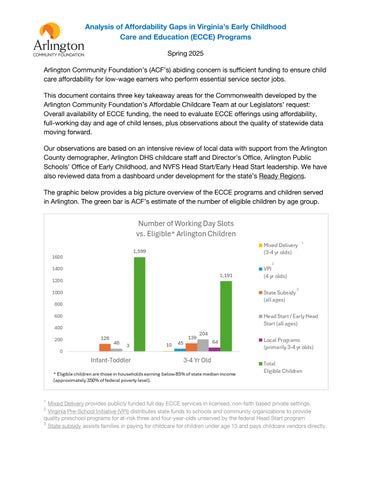
The graphic below provides a big picture overview of the ECCE programs and children served in Arlington. The green bar is ACF’s estimate of the number of eligible children by age group.


1 Mixed Delivery provides publicly funded full day ECCE services in licensed, non-faith based private settings
2 Virginia Pre-School Initiative (VPI) distributes state funds to schools and community organizations to provide quality preschool programs for at-risk three and four-year-olds unserved by the federal Head Start program
3 State subsidy assists families in paying for childcare for children under age 13 and pays childcare vendors directly. 1 2 3
A. Total State ECCE funding (consisting of the Childcare Subsidy + Virginia Pre-School Initiative + Mixed Delivery) is woefully inadequate.
1. There are 271,664 eligible children in the Commonwealth and 2,790 eligible Arlington children under 5 whose families earn less than 85% SMI (~$114,000/year for a family of 4). 65% of eligible children in Arlington were not receiving any state funding in fall 2024.
2. The varying income eligibility levels across the three programs makes parsing which programs a particular family may be eligible for like playing Whack-a-Mole. As the Commonwealth seeks to improve the situation for families of lesser means, combining all ECCE funding into a “lock box” and treating all ECCE dollars as a “block grant” would allow Ready Regions to strategically deploy those dollars in service of their Region’s needs.
3. While the Commonwealth recognizes that the cost of child care can vary significantly among Ready Regions, the income eligibility levels do not take regional cost of living variations into account. Arlington has the highest percentage of children ineligible for state-funded ECCE programs due to the high incomes of many in our community. Our low-wage earners face proportionately higher pressures to cover exorbitant rent and child care costs.
B. Key lenses for evaluating Virginia’s programs are affordability, availability of full working-day hours, and age of child. All are critical for equity for low wage working parents.
Affordability
The cost of ECCE in Arlington is twice the state average and the highest in the nation Nearly 80% of Arlington’s eligible children have all adults working. 11 percent of Arlington households make less than 30% of the area median income (150% FPL). The graphic below compares the amount of funds remaining for health care, food, transportation and other monthly expenses for Arlington households with and without child care support.

Families who earn above 20% AMI in Arlington (~100% FPL) must pay 7% of income for the Subsidy and Mixed Delivery programs.
This is beyond reach for such families in a highcost community like Arlington. No co-pay is needed for the Virginia Preschool Initiative, but only 4-year-olds may enroll, and only 10% of the slots cover the full working day.
While there are adjustments in the amount of funding provided by the State to providers of ECCE, that payment plus the family contribution covers less of the cost of care in Arlington. Any gap in funding must be covered or written off by providers who already operate their small businesses on slim margins.
Availability of full-working day hours

The largest source of state-supported affordable slots is the Virginia Preschool Initiative (VPI) for 4-year-olds. Located in the Arlington Public Schools, VPI does NOT cover full working day hours, and APS is only able to offer a fee-based before/after care to 10% of VPI enrollees.
Subsidy Program slots do cover full working days for children, but the funding comes nowhere close to meeting demand, as shown in the graphic below.

Mixed Delivery funding could cover the full working day, but there are only 10 funded slots in Arlington. In theory, Mixed Delivery wrap-around dollars could be deployed to extend VPI to working day hours. However, there are significant barriers - financial, regulatory and collaboratively - to making this happen. These barriers, including the prohibition of partnerships with public school systems, need to be further explored to maximize opportunities for low-income children.
Age of Child
Affordable slots for infants and toddlers (ages 0-2) are critically low in Arlington. There are 1,599 income eligible 0–2-year-olds in Arlington, with only 179 affordable full working day slots available to them. These slots are the highest cost and can limit the use of Subsidy Program dollars for 3s and 4s.
Early Head Start provides 48 slots for this age group and has a waiting list that is double its current capacity, with no space solution in sight.
C. Additional statewide data concerns

Statewide data will always be less up to date than data available in the localities, often with significant lags.
The statewide data overstates the supply of affordable childcare by counting ALL slots at an ECCE-participating center/family day care home even if the center or home only has a handful of children eligible and receiving subsidies. In fact, these providers generally have the vast majority of their slots filled with families able to pay full tuition. The result is a significant overstatement of current capacity in the state data.
Statewide data is not disaggregated by age of child OR hours of ECCE care. We cannot track progress or adjust strategies without following these criteria.