Arkansas Wild | Spring 2026

Page 1


ARKANSAS WILD

River

26

PASSPORT

The Arkansas River Valley is part lowlands, part highlands, and all Arkansas. 34

A HEAD START, NOT A FLASH IN THE PAN

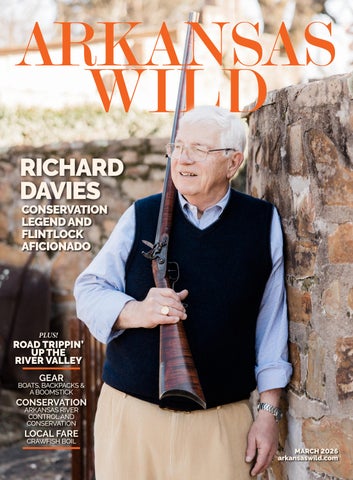
Richard Davies took over state parks in his twenties, transformed them in his fifties, and hunts like it’s the 1840s .

12

GEAR GUIDE

Wet a hook, wet a paddle, wet a whistle … springtime is here, and you’re gonna need some gear.

20

WILD CANVAS

A flintknapping club keeps an ancient tradition and craft alive in the Ouachitas.

THE CONSERVATION REPORT

Despite the McClellanKerr Navigation System, the Arkansas River is still wild. 16

24

CROSSWORD

Puzzle your way down the river and across the valley with this issue’s crossword. IN THIS ISSUE

LOCAL FARE

It’s crawfish season in South Arkansas, and our correspondent has the goods.

38

END OF THE TRAIL

Calendars, schmalendars: Flower festivals and canoe races tell

ON THE COVER: Richard Davies with his Caywood Southern Mountain flintlock rifle. Photography by Katie Childs.

WESLEY HITT
Mulberry

BROOKE WALLACE Publisher brooke@arktimes.com

KATIE HASSELL Art Director/Digital Manager

WENDY HICKINGBOTHAM Senior Account Executive

ANITRA LOVELACE Circulation Director

KATIE CHILDS

Katie Childs is an Arkansas based photographer who has been documenting people and places since 2011. When she’s not behind the camera, she’s usually climbing and chasing time outside.

ARKANSAS WILD

MANDY KEENER Creative Director mandy@arktimes.com

LESA THOMAS Senior Account Executive

MIKE SPAIN Advertising Art Director

ROBERT CURFMAN IT Director

ALAN LEVERITT President

CONTRIBUTORS

HEATHER IACOBACCI-MILLER

Heather Iacobacci-Miller, a Hot Springs native now rooted in Little Rock, is a freelance writer fueled by her love of healthy living and the outdoors. A dedicated runner and fitness enthusiast, she finds joy simply being outside and sharing her passion for wellness through her writing.

RICHARD LEDBETTER

Matt McNair Editor wild@arktimes.com

LUIS GARCIAROSSI Senior Account Executive

ROLAND R. GLADDEN Advertising Traffic Manager

CHARLOTTE KEY Administration

RICH FAHR

Rick Fahr is a native of Northeast Arkansas. A longtime journalist and military veteran, he began hunting and fishing with his grandfather as a child. He is president of Jackson Hill Hunting Club, located outside of Hampton in Calhoun County.

Raised in South-Arkansas, he studied English, history and theatre in Memphis and Arkadelphia. Ledbetter is an avid gardener, outdoorsman and historian. His articles regularly appear in Arkansas publications. He has two published, historical novels, “The Branch and the Vine” and “Witness Tree; 1910” and continues to appear in feature films, television and numerous commercials.

KNOW THE PERFECT PLACE THAT COULD USE A SIDEWALK, OR MAYBE A TRAIL THAT NEEDS SOME TLC?

Your ideas may qualify for funding through the Transportation Alternatives Program (TAP) or the Recreational Trails Program (RTP). Visit our website to learn more about these grant programs administered by the Arkansas Department of Transportation.

ELIGIBLE EXAMPLES INCLUDE, BUT ARE NOT LIMITED TO:

• Sidewalk improvements

• Recreational trails

• Shared-use paths

• Motorized trail development & rehabilitation

APPLICATION CYCLE IS OPEN FROM FEBRUARY 2 TO APRIL 30, 2026

LocalPrograms@ardot.gov TAP ardot.gov/tap RTP ardot.gov/rtp

Local Programs Division (479) 360-7161

FROM the editor Splitting the Difference

Hello and well-met from Catfish Tower, where out my window I can see some red in the redbuds and some green in the other trees across the way, and also the light at the end of the tunnel that is our Spring 2026 issue of Arkansas Wild . If you’re reading this right now, that means the tunnel has been cleared and it’s time to thank you, the reader, for giving us a look, and to thank everyone that contributed to this issue; there are enough thank-yous due right here in the Tower that you might have another editor from which to get a letter come the Summer issue, but I’ll do my best to hang around till then. Keep the faith!

In the meantime, what you’ve got in your hands is a nice collection of quality springtime content to while away however much time you’re currently whiling, and if the weather where and when you’re at is anything like it is where and when I am (as implied above, it is very nice and I am, sadly, very inside), then I hope you’re settling in under a tree for a mid-hike siesta or waiting on your shuttle partner to get back to the put-in so you can both shove off. If so, good! The magazine is gravy, then. But if not, hopefully the following pages will tide you over till you escape the cubicle or waiting room or checkout line or whatever it is that’s got you hung up inside. We’re rooting for you.

We lean into the idea of spring as a tweener season in this issue, and in that spirit we take a road trip up the Arkansas River Valley. I moved to Russellville from North Arkansas after high school and thought I was living, basically, in the Delta. Then I fell in with some folks that had moved there from the Delta, who considered Russellville so folded up as to induce altitude sickness. And I’m pretty sure we were all more or less spot-on, and I’ve really dug the River Valley’s inbetweeness ever since.

Our conservation report comes from Richard Ledbetter, who obliges our theme by taking a look at the Arkansas River, and the different ways humans seek to either control and/or conserve it. There’s a pretty sweet pic in there of a biologist and her fishy friend, too.

Two other freelancers send us dispatches from either side of the in-between: We’ve got one from the flatlands southeast of the Valley in which we’re shown how to do a proper crawfish boil, and another from the Ouachita highlands introducing us to a group of folks using Arkansas stone and ancient techniques to knap arrowheads and other stone tools.

The cover story is a profile of Richard Davies, a person with whom an Arkansas Wild reader might already be familiar, seeing as how he’s a legend in conservation circles and no stranger to the outdoor-magazine profile circuit. But did you know about the flintlock?

That’s enough from me. Get in here and check out what we’ve got, then get outside and get some fresh air. It’s springtime, after all.

See ya out that way, Matt McNair

The Editor, along with Chester, his time management advisor, recovering from cabin fever.

Water, water everywhere!

SO LET’S ALL JUMP IN THE DRINK WITH SOME SPRINGTIME GEAR.

Springtime is here, which means the creeks are rising, the fish are biting, and ol’ Tom Turkey is getting ready to gobble. And after a hectic holiday season, a couple of weeks spent getting back into a workaday groove after another flip of the calendar, and what is beginning to look like the traditional late-winter ice storm, it’s a pretty safe bet that the average Arkansas Wild reader is good and ready to get out and about. So to help you quit climbing the walls and start climbing the mountains — and clambering up trails, canoeing down creeks, and cavorting in the great out-of-doors generally — we’re here with the springtime edition of our Arkansas Wild Gear Guide.

Old model, old school. If you prefer a little seasoning on your canoes and want to do your shopping very local, head to your favorite floating spot and talk to a local livery. Most outfits that rent out canoe trips — Turner Bend on the Mulberry, Moore Outdoors on the Piney, the concessionaires up and down the Buffalo National River — sell off some of their fleet every year to make room for new boats. Some of them have seen some things, to be sure, but if you know what you’re looking for and what you’re looking at — and can do a little horse-trading — you might just come up with the deal of a lifetime (or at least several floating seasons).

Where the Buffalo roams.

New model, old school. If you think kayaks are too skinny and pedal rigs are a little too contraption-y, consider picking up a new Buffalo canoe. Ubiquitous on the state’s waterways since its introduction, the Buffalo is named after the Buffalo National River and is produced near its namesake by Buffalo Canoe Manufacturing in Jasper. The versatile Buffalo is suitable for virtually any waterway in the state, but is perhaps most beloved by canoe campers as a steady, roomy, and nimble craft ready to paddle for a day or a week at a time. You can find a new Buffalo canoe at Arts Marine in North Little Rock, Ranalli Farms & Equipment in Springdale, and at buffalocanoemanufacturing.com.

You CAN take it with you.

Tackle your tackle. Fishing starts out pretty simply — pole, line, hook, worm — but by the time an angler graduates from that first Snoopy pole to even the most basic big-kid rig, tackle starts to pile up pretty fast. Keep it all sorted — and mobile — with the Bass Pro Shops Advanced Angler Pro Backpack Tackle System. It sits just fine in the bottom of a boat, but the Angler Pro really shines when it’s time to leave the boat behind and head up the creek afoot. Find the Advanced Angler Pro (and plenty of stuff to fill it) at Bass Pro Shops in Little Rock.

Go pedaling and/or paddling. Combining several perennial outdoorsactivity all-stars — kayaking, fishing, and bicycling — the Native Propel 10 is a fishing kayak that runs on pedal power, keeping your hands free for doing what you’re out there to do: go after fish. It’s compact enough to fit on just about any rooftop rack and comes with a motor mount and an electronics plate for future upgrades. The real draw, though, is the pedal system, which allows for handsfree propulsion and steering while you cast away. There’s a Propel 10 — along with plenty of other kayaks — at Ozark Outdoor Supply in Little Rock.

Sip, don’t slip. Keep your iced tea — or whatever happens to float your boat while floating in a boat — both iced and contained with the TwistLock Beverage Locking System. The mother of all cupholders, the TwistLock can be mounted to just about any flat surface that would otherwise be a prime suspect in tragic beverage loss, including RVs, tractors, motorboats, tree stands, and even aircraft. The TwistLock Beverage Locking System comes with a two-year warranty, mounting kit, and insulated tumbler. You can find yours at Bass Pro Shops.

It’s a lock. If this issue’s cover story has you hankering to channel your inner Davey Crockett, it might be time to invest in a flintlock hunting rifle and light out for the Territory. Do a little research first — the rifle featured in the story is a Southern Mountain rifle, but flintlocks come in a wide variety of styles and calibers — then don your coonskin hat and hunt a mile in your a frontiersman’s moccasins. You can get your smoke-pole of choice custom-made right here in Arkansas: The Muzzleloader Shop (with locations in North Little Rock and Berryville, and online at muzzleloadershop.com) and Caywood Gunmakers (located in Berryville, and online at caywoodguns.com) both offer numerous calibers and styles of pre- and custom-built flintlocks.

Biking for bass [or] Fish with your feet.
Hey man, there’s a beverage here!

ThE CONSERVATION REPORT

WILD ARKANSAS

CONTROL AND CONSERVATION ON THE ARKANSAS RIVER.

From tempestuous to tamed

Rising near Leadville in the Sawatch Range of the Colorado Rockies, the Arkansas River winds across four states before emptying into the mighty Mississippi in the Arkansas Delta. Of the Arkansas River’s 1,469-mile length, 320 of them cross our state flowing from the Old West outpost of Fort Smith to what once was Napoleon, the ill-fated Mississippi River community that was washed away in 1874 by the same vibrant watercourse that had led to its settlement forty-two years earlier.

The Arkansas River derives its name from an alternate appellation for the Quapaw tribe, “Akansa.” The name “Quapaw” is itself a European pronunciation of the native word “Ugahxpa,” meaning “Downstream People,” while Akansa translates to “Southwind People.” Both reference their southward migration from the upper Mississippi River region to settle in present-day Arkansas. Early French explorers associated the Native Americans who resided at the mouth of the watercourse with the river. Over time the vital waterway became known as the Arkansas, and the region officially adopted the same moniker when a portion of the Missouri Territory was ceded to form Arkansas Territory on March 2, 1819. As the 25th state, Arkansas entered the Union under that name on June 15, 1836.

While the river proved an inroad to early explorers plowing its waters in flatboats and canoes, shifting channels and sandy shoals made early steamboat navigation treacherous and unreliable. In its natural state, the Arkansas could run so low during dry periods that one could walk the shallow depths from bank to bank, while the rainy season often brought intense flooding.

With 20th century engineering advances, many mighty rivers were dammed and diverted to control wild variations in seasonal ebb and flow. The Arkansas’s long reputation as an unpredictable navigation route was in opposition to economic advantages gained via reliable transportation and facilitating commercial agriculture. As such, the river’s days as a wild and onerous watercourse were drawing to an end.

Rivers run, money talks

Dedicated on June 5, 1971, the McClellan-Kerr Arkansas River Navigation System (MKARNS) sought some semblance of taming the wild Arkansas through channelization (dredging a deep channel for commercial barge traffic) combined with a series of 18 locks and dams, 13 of which lie within our state. Although the system offers a degree of control over the river breaching its banks, its primary purpose is not flood control but assisting navigation.

Stretching all the way from the Arkansas’s confluence with the Verdigris River at Port Catoosa, Oklahoma, to the mouth of the Mississippi, the MKARNS affects the lower 445 miles of the mighty river, with only the final 13 miles — from the Wilbur D. Mills dam to its confluence with the Mississippi — flowing free.

In 2022, Congress allotted $92.6 million to improve navigation and bolster commerce on the river. The funding is earmarked to deepen the Arkansas River navigation channel from a 9-foot depth to 12 feet.

Supporting 40,000 jobs with an annual economic impact of $5.5 billion on our state’s revenue, the MKARNS is a vital avenue for commerce and industry.

Phase 1 of the project includes surveying the channel in its current state, especially following the dramatic changes made to the riverbed during the once-every-200-year flood of 2019.

A second objective is discerning how best to modify dikes to funnel the river’s current where it can naturally scour silt from the channel.

Efforts will likely be focused on pools 10, 8 and 5. Pool 10 is the 34,300 acre Lake Dardanelle, pool 8 runs from Morrilton to Conway, and pool 5 flows from below Little Rock to Pine Bluff. These areas contain problem spots that are prone to greater silting where deepening should prove most effective. Other than regular maintenance, no actual dredging is intended during the initial phase.

AGFC biologist Chelsea Gilliland prepares to release a paddlefish back into the Arkansas River.

Money isn’t everything

Chelsea Gilliland is an Arkansas Game and Fish Commission large river fisheries biologist who joined the wildlife agency in 2018. As a fisheries biologist, she is one of many professionals tasked with protecting the ecology of Arkansas’s large rivers, including the Arkansas. This includes balancing a healthy Arkansas River ecosystem with economic and practical considerations that often take precedence when decisions are being made with regard to the vital waterway.

“You tickle a river,” she says, referring to unforeseen impacts from major engineering projects, explaining that “you take action one step at a time, monitoring the results to see what works.”

Gilliland expressed how the Army Corps of Engineers is working cooperatively with the AGFC regarding impacts on the fishery and recreation. When deepening a riverbed by dredging, relocation of the removed material is of vital importance to the ecosystem. Most of the sand and gravel is pumped to shallows along the riverbank, which may seem practical but can have significant impacts.

“We (AGFC staff) reviewed the river mile by mile,” she says, “and provided comments on where access to the river could be impacted, along with areas to avoid inwater disposal of dredged material, such as spawning sites and vegetation beds. Those locations are important for biologically significant species like paddlefish, alligator gar, buffalo, catfish, bass, and crappie.”

While channelization is paramount for consistent navigation on the Arkansas River, flooding can also impede commercial traffic and often prove quite impactful to riverine ecology.

The great flood of 1927 is the grandaddy of Arkansas River floods, yet it was surpassed in sheer water flow by the flood of late May and early June 2019. In addition to early snowmelt at the headwaters of the Arkansas, atmospheric moisture was unusually high, lending to repeated heavy downpours. The 12 months leading up to the event were the wettest since recordkeeping began in 1895.

The initial rains associated with the flood began on May 18. High volumes of surface runoff and water dumped from overtopping reservoirs, swelling the bulging river to near alltime levels. Not since 1927 had the river seen such swollen, swirling currents. The further downstream, the more impactful the situation.

According to Gilliland, the flood’s effect on the fishery depends on timing, duration, and the lens you are looking through. She explained how normal river flow during May is around 40,000 to 60,000 cubic feet per second (CFS), but for two weeks in the spring of 2019 the river sustained volumes of 300,000+ CFS. All dam gates were open, leaving a naturally flowing, wild running river.

“We’ve seen high-water years in past decades,” Gilliland said, “but none like 2019.”

Floods impact different fish species in different ways, with some varieties harmed by a flood event and others actually benefiting. Two weeks of high-level flushing in late May has a significant impact on spring spawning. Adult fish are less affected because they’re more mobile and can hunker down behind dikes and in backwaters. Fresh hatched fingerlings are more susceptible, getting swept away in the torrential currents.

High-water events can actually have many benefits for the river’s ecosystem. During open-river conditions the watercourse becomes fully connected to floodplains. River-

to-floodplain connectivity maintains ecological health, reduces flood risk and improves water quality. Floodplains act as sponges, lowering velocity and volume of floodwaters while reducing erosion. Furthermore, they naturally filter water, reducing sediments in the river and creating rich habitat for wildlife, fish, and birds, while also adding tons of fresh sediment into the system that provides nutrients to stimulate the food chain. Fish populations that might be negatively impacted by open-river conditions will rebound more quickly with abundant food.

At the same time, these conditions provide opportunity for invasive species, such as nuisance silver carp, to expand their range and compete for resources with native fish like buffalo and paddlefish.

While floods bring some benefits to fish habitat even as they disturb it, 2020 and ’21 were also above-average flow years, so the fishery didn’t immediately get a break for full recovery.

“For a couple years following the 2019 event,” says Gilliland, “we saw fewer number and size of fish in the river, with the greatest impact on our two most popular sport fish, bass and crappie. Because they are sight feeders, fast-moving, murky waters make finding food more challenging for these classic Arkansas River species beloved of recreational anglers.” AGFC biologists noted the population dip but now are seeing progress after a couple of years with near normal flow.

Gilliland says that for some species, flood conditions are mostly beneficial.

“Fish more adapted to such conditions, like blue channel and flathead catfish, along with buffalo and gar, love the flood because they are used to muddy water, high flow and high sediment,” she explains. “As bottom-feeders, they lay on the riverbed, open their mouths and gorge.”

Furthermore, some desirable species need connection with the floodplain to spawn. While hundreds of miles of revetments keep the water within its banks, floods reconnect the river channel back to its floodplain, which is requisite to produce their prodigy. Species like gar and buffalo are incredibly long-lived (some buffalo have been found to be 100 years old), so they don’t need to spawn every year and can survive durations between floods. One good flood per decade maintains their numbers.

That can be borne out ecologically and economically, as along with sportfishing, the Arkansas River is likewise an important commercial fishery, with species such as buffalo making up a large portion of commercial catches.

“Many commercial fishermen say the Arkansas in 2024 and ’25 has been the best they’ve seen during their entire careers,” says Gilliland when describing the positive effects of flooding on commercial fish species.

“In February 2022, AGFC began requiring mandatory commercial harvest reporting,” she explained. “Commercial fishermen are now required to report numbers and pounds caught by the 15th of each month. The Arkansas is second only to the Mississippi for highest production of buffalo and catfish.”

Other potential factors weighing in on the long-term state of the Arkansas River include several McClellanKerr dams up for hydroelectric generation licensing. This proves significant because electric generation can restrict fish migration, modify water temperatures, and alter crucial habitat. The licenses have a 50-year lifespan and the AGFC is already actively engaged in the process to protect fish populations in the Arkansas River.

LOCAL FARE

(Mud) Buggin’ Out

SPRINGTIME IN SOUTH ARKANSAS MEANS CRAWFISH BOILS AND COMMUNITY GET-TOGETHERS.

Few events are more uniquely Southern, or uniquely social, than a springtime crawfish boil.

Having survived another mostly mild winter, those with the know-how herald the brightening year by dunking mudbugs for friends, family and whoever happens by.

Michael Devall of Lake Village has been a keeper of the pot for more than four decades, dating back to his upbringing outside Baton Rouge, Louisiana, where his love of the culinary arts began as a child in his grandmother’s kitchen.

“Mawmaw taught me everything I know about cooking. I would spend weeks at a time with her in the summer,” he explains.

Those lessons included the birthright of every Cajun — developing a personal relationship with roux — and an early indoctrination to the socalled “holy trinity” of the cuisine: onions, bell

peppers and celery.

As a teenager, he received his first crawfishcooking setup and joined the fraternity of those preparing aquatic feasts for others.

“It’s a gathering. It’s a get-together. It’s a celebration,” he contends. “It’s not about the crawfish. It’s about the boil. It’s more about the camaraderie.”

Devall made it clear that for this kind of party, there’s no RSVP required.

“Everywhere I’ve been in Louisiana, we cook crawfish in the front yard,” he says. “It’s almost like there is a beacon, a crawfish signal above your house.”

Putting on a boil is not inexpensive. Devall’s back-of-the-paper-towel math says to plan for each boil attendee to eat about 4 pounds of crawfish. This year’s early season prices are about $4 per pound, or about $16 per person. The

Michael Devall of Lake Village and his son, Dalton, spread a crawfish boil for friends and family.

seasonings and vegetables can push a hundred bucks, and propane is about $30 per tank. For a group of a dozen people, the cost can easily top $300, on top of the sizable investment in the equipment.

Devall, who has competed in crawfish festivals and put on boils at housewarming parties, weddings and other occasions under the banner of Big Sexy Cooking Co., says a crawfish boil consists of three parts — equipment, preparation and cooking — and each one is singularly important.

His setup begins with a full 20-pound propane tank, which holds enough fuel for two bags (30-35 pounds each) of crawfish and the fixings, and stand. He uses a 120-quart pot and mesh basket, with a stainless steel paddle for stirring.

The most important piece, though, is not part of standard, offthe-shelf fish/crawfish cooking kits, which come with a propane regulator that pumps out 10-15 pounds per square inch of pressurized gas. That sort of heat will get the job done — eventually — but greatly increases the time necessary to heat up the water. Devall uses a 60 PSI regulator, which creates much more heat.

“It sounds like a jet engine,” he says.

Preparing the crawfish to boil is essential, Devall stresses. “Crawfish live in the mud, and when they get harvested, they are just covered. So, you have to get them clean, or all you will be able to taste is that mud.” He puts them in a tub or ice chest and rinses them until the runoff water is “crystal clear”.

Then, it’s time to light the fire.

Devall’s recipe and perspective have changed over time, coming down to a simple mantra of highlighting the crawfish and avoiding extras, keeping his water-to-seasonings ratio small.

“Less is better,” he cautions. “The more I put in there, it doesn’t add to the flavor. All it does is soak up my flavor.”

He also says the recipe for a given boil can vary, depending on the preferences of the attendees.

“Some folks like them spicier. Some, not so much. So, feel free to add whatever you want or take out what you don’t. This is just what works for me.”

Michael Devall of Lake Village stirs a crawfish boil pot.
“It’s a gathering. It’s a celebration. It’s not about the crawfish. It’s more about the camaraderie.”
—MICHAEL DEVALL

Michael Devall’s crawfish boil pot contains crawfish, potatoes, corn, mushrooms and a mixture of spices.

Louisiana Crawfish Boil

Water (approximately 5 gallons)

Crawfish (one bag, 30-35 pounds)

Louisiana Seafood Boil (4.5-pound bag)

Iodized salt (8 ounces)

Garlic powder (12 ounces)

Juice of 4 large lemons (8-10 ounces)

New potatoes (1.5 pounds)

2 large onions

Smoked sausage (2 to 3 pounds)

3 ears of corn (cut into six pieces)

Whole white/mushroom/portobello mushrooms (8 ounces)

Purge the crawfish of any mud by rinsing as many times as necessary.

Add water to pot, and into basket add Louisiana Seafood Boil seasoning, salt, garlic powder, lemon juice, new potatoes and onions.

Put pot on fire, cover and bring to a rolling boil.

Remove basket from pot and add crawfish and sausage. Put basket into pot and cover.

At this point, the additional ingredients will cool off the water. Wait for the water to come back to a rolling boil and cook the crawfish for 3 to 3 1/2 minutes. (The boiling time can vary, depending on the maturity of the crawfish; later in the season, the boiling time increases to 5 to 6 minutes.)

Turn off the heat and add corn and mushrooms.

Allow the pot to cool for 20 to 30 minutes. (The longer the “soak” the spicier the crawfish become.)

“Every five minutes, I will be using my paddle to push the crawfish and corn and mushrooms down into the water,” Devall notes.

By the time they are ready to consume, the crawfish will have soaked up the spice-infused water and sunk to the bottom of the basket.

Toss the contents of the basket onto a clean surface and enjoy — with others.

Flintknapping enthusasts craft contemporary points using ancient techniques.

A Knack for Knapping

ARKANSAS GROUP KEEPS ANCIENT ART OF FLINTKNAPPING ALIVE USING NATIVE STONE.

If you’ve ever seen an arrowhead and wondered how it was crafted, then you’ve already been introduced to “flintknapping.” However, flintknapping is more than just shaping stone. It’s the ancient craft of shaping stone into tools and points — like arrowheads, spear points, and knives — by striking and pressure-flaking along natural fracture lines. It demands precision more than force, with each flake removed intentionally to create a sharp, controlled edge. For modern practitioners, the process is as important as the finished piece. It’s about the hands-on way of understanding how people once worked with stone, and how that relationship to the physical environment and their craft tells a story of humanity’s history and our place in the world.

Arkansas is central to that story. The state’s abundance of knappable stone, especially novaculite from the Ouachita Mountains, made what we now call Arkansan an important material source for Indigenous toolmakers for thousands of years. (The word “flint” in flintknapping is more of a catchall for a variety of stones used, such as chert, obsidian, novaculite, and quartzite, not just flint.)

Phil Iacobacci, Hot Springs resident and avid

flintknapper, says, “The novaculite that is found in our state is some of the finest material to work with.” While noting that not all of it is useful as a tool (as is the case with all workable stones), the region sports an abundance of stone that meets flintknapping’s exacting criteria — clean, free of fractures, and large enough to work down into a tool — and the same stone that drew our ancient ancestors continues to draw knappers today, with present-day gatherings connecting modern flintknappers to a much deeper history that is rooted in the land itself.

Phil — who happens to be my father as well as an ace flintknapper — is an avid outdoorsman with a deep respect for nature. He has been drawn to the water, the woods, and the history of those who cultivated the earth long before us for his entire life. He grew up walking the shores of Lake Ouachita with his parents, who taught him how to spot arrowheads and other Native American relics. He feels a connection to the Native people, their love and respect for the land and nature. He is a man of many hobbies, enjoying learning traditional crafts like woodworking, carving, and, of course, flintknapping.

PHIL IACOBACCI

The First Strike

I recently sat down with Phil to talk about his passion for flintknapping and meeting up with like-minded hobbyists for group flintknapping sessions, or “knap-ins,” to gain a better understanding of what flintknapping is and the importance of knap-ins in passing down the craft to future generations.

At any knap-in, the sound comes first. Not a crack or a snap, but a sharp, precise tick. It repeats across the knap-in, each strike quick and deliberate. It’s not long before the ground is scattered with flakes that catch the light like broken glass. Some knappers work in silence, others talk without looking up, their hands moving steadily, practiced. “If the strike is solid, it will snap, sharp and clear,” Phil said. When a strike is wrong, the sound gives it away: too dull and too heavy, crushing … and a wasted shard drops to the ground.

However, no one judges because failure is expected; it’s part of the learning process. While tips and advice might be given, even in a group, the real exchange isn’t between people, but between hands and stone, carried out in controlled movements refined through repetition. For flintknapping enthusiasts, that sound doesn’t stop. It’s the same note that’s been ringing out for thousands of years, still shaping stone, still gathering people together as a community.

Learning the Craft: Patience and Failure

Learning flintknapping is an exercise in patience with a steep learning curve and the understanding that you will make mistakes. Phil explains, “It’s the mistakes that lead you to be a better knapper. If you don’t make mistakes, you’re not learning. You study that mistake and figure out what you did wrong, not what you did right.”

“Learn from that mistake and put it into the locker of ‘the oops, well that didn't work’,” he continues. “One must always have those lockers to become a better knapper.”

Safe to say, early attempts tend to produce more shards than tools. Progress comes slowly, measured less in finished points than in the ability to read the stone and recognize where it will break cleanly and where it won’t. When asked how long it took before his work began to feel intentional rather than experimental, Phil says, “That part of the path came slowly for me and in rather awkward progress. More failures than I’d like to admit. The process was a slow but rewarding journey, still one that I am walking.”

At a knap-in, your learning curve is on open display, something you must be comfortable with. “When someone makes a mistake, you can rest assured that person will hear it from everyone, but all in fun, of course,” Phil mentions. But this is a time when beginners can sit beside experienced knappers, watching techniques passed quietly from one set of hands to another. Advice is offered when asked, often demonstrated rather than explained. Over time, individual styles emerge, shaped by experience and preference, but the fundamentals remain the same. It’s in this shared space that the craft continues, sustained by people willing to fail repeatedly to get one strike just right.

Community in the Chips and Shards

Flintknapping is a social craft, and knap-ins are an important part of passing the craft down to future generations. People gather, visit, watch demonstrations, and work on their own points. These knap-ins help keep the craft alive. They’re also vital to sharing the valued knowledge from an experienced knapper to a novice.

“It’s hard to just watch a video and be able to understand all the steps that go into making a point,” says Phil. “Hands-on is the only way to understand just how it all works.”

Phil shared a bit about some action challenges that knappers often do during knap-ins. It’s all in fun, but also a learning experience as well. One such challenge is when the group uses one chunk of stone to start, and each person strikes it one time. Once the knapper makes their strike, it’s passed on to the next person. The challenge is in making sure you pay attention to the previous strikes and discern where you can or can’t make your strike, so you’re not the one to end up snapping or

Matt McLeod in his Little Rock home studio.
Phil Iacobacci displays a few points he has completed at various knap-ins.
Flintknapper honing his skills during a knap-in held in Mena.
TERRI IACOBACCI TERRI

shattering the piece.

Knap-ins are also a way to enjoy being in nature, just as our ancestors did. Phil noted that most knapins are outside under shades or pavilions. He made an important observation: When making a point, there’s a lot of dust, so being outside where the dust can disperse is ideal.

Flintknapping as Living History

The art of flintknapping isn’t about recreating the past. It’s about listening and learning from it. Flintknapping connects us to Indigenous history. Phil believes that “the connection to our past is a must for us to move forward in life. We must understand the past to become a better world and a better person.”

For many modern knappers, flintknapping is best understood as living history rooted in Indigenous knowledge and traditions that long predate the gatherings seen today. The craft itself carries a lineage tied to Native peoples who shaped stone for survival, trade, and culture, and contemporary practitioners are careful to acknowledge that inheritance rather than claim it as their own.

Demonstrations at museums, public events, and knap-ins are often framed as education, not reenactment, with an emphasis on respect for the original makers and the landscapes they worked. For modern flintknappers, it’s preserving history, not claiming it. Phil said, “Our goal is to pass along our knowledge of the art, and by sharing the history, we will be able to preserve the history and art.” So, it’s in these settings that the focus shifts from finished points to the act of teaching and showing younger generations how stone breaks, how patience matters, and how paying attention to the material can open a small but meaningful window into the past.

Keeping the Craft Alive

Keeping flintknapping alive isn’t about preserving a technique for its own sake. It’s about maintaining a relationship with material, place, and time, a livedin relationship of the type that is increasingly rare. In a world shaped by speed and convenience, the act of working stone demands the opposite: patience, attention, and an acceptance of failure as part of the process. Each broken point and clean strike reinforces the same lesson: Nothing worthwhile comes without listening closely to the material in front of you.

In Arkansas, that connection feels especially grounded. The stone comes from the land, the gatherings happen outdoors, and the knowledge is shared face-to-face. What’s passed along isn’t just how to strike a rock, but how to slow down, how to observe, and how to respect the people who first learned these skills thousands of years ago. Phil says that he feels there is a renewed interest in traditional crafts more recently, saying that “people are, for the most part, wanting to understand the past and learn about our history, about the people before us and their way of life.”

As long as hands continue to meet stone at knapins, museums, and informal circles, flintknapping remains what it has always been: a living craft, shaped by history and carried forward, one careful strike at a time.

Points in various stages of completion.
PHIL IACOBACCI
El Dorado

River Valley Roundup

1. Single shot
Buck fever 5. Bolt
Firearm
Smokepole
Straight
Walled 14. Game camera
Game check DOWN: 1. Second shift
Misfire
Alternative
Bugles
Bloodtrail 7. Alpha gal
Headlamp
Lever

ACROSS

1. What can be lived (or what was lived) in 6 across? (3 words)

3. See 4 down and 9 down

6. Logan County's "City of Lights"? (Or une célébrité femme briefly in Altus?)

7. With 8 down, unique High School mascot in Yell County

10. Plant that blooms year-round in Pope County?

13. Where to go for tasty views (or beautiful hams)?

14 ____ Mountain (highest point in the United States Interior Highlands)

15. Athletic fellas in the River Valley fed by the REAL Whattaburger?

DOWN

1. River Valley outpost home to the Jungle Boater canoe race (2 words)

2. Scenic shortcut for River Valley Hog fans headed to Fatetteville (2 words)

4. See 3 across and 4 down

5. "Jah, wir haben Wein." (with "Village")

8. The "bar" you're most likely to find on the Arkansas River?

9. With 3 across and 4 down, this issue's main reason to hit the road

11. _____ Roost (famous — and once "secret" — River Valley rock formation)

Up into the In-Between

SPLITTING THE DIFFERENCE IN THE ARKANSAS RIVER VALLEY.

Petit Jean

By the time this issue has gone to press and ended up in your hands, the clocks will have already sprung forward and marks on the wall calendar will show that meteorological spring has sprung up and settled in.

So: Happy springtime, one and all!

Like autumn, springtime is an in-between season, one that leaves a very distinct season of the year behind and presages another, and also like autumn, Arkansas’s springtime weather can swing wild, taking the form of one full-blown season to the other, making a mockery of forecasts and a necessity of creative wardrobe construction; there’s no seasonal layer-boxing to be done in spring, you’re gonna need all of it.

Springtime’s worse than autumn though, inasmuch it offers up the promise of warmth and growth after the cold, unrelenting brown dormancy of winter while yet holding the threat of a killing frost or two (see ya, strawberries; adios, apples), all those sunny days a half-a-jet-stream away from the bluster of a north wind and a good soaking in the coldest not-quite-snow downpour in which you’ve ever had the displeasure of being doused.

And while it can be a real drag for the summertime heat to intrude on the first run of near-perfect fall temperatures, the shock of a springtime cold front — just as a body’s fancy has turned to thoughts of cookouts and swimming holes — is about as mean a stunt as Mother Nature can pull without causing actual damage.

So in that to-and-fro spirit, let’s take a trip up the most inbetween of all our state’s geographical regions: the Arkansas River Valley.

Beginning just west of Conway in Faulkner County, the Arkansas River Valley more or less follows the Arkansas River westward, encompassing a roughly 40-mile north-south swath (with the river in the middle) and stretching to the Oklahoma border. East of that point the Arkansas River remains a formidable river, albeit just one more large watercourse in a vast wetland cut through and washed over with them. West of Conway, though, it is a geographically- and geologically-dominant feature, its waters and flood plain a stark dividing line between the Ozark and Ouachita mountains.

The result is a land that is both highland and lowland, both very rural (whole lotta expanse out there) and oddly urban (several towns on the bigger side for Arkansas, and seemingly side-byside thanks to Interstate 40). Native Valley folk might take it all for natural, but for a person raised in the Arkansas high country, the River Valley might as well be the bayou; likewise, to the true lowlander from off down in the South Arkansas piney woods or the Delta wetlands, the River Valley is so high up and folded as to lack oxygen. And both sets might well find it as cosmopolitan as anyplace they’d care to be.

Sounds like a pretty neat place to us.

So layer up (it will be hot, cold, wet, windy, and possibly tornadic in its very quick turn) and get ready to see the best of what inbetween Arkansas has to offer. We’re going to the River Valley!

Park It!

The Arkansas River Valley contains three of Arkansas’s most breathtaking mountaintop state parks: Petit Jean, Mount Nebo, and Mount Magazine. All four are worth the trip, and all four can easily be a trip unto themselves; for road tripping, both Petit Jean and Mount Magazine are traversed by through-roads that, while making for an extensive detour, can nonetheless be laid out on a route.

Situated near the Valley’s eastern edge, Petit Jean State Park is Arkansas’s first state park and remains one of its most spectacular. Petit Jean Mountain, like the other two mountains designated as state parks on this list, is a breathtaking and anomalous sight, rising up out of the surrounding countryside like a mountain range unto itself, with nary a sister peak nor foothill to be found.

The mountain is fascinating in and of itself, but the park atop it is the real draw: Stunning trails that range from leisurely walkabouts to strenuous multi-mile treks, campgrounds and cabins, and historic Civilian Conservation Corps (CCC) structures dating to the 1930s make Petit Jean State Park a world unto itself. As noted, a daytripper can daytrip straight through … but why would they?

Mount Nebo State Park, just east of Dardanelle, also sits atop a geological anomaly, and while smaller than Petit Jean, Mt. Nebo’s views of the surrounding countryside are just as grand. A secluded getaway for River Valley gentry after the Civil War and the site of a feminist groundswell in the 1920s (when the town of Mt. Nebo was governed entirely by women), the park today offers trails for hiking and mountain biking, and is a popular spot for hang gliding.

Near the western edge of the Valley is Mount Magazine State Park. At 2,753 feet above sea level, Magazine Mountain is the highest point in Arkansas. Among Magazine’s many wonders is a population of butterflies so robust and, in some cases, rare, that it draws lepidopterologists from all over the world; Francophile butterfly fans will find a bit of home at the base of the mountain, where the town of Paris serves as the park’s unofficial gateway.

Bridging History

While Interstate 40 is a good way to get to or from any given River Valley destination in a hurry, it’s no proper way to take in the region’s local color and fascinating history. Get to the same spots with Arkansas Highway 22 (south of the Arkansas River) and U.S. Highway 64 (north of the river). Each road traverses the Valley, and each is associated with a designated historic trail.

In 2019, Highway 22 from Dardanelle to Fort Smith was designated the True Grit Trail. True Grit, written in 1968 by Arkansawyer Charles Portis, follows Mattie Ross as travels from her Yell County home to Fort Smith seeking justice; her route roughly followed what is now Highway 22.

A more somber tale is told on U.S. 64, numerous sections of which are included in the Trail of Tears National Historic Trail. Documenting the forced removal of Native Americans from their ancestral homes, the trail is well marked and meticulously documented, suitable for hardcore history buffs and the merely curious alike.

The entire Valley is riddled with historical sites and curiosities, from a once-thriving coal industry (Coal Hill,

Lake Dardanelle
Mount Nebo

Paris, Altus) to the ongoing viticultural pursuits of the state’s Wine Country, the heart of which is Wiedehkehr Village. Home to the namesake winery — the oldest continuallyoperating winery in the state — and restaurant, Wiedehkehr Village was incorporated in 1975 to avoid annexation by nearby Altus (itself the site of wineries aplenty), and as of 2025 was the smallest incorporated city in Arkansas with a population of 38.

If choosing a highway on either side of the Arkansas River and sticking to it the length of the Valley sounds too straightforward, pick a few spots on both the north and south side to visit and make it a point to crisscross the big river a few times. There are not many places to do it — there are six bridges across the Arkansas in the River Valley proper: near Morrilton, at Dardanelle, near Scranton (south of Clarksville), at Ozark, at Fort Smith-Van Buren, and Fort Smith-West Fort Smith — and choosing to peel off your main route to make a crossing is sure to introduce happy complications to your itinerary, the kinds of zig-zags that add to your travel time, but and make possible a whole host of unexpected roadside discoveries.

Off the Beaten Cast

Like a whole lot of other places in Arkansas, the River Valley is stuffed to the gills with great fishing spots. The biggest and

most prominent by far is Lake Dardanelle, a 40,000-acre reservoir formed by the Dardanelle Lock and Dam. Lake Dardanelle State Park, with its primary facilities in Russellville (there is another unit of the park near Dardanelle, on the south side of the lake) boasts boat ramps and shore-fishing opportunities, camp sites and RV hookups, an amphitheater and a 10,000 square foot visitors center that includes museumquality exhibits and multiple aquariums.

While the state park is the centerpiece of Lake Dardanelle’s fishing opportunities, the lake extends 50 miles upriver and is bounded by more than 300 miles of shoreline, with public and private fishing access scattered up and down both sides of the massive pool. Aside from Lake Dardanelle, the Arkansas River Valley is pockmarked with fishing spots of varying sizes, many of them public and all of them teeming with fish. To get away from the crowds of more popular and populated spots like the state park, check out one of the numerous smaller lakes with public fishing access, many maintained and stocked by the Arkansas Game and Fish Commission. A prime example of such is Lake Atkins, a local fishing haunt that is the source of many a Valley resident’s first big-fish story and a shining example of the AGFC’s commitment to the conservation of the state’s resources and the provision of access to all citizens and visitors. (Find your Valley hotspot at agfc.com.)

Pay Tribute to a Tributary

All that water in the Arkansas River has to come from somewhere, and two of those somewheres constitute some of the finest canoeing in Arkansas (whitewater, even, if the springtime rains have been falling). Rising in the Ozarks but hitting their stride in the hilly northern reaches of the Valley, both Piney Creek and the Mulberry River exemplify the in-between nature of the Arkansas River Valley, being mountain streams closely associated with the bustling burgs (again, by Arkansas standards) of the Valley.

Piney Creek, with its lower reaches in Pope County, meets the Arkansas River at Piney Bay, where access points directly off U.S. 64 provide the launching ramp for innumerable big-water fishing adventures every day of the year. But where Piney Creek is known as “The Piney” (or just “The Creek”) is a ways upstream, still in Pope County and still in the Valley, but butted up against the foothills of the Ozark Mountains. It’s here you’ll find a good chunk of the Valley’s whitewater enthusiasts (and general adrenaline junkies) any time there’s been a big rain, any time there’s going to be a big rain, or any time there hasn’t been one in a while. (Rain can come quick, and it’s a good place to hang out, besides.) The U.S. Service operates the Longpool Recreation Area along the banks of a creek section with that same name, but for the last few decades the place you’ll find the locals congregating and forecasting (or grousing, if the forecast is bad) is Moore Outdoors. A classic American canoe livery serving up shuttles, campsites, and pretty much anything else one might need for a day on the creek, Moore Outdoors is a Pope County institution, and also a mandatory stop on any paddler’s River Valley itinerary.

On up the Valley (westward), the Mulberry River — after rising in the Ozark highlands near the source of the Piney — empties into the Arkansas at the town of Mulberry. Plenty of fishing to be done where the small river and the big one meet, but — again like the Piney — the real action for most Valley folk entails inching up into the hill country and getting on the Mulberry where it’s still running swift and clear, and maybe getting a little spicy after a good rain. The place to grab a boat and shuttle for this classic River Valley adventure — along with extra river gear, assorted sundries, and the best counter-top sandwich one is ever likely to eat — is Turner Bend, where Brad Wimberly and his wife, Vien, operate a canoe livery and general store on the same site the original Turner Bend mercantile occupied beginning in 1911. Tethered to the River Valley and the Arkansas River town of Ozark by Arkansas Highway 23 (designated The Pig Trail Scenic Byway), Turner Bend is another River Valley icon that any selfrespecting road-tripper, boat-freak or not, will put on their itinerary.

Mulberry River
Turner Bend

Vroomin’ Up the River

Splitting the difference between the Ozark and Ouachita mountain ranges, the Arkansas River Valley is perhaps unique among all six of Arkansas’s natural regions in being defined by its built environment as much as its natural features, in the Valley’s case even the great river that actually bestows its name: The Arkansas River Valley is, for the most part, the I-40 corridor. Or at least that corridor as it runs from just west of Conway west-northwest to Fort Smith.

Interstate 40 runs the other direction too, of course, but south-southeast of Conway, and certainly east of Little Rock, it’s really just a big road, no more emblematic of the land it traverses than a fast-food cluster off a random cloverleaf. Go north off of I-40 in eastern Arkansas and you’ll be in the Delta for a good long while (the minor narrative inconvenience of Crowley’s Ridge, notwithstanding); go south and you’ll be in the Delta till you fall off a daiquiri bar straight into the Gulf.

It’s a whole different story in the River Valley though, where veering north or south off I-40 (or its parallel roads) for much any distance at all will put you in a whole other world. Go south and you’re in the Ouachita Mountains, go north for any piece at all and you’re in the Ozarks. Not a difference of degree, but a difference. A different world, like I said. All of this, plus the fact the entire ecoregion is, for a large number of Arkansas residents, doable as a daytrip, makes an exploration of the Valley’s highways and byways a natural thing to do in The Natural State, especially in the springtime when outdoor activities can be cut short by wild weather at the drop of a hat.

Designate a Driver

The Arkansas River Valley has no shortage of amazing places to grab a bite, and in recent years the region has even become a destination for Arkansas travelers to raise a pint. As the microbrewing scene grew around the state, mostly in the larger cities, some enterprising brewmasters in the rural reaches of the River Valley got in on the act.

In Morrilton, Point Remove Brewing Company weathered the pandemic early in its existence and has come out the other side as a favorite among beer lovers in Point Remove's hometown of Morrilton and beyond. With a second taproom in Russellville, they’ve gotten even closer to the namesake of one of their most popular brews, Long Pool APA. Further upriver, Prestonrose Farms is brewing up beer and serving up gourmetquality farm-to-table plates in rural Logan County. The working farm, brewery, and restaurant does all that plus sell a selection of high-quality dry goods off Highway 22, down a county farm road a ways and then up a hill off that. They’re not exactly hiding, but don’t expect a neon (or much of any) sign … head west on Highway 22 out of Dardanelle, and if you get to Paris, maybe stop and ask a local. (Or check their website, but definitely do that, at least. It really is tucked back in there, and hours are limited.) Just down the (main) road from Prestonrose is Pridgin Family Brewing, another farm-to-table operation located in Scranton, which just so happens to be along the route for one of the bridge-hopping options available to an enterprising River Valley road-tripper. And finally, pick up your final Arkansas-brewed pint before heading into Oklahoma at the Fort Smith Brewing Company.

WESLEY HITT
STEPHANIE SMITTLE
Prestonrose Farms

Head West, Young (Wo)man

Regardless of the road one takes, heading west through the River Valley will ultimately lead to the West, at least as the West is reckoned in the popular imagination and, particularly, the Old West of Hollywood oaters. That’s because the Arkansas River Valley finds its western (Arkansas) terminus at Fort Smith, the real-deal frontier outpost where Judge Isaac Parker held court and from whence Bass Reeves rode into the Territory to execute Parker’s warrants, and where the fictional heroine Mattie Ross went searching for a lawman possessing enough “true grit” to aid her in her quest for justice.

The city maintains its frontier aura today, and while it is indeed a city — the third-largest in the state as of this writing — its downtown retains the feel and flavor of its frontier past, with the history and imagery of that period on display at every corner. In particular, visitors with a penchant for the region’s outlaw past should check out the Fort Smith National Historic Site, where the military fort and federal courthouse, as well as the surrounding grounds and some outbuildings, have been restored and preserved. For a newer taste of old history, visit the U.S. Marshals Museum. The facility, which has only been open since 2023, tells the story of the U.S. Marshals Service since its inception, paying special attention to Fort Smith’s pivotal role in that story. And if you’re feeling cheeky, you can visit Miss Laura’s, an interesting museum very near both the old fort and the Marshals museum. Wer’ll forgo the roles of Miss Laura and her house in Fort Smith’s boisterous history, which should tell the astute reader most of what they need to know in order to decide whether to add Miss Laura’s to their River Valley road trip itinerary.

Fort Smith is also the site of the Janet Huckabee Arkansas River Valley Nature Center, where visitors can walk along a user-friendly boardwalk trail through representative River Valley environs and learn about the flora, fauna, and overall ecosystem of Arkansas’s fascinating in-between. If inspiration strikes during the visit, head from the nature center to Fort Smith Park and launch a canoe or kayak on the Fort Smith Water Trail, or if the river looks too big for your taste, stroll along the bank using the Greg Smith River Trail.

A Bit of Grit

For our money, one of the best things about a road trip is getting out of the car and ambling through the woods or near the water for an hour or two before heading on to the next stop. If you're looking for a little fresh air without the structure of, say, a state park, think about visiting an Arkansas Natural Heritage natural area.

Dardanelle Rock Natural Area is one such place. The rock itself has been used as a landmark for boatmen plying the Arkansas River, and Dardanelle itself has a rich history as a frontier river town. (Check out the famous “Council Oak” on the way to the Dardanelle Rock trailhead.)

Other Valley natural areas in the ANHC system get much closer to the “fully unstructured," with out-of-the-way natural areas such as Goose Pond (Pope and Conway counties, near Atkins), Cherokee Prairie (Franklin County), and Sugarloaf Mountain - Midland Peak (Sebastian County) requiring a bit of map-work to get you where you need to go. Once there, roam about as you please; remember, though, most natural areas lack any kind of facility at all, not even marked trails. Do some research up front at arkansasheritage. com/arkansas-natural-heritage/anhc-home and then go out and get a little gritty.

Fort Smith National Historic Site
Janet Huckabee Arkansas River Valley Nature Center
Council Oaks Tree

Richard Davies in his North Little Rock home with two trophy bucks and the flintlock he used to harvest them.

Meet the Old Boss

RICHARD DAVIES, LONGTIME EXECUTIVE DIRECTOR OF ADPT, TALKS TO A FORMER EMPLOYEE ABOUT STATE PARK HISTORY, CIGAR BOXES, AND HIS TRUSTY FLINTLOCK RIFLE.

We were twenty-five minutes into our interview when Richard Davies asked what was quite obviously a rhetorical question, but I just went ahead and answered it anyway because I had anticipated him asking it and I’m helpless in the face of validation.

“And do you know how they managed camping fees in all of that,” he asked. Again, this was rhetorical, but I did indeed know how “they” (various superintendents of individual Arkansas state parks) managed “all of that” (managing and maintaining components of an overextended and underfunded department). I knew Davies was going to say it was a cigar box, because that is how those things worked in those days.

“Cigar box!” This from me, because I was excited to know the answer and wanted Davies to know that I knew it, bad enough to find even baseline journalistic decorum unsustainable. (Davies seemed unperturbed by this breach, but that’s pretty on-brand for him.) But the reason I knew the answer and was proud of the fact says quite a lot about Davies, and seems relevant. There are lots of profiles of Davies out there, rightfully so, and I’ve even seen the cigar box mentioned in a few.

But I don’t think any of the other interviewers knew about the cigar box beforehand.

I heard the story about the cigar box my first day of work at Arkansas State Parks. I worked at the central office in Little Rock and even though my section wasn’t even all that involved with the department’s actual state parks (it lived there for bookkeeping purposes as much as anything else), the orientation process was a crash course in the culture and lore of Arkansas State Parks, in which the story about the cigar box — or boxes, rather, the literal containers in which an entire fiscal year’s worth of user fees were stored in state parks all across the system — figured prominently. This was in 2013, by which time the ASP system had been considered one of — if not the — best state park systems in the United States for quite some time; a park system of expertly managed natural areas and impeccably maintained facilities, a budget north of $100 million and revenues topping $20 million, and a policy of free admission.

That is a far cry from keeping the funds in a cigar box, was the point of all the orientation-week storytelling, and the further point was that each and every employee, regardless of post or relative importance, was responsible for keeping the cigar box and its attendant disrepair in the past. To help drive all of this home, a new hire would get walked all through the building to meet all the different people that had a hand in keeping the ship aright, including a stop at the office of Richard Davies, who since 1990 had served as Executive Director of the Arkansas Department of Parks and Tourism, but who had earlier, as the Director of Arkansas State Parks, been instrumental in turning the state park system from a ramshackle collection of pretty places, overseen by well-meaning people with wholly

inadequate financial and administrative resources, into the nationally-admired institution it had become. He was, in other words, the man who had gotten rid of the cigar box.

Old Ties, New Vision

Richard Davies might well have been the person in the state best suited to getting rid of the cigar box from the get-go, for reasons that have been covered in other profiles but that bear repeating here. For one thing, his family is famously tied to Arkansas’s state parks: His grandfather, Sam, was appointed the first Arkansas State Parks Director in 1937, based in part on his prior work designing and (along with crews from the Civilian Conservation Corps, or CCC) building much of the iconic rockwork infrastructure in Petit Jean State Park, the first park in the state’s system and still one of the most loved and visited. His father, Ladd, also had a hand in the development of Petit Jean; while still working toward his engineering degree at the University of Arkansas, Ladd joined Sam and his CCC crews on top of the mountain. In one of the more impressive instances of on-the-job training one is ever likely to see, the young engineer-to-be designed and oversaw the construction of a bridge over Cedar Creek. That bridge, now known as the Davies Bridge, is on the National Register of Historic Places and perhaps the most iconic structure in a park chockablock with them.

While family ties to the park system’s origin and to state government generally — Davies’s father, whose specialty was sanitation engineering, worked for and was eventually made director of the Arkansas Department of Pollution Control and Ecology, precocious design work for the Department of State Parks notwithstanding — surely positioned Richard Davies well for the career he ultimately had, he did not achieve that career through those connections. If he had, there’s little doubt he still would have made a perfectly fine department director and steered the park system competently into the 21st century; it’s hard to imagine him running the ship aground under any circumstances. But to steer it into its present waters, it probably helped that he went looking for a different boarding pass altogether.

“That’s another good story,” says Davies (he has a lot of good stories, though many are off-record) of his eventual run as the chief executive of one of the state’s largest agencies. “What I wanted to do was get in the advertising business.”

In hindsight, the initial impulse to go into the private sector also mirrors the path his grandfather took, with the latter a private-sector civil engineer when he was tapped to direct the construction of Petit Jean State Park. Where Sam Davies was contacted by the state based on his private sector accomplishments, however, Richard Davies was still on the hunt for a job — in the private sector, not State Parks or any other state agency — when circumstance nudged him into public service.

“So anyway, I graduated and went out looking for a job,” he recalls, “and none of the ad agencies were hiring.”

Unlike his father and grandfather, both engineers, Richard Davies had graduated from college with a degree in journalism (there was no degree in advertising at the University of Arkansas; aspirant advertisers majored in either journalism or marketing and took classes in each), and so the paths they took to state government would not have been open to the youngest Davies even if he had decided to lean on family ties to get a foot in the door. Instead, he widened his net in the manner anyone does when plans A-throughwho-knows-what-letter have fallen through, casting it to, among other places, Arkansas state agencies that might have need of, or allow for, a journalist.

It worked, and while the state didn’t come calling (as it had for his grandfather), it did call back; one agency that did so was the Arkansas Department of Parks and Tourism (ADPT), the umbrella agency formed during the reorganization of state government in 1971. While those two divisions, Parks and Tourism, appear as two sides of the same coin today, that was not the case when they were first merged, and it was the tourism side that was the more forward-facing and the larger concern; the state park system, long a minor player in the grand scheme of state government (re: funding), remained as much in the new agency.

These were still the days of the cigar box, in other words.

Dale Bumpers was the governor who oversaw the reorganization of state government that formed the ADPT, and was determined to improve the condition of the state park system, which was growing rapidly despite being chronically underfunded. He tasked the director of ADPT at the time, Bill Henderson, with squaring that circle. Henderson, who had himself majored in journalism, hired Richard Davies to write for the Department of Parks and Tourism, but specifically about Arkansas State Parks; the idea was to elevate the profile of the state park system and, in so doing, generate the public and legislative support necessary to get it adequately funded. For Davies, who of course knew a bit about parks already, this meant learning how a large government agency is administrated, how levers are pulled and sausage made.

“Henderson, to his undying credit,” says Davies, “made me sit in on every meeting he went to.”

A quick study, Davies rapidly gained the trust of his new boss and was given more and more responsibility. “Before long,” he remembers, “I’m writing legislation, and going to…the governor’s office. And it became more and more administrative, rather than just writing.”

Davies had been on the job for three years when the Arkansas State Parks director retired; when Bill Henderson began the search for a replacement, he put Davies to work evaluating candidates. Though relatively young, he had nonetheless been involved with the agency’s administration at the highest level for a very heady three years, and in a move that echoed his father’s youthful surety (Ladd Davies was 19 when he designed the bridge over Cedar Creek), Richard decided he should just run the thing himself.

“If they're gonna apply, I can apply,” he remembers thinking, reviewing resumés that outstripped his in every way but one: administration of the park system. And so he applied.

“I think there were three of us that got sent to see Governor Pryor, and I got it,” remembers

Davies. “I was 26.”

That made Davies the youngest state parks director in the country at the time, but the combination of youth and administrative experience — as well as the deep family ties to Arkansas State Parks — served him well as he set about fulfilling the governor’s mandate to make Arkansas’s state park system something of which the state could be proud, and that could withstand legislative scrutiny come funding time. Cigar boxes wouldn’t do, and Davies knew it.

The evolution of Arkansas State Parks from a collection of gorgeous, albeit a bit rickety, places began just as Richard Davies got his first job with the state, and it was realized in 1996 — Davies was by this time Executive Director of the Arkansas Department of Parks and Tourism — when voters approved the Conservation Sales Tax (Arkansas Amendment 75), which created a ⅛ cent sales tax to fund the state’s conservation efforts, with 45% of the revenues earmarked for Arkansas State Parks.

That’s how you turn a cigar box from a sorry state of affairs into a piece of institutional lore, and treating every new hire that comes through like they somehow had — and have — a part in it is how you get interrupted during a random interview three decades on.

Back to Basics

Today, a decade into retirement, Richard Davies remains inextricably tied to Petit Jean Mountain. Though he grew up in town, Davies was an avid outdoorsman from childhood; with Allsopp Park near their home in the Hillcrest neighborhood of Little Rock, he and his brothers spent most of their spare time roaming what they referred to as “the woods,” and extended time from school was spent on Petit Jean, where his grandfather had purchased an old homestead while designing the nearby park. While he and his wife Betsy make their home in North Little Rock, the old place on Petit Jean still serves as a getaway and hunting camp for Davies and his extended family.

Some of Davies’s hunting exploits are pretty standard fare: like many Arkansas hunters, he has a weakness for ducks, and like most duck hunters he’ll happily wax nostalgic about the perils of youthful duck hunts (carnivals of sodden indignity, littered with malfunctioning hand-me-down equipment) without expressing any real interest in recreating them (war stories are fun, know-how and operational gear more so).

He is also an avid deer hunter, again like many Arkansans, but in this pursuit he bucks convention somewhat: He uses a flintlock rifle.

His interest in hunting with 19th-century technology — with all the added challenge that brings — was sparked decades ago by the introduction of black powder season in Arkansas, which gave hunters using a muzzleloader the chance to bag a deer weeks before the regular (modern gun) season opened.

“When muzzleloading first started, I just had that,” he says, referring to a kit-built muzzleloader popular in the early days of Arkansas’s black powder season. “A lot of young guys did. It was cheaper.”

Like a lot of those young muzzleloading enthusiasts, Davies enjoyed getting an early opportunity to tag a deer and kept after it year after year. Unlike a lot of those other hunters, however, Davies became enthralled with the mechanics at play, the endless tinkering one had to do to keep such a rifle in shooting condition

Top: Davies’s interest in flintlock rifles spurred further study of antique weaponry and military history. Bottom: Richard Davies displays his Southern Mountain rifle, a recreation of the popular 19th-century hunting rifle.

and, ultimately, the history of black powder rifles writ large; so much so that, even as muzzleloaders evolved and became steadily more accurate and easier to use, Davies had already decided to go the other direction, purchasing an Arkansas-made flintlock rifle (a Southern Mountain by Caywood Gunmakers) and making it his go-to deer rifle, regardless of season.

The kit muzzleloaders so popular when Davies bought his are as far away from today’s muzzleloaders — breeched caps, pressed powder, blasphemous range — as those kit rigs were from the 19th century flintlocks on which the Southern Mountain that Davies shoots is modeled. And that’s to say nothing of alternative firearms season, which replaced muzzleloading in Arkansas two years ago and allows for repeating rifles so long as the cartridges are straight-walled. Davies doesn’t begrudge anybody their turn in the woods regardless of the (legal) rifle, but if he decides to forgo his flintlock for an alternative it’ll not be one of the new alternative-ready rigs so conveniently prevalent since the new season’s advent; rather, it’ll be an old gun he’s dug out of a closet, milled in a slower fashion and earlier time, that fires an odd-duck round and could probably stand some tinkering before it’s ready to go afield, if Davies is ever inclined to take it; a proposition that seems doubtful when he extols an older, slower, more thoughtful outdoorsmanship.

“I always thought it was kinda nice that you gave traditional, old stuff an opportunity,” he says. “To go out and do it. There was a whole lot to be learned…about how things worked in the old days.”

Davies still uses the Caywood Southern Mountain; he’s killed deer with it, some quite impressive, and might well kill another any time he hits the woods shouldering that old flintlock. But it’s pretty clear that the things that go with that choice — an entry point to the history of firearms and of the military, the craftsmanship of a handmade weapon regardless of age, the satisfaction of maintaining and repairing a prized possession and tool — are where fulfillment lies; and maybe a good reason, on the hunt, to decide a shot is just too far off or a bad look, or just not the one he wants to take.

“I guess I’m maybe not as mad at deer anymore,” he says with a laugh, a sentiment that’s not uncommon among hunters who have bagged their fair share of victories, and know it, and could bag plenty more if they really wanted to, and know that, too. For Davies, those victories have come both in the field and through his four decades of public service, and while he no doubt knows it, it is highly doubtful that he’d feel the need to tell anybody about it. That’s fine, though, because it’s a good bet someone else will do the telling for him.

There’s a lot of people out there that still believe in that cigar box.

END OF THE TRAIL

All Rise

Pointing out that “spring has sprung” is among the most droopy-eyed of tired cliches, a particularly hacky way to announce one’s hackery to the world (or readership, as the case may be). But here I am, doing that very thing anyway, because everybody needs to take a break now and again, and right this second I’m as tired of trying to be original and oh-soclever as I am tired of dadgum winter. And besides, even though cliches are overused and to be avoided at (nearly) all costs, they got that way for a reason, and that reason is that they express a sentiment or describe some little bit of the human condition that most anybody across that particular culture can understand, and on which they can agree. I’d argue that the end of winter — or, in a truer sense, the coming of spring — fits the bill.

I mean, one of my very best friends is a dyed-in-the-wool contrarian, an elite-level disagreement artist able to leap overwhelming popular sentiment in a single bound, and I doubt even he would give me the old “uhhhh, actually” treatment here. (We’ll see though, and if I suddenly get an earful of spring-hate from him we’ll also see if he reads my little columns ever.) So anyway, let the cliched love-fest begin.

Everything’s coming up roses in springtime, because everything’s coming up in general: shoots and buds, leaves and blossoms, the temperature and everybody’s spirits all around. As to the latter, the hedgerow-rustling shot through the entirety of the out-of-doors tugs at the primal strings of modern man’s caveman heart; we feel compelled to shake off the gloom and gunk of a cold season spent between the walls and under the roof and get a hankering to roll back the stone and see what’s going on outside our hidey-hole, what’s all astir in the big wide world. And one of the ways this communal coming-out manifests itself — and, for my money, the best one — is the outdoor festival (dedicated to the outdoors, not just held there), the likes of which start cropping up everywhere about this time of year like out-of-nowhere clusters of daffodils, which seems an apt comparison inasmuch I can think of two Arkansas springtime festivals wholly dedicated to daffodils right off the top of my head.

Another thing that comes up in springtime is the water, as in the rivers and the creeks, which means that springtime is primetime for another class of outdoor festival: the canoe race.

Well sure, a “race” is not a “festival,” but in my notinconsiderable experience races are just an excuse to get out of the house, pitch a tent and have a party with your fellow travelers. There are always going to be some try-hards out there looking to

etch their names into creek lore (I’ve been guilty myself a time or two), but for most so-called racers, victory just means getting to the finish line without tumping, and fast enough to not get bawled out in front of everybody else by the long-suffering (and, without exception, volunteer) timekeeper.

I’ll happily go to any canoe race anytime, anywhere, but the one I’ll unequivocally and eternally brave the slings and arrows of outrageous inconvenience to attend is the Jungle Boater, a longstanding to-do on the Mulberry River and the Platonic ideal of an Arkansas canoe race.

Starting at Byrd’s Adventure Center and ending at Turner Bend Outfitter (where Highway 23 spans the river), the race itself is an eight-mile run that is by turns languid and lightningquick, and depending on the water level can put you either on a pedestal or in your place.

The first time I went to the Jungle Boater I was absolutely besotted with the entire enterprise, and the race (in which I performed poorly) was pretty low on my list of priorities. This was the 17th iteration of the Jungle Boater, and it had already established itself as a tradition — an event that transcended the race at the center of it all (again, the excuse), a huge gathering of folks from all over that got there days earlier (Turner Bend is also a big campground) and might well stay a few days late. It was a general-issue party for some, family reunion (blood kin and otherwise) for others, and an instinctual celebration of the coming spring for the lot of us, regardless of it being said out loud.

I didn’t think very deeply about most of that stuff back then — the multiple meanings of family, the importance of marking time with something other than a calendar, the importance of showing up and checking in, of being grateful you’re going to get at least one more run down the river — because I was that insufferable age when a person thinks that they’re going to live forever, and anybody that’s done anything for 17 whole years can’t have much gas left in the tank. But I knew bone-deep that I was going to do my best to show up every March until they called it quits.

All this to say that this year’s Jungle Boater — the 45th — was the best one I’ve ever been to, just like the previous 27 I showed up at. Lots of folks still have gas in the tank up there, and I still have a little in mine, and it’s good to use a little of it to ease down the creek.

And I sure am happy it’s springtime, and that I get to see it again.

Turn static files into dynamic content formats.

Create a flipbook