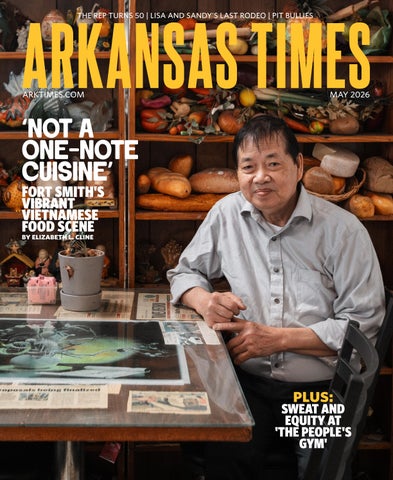
Arkansas Times | May 2026

Page 1


• Five-minute shuttle to casino

• Spacious pull-through sites

• Clean, hot showers

MAY 2026

FEATURES

How the Fort Smith area became an unlikely mecca for Vietnamese food. By Elizabeth L. Cline

38 EXERCISE FOR ALL

Reckoning with race and finding a home at Jim Dailey Fitness & Aquatic Center. By Frederick McKindra

9 THE FRONT

Q&A: With Southlands magazine editor Boyce Upholt.

From the Farm: Finding a silver lining after a frigid winter.

Big Pic: The fiscal session, by the numbers.

15 THE TO-DO LIST

S.G. Goodman at White Water Tavern, “Steel Magnolias” at The Rep, Wilco at The Momentary, “Grand Illusion” at the Arkansas Times Film Series and more.

22

NEWS & POLITICS INTENTIONAL ACCIDENTS

Injuries and deaths are on the rise as the Arkansas State Police get more comfortable with PIT maneuvers. By Milo Strain

ART WARS

Patrick Ralston, former director of the Arkansas Arts Council, spills the beans on the state government’s partisan meddling in the arts. By Byron Tate

RODEO IN THE ROCK:

Cultural markers of a queerfriendly space abound at Arkansas’s biennial gay rodeo.

54 CULTURE DIAMOND DUO

Spouses Sandy Bidwell and Lisa Smith reflect on a half-century of volunteering with Arkansas’s gay rodeo. By Stephanie Smittle

THEATER GOLD

Looking back at 50 years of the Arkansas Repertory Theatre. By Phillip Powell

66

THE OBSERVER

Trading Pine Bluff for Little Rock.

ON THE COVER: Eric Nguyen runs Pho Vietnam with his wife, Lilly. Their shop is one of the many thriving Vietnamese restaurants in the Fort Smith area. Photo by Kat Wilson.

Rhea Drug Store SPRING!

PUBLISHER Alan Leveritt

EDITOR-IN-CHIEF Austin Gelder

CREATIVE DIRECTOR Mandy Keener

MANAGING EDITOR Byron Tate

PRINT EDITOR Daniel Grear

INVESTIGATIVE REPORTER Matt Campbell

AGRI AND ENVIRONMENT REPORTER Phillip Powell

REPORTER Milo Strain

RACIAL EQUITY REPORTER Arielle Robinson

VIBE CHECKER Stephanie Smittle

EDITOR EMERITUS Max Brantley

CONTRIBUTING EDITOR Mara Leveritt

PHOTOGRAPHER Brian Chilson

DIRECTOR OF DEVELOPMENT Bob Edwards

ADVERTISING ART DIRECTOR Mike Spain

GRAPHIC DESIGNER Katie Hassell

DIRECTOR OF ADVERTISING/ SPECIAL PUBLICATIONS PUBLISHER Brooke Wallace

SENIOR ACCOUNT EXECUTIVE Wendy Hickingbotham ACCOUNT EXECUTIVES

Terrell Jacob, Kaitlyn Looney

ADVERTISING TRAFFIC MANAGER Roland R. Gladden

DIGITAL MARKETING DIRECTOR Lyndsey Huddleston

DIGITAL AD COORDINATOR Sarah Richardson

EVENTS DIRECTOR Donavan Suitt

IT DIRECTOR Robert Curfman

CIRCULATION DIRECTOR Anitra Lovelace

BILLING/COLLECTIONS Charlotte Key

CHAIR MAN Lindsey Millar NACHO EDITOR Rhett Brinkley

PRODUCTION MANAGER Ira Hocut (1954-2009) CONTROLLER Weldon Wilson (1967-2025)

ARKANSAS TIMES (ISSN 0164-6273) is published each month by Arkansas Times Limited Partnership, 201 East Markham Street, Suite 150, Little Rock, Arkansas, 72201, phone (501) 3752985. Periodical postage paid at Little Rock, Arkansas, and additional mailing offices. POSTMASTER: Send address changes to ARKANSAS TIMES, 201 EAST MARKHAM STREET, SUITE 150, Little Rock, AR, 72201. Subscription prices are $60 for one year. For subscriber service call (501) 375-2985. Current single-copy price is $5, free in Pulaski County. Single issues are available by mail at $5.00 each, postage paid. Payment must accompany all orders. Reproduction or use in whole or in part of the contents without the written consent of the publishers is prohibited. Manuscripts and artwork will not be returned or acknowledged unless sufficient return postage and a self-addressed stamped envelope are included. All materials are handled with due care; however, the publisher assumes no responsibility for care and safe return of unsolicited materials. All letters sent to ARKANSAS TIMES will be treated as intended for publication and are subject to ARKANSAS TIMES’ unrestricted right to edit or to comment editorially.

©2026 ARKANSAS TIMES LIMITED PARTNERSHIP

‘THE SOUTH IS STILL SO BEAUTIFUL’ A Q&A

WITH SOUTHLANDS MAGAZINE FOUNDER BOYCE UPHOLT.

Since the South adopted him decades ago, New Orleans-based writer Boyce Upholt has always taken a special interest in the natural beauty, political dramas and folksy culture that make Arkansas so unique. Writing long, literary pieces that bring The Natural State into the national spotlight in new and exciting ways, Upholt’s work for publications like The Bitter Southerner, The New Republic and The New Yorker has taken him to nearly every corner of Arkansas (and many other parts of the South).

Now, Upholt is embarking on a new venture through the founding of his own biannual magazine, Southlands, which debuted in October and celebrates “the wild South in all its forms.” Glossy and thick, the first issue numbered over 140 pages and explored the “nature of the Southern thing” by featuring 28 writers, artists and photographers reflecting on their relationships with nature in the South. Upholt himself wrote an in-depth feature article exploring whether a landscape he has visited numerous times — the Arkansas Delta — could become a biking destination due to the work of some dedicated social entrepreneurs in the area. With the second issue of Southlands set to publish in May, we asked Upholt about his vision for the magazine and how Arkansas will show up in its pages.

FAVORITE ARKANSAN? Favorite is hard, but I’d have to say Johnny Cash.

WHO IS YOUR WRITING ROLE MODEL? John McPhee, a longtime New Yorker staff writer and Pulitzer Prize winner.

YOUR MAGAZINE IS ALL ABOUT THE OUTDOORS. WHAT’S YOUR FAVORITE THING TO DO INSIDE?

I read quite a bit, I wouldn’t trust a writer who doesn’t. And I’m a big cook with some good local ingredients to bring the outside inside.

Why did you start Southlands and what is your goal with the project? As I grew as a writer, I found more and more that what I was writing about was environmental stories across the South, but so often national magazines were interested in stories about environmental problems, which is good! We need to be aware of what’s going on. But I noticed again and again that the stories that I was being asked to tell were of problems, and in my head I expected to show up and find sort of this, like, devastated, industrialized, disgusting place. And I was like, “Oh my God, the South is still so beautiful.”

If our only stories coming out of here are environmental stories with problems, then that’s sort of the picture that anyone else is gonna have of us, and it’s going to give us no reason to protect what is still left.

Sort of overlapping with that was noticing that there was this resurgence of these kinds of publications like Southlands, right? The idea of an oversized magazine that comes out a couple times a year, but you really want to spend time with it, because it’s got deep storytelling and beautiful photos. You’ve got the Mountain Gazette, you’ve got Adventure Journal — these really high-quality products — but they don’t talk about the South.

How do all the different reporting projects you’ve done in Arkansas over the last several years inform the way you’re approaching Southlands? In some ways, you could really say the magazine might not exist if I hadn’t found my way into Arkansas at some point. I was living in the Delta, on the Mississippi side, and like, really loved the culture there, loved the blues, loved the music and loved the rural lifestyle. But after having grown up in the Northeast, spending time camping and outdoors, [the Delta] didn’t have everything I needed outdoors and so when I got out to the Ozarks it helped me sort of understand the breadth of what was available to me in the South as a region. I started to envision a future where I could stay in the South. I came [to Arkansas] every year for a number of years over Easter weekend and would go to Jasper specifically. And so it’s just a huge part of my experience. I think some of the same tensions of how it’s become such an interesting place go in my stories. I’ve noticed the way it bucks certain trends, especially in the stories about the Buffalo River. Generally, I’m like, “Yes, I love public lands. I love national parks. Let’s make more of them.” But then, seeing that controversy over the national river and whether it should become a national park, it intrigued me seeing that this is a complicated setting. I love finding stories that sort of make me reconsider some of the things I assume and see the complexity of the world.

What will Arkansas readers get out of Southlands? The South is the fastest-growing part of the U.S., essentially. So the South is becoming this strange blend of people and cultures. Arkansas is this extreme case with these three giant companies in the Northwest, but there are a lot of communities where this influx of people and money are influencing and changing — and potentially threatening — certain longstanding traditions and ways of being that are often tied with sort of lower-income people.

One of the things I want to do in the magazine is both to engage with these economic changes and also think about how there is real value in Southern traditions, whether it is things like the [Gillett] Coon Supper in the Delta, where people go out and capture and eat raccoons, or, you know, these different hunting seasons, or these different kinds of relationships and traditions. That’s another thing people will get out of it is these thoughtful examinations of how local traditions in Arkansas are connected with similar traditions across the region.

DANIEL PIERRE-LOUIS

‘RESURRECTION ON MY MIND’ SIGNS OF LIFE AFTER

A TERRIBLE FREEZE.

Arkansas Times publisher Alan Leveritt has lived on his great-grandparents’ farm in North Pulaski County for more than 40 years. This is the latest in a series of columns about day-today life on the land where he raises heirloom tomatoes, rabbits and other crops for local restaurants and the Hillcrest Farmers Market.

Gazing out across my two big greenhouses in early spring, it looked like a tomato mass casualty event. Brown leaves and dead limbs hung from hundreds of 2-foot-tall heirloom tomato plants. Their stems had turned to mush overnight, drooping over their hydroponic buckets like dead soldiers over their parapets. The day before, they had been full of flowers, green and vibrant. I was no longer running a farm; I was running a plant hospital, an ER for dead and dying heirlooms.

It’s been a rough winter at India Blue Farm. Trouble began Jan. 21 with the rabbitry, an enclosed converted peacock house. Rabbits usually handle the cold well, but that night, with a foot of snow and ice and 6-degree temperatures, five of the does gave birth to 32 newborns. I spent the bitter morning feeding their small frozen bodies to Inca, my Great Pyrenees. This is my first year with the rabbits, and it was the largest single birthing since I got the breeders last spring. Fortunately, I had drained the PVC automatic watering system the night before and placed water bowls in the cages. The water bowls froze solid, and for the next week, I was tramping out with jugs of hot water three times a day

to thaw them out enough for the animals to drink. Adult rabbits can survive extreme cold but they need a lot of water.

That first morning of the terrible freeze, I received a text from my neighbor who germinates my seeds each year for the tomatoes and other plants that go into my hoop houses, greenhouses and the fields. She told me her greenhouse had collapsed under the weight of the snow and ice. She had lost her livelihood and I had lost all the tomatoes and other plants that had just germinated. Then I walked out to check the rabbits to see one of my hoop houses that was full of green cabbages crushed and buried in the snow. It looked like a giant foot had come down across the middle of the house with the metal struts twisted at crazy angles. That was just the beginning of a very bad morning.

A week before, I had finished converting two of my hoop houses, a 96-footer and a 40-footer, into heated and cooled greenhouses. It had been a slow and expensive process with big propane heaters, swamp coolers, circulating fans and exhaust fans as tall as I am. My goal was to transform the unheated hoop houses into a year-round tomato habitat in a humidity-controlled environment that was always between 55 and 80 degrees.

The snow and ice had spared these structures, and a couple of weeks later, I turned on the 500-gallon propane tank, plugged in the 250,000 BTU heaters and commenced planting 440 heirloom tomatoes in the middle of February. In these

greenhouses, I grow hydroponically, and the health and speed at which these tomatoes began growing is amazing. They were growing a foot a week and by early March had begun to flower. I was looking at May heirloom tomatoes in Arkansas.

I have been growing in hoop houses for 20 years, but have never heated them or used propane. I was told a tank would power the greenhouses for a couple of months. But then three weeks later, on March 16, the temperature dropped to 21 degrees and late that night, the propane ran out. I had a bad feeling, and at about 5 a.m., I bundled up and walked out to the greenhouses. The frozen grass crunched as I walked, thousands of little crystals sparkling under my flashlight. As I neared the first greenhouse, I realized everything was deathly quiet. There was no low roar from the roof-mounted propane heater. Inside, I shined my flashlight on the tomatoes and they sparkled, just like the frozen grass. I reached out to the nearest plant and the leaves shattered, frozen solid. A sense of total exhaustion was the only feeling I could muster.

The next afternoon, I began the depressing process of pulling up all the dead plants when I noticed that the tomatoes toward the center still had upright green stems. I wouldn’t have replacement seedlings for six weeks, so I left them in their hydroponic Bato buckets and continued to irrigate them. Then, about the first of April, I noticed something: green, leafy shoots had begun to sprout where suckers would ordinarily appear. A lot of the plants

WINTER WOES: Snow and frigid temperatures pose challenges at Publisher Alan Leveritt’s farm in North Pulaski County.

were completely dead, but perhaps half were coming back. It was a resurrection.

A week later, I noticed small tomato seedlings sprouting in between my rows in the two greenhouses. They were volunteers from last year’s crop. It takes nearly two months from planting a seed to getting it up to transplant size, which was going to move my anticipated May harvest into July. But here were transplants growing at my feet. One great thing about old-fashioned heirlooms is that they are open-pollinated and, unlike hybrids, true to the parent. I dug up all the volunteers and replanted them into the pearlite-filled Bato buckets and they began to take off. I found a source for another hundred heirloom seedlings, which has been enough to replace nearly all of the frozen plants.

So I’m still a little exhausted but not in despair. A week after the tomato freeze, I planted 600 beets in the field. This was all done on my knees, and by the end, it was hard to stand. The next week, 100 Ouachita and 100 Prime-Ark Immaculate blackberry canes arrived from Mountainburg and shortly after, 10 Loomis Muscadine vines arrived from Georgia. And the next week, 75 pounds of Blue Congo, Yukon Gold and French Fingerling seed potatoes arrived. By April 10, all were planted. Now, I’m waiting until the end of April to plant the outside heirloom tomatoes, Ambrosia Cantaloupes, squash, watermelons, red bell peppers, celosia, sunflowers, Benary Zinnias and African Marigolds. Except for the outdoor tomatoes, the large plantings are behind me and the heavy hay mulch will make hoeing unnecessary.

Newt Williamson, my grandmother’s second cousin and a beloved neighbor, taught me that this time between final cultivation and harvest was what people out here referred to as “laying by the crops.” Newt said that was when the tent revivals would take place out in our part of North Pulaski County. You likely won’t find me at a revival, but after this winter, resurrection is certainly on my mind.

argarita

THURSDAY

APRIL 30 6-9PM

Baja Grill, The Spot @ SoMa, WXYZ Bar, Rail Yard, Lakewood Fish & Seafood, Loca Luna, Chepe’s, Fassler Hall, Southern Tail Brewing, Brave New Restaurant, Midtown Billiards, The Pink Lily and more!

THE SHORT, TROUBLESOME HISTORY OF THE ARKANSAS LEGISLATURE’S FISCAL SESSIONS.

State lawmakers were in town in April, which these days rarely bodes well for the average Arkansan. At least these even-year fiscal sessions run shorter than the odd-year regular sessions, and focus mainly on the state budget. But as the wise ones say, budgets are moral documents. What a state funds, and what it doesn’t, says a lot about the hearts and priorities of constituents and their elected officials. Here’s how we’ve deemed fit to dole out our dough over the years, by the numbers:

The year Arkansans approved a constitutional amendment to allow fiscal sessions. 2010 FIRST FISCAL SESSION IS HELD.

2

THE

NUMBER OF LEGISLATORS

— Sen. Brad Simon (R-Paris) and Rep. Alex Holladay (D-North Little Rock) — who will be present during the fiscal session despite Gov. Sarah Huckabee Sanders’ illegal efforts to keep those seats vacant until June.

21 DAYS (approximately)

How long House Majority Leader Brian Evans expects the fiscal session to run this year.

2/3

29 DAYS

How long the 2024 fiscal session lasted, running April 10 until May 9.

The vote required in both chambers to hear any non-appropriations bills in a fiscal session. 50% +1 The simple-majority threshold for passing public school funding measures.

ALSO THE FIRST YEAR VOTERS AND LAWMAKERS FELT REGRET OVER THESE NEWFANGLED FISCAL SESSIONS.

30 days

How long fiscal sessions can run according to state law.

45 days How long fiscal sessions can go if 3/4 of each chamber votes to extend. 3/4

$6.68 BILLION

Total amount of Gov. Sarah Huckabee Sanders’ proposed budget for FY2027 (July 1, 2026-June 30, 2027).

The threshold by which all appropriations — other than public school funding — must be passed. Increase in Sanders’ proposed FY2027 budget over the FY2026 budget, an

MILLION

A “SET-ASIDE” FOR VOUCHERS FOR FY2027 JUST IN CASE, PUSHING THE ACTUAL AMOUNT LAWMAKERS WILL VOTE ON FOR VOUCHERS TO $379 MILLION. $70 MILLION

FROM MIC CHECK TO MEDIA MOGUL

Where you start doesn’t define you. What you do next does. Join a community of changemakers at UA Little Rock and reach your big goals.

LET THE FEAST BEGIN!

SERATONES, OROROR

FRIDAY 5/8. WHITE WATER TAVERN. 8 P.M. $20.

Coming in hot from a performance at the New Orleans Jazz & Heritage Festival all the way to the White Water Tavern, Seratones are beaming in to take you on a cosmic odyssey of spacey, funky soul music. Frontwoman A.J. Haynes grew up singing gospel music in church, and now infuses that tradition with Black feminism, Afrofuturism and raw energy to create Seratones’ sound. The Shreveport-based band, which has appeared on NPR’s “Tiny Desk” and “The Late Show with Stephen Colbert,” has some history in The Natural State, too. According to the Shreveport Times, it was at Seratones’ first out-oftown gig, a show with Ghost Bones at Maxine’s in Hot Springs, where the band met an employee at Fat Possum Records, a chance encounter that eventually led to a three-album deal. They’ve since played in Little Rock several times, including at the final Riverfest in 2017. Little Rock favorites OrOrOr, who dropped their debut album “Adore Us” in February, will open the show. Get tickets at whitewatertavern.com. MS

S.G. GOODMAN

THURSDAY 5/21. WHITE WATER TAVERN. 8 P.M. $25.

I’ll be honest: When Kentucky singer-songwriter S.G. Goodman performed at the White Water Tavern in 2023, I figured it’d be the last time Central Arkansas would see her on such an intimate stage. Her often-political folk rock and scruffy yet precise voice were a perfect fit for White Water, but Goodman’s profile was rising fast. It hasn’t slowed down since — Goodman just finished playing two dozen sold-out dates with Natural State Instagram darling Jesse Welles — and yet she’s somehow found a way back to Little Rock’s trustiest dive bar. Toting her 2025 album “Planting by the Signs,” a “deeply mournful piece of work” (Paste) in which “each song is drowsy with heat” (Pitchfork), Goodman is likely to knock your socks off. Get tickets at whitewatertavern. com. DG

ARKANSAS TIMES FILM SERIES: ‘GRAND ILLUSION’

TUESDAY 5/19. RIVERDALE 10 VIP CINEMA. 7 P.M. $12$14.

Banned for years in both Italy and Germany and hailed by President Franklin D. Roosevelt as a film that anyone “who believes in democracy” should see, Jean Renoir’s “Grand Illusion” (1937) is a movie of such significance that it was intended to be the Criterion Collection’s first DVD release. (Due to a technicality, other films preceded it, but “Grand Illusion” still carries a No. 1 on its spine.) Made on the eve of World War II, the film looks back at the previous generation’s war to end all wars through the eyes of a group of French officers held captive in a German POW camp where “everyone learns to give and take, without betraying his essential personality, without denying differences of language and education” (Criterion Collection). Get tickets at riverdale10.com. OJ

FRIDAYS ON THE LAWN

FRIDAY 5/8, 5/15, 5/22, 5/29. ARKANSAS MUSEUM OF FINE ARTS. 5 P.M. FREE.

Enjoy the last of the nice weather before the truly brutal summer heat sets in at Fridays on the Lawn, a series of free evenings of lawn games, mingling and snow cones (boozy or virgin) on the lush grounds of the Arkansas Museum of Fine Arts. Scheduled for 5-8 p.m. on every Friday this month (except May 1), there’s ample opportunity to come by and enjoy some cornhole in the sunshine. Flurffy the pink dog, AMFA’s puppet-in-residence, will also be around for the younger attendees. Pair the experience with a reservation at the AMFA’s Park Grill restaurant for some primo outdoor dining — the current dinner menu includes entrees like bourbon duck breast, mushroom root hash, rainbow trout with pistachio persillade sauce, lamb chops and more. Sounds like a great way to start a Friday night on the town. You can trick your friends into thinking you’re erudite and refined by saying, “We just came from the art museum,” even though you were just outside playing oversized Jenga and eating alcoholic snow cones with a pink dog. Find more info at arkmfa.org. MS

RYAN HARTLEY

WILCO

SATURDAY 5/2. THE MOMENTARY. 8 P.M. $65.

In what is sure to be a who’s who of Gen-X white dudes reliving the glory days of the late ’90s and early aughts (and probably trying mushrooms again for the first time in years), alt-country-indie-etc.-rockers Wilco are returning to The Momentary Green in Bentonville after only three years away. Billed as “An Evening with Wilco,” the band will play two sets with an intermission and no opener. In classic Wilco fashion, the setlists across this tour will look different every night, with Jeff Tweedy and the boys even inviting fans like you to submit song requests for each individual show on their website. Think you’re limited to just tunes from the band’s 13-album discography? Nonsense. The extensive pull-down bar of options includes dozens of covers as well. Get tickets at themomentary.org. MS

FREDDIE GIBBS

SATURDAY 5/16. OZARK MUSIC HALL. 7 P.M. $46.

The Big Boss Rabbit himself is coming to Arkansas with a gig at the Ozark Music Hall (formerly JJ’s Live) in Fayetteville. Known for intricate, gritty lyricism in the tradition of the gangsta rap of days past, Freddie Gibbs last graced The Natural State in 2014 when he performed at the Rev Room supporting Tech N9ne, just weeks after the release of “Piñata,” Gibbs’ first collaboration with legendary producer Madlib and a critically acclaimed album that was all over year-end lists. Since then, the Gary, Indiana, rapper has amassed millions of listeners and dropped more than half a dozen records — another with Madlib, several solo efforts and three albums with illustrious beatcrafter The Alchemist, including the Grammy-nominated “Alfredo” in 2020. Gibbs returns to Arkansas a headliner with support from Nourished By Time, whose only two albums, 2025’s “The Passionate Ones” and 2023’s “Erotic Probiotic 2,” both received the prestigious “Best New Music” designation from Pitchfork. Get tickets at ozarkmusichall.com. MS

ARKANSAS SYMPHONY ORCHESTRA: DEBUSSY, HAYDN & DVORÁK

SATURDAY 5/2-SUNDAY 5/3. ROBINSON CENTER. 7:30 P.M. SAT., 3 P.M. SUN. $19-$99.

Be it birdsong, tidal waves or a summer thunderstorm, the natural world has been as rich a well for orchestral composers as it has been for their painterly peers. Here, just as wildflowers carpet the interstate medians and all of Arkansas is in the throes of lusty springtime pollination, the Arkansas Symphony Orchestra interprets nature through the aural lens of Haydn, Dvořák and Debussy. Brazilian-American cellist Gabriel Martins joins the ASO for Haydn’s once-lost, now-found Cello Concerto in C, a gem unearthed from a private collection two centuries after its creation, and Debussy’s “Prelude to the Afternoon of a Faun” will make it abundantly clear for the listener why the 10-minute symphonic poem is considered, as fellow composer Pierre Boulez framed it, “the beginning of modern music.” Just an absolute collection of ear candy on this one; grab tickets at arkansassymphony.org. SS

‘STEEL MAGNOLIAS’

WEDNESDAY 5/26-SUNDAY 6/7. ARKANSAS REPERTORY THEATRE. $20-$70.

Terrible shame it would have been if the deep platonic bonds and first-rate gossip of Robert Harling’s 1987 play “Steel Magnolias” had not been adapted for a wider film audience so soon after its release; surely Margo Martindale’s debut of Truvy walked so that Dolly Parton’s now-iconic Truvy could run! The Arkansas Repertory Theatre takes on this sharp-witted masterpiece of Southern storytelling for the third time (The Rep previously staged “Steel Magnolias” in 1988 and 2005) as part of the theater’s 50th anniversary season (more about that on page 58), inviting audiences to pull up a styling chair and sit a spell in a beauty parlor in the fictional Louisiana parish of Chinquapin. If “laughter through tears” is, as it is for Truvy, your favorite emotion, grab tickets at therep.org. SS

CENTRAL ARKANSAS REPAIR CAFE

SUNDAY 5/17. DEE BROWN LIBRARY. 2 P.M. FREE.

Who among us doesn’t have something lying around the house that doesn’t work but you can’t bear to throw it away? Or that you’ve been putting off fixing for whatever reason? We won’t judge you. Neither will Central Arkansas Repair Cafe, which hopes to bring those items back to life and reduce the amount of waste heading to landfills. Part of the international Repair Cafe organization and hosted monthly at CALS Dee Brown Library, the free event provides an opportunity to repair household electrical and mechanical devices, computers, bicycles and clothing. Tools are provided and a group of volunteers will help you fix whatever you lug in. Participants are limited to one item per event, though, so don’t bring all of your buttonless pants or a fleet of busted bikes. If you miss May’s meetup, catch upcoming Repair Cafes at the same time and location on June 14, July 19, Aug. 16, Sept. 20 and Oct. 18. MS

WELL WELL

Whether you’re a patient, an industry insider or just wellness-curious, this year’s Cannabis & Wellness Expo on May 2 promises opportunities to learn, network and grow. Presented by the Arkansas Times and Bud Agency, the expo is a can’t-miss event for cannabis enthusiasts and newbies alike.

From 10 a.m.-6 p.m., the Little Rock Statehouse Convention Center will be taken over by dozens of cannabis vendors and educators as they show off their products and expertise.

Need to consult with a physician to score your medical card? We’ve partnered with Leafwell to make the process as quick, painless and cheap as possible. The cost to meet with a doctor is just $50*. Once you’ve purchased a ticket to the expo, you’ll receive an email with instructions for signing up for an in-person appointment. The patient drive is sponsored by Natural State Medicinals and Natural Relief Dispensary.

Secure your $10 entry pass at centralarkansastickets.com. Everyone over the age of 18 is welcome to attend.

*Price does not include the additional $50 due to the state of Arkansas for card application.

THE PITS

ARKANSAS STATE POLICE PRESS ON WITH CONTROLLED-CRASH ‘PIT MANEUVERS’ DESPITE INJURIES AND DEATHS.

It’s no secret the Arkansas State Police are big fans of precision immobilization techniques, or PIT maneuvers, where officers nudge their patrol cars into the rears of fleeing suspect vehicles, causing them to spin out.

The practice is controversial and dangerous. Many law enforcement agencies across the country have sworn off the practice, or use it now only as a last resort.

In Arkansas, however, the opposite is true. A review of 10 years of pursuit data, spanning January 2016 to December 2025, shows that Arkansas troopers are chasing far more people than they used to and PIT-maneuvering drivers more frequently. Unsurprisingly, injuries and deaths among troopers, suspects and unlucky bystanders are going up, too.

In 2016, Arkansas state troopers logged 291 pursuits, with 32 of them ending in PIT maneuvers. That shakes out to troopers PIT-maneuvering suspects in roughly 11% of pursuits that year.

Those numbers rose over the next three years, with troopers engaging in 404 pursuits and performing 83 PIT maneuvers in 2019, a PIT rate of about 20%. In 2020, the numbers increased significantly: ASP officers engaged in 591 pursuits and performed 166 PIT maneuvers. That breaks down to state troopers PIT-maneuvering people in over a quarter of all pursuits in 2020, double the number of PIT maneuvers from the year before and more than five times the number of PIT maneuvers performed in 2016.

The numbers remained relatively steady in 2021 and 2022, with a large dip in 2023 in both pursuits and PIT maneuvers.

PITs peaked in 2024, though, with 559 pursuits, 265 PIT maneuvers, 106 injuries and six

DANGER ZONE: The precision immobilization technique, a dangerous tactic also known as a PIT maneuver, causes a suspect vehicle to spin out and crash.

deaths. That’s more than any other year and the largest year-to-year increase in the data. Nine civilians were injured and three were killed. Nearly half of state police pursuits in 2024, roughly 47%, involved a PIT maneuver.

Last year, the total number of pursuits dropped to 432, but more than half of those, about 52%, ended in PIT maneuvers.

Col. Mike Hagar, whom Gov. Sarah Sanders appointed to head the Arkansas Department of Public Safety in January 2023, said in a February legislative hearing on PIT maneuvers that pursuits had dropped 29% from 2023 to 2025, crediting the drop to a 2023 law that made fleeing from police a felony offense.

The pursuit data the Arkansas Times obtained directly from the Arkansas State Police just doesn’t line up with that figure, though. The monthly pursuit reports show 326 pursuits in 2023, 559 pursuits in 2024 and 432 pursuits in 2025.

Cindy Murphy, a spokeswoman for the Arkansas State Police, said, “I can’t tell you with certainty why there is a discrepancy.”

Murphy’s emailed response said: “My best guess is that the Colonel’s figures were more up-to-date. Pursuit reports can fluctuate as investigations and reporting are completed and finalized. Monthly reports are usually updated as additional data becomes available. The Colonel’s data was the most up to date available when he testified.”

The Arkansas State Police did not provide any additional or updated data in time for publication.

The largest increases in pursuits and PIT maneuvers have come under Hagar’s leadership. Hagar has made PIT maneuvers a central tenet of his reign over the state police.

In February 2025, Hagar held a press con-

ference with 25 state prosecutors to announce that state troopers would be cracking down even harder on fleeing suspects. He also said prosecutors had agreed to offer fewer plea deals and to more harshly prosecute people who flee from the state police.

From 2017 through 2022, before Sanders named him to the top post, Hagar was commander of Troop A of the Arkansas State Police Highway Patrol, covering Pulaski, Faulkner, Lonoke and Saline counties. Of the ASP’s 12 troops, Hagar’s unit logged the highest number of pursuits every year.

In that press conference last year and in other interviews, Hagar touted that ASP Troop A did 74 pursuits in 2017 and 324 in 2022. The pursuit reports we obtained show different totals, though, with Troop A engaging in 118 pursuits in 2017 and 198 in 2022.

MISTAKES AND MIX-UPS

Arkansas state troopers mixed up fleeing suspects with innocent drivers and executed PIT maneuvers on the wrong cars in at least two instances. In January of this year, an ASP officer was fired after he rammed into the wrong car, which was later revealed to have a 9-year-old boy on board, while pursuing a suspect in Little Rock. In September 2023, an ASP officer was fired after he did a PIT maneuver on the wrong car on Interstate 40 near West Memphis.

And there are multiple instances of troopers PIT-maneuvering vehicles that are speeding toward hospitals amid medical emergencies.

In February, an ASP officer PIT-maneuvered a driver on I-630 in Little Rock who was transporting a child having a medical emergency to a nearby hospital.

SIGNIFICANT DIGITS: The top charts show the number of PIT maneuvers and instances of pursuit-related injuries to suspects, officers and civilians over the last decade, based on data obtained from the Arkansas State Police. The bottom chart shows the number of pursuit-related deaths of suspects and civilians. There were no pursuit-related officer deaths.

In August 2023, a state trooper PIT-maneuvered 18-year-old Kenochia Moss, who was rushing her mother to the hospital, KATV, Channel 7, reported at the time. The Arkansas State Police publicly accused KATV of “false and incomplete reporting” after the station erroneously reported that the driver was charged with felony fleeing (she was charged with misdemeanor fleeing) and for not reporting that the driver passed two hospitals on the way to Baptist Medical Center in Little Rock and reached speeds of 115 mph. Hagar said at the time that the trooper, who took over the pursuit from the Little Rock Police Department, was justified in using a PIT maneuver on Moss.

But Moss’ mother, believing she was having a medical emergency, said at the time that she recently underwent surgery at Baptist Medical Center and was told to return to that hospital if she had any complications. A judge also dismissed Moss’ charges, though she had to pay a $190 civil fine, the Arkansas Democrat-Gazette reported. KATV’s reporting

of the charge as a felony could also be because that same month, August 2023, a new state law went into effect that made speeding while fleeing a felony offense.

In March 2025, the Arkansas State Police killed three people with PIT maneuvers and injured several more in the span of a single week.

PIT maneuvers, which the ASP now calls “tactical vehicle interventions” (TVI), aren’t the only option in the state police’s toolkit for ending pursuits. The reports we obtained also list stationary or rolling roadblocks and spike strips as options Arkansas troopers are authorized to deploy. But ASP Lt. Col. Jason Aaron told us in an emailed statement that other methods are impractical, and that PIT maneuvers are the best method for forcibly stopping a fleeing suspect vehicle:

“TVIs are the safest and most successful method to end pursuits. Rolling roadblocks are difficult because they require 3-4 marked patrol units to work effectively. Rarely do Troopers have 3-4 other units working in

their area, much less 3-4 units being able to catch up and surround a fleeing vehicle, not to mention placing a police officer in front of a fleeing felon, not knowing whether or not the fleeing felon may or may not have a weapon, is not safe.

“Stationary roadblocks are typically not justified unless lethal force is justified. Our Troopers do have spike strips, and they are deployed, but they are extremely dangerous. We’ve lost a Trooper deploying spike strips. Spike strips are a readily available option, but they require a hard cover and ample time for a Trooper to deploy them. More often than not, we don’t know the fleeing suspect’s direction of travel in advance, and hard cover is not available. Hard cover is a hard, immovable barrier that the Trooper can take cover behind while deploying spike strips.”

What about drones, license plate cameras or GPS tracking darts to track suspects without the danger of a high-speed chase? Aaron said these options aren’t feasible:

“Drones are not practical in the majority of pursuits. We have fewer than 18 drones across the state, and they are stored in Troopers’ vehicles. They take too long to deploy and do not fly the required distance. License plate readers only tell you the location of a license plate. GPS tracking darts: We tried StarChase, but it didn’t work. They were more dangerous to deploy (you had to be within feet of the suspect vehicle traveling at high speeds, use a siting system, and then deploy the GPS projectile) than conducting a TVI, and they wouldn’t stick to the suspect’s vehicles most of the time. There is a risk of injury or death in almost everything law enforcement does, from conducting traffic stops to working vehicle crashes to changing a tire on the side of the road.

“Troopers take an oath to protect the citizens of Arkansas. Individuals who choose to flee from law enforcement are criminals; those who flee at high speeds are felons. It is our duty to enforce the traffic and criminal laws in this state to keep others safe. Our number one priority is keeping innocent civilians safe. TVIs are a proven method that Arkansas State Troopers use to apprehend criminals and keep innocent civilians safe. Just because a law enforcement officer stops pursuing a criminal, it doesn’t mean the criminal all of a sudden start obeying traffic laws. Troopers have the training and tools to safely end pursuits. For troopers not to act would be a dereliction of duty.”

While Aaron is gung-ho on PIT maneuvers, plenty of law enforcement groups, including the U.S. Department of Justice, see things a bit differently.

A 2023 paper titled “Vehicular Pursuits: A Guide for Law Enforcement Executives on Managing the Risks” published by the Office of Community Oriented Policing, part of the

Department of Justice, includes dozens of recommendations for law enforcement agencies to mitigate the risks to officers, suspects and civilians that vehicle pursuits pose. Generally, the paper recommends avoiding pursuits whenever possible and using alternate methods to track and apprehend suspects.

Specific recommendations include:

“Avoiding or discontinuing pursuits if the suspect’s name is known and can be apprehended later;

“Adopting a standard that permits pursuits only for violent crimes and where failure to immediately apprehend the suspect presents an imminent threat to the public based on the suspect’s criminal actions (not the danger created from the suspect’s driving as they flee from police, even if the officer believes an individual in the suspect’s vehicle is armed and dangerous);

“Prioritize using resources that allow remote tracking of a suspect, like drones or GPS, and stop pursuing once tracking is active.”

The guide calls PIT maneuvers a high-risk tactic that it cannot recommend without serious reservation, but acknowledges that there are law enforcement agencies that will do them anyway. From the guide’s recommendations for mitigating risk with PIT maneuvers:

“PIT maneuvers are never without risk and should be considered only when certain conditions are met … Agency policy should require supervisor approval prior to PIT maneuver use. Officers should communicate the current situation, including speeds, vehicles, and environment; articulate the need for using the PIT maneuver; and advise the supervisor where and how they plan to execute it. The seriousness of the crime for which the suspect is wanted is highly relevant in this determination and must be included in communication to the supervisor. This information affords the supervisor an opportunity to assess all the relevant factors and exercise control over the pursuit.

“If an agency chooses to permit the PIT, policy should outline the key factors officers should consider in deciding whether to use the maneuver and how to do so in the safest and most effective manner possible. Examples include suspect speed, road surface, the presence of a reinforced bumper on the officer’s vehicle, suspect vehicle type, passengers, and whether the target area is populated.”

Arkansas’s Hagar has a different philosophy, calling the uptick in pursuits under his leadership “amazing” in a February 2025 interview.

“We tell our troopers, as soon as you can articulate [the suspects are] fleeing, put them in the ditch, because that’s the safest thing for the public and we’re not going to back off from that,” Hagar said.

IF IT HAPPENS TO YOU

When innocent drivers’ vehicles or bodies become collateral damage in PIT maneuvers, the state of Arkansas doesn’t offer much in the way of compensation.

The fleeing suspect is considered the atfault party. Nick Genty, an ASP spokesman, said that “generally, the innocent motorist would seek damages from the suspect or the suspect’s car insurance” if their car is damaged from a PIT maneuver.

Genty added that the Arkansas Claims Commission “considers matters involving state agencies, including ASP.”

When asked if the state would cover medical costs for an innocent driver injured by a PIT maneuver, Genty said “those decisions are handled on a case-by-case basis.”

In March, an innocent driver on Interstate 530 was tangled up in a PIT maneuver. The Arkansas State Police took over a pursuit from the Jefferson County Sheriff’s Office and initiated a PIT maneuver on the fleeing suspect, whose vehicle then crossed the median and collided with a van coming the other direction. The unidentified passing motorist was not injured, according to a press release, but state police didn’t share any details about the condition of their van.

If the uninvolved driver were to seek compensation for their presumably damaged van, there would be three options: The driver could seek damages from the at-fault fleeing suspect, who is, as of this writing, being held by the Jefferson County Sheriff’s Office. The driver could seek damages from the suspect’s insurance, if he had any. Or the poor van driver could seek relief from the state claims commission in a process that can take months to resolve and requires the claimant to either legally represent themself or hire an attorney.

Suing the state of Arkansas or the Arkansas State Police for injuries or damages is possible, but much harder than suing another driver who causes a wreck. The state of Arkansas generally has sovereign immunity, meaning it can’t be sued in its own courts, though it can be sued for civil rights violations in federal court. Individual troopers have qualified immunity, meaning they can’t be sued for damages unless a plaintiff can prove their civil rights have been violated.

It has been done before, though. Janice Nicole Harper, a pregnant woman that a state trooper PIT-maneuvered in 2020 after she took too long to pull over, causing her car to flip and crash into an interstate median, sued the state police over the incident and was awarded a settlement in 2021. She managed to avoid injury.

As part of the settlement, the Arkansas State Police agreed to update its PIT maneuver policy, requiring troopers to use a PIT maneuver only to protect a third person or an officer from injury or death.

OVERREACH: The Arkansas Arts Council, located inside the Department of Arkansas Heritage building, has seen staff size shrink and its independence squeezed under the current administration.

DISPLAY OF IGNORANCE

ARKANSAS

STATE GOVERNMENT KEEPS

A TIGHT HOLD ON MUSEUMS AND ARTISTS, DIMINISHING VOICES IT DOESN’T LIKE, A FORMER ARTS COUNCIL DIRECTOR SAYS.

Patrick Ralston, who retired last summer as director of the Arkansas Arts Council, was asked to give his thoughts on the recent firings of Daniel Cockrell, director of the Old State House Museum, and Georganne Sisco, the museum’s education director. And he did.

The two were well known and respected “by their colleagues, not just in Arkansas but around the country,” Ralston said, and their firing was “an embarrassment not only to Arkansas, but an embarrassment to their field.”

But Ralston went far beyond praising his former associates, telling stories, which were confirmed by a second individual who asked to remain anonymous, that paint the Gov. Sarah Huckabee Sanders administration as one that values hospitality and public relations over art and culture. She and her staff have a pattern of downplaying unpleasant history and withholding longstanding grants to artists whose work includes social or political commentary that would not align with the governor’s staunchly conservative views.

Ralston is among a quiet chorus expressing their disappointment in whispers and

anonymous social media comments. But Ralston spoke on the record because, he said, he wanted the art community to better understand how the landscape has changed.

A GOOD RUN

Cockrell, who had worked at the Old State House Museum since 2005 and had been director since 2022, was fired on April 13.

In February, Cockrell said, his superiors at the Arkansas Department of Parks, Heritage and Tourism forced him to fire Sisco. Exactly why he was asked to do this remains a mystery, and Cockrell remains tight-lipped.

But multiple sources have alluded to Sisco’s firing being related to something that happened at an event held at the museum. Cockrell’s termination document states as much, saying, “Following a significant issue involving one of his employees, as well as broader operational challenges during a major event held at the Old State House Museum on February 24 … .” A few paragraphs later, it says the employee’s departure happened on Feb. 24. The indications, then, are that Sisco displeased someone at an event, and the decision was made to fire her. Perhaps Cockrell, who said Sisco was a friend

“They don’t like arts or arts education, don’t like educating children, and they don’t like programs that target fellowships that benefit artists.”
-PATRICK RALSTON, FORMER DIRECTOR OF THE ARKANSAS ARTS COUNCIL

looks like the Huckabite regime is trying to get rid of all of the veterans at Heritage.”

— Mark K. Christ

“Daniel is one of the smartest and most passionate people that I know. As is Georganne. Having worked at the OSHM, I can attest to the depth of their knowledge and dedication to Arkansas history and the Old State House. My heart is heavy over the changes being made in personnel, the structure, and operational vision.”

— Gini Freemyer

and colleague for 20 years, didn’t handle being bullied by his supervisors well.

The Arkansas Times asked for all of the documents in both Cockrell’s and Sisco’s personnel files on which the firing decisions were based. Cockrell had no negative writeups other than the termination document, which alluded to his poor handling of the “departure” of a staff member — the date of which coincides with Sisco’s termination.

The Department of Parks, Heritage and Tourism declined to release Sisco’s personnel file, saying, “Sisco does not meet the ‘compelling public interest’ element as set out” in a citation from the state attorney general’s office.

WORD SPREADS

Secrecy around the firings hasn’t kept the talk at bay. Former co-workers and social media commenters praised Cockrell and Sisco, and took to Facebook to question the move to fire them:

“Georgeanne and Daniel are incredible museum professionals and have contributed greatly to our understanding of our state’s history. This is very shortsighted on ADPHT’s part or whatever they are calling themselves now.”

— Ann Pryor Clements

“Daniel and Georganne were two of the most dedicated public servants that I had the honor and pleasure to work beside. It

“If I were to guess, ‘Sarah’ has a buddy she needs to find a position. I would also add, based on her record, this person will have minimal knowledge of the museum or history. I would be stunned if the new hire has any experience in this area. May not even be from Arkansas.”

— Laurel Major Lawrence

The firings were a disappointment but not a surprise to Ralston, who reached back across his 30 years in state government to offer a harsh assessment of how the arts are now treated under the Sanders administration. Her lieutenants care little for arts or the state’s heritage and have worked to silence voices that fall outside their ideologically conservative bent, he said. Ralston said he’s seen this administration yank away grants for art efforts that are uncomfortable, either due to racial and political elements or those relating to sexual orientation.

As a grad student more than three decades ago, Ralston wrote an analysis of the politics associated with public art programs.

“Now, I’ve kinda lived it,” he said.

Ralston said he thought Stacy Hurst, the former secretary of the Arkansas Department of Parks, Heritage and Tourism, was a bad administrator, “but Shea Lewis has been even worse.” Lewis is the current secretary of the department and the person who has “tied himself in knots trying to make the governor happy,” Ralston said. Lewis was hired after the previous secretary, Mike Mills, was forced to resign just a few months after moving to town to take the job, after getting crossways

with Sanders’ husband, Bryan Sanders. Attempts to talk to Lewis for this story were unsuccessful.

PR WARRIORS

Ralston said Lewis, along with Marty Ryall, director of the division of Arkansas Heritage; Laura McClellan, deputy director; and Suzanne Grobmyer, chief of staff at the state Department of Parks, Heritage and Tourism, worked to shield the governor from publicity she might find uncomfortable.

“They have these public relations people that they think can do anything — that’s the mindset,” Ralston said. “They don’t like arts or arts education, don’t like educating children, and they don’t like programs that target fellowships that benefit artists. But they really liked fancy events, with wine and cheese, that their public relations people can set up and write press releases about.”

He said those changes were galling enough, but he knew it was time to retire about a year ago when the Arts Council was kicking off an art show called “Small Works on Paper,” a traveling exhibit that has existed for almost 40 years. The kickoff was held at the University of Arkansas at Little Rock’s Windgate Center for Art + Design.

“They were all there,” he said. “There was wine and cheese — we could do wine and cheese when we had to. It was a great party. Then it came time to hear from some of the artists.”

Ralston said a Black photographer had taken a picture of a book written by a Black author. The title of the entry was “Don’t Erase My History.”

“When the piece came in, I saw the slide of the photograph and didn’t think much of it,” he said. “I recognized the political significance and that it was part of a national conversation. But it wasn’t our agency making the comment.”

The artist went to the microphone, he said, and explained why she was very passionate about the photograph, going on to briefly talk about efforts around the country to erase African American history.

“She didn’t mention the governor by name, didn’t mention the LEARNS Act,” he said,

ERASING HISTORY: Patrick Ralston, former director of the Arkansas Arts Council, said he knew it was time to retire when his superiors objected to a Black artist’s comments about whitewashing African American history.

both of which lean into the whitewashing of Black history. “But she did say she was sad that Kamala Harris hadn’t been elected.”

“Shea and Suzanne, in particular, lost their shit,” Ralston said. “They said the piece needed to be removed from the show right then. To his slim credit, Marty talked them out of it, telling them they would create a problem for themselves. But they wanted it off the wall and out of the show.”

Ralston said Ryall grilled him after the fact.

“You saw that? You knew it was in there?” Ralston said Ryall asked him. “And I thought, ‘It’s not nudity, it’s not blasphemy and it wasn’t a crucifix and piss. Artists have opinions — surprise!’”

Ralston said the show stayed on the group’s radar for months, to the point that he thought they were going to cancel the event forevermore.

“They were going to take the whole goddamn thing out,” he said. “I told them, ‘This thing is 38 years old and you want to kill it off two years before it hits 40?’ Right up until the time it opened the next year they were discussing not allowing it to open. That’s the kind of thing that told me things had changed. These people don’t care.”

‘DON’T PUT ANY OF THIS IN WRITING’

Ralston, who now works as a consultant for arts groups and other nonprofits, said the irony of trying to erase an exhibit named “Don’t Erase My History” was rich, but he said it would be a waste of time to ask for emails relating to such interactions.

“They stopped sending emails at that point,” he said. “They told all of us to stop sending emails — anything of any significance — because it’ll get FOI’d. That was a direct order that came directly from Marty Ryall. He said, ‘Don’t put any of this in writing.’”

In the end, the “Small Works on Paper” show survived, Ralston said, but the submission requirement now includes the sentence: “The Arkansas Arts Council reserves the right of approval of any work submitted, and in its editorial discretion, any work that is deemed offensive or political in nature will not be accepted.”

Ralston also told the story of how the state has inserted itself in deciding what grants are given to arts organizations as a way to eliminate those that might create an embarrassment for the governor. He said Emergent Arts, a Hot Springs art center, had gotten arts grants for several years — but then the money stopped suddenly.

Erin Holliday, head of the center, told the story herself, saying their application received a perfect score of 100 out of 100. But instead of getting somewhere around the $5,000 she normally receives, she got an email saying her request was not funded. Holliday has tried without success to find

out where in the process her application was turned down, even filing a Freedom of Information Act request.

“We don’t know who made the call,” she said, adding that the only reason she can imagine is that her group is active in Pride and LGBTQ issues and there is still DEI information on the center’s website.

“We are who we are,” she said. “We would not adjust what we are and who we support. But so far, we have been unable to get any information out of the staff other than what we believe is the likely reason.”

She said she has reapplied for the grant, but didn’t change what she had written.

“The DEI language, not that long ago, used to be a plus in filling out these applications because you were supposed to fully explain how what you do reaches people where they are,” she said. “I’m not going to hide what we do in our application. We do what we do. We were 100 percent. That’s hard to justify not awarding us a grant.”

Sanders has opposed DEI initiatives, both in word and deed, signing legislation that bans it in state institutions and calling it “woke nonsense.”

Holliday said Emergent Arts was one of two arts organizations that had their applications denied, the other being the Eureka Springs School of the Arts, where Kelly McDonough, the director, had a similar story. The school, McDonough said, had received the grant for several years, and on this year’s application scored a 95 out of 100. The application was accompanied by records showing the school was a clear value to the community.

“I do not know why we were rejected,” McDonough said. “All we heard, and this was unofficial, is that they reviewed our application and that the governor’s office did not feel comfortable funding it. I don’t know what that means. We’ve been doing this for many years and have unfailingly positive feedback.”

McDonough’s group received about $13,000 last year.

Asked if her school was involved in LGBTQ efforts, she said she was gay and married. We asked her if that could be the reason.

“I would hate to think that,” McDonough said. “That would be very disappointing. But I know the community and my board stand by me 100%, and my leadership speaks for itself.”

What the Sanders administration has wrought, Ralston said, is a “dumbing down” of the entire department, a frustrating situation for him and his staff. Personnel numbers at the Arts Council, he said, have continued to drop with management “running them all off.”

“I had one employee who said if she didn’t retire, she was going to explode,” he said. “She would have ended up just like Daniel.”

Little Rock, AR

30 YEARS AND COUNTING: Eric and Lilly Nguyen opened Pho Vietnam, the first Vietnamese restaurant in the Fort Smith area, in 1995.

FORT SMITH’S VIETNAMESE FOOD SCENE IS AN AMERICAN STORY.

ThatI was nearly mowed down by a pickup truck the size of a tank in Pho Cao Noodle House’s parking lot in Van Buren is a testament to how mainstream Vietnamese food has become in the part of Arkansas where the River Valley meets Oklahoma. Once safely inside, I sat next to a group of men on their lunch break discussing Bible verses over plates of fried rice. Another couple debated what size pho to order. The sound of a spatula hitting a steaming wok thrummed in the background. What might have seemed foreign 50 years ago now feels deeply familiar.

The popularity of Vietnamese cuisine in America can be traced back, at least in part, to the region surrounding Fort Smith, where an atypically large concentration of Vietnamese people live. That’s because Fort Chaffee, located outside of Fort Smith, was one of the main military bases that processed refugees fleeing the Vietnam War in 1975. More than 50,000 Southeast Asian people, most from Vietnam, passed through Fort Chaffee, with more immigrating in the years and decades to follow, fleeing persecution, then putting down roots and building lives — and restaurants — in the area.

Today, the Fort Smith area is home to several thousand Vietnamese people and roughly a half-dozen long-standing Vietnamese restaurants (and a few newcomers) that aren’t only great places to eat, but also anchors of the local community. Spots like Pho Vietnam, Pho Cao and Green Papaya attract a diverse and loyal audience. “Our city’s history of Asian refugee resettlement has given rise to numerous delicious culinary establishments throughout Fort Smith,” Josh Buchfink, director of communications for the city of Fort Smith, said.

Vietnamese food is known for its light, refreshing flavors — and for contrasting punchy herbs like mint and cilantro with sweet, tangy and sometimes funky flavors, all in one dish.

“It’s definitely not a one-note cuisine. That’s why it’s so exciting for people,” Andrea Nguyen, a James Beard Award-winning cookbook writer, told the Arkansas Times “It’s got to be colorful. It has to be texturally interesting. You’ve got soft textures contrasting with crunchy textures, like maybe that’s a pickle or a crisp rice paper roll or lettuce.”

While struggling to start again, the first

MOM-AND-POP VIBES: Pho Vietnam is located in a converted, sun-drenched gas station, where fig plants climb to the ceiling and collectables adorn the walls. Its 145-item menu is a crash course in Vietnamese cuisine.

BACK FOR MORE: Green Papaya in Fort Smith has two locations: the original, long-running spot on U.S. Highway 271, opened in 2007, and a newer, more upscale outpost in town on Grand Avenue, opened in 2014, which is pictured at right.

wave of Vietnamese refugees opened their own restaurants as a matter of survival, Nguyen said. Her own family fled persecution in 1975 when she was 6 years old, and arrived in the United States through Camp Pendleton, a Marine base in Southern California that processed a similar number of asylum seekers as Fort Chaffee.

“Fort Chaffee is something that I knew about growing up because when Vietnamese refugee families came over, you didn’t know where they ended up. Inevitably, you would hear, like, that your aunt ended up at Fort Chaffee,” she said.

Many left all their possessions and careers behind and had no contacts in the U.S. Restaurants were a straightforward way to forge self-determination, Nguyen said.

“They looked around in their communities and thought, ‘Oh, I can make food.’ The memories are portable in terms of my flavors, and they think, ‘I can make that food and sell it to at least my fellow expatriates,’” she said. From there, the food’s popularity exploded well beyond the Vietnamese community.

Today, Vietnamese gateway dishes like pho and banh mi feel as well-known as a Big Mac around Fort Smith. In my five-restaurant tour of the city, I heard a diverse mix of college students, parents feeding hungry families, young tattooed couples and white middle managers ordering Vietnamese dishes like they were on the streets of Saigon, just with a bit more twang.

Any proper tour of Fort Smith’s Vietnamese restaurants starts at Pho Vietnam, an eccentric mom-and-pop spot — the first in town — that was opened in 1995 in a converted, sundrenched gas station by husband-and-wife duo Eric and Lilly Nguyen, the godparents of Arkansas Vietnamese food.

Inside, fig plants climb to the ceiling, and collectibles — from plastic fish to Americana figures like bald eagles and cowboys — peek out from display cases and hang from the walls. Eric, 70, is often seen wearing Crocs and an apron, and quietly placing a kettle of green tea and a bowl of syrupy banana slices on the tables.

Pho Vietnam’s 145-item menu is a crash course in Vietnamese cuisine. It goes deep into regional specialties, like mi quang, a yellow rice noodle dish native to Lilly’s home-

“I’m happy when I’m busy. I don’t have to remember the past or when I was growing up.”
— LILLY NGUYEN, CO-OWNER OF PHO

VIETNAM

town of Phan Thiết, a coastal city north of Ho Chi Minh City, but it’s also well-stocked with more familiar favorites, like bún vermicelli salad bowls and cơm rice dishes.

Lilly and Eric work 15-hour days, but when they slow down, Lilly makes herself a bowl of chilled tamarind soup (“everything is fresh … I don’t use the powder”) or lemongrass chicken.

I began my feast by ordering bún chả giò, a popular Vietnamese dish of thin rice vermicelli noodles served chilled and topped with radiating clutches of purple cabbage, shredded green papaya and pickled daikon and carrots. The noodles are topped with fresh mint and scallions, crushed peanuts and, in my case, spicy pork egg rolls. Constructed like a salad, bún is served with a side of refreshing and delicious dressing called nước chấm, made by mixing lime juice, sugar and fish sauce.

I was also obliged to order Pho Vietnam’s famous banh mi sandwich for just $5.95 (with prices topping out at $7.95 for a seafood version), delighting in its crusty bread, warm buttery mayo, pickled daikon and carrot, and the sweet taste of hoisin (my own customization) on marinated tofu. It can also be ordered with shredded pork, roast beef, meatballs and more. I took an extra sandwich home to my partner, lightly toasting the bun, just as Lilly instructed me.

The Nguyens, who came to America in 1975, have an incredible, larger-than-life backstory. Eric, who served in the South Vietnamese military, was shot through the jaw as his helicopter lifted off the ground during the Fall of Saigon (he speaks in a quiet mumble to this day). Lilly, a small-framed, beautiful woman who’s 65, remembers the sound of bombs and gunfire of war as a child. When, at 15, she boarded a military boat as the communists took over, she couldn’t fathom she’d never return to Vietnam. “I thought we would come back a couple of months later. I didn’t know we’d end up here,” she said.

The pair met in Kalamazoo, Michigan, where Eric landed after moving around looking for work — and where Lilly’s family was “sponsored,” a process through which the U.S. government partnered refugees with churches and families to help them adapt. Lilly was drawn to Eric’s good character and quiet nature. “He was not smoking, he was not drinking,” she said. “I saw the way that he talked pretty softly, not like most of the people that I know.” They married quickly and began looking to move south, as the Michigan winters pained Eric’s jaw. The pair finally landed in Fort Smith in 1978 on a tip from a friend in the military.

Nearly five decades later, Lilly has every item of her sprawling menu memorized. She and Eric still run Pho Vietnam seven days a week, and I watched them turn people away at closing time, some driving into town specifically to stop by the restaurant.

Lilly said she loves the long hours and that connecting with customers keeps traumatic memories at bay. “I’m happy when I’m busy,” she said. “I don’t have to remember the past or when I was growing up.”

A week later, I returned to Fort Smith to eat at Green Papaya, which has two locations: the original, long-running spot on U.S. Highway 271, opened in 2007, and a newer, more upscale outpost in town on Grand Avenue, opened in 2014. The Grand Avenue location is more polished and modern than the other Vietnamese restaurants in the area, but has the same quirky spirit, with deep red walls, zebra-print pendant lamps and Scrooge McDuck and Donald Duck art prints.

Here, I sampled lighter fare, ordering the gỏi cuốn — salad rolls wrapped in a clear, bouncy rice paper and stuffed with lettuce, cool vermicelli noodles, mint and cilantro, and served with a side of sweet peanut sauce for dipping. Gỏi cuốn are often Americanized as summer rolls or spring rolls, phrases Andrea Nguyen advised me against using if you want to sound like you know Vietnamese food. “They’re literally called salad rolls [in Vietnamese], and we don’t eat them in the summer or in the spring. We eat them yearround,” she said.

Green Papaya features an extensive vegetarian menu of tofu dishes, another nod to Vietnamese culture. Nguyen, whose most recent cookbook, “Ever-Green Vietnamese,” spotlights plant-based cooking, said that in Vietnam, tofu is a popular and affordable protein source, often eaten alongside meat. Many Buddhists also abstain from meat entirely or eat it in more limited quantities.

“Tofu is always there, and you just eat tofu as if it’s another protein option, like meat,” she said.

After downing my salad rolls, I chatted with my server, Lap Nguyen, 50. She wore a black Razorbacks fleece, her hair cut in a chin-length bob. Her son, 20, translated for us, explaining that his mother immigrated to Fort Smith two decades ago to reunite with her husband, who immigrated first. “She had a good idea what it was like before she moved because her husband made good money over here,” the son explained. While Lap is a member of a local Buddhist temple (Phap

Hai, a blissfully serene place that’s sprawling and surrounded by marble statues, is worth a stop if you’re in the area), she, like many immigrants in the restaurant business, works long hours. Her community is her regulars.

“She works six days a week, and so if she does stay connected, it’s usually just through people coming into the restaurant,” Lap’s son said.

From there, I drove by Pho Hoang, closed for the day, and then popped over to Pho King, another long-running barebones pho house in a strip mall. There, a diverse mix of mop-haired college students and a group of young men — both white and Asian — on lunch break from the Honda dealership slurped bowls of pho and bún bò huế, a spicy beef soup with a darker broth. An older Vietnamese man in an American flag cap bused the tables. The server moved seemingly between speaking Vietnamese to the staff and English with me.

Full to the gills, I ordered far down the menu, finding a modestly proportioned dish of udon noodles with vegetables, and splitting it with my partner, who is more particular about not eating meat than I am. The meal was savory and delicious, if not strictly authentic. ***

Debates rage online about what makes a Vietnamese meal authentic, with some reviewers on Google claiming they’ve traveled to the homeland, where they encountered the real deal. But I’d argue that chasing authenticity is less interesting than the full story of how Vietnamese food has evolved in America and Arkansas, becoming something subtly and uniquely its own.

As soon as refugees set foot in Arkansas, the cuisine started to change. The majority of Vietnamese restaurants in the U.S. serve Southern Vietnamese cuisine, which writer Andrea Nguyen describes as a tad sweeter, with larger portions. The food is more “bodacious,” she said, just like the U.S. South itself.

Lilly Nguyen’s Pho Vietnam menu is influenced by cooking from Saigon (now Ho Chi Minh City), but she’s constantly tweaking it based on local ingredients and local hankerings, recalling when she prepared moo goo gai pan, itself an Americanized version of a Chinese dish, for a customer who was craving it. “She wanted to order a special dish not on the menu,” Lilly said. “I said, ‘Yeah, I can create anything.’”

As Vietnamese food is rooted in herbs and vegetables, which differ between countries, Lilly Nguyen had to substitute ingredients at first. “I always taste them first to make sure they work,” she said. Ingredients from Asia are much easier to find these days, but some adaptations have become permanent: Jalapenos, for example, are a common Vietnamese garnish in the States, given our proximity to Mexico.

Most of the pho houses in Fort Smith are quite traditional, serving dishes you’d find in Vietnam, but they also offer a smattering of pan-Asian

crossover dishes, like lo mein, stir-fries and udon noodles — and, more recently, boba tea, which is popular with college students. Many lean on numbered dishes and English titles — like “spring rolls” instead of gỏi cuốn — to help guide their mostly non-Vietnamese clientele.

Even so-called authentic Vietnamese dishes have a surprising mix of influences. Banh mi, perhaps the most well-known Vietnamese food, is a product of French colonization, when the Vietnamese altered the baguette into a crunchy, light and tangy sandwich all their own.

“It was an adaptation of a French tradition of having a DIY sandwich situation. And it just evolved into banh mi,” Andrea Nguyen said. “That’s the story of Vietnam, which is like this cultural appropriation for the sake of survival.”

When Lilly Nguyen first landed in Fort Smith in 1978, she felt deeply lonely as she worked at a furniture factory to get by. “I felt so weird. I missed my brother and sister. I wanted to go back [to Michigan],” she said.

The younger generations, by contrast, are as American as they are Vietnamese. They have found different opportunities. Lilly and Eric Nguyen’s children, now adults, have careers as a doctor and an international trade policy expert. Lap Nguyen’s son is earning an accounting degree while working at Green Papaya.

The restaurants continue, though, as some members of a new generation pursue careers in the food industry from a place of love rather than survival, serving Vietnamese cuisine to a country and a state that can’t get enough of it. At Pho Vietnam, Lilly and Eric are in talks with a young Vietnamese chef trained at a culinary school in Dallas who may take over their restaurant when and if they’re ready to retire.

Lilly imagines it’ll take at least a year to train up her replacement to be a proper Vietnamese cook. “Most of the schools, they teach you the basic things, but Vietnamese ingredients are different,” she said.

There are glimmers of a new generation already taking over. On that note, the last stop of my food tour is Pho Cao Noodle House in neighboring Van Buren, the newest Vietnamese restaurant in the region, and one that some Facebook commenters say serves the best pho in the area.

The 2-year-old restaurant is tucked down a working-class street of auto shops and home building supply stores. It has a cute, fast-casual vibe with red walls and a mural of a Vietnamese woman in a traditional robe and grass hat. I chatted briefly with Peter Lieu, a young man working at the register, who shared that he left a job in computing to open a restaurant with his parents, who moved to the U.S. as teenagers.

Unlike the endless options found at some of the other stops on my tour, Pho Cao’s menu is tightly edited and boldly branded. It sticks to the dishes like pho and cơm (broken rice dishes) that have

PHO’T SMITH: Delectable scenes from Pho King and Pho Hoang in Fort Smith.

won over the American palate. I dutifully ordered the pho, which came out piping hot in a large bowl of savory-sweet beef broth.

I’m not qualified to settle the question of who has the best pho in Fort Smith, and good luck getting the Vietnamese community to agree on the winner. What I will say is that Pho Cao’s pho is deeply satisfying and, like any good pho house, customizable. After folding in heaps of bean sprouts and jalapenos and glops of chili oil — making each bite mouth-wateringly my own — I worked my way through the soup with chopsticks, slurping up flat, clear rice noodles, broccoli, scallions and, in my case, tofu, of course.

I drove all the way back to Little Rock, happy to learn that another generation of Vietnamese restaurateurs is carrying a torch first lit back in 1975. I took home multiple perilous styrofoam containers of leftovers and a newfound respect for Fort Smith’s Vietnamese history to share with my friends.

A QUICK GUIDE TO OUR FORT SMITH VIETNAMESE FOOD TOUR

PHO VIETNAM

The original Vietnamese restaurant in the Fort Smith area, known for its eclectic decor and sprawling menu of banh mi, pho and more obscure regional dishes.

2214 Rogers Ave., Fort Smith

PHO HOANG

A long-standing pho house, open since 2001, serving banh mi, pho, stir-fries and featuring an extensive boba tea menu.

2111 Grand Ave., Fort Smith

PHO KING

A bare-bones strip mall pho house with all the Vietnamese favorites, plus pork noodle soup and a kids’ menu.

1217 S. Waldron Road, Fort Smith

PHO CAO NOODLE HOUSE

Technically in Van Buren, this tightly curated fast-casual newcomer serves hearty pho and cơm rice dishes.

727 Fayetteville Road, Van Buren

GREEN PAPAYA

A more upscale option with two locations and a large menu of rice dishes and bún bowls, as well as an expansive vegetarian menu.

4412 Grand Ave., Fort Smith; 6301 U.S.-271, Fort Smith

In praise of the people’s gym, Jim Dailey Fitness & Aquatic Center.

The dread I feel before one of trainer Sterling Dickson’s fitness classes every Tuesday, Wednesday, Thursday and Friday is ever present. Sprints across the gym floor, push-ups, sit-ups, dumbbell lifts. It’s not unlike what I grew up feeling before youth football practice, when my body would go damp with the fear of the exhaustion and ache and itch and potential for embarrassment to be found at the neighborhood field. It’s still there, in me. Can I do this again today? Do I really want to?

But I show as often as I can at Jim Dailey Fitness & Aquatic Center. Sometimes it’s the slightly intrusive questions from my fellow regulars if I’ve missed consecutive days, or those that tip over into genuine concern if I take an unexplained extended leave, that motivate me to get up and go. In a good week, I’m there about a dozen times — two times a day for 45 minutes to an hour on weekdays, once a day for about an hour on Saturday and Sunday. I lost 60 pounds last year, weight I’d carried since the pandemic. Right now, I’m working to shed it again.

At 41 years old, I don’t really know if I’ve exited my physical prime because I’m unsure if I ever experienced it. My 20s and early 30s were clouded by alcohol and cigarettes and no more exercise than brisk walks across city blocks or up tenement stairs.

Over time, my relationship to Jim Dailey has deepened from initial wariness to warm

fondness, to deep love, to conspicuous proselytization. Lately, I’ve been borrowing the urban planning term “third space” to describe, and perhaps elevate, the facility supported by the city of Little Rock’s Parks and Recreation Department, an entity for which I admittedly carried some lingering resentments from the days of my adolescent athletic development.

The Parks and Recreation Department of the ’90s, in tandem with my dad, soured me on athletic pursuits by age 15. The city’s offerings near my home, the usual catch-all sports — football, basketball, baseball sometimes — were the only options available to satisfy my father’s requirement that my brother and I participate annually in some physical activity. Those sports demanded an innate coordination and athleticism I was convinced I did not possess. And what was the point in working out anyway, if not in pursuit of professional glory in one’s respective sport?

The cacophony at the door of one of the three overstuffed, underresourced LRPR community centers close enough to satisfy my dad’s strict fidelity to hyperlocality — the shrieks and squeals of horseplay, punctuated by adult admonishments to quit it, the threat of bullying from all ages hanging in the air — irreparably turned me off from public youth athletic facilities and foreclosed any designs I’d held of relishing in the exertion of an active physical body.

My bad attitude toward exercise traveled

HOME AWAY FROM HOME: After years of athletic resentment, writer Frederick McKindra found a home at Jim Dailey Fitness & Aquatic Center.

RATHER THAN A FOOD DESERT, HAVE I LIVED MOST OF MY LIFE IN A HEALTH AND WELLNESS DESERT?

with me to college in Washington, D.C., then on to New York City, so that in 2017, when I returned to Little Rock at age 33, I’d consigned myself to a life of wearing the whims of my decadent lifestyle on my untamed body.

Only, I’d returned to keep watch while my mother’s body failed her, two years of a brutal fight for her life against pancreatic cancer. I couldn’t let her see up close the kind of disregard and self-immolation to which I’d subjected my body. And so in the midst of caregiving for her, I started developing a fitness program of my own — first in private, then, after accepting the encouragement of Black elders who’d made fitness a lifelong pursuit, by joining Jim Dailey’s classes.

There, in that gym, I discovered for the first time that I could, in fact, wrest control

of my physical form, its appearance most importantly, but also its moods. With growing confidence in my ability came a dogged willingness, then an anticipation, to show up day after day. I could regulate my appetites and need for rest. My excess food and alcohol consumption became casualties to my fitness goals. I could inflate my confidence in myself. I was capable of that kind of self-mastery, a lesson that seemed regrettably late in coming, even then. I’m still discovering, at 41, the disciplined, athletic body the Little Rock Parks and Recreation Department’s paucity of options for youth almost convinced me I didn’t have, wasn’t capable of, nor should strive to attain.

And now for the uncomfortable bit about race and recreation in Central Arkansas:

Growing up in the South End, I never lived in close proximity to a health and fitness “club,” a fact that owes to a whole host of things: this city’s history of residential segregation, the nation’s racial wealth gap, etc. Access to those spaces was always dependent upon membership and transportation to a part of the city I could not easily reach by foot.

I’m reminded of a quote John Kirk, a professor at the University of Arkansas at Little Rock, offered in an Arkansas Times essay about the desegregation of public pools in the city, including a previous iteration of the pool facility in War Memorial Park, where Jim Dailey now sits: “Fifty years after the passage of the 1964 Civil Rights Act, Little Rock perfectly fits the bill as described in Atlanta by histo-

rian Kevin Cruse: ‘In the end, court-ordered desegregation of public spaces brought about not actual racial integration, but instead a new division in which the public world was increasingly abandoned to blacks and a new private one was created for whites.’”

The niceties in this essay mask deep, lingering feelings of envy and resentment toward the wellness centers north and west of my neighborhood: the Little Rock Athletic Club, the Little Rock Racquet Club. There were so many barriers for a person like me to experience the value of places such as those that I didn’t even consider until much later what I missed out on by not swimming in their pools or taking part in their more genteel athletic opportunities: tennis or aerobics or solitary workouts on a treadmill, even. This anger still affects my attitude toward sport. It makes me feel like Black adolescents like me were relegated to participating in the most brutal physical pursuits available, as if the public world that Black people were abandoned to by white flight made our bodies into grain to be fed through a thresher, to shake loose the Darren McFaddens and Joe Johnsons and Dedrick Pooles among us, and discard the rest.

Jim Dailey forces me to reckon with the reality of this gulf in access to quality-of-life features. Rather than a food desert, have I lived most of my life in a health and wellness desert? It emboldens me to advocate for this kind of space and to encourage all people to make liberal use of it, to champion Mayor Frank Scott Jr.’s proposals to increase sales taxes to make health and well-being improvements in the city’s downtown, a redressal of decades-long divestment from zones in relative proximity to me. Jim Dailey creates some semblance of the kind of community I want to be a part of, a place that I can inhabit, one that makes space for something as self-affirming as recreation and leisure for all people, even if it isn’t quite within walking distance from my house.

In a 15-minute drive, I arrive at a place that consistently proves the citizenry’s ability to sustain a diverse, well-maintained, equitable facility with the potential to impact health outcomes for a broad swath of its residents, most of whom are rarely seen as in need of or capable of or interested in stewarding such wellness offerings. Mayor Scott’s persistent attempts to bring these amenities to downtown Little Rock feel like a long-sought gesture of recognition for a part of the city I claim as my own, my father’s ancient desire to stay local made manifest.

Something about that “public”-ness, whether it be the acrid scent of chlorine in the locker room air or the chatter inside the sauna when my Saturday morning spin class takes over the space to discuss our lives and

COMMUNITY VIBES: Clockwise from top left: member Chris Naus, trainer Sterling Dickson, member Dr. William Mason and assistant supervisor Lawanna Jones are people you’re likely to run into at Jim Dailey.

weekend plans, makes Jim Dailey my type of vibe. I even sometimes see high school and college athletes using the facility to train themselves for their impending seasons and glory in the idea that such a place is available to be utilized in this way — a public space for private use.

Jim Dailey Fitness & Aquatic Center began as the War Memorial Fitness Center, hosting its grand opening on April 15, 1992, after being built with money from a 1987 city-wide bond issue. The facility sits inside War Memorial Park, once described by Arkansas Democrat-Gazette columnist Rex Nelson as Little Rock’s “Central Park, a midtown green space with major recreational facilities” that also contains War Memorial Stadium and the Little Rock Zoo. The facility’s location, south of the Hillcrest neighborhood and north of Interstate 630, conveyed the city’s intention of establishing an integrated space to city residents. “It will draw middle-class white folks from Hillcrest and it will also draw blacks from South of Interstate 630. So the city is truly providing an integrated facility,” Jim McKenzie, at the time the executive director of Metroplan, the designated metropolitan planning organization for the Little Rock-North Little Rock region, told the Democrat-Gazette in 1991.

Since its inception, Jim Dailey has been described in financial terms, with the Democrat-Gazette touting its $2.6 million price tag the day after its opening. “We’re glad that the city has done something that all the people can benefit from, rather than just an elite few,” resident Fran Brooks told the Arkansas Democrat-Gazette at an open house in February 1992.

“We have gone to the Fitness Center at least three days a week. Whenever we go, it is bustling with a variety of orderly activity. People of all ages, races, varieties of physical condition and economic levels lift weights, run, use exercise machines, swim, play basketball or participate in group exercise,” city resident W.F. Henning Jr. wrote in a letter to the editor in the Democrat-Gazette in November 1993. “It is remarkably clean and well-maintained, staff members are friendly and attentive to all who come and go there, and all activities seem to occur smoothly without one getting into another’s way.”

After ACORN, an organization with roots in Central Arkansas that advocated for lowand moderate-income families, insisted that the announced price for daily use at Jim Dailey would exclude some of Little Rock’s residents, the city lowered the daily rate from $3.50 to $3, a cost that has only been raised to $5 in the facility’s three decades of operation. A monthly pass, which in 2005 cost $37.50,

FULL HOUSE: Jim Dailey, the gym’s namesake, stands outside the facility. Gym supervisor Michael Harris (top right) makes sure things go smoothly for members like Chris Naus (top left), Evan Webber (bottom left) and Annette Gilbert (bottom right).

now costs $25 for a single person — or $20 if you enroll to have an automatic bank draft payment for a year — and $40 for a family of two adults and up to three children under the age of 17. Seniors over 60 pay $20 per month, $15 with an automatic draft, or $3 per day. Jim Dailey’s budget is completely subsidized by the city, with revenue from memberships going back into a general municipal fund.

Former mayor Jim Dailey, the center’s eventual namesake, said in 1992 that “the center’s purpose is to give residents a cheaper alternative to private health clubs.” What distinguishes the center is about more than just access, though. Patrons tend to linger here, rather than coming and going transactionally, as might be found at a commercial gym.

The atmosphere is decidedly clubbier than the sort of down-to-business, corporatized configurations of Planet Fitness or 10 Fitness and a little more hardscrabble and lived-in than the actual clubs out west, which run members about $150 per month.

The then-War Memorial Fitness Center entered a crowded field of workout facilities in Little Rock upon its opening. The Democrat-Gazette listed 10 fitness centers in a story from February 1993 that included Jim Bottin’s, the Little Rock Athletic Club, the Racquet Club, the downtown and Westside YMCAs and Kirk’s Nautilus Family Fitness. Today, those offerings have expanded to include more private options like Genesis Health Club, Esporta, 10 Fitness, Planet Fitness and

Orange Theory, and contracted with the closures of both YMCAs, Jim Bottin’s and Kirk’s Nautilus.

Complaints about overcrowding at Jim Dailey, along with rumblings about petty thefts from the locker rooms and the flattening of tires in the parking lot, rose to a murmur in the daily press, but were drowned out by praise for the facility and its membership, to the point where there was talk of the city of Little Rock operating a second facility downtown in the former YMCA building on Broadway, a precursor to recent efforts to build a new city-run facility downtown.

The center’s heterogeneity of race, age and socioeconomics, along with the everydayness of the facility’s users, are still hallmarks of Jim Dailey today. Both Evan Webber and Alex Robinson came to the gym seeking a community atmosphere. “Back in Mississippi where I’m from, we have YMCAs. I was looking for something like that — community-oriented, that kids could attend. And they have classes. That’s what initially drew me,” Webber, 37, said.

“There’s Black, white, Indian, Asian folks there,” Robinson, 38, said. “You get to meet some of your neighbors. You meet young and old folks, if you’re willing to speak.”

A member since 1997, Annette Gilbert, who declined to share her age, began participating in a step bench aerobics class and made keeping her weight down a ritual after receiving a cancer diagnosis. “It’s a community to me,” she said. “You think about the people you’ve seen come and go, and people might come back, but people are always friendly. They’re always encouraging you.”

Chris Naus, 40, was hooked on Jim Dailey by the people and the staff, particularly Sterling Dickson, a native Little Rockian and former football player at both Parkview High School and the University of Central Arkansas who served in the U.S. Army before joining the gym as a trainer. “It’s definitely the most affordable gym around, so that helps. But I mean, Sterling is the main reason why I keep coming back, ’cause I just really enjoy his class and the community that he’s created,” Naus said. “Everyone goes at their own speed and everyone supports each other for how they choose to exercise in class. And I think that’s a really good atmosphere for everyone growing together.”

Recently sidelined by a medial meniscus tear, 83-year-old Dr. William Mason said he’s also a fan of Dickson’s boot camp classes “because they push me to the limits of my physical capabilities. When I started the

class, I was in my early 50s, and I wanted to see what I could do. As I aged, I wanted to see what an older person could do in a class like that. And I found out it pushes you; it pushed me to the maximum of my physical capabilities. It was also good, I think, for mental calmness after the gym.”

The Jim Dailey center today disproves one strategy of ACORN founder Wade Rathke, who was said to recruit white women first to new chapters of his organization. “Rathke figured that blacks would join an organization that had white members, but that white poor people would be reluctant to join a group that was already mostly black,” John Atlas writes in his book “Seeds of Change.” I’ve also found this to be true — in my Black church, my Black university, my Black neighborhood until recently — but not at Jim Dailey. Despite Black people having a visible presence, I see white, and more and more often brown folks, receiving the introductory spiel about the locker rooms and hours of operation at the front desk all the time.

There is, however, a noticeable Black imprint on Jim Dailey. From classes like Hip Hop Zumba to Trap Spin to Aqua Zumba, there’s an exuberant Black sensibility that permeates the space. “When I came, I shook things up a little bit with the hip hop and the dances,” Lawanna Jones, Jim Dailey’s assistant supervisor, said. Before taking a position on staff in 2013, Jones served as an instructor for four years. “I got a lot of dirty stares, rolled eyes, like, what is she out there

doing? Her music is too loud, they’re gyrating. What’s going on? And I had a lot of tears. Said I wasn’t going back. But you know, I fought through it.”

You can hear echoes of this same quibbling in a 1997 article from the Democrat-Gazette, where a writer complained that “Too often it may be the rap [of Tupac Shakur or Snoop Doggy Dogg] that pours forth from a jam box in the corner,” in the pool area. Again, the jostling and parrying of shared public space. But Jones said she tries to create an environment that feels like a family.

“It’s a community, but it’s also a family. The way that the programs come together, that’s kind of how I look at it, like, mother, daughter, sister, brother,” Jones said. “When we design programs, we want to make sure that they can all fit together so that everyone can come and [take part] no matter their age or their level. When bringing those components together, that’s when I look out and I see things that are going on, I watch things online. I try to be with the times and the changing of everything. I just look at it like you grow a family.”

In her current role, Jones can innovate, instituting tentpole occasions that become annual markers of fitness development among members. She’s created events like Fitness in the Park, multiple fitness challenges throughout the year, and a yoga night that introduces novices to the practice led by all three of the facility’s instructors.

LET’S GET PHYSICAL: From left to right: member Alex Robinson, writer Frederick McKindra and assistant supervisor Lawanna Jones.

JIM DAILEY HARKENS BACK TO A VISION OF AN INTEGRATED SOCIETY THAT HAS GROWN LESS AND LESS IMAGINABLE.

“I think that’s why I stay, because I’m able to just be me, and bring me,” Jones said. “If I can dream it, I can do it. And so I sit and I’m like, OK, we can do that. Or I see something and I’m like, that can be done at Jim Dailey.”

One thing Jim Dailey struggles with, Jones said, is marketing itself across multiple age demographics, especially to young adults. To that end, she recommends her own classes and Dickson’s.

“I have people say, ‘I thought this was for old people,’” Jones said. “And then they come to my spin class. They come to the boot camp, and they’re like, ‘This is not what I thought it was at all.’”

Dickson found Jim Dailey by first participating in a previous iteration of his popular boot camp classes, mirroring Jones’ own path to working at the facility. Certified as a Master of Fitness by the Army while enlisted, he’d remained active as a trainer by teaching evening classes at his church when Jones approached him about leading his own classes at the gym.

In response to my astonishment at the diversity Jim Dailey is able to summon among Little Rock residents, Dickson said, “The

thing about people in a gym, we’re all in gym clothes. You don’t never know. In the gym setting, everybody is on the same level because you don’t know what they do outside.”

Dickson feels the center could use more aggressive marketing, but Jones believes that expanding the facility would help Dailey grow the community it has already established. “We were an adult facility. But now we’re moving more into family,” she said. “We can bring in family-oriented workouts like adult family kickball, some different stuff like that. Fitness-based activities for the family, because children need to work out, too. But nothing like a community center — like basketball or those types of things — more workouts.”

Jones also sees a need for more space for people to linger in the building.

“I would like to see us have more space where people can gather after they get done with a workout or they’re just laughing and talking. It would be good to have that space,” she said, reflecting on Dailey’s past, when more seating was available and food was sold and consumed on-site.

For now, such dreams appear to be just wishes.

Still, the Jim Dailey center harkens back to a vision of an integrated society that has grown less and less imaginable, let alone sought after, these days — a throwback worth celebrating, and perhaps worth attempting to replicate. When I began working out in earnest back in 2017, I knew that to have any success, the gym had to become a place I didn’t mind going, somewhere I almost lived in, rather than just visited sporadically. I’d never really thought of the distinction between a health club and a fitness gym, having not much of a history with either. Nor did I think about the affirming value of a publicly supported space for such endeavors.

But I found Jim Dailey, a public facility, intended mainly for adult recreation. And the benefits to my health have not only been cardiovascular or aerobic. They’ve been mental, and maybe more importantly, they’ve been civic. This place gives me a rooting interest in the life of this city, a cause to support and advocate for, a site in this city to be proud of, to expend myself inside of and claim as my home.

MAY 1 - MAY 31, 2026

Appreciating Our Nurses

WHO KEEP ARKANSANS HEALTHY

When we reflect on the health and wellness of our families, friends, and neighbors, we recognize the invaluable hearts and hands that tirelessly work to keep Arkansas thriving. Nurses are the backbone of our healthcare system, dedicating their time and expertise to ensure we receive the best care possible. My admiration for nurses runs deep, rooted in my family's personal experience as a child when my mother and I were hospitalized for months following a serious car accident. Later in life, I saw this dedication firsthand through my mother, who committed her adult life to this noble profession. She, and the nurses who cared for us, taught me the profound impact a compassionate caregiver can have on individuals and communities alike.Today, we celebrate the incredible nurses who embody this spirit of dedication, offering their skills and hearts to support our well-being. Thank you for your unwavering commitment to keeping us healthy and safe. We celebrate YOU this month and every day.

Arkansas’ Nursing Workforce Center

What is your nursing specialty? I am a Board-Certified Acute Care Nurse Practitioner working in a hematology/oncology infusion clinic, where I serve as a supportive care provider for patients with multiple myeloma and other blood cancers. My role focuses on managing complex symptoms, supporting patients through intensive treatments, and providing holistic, patient-centered care throughout their cancer journey. Why did you choose that specialty? I chose acute care and hematology/ oncology because it allows me to combine advanced clinical knowledge with deeply meaningful patient relationships. Caring for patients with multiple myeloma undergoing chemotherapy regimens requires not only critical thinking and adaptability, but also compassion, patience, and courage. These patients face long, often difficult journeys, and I am honored to support them, not just medically, but emotionally and psychologically as well. Being part of their care during such a challenging time is both humbling and incredibly meaningful.

Why did you choose to become a nurse? I became a nurse after watching my father battle cancer and seeing the impact nurses had on both his care and our family. That experience inspired me to pursue nursing so I could provide the same level of compassion and support to others during difficult times.

What is your nursing specialty? Critical Care and Recruitment

Why did you choose that specialty? I wanted to help connect people to their dream job

What do you love most about being a nurse? What I love most about being a nurse is the opportunity to make a meaningful difference in people’s lives during some of their most vulnerable moments. Being able to provide both care and comfort to patients and their families is incredibly rewarding.

What qualities do you think are essential for being a nurse? A nurse who listens, advocates, and spends extra time with that one patient who really needs it.

What is your nursing specialty, or what are you teaching? My background is in emergency nursing, where I also worked on resource teams and floated across multiple units. That experience required adaptability, quick thinking, and the ability to function effectively in high-pressure environments. Currently, I teach critical care, which allows me to pass on both the technical skills and real-world insights I’ve gained throughout my career.

What do you love most about being a nurse? What I love most about being a nurse is the opportunity to care for patients on some of the worst days of their lives, particularly in the ER setting. In those moments, nurses have the ability to provide not only life-saving interventions but also reassurance, advocacy, and stability when everything feels uncertain. What qualities do you think are essential for being a nurse? Effective nursing requires strong clinical judgment and critical thinking, particularly in fast-paced environments. Clear communication is essential for coordinating care and improving patient outcomes. Emotional intelligence, empathy, resilience, and adaptability help nurses manage stress and connect with patients and families. Teamwork and attention to detail support collaboration and patient safety, while a commitment to lifelong learning ensures evidence-based practice. Maintaining professionalism alongside a sense of humor can also ease stress and enhance team dynamics. Successful nursing balances clinical expertise, emotional awareness, and composure under pressure.

Elevating Excellence: Stories of Compassion and Care

At UAMS, the DAISY Award recognizes nurses whose compassion and clinical excellence leave a lasting impact on the lives of patients and families. Through heartfelt nominations, we are proud to recognize nurses who exemplify what it means to provide exceptional, patient-centered care.

Rhonda Evans, MSN, APRN, AGCNS-BC, AOCNS was recognized by a patient family member for her unwavering support and dedication throughout a complex and lengthy recovery journey. Serving as a consistent and trusted resource, she provided clear guidance, ongoing communication, and compassionate reassurance during times of uncertainty. Her commitment extended beyond routine care, as she remained accessible and attentive to both patient and family needs. Rhonda’s ability to anticipate challenges, offer thoughtful direction, and provide comfort along the way reflects the profound difference nurses make in the healing process and the continuance of striving for excellence in care.

Lori Horn, RN, RNC-NIC was recognized by the family of a young patient for the extraordinary compassion and connection she brought to their care experience. From their first interaction, she created a sense of comfort and trust during an overwhelming time. Through each stage of the journey, Lori offered encouragement, clear communication, and emotional support, ensuring the family felt seen and supported. Her ability to form meaningful connections and provide reassurance in difficult moments reflects the heart of nursing and the lasting impact of compassionate care.

Tanika Pittman UAMS
Michael Stramiello, BSN, RN

UA Little Rock School of Nursing Welcomes New Faculty

The UA Little Rock School of Nursing is proud to announce the addition of four new dynamic educators to its faculty. Each brings a unique clinical background and a shared dedication to the school’s mission of providing quality education. Clinical Assistant Professors and Their Visions:

Timbre Jones, BSN, RN: A former emergency nurse, Jones now teaches critical care. Inspired by her mother’s hospitalizations, she emphasizes the stability nurses provide. "Nurses have the ability to provide not only life-saving interventions but also reassurance and advocacy," Jones says.

Lauren Banks, MSN-Ed, RN: Specializing in medical-surgical nursing, Banks focuses on first-year RN students. She views nursing as a legacy of care passed down from her grandmother. For her, she values the moments when something “clicks” for a student, and they suddenly realize the impact they can have as a nurse.

Kencia Stanley, MSN, RN: With a background in behavioral health and a career that began as a CNA, Stanley champions holistic healing. She is dedicated to watching students develop the resilience and emotional intelligence needed to advocate for patients' mental and physical needs.

Katie Harp, MSN, RN, RNC-OB: A specialist in labor and delivery, Harp joined the profession after the birth of her first daughter. She teaches OB with a focus on professional pride, noting, "Taking pride in what you do influences the standard of how you show up for patients..." Please join us in welcoming these talented professionals as they help shape the next generation of nurses.

Conway Regional Health System

Nationally ranked as one of Arkansas’ Best Places to Work for nearly a decade, Conway Regional Health System offers a supportive environment where young nurses can confidently begin their careers. As one of the first hospitals in Arkansas to achieve Magnet Recognition, Conway Regional has built a strong foundation for nursing excellence, supported in part by its robust preceptorship program.

More than 90 nurses on staff bring over 20 years of experience across medical-surgical care, surgery, labor and delivery, emergency medicine, intensive care, mental health, and other critical areas. Together, that represents nearly 2,000 years of collective nursing experience, creating a depth of knowledge that directly benefits new nurses entering the field. This expertise plays a key role in Conway Regional’s Nurse Residency Program, where preceptorship is an essential component.

Located in one of the fastest-growing areas in the state, Conway Regional is deeply rooted in the community, with more than a century of service to Faulkner County and the surrounding region, bringing specialized care to communities across eight counties in north central Arkansas.

What is your nursing specialty? My specialties have evolved over the years, starting as a cardiac nurse when I was at the bedside, an educator and simulation leader when I was in higher education, and now a nonprofit nursing advocate focusing on accessible data and building relationships across the state to support the Arkansas nursing workforce.

Why did you choose that specialty? When I started my nursing career, I chose cardiac as I found hearts to be fascinating and I had an opportunity to pursue cardiology in a nursing residency program. Teaching was always something that interested me even when I was in nursing school, so when the opportunity arose, I jumped at the chance. Within my higher education journey, simulation quickly became something I fell in love with. Simulation is such a unique and incredible way to teach. It coupled my interests in cutting-edge technology and experiential learning while making me feel like I was making a lasting impact on the next generation of nurses. I am not sure if working in the nonprofit nursing space was something I chose or if it chose me. Much of the experience I have gained over the last 13 years as a nurse seemingly came together in my current role with the Arkansas Center for Nursing. I love the focus on bringing folks together, building relationships, and ensuring Arkansas nurses are represented and supported.

Joanna

QUALITY & AFFORDABLE EDUCATION

 Traditional RN, LPN/Paramedic Transition - Simulation-based education

 RN to BSN online, complete in two semesters

 Nursing Specific Scholarships Available

Honoring Excellence in Arkansas Nursing

At Baptist Health, we’re grateful for the nurses and leaders who care for our patients and communities every day. This National Nurses Week, we celebrate the difference you make in so many lives. Your compassion, skill, and dedication touch lives in ways that can never be measured. We are honored to walk alongside you as you help our patients and their families live healthier, fuller lives.

Appreciating Our Nurses

Honoring Excellence in Arkansas Nursing

At Baptist Health, we’re grateful for the nurses and leaders who care for our patients and communities every day. This National Nurses Week, we celebrate the difference you make in so many lives.

We are inspired by the stories of nurses like Rhonda Finnie, whose dedication has been recognized with the Arkansas Nursing Legacy Award. We also celebrate the bright future of nursing through our team members named among Arkansas’ 40 Nurse Leaders Under 40 Their commitment to caring for others is a gift to our community.

Cynamon Johnson, MSN, RN, CEN, NREMT Associate Director of Nursing

Maryah Bates, BSN, RN, MEDSUG-BC Conway Regional Health System

What do you love most about being a nurse? What I love most about being a nurse is supporting my team, and helping ensure that we deliver safe, high-quality care. Being able to impact both patients and staff gives me a strong sense of purpose. Nursing is meaningful to me because it combines compassion, critical thinking, and the opportunity to make a lasting impact every day.

What qualities do you find necessary to be a nurse? I believe the most important qualities in nursing are compassion, communication, and critical thinking. You must connect with patients while also communicating effectively with the care team. Flexibility to different medical situations, and a little hard-earned grit is especially important in fastpaced settings. Accountability and teamwork are important to ensure safe, high-quality care.  As a clinical coordinator, I’ve seen how these qualities impact patient outcomes and our team’s success.

Your compassion, skill, and dedication touch lives in ways that can never be measured. We are honored to walk alongside you as you help our patients and their families live healthier, fuller lives.

We are inspired by the stories of nurses like Rhonda Finnie, whose dedication has been recognized with the Arkansas Nursing Legacy Award. We also celebrate the bright future of nursing through our team members named among Arkansas’ 40 Nurse Leaders Under 40. Their commitment to caring for others is a gift to our community.

Whitney Eagle Assistant Professor of Nursing, Baptist Health College

Cynamon Johnson, MSN, RN, CEN, NREMT Associate Director of Nursing

Whitney Eagle Assistant Professor of Nursing, Baptist Health College

Zena Hill Unit Educator, Center of Learning and Professional Development

Lea Meserole, MSN, RN, CCRN Sims Lab Coordinator

Lea Meserole, MSN, RN, CCRN Sims Lab Coordinator

Jennifer Smith, MSN, RN Unit Educator & Academic Coordinator

Jennifer Smith, MSN, RN Unit Educator & Academic Coordinator

Taylor Starks, RN Medical Surgical Supervisor

Taylor Starks, RN Medical Surgical Supervisor

Ann Marie Mahan, RN, CMSRN, OCN Unit Educator Med Surg/Oncology

Ann Marie Mahan, RN, CMSRN, OCN Unit Educator Med Surg/Oncology FOR YOU. FOR LIFE. baptisthealthcareers.com

Zena Hill Unit Educator, Center of Learning and Professional Development

Becky

Parnell, PhD,

APRN, ACNS-BC

Arkansas Center for Nursing, Board of Directors Secretary Simulation Coordinator, Henderson State University

Why did you choose to become a nurse? I chose to become a nurse after a pivotal childhood experience. In fifth grade, my grandfather—one of the most important people in my life—was diagnosed with cancer. I vividly remember the emotion in his eyes when he shared his diagnosis. That moment profoundly influenced me and inspired a lifelong commitment to caring for individuals during vulnerable times.

What is your nursing specialty? My nursing specialties include Adult Health as a Clinical Nurse Specialist and Nursing Education. These roles reflect both my clinical background and my passion for developing future nurses.

Why did you choose that specialty? My foundation in medical-surgical nursing as a novice nurse was instrumental in shaping my clinical practice. It provided the knowledge and confidence necessary to transition into high-acuity environments such as the emergency department and intensive care unit. These experiences offered continuous learning and professional growth. Over time, I discovered a deep passion for nursing education. Supporting students as they develop clinical competence—particularly witnessing their “aha” moments—is one of the most rewarding aspects of my career.

What do you love most about being a nurse? What I love most about being a nurse educator is the opportunity to shape and support the next generation of nurses. It’s incredibly rewarding to watch students grow in confidence, develop their clinical judgment, and begin to connect classroom knowledge to real patient care. I especially value those moments when something “clicks” for a student or when they realize the impact they can have as a nurse. Knowing that I play a role in preparing safe, compassionate, and competent nurses who will go on to care for countless patients is what I find most rewarding. What qualities do you think are essential for being a nurse? Essential qualities for being a nurse include compassion, critical thinking, strong communication skills, and adaptability. Nurses must be able to think quickly in complex situations while remaining calm and empathetic. Integrity, attention to detail, and a commitment to lifelong learning are also crucial for providing safe and effective care.

Lauren Banks, MSN-Ed, RN
Clinical Assistant Professor UALR SCHOOL OF NURSING

Celebrating the People Behind UCA Nursing’s Simulation Center Accreditation

The University of Central Arkansas (UCA) School of Nursing is proud to announce that the Nabholz Center for Healthcare Simulation - Integrated Health Sciences (NCHS-IHS) has been granted full accreditation by the Society for Simulation in Healthcare (SSH). SSH is the world’s largest organization committed to healthcare safety and performance of healthcare professionals. Through the rigorous, peer reviewed, evaluation process, the NCHS-IHS formally validated their commitment to teaching excellence and quality simulation education.

The NCHS-IHS utilizes high-fidelity manikins, simulated clinical environments, and standardized participants to provide students from the majority of the departments within the College of Health and Behavior Sciences with critical hands-on experiences to prepare them for their future role as healthcare professionals. This safe, controlled setting allows students to practice crucial skills, teamwork, and critical thinking before encountering real patients.

During the Academic Year 2024-2025, the NCHS-IHS provided over 15,500 student learning hours to both undergraduate and graduate future healthcare professionals.

With the designation of full accreditation in both Core Standards and Teaching/Education, the NCHS-IHS is the first university in the state of Arkansas with this designation.

UCA School of Nursing is immensely proud of the simulation team and educators for this significant milestone and for the commitment this designation represents.

LISA AND SANDY’S LAST RODEO

AFTER A QUARTER-CENTURY OF VOLUNTEER SERVICE, THE WOMEN AT THE HELM OF ARKANSAS’S GAY RODEO CHAPTER ARE RETIRING — AND HOPING A NEW RIDER WILL TAKE THE REINS.

“It was a hell of a ride, Put on a real good show.”

“Rodeo,” Cody Belew

Spouses Lisa Smith and Sandy Bidwell, two retired Army vets who run Arkansas’s biennual gay rodeo, have an RV — a 2023 Transcend — sitting in their front yard. They bought it new, but they’ve only taken it out a few weekends. Between their responsibilities with the rodeo association and at their place of worship, Quapaw Quarter United Methodist, camper adventures tend to get pushed to the bottom of the list.

Rodeo wasn’t necessarily the project they envisioned for their golden years, at least not until 2002. At a ceremony that year enshrining their “holy union,” as they call it (marriage equality wouldn’t be ushered into federal law until 13 years later), a couple of friends gave them a wedding gift in the form of an invitation to join the state’s gay rodeo chapter, a charitable organization called the Diamond State Rodeo Association.

“We’re both Army veterans,” Bidwell, 79, said, both with long careers at the Arkansas National Guard. “Rodeo was not in our repertoire. We’re from the city.” Smith, 71, remembers riding a horse bareback in her younger days, in her native North Little Rock “before JFK and paved roads,” she said. “But that was the extent of my horse riding.”

“I fell off one once,” Bidwell, a Syracuse, New York native, said. Nevertheless, curiosity prevailed, and Smith and Bidwell found themselves at the

STEPPING DOWN: Spouses Sandy Bidwell (left) and Lisa Smith, who run the Diamond State Rodeo Association, have been part of Arkansas’s biennual gay rodeo since 2002. They’re finally retiring this year.

state fairgrounds working volunteer security positions at the rodeo within the year. Most new members get their introduction to the rodeo on the security team — taking tickets, checking in riders and keeping things orderly. “That way,” Smith said, “they get to see everything that’s going on at different stations for the two days that they’re involved.”

By the end of the weekend, they were hooked. “I mean, there were so many people that were so open and happy,” Bidwell said. “I think that’s what got me the most is that everybody there was happy.”

There were the cultural markers of a queer-friendly space, to be sure: pride flags, drag bingo sessions in one of the fairground buildings, queens fixing their makeup. Amid Diamond State’s website photo carousel is an image of a corduroy overshirt that once bore the words “ASSOCIATION DIRECTOR” across the back, its letters mischievously amended to “ASS DIRECTOR.” Other snapshots capture rhinestone heels stomping around in barn dust, a cowboy playfully holding a banana mischievously close to the zipper of his blue jeans, and another exposing his knuckle tattoo over the rails of a cattle guard: “STAY SOFT.” There’s beer and laughter, and there are dances at night. It looks like a genuinely good time. Appealing, too, are the low barriers for event entry, which served as welcome mats for the two self-described city gals.

“You don’t have to be a horse person or anything like that,” Smith said. “You come to the rodeo and you can put underwear on a goat, you can tie a ribbon on a steer’s tail or you can do what we call wild drag.” Simultaneously treacherous and doggedly unserious, wild drag is a longtime audience favorite — a shambolic relay race of sorts, in which two cowboys/cowgirls attempt to lure (or harass) a steer across a 70-yard line in a cattle arena, where awaits another cowboy in a thrift store-sourced “quick drag” ensemble, who must then mount the steer and ride it back to the finish line. Problem is, steers have other ideas about how all this should go, and wigs stay on a lot better when hairpiece glue is involved. The resulting charade begs to be soundtracked by “The Benny Hill Show” theme song, followed by Beyonce and Shaboozey’s “Sweet Honey Buckiin’,” maybe. Rodeo loves a playlist.

But don’t get the wrong idea. The gay rodeo gets real — and real professional. A dedicated team of medics and a veterinarian must be on-site for the duration of the rodeo, says the International Gay

Rodeo Association, the national umbrella organization under which Diamond State and 16 other rodeo associations operate. The parent association publishes a set of safety guidelines called “Horse Sense,” the basics of which are part of the introductory “rodeo school” the Arkansas chapter puts on at the beginning of each rodeo weekend. Rodeo rookies can bring their closed-toe footwear, bike helmet and leather gloves for tutorials on everything from calf roping to chute dogging, and Diamond State provides the rest: ropes, protective vests, steer rigs and skills sessions.

Whether they graduate ready to rope a calf or compete in the barrel racing division, Bidwell said, depends on their confidence. “You can have 40 people at the school and only have five that actually have the guts to try it. If somebody wants to dog a steer, and they’re standing there in the chute shaking like a leaf, we basically will talk to them and say, ‘You know, you sure you’re ready?’ … Everybody helps everybody.”

As for the four-legged attendees, their safety is outlined in the association’s animal welfare guidelines, which prohibit the use of electric prods and call for fleece flank straps to protect the animals’ underbellies during bucking events. When LGBTQ+ folks run an organization, Smith said, “you’re gonna have lots of rules.”

This is not the chapter’s first rodeo. Diamond State Rodeo Association was founded in 1989, and started hosting rodeos every other year in 1994. These days, the event brings around 800 competitors each year to the Arkansas State Fairgrounds from across the United States and Canada, professionals and enthusiasts alike. Most of them are LGBTQ+ people from the rural “outskirts of their states,” Smith said. “Some straight folks do come,” she added. “We have husbandand-wife teams, single moms with their children. It’s just one big family.”

Despite that long tenure in an increasingly anti-LGBTQ+ state, Bidwell and Smith report they’ve encountered little harassment from Arkansas’s robust contingent of homophobes, aside from a stock contractor who turned tail when he found out he’d be sending his animals to a gay rodeo. “Another thing,” Smith said, “is that our rodeo is called Rodeo in the Rock, and we’re Diamond State Rodeo Association. We don’t have ‘gay’ in the name, so that right there, that doesn’t get their gaydar goin’.”

Three years into their quarter-century of volunteer work at the rodeo, Bidwell and Smith got curious about the “chute crew,” a group of folks in green shirts working behind the gates where the livestock enters the arena. They signed up for the crew, learned the ropes and, they said, found their rodeo calling. “We fell in love with loading the bulls and the steers and putting all the ropes on different animals and all this good stuff. It’s a fun job and we’re like family back there,” Smith said. “We’ve worked with the same people for years.”

That family includes Daniel Brison, the barrel racer slated to step into Bidwell and Smith’s boots at Diamond State. If all goes as planned between now and Diamond State’s 2028 rodeo weekend, Brison will lead the Arkansas rodeo chapter from his home in rural Iron City, Tennessee, and the organization’s bylaws have been changed to allow a non-Arkansas resident to direct the rodeo for the first time in its history.

A USPS mail carrier by day and rodeo star by night, 45-year-old Brison competes all over the country, hauling his horses in a trailer as part of a caravan — complete with water and stretch breaks for equine and human travelers alike — and sleeping at horse motels along the way. “I have a couple of people in Stuttgart, Arkansas, that I travel with who are in the association,” Brison said, “and so I usually leave here on a Tuesday after work and drive the five hours there, and then we will leave out on Wednesday morning and drive all day to a rodeo.” Fuel prices have threatened to stifle the bandwagon’s adventures this year, but Brison and his buddies “go pretty heavy” on the gay rodeo circuit between April and October, hitting the majority of the events on IGRA’s schedule. “If there’s 13 rodeos that year,” Brison said, “we’ll make 10.” There’s prize money for the winners — Brison’s composite speed in barrel racing placed him third in the world of gay rodeo last year — but most of it goes back into covering fuel costs and range fees. “I think most horse people do it for the love of the sport,” Brison said. “They’re not doing it to make a living.”

Brison knows a thing or two about horse people, never having been anything else himself. He got his first pony for his first birthday, and was “basically riding by myself before I was walking,” he said. He’s been told that on long trail rides with his parents and a cohort of riders, he’d fall asleep in the saddle. “They would try to pull me off from my pony and lay me down on the wagon,” he said,

“and I would wake up and start crying, having a fit to be back on my pony.”

In high school, Brison was in the band, but would occasionally skip a ballgame to go to a barrel race, “or if we had a band competition on a Saturday, there was a truck and a horse trailer loaded up behind the school bus waiting on me to get off the field and I would change and go to a race.

So that’s just always who I’ve been.”

For about 10 years now, he’s been saddled to a mare named Sharpie, a 12-yearold American quarter horse with a chestnut coat and a bright white blaze in the middle of her forehead, trailed by a white stripe down the bridge of her nose. “She’s one of a kind,” Brison said. “She’s a born winner, but she travels good. She rests on her rest stops. Some horses, you know, they’re kind of on the nervous side; they’ll stop eating or they’ll stop drinking or they won’t lay down if they’re in a strange area. She’s all good. She loves to go.”

So does Brison, who’s quick to credit his blue ribbons not only to the partnership with Sharpie, but to the IGRA’s open policy when it comes to who can ride and race. “In traditional rodeo,” Brison said, “men aren’t allowed to barrel race. It’s a female sport. So this is about the only place that I can go to actually do what I love doing and what I’m good at.”

It’s also been a turnkey to a sense of community that’s hard to cultivate from rural Tennessee. “If you can imagine,” he said, “there’s not a lot here. I’m not a bar person at all. I’ve never really been a drinker, and partying has never been my style.

“I graduated in 2005, so the internet and websites were there, but it wasn’t like it is today. So finding information about gay rodeo was pretty hard, but like, I knew that there was people like me out there.”

Bidwell and Smith’s connections, after two-plus decades organizing and working the rodeo with both locals and rodeo officials across the country, run deep. “Thank God for Zoom,” Bidwell said. Even those in the national gay rodeo circuit who don’t know their names know them on sight as “the ladies from Arkansas.” There’s a rodeo “university” that pops up annually for rodeo members and leaders, often held in Las Vegas and often attended by the couple. On a wall at the Bidwell-Smith home hangs a “Masters in Rodeo Arts” certificate, earned by coursework in everything from calf roping to arena setup to budget management.

Speaking of the budget: The profit principle that drives Diamond State’s every-oth-

‘WILD DRAG’: The biennial gay rodeo brings DIY fashion and fierce competition to the Arkansas State Fairgrounds. Barrel racer Daniel Brison, at bottom right, plans to take over for Bidwell and Smith after their retirement.

er-year rodeo weekends is a simple one: “Raise all that money and give it away.” Proceeds from ticket sales at this year’s rodeo, held April 25-26, went to Queer Collective Arkansas and to Arkansas RAPPS, a nonprofit providing HIV-prevention training, HIV and Hepatitis C screenings, and access to other healthcare services with a mission to “encourage destigmatization of HIV and other sexually transmitted infections.” Past recipients of the Arkansas rodeo chapter’s fundraising have included cat rescue heroes Feline Rescue and Rehome, an LGBTQ+ volunteer force called Gay for Good, Quapaw Quarter United Methodist Church and Seis Puentes, which works with immigrant and Latino communities in Arkansas. That outreach, Bidwell said, has created “friends for life. … You all have that same feeling in your heart that you’re doing good, having fun and helping charity all at the same time.”

It’s also made them, admittedly, very tired. Bidwell’s been rodeo president for over a decade, and finding an enthusiastic successor has proved a tough task. “I’m 79 years old,” Bidwell said. “It’s time for me to do something besides all this. It has nothing to do with my age, because I can still kick butt, but it does have a lot to do with the fact that we don’t have time for ourselves. And it’s time to start thinking about going back to New York and visiting my family without worrying that we’re going to miss a meeting.”

Meanwhile, Brison will try his hand at taming this biennual bull of an event, and leaving his longtime home in Tennessee for Arkansas, a move that would place him a little closer to the action, is on his radar. He’s currently the trustee for Diamond State, meaning he represents the chapter at national functions. “These are my people,” Brison said. “They truly are. They come from all walks of life and there’s, of course, gay people on the gay rodeo circuit, but there are straight people. There are bisexual people. There’s transgender people, there’s drag queens.

There’s everyone, and everyone loves everybody. And it’s just a big family reunion.”

Now that he’s taking a leadership role after compeiting for so long, Brison said: “I know how to ask for help if I need help. I think I’ve got enough people that would help me take care of things to make sure we keep the legacy of Sandy and Lisa alive, and make them proud.

“I know they wouldn’t just give it up to anyone. Diamond State has been their baby for many years, and I know they’re going to be very selective on who takes it.”

Bidwell said, “The next people that take over, I will not run it, but I’ll be there to help.” When the barn dust settles on the transition, they’ll put their rodeo association Zoom credentials on the shelf for a while and fill up that gas tank on the camper. “I plan on reserving a full week at Maumelle Park,” Bidwell said, “limited phone and computer use.”

‘A MIRACLE EVERY YEAR’

AFTER 50 YEARS OF PROFESSIONAL THEATER ON A SHOESTRING BUDGET, THE REP IS STILL HERE, HUMBLED BY SETBACKS BUT HOPEFUL FOR ITS FUTURE.

TIME MACHINE:

Clockwise from top left: Members of The Rep’s original acting company and staff; Emmy Awardwinner Katherine LaNasa in The Rep’s 2022 production of “Designing Women”; an exterior shot of The Rep’s home on Main Street; the 1980 cast of “Song by Song by Sondheim”; and the 2008 cast of “Les Miserables.”

At the end of May, the Arkansas Repertory Theatre will open the curtain on its 50th season at the center of Arkansas theater, driven by local philanthropy and ambitious new leaders. The company’s longevity, however, was never a guarantee. In fact, the lights went out mid-season at The Rep in April 2018, and throughout the state, shock and grief spread across theater-loving households.

Ruth Shepherd, 80, remembers that day in April well — when she and other board and staff members broke the news that for the first time since it opened in 1976, The Rep would not finish its season, citing mounting debt and a failure to “reach projected goals for charitable giving and ticket sales.” Without a dramatic shift in The Rep’s finances, the board announced, production likely wouldn’t resume.

“I was the chair-elect of the board at that time. It was an incredibly difficult decision to make. We were already in the hole and ‘God of Carnage’ was going to put us more in the hole,” Shepherd said. “I was devastated by our situation and I shed many tears leading up to that fateful day.” Longtime residents of Little Rock, Shepherd and her husband have been involved with The Rep since the late ’70s. Her boast is that she’s only missed two or three shows in nearly five decades of patronizing the company.

Shepherd and other board members started reaching out to key supporters. Her first call was to the Windgate Charitable Foundation, which, along with the John and Robyn Horne Foundation, offered The Rep challenge grants totaling over $1 million.

Within a week, local politicians like state Rep. Tippi McCullough, state Sen. Will Bond, Mayor Mark Stodola, and one of his challengers in that year’s mayoral election, state Rep. Warwick Sabin, gave speeches at a rally promoting the importance of keeping The Rep open for generations. Unlike other cultural amenities like the Little Rock Zoo and Arkansas Museum of Fine Arts, the city doesn’t have a stake in The Rep and doesn’t provide a consistent stream of revenue to the institution.

Word got out. Checks flooded in from theater fans and Arkansas expats across the country to match the challenge grants — hundreds of them arriving, Shepherd said, before the grant paperwork was even signed. In November, the board announced a “Rebuild the Rep” season beginning in February 2019. In all, over 900 people in 35 states donated to get The Rep moving again. But parts of the revival were painful. The theater had to sell an apartment complex used to house out-of-state performers to help pay down its outstanding debt, and producing artistic di-

rector, John Miller-Stephany, less than two years into his role, stepped down along with most of the staff.

As any theater lover knows, however, a spotlight can be used most effectively when the stage is darkest. For The Rep, that spot light was Tony Award-winning producer and Little Rock native Will Trice, who returned home in 2019 to lead the nonprofit that sparked his interest in theater when he was a student at Central High School in the ’90s.

“There was something about the overall quality [at The Rep] — the professionalism and the standard it was setting as this ex ample of what good theater can be. And you could access that here and you didn’t have to go to New York, and I had almost a reverence for this place and what it was doing,” Trice said.

Trice knew both scenes well; after graduating from Southern Methodist University and Northwestern University, he produced shows on Broadway and London’s West End, winning Tony Awards for his work on “All the Way,” “Who’s Afraid of Virginia Woolf?” and “Porgy and Bess.”

Trice, 47, officially joined The Rep as its executive director in January 2019, only a year before the COVID-19 pandemic shut the place down once again. Trice and his crew eventually implemented a painful restructuring, narrowing The Rep’s year-round production schedule to the summer months, starting in 2024.

“The new normal we came back to is a permanent depression in ticket sales,” Trice said. The summer season, he said, employs “a huge chunk of our staff seasonally for a compacted period instead of year-round.” One bright spot of the shift, Trice said: “It gives us access to artists and technicians who are usually only available in the summer.”

One of those artists was accomplished director and fellow Little Rock native KenMatt Martin, who spends most of the year as the producing director at Baltimore Center Stage.

After a stint as The Rep’s interim artistic director, Martin was named producing director. Steve H. Broadnax III, 50, another Little Rocker with an impressive theater career, took his place. Broadnax directed “Thoughts of a Colored Man” on Broadway in 2021 — the first production in the district’s history to be written and directed by Black men with a Black man in the lead role — and Katori Hall’s Pulitzer Prize-winning play “The Hot Wing King” in the same year.

A tenured professor in Pennsylvania State University’s drama department during the school year, Broadnax personalized his first season here by staging a world premiere of his original play “Me and the Devil,” which

LIVE TRIVIA

EVERY TUES. AT 6 P.M. FUN AND GAMES ON THURSDAY SPECIALS EVERY DAY OF THE WEEK LADIES GET IN FREE ON MONDAY SERVICE INDUSTRY PERSONNEL (S.I.P) OPEN MIC ON WEDNESDAY

takes place in a Helena juke joint and riffs on the myth of famed blues musician Robert Johnson.

“Every day I say, ‘Broadnax, you are doing what you were praying and dreaming to do at the highest level,’” he said with an infectious enthusiasm that defines his style in the theater. “And to get to come back to the Arkansas Rep and do it for the very community and theater that inspired me? It can’t get better than that.”

Trice doesn’t take anything for granted, either.

“For us, it’s always been a story of being kind of scrappy. We just aren’t going to make it on ticket sales,” Trice said. “So, it’s always trying to pull off a miracle every year. But we are pulling it off, and we are in better shape now than we were then.”

NEW AND OLD CHALLENGES

The Rep isn’t the only theater facing uphill economic challenges in the 21st century. The onset of prestige television in the 2000s brought phenomenal, addictive dramas to America’s living rooms for an affordable dramatic experience bolstered by online discourse on social media, and regional theaters have been hit the hardest. According to American Theatre magazine, dozens of regional theaters across many states have let the curtain fall for the last time since 2020. Many theater practitioners, including Trice, believe consumer behavior and habits have just fundamentally changed.

“It’s not like no one ever buys a ticket anymore,” Trice said, “but what you would’ve done five or six times a year in the past, you are maybe only doing three or four times now. And we barely had any margin to begin with on ticket sales.”

After Robinson Center finished a major renovation in 2016, national Broadway pop culture phenomena like “Wicked,” “Hamilton” and “The Book of Mormon” swept into Little Rock on tour, directly competing with The Rep’s audience. At the same time, smaller community theaters like Actors Theatre of Little Rock and the Argenta Contemporary Theatre grew up around Central Arkansas with deep grassroots support, making it harder to stand out in the local ecosystem.

The Rep, Trice said, has always tried to be many things for many people, which is both its strength and, as the 2018 season showed, a potential weakness. The organization hires local talent but also wants to give audiences a glimpse of the highest level of theater, which involves employing out-of-state art-

kets and to choose shows that had resonance with those audiences.”

The Rep’s story starts with the late Cliff Fannin Baker, a Missourian who traveled down to Little Rock to attend the short-lived Bachelor’s of Fine Arts degree program at the Arkansas Arts Center in the late ’60s, right before it shut down. In 1976, while running an antique shop in town, Baker started a theater in a storefront on Kavanaugh Boulevard called the Theatre of the Arkansas Philharmonic. Then, months later, he and several other community members founded the Arkansas Repertory Theatre with a $12,000 grant from the state agency that would eventually become the Arkansas Arts Council. “The Threepenny Opera,” the first of 243 productions under Baker’s leadership as producing artistic director, debuted in November 1976.

“He was always a really good director of theatrical shows. That was his strength, it was what he was,” Guy Couch, Baker’s longtime partner and one of the founding company members, said. “And he was good with people and could get a great performance out of an actor.”

The pair met in the burgeoning Little Rock theater and dance scene in the 1970s, and were dating when Baker got The Rep off the ground. Future Little Rock Mayor Mark Stodola, then a young lawyer and actor, helped The Rep buy its first building — the vacant Hunter Memorial Methodist Church — and incorporated its nonprofit structure.

“Cliff wanted to create a real theater, and we all wanted to be professional actors. To live and to just do theater instead of waiting tables or all the things actors do still,” Couch said. Regional theaters were “in high gear” in the 1960s and 1970s, he said. “The little church that we bought and gutted and turned into a theater only seated 122 people. We would fill it up pretty easily.”

ists. It must also strike a delicate balance in its programming; big-budget musicals can draw a crowd, but The Rep is committed to lesser-sung titles, newer works and debuts of Southern stories.

“The story of The Rep is a story about Little Rock, but it’s also the story of an industry and an art form,” Trice said. “The idea was to make professional theater not so New York-centric, to support artists in new mar-

While new financial challenges are testing the limits of theaters around the country, Couch saw firsthand that it was never easy to run a nonprofit company.

“The actors were all making $250 a month — not a lot — but still, we all had a commitment to Cliff and to building the theater. Paying the bills was always a struggle, and at the end of the year during the Christmas break, Cliff would get on the phone to different donors and just beg to get us to an even balance,” Couch said. “Cliff hated having to

NEW BLOOD: Will Trice (top) and Steve H. Broadnax III, The Rep’s executive director and artistic director, are theater pros with a national reputation. Along with Producing Director Ken-Matt Martin, the three Little Rock natives are determined to steward the theater into a new, successful chapter.
BRIAN CHILSON
MATTHEW
SEWELL PHOTOGRAPHY

ask for money, but everyone in the arts world has to do it.”

In 1987, the nonprofit secured a $2 million loan to purchase and renovate the Galloway Building on Main Street into the theater that would become its home to this day. (The Rep took on another renovation of the same building in 2012.)

Baker and Couch left The Rep in 1999 after 23 years of work with the theater, but they never stayed too far away. Baker continued to occasionally direct shows at The Rep, and even stepped in as interim artistic director for a few months in 2015 before John Miller-Stephany was hired to replace Baker’s successor, Bob Hupp. Baker died unexpectedly from a brain aneurysm in 2018, right as his beloved theater was beginning to pull itself out of financial crisis and he was leading another search for a new artistic director at The Rep. Three years before Baker’s death, he and Couch were able to finally get married after the Supreme Court legalized same-sex marriage across the country.

Fifty years in, Broadnax believes the key to The Rep’s longevity will be its commitment to representing every part of Central Arkansas.

“I want The Rep to be a place where everyone in Central Arkansas feels they belong, in that building and place,” Broadnax said. “I believe you don’t know who you are until you see your own reflection, and I want The Rep to be a reflection of us, and celebrate the South and Southern culture.

“Our job is not to tell the community what they value, but to reflect what people care about and create space for conversation. That means making theater accessible through affordable tickets, education programs and partnerships across neighborhoods and telling stories that reflect the richness and diversity of the region.”

Stodola said that at The Rep’s lowest point, there were talks in the city government of potentially buying the theater building or creating a more sustained subsidy for the theater, but ultimately nothing was pursued.

“When I was mayor, we supported The Rep and funded nonprofits. But we went through some tough recessionary times during the Great Recession and had to tighten up the belt and cut some of the money,” Stodola said. Under new mayor Frank Scott Jr., the city has continued to supply marketing support and some discretionary funding to The Rep, but overall, funding has sunk to lower levels in the years following the pandemic.

Trice said conversations with the city are always ongoing, but Little Rock voters seem reluctant to pony up more taxes after two failed initiatives to raise the sales tax. While receiving phenomenal support from the local business community, The Rep doesn’t exactly have a billionaire backer coming to the rescue, either.

Shepherd believes the city or state may have to play a larger role to keep The Rep going. State money, though, could come with unwelcome strings attached, particularly under a state administration that pushes institutions in a more culturally conservative direction — like the recent high-profile push to make sure Emily Suski didn’t become the new dean of the University of Arkansas School of Law after she made a legal argument in favor of transgender rights.

“I think it would be wonderful [to have more state funding]; however, I don’t want anyone on the city board or in the Legisla-

ture thinking they can tell The Rep what they should be producing,” Shepherd said.

THE SHOW MUST GO ON

Since that dark day in April 2018, Shepherd and other board members, which currently includes noted Little Rockers like Ryan Davis, Nate Coulter, Bryan Day, Bill Rector and dozens of others, have watched a marked turnaround. The 50th anniversary season looks to capitalize on the change.

“To have a good community, you have to have good arts,” Shepherd said. “The Rep has been an extraordinarily good repertory, pro-

EARLY DAYS: Founder Cliff Fannin Baker (top) sits on a folding chair in The Rep’s first auditorium inside the old Hunter United Methodist Church (bottom) that served as the theater’s home until 1988.

WEEKDAYS

with Nichole Niemann

MARKETPLACE

LANXESS Corp. seeks a Process Quality and Continuous Improvement Manager in Little Rock, AR. Qualified candidates must have a US Bachelor’s deg. or a foreign equiv. and at least two (2) years of experience. Will accept a Bachelor’s deg equivalency based on any combination of education and experience as determined by a professional evaluation service. To apply send resumes to Deena Sterry at deena.Sterry@lanxess.com

fessional theater since the beginning. And to think of a theater of its quality in a city the size of Little Rock and a state the size of Arkansas is actually astounding.”

After the success of the 2024 summer season, The Rep seems to have found its mojo again. That year, the theater ran a blockbuster musical (“Footloose”), a classic (“Pride and Prejudice”), an August Wilson play about Black life in 1970s Pittsburgh (“Jitney”), a lower-budget “concert production” in partnership with the Arkansas Symphony Orchestra and Robinson Center (“Hello, Dolly!”), and a new show by Little Rock playwright Joseph Scott Ford (“Responders”).

For his part, Broadnax is hitting the gas on a 50th anniversary season that will prioritize shows that were popular during past runs at The Rep. “Steel Magnolias,” previously staged in 1988 and 2005, will feature an entirely local cast of performers and will be followed by “Ain’t Misbehavin,’” which ran in 1984 and 2005, and Rep audience favorite “Joseph and the Amazing Technicolor Dreamcoat,” a hit from 2000 and 2009.

Broadnax will direct both “Ain’t Misbehavin’” and an original play called “The Remarkable Resignation of Dr. Joycelyn Elders,” based on the life and career of the Clinton presidential administration official and Arkansas native.

“She was the first Black woman to become surgeon general of the United States and she was integral about teaching our nation about comprehensive health education,” Broadnax said. “So the play is about a fearless surgeon general forced from office for telling uncomfortable truths. She went from Schaal, Arkansas, and being the daughter of a sharecropper to being the first Black woman surgeon general of the United States. So it doesn’t get

BACK TO THE STAGE:

“Ain’t Misbehavin’” was first performed at The Rep in 1984. The show will return in June as part of the theater’s 50th anniversary season.

better than that as a story of what is possible and the history of Arkansas.”

The season will be capped off by a performance of Stephen Sondheim’s greatest hits called “Side by Side by Sondheim,” with showtunes from some of America’s most iconic musicals.

Trice said ticket sales have been good so far, with The Rep expecting a 20% increase over the previous season. But theater-making remains an expensive and risky prospect, and to keep ticket sales affordable and meet one of The Rep’s major goals of keeping performances accessible, Trice and the team have to continually figure out how to raise the subsidy each year.

“There were never big savings on which to draw, there wasn’t a good profit margin on which they could draw. So, one bad year was enough for them to have to stop. And that’s just theater, by the skin of its teeth. We have to have a tremendous level of subsidy and have to have it every single year,” Trice said. “Unlike a museum where you pour in a whole lot of capital on the front-end so that you can have an incredible asset, we are all about operating and programming expenses.”

Despite financial challenges to come, Broadnax and Trice know the path forward runs through a key word: relevance.

“I gave up the fantasy of this place just working in perpetuity because, as a business model, this just doesn’t work. We are always trying to pull off a miracle,” Trice said. “But the people who are engaged now are really good, and there is as much potential as there ever has been. We are seeing a growth in season ticket holders for the first time in several years. Philanthropy is up. The vibes are good around The Rep right now for this 50th year.”

Where do the cool moms hang out? Attic Bar, Little Rock's new hot spot for spicy cocktails and conversation. 501-642-8842

SEARED ALBACORE TUNA

CREPE STATION

CARVING STATION

VEGETABLE FRITTATA

STRAWBERRY & ASPARAGUS SALAD

CUCUMBER SALAD

BREAKFAST FRIED RICE

BISCUITS & GRAVY HOME FRIES BACON

BREAKFAST SAUSAGE

MUFFINS & BREADS

BANANA BREAD PUDDING FRUIT YOGURTS

Who doesn't love brunch? Brave New Resturant's brunch buffet has the all classics and fresh twists on new favorites. For reservations visit bravenewrestaurant.com.

So fresh and so clean. Not like your bedroom growing up. You can never go wrong with a candle. Check out Box Turtle, they have something for everyone and your pups, too. shopboxturtle.com

Pamper her with a new robe for spring. Rhea Drug always has gifts for all the moms in your life. rheadrugstore.com

Come enjoy Mother's day brunch at Cache! 10am- 2pm. Or for the Mom on the go, get her a gift card to use anytime! cachelittlerock.com

THE BARKING DOGS OF URBAN LIFE

Ping.

It was a text from The Observer’s contractor.

“I need a favor,” he wrote. That didn’t sound expensive, but it did sound a little urgent.

“Yo,” I responded. “What’s up?”

“Please move into this house.”

They were words we’ve been waiting to hear for an embarrassingly long time — four and a half years — as one project begat another inside a 100-plus-year-old house we bought in Hillcrest. He was finally done.

I wasn’t exactly certain if there was an underlying meaning to his plea. Like, “Please come and enjoy this finished product that I’ve been working so hard on and whatever you do, don’t flip it or sell it without giving it a whirl.” But point taken, it was time to stop talking about moving from Pine Bluff to Little Rock and get ourselves moved.

It almost didn’t happen.

Our friends were one of the first gay couples in Arkansas to get married. They settled into Little Rock but just never felt welcomed. So they began looking around the country for more inviting environs and settled on Northampton, Massachusetts. We drove a second car up there for them and stayed a week and almost didn’t come back, knowing that our reddening state was only going to get redder. If the urge by many is to move to Canada, we were awfully close. But the timing wasn’t quite right or maybe it was our resolve that wasn’t quite stiff enough. Either way, back we came.

While the contractor has literally been doing the heavy lifting, odd jobs have fallen to me. The house had no attic. (Where did generations of previous occupants put their Christmas decorations?) So I asked for a pulldown attic ladder. Once it was there, a woodsmart friend and I floored part of the space with plywood. It’s hard to mess that up. For

one, no one sees your mistakes, and for another, getting close to OK is just fine. I may have had no input on the bathroom wallpaper, but the attic is mine!

Those odd jobs — working on the garage, for instance — have pulled me closer into the orbit of the neighborhood, which is pretty densely populated with not-big houses on smallish lots. The closeness has its pluses. Getting to know neighbors is a snap — much easier than where we live now, where front door to front door is a pretty healthy holler away. But closeness has its drawbacks as well. One neighbor, evidently, stays riled at another because of their barking dogs.

That neighborhood chemistry, it seems, is analogous to being in a larger city. And the level of enjoyment in being there and taking advantage of all that a bigger city offers is dependent on whether one can get beyond the barking dogs of urban life, which boils down to more stress, shorter fuses and less patience.

My spouse and I grew up in Little Rock, but we haven’t lived here since going off to college years ago. Most family is gone, one way or the other, or we don’t talk. It happens. The attraction, as best I can describe it, is some weird gravitational pull that is tugging us back to our roots where a few friends and a handful of kind cousins live. It’s also where we know our way around.

I maybe could have put that last sentence in all caps because knowing one’s way around suggests there’s a reason to get somewhere. Compared to the town where we live now, Little Rock is like a Chicago, with a seemingly limitless list of things to do. Want to see a movie? Can’t back home. Want some Thai or Indian food? Not a problem here. Live theater? It happens there but not in the volume or intensity one might want. I’m also looking forward to catching a few Travelers games and riding my bike on the River Trail.

Another thing I’ve noticed is that, in Little

Rock, burned and dilapidated houses don’t sit idle for years, as we have become accustomed to in Pine Bluff. Businesses occasionally close in the big city, but the economic engine runs so much hotter here that something else moves in right behind them. The Arkansas Times’ neighbor, Iriana’s Pizza, is closing after decades in business, but another pizza joint has plans to move right in. At home, it would just be a closed pizza place with grass shooting up through the parking lot, at least for a time.

The differences in traffic and driving habits are stark as well. In Little Rock, I sometimes sound like my mother when she would look out on a whizzing landscape of cars and ask, “Where are all these people going?” Indeed, it crosses my mind sometimes, especially when there’s not much traffic where we live now, mainly because there is mostly nowhere to go. Turn signals? Little Rockians seem to use them more or less regularly. But drivers apparently see no reason to use them at home because, well, if they’re slowing down at a deserted intersection, they trust you’ll put two and two together.

I don’t think anyone has ever honked at me in the past decade and a half, other than a friend waving hey. That will change if I’m not quick on the gas. I can live with that. And the overall laidbackness will be a thing of memory. I got tired of sitting at a stoplight a few years ago and ran it, after which a cop pulled up next to me at the next light, rolled down her window and set me straight. “You know you just ran that red light?” she said. “Yes, ma’am,” I answered, nodding. “Don’t do that,” she admonished. “OK,” I said. “Sorry.” I’m guessing that doesn’t happen in the capital city.

So here we come, ready or not. Little Rock isn’t a stone’s throw from escape-hatch Canada, but it’s going to be home again, and we’re about to find out what exactly that means.

Turn static files into dynamic content formats.

Create a flipbook
Arkansas Times | May 2026 by Arkansas Times - Issuu