The best vegetarian and vegan dishes Central Arkansas has to offer.
30 PECKISH
Forty years into running Trio’s, restaurateur Capi Peck is still hungry. By Rhett Brinkley
36 FORGING ON
Death and resurrection at a North Little Rock watering hole. By Matt White
44 FASHION PLATES
How Shelby Wittenberg Cotton became the go-to interior designer for Central Arkansas’s restaurant scene. By
Phillip Powell
48 GAME TIME
Behind the scenes at the annual Gillett Coon Supper. By Brock Hyland
54 EXCELLENT CHOICE
The results of our annual Readers Choice restaurant poll.
9 THE FRONT
Q&A: Dr. Naveen Patil offers the DL on STDs. Big Pic: The tender lens of photographer Andrew Kilgore.
13 THE TO-DO LIST
John Mulaney at Simmons Bank Arena, Lauren Groff at Hendrix College, Quincy Jones tribute at the Arkansas Symphony Orchestra and more.
20 NEWS & POLITICS
If you live and drive in Central Arkansas, you’ve likely been photographed hundreds of times by the LRPD. By Milo Strain
62 CULTURE
Remembering Arkansas writer and professor Donald “Skip” Hays. By Tony Tost
67 HISTORY
West Ninth Street was once a booming hub for the Black community. What would a revival look like? By Arielle Robinson
74 THE OBSERVER
A dispatch from the ICE protests in Minnesota.
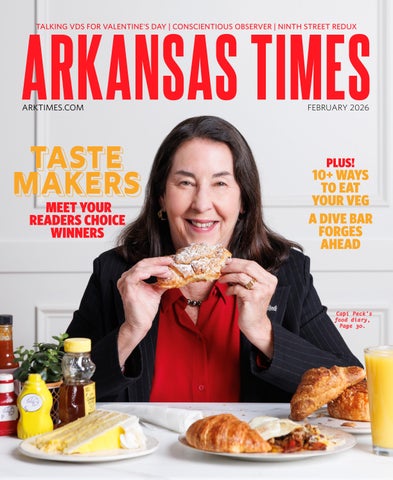
ON THE COVER: Trio’s co-owner Capi Peck stops by The Crossanterie on a food tour through Central Arkansas. Photo by Sara Reeves, art direction by Mandy Keener.
FEBRUARY 2026
VETERAN: Beverly Foster, seen through the eyes of photographer Matt White, has been tending bar at The Forge in North Little Rock for 28 years.
PUBLISHER Alan Leveritt
EDITOR-IN-CHIEF Austin Gelder
CREATIVE DIRECTOR Mandy Keener
MANAGING EDITOR Benjamin Hardy
PRINT EDITOR Daniel Grear
INVESTIGATIVE REPORTER
AGRI AND ENVIRONMENT REPORTER
REPORTER Milo Strain
RACIAL EQUITY REPORTER
VIBE CHECKER Stephanie Smittle
EDITOR EMERITUS Max Brantley
CONTRIBUTING EDITOR
PHOTOGRAPHER Brian Chilson
DIRECTOR OF DEVELOPMENT
ADVERTISING ART DIRECTOR
GRAPHIC DESIGNER Katie Hassell
DIRECTOR OF ADVERTISING/ SPECIAL PUBLICATIONS PUBLISHER Brooke Wallace
SENIOR ACCOUNT EXECUTIVE Wendy Hickingbotham
ACCOUNT EXECUTIVES
Terrell Jacob, Kaitlyn Looney
ADVERTISING TRAFFIC MANAGER
DIGITAL MARKETING DIRECTOR
DIGITAL AD COORDINATOR
EVENTS DIRECTOR Donavan Suitt
IT DIRECTOR Robert Curfman
CIRCULATION DIRECTOR BILLING/COLLECTIONS
CHAIR MAN Lindsey Millar NACHO EDITOR Rhett Brinkley
PRODUCTION MANAGER Ira Hocut (1954-2009) CONTROLLER Weldon Wilson (1967-2025)
for
ARKANSAS TIMES (ISSN 0164-6273) is published each month by Arkansas Times Limited Partnership, 201 East Markham Street, Suite 150, Little Rock, Arkansas, 72201, phone (501) 3752985. Periodical postage paid at Little Rock, Arkansas, and ad ditional mailing offices. POSTMASTER: Send address changes to ARKANSAS TIMES, 201 EAST MARKHAM STREET, SUITE 150, Little Rock, AR, 72201. Subscription prices are $60 for one year. For subscriber service call (501) 375-2985. Current single-copy price is $5, free in Pulaski County. Single issues are available by mail at $5.00 each, postage paid. Payment must accompany all orders. Reproduction or use in whole or in part of the contents without the written consent of the publishers is prohibited. Manuscripts and artwork will not be returned or acknowledged unless sufficient return postage and a self-addressed stamped envelope are included. All materials are handled with due care; however, the publisher assumes no responsibility for care and safe return of unsolicited materials. All letters sent to ARKAN SAS TIMES will be treated as intended for publication and are subject to ARKANSAS TIMES’ unrestricted right to edit or to comment editorially.
AN STD Q&A WITH INFECTIOUS DISEASE SPECIALIST DR. NAVEEN PATIL.
Valentine’s Day is fast approaching. Dinner reservations are being made, chocolates are being bought and love is in the air. With more Arkansans than usual likely to swap spit and other fluids this month, we decided to sit down with Dr. Naveen Patil, an infectious disease specialist with the Arkansas Department of Health, for a chat about sexually transmitted diseases. Patil serves as the department’s medical director for infectious diseases and oversees its STD programs, in addition to working with the University of Arkansas for Medical Sciences, and is president-elect of the Arkansas Medical Society.
What do STD trends look like in Arkansas? So over the past five, six years we were making some gradual and slow progress 'til about COVID. With COVID, and all the resources being diverted there for a couple of years, I think a lot of our efforts took a hit. 2020 saw a dip because of not reporting; it’s a skewed number. Then we saw increases in the next two, three years. For the last couple of years, the numbers seem to be stabilizing and some of them seem to be going down also, so we are carefully monitoring those trends.
Some STDs that we are really concerned about over the past decade are syphilis, and also syphilis that affects pregnant moms and the babies that they deliver. Nationwide, we were increasing in the number of cases. In Arkansas, the number of babies affected by syphilis saw a 500% increase over a period of five to seven years.
We are making some significant strides over the last couple of years in reducing those numbers, so we are hoping that 2025, 2026, 2027 will hopefully show improved numbers.
HIV is also a major issue. We have had steady numbers over the last 10, 15 years without actually making significant progress in being able to reduce the number of infections.
What programs and services geared toward STDs does the health department offer? Every county in the state has a local health unit. Certain large counties have multiple health units, so Pulaski and Washington counties and other larger ones may have three, four clinics. So a total of around 94 clinics. Most of these clinics provide services for testing
FAVORITE BOOK? I'm a history buff, world news buff. I’m actually a buff of World War II, so one of my favorite books is “The Rise and Fall of the Third Reich” by William L. Shirer.
WHAT ARE YOU WATCHING? One of the things I plan to watch — my daughter has been asking me to — is something called “The Beast in Me,” a Netflix crime thriller.
FAVORITE RESTAURANT IN LITTLE ROCK? Taj Mahal.
and treatment of sexually transmitted diseases. The ones that we test and treat most commonly are gonococcal disease [gonnorhea], chlamydia, trichomoniasis and bacterial vaginosis.
We also test for HIV and hepatitis C. If they are diagnosed with us, we link them to care providers that take care of that in their respective areas.
It’s free to get tested, and if they don’t want to file for insurance or anything, we don’t insist on that. But we do provide services, and if needed, they bill with the patient’s permission.
We are the largest provider of care for sexually transmitted diseases [in the state]. We see the largest number of
cases and we treat the largest number of cases. Sometimes providers diagnose but are unable to treat, so they send it to us. There’s a lot of drug shortages going on, so there’s a large shortage of penicillin. People may be able to test for syphilis in their offices, but not be able to treat it. We also provide education regarding high-risk behavior.
Whenever someone is diagnosed or being tested for HIV or syphilis, we have what are known as disease interventional specialists. They are like the CIA or FBI; they go and track who their contacts are. If someone had those diseases and they’ve had sex with other people, they go and track them and test them and those kinds of things so that they don’t unknowingly spread it within the community. They’re very, very effective.
Besides using condoms, what can people do on an individual level to protect each other and prevent the spread of STDs?
The most important thing is to have a relationship with a known person in a monogamous relationship, and try to have protection when you have sex with partners, and try to get tested regularly. With high-risk people, they recommend testing on a regular basis, every six months or a year. But the best thing is to avoid risk-taking behavior. When you abuse alcohol or drugs, you’re less inhibited and more prone to risk.
What’s the risk of contracting an STD in Arkansas? Various figures nationwide say that almost two-thirds to 75% of people during their lifetime will get some sort of sexually transmitted disease.
Just chlamydia, we have about 17,000 cases that are reported to us every year. There’s 5,000 cases of gonococcal disease, and then there’s almost another couple thousand cases of syphilis. If you add all these, that itself is 25,000 cases. And there are a lot of other diseases we don’t track, like herpes, bacterial vaginosis, trichomoniasis.
Most southern states are disproportionately affected because of lack of education, poverty and lack of access to health care.
If anyone is having sex, they are at risk. Especially if you’re having sex with someone who is not your consistent partner or if you’re taking high-risk behaviors. —Milo Strain
BRIAN CHILSON
‘THE MOST INTERESTING PEOPLE’
A TRIBUTE TO FAYETTEVILLE PHOTOGRAPHER ANDREW KILGORE.
Fayetteville photographer Andrew Kilgore died Jan. 5 at the age of 85. Born in Virginia and raised in Illinois and Texas, he eventually settled in Arkansas in 1971, just a few years after he began taking pictures.
“My deepest desire is to create the most beautiful photographic fine art pictures of the most interesting people I can find — people whose openness and vulnerability create a window into the universal soul of us all,” Kilgore once wrote. “I have found the most interesting people to be people who are living in extreme poverty, people who experience mental or physical illness, marginalized minorities, and children.”
The Northwest Arkansas Democrat-Gazette reported that ever-prolific Kilgore’s oeuvre contains about 250,000 images. A 2022 interview with the Walton Arts Center puts that number at over 750,000. Per the Encyclopedia of Arkansas, Kilgore “photographed more than 30,000 people in Arkansas between early 1971 and late 2011.”
If that sounds like an impossibly deep well in which to wade, consider starting with this set of arresting images from the ’70s — some of which were recently published by the Oxford American and all of which reside in the Special Collections at the University of Arkansas’s Mullins Library — along with commentary from Kilgore’s studio manager, Joshua LeMasters.
1. “Everyone seems to love this photo as it just oozes ‘good times.’ I love the Mustang, which is the first thing that catches my attention. Then I notice the girls hanging out of the window as the car turns onto Dickson Street. Initially, Andrew wasn’t very proud of this photo. However, after sitting with it he began to connect with it more and more. Mostly, Andrew enjoyed the design elements, like the telephone pole that the cars are ‘rotating around like orbital bodies.’ Andrew was always thinking about space.”
2. “I love the layers and quality of light in this photo. The makeshift deck/playground feels like the setting of any ‘back in my day!’ I’ve heard from older generations. The scene is rustic, full of texture and a moment of sublime childhood peace and simplicity.”
1 2 3 4
3. “I love the design of this seemingly simple portrait of a woman born in 1903 in her 70s in 1975. The sparse and simple decorations on the wall, the cracks and stains on the wall of her kitchen behind her echoed in the cracks of her skin. This woman, Andrew’s grandmother-in-law, has a face characterized by a hard life surviving the Depression, two world wars and the requirements of Southern domestic life in the 20th century.”
4. “I love the contrast created with the use of flash at night in this photo. I love the motion and excitement and the homemade costumes. This photo encapsulates the childhood joy and exuberance of trick-or-treating on Halloween.”
5. “I love this photo of Andrew’s friend Steve because it’s so gritty and also friendly. It
marks the milestone of the transition of Andrew’s career from photographing outside and in people’s environments to the beginning of his work in the studio. Steve and Andrew were tearing the top of Andrew’s house off to build a studio on the second floor. Andrew also considered this the beginning of his Fayetteville Town Folk Portfolio project, which was his first major exhibit.”
Saturday,
LET THE FEAST BEGIN!
HEART, LUCINDA WILLIAMS
WEDNESDAY 2/25. SIMMONS BANK ARENA. 7:30 P.M. $86$130.
“Wow, that little girl can play that great big guitar. Well, what do you know about that?!” That’s the way Nancy Wilson — guitar hero of the duo Heart, which she co-fronts with her sister, Ann Wilson — described the band’s reception in the machismo-laced environs of rock ’n’ roll circa 1970s America. “We were kind of a freak of nature,” Nancy said in that 1996 interview. “We were a novelty at the beginning.” The pair and their backing band released the epically nautical and endlessly listenable “Dreamboat Annie” in 1975 — possibly my favorite debut album of all rockdom — and the subsequent radio success of “Magic Man” and “Crazy on You” sealed the sisters’ legacy far beyond mere novelty. Both tracks remain stellar karaoke choices (even with that long instrumental break in “Magic Man,” whose guitar solo might be even more fun to sing than the actual lyrics). The radio rock siblings are joined at Simmons Bank Arena by none other than Lucinda Williams, whose catalogue might well be the beating heart and inspiration behind the work of many of your favorite Southern musicians, and whose father Miller Williams is an absolute giant among Arkansas poets. Get tickets at ticketmaster.com. SS
BY DANIEL GREAR, STEPHANIE SMITTLE, OMAYA JONES, ARIELLE
ROBINSON AND MILO STRAIN
AILEY II
SATURDAY 2/14. PHILLIPS COMMUNITY COLLEGE, HELENA-WEST HELENA. 7
P.M. FREE.
Before dying from AIDS in 1989, legendary choreographer Alvin Ailey’s electric presence graced this planet for nearly 60 years — far too short a life, but long enough to share his gifts through the art of movement. Ailey founded the Alvin Ailey American Dance Theater in 1958, and through it he helped transform dance into an active art, a political force that sought to uplift Black dancers as well as tell the stories of Black America. Ailey’s most famous work, “Revelations,” is an example of that storytelling, as dancers sway and twist to a set of Black spirituals and blues, the dance inspired by Ailey’s religious and racially segregated Texas upbringing. He founded Ailey II in 1974 to expand this vision to young and earlycareer dancers. Emmy Award-winning choreographer Francesca Harper serves as artistic director today. This one-off show at Phillips Community College’s Hendrix Fine Arts Center includes numbers inspired by “The Matrix,” rock ’n’ roll legend Chuck Berry and more. Although the performance is free, attendees are strongly encouraged to RSVP at warfieldconcerts.com, where you can also purchase $25 tickets to a pre-show Valentine’s Day dinner from 5-7 p.m. AR
Thrice nominated for the National Book Award, writer Lauren Groff has made quick literary work of her 47 years, publishing five ambitious novels and dozens of heavy-hitting short stories. Lushly penned and loaded with classical references, her books breathe life into a small utopian commune in upstate New York in the 1970s (“Arcadia”), a convent on the brink of extinction in 12th century England (“Matrix”), and colonial America, where a poor girl escapes from servitude and attempts to survive alone in the wilderness (“The Vaster Wilds”). Groff even found time to wade into the mythological implications of modern marriage (“Fates and Furies”). Her visit to Hendrix College coincides with the release of her third short story collection, “Brawler,” which Kirkus Reviews praised for maintaining the “coiling dread and frank feminism” that runs through her body of work. DG
JOHN MULANEY
SATURDAY 2/21. SIMMONS BANK ARENA. 7 P.M. $70 AND UP.
Even if you know next to nothing about stand-up comedy, you probably know John Mulaney. Cultural saturation and quality don’t always go hand in hand, though, so it’s fortunate that Mulaney just happens to be a first-rate comedian. My favorite Mulaney quip of all time: “I always thought that quicksand was going to be a much bigger problem than it turned out to be.” Whip-smart, perpetually boyish and toting onto stage the perfect dose of winsome brattiness, not even a very public divorce and intensive visit to rehab could diminish the charm of this former “Saturday Night Live” writer and four-time Emmy Award winner. Get tickets at ticketmaster.com. DG
ARKANSAS TIMES FILM SERIES: ‘CHILLY SCENES OF WINTER’
Charles Richardson (John Heard), a hopeless romantic with an obsessive streak and the protagonist of “Chilly Scenes of Winter” (1979), is determined. His brief affair with married co-worker Laura (Mary Beth Hurt) may have ended more than a year ago, but he can’t seem to shake the feeling that they belong together. Told through nonlinear flashbacks that reveal Charles’ increasingly unhinged jealousy and suspicions, the film offers a “piercing deconstruction of male wish-fulfillment fantasy” (The Criterion Collection) that came long before rom-com critiques were mainstream. Get tickets at riverdale10.com. OJ/DG
In September 2025, the Little Rock Police Department posted on its Facebook page a public notice: “This is to notify you as required, that a business by the name Arkansas Skatium located at 1311 South Bowman Rd. applied for a new license with (ABC) Alcoholic Beverage Control Division.” And thus began a new era for the old-school skating rink, ushered in with a new Thursday night “Sip N’ Skate,” where patrons of age can legally (and moderately, of course) imbibe on wheels from 6-11:30 p.m. Happy hour runs from 6-7 p.m., skate rental is $5, entry is reserved for those 18 and up, and admission is $5 for adults (regardless of whether their inner child is accompanying them to the rink). Careful out there! SS
RED HOT HAIRPINS
SATURDAY 2/14. TWENTY SEVEN. 9 P.M. $15-$20.
Valentine’s Day is on a Saturday this year, so why not take yourself to the club? Rather than run the risk of being subjected to the male gaze, consider dropping by Twenty Seven in downtown Little Rock, where buzzy local organization and event series Hairpins is throwing a sapphic-forward dance party from 9 p.m.-1 a.m. geared toward “lesbians, queers, transgender and non-binary people, and other gender-diverse individuals.” If you live in Northwest Arkansas, or happen to be in the mood for back-to-back nights of gay revelry, Hairpins is hosting a similar event at Pink House Alchemy in Fayetteville from 8 p.m.-midnight on Feb. 13. Get tickets via a link on the @droppinghairpins Instagram page. DG
JOHN MULANEY
TOTO
SATURDAY 2/21. EAST ARKANSAS COMMUNITY COLLEGE. 7:30 P.M. $59.
Of all the venues in the world, yacht rockers Toto are coming to the East Arkansas Community College Fine Arts Center in Forrest City. While most known for radio hits like “Africa,” “Rosanna” and “Hold The Line,” Toto has garnered a reputation for incredible musicianship (the band’s past and present members collectively have literally thousands of credits as hired-gun studio musicians) and impressive live performances. Toto may elicit an eye roll from some readers, and we get it. They’re a band that gets played over the soundsystem in Kroger. But, we’d be lying if we said we weren’t at least a little interested in seeing a virtuosic band that helped define the smoothness of the ’70s. If you aren’t convinced, head to YouTube to find an 8-minute version of “Rosanna” from the 1991 Montreux Jazz Festival, where they get super sweaty and really jam it out. Get tickets while you still can at eacc.edu. MS
ARKANSAS SYMPHONY ORCHESTRA: ‘LEGACY OF QUINCY JONES’
When musical genius Quincy Jones died in late 2024 at the age of 91, BBC declared in its obituary that “few branches of American popular music were immune to his influence.” The New York Times asserted that Jones “took social and professional mobility to a new level in Black popular art, eventually creating the conditions for a great deal of music to flow between styles, outlets and markets.” Writer Hanif Abdurraqib opined for The New Yorker that Jones was uniquely capable of making “something for everyone.” Ranging from his solo work to his numerous film scores and television theme songs to his indelible contributions as a producer and arranger for towering artists like Michael Jackson, Aretha Franklin and Frank Sinatra, the Arkansas Symphony Orchestra will tackle the remarkable breadth and depth of Jones’ legacy in this February tribute featuring vocalists Deshawn Harris, Genine LaTrice Perez, Crissy P, Mac Royals and Satia Spencer. Get tickets at arkansassymphony.org. DG
SURVEILLANCE
STATE: Police operate hundreds of automated license plate readers in Central Arkansas — small, unobtrusive surveillance cameras that constantly record and log information about every vehicle they see.
LRPD IS WATCHING YOU
LITTLE ROCK POLICE HAVE DEPLOYED 116 LICENSE PLATE CAMERAS CAPABLE OF TRACKING DRIVERS’ MOVEMENTS WITHOUT A WARRANT. WE MAPPED THEM ALL.
BY MILO STRAIN PHOTOGRAPHY BY BRIAN CHILSON
If you live in Central Arkansas and drive a vehicle, you’ve likely been photographed hundreds of times by your local police department as you go about your daily life. Taken together, these photos create a record of your driving patterns and personal routines that can be shared with law enforcement agencies around the country.
Police operate hundreds of automated license plate readers in Central Arkansas — small, unobtrusive surveillance cameras that constantly record and log information about every vehicle they see. Despite their name, the cameras capture more than just license plates: Date, time and location get recorded, as does a vehicle’s make, model, color and other unique features like bumper stickers and dents. The cameras are capable of scanning thousands of cars per minute.
So where are these cameras in your community? It’s hard to know. Police departments typically aren’t forthcoming with information about their automated license plate readers. In December, Little Rock’s po-
lice chief spoke forcefully against a proposal before the city Board of Directors to require more transparency about the Little Rock Police Department’s use of surveillance technology, including license plate readers. The city board rejected the ordinance.
Thanks to Arkansas’s public records law, though, we know the locations of the Little Rock Police Department’s 116 automated license plate readers. The LRPD released a list to the Arkansas Times in response to a request under the state Freedom of Information Act. We’ve created an interactive map of those locations, using Google Street View when possible to visually verify the placement of each camera. (Scan the QR code on Page 23 to see the entire map.)
Almost everything we know about plate readers, such as where they are located and what information they collect, is thanks to records obtained through public transparency laws or citizen-led efforts like DeFlock.me, an interactive map of automated license plate readers across the world compiled from crowdsourced data.
The website’s name is a reference to Flock Safety, one of the largest providers of license plate reader technology in the U.S., whose clients include the LRPD and police departments in North Little Rock, Sherwood, Jacksonville, Conway and Alexander. The Atlas of Surveillance, a surveillance technology watchdog project, found Flock cameras in use by at least 39 Arkansas law enforcement agencies.
DeFlock gets its data from OpenStreetMap, an open-source collection of geographic data created by a community of mapping enthusiasts that operates in a similar fashion to Wikipedia. Anyone can submit information, but a team of community members monitors and attempts to verify the crowdsourced data, approving or rejecting changes as needed. Local volunteers log license plate readers directly on OpenStreetMap, and DeFlock pulls from that data to create its map.
Users have logged more than 56,000 automated plate readers across the lower 48 states, according to DeFlock, but there are likely many more that have yet to be added. DeFlock’s map of Little Rock includes a little under half of the 116 on the LRPD’s list. A spokesperson for DeFlock told the Arkansas Times that their map is generally “a little better than half complete.”
According to DeFlock, North Little Rock, Jacksonville and Alexander each have more than a dozen plate readers; Sherwood and Bryant have at least nine each.
The information collected by these camer-
as doesn’t stay local. According to documents obtained through public records requests by the Electronic Frontier Foundation, a nonprofit that advocates for digital privacy rights, the Little Rock Police Department is sharing data with other law enforcement agencies, from Texas to Indiana. Federal agencies in-
POLICE DEPARTMENTS
AREN’T JUST COLLECTING A
VAST
TROVE OF INFORMATION LOCALLY; THEY’RE SHARING IT NATIONALLY.
cluding U.S. Immigration and Customs Enforcement (ICE) and Border Patrol may also request access to data from law enforcement agencies.
UNBLINKING EYES
Automated license plate readers scan and collect information on every vehicle they “see.” That information is then dumped into a database that law enforcement agencies can search. Police can also create a “hot list” of vehicles. If a plate reader captures a hot vehicle, it notifies the law enforcement agency.
Plate readers can make police work easier. Cameras allow for more efficient tracking of things like stolen cars or someone fleeing the scene of a crime. But they also give police departments vast powers of surveillance that carry the potential for abuse and raise concerns about privacy and civil liberties.
Mark Edwards, the Little Rock police spokesperson, told the Arkansas Times that the “LRPD does not surveil anyone unless there is a lawful reason to do so.”
While that may be the case, Flock cameras
are indiscriminately collecting data that can be accessed by other law enforcement agencies across the country.
Adam Schwartz, privacy litigation director for the Electronic Frontier Foundation, said the technology isn’t worth the downsides.
“I think that everybody wants public safety, which is a human right. We have a massive amount of surveillance technologies that are being sold by big companies as a quick fix to the problem, and one of these quick fixes is the license plate reader,” Schwartz told the Arkansas Times. “The claim is that it is the solution to our public safety problem. But I think if one looks closely at the actual data as well as the negative consequences of license plate readers, it becomes pretty clear that these are usually not a good deal for our communities.”
The plate readers feed data into a computer system that holds onto it for months, or in some cases years, even though 99.9% of the cars going by aren’t on a watchlist, Schwartz said.
In Arkansas, government entities that use license plate readers are required to purge captured data after 150 days. License plate reader manufacturers, which also have access to captured data, aren’t held to the same standard, though.
With just a few data points, anyone with access to information captured by plate readers can pretty quickly figure out who’s driving and where they’ve been. Police departments have rules and policies governing how officers or employees access surveillance data, but rules aren’t always followed. In November 2025, a police chief in a suburb of Atlanta was arrested for using the city’s license plate readers to stalk and harass private citizens.
Law enforcement agencies share access to their databases with each other laterally across city, county and state lines and vertically between federal, state and local agencies. And Flock Safety itself is able to share data from its nationwide network with federal agencies including ICE — even if a police department has opted out of doing so.
In August, Flock announced that it was pausing all work with federal agencies. The change doesn’t preclude entities like ICE and Border Patrol going directly to local police departments to run database searches.
There’s also the fact that these cameras, which use artificial intelligence to draw conclusions about the information they collect, can simply make mistakes.
“The plate readers, ultimately, are cameras with a computer interpreting that an image of three squiggles is the letter E and not the
OPPOSING VIEWS: Little Rock Police Chief Heath Helton (top) and City Director Antwan Phillips have different ideas on how to let citizens know law enforcement is watching them.
letter F, and it makes mistakes,” Schwartz said. “And even though protocol is that the human police officer is supposed to verify that the plate is what the computer says it is, mistakes are made and innocent people find themselves lying on their bellies next to their crying children in parking lots while police officers are waving guns at them because of errors. This has happened on numerous occasions, and it happens disproportionately to people of color because of implicit bias and how officers react to these computer errors.”
Last year, a Colorado woman was wrongfully accused of theft after officers mistook a vehicle captured on a Flock camera for her car. A Redmond, Washington, man was wrongfully arrested last year after a Flock camera linked his car to a felony warrant for his son, with whom he shares a name. The man was surrounded by officers in his driveway and placed in handcuffs within seconds. It might not even be the police looking at captured data, either.
“You have the problem of thieves breaking into databases and stealing the data, whether it’s a foreign country or an organized criminal,” Schwarz said. “Just as we’ve had data breaches of banks, we also have had data breaches of the security companies who are churning out these safety technologies.”
While Flock has denied any data breaches, critics say the company has cybersecurity vulnerabilities.
Tech YouTuber Benn Jordan has published several videos highlighting vulnerabilities in Flock’s plate readers. In a November video, Jordan showed it’s possible to hack into a Flock camera and take control of it in less than a minute by pressing a button on the back of the device in a certain sequence.
Jordan and digital news outlet 404 Media, which has done extensive reporting on Flock, found dozens of Flock cameras livestreaming their feeds directly to the internet with no password or protection — they even shot part of their video on a Flock camera installed in a public park.
In November, several Democrats in Congress asked the Federal Trade Commission to investigate Flock’s cybersecurity practices. The FTC has yet to open any investigation.
When asked about the reported cybersecurity vulnerabilities of Flock’s system, Edwards said that “all information is compliant with the FBI and Criminal Justice Institute Standards.”
Privacy advocates have managed to eke out a few victories against Flock, including one recent case in Arkansas. In July 2025, the city of Greers Ferry relocated a Flock camera that had been aimed directly at the home of residents Charlie and Angie Wolf after the Institute for Justice, a libertarian nonprofit law firm that’s challenged the use of plate readers in other states, sent a letter to city officials threatening legal action if the camera was not removed.
“After months of warrantless surveillance, we’re relieved the camera has finally been moved from in front of our home,” Charlie Wolf said in a press release. “But nobody else should have to experience this either, and it’s time for cities across the country to reassess whether partnering with Flock is really worth sacrificing our Fourth Amendment rights.”
Some cities have already ended their partnerships with Flock. In May 2025, the Denver City Council unanimously voted against a contract extension with Flock, citing concerns about data security and the potential for immigration enforcement agencies to access data.
The following month, Austin, Texas, ended its Flock contract after some city council members said they were concerned the data could be used for immigration enforcement or to track people seeking out-of-state abor-
tions or gender-affirming care.
According to an audit of Austin’s use of Flock cameras released a month before city council members ended the contract, 75 million scans led to 165 arrests, 133 prosecutions and one missing person found. That’s about 0.0001% of scans resulting in prosecutions in a city of more than 960,000 people.
The Little Rock Board of Directors, which approved the contract with Flock in 2020, most recently voted to extend the city’s Flock contract in October 2025 for two years, costing taxpayers $690,000.
In December, At-Large Director Antwan Phillips proposed an ordinance to codify transparency requirements on the LRPD’s use of surveillance technology, including automated license plate readers and ShotSpotter acoustic gunshot detectors. The ordinance would have required the police department to publish an annual report detailing its use of surveillance technology, and to document its compliance with laws regarding data collection and retention.
Little Rock Police Chief Heath Helton told city directors at the time the department is already doing most of what the ordinance would require and that codifying it was unnecessary and inefficient.
He told city directors that if the department were to publish a report, the “average person out here is not going to read past two or three paragraphs because it gets overwhelming. Especially when you start talking about technology, because there’s a lot of things about technology the average person just simply don’t understand.”
Helton added that LRPD is working with Flock to establish an online transparency portal, an option that has always been available to the department at no extra cost but that hasn’t yet been activated.
According to data aggregator Eyes on Flock, at least 768 police departments operate transparency portals that provide a limited view of data collected by its cameras. Police departments can choose what data is shared on the portal.
Phillips’ ordinance failed, with Directors Kathy Webb, Capi Peck, Lance Hines, B.J. Wyrick and Dean Kumpuris voting against it. The vote was split along racial lines. Directors Virgil Miller, Andrea Lewis and Phillips, who are all Black, cast the only votes to require the extra degree of transparency.
SEARCHES FAR AND WIDE
Police departments aren’t just collecting a vast trove of information locally; they’re sharing it nationally.
In August 2025, 404 Media published a story about the use of Flock cameras at big box retailers such as The Home Depot and Lowe’s. (Private businesses are increasingly
adopting license plate readers and, in some cases, sharing the data they collect with law enforcement.)
The story includes a link to a 175-page document shared with the outlet by the Electronic Frontier Foundation that provides a window onto how broadly law enforcement agencies share the data. It lists thousands of entities whose records are searchable by the sheriff’s office in Johnson County, Texas, which is just south of Fort Worth, and how many cameras each one has.
The Little Rock Police Department is among them, as are a number of other law enforcement agencies in Arkansas, including the Benton County Sheriff’s Office, with six cameras; the Jonesboro Police Department, with 44 cameras; the Little Flock Police Department, with two cameras; the Malvern Police Department, with four cameras; the Pine Bluff Police Department, with 82 cameras; the Pocahontas Police Department, with eight cameras; the Texarkana, Arkansas, Police Department, with eight cameras; and the Trumann Police Department, with 20 cameras.
That’s nine Arkansas law enforcement agencies sharing data from hundreds of cameras with a Texas sheriff’s department hundreds of miles away. Whenever the Johnson County Sheriff’s Department searches its Flock database, officers have the option to search every license plate scanned by those Arkansas law enforcement agencies’ cameras, as well as thousands of other entities.
Edwards, the LRPD spokesperson, provided this statement when asked about what entities the LRPD shares its data with: “Data sharing between agencies is a critical part of modern policing and public safety. While information is shared nationally, it’s done with a specific purpose; to assist in active investigations and safely locate individuals or vehicles connected to criminal activity. Therefore, when an outside agency identifies a vehicle or suspect(s) in Little Rock, that information is promptly shared with LRPD to ensure a timely and coordinated effort in
the apprehension of said suspect. That data is governed by strict privacy, security and accountability standards.”
The website Have I Been Flocked lets people search license plate numbers to see if they’ve come up in Flock database searches made by police departments.
According to Have I Been Flocked, 191 LRPD officers performed more than 66,000 searches between March 23, 2022, and Dec. 12, 2025. These searches, which can be run without warrants, provide police with information about people’s physical whereabouts over a period of time. Each search has a reason listed — usually a specific offense like “stolen vehicle” or “wanted person” or “hit and run,” though some are more vague. Some searches done by the LRPD simply list the word “investigation” or “suspicious.” One from June 11, 2025, states the reason as “aggregated assault,” presumably a typo. A search on June 16 gives the reason as “suicidal subject,” with the search filter set to “Texas.”
Have I Been Flocked also shows that outof-state law enforcement agencies have been running searches in Flock’s database on behalf of ICE. These searches, many of which include data from Flock cameras in Arkansas, highlight how easily federal agencies can access Flock’s network via local police, despite the company pausing its direct work with the federal government.
Searching the term “ICE” on Have I Been Flocked pulls up thousands of searches made by various law enforcement agencies with the reason listed as “ICE,” “ICE assist,” “ICE investigation” or something similar. Officers with the Gretna Police Department in Louisiana made two searches with the reason listed as “ICE LITTLE ROCK,” one on Aug. 24 and another on Aug. 25.
Even if a particular police department has decided against sharing its data directly with ICE, immigration authorities can still search through that data if the police department is sharing data with another police department that is working with ICE.
HANEY CONTRACTORS
Founded in 2002 by Gary and Kevin Haney, Haney Contractors has earned a strong reputation for quality construction throughout Arkansas. We specialize in residential and commercial projects, offering both general contracting and construction management services with a truly client-focused approach. Haney Contractors is committed to creating long-term value for every construction dollar invested. Our team takes pride in delivering superior craftsmanship and dependable results.
You build the menu.
You
We’ll
From the initial consultation to the final walk-through, clients can expect responsive service, cost-effective solutions, and high-quality work built to last.
We’ll Build the rest. Call us today
Saturday, February 7 | 11 AM–2 PM Main Library | 100 Rock Street, Little Rock
Visit the Central Arkansas Library System’s Black Family Expo and learn about families with strong ties to Central Arkansas’s Black history. Explore CALS resources to help preserve your own family’s history, sign up for a library card, enjoy a free family photo, and experience a fun day for all ages. Giveaways will be available throughout the event.
To reserve a table to display your family memorabilia, contact community outreach archivist Danielle Afsordeh at 501.320.5726. Organizations are also welcome to participate.
Black family at Fair Park, 1959
Men and women at dance hall, Wilson, Ark., circa 1938-1943
Photos of Funky Stretch Pizza
READERS CHOICE AWARDS
The best restaurants in Arkansas in 2026.
Boasting 46 years of tasty tenure, the Arkansas Times Readers Choice Awards, our annual survey of The Natural State food scene, is almost as old as the publication itself. In addition to letting readers weigh in on their favorite restaurants, dishes, chefs and more, this yearly tradition gives our writers the opportunity to offer their own takes on the wide-ranging culinary splendors of Arkansas, some of which you’ll find represented in the Readers Choice poll results at the end of this section, and some of which are a bit more off the beaten path.
To that end, several members of the Arkansas Times staff banded together to curate a hearty inventory of our favorite vegetarian and vegan bites around town, all of which are tasty enough to ensnare even the committed meateaters among us.
In honor of 40 years of Little Rock restaurant Trio’s, we let co-owner Capi Peck spill the beans to Rhett Brinkley on what a weekend of local eating — both on and off the job — looks like for her.
Photographer Matt White stopped by North Little Rock to lovingly document The Forge’s final days, only to learn that an outpouring of public mourning convinced owner Ronnie Ringer to reopen the longtime Levy watering hole.
Phillip Powell chatted with Shelby Wittenberg Cotton, an interior designer whose swiftly growing resume of Central Arkansas restaurants includes Raduno Brick Oven & Barroom, The Attic Bar, Problem Child and beyond.
Last but not least, Brock Hyland headed southeast to the annual Gillett Coon Supper, where Arkansas politics and barbecued raccoon have been linking up as strange bedfellows for decades.
CAULIFLOWER ‘CHORIZO’
AREPA: This pita-esque handheld from El Sur is a cornmeal pancake stuffed with pico, cheese, guacamole and a finely chopped cauliflower mixture spiced in the style of a sausage chorizo.
Vegging out
A dozen of our vegetarian and vegan favorites from around town.
By
Rhett Brinkley, Austin Gelder, Daniel Grear, Benjamin Hardy, Jennifer Lenow, Stephanie Smittle and Milo Strain
Photography by Sara Reeves
Illustrations by @bumble_bri_artwork
Is it just us, or has it gotten harder to find a decent veggie meal out and about these days?
Six or seven years ago, it seemed like more and more restaurants — even in Arkansas! — were offering meat-free options. Every other millennial announced themselves as vegan (sometimes dubiously), and Impossible Whoppers were the future.
Well, chalk it up to the keto diet, RFK Jr. or just an ineffable shift in the zeitgeist, but things have changed. Meat consumption is up, and slabs of steak are now at the head of the USDA’s redesigned food pyramid. The committed vegetarians among us can’t even order a basket of fries in 2026 without checking first to see if they’ve been immersed in beef tallow or duck fat.
Not that you have to be a dedicated plant-eater to want a meatless option from time to time — or on the regular. When you’re eating out, going the veggie route is often less expensive, lighter and healthier than getting a burger. It can also be just as tasty, even for the omnivores among us … though that’s all dependent on whether a kitchen puts in the effort to make it so. All too often, the only meat-free thing on the menu is an afterthought: a lackluster salad, a half-assed black bean burger, a deep-fried agglomeration of cheese and breading with a ramekin of ranch.
That makes us all the more grateful to the restaurants in the area that do have standout vegan and vegetarian options. And there are quite a few, once you start looking — more than we could list here. It’s certainly not comprehensive, but here are our unofficial staff picks for the best veggie fare from around town for under $15.
THE GARDEN, JIMMY’S SERIOUS SANDWICHES,
It’s an underdog story. In 1979, 30-year-old Jimmy Weisman — owner of the former downtown restaurant Out To Lunch — entered a veggie sandwich into the National Sandwich Idea Contest and brought the first-prize award back to Little Rock after beating out a whopping 400 challengers. A few years later, Weisman opened Jimmy’s Serious Sandwiches in Midtown, and nearly five decades later, the sandwich, known as The Garden, is still a go-to for veggie and meat-eaters alike. Served on pumpernickel rye, the grilled cheese-style sandwich is topped with a spinach pâté, sunflower seeds, mushrooms, alfalfa sprouts and enough cheddar, provolone and Swiss for a very decent cheese pull. This writer stops by Jimmy’s for The Garden at least twice a year. Never disappoints. And if you want the recipe, it’s framed on the wall. RB
SEASONAL HOUSE SALAD, THE ROOT, $14.25
Never before has a dish this exciting been cursed with such a humdrum name. But forget the house salads you know, those palm-sized bowls of iceberg hunks and chilled tomato wedges smothered with a glug of ranch. The Root’s house salad is the alter ego, a zesty wildcard that genuinely changes with the seasons. Crunchy diced jicama, pickled leeks, roasted beets? Who knows what you’ll get! The only year-round constant is the lip-puckering marinated feta and the garlic vinaigrette that buzzes like bumblebees in your mouth. I’m not a medical doctor, but I feel certain this salad staves off scurvy, depression and the common cold. Substitute the feta for fried tofu or grilled mushrooms to make this bad boy vegan. AG
BABA GHANOUSH, AL SERAJ MEDITERRANEAN RESTAURANT & MARKET,
$4.69
They say you eat with your eyes first, but frankly, sometimes you need to ignore your eyes and dig into that tub of glossy gray porridge in a takeout container from Al Seraj. The Mediterranean restaurant has plenty of other beauty queens on the menu — verdant green dolmas and tabouleh salad, for example — but it’s this unassuming dip that has my heart, with smokiness from the roasted and pureed eggplant, offset by bright lemon and earthy tahini. SS
CAULIFLOWER CHORIZO AREPA, EL SUR STREET FOOD CO,
$7.25
Come hell or high water, I decided sometime last year I was going to broaden my El Sur horizons past my reliable old standby, the baleada con todo. Enter the new old standby: the cauliflower “chorizo” arepa. The pita-esque handheld is a cornmeal pancake stuffed with pico, cheese, guacamole and a finely chopped cauliflower mixture spiced in the style of a sausage chorizo. It’s somehow incredibly hearty and still light enough to leave room for a shared order of fried plantains or Yuca frita, and a super creative way to use my favorite member of the brassica family (I still love you forever, broccoli!). SS
MOO SHU VEGETABLE, ORIENT EXPRESS, $12.25
If you want a huge serving of wildly flavorful veggies, do not sleep on the moo shu vegetable at North Little Rock’s longtime Chinese restaurant Orient Express. Cabbage, mushrooms, carrots, snap peas, water chestnuts, broccoli, carrots, bamboo shoots, bean sprouts and likely more are stir-fried together with a little egg, a delicious sweet-and-salty sauce and served with moo shu pancakes — super thin, delicate flour-based wraps. Eating vegetables has never been so fun.
If you want to prove to a picky skeptic that eating a vegan diet can actually be delicious, Boulevard Bread Co.’s vegan hummus sandwich might be one of the best local bets. Boulevard combines a bright kalamata olive and peppadew spread with hummus and tops it with purple onion, tomatoes, organic field greens and avocado slices. Served on the shop’s fresh-baked eight-grain bread, the sandwich is so flavorful that it sometimes even sounds better than the deli’s popular pastrami or smoked turkey options. RB
CHILI BROCCOLI, BANANA LEAF INDIAN CUISINE, $6.99
Honestly, it’s probably best for all of us that Banana Leaf, the clandestinely located Indian diner in the Simmons Bank Tower Building, isn’t open at night. Can you imag ine the unholy amounts of this restaurant’s chili broccoli you could consume in the latenight hours while watching Carol Sturka battle the hive mind in “Pluribus”? A temp tation best left for daylight, probably. Fried up in small, decadent bites and coated with a sweet-and-spicy glaze, this Banana Leaf side dish has got main character energy.
TOFU BANH MI, MIKE’S CAFE, $6.75
This light little sandwich from Asher Avenue’s homey Vietnamese standby is packed with flavor. Hearty strips of fried tofu in a sweet-savory brown sauce are topped with bright cilantro, lightly pickled cucumber and crisp slivers of jalapeno, all on flaky French bread with just the right amount of butter and crunch. Mike’s Cafe also has an impressively tasty veggie pho that’s loaded with broccoli, tofu, carrots and mushrooms; unlike at some Vietnamese joints, the hearty, anise-scented broth really is vegan. BH
VEGGIE BURRITO, TAQUERIA SAMANTHA 2, $13
The world is full of mediocre veggie burritos, all bland beans and gloppy rice paired with excessive blobs of cheese and sour cream. (How Chipotle has gotten so far, I’ll never comprehend.) But a good burrito is a thing of beautiful simplicity. For my money, the best in town is an off-menu item from Taqueria Samantha 2, the grand dame of Southwest Little Rock’s panoply of taco trucks. I’m not sure what makes it so flavorful — the sumptuously grilled onions and tomato, the salty richness of the cheese (cotija?) or something else. In any case, it’s really sin carne; there’s no lard in either the rice or beans, according to the man staffing the grill on a recent visit. It comes with both salsa verde and roja, a bag of chips and a whole roasted jalapeno for the truly adventurous. BH
CHICKUN SPAGHETTI, H.O.M.E., $10
If you can’t imagine comfort food without animal products, you haven’t been to H.O.M.E. (House of Mental Eatery) Vegan Restaurant, stealthily located in the cafeteria on the ground floor of Arkansas Baptist College’s student union building. A stand-out on H.O.M.E.’s all-vegan menu: the ChickUn Spaghetti, a dish so creamy and filling that it’ll make you wonder what would really be sacrificed by doing away with dairy altogether. For an additional $5, you can pair this delicacy with your choice of two generously portioned sides — good luck deciding between greens, blackeyed peas and rice, yams, okra and Mac-No-Cheese. DG
JERK JACKFRUIT WITH JOLLOF RICE, PLANTAINS AND CURRIED CABBAGE, AFROBITES, $13.99
CURRIED FALAFEL AND LENTIL SANDWICH, BIG ORANGE, $13
It’s rare for a restaurant to so perfectly strike a balance between dishes that satisfy both voracious carnivores and committed vegans the way Afrobites does. Operating similarly to a customizable-bowl establishment like Chipotle but with authentic African food, Afrobites has you pick a protein, rice base (jollof, coconut or yellow) and two sides. In addition to all five of the side offerings (curried cabbage, collard greens, blackeyed peas stew, plantains or spicy plantains) being vegan, Afrobites offers several kinds of jackfruit and curry banana blossoms as vegan protein options. With well over 100 combinations available just from the vegan offerings, we feel pretty confident that you shouldn’t have any trouble finding a unique grouping that suits your fancy, but this reporter can say without a doubt that the jerk jackfruit on jollof rice with plantains and curried cabbage is a surefire winner. MS
Having been a vegetarian for 27 years, I have consumed an obscene quantity of veggie burgers in my life, more out of necessity than choice. Most of them have been utterly forgettable, but one that stands out is Big Orange’s curried falafel and lentil sandwich. Though it’s served on a bun and has the characteristic veggie burger splay when you bite into it, this is not quite a veggie burger: It’s richer and has a totally different flavor profile. It’s partially made from chickpeas and is served with tzatziki and cucumber, but it’s not quite a falafel sandwich, either, as it’s loaded with curry spice, lentils and even Sriracha. So what is it? It’s pretty delicious, especially with a side of fries. JL
LIKES BUTTAH: The Croissanterie is Capi Peck’s favorite breakfast spot in town.
Noshing through Central Arkansas
Trio’s owner Capi Peck’s food diary.
Edited by Rhett Brinkley
Photography Sara Reeves
In September, Trio’s owners and founders Capi Peck and her partner, Brent Peterson, will celebrate 40 years in business in the same space in the Pavilion in the Park shopping center where they opened the venerable Little Rock restaurant — known for its approachable, creative chef-driven menu and stellar service — in 1986. In that timespan, Trio’s has taken home six Arkansas Times Readers Choice Awards for best restaurant, survived recessions, the COVID-19 pandemic and an EF-3 tornado in 2023 that had Peck, her staff members and several guests sheltering in the walk-in cooler while the restaurant’s doors were blown off. Peck, who is also the Little Rock City Director of Ward 4, attributes the restaurant’s longevity to two things: “First of all, we have great food. Many of our favorites come from my family’s hotel and recipes that we developed early on. We also change 11 items on our dinner menu every single month. People know that they can get their favorites, our mainstays, but there will always be something new as well.
“The second key to our success is our commitment to genuine hospitality. We hear that from so many customers. We take care of people like they are guests in our own home.
“Equally important is how we care for our staff, our work family. Twelve of us have
been together for 25 years or more, and I am damn proud of that.”
To help better understand how Peck has fueled her way through four decades in business, the Eat Arkansas team thought it was high time for a food diary. We were extremely pleased to find out what she snacks on on the expo line to get through a busy night.
FRIDAY, JAN. 9
I always start my day by grinding Starbucks’ Italian roast coffee beans and making a strong cup of French press coffee, which I enjoy with half and half cream. I do this immediately upon waking or I am a foggy klutz. I am not an early morning eater but forced myself to have a banana as I was driving to work out.
Most Fridays during the last several years I have had a standing lunch date with my good friend Kevin Shalin, aka [food blogger] The Mighty Rib. I just show up at his house never knowing what our itinerary is. That’s part of the fun. We typically hit three to five restaurants in a couple of hours and nosh our way through Central Arkansas. People ask me and Kevin all the time: “How do you not weigh 300 pounds?” We definitely don’t clean our plates; we literally have one or two bites so we can function for the rest of the day and take it home and eat it and share it. When we go to a bakery, I’ll buy pretty much one of everything and take it back to the staff at Trio’s to enjoy. So it’s all about getting as many different tastes as we can without filling up. It’s an art.
Today we started at Speakeasy Cafe in Bryant, where we devoured a rich birria grilled cheese sandwich. OMG! We followed that with some of the best breakfast tacos I have ever had, and I am a connois-
seur of breakfast tacos and all things with a Mexican influence. These bad boys were filled with fluffy scrambled eggs and chorizo with green onion, a little cilantro and a bit of jalapeno. I am hungry for them right now.
Next stop was Nori Sushi and Hibachi, which is also in Bryant. Mr. Rib heard about it from some of his followers and wanted to check it out. It was solid as he described it. We shared two rolls — the TikTok Roll and the King Shrimp Roll — good rolls and a great price.
Cinnamon Cream Bakery on Chenal Parkway was the next destination. I love this place. Here is what I left with: two of the big-ass cinnamon rolls (my name, not theirs), donut holes filled with cream, Mexican wedding cookies, chocolate chip cookies, ginger cookie sandwiches with cream, snickerdoodles, sugar cookies and something like a pecan sandie with a mound of creamy chocolate piped on top. I think there were a couple of other things, but I had bites of all of the above and ate three of the pecan sandie chocolate things. They are my faves. Yes, I love cookies.
Midafternoon at Trio’s I had a cup of Bombay chicken soup with lentils. On the line working expo, I had seven french fries and a couple of swipes of hummus to keep my energy up for a very busy night in the restaurant.
I had a Brandy Alexander after my shift with some friends who were dining in. At home after work, I had leftovers from the Curry House on Rodney Parham, which included saag paneer, dal makhani, raita, rice, tikka sauce and a dollop of mango chutney with garlic naan.
When we go to a bakery, I’ll buy pretty much one of every-
thing and take it back to the staff at Trio’s to enjoy. So it’s all about getting as many different tastes as we can without filling up. It’s an art.
SATURDAY,
JAN. 10
Same old coffee routine as I have been following for decades.
Breakfast was an English muffin with butter and agave. Then came orange juice with a splash of pomegranate juice and creatine.
Stopped for a tall flat white with one pump of vanilla from Starbucks, which is practically in my backyard.
Late lunch at Trio’s was one of our specials — Italian sausage lasagna with a small Caesar salad.
It was a super busy night at Trio’s, and I sustained myself on expo by having six or seven french fries, fresh pineapple and grapes, and copious amounts of water. I’ll admit I had a coffee cup’s worth of Coca-Cola to give me a little boost.
After work at home was a few Everything but the Bagel crackers from Trader Joe’s with Trio’s pimento cheese and Sarge’s Famous Pickles. Sarge’s are locally made and divine. My faves. We serve them alongside our Kobe Burger. That was my appetizer.
My main course was our vegan special from Trio’s — winter vegetable couscous with pearl couscous, sweet potatoes, butternut squash, carrots, fresh peas, dried apricot, Arkansas pecans from Baucum Nut House, onion, garlic and harissa baked in a tomato broth with star anise and cinnamon.
I had a handful of M&M’s for dessert.
SUNDAY, JAN. 11
Coffee routine followed by breakfast made by Brent. I usually hit The Croissanterie Sunday mornings, but they were closed as [chefs Wendy Schay and Jill McDonald] prepared to open at their new location [the former Capers spot at 14502 Cantrell Road]. I can’t wait! I was going through some sort of withdrawal because I eat there so much. Both the new location and the one they just moved out of are five minutes from my house. It’s my favorite breakfast spot. They make an incredible smash burger and patty melt if I’m in a lunch mood.
Brent made me a perfect sunny-side-up egg on toasted sourdough with half of a sliced Hass avocado doused with Valentina sauce. There was also a slice of toasted sourdough smeared with butter and raspberry preserves.
I actually did end up at The Croissanterie’s new location at 2 p.m. The grand opening was a week or so away, but it was awesome to get a sneak peak in the beautiful new space just a stone’s throw from their old location. I had a mimosa and croissant. There was a lot more to snack on, but I restrained myself somehow.
Brent prepared his favorite Costa Rican snack for me in the late afternoon. Pejibayes (peach palm fruit) with mayonnaise. Yes, it sounds weird, but it is delicious. This, I think, was his plan to get me amped up about our annual trip to Costa Rica. It worked.
At dusk I had several Arkansas butter-roasted pecans from Baucum Nut House. I make these every year for holiday gifts and because Brent loves them. It’s just good local pecans, lots of unsalted butter with a sprinkling of Kosher salt, slow baked in a low oven.
Dinner was takeout because we were leaving in 12 hours for Costa Rica. Waldo’s [Chicken & Beer] chicken strips, collard greens, mac and cheese and the tomato cucumber salad. We get takeout from Waldo’s a lot when we just don’t want Trio’s food. We love their chicken tenders, and their sides are always fresh. Their collards are almost but not quite as good as ours at Trio’s. We use smoked turkey for the flavoring in case people don’t eat pork. I actually learned that from K. Hall & Sons — I tried to imitate theirs because they make great collards, too. I like collards to have a little texture, I don’t want them to be cooked to death or shredded up. I like big pieces of collards. I’ll put ours up next to anybody’s.
I had the last piece of Lambrecht’s Gourmet (Heber Springs) Southern Pecan toffee I picked up from Eggshells Kitchen Co. for dessert.
READERS
The Forge flirts with extinction
A photo essay by Matt White.
It’s the first Sunday of the new year and bright winter sunlight is pouring in through the windows of The Forge, the iconic Levy beer joint that’s been operating in a small, concrete block building just yards from the Union Pacific railroad tracks for nearly half a century, though nobody can say for sure. I love The Forge, its hazy neon incandescence, ineradicable working-class authenticity, the sense of community and friendly characters you’re guaranteed to meet. At the heart of it all for me has long been Mrs. Beverly Foster, the vital force and welcoming spirit who has held down the nighttime bartending shift for the last 28 years. Spend a little time around Mrs. Beverly and you get the sense she’s incapable of telling a lie. Her kind energy feels inexhaustible. You couldn’t keep up with her if you tried.
Two nights ago, I came by to say hello and make photographs on what was expected to be one of The Forge’s final days of existence after slowly diminishing crowds made its future untenable. Now, the institution has seemingly closed for good, and I’m here to shoot in the empty daytime bar. There is the unmistakable glint of sadness in the bar owner’s eyes as we shake hands and he says, “I don’t know what I’m going to do with myself. I’ve been coming down here at 7 a.m. every morning for the last 45 years.” Like The Forge itself, Ronnie Ringer has the air of an old America that is getting harder and harder to find. The entire blue affair feels like a Tom T. Hall song come to life. What about the regulars? What about the people who work here? What about the dogs and the scuffed pool tables and the sound of the passing train? Where’s everybody going to go?
And then out of the mist: a ray of hope. In the ensuing days, news of the bar’s impending demise spreads far and wide. A fervor builds among the people. Are we really going to lose one of the realest places around? An outpouring of support gets Ronnie and Mrs. Beverly thinking maybe there’s a way to make things work after all. Perhaps they should just take a little break during the coldest days ahead. Spruce things up a bit here and there. Come back strong and give it hell. So, miraculously, that’s what’s happening. But they can’t do it alone. They need our help. Go visit The Forge when it opens back up in the weeks or months to come. The beer is cheap. The people are real. Let the magic be not lost.
INCANDESCENT: Hazy, authentic and welcoming, The Forge is populated by friendly regulars like Robert Smith, who’s pictured at right alongside his dog, Chloe.
INEXHAUSTIBLE: Beverly
who’s been holding down the nighttime
for the last 28 years, is a big part of what makes the place so special.
38 FEBRUARY 2026 ARKANSAS TIMES
Foster,
bartending shift at The Forge
FEBRUARY 2026 ARKANSAS TIMES
an old America that is getting hard to find.
ICONIC: Bartender David Hayes (left) and owner Ronnie Ringer (right) carry an air of
Congratulations Readers Choice Awards Recipients!
501 Prime Afrobites
All Aboard
AR Donuts
Arkansas Food Bank
Arkansas Hunger Relief Alliance
Arkansas Soup Kitchen
Arsaga’s
Arthur’s Prime Steakhouse
Atlas The Restaurant
Back Home BBQ
Baja Grill
Bar Cleeta
Bark Bar
Bawarchi Biryanis
Beignets & Brew
Best Cafe
Big Bad Breakfast
Big Orange
Big Orange Midtown
Blackberry Market Argenta
Blu Fish House
Blue Cake
Blue Diamond Cafe
Blue Heaven
Bossa Nova
Boulevard Bread Company
Brave New Restaurant
Brick & Forge Taproom
Brood & Barley
Bruno’s Little Italy
Buffalo Grill
Burge’s
Cabot Cafe & Cake Corner
Cache Restaurant
Cajun Boilers
Cajun Sno
Campground Grill
Casa Alejo
Cate’s RX
Catering Arkansas
Certified Pies
Charlotte’s Eats & Sweets
Cheesecake on Point!
Chicken Country
Chinese Kitchen
Ciao Baci
Cinnamon Creme Bakery
Colorado Grill
Community Bakery
Conifer Bentonville
Copper Grill
Copper Mule Table & Tap
Cozy Nook Café
Crazees Cafe
Crepes Paulette
Cross Creek Sandwich Shop
Cypress Social
Dales Donuts
Dark Side Coffee
Deluca’s
Dew-Baby’s
Dizzy’s Gypsy Bistro
Doe’s Eat Place
Don Pepe’s
Don’s Southern Social
Dondie’s White River Princess
Eat My Catfish
Eden
Eggroll Express
Einstein Bros. Bagels
El Encanto Authentic Mexican Food
El Sur Street Food Company
Fantastic China
Fassler Hall
Fidel & Co Coffee Roasters
Flake Baby Pastry
Flint Street Food Bank
Flora Jean’s
Flying Fish
Flyway Brewing Fork by Ira
Four Quarter Bar
Fresh Donuts
Fujiyama Express JFK
Gadwalls Grill
Gaskins Cabin Steakhouse
Great American Wings
Gus’s World Famous Fried Chicken
Ham Market
Heights Taco Tamale
Hill Station
Hillcrest Little Bakery
Hog Pen BBQ in Conway
Holly’s Country Kitchen
Holly’s Country Cookin’ House of Wylie
Hugo’s
Jasper Pizza Company
Jesse James Foods
K Hall & Sons Produce
Kemuri
Kitchen Express
Knightfire BBQ
Kream Kastle Drive Inn
La Hacienda Mexican Restaurant
Larry’s Pizza
Layla’s Gyro
Little Red Wagon
Loblolly Creamery
Local Flavor Cafe
Local Lime
Los Munchies Taqueria
Ludwig’s Bakery
Maddie’s Place
Mark’s Do-Nut Shop
Maryam’s Grill Mediterranean Restaurant
Melinda’s
Mike’s Place
Milano’s Italian Restaurant
MorningSide Bagels
Morrison’s Fried Pies
Mountain Bird Coffee & Tea
Mr Hui’s
Mr. Cajun’s Kitchen
Mt Fuji Japanese Restaurant
Mucho Loco
Mud Street
Murry’s Dinner Playhouse
Myrtie Mae’s Cafe
Namaste Indian Cuisine
Nick’s BBQ & Catfish
Old River Coffee Co
Omar’s Uptown
Onyx Coffee Lab
Oven & Tap
Overtime Cabot
Ozark Mountain Bagel Co.
Park Grill AMFA
Pasta Grill
Paul’s Donuts
Pea Farm Bistro
Pettaway Coffee
Pine Bluff Country Club
Pizza Cafe
Pizzeria Ruby
Potluck Food Rescue
Pressroom
Problem Child Pizza
Purple Onion
Raduno | Brick Oven & Barroom
Rebsamen Park Golf Course
Red Oak Steakhouse
Revival : Restaurant + Beer Garden
Rick’s Bakery
Ridgewood Brothers BBQ
Ristorante Capeo
River City Coffee
Rivera Italian Restaurant
RŌBER : Cocktails + Culinary
Rolando’s
Rosie’s Pot & Kettle Cafe
Rouge’s Manor
RX Catering
Samantha’s Tap Room & Wood Grill
Scoops
Scooter’s Coffee
Secret Nook Coffee & Books
Serenity Farm Bread
Seven Oaks Steak & Seafood
Shotgun Dan’s Pizza
Sims BBQ
SO Restaurant
Sonny Williams’ Steak Room
Southern Hibachi’s
Speakeasy Cafe-Bryant
Spudnut Shoppe
SQZBX
Star of India
Steinhaus Keller
Stickyz Rock’n’Roll Chicken Shack
Stoby’s Restaurant
Sugar Sugar Bake Shop
Sunny’s
Superior Bathhouse Brewery
Sweety Donuts
Taco Mama
Tacos Godoy
Taj Mahal
Tamalcalli
Taqueria El Palenque
Taylor’s Steakhouse
The Attic
The Bugler
The Croissanterie
The Dixie Pig
The Faded Rose
The Farmer’s Table Cafe
The Fold - Botanas & Bar
The GOAT
The Grumpy Rabbit
The Hive
The Hook
The Humble Crumb Bakery
The Original ScoopDog
The Oyster Bar
The Pantry
The Pizza Pub
The Pizzeria
The Preacher’s Son
The Purple Cow
The Root Cafe
The Rougue Roundabout
The Saucy Tomato
The Skillet Restaurant
Three Fold
Noodles + Dumpling Co.
Toca
Trio’s Restaurant
Tusk and Trotter
Utopia deli
Viet Kitchen
Vino’s Brew Pub
Waldo’s Chicken & Beer
Wasabi
White Water Tavern
Whole Hog Cafe
Wild Sweet Williams
Wings Take Out
Wood Grill Buffet
Wright’s BBQ
The palette for your palate
Shelby Cotton is Central Arkansas’s most soughtafter restaurant interior designer.
By Phillip Powell
It was never Shelby Wittenberg Cotton’s dream to become a mainstay in the Central Arkansas restaurant scene. But 12 years after masterminding the design of iconic Little Rock pizzeria Raduno Brick Oven & Barroom, Cotton has become an in-demand design diva for local restaurants looking to create a unique, comfortable atmosphere for customers. Now, with designs for stylish businesses like Mt. Fuji, Problem Child Pizza, The Attic Bar and more under her belt, she can’t imagine doing anything else.
Cotton’s career began at AMR Architects in Little Rock, where she worked after earning a degree in interior design from the Moore College of Art & Design in Philadelphia. But following the birth of her two children, she spent the majority of the next two decades as a homemaker, taking only a few design odd jobs as they came her way. One of those one-off opportunities came from Bart Barlogie, who in 2014 was dreaming of opening a bold, Italian-inspired restaurant in the historic SoMa district — an area that was seeing an influx of development after decades of decline.
Photography by Sara Reeves
SCENES FROM THE ATTIC: One of Cotton’s most memorable projects is the Attic Bar, a tastefully offbeat speakeasy above Back Home BBQ that opened in July.
“I like this job from the beginning to the end. I like sitting at my desk and drafting the space and realizing its potential, and that each one starts from nothing and it reveals itself.” —SHELBY WITTENBERG COTTON
“My first real big opportunity was working with Bart Barlogie on Raduno, and that was the path that started me in the restaurant and bar bubble. Raduno became my first solo restaurant,” Cotton said. “It just happened and I fell in love with it. It was not intentional but a happy accident.”
Cotton credits Barlogie with getting her back in the game by trusting her to figure out how to translate his ideas into the long, skinny room that would soon become Raduno.
“Right out the shoot, Raduno was a challenging space because of the shape and length. One of the design elements that really changed it was the long banquet and adding the faux windows over it that were really mirrors because visually that really opened the space up,” Cotton said. “I’m proud of the way that it balanced out and worked out. To this day, 10 years later, it’s just as effective and comfortable as it was when we did it.”
That intentional investment in Raduno’s layout paid off, with the eatery being crowned as the Best Overall Restaurant in Little Rock/North Little Rock in 2024, 2025 and 2026 in the annual Arkansas Times
Readers Choice poll, among several other honors.
Now a full-time designer and the owner of SWC Designs, Cotton’s resume also includes Swing Social, Deluca’s Pizza in West Little Rock’s Breckenridge Village, and the downtown Little Rock and Conway locations of Big Bad Breakfast.
Cotton attributes her success to a commitment to helping clients from the start of the development process to the day a restaurant opens its doors.
“I keep my business very small, and it works for me. I get very involved with the client and the space. I did that with Raduno, and as I left that project, I knew that this formula worked for me,” Cotton said. “I’m hands-on, there with the contractor during the week solving problems. And I was there putting the last nail in the wall for the last piece of art. And I’ve tried to stay with that formula because it works for me and I think it gives a better product to my client.”
Despite keeping her operation small, Cotton has shown the ability to design a diverse array of settings for her clients. Her style — across barrooms, pizza joints, breakfast
spots and upper-scale dining — pairs a modern aesthetic with homey comfort. For example, Raduno balances a sleek look defined by hardwood floors, low yellow lighting and a long, polished bar with the welcoming, almost communal vibe of a neighborhood pizza shop. The long, plaid booth stretching down the opposite wall helps create the feeling that you’re sitting down with friends and family, even if there are total strangers to your right or left.
Big Bad Breakfast in downtown Little Rock follows a similar playbook, but with a bold yellow and brown color scheme that makes the space feel like a cozy yet upscale diner. Cotton recently was contracted to develop the design of Big Bad Breakfast’s Conway location, where she brought in decor from various local businesses to increase community buy-in with the new restaurant.
Cotton also left her mark on fan-favorite pizza joint Problem Child in Midtown, which feels punky and playful enough for a night out with your cool friends, but contains enough dark wood and leather that your parents wouldn’t feel out of place if you took them there for dinner on a visit from
out of town.
One of Cotton’s most memorable projects is the Attic Bar, a speakeasy that bills itself as “Little Rock’s worst-kept secret.” A downtown spot that opened up above Back Home BBQ in August, the Attic Bar’s design was conceptualized almost entirely from Cotton’s brain, according to owner Adam Murray.
“For the Attic Bar, she was like, ‘What do you want to do?’” Murray said. “And I said, ‘I don’t know, I’m going to call the place the Attic Bar.’ And that’s all I told her, and she was like, ‘I got this.’ All the tables and chairs and furniture and decorations — she picked out everything. She asked for the budget, and she was really good about not just spending our money. She was very mindful and thoughtful about the budget.”
Before the snow and ice hit Little Rock the night of Friday, Jan. 23, groups of friends were braving the cold to trudge up the steep stairs leading to the Attic Bar. With the room’s ambient lighting, various nooks of seating with unique personalities and low music, it was clear the Attic Bar is quickly emerging as a great place to get drinks after work and settle in for some quality conversation. Each of the corner areas has tastefully offbeat chairs and coffee tables that feel plucked by a resourceful thrifter, with funky art adorning the walls to boot.
Murray described the vibe as “relaxed and adult,” somewhere where you can grab a nice cocktail and unwind after the workday. Already emanating a solidly lived-in vibe, the bar feels like it could be downtown’s equivalent of the coffee shop in ’90s sitcom “Friends” or the bar in “It’s Always Sunny in Philadelphia.”
In just a few short years, Cotton has put her mark on many of the restaurants that define Little Rock’s food scene. And she’s not slowing down. While Cotton wouldn’t disclose what her next projects will be, she did say she was very excited about some design work in Conway, Little Rock and Northwest Arkansas.
“I like this job from the beginning to the end. I like sitting at my desk and drafting the space and realizing its potential, and that each one starts from nothing and it reveals itself. But I also enjoy the three-dimensional nature of the job, the layering, and getting the client in the space and working with them on how the place will be run and getting into the nitty-gritty,” Cotton said. “Then you see the space that has gone from being empty to something where there are 20 people running around with food, and it’s exciting.”
GYMNASIUM POLITICKING: Each year, hundreds attend the Gillett Coon Supper, which is known far and wide as the kickoff to Arkansas political campaign season. The 2025 event is pictured above.
Barbecued raccoon, trash can coffee and Arkansas politics
Hobnobbing at the 82nd Gillett Coon Supper.
Story and photography by Brock
Hyland
Editor’s note: The decades-long tradition in Gillett of communing and politicking over plates of wild game carries a word in its name that, in certain contexts, is an offensive racial slur. Where the Gillett Coon Supper is concerned, the word is simply a shortened reference to the event’s main course of raccoon.
Arkansas is no stranger to quirky charity dinners, what with the World Championship Squirrel Cook Off in Springdale, the Slovak Oyster Supper stag party, the McGehee Oyster Supper, the Tollville Turkey Fry and the Duck Gumbo Cook-Off in Stuttgart, just to name a few.
The Gillett Coon Supper, though, is the most storied and anticipated wild game supper in the state, known far and wide as the kickoff to Arkansas political campaign season and, according to the Encyclopedia of Arkansas, for being “a veritable rite of passage for people seeking election to political office.” Here, the gumption of candidates is measured by their willingness to dine on the local fare — barbecued raccoon.
GETTING THERE
The 82nd Coon Supper was held at the Gillett High School gymnasium on Jan. 10, and marked my third time attending. This year I was bound and determined to attend the 14th annual Berry Pre-Coon Supper reception at the Marion Berry Farm Shop.
“It goes back to the 1970s,” Gabe Holmstrom, former staffer for the late U.S. Rep. Marion Berry and organizer for the reception, told me. “Congressman Berry and his wife, Carolyn, lived in a house across the street from the Gillett School and it became a gathering place. There are no cocktails served at the actual Coon Supper, so a lot of times these elected officials or these candidates would want to stop in, maybe have a cocktail and meet with Marion and Carolyn and see other local leaders before going over to the Coon Supper. So that kind of grew and grew and became quite the gathering point. When Marion decided to run for office in 1996, he turned that into a fundraiser for his congres-
RARIFIED CUISINE: From left to right: barbecued raccoon, pork ribs and brisket stain the plates at the annual Gillett Coon Supper, which also features coffee brewed in a 20-gallon trash can.
sional campaign. And so all the years he was in office, he would host an event beforehand that would kick off the year to benefit his campaign. It was a good way to get some of his supporters from other areas of the state, and that helped build the crowd for the Coon Supper because people would come to his event. Then, you know, you’re already down in Gillett, so you might as well drive or walk over to the school and participate in the Coon Supper. So that’s how the pre-party started.”
Getting there isn’t as easy as getting to the Gillett High School gymnasium, given the bumpy ride down several miles of dirt road leading to Berry’s farm. Tickets can be bought at the door for $50, with proceeds going toward the Marion and Carolyn Berry Public Service Scholarship at Arkansas State University.
A ticket gets you access to the open bar and an all-you-can-eat food table with offerings like smoked sausage, jalapeno duck poppers, shrimp cocktail and a variety of dips. I had arrived just in time for the band to kick up — Kevin Price and the Closers, who were accompanied by Gus Holmstrom, 2025 Arkansas Old-Time Fiddle Youth Division Champion and Gabe’s son. Hundreds of people filtered in and out of this little farm shop enjoying the music and taking in the traditions, including some recognizable faces, such as Sen. Tom Cotton and a boatload of hopeful candidates.
After a couple of cocktails and some light appetizers (I had to save room for the raccoon, after all), I headed back to town, passing by that familiar and famous sign: “Welcome to Gillett: Home of Friendly People and the Coon Supper.”
THE COFFEE MAN
The first thing I noticed when I walked into the Gillett High School gymnasium was the coffee situation. Curtis Fox, head of the Coffee Committee, explained to me that the Coon Supper coffee is brewed in the finest 20-gallon galvanized trash can money can buy. He showed me how the ground beans go into a canvas sack, which is tied off tight at the opening and submerged in water. The trash can is then positioned on the business end of a propane-fed fish fryer, then stirred once in a while with an old wooden garden hoe handle.
Fox said he’d been manning the coffee stations for a few years, having inherited his role as brewmaster from his father-in-law, who prepared the potion for many years before him.
“I’m no barista, or whatever you call it. That’s what they’re called, right? I married into this,” he said with a smile.
In 82 years of the Gillett Coon Supper, this particular trash can is reportedly only the second to see service.
“This is the new one,” Fox explained.
“How long have y’all been using it?”
“Oh, I don’t know. Thirty years or so.”
THE BARBECUE PROCESS
About the time Fox finished up illustrating to me what a proper cup of coffee is supposed to look like, Tyler Place, head of both the Ticket Committee and the Brisket and Ribs Committee walked through the door. Place had sold us the tickets (which, by the way, are still sold over the phone and snail-mailed).
Turning his attention to his meal prep duties, Place reached under a long table, slid
out two large white ice chests, flipped the lid open on one, pulled back the foil wrapping and behold: the largest pile of individually cut, steaming-hot pork ribs I’ve ever seen. My glasses immediately fogged up.
“That’s a lot of ribs,” I said.
“We’ve actually cut back a lot on ribs over the years. We used to do 208 racks; this year we cut back to 130.”
Place popped open the lid to another ice chest and revealed the briskets neatly wrapped in foil.
“All of these go on the pit for at least 12 hours, which is why I’ve been up since 3 a.m. today,” he said. “We used to do about 30 briskets a year, but we’ve cut down to 25. It’s about 350 pounds of beef, which sounds like a lot, but the briskets we got this year are pretty small. They come trimmed up like this.”
He reached into the steaming chest of wonders and pulled one out to show me.
“They cook a lot quicker this way, so I’m not complaining.”
Place introduced me to some family members: his tall, white-haired father, Scott Place, and Seth Place, Tyler’s brother. Tyler explained that Scott and Seth were just the men I needed to talk to on account of them co-heading the committee that procures the raccoons.
The Place family is sort of a big deal around these parts, which should be obvious seeing as the three Places are charged with preparing all the meat for this affair. But the history goes back further: Scott Place’s father, James Place, served as master of ceremonies at the event for 47 years. Now, Scott is in charge.
“How long you been doing it?” I asked him.
“Oh, I don’t know … too long. I’m fourth or fifth generation. We’re actually transitioning right now for Seth to take over,” he said.
Seth nodded in approval. I asked where the team procures the meat for the supper, specifically the raccoons.
“There’s a man that lives across the river who we buy a lot of them from,” Scott said. “A fella in Malvern, he gets a lot, and there are a few locals that like to help out. A lot of them come from our farm here in Gillett.”
The meat used to be cheap, but “coonflation” has taken a toll lately, he said. “They’re about $1.60 a pound these days. That’s a lot considering we bought about 1,350 pounds this year.”
THE MAIN EVENT
Four rows of tables, each covered in a tablecloth, span the length of the gymnasium for the event. Seats are assigned by ticket number, and given the communal nature of the seating arrangement, this aspect is very much part of the charm. As mentioned, the Gillett Coon Supper is the premier political event in Arkansas, so one could easily find himself sitting next to an Arkansas Supreme Court can-
310 Main St. Downtown Little Rock Tuesday - Saturday, 5-9 p.m. (501)37BRUNO (372-7866) brunoslittleitaly.com
didate and the Arkansas House representative for this very district, as I did in 2024. Over the years, the supper has seen some big names in politics, not all of them from Arkansas: Bill and Hillary Clinton, Sen. David Pryor, Sen. Dale Bumpers, Sen. Angus King of Maine, Sen. Dick Durbin of Illinois and a whole host of others.
In fact, Durbin spoke fondly of his Coon Supper experience on the United States Senate floor in 2015, noting, “I was there that night with Mark Pryor. I watched as they put these bowls of coon and other meats on the table … We asked for advice from Mark Pryor about the proper selection of the cooked coon, and he said, ‘Get one with a big bone because they have the least amount of meat on them.’ So we followed his advice, nibbled at the corners, smiled, and said what a great dinner it was. We looked around and saw that only a handful of the local people from Arkansas were actually eating the delicacy of the evening, including one old fellow whom I went up to afterward to introduce myself to, who was wearing a real coonskin cap. He told me he shot the raccoon and this cap has been in his family for a long time.”
Though further research is required, I suspect Durbin’s soliloquy perhaps represents the most thorough discussion of barbecued raccoon in the history of the United States Senate.
“It is, to me, the Arkansas political Christmas,” Skip Rutherford said of Gillett’s annual banner event. Rutherford served as the dean of the University of Arkansas Clinton School of Public Service for 15 years and was an informal White House advisor during the Clinton administration. “It’s a political tradition that has taken the element of time — and beaten it. The Coon Supper remains constant. What I love about the Coon Supper is that generations of people have, are and will experience it. To me, it is as memorable as watching Clinton, Bumpers and Pryor as it is to people like you that are watching [Tom] Cotton, [John] Boozman and [Sarah] Sanders. It transcends party. It transcends generations. There is a magic about the Coon Supper.”
This year’s guest list of high-profile attendees included Cotton, Lt. Gov. Leslie Rutledge, Miss Arkansas Kennedy Holland and First Gentleman Bryan Sanders, among others. Cotton was the first to speak, giving a short, canned speech about what a great tradition the Coon Supper is. He was followed by Rutledge, with her usual “I’m a conservative, prolife, pistol-packin’ Arkansas mama” routine, making sure to turn her accent up to 11 and letting everyone in the room know she’s the
wife of a row crop farmer.
It’s worth noting the lack of applause from the audience when, without a shred of irony, Rutledge exclaimed how lucky Arkansas farmers are to have such a great friend in the White House in President Trump, positing that the market price of soybeans today is historically high. (In reality, soybean prices reached near historic highs during the Biden presidency, and Trump’s continued trade war with China, the largest buyer of Arkansas soybeans, has significantly limited the demand market.)
While the supper is a fun and unique event that garners a lot of attention — some even national — it should be noted that it’s not all fun, games and politickin’. This is a charity event, after all, and proceeds from ticket sales provide scholarships for local graduating seniors. It’s here where emcee Brandon Truax will later introduce seniors who live in the former Gillett School District, which was consolidated into the nearby DeWitt School District many years ago. This was Truax’s second year as master of ceremonies after the passing of longtime emcee Pastor Chad Phillip, whose memory we were gently reminded of by the bright orange buttons worn by locals, emblazoned with “Pastor Chad.”
Not long after we took our seats, the food runners commenced service. One can always tell the workers by their garb: all sharply dressed in white button-down shirts adorned with black, old-style string ties and long white butcher jackets. This all-male, all-age team of waiters is tasked with running the food from the holding area to the gymnasium tables, refilling coffee cups with that special bean juice, and looking damn handsome doing it.
Watching the introduction of the high school football players and the subsequent announcement of the winner of this year’s Bobby Cover Best Teammate Award, which went to a young man named Carson Riggins, I couldn’t help but feel an overwhelming sense of pride in this community — one I’m not even a part of but feel connected to through this wholesome and strangely familiar experience. At around 600 residents, Gillett is about as small as my hometown. And while there’s no wild raccoon supper in Crawford, Texas, there very well could be.
“I think Gillett deserves a lot of credit for supporting their school district,” Rutherford told me. “In a world where all this stuff is going away, where retail campaigns aren’t as important as social media or podcasts … The Coon Supper thrives. They lost their school district, yet the cause goes on. That’s the beauty of small-town America.”
Finalists: Diana Bratton (Taco Mama, Hot Springs), Matthew Cooper (Conifer, Bentonville), Jamie McAfee (formerly Pine Bluff Country Club, Pine Bluff), Matías de Matthaeis (Red Oak Steakhouse, Pine Bluff)
CHEF IN LITTLE ROCK/ NORTH LITTLE ROCK
Winner: Cash Ashley (Raduno Brick Oven & Barroom)
Finalists: Vincent Bruno (Bruno’s Little Italy), Jeffrey Owen (Ciao Baci), Adam Sweet (Problem Child Pizza), Wendy Schay and Jill McDonald (The Croissanterie)
NEW RESTAURANT IN LITTLE ROCK/ NORTH LITTLE ROCK
Winner: Problem Child Pizza
Finalists: Fork, Beignets & Brew, Back Home BBQ, The Pizza Pub
NONPROFIT TO ADDRESS
FOOD INSECURITY
Winner: Arkansas Food Bank
Finalists: Arkansas Hunger Relief Alliance, Potluck Food Rescue, Flint Street Food Bank, The Stewpot (First Presbyterian Church)
OVERALL RESTAURANT AROUND ARKANSAS
Winner: RŌBER :: Cocktails + Culinary (Benton)
Finalists: Jasper Pizza Company (Jasper), The Grumpy Rabbit (Lonoke), Red Oak Steakhouse, Saracen
Finalists: Overtime Cabot (Cabot), Local Flavor Cafe (Eureka Springs), Superior Bathhouse Brewery (Hot Springs), The Farmer’s Table (Fayetteville)
OUTDOOR DINING IN LITTLE ROCK/ NORTH LITTLE ROCK
Winner: Cypress Social
Finalists: Ciao Baci, The Fold: Botanas & Bar, Hill Station, Fassler Hall
SEAFOOD AROUND ARKANSAS
Winner: RŌBER :: Cocktails + Culinary (Benton)
Finalists: Mike’s Place (Conway), Seven Oaks Steak & Seafood (Conway), 501 Prime (Hot Springs), Blu Fish House (Bentonville)
SEAFOOD IN LITTLE ROCK/ NORTH LITTLE ROCK
Winner: Brave New Restaurant
Finalists: Flying Fish, The Oyster Bar, The Faded Rose, Ciao Baci
VEGETARIAN/VEGAN
AROUND ARKANSAS
Winner: Baja Grill (Benton)
Finalists: Viet Kitchen (Jonesboro), The Farmer’s Table (Fayetteville), The Hive (Bentonville), Sunny’s (Bentonville)
VEGETARIAN/VEGAN IN LITTLE ROCK/NORTH LITTLE ROCK
Winner: The Root Cafe
Finalists: The Fold: Botanas & Bar, Baja Grill, Raduno Brick Oven & Barroom, Star of India
BEST TAKEAWAY/ MOBILE DINING CATERER IN LITTLE ROCK/ NORTH LITTLE ROCK
Winner: Raduno Brick Oven & Barroom
Finalists: Catering Arkansas, Taco Godoy, RX Catering, Star of India
DELI/GOURMET TO-GO IN LITTLE ROCK/NORTH LITTLE ROCK
Winner: Boulevard Bread Company
Finalists: The Croissanterie, HAM Market, Bray Gourmet
FOOD TRUCK IN LITTLE ROCK/ NORTH LITTLE ROCK
Winner: The Saucy Tomato
Finalists: Little Red Wagon, Taco Godoy, Utopia Deli, El Encanto
Authentic Mexican Food
BEST BY REGION
OVERALL RESTAURANT IN BENTON/ BRYANT
Winner: RŌBER :: Cocktails + Culinary (Benton)
Finalists: Blue Heaven (Benton), Whole Hog Cafe (Bryant), Eat My Catfish (Benton), Copper Mule Table & Tap (Bryant)
OVERALL RESTAURANT IN CONWAY
Winner: Mike’s Place
Finalists: Pasta Grill, Seven Oaks Steak & Seafood, Brick & Forge Taproom, The Rogue Roundabout
OVERALL RESTAURANT IN EUREKA SPRINGS
Winner: Mud Street Cafe
Finalists: Local Flavor Cafe, Rogue’s Manor
OVERALL RESTAURANT IN FAYETTEVILLE/SPRINGDALE/ JOHNSON
Winner: Hugo’s (Fayetteville)
Finalists: Atlas The Restaurant (Fayetteville), La Hacienda Mexican Restaurant (Fayetteville), Pizzeria
Ruby (Springdale), The Farmer’s Table (Fayetteville)
OVERALL RESTAURANT IN HOT SPRINGS
Winner: Deluca’s Pizza
Finalist: Cajun Boilers, Eden, Steinhaus Keller, The Bugler
OVERALL RESTAURANT IN ROGERS/BENTONVILLE
Winner: The Preacher’s Son (Bentonville)
Finalists: Conifer (Bentonville), Oven & Tap (Bentonville), Tusk & Trotter
American Brasserie (Bentonville), Bar Cleeta (Bentonville)
OVERALL RESTAURANT IN SHERWOOD/JACKSONVILLE/CABOT
Winner: Pea Farm Bistro (Cabot)
Finalists: Overtime Cabot (Cabot), Purple Onion (Cabot), The Hook (Jacksonville), the Humble Crumb Bakery (Sherwood)
‘THE UNIVERSITY OF SKIP’
LESSONS IN LITERATURE AND LIFE FROM THE LATE ARKANSAS WRITER DONALD ‘SKIP’ HAYS.
BY TONY TOST
Arkansas has produced a number of significant artists who are important figures in their chosen field but who also remain stubbornly, indisputably Arkansan to their core. Add or subtract as you wish, but my personal list would include: Johnny Cash, Sister Rosetta Tharpe, Levon Helm, Al Green, Pharaoh Sanders and Iris DeMent in music. Frank Stanford and C.D. Wright in poetry. Charles Portis in fiction. Jeff Nichols in film. Mike Disfarmer in photography.
Another name in my Arkansas pantheon is the novelist Donald Hays — known to everyone as Skip — who died Nov. 21 at his home in Fayetteville at the age of 78. Hays was a master storyteller, with a voice that balanced wryly profane humor with a cleareyed and completely unsentimental understanding of human pain. You might say there was a cosmic yearning lurking in the work as well. Raised in Van Buren, where he was a local legend as an athlete, Hays embedded his stories in the persons and vernacular of Arkansas without ever resorting to regional minstrelsy.
His first and best-known book, “The Dixie Association,” is said to be Bill Clinton’s favorite novel. It was also a finalist for the
1985 PEN/Faulkner Award for Fiction. The Irish writer Colum McCann described it as a life-changing book, “a forgotten American classic by a great southern writer.” Richard Price called it “classic all-American outlaw literature.” Loosely, it’s the story of Hog Durham, a convicted felon who is granted early release to play baseball for the Arkansas Reds of the semipro Dixie Association, managed by a one-armed Marxist named Lefty. What unfolds is an audacious, relentlessly hilarious tale of a very Arkansan counter-culture insurgency that’s also a love letter to the great American pastime. I think it took me all of two days to devour the entire thing.
Hays’ next novel was “The Hangman’s Children,” a darkly comedic road epic examining the failed hippie experiment of doper peace and easy love, set in 1968 when, per the novel’s opening, “God was in the process of delivering his punch line to America.” A shambling tour of a soured dream, it was a Los Angeles Times Critics Choice selection in 1990 and contains some of Hays’ finest writing.
Deep into the novel, the protagonist Samuel Langhorne Maledon — a con artist who tours with a roadshow carnival re-
R.I.P., SKIP: The work of Arkansas writer Donald ‘Skip’ Hays, who died Nov. 21 at the age of 78, balanced wryly profane humor with a clear-eyed and completely unsentimental understanding of human pain.
enacting the historical Wild West crimes of Fort Smith’s notorious hanging judge Isaac Charles Parker, all while trying to protect his self-martyring son from the war in Vietnam — describes in passing one of his performer cohorts. In Maledon’s casual description, Hays mixes observational clarity while evoking blood-soaked histories and generational longing, all with a seeming shrug:
“He sat in a rocking chair, a drugged dump mongrel at his feet, drank from a pint Mason jar of pure shine, sponged up every few drinks with a Vienna sausage he’d eat from the can he’d lift off the floor to his side, and had his say. The more he drank, the clearer his voice got, until at the end it was all anger wrapped in sadness for the lost world of the lone rider. By the time he was done with them, I could’ve sold many a man in the crowd before us a sway-backed gelding and a man-sized stretch of Mexican desert. There’s still a whole lot of folks that, now and again, want to be free. Of course, it ordinarily doesn’t take them more than a ride home and a cup of black coffee to get over it.”
The book is full of these sentences, simple and direct on the surface, but which unfold and combine to create both a tangibly human world and an entire lived philosophy regarding it. It’s a sprawling book of quiet brilliance.
After this opening one-two punch, Hays’ next book wouldn’t arrive for nearly two decades. In 2005, his short story collection “Dying Light” was published. At this point, the American publishing and critical apparatus — especially in its coastal venues — had shifted inexorably away from the unfashionable draw of merely great writing and toward a self-saluting celebration of trendy politics. So, despite containing a handful of masterpieces of the short story form, “Dying Light” arrived without much official fanfare.
When Hays died, I reopened “Dying Light” and sought out my favorite story in the collection: “Why He Did It.” If I were to put together a list of my 10 favorite short stories ever written, this would be on it. The premise is disturbing, surely immoral: A middle-aged man named Wilder is worried that his teenage biological son is being seduced by his teenage stepdaughter. In order to “save” his son from her supposed advances, Wilder exposes himself to her, destroying
JOHNATHON WILLIAMS
his family and eventually his career as well. As the decades unspool, Wilder sinks deep er into himself, assured that — as always — he had done the right thing.
When I first read the story in my 20s, I thought it was uproarious, fearless and out rageous in its depiction of a deranged man. A defiant middle finger to political correct ness and moral piety, perhaps. Nearly 20 years later, rereading it as a middle-aged father myself, I was glad to find that the story had lost none of its darkly comic bite. But now, I was also a bit overwhelmed by how — under the outrageousness — Hays tenderly eviscerates the center-of-the-uni verse vanity of the typical male psyche. He weaponizes the tabloid outrageousness of his conceit to uncover something wise and knowing about a man’s inability to change much of anything, as well as his superhuman capacity to journey through decades of heartbreak without ever truly understanding himself.
MEET DENA: ARTIST, CAR ENTHUSIAST, DRIVEN WOMAN
After “Dying Light,” no other book under Hays’ name would be published in his lifetime. There’s a good reason for this — while Donald Hays was indeed a major Arkansas fiction writer, Skip Hays was just about the greatest teacher of writing and literature anyone ever encountered. When I attended the University of Arkansas’s MFA in Creative Writing program, Skip was its director and its beating heart. He taught fiction and I was a poet, so I only took two classes with him. But along with the novelist Donald Harington’s class on American art history, those were the two greatest classes I ever took.
The key course for me was Skip’s Form and Theory of Fiction. It was nothing experimental or flashy, just a nuts and bolts examination of how storytelling actually works. We discussed the banalities of structure and the grand philosophies of art and life. We did imitations and methodically interrogated the question of point of view. I found the whole thing to be transcendent. Skip changed the syllabus every time he taught the course, never repeating the same reading list. This meant the class was not only a chance to join a master as he peeked under the hood of the storytelling craft, but also to expose oneself to books that Skip found worthy of deeper study. Thus, my introduction to writers such as James Salter, Joan Didion, V.S. Naipaul and Marilynne Robinson.
The Arkansas MFA program is a fouryear affair and many students would retake Skip’s classes a second or third time as an independent study. Others would simply just sit in on them to soak in further instruction. It was not unusual for the true devotees to take six or seven Skip classes while in Fayetteville. One former student, the novelist Michael Downs, refers to himself as
“When I overheard that women my age don’t really walk again after this type of injury, I thought: Just watch me.”
READ MORE ABOUT DENA PECKHAM AT SnellArkansas.com
a proud graduate of “the University of Skip.”
And yet, time spent in the classroom was relatively minor Skip pedagogy compared to time spent outside of it. I attended the MFA program in the late ’90s and early ’00s and — when contrasted to the current antiseptic bureaucratic academic experience — it might as well have been the Wild West.
The cornerstone of the MFA experience is the workshop, a three-hour class where students’ stories and poems are read and critiqued by their fellow students, with the professor overseeing and leading what usually amounts to a collective prosecution of one’s juvenile literary misdemeanors. The workshops were intense, often painful and combative. (Program co-founder William Harrison would advise MFA students to find a hobby to shore up their self-esteem because the program itself would inevitably wear it down.) After workshop, most MFA students would hit a Fayetteville bar — Roger’s Rec or Maxine’s or JR’s Lightbulb Club — to decompress. And here is where you’d really get to learn what made Skip tick. It was never couched in something as corny as wisdom or advice. It was always just simply conversation.
Skip had read everything — not just fiction but also poetry and philosophy and history — a fact he kept somewhat hidden until the conversation drifted into some niche corner of the literary world. If it wasn’t so authentic, Skip’s erudition could’ve been a parlor trick. One former student recalled teaching for several years in Turkey and returning to the states with a stack of Turkish novels for Skip, only to discover that he had already read them and could discuss their flaws and virtues in detail. In the days after Skip died, his wife, Patty, said that new books were still arriving at their house. Even in hospice care, his appetite for a worthy read never abated.
BIBLIOGRAPHY: Donald Hays’s body of work includes two novels, “The Dixie Association” (1984) and “The Hangman’s Children” (1989), and a short story collection called “Dying Light” (2005). His third novel, “The Great Awakening,” will be published posthumously in July.
nudged me to listen. “Willie’s trying his best to keep up,” Skip said as Nelson and Charles alternated verses. “But the son of bitch is barely hanging on for dear life.”
just a handful of us. Always full of too much drinking and dumb macho gamesmanship. I truly loved it. And as a trailer park guy who never knew his biological father and was desperate for a decent male role model, in Skip I saw a rough-hewn blue-collar man’s man who was well-read without being precious, opinionated without being a bully, and tough without being cruel. His combination of erudition, integrity and rowdiness was something I aspired to. For me, he was an important teacher and later a casual friend. For other students, he was much more — a mentor, a protector, a life-changer or life-saver. Skip and Patty’s house and phone line was often a safe haven for those whom everyone else had abandoned.
Skip also had a strong connection to Ireland and would teach there as well. On one of these teaching trips, the Irish writer John McGahern asked him for overlooked American writers worthy of rediscovery. Among the books Skip sent to McGahern was John Williams’ great novel “Stoner.” Williams had moved to Fayetteville after his retirement as a professor, and although his novel “Augustus” had won the National Book Award in 1973, by the early 2000s Williams had been all but forgotten. But then the New York Review Books Classics reprinted “Stoner” in 2006 with McGahern’s introduction. In the decades since, Williams has gradually and rightfully reemerged as a major American novelist, with his novels being published in the canonical Library of America series in 2021.
I recall a very specific detailed conversation over beers with Skip about the great but fairly obscure Kentucky writer Guy Davenport, whose work I’d just become infatuated with. Davenport was not just a writer’s writer, but a writer’s writer’s writer. I hadn’t met anyone who’d heard of him, let alone read him. When I brought up his name to Skip, we immediately began to debate whether Davenport’s greatest strength was as an essayist, a fiction writer or a translator. Just as we were both agreeing that Davenport’s genius lay in his essays (read “The Geography of the Imagination” if you haven’t), “Seven Spanish Angels” by Ray Charles and Willie Nelson came on the bar’s jukebox. Skip
Yes, books mattered. But so did songs and sports and misadventure. No one could tell a better anecdote than Skip, whether the subject was an early encounter with Charles Portis, or a bar fight with a rodeo champion, or a weeklong house party in the ’70s where locals would gather at MFA founder Jim Whitehead’s place each night to hear the newest chapter of a pornographic novel called “Houseboat Hookers” that was being ghost-written by Jim’s literary friend for quick cash, with the growing party loudly cheering each salacious plot turn as the writer sheepishly read aloud that day’s honest but horny work.
There were unofficial MFA weekend trips to Hot Springs for the horse races where we’d meet up with alums such as Barry Hannah or Tom Franklin. Or trips to St. Louis for a ballgame, or to Kansas City for the art museum. Sometimes these trips would happen in groups of 20 or more, sometimes
As told in miniature, the life of Donald Hays has a familiar symmetry — early glory and renown as a novelist which gradually drifts away as he devotes himself to teaching a new generation of young writers, a number of whom would go on to real accomplishment in the fields of fiction, poetry and screenwriting.
But thankfully, life rarely falls into easy symmetries. Throughout his tenure as a creative writing professor, Skip continued writing. He composed multiple novels from 2004 to 2020, each turned down by publishers. He continued writing anyway, even when diagnosed with advanced cancer. In the final four years of his life, he pushed through illness and age and even a stroke to write “The Great Awakening,” his third novel, forthcoming from Regal House in July. The advanced praise is rapturous, with comparisons ranging from Don DeLillo and Thomas Pynchon to Barry Hannah and Flannery O’Connor. I particularly like the Hannah comparison, for like the best of Hannah’s
work, “The Great Awakening” takes an absolutely deranged point of view and applies it with methodical, poker-faced sincerity.
Ostensibly, the novel is the story of Reo Wilde, a high school football coach and former Marines sniper, who experiences a major mental health crisis but mistakes it for a religious awakening. In some ways, Wilde is an expansion on the Wilder character from Hays’ “Why He Did It” short story, a man who embraces his personal grievances to such a degree that they become an all-encompassing worldview. (There’s also a deranged poet in the novel, Sol Ackerman, who is an echo of another Hays character from “Dying Light”’s “Ackerman in Eden.”)
After Wilde gets himself fired from his high school job by propositioning various co-workers, he sets out on a journey that connects him with Colonel Bedford Stuart Jackson, an aging avatar of the Old South who aims to save Arkansas from modernity by running for governor. What unfolds is a political farce that doubles as a psychological exposé of the psychic underbelly of the respectable modern South, where ancient conflicts over race, sex, class and religion rage on in newly disturbed forms. It’s a heavy, blistering book that happens to also be hilarious on a sentence-by-sentence level.
If there’s such a thing as literary justice, the posthumous publication of “The Great Awakening” will lead to a deeper recognition of Hays as an important American novelist (not unlike how the republication of “Stoner” led to a gradual realization that John Williams was a major writer unfashionably toiling away in semi-secrecy). If you’re an Arkansan who loves great writing, or laughing-while-flinching, “The Great Awakening” is a must-read. The story of Arkansas literature can’t be told without taking a full account of Hays as both a writer and teacher. For many folks, his passing in November was a seismic event. As his readership and reputation inevitably flourish in the coming years, I have a sense that this seismic feeling will only spread.
Tony Tost is the writer and director of the feature film “Americana,” starring Sydney Sweeney and Paul Walter Hauser. He’s also worked as a writer and producer for numerous television programs, including “Longmire,” “Poker Face,” “The Terror” and “Damnation,” the latter of which he also created. He’s the author of two books of poetry, including “Invisible Bride,” winner of the 2003 Walt Whitman Award, as well as a book about Johnny Cash. He’s a 2003 graduate of the University of Arkansas MFA program and splits his time between Los Angeles and Fayetteville with his wife and two sons.
with Nichole Niemann
OUTSIDE RED’S:
Red’s Pool Hall, pictured here in the 1940s, used to be a hangout spot along West Ninth Street.
REINVIGORATING NINTH STREET
FOR THIS HISTORIC, ONCE-THRIVING BLACK CORRIDOR IN LITTLE ROCK, NEW HOPES ABOUND.
BY ARIELLE ROBINSON
Ernest Banks wore an orange safety vest as he stood in front of the State Street bridge over Interstate 630, his body facing the historic Dreamland Ballroom just across the street. It was a cold and gloomy December Saturday, and Banks led five people on a tour of West Ninth Street.
Imagine the bridge closed to vehicle traffic but open to walkers and bikers, inviting people back to an area that was once a thriving corridor for Black-owned culture and commerce, he said.
“That bridge is owned by the [Arkansas Department of Transportation],” Banks told the group. “We’ve been working with the … department to figure out how we can close that bridge.”
Crossing at the corner of West Ninth and South State streets, Banks and his group took note of sidewalks with hunks of concrete missing, overrun by grass and with uneven gravel. Walkers along for the audit that day also noted prison-like fences and a lack of kid-friendly infrastructure.
The December audit was part of Beyond the Divide: Reconnecting W. 9th Street to the Hearts of Little Rock, an effort to revitalize an area that once served as a cultural and business hub for Little Rock’s Black community.
About 30 people came out that day to assess the span along Ninth Street between the Dreamland Ballroom and the Mosaic Templars Cultural Center and discuss potential physical improvements. Walkers included members of historic preservation organizations, city government representatives, architects, urban planners and people with personal connections to historic West Ninth Street.
The aim is to build a demonstration project called “Beyond the Divide” to show Little Rock residents what it would look like to reinvigorate Ninth Street several decades after construction of I-630 destroyed and displaced parts of Little Rock’s Black community.
It would show what the future could hold.
Banks, an architectural designer, is the project lead for studioMAIN, the group driving “Beyond the Divide.”
Plans for the project include an interactive public art exhibit, temporary pedestrian-friendly infrastructure, pavilions, youth workshops and community events between Broadway and State streets.
Banks said he wants to use shipping containers as makeshift stores and galleries and temporarily shut down the State Street bridge to encourage pedestrian traffic. His vision of creating asphalt murals along West Ninth Street is already partially realized after a team decorated the roadway in front of Arkansas Flag and Banner with diamond motifs inspired by tiles inside the historic Dreamland Ballroom, which is part of the building.
Mayor Frank Scott Jr. and several organizations have banded together to make revitalizing the street in thoughtful ways a priority. Some of those plans can be seen in the city’s downtown master plan.
BUTLER CENTER FOR ARKANSAS STUDIES
The transformation coming this spring is largely temporary. Banks described plans for a “quick-build project” in which West Ninth Street would be transformed for at least 30 days “into an accessible, vibrant, historic, culture-rich street three blocks from Broadway all the way to right here on South State Street.”
Smart Growth America, a national non-
profit whose mission is to build livable, healthy and strong communities, awarded the city a Community Connectors grant in late September to cover the costs, and no public funds will be used. Construction of the temporary reimagining of Ninth Street will begin in February.
The Quapaw Quarter Association, Downtown Neighborhood Association, Dunbar
Historic Neighborhood Association, Philander Smith University, Downtown Little Rock Partnership, Hugg & Hall Equipment, Velocity Graphics, Better Block and Leadership Greater Little Rock are all helping with the project.
Banks said he’s hopeful the project will be up and running in March and remain in place until Juneteenth.
NINTH STREET PRESENT AND PAST: Clockwise from top left: Taborian Hall c. 1918; Bethel AME Church c. 1964; Negro Soldiers’ Club inside Taborian Hall c. 1918; a newspaper sketching of Bethel AME c. 1888; rural painters gather outside Arkansas Flag and Banner in Jan. 2026; present day Dreamland Ballroom; Ernest Banks speaks to a small crowd during a Dec. 2025 walk audit along West Ninth Street.
BUTLER
CENTER FOR ARKANSAS STUDIES
He said to expect small, Black-owned businesses returning to the street. He also said that drivers past West Ninth Street would see something on the ground such as art, a mural or a gateway leading into the historical corridor that “proudly says that this is West Ninth Street.”
SNAPSHOTS FROM HISTORY
The story of what happened to West Ninth Street isn’t unique in American history.
Interstates such as I-10 through New Orleans, I-64 through St. Louis, I-75 through Atlanta and, of course, I-630 through Little Rock all stream over what were once historically Black communities that were sacrificed
in the name of “progress.”
The construction of American highways and interstates in the 20th century through urban renewal policies displaced and disrupted the lives, finances and cultures of many immigrant communities and communities of color.
Today, I-630 helps commuters go from east to west in Little Rock, but this ease of traffic could not have been created without the destruction of Little Rock’s historic West Ninth Street, known to some when it existed as Little Rock’s “Black Wall Street,” akin to the one that existed in Tulsa, Oklahoma — the Greenwood district of the early 1900s. Other nicknames for West Ninth Street in-
cluded “Blissville” and “The Line.”
Brian Rodgers, historian at Mosaic Templars, described West Ninth Street as the heart of Little Rock’s Black business district. He provided a more in-depth history of how the street came to be.
At the end of the Civil War, the Union Army invaded Little Rock, captured the city and ended up on the east end of Ninth Street, he said. Formerly enslaved Black people were fleeing plantations from rural areas of Arkansas and going to Little Rock because being with the Union Army often meant protection for them.
“Someone had the idea that they would relocate all of these people from the east
BRIAN CHILSON
BUTLER CENTER FOR ARKANSAS STUDIES
end of Ninth Street to the west end of Ninth Street, where there was already a small, Black community,” Rodgers said.
“These people who lived in this area were enslaved people who would walk into Little Rock proper to work for their owners, because this street was outside of the city limits at the time. So the army began to construct cabins for those formerly enslaved, and that is how West Ninth Street begins its growth.”
Rodgers said there was a triangle of Black churches in the area — First Missionary Baptist Church, then known as First Colored Baptist Church, Bethel African Methodist Episcopal (AME) Church and Wesley Chapel, the latter being destroyed in interstate construction.
Bethel AME, which has since moved to West 16th Street, celebrated its 162nd birthday in November 2025. It is a historic cornerstone in Little Rock history. Several of the Little Rock Nine were members. So is Sybil Jordan Hampton, who in 1959 helped integrate the second wave of Black Little Rock Central High School students. For a brief time, civil rights leader Daisy Bates attended Bethel AME.
“These people who lived in this area were enslaved people who would walk into Little Rock proper to work for their owners because this street was outside of the city limits at the time,” Rodgers said. “So the army began to construct cabins for those formerly enslaved, and that is how West Ninth Street begins its growth.”
Even with the end of slavery, Little Rock’s status as a southern, segregated city meant Black people had to build their own businesses.
“Fast-forward 40 or so years, and there are over 100 Black-owned businesses that line the streets, along the sidewalks of Ninth Street, from Broadway all the way to High Street, which today is known as [Dr. Martin Luther King Jr. Drive],” Rodgers said.
What used to be known as Taborian Hall is today the Dreamland Ballroom, named after the original Dreamland Ballroom that was housed on Taborian Hall’s third floor starting in the 1930s. Today’s Dreamland Ballroom is the last standing historic structure from the era of the street’s heyday. It was once a dance hall where famous and legendary Black musicians such as Ella Fitzgerald, Duke Ellington, Etta James, Cab Calloway and more performed there as a stop on what was then known as the “Chitlin’ Circuit” for Black performers.
Taborian Hall was originally named Taborian Temple, as it was built for a Black fraternal insurance organization named the Knights and Daughters of the Tabor, according to the Encyclopedia of Arkansas. The hall also hosted various Black businesses,
UP FROM SLAVERY: Chester W. Keatts (top) and John Edward Bush, co-founders of Black fraternal organization Mosaic Templars of America. Both used to be enslaved and worked their way up to becoming important members of the Black elite in Arkansas.
such as doctors’ offices, a pharmacy, a beer garden, camera club and more.
NINTH STREET REVIVAL
What might a robust revival for West Ninth Street look like?
Angel Burt, executive director of the Dunbar Historic Neighborhood Association, said that it is important to ensure that the street’s history is preserved when considering what the future of it will look like.
“It has to be redeveloped, from my point of view, to represent the significance of the African Americans that are from this community,” Burt said. “When we talk about redevelopment, it is honoring the past, serving the present and building the future without losing the soul of the community.
What it’s not — it’s not just demolition, it’s not just erasing the history, and it’s not displacement.”
Others involved in reenvisioning Ninth Street suggested better signage and lighting, food markets, on-street parking, public art and historical markers.
Dr. Anika Whitfield pointed out that Black people no longer own the buildings and land on West Ninth Street, such as the Dreamland Ballroom and Mosaic Templars, and spoke of a need of “restoring what was taken from African American people.”
Kerry McCoy, a white woman and president of Arkansas Flag and Banner, owns the building that houses the Dreamland Ballroom. The Department of Arkansas Heritage owns the Mosaic Templars, and the director there, Quantia “Key” Fletcher, is Black.
Mosaic Templars of America was a Black fraternal organization founded in 1883 in Little Rock by John Edward Bush and Chester W. Keatts, both of whom were formerly enslaved. The organization provided mutual aid to Black people and offered insurance, which Black people could not easily secure from white-owned companies.
The original Mosaic Templars building burned down in 2005. In 2008, the cultural center opened at the original location as a way to honor and tell the histories of Black Arkansans.
Ernest Banks said that his team will be releasing imagery and plans of what they want to do for the design project early this year. The Arkansas Arts Council will help find artists across the state for the project.
One person excited to see this project put into action is Shannon Rice Smith, whose great-grandfather, Thomas Rice, owned Red’s Pool Hall. Red’s Pool Hall used to be a hangout spot along West Ninth Street.
Smith said that her grandfather is the family member who told her all about her great-grandfather’s business and how alive West Ninth Street used to be. She says she is excited about this project and can’t wait to see how it will turn out.
Smith hopes the project can help bridge the gap between north of I-630, which is predominantly white and wealthy, and south of I-630, which is predominantly Black, brown and working class.
“I’m a real estate broker,” Smith said. “And so when you think about real estate investment and real estate development, I’m very familiar with what happened here with I-630, and so just being able to witness the difference between north of 630 and south of 630 and being able to give back to both sides and bringing those things together, you want to see development throughout the city, but especially towards downtown. When you have a thriving downtown, you have a thriving city.”
BUTLER CENTER FOR ARKANSAS STUDIES
EARLY BIRD TICKETS
Ooh la la ...
DO YOU LIKE A SPICY OR SWEET TREAT?
Cupids has what you need to celebrate this Valentine's Day. From sexy little numbers to saucy unmentionables. Available at shopcupids.com
Rhea Drug For the girl who wears her heart on her sleeve. Rhea Drug has an array of gifts for your valentine. 2801 Kavanaugh Blvd., Little Rock, rheadrugstore.com
Celebrate love at The Arlington Resort Hotel and Spa with a romantic getaway made for relaxing and reconnecting. Available February 8–28, the Valentine’s Romance Package includes a one- or two-night stay in the room of your choice, complete with curated romantic décor, plush bathrobes, a bottle of house champagne, and chocolate-covered strawberries awaiting your arrival. Couples can enjoy a $50 dining credit to use at any on-site restaurant—including a special Valentine’s Day dinner—then unwind together with two luxurious thermal mineral water baths. Thoughtful, indulgent, and effortlessly romantic, it’s a gift that turns Valentine’s Day into a memorable escape. Book online at arlingtonhotel.com/specials or by calling 501-623-7771.
FROM MINNEAPOLIS, THE DIN OF RESISTANCE
The thing about being approximately 5-feet, 6-inches in a protest, surrounded by thousands of other enraged Americans, is that you really can’t see all that much.
There will be the occasional glimpse of a witty sign haphazardly painted onto a repurposed diaper box, or a sideways glance at a fellow demonstrator who is feeling particularly impassioned. It’s mostly just the backs of heads and shoulders.
The most moving part of marching through the streets of your community is the sound.
Not so much the sound of footsteps that propel the march, especially when those are muffled in January by the remnants of the latest Minnesota snowstorm. But instead of the small-statured woman to your right who, even with a scarf covering her face because it is literally 20 degrees Fahrenheit, can express so much emotion with the inflections in her chants.
It is the electricity created by the voice of the man in front of you leading the call and response. His voice, raw from shouting “Say her name,” inviting the collective response: “Renee Nicole Good.”
When The Observer found herself among the tens of thousands of demonstrators on Jan. 10 in south Minneapolis — just blocks from where the U.S. Immigrations and Customs Enforcement killed Good three days earlier — tears in her eyes welled at the mere sound of unity, of frustration.
Minnesotans wasted no time choosing resistance. On the morning of the protest
when The Observer stopped to get breakfast with friends, the table near the door held scrap cardboard and a collection of markers for guests to craft signs against the ICE agents causing chaos in the city. At the top of the list of the restaurant’s recommended signage: “Fuck ICE.”
Such was the message of everyone who marched to commemorate Good’s life, and those who balanced their bodies outside of second-floor windows, holding signs in support of their immigrant neighbors. It was the message beaten loudly into the drums of musicians who lugged around their heavy equipment to help keep the beat. “Say it loud, say it clear: Immigrants are welcome here.”
And though they weren’t there, it was the message from an unknown number of community members who didn’t feel safe attending such a large gathering.
The Observer herself was afraid. What if the helicopters circling overhead were not monitoring the crowd, but instead planning to surprise the attendees with irritants — or something worse?
But in the days between Good’s killing and the protest, The Observer hadn’t found a good outlet. Screaming in her Honda on the way home from the office certainly wasn’t working.
And yet, it was in her home one week later that The Observer was forced to fall asleep to the whir of helicopters as they circled the sky outside, occasionally joined by the booming sound of law enforcement’s flash
bangs.
ICE had been violent again, this time to a Venezuelan man whom they shot as he attempted to flee a traffic stop.
And so The Observer’s cycle continued: Wake up to alerts of a new tragedy in the community; pick up coffee from a locally owned shop and notice signage plastered to their counter offering instruction on how to identify real warrants; show up to work and pretend to be unbothered so no one questions your productivity; crash out by the end of the day and realize again that, yes, this is real life.
When The Observer considered leaving Arkansas last year, she thought of the changes that Minnesota would require.
She’d need to buy a much bigger coat, but she could brave the cold to be in a state where its residents live on average at least five years longer than Arkansans.
The state offered a progressive government she’d never experienced before. Gov. Tim Walz and Gov. Sarah Huckabee Sanders are on opposite extremes, and The Observer can count on one finger how many “Thank you, law enforcement” signs she’s seen since the start of the year.
Still, she asks the question, “Why is the White House targeting Minnesota?” The Observer thinks it’s because Minnesotans are good. They are healthy and educated. They are resilient and stand up for what’s right. They come together in times of tragedy and hardship.