Arkansas Times | April 2026

Page 1


River Market Pavilions, Little Rock, AR Taste margarita creations by all-star bartenders! Get tickets from CentralArkansasTickets.com

Friday, April 17 6-9PM

CRAFT BEER FESTIVAL 2026

Argenta Plaza, North Little Rock, AR

SAMPLE OVER 100+ BEERS FROm local & National breweries

Thursday, April 30 6-9PM

SPRING MARGARITA

FESTIVAL 2026

Fri-Sat, May 1-2

CANNABIS & WELLNESS EXPO 2026

Little Rock Statehouse Convention Center, Little Rock, AR CONNECT. LEARN. GROW.

TUESDAY, APRIL 7 LUNCH 11:30 A.M. | LECTURE 12 P.M. | COPPER GRILL | LITTLE ROCK

FEATURES

32 DISCUSSING BUSING

What’s it like to rely on the city bus system to get around? Ride along with us and find out.

39 ACADEMIC ALL-STARS

Prepare to be intimidated by this year’s crop of standout high school seniors from across the state.

9 THE FRONT

Q&A: Immigrant advocate Irvin Camacho welcomes you.First Person: Historian Jay Barth on what a difference 50 years makes. Big Pic: Plans still hazy for 420? We got you.

15 THE TO-DO LIST

Fortune Feimster at Robinson Center, Melissa Etheridge at The Hall, Ross Gay at Ron Robinson Theater, Sinkane at White Water Tavern and more.

22

POLITICS

Tontitown smelt it, EcoVista dealt it? Neighbors suspect air pollution and toxic trash juice leaching from a Northwest Arkansas landfill are behind their health problems. By

29 NEWS

The state punches down on protesters while right-wing instigators go unpunished. Who are you going to believe, the governor or your own eyes? By Elizabeth L. Cline

60 CULTURE

Little Rock band OrOrOr comes at you with a swirling, shifting brand of music that defies classification.

66

FOOD

Dip in for smothered, fried Delta vibes at Too Sweet, and don’t forget your jukebox money.

72 DRINK

The beer offerings at the taproom/arcade below Professor Bowl will see you through a trying Sunday, and you can wear your own shoes while you drink. By Henry

74 THE OBSERVER

Arkansas isn’t so bad, really. The Observer makes a case for ignoring the rankings.

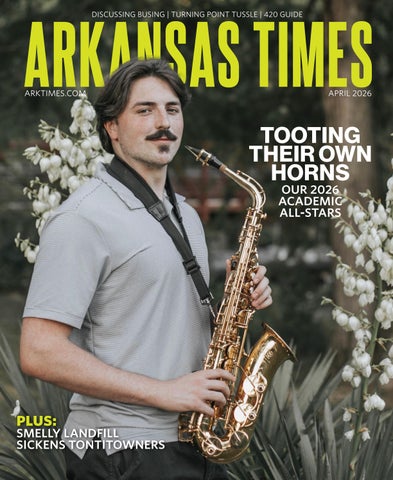
ON THE COVER: David Orme, a senior at Lakeside High School in Hot Springs, is one of our 2026 Academic All-Stars. Photo by Mallory Golden.
ON THE ROAD: The River Cities Travel Center in downtown Little Rock is the nucleus of the Rock Region Metro bus system, which serves roughly 6,787 riders every day.
EL

WEEKDAYS AT 2PM

with Nichole Niemann

Flyway Brewing, Lost Forty Brewing, Moody Brews, Vinos’ Brewpub, Southern Tail Brewing, Bentonville Brewing Co, New Province Brewing Co, Toppling Goliath, Left Hand, Monster Brewing, Merchant du Vin, Founder’s, Avery, Monster, Soul and Spirits, Hoop Tea, Club Tails, Garage Beer, Shock Top, Cardinal Cider, Elysian, Kona, Golden Road, Goose Island, Boulevard, Ole’, Cayman Jacked, MXD Blue Hawaiian, Boston Beer, Surfside, Shiner, Wiseacre, Lagunitas

MUSIC BY DJ MIKE POE

‘TO LIVE MORE IN HARMONY AND LESS IN FEAR’

A Q&A WITH AIRE ORGANIZER IRVIN CAMACHO.

A second Donald Trump presidency has brought much fear and pain across the country as the expanded efforts of U.S. Immigration and Customs Enforcement agents imperil the safety and stability of immigrants. Northwest Arkansas, which has seen a significant increase in its immigrant population over the past couple of decades, is no exception to the turmoil. But where there is trouble — to paraphrase Mr. Rogers — make sure to look for the helpers. Springdale-based activist Irvin Camacho, 34, is one of those helpers. A co-founder of the Alliance for Immigrant Respect and Education (AIRE), Camacho began working in high school with undocumented immigrants in Arkansas. In 2024, he helped start AIRE, an organization that advocates on behalf of immigrants, educates them on their rights, and reports on ICE activity in Northwest Arkansas.

What influenced you to become an activist for social justice? I think I just wanted to help level the playing field for people. I was born in the U.S., and I’ve had the privilege of being able to get a driver’s license and get a house and not be concerned with a lot of things that undocumented people didn’t have access to. And I think when I realized that my best friends were undocumented and they didn’t have access to the resources that I had, then I realized that I had to do something to advocate in their favor, advocate for the community that might feel scared raising their voice. I could raise my voice as a U.S. citizen, and I could speak out, and I was going to use my privilege to support this community that was in fear.

FAVORITE MUSICAL ARTIST YOU’VE BEEN LISTENING TO LATELY? Empire of the Sun.

FAVORITE LOCAL RESTAURANT? Food Truck De El Chefe.

WHAT HELPS YOU UNWIND?

Walking with my wife, Mayra, and my doggie, Duke.

In the years you’ve spent advocating for the rights of immigrants, what do you think has changed in Northwest Arkansas? When I started doing this work, the only support that we would get, really, was from other people of color. And I think throughout the work that several of us have been doing, different groups have been doing, we’ve kind of shifted the culture where now people are more supportive of immigrants and undocumented immigrants than ever before, and it’s very visible to see.

For example, [earlier this year], there was a total of like 75 businesses that decided to donate to our organization in a fewday period. There was a national strike that was happening in support of undocumented immigrants, of immigrants in general, and unfortunately, a few days before that national strike day, a lot of the local businesses couldn’t close [for financial reasons]. So, instead of closing, they decided to donate to organizations that were doing good work and supporting immigrants, and

we received about 78 donations from different businesses here in Northwest Arkansas that couldn’t close that day, but wanted to support us and the work that we were doing. So for us, it was kind of like, “Oh, wow.” Like, man, the culture has definitely changed from whenever I started organizing and there wasn’t that much support; it almost felt like you were doing a lot of this by yourself. And now our organization has over 100 volunteers and we have the support of the community who’s constantly looking out for us and trying to support our endeavor.

What are some of AIRE’s goals for the near future? We want to do so many more educational forums in our community about different things, about immigration processes. We want to teach people how it’s not easy to become a U.S. resident or a U.S. citizen, and what that process actually looks like. We want to hold free clinics in our area, so that we can help people apply for different immigration processes without them having to pay the hundreds or thousands of dollars sometimes that they have to pay for those processes. And we also want to educate people on voting. We want to teach them what the process looks like from the beginning, when you register to vote, looking up candidates and then also showing up to vote, the most important thing.

And then, of course, we’re going to continue with the Know Your Rights information, because that’s the most important thing for our organizing efforts at the moment; and just helping build community, building more community within Springdale, Rogers, all of Northwest Arkansas and the River Valley. We also have people that are reaching out to us from all across the state that want us to go do forums over there. So there’s a possibility that we might create some satellite organizations, or at least satellite chapters around the state for the folks that want to organize with AIRE but are in different parts of the state.

How do you stay hopeful in this period of heightened immigration enforcement? It’s hard sometimes. For me specifically, I keep hope because of AIRE members and because I love my community, and I just want it to be a thriving community where immigrants feel safe here — they contribute so much, not only economically, but as humans in society, and they’ve made this area thrive for many, many years now, and they deserve to feel safe being here. So I think not only our members give me hope, but my community gives me hope, and knowing that maybe one day, things will look bright for all of us here, and we’ll be able to live more in harmony and less in fear.

—Arielle Robinson

IRVIN CAMACHO

It was always clear that this year’s “big birthday” for America would be different, lacking the fully celebratory aspects of previous half-century recognitions of the United States’ declaring its independence in 1776. However, the deep political polarization across the American populace and the essential doubts about the fundamental health of the American experiment that have both intensified as the clock ticks towards July 4 of this year, make America250 (the name chosen by government officials years back to fill in for the mouthful that is a 250th anniversary) an even more complicated happening. While true celebration might never have been possible, there was some real potential to use America’s semiquincentennial to revitalize civics education in the United States. Sadly, we appear to be missing out on a much-needed lasting educational shift.

America’s Bicentennial in 1976 was a true celebration taking place at the grassroots and the leadership levels alike. The American system had survived the Watergate crisis and was moving toward a presidential election in which both major-party candidates were generally liked. The difficult period of civil rights battles had resulted in a more fully multicultural America that was beginning to deal with the sins of its past. Thus, America felt comfortable to truly celebrate the founding period that had created the system where response to crisis and continual improvement were part of the hardwiring. Those celebrations were omnipresent. From my fifth-grade school musical “Let George Do It” (an emphatically un-hip “Hamilton”), to patriotically painted fire hydrants, to the Freedom Train that toted 500 pieces of Americana across the 48 contiguous states, to ongoing celebrations, the Bicentennial was literally everywhere for well over a year. Much is different from five decades ago. Made obvious by the Black Lives Matter events of the summer of 2020 and the #MeToo movement, it became clear that American history remains problematic, limiting the appropriateness for unquestioning celebration during America250. In addition, the nation’s foot has been on the accelerator of political polarization during the past decade. As late as 1976, most Americans actually had

AMERICA250

A MISSED OPPORTUNITY.

vaguely positive views of both American political parties. The exact opposite is true today. According to one research group, the Polarization Research Lab, fewer than one in five Americans has anything positive to say about the party with which they are not affiliated.

AMERICAN HISTORY REMAINS PROBLEMATIC, LIMITING THE APPROPRIATENESS

FOR UNQUESTIONING CELEBRATION.

The return of Donald Trump to the White House has led to an emphatically celebratory framing of the event that feels tone deaf to many in our polarized nation. While the federal America250 Commission was established in 2016 as a bipartisan group, the second Trump Administration launched its own Salute to America 250 Task Force in 2025, reframing the semiquincentennial as Freedom 250. In contrast to Operation Sail, the parade of tall ships through New York Harbor on July 4, 1976, the highest-profile event put forward by the White House Task Force this time is the UCF Freedom 250 series of mixed martial arts fights on the grounds of the White House, with the fighters emerging from the Oval Office, according to White House officials.

There is no doubt that folks are paying some attention to America250. Museums are hosting special exhibits, symphonies are creating special concerts, and every county sign in Arkansas now has the official logo attached. However, without disparaging the hard work that those in cultural institutions are doing, it feels quite different than the spiritedness of the Bicentennial, and many Americans seem to be taking a pass on the anniversary.

So, what would have been the best role for America250, recognizing the polarized state of American society? Across the country, efforts to better educate students about the workings of the government and how to be an effective, engaged citizen have declined sharply over the past generation. Fewer than one in three schools offers a stand-alone civics course. Instead, civics is submerged in a stew of “social studies” material where little attention actually goes to civics education. The result: Students across the past generation — now representing more and more of the electorate — have graduated high school knowing less than preceding generations about how democratic institutions work, and how they can effect social change.

To properly celebrate this semiquicentennial, I’d argue for a wholesale, national investment in a revitalized civics education that connects the dots between the founding period’s complicated history, during which imperfect institutions were developed, and the ways that rank-and-file citizens can impact governmental processes that remain our best hope for improvement as a people today. Just as I fell fully in love with the connection between American history and civics during the Bicentennial era, there’s an opportunity here for us to revitalize young people’s interest in these topics in this America250 moment. We can’t wait 50 more years.

Jay Barth is a native Arkansan, longtime professor of politics at Hendrix College, and expert on the politics of Arkansas and the South.

BRIAN CHILSON

I'M STONED IN LITTLE ROCK. WHERE SHOULD I GO?

420 IS

ON

THE HORIZON. GET CRAZY.

WHAT KIND OF MOOD ARE YOU IN?

ADVENTUROUS

Are you OK with potentially getting arrested?

You betcha No, thank you

Are you claustrophobic?

Not particularly Yes Sneak your way to the top of the Simmons Towers

Animals? I have to see animals Nah

You down to get on the highway?

Yes

Horse races at Oaklawn (go to the bathhouses, too)

Little Rock Zoo or Little Rock

Smoke a joint inside the USS Razorback or the Arkansas state Capitol

Animal Village

The Retro Arcade below Professor Bowl No

OUTDOORSY MUNCHIES

Do you need scenic views? What time of day is it?

Yes No

Are you down to get on the highway? Yes Closer to home, please Emerald Park Pinnacle Mountain State Park

Burns Park

Wake and bake

CHILL

Music, movies or art?

Lunch After midnight

Leo's Greek Castle Four Quarter Bar How much food do you need?

Unlimited A normal amount

The Root Cafe Lunch buffet at Star of India

Live music White Water Tavern Vino's

Can you handle tripping over shit?

Arkansas RecordCD Exchange Control Records No Yes

Live music or browsing for records?

Browsing for records

Arkansas Musuem of Fine Arts Yes, sir

Movies Riverdale 10 VIP Cinema or Ron Robinson Theater

Music

Art Can you handle a fancy environment? Me thinks not

M2 Gallery or South Main Creative

FORTUNE FEIMSTER

SATURDAY 4/4. ROBINSON CENTER. 7 P.M. $40-$167.

Fun facts I’ve learned about Fortune Feimster after two-plus years of listening devotedly to “Handsome,” a podcast Feimster hosts with fellow comedians Mae Martin and Tig Notaro, include, but are not limited to: Feimster is tight with Arnold Schwarzenegger. She takes her first name from her greatgrandmother’s maiden name. Her soft spot for fast-food biscuits, specifically from Hardee’s, led her to the namesake of her 2025 stand-up tour, “Takin’ Care of Biscuits.” She worked as an entertainment journalist before breaking into the biz herself. She has killer calf muscles and is a great singer. She insists her Australian accent is on point, though actual Australian Toni Collette (Martin’s co-star on Netflix’s “Wayward”) has confirmed it is indeed terrible, aside from the trick where you say “rise up lights” to sound like an Aussie saying “razor blades.” You, too, could become a fount of Fortune knowledge by securing tickets at ticketmaster.com. SS

KAIA KATER

THURSDAY 4/2. ARKANSAS MUSEUM OF FINE ARTS. 7:30 P.M. $30-$35.

Who could forget that the banjo — loud, percussive, sprightly — is a wild thing? Much easier to neglect is the instrument’s gentler side. In the hands of Canadian-Grenadian singer-songwriter Kaia Kater, however, the banjo’s undersung ability to soundtrack melancholy comes sharply into focus. Her 2024 album “Strange Medicine” is collaboratively alive with compelling arrangements and features from Aoife O’Donavan, Taj Mahal and Allison Russell, but I’d argue that Kater is at her best in solitude. On tracks like “Maker Taker” and “History in Motion,” when all the bells and whistles are stripped away and only Kater’s voice and careful plucks are on display, a mournful magic takes over that’s simply incomparable. Get tickets at arkmfa.org. DG

RODEO IN THE ROCK

SATURDAY 4/25-SUNDAY 4/26. ARKANSAS STATE FAIRGROUNDS. $15-$25.

Did you know that one of the 20 chapters of the International Gay Rodeo Association is based here in Arkansas? It’s true! The Diamond State Rodeo Association, a not-for-profit dedicated to promoting “the country and Western lifestyle within the gay community,” raises money for charity every other year with its two-day Rodeo in the Rock, a weekend of gay rodeo, drag bingo, dancing and, if the photos are any indication, fierce fashion. See the full schedule and find tickets at dsra.org/rodeo-schedule, and consider saddling up for the Rodeo School day on the preceding Friday, where beginners can learn the ropes of barrel racing, calf roping and chute dogging. SS

DAVID ROEDIGER

TUESDAY 4/7. CALS MAIN LIBRARY. 7 P.M. FREE.

Cancel culture is real — just not in the way that Gov. Sarah Huckabee Sanders and others so often complain. In late 2025, the powers that be at the University of Arkansas at Little Rock scrubbed from its website two race-related lectures scheduled for 2026 out of fear that they might, in violation of last year’s ACCESS Act, “compel” an expression of “collective guilt” on the part of lecture attendees. But the outcry that followed led to one of the talks being put back on — a guest appearance by University of Kansas historian David Roediger on the subject of his new intellectual biography, “An Ordinary White: My Anti-Racist Education.” One of the foremost scholars of “whiteness studies,” Roediger will be in conversation with Guy Lancaster, the writer of this blurb and editor of the CALS Encyclopedia of Arkansas (and occasional Times contributor). We’ll ponder growing up white in America, history, censorship, class, academic freedom and much more. Reserve a set at events.cals.org. GL

JANICE REID

SINKANE

WEDNESDAY 4/22. WHITE WATER TAVERN. 8 P.M. $20-$25.

“We Belong,” the latest album from Sudanese-American singer and multiinstrumentalist Sinkane, is bursting at the seams with Black pride. Spun together with funky bass, guitar and keyboard lines; gospel-tight vocal harmonies; and Africaninfluenced rhythms, Sinkane’s music, as corroborated by Pitchfork, “embodies the sense of deep pain and great joy that powers the sound of Black liberation … smashing through constraints with revolutionary exuberance.” If that description doesn’t immediately convince you to come out to the White Water Tavern for this show, go to YouTube and find Sinkane’s 2024 performance on Seattle radio station KEXP, where he and his band positively groove their hearts out; it’s one of the most effervescent things I’ve ever seen. Get tickets at whitewatertavern.com. DG

ROSS GAY

FRIDAY 4/10. CALS RON ROBINSON THEATER. 6:30 P.M. FREE.

Writing that’s both uplifting and rigorous? Maybe it’s just me, but there’s something about full-throated positivity that gets me suspicious, makes me worry that I’m dealing with either an amateur or a con artist. With an oeuvre of poetry and essay collections bearing titles like “Catalog of Unabashed Gratitude,” “The Book of Delights,” “The Book of (More) Delights” and “Inciting Joy,” Ross Gay seems like the kind of writer who might not pass my smell test. And yet! He’s really freaking good. So good, in fact, that his debut book won the National Book Critics Circle Award for Poetry and was a finalist for the National Book Award. Taking a magnifying glass to the most unlikely places, Gay’s pursuit of mundane ecstasy is personal, peculiar and never platitudinous. “As fluent and familiar as a chat with a close friend,” The New York Review of Books argues, “[Gay’s] voice has integrity, in both senses of the word: a completeness or consistency, true to itself; and an honesty and compassion … so frankly subjective that it produces an incorruptible vision.” Come hear him for yourself at CALS Ron Robinson Theater, where he’ll be in conversation with Oxford American editor and Arkansas Times contributor Frederick McKindra. Reserve a seat at events.cals.org. DG

ELEANOR

ARKANSAS TIMES FILM SERIES: ‘I AM CUBA’

THURSDAY 4/21. RIVERDALE 10 VIP CINEMA.

7 P.M. $12-$14.

Directed by Soviet-Georgian filmmaker Mikhail Kalatozov, “I Am Cuba” (“Soy Cuba” in Spanish) consists of four separate stories from before and during the Cuban Revolution. Guided by an omnipotent narrator (“The Voice of Cuba”), we see the state of things under the Batista regime through the eyes of Maria, a poor young woman forced into prostitution at a Havana casino; Pedro, a peasant who’s being displaced from the land he works after his landlord sells the property; a group of student protesters who are violently suppressed by the government; and Mariano, a farmer reluctant to join the fight until the fighting comes to him. Made in 1963 as a Cuban/Russian co-production, “I Am Cuba” was largely forgotten until the early ’90s, when it was rediscovered after the fall of the Soviet Union and championed by enthusiasts (including directors Martin Scorsese and Francis Ford Coppola) who were taken by the film’s visual poetry. Get tickets at riverdale10.com. OJ

MELISSA ETHERIDGE

WEDNESDAY 4/29. THE HALL. 8 P.M. $77-$246.

My dad is a longtime David Letterman fan. When I was a kid, he worked the midnight shift and caught up on the previous night’s “Late Show” about the time I was getting ready for school, so I caught more than a handful of snippets of the era’s musical performances, few more memorable to me than Melissa Etheridge’s 1993 appearance in support of her groundbreaking record, “Yes I Am.” Newly out as a lesbian and blowing the roof off of the Ed Sullivan Theater with her searing vocals and electric presence, Etheridge’s sound was a far cry from what most people thought of as “lesbian music.” It was confessional but not soft, yearning but not docile. Three-plus decades later, she’s still touring and recording, still wearing at least four necklaces simultaneously and still a complete badass, not least because she started a foundation dedicated to researching new treatments for battling opioid dependence. Get tickets to this Little Rock stop on her “Rise” tour at littlerockhall.com. SS

ARKANSAS TIMES CRAFT BEER FESTIVAL, APRIL 17

Calling all lager lovers and ale aficionados: Prepare to raise a glass at the 13th annual Arkansas Times Craft Beer Festival on April 17. Held at Argenta Plaza in North Little Rock from 6-9 p.m., this sudsy tour will put you face-to-face with 100-plus samples of premium beers and seltzers on both the local and national circuit. Participating Arkansas breweries include Flyway Brewing, Lost Forty Brewing, Moody Brews, Vino’s Brew Pub, Southern Tail Brewing, Bentonville Brewing Company, New Province Brewing Company and more. With local food truck fare for purchase, a buoyant new set of music by DJ Mike Poe, and cars on display from event sponsors Volkswagen of Little Rock and Land Rover of Little Rock, the Arkansas Times Craft Beer Festival is a window into the Natural State beverage scene that you won’t want to miss. Reserve your spot at centralarkansastickets.com. Early bird tickets are only $30 until April 3 and $40 until the day of the event. Tickets will also be available at the door for $45. For an elevated experience, consider snagging a $100 VIP ticket, which includes early entry at 5:30 p.m., table seating and a private bartender serving specialty beers and complimentary snacks.

ARKANSAS TIMES SPRING MARGARITA FESTIVAL, APRIL 30

Spring has sprung, so get ready to savor the flavor at the Arkansas Times Spring Margarita Festival. From 6-9 p.m. on April 30, the River Market Pavilions will transform into a margarita lover’s paradise fueled by the smooth taste of Milagro Tequila. Think of it as a margarita masterclass without the homework. Local hotspots like The Rail Yard, WXYZ Bar, Baja Grill, Lakewood Fish & Seafood, The Spot @ SoMa, Chepe’s Mexican Grill, Fassler Hall and Loca Luna are your teachers. And the best part? You are the ultimate critic! Cast your vote for your favorite and help crown the margarita champion. With music provided by Club 27, it’ll be a night of dancing, drinking and unforgettable memories.

Reserve your spot at centralarkansastickets.com. Early bird tickets are only $35 until April 16 and $40 until the day of the event. Tickets will also be available at the door for $45. For an elevated experience, consider snagging a $100 VIP ticket, which includes early entry at 5:30 p.m., table seating and a private bartender serving complimentary snacks.

BRIAN CHILSON

DUMPED ON

TONTITOWN RESIDENTS SAY THEY’RE SICK OF THE STENCH COMING FROM THE ECO-VISTA LANDFILL. LIKE, ACTUALLY SICK.

GETTING BURNT: A fire burns at the Waste Management-owned Eco-Vista Landfill in Tontitown, sending toxic smoke skyward. Residents have complained about their exposure to the pollution to no avail.

On a warm autumn evening last year, Nina Brown pulled her burgundy SUV into the driveway of the one-story home in Tontitown (Washington County) where she’s lived since 1985. A full sky of stars and the gentle chirping of wildlife filled the crisp fall air as she stepped out of the car and walked across the road, beckoning me to follow.

She pointed to a tall wooden fence, barely visible in the moonlight. A small brick shed poked out above the enclosure. It was a pump house, she explained — a sewer lift station.

As we got closer, a pungent smell became apparent. Brown asked me to describe it. Rotten eggs and gasoline immediately came to mind. She nodded, but said this was “just a touch” of the usual, nauseating odor.

“When it settles in, it’s just like a fog right here,” she said. “And so you’ve got to get out.”

“IT TAKES YOUR AIR AWAY FROM YOU, AND I WAS STRUGGLING TO BREATHE.”
-TONTITOWN RESIDENT NINA BROWN

The pump station exclusively transports thousands of gallons of raw landfill leachate daily from the Waste Management-owned Eco-Vista Landfill located about half a mile up the hill to the regional wastewater treatment plant. Brown’s neighbors and state air quality testers have documented the rotten egg stench, which settles in the low-lying

valley where Brown lives.

A few minutes into the tour, Brown got short-winded and retreated to lean against her car and rest.

“I was always very active,” she remarked as she steadied herself on the trunk. “I used to walk pretty much daily.”

Her health has taken a sudden turn for the worse in the past few years, Brown said. Odd lab results showed impaired kidney and liver function, thyroid issues and sudden blood pressure problems. At the same time, the chemical odors emanating from the landfill’s leachate transport pipes became more intense, and noticeable more often.

Brown, 71, has been hospitalized twice in the past two years. Both times, concerned neighbors watched as she suddenly became disoriented, struggling to breathe, walk or speak, and her blood pressure spiked dangerously. Both times, she said, the gas smell outside and wafting in through the window screens was overpowering.

“It takes your air away from you,” Brown said. “And I was struggling for breath.”

State inspectors said they’ve never found hydrogen sulfide, the tox-

KENNETH

ic gas that is synonymous with that rotten egg odor, in Tontitown. But basic air testing commissioned by the city last fall found it at levels 2,000 times higher than natural background concentrations.

Brown’s medical records show emergency room doctors couldn’t explain her sudden, stroke-like symptoms, but they noted she attributed them to “inhaling gas from a waste plant near her home.” The symptoms Brown experienced during her hospitalizations match the profile of acute hydrogen sulfide exposure, according to the CDC: nausea, headaches, delirium, disturbed equilibrium, tremors, convulsions and skin and eye irritation.

Now, Brown said, she leaves her house at the onset of symptoms, before the fumes can knock her out again.

Like Brown, Kenneth Lovett said he suffers from living within a mile of Eco-Vista Landfill. That suffering started five years ago, while driving past Brown’s home in December 2021. As he passed the lift station with his car heater on full blast, he was overcome with an acrid smell. He kept driving, but as he rounded the curves, ascending the steep hill leading to the landfill, he was hit with a cascading wave of symptoms. On the first curve, he felt dizzy. By the second, he felt nauseated. When he’d finally reached the top, his head was pounding.

“I thought I was dying,” Lovett said. He pulled over at the intersection of Arbor Acres Avenue on South Pianalto Road, in front of the Eco-Vista Landfill.

“And I rolled my window down, and I couldn’t breathe,” he said. “It just hit me in the face. So I sat there a minute trying to figure out what to do. And there was a haze around, a blue-looking haze … like a blue cloud.”

A COMMUNITY IN CRISIS

Eco-Vista is the only municipal solid waste landfill in Northwest Arkansas, a booming area that includes the state’s second-largest metro region (Fayetteville-Springdale-Rogers). Besides taking in the waste of more than 600,000 people from Arkansas, Oklahoma and Missouri, the 609-acre landfill — which accepts both household and commercial waste — serves as the disposal backbone for Walmart, Tyson Foods and J.B. Hunt Transportation Services. Developers rely on the landfill’s commercial waste cells to dispose of building materials, and the Washington County solid waste authority, officially known as the Boston Mountain Solid Waste District, relies on the landfill for funding. The Arkansas Department of Environmental Quality also benefits. In 2025 alone, Eco-Vista paid the state close to $1.7 million in tipping fees.

The massive landfill takes up roughly 18% of the rural town’s land mass. As Eco-Vista has taken in more solid waste each year — 662,160 tons in 2025 alone, enough to fill up almost two Empire State Buildings — growing pains have followed.

Like many places in Northwest Arkansas, Tontitown — a community of about 9,000 near Fayetteville and Springdale and home to the long-running Grape Festival — has seen its population double since 2020.

Eco-Vista has grown alongside Tontitown, adding a massive natural gas plant in 2023 that takes landfill gas (methane) and converts it into pipeline-quality natural gas. The facility burns off the rest of the gas via flares — a process that residents say causes them health problems.

In fact, hundreds of residents of Tontitown and those living within walking distance of Eco-Vista have documented a variety of health issues they believe are associated with the landfill. Children, they say, often develop coughing fits from playing outdoors for just a few minutes, and adults report instant nausea when stepping outside. Residents have reported severe headaches, dizziness, stinging eyes, burning throats and shortness of breath.

Families have complained that the chemical vapors penetrate the walls of their homes

TOXIC: Tontitown Mayor Angela Russell (top left) said she had to be taken to the hospital once because the fumes from the Eco-Vista Landfill made her sick. Kenneth Lovett (bottom left) said he, too, has been overcome by the pollution coming from the landfill, which he said sometimes appears as a blue haze.

and trigger acute respiratory issues severe enough to warrant emergency room visits. “Please help,” residents wrote in complaints to ADEQ over the years. “This can’t be safe.”

City leaders agree the landfill is the source of the odors, and the odors are making people sick. Mayor Angela Russell lives directly next to the landfill on Arbor Acres Avenue.

“There [are] times that the vapors are so strong, not just outside, they are in my house,” Russell said. “I had been woken up in the middle of the night before with those odors and those vapors. And one night it was so bad that my equilibrium was off. I couldn’t hardly walk across the room. I was nauseous. And it was so bad that my husband had to take me to the hospital.”

But residents, city officials and local state representatives have so far been unable to convince either Waste Management or the state to alter how the landfill is operated.

COMPLAINTS IGNORED

Before 2021, the landfill saw very few complaints. Only 11 were filed before 2020. But in 2021, complaints jumped from two to 61, an increase that continued over the next four years, when more than 700 were filed. At the same time, from 2021 to 2025, the state issued significantly fewer violations — just 16, compared to 88 in the previous 15 years.

“Nobody makes them do anything,” Tontitown resident Russ Greene said. “In fact, they’ve even stopped taking our complaints

(seriously). They kind of combine them all together and say, ‘Well, we didn’t see anything.’ Well, they didn’t see anything because they didn’t come up here.” Greene’s observations are supported by ADEQ’s own data. Between Dec. 11-14 of 2023, for example, residents filed 32 complaints, reporting noxious fumes emanating from Eco-Vista that caused them severe health issues. On Dec. 13, one resident reported the odors coming from Eco-Vista “caused us to take our daughter to the ER because we thought she was having an asthma attack.” The parents were told that the girl was suffering from “an acute reaction to high levels of methane,” a major component of landfill gas. Another resident described driving past Eco-Vista on Dec. 11 when their 21-year-old son “started gagging” and had trouble breathing. “I literally had to break the law and drive past (the landfill) at 60 mph with all our vehicle windows down till he could breathe again,” the complaint stated. Another complaint on Dec. 13 stated: “This is an emergency! The stench is unbearable, I can’t breathe without being suffocated by it, my immune system is weak, and I fear for my health.”

ADEQ waited until Dec. 14 — after 30 complaints had been filed — to investigate. Three inspectors did a quick drive-by of the neighborhood, during which they detected no odors and experienced no adverse health symptoms, according to the inspection report.

State Rep. Steve Unger, a Republican, has tried to get ADEQ to address concerns raised by his constituents about the landfill.

“Well, they go through the motions, and they inspect, and the dump passes the inspection, which, I think, they’re just willfully ignoring the evidence,” Unger said of ADEQ. “And they get citizens’ complaints, and at end of the day they just don’t care.”

“It’s almost like picking up a telephone and calling a dead number. They’re never going to pick up that phone because at the end of the day, they just don’t care.”

ADEQ denied brushing off complaints.

“DEQ does not ignore complaints and adequately regulates the Eco-Vista landfill in accordance with applicable law and rules,” the agency said in an email response to the Arkansas Times on March 7.

INSPECTION ISSUES

ADEQ has not levied a single fine or penalty against Waste Management, even when violations are identified. It’s a pattern that both residents and city employees have come to expect.

Mark Latham, Tontitown’s community development director, said ADEQ “does an extremely poor job” with inspections. He said he would like to send a city inspector along with the state inspector to make sure they were doing their jobs.

“Because, in my opinion, what I’m seeing is the only time that they go out and inspect, if they actually do a weekly inspection or whatever, is if somebody makes a complaint,” Latham said. “Well, that is a terrible way to be able to do an inspection.”

In March 2023, state inspection records show ADEQ completed 29 inspection reports after making 14 site visits. Arkansas Energy and Environment Secretary Shane Khoury ordered the stepped-up inspections in “an effort to more closely monitor landfill operations” in response to citizens’ complaints, according to ADEQ.

What inspectors found over a three-week period in March 2023 was a landfill struggling to contain its pollution. ADEQ inspectors documented five separate violations for failing to cover the active trash piles with a legally required layer of dirt or alternative cover material. Not covering waste piles (working faces, in landfill speak) exposes raw solid waste to the elements, allowing hazardous landfill gas and volatile organic compounds to vent directly into the surrounding area.

Simultaneously, ADEQ inspectors logged six violations for leachate leaks, documenting what is called “toxic trash juice” seeping off the slopes of multiple waste cells, while the facility’s own internal containment alarms were actively sounding. Leachate forms as water percolates through waste at a landfill, and can contaminate groundwater if

improperly handled.

No formal enforcement actions were taken, and ADEQ’s inspection frequency went immediately back to typical levels.

ADEQ INSPECTORS HORRIFIED BY STENCH

It wasn’t until three years after complaints spiked that state inspectors seemed to grasp

“IT’S ALMOST LIKE PICKING UP A TELEPHONE AND CALLING A DEAD NUMBER. THEY’RE NEVER GOING TO PICK UP THAT PHONE BECAUSE AT THE END OF THE DAY, THEY JUST DON’T CARE.”
— STATE REP. STEVE UNGER

what the fuss was about. In response to three consecutive complaints in September 2024, ADEQ inspectors made a rare same-day site visit. They were met by a “horrific smell” coming from the landfill and venting into the neighborhood.

“There has never been an odor from the landfill detected by DEQ-OAQ staff of this nature, pungency, and intensity like what was detected during this investigation,” the inspection report states.

Later that month, ADEQ sent Eco-Vista an official out-of-compliance letter, stating “formal enforcement action” would take place if Waste Management did not correct the issues. Waste Management attorneys responded by blaming other sources, including a nearby construction dumpster, residential trash cans, agricultural operations and dump trucks.

ADEQ responded on Nov. 13, 2024, stating that the odors were “extremely intense, to the point of not wanting to be in the vicinity where the odors were noted along Arbor Acres Road and Clear Water Road.” On Dec. 16, 2024, ADEQ issued a formal enforcement action to Eco-Vista, citing “exceedance of a non-criteria pollutant emission limit,” and

demanding Eco-Vista resolve the violations as part of a voluntary agreement.

According to ADEQ, Waste Management didn’t respond. More than a year later, the violation still has not been resolved.

NATIONAL GUARD TESTS AIR

On Dec. 20, 2023, after the incident that caused dozens of complaints in four days, Secretary Khoury asked the Arkansas National Guard for help after ADEQ inspectors were “unable to verify the citizens’ complaints.”

The Civil Support Team of the Arkansas National Guard set up overnight testing Dec. 21-22, 2023, in Tontitown at four locations around the Eco-Vista fenceline. The testing revealed elevated levels of sulfur dioxide, a highly toxic gas that smells like burnt matches and is a common industrial pollutant. The gas was found at levels 10 to 20 times higher than the Agency for Toxic Substances and Disease Registry’s minimum risk level for acute inhalation, an estimate for how much of a chemical one can breathe for up to 14 days without being at risk of adverse health impacts. The National Guard recommended more testing.

ADEQ conducted another round of testing in February 2024, again with the Arkansas National Guard’s help. The National Guard found the same toxic gas it found the first time. But this time, ADEQ also contracted with CTEH — a company with a history of being called in the aftermath of high-profile environmental disasters and later being accused of mishandling data — to perform the Tontitown air sampling simultaneously. CTEH is based in Arkansas, and its headquarters is right across the street from ADEQ’s office in North Little Rock.

While the Arkansas National Guard again detected sulfur dioxide, CTEH didn’t, although the company did detect benzene and acrolein.

Several residents and Rep. Unger raised concerns about the credibility of ADEQ’s test results from CTEH.

“Well, I think there’s some nefarious action going on there,” Unger said. “If you type into a search engine that lab name and then the word ‘scandals,’ you’re gonna see that they are the hired gun for every polluter around. They have got their finger on everything bad.”

CTEH responded to a request for comment by pointing to its FAQ webpage, which states, “We pride ourselves on accurately representing the facts on any response or project in which CTEH is involved.”

February’s testing results were compelling enough to prompt another round of testing in April 2024. This time, testing revealed a cocktail of five toxic chemicals, including acrolein, benzene, carbon tetrachloride, chloroform and naphthalene, at levels surpassing the EPA threshold for further inves-

tigation. Notably, the test found acrolein at 0.45 ppb, or about 50 times higher than the EPA’s screening level. It also found benzene, a known carcinogen, at 0.34 ppb, more than three times the screening level.

Reviewing this data, the Arkansas Department of Health acknowledged for the first time that Eco-Vista could be responsible for the pollution, stating in the agency’s April 2024 report, “a completed pathway for inhalation exposure does exist for residents living near and further away (including residents near the background sampling locations) from the site.”

ADEQ: IT’S NOT THE LANDFILL

In September 2025, a year after ADEQ documented the smell coming directly from the landfill and venting into the neighborhood, and the Arkansas Department of Health confirmed it’s possible residents were being exposed to air pollution from Eco-Vista, ADEQ declared Eco-Vista was not the source of the odors in Tontitown and that the air was largely consistent with “background levels.”

The decree came via the final round of state air sampling, which aimed to uncover the source of pollutants detected in 2024 and provide enough data for the state health department to assess public health impacts. The sampling took place over 11 days, May 2-12, 2025, and cost ADEQ almost $560,000, according to CTEH’s service contract. When the results were released on Sept. 8 of last year, they sent shockwaves through the com-

munity: The study concluded that none of the pollutants detected were “most likely” originating from the landfill, and only two pollutants — benzene and ethylbenzene — were “likely from the landfill.”

At the same time, the study found 36 air pollutants in Tontitown, including some toxic compounds at higher levels than were detected in previous rounds of testing. ADEQ has not been able to pinpoint the source of the pollutants.

Dr. Philip Landrigan, an epidemiologist at Boston College who studies how hazardous substances in the environment affect human health, said the report does not adequately address the health risks of the chemicals that were found. In an interview with the Arkansas Times, Landrigan raised concerns about how cancer risks were not discussed in the CTEH study, going on to say that the benzene levels found in the Tontitown air samples will result in people getting cancer, with children being at the highest risk.

“If I lived there, I’d be worried about the fact that benzene and ethyl benzene are escaping from the landfill and getting into the air,” Landrigan said. He said more tests are needed to determine the actual health risks of the landfill.

“All this tells me is that there are volatile organic compounds in the air in detectable quantities,” he said. “And to really know if this is coming from the landfill, you’ve got to have a little network of samples that stays in place and operates around the clock 24/7, for

the span of several months. And then you’ll nail it for sure. You’ll know one way or the other whether there’s a hazard. Up until now, they’re sort of doing pilot studies, they’re probing the situation, but they don’t have a detailed picture.”

The state health department released an assessment of the 2025 CTEH study in January 2026. It acknowledges that the levels of one toxic chemical, acrylonitrile, represent a health risk of one in 10,000 additional cancer cases, the highest public health risk level. The report also confirmed acrylonitrile exposure includes symptoms commonly documented by residents, including “nose and throat irritation, difficulty breathing, nausea, dizziness, weakness, headache, impaired judgment, and convulsions.” Although ADEQ acknowledged that Eco-Vista is the only facility in Washington County that has reported emitting acrylonitrile, the agency again pointed to other sources, and said it has enlisted the EPA to further investigate.

Some residents questioned the state-funded study results.

“The testing itself was, in my opinion, fixed where it was, things were adjusted, so that it didn’t show as bad as it did the first two times,” Kenneth Lovett said.

Public records obtained by the Arkansas Times confirmed that testing had been done in a way that diminished the pollutants detected. The agency ordered Waste Management to provide proof it was covering trash piles only during the study period, and re-

BAD SIGNS: Clockwise from top left: A protest sign, posted in 2023, alerts the public to efforts by Waste Management to expand its Eco-Vista Landfill; Waste Management captures methane gas from the Eco-Vista Landfill at this facility and turns it into natural gas, burning off unwanted gases through a flare; and a dye is put into the ground to detect any movement of toxic chemicals from the Eco-Vista Landfill into the groundwater.
KENNETH LOVETT,
EVEY WEISBLA

scinded the order shortly after testing concluded. Studies show uncovered working faces account for 79% of landfill air emissions.

ADEQ said the method was intentional. “DEQ did not ‘artificially suppress’ or otherwise manipulate data,” the agency said. “DEQ’s request for daily cover reports was designed to determine if the type of cover utilized by the landfill, specifically alternative daily cover, was impacting community air quality. The study indicated that the type of cover had no impact on the community air quality during the study period.”

TONTITOWN BLAMED

Exposure to the specific chemical cocktail detected in the air sampling study is consistent with the acute physical distress residents are experiencing, Landrigan said.

“If people are exposed to these fumes, they probably are developing those symptoms. I have no doubt about it.”

ADEQ blamed the odors on Tontitown’s municipal sewer system, specifically the lift station that pumps leachate from the landfill to the regional sewer treatment plant. Local news headlines repeated the agency’s claim, declaring the fumes were not coming from the landfill. For many outsiders, the case was closed. Tontitown residents and city officials were furious.

“It’s not in our imagination,” Lovett said. “And they want to blame it on Tontitown sewer. They’re [Waste Management] the only one using it. It don’t make good sense to me to just lay down and forget.”

In August 2025, an independent evaluation of the city’s sewer system recommended increased air testing and pre-treatment of the landfill leachate. The firm said the sewer collection system was in “surprisingly fair condition.”

James Clark, Tontitown’s public works director, expressed frustration that Tontitown is being forced to deal with the issue.

“They’re certainly not helping us in any way, and that’s disheartening,” he said of ADEQ.

Although the state has declined to test nearby private wells for industrial pollutants, independent testing conducted as part of this investigation found several landfill-associated PFAS, “forever chemicals” that don’t break down naturally, in a well about 200 feet from the landfill. Unger presented that information to ADEQ but got no response from the agency. The agency says it does not regulate PFAS.

“I really don’t believe we are ever going to get them to be the watchdog we need,” Unger said.

Community Development Director Latham echoed Unger’s frustration.

“It’d sure be nice if the governor would

come up here and sit down like the rest of the governors I’ve ever dealt with,” he said. Latham also said the local response has been disappointing.

“I just feel like the leaders in Northwest Arkansas have had their head in the sand and nobody really cares anymore,” he said.

Neither Waste Management nor the Boston Mountain Solid Waste District responded to requests for comment for this article.

A DIRE WARNING

Air pollution isn’t Eco-Vista’s only looming problem. A report from an independent engineering firm found evidence that Eco-Vista was showing symptoms of an Elevated Temperature Landfill (ETL) — a subterranean, hot chemical reaction similar to an underground fire, where the trash literally cooks beneath the surface instead of decomposing normally. The report compared Eco-Vista to the Chiquita Canyon Landfill environmental disaster in California, an ETL that leaked toxic gas, spilled leachate and caused significant health concerns; it concluded Eco-Vista was experiencing an “unstable biological process that requires immediate diagnostic monitoring.”

State records show Eco-Vista has experienced 17 fires in the last 10 years, including three in 2025 alone. During Eco-Vista’s permit expansion hearings in 2024, landfill fire expert Todd Thalhamer warned ADEQ that the facility’s lack of planning and flammable cover materials would inevitably cause an uncontrolled fire there that could release toxic gas plumes. He said the landfill’s operators “need to plan for a catastrophic event,” and warned about subsurface fires at Eco-Vista — which, Tontitown fire department reports show, occurred exactly as he predicted. In November 2025, a fire started at the bottom of the waste pit and “rekindled” two days later.

Former dump truck driver Levon Perry said he regularly observed unapproved substances dumped into Eco-Vista when he was dropping loads there, and he experienced health problems that improved when he left the area. Like Thalhamer, Perry said an uncontrolled fire or explosion at Eco-Vista was a “not if, but when” scenario.

“Tontitown, it’ll be flattened," Perry said. “It’ll be like a nuclear warhead got dropped off right down the middle of it. And they don’t care.”

A footnote: A handful of residents have taken the matter to court, and on March 11, a circuit judge in Washington County ruled that their case against Waste Management could proceed. The class-action lawsuit alleges Eco-Vista’s negligence in managing the landfill has resulted in widespread, noxious odors that have reduced property values and caused a nuisance.

MIGHT MAKES THE CHRISTIAN RIGHT

ARKANSAS WATCHED THE TURNING POINT SKIRMISH OUTSIDE THE GOVERNOR’S MANSION. CAN THE STATE CONVINCE US WE DIDN’T SEE WHAT WE SAW?

Gov. Sarah Huckabee Sanders made the very boomer observation to a POLITICO reporter recently that social media creates an echo chamber and turns the youth against causes, like Israel, that she cares about. What will be interesting to see is whether Sanders can sway reality, or if the young people on their damn phones will trust their own eyes.

We’re, of course, referring to the viral footage from an altercation outside the Governor’s Mansion on the day the fallen rightwing provocateur Charlie Kirk’s widow came to town in March. Multiple renditions posted online show a nattily dressed supporter of the Christian conservative youth group Turning Point USA swinging at a protester before a wider skirmish breaks out. The altercation unfolded during a high-profile visit of Turning Point USA President Erika Kirk, who stepped into her late husband’s place and was in Little Rock to announce an effort with Sanders to expand chapters of the organization into more Arkansas schools.

Erika Kirk’s national tour to radicalize white youth seemed to go off without a hitch in Arkansas, at first. Through fake tears, she called on “young, white, male” men to resist their own disenfranchisement to an almost all-white audience at the mansion, riling folks up.

If you’ve yet to see the videos, the basic gist is that as the event let out, a Turning Point supporter, Ron Daniels, throws a punch at

a protester, Olivia Thompson, who is filming and heckling him and his wife, Stephanie Daniels. Predictably, the ruckus draws more protesters to them. Stephanie Daniels, dressed in pink satin and green block heels, is then seen shoving a protester who looks to be half her age. The police and plainclothes security jump in, aggressively toppling the protesters to the ground and cuffing them, as the Turning Point couple climb into their Mercedes-Benz and drive away.

Despite all the video documentation, the governor claimed that the protesters “violently assaulted two state troopers.” Four demonstrators were arrested in total, two on felony battery charges. At press time, the couple who drove away in the Benz had not been charged at all.

We can argue about whether Thompson should have been so close to the Turning Point supporters, or who shoved whom first. Arkansans should resist turning on one another when the governor laid this trap. The situation was almost scripted to go wrong. It began with Sanders’ decision to bring Erika Kirk — one of the most polarizing figures in politics — to Little Rock, and her tin-eared attempts to brand young, racially progressive activists as violent while rolling out the welcome mat for white supremacist groups, including Turning Point USA.

Whether the public believes Sanders’ version of events — and how much leverage she gets out of this narrative — matters plenty to

her own political ambitions to paint the far right as a beacon of law and order and civility while trying to force-feed the young a fading credo of white Christian nationalism. It also matters for any chance of justice that the two protesters facing more serious charges might hope for.

While early internet rumors focused on who threw the first punch, Sanders and the Arkansas State Police skillfully trained attention to whether the protesters who rushed to Thompson’s defense harmed law enforcement. But the police report suggests authorities were blind to what was actually happening. The report notes that officers were working to secure the perimeter of the mansion in light of the presence of protesters, describing the protesters as “pushing and shoving” and downplaying the Daniels’ role. Tasked with securing a gated mansion from the unruly youth holding cardboard signs, the troopers were set up to see people exercising their constitutional rights as the enemy, not the ones in need of protection.

What’s also notable is that plainclothes state troopers — white men, middle-aged, with cropped hair and dressed in blazers — are virtually indistinguishable from the male Turning Point USA supporter who swung on the protesters. That matters, as according to the accusations, Jennifer Hanson, 46, slapped an ASP trooper wearing a gray suit and tie, breaking his glasses, which cut his face. Hanson’s daughter, Finley Hanson, 19,

WHO WOULD JESUS PUNCH?: A protester got punched outside the Arkansas Governor's Mansion, and then got arrested.
BRIAN CHILSON

TRUST IS OUR FOUNDATION

Attorneys, CPAs, and financial advisors across Arkansas turn to us for our expertise in charitable giving. With expert knowledge and customized solutions, we help you guide your clients toward meaningful, tax-smart philanthropy.

Arkansas Community Foundation: engaging people, connecting resources and inspiring solutions to build Arkansas communities.

CALS SPRING SPEAKER SERIES

Rough riders

THOUSANDS RELY ON ROCK REGION METRO EVERY DAY. RIDERS HAVE SOME GOOD IDEAS FOR

ROUND AND ROUND: A Rock Region Metro bus pulls up to a stop at the Shackleford Crossing shopping center.

To riders

most people in Central Arkansas, the Rock Region Metro buses that crisscross the region on their routes are little more than an annoyance — a slow-moving obstacle to be passed on the road as they stop to pick up passengers. Yet for other residents here, the bus system is the only way to get to work, make appointments or just get around town.

Every day, roughly 6,787 riders board a Rock Region Metro bus. This transportation option is budget-friendly: A single one-way ride will run you $1.35. Transferring to another bus costs a nickel. It gets even cheaper if you buy a pass. A day pass will set you back $3.75. A 10-ride pass (not a 10-day pass, an important distinction) is $11.75, and a 31day pass is $36 — roughly the same as a single tank of gas (depending on your car).

Riding the bus is even cheaper if you’re a senior, under the age of 12, a student, a person with a disability or a Medicare recipient. Rock Region Metro offers subsidized passes for those groups. College students enrolled at UA Little Rock, Pulaski Tech, Shorter College and Philander Smith University can effectively ride for free, with their institution footing the bill.

Similar-sized Southern cities — Jackson, Mississippi; Chattanooga, Tennessee; and Birmingham, Alabama, for example — charge $1.50 for a one-way ride. And Rock Region Metro is significantly cheaper than bus systems in places like Chicago or New York City, where a single bus ride costs more than two dollars.

You get what you pay for, though. Large swaths of the Little Rock metropolitan area are bus route deserts, and there are scarcely any routes that run north-south. Want to go to Costco? The airport? Anywhere in Central Arkansas outside of Little Rock or North Little Rock? You’re going to need to figure out another way to get there.

Missed your bus? It’ll be at least half an hour until another one arrives. Want to go somewhere on a Sunday? Better check the schedule to see if your route is in service

that day, and that you can make it back in the shorter weekend operating hours.

I ditched my car and spent a week figuring out how to navigate the local bus routes and schedules, talking to my fellow passengers along the way. Bus riders had lots of opinions about the bus system. Some were positive, some negative.

Seniors like the half-price discount. A smartphone user said the Rock Region Metro app works pretty well once you get the hang of it. Still, riders lamented the limited hours and routes.

The uniting factor was that nearly every person I spoke to — even those with good things to say — uses the bus system because they have to, not because they want to. And lots of riders have good ideas for improving our public transportation system.

A wheel good time

I decided to ease myself into riding the bus with a simple task: taking the bus to and from lunch. I ran into problems before I even stepped out of the Arkansas Times office, though. Firstly, Rock Region Metro’s heavily advertised mobile app, METROtrack, does not work on my phone. The app is meant to provide real-time updates about where buses are and has some route-planning tools, but opening the app on my Samsung simply takes me to a white screen that never loads. Annoying and anecdotal, but whatever. The mobile website works well enough, at least for live updates. I was never able to get the “Plan My Trip” feature to function on any device or browser, but Google Maps came in handy for that.

Buying a fare pass wasn’t the most straightforward thing, either. I could either have a physical pass mailed to my house (which time constraints wouldn’t allow) or download a second app called Token Transit and buy a pass from there. I opted for the latter, purchased a 31-day pass for $36, and set off from the office to the River Cities Travel Center to catch the Rosedale bus and hop off at Fair Park Boulevard and Asher Avenue.

The bus was about half-full and pretty clean. I took a seat near the front and realized quickly that it would make much more sense on future rides to sit closer to the back so I could better observe the bus without conspicuously craning my head around to see behind me.

I would come to learn that the Rosedale bus, which heads south on Broadway from the River Cities Travel Center downtown and spends most of its time on Roosevelt Road and Asher Avenue before turning around at the Walmart Supercenter on Shackleford Road, is one of the more utilized of Rock Region’s 15 bus routes.

The passengers were silent islands, save for one man talking loudly on the phone. The Rock Region Metro website’s live map informed me that my bus was at 100% occupancy, though many seats remained open. The bus was a loud place. It clanged and banged over speed humps, and the windows squeaked with every bump and jostle. I got off at UALR Campus Drive, one stop after the one I meant to take, and walked to Mike’s Cafe.

After a delicious lunch of pork spring rolls and a vermicelli bowl topped with beef, shrimp and chopped eggroll, I set out again to make my way back to the office, about 5 miles away. Upon leaving Mike’s, I realized I had just barely missed my bus, a blunder that meant I had about a 30-minute wait for the next one.

I walked over to the closest bus stop, which was just a signpost with no places to sit or any shelter from the weather. This is how the majority of Rock Region Metro bus stops are. There was a pleasant breeze keeping me cool, but the sun bore down. Waiting at this stop would be an issue in more extreme conditions.

I posted up near the sign, in front of a tire shop. One of the Little Rock Police Department’s Flock Safety license plate readers stood sentinel above me, silently scanning the cars whizzing down Asher and logging the information in a database used to assist ICE operations. An empty BuzzBall lay on

the ground.

BUY THE TICKET, TAKE THE RIDE: From left, passengers Makkal Shabazz, D.C. Miles and Ricknisha Milligan pose at the River Cities Travel Center in downtown Little Rock.

A man hauling a plastic garbage bag full of who-knows-what stopped to ask me if I knew whether a liquor store nearby had closed down for good. I couldn’t help him.

I quickly tired of waiting and checked the app for any nearby routes I could take instead. A bus on the UA Little Rock route would be arriving shortly at a stop about half a mile away on Fair Park Boulevard. I had just a few minutes to make it, so I hoofed it over as quickly as I could.

The ride back to the office couldn’t have been more different. Just me and one other passenger, an older woman clutching a walker who eyed me as I got on and shot a glance at me every few minutes as the bus chugged along. One more passenger got on a few stops away from the travel center, where we disembarked a few moments later.

I tried taking the bus to work the next day from my home in North Little Rock, which proved an arduous journey. I woke up an hour earlier than normal to make it to the bus stop on time. I had about a half-mile, early-morning walk through Park Hill ahead of me, a route that runs over a pretty large hill, with almost no sidewalks. If I were a much older person, or had a physical disability, or needed to use a wheelchair, that trek might be impossible.

I arrived sweaty at a bus stop on JFK, legs burning. With no bench available, I plopped down on the sidewalk to wait. Aboard the No. 10 bus, an older man chatted it up with the bus driver, discussing a woman who was recently struck by a car a few blocks away. They seemed to have a rapport.

As we crossed over the Arkansas River, I pulled the cord to request a stop at Scott and Markham streets, right in front of the Arkan-

sas Times

either ignored or didn’t notice. Instead, we all departed at the River Cities Travel Center. I walked a few blocks to the office and arrived at 9 a.m. on the dot, puzzled as to why I wasn’t let off earlier. Again, if I weren’t an able-bodied person, getting off at the wrong stop could have been a much bigger problem. (Coincidentally, I did end up injuring my leg while running recreationally in the middle of reporting this story, which made taking the bus around significantly harder.)

The feels on the bus

Jason Allbritten, 56, lives and works at the Little Rock Compassion Center, a Christian homeless shelter, and has been using the bus system to get around town for about two years. He told us he wants the buses to have better service on Sundays, when routes run shorter hours and several don’t run at all.

Ricknisha Milligan, a 30-year-old cosmetologist, has been riding the bus for about six months.

“I normally have my transportation,” Milligan said. “When I first started riding the bus, it was frustrating because I didn’t understand it. But once I started learning it, it became very easy.”

Milligan works out of her home now, but used to take the bus to and from her job as a teacher’s assistant.

“I love that it’s inexpensive and I love that it’s helped me with my patience, because I have to wait,” Milligan said. “lt’s on time for the most part, but not all the time. So it’s helping me learn to wait for the things that I want in my life.”

She wishes that Rock Region Metro still required people to wear face masks, like it

Milligan forgot to bring one the day I spoke to her, she said she usually wears a mask on the bus, something I’ve seen several people do since I started riding it.

Makkal Shabazz, a 20-year-old culinary student at UA Pulaski Technical College, just started riding the bus this year and uses it to get to and from class a few times a week.

Shabazz said he likes the convenience of the bus system and enjoys getting his steps in walking to his bus stop from his house in the John Barrow neighborhood. He was also the only person I spoke to who mentioned using the METROtrack phone app, and he’s had a better experience with it than me.

“It shows the closest bus stop to where I am. It shows me how long I have to wait for the bus to get here, and it has different options of passes and tickets I can buy,” Shabazz said.

There are a lot of older folks using the bus system, too. Gail Oshea, 80, started taking the bus a few years ago, when she became too old to safely drive on her own. When I spoke to her at the travel center in early March, she had just used the bus system to go vote. Oshea said she likes the buses but mentioned that she’s “sort of handicapped” and wishes there were “more sitting places where the stops are.”

Some of the stops have benches and awnings, and there are three “super shelters” with amenities like charging ports and video screens, but the vast majority of stops are simply a sign in the ground.

While taking the No. 3 bus from downtown to its terminus at the Shackleford Crossing shopping center, I had a long conversation with Gayla, a 70-year-old woman who declined to share her last name. Gayla flagged

the bus driver right before it was about to leave the station and got on with an older man in a wheelchair.

Gayla said she and the older man were both military veterans who live in the same building, and he was taking her to lunch at a Chinese buffet. She’s been riding the bus for almost four years because she can’t afford a car, usually taking it to the library or to a grocery store. She uses the bus multiple times a week.

Having a bus system here at all is amazing, Gayla said. And she likes that her building is very close to a bus stop.

“And, it’s inexpensive,” she added. “And they have a half-price thing for seniors. I’m 70, so I get to ride anywhere for $18 a month.

“Most of the drivers are OK. Some are a little bit iffy, but you’re putting up with the public all day. I might be a little iffy, too,” Gayla said.

Gayla had more to say about what could be changed, though. She wished the buses would run later in the evening and go to more places.

“Their last run out of the travel center is 7 p.m., so you can’t go out to a lot of places for dinner or anything,” Gayla said.

She said she wants the buses to go to more movie theaters, an activity I took for granted as a driver. I’d never before considered the logistics of plotting a route on the bus system to get to the movies and back before buses stop running for the day. There are only two theaters accessible via the bus system here: the Regal Cinema in McCain Mall and the Movie Tavern by the Outlets of Little Rock, with the latter requiring quite a long bus ride from the downtown travel center.

Gayla lamented the lack of benches and coverings at bus stops and how you can’t take a bus to or from the airport anymore. She also pointed out that you can’t take a bus to the Costco on Chenal Parkway.

As we continued chatting, Gayla told us

about a time last year when the Rock Region Metro Board of Directors held a meeting she wanted to attend but wasn’t able to because it wasn’t held anywhere near a bus route.

“The main thing about the meeting is you have to have it somewhere where a bus goes,” Gayla said. “How can we go and make an opinion?”

She’s since attended meetings that were accessible by the bus system, but the experience calls attention to an apparent disconnect between the people who ride the buses and the people who run the bus system.

“It is not a requirement of administrative staff to use public transit; however, several of our staff use transit during the week to attend meetings and events. On the weekends, you may find our staff using the services to run personal errands,” Ateca Foreman, a Rock Region Metro spokeswoman, said.

“Rider input is weighed heavily when making decisions concerning routes, services and infrastructure. We receive feedback almost daily through our website contact link and social media. We read all comments and use those comments as opportunities for growth and development,” Foreman added.

Members of the Rock Region Metro Board aren’t required to ride the bus, Foreman said.

Little Rock City Director Kathy Webb told the Arkansas Times in an email that she’s “working to make sure the next appointment [to the Rock Region Metro Board] is someone who is a regular rider, not an occasional rider or official who never rides.”

The bus board is made up of 11 members. The Little Rock City Board appoints five; the mayor of North Little Rock appoints three; the Pulaski County judge selects two; and the Maumelle Board of Directors and Sherwood mayor team up to appoint one member.

Bus rider D.C. Miles has an idea for directors to add more routes out west. Miles, 36, moved to Little Rock from South Arkansas,

but is only making “enough to just make it through.” His car quit on him after he relocated, and he’s been relying on the bus for the last three and a half years.

“Other than the central parts of town, you’re not going to have a lot of accessibility,” Miles said. “Like, it’s 3½ miles from my doorstep to my bus stop.”

Miles lives off Chenal Parkway, near Costco, and works for the state in a downtown office. He said he often takes a Lyft to get to his stop and rides the bus the rest of the way.

“I live in a part of town where I was not expecting to have to be accessible to transit, and therefore it wasn’t,” Miles said.

His situation highlights the reality for people who are just barely making ends meet. If your car breaks down and you can’t afford to fix it, getting around becomes a logistical puzzle, forcing you to juggle public transit, rideshare apps and rides from friends.

Relying on the bus system makes you confront how hostile most of Central Arkansas is to pedestrians. Aside from a few walkable neighborhoods — downtown Little Rock, Hillcrest and Argenta come to mind — the area is generally a nightmare to navigate on foot. The farther you get from downtown, the worse it gets. Where there are sidewalks, it feels like they weren’t designed with people in mind. There’s often little or no buffer between you and the road, and obstacles like fire hydrants or telephone poles are placed smack-dab in the middle of the sidewalk. Crosswalks, trees and other pedestrians are few and far between.

Bus stops at grocery stores or shopping centers are far from the entrances, forcing riders to cross a sea of parking lots on foot.

People ride buses here because they have to. When the market you serve has no other options, there’s no capitalist motivation to truly improve basic services. What are they going to do? Use another bus system?

Service interruption

Little Rock is not a city that comes to mind when you think of public transportation. Our city’s bus system was one of many across the United States that atrophied as personal vehicle ownership exploded over the latter half of the 20th century.

The most recent blow to the bus system came with the COVID-19 pandemic, when Rock Region Metro eliminated several bus routes and truncated others, though it had slowly shrunken in the years leading up to the pandemic. Express routes, which provided faster service with fewer stops to outer Little Rock suburbs, have been eliminated, as have routes to the Little Rock Airport and the nearby College Station neighborhood.

“METRO continues to evaluate service levels as ridership trends evolve following the pandemic. Like transit systems across the country, we had to make adjustments during that period to align service with workforce availability and changing travel patterns. As ridership continues to recover, we are actively monitoring demand and assessing opportunities to increase service where it best meets the needs of our community,” Ateca Foreman, a Rock Region Metro spokeswoman, told the Arkansas Times.

Six years later, bus service has yet to return to its pre-pandemic level, though it has been somewhat supplemented by the agency’s METRO Connect Microtransit — a van service that carries multiple passengers and operates similar to Uber or Lyft. While they can provide rides to a bus connection, the vans are limited to specific zones with their own operating hours, and by their nature of providing individual rides, will simply be less efficient than a fixed-route bus. Riders can access METRO Connect rides by calling Rock Region Metro’s dispatch and requesting a ride, or requesting one from an app, separate from the METROtrack app.

“There is not a set timeline for expansion of services. We continue to focus on improving reliability and strengthening our existing services while exploring strategic enhancements,” Foreman said.

There have been enhancements. Rock Region Metro transitioned its fleet from diesel-fueled buses in 2023, replacing them with 39 buses powered by natural gas and six electric buses. Shiny new monitors with real-time information have been installed at the River Cities Travel Center, the downtown bus station where nearly all of the bus routes converge. They’ve placed

monitors inside the buses, too, but on all the buses I rode while reporting for this story, I never saw one that had any information displayed. Rock Region Metro has replaced three high-volume stops with “super shelters,” climate-controlled bus stops with lighting and charging ports.

People who ride the bus want longer operating hours, more service on weekends and more routes.

The reduced service brought on by the pandemic has been exacerbated by a nationwide shortage of bus drivers that has affected public schools as well as public transportation systems. Rock Region Metro has been hosting monthly hiring events, Foreman said.

“We offer competitive salaries and benefits. We are also building partnerships with local workforce organizations, educational institutions and community groups to expand outreach and introduce more people to careers in public transit,” Foreman said.

With ridership in 2025 totalling 1,757,781 trips, with roughly 6,787 riders per day, bus riders make up a small but significant subset of the Little Rock metro population. That’s down from 2024, though, when passengers took more than 2 million trips, according to the Rock Region Metro website. When asked about what Rock Region Metro is doing to increase ridership, Foreman provided the following statement:

“We intend to conduct surveys for both current riders and the community at-large to determine where we can become more actively engaged, routes that we may need to add, drop, or modify, and ensure that the community is aware of our ser- vices. Opportunities such as this in speaking with the media to remind people that taking public transit still exists and is affordable. There are stops to many major areas within the Pulaski County METRO area including the universities, malls, hospitals, etc. We want to encourage the public to use our services to meet their travel needs to work and play.”

Evolve Gala Evolve Gala

YOU’RE INVITED

DINNER. RAFFLE. SILENT & LIVE AUCTION.

BENEFITING

THE CENTERS HUMAN TRAFFICKING TREATMENT PROGRAM

Chairs Morgan and Layne Hatcher invite you to join friends of The Centers at the 15th Annual Evolve Gala.

For more than 141 years, The Centers for Youth and Families has provided lifechanging mental and behavioral healthcare to Arkansas’ most vulnerable communities as the state’s oldest continuously operating nonprofit.

This year, we spotlight our Human Trafficking Treatment Program, offering safe housing and specialized care for girls who are survivors of trafficking or at risk.

With the generous support of The Hatcher Agency and Ace Signs, we are already $30,000 closer to ENDING HUMAN TRAFFICKING. Will you help double the donation and be part of the hope?

Buy your tickets Today!

Silent Auction Opens April 10th!

HONORING

2026 Hero of Hope, Barry Simon & 43 Champions of Hope

Hope Blooms Hope Blooms

04.18.26 | The Statehouse Convention Center

EXPERIENCE AFFORDABLY COLLEGE,

Discover a campus where opportunity meets community. From hands-on internships to more than 800 events a year, UA Little Rock is built for students who want to get involved and get ahead.

Explore your interests. Build your future.

And with the Trojan Guarantee, qualified students can earn a bachelor’s degree with zero tuition.

Expect More—in every direction.

Scan the QR code or go to ualr.edu/scholarships to learn more.

MEET OUR 2026 CLASS OF ARKANSAS TIMES ACADEMIC ALL-STARS.

TRICIA LARSON, PHILLIP POWELL, ARIELLE ROBINSON, STEPHANIE SMITTLE AND MILO STRAIN

One thing is for certain: If you ask educators across the state to nominate exceptional high school seniors for the annual Arkansas Times Academic All-Star Team, you’ll be met with an embarrassment of riches. This swath of dynamite kiddos is so impressive that it’s hard not to take a look at the mirror and ponder your own comparably paltry teenage choices.

It’s both a blessing and a curse when it comes to narrowing down the applicant pool every year — there’s never a weak link among our selections, but there are also simply too many astonishingly smart, talented, driven, vibrant and well-rounded students in Arkansas for us to even get close to doing them all justice. Though any of the nearly 160 youngsters nominated in 2026 — our 32nd year highlighting Academic All-Stars — could comfortably hold their own on the final roster of 20 students, we did our darndest to pluck a group of scholars that represent the best of what the next generation of Arkansans has to offer the world. Read on for profiles of each All-Star, plus a complete list of the finalists and nominees.

NYERA ALI

Age: 17

High School: Pulaski Academy

Parents: Dr. Noha Mohamed and Dr. Ahmed Ali College plans: Undecided

Ask most high schoolers about their most memorable summer vacation, and you’ll hear stories of vacations or camps or lazy days spent soaking up the sun with friends. Ask Pulaski Academy senior Nyera Ali, however, and you’ll hear something completely different. “I bandaged wounds, made makeshift beds and inserted IVs — a skill I’d learned only hours earlier,” she said, describing her summer volunteering in an “overcrowded public hospital in Alexandria, Egypt.” The experience was life-changing: “I learned that these weren’t isolated emergencies; they were the predictable result of a structure that ignored its most vulnerable communities,” she said. “So I started studying why health care fails.” More than just studying, Nyera began acting on what she learned. She’s authoring a senior thesis on rural health care dysfunction. She’s president of Little Rock Mayor Frank Scott Jr.’s Youth Council, where she advocates for solutions to systemic problems such as mental health treatment and food shortages. She’s volunteered with hospice — “I learned that presence can sometimes be the best form of care” — and with the Chris Jones for Congress campaign. Most impressively perhaps, Nyera has done all of this while carrying a course load that would crush many students. This year alone, she has four honors classes as well as four AP classes. By the time she graduates in May, she’ll have taken 16 honors classes and 12 AP classes, all while carrying a GPA much closer to 5.0 than 4.0. And she’s done it all with a smile. “I’m lucky to be in a position where I enjoy all of the things I’m doing,” she said. “There’s no pressure from my parents to do any of this; I’m just passionate about all of it, and that keeps me motivated.” MC

JAYDEN BRANCH

Age: 17

High School: LISA Academy North Middle-High School

Parent: Kassandra Anderson College plans: Howard University

When Hugh Laurie appeared on TV screens as Dr. House, the prickly rogue medical specialist behind the series of the same name, a young Jayden Branch was watching. “It’s gonna sound a little corny,” he said, “but it really inspired a passion for neurosurgery and the cognitive science of the brain in me at a young age.” Now, Jayden’s headed to Howard University on a full scholarship, bound for med school on an accelerated path that will allow him to get his medical degree in six years rather than 10. Jayden, a robotics whiz whose rocketry team placed 67th out of 1,000 at national competitions, immerses himself in biology and STEM even outside the classroom, where its themes are woven into the science fiction and fantasy books he loves to lose himself in. That’s thanks, in part, to support from his mom, who he said has been “a driving force for me. She’s really placed a heavy importance on education from early on, because she had me enroll in gifted and talented programs really young. I really think she helped me become the student I am today.” He’s already begun to pass that gift on, too. When he’s not serving on student council or working his job at a pizza place, Jayden does volunteer work mentoring younger students interested in STEM studies. SS

KAYLA CHEDJIEU

Age: 18

High School: eStem Charter High School

Parents: Irene and Desire Chedjieu College plans: Undecided

eStem Charter High School senior Kayla Chedjieu already knows what she wants out of life, and she’s already starting to work for it. An aspiring doctor who hopes to also lock down a law degree in medical ethics, Kayla’s experience working as a clinical site manager at the University of Arkansas for Medical Sciences, volunteering at Arkansas Children’s Hospital, and caring for her father after he suffered a spinal cord injury familiarized her with the medical world. Now, she serves on the Children’s Hospital’s Youth Advisory Council, helping create initiatives for children in the hospital. But STEM subjects are not all that interest Kayla — she credits her teachers for nurturing her creative side, even in a school that is focused on math and science. She is a strong believer that left and right brain functions don’t have to be opposed to one another. “I feel like we don’t need to pit those two against each other, but kind of allow them to be cohesive within your life,” she said. Kayla taught herself to play guitar, is a classically trained dancer, and loves to paint, draw, sing and act. The child of Cameroonian immigrants, Kayla does not take her culture for granted. “My culture is a very big part of my life, from the things that I eat, what I wear to church every Sunday, the language that we speak,” she said. Kayla is bilingual and speaks French when at home with family. She is grateful to her parents, who instilled in her the beliefs of hard work and education, as well as pursuing what she’s interested in. AR

EDWIN CHEN

Age: 18

High School: Paragould High School

Parents: Zengjia Chen and Liu Xue Qing College plans: Brown University

Edwin Chen has a million reasons to be confident. The Paragould High School senior is class president, quiz bowl vice-captain, National Honor Society president, ranks second in his class and plays on the varsity soccer team, to name just a few of the places where he excels. Still, there’s one area where he’s a bit unsure of himself: the kitchen. “I’m not sure if people like my cooking,” he said, sharing the story of making a meal for a group of friends who weren’t willing to try the mapo tofu, a spicy traditional Chinese stew of tofu, meat and fermented black beans. It was a dish that he’d made for foodies and co-workers in the past, but his friends hadn’t touched it. Ultimately, he chalked it up to personal choices — “I realized that taste is subjective,” he said — and not as an indictment of his Fuzhounese-influenced palate. That ability to learn from setbacks and gain insight in unconventional ways is part of what makes Edwin such a tremendous student. It explains why Edwin, who naturally gravitates toward STEM classes, decided not just to take AP Language, but to declare that he was going to earn the highest possible score on the AP test for that class. (He did.) It also helps explain why, despite his busy schedule, Edwin still drives to Jonesboro each week to work as a research intern in the Arkansas State University chemistry department. Edwin plans to attend Brown University in the fall, where he will put his chemistry internship, as well as his two years volunteering at St. Bernards Medical Center, to good use as a pre-med major. Hopefully, his classmates in Rhode Island will appreciate the mapo tofu a bit more. MC

MATTHEW COLLINS

Age: 17

High School: Episcopal Collegiate School

Parents: Brandi and John Collins

College plans: Undecided

Matthew Collins has a 4.48 GPA, scored a 1460 on the SAT, and plans to study political science or public policy in college, likely with an economics focus. But the most impressive thing about him isn’t his academic record. Instead, it’s the way he connects with and cares about people. Matthew aptly describes himself as “purpose-centered and people-driven.” He founded Arkansas’s first chapter of Equality in Forensics because he knew many students in this state, particularly in rural areas, have limited access to speech and debate programs. The chapter changed that by raising awareness and making quality resources free and accessible, resulting in more chapter members and stronger competition statewide. An internship with Providence Park, a nonprofit that is building permanent community housing for Little Rock’s chronically unsheltered population, provided Matthew a different learning experience. It taught him how to build partnerships that turn a compelling argument into lasting, meaningful action. When Matthew and a classmate were asked what they wanted to focus on, they landed on the community’s tiny chapel. It aligned with their personal values, their school’s mission and the future needs of those who will live there. After conversations with coroners and hospital workers, he learned that things aren’t always certain when an unhoused person dies. “You can tell how much you value someone’s life in how you treat them after,” he said. Matthew proposed adding a memorial wall and a scatter garden to the tiny chapel, ensuring those housed at Providence Park have a place to be remembered. His work, and a persuasive presentation, secured an enduring partnership between the nonprofit and Episcopal Collegiate School. When he needs to clear his head, Matthew hops on his bike, enjoying scenic MacArthur Park or the Arkansas River Trail with Kendrick Lamar playing in his ears — going, he said, “however far I can get.” TL

KIRA DONN

Age: 18

High School: North Little Rock High School

Parents: Nataliya and Kevin Donn College plans: Undecided

While most of us stayed indoors during January’s snowstorm, Kira Donn embraced the wintry mix with a shovel and a plan. “Every time it snows, I always go outside and try to make something,” she said. “It’s like a tradition for me.” This year, Kira stepped up her game. She “did a bunch of research about snow sculpting and sculpting in general,” which she learned was “surprisingly very technical but obviously super fascinating,” and set to work erecting a towering re-creation of the Venus de Milo, an impressive enough feat to land her on KATV, Channel 7 news. She applied the same determination to scoring a perfect 36 on the ACT. Her brother, who scored a 35, offhandedly told her one day that she could “probably” get a 36. Competitive nature triggered, she decided to give it her best. When the results came in, she was overjoyed. “It felt like the culmination of years and years of hard work,” she said. “I cried tears of joy.” Ranked first in her class of 330 with a 4.29 GPA, Kira has earned fives on all 11 AP exams she has taken. She plans to study engineering, maybe chemical, though she is comfortable admitting she doesn’t have it all figured out quite yet. An actress since ninth grade and now the lead in the school’s production of “Radium Girls,” she has also earned back-to-back Best in Show honors at the Arkansas Thespian Festival for her costume work. For a recent production of “You’re a Good Man, Charlie Brown,” she engineered a hidden wire counterweight system to keep Snoopy’s perpetually windswept scarf true to form, a solution pulled straight from AP Physics. An aspiring engineer with a creative streak, there’s just no easy way to sum up Kira Donn. And that’s what makes her so uniquely fascinating. TL

CARISSA FURST

Age: 18

High School: Tuckerman High School

Parents: Misty and Steven Furst College plans: University of Central Arkansas

When Tuckerman High School senior Carissa Furst’s friends have a question, they don’t Google it; they ask Carissa. Then she looks it up, double-checking her sources, before she answers. “If I’m pretty sure I know what it is, I still like to look it up again to check myself,” she said. When a friend recently mentioned that tuxedo cats skew female, Carissa, of course, had to verify it. She readily admits she’s not afraid to go down a rabbit hole. After a deep dive, she came back with a full report: tuxedos are 50/50, orange cats skew male and tortoiseshells are the female-leaning ones. It’s a small habit, but one that says a lot about who she is. The senior has a 4.32 GPA, ranks first in her class of 47, scored a perfect 36 on the ACT, and is headed to the University of Central Arkansas to double major in cybersecurity and computer information systems. One potential career is ethical hacking, and her philosophy is already wellformed. “I almost view breaking the system as a necessary part of building up the system,” she said. “Breaking them teaches you more about it.” When asked what she’d like to hack if consequences were off the table, she said she’d go straight for the hardest target available. “What is the strongest system you can let me at?” Carissa carries that curiosity into other pursuits. Her volunteer service is extensive and varied, and for fun, she buys secondhand books in bulk, often choosing based on covers and funny titles. She once purchased a stack of books written in German because she was learning the language and believed in “immersive practice.” Senior year requires running in survival mode some weeks, she said, but she and her classmates have a well-tested, if not ill-advised, strategy. The governing rule? “Due today, do today.” TL

JOANN KIM

Age: 17

High School: Valley View High School

Parents: Donghoon and Haegun Jeon Kim College plans: Princeton University

Life for any Academic All-Star inevitably involves adept time management, but Joann Kim seems to have somehow raised the bar, orchestrating not only her own rigorous schedule, but detailed event plans for two consecutive years of the annual charitable Crown Ball, which generated $8,000 for Court Appointed Special Advocates and $5,000 for the Family Crisis Center in Craighead County. Add to that her hosting of Jonesboro’s Spring Fair and its trick-or-treat event, Boo in the Boro, both of which sought to bridge Jonesboro’s often economically disparate neighborhoods. All that big-picture thinking dovetails perfectly with Joann’s ultimate aspirations: to become a judge or even a U.S. Supreme Court Justice. “They get to discuss the matters that really affect our world. And I just have a strong sense of just wanting to bring justice. I really want to be that voice for other people,” she said. Joann’s used to navigating tough territory when it comes to her voice; when she moved to Arkansas in the third grade, she said, “my peers asked questions like, ‘Are you Asian or Korean?’ and ‘Where are you really from?’” Being voted homecoming queen by her classmates, she said, was “a testament of the friendships I had nurtured through genuine presence, of being compassionate to people regardless of backgrounds.” Now, she said, she’s most proud of being herself. For Joann, that means being a cross-country athlete, a pianist, an archer and, according to her school counselor, “a person others want to be around. She knows who she is, and therefore chooses to spend her time checking on others.” SS

ANTHONY KONG

Age: 18

High School: Fayetteville High School

Parents: Sherry Li and Gerald Kong College plans: Undecided

Besides being at the top of his graduating class at Fayetteville High School, Anthony Kong has spent time as a British colonel, a Russian great-grandfather and a big blue rock in charge of guarding the underworld. Stay with us. In addition to his academic achievements, which are impressive and numerous, Anthony is a prolific thespian, both on the stage in school productions and in competitive speech and debate. “Being in a production is a really unique experience of having a shared creative vision that everyone contributes to in their own unique way,” he said. “And I think that’s just wonderful to be a part of.” It isn’t common for students with the academic rigor he displays to be so thoroughly involved in the arts, but Anthony is a true polymath, holding state and regional championship titles in science bowl and debate and forensics competitions. Anthony’s pencil drawings — yet another pursuit — have also been recognized by the annual Scholastic Art and Writing Awards and published in Connotations, Fayetteville High School’s literary and arts magazine. And he still manages to have time left over to play “Minecraft” with his 12-year-old brother, read Sherlock Holmes novels and volunteer in his community, for which he was awarded the President’s Volunteer Service Award Gold Medal in 2022. “Learning made me realize how massive the world really is in terms of knowledge and the stuff we can learn,” he said. Anthony hasn’t committed to a college yet, but he’s been accepted to Stanford and said it’s very likely he’ll end up there. He’s considering a major in economics and hopes to eventually work in teaching, academia, public policy or sustainability. MS

C O N G R A T U L A T I O N S to the

C L A S S O F 2 0 2 6

Proverbs 3:6 THE CATHOLIC HIGH DIFFERENCE

“Remember the Lord in all that you do, and He will show you the right way.”

JESSICA LIAO

Age: 18

High School: Fayetteville High School

Parents: Fei Xu and Haitao Liao College plans: Undecided

Jessica Liao has always been curious. That spirit of inquiry was first sparked during early-morning Home Depot runs with her engineer father. Later, at school recess, she led classmates on scavenger hunts looking for fossils. “My passion came first,” she said. “Before becoming ‘good’ at science, I discovered an early interest in it in many different aspects and realized it was something worth dedicating my time to.” The academic accomplishments followed: class rank of first among 564 students at Fayetteville High School, National Science Bowl state champion, and president of both the Science National Honor Society and Mu Alpha Theta — leadership roles she assumed earlier than most of her peers. Ask Jessica what she most wants people to know, though, and she’ll tell you it’s her service. As president of the Chinese Association of Northwest Arkansas’s youth service club, she packed 800-plus food boxes, hauled more than 300 pounds of litter and founded the group’s Dragon Dance tradition. “Sometimes change doesn’t begin with policy,” she said. “It begins with showing up and doing the work.” Jessica turns that thinking into action in other ways, too. When, at the Feed Rogers Food Pantry, a woman stopped her and whispered, “¿En español?” while filling out her intake form, Jessica realized that multilingualism is both a “privilege and a responsibility.” Speaking English, Mandarin and Spanish — and holding an Arkansas Seal of Biliteracy in the latter two — she sees herself as “a bridge between language, systems and people.” When she’s not leading or serving, Jessica is known to rise at 6 a.m. to fish for bass with her father. She also likes to dance, paint and hike. Her friends call her “compassionate, hilarious and a slow packer.” She can do a headspring and the worm, and said if there’s a piano nearby, “I’ll probably play it.” TL

SHERRY LIU

Age: 18

High School: Little Rock Central High School

Parents: Daojun Liu and Li Pang College plans: Undecided

While academically excelling at Little Rock Central High School (she has a 4.64 GPA), Sherry Liu has always made time to follow her passions, create joy and build community while she’s at it. Her latest project? A K-pop dance group she organized with a few of her friends that has performed at school and other community and social events. Before her most recent foray into dance, Sherry spent most of her time outside her rigorous schedule of 20 AP classes illustrating and painting. She’s also volunteered extensively at Camp Aldersgate as a counselor-in-training for children with disabilities. But her emphasis on extracurriculars hasn’t always been well received. Despite a push from her parents to spend more time studying and less time on hobbies, Sherry resists the idea that the two are in conflict; she still wants to become a doctor, after all. The results of that resistance have fueled some of her best artwork, which often bridges the tensions between “modern American ideals and traditional Chinese ones.” One of Sherry’s favorite illustrations depicts her sister blowing out the candles on a cake at her 21st birthday party. The work pops with color and vibrancy, and shows just how she has honed her craft over the years. “More recently, my muse is people,” she said. “I like to draw my friends and family, and in my drawing class at school, most of my drawings are centered around myself and Chinese and American culture, and just growing up with a mix of those two cultures and dif ferent aspects of how they may clash or be similar, and my personal experiences around them.” PP

MANVITHA NARASIMHAN

Age: 17

High School: Bentonville High School

Parents: Jayashri Narasimhan and Narasimhan

Varadarajan

College plans: Undecided

That our state is bitterly divided across lines political and otherwise is no news to Manvitha Narasimhan — and, as a skilled high school debate star who returned to her junior high to galvanize a once-fledgling, now-flourishing debate program, she’s not afraid of tackling that division head-on. “Having to seriously explore the other side of a lot of contentious topics was something that I found really fascinating, and those are the main things that drew me into speech and debate, and it gave me so much community.” As a member of Sen. John Boozman’s Congressional Youth Cabinet, Manvitha developed a 15-page policy project on addressing inequalities in rural health care access, while as a communications intern for Arkansas United, she spent two summers creating social media posts on immigration and state politics. “Growing up in Bentonville — which is, I would say, a more blue-leaning part of a very, very red state — I’ve been able to learn a lot about both sides of the political spectrum and just really humanize the people coming from both sides,” she said. All that perspective should come in handy for Manvitha, a daughter of immigrants, in her career aspirations: to represent Arkansas as a member of the U.S. House of Representatives. Growing up amid vast wealth disparity in Arkansas, Manvitha said, “I’ve really learned a lot about the way that circumstances can affect different people’s lives. … I really can’t picture myself working anywhere else.” SS

Congratulations to Arkansas School for Mathematics, Sciences, and the Arts senior Kaiyan Yu for being selected as an Arkansas Times Academic All Star!

Kaiyan is a 2026 National Merit Scholarship Finalist, a National STEM Festival Finalist, and is participating in an internship at the University of Arkansas at Little Rock where he serves as a research assistant working with ionic nanomedicines for photothermal cancer therapy.

ASMSA offers hundreds of young Arkansans an experience that combines the best parts of high school and college in a unique community of learning. It is the only school in the state to provide advanced course opportunities in STEM and the arts in an on-campus residential setting. Discover how you can engage in courses designed to challenge bright minds and grow as a student while earning more than a year of college credit.

DAVID ORME

Age: 18

High School: Hot Springs Lakeside High School

Parents: Amanda and Jody Orme College plans: Undecided

YASMINE SAKR

Age: 18

High School: Hot Springs Lakeside High School

Parents: Rania and Safwan Sakr College plans: Northwestern University

DAVID SALINAS

Age: 18

High School: Bryant High School

Parents: Lisa and Hector Salinas

College plans: Undecided

Lakeside High School senior David Orme is the kind of student for whom deficiencies look like opportunities. When he realized his school lacked a chapter of the Science Olympiad — a STEM-based competition often described as an “academic track meet” — he dreamed one up, singlehandedly taking on all the necessary logistics. When he was met with “nearly a year of administrative indifference,” he kept pushing to get the club off the ground, eventually securing a faculty sponsor, a 15-plus student team, thousands of dollars in funding and the coveted approval of his principal. Despite an obvious passion for science — he plans to study chemical engineering when he starts college in the fall — David is defiantly immune to being pigeonholed. “My mother is a very frequent user of this maxim: ‘A jack of all trades is a master of none, but better than a master of one,’” he said. “I’ve always tried to live by the fact that if I focus on one thing in particular, I’m letting myself down by not advancing myself in other areas.” Whether he’s tackling subjects as wide-ranging as tariffs, sleep deprivation and climate change for The Perspective, Lakeside High’s student newspaper; contemplating the pitfalls of geopolitical violence in a first-place essay for Arkansas Peace Week; or probing the impact of courage on entrepreneurship for a 95-page capstone paper in his AP Research class, David is equally committed to the power of writing: “It’s a beautiful form of communication that I just thoroughly enjoy.” If all goes according to plan, David’s dream is to one day “start my own laboratory or business that works in covalent organic frameworks” in an effort to counteract carbon emissions, he said. “The idea that I could maybe assist in ensuring our planet can continue to sustain us as well as sustain it back is a beautiful thing to me.” DG

With dreams to become a neurologist focused on dementia care, Lakeside High School senior Yasmine Sakr hopes to see well beyond the medical terminology of memory loss and cognitive function — and to the individuals and communities she’s treating. In her internship with Brown University neuropsychologist Dr. Caroline Nester Rooney (herself a Lakeside graduate), Yasmine developed a series of lunch-and-learn sessions in Hot Springs that taught over 300 attendees about brain health, and in her collaboration with Alzheimer’s Arkansas she paired Alzheimer’s caregivers with education on brain health, digital literacy and how to protect one’s memory while aging. In her career, she’d love to take that show on the road, traveling across the country to rural areas to do cognitive assessments in areas where those screenings might be harder to access. Brain health and memory care, Yasmine said, “is just something that is so fixable. The discrepancies aren’t really genetic when it comes to an increased rate of Alzheimer’s; it’s more, you know, the preventative care, societal factors. I know that this is a field I will be able to have an extreme impact in.” She’s no stranger, either, to the virtues of those more right-brained corners of human expression; in her spare time, Yasmine paints, plays flute and piano, and she co-founded The Perspective, the first student publication at Lakeside High in over a decade. Not only did her leadership see the growth of the publication from two to 32 contributors, but it also led the publication to 15 awards from the Arkansas Scholastic Press Convention. SS

Plenty of students cite family as a motivator, but for Bryant High School senior David Salinas, it’s much deeper than that. As the descendant of grandparents whose upbringing in rural Mexico severely limited their education and affluence but didn’t let it stand in their way, David doesn’t take opportunities lightly. “My grandfather was really intelligent, but he didn’t make it to middle school or high school. He dropped out of school after elementary school, and it wasn’t because he was lazy. It’s because the nearest school was miles and miles away,” he said. “He eventually became a photographer. He had eight kids, and his goal in life was to give each of those kids a college education. With just his bike and his camera, he accomplished that.” Guided by the persistence of his ancestors as well as his Catholic faith, David has racked up his own fair share of impressive accomplishments: He attended Arkansas Governor’s School and Arkansas Boys State, was designated an AP Scholar with Distinction, and scored first place in the Arkansas School Boards Association’s Student Essay & Speech Contest. Oh, and with a 4.41 GPA, he’s on track to be Bryant High’s valedictorian. The achievement that means the most to David, however, is his work on Sen. John Boozman’s Congressional Youth Cabinet, where he was elected district leader and worked alongside a group of passionate peers to study and propose solutions to rural health care challenges in Arkansas. “We researched online, we searched databases and we had the opportunity to speak to a lot of health professionals, too,” he said. “It’s my favorite opportunity and accolade because I worked on genuine issues. They weren’t hypothetical and they had real impact because we talked to the senator about them.” David was still awaiting some college admission decisions (his dream schools are Harvard and Georgetown) when this magazine went to press, but he’s already been accepted to Columbia. Regardless of where he ends up, he hopes to major in political science on a path toward a career in law. DG

SYDNEY TURNER

Age: 17

High School: Haas Hall Academy Fayetteville

Parents: Jennifer and Travis Turner College plans: Undecided

When Sydney Turner looks around, she sees math everywhere. More specifically, she sees physics. “I’ve just never had anything that I’ve felt so connected to before,” Sydney said. “In a way, it gave me a lot of understanding about my surroundings on a fundamental level.” This connectedness is transferable to many aspects of Sydney’s life, like her joy for planning several moves ahead in a chess game, removing invasive species with other Fayetteville Parks and Recreation volunteers, and her desire to earn a Ph.D. in chemistry to one day conduct her own research. Sydney said her penchant for exploration came naturally, but it was during a mushroom hunting trip that she became increasingly interested in the environment. Sydney is vice president of her school’s Green Team, and she propelled the club’s Friday Recycling Program to become one of the most efficient and consistent student-led initiatives on campus. Sydney also served as the resident soil expert for her team at the Arkansas Envirothon, spouting facts about bedrock sheets and floodplain management as needed. For Sydney, education is the most valuable aspect of environmental conservation. “I need to create a lasting impact on those who are going to succeed me,” she said. “That’s where I think that I become less of a small dot in the timeline, and more of a continuation of a larger impact.” When she’s not thinking about potential Earth-changing ideas, Sydney balances her academics with varsity basketball and tennis, the latter of which she holds a 3A state championship for both singles and doubles. She said that reaching a flow state in sports allows her to think clearly and realize her best self. Sydney is also a puzzle lover, and she leads a 3D printing workshop at the Fayetteville Public Library, but the best part of her weekend is meeting with her robotics team every Sunday. MH Congratulations to Anthony Kong and Jessica Liao for helping continue the long history of academic excellence at Fayetteville High School!

JACOB VO

Age: 17

High School: Rogers High School

Parents: Caley and Haley Vo College plans: Undecided

CARSON VOGELPOHL

Age: 17

High School: Mount St. Mary Academy

ROB WADDOUPS

Age: 18

High School: Rogers High School

Parents: Rand and Sarah Waddoups College plans: Brigham Young University

While other 17-year-olds are preparing for spring break by planning what shows they can binge on Netflix, Jacob Vo is brushing up on his Spanish — particularly slang vocabulary words used by Costa Ricans. By the time this magazine goes to press, Jacob will have embarked on an eight-day mission trip, tapping into a servant mindset while helping the patients of a local addiction treatment center. Other teens may shy away from a trip to Costa Rica with only one beach day on the itinerary, but Jacob is ready to work. “I’m not going there to have fun; I’m going there to help others,” he said. It’s this dedication to volunteering that Jacob’s peers and mentors have seen shine through in his academics and extracurricular activities. He’s a straight-A student with perfect standardized test scores; a volunteer tutor who is writing grants to ensure that low-income students have the funds to take the ACT; a jiu-jitsu trainee; and the child of a Vietnamese immigrant who cemented Jacob’s hard-working attitude. In other words, Jacob is handling the pressure of perfection well. “I love to lead, but you can love to lead and be an awful leader,” Jacob said. “A big job of a leader is to be selfless.” He’s also motivated by compassion — and recent grief from the death of his grandfather, Pop — to pursue his future career endeavors. Jacob hopes to one day own his own chemical engineering firm that helps expand microneedle medicine to include more robust treatment plans. With increased access to microneedle technology, he said people suffering from seasickness to a variety of 16-pill assortments, like Pop, would benefit from “the medicine of the future.” MH

Parents: Sharon Tallach Vogelpohl and Carl Vogelpohl

College plans: Undecided

What do you do when your best friend is tied with you for valedictorian? Support each other and give your speeches together, of course. That’s what Carson Vogelpohl is planning for. Leading the class, Carson’s transcript is devoid of anything but A’s, and her GPA well exceeds the traditional 4.0 marker. Her schedule is packed with honors-level courses, and she’s one of two students at Mount St. Mary Academy pursuing Latin. Looking ahead, Carson said she wants to pursue neuroscience and encourage young girls to take up STEM fields. On paper, Carson’s record is intimidating, and she noted that she follows her mom’s advice to “never be a girl boss, just be a boss.” But get a few minutes into a conversation with her, and she’s likely told you about her favorite varieties listed in her cheese journal and shared that her nickname as a young farmhand was “gizzard skinner Vogelpohl.” In addition to helping prep chickens and occasionally vaccinating goats on their farm, Carson decorates her free time by playing varsity basketball and soccer, creating crosswords for the school newspaper, and studying for the highest-level math classes offered. Carson said she aims to be well-rounded, and the best way to do that is to make sure her hobbies stay cohesive. “I have a base identity that I maintain in everything that I do, so it’s not necessarily like shifting lenses, but making sure everything is blended together into one complete person,” she said. Carson attributes her versatility to her upbringing, which at any time can sway from organizing tickets for car sales at a dealership with her mom, trimming goat hooves with her dad, and seeing the Arkansas Symphony Orchestra put on “Return of the Jedi” with her whole family. MH

In the summer of 2025, Rob Waddoups learned he could put a figure to just how rare of a student he is — 0.2%. That’s the shockingly small number of test takers who, like Rob, scored a perfect 36 on the ACT. Despite his enormous academic achievements, which also include a stellar 4.4 GPA, an A in just about every AP course you can imagine, and sitting at the top of his class, Rob steered the credit to his friends, parents and teachers in his conversation with us. “I want to go into a field where I can make a difference in people’s lives, and I’ve been given amazing opportunities from my teachers and my parents, and I want to be able to give back,” he said. “I have learned so much from my friends, people from all different schools and walks of life, and they have shaped me to want to help people and connect with more people.” To that end, Rob spent his final year of high school helping other students get closer to his achievement through the founding of an ACT tutoring club. Along with playing in the Arkansas Philharmonic Youth Orchestra (where he was principal cellist), participation in Rogers High School’s quiz bowl team and chess club, and numerous other activities, Rob has spent hundreds of hours volunteering in his community at nursing homes, charity events and even cleaning up and distributing resources after the 2024 tornado struck Rogers. Before he goes to Brigham Young University, he will first head out on a two-year mission service trip to Belgium and the Netherlands with the Church of Jesus Christ of Latter-day Saints — a voyage that is considered a formative experience for young Mormons. Afterward, he hopes to study math, chemistry and engineering in college and work on sustainable energy solutions in the future. Rob leaves himself open to other possibilities and discovery in college, though, as one could only expect from such a multitalented and service-oriented young person. PP

KAIYAN YU

Age: 17

High School: Arkansas School for Mathematics, Sciences, and the Arts

Parents: Yuan Dong and Jian Yu College plans: Undecided

Kaiyan Yu is proof that hard work doesn’t have to be strictly serious business — joy can be part of the assignment, too. Whether he’s working as a research assistant at the University of Arkansas at Little Rock, cooking traditional Chinese meals as co-president of ASMSA’s Chinese Culture Club, winning numerous national STEM awards, or just in a school science laboratory with friends, Kaiyan tries his best to have fun. “I think to myself, ‘If I’m not having fun, then what’s the point?’” he said. Kaiyan wants to study chemical engineering in college, and said that “Star Trek” inspired him. “I thought it was really cool how they had so many cool technologies that made the world a better place.” Though his humility wouldn’t allow him to admit it, it’s fair to say that Kaiyan is already working to do so. Specifically, his assistantship at UALR has him studying how to synthesize chemotherapy and photothermal therapy medications to create a new drug that would help treat people with cancer. He also records minutes as the secretary of the Student Government Association and is the co-president of his school’s science bowl team. Kaiyan, whose parents immigrated to the United States from China, said he hasn’t been to China since fifth grade, but he’s looking forward to visiting this summer with a good friend to explore cities he’s never been to and viewing the technological advancements the country has made. AR

ACADEMIC ALL-STAR FINALISTS

MISHAAL AHMED

Haas Hall Academy Fayetteville

AKSHAY ALA

Bentonville High School

FATIMA CIBRIAN-ESPARZA

ACADEMIC ALL-STAR NOMINEES

BATESVILLE

Mai Lan Ho

Batesville High School Charter

Victoria Nelms

Batesville High School Charter

BAUXITE

Kyler Branch Bauxite High School

Preston Vo Haas Hall Academy Bentonville

BERRYVILLE

Ella Miller Berryville High School

BRANCH

Joe Burton County Line High School

LISA West High School

K’MYREAH COLLINS

Forrest City High School

AAROOSH DAVALBHAKTA

Haas Hall Academy Bentonville

LILLY JACKSON

Manila High School

ANNA LE

Arkansas School for Mathematics, Sciences, and the Arts

JIL PATEL

LISA Academy North Middle-High School

AUDREY WALTERS Elkins High School

TRINITI WILLIAMS Academies of West Memphis

Isabella Cook Bauxite High School

BEE BRANCH

Chaning Thorn South Side High School

Haze Hulse South Side High School

BENTON

Aubrey Williams Benton High School

Jillian Berry Benton High School

BENTONVILLE

Akshay Ala Bentonville High School

Aaroosh Davalbhakta

Haas Hall Academy Bentonville

Manvitha Narasimhan Bentonville High School

BRYANT

David Salinas Bryant High School

Silas Sandh Bryant High School

CABOT

Nathan Reedy Cabot High School

Cooper Powell Cabot High School

Aida Higginbotham Cabot High School

CALICO ROCK

Emma Brickell Calico Rock High School

CAMDEN

Rodney Frazier

Camden

Fairview High School

Taylor Davis Scaife

Camden

Fairview High School

CENTER RIDGE

Jolee Robinson

Nemo Vista High School

CENTERTON

Ethan Lamp Bentonville West High School

Kyndall Richey Bentonville West High School

CHARLESTON

Schuler Sewell

El Dorado High School

ELKINS

Audrey Walters

Elkins High School

Caroline Walters Elkins High School

FARMINGTON

Kaylee Davis

Charleston High School

Isaac Miesner

Charleston High School

CONWAY

Nicole Reynolds

Conway High School

Cole Britt

Conway High School

DANVILLE

Danville High School

EL DORADO

Gunner Wilkins

Akin Johnson

Farmington High School

Lillyan McCullough Farmington High School

FAYETTEVILLE

Mishaal

Ahmed Haas Hall Academy Fayetteville

Jessica Liao Fayetteville High School

Anthony Kong Fayetteville High School

Lorali Barnes

Parkers Chapel High School

Evan Clark

Parkers Chapel High School

Samantha Huddleston

El Dorado High School

Sydney Turner Haas Hall Academy Fayetteville

FORREST CITY

Ky’viana Dale-Tripp

Forrest City High School

K’myreah

Collins

Forrest City High School

FORT SMITH

Xin Li Southside High School

Tatum Loe Southside High School

Anthony Mendez Northside High School

Michael Norris Haas Hall Academy Fort Smith

Eva Perry Haas Hall Academy Fort Smith

Justin Rivas Northside High School

GRAVETTE

Cameron Bedwell Gravette High School

Madelin Schoonover Gravette High School

GREEN FOREST

Colton Fancher

Green Forest High School

Orani Uvieta Green Forest High School

GREENBRIER

Garrett Girdler Greenbrier High School

Brody Wilcox Greenbrier High School

HEBER SPRINGS

Mackenzie

Welsh Heber Springs High School

Annalyse Wilson Heber Springs High School

HECTOR

Emma McConnell Hector High School

HOT SPRINGS

Sophie Hernandez Hot Springs World Class High School

Anna Le Arkansas School for Mathematics, Sciences, and the Arts

Victoria Mitchell Hot Springs World Class High School

David Orme Lakeside High School

Yasmine Sakr Lakeside High School

Kaiyan Yu Arkansas School for Mathematics, Sciences, and the Arts

HUNTSVILLE

Abby Acuff Huntsville High School

Talon Herring Huntsville High School

JONESBORO

Joann Kim Valley View High School

Jacob Ahn Valley View High School

LITTLE ROCK

Nyera Ali Pulaski Academy

George Belt

Mills University Studies High School

Whitton Butler Catholic High School for Boys

Alyssa Carr

Mount St. Mary Academy

Fatima Cibrian-Esparza

LISA Academy West High School

Kayla Chedjieu eStem Charter High School

Matthew Collins Episcopal Collegiate School

Lucy Coon Episcopal Collegiate School

Vance Cunningham Mills University Studies High School

Brady Duncan Pulaski Academy

Rini Eluvathingal Little Rock Central High School

Za’Niya Hawkins Parkview Arts & Sciences Magnet High School

Beck Hudelson Parkview Arts & Sciences Magnet High School

Sherry Liu Little Rock Central High School

Isaac Ortega Little Rock Christian Academy

Aubrey Phillips Arkansas Virtual Academy

Evan Pratt Arkansas Virtual Academy

Whitley Rogers Little Rock Christian Academy

Carson Vogelpohl

Mount St. Mary Academy

Jarrett Weatherly eStem Charter High School

MABELVALE

Kamari Lee Little Rock Southwest High School

Destini Harris Little Rock Southwest High School

MAGAZINE

Phoebe Hopper

Magazine High School

MALVERN

Keigan

Chapman Magnet Cove High School

MANILA

Andrew Evers Manila High School

Lilly Jackson Manila High School

MAUMELLE

Lucas Mazzoni Maumelle High School

Kelly McCain Maumelle High School

MENA

Allison Howard Mena High School

Eli Swall Mena High School

MINERAL SPRINGS

Keithen Dixon

Mineral Springs High School

Maddelyn Harris

Mineral Springs High School

MONETTE

Cason Kifer

Buffalo Island Central High School

Layne Helton

Buffalo Island Central High School

MOUNT IDA

Addie Cooper

Mount Ida High School

NORTH LITTLE ROCK

Jayden Branch LISA Academy North-Middle High School

Braden Chin Central Arkansas Christian School

Kira Donn North Little Rock High School

Reagan Faulkner Central Arkansas Christian School

Taylor Jamison Maumelle Charter High School

Carter

Avery

Haley

Jil

Edwin Chen

Paragould High School

Logan Lucy Greene County Tech High School

Hayden Stokes Greene County Tech High School

PRAIRIE GROVE

Jackson McCratic Prairie Grove High School

Maggie Nations Prairie Grove High School

PRESCOTT

Olivia Kimmel Prescott High School

Cooper Kimmel Prescott High School

Alivia Key Prescott High School

RISON

Marcela Castillo Rison High School

Mallory

Stuckey Rison High School

ROGERS

Hannah Evans Arkansas Arts Academy

Avalon Gladden Rogers Heritage High School

Jacob McCrary Rogers Heritage High School

Matalin Long

Arkansas Arts Academy

Jacob Vo Rogers High School

Rob Waddoups Rogers High School

SEARCY

Kamdyn Meachum Riverview High School

Elaina Mitchell Harding Academy

Ellie Morgan Harding Academy Brady Patterson Riverview High School

SHERWOOD

Nathan Lam Sylvan Hills High School

Morgan Perry Sylvan Hills High School

SHIRLEY

Shaylea Lancaster Shirley High School

SILOAM SPRINGS

Jaxon Lashley

Siloam Springs High School

Norah Perkins

Siloam Springs High School

SMACKOVER

Brady Pearson

Smackover High School

Lorelai White

Smackover High School

SOUTHSIDE

Zoe Ring

Southside Charter High School

SPRINGDALE

Hannah Atungulu Haas Hall Academy at The Jones Center

Brynlee Cotney Haas Hall Academy at The Jones Center

STRAWBERRY

Chloe Brannon Hillcrest High School

Maddox Perkins Hillcrest High School

TEXARKANA

Tiffany By Arkansas High School

Jacob Dupree Arkansas High School

TUCKERMAN

Carissa Furst Tuckerman High School

VALLEY SPRINGS

LeAnna Whitehurst Valley Springs High School

VIOLA

Meredith Deane Viola High School

JoAnn Harber

Viola High School

WEST FORK

Sydney

Ferguson West Fork High School

Ellison Rochelle West Fork High School

WEST MEMPHIS

Chloe Cassidy Academies of West Memphis

Triniti Williams Academies of West Memphis

WYNNE

Julia Shepherd Wynne High School

Cole Westbrook Wynne High School

CHECK OUT THESE SUMMER CAMPS

RANGING FROM JUNE-AUGUST AND AGES RANGING FROM 4-14 YEARS OLD.

LAKE NIXON SUMMER DAY CAMP

Camp details: 10 Weeks: June 1 - August 7; ages 6-14 Register for a week at a time.

Prices: $300-$350 ($325-$375 for Upper Camp/Middle School) Day transportation and extended day options available 18500 Cooper Orbit Rd. 72210 Lakenixon.com/day-camp 501-744-8878

THE DECKER SCHOOL SUMMER CAMP

Summer at The Decker School is filled with creativity, imagination, and time spent in nature. Each themed camp invites students to explore hands-on skills, artistic expression, storytelling, and outdoor discovery in a joyful and engaging environment. From crafting with natural materials and cooking colorful recipes to discovering outdoor science, learning traditional handmade skills, and bringing stories to life through drama, our camps are designed to spark curiosity and wonder.

Camp details: June 1st-July 31st, Ages: 5 - 12yrs (K - 6th grade), We have 8 camps available Families may register for individual camps or for the full summer experience. thedeckerschool.org/summer-day-camps-2-1 contact@thedeckerschool.com 501-613-7232

“Enjoy

a classic camp experience that cultivates gratitude, curiosity and confidence within a community of friends”

A SUMMER CAMP FOR KIDS WHO LOVE TO LEARN

For some kids, summer vacation isn’t a break from learning — it’s when their bright minds really shine. At the University of Arkansas at Little Rock, they have a place to do it.

Summer Laureate University for Youth (SLUFY) offers academically and creatively advanced students a chance to keep exploring after the school year ends. Designed for students who have completed grades K–6, the program gives curious young learners a space to dive deeper into subjects they love while discovering new ones.

Part of UA Little Rock’s College of Humanities, Arts, Social Sciences, and Education and the Jodie Mahony Center for Gifted Education, SLUFY has welcomed generations of young learners to campus for a summer experience that blends creativity, critical thinking, and hands-on discovery.

Lake Nixon

OUTDOOR ADVENTURES, MINUTES AWAY OUTDOOR MINUTES AWAY

Lake Nixon Lake Nixon

Students attend small, engaging classes led by experienced educators who know how to challenge and inspire them. One afternoon they might be experimenting with science concepts, the next they could be writing stories, exploring engineering ideas, or tackling creative problem-solving activities.

lakenixon.com | (501) 774-8878 18500 Cooper Orbit Rd. Little Rock, AR 72210

lakenixon.com/day-camp

Just as important, students are surrounded by peers who share their enthusiasm for learning — something they may not find in a traditional classroom. It’s a space where curiosity is encouraged and new ideas are welcomed.

/lakenixonoutdoorcenter /lakenixon

Sessions are held on the UA Little Rock campus each July, with registration opening in the spring. A limited number of scholarships are available to help make the program accessible to more families.

lakenixon.com | (501) 774-8878 | 18500 Cooper Orbit Rd, Little Rock, AR 72210

/lakenixonoutdoorcenter /lakenixon

SLUFY gives young learners a chance to explore their interests, meet other curious students, and get a taste of the college experience at the UA Little Rock campus. To learn more, visit ualr.edu/slufy. Camp details: July 7-18; ages K-6th grade.

DARKNESS AND LIGHT

OROROR’S DEBUT ALBUM ‘ADORE US’ IS A DYNAMIC, SHAPESHIFTING RIDE.

12 YEARS IN THE MAKING: Made up of members (from left to right) Norman Williamson, Ryan Hitt, Mike Motley, Everett Hagen and Jack Lloyd, Little Rock band OrOrOr got its start in 2014.

The first time I hit play on Little Rock band OrOrOr’s debut full-length record “Adore Us” — out Feb. 13 — I was walking around downtown Little Rock, listening on my headphones. The first sound you hear is a warbling, repeated synth, closely followed by a propulsive drum line. Next, a stacked, vaguely unsettling horn line enters the mix, then the bass line locks in. This is the type of dangerous music that threatens to make you look like a fool in public: It turns walks into struts and makes heads bob to the beat. If you listen to this album, and I highly suggest that you do, be aware of its propensity to put a whole lot of pep in your step.

OrOrOr (pronounced only “Or” when spoken aloud) is comprised of founding two-man songwriting nucleus Everett Hagen and Jack Lloyd — who sing, play guitar, and play and program synths and beats — alongside three other integral musicians who are local mainstays: Mike Motley on drums, Ryan Hitt on bass and Norman Williamson on saxophone. The music these five make together is a swirling, shifting brand of nearly unclassifiable electronic-infused rock music.

Founded in 2014 by Hagen and Lloyd from the ashes of an earlier band called Brut Choir, OrOrOr has evolved into a deeply talented collective making the kind of music more often associated with places like New York, London and Berlin. Tying their unique version of that sound geographically to Little Rock specifically and the South generally is important to the band, though.

“When people think of music that comes from Arkansas, they’re not thinking of this record or what this record sounds like,” Hagen said. “People shouldn’t have to leave Arkansas or Mississippi or Louisiana and go to New York to be noticed.”

To that end, OrOrOr made an intentional decision to record, produce and manufacture the physical release of the album close to home, partnering with Little Rock record store Control to produce a limited run of cassettes made in Springfield, Missouri, and NOTOWN Records (split between Little Rock and Searcy, with the involvement of Gossip guitarist Nathan Howdeshell) to produce the vinyl at Memphis Record Pressing. The band founded its own label, Stranger South, to release the CD version of “Adore Us,” but envisions it as a larger vehicle for building creative community in both Little Rock and the larger South.

“In our part of the world, there seems to be less and less support for music education, art education and infrastructure that helps people create art,” Hagen said. “There are some incredible people throughout the South making art of all different mediums that don’t get much of a highlight. It’s on our minds to try and put some future effort to helping to shine more of a spotlight on this part of the country.”

The band’s ethos seeks to draw from and recreate

JACK LLOYD

the buzzy punk, emo and hardcore scenes that emerged in Little Rock in the ’90s and 2000s, when Hagen and Lloyd played with bands like Two Spines (Lloyd) and Fits and Starts (Hagen).

“When we started going to shows and playing in bands, they were such funny mixed genres: a ska band playing with a hardcore band playing with a metal band down at the river,” Hagen said. “We’re trying to figure out how to start making those connections and build a network like things that existed 30 years ago … Those kids and those people are out there doing great things in their towns — we just don’t all know each other.”

For now, though, the band is focused on sharing “Adore Us” with the world following a release show at the White Water Tavern with Joshua Asante and an opening gig for metal giants Pallbearer at George’s Majestic Lounge. This comes after an earlier run of shows with Little Rock emo legends Everyone Asked About You. That OrOrOr can cohesively share bills with these very different artists speaks to the genre fluidity that makes “Adore Us” such a strong record.

While some of the delay was due to the COVID-19 pandemic and other health issues, that the band is releasing its debut LP more than a decade after its founding is also indicative of the intentionality and expansiveness apparent in “Adore Us,” which, compared with earlier singles and EPs, gives the band’s songs much more room to breathe and stretch its legs.

“We knew we wanted to do something bigger,” Lloyd said. “I do think it’s just a natural evolution … a greater whole that if you sit through it from beginning to end, it takes you on a journey.”

While their sound is singular, if forced to compare it to another artist’s work the most apt comparison is likely the darker, more experimental side of David Bowie’s discography.

“Bowie’s always been a mainstay for both of us,” Lloyd said. “We love Eno, too — big Eno fans — and Robert Fripp, so probably the three of them together, that’s really kind of what we sound like.” As Hagen points out, this late ’70s era of Bowie — “Station to Station” and the Berlin trilogy — shares not only a sonic sensibility with OrOrOr, but also a sense of collaboration between like-minded, creative people.

The addition of Williamson’s ghostly sax in many of the album’s more down-tempo moments, particularly album closer “Back Teeth to Cheek,” also calls to mind Bowie’s 2015 final album, “Blackstar,” and its mournful, elegiac sound. “As we were figur-

DO IT LIVE: OrOrOr celebrated the release of “Adore Us” with a Valentine’s Day release show at the White Water Tavern.
KURT LUNSFORD
KURT LUNSFORD

ing out what our music sounded like, we were broken up over Bowie’s passing,” Hagen said. “[Blackstar is] one of my favorite albums and I think, in a way, it permeated and seeped into some different places through this.”

To be clear: “Adore Us” is not a Bowie pastiche, nor is Bowie the only artist called to mind by the album’s ever-shifting sound. Certain songs (like opener “Couple” and lead single “Crumbs”) are reminiscent of the rhythmic new wave of Talking Heads or New Order, while certain vocal melodies or synth work remind me of The National or LCD Soundsystem. The band has even been compared to artists as disparate as Fugazi (they previously played on a bill with Fugazi’s rhythm-section spin-off Messthetics) and The Prodigy.

If there is a throughline to this smorgasbord of influences and sounds on “Adore Us,” it is a devotion to dynamics, to the building of tension through its airtight rhythm section and synth work, followed by the release of that tension into something beautiful. Nowhere is this more evident than on side A closer “Leeched,” which, for my money, is the star of the record.

Coming after a propulsive and dancy three-song stretch to start the album, “Leeched” begins as a more traditional indie rock song before evolving into a gorgeous, mellow outro that forefronts the almost jazzy interplay between Hitt’s bass guitar and Williamson’s sax. (The two play together in Little Rock band Funkanites as well, and their chemistry is apparent across the album.)

The song’s title and lyrics, particularly the repeated refrain of “I’m not quite dead,” gained a remarkable new relevance for the band after Hagen suffered a run of health issues while making the record. After two open-heart surgeries beginning in 2022, Hagen was placed in an induced coma and underwent two weeks of medical leech therapy to try to prevent blood clots. Two months later, blood clots in his arm resulted in amputation.

“This is truly what kept me grounded to something that didn’t feel like misery,” Hagen said. “To be able to work on something with these guys, it was really incredible. It did a lot to get me here today.”

The resulting album is one filled with darkness, but also with light; it urges you to dance, but doesn’t make you forget the world outside the dance floor. Hagen, Lloyd and the rest of OrOrOr are not only not quite dead; it feels like they’re just getting started.

April 24 - May 3

Arts & The Park 2026

Friday, APRIL 24, 2026 - SUNDAY, MAY 3, 2026

10-Day Community-Wide Festival

CREATING A SPACE TO CELEBRATE AND ADVOCATE FOR THE HOT SPRINGS ARTS COMMUNITY, OFFERING BEAUTIFUL PLAY AND CREATIVE EXPERIENCES

ART TALKS: Garvan Gardens presents - An Evening with Featured Artist, Patrick Shearn

Oaklawn Events Center, 2705 Central Avenue, Rooms 5 and 6 Fri. 4/24, 7 PM

ART MOVES:

We the Arts Unveiling Celebration

Hot Springs Creek Greenway Trail Fri. 4/24, 5:30 PM

ART SPRINGS: 2-Day Festival

Hill Wheatley Plaza, 605 Central Ave. Sat. 4/25 10 AM - 6 PM, Sun. 4/26 10 AM - 4 PM

Live music, artists with fine arts and crafts, kids’ events, face painting, Chalk Walk, Crystal Bridges Mobile Art Lab, Under Pressure steamroller printing event, a Renaissance Faire, a free children’s book giveaway, a graffiti wall, workshops and demos. Food and drinks for purchase from Arkansas’ best food trucks.

Let It Grow

Collective Arts Gallery, 620 Central Ave, 2nd Floor

Thur. 4/23 - Sun. 4/26, Thur. 4/30 - Sun. 5/03

Garland County Library 1427 Malvern Avenue

Diamond Art Club, Fri. 4/24, 10 AM - 11:30 AM

Music Mondays, Mon. 4/27, 4 PM - 5 PM

Amazing Makers, Tue. 4/28, 4:30 PM Register- tinyurl.com/Amazing-Makers

250 Threads, Thurs. 4/30, 9 AM - 3 PM

Magical Creatures, Fri. 5/1, 6:30 - 8 PM

Earth Day Sound Bath

879 Park Avenue, Suite C Fri. 4/24, 6 PM - 7:30 PM

Registration Required, $30 per person

CITIZENS OF THE EARTH:

Clan of Bones

“Tribe of Skulls” - 435 Whittington Avenue Sat. & Sun 4/25-4/26, 1 PM - 4 PM

DECKED OUT:

Student Skateboard

Design Reveal

Valley Street Skate Park, 411 Valley St Sat. 4/25, 1 PM

Art Bites

Cafe Mi Amor, 2032 Central Avenue Mon. 4/27, 6 PM: Tickets $45 per person

Intro to Cyanotype Printing Static, 246 Ouachita Ave, Suite 102 Tues. 4/28, 9 AM - 11 AM

Art Designs

“Define Your Design Style” - Statements for the Home, 600 Ouachita Ave. Tues. 04/28, 6 PM - 8:00 PM

Wednesday Night Poetry

Kollective Coffee + Tea, 110 Central Avenue Wed. 4/29, 6:30 PM

IBLA

IBLA Foundation Concert, Grand Avenue United Methodist Church, 841 Quapaw Avenue Thur. 4/30, 6 PM

Gallery Walk

Downtown Hot Springs and the surrounding areas. Fri. 5/1, 5 PM - 9 PM

Hot Springs Gem & Mineral Show

The Club House, 118 Arbor Street, Suite A Fri. 5/1, 5 PM - 9 PM, Sat. 5/2, 10 AM5 PM, Sun. 5/3, 10 AM - 4 PM

Studio Tours

A Creator Space Experience Across Hot Springs Sat 5/2 & Sun 5/3, 10 AM - 4 PM

SOULFUL FOOD

FAMILY, COMMUNITY AND A CULINARY TRIP TO THE PAST AT TOO SWEET BAR AND GRILL.

My tenure in Central Arkansas is nearly old enough to drink now. I moved here in 2005 for work, first taking an apartment in North Little Rock before buying a house in Little Rock, after having lived much of my life up to that point in eastern Arkansas. The Delta never really agreed with me: those vast expanses of humid flatness that made it feel as if one could never hide, as if one were always visible to the most remote person, should someone happen to be watching. But all those years there did wear a groove into my being, and sometimes places I’ve never stepped into before evoke in me that Delta life and feel suddenly familiar, a bit like home.

Too Sweet Bar and Grill is one of those places. It sits on Stagecoach Road right across from the Farmers Association, in a part of Little Rock where Fourche Creek drips out of the hills to begin its slower approach to the Arkansas River, where little bits of the Delta mingle with the gravel that spills out of the Ouachita Mountains. As with the Delta, Too Sweet sometimes seems forgotten, and the casual passerby might be forgiven for wondering if there is still life in the place. But there is, my friends — you just have to stop long enough to find it.

Just a few days into the new year, I met my friend Mark there for lunch. Mark has long been a willing co-adventurer in search of the perfect burger, and Too Sweet, just up the road from Verna’s, another one of our visitations, seemed a perfect choice.

The exterior of Too Sweet boasts a relatively fresh coat of the same yellow that children so often use to color in the sun when they draw. Inside, however, is pure Delta juke, and I kept finding myself surprised by the absence of incidental cigarette smoke. The dimmer interior, the memorabilia of various beer brands on the walls, the pool table and the juke box — all of this left me glancing for the little plastic ashtrays that should surely be gracing every table, feeling that the only element absent in this tableau was a haze of smoke lingering just below the ceiling. That Saturday we visited,

we were the only ones dining in, though a few different people came for pick-up orders. I ordered a Frisco Burger with a side of fried okra, while Mark got the Inside Burger with fries. The Inside Burger is a specialty of Too Sweet, featuring two beef patties with every cheese on offer (cheddar, Swiss, pepperjack and American) tucked between the patties while they cook, so that the dish is a delicious mess by the time it hits the plate. Mark was certainly well pleased with the results, nodding and saying after the first bite, “Now that’s a good burger.”

My own Frisco Burger was quite the delight, offering the greasy, cheesy Texas toast messiness of a patty melt with the addition of some wholesome and crunchy lettuce and tomato, making for a contrast of textures. Moreover, the fried okra was amazing, and there was plenty of it, almost enough for a meal in itself. A can of Stag beer helped to wash it all down.

We had intended a second visit later in January, but the freakish sleet and snowstorm delayed our plans, and so it wasn’t until a Sunday afternoon in February that we managed to make it back. Super Bowl Sunday, it was, but also Soul Food Sunday, which Too Sweet holds every second and fourth Sunday of the month. The parking lot was full, and people lingered inside, staff and customers chatting like the longtime friends they were. Since the place was also doing a bit of catering for the big game, the menu was a little more limited than usual, but that was just fine for me, because this menu had fried catfish.

You can get fillets or steaks, and I went with fillets. They were lightly breaded, tender, cooked just right, and I don’t know what ineffable quality made them this way, but with the first bite, I was a kid back at my grandfather’s place in Parkin (Cross County), for these fried catfish fillets had exactly the taste and texture of those he would cook up. It was a meal and a memory in one.

For my two sides, I went with smothered potatoes and fried okra. I should have chosen something other than okra, since I had that the first time, but I couldn’t help my-

DELTA JUKE: The dimmer interior, the memorabilia of various beer brands on the walls, the pool table and the juke box — Too Sweet Bar and Grill has a Delta pureness.

FAMILY BUSINESS: The late Jordan Davie (left), a professional photographer, opened Too Sweet Bar and Grill in 2001. Now, his son Terry (right) runs the place.

self — I needed it again. The smothered potatoes were creamy, chunky goodness. That’s all I can say. Two thick slices of bread completed the meal.

Mark, for his part, decided upon one of the all-day breakfast options. This one included a hefty serving of French toast, both sausage and bacon, scrambled eggs and those smothered potatoes. “I’m not going to need lunch,” he said. “Or maybe even dinner.”

Locally, Too Sweet is almost as famous for its jukebox as for its food. The woman behind the counter told us that it has been there since the place opened in 2001, and it hasn’t been updated since. Flip through the offerings, and you can find plenty of Otis Redding, Al Green, Johnnie Taylor, Howlin’ Wolf, Michael Jackson and more. A dollar gets you three song choices.

The wall by the entrance features various pictures of the late Jorden Davie, who founded Too Sweet, as well as his Arkansas custom license plate, “MRSWEET.” Jorden and his son Terry originally envisioned the place as a pool hall and juke joint where working folks could grab a cold beer and relax after work. But as many an aspiring businessman in Little Rock has learned, beer might bring a few people in, but good food will help keep you in the black. A pool table does remain, though, but if you want to play, do it before you eat, because you won’t want to hunch over the table after a meal at Too Sweet.

Terry Davie started his first restaurant back in 1995 when he was 23. His father, who died in 2023, was a professional photographer for much of his life. “It was an experience, working with him,” he said. “We had a lot of fun and learned a lot.

MATH TEACHER

SOUNDS OF THE

PAST: Flip through the offerings on Too Sweet’s storied juke box, and you’ll find plenty of Otis Redding, Al Green, Johnnie Taylor, Howlin’ Wolf, Michael Jackson and more.

LOCALLY, TOO SWEET IS ALMOST AS FAMOUS FOR ITS JUKEBOX

AS FOR ITS FOOD.

Running a restaurant is a different sort of business than being a photographer, but the fundamentals are the same.”

Terry took over operations of Too Sweet in 2014 and changed up the menu a bit, offering salads and some healthier fare alongside its famous burgers, though it still remains a neighborhood joint aspiring only to dishing up good food to working folk. The area around Too Sweet is composed mostly of working-class neighborhoods like Westwood and Pecan Lake, and while we were eating that Sunday, folks were coming and going — Black and white, old and young, some to dine in and chat with those behind the counter for a spell, others just grabbing a call-in order during their lunch out.

When I asked Terry if there was any-

thing about Too Sweet that would remain the same, no matter how much the place might change, he came back to those fundamentals. “A lot of people like the vibe, that’s always going to be a part of it,” he said. “But more than that, it’s the older fundamentals. You can have new items or inventions, but you’ve got to have good customer service and a quality product.”

That kind of fundamentalism could convert us all. Soul food is a communion with the souls of those who have gone before us. The memories we have of our loved ones, and the memories we will leave behind. I’m not a nostalgic person, but I certainly wouldn’t mind if my own future included more visits to Too Sweet — and to the tastes and smells and sounds of a past I never really left behind.

the original best of arkansas poll who had the first best of arkansas voting where to vote for the best of arkansas longest running best of poll the best poll to win the most trusted best of arkansas poll

PROFESSOR BEER

THE TAPROOM BELOW PROFESSOR BOWL IS A MAN CAVE FOR THE WHOLE FAMILY.

PHOTOGRAPHY BY BRIAN CHILSON

Everybody has a Sunday Beer icon — a favored place that serves alcohol on the traditional Christian Sabbath when, in the year 2026, grocery stores in Arkansas somehow still darken their liquor aisles. Well, maybe not everybody, especially those folks for whom every day is Sunday at Kroger, so to speak. But for a lot of us, Sunday Beer, whether hoarded on Saturday and stretched until Monday or acquired at a local establishment, is sacred. If all you can do to catch a tipple is head out to a watering hole, a fixation on price may not serve you as well as a holistic approach. Maybe cost matters less than some other factors: a convenient location, like Pizza D’Action and The Oyster Bar in Stifft Station or the mellow deck at The Pizza Cafe on Rebsamen Park Road. A cozy environment, like the fireplace-lit room at Dugan’s Pub or the colorful beer board at Stone’s Throw Brewing. Maybe you spent a late night at Midtown Billiards and need a less gritty landscape for the golden twilight hours of the weekend.

It’s good to know, then, that there’s a place in Midtown that checks all of these boxes and even throws in a couple of boxes you didn’t even know you were missing: the beer annex underneath Professor Bowl on Reservoir Road.

A hilltop beacon of recreation and childhood memories, Professor Bowl has always punched above its weight when it comes to beer selection. Then, in 2023, owner David Gibson opened a borderline cavernous taproom below the lanes, next to Tandy Leather, marked by a perfectly mounted Yuengling eagle in the window beside the front door.

BEER, BURGERS, PINBALL AND CATFISH: Boasting a deep-fried menu, oodles of nostalgic games and 18 brews on tap — all for just $2 apiece — the Retro Arcade below Professor Bowl is the affordable haven you didn’t know you needed.

Hidden in the shadows is something akin to Slick Willie’s, the original Dave & Buster’s once located in Union Station. Vintage video and arcade games are stacked deep, from Tetris and Galaga to Lethal Weapon 3 pinball and Golden Tee, to the manual soccer tabletop titled International Shoot Out. All the games are priced in quarters for the most part, just like back in the day — and also just like back in the day, players should beware: Some of the machines are more reliable than others. Makes sense, though, when you consider that a few of them (Zaxxon, among others) were salvaged from a barn outside of Russellville, and they’re all repaired DIY, like toasters. Plus, 25 cents doesn’t have the purchasing power it once did, so the pocketbook damage from getting your quarter stolen is relatively lower than when you were a pre-teen.

Pool tables, a ping-pong table and tabletop shuffleboard are just a little farther in, past the gleaming bar. (According to Gibson, they built the bar in a weekend using Home Depot flooring material). The music gently straddles the ’80s and early ’90s, rarely venturing past 1995.

Gibson has been working for the Professor since he was 18. He knows bowling, beer and food, and more than any of that, he knows that opening a business means supporting a community. For Gibson, the joys of the Retro Arcade are both past and present — it reminds him of his childhood, but the combination of bowling, games and pub grub are timeless. Spend some time there, and you’ll see that it’s the kind of place that could be recommended by either a grizzled drinking veteran or in a parent group chat as a place to grab a beer, release your wildlings into a gaming carnival, and calculate how many hot dogs and nachos you should order. It’s kid-friendly, although not overrun by children and families.

Despite all that talk about potentially prioritizing vibe over affordability in choosing your Sunday Beer spot, Professor Bowl is also a remarkably cheap place to drink. All 18 beers on tap, plus White Claw, are just $2 from 10 a.m. to 7 p.m. Just on Sunday? Nope, every day. Do some people still order bottles of their usual for twice the price? Inexplicably, yes. The selection ranges from Lost For-

ty and Flyway to a delicious German Pilsner, Warsteiner, and also includes everything from Miller Lite to Voodoo Ranger.

Though still relatively low-cost, pretty much everything on the food menu, down to fresh popcorn, is more expensive than the beer, maybe because beer is one of the only things in the whole building that isn’t deepfried. The menu has plenty of treats for kids, such as hot dogs and mini corn dogs, and a $5.99 hamburger. For $6.99, the cheeseburger is large, lightly seasoned and pulls apart easily; fries, which are extra, are crispy and hot. There are wings, chicken tenders and catfish, too, in baskets, party sizes or one at a time. The four-piece catfish dinner with fries and hush puppies is $15.99. Sadly, they do not have coleslaw (maybe because it can’t be fried), but the fish is well-seasoned, fresh out of the kitchen, and delicious with ketchup or the Professor’s homemade tartar sauce (thin and tangy, full of pickles). I can also recommend the Philly Cheesesteak ($7.99): juicy and tender, with onions, peppers and mushrooms.

Like any decent beer hall, the Budweiser “We I.D.” guidance barely applies to the clientele, who are usually way past turning 21 or so far away from drinking they are unable to decipher the date on the sign. The bartenders are familiar and friendly with the regulars and strangers that drift into their orbit. As lunchtime staffer Hailey once put it: “I may not remember your name, but I always remember your face.”

It’s hard to predict when it’s busy. Sometimes you can walk in at 2 p.m. on a Wednesday and find the bar full. On a recent Sunday, the place was stocked with parents and children just discovering the place. People drop in and out every day on a regular basis, a buffet of the Arkansas labor force: entrepreneurs, young restaurant staff, salespeople who have found a comforting place to unwind. In fact, the Professor could be the kind of spot where you get loose on Saturday night and then gently recover on Sunday afternoon, although I’d stick with just one catfish dinner a weekend since it’s equivalent to six beers in price. Thanks to the staff and team at Professor Bowl for making a lot of Sunday — well, Monday through Saturday, too — beer dreams come true.

APRIL

LIVE TRIVIA

EVERY TUES. AT 6 P.M.

FUN AND GAMES ON THURSDAY SPECIALS EVERY DAY OF THE WEEK LADIES GET IN FREE ON MONDAY SERVICE

THE ARKANSAS INFERIORITY COMPLEX

There are a few activities that every Arkansan seems to love: cheering on the Razorbacks, floating the Buffalo and talking bad about Arkansas. Residents have a keen ability to rattle off the worst things we’re best at, like teen pregnancy, food insecurity and violent crime. The Observer has started calling this habit of self-flagellation the Arkansas Inferiority Complex, a reflexive belief that the state is terrible compared to everywhere else.

The Complex rears its head in different forms: There’s the old saw — “Thank God for Mississippi” — the only state that sometimes ranks worse than Arkansas in indicators of progress. There are the strange looks when I reveal I moved here from New York City, a socalled Great Place to Live. One colleague went so far as to describe Arkansas as a third-world country.

While humility is a beautiful thing, in its extreme form, the Arkansas Inferiority Complex is pure delusion. Much of what Arkansans like to beat themselves up for — its socalled backwardness — is just regurgitating elitist ways to look down on rural places and the poor, and a failure to appreciate Arkansas’s finer qualities.

How people feel about a place is not just rooted in reality, but in the stories we tell ourselves. New Yorkers, as a rule, glorify every single thing about the city, from the hours-long lines to eat a cronut to the $4,000-a-month apartments where the toilet is in the kitchen. It’s in the culture to hype up New York, warts and all. If you say Arkansas sucks, by contrast, its own residents are inclined to join in.

I have some theories about how the complex developed, rooted in the state’s singular past. Arkansas’s early landscape was so rug-

ged and its swamps and hardwood forests so impenetrable that “civilized” white people were afraid to move here. It was occupied by Native American tribes, then settled by runaway slaves and fierce adventurers. That it took a certain toughness to survive in Arkansas is badass, yet residents often fail to see it that way.

I also believe in a half-serious way that the mythology of Manifest Destiny and American exceptionalism passed over Arkansas like storm clouds over the Ozarks. As pioneers streamed west in search of land and gold, most bypassed the young state as they skirted Indian Territory (now Oklahoma). While existing in its own little bubble, it’s as if the state never internalized one of the nation’s central myths — that Americans are better than everyone else. Cut off from the country, Arkansans developed their own homespun brand of self-hatred instead.

Arkansans are also all too quick to accept outsiders’ negative portrayals of themselves, even though the stats are clearly dubious. We are incomparable, in my view. National rankings, so clearly elitist and skewed, seem to suggest that each state is fully responsible for how our national project of expansion and plundering played out in each place.

Take, for example, the incoherent logic of the U.S. News & World Report Best States Rankings. A peek inside the methodology reveals that health care, which Arkansas has too little of, is considered twice as important as the natural environment, which is one of the leading indicators of positive mental health and in which we are unrivaled. Arkansas also ranks No. 1 in affordability, arguably the most basic condition for a decent life, but evidently that’s not enough to push us above 44th place.

A similarly skewed WalletHub ranking shows Arkansas as one of the least happy states, apparently based in part on our low sports participation. And yet, organized sports are for places that don’t have rivers and woods to adventure in for free, no uniform required.

What’s more, pollsters, just like economists, are terrible at measuring what makes life satisfying, looking at capitalist values like high median income and career satisfaction. American culture, generally speaking, hasn’t figured out the recipe for contentment: The United States ranks sky-high in GDP, but our standing in the World Happiness Index is now 25th in the world and dropping like a rock.

So, what’s a better way to evaluate how a place feels, its sense of belonging? Some of it is material conditions like good schools and jobs, and some of it is subjective and personal — but it helps if those around you love a place, too.

I personally love how I feel in Arkansas — and hated how I felt in New York City, where I lived for two decades. I feel like a whole, happy person when I’m kayaking the Big Woods or watching flocks of snow geese alight on the Delta rice fields. In New York, by contrast, I felt anxious, empty and broke.

I don’t want people to glorify Arkansas, but we might start by seeing ourselves with a little more perspective — and positivity. By missing some earlier waves of “progress,” the state also sidestepped some of America’s worst ideas: endless urban sprawl and elitist nonsense like cronut lines. We live in an astoundingly beautiful place with at least a few things going for it. And while it’s hard to undo the bad things in so-called successful states, it’s not too late for Arkansas to fix its problems.

Turn static files into dynamic content formats.

Create a flipbook