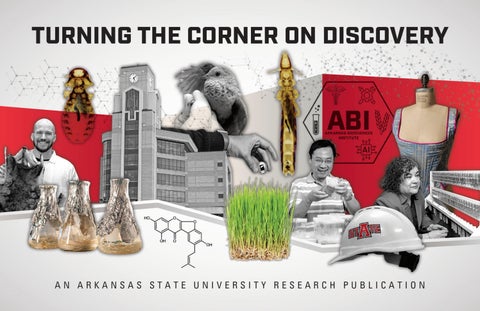
Turning the Corner on Discovery Research Publication

Page 1


THE RED WOLVES SPIRIT

Ph.D. Candidate in Gustafson Lab

RED WOLVES ALMOST WENT EXTINCT - IN THE 1980s, THERE WERE FEWER THAN 20 RED WOLVES LEFT IN THE WILD. BUT THROUGH INTENSIVE CONSERVATION EFFORTS, THEY ARE MAKING A COMEBACK. IT’S A REMINDER: NEVER COUNT A RED WOLF OUT.

THEY’RE SOUTHERN NATIVES, JUST LIKE A-STATE

Red Wolves are native to the southeastern U.S., and the only wolf species in the world that is exclusively from the USA. They were once common across the region but are now only found in small pockets where conservation efforts are focused.

RED WOLVES ARE TEAM PLAYERS

Unlike most predators, red wolves hunt in small family packs. It’s not just about survival it’s about loyalty. Sound familiar?

ARKANSAS CENTER FOR BIODIVERSITY COLLECTIONSTHE NATIONAL REPOSITORY FOR RED WOLF SPECIMENS

A-State has been recognized as the only location for permanent storage of all Red Wolf specimens by the U.S. Fish and Wildlife Service. As the national repository for pelts, skeletons, skulls and blood samples, A-State is a hub of research on this federal engangered species and a key location for the species recovery plan. Students and faculty conduct research on these physical samples and explore genetic diversity and hybridization with coyotes.

$10M BREAKTHROUGH IN A-STATE’S STEEL STORY

SIMULATING INDUSTRY, TRAINING THE FUTURE, THE CENTER’S CROWN JEWEL THIS STATE-OF-THE-ART STEEL MANUFACTURING SIMULATOR IS ONE OF ONLY A FEW IN NORTH AMERICA THANKS TO A FEDERAL INVESTMENT.

“We will help solve industry-related problems and provide invaluable opportunities to work side by side with professionals in the steel industry,” said Dr. Abhijit Bhattacharyya, inaugural dean of the College of Engineering & Computer Science.

“THE PROGRAMS WE ARE DEVELOPING WILL BE WORLD-CLASS JUST LIKE THE WORLD-CLASS STEEL MILLS IN OUR BACKYARD.”

HISTORICAL ARTISTRY

Claire Abernathy

NEW FRONTIERS FOR COSTUMES

Imagine mastering skills lost in time — 18th-century staymaking, block printing from India, vintage hat-making — all in five weeks in London! That’s exactly what Claire Abernathy did last fall...

INSTEAD OF OUTSOURCING

Professor Abrnathy is bringing these rare skills back to A-State, crafting theatrical costumes from concept to creation under one roof.

And the best part? She’s passing this rare research knowledge on to her students, giving them a leg up in the world of costume design.

TOBACCO THAT HEALS

Dr. Jianfeng (Jay) Xu

AT THE ARKANSAS BIOSCIENCES INSTITUTE, DR. JAY XU IS USING FAST-GROWING TOBACCO PLANT CELLS TO PRODUCE HUMAN PROTEINSFASTER, CHEAPER AND MORE RELIABLY THAN TRADITIONAL METHODS.

TURNING KILLER LEAF INTO LIFE SAVER...

By engineering human proteins in the cells with a natural process called GPI anchoring, his team boosts protein yield, stability, and quality crucial for making effective treatments like EPO, a drug for anemia.

Even more groundbreaking? This technique may pave the way for oral biologic medicines — swallowable treatments for chronic diseases like inflammatory bowel disease, eliminating needles, injections, and cold storage.

“We are reengineering plant cells to do what they’ve never done before - manufacturing sophisticated human proteins safely, consistently and affordably.”
— Dr. Jianfeng (Jay) Xu

SIMPLE TOOLS CAN LEAD TO THE BIG DISCOVERIES

INNOVATION AT GRANULAR LEVELS

In the greenhouse at the Arkansas Biosciences Institute, Dr. Argelia Lorence and her team are rethinking how we grow food starting with rice. Why rice? It’s a thirsty crop, and Arkansas is a major producer. By finding droughtresistant varieties, the team aims to support more sustainable farming.

To find solutions, they built a clever imaging system using Raspberry Pi computers and simple cameras tools you might find in a DIY kit. Unlike their fancy lab gear that only works on a small scale for small-potted plants, this setup can handle big plants like full-grown rice.

This summer, the system captured over 4,000 images of rice plants. These aren’t just photos — they’re data goldmines.

Funded by NIFA and partnering with Dr. Emily Bellis (Avalo, Durham, N.C.) and Dr. Suxing Liu (University of Arizona), the team is analyzing the images to identify rice varieties that best tolerate drought.

TURNING THE CORNER

LIKE NEVER BEFORE. FY24 R&D spending reached $10.95M, setting a new benchmark for research growth. With improved reporting methods, A-State showed an 602% increase in university-sourced research expenditures in fiscal year 2024 ($3.936M) when

878%

INCREASE IN UNIVERSITY-SUPPORTED RESEARCH

PROJECTS

UNIVERSITY FUNDING FOR RESEARCH PROJECTS:

[FY24] $68,310 [FY25] $668,289

Internal research investments jump dramatically in FY25, unlocking new opportunities for growth.

Record-Breaking! 58% GROWTH

Median value of external awards climbs significantly this year. Meaning growth from higher value awards provides more opportunities for growth.

MEDIAN VALUE OF EXTERNAL AWARDS [FY24] $95,000 [FY25] $150,000

EXTERNAL SPONSORED PROGRAM EXPENDITURES

(Including R&D, Public Service & Capital Improvement)

RESEARCH & DEVELOPMENT EXPENDITURES

EXTERNAL PROPOSALS SUBMITTED

ALL NEW GRANTS AWARDED

ACTIVE AWARDS

UNIQUE RESEARCH SPONSORS

$31.80M $10.95M 204 82 75 72

POWERFUL NEW TOOL UNLOCKS SECRETS

“This tool opens up collaborations across disciplines we couldn’t have imagined before,” says Dr. Drew Fleming

IMAGINE

BEING

ABLE TO SEE THE HIDDEN ARCHITECTURE OF THE WORLD AROUND YOU DOWN TO THE ATOMIC LEVEL

That’s exactly what researchers at Arkansas State University can now do, thanks to a game-changing new instrument — the XRD (X-Ray Difractometer).

Thanks to a $595,549 grant from the National Science Foundation (NSF), the A-State Arkansas Biosciences Institute now houses one of the most advanced X-ray analysis tools in the state. Think of this device as a powerful microscope that can see inside materials at the atomic level — something impossible with the naked eye or regular microscopes. When scientists shine special X-rays through different materials, the machine can detect how those rays bounce around

and create patterns that reveal the internal structure of whatever they are studying. It’s like having X-ray vision that shows not just bones, but the precise arrangement of atoms in any solid or liquid.

And here’s the kicker: it’s the only one in Arkansas with small-angle X-ray scattering (SAXS) capability, giving A-State a major edge in the region. This unique position helps the university attract top researchers, compete for major federal grants, and partner with local industries to drive innovation in the region.

ARKANSAS BIOSCIENCES

INSTITUTE: 22 YEARS OF IMPACT

ABI

ARKANSAS BIOSCIENCES INSTITUTE Where cutting-edge research meets real-world impact.

The A-State Arkansas Biosciences Institute is an 88,000-sq.-ft. hub of collaborative innovation for real-world impact across Arkansas and beyond.

CATALYST

INNOVATION CENTER

Innovation doesn’t always happen in gleaming glass towers or Silicon Valley basements. Sometimes, it starts at A-State’s Catalyst Innovation Center.

At the forefront of innovation, CATALYST is a dedicated incubator for life science and tech startups. Located on the first floor of A-State’s Arkansas Biosciences Institute, it offers 8,000+ square feet of specialized wet-lab and office space, along with advanced equipment and strategic support. CATALYST empowers entrepreneurs and researchers to transform breakthroughs into real-world impact, fueling progress across the region and beyond.

STARTUP SPOTLIGHT: IGNITING INNOVATION

Got an idea to change the world? Bring it to Catalyst. We have the resources to help turn your concept into reality.

ITCHING FOR A RIDE: UNSEEN TRAVELERS ACROSS THE CARIBBEAN

THE CARIBBEAN ISLANDS ARE HOME TO MANY UNIQUE SPECIES OF BIRDS. BUT, WHAT ABOUT THE TINY LICE LIVING ON BIRDS?

Paige Brewer, a master’s student working in the Sweet Lab at Arkansas State University, uncovered surprising stories in the relationship between Common Ground Doves, a species of bird that is widespread across the Caribbean islands and nearby mainland, and their parasites.

Using DNA from museum specimens and samples collected in the field, Brewer and Dr. Andrew Sweet discovered that the doves and their lice traveled different evolutionary paths. The doves likely started on the islands, whereas their lice came from the mainland.

Louse genetics also revealed bird movements between islands and the mainland that are not obvious from the bird

genetics alone, showing a hidden web of connections. Their work reveals the complex and surprising ways hosts and parasites evolve together across the Caribbean.

THE ROOTS OF HEALTHY AGING

Dr. Fabricio Medina-Bolívar

Dr. Medina-Bolívar showcased this breakthrough at the 24th Penn State Symposium in Plant Biology, highlighting Arkansas as a leader in plant-based medical innovation.

CAJASAN

Chronic inflammation drives many serious diseases and speeds up aging. At the Arkansas Biosciences Institute, Dr. Fabricio Medina-Bolívar is pioneering a new approach to combat it — using chemical compounds produced by plant roots.

His team uses biotechnology to grow pigeon pea roots that produce powerful anti-inflammatory compounds called isoflavonoids.

By stimulating the roots with special chemicals, they boosted production — discovering three new compounds, including one named cajasan, which showed strong inflammation-fighting effects.

This sustainable method can be scaled up, opening the door for new, natural therapies that support healthy aging and overall wellness.

From the Provost:

Arkansas State University is a public research university, and over the last two years we have been completely focused on faculty, staff, and student RECRUITMENT, RETENTION and RESEARCH. By focusing on these three ‘Rs’, we have put research growth at the center of everything we do. At A-State we use discovery and innovation to improve the lives of Arkansans.

Dr. Calvin White, Jr.

From the Vice Provost:

Our research is driven by one overarching question:

WHO DOES THIS HELP?

At Arkansas State University, we aim to improve lives, grow opportunity, and prepare for what’s next. With every project, our goal is simple — make tomorrow better than today.

ABOUT ARKANSAS STATE UNIVERSITY...

As the only research university serving Northeast Arkansas and the Arkansas Delta, Arkansas State Universtiy is rising in its research productivity. While our students, faculty, and staff make important discoveries and innovate, we ensure our products get to the community where they can be used. Learning is improved when students solve real-world problems, and A-State’s high research activity provides plenty of opportunity for educating students and making positive impact.

No. 1 in Arkansas

TOP 80 in the U.S.

Undergraduate Teaching

No. 399 out of 664 Research Ranking for Fiscal Year 2023

RANKINGS

No. 1 in Arkansas

TOP 120 Nationally

Social Mobility

No. 191 of more than 700

Among Public Research Institutions

No. 2 out of 34

Overall Ranking in Arkansas

No. 352 Best Overall National University

TURNING THE CORNER ON DISCOVERY

ARKANSAS STATE UNIVERSITY | A PUBLIC RESEARCH INSTITUTION

Turn static files into dynamic content formats.

Create a flipbook
Turning the Corner on Discovery Research Publication by Arkansas State University - Issuu