
2026 Create@State Program

Page 1


Welcome

Welcome to the 16th Annual Create@State Symposium of Research, Scholarship, and Creativity, and thank you for joining us on Thursday, April 16, 2026, for Arkansas State University’s premier celebration of student research and creative achievement.

Create@State brings together undergraduate and graduate students from every academic college to share their scholarly and creative work with the campus and community. From laboratory research and field studies to performances, business pitches, and creative works, this symposium highlights the depth and diversity of inquiry taking place across our university.
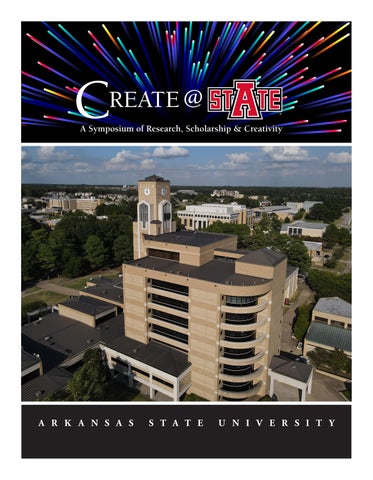
Since its launch in 2011, Create@State has served as a campus‑wide platform for connection, collaboration, and discovery. What began as a growing opportunity for students to present their work has become a cornerstone of Arkansas State University’s commitment to experiential learning and student success. Today, that legacy continues as more than 200 students participate in poster sessions, showcases, performances, and competitions throughout the Reng Student Union.

We are thrilled to welcome you to a vibrant day of scholarship and creativity. With a full schedule of presentations, an energetic showcase environment, and the support of faculty, staff, judges, and volunteers from across campus and the community, Create@State 2026 reflects the remarkable talent and dedication of our students.

I also invite you to continue the celebration by joining us for the Celebration of Research and Creativity and Awards Ceremony on Friday, April 17, 2026, where we will recognize outstanding student work and celebrate another exceptional year of innovation and discovery at A‑State.

Thank you for being part of Create@State and for supporting student research, scholarship, and creativity at Arkansas State University.

Dr. Kari Harris

Student Research and Scholarship Research and Technology Transfer Arkansas State University

Thank you to our esteemed advisory council members for helping to coordinate this year’s event!

2025-26 Student Research Advisory Council

Ravan Gaston, University Advancement

Dr. Randy “Hunter” Burnett, College of Agriculture

Shea Harris, Arkansas Biosciences Institute

Kelli Listenbee, Office of Assessment and Accreditation

Ryken Cocherell, Office of Assessment and Accreditation

Dr. Argelia Lorence, Beck College of Sciences and Mathematics

Dr. Tameka Bailey, Beck College of Sciences and Mathematics

Dr. John Hollander, Education and Behavioral Sciences

Dr. Drew Fleming, Engineering and Computer Science

Jagrithi “J” Chouhan, Graduate School

Dr. Carmen Williams, Honors College

Madelyn Carson, Honors College

Dr. Tim Crist, Liberal Arts and Communication

Dr. Rachel Boillot, Liberal Arts and Communication

Dr. Kristen Ruccio, Liberal Arts and Communication

Dr. Hilary Schloemer, Neil Griffin College of Business

Dr. Nanying “Sheldon” Lin, Neil Griffin College of Business

Dr. Amanda Carpenter, Nursing and Health Professions

Dr. Audrey Folsom, Nursing and Health Professions

Dr. Shaquita Renelique, University College

From Research and Technology Transfer:

Dr. Kari Harris, Director, Office of Student Research and Scholarship

Jennifer Salo, Coordinator of Competitive Scholarships and Fellowships

Luna Acosta, Director of Technology Transfer and Director, Catalyst Innovation Center

Molly Alexander-Steele, Executive Director for Research Development

Reng Student Union

1) 1909 Suite 2) Alumni Lounge 3) Auditorium 4) Centennial Hall

5) Spring River Room

6) Cache River Room

7) Diamond Lounge

8) Green Room

9) Vaughn Student Lounge 10) Mockingbird Room 11) St. Francis River Room 12) Pine Tree Room 13) Multicultural Center 14) White River Room 15) Black River Room

Arkansas River Room

April 16, 2026

Reng Student Union • Third Floor

– Registration & Badge Pick-up –

9 a.m. - 10 a.m. • Alumni Lounge

– Poster Presentations –Ice Cream Social

10 a.m. - 12 p.m. • Centennial Hall

– Showcase of Creativity –

10 a.m. - 12 p.m. • Spring River Room

– Pitches and Pitches –Performances and Business Pitch Competition

10 a.m. - 12 p.m. • Auditorium

– Networking Luncheon –Free for Registered Attendees

12 p.m. - 1:30 p.m. • Diamond Lounge & Mockingbird Room – 3MT –

3-Minute Thesis Competition

1:30 p.m. - 3 p.m. • Auditorium

April 17, 2026

– Awards Ceremony and Celebration –Woodard McAlister Family Club • Centennial Bank Stadium

3:00 p.m. – 3:30 PM • Merriment

3:30 p.m. • Award Announcements

4:00 p.m. • Group Photo

Pitches & Pitches

Creative Performances and Business Pitch Competition

Schedule

Welcome .......................................... Introduction and Judge Recognition

Business Pitch Competition ............. Elite 8

Creative Performance ....................... VGO’s Selections from Stardew Valley

Round 2 Pitches ............................... Final 4

Invitation to awards Ceremony

Creative Performance ....................... Trumpet Trio

Championship Pitches ..................... 2 pitches with Judge Q&A

Creative Performance ....................... Large Trumpet Ensemble

Conclusion ...................................... Announcement of Winners and closing remarks

Elite 8 Pitches

Student Pitch

Anne-Lea Lavoie .............................. Bfly

William Osborn ............................... Student Convenience

Colin Hooton .................................. Landr- Land your Job

Nishan Gurung ................................ Mutu Foundation

Lucas Walling .................................. The Sugar Shack

Emilia Guadalupe Gomez Lopez ...... Arrival Hub: International Student Onboarding Platform

Melody Callejas ............................... Night Care Urgent Care

MaKayla Collum ............................. Venture Vents

Showcase Presenters

Altenbaumer, Ethan

Co-Presenter: Caden Grimmett

Category: Creative Work

Title: Photovoltaic-augmented additive manufacturing

Faculty Mentor: Rajesh Sharma

Briones, Emily

Category: Creative Work

Title: Seamless Patterns and 3D Bugs

Faculty Mentor: Leslie Parker

Bryan, Erin

Category: Creative Work

Title: Pop Art’s Influences on 1960s Mod Fashion

Faculty Mentor: Caitlan Smith

Howze, Simone

Category: Creative Work

Title: Retail with Purpose: Cultural Merchandising at the IAAM Boutique

Faculty Mentor: Melissa Thompson

Kenzik, Zane

Co-Presenters: Mason Kibble, Logan Hayungs

Category: Creative Work

Title: Trumpet Trio

Faculty Mentor: Nairam Simoes

Mantz, Victoria

Category: Creative Work

Title: Forged Like A Fairy

Faculty Mentor: Leslie Parker

Minick, Kayla

Co-Presenters: Jacob King

Category: Creative Work

Title: Through the Lense of the Camera Obscura

Faculty Mentor: Caitlan Smith

Pierce, Sabrina

Co-Presenter: Cate Ford

Category: Creative Work

Title: The Agency at A-State

Faculty Mentor: Rachel Freeze

Sykes, Calem

Co-Presenters: Heather Scudder, Abby Willison, Ashlyn Kratz, Rylan Kinncanon, Colton Grigsby, Kayla Young, Ethan Campagna, Marco Aguilar, Nik Newell

Category: Creative Work

Title: Outdoor Concert: VGO’s Selections from Stardew Valley

Faculty Mentor: Tim Crist

Vanpelt, Sharline

Category: Creative Work

Title: ExtraOrdinarily Exquisite

Faculty Mentor: Lydia Dildilian

Vines, Emily

Category: Basic or Experimental Research

Title: Where Words Fade, Art Speaks: Arts on Prescription for Dementia Care

Faculty Mentor: Susan Whiteland

Marquez-Mejia, Carlos

Co-Presenters: Audrey Alpha, Logan Hayungs, Mason Kibble, Zane

Kenzik, Connor Moore, Allison Patsey, Matthew Dawes, Hayden Brinkley, Timothy Miles, Sarah Hanks, Nathan Cooper, Zachary Woodward, and Lane Evans

Category: Creative Work

Title: A-State Trumpet Ensemble

Faculty Mentor: Nairam Simoes

Abdel-Karim, Salma #22

Poster Presentations

Category: Basic or Experimental Research

Title: Anti-Inflammatory Activity of Isoflavones from Pigeon

Pea Hairy Root Cultures in RAW 264.7 Macrophages

Faculty Mentor: Fabricio Medina-Bolivar

Abid, Ahesanul #137

Category: Observational, Descriptive, or Cross-Sectional Research

Title: Which AI for What? An AI Value Index for Small Business Adoption

Faculty Mentor: Pankaj Nagpal

Aftab, Md Reduan #71

Category: Basic or Experimental Research

Title: Enhancing Concrete Sustainability: A Circular Economy Approach Using CO₂ Curing

Faculty Mentor: Zahid Hossain

Ahmed, Ifaz #159

Category: Quality Assessment or Quality Improvement

Title: Developing A Framework for Efficient Scheduling of Operations of Steel Production

Faculty Mentor: Alexandr Sokolov

Andrews, Allyssa #135

Category: Observational, Descriptive, or Cross-Sectional Research

Title: Recruitment of African Americans to Teach Agricultural Education: A Systematic Literature Review

Faculty Mentor: Nina Crutchfield

Archer, Ian #168

Category: Quality Assessment or Quality Improvement

Title: Overview of Steel Research and Testing in the United States

Faculty Mentor: Rajesh Sharma

Armstrong, Jadus #105

Category: Decline to participate in judging

Title: The Economic Impact of AI Adoption in Precision Agriculture

Faculty Mentor: GwanSeon Kim

Aweis, Ashlei #111

Co-Presenters: Cambria Grissom, Faith Welch

Category: Observational, Descriptive, or Cross-Sectional Research

Title: Effective Non-Pharmaceutical Interventions for Reducing Negative Behaviors of Older Adults with Alzheimer’s Disease: A scoping review

Faculty Mentor: Christine Wright

Balmaceda Cuenca, Carlos #51

Co-Presenters: Megha Goyal, Anubhav Pal

Category: Basic or Experimental Research

Title: Producing Oral Medicines in Lettuce to Fight Chronic Diseases

Faculty Mentor: Jianfeng Xu

Bamunusingha, Mahesh #6

Category: Basic or Experimental Research

Title: Soil Type Dominates Rhizosphere Microbiome Structure, Revealing Core and Specific Bacterial Taxa in Soybean

Faculty Mentor: Asela Wijeratne

Batchelor, Tiffany #37

Category: Basic or Experimental Research

Title: Purr-spectives: Connections Between Feline Coat Color and Human Preferences and Perceptions in Northeast Arkansas

Faculty Mentor: Jerica J. J. Rich

Bautista, Mauricio #58

Co-Presenters: Jesus Cortes, Christian Lopez, Josh Sutton, Will Owens, Michael Saunders, Jayden Pace, Sebastian Klein, Hugo Robles, Zane Coletta, Seth Matocha

Category: Basic or Experimental Research

Title: Development of a Liquid Propellant Rocket Engine with Integrated Water-Based Cooling Jacket

Faculty Mentor: Kwangkook Jeong

Bennett, Brandon #92

Category: Basic or Experimental Research

Title: Effects of Exercise Intensity and Body Mass Index on Reaction Time in Physically Active Adults

Faculty Mentor: Veronika Scudamore

Bess, Sarah #60

Co-Presenters: Autumn Goforth, Maranda Jones

Category: Basic or Experimental Research

Title: Relationship Attitudes and Media Faculty Mentor: Karen Yanowitz

Beyer, Moriah #23 *

Co-Presenters: Haydyn Friend

Category: Basic or Experimental Research

Title: Establishment of hairy root cultures of Glycyrrhiza lepidota for enhanced production of bioactive metabolites

Faculty Mentor: Fabricio Medina-Bolivar

Bhattarai, Sonu #108

Category: Observational, Descriptive, or Cross-Sectional Research

Title: Soybean Transcription Factor Network in Response to Phytophthora sojae

Faculty Mentor: Asela Wijeratne

Bhattarai, Saroj #45

Category: Basic or Experimental Research

Title: Rice Production Suitability Assessment Across Arkansas, Louisiana, Missouri, and Mississippi Using pH, Drainage, Hydric Rating, and Land Cover Data

Faculty Mentor: John Nowlin

Bishop, Morgan #99

Category: Creative Work

Title: One Wardrobe, Endless Possibilities: A Visual Merchandising Strategy for Uniqlo Menswear

Faculty Mentor: Melissa Thompson

Blickenstaff, Anna #170

Co-Presenters: Hanna Hollenberg, Katlin Daniel

Category: Quality Assessment or Quality Improvement

Title: Impact of Evidence-Based Education on the Effects of Excessive Screen Time Among SRNAs

Faculty Mentor: Virginia Baltz

Castegnaro Angeles, Chiara Giovanna #7

Co-Presenters: Emilia Gomez Lopez

Category: Basic or Experimental Research

Title: Comparative Analysis of Sanger and Oxford Nanopore

Sequencing for 16S rRNA-Based Bacterial Identification

Faculty Mentor: Asela Wijeratne

Chaudhary, Ravi #1

Co-Presenters: Reinier Gesto-Borroto, Bishnu Joshi, Alexander Flores

Category: Basic or Experimental Research

Title: Plant and Root Phenotyping at the Arkansas Biosciences

Institute Using Low-Cost Imaging Approaches

Faculty Mentor: Argelia Lorence

Choi, Sooyeong #115

Category: Observational, Descriptive, or Cross-Sectional Research

Title: Understanding Demographic and Market Drivers of Rice Spending in the U.S.

Faculty Mentor: Gwanseon Kim

Chowdhury, Siam #132 *

Category: Observational, Descriptive, or Cross-Sectional Research

Title: In Silico Structure-Based Computational Studies of Novel Compounds Involving Advanced Binding Affinity Prediction and Protein Target Site Characterization.

Faculty Mentor: Mohammad Abrar Alam

Clardy, Canyon #15

Category: Basic or Experimental Research

Title: Negative Index Materials Within A Relativistic Framework

Faculty Mentor: Cheyenne Sheppard

Clark, Dorise #110

Category: Observational, Descriptive, or Cross-Sectional Research

Title: The Rate of Burnout in Athletic Trainers’ in Collegiate Settings

Faculty Mentor: Carlitta Moore

Coleman, Bryan #171

Co-Presenter: Joseph Capucetti

Category: Quality Assessment or Quality Improvement

Title: Enhancing Clinical Knowledge Retention Through Education on the Anki Flashcard System

Faculty Mentor: Virginia Baltz

Cook, Joshua #172

Co-Presenters: Jared Barker, Andrew Shipp

Category: Quality Assessment or Quality Improvement

Title: Virtual Reality for Anxiety Relief in Pre-operative Patients

Faculty Mentor: Virginia Baltz

* Beck Scholar -Beck College of Sciences and Mathematics

Covington, Karson #91

Poster Presentations Continued

Category: Basic or Experimental Research

Title: Soil and water conservation practices influence on water quality and methane flux in Northeast Arkansas rice and soybean fields.

Faculty Mentor: Tina Teague

Cox, Christopher #165

Co-Presenters: Jillian Scott, Colter Hinchey

Category: Quality Assessment or Quality Improvement

Title: Education on Medications Effective in Treating Acute

Migraine Related to General Anesthesia

Faculty Mentor: Lee Hammon

Crosskno, Quinn #109

Co-Presenters: Ben Smith, Ty Pinkus, Gage Rolwing

Category: Observational, Descriptive, or Cross-Sectional Research

Title: Shoulder Instability in Rugby Athletes

Faculty Mentor: Brendon Aitken

Crowell, Alaina #90

Category: Basic or Experimental Research

Title: Musculoskeltal Conditions- Erdheim-Chester Disease and More

Faculty Mentor: Tyler Hester

Das, Arpan #167

Category: Quality Assessment or Quality Improvement

Title: Rheological Performance Characterization of High-RAP

Asphalt Binder Modified with Bio-Based and PetroleumDerived Rejuvenating Additives

Faculty Mentor: Zahid Hossain

Davis, Cali #67

Category: Basic or Experimental Research

Title: Hungry for Plastic: Dietary Conditioning of Waxworms to Enhance Plastic Biodegradation

Faculty Mentor: Maureen Dolan

Dulaney, Mitchell #31

Category: Basic or Experimental Research

Title: Robust Thermodynamic Analysis of Flexible ProteinLigand Binding Using a Statistical Mechanics Framework

Faculty Mentor: Hideya Koizumi

Dunlap, Zachary #150

Co-Presenters: Landon Valden, Haden Yancey

Category: Observational, Descriptive, or Cross-Sectional Research

Title: Hippotherapy Treatment for Cerebrovascular Accidents

Faculty Mentor: Rachel Wilkins

Dunn, Mekayla #40

Category: Basic or Experimental Research

Title: Cerebral Cavernous Malformations

Faculty Mentor: Jessica Cooper

Easley, Zachary #121

Category: Observational, Descriptive, or Cross-Sectional Research

Title: Upright Gantry-less Proton Treatment for Head/Neck and Brain Malignacies

Faculty Mentor: Jody Nutt

Eckert, Riley #41

Co-Presenter: Stephanie Flores

Category: Basic or Experimental Research

Title: Detecting Child Abuse in Radiology

Faculty Mentor: Jessica Cooper

Edrington, Abbey #112

Co-Presenters: Shelby Russellpy, Adrianna McEntire, Tianna Matthews

Category: Observational, Descriptive, or Cross-Sectional Research

Title: The Benefits of Nature-Based Therapy for Children with Autism Spectrum Disorder: A Scoping Review

Faculty Mentor: Christine Wright

Edwards, Olivia #59

Category: Basic or Experimental Research

Title: Prioritizing Health Over Aesthetics: Reforming Brachycephalic Breed Standards

Faculty Mentor: Kristen Wallis

Ehie, Damien #78

Category: Basic or Experimental Research

Title: Ethnic and Cultural Amalgamation in Buenos Aires and the Evolution of Argentine Tango

Faculty Mentor: Nicholas Balla

Eldridge, Matti #139

Co-Presenters: Cailin Jones, Frances Harness, Leah Edmaiston

Category: Observational, Descriptive, or Cross-Sectional Research

Title: Read, Write, Pair, Share-Tag Edition!

Faculty Mentor: Ryan Kelly

Fiedor, Taylor #127

Category: Observational, Descriptive, or Cross-Sectional Research

Title: Getting there is everything: Dispersal limitation overrides environmental filtering in freshwater snails

Faculty Mentor: Kyle Gustafson

Flores Ortiz, Daniela #52

Category: Basic or Experimental Research

Title: Production of Strategically Designed Nerve Growth Factor molecule in Tobacco Plants and BY-2 cells

Faculty Mentor: Jianfeng Xu

Foster, Trinity #138

Co-Presenters: Brette Shannon, Elizabeth Gee-Weiler

Category: Observational, Descriptive, or Cross-Sectional Research

Title: Building Prefix Knowledge in First Grade Through the “Prefix-O” Vocabulary Game

Faculty Mentor: Ryan Kelley

Frans, Lauren #173

Co-Presenters: Darcee Halbrook, Hannah Tadlock

Category: Quality Assessment or Quality Improvement

Title: Educating Anesthesia Providers on Evidence-Based Interventions to Prevent Postoperative Delirium in the Geriatric Population

Faculty Mentor: Virginia Baltz

Friend, Haydyn #24

Co-Presenter: Moriah Beyer

Category: Basic or Experimental Research

Title: Induction of hairy root cultures of Lespedeza capitata as a platform for phytochemical production

Faculty Mentor: Fabricio Medina- Bolivar

Gambaro, Maria #53

Category: Basic or Experimental Research

Title: Transgenic Plant Cells for the Cost-Effective Production of Pharmaceutical Proteins

Faculty Mentor: Jiafeng Xu

Garcia Valdez, Anahi #3

Co-Presenter: Diego Martines

Category: Basic or Experimental Research

Title: Variation in Infection Prevalence of Splendidofilaria pectoralis Across Alaskan Grouse Populations

Faculty Mentor: Andrew Sweet

Ghimire, Muskan #79

Category: Basic or Experimental Research

Title: Potential of Biochar to Improve the Physical Properties and Moisture Characteristics in Sandy and Loamy Soil of Northeast Arkansas

Faculty Mentor: Nelson (Ray) Benson

Gibbons, Rachel #174

Co-Presenters: Wesley Johnson, Rachel Cartillar

Category: Quality Assessment or Quality Improvement

Title: Enhancing Anesthesia Practice by Evaluating the Impact of Evidence-Based Education on the Utilization of Preoperative Gastric Ultrasound for Patients on GLP-1 Agonists

Faculty Mentor: Virginia Baltz

Gilbert, Oscar #82

Co-Presenter: Tianxiang Chu

Category: Basic or Experimental Research

Title: How Rational Is AI Investment Advice? Risk-Return Relevance in Artificial Intelligence (AI) Investments

Faculty Mentor: Nanying Lin

Gipson, Michael #44

Category: Basic or Experimental Research

Title: Laser ablation-atomic absorption spectroscopy of yttrium plasma

Faculty Mentor: Jonathan Merten

Glasgow, Julie #140

Co-Presenters: Raegan Long, Sara Ford

Category: Observational, Descriptive, or Cross-Sectional Research

Title: Text Impressions

Faculty Mentor: Ryan Kelly

Goyal, Megha #54

Co-Presenter: Anubhav Pal

Category: Basic or Experimental Research

Title: Genetic Engineering of Lettuce for Therapeutic Protein

Production

Faculty Mentor: Jianfeng Xu

Graham, Karli #141

Poster Presentations Continued

Co-Presenters: Madelyn Herndon, Katelynn Tedder, London King

Category: Observational, Descriptive, or Cross-Sectional Research

Title: Teaching Writing with Story Elements

Faculty Mentor: Ryan Kelly

Grigg, Anna #16

Co-Presenters: Kaitlyn Peavy, Katelyn Childers, Morgan Mahan

Category: Basic or Experimental Research

Title: Effective Handwriting Interventions in School-Aged Children: A Scoping Review

Faculty Mentor: Christine Wright

Griggs, John #38

Co-Presenter: Noah Chapman

Category: Basic or Experimental Research

Title: Synthesizing Fluorescent 3,4-dihydropyrimidin-2(1H)ones Using a One-Pot Synthesis Reaction

Faculty Mentor: John Hershberger

Gschwandeegger, Franz #33

Category: Basic or Experimental Research

Title: Output-Unemployment Relationship in Arkansas: A New Test

Faculty Mentor: Huiqiang Wang

Hameedi, Zoha #149

Co-Presenters: Scarlett Saitta, Jade Steins, Carson Craft

Category: Observational, Descriptive, or Cross-Sectional Research

Title: From Touch to Data: Quantifying Palpatory Skill in Osteopathic Manipulative Medicine (OMM) Using Finger Tactile Pressure Sensing (FTPS)

Faculty Mentor: Rajendram Rajnarayanan

Hartness, Haley #120

Co-Presenters: Patrick McNicholas, Charlotte Howard, Zachary Vondran, Joseph Hargrave

Category: Observational, Descriptive, or Cross-Sectional Research

Title: An Examination of State Departments of Education

Special Education Assessment Guidelines for Autism Spectrum Disorder

Faculty Mentor: John Hall

Harvey, Kyle #8

Co-Presenter: Mahesh Bamunusingha

Category: Basic or Experimental Research

Title: Phosphate Solubility of Soybean Rhizosphere Bacteria Cultures

Faculty Mentor: Asela Wijeratne

Henderson, Keyonna #46

Category: Basic or Experimental Research

Title: Radiation Beyond the Beam: Understanding the Abscopal Effect in Modern Radiation Therapy

Faculty Mentor: Jody Nutt

Hennings, Laura #35

Category: Basic or Experimental Research

Title: A Cord of Three Strands is not Quickly Broken: The Fortitude of Arkansas Women’s Activism

Faculty Mentor: Justin Castro

Henry, Anissa #151

Co-Presenters: Macy McCormic, Sydney Guthrie, Adam Oas

Category: Observational, Descriptive, or Cross-Sectional Research

Title: Effects of Hippotherapy on Hypotonic Disorders in the Pediatric Population

Faculty Mentor: Rachel Wilkins

Hime, Makiah #142

Co-Presenters: Haley Nash, Daveena Gunn

Category: Observational, Descriptive, or Cross-Sectional Research

Title: From Scribbles to Scholars: Mastering Vocabulary with Four Squares

Faculty Mentor: Ryan Kelly

Hines, Angelina #47

Category: Basic or Experimental Research

Title: Avatar and Promise: Anesthesia Alternatives for Pediatrics in Radiation

Faculty Mentor: Jody Nutt

Hissong, Sara #154

Co-Presenter: Marissa Brown

Category: Observational, Descriptive, or Cross-Sectional Research

Title: Construct Validity of the Global Well-being Index to identify mental health issues in military veterans

Faculty Mentor: Scott Bruce

Holloway, Matthew #88

Category: Basic or Experimental Research

Title: The Language of Crisis: How Data Breaches Affect Sentiment in MD&A Disclosures

Faculty Mentor: Steven Muzatko

Horne, Jamie #122

Category: Observational, Descriptive, or Cross-Sectional Research

Title: Radiation Therapy for Chronic Plantar Fasciitis: A Clinical Case Study

Faculty Mentor: Jody Nutt

Houston, jaymeson #101

Co-Presenters: Alexis Billings, Macy Lamb

Category: Creative Work

Title: Narrative writing Faculty Mentor: Ryan Kelly

Huffer, Cassie #175

Co-Presenters: Hannah Jessup, Catherine Gaschen

Category: Quality Assessment or Quality Improvement

Title: SRNA Wellness Recognition and Improvement through Evidence-Based Education: A Quality Improvement Project

Faculty Mentor: Virginia Baltz

Huffmaster, Elizabeth #161

Category: Quality Assessment or Quality Improvement

Title: From Sequence to Skill: Building Argumentative Writers Through Structured Inquiry

Faculty Mentor: Dixie Keyes

Jarrett, Andrew #13

Co-Presenters: Sapun Sunar, Kambree Jackson

Category: Basic or Experimental Research

Title: Ultraviolet Absorption Studies of Fe in a LIBS Plasma Using Tunable Picosecond and Nanosecond Lasers

Faculty Mentor: Jeffery Johnson

Jeevan, Mishka #68

Category: Basic or Experimental Research

Title: Enzyme-Based Strategies for Plastic Waste: Investigating Polyphenol Oxidases in Galleria mellonella Saliva

Faculty Mentor: Maureen Dolan

Jeevan, Mishka #9

Co-Presenter: Daniela Flores

Category: Basic or Experimental Research

Title: Identifying Beneficial Rhizosphere Microbial Communities to Protect Soybeans from Sudden Death Syndrome

Faculty Mentor: Asela Wijeratne

Jeon, Seungho #87

Category: Basic or Experimental Research

Title: Future = AI + Database: A Structured Framework for AI in Education

Faculty Mentor: H. Steve Leslie

Johnson, Kyle #20

Category: Basic or Experimental Research

Title: An Investigation into Relish Activation as a Temporal Switch in Neurodegeneration

Faculty Mentor: Edward Schmid

Jones, Lauren #162

Category: Quality Assessment or Quality Improvement

Title: Designing for Engagement: A Pedagogical Critique of a Scaffolded Experiential Learning Simulation

Faculty Mentor: Dixie Keyes

Jones, Maranda #61

Co-Presenters: Sarah Bess, Autumn Goforth

Category: Basic or Experimental Research

Title: Teacher based evaluation of BRIDGE partnership program

Faculty Mentor: Karen Yanowitz

Jones, Emma #143

Co-Presenters: Madison Jackson, Kallie Costner

Category: Observational, Descriptive, or Cross-Sectional Research

Title: Producing Predications

Faculty Mentor: Ryan Kelly

Jones, Akira #155

Co-Presenters: Zaneta Weldon

Category: Observational, Descriptive, or Cross-Sectional Research

Title: Athletic Training and Sudden Death in Secondary School Athletes

Faculty Mentor: Scott Bruce

Jones, Graysen #63

Category: Basic or Experimental Research

Title: Inhibitory Effects of Novel Compounds on Biofilm

Formation in Streptococcus mutans

Faculty Mentor: Mohammad Abrar Alam

Jordan, Halie #129

Category: Observational, Descriptive, or Cross-Sectional Research

Title: Intraoperative MRI

Faculty Mentor: Kendall Youngman

Joshi, Bishnu #2

Poster Presentations Continued

Co-Presenters: Reinier Gesto-Borroto, Alexander Flores, Tatyana Herrien, Merone Kebede, Ali Abdel-Karim, Ravi Chaudhary

Category: Basic or Experimental Research

Title: Integrated computational biology with Raspberry Pi–based high-throughput phenotyping to identify putative drought-tolerant rice landraces

Faculty Mentor: Argelia Lorence

Judy, Katherine #126

Category: Observational, Descriptive, or Cross-Sectional Research

Title: Differences in Medical Care as Experienced by Arkansas State University Students Abstract

Faculty Mentor: Katharine Camden

Jung, Yeojin #18

Co-Presenter: Yejeong Youn

Category: Basic or Experimental Research

Title: Machine Learning-Based Prioritization of Antibiotic Susceptibility Testing Using Whole-Genome Data

Faculty Mentor: Donghoon Kim

Kafle, Kamana #136

Category: Observational, Descriptive, or Cross-Sectional Research

Title: Who will grow our food in the future? Factors Influencing A-State Agricultural Student’s Intentions to Enter Production Agriculture

Faculty Mentor: Nina Crutchfield

Kafle, Kamana #17

Category: Basic or Experimental Research

Title: Is Arkansas Rice Waste a Liability or a Solar-Storable Fuel? Direct Solar-Powered Hydrothermal Treatment for Biomethane Recovery

Faculty Mentor: Chiqian Zhang

Karim, Saydul #25

Co-Presenters: Moriah Beyer, Carrie Cox

Category: Basic or Experimental Research

Title: Soybean (Glycine max) hairy root cultures for the enhancement of anti-inflammatory and antioxidant isoflavonoid production

Faculty Mentor: Fabricio Medina- Bolivar

Karmoker, Jarna #28

Co-Presenters: Rutu Mahajan

Category: Basic or Experimental Research

Title: CAP1 mediates the cAMP regulation of adhesion and proliferation of Schwann cell in the peripheral nervous system

Faculty Mentor: Guolei Zhou

Kasireddy, Sravya #134

Category: Observational, Descriptive, or Cross-Sectional Research

Title: Can Eye-Tracking Predict Survey Choices? The case of Financial Risk Tolerance

Faculty Mentor: Farhad Moeeni

Kaur, Simranjit #94

Category: Basic or Experimental Research

Title: Vibrations of Tapered Beams via the Exterior Matrix Method

Faculty Mentor: William Paulsen

Kellar, Katelin #55

Co-Presenter: Shekoofe Sadravi

Category: Basic or Experimental Research

Title: Establishing Inducible Expression Platforms for Controlled Recombinant Protein Production in BY-2 Suspension Cells

Faculty Mentor: Jianfeng Xu

Kendall, Anna #14

Category: Basic or Experimental Research

Title: The Digital Museum: Classical Reception in Animal Crossing New Horizons

Faculty Mentor: Caitlan Smith

King, Kalayna #84

Category: Basic or Experimental Research

Title: Comparison of Levels of BMI, Stress, and Depression of Women During the Prenatal Period Relative to Their Activity Levels

Faculty Mentor: Ronald Johnson

Lakshika KK, Sachini #10

Category: Basic or Experimental Research

Title: Understanding the Role of DNA Demethylases in Epigenetic Regulation of Soybean Defense

Faculty Mentor: Asela Wijeratne

Lamb, Maddyson #113

Co-Presenters: Sarah Campbell-Morgan, Shelton Jones

Category: Observational, Descriptive, or Cross-Sectional Research

Title: Current Forensic Occupational Therapy Practice: A Scoping Review

Faculty Mentor: Christine Wright

Leddy, Kaylee #64

Category: Basic or Experimental Research

Title: Synthesis and Evaluation of Thiazole Derivatives as Potential Antitumor Agents

Faculty Mentor: Mohammad Abrar Alam

Lee, June #56

Co-Presenter: Shekoofe Sadravi

Category: Basic or Experimental Research

Title: Engineering High-Activity Endogenous Promoters in Tobacco BY-2 Cells for Enhanced Recombinant Protein Production

Faculty Mentor: Jianfeng Xu

Leslie, Anna #144

Co-Presenters: Allison McCanless, Emily Wigginton

Category: Observational, Descriptive, or Cross-Sectional Research

Title: Advancing Vocabulary Skills By Making Word Connections

Faculty Mentor: Ryan Kelly

Long, Emily #152

Co-Presenters: Anna Claire Harris, Macey Lindsey, Jayna Harris, Faith Ochoa

Category: Observational, Descriptive, or Cross-Sectional Research

Title: Treatment for Children with Hypertonicity using Hippotherapy: A Scoping Review

Faculty Mentor: Rachel Wilkins

Maguire, Carli #89

Category: Basic or Experimental Research

Title: Assessment of Total Cellular Protein Following Fatty Acid Treatment Using the BCA Assay

Faculty Mentor: Tameka Bailey

Mallapuram, Supraja #81

Category: Basic or Experimental Research

Title: Investigating Sertraline-Mediated Modulation of Mitochondrial Succinate Dehydrogenase to Sensitize Glioblastoma Cells to Temozolomide

Faculty Mentor: Natarajan Ganesan

ManiMegla, Fnu #32

Category: Basic or Experimental Research

Title: Impact of Green Supply Chain Management on Business Growth: A systematic Literature Review

Faculty Mentor: Huiling Liu

Mcclain, Emily #145

Co-Presenters: Emmi Walton, Ava Mosier, Caroline Crowe

Category: Observational, Descriptive, or Cross-Sectional Research

Title: Structured Brainstorming for Effective Writing

Faculty Mentor: Ryan Kelly

Meadows, Aaron #48

Category: Basic or Experimental Research

Title: Carbon-Ion Radiotherapy: The Future of Cancer Treatment?

Faculty Mentor: Jody Nutt

Memon, Shahjahan Jabbar #76

Category: Basic or Experimental Research

Title: How Star Rating Distribution Influences Consumer Shopping in E-Commerce

Faculty Mentor: Farhad Moeeni

Mim, Shamsia Jannat #36

Category: Basic or Experimental Research

Title: Characterization of Inflammatory Mediators and Pituitary Adenylate Cyclase-Activating Polypeptide (PACAP)Induced Mouse Models of Migraine

Faculty Mentor: Jennifer Yanhua Xie

Mondragon, Malena #164

Category: Quality Assessment or Quality Improvement

Title: Assessing Water Quality and Trace Gas Flux in Agricultural Irrigation Reservoirs

Faculty Mentor: John Nowlin

Morris, Sam #103

Co-Presenters: Caden Grimmett, Ethan Altenbaumer

Category: Creative Work

Title: Cast in Steel: Horseman’s Axe

Faculty Mentor: Tim Arquitt

Morris, Kolton #85

Category: Basic or Experimental Research

Title: Reducing Friction and Power Consumption in Slider Bed Conveyor Systems

Faculty Mentor: Robert Fleming

Mullins, Johnathon #117

Poster Presentations Continued

Category: Observational, Descriptive, or Cross-Sectional Research

Title: Veteran Representation and Veteran Policy in U.S. State Legislatures

Faculty Mentor: Hans Hacker

Mullins, Johnathon #30

Category: Basic or Experimental Research

Title: Modeling Legislative Attrition Using a Lotka–Volterra Framework

Faculty Mentor: Hans Hacker

Murray, Austin #133

Category: Observational, Descriptive, or Cross-Sectional Research

Title: An Exploratory Analysis of Household Liquidity

Faculty Mentor: Matthew Hill

Musselwhite, Parker #176

Co-Presenters: Jebin Samuel, An Ly

Category: Quality Assessment or Quality Improvement

Title: Evidenced-Based Education on the Benefits of Video Laryngoscopy (VL) in Routine Intubations for Anesthesia Providers

Faculty Mentor: Virginia Baltz

Oishi, MayidaKhan #4

Category: Basic or Experimental Research

Title: Mitochondrial Genome

Faculty Mentor: Andrew Sweet

Orr, Andrew #97

Co-Presenters: Logan Smith, Grace Wiley

Category: Creative Work

Title: The Student Steel Bridge Competition

Faculty Mentor: Jason Stewart

Patterson, Tatum #130

Category: Observational, Descriptive, or Cross-Sectional Research

Title: Accurate Indications of Patient Prognosis with Risk of Cardiovascular Events with MRI

Faculty Mentor: Kendall Youngman

Paudel, Agrani #65

Category: Basic or Experimental Research

Title: Characterization of Novel Compounds for Breast Cancer Treatment

Faculty Mentor: Mohammad Abrar Alam

Pearson, Fletcher #72

Category: Basic or Experimental Research

Title: Lifecycle Analysis of Rice Husk Ash (RHA) as a Green Alternative for Stabilizing Weak Foundation Soils

Faculty Mentor: Zahid Hossain

Phillips, Breanne #166

Co-Presenters: Brayton Ragsdale, Griffin McCowan

Category: Quality Assessment or Quality Improvement

Title: The Use of Intraoperative Lidocaine to Decrease the Incidence of Postoperative Pain in Surgical Patients: A Pre- and Post-Education Analysis

Faculty Mentor: Lee Hammon

Pirani, Cara #66

Category: Basic or Experimental Research

Title: Functional Genomics of Streptococcus mutans: Identifying Critical Genes for Oral Biofilm Formation

Faculty Mentor: Mohammad Abrar Alam

Pitts, Rayleigh #123

Category: Observational, Descriptive, or Cross-Sectional Research

Title: Diffuse Midline Glioma in a Pediatric Patient: A Case Study Within Clinical Trial ACNS1821

Faculty Mentor: Jody Nutt

Poff, Hallie #114

Co-Presenters: Virginia Smith, Alex Theisen

Category: Observational, Descriptive, or Cross-Sectional Research

Title: Impact of Home-Based Sensory Interventions for Children with Autism: A Scoping Review

Faculty Mentor: Christine Wright

Powell, Macey #62

Co-Presenter: Abby McIver

Category: Basic or Experimental Research

Title: Effects of Ranavirus on the Immune System of by Leucocyte Compassion

Faculty Mentor: Lorin NeumanLee

Preston, Carson #19

Category: Basic or Experimental Research

Title: Blueprints of Literacy: The Evolution of Arkansas’s Sixth Grade English Language Arts Standards Across Four Cycles

Faculty Mentor: Dixie Keyes

Prince, Janarie #107

Category: Observational, Descriptive, or Cross-Sectional Research

Title: Distrust in Law Enforcement Among Black College Students at PWIs

Faculty Mentor: Angelo Brown

Pye, Julia #57

Co-Presenter: Taylor Fiedor

Category: Basic or Experimental Research

Title: The Spatial Ecology of Coccidia in Arkansas Freshwater Snails

Faculty Mentor: Kyle Gustafson

Rahman, Naim-Ur #73

Co-Presenter: Arpan Das

Category: Basic or Experimental Research

Title: Utilization of steel slag as cementitious material in concrete: improving early strength and sustainability

Faculty Mentor: Zahid Hossain

Rajbhandari, Prasanna #86

Category: Basic or Experimental Research

Title: The Convergence of Big Data and Artificial Intelligence (AI): Graph and Language Based Methods for Business Intelligence (BI)

Faculty Mentor: Richard Segall

Ranjitkar, Shiwani #118

Category: Observational, Descriptive, or Cross-Sectional Research

Title: Mental Health in Healthcare Workers: Is it just a myth or a fact, considering the abundant access to health care.

Faculty Mentor: James McGinnis

Rathod, Jerusha #119

Category: Observational, Descriptive, or Cross-Sectional Research

Title: An Analysis of Seat Densification: A Revenue Optimization Strategy in Commercial Aviation

Faculty Mentor: James McGinnis

Redburn, Hunter #49

Category: Basic or Experimental Research

Title: The Effects of Fasting During Radiation Therapy Treatment

Faculty Mentor: Jody Nutt

Regn, Orithea #27

Category: Basic or Experimental Research

Title: MA(1) or White Noise?

Faculty Mentor: Ferebee Tunno

Rikard, Zach #11

Co-Presenter: Mahesh Bamunusingha

Category: Basic or Experimental Research

Title: Leveraging Soil Bacteria to Protect Soybean from Fungal Pathogens

Faculty Mentor: Asela Wijeratne

Riley, Symantha #146

Co-Presenters: Leah H Harris, Paige Reynolds

Category: Observational, Descriptive, or Cross-Sectional Research

Title: The Author’s Big Why

Faculty Mentor: Ryan Kelly

Roach, Kelsey #102

Co-Presenters: Jayva Tolbert, Olivia Archibald

Category: Creative Work

Title: Character Compare

Faculty Mentor: Ryan Kelly

Sadique, Asif #74

Category: Basic or Experimental Research

Title: Utilization of Rice Husk Ash for Sustainable Stabilization of Expansive Subgrade Soils

Faculty Mentor: Zahid Hossain

Sadravi, Shekoofeh #98

Co-Presenter: June Lee

Category: Creative Work

Title: Turning Plant Cells into Protein Factories

Faculty Mentor: Jianfeng Xu

Sagarnaga Rivera, Lídize #158*

Category: Observational, Descriptive, or Cross-Sectional Research

Title: Skin pattern as a potential monitoring tool for frog populations

Faculty Mentor: Virginie Rolland

Sanchez-Perez, Perla #160

Co-Presenters: Maria Rivera, Mary Rivas

Category: Quality Assessment or Quality Improvement

Title: Revolutionizing Nurse Anesthesia Education with Immersive Virtual Reality Simulation Education

Faculty Mentor: Cassandra Massey

Santiago Ramos, Claudia #95

Co-Presenters: Sarah Bullen, Seth Prunty, Fletcher Pearson

Category: Creative Work

Title: American Society of Civil Engineers Sustainable Solutions

Faculty Mentor: Ashraf Elsayed

* Beck Scholar -Beck College of Sciences and Mathematics

Sayers, Christopher #96

Poster Presentations Continued

Co-Presenters: Gabby Taunton, Tyler Baugus

Category: Creative Work

Title: Piano Aid

Faculty Mentor: Ehsan Naderi

Sazzad, Quazi Shadman #75

Category: Basic or Experimental Research

Title: Comparative Analysis of Machine Learning Techniques for Pavement Performance Forecasting

Faculty Mentor: Zahid Hossain

Sheals, Holley #83

Co-Presenter: Kyle Foster

Category: Basic or Experimental Research

Title: A Preliminary Evaluation of the Relationship Between Winter Hair Coat Shedding Ability on Subsequent Calf

Growth Performance of Crossbred Beef Cows

Faculty Mentor: Randy Burnett

Shobowale, Karimot #163

Category: Quality Assessment or Quality Improvement

Title: Understanding the relationship between Morphometric Indices of the Eleven Point River and Sediment and Nutrient Transport

Faculty Mentor: Jennifer Bouldin

Shrivastava, Amit Kumar #26

Category: Basic or Experimental Research

Title: Antioxidant and Anti-inflammatory Activity of Angelica gigas Hairy Root Extracts

Faculty Mentor: Fabricio Medina-Bolivar

Sims, Shay #21

Co-Presenters: Pierce Duncan, Malachi Abon, Jacob Smith

Category: Basic or Experimental Research

Title: Amyloid beta 42 neurotoxicity in Drosophila retinal development

Faculty Mentor: Edward Schmid

Sloan, Olivia #93

Co-Presenter: Skylar Orr

Category: Basic or Experimental Research

Title: Cancer Cross-Talk: How Heart Cells Rewire Neurons Through Novel Metabolic Signals

Faculty Mentor: Viswanathan Rajagopalan

Speer, Ella #131

Category: Observational, Descriptive, or Cross-Sectional Research

Title: Student Perspectives on the Selection and Suitability of Emotional Support Animals

Faculty Mentor: Lauren Belt

Spence, Ryleigh #50

Category: Basic or Experimental Research

Title: How is Obesity Affecting Medical Imaging?

Faculty Mentor: Jody Nutt

Springer, Zoie #12

Co-Presenters: Maggie Swan, Abby Lockwood

Category: Basic or Experimental Research

Title: Physical Therapy Considerations for the Female Athlete

Triad

Faculty Mentor: Brendon Aitken

Subedi, Arati #100

Category: Creative Work

Title: Effect of a Bio-based Forestry Byproduct on the Workability of Aged Binder

Faculty Mentor: Zahid Hossain

Sulatskova, Daria #69*

Category: Basic or Experimental Research

Title: Identifying Candidate Genes Responsible for Polyethylene Oxidation in Plastic-Feeding Waxworms

Faculty Mentor: Maureen Dolan

Taegtmeyer, Levia #153

Co-Presenters: Alexander Diaz, Matthew Land, Jarron Brantley

Category: Observational, Descriptive, or Cross-Sectional Research

Title: What the Research Says About Hippotherapy as Treatment for Parkinson’s Disease: A Scoping Review

Faculty Mentor: Rachel Wilkins

Teel, Caroline #5

Category: Basic or Experimental Research

Title: The Effects of Cycling Resistance on Blood Lactate, Peak Power, and Rate of Fatigue

Faculty Mentor: Amanda Wheeler

* Beck Scholar -Beck College of Sciences and Mathematics

Thadisina, Sowmya #157

Co-Presenters: Maheshwari Saddollu

Category: Observational, Descriptive, or Cross-Sectional Research

Title: Impact of Cover Crop Species and Planting Date on Earthworm Abundance and Biomass

Faculty Mentor: Steven Green

Thapa, Garima #116

Category: Observational, Descriptive, or Cross-Sectional Research

Title: Evaluating the Effect of Cover Crops on Farm Income and Greenhouse Gas Emissions in Arkansas

Faculty Mentor: GwanSeon Kim

Thompson, Darrah #106

Category: Observational, Descriptive, or Cross-Sectional Research

Title: Sanitizing Escape Lines: Memory Transmission Among WWII Airmen

Faculty Mentor: Andrea Davis

Tran, Mien #42

Co-Presenter: Samita Magar

Category: Basic or Experimental Research

Title: Investigating Various Methods of Order Picking on Efficiency and Quality of Distribution Center Picking Operations

Faculty Mentor: John Mello

Vargas Perez, Cesar #70

Category: Basic or Experimental Research

Title: From Oxidation to Biodegradation: Using chemistry to assist biological breakdown of plastic Faculty Mentor: Maureen Dolan

Vaughn, Victoria #128

Co-Presenters: Amaris Jenkins, Shye Fischer

Category: Observational, Descriptive, or Cross-Sectional Research

Title: Sensations of Tactile Art Faculty Mentor: Karen Yanowitz

Vick, Maya #39

Category: Basic or Experimental Research

Title: Learner - AI Collaboration in Second Language Learning Faculty Mentor: John Hollander

Vo, Ngan #43

Co-Presenters: Nikita Lama, Khang Cao

Category: Basic or Experimental Research

Title: Evaluating the Effectiveness of AI in Minimizing the Bullwhip Effect in Supply Chains

Faculty Mentor: John Mello

Wagoner, Rance #80

Category: Basic or Experimental Research

Title: Cotton Yield Response to Varying Nitrogen Rates in Northeast Arkansas

Faculty Mentor: Nelson (Ray) Benson

Wanja, Ruth #34

Category: Basic or Experimental Research

Title: Modeling Dissolved Pb Responses to Water Chemistry and Seasonal Processes Using GAMMs in the Cache River

Watershed

Faculty Mentor: Jennifer Bouldin

Watson, Holten #156

Co-Presenters: Dayton Watson, Tyler Conner

Category: Observational, Descriptive, or Cross-Sectional Research

Title: Impact of Tai Chi on Veterans’ Mental Health Issues: A Case Series

Faculty Mentor: Scott Bruce

Wentz, Colyn #124

Category: Observational, Descriptive, or Cross-Sectional Research

Title: Research and Development of Mobile Linear Accelerators

Faculty Mentor: Jody Nutt

Whelchel, Tristan #104

Co-Presenters: Seth Copeland, Eli Edmonds, Stone Lee

Category: Decline to participate in judging

Title: Progressive loading rehabilitation in Tendinopathy

Faculty Mentor: Atiken Brendon

Williams, Ceazia #147

Co-Presenter: Barnello Natalie

Category: Observational, Descriptive, or Cross-Sectional Research

Title: Antonym Bingo

Faculty Mentor: Ryan Kelly

Wilson, Jessica #148

Poster Presentations

Co-Presenters: Ja’Neice Jones, Ronnie Tindel

Category: Observational, Descriptive, or Cross-Sectional Research

Title: Comprehension 5 W’s

Faculty Mentor: Ryan Kelly

Wotengo, Nenet #125

Category: Observational, Descriptive, or Cross-Sectional Research

Title: When Radiation Meets Metabolism

Faculty Mentor: Jody Nutt

Yaqub, Danish #77

Category: Basic or Experimental Research

Title: Reinforcement Learning Approaches for Intelligent Budget Management: A Comparison of Traditional Budget model with Q-Learning, and Deep Q-Network Models

Faculty Mentor: Farhad Moeeni

Yarbrough, Gareth #29

Category: Basic or Experimental Research

Title: Effect of Iron on the Deliquescence and Efflorescence

Relative Humidities of Representative Salts of Atmospheric Importance

Faculty Mentor: Hashim Ali

York, Rachel #169

Category: Quality Assessment or Quality Improvement

Title: Evaluating the Effects of Two-Stage Ditch Design on Water Quality in a Mississippi Delta Watershed

Faculty Mentor: Sarah Webb

Poster Session Abstracts

1. Plant and Root Phenotyping at the Arkansas Biosciences Institute Using Low-Cost Imaging Approaches

Ravi Chaudhary, Reinier Gesto-Borroto, Bishnu Joshi, and Alexander Flores

Faculty Mentor: Argelia Lorence Research Category: Basic or Experimental Research

High-throughput plant phenotyping (HTPP) is an approach that facilitates the simultaneous measurement and analysis of traits of several plant samples under specific conditions. Although HTPP tools offer precise measurements, their use is restricted due to high cost and availability. Low cost solutions need to be implemented to overcome this limitation. In this regard, we set up a Raspberry Pi–powered imaging system in the greenhouse of the Arkansas Biosciences Institute. This is a semi-automatic system that consists of low-cost microcomputers and RGB cameras, a black backdrop, tripods, and color charts for calibration. In addition, root phenotyping has been conducted by capturing images with a Canon EOS Rebel SL1 camera using a black backdrop and a poker chip for scale. Both set-ups allow to analyze information about plant morphology, biomass accumulation, color changes and root traits, including width, length, and area, extracted from highresolution images, using image-processing algorithms. These approaches have been used to evaluate 39 rice accessions grown under water-deficit conditions across their life cycle, allowing the identification of putative drought-tolerant ones. Currently, we have analyzed the data collected from the Raspberry Pi-imaging system, which demonstrate that this approach is a reliable and cost-effective alternative to conventional highthroughput platforms.

2. Integrated computational biology with Raspberry Pi–based high-throughput phenotyping to identify putative drought-tolerant rice landraces

Bishnu Joshi, Reinier Gesto Borroto, Alexander Flores, Tatyana Herrien, Merone Kebede, Ali Abdel-Karim, and Ravi Chaudhary

Faculty Mentor: Argelia Lorence Research Category: Basic or Experimental Research

Rice (Oryza sativa L.) is a major global staple crop whose increasing demand raises sustainability concerns due to its

high-water requirement. Arkansas leads U.S. rice production, using nearly half of its groundwater for irrigation. The overall objective of this study is to identify rice varieties with higher yield potential under water-limited (drought) conditions. To achieve this goal, we are integrating computational biology with high-throughput plant phenotyping approaches. Computational analyses have led to the identification of 40 rice accessions as candidates for drought tolerance. These candidates have been evaluated using a phenomics platform. A Raspberry Pi–powered imaging system was established in the greenhouse at the Arkansas Biosciences Institute. Rice cultivars were grown under both well-watered and water-limited conditions; images were acquired using the established phenotyping setup, and trait data were extracted using the SMART algorithms. Preliminary findings indicate significant differences in several yield-related traits (including plant height, leaf area, and effective tiller number) between control and drought-treated plants. The next phase of this work will involve detailed analysis of the extracted phenotypic data to identify the most tolerant accessions and to ultimately elucidate the molecular basis of drought tolerance.

3. Variation in Infection Prevalence of Splendidofilaria pectoralis Across Alaskan Grouse Populations

Anahi Garcia Valdez and Diego Martines

Faculty Mentor: Andrew Sweet Research Category: Basic or Experimental Research

In recent years, rapid climate change has altered species distributions worldwide and influenced parasite transmission dynamics in wildlife systems. Parasite infections play an important role in shaping patterns of disease distribution across species and populations. Understanding variation in infection prevalence across geographic regions and host demographic groups is essential for interpreting these patterns. Splendidofilaria pectoralis is a filarial nematode that infects the connective tissues of grouse (Aves: Tetraonini) in Alaska and has been moving northward as the climate warms. However, relatively little is known about the variation in prevalence of the nematode across geography and demography. This project examines variation in S. pectoralis infection prevalence across grouse and ptarmigan species, focusing on geographic region, host species, sex, and age-class differences. Tissue samples from hunter-harvested birds were screened using PCR amplification

Poster Session Abstracts

targeting parasite DNA to determine infection status. Infection prevalence was calculated by region and host demographic category. Preliminary analyses indicate differences in infection frequency among regions, with some northern sampling sites exhibiting higher detection rates. Observed variation among host species and age classes suggests that demographic and spatial factors may influence infection dynamics. Ongoing analyses aim to characterize these patterns further and evaluate potential drivers of infection variation in northern bird populations.

4. Mitochondrial Genome

Mayida Khan Oishi

Faculty Mentor: Andrew Sweet Research Category: Basic or Experimental Research

Species of Campanulotes, a genus of pigeon body lice, remains poorly studied and few complete mitochondrial genomes are currently reported in the public database. Here, we present the assembly and annotation of the nearly full-length mitochondrial genome of the Campanulotes bidentatus (Ischnocera: Goniodidae) generated using Illumina sequencing. We recovered a mitogenome that is14908 base pairs in length with an overall GC content of 29.8%. It comprises 13 protein-coding genes, 22 tRNAs, and two rRNAs. The nucleotide composition was strongly AT-baised, consisting of 26.3% A, 9.4% C, 20.5% G, and 43.9% T. Campanulotes bidentatus shares the same generic arrangement and genome composition with other reported Campanulotes species. This newly characterized mitochondrial genome provides a significant supplement to the genomic resources for the genus Campanulotes and will contribute insights into the evolution of parasitic lice based on mitogenome phylogenetic analysis.

5. The Effects of Cycling Resistance on Blood Lactate, Peak Power, and Rate of Fatigue

Caroline Teel

Faculty Mentor: Amanda Wheeler

Research Category: Basic or Experimental Research

This study aims to develop a deeper understanding of the relationship between cycling resistance and physiological responses to exercise as well as performance measures of exercise. Specifically, this study focuses on the effects of cycling resistance on blood lactate, peak power production, and the rate of fatigue. Over seven weeks, five participants completed six sessions of Wingate testing, two at each of the three predetermined intensities (5%, 7.5%, and 8.7% of body mass in watts). Each session began with measuring resting heart rate, blood lactate, blood pressure, and weight. Participants then completed a 10-minute warm-up with minimal resistance,

followed by a 30-second sprint where participants were encouraged to pedal at maximal effort. Each sprint was followed by a 5-minute rest period during which RPE, heart rate, and blood lactate were recorded. Blood lactate was additionally recorded at 5-, 10-, and 15-minutes following the final sprint. Data analysis showed no significant differences in blood lactate, peak power, or rate of fatigue across the resistance levels. These findings suggest physiological stress remained consistent at the different resistances. Future studies should examine the effects of effort and duration on these factors.

6. Soil Type Dominates Rhizosphere Microbiome

Structure, Revealing Core and Specific Bacterial Taxa in Soybean

Mahesh Bamunusingha

Faculty Mentor: Asela Wijeratne

Research Category: Basic or Experimental Research

Soil microbes play a major role in plant health, growth, and yield. However, limited information is available on how microbial composition and rhizobacteria recruitment change across growth stages of commercial soybean cultivars with differing pathogen resistance in different soil types. This study characterized rhizosphere microbial composition of four soybean genotypes with distinct resistance profiles to Fusarium virguliforme and Phytophthora sojae across two major soybean-growing soils (Arkansas and Iowa) and two developmental stages. Microbial communities were profiled using the 16S rRNA marker gene and analyzed in R. Beta-diversity analyses identified soil as the dominant factor shaping community assembly. DESeq2 enrichment analysis (adjusted p < 0.05, ≥2-fold change) identified [88 +57] bacterial taxa enriched by soil type, [17] by plant genotype, and [30] by growth stage, indicating condition-specific recruitment. Most taxa were shared within each condition (soil: 719; growth stage: 834; genotype: 847), suggesting a largely stable rhizosphere community with a subset of condition-responsive taxa. These results demonstrate that soil type is the primary driver of rhizosphere microbiome composition, while genotype and growth stage exert comparatively minor effects, indicating that soil-focused management strategies may be more effective than cultivar selection for microbiome-based improvement of soybean health and disease suppression.

7. Comparative Analysis of Sanger and Oxford Nanopore Sequencing for 16S rRNA-Based Bacterial Identification

Chiara Giovanna Castegnaro Angeles and Emilia Gomez Lopez

Faculty Mentor: Asela Wijeratne

Research Category: Basic or Experimental Research

Accurate bacterial identification is essential for microbiological

and environmental studies. While Sanger sequencing has traditionally served as the gold standard for 16S rRNA analysis, Oxford Nanopore sequencing has emerged as a rapid, longread alternative. Sixteen bacterial isolates were amplified for the 16S rRNA gene and sequenced using both technologies. Sanger targeted the V4 region, and consensus sequences were assembled in Geneious for NCBI BLAST analysis. For Nanopore sequencing, indexed amplicons were sequenced on a MinION sequencer (Wijeratne Lab). The bioinformatics pipeline utilized fastp for quality control and minimap2 for alignment to the NCBI 16S database. Taxonomic identity was assigned by majority-vote species call, with > 80% of reads representing high confidence and < 80% considered ambiguous. Results showed 14 of 16 isolates agreed at the genus level, while 10 agreed at the species level. Nanopore provided species-level identification for the majority of samples, resolving ambiguities in Sanger results for barcodes 9,11 and 14. Ten isolates achieved high confidence, while 6 were flagged for review. Nanopore correctly identified Pseudomonas koreensis (barcode-9) and Priestia aryabhattai (barcode-11and 14) where Sanger results were inconclusive. Results suggest that Oxford Nanopore provides reliable identification and represents a scalable alternative to Sanger sequencing for microbial analysis.

8. Phosphate Solubility of Soybean Rhizosphere Bacteria Cultures

Kyle Harvey and Mahesh Bamunusingha

Faculty Mentor: Asela Wijeratne

Research Category: Basic or Experimental Research

Phosphorus is a required resource for plant survival, directly tied to plant growth and energy distribution. It is a scarce resource (only 400-1000mg per kg of soil), with quantities not being readily accessible by plants (only 1-2.5%). Currently, farmers rely heavily on chemical phosphorus fertilizers, which can lead to soil degradation and environmental pollution. Phosphate solubilizing bacteria (PSB) represents one such alternative. In a previous study, 60 bacterial isolates were identified from the soybean rhizosphere. From these, 19 isolates were selected based on literature and genomic features for an in-vitro Pikovskaya’s Agar Phosphate Solubility Assay. Phosphate solubilizing index and solubilizing efficiency were calculated to compare effectiveness among isolates. From the assay, 9 isolates produced halo zones, with Pseudomonas plecoglossicida demonstrating the highest solubilizing efficiency (74.72%) and solubilization index (1.75). These findings suggest that our collection of soybean rhizosphere bacteria has PSB that hold strong potential as biofertilizers and safer alternatives to chemical fertilizers.

9. Identifying Beneficial Rhizosphere Microbial Communities to Protect Soybeans from Sudden Death Syndrome

Mishka Jeevan, Daniela Flores

Faculty Mentor: Asela Wijeratne

Research Category: Basic or Experimental Research

Sudden death syndrome (SDS), caused by the soilborne fungus Fusarium virguliforme, reduces soybean yields across the United States, causing significant economic loss, particularly in agricultural regions such as Arkansas. Current management strategies include chemical seed treatments and resistant cultivars, which provide inconsistent protection and are not sustainable. This project investigates whether naturally occurring rhizosphere bacteria can enhance plant resilience and suppress fungal growth by integrating microbiology, molecular biology, and functional assay techniques. In a previous study, rhizosphere samples were collected from selected soybean genotypes grown in Iowa and Arkansas soils. The 16S rRNA marker gene, was amplified for 16 bacterial isolates and sequenced. Of 16 isolates, 8 different bacterial species were identified. Dual culture antifungal assay was performed to identify bacterial species capable of inhibiting the growth of F. virguliforme. Of the 8 isolates screened, 4 demonstrated measurable antifungal activity against F. virguliforme and Bacillus velezensis showed highest inhibiting percentage (84.47%) after 2 weeks, suggesting strong biocontrol potential. This study highlights the potential of levering native soil microbiomes as a sustainable approach to disease management. This work is foundational for developing a consortium of beneficial bacteria capable of reducing SDS severity in soybean crops.

10. Understanding the Role of DNA Demethylases in Epigenetic Regulation of Soybean Defense

Lakshika KK

Faculty Mentor: Asela Wijeratne

Research Category: Basic or Experimental Research

Host plants and their pathogens have co-evolved complex signaling systems regulated by molecular mechanisms. Recent studies suggest DNA demethylation plays an important role in modulating plant immune responses during pathogen infection. However, this process remains poorly understood in crop plants like soybean. Therefore, our study aims to characterize soybean (Glycine max) DNA demethylase genes: Repressor-ofSilencing (ROS) and Demeter, which likely remove methylation marks from cytosines during gene activation.Preliminary expression analysis showed three ROS genes were strongly induced during infection with Phytophthora sojae, a destructive oomycete pathogen. Among them, ROS1 showed the highest upregulation, suggesting a role in regulating demethylation

Poster Session Abstracts

during pathogen response. To investigate ROS1 function, a CRISPR/Cas9 genome editing approach was used. A binary vector containing three protospacers targeting the ROS1 coding region was transformed into Agrobacterium rhizogenes and infected Williams-82 soybean cotyledons. Resulting hairy roots were screened using Sanger sequencing, confirming ~100-bp deletions in the ROS1 coding region in three independent mutant lines, resulting in frameshift mutations.Mutant lines inoculated with pathogen showed no significant difference in disease progression compared to controls, suggesting possible functional redundancy among soybean demethylases. Ongoing DNA methylome and transcriptome analyses will determine whether redundancy buffers immunity and identify demethylation-dependent genes during soybean–P. sojae interactions.

11. Leveraging Soil Bacteria to Protect Soybean from Fungal Pathogens

Zach Rikard and Mahesh Bamunusingha Faculty Mentor: Asela Wijeratne Research Category: Basic or Experimental Research

Fusarium virguliforme, the soilborne pathogen causing Sudden Death Syndrome (SDS), severely impacts soybean yield and quality. Current management strategies, fungicides and tolerant cultivars, face limitations including resistance, environmental concerns, and incomplete control, creating demand for novel approaches. Microbial-based solutions offer a promising alternative, as soybean plants naturally recruit rhizosphere bacteria for nitrogen fixation, growth promotion, and pathogen protection. Leveraging this plant microbiome could provide a complementary, sustainability-focused strategy against SDS. We isolated rhizosphere bacteria from tolerant soybean cultivars grown in agricultural soils from Arkansas State University and Iowa State University, sampling at two timepoints across three culture media types. Using colony PCR to amplify the 16S rRNA marker gene across 96 isolates, followed by Oxford Nanopore sequencing and taxonomic assignment via NCBI’s NR database, we resolved 25 species spanning multiple genera. These isolates will be screened for antagonism against F. virguliforme through dual culture inhibition assays, with promising candidates assembled into synthetic bacterial communities for in vivo validation with live plants. Beyond its agricultural impact, reducing fungicide reliance, improving yield, and lowering environmental burden, this work establishes a transferable pipeline integrating culture-dependent microbiology, marker-gene sequencing, and functional assays for plant pathogen management.

12. Physical Therapy Considerations for the Female Athlete Triad

Zoie Springer, Maggie Swan, and Abby Lockwood

Faculty Mentor: Brendon Aitken

Research Category: Basic or Experimental Research

With the growing popularity of female athletics, there is increasing interest in understanding how the female body responds to the physical stresses of sport. The Female Athlete Triad is characterized by three interrelated components: low energy availability, menstrual dysfunction, and decreased bone mineral density. Disruptions in any of these components may increase a female athlete’s risk for orthopedic injury. As many of these athletes present in physical therapy settings, it is important for physical therapists to understand the physiology of the Female Athlete Triad and its potential implications for injury and rehabilitation.A scoping review was conducted to examine the prevalence of the Female Athlete Triad, its physiological contributions to orthopedic injury, and rehabilitation considerations for physical therapy practice. Literature searches were performed using the databases EBSCO, PubMed, and CINAHL. Search terms included “Female Athlete Triad” AND “physical therapy” OR “rehabilitation.” Eight eligible articles, including systematic reviews, descriptive analyses, cohort studies, and clinical commentaries, met the inclusion criteria. Our findings indicate a notable prevalence of the Female Athlete Triad and a physiological association with common orthopedic conditions such as stress fractures and anterior cruciate ligament (ACL) injuries. However, limited evidence exists regarding the effectiveness of specific rehabilitation interventions, highlighting the need for further research.

13. Ultraviolet Absorption Studies of Fe in a LIBS Plasma Using Tunable Picosecond and Nanosecond Lasers

Andrew Jarrett, Sapun Sunar, and Kambree Jackson Faculty Mentor: Jeffery Johnson Research Category: Basic or Experimental Research

We report progress in the use of a picosecond laser to perform UV absorption measurements of a Laser-Induced breakdown spectroscopy (LIBS) plasma induced by a nanosecond laser on an iron sample. We improved upon prior efforts in two major ways. (1) We wrote a program using LabVIEW that analyzes Fabry-Pérot data and provides the finesse, Fabry-Pérot plate separation, and fits adjacent resonance peaks together with dips corresponding to iron absorption to provide absorption line width and iron concentration. (2) We developed a resealable vacuum chamber mounted on an apparatus with three degrees of freedom. The chamber is connected to pressure gauges and a helium tank to allow for measurements in an inert gas

at a specified pressure. Currently, as a precursor to the LIBS measurements, we are analyzing absorption lines in cadmium. In the near future, we hope to observe iron absorption lines, which will serve as the foundation for new opportunities within our research, such as mapping iron as a function of fluence, measuring line width as a function of time, and measuring absorbance as a function of time.

14. The Digital Museum: Classical Reception in Animal Crossing New Horizons

Anna Kendall

Faculty Mentor: Caitlan Smith

Research Category: Basic or Experimental Research

My project examines how Animal Crossing: New Horizons brings the ancient body into a modern, digital world through its recreations of classical Greek sculptures. In the game, players can collect, study, and display famous works such as the Venus de Milo, Discobolus, and Nike of Samothrace in a virtual museum. These sculptures reveal how the Greeks represented beauty, strength, and divine movement through the human form. By interacting with them in-game, players connect with these ancient ideas of the body in a new way. The game’s system of real and fake artworks also teaches players to look closely and think critically about authenticity and visual details, much like art historians. Through its mix of play and learning, Animal Crossing turns the experience of viewing ancient art into something active and personal. This matters because it connects past and present ways of understanding and representing the human body. My research shows that this digital space becomes a modern version of a museum, where the ancient body, once carved in marble and now rendered in pixels, can be explored, appreciated, and reimagined in a playful, accessible way.

15. Negative Index Materials Within A Relativistic Framework

Canyon Clardy

Faculty Mentor: Cheyenne Sheppard

Research Category: Basic or Experimental Research

Since the turn of the 21st century, negative index materials, otherwise known as meta-materials, were added into the study of electromagnetic wave momentum. The wave momentum was seen to be reversed within stationary, isotropic negative index materials, changing the radiation pressure on free charges and currents. Furthermore, the power flow of the fields was seen to be anti-parallel to the direction of wave momentum within negative index materials, challenging fundamental conservation principles. In this study, we review the reversal of wave momentum within isotropic media. We introduce the stationary

analysis into a moving frame of reference, which changes the material parameters and field terms, and discuss expanding the study to include bianisotropic, moving media.

16. Effective Handwriting Interventions in School-Aged Children: A Scoping Review

Anna Grigg, Kaitlyn Peavy, Katelyn Childers, and Morgan Mahan

Faculty Mentor: Christine Wright

Research Category: Basic or Experimental Research

Background: Handwriting is a foundation skill for school-aged children and plays a critical role in educational participation, academic performance, and psychosocial development. Occupational therapists play a key role in addressing handwriting deficiencies in school-based and pediatric settings. The purpose of this study is to answer the question of which occupational therapy interventions are the most effective for handwriting deficiencies in school-aged children.Methods: Researchers searched multiple databases using the Preferred Reporting Items for Systematic Review and Meta-Analysis (PRISMA-ScR) Framework to guide data extraction and analysis. Keywords included handwriting interventions, pediatric occupational therapy, school-aged children, handwriting deficiencies.Results: Initially researchers found 259 articles, with a total of 8 articles meeting eligibility criteria. Findings indicated that a variety of handwriting interventions are beneficial for handwriting deficiencies and are dependent on diagnosis and intervention environment. Further, when collaboration between the teacher and occupational therapist occurs handwriting fluency improves. Conclusion: The scoping review determined that no single handwriting intervention is universally effective for all children. The next step in research would be to examine which handwriting interventions fit specific diagnoses across different educational contexts.

17. Is Arkansas Rice Waste a Liability or a Solar-Storable Fuel? Direct Solar-Powered Hydrothermal Treatment for Biomethane Recovery

Faculty Mentor: Chiqian Zhang

Research Category: Basic or Experimental Research

Arkansas is the largest rice producer in the United States, generating over 110,000 metric tons of rice-related waste annually, currently managed as landfill waste. This study identifies a sustainable waste-to-energy approach that integrates direct solar-powered hydrothermal treatment with anaerobic digestion to transform rice waste into storable biomethane. It evaluated how well solar-thermal and solar energy systems

Poster Session Abstracts

performed when running the hydrothermal process. Solardriven hydrothermal treatment efficiently eliminated the ratelimiting hydrolysis step, lowering the initial lag time from 60 to 24 h. Hydrothermally treated rice (100 g raw mass) produced 22,932 mL of biomethane, nearly four times that of untreated samples (6,246 mL). While untreated rice hulls produced only 980mL of biogas, hydrothermal treatment improved this yield to 1283mL which showed resistant rice hulls showed improved digestibility. The rice business can support a regional circular bioeconomy by converting environmental liability into high purity (74%) renewable fuel by using Arkansas’ rich solar resources.

18. Machine Learning-Based Prioritization of Antibiotic Susceptibility Testing Using Whole-Genome Data

Yeojin Jung and Yejeong Youn

Faculty Mentor: Donghoon Kim Research Category: Basic or Experimental Research

Antimicrobial resistance (AMR) represents a critical global health threat, causing over 2.8 million infections and 35,000 deaths annually in the United States. Current clinical susceptibility testing evaluates numerous antibiotics per isolate, creating significant diagnostic cost, redundancy, and delays in clinical decision-making. Although bacterial genomic information can often anticipate antimicrobial susceptibility patterns, clinical laboratories still conduct exhaustive testing due to the lack of sufficiently reliable predictive models. Efficient genome-driven methods are needed to prioritize informative antibiotics while maintaining diagnostic accuracy and clinical reliability.We leverage whole-genome sequencing with genome-derived representations including n-gram features, frequency-based profiles, and feature-importance analysis to predict antimicrobial susceptibility. Deep learning and gradient-boosting models learn discriminative patterns from these genomic features, capturing both known and latent resistance determinants and enabling data-driven prioritization of antibiotics for targeted susceptibility testing. In a case study using approximately 500 Escherichia coli isolates obtained from the Bacterial and Viral Bioinformatics Resource Center (BV-BRC), the models were trained to identify the three most informative antibiotics among six susceptible candidates. CNN and LightGBM achieved up to approximately 65% accuracy in antibiotic prioritization. Future work will improve predictive performance through hyperparameter tuning, feature engineering, expanded datasets, and richer genomic representations for robust clinical applicability.

19. Blueprints of Literacy: The Evolution of Arkansas’s Sixth Grade English Language Arts Standards Across Four Cycles

Carson Preston

Faculty Mentor: Dixie Keyes

Research Category: Basic or Experimental Research

This basic research is a compilation of the changes made to sixth grade English Language Arts standards in Arkansas since 1998. The study combined qualitative analyses of government documents, historical policies, and past state frameworks to analyze fifty English Language Arts anchor standards in the context of federal and state education initiatives. The research indicated a few key findings. It demonstrated that Arkansas’s core literacy goals remained almost constant over the 27-year period, with most significant changes addressing organization and accountability rather than subject matter. Close examination of findings also showed the powerful influence of federal mandates and funding incentives on the revisions. The study showed that Arkansas’s state standard revisions tend to reflect changes in government support and state accountability rather than any meaningful pedagogical evolution. These discoveries encourage educators to view standards within a broader, policybased context and view revisions as political artifacts as well as instructional guides.

20. An Investigation into Relish Activation as a Temporal Switch in Neurodegeneration

Kyle Johnson

Faculty Mentor: Edward Schmid

Research Category: Basic or Experimental Research

Neurodegenerative diseases are often linked to chronic inflammation in the nervous system, but it is still unclear what triggers this process during the early stages of disease. This project examines whether activation of the NF-κB transcription factor Relish may act as a temporal switch that contributes to early neurodegenerative stress in Drosophila melanogaster. As a result of many innate immune pathways are consistent between flies and humans, Drosophila serves as a useful model for studying how immune signaling affects neuronal health. In this study, neural driver lines were crossed with control strains to evaluate how changes in Relish signaling influence observable phenotypes associated with neurodegeneration. Eye morphology and other visible traits were examined as indicators of neuronal stress and potential structural damage. By comparing experimental crosses with control populations, this project aims to determine whether Relish activation is associated with early signs of neurodegenerative change. Understanding how immune signaling pathways interact with neuronal function may

provide insight into how inflammatory responses contribute to diseases such as Alzheimer’s and Parkinson’s, and may help clarify how protective immune pathways shift toward harmful neuroinflammation.

21. Amyloid beta 42 neurotoxicity in Drosophila retinal development

Shay Sims, Pierce Duncan, Malachi Abon, and Jacob Smith

Faculty Mentor: Edward Schmid

Research Category: Basic or Experimental Research

Alzheimer’s disease (AD) represents one of the most prevalent neurodegenerative disorders globally. Thus far, the underlying mechanisms associated with the pathogenesis of AD are innately elusive. Two hallmarks associated with the progression of AD exist, including amyloid beta 42 (Aβ42) protein plaque formation and hyperphosphorylation of tau proteins in neurons. Aβ42 is known to concentrate with other neuronal proteins as complexes form, including the cytoskeletal protein actin. However, whether actin contributes to neuronal decline in AD is unknown. To further understand the cellular cascades associated with AD, we investigated the role of cytoskeleton dynamics in modulating oxidative stress and neuroinflammation within a Drosophila Aβ42 induced model. Drosophila neural architecture exhibits profound evolutionary conservation when compared to that of humans; in which the neurobiological organization and synaptic structure can be observed. Using Drosophila genetics, we expressed Aβ42 in fly retinal cells. The effect of select gene interventions to offset amyloid toxicity were assessed by analyzing eye size change and/or manifestations of abnormal cell development. Through genetic screening on the effect of eye morphologies, we aim to identify potential gene therapies and molecular targets for treating AD.

22. Anti-Inflammatory Activity of Isoflavones from Pigeon

Pea Hairy Root Cultures in RAW 264.7 Macrophages

Salma Abdel-Karim

Faculty Mentor: Fabricio Medina-Bolivar

Research Category: Basic or Experimental Research

Inflammation is the biological defensive response to injury or infection, but research shows that chronic inflammation is linked to diseases such as rheumatoid arthritis and diabetes. Although several anti-inflammatory drugs exist, many can have serious side effects, making it imperative to explore alternative therapy options, such as the use of bioactive isoflavones in pigeon pea. This research aimed to evaluate the anti-inflammatory activity of isoflavones from pigeon pea hairy roots and to assess potential changes in the expression of pro-inflammatory genes. The cytotoxicity of an isoflavone-rich extract and individual isoflavones, genistein and isowighteone,

was initially tested in RAW 264.7 macrophages to establish non-toxic doses. Subsequently, lipopolysaccharide-stimulated macrophages were exposed to the isoflavones at several nontoxic concentrations. The nitrite content in each sample was then quantified to evaluate the anti-inflammatory activity. Lastly, changes in the expression of three pro-inflammatory genes encoding for IL-6, iNOS, and NF-κB were examined to determine the effect of the isoflavones on the inflammation pathway. The results showed that the isoflavone-rich extract displayed significant anti-inflammatory activity at both 5 μg/mL and 10 μg/mL and reduced IL-6 gene expression at 10 μg/mL. This study underscores the need for further research into the use of isoflavones as anti-inflammatory supplements.

23. Establishment of hairy root cultures of Glycyrrhiza lepidota for enhanced production of bioactive metabolites

Moriah Beyer*, Amit Raj Sharma, and Haydyn Friend Faculty Mentor: Fabricio Medina-Bolivar

Research Category: Basic or Experimental Research Glycyrrhiza lepidota (American licorice) is a medicinally and ethnobotanically significant native American perennial herb with an understudied plant metabolite profile, despite centuries of traditional use. Reported metabolites include saponins, flavonoids, and bibenzyl derivatives, which are known to have anti-inflammatory, antiviral, and antimicrobial activities. However, environmental variability affecting field-grown plants and limited biomass availability restrict the reproducibility of phytochemical characterization and metabolite production. This study aims to establish a hairy root culture system as a stable and scalable platform for enhancing phytochemical production. Establishment began by using seeds that were surface-sterilized and germinated under in vitro conditions. Internode explants from 22–30-day old seedlings were then infected with Agrobacterium rhizogenes to induce the formation of hairy roots. Thirteen days after infection, hairy roots emerged from the explants, and approximately 25 independent hairy root lines were excised and transferred to an antibiotic-containing medium for further growth and killing of the bacterium. The established cultures will be treated with elicitors, including methyl jasmonate, hydrogen peroxide, methyl-β-cyclodextrin, and magnesium chloride, to stimulate plant defense mechanisms and the release of specialized metabolites. Extracts will be analyzed using high-performance liquid chromatography to characterize metabolite profiles and identify bioactive compounds with potential therapeutic applications and pharmaceutical development.

*Beck Scholar (Beck College of Sciences and Mathematics)

Poster Session Abstracts

24. Induction of hairy root cultures of Lespedeza capitata as a platform for phytochemical production

Haydyn Friend, Amit Raj Sharma, and Moriah Beyer*

Faculty Mentor: Fabricio Medina- Bolivar

Research Category: Basic or Experimental Research

Lespedeza capitata (round-head bush clover), a perennial legume native to North America, has received little phytochemical attention. It is known for its use in herbal preparations for inflammatory and rheumatic conditions, indicating biologically active compounds. Only a few flavonoids and other phenolic compounds have been identified. Hairy root culture provides an in vitro system for producing and studying root-derived metabolites under controlled conditions. The objective of this study was to initiate hairy root cultures of L. capitata using Agrobacterium rhizogenes-mediated transformation. Seeds were surface-sterilized by soaking in 0.1% detergent for 2 minutes and in 50% Clorox for 15 minutes. Then the seeds were plated on Murashige & Skoog medium, 3-5 days later, 4 out of 26 seeds germinated (15.4%). Thirty-day-old seedlings were used for hairy root induction using A. rhizogenes strain ATCC 15834. Once roots develop from the infected surface, they will be excised and maintained on solid medium before being transferred to liquid medium. Established cultures will be treated with elicitors to induce metabolite production, and extracts will be analyzed using high-performance liquid chromatography to examine their chemical profiles. This work will provide a sustainable platform to produce metabolites and potentially discover bioactive compounds for human health.

*Beck Scholar (Beck College of Sciences and Mathematics)

25. Soybean (Glycine max) hairy root cultures for the enhancement of anti-inflammatory and antioxidant isoflavonoid production

Saydul Karim and Carrie Cox Faculty Mentor: Fabricio Medina- Bolivar Research Category: Basic or Experimental Research

Soybeans exhibit a wide range of specialized metabolites. Among these specialized metabolites, isoflavonoids are notable for their unique chemical structures and biological properties, which have potential human health benefits. Soybean hairy root cultures were established from explants of cultivar Williams 82 seedlings using Agrobacterium rhizogenes strain ATCC 15834 as a biotechnological platform for isoflavonoid production. Treatment of soybean hairy root cultures for 192 h with elicitors (methyl jasmonate + methyl-β-cyclodextrin + magnesium

chloride + hydrogen peroxide) resulted in the production and secretion of the isoflavonoids in the culture medium. Among these isoflavonoids, the coumestrol yield in the culture medium was 45.91 mg/L, as determined by high-performance liquid chromatography. The extract from the elicited culture media exhibited antioxidant activity with an IC50 of 157.25 μg/ mL. Furthermore, these extracts at a concentration of 5 μg/ mL exhibited anti-inflammatory effects by suppressing nitrite production in lipopolysaccharide-stimulated macrophages. Soybean hairy root cultures treated with other elicitors, such as chitosan or yeast extract, exhibited distinct chemical profiles. Ongoing studies are focused on identifying these additional induced metabolites. This study emphasizes the potential of soybean hairy root cultures as a sustainable and eco-friendly platform for the production of bioactive isoflavonoids.

26. Antioxidant and Anti-inflammatory Activity of Angelica gigas Hairy Root Extracts

Faculty Mentor: Fabricio Medina-Bolivar

Research Category: Basic or Experimental Research

Angelica gigas, commonly known as Korean Angelica, is a medicinal herb native to Korea and has long been used in traditional remedies for managing inflammation, neurodegenerative conditions, diabetes, and cancer. Among the nearly 30 identified Angelica species, it shares close genetic and chemical similarities with Angelica sinensis and Angelica acutiloba, particularly in producing coumarin derivatives known for their therapeutic properties. The major bioactive compounds found in A. gigas include nodakenin, decursinol, decursin, and decursinol angelate, although these coumarins naturally occur in low concentrations in the A. gigas plants growing in the wild. To enhance metabolite production, hairy root cultures of A. gigas were established through Agrobacterium-mediated transformation and treated with abiotic elicitors, including methyl β-cyclodextrin, magnesium chloride, methyl jasmonate, and hydrogen peroxide, to increase specialized metabolite production. Extracts obtained from the medium of the hairy root cultures were evaluated for their biological activities. They showed strong antioxidant effects with an IC50 of 45.97 μg/ mL in a DPPH (2,2-diphenyl-1-picrylhydrazyl) assay, while nitric oxide inhibition assays demonstrated significant antiinflammatory effects at 5 and 10 μg/mL. Overall, medium extracts from A. gigas elicited hairy root cultures merit further research for the development of anti-inflammatory agents to prevent the onset of chronic diseases.

27. MA(1) or White Noise?

Orithea Regn

Faculty Mentor: Ferebee Tunno

Research Category: Basic or Experimental Research

28. CAP1 mediates the cAMP regulation of adhesion and proliferation of Schwann cell in the peripheral nervous system

Jarna Karmoker and Rutu Mahajan

Faculty Mentor: Guolei Zhou

Research Category: Basic or Experimental Research

The peripheral nervous system relays signals between the central nervous system and rest of the body, and its injuries and neuropathies can cause permanent neurological deficits. Schwann cells (SCs) myelinate neurons, which is essential for neuron function and nerve repair. We previously reported that mammalian CAP1 (Cyclase-Associated Protein 1) also regulates cell matrix adhesion and proliferation, in addition to actin dynamics. Moreover, cAMP induces CAP1 dephosphorylation to control these downstream cell functions in a contextdependent manner. Literature suggests that cAMP is important for SC function and myelination, while the responsible molecular mechanisms remain largely unknown. Insights into CAP1 functions in SCs and their possible regulation by cAMP carry significant translational potential. RNAi-mediated silencing of CAP1 caused matrix adhesion and proliferation phenotypes in SCs, along with consistently altered activities of their respective regulators, including Rap1 and ERK (Extracellular Signal-Regulated Kinase). Moreover, the role for cAMP in phosphor-regulating CAP1 is conserved in SCs, and activated cAMP signaling stimulated activities of the Rap1/ ERK axis while also promoting adhesion and proliferation; importantly, depletion of CAP1 compromised these cAMP effects. Taken together, our findings support a role for CAP1 in mediating the cAMP signals to control important SC functions, including matrix adhesion and proliferation.

29. Effect of Iron on the Deliquescence and Efflorescence

Relative Humidities of Representative Salts of Atmospheric Importance

Ali

Research Category: Basic or Experimental Research

Metal oxide particles can affect cloud formation, precipitation, and the Earth’s energy balance. Clouds form around particles called cloud condensation nuclei (CCNs), which can include dust, iron, aluminum, clay, salts, or other chemical compounds. Properties of CCNs and atmospheric humidity influence droplet formation and cloud behavior, impacting precipitation and climate patterns. These particles also affect whether clouds primarily reflect sunlight (cooling) or absorb heat (warming). Iron (III) Oxide (Fe2O3), for example, is a common CCN released from aeolian dust, non-exhaust emissions, and the undercarriages of rusty vehicles. Horizontal Attenuated Total Reflectance (HATR) spectroscopy was used to study how Fe2O3 affects the deliquescence relative humidity (DRH) and efflorescence relative humidity (ERH) points of various salts. DRH was observed to be lowered by approximately 5% when Fe2O3 was added to the representative salts such as NaCl and Na2SO4, likely by providing additional nucleation sites and lowering the DRH. These results demonstrate that Fe2O3 particles can affect DRH, potentially affecting precipitation patterns in cloud formation.

30. Modeling Legislative Attrition Using a Lotka–Volterra Framework

Johnathon Mullins

Faculty Mentor: Hans Hacker

Research Category: Basic or Experimental Research

Legislative attrition is a common outcome in policymaking, particularly in environmental policy where institutional resistance and political opposition often limit the passage of legislation. Most research explaining bill success focuses on institutional rules, partisan alignment, or legislator behavior. Less attention has been given to whether legislative outcomes may reflect broader interaction dynamics between policy introduction and institutional opposition. This project explores the use of the Lotka–Volterra predator–prey model from community ecology as a conceptual framework for understanding legislative attrition. In this adaptation, environmental legislation is treated as a population subject to

Poster Session Abstracts

institutional pressures such as committee gatekeeping, political opposition, and procedural constraints. The model is presented as a theoretical framework capable of generating testable expectations about how legislative density and institutional pressure may influence policy survival over time. By translating ecological interaction terms into legislative variables, this approach highlights a potential interdisciplinary method for examining patterns of policy persistence and failure.

31. Robust Thermodynamic Analysis of Flexible ProteinLigand Binding Using a Statistical Mechanics Framework

Mitchell Dulaney

Faculty Mentor: Hideya Koizumi

Research Category: Basic or Experimental Research

Understanding how proteins bind small molecules is essential for accurate computational modeling of biological systems. However, calculating binding free energy (delta G), enthalpy (delta H), and entropy (delta S) becomes unreliable when proteins are flexible, and ligands are between multiple binding positions. This motion causes traditional computational methods to produce inconsistent thermodynamic values.A computational workflow was implemented that included docking to predict likely binding positions, molecular dynamics simulations to sample how the protein and ligand move over time, and statistical mechanics analysis to calculate thermodynamic quantities. A new theoretical framework was developed and implemented in a custom program to compute delta G, delta H, and delta S in a way that reduces errors caused by structural flexibility and ligand motion. The method was applied to a kinase-ligand system known to challenge conventional approaches. Direct comparison showed that standard calculations produced inconsistent thermodynamic values, whereas the statistical mechanics-based method generated stable and physically meaningful results. The calculated parameters were consistent with experimental crystallographic data.These findings demonstrate a more reliable strategy for estimating thermodynamic properties in flexible protein-ligand systems and may improve future computational modeling studies.

32. Impact of Green Supply Chain Management on

Business Growth: A systematic Literature Review

Fnu ManiMegla

Faculty Mentor: Huiling Liu

Research Category: Basic or Experimental Research

Green Supply Chain Management (GSCM) has emerged as a strategic approach for integrating environmental considerations into supply chain operations. Existing studies indicate that supply chain practices such as green purchasing, reverse logistics,

and supplier environmental collaboration positively influence operational and financial performance. Furthermore, green innovations such as eco-design and internal environmental management often act as mediating factors that strengthen competitive advantage. This study synthesizes global research published between 2000 and 2024 to evaluate the impact of GSCM on sustainable business growth. The findings reinforce the strategic role of GSCM in enhancing competitiveness and identifying key research gaps for future investigation.

33. Output-Unemployment Relationship in Arkansas: A New Test

Franz Gschwandeegger

Faculty Mentor: Huiqiang Wang

Research Category: Basic or Experimental Research

As a key indicator for measuring macroeconomic performance, the co-movement between output fluctuations and labor market outcomes has been well explored in practice. One frequently cited empirical rule is the Okun’s Law, which shows us an inverse relationship between output growth and short-run unemployment rates. Being a simple rule of thumb, however, the stability of the Okun coefficient was challenged in many studies. In particular, recent economic downturns have blurred the regularity of the Okun’s Law. It is getting more challenging for researchers to derive a constant output-unemployment coefficient using recent data. Using local data from the state of Arkansas, this study applied a simple alternative method to test the Okun’s Law in the past 20 years. The observations include two major economic recessions, namely the 2008-2009 global recession and the Covid-19 recession in 2020. One interesting result from the study suggests that the post-pandemic labor market recovery has some new features in comparison with other episodes after significant decline in economic activities. This study would help to improve the predictability of local labor market policies in Arkansas.

34. Modeling Dissolved Pb Responses to Water Chemistry and Seasonal Processes Using GAMMs in the Cache River Watershed

Ruth Wanja

Faculty Mentor: Jennifer Bouldin

Research Category: Basic or Experimental Research

The Cache River is part of the Mississippi River Watershed and extends 343 km through northeast Arkansas. The river is surrounded by wetlands and bottomland hardwood forests that provide habitat for species including migratory birds, deer, and fish. The watershed also supports regional agriculture by providing irrigation water. Arkansas is the largest rice producer in the United States, and other crops grown within the watershed include corn, soybean, wheat, and sorghum. Historically, segments of the Cache River were listed on the

303(d) list for Pb impairments but were removed and delisted by 2016 following implementation of best management practices. Delisting was based on dissolved Pb concentrations falling below the EPA chronic threshold. However, particulate Pb may still be converted into dissolved Pb under changing environmental conditions such as changes in water flow or pH. Water samples were collected from 28 sites along the Cache River and its sub-watersheds from 2013 to 2016 and analyzed for turbidity, total suspended solids, dissolved oxygen, pH, temperature, dissolved nutrients, and total and dissolved Pb. Generalized Additive Mixed Models (GAMMs) indicate dissolved Pb is primarily influenced by physical transport processes and seasonal variations, with total Pb, turbidity, and temperature as the strongest predictors.

35. A Cord of Three Strands is not Quickly Broken: The Fortitude of Arkansas Women’s Activism

Laura Hennings

Faculty Mentor: Justin Castro

Research Category: Basic or Experimental Research

Women’s activism has taken on several forms in Arkansas. During the twentieth century, most major changes at local and state levels were accomplished by arranging committees, gaining publicity, and fundraising. Rural women excelled in more incremental changes through their churches and local welfare councils, and they were often members of large organizations such as the Association of Southern Women for the Prevention of Lynching and the National Association for the Advancement of Colored People (NAACP.) However, many people preferred not refer to themselves as activists, especially these rural women who weathered the very issues such advocacy groups prioritized. Thanks to advancements in archival research, we are privy to an observable confluence of different socioeconomic classes, racial backgrounds, and religious expressions between these women which reveals a common maternalist sentiment. Public figures such as Daisy Bates and Adolphine Fletcher Terry maintained their influential positions in Little Rock, but they stayed in close contact with rural women. This presentation addresses how these women prioritized the unification of social clout and rural resolve to shift the status quo of education, public health, and everyday life itself.

36. Characterization of Inflammatory Mediators and Pituitary Adenylate Cyclase-Activating Polypeptide (PACAP)-Induced Mouse

Models of Migraine

Shamsia Jannat Mim and Md Muzahidul Islam

Faculty Mentor: Jennifer Yanhua Xie

Research Category: Basic or Experimental Research

Migraine is a prevalent neurological disorder causing frequent headaches and sensory hypersensitivity. Prior to and during headache attacks, there is an increased release of inflammatory

mediators and neuropeptides, as well as activation of trigeminovascular system. Despite recent advancements, current migraine treatments do not provide sufficient pain relief to most patients. There is a high unmet need for new analgesics targeting migraine. Rodent models are essential to understand migraine mechanisms and develop potential remedies. We aim to establish two murine migraine models in our lab, induced by supradural injections of inflammatory mediators (IM) or PACAP. Although both IM (comprised of bradykinin, histamine, serotonin, and prostaglandin E₂) and PACAP have been shown to trigger migraine in humans via induction of neuroinflammation, PACAP uniquely activates the parasympathetic system to mimic premonitory symptoms, instead of direct activation of the trigeminal system through dural afferents. We have characterized both models in adult CBA/Caj mice. Periorbital and hind paw tactile responses were measured to determine mechanical allodynia in awake, freely moving mice as a surrogate marker of migraine-like pain. In addition, facial grimace scoring was used to assess spontaneous pain. Establishing these models will pave the road to further study migraine mechanisms and develop novel treatments.

37. Purr-spectives: Connections Between Feline Coat Color and Human Preferences and Perceptions in Northeast Arkansas

Tiffany Batchelor

Faculty Mentor: Jerica J. J. Rich Research Category: Basic or Experimental Research

Felines have played an important role in the lives of humans for thousands of years. This study investigated perceptions of felines and feline demographics in Northeast Arkansas (NEA). For Study 1, data on phenotype and health conditions was collected from 2,305 patient files from three NEA veterinary clinics. For Study 2, an anonymous survey generated using Qualtrics was published through College of Agriculture social media accounts to gather opinions from cat owners on feline coat color and ownership trends. Study 1 identified 11 pattern-based and 23 color-based phenotypes and 129 unique health conditions. From Study 1, the most predominant breed and phenotype in NEA was the domestic shorthair solid black cat. Study 2 revealed that most of the NEA population found black cats to be most attractive. However, most would avoid adopting a cat based on looks; most would choose based on personality. In conclusion, the NEA population prefers black cats aesthetically, but most would rely on temperament as the primary factor in choosing a pet. Although this study evaluated 2,305 patient files across three clinics, this is just a small percentage of the feline population that exists in NEA, therefore for a more conclusive answer more data is needed.

Poster Session Abstracts

38. Synthesizing Fluorescent 3,4-dihydropyrimidin-2(1H)ones Using a One-Pot Synthesis Reaction

Faculty

Research

In medical and pharmaceutical practices, Biginelli (3,4-dihydropyrimidin-2(1H)-ones) products have a number of potential uses due to their anticancer and anti-inflammatory properties. In addition, they are a possible treatment for acquired immunodeficiency syndrome (AIDS). These compounds can be further modified to exhibit fluorescent properties. However, before using them in medicinal studies, it is useful to establish a procedure that can easily be modified and is synthetically accessible to allow for further optimization. The experiment was performed using the Biginelli compounds as a substrate, along with a variety of aromatic aldehydes and acids. After obtaining the products and purifying them with vacuum filtration and trituration, they were placed under ultraviolet lights to determine if fluorescence was obtained. When applicable, the products also underwent proton nuclear magnetic resonance (NMR) spectroscopy in order to inspect the purity of the isolated compounds. We were able to obtain compounds with fluorescent properties of varying wavelengths. Since Biginelli compounds are already being used for medicinal purposes, giving them fluorescence can help with bioimaging, making it easier to keep track of the fate of these compounds as they are being tested in biological systems.

39. Learner - AI Collaboration in Second Language Learning

Maya Vick

Faculty Mentor: John Hollander

Research Category: Basic or Experimental Research

Artificial intelligence tools are increasingly being integrated into educational settings, yet their effectiveness for improving learning and memory retention is not fully understood. This study examines whether AI-assisted learning can enhance the retention of new information compared to traditional study methods.Participants will be asked to learn a set of Japanese characters and will be randomly assigned to one of two learning conditions. In the traditional condition, participants will receive printed materials that include Japanese characters paired with pre-written mnemonic devices designed to support memorization. In the AI-assisted condition, participants will interact with a GPT-based tool that guides them in generating their own mnemonic strategies for learning the characters. After the learning phase, all participants will complete the same assessment measuring their ability to recall and recognize the Japanese characters.By comparing performance between these two groups, this study aims to evaluate whether AI-guided learning strategies improve memory retention more effectively

than traditional mnemonic instruction. The results of this research may provide insight into how interactive AI tools can be used to support learning and memory in educational environments.

40. Cerebral Cavernous Malformations

Mekayla Dunn

Faculty Mentor: Jessica Cooper

Research Category: Basic or Experimental Research

My Create@State project thoroughly breaks down the misinterpretation of cerebral cavernous malformations (CCMs). They are often interpreted incorrectly and mistaken for brain tumors due to their appearance on imaging along with their potential to cause neurological symptoms. This misunderstanding can lead to unnecessary anxiety for patients and misinformed clinical assumptions. CCMs are clusters of abnormally dilated blood vessels that form slow flow, vascular lessons in the brain. Unlike tumors, they do not grow through uncontrolled cell division, invade surrounding bone tissue, or metastasize. It is essential to understand the variety of differences to interpret accurate diagnosis, appropriate treatment, and patient reassurance. This research presentation aims to identify characteristics of cerebral cavernous malformations and break down the common misconception that they are brain tumors. Through visual comparisons, reallife examples, and clinical insights, I will highlight the main differences in the symptoms, pathology, imaging, and treatment approaches between CCMs and true neoplasms. Along the way, I discovered the importance of deciphering diseases among imaging and guided myself to prepare/ to be more aware among the healthcare field as I continue our journey in radiology.

41. Detecting Child Abuse in Radiology

Riley Eckert and Stephanie Flores

Faculty Mentor: Jessica Cooper

Research Category: Basic or Experimental Research

Child abuse and neglect are serious issues that happen more often than many people realize, affecting approximately one in seven children. Signs of abuse are not always visible; therefore, radiology plays a critical role in identifying internal injuries that may indicate abuse. The purpose of this project is to examine how medical imaging is used to detect, diagnose, and document child abuse. Radiological methods, including X-rays, CT scans, MRI scans, and ultrasound, are essential tools in evaluating these injuries. X-rays are commonly used to identify fractures in different stages of healing, including rib and metaphyseal fractures that are highly suggestive of abuse. CT scans are vital for detecting skull fractures and brain bleeds and are primarily used in cases of suspected shaken baby syndrome. MRI provides a deeper look at soft-tissue and spinal injuries, while ultrasound

is helpful in identifying internal bleeding without radiation exposure. Our research demonstrates that each imaging modality is crucial in detecting injury patterns that help medical teams differentiate accidental trauma from abuse. Overall, radiology significantly enhances early identification, supports medical and legal decision-making, and improves protection for vulnerable children affected by abuse.

42. Investigating Various Methods of Order Picking on Efficiency and Quality of Distribution Center Picking Operations

Mien Tran and Samita Magar

Faculty Mentor: John Mello

Research Category: Basic or Experimental Research

Order picking is the most labor-intensive activity in warehousing, accounting for approximately 55% of total operating expenses. This study evaluates the efficiency and quality trade-offs among three primary picking methods: Single, Batch, and Zone. Conducted via an educational simulation, the study utilized a 60-SKU alphanumeric Lego inventory system where four participants executed picking cycles to measure operational lead time and quality variance.The results demonstrated a significant correlation between picking methodology and output quality. Single Picking achieved the highest quality standards, yielding only three errors alongside the fastest completion time (4:21). Conversely, Batch Picking resulted in the lowest quality, producing six errors and physical handling incidents (dropped items); these quality failures likely stem from the high cognitive load required to sort multiple simultaneous orders (7:20). Zone Picking showed moderate quality with four errors but proved the least efficient (8:35) due to coordination bottlenecks.These findings indicate that while advanced picking strategies aim to reduce travel time, they introduce human-factor risks, specifically “noise” in communication and sorting, that can degrade overall quality and offset efficiency gains. Beyond operational insights, this study demonstrates the value of hands-on simulations for understanding the delicate balance between speed and quality. By identifying how process design influences error rates, this research provides a framework for students and managers to mitigate the hidden costs of quality failures in supply chain dynamics.

43. Evaluating the Effectiveness of AI in Minimizing the Bullwhip Effect

in Supply Chains

Ngan Vo, Nikita Lama and Khang Cao

Faculty Mentor: John Mello Research Category: Basic or Experimental Research

This study evaluates the effectiveness of artificial intelligence (AI) in reducing the bullwhip effect within a simulated

supply chain using the Beer Game model. Three decisionmaking approaches were compared: traditional human-only ordering with limited information, AI-assisted ordering using ChatGPT, and collaborative decision-making with full information sharing across supply chain tiers. Supply chain performance was evaluated over four simulation rounds using key operational metrics, including order variability, inventory levels, backorders, and customer service performance. Results indicate that traditional human decision-making led to higher order variability and stronger fluctuations due to reactive decisions and limited information visibility. AI-assisted ordering improved decision consistency and partially stabilized ordering patterns. Collaborative decision-making produced the most stable system performance, with lower inventory variability, reduced backorders, and higher service levels. These findings demonstrate that full information sharing combined with coordinated decision-making outperforms both human-only and AI-assisted approaches in improving supply chain stability, reducing the bullwhip effect, and enhancing operational efficiency.

44. Laser ablation-atomic absorption spectroscopy of yttrium plasma

Michael Gipson

Faculty Mentor: Jonathan Merten Research Category: Basic or Experimental Research

Laser ablation is a widely used sampling method for elemental chemical analysis. Laser-induced breakdown spectroscopy (LIBS) and laser ablation inductively-coupled mass spectrometry (LA-ICP-MS) are the two most common implementations. Application of these techniques is found throughout the sciences, including analysis in archaeological settings, geology, and medical analysis of hard tissue such as teeth or bone. Many applications benefit from the microdestructive nature of the technique. However, the relationship between the laser-ablation crater and the analytical signal is poorly understood. Laser ablation-atomic absorption spectroscopy (LA-AAS) is used in our laboratory to determine the mass of material incorporated into the plasmas in laserablation analyses. LA-AAS was performed on yttrium placed under 300 mbar in a helium atmosphere and ablated to create a plasma composed primarily of monatomic gaseous yttrium and the first positive ion of yttrium. This plasma was then probed at various wavelengths and compared to a reference beam to find the amount of light absorbed. By moving the sample relative to the probe, the plasma’s shape, size, and temperature were found. The mass of the material removed in each shot was calculated to study the impact of surface conditions on the atomized mass.

Poster Session Abstracts

45. Rice Production Suitability Assessment Across Arkansas, Louisiana, Missouri, and Mississippi Using pH, Drainage, Hydric Rating, and Land

Cover Data

Saroj Bhattarai

Faculty Mentor: John Nowlin

Research Category: Basic or Experimental Research

Flooded rice production in the Lower Mississippi River region depends strongly on soil conditions. Soil properties such as pH, drainage class, and hydric rating influence water retention and field saturation. This study evaluated land suitability for flooded rice production across Arkansas, Louisiana, Mississippi, and Missouri using geographic information system (GIS) analysis. Soil data were obtained from the Soil Survey Geographic Database (SSURGO). Key soil variables included drainage class, hydric rating, and soil pH. Suitability criteria were defined as soils with pH between 5.0 and 6.5, poorly to somewhat poorly drained conditions, and hydric soil characteristics. These variables were analyzed in ArcGIS Pro to create a suitability classification map. The results were compared with current rice distribution using the USDA Cropland Data Layer. Arkansas contained the largest continuous area of suitable soils for flooded rice production. Louisiana and Mississippi also showed suitable areas but with greater spatial fragmentation. Missouri had smaller suitable zones, mainly in the southeastern region. This study shows that GIS-based soil analysis can help identify suitable areas for flooded rice production and support better agricultural land-use decisions.

46. Radiation Beyond the Beam: Understanding the Abscopal Effect in Modern Radiation Therapy

Keyonna Henderson

Faculty Mentor: Jody Nutt

Research Category: Basic or Experimental Research

The purpose of this literature review is to evaluate the abscopal effect and examine how radiation therapy can stimulate systemic immune responses beyond the primary treatment site. Radiation therapy has traditionally been used as a localized treatment for cancer; however, growing evidence shows it can also stimulate systemic immune responses known as the abscopal effect. This phenomenon occurs when radiation to a primary tumor leads to regression of distant, non-irradiated metastatic lesions, especially when combined with immunotherapy. This review analyzes peer-reviewed articles, including clinical case studies and comprehensive research reviews, to better understand the biological mechanisms, optimal dosing strategies, and treatment timing associated with the abscopal effect. Special attention is given to the role of immune checkpoint inhibitors, particularly anti-PD-1 therapies, in enhancing radiation-induced immune activation. Although the abscopal effect remains unpredictable, continued research into its biological mechanisms, optimal

radiation dosing, and treatment timing may expand its clinical usefulness. Understanding these findings highlights the evolving role of radiation therapy as an innovative tool that extends far beyond local tumor control in modern cancer treatment.

47. AVATAR and PROMISE: Anesthesia Alternatives for Pediatrics in Radiation

Angelina Hines

Faculty Mentor: Jody Nutt

Research Category: Basic or Experimental Research

The purpose of this literature review is to examine alternatives of the use of anesthesia for pediatric patients in radiation therapy. Pediatric patients receiving radiation therapy, typically over the course of 5 to 35 days, are generally put under daily anesthesia to aid in getting through treatment. Daily anesthesia over the course of a month can cause future complications, especially for children, but it’s difficult for children to stay still for 15-30 minutes a day without any form of entertainment. AVATAR and PROMISE, both electronic systems meant to entertain pediatric patients, are currently undergoing clinical studies as two separate alternatives to this dilemma. Both of these systems are designed to keep the patient entertained while on the table. Recorded data shows both of these systems have promise in reducing daily anesthesia to pediatric patients. The reduction in use of anesthesia is also assisting in financial costs to families as well as increased patient experience and satisfaction.

48. Carbon-ion Radiotherapy: The Future of Cancer Treatment?

Aaron Meadows

Faculty Mentor: Jody Nutt

Research Category: Basic or Experimental Research

Carbon ion radiotherapy, also known as CIRT, is an advanced form of particle therapy that is being studied for its potential to improve cancer treatment outcomes, particularly for tumors that are difficult to treat with conventional radiation. Unlike photon therapy, carbon ions deliver radiation with high linear energy transfer which results in more concentrated energy deposition and greater biological effectiveness within the tumor while reducing dose to the surrounding normal tissues. The purpose of this project is to explain what carbon ion therapy is, why it is important in radiation oncology, and to review current research regarding its safety and effectiveness. This project uses a literature review approach, focusing on international clinical trials and studies from countries such as Japan and Europe, where carbon ion therapy has been used for decades. Findings from these studies demonstrate local tumor control, favorable survival outcomes and acceptable toxicity profiles, especially for radioresistant, recurrent and unresectable tumors. Although carbon ion therapy isn’t widely available in the United States,

this project contributes to the discipline by highlighting CIRT as a promising modality that may play an important role in the future of radiation oncology as technology and access to the modality continue to evolve.

49. The Effects of Fasting During Radiation Therapy Treatment

Hunter Redburn

Faculty Mentor: Jody Nutt Research Category: Basic or Experimental Research

This project explores the effects of fasting during radiation therapy treatment. It focuses on the potential benefits of this rare practice and explains why more patients might consider fasting during their treatment. A literature review was conducted using the Arkansas State University library, along with various medical journals and reputable online sources. Limited research and data is available about this topic, but after analyzing the data that is available, the study concludes that patients who are medically able (for example, those who maintain sufficient weight and are not experiencing severe nausea) should strongly consider fasting during treatment. Potential benefits include better preservation of healthy cells and the deprivation of cancer cells of essential nutrients. These effects may enhance radiation therapy by providing a more aggressive approach to targeting the disease. Currently, fasting during cancer treatment is not commonly taught in medical schools, and few physicians recommend it. The findings of this study aim to encourage further discussion by presenting evidence and statistics that highlight the potential benefits of fasting during radiation therapy.

50. How is Obesity Affecting Medical Imaging?

Ryleigh Spence

Faculty Mentor: Jody Nutt Research Category: Basic or Experimental Research

Obesity affects every aspect of health care, including diagnostic imaging, where it can affect the amount of radiation our patient attenuates, this can cause radiology technician to increase technique factors, leading to “Dose Creep.” This is when radiographers increase exposure factors to avoid underexposure, and digital technology compensates. Obesity is considered having a 30-body mass index (BMI) or higher. BMI is based on age, gender, and height compared to the body fat ratio. A healthy BMI ranges from approximately 17 to 25. In the effort to maintain diagnostic-quality images for obese patients, there is a high risk of overexposure. This literature review will assess adapting the imaging techniques for obese patients in the United States and seeks to raise awareness and provide more education on how to provide an optimum diagnostic quality image for an obese patient. This study will provide statistics and

secondary research regarding the obesity epidemic in the United States, evaluating common diagnostic imaging procedures, and offering direction on how radiologic technologists can produce a high-quality diagnostic imaging study, while considering patient habitus and radiation safety.

51. Producing Oral Medicines in Lettuce to Fight Chronic Diseases

Carlos Balmaceda Cuenca, Megha Goyal, and Anubhav Pal Faculty Mentor: Jianfeng Xu Research Category: Basic or Experimental Research

Chronic diseases, such as inflammatory bowel diseases, require patients’ commitment to treatment, which can be challenging over time. Edible plants could help address this by acting as living factories that produce various drugs, including medicinal proteins. Patients could eat the plants because their cells have a sturdy outer layer that protects and helps deliver the medicine. Lettuce is a common vegetable that can serve this purpose. The main goal of this project is to develop a medicinal protein production and oral delivery system using lettuce. We will build a small version of an antibody, called a single-chain variable fragment (scFv), capable of reducing inflammation by targeting tumor necrosis factor alpha (TNFα), a key inflammatory mediator. We will use a laboratory bacterium called E. coli to produce different versions of the scFv in large quantities and evaluate their ability to bind TNFα. After identifying the most effective version, we will introduce its gene into lettuce to enable stable protein production. This project will establish an efficient protein production and delivery system using lettuce plants, adaptable for other medicinal proteins. Ultimately, this system will benefit patients by providing an affordable, safe, and practical oral medicine, improving treatment consistency and quality of life.

52. Production of Strategically Designed Nerve Growth Factor molecule in Tobacco Plants and BY-2 cells

Daniela Flores Ortiz

Faculty Mentor: Jianfeng Xu

Research Category: Basic or Experimental Research

Nerve Growth Factor (NGF) is a neurotrophin essential for neuronal growth, survival, and function. It plays a critical role in synaptic plasticity, nerve regeneration, immune responses, and other physiological processes. NGF exerts its effects through the TrkA receptor, promoting neuronal survival. In contrast, its interaction with the p75 receptor can trigger apoptosis, contributing to neurodegenerative diseases such as Alzheimer’s disease in the absence of TrkA expression. Therapeutic applications of NGF have been explored for treating cutaneous and corneal injuries, prompting further investigation of its broader potential. This study aims to develop a plant-based

production platform for cost-effective synthesis of recombinant NGF. To enhance its production and therapeutic properties, NGF is engineered with a C-terminal SP20 glycosylation module and a glycosylphosphatidylinositol (GPI) anchor. The hydroxyproline-O-glycosylated SP20 module improves the stability of the fused growth factor, while the GPI anchor facilitates intracellular trafficking, glycosylation, and membrane attachment. These modifications are expected to enhance NGF’s neuronal targeting and neuroprotective effects. Agrobacteriummediated transformation, including transient and stable expression, is performed in tobacco plants and BY-2 cells. Protein expression is confirmed via Western blot analysis. This research provides a scalable plant-based platform for producing modified NGF with enhanced stability and therapeutic potential for neurodegenerative diseases.

53. Transgenic Plant Cells for the Cost-Effective Production of Pharmaceutical Proteins

Maria Gambaro

Faculty Mentor: Jiafeng Xu

Research Category: Basic or Experimental Research

Plant-based systems are becoming an important method for producing pharmaceutical proteins because they can be more cost-effective, and safer compared to traditional production methods which commonly use mammalian cells. This project aims to develop a transgenic plant cell system that can produce a pharmaceutical protein using molecular cloning techniques. A transgenic plant cell has the DNA of another plant integrated into its genome, altering its gene expression to produce different proteins. To begin, a plasmid carrying the gene of interest and the DNA components needed for expression will be designed. The plasmid will then be used to introduce the gene into plant cells. Following transformation, the cells will be screened to confirm gene integration. Cells confirmed to carry the gene will then be analyzed to determine whether they are expressing the proper genes and producing the target protein. Successful expression in these cells will contribute to the development of more efficient and cost-effective methods for generating pharmaceutical proteins.

54. Genetic Engineering of Lettuce for Therapeutic Protein Production

Megha Goyal and Anubhav Pal

Faculty Mentor: Jianfeng Xu

Research Category: Basic or Experimental Research

Plant-based expression systems offer a safe and scalable platform for the production of therapeutic proteins. Lettuce (Lactuca sativa), a self-fertile diploid species, has emerged as an efficient host for recombinant protein expression. Its rapid growth and short life cycle enable the timely generation of large amounts of

biomass for protein production. In addition, as an edible crop, lettuce represents an attractive system for producing therapeutic proteins intended for oral delivery.In this study, we evaluated both transient and stable expression approaches for recombinant protein production in lettuce. Several gene constructs were examined, including EGFP as a control, EGFP fused with a hydroxyproline (Hyp)-O-glycosylation module (SP)₃₂ [(SP)₃₂EGFP], and a glycosylphosphatidylinositol (GPI)-anchored version of (SP)₃₂-EGFP. In addition, therapeutic proteins such as insulin and glucocerebrosidase were expressed. Both transient expression and stable transformation were performed to assess expression efficiency and protein modification. Our results demonstrate that the (SP)₃₂ module undergoes extensive HypO-glycosylation in lettuce, similar to that observed in tobacco, and that GPI anchoring further enhances glycosylation. These findings provide proof-of-concept for the rational design of biomolecules incorporating both the (SP)₃₂ module and a GPI anchor to improve recombinant protein production and potentially facilitate oral delivery. Overall, this study highlights the potential of lettuce as a robust platform for the scalable, safe, and cost-effective production of therapeutic proteins.

55. Establishing Inducible Expression Platforms for Controlled Recombinant Protein Production in BY-2 Suspension Cells

Katelin Kellar and Shekoofe Sadravi

Faculty Mentor: Jianfeng Xu

Research Category: Basic or Experimental Research

Plant cell cultures, particularly tobacco Bright Yellow-2 (BY-2) suspension cells, offer a promising platform for the cost-effective production of complex recombinant human proteins. However, constitutive expression can impose metabolic stress, impair cell growth, and reduce overall protein yield. Inducible expression systems are therefore critical for optimizing production, especially for labile recombinant proteins such as certain cytokines that are unstable or rapidly degraded in culture. A tightly regulated inducible system allows biomass accumulation prior to induction and enables precise temporal control of gene expression, thereby improving yield and protein stability. This study aims to develop and evaluate tightly regulated inducible promoter systems for controlled recombinant protein expression in BY-2 cells. Two systems are investigated: a heat-inducible promoter derived from the 848-bp upstream region of the Arabidopsis thaliana HSP18.2 gene, and the 17-β-estradiol–responsive XVE system. Enhanced green fluorescent protein (EGFP) is used as a reporter to assess promoter strength, induction efficiency, background expression, and expression kinetics. Comparative evaluation of these systems will determine their suitability for scalable and tightly controlled recombinant protein production in BY-2 cells, advancing the development of flexible plant cell-based biomanufacturing platforms.

56. Engineering High-Activity Endogenous Promoters in Tobacco BY-2 Cells for Enhanced Recombinant Protein Production

June Lee and Shekoofeh Sadravi

Faculty Mentor: Jianfeng Xu

Research Category: Basic or Experimental Research

Plant cell culture has emerged as a promising platform for biopharmaceutical production, offering scalability, costeffectiveness, and the ability to generate biologically active compounds in a controlled environment. Among these systems, tobacco BY-2 cells stand out due to their rapid growth, high biomass accumulation, and ease of genetic manipulation. However, significant technical challenges remain, including low productivity and genetic instability, which have limited their commercial success and widespread adoption. These limitations are partly associated with the widespread use of the viral Cauliflower Mosaic Virus 35S (CaMV 35S) promoter. As a virus-derived regulatory element, CaMV 35S can trigger transcriptional and post-transcriptional gene silencing and is prone to epigenetic inactivation during prolonged cultivation, resulting in unstable and inconsistent transgene expression. To overcome this limitation, we performed RNA-seq–guided promoter engineering to identify high-activity endogenous promoters in BY-2 cells. Transcriptomic analysis was used to select promoter candidates from highly expressed native genes, which were subsequently evaluated using EGFP reporter assays in stable transformants. One endogenous promoter was identified that exhibited stronger and stable expression with reduced silencing compared to CaMV 35S. These findings demonstrate that RNA-seq–driven identification of native promoters represents an effective strategy to enhance recombinant protein production and improve expression stability in plant cell–based biomanufacturing systems.

57. The Spatial Ecology of Coccidia in Arkansas Freshwater Snails

Julia Pye and Taylor Fiedor

Faculty Mentor: Kyle Gustafson

Research Category: Basic or Experimental Research

Coccidia are obligate, intracellular parasites that infect the digestive tracts of many animals and cause coccidiosis, which can result in vomiting, diarrhea, and in severe cases, death. At broader scales, the disease contributes to substantial economic losses in agriculture. Our study examined the distribution of Pfeifferinella ellipsoides, a coccidian parasite in freshwater snails. Based on previous research, we hypothesized that (1) there will be statistically significant spatial clustering in northern Arkansas and (2) the parasite will be found exclusively in two snail genera, Physa and Planorbella. We sampled 17 snail species and surveyed feces for oocysts from 1920 snails and

six terrestrial ecoregions. Spatial analysis tests were conducted using geographic information systems framework. Pfeifferinella ellipsoides was detected in 25 of the 137 sites and clustered in the northeastern and northwestern parts of the state. The parasite species was found in two genera, Physa and Lymnaea. These findings support our first hypothesis of northern spatial clustering. The second hypothesis was partially supported, as the parasite occurred in only two snail taxon, but not in Planorbella as predicted. Overall, the parasite exhibits northern clustering with a broader yet still limited spatial and host range than expected.

58. Development of a Liquid Propellant Rocket Engine with Integrated Water-Based Cooling Jacket

Mauricio Bautista, Jesus Cortes, Christian Lopez, Josh Sutton, Will Owens, Michael Saunders, Jayden Pace, Sebastian Klein, Hugo Robles, Zane Coletta, and Seth Matocha

Faculty Mentor: Kwangkook Jeong

Research Category: Basic or Experimental Research

A pilot-scale liquid-propellent rocket engine has been developed by using a low-cost approach. Many critical components found in professional engines are expensive or difficult to acquire, as making industrial standard designs such as regenerative wall cooling channels and complex geometries impractical for amateur teams. The Arkansas State Space Program proposes a liquid propellent rocket engine to feature an active water-based cooling jacket. The cooling jacket is fabricated by using metal casting, enabling a repeatable and cost-effective manufacturing method that supports iterative design and development. Under the design conditions, the engine is capable to produce 360 pounds of thrust for up to five seconds at a chamber pressure of 140 psi using gaseous oxygen and liquid ethanol as propellent. This test-bed will provide a platform for the design, test, performance demonstration, evaluation, and implementation of the custom reusable rocket engines. Experimental study will validate the actual performance, enhance students’ hands-on experiences, and quantify key metrics, including thrust, specific impulse, chamber pressure, thrust coefficient, AFR, and other operational metrics. This presentation will introduce the overall design theory, methodology, design results, and update the fabrication and testing.

59. Prioritizing Health Over Aesthetics: Reforming Brachycephalic Breed Standards

Olivia Edwards

Faculty Mentor: Kristen Wallis

Research Category: Basic or Experimental Research

Selective breeding has led to extreme physical traits in companion animals such as dogs and cats. They are characterized by their shortened skulls, creating their

Poster Session Abstracts

flattened faces. These breeds remain fairly popular due to their appearance, even though these animals present various health concerns. I conducted this research at A-state to create awareness and educate those who are not aware of this issue, and for future pet owners. It argues that the continued promotion and recognition of these animals contributes to preventable health conditions and long-term suffering in affected animals. I analyzed reports on animal welfare, reviewed policy discussions and veterinary studies, and examined kennel organizations’ involvement in this issue. These sources highlight the health condition brachycephalic obstructive airway syndrome (BOAS). Other related conditions these animals face include respiratory, gastrointestinal, dermatological, and dental issues that may require surgical intervention. This research concludes that breeding standards emphasizing these extreme traits contradict the established principles of animal welfare. Improved and increased public education, veterinary screening that can be implemented into veterinary school or continuing education classes, and stricter breeding standards are needed to reduce preventable health issues. This research highlights the need for reforms that prioritize health over aesthetics.

60. Relationship Attitudes and Media

Sarah Bess, Autumn Goforth, and Maranda Jones

Faculty Mentor: Karen Yanowitz Research Category: Basic or Experimental Research

Stalking is prevalent in our world and everyone has their own idea of what defines stalking. Some people may believe stalking is harmless or it could be romantic or affectionate. There are many factors that can influence one’s opinion, such as gender, relationship beliefs and pornography consumption. The goal of this research is to explore the correlation between pornography consumption and stalking myth acceptance. Stalking myths are untrue beliefs about stalking that often blame the victim or reduce the severity of stalking. This will be completed though an online survey and data will be collected from approximately 100 Arkansas State students. There will be short answer questions to define stalking and pornography and a stalking myth acceptance scale. This scale, answered on a 5 (strongly agree) to 1 (strongly disagree, asks participants questions such as “Women find stalking a compliment”. Data collection is underway but results will be ready by the presentation date. The study is expected to show a positive correlation linking a high amount of porn consumption to a high amount of stalking myth acceptance. The hope of this study is to benefit researchers, lawyers, jury selectors and helping professions by providing insight into stalking behaviors and acceptance.

61. Teacher based evaluation of BRIDGE partnership program

Maranda Jones, Sarah Bess, and Autumn Goforth Faculty Mentor: Karen Yanowitz Research Category: Basic or Experimental Research

Basic 21st-century skills such as communication, creativity, and critical thinking are a necessary foundation in today’s world. This research is based on evaluating and observing a campus partnership between Arkansas State University and Nettleton Middle School called BRIDGE (Building Realworld Innovation and Development through Guidance and Education). The purpose of this research is to examine teacher’s perceptions of the BRIDGE program and its impact on students. Data is currently being collected through interviews with teachers from Nettleton Middle School who work directly with students participating in the BRIDGE program. Teachers are prompted with open-ended interview questions to share their experiences working with the program, their perceptions of student growth and engagement throughout the school year, and how they hope to see the program progress. Interview responses are being documented for analysis but kept anonymous. Results will be analyzed looking for common themes and patterns based on teacher perceptions. These findings will contribute to a better understanding of how partnership programs like BRIDGE may support student learning and promote later career exploration for children from an educator’s perspective.

62. Effects of Ranavirus on the Immune System of by Leucocyte Compassion

Macey Powell and Abby McIver

Faculty Mentor: Lorin NeumanLee

Research Category: Basic or Experimental Research

Reptiles emphasize innate immune responses, making them valuable models for studying innate immunity. Despite their potential for immune research, little research has examined immune function in reptiles. The Red-eared slider (Trachemys scripta elegans) is an ideal candidate for reptilian immune research due to its natural abundance and physiological uniqueness. Using their blood, I will perform precise identification and quantification of leukocyte populations using flow cytometry, an essential step in establishing a model organism species. This study aims to establish leukocyte populations in wild T. scripta elegans and assess how Ranavirus may influence immune function. Ranavirus infection was confirmed through qPCR, and blood samples from infected and uninfected turtles in Jonesboro, Arkansas, were analyzed via flow cytometry to quantify lymphocytes, heterophils, and monocytes. Comparing leukocyte populations between infected and uninfected T. scripta elegans can shed light on

whether Ranavirus evokes a systemic innate immune response. These findings will help researchers understand the impact of Ranavirus on reptilian immunity while also establishing the T. scripta elegans as a baseline model species that can be used for comparative immunological studies across species.

63. Inhibitory Effects of Novel Compounds on Biofilm Formation in Streptococcus mutans

Graysen Jones

Faculty Mentor: Mohammad Abrar Alam Research Category: Basic or Experimental Research

Dental caries is one of the most prevalent chronic diseases worldwide and is strongly associated with the biofilm-forming bacterium Streptococcus mutans. This organism contributes to enamel demineralization through acid production and extracellular polysaccharide synthesis, enabling persistent biofilm formation on tooth surfaces. Given limitations of current antimicrobial treatments and the need for improved strategies targeting cariogenic biofilms. The development of new therapeutic agents is essential. This study investigates novel compounds synthesized in the Dr. Alam Lab for their antimicrobial activity against S. mutans. Minimum inhibitory concentration (MIC) assays were performed to determine the lowest concentration required to inhibit bacterial growth. In addition, biofilm assays were conducted to evaluate the compound’s ability to prevent or reduce biofilm formation. Preliminary findings demonstrate that select compounds inhibit S. mutans growth and significantly decrease biofilm development at specific concentrations. These results suggest potential applications for these compounds in the prevention or treatment of dental caries. Ongoing studies aim to further characterize their mechanism of action and assess their potential for clinical translation.

64. Synthesis and Evaluation of Thiazole Derivatives as Potential Antitumor Agents

Kaylee Leddy

Faculty Mentor: Mohammad Abrar Alam

Research Category: Basic or Experimental Research

Melanoma is the 5th most common cancer in both men and women in the USA. It originates in melanocytes, which make the melanin pigment that gives skin its color. While treatable in early stages, melanoma becomes nearly incurable once metastasized. Thiazole derivatives have been recognized in many pharmaceutical classes, including anticancer, antimicrobial, antimalarial, anti-tuberculosis, and diuretic. They have long been researched for their natural pharmacological properties and have shown potential to inhibit melanoma cell growth. In this study, pyridyl-substituted thiazole derivatives were synthesized using the Hantzsch-Thiazole synthesis. A total of 13 novel compounds were made using 2-chlorodihydroxyacetophenone

with various pyridyl-substituted thioureas. Selected derivatives were then acylated using various acid anhydrides to generate ester derivatives with potential prodrug behavior. These compounds, 26 in total, were evaluated using hydrogen (1H), carbon-13 (13C) NMR spectroscopy, and high-resolution mass spectrometry. All the pyridyl-substituted thiazole derivatives were successfully synthesized in moderate to good yields. Structural characterization using NMR and mass spectrometry confirmed the expected molecular structures for most of the compounds while providing insight into the structures formed by the acylation reactions. These compounds provide insight into future studies to evaluate their potential as anticancer agents in melanoma cell lines.

65. Characterization of Novel Compounds for Breast Cancer Treatment

Faculty Mentor: Mohammad Abrar Alam

Research Category: Basic or Experimental Research

Breast cancer remains one of the leading causes of cancerrelated mortality worldwide, highlighting the need for novel therapeutic agents. In this study, newly synthesized thiazole and ethisterone derivatives were evaluated for their anti-cancer potential in breast cancer cell models. Initial cytotoxic screening was performed using the resazurin assay to determine IC₅₀ values for triple-negative breast cancer cell line MDA-MB-231. Compounds demonstrating significant activity were further evaluated in additional breast cancer cell lines, including MCF-7 and HCC1143.Selected compounds exhibited potent cytotoxicity, with the most active compounds showing IC₅₀ values as low as 1 μM. Functional assays were subsequently conducted to assess the effects of these compounds on cancer cell behavior. Wound healing assays revealed significant inhibition of cell migration, indicating potential anti-metastatic activity. Clonogenic assays further demonstrated marked reduction in colony formation, suggesting suppression of proliferative capacity.To better mimic tumor environment, three-dimensional spheroid models were developed and treated with lead compounds, which demonstrated their efficacy against tumor spheroids.Overall, these findings indicate that thiazole and ethisterone derivatives exhibit significant anti-proliferative and anti-migratory effects in breast cancer models.

66.

Functional Genomics of Streptococcus mutans: Identifying Critical Genes for Oral Biofilm Formation

Faculty Mentor: Mohammad Abrar Alam

Research Category: Basic or Experimental Research

Streptococcus mutans (S. mutans) is a pathogen found in the human oral cavity that plays a central role in the development of dental caries, or tooth decay. This pathogen thrives on the sugars consumed in the diet, contributing to the breakdown of

Poster Session Abstracts

tooth enamel, especially in the presence of poor oral hygiene. S. mutans produces a glycosyltransferase enzyme that converts sucrose into the polysaccharide glucan. Glucan allows the pathogen to attach to the enamel of the tooth and begin metabolizing the sugar on the teeth, resulting in lactic acid. The acid under the biofilm layer lowers the pH of the tooth and demineralizes the enamel, causing tooth decay. Previous research within the Shields lab isolated ninety biofilm-deficient samples. Our project is aimed at determining which of these samples have intact gtfBC genes, which are critical for S. mutans biofilm formation. We are accomplishing this through DNA extraction and genomic analysis through PCR and gel electrophoresis. Once the biofilm-defective mutants with gtfBC bands are isolated, we intend to use genome sequencing to identify which genetic insertions are required for S. mutans to attach to the tooth surface. This research retards caries formation and will greatly improve oral health for all people.

67. Hungry for Plastic: Dietary Conditioning of Waxworms to Enhance Plastic Biodegradation

Faculty Mentor: Maureen Dolan Research Category: Basic or Experimental Research

Polyethylene is an abundantly produced plastic material due to its low cost and versatility. However, these properties have led it to become one of the major sources of plastic pollution on Earth. Galleria mellonella larvae (waxworm) are among the most effective animals known for degrading plastics – an ability credited to their natural development within beehives. Beeswax and plastic share chemically similar structures; both composed of long chain hydrocarbons. This comparison led us to question if supplementing their standard diet with plastic will enhance their plastic biodegradation capacity. In this study, waxworms were reared from eggs on a plastic-supplemented diet or standard diet. Larval wellness was accessed using a health index scoring system that measures survival status, mobility, melanization, and cocoon formation throughout development. These metrics will guide future development for a subcolony of waxworms with improved plastic consumption behaviors. In addition, microscopy studies with fluorescent labeled plastic will enable better understanding of the movement of plastic within the gut and provide a comparison to determine possible metabolic effects. Findings from this experiment will contribute to determining the effects of plastic on waxworm maturation and health from a generational standpoint and provide insight to a plastic waste management solution on Earth.

68. Enzyme-Based Strategies for Plastic Waste: Investigating Polyphenol Oxidases in Galleria mellonella Saliva

Faculty Mentor: Maureen Dolan

Research Category: Basic or Experimental Research

Global plastic production has increased exponentially, making plastic waste one of the most urgent environmental challenges. Among the most prevalent is low-density polyethylene (LDPE) of which only ~5% is successfully recycled. An unconventional solution comes from the larvae of Galleria mellonella (waxworm) which are capable of biodegrading and chemically converting LDPE through mastication, salivary enzymes and gut microbes. As natural pests of beehives, this study exams how natural honeycomb diets versus artificial lab diets affects waxworm physiology and how these changes translate to molecular differences in enzymes responsible for plastic degradation. Recently key enzymes of the polyphenol oxidase (PPO) family have been identified to play a role in the biodegradation process. The objective is to develop and optimise a protocol to isolate and characterise PPO enzymes from waxworm saliva while maintaining their stability and activity. The isolated PPOs are tested for functionality, and if active, the saliva extracts are applied to LDPE to assess their biodegradation abilities. Data regarding waxworm health metrics, LDPE consumption and PPO activity on the various diets will be presented. The overarching goal of this research is to translate natural biodegradation capacity of waxworm larvae into environmentally sustainable strategies to break down longlasting plastic waste.

69. Identifying Candidate Genes Responsible for Polyethylene Oxidation in Plastic-Feeding Waxworms

Daria Sulatskova*

Faculty Mentor: Maureen Dolan

Research Category: Basic or Experimental Research

Low-density polyethylene(LDPE) plastic is one of the most common types of environmental waste that does not readily break down under natural conditions. Previous studies show waxworm larvae (Galleria mellonella) saliva contain enzymes capable of degrading LDPE, making these insects a useful model for studying biological plastic degradation. As molecular mechanisms and specific genes responsible for LDPE oxidation remain unresolved, the overarching goal of this project aims to set up experiments to explore these questions. A transcriptomic analysis on salivary tissues recovered from waxworm fed various combinations of PE types to identify genes involved in PE oxidation was conducted. Candidate genes and housekeeping genes will be presented. To strengthen data quality, this previous

experiment was repeated using the same methodology and sample size, to improve precision of biological measurements. Briefly, larvae within a controlled mass range were first maintained on a standardized beeswax diet and then transferred for 5 days to experimental conditions containing either pure LDPE or a common format of LDPE, Ziploc bags. Metrics collected included larval mass change, survival rate, plastic consumption, and developmental progression. Selected larvae were preserved for RNA extraction from salivary gland tissue to be used in future experiments to confirm key genes identified in the transcriptome experiment. Successful outcomes aim to identify molecular pathways associated with polyethylene oxidation in Galleria mellonella from these two different plastic sources. The resulting dataset will provide a stronger foundation for better understanding the underlying molecular mechanisms exhibited by waxworms that make them such effective plastivores.

*Beck Scholar (Beck College of Sciences and Mathematics)

70. From Oxidation to Biodegradation: Using chemistry to assist biological breakdown of plastic Cesar Vargas Perez Faculty Mentor: Maureen Dolan Research Category: Basic or Experimental Research

Plastic pollution is a major global environmental challenge due to the persistence of widely used polymers including lowdensity polyethylene (LDPE) which resist natural degradation and accumulate in ecosystems. Recent studies have highlighted the natural biological potential of Galleria mellonella Larvae (waxworm) to initiate LDPE degradation. Enzymes present in waxworm saliva promote oxidation of plastic polymer chains under mild conditions. This study addresses chemistry-based pretreatment to enhance this enzymatic biodegradation. LDPE samples subject to electrochemical surface modification aim to introduce oxygen-containing functional groups that increase surface hydrophilicity and reactivity. The goal is to facilitate subsequent enzymatic interactions between the polymer surface and waxworm saliva, potentially accelerating polymer degradation.To evaluate the effectiveness of this combined strategy, several analytical techniques were employed. Fouriertransform infrared spectroscopy (FTIR) is used to monitor changes in chemical bonds and the formation of new functional groups on the polymer surface. In addition, mechanical changes in the material are assessed using nanoindentation which enable measuring the displacement and variations of the mechanical properties of the LDPE. Together, these analyses provide insight into the potential synergy between electrochemical surface modification and enzymatic activity from waxworm saliva to enhance and accelerate polyethylene biodegradation in addressing our global plastic waste problem

71. Enhancing Concrete Sustainability: A Circular Economy Approach Using CO₂ Curing

Basic or Experimental Research

Industrial and agricultural wastes such as steel slag (SS), fly ash (FA), granulated blast furnace slag (GBFS), and rice husk ash (RHA) have become more popular as a partial cement substitute due to rising demand for cost-effective and longer-lasting concrete. However, the low reactivity of such supplemental materials limits the early-age as well as ultimate strength development of concrete. This research showcases existing processes and technologies pertaining to carbon dioxide (CO2) curing and partial replacement of cement with these waste materials. The influence of material characteristics, replacement ratio, CO2 pressure, and curing duration on mechanical, durability, and microstructural characteristics is discussed. Studies show that calcium-rich materials such as SS and GBFS show high reactivity under CO2 curing, promoting the formation of stable calcium carbonate and dense matrix. FA is used in long-term pozzolanic reactions, and RHA is used in pore structure refinement because of the high silica content. Compared to conventional curing, the advantages of CO2 curing are early strength development, porosity, and resistance to chlorides. The CO2 uptake is dependent upon the replacement ratio, fineness, curing pressure, and mix-design. The CO2 curing offers a sustainable solution to reduce the impacts of global warming and promote low-carbon concrete structures.

72. Lifecycle Analysis of Rice Husk Ash (RHA) as a Green Alternative for Stabilizing Weak Foundation Soils

Fletcher Pearson Faculty Mentor: Zahid Hossain Research Category: Basic or Experimental Research

Rice Husk Ash (RHA), an agricultural byproduct generated in large quantities by rice milling operations such as those of Riceland Foods, presents a promising sustainable alternative to conventional soil stabilizers. Traditional stabilizing agents including cement and lime are effective but contribute significantly to greenhouse gas emissions and environmental impacts. This thesis evaluates the feasibility of using RHA as a sustainable soil stabilization material for weak foundation soils. The study involves producing RHA through controlled burning of rice husks and incorporating it into soil samples collected from an Arkansas Department of Transportation (ARDOT) construction site. Soil–RHA mixtures will be prepared with RHA contents of 0%, 5%, 10%, 15%, and 20%. Laboratory testing will be conducted to evaluate engineering performance, including Atterberg limits, Standard Proctor compaction,

Poster Session Abstracts

Unconfined Compressive Strength (UCS), and California Bearing Ratio (CBR). These tests will be used to assess changes in soil plasticity, compaction characteristics, strength, and loadbearing capacity.In addition to laboratory testing, a lifecycle assessment will be performed to compare the environmental and economic impacts of RHA stabilization with conventional cement and lime stabilization. The research aims to identify the optimal RHA content and quantify the sustainability benefits of incorporating agricultural byproducts into geotechnical engineering practices.

73. Utilization of steel slag as cementitious material in concrete: improving early strength and sustainability

Naim-Ur Rahman and Arpan Das

Faculty Mentor: Zahid Hossain

Research Category: Basic or Experimental Research

The manufacturing of cement significantly contributes to global CO2 emissions, underscoring the critical necessity for sustainable concrete. This study examines the feasibility of using Steel Slag (SS), an industrial byproduct, as a substitute for cement in concrete. The objective is to enhance the mechanical properties and durability of the concrete, thereby supporting environmentally sustainable construction methods. Employing the absolute volume method as outlined in ACI 211.1-91, four different types of concrete mixtures were formulated with 0%, 5%, 10%, and 15% substitution of SS based on the weight of cement. The properties of fresh concrete, such as slump, air content, unit weight, and temperature, were evaluated in accordance with the ASTM standards. After the entire curing period, further mechanical and durability assessments were conducted. The findings indicate that utilizing low and moderate dosages of SS improves concrete performance, facilitates faster construction, and supports the advancement of sustainable infrastructure development.

74. Utilization of Rice Husk Ash for Sustainable Stabilization of Expansive Subgrade Soils

Asif Sadique

Faculty Mentor: Zahid Hossain

Research Category: Basic or Experimental Research

Pavement performance is highly dependent on the mechanical behavior of the supporting subgrade soil. Problematic soil properties frequently lead to premature pavement distress, increased maintenance costs, and low bearing capacity. This study will investigate the effectiveness of Rice Husk Ash (RHA) as a sustainable stabilizing agent for improving the engineering properties of poor subgrade soils. RHA, an agricultural by-product rich in amorphous silica, is selected due to its

pozzolanic potential and environmental and economic benefits. RHA will be combined with hydrated lime (HL) to enhance pozzolanic reactions and soil particle bonding. Laboratory evaluations are being done on untreated and treated soil samples using varying dosages of RHA and HL. The experimental program includes index properties, classification, the Modified Proctor Test, Unconfined Compression Strength, the California Bearing Ratio, and Free Swell to evaluate changes in plasticity, compaction properties, swelling potential, strength, and loadbearing capacity. It is expected that the addition of combined stabilizers will significantly improve these properties due to the formation of cementitious material compounds and improved soil structure. The outcomes of this research are expected to contribute to sustainable and cost-effective pavement design strategies and provide environmentally responsible solutions for stabilizing poor subgrade soils.

75. Comparative Analysis of Machine Learning Techniques for Pavement Performance Forecasting

Shadman Sazzad

Faculty Mentor: Zahid Hossain Research Category: Basic or Experimental Research

The International Roughness Index (IRI) is a fundamental indicator for assessing the condition of flexible pavements. A well-functioning Pavement Management System (PMS) is essential to ensure road user safety and comfort; therefore, accurate pavement performance modeling is crucial, as conventional prediction methods often lack reliability and accuracy. This study evaluates the effectiveness of three machine learning algorithms—Random Forest (RF), Extreme Gradient Boosting (XGBoost), and Light Gradient Boosting Machine (LightGBM), for predicting IRI values as the dependent variable. The methodology utilized data from the Long-Term Pavement Performance (LTPP) InfoPave™ database, covering 26 states and provinces across the United States and Canada and including 55 pavement sections. The dataset represents a wide range of pavement conditions with IRI values up to 253.44 inch/mile, with concentration of values below 126.72 inch/ mile. Predictive models were trained using Structural Number (SN), Pavement Age, Accumulated Annual Average Daily Truck Traffic (AADTT), Precipitation, Temperature, and Initial IRI as independent variables. Results indicate that XGBoost achieved the highest predictive performance (R² = 0.9410, RMSE = 0.1452), followed by Random Forest (R² = 0.9311, RMSE = 0.1568) and LightGBM (R² = 0.9307, RMSE = 0.1574). Feature importance analysis revealed that Initial IRI was the most influential factor, while SN and accumulated AADTT showed moderate influence.

76. How Star Rating Distribution Influences Consumer Shopping in E-Commerce

Electronic commerce (EC) represents a substantial and growing share of retail activity, where purchasing decisions are strongly influenced by electronic word-of-mouth (eWOM). Among these signals, average star ratings (1–5), review volume, and rating dispersion serve as prominent cues shaping consumer perceptions of product quality and trust.Prior research has examined the relationship between ratings and sales using platform-specific data (e.g., Amazon, eBay, Yelp, Expedia). However, real-world observational data often confound rating effects with other influential factors such as brand strength, price differences, promotions, and platform-generated signals (e.g., “best seller” badges). When consumers evaluate multiple alternatives simultaneously, isolating the independent causal impact of rating structure becomes difficult or impossible.This study introduces a controlled simulation experiment combined with a structured survey to isolate the effects of star-rating signals including rating distributions and average ratings, while holding brand and price neutral. Participants evaluate 12 simulated scenarios: six present only average star ratings, and six present only rating distributions without the mean. Review volume and star-frequency distributions are systematically controlled. By experimentally separating these structural components, the study provides a causal assessment of how rating signals influence consumer choice in online shopping.

77. Reinforcement Learning Approaches for Intelligent Budget Management: A Comparison of Traditional Budget model with Q-Learning, and Deep Q-Network Models

Danish Yaqub Faculty Mentor: Farhad Moeeni Research Category: Basic or Experimental Research

This study explores the application of Reinforcement Learning (RL) techniques to improve personal budget management and financial decision-making. A traditional rule-based budgeting model is first developed as a baseline approach, where income is allocated to expenses, savings, and debt payments using fixed financial ratios and predefined rules. Although this approach provides a structured framework for financial planning, it lacks adaptability and cannot dynamically optimize decisions when financial conditions change. To address these limitations, two reinforcement learning models Q-Learning and Deep Q-Network (DQN) are implemented and compared with the traditional budgeting model. In the Q-Learning model, an agent interacts with simulated financial states such as income, expenses, savings rate, and debt payments. The agent learns

optimal actions through iterative updates of Q-values using a reward function designed to encourage higher savings, responsible debt repayment, and reduced overspending. To further enhance scalability, a Deep Q-Network (DQN) model is introduced. Unlike traditional Q-Learning, which relies on a Q-table, DQN uses a neural network to approximate Q-values for different actions. This allows the model to handle more complex financial state spaces and learn adaptive budgeting policies that can potentially improve long-term financial stability.

78. Ethnic and Cultural Amalgamation in Buenos Aires and the Evolution of Argentine Tango

Argentine tango is widely recognized as a national symbol of Argentina, yet it did not originate as a unified cultural expression. This project examines how large-scale immigration and urban geography in Buenos Aires between approximately 1880 and the mid-twentieth century shaped tango’s musical language and social meaning. During this period, the city absorbed massive numbers of Italian and Spanish migrants alongside existing Afro-Rioplatense communities, creating dense neighborhoods where diverse populations lived in close proximity. Shared housing, informal performance spaces, and working-class leisure environments produced sustained cultural interaction. Through musical analysis of representative tango works and historical study of migration patterns, this research demonstrates that tango’s melody, rhythm, and lyrical themes encode experiences of displacement, adaptation, and belonging. Rhythmic practices derived from candombe and milonga, Italian-influenced melodic phrasing, and urban slang in lyrics collectively formed a shared expressive vocabulary. As tango later entered formal dance halls and international stages, these structural features persisted even as the genre gained elite acceptance. The study argues that tango did not simply reflect Argentine identity after it formed. Instead, it helped construct that identity by providing a common emotional language through which diverse urban populations understood themselves as a collective community.

79. Potential of Biochar to Improve the Physical Properties and Moisture Characteristics in Sandy and Loamy Soil of Northeast Arkansas

Muskan Ghimire

Faculty Mentor: Nelson (Ray) Benson Research Category: Basic or Experimental Research

Biochar is a soil amendment that may help improve soil physical properties, water retention, and water-use efficiency, particularly in coarse-textured soil. The 2025 field-scale study compared the effect of biochar, applied before planting (rates of

Poster Session Abstracts

0, 2000, 4000 kg/ha) on soil aggregate stability, bulk density, infiltration, and moisture content in two commercial cotton (Gossypium hirsutum) production fields in Northeast Arkansas. Soil moisture was monitored throughout the season. Soil samples were collected after cotton harvest. Additional seasonal data included weekly COTMAN plant mapping to assess crop development, weekly sUAS imagery for canopy temperature, infiltration rate after harvest, and cotton lint yield. Preliminary analysis indicates that biochar did not have a significant effect on lint yield but affected the soil moisture retention of coarse textured soil.

80. Cotton Yield Response to Varying Nitrogen Rates in Northeast Arkansas

Rance Wagoner

Faculty Mentor: Nelson (Ray) Benson

Research Category: Basic or Experimental Research

This on-farm study evaluates the effects of variable rate nitrogen applications on commercial fields with heterogeneous soils in northeast Arkansas. The study utilized commercial precision agriculture equipment and prescriptions set to deliver nitrogen rates of 0, 50, 100, 150, and 200 lbs per acre. Treatment effects were measured with sUAS remote sensing equipment capable of recording vegetative indices and canopy temperature. Additional measurements included plant tissue samples to assess nitrogen concentration across treatments and COTMAN plant-mapping protocols to measure crop growth and maturity. Final yield evaluations will be determined from yield-monitor data collected by commercial harvesters equipped with GIS/ GPS site-specific recording capabilities. The main objective of this project is to evaluate variable rate nitrogen applications to improve the production efficiency of cotton in northeast Arkansas.

81. Investigating Sertraline-Mediated Modulation of Mitochondrial Succinate Dehydrogenase to Sensitize Glioblastoma Cells to Temozolomide

Supraja Mallapuram

Faculty Mentor: Natarajan Ganesan

Research Category: Basic or Experimental Research

Glioblastoma (GBM) is one of the most aggressive brain tumors, known for its rapid growth and its ability to resist standard chemotherapy with temozolomide (TMZ). At the same time, an unexpected clue has emerged from a familiar medication: selective serotonin reuptake inhibitors such as sertraline, typically used for depression and anxiety, may also disrupt how cancer cells fuel themselves. This project explores whether sertraline can weaken GBM cells by targeting succinate dehydrogenase (SDH), a key mitochondrial enzyme that supports energy production. Human GBM cell lines will be

treated with sertraline alone and in combination with TMZ, and parallel experiments will be performed in a normal human astrocyte model to determine whether SDH suppression and cytotoxicity are preferential to tumor cells. Cell viability will be measured using the MTT assay, and SDH activity will be quantified in whole-cell lysates. We anticipate that sertraline will reduce GBM cell viability and SDH activity, with combined treatment producing enhanced cytotoxic effects, while normal astrocytes may show reduced sensitivity. By probing differences in metabolic vulnerability between tumor and healthy cells, this study evaluates the potential of repurposing sertraline to strengthen existing chemotherapy for patients facing GBM.

82. How Rational Is AI Investment Advice? Risk-Return Relevance in Artificial Intelligence (AI) Investments

Oscar Gilbert and Tianxiang Chu

Faculty Mentor: Nanying Lin

Research Category: Basic or Experimental Research

Textbook finance theories indicate that investors demand risk premia from risky assets as compensation for risk and for hedging against future unfavorable economic states. We design a comprehensive study to examine whether investment advice generated by artificial intelligence (AI) reflects a coherent risk–return pattern in investment decision-making. We find that AI advises investors to increase stock investments when return increases and reduce stock allocations when stock volatility increases. However, AI ignores the hedging role of the stock market with consumption growth. A low risk aversion cannot explain this failure to respond to consumption-related risk. We further find that AI provides slightly more rational investment advice for male investors than for female investors, and that a more advanced model (ChatGPT 5) exhibits more rational behavior than an earlier-generation model (ChatGPT 4.1). Our results suggest that AI provides economically meaningful investment advice but remains less efficient than predictions implied by textbook finance theories.

83. A Preliminary Evaluation of the Relationship Between Winter Hair Coat Shedding Ability on Subsequent Calf Growth Performance of Crossbred Beef Cows

Holley Sheals, Kyle Foster

Faculty Mentor: Randy Burnett

Research Category: Basic or Experimental Research

The objective of this study was to evaluate the relationship between winter hair coat shedding ability of crossbred beef cows on subsequent calf weights and growth morphometrics. Data were collected on spring and fall calving herds of crossbred cows from March 2024 through September 2025 (n = 37). Dams were observed once monthly by two trained technicians to decide subjective winter hair shedding score on a scale

from 1 – 5 (1 = 100%, 2 = 75%, 3 = 50%, 4 = 25%, 5 = 0% of winter hair coat shedded). The month of first shed (MFS) was decided once the dam received an average hair score of ≤ 3.5 of the same year. Cow performance was indicated by subsequent calf weights and body growth morphometrics (head length and circumference, crown – rump length, heart and abdominal girth, hip height, and cannon bone length), which were collected at birth and weaning. Data was analyzed using the MIXED procedures of SAS with significance declared at P ≤ 0.05. Main effect included MFS, with covariates of dam age and calf sex, with sire as the random effect. Currently, all measurements are similar across all shedding groups based on the relationships (P > 0.15).

84. Comparison of Levels of BMI, Stress, and Depression of Women During the Prenatal Period Relative to Their Activity Levels

Kalayna King

Faculty Mentor: Ronald Johnson

Research Category: Basic or Experimental Research

This study aimed to analyze the relationships between activity levels, Body Mass Index (BMI), stress levels, and depression symptoms in obese pregnant women in Arkansas. Two separate exercise intervention studies were combined in this analysis to ultimately give a sample size of 293 pregnant women who were randomized into standard of care group (control) and an exercise group (experimental) (n = 115 and n = 178, respectively). Women in the control groups were instructed to independently continue to follow the physical activity guidelines recommended by their gynecologist, whereas the experimental groups participated in a combination of aerobic and resistance exercise programs that ended in stretching. Activity levels were analyzed by looking at weekly step counts at enrollment (~11 weeks to ~15 weeks during pregnancy) and during the third trimester. Other variables measured at this timeframe included BMI, stress levels (Perceived Stress Scale), and depression symptoms (Beck Depression Inventory-II). Two out of four of my hypotheses were shown to be true. Correct hypotheses that this study showed were that the treatment group maintained higher weekly steps than the control group and that BMI is related to third trimester weekly steps. In contrast, activity levels were not significantly related to stress or depression symptoms.

85. Reducing Friction and Power Consumption in Slider Bed Conveyor Systems

Kolton Morris

Faculty Mentor: Robert Fleming

Research Category: Basic or Experimental Research

Conveyor systems are widely used in industrial material handling, where continuous operation leads to significant cumulative energy consumption. In slider bed conveyor systems,

friction between the conveyor belt and slider pans contributes to mechanical losses, which are typically compensated by increasing motor size rather than by reducing friction at the source. This research investigates the application of graphitecoated slider pans as a low-friction alternative to traditional steel surfaces. A model slider bed conveyor system is tested under varying belt speeds and applied loads to evaluate mechanical torque and thermal behavior. Force data are collected using a load cell integrated with a LabVIEW virtual instrument, while temperature measurements from multiple thermocouples monitor frictional heat generation. By comparing mechanical power output to electrical power input, the study aims to quantify efficiency improvements resulting from reduced friction. A successful outcome would demonstrate measurable reductions in energy consumption, supporting more sustainable conveyor system design and providing insight into the broader application of durable, low-friction material coatings in industrial environments.

86. The Convergence of Big Data and Artificial Intelligence (AI): Graph and Language Based Methods for Business Intelligence (BI)

Prasanna Rajbhandari

Faculty Mentor: Richard Segall Research Category: Basic or Experimental Research

Modern Artificial Intelligence (AI) is increasingly used to analyze large and complex datasets, e.g. “Big Data”.Three important approaches that help make sense of Big Data are: (1.) AI-Enhanced Knowledge Graphs, (2.) Temporal Graph Neural Networks, and (3.) Large Language Models (LLM) for Market Analysis; and are as explained below:(1.) AI-Enhanced Knowledge Graphs organize different types of data into connected networks, helping systems identify relationships between people, organizations, events, and other information. This makes it easier to discover patterns for business organizations that may not be obvious at first. (2.) Temporal Graph Neural Networks expand on this idea by analyzing how these relationships change over time. This helps business organizations understand trends and make predictions in areas such as Supply Chains and Financial Markets.(3.)

Large Language Models (LLM) focus on understanding written information. They can analyze large amounts of text, including news articles, reports, and online discussions, and convert that information into useful insights about market trends and public sentiment.Together, these technologies transform large volumes of raw data (i.e. Big Data) into meaningful knowledge. This allows business organizations to better understand complex situations, anticipate changes, and make better informed strategic decisions in rapidly evolving or changing environments

Poster Session Abstracts

87. Future = AI + Database: A Structured Framework for AI in Education

Faculty

The integration of Artificial Intelligence (AI) tools in education is generating both opportunities and governance for K-12 systems across the United States. Conducted in collaboration with the Arkansas Department of Higher Education, this study examines educators’ perspectives on AI use in classrooms across multiple Arkansas school districts. The purpose is to inform the development of policy and oversight frameworks at the state and district levels. Educators completed an IRB-approved survey evaluating AI across five domains: instructional and administrative benefits, classroom concerns and potential downsides, trust and ethical considerations, governance and oversight structures, and professional support and training needs. Responses were measured using a six-point Likert scale and supplemented by open-ended questions addressing observed misuse and innovative classroom applications. Findings indicate that while many educators recognize the efficiency and instructional advantages associated with AI tools, substantial concerns remain. Responses further suggest strong support for structured oversight, particularly at the district level. This study contributes to the emerging body of research on AI governance in K-12 education by providing localized, policyrelevant evidence from Arkansas. The findings aim to inform state-level discussions on regulatory standards, implementation frameworks, professional development, and equitable access as AI becomes increasingly integrated into educational environments.

88. The Language of Crisis: How Data Breaches Affect Sentiment in MD&A Disclosures

Matthew Holloway

Faculty Mentor: Steven Muzatko

Research Category: Basic or Experimental Research

As data breaches grow more frequent and costly, a critical question emerges: do companies change how they communicate with investors after being hacked? This study examines whether cybersecurity incidents affect the narrative tone of the Management Discussion and Analysis (MD&A) section of annual reports. Using the Loughran–McDonald financial sentiment dictionary, we analyze 10-K filings from ten publicly traded firms that experienced major breaches and measure the balance of positive and negative language across a five-year window centered on each breach event. Preliminary findings reveal a consistent pattern: MD&A tone becomes progressively more negative in the years leading up to a breach, reaches its

lowest point in the year immediately following disclosure, and only partially recovers afterward. These results suggest that data breaches may not simply produce a one-time disclosure shock but may coincide with deeper organizational challenges. Firms that experience breaches often exhibit underinvestment in IT infrastructure, internal control weaknesses, or resource constraints that may influence broader operations and managerial outlook. If tone fails to fully rebound, it may reflect lasting reputational damage, continued remediation costs, or a shift toward more cautious disclosure language. This study provides a foundation for expanded statistical testing across a larger sample.

89. Assessment of Total Cellular Protein Following Fatty Acid Treatment Using the BCA Assay

Faculty Mentor: Tameka Bailey

Research Category: Basic or Experimental Research

Fatty acids can influence cellular metabolism and protein homeostasis, potentially altering total protein content within cell samples. Accurate quantification of total protein concentration is essential for standardization for further biochemical assays and ensuring reproducibility. In this study, adherent mammalian cells were treated with a defined fatty acid preparation under controlled culture conditions. Following treatment, whole-cell lysates were collected and total protein concentration was determined using the bicinchoninic acid (BCA) assay. The BCA assay is a colorimetric method based on the reduction of Cu²⁺ to Cu¹⁺ by peptide bonds under basic conditions, followed by formation of a purple-colored complex between bicinchoninic acid and Cu¹⁺. Absorbance was measured at 562 nm and protein concentrations were calculated using a bovine serum albumin (BSA) standard curve. Preliminary findings demonstrate significant statistical differences in total protein concentration between treated and control groups, highlighting the importance of protein standardization when evaluating treatment-induced cellular responses. These results emphasize the utility of the BCA assay as a reliable method for quantifying total protein in cultured cells exposed to metabolic modulators.

90. Musculoskeltal Conditions- Erdheim-Chester Disease and More

Alaina Crowell

Faculty Mentor: Tyler Hester

Research Category: Basic or Experimental Research

Rare musculoskeletal conditions, including Erdheim-Chester Disease (ECD), present significant diagnostic challenges due to overlapping symptoms with more common bone disorders.

This presentation examines the role of multimodality imaging in identifying characteristics of ECD and differentiating it from other musculoskeletal conditions. Using a case-based approach, imaging finding from X-ray, computed tomography (CT), and magnetic resonance imaging (MRI) were reviewed in patients with confirmed ECD. Standardized imaging protocols were used to evaluate long bones, soft tissues, and organ involvement. X-rays consistently demonstrated bilateral, symmetric sclerosis and cortical thickening of the long bones, a hallmark feature of ECD. CT scans provided detailed assessment of bone remodeling and involvement of adjacent organs, while MRI revealed marrow infiltration and soft-tissue abnormalities not fully appreciated on CT alone. Together, these imaging modalities revealed distinct patterns critical for early recognition and accurate diagnosis. Understanding these characteristic imaging findings is essential for improving diagnostic accuracy, guiding treatment planning, and reducing misdiagnosis of this rare musculoskeletal disease.

91. Soil and water conservation practices influence on water quality and methane flux in Northeast Arkansas rice and soybean fields.

Karson Covington

Faculty Mentor: Tina Teague

Research Category: Basic or Experimental Research

Northeast Arkansas lies within the Mississippi Flyway, making it an essential habitat region for migrating waterfowl in the winter. Flooding agricultural fields in the non-growing season, often supported through conservation incentive programs, provides critical habitat and improves duck hunting conditions from late fall through mid-winter. This region is heavily dominated by agriculture, specifically rice and soybean production. It contributes to agricultural runoff in the Lower Mississippi River Basin and increases methane production from flooded rice in the growing season. Agriculture is a significant contributor to nonpoint pollution that exacerbates hypoxia in the Gulf and also accounts for ~10% of total greenhouse gas emissions in the U.S.To evaluate these impacts, water quality and methane flux were monitored at two agricultural fields in a paired system near Jonesboro, AR, under a paddy rice–soybean rotation. The control field, VV-01, remained unflooded during the nongrowing season, while the treatment field, VV-02, was flooded. Results indicate that flooding in the non-growing season increased nutrient, sediment, and methane levels compared to the unflooded field. These findings highlight the need for mitigation strategies for runoff and methane flux during the non-growing season in agricultural fields flooded for waterfowl habitat.

92. Effects of Exercise Intensity and Body Mass Index on Reaction Time in Physically Active Adults

This project is currently examining the effects of exercise intensity on reaction time (RT) across body mass index (BMI) categories in physically active males. Participants come to the lab well-rested, consuming no caffeine within 24 hours before the testing. Participants’ seated resting heart rate, height, and weight are measured, followed by baseline RT on a cycle ergometer. Afterwards, they pedal at 60 rpm at light, moderate, and vigorous intensities in a counterbalanced order for 10 minutes each. After each intensity bout, the participants stop pedaling and perform RT test, followed by a 2-minute cooldown, and a 3-minute seated rest period. Currently the mean (± SD) RT for 4 participants is as follows: 270ms (±25) for baseline, 271ms (± 8) for light, 269ms (± 12) for moderate, and for vigorous 250ms (± 17) intensities. Height, weight, and BMI have mean (± SD) values of 189cm (± 6.86), 105kg (± 26.7), and 29.7kg/m2 (± 9.39), respectively. The data collection for this study is currently ongoing, and we predict that: 1) RT will increase with increased exercise intensity, 2) there will be a significant difference in RT across BMI classifications, and 3) the relationship between exercise intensity and RT will differ across BMI.

93. Cancer Cross-Talk: How Heart Cells Rewire Neurons Through Novel Metabolic Signals

Olivia Sloan and Skylar Orr

Faculty Mentor: Viswanathan Rajagopalan Research Category: Basic or Experimental Research

Cardiovascular diseases and cancer are the leading causes of death in Arkansasand worldwide. Although cancer chemotherapies improve patient survival, cardiotoxicity remains a life-threatening adverse effect, with downstream effects including neural dysfunction. While neural regulation of cardiovascular system is well-studied, regulation of nervous system by the heart is unclear. We hypothesized that cardiomyocytes secrete non-canonical paracrine metabolic factors that support adjacent neuronal growth, and chemotherapy disrupts this signaling. We employed co-culture models of well-established cardiomyocyte and neuronal cell lines assessed with brightfield microscopy, immunostaining, and ImageJ. Assays were run in triplicate wherever possible with appropriate controls and statistics. Healthy cardiomyocytes robustly induced neurite outgrowths (length and number of neurite-bearing cells) both directly (contact) and indirectly (conditioned media), whereas doxorubicin-exposed cells (following dose-response analyses)

Poster Session Abstracts

significantly inhibited them (p<0.05). Untargeted metabolomics (LC-MS/MS) in conditioned media, using appropriate statistics, revealed multiple novel neurite-promoting factors, and pharmacologically inhibiting them significantly reduced outgrowths (p<0.05). Notably, exogenously supplementing with a key metabolite improved outgrowths under doxorubicinexposed conditions (p<0.05). Anticancer agents recently approved by the Food and Drug Administration also reduced cardiomyocyte-induced outgrowths. Together, these findings unravel a new line of research on cardio-neuronal crosstalk and reveal novel metabolic avenues for protection from anticancer chemotherapy-induced cardiac neurotoxicity.

94. Vibrations of Tapered Beams via the Exterior Matrix Method

Simranjit Kaur

Faculty Mentor: William Paulsen Research Category: Basic or Experimental Research

Cell phone towers, utility poles, and traffic signal poles all use hollow, tapered beams as their main structural element. Understanding the vibrations of such structures is therefore important because these structures are tall and exposed to forces such as wind, understanding their vibrations is important for ensuring stability and safety. We will use the Exterior Matrix Method to analyse a single beam, which can be used to analyse compound structures involving tapered beams. First, we find the system of four equations satisfied by the tapered beam, which can be converted to a 4x4 matrix. Then we find the exterior matrix, which is a 6x6 matrix, corresponding to a system of 6 equations with 6 variables. By solving these 6 equations approximately, we derive the exterior matrix for the tapered beam structure. The advantage of going from 4 dimensions to 6 dimensions is that we can use the same matrix to analyse compound structures involving several tapered beams, or apply different end conditions such as a load at the end of the beam. The analysis also shows that the thickness of the beam has very little effect on the vibrations, meaning it can often be neglected in the vibration model.

95. American Society of Civil Engineers Sustainable Solutions

Claudia Santiago Ramos, Sarah Bullen, Seth Prunty, and Fletcher Pearson

The American Society of Civil Engineers (ASCE) hosts the Sustainable Solutions Competition, which challenges student teams to design innovative infrastructure projects that incorporate sustainability principles and environmentally responsible practices. The Arkansas State University (A-State)

ASCE student chapter selected a team of students to participate in this competition by developing a conceptual design for a sustainable data center. The project was carefully planned and engineered to meet all of the competition’s design constraints and performance requirements. These requirements include the construction of four buildings, each with an area of 120,000 square feet, and the development of cooling infrastructure capable of supporting an average electrical demand of 80 megawatts. In addition, the design accounts for emergency response considerations by incorporating fire protection measures capable of managing the scenario of two buildings experiencing fire emergencies simultaneously, while also addressing all site and environmental constraints associated with the project location.To support the cooling demands of the data center, the team incorporated four cooling towers for each building, providing sufficient thermal management for the facility’s operations. In order to address environmental concerns related to water discharge from the cooling process, the design also includes a constructed wetland system that helps naturally treat and manage effluent before it leaves the site. Stormwater management was another key component of the project, and the team designed an underground detention pond capable of offsetting stormwater runoff generated across the entire site. To reduce the environmental footprint of the facility’s energy consumption, solar panels were integrated into the design to help offset a portion of the overall energy demand of the data center. Additionally, a natural sound barrier was incorporated into the site layout to reduce potential noise disturbances and improve compatibility with the surrounding environment.

96. Piano Aid

Christopher Sayers, Gabby Taunton, and Tyler Baugus Faculty Mentor: Ehsan Naderi Research Category: Creative Work

Pianos provide recreational and educational value and is a cornerstone of the culture experienced worldwide today. However, the benefits of music is inaccessible or difficult to learn by most people but especially to those of the Deaf and Hard of Hearing (DHH) community due to its innate auditory nature. Adaptive instruments have been proposed to address this issue, but many remain conceptual or fail to reach production for various reasons. This project presents an economically feasible alternative in the design of an adaptive digital piano that enables both DHH and hearing users alike to share their enjoyment and learning of music alike. The piano combines both hardware and software components to translate musical input into visual and tactile feedback while keeping the feel of a traditional piano. The design process was built around accessibility-oriented features all throughout the piano. Maintaining portability and accessibility as a goal, the final proposed design maintains Hall Effect sensor-based keys, a GUI

that allows the user to engage with learning or recreational tools built within, and integrated hardware such as the Raspberry Pi and Arduino. Altogether it forms the envisioned digital piano: practical, feasible, maintaining a shared inclusivity, and ultimately a learning tool.

97. The Student Steel Bridge Competition

Andrew Orr, Logan Smith, and Grace Wiley Faculty Mentor: Jason Stewart Research Category: Creative Work

The Student Steel Bridge Competition (SSBC) is a collegiate competition held by the American Society of Civil Engineers (ASCE) and the American Institute of Steel Construction (AISC) for civil engineering students. The students are responsible for designing, fabricating, and constructing a steel bridge at the 2026 ASCE Mid-South Student Symposium. The bridge is meant to be a hypothetical pedestrian bridge over the Rio Grande set to a 1:10 scale model for competition construction. The students are tasked with designing a bridge to withstand various load patterns. ASCE and AISC put out a set of rules and limitations for students to follow to have the bridges be approximately the same length and height. The rules for the competition have alterations each year with new challenges and clarifications. The major challenge for 2026 was to design a cantilevered end for a loading to be placed on it. The students also had to devise a plan to construct the bridge within spatial constraints. The student team performed most of the fabrication in-house utilizing an on-campus steel shop. The competition teaches students about spatial constraints, fabrication, safety, material properties, structural analysis, aesthetics, and cost optimization.

98. Turning Plant Cells into Protein Factories

Shekoofeh Sadravi and June Lee Faculty Mentor: Jianfeng Xu Research Category: Creative Work

Producing therapeutic proteins is essential for treating many human diseases. These proteins are commonly produced using bacterial or mammalian cell cultures, but these systems can be costly and may carry risks of contamination from animal pathogens. Plant molecular farming offers an alternative approach by using plants or plant cell cultures as biological production platforms. Tobacco BY-2 suspension cells are a promising system because they grow rapidly and can be cultivated in controlled bioreactor environments. However, long-term cultivation often leads to reduced or inconsistent protein production due to genetic and epigenetic instability, which can cause declining expression of introduced genes during repeated subcultures. To address this challenge, this project explores a genetic engineering strategy using

2A peptides, short viral-derived sequences that enable the production of two separate proteins from a single gene transcript, because they are located on the same DNA construct. This approach allows the target protein and a reporter protein to be expressed at similar levels from the same genetic construct enabling the co-expression of the target protein with a greenfluorescent reporter protein. The fluorescent signal enables rapid identification of high-producing elite cell lines and supports their long-term maintenance, improving the efficiency and stability of plant-based protein production systems.

99. One Wardrobe, Endless Possibilities: A Visual Merchandising Strategy for Uniqlo Menswear

Bishop Faculty Mentor: Melissa Thompson Research Category: Creative Work

This project presents a comprehensive visual merchandising concept developed for Uniqlo’s menswear department, targeting young professional men seeking versatile, quality wardrobe staples. Inspired by the capsule wardrobe movement, quiet luxury aesthetics, and sustainability-driven purchasing trends, the display titled “One Wardrobe. Endless Possibilities.” demonstrates how a curated assortment of garments can transition across work, weekend, and social settings.The project includes an inspiration board, initial wardrobe fixture sketch, a mock department map highlighting traffic flow, sightlines, and focal points, a mannequin styling guide, a detailed shop-inshop floor plan, and layered signage concepts. The installation is designed as an angled shop-in-shop display that interrupts traffic flow and directs attention toward a central wardrobe fixture functioning as the focal point. Elevated platforms and a triangular mannequin composition establish hierarchy, while integrated accessory placement supports cross-selling and coordinated purchasing behavior.By combining trend research, consumer profiling, and visual merchandising principles, this project illustrates how strategic display design can reduce decision fatigue, increase engagement, and encourage intentional wardrobe building within a contemporary retail environment. The concept also extends into digital retail through QR integration, connecting physical merchandising to an online styling experience.

100. Effect of a Bio-based Forestry Byproduct on the Workability of Aged Binder

Arati Subedi

Faculty Mentor: Zahid Hossain Research Category: Creative Work

Asphalt binders go over time due to oxidation and the loss of lighter components. As a result, it becomes stiff, brittle, and more likely to crack, which shortens the life of pavements. This

Poster Session Abstracts

study investigates the effects of a bio-based forestry byproduct rejuvenating agent, Evoflex®, by blending it with aged asphalt binder at different percentages. The main objective was to determine its effects on the viscosity of the sample binders after rejuvenation. Laboratory test was performed, using a rotational viscometer, in order to evaluate performance at both high and low temperatures. The results showed that adding 3% of Evoflex® with 50%, 60% and 70% RAP (Reclaimed Asphalt Pavement) with virgin binder reduced stiffness, improved flexibility, and workability. An optimum dosage of rejuvenation was used according to viscosity data that maintained durability and balanced performance. Overall, Evoflex® restores aged binder and supports sustainable pavement rehabilitation practices.

101. Narrative Writing

Jaymeson Houston, Alexis Billings, and Macy Lamb Faculty Mentor: Ryan Kelly

Research Category: Creative Work

Narrative writing is a way for students to express their thoughts by using their imagination to create a story. The purpose of this lesson is for students to develop their writing skills by composing original narratives that express real or imagined experiences. Students will learn how to write a story that has a beginning, middle, and end, while also learning how to organize their writing, use vivid details, and apply narrative techniques to make their stories engaging for readers. Our narrative writing lesson uses a gradual release model, beginning with explicit teacher modeling and shared writing before moving students into guided and independent practice. This approach allows students to observe strong examples, practice skills with support, and then apply narrative techniques confidently on their own. During and after our lesson students demonstrated a stronger understanding of key narrative elements, including character, setting, and plot, after participating in the lesson. Many students were able to independently apply transition words, descriptive details, and sequence events more clearly. Overall, the lesson resulted in improved confidence and highquality narrative drafts across the class.

102. Character Compare

Kelsey Roach, Jayva Tolbert, and Olivia Archibald

Faculty Mentor: Ryan Kelly

Research Category: Creative Work

This project explored how first-grade students use a simple graphic organizer to compare and contrast characters in a narrative text. The purpose was to help young readers move beyond recalling events and begin thinking about why characters act the way they do. Using a descriptive observational approach, we taught a lesson called Character Compare and

observed how students interacted with the organizer. Although the lesson was designed for first graders, we modeled it with college classmates who responded as if they were earlyelementary students to simulate a real classroom experience.Our observations showed that students could successfully name two characters, identify a shared trait, and list at least one unique trait for each character. Visual supports and teacher modeling helped students explain their thinking more confidently, and partner discussions led to stronger answers for the “why” questions.These results support existing ideas in early literacy instruction by showing that graphic organizers help young learners break down complex comprehension tasks. This project contributes to the field of reading education by demonstrating how structured visuals and guided discussion can strengthen character analysis skills and make comprehension more meaningful for developing readers.

103. Cast in Steel: Horseman’s Axe

Sam Morris, Caden Grimmett, and Ethan Altenbaumer

Faculty Mentor: Tim Arquitt

Research Category: Creative Work

Cast in Steel is a competition between universities across North America started by the Steel Founders Society of America. The competition is centered around giving students the opportunity to learn about casting and the steel industry in general. A prompt of a weapon or tool with some level of historical significance is given to all the teams. The prompt for the 2026 Arkansas State University team, was a Horseman’s Axe. The team designed their rendition of a horseman’s axe, worked with Southern Cast Products as their local industry parter, and eventually fabricated a finished axe to represent Arkansas State University as a whole. The axe will later be sent to performance testing, which will be filmed and uploaded to a major streaming platform. This poster will document the process from beginning to end of this Cast in Steel competition.

104. Progressive loading rehabilitation in Tendinopathy

Tristan Whelchel, Seth Copeland, Eli Edmonds, and Stone Lee Faculty Mentor: Atiken Brendon Research Category: Decline to participate in judging

Tendinopathy is a declining functionality in the tendon that typically presents as a chronic condition. Common causes of tendinopathy can be from overuse, high levels of stress, inflammation, and breakdown of the collagen fibers in the tendon itself. Typically, traditional rehab for chronic cases of tendinopathies has been progressively loading the tendon. Progressive loading is a gradual increase in time, intensity, load, position, stretch, etc., of the muscle tendon. Our research reviews the correlation between progressive loading, rehabbing, and outcomes. Our methods start with looking into databases

and finding articles that review, performed or examined progressive loading in tendinopathy rehabilitation. In total, we found 12 articles, after examination and applying the exclusion and inclusion criteria; we found 8 eligible articles to be reviewed. Overall, the research has confirmed that progressive loading can be beneficial toward the treatment of tendinopathy. However, there were some inconsistent in the timing, levels of progression and standardization across the articles. The most common tendinopathy that we examined was Achilles tendon, followed by upper extremity in either the rotator cuff or down the chain. However, we feel that the research is lacking in some specific examination of tendinopathy of Hamstrings, Wrist flexor/extensors, and hip flexors.

105. The Economic Impact of AI Adoption in Precision Agriculture

Jadus Armstrong

Faculty Mentor: GwanSeon Kim

Research Category: Decline to participate in judging American farmers are facing increasing economic pressure from rising input costs, volatile commodity prices, and production uncertainty. As a result, many producers are considering artificial intelligence (AI) and precision agriculture technologies to improve efficiency and profitability. The primary objective of this research is to examine whether AI-driven and precision agriculture equipment significantly increases farm-level yield and profit while reducing input costs. A secondary objective is to evaluate which specific technologies generate the greatest economic returns. This study will use secondary data from sources such as the United States Government Accountability Office (GAO), the Association of Equipment Manufacturers (AEM), and other publicly available industry datasets. These data provide information on yield, input costs, and profitability for farms that adopt precision technologies compared to those that do not. While prior studies suggest average yield and profit increases of 15–20% and input cost reductions of 10–25%, the causal impact of adoption remains unclear. Regression analysis will be used to estimate the relationship between technology adoption and farm performance while controlling for farm size, crop type, region, and market conditions. The findings will provide empirical evidence to guide farmers’ technology adoption decisions.

106. Sanitizing Escape Lines: Memory Transmission Among WWII Airmen

Darrah Thompson

Faculty Mentor: Andrea Davis

Research Category: Observational, Descriptive, or CrossSectional Research

Through declassified archival documents, family archives, and oral histories of WWII airmen, this poster examines how wartime and post-war secrecy impacted memory. Using

the American Air Crew of the B-17 Flying Fortress, “Baby Dumpling,” as my case study, I explore how the containment of sensitive information via intelligence protocols during and after WWII influenced the crew’s perception of one another. Following their crash—resulting in death, POW capture, or evasion—I trace how 2nd Lt. Jack R. Zeman and Sgt. Francis B. Cater shared different accounts of the same catalyzing event. Each crew member’s description of events was uniquely shaped not only by their experiences, but also their access to information, resulting in the construction of diverging memories between the crew’s family members. These differences add nuance to our understanding of combat memory about America’s “good war,” illuminating competing themes in generational memory of “heroism” and “cowardice” among veterans.

107. Distrust in Law Enforcement Among Black College Students at PWIs

Janarie Prince

Faculty Mentor: Angelo Brown

Research Category: Observational, Descriptive, or CrossSectional Research

Trust in law enforcement plays a critical role in campus safety and community engagement. However, perceptions of racial bias may significantly influence levels of trust among Black students attending predominantly white institutions (PWIs). This study examines how perceived racial bias impacts trust in law enforcement among Black students at Arkansas State University.Using a quantitative, observational research design, this study will survey Black undergraduate students to measure perceived racial bias, perceived safety, and willingness to report crimes or cooperate with law enforcement. Correlational analysis will assess the relationship between perceived bias and trust-related outcomes.Findings are expected to contribute to ongoing discussions surrounding police legitimacy, campus climate, and community policing models within higher education. By centering the experiences of Black students at a PWI, this research aims to inform evidence-based strategies that promote equity, accountability, and institutional trust.

108. Soybean Transcription Factor Network in Response to Phytophthora sojae

Sonu Bhattarai

Faculty Mentor: Asela Wijeratne

Research Category: Observational, Descriptive, or CrossSectional Research

Glycine max, commonly known as soybean, is an important crop worldwide; itsproductivity is threatened by root/stem rot caused by Phytophthora sojae. Some strains ofthis pathogen trigger strong resistance in soybean plants, while others

Poster Session Abstracts

successfully infectthem. Although many studies have examined transcriptional responses to infection, geneexpression alone does not fully explain how plants defend themselves. Proteins performmost cellular functions and must interact with one another to activate effective defenseresponses. Transcription factors operate within multiprotein complexes, recruiting specificpartners to regulate defense genes. However, little is known about their protein–proteininteraction (PPI) networks change during resistant and susceptible responses.This project aims to examine how PPI networks differ during resistant (R1) and susceptible(R25) infection conditions. The focus is on highly connected “hub” transcription factorsthat act as central regulators of defense responses. RNA-seq data will be used to identifyhub TFs and analyze their differential expression. Interactions will be obtained from theSTRING database and visualized in Cytoscape; gene expression data will be integrated toidentify active partners in each condition.We hypothesize that resistance depends on hub TFs recruiting key defense proteins, whilesusceptibility occurs when these networks are incomplete or disrupted.

109. Shoulder Instability in Rugby Athletes

Quinn Crosskno, Ben Smith, Ty Pinkus, and Gage Rolwing

Faculty Mentor: Brendon Aitken

Research Category: Observational, Descriptive, or CrossSectional Research

Rugby is a collision-based sport that results in repetitive exposure to the shoulder and puts athletes at a high risk for shoulder instability. Shoulder instability can lead to recurrent dislocations, surgical procedures, and long-term functional or sport-specific deficits. Rugby athletes experience highrates of traumatic anterior instability due to tackling, which causes forced abduction and external rotation through direct shoulder contact. The existing research evaluates return-tosport outcomes for different surgical interventions, along with mechanisms of injury, incidence rates, and risk factors related to shoulder instability. Conservative rehabilitation and surgical stabilization procedures have both been investigated. The current literature shows a high prevalence of shoulder instability in rugby players, identifies common mechanisms of injury, and shows gaps in prevention of shoulder instability and rehabilitation protocols.

110. The Rate of Burnout in Athletic Trainers’ in Collegiate Settings

Dorise Clark

Faculty Mentor: Carlitta Moore

Research Category: Observational, Descriptive, or CrossSectional Research

Burnout among athletic trainers (ATs) is a growing concern, particularly in university and collegiate settings where workload, institutional culture, and demographic factors intersect. This

study aims to explore the prevalence, sources, and coping strategies of burnout among athletic trainers employed at Historically Black Colleges and Universities (HBCUs) and Predominantly White Institutions (PWIs). Specifically, the research examines how years of professional experience ( 0–6 years vs. 7–12 years), racial identity, age, and professional background influence burnout experiences. Through a semistructured interview protocol, participants will provide insight into their perceived challenges, institutional support, and strategies for managing occupational stress. The study seeks to compare burnout experiences between athletic trainers at HBCUs and PWIs while also considering intersectionality and its impact on professional well-being. Findings from this research will inform evidence-based strategies for reducing burnout, enhancing retention, and supporting athletic trainers in diverse collegiate environments. Ultimately, this study aims to provide actionable recommendations for early and mid-career ATs navigating high-stress university and college settings and contribute to the broader understanding of workplace wellness in athletic training.

111. Effective Non-Pharmaceutical Interventions for Reducing Negative Behaviors of Older Adults with Alzheimer’s Disease: A scoping review

Ashlei Aweis, Cambria Grissom, and Faith Welch Faculty Mentor: Christine Wright Research Category: Observational, Descriptive, or CrossSectional Research

Background: Alzheimer’s disease (AD), the most common form of dementia, affects 60–80% of individuals resulting in cognitive decline and negative behaviors such as aggression, anxiety, depression, sleep disturbances, and wandering. This scoping review aims to identify, non-pharmaceutical interventions to reduce negative behaviors in older adults with AD.Method: A search of multiple databases using the Preferred Reporting Items for Systematic Review and Meta-Analysis (PRISMA-ScR) Framework to guide data extraction and analysis. Search terms included Alzheimer’s disease, negative behaviors, non-pharmaceutical interventions, non-pharmaceutical treatments, and older adults.Results: Of the 98 articles initially identified, 89 were screened, and 49 excluded. 3 articles met eligibility. Common themes from the articles were: 1) Need for multidisciplinary care approach, 2) New non-pharmaceutical interventions emerging, and 3) Caregiver support is the priority.Conclusion: The scoping review identified multiple client-centered, non-pharmaceutical interventions as primary approaches for addressing negative behaviors in individuals with AD. The literature supported environmental modification, multidisciplinary approaches, and caregiver education interventions. Further research is needed to refine intervention protocols and evaluate long-term

effectiveness across diverse care settings and stages of disease progressionKeywords: Alzheimer’s disease, negative behaviors, non-pharmaceutical interventions, non-pharmaceutical treatments, older adults

112. The Benefits of Nature-Based Therapy for Children with Autism Spectrum Disorder: A Scoping Review

Abbey Edrington, Shelby Russell, Adrianna McEntire, and Tianna Matthews

Faculty Mentor: Christine Wright

Research Category: Observational, Descriptive, or CrossSectional Research

Background: Autism Spectrum Disorder (ASD) is characterized by a lack of social-communication abilities and the presence of repetitive and/or restrictive interests and/or behaviors. Naturebased therapy (NBT) can be utilized to treat children with ASD. The scoping review aims to identify the benefits of naturebased therapy for children with autism spectrum disorder. Method: Researchers examined multiple databases, using the Preferred Reporting Items for Systematic Review and MetaAnalysis (PRISMA-ScR) Framework to guide data extraction and analysis. Key terms included occupational therapy, naturebased, ecotherapy, natural environment, autism spectrum disorder, and children. Results: Of the initial 103 articles, six met eligibility criteria. Analysis of the six extracted articles identified three primary areas of occupation that benefited from nature-based therapy: (1) education, (2) social participation, and (3) play. Conclusion: The goal of occupational therapy for children with ASD is to address barriers to help them reach their full potential and lead meaningful lives. The findings of the scoping review suggest the use of NBT can enhance treatment for children with ASD. Further research is needed to examine the benefits NBT has on the outcome of occupational therapy treatment when working with children with ASD. Keywords: occupational therapy, nature-based, ecotherapy, natural environment, autism spectrum disorder, children

113. Current Forensic Occupational Therapy Practice: A Scoping Review

Maddyson Lamb, Sarah Campbell-Morgan, and Shelton Jones

Faculty Mentor: Christine Wright

Research Category: Observational, Descriptive, or CrossSectional Research

Background: Incarcerated individuals often encounter insufficient services, hindering successful reintegration into civilian life. This scoping review seeks to map evidence-based interventions and theoretical models that guide occupational therapy services within the forensic setting.Method: The method framework included a search of three data bases with search criteria of literature between 2015 and 2025 and

adult population (19+). They key search term was “forensic occupational therapy”. Data extraction and analyses were guided by the PRISMA-SCR framework.Results: Of the 66 articles eligible, 6 were included in the scoping review. Four main themes emerged from the synthesis: 1) Minimizing occupational deprivation, 2) Importance of facilitating occupational role interventions, 3) Advocating for collaborative approaches in confinement settings, and 4) Need for a unified theory to guide forensic practice. Conclusion: The scoping review identified promotion of social participation and restoring meaningful routines as critical occupational therapy interventions in forensic settings. The researchers also discovered how evidencedbased forensic occupational therapy can be utilized to prevent occupational deprivation and support rehabilitation. Further research is warranted to determine tailored interventions for more diverse interventions to effectively support community reintegration and support recidivism. Keywords: forensic settings, occupational therapy, occupational deprivation, occupational therapy evidence-based interventions in prisons.

114. Impact of Home-Based Sensory Interventions for Children with Autism: A Scoping Review

Hallie Poff, Virginia Smith, and Alex Theisen Faculty Mentor: Christine Wright Research Category: Observational, Descriptive, or CrossSectional Research

Background: Autism Spectrum Disorder (ASD) is a neurodevelopmental disorder characterized by impairments in social communication, restricted and repetitive patterns of behavior, and atypical responses to sensory experiences. The scoping review aims to identify how sensory interventions in the home impact children with Autism.Methods: A search of four databases was conducted with inclusion criteria limited to peer-reviewed literature published between 2015 and 2025. Search terms in each database entered were “[home OR home health] AND [sensory intervention] AND [effectiveness OR efficacy] AND [children OR child OR kids].” The PRISMAScR framework guided data extraction and analysis.Results: Of the 15 articles found at the beginning of the search, 9 articles were screened in their entirety, and 2 articles were selected for the scoping review. Upon review, three themes were identified: (1) impact of parent-implemented intervention, (2) improved sensory-processing and self-regulation, and (3) positive impact on daily function and quality of life.Conclusion: Homebased sensory interventions led to improvements in sensory processing, self-regulation, and overall functional outcomes. While findings suggest that sensory interventions have a positive effect on children with ASD, further research is necessary to determine the ongoing and long-term impact.Keywords: autism spectrum disorder, occupational therapy, sensory intervention

Poster Session Abstracts

115. Understanding Demographic and Market Drivers of Rice Spending in the U.S.

Sooyeong Choi

Faculty Mentor: Gwanseon Kim

Research Category: Observational, Descriptive, or CrossSectional Research

Per capita rice consumption in the United States has steadily increased due to growing demographic diversity and changing consumer preferences. At the same time, the U.S. rice industry depends on an interconnected system that is highly influenced by domestic production in southern states and by global trade, which determine the prices and market supply. Despite this growth and complexity, there is limited research focusing specifically on total household spending on rice and how spending differs across households. The main objective of this project is to investigate the demographic, economic, and behavioral factors that influence household rice expenditures in the U.S. Using data from the Consumer Expenditure Survey (CES) and the Bureau of Labor Statistics (BLS) U.S. Census, this research employs Quantile Regression to evaluate how these factors affect rice spending across different points of the expenditure distribution. This approach will allow a more comprehensive understanding of consumption behavior beyond average effects. The findings will provide insights into changing market demand patterns and pricing within the U.S. rice market. The results will help producers, marketers, and policymakers improve market strategies, support enhancement of food security, and strengthen the economic stability of the domestic rice industry.

116. Evaluating the Effect of Cover

Crops on Farm Income and Greenhouse Gas Emissions in Arkansas

Garima Thapa Faculty Mentor: GwanSeon Kim Research Category: Observational, Descriptive, or CrossSectional Research

Cover crops are valued for their numerous benefits to soil health, reduction of soil erosion, and long-term sustainability of agriculture. However, cover crop adoption in Arkansas remains low at only 3.4% of cultivated acres. This study examined the relationship between cover crop adoption, farm income and greenhouse gas (GHG) emissions at the county level using USDA NASS and EPA data for the years 2017 and 2022. The county level data showed wide variation in cover crop acres, farm income and GHG emissions with highly skewed distributions. This variation was due to few counties having very high activities. The correlation and regression analysis indicated a positive and statistically significant relationship between cover crop acres and farm income. A positive correlation was also found between cover crop acres and total GHG emissions, but it was not statistically significant, indicating that increased cover

crop acres are not associated with an increase in GHG emissions at county level. Therefore, the study concluded that cover crops are associated with increase in farm income with no significant increase in GHG emissions. The findings provide evidence-based insights to support farmers and policymakers seeking to balance profitability with sustainable agricultural practices in Arkansas.

117. Veteran Representation and Veteran Policy in U.S. State Legislatures

Johnathon Mullins

Faculty Mentor: Hans Hacker

Research Category: Observational, Descriptive, or CrossSectional Research

Military veterans make up a small but distinct group within U.S. state legislatures. While their numbers have declined over time, their experiences may shape how legislatures approach policies affecting veterans and military families. This project examines whether veterans serving as lawmakers influence the introduction and success of veteran-focused legislation. Drawing from theories of descriptive representation and legislative expertise, the study explores whether shared experience and subject-matter familiarity translate into policy action.Using data from the National Conference of State Legislatures Military and Veterans Legislation Database from 2014–2024, this research evaluates patterns in veteran-related legislation across U.S. states. In addition to statewide legislative totals, a subsample of bills from states with both high and low veteran populations is examined and coded for policy favorability and legislative outcomes. The analysis considers whether veteran legislators are more likely to author veteran-related legislation and whether those policies experience different levels of legislative success. The findings contribute to ongoing discussions about representation, expertise, and how personal background may influence legislative priorities.

118. Mental Health in Healthcare Workers: Is it just a myth or a fact, considering the abundant access to health care.

Shiwani Ranjitkar

Faculty Mentor: James McGinnis

Research Category: Observational, Descriptive, or CrossSectional Research

Healthcare workers have direct access to healthcare resources, yet many continue to experience significant mental health challenges. This study investigates the factors contributing to this issue and its implications for healthcare systems. Using data analysis and a review of recent literature, national surveys, and public health reports, key factors identified include heavy workloads, emotional strain from patient care, staffing shortages, workplace harassment, and stigma associated with seeking mental health support. Research indicates that healthcare professionals frequently experience burnout, anxiety, depression, and compassion fatigue even when support resources are available. For instance, data from

the Centers for Disease Control and Prevention (CDC) show that nearly 46% of healthcare workers reported feeling burned out often or very often in 2022, highlighting the growing mental health crisis within the profession. These challenges can negatively affect job performance, patient safety, and workforce retention, emphasizing the need for stronger organizational support systems, improved workplace policies, and reduced stigma surrounding mental health care. Promoting early intervention and supportive work environments is therefore essential for maintaining a sustainable and effective healthcare workforce (CDC, 2023).

119. An Analysis of Seat Densification: A Revenue Optimization Strategy in Commercial Aviation

Jerusha Rathod

Faculty Mentor: James McGinnis

Research Category: Observational, Descriptive, or CrossSectional Research

Over the past few decades, commercial airlines have increasingly adopted seat densification strategies by adding more seats to maximize revenue per flight. Although this strategy has boosted airline profitability, intensified low-fare competition, and made air travel more accessible, it has reduced passenger comfort and well-being, particularly in economy cabins. This study examines seat densification as a revenue optimization strategy in the U.S. airline industry and evaluates its implications for cost efficiency and passenger welfare. Current and historical operational data from the Bureau of Transportation Statistics and financial data from airlines’ annual reports filed with the SEC are used to analyze the growth in seating capacity and profitability of the four largest U.S. domestic airlines – Delta, American, Southwest and United Airlines. Descriptive statistical analysis indicates that the average seating capacity per flight increased by 8.3%, while the combined net income increased by 53% between 2014 and 2025. The analysis also forecasts potential effects of seat densification on passenger welfare in the coming years. The findings suggest that seat densification strategies improve cost efficiency while creating economic trade-offs between revenue optimization and passenger comfort in commercial aviation.

120. An Examination of State Departments of Education Special Education Assessment Guidelines for Autism Spectrum Disorder

Haley Hartness, Patrick McNicholas, Charlotte Howard, Zachary Vondran, and Joseph Hargrave

Faculty Mentor: John Hall

Research Category: Observational, Descriptive, or CrossSectional Research

This study examines State Department of Education and District of Columbia (N= 51) special education guidelines as posted on their current websites for identifyingstudents eligible for services under the Autism Spectrum Disorder

(ASD) category. Pastresearch (Barton et al., 2016) notes that state variations in identification and eligibilityrequirements may impact the prevalence and age of identification of these students.Therefore, this study examines the specific state variations in ASD identification methodsand eligibility requirements. Aggregated and disaggregated data pertaining to the guidelineswill be examined including the following variables: (a) ASD as an eligibility category or disabilityfor early childhood; (b) use of the Diagnostic Statistical Manual; (c) acceptance of outsideevaluations; (d) requirements for outside evaluations; (e) family input; (f) required areas ofassessment (e.g., vision and hearing, medical, neurological, medical diagnosis, motor, psychological or psychiatric, language and communication, social interaction,adaptive behavior, intelligence or developmental, academic achievement, social anddevelopmental history, anecdotal records, and ASD characteristics); and (g) autism-specificassessment tools (e.g., screeners, comprehensive rating scales, structured interviews, multistep assessments and rating systems, and direct assessments). Limitations, implications, andrecommendations based on best practices in school-based ASD assessment and identificationwill be addressed.

121. Upright Gantry-less

Proton Treatment for Head/Neck and Brain Malignancies

Zachary Easley

Faculty Mentor: Jody Nutt

Research Category: Observational, Descriptive, or CrossSectional Research

This literature review will evaluate research on a newer way to deliver proton radiation therapy for cancers of the head, neck, and brain that have returned after treatment. Proton therapy uses tiny particles called protons to deliver radiation directly to a tumor while limiting damage to nearby healthy tissue. Traditional proton machines are large and rotate around the patient, which makes them expensive and requires very large treatment rooms. The newer approach keeps the radiation beam in one fixed position instead of rotating it. The patient sits upright or slightly reclined in a robotic chair that can move very precisely in all directions. This system can lower building and equipment costs while still delivering accurate treatment. Studies show this method can better protect sensitive areas such as the brain stem and spinal cord compared to standard X-ray radiation therapy. Early results report that 64.3% of patients had no visible tumor three months after treatment. Most side effects were mild to moderate. Patient positioning was accurate within one millimeter. Several centers worldwide are using this technology, and more installations are planned.

Poster Session Abstracts

122. Radiation Therapy for Chronic Plantar Fasciitis: A Clinical Case Study

Jamie Horne

Faculty Mentor: Jody Nutt

Research Category: Observational, Descriptive, or CrossSectional Research

Plantar fasciitis is a chronic, debilitating condition that causes consistent heel pain and interferes with walking, standing, work, physical activity, and daily functioning overall. Conventional treatments such as physical therapy, nonsteroidal anti-inflammatory drugs (NSAIDs), corticosteroid injections, supportive footwear, and surgery do not always provide longterm relief. The purpose of this literature review is to examine the use of radiation therapy as a treatment option for chronic plantar fasciitis when conventional treatments are unsuccessful. This study examines a clinical case study conducted at White River Hospital in Batesville, Arkansas, along with other supporting clinical research involving patients treated with low-dose photon or electron radiation therapy for plantar fasciitis. Treatment delivery, dose fractionation, treatment planning evaluation, and patient pain scores are analyzed to assess treatment effectiveness, safety, and patient-reported outcomes. Findings show decreased pain levels, minimal side effects, and improved quality of life following radiation treatment. These studies prove that low-dose radiation therapy could be an effective, less invasive treatment option for people with chronic plantar fasciitis.

123. Diffuse Midline Glioma in a Pediatric Patient: A Case Study Within Clinical Trial ACNS1821

Rayleigh Pitts

Faculty Mentor: Jody Nutt

Research Category: Observational, Descriptive, or CrossSectional Research

Diffuse midline glioma is a rare, highly aggressive pediatric central nervous system tumor associated with poor survival outcomes despite advances in neuro-oncology and evolving multimodal treatment strategies. This literature-informed case study aims to examine the diagnostic features, treatment course, and clinical outcomes of a teenage patient with H3 K27M-mutant diffuse midline glioma, with emphasis on radiation therapy’s role in symptom control and quality of life within current standards of care. A retrospective case review methodology was applied, incorporating patient presentation, imaging, pathology, radiation therapy planning, and follow-up, with integration of literature describing typical diffuse midline glioma management. Treatment included intensity-modulated radiation, re-irradiation at progression, and concurrent systemic therapy through clinical trial ACNS1821 using Selinexor. Radiation therapy produced temporary stabilization and symptom relief with manageable acute toxicities. Nevertheless, progressive neurologic decline and leptomeningeal spread later

occurred, reflecting the aggressive and infiltrative behavior commonly reported for diffuse midline glioma. This case highlights the primarily palliative benefit of radiation therapy, the limited durability of existing treatments, and the ongoing need for clinical trials and multidisciplinary care to improve outcomes in diffuse midline glioma.

124. Research and Development of Mobile Linear Accelerators

Colyn Wentz

Faculty Mentor: Jody Nutt

Research Category: Observational, Descriptive, or CrossSectional Research

Radiation therapy is a potentially life-saving cancer treatment, though nearly 500,000 candidates live too far away for easy treatment, so development of a new treatment device that can go to patients is necessary. The purpose of this study is to prove that not only is portable radiation therapy needed, but it is possible too. Radiation therapy is key to the cure and increase in the survival rate of many different types of cancer and even some other rare diseases. To increase access to this service it is imperative that a new way of delivering is created along with a better understanding of why it is needed. This research project will consist of a literature review of surveys and studies. Population and patient surveys conducted since 2000, in the US as well as outside of it, to target the relationship between long travel distances and poor outcomes from radiation therapy along with finding the average amount of people living more than 50 miles from a treatment center. All used as proof that the research and development into creating more compact treatment devices is truly needed.

125. When Radiation Meets Metabolism

Nenet Wotengo

Faculty Mentor: Jody Nutt

Research Category: Observational, Descriptive, or CrossSectional Research

Nutritional status plays a crucial role in the tolerance and effectiveness of radiation therapy. With growing interest in dietary interventions as supportive cancer therapies, strategies like the ketogenic diet are being explored for their potential to improve patient outcomes during radiotherapy. This literature review assesses the importance of nutritional planning during radiation therapy, with a specific emphasis on the potential role of the ketogenic diet as a supportive intervention. The study examines common challenges experienced during radiotherapy, including weight loss, muscle wasting, metabolic dysregulation, and malnutrition. These issues have been widely reported in studies exploring nutritional interventions in cancer care (Pontillo et al., 2023). It also reviews emerging evidence on dietary interventions, particularly the ketogenic diet, in head and neck cancer patients and breast cancer patients. The

study highlights that a ketogenic diet may help counteract radiotherapy-induced deterioration in head and neck cancer patients. This study emphasizes the importance of individualized nutritional planning during radiation therapy and supports the ketogenic diet as a potential adjunct to standard cancer treatment. It contributes to the growing body of evidence on integrating nutritional interventions into comprehensive cancer care, while reinforcing that such approaches should complement, not replace, conventional therapies.

126. Differences in Medical Care as Experienced by Arkansas State University Students Abstract

Katherine Judy

Faculty Mentor: Katharine Camden

Research Category: Observational, Descriptive, or CrossSectional Research

The presented study aims to distinguish differences and disparities in the medical care received by a population of young adults. Every participant will be a student at Arkansas State University aged 18-30 years. A questionnaire survey will be employed to log self-reported data in the form of multiple choice and short-answer responses. The questionnaire asks participants to describe their perceptions of medical treatment received within the last calendar year. The data will be studied and results compiled to look for similar experiences between certain demographics. Similarities, if found, will be evaluated within the context of the college population and the demographic(s) in common. Following the analysis of the data, the findings will be published in a thesis and displayed at the Create @ A-State symposium. The thesis will be printed, bound, and available to read, and I will also consolidate the study results and present them on a poster. I will use these implements to describe my research findings to the judges and attendants of Create @ A-State.

127. Getting there is everything: Dispersal limitation overrides environmental filtering in freshwater snails

Taylor Fiedor

Faculty Mentor: Kyle Gustafson

Research Category: Observational, Descriptive, or CrossSectional Research

Direct modifications to freshwater ecosystems have disrupted and changed the composition of wildlife communities. Freshwater gastropods exemplify the consequences of restricted dispersal and habitat fragmentation: they are highly diverse, ecologically important, and are silently disappearing. My study explored the occupancy (i.e., presence or absence from a sampling site) of snails among two unique ecoregions in Arkansas: the Ozark Highlands and the Ouachita Mountains. I hypothesized that (1) dispersal limitation is the major driver

of occupancy patterns and (2) spatially variable selection affects snail occupancy in idiosyncratic ways. To test these hypotheses, I surveyed 44 Ozark sites in 2022 (24 streams, 20 wetlands) and 64 Ouachita sites in 2023 (35 streams, 30 wetlands), visiting each site twice to account for imperfect detection. I measured water chemistry using a handheld device, quantified landcover characteristics using geospatial analyses, and modeled spatial variables as a proxy for dispersal. I built single-season occupancy models for each snail species and quantified the relative influence of predictor variables. Across taxa, habitats, and ecoregions, I found spatial variables to be the most important predictors of snail occupancy with landscape characteristics secondarily appearing in top models, challenging contemporary studies that emphasize local water chemistry structures snail communities.

128. Sensations of Tactile Art

Victoria Vaughn and Amaris Jenkins

Faculty Mentor: Karen Yanowitz

Research Category: Observational, Descriptive, or CrossSectional Research

This research project will collect and analyze participant responses to a tactile art exhibition at the Bradbury Art Museum. All data will be collected through an online survey via a QR code that will be given after their experience. The survey will ask the participant to reflect on their thoughts, feelings, and overall response to the tactile exhibit immediately after experiencing it. All answers are confidential, and the survey will not use identifying information that could be linked to any individual participant. This research project will focus on participants’ understanding of the tactile elements of the exhibit and if any these positively influence emotions and their interpretation of the tactile art exhibition. The data will be collected on March 12th at the closing reception, and the following week will be used to analyze and examine the results. The aim is to understand how sensory environments can better influence positive emotions in different fields such as psychology and art.

129. Intraoperative MRI

Halie Jordan

Faculty Mentor: Kendall Youngman

Research Category: Observational, Descriptive, or CrossSectional Research

There are millions of Intraoperative MRI (iMRI) machines operating in the United States; however, there is limited literature and safety requirements on the subject. As the use of iMRI increases, an increased knowledge surrounding in how it operates, what clinical applications to utilize, and how to safely navigate surgical exams are warranted. It is imperative that everyone involved in the iMRI setting be highly educated on

Poster Session Abstracts

MRI safety as well as safety within the surgical environment. Using iMRI, surgeons have an added resource before, during and after procedures. The added resource during surgery aids in patient conditions and outcomes, and it potentially reduces sequential resections for tumors. The future of this technology promises increased accessibility and variety in the numbers and types of operations, benefiting a wider patient population. While there are clear advantages to the use of this technology, reiterating safety is of paramount importance. Keywords: Intraoperative MRI, iMRI, MRI Safety

130. Accurate Indications of Patient Prognosis With Risk of Cardiovascular Events with MRI

Tatum Patterson

Faculty Mentor: Kendall Youngman

Research Category: Observational, Descriptive, or CrossSectional Research

Cardiac magnetic resonance imaging (CMRI), while typically used as a diagnostic tool aiding in disease characterization and long-term treatment planning, has broken into the sphere of patient screening prior to diagnosis based on recent studies. Research monitoring patients with several high-risk cardiomyopathies and identifying the markers of disease is establishing baselines for future use in screening potential cardiovascular diseases. Thomson et al. (2024) concluded that patients undergoing heart failure showed prominent markers for heart failure on CMRI, allowing for potential screening measures in future patients at risk for heart failure. In another study, Sörensson et al. (2021) performed retrospective data collection for readmission risk of patients with myocardial infarction (MI) diagnoses. The study concluded that 77% of patients were diagnosed with MI from CMRI alone. Lastly, Philip et al. (2021) described using CMRI for screening patients with markers for increased cardiometabolic disease risk via viewing the physiology of a patient’s heart to determine margin of risk. Although CMRI is not traditionally used as a cardiovascular screening tool, multiple studies have shown promise of CMRI to decrease instances of mortality and morbidity arising from cardiovascular diseases while improving general care for cardiac patients.

131.

Student Perspectives

on the Selection

and Suitability of Emotional Support Animals

Ella Speer

Faculty Mentor: Lauren Belt

Research Category: Observational, Descriptive, or CrossSectional Research

Emotional support animals (ESA) are any species of animal that provides cognitive and emotional benefits for individuals with mental health impairments (Ferrell, Crowley 2021, p. 561). Emotional support animals differ from service and therapy

animals because there are no restrictions regarding the specie selection, if the owner perceives their benefits (Ferrell, Crowley 2021, p. 561). Recently, universities have implemented an emotional support animal policy to protect students who live on campus (Pettable Staff, Fleming 2024). However, student perceptions of emotional support animal choice may limit students’ opportunity to experience all the benefits they have to offer. (Murnan 2018, p. 74).This study will examine college students’ perceptions of different emotional support animal (ESA) species and their impact on emotional well-being. The study will explore how various animals—including dogs, cats, birds, equine, fish, reptiles, insects, and arachnids—affect students with emotional impairments and how these effects translate to a dormitory setting. Additionally, the study will seek to understand students’ attitudes toward different ESA species, including their willingness to own, accept, or financially support their presence on campus.

132.

In Silico Structure-Based Computational Studies of Novel Compounds Involving Advanced Binding Affinity Prediction and Protein Target Site Characterization. Siam Chowdhury*

Faculty Mentor: Mohammad Abrar Alam Research Category: Observational, Descriptive, or CrossSectional Research

In this research, we are focusing on Fatty Acid Biosynthesis, particularly the FABK, FABG, and FABZ proteins, to identify the best binding scores and target sites when binding to the compounds 4Cl, 4F, 4CH3, and H using programming on the Linux OS. Inside Linux, we created a Conda environment with Python 3.10. After activating the Linux version of the preparation tools, Meeko and OpenBabel were installed for docking. The protein was downloaded from the RCSB PDB as a .pdb file, which is recommended for the processing of protein-ligand complexes. Then, forwarded to checking whether the ligand already existed within the protein; if any ligand was present, it had been removed. In the next part, the water and other unnecessary cofactors were removed to obtain a clean protein, and then it was converted from .pdb to .pdbqt. On the other hand, the compounds were generated in BIOVIA as .mol files and later converted to .pdbqt files. Then move forward to define the docking box in the center by finding the co-crystallized. had been used to compute the docking center box in 3D space around the co-crystallized. AutoDock Vina was run via a .conf file. Graphs were saved as .png files, and results as .txt files. The protein and ligand files were converted to visualize binding sites and generate 3D models in PyMOL and Discovery Studio.

*Beck Scholar (Beck College of Sciences and Mathematics)

133. An Exploratory Analysis of Household Liquidity

Austin Murray

Faculty Mentor: Matthew Hill

Research Category: Observational, Descriptive, or CrossSectional Research

This study addresses an important gap in the household finance literature by examining variation in U.S. household liquidity management using pooled triennial data from the Federal Reserve’s Survey of Consumer Finances covering the period 2004-2022. We adopt a narrow measure of household liquidity by focusing on days’ liquidity held (DLH), defined as balances in checking, savings, and callable accounts plus certificates of deposit, scaled by average daily expenditures. Descriptive statistics indicate substantial positive skew in DLH; nevertheless, less than half of U.S. households across the pooled sample hold sufficient liquid assets to cover 90 days of expenses. Household liquidity varies markedly over time, with a pronounced decline following the Great Financial Crisis and a sharp increase in the post-pandemic period. Results from multivariate regressions suggest that household liquidity is higher for households with more limited access to cheaper external financing and those with lower and less predictable income. These results are robust to the inclusion of time and demographic fixed effects, including age, education level, marital status, and race of the household head. The stylized facts that emerge from our empirical analysis suggest that U.S. household liquidity management is influenced, at least in part, by precautionary and speculative motives.

134. Can Eye-Tracking Predict Survey Choices? The case of Financial Risk Tolerance

Sravya Kasireddy

Faculty Mentor: Farhad Moeeni

Research Category: Observational, Descriptive, or CrossSectional Research

Financial risk tolerance is typically measured using self-report surveys. However, these instruments do not capture how respondents process information while answering risk-related questions. It remains unclear whether individuals allocate attention evenly across all response options before making a selection, or whether an initial decision is formed rapidly during the first visual scan, with subsequent attention focused on comparing a smaller subset of candidate options. If this behavioral pattern holds, an important question arises: Can the amount of visual attention devoted to an option predict the investment choice ultimately selected?This exploratory study employs eye-tracking technology to measure visual attention patterns. Metrics such as dwell time, fixation count, fixation duration, and revisits within predefined Areas of Interest (AOIs) are analyzed to examine how respondents allocate attention across risk options.Twenty participants completed

a standard financial risk tolerance questionnaire consisting of thirteen investment risk scenarios, each with four possible options ranked from low risk to high risk, commonly used in the literature. The survey was administered under a strict and uniform experimental protocol to ensure consistency in data collection. The preliminary results indicate a strong association between visual attention such as dwell time and fixation activities and options ultimately selected.

135. Recruitment of African Americans to Teach Agricultural Education: A Systematic Literature Review

Allyssa Andrews

Faculty Mentor: Nina Crutchfield

Research Category: Observational, Descriptive, or CrossSectional Research

Teacher education recruitment in agriculture, food, and natural resources represents a critical leverage point for diversifying the school-based agricultural education profession. This study reports findings from a systematic literature review to explore the factors impacting the number of African American agricultural educators. Using the replicable procedures outlined by O’Brien and McGuckin (2022), peer-reviewed studies were identified, screened, and coded using predetermined inclusionary and exclusionary criteria in order to examine recruitment efforts to traditional teacher education programs. Findings were synthesized using Scott and Proffitt’s (2021) three-bucket conceptual framework centered around recruitment, support, and retention. Recruitment efforts emphasize family and community engagement, early experiences in high school, and culturally relevant messaging. Support factors included academic, financial, and personal dimensions. To cultivate African American agricultural educators, it is imperative to address students’ sense of isolation and marginalization when they do not see representation within the profession. While the review revealed various recruitment strategies, it also shone a light on the areas needing attention. Recommendations include providing vibrant supports and retention efforts to address socio-historical, socio-cultural, and culturally relevant issues. Future research should empirically measure the impact of the recruitment, support, and retention initiatives identified in the literature.

136. Who will grow our food in the future? Factors Influencing A-State Agricultural Student’s Intentions to Enter Production Agriculture

Kamana Kafle

Faculty Mentor: Nina Crutchfield

Research Category: Observational, Descriptive, or CrossSectional Research

The future of agriculture depends on what motivates today’s student to pursue careers in production agriculture. This study identifies key drivers of career intention among College of

Poster Session Abstracts

Agricultural students at A-State using an extended Theory of Planned Behavior framework. Data were collected through a cross-sectional survey and analyzed using Partial Least Squares Structural Equation Modeling (PLS-SEM). The model explained a substantial 74.2% of the variance in agricultural career intention. Results revealed that Career Planning was the strongest positive predictor, followed by Attitude Towards Agriculture and Perceived Value. Interestingly, factors such as Perceived Behavioral Control, Subjective Norms, and access to Facilities and Resources were not significant predictors in this context. These findings highlight the important role of structured career guidance and value perception in shaping student trajectories. These findings show that efforts focused on career clarity, positive perceptions, and clear communication of agriculture’s value may be the most effective in encouraging students to pursue careers in production agriculture. Based on this study’s findings, it is recommended that the College of Agriculture’s future research should focus on how early career outreach influences high school students’ interest in production agriculture.

137. Which AI for What? An AI Value Index for Small Business Adoption

Ahesanul Abid

Faculty Mentor: Pankaj Nagpal

Research Category: Observational, Descriptive, or CrossSectional Research

With small businesses facing a 38-percentage-point AI adoption gap and 82% of micro-businesses believing AI is not applicable to them, selecting the right AI model requires a common basis for comparison that reflects real-world constraints. This study establishes that basis by identifying six dimensions across two pillars. Capability (benchmark performance, human preference rankings, context window capacity) and Accessibility (subscription pricing, free tier generosity, ecosystem integration) — that collectively capture what matters most to resourceconstrained, non-technical adopters. Using a standardized 1–10 scoring rubric applied to publicly available benchmark data and current pricing structures, and weighting accessibility at 60% to reflect small business barriers, we construct the AI Value Index (AVI) to enable direct side-by-side comparison of five leading models: GPT-5, Claude Opus 4.5, Gemini 3 Pro, Grok 4.1, and DeepSeek R1/V3.2. The resulting comparison reveals that Gemini 3 Pro ranks highest (8.4/10), followed by DeepSeek (7.2) and GPT-5 (7.0). There’s no “one single model to rule them all”, indicating that optimal model selection for small businesses requires balancing accessibility, use case and ecosystem integration simultaneously.

138. Building Prefix Knowledge in First Grade Through the “Prefix-O” Vocabulary Game

Trinity Foster, Brette Shannon, and Elizabeth Gee-Weiler

Faculty Mentor: Ryan Kelley

Research Category: Observational, Descriptive, or CrossSectional Research

The poster presentation titled “Building Prefix Knowledge in First Grade Through the “Prefix-O” Vocabulary Game” explores how first-grade students develop morphological awarness through a game-based activity called “Prefix-O!” The game is aligned with Standards K.V.5 and the lesson help readers emerge to identify common prefixes, connect them to meanings, and apply them to root words. Classroom observations showed increased engagement, decoding skills, and vocabulary confidence. The activity encouraged inclusive participation across reading levels and strengthened foundational literacy skills.

139. Read, Write, Pair, Share-Tag Edition!

Matti Eldridge, Cailin Jones, Frances Harness, and Leah Edmaiston

Faculty Mentor: Ryan Kelly

Research Category: Observational, Descriptive, or CrossSectional Research

Within this poster presentation, get ready to be immersed in the knowledge of a well-known writing strategy that engages students on a deeper level, promotes critical thinking, and enhances writing skills in terms of organization, conciseness, and grade-appropriate conventions. When students use the read-write-pair-share strategy, they are immersed in social interaction and can share the work they are proud of. This peer involvement leads to involvement from all students, rather than just those most likely to volunteer, through the incorporation of group work and whole-class discussion. It also creates a great opportunity for all students to have individualized learning, as lower-level readers can interact with higher-level readers. The students read a story, then wrote what they learned based on the prompt given to them. Then they paired into groups and discussed what they wrote and what they think the main character knew in their story. Once everyone was done, they shared as a class.

140. Text Impressions

Julie Glasgow, Raegan Long, and Sara Ford

Faculty Mentor: Ryan Kelly

Research Category: Observational, Descriptive, or CrossSectional Research

Do you want your students to be able to express their imagination while comprehending texts? Our researched strategy, from the book 50 Instructional Routines to Develop

Content Literacy, teaches students how their predictions based on illustrations and key words contribute to their comprehension of the text. For text impressions you would first provide students with a few key words from the texts and/ or illustrations pertaining to the text. You would then direct them to make a prediction prior to the reading which leads to a whole class discussion after reading critiquing their accuracy of prediction. After the lesson, students were engaged in the topic and had made meaningful predictions that contributed to their comprehension of the text. This strategy is valuable to students and teachers because the teacher is able to see each students thought process and the students are engaged in confident expression of thought.

141. Teaching Writing with Story Elements

Karli Graham, Madelyn Herndon, Katelynn Tedder, and London King

Faculty Mentor: Ryan Kelly

Research Category: Observational, Descriptive, or CrossSectional Research

The concept of this lesson is to educate our students on how to properly write their own short story by teaching them the important elements that are included in a story. Main points that were incorporated into our lesson were setting, beginning, middle, and end. As our lesson objective, students will learn the elements of a story and write their personal narratives. To begin the lesson, we will go through a PowerPoint presentation. Students will then pass out a story called “A Pool Fit for A Hedgehog” and participate in the read aloud. After being read the story, a template is handed out; students write their own narratives, using elements introduced in the lesson. Students seemed engaged in creating their own stories and sharing them. This lesson created opportunities for students to use writing skills and narrative structure, supporting students in becoming better writers

142. From Scribbles to Scholars: Mastering Vocabulary with Four Squares

Makiah Hime, Haley Nash, and Daveena Gunn

Faculty Mentor: Ryan Kelly

Research Category: Observational, Descriptive, or CrossSectional Research

Using the Four-Square Method helps our students break down new vocabulary into definition, sentence, illustration, and synonym, offering them multiple ways to understand and remember words. In this lesson, our students identify and define new words, then will be able to apply them in original sentences, and then be able to illustrate their meaning while connecting each word to a synonym. The teacher will begin by modeling the process, then guide shared practice before having

them do it themselves. This ensures that the students engage with vocabulary through multiple modalities. As a result, the student will demonstrate stronger comprehension. Even with all these outcomes, it will support the lesson’s purpose and build word knowledge and confidence. This mini lesson also strengthens teaching practice by showing how structured, multimodal strategies enhance literacy development and provide teachers with practical, replicable approaches to instruction.

143. Producing Predications

Emma Jones, Madison Jackson, and Kallie Costner

Faculty Mentor: Ryan Kelly

Research Category: Observational, Descriptive, or CrossSectional Research

This poster presentation will help young readers in learning how to make predictions while they read texts. The poster presentation aims to demonstrate easy methods for speculating intelligently on potential tale developments. This poster presentation provides simple illustrations and straightforward strategies that students can utilize to practice predicting. This poster will provide a guide for students to learn how to predict. Students will be able to follow the 4 part process and learn to understand the process of predicting. In this poster presentation, you will learn how to look closely at text hints, photos, and what you already know to create solid predictions. This scholarly poster will also illustrate why predicting is a crucial reading skill that makes stories easier to understand and more interesting to explore. You will learn how to connect with predictions made and learn how to discuss pieces of information that you have found in the text.

144. Advancing Vocabulary Skills By Making Word Connections

Anna Leslie, Allison McCanless, and Emily Wigginton

Faculty Mentor: Ryan Kelly

Research Category: Observational, Descriptive, or CrossSectional Research

Vocabulary is a pillar of reading comprehension. By the end of this lesson, students will be able to identify similarities and differences between the meanings of words. Thus using explicit instruction and prior knowledge to strengthen the student’s vocabulary knowledge. This poster is a reflection of a vocabulary word sort and how it uses a students understanding of both synonyms and antonyms to accurately pair words. Students were able to use their unique perspective, collaborate with others, and practice academic discussion as they applied their comprehension strategies to gain meaning from words. Through this, students completed the activity feeling more confident in their ability to categorize and sort words. As we explicitly instructed students, we learned the value of modeling

Poster Session Abstracts

expectations for students, but also learned the value of listening to the perspectives of students; all of which can be applied to our future classroom.

145. Structured Brainstorming for Effective Writing

Emily Mcclain, Emmi Walton, Ava Mosier, and Caroline Crowe

Faculty Mentor: Ryan Kelly

Research Category: Observational, Descriptive, or CrossSectional Research

All effective writing begins with a thought, the process of organizing these thoughts is brainstorming. The main objective of brainstorming writing ideas is for the students to create an idea cloud with all their brainstorming ideas. The first procedure is for students to find the main idea and think of multiple smaller ideas to branch off of that. Once students brainstorm the idea, they will write down those ideas in the circles around the main idea. Then when they finish they will share their ideas with a partner around them to share their creativity. The lesson resulted in students gaining further knowledge not only of the ideas at hand but the brainstorming strategy as a whole. Students were free from worry of being wrong, helping them explore their creativity and ideas fully within the main topic.

146. The Author’s Big Why

Symantha Riley, Leah H Harris, and Paige Reynolds Faculty Mentor: Ryan Kelly

Research Category: Observational, Descriptive, or CrossSectional Research

Why is it important to understand the author’s purpose?

- It refers to the ability to interpret the texts that are not presented in a literal manner. These concepts help children understand why an author writes, which is a key part of reading comprehension. Knowing the meaning of words helps you grasp the overall context. These texts include philosophy, literature, and more. Encountering unknown words should prompt checking definitions or using context clues. The methodological approach to comprehension involves a systematic and explicit method of teaching reading and connecting relationships.

147. Antonym Bingo

Ceazia Williams and Barnello Natalie Faculty Mentor: Ryan Kelly Research Category: Observational, Descriptive, or CrossSectional Research

The goal of antonym bingo is not only to improve students’ understanding of what an antonym is, but also to broaden their understanding of contextual vocabulary. When students learn the words and their “opposites,” it helps them understand their definitions and meaning in a sentence or paragraph. When

students correctly get Bingo!, they have successfully played the game and learned how to match antonyms. The objective of this lesson is to build students’ understanding of how vocabulary can change through context, as well as demonstrating how words with “opposite “meaning can be beneficial to learning more vocabulary. The purpose of this research is to help students build their understanding of antonyms through the use of antonym bingo. Assisting students to build new knowledge based on their prior knowledge about antonyms with the use of a fun, hands-on activity. This could help boost their confidence with working with antonyms and give a clear understanding of what they’re working with. The problem that we’re solving is that students tend to have difficulty identifying antonyms when it comes towards building sentences showing that they don’t have an understanding when it comes towards vocabulary development and comprehension skills

148. Comprehension 5 W’s

Jessica Wilson, Ja’Neice Jones, and Ronnie Tindel

Faculty Mentor: Ryan Kelly

Research Category: Observational, Descriptive, or CrossSectional Research

This poster presentation incorporates a comprehension strategy for generating questions. Students are given a worksheet of the five W’s and a reading passage. The passage is read aloud by the students and teachers, and then students are given the opportunity to pair up for additional help with the assignment. Students are to discuss, as a class, the questions they have generated and possible answers.The students will be able to Identify the 5W’s (Who, What, When, Where, and Why) in the story and be able to answer the questions in each box as they explain the story’s 5W’s. The standards that were used were for the 3rd grade population: 3. RC. 1. RF: Ask questions about key details in a text 3. RC. 2. RF: Answer questions about key details in a text. 3. RC. 5. RF: Use background knowledge and details, including illustrations, charts, and graphs, to make inferences about what happens in a text. 3. RC. 6. RF: Demonstrate reading comprehension of age and gradeappropriate texts by speaking or writing. The procedure: 1. The student will be given a short story. (May work independently or in a group). The story will be read aloud. 2. The students will then use the chart and context clues in the story to identify the 5W’s. 3. Once completed the class will come together to discuss the findings in a group discussion. This activity will help students properly identify the 5 W’s. All while constructing a graphic organizer to help organize their thoughts and orchestrate the process. This helps students better comprehend what they have found. The five W’s; are to assist the students in generating questions to excel their comprehension. The intention and purpose of this strategy is to help students comprehend.

149. From Touch to Data: Quantifying Palpatory Skill in Osteopathic Manipulative Medicine (OMM) Using Finger Tactile Pressure Sensing (FTPS)

Zoha Hameedi, Scarlett Saitta, Jade Steins, and Carson Craft Faculty Mentor: Rajendram Rajnarayanan Research Category: Observational, Descriptive, or CrossSectional Research

Background:Palpation and tactile diagnosis are fundamental skills in Osteopathic Manipulative Medicine (OMM), yet assessment of competency often relies on subjective observations that vary between evaluators. Sensor-based technologies offer objective metrics for skill assessment. Finger Tactile Pressure Sensing (FTPS) technology records force and pressure distribution in real time to quantify palpation and explore benchmarks for competency-based evaluation. Objectives:Evaluate FTPS sensors for capturing tactile force and efficiency during simulated OMM palpation tasks.Determine whether FTPS-derived metrics differ between novice and experienced practitioners and serve as objective indicators of OMM competency.Methods:In this pilot study, participants wore FTPS sensors on their fingers while palpating simulated subcutaneous landmarks embedded in silicone-based models. Force magnitude, pressure distribution, and efficiency metrics were recorded and compared between novice and experienced practitioners.Results:FTPS sensors successfully captured tactile force and pressure profiles during palpation tasks. Preliminary analysis showed measurable differences in force variability and task efficiency between novices and experts.Discussion:FTPS technology shows promise as an objective tool for assessing OMM skills and may support development of competency benchmarks, improved learner feedback, and targeted remediation. In the future, these data-driven approaches may also contribute to tele-palpation and remote training applications in osteopathic medical education.

150. Hippotherapy Treatment for Cerebrovascular Accidents

Zachary Dunlap, Landon Valden, and Haden Yancey Faculty Mentor: Rachel Wilkins Research Category: Observational, Descriptive, or CrossSectional Research

Intro: The aim of this scoping review was to analyze the effects of Hippotherapy rehabilitation on populations suffering from cerebrovascular accidents. Methods: This research was performed utilizing articles published in PubMed and CinAHL using the keywords “hippotherapy,” “stroke,” “CVA,” and “cerebrovascular accidents.” Outcome measures included in these studies were composed of tests analyzing gait, balance, postural control, or functional mobility pertaining to physical therapy rehabilitation specifically. Using these keywords and inclusion criteria, there were 24 studies found in total

published on PubMed regarding the topic. Studies published prior to 2012 were excluded from the study due to scarcity of conjunctive research. Of these 24 studies, 8 were chosen to be reviewed based on quality and relevance of research. Certain studies without access to live horses were able to replicate the positive outcomes by utilizing a similar mechanical treatment. Atrophied postural muscles were treated using hippotherapy with conventional methods showing improved proprioception. Hippotherapy displayed positive results when treating gait and paretic deficits related to stroke. Studies compared the effects of hippotherapy to treadmill training, concluding that hippotherapy improved gait quality and velocity when compared to a treadmill. An increase in neuroplasticity and recovery of neurological tissue was noted with hippotherapy. Patients also strongly improved overall quality of life (QOL).

Conclusion: Our analysis found that the current evidence suggests there is a positive correlation in stroke rehabilitation using hippotherapy in combination with conventional therapy, compared to the use of strictly conventional therapy techniques. Using this evidence, it is reasonable to implement hippotherapy in patients experiencing symptoms related to a stroke. Limitations in the studies were severity of stroke deficits, subject bias to experience, and sample sizes. While these findings provide valuable insights, further research is needed to fully understand the relationship in depth.

151. Effects of Hippotherapy on Hypotonic Disorders in the Pediatric Population

Anissa Henry, Macy McCormic, Sydney Guthrie, and Adam Oas

Faculty Mentor: Rachel Wilkins

Research Category: Observational, Descriptive, or CrossSectional Research

Background: Children with hypotonic conditions present with symptoms such as low muscle tone, poor postural control, hypermobility, and delayed gross motor milestones. This scoping review integrates up to date research to reveal the effects of hippotherapy on these diagnoses. Methods: A literature search was done using Pubmed and CINAHL with search terms “hippotherapy” AND “pediatric” and “down syndrome” AND “developmental disabilities”. The search was restricted to full text journal articles with dates within ten years which yielded 39 results, with a total of 7 studies selected in this review. Criteria included randomized control trials, clinical trials, and systematic reviews that reviewed the positive effects of hippotherapy on children with hypotonic disorders. Results: Hippotherapy has been found to provide improvement in functional independence and overall gross motor function for children with down syndrome, Elher’s Danlos, and other genetic conditions. Hippotherapy improves balance, posture, and provides sensory integration to patients who participate. The multidimensional movement of the horse with traditional physical therapy

Poster Session Abstracts

off the horse allows for patients to get multiple inputs thus improving gross motor function. In one study, hippotherapy improved dynamic balance testing results of the TUG, PBS, and WeeFIM by (p<0.05). Results showed that hippotherapy can be recommended to improve bilateral muscle contraction, posture, and walking. Conclusion: Hippotherapy is an effective adjunct to traditional physical therapy for pediatric populations with hypotonic disorders, including Down Syndrome and Elher’s Danlos Syndrome. The three-dimensional movement of the horse mimics the human gait pattern. By enhancing dynamic balance, postural stability, and gait parameters, hippotherapy improves functional independence and performance of daily tasks. The evidence suggests that incorporating hippotherapy into standard rehabilitation protocols optimizes long-term functional outcomes for children with developmental delays and hypotonicity.

152. Treatment for Children with Hypertonicity using Hippotherapy: A Scoping Review

Emily Long, Anna Claire Harris, Macey Lindsey, Jayna Harris, and Faith Ochoa

Faculty Mentor: Rachel Wilkins

Research Category: Observational, Descriptive, or CrossSectional Research

Introduction: This scoping review examines the effectiveness of hippotherapy as a therapeutic intervention for improving muscle tone in patients with hypertonicity. Hippotherapy is a therapeutic intervention in which a patient rides a horse to produce natural, three-dimensional pelvic movements that mimic those used during walking, helping improve strength, coordination, balance, posture, and cognitive function.Methods: A comprehensive literature search was conducted using CINAHL Ultimate with the search terms (“Hippotherapy” OR “Equine Therapy”) AND (“Hypertonicity” OR Cerebral Palsy” OR “Spasticity”) AND (“Children” OR “Adolescence”). The search was restricted to studies published between 2016 and 2026, yielding 99 results; 8 studies were selected. The inclusion criteria included RCTs, systematic reviews, and primary research articles that investigated the risks, treatments, and management of hypertonic conditions in children. Primary outcome measures assessed included the Gross Motor Function Classification Scale (GMFCS), Gross Motor Function Measure (GMFM), and the Modified Ashworth Scale. Results: Hippotherapy has been shown to improve Gross Motor Function (GMF) in children with cerebral palsy (CP) who suffer from hypertonicity. These improvements are retained even in the weeks following treatment cessation in 7/8 studies, suggesting long-lasting positive effects. In addition, 7/8 studies discussed that hippotherapy increased gait speed and decreased the physiological cost of walking in children with CP. Conclusion:To summarize, this scoping review of current evidence found a positive association of hippotherapy for the treatment of children with hypertonicity. It also aims to identify areas requiring further research, like the dose-response

relationship. How many sessions per week, duration of each session, and horse walking speed are all areas in need of further research.

153. What the Research Says About Hippotherapy as Treatment for Parkinson’s Disease: A Scoping Review

Levia Taegtmeyer, Alexander Diaz, Matthew Land, and Jarron Brantley

Faculty Mentor: Rachel Wilkins

Research Category: Observational, Descriptive, or CrossSectional Research

Intro: Parkinson’s Disease is a neurodegenerative disease affecting gait, balance, posture, performance of ADLs, and quality of life. This scoping review will aim to reveal the effects that hippotherapy has on individuals with Parkinson’s Disease. Methods: A search of the literature was conducted using PubMed. The search terms (“Hippotherapy” AND “Parkinson’s Disease”) revealed a minimal number of articles due to a lack of research in this area. Because of this, the search terms “rigidity,” “posture,” “balance,” and “gait” were used to replace Parkinson’s Disease” since they are common symptoms.Results: The studies found included both traditional and simulated hippotherapy. All four of them shared results that indicate that hippotherapy yielded significant improvements in motor and cognitive symptoms of Parkinson’s Disease.Conclusion: Limitations of the articles reviewed include small samples and short durations of treatment. This research is important because it validates the positive outcomes of hippotherapy as a nontraditional physical therapy intervention. Hippotherapy provides a unique experience for Parkinson’s patients, which should promote adherence to their plan of care. Current evidence suggests that hippotherapy is an effective treatment for those with Parkinson’s Disease. However, more research should be conducted to improve physical and financial access to this treatment.

154. Construct Validity of the Global Well-being Index to identify mental health issues in military veterans

Sara Hissong and Marissa Brown

Faculty Mentor: Scott Bruce Research Category: Observational, Descriptive, or CrossSectional Research

The Global-Well-Being Index (GWI) is an assessment of residual concussion symptoms including general pain, mood, musculoskeletal pain, sleep-related issues, and high intensity performance issues. This study aimed to determine the construct validity of the GWI for depression and anxiety compared to the Patient Health Questionnaire (PHQ-9) and the Generalized Anxiety Disorder (GAD-7). A cross-sectional design was used in a sample of 78 military veterans recruited from northeast Arkansas. Participants completed the GWI, PHQ-9, and GAD-

7 as part of a larger study. Correlation analyses were conducted to assess the relationships amongst the measures. Results indicated statistically significant correlations between GWI scores and both PHQ-9 and GAD-7 scores. Further, Receiver Operator Characteristic curve analyses found a consistent cut-point of 39.5 points on the GWI when dichotomizing the veterans as positive or negative for depression or anxiety. Individuals with a total GWI score of ≥39.5 points were found to have 9.2 times more of a chance to have anxiety and times more chance of having depression. The correlation coefficients support the construct validity of the GWI compared to the PHQ and GAD. The significant correlations suggest that the GWI is a valid instrument that could be used as a pre-screening instrument for depression and anxiety.

155. Athletic Training and Sudden Death in Secondary School Athletes

Akira Jones and Zaneta Weldon Faculty Mentor: Scott Bruce Research Category: Observational, Descriptive, or CrossSectional Research

Certified Athletic Trainers are multi-skilled allied health care professionals who specialize in injury prevention and emergency care for the sports population, working under the direction of a physician. Athletic Trainers can be found in many different settings, including secondary schools, though not all secondary schools have them. This internet study examines the deaths of student athletes for grades 9-12 from the year 2021 to 2025, and uses the data to determine whether there was an Athletic Trainer actively working at the scene. The purpose of this study is to show that a disproportionate number of incidences of sudden death in secondary school athletes took place in the absence of an Athletic Trainer. The findings of this study are important for the recognition and growth of the Athletic Training profession.Results: TBD Conclusions: TBD

156. Impact of Tai Chi on Veterans’ Mental Health Issues: A Case Series

Holten Watson, Dayton Watson, and Tyler Conner Faculty Mentor: Scott Bruce Research Category: Observational, Descriptive, or CrossSectional Research

Veterans with mental health issues such as depression, isolation, PTSD, and anxiety are all often brought on following traumatic events experienced during their military service with a history of concussion or mild traumatic brain injury. Our goal was to assess the impact of Tai Chi exercise over a 6-week period on mental health factors across a group of veterans, regardless of age or gender. This study was a case series. Observation of the intervention took place in a controlled environment located in the Military Science Building on the Arkansas State University campus. The patient population included two white male and

one white female veterans with the average age of 54, average height of 66.3 inches, and average of 12.2 years of service. The study utilized wellness surveys including the Global Wellness Index (GWI), General Anxiety Disorder-7 (GAD-7), and Patient Health Questionnaire-9 (PHQ-9), and Global Rating Scale (GRS) to gauge both pre- and post-intervention mental health status. Being a case series, there is no statistical significance of the effect of Tai Chi on mental health issues in the veteran population. However, we did see improvements on three of the four instruments used, including GWI, PHQ-9, and GRS.

157. Impact of Cover Crop Species and Planting Date on Earthworm Abundance and Biomass

Sowmya Thadisina and Maheshwari Saddollu

Faculty Mentor: Steven Green

Research Category: Observational, Descriptive, or CrossSectional Research

Cover crops help to enhance soil structure, increase soil organic matter, and increase soil biological activity in agricultural systems. Earthworms are beneficial bioindicators of soil health as they enhance soil aggregation, aeration, and nutrient cycling. This research was conducted at the Arkansas State University Research Farm in Jonesboro, Arkansas. The objective of this research was to determine the impact of cover crop species and planting date on earthworm abundance and biomass in a notillage cropping system. Earthworms were sampled from each plot during Summer 2025 using a mustard extraction solution. The abundance and biomass of earthworms were measured by count, density (earthworms m-2), total live biomass (g), and mean biomass of individual earthworms (g earthworm -1). The total mean density among all treatments was 1.85 x 10⁶ worms ha -1. Cover crop species had no significant effect on any of the measured attributes of earthworm response. However, there was a significant response of cover crop planting date on individual earthworm biomass. Cover crops planted on November 1st resulted in greater individual earthworm biomass than cover crops planted on October 1st and November 15th. Further research will be needed to determine long-term outcomes of cover crops on earthworm abundance and preference to various cover crop species.

158. Skin pattern as a potential monitoring tool for frog populations

Lídize Sagarnaga Rivera*

Faculty Mentor: Virginie Rolland

Research Category: Observational, Descriptive, or CrossSectional Research

Population monitoring, which requires identifying individuals, is crucial for species conservation. Common techniques involve marking, which can harm animals and alter their behaviors. Natural markings are an alternative not yet explored

Poster Session Abstracts

for amphibians. Yet, the traditional method with elastomers (fluorescent implants) is invasive and not completely reliable—the tag may become lost or hard to see. The American green tree frog (Dryophytes cinereus) possesses naturally occurring and distinct golden dots on their dorsal side. Therefore, we aim to assess whether patterns of golden dots on the skin of green tree frogs are unique and can serve as a noninvasive individual identification method or if they change over time. To do this, we captured, tagged, and photographed wild green tree frogs weekly in March 2026 at the Crowley’s Ridge Nature Center. Additionally, we captured 20 frogs that we kept in the lab and also photographed weekly. From images processed in GIMP and ImageJ, we will report on the presence and/or changes in the frogs’ skin patterns over time. With skin patterns being widely present in amphibians, this noninvasive and cost-effective method could be applied to other species and improve current conservation strategies by allowing for a more permanent population monitoring.

*Beck Scholar

(Beck College of Sciences and Mathematics)

159. Developing A Framework for Efficient Scheduling of Operations of Steel Production

Ifaz Ahmed

Faculty Mentor: Alexandr Sokolov Research Category: Quality Assessment or Quality Improvement

Steel is the most diversely used metal in human lives, such as making large skyscrapers, bridges, automobiles, household appliances, etc. However, steel production is a complicated and time-consuming process. The goal of this study is to make steel manufacturing efficient and time-saving through an efficient scheduling plan. This study attempts to establish a robust framework that delivers efficient scheduling sequences of jobs during the different phases of steel manufacturing (Induction furnace (IF), refining (RS), and Continuous casting (CC)). This study attempted to develop various scheduling models based on Mixed Integer Linear Programming (MILP), efficiency-based MILP using Data Envelopment Analysis (DEA), the greedy method, and the Particle Swarm Optimization (PSO) technique. The DEA method will identify the most efficient machine based on input and output factors. The MILP model delivers the efficient scheduling of jobs utilizing the objective function and constraints, with the aim of minimizing the overall completion time as well as the production cost of steel production. The output of these models is compared based on time and cost. Among these models, the MILP and PSO models outperformed other models. In addition, MILP and PSO models are tested using the MCS technique to check their robustness under variable processing times. The outcomes of this study will help the industrial managers to make an efficient plan for steel-making operations in a cost-effective way.

160. Revolutionizing Nurse Anesthesia Education with Immersive Virtual Reality Simulation Education

Perla Sanchez-Perez, Maria Rivera, and Mary Rivas Faculty Mentor: Cassandra Massey Research Category: Quality Assessment or Quality Improvement

Background: Nurse anesthesia programs nationwide face significant challenges, including a shortage of qualified educators and limited access to immersive virtual reality simulation, which contribute to educational disparities among institutions (Barker et al., 2023). Immersive Virtual reality (IVR) has demonstrated to be effective in a variety of training environments such as the military and healthcare settings and is progressively being investigated for potential benefits in nurse anesthesia education (Checa & Bustillo, 2019). Purpose: This quality improvement project aimed to assess the benefits of IVR as a supplemental learning tool alongside traditional education methods and its impact on increasing engagement among students and faculty. The primary focus was to introduce the potential benefits of IVR to enhance their learning understanding and educate students and faculty about the advantages of VR. Methods: A quasi-experimental, two-phase design was implemented. Phase I included pre-surveys to assess baseline knowledge and attitudes among three cohorts of nurse anesthesia students. Phase II consisted of an evidence-based presentation on IVR effectiveness, followed by post-surveys to assess shifts in receptivity. Data Analysis: Paired t-tests, Cohen’s D, and Chi-square tests were used to analyze changes in knowledge, receptivity, and confidence. Contribution to Discipline: The project will provide insights into how IVR can enhance clinical competence and address education inequalities in nurse anesthesia. Results: Findings informed the potential of IVR as a tool to improve engagement and knowledge retention, ultimately enhancing the training of future nurse anesthetists. Conclusion: The adoption of IVR in nurse anesthesia education may improve learning outcomes and promote more equitable access to training resources.Keywords: Nurse Anesthesia, Virtual Reality Nursing, VR Education, Immersive Virtual Reality, VR Simulation

161. From Sequence to Skill: Building Argumentative Writers Through Structured Inquiry

Elizabeth Huffmaster

Faculty Mentor: Dixie Keyes

Research Category: Quality Assessment or Quality Improvement

This research project examines the National Writing Project’s College, Career, and Community Writers’ Program (C3WP) and other resources that assist teachers in developing a multilesson argumentative writing instructional sequence. The project curated the entire process of writing an argumentative essay

with pre-selected topics and resources for students to explore as small groups in order to contribute to class-wide discussion(s), which connect to the Self-Regulation and Constructivism learning theories. In addition to the outline of an instructional sequence, student resources such as guided note organizers and a peer-review rubric were developed, demonstrating how teachers adapt instructional materials. The significance of this research is for students to gain a deep understanding of argumentation that they can apply to other content area topics and purposes and to open instructional spaces in writing instruction that help them value argumentative writing as a tool for impacting their peer groups, classrooms, and communities.

162. Designing for Engagement: A Pedagogical Critique of a Scaffolded Experiential Learning Simulation

Lauren Jones

Faculty Mentor: Dixie Keyes

Research Category: Quality Assessment or Quality Improvement

This pedagogical critique examines a lemonade stand simulation designed and facilitated during the Small Business Leadership Conference hosted by the Kay’s Foundation: Scarlet to Black, in which AI-assisted mathematical sequencing was used as a computational tool to support the structuring of profit calculation. This critique explores how experiential learning and instructional scaffolding shaped the design of the simulation with the intent of fostering an engaging and immersive learning environment for middle school learners. The simulation structures students’ roles as small business owners and active problem solvers, guiding them to analyze profit calculations and adjust spending strategies across iterative rounds. This analysis evaluates the instructional design of the experience by examining how experiential learning and instructional scaffolding informed the development of materials and the facilitation of instruction. The teacher-researcher analyzed the pedagogical development of the simulation, the student outcomes, and her own assessment of the experience in order to offer practical insights into designing scaffolded simulationbased learning experiences for educators seeking to incorporate experiential learning into their instruction.

163. Understanding the relationship between Morphometric Indices of the Eleven Point River and Sediment and Nutrient Transport

Karimot Shobowale

Faculty Mentor: Jennifer Bouldin

Research Category: Quality Assessment or Quality Improvement

Soil erosion results in sedimentation and nutrient pollution in aquatic environments. Sediment serves as a transport medium for

pollutants, while nutrient pollution leads to eutrophication and harmful algal blooms. Morphometric analysis determines physical characteristics of watershed resulting in erosion susceptibility. It includes three aspects: linear (stream frequency, drainage density), areal (elongation ratio, form factor), and relief (basin relief, ruggedness). These parameters were analyzed for the Eleven Point River watershed using ArcGIS to evaluate their relationship with turbidity, total suspended solids (TSS), and nutrients measured for a three-year period. Drainage density ranged from 2.28 -2.36 km/km2, indicating that most watersheds are coarse and relatively impermeable. The elongation ratio ranged from 0.38 - 1.12, suggesting that areas farther away from 1 have higher relief and greater erosion susceptibility, while those close to 1 have lower relief. The highest mean turbidity (16.68 NTU) and TSS (21.81 mg/L) were observed at the HUB site, likely due to moderately high drainage density. In contrast, the DRY site showed lower turbidity and TSS despite high basin relief and ruggedness, likely due to its elongated basin shape. Indices measured in morphometric analysis can buffer the effect of another hence helping to control impact of erosion.

164. Assessing Water Quality and Trace Gas Flux in Agricultural Irrigation Reservoirs

Faculty Mentor: John Nowlin Research Category: Quality Assessment or Quality Improvement

Ready access to reliable irrigation water is crucial for consistent crop yields and return on investment for farmers. In the MidSouth, groundwater supplies the majority of irrigation water; however in some areas it is declining faster than it can be replenished. In response, on-farm storage reservoirs (OFSRs) have become an important tool for sustainable agriculture by capturing and storing water during the wet season for use during the irrigation season. This study focuses on reservoirs in the Cache and Grand Prairie region of Arkansas, where efficient management of surface water is important due to critical groundwater issues. The research investigates methane (CH4) emissions from these reservoirs and evaluates water quality parameters, including nitrogen, phosphorus, and soluble reactive phosphorus. Thirty reservoirs, equally distributed between the Cache and Grand Prairie regions, were monitored for one year starting in early 2024. Methane emissions were measured every three weeks, and water quality samples were collected every six weeks beginning in June 2024. This coordinated sampling approach provides a comprehensive assessment of emissions and water quality changes. Initial findings will be stratified by reservoir characteristics–such as size, age, and levee protection. Our study will offer insights into reservoir functionality, contaminant dynamics, and management practices that reduce environmental impacts.

Poster Session Abstracts

165. Education on Medications Effective in Treating Acute Migraine Related to General Anesthesia

Christopher Cox, Jillian Scott, and Colter Hinchey

Faculty Mentor: Lee Hammon

Research Category: Quality Assessment or Quality Improvement

Migraine affects an estimated 14.4% of the global population and is the second leading cause of years lived with disability overall, and the leading cause among young women (VanderPluym et al., 2021). Migraine occurring in the perioperative period has been associated with prolonged post-anesthesia care unit (PACU) stays and delayed discharge (Liao et al., 2021). Although oral agents remain a standard for migraine prevention and treatment, their onset is slower compared with intravenous or subcutaneous routes. Commonly used anesthetic adjuncts—including dexamethasone, ketorolac, and metoclopramide—have demonstrated efficacy for acute migraine relief (Khazaei et al., 2019). In addition to oral triptans, subcutaneous administration of sumatriptan is an effective alternative (VanderPluym et al., 2021). This project aimed to develop and deliver education for PACU nurses and anesthesia providers on the use of intravenous dexamethasone, intravenous ketorolac, intravenous metoclopramide, and subcutaneous sumatriptan for management of postoperative migraine in a hospital in Arkansas. We hypothesized that participants’ knowledge and willingness to use these therapies would increase, as measured by pre- and post-education testing. Following the intervention, mean test scores improved by 37%, with specific knowledge gains of 86% for sumatriptan, 31% for metoclopramide, and 53% for dexamethasone. Overall, the educational initiative was successful.

166. The Use of Intraoperative Lidocaine to Decrease the Incidence of Postoperative Pain in Surgical Patients: A Pre- and Post-Education Analysis

Breanne Phillips, Brayton Ragsdale, and Griffin McCowan

Faculty Mentor: Lee Hammon

Research Category: Quality Assessment or Quality Improvement

Among the multitude of responsibilities faced by anesthesia providers, pain management in the perioperative period remains a daily challenge. The aim of this educational project was to increase the interest in incorporating lidocaine into current pain management regimens among currently practicing anesthesia providers. This project utilized the PICOT format to answer the question: In anesthesia providers (P), does evidencebased education on the use of lidocaine as an adjunct for pain management (I) increase the interest in incorporating lidocaine into pain management protocols (O), as evidenced by a 15% increase in interest post-education scores (T)? Participants for

this project will consist of a convenience sample of 20 CRNAs and two anesthesiologists. The methods for data collection included pre- and post-education assessments and education in the form of a PDF file. Participants were provided, in person, with flyers that contain a QR code that was scanned using a personal cell phone. One QR code was linked to a pre-education test, the second QR code led the user to a PDF version of education on lidocaine, and the final QR code led to the post-education assessment. After completion of this educational project, providers felt more comfortable utilizing lidocaine in their anesthetic plans as an adjunctive therapy, as evidenced by a 29.8 % increase in likelihood to implement IV lidocaine. After learning about the efficacy, safety, and benefits, the provider was appropriately educated on the versatility of IV lidocaine as adjunctive pain management.

167. Rheological Performance Characterization of HighRAP Asphalt Binder Modified with Bio-Based and Petroleum-Derived Rejuvenating Additives

Arpan Das Faculty Mentor: Zahid Hossain

Research Category: Quality Assessment or Quality Improvement

The incorporation of substantial amounts of reclaimed asphalt pavement (RAP) into neat asphalt binders can considerably degrade pavement durability. This study evaluates the performance of two commonly generated industry wastes as softening agents, namely, waste cooking oil (WCO), and engine bottom oil (EBO), in regaining the properties of asphalt binders composed of 40% RAP binder. A neat PG 64-22 binder blended with RAP binder was further modified with three dosages (5%, 10%, and 15%) of the chosen rejuvenators. Detailed rheological properties were assessed to evaluate the mechanical performance of these additives by using different parameters such as Activation Energy-Viscosity-Temperature Susceptibility (A-VTS), Delta Tc, and advanced 3D Black diagrams. This study establishes correlations between the aforementioned rheological properties and chemical properties obtained from the Nuclear Magnetic Resonance (NMR) analysis. The study illustrates that 10% waste cooking oil is an optimum spot based on flow behavior, relaxation, and stiffness. The findings offer critical knowledge to uncover high-temperature and low-temperature performance of selected wastes in asphalt binder with high RAP.

168. Overview of Steel Research and Testing in the United States

Ian Archer

Faculty Mentor: Rajesh Sharma

Research Category: Quality Assessment or Quality Improvement

The International Organization for Standardization (ISO) develops internationally recognized standards that help ensure consistency, quality, and safety in steel manufacturing. This research reviews several ISO standards related to steel classification, chemical composition, mechanical properties, testing methods, heat treatment requirements, and dimensional tolerances. These standards provide a framework that helps engineers and manufacturers select materials, perform reliable testing, and verify material performance.This project also looks at how different universities operate steel research centers that work with industry partners. Examples include the Kent D. Peaslee Steel Manufacturing Research Center at Missouri University of Science and Technology, the McMaster Steel Research Centre at McMaster University, and the Advanced Steel Processing and Products Research Center at Colorado School of Mines. These centers bring together university researchers and steel companies to work on projects related to steelmaking processes, casting and solidification, process modeling, and advanced steel development.By studying how these research centers operate, this project highlights how a similar center could support the growing steel industry in Arkansas. A regional center could help apply ISO standards, perform materials testing, and support research that benefits both industry and engineering education.

169. Evaluating the Effects of Two-Stage Ditch Design on Water Quality in a Mississippi Delta Watershed Rachel York Faculty Mentor: Sarah Webb Research Category: Quality Assessment or Quality Improvement

Channelization of waterways and the use of agricultural chemicals have supported agriculture productivity in the Mississippi Delta but have also negatively affected water quality. Channelization increases sediment transport, contributing to elevated sediment loads in many Arkansas streams. In addition, agricultural fertilizers introduce nitrogen and phosphorous into waterways, resulting in elevated nutrient concentrations downstream which can contribute to harmful algal blooms in freshwater systems throughout in the Delta and in the Gulf of Mexico. Two-stage ditch design has been proposed as a cost-effective strategy to mitigate the impacts channelization and agricultural runoff. This design modifies conventional channelized systems by expanding the channel to create floodplain benches planted with vegetation that function during high flow events. These benches slow storm water runoff, reduce sediment transport, and enhance nutrient uptake. This project evaluates the effects of two-stage ditch implementation on water quality. Parameters analyzed include pH, dissolved oxygen, conductivity, turbidity, total suspended solids, and phosphorus and nitrogen concentrations. Water samples were collected three

times per month beginning in January 2025 at upstream and downstream locations. This work will confirm the efficacy of twostage ditches to improve water quality in the Mississippi Delta.

170. Impact of Evidence-Based Education on the Effects of Excessive Screen Time Among SRNAs

Anna Blickenstaff, Hanna Hollenberg, and Katlin Daniel Faculty Mentor: Virginia Baltz Research Category: Quality Assessment or Quality Improvement

Background: Student Registered Nurse Anesthetists (SRNAs) spend hours on digital devices for educational and personal purposes. Excessive digital device usage is associated with many detrimental physiologic effects, including reduced sleep quality, depressive moods, and physical ailments. Purpose: To assess the impact on SRNAs of evidence-based education about the adverse effects of excessive screen time and to increase self-reported knowledge and motivation in lowering screen time. Methods: Evidence-based information was systematically collected and analyzed. Information was then organized into an educational presentation and delivered to two cohorts of SRNAs, using PowerPoint and pamphlets that provided visual information and resources. To obtain data on the impact of education, awareness, and motivation, SRNAs completed a pre- and post-education assessment. Data Analysis: Chi-square test with degrees of freedom and p-values for each tested item were performed, and descriptive statistics for the demographics. Weighted sums and averages were also performed. Results: Results showed an 11.76% increase in understanding and a 16.79% increase in motivation to reduce overall screen time. Fourteen out of fifteen p-values tested as statistically significant. Conclusions: Evidence-based education was an effective means of driving quality improvement surrounding SRNA understanding and motivation to reduce their screen time.

171. Enhancing Clinical Knowledge Retention Through Education on the Anki Flashcard System

Bryan Coleman and Joseph Capucetti

Faculty Mentor: Virginia Baltz

Research Category: Quality Assessment or Quality Improvement

Background: First-semester nurse anesthesia students must retain large volumes of complex clinical information, often relying on traditional study methods that limit long-term retention. Spaced repetition and active recall are evidencebased strategies that enhance academic performance. The Anki flashcard program combines these principles to optimize learning efficiency. Purpose: This project aimed to educate first-semester anesthesia students on Anki as a learning adjunct and to determine their satisfaction and willingness to adopt it

Poster Session Abstracts

as a study strategy. Methodology: A pre- and post-intervention educational design was implemented with 31 participants. The intervention included a detailed tutorial on the Anki Flashcard system and spaced repetition. Pre- and post-intervention surveys using the Learning Outcome Questionnaire measured familiarity, satisfaction, and adoption intentions. Data were analyzed using descriptive statistics and paired t tests. Results: Participants demonstrated statistically significant increases in satisfaction (p<.01) and intention to adopt Anki (p<.01), with large effect sizes (Cohen’s d>1.4) and a 90% retention rate. These results show Anki’s effectiveness in mitigating cognitive overload as well as supporting students in self-directed learning efforts. Conclusion: Education on spaced repetition improved satisfaction and willingness to adopt Anki, demonstrating feasibility and scalability within nurse anesthesia curricula. Keywords: Anki, spaced repetition, active recall

172. Virtual Reality for Anxiety Relief in Pre-operative Patients

Joshua Cook, Jared Barker, and Andrew Shipp Faculty Mentor: Virginia Baltz Research Category: Quality Assessment or Quality Improvement

Preoperative anxiety is prevalent among surgical patients, often leading to adverse psychological and physiological outcomes such as increased postoperative pain, delayed healing, agitation, and anesthesia-related complications. This project explored the use of virtual reality (VR) as a non-invasive alternative to traditional pharmacological anxiolysis. Current evidence-based research shows that virtual reality, compared to pharmaceuticals, leads to a reduction in patient anxiety and fear levels, minimized adverse effects such as drowsiness and agitation, and increased patient cooperation in medical treatments. The purpose of this project was to assess the effectiveness of evidence-based education in increasing participants’ willingness to incorporate VR technology into clinical practice. Inclusion criteria for the project included anesthesia providers (anesthesiologists, nurse anesthetists, and student nurse anesthetists). Exclusion criteria included individuals who refuse to participate or those with limited language proficiency. All participants completed pre- and post-education questionnaires to provide quantitative data for analysis. Quantitative data from questionnaires were analyzed using descriptive statistics and paired t-tests to evaluate changes in knowledge and interest. Results demonstrated effective education, with post-education questionnaire scores consistently higher across all questions. The project poster presentation highlights the population of participants, results of education sessions, theoretical frameworks utilized, and recommendations for future projects. Keywords: virtual reality, VR, nonpharmacological, perioperative, anxiety, anxiolysis

173. Educating Anesthesia Providers on Evidence-Based Interventions to Prevent Postoperative Delirium in the Geriatric Population

Lauren Frans, Darcee Halbrook, and Hannah Tadlock

Faculty Mentor: Virginia Baltz

Research Category: Quality Assessment or Quality Improvement

Background: Postoperative delirium (POD) is the most common and life-threatening postoperative complication in the geriatric surgical population, affecting up to 52% of patients aged 65 years and older. The consequences of POD include prolonged recovery, increased morbidity, and mortality. It is estimated that approximately 40% of POD cases are preventable. Although evidence-based guidelines exist to reduce its occurrence, many anesthesia providers have not successfully or consistently integrated these into their practice. This underscores the need to address this knowledge-to-practice gap. Purpose: The purpose of this Doctor of Nursing Practice project was to educate anesthesia providers on multimodal, evidence-based interventions to prevent POD in this vulnerable population and evaluate whether this education increased provider knowledge and willingness to integrate these strategies into practice. Methods: This quality improvement project was implemented at three hospitals in Arkansas. An educational presentation and a supporting factsheet were provided to anesthesia providers of various roles. Data was collected using a pre- and post-assessment design through Qualtrics software and analyzed using the Statistical Package for Social Sciences (SPSS) to determine the intervention’s impact. Results: The findings demonstrated a statistically significant increase in anesthesia providers’ awareness and knowledge of evidence-based guidelines. This was accompanied by increased willingness and confidence. Conclusion and Contribution to Discipline: This project contributed to bridging the gap between knowledge and practice by equipping anesthesia providers with evidence-based tools to reduce POD. It highlights the DNP’s role in leading educational initiatives that promote patient safety, evidence-based practice, and improved perioperative outcomes for older adults.

174. Enhancing Anesthesia Practice by Evaluating the Impact of Evidence-Based Education on the Utilization of Preoperative Gastric Ultrasound for Patients on GLP1 Agonists

Rachel Gibbons, Wesley Johnson, and Rachel Cartillar

Faculty Mentor: Virginia Baltz

Research Category: Quality Assessment or Quality Improvement

Patients taking glucagon-like peptide-1 (GLP-1) receptor agonists have a 30.5% higher prevalence of retained gastric contents at the time of surgery despite being held according

to ASA and AANA recommendations, highlighting the need for enhanced preoperative assessment to reduce aspiration risk (Sen et al., 2024; Willson et al., 2024). Although an effective, noninvasive tool for assessing gastric contents and reducing the risk of pulmonary aspiration, gastric ultrasound remains underutilized in anesthesia practice (Pan et al., 2024). This evidence-based project evaluated whether an educational intervention could improve anesthesia providers’ knowledge, attitudes, and readiness to adopt point-of-care gastric ultrasound (POC-GUS) into preoperative practice. The project was implemented across three facilities in Arkansas and included 17 anesthesia providers—16 certified registered nurse anesthetists (CRNAs) and one anesthesiologist. Pre- and post-education data were collected using knowledge assessments and Likert-scale questionnaires. A paired t-test demonstrated significant knowledge improvement from pre- to post-education (M = 5.7 to 7.7, t(16) = –3.834, p = 0.001, d = 0.93). Wilcoxon signed-rank testing revealed significant positive shifts in attitudes and willingness to use GUS in clinical practice (p < 0.05). All four project objectives were met, demonstrating improved knowledge, educational efficacy, and readiness to integrate GUS into anesthesia practice. These findings support that targeted education effectively promotes evidence-based adoption of gastric ultrasound, enhancing patient safety and reducing aspiration risk among GLP-1 agonist users.

175. SRNA Wellness Recognition and Improvement through Evidence-Based Education: A Quality Improvement Project

Cassie Huffer, Hannah Jessup, and Catherine Gaschen Faculty Mentor: Virginia Baltz Research Category: Quality Assessment or Quality Improvement

Background: SRNAs enrolled in doctoral programs often face high levels of stress, anxiety, and declining wellness (Mesisca & Mainwaring, 2021). It has been shown that the average reported stress level of SRNAs is 7.2/10 (Chipas et al., 2012). Prioritizing wellness is imperative to improving academic and clinical success. Purpose: The purpose of this Doctor of Nursing Practice (DNP) project was to assess the impact of wellness education on SRNA’s willingness to engage in wellness practices. Methods: An evidence-based educational session was developed to educate on wellness strategies and their benefits. Data were collected from three cohorts enrolled in a Nurse Anesthesia program using their demographics and pre- and post-educational assessments to measure perceived stress levels, current wellness behaviors, and the willingness to increase their use of wellness practices. Contribution to Discipline: By improving SRNA wellness, this project sought to promote SRNA wellness and patient safety, and to

encourage future nurse anesthetists to prioritize their wellness throughout their careers. Data Analysis: The assessment was administered via Qualtrics. Data and demographic analysis were performed by utilizing Qualtrics and exporting Qualtrics data to Excel. Results: All project objectives were achieved, with corresponding items incorporated into both the pre- and post-educational assessments. Participants who reported being very willing increased from 27.9% in the pre-test to 51.2% in the post-test, demonstrating a substantial improvement in willingness following the educational intervention. Conclusion: These findings suggest that the education effectively improved participants’ knowledge, attitudes, and readiness related to the target outcomes.Keywords: Student Registered Nurse Anesthetists (SRNAs), wellness, stress management, evidencebased education, quality improvement project, perceived stress scale (PSS-10)

176. Evidenced-Based Education on the Benefits of Video Laryngoscopy (VL) in Routine Intubations for Anesthesia Providers

Parker Musselwhite, Jebin Samuel, and An Ly Faculty Mentor: Virginia Baltz Research Category: Quality Assessment or Quality Improvement

The use of video laryngoscopy (VL) compared to direct laryngoscopy (DL) shows different outcomes for patients and anesthesia providers. This project aims to assess the effectiveness of evidence-based education on the routine use of VL compared to DL, based on the confidence and understanding of the anesthesia providers being taught. The methods that provide evidence-based education include using pre- and post-education assessments to evaluate the change in confidence and knowledge of the providers and the effectiveness of the teaching. When compared to DL, the pre- and post-education assessments were analyzed to determine if the providers will implement VL more often or routinely with their patients. The results showed that those who participated in the educational session had an increased understanding and confidence after the education, with an average score increase of 8% (4.5 to 4.86). Data analysis was performed using t-tests. Results from the pre- and post assessments showed an increase in confidence and understanding as evidenced by statistical significance (p = 0.0186) and Cohen’s d = 0.72.

Showcase of Creativity Abstracts

A. Where Words Fade, Art Speaks: Arts on Prescription for Dementia Care

Emily Vines

Faculty Mentor: Susan Whiteland Research Category: Basic or Experimental Research

This study is meant to examine how arts on prescription (AoP) can be a more accessible form of supplemental treatment for individuals with dementia. This case study will be completed by spending two hours each week for four weeks doing varying art activities with a diagnosed dementia patient. The activities will be based on an interest form she has filled out. Before and after the four-week period, two different surveys will be given to the dementia patient and caregiver detailing the patient’s condition. The patient will be filling in a survey based on the Warwick-Edinburgh mental wellbeing scale, and the caregiver will complete a clinical dementia assessment. There will also be a notebook of observations of what the researcher notices. A much more simplistic survey will be given before and after each art activity to the patient as a simple way to see possible short-term outcomes during each activity. Based on the research previously done, the expected outcomes are to see a positive effect on health and a more cost-efficient treatment compared to other supplemental treatments currently prescribed.

B. Forged Like A Fairy

Victoria Mantz

Faculty Mentor: Leslie Parker Research Category: Creative Work

I am a senior graphic design major who has developed a strong connection to sculpture through working with wood and metal, particularly through welding and fabrication. While these materials are often associated with industrial processes and traditionally male-dominated spaces, my work explores how they can be transformed into something expressive,

playful, and visually unexpected.The work presented is a pair of fabricated steel wings inspired by bright, feminine color palettes and imaginative imagery from my childhood. Although the wings are constructed from heavy metal, the surface treatment disguises the material so completely that many viewers do not initially recognize it as steel. This transformation is intentional. By combining fabrication techniques with vibrant color and delicate forms, I challenge expectations about what metalwork can look like and who participates in it.Through this piece, I explore the contrast between strength and softness, weight and lightness. The wings reflect my interest in reshaping traditionally rigid materials into forms that feel uplifting, colorful, and imaginative while expanding how we think about sculpture and fabrication.

C. Pop Art’s Influences on 1960s Mod Fashion

Erin Bryan Faculty Mentor: Caitlan Smith Research Category: Creative Work

I will be exploring how the pop art movement, in particular, influenced the fashion associated with the 1960s Mod style. This style was popular among young people in Britain, as the term “Mod” is short for “Modernist”, and featured bold colors, geometric motifs, sharp lines, as well as slim and simple silhouettes. I will be creating my own 1960s mini dress, following a vintage pattern from that time, and using fabric that reflects the bright, geometric, and colorful characteristics of pop art, all while documenting my progress. Not only will I be capturing the visual similarities between this art and fashion, but I also wish to showcase the rise of consumerism that pop art brought with it and how that gave way to clothing in the 1960s and beyond to become more disposable and quickly produced. Through this project, I also wish to highlight how both of these movements have roots in women’s empowerment, as they both used the female body as tools of protest.

D. Through the Lense of the Camera Obscura

Kayla Minick and Jacob King

Faculty Mentor: Caitlan Smith

Research Category: Creative Work

Our project is to create a tangible camera obscura, a device that utilizes light passing through a small hole to project a flat image on an opposing surface. It is our goal to create a camera obscura that viewers will be able to interact with and use to create their own drawings of a still-life, which will be set up to view through the camera obscura and can be traced using the camera obscura projection. Guests will be allowed to move the objects around within the still life section to create their own scene. We chose to construct a camera obscura due to its effect on art and modern technology, revolutionizing the artistic processes, paving the way for future developments within the realm of photography. A poster will also be displayed to provide visual instructions on how to interact with and use the camera obscura, along with the device’s history and purpose.

E. ExtraOrdinarily Exquisite

Sharline Vanpelt

Faculty Mentor: Lydia Dildilian

Research Category: Creative Work

My project focuses on exploring how art can become more accessible to those who are not educated in the fine arts. For this project, I created a book in which the pages are hand-painted, allowing viewers to interact with and experience a painting in a format they are previously familiar with. Presenting the painting in an interactive format allows readers to experience the page through touch, an additional sense not typically permitted in a viewing setting. Furthermore, it distinguishes the belief

that art is precious, something that often makes it feel elite and unobtainable. Beyond being accessible through form, the content is designed to make creativity accessible. The pages function as an exquisite corpse. A game that originated from the surrealist and is still utilized within introductory art courses and beginner-friendly events today. The book gives the viewer the role of artist as they flip through three sections of pages to create a custom character. The characters themselves are curated from recognizable objects, allowing the viewers to form visual connections to familiar materials. Through this project, I aim to evaluate the effects of presenting art in an accessible manner.

F. Seamless Patterns and 3D Bugs

Emily Briones

Faculty Mentor: Leslie Parker

Research Category: Creative Work

A seamless pattern is a design that repeats continuously without revealing the boundaries of its original tile. I will be presenting graphic design illustration work in which I developed seamless patterns, explored multiple color variations, and applied them across both physical and digital formats.I created a printable template and applied my patterns to it to create a 3D butterfly, then I applied the same patterns to a readymade template for a 3D luna moth. Each piece was produced using a Cricut Maker to print and cut the designs and assembled by hand. To further demonstrate the adaptability of these designs, I incorporated my patterns into digital mockups representing commercial products. These mockups showcase potential applications across merchandise such as stationery and apparel, emphasizing the versatility of these patterns in both artistic and commercial contexts.

Showcase of Creativity Abstracts

G. Retail with Purpose: Cultural Merchandising at the IAAM Boutique

Simone Howze

Faculty Mentor: Melissa Thompson

Research Category: Creative Work

This project explores how museum retail can extend the cultural and emotional experience of a museum visit through intentional visual merchandising and product storytelling. The focus of this work is the IAAM Boutique at the International African American Museum in Charleston, South Carolina, where I currently serve as the retail manager and buyer. The boutique functions as more than a traditional gift shop—it acts as an extension of the museum’s mission by offering products that reflect African American history, culture, creativity, and pride. The featured display concept highlights New Arrivals and IAAM-branded merchandise through a visual merchandising strategy that blends heritage, storytelling, and modern retail design. Inspired by the Lowcountry and the cultural narratives represented throughout the museum, the display incorporates a thoughtful color story, clear product groupings, and visually engaging focal points designed to encourage exploration and emotional connection.By combining strong visual hierarchy, storytelling signage, and purposeful product placement, this project demonstrates how museum retail can support cultural engagement while also driving guest experience and retail performance.

H. Trumpet Trio

Zane Kenzik, Mason Kibble, and Logan Hayungs

Faculty Mentor: Nairam Simoes

Research Category: Creative Work

In this performance, Logan Hayungs, Zane Kenzik, and Mason Kibble show off the lively rhythmic traditions of Brazilian music through Gilson Santos’s Lundu. Traditionally an Afro-Brazilian song and dance form, the Lundu is characterized by its playful syncopation and charming melodies. Having recently prepared difficult repertoire for the National Trumpet Competition, the trio selected this work to bring light to the trumpet’s capacity for rhythmic energy and collaborative storytelling. This performance serves as an invitation to experience the dancelike qualities of trumpets while representing the university’s commitment to diverse musical excellence.

I. The Agency at A-State

Sabrina Pierce and Cate Ford Faculty Mentor: Rachel Freeze Research Category: Creative Work

This project focuses on creating and running a student-led advertising and public relations agency within Arkansas State University’s Department of Communication. The agency is intended as a platform where students can apply what they’ve learned in class in a real-world environment, working with actual clients on practical campaigns and communication strategies. It functions under the guidance of a faculty mentor who manages project-based learning, leadership skills, and ethical choices consistent with professional standards. Studentmanaged agencies serve as a valuable experiential learning model, helping undergraduates prepare for careers in the communication field, while also strengthening community ties and increasing the university’s profile.

J. Photovoltaic-augmented additive manufacturing

Ethan Altenbaumer and Caden Grimmett

Faculty Mentor: Rajesh Sharma

Research Category: Creative Work

Dependence on electrical grid limits opportunities for manufacturing items in remote areas. This project presents the design and production of a mobile solar powered 3D printing system for use in additive manufacturing both on and off the electrical grid. The system integrates three distinct photovoltaic technologies for power generation - monocrystalline, polycrystalline, and amorphous. Utilizing different types of solar panels at different angles allows for the greatest efficiency across different use cases, including low-light instances. This initiative is driven by the Arkansas State University Society of Manufacturing Engineers (SME) student chapter, serving as a dedicated resource for the club’s fabrication and project requirements.

K. VGO’s Selections from Stardew Valley

Calem Sykes, Heather Scudder, Abby Willison, Ashlyn Kratz, Rylan Kinncanon, Colton Grigsby, Kayla Young, Ethan Campagna, Marco Aguilar, and Nik Newell

Faculty Mentor: Tim Crist

Research Category: Creative Work

The Arkansas State Video Game Orchestra’s Chamber Ensemble is a new branch of the Arkansas State VGO, and specializes in learning a lot of music at a time for a multitude of performances across the spring semester, as opposed to the Full ensemble that works on a handful of pieces for one large concert at the end of the semester. The Chamber Ensemble is Comprised of 13 musicians this semester, and after talking through what would be fitting for a potential performance for Create@State, we came to a unanimous decision that selections from the game “Stardew Valley” would be best. The sound track as whole is evocative of outdoors, exploration and creativity.

L. A-State Trumpet Ensemble

Carlos Mejia-Marquez, Audrey Alpha, Logan Hayungs, Mason Kibble, Zane Kenzik, Connor Moore, Allison Patsey, Matthew Dawes, Hayden Brinkley, Timothy Miles, Sarah Hanks, Nathan Cooper, Zachary Woodward, and Lane Evans

Faculty Mentor: Nairam Simoes Research Category: Creative Work

This performance explores the atmospheric and expansive capabilities of the large trumpet ensemble through Eric Fregoso’s contemporary work, Celestial. This selection emphasizes harmonic resonance, lyrical phrasing, and unified tonal color to create an engaging and evocative sonic landscape. By prioritizing a shimmering collective blend and immersive textures, the ensemble highlights the trumpet’s ability to represent both majesty and grace, utilizing the power of a large trumpet ensemble to showcase expressive versatility of the instrument in a modern setting.

2026 Create@State Sponsors

Neil Griffin College of Business Awards Celebration Sponsor

Phi Kappa Phi

Dr. Emily Devereux

A-State Research and Development Institute

InfoReady

A-State Graduate School

A-State Testing Center

Deans of Academic Colleges who contribute annually to support Create@State Student Awards

Turn static files into dynamic content formats.

Create a flipbook
2026 Create@State Program by Arkansas State University - Issuu