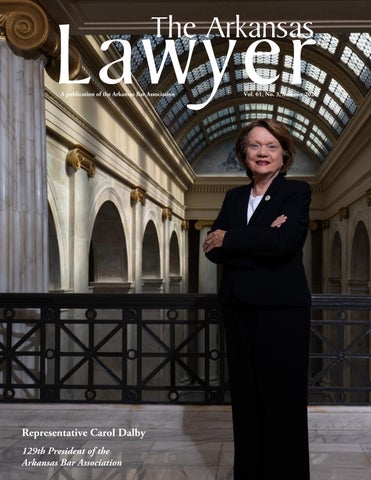
Lawyer The Arkansas
A publication of the Arkansas Bar Association
Representative Carol Dalby 129th President of the Arkansas Bar Association
Vol. 61, No. 3, Summer 2026
PUBLISHER Arkansas Bar Association Phone: (501) 375-4606 www.arkbar.com EDITOR Anna K. Hubbard EXECUTIVE DIRECTOR Karen K. Hutchins PROOFREADER Cathy Underwood EDITORIAL BOARD Caroline R. Boch Turquoise S. Early William Taylor Farr Abby Bukowski Jim L. Julian Tory Hodges Lewis Drake Mann Tyler D. Mlakar, Chair April Rogers Michael A. Thompson Brett D. Watson Amie Schoeppel Wilcox David H. Williams OFFICERS President Representative Carol Dalby President-Elect Tim Cullen Immediate Past President Jamie Jones Walsworth Secretary Michelle R. Jaskolski Treasurer Marc P. Martinez Parliamentarian Judge Brent J. Eubanks YLS Chair Eli Cummins BAR ASSOCIATION STAFF Executive Director Karen K. Hutchins Director of Operations Kristen Frye Finance Administrator/CPA Staci Clark Publications Director Anna K. Hubbard Office & Data Administrator Cynthia Barnes Professional Development Coordinator Lisa McCormick Information Technology Specialist Rachel Henderson
The Arkansas
Lawyer Vol. 61, No. 3
in this issue 2 ArkBar News
5 President's Report: Representative Carol Dalby 7 Young Lawyers Section Report: Eli Cummins 8 The Power of Service: Arkansas Bar Association 129th President Carol Dalby By Anna K. Hubbard Cover Photo by Trenton Algren-Davis, Arkansas House Photographer 14 The $20.5 Million Question: How will the House Settlement's "Salary Cap" Redefine NIL & College Athletics? By Judy Henry and Antwan Phillips 18 Revisiting the Intersection of College Athletics, Sports Betting, and Game Integrity in the Post-PASPA Era By Matt McCoy 22 Issue 3: Leveling the Playing Field By J. Cliff McKinney II and Jeb H. Joyce 25 Attorney Disciplinary Actions 26 Help, Bitcoin is Not Going Away: What Arkansas Lawyers Need to Know About Cryptocurrency By Samuel McLelland 28 Judge Wilson-isms Gathered by David Powell and Photos by Judge Cathi Compton 30 The Initiative Process at a Crossroads By Gary D. Marts, Jr. 32 The LEARNSing Curve: Navigating Arkansas Education Law By Devin R. Bates and A. Mills Bryant 35 Arkansas Bar Foundation 36 The Rise of Data Centers in Arkansas By Alexander T. Jones 40 In Memoriam The Arkansas Lawyer (USPS 546-040) is published quarterly by the Arkansas Bar Association. Periodicals postage paid at Little Rock, Arkansas. POSTMASTER: send address changes to The Arkansas Lawyer, 1401 W. Capitol Ave., Suite 170, Little Rock, Arkansas 72201. Subscription price to nonmembers of the Arkansas Bar Association $35.00 per year. Any opinion expressed herein is that of the author, and not necessarily that of the Arkansas Bar Association or The Arkansas Lawyer. Contributions to The Arkansas Lawyer are welcome and should be sent to Anna Hubbard, Editor, ahubbard@arkbar. com. All inquiries regarding advertising should be sent to Editor, The Arkansas Lawyer, at the above address. Copyright 2026, Arkansas Bar Association. All rights reserved.
ArkBar News The Arkansas Bar Association’s flagship publication, The Arkansas Lawyer, received the Excellence in Communication Award from the Arkansas Society of Association Executives for the Winter 2026 issue “A Profile of the Arkansas Lawyer.”
Nomination Deadline for ArkBar President-Elect Nominating petitions are now being accepted for the office of President-Elect of the Arkansas Bar Association. Petition deadline: Monday, October 5, 2026. Contact Karen Hutchins at khutchins@arkbar.com or 501-801-5663 for a petition.
Thank You for Your Membership Display your 2026–2027 Member decal on your website or in your email signature and proudly show your connection to Arkansas’s legal community. Member 2026-2027
Get yours! Email ahubbard@arkbar.com
ARKANSAS BAR ASSOCIATION
BOARD OF TRUSTEES District A1 Elizabeth Esparza • Caroline W. Kelley • Samuel W. Mason • William M. Prettyman District A2-A3 Payton C. Bentley • Kelsey Boggan • Evelyn E. Brooks • Jason M. Hatfield • R. Patrick Hickey • Russell B. Winburn • Steve Zega District A4 Craig L. Cook • Brinkley B. Cook-Campbell • Braxton L. Leding • Dusti Standridge District B Robert Beard • Brooke Blackwell • Mark K. Cameron • Elizabeth Dussex • Bob Edwards • John A. "Drew" Ellis • Bobby Forrest Joseph Gates • Steven P. Harrelson • Michael M. Harrison • W. Silas Heffley • Jim Jackson • Anton L. Janik, Jr. • Skye Martin Kathleen M. McDonald • J. Cliff McKinney II • Jeremy M. McNabb • Andrew Norwood • William J. Ogles • Casey Rockwell Peter Shults • Lauren A. Spencer • Aaron L. Squyres • Danyelle J. Walker • Patrick D. Wilson • Danny Woodyard District C5 Joe A. Denton • Lauren Elenbaas • John T. Henderson • Brett D. Watson District C6 Bryce Cook • Paul N. Ford • Bill Stanley • Paul D. Waddell District C7 Autumn Clark Boatright • S. Taylor Chaney • Ledly Jennings • Lauren Manatt District C8 Meagan E. Davis • John S. Stobaugh • Louise E. Tausch • Joshua R. Thane Ex-officio Members Dean Colin Crawford • Dean Kathleen Guzman • Judge Craig Hannah • Glen Hoggard • Paul W. Keith Robert S. Jones • Judge Mark Leverett • Karen K. Hutchins 2
The Arkansas Lawyer
www.arkbar.com
Strength & Guidance
Built by LAWYERS, Powered by PROS®
Helping all legal professionals plan for their financial future.
8.1B inplanretirement assets firms and legal 3.8K law organizations
$
The ABA Retirement Funds Program has the strength and experience to provide uniquely designed retirement plans to the legal community. We help you:
and legal 36K lawyers professionals As of 12/31/2025
Maximize the value of your plan
Improve employee retirement outcomes
Manage plan expenses
Contact us today! abaretirement.com • 800.826.8901 • joinus@abaretirement.com
A member benefit of the:
The ABA Retirement Funds Program is available through the Arkansas Bar Association as a member benefit. Please read the Program Annual Disclosure Document (April 2026) carefully before investing. This Disclosure Document contains important information about the Program and investment options. For email inquiries, contact us at: joinus@abaretirement.com. Registered representative of Voya Financial Partners, LLC (member SIPC). Voya Financial Partners is a member of the Voya family of companies (“Voya”). Voya, the ABA Retirement Funds, and the Arkansas Bar Association are separate, unaffiliated entities, and not responsible for one another’s products and services. CN5179273_0228 https://abaretirement.com
Vol. 61 No. 3/Summer 2026 The Arkansas Lawyer
3
2400 N Pierce Street, Little Rock
Commanding a rare quarter acre, corner lot on a quiet street, this Heights neighborhood home masterfully blends historic charm and modern luxury with 4 bedrooms, 3.5 baths, 2 living areas, bonus space and a large backyard. Carefree fun awaits with the Country Club of Little Rock, restaurants, and boutiques only a short golf cart ride away. Call John Selva, Principal Broker 501.993.5442 4
The Arkansas Lawyer
www.arkbar.com
PRESIDENT'S REPORT
The Work We Share As we begin a new Bar year, our committees are getting to work, our Board of Trustees is preparing for another year of service, and we're building on the momentum created by the many members who generously volunteer their time and talents to strengthen our Association. The Arkansas Bar Association has always been strongest because of members who choose to get involved. That involvement takes many forms—serving on a committee, mentoring a younger lawyer, presenting a CLE program, writing an article, sharing ideas or simply taking the time to listen to a colleague's perspective. Whether we're serving our clients, our profession or our communities, those contributions strengthen our Association and the legal profession while making a difference throughout Arkansas. Throughout my career, I’ve come to believe that the legal profession and service are naturally connected. Lawyers solve problems, help people navigate complex systems and work every day to improve the lives of others. Those same values strengthen our Association. In a profession driven by deadlines and constant demands, it’s easy to focus only on what's next. Yet some of the best decisions, and the strongest relationships, come when we take time to listen, reflect and learn from one another. That’s exactly what happens throughout the work of our Association. Our committees bring together lawyers with different backgrounds, experiences and perspectives to thoughtfully examine issues, share ideas and work toward practical solutions that benefit our members and the profession.
Representative Carol Dalby of Texarkana is the President of the Arkansas Bar Association and serves District 100 in the Arkansas House of Representatives
That spirit is already evident in the work of our committees. Meredith Lowry continues to lead our Artificial Intelligence Task Force, now more than 25 members strong, as it explores one of the profession’s most significant and rapidly evolving issues. Maggie Davis and Adam Jackson once again are leading our Mock Trial Committee, where more than 45 volunteers spend countless hours throughout the year coaching high school teams, organizing competitions and introducing students to our justice system. Their work helps educate the next generation about the rule of law while demonstrating our profession’s commitment to service and civic engagement. Watch for opportunities to volunteer as a coach in the coming months. It's a rewarding way to make a lasting difference in the lives of Arkansas students. With an active legislative year ahead, Glen Hoggard and the Legislation Committee will continue monitoring developments affecting Arkansas lawyers and the administration of justice. Meanwhile, Tory Lewis, Cathy Underwood and our practice sections continue the important work of keeping our handbooks and legal forms current and practical. If you haven’t visited our new member website and database or explored the latest handbook editions, I encourage you to do so. The response to our new platform has been tremendous, and we're excited about the opportunities it creates to better serve our members. I'm also grateful to Tyler Mlakar, the Editorial Advisory Board and our volunteer authors, whose dedication keeps The Arkansas Lawyer an outstanding quarterly
publication. Their work provides members with timely, practical and thoughtprovoking content that keeps us informed, engaged and connected to our profession. Our CLE Committee, led by Ledly Jennings, continues to provide timely, practical educational programs made possible by members who generously share their expertise. I hope you'll join us at our Mid-Winter Meetings in Little Rock this October and Northwest Arkansas in February 2027 for excellent CLE and the chance to reconnect with colleagues from across the state. Our commitment to preserving Arkansas’s legal history also continues through the Arkansas Legal Hall of Fame. Please make plans to attend this year’s complimentary induction ceremony on November 12, 2026, at the CALS Ron Robinson Theater in Little Rock as we celebrate the newest members of the Hall of Fame. Throughout the year, we’ll also continue our Hall of Fame Speaker Series, giving members the opportunity to hear from past inductees whose experiences have shaped our profession. On September 29, we're honored to welcome former Arkansas Supreme Court Justice Annabelle Imber Tuck as our next featured speaker. If you’ve been involved for years, thank you. If you're looking for a place to get involved, I hope you’ll join us. The Arkansas Bar Association has always been strongest because of members who are willing to share their time, talents and ideas. Together, we’ll continue sharing the work of building an Association that serves our members, strengthens our profession and benefits the people of Arkansas. ■
Vol. 61 No. 3/Summer 2026 The Arkansas Lawyer
5
Everybody Needs a Go-To Play. When a catastrophic injury case, medical malpractice claim, or wrongful death matter walks into your office, you don’t have to run every play yourself. CALL McMATH WOODS. We’ve spent decades executing that game plan.
Personal Attention, Proven Results Since 1953
mcmathlaw.com | 501.396.5400
Samuel E. Ledbetter
Will Bond
Neil Chamberlin
Charles D. Harrison
Carter C. Stein
Sarah C. Jewell
Tim Giattina
Grayson Hinojosa
David Wells
711 W. 3RD STREET, LITTLE ROCK, AR 72201 | 525 S. SCHOOL AVENUE, FAYETTEVILLE, AR 72701
From the ordinary to the most complex, no appeal is too small or large Writing Briefs to the Arkansas Court of Appeals, the Arkansas Supreme Court, the Federal Circuits and the United States Supreme Court
TSCHIEMER
LEGAL BRIEFING Handling all your briefing needs Robert Tschiemer is the author of the Arkansas Bar Weekly Case Summaries, available at www.arkbar.com. For a complete list of decisions see www.tschiemerlegalbriefing.com
Robert S. Tschiemer
Ark. Bar 84148 P.O. Box 549 Mayflower, AR 72106-0549 501.951.3303 (p) 501. 377.9866 (f) robert@tschiemerlegalbriefing.com www.tschiemerlegalbriefing.com
6
The Arkansas Lawyer
www.arkbar.com
YOUNG LAWYERS SECTION EXECUTIVE COUNCIL
YOUNG LAWYERS SECTION REPORT
A Great Year Ahead
It is an honor to serve as Chair of the Young Lawyers Section this year. Before looking ahead, I want to thank immediate Past Chair Sam Mason for his outstanding leadership and dedication over the past year. Sam's enthusiasm, leadership and dedication helped build a strong foundation for the year ahead, and I’m grateful for all he has done to move our Section forward. I'm excited to work alongside our incredible Young Lawyers Section Executive Council as we build on that momentum. We have a great team with fresh ideas, contagious enthusiasm and a shared commitment to helping young lawyers connect, serve and grow. I can’t wait to see what we'll accomplish together. One of our biggest projects this year is the updated 18 & Life to Go handbook. This free resource helps young adults navigate many of life’s legal and practical milestones, and we're putting the finishing touches on a new edition that will be available for download on the Arkansas Bar Association website. Once it’s released, we’ll be looking for volunteers to help introduce the handbook in high schools across Arkansas. It’s a great opportunity to make a real difference while helping students prepare for adulthood and the important decisions that lie ahead. We’re also exploring opportunities to expand volunteer legal clinics, giving young lawyers more ways to serve their communities, gain valuable experience and build lasting professional relationships. This August, the Arkansas Bar Association is proud to once again co-sponsor receptions for the incoming 1L classes at both of Arkansas’s law schools. These events provide a great opportunity to welcome future lawyers, introduce them to the many benefits of becoming involved in the Bar from the very beginning of their careers, and begin building relationships that will last throughout their professional lives. Thank you to every member of our Young Lawyers Section Executive Council for your willingness to serve. And to all of our young lawyers across Arkansas, whether you've been involved for years or are looking for your first opportunity, I hope you'll jump in. We’d love to have you. It’s going to be a great year! ■
Eli Cummins is the Chair of the Young Lawyers Section. He is an attorney at LaPorteJenner Law PLLC in Little Rock.
OFFICERS CHAIR
CHAIR-ELECT
TREASURER
TREASURER
SECRETARY
Eli Cummins
Lindsey Roy
Bethany Michau
Natalie Polston
Britnie Byers
DISTRICT A REPS
Brittany E. Hawkins
Martha-Kay “Gus” Crowder
Michelle Fendley
Hayley Ferguson
Amanda Kennedy
Zoë Robinson
Eric Brown
Cordell Mcdonald
Stephen Cory
Beau Duty
Clifford McLeod
Paige Oliver
DISTRICT B REPS
DISTRICT C REPS
AT LARGE REPS
LAW STUDENT REPS
Swati Sajan
Kensie Hatman
Vol. 61 No. 3/Summer 2026 The Arkansas Lawyer
7
The Power of Service Arkansas Bar Association 129th President CAROL DALBY
Carol Dalby has built a career around a simple approach to leadership: listen carefully, build relationships and look for ways to serve.
By Anna K. Hubbard
Photo credit: Trenton Algren-Davis, Arkansas House Photographer
Leading with Purpose Carol Dalby has served as a teacher, county attorney, district judge, special justice on the Arkansas Supreme Court and member of the Arkansas House of Representatives. Now, as president of the Arkansas Bar Association, she brings a broad perspective shaped by a career in law and public service. Throughout her career, Carol has earned a reputation for thoughtful leadership, careful listening and sound judgment. For those who know Carol, it’s not just what she’s accomplished that stands out, but how she’s accomplished it. “When Carol speaks, people listen,” said Circuit Judge Karen Whatley. “She is respected as a lawyer, a legislator and a person. She is devoted to public service and has a gift for bringing out the best in people.” Arkansas Supreme Court Justice Rhonda Wood has seen those same qualities firsthand. “It isn’t always easy to have tough conversations, but Carol will engage in discourse civilly and always listen. I have learned that she is someone who can see all angles of an issue and will be open-minded as to the result. Carol cares about not only achieving the right result to a problem, but achieving it through the right process. In the legal and political world in which she navigates, that means everything. Carol exemplifies a true servant leader.” Ask Carol what she’s most proud of, and her answer isn’t about the positions she’s held or the honors she’s received. “I’m most grateful for the people I’ve met and the people I’ve been able to help along the way,” she said. That perspective can be traced back to her childhood. Carol grew up in a family where giving back to the community was simply what people did. Her father served on the school board and Civil Service 8
The Arkansas Lawyer
www.arkbar.com
Commission and was active in civic organizations. Her mother, a stay-at-home parent, volunteered through the PTA, church, Sunday school and vacation Bible school. “My parents truly believed that wherever you live, you had an obligation to try to make your community a better place,” Carol said. “You had an obligation to be involved.” That also meant taking responsibility for making things better. “Don’t complain if you didn’t get involved,” she recalled. “That was just what you did. That’s how you make things better.” Answering the Call Before Carol began law school, an opportunity came along that wasn’t part of her original plan. An English major who had already been admitted to law school, Carol thought she knew what came next. Instead, an unexpected phone call during a summer at home in Texarkana sent her down a different path, for a little while. Her mother woke her one morning to say the principal of a local junior high school was on the line. He was looking for someone to teach seventh-grade English and wondered if she would be interested. “I had not applied,” Carol said with a laugh. “I’m telling you, I was enjoying my summer. The next thing I know, I’m teaching seventhgrade English.” What began as an unexpected detour became two rewarding years in the classroom. During that time, she earned a master’s degree in interdisciplinary studies with an emphasis in education and a minor in business. While she enjoyed teaching English, Carol admits that convincing seventh graders to appreciate Shakespeare could be a challenge. As the new, young teacher, she quickly found herself sponsoring student council, advising the yearbook and saying yes to just about every
extracurricular activity that needed a faculty sponsor. “It was a great experience,” she said. “I still run across kids, grown, obviously, who I taught during those two years.” Teaching also reinforced skills that would serve her throughout her career: listening carefully, communicating clearly and meeting people where they are. A Career Close to Home After graduating from the University of Arkansas School of Law, Carol returned to Texarkana. During law school, she had clerked at Smith, Stroud, McClure, Dunn and Nutter, where the late John Stroud, a former Arkansas Bar Association president and future Arkansas Court of Appeals judge, offered her a position. As she and her husband, John, began raising their family, including their two children, Robert and Caroline, Carol started looking for a career path that would allow her to balance a demanding legal practice with family life. An opportunity arose when a friend was elected district attorney in Bowie County, Texas, and asked Carol to handle the county’s civil legal work. The position offered both flexibility and an unusually broad practice. As civil attorney for Bowie County for nearly 27 years, Carol’s practice spanned an extraordinary range of legal issues. She advised elected officials, represented the county in litigation, handled employment and contract matters, responded to openrecords issues and worked on civil matters ranging from forfeitures to the termination of parental rights. “I was called upon to answer all the legal questions from all the different elected officials,” she said. “Anything that was considered civil work, I did.” While serving Bowie County, Carol also accepted appointments to the Arkansas bench. She served as an Arkansas district judge and, over the years, was appointed several times by Gov. Mike Huckabee to serve as a special justice on the Arkansas Supreme Court. One of those appointments became far more significant than anyone anticipated. Carol was assigned to the landmark Lake View school-funding litigation and ultimately participated in the case for approximately a decade as it returned to the Court.
The experience provided a rare behind-thescenes perspective on the work of Arkansas's highest court and the complexity of a case that reshaped public education throughout the state. “It was a neat experience to see firsthand the inside of how a conference works,” she said, “particularly on a case like that.” New Paths When the Arkansas House seat representing her district became open, Carol saw an opportunity to serve her community in a different way. After careful consideration, she decided to run. “I don’t want to look back on my life and say, ‘I wonder if,’ or ‘I wish I had,’” she said. Now serving her fifth term in the Arkansas House of Representatives, Carol also made history as the first woman to chair the House Judiciary Committee. For her, the work is less about politics than the privilege of helping the people she represents. “It’s a real honor to represent them,” she said. “The best part of being a legislator is helping people when they have a problem.” Former Arkansas House Speaker Matthew Shepherd, who appointed Carol to chair the House Judiciary Committee, said her leadership qualities made her the natural choice. “Carol’s character and integrity are, of course, what I respect the most about her,” Shepherd said. “I trusted her judgment immensely and knew I didn't have to worry about how House Judiciary would run.” Over the years, Shepherd said, Carol has become “one of the most respected members of the House.” For Carol, serving extends far beyond the Capitol. Whether attending school programs, church anniversaries, chamber events or community gatherings throughout her district, she believes those moments matter. They are how relationships are built, trust is earned and leaders remain connected to the people they serve. “If you don't make the effort to be involved or to go when you’re invited,” she said, “you distance yourself. You become disconnected from what is going on in the community.” Judge Carlton Jones has known Carol since her years working for Bowie County and has watched that same approach carry
Carol and John
into her legislative service. He describes her as a “fair and thoughtful public servant” who has remained open and accessible to the people she represents. “In her time as our representative in the Arkansas Legislature, Carol has always been open, accessible, and interested in hearing from the people she represents. She has always been willing to listen to and address any concerns affecting the judiciary in our state,” Jones said. “It is without reservation that I can say Representative Dalby believes a strong judiciary is vital in maintaining the rule of law in our state.” Relationships Matter Carol’s commitment to the Arkansas Bar Association began early in her legal career. She has served on the Board of Trustees and previously on the Board of Governors, while contributing to numerous committees, including Professional Ethics, Governance, Jurisprudence and Law Reform, Judicial Nominations, Juvenile Justice, Lawyers for Literacy, Legal Related Education and the Committee for a Modern Judiciary. She has come to believe the Association’s greatest value isn’t found in a committee assignment, a CLE program or even the Annual Meeting. It’s the relationships those experiences create. “Years ago, the Bar was the place you
Vol. 61 No. 3/Summer 2026 The Arkansas Lawyer
9
Caroline, Abigail, Robert, Carol and John
Carol is a lifelong Razorback fan
Home on the state line
went for CLE,” she said. “Now you can find CLE almost anywhere. But you can’t build those relationships with other lawyers without that connection to the Bar.” As a young lawyer, Carol credits the late John Stroud with instilling the importance of becoming active in the Association from the very beginning of her career. “That was a non-starter in that law firm. You were going to join the Arkansas Bar Association and serve on committees.” For Carol, those relationships build trust, mentorship and lasting friendships. Karen Whatley says her own friendship with Carol grew out of working together at the Capitol. “Our first meeting began a friendship that has brought me such joy,” Whatley said. “She has a knack for knowing what is needed at just the right time.” Carol believes those connections strengthen not only friendships, but the profession itself. “If you’ve gone to a bar meeting or the Annual Meeting or served on a committee together, you form those friendships,” she said. “Then, when you’re on opposite sides of a case, there’s a civility there.” Carol believes there’s something uniquely valuable about the relationships that develop when lawyers gather in person. “I think sometimes it’s missing when everybody just sits behind a computer screen,” she said. “There’s something special and unique about connecting with your fellow lawyers throughout the state.” Those connections have shaped her career and reinforced her belief that the profession is strongest when lawyers know
one another beyond the courtroom. She now offers that same advice to young lawyers. “I think volunteering is a great way, especially as a young attorney, to meet people,” she said. “You learn what’s important, you make connections, and at the same time you’re giving back.” She believes leadership begins long before someone receives a title. “You can always learn how to be a better leader,” she said. “Sometimes the real leaders are the people working behind the scenes who never get any recognition.” Carol’s influence extends well beyond her professional life. Her son, Robert, followed her into the legal profession and credits his mother with shaping both his career and the values he brings to it. “The greatest privilege of my life has been the simple fact of being her son,” Robert said. “To call my mother my inspiration feels inadequate, because inspiration only visits us from time to time. To me, she has been the foundation beneath every ambition, conviction, and success I have known. She taught me that integrity is the highest form of success and that one’s reputation is built choice by choice. Becoming an attorney was my attempt to follow a path illuminated by the extraordinary woman who raised me, and I can only hope to live up to the example she has set.”
and thoughtfully considering how the Association can best serve Arkansas lawyers in the years ahead. “There just comes a time that I think we need to step back, take a breath and say, ‘What have we done really well? What can we do to make it even better? What do the members of our Bar Association need from us?’” Amy Freedman, who is serving with Jacob Potter as co-chair of the 2027 Annual Meeting, has known Carol for many years and considers her both a mentor and a close friend. “No one is better suited to lead the Arkansas Bar Association as president than Carol Dalby,” Freedman said. “I have been fortunate enough to watch her career and learn from her. She understands well what Arkansas lawyers and Arkansas citizens value and need the most—strong communities based on Arkansas values with a legal system that is honest, fair and impartial.” That perspective is also shaping plans for the 2027 Annual Meeting, where Carol hopes programming will focus on the practical challenges facing attorneys across Arkansas, particularly those practicing in smaller communities. “The vast majority of attorneys don’t work in big cities,” Carol said. “We want to focus on what Arkansas lawyers need.” For Carol, serving as president is another opportunity to give back to a profession that has meant so much to her. It is a chance to continue doing what she has done throughout her career: show up, listen and look for ways to make a difference. ■
10
The Arkansas Lawyer
www.arkbar.com
Looking Forward As she begins her year as Arkansas Bar Association president, Carol believes the Association is in a strong position. Rather than changing course, she hopes to build on its momentum by listening, reflecting
Vol. 61 No. 3/Summer 2026 The Arkansas Lawyer
11
Preferred IOLTA Banks support justice for all. Interest earned on IOLTA accounts funds legal aid. Learn more at arkansasjustice.org/IOLTA.
12
The Arkansas Lawyer
www.arkbar.com
FIERCE ADVOCACY. TRUSTED RESULTS. TAX | MERGERS & ACQUISITIONS ESTATE PLANNING | REAL ESTATE | LITIGATION MCDANIELWOLFF.COM
Vol. 61 No. 3/Summer 2026 The Arkansas Lawyer
13
The $20.5 Million Question: How will the House Settlement’s “Salary Cap” Redefine NIL and College Athletics?
By Judy Henry and Antwan Phillips
S
ince college athletes have been permitted to profit from their name, image, and likeness, many commentators have lamented that the NCAA lacks guardrails and college sports have morphed into the wild, wild, west. Contrary to popular belief, there are rules, and while the enforcement has been an uphill battle for the NCAA, lawsuits and legal developments continue to fundamentally reshape college athletics every day.
About the Authors
Judy Henry
Judy Henry and Antwan Phillips are members of Wright Lindsey Jennings’ Sports Law practice group and represent studentathletes, businesses, coaches, and the NCAA in contract negotiations, eligibility, tax, and other sports law matters.
Antwan Phillips
14
The Arkansas Lawyer
www.arkbar.com
The Evolution of NIL In 2021, the United States Supreme Court ruled that bans on student-athlete compensation were illegal, opening the door for student-athletes to profit from paid endorsements and other opportunities involving their name, image, and likeness (NIL).1 Just days later, the NCAA’s Board of Directors approved a “temporary” policy that allowed student-athletes nationwide to begin profiting from the sale of their NIL rights beginning on July 1, 2021.2 This policy authorized collegiate athletes to earn money by engaging in marketing/ advertising contracts with third parties. In the first year, it is estimated that student-athletes earned over $900 million from third parties.3 Fast forward nearly five years for the next historic shift in NIL compensation.4 In what is commonly referenced as the House Settlement, Judge Claudia Wilken of the Northern District of California granted final approval of the $2.8 billion House v. NCAA resolution, concluding the antitrust litigation over NCAA rules barring institutions from directly compensating student-athletes.5 Enforcement and Oversight Under the terms of the House Settlement, as of July 1, 2025, participating institutions opting into the House Settlement are permitted to directly compensate student-athletes through revenue sharing. Specifically, the institutions are allowed to distribute up to 22% of the average revenue from Power 5 conference schools.6 These
schools are the institutional members of the ACC, Big Ten, Big 12, Pac-12, and SEC. The House Settlement cleared the way for educational institutions to pay studentathletes directly, but with this new method of compensation came a new enforcement entity: the College Sports Commission (CSC). During the first year, the CSC’s equivalent of a “salary cap” has been set at $20.5 million per institution, and for the next three years; the “salary cap” is projected to increase annually by 4%.7 Additionally, the CSC was established to oversee and regulate student-athlete compensation.8 Shortly after beginning its reign, the CSC officially launched NIL Go, a centralized clearinghouse operated with the accounting firm Deloitte.9 Through NIL Go, and in accordance with the House Settlement, all third-party NIL deals exceeding $600 must be submitted for review to determine whether they represent “fair market value” and serve a “valid business purpose.”10 Submitted deals deemed excessive or suspicious may be flagged, revised, or challenged in arbitration.11 This reporting requirement became mandatory for student-athletes after June 7, 2025, the day after Judge Wilken approved the House Settlement.12 Circumventing the “Salary Cap” (and More Litigation) As North Carolina State University’s head football coach put it, “[l]oopholes have won the day.”13 With the implementation of the House Settlement’s “salary cap,” schools have increasingly sought to maximize “above the cap” compensation to win the recruiting battle.14 One example is schools establishing in-house NIL agencies to secure third-party NIL deals for student-athletes.15 In this framework, the schools are not limited by the $20.5 million “salary cap” because the athlete can still participate in third-party NIL contracts to “earn” even more money outside of the revenue-sharing contract with the school. Another strategy schools have employed to obtain "above-the-cap" funds is to partner with multimedia rights companies, which sell and manage intellectual property rights and branding, publish audio, digital, and social media content, and manage ticket sales, concessions, and venue technology
systems.16 However, these arrangements have received heightened scrutiny from the CSC, and have resulted in an enforcement victory for the CSC.17 Notably, the CSC had rejected “overthe-cap” deals submitted by 18 football players from the University of Nebraska.18 The agreements at issue were between the student-athletes and the University’s multimedia rights partner, PlayFly.19 After these deals were rejected, the 18 Nebraska football players filed a claim in arbitration against the CSC, arguing that the CSC should have approved these deals.20 Ultimately, the arbitrator sided with the CSC and ruled: (i) PlayFly should be considered an associated entity, and (ii) that the deals violated NCAA rules prohibiting “warehousing,” i.e., paying for the players’ rights to use later, rather than for actual, well-defined, and immediate deliverables.21 Specifically, the arbitrator stated that PlayFly’s business model “constitutes the very sort of warehousing that is prohibited by the rule.”22 Despite the ruling, and an important victory for the CSC, the Nebraska Attorney General may have his day in Nebraska state court with the CSC.23 As with everything else in college athletics today, student-athletes, attorneys, and fans will have to wait and see. Need for Legal Representation and Recent Case Examples Now more than ever, both studentathletes and entities need qualified legal representation to negotiate and document
the two types of NIL contracts: thirdparty NIL agreements and revenue sharing agreements. Third-party agreements occur between a student-athlete and a brand, whereas revenue sharing agreements are contracts between the student-athlete and the school. In the latter, studentathletes contract with the school, selling the right to license their NIL in exchange for a share of revenue. In both situations, the parties negotiate obligations and expectations for use of the NIL and services to be performed. Without legal counsel, unfulfilled or misunderstood obligations have resulted in costly lawsuits and arbitrations. These revenue-sharing contracts are often over six figures. Some student athletes— primarily football and basketball players —receive over a million dollars annually. Due to these high-dollar payouts and the portal allowing at-will transfers, schools have attempted to add legal provisions to protect their six- or seven-figure investments in a student-athlete. This most often used provision is the school requiring the athlete to agree not to transfer to a different institution. Two lawsuits filed this year demonstrate the legal issues that can arise when a student-athlete attempts to transfer while under contract at a school. In the first case, Duke University’s quarterback Darian Mensah was sued by Duke after announcing he intended to transfer to the University of Miami.24 Mensah’s announcement occurred prior to the expiration of his
Vol. 61 No. 3/Summer 2026 The Arkansas Lawyer
15
two-year contract.25 Duke argued that its revenue-sharing contract with Mensah gave it exclusive rights to Mensah’s NIL, and that transferring would constitute a breach of the parties’ contract.26 While Mensah was successful in obtaining a temporary restraining order allowing him to enter the transfer portal, the parties ultimately settled for undisclosed terms before a full hearing, and Mensah has since transferred to Miami.27 On the West Coast shortly thereafter, the University of Washington was prepared to pursue legal action against quarterback Demond Williams Jr.’s NIL for similar reasons.28 In that case, Williams entered the transfer portal, but unlike Darian Mensah, he reversed course just two days later and returned to the University of Washington.29 Because these disputes were resolved prior to trial, both fans and legal professionals will await the answer to the elephant in the room: if a student-athlete breaches a revenue sharing agreement, will a school successfully enforce the contract’s terms restricting transfer? Another prevailing question, now answered, was whether schools would be afraid to sue their athletes. Closer to home, the University of Arkansas indicated a willingness to enforce its NIL buyout with a former football player, but the dispute was ultimately resolved without litigation.30 Modern college athletics is a business, and the House Settlement’s terms have occasioned the legal drama fans and legal professionals now frequently read about. Now more than ever, consulting with attorneys who understand the evolving regulatory framework and who have experience with these agreements is imperative to avoid costly and messy legal battles. The role of lawyers in this new era of college athletics is not only important for student-athletes and universities when evaluating the terms of the agreement, but also for fans to understand who is and is not competing for their favorite team. Endnotes: 1. Nat’l Collegiate Athletic Ass’n v. Alston, 141 S. Ct. 2141 (2021). 2. NCAA, Interim NIL Policy (2021). 3. https://finance.yahoo.com/ news/nil-heres-how-much-ncaaathletes-earned-185901941. 16
The Arkansas Lawyer
www.arkbar.com
html?guccounter=1&guce_referrer=aHR0c HM6Ly9nbG9iYWxlZGdlLm1zdS5lZHU v&guce_referrer_sig=AQAAAGVrVXLjNn YHEJ0LGuGtfyYjxJz88dltCwgov2MKE98 exITqD5KVIpuBLsabvNQi1V1ErftZu3rP lhJq9q42B9f7rjrD8KW0GoURL2T-02YytUZVlEabVD4GWnzZ0hCUBnBkq4kcgz2ESGyXEH_ gOZkgDZLFNHefY2Mz1mFd89p. 4. See Grant House v. Nat’l Collegiate Athletic Ass’n, 545 F. Supp. 3d 804 (N.D. Cal. 2021); see also https://www.espn. com/college-sports/story/_/id/45467505/ judge-grants-final-approval-house-v-ncaasettlement. 5. https://www.collegesportscommission. org/about. 6. Id. 7. Id. 8. https://www.collegesportscommission. org/faq. 9. https://www.collegesportscommission. org/nil. 10. Id. 11. Id. 12. https://www.nilrevolution. com/2025/07/csc-publishes-new-guidancefor-nil-deal-review/. 13. https://www.wral.com/news/local/ college-sports-nil-revenue-sharing-caphouse-settlement-december-2025/. 14. https://sports.yahoo.com/articles/ troy-dannen-addresses-misconceptionsthird-220027329.html. 15. https://frontofficesports.com/schoolsskirting-salary-cap-college-sports/. 16. https://www.sportico.com/law/ analysis/2026/multimedia-rightscompanies-nil-house-settlement-csclegal-1234891274/. 17. https://huskercorner.com/nebraskafootball-nil-arbitration-csc-playfly-ruling. 18. https://247sports.com/college/nebraska/ article/nebraska-huskers-football-nil-collegesports-commission-appeal--284975842/. 19. Id. 20. https://assets.tina.io/29b83311-e58742b1-861e-87ebde9aa253/May%2012%20 -%20Final%20Neutral%20Arbitration%20 Decision%20in%20Playfly-Nebraska%20 Matter.pdf. 21. Id.; see also NCAA Rule 22.1.3.3 (“22.1.3.3 Deployment of Rights as a Valid Business Purpose. An NIL agreement or payment with an associated entity or
individual must include direct activation of the student-athlete’s name, image and likeness rights. In other words, the acquisition of such rights without reasonable specificity of the NIL activation (e.g., description of the specific group licensing categories, the student-athlete’s obligations related to the activation, timing and ultimate use of the student-athlete’s NIL) may not satisfy the requirements for payments by associated entities or individuals.”). 22. https://assets.tina.io/29b83311-e58742b1-861e-87ebde9aa253/May%2012%20 -%20Final%20Neutral%20Arbitration%20 Decision%20in%20Playfly-Nebraska%20 Matter.pdf, pg. 34. 23. https://www.espn.com/college-football/ story/_/id/48745201/college-sports-salarycap-rules-upheld-arbitration-case-broughtnebraska-football-players. 24. https://dukechronicle.com/article/ duke-football-darian-mensah-lawsuitexplainer-diaz-lucas-heitner-contractarbitration-20260123. 25. Id. 26. Id. 27. Id. 28. https://www.espn.com/college-football/ story/_/id/47541426/demond-williams-jrcase-test-viability-signed-contracts-collegesports. 29. https://www.nytimes.com/ athletic/6956099/2026/01/12/washingtonqb-demond-williams-nil-contract-dispute/. 30. See https://www.arkansasbusiness. com/article/razorbacks-nil-buyouts-marsiamaleava/ (University of Arkansas); see also https://www.registerguard.com/ story/sports/college/football/2026/05/18/ oregon-sues-former-player-dakodafields/90149977007/?gnt-cfr=1&gcacat=p&gca-uir=false&gca-epti=z11330 7p001650c001650e001700v113307& gca-ft=75&gca-ds=sophi (University of Oregon); https://www.espn.com/collegefootball/story/_/id/48035774/cincinnatisues-sorsby-1m-exit-fee-texas-tech-transfer (University of Cincinnati). ■
ARKANSAS CHAPTER
The following attorneys are recognized in 2026 for
Excellence in the field of Alternative Dispute Resolution
Chris Gomlicker (501) 234-0599
Frank Hamlin (501) 850-8888
JP Jaynes (501) 920-4420
Jim Tilley (501) 372-1406
Dewey Watson (501) 804-4131
Todd Williams (870) 932-8357
Check your preferred available dates or schedule appointments online, directly with Academy Members - for free. ArkansasMediators.org funded by these members
* The National Academy of Distinguished Neutrals is an invitation-only professional association of over 1300 litigator-rated mediators & arbitrators throughout the US and a proud sponsor of the AAJ and DRI. For more info, please visit www.NADN.org/about
Vol. 61 No. 3/Summer 2026 The Arkansas Lawyer
17
Revisiting the Intersection of College Athletics, Sports Betting, and Game Integrity in the Post-PASPA Era
By Matt McCoy
F
ollowing Murphy v. NCAA and Arkansas’s legalization of sports betting, I authored “The Intersection and Integrity of College Athletics and Sports Betting in Arkansas,”1 which examined emerging concerns involving student-athlete gambling, competitive integrity, and regulatory oversight. Seven years later, many of those concerns have become practical challenges for athletic departments, conferences, regulators, and the NCAA. This article explores how the relationship between college athletics and sports betting has evolved in the post-Murphy era. In 2018, the United States Supreme Court fundamentally altered the sports wagering landscape when it struck down the Professional and Amateur Sports Protection Act (“PASPA”) in Murphy v. NCAA.2 Before Murphy, Nevada held a virtual monopoly on legal full-scale sports wagering in the United States. Since the decision, more than 30 states have legalized sports betting, transforming a largely underground market into a highly regulated industry generating billions of dollars annually.3 While legalization has increased transparency, it has also created new challenges for those responsible for protecting athletic integrity. Key developments include increased gambling activity among student-athletes and athletics personnel, heightened corruption concerns, and the adoption of sophisticated compliance systems.
About the Author Matt McCoy is the Senior Associate General Counsel for Athletics at the University of Arkansas. Previously, he served as an Assistant Attorney General representing the State and Arkansas Racing Commission in drafting and defending Arkansas’s lottery, raffle, and gaming legislation. 18
The Arkansas Lawyer
www.arkbar.com
Increased Gambling Activity Among Student-Athletes and Athletics Personnel One of the most immediate consequences of expanded sports betting has been increased wagering violations involving student-athletes, coaches, and athletics staff. Mobile betting applications have made gambling more accessible, creating new enforcement challenges for institutions. Although NCAA rules prohibit wagering on college sports, violations continue to rise.4 The most notable example occurred in 2023, when Iowa investigators uncovered widespread sports wagering activity involving athletes from the University of Iowa and Iowa State University.5 The investigation implicated dozens of student-athletes and revealed that some allegedly used friends’ or family members’ accounts to place wagers.6 Iowa State quarterback Hunter Dekkers was among the highest-profile athletes involved, allegedly placing numerous wagers in violation of NCAA rules.7 The investigation resulted in suspensions, eligibility consequences, and criminal proceedings, highlighting the challenges of regulating gambling in a legal betting environment.8 Similar concerns have emerged in the SEC, where former LSU wide receiver Kayshon Boutte was linked to a wagering investigation involving alleged underage betting.9 These cases demonstrate that college athletics’ primary challenge is not necessarily organized corruption, but the normalization and accessibility of gambling itself among individuals subject to strict NCAA prohibitions.
Competitive Integrity and BettingRelated Risks Beyond individual violations, athletic administrators remain concerned that legalized sports betting creates opportunities for point shaving, insider-information schemes, and game manipulation.10 These concerns have led the NCAA to advocate for restrictions on proposition bets, which focus on individual statistics such as passing yards, rebounds, strikeouts, and interceptions. Because athletes can directly influence these outcomes, regulators have identified them as especially vulnerable to manipulation. In 2019, Division I athletic directors from four Arkansas institutions submitted public comments to the Arkansas Racing Commission recommending safeguards restricting player proposition bets and other high-risk wagers while improving information-sharing between regulators, licensees, and collegiate institutions. Those recommendations, however, were not adopted by the Commission. While widespread game fixing has not emerged, historical scandals and recent NCAA cases demonstrate college athletics remain vulnerable to outside influence, financial incentives, and misuse of nonpublic information.11 The most significant post-PASPA integrity scandal involved Alabama head coach Brad Bohannon sharing nonpublic pitching information with a bettor.12 Integrity monitoring systems flagged the wagers based on their timing and size.13 Alabama terminated Bohannon’s employment, and the NCAA later imposed a lengthy showcause penalty.14 The expansion of sports wagering has also increased harassment of student-athletes, with the NCAA identifying bettor threats and abusive messages as a significant consequence of legalized betting.15 Prediction Markets: A New Integrity Challenge A newer development in sports wagering is the emergence of sports-related prediction markets offered by platforms such as Kalshi, Robinhood (through its partnership with Kalshi), and Polymarket. Unlike traditional sportsbooks, these platforms offer event contracts tied to sporting outcomes and
generally characterize them as financial products rather than gambling.16 Although the legal framework is evolving, event contracts closely resemble traditional sports wagers in practice and create similar integrity risks. As prediction markets expand, universities, conferences, and regulators should ensure that existing sports wagering laws, policies, education programs, and monitoring systems address these platforms alongside conventional betting. Compliance, Monitoring, and Integrity Protection Although the expansion of legalized sports betting has created unprecedented risks, it has also driven significant advances in oversight, education and detection. Unlike the largely unregulated markets that existed before Murphy, modern sportsbooks operate within regulatory frameworks that require suspicious activity monitoring and cooperation among operators, regulators, and integrity organizations.17 Institutions and conferences have expanded gambling education programs to train student-athletes, coaches, and staff on wagering rules, reporting obligations, and the consequences of violations,18 and have adopted increasingly sophisticated monitoring systems. Integrity firms such as Integrity Compliance 360 analyze wagering data for unusual betting activity, irregular line movement, and potential violations by comparing sportsbook information against lists of prohibited participants.19 Several conferences, including the SEC, have
partnered with integrity providers that use geolocation and data analytics to identify suspicious betting activity. Legalized sports betting has also strengthened cooperation among sportsbooks, gaming regulators, law enforcement agencies, and athletic conferences.20 The Alabama baseball investigation demonstrated the effectiveness of this model, as sportsbook alerts helped uncover the underlying misconduct.21 These information-sharing systems have become a critical safeguard in the post-PASPA era. Enforcement Trends Recent NCAA enforcement actions suggest that gambling compliance will remain a central focus of college athletics governance. NCAA President Charlie Baker has identified sports wagering as a significant integrity challenge,22 and the NCAA continues to investigate violations involving student-athletes and athletics personnel.23 This focus is underscored by recent cases, including federal charges against 26 individuals, including 17 current and former NCAA Division I basketball players, in an alleged point-shaving conspiracy,24 and the permanent ineligibility of former Indiana quarterback Brendan Sorsby after the NCAA found that he placed thousands of wagers totaling nearly $90,000, including bets involving Indiana athletics.25 These cases show that integrity threats in college sports are not going away any time soon.
Vol. 61 No. 3/Summer 2026 The Arkansas Lawyer
19
Conclusion The legalization of sports betting has transformed college athletics far beyond wagering revenue. Increased gambling participation, new integrity threats, and more sophisticated enforcement systems have become defining features of the modern landscape. Maintaining public confidence in the fairness of collegiate competition will continue to be a central responsibility for universities, conferences, regulators, and the NCAA in the years ahead. Endnotes: 1. Ark. Law., Spring 2029, at 12. 2. Murphy v. Nat’l Collegiate Athletic Ass’n, 138 U.S. 1461 (2018). 3. Jon Israel, Zack Flagel, & J.P. Riley, Ticking Time Bomb Goes Off: Seeing The Impact of Sports Betting on College Athletes and Integrity, Sports Business J. (Apr. 22, 2026), https://www.sportsbusinessjournal. com/Articles/2026/04/22/ticking-timebomb-goes-off-seeing-the-impact-of-sportsbetting-on-college-athletes-and-integrity. 4. See Israel et al., supra note 3; Sports Betting Protections, NCAA, https://www. ncaa.org/sports-betting-protections (July 13, 2026); Paula Lavigne & Shwetha Surendran, Why college athletes are unaware of legal issues when betting, ESPN (May 18, 2024), https://www.espn.com/collegesports/story/_/id/40163580/ncaa-collegesathletes-gambling-policies-law; P. Lavigne & A. Rittenberg, Inside the Historic Iowa Athlete Sports Betting Prosecution, ESPN (July 18, 2024), https://www.espn.com/ college-sports/story/_/id/40575467/ inside-iowa-iowa-state-ncaa-gamblinginvestigation. 5. Lavigne & Rittenberg, supra note 4. 6. David Purdum, Hunter Dekkers among 4 linked to Iowa State gambling probe, charged with tampering, ESPN (Aug. 1, 2023), https://www.espn.com/college-football/ story/_/id/38117323/hunter-dekkerslinked-iowa-state-gambling-probe-chargedtampering. 7. Id. 8. See Purdum, supra note 6; Eric Olson, Iowa, Iowa State Announce Investigations into Athlete Gambling, Associated Press (May 9, 2023), https://apnews.com/article/iowaalabama-gambling-ncaa-investigation-59d4 20
The Arkansas Lawyer
4b208ba35f6a0b25e14119b55bb3; Eric Olson, Gambling Sting at Iowa and Iowa State Results in Charges Against Current and Former Athletes So Far, Associated Press (Aug. 2, 2023), https://apnews.com/article/ iowa-gambling-aaron-blom-a93500f308353 dcd5c5416da8a6d66c4. 9. New England Patriots WR Kayshon Boutte Charged in Illegal Sports Gaming Scheme, Associated Press (Jan. 25, 2024), https:// apnews.com/article/patriots-football-playerlsu-illegal-bets-arrest-c63ae3ccf3edb8f5d3ff 35ecc1a7d479. 10. David Purdum, Alabama Baseball Coach Brad Bohannon Fired After Link to Suspicious Bets, ESPN (May 4, 2023), https:// www.espn.com/college-baseball/story/_/ id/37409279/alabama-fires-baseball-coachbrad-bohannon-amid-betting-probe. 11. Shane Sanders, Point Shaving in NCAA Men’s Basketball: Behavioral Finance, Scale, and Deterrence, 34 J. Behav. & Experimental Fin. 100670 (2022); NCAA Uncovers Sports Betting-Related Game Manipulation and Other Violations by 3 DI Men’s Basketball Student-Athletes; Eligibility Revoked Permanently, NCAA (Sept. 10, 2025), https://www.ncaa.org/ media-center-ncaa-uncovers-sports-bettingrelated-game-manipulation-and-otherviolations-by-3-di-mens-basketball-studentathletes-eligibility-revoked-permanently. 12. Meghan Durham Wright, Former Alabama Baseball Head Coach Violated Wagering, Ethical Conduct Rules, NCAA (Feb. 1, 2024), https://www.ncaa.org/ media-center-former-alabama-baseballhead-coach-violated-wagering-ethicalconduct-rules; David Purdum, Ohio Halts Betting on Alabama Baseball After Suspicious Activity, ESPN (May 1, 2023), https:// www.espn.com/sports-betting/story/_/ id/36685120. 13. Wright, supra note 12. 14. NCAA, Negotiated Resolution, Case No. 020262 (Feb. 1, 2024), https:// web3.ncaa.org/lsdbi/search/miCaseView/ report?id=103030. 15. Draw the Line Against Sports Betting Abuse and Harassment, NCAA, https://www. ncaa.org/sports-betting-protections. 16. KalshiEX LLC v. Commodity Futures Trading Comm’n, No. 24-3257 (D.D.C. 2024); Commodity Futures Trading Commission, In the Matter of Blockratize,
www.arkbar.com
Inc. d/b/a Polymarket, No. 22-15 (Jan. 3, 2022). 17. See ProhiBet Platform Overview, Integrity Compliance 360, https://ic360. io/prohibet; Sports Betting and Integrity Monitoring Resources, American Gaming Association, https://www.americangaming. org. 18. See Sports Betting Protections, NCAA, https://www.ncaa.org/sports-bettingprotections/; NCAA, 2025–26 NCAA Division I Manual § 10.3 (Sports Wagering Activities); SEC Launches Sports Gambling Education Program, Southeastern Conference, https://www.secsports.com. 19. Integrity Compliance 360, supra note 17. 20. Paul Steinbach, NCAA to Share Data, Logos with Sportsbooks in Expanded Deal, Athletic Business (Apr. 28, 2025), https://www.athleticbusiness. com/operations/governing-bodies/ article/15744172/ncaa-to-share-data-logoswith-sportsbooks-in-expanded-deal. 21. Wright, supra note 12. 22. NCAA Urges Gambling Commissions to Eliminate Prop Bets, NCAA (Jan 15, 2026), https://www.ncaa.org/news/2024/3/27/ media-center-ncaa-president-charlie-bakerurges-states-with-legal-wagering-to-banprop-bets-on-college-athletes.aspx. 23. Mark Anderson, There Have Been 175 Sports-Betting Violations Since 2018, 17 Active Investigations, NCAA Head Says, Associated Press (July 12, 2023), https:// apnews.com/article/ncaa-sports-bettingcharlie-baker-dina-titus-c8e44843c8d58954 4a6d03c79fdf6885. 24. Twenty-Six Individuals Charged in Alleged Bribery and Point-Shaving Scheme Involving NCAA Division I Basketball, U.S. Attorney's Office for the Eastern District of Pennsylvania, U.S. Department of Justice (Jan. 15, 2026), https://www.justice.gov/usao-edpa/pr/26people-charged-alleged-bribery-and-pointshaving-scheme-fix-ncaa-cba-mens. 25. NCAA Denies Texas Tech Quarterback Brendan Sorsby’s Appeal as He Exits Rehab, Reuters (May 26, 2026), https://www. reuters.com/sports/ncaa-denies-texas-techqb-brendan-sorsbys-appeal-he-exits-rehab-flm-2026-05-26. ■
Vol. 61 No. 3/Summer 2026 The Arkansas Lawyer
21
Issue 3: Leveling the Playing Field
By J. Cliff McKinney II and Jeb H. Joyce
E
About the Authors
J. Cliff McKinney II is a Managing Member Quattlebaum, Grooms & Tull PLLC.
Jeb H. Joyce is a Managing Member at Quattlebaum, Grooms & Tull PLLC. 22
The Arkansas Lawyer
www.arkbar.com
conomic development often begins with a practical problem before it becomes a legal one. A community has a site that could support a manufacturer, a technology campus, housing, a mixed-use redevelopment, or a regional destination. Private investment is interested, but not yet committed. The project needs roads, utilities, site preparation, broadband, drainage, workforce facilities, housing, childcare, or other support before the investment can occur. Local officials may see the opportunity clearly. The legal question is whether Arkansas has the right constitutional tools to help make the opportunity feasible. Issue 3, referred to the voters by the General Assembly for the November 3, 2026, election, would amend the Arkansas Constitution to authorize the General Assembly to provide for broader economic development programs, including the creation of economic development districts within cities, counties, or cooperative areas. The amendment provides constitutional authority for the General Assembly to create a district-based framework for financing economic development projects. What Issue 3 Would Do Issue 3 authorizes the General Assembly to provide for programs and for loans and grants of public money for four public purposes: developing and diversifying Arkansas’s economy; eliminating and preventing unemployment or underemployment; developing or expanding transportation or commerce; and developing or improving real estate that contributes to economic development in the state. The amendment expressly provides that this authority includes the creation of economic development districts by cities and counties, which would make decisions on whether to extend such loans or grants. Issue 3 would also amend Article 12, § 5 of the Arkansas Constitution, which is a general prohibition against counties, cities, towns, and other municipal corporations becoming stockholders in, appropriating money for, or lending credit to private entities. Issue 3
would add economic development districts to the list of constitutional exceptions under Article 12, § 5, for the purpose of economic development projects and services. The amendment directs the General Assembly to establish implementing legislation. That means the real work of governance would occur through statutes, local ordinances, formation charters, bond documents, development agreements, grant agreements, and public oversight. The General Assembly drafted the proposed enabling legislation, SB 647, which was referred for interim study in 2025 since it cannot be constitutionally adopted yet. This article assumes adoption of enabling legislation in substantially the form currently drafted, and references to “Issue 3” include SB 647 for the sake of brevity. Why a Constitutional Amendment Is Necessary Arkansas’s Constitution was written with an understandable suspicion of public aid to private enterprise. That caution remains important. Public money should be used for public purposes, and public credit should not be casually pledged. But economic development has changed. Modern projects often require coordinated investment before the tax base, jobs, and commerce exist. A county cannot attract a major employer to a site that lacks water and wastewater capacity. A city cannot redevelop an underused corridor without streets, lighting, drainage, and utilities. A regional partnership cannot compete for a large project if each jurisdiction must act separately and no mechanism exists to share costs and benefits across boundaries. Issue 3 is necessary because the current constitutional framework leaves Arkansas with far fewer economic development tools than those of the states with which it competes. Currently, local governments are limited to incentivizing only the manufacturing industry, and the only meaningful tool is a property tax abatement. An economic development district would allow a community to offset development costs with sales tax and property tax revenues generated by development. The Baseline-and-Increment Concept One concern with any financing model
is whether it diverts money from existing public services. Economic development districts establish and protect a "baseline" of tax revenue. The baseline is the amount of property tax and local sales tax generated within a district immediately before the district's establishment. The district is required to distribute the baseline revenue to the taxing authorities who currently receive those funds, so the district will not divert any existing funds from local schools, hospitals, or other existing public services. The district is permitted to use only the increases in property taxes and local sales taxes (the state sales tax is not included). Importantly, the city council must approve the formation of the district to utilize the city's share of the taxes, and the quorum court must separately approve the formation of the district to utilize the county's share of the taxes. Neighboring States Our neighbors use a toolbox of incentives, especially tax increment financing, sales-taxand-revenue bond financing, and Texas-style 380 agreements. Issue 3 would permit local governments to use all three of these. The first is tax increment financing, commonly called TIF. TIF allows the district to issue a bond at the beginning of a project that is repaid with future increases in property taxes. Arkansas technically has TIF, but the Arkansas Supreme Court effectively ended the program in City of Fayetteville v. Washington County1 due to a perceived conflict between Amendment 74 and Amendment 78 (Issue 3 is designed to avoid this conflict). The second major concept is Sales Tax and Revenue (STAR) bond financing, which functions just like TIF except it repays the bond with future increases in sales taxes. Notably, Kansas recently utilized STAR bonds to lure the Kansas City Chiefs' new stadium development to their side of the border. Issue 3 permits TIF and STAR to be combined to support one bond. The third concept is a Texas-style 380 agreement. Chapter 380 of the Texas Local Government Code authorizes municipalities to make loans or grants of public money or services to promote economic development and stimulate business and commercial activity. In practice, Chapter 380 agreements are usually structured as
performance-based rebate programs. A city agrees to provide a rebate of property and/ or sales taxes to a developer who agrees to make a capital investment in businesses and infrastructure. For example, a city in Texas might incentivize a new shopping center or housing development by offering a $1,000,000 rebate from the taxes generated by the new development. If the private party performs, the incentive is paid. If it does not, the agreement may reduce, terminate, or recapture the benefit. District Formation Issue 3 district formation begins locally. A municipality, county, or cooperative area (i.e., a regional partnership) may establish one or more economic development districts. District boundaries do not have to be contiguous, which is important for projects involving multiple parcels, corridors, campuses, or cooperative areas (i.e., multiple cities or counties cooperating to attract a major development). The district is created by a formation charter approved by the local government, which is the district’s constitution. It must define the district boundaries, the district’s term, the economic development plan, the board structure, and any restrictions on the board's powers. Because the charter can reserve increments back to local taxing authorities, restrict board authority, and define the economic development plan, it is the principal place where local policy choices become legal obligations. The districts are also subject to significant public sunshine and FOIA requirements to provide transparency. Additionally, Issue 3 includes a 2% turnback of all funds to the Arkansas Department of Commerce to provide technical assistance, training, monitoring support, an online repository of publicly available project information, grant-process guidance, and financial oversight guidance. The Department could also review and audit districts and adopt rules to prevent malfeasance, mismanagement, or fraud. District boards would be required to keep public minutes, and expenditures would remain disclosable. District financial operations would be audited annually, and financial records showing sources and uses of district funds would be accessible to the public.
Vol. 61 No. 3/Summer 2026 The Arkansas Lawyer
23
Conclusion Issue 3 is not a guarantee that every project will succeed. It is a recognition that Arkansas cannot compete for modern development using only a narrow set of tools designed for a narrower economy. The proposal preserves the most important constitutional principle: public resources must serve a public purpose. But it also acknowledges that public purpose today may include the infrastructure, site work, housing, utilities, and amenities necessary to attract private investment and grow the tax base. The safeguards matter. A district must begin with local approval, a defined boundary, a development plan, and a formation charter. Existing tax revenue is protected through the baseline. Future increments may be used only within the district and in furtherance of the economic development plan. Public meetings, audits, FOIA access, Department of Commerce oversight, and performance-based agreements all help ensure that incentives are tied to measurable results rather than promises alone.
24
The Arkansas Lawyer
No community should create an economic development district casually, but the absence of a tool is not a safeguard; it is a handicap. Other states already allow local governments to offer robust incentives. Arkansas communities should have the same ability, subject to Arkansas-specific controls and local accountability. Issue 3 would level the playing field by giving cities, counties, and cooperative areas a constitutional framework to compete for jobs, investment, housing, infrastructure, and long-term growth. For lawyers, it should be understood as a public-finance and local-government measure as much as an economic-development measure. Used carefully, it can give Arkansas communities the legal tools to turn opportunity into reality. Endnote: 1. 369 Ark. 455 (2007). ■
www.arkbar.com
Attorney Disciplinary Actions Attorney Disciplinary Summaries: Final actions from April 1, 2026 – June 30, 2026, by the Committee on Professional Conduct. Summaries prepared by the Office of Professional Conduct (OPC). Full text documents are available online at https://www.arcourts.gov/professionalconduct/opinions. [The “Model” Rules of Professional Conduct are for conduct prior to May 1, 2005. The “Arkansas” Rules are in effect from May 1, 2005.] INTERIM SUSPENSION: BECKHAM, TIMOTHY NEAL, of Hot Springs, AR, ABN: 2002082, in Committee Case No. CPC-2026-016, on a petition before the Committee, by Order of Interim Suspension issued May 1, 2026, was placed on INTERIM SUSPENSION for allegations of criminal conduct, detailed in Garland County arrest reports and Garland County District Court records, and the Committee found that he posed a substantial threat of serious harm to the public and to his clients. COPELIN-NEELEY, PRISCILLA G., of Dumas, AR, ABN: 2005242, in Committee Case No. CPC-2025-011, on a petition before the Committee, by Order of Interim Suspension issued May 18, 2026, was placed on [STATEWIDE] INTERIM SUSPENSION for violations of the Modified Interim Suspension, and the Committee found that she posed a substantial threat of serious harm to the public and to her clients. Copelin-Neeley was previously under a Modified Interim Suspension, which suspended her from the practice of law in the 10th Judicial Circuit (Ashley, Bradley, Chicot, Desha, and Drew Counties), where she continued to practice after the Order was entered June 13, 2025. REPRIMAND: MEYER, WESTIN ELIZABETH, of Harrison, AR, ABN: 2019089, in Committee Case No. CPC-2025-030, on a complaint by Ashton Smith, by Findings and Order filed April 16, 2026, was REPRIMANDED, assessed a fine of $1,000.00 and assessed costs of $150.00, for violations of AR Rules 1.1, 1.3, 3.2, and
8.4(d). Meyer failed or refused to provide the legal services for which she was paid. CONSENT REPRIMAND: BENHAM, KEDRON, J, of Springdale, AR, ABN: 2007075, in Committee Case No. CPC-2025-040, on a complaint by SCR, by Findings and Order filed May 7, 2026, was REPRIMANDED, assessed a fine of $1,000.00, assessed costs of $150.00, ordered to pay restitution of $230.00, and ordered to complete six hours of CLE, for violations of AR Rules 1.1, 1.3, 1.4(a)(3), 8.4(c). Benham was retained by SCR on March 9, 2021, to file her DACA renewal before its December 9, 2021, expiration. In July 2021, the federal immigration policy on DACA changed to suspend the processing of new DACA applications, but DACA recipients renewing their status continued to be eligible. Benham failed to file SCR’s renewal timely and in effect, SCR’s DACA status has expired, and SCR is unable to reapply. After SCR requested updates from Benham on multiple occasions, he failed to disclose the policy change, failed to provide an accurate update, and then deceptively provided tracking information for a package to create the impression that SCR’s DACA application was sent to USCIS by him. Benham offered a consent to discipline, which was accepted and ordered by the Committee. CAUTION: CULVER, PATRICK RYAN, of Springdale, AR, ABN: 2013248, in Committee Case No. CPC-2026-001, on a referral by the Arkansas Court of Appeals, by Findings and Order filed April 27, 2026, was CAUTIONED, assessed a fine of $1,000.00 and assessed costs of $150.00, for violations of AR Rules 1.1, 1.3, 3.2, and 8.4(d). Culver failed to timely file a complete record with the Court of Appeals. LANCASTER, CLINTON WADE, of Little Rock, AR, ABN: 2011179, in Committee Case No. CPC-2025-033, on a complaint by Pat Henderson, by Findings and Order filed June 9, 2026, was CAUTIONED, assessed fines of $2,500.00 and assessed costs of $150.00, for violations of AR Rules 1.1,
1.3, 1.4(a)(3), 1.19(b), and 8.4(d). Lancaster failed to file timely responses to a motion for summary judgment, which resulted in a summary judgment entered against his client. Lancaster further failed to communicate with his client and failed to properly maintain his client’s file. JOHNSON, BRIAN LEE, of Hot Springs, AR, ABN: 2012045, in Committee Case No. CPC-2025-019, on a complaint by Michael Reay, by Findings and Order filed June 9, 2026, was CAUTIONED for his violation of AR Rule 1.16(d). Johnson took a gold coin as payment for legal services, which he failed or refused to provide. When terminated, Johnson refunded fees of $2,500.00 but did not return the gold coin. WHITE, WILLIAM ZAC, of Heber Springs, AR, ABN: 2007255, in Committee Case No. CPC-2025-018, on a complaint by Phillip Mitchell, by Findings and Order filed May 8, 2026, was CAUTIONED, assessed costs of $150.00, and ordered to pay restitution of $7,500.00, for violations of AR Rules 1.1, 1.3, 1.4(a)(3), 1.4(a)(4), 1.16(d), and 3.2. White was retained to represent Mitchell in a real property matter. White failed or refused to provide the legal services for which he was paid. CONSENT CAUTION: McCLAIN, DANA K., of Little Rock, AR, ABN: 2001028, in Committee Case No. CPC-2026-011, on a self-referral, by Findings and Order filed May 7, 2026, was CAUTIONED, by consent, and assessed costs of $150.00, for violations of AR Rules 1.3 and 5.3(b). McClain used generative artificial intelligence (GAI) tools that provided incorrect or non-existent case citations and quotations and failed to proofread and verify the contents of her response to a writ of certiorari filed with the Arkansas Supreme Court. ■
Vol. 61 No. 3/Summer 2026 The Arkansas Lawyer
25
Help, Bitcoin Is Not Going Away: What Arkansas Lawyers Need to Know About Cryptocurrency
By Samuel McLelland
E
very generation of lawyers gets handed new technology and told to figure it out. Some technology is for practice use: fax machines, email, and e-filing. Some technology is client-focused: digital time clocks and their implications for wage and hour law, credit cards and their transaction fee rules, and ever-evolving fancy financing setups to help clients keep the lights on or grow their business. Now, it’s cryptocurrency. And unlike credit cards, this one comes with its own monetary system, a novel body of law, and enough jargon to make your eyes glaze over out of confusion. This article is meant to help untangle the (what is actually) overcomplication of crypto. What Is Money, Really? Before understanding cryptocurrency, it helps to understand what money actually is. Money is, at its core, a shared agreement. A dollar bill is a piece of cotton-linen blend paper worth almost nothing on its own. Its value exists because the United States government says it does, and because the rest of us agree to go along with it. That's called fiat currency, money backed by government decree rather than a physical commodity like gold. Cryptocurrency flips that model. It is decentralized, meaning no government or central bank decrees it or controls it. Its value derives not from a government’s promise, but from mathematics, scarcity, and (like fiat currency) a collective agreement. Thus, crypto is (in essence) just a different kind of shared fiction.
About the Author
Samuel McLelland is the new General Counsel for Lyon College. Prior to joining Lyon, he was a partner at PPGMR Law, PLLC. 26
The Arkansas Lawyer
www.arkbar.com
What Is Bitcoin? Bitcoin is the original and most well-known cryptocurrency, introduced in 2009 by a person (or group) operating under the pseudonym Satoshi Nakamoto. Think of it like a digital version of rare metals, like silver. There will only ever be 21 million Bitcoins in existence, by design. That hard cap is baked into its underlying code, making it (allegedly) immune to the inflationary pressures that come with a government printing press running overtime. However, Bitcoins—in theory—can be split an infinite number of times. For example, a bag of apples might cost me 0.00000625 Bitcoin today, and five years from now, the same bag of apples could cost me 0.000000125 Bitcoin. For folks who use Bitcoin as currency, they often purchase smaller items (like a bag of apples) with a decimal amount of Bitcoin because a single Bitcoin is currently priced at approximately $65,000. And no bag of apples is worth $65,000, aka 1 Bitcoin. Bitcoin transactions are recorded on the blockchain. The blockchain is a public, distributed digital ledger that functions like a record book, copied simultaneously across thousands of computers worldwide. No single party owns it. No single party can alter it. Every transaction is permanent and transparent. For those readers who have balanced a checkbook1 before, think of the blockchain as a checkbook ledger that is maintained by those who spend it.
How Do You Get It? There are three main ways: (1) buy it on an exchange, (2) receive it as payment, or (3) mine it. Mining is the process by which new Bitcoins enter circulation. Miners use specialized computers to solve complex mathematical problems, and in exchange, they are rewarded with newly minted Bitcoin. It is an energy-intensive process, which is why mining operations are popping up near cheap sources of power. Arkansas, with its natural gas resources, is no exception. But, Why Does It Have Value? If someone solves a complex math problem and gets paid in Bitcoin for doing so, why does the Bitcoin have value in the first place? To understand Bitcoin, or any crypto’s value, we must first understand markets. Here’s an analogy: Alan has a 20% off coupon for a vacuum cleaner he plans to buy for $250. The coupon saves him $50. So, to Alan the coupon has a “value” of $50. Now, Forrest wants to buy a $1,000 vacuum and doesn’t have a coupon. A 20% discount would save Forrest $200. So, to Forrest such a coupon is worth $200. Here comes the marketization of the coupon’s value: Forrest offers Alan $100 cash for the coupon. Alan takes it because $100 beats $50. Forrest applies the coupon to his $1,000 purchase and saves $100, compared to the $0 he would have saved. That’s a market. The coupon had subjective value based on each buyer’s situation. The coupon’s value went from $50 to $100. Bitcoin, and really any crypto, functions off the same valuation principles. Its price is set not by decree, but by what buyers and sellers agree it’s worth at any given moment. The exchanges it trades on thus determine its value. Volatile? Absolutely. But that volatility is a feature of markets, not necessarily a defect unique to crypto. Why Do People Worry About It? Volatility breeds worry and there are plenty of legitimate reasons to worry. Cryptocurrency’s pseudonymous nature has made it attractive for illicit transactions, ransomware payments, and tax evasion. Its volatility can be extreme. Bitcoin has lost more than 70% of its value in a single year and recovered to record highs the next.
Regulatory uncertainty is real, with federal agencies including the SEC, CFTC, and IRS still working out jurisdictional lines. Here are some of the current areas of concern. Taxation. The IRS treats cryptocurrency as property, not currency.2 That means every time your client uses Bitcoin to buy something—like a bag of apples—it is a taxable event. If the Bitcoin appreciated in value between acquisition and use, your client owes capital gains tax on the difference.3 The same logic applies when a business accepts crypto as payment for services: the fair market value at the time of receipt is ordinary income, and any subsequent gain or loss on disposition is a capital event.4 Tough to justify figuring out capital gains for every single transaction. Employment and Vendor Payments. Paying employees in Bitcoin sounds like a fun Silicon Valley story until you remember the FLSA, the Department of Labor, and the IRS. These agencies are certainly the fun-police when it comes to such an idea. The FLSA requires that wages be paid “in cash or negotiable instrument payable at par.”5 Cryptocurrency, as a non-fiat currency, very likely falls outside that definition.6 The DOL has permitted payment in foreign currency when converted at the exchange rate current at time of payment, but whether cryptocurrency qualifies for similar treatment is not clear.7 The short answer: don’t make your clients the test cases for these open questions. Collateralization. Some lenders will accept cryptocurrency as collateral. Be careful here. Crypto-backed loans often come with margin call provisions. If the value of the collateral drops below a threshold, your client may be required to post additional assets immediately. In a volatile market, that’s a real exposure. The Safest Path. For clients in the early stages of accumulating cryptocurrency—such as those using gas wells or solar to power mining operations—the most conservative approach remains to accumulate and sell within the calendar year. Trade it in for U.S. Dollars and go about your business. Go Forth With Crypto Confidence Cryptocurrency is not going away any time soon. Bitcoin alone is now recognized as legal tender in some countries and sits on the balance sheets of publicly traded companies. Lawyers must keep up if we are to provide
counsel to our clients on what to do and not to do with cryptocurrency. Hopefully, now you feel like you know just enough to proceed with a tad more confidence when crypto questions arise. Endnotes: 1. For those readers who have not, balancing a checkbook was a practice performed mainly in the 1900s. It allowed the owner of the checking account to keep up with the total balance of their checking account by tracking spent funds manually. Online banking has essentially replaced the need for balancing a checkbook. 2. I.R.S. Notice 2014-21, 2014-16 I.R.B. 938 ("For federal tax purposes, virtual currency is treated as property."). 3. See id. at Q&A-6 (gain recognized when fair market value of property received in exchange for virtual currency exceeds the taxpayer's adjusted basis). 4. See id. at Q&A-3 (taxpayer receiving virtual currency as payment for goods or services must include fair market value in gross income); see also Rev. Rul. 2019-24, 2019-44 I.R.B. 1004. 5. 29 C.F.R. § 531.27(a). 6. See Daniel J. Butler, Cryptocurrency As Compensation: Beware of the Risks, Hunton Andrews Kurth Employment & Labor Perspectives (Apr. 11, 2022) (“As non-fiat currencies, cryptocurrencies therefore fall outside the FLSA's definition of ‘cash or negotiable instrument.’”), available at https:// www.hunton.com/hunton-employmentlabor-perspectives/cryptocurrency-ascompensation-beware-of-the-risks0. 7. DOL Op. Ltr. FLSA2006-17 (May 23, 2006), https://www.dol.gov/sites/dolgov/files/ WHD/legacy/files/2006_05_23_17_FLSA. pdf. See also Legal Ramifications of Paying Employees with Cryptocurrency, Proskauer Rose LLP (Dec. 1, 2017) (“It remains unclear whether the DOL or the courts will deem cryptocurrencies to be a lawful method of payment of wages under the FLSA.”), available at https://www.proskauer.com/blog/ legal-ramifications-of-paying-employees-withcryptocurrency. ■
Vol. 61 No. 3/Summer 2026 The Arkansas Lawyer
27
Judge Wilson-isms Gathered by David Powell Photos provided by Judge Cathi Compton
S
everal years ago, when Judge Billy Roy Wilson still strode the earth, rode his mules, and hurled zingers at lawyers, I thought it worthwhile to collect some of his sayings for posterity. My efforts did not produce much of a crop, and I set the project aside. With his passing last year, I renewed my efforts. Canvassing a wide audience of lawyers, including former clerks, I have the following to share. Where available, names have not been changed so that the victim might be justly exposed. This is a living document. If you have a Wilson-ism to share, please send it to the editor at ahubbard@arkbar.com.
“The hit dog hollers.” Every time he opened with a new jury he said: “If you prospective jurors are happy to be here, you forgot to tell your faces.”
“put the corn down where the goats can get to it” Once a lawyer told Wilson that a witness was gonna take eight hours. Wilson asked what the witness was going to talk about and then said, “Sounds like a two-hour witness to me. I’ll give you an hour.”
“You ain’t woofin’” Defendant in a case pushed hard for arbitration. Then when things didn’t go their way, they asked that the arbitration order be vacated. Wilson ended the order with: “Defendants might want to take a look at Proverbs 26:27: Whoever digs a pit will fall into it, And he who rolls a stone will have it roll back on him.”
“keep your poker face” 28
The Arkansas Lawyer
“That’s a good idea. I’m glad I thought of it.”
“Dudley, we’re going first class if it just lasts 30 minutes.” U.S. Attorney: “Okay. And I know this is a throwaway issue, but I would prefer to be called the government than the prosecutor.” Wilson: “Oh, yeah, I imagine that—of course you would prefer that. I would, too, if I were a prosecutor.” U.S. Attorney: “I need a fair and impartial judge, your Honor.” Wilson: “Well, that’s what I—I’m the quintessence of that.”
“We know it works in practice, but will it work in theory?” After losing a case the second time around, Judge Bogard asked lawyer Wilson if he was going to appeal. Wilson told Bogard, “No, your honor; I think we’ll just pick up our pail and go on to the next cow.”
“Talk a dog off a meat truck.”
www.arkbar.com
In response to his clerk’s suggestion about a case, Wilson said, “That’s a good idea. I’m glad I thought of it.”
“Not ones’t, but twiceds’t.” Speaking of the possible future development of a young lawyer, Wilson has said: “If a dog is going to bite, he bites as a pup.”
“He folded like a nickel knife.” As a hearing was drawing to a close, with a ruling obvious, but the lawyer trying to prevent Wilson’s falling into error with additional argument, he said: “Mr. Powell, you are going down hard.”
“Would you like to put that facial expression into words?” “He [Kaneaster Hodges] kind of overremembered his shooting ability as a duck hunter,” said Wilson. “Compared to me, I thought I would do a lot better than he would tell.”
“I want to avoid correcting counsel in front of the jury, but I ain’t too good to do that.” When asked his specialty Wilson as a lawyer would reply “fee collection.”
“Nervous as a goat around a butcher knife.” “You have overloaded the Court’s wagon. Please cease and desist with filings electronic or otherwise, here and now.” Counsel (arguing a motion): blah blah blah, “irregardless,” Wilson: “Stop. Irregardless is not a word. Just like a mule is not an ass.” Queue: 5-10 minute speech on the difference between mules and donkeys.
“Crazy as a splayed fly” [Letter to Plaintiff ’s lawyer] Re: Plaintiff ’s Eighth Motion in Limine to Prohibit Defendant from Touching, Manipulating, or Marking on Plaintiff ’s Demonstrative Aids (Doc. No. 130) Dear Mr. Oliver: “Are you kidding? Please advise. I can’t discern or divine any merit in Defendant’s motion to dismiss, ergo, it is DENIED out-of-hand.”
“The purpose of a proper voir dire is to ferret out ‘fixed notions’—not to ‘pump ‘em full of fairness.’” Once Wilson said to Mr. Chamberlin in court: “Counselor, if the Judge wants to row your boat for a while, you should get out of the way and let him row.”
“Even a blind hog occasionally finds an acorn.”
After Wilson went on the bench, he was asked how he liked being a judge. Wilson said, “It’s like being paid to eat ice cream.”
“That argument is as weak as a two-dollar suitcase.” Staff question to Wilson in passing: “How are you doing, Judge?” Answer: “Terrible but thank you for asking.”
“You want to strive to be the type of lawyer who people trust to play cards with over the telephone.” In 2001-02 there was a dispute between two large firms over a big pharmaceutical case that gets filed in every state and these lawyers by that time hated each other. Defense counsel stated on a discovery conference call that his VP couldn’t be available until November. Wilson responded: “I am the busiest man in America, and I can be free before November, I have time August 19th, we will set his deposition in my courtroom on that date.” Defense Counsel: “Judge you can’t do that.” Wilson: “Son, if I tell you a piss ant can pull a freight train, you best hook that sumbitch up.” Defense Counsel: “What?” Wilson: “I’m putting you all on mute for a second,” presses mute, “the Arnold brothers are going to kill me for that.”
“marble orchard (cemetery)” “about to get poleaxed” “cup of the creature (booze)” A new lawyer went to Wilson’s office and asked him to swear him in. Wilson: “Raise your right hand. Do you promise not to lie, cheat and steal?” Lawyer: “Yes.” Wilson: “You’re a lawyer.”
“No matter how thin you pour a pancake, there’s always two sides.” Wilson: “When a juror says they are biased, I am going to excuse them, although some judges think they have to pay in gold bullion for each juror excused.”
“I’d rather do the right thing and get reversed by the Eighth Circuit.” In admonishing an attorney who Wilson believed had gone too far in an argument or allegation, Wilson told the lawyer “I believe you’ve over-egged the puddin’.”
“I am a lot easier to get hold of than to get loose from.”
“convinced beyond peradventure” Vol. 61 No. 3/Summer 2026 The Arkansas Lawyer
29
The Initiative Process at a Crossroads By Gary D. Marts, Jr.
I
nitiative under Amendment 7 to the Arkansas Constitution is “the first power reserved by the people,”1 a power that “lies at the heart of our democratic institutions.”2 So when Arkansas voters vote on initiatives, they exercise a paramount power under our state’s constitution. Voters exercise that power nearly every election, but the process for exercising it changes constantly through legislative3 tinkering4 and judicial decisions. This article examines that process, where it stands heading into the 2026 election, and whether a recent judicial decision might scare potential sponsors away from the initiative process altogether. The Ever-Changing Process This summary is provided for context.5 First, an initiative sponsor has an idea6 and drafts the measure’s text along with a popular name (an identifying label)7 and ballot title (an impartial summary of the proposal).8 The sponsor then submits the proposed measure, popular name, and ballot title to the Attorney General and requests certification of the popular name and ballot title.9 After receiving that certification, the sponsor files “a printed petition part with the Secretary of State in the exact form that will be used for obtaining signatures.”10 Sponsors have until four months before the general election to submit their petitions to the Secretary of State, who decides whether the petition’s ballot title, popular name, and number of signatures are sufficient.11 Article 5, section 1 requires the signatures of 10 percent of the state’s legal voters for constitutional amendments, eight percent for laws, and six percent for referenda. The article also requires petitions “from at least fifteen of the counties of the State . . . bearing the signature of not less than one-half of the designated percentage of the electors of each county.”12 For 2026, the required number of signatures for a constitutional amendment is 90,704.13 Obtaining the needed signatures has long been difficult, even before the enactment over the past 15 years of what United States District Judge Timothy L. Brooks recently described as “a series of increasingly onerous laws regulating the petition process.”14 Those new requirements were added to the longstanding hurdle of drafting sufficient popular names and ballot titles, a task that has long bedeviled petition sponsors.15 To those existing requirements, the 2025 legislative session added many new regulations,16 including new requirements for canvassing,17 restrictions on who may serve as canvassers,18 and a requirement that ballot titles be written on an eighth-grade level as measured by the Flesch-Kincaid Grade Level formula.19 Many of those new laws were challenged as unconstitutional in League of Women Voters, in which Judge Brooks preliminarily enjoined enforcement of Acts 218, 240, 241, 274, 453, and 602 against several initiative sponsors pending a final disposition on the merits.20 Judge Brooks later dismissed several of the plaintiffs’ claims, granted summary judgment for the plaintiffs on other claims, and permitted the remaining claims to go to trial in late July 2026.21 The validity of these new restrictions thus remains uncertain.
About the Author
Gary D. Marts, Jr., is a partner at Wright Lindsey Jennings. 30
The Arkansas Lawyer
www.arkbar.com
The Newly Recognized Legislative Override The Arkansas Supreme Court’s decision in State v. Good Day Farm Arkansas, LLC22 permitting legislative amendments of initiated measures threatens to make any successful navigation of the initiative and election processes a hollow victory for sponsors. Good Day Farm held that Amendment 7 “grants the General Assembly the authority to amend the laws initiated by the people of this state by a two-thirds vote of both houses of the General Assembly.”23
In reaching that holding, the Supreme Court overruled Ark. Game and Fish Comm’n v. Edgmon,24 a 74-year-old decision that rejected the interpretation adopted in Good Day Farm as “inconceivable” because it gives the legislature “a power that could be exercised to such an extent that the entire meaning of a constitutional provision achieved through amendment could be changed by legislative action.”25 Such monumental authority “to take away fundamental security then enjoyed or to be acquired under the Amendment” by treating amendments as if they had been referred to the legislature “would have been expressed in more emphatic terms” had that been the intent of the provision.26 Whether the Supreme Court was right in 1951 or in 2025 is beyond the scope of this article, but this newly recognized legislative authority to amend initiated constitutional amendments might make potential sponsors leery of undergoing the difficult, expensive initiative process. All that work could be erased by legislative fiat broad enough, as Edgmon warned, to sweep away “the entire meaning of a constitutional provision.” Good Day Farm therefore must factor into future consideration of whether or not to sponsor an initiative. Indeed, the potential threat posed by the decision compelled two groups (both plaintiffs in League of Women Voters) to pursue initiated amendments that would have amended article 5, section 1 to effectively overrule Good Day Farm.27 Neither measure qualified for the ballot.28 Conclusion As noted above, both the laws governing the initiative process and the initiatives that might appear on the November 2026 ballot remain in flux at the time of this writing. The coming years will reveal whether the initiative power retains its force as “the first power reserved by the people” or whether it becomes a historical curiosity not worth the trouble. Endnotes: 1. Zook v. Martin, 2018 Ark. 293, 4, 557 S.W.3d 880, 883 (quoting Ark. Const. art. 5, § 1). Amendment 7 is codified in article 5, section 1. 2. Christian Civic Action Comm. v. McCuen, 318 Ark. 241, 250, 884 S.W.2d 605, 610 (1994). 3. Article 5, section 1 prohibits laws
“interfering with the freedom of the people in procuring petitions,” with an allowance for laws targeting fraud in the process. Legislation regulating the initiative process proceeds from that limited allowance. 4. For example, Ark. Code Ann. § 7-9-601 was originally adopted by Act 1413 of 2013. The statute has since been changed in every legislative session but 2023. 5. This summary describes the process generally, emphasizing statewide initiatives for constitutional amendments because they are the most common form of statewide initiative. League of Women Voters of Arkansas v. Jester, 816 F. Supp. 3d 871 (W.D. Ark. 2025), provides a detailed description. 6. As defined in article 5, section 1, “measure” includes “any bill, law, resolution, ordinance, charter, constitutional amendment or legislative proposal or enactment of any character.” 7. Paschall v. Thurston, 2024 Ark. 155, at 10, 699 S.W.3d 352, 359. 8. Knight v. Martin, 2018 Ark. 280, at 7, 556 S.W.3d 501, 506. 9. Ark. Code Ann. § 7-9-107. 10. Ark. Code Ann. § 7-9-104(c)(2). Petition parts are subject to a host of requirements imposed by statute. See League of Women Voters, 816 F. Supp. 3d at 882–83 (summarizing petition part rules). 11. Ark. Code Ann. § 7-9-111. The fourmonth deadline is stated in article 5, section 1. 12. Ark. Code Ann. § 7-9-126(e) increased the requirement to 50 counties. That statute was declared unconstitutional in King v. Jester, Circuit Court of Pulaski County No. 60CV23-1816. That order is currently on appeal. 13. 2026 Initiatives and Referenda Handbook, Ark. Sec’y of State, https://tinyurl.com/ SOS26HB (accessed June 22, 2026). 14. League of Women Voters, 816 F. Supp. 3d at 884. 15. Ballot titles have been rejected as “misleading” almost since the 1920 adoption of Amendment 7. See Westbrook v. McDonald, 184 Ark. 740, 43 S.W.2d 356, 360 (1931) (ballot title rejected as misleading); Paschall v. Thurston, 2024 Ark. 155, 17, 699 S.W.3d 352, 364 (same). The author represented the sponsor in Paschall. 16. League of Women Voters summarizes these and other changes in detail not permitted here. See 816 F. Supp. 3d at 884–93. 17. Act 218 of 2025 requires canvassers to tell signers that petition fraud is a crime. Act 240 required verification of signer photo identifications. And Act 274 requires signers
either to read often-lengthy ballot titles aloud or have them read aloud in the presence of the canvasser. 18. Act 453 of 2025 requires, in addition to an existing requirement that canvassers be Arkansas residents, paid canvassers must also be Arkansas domiciliaries, which would prohibit out-of-state college students from being paid canvassers. See League of Women Voters, 816 F. Supp. 3d at 886. 19. Act 602 of 2025. This test analyzes text based on word and sentence length. The first phrase of article 5, section 1—“The legislative power of the people of this State shall be vested in a General Assembly”—scores at grade level 9.1, too difficult to qualify for the ballot under Act 602. See Free Flesch Kincaid Calculator, https://fleschkincaidcalculator.com/ (accessed June 21, 2026). 20. 816 F. Supp. 3d at 920. That ruling is on appeal to the Eighth Circuit Court of Appeals while the case proceeds in district court. 21. League of Women Voters v. Jester, --- F. Supp. 3d ----, 2026 WL 1893401, **27–28 (W.D. Ark. June 30, 2026). 22. 2025 Ark. 207, 725 S.W.3d 1. The author of this article represented the appellee in Good Day Farm. 23. 2025 Ark. 207 at 22, 725 S.W.3d at 14. 24. 2025 Ark. 207 at 12, 725 S.W.3d at 8. 25. 218 Ark. 207, 211, 235 S.W.2d 554, 556 (1951). 26. Id. at 211, 235 S.W.2d at 557. 27. See Op. Ark. Att’y Gen. No. 2025-033 (approving popular name and ballot title for “An Amendment Concerning Constitutional Amendments, Initiated Acts, and Referendum”); Op. Ark. Att’y Gen. No. 2025-056 (approving popular name and ballot title for “The Arkansas Ballot Measure Rights Amendment”). 28. The Arkansas Secretary of State rejected The Arkansas Ballot Measure Rights Amendment because petition parts omitted “Arkansas” from the listed name. That decision is being challenged through an original action in the Arkansas Supreme Court. See Neal Earley, Ballot Measure by Protect AR Rights Rejected, Ark. Democrat-Gazette, July 31, 2026, at 1A. The sponsor of An Amendment Concerning Constitutional Amendments, Initiated Acts, and Referendum did not submit signatures to the Secretary of State by the July 3 deadline. See Andrew DeMillo and Antoinette Grajeda, Signatures Submitted for Arkansas Ballot Measure on Initiative Process, Ark. Advocate, https://tinyurl.com/3evnm2xa (accessed Aug. 4, 2026). ■
Vol. 61 No. 3/Summer 2026 The Arkansas Lawyer
31
The LEARNSing Curve: Navigating Arkansas Education Law By Devin R. Bates and A. Mills Bryant
Three years later, the Literacy, Empowerment, Accountability, Readiness, Networking, and Safety Act (“LEARNS Act” or the “Act”) continues to reshape Arkansas education law. This article surveys the Act’s major provisions: (1) the Education Freedom Account program, (2) repeal of the Teacher Fair Dismissal Act, and (3) Teacher Salary—and highlights ongoing litigation and practical issues confronting school districts and their attorneys.
About the Authors Devin R. Bates is a Member at Mitchell Williams in Little Rock, where he represents clients in complex commercial litigation, intellectual property, employment and labor, products liability, and education matters. A. Mills Bryant is an Associate at Mitchell Williams in Little Rock, where his practice focuses on commercial litigation, employment and labor, and education matters The authors thank Aubrey Matheson for her great research in assisting with this article. 32
The Arkansas Lawyer
www.arkbar.com
Introduction On March 8, 2023, Governor Sarah Huckabee Sanders signed Senate Bill 294 into law as Act 237 of 2023, a 145-page omnibus bill that is now known as the LEARNS Act.1 The legislation touched nearly every corner of Arkansas K–12 education law, from teacher pay and personnel policies to school choice, literacy standards, and school safety.2 The LEARNS Act also spawned an overhaul of some state Education Department administrative rules and necessitated creation of dozens of new sets of rules.3 Criticism of the Act abounded.4 All told, the Act is now law, and Arkansas practitioners serving school districts, educators, parents, and private institutions are left to traverse the evolving landscape and advise their clients under its frameworks. The Education Freedom Account Program Section 42 of the Act created the Arkansas Children’s Educational Freedom Account (“EFA”) Program, commonly referred to as “vouchers.” It is a phased-in universal school choice initiative codified at Ark. Code Ann. §§ 6-18-2501 through 6-18-2511.5 The EFA program provides eligible students with up to 90% of the state’s prior-year per-student foundation funding—approximately $6,856 to $7,617 per student—to cover allowable educational expenses, including private school tuition and, beginning in the 2024–2025 school year, homeschooling costs.6 In the 2025–2026 school year the EFA program became universally available to all Arkansas K–12 students.7 Participation grew rapidly and currently over 44,000 students are receiving EFA funds.8 The state appropriation for the program has likewise expanded, from roughly $35 million in 2023–2024 to $277 million in 2025–2026.9 The program requires participating schools to comply with accreditation
standards, administer annual assessments, submit to random audits, and refrain from violation of state procurement laws and procedures.10 The EFA program was intended to place school choice decisions in the hands of families and provide choices concerning their access to public, private, charter, and homeschools. However, this wider access has presented legal and practical hurdles. The EFA program currently faces two constitutional challenges practitioners should monitor closely. In Pulaski County Circuit Court, four plaintiffs allege the program violates Articles 14 and 16 of the Arkansas Constitution by redirecting public funds to private schools.11 In December 2025, the Arkansas Supreme Court rejected the state’s sovereign-immunity defense, holding the claims to be illegal-exaction claims that may proceed.12 Intervening parents who benefit from the program won the right to defend it in a similar ruling.13 A parallel federal action raises claims under the First and Fourteenth Amendments.14 The Establishment Clause claim—the surviving cause of action—centers on allegations that approximately 80 percent of the 128 participating private schools are sectarian institutions that incorporate religious doctrine into curriculum, and that the state uses public tax revenues to pay those schools’ tuition.15 Plaintiffs contend this arrangement constitutes government funding of religious instruction without safeguards.16 The Little Rock School District has moved to intervene, arguing it suffers concrete institutional injury each time a student leaves the district through the EFA program.17 U.S. District Judge D.P. Marshall Jr. has set trial for July 12, 2027.18 With over 44,000 students participating and roughly $300 million appropriated for the 2025–2026 school year, the outcome carries enormous practical and fiscal consequences for districts, private schools, and families across the state. Given the amount of time that has elapsed since the development of Arkansas’s education funding formula, especially with the advent of the EFA accounts, there have been rumblings of amending and overhauling the state’s funding formula again, which would have significant legal ramifications.
Repeal of the Teacher Fair Dismissal Act (“TFDA”) and Arkansas Public School Employee Fair Hearing Act (“APSEFHA”) The Act repealed the TFDA of 1983 and APSEFHA in their entirety.19 Under the TFDA, teacher contracts were automatically renewed annually, and it provided substantive and procedural protections against termination and non-renewal of contracts.20 Termination required “incompetent performance, conduct which materially interferes with the continued performance of the teacher’s duties, repeated or material neglect of duty, or other just and reasonable cause.”21 Non-probationary teachers—those with three or more consecutive years in the district—could appeal adverse decisions to the circuit court.22 The procedural requirements were extensive. With the TFDA’s repeal, automatic contract renewal no longer exists, and schools must affirmatively decide to issue teacher contracts annually.23 For termination during the school year, the Act specifies that employees retain a right to notice of a superintendent’s recommendation for termination and a hearing, but it does not guarantee those same procedural protections when a contract expires and a new one is not issued.24 Attorney General Tim Griffin confirmed this distinction by concluding that state law requires a hearing only for recommended terminations—not for nonrenewals—and that employees may pursue non-renewal grievances under existing grievance-policy procedures so long as they are aware of their non-renewal status.25 The APSEFHA provided similar protections as the TFDA to non-licensed (classified) staff, and was also repealed by the Act. The repeal, combined with the prohibition on local districts offering personnel rights greater than state law provides, has created practical challenges. Schools are now tasked with adopting compliant board policies that maintain orderly procedures without running afoul of the Act.26 Likewise, schools must carefully navigate the decision to not issue a teacher a new contract, notices, and timelines due to a lack of formal guidance. A common pitfall for practitioners to remain keenly aware of here is that just because Arkansas law doesn’t impose per se legal ramifications when a
“Meanwhile, Arkansas lawyers will continue to do what we do best: provide wise counsel in the face of the unknown with creativity, where precedent is scarce and the law leaves details to our interpretation.” school district decides to not issue a new contract to a teacher, federal discrimination statutes such as Title VII of the Civil Rights Act of 1964, the Americans with Disabilities Act, and the Age Discrimination in Employment Act still apply.27 These statutes necessitate analysis by schools when they decide to not offer a new contract, to ensure they have adequate documentation that such a decision was not made for a discriminatory reason, such as on the basis of age, race, religion, gender, national origin, etc.28 Even absent the TFDA, schools cannot take “adverse employment action” against teachers for a discriminatory reason. Upticks in EEOC charges and litigation on this front have occurred in Arkansas after the Act’s passing. These difficulties, among others, may ultimately prompt legislative action. For example, a bill to reinstate the TFDA was filed during the 2025 legislative session but did not advance out of committee.29 Teacher Compensation Among the most immediate changes for schools in the Act was the restructuring of teacher compensation. The Act raised the minimum base salary for classroom teachers from $36,000 to $50,000 and guaranteed every teacher a raise of at least $2,000 for the 2023–2024 school year.30 Simultaneously, the Act eliminated Arkansas’s longstanding salary schedule, which provided incremental yearly increases based on experience and education.31 The result was teacher salary compression across the state. Research from the University of
Vol. 61 No. 3/Summer 2026 The Arkansas Lawyer
33
Arkansas Department of Education Reform found that 55% of Arkansas districts had salary schedules entirely below $50,000 before the Act and transitioned thereafter to flat schedules paying all teachers congruently regardless of seniority.32 The initial 2023–2024 raises were funded by $183 million in new state funds; however, the Act didn’t guarantee continued funding for salaries after that initial year. Instead, it directed the Department of Education to create a fund to distribute revenues to “qualifying” districts.33 Eligibility is determined by several conditions and importantly includes a requirement that schools not adopt personnel policies that “provide more rights to personnel than those provided under state law.”34 If these funds are important to schools, a thorough review of personnel and employment policies is necessary to determine parallel compliance with LEARNS requirements. While not yet formally reviewed by the courts, it has been argued that the new compensation framework is unconstitutional under Article 14, Section 1 of the Arkansas Constitution because it increases disparities in teacher pay across districts, contrary to the adequacy principles established in Lake View School District No. 25 v. Huckabee and DuPree v. Alma School District.35 Whether the courts will revisit these adequacy doctrines in the context of the LEARNS Act or whether there will be a comprehensive overhaul of the state’s funding formula remains to be seen. Conclusion The LEARNS Act was a watershed moment in the realm of education law, as shown through some of the illustrative examples described in this article. As the Arkansas Department of Education further develops administrative rules and courts are called on to interpret the Act, greater certainty seems likely to follow. Meanwhile, Arkansas lawyers will continue to do what we do best: provide wise counsel in the face of the unknown with creativity, where precedent is scarce and the law leaves details to our interpretation.
34
The Arkansas Lawyer
Endnotes: 1. LEARNS Act, No. 237, 2023 Ark. Acts 975. 2. Id. 3. Current Rules, Ark. Div. of Elementary & Secondary Educ., https://dese.ade. arkansas.gov/Offices/Legal/CurrentRules (last visited June 19, 2026). 4. Ali Noland, Loads of Questions Demand Answers Before Arkansas LEARNS Goes Up for a Vote, Ark. Times (Feb. 21, 2023). 5. LEARNS Act, No. 237, 2023 Ark. Acts 975, § 42; Ark. Code Ann. § 6-18-2502. 6. Ark. Code Ann. § 6-18-2505(a)(1); 2024-25 Ark. Educ. Freedom Accounts Program Annual Report, at 3 (Oct. 2025). 7. Ark. Code Ann. § 6-18-2506. 8. Legislative Council Approves Adding $90 Million to Education Freedom Account Program, Ark. Senate (June 2025), https://senate.arkansas.gov/senate-news/ posts/2025/06/legislative-council-approvesadding-90-million-to-education-freedomaccount-program/; Josh Snyder, Judge Sets 2027 Trial Date in Lawsuit Challenging LEARNS School Choice Program, Ark. Democrat-Gazette (Mar. 2, 2026). 9. See Pls.’ Br. in Resp. to Defs.’ Mot. to Dismiss at 13, Faulkenberry v. Ark. Dep’t of Educ., No. 4:25-cv-592-DPM, Doc. 16 (E.D. Ark. Aug. 18, 2025). 10. Ark. Code Ann. § 6-18-2504(b). 11. Compl., Faulkenberry v. Ark. Dep’t of Educ., No. 60CV-24-4630, Doc. 1 (Pulaski Cnty. Cir. Ct. June 7, 2024). 12. Ark. Dep’t of Educ. v. Faulkenberry, 2025 Ark. 203, 725 S.W.3d 199. 13. Lara v. Faulkenberry, 2025 Ark. 205, 725 S.W.3d 26. 14. Compl., Faulkenberry v. Ark. Dep’t of Educ., No. 4:25-cv-592-DPM, Doc. 1 (E.D. Ark. June 13, 2025). 15. Id. ¶¶ 5–6. 16. Pls.’ Br. in Resp. to Defs.’ Mot. to Dismiss at 49–50, Faulkenberry v. Ark. Dep’t of Educ., No. 4:25-cv-592-DPM, Doc. 16 (E.D. Ark. Aug. 18, 2025). 17. LRSD’s Am. Compl. in Intervention ¶¶ 11–12, Faulkenberry v. Ark. Dep’t of Educ., No. 4:25-cv-592-DPM, Doc 39-1 (E.D. Ark. Feb. 25, 2026). 18. Scheduling Order, Faulkenberry v. Ark. Dep’t of Educ., No. 4:25-cv-592-DPM, Doc. 41 (E.D. Ark. Feb. 27, 2026).
www.arkbar.com
19. LEARNS Act, No. 237, 2023 Ark. Acts 975, § 33. 20. Ark. Code Ann. § 6-17-1506(a)-(b) (repealed 2023). 21. Ark. Code Ann. § 6-17-1507(a) (repealed 2023). 22. Ark. Code Ann. § 6-17-1510(d)(1) (repealed 2023). 23. See Megan Prettyman Halford, State Takeover: How the LEARNS Act Limits Local School Board Policy Concerning Teacher Terminations and Renewals, 14.2 Ark. J. Soc. Change & Pub. Serv. 33 (2025). 24. Ark. Code Ann. § 6-13-636(d)(1)(E); see Ark. Att’y Gen. Op. No. 2024-042, at 2 (Apr. 19, 2024). 25. Id. at 3. 26. Halford, supra note 23, at 41; see also Jim Ross, LRSD Board Wrangles with New Teacher Contract Law Under LEARNS, Ark. Times (Apr. 12, 2024). 27. 42 U.S.C. § 2000e-2 (Title VII) (prohibiting discrimination based on “race, color, religion, sex, or national origin”); 42 U.S.C. § 12112 (ADA) (prohibiting disability discrimination); 29 U.S.C. § 623 (ADEA) (prohibiting age discrimination). 28. Id. 29. H.B. 1025, 95th Gen. Assemb. Reg. Sess. (Ark. 2025). 30. Ark. Code Ann. § 6-17-2403(a)(1), (b)(1). 31. See Christian Barnard, Arkansas K-12 Education Finance Series: Teacher Pay Before and After the 2023 LEARNS Act, Reason Foundation (Oct. 21, 2024). 32. Gema Zamarro et al., Changes in Teacher Salaries Under the Arkansas LEARNS Act, EDRE Research Brief 2023-02, at 5 (rev. Mar. 7, 2024). 33. Barnard, supra note 31; see Tye G. Boudra-Bland, Inadequate Pay: Gutting Teacher’s Compensation in the LEARNS Act, 47 U. Ark. Little Rock L. Rev. 639, 651 (2025). 34. Ark. Code Ann. § 6-17-2403(a)(2)(B)(i). 35. Boudra-Bland, supra note 33, at 641; see also Lake View Sch. Dist. No. 25 v. Huckabee, 351 Ark. 31, 91 S.W.3d 472 (2002); DuPree v. Alma Sch. Dist. No. 30, 279 Ark. 340, 651 S.W.2d 90 (1983). ■
P.O. Box 7297, Little Rock, Arkansas 72217 www.arkansasbarfoundation.com
2026–27 Arkansas Bar Foundation Officers
Memorials The Arkansas Bar Foundation is grateful for receipt of the following memorial contributions received May 1, 2026 through July 31, 2026. In Memory of William E. “Bill” Bishop William H. Kennedy In Memory of Bobby Crockett B. Jeffery Pence
Robert S. Jones President
Gwendolyn L. Rucker Vice-President
Audra K. Hamilton Secretary-Treasurer
In Memory of Laura Partlow Foster Tom D. Womack
Recently Elected Members to the Board of Directors Judge Raymond Abramson Russell C. Atchley C. Michael Daily
In Memory of Dale Garrett Steve Quattlebaum
David A. Grace Audra K. Hamilton
In Memory of Judge Milas H. Hale II B. Jeffery Pence
New Fellows Caroline Boch Andrew Dixon
In Memory of John T. Harmon B. Jeffery Pence
Philip Elmore B. Dalton Person
In Memory of Bo Hawk A. Wyck Nisbet, Jr.
New Sustaining Fellows Russell Atchley C. Michael Daily
In Memory of Judge John Langston Grant E. Fortson
Mark Mayfield Kathryn Stocks
In Memory of Emon Mahony Judge Robert Dawson
2026 Writing Awards Recipient: Chacey Schoeppel Wilcox “Lessons from a 3L: The Strength in Accepting Help” The Arkansas Lawyer, Fall 2025
In Memory of Judge Gary Shelton Donald C. Pullen In Memory of Judge Jim Spears Mark A. Moll Rex M. Terry
Arkansas Bar Foundation grant applications for law-related projects are due Thursday, October 8, 2026.
Scholarship Contributions Ann Dixon Pyle Scholarship Fund Hoyte R. Pyle III
Please email apyle@arkansasbarfoundation.com to request an application.
Ninth Annual Fundraiser September 11 in Jonesboro
Raising the Bar
Friday, September 11, 2026 5:00 — 7:00 pm Native Brew Works in Jonesboro
Scan the code or mail a check to: Arkansas Bar Foundation P.O. Box 7297 Little Rock, AR 72217
Purchase by September 3 $50 per person • Business Casual
Call 501.353.1627 with questions
Vol. 61 No. 3/Summer 2026 The Arkansas Lawyer
35
The Rise of Data Centers in Arkansas By Alexander T. Jones
P
erhaps no topic has driven more debate in Arkansas this year than hyperscale data center development. While it may feel like data centers came out of nowhere, companies have operated data centers in Arkansas for years. The high public interest coincides with the arrival of hyperscale1 data centers, which are unprecedented in size and scope in Arkansas. This brighter spotlight is warranted. Day by day, data centers take on increasing importance in our economy and society. Like all commercial enterprises, data centers use resources and generate outputs. But so far, lost in the debate has been a more fundamental question: what is truly novel about data centers as compared to more traditional commercial and industrial uses? This article will address some of the ways data centers are likely to play an increasing role in the work Arkansas lawyers do for their clients. Data center development will involve real estate transactions; local and state-level land-use planning and permitting; service contracts with electricians, IT teams, and other contractors; litigation arising under traditional common law torts and federal statutes; and drafting, analyzing, and debating local, state, and federal legislation. Along the way there will be disruption and displacement, though the specific vectors are harder to foresee. Ultimately, the defining traits of data center development in Arkansas are likely to be the unprecedented scale of capital investment alongside the high-growth economies those investments will engender and support.
About the Author Little Rock native Alexander T. Jones is a partner at Kutak Rock, LLP. At the Arkansas Bar Association’s 2025 Annual Meeting, he presented on the panel “Crash Course on Crypto: Trends from Capitol Hill to the Courtroom.” He devotes most of his practice to working for clients in the hyperscale data center, traditional data center, and Bitcoin mining industries. 36
The Arkansas Lawyer
www.arkbar.com
The Background of Data Center Development So far, public debate has focused on the inputs and outputs of data centers, with less emphasis on their design and operations or the applications they perform. But it’s best to start this discussion with an overview of their design to explain how that drives the inputs and outputs currently shaping the public debate. Here, function dictates form. First let’s define a few terms. A data center is a facility where computers are located to perform tasks together. Cisco Systems, Inc. (“Cisco”) defines a data center as “a physical facility that organizations use to house their critical applications and data.”2 Cisco considers “the key components of data center design” to be “routers, switches, firewalls, storage systems, servers, and application-delivery controllers.”3 Data centers come in different shapes and sizes. Different data centers house different kinds of computers to perform different tasks. Some provide cloud storage for family photos or HIPAA-protected medical records. Others enable customers to make mobile payments for their morning coffee or their Uber. Some generate AI-chatbot responses to user prompts. Others help drivers navigate detours from traffic jams. Still others “mine” Bitcoin or another cryptocurrency to generate and maintain a blockchain network. For more on Bitcoin and cryptocurrency, see the article on page 26 of this issue.4 Some applications are more resource-intensive than others. Some services require near-constant “uptime,” the period when the computers are performing their assigned tasks, as opposed to “downtime,” the period when the computers are offline or otherwise inaccessible. Some data center applications, particularly AI-driven or medical applications, demand uptime equal to “Five Nines” or 99.999% of the time.5 To put that in perspective, that level of uptime demands constant operation for all but about five minutes in a calendar year. Other applications, Bitcoin mining for example, do not require nearly that degree of uptime.6
The Input-Output Debate Routers, switches, and servers aren’t new. What is new is the scale at which these facilities create economic value through the collocation and cooperation of the computers—often application-specific7— which are operated at these hyperscale data centers. Public debate has focused primarily on the novelty of that scale. Opponents resist the sheer scale of the projects, their high demand for resources, and their potential environmental or other community impacts. They contend data centers employ few workers in the communities where they operate. They oppose tax incentives offered by state and local governments. This dynamic debate is unfolding nationally, and Arkansas is no different. So far, the data center debate in Arkansas has mainly focused on the risks of environmental and economic impacts arising from the inputs and outputs of data centers. On the input side, the most critical factor is access to electricity to power the computers in use. That input generates the most critical output, which is that data centers generate heat as a byproduct of their electrical work.8 Left unchecked, that heat would damage the computers, so data centers must incorporate reliable systems to cool the machines.9 Different data centers employ different cooling-system designs to mitigate the risk that the generated heat poses. Some use closed-loops of greywater through hydrocooling systems. Others use “direct-to-chip, closed-loop, non-evaporative, cooling systems,” which intend to “remove heat closer to where it’s created, at the servers themselves.”10 Still others use air-cooled designs relying on large arrays of cooling fans. No cooling system is perfect. Like any industrial or commercial equipment, leaks can happen. Machines can break down with parts needing replacement. Upkeep of these systems induces demand for IT, engineering, electrical, and plumbing services. As with any business, operating a data center creates externalities. Data centers can trip common law wires like nuisance, negligence, or trespass. Air-cooling systems can generate high sound levels which can affect adjacent properties. In other jurisdictions, e.g., Elon Musk’s xAI sites near Memphis, Tennessee, private parties have brought civil litigation under federal environmental laws like the Clean Air Act.11
Notably, in June the U.S. Department of Justice moved to intervene and block that litigation from proceeding further.12 These developments illustrate the active and evolving litigation landscape; this article takes no position on the merits of that litigation. Arkansas lawyers will advise clients about all facets of operations. They will prepare contracts between data centers and service providers to provide those services. Lawyers will play important roles in devising methods of procurement and allocating risks involving services contracts. They will advocate for stakeholders in permitting processes. Governmental lawyers will consider water use, regulatory tariffs, and discharge permits and advise best practices. Judges, arbitrators, mediators, and juries will step in when deals don’t pan out and to resolve tort, constitutional, or regulatory claims brought in private or public litigation. At the end of the day, these sorts of input-output debates are akin to age-old debates involving more familiar industrial and commercial applications like paper mills, factories, hospitals, ports, and warehouses. In this way the input-output debate—while important—misses what’s truly new about the development of hyperscale data centers. Economic Impacts in Arkansas What is truly new about this industry is the unprecedented scale of investment. Unprecedented scale will likely lead to an increasing share of Arkansas lawyers devoting areas of practice to data center developments and the issues and controversies they create. Clients from all walks of life will need lawyers to help them make good decisions as these projects unfold. Data center development is likely to drive enduring and transformative economic changes in Arkansas. We foresee at least three major positive economic impacts of data center development: (1) unprecedented capital investment in Arkansas driving a substantial part of the state’s GDP growth; (2) concentrated and durable wage growth in construction, electrical, plumbing, and other trades; and (3) industry-led modernization of electricity-generation and transmission lines. First, the hyperscale data center projects in Arkansas are among the largest investment projects in the state’s history. Most Arkansans are familiar with Arkansas Nuclear One (“ANO”), the state’s lone nuclear power plant near Russellville. The U.S. Energy
Information Administration estimates ANO’s construction cost was $2.522 billion in 2007 dollars.13 Compare that to the $12 billion estimated for the “pipeline of hyperscale developments” in Arkansas.14 This capital infusion coincides with and likely will contribute to the growth in Arkansas’s statewide gross domestic product from $136B in 2020 to $198B in 2025—a 45.59% increase over five years.15 Second, data center development in Arkansas will likely drive wage increases for skilled laborers which will compound and support other general industries. Take electricians for example. The U.S. Bureau of Labor Statistics (“BLS”) tracks mean annual wages for electricians. In 2020, BLS estimates there were 656,510 electricians nationally, with a mean annual wage of $61,550.16 By 2025, those numbers jumped to 757,220 and $71,490, respectively.17 That’s a 15% increase in electricians who saw a 16% increase in their mean annual wages. In Arkansas those rates grew even faster. Over that same period, BLS estimates the number of electricians in Arkansas grew from 5,85018 to 7,500,19 and their annual mean wage grew from $43,280 to $53,470. In percentage terms, Arkansas saw a 28.2% increase in electricians with a 23.54% increase in their mean annual wages.20 Data center development is primed to double-down on that job and wage growth by driving even greater demand for skilled trades. Research published by the Brookings Institution (“Brookings”) concludes “data centers do create local jobs, with caveats[.]”21 Brookings concluded that data centers create “demand for local fiber installers, network operations centers, managed service providers, and IT contractors, firms that set up nearby to serve the campus.”22 Brookings found that “[c]ounties that receive their first large data center see total private employment rise by 4%-5% over five to six years.”23 As applied to Pulaski County, Arkansas, those rates suggest the likely creation of between 9,433 and 11,792 jobs, according to recent U.S. Census Bureau data.24 Brookings found that “clusters generate the largest effects” and that “IT agglomeration” “makes data centers a distinctive economic development tool.”25 In other words, the construction of a hyperscale data center, particularly clusters of them, incubates an ecosystem of IT workers, fiber installers, electricians, and network operators
Vol. 61 No. 3/Summer 2026 The Arkansas Lawyer
37
to serve those facilities. This will likely create secondary and tertiary positive economic impacts through job creation of serviceproviders and stimulating demand for goods and services in their own lives. Research Policy, a publication issued by the London School of Economics, released a recent study which concludes, “there is a significant multiplier from high-tech, with each new job creating around 0.7 non-tradeable jobs.”26 The authors define “non-tradeable” work as “economic activities which are broadly geographically dispersed,” e.g., “sale and repair of motor vehicles; retail; hotels and restaurants; some financial intermediation; some real estate, renting, and business activities, and other community activities”).27 In short, job growth in highskill service sectors is likely to compound for the benefit of parallel industries which aren’t directly involved in data center operations. Third, data center development will help modernize and upgrade Arkansas’s energy grid. On March 5, 2026, Entergy announced that data center customer agreements resulted in $1.7 billion in savings for its Arkansas customers, as hyperscale data center endusers will support the construction of new generation and storage facilities.28 As the U.S. Department of Energy notes, these sorts of upgrades make the energy grid “smarter” and more resilient, which allows consumers to “better manage their own energy consumption and costs because they have easier access to their own data.”29 Modernizing the grid will improve security, reduce peak loads, increase integration of renewable sources of generation, and lower operational costs.30 What Comes Next Over the next decade, Arkansas lawyers will be instrumental in the development of hyperscale data centers in Arkansas. Arkansas lawyers will help build—and help challenge— the development and operations of hyperscale data centers, digital asset mining facilities, and other data center projects in the state. Like the data centers themselves, these legal practices will be built from the ground up. Projects will run the gamut from land-use planning and permitting, regulatory design, community relations and outreach, to environmental risk assessment and mitigation. These projects will require the skills lawyers have developed in more traditional areas of legal practice like mergers and acquisitions, labor and employment, and tort and commercial litigation. The rise of data centers in Arkansas will 38
The Arkansas Lawyer
cause policymakers, practitioners, and the public to grapple with familiar issues on an unprecedented scale. As these industries grow and mature, stakeholders on all sides will depend on Arkansas lawyers to counsel and advocate for their interests. This debate has just begun. Endnotes: 1. What is hyperscale?, Hewlett Packard Enterprise Development LP, available at https://www.hpe.com/us/en/what-is/ hyperscale.html (accessed July 29, 2026). 2. What is a Data Center?, Cisco Systems, Inc., available at https://www.cisco.com/ site/us/en/learn/topics/computing/what-is-adata-center.html#~infrastructure-evolution (accessed July 16, 2026). 3. Id. 4. IBM defines a blockchain network as “a shared, immutable digital ledger, enabling the recording of transactions and the tracking of assets within a business network and providing a single source of truth.” What is blockchain?, International Business Machines, available at https://www.ibm.com/ think/topics/blockchain (accessed July 29, 2026). There are many different blockchain networks. Likely the best-known is Bitcoin, a blockchain network defined in its white paper as “an electronic payment system based on cryptographic proof instead of trust, allowing any two willing parties to transact directly with each other without the need for a trusted third party.” Satoshi Nakamoto, Bitcoin: A Peer-toPeer Electronic Cash System, at 1, available at https://bitcoin.org/bitcoin.pdf (accessed July 29, 2026). 5. Five Nines, PC Mag Encyclopedia, available at https://www.pcmag.com/ encyclopedia/term/five-nines (accessed July 16, 2026). 6. Bitcoin mining is well-suited for demand response programs, also known as “curtailment,” which can help grid operators maintain flexible load balance on the energy grid during demand peaks, both normalizing pricing while mitigating outage risks. See, e.g., Josh Heine, What is Curtailment and How Does It Work?, Simple Mining, June 22, 2024, available at https://www.simplemining.io/ insights/post/what-is-curtailment (accessed July 29, 2026); ALPS Participates in MISO Demand Response Program at Iowa Facility, ALPS Blockchain, Mar. 25, 2026, available at https://www.alpsblockchain.com/insights/ alps-demand-response-miso (accessed July 29, 2026). 7. Unlike a personal computer or mobile device, many of these machines, such as
www.arkbar.com
Bitcoin “miners” or network-switches, can perform only one task and are thus known as “application-specific integrated circuits” or “ASICs.” E.g., What is an application-specific integrated circuit (ASIC)?, Hewlett-Packard Enterprises, Inc., Aug. 31, 2025, available at https://www.hpe.com/us/en/what-is/ application-specific-integrated-circuit.html (accessed July 16, 2026). 8. Travis Grizzel, Closed-loop cooling in Oracle AI data centers, Oracle, Feb. 9, 2026, available at https://www.oracle.com/news/ announcement/blog/closed-loop-cooling-inoracle-ai-data-centers-2026-02-09/ (accessed July 14, 2026). 9. Id. 10. Id. 11. See, e.g., Lora Kolodny, NAACP sues Elon Musk’s xAI over Memphis data center air pollution, CNBC, Apr. 14, 2026, available at https://www.cnbc.com/2026/04/14/ elon-musk-xai-memphis-data-centers.html (accessed July 16, 2026). 12. Justice Department Files to Intervene and Dismiss Lawsuit that Would Hamper America’s AI Innovation and Security, U.S. Department of Justice, June 16, 2026, available at https:// www.justice.gov/opa/pr/justice-departmentfiles-intervene-and-dismiss-lawsuit-wouldhamper-americas-ai-innovation (accessed July 16, 2026). 13. Arkansas Nuclear Profile 2010, n.2, U.S. Energy Information Administration, available at https://www.eia.gov/nuclear/ state/archive/2010/arkansas/#ftnote2 (citing Nuclear Power Plant Construction Activity, DOE/EIA-0473(86), Energy Information Administration, 1986, pp 16-17, Table 5. Adjusted to 2007 Dollars using Bureau of Labor Statistics’ Consumer Price Index) (accessed July 16, 2026). 14. The $12B Arkansas Data Center Pipeline Signals a New Hyperscale Market, DataCenters.com, available at https://www. datacenters.com/news/the-12b-arkansas-datacenter-pipeline-signals-a-new-hyperscalemarket (accessed June 28, 2026). 15. Gross Domestic Product: All Industry Total in Arkansas, Federal Reserve Bank of St. Louis, Apr. 9, 2026, available at https://fred. stlouisfed.org/series/ARNGSP (accessed June 28, 2026). 16. Occupational Employment and Wages, May 2020, 47-2111 Electricians, U.S. Bureau of Labor Statistics, available at https:// www.bls.gov/oes/2020/may/oes472111.htm (accessed July 16, 2026). 17. May 2025 Occupational Employment and Wage Statistics Profiles, 47-2111 Electricians, U.S. Bureau of Labor Statistics, available
at https://data.bls.gov/oesprofile/?major_grou p=470000&occupation=472111&measure=0 1&areas=INDUSTRY,STATE,MSA (accessed July 16, 2026). 18. May 2020 State Occupational Employment and Wage Estimates: Arkansas, U.S. Bureau of Labor Statistics, available at https://www. bls.gov/oes/2020/may/oes_ar.htm (accessed July 16, 2026). 19. May 2025 State Occupational Employment and Wage Estimates: Arkansas, U.S. Bureau of Labor Statistics, available at https://data.bls. gov/oes/#/area/0500000/2025 (accessed July 16, 2026). 20. Compare n.18 with n.19. 21. Dany Bahar and Greg Wright, New evidence on data center employment effects, Brookings Institution, May 4, 2026, available at https://www.brookings.edu/ articles/new-evidence-on-data-centeremployment-effects/ (accessed July 16, 2026). As for some of those caveats, Bahar and Wright criticize “industry advocates” who overstate “naïve estimates that fail to account for preexisting growth trends” which may “overstate the effect by a factor of three.” 22. Id. 23. Id. 24. Pulaski County, Arkansas, Total Employment, 2023, Quick Facts, U.S. Census Bureau, available at https://www.census.gov/ quickfacts/fact/table/pulaskicountyarkansas/ BZA110223#BZA110223 (accessed July 16, 2026). 25. Id. 26. Neil Lee & Stephen Clark, Do low-skilled workers gain from high-tech employment growth? High-technology multipliers, employment and wages in Britain, Research Policy, 48(9) at 4 (2019), available at https://researchonline. lse.ac.uk/id/eprint/100926/3/1_s2.0_ S0048733319301234_main_1.pdf (accessed July 29, 2026). 27. Id. 28. Entergy announces $5B in customer savings delivered by data center agreements; issues ‘Fair Share Plus’ pledge, Entergy, available at https://www.entergy.com/news/5b-incustomer-savings-delivered-by-data-centeragreements-issues-fair-share-plus-pledge (accessed June 28, 2026) (citing Arkansas’s share of customer savings as $1.7B of the $5B in customer savings). 29. Grid Modernization and the Smart Grid, U.S. Department of Energy, available at https://www.energy.gov/oe/gridmodernization-and-smart-grid (accessed July 16, 2026). 30. Id. ■
Landex Research, Inc. PROBATE RESEARCH
Missing and Unknown Heirs Located No Expense to the Estate Domestic and International Service for: Courts Lawyers Trust Officers Administrators/Executors 1345 Wiley Road Suite 121, Schaumburg, IL 60173 Telephone: 800-844-6778 Fax: 800-946-6990 www.landexresearch.com
Vol. 61 No. 3/Summer 2026 The Arkansas Lawyer
39
in memoriam
Robert “Bobby” Paul Crockett of Clinton died on May 29, 2026, at the age of 83. Mr. Crockett attended the University of Arkansas, where he was a member of the Razorbacks’ 1964 National Championship football team and earned All-American and First-Team All-Southwest Conference honors. After a three-year professional football career with the Buffalo Bills, he earned his law degree and established a law practice in Clinton, where he served his clients and community for many years. He was also the owner of Crockett’s Country Store and Canoe Rental in Harriet. Mr. Crockett was inducted into the University of Arkansas Sports Hall of Honor in 2002 and the Arkansas Sports Hall of Fame in 2007. John Trenton Harmon Sr. of Conway died on May 29, 2026, at the age of 82. Mr. Harmon graduated from Little Rock Central High School and the University of Arkansas School of Law. He was the youngest city attorney of North Little Rock and practiced law for more than 50 years in municipal, commercial and private practice in Arkansas and Texas. He also served as a judge in Damascus and was licensed to practice before the Arkansas and Texas Supreme Courts and the U.S. Supreme Court. Mr. Harmon also played a significant role in the early residential and commercial development of Maumelle and developed commercial properties in Arkansas and Texas. Emon Armstrong Mahony Jr. of El Dorado died on July 9, 2026, at the age of 85. Mr. Mahony attended Tulane University, Tulane Law School and Stanford Law School. He worked for U.S. Sen. John L. McClellan
for six years and later served on the Arkansas Game and Fish Commission and Arkansas Soil and Water Commission. He worked in private law practice and spent 40 years working for and with the Stephens family. Mr. Mahony served as CEO of Arkansas Oklahoma Gas Corporation for more than 30 years and for 27 years on the boards of ALLTEL and its predecessor. He also served as chairman of the Fort Smith Chamber of Commerce and on Gov. Mike Beebe’s transition team. Edwin “Ed” Neill McClure of Rogers died on July 7, 2026, at the age of 66. Mr. McClure graduated from Simpson College and the University of Arkansas School of Law. He practiced for 40 years with Matthews, Campbell, Rhoads, McClure & Thompson in Rogers in areas including family law, zoning and land use. He also served as interim municipal judge in Rogers and was a member of the Arkansas, Missouri and New York bars. Mr. McClure served on the Rogers Planning Commission and previously served on the city’s Historic District Commission, Public Art Commission and Main Street Rogers board. He was also a founding member of Rogers Little Theater, now Arkansas Public Theatre. Judge Gary Richard Shelton of Little Rock died on June 12, 2026, at the age of 78. Judge Shelton graduated from Arkansas College, now Lyon College, and the University of Arkansas School of Law. He began his legal career as a law clerk to a justice of the Arkansas Supreme Court. He served as an administrative law judge for the Arkansas Workers’ Compensation Commission from 1975 to 1995 and was appointed an administrative law judge for the Social Security Administration’s Office of Hearings and Appeals in 1995. He retired in 2015.
Bruce Douglas Switzer of Crossett died on May 15, 2026, at the age of 80. Mr. Switzer served in the Army Reserves and graduated from the University of Arkansas School of Law. He began practicing law in Crossett in 1968, joining his father at Switzer Law Office, the oldest law firm in Ashley County. During his long legal career, he represented generations of Ashley County residents and devoted many hours to mentoring young lawyers. Mr. Switzer was also an avid outdoorsman and had a deep interest in the history of Ashley County. Floyd James Taylor Jr. of Monticello died on June 17, 2026, at the age of 80. Mr. Taylor graduated from Ouachita Baptist University and served in Vietnam as a captain in the U.S. Army Transportation Corps. He received his Juris Doctor from the University of Louisville School of Law and worked as a public defender and in private practice in Kentucky. In 1982, he moved to Arkansas and joined the Arkansas Center for Legal Services. He later served as managing attorney of its Monticello and Pine Bluff offices before retiring in 2011. Mr. Taylor was also an active member of the Veterans of Foreign Wars.
These memorials are drawn from information published in members’ obituaries.
Vol. 61 No. 3/Summer 2026 The Arkansas Lawyer
40
THANK YOU TO OUR 2026 ANNUAL MEETING SPONSORS Legacy Sponsors
Gold Sponsors
Silver Sponsors
Bronze Sponsors
Exhibitor Sponsors
Friends of ArkBar ABA Retirement Funds
Vanessa Cash Adams
Denton, Zachary & Norwood, PLLC
Tim Cullen
Jamie Jones Walsworth Lion Legal
In-Kind Sponsors
John Sims
n I t s e v n I YOUR PROFESSION.
UPCOMING AT ARKBAR SEPTEMBER 15
YOUR COMMUNITY. YOUR ASSOCIATION. One Sponsorship. A Year of Visibility.
Paralegal Affiliate Webinar
SEPTEMBER 29–30 The Wilson Law Group
Gain year-round visibility through signature events, The Arkansas Lawyer, e-bulletin, social media and leadership meetings.
7th Annual CLE Program OCTOBER 9
Arkansas Local Government Law
OCTOBER 13
Paralegal Affiliate Webinar
OCTOBER 23
Mid-Winter Meeting Little Rock
NOVEMBER 12
ArkBar Legal Hall of Fame 2026 Induction Ceremony
Section CLE Sponsorship
NOVEMBER 13
Board of Trustees Meeting
Target your support to a specific practice area and CLE audience.
FEBRUARY
Mid-Winter Meeting NWA
MARCH 3–5
65th Annual Natural Resources Institute
MARCH 5-6
High School Mock Trial Competition
APRIL 9
Board of Trustees Meeting
$1,000 – $15,000
OR
$500 • $1,000 • $5,000
See Sponsorship
OPPORTUNITIES
Scan the QR code to learn more or go to www.arkbar.com
CONNECT
LEARN
LEAD
SERVE
SUCCEED