Designed specifically for legal, accounting, and client-focused professionals
Optimized for clarity and control
Smarter workflows that drive efficiency and deliver the insights you need to succeed
Supported by experts you can trust
From onboarding to live support, our team is here to help you—every step of the way
One platform, many possibilities
Powerful solutions built to support every part of your business and simplify your day
PUBLISHER
Arkansas Bar Association
Phone: (501) 375-4606
www.arkbar.com
EDITOR
Anna K. Hubbard
EXECUTIVE DIRECTOR
Karen K. Hutchins
PROOFREADER
Cathy Underwood
EDITORIAL BOARD
Caroline R. Boch
Turquoise S. Early
William Taylor Farr
Abby Bukowski
Jim L. Julian
Tory Hodges Lewis
Drake Mann
Tyler D. Mlakar, Chair
Michael A. Thompson
Brett D. Watson
Amie Schoeppel Wilcox
David H. Williams
OFFICERS
President
Jamie Jones Walsworth
President-Elect
Representative Carol Dalby
Immediate Past President
Kristin L. Pawlik
President-Elect Designee
Tim Cullen
Secretary
Glen Hoggard
Treasurer
Marc P. Martinez
Parliamentarian
Brent J. Eubanks
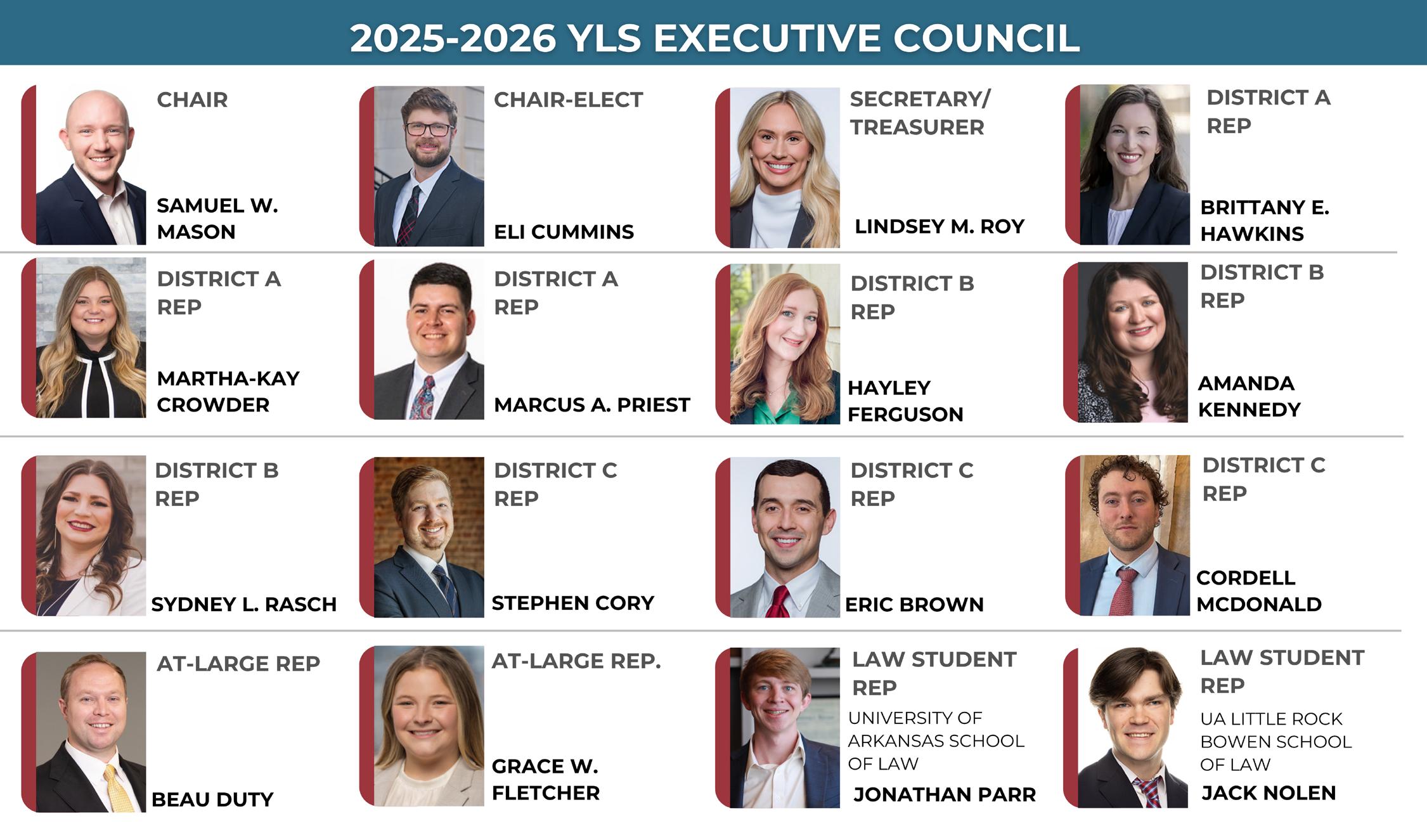
YLS Chair
Samuel W. Mason
BAR ASSOCIATION STAFF
Executive Director
Karen K. Hutchins
Director of Operations
Kristen Frye
Finance Administrator/CPA
Staci Clark
Publications Director
Anna K. Hubbard
Office & Data Administrator
Cynthia Barnes
Professional Development Coordinator
Lisa McCormick
Information Technology Specialist
Rachel Henderson
features
A Case, A Place, and the Rule of Law—The Era-Faithful Courtroom and Civic Learning Center By Judge D.P. Marshall Jr. 14
The Declaration: A Gift Not a Given By Tyler D. Mlakar 20
The Privacy Paradox—From "Let Alone" to "Share My Location" By Turqouise S. Early and Amie Schoeppel Wilcox
26
Check Your Text. No, Not Your Phone, Your Arkansas Constitution By Brett D. Watson and Frank Arey
30
Life, Liberty, and the Pursuit of Litigation: How Arkansas Made the Declaration of Indepedence Justiciable By Jack Thorlin
32
Remembering Mark Killenbeck: Scholar, Teacher, Mentor Facilitated by William Taylor Farr with contributions from Professors Carol Goforth and Howard Brill
Contents Continued on Page 2 10
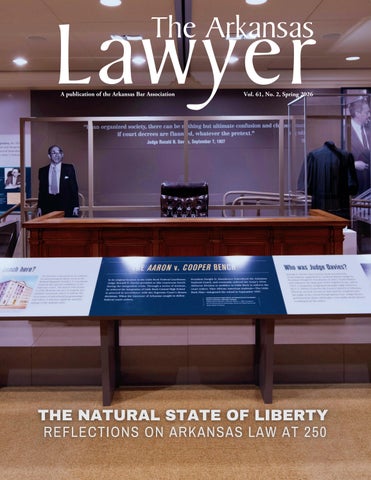
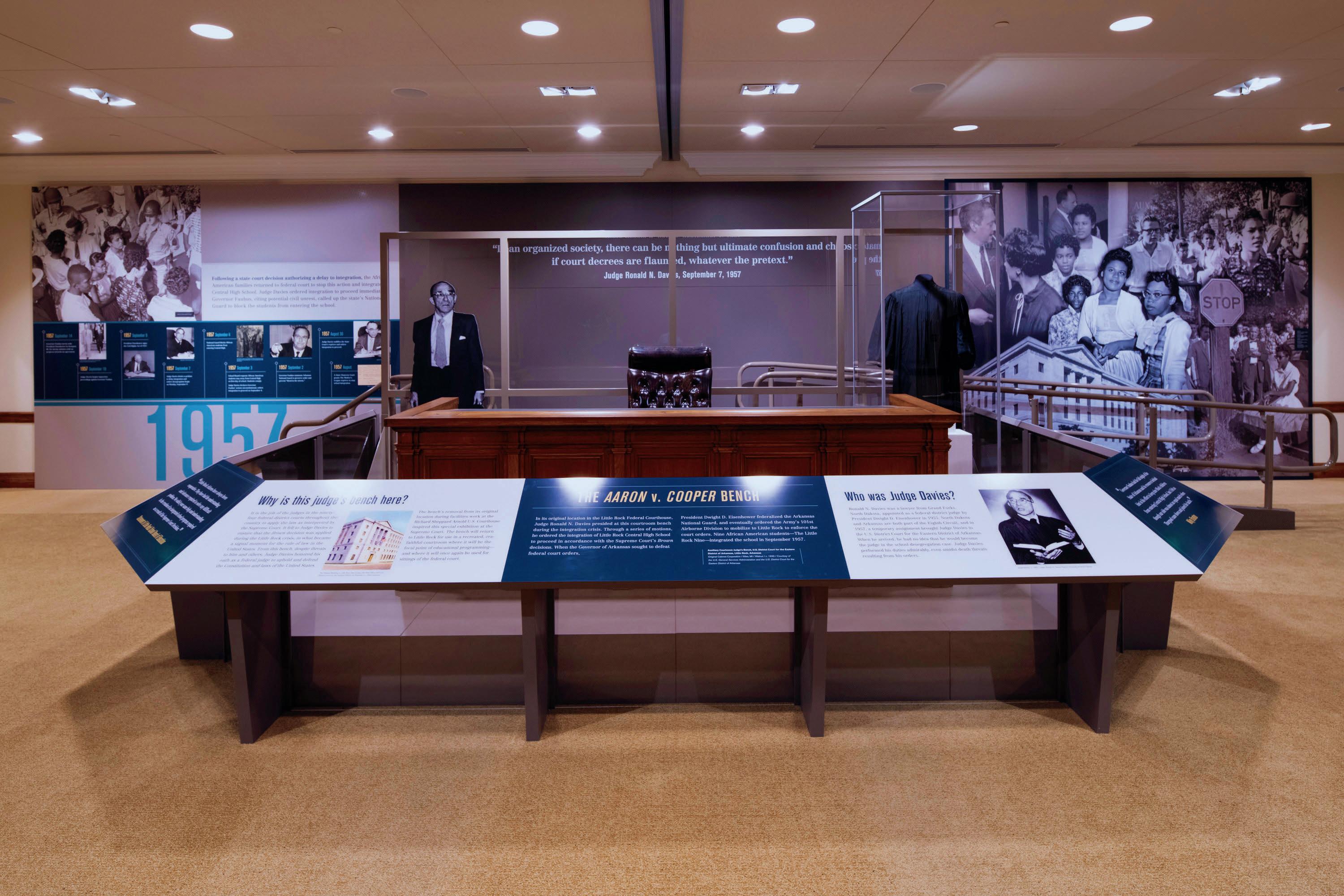
Cover photo: “Integration Must Proceed Forthwith” exhibit at the Supreme Court of the United States featuring the Aaron v. Cooper bench. See related article on pages 10–12.
Photo credit: Fred Schilling, Collection of the Supreme Court of the United States.
The Arkansas Lawyer (USPS 546-040) is published quarterly by the Arkansas Bar Association. Periodicals postage paid at Little Rock, Arkansas. POSTMASTER: send address changes to The Arkansas Lawyer, 1401 W. Capitol Ave., Suite 170, Little Rock, Arkansas 72201. Subscription price to nonmembers of the Arkansas Bar Association $35.00 per year. Any opinion expressed herein is that of the author, and not necessarily that of the Arkansas Bar Association or The Arkansas Lawyer. Contributions to The Arkansas Lawyer are welcome and should be sent to Anna Hubbard, Editor, ahubbard@arkbar. com. All inquiries regarding advertising should be sent to Editor, The Arkansas Lawyer, at the above address. Copyright 2026, Arkansas Bar Association. All rights reserved.
Advertise in the next issue of The Arkansas Lawyer magazine
President: Jamie Jones Walsworth; President-Elect: Representative Carol Dalby; Immediate Past President: Kristin L. Pawlik
President-Elect Designee: Tim Cullen; Secretary: Glen Hoggard; Treasurer: Marc P. Martinez
Parliamentarian: Brent J. Eubanks; YLS Chair: Samuel W. Mason
Trustees:
District A1: Elizabeth Esparza, Samuel W. Mason, William M. Prettyman, Lindsey C. Vechik
District A2-A3: Payton C. Bentley, Kelsey Boggan, Evelyn E. Brooks, Jason M. Hatfield, Michelle Rene’ Jaskolski, Sarah C. Jewell, George Rozzell, Russell B. Winburn
District A4: Kelsey K. Bardwell, Craig L. Cook, Brinkley B. Cook-Campbell, Dusti Standridge
District B: Brooke Blackwell, Randall L. Bynum, Mark Kelly Cameron, Thomas M. Carpenter, Bob Edwards, John A. Ellis, Bobby Forrest, Joseph Gates, Michael K. Goswami, Steven P. Harrelson, Michael M. Harrison, Jim Jackson, Anton L. Janik, Jr., Victoria Leigh, Skye Martin, Kathleen M. McDonald, J. Cliff McKinney II, Jeremy M. McNabb, Molly M. McNulty, Meredith S. Moore, Andrew Norwood, John Ogles, Casey Rockwell, Lauren Spencer, Aaron L. Squyres, Caitlin C. Stepina, Danyelle J. Walker, Patrick D. Wilson
District C5: William A. Arnold, Joe A. Denton, John T. Henderson, Brett D. Watson
District C6: Bryce Cook, Paul N. Ford, Jeffrey W. Puryear, Paul D. Waddell
District C7: Kandice A. Bell, Robert G. Bridewell, Sterling T. Chaney, Ledly Jennings
District C8: Meagan E. Davis, Amy Freedman, John S. Stobaugh, Joshua R. Thane
Ex-officio Members: Judge Craig Hannah, Judge Chaney W. Taylor, Vicki S. Vasser, Dean Cynthia Nance, Dean Colin Crawford, Glen Hoggard, Eddie H. Walker, Jr., Karen K. Hutchins
2026 Arkansas High School Mock Trial
Competition
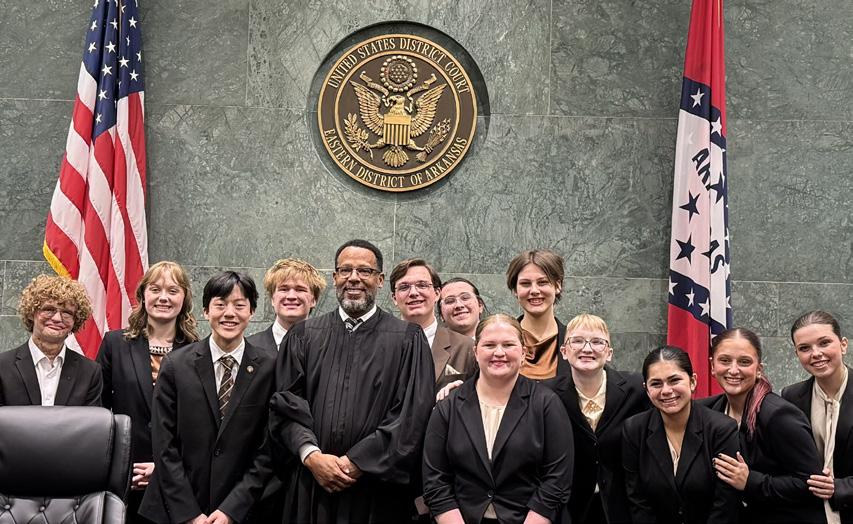
The Arkansas Bar Association extends its sincere thanks to the many judges, attorneys, coaches, law clerks, court staff, and volunteers who made the 2026 Arkansas High School Mock Trial Competition a success. With courts closed and volunteers stepping away from busy practices to support students throughout the weekend, the competition reflected a true all-hands-on-deck effort from Arkansas’s legal community.
Special appreciation goes to the Richard Sheppard Arnold United States Courthouse for generously hosting the event and giving students the opportunity to compete in an authentic courtroom setting. Led by Mock Trial Committee Co-Chairs Maggie King Davis and Adam Jackson, along with Immediate Past Chair and longtime volunteer Anthony McMullen, the statewide program continues to provide Arkansas students with hands-on experience in courtroom advocacy, critical thinking, professionalism, and teamwork.
This year’s competition brought together 21 teams representing 14 high schools from across Arkansas. After multiple rounds of competition, Conway High School defeated Little Rock Central High School in the championship round to claim the 2026 Arkansas High School Mock Trial State Championship. Conway High School later represented Arkansas at the National High School Mock Trial Championship, placing 29th.
The Arkansas Bar Association extends special thanks to the judges, attorneys, law clerks, court staff, coaches, and volunteers listed below whose time and dedication made the 2026 Arkansas High School Mock Trial Competition possible. Watch for the next opportunity to volunteer this fall, and learn more about the program at www.arkbar.com/?pg=mocktrial.
Jamie Allen
Amanda Anderson
Josh Ashley
Cory Baker
Chief Judge Kristine G. Baker
Carter Beard
Melanie Beard
Kandice Bell
Sherri Black
Nathan Bogart
Caitlyn Brainerd
Abby Brenneman
Richard Bright
Thomas Brisendine
Jackson Brown
Tiffany Brown
Brittani Brownlee
Jeremy Canitz
Chris Carlisle
Vanessa Cash Adams
Brandon Cathey
Auriel Del Carmen
Rabecca Cisneros
Heather Clark
Rebecca Clark
Staci Clark
Zoye Clark
Brian Clary
Eugene Clifford
Chris Corbitt
Cory Crawford
Brenna Cross
Maggie Davis
Bobby Digby
Kyra Dobson
Judge Margaret Dobson
Tammy Downs
William Fennell
Sophie Fray
Genoveva Gilbert
Hagen Glenn
Kacie Glenn
Charsie Gordon
Lauren Graham
Adrienne Griffis
Laketa Gutierrez
Audra Hamilton
Liz Harris
Judge Patricia S. Harris
Katelyn Hays
Chris Heil
Kat Hodge
Glen Hoggard
Bree Hopper
Nick Hornung
Ashley Hudson
Adam Jackson
Jim Jackson
Joshua Jackson
McKinzy Jackson
Jazmine James
Will James
Sonya Jeffords
Judge Shanice Johnson
Grayce Joyce
David Jung
Leesha Kamotho
Sarah Keith-Bolden
Jessie Korzen
Steven LaRussa
Jerry Larkowski
Sarah Leflar
Phyllis Leak
Jules Lemmon
Jason Lumpkin
Charles Lyford
Gabriel Mallard
Bill Mann
Nathan McCarroll
Lisa McDaniel
Sean McDaniel
Honey McMillan
Anthony McMullen
Molly McNulty
Benjamin Menard
Judge Brian S. Miller
Justin Minton
Brandon Montes
Barrett Moore
Matt Morgan
Theresa Morris
Courtney Murray
Evan Nelson
Crystal Newton
Abigail Obana
Paige Oliver
Lisa Peters
Joyce Pigee
Taylor Pray
Vicram Rajgiri
Ellis Rampy
Wesley Rhodes
Selina Ripa
Lexie Rook
Jonathan Ross
Alexandr Satanovsky
Amber Schubert
Lance Smith
Lexie Stinson
Judge Richard D. Taylor
Jordan Tinsley
Courtney Umeda
Judge Joe J. Volpe
Johanna Wade
Lesciara Walker
Abby Walton
Tracy Washington
Emilee Web
Bobby Wheeler
Caroline Winningham
Cory Wilkins
Cheston Wright
Chris Yates
2026 Arkansas High School Mock Trial State Champion — Conway High School. Photo provided by Casey Griffith.
Word About Town
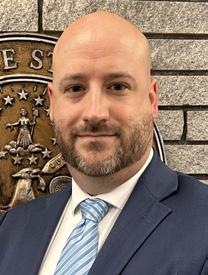
McDaniel Wolff PLLC of Little Rock has named Brittany Webb as a partner at the law firm. Wright Lindsey Jennings announced that former Pulaski County Attorney Adam Fogleman joined the firm.
Legal Hall of Fame Speaker Series
The Arkansas Bar Association and the Administrative Office of the Courts presented two Legal Hall of Fame Speaker Series events this spring as part of Legal Luminaries—Lighting the Path, honoring members of the first two Arkansas Legal Hall of Fame classes whose contributions have shaped the legal profession, public service, and civic life in Arkansas and beyond.
Watch for additional Legal Hall of Fame Speaker Series events in the future as the series continues to grow, as well as announcements later this fall recognizing the 2026 Legal Hall of Fame class. For more information and to view all honorees and their videos, visit https://www.arkbar.com/?pg=hall-of-fame.
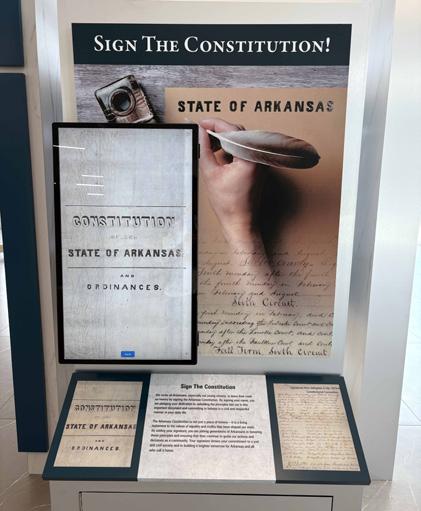
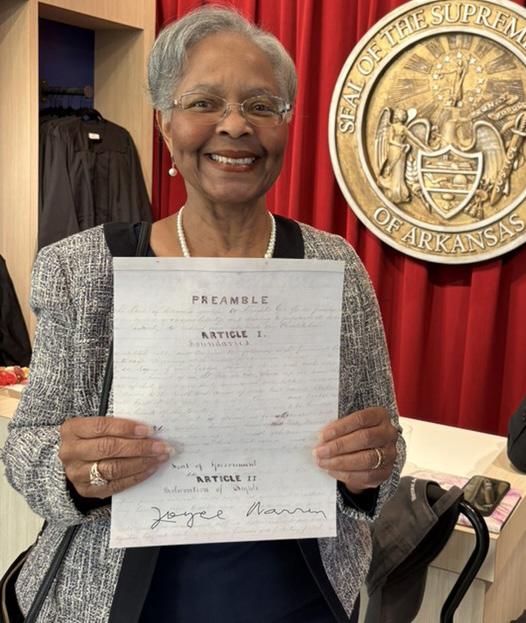
Judge Joyce Williams Warren (Ret.), a member of the 2024 Arkansas Legal Hall of Fame class, explores the Arkansas Constitution exhibit at the Administrative Office of the Courts Civics Education Center, where visitors can sign the Constitution and print a commemorative copy to take home.
Jean Turner Carter, a member of the 2024 Arkansas Legal Hall of Fame class, is featured on the interactive kiosk at the Civics Education Center.
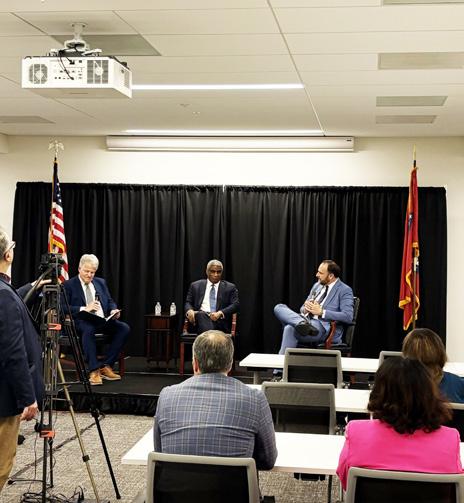
Former U.S. Secretary of Transportation Rodney Slater, a member of the 2022 Arkansas Legal Hall of Fame class, is pictured with Marty Sullivan, Emilee Web, and Brian Rosenthal during the May event in the left photo and participating in the panel discussion at right.
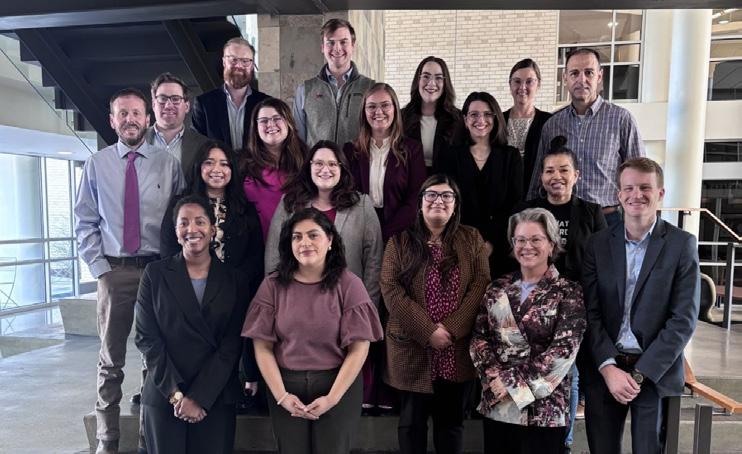
Lawyers and law students from across Arkansas recently completed the fourth class of ArkBar’s Public Service Academy, preparing the next generation of leaders for service in their communities and public life.
Thank you to the partners and sponsors who make the program possible, including the University of Arkansas School of Law, Fayetteville; the University of Arkansas at Little Rock William H. Bowen School of Law; Rose Law Firm; the Juvenile Justice and Child Welfare Section of the Arkansas Bar Association; and Brian M. Rosenthal.
Congratulations to the members of the 2026 Public Service Academy class listed below:
Leslie Copeland, Fayetteville
Shayla Dawson, Little Rock
Caleb Dean, Little Rock
David Dixon, Farmington
Elizabeth Dussex, Little Rock
S. Wynne James, Little Rock
Savannah Johnston, North Little Rock
Deepali Lal, Little Rock
Amanda La Fever, Sherwood
Tory H. Lewis, Hot Springs
Sandra Mondragon, Springdale
Chuck Munson, Little Rock
Hugh Pascoe, Conway
April Rogers, Conway
Chasey Schoeppel Wilcox, Little Rock
Ross Simpson, Little Rock
Nicholas Sissel, Little Rock
Danyelle J. Walker, Little Rock
Sydney Watts, Paragould arkbar.com/?pg=PublicServiceAcademy
ArkBar President
Jamie Jones
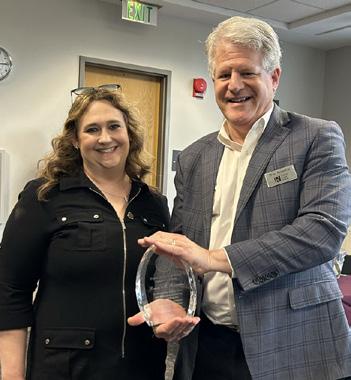
Walsworth presented the Public Service Academy Founder’s Award to Brian Rosenthal for his vision and dedication in creating and sustaining the program.
2025-2026 Arkansas Bar Association Annual Award Recipients
The Arkansas Bar Association is proud to recognize the many attorneys, judges, educators, and volunteers whose leadership and service continue to strengthen the profession and support the Association’s mission. From mentoring future legal professionals and advancing public education initiatives to supporting continuing legal education, publications, sections, events, and member engagement, this year’s honorees reflect the broad range of talent, dedication, and generosity that help move the legal community forward across Arkansas.
ArkBar President Jamie Jones Walsworth will recognize the 2026 award recipients during the Association’s Annual Meeting in Hot Springs. The Arkansas Bar Association extends its sincere appreciation to these individuals for their time, leadership, and meaningful contributions to the profession and to the work of the Association.
To learn more about the awards and honorees, visit the Awards & Recognition page at https://www.arkbar.com/?pg=Awards_and_ Recognition.
U.S.
Magistrate
Judge Joe Volpe
Presidential Award of Excellence
Glen Hoggard
Tory Hodges Lewis
Maurice Cathey Award
Aaron Squyres
Golden Gavel Awards
Margaret King Davis
Adam Jackson
Anthony L. McMullen
Bob Estes
Hon. Brent J. Eubanks
Hon. Shawn Johnson
Harry A. Light
Trent Minner
Jasmine Richardson
Caitlin Campbell Stepina
Marty E. Sullivan
William A. Waddell Jr.
Judge Joyce Williams Warren (Ret.)
Young Lawyer Awards
Samuel W. Mason
Eli Cummins
CLE Awards
Evelyn Brooks
Jason M. Hatfield
Will Bond
The Courage to Serve
With Gratitude for Arkansas Lawyers
It has been a true honor to serve as your President this year. As this term comes to a close, I have spent time reflecting on the experience and on what I will carry with me from it. What I have realized is this: the best thing about being an Arkansas lawyer is Arkansas lawyers.
Over the past year, I have traveled across our state meeting many of you, and what I have seen has been extraordinary. I have seen lawyers mentoring young attorneys, judges volunteering their time, rural lawyers serving entire communities, and attorneys quietly helping others without any expectation of recognition or praise. Our communities may never fully see all the ways lawyers hold them together, but every single day across Arkansas, they do. The greatest strength of our profession has never been prestige or titles. It has always been the willingness of lawyers to serve.
This year confirmed for me that service is deeply ingrained in the Arkansas legal community. Many of you serve on nonprofit boards, in community organizations, in your churches, and in your schools. Judge Shawn Johnson, for example, serves nationally with the Boy Scouts of America and even helped create a public service academy model for the organization. Judge Robert Gibson annually holds court for a mock trial of The Outsiders for the Crossett 7th Grade Honors class. Elizabeth Rose serves on the board of Seven Hills, supporting Northwest Arkansas’s homeless community. Many of our lawyers— including Judge Volpe, Fred Ursery, and so many others—have also served our country through military service. I could continue naming lawyer after lawyer who gives back to this state and its people. In Arkansas, extraordinary service has become the norm. If we want the public to believe in the rule of law, we must continue showing them lawyers who serve with integrity,
Jamie Jones Walsworth is the President of the Arkansas Bar Association. She is a partner at Friday, Eldredge & Clark, LLP in Little Rock.
humility, and compassion. Service matters. Service strengthens communities. Service strengthens our profession. Service strengthens our democracy.
For that reason, the Arkansas Bar Association has made a point this year to recognize and honor lawyers who serve. Through the Service Award, we have thanked attorneys for their “unwavering commitment, distinguished leadership, and tireless dedication to serving the community” and for exemplifying “the highest ideals of the legal profession.” To all of our members who serve others—in both
large and small ways—thank you. Much of that work may feel unseen, and often it is, but the impact of your service is deeply felt by the people and communities around you.
I would be remiss, however, if I did not also acknowledge something troubling I have heard in conversations across our state. The legal profession has always understood that the rule of law requires lawyers to represent their clients zealously, even when those clients or causes may be unpopular. Criminal defense lawyers, for example, represent individuals charged with the most serious crimes. At times, areas of legal practice also become intertwined with political debate. Immigration law is one such example. While people may disagree about policy, immigration lawyers are on the front lines ensuring that clients receive representation and due process under the law.
Recently, I have heard from Arkansas immigration lawyers who say they have been threatened for representing their clients and that some genuinely fear practicing law in the current environment. Those conversations deeply troubled me, because when lawyers are afraid to be lawyers, our democracy is threatened.
The future of this profession will not be defined only by legal skill or professional success. It will be defined by whether we remain committed to service—to our clients, our communities, and one another. I leave this presidency deeply hopeful because I have seen firsthand the extraordinary ways Arkansas lawyers continue to serve others every day. My hope is that we will also continue serving and supporting each other, so that every lawyer feels safe and empowered to serve the people of this state. Thank you for this incredible year.
With gratitude, Jamie
F I E R C E A D V O C A C Y .
T R U S T E D R E S U L T S .
Preparing the Next Generation
One of the things I value most about the Young Lawyers Section is the opportunity it creates to build relationships with attorneys across Arkansas. No matter where you practice, those connections matter and often stay with you throughout your career.
That sense of connection has continued through our YLS mixers this year. District C representatives hosted a reception in Texarkana in February, and District A hosted a reception in Northwest Arkansas in May. We’re grateful to our district representatives for helping bring attorneys together across the state and keeping members connected to the section.
Another major focus for YLS this year has been updating the 18 & Life to Go Handbook, an important public education resource designed to help young people
navigate key legal issues as they enter adulthood. Thank you to everyone who contributed time and insight to the revision process. Because of those efforts, we anticipate the handbook will be ready for printing and distribution to schools across Arkansas this fall. We are also grateful to the Arkansas Bar Foundation for its generous grant support to help make publication possible.
Whether through networking events, public education initiatives, or leadership opportunities, YLS remains focused on helping young lawyers feel connected and supported in the profession.
We are also looking ahead to the Arkansas Bar Association Annual Meeting in Hot Springs this June. For many attorneys, Annual Meeting is where lasting
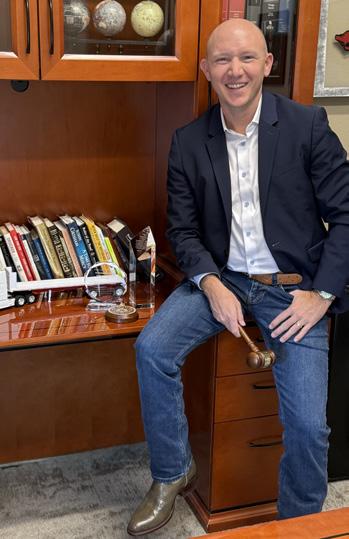
Samuel W. Mason is the Chair of the Young Lawyers Section. Sam is a trial attorney and partner at the Oliver Law Firm in Rogers.
professional relationships begin and where newer lawyers find ways to get involved in the profession.
YLS members will have several opportunities to connect throughout the meeting, including the YLS Section Meeting, the Friday Firm Reception, the YLS Reception at Pop’s Lounge, and the America’s 250th Birthday Dance Party. Friday’s programming also includes several CLE opportunities especially relevant to newer lawyers and those building their practice.
Thank you to everyone who continues to support YLS and participate in its programs. It truly makes a difference, and I hope to see many of you at Annual Meeting. ■
A Case, A Place, and the Rule of Law— The Era-Faithful Courtroom and Civic Learning Center
By Judge D.P. Marshall Jr.
Photos courtesy of the United States District Court for the Eastern District of Arkansas.
the people
About the Author
Judge D.P. Marshall Jr. is a United States District Judge for the Eastern District of Arkansas.
As Chief Justice Roberts noted recently, “The Declaration of Independence was then, and remains today, a statement of national aspirations, not a codification of enforceable legal obligations. Yet throughout our history it has played a signal role in the development of the Nation’s constitutional, statutory, and common law.”1 Places remind us where our law has lived up to those aspirations and where it hasn’t. Independence Hall. The Old Courthouse at Gateway National Park in St. Louis where Dred Scott’s case began. Central High School. The lawsuit about integrating the Little Rock School District, Aaron v. Cooper, was heard in AC436, the small auxiliary courtroom in the federal courthouse. As a place takes us back in time, we remember, learn, and are inspired to press on. AC436—the Eastern District of Arkansas’s Era-Faithful Courtroom and Civic Learning Center—is such a place.
In September 1957, nine black students attempted to enroll at Little Rock’s Central High School. This was the first step in the Little Rock School District’s court-approved plan for integrating the District gradually.2 The Little Rock Nine were turned away by members of the Arkansas National Guard on orders from Governor Orval Faubus. Attention then shifted back to Aaron v. Cooper, the lawsuit filed the previous year on behalf of those students. Pine Bluff lawyer Wiley Branton was lead counsel, joined on the papers by three others, including Thurgood Marshall. A newly minted lawyer named George Howard, Jr., assisted on the case— for example, he notarized Branton’s verification of the complaint. (Howard would become, in the fullness of time, United States District Judge for the Eastern District of Arkansas.) In this second phase of the litigation, then-lawyer Marshall came to Little Rock to help on the ground.
The Aaron plaintiffs’ motion for a preliminary injunction was heard in September 1957 in AC436, the auxiliary courtroom on the fourth floor of the original building now known as the Richard Sheppard Arnold United States Courthouse. It was a modest space. The building plans named it as the “Auxiliary Court Room and Civil Service Examination Room.” There was a different judge for Aaron v. Cooper’s second phase. On assignment to Little Rock because of a backlog created by the resident district judge’s retirement, a visiting judge—the Honorable Ronald N. Davies of the District of North Dakota—took over the case at its most important moment.3 Like all visiting judges, he presided over cases in the auxiliary courtroom. The small room was packed that September day. All but one of the Nine were present. There Ernest Green and Elizabeth Eckford testified. There the lawyers argued. After thanking the Court for its courtesy, Governor Faubus’s lawyers walked out. And there, from the bench, Judge Davies ordered the Governor, and the officers in charge of the Arkansas National Guard, to stop obstructing and preventing the students’ admission to Central High.
The rest of the story is familiar. No party appealed Judge Davies’s decision. The Little Rock Nine began attending Central High, but tensions and strife in Little Rock remained. City police had to escort the students to and from school. President Eisenhower eventually enforced the Court’s rulings by federalizing the Arkansas
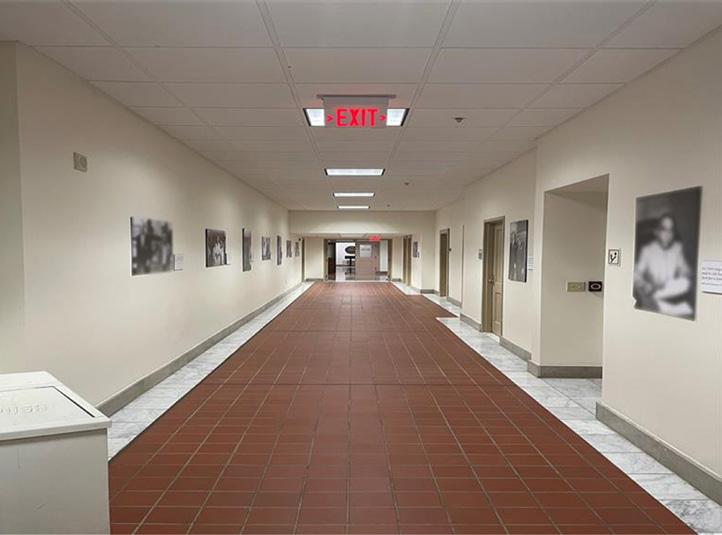
Historic images of
involved and the events at the federal courthouse during the Little Rock integration crisis line the hallway leading to the courtroom.
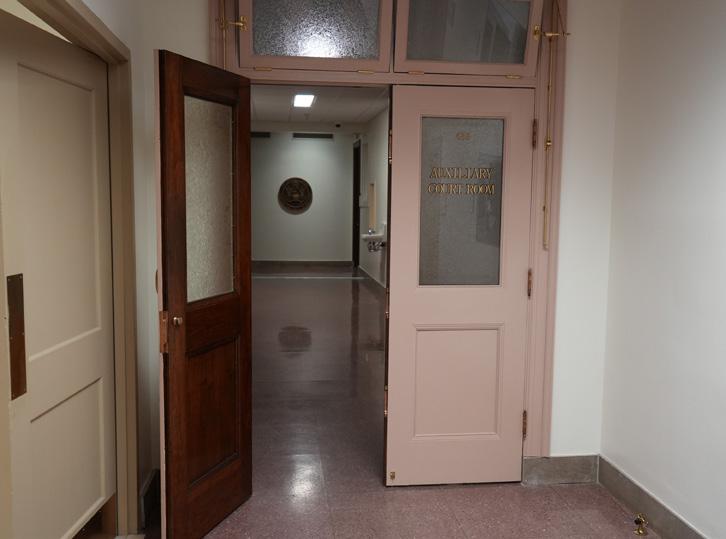
Restored courtroom doors from the original AC436 courtroom now welcome visitors to the Civic Learning Center.
National Guard and deploying paratroopers from the 101st Airborne Division. And the Little Rock Nine integrated Central High. Our law measured up to our Declaration’s aspirations.
Aaron v. Cooper didn’t end in the fall of 1957 in the auxiliary courtroom. In the spring semester the Little Rock School Board sought to pause the desegregation plan. The District Court agreed.4 Another judge was presiding at this point, Judge Davies having returned to North Dakota after his six-month assignment in Arkansas. The Court of Appeals reversed.5 The Supreme Court considered the matter on an expedited basis.
By per curiam opinion, the Supreme Court affirmed the Court of Appeals’ decision that the desegregation plan should not be suspended. The Supreme Court ordered the 1956 judgment approving that plan, and Judge Davies’s 1957 judgment enforcing it, “reinstated.” Two weeks later, the Court handed down its full opinion, which was issued in the names of all nine Justices.6 The Court reaffirmed that Brown was the law of the land. “The principles announced in that decision and the obedience of the states to them, according to the command of the Constitution, are
indispensable for the protection of the freedoms guaranteed by our fundamental charter for all of us. Our constitutional ideal of equal justice under law is thus made a living truth.”7
The auxiliary courtroom turned from a landmark case back to business as usual. For the next five decades, until completion of the Arnold Courthouse Annex in 2007, AC436 was in continuous use. District judges, magistrate judges, and bankruptcy judges presided there over all manner of cases. When many court operations moved to the Annex, the courtroom was decommissioned. The judge’s bench, the clerk’s bench, the court reporter’s desk, and other furnishings stayed put. From time to time, the Eastern District considered relocating them for use or display. But the Court’s regular business pressed, and no firm plans were made. As part of a nationwide space-reduction effort undertaken by the federal courts, the Eastern District eventually relinquished AC436 to its landlord, the General Services Administration. AC436’s furnishings remained in place, with an honorable past but no clear future. After GSA decided to renovate the space and lease it to another federal tenant, the question became urgent:
How best preserve and use the judge’s bench and other Aaron v. Cooper artifacts?
The answer was an exhibit at the Supreme Court of the United States and the Eastern District of Arkansas’s Era-Faithful Courtroom and Civic Learning Center. The General Services Administration, the Supreme Court, and the Eastern District joined hands. The judge’s bench went to Washington. It was conserved, repaired, and installed as the centerpiece of “Integration Must Proceed Forthwith,”8 an exhibit at the Supreme Court about Aaron v. Cooper, Judge Davies, Thurgood Marshall, and the rule of law. This exhibit will be open until the end of 2026. If life takes you to Washington, D.C. before then, make time to see it. Meanwhile, with GSA’s help, the Eastern District of Arkansas has been preparing a place for the judge’s bench to come home.
AC436 has moved. The Era-Faithful Courtroom and Civic Learning Center is now in the northeast corner of the first floor of the historic part of the Arnold Courthouse. Turn right at the Clerk’s office, head down the hallway and back in time. Images from 1957 line the walls. You’ll see Judge Davies putting on his robe. There
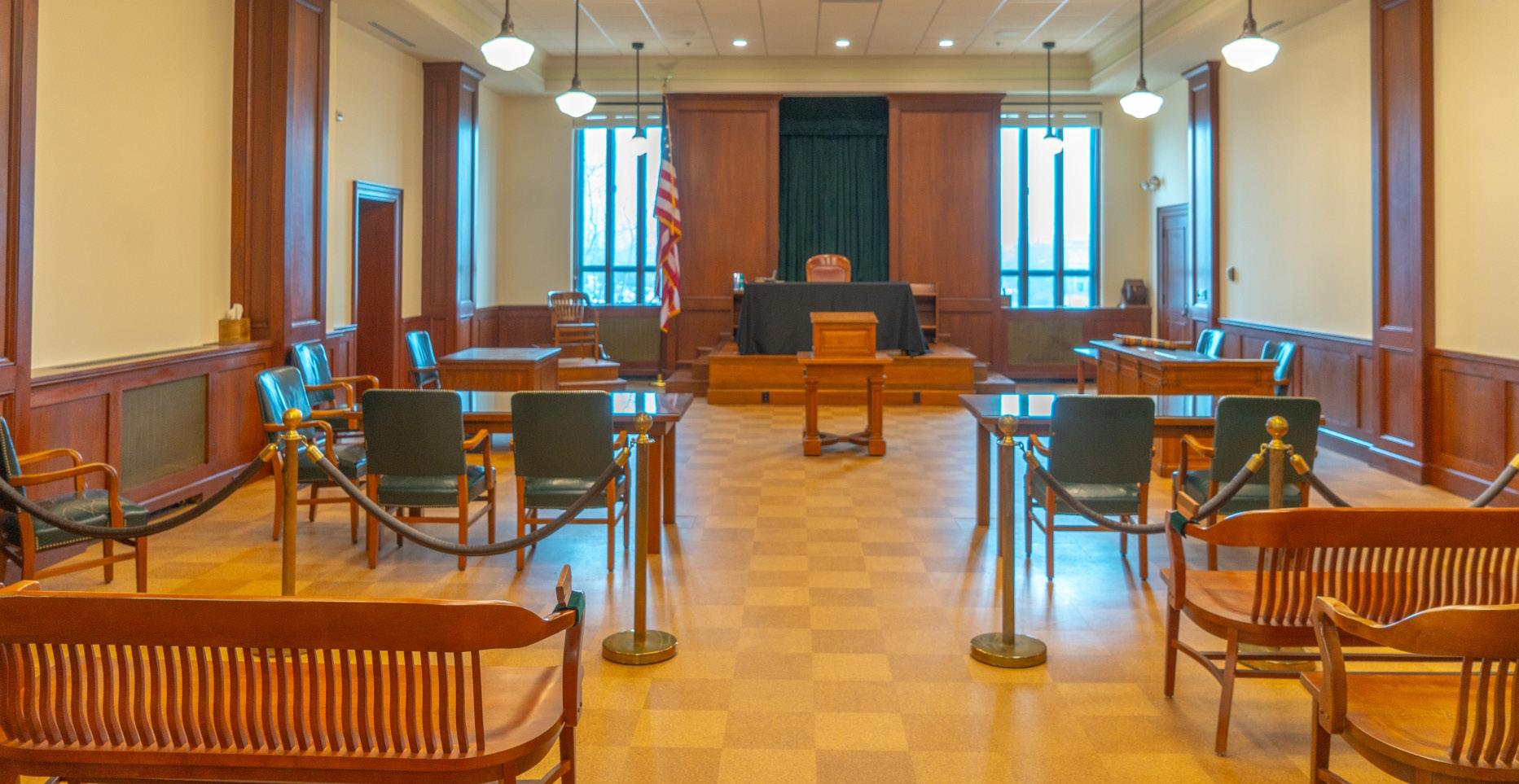
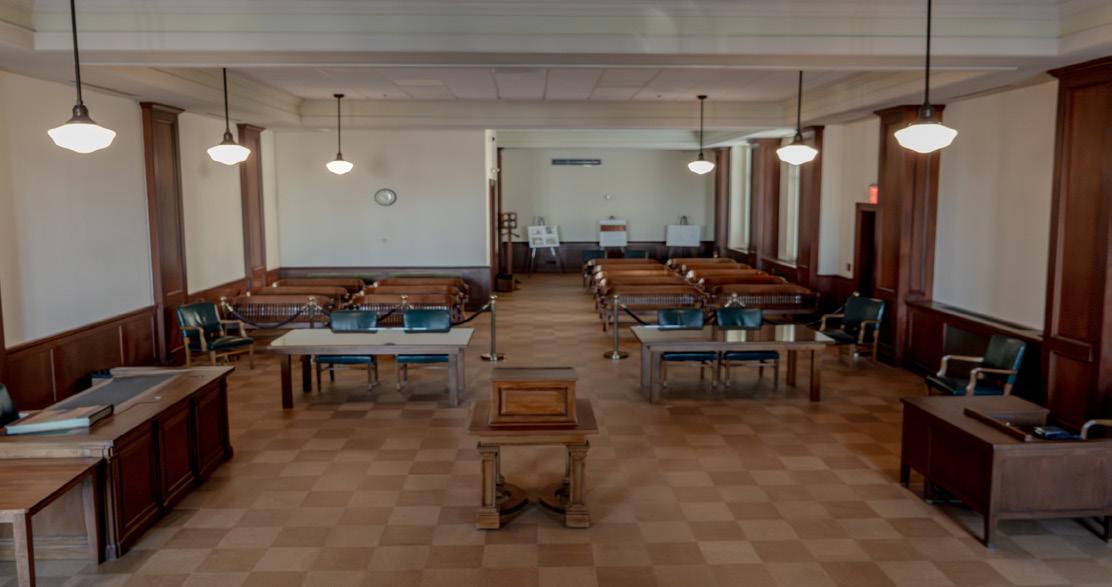
The restored Era-Faithful Courtroom and Civic Learning Center in the historic Richard Sheppard Arnold United States Courthouse.
Using most of the original furniture, the renovated courtroom reflects the appearance of the original AC436 courtroom where proceedings in Aaron v. Cooper were heard.
are the lawyers heading to court. Citizens crowd into the courthouse hallways, eager to be present as history was being made. The U.S. Marshal shushes the crowd as a hearing proceeds. Then Thurgood Marshall holds open the courtroom door for Daisy Bates and some of the Nine after one of the hearings ends.
You’ll pass through those same doors— restored and relocated—as you approach the courtroom. In the alcove between the doors and the courtroom, you’ll see (eventually) displays and information about Aaron v. Cooper. And there will be, in due course, more case-related exhibits in the back of the courtroom. The Eastern District is also building an electronic archive of all the court filings and documents from each phase of the case.
The courtroom has been completely renovated. It’s faithful to 1957 and the original AC436. It’s spartan. The clerk’s bench, court reporter’s desk, lectern, and base for the judge’s bench have been restored. A vintage witness stand and chair from another courtroom were added. Era-faithful counsel tables were made. While the courtroom is full of technology, none is visible. From the cork floor to the schoolhouse lighting, it feels like 1957. All that’s missing is the refurbished judge’s bench, which will return in early 2027 after the Supreme Court’s exhibit closes.
The Era-Faithful Courtroom and Civic Learning Center is not a museum; it is a living memorial to the rule of law. It’s a working courtroom. Almost every week,
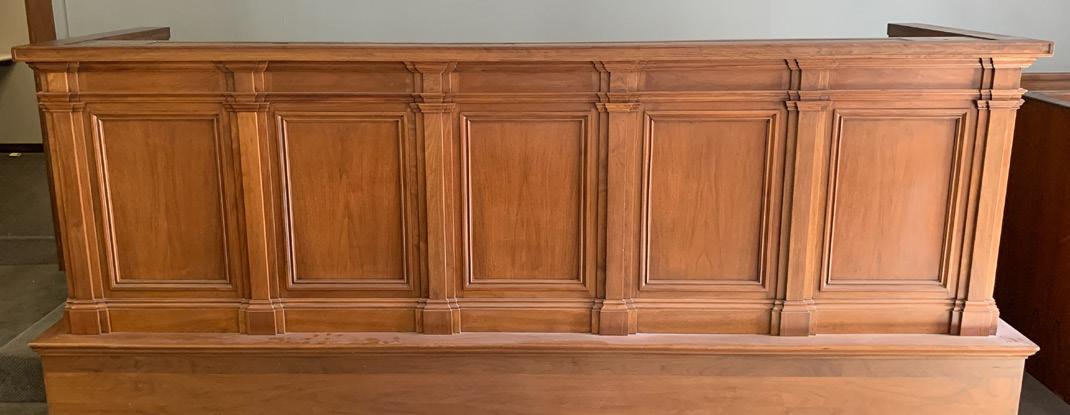
The judge’s bench in the original AC436 courtroom. After repair and conservation, it is currently the centerpiece of the "Integration Must Proceed Forthwith" exhibit at the Supreme Court of the United States. In 2027, the bench will return to the Era-Faithful Courtroom and Civic Learning Center at the Richard Sheppard Arnold United States Courthouse in Little Rock.
"The Eastern District of Arkansas invites you to visit AC436, wander around, and let the place take you back in time. Remember. Learn about Aaron v. Cooper’s role in the integration of Central High. And celebrate the Declaration’s
affirmation
that
all
people are equal before the law.”
the Eastern District holds civil and criminal hearings there. Visitors are welcome, both to attend court proceedings and to visit when court is not in session. Student groups and others are already making use of the space. A law school class has met there. High school students have used AC436 for their mock trial competitions. The Court is developing case-related materials for high school students and others to use in connection with visits. The goal is to have frequent sessions for young Arkansawyers studying history, government, and the rule of law. The Eastern District is also working to secure permission from the Supreme
Court and others so that, after the Court’s current exhibit ends, our Court can show an informative and inspiring video made for that exhibit. In it, all nine current Justices, and Justice Stephen G. Breyer, discuss the United States Constitution, Aaron v. Cooper, the people involved, and the rule of law.
...
The Eastern District of Arkansas invites you to visit AC436, wander around, and let the place take you back in time. Remember. Learn about Aaron v. Cooper’s role in the integration of Central High. And celebrate the Declaration’s affirmation that all people are equal before the law.
Endnotes:
1. Chief Justice John G. Roberts, Jr., 2025 Year-End Report on the Federal Judiciary, https://www.supremecourt.gov/ publicinfo/year-end/2025year-endreport. pdf.
2. Aaron v. Cooper, 143 F. Supp. 855 (E.D. Ark. 1956), affirmed, 243 F.2d 361 (8th Cir. 1957).
3. Billy Roy Wilson, Little Big Man— United States District Judge Ronald N. Davies, 30 UALR L. Rev. 303 (2008).
4. 163 F. Supp. 13 (E.D. Ark. 1958).
5. 257 F.2d 33 (8th Cir. 1958).
6. Cooper v. Aaron, 358 U.S. 1 (1958).
7. 358 U.S. at 19–20.
8. Chief Justice John G. Roberts, Jr., 2022 Year-End Report on the Federal Judiciary, https://www.supremecourt.gov/ publicinfo/year-end/2022year-endreport. pdf.
CHAPTER
By Tyler D. Mlakar
The Declaration: A Gift Not a Given
About the Author
Tyler D. Mlakar is a litigation associate at the Rose Law Firm.
Almost 250 years ago to the day, Thomas Jefferson published one of the most indelible sentences in human history: “We hold these truths to be self-evident, that all men are created equal, that they are endowed by their Creator with certain unalienable Rights, that among these are Life, Liberty, and the pursuit of Happiness.”1 With the benefit of centuries of progress toward this lofty ideal, fortified by functioning institutions, a Constitution tested through the crucible of crises, and a culture committed to its fulfillment, it’s easy to take Jefferson’s words as a given. But that was not always so, especially in colonial Arkansas under European rule.
After all, in July 1776, the inhabitants of the Poste des Akansa, the Arkansas Post, likely numbered less than a hundred.2 Disputes among Arkansawyers3 then were largely resolved, if at all, by French or Spanish military commandants with little experience, too much authority, and sometimes only a vague idea of what law, or even what country’s legal system, to apply.4
In short, late-18th-century Arkansas presented a very different legal world than the one declaring its independence 1,100 miles to the east. Jefferson’s grievances against the Crown—among others, that it had “obstructed the Administration of Justice,” made judges dependent on royal will, and deprived the colonies “in many cases, of the benefits of Trial by Jury”5—presupposed courts that could be obstructed, judges whose independence mattered, and juries that could be withheld. None of these existed, in any meaningful sense, in colonial Arkansas.
Such a stark contrast unveils more than just a curiosity; it reveals an enduring principle. The Declaration of Independence did not describe a universal colonial experience or a then-present reality. Rather, it proclaimed an Idea, a future to aspire to, and one that would become uniquely American. Put differently, the Declaration and its principles are a gift, not a given. A brief review of colonial Arkansas’s legal system makes that apparent.6
A different legal tradition altogether.
While the Declaration reflects long-standing assumptions of English common law, the French civil-law system governed much of 18th-century Arkansas, particularly the Custom of Paris.7 That system placed greater weight on written customary law, royal ordinances, and notarial practice as opposed to the common law’s insistence on precedent and juries.8 The notary, especially, played a far more expansive role than in the common law tradition, drafting and authenticating legal instruments and, in many settings, structuring private legal relationships.9
In colonial Arkansas, where trained legal professionals were scarce or absent altogether, those functions were often absorbed by whatever local official was at
hand.10 The roughly four decades of Spanish administration that followed French rule altered the surface but not the substance of this regime; many of the same legal habits persisted until they gradually yielded to American legal structures in the nineteenth century.11 The result was not an underdeveloped version of AngloAmerican law, but rather, a different framework altogether—one largely foreign to the assumptions animating the Founding Fathers in 1776.
Missing infrastructure.
Even within that civil-law framework, colonial Arkansas lacked the basic infrastructure of a formal legal system. The European presence at Arkansas Post fluctuated dramatically, from a handful of settlers in the post’s earliest years to perhaps a few hundred by the close of the Spanish period.12 At all times, the population was generally too small, too transient, and too isolated to sustain the kind of standing legal institutions Jefferson’s generation took for granted.
Law, in the abstract sense Jefferson and his contemporaries had in mind, depends on continuity, institutional memory, and a population large enough to sustain specialized roles. Colonial Arkansas had none of these. It lacked not only developed institutions, but also the basic conditions necessary for them to exist. What passed for “law” in colonial Arkansas was largely improvised, shaped by who was present, what problems arose, and often
whatever solution proved most practical or advantageous to the person in power.13
The “Administration of Justice” in colonial Arkansas.
That reality casts the Declaration’s grievance about “the Administration of Justice” in a different light. The Founding Fathers’ complaint was that the King refused to assent to colonial legislation “for establishing Judiciary powers.”14 In simpler terms, the King obstructed the colonists’ efforts to build and refine their respective judicial systems. Such a charge presupposed not only courts, but a civic community mature enough to legislate about them and confident enough to contest royal authority. In colonial Arkansas, neither presupposition held. There was no assembly drafting judiciary bills, no bar pressing for reform, and no royal disallowance to resent as there was little to disallow.
While the Superior Council (likely the only court of general jurisdiction in colonial Louisiana under French rule) existed, it was, in practice, out of reach for most Arkansawyers as accessing it could require weeks of travel to New Orleans.15 Authority on the ground was exercised largely by necessity rather than design, and the resolution of disputes turned more on circumstance than doctrine.16 Legal authorities were scattered, records were sparse, and proceedings were driven more by immediate need than formal law.17 While the Founding Fathers fought to establish their emerging judicial
“The Declaration was not a mirror of the world that produced it, but a blueprint for the world it called into being.”
institutions, in colonial Arkansas, the concept itself had yet to take root.
Trial by jury.
The Declaration’s emphasis on trial by jury fares no better when juxtaposed with the Arkansas frontier. To Jefferson and his audience, the jury was a fundamental safeguard of liberty—a mechanism through which ordinary citizens participated in the administration of justice. John Adams went so far as to say that “Representative government and trial by jury are the heart and lungs of liberty. Without them we have no other fortification against being ridden like horses, fleeced like sheep, worked like cattle and fed and clothed like swine and hounds.”18
But, of course, juries require a sufficiently large and stable community, along with procedural norms capable of legitimizing their decisions. Eighteenth-century Arkansas had neither. Instead, it frequently faced the caprice of the post-commandants, or, if circumstances allowed, resort to distant institutions like the Superior Council.19
In other words, what the Declaration framed as an essential right presupposed a level of institutional development Arkansas had not yet reached. The absence of juries was not an anomaly; it reflected colonial Arkansas’s underlying civil-law tradition and the practical limits of a frontier society that could not sustain the common law’s procedural machinery.
The concentration of power.
Perhaps the sharpest contrast between Philadelphia and the Arkansas Post lies in the Declaration’s concern with concentrated power. After all, Jefferson criticized the Crown for consolidating authority and making judges dependent on executive control.20 But in colonial Arkansas, the consolidation of power was not a threat to an existing system, but rather, it was the system itself. Post commandants routinely combined executive, judicial, and notarial roles.21 They commanded troops, undertook diplomatic relations with indigenous nations,22 governed the settlement, resolved disputes (often beyond formal authority), and authenticated legal instruments.23
Of course, from a modern constitutional perspective, that arrangement looks problematic to say the least. But from the perspective of a remote frontier settlement, it was practical. The scarcity of qualified officials and the fragility of the settlement made any meaningful separation of powers impossible. The very concentration of power the Declaration condemned was, in colonial Arkansas, a functional necessity.
The Declaration as argument, not description.
None of this is to fault Jefferson for failing to describe colonial Arkansas. The Declaration was a political document directed at a specific dispute with a specific sovereign, not a survey of legal conditions across a continent most of its signers had never seen. On its own terms, the Declaration indicts the Crown for what it had done to institutions the colonists actually possessed. The point of looking westward from Philadelphia is not to convict the Declaration of inaccuracy, but to recognize how much of its moral force depends on a developed legal order, and how much of the country it would eventually govern did not yet have one.
That recognition, in turn, brings the Declaration’s aspirational character into focus. The document did not merely catalogue existing conditions; it set forth a vision of lawful governance. That vision would, over time, extend into regions where it initially had little resonance. The history of Arkansas law is, in part, the story
of that extension—the gradual emergence of institutions, the displacement of French and Spanish forms after the Louisiana Purchase, and the slow alignment of local practice with national ideals.
The Declaration, 250 years later.
Two-and-a-half centuries later, it’s tempting to read the Declaration as a description of legal reality across the continent it purported to liberate. Eighteenth-century Arkansas suggests otherwise. The Declaration did not describe a uniform legal landscape; it helped, eventually, to create one.
The history of Arkansas law, from a commandant’s improvised authority at a remote French post to the courts, juries, and bar that we now take for granted, is the story of that creation. The principles announced in Philadelphia did not describe Arkansas as it was. Over time, they helped define what it would become. That, perhaps, is the most fitting tribute the Arkansas bar can pay the Declaration on its 250th birthday: not to celebrate it as a mirror of the world that produced it, but as a blueprint for the world it called—and continues to call—into being.
Endnotes:
1. The Declaration of Independence para. 2 (U.S. 1776).
2. See, e.g., Morris S. Arnold, Colonial Arkansas, 1686–1804: A Social and Cultural History 180 (1991).
3. Although whether to call folks from Arkansas “Arkansans,” “Arkansawyers,” or even the dreaded “Arkansian” has long been the subject of heated debate, I subscribe to “Arkansawyer” for at least a couple reasons. First, the General Assembly established that the proper pronunciation of Arkansas is “ArkanSAW” as opposed to “ArKANSAS” as long ago as 1881. See, e.g., Arkansan versus Arkansawyer, CALS, https://encyclopediaofarkansas.net/entries/ arkansans-versus-arkansawyers-6438/ (last visited April 27, 2026). And second, as one learned commentator put it, “Arkansans” is used by “wishy-washy do-gooders with inferiority complexes[,]” whereas “Arkansawyers,” are “simply stubborn, earthy, shrewd individualists with a zero tolerance for bullshit.” Id. His words, not mine.
4. Compare Morris S. Arnold, Unequal Laws Unto a Savage Race: European Legal Traditions in Arkansas, 1686–1836 43–111 (2004), with Morris S. Arnold, The Arkansas Colonial Legal System, 1686–1766, 6 U. Ark. Little Rock L. Rev. 391, 403 (1983).
5. The Declaration of Independence paras. 10–11, 20 (U.S. 1776).
6. For that review, the indispensable guide is Judge Morris S. Arnold of the United States Court of Appeals for the Eighth Circuit, whose decades of scholarship on colonial Arkansas remain, by a wide margin, the most authoritative in the field.
7. See, e.g., Morris S. Arnold, Colonial Arkansas, 1686–1804: A Social and Cultural History 125 (1991).
8. John Henry Merryman & Rogelio Perez-Perdomo, The Civil Law Tradition: An Introduction to the Legal Systems of Europe and Latin America 27–46 (4th ed. 2018) (discussing civil-law system generally); see also Morris S. Arnold, The Arkansas Colonial Legal System, 1686–1766, 6 U. Ark. Little Rock L. Rev. 391, 405–06 (1983) (discussing importance of notarial role); see also Joseph Dainow, The Civil Law and the Common Law: Some Points of Comparison, 15 Am. J. Comp. L. 3, 424, 427 (1966–1967).
9. Compare Morris S. Arnold, The Arkansas Colonial Legal System, 1686–1766, 6 U. Ark. Little Rock L. Rev. 391, 405–06 (1983), with Gail S. Stephenson, Contemporary Issues In Louisiana Law: Louisiana Civil-Law Notaries, 43 S.U. L. Rev. 93, 93–97 (2015).
10. As a prime example, Judge Arnold highlights Father Louis Carette’s—a Jesuit missionary—extensive role in this regard at Arkansas Post during the 1750s. Morris S. Arnold, The Arkansas Colonial Legal System, 1686–1766, 6 U. Ark. Little Rock L. Rev. 391, 412–423 (1983).
11. See, e.g., Morris S. Arnold, Unequal Laws Unto a Savage Race: European Legal Traditions in Arkansas, 1686–1836 1–112, 130–202 (2004).
12. Morris S. Arnold, Colonial Arkansas, 1686–1804: A Social and Cultural History 180 (1991).
13. One example from Judge Arnold’s works bears mention. In the 1750s,
Guedetonguay, the then-Medal Chief of the Quapaws, had captured and returned four deserters from the Arkansas garrison. Morris S. Arnold, The Arkansas Colonial Legal System, 1686–1766, 6 U. Ark. Little Rock L. Rev. 391, 409 (1983). Although one of the deserters had killed his corporal within the precincts of the fort, because Guedetonguay requested a pardon—and threatened reprisal if it was not granted— the deserter received it despite the absence of any formal factfinding regarding the killing. Id. at 409–12. As Judge Arnold explained “[f]aithful adherence to legal principle sometimes had to take a back seat to the more compelling demands of politics.” Id. at 409–12.
14. The Declaration of Independence para. 11 (U.S. 1776); Ryan C. Williams, Personal Jurisdiction and the Declaration of Independence, 75 Duke L.J. 247, 271–84 (2025) (arguing that the grievance arose from a controversy over foreign attachment in North Carolina).
15. Morris S. Arnold, The Arkansas Colonial Legal System, 1686–1766, 6 U. Ark. Little Rock L. Rev. 391, 399–400, 412, 420–21 (1983). The Superior Council consisted of the Lieutenant General of New France, the Intendant of the same, the Governor of Louisiana, a first councilor of the king, two other councilors, the attorney general, and a clerk. “Judgments in civil cases required the concurrence of at least three members and in criminal cases at least five.” Id. at 400.
16. See, e.g., Morris S. Arnold, Unequal Laws Unto a Savage Race: European Legal Traditions in Arkansas, 1686–1836 52–53 (2004). For example, under Spanish rule, Judge Arnold describes a system under which the post-commandant was “the final arbiter” of disputes as there was no right to appeal, and the “Spanish government winked at the exercise of unauthorized judicial power by the commandant . . . .” See also Morris S. Arnold, The Arkansas Colonial Legal System, 1686–1766, 6 U. Ark. Little Rock L. Rev. 391, 421–23 (1983).
17. Id.
18. Jonathan K. Van Patten, Themes and Persuasion, 56 S.D. L. Rev. 256, 270 (2011).
19. See, e.g., Morris S. Arnold, Unequal
Laws Unto a Savage Race: European Legal Traditions in Arkansas, 1686–1836 1–112, 130–202 (2004); See also Morris S. Arnold, The Arkansas Colonial Legal System, 1686–1766, 6 U. Ark. Little Rock L. Rev. 391, 421 (1983).
20. See, e.g., The Declaration of Independence paras. 2, 4–5, 7, 11 (U.S. 1776).
21. Morris S. Arnold, The Arkansas Colonial Legal System, 1686–1766, 6 U. Ark. Little Rock L. Rev. 391, 403, 421–23 (1983); Morris S. Arnold, Unequal Laws Unto a Savage Race: European Legal Traditions in Arkansas, 1686–1836 1–112, 130–202 (2004).
22. A good example is a Spanish commandant’s—Fernando de Leyba— relations with the Quapaw in the 1770s. See, e.g., Kathleen DuVal, The Education of Fernando de Leyba: Quapaws and Spaniards on the Border of Empires, 60 Ark. Historical Quarterly 1 (2001).
23. Morris S. Arnold, The Arkansas Colonial Legal System, 1686–1766, 6 U. Ark. Little Rock L. Rev. 391, 403, 421
(1983); Morris S. Arnold, Unequal Laws Unto a Savage Race: European Legal Traditions in Arkansas, 1686–1836 1–112, 130–202 (2004); see also Gilbert C. Din, The First Spanish Instructions for Arkansas Post November 15, 1769, Ark. Historical Quarterly Vol. 53, No. 3 (1994).
Convenience and easy living meet with this updated 2 Bed / 2 Bath, gated, Round River Condo on the Arkansas River. With the Arkansas River Trail & Rebsamen Golf Course next door, restaurants and downtown 5 minutes away, a private courtyard, tranquil waterside views, a covered patio, 2 stocked ponds, and a pool with a clubhouse, fun and relaxation await. $199,000. Call John Selva 501.993.5442
2520 Riverfront Drive, Little Rock
The Privacy Paradox –From “Let Alone” to “Share My Location”
By Turquoise S. Early and Amie Schoeppel Wilcox
About the Authors
Turquoise Early is an attorney with Kutak Rock LLP, where she specializes in technology transactions, privacy and data security.
In one hour of my Wednesday: I click through five online privacy policies while working. I check my sleep data from last night and get an update that my average heart rate is up this week. I order my favorite lunch, which is pre-saved on my app, and am pleasantly surprised that the nearest location of the restaurant was auto-populated to the area of town I am driving in. I check my spouse’s location to see if they have already left the grocery store, because the Walmart app reminded me of an item I usually buy but forgot to put on the list this time. I decline a client’s “follow” request on social media, because my privacy is very important to me.
These commonplace actions reflect a growing tension between convenience and control, raising a broader question: has the right to privacy been traded for convenience? More fundamentally, does a meaningful right to privacy exist?
The right to privacy was not directly addressed in the Declaration of Independence 250 years ago, but conceptually, the roots of it were there—the founders reflected that all men1 are endowed by their Creator with certain unalienable Rights, and that among these are life, liberty, and the pursuit of happiness. The concept was more directly addressed when the Fourth Amendment was added to the Constitution in 1791, preserving “the right of the people to be secure in their persons, houses, papers and effects.” However, this only prevented government officials from unlawfully intruding into homes or property, and did not do anything to prohibit invasions of privacy by private citizens or corporations.
Amie Schoeppel Wilcox is an attorney with Friday, Eldredge & Clark, LLP, where her practice focuses on healthcare regulatory and compliance matters.
The only legal tool available at the time for prohibiting the invasion of privacy by private citizens was trespass, which only prohibited physical intrusions on real property. For other types of invasions, the newly established courts struggled to make the limited framework in existence fit the rapidly evolving development of the new country, its citizens, and their industrial developments.
The Right to Privacy Emerges
The body of work that has received the most credit for first outlining and articulating the “right to privacy” was an 1890 Harvard Law Review Article authored by Samuel D. Warren and Louis D. Brandeis.2 The article has been credited as both “perhaps the most influential law journal piece ever published” and “the best example of the influence of law journals on the development of law.”3 Brandeis and Warren describe the evolution from “very early times” where the law gave remedy only for trespass to the “right to life,” which they describe as protecting the subject from battery or fear of injury, laying the grounds for the doctrine of assault and describing this evolution necessary to recognize “man’s spiritual nature, of his feelings and his intellect.” Later the law of nuisance developed from the need for protection against offensive noises and odors, dust and smoke, and excessive vibration, while the recognition of the value of human emotions came from the need for protection for a man’s reputation through slander and libel doctrines.
Brandeis and Warren also described the growth of the legal conception of property from tangible to intangible property through the growth of intellectual property doctrines “in the products and processes of the mind as works of literature and art, goodwill, trade secrets and trademarks.” They present the next step to be taken for protection of the person—“generally the scope of these legal rights broadened; and now the right to life has come to mean the right to enjoy life—the right to be let alone.”4
The article was spurred from rapid developments in society following the rise of newspapers and the release of the Kodak Brownie becoming the first mass market camera in 1884.
Instantaneous photographs and newspaper enterprise has invaded the sacred precincts of private and domestic life; and numerous mechanical devices threaten to make good the prediction that ‘what is whispered in the closet shall be proclaimed from the house-tops.’ For years there
has been a feeling that the law must afford some remedy for the unauthorized circulation of portraits of private persons; and the evil of the invasion of privacy by the newspapers, long keenly felt, has been but recently discussed by an able writer . . . the press is overstepping in every direction the obvious bounds of propriety and decency.5
At the time, courts were struggling to establish a remedy for actions such as the publication of private letters or publication of photos without permission—often framing these actions as a breach of implied contractual terms or breach of private confidence. Brandeis and Warren argued these remedies were inadequate: “we must therefore conclude that the rights, so protected, whatever their exact nature, are not rights arising from contract or from special trust, but are rights as against the world.”6
While not immediately adopted after publication, the privacy torts proposed by Brandeis and Warren became the modern trend in courts considering actions arising from the evolution of the media and technology. Over time, the proposals became so significant that the American Law Institute codified the right of privacy in the Restatement of Torts, later evolving into four separate torts: intrusion upon seclusion, public disclosure of private facts,
false light of publicity, and appropriation.7 Courts also began to recognize actions for breaches of confidentiality in special relationships, such as physicians and their patients.
Right to Privacy Expansion by Federal Actors
Just as the expansion of newspaper media and availability of cameras to consumers brought rapid changes and new concerns, so too did the introduction of telephones, computers, and the internet. The expanding role of the federal government required new tools. When the Social Security System was established in 1935, social security numbers were explicitly “NOT FOR IDENTIFICATION”—today, this information is one of the most economically valuable pieces of data in cases of data breaches and identity theft.8
The growth of telephone communication led to federal legislation against wiretapping telegraph messages and phone calls. But in 1928, The Supreme Court determined that the Fourth Amendment did not apply to wiretapping, because it did not involve physical trespass.9 The dissent was written by none other than Louis Brandeis, then a Supreme Court Justice, who stressed the opinions outlined in his famous article nearly 40 years earlier:
Subtler and more far-reaching means of invading privacy have become available to the
government. Discovery and invention have made it possible for the government, by means far more effective than stretching upon the rack, to obtain disclosure in court of what is whispered in the closet.10
One year after Olmstead, J. Edgar Hoover prohibited wiretapping at the FBI, and the Federal Communications Act of 1934 prohibited the admission of communications gained by wiretapping in court. Ironically, reports after Hoover’s death revealed that he was one of the largest abusers of wiretapping in history. The country saw a profound expansion of both wiretapping and more modern domestic electronic surveillance in response to domestic security threats during and after World War II, seizing upon fears of Communism in the McCarthy era.11
While the right to privacy was not explicitly included in the Declaration of Independence, and its textual inclusion in the Fourth Amendment was limited and only applied to government actors, the Supreme Court rooted the right to privacy as emanating from the “penumbras” of the Bill of Rights in Griswold v. Connecticut in 1965.12
The Olmstead decision would stand until 1967, when the Supreme Court fashioned the “reasonable expectation of privacy” test in Katz v. United States. 13 The Katz decision effectively adopted the reasoning of Justice Brandeis’s Olmstead dissent. The Court determined that the right to privacy did exist where a person exhibits an actual or subjective expectation of privacy that society is prepared to recognize as reasonable. The right to privacy has since been expanded— and limited—by the Court many times.14
Modern Expansion of the Right to Privacy
While the right to privacy has been strengthened through the judicial system and through industry-specific Congressional action, the United States still has not enacted an overarching federal privacy framework.15 The current privacy landscape has evolved to be a combination of sector-specific frameworks and various federal or state privacy laws. Some of the
laws included in this framework focus on providing protections to data related to health, children and finances. For example, the Health Insurance Portability and Accountability Act of 1996 (“HIPAA”) is the first federal statute to directly address health privacy, while the Children’s Online Privacy Protection Act of 1998 (“COPPA”) focuses on the online privacy of children under the age of 13. Further, the GrammLeach-Bliley Act (“GLBA”) introduced banking regulations that require financial institutions to explain their informationsharing practices and safeguard data.
The privacy landscape of the United States still does not fully provide strong protections for the right of privacy unlike the European Union’s General Data Protection Regulation (“GDPR”) that was enacted in 2018. The passing of GDPR forced the United States to examine the privacy rights it was providing its own citizens, which two years later in 2020 resulted in the passing of the California Consumer Privacy Act (“CCPA”) followed by 19 additional state privacy laws granting consumers certain rights to their data. While many state laws are modeled loosely on the GDPR, they lack uniformity in scope and application.
We are far past Brandeis and Warren’s outraged concerns based on the invasions of newspapers and photos of private citizens. Today, technology has engulfed our everyday so much that we overlook how integrated technology is in our lives only to realize its true significance when it stops working. Consumers have become accustomed to clicking “Accept” on terms and conditions, often selecting default options to bypass privacy notices—both from the fatigue of familiarity and the lack of meaningful opportunities to opt out. While 79% of Americans express concern about how companies use the data they collect about them, only 37% indicated at least some understanding about the laws and regulations currently in place to protect data privacy.16
Privacy Policies
When consumers use smartphones, smartwatches, wearables and voice assistants, they are often distracted by the convenience these products provide rather
than the privacy tradeoffs involved. Only 22% of consumers say they often read a privacy policy before agreeing to it.17 Ideally, privacy policies are supposed to work as a tool for companies to be transparent with consumers by outlining their data collection and data use practices.
The Federal Trade Commission (“FTC”) encourages transparent privacy policies through enforcement actions under the FTC Act. The FTC’s ultimate goals are to provide consumers with privacy protections, safeguard their personal information and stop abusive and unlawful data practices.18 While the FTC provides this protection, this does not automatically prevent consumer’s privacy protections from being violated. Over the past couple years, through public relations blunders, consumers are starting to become increasingly aware of the privacy sacrifices valuable technology may present.
Privacy in Health Data
Data security in the health industry is one of the country’s most regulated areas. However, the right to privacy in health information is not as expansive as commonly thought. A common misconception is that any disclosure of health information constitutes a HIPAA violation. In reality, HIPAA only applies to certain types of actors (most often health care providers or insurers) and does not protect individuals from disclosure or discussion of their health information from other sources.19
This has contributed to widespread confusion regarding the privacy of health data, particularly with the rise of wearable technology. Most of the time, these wearables are created by companies that are not subject to HIPAA, and therefore the data the wearable collects is not subject to HIPAA either. In compliance with state privacy laws (or potentially GDPR) the wearable technology company provides both the privacy policy and terms and conditions to the consumer when the consumer creates their profile or account; however, these terms likely provide significantly less protection than the consumer believes, and may allow the company to sell the consumer’s information to third-party companies.
The privacy policy, while still governed by the FTC to prevent unfair and deceptive practices, is not required to handle and protect the collected health data to the same level of confidentiality as a doctor’s office. For example, Flo Health, a popular fertility-tracking app, collected sensitive health information but was not regulated by HIPAA. Flo Health promised to keep health information private, but the FTC discovered that Flo Health was disclosing user’s sensitive health information including information about users’ pregnancies to third-party analytic providers.20 Flo Health is an example where even if the consumer were to read the companies’ privacy policies, their privacy rights could still be violated— and the right to privacy the consumer believes is inherent may not actually exist. While the FTC provides some enforcement in protecting consumer’s privacy rights, there still is room for error.
Privacy in Communication
Courts have increasingly addressed claims involving voice-activated devices capable of recording and storing user communications.21 The consumer may use these devices to help with everyday tasks of playing a song or making a call, but these claims hinge on the fact that the device must listen to be able to know when to perform the task. These recordings could contain private data that the consumer does not want to have used for marketing purposes or to be used against them as evidence in a court of law. A common trend has been for authorities to try to obtain access to the recordings stored on these devices in their search for evidence of a crime.22
Consumers obtain these devices for convenience, without thinking that the device could be listening into the conversations held within the privacy of their home. While many times these companies do not hand the recordings over without a legally valid court order or they do not record without consumer’s consent, it still highlights a gap in privacy protection that many consumers do not realize they are forfeiting when using these artificial intelligence assistants.23
Privacy in Location
Another example of the intersection of the right to privacy and technology can be found in Chatrie v. U.S. that will be heard this year by the Supreme Court.24 This case examines the expectation that the Fourth Amendment protects from “unreasonable searches and seizures” by the government as it relates to geofence warrants.25
Geofence warrants can require companies to turn over location data for mobile devices they have tracked. Law enforcement then uses this information to reverse search the owner of a smartphone found in the area of interest.26 The defendant in this case is seeking to suppress the evidence from the geofence warrant placing him in the vicinity of a robbery. The decision hinges on whether individuals have a reasonable expectation of privacy in the location history they have actively opted in to sharing with companies.
Privacy in Security
In a 2026 Super Bowl commercial, Ring promoted its new “Search Party of Dogs” feature that allows AI to help locate lost pets through the scanning of nearby userenabled outdoor Ring cameras.27 Many were surprised to learn the true capabilities home surveillance technology can have even if the owner is not actively using the services. At the surface, many viewers thought the capability would be helpful in the search of their own furry loved one. However, many understood the impact of mass surveillance that Ring was introducing with its partnership with Flock Safety.
The commercial made many aware of the future capabilities that were possible with home cameras. This surveillance could be introduced to everyone’s neighborhood to look for more than just a lost German Shepherd. In reaction to the backlash, Ring announced that it was ending its partnership with Flock Safety and that the integration never launched, so no Ring customer videos were ever sent to Flock Safety.28
Conclusion
The right to privacy has transformed given the evolution of technology in today’s society. Many consumers remain unaware of the extent to which modern technology implicates their privacy rights, or knowingly accept those tradeoffs in
exchange for convenience. Despite legal precedent, the consumer right to privacy is still not strongly or uniformly protected and is often misunderstood by the individuals it is intended to protect. The right to privacy and society’s opinion on privacy will continue to evolve, and we’ll all need to answer for ourselves: what is the cost of privacy? The result is a paradox: privacy persists as a matter of legal doctrine, but its practical limits are increasingly defined by how readily it is surrendered. The question is no longer whether a right to privacy exists, but whether it retains meaningful protection in a world where participation often requires its compromise.
Endnotes:
1. Just as the right to privacy has evolved, fortunately, these self-evident truths have also been extended to women in the past 250 years.
2. Brandeis & Warren, The Right to Privacy, 4 Harvard L. Rev. No. 5 (Dec. 15, 1890).
3. See P. Dionisopoulos & C. Ducat, The Right to Privacy 20 (1976); I. Kramer, The birth of privacy law: A century since
Warren and Brandeis, 39 Cath. U. L. Rev. 703 (1990); H. Nelson & D. Teether, Law of Mass Communications 162 (3d ed. 1978).
4. Brandeis & Warren citing Cooley On Torts, 2d ed., p. 29.
5. Brandeis & Warren, supra note 2, at 195.
6. Brandeis & Warren, supra note 2, at 213.
7. Restatement of Torts § 867 (1939); Restatement (Second) of Torts (1977).
8. See Daniel J. Solove, “A Brief History of Information Privacy Law” in Proskauer On Privacy, PLI (2006).
9. Olmstead v. United States, 277 U.S. 438 (1928).
10. Id. at 473.
11. See, e.g., Wilkinson v. United States, 365 U.S. 399 (1961).
12. Griswold v. Connecticut, 381 U.S. 479 (1965).
13. Katz v. United States, 389 U.S. 347 (1967).
14. See, e.g., Florida v. Riley, 488 U.S. 445 (1989); California v. Greenwood, 486 U.S. 35 (1988); New Jersey v. T.L.O., 469 U.S. 325 (1984); O’Connor v. Ortega, 480 U.S. 709 (1987).
15. GAO-19-621T, Consumer Privacy: Changes to Legal Framework Needed to Address Gaps, U.S. Gov't Accountability Off. (2019) (statement of Alicia Puente Cackley, Director, Financial Markets and Community Investment).
16. Americans and Privacy: Concerned, Confused and Feeling Lack of Control Over Their Personal Information, Pew Research Center (Nov. 15, 2019), https://www. pewresearch.org/internet/2019/11/15/ americans-and-privacy-concerned-confusedand-feeling-lack-of-control-over-theirpersonal-information/ (last accessed March 3, 2026).
17. Id
18. 2023 Privacy and Data Security Update 3–4, Federal Trade Commission (2024), https://www.ftc.gov/reports/privacy-datasecurity-update-2023.
19. 45 C.F.R. §§ 160.102, 164.500 (2025); Summary of the HIPAA Privacy Rule, U.S. Dep't of Health & Hum. Servs., https:// www.hhs.gov/hipaa/for-professionals/ privacy/laws-regulations/index.html (last visited Mar. 12, 2026).
20. Press Release, FTC Finalizes Order with Flo Health, a Fertility-Tracking App that Shared Sensitive Health Data with Facebook, Google, and Others, Fed. Trade Comm'n
21. Lopez v. Apple, Inc., 519 F. Supp. 3d 672 (N.D. Cal. 2021).
22. State v. Bates, No. CR-2016-3702 (Ark. Cir. Ct. Benton Cnty. Nov. 29, 2017) (dismissal order) (involving Amazon Echo recordings sought as evidence); State v. Crespo, No. 19-CF-009373 (Fla. 17th Cir. Ct. Broward Cnty. filed July 2019) (involving Amazon Alexa recordings sought as evidence).
23. Data Privacy FAQs, Amazon Web Servs., https://aws.amazon.com/ compliance/data-privacy-faq/ (last visited Mar. 14, 2026); Press Release, Our Longstanding Privacy Commitment with Siri, APPLE INC. (Jan. 8, 2025), https:// www.apple.com/newsroom/2025/01/ourlongstanding-privacy-commitment-withsiri/.
24. Chatrie v. United States, No. 25-112 (U.S. argued Apr. 27, 2026).
25. Id.
26. LSB11274, Geofence Warrants and the Fourth Amendment, Cong. Rsch. Serv. (2025), https://crsreports.congress.gov/ product/pdf/LSB/LSB11274.
27. Amazon Staff, Ring's Search Party Helps Reunite More Than One Lost Dog a Day— Now Available to Everyone, Amazon News, https://www.aboutamazon.com/news/ devices/ring-search-party-for-dogs-unitedstates-missing-pets (last visited Mar. 14, 2026).
28. Flock and Ring Cancel Announced Community Requests Integration, Flock Safety Blog (Feb. 12, 2026), https://www. flocksafety.com/blog/an-update-on-ringpartnership.
Members of the Arkansas Bar Association save more than time with Clio.
Claim your exclusive 10% member discount on Clio products and improve your firm’s efficiency.
TRUST IS OUR FOUNDATION
Attorneys, CPAs, and financial advisors across Arkansas turn to us as a trusted partner in charitable investing. With expert knowledge and customized solutions, we help you guide your clients toward meaningful, tax-smart philanthropy.
Arkansas Community Foundation: engaging people, connecting resources and inspiring solutions to build Arkansas communities.
[T]he [overruled] decision was grounded in the bald assertion that the court “ha[d] traditionally viewed [this] issue differently than the federal courts.” In conducting its analysis, however, the court cited cases from the 1970s and 1980s—nearly a century after our constitution was adopted. That is not how we read constitutional provisions. Taylor v. Ferguson …. (noting that constitutional provisions must be understood as they would at the time of their adoption).12
There is an unmistakable interpretive preference for the original meaning of the text over the use of more recent caselaw.
Consistent with these recent opinions, in a 2022 The Arkansas Lawyer article, a current Justice of the Arkansas Supreme Court emphasized that “[i]t is the interpretive approach of the jurist co-author that these [constitutional] rights still are limited to the text and original public meaning of those state constitutions.”13 Change is in the air.
Lest you think the original-meaning approach applies to only the original 1874 Constitution and not the amendments, think again. The case we cite above overruling a 74-year-old precedent, Good Day Farm Arkansas, interpreted a 20thcentury amendment. Having said that, there may be wiggle room. In a 1992 case that has not been overruled, the Arkansas Supreme Court said that it may look beyond the text when interpreting amendments:
[A] court, in order to determine the meaning and extent of coverage of a constitutional amendment, may look to the history of the times and the condition existing at the time of the adoption of the amendment to ascertain the mischief to be remedied and the remedy adopted.14
Whether the current Court would follow that same approach 34 years later is the question.
This is not to say that those who advocate for original meaning always agree. Nor should they. They are lawyers after all. They can and do fall into different camps. Some may say the case we just quoted comports with original meaning; others may disagree. See, for example, the concurring and dissenting opinions in Thurston v. League of Women Voters, in which two Justices, both advocates of original meaning, debate the meaning of the Arkansas Constitution’s provision that “[t]he State of Arkansas shall never be made defendant in any of her courts.”15
Determining
whether to follow federal precedent
Federal precedent may be relevant when an Arkansas constitutional text has a similar federal counterpart.16 Thus, your analysis of a state constitutional provision should include determining whether there is a similar or identical counterpart in the federal constitution.
Textually similar provisions. If our court traditionally follows federal precedent when interpreting a similar state provision, it may continue to do so. For example, addressing an unreasonable-search claim, the Arkansas Supreme Court followed federal precedent: “The wording of each document is comparable, and through the years, in construing this part of the Arkansas Constitution, we have followed the Supreme Court cases.”17
But if Arkansas precedent differs from federal precedent in its analysis of an issue, the Arkansas Supreme Court may interpret our constitution differently, even if the texts are similar. Take, for example, this search-
and-seizure case:
[T]hough the search-and-seizure language of Article 2, § 15, of the Arkansas Constitution is very similar to the words of the Fourth Amendment, we are not bound by the federal interpretation of the Fourth Amendment when interpreting our own law…. …
This state’s constitutional history and preexisting state law regarding the privacy rights of a home dweller in his or her home combine to support our decision to discard federal precedent and adopt an interpretation of our state constitution compatible with state law.18
In the absence of state precedent, substantially similar language in both constitutions may persuade the court to follow federal precedent. For example, after the Arkansas Supreme Court noted that our Speech or Debate Clause is identical to its federal counterpart, it wrote: “Typically, when this court interprets constitutional provisions that are identical or virtually identical to the federal constitution, we adopt the interpretation of the United States Supreme Court.”19
Textually different provisions. If the text of the state provision differs from its federal counterpart, the court is more likely to consider a different reading of the state provision. For example, “[T]he textual and structural differences between the Bill of Rights and our own Declaration of Rights
mandate that we explore whether such a right [to privacy] exists under the Arkansas Constitution.”20 Two decades later, a concurring Justice wrote: “In its current form, the Arkansas provision [for freedom of the press and speech] is quite different from its federal counterpart, which allows us to interpret it differently.”21
The differences abound. In addition to the provisions regarding freedom of speech and the press,22 consider these other examples. The right to keep and bear arms in the Arkansas Constitution reads differently than its federal counterpart.23 The takings clauses are different, too.24 And Arkansas’s separation-of-powers requirements are arguably more express than the federal ones.25
Will the turn to original meaning change the foregoing analysis? When interpreting its 1874 Constitution, is the Arkansas Supreme Court bound to what people on the eastern seaboard thought the federal constitution meant in the last two decades of the 1700s? Is it dispositive? Or, on the other end of the spectrum, is it irrelevant? Or does the answer lie somewhere in between? Gamble suggests the original meaning of the federal constitution matters when the citizens of Arkansas adopted the state constitutional provision at issue from the federal constitution.26
Researching the 1874 Constitution’s original meaning
Fortunately, there are authorities contemporary to 1874 useful for determining our state constitution’s original meaning. The following suggestions are not exhaustive.
In a joint project between the University of Arkansas and the Arkansas Attorney General’s office, many source documents from and regarding the 1874 Constitution and the constitutional convention of that year have been preserved online through the Quill Project.27 The Quill Project is not yet complete, but it is already a valuable resource for anybody interested in the history of our state constitution.
The Bibliographical Society of America’s Arkansas Imprints 1821-1876 lists several legal and governmental publications useful for understanding the meaning and usage of contemporary terms.28 Many of the
publications listed are available on the internet. Arkansas Imprints can be found online at the HathiTrust website29 and other locations.
Compilations of contemporary statutes, ordinances, and procedural rules can also help explain the public meaning of the state constitution. Such compilations include:
•Gantt’s 1874 digest of Arkansas statutes30 (all 1,214 pages of which are available on Google books);
•Dodge and Dooley’s 1871 digest of Little Rock’s city ordinances;31 and
•The 1869 Code of Practice in Civil and Criminal Cases for the State of Arkansas, which can be found online.32
Other contemporary documents shed light on our state constitution’s meaning. For example, the journal of the 1868 constitutional convention33 informs the public meaning of our 1868 Constitution, which in turn could help explain the meaning of the 1874 Constitution.34 And the 1873 journal of Arkansas Chief Justice John McClure’s impeachment proceedings35 surely informs the impeachment provisions36 of the current constitution, along with other provisions such as those that permit the legislature to establish its own rules.37
Conclusion
We end where we began. Interpretation of the Arkansas Constitution is underdeveloped. Even issues once thought settled may be reconsidered. And though, under the current Arkansas Supreme Court, the Arkansas Constitution may not be a fertile field for uncovering new rights that didn’t previously exist, it may be a promising resource for rediscovering rights and requirements that have long been forgotten. So, don’t neglect the text of the Arkansas Constitution. If you do, you could miss a winning argument. Best wishes on the constitutional battlefield.
Endnotes:
1. Spencer v. State, 2025 Ark. 91, at 18–19, 712 S.W.3d 296, 309 (Wood, J., concurring) (“There is underdevelopment of many state constitutional issues ….”).
2. See, e.g., State v. Good Day Farm Ark., LLC, 2025 Ark. 207, 725 S.W.3d 1 (legislative changes to voter-initiated
constitutional amendments); Bd. of Trs. v. Andrews, 2018 Ark. 12, 535 S.W.3d 616 (sovereign immunity).
3. See, e.g., Jegley v. Picado, 349 Ark. 600, 627–32, 80 S.W.3d 332, 346–50 (2002).
4. See, e.g., State v. Harmon, 353 Ark. 568, 575–76, 113 S.W.3d 75, 78–80 (2003).
5. See Jegley, 349 Ark. at 631–32, 80 S.W.3d at 349–50 (relying on cases decided from 1962 to 2002 to support holding that it is “clear” that there is an implicit right of privacy in the 1874 Constitution); cf. State v. Brown, 356 Ark. 460, 467–74, 156 S.W.3d 722, 727–32 (2004) (relying primarily on two 2002 decisions to overrule an earlier opinion and revise the Court’s interpretation of an 1874 Arkansas constitutional provision “very similar to the words of the Fourth Amendment”).
6. Robert L. Brown, Expanded Rights Through State Law: The United States Supreme Court Shows State Courts the Way, 4 J. App. Prac. & Process 499, 518–19 (2002).
7. Bob Dylan, The Times They Are A-Changin’ on The Times They Are A-Changin’ (Columbia Records 1964).
8. 2025 Ark. 207, at 12, 725 S.W.3d at 8 (overruling Ark. Game & Fish Comm’n v. Edgmon, 218 Ark. 207, 235 S.W.2d 554 (1951)). Edgmon had held it was “inconceivable” that a constitutional amendment meant what it plainly said. 218 Ark. at 211, 235 S.W.2d at 556.
9. Taylor v. Ferguson, 2025 Ark. 180, at 9, 722 S.W.3d 498, 503 (quoting Noel Canning v. N.L.R.B., 705 F.3d 490, 500 (D.C. Cir. 2013), aff'd, 573 U.S. 513 (2014)) (brackets in original). In the interest of disclosure, one of the coauthors of this article was the appellant’s co-counsel in Taylor. 10. 2025 Ark. 91, at 19–20, 712 S.W.3d at 309–10 (Woods, J., concurring).
11. 2026 Ark. 44, __ S.W.3d __.
12. Id. at 11–12, __ S.W.3d at __ (overruling State v. Sullivan, 348 Ark. 647, 74 S.W.3d 215 (2002); some quote modifications in the original; some citations omitted).
13. Shawn Womack and Christian Harris, Observations and Reflections on Litigating and Judging Under the Arkansas Constitution, 57 Ark. Law. 26, 30 n.15 (Winter 2022).
14. Bryant v. English, 311 Ark. 187, 193,
843 S.W.2d 308, 311 (1992).
15. Thurston v. League of Women Voters, 2022 Ark. 32, at 8–16, 639 S.W.3d 319, 322–27 (Wood, J. concurring) (discussing Ark. Const. art. 5, § 20); id. at 16–24, 639 S.W.3d at 327–31 (Womack, J., dissenting) (same).
16. See Protect Fayetteville v. City of Fayetteville, 2019 Ark. 28, at 6–7, 566 S.W.3d 105, 109.
18. Brown, 356 Ark. at 467, 470, 156 S.W.3d at 727, 729; see also Maiden v. State, 2014 Ark. 294, at 17, 438 S.W.3d 263, 275 (“[O]ne pivotal inquiry [in determining if the Arkansas Constitution confers greater protection] is whether this court has traditionally viewed an issue differently than the federal courts.”); Stanley Adeleman, Towards an Independent State Constitutional Jurisprudence II, 2004 Ark. L. Notes 3, 8.
19. Protect Fayetteville, 2019 Ark. 28, at 6, 566 S.W.3d at 109.
20. Jegley, 349 Ark. at 624, 80 S.W.3d at 345.
21. Spencer, 2025 Ark. 91, at 21, 712
S.W.3d at 311 (Wood, J., concurring).
22. Compare Ark. Const. art. 2, § 6, with U.S. Const. amend. I.
23. Compare Ark. Const. art. 2, § 5, with U.S. Const. amend. II.
24. Compare Ark. Const. art. 2, § 22, with U.S. Const. amend V.
25. Compare Ark. Const. art. 4, §§ 1 and 2 with U.S. Const. arts. 1, 2, and 3; see also D. Franklin Arey, III, Legislative Oversight Proceedings of the Arkansas General Assembly, 45 U. Ark. Little Rock L. Rev. 593, 615 (2023) (discussing express separation-ofpowers requirements).
26. Gamble, 2026 Ark. 44, at 11–13, __ S.W.3d at __.
30. Edward W. Gantt, A Digest of the Statutes of Arkansas (1874) (“Published by authority of the General Assembly of the State of Arkansas.”).
31. Geo. E. Dodge & P.C. Dooley, A Digest of the Laws and Ordinances of the City of Little Rock (1871).
32. Code of Practice in Civil and Criminal Cases for the State of Arkansas (1869) (“By authority of the General Assembly.”), available at https://babel.hathitrust.org/cgi/ pt?id=hvd.hl3era&seq=5.
33. Debates and Proceedings of the Convention Which Assembled at Little Rock January 7, 1868, Under the Provisions of the Act of Congress of March 2d, 1867 (James M. Pomeroy ed., 1868), available at https://babel.hathitrust.org/cgi/pt?id=coo1. ark:/13960/t6sx6w64j&seq=1.
34. See, e.g., Taylor, 2025 Ark. 180, at 11–12, 722 S.W.3d at 504–05 (discussing sections of prior constitutions when discerning meaning of a similar section in 1874 Constitution).
35. Trial of Hon. John McClure, Chief Justice of the Supreme Court of the State of Arkansas, Before the Senate of the State of Arkansas on Impeachment by the House of Representatives (James M. Pomeroy rep., 1873).
36. Ark. Const. art. 15, §§ 1 and 2.
37. Ark. Const. art. 5, § 12.
Life, Liberty, and the Pursuit of Litigation: How Arkansas Made the Declaration of Independence Justiciable
By Jack Thorlin
About the Author
Jack Thorlin is an Assistant Professor at the University of Arkansas School of Law where he teaches constitutional law, national security law, antitrust, and First Amendment law.
U.S. constitutional law maintains a slightly condescending attitude toward the Declaration of Independence. If it is ever cited, it is purely for rhetoric. For example, Justice Antonin Scalia opened his 2000 dissent in Troxel v. Granville by emphasizing that he considered the right to direct the upbringing of one’s children to be one of the “unalienable Rights” spoken of in the Declaration.1 But he immediately walked that back: “The Declaration of Independence, however, is not a legal prescription conferring powers upon the courts[.]”2
But Arkansas has always taken the Declaration seriously—so seriously that core ideas and phrases of the Declaration have provided justiciable rights under each variation of the Arkansas Constitution throughout the Natural State’s history. Tracing how the phrases have morphed through various Arkansas constitutions provides a window into how the state’s citizens have grappled with the meaning of the Declaration.
The Ideas of the Declaration
Before we get to Arkansas, we need to consider the Declaration itself, specifically the Preamble that we all know as by far the most famous part of the document:
“We hold these truths to be self-evident, that all men are created equal, that they are endowed by their Creator with certain unalienable Rights, … Governments are instituted among men, deriving their just powers from the consent of the governed[.]”
It is simply the greatest run-on sentence of all time—I can almost hear a fussy law review editor complaining about it.
This sentence sets up a perfect series of connections: equality of rights is the foundational premise of society, rights are a necessary consequence of that equality, consent of the people is the mechanism for guaranteeing rights, and revolution is the remedy when consent is violated (I cut that part for space).
No one part of that chain of reasoning was new in 1776. What was new was distilling the ideas into one (long) sentence and installing it as the explicit foundation of a new country.
But as the Scalia quote in the introduction suggests, the federal government has never really made the ideas of the Preamble enforceable rights. But Arkansas has!
Arkansas, the Declaration, and Slavery
Given the political impossibility of ending slavery, the drafters of the Declaration of Independence in 1776 and the 1836 Arkansas Constitution had two options for their statements of principle.
Choice 1, the one chosen by the federal government, was to declare rights to be natural—eternal and deriving from our status as human beings—but not enforceable. The connection to natural rights certainly has more philosophical purity and is doubtless what makes the Declaration so resounding, timeless, and inspirational. But declaring rights that you do not intend to even try to make real for a substantial portion of the population is gallingly hypocritical.
Choice 2 was to declare rights to be enforceable, but not natural. They do not derive from our status as human beings; they are simply things we think a government should offer to its people. This was what the 1836 Arkansas Constitution did.
Article II of the 1836 Arkansas Constitution closely hewed to the language of the Declaration, except for one cringeworthy change.
The good: the Arkansas Constitution created an enforceable right to “enjoy and defend life and
liberty,” and contained some intriguing twists on the Declaration’s formula. One interesting addition was a right for each person to “possess and protect…reputation.”3
The bad: the first words of Article II, Section 1 gave the game away: “[A]ll free men, when they form a social compact, are equal, and have certain inherent and indefeasible rights[.]”4
This formulation tidily excludes slaves from enjoying rights, but it also necessarily diminishes the idea that rights exist regardless of whether a government recognizes them— arguably the main point of the Preamble.
So, instead of a paean to eternal truths of the human spirit, you get a self-contradicting mess. People get “inherent and indefeasible rights,” but only once they are in a society where they have decided which people can be free.
Arkansas adopted a new constitution in 1861 to align with the legal framework of the Confederacy. Unsurprisingly, that constitution offered an even worse version of Article II: “[A]ll free white men, when they form a social compact, are equal….”5 This change excluded the possibility of there being any free nonwhite men in Arkansas.
After the Union captured Little Rock in September 1863, Arkansas Unionists quickly moved to adopt a new constitution in 1864 with very little participation by the broader population. That constitution largely copied the 1836 version of Article II, but took out “free” and “white,” leaving “[A]ll men, when they form a social compact are equal….”6
In 1868, Arkansas needed another new constitution as a condition of reentering the Union. Under tight federal control during Reconstruction, Arkansas adopted a new constitution with clearer rights for former slaves. Article II was revamped, becoming the new Article I.
A new section was added: “The equality of all persons before the law is recognized and shall ever remain inviolate.”7
The Emergence of the Modern Arkansas Constitution
In 1874, Pro-Confederacy Democrats returning to power after Reconstruction called for a new constitution. That constitution, still in effect, doubled down on the Declaration.
The Democrats of that era kept the equality section from the 1868 constitution because they correctly worried that the
federal government would intervene if they got rid of it. So the equality language stayed and the drafters added a very close paraphrase of the Declaration in Article II, section 2.
Given the hostility of many of the drafters to the political equality of blacks, it is entirely possible they thought adding the prose of the Declaration would be a way to distract from more substantive anti-black legislative initiatives.
The Declaration’s Ideas in Arkansas Courts
Whatever their motive, the drafters altered the trajectory of Arkansas constitutional law when they decided to reinstall the Declaration’s ideas. Section 2 has provided the constitutional basis for several major decisions, and it still spurs big-ticket litigation.
In 1925, the Arkansas Supreme Court noted that section 2 had recognized property rights as “higher than any constitutional sanction,” implying they were natural and existed independent of the constitution.8 That case was relied on in several other property rights cases.
The Declaration’s language has fueled several prominent rulings on hot-button issues in the 21st century. In 2002, the Arkansas Supreme Court struck down Arkansas’s sodomy law as violative of a fundamental right to privacy implicit in the “inherent and inalienable rights” language of section 2.9 In 2011, the court unanimously struck down a voter-enacted statute prohibiting unmarried couples from jointly adopting.10
As of this writing, there is a challenge pending in the Pulaski County Circuit Court to Arkansas’s current abortion ban, citing section 2.11
Making the ideals of the Declaration justiciable inevitably means there will be rulings that people disagree about. That’s why people argue about the meaning of section 2, but they rarely argue about the meaning of the Preamble. But it is arguably a greater testament to the idea of constitutional democracy to make even the most philosophical statement of principles something you can go to court to vindicate.
The Struggle to Live Up to the Declaration
Arkansas’s history with the Declaration mirrors that of societies across the world— even that of the United States itself. Arkansas adopted the words of the Declaration at
a time when no one could credibly claim Arkansas or the United States writ large was living up to them. But Arkansas recognized the virtue of the ideas and has come closer to living up to them.
Like Arkansas, countless countries around the world have spent much of the last 250 years adopting and tailoring the fundamental ideas of the Declaration. The ideas have shone through and across cultural divides. The British, our closest cultural relatives, have never warmed to the Declaration. But the French, very much not our cultural brothers (as anyone who has been to Paris can attest) embarked on the sincerest form of flattery by lifting the core language of the Preamble for the 1789 Declaration of the Rights of Man and of the Citizen.
That was just the beginning. In the 19th century, countries as different as Venezuela and Liberia issued declarations speaking of the inalienable rights of man. Japan, India, Vietnam, the Philippines, South Africa, Israel—the list of countries that adopted the Jeffersonian formulation of the Preamble continues to grow.
Progress in living up to the ideals of the Declaration has always been uneven. But few societies have failed to improve under the gravitational pull of the Declaration’s ideas. And in Arkansas, at least, you can go to court to speed things along.
Endnotes:
1. 530 U.S. 57, 91 (2000) (Scalia, J., dissenting).
2. Id.
3. Ark. Const. of 1836, art. II, § 1.
4. Id.
5. Ark. Const. of 1861, art. II, § 1.
6. Ark. Const. of 1864, art. II, § 1.
7. Ark. Const. of 1868, art. I, § 3.
8. Young v. City of Gurdon, 169 Ark. 399, 275 S.W. 890, 894 (1925).
9. Jegley v. Picado, 349 Ark. 600 (2002).
10. Arkansas Department of Human Services v. Cole, 2011 Ark. 145.
11. Complaint for Injunctive Relief and Declaratory Judgment, Waldorf v. State of Arkansas, No. 60CV-26-1539 (Pulaski Cnty. Cir. Ct. Feb. 2, 2026).
Remembering Mark Killenbeck: Scholar, Teacher, Mentor
Facilitated by William Taylor Farr with contributions from Professors Carol Goforth and Howard Brill
Introduction:
As we celebrate the 250th anniversary of our country and reflect on its history, we wanted to take a moment to honor a man who shaped the Founding Era views of countless attorneys in our state—Distinguished Professor of Law Emeritus Mark R. Killenbeck. Mark passed away on March 30, 2025, in Fayetteville, Arkansas, survived by his wife Ann and daughter Jessica. To celebrate Mark’s impact and legacy, the Editorial Board solicited reflections from two of Mark’s closest colleagues, Professors Carol Goforth and Howard Brill.
Professor Carol Goforth:
I worked with Mark for more than three decades, and I knew him as a brilliant historian, a thoughtful colleague, a dedicated teacher, a man with a dry wit, and an amazing friend. His highest priorities, however, were as husband to Ann and father to his beautiful daughter, Jessica.
My youngest son is the same age as Jessica, and our children attended the same school until junior high. They became friends, and some of my favorite memories of Mark involve Halloweens that we shared, with our kids eagerly bringing excessive amounts of candy back to his house. Former students may recall his appreciation for Halloween decor, with a life-sized mummy making an annual appearance in his office around that time of year.
Mark was born on September 29, 1948, in Rochester, New York. His undergraduate degree was from Boston College, and upon graduation he took a job at the University of Kansas Medical Center analyzing federal statutes, regulations, and Supreme Court cases. Ann says that it was this experience that really intensified Mark’s interest in the courts and judicial process, leading him to pursue a dual Ph.D. and J.D. at the University of Nebraska, graduating in 1987.
While working on his degrees, Mark held a number of positions at Nebraska, ultimately serving as Executive Assistant to the
President. He forged deep and lasting friendships with a number of academics and University administrators, which helped cement a life-long commitment to learning, teaching, and higher education.
He was hired as an Assistant Professor at the University of Arkansas School of Law in 1988, appointed the Wylie H. Davis Professor of Law in 1999, and promoted to Distinguished Professor—the University’s highest professional honor— in 2003. During his 35 years at the law school, he taught Constitutional Law, First Amendment, American Legal History, and various seminars to generations of law students. He also taught several seminars in the Honors College, receiving the Distinguished Research and Teaching Faculty Award in 2022.
Professor Killenbeck’s scholarship was wide-ranging and often shaped by historical perspectives. He wrote numerous articles which appeared in many of the nation’s foremost legal journals. He edited and contributed to a number of books, including a highly regarded book on one of the Supreme Court’s most important decisions, M’Culloch v. Maryland. He was also invited by the United States Supreme Court Historical Society to give three talks at the Court. He was hosted on those occasions by Associate Justices Sotomayor and Breyer. He also served as a Consulting Editor for the Journal of Supreme Court History. Mark became the Law School’s first elected member of the prestigious American Law Institute, receiving his life membership in 2019, and, on a personal note, was responsible for helping me obtain membership in that organization.
Mark was also a voracious reader, consuming two to three novels per week on top of family and work demands. He shared with me an appreciation for baseball and trivia, and his prodigious memory made conversations about history and policy a rigorous but delightful experience. His generosity in reviewing manuscripts, sharing his thoughts and insights, and introducing
new perspectives benefited not just me, but many of his colleagues at the Law School. His former students, including my eldest son, repeatedly told me how challenging but thought-provoking and ultimately enlightening his classes were and that there was no topic he was unwilling to discuss or viewpoint he was unwilling to hear.
His legacy of intellectual honesty, thoughtful discourse, and probing curiosity will continue to resonate at the University of Arkansas School of Law, among his colleagues and former students, and within the broader legal academy and the Arkansas bar.
His lasting importance to his family (and to me) is simply impossible to overstate.
Professor Howard Brill:
I remember when we hired Mark in 1988. We knew his potential, but I doubt that any of us imagined the scope and breadth of the accomplishments that would follow: his scholarship on the Commerce Clause, his membership in the American Law Institute, his lectures at the Supreme Court Historical Society.
But let me mention a few other aspects of his 35 years of remarkable service to the law school.
1) Mark’s love of English literature shows up in his scholarship. The introduction to his 1987 Ph.D. dissertation on “Faculty Collective Bargaining,” perhaps a particularly timely topic today, opened with a passage from T.S. Eliot’s “The Wasteland”:
Between the idea And the reality
Between the motion And the act Falls the shadow
Shakespeare appears in the very title of his first Arkansas Law Review article, dealing with the confusing (and fortunately obsolete since Amendment 80) topic of law and equity: Nothing That We Can Do? Or, Much Ado About Nothing? Some Thoughts on Bates v. Bates, Equity, and Domestic Abuse in Arkansas. 1
In describing “the first dissenter” on the United States Supreme Court, he opened with Arthur Conan Doyle:
“Is there any point to which you would wish to draw my attention?”
“To the curious incident of the dog in the night-time.”
“The dog did nothing in the night-time.”
“That was the curious incident,” remarked Sherlock Holmes.2
2) Mark served under (and that does not fairly describe the relationship) eight law school deans, not to mention some interim deans, including myself. Having been a university administrator before his legal career, Mark had no desire to wear that hat again. But his insights and experiences showed in his memos to deans and the faculty. Memos on the budget, memos on curriculum, memos on hiring, memos on faculty evaluations, memos on soft money positions, memos on a two-day or a three-day-a-week class schedule, memos on the proper (and improper) coverage in the basic Constitutional law course. Some might have described him as a “thorn in the side of deans.”
He did not mince words. One memo on a faculty position spoke of “a more delicate and intractable situation.” On another issue, “I just made a cruise of offices, and did not find Stacy, Rhonda, Mary, or Howard, all presumably at lunch.” Less than 30 minutes after this lengthy memo, he followed with another on the same topic.
In discussing summer school programs, he wrote that “I am tired of discussions that start with the premise that we have a problem, and then devolve quickly into discussions within which the virtually exclusive concern is the summer program. I am also tired of discussions that proceed on supposition, rather than fact.”
Mark wrote his memos, we smiled, and frequently he persuaded us.
3) The task of a senior scholar is to encourage the next generation, and to set a high bar for them. And that is a task that Mark both delighted and excelled in. He read the drafts of his young colleagues, offered criticisms and made suggestions. And their works improved because of Mark’s assistance. Now, understand, I
am not suggesting his advice was always gentle. But it was forceful, it was precise, it was effective. On a personal note, I once sought, foolishly, the position of Dean. There were five candidates. Afterwards, Mark came to me, and said, “Howard, you were not my first choice, but you were not my last.”
4) Finally, there was another side to Mark. One that was not often evident within the confines of Waterman Hall, but was most revealing. In May 1999, he was named the Wylie H. Davis Professor of Law. And in that same month Jessica was born. I wrote to congratulate him (and Ann) on both accomplishments, particularly the latter. And he responded, “You’re right. The second is far more important, and we feel blessed.”
All of us in the law school—colleagues, administrators, students—benefitted from his wisdom, his determination, his broad view of the law and life.
I miss Mark.
Conclusion:
In Mark’s own words, “[T]he cases we teach in Constitutional Law courses are about something more than the text itself. They are inquiries about and discussions of the structure of a nation and the lives of the individuals who constitute it.”3 So as we reflect on our nation’s anniversary, let us continue to be students of Mark and approach our history with his appreciation for the “rich, sometimes contradictory, but always compelling threads” behind the text.4
Endnotes:
1. 43 Ark. L. Rev. 735 (1990).
2. Mark R. Killenbeck, William Johnson, The Dog That Did Not Bark?, 62 Vanderbilt L. Rev. 409 (2019).
3. Mark R. Killenbeck, It’s More Than a Constitution, 49 St. Louis L. Rev. 749, 775 (2005).
4. Id.
Attorney Disciplinary Summaries: Final actions from January 1, 2026 – March 31, 2026, by the Committee on Professional Conduct. Summaries prepared by the Office of Professional Conduct (OPC). Full text documents are available online at https://www.arcourts. gov/professional-conduct/opinions. [The “Model” Rules of Professional Conduct are for conduct prior to May 1, 2005. The “Arkansas” Rules are in effect from May 1, 2005.]
INTERIM SUSPENSION:
JACKSON, ZOE CHARISE, of Camden, Arkansas, ABN: 2022257, in Committee Case No. CPC-2026-012, on a petition before the Committee, by Order of Interim Suspension issued March 6, 2026, was placed on INTERIM SUSPENSION for allegations of criminal conduct, detailed in Miller County arrest reports and Little Rock District Court records, and posed a substantial threat of serious harm to the public and to her clients.
REPRIMAND:
COPELIN-NEELEY, PRISCILLA G., of Dumas, AR, ABN: 2005242, in Committee Case No. CPC-2025-020, on a complaint by Barbara Ray Watkins, by Findings and Order filed February 16, 2026, was REPRIMANDED, assessed fines of $1,000.00, assessed costs of $150.00, and ordered to pay restitution of $2,500.00, for violations of AR Rules 1.3, 1.15(a)(5), 8.4(c), and 8.4(d). Copelin-Neeley failed to prepare documents ordered by the Court to the financial detriment of her client, failed or refused to notify her client of the receipt of funds, then retained and converted her client’s funds.
STORY, TRAVIS WAYNE, of Fayetteville, AR, ABN: 2008274, in Committee Case No. CPC-2025-029, on a complaint by Matthew Valentine, by Findings and Order filed March 31, 2026, was REPRIMANDED, assessed costs of
Attorney Disciplinary Actions
$150.00, and ordered to pay restitution of $11,238.00 (offset by the confidential malpractice settlement), for violations of AR Rules 1.1, 1.3, 1.4(a)(3), 1.5(a), 1.16(d), 3.2, 3.4(c), and 8.4(d). Story filed a “skeleton” Chapter 11 bankruptcy for his client, failed to cure the deficiencies pursuant to the Court’s order, and failed to advise his client of the deficiencies. Story then failed to appear for a show cause hearing as ordered by the Court, failed to notify his client of the hearing, and caused the bankruptcy action to be dismissed. Further, Story failed or refused to return any unearned fees.
CONSENT REPRIMAND:
FREEMAN, MARK J., of Fayetteville, AR, ABN: 90217, in Committee Case No. CPC-2025-016, on a complaint by Adam Brace, by Consent Findings and Order filed January 16, 2026, was REPRIMANDED BY CONSENT, assessed costs of $150.00, and ordered to pay restitution of $2,250.00, for violations of AR Rules 1.1, 1.3, 1.4(a) (3), 1.4(a)(4), and 8.4(d). Freeman failed to communicate with his client or provide updates about the case, which resulted in his client’s absence at a custody hearing and the entry of a final order that was prejudicial to his client.
SIMMONS, MALCOLM A., of Little Rock, AR, ABN: 91243, in Committee Case No. CPC-2025-034, on a complaint by Michael Kaiser, by Consent Findings and Order filed February 13, 2026, was REPRIMANDED BY CONSENT, and assessed costs of $150.00, for violations of AR Rules 1.1, 1.16(c), and 8.4(d). Simmons failed to file a notice of appeal for his client, despite his obligation to do so under the Arkansas Criminal Rules of Appellate Procedure. Simmons then ceased representation of his client without seeking permission from the court to withdraw, which resulted in a delayed appellate process due to the deficiencies of his client’s pro se filings.
CAUTION:
GIARDINO, PETER EDWARD, of Springdale, AR, ABN: 2012300, in Committee Case No. CPC-2025-013, on a referral by the Arkansas Court of Appeals, by Findings and Order filed January 5, 2026, was CAUTIONED, assessed costs of $150.00, and ordered to pay restitution of $4,000.00, for violations of AR Rules 1.3, 3.2, and 8.4(d). Giardino failed to file an appellate brief, which resulted in the dismissal of his client’s appeal in a criminal matter.
CONSENT CAUTION:
SAMMONS, GARY R., of Jessieville, AR, ABN: 90091, in Committee Case No. CPC-2025-035, on a complaint by Tammy Roberts, by Consent Findings and Order filed January 16, 2026, was CAUTIONED BY CONSENT, assessed costs of $150.00, ordered to pay restitution of $2,500.00, and ordered to complete six hours of Continuing Legal Education (CLE), for violations of AR Rules 1.1 and 8.4(d). Sammons failed to properly serve and/or file proof of service of a Notice of Hearing in a guardianship matter in Garland County Circuit Court, which resulted in the dismissal of the guardianship.
REED, EMILY C., of Mountain Home, AR, ABN: 2001020, in Committee Case No. CPC-2025-028, on a complaint by Miranda VanLandingham, by Consent Findings and Order filed March 18, 2026, was CAUTIONED BY CONSENT, and assessed costs of $150.00, for violation of AR Rule 1.18(b). Reed disclosed confidential information of a prospective client. ■
Benefactors
John D. Alford
Kelsey K. Bardwell
James D. Bornhoft
Judge Susan Webber Wright Carter
Earl Buddy Chadick
Suzanne G. Clark
Danny R. Crabtree
Tim J. Cullen
Steven B. Davis
Jack W. Dickerson
Brad G. Dowler
Bob Edwards
Bob Estes
Buck C. Gibson
Judge David F. Guthrie
R. Victor Harper
Glen Hoggard
Denise Reid Hoggard
Rebecca B. Hurst
Lawrence W. Jackson
Paul W. Keith
William H. Kennedy III
Judson C. Kidd
Andrew F. Kirkendall
Joseph F. Kolb
Howard Baker Kurrus
Charles Knox Lincoln II
Dustin B. McDaniel
J. Cliff McKinney II
Michael W. Mitchell
Brandon K. Moffitt
Margaret Woodward Molleston
Alan J. Nussbaum
Debby Thetford Nye
Richard C. Ourand Jr.
William L. Owen
Kristin L. Pawlik
Joshua L. Potter
Brian M. Rosenthal
Ted C. Skokos
James W. Smith
Greg A. Thurman
Richard Edwin Ulmer
Matthew Vandiver
Eddie H. Walker Jr.
Rufus E. Wolff
Thank you to our 2025-2026 Sustaining Contributors
Patrons
Elizabeth Ann Andreoli
Kenneth B. Baim
Sherry P. Bartley
David L. Beatty
Paul B. Benham III
Stephen Bennett
Allen W. Bird II
Daniel C. Blaney
Will Bond
Honorable Laurie Bridewell
Fred E. Briner
Bill W. Bristow
Mickey Buchanan
J. Paul Byrd
Honorable Ted C. Capeheart
Mitch Cash
Erin E. Cassinelli
Christopher Chad Causey
Robert M. Cearley Jr.
Bryce D. Cook
Barry E. Coplin
John Atkins Crain
Travis Newton Creed Jr.
JB Cross Jr.
Honorable Elizabeth Danielson
Charles D. Davidson Sr.
Judge Robert T. Dawson
Judge Beth M. Deere
Katelyn Marie Eaves
Don A. Eilbott
Honorable Audrey Riemer
Evans
Lyle D. Foster
Barry Lee Frager
Dr. William Andrew Fulkerson III
Price C. Gardner
Terry J. Garrett
Charles C. Gibson III
Sam E. Gibson
Pamela B. Gibson
Greg R. Giles
John P. Gill
Dent Gitchel
Dorsey D. Glover
Michael R. Gott
Ronald L. Griggs
Judge Barbara B. Halsey
Audra Katharine Hamilton
David Michael Hargis
Rita Reed Harris
Ron D. Harrison
Richard F. Hatfield
Anthony A. Hilliard
Brian C. Hogue
Curtis E. Hogue
Robert Howard Hopkins Sr.
James W. Hyden
Michael E. Irwin
Larry Russell Jennings
Judith M. Johnson
Glenn W. Jones Jr.
Michael F. Jones
Jim L. Julian
Sean T. Keith
Donald H. Kidd
Rebecca Langston
Stark Ligon
Judge John R. Lineberger
Gabriel D. Mallard
William C. Mann III
Richard Hartley Mays
Bobby McDaniel
Becky A. McHughes
James "Jim" A. McLarty III
Anthony L. McMullen
Michael J. Medlock
Philip Miron
Judge Chalk S. Mitchell
Jacqueline Cronkhite Mock
T. Ark Monroe III
Honorable Amy Dunn Moore
Harry Truman Moore
Wm. Kirby Mouser
Cynthia E. Nance
Stephen B. Niswanger
Brianna Spinks Nony
Conrad T. Odom
Jim O'Hern
Chad R. Oldham
Neal R. Pendergraft
Brant Perkins
Ellis Lamar Pettus
Donna C. Pettus
Melody H. Piazza
Honorable Richard L. Proctor
Donald C. Pullen
Janet L. Pulliam
Judge Joseph Ramos
Brian H. Ratcliff
Curtis E. Rickard
Lewis E. Ritchey
John Boyd Robbins
William S. Robinson
Thomas N. Rose
Angela Galvis Schnuerle
Stephen M. Sharum
Ronald L. Sheffield
Harry E. Skinner
T. Benton Smith Jr.
Michael W. Spades Jr.
Aaron L. Squyres
James H. Swindle
Danyelle J. Walker
Judge Diane Bartsch Warren
Stan L. Warrick
Honorable David J. Whitaker
David W. Whitehurst
Honorable Ralph E. Wilson Jr.
George R. Wise
Tom D. Womack
Megan Elizabeth Wooster
Wm. Randal Wright
Cary E. Young
Dennis M. Zolper
Congratulations 2026 Annual Award Recipients
Presented by the Arkansas Bar Foundation and the Arkansas Bar Association
Mark Murphey Henry Henry Law Firm Fayetteville
Outstanding Lawyer Award
Brian M. Rosenthal Rose Law Firm Little Rock
Legal Legacy Award of Excellence
Chief Judge
Timothy L. Brooks
Chief Judge, U.S. District Court, Western District of Arkansas
Outstanding Jurist Award
Brian G. Brooks Attorney at Law
Little Rock
Special Award of Merit
Jeffrey E. McKinley Attorney at Law Little Rock
Outstanding Lawyer-Citizen Award
Harry Truman Moore Goodwin Moore, PLLC Paragould
James H. McKenzie Professionalism Award
Tyler H. Benson Hall Estill, Fayetteville
Equal Justice Distinguished Service Award
Pulaski County Bar Association
Sebastian County Bar Association
Outstanding Local Bar Associations
P.O. Box 7297, Little Rock, Arkansas 72217 www.arkansasbarfoundation.com
MeMorIalS and honorarIa
The Arkansas Bar Foundation acknowledges with grateful appreciation the receipt of the following memorial, honoraria and scholarship contributions received during the period February 1, 2026 through April 30, 2026.
In MeMory of Steve BauMan
Jeffrey and Lester McKinley
Hayden and Gordon Rather
Susie and Brian Rosenthal
Tom D. Womack
In MeMory of JaMeS B. (JIM) BlaIr
Ann R. Henry
Steven W. Quattlebaum
In MeMory of SIdney P. davIS, Jr.
Ann R. Henry
Melissa and Joel Johnson
Steven W. Quattlebaum
In MeMory of John P. GIll
Nancy and Judge John N. Fogleman (ret.)
Rosalind M. Mouser
Charles D. “Chuck” Roscopf
Susie and Brian Rosenthal
J. Baxter Sharp III
Jan and James D. Sprott
In MeMory of lu hardIn
Rosalind M. Mouser
In MeMory of Bo hawk
Linda and Dick Buzbee
In MeMory of MorrISS henry. M.d., J.d.
Ann R. Henry
In MeMory of PhIlIP hIcky
Charles D. “Chuck” Roscopf
In MeMory of SaM hIlBurn
Rosalind M. Mouser
Steven W. Quattlebaum
In MeMory of Jerry JacoBSon
Hayden and Gordon Rather
In MeMory of wIllIaM J. kroPP III
Judge Robert T. Dawson
In MeMory of henry oSterloh
B. Jeffery Pence
In MeMory of thoMaS B. Pryor
Jayne and John Alford
In MeMory of JudGe floyd roGerS Jayne and John Alford
In MeMory of ned a. Stewart, Jr. Hayden and Gordon Rather
In MeMory of dan StrIPlInG Nancy and Judge John N. Fogleman (ret.)
In MeMory of JaMeS r. wallace B. Jeffery Pence
In MeMory of JaMeS e. weSt Jayne and John Afford
In MeMory of JudGe BIlly roy wIlSon Rex M. Terry
Scholarship Contributions and Honorarium
frIday, eldredGe & clark/herSchel h. frIday ScholarShIP Friday, Eldredge & Clark LLP
e. charleS eIchenBauM ScholarShIP fund Leo and Peggy E. Jalenak, Jr.
JuStIce andree layton roaf ScholarShIP fund
The Rt. Rev. Phoebe Roaf
SeBaStIan county Bar aSSocIatIon ScholarShIP fund
Sebastian County Bar Association
In honor of Mark M. henry
Ann R. Henry
donatIonS to the arkanSaS Bar foundatIon
Judge Laurie Bridewell
2026 Annual Arkansas Bar Foundation Fellows’ Dinner
The 2026 Annual Fellows’ Dinner was hosted on Friday evening, April 24, 2026 at Next Level Events in Little Rock and was a lovely gathering of attorneys, judges, and guests from throughout the state.
The evening began with an opening reception of enjoyable fellowship among guests, followed by dinner. The Foundation program highlighted the mission and good works accomplished throughout the year and recognition of new Fellows, Donors, Sustaining Fellows, and Scholarship contributors. The evening culminated with the celebration of the recipients of the 2026 Annual Awards, presented jointly by the Arkansas Bar Foundation and Arkansas Bar Association. Congratulations to the 2026 Annual Award recipientsit was an honor for the Foundation and Association to recognize your achievements.
Photo credit: Mike Pirnique
Gene Page and Vicki S. Vasser, Robert and Mary Kay Jones
Jamie Jones Walsworth and Vicki S. Vasser co-presenting annual awards
Steve Bauman of Little Rock died on March 26, 2026, at the age of 73. Mr. Bauman graduated from Tulane University and earned his law degree there before receiving a Master of Laws in Taxation from New York University. Over a legal career spanning more than 40 years, he practiced with several prominent Little Rock firms before retiring from the Rose Law Firm.
William E. “Bill” Bishop of Little Rock died on May 13, 2026, at the age of 77. Mr. Bishop earned his law degree from Vanderbilt University and later received an LL.M. from New York University. After practicing law in Nashville, he returned to Arkansas and joined the Rose Law Firm, where he became known for his technical legal skill. Over a career spanning more than 50 years, he practiced with several firms and was recently recognized by the Arkansas Bar Association for 50 years of service.
Laura Partlow Foster of West Memphis died on March 9, 2026, at the age of 70. Ms. Foster earned degrees from Arkansas State University, the University of Mississippi, and the University of Arkansas at Little Rock. She served as a deputy prosecuting attorney and public defender in Little Rock, deputy prosecuting attorney in Poinsett County, and later practiced privately in Marion. She also worked for 17 years as an attorney specialist for the Arkansas Office of Child Support Enforcement and served on the Arkansas Supreme Court Committee on Professional Conduct.
John Purifoy Gill of Little Rock died on March 7, 2026, at the age of 89. Mr. Gill earned undergraduate and law degrees from Vanderbilt University and served in the United States Marine Corps and Naval Judge Advocate General’s Corps, retiring as a lieutenant colonel. He joined the Arkansas Bar in 1962 and built a distinguished legal career in Little Rock, later helping grow Gill, Ragon & Owen into one of the state’s leading law firms. He served as President of the Arkansas Bar Association from 1992 to 1993, was a Fellow of the American College of Trial Lawyers, and was a delegate to the 1969 Arkansas Constitutional Convention. Mr. Gill also served as special counsel to the Governor for the proposed Arkansas Constitution Revision of 1996, was an original member of the Arkansas Supreme Court Committee on Rules of Civil Procedure, and was widely respected for his leadership in water law and municipal finance matters. Mr. Gill’s love for Arkansas and its history was legendary and reflected in several of his published works, including On the Courthouse Square in Arkansas, co-authored with Marjem Gill, Post Masters (Arkansas Post Office Art in the New Deal), Open House (The Arkansas Governor’s Mansion and Its Place in History), and The Cross Roads of Arkansas. He was also a dedicated supporter of historic preservation efforts in the state, serving 12 years on the Arkansas State Parks Commission after his appointment by Governor Mike Beebe in 2011 and receiving the Preserve Arkansas Parker Westbrook Award for Lifetime Achievement in 2019.
John Robert Graves of Little Rock died on April 20, 2026, at the age of 84. Mr. Graves earned his law degree from the University of Arkansas School of Law, where he served as co-editor of the Arkansas Law Review. He practiced with the Graves and Graves Law Firm in Hope and
later served as president and CEO of Citizens National Bank of Hope and as Arkansas regional president for BancorpSouth. He was president of both the Hempstead County and Southwest Arkansas Bar Associations and became a Fellow of the American College of Trial Lawyers in 1986.
Judge Milas H. Hale II of North Little Rock died on April 10, 2026, at the age of 90. Judge Hale graduated from the University of Arkansas School of Law in 1959 and served in the United States Army as a second lieutenant. He worked as a Deputy Prosecuting Attorney for Pulaski County, Assistant Attorney General, and City Attorney for Sherwood. In 1970, he was instrumental in the creation of the Sherwood Municipal Court and served as its first judge for 26 years. He also served as a special judge of the Arkansas Supreme Court, chairman of the Arkansas State Claims Commission, past president of the Pulaski County Bar Association, and past president of the Municipal Judges Association.
Judge Jim Spears of Fort Smith died on May 5, 2026, at the age of 80. Judge Spears earned his Juris Doctor from the University of Arkansas in 1973 and served as judge for Arkansas’s 12th Judicial Circuit from 1993 until 2016. A lifelong supporter of the Fort Smith community and its history, he played a significant role in efforts to recruit the U.S. Marshals Museum and promote the Bass Reeves statue in downtown Fort Smith. He was remembered for his service to the bench and his dedication to civic and historical preservation efforts in western Arkansas.
These memorials are drawn from information published in members’ obituaries.
Preferred IOLTA Banks support justice for all Interest earned on IOLTA accounts funds legal aid Learn more at arkansasjustice.org/IOLTA.