Inside the network that turns students into entrepreneurs Fighting wildfire damage with fungus
ARIZONA STATE UNIVERSITY
Volume 29
Number 4
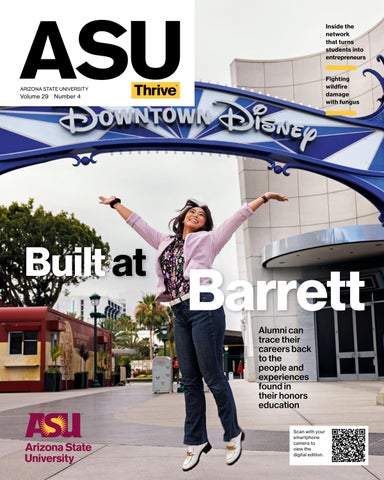
Built at
Barrett Alumni can trace their careers back to the people and experiences found in their honors education
Scan with your smartphone camera to view the digital edition.
WE LC O M E
The official publication of Arizona State University Fall 2026, Vol. 29, No. 4 CHIEF BRAND OFFICER , PUBLISHER
Jill Andrews, ’97 BS, ’03 MPA MANAGING EDITOR
Kari Redfield SENIOR ART DIRECTOR
Heidi Easudes DIRECTOR , ASU NEWS
Contributors
Penny Walker, ’24 BA
May Busch
Leigh Farr
The former COO of Morgan Stanley Europe is now an executive coach, speaker, advisor, author and executivein-residence in ASU’s Office of
DEPARTMENT EDITOR , COPY EDITOR
ASSISTANT EDITOR
Nikki Link SENIOR MULTIMEDIA SPECIALIST
Sabira Madady
the President.
DESIGNERS
Makeda Easter
Beatrice Guo, ’23 MVCD; Laura Kryger, ’93 BFA; Mark Munoz; Raini-Skye Rogers, ’23 BSD
A journalist, she was previously a staff writer at the Los Angeles Times and a science writer for a supercomputing center at The University of Texas.
PRODUCTION
Chris Myers, Jason Puckett, Zachary Leitzke If you would like to update your mailing address or switch to the digital version:
news.asu.edu/content/subscribe
Jill Richards A commercial and editorial
STORY IDEAS AND ADVERTISING INQUIRIES
photographer, her work has
asuthrive@asu.edu
been published in The New York Times, National Geographic Traveler, The Wall Street Journal and Arizona Highways.
Ellen Sheng A writer and editor with a focus on business and finance, her work has appeared in The Wall Street Journal, CNBC, Forbes, Fast Company, Real Simple and Marie Claire.
ASU THRIVE MAGAZINE
PO Box 875011, Tempe AZ 85287-5011 480-727-5440, asuthrive@asu.edu news.asu.edu/thrive-magazine ASU Thrive (USPS 024-438; ISSN 1940-2929) is published quarterly by Arizona State University Enterprise Brand Strategy and Management, 660 S Mill Ave, Centerpoint Suite 401, Tempe, AZ 85281, 480-727-5440. Subscriptions are sent to all ASU alumni. For detailed information about supporting alumni traditions, scholarships and programs, visit alumni.asu.edu/give-back/donate. Periodicals postage is paid at Tempe, Arizona, and additional mailing offices. Postmaster: Please send address changes to ASU Thrive, Attention: Circulation, PO Box 875011, Tempe, AZ 852875011. Permissions: Portions of this publication may be reprinted with the written permission and proper attribution by contacting the ASU Thrive editor. ASU Thrive can be accessed online at news.asu.edu/thrive-magazine.
ON THE COVER: Alyssa Nazareno, ’18 BS, credits her education at Barrett, The Honors College with helping her land her job as a senior quality engineer at Disneyland.
COVER: SABIRA MADADY/ASU
ASU Thrive is paper neutral. This issue replanted 2,889 trees which is equivalent of 240,146 pounds of paper.
The freedom to try This summer, our country commemorated 250 years since the declaration of a radical idea – self-determination. The notion that ordinary people, granted independence and given the freedom to shape their own futures will shape society. What began as a written document that served as a framework, ended with a new nation and an experiment in human potential. The Declaration of Independence is on my mind, not only for what we celebrated this summer but also for our work at ASU where we have designed a university in much the same spirit. Each fall, we welcome a new class of students, each bringing their own dreams, doubts and questions. Our responsibility is not to sort them by those who seem most prepared, but to design an environment that empowers every learner to determine their own path. That means access to mentors who believe in them, real-world challenges that call for their creativity and, most importantly, the freedom to try, to fail and to try again. You’ll meet people in this issue who embody that freedom, including people who transformed ideas into successful startups while still students, and an alumnus whose creative “experiment” became an Academy Award–winning film. Behind each of these stories stands a community — faculty, peers, supporters and donors who said, in effect, “You can do this.” What connects their success is not simply talent but resilience. One of our student entrepreneurs put it well: Behind every achievement lies “a bunch of failures.” Progress, in innovation and in learning, depends on what we take from each setback and how persistently we move forward. That’s true of a startup, a film, a career and the American project itself since its beginning. As the semester finds its rhythm, I am reminded of the tens of thousands of learners joining us in this ongoing experiment. Our collective charge is to keep building a university that matches their ambition — one designed to welcome everyone inspired to do more with a commitment to do all we can to help them succeed. That, to me, remains the essential American work — to open opportunity, to advance discovery and to ensure that every person has the freedom to try. Michael M. Crow President, Arizona State University michaelcrow michaelmcrow asuprescrow presidentcrow ASU THRIVE MAGAZINE
1
Contents 5
The Fulton Schools Innovation Showcase brings together industry partners and the community to celebrate student capstone projects.
Events
News
Career
Upcoming event highlights on ASU’s campuses and online.
A reprogrammable AI chip that uses less energy.
My #1 career tip. PAGE 17
PAGE 4
PAGE 8
Breakthrough test provides way to screen for autism. PAGE 14
3 ways to build influence at work. PAGE 18
Training to help you grow your career. PAGE 21
The careers defining the next decade Preparing graduates for industries seeking skilled talent. PAGE 22
2
FA L L 2 0 2 6
PRARTHAN PATEL/ASU
Mentoring
Where ideas are born Inside the network of funding, mentors and culture that turns students into entrepreneurs.
Chelsea Border, ’18 BS, co-founded Caption tk. San Francisco-based AirGarage while a student.
24 xx
PAGE 48
PAGE 24
Built at Barrett These alumni can trace their careers back to the people and experiences found in their honors education.
History
60 years at Hayden Library From a late-night study spot to a center for community exploration, Hayden Library has been at the heart of student life for generations of Sun Devils.
PAGE 30
Impact
Famous ASU alumni A sample of graduates who attended the university before stepping onto larger stages.
PAGE 52
Sports
PAGE 36
Alum wins an Oscar Producer David Breschel’s short film is the first Academy Award winner by a Sun Devil, and it’s on Netflix.
Electricity that purifies water Researcher’s processes start chemical reactions to make water cleaner.
Wildfires affect Arizonans like cattle rancher Grant Wilson.
PAGE 40
42 xx
Record-breaking Big 12 season for Sun Devil Athletics. PAGE 58
Volleyball powerhouse Hitter Noemie Glover returns to defend Big 12 crown. PAGE 60
Research
History made as quartet of Sun Devils selected in 2026 NFL Draft.
Fighting fire damage with fungus Researchers turn to mycelium as a cost-effective, sustainable way to stabilize land after a fire.
PAGE 63
Style
PAGE 42
ASU FIDM puts on a show. Saving lives through brain stimulation.
PAGE 64
PAGE 46
Connect with ASU Arizona State University SABIRA MADADY/ASU
ASU
ASU Alumni
magazine.asu.edu BOOK-OPEN Sun Devil Athletics ASU THRIVE MAGAZINE
3
Events Countdown to kickoff Sun Devil Soccer is gearing up for a new season with renewed determination as the team prepares to compete in an exciting year of Big 12 play.
Tribute to a fashion maverick Experience the glamour of Hollywood’s Golden Age through the work of fashion visionary Gilbert Adrian (1903–59) in “ADRIAN: Designing Hollywood, Dressing America.” His costume designs have appeared in more than 250 productions, including “The Wizard of Oz.” Now through Saturday, Dec. 12, Wednesday– Saturday, 10 a.m.– 5 p.m. PST, ASU FIDM Museum, 919 South Grand Ave., Los Angeles asufidmmuseum. asu.edu Free
Family
See asuevents. asu.edu for additional ASU events. Visit sundevils. com for athletics.
Friday, Sept. 18, time TBA, vs. Utah, Sun Devil Soccer Stadium sundevils.com/sports/womens/soccer Ticketed
Double Ten Day Celebrate Taiwan’s national holiday at this vibrant night market featuring food, craft vendors, cultural performances and a dazzling drone show. Saturday, Oct. 3, 6–9 p.m., West Valley campus, The Quad asuevents.asu.edu
A haunting love story
Free
In the Tony Award-winning Broadway musical “Phantom of the Opera,” a masked musical genius secretly mentors soprano Christine while terrorizing the Paris Opera House. When Christine falls in love with the French nobleman Raoul, he risks everything to rescue her from the Phantom. Wednesday, Sept. 16–Sunday, Oct. 4, ASU Gammage asugammage.com Ticketed
Family
Family
Rally for a winning season Fresh off their consecutive Big 12 conference championship, Sun Devil Volleyball is back for an exciting season featuring 12 home matches, with key showdowns against Arizona, Kansas, TCU and Utah. Friday, Oct. 9, time TBA, vs. Colorado, Desert Financial Arena sundevils.com/sports/womens/volleyball Ticketed
4
FA L L 2 0 2 6
Family
Family
MATTHEW MURPHY AND EVAN ZIMMERMAN; SUN DEVIL ATHLETICS
Industry-backed innovation Get an inside look at ideas, industry partnerships and student innovation emerging from ASU’s Polytechnic campus. Part of Polytechnic Student Showcase Week, the Fulton Schools Innovation Showcase spotlights engineering and technology projects developed by student teams.
Immersive design jam “ReMix the Future” invites students, artists and technologists to create real-world solutions. ReMixers will imagine possible futures to address the theme: Play Attention!
Friday, Dec. 4, Sun Devil Fitness Complex, Polytechnic campus innovationshowcase.engineering.asu.edu Free
Family
Thursday, Oct. 15–Sunday, Oct. 18, ASU Media and Immersive eXperience (MIX) Center, Mesa; register by Sept. 30. asuevents.asu.edu Networking
Winter Fun with Sparky Celebrate the season with a morning of family-friendly activities. Enjoy photos with Sparky, cookie decorating, hot cocoa, winter crafts and holiday storytelling.
Explore the cosmos Discover what lies beyond our world at the “Earth and Space Exploration Evening and Open House,” showcasing scientistled talks, interactive displays and student science exhibits. View the sky through high-powered telescopes. Friday, Nov. 6, 6–9 p.m., School of Earth and Space Exploration, 781 East Terrace, Tempe sese.asu.edu Free
Family
ATHARVA WARKE/ASU; NASA, ESA, STSCI, JAYANNE ENGLISH; MATT PEARSON/ASU
Saturday, Dec. 5, 9–10:30 a.m., Old Main Lawn alumni.asu.edu/generations Ticketed
Family
Check in to events to earn Pitchforks and rewards! Sun Devil Rewards is a loyalty program for Sun Devils and ASU fans. Earn Pitchforks toward exclusive ASU merchandise and more. New users receive 1,000 ’Forks. Already a user? Enter secret word ASUThrive for 100 ’Forks. sundevilrewards.asu.edu
ASU THRIVE MAGAZINE
5
Get ready for
Game Day 2026 Sun Devil Football schedule Sept. 5
Home
vs. Morgan State
Sept. 12 at Texas A&M
Sept. 19, Big 12 Kansas (London — Union Jack Classic)
Oct. 3, Big 12
Home
vs. Baylor
Oct. 10
Home
vs. Hawaiʻi
Oct. 17, Big 12 at Texas Tech
Oct. 24, Big 12
Home
vs. Kansas State
Oct. 31, Big 12 at BYU
Nov. 7, Big 12
Home
vs. Colorado
Nov. 14, Big 12 at UCF
Nov. 21, Big 12 vs. Oklahoma State
Nov. 28, Big 12 at Arizona
Dec. 4, Big 12 Big 12 Championship See full game schedules and ticket options at sundevils.com. 6
FA L L 2 0 2 6
Home
GAME
E VE NTS
Sparky’s Touchdown Tailgates Experience live music, games, food trucks, a beer garden and more before every Sun Devil Football home game. Plus, earn Sun Devil Rewards by checking in to tailgates and football games through the app at sundevilrewards.asu.edu. Tailgates start two and a half hours prior to each home game kickoff at College Avenue and 6th Street
ASU Family Weekend Celebrate ASU spirit, pride and tradition at ASU Family Weekend. Enjoy academic college socials, movie nights, a free block party and a tailgate barbecue across all four Valley campuses, including the Big 12 home game vs. Colorado on Saturday, Nov. 7. Friday, Nov. 6–Sunday, Nov. 8, ASU Valley campuses familyweekend.asu.edu Family
alumni.asu.edu/gameday Free
Ticketed
Family
ASU Alumni Homecoming week: Nov. 15–21 Homecoming Carnival Jump into a fun-filled celebration featuring carnival games and rides, bounce houses and food trucks. Sunday, Nov. 15, 2:30 p.m., ASU West Valley campus, Sun Devil Fitness Complex; free for ASU faculty, staff and students; $15 for ASU alumni, affiliates and community members asuevents.asu.edu Free
Family
Lantern Walk Light up Tempe with a Lantern Walk up “A” Mountain the evening before the Homecoming football game. This treasured tradition dates back to 1917. Friday, Nov. 20, meet at the base of “A” Mountain with a DJ at 6 p.m.; climb starts at 6:30 p.m. alumni.asu.edu/homecoming Free
E DAY SUN DEVIL ATHLETICS
Family
Legends Luncheon: Legends of the Rivalry Commemorate 100 matches of the timeless Sun Devil Football rivalry game against the University of Arizona and celebrate the rich legacy of ASU football. Don’t miss a chance to honor these outstanding athletes. Friday, Nov. 20, 11 a.m., Omni Tempe Hotel at ASU, 7 E. University Dr., Tempe alumni.asu.edu/legends-luncheon Family
Ticketed
Alumni Homecoming parade, block party and game Celebrate Sun Devil spirit at the annual Homecoming Parade. Afterward, join family and friends at the block party for food, entertainment and more before the football game. Don’t forget to wear gold! Saturday, Nov. 21 Homecoming: alumni.asu.edu/homecoming Free
Family
Football game: sundevils.com Family
Ticketed
ASU THRIVE MAGAZINE
7
News B E T T ER C H I P S
A reprogrammable AI chip that uses less energy The old promise of Moore’s Law is simple: Every two years, the future will arrive in the form of faster microchips. But that era is fading. Today, performance gains are harder to achieve, energy demands are surging and the idea of a single chip doing everything well is starting to break down. Aman Arora, an assistant professor of computer science and engineering in the School of Computing and Augmented Intelligence, is using field-programmable gate array, or FPGA chips, to change that. Unlike most processors that leave the factory with their internal wiring fixed in place, an FPGA can be reprogrammed after it’s fabricated, reducing both energy use and the need for new manufacturing. His lab is using FPGAs to make AI systems more efficient in the real world. In medical applications, his team is developing systems for glucose monitoring that can run continuously with minimal energy use. In quantum computing, they are building hardware to better interpret extremely delicate signals. In addition, Arora is using AI to improve the chips themselves by helping engineers find better designs faster. Learn more at scai.engineering.asu.edu.
8
FA L L 2 0 2 6
“You can connect different components however you want, and it becomes whatever kind of circuit you need.” — A M A N A R O R A , A S S I S TA N T P R O F E S S O R OF COMPUTER SCIENCE AND ENGINEERING IN THE SCHOOL OF COMPUTING AND AUGMENTED INTELLIGENCE
ASU Assistant Professor Aman Arora is working on more efficient AI chips.
ERIKA GRONEK/ASU
ASU THRIVE MAGAZINE
9
N E WS
“Having more awareness of the dust events in the area is going to help people make more informed decisions.” Bringing home America’s missing service members More than 81,000 American service members are listed as missing in action. ASU ROTC cadets are helping accelerate efforts to bring them home through a new partnership with the Arizona Center for the Missing in Action. Starting at the crash site of a World War II bomber in Poland, the cadets step out of the classroom and conduct historical research, assist archaeologists in field excavations, and help catalog evidence that may lead to forensic identification of remains. The long-term goal is to build enough research capacity for ASU-led recovery missions abroad, helping address a backlog of cases that could otherwise take more than 170 years to resolve under current recovery timelines. Learn more at militaryscience.asu.edu.
— R YA N H E I N T Z M A N , A S S I S TA N T TEACHING PROFESSOR IN TH E SCHOOL OF GEOGRAPHICAL SCIENCES AND URBAN PLANNING
Ryan Heintzman
New scale measures severity of dust storms Dust storms can be dramatic events that sweep across the desert Southwest during the monsoon season. They can also be dangerous. Dust storm events are the third deadliest weather hazard in Arizona, behind flooding and temperature extremes. But until now, there was no standardized way to measure their severity. That changed when ASU researchers created the Phoenix Dust Storm scale. It ranks dust storms from Category 1–5 using measurements such as dust concentrations, wind speeds, duration and geographic coverage. Like tornado or hurricane ratings, the PHX-DUST scale could give meteorologists a clear way to describe storm severity to the public. Agencies, utilities and policymakers can use it to track longterm trends and inform decisions about land use and development. Beyond Phoenix, it can serve as a model for other regions. Learn more at sgsup.asu.edu/phoenixdust.
10
FA L L 2 0 2 6
CHARLIE LEIGHT/ASU
First complete map of world’s seagrass Scientists from ASU’s Center for Global Discovery and Conservation Science created a high-resolution map of seagrass around the globe, and revealed the results in Nature. Seagrass grows in shallow water with roots that protect coastlines from erosion. It also stores carbon, retaining it when the plant is eventually buried in sediment. The bad news: Over a four-year period, 4% of this “underwater rainforest” has been lost to coastal development, fertilizer pollution and climate stressors. The good news: Seagrass is responding to conservation projects, grows quickly and supports the growth of struggling coral reefs. The map was added to the Allen Coral Atlas coral reef maps to help identify areas for biodiversity conservation. Learn more at globalfutures.asu.edu/gdcs.
A satellite photo of Papua New Guinea with areas of seagrass highlighted in green.
Bacteria in fog can help remove air pollutants New mapping tool could save lives during deadly floods Flooding is the most costly natural disaster in the U.S. When floods strike, responders rely on satellite maps to track where water has spread. But during major events, cloud cover can obscure imagery. To improve flood forecasting, WenWen Li, a professor in the School of Geographical Sciences and Urban Planning, and her team have developed an AI-powered system, SMAGNet, to help responders act faster, potentially saving lives. The team works with government agencies and industry partners, including NASA and IBM Research, on this tool. Learn more at sgsup. asu.edu.
Keep up with the headlines at ASU by subscribing to the ASU News e-newsletter at news.asu.edu/ subscribe.
JIWEI LI/ASU; COURTESY OF THI THUONG THUONG CAO
What if fog isn’t just misty air, but a living ecosystem? This question hung over cloud researcher Thi Thuong Thuong Cao, then an ASU PhD student. Her curiosity led her to look into the matter, and then to sample fog before sunrise in Pennsylvania. She spent hours peering through a lab’s microscope to study it. She and an ASU team found that bacteria floating in tiny fog droplets are alive, growing and — quite helpfully — breaking down pollutants in the air. Thi Thuong Thuong Cao, ’25 PhD, collected water samples in the fog during research.
“If [bacteria] are growing, then the droplets are a habitat. That’s a mindset change.” — FER R A N G A R C I A- PI C H EL, D I R ECTO R O F TH E AS U B I O D E S I G N C E N T E R F O R F U N D A M E N TA L A N D APPLIED MICROBIOMICS
One group, called methylobacteria, was able to quickly clear large amounts of formaldehyde from the air by breaking it down into carbon dioxide. Formaldehyde is a common pollutant that adds to ozone smog and harms human health. Ferran Garcia-Pichel, a co-author of the study and the director of the ASU Biodesign Center for Fundamental and Applied Microbiomics, says that research into fog might help with the study of air pollution, and perhaps help scientists better understand and predict weather. Learn more at researchmatters.asu.edu.
ASU THRIVE MAGAZINE
11
N E WS
“Having a machine in-house will be a game changer for accessibility.” — B L A I R B R A D E N , A S S O C I AT E P R O F E S S O R I N T H E C O L L E G E O F H E A LT H S O L U T I O N S A N D D I R ECTO R O F TH E AU TI S M A N D B R A I N A G I N G L A B O R AT O R Y
M ED I CA L A DVA N C ES
Researchers use new machine to study the brain in action Clinical researchers at ASU have a powerful new way to study brain function, aging and disease. The university’s first Siemens 3T Prisma supports functional magnetic resonance imaging for observing brain activity in real time as patients think, move or rest. The difference between MRI and fMRI is often compared to that between a photograph and a movie. This could accelerate breakthroughs in chronic pain, movement disorders, autism, mental health and neurodegenerative disease treatment research. Located in the Clinical Research Services core, one of ASU’s Core Research Facilities, the system will be vital to several ASU researchers working on health conditions. For instance, Professor Fang Yu, director of the ASU Roybal Center for Older Adults Living Alone with Cognitive Decline, will use it in a 12-month study to test the impact of various exercise interventions in older adults with early Alzheimer’s disease. Other researchers using the machine include Blair Braden, an associate professor in the College of Health Solutions, and Candace Lewis, an assistant professor in the School of Life Sciences, who are studying how aging affects autistic adults.
The Siemens 3T Prisma MRI system at ASU.
Learn more at cores.research.asu.edu.
12
FA L L 2 0 2 6
SAMANTHA CHOW/ASU
Wearable device helps police officers monitor stress in real time What would happen if officers could see their stress levels rising before conflicts escalate? Nicole Roberts, director of the Emotion, Culture, and Psychophysiology Laboratory, and an interdisciplinary group of ASU researchers have developed a device to do just that. Stress Watch uses Fitbit-based technology, machine learning and behavioral science to alert officers when their stress reaches a potentially dangerous level. There is an accountability component to the technology that would notify supervisors or partners as well. The goal is to prevent stress from compromising decision-making. Already tested in collaboration with the Phoenix Police Regional Training Academy on cadets for 26 weeks, Stress Watch successfully captured signs of stress during firearms training, physical conditioning, high-pressure simulations and classroom instruction. In some cases, the body showed signs of strain up to 90 minutes before cadets reported feeling stressed. Those early alerts could help officers to pause or reset before stress peaks and potentially affects their decision-making. Learn more at researchmatters.asu.edu.
A close-up of the Stress Watch.
CHARLIE LEIGHT/ASU
Forensics research may help investigators solve murder cases ASU research has the potential to help forensic teams close more murder cases when a victim’s body has been moved. Assistant Professor Katelyn Bolhofner with the West Valley campus’ School of Interdisciplinary Forensics — the only dedicated forensics college in the country — collaborated with President’s Professor Pam Marshall from the School of Mathematical and Natural Sciences on an innovative field study. “No one has ever done an experiment like this,” Marshall says. They found that when a body is moved after a murder, microbial and chemical traces are left behind in the soil, which can help investigators trace where a body originally was left. Learn more at researchmatters.asu. edu.
Model shows how gut microbes help shape how many calories you absorb Food labels make calories seem simple. But inside the body, digestion is far more complicated. Food passes through a living microbial ecosystem that can influence how many of those calories people absorb. A new mathematical model developed by ASU researchers takes a closer look at that hidden part of digestion. The model, called DAMM — for digestion, absorption and microbial metabolism — follows food through the digestive tract, estimating what the body absorbs directly, what reaches the colon and how gut microbes help process the remaining material into products that are either absorbed or excreted. The model could eventually help researchers better understand obesity, diabetes and other metabolic disorders by showing how different diets affect both the human body and the microbial Learn community inside the colon. more at With more research, it could become a tool to help health care providers design more personalized diets for their patients. ASU THRIVE MAGAZINE
13
N E WS Research by Christina Flynn, ’11 BSE, ’12 PSM, ’25 PhD, while at ASU helped the ASU team develop the test. Flynn was inspired by her experience as the parent of an autistic child.
H EL P I N G FA M I L I ES
Breakthrough test provides way to screen for autism
“I am excited about the MDM test, which includes important microbial metabolites, previously hypothesized to be linked with autism. This test can be a great way to assess this important microbial contribution.” — R O S A K R A J M A L N I K- B R O W N , D I R E C T O R O F T H E B I O D E S I G N C E N T E R F O R H E A LT H
A simple urine test may help identify children at risk for autism. During trials, the Microbially-Derived Metabolite System urine test showed promising accuracy, with 90% sensitivity and 100% specificity. That means it correctly identified 90% of the children with autism and did not misidentify any of the children without autism in the study. This opens the door for earlier diagnosis, treatment and better long-term outcomes. Available in the U.S. and internationally, the new test may also reduce the need for a psychological assessment. The tool tests a child’s urine for 17 microbial metabolites — small molecules produced by microorganisms in the gut — and assigns a score based on how many of them exceed a typical reference range. Previous research has shown that these metabolites are significantly higher in children with autism. Based on the findings, the research team also proposed a new subtype of autism called “ASD associated with microbially derived metabolites,” or ASD-MDM. This phenotype encompasses an estimated 90% of autism spectrum disorder cases. Learn more at biodesign.asu.edu.
T H R O U G H M I C R O B I O M E S AT A S U
14
FA L L 2 0 2 6
ANDY DELISLE/ASU
Career MY #1 CAREER TIP
‘Every once in a while, you will get a nudge to try something different. Pay attention to those.’ For Sharon Morris, ’04 BS in geological sciences, ’23 MBA, one of those nudges was returning to ASU after nearly 20 years to complete her MBA. Since going back to graduate school, she was recently promoted to director of water system construction and maintenance at Salt River Project. Her team oversees the utility’s 131-mile canal system and water infrastructure across the Valley. Morris has also led initiatives like the multimillion-dollar Gilbert Road Pipeline Project, which, once completed, will deliver 20,000 gallons of water per minute from south of the Salt River to the head of the Arizona Canal.
SABIRA MADADY/ASU
Sharon Morris, ’04 BS, ’23 MBA, plays a key role in helping manage water for Arizonans as a director at Salt River Project.
ASU THRIVE MAGAZINE
17
CAR E E R
3 build influence ways to
at work Consider these practical strategies to earn trust and shape decisions — even if no one reports to you Story by MAY BUSCH
18
FA L L 2 0 2 6
MANY PROFESSIONALS ASSUME influence belongs to the people with the biggest titles. But over the course of my career, I’ve found the opposite is often true. Some of the most influential people at work are not managers at all. They are the people others trust, seek out and want to collaborate with. That’s because influence has less to do with your title than most people think. In many situations, that influence is actually a more powerful tool to get things done. People may comply because of authority. But influence is what gets people genuinely on board. Over my years in corporate leadership and now as an executive coach, I’ve found there are three practical ways to build influence at work, even if nobody reports to you.
Tip
1
Start with the influence you already have. Many people underestimate the influence they have. You may not control budgets or promotions, but you likely have other assets
that people value. For some, it could be expertise and credibility in your field. For others, it’s the ability to stay calm under pressure. There’s real power in being someone your co-workers can rely on for steady guidance when questions come up or pressure builds. When I was transferred to London earlier in my banking career, one of my biggest assets was my knowledge of the U.S. bond market at a time when the European market was rapidly evolving toward something similar. That expertise gave me influence long before I had seniority. Ask yourself: What do people already come to me for? The answer often reveals the foundation of your influence.
May Busch is a former COO of Morgan Stanley Europe, who is now an executive coach, speaker, advisor, author and executivein-residence in ASU’s Office of the President. maybusch.com/ asuthrive
ASU THRIVE MAGAZINE
19
“ Ask: What do people already come to me for? The answer often reveals the foundation of your influence.”
Tip
2
Find your most receptive entry points.
Influence is rarely attained in a single, big conversation. More often, it’s in a series of smaller ones — especially in large organizations where decisions are shaped informally long before they become official. I learned this firsthand after making a classic mistake: trying to convince people who were never likely to agree in the first place before building broader support. I tried going straight to a department head with my suggestion for changing a policy — only to have it shot down. I know now I would have gotten a better result if I had socialized it with a few allies first. The key is to look for where momentum is most possible. Who is already open to the idea? Which teams are most affected? Where could early progress create a ripple effect? Ask yourself: Who are the decision-makers? Who do they listen to? Which of these people are already onside? And which are the lowest risk to start with? 20
FA L L 2 0 2 6
Tip
3
Build relationships before you need them.
Influence grows through trust, credibility and repeated interactions over time. Yet most people wait until they need help or approval before investing in relationships. Whenever I step into a new role, one of the first things I do is meet individually with as many people as possible — not to ask for anything, but to listen and learn. The best time to build influence with your colleagues is before you urgently need it. I learned this firsthand while leading a cross-divisional initiative involving groups that were actively competing with one another. I had no formal authority. What worked was meeting people individually,
listening to their concerns and helping them see a shared goal. Once they saw the broader mission, support followed — not because I outranked anyone, but because I’d taken the time to understand what mattered to them. Ask yourself: Who are the stakeholders most important to what we’re trying to accomplish? Which relationships will be important to fulfill our goals in the future? Influence is a leadership skill whether or not you have the title yet. And often, building it is exactly what earns you the title later. 🟥
Get May’s book: “VISIBLE: How to Advance Your Career Without Playing Politics, Selling Your Soul, or Working Yourself Into the Ground” at thevisiblebook.com.
CAR E E R
Career upskilling, personal growth Training to help you earn promotions or shift your career
In Future of Conservation Leadership, equip yourself with systems-thinking, policy and coalition-building skills to drive environmental impact and lead crosssector conservation initiatives globally. Eight weeks; $399; digital badge available upon completion asuforlife.asu.edu. Online Scheduled
Ignite your energy expertise
LEARNING RESOURCES
Trailblaze your path Get inspired. Watch Harrison Ford’s powerful May 2026 commencement speech on the importance of nature and the impact you can have in life. He urged graduates to start right now: “Don’t wait. When opportunity presents, recognize it. This is your time. Own it. Enjoy every second of it. ... Go change the world.”
Shape conservation policy
Lead with confidence Motivate teams and drive results in the Certificate in Leadership Excellence. Strengthen your communication and decision-making skills. Twenty-seven hours; $299; certificate available upon completion.
Prepare for a growing career through the Energy Efficiency Assessments Certificate. Evaluate buildings and systems for energy performance, identify savings and recommend solutions. Forty hours; $749; certificate available upon completion. asuforlife.asu.edu Certificate program Online Self-paced
asuforlife.asu.edu Certificate program Online Self-paced
Spark your path to electronics design
Kick-start your degree Start your degree affordably with ASU Universal Learner Courses. Enroll for just $25 per course and pay $400 only if you choose to earn credit. Choose from 75 online courses in STEM, business, humanities, leadership and more. Here are three courses you can start today: Game Design, The Living World, and Health and Wellness.
Master end-to-end PCB design in the hands-on ASU + Siemens program PCB Design Fundamentals: From Discovery to Production. Forty hours; $899; ASU certificate and Siemens certificate available upon completion. careercatalyst.asu.edu Certificate program Online Self-paced
Apply generative AI tools to make smarter decisions, streamline operations and improve collaboration. Generative AI in Action: Workplace Transformation is designed for professionals across industries — no technical background required. Five hours; $280; certificate available upon completion. asuforlife.asu.edu Certificate program Online Self-paced
Learn the proven rules of marketing Master the seven pillars of modern marketing — product, price, place, promotion, physical evidence, people and partners — through the 7 P’s of Marketing. Ten hours; $1,199; certificate available upon completion.
ulc.asu.edu
asuforlife.asu.edu
Online Scheduled Self-paced
Certificate program Online Self-paced
AARON GHENA/ASU
Power your future with AI
ASU THRIVE MAGAZINE
21
Jobs by the numbers
4.8x the national average job growth rate projected for speechlanguage pathologists by 2034
134,000
new nurse practitioner jobs projected in the U.S. by 2034
12 million projected jobs tied to businesses that baby boomers will sell by 2035
SOURCES: U.S. BUREAU OF L A B O R S TAT I S T I C S , M C K I N S E Y & C O M PA N Y, H E A LT H R E S O U R C E S & S E R V I C E S A D M I N I S T R AT I O N
$1.3 trillion to $2.7 trillion in global economic impact generated by quantum computing by 2035
3.5x the national average job growth rate projected for industrial engineers by 2034
2.9x the national average job growth rate projected for mechanical engineers by 2034
Programs to get you there • MS in entrepreneurship and innovation, BS in entrepreneurship • MS and BSE in industrial engineering • MS and BSE in mechanical engineering
• MS in communication disorders, BS in speech and hearing science
“ One thing that definitely made [the communication disorders program] stand out is the fact that we get to work with real clients during our first semester.”
“ [The entrepreneurship and innovation] program put me in a room with the people who I’d go on to build a real business with.”
• MS in auditory and language neuroscience
–Q IAO ZHENG GOH , ’25 MS IN
–S AM CASE, ’25 BA IN BUSINESS
• MS in aerospace engineering, BSE in aerospace engineering (aeronautics)
• Doctor of Nursing Practice, MSN and BSN in nursing Learn more at degrees.asu.edu.
22
FA L L 2 0 2 6
C O M M U N I C AT I O N D I S O R D E R S ,
( C O M M U N I C AT I O N ) , ’ 2 6 M S I N
SPEECH-L ANGUAGE
ENTREPRENEURSHIP AND
PAT H O L O G I S T AT S C O T T S D A L E
I N N O VAT I O N , F O U N D E R A N D
UNIFIED SCHOOL DISTRICT
C E O O F S Y N T H E R LY
CAR E E R
The careers defining the next decade Preparing graduates for industries seeking skilled talent Data points to a changing economy. By 2035, the field of quantum computing is expected to generate $1.3 trillion to $2.7 trillion in global economic impact. Health care roles like nurse practitioners — recently named the “hottest” job in health care by The Wall Street Journal — and speech-language pathologists are projected to grow at several times the national average through 2034 and beyond. Meanwhile, demand for specialized engineering professionals in the industrial, mechanical and aerospace sectors continues to rise as industries seek talent. The business world is rapidly evolving as well. By 2035, millions of small-business owners are expected to retire. This once-ina-generation wave will create opportunities for other generations to take over those businesses and represent as much as $5 trillion in combined market value, according to the McKinsey Institute for Economic Mobility. In addition, Wells Fargo’s 2026 Money Study reported that 74% of Gen Zers who are not current business owners want to own a business one day. ASU is responding with degree programs that help students develop the skills they need to thrive in a future-focused workforce. The health care field continues to need more professionals, including physicians. The John Shufeldt School of Medicine and Medical Engineering welcomed its first class in August.
ASU HEALTH
See previous ASU Thrive jobs forecasts at news.asu.edu/ interests/employment.
ASU THRIVE MAGAZINE
23
While students, Chelsea Border, ’18 BS, Jonathon Barkl and Scott Fitsimones founded AirGarage with their ASU education, funding, support and connections.
24
FA L L 2 0 2 6
M E NTO R I N G
NEARLY TWO DECADES ago, Tom Prescott, ’80 BS in civil engineering, and former CEO of Align Technology, asked a room of ASU biomedical engineering students to name the country’s largest life sciences companies. Few could. For Prescott, then a Silicon Valley medical technology executive, this was a light bulb moment. The students needed exposure to the companies, markets and business realities that
would shape their careers. He began spending more time at ASU, speaking with students across departments. With entrepreneurship, “There’s so much experiential framework that can’t be learned in a book or a studio class or a pitch contest,” Prescott explains. Students needed real stakes, not simulation. That conviction helped shape several entrepreneurship programs across the university, including Venture Devils, the eSeed
Where
s a e id Inside the network of funding, mentors and culture that turns students into entrepreneurs Story by ELLEN SHENG
SABIRA MADADY/ASU
are
born ASU THRIVE MAGAZINE
25
Challenge, the Prescott Fellows Program and the $100,000 Inferno Cup. Prescott also supported trips to Silicon Valley, where students could meet founders and investors and gain firsthand insight into how startups are built and scaled. To date, the eSeed Challenge and the Prescott Fellowship, now both 10 years old, have seeded more than 300 and 100 ventures, respectively. But Prescott is quick to note that capital alone wasn’t enough. The programs work, he says, because ASU has built a culture that encourages entrepreneurship.
Where founders meet In 2016, Jonathon Barkl, Chelsea Border, ’18 BS in business data analytics, and Scott Fitsimones started renting driveways from
AirGarage, now headquartered in San Francisco, employs about 100 people.
26
FA L L 2 0 2 6
homeowners near the ASU campus and renting the spots to other students. What started as a workaround became AirGarage. Their first funding, $6,000 from the eSeed Challenge, went into building a website and then an app. Of the three of them, only Fitsimones had an entrepreneurial background, having taught himself iOS development in high school, and had already built and shipped apps. “When I arrived at ASU, I didn’t even know what a startup was. … By the end of my college journey, I had learned so much about startups,” Border says. Barkl tapped professors who could provide tactical advice because they had started their own companies. The three students
relied on ASU’s connections to other founders. Also important was the encouragement. Their company grew into an asset intelligence company that helps owners run parking as real estate assets, not just lots to fill. Now based in San Francisco, AirGarage employs about 100 people and has landed all three founders on the Forbes 30 Under 30 list. The founders have stayed close to the ASU entrepreneurship programs that helped launch them, hiring graduates and hosting fireside chats for student founders who pass through Silicon Valley on the same eSeed trip that Barkl and Fitsimones once took.
Building more accessible health care Jasmine Bhatti, ’04 BS in psychology and ’13 MS in regulatory science, trained as a nurse before coming to ASU for a PhD. She left with her third ASU degree and a company. The inspiration for her company, Navi Nurses, came from personal experience. When her grandmother was diagnosed with head and neck cancer, Bhatti saw how limited resources are for adults, especially older adults, once they are discharged from the hospital. Years later, she took the problem to Rick Hall, founder of ASU’s Health Entrepreneurship Accelerator Lab, where students receive support developing their ideas. As she pursued a solution, she drew on entrepreneurship resources from across ASU, including programs supported by Prescott. Her idea was “Uber, but for nurses … so the ordinary person SABIRA MADADY/ASU
Jasmine Bhatti, ’04 BS, ’13 MS, right, and nurse Caitlin Carson, ’19 BS, at the home of client Robert Kiyosaki, author of “Rich Dad Poor Dad.”
can hire additional nursing support that insurance isn’t going to cover,” she recalls, explaining that “it’s something that I wish I would have had caring for my grandmother.” With that, Navi Nurses was born. Hall connected Bhatti to the Sandra Day O’Connor College of Law, where law students drafted her company’s initial contracts for a fraction of market cost. In addition, he connected her with the Ira A. Fulton Schools of Engineering, where engineering students built her first prototype app; and the W. P. Carey School of Business, where business students helped with marketing. She won $10,000 through Venture Devils and was later selected for a Prescott-sponsored trip to SXSW. “ASU is unique from other ARON SHER/ASU
“ASU is unique from other universities because students aren’t just taking entrepreneurship classes or reading startup case studies. They’re developing real ventures.” —B RENT SEBOLD, H O O L C O U R Y L AW PROFESSOR OF ENTREPRENEURSHIP
universities because students aren’t just taking entrepreneurship classes or reading startup case studies. They’re developing real ventures with real money to create real societal and economic impact at full scale,” says Brent Sebold, Hool Coury Law Professor of Entrepreneurship, Global Entrepreneurship Fellow and director of Entrepreneurship + Innovation at the Fulton Schools. Navi Nurses now employs 170 nurses, including numerous ASU grads, to provide care in the Phoenix area. The team has cared for the parents of ASU alumni as well as some faculty. The company landed on the Inc. 5000 list, and Bhatti was named to Inc.’s 500 Female Founders list in 2025. She says the ASU THRIVE MAGAZINE
27
goal now is to grow without raising outside capital — from roughly 30 to 40 patients a day in Phoenix to 400, then beyond Arizona. To give back, Bhatti set up a scholarship for nursing students. “It’s fun to just see and feel all of these connections everywhere,” she says.
Turning seed money into a global supply chain Logan Milano, ’26 BS in finance, who runs a beverage company under the brand Amryth now based in New York City, intended to pursue a career in finance. While interning at a private equity firm, he learned that alcohol sales are declining as consumers shift toward wellness. That inspired him to start experimenting with nonalcoholic drinks. He got mixed responses until he came upon mad honey, a rare honey harvested in the Himalayan mountains that has
Sandul Gangodagamage has grown Legion Platforms to nearly 16 million users while at ASU.
28
FA L L 2 0 2 6
“ASU had entrepreneurship plastered on their website, and I thought this was a place that I want to be.” — S A N D U L G AN GO DAG AMAG E, FOUNDER OF LEGION P L AT F O R M S a mild euphoric effect. When he began incorporating it into his beverages, demand started to pick up. Mad honey is nearly impossible to source in volume and is expensive. To produce drinks at scale, Milano had to go to the source. ASU’s Venture Devils backed him early with $35,000 in grants, which he used to create a supply chain. He flew to Nepal, drove nine hours through mountains to track down a “chief honey hunter,” and, through a translator, negotiated directly with harvesters. The honey was tested, flown to the U.S. and sent directly to the beverage manufacturer. The first batch of honey took three months to arrive in the U.S. and lost its potency because of the high temperatures on the ship. But throughout the process, ASU’s funding and resources helped. “It’s a good vote of confidence,” he says, describing how ASU’s backing later helped him negotiate with angel investors. He also hired a cameraman to document the whole journey and
posted about it on social media, building a following. He went on to win the Prescottfunded $100,000 Inferno Cup, which he put toward production costs. The first run of 10,000 cans sold out within a month. He quickly followed with another run, and then another. In the first three months, Amryth generated nearly $250,000 in online sales. Milano primarily markets the drinks through social media, where he and a network of content creators document the company’s story and promote the brand to consumers.
The ASU advantage When Sandul Gangodagamage, who is a senior at ASU this fall, was looking at universities, he knew he wanted one that would support entrepreneurship. He had started a gaming company, Legion Platforms, CHARLIE LEIGHT; MATT PEARSON/ASU
Resources to start your business Logan Milano grew his drinks business, Amryth, organically, through social media videos.
ASU’s J. Orin Edson Entrepreneurship + Innovation Institute programs offer numerous resources to budding entrepreneurs in Arizona and beyond, including programs for ASU students, K–12 students, alumni and anyone living in Arizona. Go to entrepreneurship.asu.edu.
$105M+ in grants, gifts, service agreements plus 3 endowed funds since FY15
1,500+ in high school and wanted to grow it further. “The universities I was considering, they barely mentioned entrepreneurship,” Gangodagamage says. “But ASU had entrepreneurship plastered on their website, and I thought this was a place that I want to be.” One program in particular caught his attention: the Venture Devils program, which awards capital to promising student ventures and provides mentorship, community, invitations to training events and other resources. Since coming to ASU, he has grown his company’s monthly users from 1 million to 16 million. Gangodagamage, who is majoring in business law, has won nearly every Prescott-funded competition at the university, along with others, and a spot on the Forbes 30 Under 30
Arizona list. He took a class last year with President Michael M. Crow, and was mentored by John Velotta, a retired Navy captain and energy executive who teaches through a program based at Mirabella, a senior living community on the Tempe campus that pairs retired ASU alumni with student founders. The growth came with setbacks. One game required multiple launches and revisions before it gained traction. “The truth behind every story is that it’s always a bunch of failures,” Gangodagamage says.
Paying it forward For Prescott, the value of ASU’s programs is measured not only by how many students build lasting companies but by the experience gained through the journey.
students supported through the Venture Devils program
800+ active Venture Devils teams
7+ seed funding tracks for students through Venture Devils Demo Day
“You will be more valuable as an employee, be more valuable as a leader, and you may go do multiple startups after this,” he explains. “It’s only really a failure if you don’t take anything away from it.” What keeps the model running, he says, are Sun Devil founders who return the favor once they’ve succeeded — with money or mentorship for the next student. 🟥 ASU THRIVE MAGAZINE
29
U LT B I Alyssa Nazareno, ’18 BS in mechanical engineering, is now a senior quality engineer at Disneyland Resort.
30
FA L L 2 0 2 6
M E NTO R I N G
at
These alumni can trace their careers back to the people and experiences found in their honors education Story by MAKEDA EASTER Photos by SABIRA MADADY
Barrett E
ven though it’s been more than a decade, Alyssa Nazareno vividly remembers her college application strategy. Then a senior at Xavier College Preparatory, a private Catholic high school in Phoenix, she knew she wanted to be close to her family in Scottsdale and be surrounded by other academically driven students. She chose Barrett, The Honors College at ASU for its rigorous curriculum and close-knit community. Nazareno’s older sister was also a Barrett graduate, so she was familiar with the program’s reputation and advantages. “It was also nice to know that I would be in a community where I would have peers nearby where we could help each other throughout school and extracurriculars,” she says. Now, Nazareno is a senior quality engineer at Disneyland Resort, where she helps ensure the park’s attractions comply with California safety regulations by performing inspections, documenting ride characteristics and maintenance requirements, and developing compliance procedures. ASU THRIVE MAGAZINE
31
Nazareno credits her career trajectory to her challenging, yet rewarding experience as a Barrett student. For nearly 40 years, ASU’s honors college — named in 2001 after longtime supporters Craig and Barbara Barrett — has offered individualized support to academically accomplished students, preparing them to excel in their careers and life through honors-only courses, mentorship and tailored programming based on students’ goals and needs. Community, courage, curiosity and connections are among Barrett’s foundational values, says Tara Williams, dean of the honors college and a professor in the English department. “We nurture the connections that are formed in Barrett,” Williams says. “The academic preparation, the engagement opportunities, the professional development, all of that is really important. But it also means more to them because they’re able to do it together and learn from each other.”
5 reasons why Barrett, The Honors College excels 1. The gold standard. The New York Times’ Frank Bruni recognized Barrett as the “gold standard” among honors colleges across the U.S. 2. Exceptional academics. Honorsonly classes, internships, research opportunities and programs at a premier Research I university. 3. Sense of belonging. Barrett’s two-year, live-in commitment boosts students’ academic life and creates a special community where they feel seen and accepted. 4. Dedicated staff. More than 45 full-time professors and 70 full-time staff. 5. Spaces for connection. Honors-only residence halls, learning spaces and dining halls.
32
FA L L 2 0 2 6
From Barrett to Disney Alyssa Nazareno, ’18 BS in mechanical engineering
“It was also nice to know that I would be in a community where I would have peers nearby where we could help each other throughout school and extracurriculars.” Nazareno immediately felt that deep sense of community during her first year. Living in Barrett housing and being around “similar-minded engineering majors so close by to lean on when I needed support was definitely helpful,” she recalls. Overall, Barrett students “had that high-achieving type mindset. We were all striving for similar goals, and we all took our schooling very seriously.” Nazareno leaned on her peers and professors at Barrett for encouragement. “I had a lot of good mentors in Barrett,” she says. In 2018, a Barrett alum helped her land her first mechanical engineering internship at a consulting firm. Next, she participated in the
Disney College Program to work in the parks and receive access to professional development courses and networking. This helped her land an internship working in Disney’s architecture and facilities engineering department. Nazareno returned to Disney in 2021, where she has been working for the past five years. As a self-proclaimed “Disney nerd,” her job working on the park’s famed attractions is a dream come true. “I think back to my 18-year-old self and I knew I wanted to be in engineering, but I had no idea what the application would be,” she says. “Never in a million years did I think I would end up in the role that I’m in now.”
From thesis to career Ryan Cantrell, ’22 BS in supply chain management Ryan Cantrell transferred into Barrett during the second semester of his first year, after realizing ASU’s supply chain management program would best prepare him for the career he wanted to pursue. He’s grateful that Barrett staff helped him seamlessly integrate into the honors college community. Cantrell was also excited about unique opportunities for mentorship, smaller class sizes and professional development. “A lot of support, especially at the beginning, was getting me used to the amount of resources Barrett had available,” he says. After his sophomore year, Cantrell interned at the American Logistics Aid Network, a nonprofit that coordinates disaster relief. During the internship, he and two other Barrett students identified areas where the organization could improve processes to more rapidly respond to disaster-related events. It was a springboard to a thesis project that he worked on during his junior year. Completing a thesis is an important component of the Barrett experience in which honors students develop an original piece of work such as a scholarly, research-based written article, a creative project or a group project. It provides an opportunity to “see something from the very beginning of an idea all the way to the final product that they defend with a
“ All those experiences prepared me immensely for the work I do today, being in such a relevant, but extremely challenging and dynamic field.” group of experts,” says Williams. Cantrell’s thesis dove into how the students supported supply chain improvements at the nonprofit, and how their work could be applied to similar organizations. The Barrett capstone had a profound impact on Cantrell’s career. When he began applying to internships before his senior year, the thesis helped him land a position at Intel, where he works today as a supply chain technical analyst. “I got a lot more offers than I was expecting,” he says. “Those hiring managers were telling
me that a big thing that stood out to them was Barrett, but also the thesis work made them comfortable and confident knowing that I would be able to take on their extremely complex global supply chain, be able to understand it and effectively work in an environment that’s so fast-paced.” Cantrell will return to ASU this fall to start an evening on-campus MBA program — sponsored by Intel — while he continues working for the company. He hopes to eventually step into a strategic leadership position and direct the next generation of analytic support at Intel. ASU THRIVE MAGAZINE
33
“Being around peers who have similar drive to you and wanting to do more to challenge themselves, that was a big draw to Barrett.”
An ongoing Barrett legacy Scott Fitzgerald, ’18 BS in business data analytics and BS in finance “It was always going to be Barrett,” says Scott Fitzgerald, who graduated with dual degrees in finance and business data analytics. Born and raised in the Valley, Fitzgerald attended Brophy College Preparatory. Similar to Nazareno, he was already familiar with the honors college through his two older brothers who were Barrett graduates. Fitzgerald was excited about the opportunity to be surrounded by other students who could motivate him, while also having access to the many resources of a large, public, Research I university. He still has fond memories of one Barrett hallmark: The Human Event, a yearlong course for firstyear honors students, focused on diverse perspectives across history. In the seminar, students read and discuss works from authors to hone their critical thinking, analysis and persuasive writing skills. The course “continued that education I had, challenging yourself to think bigger, ask more 34
FA L L 2 0 2 6
complex questions, but at the same time, to listen and be receptive to other people’s point of view,” Fitzgerald says. A throughline of service and community guided Fitzgerald’s experience as a Barrett student. During his junior year, he participated in the Pat Tillman Foundation Leadership Through Action, a yearlong program in the W. P. Carey School of Business that develops student leaders and supports them as they create community outreach projects. As a Tillman Scholar, Fitzgerald organized a scholarship fundraiser for his high school to support students with fewer financial resources. After graduation, Fitzgerald began his career in consulting for the multinational accounting firm KPMG, earning a senior-level promotion after a few years. He credits Barrett for building the work ethic needed to manage a demanding workload. Fitzgerald later worked as a
senior financial analyst at Shamrock Foods Company. And at 28, he was promoted to branch finance manager for Arizona. But even as he rose through the ranks of the corporate world, Fitzgerald still felt pulled toward helping others. Eventually, he created an endowment with his brothers, and his younger sister who also attended Barrett, to offer scholarships to honors students. “It was really special that my siblings and I created something that gives back, and gives others an opportunity to experience [Barrett] which made such a profound impact on us,” he says. In 2025, he pivoted to the family business, Fitzgerald Wealth Management LLC, to lead and expand the firm as his dad retires. “Not only do I get to work with my dad,” he says. “I get to work with people and help people navigate the complexities of the financial world as they move throughout their life.” 🟥
I M PACT
Famous ASU alumni A sampling of the actors, athletes, businesspeople and leaders who attended the university before stepping onto larger stages
Dr. John Shufeldt ’95 MBA, ’05 JD — founder of NextCare Urgent Care and MeMD, entrepreneur, investor and author
36
FA L L 2 0 2 6
SIPA USA/ALAMY; EMMA FITZGERALD/ASU
James Harden third overall NBA Draft pick in 2009, enters his 18th NBA season in 2026–27, two-time gold medalist with the USA Men’s National Team
Bridget Everett ’95 Bachelor of Music Performance (voice) — star and executive producer of the HBO comedy-drama series “Somebody Somewhere”
Ludwig Ahgren, ’17 BA in English (literature) and journalism — YouTuber with several million subscribers Roger Allers, ’71 BFA — filmmaker, co-directed “The Lion King” Barbara Barrett, ’72 BS in political science, ’75 MPA, ’78 JD — businesswoman, former secretary of the U.S. Air Force Matt Barrie, ’01 BA in broadcasting — ESPN SportsCenter anchor, college football studio host Melissa BeloteRipley, ’79 BA in communication — won three Olympic gold medals in 1972
Michelle Randolph ’23 BA in film (film and media studies) — actor in “Landman” and “Yellowstone” spinoff “1923”
Reggie Jackson Hall of Fame baseball player and five-time World Series champion (three with Oakland Athletics, two with New York Yankees)
MATTHEW TAPLINGER/CBS; COURTESY OF HBO; RLFE PIX/ALAMY
David Breschel, ’12 BA in film (film and media production) — screenwriter, Oscar winner Amanda Brown, ’93 BA in political science — wrote “Legally Blonde” Michael Burns, ’80 BS in political science — vice chair of Lionsgate Studios
Tony Carrillo, ’04 BFA (drawing) — creator of “F Minus” comic strip Carlota Ciganda — three-time Olympian in golf Joey Daccord, ’20 BA in business (business administration) — first Sun Devil in NHL, goalie for Seattle Kraken Desiree Davila-Linden, ’06 BA in religious studies and BS in psychology — won the 2018 Boston Marathon Christine Devine, ’87 BA in broadcasting — news anchor, winner of 16 Emmys Josh Doan — pro hockey player now with the Buffalo Sabres Lu Dort — 2025 NBA champion with Oklahoma City Thunder, now with Atlanta Hawks Jerry Dumas, ’55 BA in English — cartoonist of “Sam and Silo” Bridget Everett, ’95 Bachelor of Music Performance (voice) — star and executive producer of HBO series “Somebody Somewhere”
ASU THRIVE MAGAZINE
37
Herman Frazier, ’77 BS in political science — won gold and bronze medals at the 1976 Olympics in sprinting
Laurie Leshin, ’87 BS in chemistry — first female head of NASA’s Jet Propulsion Laboratory
Mary Temple Grandin, ’75 MS in agriculture — animal behavior expert, autism spokesperson
Michael Longfellow, ’16 BA in English (literature) — actor and comedian on “Saturday Night Live”
Derrick Hall, ’91 BA in broadcasting — president and CEO of the Arizona Diamondbacks James Harden — third overall NBA Draft pick in 2009, enters his 18th NBA season in 2026–27, two-time Olympic gold medalist with the USA Men’s National Team Jan Henne Hawkins, ’72 BA in education (physical education) — won two gold, one silver and one bronze Olympic medals in swimming Reggie Jackson — Hall of Fame baseball player and five-time World Series champion Merrill Kelly — helped the Arizona Diamondbacks reach the World Series in 2023 Ashley LeMieux, ’11 BA in English (literature) — best-selling author Amy LePeilbet, ’04 BA in sociology — won a gold medal in soccer at the 2012 London Olympics
38
FA L L 2 0 2 6
Léon Marchand, ’25 BS in computer science — won four individual gold medals in swimming at the 2024 Summer Olympics Ruth McGregor, ’74 JD — former chief justice of the Arizona Supreme Court Al Michaels, ’66 BA in broadcasting — sportscaster since 1971 and five-time Emmy Award winner
Jon Rahm
Amanda Brown ’93 BA in political science — wrote “Legally Blonde”
’16 BA in communication — PGA golfer who won two major championships
Spencer Silver ’62 BS in chemistry — co-inventor of Post-it Notes
Phil Mickelson, ’92 BA in psychology — five PGA major titles, the World Golf Hall of Fame Barbara Munk, ’79 BS in chemistry — co-inventor of Fresh Step Kitty Litter, worked to get FDA approvals for several prescription medicines Dustin Pedroia — 13-year MLB career with the Boston Red Sox Dwight Phillips, ’01 BS in communication — won a gold medal in men’s long jump at the 2004 Athens Olympics
Barbara Barrett ’72 BS in political science, ’75 MPA, ’78 JD — businesswoman, former secretary of the U.S. Air Force
ALLSTAR PICTURE LIBRARY LTD; PA IMAGES /ALAMY; TOM STORY; SIDHARTH SIVAPRASAD/ASU
Jon Rahm, ’16 BA in communication — PGA golfer who won two major championships Michelle Randolph, ’23 BA in film (film and media studies) — actor in “Landman” and “Yellowstone” spinoff “1923” Anthony Robles, ’11 BIS — pro wrestler, inspired the 2024 film “Unstoppable,” starring Jennifer Lopez and Don Cheadle
Léon Marchand ’25 BS in computer science — won four individual gold medals in swimming at the 2024 Summer Olympics
John Shufeldt ’95 MBA, ’05 JD — founder of NextCare Urgent Care and MeMD, entrepreneur, investor and author Spencer Silver, ’62 BS in chemistry — co-inventor of Post-it Notes Cam Skattebo, ’24 BA in liberal studies — NFL player, New York Giants Kate Spade, ’85 BA in broadcasting — co-founder of designer brand Kate Spade New York
Anthony Robles ’11 BIS, pictured with his mother, Judy Robles, ’15 BS, ’16 MEd — pro wrestler, inspired the 2024 film “Unstoppable,” starring Jennifer Lopez and Don Cheadle
SAMANTHA CHOW/ASU; TOM STORY
Peterson Zah ’63 BAE in industrial education — first Navajo Nation president
Brenda Strong, ’82 Bachelor of Music Performance — actor in “Desperate Housewives” and two-time Emmy Award nominee
Silver Star and Purple Heart medals for his military service Spencer Torkelson — first overall pick in 2020 MLB Draft by the Detroit Tigers Jordyn Tyson, ’26 BA in liberal studies — selected No. 8 in the 2026 NFL Draft by the New Orleans Saints Kevin Warren, ’88 MBA — attorney and president and CEO of the Chicago Bears Danny White, ’95 BS in agribusiness — former All-Pro Dallas Cowboys quarterback, two-time Arena Football League champion head coach Jeri Williams, ’88 BA in theatre — former police chief of the Phoenix Police Department Ryan Wood, ’96 BA in history — co-founder of Under Armour Margaret H. Woodward, ’82 BS in aerospace engineering — retired U.S. Air Force major general, first woman to command a U.S. combat air campaign Peterson Zah, ’63 BAE in industrial education — first Navajo Nation president
Pat Tillman, ’97 BS in marketing — played with the NFL’s Arizona Cardinals, recipient of
ASU THRIVE MAGAZINE
39
Jack Piatt, Sam A. Davis and David Breschel, ’12 BA, attend the 98th annual Oscars at the Dolby Theatre in Hollywood, California.
40
FA L L 2 0 2 6
I M PACT
Director Sam A. Davis and producer David Breschel on the set of “The Singers.”
THE FILM HAD NO SCRIPT. Its inspiration was a 175-year-old Russian short story. The “actors,” playing in a dive bar, weren’t actors at all, but were found on social media. “The Singers,” by David Breschel, ’12 BA in film (film and media production), tied for best liveaction short film at the March 15 Academy Awards. It has also racked up over 5 million views on Netflix. As an undergrad at ASU, Breschel studied under Adam Collis, professor of practice in The Sidney Poitier New American Film School. Collis, who has an executive producer credit on “The Singers,” directed the 20th Century Fox feature film “Sunset Strip.”
David Breschel, ’12 BA in film (film and media production).
Alum wins an
Learn more about film programs at ASU in Arizona and in Los Angeles at film.asu.edu.
Oscar
Producer David Breschel’s short film is the first Academy Award winner by a Sun Devil, and it’s on Netflix
JOHN SHEARER/98TH OSCARS/GETTY IMAGES
ASU THRIVE MAGAZINE
41
Undergraduate researchers Lune Martin and Henry Nakaana visited the burn site to pull samples from the soil for testing.
42
FA L L 2 0 2 6
ANDY DELISLE/ASU
R ES E ARC H
Researchers turn to mycelium as a cost-effective, sustainable way to stabilize land after a fire
Fighting
fire damage
fungus WITH
The Saddlebrooke Fire north of Tucson burned part of the land where rancher Grant Wilson grazes his cattle.
SMOKE SMUDGED THE VIEW
along a remote stretch of Arizona State Route 79 north of Tucson in spring 2025. Bright orange flames burned hot and fast, devouring nearly everything they touched as they surged toward Falcon Valley Ranch. “That was scary with the wind blowing in our direction of [the ranch’s] headquarters and my house,” says Grant Wilson, who co-owns the family ranch with his sister, Jennifer Wilson. As the flames approached, the family grabbed their valuables and Wilson got ready to defend the ranch. The fire had come during calving season, and calves lie still in the grass waiting for
Story by MONIQUE CLEMENT Photos by SABIRA MADADY
their mothers, no matter what is happening around them. Crews contained the March 2025 Saddlebrooke Fire within two days. The immediate danger to the ranch and cattle was over, but more than 200 acres of State Trust Land that the Wilsons lease for grazing were left charred. On a brisk Monday the following November, an ASU research team traveled down Route 79, through Falcon Valley Ranch and over a rough dirt road to one of the burn scars. The fire’s damage was still clear. On one side of the road, green cacti, yucca and trees rose from pale grasses. On the other, the burned land was mostly bare. Only ASU THRIVE MAGAZINE
43
stubs of most grasses remained. Skeletons of trees and blackened husks of cactuses peppered the landscape. Heavy rains had washed away the soil, carving deep gullies into the ground. Henry Nakaana, an ASU student majoring in civil engineering, scanned the area. “Can you imagine? This is the recovery nature could do after seven months — just a few grasses,” he said. Along with him was Lune Martin, an environmental engineering student. They are among the first researchers to address a problem with no good solution: helping the desert heal from wildfire damage.
A spreading problem in the desert Deserts are not adapted to fire. Unlike ponderosa forests on nearby Mount Lemmon, Sonoran Desert plants like saguaros and palo verdes rarely survive being burned. Historically, the patchy placement of desert plants limited the spread and damage of lightning-strike fires. Today, invasive grasses fill the open space between native plants.
Mycelium growth in soil samples developed in the lab.
44
FA L L 2 0 2 6
Now a small spark — like from a dragging chain, the suspected cause of the Saddlebrooke Fire — can ignite a fast-moving wildfire. After a fire, burned soil loses structure. Wind and rain erode it away. Heavy storms can trigger shallow landslides that damage land, infrastructure and water supplies. The soil remains vulnerable for years. “Soil instability is one of our greatest concerns in post-fire mitigation. And presently, there’s just not much we can do,” says Russell Benford, ’98 BS in environmental resources and ’01 MS in biology, the policy and research advisor at the Arizona Department of Forestry and Fire Management. “It’s a ray of sunshine to see that researchers have ideas relevant to our needs and that would have an immediate and significant impact on our work,” Benford says. “We don’t often get that in the fire world.”
Trailblazing a new research path This type of problem-solving is what inspired Nakaana to study civil engineering in the Ira A. Fulton Schools of Engineering at ASU and join Emmanuel Salifu’s lab during his first semester at ASU in fall 2023. Salifu is an assistant professor in the School of Sustainable Engineering and the Built Environment, part of the Fulton Schools, and a senior Global Futures Scientist with ASU’s Julie Ann Wrigley Global Futures Laboratory. The SALIFULAB studies nature-based engineering solutions, an emerging field known as biogeotechnics. Salifu’s team explores how bacteria and fungi can stabilize soil, remove contaminants
and repair infrastructure. One fungus they use is Pleurotus ostreatus, the common oyster mushroom. While its fruiting body is often used in cooking, the researchers work with its mycelium. Mycelium is the underground network of rootlike structures that break down dead plant matter and recycle nutrients back into the soil. P. ostreatus is already used to clean up pollution, turn crop waste into biofuel, make renewable packaging and more. Nakaana wondered: Could fungi help prevent erosion after a wildfire? When he searched for existing research to build on, he found none. That meant he was one of the first to study it. Salifu encouraged Nakaana, then a first-year student, to lead the project. About a year into the project, Martin joined the lab, also as a firstyear student. During high school, Martin spent his summers restoring tallgrass prairies around Plano, Texas. He conducted prescribed burns, removed invasive grasses and performed research with a local soil scientist. When he arrived at ASU — with a poster of the 12 soil orders — he sought out research opportunities with professors focused on soil systems. That’s how he found Salifu.
A growing understanding The first stage of the research began in the lab to understand what fungus could do for wildfire recovery. Working with fungus is a little like maintaining a sourdough starter — but with specialized lab equipment. Preparing burned soil samples for experiments also involves ANDY DELISLE/ASU
“Fire is completely devastating to a ranch if it gets out of control.” — GRANT WILSON, CO-OWNER OF A RANCH NORTH OF TUCSON T H AT A S U V I S I T E D T O H E L P D E V ELO P A N E W W I L D FI R E RECOVERY SOLUTION
more than just preheating an oven. One of Martin’s most memorable experiences involved monitoring a controlled “wildfire” in the lab with Nakaana over 24 hours. They have tested hundreds of combinations of mycelium concentrations, soil recipes and application methods on burned and unburned soil samples. “The fungus has been shown to be very resilient and will grow in any situation we put it in,” Nakaana says. Their findings show that mycelium can significantly reduce soil erosion after about a week of growth, especially in burned soil. It also helps store and release nutrients for plants. After two years of lab work, the team was ready to go out in the field.
“That conversation was extremely productive, helping us better understand agency priorities, stakeholder needs and where our research could be most impactful for communities affected by wildfire,” Salifu says. Benford helped the research team get soil samples from the Saddlebrooke Fire site to bring back to the lab. They are looking at how P. ostreatus and native fungi help the land recover — and influence invasive grasses that fuel wildfires. Salifu says a prototype solution could be done in a few months, with resources and funding in place. The team is designing it to fit existing industry equipment and workflows for easy adoption.
Digging into the solution
Benefiting Arizona and beyond
To move the project forward, Salifu connected with Benford and the Arizona Department of Forestry and Fire Management.
Wilson has seen fire activity increase near his ranch in the last five years. Fires damage fencing needed to contain his cattle,
leading to expensive and timeconsuming repairs. “Fire is completely devastating to a ranch if it gets out of control,” he says. “You lose it all. You don’t only lose the land, but you lose your infrastructure and your fences, the corrals, the wells, let alone the animals.” Wilson also sees how devastating fire is to wildlife. All the animals his family enjoys seeing on their land either perish or are forced to move on when fire destroys their habitat. It’s not only the Sonoran Desert that needs help. Similar fire risks threaten all arid regions across the western United States. Salifu says, “We are trying to develop something that can be applicable to different sites where there are wildfires across the world.” 🟥 Learn more at labs.engineering. asu.edu/salifulab. ASU THRIVE MAGAZINE
45
R ES E ARC H
MEDICAL BREAKTHROUGHS
Saving lives through brain stimulation During her medical training, Dr. Sarah H. Lisanby watched a patient with life-threatening catatonia receive electroconvulsive therapy. Within a remarkably short time, the patient recovered. She never forgot that and has spent her career working to bring relief for psychiatric disorders through brain stimulation, including safer ECT and new, less-invasive therapies such as transcranial magnetic stimulation. Nearly two decades ago, Lisanby served as principal investigator of a pivotal study that helped secure FDA approval for TMS to treat treatment-resistant depression. Before the approval, Lisanby and one of her patients, Martha, appeared on “Good Morning America” in 2005. Martha told the audience, “[TMS] really has changed my life. I’m happy. I can laugh easily. I can actually watch a comedy show and laugh and really feel the laughter and it feels so good.” Now founding dean of the ASU John Shufeldt School of Medicine and Medical Engineering, Lisanby has recruited Dr. Joshua Brown from Harvard to continue the search for solutions as head of the school’s new brain medicine division. The division will conduct research on next-generation therapies and provide hands-on training for physicians and other health professionals to speed adoption, and “will bring state-of-the-art brain stimulation technologies to people living in our community,” Lisanby says. Learn more at medicine.asu.edu.
46
FA L L 2 0 2 6
“For students who are drawn to both the human side of health care and the problemsolving rigor of engineering, I want them to see that those instincts belong together. You don’t have to choose.” — D R . S A R A H H . L I S A N B Y, F O U N D I N G D E A N O F T H E A S U J O H N S H U F E L D T S C H O O L OF MEDICINE AND MEDICAL ENGINEERING
JILL RICHARDS/FERVOR CREATIVE
ASU THRIVE MAGAZINE
47
Assistant Professor Sergi Garcia-Segura’s (right) method for treating wastewater using electricity requires less energy and fewer additional chemicals than conventional methods.
48
FA L L 2 0 2 6
R ES E ARC H
Researcher’s processes start chemical reactions to make water cleaner
Electricity
purifies T H AT
Story by LISA IRISH
AND HANNAH WEISMAN
Photos by ERIKA GRONEK
water
DEVELOPING WAYS to clean and reuse water is essential as populations grow, extreme weather increases, infrastructure ages and water supplies become more depleted. Being able to reuse nearly all water entering the systems, from industrial water to home use, requires being able to remove industrial chemicals, pharmaceuticals, pesticides and other pollutants in cost-effective ways. With current technology, this can be difficult.
To address this challenge and ensure a safe and lasting water supply, Sergi Garcia-Segura, an assistant professor of civil, environmental and sustainable engineering in the School of Sustainable Engineering and the Built Environment, part of the Ira A. Fulton Schools of Engineering at ASU, and his team have developed treatment processes to improve how water can be treated. Their method uses electricity to drive chemical reactions within the water itself. This reduces
ASU THRIVE MAGAZINE
49
the cost of treating water by using less energy and requiring fewer additional chemicals than conventional methods. These include nanotechnologybased electrochemical processes that remove nitrates from water, a common pollutant from fertilizers and other anthropogenic activities. “We want to remove these nitrates from water in a way that facilitates nitrogen cycle balance and is accessible worldwide,” he says. The technology works by using electrocatalysts based on Earth-abundant materials. His research suggests that applying electrochemical processes can
precise tool for treating water by breaking down contaminants into less harmful compounds.” In addition to broad use, electrochemical systems have a compact size and high level of control. This makes them well suited for settings where conventional treatment systems are not available, such as in remote areas, locations with limited infrastructure systems and communities affected by disasters. “Electrochemical technologies and advanced oxidation processes are powerful new tools that generate highly reactive treatment on demand, using only electricity, water and naturally occurring
Research Prize. The Huber Prize is one of civil engineering’s premier mid-career research awards. It recognizes recipients’ current impact and their promise of future contributions to the profession. School Director Ram Pendyala says, “Sergi’s recognition by ASCE reflects the transformative impact of his research and the culture of innovation we foster at ASU. His work demonstrates how fundamental discoveries can be translated into practical solutions that address critical environmental challenges and improve quality of life for communities everywhere.” Garcia-Segura credits the
“Electricity can be used as a clean, precise tool for treating water by breaking down contaminants into less harmful compounds.” selectively facilitate chemical reactions that may improve water treatment. In addition to cleaning the water, the technology may enable the recovery of valuable resources such as ammonia, which can be used as an energy source. It might be applicable for removing other contaminants and recovering those as nutrients, metals or other valuable products, Garcia-Segura says. “This approach supports a more circular economy and helps transform wastewater from a liability into a resource.” “At its core, my research is about making water cleaner, safer and more sustainable,” he says. “Electricity can be used as a clean, 50
FA L L 2 0 2 6
constituents,” Garcia-Segura says. Another promising application of electrochemical technologies is that they could destroy persistent chemicals that accumulate in water supplies and ecosystems. These processes are also being investigated in projects with NASA, where highly efficient water recycling and resource recovery systems are critical for future longduration space missions.
Elite prize for interdisciplinary work For advancing this work, the American Society of Civil Engineers awarded Garcia-Segura the 2026 Walter L. Huber Civil Engineering
students he has mentored who make up his lab teams with helping drive these innovations that have made a real impact on people’s lives. “I’ve been fortunate to work alongside exceptional students whose creativity, curiosity and dedication drive innovation every day,” Garcia-Segura says. “Many of the discoveries recognized through this award emerged from their hard work and willingness to tackle challenging scientific questions.” ASU Regents Professor Paul Westerhoff says he nominated Garcia-Segura for the award because “Sergi transforms bold ideas into practical water solutions while inspiring and
Sergi Garcia-Segura’s research promotes a circular water economy where valuable compounds, such as ammonia, can be extracted and reused as energy sources.
mentoring undergraduate and graduate students to become the next generation of innovative environmental engineers.” Garcia-Segura says he also benefited from collaborations with faculty colleagues across engineering, environmental science, chemistry and sustainability, as well as partnerships with industry, utilities and government agencies that ensure research efforts remain scientifically rigorous and address practical needs. “Some of our most exciting advances have come from bringing together people with different perspectives and expertise,” he says. “The complexity of today’s environmental challenges demands interdisciplinary solutions, and I am deeply grateful to the many
collaborators who have helped make this work possible.”
What’s next The next phase of Garcia-Segura’s research focuses on developing integrated solutions for the foodwater-energy nexus and advancing technologies that support a more sustainable and resilient future. “Future water-treatment technologies should remove contaminants, recover resources, generate value and operate with minimal environmental impact,” he says. “They should combine electrochemical processes with renewable energy systems, recover nutrients and valuable materials from waste streams and create treatment platforms for deployment in resource-constrained environments.” 🟥
Why this research matters Research is the invisible hand that powers America’s progress. It unlocks discoveries and creates opportunity. It develops new technologies and new ways of doing things. Learn more about ASU discoveries that are contributing to changing the world and making America the world’s leading economic power at researchmatters.asu.edu.
ASU THRIVE MAGAZINE
51
H I STO RY
Construction began, with the grand opening in 1966.
1965
1972
52
2020
FA L L 2 0 2 6
Share your Hayden Library memories at lib.asu.edu/story.
60 years
at
From a late-night study spot to a center for community exploration, Hayden Library has been at the heart of student life for generations of Sun Devils
Hayden Library Shelves lined with books, the hum of low conversation, the quiet thrill of finishing a paper. It’s the atmosphere defining Hayden Library since the doors opened in 1966. Each year, Hayden Library welcomes nearly 1.5 million visitors. With seating for more than 2,100, the library features enhanced study areas, community-driven book collections, a variety of research services and interdisciplinary learning labs, an entire floor devoted to innovation and two reading rooms designed to draw attention and provide greater access to the ASU Library’s Special Collections. Hidden gems among them include an original illustrated version of “Alice in Wonderland” by Salvador Dalí, historic photographs and maps of the Grand Canyon, and the collected papers of Native American writer and poet Simon Ortiz. 🟥
ASU ARCHIVES; CHARLIE LEIGHT/ASU
ASU THRIVE MAGAZINE
53
1966
“It’s inspiring to think about the decades of people who have walked through this building, worked in this building, studied in this building and made memories here.”
A dry moat, finished as a landscaped walkway, surrounded the building on all sides.
1966 opening
— M A R I LY N M U R P H Y, C O M M U N I C AT I O N S S P E C I A L I S T, ’ 0 8 B FA I N P H O T O G R A P H Y
54
FA L L 2 0 2 6
ASU ARCHIVES
1967
1972
1989
2022
Early 1980s
FJ GAYLOR
2022
ASU THRIVE MAGAZINE
55
TO DAY
Naturespace
“[The Naturespace] features a hands-on natural history collection with specimens like shells, beetles [and] feathers.” — M A R I LY N M U R P H Y, C O M M U N I C AT I O N S S P E C I A L I S T AT A S U L I B R A R Y
Library resources for students and the community •
•
•
•
•
•
Makerspace — sewing machines, vinyl cutters, 3D printers, a full-service audiovisual studio Naturespace — natural history specimens, a feather bank, a seed library and specialized books; plus, online 3D explorer Data Science and Analytics Hub — open labs, machine learning workshops, data visualization training; plus, a variety of digital tutorials Map and Geospatial Hub — mapping and spatial analysis software, 50,000plus maps, 20,000-plus aerial photos, geospatial datasets for location-based research and an online 3D explorer Labriola National American Indian Data Center — collections by Indigenous scholars, writers and artists, as well as oral histories and digital archival materials Special Collections — rare books, historic photographs and other materials in the Wurzburger Reading Room
Makerspace
Nicholas A. Salerno “Star Wars” special collection
Learn more at lib.asu.edu.
56
FA L L 2 0 2 6
ARMAND SAAVEDRA; EMMA FITZGERALD/ASU
Annual publication of circulation data per the USPS CAPS Cust. Ref. No. 278331 101 Prisma ASU
Managing Editor: Kari Redfield, c/o Enterprise Brand Strategy and Management, P.O. Box 875011, Tempe, AZ 85287
Non Requested Copies Distributed Outside The Mail: 14,330 / 10,960 Total Non Requested Distribution: 14,330 / 10,960
Publication Title: ASU Thrive magazine Fall 2026 Vol 29, No 4
Owner: Arizona State University Enterprise Brand Strategy and Management, P.O. Box 875011, Tempe, AZ 85287
Publication Number: 1940-2929 Filing Date: 9-04-2026 Issue Frequency: Quarterly
Known bondholders, Mortgages, Security Holders Owning: None Tax Status: Has not changed during the preceding 12 months
Number of Issues Published Annually: 4 Issue Date for Circulation Data Below: August 2026 Annual Subscription Price: $0.00 Complete Mailing Address of Publication: ASU Thrive, c/o Enterprise Brand Strategy and Management, P.O. Box 875011, Tempe, AZ 85287 Contact Person: Chris Myers Complete Mailing Address of Headquarters: ASU Thrive, c/o Enterprise Brand Strategy and Management, P.O. Box 875011, Tempe, AZ 85287 Publisher: Jill Andrews, c/o Enterprise Brand Strategy and Management, P.O. Box 875011, Tempe, AZ 85287
Extent and Nature of Circulation: Total Number of Copies: Average per issue
Total Distribution: 617,092 / 645,476 Copies Not Distributed: 143 / 300 Total: 617,235 / 645,776 Percent Paid and/or Requested Circulation: 97.7 / 98.3 Requested and Paid Electronic Copies: 0 / 0 Total Requested and Paid Print Copies + Requested / Paid Electronic Copies: 602,762 / 634, 516
Printed: 617,092 / 645,476
Total Requested Copy Distributed + Requested / Paid Electronic Copies: 617,092 / 645,476
Mailed outside-county paid subscriptions: 602,762 / 634,516
Percent Paid and/or Requested Circulation: 97.7 / 98.3
Mailed in-county paid subscriptions: 0 / 0 Sales Through Dealers and Carriers, Street Vendors, Counter Sales, and Other Paid or Requested: 0/0 Paid Distribution By Other Classes Of Mail: 0 / 0
This Statement of Ownership will be printed in the August 2026 issue of this publication. I certify that the statements by me above are correct and complete: s/Jill Andrews, Publisher, 9/01/2026
ASU THRIVE MAGAZINE
57
Sports V I CTO R I O U S
Record-breaking Big 12 season for Sun Devil Athletics ASU delivered a historic year, activating the Valley with five Big 12 Championships and record attendance. Softball and women’s tennis captured their first Big 12 titles, volleyball and women’s swim and dive repeated as champions, and men’s swim and dive earned its fourth straight conference crown. Plus, Sun Devil Football added seven sold-out home games as the cherry on top of a legendary year. Don’t miss what’s next. Get season tickets at sundevils.com/tickets.
58
FA L L 2 0 2 6
The 2026 Big 12 softball champs celebrating after a big win vs. Texas Tech.
SUN DEVIL ATHLETICS
ASU THRIVE MAGAZINE
59
S P O RTS
Volleyball
powerhouse Hitter Noemie Glover returns to defend Big 12 crown Story by SCOTT BORDOW, ’98 BA
NOEMIE GLOVER WAS THAT KID. The kid who gets picked first for every sports team. The kid whose talent seems innate. Glover was just a young girl when her father recognized that talent in her. La’Roi Glover had a pretty good eye for athletic ability, too, having carved out a 13-year career as a defensive lineman in the NFL. “Let’s just put it this way: She was pretty talented,” La’Roi says. “Whatever sport she tried, she kind of naturally gravitated towards.” Noemie is no longer that kid. But that
60
FA L L 2 0 2 6
athletic ability? Oh, it’s still there. Now a senior opposite hitter on the Sun Devil Volleyball team, Glover is arguably the best Sun Devil athlete returning for the 2026–27 season, potentially the best player who coach JJ Van Niel says he has ever taught and an eventual candidate for the U.S. Women’s National Volleyball Team.
Top of her game Last year, the 6-foot-2 Glover, in her first season as a Sun Devil, led the team with 423 kills, was named the Big 12 Player of the Year and became just the fourth
Sun Devil to earn All-American First Team honors from the American Volleyball Coaches Association. Van Niel believes Glover is one of the top three opposite hitters in the country — the opposite hitter is responsible for right-side attacks and blocking the opponent’s strongest outside hitter — yet still hasn’t reached her potential. “She absolutely has all the tools where she can become a national team player someday,” Van Niel says. “She has more work to do. She knows it. But she’s really physical, she has a great arm and is a really good blocker. And she’s only
Senior opposite hitter Noemie Glover was named Big 12 Player of the Year and earned All-Big 12 First Team honors in 2025.
SUN DEVIL ATHLETICS
ASU THRIVE MAGAZINE
61
“I want to help grow the sport. I want to be someone who’s a good light for shining through this next generation of volleyball. ” – N O E M I E G LO V E R
Noemie Glover is the fourth Sun Devil in history to earn an AVCA All-American First Team nod. getting better.” How Glover got to ASU is a story in itself. She played her first two seasons for the University of Oregon, but was less than enthused about Oregon’s move from the Pac-12 Conference to the Big Ten Conference. She entered the transfer portal. Initially, ASU wasn’t a consideration. But then she recalled a match from her freshman year, when Oregon came to Tempe. The Sun Devils, Glover says, “made us work,” and she was impressed by the environment and the crowd. That same season, ASU went to Oregon and swept the No. 5-ranked Ducks in three games. “That definitely kind of put me on their radar,” Glover says. After entering the transfer portal, Glover got a phone call 62
FA L L 2 0 2 6
from Van Niel, inviting her and her family to visit the campus. Glover loved the fact that Phoenix Sky Harbor International Airport was just 10 minutes away, it was only a 5 1/2-hour drive to her family’s home in Southern California, and Van Niel had the Sun Devils on the rise, having won the Big 12 title in 2024. “The convenience and the high-level ball, it’s set up for athletic success,” Glover says. That Glover became an instant sensation at ASU — she had a team-high 17 kills in the season opener against Northern Iowa and later had a school-record 31 kills against Colorado — surprised no one. Athletic success, after all, is in her DNA. La’Roi Glover wasn’t just an everyday NFL defensive lineman. He made six consecutive Pro Bowls and was a four-time All-Pro
selection. Glover’s mom, Spring, ran track and played tennis. Her brother, La’Roi Jr., is 6-foot-9 and her sister, Sophia, is 6-foot-3. “Naturally, I always had a pretty athletic build,” Glover says. “I think that just instantly kind of clicked into a love for sports.”
Medals in mind As Glover heads into her senior season, she is thinking about the future, about playing on the U.S. national team and perhaps, one day, in the Olympics. That kid has big dreams. “I have the mindset of wanting to represent volleyball on the highest stage possible,” she says. “I want to help grow the sport. I want to be someone who’s a good light for shining through this next generation of volleyball. “I think that we’ve reached so many new ceilings in volleyball, with viewership, the physicality, the athleticism and everyone’s passion for the sport. So, I just love to be a part of it. Playing professionally? Playing for the USA? Yeah, hopefully that’s next.” Get tickets to volleyball at sundevils.com/sports/ womens/volleyball. SUN DEVIL ATHLETICS
S P O RTS
Sun Devils shine in the classroom with 990 Academic Progress Rate Sun Devil Athletics earned an overall 990 Academic Progress Rate score, an NCAA metric that measures how well student-athletes stay academically eligible and remain enrolled or graduate. Several teams achieved near-perfect or perfect scores, and eight ranked in the nation’s top 10 of their sport for multiyear APR, the most in the Big 12, highlighting ASU’s sustained academic excellence among student-athletes. Learn more at sundevils.com. SUN DEVIL ATHLETICS
History made as quartet of Sun Devils selected in 2026 NFL Draft Becoming the first Sun Devil duo selected in the opening round since 2001, Jordyn Tyson, ’26 BA in liberal studies, was the No. 8 pick, selected by the New Orleans Saints, and the Pittsburgh Steelers took Max Iheanachor, ’25 BA in liberal studies, at No. 21. Keith Abney II and Keyshaun Elliott, ’26 BA in liberal studies, were selected in the fifth round by the Detroit Lions and Chicago Bears, respectively, with Abney becoming ASU’s first-ever Barrett, The Honors College graduate to be drafted. Learn more about Abney in a video from the “ASU All Access” TV show with FOX 10.
Hairston named nation’s best college baseball player Landon Hairston’s record-setting 2026 season — he batted .400 and hit an ASU single-season record 28 home runs — made him Baseball America’s choice for the top player in the country. The Queen Creek native also was named Big 12 Player of the Year, becoming ASU’s first conference player of the year since 2010. Hairston is returning to the Sun Devils for the 2027 season. Learn more and get tickets at sundevils.com/sports/mens/baseball. ASU THRIVE MAGAZINE
63
ST YLE
“The fashion show is an exciting milestone for our graduating seniors.” — D E N N I TA S E W E L L , D I R E C T O R O F ASU FIDM
FASHION UNVEIL
ASU FIDM puts on a show Models walked the runway at Grand Hope Park behind the ASU California Center Grand in downtown Los Angeles wearing pieces by 20 graduating students. Meanwhile, the ninth annual show in Arizona at the Scottsdale Fashion Square featured designs by 25 graduating seniors. The shows reflect ASU FIDM’s emphasis on connecting students with industry professionals, while providing worldrenowned faculty and state-of-the-art design spaces. asufidm.asu.edu
64
FA L L 2 0 2 6
A piece by Maya Wilkinson, ’26 BA A piece by Maya Wilkinson, ’26 BA in fashion, created in fashion, created when she when she was a was a graduatinggraduating senior. senior.
SAMANTHA CHOW/ASU
Arizona State University, ASU Thrive Magazine PO Box 875011, Tempe, AZ 85287-5011