
Hometown impact
Discover how three ASU alumni are transforming lives through education and innovation in Southern Arizona
How ASU is helping Tucson residents stay healthy A history of public service in Tucson
ARIZONA STATE UNIVERSITY
Hometown impact
Discover how three ASU alumni are transforming lives through education and innovation in Southern Arizona
ASU is helping Tucson residents stay healthy A history of public service in Tucson
ARIZONA STATE UNIVERSITY
Contents
Events
Upcoming events and ongoing professional training opportunities in Tucson and online.
PAGE 2
News
ASU recognized in new Carnegie classification for grads’ earnings, admitting every qualified student.
PAGE 4
Water leadership-building in Southern Arizona.
PAGE 5
Health
Helping Arizonans stay healthy
How ASU’s new medical school, expanded nursing program and school of public health are advancing health care outcomes in Southern Arizona.
PAGE 6
Education
High school learning that fits students’ lives
How Sierra Vista Unified School District and ASU are reshaping education in Southern Arizona by offering flexibility, honors classes and college credit.
PAGE 10
On track to university and beyond.
PAGE 15

Flexible learning for Southern Arizona students.
PAGE 16
Alumni
Hometown impact
Discover how three ASU graduates are transforming lives
through education and innovation in Southern Arizona.
PAGE 18
Public service
The call to care
How ASU builds stronger communities from the ground up.
PAGE 24
ASU Prep student
Dianna Galaz


Sun Devil slam dunk
Men’s and women’s basketball returned this November through March. Support your favorite teams this season as they take gameplay on the road.
Get the full schedules: sundevils.com
PROFESSIONAL DEVELOPMENT
In-house academy series
Sharpen your social work skills through a series of recurring training sessions. Topics range from Narcan training to mental health. $5 for students. Twice monthly, 340 N. Commerce Park Loop, suite 250 socialwork.asu.edu/events
Ticketed
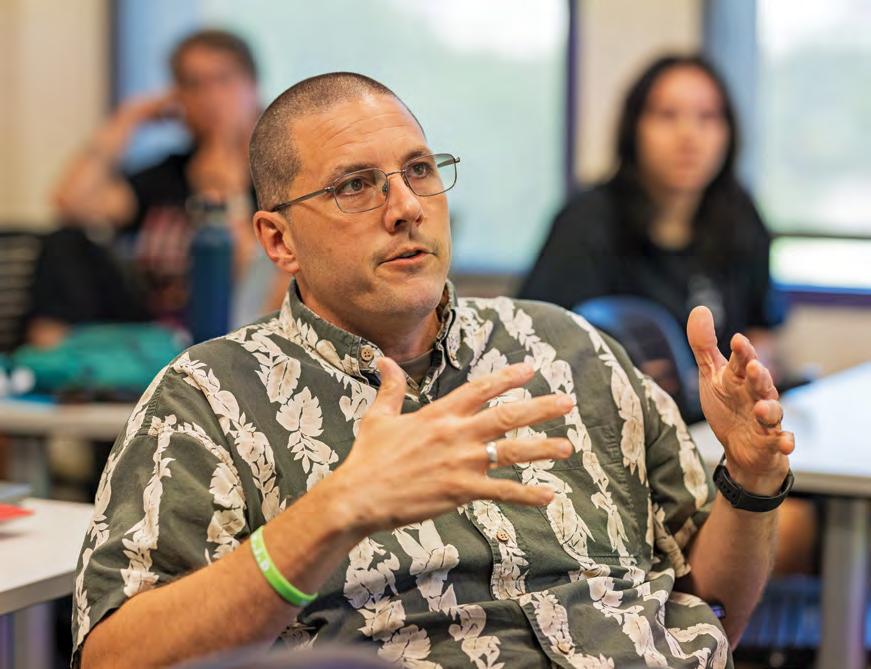
Boost your EQ
The “EQ Edge: Emotional Intelligence for Success” workshop equips participants with essential skills for personal, academic and professional growth, directly aligning with key social work competencies. Earn three continuing education units upon completion. $5 to register.
Friday, Jan. 30, 8:30 a.m.–12:30 p.m., Tucson In-House Academy, 340 N. Commerce Park Loop, suite 250 https://na.eventscloud.com/ei
Ticketed
Visit asuevents.asu.edu for events. Visit tucson.asu.edu for news about ASU in Tucson.
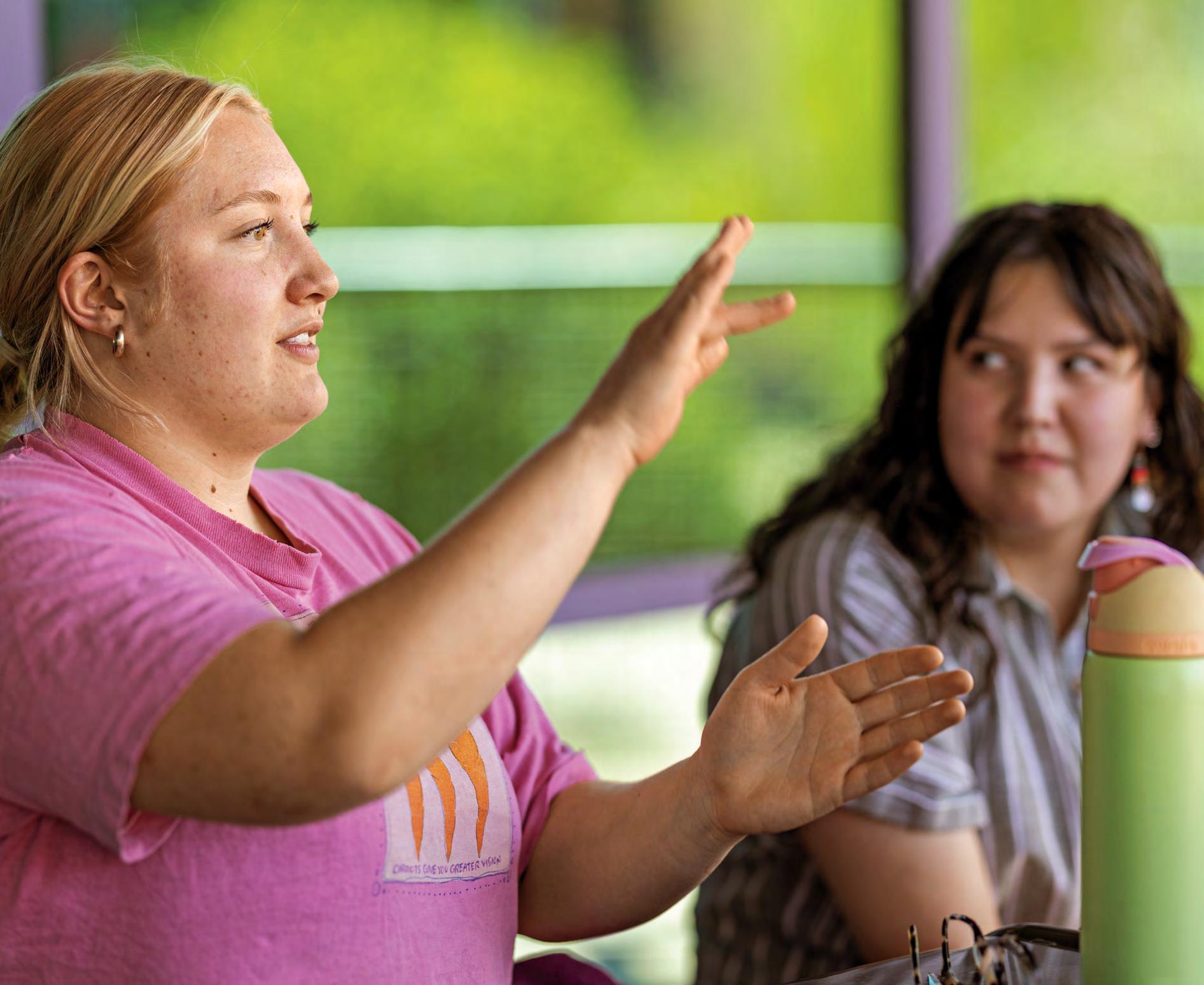
Explore a career in social work
The monthly ASU Tucson - Virtual Bachelor’s in Social Work Information Session covers the sync, online and in-person BSW programs.
Every third Tuesday of the month, times vary socialwork.asu.edu/events
Free Networking Online Upskilling Career
Advance your social work career
Meet with ASU Tucson faculty and staff, learn about degree programs, application tips, tuition, funding and internships at the monthly ASU Tucson - Virtual Master’s in Social Work Information Session.
Every third Tuesday of the month, times vary socialwork.asu.edu/events
Free Networking Online Career Upskilling

FOR ALL AGES
Game
watch party
Connect with
ASU fans, alumni and community members as men’s basketball takes on the University of Utah.
Wednesday, Feb. 4, 7 p.m., Barrio Brewing Co., 800 E. 16th St. alumni.asu.edu/arizona-alumnievents
Free
Make a difference with ASU Cares
Join ASU Alumni and ASU Tucson School of Social Work to clean up Oury Park. Donuts and ASU swag will be provided to volunteers.
Saturday, March 28, 9–10 a.m., Oury Park, 655 N. Hughes St. alumni.asu.edu/asucares Free Networking
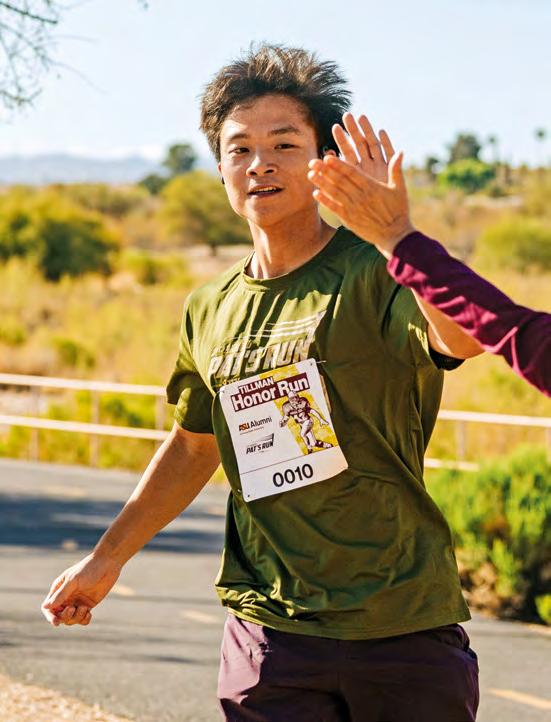
Tillman Honor Run
Celebrate the legacy of former Sun Devil and Army Ranger Pat Tillman at the 2026 Tucson Tillman Honor Run. All proceeds benefit the Tillman Foundation, which supports educational opportunities for active-duty service members, veterans and military spouses.
Saturday, April 4 alumni.asu.edu/tillman-honor-runs
Ticketed Family
A new way to treat lifethreatening allergic reactions
A discovery made by Yale University and ASU researchers could help doctors treat anaphylaxis triggered by food allergens. Anaphylaxis can cause difficulty breathing, a dangerous drop in blood pressure and even death.

They found that in these reactions, which differ from reactions to allergens in the bloodstream, chemical messengers called leukotrienes cause muscles in the airways and gut to contract. They’re already known to play a role in asthma attacks.
The findings suggest that targeting these chemical messengers with medications similar to those used to treat asthma could help prevent or treat food-triggered anaphylaxis.
Learn more at biodesign.asu.edu .

ASU recognized in new Carnegie classification for grads’ earnings, admitting every qualified student
The Carnegie Foundation for the Advancement of Teaching recently recognized ASU for its strong career outcomes and commitment to broad student access. ASU is one of only 21 Research 1 universities commended.
In the new listing:
• ASU graduates “high earners.” The median student who starts at ASU will earn considerably more than people of comparable location, age and other demographic characteristics.
• ASU enrolls more Pell Grant and underrepresented minority students than expected given the geography of the student body.
Learn more at asu.edu/rankings
“If you are qualified to learn at ASU, you will have the opportunity to do so, and when you graduate from ASU, your degree will matter.”
MICHAEL M. CROW, ASU PRESIDENT
Water leadership-building in Southern Arizona
ASU and partners are conducting a program to involve Southern Arizona residents in shaping the state’s water future. The Water Leadership Institute: Community Beyond Boundaries brings together cohorts for workshops in leadership and storytelling.
“The institute is a great platform for participants to build their knowledge so they participate in decision-making spaces and engage with local and regional groups,” says Arizona Water for All Network Director Carolina Jordão.
The institute supports emerging leaders pursuing water careers or simply seeking deeper involvement, like Tucson-based freelance journalist Topacio Servellon.
“I hope the knowledge I gain from this program makes me a better resource and liaison for my community,” says Servellon.
Learn more at azwaterinnovation.asu.edu.
Training and graduating more engineers
How did ASU build the largest comprehensive engineering school in the U.S. with over 32,000 students as of fall 2024?
For the redevelopment of ASU’s engineering program, the university introduced new tools to help students overcome hurdles in math, biology and chemistry, as well as redefined the idea of the traditional college student. The goal, ASU President Michael M. Crow said at the CNBC CEO Council Summit, is to graduate individuals capable of learning anything and able to drive economic growth throughout Arizona and beyond.
Watch the full interview.
Keep up with the headlines at ASU by subscribing to the ASU News e-newsletter at news.asu.edu/ subscribe
“I think it is important to build community, to be seen as part of the community and investing.”
HEATHER VOELKEL, TUCSON PROGRAM COORDINATOR

Keeping Tucson’s green spaces clean
The city of Tucson officially recognized the work of ASU’s School of Social Work for maintaining a local park.
In partnership with Tucson Clean and Beautiful, faculty, staff and students adopted Oury Park — located near the school’s Tucson location — and have been regularly cleaning it for the past year. In September, their efforts were acknowledged with a dedication event that included installation of a permanent sign at the park recognizing their commitment.
The project was the brainchild of Molly Gebler, academic success coordinator for the Tucson program and ASU Green Ambassador.
“I really liked the idea of having a more casual format outside where you can chat with students, faculty and staff while doing something nice for the community,” she says.
Learn more at socialwork.asu.edu .
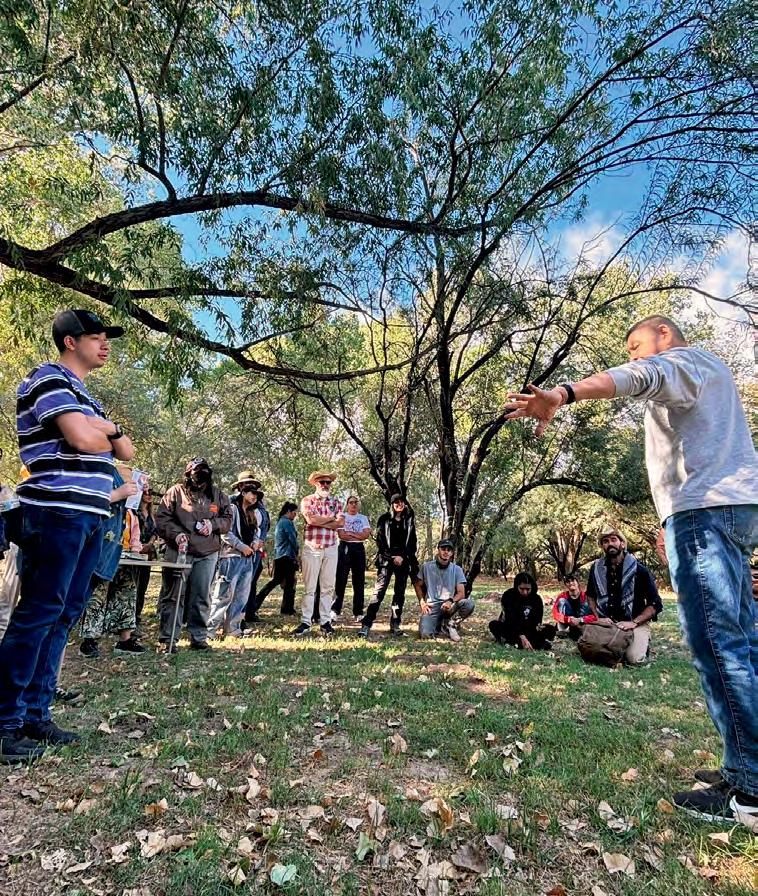
Water Leadership Institute participants visit the Santa Cruz River to learn more about the water landscape of Southern Arizona.
Programs will address the shortage of health care professionals statewide.

Helping stay Arizonans
How ASU’s new medical school, expanded nursing program and School of Technology for Public Health are advancing health care outcomes in Southern Arizona
Story by MATTHEW WILLIAMS

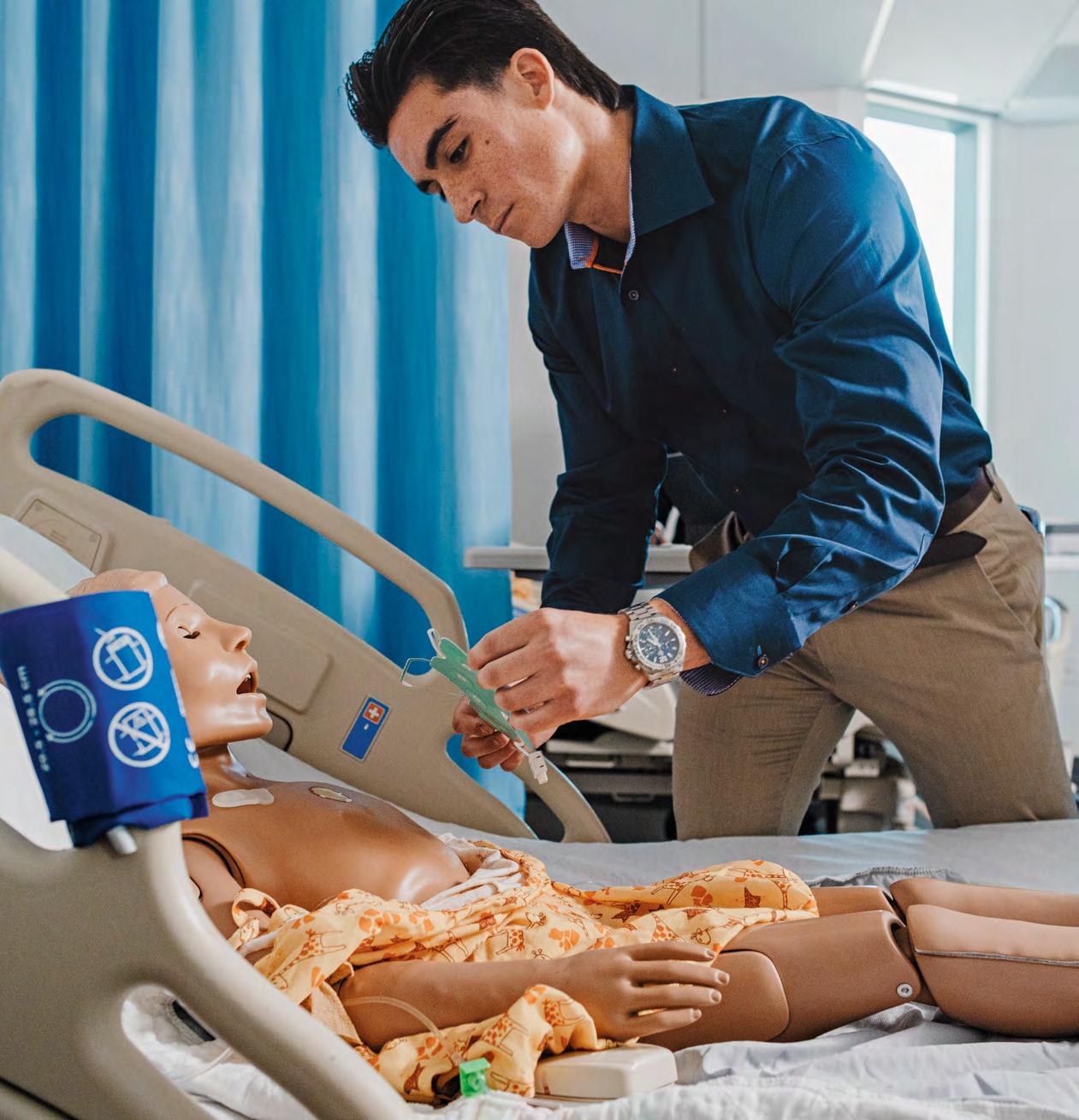
Specialized manikins help students train wherever they live.
Few issues in Arizona health care loom larger than the shortage of doctors, nurses and other health professionals. According to the Arizona Board of Regents, the state will need more than 14,000 additional nurses and 3,600 physicians by 2030 to close the gap. This shortage has widespread ripple effects across hospitals, clinics and long-term care facilities — stretching staff thin and limiting patients’ access to care.
To address this challenge, the Board of Regents launched a bold initiative: AZ Healthy Tomorrow. The program calls on each of the state’s public universities to accelerate efforts to expand and train the next generation of health care
professionals.
ASU has united its healthrelated colleges, schools and programs under the umbrella of ASU Health, to produce more health care professionals and transform health outcomes across the state.
“ASU Health is harnessing and accelerating all of ASU’s considerable health assets to improve Arizona’s urgent health care needs, now and into the future,” says Sherine Gabriel, executive vice president of ASU Health. “In Tucson, ASU Health is carrying out its mission through new local partnerships and programs to develop the nursing and public health workforce.”
Training more health care professionals in Tucson and beyond
Lack of local access to nursing education is a large contributor to the state’s nursing shortage.
“A major barrier is that nursing curriculum can’t be delivered fully online. It requires hands-on training, including simulations that use lifelike manikins as well as clinical rotations,” explains Salina Bednarek, clinical associate professor at the Edson College of Nursing and Health Innovation.
“ASU Health serves the entire state, and Tucson is an essential part of our vision for a healthier Arizona.”
— SHERINE GABRIEL, EXECUTIVE VICE PRESIDENT OF ASU HEALTH
“Relocating is simply not feasible for many students, and it limits their options for training.”
To overcome that barrier, Edson College has launched Learn Where You Live, a program that delivers high-quality nursing education directly to communities outside Phoenix. In Tucson, the college is expanding this approach through a new partnership with Tucson Medical Center.
“Because of this program, students can take coursework synchronously online while ASU brings a mobile simulation unit to their community and coordinates with TMC for clinical placements,” Bednarek says.
The mobile unit carries manikins from infant to adult, allowing nursing students to practice skills like venipuncture and responding to real-life scenarios such as chest
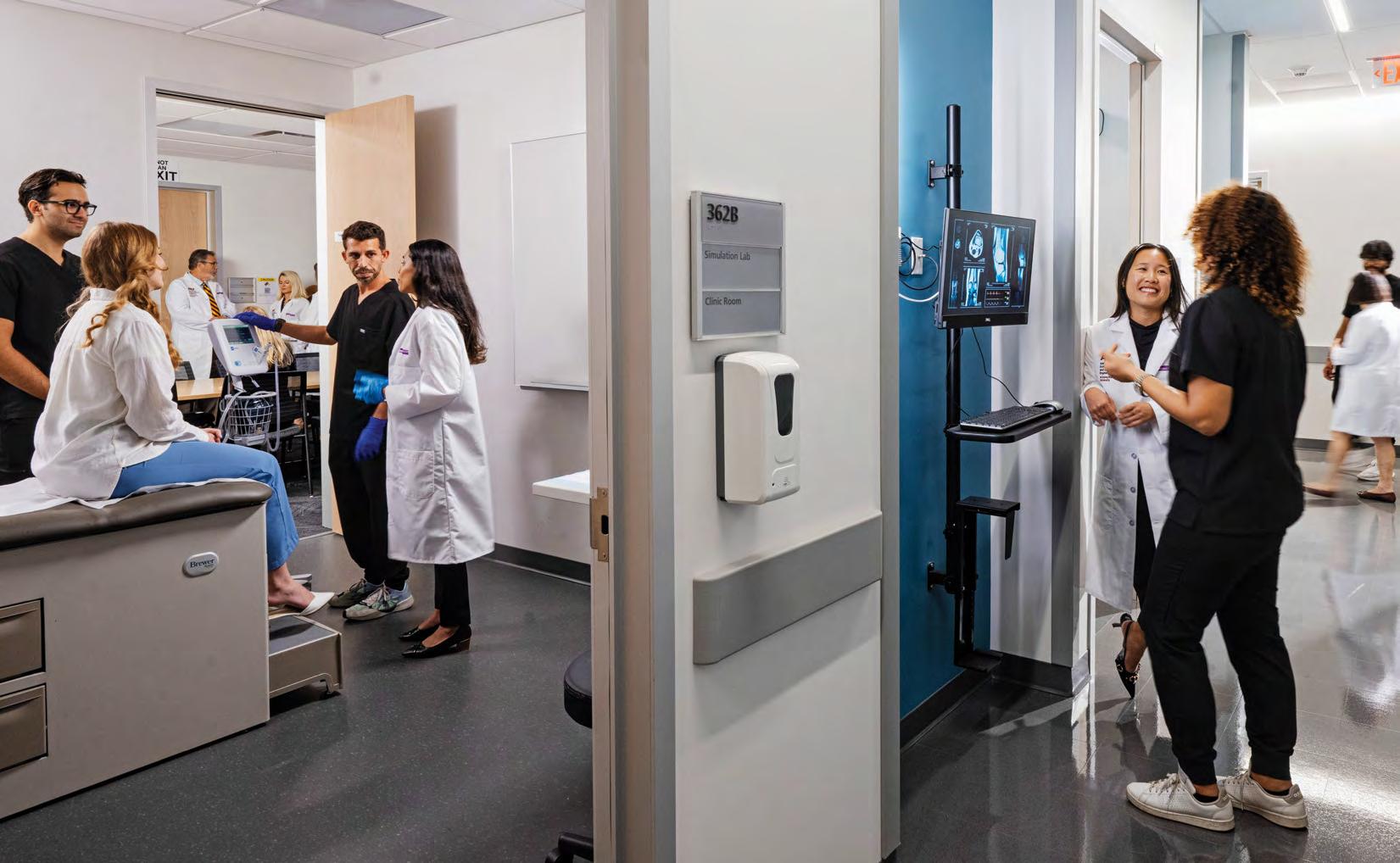
pain or breathing distress. Faculty in a nearby room interact with students through the manikin in the voice of a patient and later lead the students through a debrief to reinforce what they learned.
The program builds on the Edson College’s unique longitudinal approach to clinical placement: By embedding students at TMC for the duration of the program, they can build connections with the facility’s staff, nurses and providers, enabling an easier transition into the workforce after graduation and directly alleviating the nursing shortage in Tucson.
ASU chose TMC as its local partner because of the institution’s deep experience in education, strong existing laboratory and simulation spaces and shared commitment to meeting Tucson’s needs.
“We’re helping students stay rooted locally while preparing them to deliver high-quality care,” says Kara Synder, associate chief nursing officer at TMC. “This partnership strengthens our regional workforce and ensures that more nurses are equipped to serve patients where they’re needed most.”
Launching in spring of 2026, Learn Where You Live will begin by supporting eight students in Tucson and 16 students in other regions and expand from there.
“Our whole strategy is to bring high-quality nursing education to learners across Arizona,” says Judith Karshmer, dean of Edson College. “Learn Where You Live is a direct reflection of ASU’s responsibility to improve health

across the state.”
ASU’s newly accredited John Shufeldt School of Medicine and Medical Engineering will also work to address the shortage of physicians.
The school advances an entirely new model for medical education built to prepare a new kind of physician, equipped not just with clinical skills but also cross-trained with the engineering know-how to design new medical technologies, the skills to lead and transform health systems and the humanistic perspective needed to provide empathetic, person-centric care.
Preparing public health professionals and medical doctors in Pima County
ASU’s work in Tucson also extends into public health, a field that focuses on population-level health outcomes including food insecurity, pollution, sanitation and more.
Through the newly launched School of Technology for Public Health, part of the greater ASU Health initiative, the university aims to expand statewide access to public health education, and train professionals to use technology, data and innovation to solve pressing health challenges, from
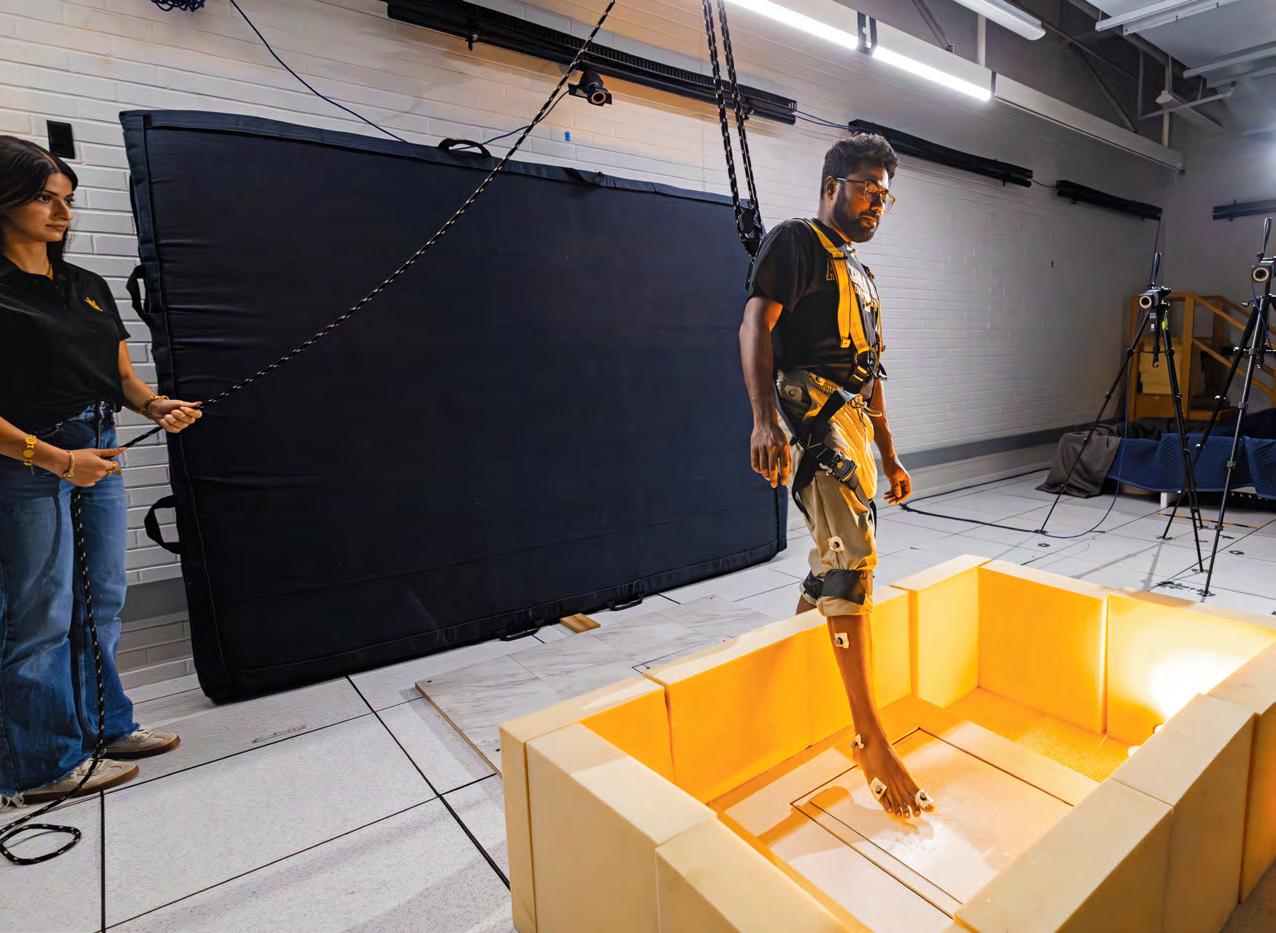
pandemics to chronic disease.
This will be achieved through partnerships with organizations that include the Pima County Health Department and alongside the work of the John Shufeldt School of Medicine and Medical Engineering.
“The state and the country need public health professionals with skills to navigate unprecedented systemic challenges,” says founding Dean Jyoti Pathak.
“Our program is the first of its kind to emphasize the integration of technology and innovation into public health practice. Beginning in 2026, we will offer the degree fully online to reach learners in Tucson, across Arizona and beyond, ensuring that geography is never a barrier to entry.”
Theresa Cullen, director of the Pima County Health Department — and a professor in the school’s Master of Public Health program — highlights the importance of the partnership.
“I’m thrilled that our Pima County Health Department is partnering with ASU Health as they develop and launch the School of Technology for Public Health,” she says. “It’s imperative that public health departments are able to work with academia on
innovative education and training, particularly when it comes to the integration of technology and data modernization.”
Partnering across cities for a healthier Arizona
ASU Health’s work in Tucson is part of an even more expansive vision: to dramatically expand clinical health care partnerships to take on pervasive health challenges, triple the nursing workforce, increase the number of physicians and other health professionals, and provide communities with the tools and information to make more informed health decisions.
This mission is why ASU Health is reaching into Tucson — creating more ways for students to become nurses without leaving home, preparing public health leaders who can use new technology to solve tough problems and teaming up with local providers on the front lines and launching a new accredited medical school for training physicians for all Arizonans — to improve health outcomes in the city and across Southern Arizona. ����
ASU research is working to make bathrooms safer for older adults.
Learn more at asuhealth.asu.edu .
The integration of cuttingedge technology is key to medical training at ASU.

High school students’ lives learning that fits
How Sierra Vista Unified School District and ASU are reshaping education in Southern Arizona by offering flexibility, honors classes and college credit
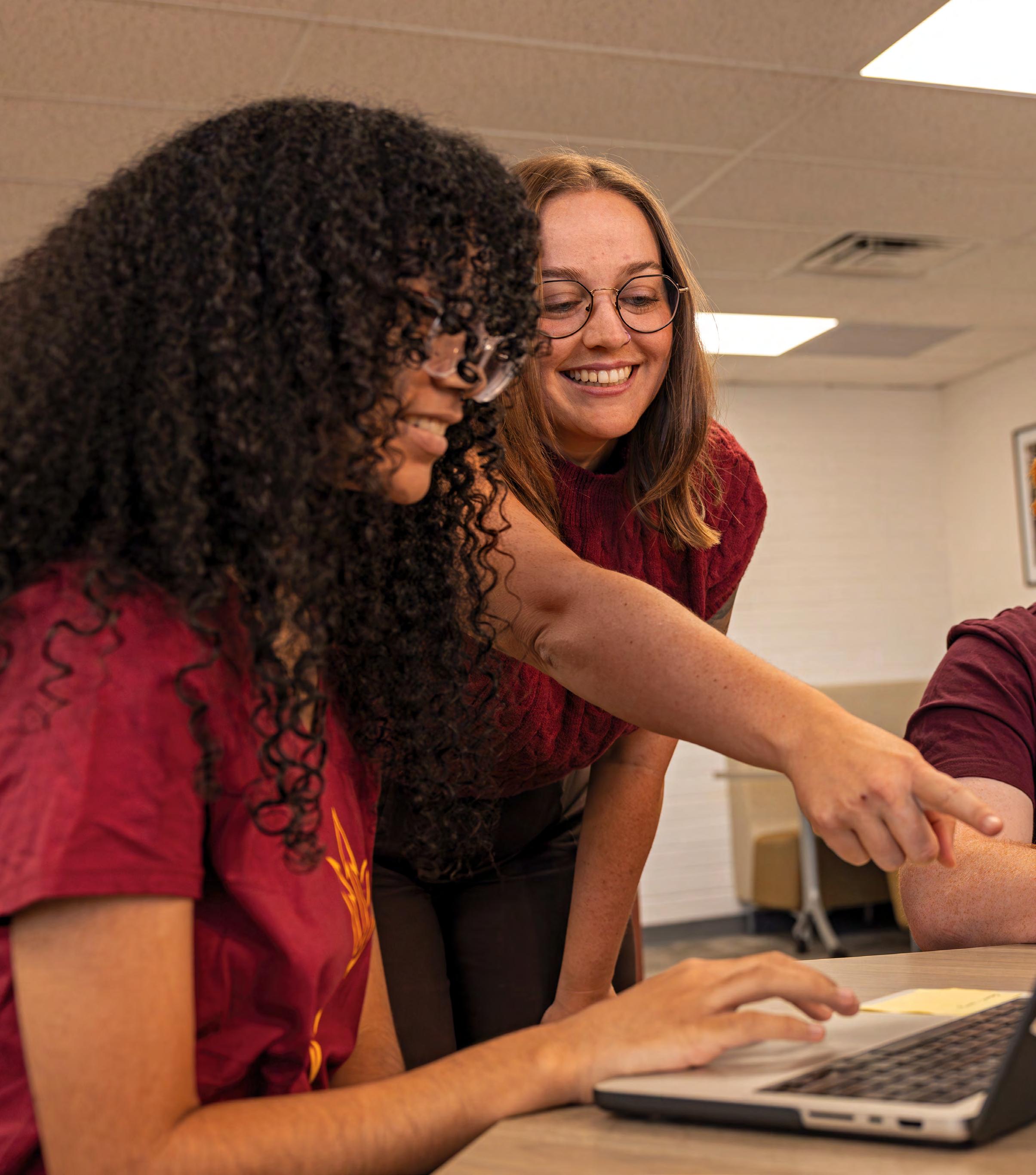
Sierra Vista hybrid students have access to dedicated campus study spaces.
Earning a high school degree doesn’t have to look the same for every learner. That’s why the flexibility offered by ASU Prep Global Academy was a key selling point for Buena High School senior Gabe Sulentic and his mom, Christine. He enrolled in the program in his junior year and is in his second semester of courses. He’s on track to graduate early, something he also credits to ASU Prep Global.
“All the work is assigned at the start of the year, so I’m trying to complete two semesters of English in one semester,” he says. “I’ll have all the credits I need to graduate by December.”
How ASU is helping schools in Arizona and beyond through ASU Prep Academy
K–12 on track to college
74,000 K–12 students
enrolled in ASU Prep Academy worldwide
75 schools in Arizona including in rural communities
5,910 college credits earned in 2024 by ASU Prep students
For Gabe’s family, having a job while in high school is important.
“Finding a job in this town can be difficult, so [the program] gave him some flexibility,” says Christine.
Gabe works at Culver’s and is able to pick up hours during the day — a time when most students are in school.
“I like being able to do schoolwork whenever I’m free,” says Gabe. “I can get out of work at 11 o’clock [in the morning] and do an hour of schoolwork if I want to.”
He’s not alone. More and more, students and their families look for
43,000+ teachers trained around the world in related subjects like the use of AI and other innovative methods
60-plus advanced-level college courses, all online, for high school students
SOURCE: ASU PREP ACADEMY NETWORKS
programs that offer dual enrollment in high school and college courses, hybrid models, accelerated instruction, and overall, the ability to pursue their education in a way that guarantees they’ll thrive.
When the world transitioned to online operations for much of daily life in the early days of the pandemic, many schools took that moment as a call to figure out how digital learning could be effective for the long term.
Leaders at Buena High School in the Sierra Vista Unified School District were no exception.
“We had an online program, and
[the pandemic] bolstered some of that activity, but it just wasn’t something that we thought was a sustainable program,” says Nicole Young, ’02 BA in history, principal at Buena High School.
“We reached out to ASU, as we knew that it had a comprehensive online platform that could be used,” Young says, “and we started meeting with representatives from ASU Preparatory Academy and toured campuses in Casa Grande and downtown Phoenix and brainstormed what that could look like here in Sierra Vista.”
Those planning sessions

led to the launch of ASU Prep Global Academy at Sierra Vista in spring of 2024.
The flexible, hybrid learning option is open to all Sierra Vista Unified School District students in grades 7–12 and offers specialized pathways to help focus their learning on their post-high school aspirations, including technology, education, sustainability and journalism. Students can tailor their coursework to align with their career interests, gaining valuable skills and knowledge that will prepare them for college and beyond.
“My parents want me to grow more independent as I get closer
“It’s very different from in-person school and it gives you a different outlook on learning. It teaches you to learn self-motivation.”
— TOMAIYAH DILLON, ASU PREP AND SIERRA VISTA HYBRID STUDENT
to 18. That way I’m ready for any of the challenges that come toward me in the real world,” Gabe says.
“I feel like ASU Prep is helping prepare me because it’s giving me a chance to manage my time, have more freedom with my work schedule and more freedom to be my own person.”
Gabe plans to join the military and go to college after high school to pursue nursing or business.
Easier access to honors-level coursework
Tomaiyah Dillon is a junior and has been taking online courses through ASU Prep Global for two semesters. For her, the draw to the program was the chance to challenge herself academically.
“When I moved to Arizona, Buena [High School] didn’t offer honors classes [that fit my schedule], but my parents
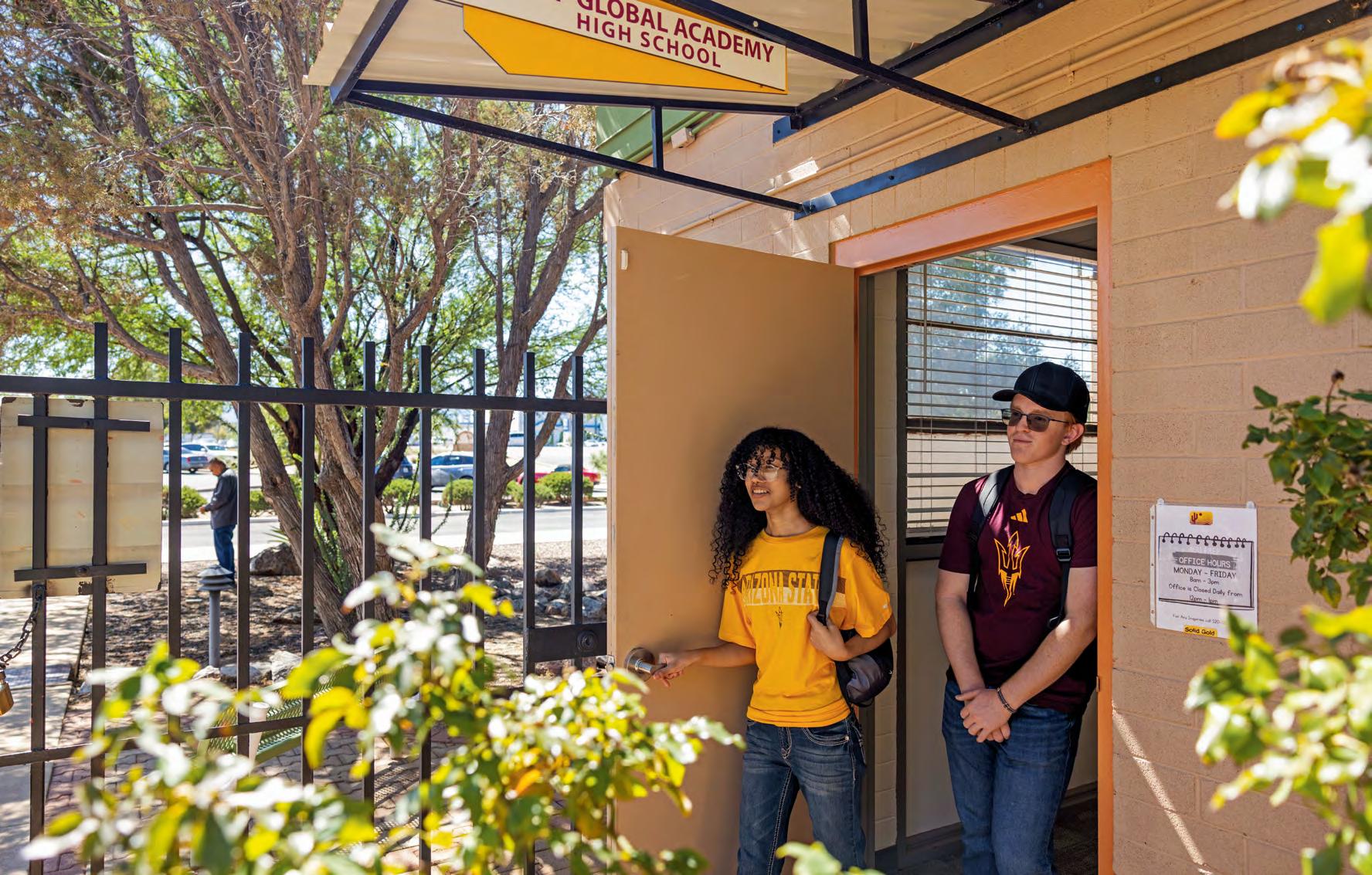
From left to right: Assistant Principal Kathryn Wright, ASU Prep student Kaliyah Hernandez and Principal Nicole Young.
Senior Gabe Sulentic (right) will graduate early thanks to the flexibility of ASU Prep.
“[ASU Prep] opens up opportunities that you don’t get when you go to school every day.”
— DANA DILLON, ASU PREP PARENT
discovered ASU Prep Global did, and that was exactly what I was looking for,” she says.
Tomaiyah is currently taking honors English, anatomy and world history.
“My courses are very self-paced and self-motivated,” she says. “It’s very different from in-person school and it gives you a different outlook on learning. It teaches you to learn self-motivation.”
Tomaiyah’s dad, Dana, agrees.
“I would say if you have a child who is self-motivated, knows how to plan and structure tackling different tasks, that would definitely play into their favor,” he says.
“It also gives kids time to do other things — extracurricular activities or a job. It opens up opportunities that you don’t get when you go to school every day.”
Being able to enroll in honors coursework while still enjoying the social benefits of traditional high school was exactly the balance Young was looking for when
developing the hybrid model with ASU Prep.
“Building community was a big part of the experiences we saw on tours,” Young says. “That inspired us.”
Hybrid students and their families also receive weekly communications from the district so they can take advantage of spirit days, dances, senior meetings, graduation and other community events.
“All of those things make them a part of our campus,” Young says. “We wanted to give the Buena experience to those who may feel overwhelmed by the large crowds.”
Building a connected community of students
The program continues to grow. There are currently 71 Sierra Vista students taking courses through ASU Prep Global.
Students choosing the hybrid model remain SVUSD students, with access to all extracurricular activities, clubs and sports.
They can also attend select in-person classes, including band,
fine arts or CTE classes at Buena High School or Joyce Clark Middle School, and can earn college credit through ASU with no financial or GPA risks.
Hybrid students attend in-person sessions four hours per week for hands-on activities, such as projectbased learning, lab experiments and additional instructional support.
A dedicated learning space is provided for hybrid students at Buena High School, allowing success coaches on-site to check in with students, help hold them accountable and stay on track toward their goals.
In addition to flexibility and access to more challenging coursework, Gabe’s mom, Christine, noticed another outcome of joining the ASU Prep Global program.
“He’s also a healthier person in general,” she says. “If he needs to sleep in, he sleeps in. If he doesn’t need to sleep in, he wakes up and goes to school. He’s mentally and physically healthier.” ����
Learn more at asuprep.asu.edu
On track to university and beyond
A customized approach to college prep to ensure every student thrives — wherever they are
Prep school models
The options
Models range from on-site and hybrid instruction to completely remote learning that students can access from anywhere.
The approach
Students dive into a rigorous, hands-on curriculum focused on personalized learning, technology and STEM.
And when ready, high schoolers are able to take ASU courses for credit at no cost and explore college majors and disciplines.
College credit
Students have
Students explore careers in science, technology, engineering and math.
ASU Prep uses the latest ASU technologies to boost student performance. STEM activities
Custom



Flexible learning for Southern Arizona students
With ASU Preparatory Academy, students across the region are able to choose the style of learning that meets their specific needs.
For high school junior Dianna Galaz, who dreams of owning an all-female mechanic shop, ASU Prep Digital+ helps her gain the skills she needs to achieve her professional goals while also earning some college credits.
“[Models like these] teach things you wouldn’t normally learn in high school,” she says.
ASU Prep also gives students the flexibility to set their own schedules, while blending mastery-based, self-paced learning with seminars, tutorials and peer tutoring.
“I’ve learned how to plan my work and manage my time. Later in life, I think that will make things easier,” says Lucas Daily, a Tucson-based
seventh grader at Khan World School at ASU Prep, an online honors program for students in grades 6–12 worldwide.
To his parents, it’s an essential aspect of future skill building.
“Having the agency to plan your day feels like a supported progression toward college and work life,” says his mother, Cecilia Daily.
Lucas also appreciates the one-on-one guidance provided by the program’s instructors.
“I really like how the teachers are always there for you. There’s almost always someone available to help right away with questions,” he says. ����
Learn what style of learning meets your student’s needs at asuprepglobal.org .
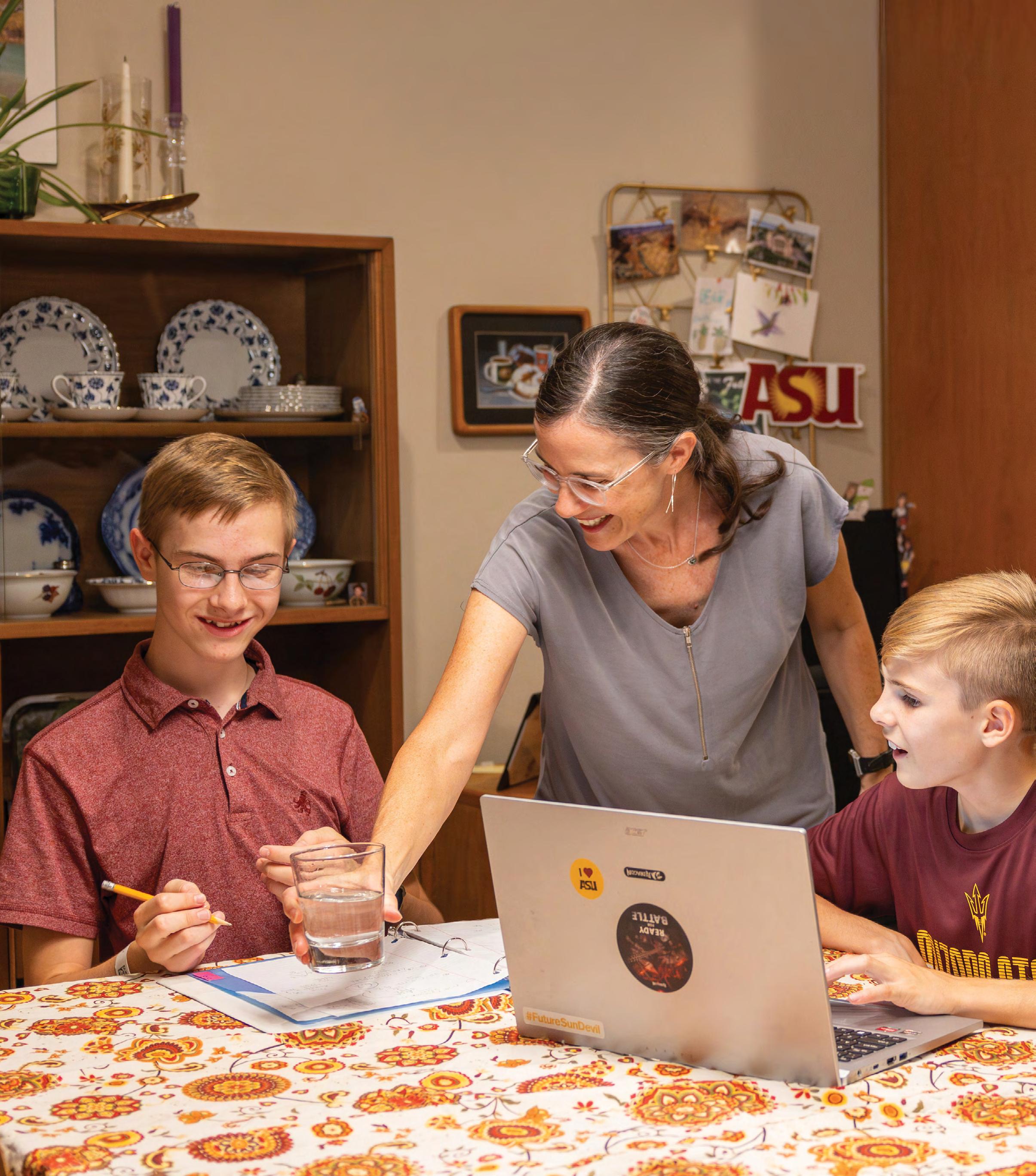
Junior Dianna Galaz learns about running a business through her ASU Prep curriculum.
Cecilia Daily’s (center) sons, Eli (left) and Lucas, enrolled in ASU Prep programing in 2020.
Jackie Vasquez-Lapan, ’08 BA in education, founder
The Lapan Sunshine Foundation
• 3,000 underserved students have come through the Clubhouse program.
• 222 students are college graduates.


Hometown
impact
Discover how three ASU graduates are transforming lives through education and innovation in Southern Arizona
by DAVE PERRY, FORMER PRESIDENT OF THE GREATER ORO
Story
VALLEY CHAMBER OF COMMERCE
Photos by SABIRA MADADY
Greater Tucson is home to more than 12,400 degreed ASU alumni.
Every day, they are out in their communities shaking up the status quo in everything from K–12 education to commercial real estate.
They create jobs, pull up test scores and provide mentorship opportunities to students they can see themselves in — dreamers who will do just about anything to achieve their goals.
What do a former honors student, a speedy outfielder and an educator all have in common? Sun Devil pride and a love for the Old Pueblo. Learn how each of them, shaped by time at ASU, is working to make Tucson a stronger city.
A safe haven for students
“Education changed my entire family’s trajectory,” says Jackie Vasquez-Lapan, ’08 BA in education. That’s why she and her husband, Dave, and his family established the Lapan Sunshine Foundation — to

give underserved students in the Wakefield community of South Tucson the opportunity to overcome challenging circumstances. Most of those journeys start in the afterschool Clubhouse program.
“At a bare minimum, they’re safe,” Vasquez-Lapan says.
At a full maximum, they’re building pathways to college and leading exceptional lives. Starting in sixth grade, every student at C.E. Rose, Hollinger and Wakefield middle schools can begin earning money toward their postsecondary education. The Lapan Sunshine Foundation provides economic resources, academic tools, cultural experiences and professional development that guide students toward achieving their goals.
As a first-generation college student who attended ASU on an athletic scholarship, Vasquez-Lapan recognizes the importance of having a strong support system. For her, it was her parents, restaurant owners Blanca and the late Albert Vasquez, who dreamed for all three of their children to go to college.
“I achieved their dream,” Vasquez-Lapan says, “and I’m passing that on to other kids who grew up like me.”
In addition to educational opportunities, students find mentors and meet role models, including ASU graduates.
First-generation college graduate John Asigbekye, ’18 BSE in electrical engineering, was a beneficiary of the Lapan Sunshine Foundation when he earned his master’s degree.
Now he gives back, coming to the Clubhouse each summer. He says, there he finds inspiration.
“There is this burning desire in their eyes,” Asigbekye says. “It’s fresh energy every year.”
A designer with Bay Area technology company Analog Devices, he started a scholarship program, funding three $1,000
“The superintendent’s job is to craft a clear and consistent message of expectations, as well as values and virtues that are going to be studentcentered, familycentered and communitydriven.”
I love it,” he says.
Trujillo, an ASU alumnus with five degrees, including a doctoral degree in education, is in his ninth year leading the Tucson Unified School District. The district serves 40,000 students, 89 schools and 8,000 employees.
“I feel a sense of urgency every day I come to the office,” Superintendent Trujillo says.
Plenty keeps him awake. Atop the list is “the safety and security of our students and staff.” Right behind that is, “Are we doing all we can to remove the barriers and obstacles that poverty presents to kids and families?”
Ten years ago, TUSD was in “a very, very challenged place,” Trujillo says. A quarter of its schools were rated as failing on standardized testing.
Former
Lapan Sunshine Foundation student and ASU alumnus
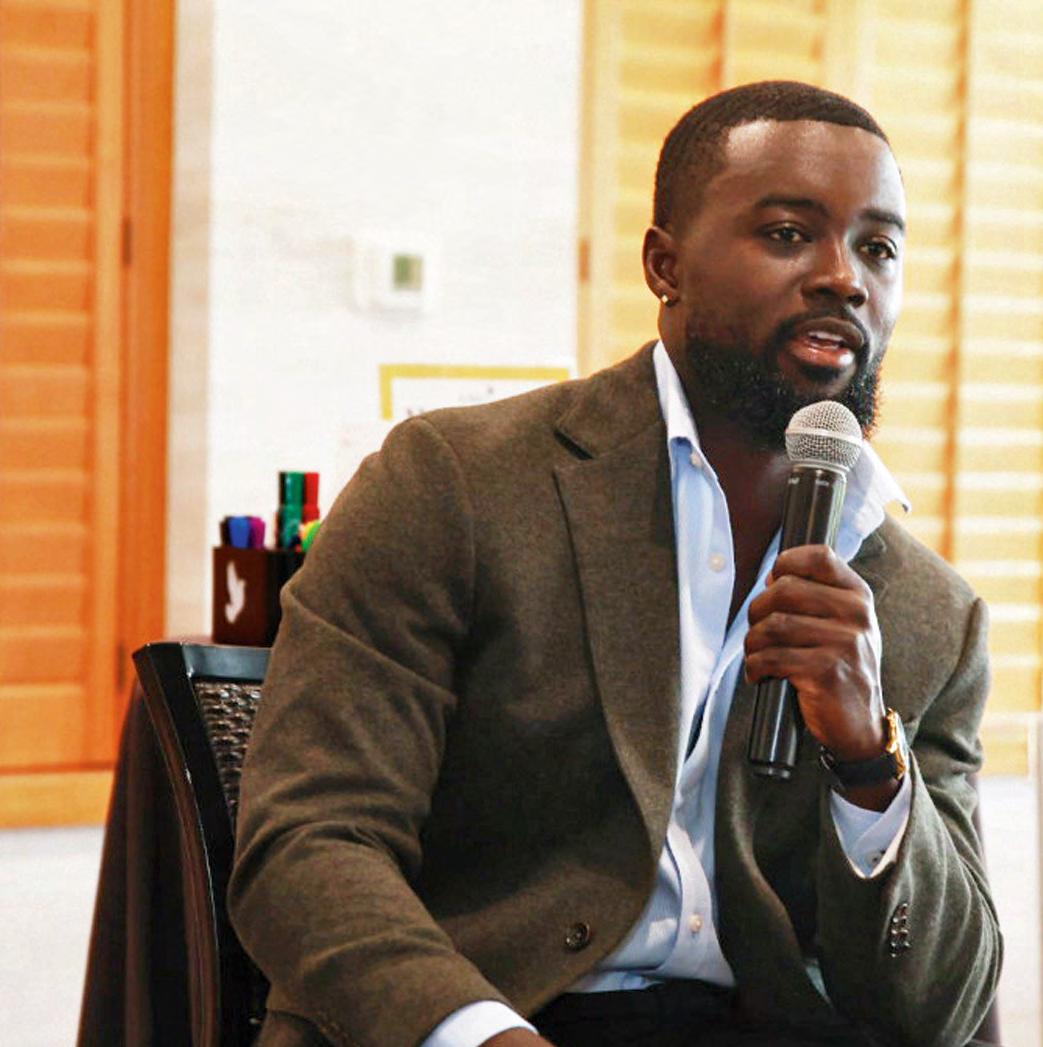
John Asigbekye supports students through a STEM scholarship.
— GABRIEL TRUJILLO, TUCSON UNIFIED SCHOOL DISTRICT SUPERINTENDENT
scholarships each year for firstgeneration college students studying science, technology, engineering and math.
More than 3,000 students have come through the Clubhouse. So far, 222 are college graduates.
“Hearing them say they don’t think they could have done it without our help, that they never would have graduated ... it really is amazing,” Vasquez-Lapan says.
A hard job he loves
Gabriel Trujillo recognizes he may have “the hardest, most complex [and] most labor-intensive job in the city of Tucson. And
Today, 90% of TUSD schools are rated “A,” “B” or “C.” Trujillo gives the credit to “our amazing students, our parents and ... the thousands of wonderful employees who work hard every day for our kids.”
Trujillo visits three to four schools a week to talk to employees, observe classrooms and ask parents how he’s doing.
“I really believe visibility is important in this job,” he says.
The modern K–12 landscape can “really challenge our ability to move quickly and be as innovative as we can be,” Trujillo says.
But, he knows, TUSD must innovate.
Over a quarter-century in education, Trujillo has witnessed three seminal events: the arrival of the internet, school choice and the pandemic.
Gabriel Trujillo has earned five degrees from ASU, including a Doctor of Education in 2012.
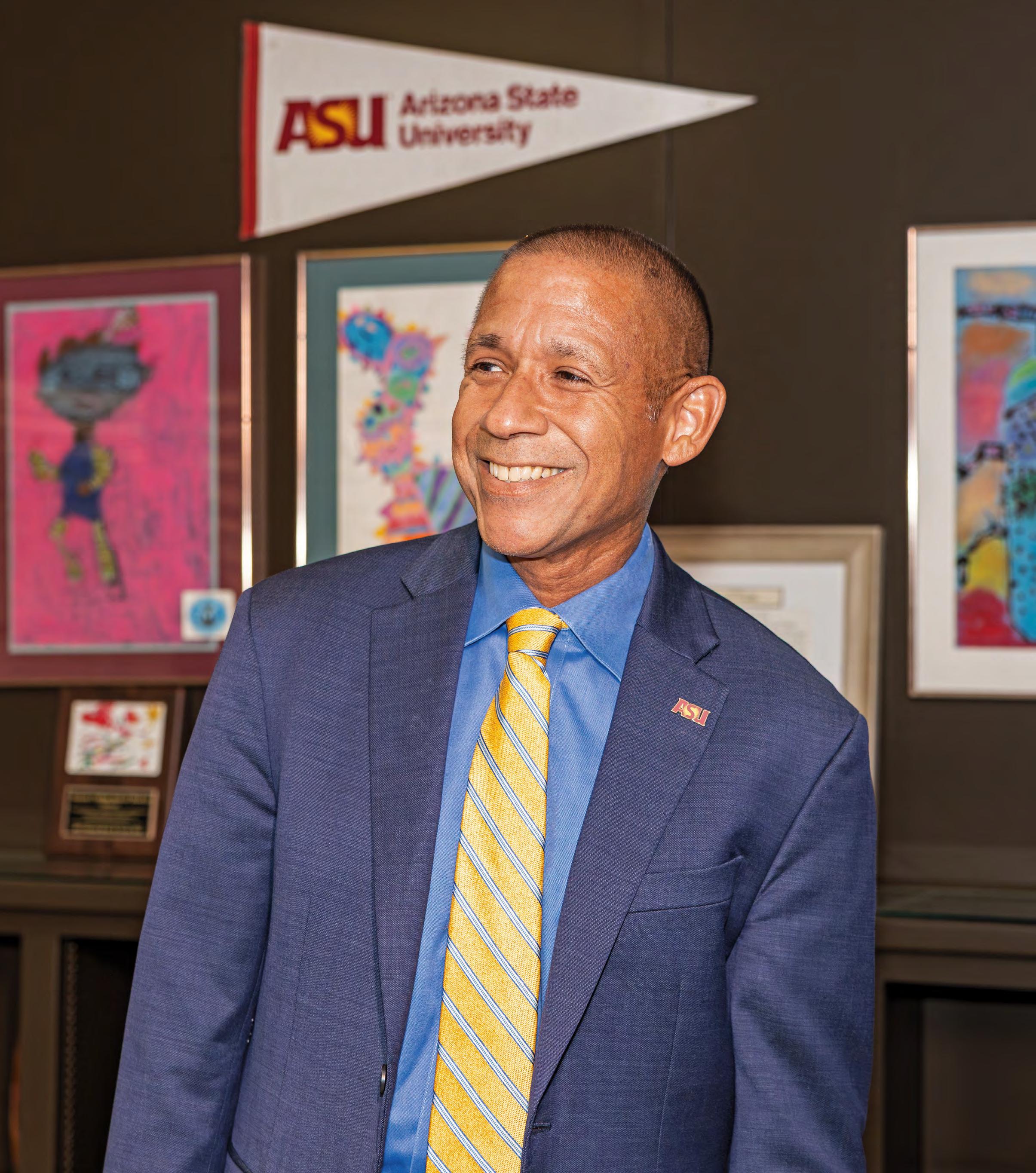
Gabriel Trujillo, ’12 Doctor of Education, superintendent Tucson Unified School District
• The district serves 40,000 students, 89 schools and 8,000 employees.

Bob Collopy, ’14 BS in marketing
Fort Lowell Realty and Property Management
• Employs 75 people managing more than 3,500 commercial, residential and retail stores in Tucson.
With school choice, 40,000 students and families figured out there were alternatives to TUSD, he says, meaning the district must re-recruit students every year. It also means redeveloping programming to help the modern learner thrive.
With the arrival of the internet, students shaped by digital devices and a barrage of immediate information are “wired differently,” Trujillo says. They have “an intense need to connect with each other, to collaborate, to create content. We’re challenged to think differently ... about teaching and learning.”
TUSD has doubled the number of high school students in career and technical education. And it has embraced a “dramatic return of the arts” through the district’s Opening Minds through the Arts Department, which helps integrate arts into the classroom by addressing brainbased learning.
Trujillo’s drive to rebuild the district was conceived during his time at ASU’s Mary Lou Fulton College for Teaching and Learning Innovation, where “some of the most knowledgeable experts in teaching and learning” led him to realize public schools are “the lone transformational institutions in American life.”
“The superintendent’s job is to craft a clear and consistent message of expectations, as well as values and virtues that are going to be studentcentered, family-centered and community-driven,” Trujillo says.
“Otherwise,” he says, “we’re just a collection of 89 different schools.”
A business built to grow Ideas flow from Bob Collopy like water fills a river. That’s how he
“I could really feel the difference in how much I was learning [at ASU] ... and how seriously students took things.”
— BOB COLLOPY, PRESIDENT OF FORT LOWELL REALTY AND PROPERTY MANAGEMENT
sees business, too.
“There’s a river” of opportunity, “and it’s an entrepreneur’s job to get as close to that river and irrigate it as best they can,” says Collopy, ’14 BS in marketing.
Under Collopy’s leadership, Fort Lowell Realty and Property Management now has 75 people managing more than 3,500 commercial, residential and retail stores in Tucson.
He is now preparing Fort Lowell Real Estate “to leverage its full spectrum of services to meet the needs of investors.” He wants to build more partnerships and expand rental property acquisitions.
At ASU, he affirmed core principles: Know the customer. Provide exceptional value. Be a one-stop shop. Commit to the long run. Do what you say you’re going to do.
At Barrett, The Honors College at ASU, in which Collopy was a scholar, he “could really feel the difference in how much I was
learning, how difficult the courses were and how seriously students took things,” Collopy says.
While there, Amy Ostrom, then an ASU assistant professor of marketing, guided him to build a business “from the perspective of what the client sees in front of them”; still invaluable to him today.
His graduate thesis was a guide on how to sell a book to the public. Collopy wrote a novel titled “The Phoenix Cycle” and then devised a plan to market it. Part of that plan was building a website, learning photography and video production, establishing a social media presence and identifying influencers.
He says that this too gave him “the basis of what I needed to do when I got out of college.” ����
Professional development for everyone
Low-impact transit
“Cars in Cities: Challenges and Alternatives” unveils how to foster sustainable transportation solutions that improve city life for everyone. One hour; free; badge available upon completion.
Online Free Self-paced
Manage supply chain operations like a pro
Are you a professional seeking to expand your knowledge of global supply chain operations? The “W. P. Carey Certificate in Foundations of Supply Chain Management” equips learners with vital skills to thrive in today’s complex workforces. $1,750, four months, online.
Online Scheduled
The call to
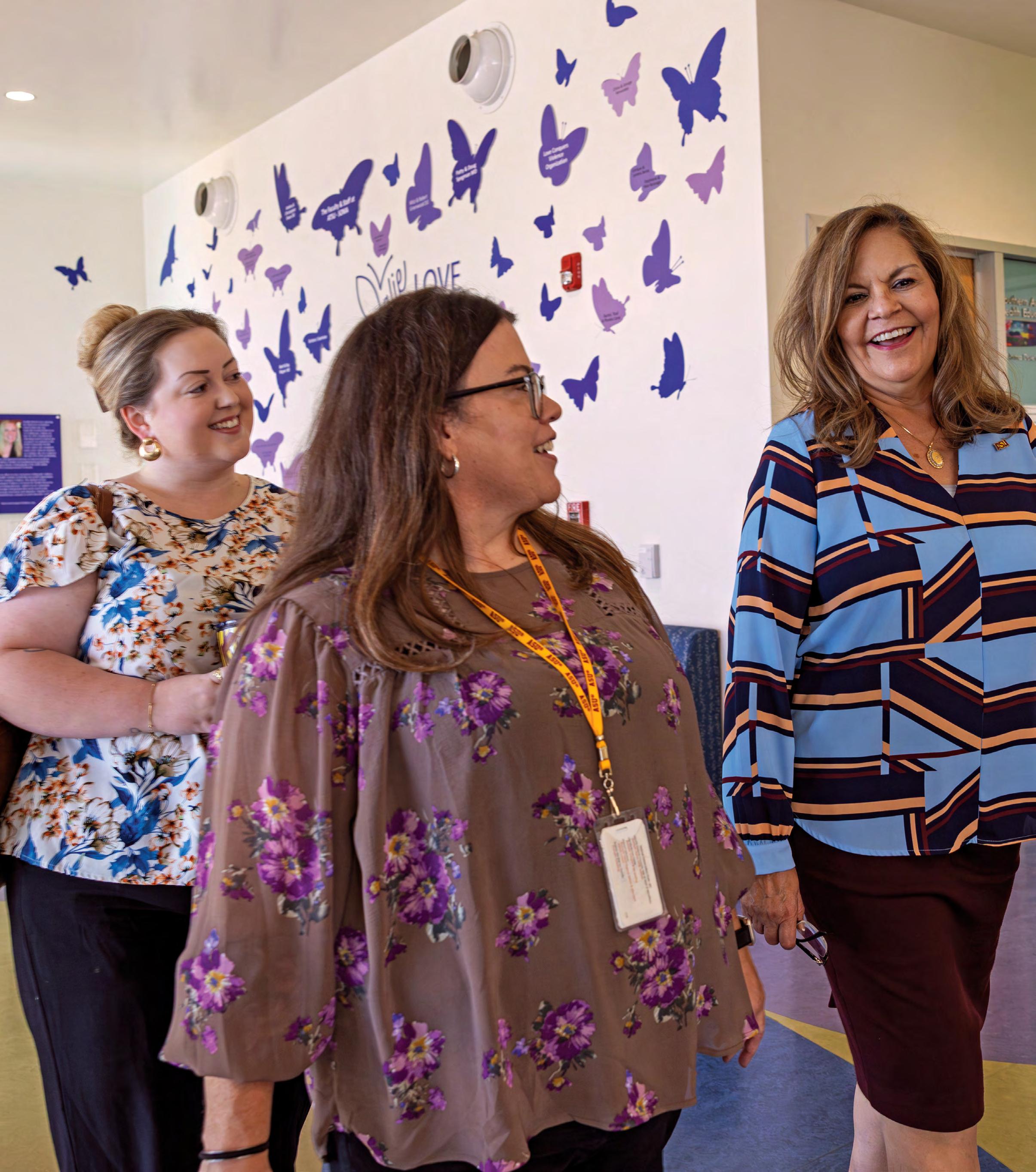
ASU’s partnerships with local organizations such as El Rio Health give students realworld experience in their own communities.
care
How ASU builds stronger communities from the ground up
AlbertEinstein said, “Only a life lived for others is a life worthwhile.”
It’s a philosophy that Vanessa Seaney, ’92 MSW, chief of behavioral health and integration at El Rio Health, practices every day as a social worker. Her career spans nearly four decades of service as a case manager, therapist, health leader and mentor.
However, before pursuing any of those roles, the Tucson native was a Master of Social Work student at ASU in the early 1990s, completing much of her coursework in the city she called home.
That’s because more than 50 years ago, the Watts College of Public Service and Community Solutions started offering School of Social Work courses in Tucson, and for the first time, students could prepare for a career in public service without leaving their communities.
An accessible social work degree
Today, Tucson-based ASU students can complete both undergraduate and graduate social work degrees in person. Not only do they avoid the challenges of relocating or commuting to Phoenix but they can also work in the field locally before they even finish their degree.
This is thanks to numerous partnerships with local agencies. This year, 75 are hosting ASU students, and in the spring semester alone, generated nearly 59,000 hours of service in Southern Arizona. One of those partners is El Rio Health, which serves the Tucson area as a nonprofit health center.
In addition to mentorship and supervision in traditional clinical settings, interns have an opportunity to be embedded in integrated health care settings and in El Rio’s mobile medical and behavioral health outreach teams to help provide care to the unhoused population.
“It’s fantastic to give students real experience in their own community,” says Seaney.
“ Tight-knit is a really good way of describing our community.”
– HEATHER VOELKEL, TUCSON PROGRAM COORDINATOR
It’s a very different program than the one Seaney, and her mother before her, went through.
“When my mom attended, there was no building here. When I went, there wasn’t really one either,” she says. “Now, there [is one].”
The ASU School of Social Work in Tucson opened its doors in 2001 — nearly 30 years after the Watts College brought programming to the region in 1972.
“Tight-knit is a really good way of describing our community,” says Heather Voelkel, the Tucson program coordinator. “We hold classes on Mondays and Wednesdays, and on those days, the campus is just vibrating with energy.”
The school also regularly hosts the public through its in-house academies. Covering topics from interviewing tips to Narcan training, they are designed to

widen the skill sets of students and interested community members, as well as support continuing education requirements for practicing professionals.
These experiences, combined with traditional coursework, says Seaney, ensure the future work of graduates is “not only valued, but also person-centered.”
A hub for public service
Another way the Watts College supports Southern Arizona is through the Lodestar Center for Philanthropy and Nonprofit Innovation, which produces cutting-edge research — like the biannual Compensation and Benefits Report — nonprofits in Maricopa and Pima Counties use to inform decisions, while offering programs to strengthen volunteer management and build nonprofit leadership skills, while bolstering local nonprofits.
Its Service Enterprise program helps “organizations become better problem-solvers, more intentional about engaging volunteers and clearer with their mission delivery,” says Tori Carlson, a trainer and former engagement manager for the Service Enterprise-accredited Interfaith Community Services in Tucson.
The research-based program includes a diagnostic evaluation, individualized coaching and changemanagement training for nonprofits.
On an individual level, community members earn the skills they need in their careers to level up through

the Nonprofit Executive Leadership Certificate and Public Allies Arizona programs.
“The format exposed me to a little bit of everything, but one of the most valuable takeaways was understanding what kind of leader I wanted to be,” says Magdalena Verdugo, one of 30 Tucson-based nonprofit leaders to earn the certificate since 2015.
She credits the program with preparing her to step into the role of CEO of YWCA of Southern Arizona in 2020.
Kayla Miranda, who completed her Public Allies Arizona internship with Southern Arizona Research, Science and Engineering Foundation, feels similarly.
“Being part of Public Allies made me realize that everything I contribute is important and meaningful,” she says.
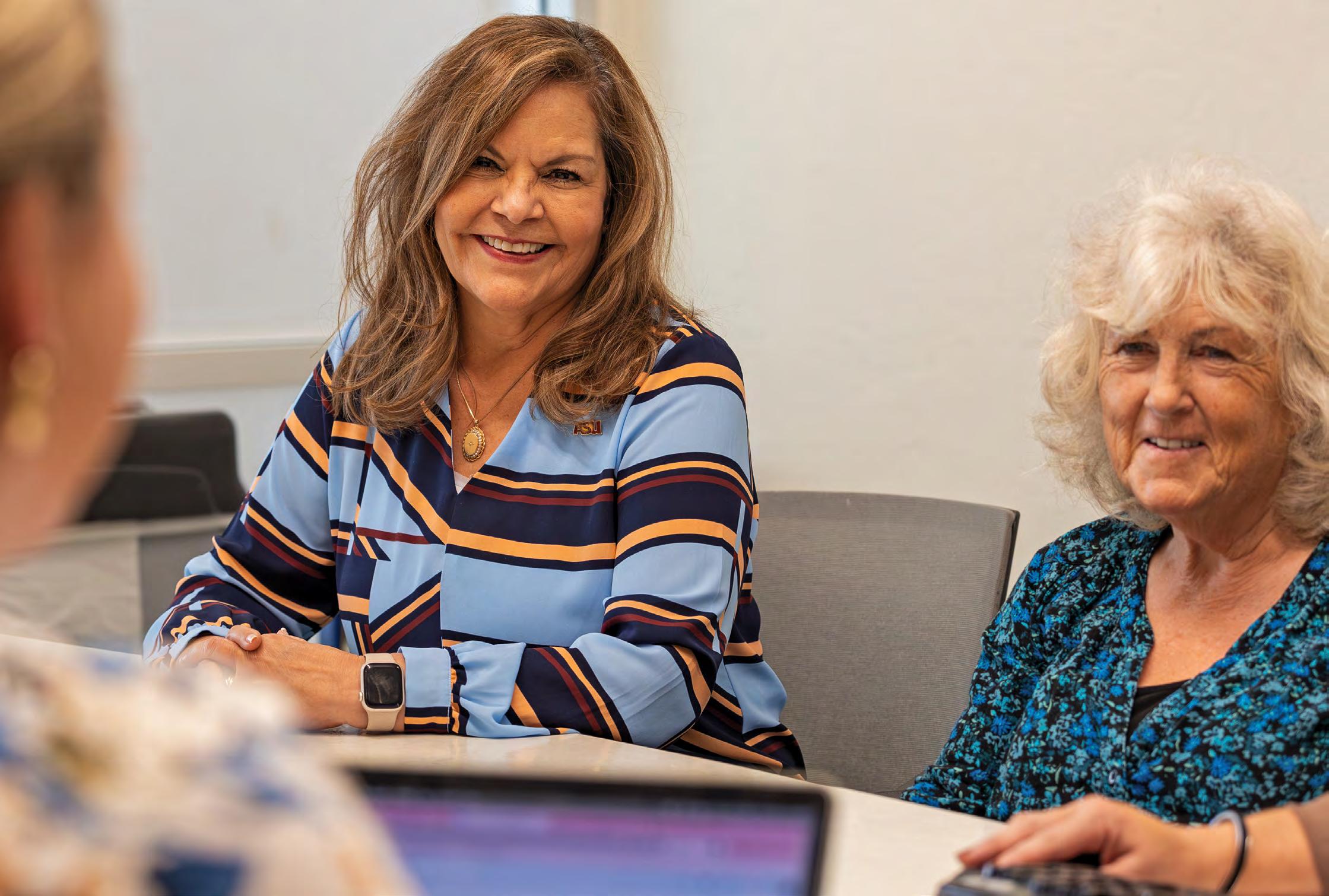
Magdalena Verdugo (left) credits ASU with helping her grow as a leader.
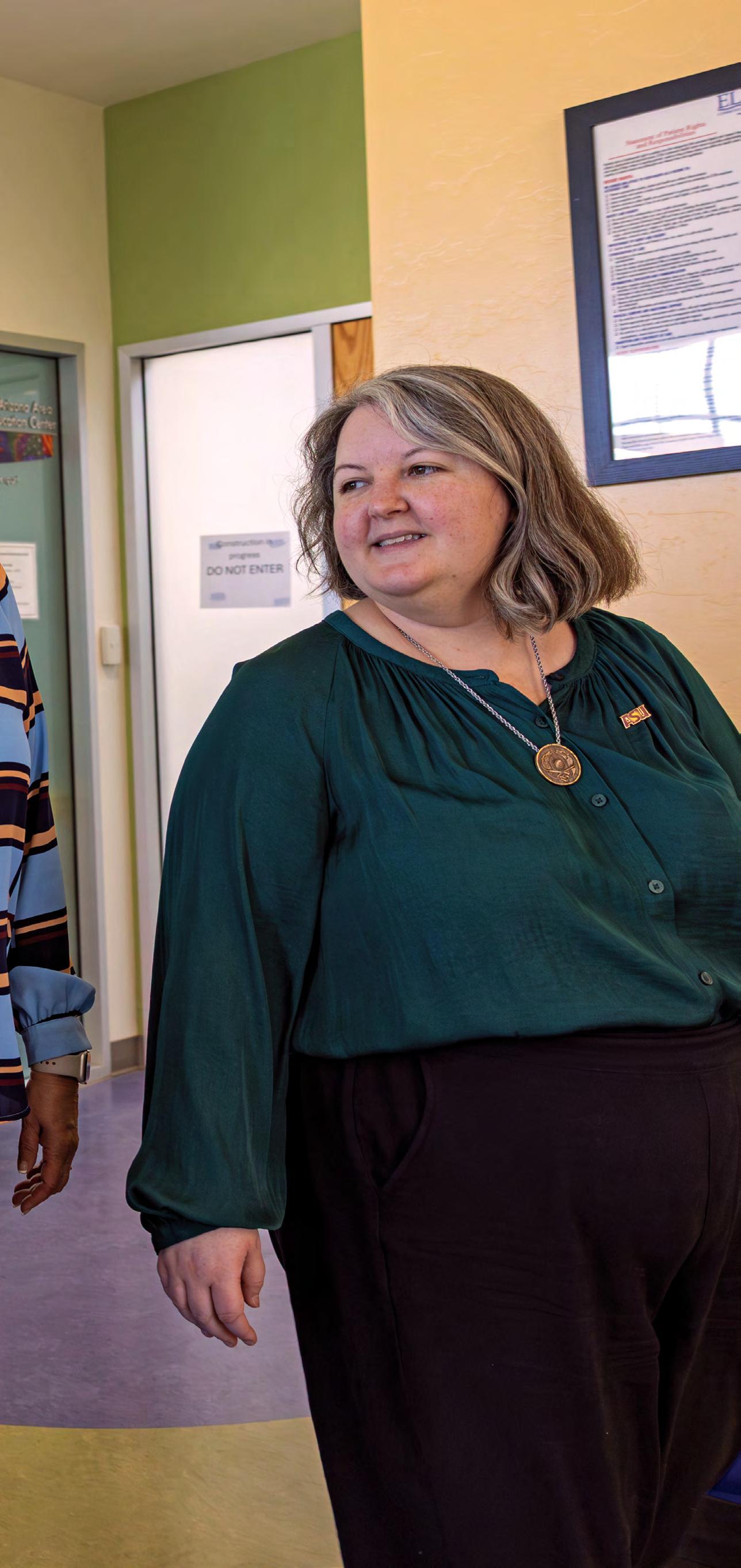
Vanessa Seaney mentors Master of Social Work students in the field of behavioral health.
Miranda now coordinates SARSEF’s Racing the Sun program, where high school students design, build and race electric and solarpowered go-karts.
Open to civic-minded individuals of all backgrounds, the program has mentored 37 Tucson-based Allies in 10-month apprenticeships since former Mayor Jonathan Rothschild helped bring it to the region in 2019.
The broad impact of the Lodestar Center stands out to the CEO of Tucson-based accounting firm BeachFleischman, Eric Majchrzak, and inspired him to become involved with the center eight years ago. He now serves as the chair on the center’s leadership council.
“When I looked at what the Lodestar Center does, I realized I could help the entire sector by being involved with this organization,” he says.
58,800
Service hours completed in Southern Arizona through Social Work Practicum Education program in spring 2025
101
Total Certified Public Manager certificates awarded 12
Faculty and staff supporting the student population at ASU in Tucson
Learn more at publicservice.asu.edu
SOURCE: WATTS COLLEGE OF PUBLIC SERVICE AND COMMUNITY SOLUTIONS
Building stronger business leaders
To support city, county and state employees in Southern Arizona, the Watts College, via the Bob Ramsey Executive Education Center, began hosting custom cohorts in Tucson for its Certified Public Manager Program in 2021.
“The CPM program gave me the knowledge and techniques I needed to manage employees, explore training opportunities and understand different training
methods,” says Maria Talamante, a 2023 program graduate.
An assistant city clerk at the time, she enrolled in the CPM program to “broaden and expand” her professional toolkit. She now works as an administrative services manager in the Pima County Recorder’s Office.
In addition to being fully accredited by the National Certified Public Manager Consortium, the center tailors the programming to city needs, such as specialized
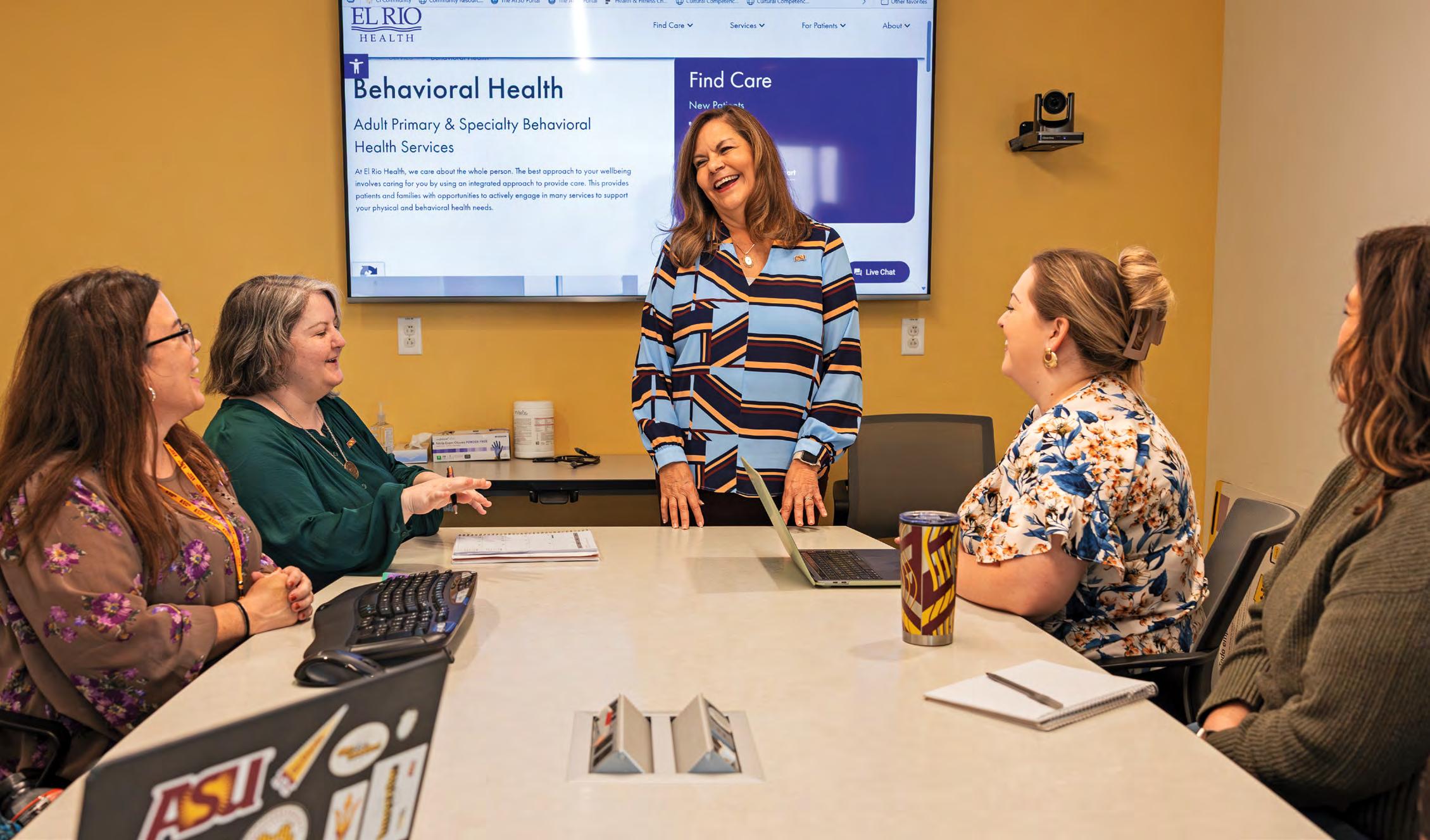
El Rio Health is one of 75 agencies partnering with the School of Social Work.
training on new systems.
“We want to provide training that’s both practical and theoretical,” says Michelle Hill, ’17 PhD in theatre, program manager for Bob Ramsey Executive Education.
That balance draws city employees from a variety of backgrounds and allows for unique collaboration opportunities on capstone projects used for internal problem-solving.
“Some projects have led to real changes — like revising sick time processes or addressing Parks and Recreation challenges tied to the water crisis,” says Hill.
Talamante’s group specifically focused on improving electricity use to make city buildings more energy-efficient.
“We researched the costs and potential savings for the city of Tucson,” she says. “I learned about programs the city already had that I didn’t even know about, even after 12 years of working there. It really
“We want to provide training that’s both practical and theoretical.”
— MICHELLE HILL, PROGRAM MANAGER FOR BOB RAMSEY EXECUTIVE EDUCATION
opened my eyes.”
Overall, earning their CPM helps public servants expand their knowledge base. This is critical, says retired City Manager Michael Ortega, who oversaw the initial implementation of the program in Tucson because “they had more confidence in how they addressed issues. They felt they had the skill sets and knowledge to address and ultimately solve problems.”
A commitment that endures
The Watts College first expanded in-person programming to Tucson so students could take classes and earn their degrees while staying in their community, fulfilling a need as the only school of social work in the region.
That commitment has expanded by bringing the only nationally accredited Certified Public Manager program in the state to Tucson communities, and serving the nonprofit sector extensively through the Lodestar Center.
Today, technology makes it possible to pursue these pathways completely online. So why is an in-person presence still needed?
The answer, explains Watts College Dean Cynthia Lietz, is simple: There is something powerful about students, working professionals and nonprofit partners being able to learn and gather in the community they serve. ����