Daily Wildcat | Arizona Ever After Print Edition | May 2026
ARIZONA EVER AFTER
» BACHELOR OF APPLIED SCIENCE IN APPLIED COMPUTING
» BACHELOR OF APPLIED SCIENCE IN APPLIED SCIENCE (ADMINISTRATION OF JUSTICE)
» BACHELOR OF APPLIED SCIENCE IN CYBER OPERATIONS
» BACHELOR OF APPLIED SCIENCE IN EARLY CHILDHOOD
» BACHELOR OF SCIENCE IN GAME DESIGN AND DEVELOPMENT
» BACHELOR OF ARTS IN GAMES AND BEHAVIOR
» BACHELOR OF ARTS IN GOVERNMENT AND PUBLIC SERVICE
» BACHELOR OF SCIENCE IN INFORMATION SCIENCE
» BACHELOR OF ARTS IN INFORMATION SCIENCE AND ARTS
» BACHELOR OF ARTS IN INFORMATION SCIENCE AND e SOCIETY
» BACHELOR OF APPLIED SCIENCE IN JUSTICE AND GLOBAL SECURITY
» BACHELOR OF APPLIED SCIENCE IN ORGANIZATIONAL LEADERSHIP AND REGIONAL COMMERCE
» MASTER OF SCIENCE IN CYBER AND INFORMATION OPERATIONS
» MASTER OF SCIENCE IN DATA SCIENCE
» MASTER OF SCIENCE IN INFORMATION SCIENCE
» MASTER OF ARTS IN LIBRARY AND INFORMATION SCIENCE
» P h D IN INFORMATION
Editor-in-Chief
Emma LaPointe editor@dailywildcat.com
Managing Editor
Ruby Wray editor@dailywildcat.com
News Editors
Jasmine Creighton Ian Stash news@dailywildcat.com
Opinions Editors
Sarah Arellano
Zaina Jasser opinion@dailywildcat.com
Magazine Editor & Training Coordinator
Dylann Sweeney
Sports Editors Ava Widener Will Shenot
sports@dailywildcat.com
Arts & Life Editor
Kate Eid Valeria Moreno arts@dailywildcat.com
Photo/Multimedia Editors
Mason Kumet
Josie Shivers photo@dailywildcat.com
Copy Chiefs
Ari Keating
Olivia Volland copy@dailywildcat.com
Comics Editor Amara Williams amarawilliams26@arizona.edu
Social Media Coordinators
Nandini Manepalli
Michael Smith socials@dailywildcat.com
Designers
Emma LaPointe
Ruby Wray
Kasey Leftwich
Amara Williams
Josie Shivers
Mason Kumet
Senior farewells from editorial board: What they learned, and words of advice
SIERRA BLASER Former Editor-in-Chief
Joining the Daily Wildcat my sophomore year of college changed my life.
I know that sounds dramatic, but three years ago, I had no idea where I would end up. I didn’t know what I wanted to do with my life; I only knew that I loved to write. To be honest, my interest in journalism started as an effort to be more extroverted. I entered college as a fairly quiet person who didn’t know how to put herself out there, and I joined the Arts and Life desk to force myself to talk to people.
It ended up defining my college experience.
Because of the Daily Wildcat, I landed my first internship at the Arizona Daily Star, traveled to Kansas City, Missouri to cover the 2025 Big 12 tournament and New Orleans to attend an investigative reporting conference, took on leadership roles that taught me the ins and outs of student journalism and built friendships that I know will last a lifetime, no matter where our careers take us. After graduation, I’ll also be starting full-time as a reporter and digital producer.
As my time as a student comes to an end, I’ve realized how much I owe to the hands-on experience Arizona Student Media gave me. From reporter to editor to editor-in-chief during my junior and senior years, I couldn’t be more proud of the team we built. It’s been incredibly rewarding to watch it continue to grow after passing on the torch at the beginning of this semester. I have no doubt the Daily Wildcat will keep growing, and I hope more students will have the chance to experience the same opportunities or even more.
To everyone I had the privilege of working with in student media, thank you.
What an incredible 3 years at the Daily Wildcat. For as long as I can remember I’ve been a writer; 6-year-old me spent hours in my notebook, writing stories of characters who adventured and saved the world. And while I haven’t quite saved the world yet, I declared a journalism minor and translated that urge into writing to make any difference in the lives of others. Just days into my freshman year, I came across the Daily Wildcat and immediately applied. 18-year-old me wanted to branch out and find my voice — now, at 22-yearsold, I can say that’s exactly what the Daily Wildcat did.
I’ve been lucky to grow with the Wildcat in different roles: I’ve been a copy editor, arts & life reporter and had a wonderful experience as training coordinator on the editorial board; a returning position and special start to my e-board journey. This year I’ve had the privilege of being the Magazine & public relations editor on our newest Daily Wildcat desk. This experience was unique and taught me to adapt and take initiative, as this was our first desk of its kind and I was able to kickstart its growth and presence at the DW. I am unbelievably thankful to e-board, my magazine desk reporters and copy chiefs Ari and Olivia who both watched me grow as a copy editor, writer and editor and suggested I apply for e-board in the first place! What an honor it’s been to work alongside all at the Daily Wildcat and I’m so proud of how far we’ve come. I will miss the excitement of editing, publishing, mentoring new reporters, testing out content, desk meetings and being in a newsroom full of the wonderful people that make the Daily Wildcat what it is.
If you have a chance to join the Daily Wildcat, do it! I am forever thankful I did.
DYLANN SWEENEY Magazine & PR Editor, Training Coordinator
TIA STEPHENS | THE DAILY WILDCAT
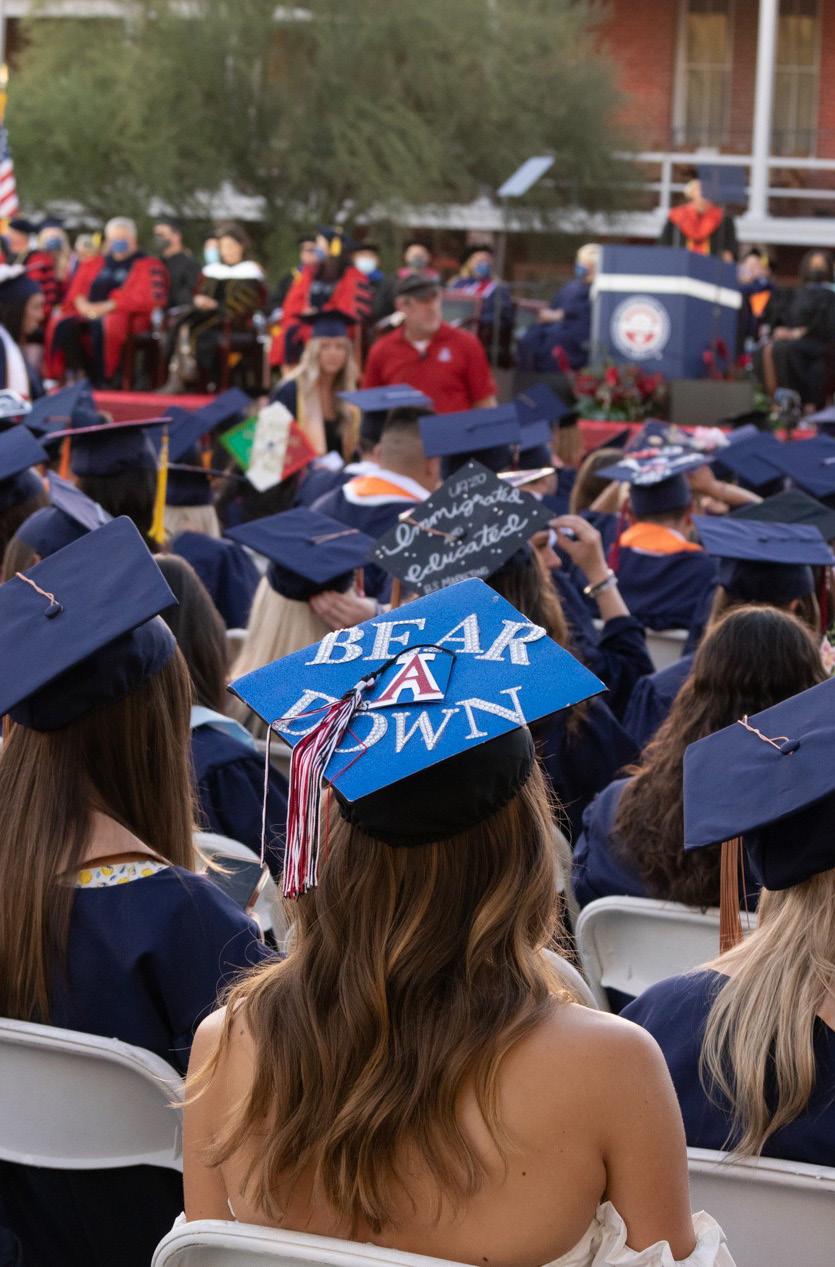
A SEA OF CAPS top the heads of the University of Arizona graduates during the make-up 2020 Commencement Ceremony outside of Old Main on Nov. 5, 2021
GRADUATE GOODBYES
SARAH ARELLANO Opinions Editor
When I joined the Daily Wildcat staff as an opinions writer, I was definitely unsure if what I had to say was actually the same as what the other students were writing about. But honestly, the responsibility of writing for other students and capturing the vibe and emotions of the campus really grew on me and taught me so much about the importance of opinions in news.
This past year, even though I haven’t been writing as much while being on the editorial side, I’ve loved being able to advocate for the student body. My main goal was to make sure we gave space to the people on campus who really deserve to have their voices heard. Of course, the job definitely came with its fair share of stress, especially the pressure to get everyone’s stories edited and published on time.
I’m honestly pretty sad to be leaving the Daily Wildcat, but I’ll always remember this as the place that gave me a shot when I was starting out. I’m leaving with so many great memories and laughs that I’ll never forget.
IAN STASH Assistant News Editor
ZAINA JASSER Opinions Editor
Whatever your dreams for college from yesteryear were, make that plunge, Wildcats! A day will come that you wish you did it sooner. CONTINUED FROM PAGE 4
It takes courage, grace and so much prudence to share our opinions for everyone to read, where an idea may be wielded as a sword by someone who disagrees. I share stories, both by my peers and me, with the incredible honor of upholding the freedom and sanctity of the words of my friends, community and challengers. I saw my job as an immensely fulfilling experience of preserving our individuality among seeming chaos and upheaval throughout campuses nationwide. And while I pout, knowing that my agreeable opinions won’t grace the pages of the Daily Wildcat anymore, I am so grateful to know that the legacy of the student voice and opinions is held in high regard and remains so wildly courageous. As I joined with so much joy, I leave with as much admiration.
Working at my university newspaper was something I’ve had in the back of my mind ever since I started thinking about college. Exposing corporate greed, highlighting local corruption or just enjoying myself as I write about the minute details of the college ecosystem. I dreamed about doing it all one day.
But me being me, I didn’t work up the courage to do it until my junior year. Why Ian Stash’s words would ever deserve to be published for all to see was a question that was on my mind, even when I did finally make that dive.
As I progressed as a writer, I came to greatly enjoy it. It gives you a perspective on your college that you had never seen before. I felt like I was walking a totally different campus this last year than I had in my first 3 years because I finally got a chance to see things from a bird’s eye view, the chance to get to know the high variety of happenings on campus. I met interesting people, I saw interesting things and best of all, I got to write about it!
Trying to beat the heat: Addressing rising temperatures in Southern Arizona
UA research team collaborates with community to address the impacts of extreme heat
The University of Arizona and Tucson are known for yearlong warm weather, but when is it too much? With temperature reaching record highs in March, the city of Tucson has already reported increased temperatures for this year.
In the wake of the third annual Southern Arizona Heat Summit, integrating voices throughout the City of Tucson, community stakeholders and experts from UA gather to speak about possible solutions and policies to address rising temperatures and extreme heat.
The summit strives to ensure that the lived experiences of Southern Arizona residents are voiced. The first summit commenced in 2024, in response to the declaration of an extreme heat emergency in Arizona by Gov. Katie Hobbs, as part of a larger plan called Arizona’s Extreme Heat Response Plan.
With representation from organizations such as the American Red Cross, the National Council for Occupational Safety and Health, Arizona Jobs with Justice, Tucson Indian Center and many more, the summit emphasized the importance of the perspective and concerns of stakeholder groups throughout the community.
The summit included a variety of UA experts, including faculty representing the School of Geography, Development and Environment; the Udall Center for Studies in Public Policy; the Mel & Enid Zuckerman College of Public Health and the College of Architecture, Planning and Landscape Architecture.
One particular project, led by Ladd Keith at the School of Landscape Architecture and Planning, is a part of the Southwest Urban Corridor Integrated Field Laboratory, which is funded by
the United States’ Department of Energy to explore extreme heat throughout Arizona. SW-IFL works in collaboration with other national laboratories including those at ASU and NAU.
The team works to analyze extreme heat in the southwest and rural areas, and how communities deal with heat by conducting interviews. The team has also prescribed policy to Pima County and the City of Tucson regarding more effective strategies to combat rising temperatures, such as green stormwater infrastructure.
Anne-Lise Boyer, a post-doctoral researcher with the Climate Assessment for the Southwest, shared that the team particularly analyzed extreme heat in three parts: heat mitigation, heat management and heat governance.
Mitigation deals with prevention through strategies such as green infrastructure and planting trees, while management includes cooling sensors and heat warning systems.
Governance allows these measures to be enacted through policy.
In Tucson, some of the most meaningful work the team has engaged in has been drafting the City of Tucson’s Heat Action Roadmap in 2024, which outlines goals to mitigate and mandate extreme heat and its impacts while prioritizing community voices.
The goals of the roadmap include informing and educating citizens of Tucson on the adverse effects of extreme heat and cooling people’s homes and neighborhoods by incorporating heat risk in regional planning. These steps are essential to practicing heat management, especially as the city of Tucson grows.
“I think the most interesting thing about being based in Tucson is that because the heat has been here for a long time, it’s like a laboratory in itself,” Boyer said. “We have all this research and all this collaboration happening with local actors because it’s a
pressing issue in Arizona.”
As the annual heat summit recurs, new ideas and perspectives continue to be shared throughout the community.
Boyer shared that this year, the Southern Arizona Heat Summit focused on the youth perspective, highlighting middle school and high school students and how heat impacts their everyday lives. Many students spoke about how heat shaped their lives at home, school and sports.
“That’s one of the goals to have community members participate and give their input in how they wish the city will deal with the heat,” Boyer said.
Boyer and Kirsten Lake, a program coordinator for the SW-IFL team, also shared how the impacts of extreme heat impact some neighborhoods and communities in Tucson more than others, and that their research often evaluates these factors to determine where heat management efforts would make the greatest impact.
“Its important when you’re putting into effect some of these measures, that you make sure you put it where it’s going to make the biggest difference,” Lake said.
The work of the SW-IFL team is not just locally known. The Brookhaven National Lab based in New York deployed a specialized truck to Tucson to collect information on the atmosphere and rising temperatures. The SW-IFL team hosted the Brookhaven team.
Additionally, Keith’s work has led to a guidebook called “Planning for Urban Heat Resilience” which focuses on the adverse effects extreme heat poses to marginalized communities across the country.
“It is so different from place to place and neighborhood to neighborhood because you have to take the whole context into account,” Boyer said. “They recommend first to document the heat impacts in your communities.”
MALIA HIRASA
The Daily Wildcat
JOSIE SHIVERS | THE DAILY WILDCAT
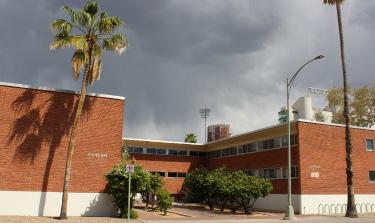
THE COURTYARD OF THE Environment and Natural Resources 2 Building on the University of Arizona campus on Aug. 16, 2025.
ARTS & LIFE
Tucson’s own friendly neighborhood Spider-Man
Fear not, true believers, Tucson has a wall-crawler of our own.
AIDEN
Across the Tucson area, sightings of a masked man are being posted to social media. He has been seen clinging to walls, perching on ledges and walking around Target all while wearing the costume of a familiar copyrighted character.
These photos follow the artistic techniques of the “Patterson-Gimlin Film,” except the man in them is not a cryptid, but a costumed street performer following in the long line of “real-life superheroes.” While other RLSHs use original creations, Tucson Spider-Man uses the creations of Stan Lee and Steve Ditko.
Tucson Spider-Man began patrolling the Dirty T in January. His adventures have taken him across downtown, Vail, Rita Ranch and the University of Arizona. The desert heat has proven to be his arch enemy. He has recently ditched his original costume, spending $280 on the materials to craft a superior, more heat friendly version.
“Have you seen ‘Bad Santa?’ I’m getting close to that, where I’m going to put this suit on and I’m not going to like it,” Tucson Spider-Man said. But he is following the path of his idol Peter Parker whose stories often end in great personal sacrifice. To Tucson Spider-Man, any sacrifice, be it physical toll or the loss of his free time was worth it to send a message; “Everything is going to be okay.” Spider-Man met a photographer from the Daily Wildcat and myself at the Highland Avenue Parking Garage. As we ascended the stairs to meet him, Spider-Man — without any sort of prompting — climbed
over the railing of the staircase and hung off of it for us to take photographs. Only the gloves of his costume, reinforced for extra grip and his ever so slight footing were preventing him from careening five stories down to the pavement.
But heights do not bother this webhead. Not after he experienced the exposure therapy of riding intense roller coasters at age 6. In fact, he dreams of going higher, hoping to one day stand atop one of the “really, really, really tall” buildings downtown.
Unlike other masked men, such as Seattle’s Phoenix Jones who has made a career of very literal crime fighting, Tucson Spider-Man has no interest in involving himself in police business. When he started
CONTINUED ON PAGE 8
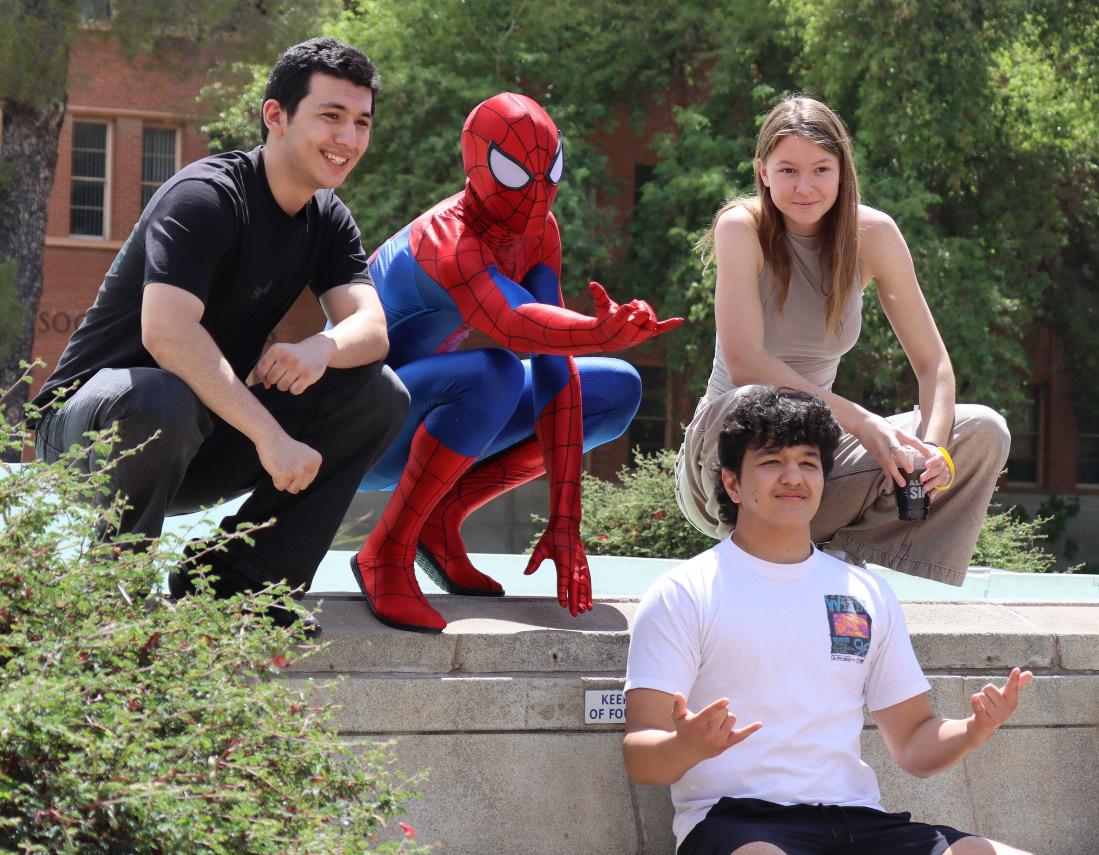
GRIFFIN SALKOWSKI | THE DAILY WILDCAT
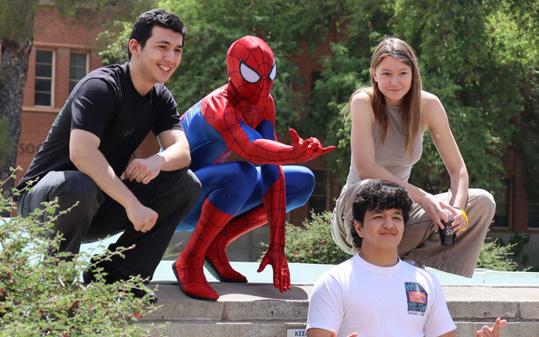
A GROUP OF UNIVERSITY of Arizona students pose for a photo with Tucson Spider-Man near Old Main on April 9, 2026.
WILLIAMS
The Daily Wildcat
ARTS & LIFE
CONTINUED FROM PAGE 7
his escapades in Vail, people would crack jokes about the possibility of Spider-Man solving the kidnapping of Nancy Guthrie. He was disgusted at the lack of respect shown toward a real life criminal investigation.
“That’s not a joke. That wasn’t funny. They should have known better,” Tucson Spider-Man said.
The closest Tucson Spider-Man has ever come to crime fighting is when he was driving in his car and saw a white man swinging an object at a paraplegic Black man at a bus stop. By his recounting, the white man was “definitely tweaking”, and, as he later found out, had been accosting the man in the wheelchair with racial slurs. Without any time to change, he was still in full costume when he parked his car. Tucson Spider-Man arrived after the man had disappeared. He waited with the man in the wheelchair until his wife came out of the gas station and the couple got on the bus. Afterwards, the white man returned and began to harass Tucson Spider-Man. Upon seeing a sharp object in the man’s hands, Tucson Spider-Man retreated to his car. Unlike his comic book inspiration, he has no radioactive superpowers and his suit is just for show.
As I interviewed Spider-Man in front of Old Main and the Communication building, students would continually interject to ask for photographs. A passerby in a SpiderMan t-shirt gave a look of confusion while others mimicked the character’s iconic web-shooter gesture with an accompanying “thwip.” One student remarked that he was the “friendly university Spider-Man.”
While strolling down the mall Spider-Man responded to calls of “save us” from The Pasifika Collective, the UA’s Pacific Islander club, who was hosting a fundraiser. He purchased a drink from them.
“It’s really cool to have a superhero as a customer,” Naomi Gray,
a member of the Pasifika Collective, said. “Without Spider-Man we would have gone out of business.”
Not everywhere in Tucson is as happy to have Spider-Man around.
Park Place Mall security disapproved of two visits he made a few weeks back, with even the management office being unwelcoming of his presence. He later went to the Tucson Mall, hoping the security would be more relaxed, and was kicked out in 10 minutes.
When he came across a child dressed as Mile Morales, he tried to enter a nearby Walmart to buy the child a toy. After being stopped by security at the front door demand -
ing he take the mask off, he snuck in through the garden center and bought the present.
The opposition does not bother him.
“I really haven’t had a bad experience in this suit. 95% of the time I put this on, something good comes out of it”, Tucson Spider-Man said.
Through his public social media he has been invited to public events like birthday parties. He does not take any payment for these appearances. To him, adorning the costume of SpiderMan binds him to follow the motto of “with great power, comes great responsibility.” He sees himself as following the legacy of Tobey Maguire, Josh Keaton, Andrew Garfield, Tom Holland
and Yuri Lowenthal before him. Since Spider-Man’s suit covers the whole body, the character is not representative of any specific race, nationality, gender, sexuality or religion in the way that someone like Superman is specifically white and male, he argued.
He carries with him a deep love for the superhero genre. He talks respectfully of the immigrant narrative of Henry Cavill’s Superman. He discussed specific comic book storylines and referenced media like “Supaidāman.”
He plans to eventually leave Tucson and pursue his dream of becoming a film director, commanding his set in a hands-on auteur style. In preparation, he has lined up a successor to don his suit and mask and become the new SpiderMan of Tucson. His replacement would rather be Black Panther, but the character is non-negotiable.
“He’s going to do it whether he likes it or not. He has to. I don’t have anyone else,” Tucson SpiderMan said.
In the modern day and age it can seem like comic book supervillains seem more real than ever. Megalomaniacal billionaires like Green Goblin, scheming scientists like Doctor Octopus and ruthless dictators like Victor Von Doom are visible every time you turn on your phone. Luckily, as of the time of writing, Nazis made out of bees are still fictional.
Perhaps now it is time for comic book heroes to also come into reality.
“I feel grateful that every day I wake up, I still get messages on Facebook and Instagram that people in this city really do think I’m Spider-Man,” Tucson Spider-Man said. “I’m really spreading the message that hopefully, with everything going on right now, that everything is going to be okay. So even though it is a sacrifice, I’m doing my best to embrace it.”
GRIFFIN SALKOWSKI | THE DAILY WILDCAT
TUCSON SPIDER-MAN BALANCES on a railing on the top of the Highland Avenue Parking Garage on April 9, 2026.
Capping the cap: New loan limits reshape graduate education
New borrowing caps for graduate students and the elimination of Graduates PLUS loans direct more financial risk to students and families.
on the graduate front and other advanced degrees. The Graduate PLUS loan which allows graduate students to borrow up to the cost of attendance will be eliminated.
The One Big Beautiful Bill Act was signed into law on July 4, 2025 by President Donald Trump. The bill features tax cuts, deductions for overtime pay and hundreds of other provisions. It also includes a significant shift in federal student lending set to take effect this July.
Federal student lending plays a central role in how students finance higher education. About 42.8 million borrowers hold federal student loans, totaling roughly $1.693 trillion in outstanding debt, according to EducationData.org.
Borrowing is more common among graduate students, with 61% taking out federal loans, compared with 28% of undergraduates. More than half of college graduates, 53.3%, use federal loans at some point and the federal government lends about $87.2 billion annually to postsecondary students, including those in graduate and professional programs.
Current laws limit the amount of direct federal loans that students can take out. A dependent undergraduate student can borrow up to $27,000 over the first four years, with a total lifetime limit of $57,500. This amount has not changed since 2007 and 2008, and those will remain the same. What will change for undergraduate students is how much their families are able to take out using Parent PLUS loans. The new annual cap is $20,000 with a lifetime aggregate of $65,000 for Parent PLUS loans.
The major changes are occurring
Graduate students will have a strict cap on student loans with an annual $20,500 borrowing limit and an aggregate cap of $100,000. That aggregate limit applies only to graduate borrowing and does not
include loans taken out for undergraduate study.
Some professional programs will be allowed a higher borrowing threshold of up to $200,000. These programs are defined using the Federal Classification of Instructional Programs, a standardized coding system used to organize and report fields of study. Under the proposed
definition, degrees such as medicine, dentistry and law fall into this category.
Students pursuing other graduate or doctoral degrees outside of these designated professional fields would remain subject to the $100,000 cap.
The new limits reshape how graduate education is financed, raising questions about affordability and long-term financial outcomes.
Scott Cederburg, a professor of finance and the Thomas C. Moses Endowed Chair at the University of Arizona’s Eller College of Management, shared that the new caps could reduce borrowing for some students, but could create new tradeoffs.
“On the one hand, the loan limits are going to, for many of the students, reduce the amount of student debt that they actually have coming out of school,” Cederburg said. “On the other hand putting in these caps on the federal loans, either people need to think carefully about which program they’re able to afford, or they’re going to go access private lending market where the rates are going to be higher.”
He added that shifting students toward private loans could increase long-term financial strain.
“In theory, somebody could come out with the same amount of debt and actually have higher payments with less of the loan forgiveness type of programs that exist for the federal loans,” Cederburg said.
Cederburg added that the changes reflect a broader policy shift toward reducing federal subsidies in education.
“This is a societal policy decision on, effectively, how much do we want to
CHARLOTTE ROTKIS
The Daily Wildcat
JONATHAN BONILLA LEON | THE DAILY WILDCAT
THE ONE BIG BEAUTIFUL Bill Act included provisions impacting many aspects of American policy, but it also includes changes to borrowing for graduate school students, which will take effect this July.
we want to subsidize education from the federal government,” Cederburg said.
As federal protections shrink, private lending may play a larger role, but with greater risk.
“The private loans would be reflecting much more of the risk that the lenders are taking on,” Cederburg said, highlighting that borrowers may face higher interest rates and stricter requirements such as credit checks or co-signers.
He also warned the caps could limit access to certain careers.
“Some people are going to be entirely precluded from pursuing the occupation that they were planning to pursue,” Cederburg said.
The incoming changes have drawn mixed reactions.
Miranda Lopez, a graduate of the UA and former Southern Arizona regional director for the Arizona Students’ Association, shared that the changes could have broader consequences for access to higher education.
“This administration is continuing to gut funding for higher education,” Lopez said.
Lopez explained that eliminating Graduate PLUS loans will significantly alter how students finance advanced degrees.
“It basically is forcing more people to go into debt,” Lopez said. “If you tell them that actually your potential debt would double or triple, they’re probably not going to want to do it.”
She added that the shift toward private loans could disproportionately affect younger borrowers.
“When you have students who are younger and haven’t necessarily
experienced financial freedom, they’re more willing to sign up for some of those riskier loans,” Lopez said. “To them, the difference between 3% and 9% might not be a huge difference, but I wouldn’t want a 9% loan.”
Some students are already reconsidering their plans.
“I’ve been hearing people looking for other options,” Lopez said. “And then a lot of people who have decided ‘I’m not going to finish my Ph.D,’ or ‘I’m not going to, ultimately, it’s not going to be worth the cost.’”
While some policymakers argue that limiting federal loans could reduce tuition costs, Lopez stated that outcome is unlikely.
“That’s just not how this system works,” Lopez said, pointing to long-term declines in state funding for higher education as a primary driver of rising tuition.
Both Cederburg and Lopez agreed that
the changes will ultimately reshape who can access graduate education. University officials say the changes are still evolving. A UA spokesperson stated the institution is still monitoring the proposed changes. In an email, UA spokesperson Mitch Zak said the Department of Education has outlined potential caps on Parent PLUS loans and the elimination of Graduate PLUS loans, but emphasized that the rule is not final and “no changes have taken effect.”
As July approaches, students and families must weigh the cost of a graduate education against its potential return. New limits may reduce borrowing, but they also shift more of the financial risk onto individuals, making the decision to pursue an advanced degree less about access and more about whether the investment makes economic sense.
SCHOOL SPIRIT NEWS
University changes housing recommendations to expect future first-year students to live on campus
NYA BELCASTRO
The Daily Wildcat
The student housing recommendations at the university have been updated, with the expectation that most first-year, full-time students live on campus unless they meet specificcriteria that allow them to be exempt from the recommendations.
As the University of Arizona enters a new era of student success, it has adopted this expectation along with a new early action admission process. The process includes a deadline-driven admissions model allowing early action applicants to have their applications processed first, followed by the regular decision timeline applicants.
The Daily Wildcat spoke with UA Vice President of Student Affairs Amanda Kraus, and she mentioned that she supports the new recommendations.
“I’m someone who has spent my entire career in student affairs,” Kraus said. “We have data that supports it here, but also it is sort of an evergreen strategy […] across the country, […] students who live on campus end up doing better.”
According to the university press release, “Since 1988, first-year students living on campus have averaged 81% first-to-second-year retention, compared to 73% for those living off campus, according to University Analytics and Institutional Research data. In addition, students who live on campus for at least one year have a 50% higher four-year graduation rate than those who never live on campus.”
UA staff are firm that the decision to implement the recommendations is for the betterment of students’ experiences at the university and to ensure the highest rates of success. However, the school will still indirectly benefit monetarily.
“The more students who live on campus, the more students who, I guess, I should say, are on campus are obviously going to eat on campus and shop on campus. So […] there are the residual effects of that, but […] the motivation for this was not financial and I know that and I believe that,” Kraus said.
Though the data shows clearly the benefits campus living has to offer, students have mixed feelings about the enforcement of new expectations.
Rain Bousquet, a UA student studying creative writing, shared with The Daily Wildcat that the expectations are restrictive for many students who don’t have the option to live on campus.
“I am from Tucson. I was born and raised here. I’ve always lived here and I wanted to live with my parents because it’s just financially more feasible. […] I also had a special circumstance that halfway through the first, my very first semester
here, I became a medical caretaker for a familymember in my house. […] So there’s no feasible way in which I could have lived in the dorms,” Bousquet said.
Bousquet explained that they can see the benefits for some, for living in dorms, as long as there are accomodations for those who it may not be financially feasible for.
The accommodations are, according to the UA’s webpage, that “the housing expectation applies to most first-time, full-time students, regardless of admission pathway, with exceptions for students living within 30 miles of campus or those who are facing specific circumstances or hardships.”
America Blackketter is a senior at the university studying urban planning. She lived on campus as a freshman and shared with The Daily Wildcat her complex feelings about living in the dorms and the cost of student living.
“I think location and price have a lot to do with it because I think I would have
been a lot happier in a smaller dorm in the middle of campus […] [that] was cheaper, because I felt like I probably wouldn’t have been as dissatisfied with the honor dorm if it hadn’t been so expensive,” Blackketter said. “[…] I was like, I’m using up all of my money that I saved in high school to pay for this and I’m not even like having that much fun.”
Blackketter emphasized the importance of student freedom to decide living choices.
“There is the data […] backing it up that students graduate more, they get better grades when they live on campus, but I do feel like [they’re] not letting students have that choice. The choice is really important to me. […] I feel like if I’m going to be spending my money, it should be my own choice,” Blackketter said.
GRACIE KAYKO | THE DAILY WILDCAT
THE GRAHAM-GREENLEE RESIDENCE HALL on April 11, 2023. Graham-Greenlee is a part of the Highland District of dorms on campus.
STUDY ABROAD
Editorial board goes abroad
A reflection from Daily Wildcat editors on their time spent abroad during the spring semester
EDITORS
Sierra Blaser
Madrid, Spain
I knew I wasn’t in Tucson anymore when I tried a dish called tortilla de patatas during my first week in Spain.
What I expected to be something like a potato taco or tostada was instead served as a thick potato omelet, with soft, buttery potatoes and lightly caramelized onions mixed into eggs and cooked into a cake-like round. It was delicious, but a little disappointing.
“Spanish tortilla is something completely different,” a local told me when I asked where to find the thin flatbread I had in mind. No kidding, I thought.
After that, I started noticing other differences. Lunch doesn’t start until 1 or 2 p.m., so don’t expect to grab a breakfast burrito at 11 a.m.; in fact, don’t expect a breakfast burrito at all. Chorizo here is closer to pepperoni than the ground pork I was used to. People walk slower, meals last longer and you’ll get strange looks for eating anything more than a pastry on the go. Even the Spanish itself felt different from the Mexican Spanish I had grown up hearing.
Adjusting took some time, to say the least.
But some of the differences were easier to get used to. I didn’t have to worry about getting my steps in, that came naturally. People filled public plazas around every corner, chatting and sharing drinks with friends from lunch well into the early morning. Public transportation felt clean and safe, even at night, and being late to class was usually fine, as professors often arrived late too. They called it “running on Spanish time.”
My time abroad has been full of culture shocks about how Spanish society operates, but it has also led to changes I’ve come to appreciate. As a part-time journalism intern and student journalist over the past few years, I got used to life on a strict schedule, with quick meals between tasks, tightly planned time with friends and always staying ahead of deadlines.
While I still believe in the importance of a deadline, especially in the field I’m
working toward, adjusting to Spanish norms has helped me learn how to slow down. I no longer rush through meals. Instead, I sit with friends for up to a few hours, talking and laughing. I’ve learned to walk slower and take my headphones off, practicing my Spanish by starting conversations instead of listening to the same songs on repeat. I’ve also started to prioritize my personal time once my work for the week is done. Most of my professors, I’ll admit,
didn’t usually have material posted in advance, and sometimes seemed to plan things on the fly. But that pushed me to find other ways to spend my time beyond schoolwork. The nice thing about studying for a semester in Europe? It’s affordable and easy to head to another city or country for the three-day weekend. I’ve come to appreciate my time
The Daily Wildcat
SIERRA BLASER | THE DAILY WILDCAT UNIVERSITY OF ARIZONA STUDENTS Diana Esperanza (left), Sierra Blaser (middle-right) and Larizah Plaza (right) and Gonzaga University student Sofie Lorenzo (middle-left) laugh together near the Opera neightborhood of Madrid.
SCHOOL SPIRIT STUDY ABROAD
CONTINUED FROM PAGE 12
traveling on a whim while getting to see the most beautiful architecture and sharing laughs and deep conversations with strangers I know I’ll never see again. If there’s one thing I hope to bring with me when I come back home, it’s the confidence to go somewhere completely new and find a way to have a good time.
As my time in Madrid comes to a close, I’m realizing how much these past few months have changed me. As cliché as it sounds, studying abroad has been one of the best decisions I’ve ever made. The language has become easier to speak and understand and what once felt unfamiliar, like relying on public transportation, is now something I value and wish we had more of in the United States. To anyone who has the opportunity, I can’t recommend studying abroad in Madrid enough.
Ellie Conover
Florence, Italy
If there is one thing Arizona Student Media has taught me, it’s that every person and place has a story worth telling. I didn’t go into my semester abroad with a clear idea of what my life would look like, or how much it would change.
My day-to-day routine went from passing people on campus talking about upcoming games to navigating streets filled with languages I couldn’t understand. At first it was overwhelming, but it wasn’t unfamiliar. Student media had already taught me how to adjust to situations similar to this — covering sports I didn’t fully understand, interviewing coaches and players from major collegiate programs and missing class to follow a team during the busiest month of their season. These experiences made the switch easier and grounded me in what I already knew to do: listen, observe and adjust.
Studying in Florence, Italy has also changed the way I view communication. Conversations that were once routine became more deliberate in the face of language barriers. Every thoughtless interaction in Tucson became an exercise of patience and
effort. It made me realise how much I rely on comfort and familiarity when I am reporting in the United States, and how different that experience is for those I interview that are navigating a second language themselves. That shift in perspective is something I’ll carry with me for the rest of my career.
Being with the Daily Wildcat has taught me how to tell stories and ground it within a community, but studying abroad has deepened how I approach the people behind the story. These skills remain invaluable whether in Florence, Italy or Tucson, and they will continue to shape the way I tell stories long after this unforgettable experience.
Emma McDonough
Barcelona, Spain
My name is Emma McDonough and I served as the news editor for the Daily Wildcat during the fall 2025 semester. For the spring semester, I studied abroad in Barcelona, Spain. To say the least, this process has been indescribable — it’s truly a life changing experience that I would recommend to anyone. Studying abroad gave me the chance to see journalism and the process of storytelling through a more global lens. My classes, ranging from “Writing the City” to “Media and Conflict,” pushed me to think more critically about how journalism and reporting on international matters is a dire responsibility. Navigating a different media landscape made me more aware of how reporting operates across borders and how important it is to shape an accurate and unbiased narrative of our observations.
As I return to the University of Arizona for my senior year of college, I’m excited to carry these lessons with me and hopefully bring back a perspective that integrates a global lens.
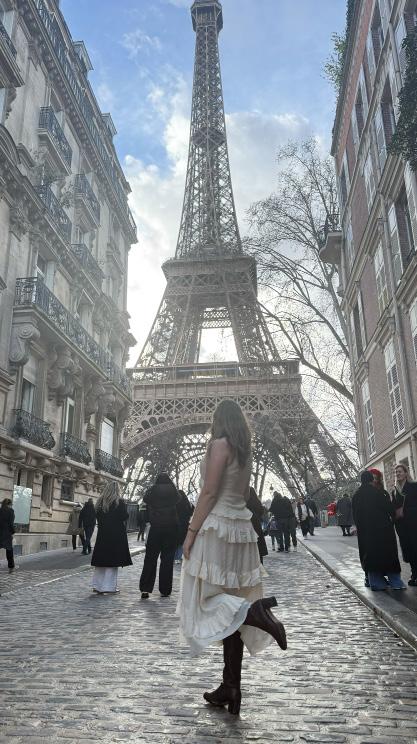
EMMA MCDONOUGH | THE DAILY WILDCAT UNIVERSITY OF ARIZONA STUDENT Emma McDonough poses in front of the Eiffel Tower in Paris, France, where she traveled to during her study abroad in Barcelona, Spain.
SCHOOL OPINIONSSPIRIT
OPINION: Being busy isn’t a cool personality trait.
It’s a
problem.
ISABEL VIDRIO
The Daily Wildcat
So, what have you been up to lately?
It’s a question that leads with nothing to say. However, the only acceptable answer would be classes, internships, club leadership and volunteer hours. The longer the list, the better. Being busy isn’t just a state of being in college. It’s a personality trait. Are you even trying if you aren’t exhausted?
More than half of all college students now experience some degree of academic burnout. The National College Health Assessment found that 80% of college healthcare students feel overwhelmed. Over 39% of high school students screened positive for moderate depression and 44% of college students reported that procrastination severely impacted their academic performance. These aren’t just numbers; they’re a portrait of a generation that has been told that their value is measured in output.
Hustle culture didn’t just seep into campus life; it was welcomed in, given a plaque and put on a brochure. Universities celebrate the student who does it all, seemingly to fill in as much as possible on a resume. Social media turns busyness into a performance by flooding feeds with “study with me” videos, morning routine vlogs and posts that frame excessive work hours as aspirational moments. How many times have you come across a post at 2 a.m. bragging about a procrastinated deadline? College students have built an identity around being stretched thin and we stopped questioning whether that identity was actually serving us.
As someone who has experienced that kind of stress firsthand, I find it mentally exhausting. One day you’re celebrating all the new opportunities that come your way, and the next day you are slammed with demands and assignments that somehow have
HUSTLE CULTURE DIDN’T JUST seep into campus life; it was welcomed in, given a plaque and put on a brochure.
nothing to do with your grade or your future, yet you are sacrificing precious time and sleep for it. I still remember arriving home late at night from working on assignments and tasks all day and still having overdue work to finish up. What I thought would be fulfilling ended up being something I dreaded every day.
Four out of five college seniors report experiencing burnout during their undergraduate years, and another 80% say they’re worried about burnout once they begin their careers. It’s startling to realize that the expectation to stay busy is shared across different forms of work, whether it be education or employment. Burnout isn’t just an emotional state — it has measurable consequences that we tend to minimize and ignore entirely.
When stress becomes chronic, it can lead to anxiety, depression, physical discomfort and deteriorating sleep quality.
On a physiological level, burnout disrupts sleep, which triggers fatigue and reduces quality of life. Research consistently shows that burnout leads to sleep issues and increased physical exhaustion. A study done in China found that over 42% of college students sleep fewer than the 6-8 recommended hours. We have to sleep to regulate memory and make sure our body is properly recovered and ready for the day. We are skipping the maintenance our body desperately needs and calling it dedication. So how do we fix this?
First, it helps to understand why we do it in the first place. For many students, overloading a schedule isn’t laziness in reverse, it’s fear moving forward. Fear of falling behind peers, fear of an unforgiving job market and fear that taking a breath means losing ground. We have been conditioned to believe that a packed calendar equals a promising future and
college only amplifies that pressure. Add in the cost of tuition, student loan anxiety and the nagging sense that every semester needs to justify its price tag, and suddenly saying yes to everything feels less like ambition and more like survival.
Recognizing that cycle is the first step toward fixing it.
Start by leaving some space in your schedule. Not every hour needs a purpose, and not every week needs to look like a resume in progress. Before you say yes to the next club, committee or commitment, ask yourself honestly: do I actually want this, or do I just want to be able to say I did it?
The next time someone asks what you’ve been up to, try answering with something that has little to do with productivity.
There are so many smaller aspects of the University of Arizona that we tend to forget and many surprises that are yet to be discovered. For example, a few weeks ago I decided to stop by Jimmy’s Pita and Poke to see what the hype was about. I passed by it so many times on my way to the University Services building, and never thought of entering it until then. For the hefty price, it is actually delicious! It left me with enough to take home the next day too. And I did that by leaving some room in the schedule for me-time.
College is meant to be a place of exploration and learning. Leaving time for spontaneity, whether it is self-care, socializing or exploring a new place or new routine — these can make all the difference when it comes to managing endless stress. The version of yourself that does all of these activities is not a less productive student; you are sustainable.
We do not have to earn the right to enjoy our lives after we have checked every box. The busyness was never the point. You are.
ILLUSTRATION BY ABBY DARLAND
SPORTS
Wildcats looking ahead to the NBA Draft
ANDRES VALENZUELA
The Daily Wildcat
With the 2025-2026 season coming to a close, a new beginning for most of University of Arizona’s rotation awaits. For several Wildcats, they entered the season as highly touted prospects, while others emerged to become legitimate candidates for this year’s NBA Draft.
Following the season-ending 9173 Final Four loss to the University of Michigan, Arizona could see its entire starting lineup selected in this year, or future NBA Draft. While some players were lottery bound, others played their way into draft boards just 2 months away from draft night.
Brayden Burries: Rapid riser, entering lottery conversation Arizona freshman guard Brayden Burries emerged as one of the biggest risers in this year’s draft class. Turning his first round expectations into lottery expectations, the First Team All-Big 12 guard has skyrocketed through mock drafts.
Entering the 2025-2026 season, Burries was widely viewed as a late first-round prospect. Early projections placed him around No. 24 overall, with teams intrigued by his scoring potential at the two-guard, but uncertain about how to quickly adjust to the college game. That uncertainty showed early, as Burries got off to a relatively slow start back in early November 2025.
That uncertainty faded when Burries recorded his career high against No. 12 University of Alabama, leading the Wildcats to a 96-75 win in Birmingham, Alabama. Buries scored 28 points on 11-of-19 from the field, hitting five 3-pointers and recording seven rebounds. In Big 12 play, Burries averaged 16.1 points per game, 4.9 rebounds and 2.4 assists per game while shooting 49.1% from the field and 29.1% from 3-point range. A
standout performance in Big 12 play
helped Burries become one of five finalists for the Jerry West Shooting Guard of the Year Award.
Finding rhythm quickly, Burries became one of Arizona’s most efficient offensive weapons. The 6-foot-4 guard became Arizona’s primary scoring option down the stretch, showcasing his ability to create his own shot and scoring at all three levels. His emergence as a primary scorer played a major role in Arizona’s success all season, significantly boosting his draft profile.
Originally one of the top prospects in Arizona’s 2025 recruiting class, Burries entered college with high expectations.
From late first round, to potentially top 10, Burries could become the Wildcats’ 14th all-time top 10 pick if he decides to enter this year’s NBA Draft.
Koa Peat: Solidifies lottery status
Arizona forward Koa Peat entered the 2025-2026 season with significant expectations. By the end of the year, he cemented his preseason draft status of a likely lottery pick in this year’s NBA Draft.
Peat’s rise was apparent early, when he helped the Wildcats defeat the defending National Champions in his collegiate debut, recording 30 points, seven rebounds and five assists en route to a 93-87 win over No. 3 University of Florida.
A consensus five-star recruit and top 10 national prospect, Peat brought a strong physical presence and versatility to the college game. By conference play, he had already reinforced his standing in the lottery conversation, using his 6-foot-8 frame and physical play to consistently impact games on both ends of the floor.
Suffering a lower leg strain during a loss to Texas Tech University in February which kept him sidelined for three games, Peat would go on to have a fantastic NCAA Tournament.
CONTINUED ON PAGE 17
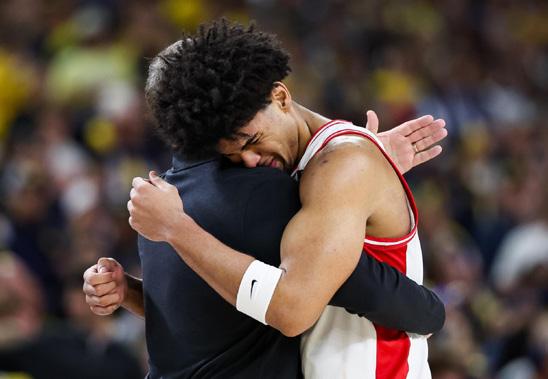
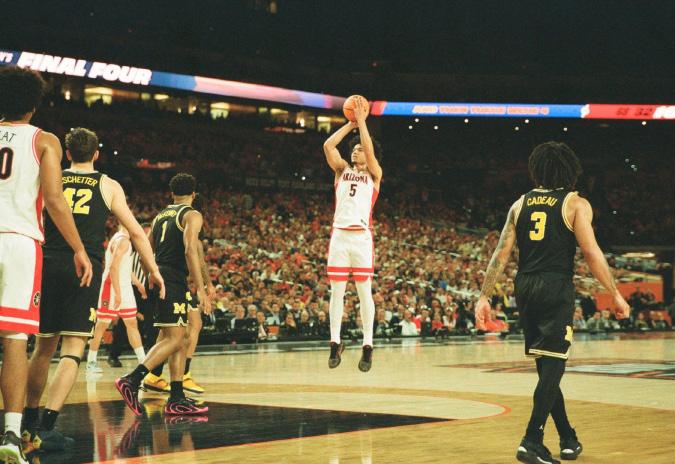
CHARLIE RAMIREZ | THE DAILY WILDCAT BRAYDEN BURRIES SHOOTS THE ball following the play being called dead in Lucas Oil Stadium in Indianapolis on April 4. Brayden Burries shoots the
SPORTS
The freshman finished the tournament averaging 17.2 points, 7.6 rebounds, 1.6 assists and 0.6 blocks over five appearances. Despite struggling during the games leading up to his injury, Peat’s significant impact when healthy raised the team’s ceiling for the postseason.
By early April, Peat is projected as the No. 12 overall pick. While other Wildcats significantly improved their stock throughout the year, Peat remained a lottery pick throughout the duration of the season.
Motiejus Krivas: Sleeper to first round rise
Arizona center Motiejus Krivas took an unconventional route to NBA Draft relevance. Suffering a foot injury during his sophomore season, the big man returned with a strong junior year to solidify his stock as a potential first round pick after serving as the defensive anchor for an elite Wildcats’ defense.
Not widely viewed as an NBA selection, the 7-foot-2 center was labeled a sleeper. Early projections as early as last season typically placed him in the second round, with scouts citing his size and defensive presence with room to grow offensively.
Eyeing his largest role yet, Krivas entered his junior campaign as the solidified starting center. The center averaged 10.4 points, 8.2 rebounds and 1.9 blocks per game while shooting 56.9% from the field, while excelling at the free throw line shooting nearly 80% on the season. Recording a handful of double-doubles, his breakout game came in January against Kansas State University, where he recorded his career high 25 points and 12 rebounds.
With a developing offensive skillset, his effective presence as a screener and rim runner added to his appeal. Questions about his athleticism remained, but his overall growth and productivity over the course of the season helped shift the narrative around his draft outlook.
By the middle of the season, Krivas firmly moved out of second-round consideration and into the first-round discussion. As of early April, he is projected around the No. 25 overall pick.
Krivas adds to head coach Tommy
Lloyd an impressive track record of developing his big man throughout their time at Arizona. Most noteable centers include Christian Koloko and Oumar Ballo and forward Ąžuolas Tubelis, who all thrived under Lloyd.
If Krivas decides to return for his senior season, he could boost his stock to a potential lottery selection in next year’s draft.
Ivan Kharchenkov: Emerging as longterm NBA prospect
Arizona wing Ivan Kharchenkov entered the scene with different draft certainty in comparison to his teammates. However, his experience playing professionally in Euroleague translated to the college game, possibly playing himself into draft boards.
The 6-foot-7 wing gained valuable experience against high-level international competition before arriving at Arizona. His combination of size, defensive intensity and motor traits project well to the modern NBA game. His ability to guard multiple positions and play with consistent energy has made him especially appealing as a potential 3-and-D wing. Offensively, Kharchenkov showed
flashes of shot creation and distributing along with his high basketball IQ. In his collegiate debut, Kharchenkov recorded a double-double, 12 points and 10 rebounds against No. 3 Florida and a 16-point, nine-rebound performance against No. 2 University of Houston in mid-February. Showing flashes against top teams in the country and improving as the season progressed, Kharchenkov played a pivotal role for a team with Final Four aspirations.
As a result, Kharchenkov is viewed as a potential draft candidate in this year or future NBA Drafts. A decision to come back for his sophomore season, whether at Arizona or not, can help solidify his draft stock from potential second-round pick into the top half of next year’s draft.
Jaden Bradley: Breakout senior season
Senior leader and Big 12 Player of the Year point guard Jaden Bradley entered the 2025-2026 season as the catalyst for a talented Arizona team. While not necessarily a lock as a clear NBA Draft prospect in the beginning, by the end of the year, Bradley’s production and accolades made him impossible to ignore.
Seeing his name on a couple of NBA
Draft lists after his junior season, Bradley returned for his senior campaign where he averaged 13.3 points, 4.4 assists and 3.4 rebounds per game while leading Arizona to a school-record 36 wins. His impact extended beyond the stat sheet, consistently controlling the pace of games and taking over in the second half of games, delivering in key moments throughout the season.
His performance earned him Big 12 Player of the Year honors, along with Third Team All-American recognition and finalist status for the Bob Cousy Point Guard of the Year Award. Those accolades, combined with team success, significantly elevated his profile among NBA scouts.
Unlike some prospects whose draft stock is built primarily on upside, Bradley’s case is rooted in production, leadership and experience. As a result, he is now projected as a potential second-round pick in this year’s NBA Draft.
Built on consistency, development and winning at a high level, Bradley has played himself onto many draft boards after 3 years at Arizona.
MASON KUMET | THE DAILY WILDCAT
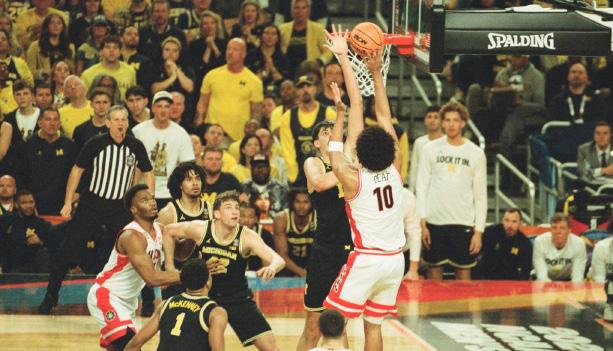
KOA PEAT MEETS THE University of Michigan’s Aday Mara in the paint during the Final Four in Lucas Oil Stadium on April 4.
Students from the College of Fine Arts prepare for graduation
On top of regular commencement preparation, fine arts students are getting ready for their graduation by working on final projects and performances.
Graduation remains a busy time for almost every graduating senior, but on top of the usual preparation, students from the College of Fine Arts are faced with an extra workload of final performances and projects.
Aaliyah Radebaugh is a senior studying studio art with an emphasis in illustration, design and animation. Since the age of 10, her dream school has been the University of Arizona, and by 16 she knew she wanted to pursue art. She spent her entire life drawing and got into animation when she was 11.
Radebaugh was one of six students chosen to be a JustArts Fellow for this school year. This program granted her a stipend to use towards a project that could benefit her community. Her project titled “Wishing for Change, Creating tomorrow,” features three student testimonies and their wishes.
“So I collected their testimonies and their wishes for a better campus […] to turn into stories that hopefully people can take inspiration from and learn from,” Radebaugh said. She said these experiences need to be shared, and that her motivation behind the project is what she sees as a “behind closed doors” approach to solving campus issues. Such as issues related to diversity, equity and inclusion and accessibility
“That’s really what I’m preparing for […]. I’m not necessarily preparing for, like my grad date. I’m preparing for all these final projects.” Radebaugh said.
Radebaugh has also been working on her senior thesis project, an
animated short film that combines hip-hop and empathy. Working on these two projects has led to a lot of late and sleepless nights, marketing for her live event and final adjustments to make sure everything runs smoothly.
“I just remember last year, I was like, ‘I’m just going to do a live event, I’m going to do a website, I’m going to do animations,’ and I did. I did everything that I put my mind to, that I put on my checklist. That’s something about me. I kind of like to do whatever I put my mind to,” Radebaugh said.
The live event and screening of her project took place on April 28 at the Marroney Theatre and will feature a performance from Amplified, an acappella group at UA.
Abril Aguirre is a senior studying film and television and Spanish and Portuguese with an emphasis in Portuguese. She decided to choose what her heart wanted and major in film, but added Spanish and Portuguese as a backup because she thought it would be fun to learn another language.
“At some point I would be talking three different languages in the same day. So it was a little bit difficult, but it was really fun and I’m a person who likes doing multiple things at once. And then I got to see different perspectives and I really enjoyed that,” Aguirre said. Her favorite aspect of her studies is the welcoming nature of the school and the social bonding because of how close people get while filming.
Every year, the school of Theatre, Film and Television holds the “I Dream in Widescreen” event where several senior thesis films are shown at the Fox TucsonTheatre. This is
CONTINUED ON PAGE 20
MIA PAYETTE
The Daily Wildcat
COURTESY OF SOPHIE MCCUTECHON
SOPHIE MCCUTCHEON POSING FOR a senior photo. She is asenior in the school of Dance and choreographed a piece for the Student Spotlight: Adventure
SCHOOL SPIRIT ARTS & LIFE
CONTINUED FROM PAGE 19
a formal event that, according to Aguirre, is like a mini Oscars and is always fun to see students, families and friends’ reactions. The event will take place May 9 and two films that Aguirre produced will be shown.
One student film titled “On the Road” follows a girl in the ‘70s who wants to become a singer. Another, titled “Synesthesia,” follows an android trying to fit into the human world.
“The director is trans and so she wanted to make a film about her experience and so it was super nice to work with such diverse people and like just getting to work on projects like that that are so meaningful to someone is just super nice,” Aguirre said.
“There’s a lot of preparation,” Aguirre said. “I mean, it’s a lot of effort and staying up, and late nights and kind of figuring out how you’re going to make this process happen and then later on preparing for the screening and making sure everything is picture locked and edited and everything looks great and then also promotion.”
According to Aguirre, she feels more confident in her work this year compared to the past 3 years and she has discovered that producing is her favorite thing. As an analytical person, she finds that it’s the perfect role for her. Aside from the preparation for the showing of the films she produced, she is preparing for graduation by completing assignments, applying for jobs and doing the fun stuff like buying a dress and her cap and gown.
Sophie McCutcheon is a senior studying dance and biology with a premedical emphasis. She knew from a young age she wanted to pursue dance and she decided to double major so that she could keep her options open. The School of Dance led her to the UA.
According to McCutcheon, the School of Dance has helped her become confident in the style of dance she wanted to pursue, as well as other styles and aspects of dance like choreographing. Her confidence has allowed the seriousness of senior year to not feel as daunting now that she is
going through auditions, as opposed to the mock auditions she participated in years prior.
“I knew from the moment I came into school that I really wanted to pursue more of a musical theater style dance. I grew up singing and dancing as well, so I knew I wanted to take all those three things and find a career where I could perform doing all three, and so the school has done a great job of saying, ‘Okay, you know that’s what you want to do, so now what other things do we need to fill your time here in 4 years to make you feel really ready to engage in that industry,’ and also knowing that we encompass so much more than just that one lane too,” McCutcheon said.
She has gotten to choreograph five times throughout her time at UA. Her fifth choreographed piece, which is also her senior capstone project, was selected to be a part of the “Spring Student Spotlight: Adventure” which will run from May 1-3. Her contemporary group piece will also feature live singers from Amplified.
“It definitely was something I’d been planning for a while and it definitely is a big commitment of time when you choreograph a piece and present work in general,” McCutcheon said. Preparations began last summer to bring this piece to life.
“This piece kind of touches on the concept of the fear we sometimes have about looking too closely within ourselves,” McCutcheon said. “Just in case we find something that we wish we hadn’t seen or that we wish we didn’t know about […] and so it’s kind of an exploration of the there moments where we take something we see in ourselves and we let it affect the way we interact with others and how do we break free from that?”
These seniors, amongst many others, have put in a lot of hard work on top of their usual schoolwork to get their projects stage and screen ready. McCutcheon’s choreographed piece can be seen at the Stevie Eller Dance Theatre from May 1-3 and Aguirre’s films can be seen at the Fox Theatre on May 9.
COURTESY OF ABRIL AGUIRRE
ABRIL AGUIRRE ON THE set of a music video. She is a senior in the school of Theater, Film and Television and produced Synethesia and On the Road.
University of Arizona names former Google CEO Eric Schmidt as spring commencement speaker
Student organizations call for a new speaker over concerns about Epstein ties and a sexual assault lawsuit
EMMA LAPOINTE
The Daily Wildcat
The University of Arizona announced that this year’s spring commencement speaker would be former Google CEO and Chairman Eric Schmidt.
He was the CEO of Google from 2001-2011, and the executive chairman from 2011-2015.
Schmidt is a leader in artificial intelligence and co-founder of Schmidt Sciences, which is developing the first fully privately funded telescope. The UA will be supporting the project by developing instruments for the telescope itself, according to a UA press release. He graduated with a bachelor’s degree in electrical engineering from Princeton University and with a master’s degree and a Ph.D. in electrical engineering and computer sciences. He will be earning an honorary Doctorate of Science degree from the UA College of Science during commencement.
The telescope, Lazuli, is supposed to be completed by 2029 and is being supported by the Steward Observatory. According to the UA, this will lead to further investment in astrophysics.
According to Ewan Douglas, an associate astronomer at Steward Observatory and an associate professor in the department of astronomy, the purpose of the partnership is to “build on UA’s legacy of developing instrumentation for ground- and space-based telescopes.” He shares that one goal of the
program is to accelerate the pace of discovery; “For me personally, that means shortening the time until we image asteroid belts and planets like
our own around nearby stars.” Douglas said.
According to UA news, the project will focus on “adaptive optics,”
which uses deformable mirrors to compensate for atmospheric turbulence, allowing clearer imaging once in space. The hope is to use the technology to detect dim planets that were previously undetectable.
Schmidt Sciences is also helping fund the UA’s development of adaptive optics to aid in the project. He has done TED Talks on the topic of AI, with one in 2025 titled “The AI Revolution is Underhyped.” In the talk, he claims that people need to stay updated on what AI is doing, and that eventually it will take over every facet of our lives and can be ignored no longer.
Schmidt is also the CEO and chairman of Relativity Space, a company that aims to make space more accessible to the general population and more sustainable. Schmidt acquired the company in 2025.
Since the announcement of Schmidt as the commencement speaker, posts began to be shared connecting Schmidt with sex trafficker Jeffrey Epstein. A post made by Students for Socialism at UA posted an infographic titled “Eric Schmidt is an abuser,” stating that Schmidt is an Epstein affiliate. The post includes a petition to pick another commencement speaker. The sponsoring organizations for the petition include SFS, FORCE, Planned Parenthood Generation Action and the Women and Gender Student Space.
However, according to the Epstein files themselves, released by the Department of Justice, it is unclear
COURTESY OF STUDENTS FOR SOCIALISM UA
A POST SHARED BY STUDENTS for Socialism UA depicting future commencement speaker Eric Schmidt with devil horns, with the title “Eric Schmidt is an abuser,” shared on April 29.
what level of connection there is between Schmidt and Epstein. While the two had exchanged emails and Schmidt was invited to many cocktail parties and dinners, it is unclear how many he attended.
For instance, an email sent from a blacked-out source states, “Hello Mr. Schmidt. Jeffrey Epstein understands you are in India, but says if you are back in NY Thursday, April 4th, you would be a welcome addition to a small dinner party he is having,” which was sent on March 25, 2013.
Epstein was also personally invited to a party following a screening of the movie “The Imitation Game,” a film about renowned scientist Alan Turing during World War II, at which Schmidt would be in attendance.
According to WIRED, he was also invited to a party with Epstein and Epstein’s associate Ghislaine Maxwell, but it is unclear whether he ever attended, and those close to Schmidt had told Epstein that he would likely be too busy to attend. WIRED also stated that in 2013, Epstein wrote he had not seen Schmidt for “quite a while.”
However, the Google cofounders, Larry Page and Sergey Brin, had much closer connections with Epstein. According to WIRED, Page is in 314 files and Brin is in 294, and they were named in subpoenas related to Epstein’s sex-trafficking crimes and allegedly visited the island.
Another reason SFS did not want Schmidt speaking at commencement was because of his ongoing lawsuit against him for allegations of spying and sexual abuse.
According to the Los Angeles Times, Michelle Ritter filed a lawsuit against Schmidt, stating that he had “forcibly raped” her on a yacht in Mexico in 2021 and that they had sex without her consent at Burning Man in 2023. She also alleged that Schmidt built a server that allowed him to spy on her at all times.
While Ritter tried to fight it, the case was sent to arbitration, meaning it is no longer part of the public court system and will be handled privately or by a third party. This means there is no jury in place, and the process tends to move much quicker than a traditional court case.
There has been no public statement yet regarding the claims and outrage voiced by student organizations.
Honorary degrees awarded at commencement
At the commencement ceremony, other notable contributors to both UA and the Tucson community will receive honorary degrees. This includes Alice Chaiten Baker, Gabrielle Giffords, F. Ronald Rayner and Scott Stuber.
Alice Baker will receive an honorary Doctor of Humane Letters from the College of Social and Behavioral Sciences, due to her commitment to advancing the arts and social sciences, and her support for the Arizona Center for Judaic Studies, according to UA. She is also one of the primary funders of the Paul and Alice Baker Center for Public Media, along with her husband Paul Baker.
Giffords is a former United States House Representative and will receive an honorary Doctor of Letters from the College of Architecture, Planning and Landscape Architecture. Giffords was critically wounded in a 2011 mass shooting in Tucson, which led her legacy to be heavily driven by gun safety and awareness, and created the organization GIFFORDS, which
is a gun rights advocacy and information group.
Rayner, an innovator in arid land agriculture, will receive an honorary Doctor of Science from the College of Agriculture, Life and Environmental Sciences in recognition of his commitment to sustainability and agricultural research.
Stuber will receive an honorary Doctor of Fine Arts from the College of Fine Arts. He is an alumnus of the school, has dedicated time to the film industry, is attempting to revitalize United Artists alongside Amazon MGM Studios and has worked under Netflix Films as well.
CELESTE LIZARRAGA | THE DAILY WILDCAT
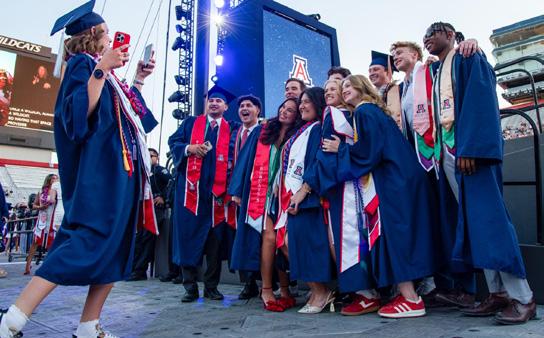
A GROUP OF UNIVERSITY of Arizona graduates poses for a photo near the stage at Arizona Stadium on May 16. Friends gathered to capture the moment together before the celebration officially kicked off.
SCHOOL SPIRIT SPORTS
Motiejus Krivas and Ivan Kharchenkov announce return to Arizona men’s basketball
MICHAEL SMITH
The Daily Wildcat
The University of Arizona men’s basketball team reloads with the return of Motiejus Krivas and Ivan Kharchenkov, as both players announced their return earlier this week. Following the commitments of fellow teammates Brayden Burries, Koa Peat and Jaden Bradley to the NBA Draft, the defending Big 12 Tournament Champions retain two key pieces for the 2026-2027 season.
Krivas, coming off a season-ending foot injury just eight games into his sophomore campaign, finished his junior year on the All-Big 12 First Team. The big man from Lithuania had a career year averaging 10.4 points, 8.2 rebounds, 1.9 rejections and a team-leading nine double-doubles in 39 games this past season.
The 7-foot-2 center was also selected to the Big 12 All-Defensive Team and played a pivotal role in getting the Wildcats back to the Final Four for the first time since 2001.
During Arizona’s second round matchup against Utah State University, Krivas capped off the dominating victory on Monday, March 23, with 11 points, 14 rebounds and three huge blocks while going 7-for-8 from the free-throw line.
Look for the senior leader to be on numerous watch lists heading into next season.
Kharchenkov closed out his freshman season by starting all 39 games and scoring in double figures 26 times. The 6-foot-7 forward put up 10.4 points, 4.3 boards, 1.4 steals per game and shot 49.2% from the floor.
One of the premier “Glue Guys” in the country was Arizona’s X factor deep down the stretch of the season.
In the Sweet Sixteen matchup against the University of Arkansas on
Friday, March 26, Kharchenkov dropped 15 points on 66.7% shooting while dishing out five dimes and getting to the charity stripe 10 times and converting seven of those attempts.
Following the win over the Razorbacks, the freshman phenom came through yet again in the Elite Eight duel against Purdue University on Sunday, March 28. Kharchenkov finished with 18 points, going 7-for-11 from the field while hauling in eight rebounds to help
punch the Wildcats’ ticket to Indianapolis.
The freshman, by way of Germany, joined Marquette University guard Nigel James Jr., two projected top-five picks in this year’s NBA Draft in Duke University forward Cameron Boozer and University of Houston guard Kingston Flemings as one of four freshmen in the nation to finish the year with 400 points, 80 assists, 50 takeaways and 10 blocks.
The two returnees will join a fresh
new starting five led by a young backcourt in top-three national high school prospect Caleb Holt and one of the top players in the state of Arizona, Cameron Holmes. Not to be outdone by University of North Carolina transfer Derek Dixon and University of Washington transfer JJ Mandaquit.
MASON KUMET | THE DAILY WILDCAT
IVAN KHARCHENKOV HYPES UP the crowd as the seconds wind down in Arizona’s Elite 8 win over Purdue on March 28 in SAP Center..
ARTS & LIFE
FTV seniors present their thesis films at ‘I Dream in Widescreen’
Zany bird comedies, meditative westerns, political farces and Indigenous horror films will be presented at the Fox Tucson Theatre
AIDEN WILLIAMS
Seniors from the University of Arizona School of Theatre, Film and Television’s Bachelor of Fine Arts program will present their thesis films at Fox Tucson Theatre on May 9 as part of the 21st annual showcase “I Dream in Widescreen.”
Doors open at 6 p.m. and the event starts at 7 p.m.; tickets are $5.
The showcase demonstrates the culmination of two semesters of work by BFA seniors. It is the ultimate test of the filmmaking knowledge students have gathered through the FTV program and networking they have done in the Tucson film community.
“Collaboration is the biggest thing that I’ve learned,” Clinton Willis, a BFA student, said. “When I first started doing film stuff, I was kind of a one man band trying to do everything myself and it would make a decent product. But there’s a certain level of artistry that comes with a collaboration where you get to humble yourself […] and I think ultimately it made for a better product.”
Historically, production of IDiW films began their pre-production process at the start of the fall semester. This time, BFA students were advised by professor Lisanne Skyler to begin drafting their scripts during the summer, as UA alumnus Craig T. Nelson had expressed his interest in starring in a student film. Nelson, well known for starring in films like “Poltergeist” and “The Incredibles,” would read the script and select which film he wanted to be a part of.
Nelson selected the script for “Be
Still, Boone” directed by Willis. Willis traces his inspiration for “Be Still, Boone” to when he was on his second tour of Afghanistan while serving in the Air Force. In 2018, Willis was diagnosed with cancer and was medevaced to Washington D.C. While doing chemotherapy, Willis saw his father, a “gruff cowboy guy,” cry and generally display a gentler, more sensitive demeanor.
“I grew up watching these western films with [my father],” Willis said. “And
it was always like all this crazy hyper masculine stuff and that’s what got me thinking about what happens to a cowboy when they get older. What really matters to them?”
Student films are largely self-financed. They are either paid for out of pocket or crowdfunding through websites such as GoFundMe and Seed&Spark. This year, each of the BFA films was allotted $500 by the School of Theatre, Film and Television.
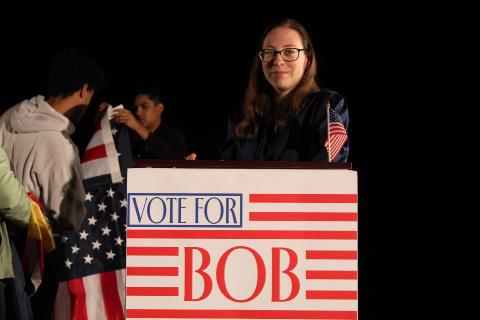
BFA student Kaitlyn Liddicoat estimates her film “Rebranding Bob” had a budget of $1,000, including the money allotted by the school. Willis estimates “Be Still, Boone” finished with a budget of $4,000. BFA student David Aberle’s film “They Wait” had a budget north of $7,000. The money they raise goes straight
CONTINUED ON PAGE 26
The Daily Wildcat
PHOTO COURTESY OF JULIUS SCHLOSBURG PHOTOGRAPHY
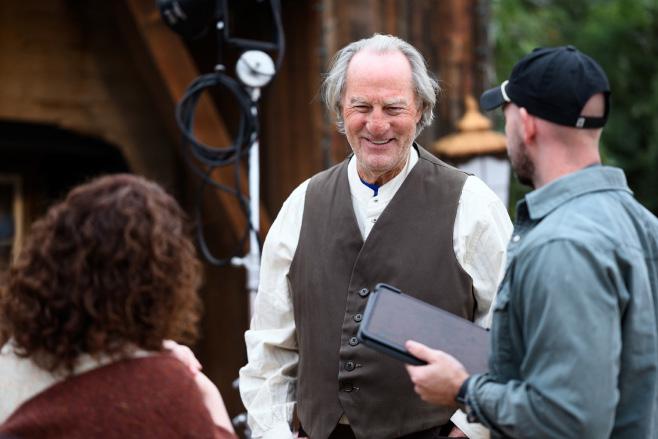
CRAIG T. NELSON ON the set of “Be Still, Boone” with writer/director Clinton Willis. “Be Still, Boone” is one of 11 short films that will be featured at ‘I Dream in Wide Screen’.
ARTS & LIFE
SCHOOL SPIRIT
back into production matters such as props and costumes. The budget is often consumed by practical matters not visible on screen such as food or, in the case of “Be Still, Boone,” production insurance and Screen Actors Guild–American Federation of Television and Radio Artists regulations.
On top of financing, student filmmakers are tasked with acquiring their own locations and assembling their own crew. They often pull from their prior connections to gather grips, gaffers, producers, directors of photography, production designers and many other positions.
“Be Still, Boone” was filmed at Old Tucson with a crew of around 40, a location Willis stated they were loaned for free. Part of “Rebranding Bob” was filmed in the DW’s own Sherman R. Miller 3rd Newsroom.
When they were not directing their own films, the BFA students were working on each other’s films. Liddicoat worked as a producer on “Where the Birds Still Sing” and assistant director on “A Tale Most Fowl.” BFA students do not always work on each other’s films in strictly production positions. For example, Willis, notable for his baldness, was cast by Liddicoat to play his doppelganger Sean Evans, the host of “Hot Ones.”
The most common struggle noted by those interviewed was time management and sleep.
“Sleep was the number one sacrifice for me,” Liddicoat said. “I think I was working on a total of 3 hours for all 3 days of shooting.”
For the production of “Rebranding Bob,” the set decoration called for a very specific type of table that could not be shipped to Tucson in time for filming. The tables could, however, be shipped to Phoenix in time. So after wrapping a full day of filming at 9 p.m., Liddicoat got in a car with her mom, drove up to Phoenix and immediately drove back to Tucson.
Willis managed the production of
“Be Still, Boone” and also planned his wedding, attended classes and worked his regular job. The workload was staggering, but he has managed to pull it all off.
As the thesis films enter the final stages of post-production, the IDiW line-up features a wide range of genres.
The final line-up features zany birdthemed comedies, meditative westerns and Indigenous horror.
Creatures from Native American folklore and religion have appeared in TV shows like “Supernatural” and video games like “Until Dawn.” But depictions of folklore from Indigenous creators are very rare.
Aberle, as a medicine person for the Diné tribe, is dedicated to presenting
sacred cultural concepts from Indigenous cultures with all their nuances intact. During production, he would often receive notes from people outside his tribe and would struggle on how to address it, not wanting water down the culture. Aberle was eventually advised by “They Wait” actor Jon Proudstar, known for “Reservation Dogs,” that he was under no obligation to “handhold them.”
“Indigenous horror is not a brand new genre, but it is something that we’re trying to push forward,” Aberle said. “Being a medicine person who knows the songs, ceremonies and stories and adapting them to film, I feel a huge responsibility.”
After graduation, many of the BFA
students plan to immediately start searching for work in the wider film industry. Liddicoat plans to move to the East Coast with aspirations to write and direct her own work, but currently intends to become involved in the industry in any way, shape or form. Aberle plans to leave for Canada to star in a paranormal investigative television show that has recently been greenlit.
“The grind doesn’t stop, even though I have the degree in my hand,” Aberle said.
ELLIE MOFFET | UNIVERSITY OF ARIZONA
DIRECTOR KAITLYN LIDDICOAT STANDING on the podium where Bob Hamilton will speak in “Rebranding Bob”
SCHOOL SPIRIT OPINION
We shouldn’t need to spend as much time on internships as academics.
ABIGAIL ROWLEY The Daily Wildcat
As summer nears, many students have the same thing on their mind: entering the workforce. Unfortunately, whether undergraduate or graduate, the degree you just worked towards for years isn’t enough to land one of the few entry-level positions in most fields.
Today, graduates without work experience have a 2/5 chance of getting a job soon after college. Those who worked during school have double that chance, while students with internships are 35% more likely to receive job offers, according to data from the National Association of Colleges and Employers.
These statistics make sense. More than two-thirds of 2024 graduates held internships, the highest level NACE has recorded since 2018.
NACE data shows that, when ranking factors considered when deciding between two equally qualified candidates, employers rated internships 4.35 out of 5. In comparison, GPA scored a 3.0, volunteer work 2.5 and studying abroad a measly 1.8 (so much for global perspective).
This begs the question: what is the value of a college degree as the importance of internships continues to supersede academic achievement in the hiring process?
According to the University of Arizona’s estimated cost of attendance, Arizona residents who are first-year students can expect to pay $22,640 a year when accounting for tuition, living expenses, etc.; for non-residents, that’s a whopping $67,770. For those who want to and are able to swing that? Sure, I guess. But let’s stop and consider for a second: what else can you do
with that money? Is almost $280k over 4 years enough to start a small business?
Franchise a restaurant? Invest in real estate? And if you don’t have the money to swing that, your $67,770 a year gets added onto the $1.833 trillion in student loan debt held in the United States. The latter is the case for more than 61% of recent graduates. These debts often cripple young adults trying to get on their feet after college, with about 24% of borrowers behind on their loans, as of fourth-quarter 2025.
Once burdened by debt, many start job hunting only to find companies are dropping degree requirements. Major companies such as Google, IBM, Accenture, Walmart, Bank of America and Verizon have all dropped degree requirements in many roles. In fact, a 2025 survey of 1,000 hiring managers found that 7 in 10 stated their companies value relevant experience over degrees when hiring.
Awesome that 4.0 GPA you put blood, sweat and tears into doesn’t mean that much in the job market. That’s fine, you just need to get an internship, right? Good luck with that. Handshake, the platform that the UA uses for its student work positions, reported that an internship posting averaged 109 applications in 2025. This almost doubled from 2024. Internships with tech companies average 273 applications, while finance follows with 192. Not only that, but many of these internships might not care much for your GPA either. Instead, they too will look to your relevant work experience within the field. After all, there is no such thing as an entry-level job anymore.
When discussing the value or lack thereof for college degrees, many will bring up the fact that, according to Fortune, 79% of employers still believe a degree holds value for entry-level workers, and that 70% believe it is a strong indicator of career readiness. However,
strong indicators and vague value don’t mean your diploma trumps your work experience once your resume crosses a hiring manager’s desk.
It’s quite the hole past generations have dug for us. How do we climb out of it? The most prominent issues are the continuing rise in education costs and the rise in unemployment. When the economy slows down, it is often the young workforce that takes the hit. We’re the last to be hired, but the first to be fired when it’s time for downsizing. In a way, a downturn in employment often causes graduates to take on more debt as they attend graduate school in hopes of waiting out the poor economy. In this case, students who made this gamble after graduating college in 2024 are finding that they are in the same, if not worse, position as they would have been
after their bachelor’s, except this time they are 2-plus years of work behind their peers, and their degree is likely worth less than when they started.
The fact is, regardless of whether economists, analysts, or dude-bro podcasters declare that degrees are worth more as kindling than resume fodder, people will still go to college. For many, it isn’t about the education; it’s about the experience and putting off the real world for a couple more years. Unfortunately, reality comes for us all one day, and I think higher education needs to reevaluate how it provides value to its students. After all, is it really putting off the real world if we have to worry more about our curriculum vitae than our classes?
HEATHER NEWBERTY | THE DAILY WILDCAT A UNIVERSITY OF ARIZONA STUDENT looks through Handshake in 2017. Handshake is an online job listing service that can help college students find work or internships.
WILL SHENOT
Assistant Sports Editor
The NBA Draft features a starstudded class of young talent that many experts believe will dominate the league for years to come. This past NCAA basketball season featured some of the best freshmen talent the country has ever seen.
1. Indiana Pacers
AJ Dybantsa – Freshman, BYU (SF)
Height: 6-foot-9 Weight: 210 pounds
Wingspan: 6-foot-11
Indiana goes best player available with the top scorer in the country, while still checking the size and skill boxes NBA teams covet on the wing. Dybantsa scores at all three levels and flashes real creation for others, giving the Pacers a potential two-way centerpiece to build around.
Player comparison: Kevin Durant
2. Brooklyn Nets
Cameron Boozer – Freshman, Duke University (PF)
Height: 6-foot-9 Weight: 250 pounds
Wingspan: 7-foot-1
Brooklyn should look for a versatile big to complement the guard-heavy group they drafted last season.
Boozer’s advanced metrics pop — highlighted by a 99th-percentile box plus-minus — showing real two-way impact. The jumper can still expand out to deeper range, but his physicality and athleticism should translate right away.
Player comparison: Paul Millsap
3. Atlanta Hawks
Darryn Peterson – Freshman, University of Kansas (SG)
Height: 6-foot-5 Weight: 200 pounds
Wingspan: 6-foot-10
Peterson falls into Atlanta’s lap at No. 3. He’s 6-foot-5 with an impressive 6-foot-10 wingspan, and his fluid style plus three-level scoring give him a sky-high ceiling. He did have some inconsistency this season, espe-
NBA Mock Draft
cially in Big 12 play, which may worry teams; but the Hawks can bet on elite shot creation from the guard spot and let the talent win out.
Player comparison: Tracy McGrady
4. Utah Jazz
Caleb Wilson – Freshman, University of North Carolina (SF)
Height: 6-foot-10 Weight: 210 pounds
Wingspan: 7-feet
Utah has the best player available and adds another wing to pair with Jaren Jackson Jr. and Ace Bailey. Wilson is the last prospect in the top tier and gives the Jazz an intriguing nucleus to build around. He still needs to improve the jumper, 25.9% from three, but he’s productive because of the constant pressure he puts on the rim and the defense.
Player comparison: P.J. Washington
5. Washington Wizards
Kingston Flemings – Freshman, University of Houston (PG)
Washington adds a guard who can play next to Tre Johnson and learn from veteran Trae Young. The Wizards aren’t tied to Young long-term, so pairing present value with a future plan makes sense. Flemings is an athletic playmaker who complements Johnson and Young with point-of-attack defense and downhill burst.
Player comparison: De’Anthony Melton
6. Sacramento Kings
Darius Acuff Jr. – Freshman, University of Arkansas (PG)
Height: 6-foot-3 Weight: 190 pounds
Wingspan: 6-foot-5
Sacramento grabs an elite scoring guard with a lightning-quick first step and
touch from all three levels. The Kings have lacked a true lead creator since De’Aaron Fox was dealt to San Antonio. Acuff Jr. will need to improve defensively, but Arkansas head coach John Calipari’s guards have translated to the league for years.
Player comparison: Damian Lillard
7. Memphis Grizzlies
Mikel Brown Jr. – Freshman, University of Louisville (PG)
Height: 6-foot-5 Weight: 190 pounds
Wingspan: 6-foot-6
Memphis wastes no time selecting Ja Morant’s replacement as his long-term future with the team looks uncertain. Brown Jr. is a high-volume 3-point shooter who can also create for teammates and get to the rim. Even after being sidelined for the tournament, he projects as one of the first guards off the board.
Player comparison: Darius Garland
8. Dallas Mavericks
Keaton Wagler – Freshman, University of Illinois Urbana-Champaign (G)
Height: 6-foot-6 Weight: 185 pounds
Wingspan: 6-foot-9
Dallas takes a tall combo guard to ease the offensive load on Cooper Flagg. As the primary scoring option for Illinois, Wagler showed he can light it up from the perimeter while taking care of the ball. He can also get downhill and finish, though questions remain about his defensive ceiling due to limited athletic upside.
Player comparison: Shai GilgeousAlexander
9. Milwaukee Bucks
Brayden Burries – Freshman, University of Arizona (SG)
Height: 6-foot-4 Weight: 205 pounds
Wingspan: 6-foot-6
Milwaukee continues the guard run with Burries, a much-needed perimeter shot creator. He showcased high-level self-creation in the NCAA
CONTINUED ON PAGE 29
ILLUSTRATION BY ABBY DARLAND
HUSTLE CULTURE DIDN’T JUST seep into campus life; it was welcomed in, given a plaque and put on a brochure.
SCHOOL SPIRIT SPORTS
CONTINUED FROM PAGE 28
Tournament and can score efficiently on or off the ball. Even as one of the older freshmen in the class, he projects as a plug-and-play scoring guard.
Player comparison: Devin Booker ects as a plug-and-play scoring guard.
Player comparison: Devin Booker.
10. Chicago Bulls
Aday Mara – Junior, University of Michigan (C)
Height: 7-foot-3 Weight: 255 pounds
Wingspan: 7-foot-7
Chicago gets its big man of the future with elite rim protection and surprising playmaking. Mara ranks in the 97th percentile in assist rate for his position and brings soft touch around the rim. Free-throw shooting remains a major concern, 55% this season, but he should immediately provide a stabilizing presence in the paint.
Player comparison: Žydrūnas Ilgauskas
11. Golden State Warriors
Patrick Ngongba II – Sophomore, Duke (C)
Height: 6-foot-11 Weight: 250 pounds
Wingspan: 7-foot-4
Golden State fills a major need at center with Ngongba II, one of the best defensive bigs in the class. He’s shown a willingness to extend to the perimeter and, like Mara, offers real playmaking feel for his position. Injuries remain a concern, but as the Warriors maximize their Stephen Curry window, Ngongba II provides both immediate utility and a long-term option in the middle.
Player comparison: Derik Queen
12. Miami Heat
Yaxel Lendeborg – Senior, Michigan (PF)
Height: 6-foot-9
Weight: 235 pounds
Wingspan: 7-foot-4
Miami grabs a highly efficient stretch four with legitimate two-way utility. Lendeborg fits next to Bam Adebayo and gives the Heat an intimidating defensive frontcourt without sacrificing spacing. He’s one of the older prospects in the class, but he produced in March and has improved each season.
Player comparison: Kyle Kuzma
13. Oklahoma City Thunder
Allen Graves – Freshman, Santa Clara University (PF)
Graves is a premier defensive prospect to add to Oklahoma City’s young core. He’s a disruptive rebounder for his position and provides real on-ball/off-ball defensive upside. Graves posted elite ball-hawk metrics this season, 100th-percentile steal rate, and the Thunder can keep him mostly off the ball offensively while he rounds out his playmaking.
Player comparison: Tari Eason
14. Charlotte Hornets
Nate Ament – Freshman, University of Tennessee (SF)
Height: 6-foot-10 Weight: 207 pounds
Wingspan: 6-foot-11
Charlotte takes a swing on a high-ceiling wing to add to its young core. Ament is a versatile forward who can handle, pass and draw fouls with room to grow into a real weapon at the next level. He entered the year as a top high-school prospect, but inconsistent shooting hurt his stock. If he adds strength, the Hornets could unlock his full upside.
Player comparison: Andrew Wiggins
15. Chicago Bulls
Labaron Philon Jr. – Sophomore, University of Alabama (PG)
Joshua Jefferson – Senior, Iowa State University (SF)
Height: 6-foot-9 Weight: 240 pounds
Wingspan: 6-foot-10
28. Minnesota Timberwolves
Cameron Carr – Sophomore, Baylor University (SG)
Height: 6-foot-5 Weight: 175 pounds
Wingspan: 7-foot-2
29. Cleveland Cavaliers
Bennett Stirtz – Senior, University of Iowa (PG)
Height: 6-foot-4 Weight: 185 pounds
Wingspan: 6-foot-6
30. Dallas Mavericks
Milan Momcilovic – Junior, Iowa State (SF)
Height: 6-foot-8 Weight: 225 pounds
Wingspan: 6-foot-11
ILLUSTRATION BY ABBY DARLAND
HUSTLE CULTURE DIDN’T
brochure.
SCHOOL OPINIONSSPIRIT
Through the lens of color: How Grace Anne Pics captures graduation at UA
With a signature vibrant style and a focus on connection, alumna photographer Grace Farmer is turning graduation photos into personal milestones for University of Arizona seniors.
ADDISON BAHR
The
Graduation season at the University of Arizona means more than caps and gowns; it also marks a surge of students booking photographers to document the milestone. Among the most in-demand is Grace Farmer, the photographer behind Grace Anne Pics, whose work has become recognizable for its bright, colorful editing and candid feel.
Farmer, who graduated from the university with a bachelor’s degree in film and television, always planned on a creative career.
“I was always a crafty, creative kid […] I was a theater kid,” Farmer said. “My parents got me my first camera in fifth grade and I just kept doing it.”
What began as a hobby quickly turned into something more. By high school, Farmer was already booking paid shoots with high school seniors.
“I realized, like, wait, I don’t have to work at the ice cream shop,” Farmer said. “People have been paying me since I was 15 which is crazy.”
Still, photography was not always the plan. Farmer noted her career path shifted during college as she explored other industries, including entertainment, before realizing photography offered both creative control and independence.
“I knew I wanted to do something creative and something where I could work for myself,” Farmer said. “Also, it’s typical to go into Hollywood with my degree, but I wasn’t feeling super comfortable with that.”
Now full time, Farmer has carved out a niche in graduation photography where her style of bright, colorful and distinctly feminine work has become her trademark.
“I love color,” Farmer said. “That’s a big part of my style.”
That emphasis on color is exactly what drew senior Natalia Veliz to book with her.
“One of my biggest things [when looking for photographers] was the filters,” Veliz said. “I’m very big on color. I love colorful things and one thing that I no-
ticed about Grace’s pictures was how vibrant they were.”
According to Veliz, who will graduate with a bachelor’s degree in law and a minor in psychology, the photos felt like an extension of her personality, especially with Farmer advising her to bring along a gavel to represent the next stages in her life.
“I wanted them to represent who I am and she made that happen,” Veliz said.
But beyond aesthetics, students consistently pointed to Farmer’s ability to create a comfortable, high-energy environment during shoots.
“Oh my God, it was so fun,” Veliz said. “It was the first time that I had met her, but it felt like I was with a best friend.”
That sense of ease is intentional. Farmer, only a year or two older than many of her clients, relies on relatability and humor to connect.
“I’m very blunt […] I feel like people see that,” Farmer said. “I try to just talk to them like a normal person.”
Veliz recalled how those small moments made a difference.
“She’d give references like, ‘Have you ever seen ‘Radio Rebel?’” Veliz said. “And that would make me giggle.”
For many students, that comfort translates directly into confidence on camera.
“I’m honestly very camera shy,” Veliz said. “But those were the best pictures I have ever taken of myself.”
Emma Eastwood, another graduating senior, had a similar experience.
“She does a great job at making you feel very comfortable,” Eastwood said. “She’s just a fun person to be around; the whole process was very smooth.”
Eastwood explained how Farmer strikes a balance between guidance and authenticity.
“She’ll start you in a pose, but then she lets it feel natural,” Eastwood said. “Whatever feels comfortable for you, she lets you run with that.”
That approach, paired with quick turnaround times and attention to detail, has helped Farmer build a strong reputation among students, largely through word of mouth and social media.
“I think I just got more word-of-mouth,” Farmer said. “Community is everything.”
For many graduates, the photos represent
more than just a polished image. They mark a major life milestone.
“It’s a very big milestone,” Veliz said. “I’m the first person in my family to graduate with a bachelor’s degree in the United States.”
When she received her photos, Veliz immediately shared them with family.
“I called my mom, my dad, my boyfriend, my roommate,” Veliz said. “I was really excited.”
Eastwood echoed that sentiment, noting the practical and personal value of the images.
“It’s nice to have an updated version of yourself,” Eastwood said. “These are your most updated pictures […] and they show this stage of your life.”
For Farmer, that lasting impact is what
makes the work meaningful.
“I want them to have something memorable,” Farmer said.
As graduation season continues, students can be seen lining up for their turn behind Farmer’s lens, drawn in by the promise of vibrant photos and an experience that feels as celebratory as the milestone itself.
“A hundred percent I would recommend her,” Veliz said. “She’s very quick, her pictures are very good quality and she’s honestly really, really sweet.”
With a camera in hand and a clear creative vision, Farmer is not just documenting graduation: she is helping students see themselves in full color.
Daily Wildcat
COURTESY OF GRACE FAFRMER
GRACE FARMER, PHOTOGRAPHER BEHIND Grace Anne Pics, poses for a picture. She is well-known for her photography and taking graduation photo for University of Arizona students.
OPINION: UA’s new housing plan isn’t adding up
ISABEL VIDRIO
The Daily Wildcat
In February, the Arizona Board of Regents (ABOR) approved a sweeping plan to construct a new 19-story residential building at the corner of East Speedway Boulevard and North Campbell Avenue that is expected to house 1,200 students at an estimated cost of $250 million.
The university framed this as a milestone for student success, tying it to a brand new policy requiring first-year full- time students to live on campus beginning this fall, with exceptions for students within 30 miles of campus or facing specific hardships.
On the surface, it sounds like responsible institutional planning. If you look a little closer, the numbers tell a very different story.
The University of Arizona confirmed that fall 2025 enrollment of first-year students dropped by 19%, with 23% fewer out-of-state students and 9% fewer international students, for an overall 4% drop in total student enrollment. That’s a substantial retreat from the record-setting figures of recent years. In 2024, the UA counted 56,544 students. By 2025, that number fell to 54,384, a decline across both undergraduate and graduate categories.
There are several reasons for this. Universities across the country have faced declining international enrollment, largely due to the lack of international students coming to the United States under President Donald Trump’s administration. However, the UA isn’t completely off the hook. The university intentionally reduced merit-based financial aid for out-of-state students in order to help address a budget deficit, a strategy revealed to the ABOR in December 2023.
Those choices have real consequences for enrollment, and in hand have consequences for how much housing a campus really needs.
It is in this context that the closure of a prominent dorm becomes a wake up call. The Kaibab-Huachuca residence hall was temporarily closed as part of broader housing adjustments, with resident advisors informed they would be relocated due to the dorm being closed for low enrollment. In previous years, housing officials noted that KAHU had seen less demand than other dorms, and the number of beds fit the need for a reduction in occupancy.
The irony is almost too pointed to ignore. The university shuttered an existing dorm due to lack of demand while simultaneously breaking ground on a $250 million replacement.
What’s interesting is that Mortenson Development, a private developer, had originally planned to build a privately owned 19-story student housing complex at the same intersection, but backed out due to increased construction costs and the drop in enrollment. A private developer, whose business depends on accurately reading market conditions, looked at UA enrollment trends and walked away. The university, spending public and student money, proceeded anyway.
Proponents of campus expansion often point to Tucson’s rising cost of living as a reason students need affordable oncampus options. It’s a valid concern, but building an expensive new dormitory doesn’t solve the problem, it reframes it.
Since the COVID-19 pandemic, Tucson’s rent has increased twice as fast as local workers’ incomes, with remote workers from expensive markets bidding up prices in neighborhoods that were long considered affordable.
But the university’s answer to this squeeze, a mandatory on-campus living requirement backed by a quarter-billion dollar building project, doesn’t make housing affordable. It makes it required.
Forcing first-year students into university housing while closing existing and cheaper dorms like KAHU is not a housing affordability solution. It’s a revenue capture strategy dressed up in the language of student wellness.
The university’s stated rationale for the live-on requirement centers on academic outcomes. Officials have cited internal data suggesting that students who live on campus for a year have a 50% higher graduation rate and an 83% retention rate. These are real statistics and they shouldn’t be dismissed. But they are also the product of circumstances that preceded a 19% drop in first-year enrollment, a deliberate reduction in student aid and a policy environment making it harder for international students to enter the country.
In this case, the university is using precrisis data to justify a post-crisis building project. The students who drive those metrics, such as engaged full time freshmen eager to live on campus, are precisely the students the UA is losing. Enrollment is down, existing dorms are closing for a lack of demand and the student population is shifting toward in-state and transfer students, many of whom are older and
less likely to benefit from a mandatory freshman housing requirement.
The University of Arizona should not be building a $250 million residence hall right now. It should be asking the harder questions: Why did a 19% drop in first-year students happen, and what does that mean for housing demand in the next decade? Why are students being pushed out of existing dorms? And why is the university committing to a quarter of a billion-dollar project that a private developer chose to abandon?
The students, families and Arizona taxpayers who support this institution deserve honest answers before another shovel goes into the ground.
FELIX HERNANDEZ | DAILY WILDCAT
THE “KAIBAB” SIGN ON Kaibab-Hauchuca’s building on Apr. 23.
MAGAZINE & PR
It will all be okay: A poem to my younger self
The years of college fly by and with it comes a sense of understanding yourself in fragments of places, people and memories.
DYLANN SWEENEY The Daily Wildcat
It is in the air
That buzz of excitement and thrill of the approaching day
My hands shake
My lips quiver
A tear rolls down
Will I be okay?
Am I grown up now?
It is happiness that echoes with each exhale but it is sadness
And yet —
At 18 I was uncertain
A shy girl with the never-ending worry of never making friends
Of being a burden
She doesn’t know what awaits her
And now it is time
I wish I could tell her that this is the moment
It is scary but that is only a small component
They told me these are the best 4 years of my life
And at 22 I agree
They chant Bear Down, Arizona!
And I smile because that will always raise my patriotic spark
I smile because I see so little of me in
her but everything of her in me
I tell her it is cacti and lightning
I tell her it is endless sunsets so full of color they will take your breath away
I tell her it is the sound of University
Boulevard at 2 p.m. on a Saturday
I tell her it is the tang of lime juice in a fresh breeze
I tell her it is the roar of the crowd at a basketball game
I tell her it is sweet calls of a mourning dove and the blur of a hummingbird
I tell her it is the stars speckled across the night sky
I tell her it is the echoing laughter of my roommates blasting music in the car on our drive to Gates Pass
I tell her it is is the love I have felt in this little city in the middle of the desert
The sense of home
Tucson, this is my farewell letter to you
But it is not a goodbye
Rather a “see you later”
I tell her to hold on to these moments because they will be but a haze one day
I tell her it will all be okay
AMARA WILLIAMS | THE DAILY WILDCAT POETRY OFFERS AN INSIGHT into the grievances and happiness that comes with growing up, acting as a testimony to my freshman self as a senior standing on the cusp of graduation.
MULTIMEDIA
ELLIE CONOVER | THE DAILY WILDAT
ELLIE CONOVER STANDS IN front of mountains in Interlaken, Switzerland on Feb. 27.
SIERRA BLASER | THE DAILY WILDCAT
SIERRA BLASER, A SENIOR journalism student, is studying abroad in Madrid for her final semester at the University of Arizona.
EMMA MCDONOUGH | THE DAILY WILDCAT EMMA MCDONOUGH POSES IN front of the Cathedral of Barcelona while studying abroad in Barcelona, Spain
ELLIE CONOVER | THE DAILY WILDCAT
A PHOTO OF BOATS in Cinque Terre, Italy, where Ellie Conover got to travel while studying abroad in Florence, Italy on April 4.
EMMA MCDONOUGH | THE DAILY WILDCAT AS PART OF HER study abroad, Emma McDonough traveled to London. McDonough studied in Barcelona, Spain.
ELLIE CONOVER | THE DAILY WILDAT WHILE IN TUSCANY, ITALY Ellie Conover encountered a pink Vespa, an iconic Italian brand of scooters on April 10.
ELLIE CONOVER | THE DAILY WILDAT ELLIE CONOVER POSES WITH the Swiss Alps in Switzerland on Feb. 27.
MULTIMEDIA DESK
The Daily Wildcat
Photo desk favorites
This past school year saw many interesting events and exciting moments. We had each photographer at Daily Wildcat choose their personal favorite photo and give a backstory and an explanation as to why they chose that specific one. The following are the highlights from our photo desk this year. We hope to continue this great coverage for you into next year.
Evelyn Fleming
To the left, this photo specifically came to mind for me for a lot of reasons, one being that it was my first time covering a protest. Because I’m a freshman, my experience is limited when it comes to events like this, as well as my technical knowledge and formal photo training. Because of that, covering this string of protests was a big moment for me mentally, and a big moment in my career. This photo, out of all my protest photos, I loved because the teenagers came straight out of Tucson High School, and marched all the way downtown to the Tucson Federal Building, blocking the street. The emotion on her face, her friend looking over at her and then the background of them coming straight out of school. I just loved the story as well as the composition. Being part of such a landmark moment in modern-day politics was surreal and, honestly, very uplifting to see the community all in one place.
Felix Hernandez
This image is my favorite I took from this school year. It was at a January protest where thousands of people gathered in downtown Tucson. It puts to scale the impact that political actions have on our community. Panoramic shots such as these are always difficult to capture because there are so many moving subjects, but I am very proud with how well this one came out.
FELIX HERNANDEZ | THE DAILY WILDCAT
EVELYN FLEMING | THE DAILY WILDCAT
MULTIMEDIA
CONTINUED FROM PAGE 36
It was the Final Four and the worst loss Arizona had experienced all year. I followed Koa Peat the entire time he was walking off the court. Once I saw him embrace Tommy Lloyd, I just hoped no one would walk in front of the shot.
This was my favorite image because I feel it deviates from contemporary sports photography. It was originally a throwaway image, but I decided to keep it because its composition is very reminiscent of Garry Winogrand’s work.
I love how the photo tells you everything that is happening, from who is playing where they are
and when they are playing.
TATUM NEZ | THE DAILY WILDCAT
playing,
The Pride of Arizona color guard performs during the 101st Tucson Rodeo Parade on Feb. 26 along Drexel Road and Nogales Highway in Tucson.
CHARLIE RAMIREZ | THE DAILY WILDCAT
AIDEN GRAVELLE | THE DAILY WILDCAT
BARBARA FLORES | THE DAILY WILDCAT
COMICS CORNER
Cue the most bittersweet time of year. Thank you for checking out what the comics desk has had to offer this semester. Most of all, congratulations to our graduates! Wishing you so much success in whatever the future brings you. For those sticking around, we hope you continue to keep up with what the Daily Wildcat will be up to next year, along with new and colorful Comics Corner adventures to come!