THE DAILY WILDCAT TUESDAY, OCTOBER 29, 2013
DAILYWILDCAT.COM
VOLUME 107 • ISSUE 46
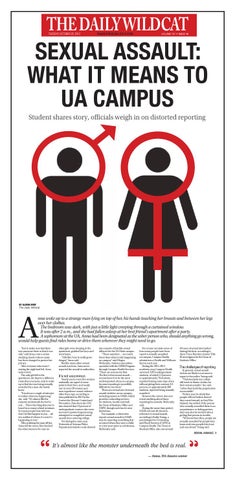
SEXUAL ASSAULT: WHAT IT MEANS TO UA CAMPUS Student shares story, officials weigh in on distorted reporting
BY ALISON DORF
The Daily Wildcat
A
nna woke up to a strange man lying on top of her, his hands touching her breasts and between her legs over her clothes. The bedroom was dark, with just a little light creeping through a curtained window. It was after 2 a.m., and she had fallen asleep at her best friend’s apartment after a party. A sophomore at the UA, Anna had been designated as the sober person who, should anything go wrong, would help guests find rides home or drive them wherever they might need to go. “Just to make sure that there was someone there so that it was safe,” said Anna, now a senior studying classics whose name has been changed to protect her privacy. After everyone who wasn’t staying the night had left, Anna went to bed. The only girl left in the apartment, she slept in a different room than everyone, only to wake up to find she was being sexually assaulted by a man she barely knew. “It took me a couple of minutes to realize what was happening,” she said. “It’s almost like the monster underneath the bed is real … This is the thing that you’ve heard in so many school seminars. So many people have told you don’t let this happen to you … all of a sudden it’s there, it’s real, it’s happening to you.” After pushing the man off her, Anna left the room. She checked the other rooms to be sure no
other girls were sleeping in the apartment, grabbed her keys and went home. “I felt like I was in really grave danger,” Anna said. But like many other sexual assault survivors, Anna never reported the assault to authorities.
It’s not uncommon
Nearly one in every five women nationally are raped at some point in their lives, and nearly one in every 20 women and men experience sexual violence other than rape, according to data published in 2012 by the Centers for Disease Control and Prevention. Data from the CDC also showed that 19 percent of undergraduate women who were surveyed reported experiencing attempted or completed sexual assault since entering college. Yet during the same year, University of Arizona Police Department statistics only showed
nine reports of forcible sexual offenses for the UA Main campus. “Those numbers … are much lower than what is truly happening on campus,” said Megan McKendry, violence prevention specialist with the OASIS Program through Campus Health Services. “There are reasons for that. The first is that sexual assault … we just know it to be the most underreported crime on campus, because reporting is incredibly difficult for survivors.” There are several sets of sexual assault statistics across campus, including reports to OASIS, which provides counseling services for students, faculty and staff, the Dean of Students Office and UAPD, though each has its own limitations. For example, a client who reports sexual assault to OASIS may be reporting something that occurred when they were a child, or a few years prior as a freshman, McKendry said.
For a more accurate sense of how many people have been raped or sexually assaulted on campus, Campus Health administers a Health and Wellness Survey each year. During the 2012-2013 academic year, Campus Health surveyed 3,055 undergraduate students, of which 2.3 percent, or approximately 70 students, reported having some type of sex without giving their consent, 8.5 percent, or approximately 260 students, reported being sexually assaulted. However the survey does not reveal anything about those reporting the assaults, McKendry said. During the same time period, OASIS saw just 40 clients in reference to sexual assault, according to Kathy Young, a psychologist for Counseling and Psych Services (CAPS) at Campus Health. The Dean of Students Office also saw around
40 cases of sexual misconduct during this time, according to Alexx Tracy-Ramirez, former Title IX investigator for the Dean of Students Office.
The challenges of reporting
In general, sexual assault victims are likely to not want to report to the police, Young said. “Unfortunately our culture still tends to blame victims for their sexual assaults,” she said, “rather than hold the perpetrators accountable.” Victims may be afraid that people will not believe them if they come forward, or they’ll be blamed, she added. If the person who sexually assaulted them is an acquaintance or dating partner, they may also be worried about getting that person in trouble. “We know that often, people are sexually assaulted by people they know and even people they trust and care about,” Young said.
SEXUAL ASSAULT, 3
“
It’s almost like the monster underneath the bed is real. — Anna, UA classics senior
“