Stone artefacts scattered across the sand dunes of the Arid Recovery Reserve speak to the deep time over which Aboriginal people have lived on and cared for this Country. We recognise and honour their enduring connection to these extraordinary lands and pay our respects to their Elders past, present and emerging.
Arid Recovery lies within the native title area of the Kokatha people, in a landscape where neighbouring groups, including the Kuyani and Arabana people have also lived and travelled for generations.
By bringing together Indigenous Ecological Knowledge and conservation science, we contribute to the recovery and and long-term viability of wildlife across Australia's Aboriginal lands.
This document is the 28th in a series of annual reports that outlines the activities of Arid Recovery for the perod from 1st July 2024 to 30th June 2025. Copies of this report, supplementary information and prevous reports are available on the Arid Recovery website.
About Arid Recovery
Arid Recovery is an independent not-for-profit organisation that manages a 12,300 ha wildlife reserve in South Australia's arid north. Since 1997, we’ve pioneered conservation science, growing from a 1,400 ha Reserve into one of Australia’s largest safe havens for wildlife.
For over 28 years, we have provided native threatened species with a refuge from feral animals. Inside the reserve, we've successfully reintroduced species, restored habitats, and advanced longterm research. Beyond the fence, our collaborative research and conservation efforts are shaping conservation practice, extending our impact across Australia's arid zone.
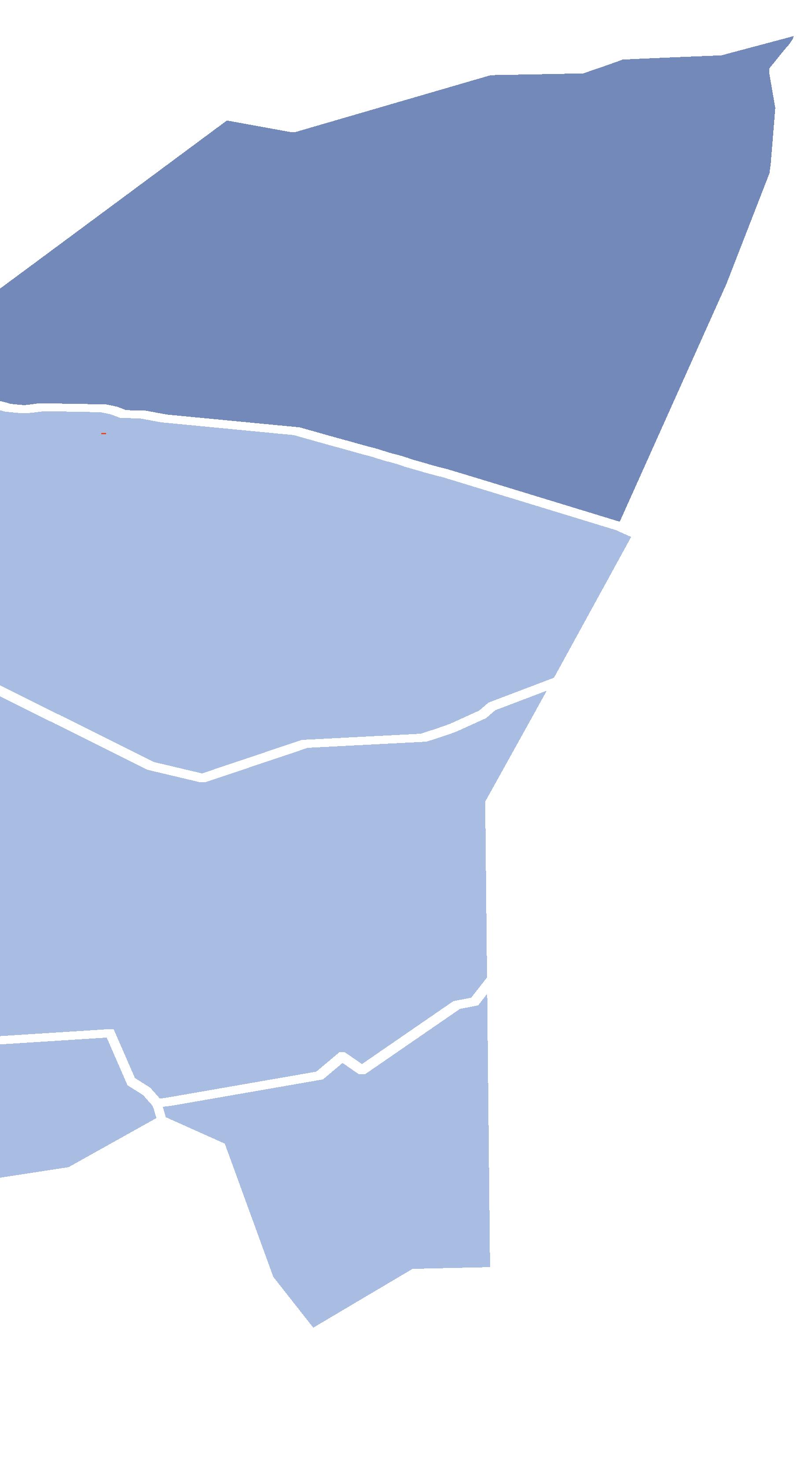
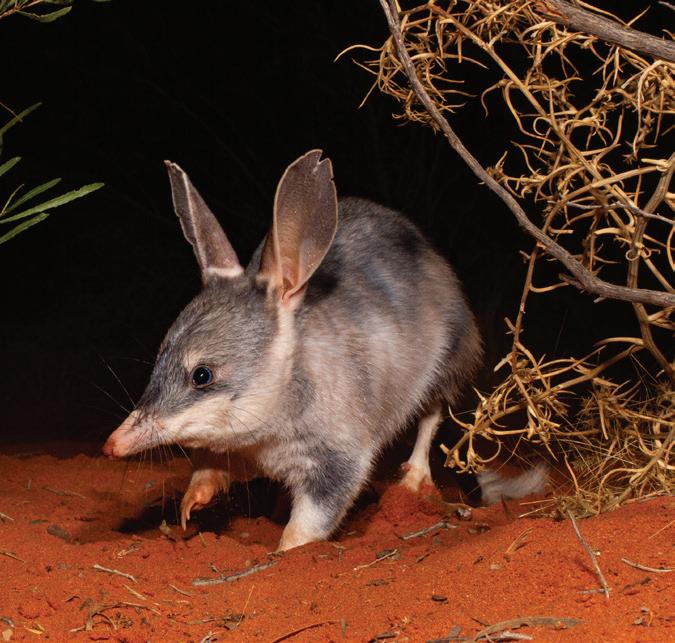
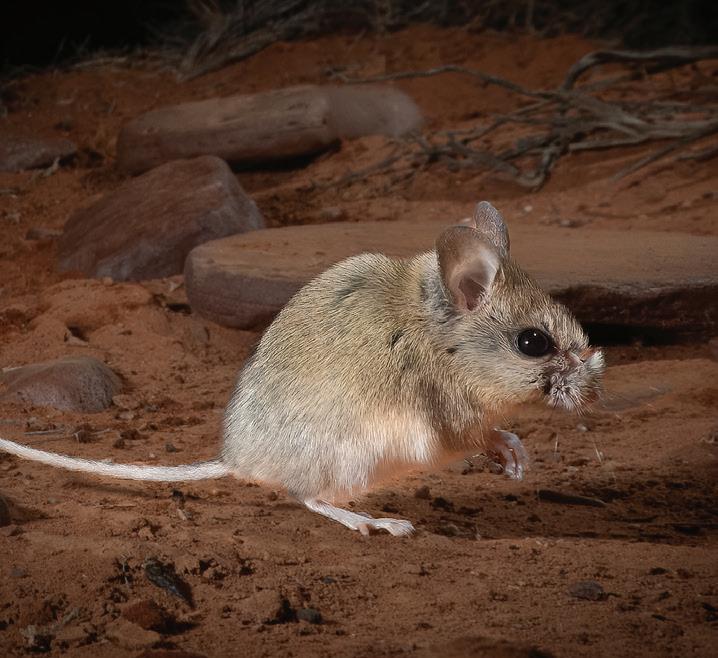
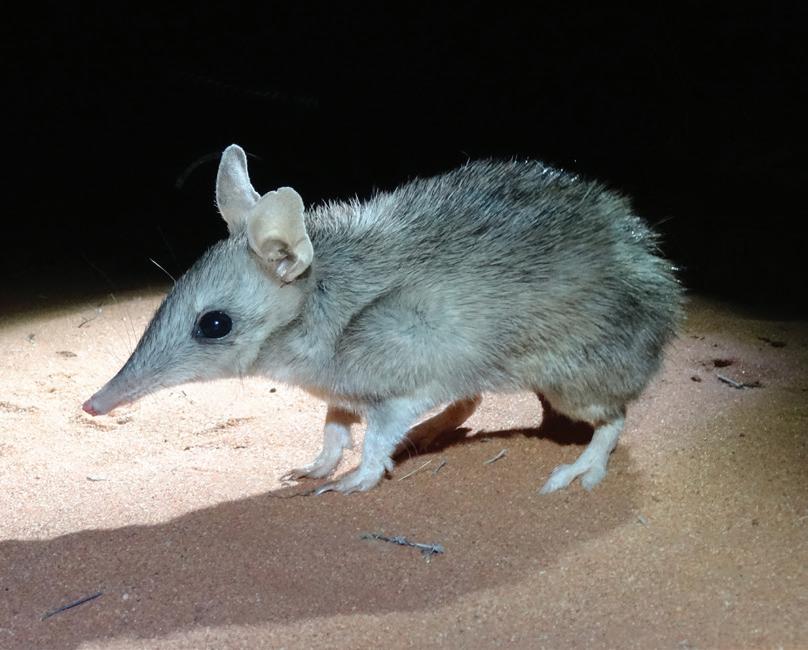
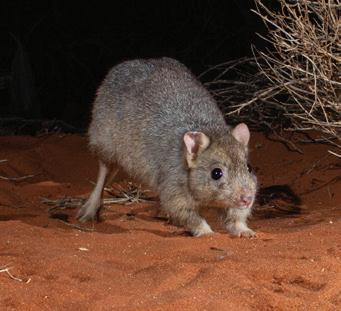
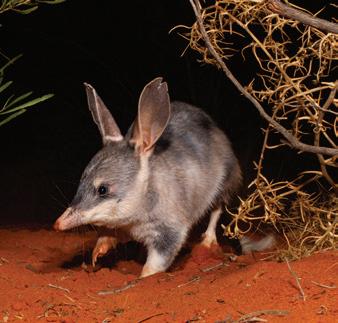
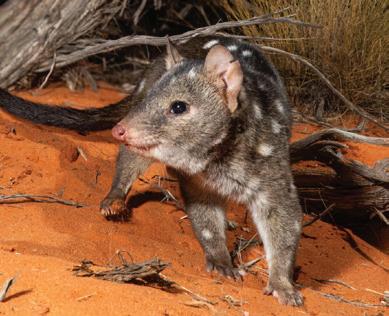
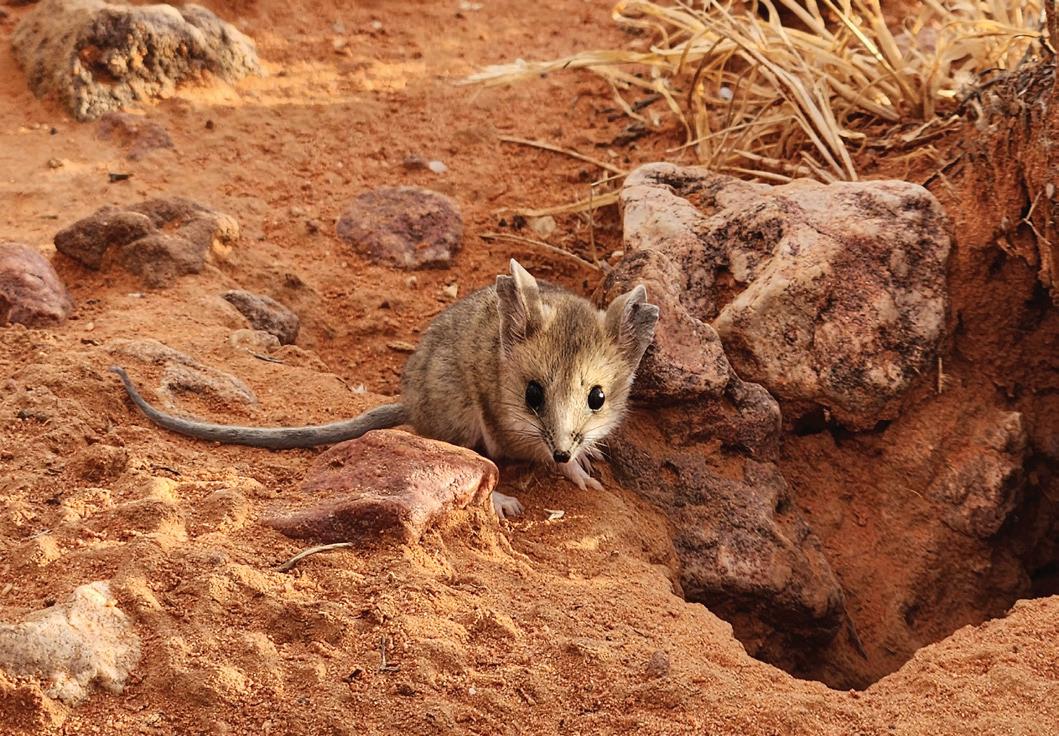
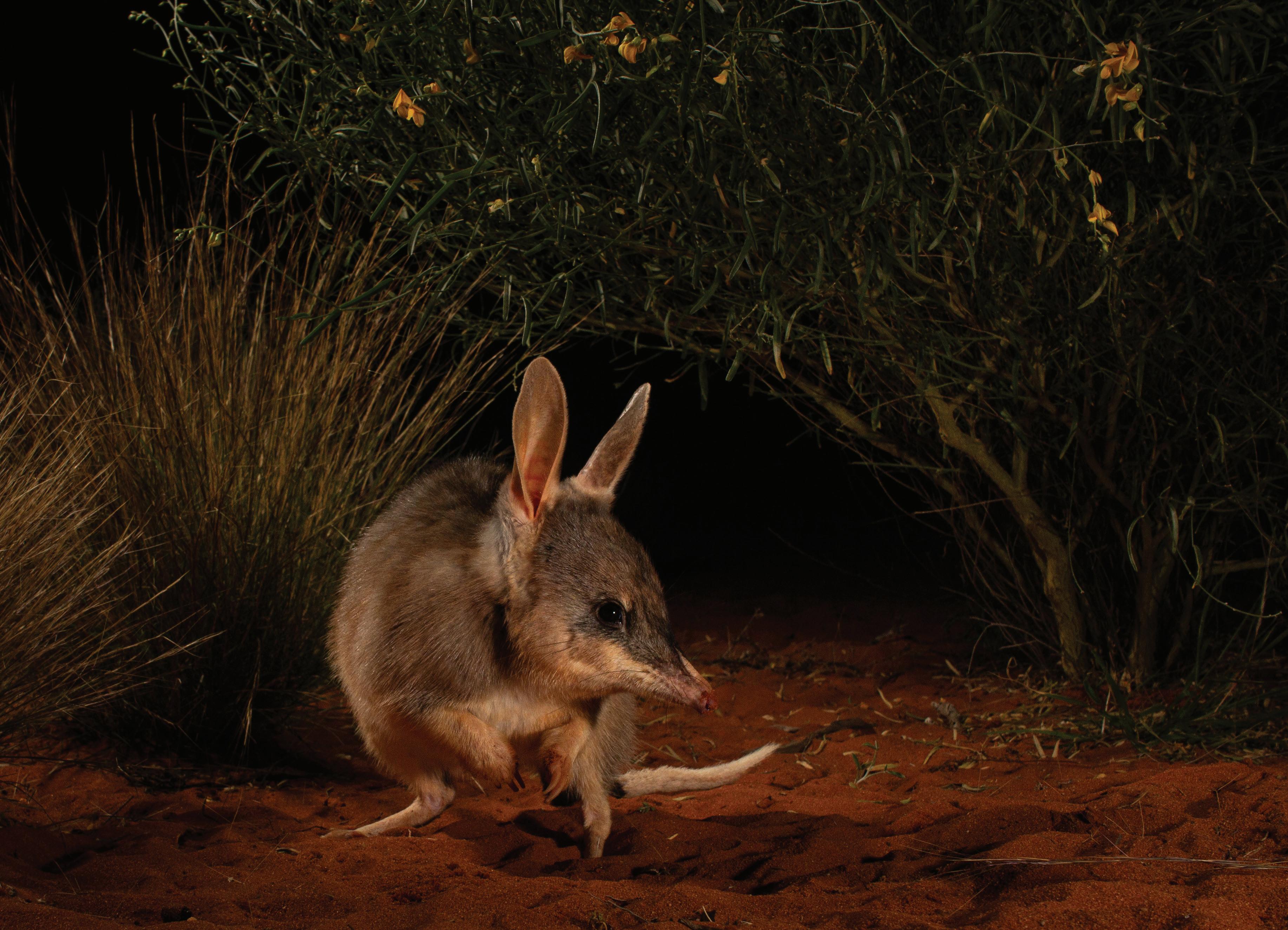
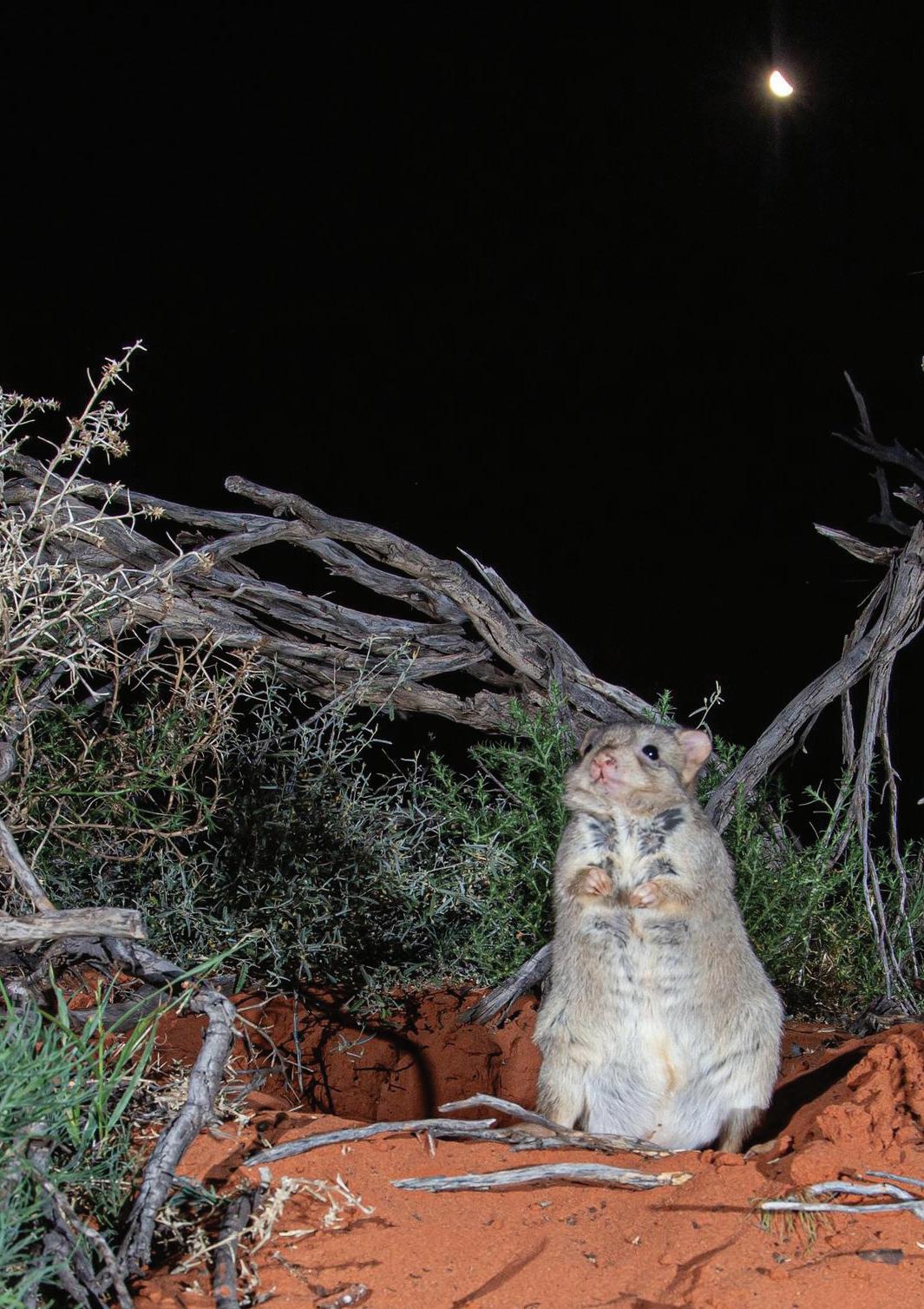
The reserve is a living laboratory, now home to five reintroduced threatened species - the burrowing bettong, greater bilby, Shark Bay bandicoot, western quoll and kowari - and three naturally occurring threatened species - the plains mouse, southern whiteface and Koch's saltbush. It's six compartments form a refuge zone, where no mammalian predators are present, a conservation zone, where quolls coexist with other threatened species, and an experimental zone where cats and rabbits are present at lower densities. This unique design allows us to trial innovative methods for managing the impacts of feral predators and rabbits, inform re-establishment of threatened species beyond the fence, and safeguard some of Australia's most vulnerable species.
Our vision
To return species from threatened to thriving in the arid zone.
Our mission
To make a nationally significant long-term scientific contribution to conservation practice that supports the recovery of threatened species and arid ecosystems. We ultimately seek to have threatened species thrive without the need for a fenced reserve.
Second Expansion
REFUGE
Kowari
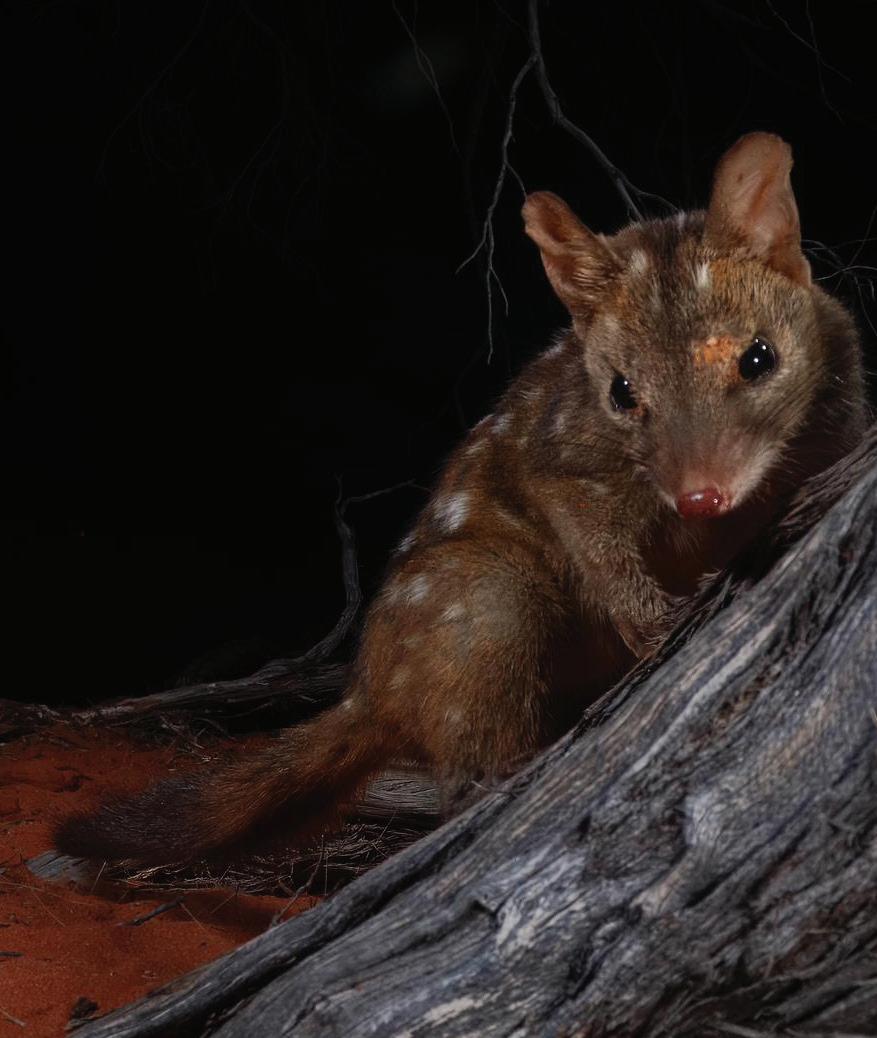
Western quoll
Main
EXPERIMENTAL ZONE
Dingo Paddock
Red Lake Expansion
CONSERVATION ZONE
Plains mouse
Burrowing bettong
Greater bilby
Shark Bay bandicoot
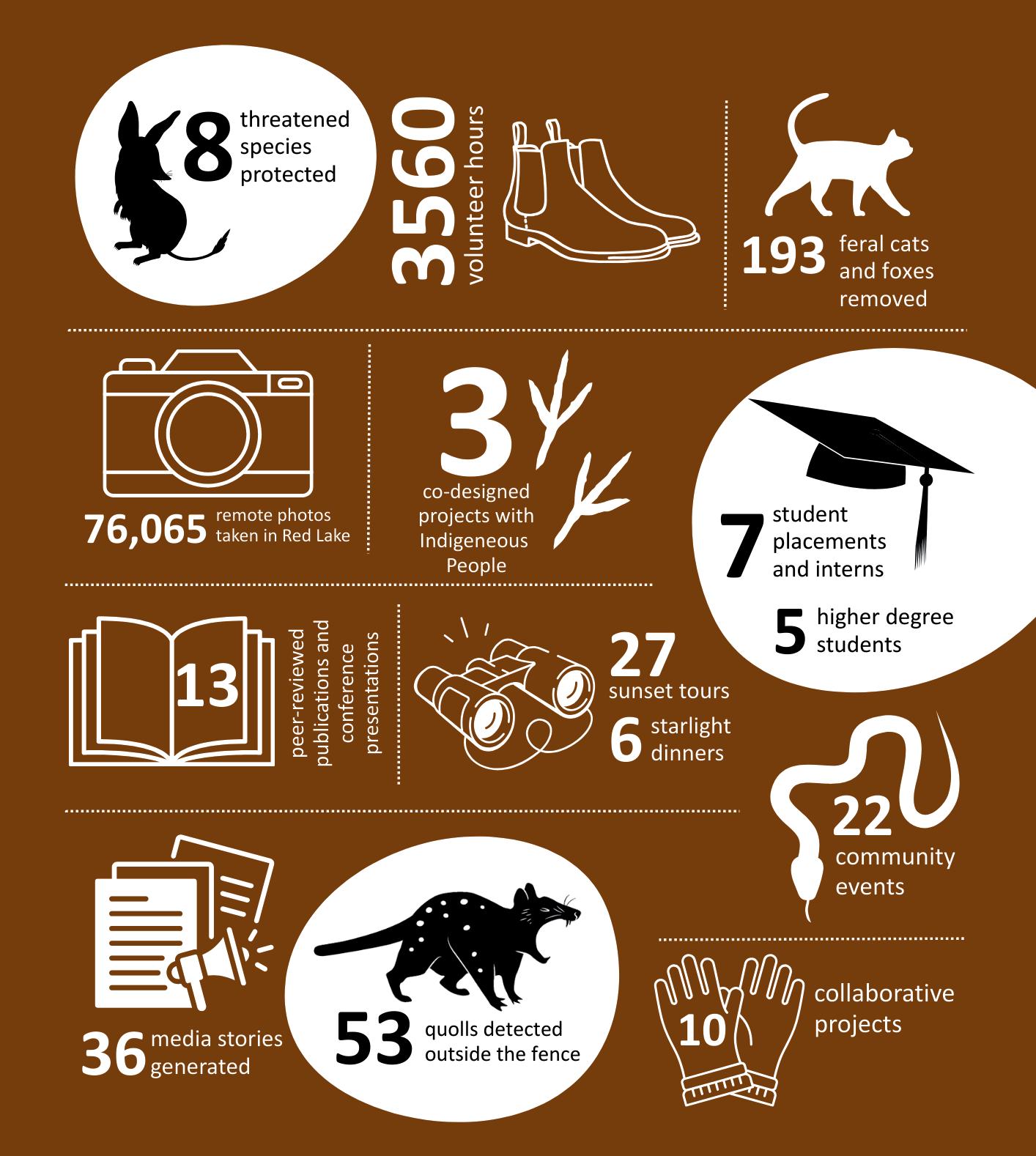
Our 2024-25 impact
Since 1997, Arid Recovery has grown from a 1,400 ha to a 12,300 ha reserve, turning it into one of Australia’s largest safe havens. Our impact is felt both inside the reserve and beyond the fence.
Message from our Chief Executive
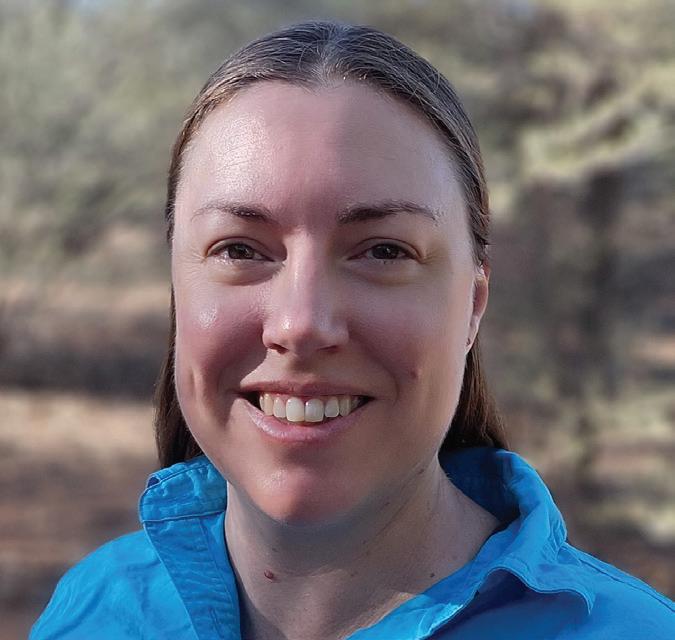
Dr Lauren Young
I was delighted to take on the role of Chief Executive at Arid Recovery in February 2025. I acknowledge the outstanding contribution Kath Tuft made over nine years, driving progress, strengthening the organisation, and fostering the positive culture we enjoy today. This year also saw a change in Board leadership, with Jody Swirepik succeeding Allan Holmes as Chair. We farewelled our former Bush Heritage representative Rebecca Spindler and welcomed Bruce Webber in her place. Major projects this year have advanced understanding of arid zone ecology and climate change impacts. Collaborative studies with UNSW examined the effects and mitigation of heatwaves on threatened species and rabbits, while student research projects explored drought impacts on mulga woodlands and expanded our knowledge of kowari ecology. A significant milestone was achieved with Principal Scientist Katherine Moseby, Kath Tuft and colleagues publishing a landmark study documenting 26 years of change in small mammal communities at Arid Recovery. These projects demonstrate the power of collaboration in strengthening the science underpinning our conservation work.
We continue to build strong relationships with the Kokatha people, Native Title holders of the Country on which the reserve sits, and the Arabana people to the north.
Co-designed surveys, including feral animal and threatened species monitoring, and pitfall trapping, have extended our work beyond the fence, demonstrating the strength of combining Indigenous Ecological Knowledge with conservation science. Engagement with local and regional communities also continues through events hosted by Arid Recovery and others.
Our formal partnerships remain central to our success. A new three-year agreement with BHP enhances our collaboration, while the Department for Environment and Water and Bush Heritage Australia have reaffirmed their financial support. We look forward to renewing our partnership with the University of Adelaide as it transitions to Adelaide University in 2026. Since joining Arid Recovery, my focus has been on ensuring a smooth transition and supporting the team through change. I look forward to leading the organisation under our 2026–2030 Strategic Plan: maintaining the reserve and its species, research and innovation, and extending our conservation impact beyond the fence.
Message from our Chair
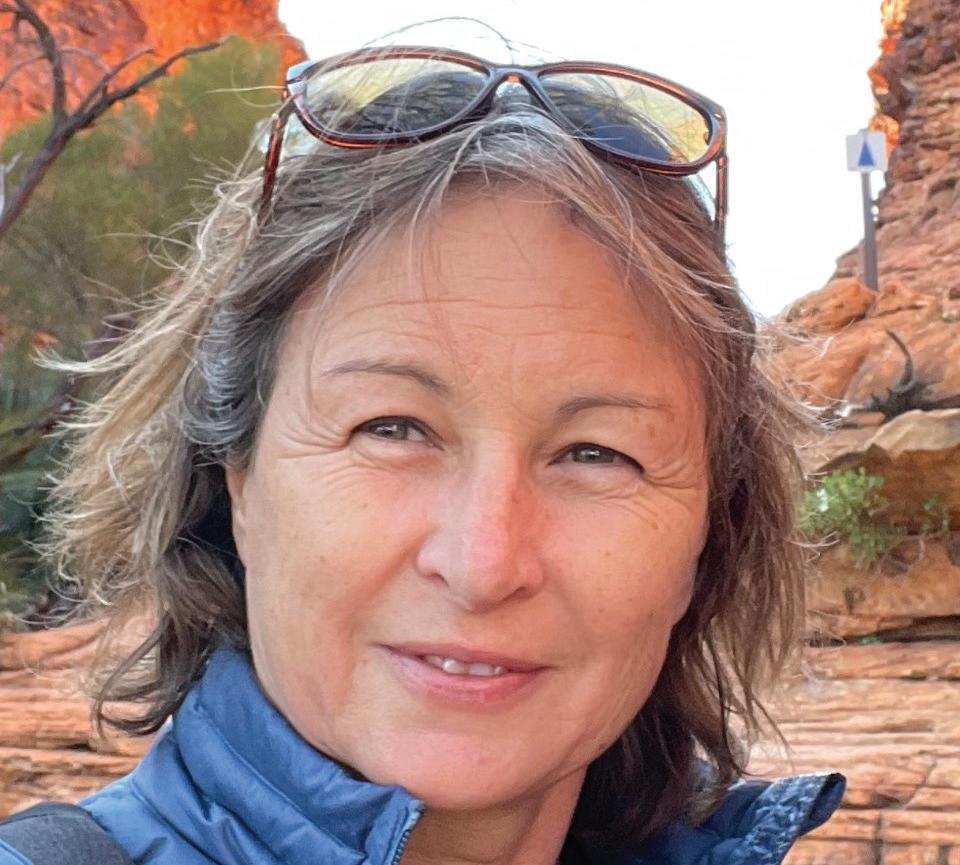
Jody Swirepik
It’s been a big year for Arid Recovery, with our previous Chief Executive, Kath Tuft, departing at the same time as the organisation taking on a new Chair. The Arid Recovery staff, alumni, and Board extend their deepest appreciation for the leadership and dedication of both Kath and long-term Chair Allan Holmes who contributed so much time and energy to the mission of Arid Recovery. Allan and Kath worked tirelessly for Arid Recovery and ensured a smooth transfer this year to welcome Lauren Young as Chief Executive and myself as Chair. We have had excellent outcomes at the reserve this year. Monitoring of our newest species, the kowari, indicates that the population has grown, and dedicated research on the species is already contributing to our understanding of kowaris and their management.
The Arid Recovery Board and our Scientific Advisory Committee have been engaged this year in drafting the 202630 Strategic Plan, which will set the organisation's direction for the next 5 years. The good news is that our three main strategies have been reaffirmed; first and foremost, the reserve is fundamental in controlling predators, building populations of target native species, and providing experimental capacity; secondly, bold and innovative research increases the knowledge required to protect these species; and lastly, partnerships help to exchange learnings with others to have an impact beyond the fenced reserve.
This year has seen an enthusiastic renewal of our partnership with BHP, who have provided ongoing and generous support to the reserve and our work. The commitment and contributions from all our partners, BHP, Bush Heritage Australia, the University of Adelaide and the South Australian Department for Environment and Water, and sponsorship from private donors help us to show what is possible in this landscape.
Extension of our learnings to others and learning from them is key to our success. We look forward to working with the Kokatha and Arabana, BHP, other reserves and land managers to extend the impact of our work.
Our people
Arid Recovery’s success is driven by the leadership of our Board, the expertise of our Scientific Advisory Panel, and the commitment of our staff. Alongside them, our long-term formal partners and volunteers contribute their time, skills, and support to help us achieve our conservation goals.
Arid Recovery Board
Allan Holmes
Independent Chair (to Feb 2025) Former Chief Executive of the SA Department for Environment and Water
Jody Swirepik
Independent Chair (to Feb 2025) Former Director of National Parks
Sally Lamb
Representative for BHP
Manager of Asset Environment Approvals and Sustainability for Copper SA, BHP
Dr Bec Spindler
Representative for Bush Heritage Executive Manager, Science and Conservation at Bush Heritage Australia
Prof. Laura Parry
Representative for the University of Adelaide Pro Vice-Chancellor (Research Excellence)
Sandy Carruthers
Representative for SA Department for Environment & Water
Group Executive Director Strategy, Science & Corporate Services at the SA Department for Environment and Water
Andrew Corletto
Independent Partner at MinterEllison
Mark Priadko
Independent Financial management, business analysis and case development consultant
Emily Jenke
Independent Co-CEO of DemocracyCo
Arid Recovery Scientific Advisory Panel
Thank you to our outgoing leaders
and advisors
We thank former Chief Executive Dr. Kath Tuft for her outstanding leadership and dedication to Arid Recovery for 9 years, and Dr Hugh McGregor for his significant contributions as a cat researcher and conservation scientist. We wish them both well as Kath steps into her new role as CEO of the Tasmanian Land Conservancy.
We also thank Allan Holmes for his wise counsel and service as independent Chair, and Dr Heather Neilly and Dr Stephanie Williams for their important contributions as members of our Scientific Advisory Panel.
Professor Laura Parry continues as Board representative, with Associate Professor Jeremy Austin Chairing the Panel in 2024–25. Including two of Arid Recovery’s co-founders, the Panel provides independent scientific advice on research and conservation. We thank Heather Neilly and Stephanie Williams for their valued contributions as they stepped down this year.
Professor Laura Parry Arid Recovery Board
A. Prof. Jeremy Austin University of Adelaide
Peter Copley Co-founder
Arid Recovery Staff
Chief Executive (to Jan 2025)
Dr Katherine Tuft
Chief Executive (from Feb 2025)
Dr Lauren Young
Principal Scientist
Dr Katherine Moseby
Ecologist
Caitlin Rutherford
Conservation Land
Management Officer
Nathan Manders
Community Field Ecologist
Bianca Amato
Administration Officer
Erica Mayer-Zirn
Dr Graeme Finlayson Bush Heritage Australia
Allan Holmes Arid Recovery Board
Dr Heather Neilly Australian Landscape Trust
Field Officer
Jonah Wiltshire
Field Officer & UNSW Research Officer
Mahalia Booth-Remmers
Fence Maintenance Officer
Isabel Anderson
Wildlife Hotline
Conan Fahey
Feral Predator Researcher
Dr Hugh McGregor
Interns
Rylie Pan
Charlotte Drake
Nina Manning
Emma Pollard
Dr Reece Pedler UNSW, Wild Deserts
Dr Stephanie Williams Ecological consultant
Dr Dan Rogers DCCEEW
Dr John Read
Ecological Horizons and co-founder
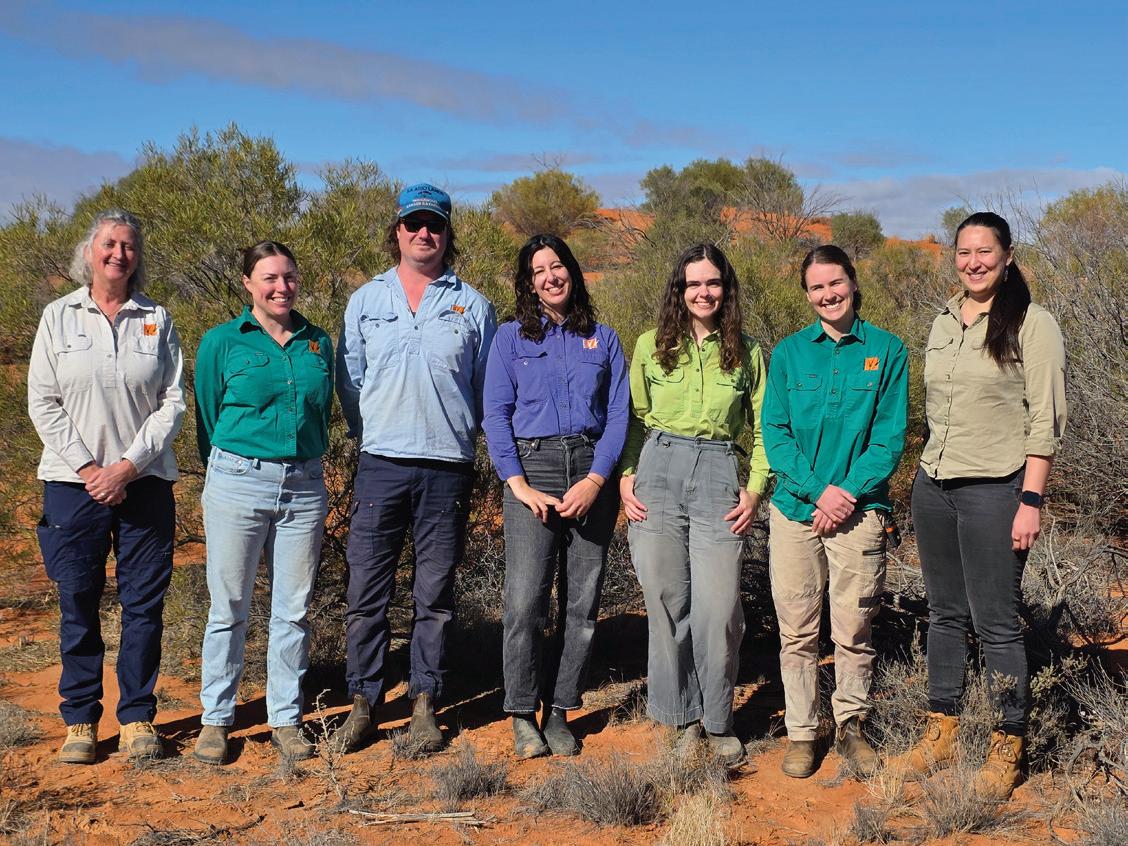
The Arid Recovery staff
Arid Recovery's Partners
Arid Recovery is a conservation initiative supported by our formal partners BHP, the SA Department for Environment and Water, the University of Adelaide, and Bush Heritage Australia, along with Kokatha Aboriginal Corporation and the local community.
Thank you to the businesses & supporters who make our work possible
Alliance Airlines
Almost Anything Auto
Andamooka Health Services (RFDS)
Andamooka Observatory
Andamooka Waste
Arabana Cultural Rangers
ASG Bianco
AutoPro Roxby Downs
Bugs n Slugs
Camplin Computer Services
Cochrane’s Transport
DEECA Arthur Rylah Institute
Di Byrne
Discovery Parks
Dodoland
Ecological Horizons
HEH Pty Ltd
Hern & Associates
Kokatha Aboriginal Corporation
Kokatha Pastoral
Masmech Services
MinterEllison
Monadelphous Engineering
MTC Advisory
NRMjobs
Olympic Dam Transport
Olympic Tyres
Professional Trapping Supplies
Rendere Trust & Upotipotpon
Rotary Club of Roxby Downs
Roxby Community Library
Thank you to our volunteers
Isabel Anderson
Molly Barlow
Abbey Bode
Candice Bartlett
Jonathan Bartlett
Kyra Barnes
Simon Barnes
Harry Benn
Jack Bilby
Collette Blyth
Mahalia Booth-Remmers
Tara Burns
Todd Burns
Tyrell Camplin
Al Capriotti
Isabella Cardelli
Sienna Clasohm
Hayden Cradock
Travis Crompton
Jessica Cruz
Sebastian Delamare
Charlotte Drake
Robbie Dunn
Daniel Eyckens
Nicole Galea
Kelsey Graham
Amelia Grigson
Samantha Givan
Garry Jolley-Rogers
Abby Hoffman
Tyson Holland
Grace Holligan
Sam Kerr
Arvind Kumar
Amber Liu
Tim Leggatt
Tessa Manning
Nina Manning
Hugh McGregor
Rose Miall
Bev Middleton
Gabrielle O'Kane
Rylie Pan
Emma Pollard
Tyson Qualmann
Tim Quinn
Ken Rapsey
Greg Reimann
Jacinta Richardson
Scott Rogers
Megan Rutherford
Ned Ryan-Schofield
Milly Sciuluna
Shawn Scott
Oskar Shiller
Casey Simmons
Alicia Simpson
Allistair Stewart
Craig Sumsion
Sandy Sumsion
Robyn Tuft
Courtney Usher
Mark Young
Rachel Young
Roxby Council
Roxby Downs Family Practice
Roxby Signs
SA Arid Landscape Board
Secker Cleaning
Team Kowari
Thyne Reid Foundation
Veolia
Wildlife Hotline
Waratah Fencing
Working together for greater impact
Our work is only possible through collaboration and partnering. This year, we brought people together to share knowledge, spark new ideas and celebrate the partnerships that drive conservation forward.
Sharing knowledge & celebrating partnerships
Booms, busts and breakthroughs seminar
In collaboration with the Environment Institute, we hosted a public seminar at the University of Adelaide, celebrating 27 years of research and recovery. The event featured rapid-fire talks from past and present researchers and partners, a lively afternoon tea networking session, and a Q&A moderated by Professor Andy Lowe.
Government House celebration
In November, we honoured the people and partnerships that have shaped Arid Recovery with a celebration at Government House. The event was a proud moment of reflection, celebrating what collaboration has made possible over nearly three decades, and looking ahead to what we can achieve together in the years to come.
Her Excellency the Honourable Frances Adamson AC hosted the evening, which opened with a powerful Welcome to Country by Dr Rodger Thomas. It brought together our formal partners: BHP, the University of Adelaide, the South Australian Department for Environment, and Bush Heritage Australia, along with Kokatha representatives, community members, research collaborators and long-time supporters. We were also honoured by the presence of the Honourable Susan Close MP, Deputy Premier of South Australia, and Dr Fiona Fraser, Australia’s Threatened Species Commissioner.
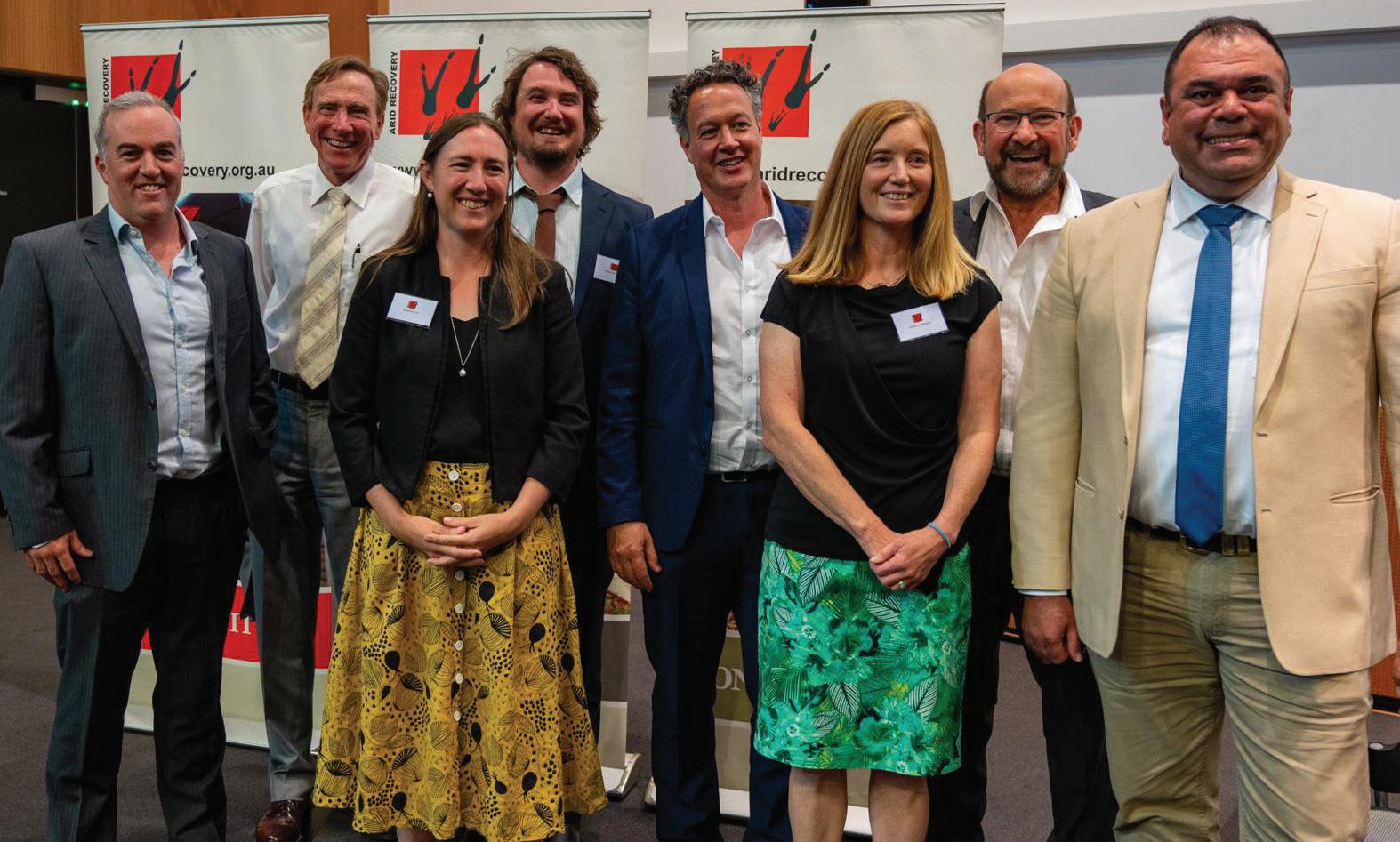
Booms, Busts and Breakthroughs Seminar Presenters: Dr Graeme Finlayson (Bush Heritage), Alan Holmes (Arid Recovery Chair of the Board), Dr Kath Tuft (Chief Executive), Nathan Manders (Land Conservation Management Officer), Dr Andrew Lowe (Enivronment Institute, University of Adelaide), Dr Katherine Moseby (Principal Scientist), Peter Copley (Co-founder), and Aaron Thomas (Chair of Kokatha Pastoral).
Research highlights and publications
Arid Recovery’s research continues to inform conservation across Australia. This year, we published seven studies and presented at five conferences on research that deepens our understanding of predator-prey dynamics, improves reintroduction strategies, and advances new tools for monitoring and management.
26 years of small mammal pitfall monitoring showed that predator removal reshaped small mammal communities, triggering shifts in species dominance and habitat use
A landmark 26-year dataset, published in Proceedings B in 2025, showed how removing cats and foxes transformed small mammal communities at Arid Recovery. Rodents were the biggest winners. House mice and Bolam’s mice surged first, but were later outnumbered by larger species like spinifex hoppingmice and plains mice, which expanded into new habitats once free from predation. This revealed that predators, not habitat alone, once constrained where species could survive.
By the study’s end, five of seven species had increased in abundance inside the reserve, with rodent captures up to 33 times higher than outside the reserve after rain. Diversity rose not through vegetation change, but through recolonisation and competition in a predator-free landscape.
BHP and Arid Recovery cat research
Beyond day-to-day control, Arid Recovery is collaborating with BHP on research to understand how supplementary food sources around the mine site may influence feral cat populations at the reserve. Population and genetic structure were examined using a DNA library built with samples from nearly 500 cats, with the goal of informing strategic control. A small number of related cats were identified between the mine site and the reserve. While cat populations at the two locations were found to be highly connected, the mine site was not identified as the primary source of cats around the reserve.
Peer-reviewed publications
• 26 years of small mammal pitfall monitoring showed that predator removal reshaped small mammal communities, triggering shifts in species dominance and habitat use (Moseby et al. 2025).
• Feral cat video collars showed small mammals are at far higher risk than reptiles or insects (McGregor et al. 2025).
• Predation of reintroduced species by feral cats was more common than expected during translocations (Ryan-Schofield et al. 2024).
• Pitfall trap safety devices were developed to reduce unintended mammal predation (Stiglingh et al. 2024).
• Feeding stations for quolls should be used only intermittently post-release to avoid long-term reliance (Stepkovitch et al. 2025).
• When combined, Indigenous knowledge and Western science improve desert fauna monitoring (Legge et al. 2024).
• Controlled predator exposure elicited lasting antipredator behaviours in bettongs, informing new strategies for reducing prey naiveté (Moseby et al. 2024).
Conference presentations
• Fencing innovations for long-term reserve design (Amato et al. 2025, International Congress for Conservation Biology).
• Collaborative land use in mining, pastoral and Indigenous landscapes (Manders et al. 2025, International Rangelands).
• Heatwave impacts on bilbies and rabbits (Bilby et al. 2024, Ecological Society of Australia).
• Feral cat control strategies at Arid Recovery (Manders et al. 2024, Australasian Vertebrate Pest Conference).
Working together on country
Discovery for Recovery
Kokatha Pastoral, SA Arid Lands and Arid Recovery launched a three-year project to monitor threatened and invasive species beyond the fence. Together, we have installed 60 cameras across Roxby Downs and Andamooka stations to monitor western quolls that have made their way outside the reserve fence, plains mice, and feral cats. This data will provide a baseline on threatened species occurrence beyond the fence and guide management actions to facilitate their recovery at a landscape-scale.
Animal surveys at Finniss Springs
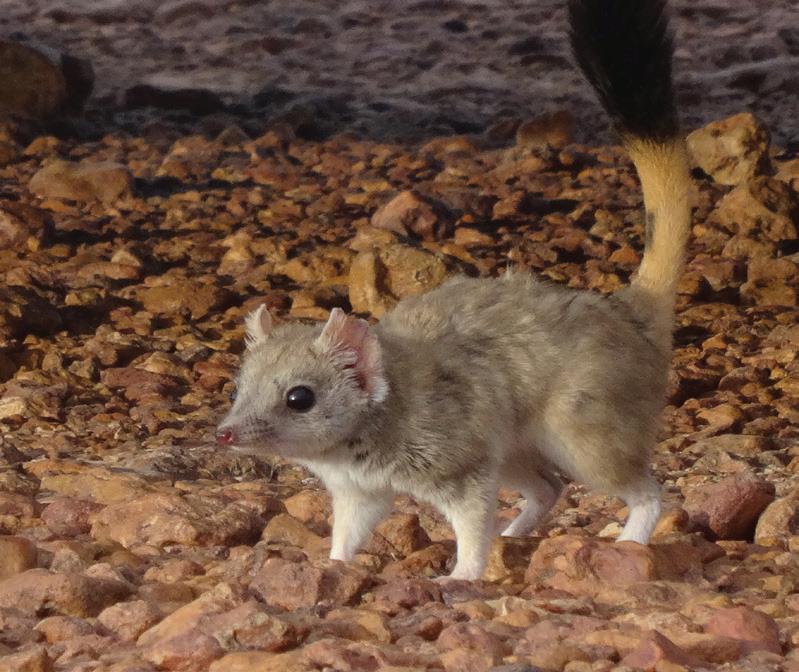
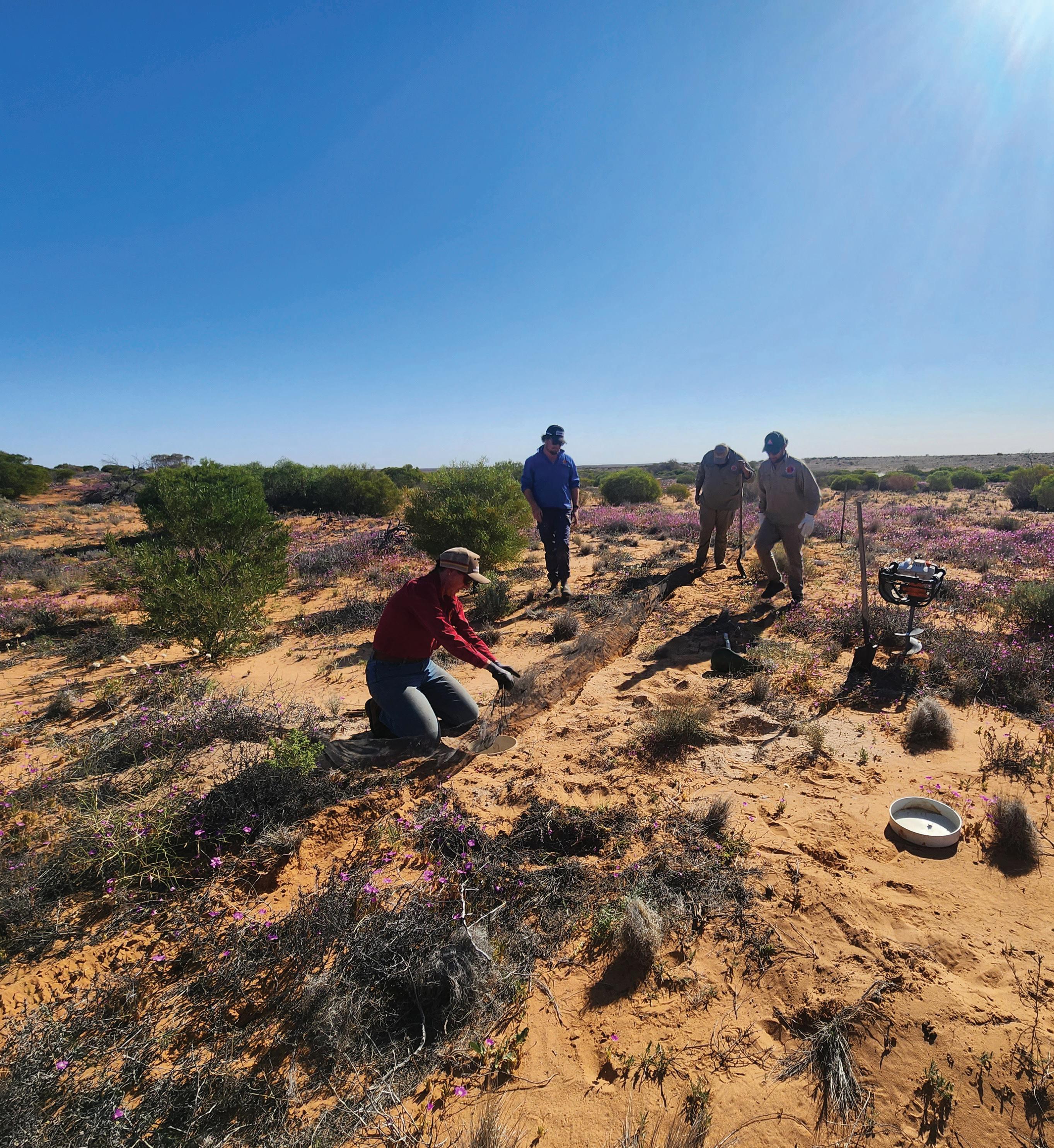
At Finniss Springs on Arabana Country, Arid Recovery teamed up with the Arabana Rangers for a week of fauna surveys, cultural exchange, and a few good laughs. Rangers learned pitfall and Elliott trapping techniques while sharing Arabana names and stories for local wildlife, like Kudnhatiltyi for the black-tailed native hen. Together we recorded skinks, geckos, painted dragons, and over 50 bird species, explored rocky outcrops dotted with ancient fossils and footprints, and found tracks of the elusive mulgara, which was later confirmed on camera trap. The trip was a reminder that conservation is stronger when Indigenous Ecological Knowledge and conservation science work hand in hand.
Pitfalling at Finniss Springs on Arabana Country
Monitoring Jackboot Paddock
Supported by BHP, Arid Recovery and the Arabana Rangers deployed 50 motion-sensing cameras across Jackboot Paddock on Arabana Country, near Kati Thanda–Lake Eyre. The project is building a detailed picture of feral animal activity in a vast, stock-free landscape.
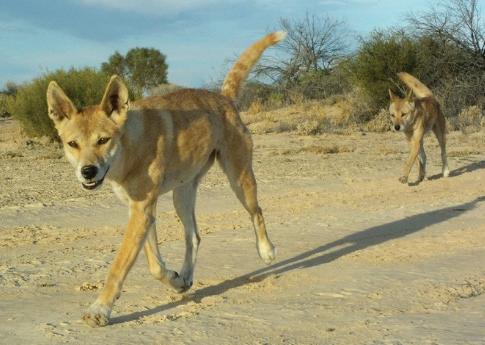
When the cameras were checked two months into the project, they revealed dingoes, foxes, cats, and feral camels were all present in the area. The highlight was the detection of the mulgara, a stocky, desert-dwelling relative of the kowari, at two sites in the study area. This project will guide targeted control efforts, helping reduce the pressure from feral animals and protect native wildlife across Jackboot Paddock.
Kokatha highlights
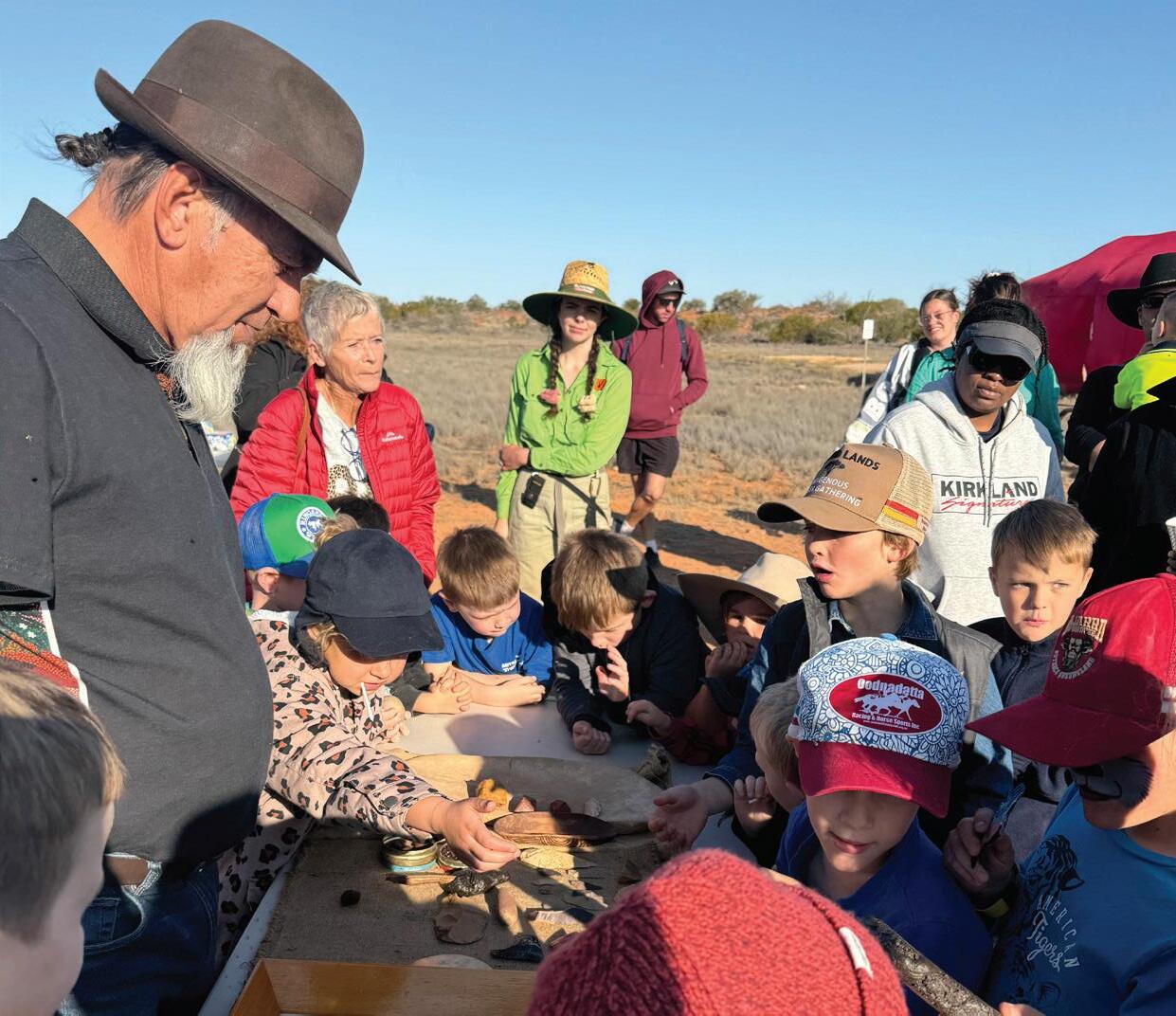
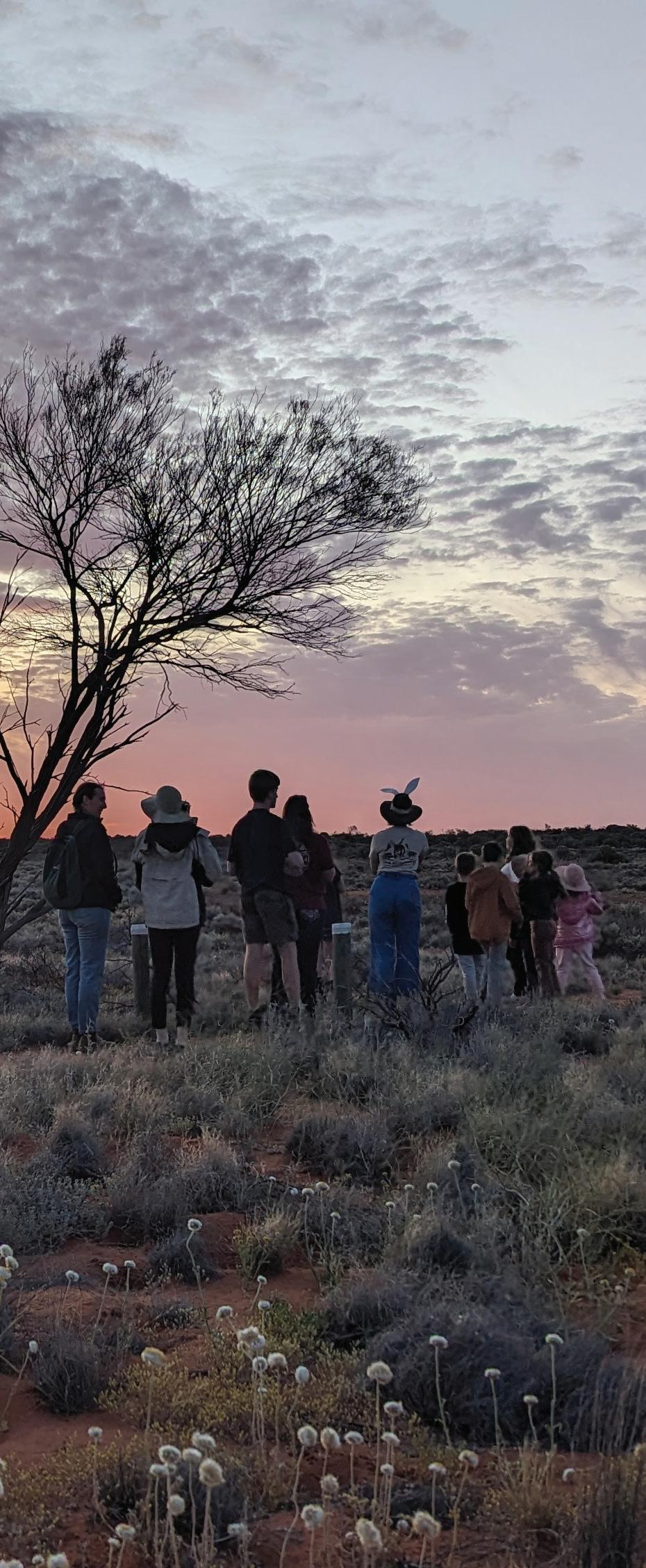
This year, Kokatha Pastoral and the Kokatha Aboriginal Corporation were involved in a range of activities with Arid Recovery. Volunteers joined a working bee to reshape the floppy top of the Dingo Pen, strengthening the fence. At our Open Day, Kokatha Aboriginal Corporation lit the fire for damper making, offered bush tucker and native teas. Senior Lore Man Andrew Starkey delivered a Welcome to Country and shared Kokatha artifacts with the community. Kokatha Pastoral staff also assisted with Arid Recovery’s annual pitfall trapping, helping install traps and process small reptiles and mammals.
Kokatha Lawman, Andrew Starkey shows Kokatha artifacts at Open Day
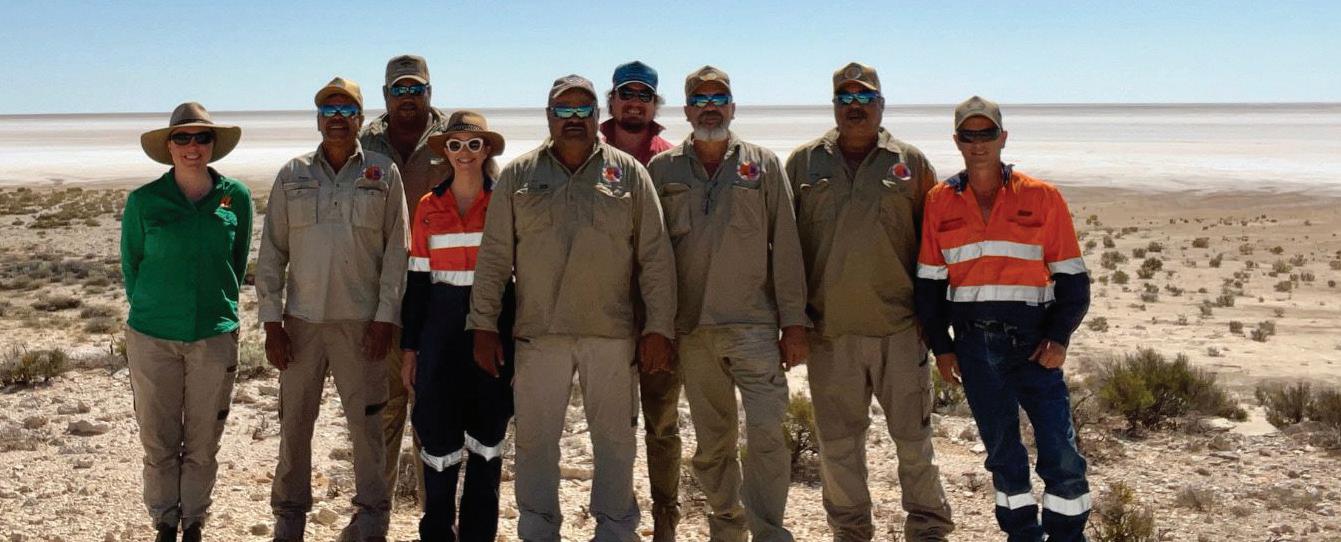
Arabana Rangers, BHP, and Arid Recovery at Jackboot Paddock
Two dingoes caught on remote camera at Jackboot Paddock
Understanding climate change & drought
Heatwaves in Australia’s arid zone are becoming hotter, longer and more frequent; placing additional pressure on wildlife already living close to their thermal limits. While desert mammals have evolved strategies to survive the heat, such as burrowing, shedding warmth via ears and tails, and extracting moisture from food, prolonged extremes can overwhelm these adaptations. Understanding how animals respond to heatwaves is critical to predicting and mitigating climate impacts.
Tracking heat responses in bilbies and rabbits
UNSW PhD candidate Jack Bilby is working with Arid Recovery to compare how greater bilbies and invasive European rabbits endure heatwaves. Using GPS and VHF tracking, accelerometers and temperature loggers, Jack and the team record each animal’s movements, behaviour and the conditions they experience every 10 minutes. Early results show bilbies retreat into deeper burrows that are cooler and more humid, than rabbits, which stay closer to the surface, potentially making them more vulnerable during hot, dry times. The findings will feed into climate models aiming to predict species’ resilience under future heat scenarios.
Water and stress: can extra resources help bettongs?
UNSW researchers, including research officer Mahalia BoothRemmers, are testing whether providing additional water can help wildlife better tolerate heatwaves. Water stations were installed at some burrowing bettong and rabbit sites, while other sites remained without. The body mass and breeding status of bettongs were recorded before and after heat events, and scats were collected to measure cortisol, a marker of stress. The study aims to determine whether access to additional water helps bettongs to maintain healthy body mass, sustain breeding activity and reduce stress during heatwaves, guiding strategies to support and manage native species in a hotter, drier future.
Mahalia Booth-Remmers (left) and Caitlin Rutherford (right) processing burrowing bettongs for the heatwave project
Mulga tree die-off
Mulga (Acacia aneura) dominates much of Australia’s arid and semi-arid zones, playing vital ecological, cultural and economic roles. Mulga are drought-hardy; however, prolonged and severe droughts can trigger mass die-offs, followed by slow and patchy recovery.
In 2019, Arid Recovery recorded high mortality of mulga trees following extreme drought conditions. Current research with Western Sydney University PhD candidate Aranya Sekaran and Bush Heritage Australia is tracking how mulga populations recover and what their future may look like under climate change.
Surveys at Arid Recovery and Bon Bon Station show total drought-induced mortality of 25% (368 dead out of 1,458 adult trees surveyed). At Bon Bon good follow-up rains boosted seedling recruitment above mortality, but at Arid Recovery, recruitment was lower and more variable.
Mulga trees are still showing signs of drought stress, with canopy loss recorded in 42 out of 148 trees from 2020 to 2024. Physiological tests during a recent summer that was not considered a drought (2023–24) found that mulga were already operating under extreme water stress, at about half the level that can trigger death. Mulga can survive at very low water levels, but if conditions worsen to the point where water stress passes their limit, their water transport system breaks down. This suggests that in future severe droughts, many more mulgas could be at risk.
This research will feed into climate models to forecast population trajectories and inform the management of mulga across the landscape under changing climatic conditions.
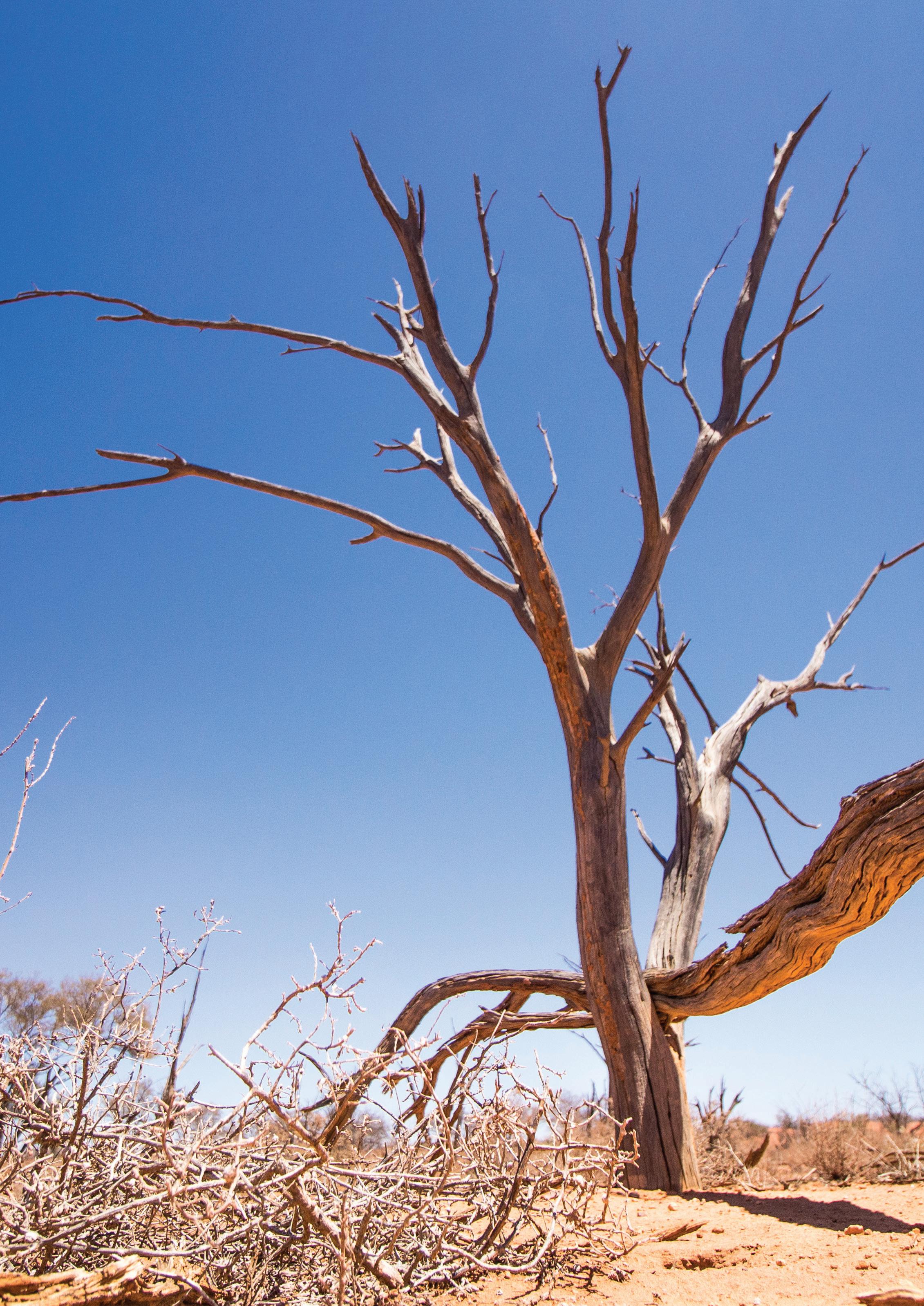
A dead mulga tree during the 2019 drought
Scientific innovation
Our vision is to push conservation beyond the fence so species can thrive at a landscape scale. From AI tools that recognise quolls by their spots to research on feral cat hunting, we’re developing tools to support nation-wide conservation.
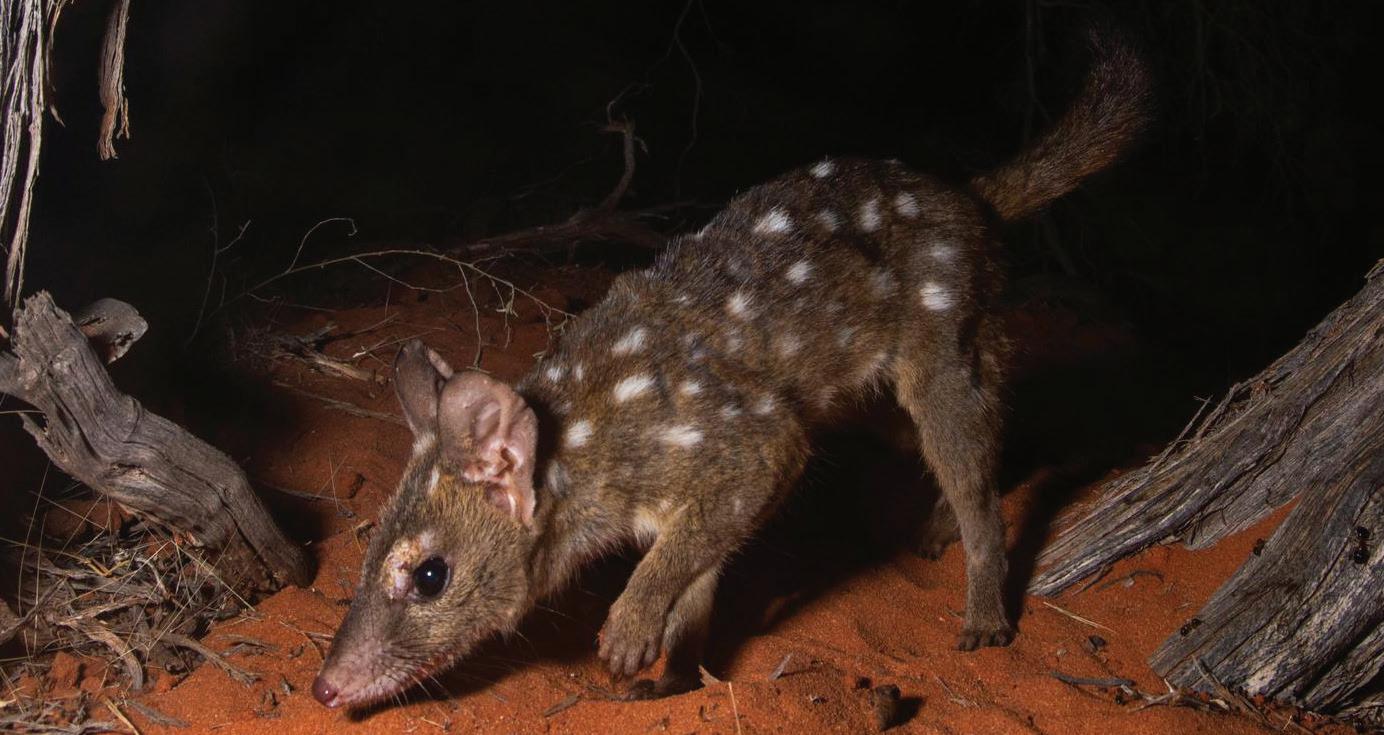
Quoll spot-ID
Every quoll has a unique spot pattern, which can allow us to determine population size by identifying indvidual quolls. However, manual identification can be time-consuming. In collaboration with machine-learning software company eVorta, we are developing an AI model that can identify individual quolls from remote camera images. This has involved compiling an image library of known individual quolls from locations from Arid Recovery, Taronga Conservation Society, Mt Rothwell Sanctuary, and Trowunna Wildlife Sanctuary, to train the AI model. Arid Recovery hopes that the results of this project can be used across Australia to aid in the monitoring of quoll populations. The project been made possible through funding from the Wettenhall Environment Trust.
Feral cat research
Arid Recovery is contributing to the science of feral cat behaviour and management. A recent study led by Arid Recovery researchers Dr Hugh McGregor and Dr Katherine Moseby used video collars to analyse 188 hours of feral cat hunting. The footage revealed that cats invest more time and distance stalking small mammals than reptiles or insects, making mammals far more vulnerable to predation. While kill and feeding times were similar across prey types, the
longer hunts for mammals mean cats can impact many more individuals in a single night. This helps explain why small ground-dwelling mammals are disproportionately threatened by feral cats, while reptiles often persist. Feral cat control and reserach remains a core part of Arid Recovery’s mission to create safe, functioning ecosystems where native wildlife can survive, and eventually thrive beyond the fence.
"Why do feral cats threaten populations of Australia’s small mammals, while reptiles seem to persist? We fitted video collars to cats to capture their hunting behaviour. We found cats were detecting small mammals at much greater distances than reptiles. Perhaps this is due to small mammals making more movements, ultra-sonic calls, or cats just wanting to kill them more. Whatever the cause, it suggests they are at greater risk."
- Hugh McGregor
Western quolls are climbing over the fence and returning to Kokatha Country. Credit: J. Bilby
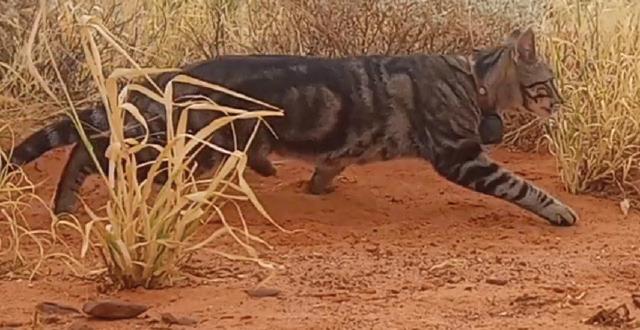
A feral cat carrying a video collar custom made for the research. Credit. H. McGregor.
Development of conservation scientists
Behind every conservation success story are passionate people. At Arid Recovery, we’re committed to training and inspiring the next generation, from interns and researchers to local students and volunteers.
Arid Recovery interships
Building a career in conservation is tougher than ever, with fewer opportunities for hands-on training. Arid Recovery is helping bridge that gap through immersive internships that equip graduates with the skills and experience they need to thrive. This year, Rendere Environmental Trust and Upotipoton Foundation proudly supported four interns:
• Nina Manning helped relocate burrowing bettongs and monitor their movements post-release, contributed to track count monitoring, and played a key role in delivering tours. She is now preparing to begin an Honours project.
• Charlotte Drake built skills in small-animal handling during annual pitfall monitoring and assisted with the heatwave
project by trapping and assessing the health of bettongs. She is now starting a PhD at the University of Adelaide, focusing on Shark Bay bandicoots.
• Rylie Pan contributed to large-scale vegetation surveys and threw her energy into community events including Open Day and Science Week. She is now a Graduate Scientist with Redleaf Environmental.
• Emma Pollard joined the team to help monitor and radiotrack kowaris, spending weeks following juveniles through the summer.
Volunteers and student support
This year, 44 volunteers contributed 3,560 hours to Arid Recovery, an incredible investment of time and energy that strengthens every part of our work. Volunteers supported a wide range of surveys, including annual cage trapping, pitfall trapping, kowari monitoring, track counts, and vegetation surveys. Several local volunteers also assisted with feral cat control, a critical part of protecting threatened species inside the Reserve.
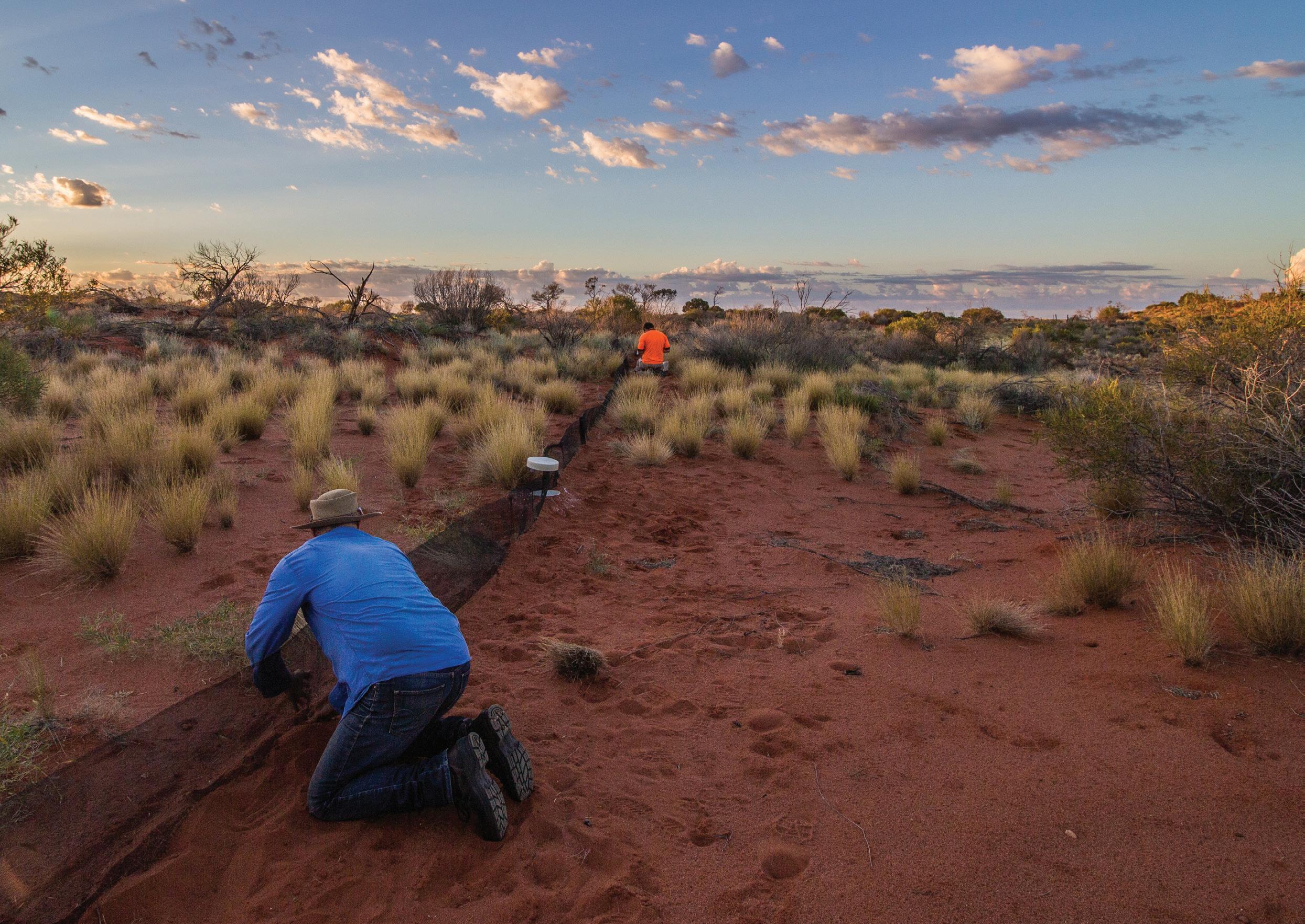
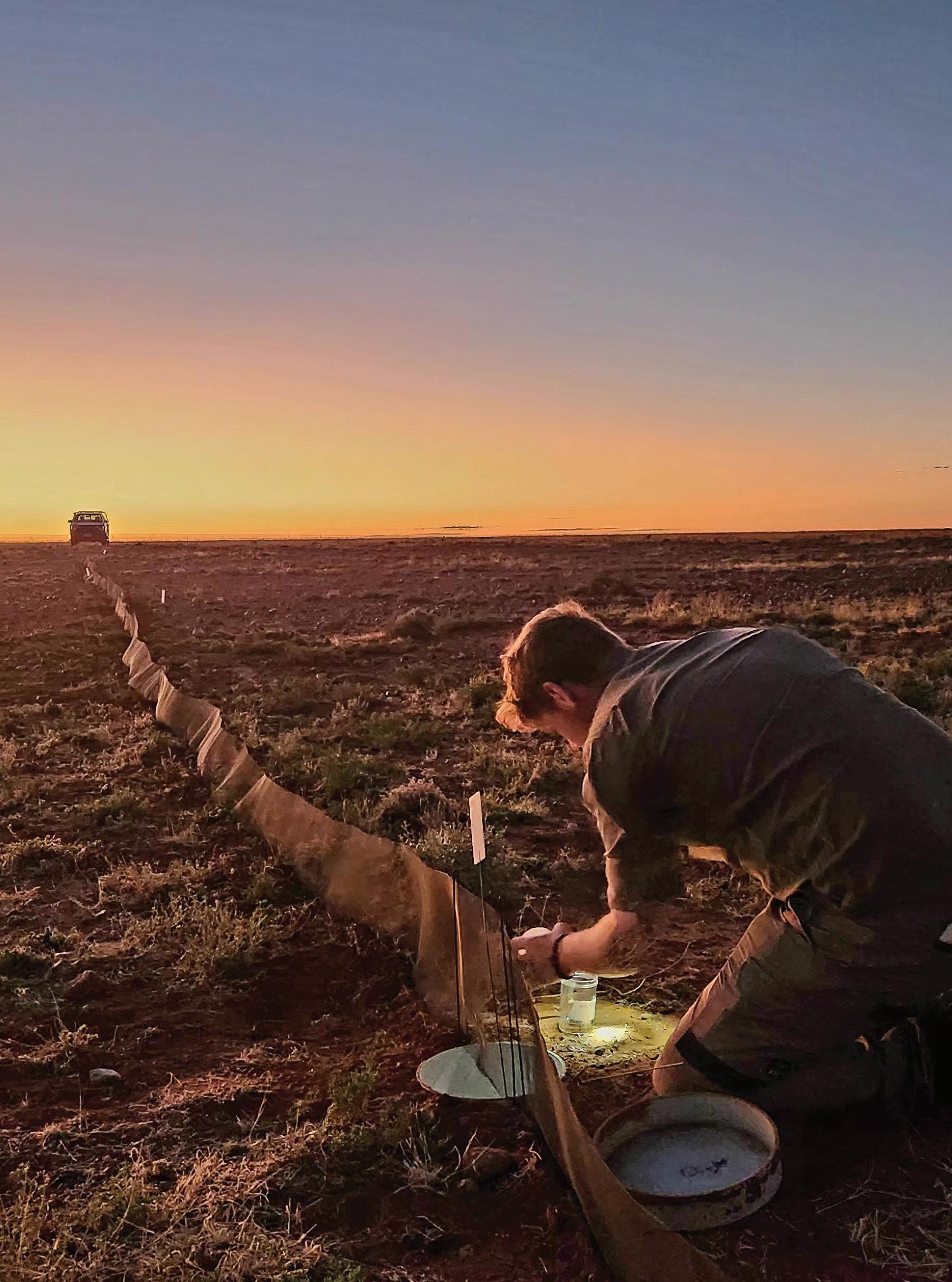
A volunteer checks the pitfall line at dusk for small reptiles
Reserve report
The feral-proof fence has been a remarkable success, creating a safe haven for reintroducing locally extinct species. But reintroduction is just the first step. We are committed to ongoing monitoring to track populations, understand interactions between species, and assess how climate and seasonal changes influence survival. Careful reserve management underpins this success, through fence maintenance and upgrades, installing new infrastructure, responding to feral animal incursions and managing reintroduced species populations. Together, science and land management ensure the Reserve remains a resilient refuge for wildlife.
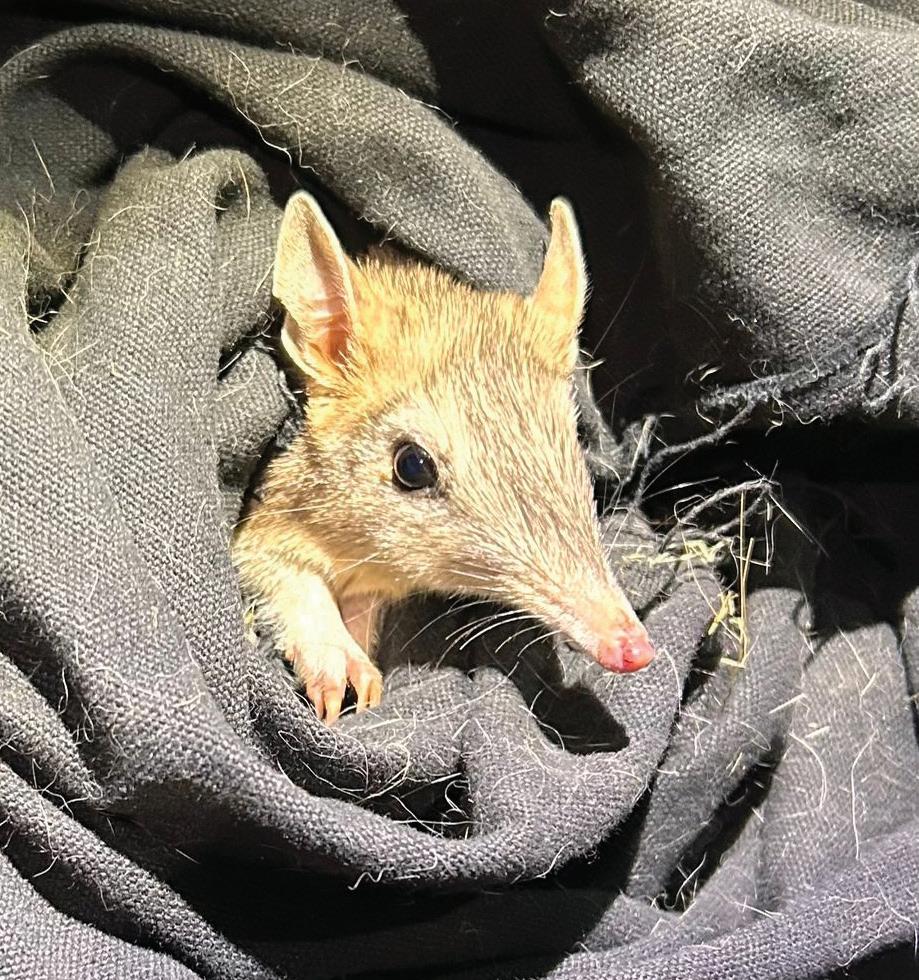
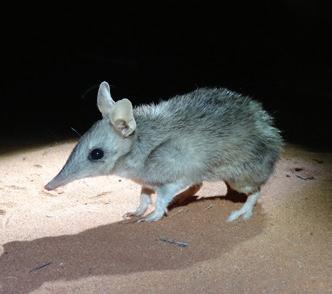
A Shark Bay bandicoot does not want to leave the catch bag after it was caught and processed
Annual cage trapping
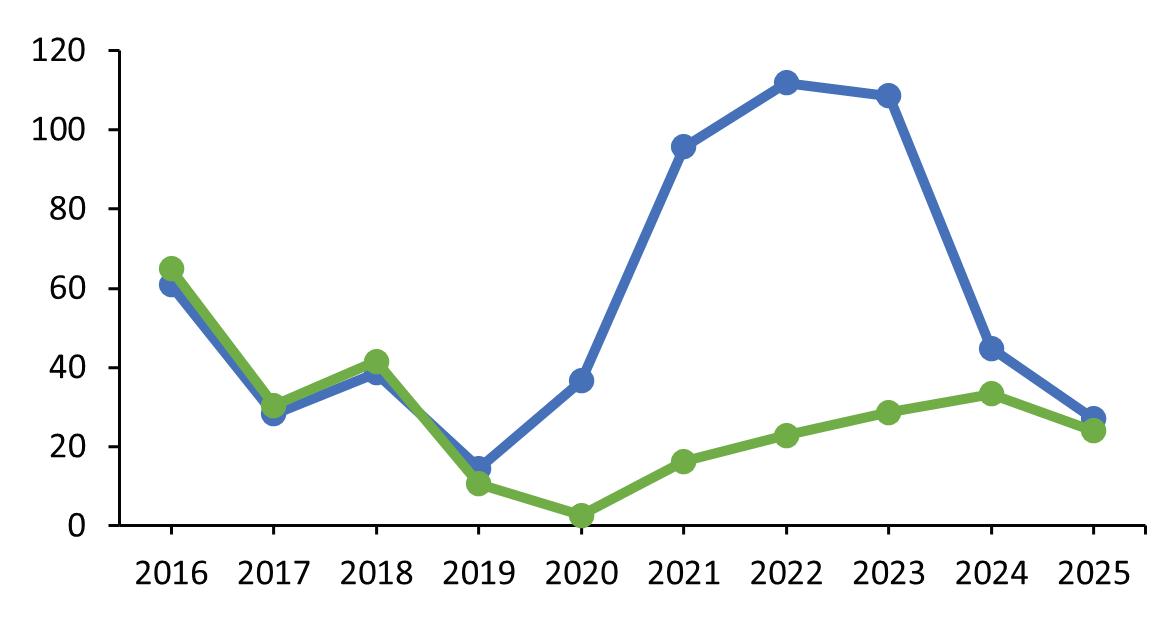
This year we conducted our 20th annual cage trapping survey. Cage trapping is an integral part of Arid Recovery’s monitoring program, providing an opportunity to assess their condition, breeding, and numbers in a way that we are unable to with other survey methods. From the capture data, we can monitor condition, estimate population size and monitor population dynamics over time.
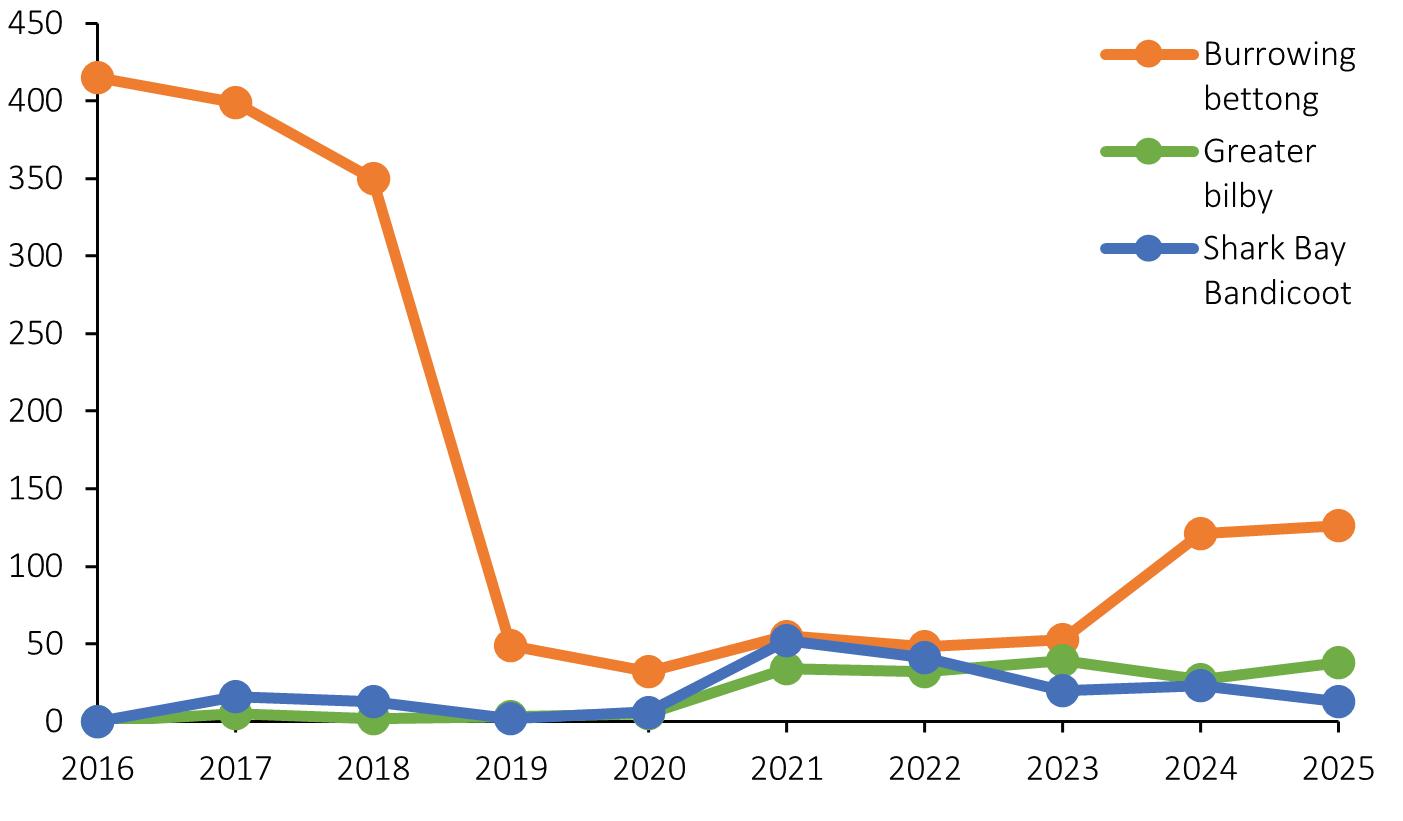
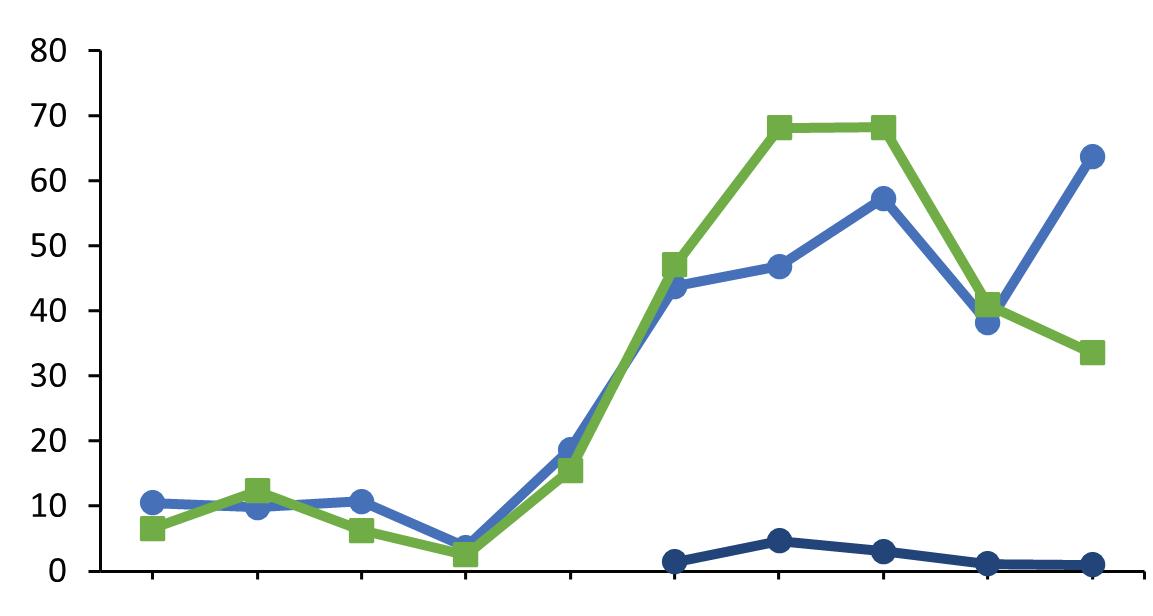
In May, we set 160 cage traps in the Main Exclosure over four nights, capturing, processing, and releasing 126 individual bettongs, 38 bilbies and 13 bandicoots. Bettong captures were similar to 2024, with an estimated population of over 200 individuals in the Main Exclosure. Bilby captures increased compared with 2024, with around 90% of individuals in good condition. Although fewer bandicoots were captured than in 2024, their average body mass had increased, indicating improved condition.
Track count monitoring
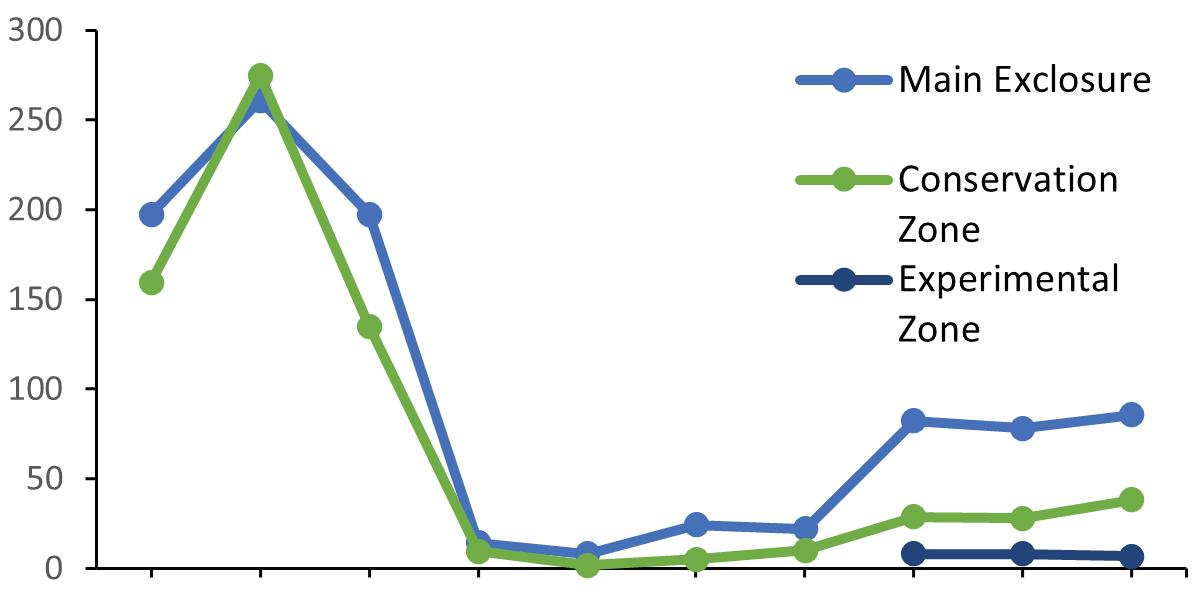
Monitoring reintroduced species across the 123-km2 reserve is a big task, but Arid Recovery is able to make use of the dune systems throughout the reserve to monitor our populations. Each quarter, we clear a track on dunes in each compartment and, the following morning, count the tracks of all the species that pass across or along the track. These surveys have been undertaken since 2000, providing an invaluable long-term data set that allows us to not only see clear trends in the activity of reintroduced species, but to also monitor the reserve for feral animal incursions. The influence of environmental factors such as climate can be studied. The activity of all species’ declined across the reserve in 2019 following a severe drought. Bilbies and bandicoots recovered sooner than bettongs post-drought. However, bettong activity has since increased, especially in the Main Exclosure where quolls are absent. Average track activity of quolls, bandicoots, and bilbies appears to be declining compared with previous years, but remain at viable levels. Bandicoot activity in the Main, while previously much higher than other paddocks, is now at similar levels to the other paddocks.
Figure 1. Annual captures of reintroduced species (2016-2025).
A trapped bettong waiting to be measured
Figure 2. Trackcounts of reintroduced species: burrowing bettong, western quoll, sharkbay bandicoot, and greater bilby from 2018-2025.
Kowari monitoring
Kowaris are thriving at Arid Recovery, three years on from translocation to the reserve. Twelve individuals were first introduced in 2022 to establish the first insurance population within a safe haven and help guide conservation efforts for this Endangered marsupial.
Trapping surveys are showing encouraging growth. In November 2024, 10 kowaris were recorded, rising to 34 by May 2025. This is a sharp increase from just 10 indviduals the previous May. Initially released into Red Lake, kowaris are now found across three compartments, and are steadily expanding their range.
PhD candidate Molly Barlow fitted 13 juvenile kowaris with radio-collars to study their movement and survival. Individuals were tracked for up to 11 weeks in Summer 2024-25, revelaing that young kowaris typically stay within 2 km of their den sites and move between a handful of key warrens. Some juvenile kowaris even shared dens with siblings or their mother, suggesting dispersal may occur later than expected.
Managing bettong overabundance
Long-term cage trapping and track count monitoring have been invaluable for managing the bettong population, particularly in the quollfree Main Exclosure. In 2016 the bettong numbers peaked at approximately 8,000 individuals, which placed significant strain on the ecosystems within the reserve. Bettongs, which feed primarily on vegetation, were over-browsing plants, and outcompeting other species with similar diets. Various management strategies were trialled, including one-way gates to allow bettongs to move outside the reserve.
In 2018, the western quoll was reintroduced to Arid Recovery to provide a native predator to help regulate the bettong population. Following this, and coinciding with severe drought, bettong densities declined significantly. Since then, a few good rainfall years and the regulating influence of quolls have allowed the bettong population to recover and stabilise.
As the Main Exclosure remains quoll-free, careful monitoring and active management are required to maintain a sustainable population of bettongs. Since late 2023, small cohorts of bettongs have regularly been moved from the Main Exclosure to other compartments, reducing the pressure on resources within Main and supplementing bettong populations elsewhere in the reserve. After relocating over 100 bettongs in 2023/24, the Main Exclosure population rebounded to similar densities in 2025, triggering further relocations. Managing bettong overpopulation in the Main Exclosure requires ongoing effort.
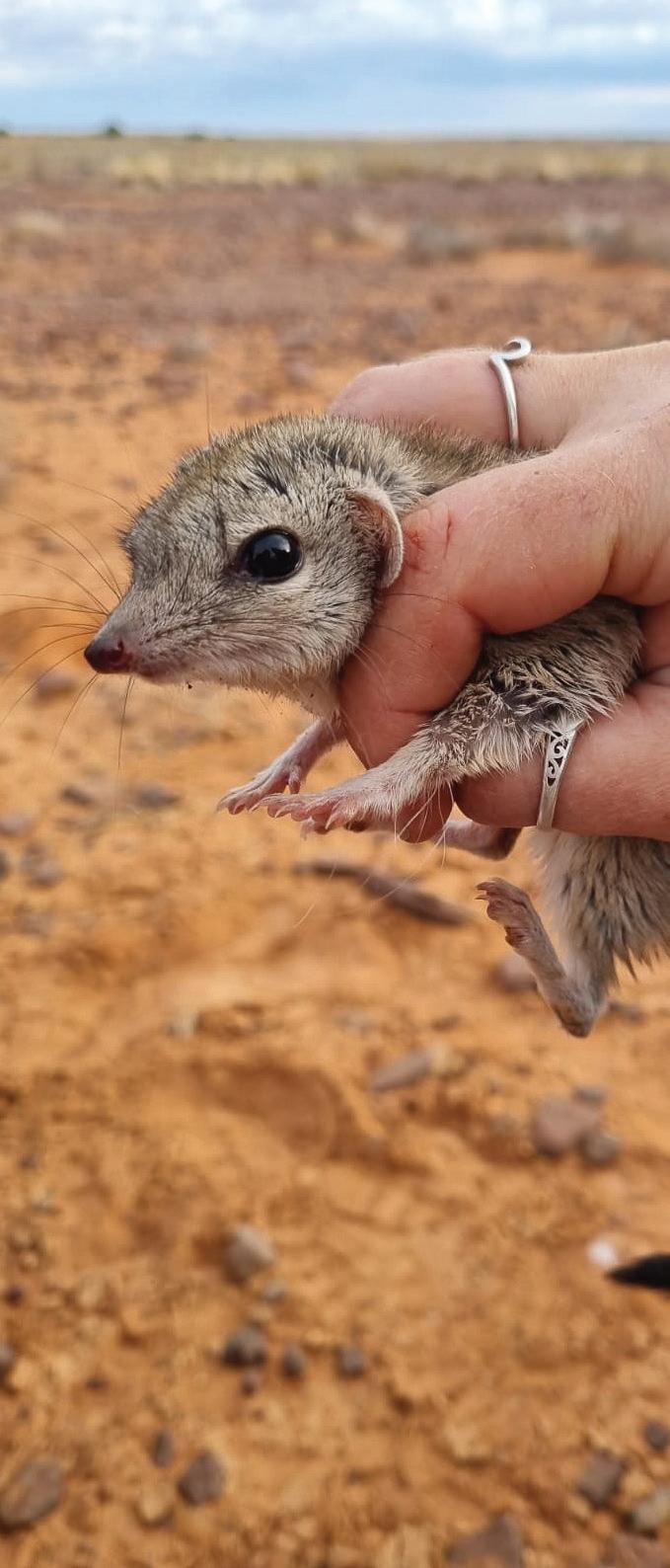
A kowari caught, measured, and ready to be released
Annual small verterbrate pitfall trapping
In March 2025, Arid Recovery conducted its 27th annual pitfall trapping survey, with support from more than 20 volunteers. Over three nights and four days, a total of 488 animals were captured across 19 sites, inside and outside the Reserve. Total captures were lower than in the previous two years, when totals exceeded 1,000 individuals. Among the highlights was the desert mouse (Pseudomys desertor), which has only occasionally been recorded in recent years.
Consistent with long-term trends, more mammals were recorded inside the reserve than outside. Within the reserve, the highest captures were in the predator-free Main Exclosure, whereas fewer small mammals were recorded in compartments where quolls and kowaris are present.
Vegetation monitoring
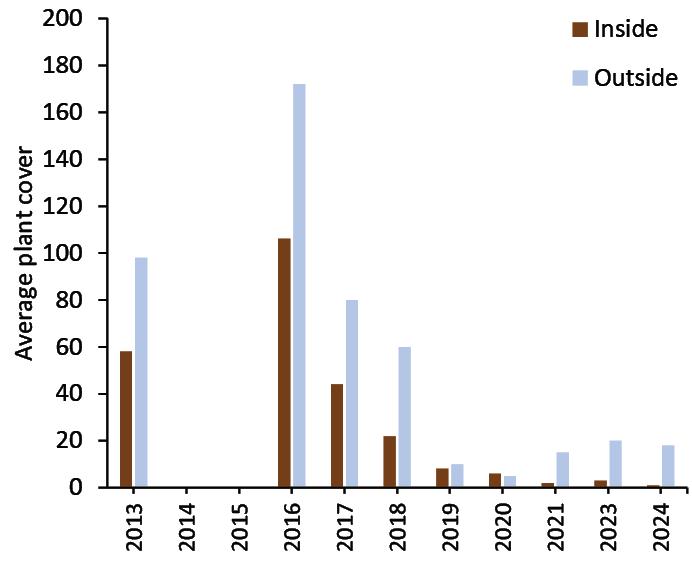
Vegetation monitoring has been undertaken with the support of volunteers and interns each spring since 2013, to study plant cover and species composition inside and outside the reserve.
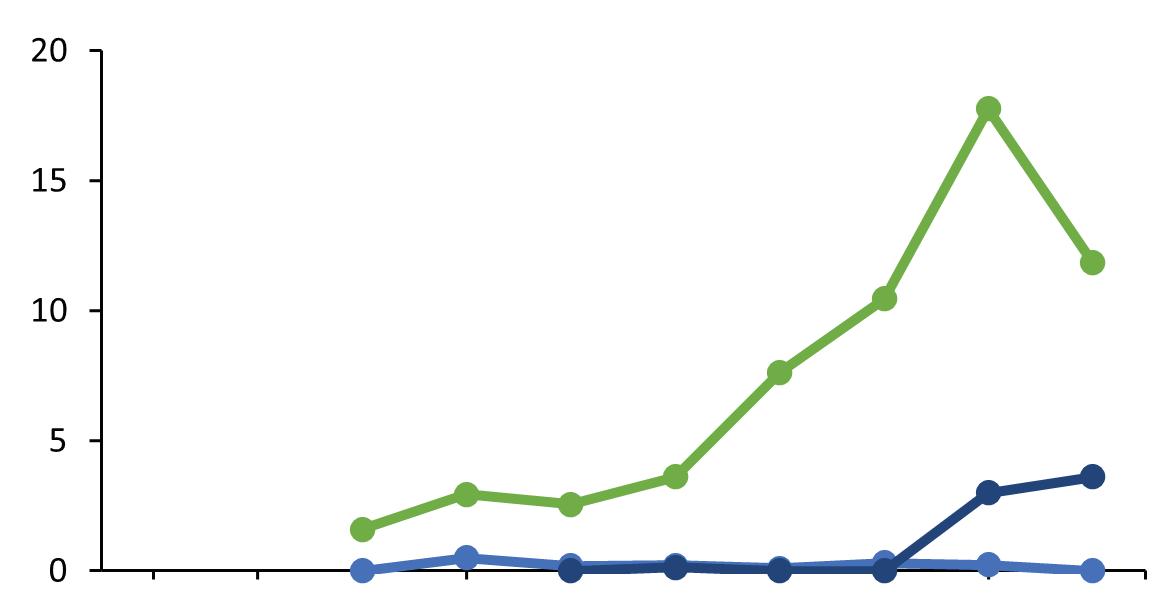
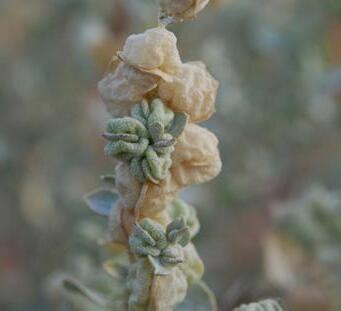
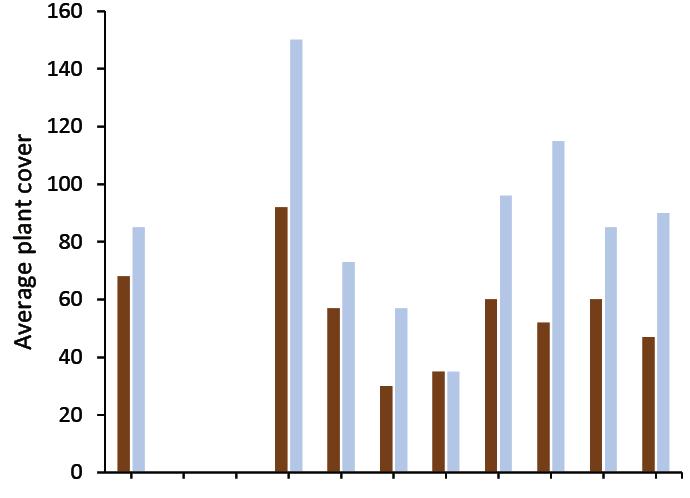
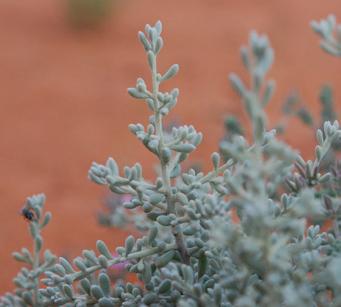
While all plant species are recorded, this year we paid particular attention to the slow-growing perennial chenopods, Maireana and Atriplex. Species in these groups reached their minimum during the 2019 drought, when widespread mortality was observed. Since then, monitoring has found only partial recovery, with cover remaining below pre-2019 levels both inside and outside the reserve (Fig. 3).
Looking ahead, we will be paying close attention to these key species, measuring both recruitment and recovery. Assessing the recruitment and establishment of new plants and the recovery of mature shrubs will provide important insights into the long-term resilience of chenopod shrublands.
Figure 3. Average plant cover of Atriplex (above) and Maireana plant species (below) from 2013 to 2024.
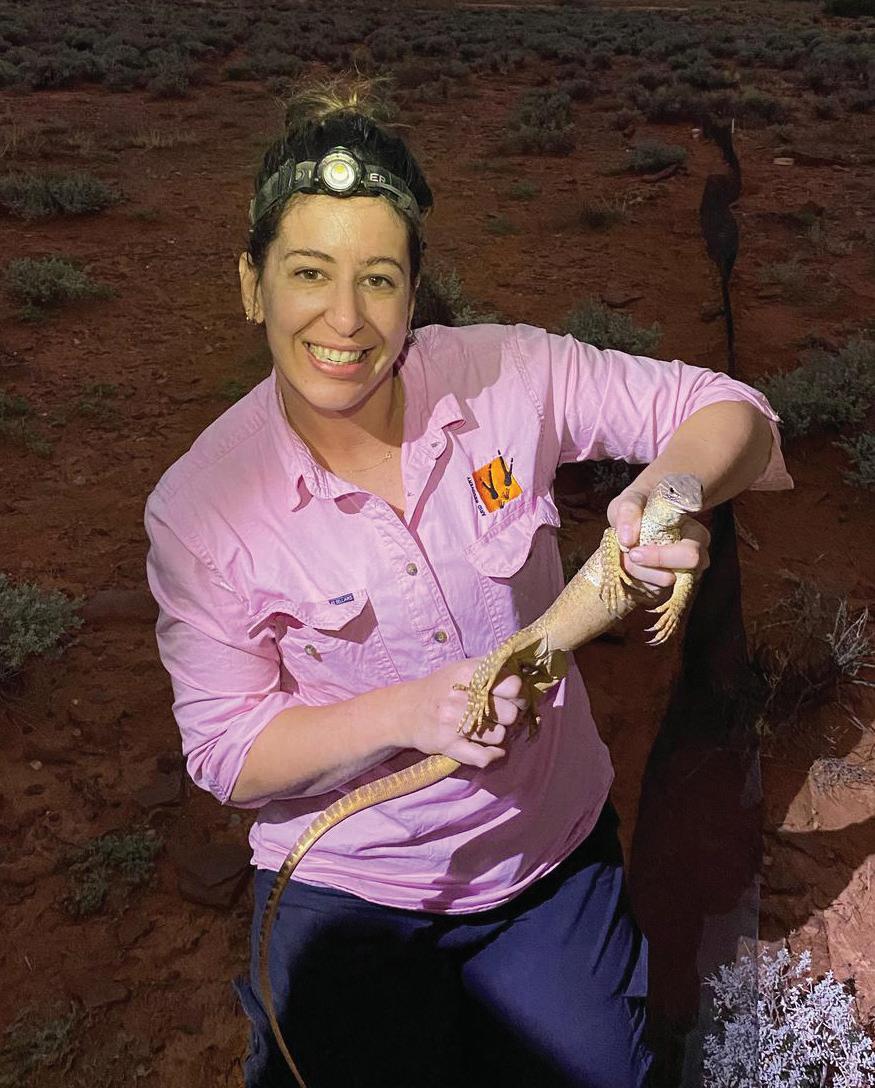
Bianca getting a sand goanna out of the pitfall trap
Fat-tailed dunnarts are one of the volunteers' favourite species to catch
Managing the reserve
Behind every conservation success at Arid Recovery is the unglamorous but vital work of keeping the Reserve running. For the past five years, this has been the domain of our Conservation Land Management Officer, Nathan Manders. Nathan’s job is part handyman, part land manager, part problemsolver.
Securing the fence
“It can be a tough job. A stressful job. It’s challenging and dynamic, in the best possible way. Over the last 5 or so years we’ve worked really hard to get an ageing fence up to a standard where it’s capable of handling these extreme weather events, be it gale-force winds or intense summer rains."
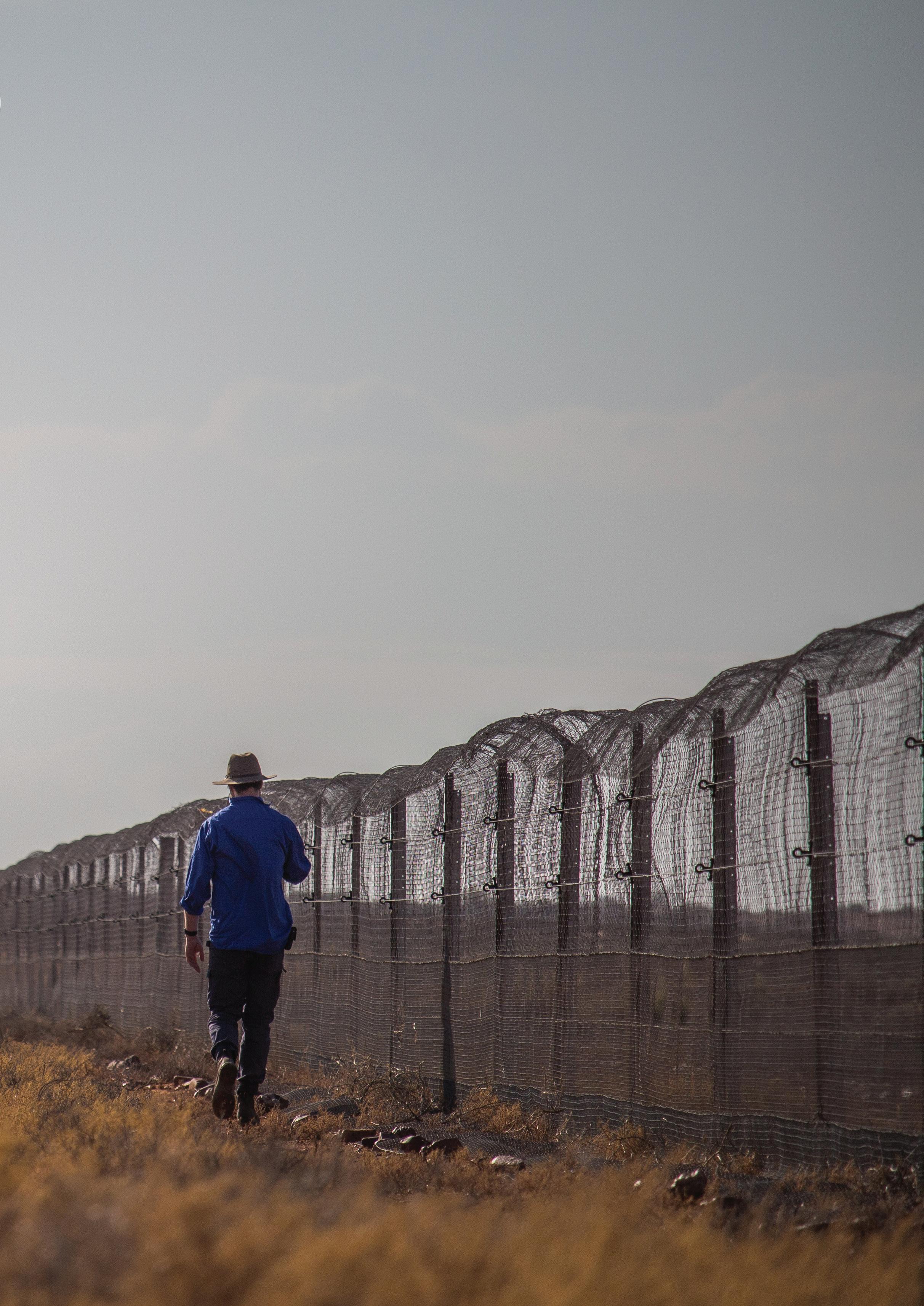
Every week, Nathan, assisted by field officer Mahalia, patrols the 80 km of feral-proof fencing, checking for damage and making repairs to keep cats, foxes and rabbits out. This year, he and the team from Burra Fencing installed more than 7 km of corrosion-resistant footnetting. Volunteers also reinforced 18 km of floppy-top along the Dingo Paddock fence. For two months, Nathan was joined by Field Officer Jonah Wiltshire, who focused on repairing the Dingo Paddock fence; fixing gates, welding sections to stop the floppy-top blowing inward, and patching over 200 gaps. Together, these efforts kept the Reserve’s most important line of defence strong.
Animal incursions
Despite the Team's efforts, incursions still occur, and responding quickly is critical. This year, Nathan dealt with two cat incursion events, one in the Main Exclosure and one in Red Lake, and finally removed a rabbit in Northern Paddock. A western quoll also made its way into the quoll-free Main Enclosure in 2024. Nathan removed the quoll in December, and it was relocated to a different part of the reserve.
Feral cat and fox control
Controlling cats and foxes is essential for supporting recovery both within the reserve and across the broader landscape. Predator control is supported by 53 active cage traps, four Felixers, and an expanded Celium alert system. Over the last few years "we’ve ramped up our perimeter trapping efforts significantly, so we’re removing more cats from the environment than ever," says Nathan.
As well as running our network of cat traps, Nathan also oversees feral animal monitoring and management via the western camera grid, our network of cat traps, our local volunteer shooters, and manages our cat dissection program to better understand what cats are preying on over time.
Feral cat and fox control
• 145 cats trapped around the reserve perimeter.
• 20 cats trapped in Dingo Paddock.
• Three incursion cats trapped in the Main Exclosure.
• 64 cats removed by professional and skilled volunteer shooters.
• Three foxes trapped around the reserve perimeter in autumn.
• 16 cats successfully targeted by Felixers.
Lessons learned
“
One thing I’ve learnt over the years is while we’re working so hard to achieve our goals, it’s important to sit still every now and then and just take it all in. Just have a moment. Sit on the gibber and watch a kowari hunt bugs in the torchlight, stand still and let an inquisitive young quoll sniff your boots on the 5th straight night of hunting the last incursion rabbit, go and explore the flooded claypans after a good rain, or watch a bilby outsmart a barn owl through the Mitchell grass. It’s easy to get so consumed by all the work that needs to be done that you can sometimes forget why you're doing it in the first place. I’ve found that little moments like these just ground me bit. Help me see the bigger picture.”
Expertise recognised
Nathan’s expertise has been recognised locally and internationally. He has presented at the SA Indigenous Ranger Gathering on feral animal trapping and shared Arid Recovery’s knowledge at the Australasian Vertebrate Pest Conference and International Rangeland Conference.
Managing the Reserve day in and day out is essential to keeping it a safe haven — a place where threatened species can recover and science can drive conservation forward.
“It can be a tough job. A stressful job. It’s challenging and dynamic, in the best possible way.”
— Nathan Manders
Nathan Manders checks the Arid Recovery fence for holes
Community Engagement
In 2024–25, Arid Recovery reached thousands of people through tours, festivals, school programs and national media. From awardwinning photography to hands-on events, we brought desert wildlife into the spotlight and inspired new champions for conservation.
Science in the spotlight
An award-winning image
Former intern Jannico Kelk earned an Impact Award in the Natural History Museum’s Wildlife Photographer of the Year competition and was featured in publications across the globe for his photograph, 'Hope for Ninu'. For Jannico, the journey to capture a bilby was years in the making. “I’ve been going to Arid Recovery for five years, over four different visits. The first visit, I only saw one bilby. On the second, after three or four months of solid photography, I only managed one lousy photo.” The payoff came after 125 mm of rain, which allowed bilby numbers to increase. “Finally, I was able to get a photo,” says Jannico. His image not only showcases the species, but the conservation work and feral animal control that make their survival possible.
Rallying behind the kowari
Arid Recovery and Team Kowari joined forces for The Project's Marsupial of the Year campaign. Out of 20 competing species, the kowari advanced to the second round thanks to public support and raised over $8,000 for conservation efforts. The campaign brought national attention to one of Australia’s least-known carnivores and much needed funds for research.
Local spotlight: ABC’s Back Roads
Arid Recovery made it onto ABC’s Back Roads in their episode on Roxby Downs and Andamooka. Our Chief Executive, Dr Kath Tuft, took presenter Heather Ewart behind the scenes to see how we’re protecting threatened species. The show featured chats with the team, plenty of bettongs, and of course, lots of red dirt.
Hope for Ninu by Jannico Kelk
Community connections
In 2024–25, Arid Recovery delivered 22 guided tours and a program of special events at the Reserve, alongside outreach in Roxby Downs, Andamooka and Adelaide. These activities showcased threatened species and conservation science, engaging more than 1,400 people. Participants included school students, community groups, tourists and conference delegates. Together, these efforts extended our influence and deepened community connections.
Event highlights
• Open Day – 110 people joined us for tours, wildlife face painting, and an escape room challenge.
• Starlight Dinners – Six special evenings under the stars, including events for Rangeland Conference delegates and the SA Arid Lands Landscape Board.
• BHP Family Days – Hands-on stalls in Adelaide and Olympic Dam with snakes, scat ID, and camera-trap activities.
• Easter Bilby – A family activity with Roxby Downs Community Library, celebrating bilbies over bunnies.
• Science Week – Workshops and school activities exploring animal adaptations and desert survival.
• Community festivals – From the Roxby Downs World Music & Food Festival to the Andamooka Opal Evolution Festival, we shared the wonder of desert wildlife with glowing scorpions, geckoes, and more.
• School programs – Hosted workshops and activities for St. Barbara’s Catholic School, Australian Science & Maths School, Roxby Downs Area School, and Roxby Downs Kindergarten.
Conservation doesn’t happen in isolation. It takes people: passionate volunteers, curious students, Traditional Owners, researchers, landholders, and local communities.
At Arid Recovery, we are committed to building strong, lasting relationships with the people who make recovery possible. Whether it’s hosting a school group, working with Indigenous Rangers, or sharing stories in person or online, connection is at the heart of everything we do.
2024-25 Financial Report
Arid Recovery’s accounts were audited by MTC Group Auditors. The full audited financial report is available on Arid Recovery’s profile on the Australian Charities and Non-for-profits Commission website (www.acnc.gov.au).
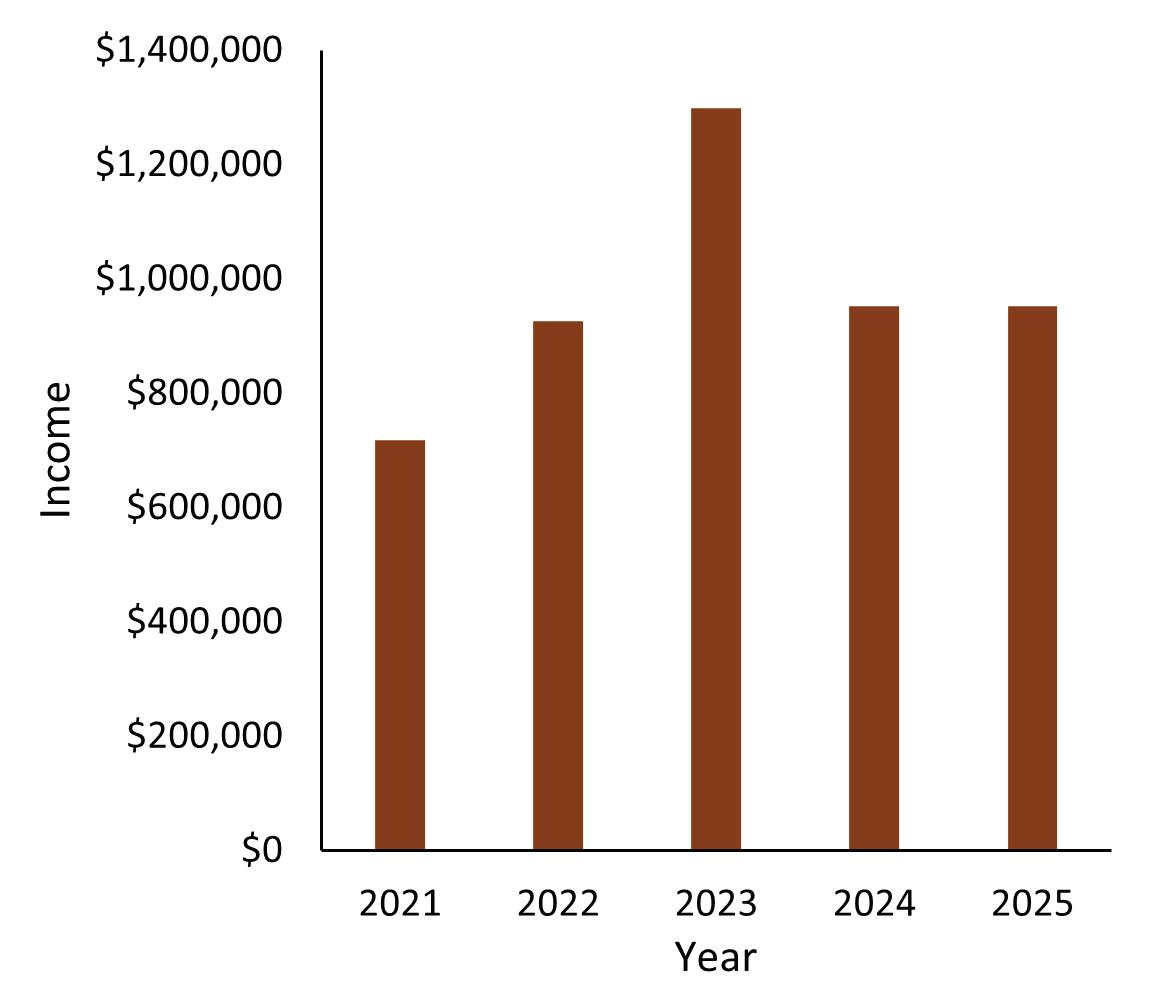
Base income remained stable in 2025, supported by the ongoing contributions from our key partners, BHP, Bush Heritage and the Department for Environment and Water. Total revenue was consistent with 2024 levels.
Grant income was lower this year, reflecting the completion of several project grants in 2024. Other income increased, driven by additional fee-for-service work undertaken during the year. Expenditure was lower overall compared to 2024, largely due to reduced spending on fencing materials thanks to improvements made during the term of the Safe Haven Grant. Conversely grant expenditure increased as accumulated funds from multi-year grants were utilised to deliver on funding commitments, and new grant income was used to purchase equipment for current projects. Wage expenditure also decreased, reflecting less reliance on short-term field officer positions during the year.
We invite you to:
Donate
Help protect native species and expand our research and conservation efforts.
Volunteer
Join hands-on efforts to restore and monitor threatened animals and their critical habitat.
Partner
Collaborate with us to support solutions to environmental challanges.