Front Porch - 138 | ABPG

Page 1


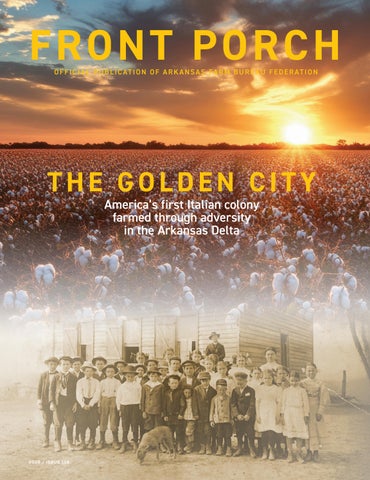
FRONT PORCH

OFFICIAL PUBLICATION OF ARKANSAS FARM BUREAU FEDERATION

THE GOLDEN CITY

America’s first Italian colony farmed through adversity in the Arkansas Delta

We’re always comfortably right here. Waiting and ready when you are and with every resource we can deliver. We’re powering your “connect this. Click that. And go” every single day, right where you live. Delivered by your local electric cooperative. Each cooperative is unique, yet all are united. Our mission is to provide reliable, affordable and responsible power to every corner of Arkansas. And we’re expanding to deliver fiber for a more connected world. It’s your local, hometown cooperative way, because we’re better connected, together.

CONTENTS

FRONT PORCH

5 / My View From the Front Porch

Dan Wright

7 / Serving Farmers, Serving You

Jarrod Yates

8 / Cover Story: The Golden City

Learn the hidden history of early Italian immigrants in Arkansas who overcame adversity with grit and determination

17 / Arkansas

Agriculture Hall of Fame

Meet the 2026 inductees

24 / A Day in the Life of a Game & Fish

Game Warden

Sergeant Brady Baker helps protect Arkansas's natural resources

34 / A View From the Counties

Outreach and education across Arkansas

38 / Taste Arkansas

Stopping on the Arkansas Farm Trail at Holland Bottom for sweet, seasonal strawberries

40 / Delta Child

Talya Tate Boerner

MY VIEW FROM THE FRONT PORCH

People constantly ask me, “What is Farm Bureau working on?” Most of the time, I give them the short version. The truth is, there are dozens of issues we tackle every day. Some are visible, others happen quietly behind the scenes and many continue to evolve as we work through them. For this column, I want to narrow that list to two volatile issues that remain very much in motion.

The first is the continuing crisis facing row and specialty crop agriculture here in Arkansas. Farmers across our state are under real financial pressure. Tight margins caused by low commodity prices, persistently high input costs and labor shortages have put many producers in a position they have never experienced before. Even with good yields and sound management, the numbers simply do not work for many operations.

In December, we saw some much-needed relief with the passage of a $12 billion bridge payment for row crop and specialty crop farmers. That assistance was appreciated and provided shortterm help at a critical time. However, when spread across farms nationwide, it covers only about 25% of the estimated losses for the 2025 crop year. While helpful, it was never intended to solve the long-term challenges facing these industries.

There are ongoing conversations in Congress about additional assistance for agriculture, and that is encouraging. More importantly, lawmakers continue to recognize agriculture as a national security issue. A stable, affordable food supply matters, and the ability of American farmers to remain productive matters. Farm Bureau will continue working with our congressional delegation to ensure Arkansas farmers are heard as these discussions move forward.

The second issue that remains in motion is the situation surrounding the Illinois River Watershed. At the center of this discussion is the application of poultry litter — an organic and effective fertilizer that has been used by farmers in this region for generations. Poultry producers have long worked to balance environmental stewardship with the realities of production agriculture, and they take that responsibility seriously.

Recent legal developments and continued discussions remind us that this issue is far from settled. Arkansas farmers care deeply about the land and water we pass on to the next generation. At the same time, decisions affecting agriculture must be rooted in sound science and practical solutions. Farm Bureau will stay engaged, ensuring farmers have a seat at the table and that policies reflect both environmental goals and on-farm realities.

Through all of this, leadership matters. This year marks an important transition for Arkansas Farm Bureau as we recognize the service of Vice President Mike Freeze. Mike has provided years of steady, thoughtful leadership. He has been a trusted voice, a problem-solver and a tireless advocate for farmers across our state. His commitment to our grassroots structure has left this organization

stronger than he found it, and we owe him our sincere thanks.

At the same time, I’m excited to introduce Magen Allen as our incoming Vice President. Magen brings energy, perspective and a clear understanding of today’s agricultural challenges. She values listening first, leading with integrity and keeping farmers at the center of every decision. I’m confident she will serve our members well as we prepare for the future.

As spring approaches, my encouragement is simple: Stay engaged. Stay involved in your county Farm Bureau. Stay connected with your neighbors. Stay willing to speak up when agriculture needs a voice. The challenges before us are real, but so is the strength of this organization and the people behind it.

Farming has never been easy, and it was never meant to be. But Arkansas farmers are resilient, resourceful and committed to the land and communities we love. As the seasons change, I remain confident that together we will continue working toward solutions that protect our livelihoods today and preserve opportunities for those who follow.

“Let us not become weary in doing good, for at the proper time we will reap a harvest if we do not give up.” — Galatians 6:9

FRONT PORCH

Official membership publication of Arkansas Farm Bureau Federation mailed to more than 160,000 member families.

SUBSCRIPTIONS

Included in membership dues

ARKANSAS FARM BUREAU

OFFICERS:

President / Dan Wright, Waldron

Vice President / Magen Allen, Bismarck

Secretary/Treasurer / Terry Dabbs, Stuttgart

Executive Vice President / Jarrod Yates, Benton

DIRECTORS:

Jon Carroll, Moro

Brad Doyle, Weiner

Jack Evans, Carlisle

Sherry Felts, Joiner

Chase Groves, Garland City

Jason Henson, Mount Judea

Terry Laster, Strong

Caleb Plyler, Hope

Bob Shofner, Centerton

Dana Stewart, Judsonia

Joe Thrash, Houston

Mark Williams, Lavaca

EX OFFICIO

Nita Cooper, Everton

Sara Beth Johnson, Hickory Plains

Clay Parker, Carlisle

Justin Story, Cauthron

Executive Editor / Bryan Pistole

Contributing Writers / Shaylee Wallace Barber, Jason Brown, Chad Hooten, Justin Rotton, Talya Tate Boerner

ADVERTISING

Contact Chad Hooten at Arkansas Farm Bureau for advertising rates

chad.hooten@arfb.com (501) 228-1274

Front Porch (USPS 019-879) is published quarterly by the Arkansas Farm Bureau Federation 10720 Kanis Rd., Little Rock, AR 72211

Periodicals Postage paid at Little Rock, AR

POSTMASTER: Send address changes to Rhonda Whitley at rhonda.whitley@arfb.com

Front Porch • P.O. Box 31 Little Rock, AR 72203

Please provide membership number Issue #138

Publisher assumes no responsibility for any errors or omissions. All rights reserved. Reproduction without permission is prohibited.

The Arkansas Farm Bureau Federation reserves the right to accept or reject all advertising requests.

FOOD SECURITY IS NATIONAL SECURITY

SUPPORTING FARMERS AND RANCHERS MATTERS

Food security is often discussed in terms of grocery prices, supply chains or global hunger. But at its core, food security is national security: a nation that cannot reliably feed its people is a nation vulnerable to economic instability, social unrest and external pressure.

In the United States — and especially in Arkansas — farmers and ranchers are not just food producers; they are frontline defenders of our country’s independence and long-term security.

America’s agricultural system is among the most productive and efficient in the world. Farmers and ranchers provide a safe, affordable and abundant food supply. That reliability is the result of generations of stewardship, innovation and hard work. Organizations like Arkansas Farm Bureau play critical roles in supporting that system by giving farmers and ranchers a unified voice in policy discussions that directly impact food production and rural livelihoods.

A secure food supply is the foundation of economic stability. In Arkansas, agriculture is a cornerstone of the state’s economy, sustaining rural communities and small towns. When farms and ranches thrive, local businesses thrive. When they struggle, entire communities feel the effects. Arkansas Farm Bureau works to protect farm profitability and rural economies through advocacy, education and member-driven policy solutions.

Food security is also deeply tied to national defense and global stability. Maintaining a strong domestic agricultural base reduces America’s reliance on imports and strengthens national independence. Arkansas Farm Bureau helps ensure farmers and ranchers remain viable and America retains control over its food supply.

In Arkansas, producers manage millions of acres of farmland, forests and rangeland. Their efforts protect wildlife habitats, reduce erosion, improve water quality and strengthen long-term productivity. Arkansas Farm Bureau actively promotes science-based conservation solutions allowing farmers to care for the land while continuing to feed a growing population.

Despite their importance, farmers and ranchers face mounting challenges. Rising input costs for fuel, fertilizer, feed and equipment strain already thin margins. Extreme weather events — droughts, floods and severe storms — are becoming more frequent and costly. Regulatory pressures and market volatility add additional uncertainty. Many

farms operate one bad year away from closure.

That is why strong advocacy matters. Arkansas Farm Bureau exists to stand up for farmers and ranchers at the local, state and national levels. By joining Farm Bureau, members help shape policies related to crop insurance, disaster assistance, conservation programs, trade, labor and regulatory reform. Membership strengthens agriculture’s voice and ensures that decisions affecting food production are made with input from those who know it best — the people working the land.

Farm Bureau membership is open, not only to producers, but to anyone who believes in food security, rural communities and strong American agriculture. When consumers, landowners and agriculture supporters join Arkansas Farm Bureau, they help bridge the gap between farm and table and stand up for the people who feed us all. National security conversations often focus on military readiness, energy independence or infrastructure. Food security deserves equal attention. A well-fed nation is a stable nation. A nation that supports its farmers and ranchers protects its economy, sovereignty and future.

SUNNYSIDE PLANTATION

THE RECENTLY UNCOVERED HISTORY OF AMERICA'S FIRST ITALIAN COLONY

PHOTO BY MATTHEW MAGDEFRAU
Neither violence nor valuables were motives for picking the lock of a 23-year-old brunette’s hotel room door. The intruder only wanted her notebook.

President Theodore “Teddy” Roosevelt agreed in the summer of 1907 to dispatch Federal Investigator Mary Grace Quackenbos from New York to Lake Village, Arkansas. Leroy Percy, a lawyer, planter and future U.S. Senator from the area, would temporarily assist Quackenbos with an investigation at an area plantation. Not much would come from it, initially, but only because her notebook documenting the treatment of Italian immigrants went missing.

Repeated complaints from the plantation to the Italian Embassy reached the White House alerting Roosevelt’s administration that some of America’s newest citizens were in trouble down in the Delta. It required the President’s due diligence, so he agreed to send Quackenbos south to look around.

Her notebook? It turned up — after some time. But not in Lake Village, nor New York. It was uncovered from a pile of files in 1986 at the National Archives in Washington, D.C.

SEEKING A BETTER LIFE

ONE HUNDRED ITALIAN FAMILIES — 562 men, women and children — left their native land Nov. 8, 1895, sailing three weeks on a livestock ship to New Orleans (not Ellis Island, New York, like others later) and then up the Mississippi River by steamboat to their new home, landing Dec. 4, 1895, at Sunnyside Plantation in Chicot County, Arkansas. America’s first Italian colony sits 25 miles north of Louisiana and just southwest of a bend in the river at Greenville, Mississippi. More

Leroy Percy leased and managed Sunnyside Plantation during its investigation in 1907. Percy visited President Theodore "Teddy" Roosevelt shortly after the investigation began. They had met earlier on a bear hunting trip (this bear hunt was the origin of the teddy bear) near Lake Village, Ark.

COURTESY HARRIS & EWING; LIBRARY OF CONGRESS

SUNNYSIDE PLANTATION

than 13,000 acres of fertile fields are surrounded on its other borders by a 22-mile crescent of water called Lake Chicot, the largest oxbow lake in North America at 5,000 acres.

Land was limited in Italy, virtually unattainable, so Sunnyside was an alluring dream. Printed promotional fliers circulated in Italy promising paradise in Southeast Arkansas with assurances of land ownership, a pleasant climate, artesian wells and colonial houses. It was described as a “Golden City.”

The Italians were anxious, arriving with all their family belongings in one trunk and with signed contracts to eventually own a parcel of land. The agreements required no down payments on 12.5 acres costing $2,000 total ($160 per acre) with 5% interest. It was a 20-year loan to be paid with earnings from working Sunnyside fields for New York tycoon Austin Corbin, who acquired the land not long after the Civil War.

COURTESY UNIVERSITIES AND THEIR

In early December, Lake Village temperatures average a high of 55 and low of 46. So, the immigrants indeed found Sunnyside’s climate pleasant upon arrival. But many wouldn’t be able to weather what was ahead.

SUNNYSIDE’S SHREWD OWNERSHIP

THE LAND HAD ALREADY proven lucrative. In 1840, a planter named Elijah Worthington bought 4,000 acres at Sunnyside and turned it into one of the nation’s premiere plantations. Worthington used his profits over two decades to buy another 8,000 acres. Sunnyside was an economic machine until the Civil War.

Destroying financial infrastructure was an effective maneuver used by the Union Army. Ten thousand soldiers wiped out Lake Village and a financial default on the plantation (coinciding with the loss of slave labor) eventually landed Sunnyside in Corbin's hands.

Corbin graduated Harvard Law School, owned Long Island Railroad, was a banking giant and creative entrepreneur.

A Romanesque Revival-style building named for Corbin still stands in Manhattan’s Financial District and is on the National Register of Historic Places.

Corbin was also a ruthless businessman. He and his cohorts strong-armed the Montaukett Indian tribe in the early 1890s out of almost 10,000 acres in New York. He owned Manhattan Beach, a resort in Brooklyn, which he barred Jews from visiting.

Corbin’s plans for profit at Sunnyside started by making a deal in 1894 with the state of Arkansas for convict labor, using 150 prisoners to pick cotton. Arkansas would pocket 50% of proceeds. The other half would go to Corbin in New York.

The prisoners proved inefficient, though, and crop yields suffered. Corbin’s agreement with the Arkansas Board of Penitentiary Commissioners ended after one summer.

A NEW WORKFORCE

CORBIN CAME UP WITH a new idea for labor. His niece, Josephine Mary Beers-Curtis from New York, had married Rome mayor Emanuele Ruspoli nine years earlier in Paris. It was the mayor’s third marriage. He was 47; she was 24. Corbin got to know his nephew-in-law and asked him to be his plantation partner. Ruspoli and his bride traveled by train in October 1894 shortly after the convicts completed harvest at Sunnyside. The mayor was impressed by the fertile-looking fields and a business was born.

Ruspoli would recruit industrious Italians back home to populate Sunnyside as Corbin came up with contracts and financials from New York. The duo worked fast. Corbin purchased Sunnyside on Dec. 1, 1894, and with Ruspoli’s help, the Italians landed in Lake Village 368 days later. The settlers had 20 years to pay off the 12.5 acres and it would be theirs.

New York tycoon Austin Corbin bought Sunnyside on Dec. 1, 1894, and partnered with his nephew-in-law Emanuele Ruspoli, the mayor of Rome, to establish America’s first Italian colony in Lake Village, Ark.
SONS
Italian families found unsanitary Mississippi River backwater, shotgun shacks and unhealthy living conditions in December 1895 at Sunnyside Plantation in Lake Village, Ark. Spring brought warmer weather, high humidity and monster mosquitos. Up to one-third of the immigrants died from malaria the first summer. PHOTO BY MATTHEW MAGDEFRAU

Theodore Roosevelt (center) tells his party how he shot a boar at the 25,000-acre Corbin Wildlife Preserve in 1902 near Croydon, N.H. The park, known for its secrecy with locked gates and high fences, was bought by New York tycoon Austin Corbin in 1889, five years before he purchased Sunnyside Plantation in Lake Village, Ark.

COURTESY UNDERWOOD & UNDERWOOD; LIBRARY OF CONGRESS

A Romanesque Revivalstyle building named for Austin Corbin still stands in Manhattan’s Financial District and is on the National Register of Historic Places. Corbin graduated Harvard Law School, owned Long Island Railroad, was a banking giant and creative entrepreneur. Treatment of Italian immigrants at his Sunnyside Plantation in Lake Village, Ark., drew federal investigators in 1907.

COURTESY METROPOLITAN

TRANSPORTATION

AUTHORITY / PATRICK CASHIN

SUNNYSIDE PLANTATION

If the Italians had known land in the region was going for $25 per acre instead of the $160 ($259.70 with interest) they were paying, they might have been better prepared for what was ahead.

There were neither artesian wells nor colonial homes when they arrived, only unsanitary Mississippi River backwater, shotgun shacks and unhealthy living conditions. Spring brought warmer weather, increasing humidity and monster mosquitoes. More than 125 immigrants died the first summer, most from malaria.

Despite desperate conditions and language barriers, the Italians learned to grow cotton. Good yields were needed to make their annual land payments. If the harvest, regardless of weather or other uncontrollable circumstances, didn’t earn enough to make their land payment, the debt would be carried over to the following year or whenever there was a more bountiful harvest. They were also charged a flat rate of interest for the entire year, rather than the loan being prorated from when they had incurred the debt — a violation of state usury laws today.

Many would soon migrate north to Tontitown, Arkansas, and Rosati, Missouri, where they would better learn English and plant a more familiar crop — grapes, in soil similar to their native land. Contracts for 40-acre parcels in Missouri were signed Jan. 1, 1898, on land costing $3 per acre with a $15 down payment. Within two years, businesses began to spring up at Rosati and, in less than a decade, the Italians had built two stores, a canning plant, post office, school, depot and church.

“COTTON CROPS AT SUNNYSIDE, FAIRLY BURSTING WITH VIGOR AND LIFE, CONTRAST STRANGELY WITH THE PALE BLOODLESS COUNTENANCES OF THE TENANTS.”

– Excerpt from Quackenbos’ investigation notebook, Sept. 18, 1907

NEW OWNERSHIP CREATES STRIFE

AMONG OTHER THINGS, Sunnyside’s owner was an avid outdoorsman. Corbin built a rail from New York to New Hampshire where he and guests could travel to hunt a 25,000acre preserve he owned. Corbin’s land and work there are credited with preserving the American bison from extinction.

Corbin, then 68, en route to a fishing hole on June 4, 1896 (exactly six months after the Italians arrived in Arkansas) was thrown violently from a carriage against a stone wall near his country home in New Hampshire and died. His estate was

valued at $10 million. Sunnyside was left to his son-in-law, George Edgell, but he had no interest in it. He tore up the Italians’ contracts and eventually leased the land to a group of men, including future Senator Percy.

Corbin had approved construction of drainage ditches and other improvements at Sunnyside, but they were canceled upon his death as the new managers imposed new terms. They made tokens to pay the Italian workers rather than federal currency. This would limit them from running north because tokens could only be used for necessities at the “company store,” not for boat fares or wagons. The uncovered notes of investigator Quackenbos documented stories of families leaving because they knew they could never repay their debts before being forced back to Sunnyside with threats of being put on the chain gang.

Italians who remained at Sunnyside suffered greatly. In 1897, 97 died at Sunnyside, including at least a dozen children and 19 infants. Those who remained were soon joined by others unaware of the plantation’s conditions and enticed across the Atlantic with new contracts. Cost of supplies skyrocketed at the “company store.” Doctor’s fees, clothing, rent of mules and more were added to their debt.

Two years later, five Italians were lynched by a mob just 60 miles south of Sunnyside in Tallulah, Louisiana. President William McKinley called it “deplorable” during his State of the Union address on Dec. 5, 1899. All five Italians had ownership in area grocery stores and their murderers were never brought to justice. Whether the hangings were related to undermining the token system at the “company store” or not, it’s certain the tragedy left Italians in the region living in fear

MRS. SHERLOCK HOLMES AND THE TEDDY BEAR

THE REPEATED COMPLAINTS from 1896-1907 pushed Roosevelt to send investigator Quackenbos to Sunnyside. She started undercover, spending nights in the immigrants’ shacks and drinking the "red, iron-laden" water, but one of her assistants was apprehended by plantation managers and locally convicted of trespassing. This led Quackenbos to secure a letter from acting Arkansas Gov. Xenophon Pindall to enter the plantation, and she hand delivered it to Percy.

When the future senator received the letter, he was unaware Quackenbos had already been on the plantation or of her assistant’s arrest. So, he was friendly and helpful to the young New York lawyer at first; but a few days later was alarmed by her activities.

“When (she) got involved, Percy got very, very, very prickly,” says historian and academic publisher Randolph Boehm, who found Quakenbos’ notes in 1986. “Increasingly ugly and desperate.”

“YOU MUST WORK FOR ME … BECAUSE YOU OWE LARGE SUMS FOR TRANSPORTATION; YOU MUST LIVE UP THE AMOUNT I CHOOSE TO ALLOW YOU; YOU MUST PAY OUR PRICES AT THE COMMISSARY; EMPLOY OUR DOCTOR IN SICKNESS, PAYING HIM WHATEVER WE ASK; YOU MUST PAY THE PRIEST FOR HIS LIVING; YOU MUST PAY RENT BESIDES AND YOU MUST PAY 10% INTEREST ON EVERYTHING. IN RETURN I WILL GIVE YOU NOTHING; IF YOU COMPLAIN I WILL NOT LISTEN; IF YOU WRITE TO THE CONSUL, I WILL CUT DOWN YOUR ALLOWANCE. ... IF YOU REFUSE TO ACCEPT MY TERMS AND ATTEMPT TO LEAVE, I WILL ARREST YOU FOR DEBT AND CHARGE YOU WITH 'FALSE PRETENSES' AND YOU WILL COME BACK AND SERVE ME UNTIL YOU HAVE PAID THE LAST FARTHING.”

– Excerpt from Quackenbos’ investigation notebook, Sept. 18, 1907

Turns out, Quackenbos was no rookie but way ahead of her time. Few females worked outside the home in the early 1900s, but she had already investigated labor camps a year earlier in Florida, Alabama and Tennessee and would become well known for exposing rampant peonage (the use of laborers bound in servitude because of debt) in the South. Attorney General Charles Russell was so impressed with Quackenbos he brought her in the Justice Department as a special assistant U.S. Attorney — the first woman ever assigned to the U.S. attorney’s office. She was later dubbed “Mrs. Sherlock Holmes.” Initially, Quackenbos was unsure of peonage at Sunnyside. There were no signs of physical abuse but a more subtle system of intimidation. She hoped the plantation’s business operations could be reformed and its ownership seemed open to it with the Percys even hosting her for dinner in their home. It was shortly after this when her legal portfolio — the notebook — inexplicably disappeared. In it, she was building

a credible case for peonage. She had interviewed 70 of the 157 families and negotiated 13 contract changes before the burglary of her Greenville hotel room.

Soon after, Percy would make a quick trip to Washington, D.C., to meet his old hunting buddy — Roosevelt. Percy was friends with Louisiana Gov. John Parker and, in November 1902, had gone on a bear hunt with Parker and Roosevelt near Lake Village. (This bear hunt is the origin of the teddy bear.)

Percy and Roosevelt hit it off on the outing. So, five years later, when Percy couldn’t scare Quakenbos away from Sunnyside, he went to the President.

Quackenbos’ indignation was obvious in her reports so Percy would portray her to Roosevelt as a sensitive woman lacking good judgment. He also told the president she lacked knowledge and misunderstood plantation operations. Later, after Percy was elected senator in 1910, he successfully spearheaded a complete ouster of Quackenbos from the case.

Grape vineyards planted by Italians who fled Sunnyside Plantation still stand in Tontitown, Ark., and along Interstate 44 in Rosati, Mo.
Mary Grace Quackenbos, who later earned the title “Mrs. Sherlock Holmes,” traveled from New York in 1907 to investigate Sunnyside Plantation in Lake Village, Ark. COURTESY THE BISMARCK TRIBUNE

SUNNYSIDE PLANTATION

“THIS WORKS OUT AN INFAMOUS SYSTEM CALLED THE ‘PAY ROLL SYSTEM’ A COMMON PRACTICE ... TO KEEP THEM IN DEBT … THE POSITION OF THE TENANT AT SUNNYSIDE IS AS THOUGH HE WERE CAGED. THE ‘RENT’ SYSTEM FOR ‘ITALIAN COLONISTS’ IS CERTAINLY ABUSED.”

– Excerpt from Quackenbos’ investigation notebook, Sept. 18, 1907

RESILIENT AGRICULTURIST

THE NUMBER OF ITALIAN FAMILIES at Sunnyside declined from 160 in 1898 to 128 in 1907 and to about 60 in 1912 before a flood practically wiped out the plantation and it was sold. It wasn’t Quackenbos’ crafty work but an act of God that closed the colony.

A handful of mostly damaged stones remain at Hyner Cemetery on the plantation grounds where many of the earliest immigrants are buried.

It’s unclear why some chose to stay at Sunnyside, but a robust Italian community remains in the area and descendants of the colony can be found in all 50 states. In fact, the Italians of Sunnyside Foundation says more than 1 million Italian Americans have roots in the plantation.

Multiple farmers still work the land, helping make Chicot

More than 125 immigrants perished the first summer, most from malaria. A year later, 97 Italians died at Sunnyside, including at least a dozen children and 19 infants.

County an agricultural leader in Arkansas. In 2022, 21,300 acres of cotton and 170,700 acres of soybeans were harvested in the county.

Brothers Ned and Tim Sampolesi, owners of Sampolesi Farm Partnership in Chicot County, started farming together “as soon as we were big enough to hold a hoe” in the 1960s, Tim says. Their great grandfather Vincenzo Brunetti and his family harvested the Italian's first cotton crop in 1896 at Sunnyside, and the brothers' business headquarters sits on land their grandfather Nazzaareno Sampolesi bought adjacent to Sunnyside.

“I’m thankful he was able to buy this land because the system was set up against them," Tim says. "They overcame a lot. It’s a testament to them that we’re still here. Last year we raised rice and soybeans, had a great soybean crop.”

Libby Borgognoni, 90, whose grandmother, Adele Aguzzi, was on the first ship to Arkansas, authored the “Italians of Sunnyside” and has assembled with her son, Anthony, a fascinating museum at Our Lady of the Lake Catholic Church in Lake Village. Borgognoni is proud to be a lifelong resident of the town, and her works contributed greatly to this story and in keeping her people’s remarkable journey preserved.

Borgognoni, a longtime Arkansas Farm Bureau member, dedicated a second edition of her book in 2021 to “the many brave and valiant Italians” who came to Sunnyside. She wrote, “While they did not know the language, customs, trials, or obstacles which lay ahead of them, through courage and perseverance, they firmly held onto their faith, hope, and trust in God; it is He who enabled them to succeed.”

Costs of supplies skyrocketed at the "company store" in 1897. Doctor’s fees, clothing, rent of mules and more were added to the Italian’s debt.

(Right) Contracts for Italians to work for ownership of 12.5 acres at Sunnyside in Lake Village, Ark. were signed by plantation owner and Manhattan banking legend Austin Corbin with notarization in New York County, N.Y.

(Below) Tokens were made to pay Italian workers rather than federal currency. This would limit them from leaving Sunnyside because tokens could only be used for necessities at the "company store," not for boat fares or wagons.

Hall of FAME

ARKANSAS AGRICULTURE ADDS 6 TO HALL OF FAME

Since 1987, nearly 200 people have been inducted for ag industry contributions

Six distinguished individuals will be inducted into the Arkansas Agriculture Hall of Fame this year, recognizing their contributions to the fields of soybean, rice, forestry and cotton, along with their impactful roles in the U.S. Congress and Senate.

The inductees of Class XXXVIII are:

JIM CARROLL III, of Moro, who served on local and national boards, including as chair of the United States Soybean Board, to help expand global markets, research innovation and strengthen sustainable production.

JOE FOX, of Fayetteville, enjoyed a 50-year career in forestry and wood products, highlighted by uniting forestry businesses, nonprofits and state agencies to establish Arkansas’s largest conservation easement.

ALLEN B. HELMS JR., of Clarkedale, partnered with his dad in 1971 to form Allen Helms & Son and has managed multiple farms, warehouses, gins and companies over the years.

THE HONORABLE BLANCHE LINCOLN, of Washington D.C., contributed to the agriculture industry in rural Arkansas and across the nation, serving in the United States House of Representatives and the U.S. Senate.

JOHN PAUL PENDERGRASS, of Charleston, sustained and expanded a family cattle operation started in 1870. As co-owner since 1979, he has grown Pendergrass Cattle Company into one of Arkansas’s leading stocker and feeder cattle outfits.

BENNY PETRUS, of Stuttgart, built, owned and/ or operated five agricultural businesses and two automobile dealerships, along with serving in the Arkansas House of Representatives from 2003-08.

JIM CARROLL III

JIM CARROLL III’S lifelong dedication to agriculture extends beyond his Monroe County fields. His work has strengthened farms across Arkansas and the soybean industry in America.

Carroll’s volunteer service on local and national boards, including as chair of the United States Soybean Board, helped expand global markets, research innovation and strengthen sustainable production. His work during COVID-19 ensured the soy checkoff continued, supporting farmers and innovation.

Carroll helped make soybeans the state’s top crop while serving on its promotion board. He led infrastructure improvements protecting farmland in Monroe and Lee counties as Piney Ditch Drainage Board president.

The fourth-generation row-crop farmer also served on the Arkansas Rice Board, representing growers and advancing economic opportunities for farmers across the Delta. Carroll graduated in 1974 from Arkansas Tech University with a bachelor’s degree in biological science.

He currently serves on the Monroe County Farm Bureau Board and as finance chair of the First United Methodist Church in Brinkley.

JOE FOX

A LEGACY OF FORESTRY wasn’t lost on Joe Fox. His 50-year career in wood products, forestry and conservation built on what his dad and grandfather started in 1947 with their family business in Pine Bluff.

Industry leaders often heard Fox say: “Trees are the answer; what’s your question?” Uniting forestry businesses, nonprofits and state agencies to establish Arkansas’s largest conservation easement highlighted Fox’s career. Moro Big Pine Natural Area-Wildlife Management Area in Calhoun County, a 15,923-acre working forest easement with Potlatch, offers a diverse habitat for wildlife and excellent hunting.

Fox grew up in the woods, spending summers painting property lines and girdling hardwoods before graduating in 1973 with forestry and agriculture economic degrees from North Carolina State. His early career focused on sustainability in Arkansas’s vast timberland, providing good paying jobs and manufacturing necessary products. Forest health and rural communities were priorities.

He worked 20 years as a vice president for W.S. Fox and Sons/Arkansas Oak Flooring before working for Cloud Oak Flooring and then Hixson Lumber Sales in Rison from 1993-99. In 2000, he joined the Arkansas Chapter of The Nature Conservancy as its director of conservation forestry.

In 2012, Fox was appointed State Forester and assumed leadership in the state’s Forestry Commission. He served as president of the National Association of State Foresters from 2020-21. He earned the Arkansas Forestry Association President’s Award in 1986 and 2022 before entering the Arkansas Foresters Hall of Fame in 2024.

ALLEN HELMS JR.

MORE THAN A successful farmer and ginner, Allen Helms Jr. offers leadership influencing agriculture far beyond East Arkansas. After graduating in 1966 from the prestigious Vanderbilt University, Helms rose to the rank of captain in the United States Air Force. He returned home to Clarkedale, in Crittenden County, in 1971, partnering with his dad to form Allen Helms & Son and has since managed multiple farms, warehouses, gins and companies. He remains a partner today in Helms Family Farms.

Helms held numerous influential positions in various agricultural organizations, including serving as president of Crittenden County Farm Bureau, Arkansas Soybean Association and Agriculture Council of Arkansas. From 1999-2007, Helms chaired and/or served as president for National Cotton Council, American Cotton Producers and Cotton Foundation. He’s been president of Crittenden Gin Company since 1994.

Helms supports future-competitive adoptions of technology and efficiency in the cotton industry with a deep understanding of issues impacting food and fiber production and processing. His leadership was key in the development, establishment and operation of the Agricultural Workers Compensation Self Insurer Fund serving farms and agricultural businesses.

THE HONORABLE BLANCHE LINCOLN

HELENA NATIVE Blanche Lincoln contributed to the agriculture industry in rural Arkansas and across the nation through her service in the United States House of Representatives and the U.S. Senate.

She helped broker passage of the 2008 farm bill, including stopping an amendment regarding payment limitations that would have reduced the safety net for Arkansas farmers. She also led implementation of the bill after being named chair of the Senate Committee on Agriculture, Nutrition and Forestry. She was the first Arkansan and first woman to chair the Committee on Agriculture.

As the youngest woman ever elected to the Senate, Lincoln worked for emergency disaster funding for farmers suffering losses due to natural disasters and led efforts to strengthen conservation programs within the farm bill. She also continued Senator Dale Bumpers’ work to secure funding for the Grand Prairie and Bayou Meto irrigation projects in Arkansas.

In 2010, Lincoln worked to amend the national tax code by raising the estate tax exemption for familyowned farms and ranches. She also led efforts to reauthorize the federal child nutrition program without adding to the federal deficit.

JOHN PAUL PENDERGRASS

BORN AND RAISED in Franklin County, John Paul Pendergrass sustained and expanded a family cattle operation started in 1870.

As co-owner since 1979, the sixth-generation rancher grew Pendergrass Cattle Company into one of Arkansas’s leading stocker and feeder cattle outfits with close to 3,500 acres for grazing and an on-site feedyard/grow yard. Pendergrass provides a consistent market for many small producers across western Arkansas, contributing millions to the local economy.

The University of Arkansas graduate, with degrees in agricultural economics and agribusiness, also serves on the board of directors of Innovative Livestock Services, a cattle feeding and farming enterprise with more than 40,000 farmed acres and up to 200,000 head in Kansas and Nebraska. His leadership in the vertically integrated company influences modern cattle feeding and sustainable agriculture in America.

As Arkansas’s representative on Farm Journal Foundation’s Farm Team, Pendergrass engages national and international discussions on global hunger and modern agriculture’s role in feeding the world. He has served as a panelist for multiple forums, including Farm Journal Foundation in Washington D.C. and as commencement speaker for UA’s Dale Bumpers College of Agricultural, Food and Life Sciences in 2017.

BENNY PETRUS (POSTHUMOUS)

BENNY PETRUS spent most of his 70 years raising crops and building businesses in or near his hometown of Stuttgart.

Petrus attended the University of Central Arkansas for two years, playing baseball for the Bears and then selling cars around Central Arkansas before returning in 1990 to Arkansas County. He would eventually build, own and/or operate five agricultural businesses, two automobile dealerships and serve in the Arkansas House of Representatives from 2003-08.

Benny Petrus Farms, Circle P Farms, Adams Fertilizer Equipment, Bingham Ag and Delta Wings Farm were all led by the 1975 Stuttgart High graduate. Petrus started his first farm at Dewitt in 2000, established Circle P Farms in 2009 at Stuttgart and became a partner in Bigham Ag of Carlisle and owner of Delta Wings in 2024 in McGehee.

Petrus employed innovative ways to conserve resources on his farms for decades, including digging ditches to hold runoff water for reuse on his farm. He championed issues in agriculture, education, economic development, environmental conservation and child protection at the state capitol. Friends say Petrus was gifted in bringing people together to share knowledge with and support for future agricultural leaders.

Youth

County Farm Bureau Donors

Arkansas Co.

Ashley Co.

Baxter Co.

Benton Co.

Boone Co.

Bradley Co.

Calhoun Co.

Chicot Co.

Clark Co.

Clark Co. WLC

Clay Co.

Cleburne Co.

Cleveland Co.

Columbia Co.

Conway Co.

Craighead Co.

Crawford Co.

Crittenden Co.

Cross Co.

Dallas Co.

Desha Co.

Drew Co.

Faulkner Co.

Franklin Co.

Fulton Co.

Garland Co.

Grant Co.

Greene Co.

Hempstead Co.

Hot Spring Co.

Howard Co.

Independence Co.

Independence Co.

WLC

Izard Co.

Jackson Co.

Jefferson Co.

Johnson Co.

Lawrence Co.

Lee Co.

Lincoln Co.

Little River Co.

Lonoke Co.

Madison Co.

Marion Co.

Miller Co.

Mississippi Co.

Monroe Co.

Montgomery Co.

Newton Co.

North Logan Co.

Ouachita Co.

Perry Co.

Phillips Co.

Pike Co.

Poinsett Co.

Polk Co.

Pope Co.

Prairie Co.

Pulaski Co.

Randolph Co.

Saline Co.

Scott Co.

Searcy Co.

Sebastian Co.

Sevier Co.

Sharp Co.

South Logan Co.

St. Francis Co.

Stone Co.

Union Co.

Van Buren Co.

Washington Co.

White Co.

Woodruff Co.

Yell Co.

Individual Donors

Justin Allen

Magen Allen

Craig & Marci Allison

Benny Anderson

Doreen Antley

John Bailey

Brittany Barnes

Britt Bauer

Donna Bemis

Shaun Bennett

Susan Bitely

William Blakenship

Jesse Bocksnick

Curtis Bradburry, Jr.

Josh Brumfield

Randall & Alice

Bullington

Reed Camp

Julie Campbell

Brandy Carroll

Sam Cecil

Joyce Cheevers

Phyllis Clark

Darrell & Nancy Coker

Madelynn Coleman

Sheri Coleman

Nita Cooper

Robert & Susan Cope

Jennifer Craig

Terry & Lori Dabbs

Chris Damron

Heath & Melissa Donner

David & Annette

Duncan

Denny Duran

Keith E.

Steve Eddington

Bill Evans

Wes & Laura Evans

Wes Fairchild

Carol Falwell

Joe Felsman

Marion Fletcher

Divella Gray

Gary Gray

Lauren Griffin

Mary Beth Groce

Lisa Hawley

Stan & JoDee Hayes

Chris Heiser

Lorie Henley

Tom & Jeanice Hess

Paul Higginbottom

Steven Hignight

Dustin Hill

Stanley Hill

Hal & Barb Hillman

Lindsey Holtzclaw

Corporate Donors

Corteva Agriscience US

Advance Print Solutions, Inc.

AgHeritage Farm Credit Services

Arkansas Beef Council

Arkansas Blue Cross & Blue Shield

Arkansas Business Publishing Group

Arkansas Corn & Grain Sorghum Board

Arkansas Department of Agriculture

Arkansas Electric Cooperative Corporation

Arkansas Farm Bureau

Federation

Arkansas First and Finest PAC

Arkansas for Leadership PAC

Tony Hooper

Terry Horton

Bubba Hudson

Tracy Hudspeth

Stacy Janes

Wanda Jean

Johnny Johnson

Brody Jones

Jeff Jones

Travis & Emma

Justice

Jason Kaufman

Matt King

Jeff Leding

Matt Lister

Mark & Mindy

Lockhart/M&M

Farms

Harold Logan

Matthew Magdefrau

DJ Mallard

Burce & Martha

Maloch

Vincent Marchese

Brandon & Lauren

Martin

Angie Mason

Bo Mason

Vince Massanelli

Cara Massery

Arkansas Rice Research and Promotion Board

Arkansas Soybean Promotion Board

Arkansas State Chamber of Commerce

Austin Scott for Congress, Inc.

B&R Farms

Bale Chevrolet

Bass and Bell, Inc.

Camron Hurst, Inc.

Capstone Wellness

Carter Building Supply, Inc.

Catfish Farmers of Arkansas

Committee to Elect Kelly Grappe

D&L Herfords

Deer Antlers Booster Club

Jackie & Pat

Matthews

Barret McCollum

Marty McDaniel

Kourtney McIntosh

Kevin & Lisa

McKenzie

Chad McRae

Kirk Miller

Judy Mizell

Cindy Moore

Tim Neidecker

Terry & Wendy

Norwood

Megan O’Neal

Tyler Oxner

Jeff Parish

Michael & Susan

Parish

Mickey Parish

Cara Parker

Nathaniel Parker

Michael Peyton

Richard Pierce

Bryan Pistole

J.J. Pittman

Sandra Powell

Zack Prothro

Margie Raimondo

Emerson Reaper

Justin Reynolds

Georgia Rhodes

Janet Rhodes

Stephen & Leslie

Rikard

Ronnie & Kathy Ritter

Robert Roedel

Catrinia Rojas

Gerry Rouse

Terry Rushing

Doug Russell

Luke Russell

Rick Sammons

Debbie Schaefers

Bill Shantz

Clayton & Katie

Sharp

Nick Simon

Shawn Smith

Todd & Melissa Smith

Josey Sorrells

Donette Spann

Phillip Steed

Dana Stewart

Ramey & Kerry Stiles

Scott Stuckey

Brent Talley

Evan Teague

Leslie Terrell

Farm Bureau Bank

Farm Bureau Mutual Insurance

Company of Arkansas Inc.

Farm Credit of Western Arkansas

FB Mutual of Ark- Bank MKTG

First Security Bank

Flywheel Energy Operating

French Hill for Arkansas

Greenway Equipment

Herald Publishing Company, Inc.

Invenergy Solar Development

North America

Jobs and Growth PAC

Koontz Electric Company, Inc.

McLarty Auto Group

Palestine Wheatley Booster Club

Peoples Bank

The mission of the Arkansas Farm Bureau Foundation is to further the understanding of agricultural and rural issues, and to support the agriculture and rural community through financial support for disaster relief, education, research and litigation.

The Mary Beth Glover

Revocable Trust

Roger Thompson

Michael Tyler

Mack Wallace

Caleigh Watlington

Jeremy Wesson

Tim Whorton

Randy Wilhite

LeAnn Wilkison

Amanda Williams

Justin & Aleisha

Willis

Becky Wilson

Brian Wilson

Rebecca Wilson

Sharon Wilson

Rick Wimberley

Karen Wood

Casey Wooten

Belinda Wright

Pete Wright

Robin Wright

Quanta Wyatt

Jarrod Yates

Amy Young

Jordan Zamorano

Puryear for Arkansas

Rafter H Cattle Company

Razor PAC

Sheridan Family Pharmacy LLC

Simmons Bank

Southern Farm Bureau Casualty Insurance Company

Southern Farm Bureau Life Insurance Company

Sunbelt Agricultural Exposition, Inc.

The Waterways Journal

UofA Division of Ag Research & Extension

A DAY IN THE LIFE

OF AGFC SERGEANT BRADY BAKER

After nearly 13 years on the force, Brady Baker remains fulfilled with a law enforcement career at the Arkansas Game and Fish Commission. His journey to get there was a little unorthodox.

“Ican’t imagine having a different career or working for a different agency. The Game and Fish Commission is an extension of family,” he said.

Baker started his career as a private lands biologist, a position created after the passage of Amendment 75 by the state Legislature in 1999. About three years after its passage, Baker took the position and worked his way up to be regional supervisor for wildlife management.

After several years in that role, Baker found himself wanting to do more within the agency. That desire led him to contact a friend who worked as a game warden at Arkansas Game and Fish Commission (AGFC).

The rest, as they say, is history.

“I don’t wish my life away or any of the experiences I had. The wildlife management side of it was rewarding and I learned a tremendous amount about conservation,” he said.

Baker’s passion for biology and wildlife management remains prevalent in his work as a sergeant with AGFC. After all, he spent

his entire educational career training to be a biologist, making conservation biology a natural focus of his work.

“My favorite book when I was 3 years old was my mother’s college textbook, ‘Modern

Sgt. Baker in Washington, D.C. as part of the honor guard.

BAKER’S PASSION FOR BIOLOGY AND WILDLIFE MANAGEMENT REMAINS PREVALENT IN HIS WORK AS A SERGEANT WITH AGFC.

A DAY IN THE LIFE OF AGFC SERGEANT BRADY BAKER

UNIQUE CASES COME WITH THE JOB. EXISTENCE OF MOUNTAIN LIONS IN ARKANSAS HAS BEEN WIDELY DEBATED.

RECENTLY, BAKER CONFIRMED THEIR PRESENCE FIRSTHAND.
Sgt. Baker recovers a 160-pound male mountain lion struck by a motorist Oct. 8, 2024, near Social Hill in Hot Spring County.

Biology,’” he recalled.

Law enforcement officers at the Arkansas Game and Fish Commission are required to be highly disciplined. Baker said they do not have set shifts and their work is seasonally driven.

“Through your own experience and through the training of more seasoned officers, you figure out what works best and you’re also taking into consideration the activities of the violators,” he explained.

The day after Christmas, Baker patrolled Jack Mountain Wildlife Management Area in Ouachita County, ensuring deer hunters were compliant with proper licensing and tag requirements. During the patrol, Baker contacted a hunter who had just harvested a deer and returned to his vehicle.

“Unless we have knowledge of specific violations in progress, we try not to interrupt a hunt but instead make contact when they come out to their vehicle after a hunt. The gentleman had some success and we made sure he had the proper licenses and permits to be out here. We made sure he had his deer checked properly and he was good to go,” he said.

Working in such a rural area, Baker said it’s important to remain vigilant and be aware of his surroundings when encountering people.

“Most of the time you’re working alone, and backup is either nonexistent or far away. You have to rely on your training and have a lot of confidence in that training,” he said.

Seasonal patrols are a major element of a game warden’s responsibilities, from supervising the water in the summer, monitoring hunting in the fall and winter or even investigating baiting reports during turkey season. Baker has experienced a variety of difficulties in cases he has worked throughout his career.

“Catching a violator without some sort of information is rewarding, but rare, and like finding a needle in a haystack,” he said.

However, complaints with specific information can be very helpful, presenting a better chance of successfully ensuring compliance with state hunting regulations.

Baker recalled a recent case when he and another officer worked a turkey baiting complaint. An individual built an elaborate trapping system using holes in the ground equipped

“I can’t imagine having a different career or working for a different agency. The Game and Fish Commission is an extension of family.”

with boxes and bait. Baker and his colleague searched a reported area and found the violator on the property and were able to cite him for the violation.

“There’s nothing better than catching the person you’re there to catch. Those kinds of cases are what everyone’s after and what you, as a game warden, are there to prevent,” he explained.

Unique cases also come with the job. For years, the presence of mountain lions in Arkansas has been widely debated. Recently, Baker confirmed it firsthand.

A few months ago, Baker received a photo with a text from his partner stating a mountain lion had been struck on Highway 84 near Social Hill. At first, Baker was skeptical.

“I remember the first thing I asked him was, ‘What state is that from?’” he said with a laugh.

Once he realized it was real, he threw on his uniform and rushed to the scene.

“I knew just by the nature of what it was that it wouldn’t be there long,” he said.

He arrived on scene learning that his partner had the foresight to remove the cat from the road so the public couldn’t easily find it. When Baker arrived, at least three groups of people were in the area searching for the mountain

A DAY IN THE LIFE OF AGFC SERGEANT BRADY BAKER

Sgt. Baker checks for licenses and tags for a deer hunter in Ouachita County.

lion, he recalled. He and his partner worked together to bring the animal back to an AGFC station, where research and wildlife management team members performed a necropsy before eventually donating the carcass to Henderson State University to be displayed.

The only other time Baker had encountered a mountain lion, he had been called upon to tranquilize and relocate it after a drug raid.

When considering the responsibilities of a game warden, most of the public focuses solely on the enforcement side of the agency: Writing citations, making arrests or assisting state law enforcement when asked. However, Baker said that perception is wrong.

“The Game and Fish Commission doesn’t receive any of the money from fines. All the revenue from citations is put back into the counties for educational purposes,” he said.

Baker views interactions involving possible violations as an opportunity to educate and hold offenders accountable. He takes pride in holding true to the mission of the Arkansas Game and Fish Commission: To conserve and enhance Arkansas fish and wildlife and their habitats while promoting sustainable use, public understanding and support.

He stressed that regardless of the division within the agency, employees daily work together to uphold that mission.

“They love what they do and they’re professionals. They are dedicated people who are genuinely concerned with preserving the natural resources of Arkansas and they are passionate about providing opportunities for the public to enjoy those resources,” he said.

Baker continues to serve the state in a law enforcement capacity while honoring his roots in biology and wildlife management in a career that fulfills and encourages him. He speaks proudly of the agency and the unique diversity of careers the Arkansas Game and Fish Commission provides.

“If you have a career goal in mind, you can do it for the Arkansas Game and Fish Commission,” he said.

Sgt. Baker watching body cam footage required by each game warden prior to his shift.

County

A VIEW FROM THE COUNTIES

HERE IS A QUICK LOOK at some recent activities of county Farm Bureaus across Arkansas. They work to 1) advocate the interests of agriculture in the public arena; 2) disseminate information concerning the value and importance of agriculture; and 3) provide products and services that improve the quality of life for its members.

Searcy County Ag Reading

Searcy County Farm Bureau Women’s Leadership Committee members JoDee Hayes, Sally Wilson, Dennise Reade and Mary Treat recently spent a day at Marshall Elementary reading “Our Christmas Tree Farm.” Following the program, the committee helped with crafts where students learned about Christmas tree farms in Arkansas and made their own Christmas trees with pine branches and decorations to take home.

Benton County Food Drive

Prior to the holidays, the Benton County Farm Bureau hosted its annual harvest food drive to collect donations for food pantries. Local 4-H and FFA clubs provided enough donations to fill two boxes in Pea Ridge, two in Rogers, two in Centerton, and one box in Bentonville.

Craighead County Meat Stick Donation

Craighead County Farm Bureau partnered with Arkansas Hunters Feeding the Hungry to provide three cases of meat sticks to the Valley View School District. Newly appointed county board member Vance Morrison assisted with the delivery.

Independence County Women’s Leadership Donation

The Independence County Farm Bureau Women's Leadership Committee (WLC) recently donated to Our Father's Table, a food ministry that provides meals to local homeless and low-income families at no charge. Autumn Raviscioni with Our Father's Table accepted the donation from Independence Co. WLC Chair Helen Williams.

Lee County Egg Hatching Kit

Angie Russell’s first grade class at Lee Academy was excited to receive its Egg Hatching Educational Kit from the Arkansas Farm Bureau Foundation. The kit includes an 18-egg incubator, brooder box, Chicken Life Cycle Learning Set, two books, Ag Poultry Readers and fact sheets. Lee County Farm Bureau President Kerry Stiles presented the kit.

Carroll County Ag in the Classroom

Arkansas Women’s Leadership Committee member Polly Lichti visited students at The Learning Center of North Arkansas in Carroll County, where she delivered an AeroGarden hydroponic herb garden. In addition to helping set up the new garden, Lichti also read to the students and provided ag-related coloring sheets.

Jefferson County Food Donation

The Jefferson County Farm Bureau Board and Women’s Leadership Committee teamed with Neighbor to Neighbor to fill gaps on the local pantry shelf. Neighbor to Neighbor Director Pat Tate accepted two carts of groceries from Jefferson Co. Farm Bureau representatives, from left, MH Bitely, Sharon Blankenship and Susan Bitely.

Columbia County Blood Drive

Over the holidays, Columbia County Farm Bureau gave back to its community by hosting the LifeShare blood donation bus at the county office. The community was invited to give life-saving donations and enter to win a gift card.

Clark County Anniversary Celebration

In late 2025, Clark County had a busy week celebrating 75 years of the local Farm Bureau! The county office provided a pancake breakfast and hot dog lunch to members to celebrate. Adjuster Jason Pye, Agent Justin Rogers and Agency Manager Laura Eckert also spoke to Arkadelphia High School students about careers in the insurance industry.

Lonoke County Food Bank Donation

Arkansas Farm Bureau State Board member Jack Evans and Lonoke County Women’s Leadership Committee Chair Tina Hillman present a $500 check to Shelby's Food Pantry at the Carlisle First Methodist Church. Joining them were volunteers who work with the Shelby's Food Pantry.

TASTE ARKANSAS

Holland Bottom Farm SWEET SEASONAL STRAWBERRIES — A TRUE ARKANSAS GEM

HOLLAND BOTTOM FARM began with just a few acres and a cotton wagon in 1982. Now, the family-based business is one of Cabot, Arkansas’s favorite strawberry hubs, boasting a bustling storefront where they host community events and an industrial kitchen fit for a culinary king.

Tim Odom’s father founded the farm, and continues the traditions started there with his wife Leslie and their daughter Haley Graham. Pivoting from the u-pick model in the ‘90s, the Odoms now invite the community to the farm in a different way. Their impressive storefront sits just off Bill Foster Memorial Highway and, during strawberry season, vehicles line the building as customers eagerly wait to get their hands on some of the short-seasoned treasures.

Cabot is known for having multiple strawberry farms, each working hard through the season to provide some of the best local fruit in the state. If you ask Leslie what goes into a good strawberry, she’ll tell you, “tender love and care,” and she’s not wrong.

“Everything is done by hand,” said Haley. “We plant, we fertilize, we cover, we harvest — everything by hand. We moved here when I was in fifth grade and, until then, I hadn’t experienced strawberries straight from the vine. There truly is a difference.”

That difference keeps customers coming back year after year. Tim steers the farming side of the operation, while Leslie manages the retail portion. And Haley, one of their three daughters, has been learning both sides of the business. Tim and Leslie credit their growing digital presence to Haley and she says she’s excited to see what the future holds.

“Continuing our family’s legacy is important,” said Haley. “I think it’s really important we continue to expand our efforts to be a pillar in the community, even outside of the strawberry season. With our community involvement and the events we host, we have a lot of opportunities.”

We visited Holland Bottom to get the inside scoop (and we’re not talking about their famous strawberry ice cream) on what Haley says is an Odom family favorite: their easy, no-bake, strawberry cheesecake pie.

“It’s a favorite because it’s so easy,” said Haley. “You get to really keep the freshness of the strawberries with this recipe and that’s the best part really, the fresh sweetness in the strawberries.

The no-bake strawberry cheesecake pie isn’t currently sold in their store, but Leslie says a day isn’t complete without some of their strawberry ice cream, and Haley says their strawberry shortcake sundae is the best thing on the menu.

Stop by Holland Bottoms and surrounding strawberry farms in Cabot for the perfect spring treat. Be sure to pick up a passport for the 2026 Arkansas Farm Trail while you’re there.

NO-BAKE STRAWBERRY CHEESECAKE PIE

INGREDIENTS

• 1 pre-made or homemade graham cracker crust

• 8 ounces cream cheese, softened

• ⅓ cup sugar

• 1 teaspoon vanilla

• 1 cup whipped topping or fresh whipped cream

• 3 cups fresh Holland Bottom strawberries, diced

INSTRUCTIONS

• Beat cream cheese, sugar and vanilla until fluffy.

• Fold in whipped cream.

• Gently stir in fresh strawberries.

• Spread into crust. Chill 3–4 hours.

• Top with fresh strawberry halves.

Visit arfarmtrail.com to learn more and find a farm near you, and scan the QR code to visit Holland Bottom’s Facebook page.

Tim and Leslie Odom of Holland Bottom Farm, part of the inaugural Arkansas Farm Trail program, are looking forward to another great year.

Haley Graham of Holland Bottom Farm says you can taste the difference in a strawberry straight from the vine, and this recipe is their chance to shine.
Holland Bottom No-Bake Strawberry Cheesecake is a favorite for its simplicity and natural sweetness.

DELTA CHILD

AN ORDINARY KITCHEN TABLE

My sister and I spent entire afternoons at the kitchen table creating paint-by-number masterpieces. Dipping our brushes into little pots of paint, we carefully filled in the color between the lines, our patience tested as we waited for one section to dry before moving on to the next.

This was serious work. We proudly held up finished pictures of horses, clowns or mountain landscapes we’d never seen, as if they were worthy of a gallery wall.

While Momma made lunch, we cut paper dolls from the Sears catalog, filling the tabletop with stylish families in bent-tab clothes and hopeful smiles. We imagined whole lives for them right there between the salt and pepper shakers.

We rolled peanut butter cookie dough, pressed sugary crisscross patterns with a fork, and licked the spoon clean while the cookies baked. Hungry, we sat at the table waiting and waiting for that first delicious, sweet bite.

Seasons were marked there, too. After Thanksgiving, an evergreen candle replaced the basket of fall vegetables. Homemade strawberry cake with pink candles crowned the table on our birthdays. After a deep, fresh snow, we made bowls of snow cream with lots of vanilla and sugar, eating so fast our teeth hurt.

Momma cut dress patterns, worked crossword puzzles and called out spelling words before weekly tests. On Sunday mornings before church, we pressed Silly Putty into comic strips — “Peanuts,” “Blondie” and “Dennis the Menace” were favorites. We counted down the days ‘til lake trips over breakfast bowls of grits, imagining summer’s heat on our noses and water so clear it sparkled.

My sister and I sorted and rolled coins into paper wrappers to deposit at the Bank of Wilson. Quality Stamps went into books, eventually to be traded for a set of red ice cream bowls or a new transistor radio.

For an entire month, we ate Super Sugar Crisps for breakfast every morning because we wanted the Archie’s record that came inside the cereal box. We didn’t even like Super Sugar Crisps!

Oh, that table was the place where important mail landed and decisions were made. While Momma sorted through bills, we girls pored over the Columbia House mailer. Somehow, a company in New York City had found our farmhouse at Cottonwood Corner — and we could actually purchase twelve eight-tracks for only a penny!

Letters from my Australian pen pal traveled halfway around the world and landed on our small, sturdy table. I removed the exotic stamps and saved them in an envelope. Around the kitchen table, we learned life lessons without realizing it. Daddy grumbled about the weather and the price of tractor parts. Friends joined Momma for a cup of Folgers and a slice of lemon meringue pie, their voices low and familiar, laughter mixing with concern. After supper, food crumbs were wiped away with soapy water and a dishrag, and the clean table was readied for a fresh new day.

Later, I studied for the ACT there, trying to block out the television in the den while plotting my escape to college. I memorized vocabulary words, solved math problems and dreamed bigger than the room could hold. Soon after, I was counting the days until that first Thanksgiving as a freshman, sliding back into my old life — and my chair at the table — as if I’d never left.

It was the place we gathered to select the most perfect hymns for Nana’s funeral. A few years later, we repeated the process for Daddy’s funeral, even though he wasn’t a churchgoer. Even while we fully expected him to come walking through the door, tired from a day of planting soybeans. All these years later, we still expect him to come through that door.

Can a table hold memories? It seems to me it can.

Certainly, history lives there. Conversations begin and end there; futures are imagined, argued over and quietly decided there. It’s where grief is laid down carefully and picked up again when we’re ready, where broken hearts are steadied, if not fully mended.

Today, I’m convinced that when it comes to fixing the world’s problems, hard conversations should start right there. Everything could be worked out at an ordinary kitchen table.

Talya Tate Boerner, a fourth-generation Arkansas farm girl, has been published in Arkansas Review, Ponder Review and Writer’s Digest.

Experience You Can Trust

Home, Business & Agriculture

Take the stress out of searching with an instant, online quote tool or learn about what to expect during tank installation and deliveries.

ArFB members enjoy 10% off the price per gallon & 50% off annual tank rent.

ArFB members save up to 20% off the Best Available Rate at over 8,000 participating hotels worldwide.

Members save up to 50% off paint and supplies when they provide the ArFB discount code at retail locations.

With the Infant Car Seat Program, members can purchase an auto safety seat for infants and small children starting at $15. Order form is available online at arfb.com.

1 Available on the purchase or lease of an eligible new 2024/2025/2026 model year Ford Maverick®, Ranger®, F-150, Super Duty® or F-150 Lightning®. Not available on any other Ford or Lincoln vehicles, or F-150 Raptor®, F-150 Raptor R™, Ranger Raptor or F-650® and F-750® Super Duty. Vehicle eligibility may change at any time. Available to U.S. residents only. Place a new retail order or take new retail delivery from an authorized Ford Dealer’s stock by 1/05/26. Limit of five purchases or leases per household during the program offer (PGM# 32524). Offer subject to dealer participation. May not be used/combined with most other Ford private offers. See an authorized Ford Dealer, or go to http://www.fordrecognizesu.com, for complete details and eligibility (PGM# 32524). Due to high demand and global supply chain constraints, some models, trims, and features may not be available or may be subject to change. Check with your local dealer for current information. Offer subject to confirmation of eligibility.

2 Available on the purchase of an eligible 2020-2026MY Ford Blue Advantage Gold, EV (F-150 Lightning only), or Blue Certified, Ford Maverick, Ranger, F-150, Super Duty or F-150 Lightning with under 80,000 miles. Not available on any other Ford or Lincoln vehicles, or F-150 Raptor, F-150 Raptor R, Ranger Raptor or F-650 and F-750 Super Duty. Vehicle eligibility may change at any time. Available to U.S. residents only. Take delivery from an authorized Ford Dealer’s stock by 1/5/2026. Limit of five purchases per household during the program offer (PGM# 32678). Offer subject to dealer participation. May not be used/combined with most other private Ford offers. See an authorized Ford Dealer, or go to http://www.fordrecognizesu.com, for complete details and eligibility (PGM# 32678). Due to high demand and global supply chain constraints, some models, trims, and features may not be available or may be subject to change. Check with your local Ford Dealer for current information. Offer subject to confirmation of eligibility.

Turn static files into dynamic content formats.

Create a flipbook