March/April 2026

Page 1


The Architect's Newspaper

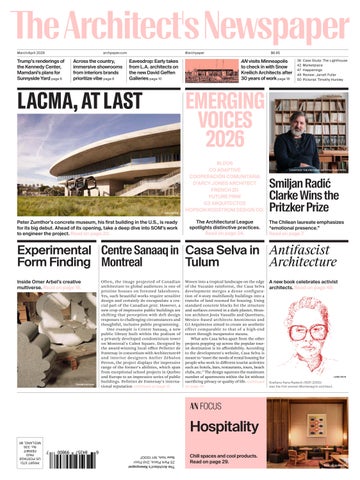
Trump’s renderings of the Kennedy Center, Mamdani’s plans for Sunnyside Yard page 6

Across the country, immersive showrooms from interiors brands prioritize vibe page 8

Eavesdrop: Early takes from L.A. architects on the new David Geffen Galleries page 10

LACMA, AT LAST EMERGING VOICES 2026

Peter Zumthor’s concrete museum, his first building in the U.S., is ready for its big debut. Ahead of its opening, take a deep dive into SOM’s work to engineer the project. Read on page 20.

HOPSON RODSTROM DESIGN CO.

The Architectural League spotlights distinctive practices. Read on page 24.

Centre Sanaaq in Montreal Experimental Form Finding Casa Selva in Tulum

Often, the image projected of Canadian architecture to global audiences is one of pristine houses on forested lakeshores. Yes, such beautiful works require sensitive design and certainly do encapsulate a crucial part of the Canadian geist . However, a new crop of impressive public buildings are shifting that perception with deft design responses to challenging circumstances and thoughtful, inclusive public programming.

One example is Centre Sanaaq, a new public library built within the podium of a privately developed condominium tower on Montreal’s Cabot Square. Designed by the award-winning local office Pelletier de Fontenay in consortium with Architecture49 and interior designers Atelier Zébulon Perron, the project displays the impressive range of the former’s abilities, which span from exceptional school projects in Quebec and Europe to an impressive series of public buildings. Pelletier de Fontenay’s international reputation continued on page 12

Woven into a tropical landscape on the edge of the Yucatán rainforest, the Casa Selva development merges a dense configuration of 4-story multifamily buildings into a tranche of land rezoned for housing. Using standard concrete blocks for the structure and surfaces covered in a dark plaster, Houston architect Jesús Vassallo and Querétaro, Mexico–based architects Anonimous and G3 Arquitectos aimed to create an aesthetic effect comparable to that of a high-end resort through inexpensive means.

What sets Casa Selva apart from the other projects popping up across the popular tourist destination is its affordability. According to the development’s website, Casa Selva is meant to “meet the needs of rental housing for people who work in different tourist activities such as: hotels, bars, restaurants, tours, beach clubs, etc.” The design squeezes the maximum number of apartments within the lot without sacrificing privacy or quality of life. continued on page 14

The Chilean laureate emphasizes “emotional presence.” Read on page 7.

A new book celebrates activist architects. Read on page 49.

Inside Omer Arbel’s creative multiverse. Read on page 16.
Svetlana Kana Radević (1937–2000) was the first woman Montenegrin architect.

Tectum® Direct-Attach Ceiling Panels

Editor’s Note Masthead

Beam Me Up

Before the fog descended on a recent winter evening in L.A., I stood in the middle of Wilshire Boulevard gawking at the LACMA’s David Geffen Galleries, which spans the road like a hastily parked alien spaceship. It was night, and the constellation of recessed lights that dot the lower soffit and upper ceiling were on, illuminating the roadway and the floor above. Art was being installed in the outer walkway, the “meander galleries,” which overlook the city. As I looked east, the concrete soffit reflected the red taillights of the cars in the distance.

Like a baby-faced umarell, I’ve watched LACMA’s construction progress during trips to L.A., at times peering over construction fences or stepping back to assess from afar. The project’s inkblot plan is easily reminiscent of a Rorschach test, originally developed in 1921 by a Swiss psychologist. A century later, a Swiss architect has deployed his own version, realized in concrete, brass, and glass—what you read into it may reflect your personal anxieties.

Twenty years in the making, the project, initiated by LACMA’s CEO and Wallis Annenberg Director Michael Govan, has rightfully been the subject of intense critique, including in AN. Joseph Giovannini has written over 53,000 words across 11 articles in the Los Angeles Review of Books . (Govan apparently intervened at the Los Angeles Times to get the paper to stop publishing Giovannini’s articles.) In 2019, Carolina Miranda, then with the Los Angeles Times, said the building has the “ profile of a small-city airport terminal .” In 2020, Los Angeles Times art critic Christopher Knight won the Pulitzer Prize in Criticism for his writing against the endeavor. More recently, architect Chris McVoy complained about its carbon footprint

The project’s architect, Peter Zumthor, hasn’t been happy at times, mostly because of the build quality. The price kept ballooning even as the project endured value engineering. “There are no Zumthor details any more,” the architect “flatly” told Christopher Hawthorne in 2023 . Though many invectives have been hurled at the museum, Govan, backed by his donors, has advanced with a classic American attitude: Fuck the haters, basically.

In advance of the David Geffen Galleries opening to LACMA members on April 19 and to the wider public on May 4, AN delivers a sneak peek of the building. Rather than rehashing the tortuous years of redesigns, we instead adopted a two-pronged approach. On page 10, we collect opinions on the project from the L.A. architecture community (and

beyond), who give their thumbs-ups and thumbsdowns, and in a deep dive, Nate Hume focuses on SOM’s valuable contributions to the project as its architect of record and structural engineer. Read his story on page 20 to learn about the earthquake protections, concrete work, and envelope. These pieces were filed ahead of encountering the galleries hung with art, so we will circle back with a review to assess how it feels as a museum experience.

Despite the protests, Govan’s Fitzcarraldo exists as a material fact. He told Vanity Fair he wanted to build a “ metropolitan-scale museum in the image of the 21st century.” So what will us 21st-century people do with it? I hope Angelenos make it their own. When the Sixth Street Viaduct opened in 2022, it was soon taken over; one guy even got his hair cut on the bridge. When will a museumgoer turn around and drop trou, mooning motorists? When will a video surface of a skater grinding Zumthor’s brass handrails down the epic entry stair set? When will the street be closed and a long table set up for dinner beneath the building’s celestial overpass?

Originally a pathway made by the Tongva people and later called the Calle de los Indios by the Spanish, Wilshire Boulevard is one of L.A.’s historic conduits. It starts downtown with One Wilshire, a desirable carrier hotel that is the terminus for four Pacific Rim telecommunications cables. (It’s also “perhaps the worst building SOM ever designed,” Kazys Varnelis and Robert Sumrell wrote in Blue Monday. ) The boulevard runs for nearly 16 miles before ending at Santa Monica’s oceanfront cliffs , as seen in Lane Barden’s photographs in The Infrastructural City . These days, as the U.S. wreaks havoc at home and abroad, LACMA’s portal—and so much else—feels like something of a culminating gesture, like when you reach the end of the race in Cruis’n USA. We have run out of road.

Beyond the news, check out building dispatches from across North America (pages 12 and 14), my profile of Omer Arbel (page 16), a snapshot of Snow Kreilich Architects as the practice turns 30 (page 18), and profiles of The Architectural League of New York’s Emerging Voices winners (page 24). And our products-rich Focus section on hospitality (page 29) is here as a reference.

Architecture is at once a cultural and technical endeavor; you can’t have one without the other. Mind and body, heart and hand, shadow and light, yin and yang— ¿Por qué no los dos? Why not both ?

Jack Murphy

CEO/Creative Director

Diana Darling

Editor in Chief

Jack Murphy

Art Director

Ian Searcy

Managing Editor

Isabel Ling

Web Editor

Kristine Klein

Design Editor

Kelly Pau

News Editor

Daniel Jonas Roche

Associate Editor

Paige Davidson

Copy Editor

Don Armstrong

Proofreader

Joanne Camas

Editorial Interns

Josh Ilano

Mariana Martinez-Pazzi

Vice President of Brand Partnerships (Southwest, West, Europe)

Dionne Darling

Director of Brand Partnerships (East, Mid-Atlantic, Southeast, Asia)

Tara Newton

Sales Manager

Heather Peters

Audience Development Manager

Samuel Granato

Vice President of Events Marketing and Programming

Marty Wood

Assistant Program Manager

Bernard Pollara

Events Marketing Manager Andrea Parsons

Business Office Manager Katherine Ross

Design Manager Dennis Rose

Graphic Designer Carissa Tsien

Associate Marketing Manager Sultan Mashriqi

Marketing Associate Trista Bowser

Marketing Assistant Eazhel Breeden

General Information info@archpaper.com

Editorial editors@archpaper.com

Advertising sales@archpaper.com

Subscription subscribe@archpaper.com

Vol. 24, Issue 2 March/April 2026

The Architect’s Newspaper (ISSN 1552-8081) is published 7 times per year by The Architect’s Newspaper, LLC, 25 Park Place, 2nd Floor, New York, NY 10007.

Presort-standard postage paid in New York, NY. Postmaster, send address changes to: 25 Park Place, 2nd Floor, New York, NY 10007.

For subscriber service, email subscribe@archpaper.com.

$6.95/copy, $50/year; institutional $189/year.

Entire contents copyright 2026 by The Architect’s Newspaper, LLC. All rights reserved.

Please notify us if you are receiving duplicate copies.

The views of our writers do not necessarily reflect those of the staff or advertisers of The Architect’s Newspaper

Corrections

In the January/February 2026 issue of AN , an article incorrectly stated that The Shakers , an exhibition on view at the Institute of Contemporary Art at Philadelphia consisted of four sections; there are three.

The name of Walton Global’s senior vice president is Rob Nixon, not Rob Walton.

Post Company is a design firm, not an architecture office.

EMA PETER
After two decades, Peter Zumthor’s building for LACMA opens in April.

Kanye West to pay ex-employee $140,000 in lawsuit over renovations to Tadao Ando–designed house

A lawsuit concerning a botched attempt by Ye, formerly known as Kanye West, to remodel a Malibu mansion designed by Tadao Ando came to a close. A jury deemed the musician and entrepreneur liable in a lawsuit for $140,000. The plaintiff, Tony Saxon, filed the suit in September 2023 for $1.7 million, seeking compensation for injuries he incurred during his work, both as a supervisor and the site’s de facto security guard, before a wrongful termination.

AECOM designs new White House visitor screening facility underneath Sherman Park

The Trump administration is proposing a new screening facility for White House visitors underneath Sherman Park in conjunction with AECOM and Thornton Tomasetti, according to planning documents submitted to the National Capital Planning Commission. The proposal is backed by the U.S. Secret Service, National Park Service, and U.S. Department of the Interior. DJR

Chicago preservation groups raise concerns over the future of a trading room by Louis Sullivan and Dankmar Adler

The Art Institute of Chicago is considering a new wing to its eastern edge, where the Chicago Stock Exchange Trading Room by Adler & Sullivan is sited. Preservation groups are now concerned that the historic, 5,700-square-foot interior housed within the museum may be in jeopardy. The Trading Room was relocated in 1972 from the old Chicago Stock Exchange building on LaSalle Street to the Art Institute. DANIEL JONAS ROCHE

Knowlton School of Architecture students demand removal of Les Wexner’s name from Ohio State University buildings over Epstein ties

Ohio State University Knowlton School of Architecture students are demanding the removal of Les Wexner’s name from the Wexner Center for the Arts and other campus buildings. The demand stems from Wexner’s connections with Jeffrey Epstein. Wexner was named more than 1,000 times in the Epstein email cache released by the U.S. Department of Justice. DJR

Dallas City Council supports exploring moving municipal agencies and services out of Dallas City Hall by I. M. Pei

The Dallas City Council met to come to a consensus on what should happen next to the Dallas City Hall building designed by I. M. Pei. At a city council meeting, members decided to explore relocating municipal agencies and services from the offices inside Dallas City Hall to other locations. The council also ordered city staff to put together plans for repairing the building and a full move-out. DJR

Shift unveils design proposals by shortlisted firms in its competition for a new “world wonder” in Rotterdam

Shift, a social venture startup based in the Netherlands, shared design proposals by five teams shortlisted in an international architecture competition launched in January 2025. The winner will get to design a new “world wonder” in Rotterdam meant to “inspire climate action” for an estimated 1 million annual visitors, Shift said. The five shortlisted firms were announced last May: Ecosistema Urbano, Heatherwick, Office for Political Innovation, Mecanoo, and MVRDV. DJR

Nelson Byrd Woltz, Beyer Blinder Belle, and others to lead landscape plan for Mount Vernon

Nelson Byrd Woltz Landscape Architects has been tasked with ideating a masterplan for George Washington’s Mount Vernon estate that draws connections between the house, its landscape, and its agricultural ingenuity. The landscape plan is happening on the heels of a $40 million renovation of the historic manor that MCWB Architects completed with the Mount Vernon Ladies’ Association in 2025. Beyer Blinder Belle will provide historic preservation and architectural services, and Nitsch Engineering civil and stormwater engineering services. DJR

Baskervill and Waterstreet Studio complete Burying Ground Memorial at University of Richmond

A new memorial at the University of Richmond by Baskervill and Waterstreet Studio commemorates enslaved individuals bound to the land’s pre–Civil War owners. The Burying Ground Memorial was built in response to a report documenting the history of the University of Richmond’s campus land—namely those who built it, and were displaced by it. The memorial’s defining feature is a thick story wall made of granite that curves. DJR

$21,000,000,000

Mayor Zohran Mamdani met with President Trump in the Oval Office, where they discussed the future of Sunnyside Yard, a 180-acre active rail yard in western Queens owned by Amtrak. After the visit, the Mayor’s Office announced plans to build 12,000 housing units at Sunnyside Yard, requesting $21 billion in federal grants to fund it. DJR

Jersey City brokers agreement with Kushner Real Estate Group for community space and affordable housing in lieu of “dead” Centre Pompidou project

In Jersey City, New Jersey, in lieu of a Centre Pompidou outpost—a project that was recently declared “dead”— officials are now exploring opportunities to build more affordable housing and community space in the museum’s place. This is happening as part of an ongoing housing

development slated for 808–813 Pavonia Avenue in Journal Square, Artwalk Towers, designed by Handel Architects. DJR

Los Angeles’s maligned Oceanwide Plaza project may have finally found a buyer

The limbo state of Los Angeles’s Oceanwide Plaza may finally be coming to an end. Lendlease and India-based developer KPC Group indicated they would purchase the three-tower plaza for

President Trump took to Truth Social to share early renderings of his vision for the Kennedy Center, which show original midcentury architect Edward Durell Stone’s exteriors largely intact. This comes following his announcement in February that the performing arts center would be closed for two years for a $200 million renovation project starting July 4, 2026. ISABEL LING

$470 million, per federal bankruptcy-court filings. The pending sale now awaits an April 9 court date for approval, provided that no higher offer is received. JI

American Express to occupy the Foster + Partners–designed 2 World Trade Center

American Express will relocate its headquarters from 200 Vesey Street, where it’s been since 1986, to the 2 World Trade Center site at 200 Greenwich Street upon a new tower’s completion. The architect tapped to work on the Lower Manhattan project is Foster + Partners. The firm previously worked with the developer Silverstein Properties on a design for the site back in 2006. DJR

The Tin Building by Jean-Georges, a Seaport luxury food hall renovated by SHoP and Roman and Williams, closes

In Manhattan’s Seaport district, the appetite for a luxury food hall has waned. The Tin Building by Jean-Georges, a fish market turned boutique dining hub on Pier 17, closed up shop and will reopen this summer as the U.S. flagship location for Balloon Museum. The establishment reportedly lost $100,000 per day, a total of $83 million since opening, according to public financial statements. DJR

Frida Escobedo and Charlap Hyman & Herrero are among the winners of Cooper Hewitt’s 2026 National Design Awards

New York’s Cooper Hewitt, Smithsonian Design Museum announced the winners of the

2026 National Design Awards, with this year’s architecture prize going to Frida Escobedo Studio. The ten recipients span architecture, interior design, landscape architecture, fashion, digital design, and more. The interior design award recognizes Charlap Hyman & Herrero, and the landscape architecture award went to Ten Eyck Landscape Architects.

MARIANA MARTINEZ-PAZZI

Pakistan and GSA sign memorandum of understanding to renovate Manhattan’s Roosevelt Hotel

Pakistan has signed a memorandum of understanding with the U.S. to renovate the Roosevelt Hotel in Midtown Manhattan. The 19-story building, completed in 1924, was designed by George B. Post. In 2000 it was acquired by Pakistan International Airlines. The hotel closed in 2020, and, in 2023, it reopened briefly as an emergency migrant intake center. In a press release, the Pakistani government called the deal a “strategic economic initiative.” Pakistan will collaborate with the GSA on “the operation, maintenance, renovation, and redevelopment of the Roosevelt Hotel in New York.” DJR

City of Amsterdam launches international competition for architects to design National Slavery Museum

The City of Amsterdam has plans to build a new museum dedicated to the history of slavery in the Netherlands. It launched an international architecture competition for the National Slavery Museum in tandem with the National Slavery Museum Foundation, a nonprofit. The site is on the western tip of Amsterdam’s Java Island, in the eastern harbor area. DJR

The U.S. Commission of Fine Arts approves plan for President Trump’s White House ballroom, and National Capital Planning Commission advances it for deliberation

The U.S. Commission of Fine Arts (CFA) approved the plan for President Trump’s White House ballroom with a unanimous vote of 6–0. CFA’s secretary stated that over 99 percent of the more than 2,000 messages received from around the country were opposed to the project. The National Capital Planning Commission (NCPC) also met to discuss the project. At the meeting, NCPC Chairman Will Scharf approved the ballroom

project to move forward for deliberation in April. Shalom Baranes presented animations of the proposal at the NCPC hearing to convey that the ballroom will not overshadow the executive mansion. DJR

University of Cincinnati says goodbye to Crosley Tower, a 16-story Brutalist tower by A. M. Kinney Associates

Demolition crews began taking apart Crosley Tower, the 16-story Brutalist monolith on the University of Cincinnati’s Uptown campus. The $47.3 million demolition, approved by the Board of Trustees in April 2025, is being led by Skanska, with O’Rourke Wrecking Company handling the topdown, floor-by-floor removal. Both firms have employees on the project who attended UC and once took classes in the tower. MMP

Louisville’s Humana Building, a postmodern landmark by Michael Graves, to become a 1,000-room convention hotel

A 26-story postmodernist tower in downtown Louisville, Kentucky, designed by Michael Graves as the headquarters of the Humana Corporation, is slated to become a 1,000-room convention hotel. The $600 million to $700 million project is being developed by Louisville-based Poe Companies and set to be renovated by HKS. Renderings show a new glass tower rising just south of the original headquarters, with a meeting space, a 40,000-square-foot ballroom, and a rooftop pool. Construction could begin next year, with the opening set three to four years out. MMP

Shigeru Ban Architects designs community center in Altadena, California, to aid Los Angeles wildfire recovery effort

Community Organized Relief Effort, a California nonprofit, has partnered with Shigeru Ban Architects (SBA) to build a new community center in West Altadena, after the neighborhood was damaged by last year’s wildfires. The permanent community center denotes SBA’s first built project in Los Angeles after four decades in practice.

The Altadena Community Center will have a large meeting room and rest areas for community events. The public can go there for mental health services, educational workshops, and community programming. DJR

DC Preservation League sues Trump administration over its plans for a new, exclusive golf course at East Potomac Park

The East Potomac Park Golf Course in Washington, D.C., opened in 1919 and was designed by Walter J. Travis. In 1897 congress declared the area just south of the National Mall a park and dictated it be “forever held and used as a park for the recreation and pleasure of the people.” President Trump, an avid golfer, has proposed building a new golf course atop East Potomac Park Golf Course for hosting “professional tournaments and more exclusive events for wealthy golfers,” the DC Preservation League said in a press release. The DC Preservation League and two DMV residents sued the Trump administration to stop the project from moving forward. DJR

EPA rescinds the legal framework that regulates emissions

On February 12, President Trump and Environmental Protection Agency (EPA) Administrator Lee Zeldin formally rescinded the 2009 Endangerment Finding, a section of the Clean Air Act that states that greenhouse gases are a threat to public health. The AIA submitted formal comments to the EPA when the agency announced plans for the rescindment. “The proposed rule is dangerously shortsighted, jeopardizing the substantial investments in sustainable design that have resulted in billions in operational savings, higher property values, and a more productive workforce,” the professional organization said. DJR

Get the full stories and daily news updates at archpaper.com.

↓ THE 2026 PRITZKER ARCHITECTURE PRIZE

The Pritzker Architecture Prize named Chilean architect Smiljan Radić Clarke as the 2026 laureate. He is the 55th laureate of the prize.

The announcement of the annual architecture prize was delayed this year because of ties between Tom Pritzker and Jeffrey Epstein. Radić is based in Santiago, Chile. He works out of his home studio, Pequeño Edificio Burgués, and has participated in both the International Architecture Biennale of Venice and the Chilean Architecture Biennial. He is best known for his residential and institutional projects around the world.

“Architecture exists between large, massive, and enduring forms— structures that stand under the sun for centuries, waiting for our visit—and smaller, fragile constructions—fleeting as the life of a fly, often without a clear destiny under conventional light,” Radić said in a statement, describing his philosophy.

“Within this tension of disparate times,” Radić elaborated, “we strive to create experiences that carry emotional presence, encouraging people to pause and reconsider a world that so often passes them by with indifference.”

Some of Radić’s best-known projects are CR House, built in Santiago in 2003; Pite House, completed in Papudo, Chile, in 2006; Santiago’s Restaurant Mestizo, completed in 2006; a 2013 extension to the Chilean Museum of PreColumbian Art; and Teatro Regional del Biobío, in Concepción, Chile (2018).

Radić was awarded the Serpentine Pavilion commission in 2014. His design was an ovoid structure made of fiberglass and situated atop an arrangement of locally sourced stones.

More recent works include Conguillío, Chile’s Prism House, built in 2020; London Sky Bubble (2021); and Chanchera House (2022) in Puerto Octay, Chile. Radić now has projects underway in Albania, Spain, Switzerland, and the U.K.

Jurors commended his “body of work positioned at the crossroads of uncertainty, material experimentation, and cultural memory” and said he “favors fragility over any unwarranted claim to certainty.”

The members of the 2026 Pritzker Prize jury were Alejandro Aravena, a fellow Chilean architect and 2016 Pritzker Prize recipient; Barry Bergdoll; Deborah Berke; Stephen Breyer; André Aranha Corrêa do Lago; Anne Lacaton (2021 Pritzker Architecture Prize winner); Hashim Sarkis; Kazuyo Sejima (2010 Pritzker Architecture Prize winner); and Manuela Lucá-Dazio.

“In every work, he is able to answer with radical originality, making the unobvious obvious,” said Aravena, the jury chair.

“He reverts back to the most irreducible basic foundations of architecture, exploring at the same time limits that have not yet been touched,” Aravena added. “Developed in a context of unforgiving circumstances, from the edge of the world, with a practice of just a few collaborators, he is capable of bringing us to the innermost core of the built environment and the human condition.”

Radić’s win follows that of architect Liu Jiakun, the 2025 Pritzker Architecture Prize winner. DJR

IWAN BAAN
In 2011, Radić won the competition to design the Teatro Regional del Biobío in Concepción, Chile.

CONCEALED PAVER LOCKING SYSTEM FOR HIGH-WIND CONDITIONS

NEW PAVERLOC™ SYSTEM

Hanover’s NEW PaverLoc™ System features a concealed locking mechanism that delivers a smooth, continuous paver surface appearance.

• Provides wind uplift resistance of -165 psf with no factor of safety

• Withstands winds up to 250 mph

• Patented, user-friendly design is simple and intuitive

• Quick installation - no specialized tools required

• Easy paver removal for roof repairs or replacements

• Paver strength is not compromised or altered

10 Eavesdrop

Overheard on Miracle Mile

Ahead of the opening of LACMA’s David Geffen Galleries in April, Angelenos—and some out-of-towners—share early takes on the new building by Peter Zumthor. Head to page 18 to read AN’s report on SOM’s structural engineering for the museum.

Peter Zumthor, the Swiss master of highly controlled and crafted, deeply sensual spaces, always seemed like an odd fit for Los Angeles, where its most effective and innovative designers have created an aesthetic out of the improvisational, expedient building culture here. Zumthor’s scheme inevitably had several of its sublime touches lost to costs or pushback, leaving us with a vast, elevated, glass-enclosed concrete concourse that certainly offers delights—like cinematic views outwards into the park and cityscape, and art blessedly free of the white box—but still has me wondering if this is a grand folly, in both senses of that word.

I like it. Of course I like how it looks, which should not surprise anyone who knows me, but more importantly, I like how I have experienced it, mostly during construction and from my car. Driving west on Wilshire, the street rises and the building sits at eye level. Then the street drops, and you realize you are about to drive under it. That sequence is distinctly Los Angeles in the most straightforward and unromantic way. Many people have famously written about Los Angeles architecture and cars, but I have always found much of that to be too abstract, too contrived. Here it is just literal. You drive at it. You drive under it. You drive through it. Most people will see the building from the street and from their cars, not from inside the museum or the LACMA campus. Even for that reason alone, I will always like it.

Cultural buildings shape the identity of a city. They are more than containers for art—they are civic stages where communities gather, exchange ideas, and see themselves reflected. I’m optimistic that the new LACMA building will not only house extraordinary work but also foster dynamic programming that strengthens Los Angeles’s cultural fabric for decades to come.

Trying to get a fix on how the LACMA campus will turn out is about as easy as obtaining a clear view of a spinning disco ball and much less fun. Better-informed friends and colleagues offer conflicting assessments. I have ceased making predictions about what surely will be the most consequential cultural project in Los Angeles since the Getty Center and Disney Hall. Is it the Bilbao Effect coming home to roost? Destination architecture is no longer the novelty it was when Frank Gehry built his Guggenheim in Spain, and today many value regionalism as a counterweight to homogenizing globalization. If Peter Zumthor’s museum on which both time and resources were lavished is anything less than stellar, the conclusion that the architectural profession has lost its way and is in desperate need of a reboot will be unavoidable.

I’m torn. It celebrates the kind of architectural risk-taking that defines Los Angeles, yet at close range, it struggles to connect at a human scale. The gallery spaces feel constrained, prioritizing views beneath the canopy while sacrificing color at nearly every turn. Zumthor’s work is typically a true embodiment of craft, but this reads instead as an overly inflated tech monument.

LACMA’s new Geffen Galleries are the most recent reminder of Los Angeles’s sprawling landscape, growing out rather than up. Lazily crossing over Wilshire Boulevard, patrons meander on a single level through galleries scattered in an open field, looking out at the cars below and the hills beyond. But that architectural sprawl also plays a pivotal urban role, putting a midpoint on the spine of L.A.’s greatest boulevard. Near one end of Wilshire, the Getty tops westside hills, and 17 miles east, Disney Concert Hall lays claim to downtown. With the Geffen crossing, L.A. is captured in a hub that’s got culture, street, plaza, and a place to hang out. Now that’s an architectural urban feat.

I am a fan. I took a preview tour of the galleries on a hot September day last year, and the interior was cool, soulful, and seductive—a welcome departure from big white rooms. The unconventionality will likely push curatorial invention. I am curious to see how art, artifacts, and architecture play together.

Los Angeles is notorious for commissioning world-renowned architects with less-than-ideal outcomes. This appears to be the case for LACMA’s David Geffen Galleries designed by Peter Zumthor, and I would argue the same for the adjacent Broad Contemporary Art Museum by Renzo Piano.

I admired Peter Zumthor’s precise and tactile work when visiting his Therme Vals spa in Switzerland and the Kolumba Museum in Cologne. Possibly the pressures of value engineering, patron demands, political caution, and lack of attention to detailing makes design excellence difficult to achieve here. Perhaps decision-makers are more interested in the designer label rather than the value of the product.

Historically LACMA has not done a great job with its public spaces. The new building, while it forms a “plaza,” would benefit from pulling the lushness (and nostalgia) of the tar pits through and into the outdoor spaces. Between the Zumthor building and Levitated Mass, it all feels very stark and sun-blasted to me. I am sure I am not the only one who wishes the OMA proposal from 2001 had been realized—it was a brilliant proposal, just at the wrong moment in time.

I don’t really get all the hate. Most people will love it. The building cuts a curve against the sky, views Los Angeles through a continuous widescreen vista, and makes Wilshire feel more like part of the park. The whole thing seems light and familiar. Plus, you get to drive under it.

The confetti plan is the riskiest bet of the project. It makes sense as a reading of L.A., but it requires a deft hand and finesse. I’ll be curious to see how it works out.

The thing I like the most about architecture is that it doesn’t always have to be a building. It can also be a utility, a procedure, a social technology, or a proposition. The architectural element I like the most about the David Geffen Galleries at LACMA, therefore, isn’t necessarily the building itself; it is the proposition of all the other buildings that it could have been instead.

Opening between two museums overtly about film—the Academy of Motion Pictures Museum (2021) and the Lucas Museum of Narrative Art (2026)—Zumthor’s LACMA expansion is ironically the most cinematic of the three. And it should have been even more so. . . .

Had LACMA built OMA’s more audacious, “x,y,z” scheme, L.A. could have hosted an encyclopedic museum as reimagined by Godard. Instead, looking out from its hovering plenum, we see Midtown, especially the rest of Museum Mile, as if reshot by Antonioni.

I suspect most won’t mind that trade.

Another prediction: It’s best now, empty.

Everyone’s been talking about the new LACMA building. The general take has been a critique/lament of an imaginary yet missed opportunity mixed with general dissatisfaction. And then there’s the occasional person who’s actually been inside, claiming that, from the interior, it works, it really works!

All I can say is on a recent family visit to LACMA, we spent a few minutes really looking at the northern half of the building. We marveled at the clarity of the sharp edges, the perfect proportion of the windows, the details on the concrete. “Zumthor never misses,” one of us said. I haven’t been inside yet, but from that brief encounter, it’s possible that, despite the chatter, he hasn’t.

FRANCES ANDERTON
ANDREW ATWOOD
PATRICK BERNATZ
MICHAEL BOHN
JOE DAY
EVA HAGBERG
MEARA DALY
DAVID ESKENAZI
JIA YI GU
DANA CUFF
JULIE EIZENBERG
MICHAEL BRELAND
ED DIMENDBERG

Much of the preopening speculation has focused on how the splatter form and unforgiving concrete of Zumthor’s upper gallery will perform. But one powerful architectural effect is already evident at the ground plane.

The voids between the massive ground floor blocks generate terrific desire lines between the public spaces of LACMA’s entry plaza to the west and Hancock Park to the northeast, reintroducing continuity across the larger site.

But you won’t be able to follow through on those architectural invitations, as the new wing’s extensive grounds are being fenced in for outdoor sculptures.

The distinct geometry of that security fence—a continuous palisade of green spikes—is surprisingly present. It has one particularly unfortunate effect: From outside, it now feels a bit like you’re looking into a zoo enclosure.

That sense—art snob habitat!—is sharpened by the landscape architecture’s concrete “sand and oil” paving design. Conceived by the late Robert Irwin, probably to rankle yet another too-serious architect, it seems woefully underdeveloped.

Zumthor is notoriously mortified by compromise. The public space that fence and landscaping generate must be truly galling.

There was a moment during construction of the museum when cement trucks were lined up on Wilshire, waiting to sluice concrete into a hole that was, against all intuition, right there in the middle of the boulevard. Whatever else it may be, the addition is an act of civic infrastructure, which I would far rather see emerge from arts institutions like LACMA than the city’s own planning machinery. It’s almost utopian. Let’s do it again.

In the new Geffen Galleries, moments of beauty arrive unexpectedly: Bruce Goff’s Japanese Pavilion in perfect frame; cars passing beneath your feet along Wilshire Boulevard; the building turning back upon itself, muscular and sinewy. But are these moments enough? Will the art and objects of the collection shine inside a building that seems more invested in its own statement than in its purpose? Time will tell.

Peter Zumthor is a brilliant architect. I’ve met him in Switzerland, visited his home and office, and experienced his poetic skill and refined detailing at several buildings. Zumthor called the baths at Vals “stone and water: a love affair.” Yes, it was.

The new LACMA building is a welcome alternative to the stranglehold of sealed light-box museum spaces. I love this grand scale revisit of Los Angeles’s noirish DNA under deep, shadowy overhangs, especially at the county’s namesake museum. Zumthor’s doubling down on vibey concrete spaces presents a fresh, modern noir context, opening up to a wraparound Los Angeles panorama. The collection is going to feel interestingly cinematic in this bold context.

I visited LACMA before the art was installed. Having the galleries all on one level is a good idea. The bridge over Wilshire Boulevard is a strong urban design gesture, but the overall experience was underwhelming. The concrete seemed cold and rough. Somehow Zumthor’s artistic touch was missing. Maybe after the art is installed it will be a calm, neutral backdrop for the museum’s true purpose.

I proposed to my wife at LACMA, under the Urban Light sculpture. I met Flea there. I grew up wandering the campus before I had language for what architecture was or could be. My sons, four and six, will inherit its new building in the same way, through embodied experience, before buildings become legible to them as architecture. They’ll know the weight of the concrete floating off the ground the way I knew the Pereira courtyard, as fact before feeling, feeling before opinion. Angelenos will claim this building over time, on their own terms. The building has to earn that kind of intimacy. Zumthor’s design has yet to prove it can.

I have a good many questions about the new LACMA, but my fundamental concern is with the display of art in galleries with unbroken window walls that seem destined to create serious glare and silhouetting problems. It seems to me that all other issues take a back seat to this one, as it is the entire raison d’être of the project.

Of the four recent horizontally oriented projects hovering at various heights above L.A. and giving it new centers of gravity, Zumthor’s haute-grunge room-in-the-ribbony-round is the most simultaneously immersive and expansive of the lot.

More intimately scaled than MAD Architects’ bobbing blob-cum-triumphal arch, Michael Maltzan Architect’s hopping-skipping-and-jumping viaduct, or HKS Architects’ ground-sweeping and downwardly corkscrewing stadium, Zumthor’s inhabited bridge is the people’s promenade of perceptual pleasures.

A sinuous viewfinder, it stitches the museum campus’s loose bits and pieces into dioramic and panoramic consilience and coherence. Whether looking at it, from it, or through it, near and distant skylines bounce back and forth at varying speeds, folding moments of painterly stillness into stretches of filmic vigor.

Big, curvy, floating—for all the seeming detachments to the surrounding scene, Peter Zumthor’s new building at LACMA does everything to sidestep those preconceptions and criticisms. It can be slippery, it can be heavy-handed, sometimes both simultaneously, but it pushes and pulls the city around it into an undeniable conversation.… Putting aside exterior form for a moment, it’s “up there” on the lifted plane of galleries where the design’s real newness resides. Here one meanders and weaves between city and art, simultaneously challenging and celebrating both. Can one be a flaneur inside a building?

LACMA is not a building. It’s a crossing infrastructural logic: horizontal, indeterminate, open to demands not yet formulated. That openness is Los Angeles. The building thinks horizontally—it bridges Wilshire; you encounter it in motion the way the city reads everything: at speed, in intersection, through glass. The encounter is cinematic before it’s spatial. The boulevard doesn’t stop at the building; the building belongs to the street. It activates rather than anchors, connects rather than terminates. The project constructs a capacity for iteration and transformation. The future of Los Angeles is not contained in what the building is but in what it can become.

The undulating structure of the David Geffen Galleries means you cannot fit the entire building into one view. Coming from the La Brea Tar Pits, the building’s tail appears as a mundane pedestrian overpass over Wilshire, nestled within low-rise office buildings and the Tar Pits’ prehistoric exotica. But approaching from LACMA, the building seems like an offspring of Louis Kahn, with sculptures, a cafe, and a library clarifying its cultural purpose. Mark my words: When viewed from the plaza, the building will soon be publicly called “the Jetsons’ house of modern art.”

Why are people inclined to hate Zumthor’s supposedly crude LACMA building? It is an oddity of the assembled cocktail party that is LACMA. It stands out and appears awkward, but it takes one moving through the grounds and the structure to realize how brilliant a new companion it is. Suddenly the landscape is opened up. Renzo Piano’s buildings can be appreciated, Goff’s Japanese pavilion is finally foregrounded, and the Hollywood Hills become a splendid panorama. Below the decks, the rich traffic flow of Wilshire Boulevard only serves to validate the interventions of art, which is surely LACMA’s reason to exist.

In May 2020, shortly after demolition began and public scorn over the use of public funds continued unabated, I wrote in AN that a little patience may likely yield “an outsized reward.” Visitors, no longer encumbered by the original LACMA campus impediments, could one day treat the museum and grounds as their own as they glide across Hancock Park through and beneath Zumthor’s tabletop.

Six years later, a row of green metal poles along Wilshire Boulevard almost imperceptibly deny access to the site outside of museum hours. They fall short of obstructing the words DAVID GEFFEN GALLERIES, which are suspended from the belly of the tabletop and cast a long shadow over its concrete base in the late afternoon.

Last summer, when LACMA opened the doors of the David Geffen Galleries for a tantalizing sneak peek, reactions swiftly cut across party lines: Those who dig the allure of brutal Swissness seemed pleased; others pointed out lime stains and less-than-meticulous concrete detailing. The new building is appealing in the way a dam or highway is appealing. (It’s impossible to know how it’ll look with artwork banged into those massive walls.) With this bridge to nowhere, Zumthor (and SOM) may have produced infrastructural thrall, but is it a museum—a county museum meant to serve all Angelenos? With a vast, sun-blasted plaza and vertiginous climb to the first floor, it’s a dubious welcome.

DAVID HEYMANN
ALAN KOCH
MARK LAMSTER
MICHAEL MALTZAN
THOM MAYNE
SHANE REINER-ROTH
MIMI ZEIGER
CLIVE WILKINSON
DORI TUNSTALL
MOHAMED SHARIF
MICHAEL ROSS
ANDREW HOLDER
KATIE HORAK
SEAN JOYNER

12 Dispatch

Cultural Cache

At Montreal’s Centre Sanaaq, architect Pelletier de Fontenay collaborates with Architecture49 and Atelier Zébulon Perron to create distinct spaces for play.

continued from cover rests on its successful collaborations with Berlin-based firm Kuehn Malvezzi, with projects like Montreal’s Insectarium, which opened to acclaim in 2022, and the forthcoming PHI Contemporary art center, which is scheduled to open in 2029.

Centre Sanaaq occupies the ground and first levels of a development on the former site of the Montreal Children’s Hospital. An agreement between the city’s municipal authorities and the private developer included a provision that space for the library be set aside. Centre Sanaaq’s envelope and major planning features were thus determined by the geometry of the broader condominium project. As such, the library’s floorplan is pierced by entrances, circulation cores, structure, and mechanical services designed in accordance with the needs of the two towers that rise above it. Floor heights of 6 meters for each of the library’s two main floors were dictated by the requirement (imposed by the municipal authorities) that a performance hall be included within the program; the theater’s location in plan was also fixed.

What could have been deemed impossible or arbitrary by these constraints results in an exemplary work of public architecture. The architects have used half levels and thoughtful ceiling design composed of coffered wood and swaths of suspended fabrics to produce an unfolding series of intimate spaces, neither compressed nor gargantuan. At the ground floor, visitors move easily between a cafe, a culinary laboratory, the performance hall (itself a “black box,” but with large doors opening toward the exterior on the southern side), and an exhibition space.

Upstairs, the library features distinct adult, teenage, and children’s areas. Across these, Pelletier de Fontenay’s collaboration with Atelier Zébulon Perron shines through. The result is well-designed furniture—including curving, custom-made teal shelving for the teenage section—and a cozy series of nooks offering privacy. Rather than treating the children’s area as an interior setting for playground equipment or as a miniature adult library, the designers created an undulating topography of green mounds, providing a unique space with the city. These spaces are also accompanied by a media lab, multipurpose rooms, and offices for community organizations. One particular highlight is the sunlit “silent room,” tucked between the performance hall and the southern facade.

With Centre Sanaaq, the architects have designed three-dimensionally, showcasing their command of material palette and their ability to design for all five senses, especially hearing. Centre Sanaaq’s most impressive feature is its acoustics. Too often an afterthought, acoustic design was prioritized by designers, striking the perfect balance of happy bustle and muffled quiet needed for a vibrant library. The effect is produced by fabrics suspended from the ceiling, and especially by the liberal application of sprayed cellulose insulation, which in turn harmonizes perfectly well with the other material choices. These include aluminum grating wrapped around the performance hall’s

exterior, which leaves the insultation visible, softening its massive rectangular form.

In its deft use of materials, Pelletier de Fontenay has created a collage of woods, metals, concrete. Exposed mechanical services are only partially screened by a trellis and other ceiling devices, such as suspended wooden coffers over the cafe and fabric panels over the main staircase. While Canadian public architecture is often blighted by the use of too many materials in a single building—as if in apology for the massive heft of Canada’s 1960s and ’70s Brutalist works— Centre Sanaaq’s collage is never forced, nor is it artificial. O nly the oversized stairway seating near the children’s area feels forced, although it is partially redeemed by its elevated view toward the square.

Cabot Square has historically marked the western entrance to the city’s downtown. The neighborhood changed following the closure of the Montreal Forum hockey arena in 1995 and has been transformed again by the departure of the children’s hospital in 2015. The demolition of its brick headquarters was regrettable, and the condominium project that has taken its place is uninspiring. However, Montreal’s planners are to be lauded for carving space for the impressive Centre Sanaaq within it.

Centre Sanaaq draws its name from the title of Mitiarjuk Attasie Nappaaluk’s Inuktitut-language novel; the root word sana means “make.” The name thus honors both a literary work by a female, Indigenous author and a spirit of fabrication that animates Centre Sanaaq’s architecture and programming. The Cabot Square neighborhood is home to a significant population of unhoused persons, many of whom are Inuit. While it is beyond the scope of a single building to resolve the forces of reconciliation, gentrification, and new technologies buffeting Canada’s urban centers, Centre Sanaaq’s public spirit and excellent design make a welcome contribution to the city.

Peter Sealy is an architectural historian and assistant professor at the University of Toronto, where he directs the undergraduate architectural studies program.

Top: Aluminum grating wrapped around the performance hall’s exterior leaves the insulation visible.

Above: Circulation cores and structures in the library’s floorplan were designed in accordance with the needs of the two condominium towers that rise above it.

Below: In the children’s section, the designers created an undulating topography of green mounds.

Bottom: Custom curving teal shelving in the teenage section creates a series of cozy nooks.

JAMES BRITTAIN
JAMES BRITTAIN
JAMES BRITTAIN
JAMES BRITTAIN

OPENING GLASS WALLS

Easy Operation: Smoothest and easiest operation of any folding glass wall as panels glide to their open or closed position.

Superior Performance: Exceptional resistance against wind-driven rain. Energy-efficient panels keep extreme weather out. Up to unit STC 45. Air, water, structural, forced entry, swing door and cycle tested.

Design Options: Customizable in folding, sliding, multislide, stacking, and frameless. Aluminum, clad, wood, or all-glass profiles. ADA, interior and exterior weather-rated sill options. Custom glazing and 50 standard colors.

Hotel Del Coronado | Architect: Leo A Daly Product: NanaWall NW Aluminum 840 Folding Glass Wall

14 Dispatch

Tropical Regionalism

An affordable apartment development from Jesús Vassallo, Anonimous, and G3 Arquitectos on the edge of Tulum aims for a resort-quality experience with minimal means.

continued from cover “This project originated from the demand of local employees,” said Alfonso Jiménez, principal of Anonimous. “They don’t have a lot of accessible housing in Tulum, so many of these employees go to Playa de Carmen, which is one hour away.”

Historically, Tulum has marketed itself as a more authentic, ecologically sensitive destination, more connected to the natural environment and to its pre-Columbian Mayan culture than nearby Cancún. But critics say that uncontrolled growth in recent years has threatened its culture and ecology. In 2007, a large-scale rezoning effort nearly tripled its developable area. Along the western edge, the municipality established 4-story density allowances in hopes of attracting tourist dollars and producing more affordable housing for locals. Two- and 3-story gated condo developments, eco-resorts, and glamping villages are gradually encroaching on the forest edge.

Casa Selva is among the first projects to test the upper bound of the 4-story zoning limit, a density that still keeps buildings

below the level of the rainforest. In plan, Casa Selva is diagonally cut into a squaredoff section of otherwise untouched wilderness. A long, forked structure with three prongs intersects three smaller structures inserted into the notches. Combined, they fill out the lot while leaving ample open space. “We pushed it to the limit,” said Vassallo.

To increase privacy and offer shade between the volumes, locally fabricated brise-soleils obstruct visibility into apartments from the outside and function as latticed apertures into the courtyards from inside. “The whole project was a balancing act where we were trying to get that density and still provide an experience of being secluded and in contact with nature,” added Vassallo.

During construction, Vassallo, Anonimous, and G3 cordoned off all of the courtyards and open spaces and staged the building process so that the original trees on the site could be preserved. A mixture of gumbo limbo, black poisonwood, and Mexican silver palms populate the in-between

spaces. “Our first conversation with the client was ‘We need to preserve as much of the vegetation as possible,’” said Vassallo. The trees also buffer the units from the entrance and the road.

The charred gray appearance of the exterior is unusual for the area, mimicking the gumbo limbo trees to resonate with the landscape, while making the architecture stand out. “We were trying to elevate the physicality and materiality of the buildings through careful detailing so that it would never feel like social housing,” Vassallo said, “so this would feel like a desirable place for anyone.”

The apartments are minimalist, with built-in wood shelves, closets, and wood furnishing adding warmth. The units range from 120 one-bedrooms of 550 square feet to 240 single-room studios of 275 square feet. The studios come with kitchens on one end and balconies and patios on the other, while the one-bedrooms’ living rooms open onto two balconies overlooking the rainforest—at least until the rest of the neighborhood gets built up.

Vassallo, a professor at Rice University and a graduate of Harvard GSD and the Madrid School of Architecture, credits his experience building European social housing for his ability to negotiate the smaller unit sizes and comfortably accommodate the needs of residents.

“The key in this case was the elimination of hallways and interior partitions, often

using furniture to suggest different rooms within an otherwise fluid space,” he said. “Most importantly, each wing featured a large opening that visually connects with the jungle and allows for cross ventilation, so that even inside the apartments, one feels part of a larger whole.”

Whether Casa Selva will end up serving as affordable housing is an open question. In addition to low-cost rentals for the local workforce, the developer is marketing the units on its website as vacation rentals and investment properties. The site advertises its co-working and yoga spaces, and the rooftop pool with barbecue areas can provide either gracious living for service workers or well-outfitted short-term rentals for budget travelers.

Stephen Zacks is an advocacy journalist, architecture critic, urbanist, and project organizer based in Mexico City.

Left: Original trees were preserved during construction and remain in the courtyard and open spaces.

CESAR BEJAR
CESAR BEJAR
CESAR BEJAR
Top Left: The buildings were capped at four stories to stay within the height of the surrounding rainforest.
Top Right: The charred-gray facade mimics the gumbo limbo trees to resonate with the surrounding landscape.

Design for Diversity

The National Center for Civil and Human Rights features curved exterior walls in custom ALUCOBOND colors—Copper Blaze and Glossy Cashmere Pearl—and standard Native Copper Mica, expressing the building’s mission to connect diverse communities through civil and human rights.

ALUCOBOND PLUS consists of two sheets of smooth .020” aluminum thermo-bonded to a solid, fire retardant core and has been developed exclusively to allow architects and designers to meet today’s fire performance requirements set by the International Building Code (IBC). PLUS offers:

• Exceptional flatness and rigidity, durability, and formability

• Extensive customization options through 91 colors and finishes

• 100% recyclable contributing to LEED certification points

from domestic & imported materials

bedroom. Arbel used the commission to make a drawing in collaboration with a painter, which was guided by the belief that “we just had to capture someone’s heart.”

The idea wooed Bishop, who saw the coverage while flying overseas. He needed an architect for a high-end interiors project, so he reached out. Bishop has always been entrepreneurial. After high school, he imported ponchos from Mexico. Later, he owned gas stations and ran a candy company. Bishop became interested in architecture and interiors when he was still a teenager: When driving back and forth to Mexico, he would stop and visit his aunt, a landscape architect in Santa Rosa, California, who got him hooked on design.

Arbel, meanwhile, kept trying to sell pieces, but he was a “terrible businessperson.” He considered quitting his day job and becoming a finish carpenter. His decision to persist was due in part to consistent encouragement from his father: When Arbel was a teenager, his father feigned interest in a proposal from the prominent Canadian architect Arthur Erickson (also famously bad at business) so Arbel could have lunch with him.

With parental support, Arbel readied a show for ICFF in New York in 2005 and included a prototype of a cast-glass light, a sphere with an equatorial seam that became Bocci’s popular 14 series. Arbel was thinking he would license the design to a manufacturer. Bishop, in town for a candy conference, stopped by and saw the buzz. The two got to talking, and then decided to “start a company and do it ourselves.” Thus, Bocci was born. Arbel’s penthouse for Bishop, 15.2, was 14’s first large-scale residential application.

Test Castings

While most of Arbel’s material experiments have gone into Bocci’s products, some have ballooned into architecture projects. Blocks from Bocci’s headquarters, Arbel maintains a separate warehouse where he can work at a 1:1 scale.

Some of the larger items in the space are fragments from realized work. There are pieces from Arbel’s 75 series, which includes 75.9, a house that uses concrete made with fabric formwork set atop a plywood rib structure to create billowing columns. To achieve this effect, the slurry is cast slowly to cure continuously, which reduces hydrostatic pressure and allows tall pours without cold joints. The home, completed in 2024, sits among hay fields in White Rock, south of Vancouver, on a property next to 23.2, an earlier, Miralles-like residence designed by Arbel for Bishop and finished in 2010.

The workshop plot was supposed to be the site of 86.3, a 50,000-square-foot, ground-up building for Bocci made

using concrete cast into pillowy forms. The team received a development permit by the time Bocci stopped work on the project during the pandemic. (Arbel said they may revisit the idea at a “less weird time globally.”) Maybe it was for the best: Since then, the company has outgrown the floor plates, and the plans show clumps of squiggly poche that are at odds with the logistics of practical things like shelving or copy machines.

For 86.3, Arbel initially wanted to create the void forms by using hay bales, but he eventually landed on using cinched piles of recycled plastic buoys harvested from the ocean. These “big, thick plastic buoys get beat up in the oceans, and they come to shore deformed like seed pods or like edamame beans or something,” Arbel recalled. Wet hay also causes a problem with spontaneous combustion.

Lately, Arbel and his team are experimenting with fluid casting, where concrete is poured into mud and finds an equilibrium before setting. The mud includes bentonite clay, which is used in ceramics to add plasticity , in addition to other ingredients. The activity further reduces his control over the outcome. He can set the floorplan at the ground in terms of “which rooms lead to other rooms or where the plumbing is,” but the form migrates in section due to hydrostatic forces. Through this process, Arbel allows the material to establish the final dimensions of the interior.

Arbel then imagines mixing the bentonite with porcelain and letting it dry atop rubber, which would make the pieces curl like a clamshell. Once fired, these would then be mounted atop the concrete to act as the armature for the next layer of mud and concrete and serve as the cladding. The whole thing would look like “a school of fish or something,” he said. Arbel is exploring the use of the technique in building 35.8, a house for his family in Hastings-Sunrise, a neighborhood that overlooks the industrial port in East Vancouver.

Island Life

Galiano Island, across the water west of Vancouver, is a thin strip of land about 17 miles long, thickly forested and ringed with rocky coastline. Accessible via a quick ferry or a faster seaplane ride, the terrain inspires Arbel, who calls it a “wonderful pocket of eccentric specificity.”

91.0, a 3,200-square-foot residence that is perhaps Arbel’s most orthogonal building to date, is on Galiano. Arbel met the owners, Josh Pekarsky and Marla Guralnick, early in his career: They purchased one of his 2.4 chairs around 2004 at a charity auction. Pekarsky, who works in communications, and Guralnick, a pediatrician, get along with Arbel, so when they acquired some land on the island in 2017, they hired him to design their weekend house. It was an adventure, “a project for our empty-nest era,” Guralnick said.

The plot previously only had a shack with an outhouse, set on a narrow, rocky outcropping that runs perpendicular to the water; a large gully separated it from high ground closer to the road. Arbel’s proposal was to span the ravine with the home. The bridge-like gesture, which allows Pekarsky and Guralnick to appreciate views of the coast and the forest, “made immediate sense to us,” Pekarsky said. “It was a great insight.”

Upon entry, a long hallway lined with train-car-like nooks opens onto a combined kitchen and living room with an adjacent primary suite, all on one level. A second wing has additional bedrooms and can be opened as needed. A triangular punch through the middle of the span reminds occupants that the ground has dropped some 15 feet below the entry grade. OAO designed the built-in items, but the rest of the interiors were handled by Guralnick and Pekarsky. The results are rustic, textural, and warm, thanks in part to the Bocci light fixtures.

The owners spend every weekend they can out here. The arrival is something of a ritual. “When we get there, it’s like shedding the stress of the week,” Guralnick said. “It’s very peaceful; it’s like something comes over us.”

Arbel took special interest in the cedar cladding, which is sandblasted to highlight its grain. The boards run the long length of the home but read like end-grain pieces on its short ends and in the window returns. At first Arbel wanted to use the tumbled orbs on the facade here; Guralnick and Pekarsky, who praised their architect as an endlessly creative talent, politely declined.

Arbel also thought through climate change as another aspect of site context: In a century, its valley may be flooded due to sea-level rise, which is further rationale for its structural span. “What are the poetic potentials of climate change?” Arbel asked. 91.0 is one answer.

After I toured Guralnick and Pekarsky’s home, they recommended I check out a nearby cove. I left my car at the end of the road and scrambled along the shore. The low tide exposed outcroppings of stones flecked with moss and topped with grass. In another spot, the wind and water had smoothed the rock into doughy lines that curved up into waves, creating a tiny, shaded cave with whorled openings. It looked, I thought, like Arbel’s architecture.

A Mind in Motion

Bocci, which is equally owned by Arbel and Bishop, celebrated its 20th anniversary last year. The company, powered by instinct and research, still resists the urge to speed up its product development. Bishop figures that “companies are kind of like trees: If they grow slow and steady, they’re going to survive.” Arbel is also in it for the long haul: “Twenty years is just kind of the beginning.”

The duo continues to work on development endeavors: Arbel has purchased the second lot at Governors Point, so his will be the second home built there. They are also in the early stages of their next collaboration together for a piece of land on Galiano.

Arbel has yet another project underway. Near the current Bocci office, an old garage is being renovated into Autobody, a theater for the dance company of Rachel Meyer, his partner. It will open in January 2028.

Beyond Bocci’s demands and OAO’s ongoing architecture projects, Arbel and Meyer have two daughters, ages eight and two. The vertices of work, children, and partner form an “equilateral triangle of unreachable things” that keep him busy. Once a self-described “spaz,” Arbel, who will turn 50 this year, is leaning into maturity without losing his energetic drive. “One of the crazy things about Omer’s brain is that every time you ask him a question, he looks at things from a fresh, different perspective,” Bishop said. “He is a wonder in so many ways.”

Arbel said that his career followed from two choices: The first was to reject the conventional, service-based trappings of architectural practice, and the second was to make his own work at the scale of an object. Because he is involved in every aspect of production, he will build fewer buildings, release fewer products, and have less news. Still, he is happy with “these epic, magnum-opus-style projects that last for a decade,” he told me. “Somehow, this is the path I’ve chosen.” JM

91.0 is a vacation home on Galiano Island clad in sandblasted cedar and lined with wood on its interior.
Many of Arbel’s material experiments have gone into Bocci’s products, while others have ballooned into architecture projects.
FAHIM KASSAM
EMA PETER

18 Anniversary

Care for Small Things

To mark 30 years of practice for Minneapolis-based Snow Kreilich Architects, Frank Edgerton Martin surveys the firm’s extensive project portfolio and gains insight into how the firm is supporting its next generation of architects.

Over its 30 years of operation, Snow Kreilich Architects (SK) has never sought the limelight of bold formal inventions or big idea statements. From modern, multifamily buildings in historic districts to private homes and public buildings, the through line across its broad portfolio is a quiet and serene voice—an approach rooted in the mindful melding of site, materials, details, and scale. The resulting works integrate place and programming with a subtle wholeness you can feel.

Many firms tout their collaborative approach, but having known Snow Kreilich for many years, the studio, which has almost 40 employees, remains one of the most respectful and mutually supportive I’ve encountered. Since founding the office in 1995, Julie Snow, has set the tone for refinement in details and materials, applying this sensibility to rethink such utilitarian structures as factories and roadside rest stops. Today, the firm’s younger designers learn from team conversations about what Snow calls “small ideas”—how to question assumptions about details, finding the craft in solutions that most people will never notice. “You really can’t teach this in school,” Snow said in an interview with AN . When one reflects on the firm’s three decades of practice, it becomes clear that across a diverse portfolio ranging from baseball stadiums to ports of entry, and even to single-family homes, SK is creating architecture that demonstrates the firm’s deep commitment to a care-based approach.

Sports and the City

In 2015, Snow Kreilich reinvented an old baseball idea for the St. Paul Saints: a lowrise ballfield downtown that is immersive,

casual, and full of sky. With a capacity of 7,300, CHS Field incorporates contemporary materials while reflecting the scale of its historic Lowertown district. Inside, one’s first impression is that it feels more like a county fair than a sports venue.

Fans enter the baseball stadium through a compressed portal framed by the Saints store and offices as well as a flowing balcony of the upper deck overhead. Following the circulation farther into the building, the space opens up and the sunken field unfolds. From the stands to the grassy berm along the outfield, people flow along the street-level concourse and sit down, drinks in hand, on deck chairs and stools and at tables. Though it’s not the big leagues, game days at CHS Field happen inside a premier work of architecture with the finishes, detailing, and refined proportions of the best new museums and public buildings.

In 2018, Snow Kreilich expanded its expertise in athletic venues in downtown St. Louis, where the firm teamed with HOK to design Energizer Park, the new home of the region’s soccer team, St. Louis City SC.

“At first, we spent a lot of time not talking about a soccer stadium,” Tyson McElvain, and director of project delivery at SK, said of early design discussions. The design team considered how the stadium and its training facilities could become a destination and a district downtown, how it could become a neighborhood. The experience of the stadium from the street, visual connections to the existing cityscape, and transparency became a priority. All sides are open, and backdoor loading and access are buried below grade.

Principal Matt Kreilich emphasized the collaboration that went into this project, noting that the SK team worked with two HOK offices and pointed out the elegant

and light column system supporting the surrounding canopies that HOK’s structural engineers designed. These appear to float overhead while providing weather protection for fans and amplifying the sounds and energy of the game.

The structure’s ground level is designed to maintain visual connections to the Gateway Mall and Arch. Meanwhile, the stadium’s southwest plaza tells a story of the city’s history of segregation, diversity, and change. In the 1950s, freeway construction destroyed 5,000 homes, businesses, schools, and churches, displacing approximately 20,000 residents, most of them Black. Located on the site of a former freeway on-ramp, the plaza acknowledges this history though a sculpture and landscape installation by East St. Louis native Damon Davis that recreates past plotlines inscribed with the addresses of former buildings.

Elsewhere in St. Louis, SK is working with landscape architects Hoerr Shauldt to animate the historic Steinberg Pavilion and Rink. The 1957 ice rink and skating house in Forest Park was designed by Frederick Dunn and became the city’s first integrated major park facility. Karen Lu, SK’s director of design, noted that Steinberg’s draw as a winter sports destination has declined over the years. The firm aims to update the midcentury modern building with new rooftop pavilions and attractions to draw

people year-round, including interactive scrim fountains, outdoor dining, and flexible seating.

Welcoming Land Ports of Entry

In 2006, Snow Kreilich designed its first land port of entry through the General Service Administration’s new Land Border Entry Program, which was still in its infancy. As the federal government sought to improve and refine its network of border entry points, early architects, including Snow Kreilich, had the chance to invent a new contemporary yet regionally based design typology. For its project in Warroad, Minnesota, Snow remembers the client noting, “We really just want a log cabin.” This idea makes sense, because logs and wood are an essential part of the Warroad River valley’s culture. The region is a quilt of rich boreal forests and peat bogs, Nordic immigration in the 19th century and its ties to the wood- and paper-processing industries.

Snow Kreilich’s resulting design presents a quiet yet powerful modernist form. The building is anchored in the open clearing of surrounding bogs. Local residents and staff compare the building’s black shell and glowing openings with burning wood in the fireplace or a log broken on the forest floor. Building volumes are inflected to increase the officers’ panoramic views.

With Energizer Park, Snow Kreilich considered how the stadium and its training facilities could become a destination and a district downtown.
At a border entry point in Warroad, Minnesota, Snow Kreilich used materials like wood that are an essential part of the Warroad River valley’s culture.
The historic Steinberg Pavilion and Rink, a midcentury modern building, will be updated with new rooftop pavilions and attractions to draw people year-round.
COURTESY SNOW KREILICH ARCHITECTS
PAUL CROSBY
MICHAEL ROBINSON

Officers and guides often share their stories and perspectives of the building with visitors. In a region home to Finnish woodworkers and the manufacturing of Christian Brothers hockey sticks, Snow says the fact that building staff have developed their own relationship to the building is evidence that “[SK] touched their culture,” ensuring that these traditions and local histories were incorporated into the design.

Twenty years later, Snow Kreilich has completed three land ports of entry and is currently designing the port of entry in International Falls, Minnesota. Designed to meet LEED Gold certification standards at a minimum, the mass timber structural system will sequester carbon while reflecting the historical importance of the region’s timber industry.

The lower level is grounded with dark stone left over from open-pit iron mining. The vertical scale and metal slats in the upper facade echo the structures of regional taconite plants and paper mills, a modernist interpretation of local economy and culture.

Looking to the Future

Since winning the AIA Firm of the Year Award in 2018, SK has continued to nurture some of the region’s best architectural talent and supports employees through its

ASK program—small grants to provide studio members with grant opportunities for technical research. This year, SK was certified as an Emerging Professionals Friendly Firm by AIA—an award recognizing support for early-career architects through compensation, licensure, professional development, and opportunity.

Architect Jason Dannenbring, who has been with SK for ten years, told AN, “Every day still feels fresh. The focus here is not on what we’ve done in the past but on what we want to do in the future.”

And SK is continuing to evolve. The firm recently moved to a new office space in the North Loop neighborhood and also welcomed new principal Amy Cheever. “There is an incredible energy in the studio right now,” reflected Kreilich. “This evolution and our recent growth make this moment feel like the right time to expand the way we work across the city and beyond, all while maintaining the core values of the firm that Julie defined when she founded the studio three decades ago.”

Edgerton Martin is a landscape historian and journalist who has covered several Snow Kreilich projects for AN, including the recently opened Welcome Center at Lakewood Cemetery in Minneapolis.

Frank
Snow Kreilich is currently working on a port of entry facility in International Falls, Minnesota, built with a mass timber structural system that will sequester carbon.
Interactive scrim fountains, outdoor dining, and flexible seating will be added to the Steinberg Pavilion and Rink.
COURTESY SNOW KREILICH ARCHITECTS
Gypsum panels interlock to create continuous surfaces of any size. Stunning feature walls made in the U.S. for over 20 years!

SOM delivers expert engineering for LACMA’s David Geffen Galleries.

ZUMTHOR’S CONCRETE GUITAR

Left Top: As seen in the exploded axon, the 900-foot-long gallery is supported by ten towers.

Left Below: The $720 million building spans Wilshire Boulevard.

Top: After being poured and cured the concrete was post-tensioned with miles of cables via troughs left open around the perimeter.

Above: The building’s structure sits on 40 seismic base isolators, which allow the building to move up to 5 feet in any direction during an earthquake.

Below: The rhombus grid is visible during the construction of the lower slab in July 2023.

COURTESY SOM
JAMES MICHAEL JUAREZ
HUNTER KERHART
HUNTER KERHART
COURTESY SOM
Left: The building’s brass window wall, made by seele, wraps the entire facade.
Top:
JAMES MICHAEL JUAREZ
COURTESY SOM

EMERGING VOICES 2026

D’Arcy Jones Architects Ha-ha Housebarn
Cooperación Comunitaria Reinforced Kitchen Project in Oaxaca, Mexico
CO Adaptive Timber Adaptive Reuse Theater
BLDUS Overbeck Alley
SAMA JIM CANZIAN
COURTESY COOPERACIÓN COMUNITARIA
NAHO KUBOTA

EMERGING VOICES 2026

G3 Arquitectos Centro de Desarollo Comunitario y Deportivo
Hopson Rodstrom Design Company Project Legacy
French 2D Bay State Cohousing
TIM HIRSCHMANN
RAFAEL GAMO
NAHO KUBOTA
DANIEL KELLEGHAN

BLDUS

The farm-to-table movement has gained momentum bringing fresh, local ingredients directly to consumers, facilitating more localized food systems. The cofounders and principals of architecture firm BLDUS, Jack Becker and Andrew Linn, noticed similarities between this culinary ideology and the built environment, and the duo developed the term “farm-toshelter” as it reflects the firm’s belief in using local materials and applying traditional craftsmanship in the construction of residential projects across Washington D.C. In an interview with AN, Linn said, “The built environment and architecture are something that people literally breathe in and digest in a certain way. The parallel was very intuitive to us. And so that is more or less the material ethos that informs all of our work.”

Years after meeting in an undergraduate architecture studio, Becker and Linn started BLDUS in 2013 in D.C. Both cofounders had family ties to the city, they explained. They were also interested in how D.C. has maintained a unique architectural vernacular and in “working in historic districts and places that have to connect with a certain sensibility about what American architecture can and should be,” said Becker. “Being in the nation’s capital, that also informs our work.”

“There’s a long-standing vernacular tradition of using local materials.... We think of [it] as more or less like a recovery of a certain spirit of common sense, [an] incorporation of natural local materials,” Becker commented. Recently, the firm led a push for bamboo to be an acceptable structural material for buildings in D.C. After a series of meetings with the local building department, the Grass House was built. It is a studless, accessible dwelling with a black charred exterior, and according to the architects, it is the first bamboo structure on the East Coast.

Both Becker and Linn were also inspired by a colleague who pointed out an opportunity for the firm to reshape the city in its pockets of vacant land. This led them to develop a project series known as the Alley Living. Through projects such as Adelaide Alley, a single-family home, BLDUS turns urban voids like a former back alley into housing. The firm’s residential work spans from urban to rural. Most recently, it added multifamily buildings to its portfolio through the construction of 50 mixed-income houses at Barry Farm as well as artist housing in the Fairland Flower Factory. This work goes against the current tide of quick-turnaround structures that serve as Band-Aids to the housing crisis. Instead, BLDUS deliberately applies innovative methods toward the use of traditional materials and craftsmanship, further connecting each project to its surroundings. Paige Davidson

CO ADAPTIVE

Vienna, moved to New York on a J-1 visa for an internship and later worked for Peter Eisenman. After graduate school, she joined the New York office of Richard Lewis. Johnston had positions at several small California residential firms and at Perkins&Will in San Francisco before enrolling at Columbia. “Bobby had been wanting to have his own practice ever since he was a kid,” Mandl said. “We did a couple of projects at GSAPP, so we knew we worked well together.”

After launching CO Adaptive in 2011, the married couple started small: Their first project primarily entailed moving a partition wall in a New York City apartment. “We said no to nothing at first,” Mandl told AN. Johnston noted that the first CO Adaptive project that got the office publicity “and embodied our values” was a small landmarked interior renovation for a developer in Brooklyn. “The budget was really tight, so we worked a lot with reclaimed material, like bowling alley flooring and exposed plumbing piping,” Johnston continued.

Sustainability is at the center of the firm’s ethos. In 2019 Mandl and Johnston pledged to discontinue using petroleum-based foam insulation. Recent projects include a 1945 row home in Astoria, Queens, that CO Adaptive renovated into a certified Passive House and a metal foundry in Brooklyn that the office repurposed as a theater. Mandl and Johnston likewise retrofitted a brownstone in Bedford-Stuyvesant, Brooklyn, into a home for themselves that is today a certified Passive House. Johnston and Mandl have also served as adjunct faculty members at their alma mater Columbia GSAPP and lectured nationwide.

In 2025, CO Adaptive was selected by Material for the Arts to design a new artist studio in Long Island City using reused, donated, and salvaged materials. This year CO Adaptive was included in AN ’s 2026 Twenty to Watch list, on top of its recent recognition by the Architectural League of New York. Moving forward, CO Adaptive is “getting more involved with policy and advocating for circularity in the built environment,” Mandl said. “We have 12 employees. We’re super happy with the size that we are now, but maybe we will grow. I could see us being a maximum of 20 or so. But I don’t think we’re going for growth,” she affirmed. “I think we want to scale the things that we believe in.” DJR

COOPERACIÓN COMUNITARIA

wake of climate disaster but also to steward traditional material cultures and lifeways specific to the rural communities it designs for.

The design process begins with weeks of participatory engagement, and by the time women sit down to build models of the kitchens they want, collective assessment has already mapped vulnerabilities, needs, and traditional foodways. “Beyond just the design itself,” architect Lizet Zaldívar López, who organized the participatory meetings, told AN, “what’s really interesting is what’s behind it—stories of how they lived before, what their grandmothers’ kitchens were like. They always bring so many memories to the table.”

For Hastings García, recently inducted into Mexico’s National Architecture Academy and co-curating the Mexican Pavilion at the Venice Architecture Biennale, the Emerging Voices recognition is about visibility—not for the firm but for the communities whose work this really is. “Architecture promotes the aesthetics of the building and sets aside the social process,” she said. The recognition also situates the work within a conversation the profession is only beginning to take seriously: that architecture with natural and local materials is not just aesthetically compelling but environmentally urgent and that the communities that have been building with them for generations hold knowledge the discipline can no longer afford to sideline.

D’ARCY JONES ARCHITECTS

CO Adaptive was founded in 2011 by Ruth Mandl and Bobby Johnston. As its name suggests, the Brooklyn-based studio is committed to adaptive reuse, energy efficiency, circularity, maintenance, and repair. Mandl and Johnston met as graduate students at Columbia GSAPP in 2007, four years before they started their firm. Mandl, who was born in

Cooperación Comunitaria is a Mexico City–based nonprofit founded in 2012 by architect Isadora Hastings García and civil engineer Gerson Huerta García out of a basic frustration: When disasters hit rural Mexico, government programs build small, poorly made rooms that don’t respond to how people actually live—and that communities often abandon. The organization set out to address that inequality by rebuilding with the traditional housing already well adapted to the physical and cultural context of each region. When a hurricane struck the Guerrero mountains, Cooperación Comunitaria was called in to help reconstruct. The 2017 Oaxaca earthquakes brought another call, and the work has expanded ever since.

Across 26 communities, Cooperación Comunitaria reinforces traditional construction rather than replacing it. Adobe in Guerrero’s cold mountains, bajareque cerén in the Isthmus of Tehuantepec, bamboo near the high winds of La Ventosa—90 to 96 percent of their project materials are sourced locally.

Central to the work is the reconstruction of kitchens— spaces that government reconstruction programs consistently overlook and that disasters disproportionately affect. “The government doesn’t differentiate between urban and rural housing,” Huerta García told AN. In rural communities, the kitchen is not part of the main dwelling, it is a separate structure—and historically a space where women process food for sale, which produces roughly a third of household income. Cooperación Comunitaria argues that to overlook the kitchen is to overlook the labor, the knowledge, and the autonomy of the women who hold these communities together. With its projects, Cooperación Comunitaria aims not only to create permanent, sustainable housing in the

On the surface, D’Arcy Jones Architects, an eponymous practice of a dozen or so staff headed out of Vancouver, British Columbia, operates like other small firms: It takes on residential work and renovation jobs as well as a few cultural and institutional commissions and tries its hand at competitions. However, for Jones and those who practice with him, design work is just one part of the job. There are the weekly meetings, where staff are encouraged to discuss everything but the topic of architecture. And then there’s the strong emphasis the firm places on research, expanding its focus on studying materials and examining theoretical and conceptual designs practical enough to be built. Many of the projects D’Arcy Jones Architects works on are extensions of this research-based approach. The firm also has plans to host conferences and start its own in-house press to publish books.

“We are growing to become a hybrid research-design office that I maybe never set out to be, but it is just where my interests and people in the office’s interests lie,” Jones told AN “We’re not satisfied to just get a new client design project. We want to talk about bigger ideas.”

Among the firm’s bigger ideas is Jones’s current study of wood. Particularly, the application of the material in the Middle Ages. A forthcoming book will publish his doctoral research, which “challenges the conventions that limit creativity by poking fun at architectural sincerity.”

The firm’s inception in 1999 was just as unconventional as its current operations. The first project Jones worked on, in between finishing his bachelor’s in environmental design and a master’s degree in architecture, was a house for family. He spent 15 years doing design work before setting out to get licensed. In the interim, he hired licensed architects as consultants on his projects. It took his staff seeking licensure themselves to persuade Jones, ultimately, to go for it himself.

He got his start in architecture taking on residential commissions, and today, housing projects still make up the bulk of the firm’s oeuvre. Jones told AN the firm is currently working on 20 to 25 projects, all within a 10- to 15-minute walk from each other. It also recently wrapped work on a private art gallery on Hornby Island in Canada.

Jones sees the houses his practice works on as a “reflection” of the clients’ personalities. “The ones that are rough and rugged, those people are outdoorsy. And other people put on makeup for breakfast; you get the sense they want something finer,” he said. “So those differences you can see between all our work, that’s from the client. It’s almost like the house is a portrait of them.” KK

FRENCH 2D

The French sisters Anda and Jenny are four years apart; Anda is older. The duo have always worked on creative projects together, so it made sense when the sisters founded French 2D, their award-winning, Boston-based practice, together in 2012. “We were two Boston kids who grew up in Charlestown,” Anda told AN over the phone from her studio, sitting next to Jenny. “We work super locally around Charlestown and Greater Boston,” Jenny added. “We have a very deep knowledge of context, and we know how to push boundaries without scaring people off to move the design needle in Boston.” Today, Anda teaches at Princeton, where she earned her master of architecture, and Jenny at Harvard Graduate School of Design, where she enrolled in the master of architecture program after studying art history and studio art at Dartmouth. On top of its robust portfolio of housing work, French 2D has completed civic installations in New York and Texas. Jenny said she and Anda “use academia like a sandbox” where they can explore interconnected questions related to housing as well as culture, politics, and economics more broadly. Jenny described the relationship between practice and teaching as a “two-way street” that allows the pair to workshop ideas in the classroom with students and then bring those insights into their practice and vice versa.

French 2D has stayed close to home, and the cofounders want to keep the firm small. “I think there’s a generational split in terms of what practice should look like,” Anda noted. “Our colleagues who are older have this expectation where everyone wants a practice with around 20, 30, or 40 people. Frankly, we both like being really small and thinking about how we can collaborate with others. This is the most sustainable approach for us and the work.”

Aside from its commitment to innovating professional practice, French 2D is a case study in rejecting false binaries between community-oriented design and hardcore formalism. For example, Bay State Cohousing—a 30-unit residential project completed in 2023 by French 2D in Malden, Massachusetts—came in at $250 per square foot without compromising on aesthetics. Pale salmon walls, turquoise exterior stairwells, and yellow seating define the midrise, C-shaped building with funky pitched roofs. The office started working on the project in 2016, when “a neighbor from Charlestown, her baby boomer friends, and their millennial counterparts” got together and began “looking for property to build cohousing,” Anda said. French 2D ultimately won the commission and embarked on a participatory design process. “What’s amazing is that the project was self-financed, in a collective way,” Anda continued. “Everyone leveraged whatever equity they had. This produced a kind of mutual aid model that resulted in a more diverse and supportive community. DJR

FUTURE FIRM

everyone starts dancing—that’s what we want Future Firm to be.” In other words, the duo, who met while practicing at SOM, conceived an architecture office that was willing to be an instigator—to build where others couldn’t or wouldn’t.

The drive to make things happen has made Future Firm a boon to those trying to shake things up. Arts and cultural organizations, nonprofits, and mission-driven businesses make up its primary clientele. Last year, the firm renovated two warehouses in an adaptive reuse project to create a hub for Revolution Workshop, an organization for workforce development among underrepresented groups. This summer, the firm will begin construction on its design for South Side Community Arts Center, an 84-year-old institution for Black arts and culture.

It follows that to design for changemakers, the firm’s team of eight must also use nontraditional means. “We try to reinvent many steps of the design process, and I don’t just mean how architects come up with buildings,” said Lui. “I also mean how they win projects; how they deliver projects; how they collaborate with contractors, consultants, and clients; how they engage communities.”

Over the course of its 11 years, Future Firm has also taken up the position of contractor and developer on projects they deem urgent. “The South and West sides [of Chicago] and other communities of color have been severely disinvested over the past decades,” explained Lui, which “has made the places that need development most the places that are also hardest to do development.” As developers and builders, the team seek to overcome this hurdle. Its project Hem House, which was the first of its kind, was a single-family residence designed to meet housing demand on the West Side of Chicago. It sold within three days on the market to two public-school teachers.

The firm just installed a model shop in its office in order to do more construction. Two more design-build-develop projects are slated to begin construction this year, including 10-unit housing that takes advantage of zoning codes within a 6-unit lot.

“We feel that architecture has really limited its agency by saying, ‘This is the edge of what I’m going to do,’” said Lui. “To pull off the most significant projects, architects have to do more, and that ultimately should be an ambitious proposition for the discipline.” KP

G3 ARQUITECTOS

throughout the design process to address the needs of Querétaro’s marginalized communities. Student-designed projects have included the transformation of an embankment formerly used for dumping waste and wastewater into a civic space through a triangular, stepped-concrete design. Garduño Jardón explains that these projects are the result of years of engagement with the community: “If you commit yourself to the community and accomplish whatever you said you were going to do, then this will start to generate trust. It’s only once you have trust, then you can collaborate.”

Since 2018, the firm has also organized Casa de Arquitectura, a conference that brings together architects from around the world in Querétaro for conversations about practice and process. “We wanted to learn from people that we admire,” said Garduño Jardón, who pointed out that this motivation has been central to the firm’s ethos since its founding, when as architecture students they organized conferences that brought top architects like David Chipperfield to Mexico.

From its built projects to its events, g3 debunks the myth of the architect as an individual, instead practicing with an emphasis on a collective consciousness focused on supporting the needs of a larger community. “We really are part of the rest,” said Garduño Jardón. IL

HOPSON RODSTROM DESIGN COMPANY

When Ann Lui and Craig Reschke began their firm out of Chicago in 2015, people asked what their vision was. Lui would reply, “When there’s a party and no one’s dancing and then somebody puts on a song and starts dancing and then

In Querétaro, Mexico, g3 arquitectos is cultivating a dynamic architectural practice deeply rooted in a sense of place. The firm has evolved since it was founded in 1997 by Juan Alfonso Garduño Jardón alongside his sister María de los Ángeles Garduño and classmate Armando González, who has since departed the firm.

They worked on private projects with developers, but “they were sharks,” said Garduño Jardón, so they shifted their focus to a more community-centered approach. Garduño Jardón went on to attend Harvard Graduate School of Design, where he received a master’s in urban planning. Since then, the firm has turned its focus toward projects that place an emphasis on the urban context.

Take, for example, the firm’s work in Tizayuca, Mexico, where g3 was tasked with designing and implementing an urban strategy to activate the town’s civic gathering spaces. “We decided to intervene where public life was already existing,” said Garduño Jardón. The firm’s designs included a community and sports development center composed of reddish-hued concrete and exposed concrete brackets and steel trusses that support a soaring umbrella-shaped roof. The center provides a public space for recreation, with amenities for activities such as volleyball and judo.

As professors (Garduño Jardón is currently teaching at the University of Houston and María at Monterrey Institute of Technology), the siblings are passing on their distinct design sensibility to the next generation of architects. In practice since 2010 , they created the Taller Activos initiative, which incorporates site-specific, participatory strategies

If Nick Hopson and Klara Rodstrom, founders of Hopson Rodstrom Design Company (HRDC) had to describe their firm in one word it would be the Swedish term lagom, meaning “just the right amount”—balanced, restrained, minimal but warm. This word is an apt description of HRDC’s design ethos, as evidenced by the South Pasadena, California–based firm’s minimalistic approach across its portfolio of singlefamily and multifamily housing.

Klara and Nick met on their first day of college in an architecture studio. They eventually began dating and attended graduate school together at Columbia University. In 2015, after marrying, they decided to pursue their longtime dream of starting their own architecture firm while also expanding their family.

Though two life-changing events at once may sound stressful, looking back, they say they are happy they did it that way. “We started relying on our own ability to design and navigate the process of architecture, and it felt like the right moment to step away from the high stress environment of architecture, working for other people, the late hours, and all of that,” Rodstrom said.

Over the last 11 years, HRDC has fluctuated in project and company size. During that time, the firm worked on Project Legacy, a collection of 1920s bungalows in Riverside, California, that it transformed into transitional housing.

HRDC also contributed to the Case Study 2.0 program, where architects developed a predesigned catalogue in response to the Altadena and Palisades fires. The couple also designed other projects for victims of the fire that prioritized reflecting the neighborhoods’ historic architecture in their own designs. “This is a community that is rebuilding because they love their community….How can we make architecture respond to and support that?” said Rodstrom.

HRDC’s work is considerate while also being joyful, bringing a lightness to its projects. It approaches its designs by determining what would best suit the clients for the long run. As architects, they are quiet bystanders, allowing their work to speak for itself. PD

Project: The Village Design/Construction: Ezra Lee Design+Build
Interior/Furnishings: Hue & Hem
Photo: Meagan Larsen Photography

Spaces in Flux

Hospitality projects across a range of programs are embracing flexibility and multiuse.

Elements of play are key parts of creative workflow for a new crop of members clubs and co-working spaces. From terrazzo-tiled bars to communal meeting rooms framed in geometric cutouts, these amenities are providing the laptop set with something new to talk about. This infusion of cool considers the need for flexibility, incorporating interstitial “chill” spaces for gathering that accommodate all that’s in a day’s work—whether it’s a brainstorming session or a shared meal with a co-worker. The following highlights projects from designers who are reimagining how we think of spaces for work and study.

Crusoe Headquarters by Office of Tangible Space

When AN Interior Top 50 firm Office of Tangible Space was commissioned to design a workplace of a rapidly growing technology company, it was tasked with creating spaces that would make the office feel essential. With the company’s emphasis on in-person work in mind, the firm carved out different zones across a sprawling 26,000-square-foot office using portable, textile-lined partitions, glass walls, and gridded, oak-enclosed banquettes. Through flexible programming—like a lounge that could be used for informal coffees and also doubles as a game room—the firm prioritized moments for employee connection. At the heart of the office lies an all-hands space where employees can partake in cafe-style dining, lounge on ottomans, or meet at communal tables. Here, the employees are encouraged to choose their own adventure, reshaping the space to fit their workflow routines.

Atlas Hotel lobby

by INC Architecture and Design

The Atlas Hotel’s lobby was envisioned as a bridge between Harvard University’s nearby Enterprise Research Center and Business School campuses and the surrounding Allston neighborhood. For the interior, set within architecture designed by Marlon Blackwell Architects, INC Architecture and Design sought to create a “civic living room,” where guests and locals alike could work, engage, and play. (Both offices appeared on AN Interior ’s Top 50 list last year.)

To create a welcoming, multifunctional atmosphere, the designers layered wood, stone, and rich textiles. Areas with recessed seating are outfitted with organically shaped furniture whose soft edges and various seating options invite gathering. Warm, diffuse lighting fills the space via backlit fixtures that shine from behind the ceiling’s wooden paneling, as well as sconces and table lamps. Drawing from sociologist Ray Oldenburg’s concept of the “third space,” this lobby aims to serve as a vibrant hub for community activity.

Left: Glass walls help to carve more intimate communal gathering spaces into the sprawling 26,000-square-foot office.
Right: A central all-hands space allows employees to partake in cafestyle dining.
Layered materials like wood, stone, and rich textiles create a welcoming, multifunctional atmosphere.
MARIKO REED

Antiwork by Float Studios

For Antiwork’s offices, Float Studios tailored the design to reflect the AI company’s ethos of working smarter, not harder. This meant creating different points for collaboration throughout the office’s footprint, including a central meeting space framed with whimsical, angular archways. The firm also drew inspiration from 1970s design, and a U -shaped bank of desks serve as the outer perimeter for low, plush conversation pit–style seating. Drenched in deep burgundy hues—from the walls to furnishings and the low-pile carpet—the space balances the playful with the unexpected to create a space friendly to end-of-day happy hours as well as deep work.

Bard College’s North Campus Residence by

CIVILIAN

Set within architecture by KPF, AN Interior Top 50 firm CIVILIAN has delivered a modern reinterpretation of student living with its interior design for Bard College’s North Campus Residence. With communal living at the project’s center, CIVILIAN created an elevated yet durable design language that flows across common space, study lounges, and 92 dorm rooms. Soft lounge spaces abut long communal worktables, facilitating an environment for group projects, while alcoves with single-person workspaces wrapped in warm timber paneling allow privacy for more intensive studying. Meanwhile, a social stair connects the ground floor to the rest of the building and offers a sense of levity. It functions as an airy community corridor and gathering space that lends itself to coffee chats and student organization meetings.

Communal gathering spaces in Bard College’s North Campus Residence are outfitted with soft lounge spaces and long communal worktables to carve out different environments for studying.

Branch Park Terrace by Holloway Li

For this members club located in the Park Terrace Hotel, inside David Chipperfield Architects–designed The Bryant, London-based firm Holloway Li crafted a verdant retreat for New York City’s creative scene, outfitted in a refined, distinctly British design sensibility. With the prompt of creating a dynamic, hybrid space, the designers incorporated atmospheric design elements that could slip easily between day and night. The club is anchored by a long, pale-green counter, a reference to the space’s architectural finishes— both are terrazzo. Its staff serves up espresso during cafe hours and cocktails after dark. Basic workplace necessities like a conference table and an abundance of outlets meld seamlessly into the space, complemented by emerald velvet banquettes, brass lighting fixtures by Thomas O’Brien, and fluted timber finishings that inject the space with a sense of warmth and serenity. IL

A long terrazzo bar draws reference from the space’s architectural

Left: The space draws inspiration from 1970s design and features low, plush conversation pit–style seating.
Right: Designers created distinctive spatial moods with color-drenching and rich carpeting.
Left: Green velvet banquettes offer transitional seating that works for both daytime cafe work and evening cocktails.
Right:
finishes.
FELIX SPELLER
FELIX SPELLER

Lighting

The following architectural lighting emphasizes the architecture and design of projects in minimal and compact forms. KP

Astoria Collection | Kuzco Lighting kuzcolighting.com

Designed by Peyton Fox, Astoria features clean geometry, punched-metal detailing, and opal-glass diffusers in semiflush mounts, flush mounts, and sconces.

Blast Powercore gen5 | Color Kinetics colorkinetics.com

The Blast Powercore gen5 offers white and colored lighting in customizable beam angles. Used in the Wortham Center in Houston, the Blast emphasizes the niches in the arched ceiling.

and

AX3 Series | Aculux aculux.acuitybrands.com

These precision-recessed luminaires offer a compact design to work with ceiling constraints while still delivering 800 to 3,000 lumens.

COB | Häfele hafele.com

COB’s lighting solutions conveniently integrate illumination into designs, offering slim profiles and a complete system without the need for diffusers or lenses.

Lumaris | Lutron Electronics lutron.com

These recessed downlights offer warm dimming to mimic the glow of an incandescent lamp and bring more natural light into a space.

Thread | Axis Lighting axislighting.com

Thread is a minimalist track-lighting system that supports recessed, pendant, and surface mounting options, as well custom curves and tubelike inserts.

Aether Atomic LED Downlight Series | WAC Lighting waclighting.com Available in square, round, and trimless, Aether Atomic

for visual comfort.

Luxe Pivot | Hudson Valley Lighting hvlgroup.com Clean
low-profile,
minimalist flush mounts and pendants offer precise lighting in a light format in patinated brass, distressed bronze, matte black, and semigloss white.

Cylinder One Spectrum

. Selectable CCT (1800K- 8000K)

. Dynamic white (full range)

. Dim to warm (3000K-1880K)

. Any imaginable static color with broad spectrum technology

The new evolution of the award-winning Cylinder One HO offering the first 4-in-1 pendant with flicker-free, 0-100% dimming.

Indoor Furniture

| Sandler sandlerseating.com

Maja is an upholstered chair that rests on aluminum or wooden legs. Its generous backrest features a padded design, enveloping guests in a nest of upholstery.

Ojai Barstool | Lawson-Fenning lawsonfenning.com

Barstools get a touch cozier with this sculptural wood base, perimetered by a metal footrest and topped with a plush swivel seat.

Topanga Dining Chair | Croft House crofthouse.com

Topanga’s walnut frame, modulated by turned dowels, provides a rhythmic base for a thick cushion in this craft-forward chair.

Rhine | HBF hbf.com

This modular petite club collection, designed by Ken Reinhard, integrates companion tables for a seating solution that adapts to hospitality’s evolving needs.

Turnabout Low Stool | Phase Design phasedesignonline.com

Linen-Blend Upholstered Chair |

restartmilano.com

The Peaks Sofa by Yves Béhar is a modular sofa composed of dual-foam triangles that turn up or down and are connected by hidden hinges and invisible zippers. For swanky, cozy interiors, these designs bring loungelevel chill to the bar, dining, and other types of seating. KP

A stainless steel base, featuring a U -shaped leg, creates a striking contrast with the plush upholstered cushion in this subtle elevation of a humble stool.

Peaks Sofa | Moooi moooi.com

Maja
Fisher Chair | Arhaus arhaus.com
Brass accents, a refined silhouette, and a red-oak frame make for a dignified design with nostalgic flair.

Outdoor Furniture

Zahara outdoor pouf | Ethnicraft ethnicraft.com
Fluffy cushions | iSiMAR isimar.es/en/
iSiMAR now offers fluffy cushions, adding softness
ume to the brand’s wire-thin, metal-framed seating.
015 Peace Outdoor Lounge Chair and Footstool | Vaarnii us.vaarnii.com
Faye Toogood reinterprets the classic Adirondack chair with generous proportions and expressive use of Finnish pine.
Outdoor Market by Jasper Morrison Shop | HAY hay.com
Inspired by nostalgic camping gear, this collection by Jasper Morrison Shop relies on a lightweight beech frame and striped recycled polyester.
Kata | Arper arper.com
Lightweight in form and environmental impact, Kata riffs on woven straw chairs designed by Altherr Désile Park.
FRANCESCO DOLFO
SALVA LOPEZ

Reel Good

Warkentin Associates and Bench Architecture turn a former pencil factory in Greenpoint into a campus for content creators.

You’ll never stumble into bad lighting at The Lighthouse Brooklyn. The members club, designed as a hub for the influencer economy, is crafted so that every corner is photo-op ready. Warkentin Associates and Bench Architecture converted the former Eberhard Faber Pencil Factory in New York City’s Greenpoint neighborhood into a hub for content creators. The 30,000-square-foot space is more than a place to co-work: The Lighthouse also houses recording studios, photo studios, and podcast space, as well as a cafe, bar, theater, and DJ booth.

“When we first got the building, it was a wide-open space, cold, cavernous, with just a row of desks,” said Nathan Warkentin, founder of Warkentin Associates, which also designed the first Los Angeles branch of The Lighthouse. The first order of business was stripping the building of its outdated surface treatments and warming up its industrial bones.

Bench Architecture, which acted as project manager, inserted mezzanines and new levels throughout the space to break up the soaring ceiling heights, which are accentuated by the preexisting glass atrium that runs through the cellar, main level, and penthouse floor.

“The main idea is versatility. [Creators] don’t like to be confined to a specific program. They want a free-form, flexible space that can be used in different ways,” Warkentin told AN . The architects incorporated flexible seating options and different backdrops that evoke bars, hotel lobbies, or cafes because “those are places creative people like to be in,” said Warkentin.

On the main floor, communal desks designed by Warkentin are lined up alongside wood-framed private offices and phone booths. These desks can also be found in

The Lighthouse’s Los Angeles outpost, which opened in February 2025. But the centerpiece of the floor is the Library Bar, where custom wood shelving extends into a DJ booth with speakers and vinyl records. It’s paired with custom steel and leather barstools, three-seat sofa, and green wool rugs, and Artemide floor lamps For creators with more complex production needs, the architects integrate and crucially expose AV and tech. On the penthouse level, a wood-clad test kitchen with a custom butcher block features rigging on the ceiling to set up overhead cameras for the perfect shot. In the cellar, podcast studios are built like rooms within rooms for acoustical control. The interiors are finished in different treatments on the ceilings and walls, including the TECTUM acoustic panels. The panels’ pattern of swirling wood fiber is left exposed alongside cables and wires, creating affinity with the industrial site.

More custom furniture designed by the architects, as well as pieces by local designers (a molded-resin reception desk by Facture Studio, aluminum lighting by UBR Studio), is situated within concrete columns and uncovered mechanical elements. “It is part of the communication of the design: to tell you the space is tech-enabled. It has a raw, creative feeling,” said Warkentin. It’s an apt style for inspiring a new class of digital creatives. KP

INTERIORS: Warkentin Associates

ARCHITECTURE: Bench Architecture

CLIENT: The Lighthouse / Whalar Group

AV CONSULTANT: SPL

MEP ENGINEER: Stantec

CONTRACTOR: Cub Craft

CONSTRUCTION MANAGEMENT: Bench Architecture

Above: The former Eberhard Faber Pencil Factory in Greenpoint, Brooklyn, is now a hub for content creators. Previously it was an office for Kickstarter.

Top Right: The centerpiece of the floor is the Library Bar, where a DJ booth is paired with custom pieces including a sofa, barstools, and green wool rugs.

Middle Right: Communal desks were designed by Warkentin Associates.

Bottom Right: For the food-inclined influencers, a wood-clad test kitchen with a custom butcher block features rigging on the ceiling for overhead cameras.

YOSHIHIRO MAKINO
YOSHIHIRO MAKINO
YOSHIHIRO MAKINO
YOSHIHIRO MAKINO

Acoustics

In hospitality spaces, acoustics do more than offer critical sound absorption—they must also contribute to the design. The following offer subtle texture for an art-forward spin on sound. KP

Dune | Qwel qweltiles.com

Part of Qwel’s new Biophilic Collection, Dune is a threedimensional ceiling tile with contours shaped by the soft rise and fall of landscapes.

LAYER | Sabin sabin.design

LAYER is a four-part planar series of different geometric modules (which can also incorporate light). Layered together, they create three-dimensional ceiling-scapes.

Mirage Textured Tiles | Autex Acoustics autexacoustics.com

Autex carbon-neutral acoustic solutions from New Zealand are now available in North America through Momentum. This includes the Mirage Textured Tiles, a collection of textured tiles ranging from wood-like grains to cloth-like finishes and mosaic patterns. Gills | Acoufelt acoufelt.com

Mathematically engineered angles and folds inform this collection of ceiling frames that play with light and shadow for a mesmerizing acoustic solution.

Platter | Turf turf.design

This ceiling cloud system, made from 60-percent preconsumer recycled PET, accommodates organic curves and convex edges to bring subtle depth and detail. Geometric Tile | Arturel arturel.com

A graphic interpretation of rationalist and minimalist Bauhaus and Ulm design, this series—made from ocean-bound plastic— features relief patterns for sculptural effect.

In collaboration with Paper Collective, Zilenzio’s latest features wood frames and quasi–paint strokes to disguise acoustics as

Dezibel Art | Zilenzio zilenzio.com

Wallcoverings

As interiors become increasingly moody and earthtoned, manufacturers rise to meet the moment—but with distinct visions on the trend. KP

Ambiguous Tiger | Fromental fromental.com

Translating the designs of Harris Reed’s Spring/Summer 2026 runway collection, Fromental

pattern

gilded

Custom chain installation | Kriskadecor kriskadecor.com/us/

For textured surfaces and artful transition between spaces, Kriskadecor’s customizable chain designs put a unique spin on wallcoverings, as seen in Lobby E, Das Center by Kinzo.

Memphis | Arte arte-international.com/en

This collection of 3D wallcoverings brings natural motifs and architectural forms to life along a velvety finish.

CastWorks Walls | Armstrong World Industries armstrongceilings.com

Six new glass-fiber-reinforced gypsum wall profiles offer modular, scalable, and textured designs to elevate spaces.

Nouveau Elderton Wallpaper
grahambrown.com
Crush PANELS | modularArts modulararts.com
Crush features a tessellated pattern with a 3D effect that creates sculptural, dimensional walls.
Pamir | Élitis elitis.fr/en/
Silk squares overlap on a handmade canvas in this textured collection, which offers a tribute to the 1930s and 1940s as well as Le Corbusier.
SCHEPP RENOU

Rest & Rejuvenation

Zencha Freestanding Bathtub | Duravit duravit.us
Picasso Freestanding Whirlpool | Hydro Systems hydrosystem.com

ACOUSTICS

Acoufelt

acoufelt.com

Arturel arturel.com

Autex Acoustics

autexacoustics.com

Qwel qweltiles.com

Sabin sabin.design

Turf turf.design

Unika Vaev unikavaev.com

Zilenzio zilenzio.com

INDOOR

FURNITURE

Alias Design

alias.design

Arhaus arhaus.com

Artek artek.fi/en/ Croft House

crofthouse.com

de Sede

desede.ch/en-en

Emeco

emeco.net

Facture Studio facturestudio.com

Fredericia fredericia.com

HBF

hbf.com

Hem hem.com

Knoll knoll.com

Lawson-Fenning lawsonfenning.com

Moooi moooi.com

Phase Design phasedesignonline.com

Restart/Milano restartmilano.com

Sandler Seating sandlerseating.com

USM us.usm.com Vestak vetsak.com

Vipp vipp.com

Vitra

vitra.com/en-us/ LIGHTING

Aculux aculux.acuitybrands.com

Artemide artemide.com

Axis Lighting axislighting.com

Color Kinetics colorkinetics.com

Häfele hafele.com

Hudson Valley Lighting

hvlgroup.com

Kuzco Lighting kuzcolighting.com

Luceplan luceplan.com

Lutron Electronics lutron.com

Nemo Lighting nemolighting.com

Santa & Cole santacole.com

Stilnovo stilnovo.com/en/ UBR Studio ubrstudio.com

WAC Lighting waclighting.com

OUTDOOR FURNITURE

Arper arper.com

Cassina cassina.com

Ethnicraft ethnicraft.com

Fritz Hansen fritzhansen.com

HAY hay.com

House of Leon houseofleon.com

iSiMAR isimar.es/en/ Vaarnii us.vaarnii.com

REST & REJUVENATION

Aether Wellness

aetherwellness.com

Almost Heaven almostheaven.com

Duravit

duravit.us

Effe Perfect Wellness effe.it/en-us/ Hydro Systems hydrosystem.com

LAUFEN laufen.com

Thermasol thermasol.com

Tubpanga tubpanga.com

WALLCOVERINGS

Armstrong World Industries armstrongceilings.com

Arte arte-international.com/en Élitis elitis.fr/en/ Fromental fromental.com

Graham & Brown grahambrown.com

Kriskadecor kriskadecor.com/us/ modularArts modulararts.com

ZAK+FOX zakandfox.com

INDOOR FURNITURE

Aexis Moran alexismoran.com

Bend Goods bendgoods.com

BERMANFALK bermanfalk.com

Blu Dot bludot.com

Carl Hansen & Søn carlhansen.com

CB2 cb2.com

Delta Furniture deltafurniture.com

Design Within Reach dwr.com

Fenabel fenabel.pt

Kann Design en.kanndesign.com

Kate Greenberg kategreenberg.studio

LOOMLAN loomlan.com

Lulu and Georgia luluandgeorgia.com Made by Choice madebychoice.com

Maiden Home maidenhome.com

NMN Designs nmndesigns.com

Parla parladesign.com

Petite Friture

us.petitefriture.com

Room & Board roomandboard.com

Stahl + Band stahlandband.com

Suite 22 suite22contract.com

Swedese swedese.se/en

Verellen verellen.biz

Verpan verpan.com

West Elm westelm.com

Zanotta zanotta.com

LIGHTING

AGO agolighting.com

Aram aram.co.uk

Ashley Lighting ashleylighting.com

Bocci bocci.com

Flos flos.com/en/ Ingo Maurer ingo-maurer.com/en/ Isabel Moncada isabelmoncada.us iWORKS iworksus.com

Louis Poulsen louispoulsen.com

PureEdge Lighting pureedgelighting.com

RBW rbw.com

SIN virginiasin.com

Space Lighting + Living spacelighting.com

Visual Comfort visualcomfort.com

WALLCOVERINGS

Benjamin Moore benjaminmoore.com/en-us

Sherwin-Williams sherwin-williams.com Sydney

Wolf-Gordon wolfgordon.com

The premier conference on high-performance building enclosures

Bringing together the world’s most productive building professionals where you can network, learn, and earn CEUs. Our presentations and panels examine the fast-paced evolution of facade technology, address new perspectives on building skins, and explore innovative, sustainable design practices. Spec your projects at the Methods + Materials Expo with leading building product manufacturers.

Facades+ 2026

Monterrey, MX - April 22+23

Washington, DC - May 15

Toronto - June 4

Boston - July 23

Chicago - September 17

Denver - October 1

Vancouver - October 27

Los Angeles - November 5+6

Nashville - November 19

Seattle - December 3

Sponsorships

A NEW FIND, EVERY TIME

For hospitality designers, discovery isn’t optional — it’s the work.

At HD Expo, the newest surfaces, seating, lighting, textiles, and technology come to life on the show floor — ready to be touched, tested, specified, and brought into your next restaurant, bar, or hospitality concept.

Because great spaces begin with great finds.

Architect's Newspaper readers: source what’s next. Register at hdexpo.com with promo code 100ARCNEWS for a free expo pass or save on conference.

*Offer not valid for non-exhibiting manufacturers or manufacturer representatives.

45 Marketplace

12,

47 Happenings

Exhibitions Events

The Disappointed Tourist at the Chicago Architecture Center

The Disappointed Tourist presents artist Ellen Harvey’s ongoing project painting buildings and places that no longer exist. The exhibition presents more than 300 of her works, amassing a quietly devastating catalog of architectural loss.

111 East Wacker Drive, Chicago, Illinois 60601 architecture.org

Through April 19

Ryan Preciado: Diary of a Fly at Hollyhock House

Los Angeles–based artist Ryan Preciado installs new sculptures and Oaxacan-woven textiles throughout Frank Lloyd Wright’s Hollyhock House, riffing on the abstracted hollyhock motifs that pattern the landmark’s concrete facade and furniture. The show includes a large-scale courtyard sculpture in bright-yellow automotive paint and a commissioned musical composition performed on the house’s piano.

4800 Hollywood Boulevard, Los Angeles, California 90027 hollyhockhouse.org

Through April 25

Fashioning Architecture: What the Runway Borrows from Architecture at the Palm Springs Art Museum

Through videos, photographs, and firsthand accounts from the fashion world, this exhibition examines how fashion houses use architecture as a powerful accessory for the runway— the less-than-30-minute spectacle that sets the stage for an entire collection. Presented at the museum’s Architecture and Design Center and curated by chief curator Christine Vendredi.

Architecture and Design Center, Edwards Harris Pavilion, 300 South Palm Canyon Drive, Palm Springs, California 92262 psmuseum.org

Through June 7

Unguarded: Asya Cetin at Zarolat

ZAROLAT, Zeynep Arolat’s Brooklyn architecture studio and design gallery, presents its first photography exhibition: a decade of work by Istanbul-, New York–, and Paris-based image maker Asya Cetin. The show traces themes of displacement, identity, and intimacy through raw, collaborative portraits shaped by the artist’s life between cities.

140 Plymouth Street, Brooklyn, New York zarolat.com

Through April 25

Onnis Luque: Dominio at Art Omi

Mexican photographer Onnis Luque considers the footprint of material extraction in Dominio: An Unfinished Visual Archive of Architectural Extractivism . With original visual research in progress for more than a decade, the show links building materials back to the raw landscapes where they are originally sourced. It asks: Can we reimagine architectural production beyond extraction?

1405 County Route 22, Ghent, New York 12075 artomi.org

Through May 31

People Cross Against the Light:

Michael Sorkin’s New York at Columbia GSAPP

The first major presentation of Michael Sorkin’s work since his death from COVID-19 in 2020 brings together eight architectural projects he conceived for New York between 1987 and 1996. Drawn from Sorkin’s archive at Avery Library, the show features over 100 models, drawings, and writings that treat critique not as an endpoint but as a starting point for design.

Arthur Ross Architecture Gallery, Buell Hall, 1172 Amsterdam Avenue, New York, New York 10027 arch.columbia.edu

Through June 26

Nancy Holt: Light and Shadow Poetics at the MAK Center at the Schindler House

Land artist Nancy Holt (1938–2014) spent five decades making work about how we orient ourselves in space—through light, sound, language, and the built environment. This exhibition installs her photographs, audio pieces, and works related to her landmark Sun Tunnels (1976) throughout R. M. Schindler’s 1922 Kings Road House.

835 North Kings Road, West Hollywood, California 90069 makcenter.org

Through May 24

Thank You, Herman Jessor at Citygroup

Photographer Zara Pfeifer’s ongoing documentation of New York architect Herman Jessor, who designed more than 40,000 units of cooperative housing—includes Co-op City in the Bronx, Rochdale Village in Queens, and Penn South in Manhattan. Curated by AN news editor

Daniel Jonas Roche and architect Brad Isnard. 104b Forsyth Street, New York, New York 10009 citygroup.nyc

Through May 23

New Affiliates on Goff’s Domestic Matter at the Art Institute of Chicago

As a companion installation to the Art Institute of Chicago’s exhibition Bruce Goff: Material Worlds, New York–based firm New Affiliates created large-scale composite drawings exploring three of Goff’s most celebrated houses. These layer fanciful vignettes about his material sensibility in a visual style that borrows from Stanley Tigerman’s Architoons as well as recent graphic novels. Also, don’t miss the larger Material Worlds show.

Gallery 285, 111 South Michigan Avenue, Chicago, Illinois 60603 artic.edu

Through May 18

Gothic by Design: The Dawn of Architectural Draftsmanship at the Metropolitan Museum of Art

Gothic by Design traces the origins of architectural drawing in the medieval period, examining how Gothic builders developed drafting techniques that transformed construction and design practice across Europe. The presentation of 90 works includes drawings and prints alongside goldsmith works, architectural elements, sculpture, and painting, providing an in-depth look at the foundations of the Gothic building practice.

1000 Fifth Avenue, New York, New York 10028 metmuseum.org

Through July 19

Isamu Noguchi: “ I Am Not a Designer ” at the High Museum of Art

In the first retrospective of Isamu Noguchi’s work in 25 years, this exhibition presents nearly 200 works spanning set designs for Martha Graham, furniture for Knoll and Herman Miller, and architectural prototypes. At its center is the playground Noguchi designed for the High Museum in 1976—the only Noguchi playground built in the United States during his lifetime.

1280 Peachtree Street Northeast Atlanta, Georgia

30309

high.org

April 10–August 2

Check archpaper.com/calendar for updated listings and other exhibitions and events.

Coverings 2026

The tile and stone industry’s largest North American event brings together manufacturers, architects, designers, and contractors for product showcases, trend forecasts, and CEUaccredited education sessions. Hundreds of exhibitors are expected across ceramic, stone, and installation technology. Don’t miss our day of Facades+ programming on March 31. Sign up online: https://facadesplus.com/las-vegas26/ Las Vegas Convention Center, 3150 Paradise Road, Las Vegas, Nevada 89109 coverings.com

March 30–April 2

Salone del Mobile 2026

Salone will be back with its 64 th edition and focus on EuroCucina; Salone Raritas, a new collectible design section with exhibition design by Formafantasma; and SaloneSatellite, which celebrates designers under 35. Plus, the wider city is alive with activations as part of Milan Design Week.

Milan, Italy salonemilano.it

April 21–26

The Future of Design and Construction 2026 - U.S. Summit

An immersive innovation showcase featuring live demonstrations of robotics, AI, VR, 3D printing, and automation tools reshaping design and construction workflows. Organized by Building Transformations and hosted at the Diverge Innovation Center in Phoenix.

3125 East Wood Street, Suite 200, Phoenix, Arizona 85040 buildingtransformations.org

April 21–22

The Genesis Talks: Peter Zumthor and Michael Govan

The Pritzker Prize–winning architect sits down with LACMA director Michael Govan to discuss the David Geffen Galleries, his design philosophy, and the decade-long process of building LACMA’s new home. The talk coincides with the building’s public opening on May 4. East West Bank Plaza, LACMA, 5905 Wilshire Boulevard, Los Angeles, California 90036 lacma.org

April 22

For over 22 years, The Architect’s Newspaper has delivered the news, features, case studies, and reviews that have powered architecture culture in North America.

Consider a paid subscription to help support independent journalism about the built environment, or claim your free subscription today if you’re a registered architect, engineer, or landscape architect.

Subscribe today and join the conversation.

An exhibition at New York's Hudson Valley–based Art Omi showcases Mexican photographer Onnis Luque's visual research into the footprint of material extraction.
ONNIS LUQUE

48 Review

The Art and Architecture of Learning

Recent exhibitions and publications put forth a vision for a design-based pedagogy.

If there were cracks in the foundations of educational institutions before, they’ve grown so large there is concern whole institutions could come tumbling down. Since returning to the White House last year, the Trump administration has sued multiple elite institutions, with varying degrees of success. Universities have seen grant funding withheld and curricula dissected and dismantled. Around the country, there are restrictions being put in place that limit freedom of speech on campus, with measures that include mandatory public syllabi and removing tenure protections. Outside higher education, in K–12 education, right-wing attacks on acronyms like CRT and DEI have led to book bans, curriculum revisions, and aggressive school board meetings. These attacks, of course, come in a post-COVID world that has forced schools around the world to shift to remote learning, creating its own microset of culture wars. And this doesn’t even include the ever-increasing cost of education, which forces more and more students into deeper and deeper debt.

In the introduction to his new book, Living to Learn: Art & Education for the Common Good, curator and educator Noah Simblist writes, “In the history of education there is a fundamental tension between liberation and discipline that crystalizes in times of crisis.” We are certainly in a time of crisis. And fittingly, Simblist’s book arrives alongside a handful of other projects where artists, architects, and designers are using education as a site of inquiry and investigation, imagining alternative forms of pedagogy: after school, an exhibition at Carnegie Mellon Art Museum that closed January 11, looked at public education through the lens of architecture, and the National Academy of Design recently opened Future Schools, on view until August 22, which turns its gallery into a classroom to “challenge how we learn together.” All three projects treat education as a design problem—something that can be redesigned—raising questions about the relationship between design and education as well as designers’ long interest in new models of education.

Simblist’s Living to Learn compiles essays, interviews, and projects that explore “contemporary art as a site of learning,” primarily in the Americas and the Middle East. A professor of art at Virginia Commonwealth University, he frames this collection as an “educational turn” that emerged this century, with artists shifting their focus from object to discourse, with an emphasis on societal critique. “One central argument within the educational turn was that education is essential to produce and develop a public, as

defined by egalitarian principles,” Simblist writes, “and by bringing that to an art practice, the cultural sphere could be reinvigorated as a truly public sphere.”

The book’s first two sections, “Alternative Arts Organizations” and “BFAMFAPhD,” look, respectively, at artist-run programs that exist outside the traditional institutions as well as inside accredited art schools, examining the tensions that emerge between institutional goals and artistic ambition. Independent art schools, such as Home Workspace Program in Beirut or SOMA in Mexico City, offer alternative pedagogical models to traditional academia by organizing workshops, symposia, or studio visits. These are often rooted in affordable, community-run, hyperlocal contexts and provide a counter to the contemporary struggles within traditional academia from student debt to increased pressures on free speech.

The book’s following three sections zoom in on how artistic projects and museums have created alternative spaces for learning, with artists treating education as a medium, whether that’s leading workshops or turning gallery spaces into pop-up classrooms. The book features projects like that of curator Sarah Rifky, who, in an essay reflecting on how exhibitions she worked on in Cairo from 2009 to 2015 connect to pedagogical experiments, makes the argument that “every artwork is a school,” or that of designers Prem Krishnamurthy and Sam Rauch, whose Department of Transformation creates critical and artistic tools “for social transformation” through partnering with cultural institutions and public universities, connecting personal skills to artistic tools. Architecture is brought in most directly in writer and curator Dominic Asmall Willsdon’s personal essay, which uses Cedric Price’s unrealized Thinkbelt project to consider how architecture has shaped his understanding of educational institutions and museums.

Simblist and his range of contributors draw on thinkers from Louis Althusser to bell hooks, Michel Foucault to Paulo Freire to find overlaps between radical pedagogy and artistic practice. I was reminded of the 2021 book Radical Pedagogies, edited by Beatriz Colomina, Ignacio G. Galan, Evangelos Kotsioris, and Anna-Maria Meister, which uses many of the same thinkers to frame similar questions within architecture. Where Living to Learn focuses on contemporary artists, Radical Pedagogies is a massive, 400-page collection of alternative educational projects throughout architectural history, from 1960s counterrevolutionary projects to modern experiments with media and technology. “As architecture sought to expand its horizons, its focus increasingly moved to the kinds of processes that the built environment mediates, rather than the buildings themselves,” the authors write in the introduction. “Turning away from the design of the architectural object, educators redirected the architect’s disciplinary tools and protocols towards a whole new set of performances, techniques of analysis, and theoretical frameworks.” When artists and designers redesign how we learn, in other words, they’re also shifting the boundaries of the disciplines themselves, creating new contexts, new artifacts, new spaces.

Curated by Theodossis Issaias and Alyssa Velazquez, after school makes these connections explicit by exploring education as a public good. The curators are interested in what they call “the material, political, and affective conditions of public education.” The exhibition’s accompanying publication—which was published as a collaboration between the Art Museum and the Carnegie Mellon School of Architecture’s new publishing imprint, in otherwards—is divided into three sections: Text Book, a collection of essays and conversations about the infrastructure of public education; Counter Index, ten case studies from Pittsburgh’s public schools that draw on architectural records to frame histories of public education; and Lesson Plans, a history of pedagogy and learning through designed objects and curriculum.

The book opens with a drawing of a single school: Burgwin Elementary School. It was designed in 1935 by Marion M. Steen, the architect for Pittsburgh Public Schools, and funded by the Public Works Administration. This drawing, closely observed by Issaias in his opening essay, becomes grounds to talk about public infrastructure: the financial constraints of public school buildings, the uneven distribution of resources to schools, segregation, and technological improvements. To read the buildings, Issaias argues, is “to read the contracts of public life.” From there, school buildings become a lens to talk about school choice, race, civics education, disability, after-school art classes, and playgrounds. These school buildings become more than potential real estate or outdated shelters and

emerge as vital infrastructure for the shaping of public life.

The book’s final section, Lesson Plans, goes inside these buildings to rethink how learning itself happens, inviting artists and architects to craft curricula around the artwork they present in the exhibition. Artist Danielle Dean presents a series of mixed-media art along with course questions around reimagining education; Ana Serrano’s models of WPA buildings are paired with instructions for using cardboard as a tool for subverting hierarchies. Or take architect Toshiko Mori’s design for the Thread Artists Cultural Center in Senegal, which becomes a framework for structuring social activity within the community.

In a moment of instability in educational institutions, these projects show how new forms of pedagogy can live up to greater ideals: as a public good in service of democracy, equality, and civic life. This, too, is the critical project of the artist, the designer, and the architect. The lesson from the projects featured in these publications, perhaps, is that the divide between art and education is smaller than we realize. Aesthetic exercises and architectural interventions also shape public life: repairing, resisting, and reforming.

Jarrett Fuller is a designer, writer, editor, educator, and podcaster. He’s the director of undergraduate programs and an assistant professor in Graphic and Experience Design at North Carolina State University and the host of the podcast Scratching the Surface.

Left: The exhibition after school, which was on view at Carnegie Mellon Art Museum, analyzed public education through the lens of architecture. Below: Noah Simblist's Living to Learn presents various case studies of artists who explore education through their artistic practice.
ZACHARY RIGGELMAN

Antifascist Architecture

Andrew Santa Lucia, Daniel Jonas Roche Park Books $40

It’s a popular time to be antifascist. For Antifascist Architecture authors Daniel Jonas Roche , a news editor at The Architect’s Newspaper, and Andrew Santa Lucia, an architecture professor at Portland State University, the point of antifascist architecture is not just to survive the moment of creeping authoritarianism that we’re in but to define architecture’s role as a vehicle for attaining utopian world communism through the historical process of anarchist socialism. It’s a rosy portrait that comes with a reminder: “In late neoliberalism (and late fascism), we must remember that total human liberation is not only a just cause, but also the most rational one.” Clearly, this is not a manual for what architecture should do next week.

At its core, Antifascist Architecture is a sweeping call to reanchor architecture within simple human values. This might seem common enough; however, there’s a growing awareness that the buildings that fill our skylines simply aren’t for us—or for anyone. Manhattan’s largely empty, pencil-thin towers cosplay at human habitation but are actually real-estate ROI generators for the transnational global elite. And elsewhere, AI data centers don’t even bother to pretend to be for human beings. The book offers a searingly critical analysis of how the built environment has been reshaped to augment conditions of scarcity.

Fascism is defined as a violently expansionist and dictatorial ideology that seeks to collapse the division between public and private spheres. The book defuses arguments from centrists and reactionaries that posit that privatized, promarket economics are not linked to fascism, quoting Mussolini in the ideology’s founding documents: “Fascism should more appropriately be called Corporatism, because it is a merger of state and corporate power.” Thus, capitalism and commodity have degraded humanity and architectural expression, and this critique places us firmly in the orbit of Karl Marx and Manfredo Tafuri, where architecture is wholly subservient to the forces of political economy that generate it and is explicitly political.

The book’s three-part structure begins by articulating the theoretical basis for antifascist architecture, followed by case studies of antifascist architecture and architects, and concludes with examinations of how to apply these precedents in the world. Along the way, the analysis digs at critical questions of aesthetic moralism and how a counterhegemonic architecture can function at all. These might read as grand, imperious, and utopian ideas, but the

book gains a beautiful measure of humility and intimacy with the illustrations of Lane Rick, who depicts antifascist architects and their buildings in quavering yet dignified red pen strokes.

NEW PEDAGOGIES

The antifascist architecture depicted in these drawings has no common style or materiality. A social mission and grounding in revolutionary struggle are the price of entry. There is an obvious focus on architecture commissioned by leftist governments, as well as on instances of the tactical and reactive architectures of political movements, like the Black Panther Party’s networks of free breakfast hubs and medical clinics, where architects were only tangentially involved at most.

Acts of refusal and negation are to be expected from something called antifascist architecture. For example, OS Cangaceiros, a group of radical anarchist agitators in France, took to curb-stomping architects designing prisons and sabotaging project construction. More conventional examples include Karl Marx Hoff, the social housing complex in Austria, a site of antifascist armed resistance; the work of Yugoslavia’s Svetlana Kana Radevic, who designed antifascist monuments; and the Rashad Al-Shawa Cultural Center in Gaza, since leveled by Israel Defense Forces bombs. Decolonial architects like Abderrahmane Bouchama in Algeria, who designed mass housing developments and a bathhouse used for subversive revolutionary planning also get their due.

The fact that the architects profiled are not widely taught is pedagogical malpractice, especially at a moment when the affordability and housing crises are creating public demand for more radical design and policy changes from their architectural successors. What emerges is a clear and inspirational survey, and these lessons are powerful guardrails against the nihilism and hopelessness that comes from not knowing the history and victories of past struggles. But it could go much further. How did the underlying political orientation of these buildings determine granular design choices, in program, material, and detail? To what extent did the clients, designers, and builders see themselves as part of a unified antifascist front? How did architects have to make their design visions subservient to broader goals of communal liberation? Roche and Santa Lucia are probably best prepared to tell the rest of this story.

BLURRED LINES

The authors take a hard and sometimes arbitrary line with the explicitly fascist architecture that has supplanted this canon-in-waiting. Their analysis takes issue with academic examinations and appreciation of architecture conceived by fascists and built for them (Giuseppe Terragni first and foremost), equating the formal expression of the building directly with its political alignment at the time of construction, arriving at a leftist species of aesthetic moralism. Here, aesthetic condemnation must arrive with moral condemnation. But within the proper moral framework (fascism is bad and any building that helps fascists do fascism is a plague), the same connections between ideology and form that the authors crave to understand from antifascist architecture persist in fascist architecture and can be instructive.

Political structures and how they appropriate buildings change over time, and the book’s moralism doesn’t leave enough space for this dialectic. Take the Gabriela Mistral Center—constructed in Chile under Salvador Allende’s democratic socialist government, which is celebrated as a paragon of antifascist architecture. But nine years after its completion, and eight years after Allende was toppled

by the CIA in a right-wing coup, dictator Augusto Pinochet converted it into a headquarters for his security apparatus goons. Like Terrangi’s work, here, the origin point seems to be more important than whatever followed. In a liberated, antifascist future, the reverse process would seem to be more common; icons of class- and race-based hierarchy are reappropriated as elements of the people’s city. But would the stigma of fascism still cloud these places, discouraging analysis of their formal qualities? That would seem to be a loss for antifascist architecture at a moment when it would become architecture’s only important project.

So what will the antifascist architecture of the future look like? The authors call for a spirit of non-market-defined maximalism—a condition of postscarcity formal abundance that doesn’t have to prove itself as a commodity. This is in no way prescriptive, which highlights a necessary limitation in defining any new ideological foundation for architecture that we can’t yet experience in full—namely, that any honest appraisal is not going to offer clear guidance on specific formal characteristics.

“Really the only limitation to imagining antifascist architecture will be the limits of our human creativity,” the authors write. “(That is to say, these authors do not worry about what antifascist architecture should look like, which is admittedly ironic for a manifesto.)” They go on to write that an antifascist architecture “ would have to look like any act of survival, meaning it must first respond to concrete needs created by some form of state violence or inaction.” In short, antifascist architecture is literally whatever gets people fed and sheltered or brings them moments of joy, rest, care, and solidarity.

THE BUSINESS OF ARCHITECTURE

Making this happen in the real world, Roche and Santa Lucia argue, means operating outside of state power in a counterhegemonic project that’s certain to be ignored, derided, and starved of funding by the client class. This means adapting the practices of socialist anarchism and mutual aid to architecture, as there is no state apparatus or sizable actor in the market that’s both willing and able to build for this purpose.

The anarchist strain of socialism is often a marginal presence in the factionalist quarrels that can consume the left, but Roche and Santa Lucia deserve credit for its application here. Because architecture is so thoroughly implicated in the political economy that has brought us to this crisis, the cost of wrenching it free will be great and will result in destabilization and dissolution that breaks down the practice of architecture to its most fundamental parts. What’s left might simply be networks of people organizing the resources they have on hand to meet the most urgent needs of their communities: a practice of mutual aid. As such, some of the least overtly “architectural” projects (like the ABC No Rio squatter space given over to mutual aid by Manhattan's Lower East Side punks) begin to look like the most viable ways to reinvent architecture along antifascist lines.

For architects, participating in an antifascist architecture might seem like a list of stuff they’re being guilted into giving up: prestige gained from fulfilling the desires of the capitalist client class, traditions of craft that separate designers from their messy publics, and the comfortable resolution of design problems into a beautiful object. But if this seems to impose its own shaming moral austerity, it’s notable that Roche and Santa Lucia make their case on the basis of established architectural theory (Jameson, Tafuri, etc.). This is not a manifesto spray-painted on a wall, though that choice of medium might have been a better way to bring the legion of (fictional) antifa supersoldiers to their book tour. Ultimately, the means and methods here are conciliatory to the discipline.

Roche and Santa Lucia paint a portrait of architecture not as a specialized set of expertise but as a spatial practice integrated with the full spectrum of human activity and creativity. Architecture here becomes akin to baking bread. It is an extremely important thing to do that lots of people can do, and some people can do it exceptionally well. In neither case is this achievement considered particularly exceptional. That may sound liberating to some or lowering to others. Either way, the dissolution and reformation architects experience will be the product of forces far beyond the profession itself. One suspects Roche and Santa Lucia are just fine with that.

Zach Mortice is a Chicago-based design journalist and critic who focuses on the intersection of design and public policy.

An illustration shows Rashad Al-Shawa Cultural Center in Gaza, Palestine, after it was bombed by the Israel Defense Forces.
Casa del Portuale in Naples, Italy, served as a social building for harbor workers and a hub for union organizing.
LANE RICK
LANE RICK

50 Pictorial

Saving Face

Timothy Hursley documents the demolition of a mesmerizing rice storage building in Arkansas.

Stuttgart, Arkansas, about a 45-minute drive from where I live in Little Rock, is known as the “Rice and Duck Capital of the World”. The Comet Rice Mill became one of my favorite structures to photograph. I refer to it as the most interesting high-rise in the state. Nearby was a rice storage building containing 31 bins that was over 100 years old. It was the only one like it left in the state. The facade facing the railroad tracks looked like a huge painting by Cy Twombly or Sol LeWitt. Last year, I learned the mill was coming down. I approached the mill owner with the idea to remove and save the galvanized steel panels. With the panels off, the wood bins were exposed and became a new temporary installation. Once the demolition began, I was on site documenting the process daily. I had the cladding panels removed in a systematic way and placed in storage so I could consider installing them in their entirety at another site or as sections in a gallery alongside photographs. I have been watching and photographing the site for the past 15 years. The early mill is mostly gone now. My career in photographing contemporary architecture intersected with the final days of the mill. As told to Jack Murphy

Timothy Hursley has been photographing contemporary architecture for five decades, with books on Rural Studio and Nevada’s brothels, published by Princeton Architectural Press. His other series document Andy Warhol’s last studio, polygamist communities in the American West, and Southern funeral homes.

Submit to the 12th Annual

BEST OF PRODUCTS AWARDS

Submissions open through Friday, July 24, 2026 (midnight ET)

Enter today at: archpaperawards.com/products26/

and ready to inspire.

Landscape Forms | A Modern Craft Manufacturer

Elegance Made Effortless.
Cove: Refined outdoor structure made simple—standardized, beautifully crafted

Turn static files into dynamic content formats.

Create a flipbook